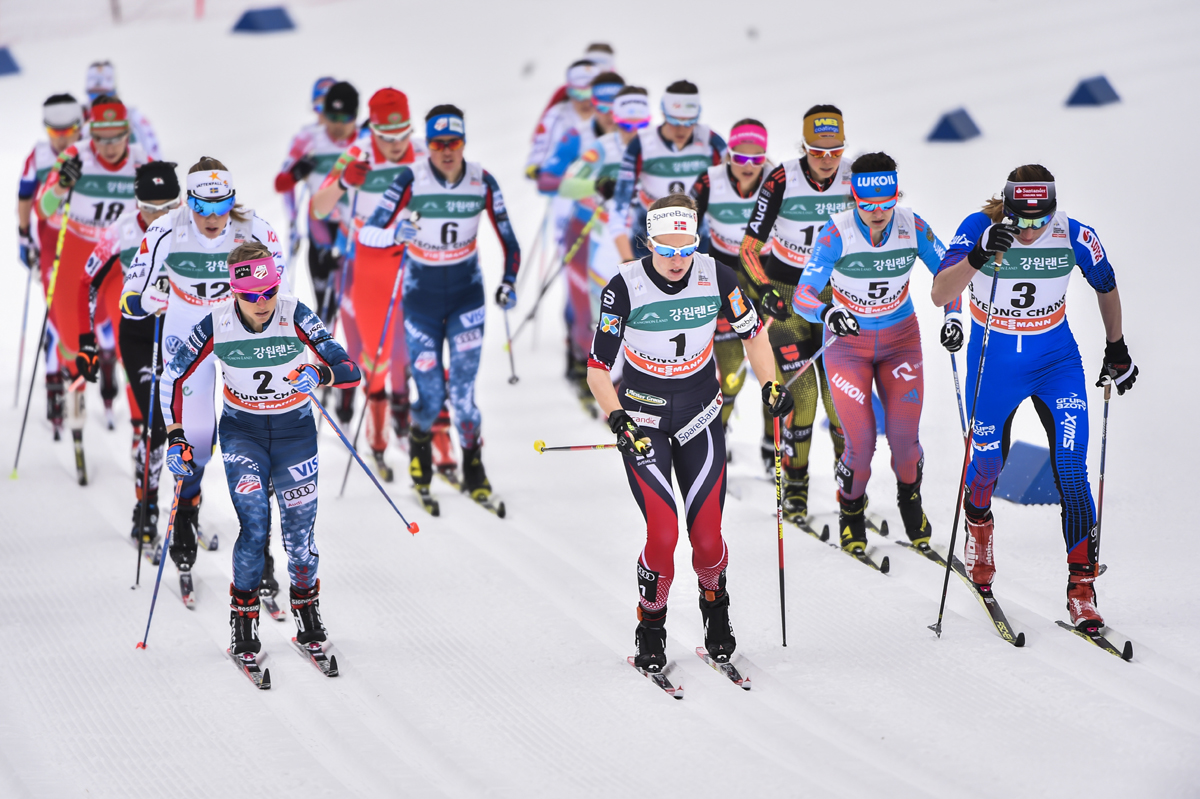
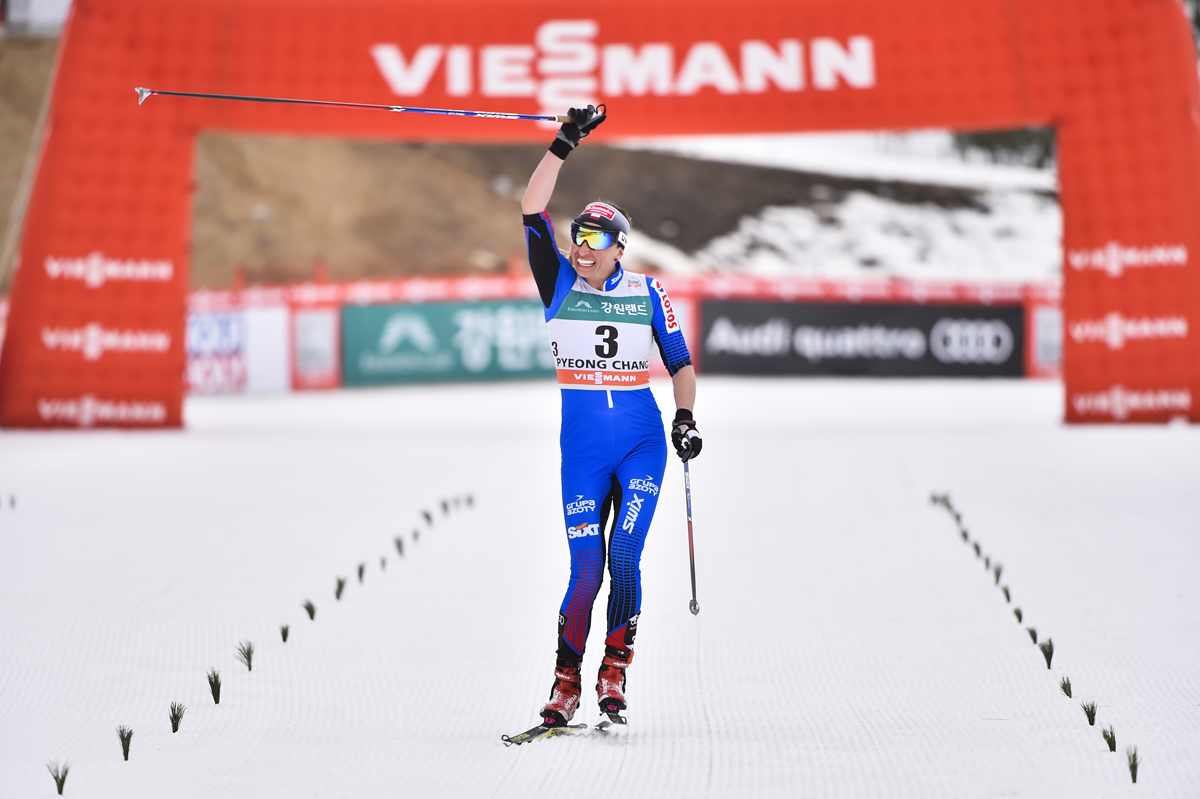
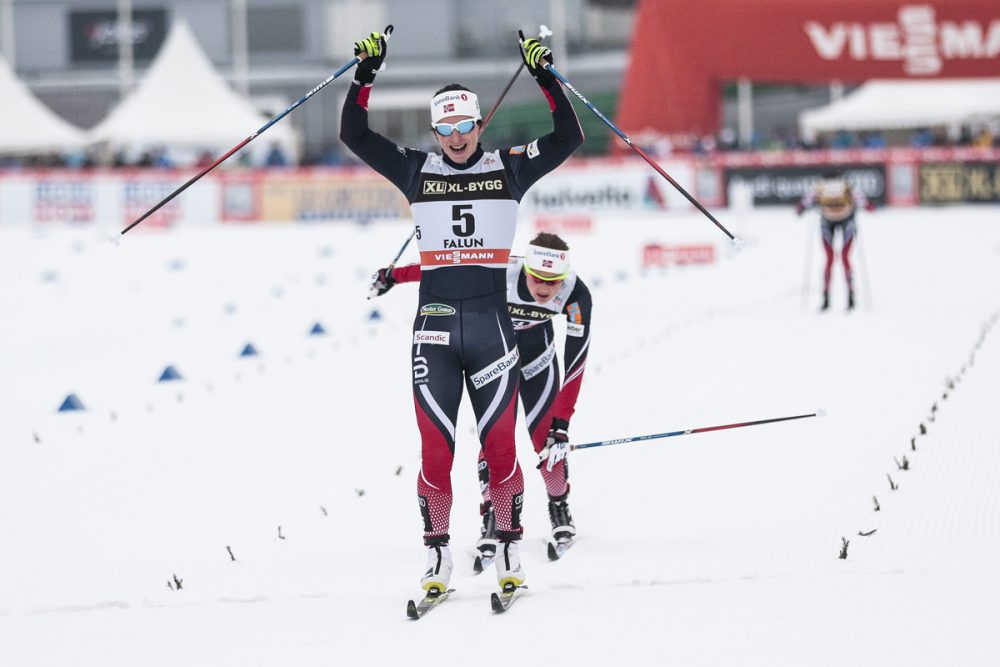
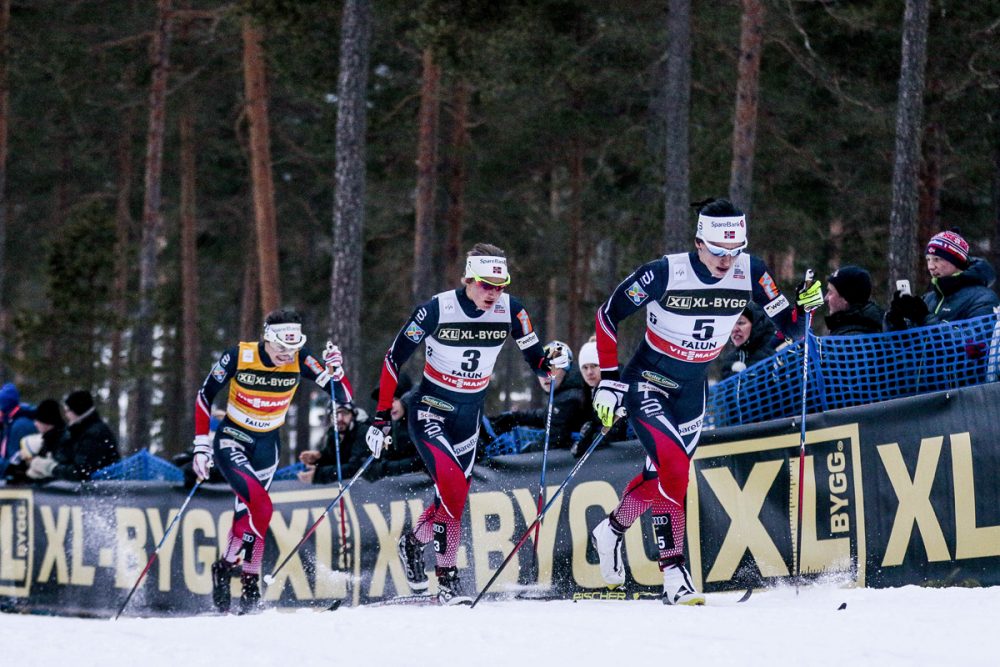
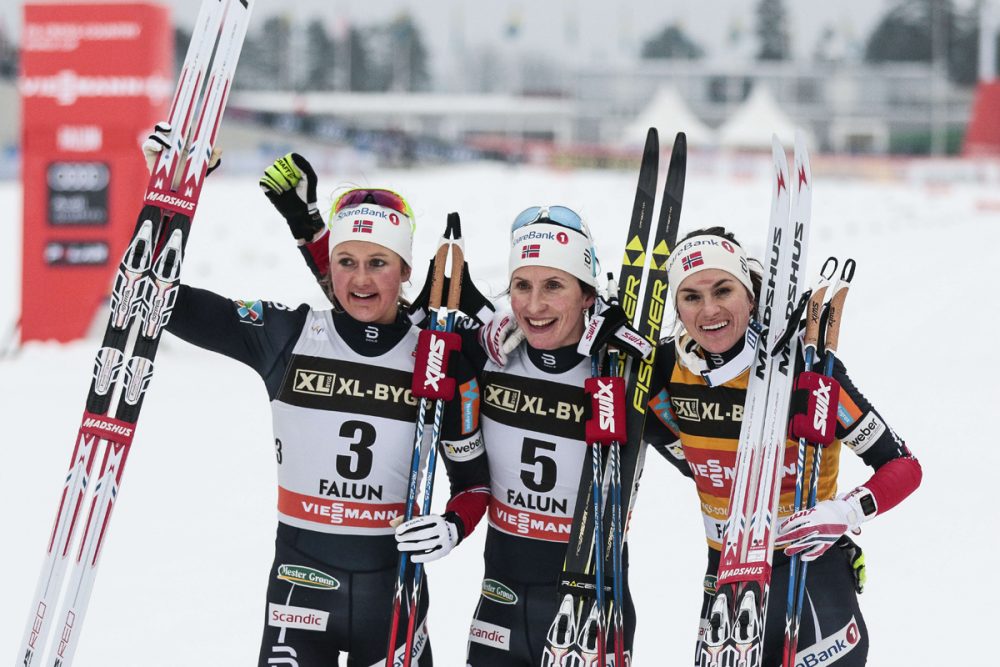
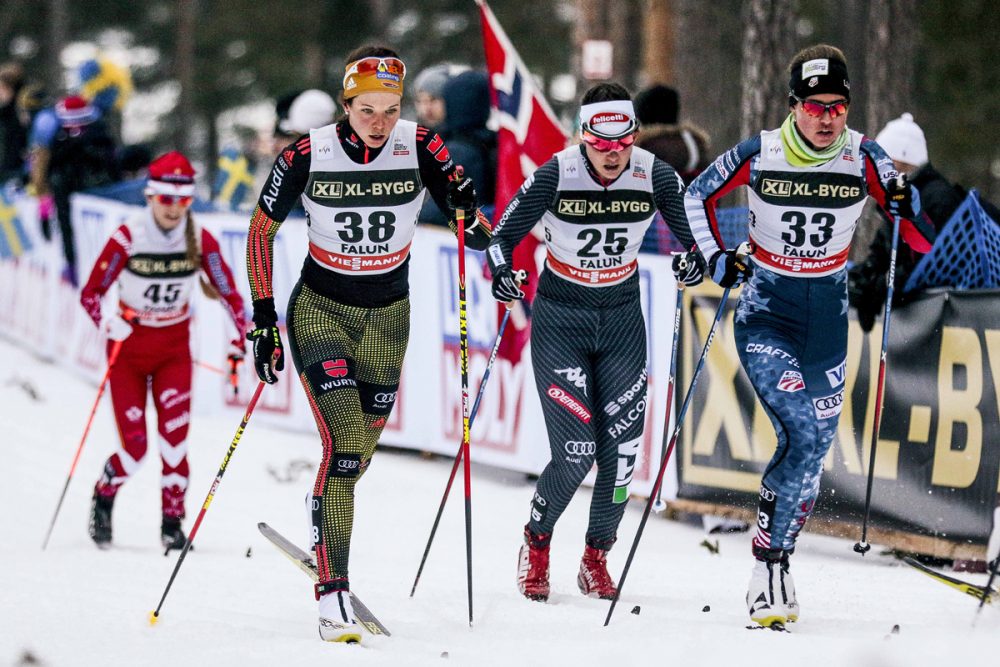
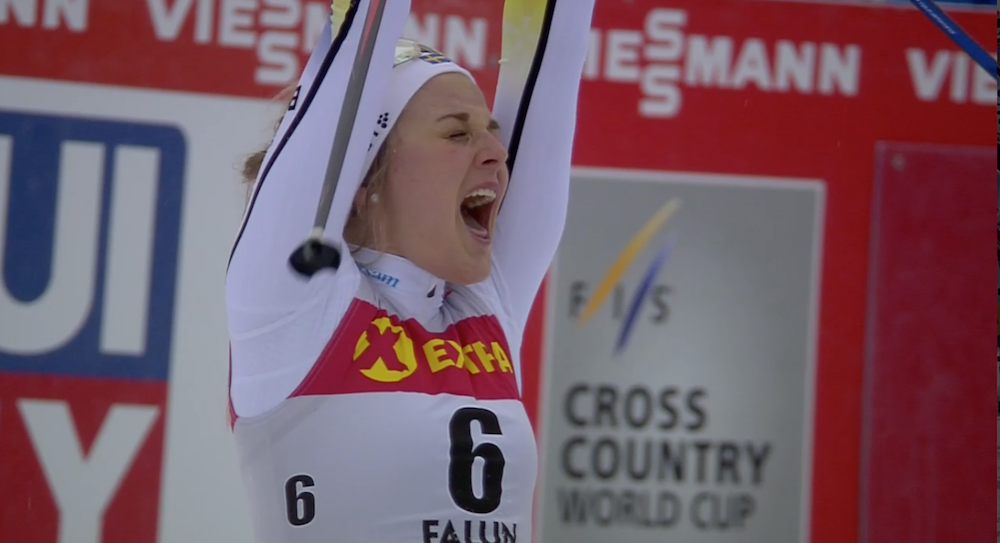
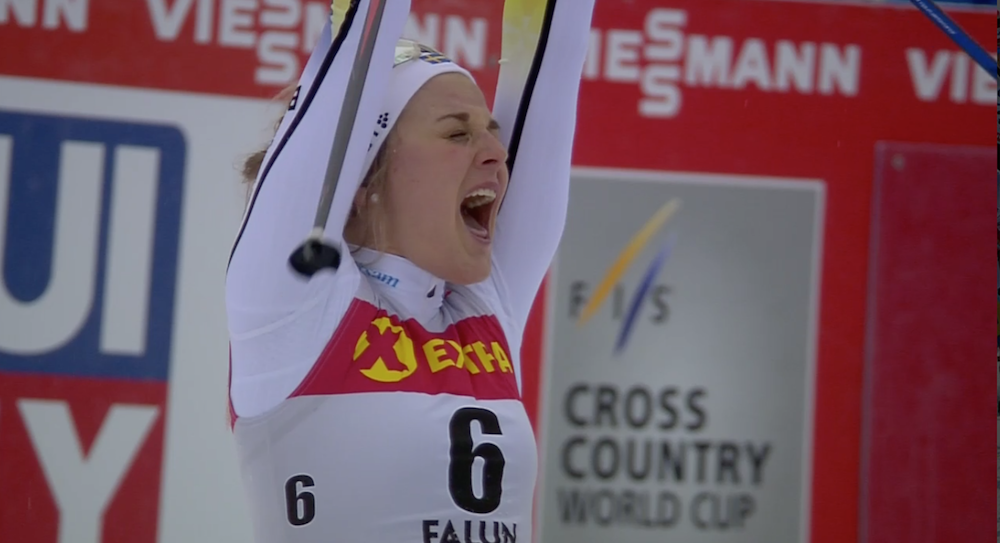
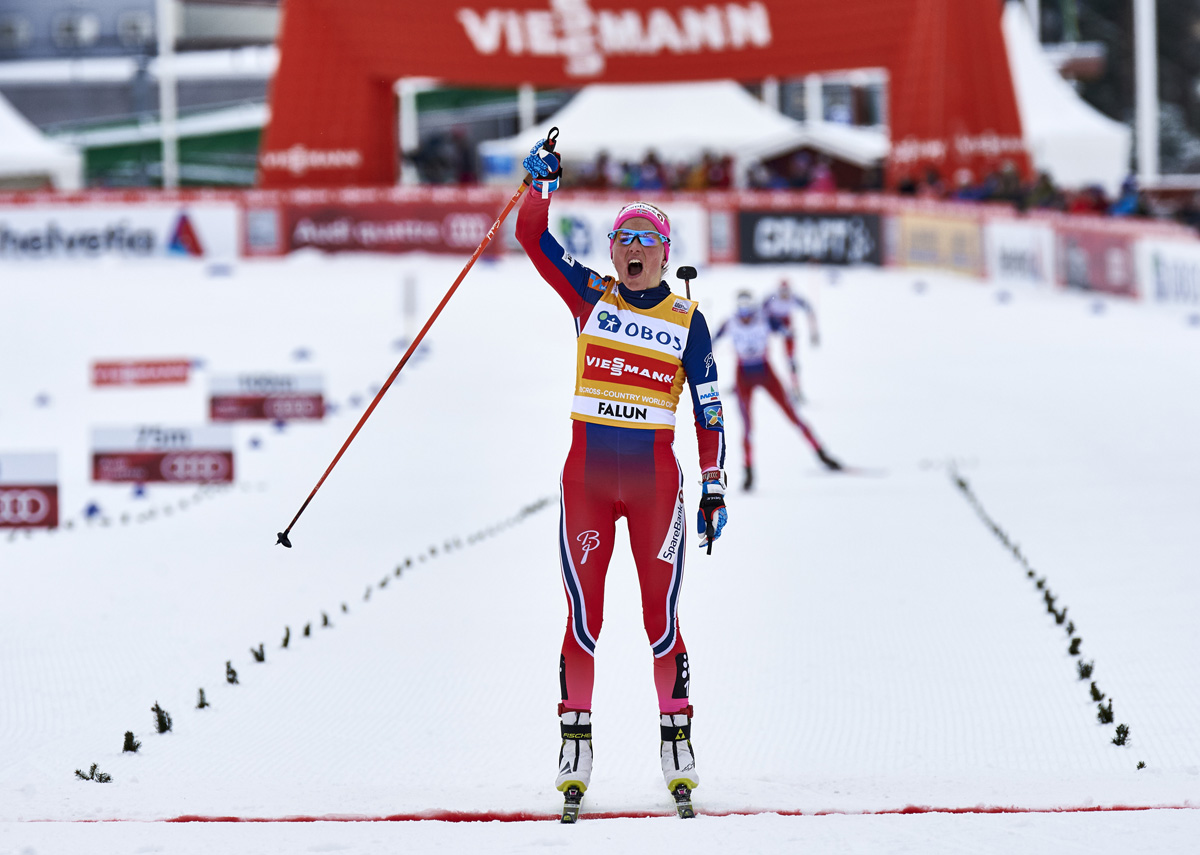
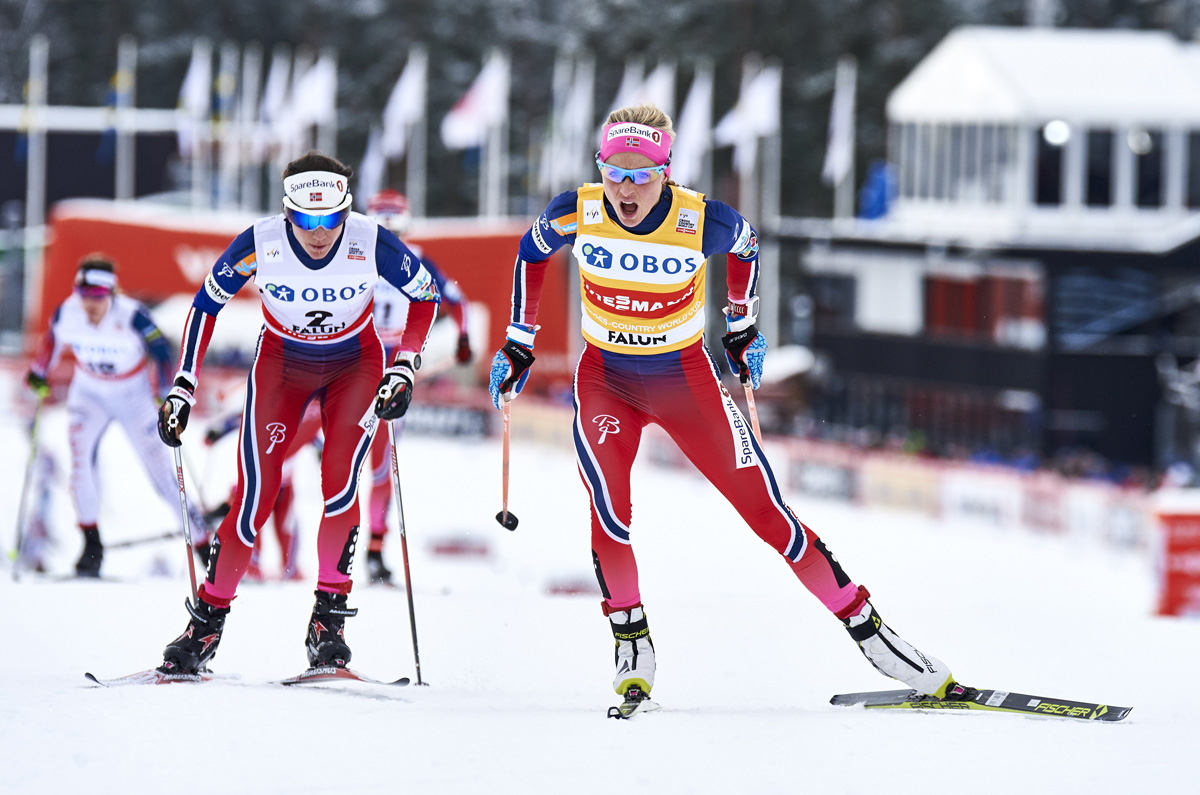
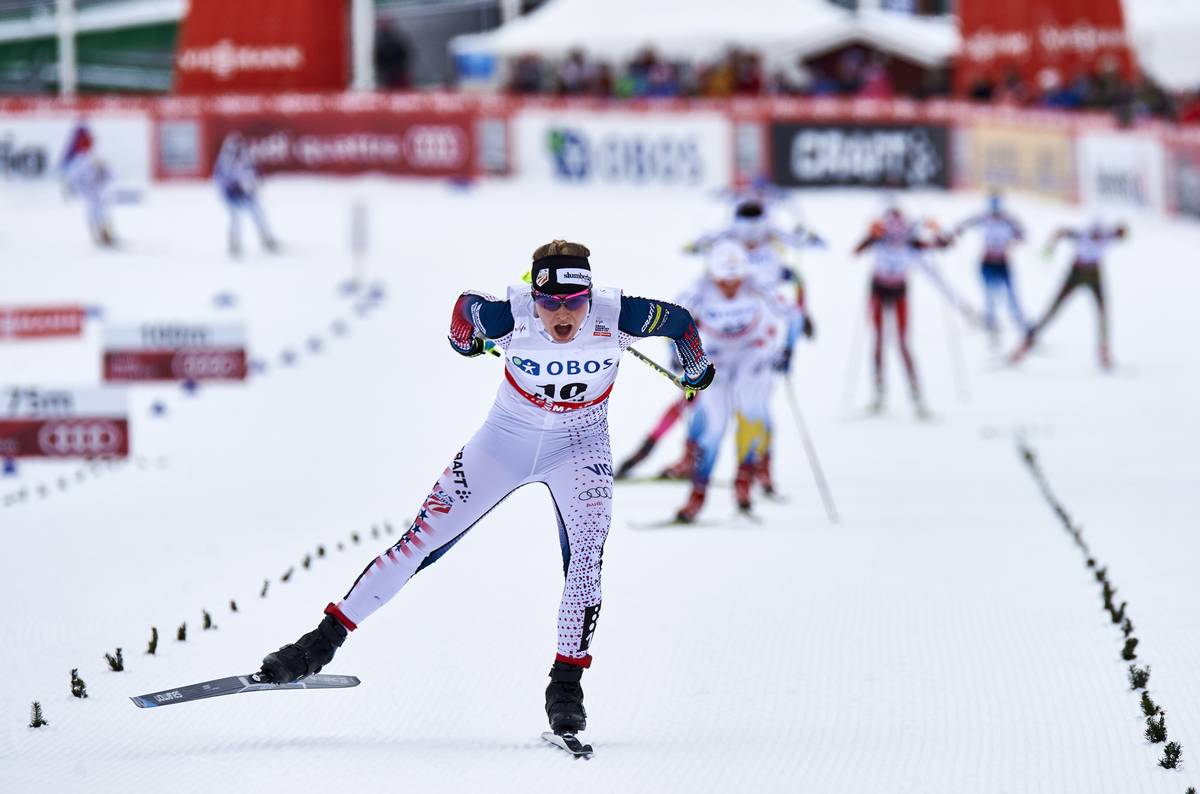
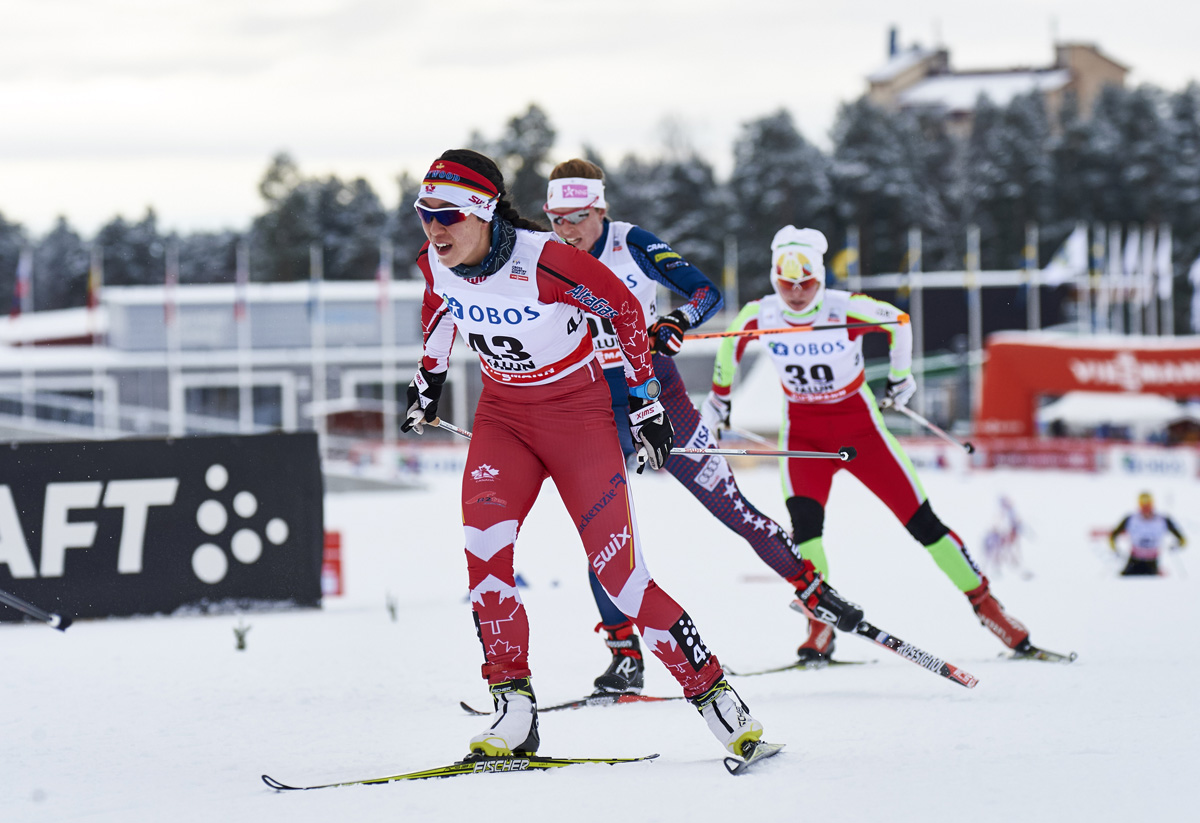
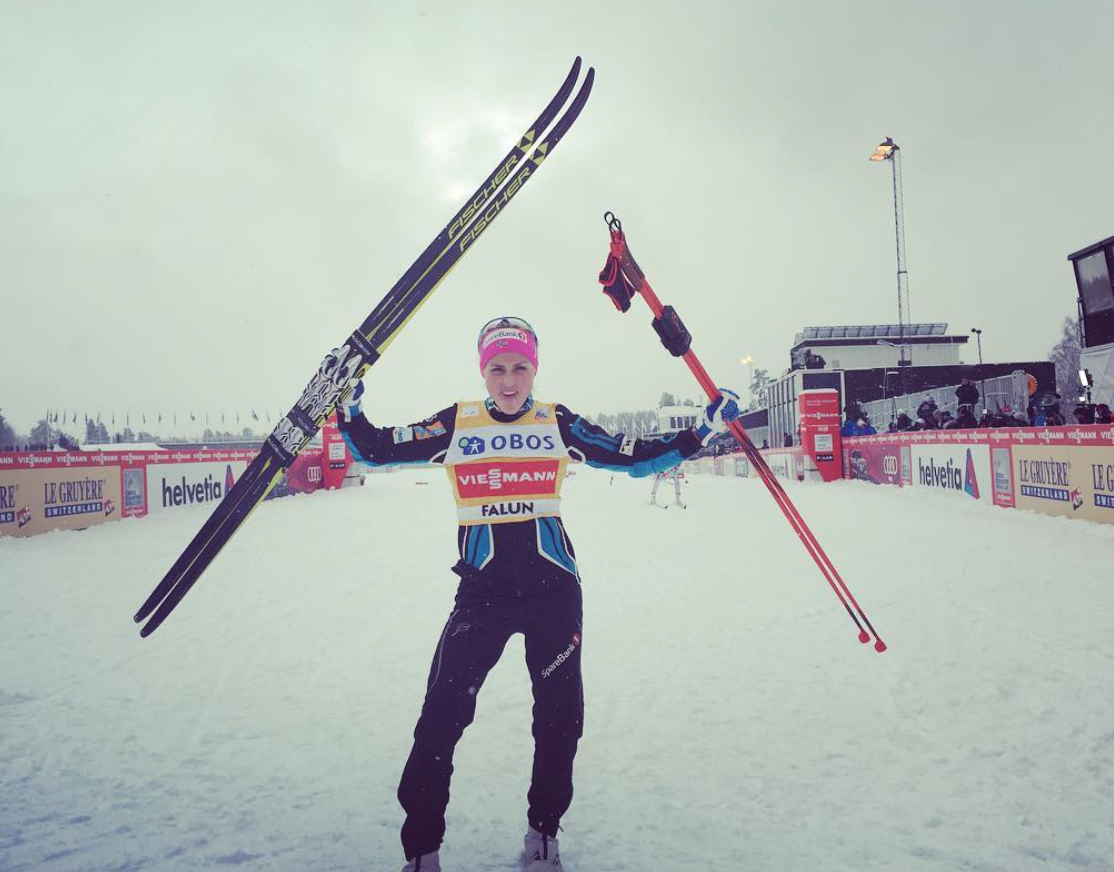
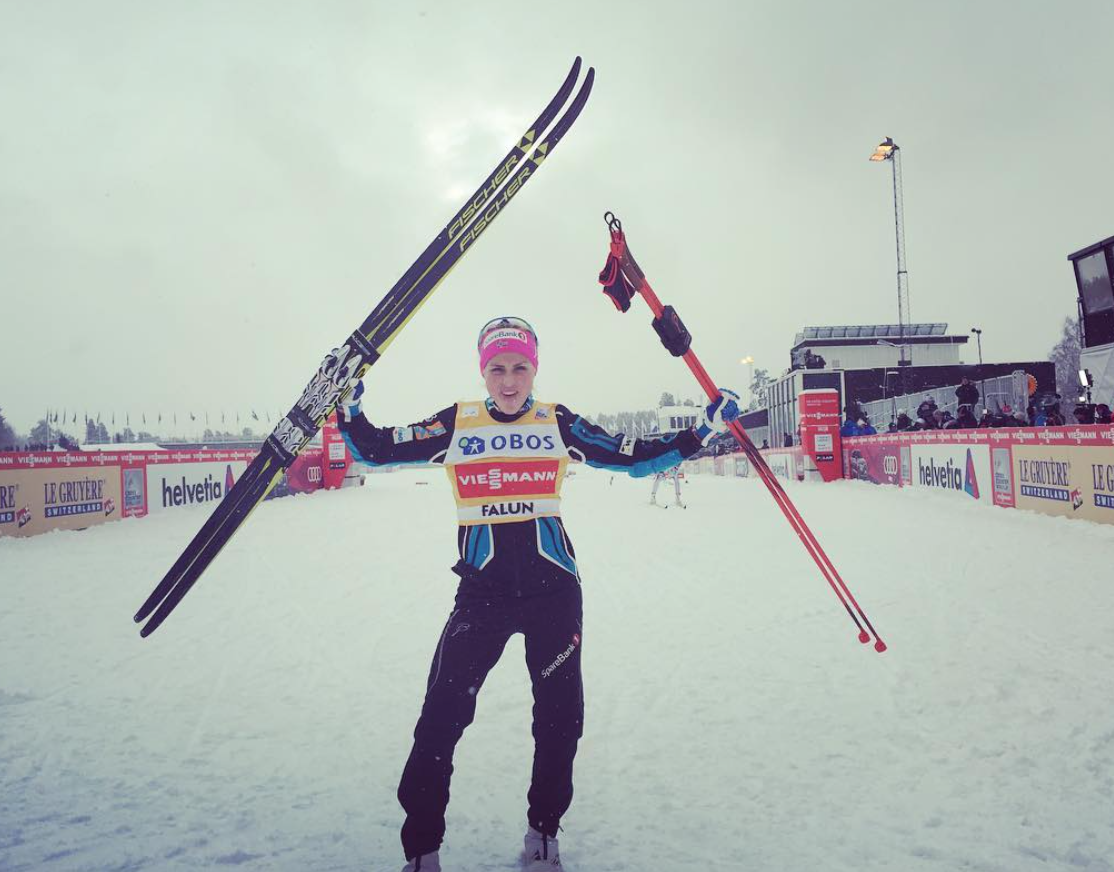
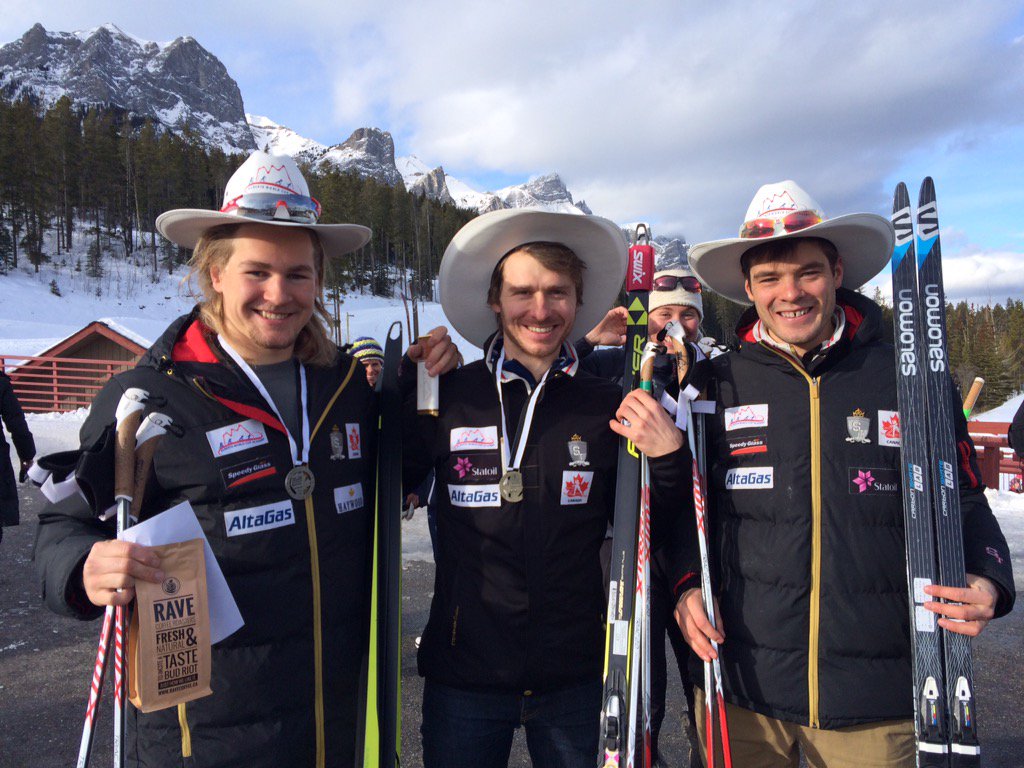
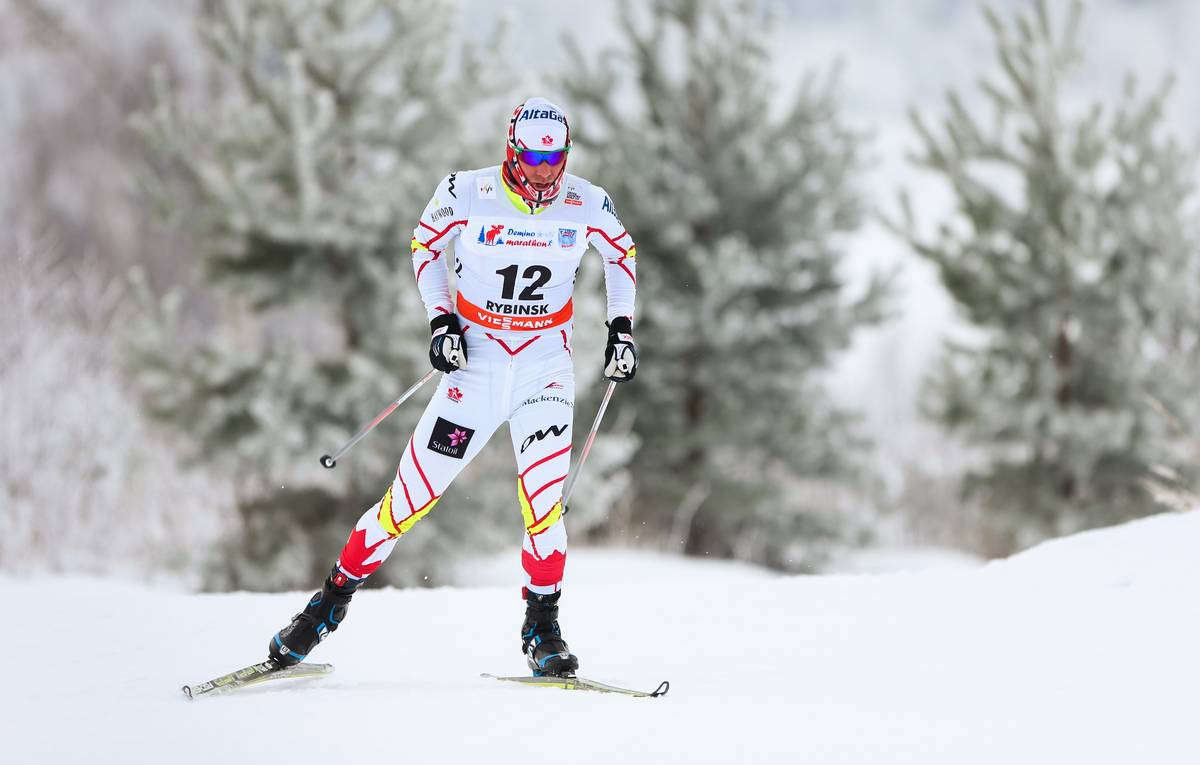
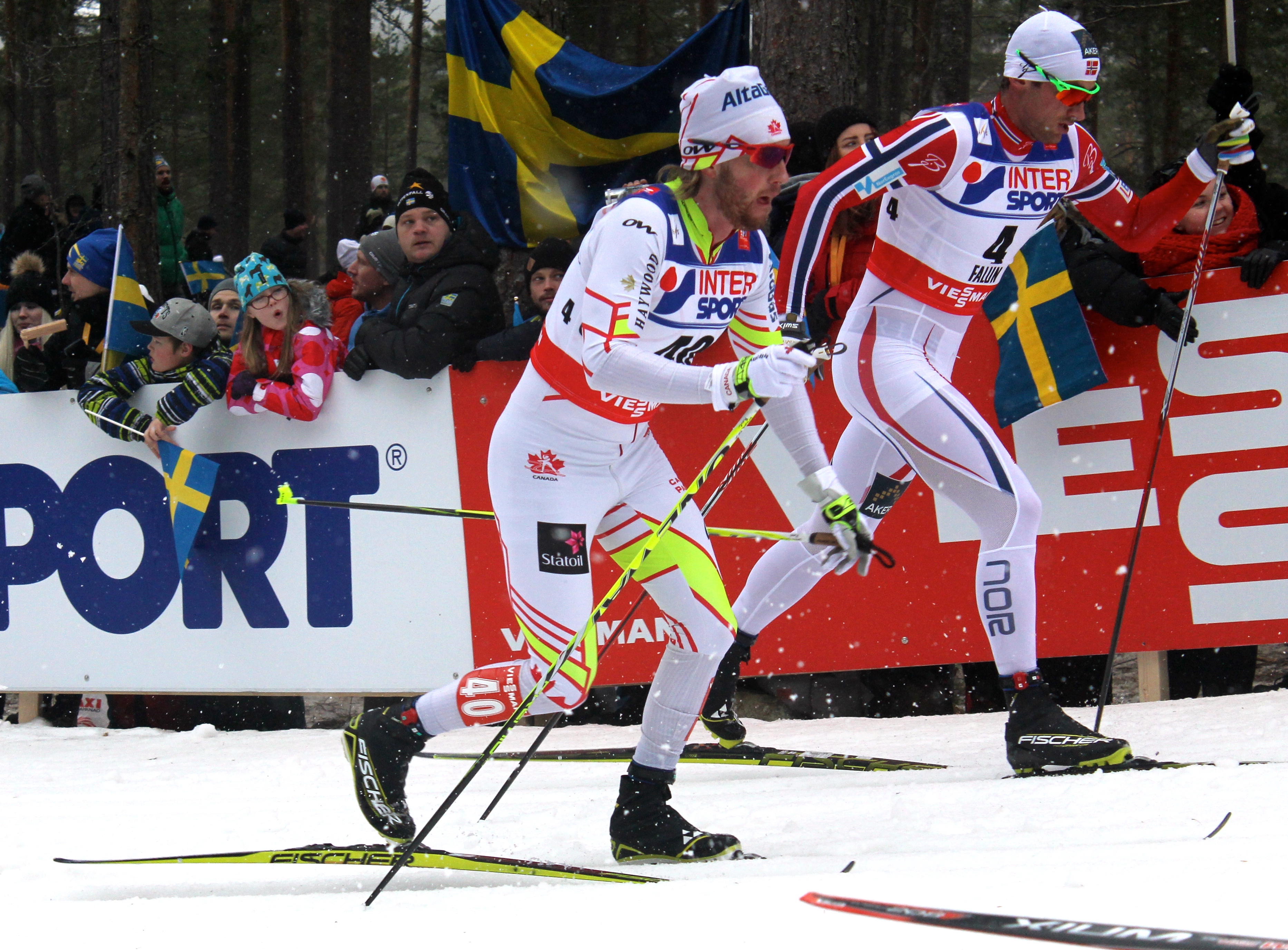
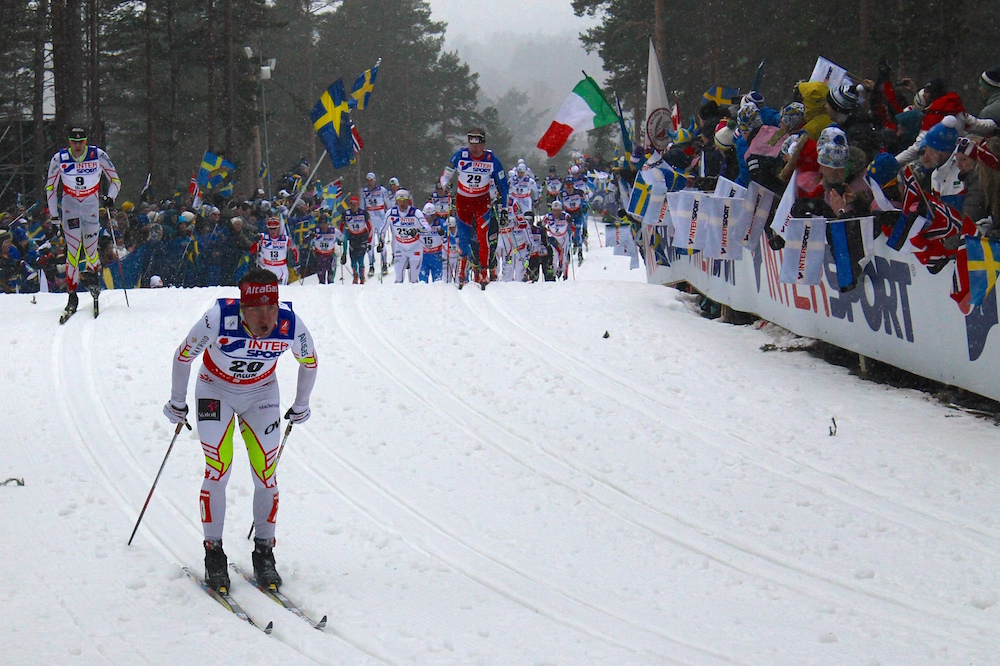
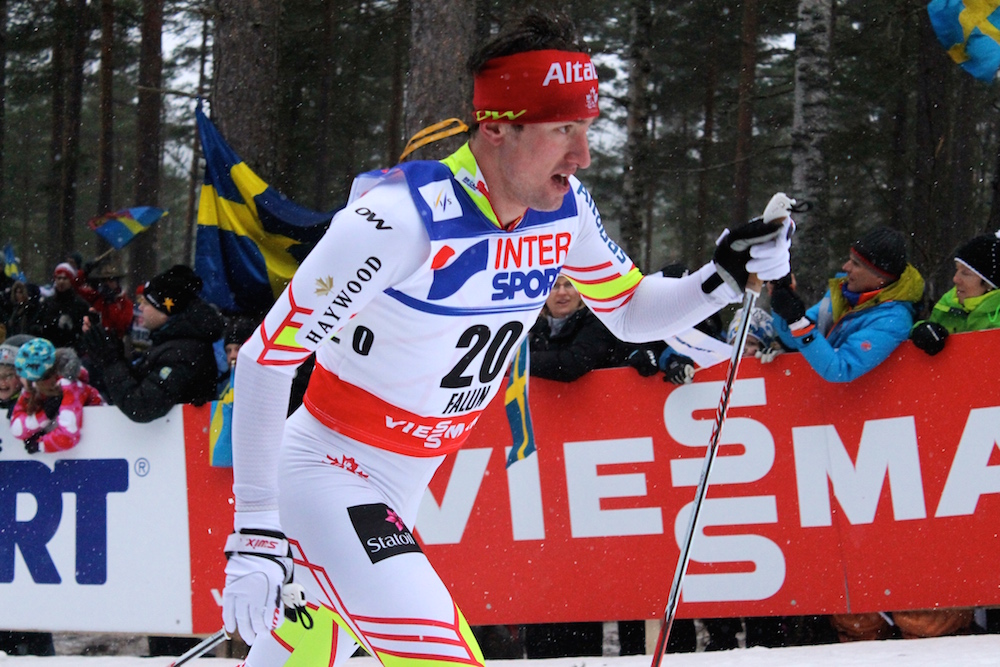
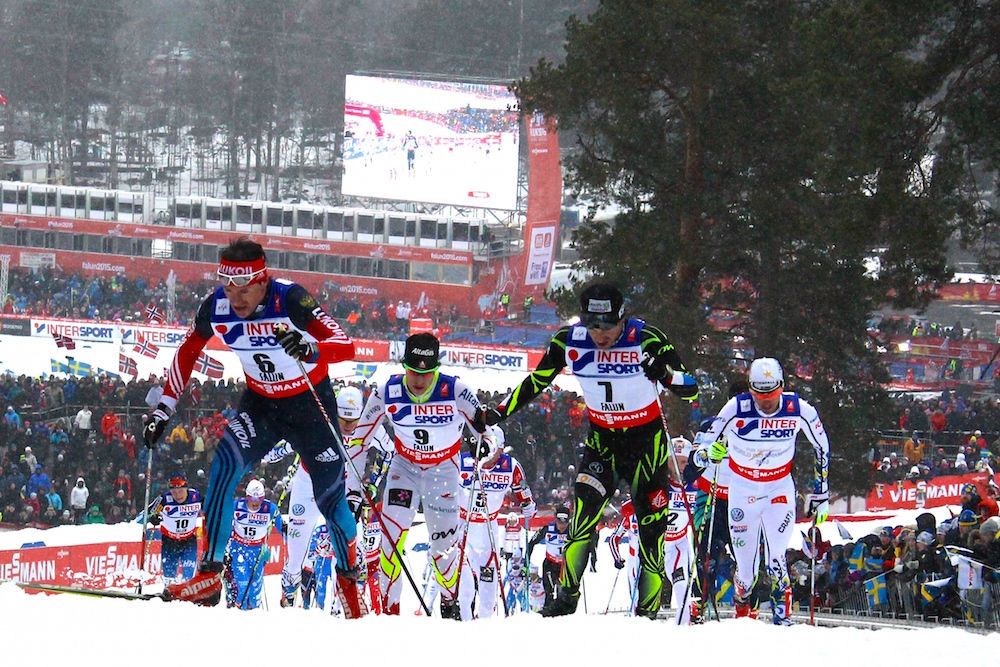
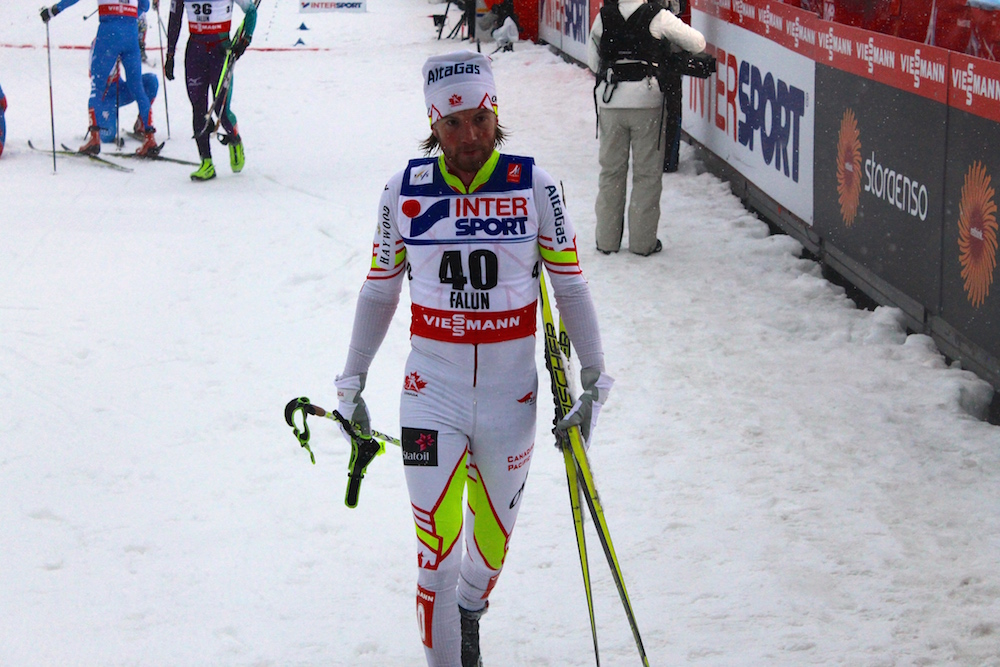
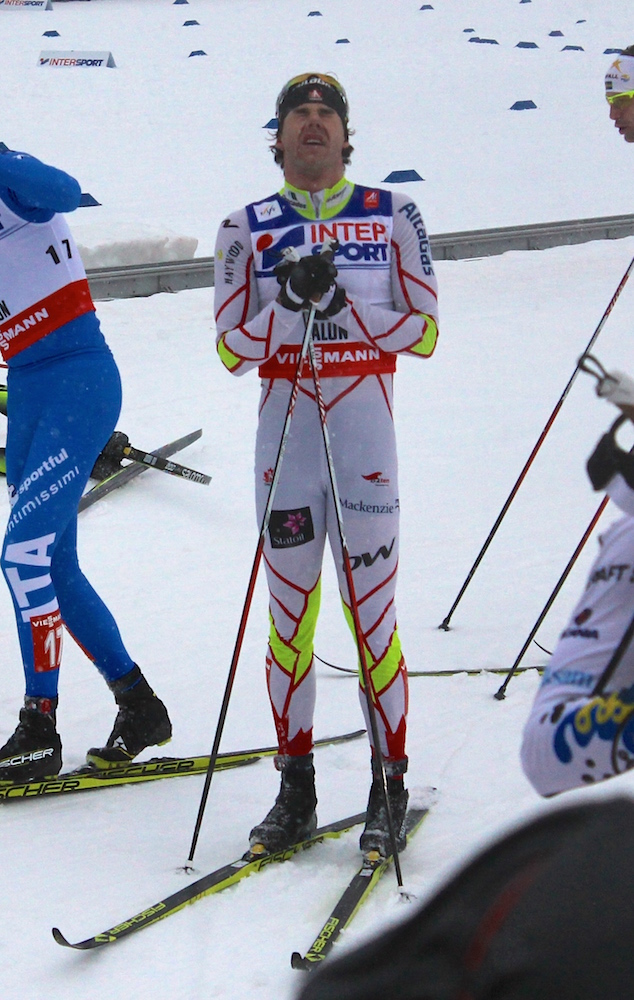
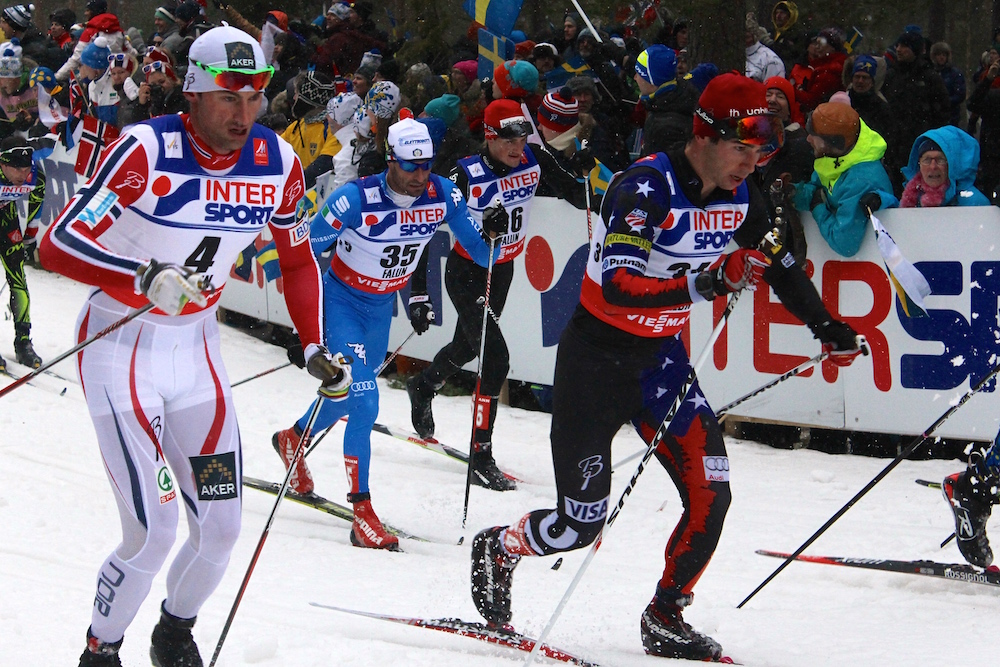
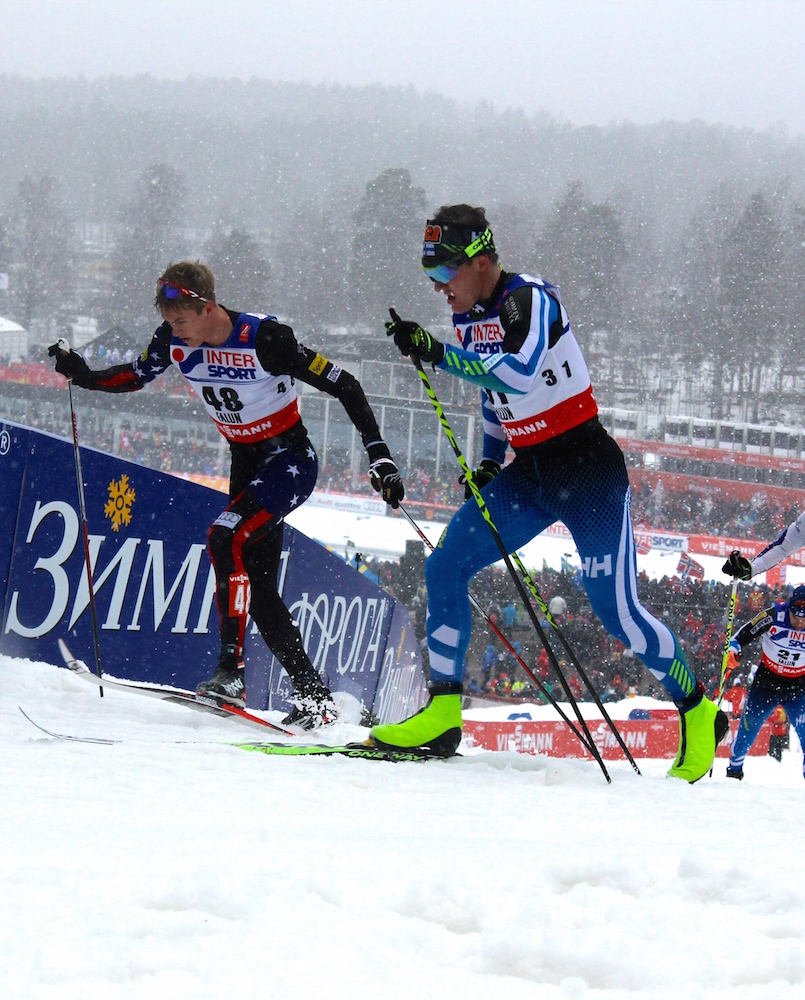
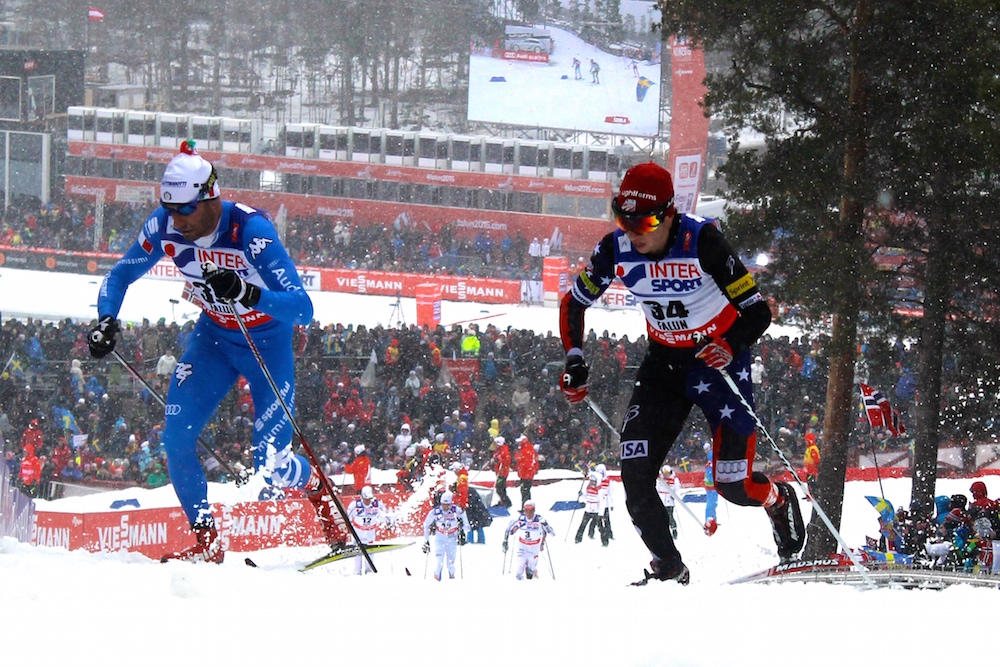
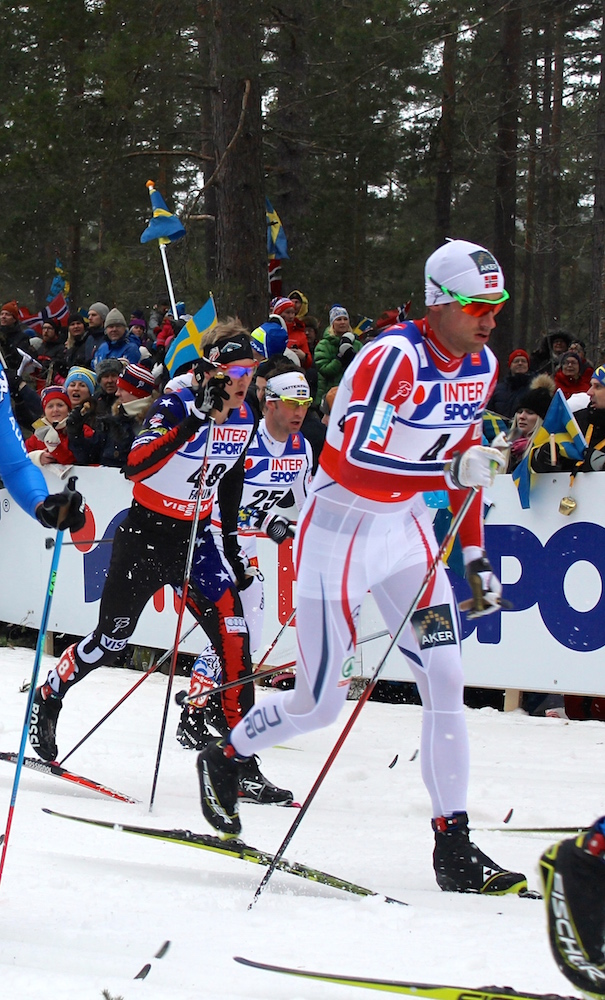
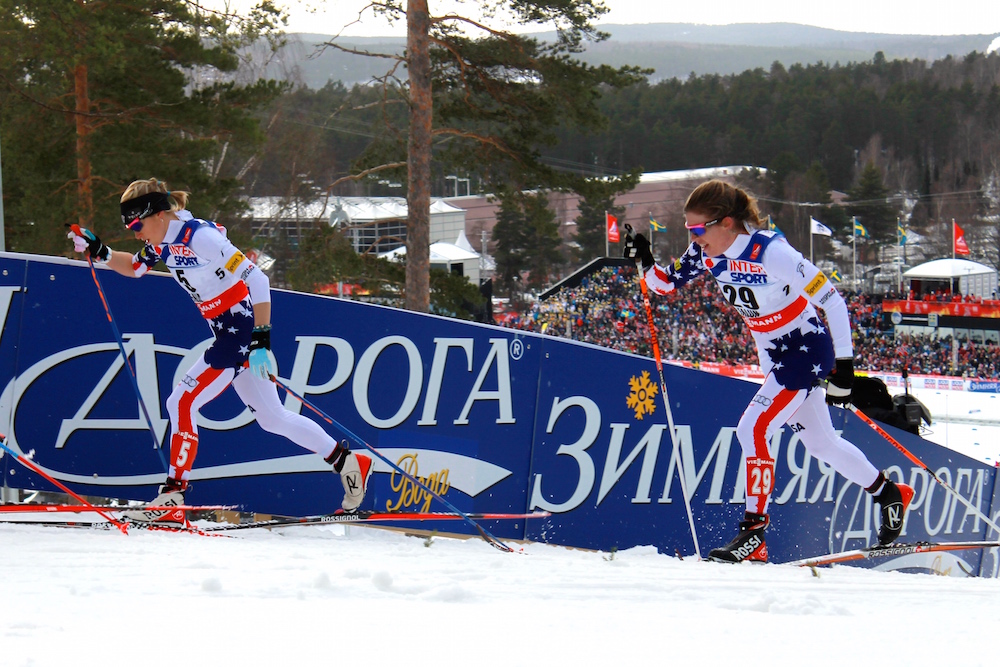
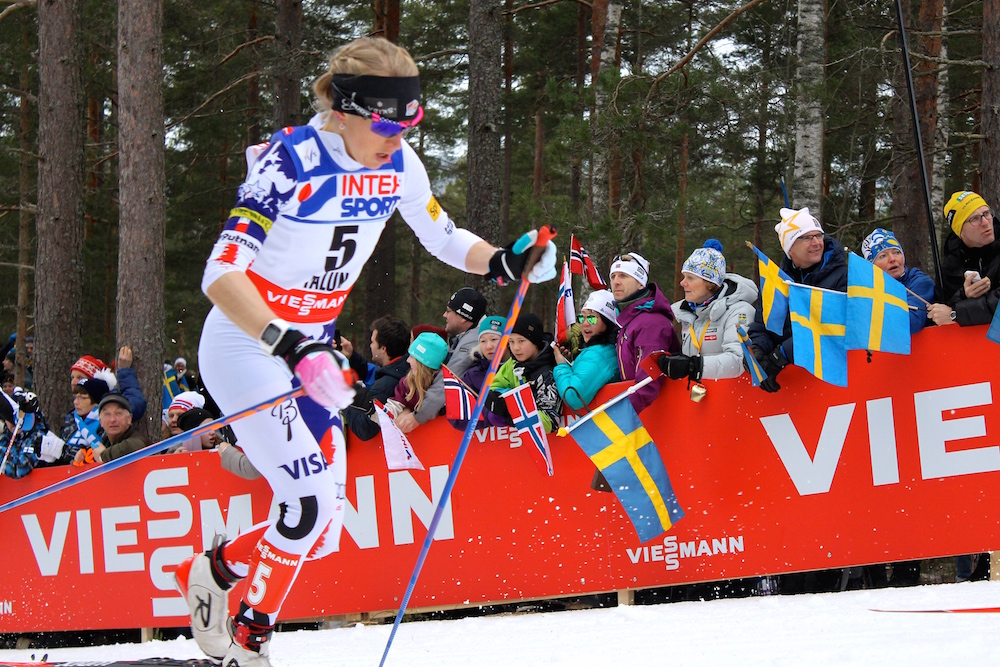
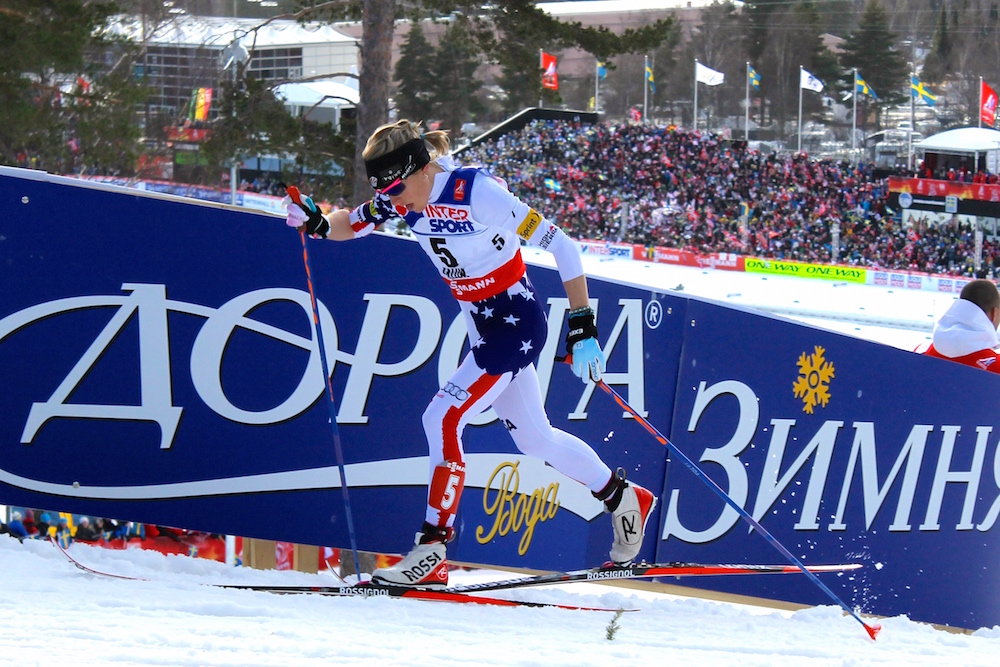
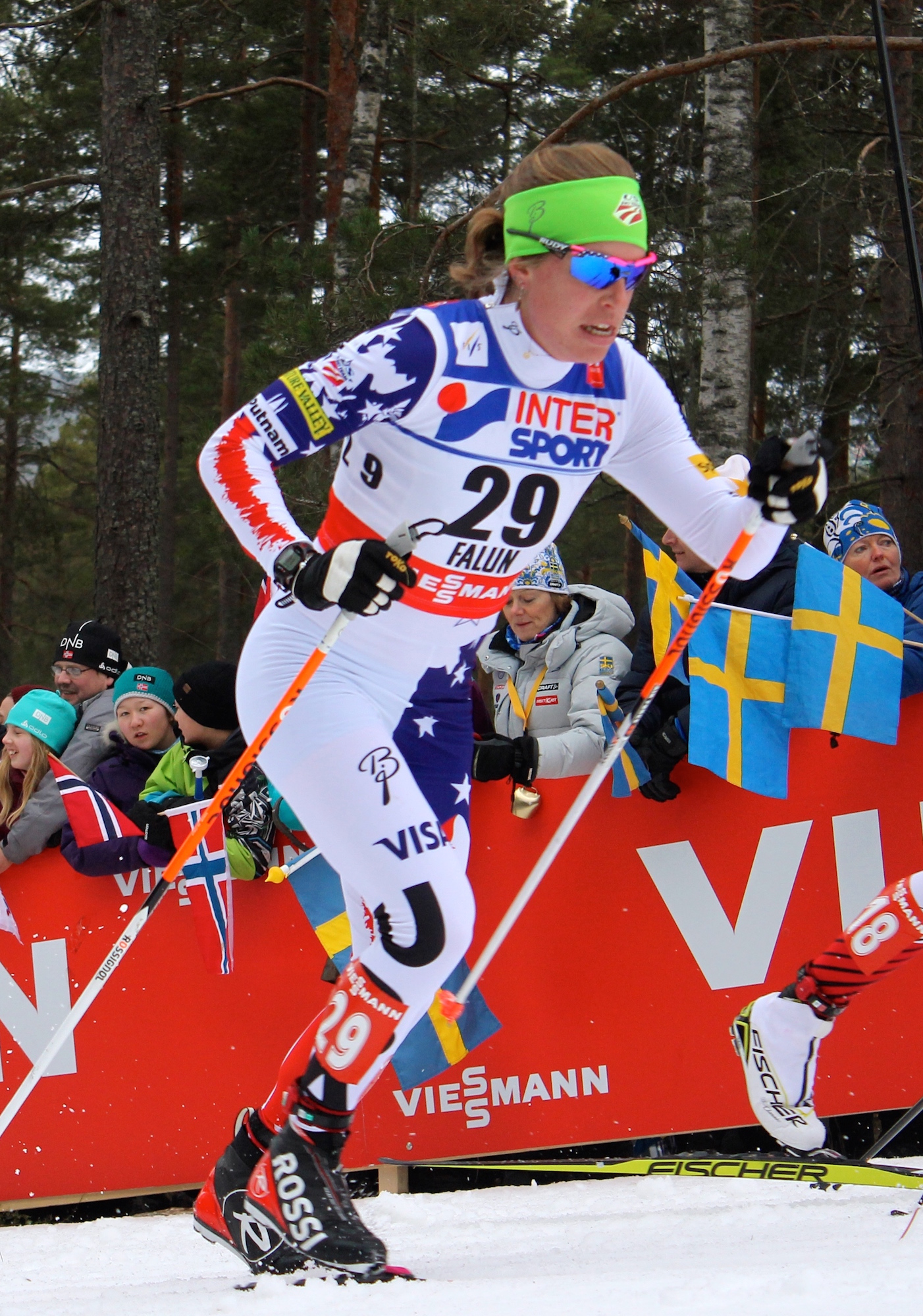
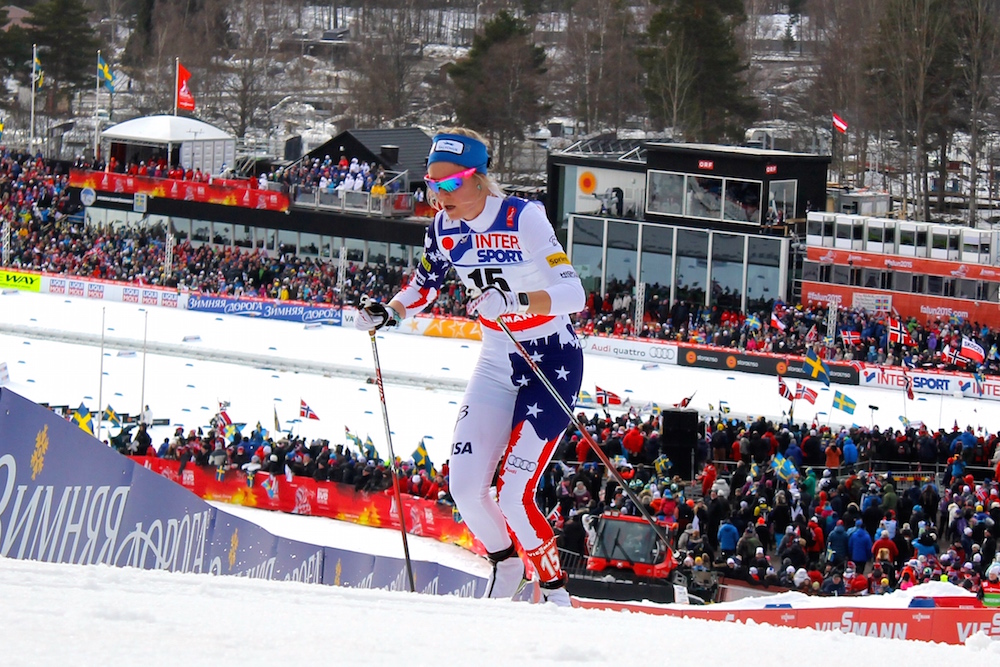
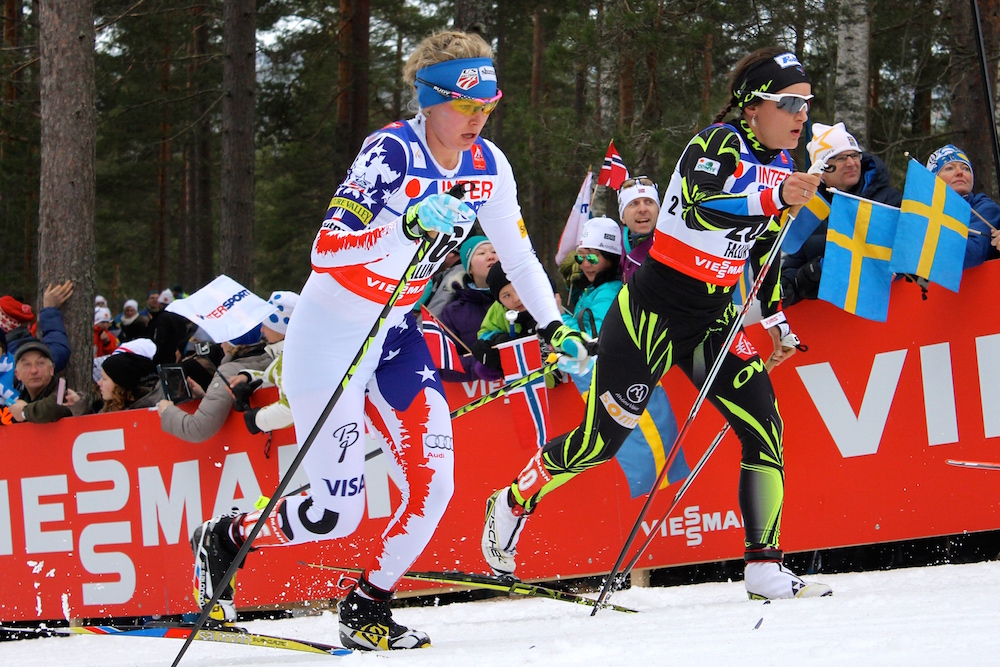
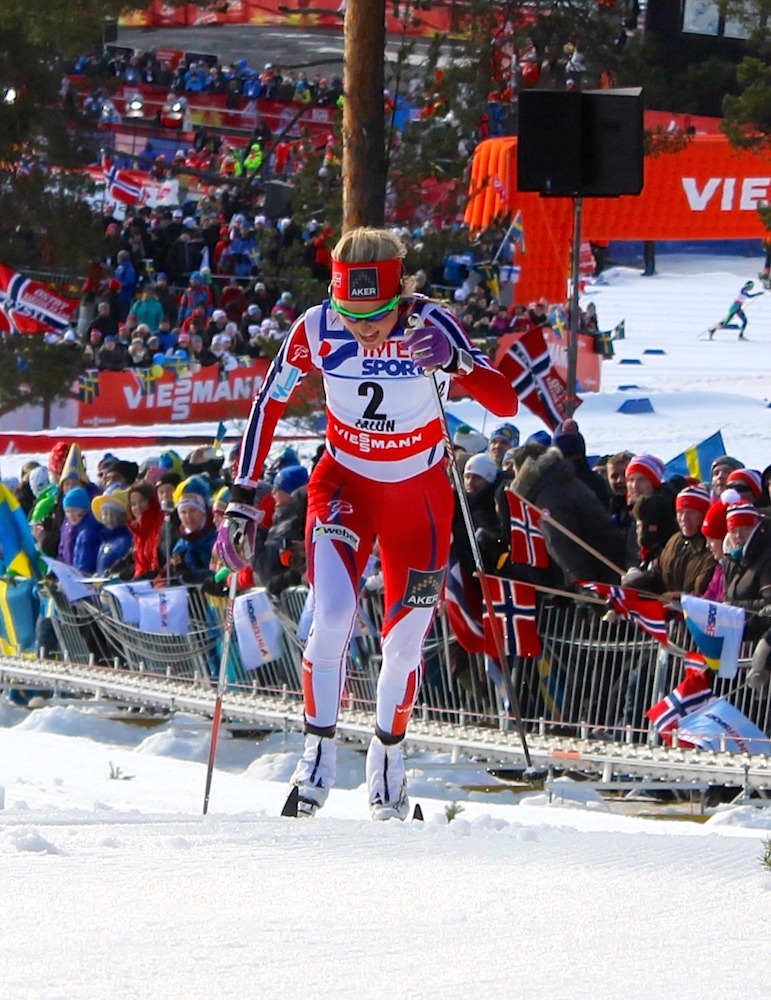
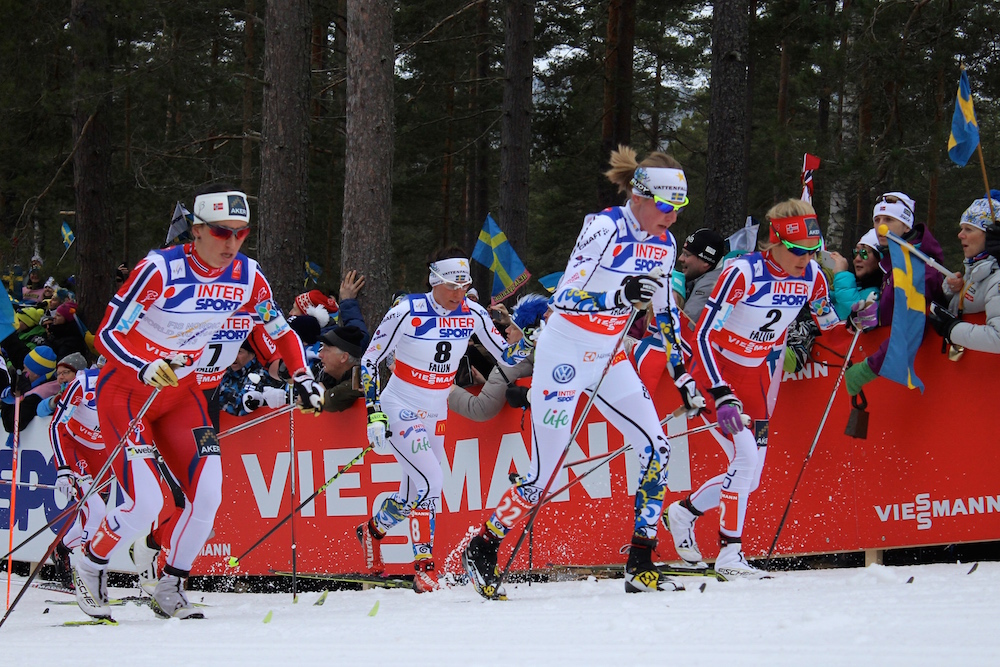
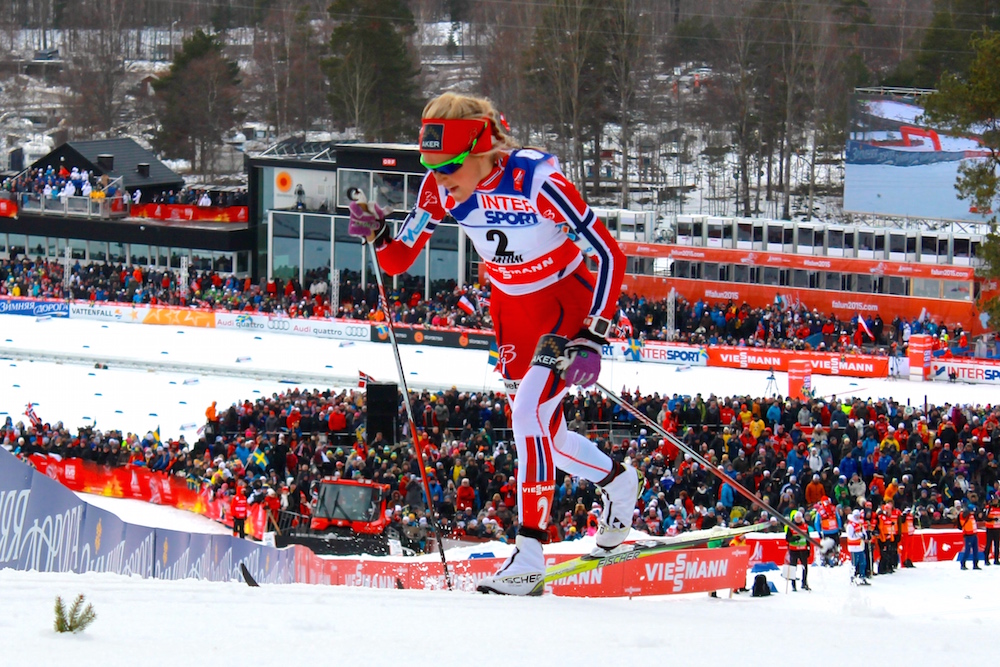
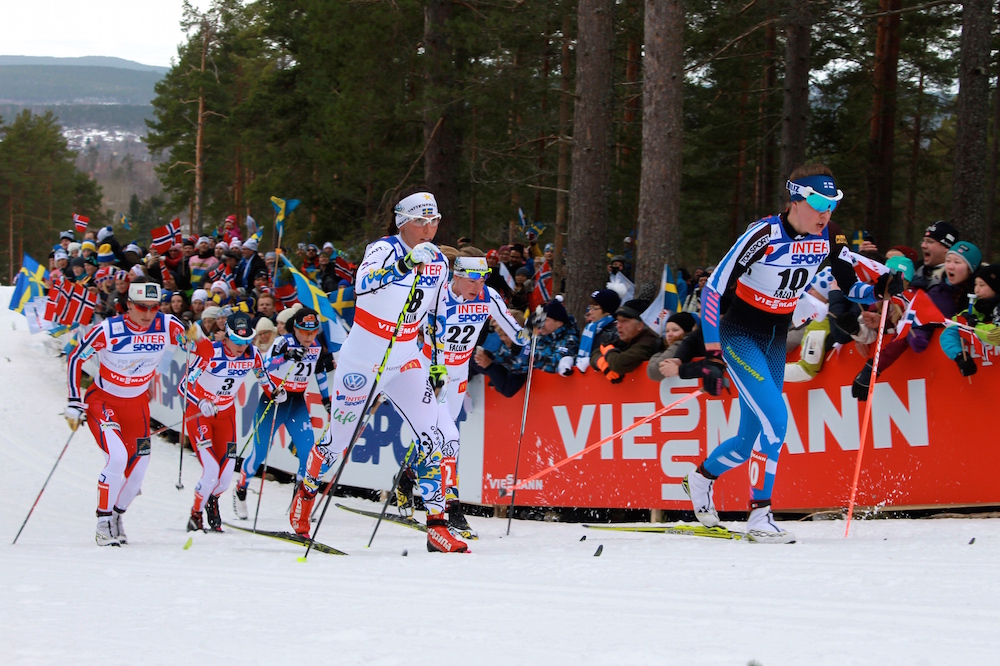
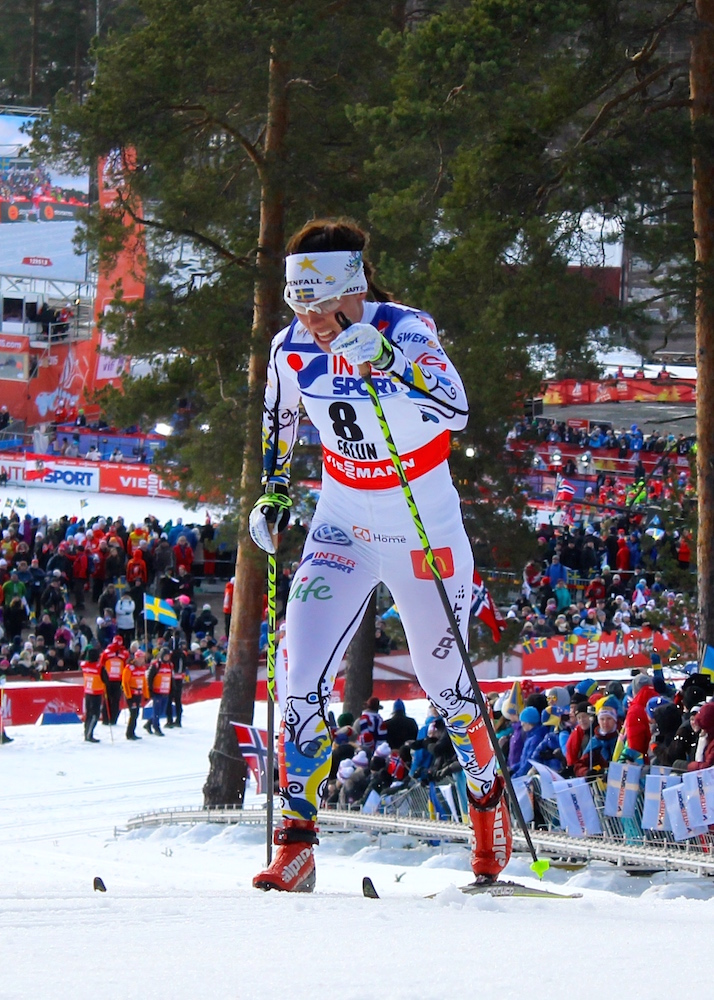
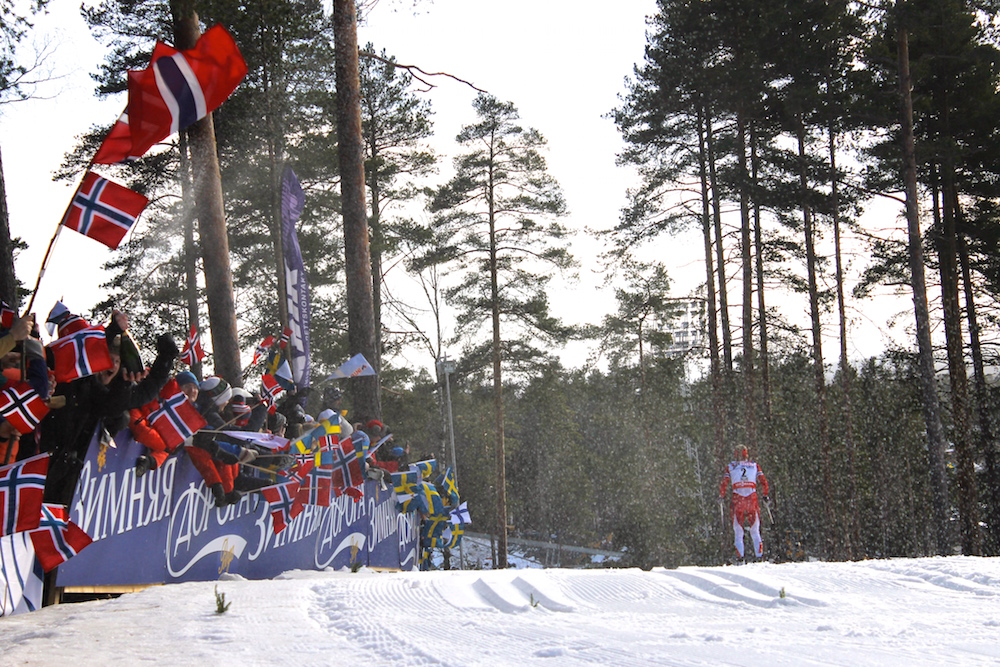
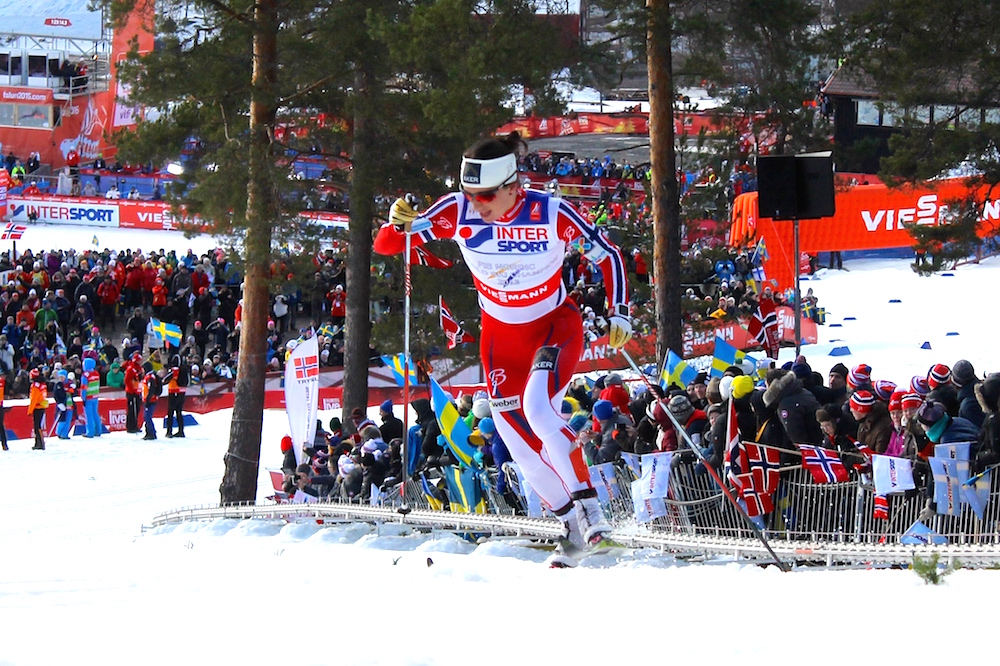
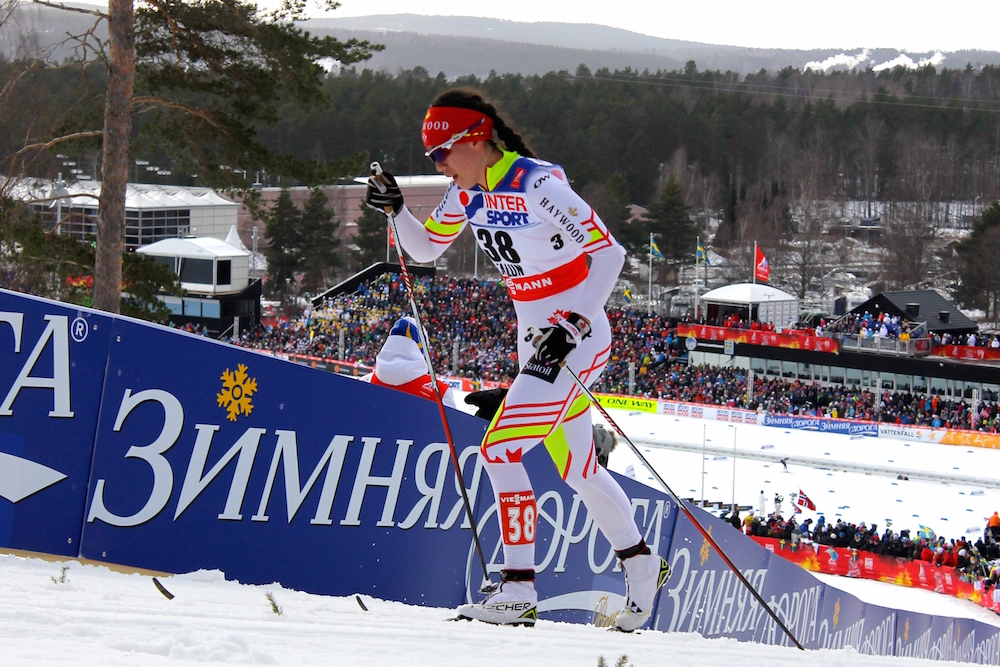
Sweden’s Hanna Falk (r) smiles as she wins the fourth World Cup race of her career and first race in Falun, Sweden, with a victory in the women’s freestyle sprint at 2018 World Cup Finals on Friday. Her teammate Jonna Sundling (l) placed second while Norway’s Marit Bjørgen finished third. (Photo: Svenska Skidspelen/Instagram)
FIS Cross Country World Cup Finals (Falun, Sweden): Freestyle sprints
In the last sprint of the season and the first race of the three-day World Cup Finals in Falun, Sweden’s Hanna Falk and Norway’s Johannes Høsflot Klæbo won their respective 1.4-kilometer freestyle sprint finals, while Norway’s Maiken Caspersen Falla and Klæbo claimed the season-long Sprint Crystal Globes and Sophie Caldwell of the U.S. placed third in the Sprint World Cup.
Falk started Friday by topping the women’s qualifier on home turf in 2:59.88 minutes, 1.65 seconds ahead of American Jessie Diggins, who qualifiedin second. Russia’s Natalia Nepryaeva qualified third (+2.73), while American Sadie Bjornsen raced to the fourth-fastest qualifying time (+2.96), ahead of Norway’s Marit Bjørgen in fifth (+3.72).
Falk then won the first quarterfinal and first semifinal before taking control and dusting the field in the women’s final. She essentially led the final from start to finish, but slowed her pace and the five women behind her as she ascended the last climb. As she reached the 180-degree turn at the top, Falk launched into high gear, leaving the rest of the field chasing. Bjørgen was closest to her in second, but still several meters back, as they descended down into the stadium, and Falk skated away from her pursuers for her fourth-career World Cup win (and first victory in Falun) in 3:08.25. Sweden’s 23-year-old Jonna Sundling came on strong in the finishing straight for her first World Cup podium in second (+0.53), Bjørgen took third, and Sweden had three in the top four with Anna Dyvik in fourth (+1.72).
Norway’s Silje Øyre Slind finished fifth (+4.3), andCaldwell, who had qualified for the heats in 16th then won her quarterfinal and advanced in third in the second semifinal, placed sixth overall (+6.99).
Four American women posted top-20 qualifying times, with Kikkan Randall advancing as well in 18th. Diggins placed seventh overall after finishing third in the first semifinal, 0.42 seconds behind Falk in first and just 0.08 seconds behind Sundling, who advanced to the final in second.
Bjornsen was ninth on the day after placing fifth in that semifinal, 0.85 seconds out of first. Randall finished 15th overall after placing third in her quarterfinal, 3.14 seconds behind Diggins, who won that heat.
Also for the U.S, Ida Sargent missed the top 30 needed to qualify in 36th, as did Rosie Brennan in 49th, Caitlin Patterson in 63rd, Liz Stephen in 66th, Kaitlynn Miller in 69th, and Rosie Frankowski in 75th.
Canada’s Emily Nishikawa placed 40th, Dahria Beatty was 48th, Cendrine Browne 60th, and Zina Kocher 71st.
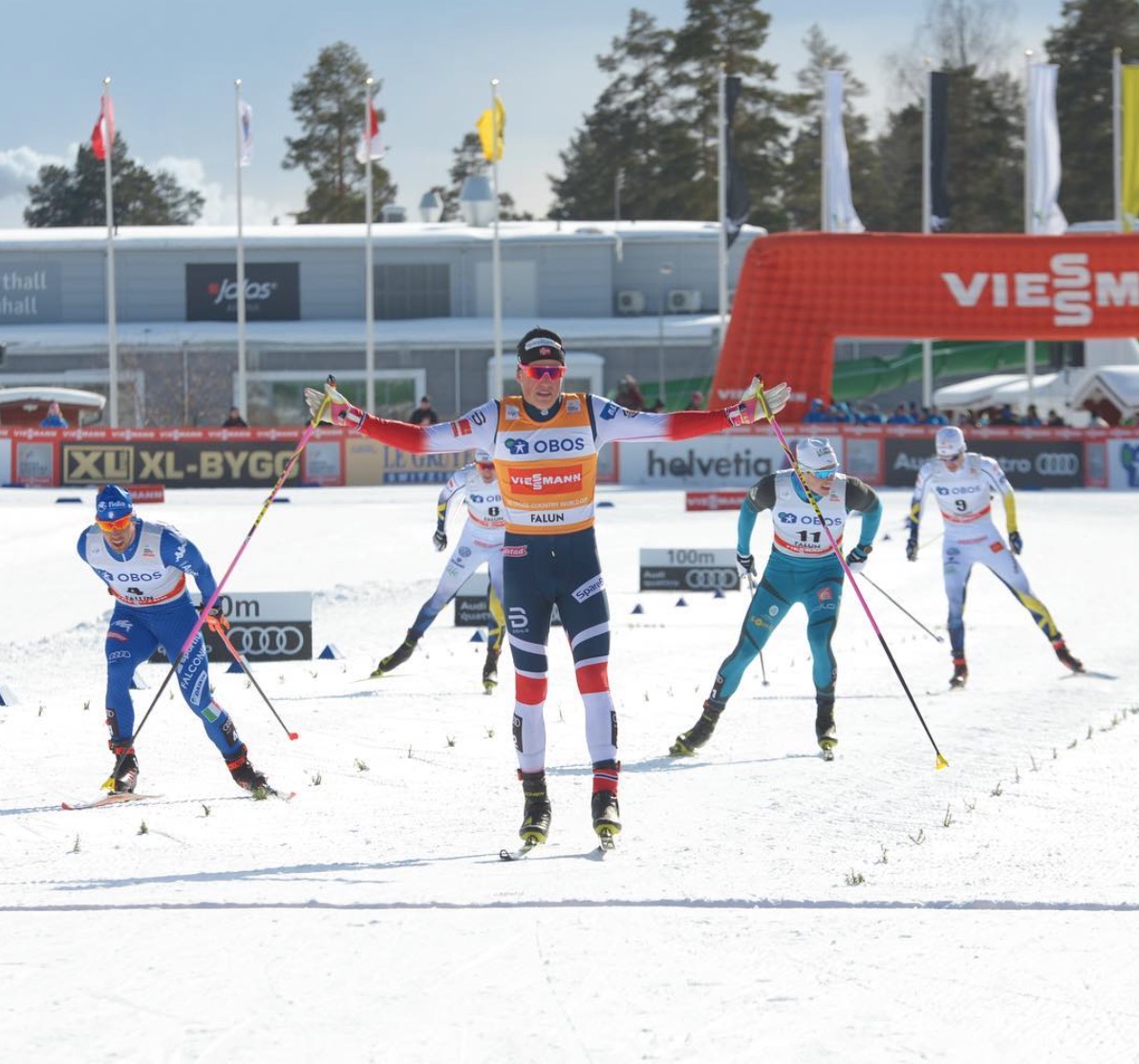
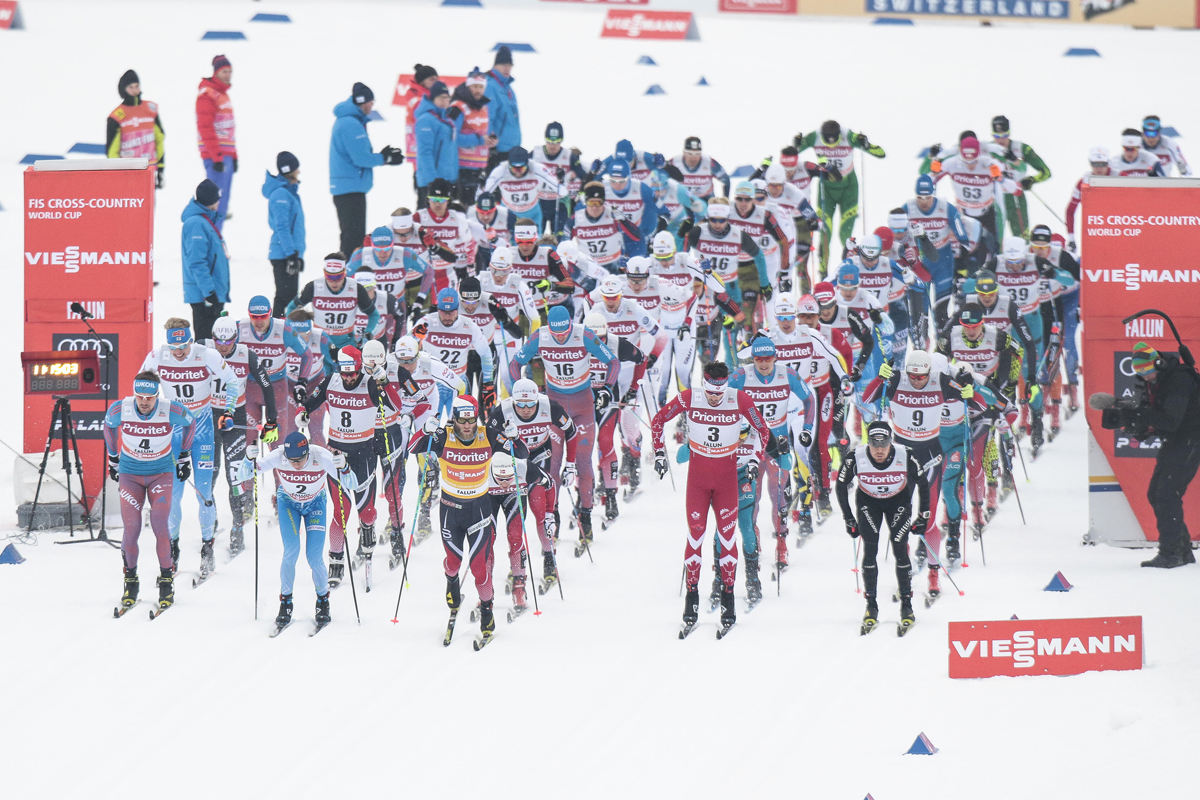
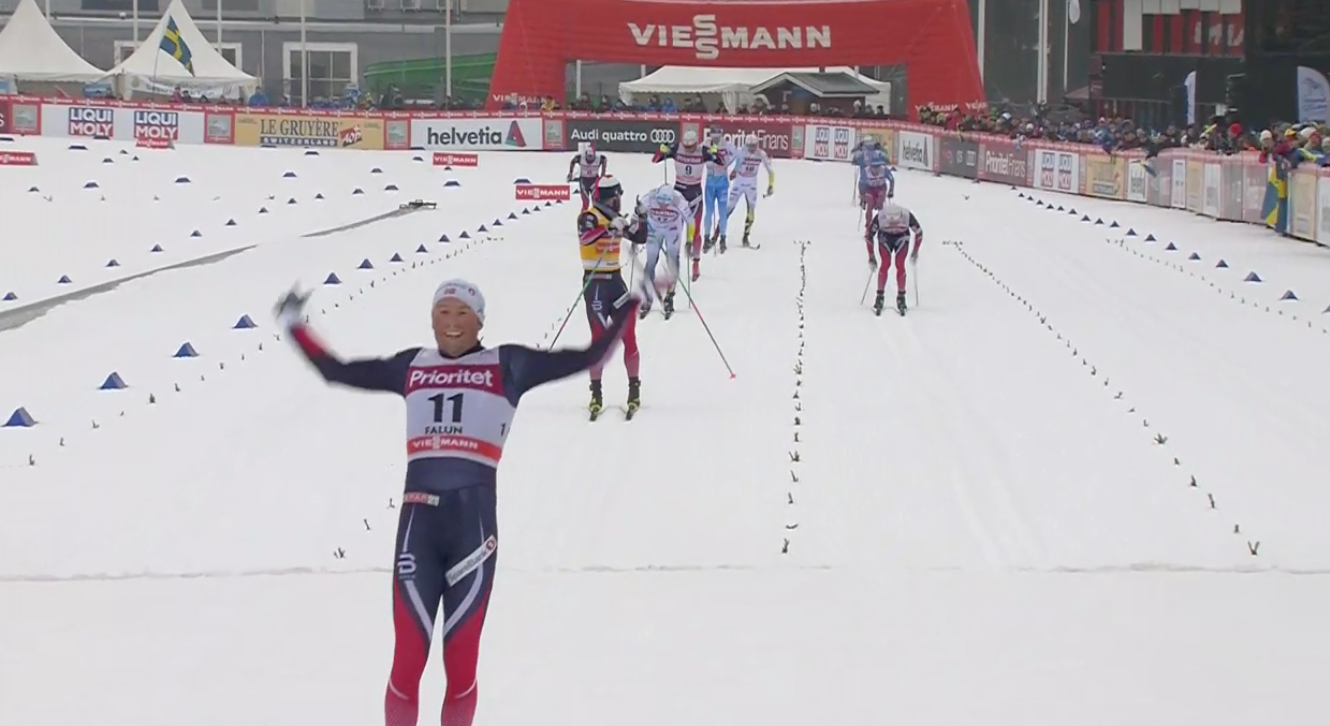
Norway’s Johannes Høsflot Klæbo (yellow bib) celebrates his 11th World Cup victory of the season in the men’s freestyle sprint at 2018 World Cup Finals in Falun, Sweden, ahead of Italy’s Federico Pellegrino (l) in second and France’s Lucas Chanavat (11) in third. (Photo: Svenska Skidspelen/Instagram)
In the men’s race, Russia’s Alexander Bolshunov qualified first in 2:36.23, 0.46 seconds ahead of Klæbo in second. Klæbo then won the first quarterfinal, first semifinal, and you guessed it, the final as well, backing off before crossing the finish line for the last time in 2:37.03.
Italy’s Federico Pellegrino powered past France’s Lucas Chanavat in the finishing stretch of the final to claim second, 0.39 seconds behind Klæbo. Chanavat completed the podium in third (+1.76), Finland’s Ristomatti Hakola finished fourth (+3.26), and Sweden’s Oskar Svensson and Teodor Peterson placed fifth (+3.88) and sixth (+6.17), respectively.
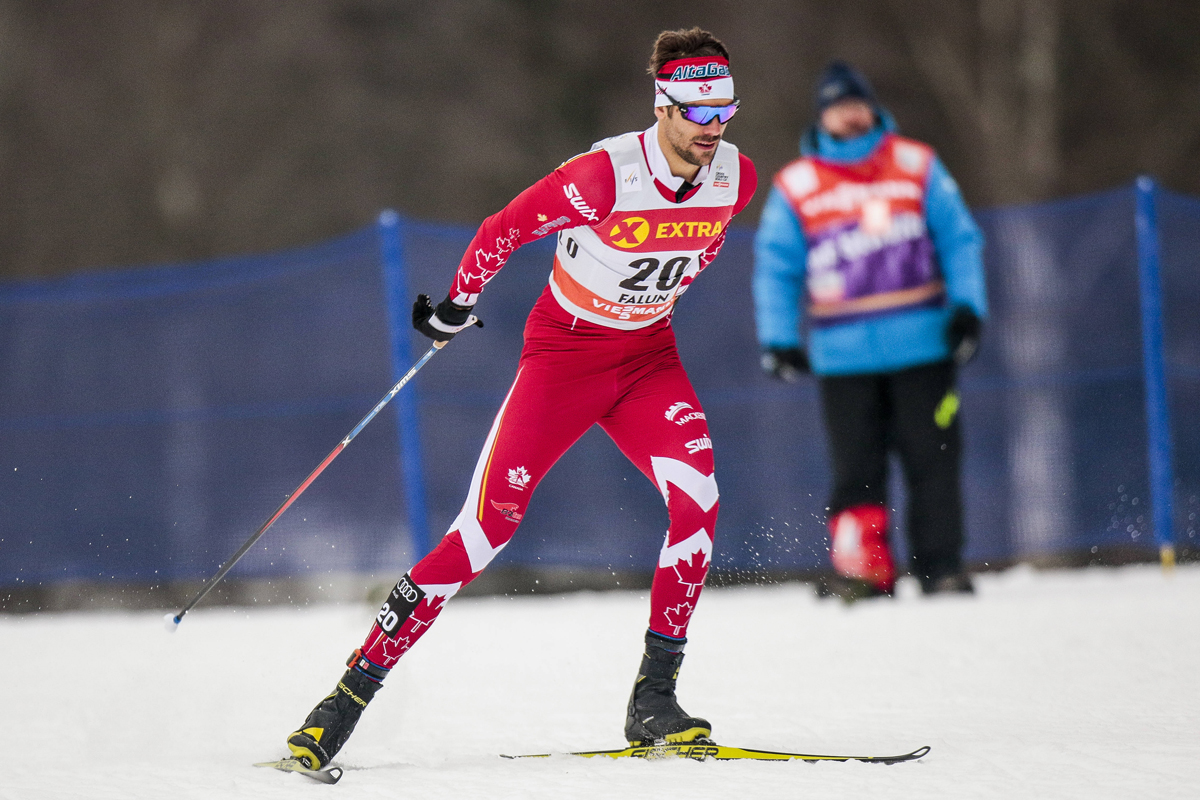
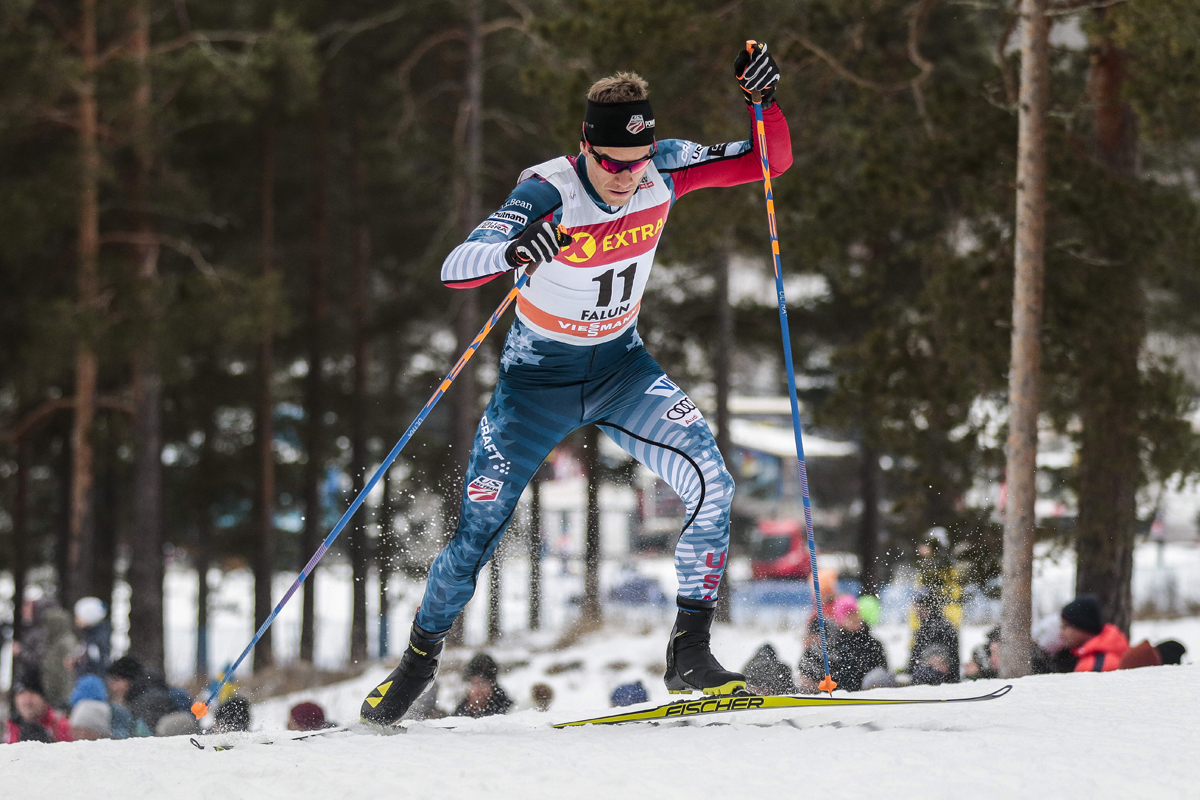
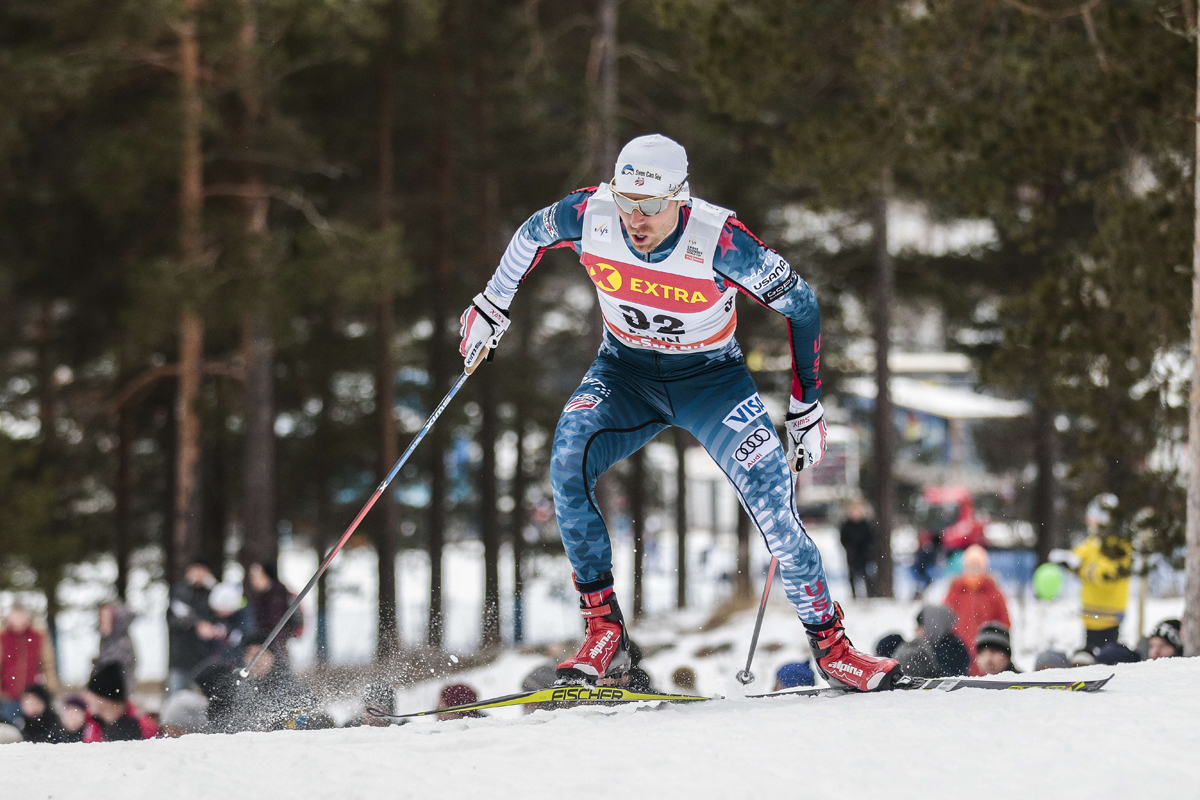
Two American men qualified for the heats, with Simi Hamilton advancing in 13th and Kevin Bolger in 29th. Hamilton went on to place 14th on the day after finishing third in the first quarterfinal, 0.61 seconds behind Klæbo. In his second-career World Cup sprint, Bolger placed 30th overall after finishing sixth in his quarterfinal, 2.21 seconds behind Peterson in first.
In the overall Sprint World Cup, Klæbo took his second-straight title by a whopping 243 points over Pellegrino in second, while Falla won her third-straight Sprint Crystal Globe by 78 points over Sweden’s Stina Nilsson, who was out sick for Friday’s race. Nilsson joined her at the Sprint World Cup podium ceremony on Friday, as did Caldwell, who achieved her best overall sprint standing in third.
Falla placed eighth overall on the day after being eliminated in the semifinals (she finished fourth behind Falk, Sundling and Diggins, respectively).
For the U.S., Erik Bjornsen narrowly missed qualifying in 31st, Andy Newell placed 43rd, Paddy Caldwell was 60th, David Norris 84th, and Scott Patterson 87th.
For Canada, Julien Locke placed 32nd, Alex Harvey 34th, Devon Kershaw 74th, and Graeme Killick 81st.
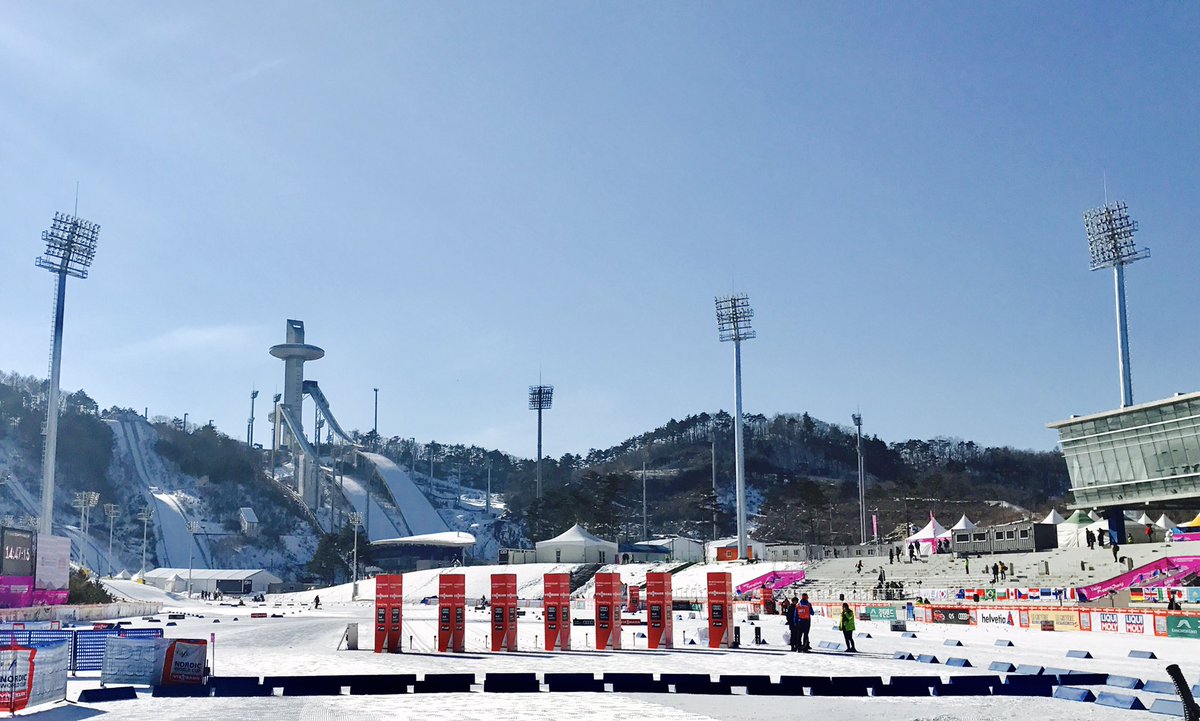
The PyeongChang venue as seen in February 2017. PyeongChang, South Korea, will host the 2018 Olympic Games this coming February. (Photo: FIS Cross Country/Twitter)
Note: This is the first of a multiple-part series on the 2018 Winter Olympic selection criteria for the U.S. cross-country ski team. A parallel piece compares the cross-country team’s criteria with other U.S. winter sports.
***
Friday, July 7, will mark seven months to go until the Opening Ceremony for the 2018 Winter Olympics in PyeongChang, South Korea. As athletes across the country ramp up their commitment in this Olympic year, and #roadtopyeongchang trends across various social media platforms, FasterSkier takes a look at the recently released selection criteria and procedures for nomination to the U.S. Olympic team.
Briefly put, what does it take to get to PyeongChang? And what factors will U.S. Ski Team (USST) coaches and (newly rebranded) U.S. Ski & Snowboard leaders apply in deciding who will be wearing red, white and blue next February?
In this article, FasterSkier first breaks down the criteria themselves, then summarizes a recent interview with USST Head Coach Chris Grover about why these criteria were chosen and how they should work.
Inside the criteria: World Cup performance, discretion and potential domestic picks
The criteria themselves are little changed from the standards used to pick the American team for the last two international championship events, World Champs in Falun in 2015 and Lahti in 2017. First comes objective qualification via performance on the World Cup. Second comes the potential use of discretionary picks. Third, if any spots are left over, the highest-ranking athlete on a domestic points list may, but does not have to, be nominated to the team.
As for the overall size of the U.S. team, a maximum of 12 male or 12 female athletes may be nominated, with a final team quota of probably 17 to 20 athletes to be determined closer to the Olympics themselves. (This is up from a total team quota of 17 in 2014, though ultimately only 14 athletes were named for Sochi, and the extra three American spots were redistributed to other nations.)
The U.S. may enter up to four athletes in a single race at the Olympics. The six cross-country events in PyeongChang will be a skiathlon (15 kilometers for women and 30 k for men), individual classic sprint, freestyle team sprint, 10/15 k skate interval start, 4 x 5 k or 4 x 10 k mixed technique relay (classic, classic, skate, skate), and 30/50 k classic mass start.
As for the criteria themselves for making the U.S. Olympic team: In order:
Objective qualification via World Cup results
Athletes who have achieved a top-eight finish in one of five specific races, or who have a top-50 ranking on either the World Cup sprint or distance list midway through Period II, will be named to the team.
Most precisely, “Any eligible athlete that posts a top-8 individual final World Cup result during the selection period [Nov. 23, 2017, through Jan. 15, 2018] in the following events will be selected to the Team: Sprint C, individual start 10/15 km F, and 15/30 km Skiathlon.”
Looking to the schedule for the 2017/2018 World Cup season, classic sprints will be held on Nov. 24, in Ruka, Finland; Dec. 2, in Lillehammer, Norway; and Jan. 3 in Oberstdorf, Germany (as part of the Tour de Ski). A 10/15 k freestyle individual start will be held in Davos, Switzerland, on Dec. 10. The only skiathlon on the 2017/2018 World Cup calendar will be held in Lillehammer on Dec. 3. Any athlete posting a top-eight final result in one of those five races will be named to the Olympic team.
(The 10/15 k skate pursuits on the schedule don’t count for top-eight purposes – it’s only Olympic formats that are used for qualification. And the 10/15 k skate race in PyeongChang is an interval-start race, not a pursuit.)
So that’s high finishes in individual races. As for cumulative performance across multiple races, “Athletes ranking in the top-50 in the distance World Cup standings or the top-50 in the Sprint World Cup standings as of January 15, 2018 shall be selected to the team.” Jan. 15 marks roughly the midway point of the World Cup calendar. By that point, 18 World Cup races will have been held.
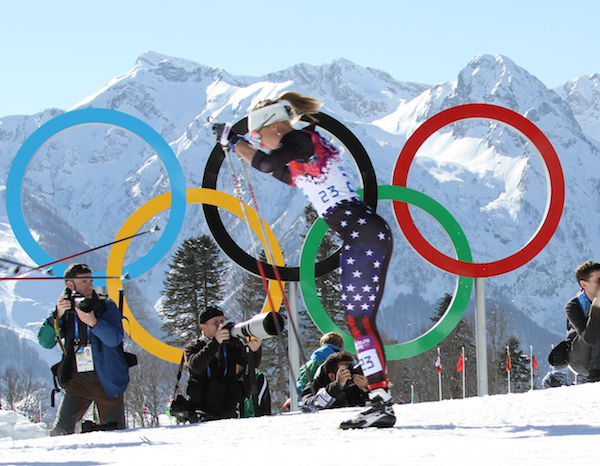
U.S. Ski Team member Sadie Bjornsen racing in the women’s 15 k skiathlon at the 2014 Winter Olympics in Sochi, Russia. Bjornsen is a veteran member of the national team heading into another Olympic year.
As of the comparable point in the 2016/2017 season, shortly after the Tour de Ski, USST members Sadie Bjornsen, Rosie Brennan, Sophie Caldwell, Jessie Diggins, Simi Hamilton, Noah Hoffman, Andy Newell, Kikkan Randall, Ida Sargent, and Liz Stephen had top-50 rankings in either or both disciplines.
A maximum of five athletes per gender may be selected based on their Sprint World Cup rankings. Tiebreaking procedures come into play at that point if necessary, generally based on an athlete’s single best finish in a sprint race.
Discretionary selection
Spots on the U.S. Olympic team will presumably remain open after the application of the objective criterion of World Cup performance. In that case, “the USSA Cross Country Head Coach may use discretion … to determine team nominations” for additional spots on the Olympic team.
Grover would at that point recommend additional athletes to a three-person committee, composed of U.S. Ski & Snowboard President Tiger Shaw, Executive Vice President of Athletics Luke Bodensteiner, and athlete representative Rosie Brennan.
If Brennan stands exposed to a potential conflict of interest from discretionary selection (that is, through no fault of her own, she “stands to benefit privately from a decision made by the Selection Committee,” as would happen if she had not qualified objectively and were being considered for discretionary selection), then she would be directed not to engage in any conduct “meant to unduly influence” the selection committee regarding her potential selection to the Olympic team.
Grover is then directed to consider any of (a) “outstanding competition results” from both this season and last season, (b) “Recent positive direction or trend of competition results indicating a potential for Olympic success,” or (c) “Indication of medal potential in future Olympic or World Championship competition (such as international age group results and rankings) that would be materially enhanced by selection to the team.”
U.S. Ski & Snowboard was not required to make discretion a means of selection to the team. It also has the discretion not to use discretion at all; as the document states, Grover may use discretion to determine additional team nominations, but does not have to.
Domestic selection. Maybe.
If there are any spots remaining on the team after applying criteria (1) and (2), U.S. Ski & Snowboard may consider the highest-ranked domestic athlete, one per gender. But it technically doesn’t have to.
(There is some ambiguity within the selection document itself as to whether more than one team spot could be filled via a domestic ranking list. On the one hand, selection criterion 3 uses the plural when it talks about “any remaining positions,” and “those positions may be filled.” On the other hand, it also mentions “the athlete with the highest rank on the 2018 Olympic Winter Games Selection List,” and both “athlete” and “rank” are in the singular. In practice, Grover clarified in a recent phone interview that the national team is potentially open to bringing more than one skier per gender, pointing out that four men and two women were brought to Lahti off the domestic rankings list.)
The 2018 Olympic Winter Games Selection List, as with the comparable list for 2017 World Champs in Lahti, is essentially the “normal” 2017/2018 SuperTour points list, plus substantial bonus points for 2018 U.S. National Championships. An athlete’s best two finishes in a single discipline (sprint or distance, not skate or classic) will be counted.
The SuperTour point totals system, and bonus points for podium finishes at 2018 U.S. nationals, appear to be precisely the same as those used last winter for Lahti. That is, first through third at the December SuperTour races will be worth 30, 25, and 21 points, respectively. The addition of nationals-only bonus points means that first through third in the four races in Anchorage count for 45, 35, and 26 points, respectively. When an athlete’s best two finishes are counted, a second and third at U.S. nationals (61 points) would be worth more than two firsts (60 points) at “normal” SuperTour races.
For this reason, in last year’spreview for 2017 U.S. nationals, FasterSkier quoted longtime racer Kris Freeman as stating that “the allocation of bonus points to Nationals essentially makes the remainder of the SuperTours irrelevant. Nationals is now World Champ and Olympic Trials which is fine, but let’s call them what they are.”
The math is the same this season as last season. This season, U.S. nationals start in Anchorage on Jan. 3, 2018. The four races there will be a skate sprint, classic sprint, 10/15 k skate interval start, and 20/30 k classic mass start.
Discretion and selection to international championship events
The appropriate role of discretion when selecting athletes for a World Ski Championships or Olympic team is a subject of recurring interest for fans and supporters of American cross-country skiing, and has frequently arisen on this site.
For example, here’s USST Women’s Coach Matt Whitcomb in an interview with FasterSkier in July 2016, answering the question, “Is it fair to say that making discretionary picks is one of the harder parts of your job as a coach?” Whitcomb replied, “For sure. We love not to do it. But in any criteria, discretion can often be one of the most important pieces. We really envy these Olympic Trials [for the American track and field athletes for the 2016 Rio Olympics] that we’re watching right now, where the top three go and fourth is either an alternate or they don’t go, and it’s just much more objective.”
And here’s Grover in January 2017, slightly ahead of the naming of the U.S. team for Lahti: “The real key thing is that, at the bottom of the selection, we followed the selection criteria. That’s key. Discretion really belongs to be used at the top, for those athletes who have a chance to come over and have big races at World Championships, and by big races I mean someone who can go on the podium, or the top five, top 10, or top 15. Look for some selections from USA, but I wouldn’t look for a lot of discretion at the end of the day.”
Or here’s Grover in January 2014, discussing why he and the rest of U.S. team leadership abjured discretion completely in taking Brian Gregg to Sochi but not Matt Liebsch, when only 0.04 points separated the two on the domestic men’s distance list: “We really tried to apply the selection criteria in the most fair way possible.That becomes, for sure, a challenge, especially on the men’s side when you get down to the sixth, seventh, eighth guys, you’re really splitting hairs because the FIS points are so close at that point. Because they were so close we opted not to use discretion. It really wasn’t a fair way to do it.”
(As things played out in Sochi, USSA selected 14 athletes out of a total possible quota of 17. Grover explained at the time, shortly after selections were made and before the Olympics began, that they had only intended to bring those athletes whom they planned on starting in races. “With seven women and seven men, we have our start positions filled,” Grover told FasterSkier before the Games. “Seven and seven was the magic number for us.” Liebsch is reported to have considered legal action to gain a spot on the U.S. team for Sochi, but found that that it was “too late” for him to do so. In Sochi a few weeks later, U.S. athlete Torin Koos did not start the 50 k skate race, a race format in which Liebsch had previously won at the American Birkebeiner.)
The U.S. Ski Team’s views on discretion
Grover, the longtime USST head coach, is aware that people feel strongly about the substance and application of selection criteria for U.S. championship teams. “I think overall I’d say people get a little bit mired up and tied up with selection criteria, and whether it’s fair or not, or how this potentially sees them falling within that criteria,” Grover told FasterSkier in a recent phone interview.
But Grover has a simple message for domestic athletes hoping to go to PyeongChang: “All you need to do is to ski fast, you need to go out there and win races, or to reach podiums. And if you can do that, your chances of being selected to the team are quite good.”
The current criteria are “better than ever, more fair than ever,” Grover continued. “I think [it] gives athletes the most direct path possible to a major championship team.”
Grover urged domestic athletes not to obsess over the apparent prioritization of discretion over domestic race results as a means of picking the Olympic team. Addressing a hypothetical non-national team member, he said, “As as an athlete domestically, don’t get hung up in the order that those things come down in the selection criteria. Discretion has to be next, because a discretionary athlete that’s picked needs to be picked because they are a top athlete who should be on the team, who has somehow been missed by the selection criteria.
“So that’s the placement it has to be,” he continued. “And that’s consistent with selection criteria across different disciplines, in different sports. So that’s just the way that the procedure needs to work. But it doesn’t mean that a large number of discretionary athletes will necessarily be selected prior to the domestic field.”
The statements that discretion “has” to have this status, and that this is “consistent with … different sports,” are not necessarily correct. As reported today in another article on FasterSkier, discretion plays a less prominent role in every other U.S. Ski & Snowboard sport.
Grover also underscored that the use of discretion within American skiing pales in comparison to its role in Norway or Russia.
“We’re competing against teams that are using 100-percent discretion to name their teams,” Grover emphasized. “So in the U.S., we have kind of the most democratic, objective, fair, I guess you could say – other nations, our Scandinavian peers, might call this an American system that we use for selecting athletes. It’s very cut-and-dried.”
The four countries that Grover mentioned by name in his interview as the Americans’ main competition – Norway, Sweden, Finland, and Russia – all finished ahead of the U.S. in the final Nations Cup standings for the 2016/2017 World Cup season.
Grover also stressed that U.S. Ski & Snowboard used only one discretionary pick for the Lahti roster, taking USST athlete Erik Bjornsen. “And the reason that we used one discretionary spot to select Erik was because he basically fell between the two criteria. He didn’t quite make the top-50 in the world standard because he had gotten sick during the selection process, and he wasn’t home domestically to race in the races domestically, but I think very few people out there would argue that that wasn’t a good use or a smart use of one discretionary spot.”
Grover further stressed that the team had used, as he initially put it, “zero discretion” when selecting athletes for Falun World Championships in 2015. (In a subsequent email to FasterSkier, Grover clarified that “We used zero discretion in the original selection of 16 athletes (8 men and 8 women) to the Falun Team, but we did add Ben [Saxton] at a later date via discretion after he finished 6th in the sprint at U23 Champs.”)
Writing criteria for the top vs. the bottom
Grover cited the decision to bring Erik Bjornsen to Lahti as an exemplary use of discretion, underscoring that Bjornsen was a skilled athlete who “had some of the very best individual results there” among American skiers.
“So that is absolutely our intention,” Grover continued, “it has been our intention, and it will be our intention going forward, is that we use discretion on the rare case where there’s an injury, or an illness, with a top athlete, and/or the criteria fail to select someone that I think most everyone would agree should be there representing the United States.”
At world champs in Lahti in 2017, Bjornsen finished 18th in the 15 k classic and teamed up with Simi Hamilton to finish fifth in the team sprint. At world champs in Falun in 2015, Saxton finished 54th in classic sprint qualifying, roughly nine seconds from making the heats.
While Grover is confident that discretion is most appropriately used for a top-performing U.S. athlete, he acknowledged some issues regarding the final athletes selected (or not selected) to a team.
Summarizing his discussion with domestic senior club coaches about the selection criteria used for Lahti, and any potential changes before PyeongChang, Grover said, “All the responses I got back were positive, people were like, Yeah, it worked well. It’s never perfect at the bottom, but I don’t really see any way to improve it.”
Indeed, he noted, the U.S. Ski & Snowboard working group “struggled with” how to select “athletes at the bottom of the selection, and make it as fair as possible. And what you come up with at the end is, in the end there’s no real perfect way to do it, and there’s going to be challenges to the way that any selection criteria works at the very bottom of the selection.”
Current success vs. preparing for the future
Another issue surrounding selection is the question of current competitiveness vs. taking a young athlete to a “practice” Olympics just for the experience – that is, is the Olympics for development or for podiums. In 2014, for example, regarding the recently named team for Sochi, Grover said, “The Olympics is the pinnacle of the performance or competition pipeline.”
Development occurs at many lower levels, Grover noted (Europa Cups, World Juniors, etc.), but “It does not and should not come at the World Championships or the Olympics. … It’s not a development trip; it’s a competition trip at the very highest level.”
Similarly, earlier this year Grover explained that junior skier Katharine Ogden (a.k.a. “KO”) was not selected for Lahti on the grounds that “athletes should first aim to be successful at – in the age group that they’re competing against. So for KO, that means World Juniors, and being successful at World Juniors.”
The third prong of discretionary selection for the current Olympic team, “Indication of medal potential in future Olympic or World Championship competition (such as international age group results and rankings) that would be materially enhanced by selection to the team,”may be said to go against these principles.
But Grover explained that this “future medal potential” path to discretionary selection is rarely if ever used, even when the Olympic team is selected with an eye to current podium potential.
“We haven’t used it that way,” Grover said. “Obviously the language is there if we were to choose to use it, but in the past we really have not used it that way, and I don’t anticipate using it going forward into this season. … We want … the fastest skiers on the start line in Korea, and those are the ones that we’re gonna be selecting.”
Different standards for men and women?
An additional issue in selecting American skiers is that the women are currently, proportionally speaking, faster than the men – that is, the U.S. women, as a team, have recently tended to achieve better results within the women’s World Cup field than the U.S. men do within the men’s World Cup field.
It is also true that the international men’s field is more top-heavy than the women’s field, across the course of a single World Cup season, meaning that a greater number of World Cup points is needed to crack the top-50 of a discipline ranking.
Perhaps for these reasons, multiple athletes have confirmed to FasterSkier the substance of a suggestion made at a recent athletes’ meeting at the season-ending 2017 U.S. Distance Nationals in Fairbanks: That the selection criteria should be made more challenging on the women’s side, such as by making the objective cutoff there be a top-40 or even a top-30 discipline ranking rather than top-50.
“I understand where the person who asked that question, where kind of they’re coming from” Grover told FasterSkier, when asked generally if there had ever been discussions about making the objective criteria different between the genders.
“They’re referring to the fact that there’s greater depth on the men’s side … there’s a lot more men ranked – that have FIS points that are say 30 and under, versus the number of women perhaps that have 30 FIS points or less.”
But, Grover continued, “top results are top results at the end of the day. And there’s three medals that are handed out, for men and for women. And if that means that selecting an athlete who ends up to be, say, 46th in the top, in terms of the top 50 in a discipline list by the middle of January, that athlete might be closer to contributing to a top result or a podium than one of the guys.”
For this reason, Grover questioned the aims served by this suggestion. “Is the end objective for that person just to provide more opportunities for men to come over and be 50th place at the Olympics? Because if that is the objective, then I don’t think it’s worthwhile pursuing. What we’re trying to do is have top results … to really compete. And that means selecting those athletes who are the closest to the top placings.”
Freeman also argued that it was illogical to use a non-championship event for selection to the USST, “whose primary stated goal is to win medals. … Is racing up a hill at the end of a nine-day tour really a fair way to determine who goes to the World Championships or Olympics?”
Grover’s stance is that it’s more difficult to finish in the overall top 30 of the Tour de Ski than reach the podium at U.S. nationals. Due to recent changes in FIS rules that will allow more pure sprinters to start the 2017/2018 Tour de Ski without counting against their nation’s start quota, he foresees a greater number of finishers in this year’s Tour.
“I would anticipate that this year you’re going to have much better numbers of athletes that are actually finishing the Tour,” he said, “and so the standard there won’t be quite as ‘easy,’ quote-unquote. It’s not necessarily easy, but won’t be as easy as it was this last year.
“Is it easier to score points, even at the end of a Tour de Ski if you can survive it, versus to have a podium at U.S. nationals, given that a bunch of the top USA athletes are doing the Tour de Ski at the same time?” he asked. “I would still guess that it’s easier to reach the podium at U.S. nationals, and thereby that would make it an easier path for an athlete to make the Olympic team.”
FasterSkier has separately addressed Freeman’s argument regarding the “access problem” of obtaining Tour or World Cup start rights in the first place. FasterSkier has also considered the approach used by the US Biathlon Association, which makes it “not a foregone conclusion” that athletes receiving World Cup starts will necessarily make the Olympics.
The bottom line
“At the end of the day,” Grover concluded, “I would anticipate that we’ll be able to bring the athletes that we want to bring so that we can fill every potential start spot at the Games. … We will fill every start at the Olympics.”
Grover and U.S. Ski & Snowboard intend to do so by making sure “that we capture any athlete who can reach the podium, any athlete who can reach the top five, the top 10, the top 15. That’s the absolute critical element, is that we give ourselves the best chance to be successful.”
And Grover believes that the current criteria are “the best way to do that.” We “were trying to create a more equitable, more concrete, easier to understand and visualize path for domestic athletes, racing SuperTour, to qualify for a major championship team,” Grover said. The result, he concludes, is “better than ever, more fair than ever. … So, you know, I feel good, I feel really good about the criteria, I feel like we got the most fair criteria for the Olympic selection that we’ve had, and I’m excited to see how it turns out.”
— Jason Albert and Chelsea Little contributed reporting
***
Stay tuned for more on this topic, including an article on American athletes’ reaction to the Olympic selection criteria and how they feel the exercise of discretion has affected them and U.S. skiing. And be sure to read about the role of discretion across other U.S. Ski & Snowboard sports, particularly biathlon.
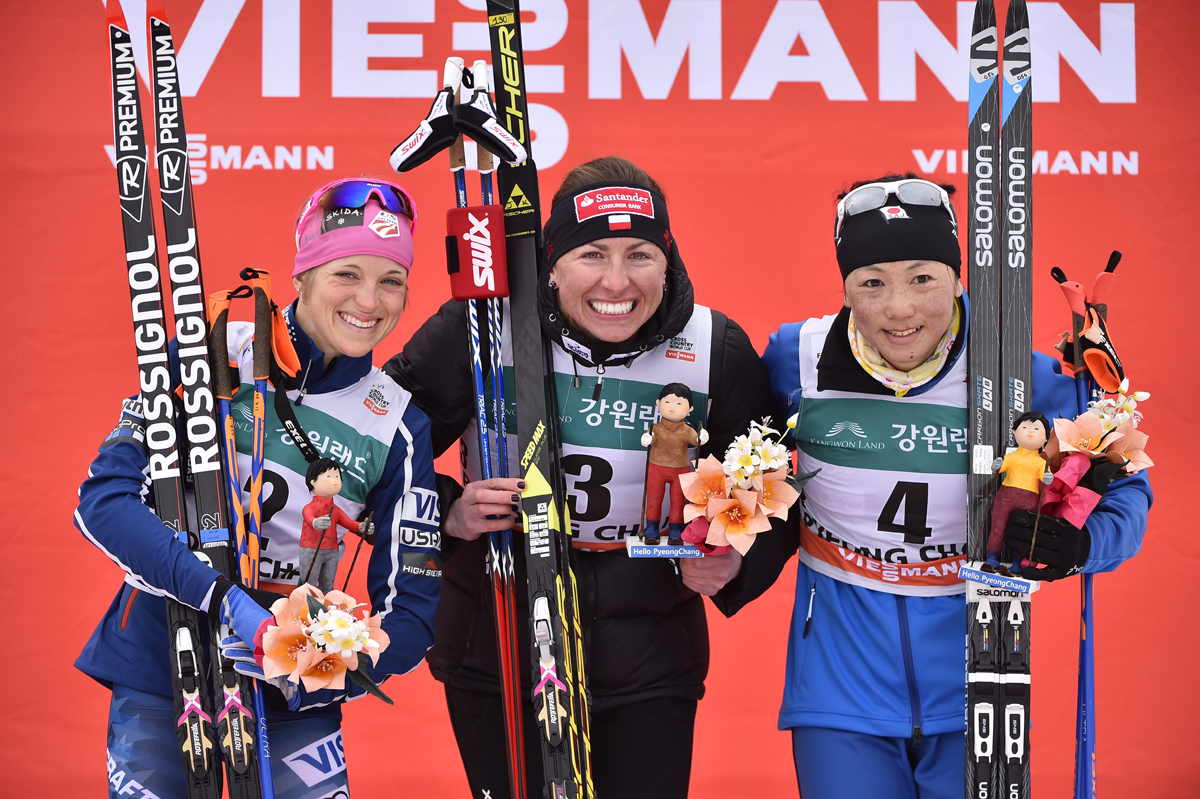
The women’s World Cup 15 k skiathlon podium on Saturday in PyeongChang, South Korea, with Poland’s Justyna Kowalczyk (c) in first, American Liz Stephen (l) in second, and Japan’s Masako Ishida (r) in third. (Photo: Fischer/NordicFocus)
Multiple race warmup and cool downs, managing hydration and caloric intake, moving at her max sprinting speed — more than once. It’s not often that American Liz Stephen feels the lingering effects of a World Cup sprint day. Her most recent memory was three years ago, when she qualified 22nd in Szklarska Poreba, Poland.
But this weekend’s three-day competition series in PyeongChang, South Korea, challenged the distance specialist once again. With a smaller World Cup field than usual, Stephen qualified 29th in Friday’s classic sprint and advanced quarterfinals, where she raced in the first heat of the day.
In what ended up being the fastest women’s quarterfinal, Stephen pushed through Friday’s hill-dominant sprint course and crossed fifth for 25th overall. The back-to-back sprint experience, however, left the 30-year-old Stephen with a little less energy than she would have liked as she entered Saturday’s 15-kilometer skiathlon.
American Liz Stephen (2) skiing at the front of the women’s 15 k skiathlon on Saturday, alongside Norway’s Silje Øyre Slind (1) and Poland’s Justyna Kowalczyk (3), at the World Cup in PyeongChang, South Korea. (Photo: Fischer/NordicFocus)
“I think I was feeling yesterday’s sprint race a bit, as I did twice as many rounds as I usually do!” Stephen joked in an email.
Yet, standing at the start in bib 2, behind Norway’s Silje Øyre Slind in bib 1, Stephen wasn’t going to let a little soreness stop her from racing to Saturday’s skiathlon podium.
After Poland’s Justyna Kowalczykgapped the front by close to 20 seconds in the first two kilometers of the classic leg, the American held on tight to the lead chase group, striding even with a medley of skiers, including Slind, Japan’s Masako Ishida, Norway’s Anna Svendsen, Sweden’s Maria Nordström, and Germany’s Elisabeth Schicho.
Stephen came through the exchange in fifth position, a little over a minute behind the race leader Kowalczyk and 12 seconds back from the second place skier, Ishida.
“I was afraid I skied little too hard in the classic portion,” Stephen said, according to an International Ski Federation (FIS) press release. “I wanted to stay with the leading group in the classical part not to fall back.”
Skate skis on, Stephen quickly caught and surpassed Svendsen and Schicho by the 8.4 k mark, rejoining Ishida. With over a minute separating her and Ishida from Kowalczyk, the battle for second began. Around the 10 k mark, Stephen made her move. Powering past Masako, Stephen started her second hunt, this time for the Polish skier.
But Kowalczyk’s early classic-leg surge and strong skating staved off any attempts from Stephen.
“Liz was able to take some time out of her, but not significant time,” USST Head Coach Chris Grover said on the phone. “So that was impressive racing by Kowalczyk.”
Poland’s Justyna Kowalczyk winning her first World Cup in three years on Saturday, the women’s 15 k skiathlon at in PyeongChang, South Korea. (Photo: Fischer/Nordic Focus)
“It has been a long time since I have been on the World Cup podium,” Kowalczyk said, according to FIS. “I was quite surprised to see how well I skated.”
Finishing exactly 56 seconds behind Kowalczyk was Stephen in second place. The result was Stephen’s best individual result since 2015, when she placed second in the 10 k freestyle race in Rybinsk, Russia.
“It’s hard not to feel happy when you get a podium finish!” she said, according to a U.S. Ski Team press release. “However, I didn’t feel like I had as much energy as I wanted to have today, but it was enough to hold onto second.”
In her first podium appearance since 2009, Ishida finished 18.8 seconds after Stephen in third (+1:14.8).
Just missing the podium by 6.6 seconds was American Caitlin Patterson in fourth (+1:21.4). Though a tangle on the first hill of her classic leg pushed Patterson back to 13th, the 27-year-old Craftsbury Green Racing Project skier was able to reconnect with the top 1o by the 2 k mark.
Unconcerned with Kowalczyk’s blistering pace, Patterson focused on the chase pack. By the time she reached the ski change, she was positioned in seventh. Her transition to skate skis smooth and energy still strong, Patterson began to pick people off.
She caught Nordström, who had been 10 seconds ahead of her at the exchange, as well as Schicho and Svendsen, both of whom were close to 30 seconds ahead of her when they switched to skate skis.
Caitlin Patterson (Craftsbury Green Racing Project) en route to a career-best World Cup result of fourth in the women’s 15 k skiathlon in PyeongChang, South Korea. (Photo: Fischer/NordicFocus)
“Caitlin Patterson was really impressive,” Grover said. “She was kind of hovering around seventh or eighth for most of the race, and then really in the last lap, really started to pick people off, including right at the very end to get all the way up to fourth.”
Feeling fairly well adjusted to the time difference, and appreciative of the low-altitude racing, Patterson was proud of her race effort. Her only issue being the seconds that separated her from the podium.
“When I look at the results and see how close third place was ahead of me, I can’t help but wish I could have somehow gone faster sooner!” Patterson wrote in an email. “A true sign of how much this makes me hungry for more, though I know I gave it everything I had out there today.”
The third American woman on Saturday was Liz Guiney in 13th (+2:21.7). The PyeongChang World Cup marks Guiney’s third week of World Cup racing and, while this weekend’s field is not as strong as the ones she recently raced against in Sweden, the result was still a little unexpected for Guiney.
“I’m very happy with my race today!” Guiney, 25, wrote in an email. “With the weaker World Cup field, it was a good opportunity to score some points, but I think I surprised myself by being within reach of the top 10.”
The last two races mark Guiney’s first World Cup points, with her best individual finish prior to this weekend 49th in the Falun 15 k classic mass start.
“Last weekend in the Falun 15k, I got a little too excited out of the start and paid for it later in the race, so my goal today was to ski my own race,” Guiney wrote. “I was really psyched to cross the line and find out that Liz Stephen placed 2nd and Caitlin (my GRP teammate) was 4th, which is a big breakout result for her!”
Two Canadian women also earned their first World Cup top 30’s on Saturday, with Annika Hicks (Alberta World Cup Academy) placing 26th (+5:17.8) followed by Sadie White (NTDC Thunder Bay)in 29th (+6:54.7).
Racers return to the race venue tomorrow for Sunday’s freestyle team sprint.
The start of the men’s 30 k classic mass start on Sunday, Jan. 29, at the World Cup in Falun, Sweden, with (front, left to right) Russia’s Sergey Ustiugov (4), Finland’s Matti Heikkinen (2), Norway’s Martin Johnsrud Sundby (yellow bib), Canada’s Alex Harvey (3), and Switzerland’s Dario Cologna leading out of the gate. (Photo: Fischer/NordicFocus)
We’re a couple days out from last weekend’s World Cup in Falun, Sweden, with several top racers taking a two-week breather now to prepare for World Championships, but several more are headed to PyeongChang, South Korea, to preview the 2018 Olympic course at this coming weekend’s three-day World Cup, Friday through Sunday. Here is a final wrap of some of the North American comments from Falun that didn’t make it into the race reports.
“I think it is a great sprint course. I think they could maybe do a little reconstruction on the fast righthand downhill corner to bank it a little, because that was getting pretty icy today, but everything else skis really well. It’s a little frustrating because it seemed like most of the racing comes down to the last 45 seconds or minute, and who can get the best draft coming into the stadium. It is such a fast finish there … but that’s part of racing, it’s not going to be a totally fair thing all the time. It just takes some really good positioning for that downhill and then kind of launching your move as you come into that bump, and carrying that momentum through the finish.”
— Simi Hamilton (U.S. Ski Team), 18th overall
“It was a fast sprint today. The perfect event for an athlete like Erik Bjornsen is the team sprint, where you link together multiple very hard efforts. He’s an athlete that can recover and maintain a high pace. But these really short, really fast sprints, that he’s still working on. He needed another minute for his strength to really show, and he only missed by a little over a second.”
— Matt Whitcomb (U.S. Ski Team coach), on Erik Bjornsen, who finished 43rd in the qualifier
On organizing-committee snafus:
“They had a little bit of a grooming mistake where they set a [classic] track in the qualification lane. Normally for qualification [in a skate sprint] you are behind the wand, pole in front of it, and then you skate right out. Today they had a five-meter track. All of the girls double poled out of it. Simi was bib 11, and right before he started we told him, ‘You gotta skate.’ We were watching the ten guys who started before him double pole, and it just didn’t look very fast, so he skated out of the gate, and Emil Iversson behind him did that too. The next handful of guys double poled, and then the rest of the field started to catch on to that, and everybody else skated the qualification after that.”
— Whitcomb
On qualifying:
“I was really psyched with how my qualifier went today. It was funny, because when I finished I wasn’t sure how it went because it didn’t feel like a typical sprint. Even though the time on course is only about 3 minutes, it is a really hard course, with a lot more uphill than we are used to skiing in skate sprints. I knew it would be easy to blow up on this course, so out of the start I focused on big pushes with a lot of glide and on the two big uphills, I didn’t allow myself to hop skate and instead did a hard and fast V1 where I tried not to waste too much energy being springy. I felt like I skied the technical downhills well and had a semi strong finish, but mostly was happy with how I had paced it. I was thrilled to see I had qualified in 3rd.”
— Sophie Caldwell (U.S. Ski Team), on qualifying in 3rd
On finding her sprinting groove:
“Everybody has such a different tactic, like today I saw Kikkan [Randall] go right before me and she was aggressive from the back so I tried that method, and I think that maybe that is the problem I keep falling into. I am trying to do what my teammates are doing and forgetting to use my specific strengths and remembering that everyone is different.”
— Sadie Bjornsen (U.S. Ski Team), 19th overall
On measurable progress:
“It is my first final in about two years, so that was pretty fun to be back in the final. I have been getting progressively better every sprint race this season, so this was just another good step forward. Never having come back from a baby before I don’t really have anything to gauge against or a way to expect it was going to go. I have been just trying to build strength this season, and I like the trajectory I am on, so another month and hopefully I can be ready to contend for that podium.”
“It was my least favorite conditions today with the tracks really hard to find kick in and getting really sugary as they broke down, so it was good to have another chance to work on my striding and improve my classic racing! But like yesterday, I was so impressed with our service team and my skis were great!”
— Jessie Diggins (U.S. Ski Team), 10th
“It was challenging conditions today with sugary tracks that were a little beat up from the boys. I actually really enjoy skiing in this kind of condition so I was optimistic about today’s race.”
— Rosie Brennan (U.S. Ski Team), 24th
“I remembered TERRIBLE snow conditions [from 2015 World Championships] and a major climb that was going to entail a lot of herringbone. Fortunately, the snow was much better (Icy at the beginning and then sugary) although still not easy to kick skiing and the steepest part of the climb I was thinking about was changed. The course used much of the terrain from World Champs but the courses were a fair bit different and as such skied very differently.”
— Matt Gelso (Sun Valley Ski Education Foundation), 44th
On the course:
“I like skiing here in Falun, I think the courses suit me well. There is a long relatively flat section that comes out of the stadium, and in almost every distance race we lap though it multiple times. I tend to feel stronger in double pole and V2 so I really like this section.”
— Erik Bjornsen (U.S. Ski Team), 35th
On the race format:
“We don’t get to race 15 k very often so it’s hard to know what to expect out there.”
— Brennan
On the weeks to come:
“I am looking forward to some rest and recovery to rebuild for a big and important block of racing to come!”
— Sadie Bjornsen, 21st
On keeping up the momentum while during a two-week break from racing:
“When things are going good you just want to keep racing, so I am looking forward to it, more to be able to really put in a good block of training and doing what I have done in the past before championships. But I really enjoy racing, I love training, and I love most of the things we do in the summer pretty much other than maybe strength workouts, like, it’s not like labor for me or anything, but racing is really why I do all of that. I am never saying, ‘Oh, I need a break. Now it would be nice to not be putting a bib on for three weeks,’ I have never really had that feeling. … I guess it’s the opposite. By World Cup Finals, if things are going well I am just kind of sad to leave the circuit, but it might be different for others. You are never going to find me saying it’s time to stop racing ’cause I actually really, really enjoy everything about it, the adrenaline and everything around racing.”
— Alex Harvey (Canadian World Cup Team), 15th
On the decision to race next weekend in South Korea:
“Liz [Stephen] and I are the only [U.S.] distance skiers going, and we both decided on that last minute, not until after the Tour de Ski, to go. And my decision was based on looking back at the 2012/13 season and the 2013/14 season, both years that I had pretty successful championships, and looking at the schedule between the Tour and the championship in those seasons. I was racing almost every weekend and we were traveling a lot, and I remember it being so much fun. I was just enjoying myself and so psyched to be over here [in Europe], and I was sitting in Val di Fiemme at the end of the Tour de Ski and looking at this year’s schedule, and it was a week off and then two weekends in Sweden and then two more weeks off before Otepää and Worlds, and that’s not exciting and that’s not fun! I don’t want to just sit around in Europe, and I didn’t feel like I needed a bunch of training time at that point. I thought, if anything, I needed to just chill and then race. … Korea sounded like fun. It was a cool opportunity. I handle travel super-well, and it’s fun to race World Cups with weak fields because you do better [laughs]. Not that I don’t believe I can do well in a World Cup with a full field, but you know, next week is a great opportunity.”
— Noah Hoffman (U.S. Ski Team), 37th
On Erik Bjornsen and Hoffman coming within striking distance of World Cup points on Sunday:
“Noah and Erik didn’t end up with the results they are capable of, but each athlete came very close to putting together a good one. Erik spent most of his race fighting up to 23rd or 24th, and was skiing phenomenally, but did so working alone. It came with a price. With 7 k to go, a pack that had been trading leads came charging through. Noah’s race was moving in the right direction in the final 10 k, but a crash in the stadium lost his contact with the points. His energy looked good today, so I think he’ll be strong in Korea.”
— Whitcomb
Thinking ahead to World Cup Finals, on ending the season at home in Quebec City:
“I think motivation at the end of the season is a huge factor because pretty much everybody, at least everybody that is in the top 10 overall, we are kind of all running a bit on fumes, like physically, especially on a championship year where everybody’s going to try to really work up a peak for the end of February. So then by mid-March, everybody will be kind of sliding out their peak. I really think motivation will be one of the most important factors, and the fact that I will be able to be at home will surely help the motivation. If I find myself in the spot that I am close to, like a similar spot that when I am in right now [fourth overall in the World Cup], that could be the difference between third and fourth in the overall. So that is, for sure, I think for me, a good advantage.”
Norway’s Marit Bjørgen celebrates her 105th individual World Cup win on Sunday after finishing first, ahead of teammate Ingvild Flugstad Østberg, in the women’s 15-kilometer classic mass start in Falun, Sweden. (Photo: Fischer/NordicFocus)
*Note: this article has been updated to include comments from U.S. women’s head coach Matt Whitcomb as of Monday, Jan. 30.
After sealing her 105th individual World Cup victory on Sunday, and her second distance win in a row, Marit Bjørgen is shutting out any doubt. The 36-year-old Norwegian was the first across the line in the women’s 15-kilometer classic mass start in Falun, Sweden, besting her teammate Ingvild Flugstad Østberg by half of a second, as well as the current overall World Cup leader, Heidi Weng, also of Norway.
“It’s great to be able to win World Cups still,” Bjørgen said according to an International Ski Federation (FIS) press release. “The young girls are strong, so it feels good to be able to come out with a win.
Starting in bib 5, Bjørgen wasted no time putting her teammates and the field to work. By 1.5 k she was in the lead, pulling Østberg and Weng, as well as Sweden’s Stina Nilsson — yesterday’s sprint winner — and Finland’s Krista Pärmäkoski.
Norway’s Marit Bjørgen (5) leads her teammates Ingvild Flugstad Østberg (3) and Heidi Weng during the World Cup women’s 15 k classic mass start on Sunday in Falun, Sweden. (Photo: Fischer/NordicFocus)
Also within firing range was American Jessie Diggins, skiing in seventh, along with Norway’s Astrid Uhrenholdt Jacobsen and Maiken Caspersen Falla, and Sweden’s Charlotte Kalla.
However, within another four kilometers, the Norwegians had broken away, a close to seven-second gap forming from them to Nilsson and Pärmäkoski.
While Bjørgen led for the first third of the race, Østberg took over by 10 k and Weng continued to follow in third.
With 1.8 k to go, Bjørgen was back to the front, Nilsson the closest challenger to the Norwegians just over 30 seconds behind.
“I thought Stina might catch me, so I am very happy to make the podium today,” Weng said, according to a FIS press release.
As the three headed into the second-to-last major climb, Østberg pushed to the front, Bjørgen trailing back. But coming into the final climb, Bjørgen moved back into first as she herringboned to the far outside right of Østberg, almost departing the marked course.
“I didn’t ski the final climb well … Marit got a gap and I wasn’t able to close it,” Østberg said according to FIS. “I wasn’t satisfied with yesterday’s sprint result, so it’s good to be back on the podium today.”
Left to right: Norway’s Ingvild Flugstad Østberg, Marit Bjørgen and Heidi Weng celebrate an all-Norwegian podium in the women’s 15-kilometer classic mass start on Sunday at the World Cup in Falun, Sweden. (Photo: Fischer/NordicFocus)
In a double-pole sprint to the finish, Bjørgen held off Østberg for the win in a time of 41:28.8. Østberg finished half a second later for second place, followed by Weng in third (+8.1).
The first American across the line was Diggins in 10th (+1:37.5) wearing bib 4. While the Afton, Minn., native explained that Sunday’s sugary conditions are some of her least favorite, the opportunity to put her classic striding to the test was something she welcomed.
After losing the leaders, the 25-year-old Diggins skied with a mix of Finnish skiers, including Laura Mononen, Anne Kyllönen, and Kerttu Niskanen, as well as Norway’s Falla.
“Early on I tried to go with the leaders but then settled into a great pack of girls to ski with and it came down to an exciting sprint out,” Diggins wrote in an email. “I’m really looking forward to some rest and then a quality training camp with some family time in Valadalen [Sweden] for the next few weeks! My boyfriend is here cheering me on and coming to camp with me, and then my parents come next week so I have so many great things to look forward to!”
The second U.S. woman across the line was Sadie Bjornsen in 21st (+2:43.6). A known lover of all-things-classic, Bjornsen was disappointed when she found herself tired during Sunday’s race. The 27 year old, however, was happy that she made it through the mental and physical challenge.
“Today I literally gave everything I had, and while I am not stoked on the number or result, I am really proud that I kept fighting through that wall in front of my face,” Bjornsen wrote. “It was really challenging classic skiing out there, which I love, so I am sad to have missed an opportunity to fight in those tricky conditions. Big shoutout to our team for giving me good skis! I am looking forward to some rest and recovery to rebuild for a big and important block of racing to come!”
American Caitlin Patterson (33) and Canadian Cendrine Browne (45) racing the women’s 15-kilometer classic mass start on Sunday in Falun, Sweden, along with Germany’s Elisabeth Schicho (38) and Italy’s Giulia Stuerz (25). (Photo: Fischer/NordicFocus)
Two other American women also scored World Cup points, including Rosie Brennan in 24th (+2:57.0) and Liz Stephen in 29th (+3:24.5).
Despite the sugary conditions and deteriorated tracks due to the men’s race, Brennan explained that Sunday’s snow was what she was looking for coming into the 15 k.
“I actually really enjoy skiing in this kind of condition so I was optimistic about today’s race,” the 28-year-old Brennan wrote in an email. “I felt that I was fighting a bit of fatigue out there and only really had one speed, luckily it was a decent speed and I was able to hold consistent throughout the race.”
Also competing for the U.S. finishing just outside the points was Caitlin Patterson in 32nd (+3:47.6) and Ida Sargent in 34th (+4:02.8).
“Today was a solid day for the team,” U.S. women’s head coach, Matt Whitcomb wrote in an email. “We fought hard, and nearly accomplished what I will consider to be a huge achievement for the women, and that will be when we regularly can score our full national quota (6) in the points. Today we had 4, with a close 32nd and 34th. That’s close to where I know we can be.”
Canada’s lone competitor in the women’s race, Cendrine Browne crossed in 46th (+5:41.4) and American Liz Guiney finished 49th (+6:22.6).
Emil Iversen celebrates his win in the 30 k classic mass start in Falun, Sweden, on Sunday. Norwegian teammate Martin Johnsrud Sundby finished second and Sweden’s Calle Halfvarsson third.
FIS Cross-Country World Cup (Falun, Sweden): 15 / 30 k classic mass start
In the women’s 15-kilometer classic mass start on Sunday, Norway swept the podium with Marit Bjørgen taking the win in a time of 41:28.8 in Falun, Sweden. Crossing just half a second behind her was her teammate, Ingvild Flugstad Østberg in second place. Rounding out the podium was Heidi Weng in third (+8.1).
American Jessie Diggins was the first to cross the line for the U.S. in 10th (+1:37.5). Three other U.S. women finished in the top 30, with Sadie Bjornsen finishing 21st (+2:43.6), Rosie Brennan 24th (+2:57.0), and Liz Stephen in 29th (+3:24.5).
Just outside of scoring World Cup points was American Caitlin Patterson in 32nd (+3:47.6) and Ida Sargent in 34th (+4:02.8). Canada’s Cendrine Browne finished 46th (+5:41.4) and American Liz Guiney 49th (+6:22.6).
After losing the skate sprint yesterday in a photo finish to Italy’s Federico Pellegrino, Emil Iversen ascended to the top step of the podium in the men’s 30 k classic mass start on Sunday in Falun.
The Norwegian was often near the front, but hadn’t tried to lead a breakaway like his teammates Martin Johnsrud Sundby and Sjur Røthe did earlier in the race. In the final two kilometers, Sundby – the overall World Cup leader – put in a sprint to try to drop the field. But Iversen caught up, drafting his veteran teammate into the stadium. In the final up-and-over before the finish line, Iversen made a pass and then accelerated down the finishing stretch to beat Sundby by 1.14 seconds.
“I got motivation from yesterday’s last 20 meters,” Iversen told FIS in a finish-line interview. “So today I fought all the way, and I was really stronger. It is amazing for me to be second yesterday and first today. I’m really proud of that.”
Calle Halfvarsson, who had been falling off the back of the lead pack just a few kilometers earlier, managed to get back to the front and claim third place for Sweden (+1.72 seconds) in a photo finish with Røthe (+1.76 seconds). Niklas Dyrhaug was next (+2.52 seconds) to give the Norwegian men’s team four in the top five.
In his return to the World Cup stage, Norway’s Petter Northug finished 31st (+3:10.6).
Alex Harvey was the lone Canadian on the start line. After skiing near the front of the field for the early part of the race he was dropped by the lead pack in the final kilometers, finishing 15th (+1:17.5).
Erik Bjornsen and Noah Hoffman took 35th and 37th places for the United States, finishing +3:30.8 and +3:59.8, respectively. SuperTour leader Matthew Gelso — familiar with the Falun course after competing in 2015 World Championships — finished 44th (+5:23.6), and Andy Newell placed 53rd (+7:45.3).
IBU Open European Championships (Duszniki-Zdrój, Poland): Single mixed & mixed relay
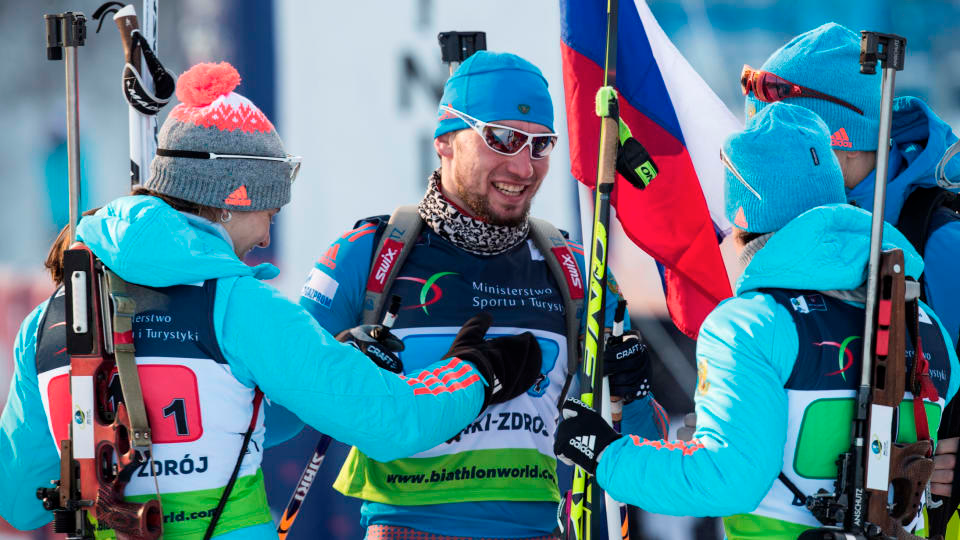
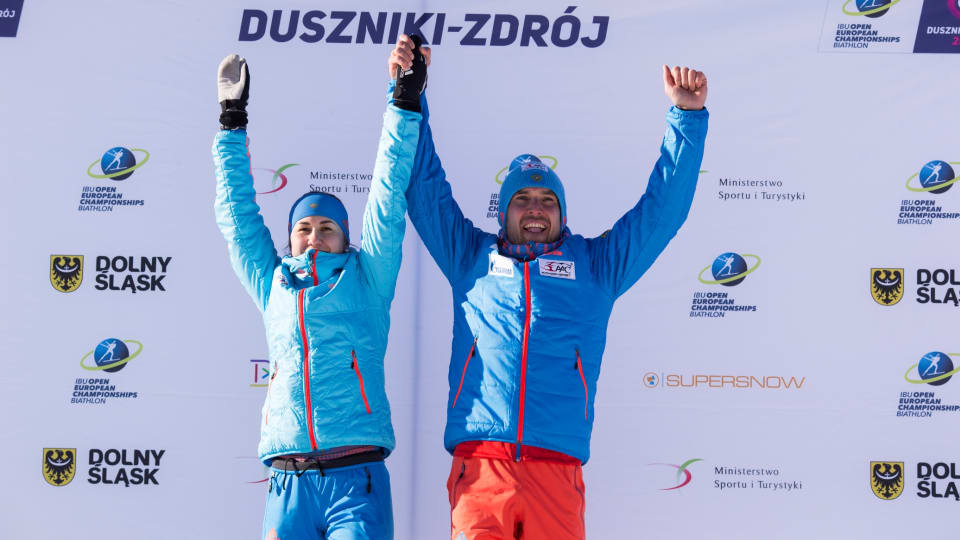
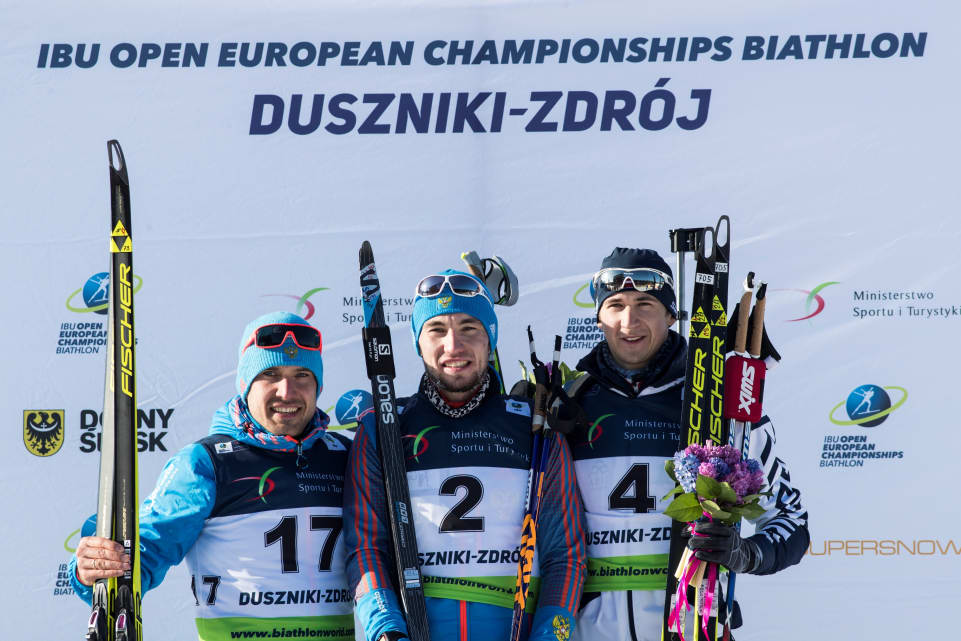
Russia’s Alexander Loginov (center) is greeted at the finish by his teammates Irina Starykh, Svetlana Sleptsova and Alexey Volkov after anchoring his team to the gold medal in the mixed relay at the 2017 IBU Open European Championships in Duszniki-Zdrój, Poland. (Photo: IBU)
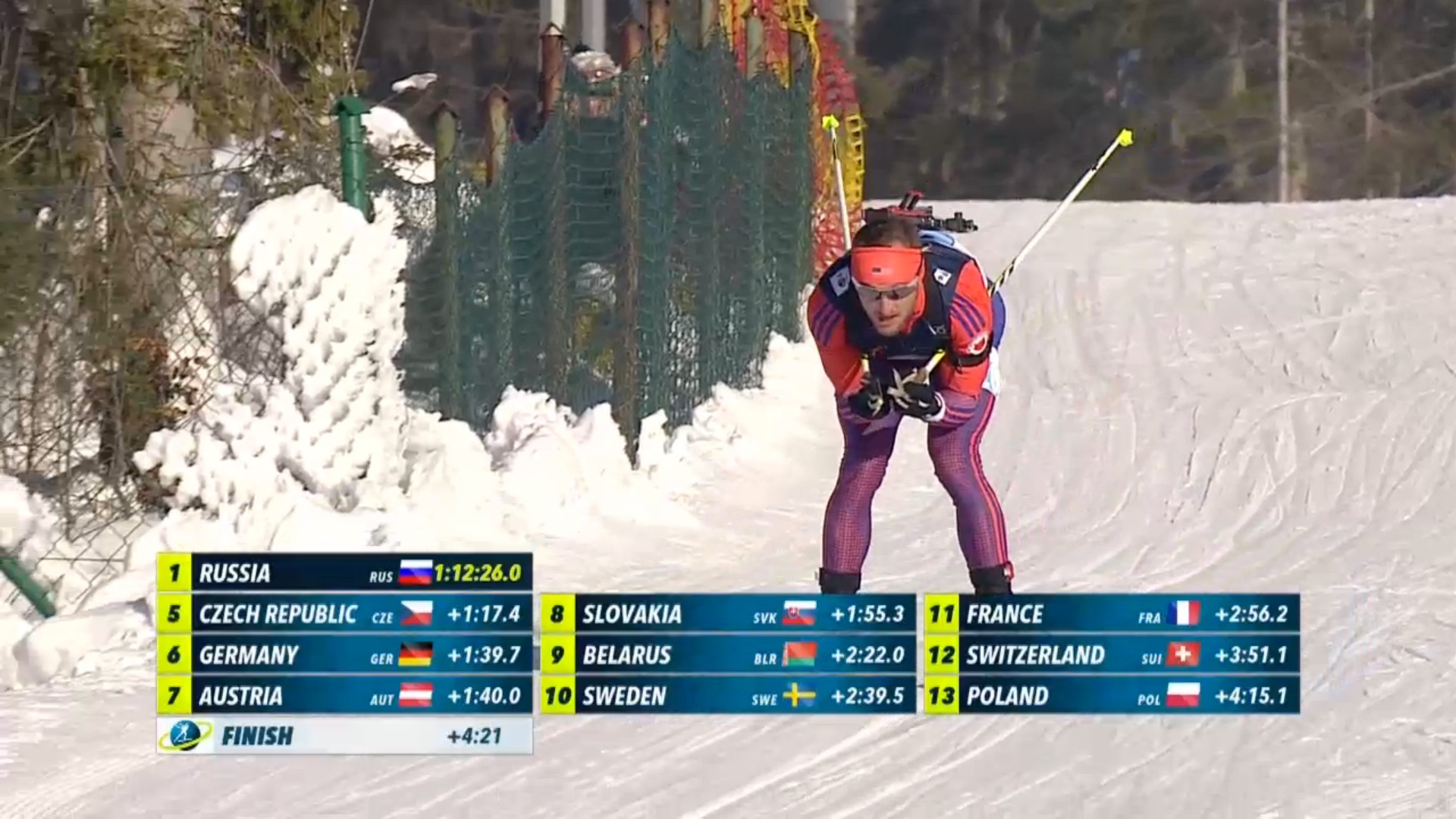
[UPDATED] The Russian victory in the final 2 x 6 + 2 x 7.5-kilometer mixed relay event of the 2017 International Biathlon Union (IBU) Open European Championships in Duszniki-Zdrój, Poland, was only briefly in doubt, when Alexander Loginov skiing the anchor leg required all spares in his prone shooting stage. But with his final shot he managed to also hit that target to avoid the penalty lap, leaving the range with a lead of more than 30 seconds.
Loginov then did not need any spares in the last standing stage, and could take his time on the final loop. Unlike Russia’s Evgeniy Garanichev earlier in the day during the single mixed relay, he also managed to pick up a flag for the final meters of the race, crossing the line in a time of 1:12:26.0 hours.
The Russian team with Irina Starykh, Svetlana Sleptsova, Alexey Volkov and Loginov led from the first exchange and required only six spares with zero penalties.
With this medal, the 28-year-old Volkov became the most successful athlete in history at European Championships, according to an IBU press release, surpassing the retired Polish biathlete Tomasz Sikora. Russia was the most successful team of the 2017 Open European Championships with six gold, four silver, and three bronze medals.
Behind them, a number of teams vied for the positions on the podium. Sweden initially looked like a strong contender exchanging in second place after the women, but fell back with three penalty laps to only finish 10th.
Still six seconds back after the final shooting, Norway’s Fredrik Gjesbakk caught up to and outsprinted Ukraine’s Ruslan Tkalenko in the finishing stretch to claim the silver medal (+36.4) with the bronze left for Ukraine (+37.1).
“I thought that I made sufficient gap to win silver,” Tkalenko told the IBU. “But in the end, on the final downhill before the finish, I was very surprised when the Norwegian guy passed me, I truly did not expect that.”
The Norwegian team with Karoline Erdal, Marion Rønning Huber, Erlend Bjøntegaard, and Gjesbakk needed nine spares and had no penalties.
Ukraine with Anastasiya Merkushina, Yulia Dhzyma, Oleksander Zhyrnyi (who originally started for Russia before making the switch in 2014) and Tkalenko required six spares, and Dhzyma had to ski a penalty lap only temporarily setting the team back.
Bulgaria finished fourth (+1:16.4), with its anchor Vladimir Iliev narrowly beating Czech Republic’s Lukas Kristejn (+1:17.4) in the finishing stretch. Both teams needed 11 spares and had no penalties.
Jakob Ellingson skiing the anchor leg for the U.S. mixed relay at the 2017 IBU Open European Championships in Duszniki-Zdrój, Poland. The U.S. team finished 14th. (Photo: IBU/Eurovisionsports.tv screenshot)
Starting at the back of the field in bib 20, US Biathlon’s Emily Dreissigacker got her team off to a strong start with a clean prone shooting and one spare round in standing, exchanging in 10th, a minute behind the leaders. Hallie Grossman needed one spare in each of her stages, tagging off to the men in 14th position and now 2:39 behind. Max Durtschi also had one miss each in prone and standing, coming into the last exchange still in 14th position, but another minute back. Jakob Ellingson required all three of his spares in his prone shooting stage narrowly avoiding the penalty lap, and one more in his final shooting stage. As the team from Finland was racing over a minute behind the Americans, he was able to keep the 14th position into the finish (+4:47.4), with a team total of nine spares and no penalties overall.
For Biathlon Canada, Erin Yungblut starting in bib 19 shot clean in her prone stage and required two spares in her standing shooting, tagging off in 18th position and more than two minutes back from first. Leilani Tam von Burg stayed clean in her prone shooting stage and needed one spare in standing, moving up two positions to exchange in 16th place, yet more than four minutes behind the leaders. After the exchange to the men, both Matthew Neumann and anchor Carsen Campbell managed to shoot clean in all of their stages, but lost additional time on the course to finish 16th (+6:39.9) ahead of four lapped teams.
Canada had the best shooting result of all 20 teams starting the relay, with just three spares and no penalty.
Russia’s Daria Virolaynen (l) and Evgeniy Garanichev after winning Sunday’s single mixed relay at the 2017 Open European Championships in Duszniki-Zdrój, Poland. (Photo: IBU)
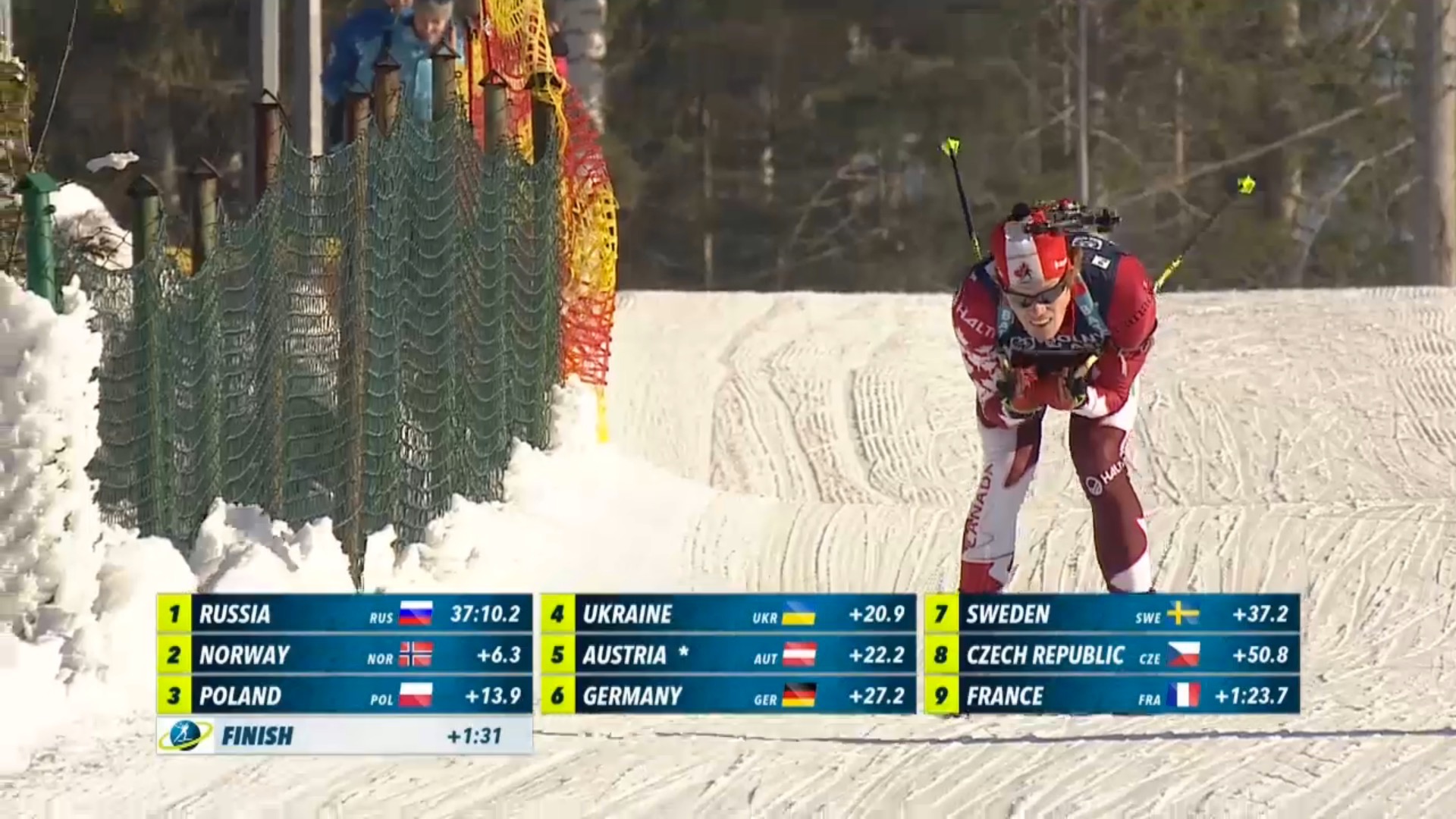
Earlier on Sunday, pretty much the only thing that went wrong for Russia’s Daria Virolaynen and Evgeniy Garanichev in the single mixed relay happened on the last meters of the finishing stretch, with Garanichev gesturing for a Russian flag he wanted to cross the line with. But the handoff was too short and the flag dropped past his outstretched hand to the snow. He glanced back, weighing if his lead was big enough to ski back, but decided it was not worth the risk, instead skiing into the arms of his partner waiting for him behind the line in a time of 37:10.2 minutes.
Russia needed seven spare rounds and incurred zero penalties. Garanichev secured the victory in the final shooting, when he only needed one spare – albeit fumbling a few seconds to insert it – while his direct opponents standing next to him required more time to hit their targets.
“Probably, I took some risk at the last standing,” Garanichev said, according to an IBU press release. “I wanted to shoot fast and clean, but missed with the last shot. But in general, I felt very comfortable; came and worked at the range in my rhythm.”
6.3 seconds behind, Norway with the team of Ingrid Landmark Tandrevold and Vetle Sjåstad Christiansen placed second, with seven spares and zero penalties.
“These are very short loops,” Christiansen commented on the fairly new, single mixed relay format. “You feel the pressure from the crowd and to shoot fast every time.”
The 20-year-old Tandrevold previously earned three bronze medals, including one in the single mixed relay, also with Christiansen, at last year’s Open European Championships in Tyumen, Russia.
To big cheers from their home crowd fans who had come out to the Duszniki Arena in beautiful but cold weather, the Polish husband-and-wife team of Krystyna Guzik and Grzegorz Guzik placed third with just five spares and zero penalties (+13.9), not quite able to keep up with Christiansen on the final loop after leaving the range together within a second.
“It is so nice to win a medal here in Poland,” Krystyna Guzik said. “We were both very disappointed with all of our mistakes in the other competitions. So today, we were relaxed and laughing before the competition, hoping not to have those mistakes again. We did not … and now have a medal.”
It was the first medal for Poland at these championships.
Ukraine with Iryna Varvynets and Andriy Dotsenko finished fourth, also with five spares and zero penalties (+20.9).
Biathlon Canada’s Aidan Millar skiing the final loop of the single mixed relay at the 2017 IBU Open European Championships in Duszniki-Zdrój, Poland. With teammate Sarah Beaudry, Canada finished 13th (Photo: IBU/Eurovisionsports.tv screenshot)
For Biathlon Canada, Sarah Beaudry and Aidan Millar required seven spares during their race and had no penalty, just like the winning Russians and Norwegians, but could not quite keep up with the best teams on the course in the fast-paced race format with short loops somewhat comparable to a team sprint in cross-country.
Beaudry cleaned her first shooting stage and then needed one spare to hit all targets in standing. At the first exchange Canada was 10th, 35.8 seconds behind the then leading team from Poland.
Millar missed one shot in his first prone stage, leaving the range again in ninth position. Then he needed two spares in his standing shooting on the way to exchanging back to Beaudry in 11th (+56.4).
On her second leg, Beaudry had one miss in prone and required two spares in standing, falling back a bit to exchange in 13th (+2:12.0).
On his final leg, Millar was able to shoot clean in both stages, reducing the time gap to the top but not able to make up another position, and finished in 13th place (+1:56.1).
US Biathlon is only represented with two women at the Open European Championships in Poland, and decided to forgo a start in the single mixed relay, instead entering a team in the mixed relay later on Sunday.
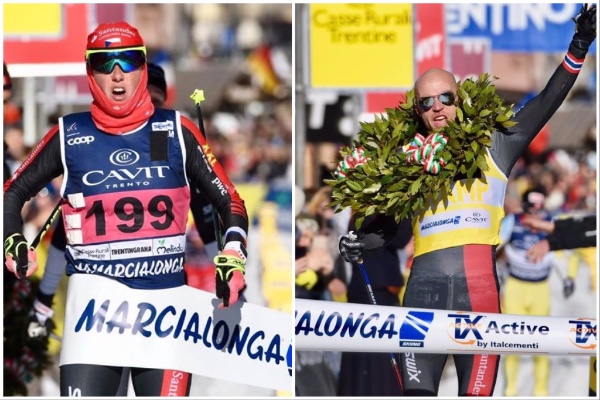
Katerina Smutna (left) and Tord Asle Gjerdalen (right) of Team Santander won the 2017 Marcialonga. (Photo: Visma Ski Classics)
Tord Asle Gjerdalen won the Marcialonga, a Worldloppet and Swix Ski Classics marathon for the third time – in a row. This year was on a shortened course, “just” 57 rather than the traditional 70 kilometers.
The Team Santander athlete finished in two hours, eight minutes, and 36 seconds, edging Johan Kjølstad (Team United Bakeries) and Morten Eide Pedersen (Team BN Bank) in a sprint finish by 2.6 and 2.9 seconds, respectively.
Tyler Kornfield and David Norris of Alaska Pacific University finished 43rd (+5:03.8) and 66th (+10:43.1). Canadian Paralympian Brian McKeever finished 57th (+9:13.5) and guide Graham Nishikawa 81st (+12:56.5), followed by Ian Murray in 85th (+13:37.5) and Erik Carleton in 111th (+17:50.2).
In the women’s competition, Katerina Smutna, also of Team Santander, won her third straight Ski Classics competition. She crossed the line in two hours, 22 minutes, and 46.4 seconds. Britta Norgren of Team Lager 157 was second by just 0.8 seconds, and Sara Lindborg (Team Serneke) third, +4:22.2. University of Utah alum Maria Graefnings was tenth, +10:35.8.
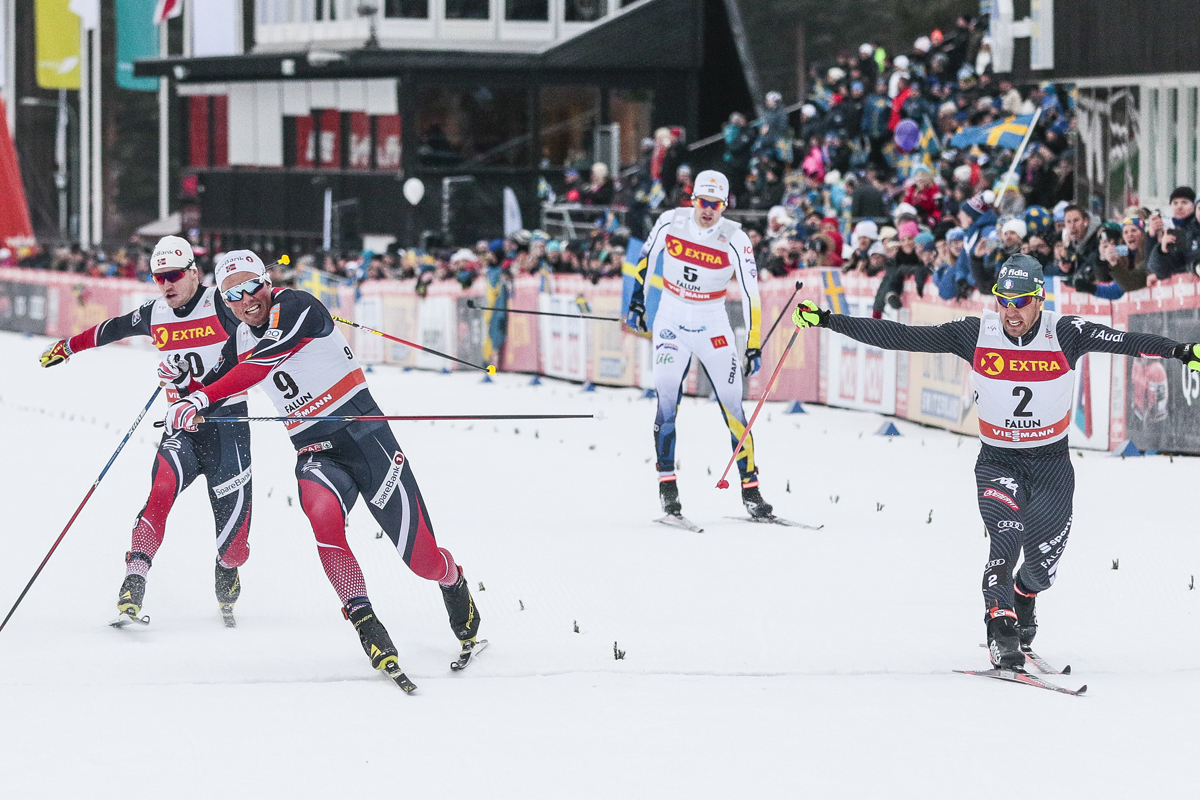
Italy’s Federico Pellegrino (2) edging Norway’s Emil Iversen (9) by 0.06 seconds for the win, with Norway’s Sindre Bjørnestad Skar (l) following in third and Sweden’s Oskar Svensson (5) in fourth, in the men’s freestyle sprint final on Saturday at the World Cup in Falun, Sweden. (Photo: Fischer/NordicFocus)
It didn’t seem likely until the last second – but last season’s star sprinter has once again arrived on the World Cup circuit.
Italy’s Federico Pellegrino collected his ninth individual win on Saturday in Falun, Sweden, nipping Norway’s Emil Iversen by six-hundredths of a second in a photo finish in the freestyle sprint. The winner of last year’s Sprint World Cup, Pellegrino didn’t make his first sprint final of the season until after Christmas.
However, since then, he has been second (in Val Müstair, Switzerland), fourth (in Toblach, Italy), and now, finally, first.
“This season is not so easy right now for me,” he told the International Ski Federation (FIS) in a finish-line interview. “Now I think [the way it is going] is the right way, going toward the World Championships.”
Pellegrino had the second-fastest qualifying time around the 1.4-kilometer course in the morning. Then, he won his quarterfinal with a blazing display of speed at the finish to best Norway’s Finn Hågen Krogh. In the semifinal, Pellegrino pulled a similar move to win the heat by 0.21 seconds over Sweden’s Teodor Peterson.
In the final, coming into the last few hundred meters it looked like Pellegrino was too far off the pace to make it to the front. The rest of the men – all Swedes and Norwegians – jostled for the lead constantly. As the field shot down a long hill into the stadium, though, Pellegrino made his way to the front; he said he had amazing skis. He followed Iversen over the last bump of an uphill and down a corner to the finish. The pair’s paced outstripped anything the others could keep up with.
“In the final I showed up still fresh, but with a long downhill before the finish I couldn’t pull, and when you’re behind you risk losing [moves],” he told the Italian Winter Sports Federation, according to a translation. “In fact, I found myself in fifth place and I thought I would not make it. But on the last hill before the finish I took a wide path and I went for it, giving everything I had in the body. Then I made it a photo finish.”
Iversen had thought he had the win in the bag. He seemed incredulous that Pellegrino could catch up with him in the final meters – and the Italian timed his finishing lunge better, eventually edging Iversen by just six hundredths of a second.
Iversen slapped his poles in the snow in frustration after finishing, breaking one, and lay unsmiling while the two waited for the results of the photo finish. He remained restrained during the post-race photo opportunities.
“I thought I had the win today,” Iversen told FIS. “I didn’t know who was coming but I could feel the shadow. I was very disappointed in the finish but in the end I have to be happy with second place.”
“I’ve been pretty mad at my little brothers, but I don’t think I’ve been this angry in years,” Iversen elaborated to NRK.
Another photo finish gave Sindre Bjørnestad Skar of Norway third place (+0.47), by three hundredths of a second over Falun’s own Oskar Svensson. Johannes Høsflot Klæbo – the fastest qualifier on the day – finished fifth (+1.32), and Peterson placed sixth (+2.08).
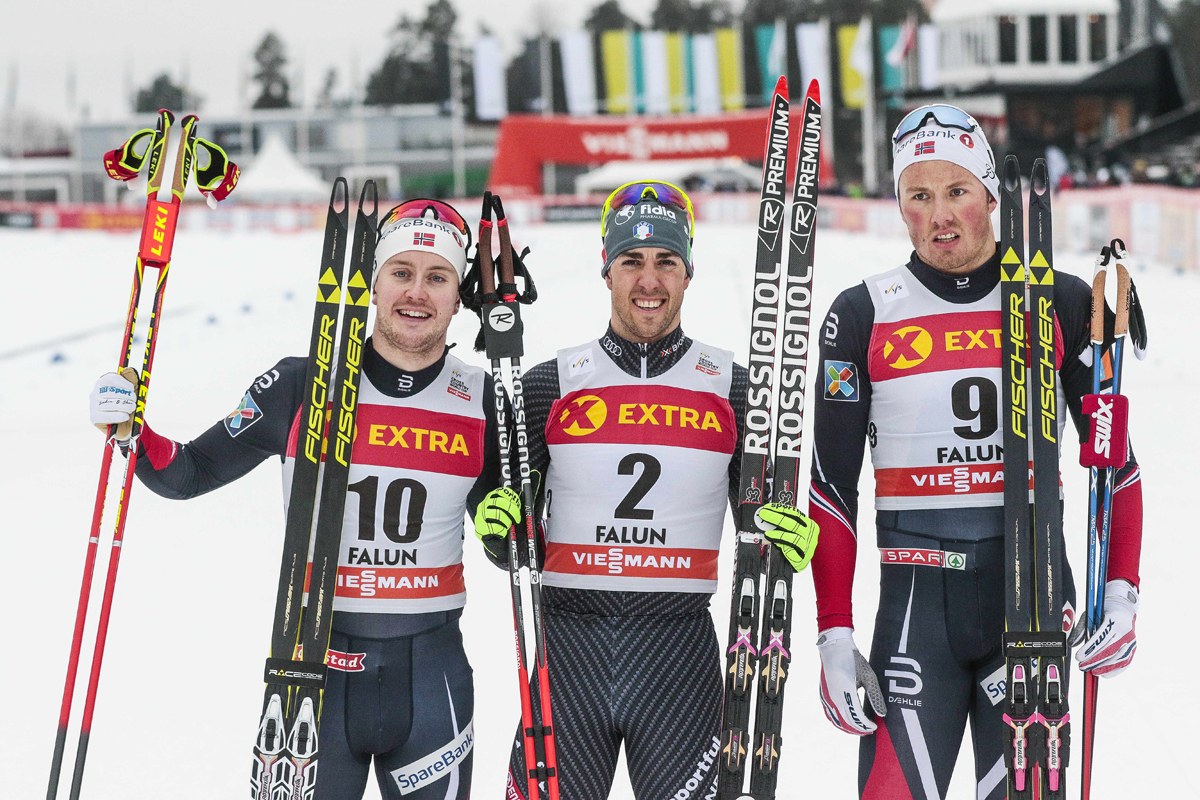
The men’s freestyle sprint podium on Saturday at the World Cup in Falun, Sweden, with Italian winner Federico Pellegrino (c), and Norway’s Emil Iversen (r) in second and Sindre Bjørnestad Skar (l) in third. (Photo: Fischer/NordicFocus)
“It’s really tough to make it on World Cup as a Norwegian and so every time I can make a podium result it is important,” Skar told FIS, referring to simply earning start rights.
Indeed: Pål Golberg, who before this weekend led the Sprint Cup, did not even get the chance to start Saturday’s race. The Norwegian team deemed him too slow. Other skiers also found this amazing. Alex Harvey told Norwegian media that the Canadian team would be happy to take Golberg and give him a starting spot.
“They seem sure, like me, that it’s comical,” Golberg told Norwegian broadcaster NRK. “I’ve certainly gotten lots of messages from people who think it’s strange, so I’m glad that other people share that view.”
He now worries that he might not have a chance to start the sprint at World Championships. Five of the top seven men in the Sprint Cup standings are Norwegian: Skar in second, Iversen in fourth, Krogh in fifth, Golberg in sixth, and Klæbo in seventh.
There’s no such problem for Italy, a team which is thrilled that its star is back in top form. Pellegrino now has the most podiums in skate sprints of any Italian man ever, with 13.
World Championships is the only thing on his mind.
“At this time the [Sprint Cup] ranking does not interest me,” he said in the federation press release. “I’ll skip the next stage in Korea, and then will race in Otepaa [Estonia, the last World Cup before World Championships.”
Valjas 10th After Blistering Quarterfinal Finish
Len Valjas (Canadian World Cup Team) racing in Saturday’s freestyle sprint at the World Cup in Falun, Sweden, where he ended up 10th on the day. (Photo: Fischer/NordicFocus)
Only two Canadians started the sprint. Alex Harvey missed qualifying in 46th, but teammate Len Valjas not only made the quarterfinals, but shone there.
Valjas was skiing near the back of his heat, only to find his way to the front at the last possible moment, much like Pellegrino. While Klæbo had seemed to have the quarterfinal locked up with only a possible challenge from Andrew Young of Great Britain remaining in the finishing stretch, Young and Valjas came down the last downhill with more momentum and some speed in their legs. Eventually all three crossed the line together in a photo finish, from which Valjas emerged second.
In his semifinal heat, Valjas also hung near the back of the pack. But the whole heat finished within about a second, and he wasn’t able to fight his way through the crowd. Valjas landed fifth, this time 0.99 seconds behind heat winner Klæbo.
“I definitely felt like I had a little more,” Valjas said in a Cross Country Canada press release. “I was able to close in the finish, but I just lost a little too much contact with the pack. I had the speed at the finish and felt great. I was really comfortable staying at the back. I thought I could bring it back on the second hill, but I just stayed a little too far back. I needed to work on my tactics a bit better.”
He finished 10th overall, his best individual result in a year since he finished 10th in a classic sprint in Oberstdorf, Germany, as part of last year’s Tour de Ski.
“I had great skis and I know the fitness is there,” Valjas said in the press release. “Being in the fifth heat in the quarters, I likely could have used about five more minutes of rest time before the next heat, but I can’t complain and have to be happy with a top 10.”
Hamilton, Newell in the Quarters
Simi Hamilton (U.S. Ski Team) racing to 13th in the men’s qualifier of the 1.4 k freestyle sprint on Saturday at the World Cup in Falun, Sweden. He went on to place 18th on the day. (Photo: Fischer/NordicFocus)
For the U.S., Simi Hamilton qualified 13th and Andy Newell 25th. Both were at the front of their quarterfinal heats at some point, before fading at the finish.
For Hamilton, things more or less immediately deviated from plan.
“I actually lost my basket on my right pole coming out of the start,” Hamilton said. “The pole holes were pretty gnarly at the start since people are double poling so hard, and I think my basket got stuck in on of the previous pole plant holes… [the snow] was actually firm enough that I could still pole pretty well, but I knew that the rest of the course got a little bit softer. So Andrew Morehouse, who is one of our techs, made a great hand-off and I got a new pole at the first corner. That’s probably only 20-25 seconds in the race at the point, but I was definitely off that back a little bit.”
Hamilton did manage to catch back up to the group. And then on the last uphill before the descent to the stadium, the skiers in the left lane got a bit jammed up. Being in the right lane, Hamilton was able to ski freely – but then found himself leading the heat, exactly what he didn’t want to do.
As Pellegrino had said, leading down the hill into the stadium means that most likely, the competition would sail past you thanks to the draft effect.
“You know, a lot of the race was going to come down to that final little bump that is in the stadium,” Hamilton said. “So I knew if I came into that with some really good momentum and hopefully get a slingshot off of someone in front of me, that I would be able to crush that bump and make a move into the finish lanes and then have a open lane for the finish… that was what I was really hoping for, it didn’t totally play out like that.”
Instead, a few competitors slingshot past Hamilton.
“I kind of found myself tangling with a lot of dudes going over that bump and through that corner,” he explained. “I just didn’t really ski the last 200 meters the way I would have really liked to, with a lot of energy power and speed. So found myself fighting in the pack going into the finishing stretch. I just focused on just skiing a good finish, and unfortunately wasn’t quite enough.”
He landed fourth in his heat (+0.87), and not close enough to get a lucky loser spot. He finished 18th on the day.
Andy Newell (U.S. Ski Team) racing to 25th in the men’s qualifier of the World Cup freestyle sprint in Falun, Sweden. He ended up 16th on the day.(Photo: Fischer/NordicFocus)
“It’s a frustrating day, but I felt good in my qualifier, and it’s hard course and I know my fitness is really good right now,” Hamilton said. “It was just kind of one of those days that happens out there, not a lot of things really connecting in terms of luck and positioning and equipment. But still a decent day so I am okay with it.”
Newell also found himself outgunned in the final meters, finishing third in his heat and 16th on the day.
Also for the U.S., Erik Bjornsen finished 43rd (+9.30) and Matt Gelso 59th (+13.12) in the qualifier.
Sweden’s Stina Nilsson celebrates her second-straight World Cup sprint victory on Saturday after winning the 1.4 k freestyle sprint at home in Falun, Sweden.
FIS Cross-Country World Cup (Falun, Sweden): Men’s & women’s freestyle sprints
[UPDATED] Kikkan Randall reached the final for the first time since March 2015 on Saturday in the women’s 1.4-kilometer freestyle sprint at the World Cup in Falun, Sweden. The American qualified 26th and went on to advance in second out of her quarterfinal and semifinal to reach the six-woman final, where she ended up fifth.
Sweden’s Stina Nilsson won the final by one-hundredth of a second over Norway’s Maiken Caspersen Falla, finishing in 3:00.24 minutes. Nilsson had started the day by qualifying in sixth, 2.52 seconds behind Norway’s Marit Bjørgen, who won the qualifier in 3:00.64. This is Nilsson’s second-straight World Cup sprint win after skipping the freestyle sprint in Toblach, Italy, following the Tour de Ski.
While Bjørgen went on to win her quarterfinal, she finished fifth in her semifinal to end up ninth on the day.
Norway had two on the women’s podium with Heidi Weng in third, 1.88 seconds behind Nilsson. Finland’s Krista Parmakoski placed fourth (+1.99), and Randall was fifth (+2.56) for her best result in two years (she took last season off to have a baby). Sweden’s Jonna Sundling reached the final as well and finished sixth (+8.02).
Five U.S. women qualified for the heats, with Jessie Diggins qualifying fifth and ultimately crashing in her semifinal, where she finished fifth. That put her 10th overall on the day. Sophie Caldwell qualified third and finished fourth in her quarterfinal for 16th on the day, Sadie Bjornsen qualified 17th and also finished fourth in her quarterfinal for 19th overall, and Ida Sargent made the top-30 qualifying cutoff in 30th, then placed fifth in her quarterfinal for 25th overall.
Bjørgen topped the freestyle sprint qualifier on Saturday morning, clocking the fastest time around the 1.4 k course by just 0.08 seconds over Hanna Falk of Sweden.Caldwell qualified third (+1.23),Digginsqualified fifth (+2.39),Bjornsen17th (+5.04),Randall26th (+6.64), andSargent 30th (+8.28). Rosie Brennan (U.S. Ski Team) missed the cut in 37th (+10.90) and Liz Guiney finished 56th (+32.87). The lone Canadian woman racing on Saturday, Cendrine Browne placed 46th (+14.02).
In the men’s 1.4 k freestyle sprint final, Italy’s Federico Pellegrino held off three Norwegians and two Swedes to win in 2:45.77. The defending Sprint World Cup champion qualified second and went on to win his quarterfinal and semifinal before taking the final by six-hundredths of a second.
Norway took the remaining spots on the podium with Emil Iversen in second (+0.06) and Sindre Bjørnestad Skar in third (+0.47). Sweden’s Oskar Svensson was three-hundredths of a second off the podium in fourth (+0.50). The fastest qualifier in 2:34.49, Norway’s Johannes Høsflot Klæbo reached the final and ultimately took fifth (+1.32), and Sweden’s Teodor Peterson placed sixth (+2.08).
Canada’s Len Valjas was the top North American in 10th. He qualified 20th, advanced in second from his quarterfinal and finished fifth in his semifinal.
American Andy Newell was 16th after qualifying in 25th and finishing third in his quarterfinal. U.S. teammate Simi Hamilton followed in 18th, after qualifying 13th and finishing fourth in his quarterfinal.
In the men’s qualifier, Klæbo was 1.05 seconds faster thanPellegrinoand another 0.02 seconds faster than Russia’s Sergey Ustiugov in third.
For the U.S., Hamiltonqualified 13th (+4.52) andNewell qualified 25th (+6.74). Erik Bjornsen placed 43rd (+9.30) and Matt Gelso 59th (+13.12).
Valjaswas the lone Canadian man to make the heats, qualifying 20th (+6.22). The only other starter, Alex Harvey, placed 46th (+9.71).
IBU Open European Championships (Duszniki-Zdrój, Poland): Men’s & women’s pursuits
The men’s pursuit podium at 2017 IBU Open European Championships on Saturday in Duszniki-Zdrój, Poland, with Russia’s Alexander Loginov (c) in first, Evgeniy Garanichev (l) in second, and Latvia’s Andrejs Rastorgujevs (r) in third. (Photo: IBU)
Russia’s Alexander Loginov racked up his second win of the 2017 International Biathlon Union (IBU) Open European Championships on Saturday in the mens’ 12.5-kilometer pursuit in Duszniki-Zdrój, Poland.
After starting second, 5 seconds behind Bulgaria’s Vladimir Iliev, who won Friday’s sprint, Loginov proceeded to clean three straight stages before missing one on his final standing to cross the line first in 31:46.2 minutes.
“It was not as easy as it seemed, because from the first loop Vladimir set a really good speed,” Loginov said, according to an IBU press release. “Today we had great sunny and windless weather again, so I managed to shoot well. Probably that is why it [looked] so easy.”
Russia took first and second place with Evgeniy Garanichev following 27.8 seconds later, after starting 17th (56 seconds out of first) and shooting 19-for-20 (0+0+1+0).
“After yesterday’s sprint, I managed to work well and to show good result in pursuit, so I’m sure glad to win the silver medal,” Garanichev said, according to the IBU.
Latvia’s Andrejs Rastorgujevs improved on his fourth place in the sprint to reach the pursuit podium in third (+59.5) despite four penalties (0+1+1+2).
“On the last loop I had the information about the guys who were behind me and in front of me,” Rastorgujevs said, according to the IBU. “I was just fighting and did all I could do to get to the podium.”
Bulgaria’s Krasimir Anev, who started third, slipped to fifth (+1:28.6) with two penalties (0+1+1+0), behind Russia’s third man in the top four, Alexey Volkov in fourth (+1:01.6). Iliev as the first starter ended up 11th (+1:41.7) with six penalties (2+2+0+2).
The two Americans who had qualified for the pursuit by placing in the top 60 of Friday’s sprint, Paul Schommer and Alex Howe improved to 48th (+5:07.1) and 51st (+5:42.3), respectively.
Schommer started 58th, just ahead of Howe in 59th, and missed five targets, all in his first two prone stages (3+2+0+0). Howe accumulated four penalties (1+2+1+0).
No Canadians qualified for the pursuit.
[UPDATED] In the women’s 10 k pursuit that followed, Russia’s Irina Starykh picked up her second win and third consecutive podium of the championships, with clean shooting en route to a 19.8-second victory in 30:04.4.
Starykh started third, 38 seconds behind Ukraine’s Juliya Dzhyma and 11 seconds after her Russian teammate Svetlana Sleptsova, respectively. Dzhima missed two on her last two standing stages (0+0+1+1) to slip to second, and Sleptsova dropped one place to third (+32.1) with one prone penalty (0+1+0+0).
Veronika Vítková of the Czech Republic improved from seventh to fourth (+47.8) with two penalties (0+1+1+0), and Russia’s Svetlana Mironova moved all the way up from 13th to fifth (+1:29.6) with three misses (0+1+1+1). Just 0.2 seconds behind her, Poland’s Monika Hojnisz improved from 16th at the start to sixth (+1:29.6) with one penalty (0+0+0+1).
No North Americans qualified for the pursuit.
Open European Championships conclude Sunday with the single mixed and mixed relay.
Ben Berend competing in summer Grand Prix nordic combined in Oberstdorf, Germany. (Courtesy photo)
Welcome to “17 Questions for 2017″, where we are catching up with American and Canadian national-team members before the beginning of the winter season.
***
Steamboat Springs, Colorado, native Ben Berend is just 21 years old, but he already has a senior World Championships under his belt and has competed in more than a dozen World Cup nordic combined events.
Berend spent part of the summer racing on the Grand Prix circuit in Germany and Austria and will return to the World Cup this winter.
1. Biggest change in your life in the last five or so months since the ski season ended?
I’ve never been named to the World Cup Team to begin the season so that is new. I recently became a godfather! I don’t know what that title entails but if you are reading this Bryan Fletcher, I’m ready for anything. Also this summer I met a girl I really like, that has been a lot of fun!
2. Biggest change in your training?
Less biking! Most years I’ve spent a majority of the spring on the bike. This year I hardly touched my bikes. I have made rollerskiing and double poling a huge priority.
3. Major areas of improvement you’ve seen so far?
Ben Berend competing in a World Cup in Lahti, Finland, last season. (Photo: JoJo Baldus)
Can I say everything? Usually in Nordic combined when the cross country skiing improves the jumping can take a dip or vice versa. However, this summer I feel I have drastically improved in both disciplines. I’m currently having the best jumps of my life as well as posting personal bests in time trials.
4. Whom you’ve been working closest with this offseason (coaches or training partners)?
I probably train the most with Taylor Fletcher since we live together. Also this season we hired an Austrian jump coach (Nik Huber). I’ve been trying to absorb as much of his knowledge as possible.
5. Best trip in the last five months (and why)?
At the end of August I went to Jackson Hole, Wyoming with my girlfriend and her parents. We did some day trips rafting down the Snake River. Total blast. Somehow in my 21 years of living in Colorado and Utah, I have never been to Wyoming. I’ve spent so much time traveling around Europe but hardly any time traveling within the US. I hope to change that.
6. Favorite cross-training?
Mountain biking! Especially in Moab. That’s my happy place. Also I spend every spring trying to become proficient at telemark skiing.
7. Favorite non-athletic activity or pastime this summer?
Berend enjoying some time on the river. (Courtesy photo)
I’m simple. I’m so content with a good book in my hands. Paperback not kindle! Although traveling so much has sadly forced me to own a kindle.
8. Song that was your jam this summer?
Norgaard – The Vaccines
Ain’t No Rest for the Wicked – Cage the Elephant
9. All time favorite race moment?
As a kid, my favorite aspect of skiing was getting to stand on the podium. I couldn’t touch a podium with a 10 foot pole these last couple years. Getting third place at US Nationals this summer was really special. Also competing in my first ever World Championship Event in Falun was amazing. There was a tunnel under the bleachers that lead the athletes into the stadium. Under the tunnel, it was silent. The sound my boots clacking against the hard surface seemed deafening. As I neared the end of the tunnel, the sound of my boots disappeared. It was replaced by this subtle roar. I exited the tunnel and was frozen. There were thousands of people packed into the stands screaming and waving flags. It was such an unreal feeling and I will keep that memory with me forever.
10. First thing you pack in your bag when you leave for Europe?
Passport. I’m a very forgetful person and I have this longstanding fear of losing/forgetting my passport.
11. Venue/event you’re most excited to visit this season?
U.S Nordic Combined skier Ben Berend stoked on his jumping in Oberstdorf, Germany, in September’s Grand Prix. (Photo: FIS/Sandra Volk)
World Championships in Lahti. Apparently they have already sold 60,000 tickets. Nothing beats a championship event. Also I’m looking forward to the Seefeld Triple because it starts with a 5k event, which suits my jumping abilities.
12. Who will win the World Cup title this year?
At this point it is pretty hard to bet against Eric Frenzel. I’m low key rooting for Jarl Riiber from Norway. I’m not sure if someone still young enough to compete in Junior Worlds has ever won a World Cup Overall. If anyone is going to do it, it’s him.
13. Biggest sacrifice you feel you’ve made choosing this career path?
Sometimes I feel like I’m missing out on the social aspects of being a kid my age. It can definitely be hard relating to people who aren’t pursuing similar things. It can be a little isolating at times. This career allows me to have a lifestyle that suits me well so I have zero regrets.
14. If you could change one thing about your sport, what would it be?
We want women! It’s frustrating that women don’t have the opportunity to compete in Nordic Combined. I have no idea how this didn’t happen sooner but I’m glad FIS is making it a big focus. Also I wish we could find a way to get some World Cups in the United States. We are constantly competing on other people’s home turf.
15. What did you have for breakfast this morning?
Oatmeal with almond milk, a banana, peanut butter, jam, and sunflower seeds.
16. In 5 years, I’ll be ____?
Doing something I love at a high level. Hopefully skiing.
Norway’s Therese Johaug celebrates her 14th World Cup victory in the 10 k freestyle mass start on Sunday in Falun, Sweden. Johaug led her teammates Heidi Weng and Astrid Uhrenholdt Jacobsen in a Norwegian podium sweep and American Jessie Diggins placed fourth. (Photo: Fischer/NordicFocus)
Note: This article has been updated to include comments from Liz Stephen and Caitlin Patterson.
Therese Johaug dared anyone to match her as she drove a punishing pace from the gun of the 10-kilometer freestyle mass start on Sunday in Falun, Sweden. But five other women, including American Jessie Diggins, took her up on the challenge and the race was on.
The fast pace from the gun strung out the 72 women in the field quickly and within minutes, a lead group of six was formed. Johaug was shadowed by her Norwegian teammates Heidi Weng, Ingvild Flugstad Østberg , and Astrid Uhrenholdt Jacobsen as well as Diggins and Sweden’s Charlotte Kalla as they ascended the infamous Mörderbacken climb in the first two kilometers of the race.
There was no trading of leads as Johaug churned away with her characteristic high tempo in the front. By 3.2 k, Johaug, Weng and Østberg had a five-second gap on Jacobsen and Diggins. Kalla fell back to the chase group, ceding the potential to repeat on the podium after she won the 10 k freestyle at Falun World Championships last year.
However, a day after notching fifth in the 5 k classic, Diggins was not going to let the Norwegian trio ski away without a fight. She took advantage of her strengths on the gliding sections of the rolling terrain the second half of the 5-kilometer lap. She overtook a fading Østberg and caught Jacobsen who tucked in behind her. She continued to hammer, bridging to Johaug and Weng.
Coming through the stadium after the first lap at 5 k, Diggins was just 3.6 seconds from the lead pair. However, when Jacobsen took her turn leading, she shifted gears to a pace Diggins couldn’t match. In pursuit of her teammates up the trail, Jacobsen put 11.2 seconds on Diggins in 1.7 k.
In contrast to Johaug’s usual untouchable domination, Weng shadowed her stride for stride for over half of the race. However, at 6.7 k, the second time up Mörderbacken, Johaug delivered an attack that Weng could not match.
Therese Johaug (r) leads Norwegian teammate Heidi Weng during the women’s 10 k freestyle mass start at the World Cup in Falun, Sweden. The duo went on to place first and second, respectively, while American Jessie Diggins (back left) placed fourth. (Photo: Fischer/NordicFocus)
Johaug entered the stadium clear of Weng, winning in 23:28.0 for her 14th World Cup win matching Norwegian Bente Skari’s record for the most wins in a season. Weng secured second place, 8.8 seconds back, and Jacobsen placed third (+13.9).
Meanwhile, Diggins skied alone in fourth place trying to hold off a charging chase pack. She made it to the line just four seconds ahead of the chase pack to secure fourth (+29.0). Norway’s Maria Rydqvist and Ragnhild Haga led the group behind her into the finish in fifth (+33.3) and sixth (+34.0), respectively.
Despite skiing in the lead pack early, the early pace took its toll and Østberg faded to ninth (+35.0).
After the race, Johaug explained she pulled off her race plan perfectly, although Weng held on longer than she anticipated.
“My goal was to go my own race, and go hard and smoothly from the start,”Johaug told NRK, according to a translation. “I would ‘punch’ to the last part of the hill, and it finally succeeded … I was a little nervous, for Heidi hung so well.”
According to Weng, Johaug “started like it was a sprint so there weren’t many of us from the beginning,” she told FIS. “I tried to stay with her as long as I could but my legs started to get stiff and I just focused on my technique to make sure that I still got to the finish in second place.”
Jacobsen described her battle with Diggins as mostly amicable. “We actually had some cooperation on the first lap. I have never really had that before,” she told FIS. “She told me that she would take the lead on the big downhill and then we start to catch Ingvild in the stadium and Jessie went by her quickly. I hesitated and Jessie got away, but I was able to catch her on the Mörderbacken and I pushed again on the final climb to stay ahead of her.”
Fewer than 10 seconds behind the chase group, American Liz Stephen finished 14th (+43.7), and 26-year-old Caitlin Patterson, of the Craftsbury Green Racing Project, placed 25th (+1:14.6) for her World Cup points in 11 starts.
“My strategy for the day was — I had a good race yesterday, I know I am in good shape — I am just going to go for broke and see what happens,” she said on the phone afterward.
Jessie Diggins charges to the finish of the World Cup 10 k freestyle mass start on Sunday in Falun, Sweden. Diggins held off a closing chase pack to secure fourth place. (Photo: Salomon/NordicFocus)
“I knew it was a little bit risky, but I was trying to hang with that lead group as long as I could,” Diggins said.
As long as she could turned into more than half the race as she trailed Johaug by just 3.6 seconds at 5 k.
“In a mass start, I’ve never been in this position before, it was so exciting,” Diggins said.
Although she was in contention for a podium at 5 k, she soon realized the effort wasn’t sustainable and decided to cut her losses.
“I was totally pegged, I was going as hard as I possibly could,” she recalled. “I thought I could try to hold on to Therese and Heidi but then I might blow up and lose twenty spots, but if I can race smart I could for sure get top five.”
Keeping her position meant holding off a charging chase pack of 15 skiers who were able to draft each other. Despite this advantage, Diggins was confident she could hold them.
“I wasn’t too concerned because the last couple kilometers are my strength and I usually close down a race hard,” she said. “I felt like I would be able to hold it, but still it was still motivating and I knew I just couldn’t make a mistake.”
U.S. Women’s Coach Matt Whitcomb commended Diggins’ gutsy racing.
“She gave herself a chance to win today, she believed that she could, and she did everything she could and fell just shy,” he said on the phone “But this is the kind of approach to racing that we just love to see — aggressive and full of the belief that she could make it happen.”
For Diggins, Falun remains one of her favorite places to race. “I’m so happy — I love racing here, the crowds are great, the atmosphere is fun, and I had wonderful skis,” she said.
In a World Cup schedule with few mass starts, Falun was the first freestyle mass start of the season so far. Although Diggins still considers individual starts to be her favorite format because it is just “you, your mind and the course,” she considers mass starts a fun change and a great learning opportunity.
“In some ways, it was more fun to ski it with other people because you can see where the leaders are and you can see where they are putting time on you,” she said. “It is a really good way to learn about your style of racing and how that fits into the field.”
Stephen Navigates Mass Start for Season Best
Although there are advantages to the immediate feedback in mass starts, they can also pose challenges for skiers starting farther in the back in the field. The congestion on the course presents frustrating, but surmountable challenges for skiers like Stephen.
Starting in the middle of the field in bib 23, Stephen had to navigate the field on a narrow course and look for openings. However, when the field opened up, Stephen delivered as she moved from 21st place at 5 k to finish in 14th for her best World Cup result this season.
“It is really good to see Liz looking like herself again,” Whitcomb said. “I think had today been an interval start race, you would have seen a really impressive result out of Liz. She struggled a bit with a later start, getting swallowed up, the course is a little bit narrow and she spent a lot of time waiting for an opening.”
“Today was a really good feeling to leave Europe on and take home with me to prepare for Canada. I had the best energy I have felt all year today,” Stephen said in a USSA press release.
Patterson in the points
Another highlight for the Americans included Patterson’s 25th place, her first World Cup top 30 and best result since placing 36th in the Holmenkollen 30 k classic mass start last weekend.
“We are really excited for that,” Whitcomb said. “In many ways, that is one of the real successes of the day when you see a new athlete score her first World Cup points. It’s not even one point, it is a handful of them with a really solid 25th place.”
Patterson’s aggressive start paid off as she was able to establish a position in the top 20 within the first three kilometers. “My game plan was to start fast and aggressively, always on the offensive to move up rather than getting shuffled back, cling onto packs or other skiers whenever possible, and ski efficiently but not afraid to push hard,” explained Patterson.
“I was actually astonished to find that the pace up the Morderbakken the first time seemed within reason, I could hold with people, and actually even still see Johaug way up ahead, which was exciting!” Patterson said.
The depth of the U.S. women’s field has been illustrated this year as Patterson was the seventh women this year to score points in a distance race. This is a testament to the progress of the U.S. women’s cross country skiing and bodes well for the future.
As Patterson shared, “I think now that I’m over here in Europe, it helps that I have trained with Ida, and with other USST women at fall camps, and to have seen that my fitness is close to theirs in training sessions, to help me convince myself that if I can ski with them, and they can ski with the best in the world, then maybe I can ski with the best in the world too.”
Rosie Brennan and Ida Sargent also represented the U.S., taking 48th (+2:05.4) and 67th (+3:26.3), respectively.
Canada’s Emily Nishikawa racing to 39th in the 10 k freestyle mass start at Sunday’s World Cup in Falun, Sweden.(Photo: Fischer/NordicFocus)
Canadian Emily Nishikawa was 14 seconds out of the points in 39th (+1:34.9) and Andrea Dupont (Rocky Mountain Racers) placed 69th (+3:46.5).
“The pack with the top 30 was just over 10 seconds ahead of me on the last lap, so it was a little frustrating that I didn’t have a little bit more in me to push and bridge up to that group,” Nishikawa wrote in an email. “Overall, it was much better than yesterday [in the 5 k classic], and I’m looking forward to going home to recharge before the Ski tour Canada where I hope to have my best races of the season.”
Therese Johaug of Norway celebrates her 13th win of the season, in the 5 k classic in Falun, Sweden. (Photo: FIS/Instagram)
The last interval-start race in Falun was one the Norwegian women’s team would probably rather forget.
At FIS World Championships last year, snow began falling during the 10 k skate and the Norwegians, heavily favored for medals, picked the wrong wax. Heidi Weng led the team in 22nd, a huge disappointment, as Swedes and Americans carried the day.
In Saturday’s five kilometer classic World Cup in Falun, the Norwegians more than made up for their previous disaster, with Therese Johaug claiming an 18.6-second lead over Weng. Ingvild Flugstad Østberg placed third, +29.2, edging out teammate Astrid Jacobsen, who ended up fourth +29.6.
The U.S. Ski Team’s Jessie Diggins proved once again that she is a force to be reckoned with on the tough Falun loop, finishing fifth +37.2. Teammate Sadie Bjornsen was close behind in seventh, +44.8.
“It was my best classic race I’ve ever had,” Diggins said in an interview.
Just like at World Championships, it was a gray and dreary day in central Sweden. But for Johaug, gray skies were pushed away by the joy of a particularly sweet win: it was her first in the 5 k interval start format.
Despite skis that looked like they were slipping early on, she blazed around the loop and up the brutal Moerderbacken hill.
“This is not my favorite distance,” Johaug told Norwegian broadcaster NRK. “But I’m in crazy good shape at the moment, and it’s fun to show that I can do a little good in the slightly shorter races as well.”
It was the 13th win of the season for Johaug – an impressive tally. Only fellow Norwegians Marit Bjørgen and Bente Skari have ever had a season so dominanting: Bjørgen won 14 times one year, and Skari 15 as well as an especially successful season with 17 wins.
But with a 10 k skate mass start scheduled for Sunday, a 15 k skiathlon in Lahti the following weekend, and then the whole of the Ski Tour Canada, it’s likely that Johaug will add to her 2016 tally.
It’s just another symbol of the Norwegian women’s dominance this season.
“we won’t become any better by just despairing about that,” Steffi Boehler, the top German finisher in 10th place (+51.0) told German broadcaster ARD. “We just have to take it step by step, and aim for that third spot on the podium. I think there is more possible than we sometimes dare to do.”
Østberg pushed Jacobsen off the podium by just the narrowest of margins, and was losing steam as she crossed the finish line.
“I had to fight against myself today to keep pushing,” she told FIS. “In the end I had nothing left. It’s another podium for me which is incredible and I am very satisfied with that and also a little tired.”
Jacobsen knew exactly where those four-tenths of a second came from: when she tried to overtake Maria Nordström of Sweden (a former University of Colorado racer), who had started a bib ahead of her, on the Moerderbacken hill.
According to Jacobsen, Nordström was herringboning up the hill and then jumped back into the track as Jacobsen began to overtake her.
“I was very annoyed because it happened at a point on the track where you are stiff if you fail to keep the rhythm,” Jacobsen, who was crying after finishing, told Norwegian daily Dagbladet.
Stay tuned for a full report on the North American finishers.
Race winner Kevin Sandau (AWCA) (r) in the leader’s bib leads Bob Thompson (Team Hardwood) during the men’s NorAm 15 k freestyle individual start on Sunday in Vernon, British Columbia. (Photo: XTS Photography)
Kevin Sandau is aiming for the Ski Tour Canada at the end of the season, so he didn’t feel like he needed to lead the NorAm circuit right away.
But being the Period I leader? That was nice, he admitted.
“To win NorAms is a pretty good feeling,” the Alberta World Cup Academy skier said in an interview. “West Yellowstone too, it was a tight race, so I was happy with that. At the beginning of the season I wasn’t gunning that do-or-die, I needed to win races. It’s great that I’m winning. But if I wasn’t, the season is long. It’s nice to see that there’s some good speed there and some good fitness even though the focus is on the later part of the season.”
Sandau swept the distance races at the opening NorAm weekend in Canmore, Alberta, and then also won the 15 k skate in Sovereign Lakes, British Columbia. Before that, he had started the season in West Yellowstone, Montana, placing fifth in the 15 k skate just 20 seconds behind 2014 Olympian Brian Gregg of the United States.
But it hasn’t been all racing; with his focus on a grueling World Cup tour at the end of the season, Sandau has been training as well. He skipped the sprint race at Sovereign Lakes to fit in two four-hour days of volume training.
That unique focus on the season-ending World Cups is also leading Sandau to do something you don’t see so often: he’s turning down an opportunity to race on the World Cup.
Kevin Sandau (c) and his Alberta World Cup Academy teammates Knute Johnsgaard (l) and Patrick Stewart-Jones (r) placed first, second and fourth, respectively in the men’s NorAm 16.5 k freestyle mass start on Dec. 6 in Canmore, Alberta. (Photo: Alberta World Cup Academy/Twitter)
As the NorAm leader, Sandau has automatic start rights for Period II of racing. That is provided through FIS, which does the same for the leader of each Continental Cup circuit around the world, and is independent of the fact that Cross Country Canada has declared Period II to be an Under-25 tour (Sandau is 27 years old).
But the provision does not include the Tour de Ski, which is the first batch of races after New Years; the Tour de Ski has only quota spots for each country, no additional quota spots for Continental Cup leaders.
“Granted we have never filled our full quota before,” Sandau wrote in an email. “Tours are great bang for your buck in terms of the number of races over a short period of time, and I’ve always considered racing the Tour if the opportunity arose. I find I handle race volume pretty well. There is no domestic criteria to qualify for the tour (only World Cup criteria). They are announcing the team today I believe, but a few athletes on the World Cup Team didn’t meet the criteria and I would assume they will make concessions anyway to bring them.”
After the Tour de Ski, Period II includes only two more World Cup weekends, with a team sprint, a relay, and importantly for Sandau, only one individual distance race.
“For me that trip was never a focus at all,” Sandau said. “I’d rather stay in Canada and race.”
And so he will head south to Houghton, Michigan, after New Years for U.S. National Championships, then follow the NorAm circuit to Thunder Bay, then to Western Canadian Championships, and finally to Eastern Canadian Championships. All with the goal of strong performances at the Ski Tour.
“That leaves just under a month of time to incorporate an altitude block and volume block as final preparations for the Tour,” Sandau said. “It’s nice to have these races in Canada because the logistics of going to Europe and finding altitude to ski at and volume, it’s expensive and difficult, especially since I’m not on the World Cup team. They have the flexibility. For me it would be more difficult.”
With not only normal World Cup quotas but also Nations Group start spots for Canada in the Ski Tour, Sandau is not worried about whether he will qualify. And once he gets there, he’s looking forward to a chance to ski his best races without the politics of team selection or national team spots.
“It feels like a more level playing field for the domestic guys,” he said.
Sandau was looking for a spot on the 2015 World Championships team last year, but was left off. Cross Country Canada did not fill all of their quota spots. Just before the Championships, which were in Falun, Sweden, Sandau was in Europe racing on a “B” tour.
He won the 15 k skate at Latvian national championships, but then watched from afar as Canada only started three, not the allowed four, men in the 15 k skate, and one of them was Jesse Cockney, a sprint specialist.
“When I found out they put a sprinter in the 15 k it was like a slap in the face,” Sandau said. “I was in Europe and it would have been a short flight over. But to them it was like I wasn’t part of their umbrella and so I didn’t meet their criteria, but there was other flexibility given to other athletes on that trip.”
He also saw that Cross Country Canada is placing an emphasis on developing young athletes, and doesn’t see value in carrying older athletes on tours if they have not yet had international success. That’s bad enough for Sandau, but he sees it hurting the women’s team even more.
“Especially women in this country, we don’t have too many and we don’t have too many above 25,” he said. “The last thing we should be doing is to discourage them from continuing to ski. I think that they can be seen as role models. They have a wealth of knowledge. It girls are getting beaten by older girls, they are just going to go back and want to be faster. Competition breeds excellence. It’s silly.
“When you look at the big picture, you see that they say they want to focus on the younger generation but it’s kind of like, well, at the cost of ignoring the current generation?”
-Kevin Sandau
By qualifying for the Ski Tour Canada through domestic criteria and focusing his season on doing the preparations that he thinks will be best, Sandau hopes to avoid the drama and emotions that he experienced last season, and also in a failed bid for the 2014 Olympic team.
“Last year when I was fighting to get a spot on the World Championships team because they had unused distance spots, I was a stress case and not sleeping and it was kind of sad,” he said. “That’s behind me now, but that’s why the Ski Tour is such a nice thing. As long as you qualify for a spot, there’s no age criteria on that spot and there’s just such a level playing field.”
Taylor Fletcher delivered the 2015 FasterSkier nordic combined performance of the year. (photo: Flyingpointroad)
Taylor Fletcher
The youngest of the two Fletcher brothers is doubling up with his second FS Award of 2015, this time in the performance category for his showing in Sapporo, Japan.
There in late January, Taylor, 24, rose from 28th on the large hill to third in the 10-kilometer Gundersen start with the fastest cross-country time for his second-career World Cup podium.
He worked with older brother Bryan, who jumped to 27th and started two seconds ahead of him, as the two tried to pick off the places with a “controlled but quick pace,” according to Taylor.
While Bryan was battling sinus/head cold symptoms in Japan and planned to settle into the lead group once they caught it, Taylor wasn’t ready to let up.
“Taylor went right to the front, as soon as he did that the group shattered and guys were coming off the back,” Bryan recalled.
Taylor continued to push the pace, dwindling the pack of 15 into two remaining groups of three and five. Ultimately, the race came down to an all-out sprint for the final 1 1/2 kilometers.
“It was a matter of putting yourself in a position at the end,” Taylor wrote in an email. “I decided it was better to ‘Go Ugly, Early’ and not wait for the field sprint. So just into the first hill I made almost a cycling attack and tried to get away from the rest of the skiers.”
Two men passed him in the stadium before the finish: German winner Eric Frenzel, who topped him by 3.5 seconds and Japan’s Akito Watabe, who was 1.7 seconds ahead of him in second. The bronze medal marked Taylor’s second individual podium since 2013 in Seefeld, Austria.
“To get another podium feels incredible as I knew it was possible,” Taylor wrote. “My last podium was not a fluke. I have been struggling with my jumping for a year and half now but in the last couple weeks it has been getting better.”
Honorable mention
Bryan Fletcher
While Bryan placed eighth that day in Sapporo and skied the second-fastest 10 k behind his brother, that wasn’t the single performance that earned him honorable mention.
At 2015 World Championships in Falun, Sweden, the 28-year-old Bryan notched his season-best individual result (and career best in four World Championships) of fifth in the large-hill/10 k. He skied up from 13th to do so.
“It was like, ‘Well since these are the Championships, and it’s not really worth being anything but on the podium, I’m just going to go for it as hard as possible and lay it all out there,’ ” he recalled.
He started 44 seconds behind Austria’s Bernhard Gruber, who led the competition after the jump, and finished 23.4 seconds behind Gruber, who also won outright. Bryan was 8.5 seconds off the podium and 8.3 seconds out of fourth.
“To be on the podium would have been a dream come true, but to be in the fight was more what I was really looking for,” Bryan said after his career-best World Championships individual result.
“I really just want to ski a good race, a good race to the best of my ability and the best of my performance,” he added. “I was happy that I was able to do that today.”
In a post-Olympic season which saw U.S. veteran Billy Demong take a step back before his ultimate retirement, it was time for the new guard to continue to make their own way.
Taylor Fletcher did just that, garnering his first podium since 2013 in Sapporo, Japan, where he skied from 28th after the jump in the large hill 10 k all the way up to third place.
“To get another podium feels incredible as I knew it was possible,” Fletcher commented at the time. “My last podium [two seasons ago in Seefeld, Austria] was not a fluke. I have been struggling with my jumping for a year and half now but in the last couple weeks it has been getting better.”
Fletcher also placed fifth in the large hill 10 k in Chaux Neuve, France, earlier in the winter. He won a Continental Cup in Ramsau, Austria. And he contributed to four top-ten team performances, including fifth in a World Cup 4 x 5 k team event also in Ramsau.
That’s the kind of success that shows that U.S. Nordic Combined isn’t as down and out as its governing body, the U.S. Ski and Snowboard Association, once assumed that it was. Last spring, USSA defunded nordic combined almost completely. They reinstated some fundraising opportunities in late summer.
At the time, head coach Dave Jarrett said it was because, contrary to what some might believe, the retirements of 2010 Olympic heroes Billy Demong and Todd Lodwick didn’t at all mean the end for the program.
“They didn’t give us a chance to show that we have this many U16s and U18s and U20s in our pipeline and that our sport is alive … and on a per-capita basis we’re doing a lot with our athletes,” Jarrett said in September.
At 24 years old, Fletcher has much more in the tank, and is searching for Championships medals – which he was denied in Falun, Sweden, this year – and to continually raise U.S. nordic combined to new levels.
“I’m probably the most competitive guy out here,” Fletcher told FasterSkier in Falun. “I yelled at guys in the track earlier because I just wanted to go. I can’t settle for something. I want it more and more and I’m going to work my ass off to get it.”
Honorable Mention
Bryan Fletcher
Taylor’s brother Bryan Fletcher had a strong season of his own.
“I am very happy for him and even more excited to have [U.S. Nordic Combined] back on the podium,” Bryan told FasterSkier after Taylor’s podium in Sapporo, where Bryan also placed eighth. “We have been chipping away at the podium for quite some time now so it nice to finally land one. Hopefully we can continue to fight for the podium in the next events in [Val di Fiemme, Italy].”
While his brother landed 27th in the World Cup standings, Bryan’s more consistent success took him to 15th place. He turned in six different individual top-ten performances over the course of the season.
He also had the top American result in Falun, Sweden, for World Championships: fifth place in the large hill competition, which Taylor said was the best result since 2009.
With years of experience under his belt, Bryan is already leading the team into the future along with his brother. No longer cautious, he knows that when it’s all on the line, you have to go for it.
“Today, I came into jumping in attack mode,” Fletcher recalled after the World Championships large hill competition. “It was like, ‘Well since these are the Championships, and it’s not really worth being anything but on the podium, I’m just going to go for it as hard as possible and lay it all out there.’ ”
Devon Kershaw (Canadian World Cup Team) racing to 36th in the World Cup 15 k freestyle individual start on Jan. 23 in Rybinsk, Russia. (Photo: Fischer/NordicFocus)
What started out like any other cold turned into a season-ending downward spiral for Devon Kershaw, who, in the midst of what would have been his eighth World Championships, had to forgo racing and head to his fiancée’s home in Oslo, Norway, to recover.
A day after being diagnosed with mycoplasma pneumonia, commonly known as walking pneumonia, Kershaw found himself in the car last Saturday with his mom and fiancée Kristin Størmer Steira’s parents — driving from Falun, Sweden, to Oslo.
It all happened fairly fast, but the 32-year-old Canadian World Cup Team member couldn’t say he didn’t see it coming.
“The World Cup weekend in Östersund [Sweden], I came down with a really light cold, nothing that serious, just had a little bit of coughing and not feeling that good and a little bit of congestion,” Kershaw, a 2011 World Championships team-sprint champion with Alex Harvey, said in a phone interview on Wednesday.
“It was a really wussy cold, but I wanted to be careful ahead of World Championships so I didn’t travel down with the team from Östersund to Falun,” he explained. “I stayed up in Östersund, but I just never got better and the races kept ticking by.”
Devon Kershaw tuning up his classic sprinting in a preseason race on Oct. 24 at Frozen Thunder at home in Canmore, Alberta. (Photo: Angus Cockney)
At World Championships in Falun, Kershaw had planned to do the classic sprint, 30-kilometer skiathlon, 4 x 10 k relay, and 50 k classic mass start, as well as the team sprint if he raced well enough to make the two-man team.
But with each passing day and little improvement in his health, the races went on without him. Kershaw remained in Östersund until Sunday, Feb. 22, when he drove to Falun with three other teammates that had been fighting illness as well. While each of them got better and competed in the championships, he didn’t.
The morning of his trip to Falun, Kershaw started coughing uncontrollably. Unable to stay in Östersund, he traveled with his teammates to Falun. Burdened with a dry cough there, he felt his energy had improved.
“I think I started lying to myself because I really wanted to race the relay on Friday,” he reflected. “I was trying to ski, but I didn’t do any intensity or anything and it was just getting worse and worse. I wasn’t sleeping that well because every time I lied down I’d cough incessantly and we didn’t have a team doctor with us at that point.”
By the time he got there, Harvey’s mom, Canada’s volunteer doctor for beginning of World Championships, was already on her way fly back to Quebec.
“That week we didn’t have the team doctor with us,” Kershaw explained. “Thursday I tried skiing again and realized really fast that I wasn’t going to be able to do [the relay]. I was just feeling way too bad and coughing like crazy, couldn’t ski at all without having to stop and really cough, like lung-busting coughing.”
He arranged to meet with Norway’s team doctor, Knute Gabrielsen, and physiologist, Erland Hem, whom he described as an expert on lung function.
“They checked me out and did a bunch of tests and it turns out I had mycoplasma pneumonia,” Kershaw explained. “That ended my World Championships and ended the season actually. There’s only two weeks left of the season and I won’t be able to recover in time to do the 50 k in Holmenkollen [on March 14]. It’s too close. Especially a 50 k race, it’s not going to happen.”
He last raced Jan. 25 at the World Cup in Rybinsk, Russia, where he was 34th in the 30 k skiathlon and 36th in the 15 k freestyle on Jan. 23.
“I’m gutted,” he said. “My season ended before it started. Like every team, my training was really tailored towards the four [or] five races at the World Championships and I felt like I was in really good shape coming out of the training camp we did, and I have a lot of experience, too, so I trust that shape. … To not even get the chance to use it at all is really discouraging.”
“It’s like my car broke down on the way to the exam, but I live like far away and there’s no way I can get to the exam, and I got a zero.” — Devon Kershaw on having his season end with walking pneumonia
He started on antibiotics as soon as he was diagnosed, but as of Wednesday of this week, Kershaw said they didn’t seem to be working as well as he’d hoped. He wasn’t sleeping through the night and the inhalers he was on hadn’t cleared his lungs.
“I think the name of the game is really just patience,” he said.
Looking back on his season, essentially two months long, Kershaw described it as “bad,” with highlights at the World Cup opener in Kuusamo, Finland, where he placed 14th in the 15 k classic, and in the Tour de Ski freestyle sprint, when he qualified for the first time this season and finished 22nd. Over the next two stages of the Tour, he placed 21st in the 10 k classic and 25th in the 25 k freestyle pursuit.
“If you look through my history, my speed before Christmas … especially in sprint qualifiers, is usually pretty bad. I think I’ve only been in the final once before Christmas in my whole career,” he said. “So I wasn’t qualifying before Christmas, which was kind of normal but a bit frustrating and skating was a real problem…
“The Tour wasn’t spectacular by any stretch of the imagination; it started actually quite bad. Again the skating just wasn’t quite feeling that great,” he continued. “We had a major debacle with the skis in the 15 k [classic] mass start in Val di Fiemme the [second-to-last stage] of the Tour de Ski and that destroyed all our chances. Ivan [Babikov] and Alex and myself, we were minutes behind with like some of the worst skis I’ve ever had. That ended the Tour right there, which was tough. [Then leading up to] Rybinsk, I was training a ton and doing a lot of volume and my mind was on the World Championships so it didn’t really work out that well in Rybinsk, either…”
So that was it. For the last week, Kershaw said he was doing his best to pass the time, playing some guitar and trying to get his energy back. Once he started feeling better, he planned to finalize some wedding plans with Steira in Lofoten, a group of islands in northern Norway. The two have a wedding date set there for July 26.
He also planned to get an X-ray in a month to check on his recovery.
Kristin Størmer Steira (l) and Devon Kershaw during a day hike on one of their acclimatization days in Nepal’s Himalayas. The couple got engaged last April after summiting Mera Peak during a three-week trek. (Photo: Devon Kershaw)
Meanwhile, Steira was taking classes toward her MBA degree and healing a foot injury she sustained on a run two days before the 30 k classic mass start at World Championships. That prevented the 33-year-old Norwegian from competing in what would have been her seventh World Championships. A fractured pelvis previously derailed the first half of Steira’s season.
“This week she’s trying to get some answers and in the meantime she’s going to school,” Kershaw said on Wednesday. “She’s had an MRI done, but she hasn’t heard anything yet. She’s pretty discouraged, too. She trains so hard. To come back from a fractured pelvis and even make the Norwegian [World Championships] team is ridiculous. I was really proud of her. When she called me and said, ‘I can’t kick my skis. My foot’s really sore,’ I’m just like, ‘What? Two days ago you were just so smiley and good and loving it and things were great.’ So she had some really bad luck, too.”
If Kershaw is feeling up to it and still in Oslo (not up north in Lofoten) next weekend, he explained he would watch the 30 and 50 k season-ending World Cup races in Holmenkollen.
“That might be wishful thinking, but we’ll just see how the body recovers,” he stated. “It’s always so hard to watch races that you want desperately to be competing in, but that’s life sometimes and you got to take your knocks on the chin and keep going.”
In late April, he said he’ll head back to Canada to hopefully do some ski touring before revving up for another season. If Steira’s foot injury isn’t too serious, she’ll likely join him in May in Canmore, Alberta.
“I would like to ski next year purely because you can’t go out like this,” Kershaw said. “I showed that I can still ski at an international level and I know that I can still do the training that allowed me to. I was in good shape before all this happened and I know that’s lip service now, but at the same time I do have a wealth of experience. It’s not like I was getting murdered-murdered on the World Cup every weekend.”
Next year, he’s looking forward to competing at 2016 World Cup Finals, dubbed the Tour du Canada, which will take place at five venues across Canada: Gatineau, Montréal, Québec City, Canmore, and Lake Louise.
“Racing at home like that is a pretty incredible opportunity,” Kershaw said. “In the short term, it’s hard mentally, you feel like you’re beat up. You did so much in preparation. I’ve already trained 800 hours already this year and all for what? At the end of the day you’re like, God damn. It’s like my car broke down on the way to the exam, but I live like far away and there’s no way I can get to the exam, and I got a zero. Not being able to sit down and write it is going to take some time to get over for sure, but I’m still keen and I think we have a good team.
“This year for sure, Alex has been a major standout. For the last two seasons, no questions, Alex has been keeping our team afloat because others, myself included, we haven’t delivered like we have in the past,” he added. “So it’s time for us to start pulling our weight a bit joining Alex on the international level. I’m still motivated, absolutely, but you want to do it properly, too. We’ll just have to see how long it takes to fully recover from this.”
Canada’s Alex Harvey (l) leads Russia’s Maxim Vylegzhanin (4) and the Czech Republic’s Lukas Bauer (29) up a steep hill around 29 k in the men’s 50 k classic mass start at 2015 World Championships in Falun, Sweden.
FasterSkier’s coverage of the 2015 FIS Nordic World Ski Championships in Falun, Sweden, is brought to you by the generous support of L.L. Bean, now featuring a complete line of Kikkan Randall training wear.
FALUN, Sweden — After two medals at the 2015 FIS Nordic World Ski Championships, it was easy for Alex Harvey to think what could have been in the moments after the men’s 50-kilometer classic mass start on Sunday.
He had just been recognized at a snowy medals ceremony, held in the center of the stadium on the final day of Falun’s World Championships. But instead of a gold, silver or bronze, the 26-year-old Canadian received a wooden horse.
Fifth wasn’t what he had gone into the race hoping for, and had he made a few different decisions during it, Harvey couldn’t help but speculate he would have been in podium contention by the finish.
“I should have adapted my strategy better in the race and not try to go for the breaks,” Harvey said, noting the snowfall and choppy conditions made it nearly impossible to ski away from the group. “It is my best championship ever so I am really happy, but today, it felt like I could have got a bit better.”
Conditions were as slow as they get on Sunday, once again a few degrees above freezing and with wet snowfall — which came down heavily at times during the race — that made the salted course even softer.
“It was one of the slowest 50 k’s in modern history,” Harvey said, referring to the winning time of 2 hours, 26 minutes. “It was slow everywhere.”
“Some places it was perfect, really nice, and some places it was just mashed potatoes,” said his teammate, Ivan Babikov. “Couldn’t ski, couldn’t walk it, especially at the beginning of [each] lap, it was really bad. … The last uphill was the worst … just going in knee-deep slush.”
Canada’s Graeme Killick skiing with eventual winner, Petter Northug of Norway (r), around 14 k of the men’s 50 k classic mass start at 2015 World Championships. Killick went on to place 19th for a career-best international result.
Canada’s third man in the race, 26-year-old Graeme Killick, found the hardest part to be the initial ascent out of the stadium.
“It was so loose, you felt like you needed a canoe to get through [it],” Killick said.
Harvey, Babikov and Killick all put themselves squarely in the lead pack out of the start. At 3.3 k, Harvey and Babikov were in the top seven, within 2.4 seconds of the leader (Norway’s Didrik Tønseth at the time). Upon returning to the stadium at 5 k, Harvey and Babikov skied together in seventh and eighth, still 2.4 seconds back, while Killick was another eight seconds behind in 30th.
After topping the biggest climb on the course, affectionately known as Mördarbacken, Babikov and Harvey led the 49-man pack with American Noah Hoffman and Great Britain’s Andrew Musgrave just behind them. There, at 7.8 k, Killick was 2.4 seconds back in 13th.
“When you’re going easy, you might as well be in the front, because then that’s when everybody’s sketchy on the downhills,” Harvey explained. “There’s guys who are not going easy just to follow that pace, and they’re sketch on the downhills. So when the pace is that slow, it’s good to be at the front.”
At the bottom of the course at 10 k, Babikov was still in the lead, just ahead of Hoffman and Finland’s Matti Heikkinen, as well as Sweden’s defending 50 k world champion, Johan Olsson. Over the next 10-plus kilometers, Olsson took control up front, sharing the workload with competitors like Heikkinen, Tønseth and Russia’s Maxim Vylegzhanin.
But the Swede never made the move that Harvey, for one, was waiting for.
“Everybody thought Olsson would try to break away,” Harvey recalled. “He was trying — he would open 15-second gaps and stuff, but it would always come back on the downhill.
“I should have read the situation better and adapted the plan more than I did,” he added. “I knew Olsson was in good shape and really motivated, but with the snow falling there was … no point trying to break away. [I] spent a lot of energy there.”
Norway’s Niklas Dyrhaug and Sweden’s Anders Södergren spent some time in the limelight leading for much of the third of five 10 k complete laps.
At 27.8 k, once again at the top of Mördarbacken, Harvey led again, ahead of Vylegzhanin and the Czech Republic’s Lukas Bauer, while Olsson hung in seventh, 5 seconds behind. Killick and Babikov were about 12 seconds back in the top 30.
At 30 k, Olsson left the stadium first, 0.9 seconds ahead of Vylegzhanin and 1.5 seconds ahead of Kazakhstan’s Alexey Poltoranin in third, while Harvey skied 1.9 seconds back in fourth. Babikov was within four seconds of the lead in sixth, and Killick was just 6.2 seconds back in eighth.
“Our skis were just amazing,” Killick said. “You can feel better than what you’re actually at so I was keeping that in mind, just trying to stay as relaxed as possible and even if I felt like I could be skiing right up at the front, just trying to stay relaxed in the top 15 there and not overdoing it on the steeps and using the skis on the downhills to get back in there.”
Ivan Babikov (20) leads Canadian teammate Alex Harvey (l) up Little Mördarbacken around 34 k into the men’s 50 k classic mass start at 2015 World Championships in Falun, Sweden.
Team tactics weren’t a part of the plan, according to Canadian National Team Head Coach Justin Wadsworth. But with three men in the lead pack, it made the race a lot more fun for the Canadians.
“It’s always easier to ski with your teammates,” Wadsworth said. “When they could do that, they were taking advantage of it. Everybody had good skis and you kind of feel a little something extra when you see your whole team up there in the front of the race for most of the race.”
Like everyone else in the race, Harvey and Killick changed their skis twice, but Babikov was one of two skiers out of 45 finishers that switched just once (Japan’s Hiroyuki Miyazawa was the other).
“I couldn’t believe that my skis were so good,” Babikov recalled.
One reporter thought he saw him laughing at one point.
“I was just smiling,” Babikov said. “I was enjoying myself.”
Around 34 k, Babikov went several meters off the front of the pack while Harvey and the rest of the group followed up Lille “Little” Mordarbacken. Both he and Harvey said the pace was slow at the time — Harvey described it as Zone 2 — and at the tops of a series of hills, Babikov glanced back, stopped and waited for everyone else to catch up.
“I didn’t realize I had a gap,” Babikov said. “It was maybe a bit foolish, but I had no idea. It was not my intention to drop the pack, I was just trying to keep the pace up [the hill] the same.”
“I couldn’t believe that my skis were so good … I was just smiling. I was enjoying myself.” — Ivan Babikov, Canadian World Cup Team member, after leading several parts of the 2015 World Championships 50 k classic mass start
At 35 k, Babikov and Killick blew past the pit stop to leave the stadium in first and third, respectively, with Bauer between them. Harvey opted to use his second available ski change and emerged from the stadium in 13th, 16 seconds back. Just over a kilometer later, Harvey was back in sixth, 12 seconds behind Södergren, who by then had opened up a nine-second gap on Olsson in second.
“We said change if your skis don’t feel good; we kind of gave him the option,” Wadsworth explained. “Killick kept going and Babs kept going, but Harvey changed, and you never know, maybe that was the right [decision].”
Ivan Babikov (Canada) leading around 34 k into the men’s 50 k classic mass start at 2015 World Championships in Falun, Sweden. He went on to place 30th.
About a kilometer later, on the far side of the course, someone skied over Babikov’s pole and broke it, Babikov said. He dropped to 24th, nearly 28 seconds out.
“I fell out of the group; it took some energy to get back,” Babikov said. “Maybe that cost me.”
By 40 k, the pack had pulled Södergren back in, with France’s Maurice Manificat, Vylegzhanin and Harvey leading the effort. Killick hung in 21st, 36 seconds back, and Babikov was in 27th, nearly 50 seconds out of first.
“It was really good for two-thirds [of the race],” Babikov said. “Last 10 k, that was really rough, I started cramping everywhere. I couldn’t even sit down on the downhill.”
Throughout the final 10 k, the pace picked up considerably, with Harvey pushing to keep himself in the medal hunt while skiing in the top 10.
“He looked strong, but the pace was going hard and I could tell he was trying to position himself, but not quite getting into the top four,” Wadsworth said.
That is, until he put himself in fifth by passing Switzerland’s Dario Cologna in the stadium before the finish. Coming off a high-speed downhill, he used his momentum to slip past Cologna and stay ahead of him on the final rise and curving descent toward the finishing straight.
“With five k to go, or by the top of Mördarbacken, I started getting low-energy levels,” Harvey said. “I was still in contention on the [final steep uphill] and then I was completely spent. … There was just four guys ahead of me by [the last rise], so I was still within reach of the podium, but I couldn’t move. I couldn’t make any speed.”
Canada’s Alex Harvey (9) works within a chase pack around 39 k with Russia’s Maxim Vylegzhanin (6), France’s Maurice Manificat (7), and Sweden’s Johan Olsson (r) during the men’s 50 k classic mass start at 2015 World Championships in Falun, Sweden.
He finished 6 seconds after Norwegian winner Petter Northug, while Bauer took silver, 1.7 seconds back, and Olsson edged Vylegzhanin for third by 0.8 seconds. Harvey finished 3.2 seconds later in fifth.
“I didn’t have anything left,” he said.
Killick placed 19th (+1:44.1) for his best international result after placing 28th in the 50 k freestyle mass start at the Olympics last year. With that performance in mind, he said he aimed for a top 30 on Sunday.
“I was just hoping I would hang in there and not cramp on the last few laps,” Killick said. “[When it comes to] 50 k’s, it seems like they’re really hit and miss for me. Domestically I’ve struggled to get top 15, but internationally, my best results have been in the 50. If I’m in shape, they can go really well, but I would say the focus for me [at World Championships] was the pursuit [skiathlon], which I didn’t end up doing because I got sick in Östersund two weeks ago. When that was out, the 50 became the main focus.”
He said the fans lining the course, which included his parents and girlfriend, helped motivate him in the tough conditions.
Graeme Killick, of the Canadian Development B-team, after finishing a career-best 19th in the 50 k classic mass start at 2015 World Championships in Falun, Sweden.
“Just the whole way up Mördarbacken, they’re cheering you the whole way,” he said. “It gives you the little bit extra to get up the hard hill like that.”
Reflecting on his season so far and first World Championships, Killick, a Canadian National Development B-team member, said he was excited about his prospects.
“This year I was able to start on the World Cup for the first time in my career and spend a significant portion of the year over here,” he said. “Just seeing the level and seeing how these guys train and race I think has given me a lot of ideas for next year. I’m really excited to try to take the next step and become a contender here on the World Cup.”
Babikov finished 30th (+3:48.4), and he said he was pleased with his effort, all things considered.
Canada’s Alex Harvey after finishing fifth in the 50 k classic mass start at 2015 World Championships in Falun, Sweden.
“It was a bit too much for me at the end, just a bit of the on-and-off pace, and that’s what put me under,” he explained. “I used what I had today. I gave my 110-percent for sure.”
With three men competing out of a possible four (Kershaw had to skip the one race he planned to compete in at World Championships after being diagnosed with walking pneumonia), Wadsworth spoke positively about their results.
“They all skied pretty strong, and fifth place is not bad,” Wadsworth said. “We were obviously hoping for a medal, but it’s been a good championships.”
For most everyone on the team, he said the results met or exceeded expectations. And it took a total team effort, from the wax technicians, who “nailed the skis so many times in a row” to Cross Country Canada’s high-performance director Tom Holland “running around the grocery store, buying food for our cook,” Wadsworth said.
“We brought a strong team that came here and all did well,” he said. “That’s awesome. That’s what we’re looking for.”
Noah Hoffman (right) of the U.S. Ski Team strides along with eventual race winner Petter Northug of Norway at 34 k into the 50 k classic mass start in Falun, Sweden. Hoffman placed 31st.
FasterSkier’s coverage of the 2015 FIS Nordic World Ski Championships in Falun, Sweden, is brought to you by the generous support of L.L. Bean, now featuring a complete line of Kikkan Randall training wear.
FALUN, Sweden — It wasn’t a great day for most men in the 50 k classic mass start which concluded 2015 Nordic World Championships on Sunday.
With slushy tracks to start with, exacerbated by large, wet snowflakes falling throughout the competition, it was a serious suffer-fest. Downhill corners degraded throughout the day so that on a few, almost every descent was a near-crash. The 50 kilometers took a grueling two hours and 26 minutes to complete, even for the fastest men.
“It was hard,” said U.S. skier Noah Hoffman, who was completely spent at the finish. “Soft conditions. Soft snow.”
The time was 16 minutes longer than the same competition in Val di Fiemme two years ago. 16 more minutes of slush, of sloppy tracks, of trying to stay on your feet while somehow moving fast.
The U.S. men’s team was already short a member by the start of the competition, as Kris Freeman was still recovering from a cold and decided not to race.
Erik Bjornsen (right) skis with Finland’s Sami Jauhojaervi in the 50 k classic mass start.
“I felt really bad during the 15 k [on Wednesday] and woke up the next morning with cold symptoms,” he wrote in an e-mail. “It’s been a rough week.”
Matt Gelso dropped out after 22 kilometers. That left Noah Hoffman and Erik Bjornsen to slog it out alone.
“I mean, it was a bad race,” said Bjornsen, who placed 43rd and crossed the line more than 14 minutes behind the leaders. “It was tough conditions. I couldn’t find the kick today. I think it takes a special technique to ski in this stuff. I was struggling.”
Only two men finished behind him, the rest – a dozen different skiers – having dropped out. But Bjornsen didn’t see any reason to give up, even if he was having a bad day.
“It’s another start,” said the 24-year-old. “I was able to fight with a group for 15 k, so – I mean, I knew going into it that I wasn’t going to be fighting for a great spot. But I’m just trying to think of the future. Hopefully in a few years down the road I can be strong in all events. So I don’t think there’s any reason to sit out events like this. I might as well give it my best shot and try to learn what I can.”
Hoffman was hoping to find some form after sitting out weeks of ski training after breaking his leg in the first competition of the season in Ruka, Finland. His first World Cup competition since the injury came two weeks ago, and he had called his leg of Friday’s 4 x 10 k relay the “the best classic skiing I’ve done in a year.”
In the 50 k, Hoffman finished 31st, three minutes and 53 seconds behind the leaders.
Hoffman with Italy’s Giorgio Di Centa – an Olympic double gold medalist who at 42 years old is retiring after this competition. “As the last race I could not choose a worse day,” Di Centa said after the finish.
“It always hurts to be just outside the top 30,” he grimaced. “The pace at the lead was not high but I was still sort of struggling a little bit. I got dropped, and then got back on, but I’m just not skiing – the 30’s seem to be where I am right now. I hope to get better.”
Hoffman gave thanks to the wax team, saying that exchanging his skis at 25 k and 35 k made a big difference in his skiing. After racing with the lead pack in the beginning of the race, he had fallen off the pace. But after switching skis at 25 k, he was able to regain contact for a time.
After the second ski change, he wasn’t as lucky.
“That’s kind of when things strung out and I was just on the wrong side of that string,” Hoffman said. “Then some of the guys who were back off that lead group skied back through me in the last couple of kilometers. I just didn’t have much left at that point.”
With World Cup races still to come in Lahti, Finland, and in Oslo, Norway, Hoffman hopes that he is making gradual steps towards regaining the level of skiing and results he was expecting before the injury.
“I think the fitness is good,” he said. “I have been struggling to find race speed, so in that sense 50 k should be better because it’s just not as fast, especially today. It’s kind of similar to the other day, I felt not terrible, not great, just kind of chugging along. You know, I felt good in the beginning and I was skiing up near the front. But just nothing special. Nothing special, not terrible.”
U.S. skiers Liz Stephen (left) and Rosie Brennan racing into the top 16 in the women’s 30 k classic mass start at 2015 World Championships in Falun, Sweden.
FasterSkier’s coverage of the 2015 FIS Nordic World Ski Championships in Falun, Sweden, is brought to you by the generous support of L.L. Bean, now featuring a complete line of Kikkan Randall training wear.
FALUN, Sweden — Everyone knows the U.S. women are strong skaters. It’s been proven again and again by the World Cup sprint globes, World Championships medals, and Tour de Ski final climbs. So when all three U.S. finishers place in the top-20 in the most anticipated 30 k mass start of the year, it was safe to assume no classic skiing was involved.
Wrong.
In Saturday’s 3o k classic mass start at the 2015 FIS Nordic World Ski Championships the U.S. proved it could mix things up in classic distance racing, as Liz Stephen, Rosie Brennan, and Sadie Bjornsen skied away to 11th, 16th, and 20th place finishes. They followed dominant performance by Norway’s Therese Johaug, who was victorious with a time of 1:24:47.0.
Things started off with the U.S. in the spotlight. Stephen, starting in row one, had what she characterized as an unusually good start – striding alongside Marit Bjørgen and Heidi Weng of Norway. Stephen later slipped to 24th as teammate Bjornsen rose through the ranks from bib 15 to lead the race.
“There was one point at 5 k where I was leading the race,” Bjornsen laughed. “Like, this is fun, but….”
By the time Johaug made a break for the lead at roughly seven kilometers into the race, the Americans were out of the lead pack. What they lacked in position, however, they made up for in teamwork as they skied with other chasers to stay in the race – Brennan was in 13th while Stephen climbed back into 14th place followed by Bjornsen in 17th.
U.S. Ski Team member Liz Stephen on the first lap of the 30 k classic competition at the 2015 FIS Nordic World Ski Championships in Falun, Sweden.
“In general I work my way into races probably more than most,” Stephen said. “I knew that people were going to come back to me, maybe not everybody, but certainly people. I was just fighting with a group that I was with to kind of move us all up. When we changed skis, I was really happy to change skis as they were noticeably faster.”
As the race continued women began to drop from the pack that contained Stephen and Brennan. Stephen charged and after several more times up the Falun courses’ punishing climbs, she skied her way into tenth place.
While the much of the course remained firm, the snow on each climb was turning to slush. Some teams struggled to find kick, as skiers like third place finisher Charlotte Kalla of Sweden and Aino-Kaisa Saarinen of Finland were forced to herringbone up the Mörderbacken climb. The Americans’ skis were good, however, and Stephen thrived in the slow snow.
“I was praying that they weren’t going to salt today because a icy classic course is not what I want,” Stephen explained. “It was getting slushy in places but it held together really well. I’d always rather have slow conditions than fast.”
Stephen’s steady pace caught Teresa Stadlober of Austria and dropped Norway’s Martine Ek Hagen, who had been tight on her ski tails at 25 k. At the same time, Ingvild Flugstad Østberg also of Norway, managed to catch up after a slow start that had left her over 30 seconds behind Stephen.
Liz Stephen on her way up one of the last hills in the 30 k race.
The two came into the finishing straight together but Østberg, who won team sprint gold earlier in the Championships as well as two individual World Cup sprints this season, had more speed at the end.
“I was hoping for a top-10,” Stephen said. “11th is pretty close and to be out-sprinted by Ingvild I think is ok. The strategy was to try and have a good start which I did, and to just ski the best classic I could – relax and keep the technique together because that’s when I go the fastest.”
Despite missing the top-10 the race was one of the top classic races of Stephen’s career. This season she had a breakthrough at the Tour de Ski, finishing fifth in a 10 k classic mass start in Val di Fiemme, Italy. Before that, she had finished sixth in another 10 k classic in Poland.
Stephen placed 16th in the same event at 2013 World Championships in Val di Fiemme, and also 16th in the 30 k freestyle at 2011 World Championships in Oslo, Norway. No American woman has placed in the top 10 of a World Championships 30 k since the event debuted in 1989 (before that, when the men competed in a 50 k, the women skied only 20 k, or before 1982, they simply did not compete in long distances at all).
Rosie Brennan skiing in the lead pack in the first 10 kilometers of the women’s 30 k classic at the 2015 FIS Nordic World Ski Championships in Falun, Sweden. She finished 16th on the day.
Two More Top-20
Halfway through, Brennan and Bjornsen were in a group fighting for 15th place.
“I knew that it was going to go out hard, so I thought, I’m going to fight with everything I have for 10 k, and then hope they slow down a little bit and I find a group to ski with,” Brennan explained. “It worked out pretty well, I got a nice little to work with for most of the race.”
Bjornsen was also hoping to hold onto the leaders as long as she could.
“I haven’t been feeling on fire lately, so I just wanted to fight as long as I could and then see what happens,” Bjornsen said. “That’s the way 30 k’s work. Or at least that’s how I have raced 30 k’s in the last couple of years, is to just hold on as long as possible and some days you can, some days you can’t. Today I definitely struggled right around 10 or 15 k.”
But while Bjornsen was unable to stay with the pack, her Alaska Pacific University teammate Brennan just kept on going.
“I knew I was in a good group that was going to mean a good result, and that maybe if we kept charging we’d catch some stragglers from the front group,” she said. “So I just tried to hang on and keep going.”
In the 5 k she was passed by a few skiers – Østberg and Seraina Boner of Switzerland – and caught by Justyna Kowalczyk of Poland. When Kowalczyk went past Brennan, the American fell behind by roughly 16 seconds at the 27 k mark.
“I was really bummed that I couldn’t catch her in the relay,” she said of the two-time Olympic gold medalist. “So when she passed me I was like, ‘now’s my chance! I can get her back.’ I have really bad downhill skills, but she’s also not exactly known for her downhill skiing. So I was like, this is the perfect person to come into the stadium with. I’ll just go for it!”
And go for it she did.
Determined to make up that ground she lost, Brennan demolished the time difference between her and Kowalczyk. Less than a kilometer from the finish, the two were once again skiing together. As the two climbed to short stadium hill, Brennan pulled ahead of the Polish skier to to take the lead into the final meters. She double-poled furiously to stay ahead, out-sprinting Kowalczyk to the line by one tenth of a second.
“You don’t have to tell Rosie to catch somebody. She’s on it,” U.S. Ski Team women’s coach Matt Whitcomb said after Brennan’s finish. “We started giving splits from Kowalczyk to Rosie with about 2 k to go. We figured that with 16 seconds back it could be done.”
Sadie Bjornsen striding up one of Falun’s tough climbs, 18 k into the 30 k classic mass start at 2015 FIS Nordic World Ski Championships. She finished her day in 20th.
Just over a minute later, Bjornsen crossed the line in 20th place.
“It wasn’t the most spectacular race, but I’m certainly happy to have a sub-par race and be in the 20’s,” Bjornsen said. “I’m happy. It was fun. A great way to end the Championships, to spend an hour and a half skiing in that crowd and going through the pain train, and then recovering, and then more pain train.”
Bjornsen, too had a finishing battle, in her case with Anne Kyllönen of Finland.
“The only thing that was keeping me going at the end is that I was skiing next to one of the Finnish girls who I sprint with, and I was like, okay, I know I can be stronger than her – even if I don’t really know if I’m stronger than her!” Bjornsen laughed. “But at least I know how she skis, and I’m going to decide that I’m actually stronger than her right now.”
It was Bjornsen’s third result in a row in roughly the same position: she finished 20th in the 15 k skiathlon and 19th in the classic sprint. While she’s relieved to have consistent performances on days that she doesn’t feel her best, she also said that it can be hard to have consistently good, but not standout, results.
“I guess consistency is the answer this year,” Bjornsen said. “It’s hard to be patient because last year I had some races that were way high, and some that were way low, and this year it’s more stable. It’s sometimes hard.”
Brennan, who is in an earlier stage of her international career despite being a many-time teammate of Bjornsen’s at World Junior Championships and Under-23 World Championships, feels different: she’s having breakthrough results after coming to Europe as the Continental Cup leader in mid-January.
“If you had asked me at the beginning of the year, no way,” she said when asked whether she had expected to leave World Championships with this caliber of results. “Not a chance. After I came over here and started having a few good results, I was hoping that I could find some sort of peak here and have some good results. So I’m really happy with how it went. I wish I could have raced more races, but it was my first time, so I have to earn my way onto all the starts.”
“The only way I was going to finish the race was if I was having a really good day”
Jessie Diggins was the fourth American starter in Saturday’s 30 k, but entered with a different mentality than her fellow teammates. After talking with her personal coach, USST assistant Jason Cork, the two decided that the only way Diggins would finish the 30 k was if race was going well.
“I came up with a plan with my coach to start and the only way I was going to finish the race was if I was having a really, really good day,” Diggins explained.
Jessie Diggins of the United States skiing with Celia Aymonier of France early on in the 30 k classic race at the 2015 FIS Nordic World Ski Championships in Falun, Sweden. Diggins later dropped out.
The Minnesota native began the race as the sixteenth ranked skier and held her position for much of the first kilometers. At the 3.3. k mark she was skiing 11 seconds behind Bjørgen and Johaug and by the time she reached the top of Mördarbacken she was in contact with the large group of leaders.
The deciding factor of Diggins’ race took place soon after. According to the 23-year-old an unidentified skier changed lanes in front of her, causing Diggins to crash and lose precious time. While she was in 19th at the 5 k mark and only 16.8 seconds from the lead, Diggins crossed the 6.2 k checkpoint in 30th and trailed by 1:01.6.
“After [the crash] I just wasn’t skiing as confident and as well as before,” she said.
Having lost contact with the top skiers Diggins exited the race just after the 10 k mark.
According Diggins, who was the silver medalist in Tuesday’s 10 k freestyle, she was content to stick with the plan. She explained that an entire 30 k effort would have left her fatigued for the following week’s World Cup races in Lahti, Finland and that a 10 k time trial was good preparation for the end of the season.
“Doing a 10 k time trial was perfect and exactly what I needed because it set me up really well for the 10 k in Lahti,” she explained. “There was so many great things that I got out of today without even finishing the race. It was a good experience and at first I was feeling, ‘oh maybe I should have kept on going’ but to be honest it would have been a really bad decision for me to finish that race.”
Diggins explained that a top-15 or top-20 would have been an excellent result for the 23-year-old in Saturday’s 30 k mass start. Historically, Diggins has only cracked the top-15 in one World Cup classic distance race – a 5 k in the 2014 Tour de Ski where she finished 10th. Diggins also dropped out of the 30 k classic mass start in the 2013 World Championships after a hard crash.
Satisfaction and Hunger
After the finish of Saturday’s 30 k, U.S. Ski Team women’s coach Matt Whitcomb was beaming.
“It’s the technique that we were probably criticized most for, the classic distance,” Whitcomb explained. “We put some of those criticisms to rest but at the same time I know we can do better.”
Whitcomb explained that a key factor in landing three skiers in the top-20 was the ski exchange occurring at 15 k. It’s an area where the USST has struggled in the past, most notably at the 2014 Olympic Games in Sochi, Russia. Whitcomb explained that in the laps prior to Saturday’s exchange, the U.S. coaches informed their athletes which racers were changing skis ahead of them. The skiers then decided on their own whether they wanted to exchange pairs or keep skiing through the lap. All three women changed skis to much success.
“Of the four or five opportunities we’ve had at ski exchanges I feel like this is the first one we’ve got right,” he said. “It’s a format that’s always a little tricky and what we did was give the athletes as much information as to what the packs ahead of them are doing and then allowing them to make the decision alone.”
In a day where all three U.S. skiers proved their mettle, Whitcomb said Brennan’s 16th-place was a standout performance. He explained that the Alaska Pacific University skier has excelled on the World Cup circuit since arriving in early January, adding new energy to the team. Brennan, who dominated the SuperTour circuit in the fall and early winter, has been consistently in or near the top-30 of the world’s best. Her top World Cup of her career came in Rybisnk, Russia this January, where she finished 13th in the 10 k freestyle.
“If there is a most improved skier award it goes to Rosie, potentially on the entire World Cup,” Whitcomb said. “I don’t know if any nation has had an athlete show from their continental cup with no prior success and hit it out of the park the way that she has.
“She’s being rewarded for years of hard work. It’s been a tough year for her, and to see all the work pay off and incredible results from start to finish is really neat,” he added.
As Whitcomb and the USST women look ahead to the rest of the season the USST coach said they will use the momentum from Saturday’s 30 k to fight for even better results. “We’ll take a lot of satisfaction from today and apply what what we are still hungry for as we look ahead to Lahti and Oslo this year,” he explained.
Norway’s Therese Johaug, still attacking on one of the final climbs of the 30 k classic course at 2015 World Championships in Falun, Sweden. She went on to win by 52.3 seconds for her first 30 k classic title.
FasterSkier’s coverage of the 2015 FIS Nordic World Ski Championships in Falun, Sweden, is brought to you by the generous support of L.L. Bean, now featuring a complete line of Kikkan Randall training wear.
FALUN, Sweden — While Therese Johaug made Saturday’s 30-kilometer classic mass start look like a solo walk in the park, the 26-year-old Norwegian’s race didn’t come without some serious anxiety.
The first minor cause for concern came around 7 k. Skiing at the front of the 49-woman pack out of the start, Johaug found herself leading with teammate Marit Bjørgen, Sweden’s Sofia Bleckur and Charlotte Kalla, and Poland’s Justyna Kowalczyk.
Sweden’s Sofia Bleckur (center) leading the race early up Little Mordarbacken with Norway’s Marit Bjørgen (near) and Therese Johaug (2), and Sweden’s Charlotte Kalla (8).
As they completed the red loop comprising the first half of each 10 k lap, Johaug decided pace was too slow. She didn’t want to attack, but she did want to pick it up a bit to break up the large group.
She did so on the largest climb on the second half of the course, known as “Big Mördarbacken” on the blue loop.
“I feel that the skis were so good and I had also really good grip, but I never thought I will get a gap there,” Johaug said in a post-race press conference. “I thought the other girls were behind me.”
As she reached the high point, they weren’t — at least they weren’t as close as she thought.
“The coaches standing at the top said that I had five or six seconds on the others, and I thought, ‘Oh my God, it’s early. I have 23 kilometers to the end,’ ” Johaug recalled. “But I understand that the skis were really good and the shape was good so I just focused on myself and the technique.”
Therese Johaug of Norway skiing well ahead of the pack around 19 k into the women’s 30 k classic mass start at 2015 World Championships in Falun, Sweden.
After leading Kowalczyk, Kalla, her two teammates Heidi Weng and Bjørgen, Finland’s Kerttu Niskanen, and Bleckur up the climb, Johaug came through the 7.8 k timing point nearly 8 seconds ahead of anyone else. Kalla was in second, followed by Finland’s Aino-Kaisa Saarinen and five others in the group. From there, Johaug continued to distance herself from the women behind her — coming through the stadium at 10 k with a 17-second lead on Bjørgen in second.
One-and-a-half kilometers later, back on the red loop, she was more than 40 seconds ahead of Niskanen and Saarinen, which led the chase pack in second and third.
“I heard all the ways in the tracks that I get more and more seconds to the girls behind me,” Johaug said. “It was amazing to ski here and the people around the tracks, they give me so much energy.”
In all the excitement, she got a little confused. Coming down off the red trail and back into the stadium for an opportunity to change skis at 15 k, Johaug feared she took a wrong turn and suddenly wondered whether she had accidentally skied on the blue course.
“I began to snowplow and stopped completely,” she told NRK, according to a translation. “I yelled to the officials, ‘I have gone wrong?’ I almost started to cry.”
Unable to get an answer fast enough, she pressed on, fearing disqualification if she inadvertently took a shortcut and missed the stadium.
“I just bet that I was on red. I came down and thought ‘yes, yes!’ when I saw it was correct,” she recalled.
Finland’s Kerttu Niskanen (10) and Sweden’s Charlotte Kalla (8) skiing together with another Swede, Sofia Bleckur (22), Norway’s Marit Bjørgen (l) and Heidi Weng (3), and Finland’s Aino Kaisa Saarinen (21) in pursuit of Therese Johaug, a Norwegian who dropped the field to score a big win in the 30 k classic.
By then, the chase group had made up some ground on her. While Johaug changed skis, the two Finns — Saarinen and Niskanen — did not, and were within 30 and 31 seconds of her leaving the stadium at 15 k.
Bjørgen and everyone else in the chase pack switched to a freshly waxed skis as well, and Bjørgen left the pit stop in fourth, 11 seconds after Niskanen. Weng followed, as did Bleckur and Kalla, all of which were within 45 seconds of Johaug.
Meanwhile, Sweden’s Anna Haag in eighth led a second chase group around 27 seconds back, with Germany’s Stefanie Böhler, Austria’s Teresa Stadlober, Norway’s Martin Ek Hagen, the Czech Republic’s Eva Vrabcová-Nývltová, and Americans Rosie Brennan and Liz Stephen.
Back on the blue course, Johaug gathered time back while ascending Mördarbacken for the second time, while Bjørgen caught and challenged the Finns on the same climb. By 16.2 k, Bjørgen was up to second, 54.4 seconds behind Johaug and just ahead of Niskanen in third. About 9 seconds later, Saarinen skied alone while Weng and Bleckur stuck together another four seconds back.
Kalla came through the checkpoint in seventh, 24 seconds after Bjørgen, and Vrabcová-Nývltová, Stephen, Stadlober, Brennan, Böhler, Hagen, and Haag were another 17 seconds back in eighth through 14th place.
Johaug didn’t know it, but she had successfully strung out the group as she’d intended. Except by 17.8 k, with more than a minute gap to second, it didn’t really matter.
Soaring down into the stadium with a 1:05 lead on Bjørgen, Johaug continued to push, as did Bjørgen and the rest of the women chasing a podium.
The deficit was up to 1:15 by 25 k, where Johaug came charging through the stadium for the second-to-last time, skipping a feed there and keeping her head down.
Sweden’s Charlotte Kalla charging alone to bronze in the 30 k classic at 2015 World Championships in Falun, Sweden.
About a kilometer back, Kalla worked hard up Little Mördarbacken to pass Bleckur and Niskanen and put herself in third. With 5 k to go, she was 2:08.1 behind Johaug and 53 seconds behind Bjørgen. Leaving the stadium with Niskanen, Weng and Bleckur, Kalla dropped them a kilometer later. By 27.8 k, she was within 35 seconds of Bjørgen, and 12 seconds ahead of Niskanen.
“You have to never stop believing,” Kalla said at the press conference. “The audience around the track gave me so much energy. When I was about 10 seconds up, the coaches told me I [put] seconds [into] second and that gave me more energy when I reached the bronze group. I recognized that I had good skis and I decided to push as hard as I could to get a gap.”
With 2.2 k to go, Johaug had kept herself 1:13 ahead of Bjørgen and was essentially in the clear. As she crested the second-to-last sprint climb, Norwegian fans showered her with champagne. She could literally taste the win.
On the next uphill, she took a Norwegian flag from the sidelines and carried it in one hand all the way to the finish — even up the final stadium ascent.
“Then I could look up and see how much people that were in the arena,” she said. “When you’re training a lot, it’s these memories that are so huge. Also the sun came out in the end of the race. The championships can not end better.”
Temperatures were around 38 degrees during the race on another partly cloudy afternoon in Falun. The sun peaked through the clouds a couple times, especially toward the end of the 30 k.
Norwegian fans spray champagne at Therese Johaug as she skis towards gold in the women’s 30 k classic at 2015 World Championships in Falun, Sweden.
With a winning time of 1:24:77, Johaug secured her third gold of these championships (after winning the 15 k skiathlon and 4 x 5 k relay with Norway) for her seventh World Championships title. Bjørgen held her own in second, 52.3 seconds behind, and Kalla finished 1:31.6 after Johaug in third.
For Bjørgen, it was her first silver and third medal of the 2015 worlds (after winning the classic sprint and anchoring the relay). Coming into the 30 k classic, she was unbeaten in the event since Kowalczyk won the event at the 2010 Olympics. Johaug had won the 30 k skate at Holmenkollen in 2011 and 2013, but never a 30 k classic.
“I never have like been in such good shape before. It feels good to have it here at World Championships,” Johaug said. “I have been training a lot for this distance, and before we start this championships, it was this day I was really looking forward to. That I can reach my goal and take the gold medal here today, it’s a dream.”
“I tried [to catch her], but she was too strong today and I didn’t have a chance,” Bjørgen said at the conference. “After 15 kilometers, we changed skis and I had a gap back to the other girls then I knew it was possible to take the silver. I’m really really happy for it.”
Diehard fans
With less than three kilometers to go, a Norwegian fan running alongside Bjørgen with a selfie stick slammed into a tree. Once he came to, Erlend Holberg, 24, told NRK that he had been waiting for Bjørgen to pass by, and when she did, he sang while sprinting through the woods next to her.
“Suddenly, I ran straight into a tree and fall to the ground,” he said, according to a translation. “… It was most important to focus on Bjørgen. I was very focused on the task.”
Norway’s Marit Bjørgen charging over the top of a hill a kilometer from the finish en route to silver in the women’s 30 k classic at 2015 World Championships in Falun, Sweden.
Bjørgen didn’t see it happen, but after finishing, she heard about the collision, which was caught on video.
“[At first] I thought, ‘Oh, maybe it was one of our coaches,’ ” Bjørgen said. “I don’t know who the man is. … He [got] up again. Maybe he’s a little bit … in the head.”
She pointed at her head and circled her finger around to gesture “crazy.”
After the final women’s race in Falun, Bjørgen said she considered these World Championships a success.
“We had some bad skis on the 10 k and not the best day on the pursuit, but I have three medals and I’m really really happy with that,” she said.
For Kalla, her fourth medal of the championships (in every race she competed in) marked her first in a 30 k classic event.
“My biggest goal this season was to go very well in Falun and feel that I did every thing I could every single race I started in,” she said. “I’m really satisfied with the way I have done my competitions.”
Niskanen took fourth, 31.6 seconds off the podium and 1:55.2 after Johaug, and Bleckur finished fifth (+ 2:09.3). Böhler was sixth (+2:36.9), Saarinen placed seventh (+2:45.2), Weng eighth (+2:45.7), Vrabcová-Nývltová ninth (+2:52.4), and Østberg passed Stephen in the stadium for 10th (+3:01.1).
The 30 k classic runner-up at the 2013 World Championships to Bjørgen, Kowalczyk finished 17th (+3:56).
Canada’s Emily Nishikawa skiing to 32nd in the women’s 30 k classic at 2015 World Championships.
FasterSkier’s coverage of the 2015 FIS Nordic World Ski Championships in Falun, Sweden, is brought to you by the generous support of L.L. Bean, now featuring a complete line of Kikkan Randall training wear.
FALUN, Sweden — It was another almost-there day for Emily Nishikawa of Canada, who finished 32nd in the 30 k classic at World Championships on Saturday.
After scoring her first World Cup points in Davos, Switzerland, earlier this season, Nishikawa has been hovering around the top 30. The placed 30th in the 10 k freestyle on Tuesday, and almost matched that today. In fact, she was in 31st coming into the stadium, but slipped on one of the last corners. That allowed Laura Orgue of Spain to glide past her, and Nishikawa couldn’t catch back up.
Nevertheless, her takeaway from this year’s World Championships is a positive one, emphasizing improvement over past editions – at last years Olympics she did not break into the top 40 in individual racing, and two years ago in Val di Fiemme, Italy, she was lapped in the 30 k classic.
“This was probably one of my better 30 k’s,” Nishikawa said at the finish. “It was still a hard race and I wouldn’t say that it was one of my best races, but I was just saying to Justin [Wadsworth], each 30 k I do is getting better and better, so in that sense it was positive. There’s still a lot of work to do to get the hang of racing 30’s because they are just so hard. But it’s a million times better than last World Champs.”
Canada’s women’s team came into World Championships with little pressure and few external expectations. Perianne Jones, the most accomplished skier on the team, finished 24th in the classic sprint, and ended up racing more distance competitions than usual – including finishing 32nd in the 10 k freestyle, her best distance result in two years.
The third member of the team, 22-year-old Olivia Bouffard-Nesbitt, finished 52nd in the 10 k freestyle, her only start of the Championships.
Considering that Canada did not even name any women to their World Cup “A” team this year, Nishikawa considers her improvement a major success.
“I’ve improved a ton this year,” she said. “To be top-30 in the 10 k and then 32nd today, it’s a step in the right direction. I want to improve on that and get into the top 20 soon. I think the improvement has been huge since last World Championships, and you have to be happy with that.”
Canada’s roster for next weekend’s World Cup competitions in Lahti, Finland:
men
Alex Harvey
Ivan Babikov
Len Valjas
Michael Somppi
Kevin Sandau
Jesse Cockney
Graeme Killick
women
Dahria Beatty
Cendrine Browne
Olivia Bouffard-Nesbitt
Emily Nishikawa
Andrea Dupont
Heidi Widmer
Canada has traveled to several World Cups this season without bringing any women, but in the coming weeks Nishikawa will head to Lahti, Finland, and then Drammen and Oslo, Norway, and meet up with more Canadian teammates than she has seen in Europe all year.
“Some of the girls who are on the ‘B’ tour right now will be there,” Nishikawa said. “That will be really cool.”
Wadsworth, the Canadian National Team Head Coach, was impressed with Nishikawa’s skiing.
“She has brought a different level of commitment and a different level of umph to the racing over the whole season,” he said. “The whole team is really proud of her. I think there will be really good things to come from her in the next couple of years.”
He hopes that Nishikawa’s recent experience in the World Cup points will be shared with her younger teammates.
“Emily – they definitely look up to Emily, and the younger generation of skiers we have coming up now are going to be good also,” he said. “The more times we can get everybody together, especially over here and racing, the better. It will be great and it will be a good opportunity for us.”