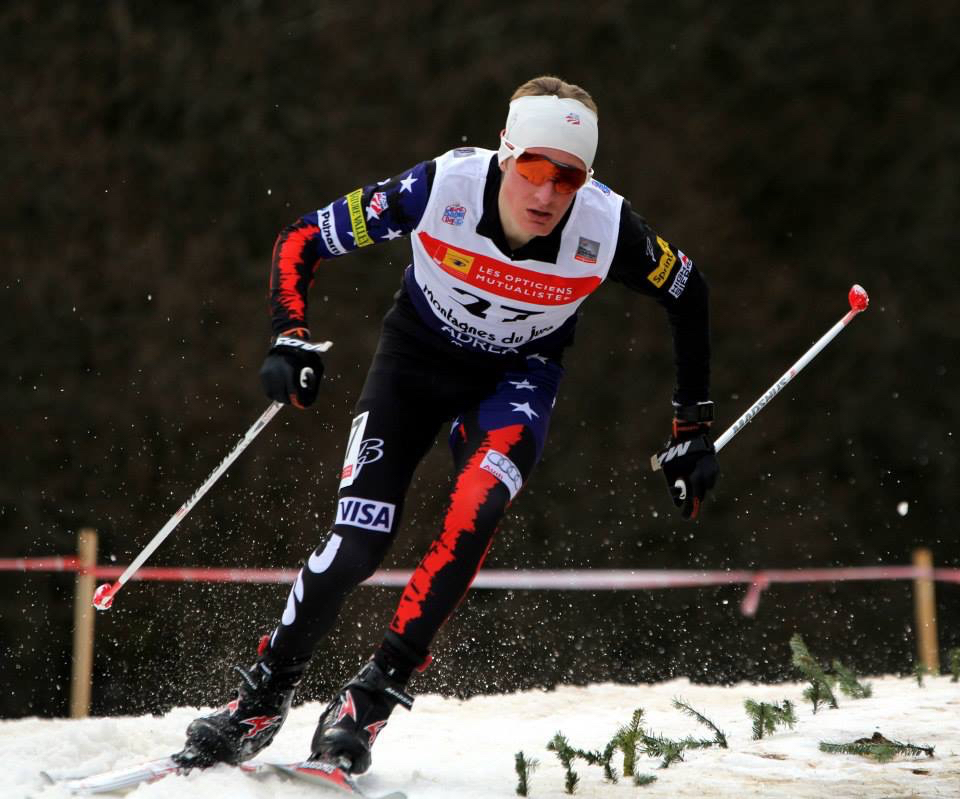
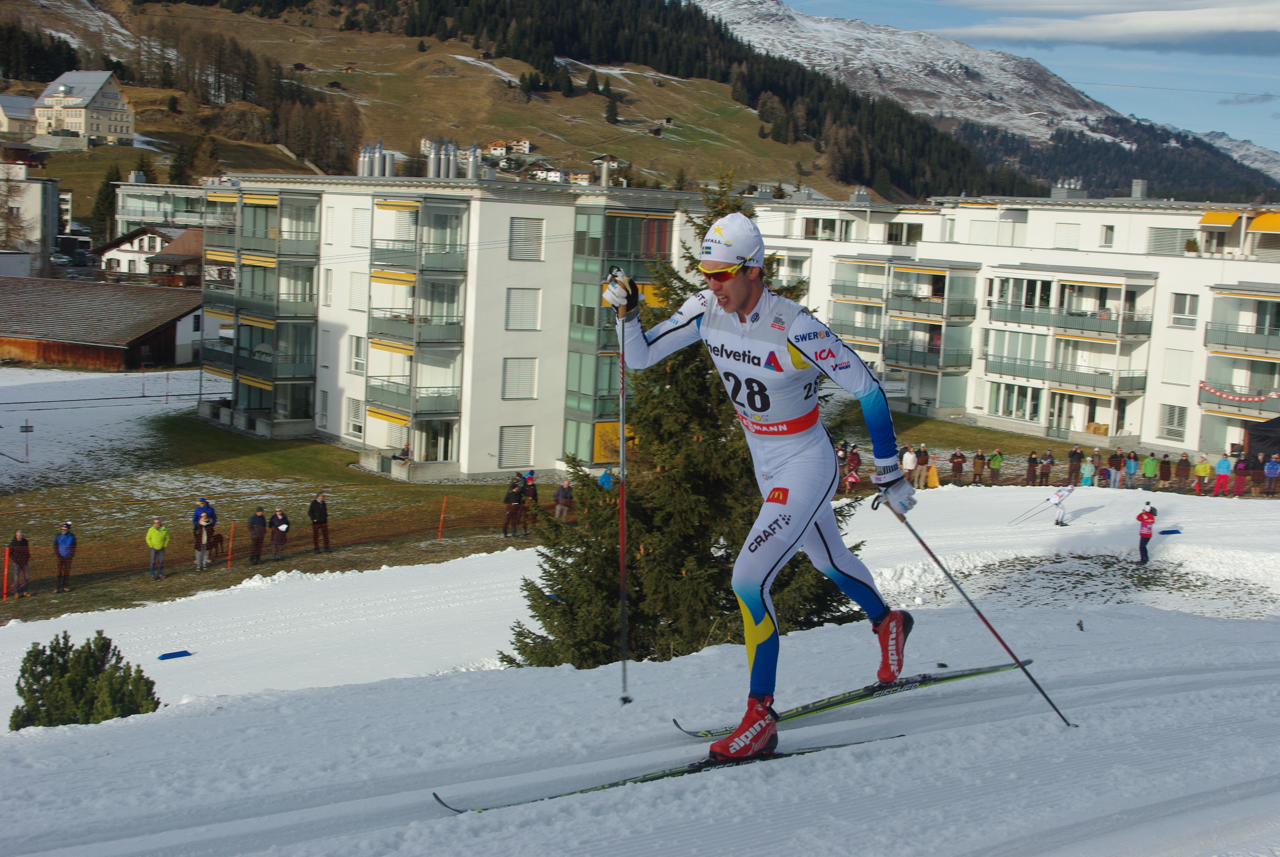
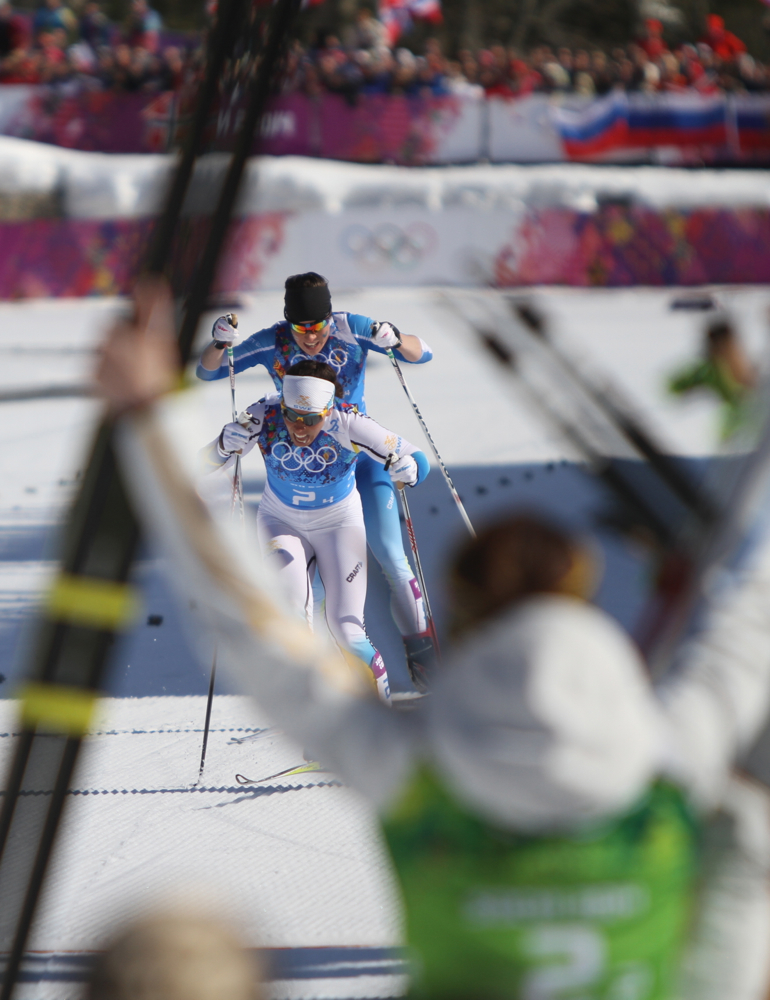
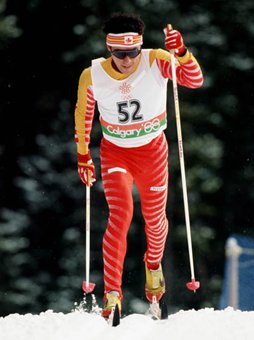
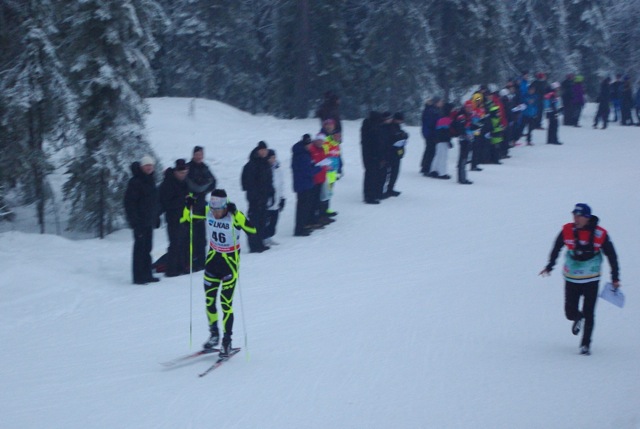
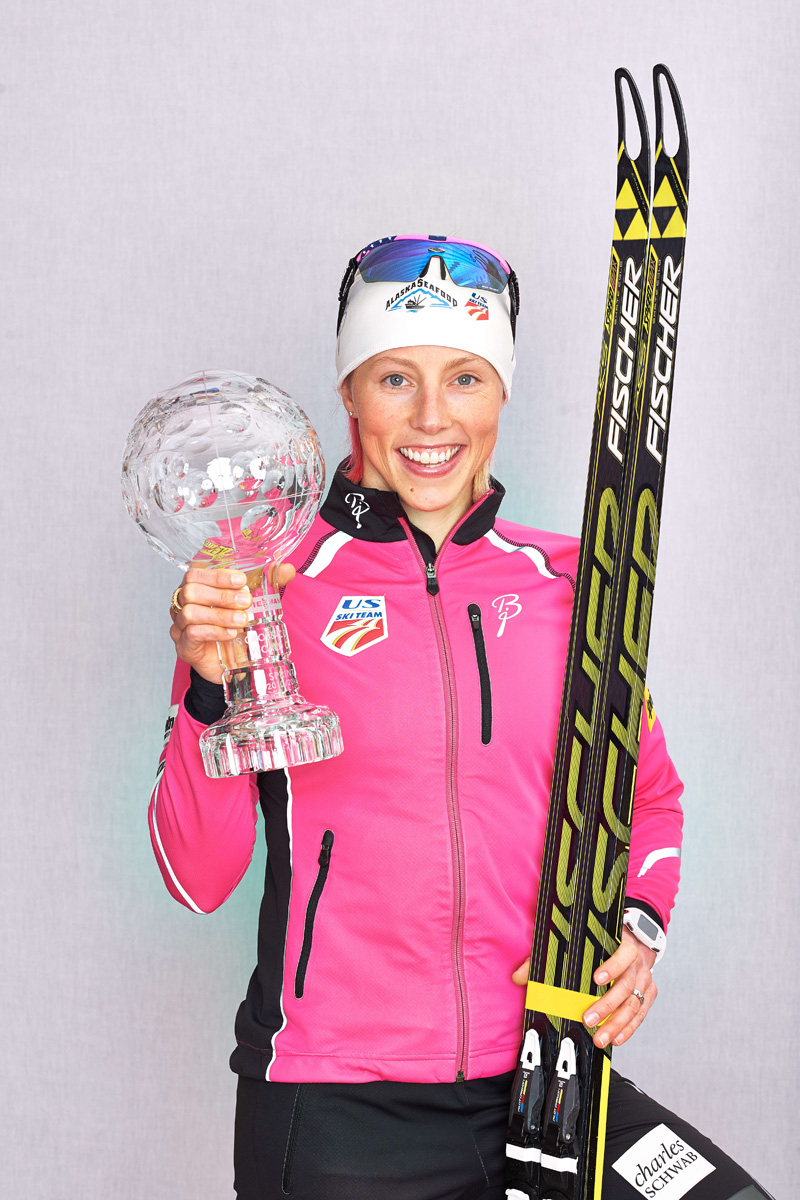
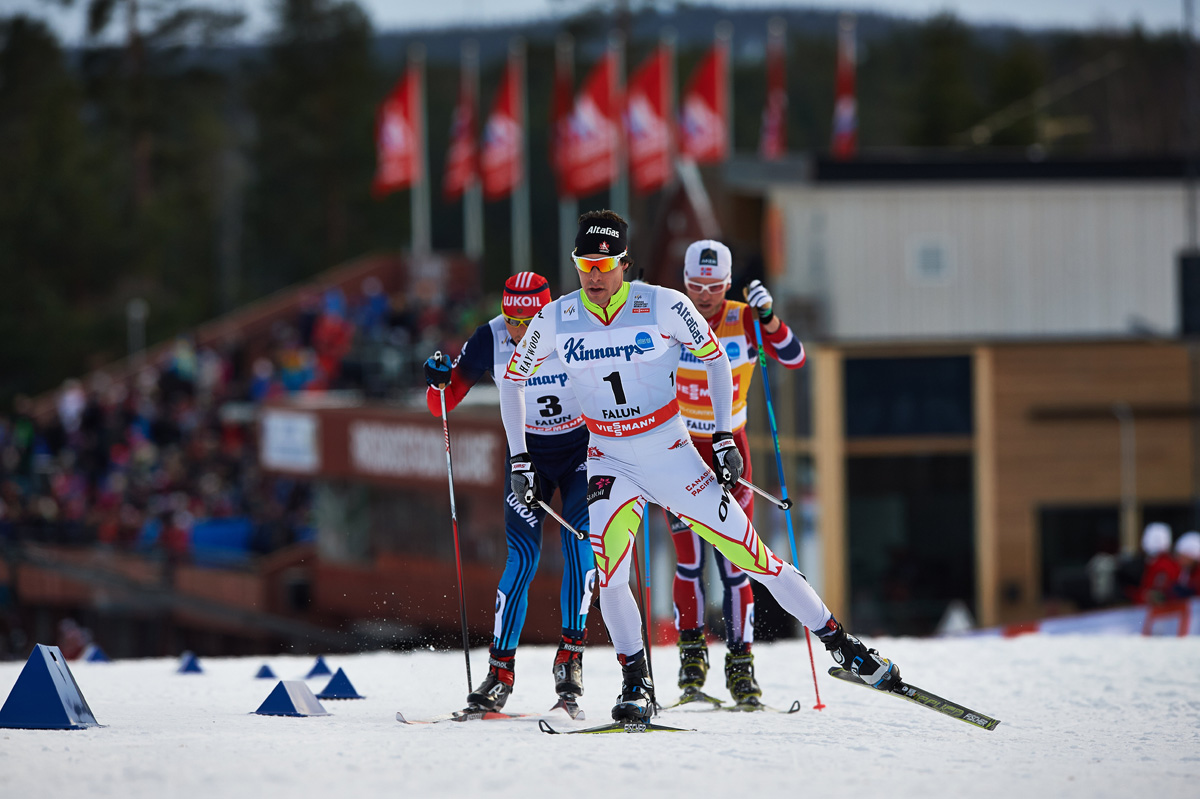
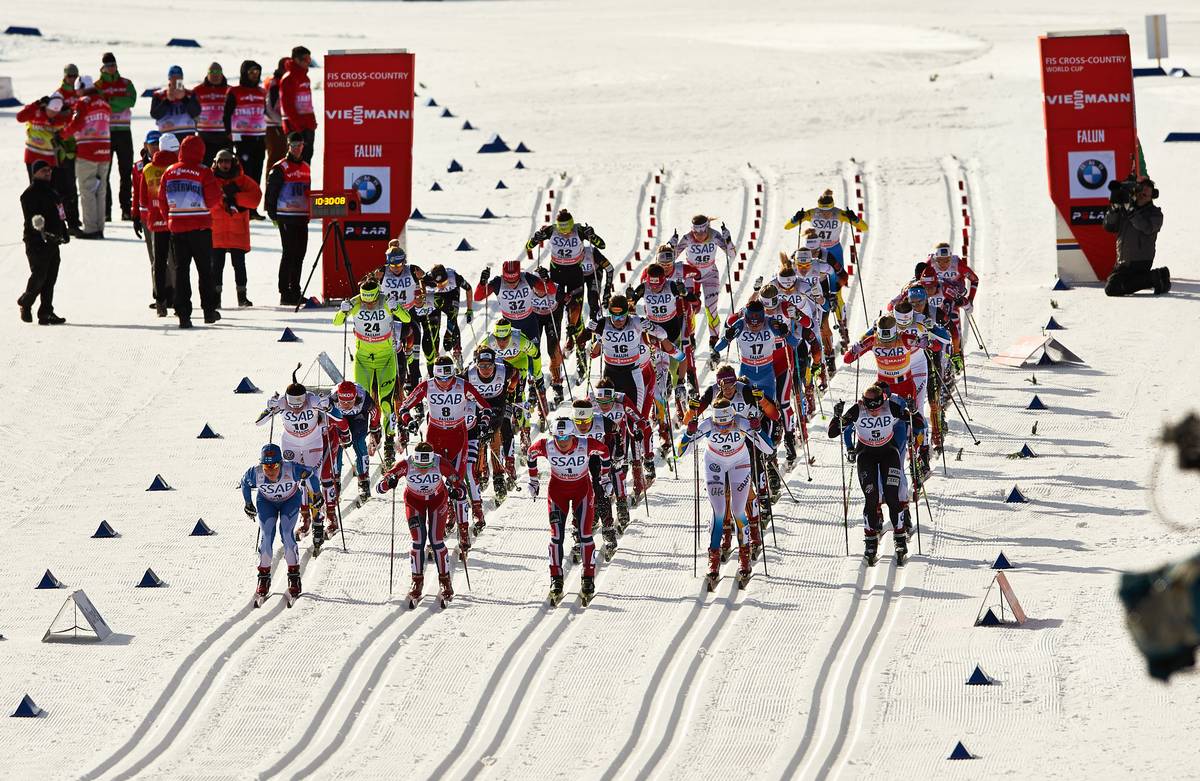
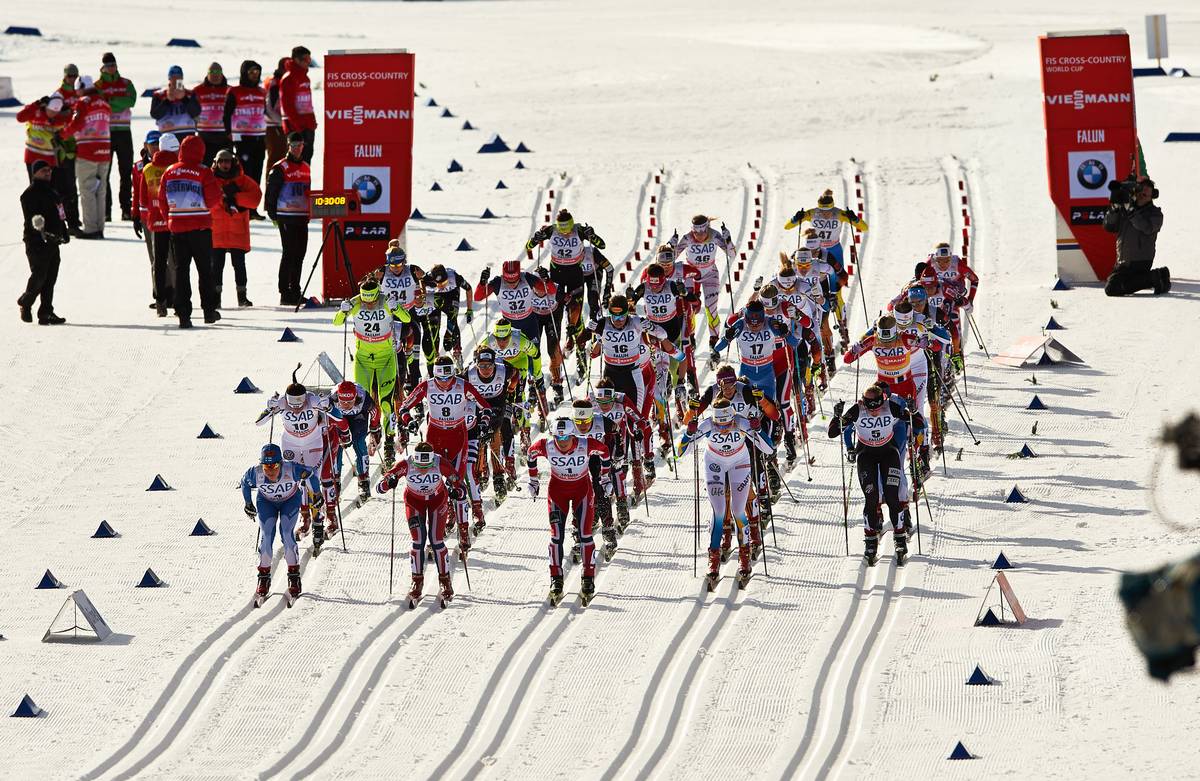
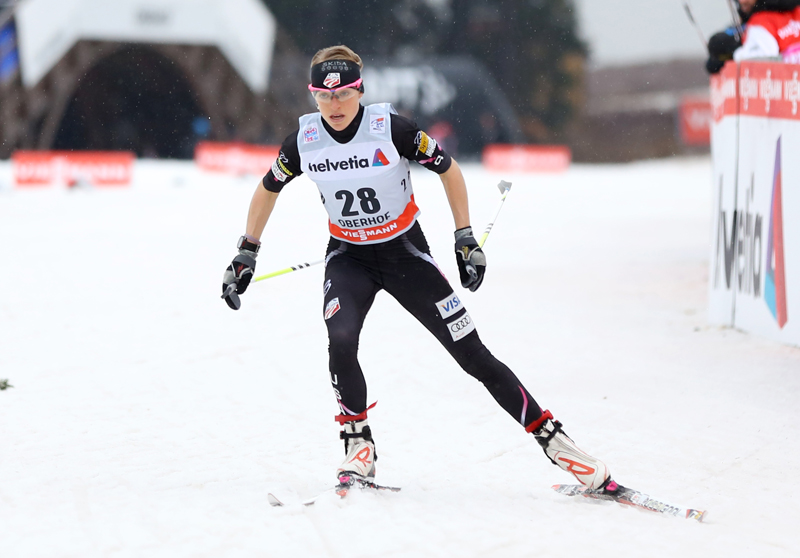
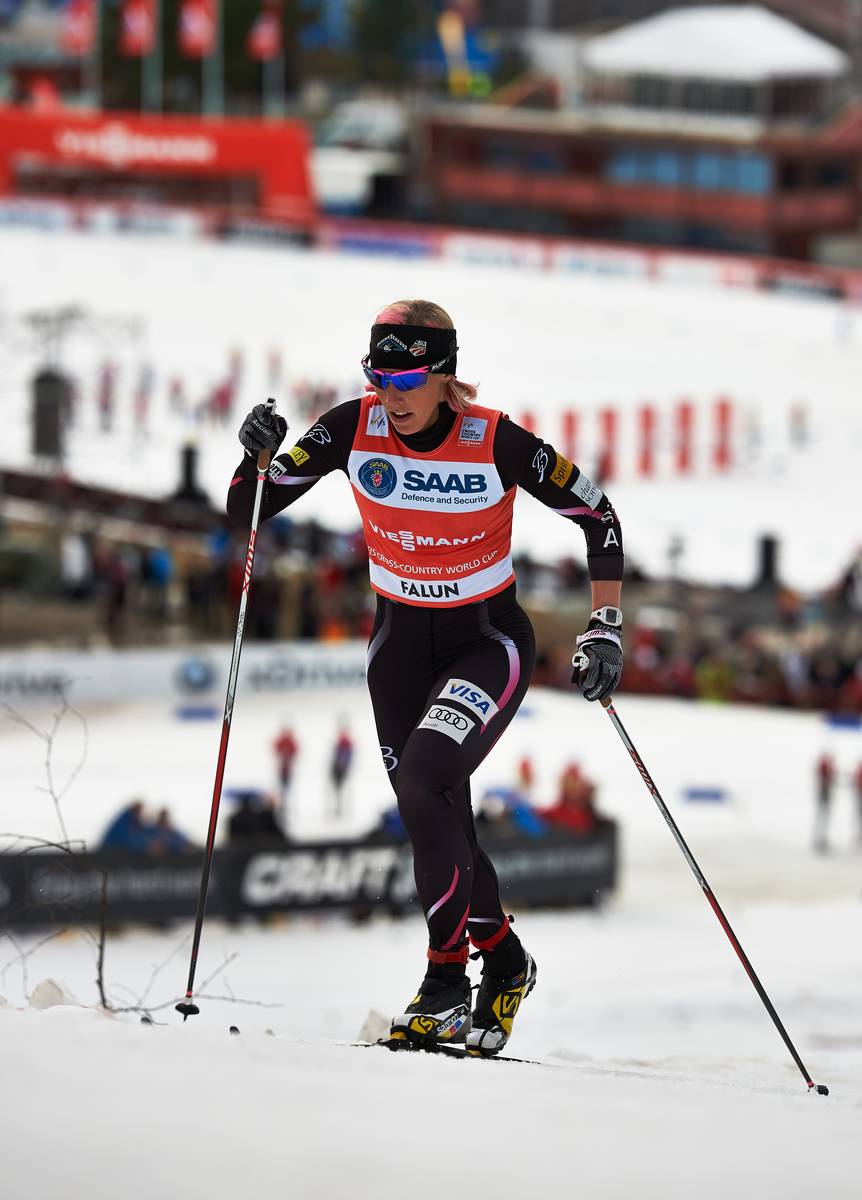
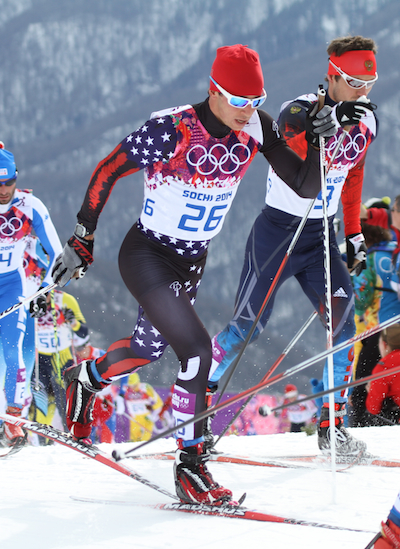
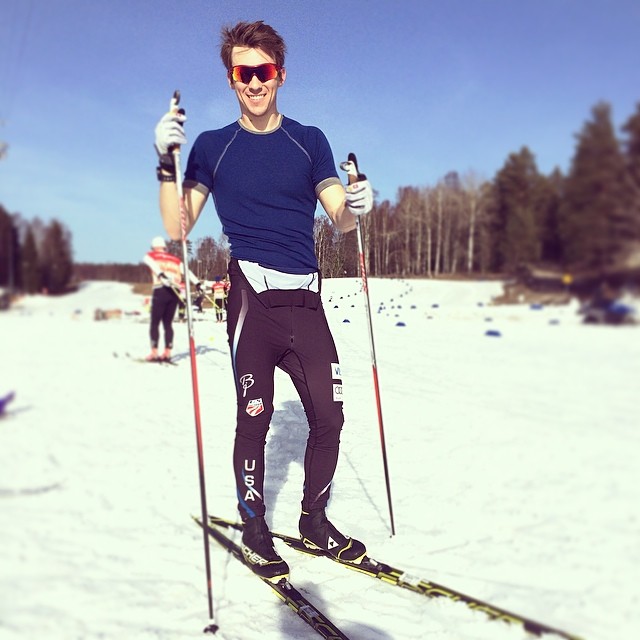
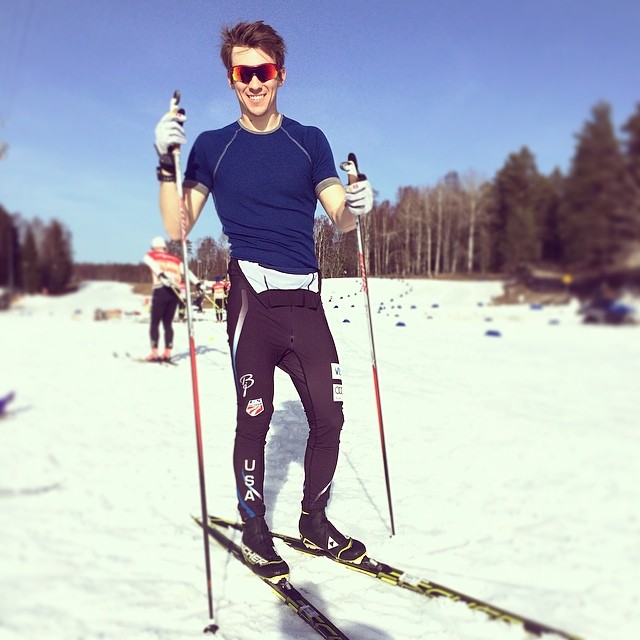
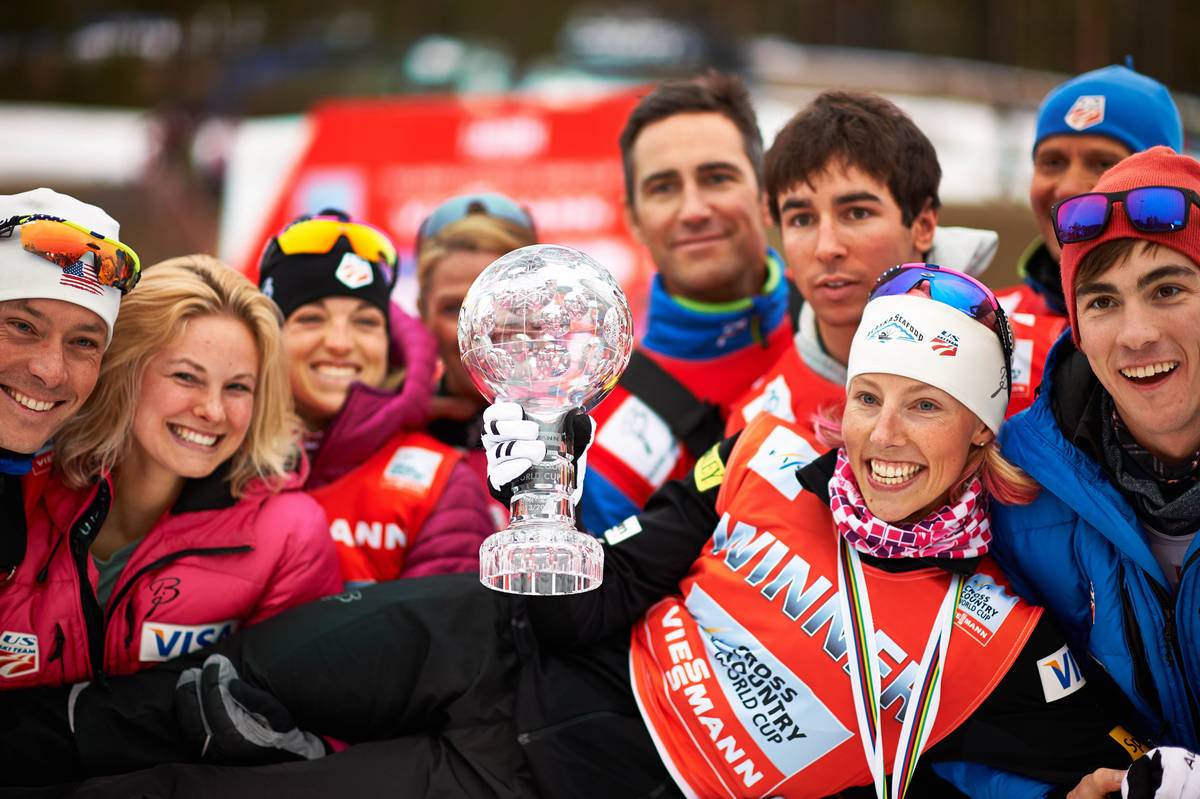
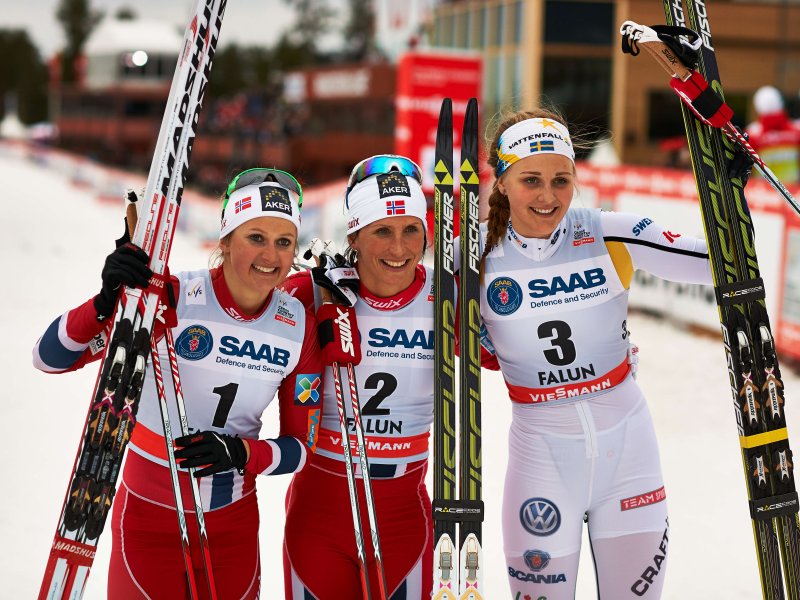
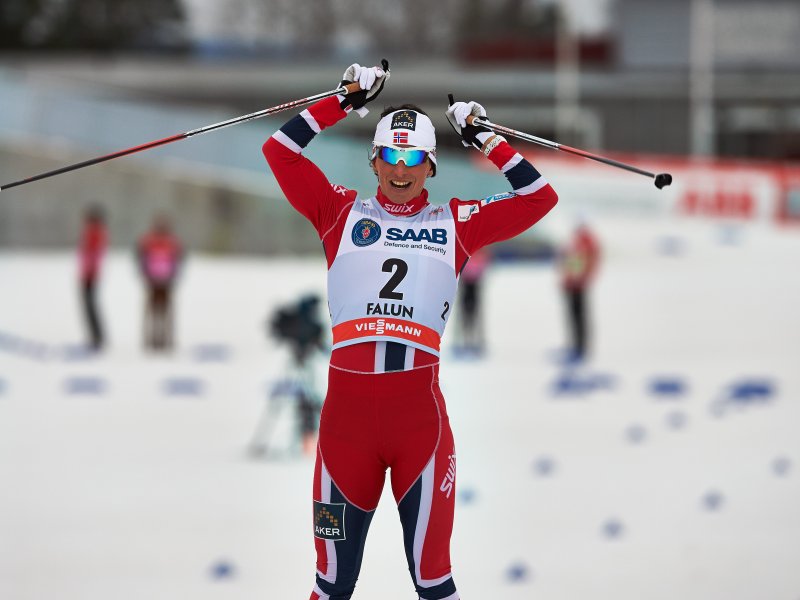
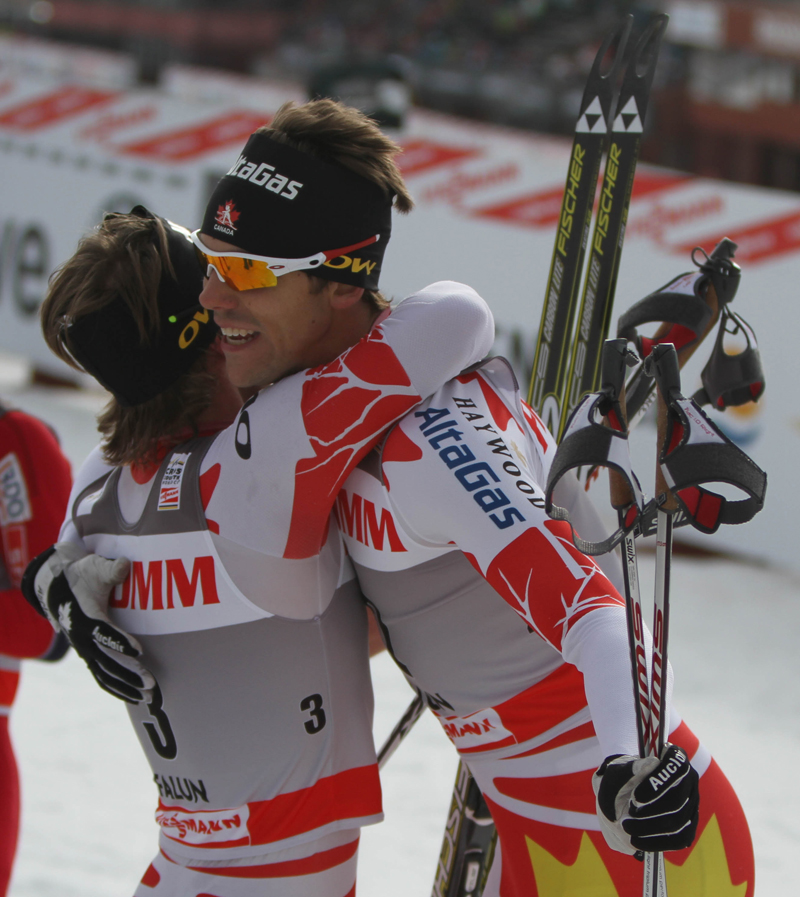
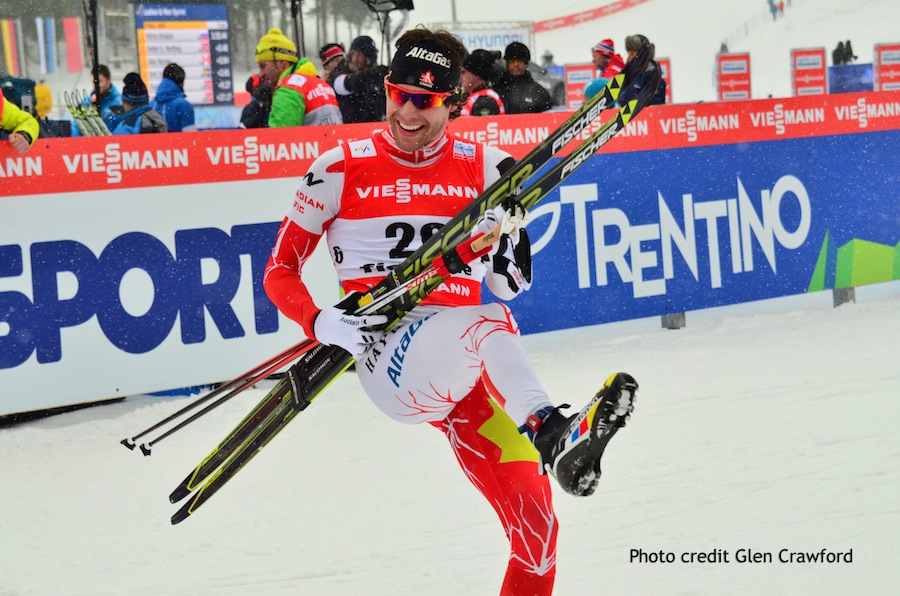
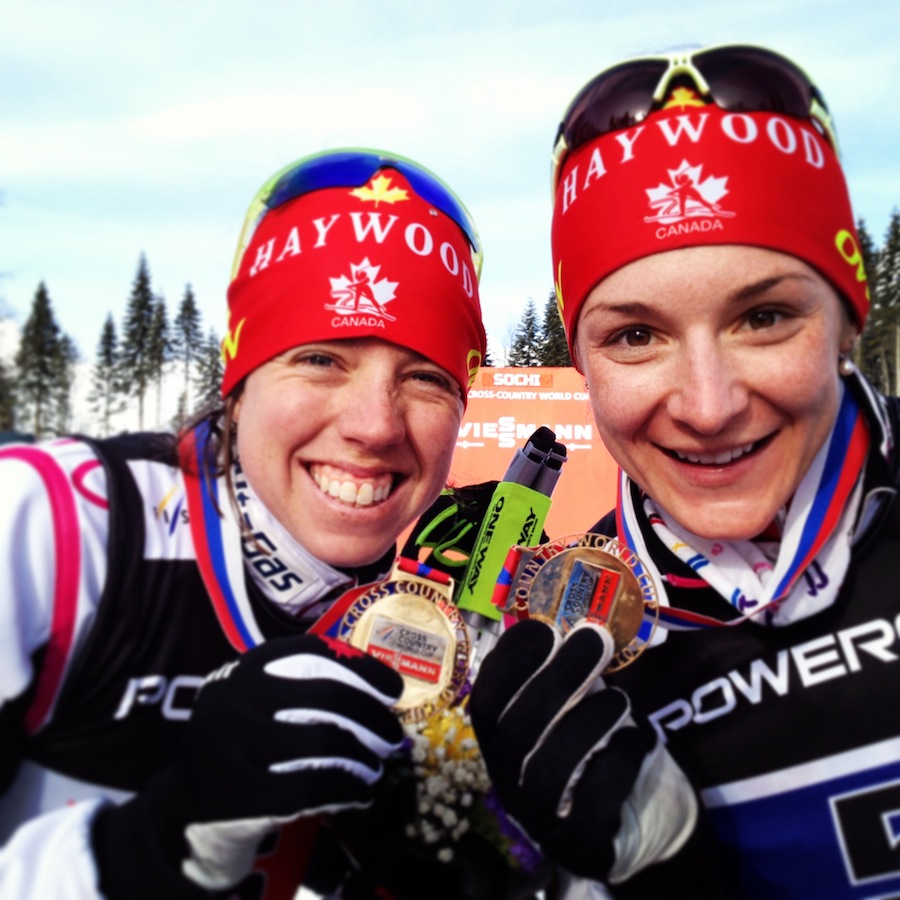
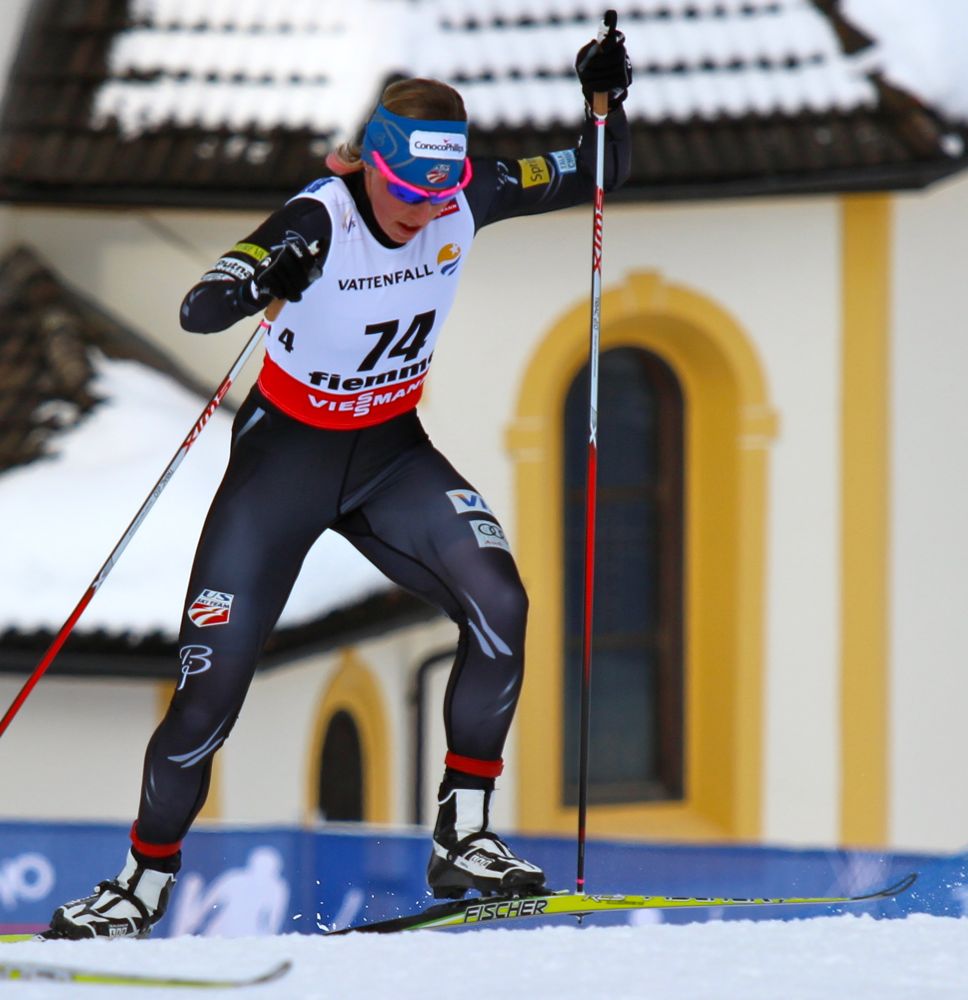
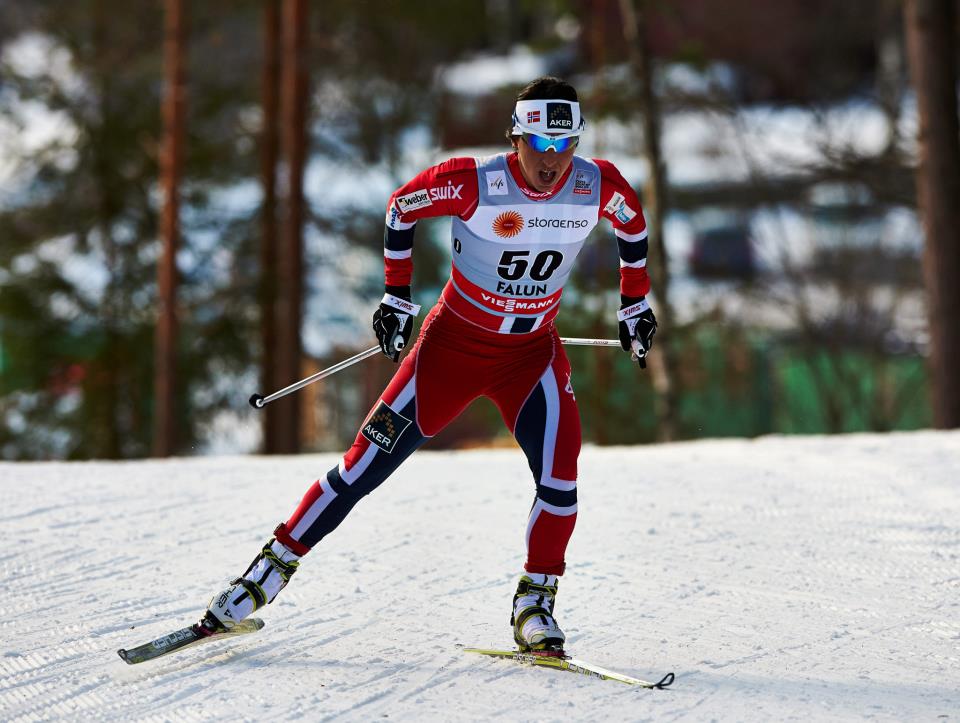
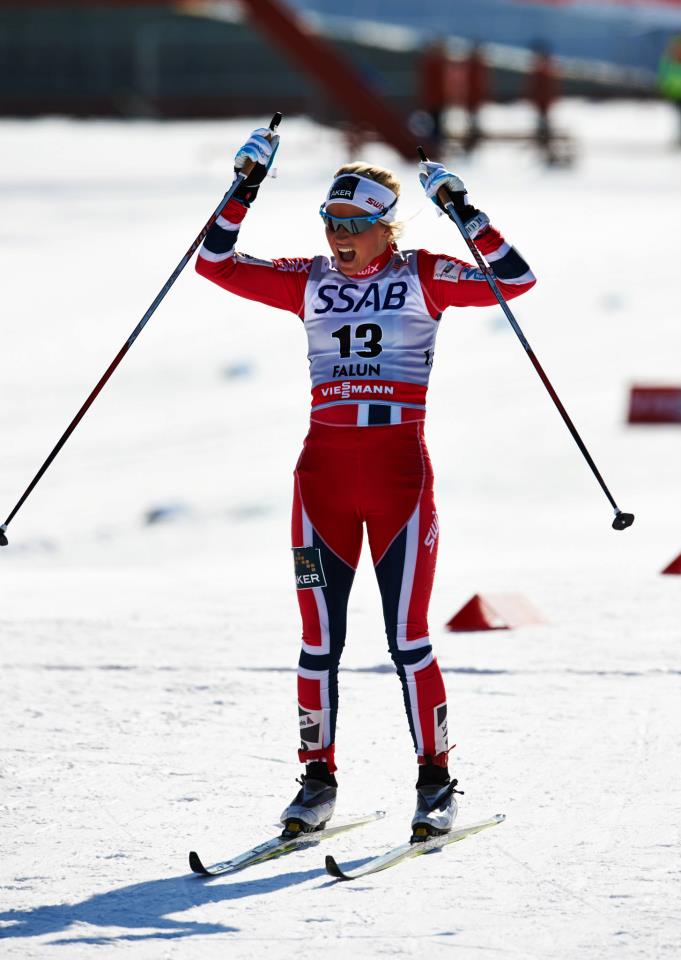
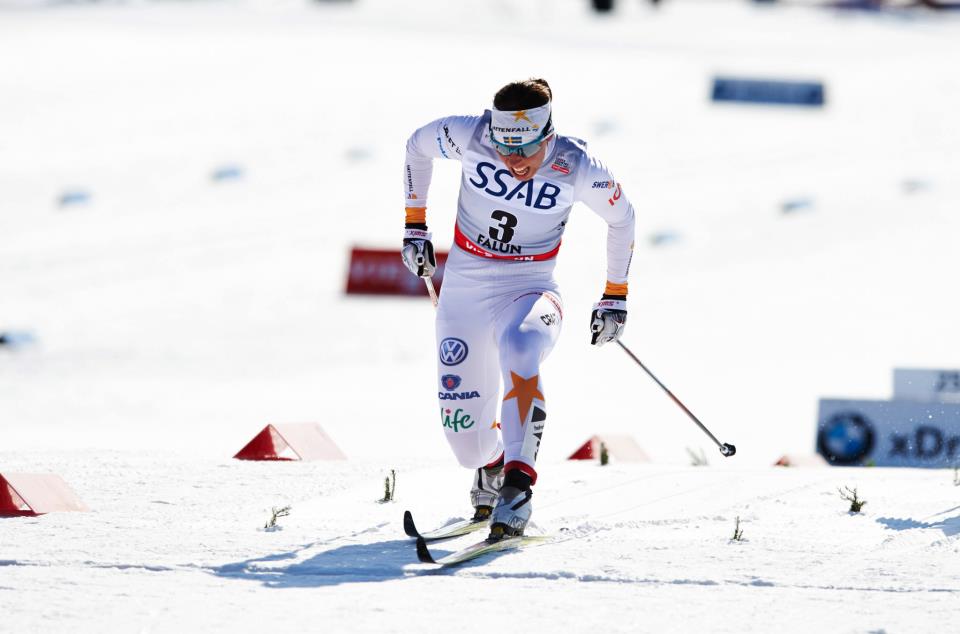
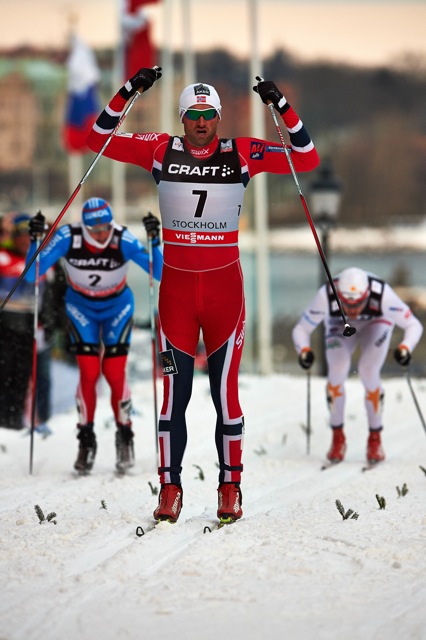
Sophie Caldwell (U.S. Ski Team) racing to 21st in the women’s 1.4 k classic sprint qualifier on the first day of medal competition at the 2015 World Championships in Falun, Sweden. (Photo: Flying Point Road)
FasterSkier’s coverage of the 2015 FIS Nordic World Ski Championships in Falun, Sweden, is brought to you by the generous support of L.L. Bean, now featuring a complete line of Kikkan Randall training wear.
FALUN, Sweden — Four North American women advanced to the heats on the first day of medal competition at the 2015 FIS Nordic World Ski Championships, with American Sophie Caldwell leading the crew in 21st in Thursday’s classic-sprint qualifier.
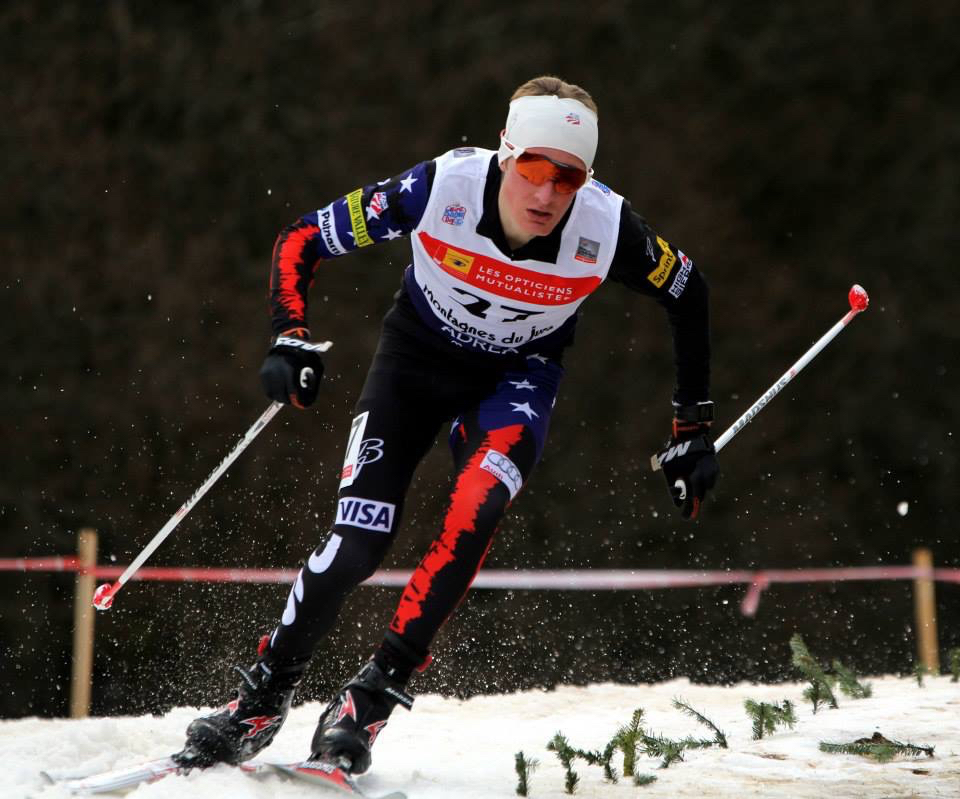
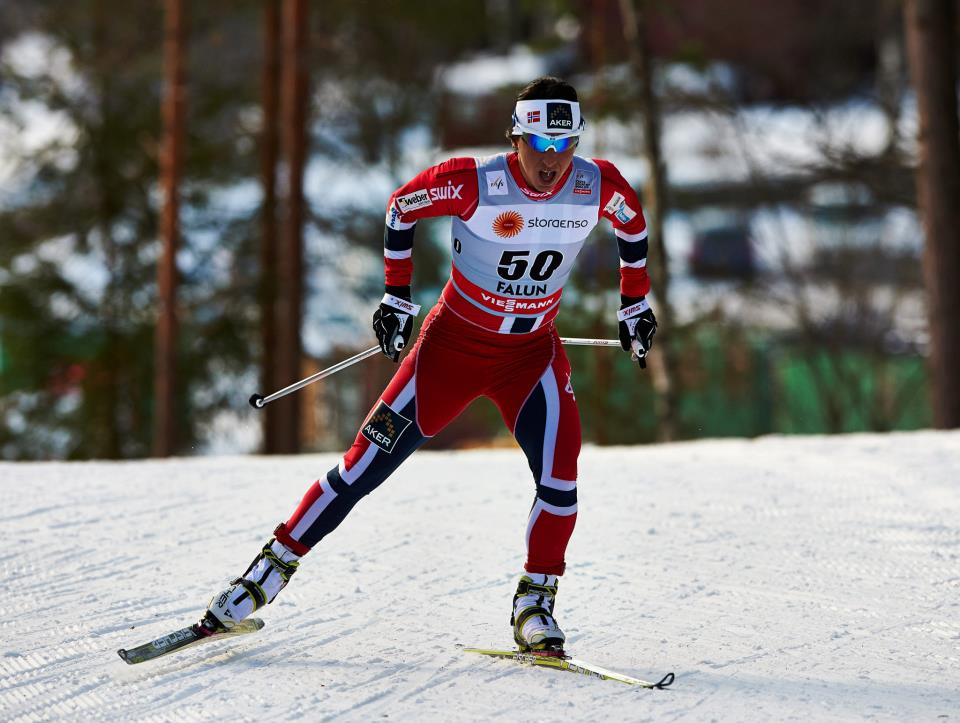
Poland’s Justyna Kowalczyk racing to first in the women’s 1.4 k classic sprint qualifier on the first day of medal competition at 2015 World Championships in Falun, Sweden. (Photo: Flying Point Road)
Poland’s Justyna Kowalczyk rounded the 1.4-kilometer course, marked by two significant climbs, with a top time of 3:24.89. Norway qualified in second through fourth, with Maiken Jaspersen Falla finishing 0.24 seconds back in second, Kari Vikhagen Gjeitnes clocking 0.51 seconds back in third, and Ingvild Flugstad Østtberg finishing 0.65 seconds behind in fourth.
Stina Nilsson led Sweden in fifth in the qualifier, 1.19 seconds after Kowalczyk, and Norway’s fourth of five women, Marit Bjørgen ranked sixth (+2.54).
Caldwell finished 7.87 seconds back in 21st, leading three American women in the top 30. Sadie Bjornsen was 26th (+9.47) and Ida Sargent qualified in 29th (+11.64).
“It was really hard,” Caldwell said after. “It was a long course with a lot of climbing. I think I took it out a little hot, but it was fun. It was crazy with the crowd.”
For the quarterfinal, she explained she’ll try to conserve as much as possible before a final downhill leading into a 90-degree turn and the finishing flat.
“Saving a little bit for the final stretch is going to be key,” Caldwell said. “It’s a long finish stretch.”
Canada’s lone female racing on Thursday, Perianne Jones qualified in 28th (+9.98), advancing to the quarterfinals for the second time this World Cup season.
“Compared to last week’s sprint course [in Östersund, Sweden], which was pretty short and little ups and downs, this was a hard hill off the start, for sure, but it’s a great sprint course,” Jones said. “I hope I feel a little better in the heats, but I’m happy at least to be in.”
One of the U.S. team’s favorites, Kikkan Randall did not make the heats for the second-straight classic sprint after placing 36th, 3.22 seconds out of the top 30 and 14.86 seconds behind Kowalczyk.
“I’m a little bummed, I’m frustrated,” Randall said. “I was hoping to find some better speed this late in the season but I’m still excited for the skate events to come up. Skating’s been going a lot better than classic for me, so good to get this one out of the way.
“For me, classic skiing is really 50/50,” she said. “When I nail it, I can be really strong and today I just felt like technically I didn’t nail it so I lost some key momentum on the top of the climbs. I was flooded, I gave it everything I had, but just haven’t quite found that magic yet this season.”
Randall’s Alaska Pacific University teammate Jessica Yeaton, racing for Australia, placed 51st in her World Championships debut, 31.46 seconds behind the winner.
“It’s kind of overwhelming, but at the same time it’s just another race so once you figure that out, it’s really fun,” Yeaton said. “Today I was kind of hoping to finish in the top 50 … I was pretty close. Really, [I’m not setting] super-high goals, but just trying to gain experience.”
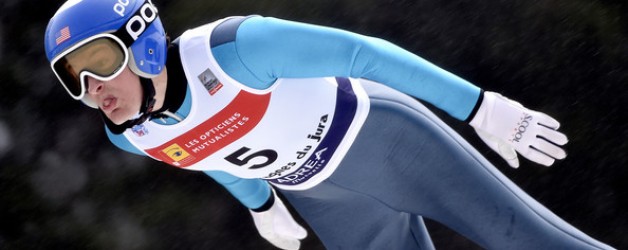
Adam Loomis (U.S. Nordic Combined B-Team) competing at the World Cup in January Chaux-Neuve, France, where he scored his first World Cup points. (Photo: Sandra Volk)
We can’t imagine anything much more exciting than making an event like World Championships for the first time, so we contacted the North American skiers living that exact dream this year.
Instead of interrogating them with the usual “tell us how you’re feeling,” we decided to pose the following 10 questions to each of the North Americans headed to their first World Championships from Feb. 18-March 1 in Falun, Sweden.
***
Exactly two weeks ago, U.S. Nordic Combined named five skiers to its 2015 World Championships team to compete in a total of four events (two individual, two team) in Falun. While three of the members were experienced veterans (Billy Demong, Bryan and Taylor Fletcher), two are newcomers to the World Championships stage: Adam Loomis and Ben Berend.
Loomis, 22, of Steamboat Springs, Colo., has been competing at the World Cup level since 2013, notching his career-best individual result of 21st in the large hill/10-kilometer World Cup on Jan. 10 in Chaux-Neuve, France. In December, he placed fifth with the World Cup men’s relay (with Demong and the Fletcher brothers) in Ramsau, Austria.
Last week, he emailed FasterSkier while training in Ramsau with the Continental Cup team, Taylor Fletcher and fellow U.S. B-team member Berend.
“The three of us have been over in Europe since the end of December,” Loomis explained. “Taylor and I chose to stay over after our last World Cup in Val de Fiemme, Italy to do a precamp in Slovenia and here in Ramsau. Ben just returned from World Junior Championship and came straight to Ramsau with the rest of the World Junior Team.”
At World Championships, Loomis is especially looking forward to the four-man team event.
“We’ll likely be one of the fastest teams on the race course and have a real podium shot if everything comes together right,” he told the National Nordic Foundation. “On the individual side, I’m not putting too much pressure on myself, but I know a top-20 is well within reach on any day.
“This has been my first year of competing consistently on the World Cup, and I’ve been able to break through with three top 30’s so far,” Loomis continued. “This has been a big step up for me, especially in comparison to the last couple years, where I haven’t reached all of my performance goals. Although I still have a long way to go, I’m proving to be an example of how work ethic and persistence eventually pays off. When I first made the Ski Team in 2012, I fully bought into our training system and am really starting to see the rewards now, especially on the cross country side.”
1. What was the first thing you did when you found out you were named to the World Championships team?
“Based on World Cup points, I already knew that I was qualified for the team before the official naming. Getting World Cup points in January was a big step in making the team and very satisfying to know I would be heading to Falun. That said, I felt extremely honored when I saw read the official team announcement last week.”
2. What’s been the biggest performance of your career so far? What one race stands out the most and why?
“My 21st finish at the World Cup in Chaux-Neuve, France was definitely my biggest result on the international stage. Another competition that stands out for me was US Nationals this fall, where I came in third. That was my first podium at a large competition since Junior Nationals, and a sign of a good winter to come.”
3. What are you most looking forward to at World Championships?
“I only competed in one World Junior Championship, but I remember being really psyched to be there representing the US. I think it will be the same for Falun; I’ll be honored to be skiing on behalf of the US.”
4. What’s your biggest motivation while competing?
“When I compete, I’m motivated to perform at the level that I know I’m capable of and then to keep improving every day. In Nordic Combined it’s pretty difficult to have a perfect day, and I’m always motivated to try to do better than the last time. Additionally, as a part of USA Nordic Combined, I feel like I have something to prove. The US Ski Team cut a large portion of our funding this year and included lack of future medal potential as one of their reasons. I’d like to show them otherwise.”
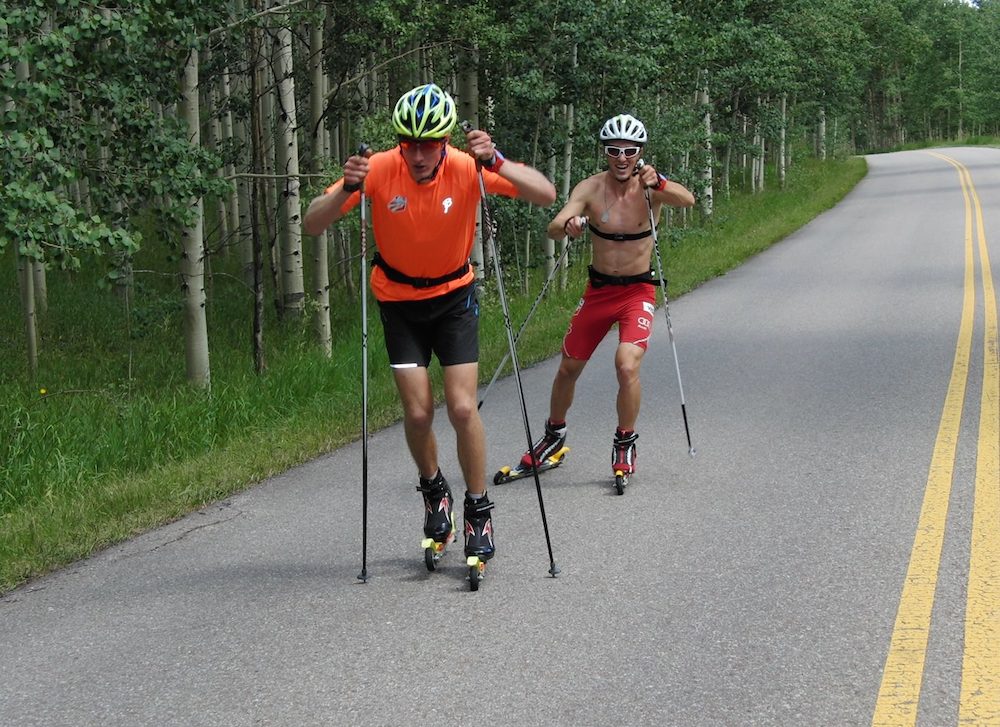
Adam Loomis (U.S. Nordic Combined B-team) leads teammate Michael Ward during a rollerski workout at a mini camp in August in Aspen, Colo. (Photo: USA Nordic Combined/Facebook)
5. Which event(s) do you hope or plan to compete in?
“In Falun I hope to compete in one or both of the individual events and the 4-man team event. I’m really looking forward to the opportunity for the team event. We’re one of the fastest teams on the XC side, and we will be in the fight for the podium if we just jump to our potential.”
6. If you could race the team sprint with anyone in the world, who would it be?
“I believe Joergan Grabaak (Norway) has won all of the last two-man sprints for the last year, so he’d be hard to pass up. Then again, if Taylor is jumping well, he’d be a sure bet. Taylor skied over a minute faster than the next fastest guy at the 2013 World Championship in this race.”
7. Which world cup skier would you least like to meet in a dark alley (or the final 100 meters of a race)?
“Probably Fabian Riessle (Germany). Judging from the ferocity that he sprints with, and his reputation to take out anyone on the way to the line, I wouldn’t want to get in a tight spot with him. Neither would his teammate Johannes Rydzek — who Riessle crashed out of a medal shot in the final 200 meters in Sochi.”
8. What will be your key to success in Falun?
“I think my success in Falun will be determined by how I perform on the jump hill. I’ve been racing really well and pretty consistently this year. Although my jumping is better than ever, I still need to be a bit more consistent and continue to raise my average level. Fortunately, I’ve had some good training in the last two weeks and feel confident going in.”
9. Finish this sentence: If I made the podium at World Champs __________.
“… I would be too pumped up to sleep for at least two nights. And then I would hope to finally get a legit head sponsor.”
10. Name a person who’s had a major influence on your skiing career.
“I always have to go with Billy Demong here. From the first junior National camp that he organized when I was 15, he’s shared what it takes to reach the top. Even more importantly, a he demonstrates a belief in myself and others to get their. Over they years, I’ve watched hime become a World Champion and ski to an Olympic Gold. I competed in my first World Cup with him in a team sprint, and now will be skiing alongside him in Falun. Over this turbulent last year, Bill has been our leading ambassador in forming our own USA Nordic Combined Team and seeking funding outside of the US Ski Team.”
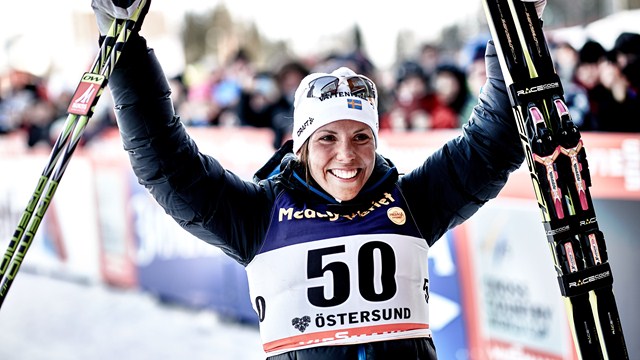
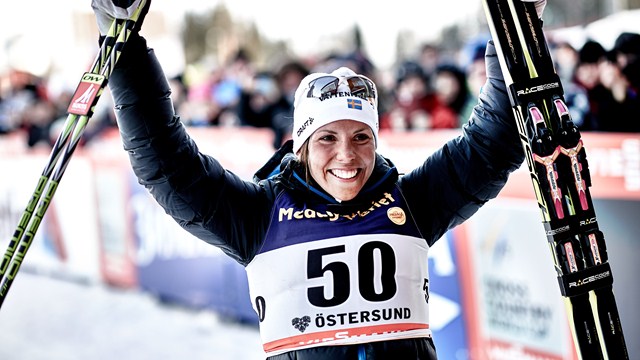
Sweden’s Charlotte Kalla came up big in front of a home crowd in Östersund, Sweden, winning Sunday’s 10 k freestyle by more than 36 seconds over Norway’s Marit Bjørgen. (Photo: FIS)
With only days to go until the 2015 Nordic World Ski Championships in Falun, Sweden, nobody could touch home-crowd favorite Charlotte Kalla in the women’s World Cup 10-kilometer freestyle individual start on Sunday in Östersund, Sweden.
The 27-year-old Kalla polished off the challenging, hilly, two-lap course in 23 minutes and 26.1 seconds for her first World Cup win since March 2010, when she won the 10 k freestyle at World Cup Finals. She was more than half a minute ahead of Marit Bjørgen of Norway in second place, and nearly a minute ahead of Therese Johaug of Norway, who have been dominating the World Cup since the first races in November.
“It feels great to win a World Cup again,” Kalla said to FIS reporters after the race.
Kalla was quick to thank the spectators for carrying her through the challenging course and also noted that she felt like she had some home turf advantage.
“The crowd here in Östersund was so encouraging. I know the courses here very well, and I felt strong,” she said, adding that Feb. 15 marks a special anniversary for her.
“I won Olympic gold in Vancouver on this day, and again last year in Sochi we won the relay on this day, and now a World Cup win today,” Kalla said.
Kalla chose to sit out the 2014/2015 Tour de Ski in favor of training and peaking for the World Championships on home turf later in the season, a strategy she chose with success also leading up to the 2010 Olympics in Vancouver.
Left Bjørgen in the dust
Saturday’s sprint winner and Overall World Cup leader, Bjørgen was clearly ahead of her primary rival Johaug, starting a minute after her teammate and beating Johaug by more than 15 seconds. But even the queen of cross-country skiing was more than half a minute behind Kalla, who started 50th, over 10 kilometers.
Bjørgen in bib 72 never came close to matching Kalla at any point of the race, with Kalla leading by 10.4 seconds at 1.8 k, then 25.4 seconds at 6.8 k. At 8.3 k, Bjørgen remained in second, but was 31.5 seconds behind Kalla.
“I didn’t feel as strong today as yesterday, but I am really happy for Charlotte,” Bjørgen told FIS after the race. “It is so nice to see her back on top of the podium. It’s great for her, and it is important for the sport, especially with the World Championships here in Sweden.”
“It’s great for her, and it is important for the sport, especially with the World Championships here in Sweden.” — Marit Bjørgen, runner-up in Sunday’s 10 k freestyle to Sweden’s Charlotte Kalla
Despite finishing second, Bjørgen locked up her fourth Overall World Cup title on Sunday with a 565-point lead on Johaug (last year’s overall winner) with four World Cup races to go.
Kalla skied confidently for the start. Low to the ground, she pushed off calmly and powerfully, getting the most out of every stride. The Norwegians skied with higher turnover, but on Sunday, their style resulted in less speed.
At 1.8 k, Kalla remained more than 13 seconds ahead of Johaug and Weng. At 8.3 k Kalla was a whopping 48.2 seconds ahead of Johaug in third.
While Kalla left the Scandinavian Cup races in January in Falun in tears (where she won the 10 k freestyle and took fourth in the classic sprint and skiathlon), she gave a taste of what is in store during the Swedish national championships two weeks ago when she dominated the rest of the field in both the skiathlon and the 10 k freestyle in Örebro.
On Sunday, Kalla won with 36.5 seconds to spare to Bjørgen in second place. Johaug was third, 53.6 seconds behind Kalla. Norway’s Heidi Weng and Astrid Uhrenholdt Jacobsen finished fourth and fifth, respectively, 1:01.3 and 1:08.3 back.
Scandinavian dominance
Nicole Fessel of Germany in sixth place was the top non-Scandinavian in the 10 k skate race, more than a minute behind Kalla, and about 20 seconds out of the podium. Riitta-Liisa Roponen of Finland was seventh, Martine Ek Hagen of Norway was eighth, Yulia Tchekaleva of Russia was ninth, and Ragnhild Haga of Norway was 10th.
Jessie Diggins in 17th place was the top American in the final test run before the World Championships, which open with classic sprints for both men and women on Thursday. Diggins was 1:45.7 behind Kalla. Liz Stephen was 26th, Rosie Brennan was 32nd and Kikkan Randall was 33rd for the U.S., while Emily Nishikawa placed 36th for Canada.
Prior to the World Cup round in Östersund, both the Swedish and the Norwegian national teams have been training and preparing for the World Championships at altitude in the Italian Alps.
After this weekend, Kalla travels to Falun, to start the final preparations for the World Championships. For her, the first event will be the 15 k skiathlon on Feb. 21.
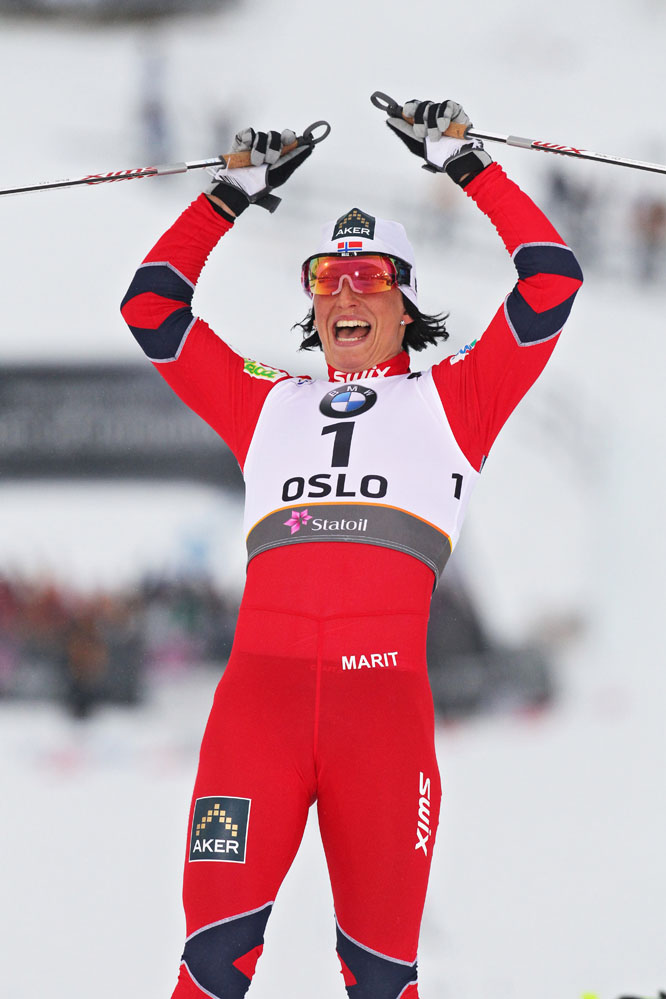
When Marit Bjørgen won Saturday’s classic sprint in Östersund, Sweden, she accomplished a few notable facts: it was her 90th World Cup win in a storied career; she overtook Norwegian teammate Ingvild Flugstad Östberg in the Sprint Cup standings; and she positioned herself even better than she previously had, if that was possible, for the 2015 World Championships which start in nearby Falun next week.
Yet if you ask Bjørgen, she still feels that a medal sweep in Falun is impossible.
“No, I cannot not take six gold medals in the World Championships,” she told Norwegian broadcaster NRK. “ Then I must have more luck than today. There is so much that has to fall into place that I do not think it is possible.”
Bjørgen won the 1.2 k sprint by 1.8 seconds over teammate Maiken Caspersen Falla. The only non-Norwegian in the sprint final, Stina Nilsson of Sweden, placed third; Kari Gjeitnes, Östberg, and Celine Brun-Lie rounded out the top six.
Bjørgen now leads the overall World Cup by more than 500 points over another Norwegian star, Therese Johaug, and has won 12 different competitions so far this season. The only time she finished off the podium was in a classic sprint in Davos, Switzerland, in December.
The star told NRK that the course – a new one on the World Cup circuit, with unique features like a trail that headed straight through the middle of the grandstand and out the other side – did not suit her. But she felt strong.
“I knew I had strength,” she said.
It was Bjørgen’s first World Cup competition since the Tour de Ski ended in January, and she said that she was happy to see that the positive signs from that tour – which she won convincingly – were multiplying.
“The shapeisbetter and better,” she told adressa.no. “I havea good feelingnowbefore the World Championships. I’mglad that Ihadgood speedin the body and I’m very much looking forward toFalunnow… it suggests that, at least, I’m not worse than I was in recent years.”
As such, she plans to start six competitions at World Championships.
And yet, she said, during a Championships her fitness could possibly go downhill.
“I have felt very good in summer and fall… although I am in very good shape, things can get a little heavier and then it gets tough.”
Besides her many speedy teammates, Nilsson could be a threat to Bjørgen in the sprint at World Championships. She has yet to win a World Cup, but the Swede – who leads the Helvetia U23 rankings – has two previous second-place finishes this season and will be competing on home soil.
She’s trying not to let the pressure get to her.
“It’s something that I and my mental coach have been quite clear about,” she told Swedish daily Dagbladet. “There’s a place I want to be in, and it’s here and now. Not to be in Thursday when it’s only now Saturday.”
The other big news for Norway was that with her fourth-place finish, Gjeitnes earned a start in the classic sprint at World Championships over Heidi Weng, who currently sits third in the overall World Cup rankings and had been assumed to be a starter.
“I can only tip my hat to her,” Weng, who placed 10th in the sprint, told NRK.
“I’m very satisfied,” said 30-year-old Gjeitnes, for whom it will be the first World Championships.
Charlotte Kalla (R) and Ida Ingmarsdotter won the team sprint at 2011 World Championships, but finished second to Americans Kikkan Randall and Jessie Diggins in 2013. Sweden hopes to reclaim that crown on home turf in Falun in February.
After concluding its national championships this weekend, Sweden has picked its team for World Championships. The country is hosting this year, with the event set to take place in Falun in mid-February.
The team features past World Champions Charlotte Kalla, Ida Ingemarsdotter, Johan Olsson, and Marcus Hellner, as well as World Cup Sprint Cup champions Emil Jönsson and Teodor Peterson. There are also newcomers, like Jennie Öberg, who won her first World Cup competition in January, and Stina Nilsson, who has broken onto the scene in the past two seasons.
Here’s the team named, and then a summary of the national championships results and what they might mean for Worlds.
Women
Charlotte Kalla, Piteå Elit
Emma Wikén, Åsarna IK
Anna Haag, IFK Mora SK
Ida Ingemarsdotter, Åsarna IK
Sofia Bleckur, IFK Mora SK
Stina Nilsson, IFK Mora SK
Hanna Falk, Ulricehamns IF
Magdalena Pajala, Piteå Elit
Jennie Öberg, Piteå Elit Reserve:
Maria Rydqvist, Älvdalens IF
Men
Calle Halfvarsson, Falun-Borlänge SK
Johan Olsson, Åsarna IK
Lars Nelson, Åsarna IK
Daniel Richardsson, Hudiksvalls IF
Marcus Hellner, Gellivare Skidallians
Martin Johansson, IFK Mora SK
Emil Jönsson, IFK Mora SK
Teodor Peterson, IFK Umeå
Johan Edin, IFK Mora SK Reserve:
Anders Södergren, Hudiksvalls IF
Carl Quicklund, Östersunds SK
Swedish National Championships Rundown
Skiathlons, January 28
Marcus Hellner – here finishing 29th in the World Cup 15 k classic in Davos, Switzerland, in December – has struggled this season. But he eked out a win at National Championships in the skiathlon.
Charlotte Kalla owned the women’s 15 k skiathlon, racing to a 59-second win over Stina Nilsson. Emma Wiken placed third and Anna Haag fourth. Colorado University alumna Maria Gräfnings placed eighth, 1:48 off the podium.
In the men’s 30 k skiathlon, Marcus Hellner gave a hint that he’s back on form, beating Lars Nelson and Johan Olsson in a sprint finish. Calle Halfvarsson, who has been the top Swede in World Cup racing all season, placed ninth – two and a half minutes back. Both he and Anders Södergren had crashes which took them out of contention, while Johan Olsson had binding issues and had to get a new ski partway through the race.
Although he would have preferred to beat these rivals in a sprint finish to prove that his shape is really back, Hellner said that the victory was a good sign.
“I tried to grill the others on the long hill, but I was not so strong that I could ski away,” he said, according to Langd.se. “The rest of the trails ere a little too easy to be able to do something. But the race gave me good news. Now I think I will become more alert and energetic moving forward to the World Championships.”
Relays, January 29 – were not used in World Championships decisions.
10/15 k freestyle, January 31
Charlotte Kalla was a hero of the 2014 Olympics, and dominated her own national championships this week. Will she be able to give the home team gold in Falun?
Kalla repeated, and even bested, her previous win by demolishing the woen’s field in the 10 k skate. She beat runner-up Haag by a minute and 19 seconds; Wiken was seven more seconds behind. Gräfnings was sixth but still over a minute off the podium.
Kalla said that the race was “very easy”, according to Dagbladet, and that she felt great all week. She feels well-prepared for World Championships. She’s off to Seiser Alm to put in an altitude training block.
“I feel and know that the largest job is done,” she said. “The biggest part of the training is made, but it comes to keeping a continued focus on the workouts that still have to be done. There will not be any huge changes in technical terms, but still a bit small parts that can sit even better when the real shape come around… But above all it has been a desire to stand on the starting line at the World Championships once it arrives, and we try to enjoy the journey to get there as well.”
In the 15 k, Halfvarsson bounced back to his previous form while Hellner faltered – showing that if anything, he’s simply inconsistent this season. Halfvarsson posted a 37.9-second victory over Daniel Richardsson, with Anders Soedergren third.
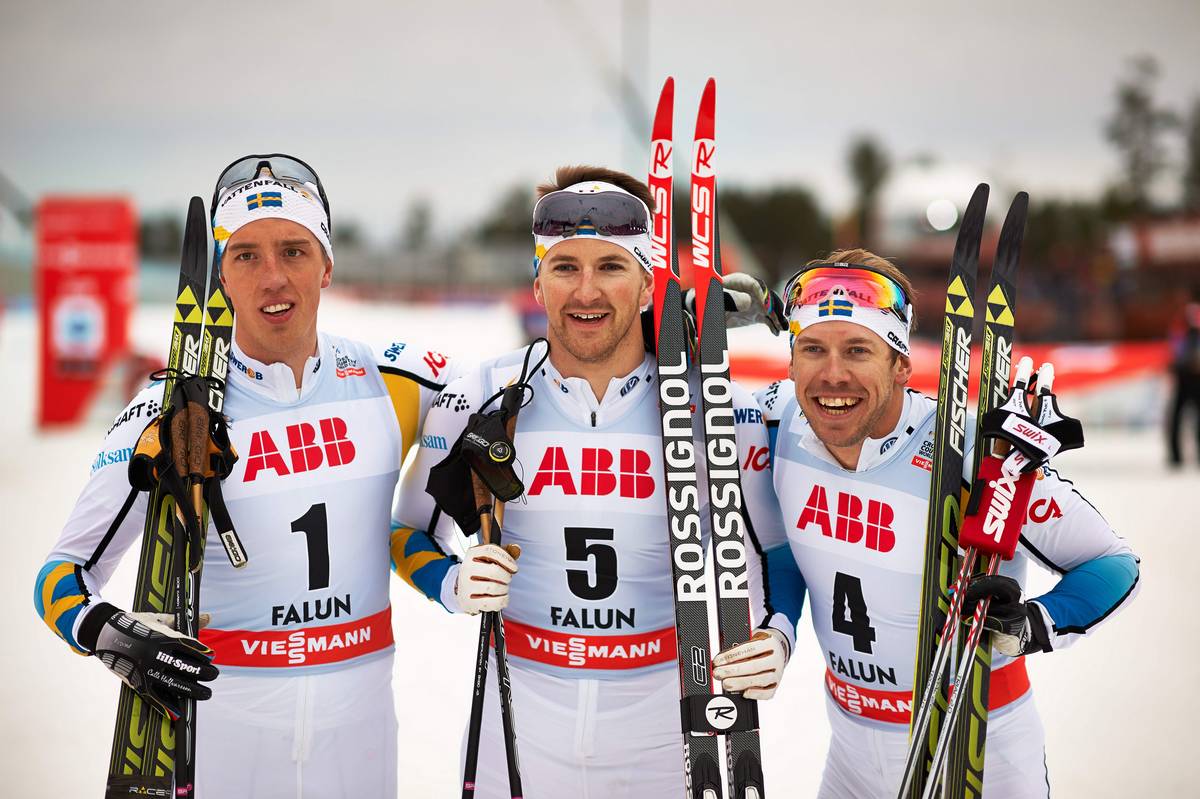
Sweden’s three best hopes in sprinting and mid-distance (l-r): Calle Halfvarsson, Tobias Peterson, and Emil Joensson. (Photo: Fischer/NordicFocus.com)
In the women’s sprint Hanna Falk won qualifying and then marched straight through to the final, which she also won. Magdalena Pajala placed second and Maria Nordström third. Sprint favorites Nilsson, Kalla, and Ida Ingemarsdotter did not compete. Linda Danvind-Malm of the University of Vermont placed tenth.
Finally, in the culminating event of the championships, Emil Jönsson proved that he’s not going anywhere when he captured the men’s sprint title. Teodor Peterson was the runner-up and Jesper Modin placed third. Neither Jönsson nor Peterson have been totally on form this season, but they say that things are coming around.
“It was fantastic, how I am at the final stretch and still feel pretty fresh,” Jönsson told Expressen. “It was also important to get to the final, I’ve barely been in the finals this year.”
Johan Edin missed the final of the sprint, but was still selected for the team ahead of several other racers who had better results at the National Championships. He explained to Expressen that his skis iced at some point during the heats, and that he was sure his shot at Falun was gone.
“It has been an emotional roller coaster,” he said. “The feeling when you think everything is going wrong. I had packed bag and was about to go home. They were lucky that Richard had time to catch me before I did it.”
Norway’s team to the World Championships in Falun, Sweden, was announced after the 15 k/ 30 k skiathlon at the Norwegian National Championships in Røros today. Norway will send a squad consisting of 11 women and 12 men to the 2015 FIS World Championships, which take place in Falun, Sweden, from February 18 to March 1.
The team includes both favorites from the World Cup circuit so far this season – including the athletes who have dominated the World Cup points and prize money – and a few carefully-taken choices based on more recent results. For instance, both Astrid Uhrenholdt Jacobsen and Kristin Størmer Steira were named to the team after making their World Cup debuts for the season in Rybinsk, Russia, last weekend. Jacobsen won her first start, while Steira placed fifth in her first start after recovering from a double hip fracture this fall.
The Norwegian national championships were a major part of the selection criteria – so important that the national team coaching staff ordered Petter Northug to cut his altitude camp in the Alps short and compete at the championships if he wanted to be considered for the national team that will represent Norway in Falun in February.
The championships opened with 10 k/15 k freestyle races on Thursday, continued with freestyle sprints Friday, skiathlons for both men and women Saturday, and will conclude with relays on Sunday. Besides excellent competition from the Norwegians themselves, the women’s races were spiced up by the presence of Japanese distance specialist Masako Ishida, and the men’s races, as usual, by Andrew Musgrave of Great Britain.
Good skiing at the championships could only go so far, though: Hans Christer Holund, a 25-year-old with just a handful of World Cup starts to his name since 2009, placed second in the 15 k skate interval start race. He was not, however, selected for World Championships.
Norway has a defending champion in all of the women’s events, and therefore will be allowed to field five racers to each event. In the sprint, the coaches have so far named four racers. Following the World Cup events in Östersund, Sweden, next weekend, the national team coaches will determine if Heidi Weng or Kari Vikhagen Gjeitnes will be the fifth sprint racer in Falun.
2015 FIS World Championships team
Men:
Eirik Brandsdal, Kjelsås IL (sprint)
Niklas Dyrhaug, Tydal IL
Sondre Turvoll Fossli, Hokksund IL (sprint extra)
Anders Gløersen, Rustad IL
Ola Vigen Hattestad, Ørje IL (sprint)
Chris Jespersen, IL Korlevoll – Odda
Finn Hågen Krogh, Tverrelvdalen IL
Petter Northug, Strindheim IL
Tomas Northug, Strindheim IL (sprint)
Sjur Røthe, Voss IL
Martin Johnsrud Sundby, Røa IL
Didrik Tønseth, Byåsen IL
Women Marit Bjørgen, Rognes IL
Maiken Caspersen Falla, Gjerdum IL
Kari Vikhagen Gjeitnes, Henning Skilag
Ragnhild Haga, Åsen IL
Martine EK Hagen, IL i BUL
Astrid Jacobsen, IL Heming
Therese Johaug, Nansen IL
Celine Brun-Lie, Njård
Kristin Størmer Steira, Forsøk IL
Heidi Weng, IL i BUL
Ingvild Flugstad Østberg, Gjøvik Skiklubb
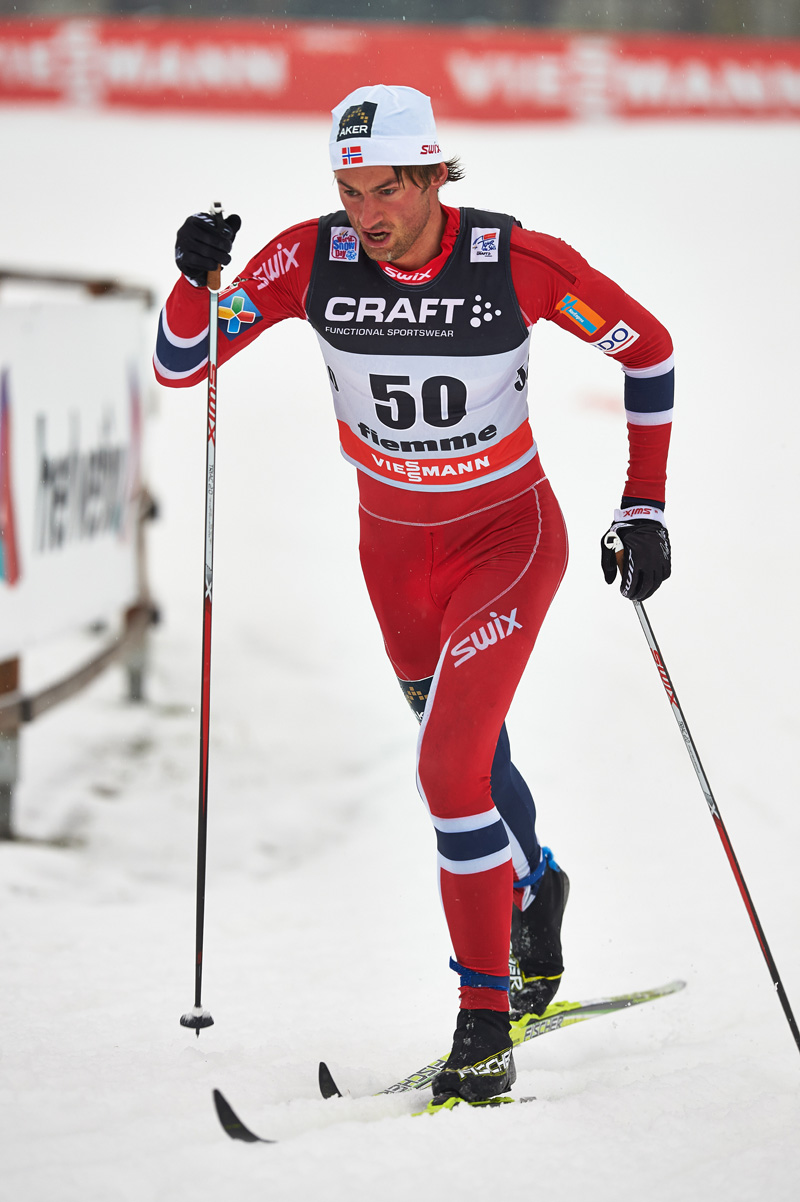
Petter Northug congratulating the French relay team at the Olympics in February. Northug returned to Norway without a single medal – and that was only the beginning of his troubles.
After a car crash in May which left a friend injured, Norwegian ski star Petter Northug has been sentenced to 50 days in jail, among other punishments.
The nine-time World Champion from Strindheim was driving his Audi – a car provided by the company as sponsorship – with elevated blood alcohol levels. Cruising at 83 kilometers per hour in an area where the speed limit was 40, he crashed and totaled the car. Immediately after the crash, Northug fled the scene, leaving his friend in the car.
Today he was convicted of five breaches of traffic law. Drunk driving is an extremely serious offense in Norway.
More importantly, perhaps, he was also convicted of lying to the police. In the first several interviews with law enforcement, Northug claimed that his friend had been driving. Later in the day, he admitted that he had in fact been the driver.
Northug claims that he was still intoxicated the first two times he spoke to police, and suggested that they could have waited until he was sober to interview him, in which case he may never have lied.
Besides the jail time, Northug faces a fine of 185,000 Norwegian kroner, or almost $29,000 U.S.
“I’ve been prepared for this day and known in advance that it was going to be a tough day,” Northug told Norwegian broadcaster NRK, according to a translation. “I’m prepared for any punishment I get.”
It is possible that the sentence may be reduced because he already spent two days in a cell immediately after the accident. Regardless, it is a smaller punishment than was originally proposed by the police, who suggested 60 days in jail, and a heftier fine. Northug’s license was also suspended “permanently”, but he can likely apply to have it reinstated in five years time.
“Not a bad day for Northug, this is – it could have been far worse,” Aftenposten commentator Inge Hansson wrote in an editorial.
However, the decision is still likely to have repercussions for Northug’s ski season. The star underperformed at the Sochi Olympics in February, with a best individual performance of 10th place in the sprint, and contributing to two fourth-place finishes in the relay and team sprint.
As such, he was focusing on the upcoming World Championships in Falun, Sweden, in late February.
“I think about Falun every day,” he told NRK earlier this summer.
The sentence presents two clear obstacles towards this goal. First of all, spending more than six weeks in jail is not ideal endurance training, and given Northug’s occasional struggles with fitness in the past few seasons, this could make it difficult for him to be selected to the very talented Norwegian team.
There may be a possibility for him to serve all or part of his sentence at home, but Northug told the media that he is at the moment not investigating this lead. He is ashamed of his behavior and wants to serve the correct punishment, he claims.
It is also currently unclear whether he must serve the sentence immediately or whether he may defer it until the spring.
Northug told NRK that he does not know how the sentence will affect his chances for World Championships, and that if he misses them, he misses them.
However, many observers have pointed out that Swiss star Dario Cologna – one of Northug’s main competitors – missed almost the entirety of last season with an injury, before competing in one World Cup weekend and then winning gold in Sochi. If Cologna can medal with less than ideal training, it is argued, than Northug should have no problems reaching Falun.
The second conflict comes in whether Norway wishes to be represented by a convicted felon in international competition. In order to compete at World Championships and also any World Cup races, Northug must have a contract with the Norwegian Ski Federation. At the moment, he does not have one.
But the federation said that although Northug’s behavior did not represent the ideals of skiing, it did not violate any of their codes of conduct explicitly since it did not occur in relation to either training or competition. They have offered Northug the chance to sign a contract, and the hang-ups appear to be more related to other aspects of his relationship with the team.
“It is a comprehensive agreement and there are still some unclear points,” Erik Røste, president of the federation, told NRK. “We are in a process in the administration… I note that Peter is in good shape and has done a good training work. There is no question that I hope to see him back in the ski tracks.”
The International Ski Federation says that it has no jurisdiction to ban him from competition.
“Those who have a license will start,” FIS cross-country committee head Vegard Ulvang told Norwegian newspaper VG. “But my task is to set up competitions and schedules, do not consider how kind or unkind people are. So far Northug has an initial license and it is up to the NSF to give him a new start license.”
Northug’s main sponsors, the Coop grocery chain, Red Bull, and Real Estate 1 of Mid-Norway, have stated that the ruling does not change their relationship with the ski star.
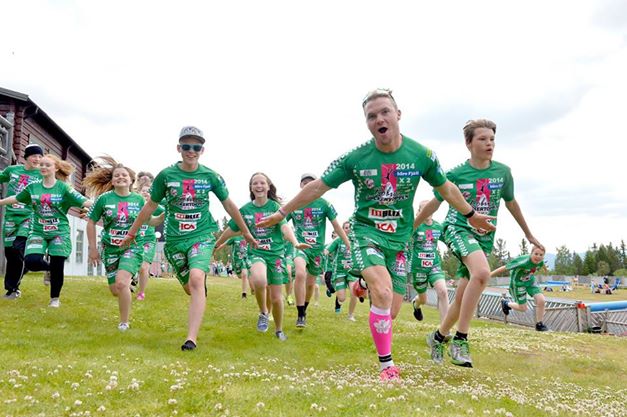
Robin Bryntesson (front) running with Swedish kids at his camp for diabetic children. Photo: Team Robin.
When he was a kid, Robin Bryntesson skied a lot. That’s not unusual for a Swede.
But then he got some news that definitely set him apart from his many teammates: he had diabetes.
“My doctor told me that my skiing career was over,” he explained in an e-mail.
Like any fiercely competitive athlete, Bryntesson didn’t take the news lying down. He kept skiing and went on to win a World Junior Championship, then a World Cup team sprint with Emil Jonsson.
“Then I call my doctor and say that my career is not over, maybe yours,” Bryntesson joked.
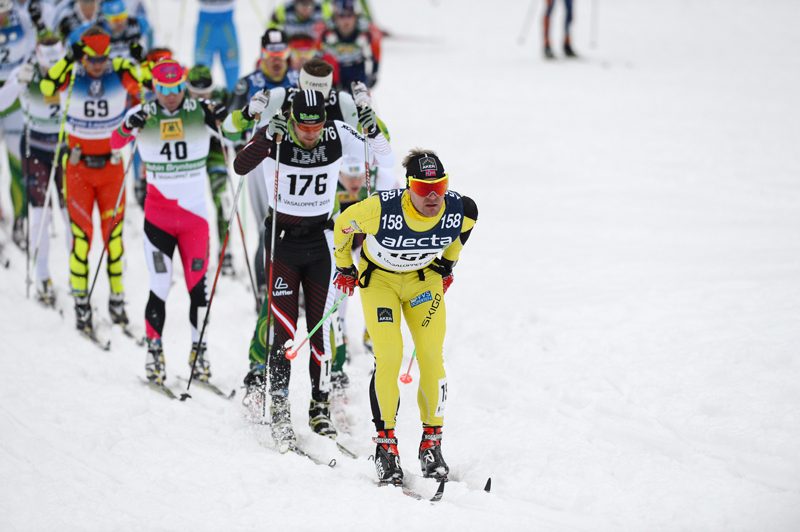
Robin Bryntesson, in bib 40, skiing in the lead pack at the Vasaloppet this winter.
These days, he doesn’t get so many World Cup starts, but that’s due as much to Sweden’s strength and depth as a ski nation as much as anything else – Bryntesson still excels at distances from sprints to the 90 k Vasaloppet, and is still seeking starts for his country at the sport’s highest level.
And he’s beloved in Sweden and abroad as the court jester of the ski world, making funny videos that often feature his famous teammates and sometimes go viral. Recent hits have been a well-done music video for Bliz eyewear spoofing the Faith Hill song “This Kiss”, and a promotion for the Östersund World Cup weekend in February that features an anything-but-conventional sprint course.
Things don’t always go smoothly: his quest to win the Vasaloppet ended this year when Bryntesson’s blood sugar crashed late in the race. Despite being more or less delirious (“cross-eyed” was how his support team described it), he finished within 2 minutes of the winner.
And so it’s safe to say that Bryntesson has proven to both himself and his doctor that a diagnosis of diabetes doesn’t mean the end of an athletic career. But a few years after learning he had the disease, Bryntesson realized that there was more he could be doing.
“It started when I sold pink hats in favor of juvenile diabetes fund those first few years,” Brytesson explained. “I donated 12000 SEK (roughly $1600) the first year and later it became more pink clothes and now a camp for children with diabetes. Next summer will be the fifth year of the camp.”
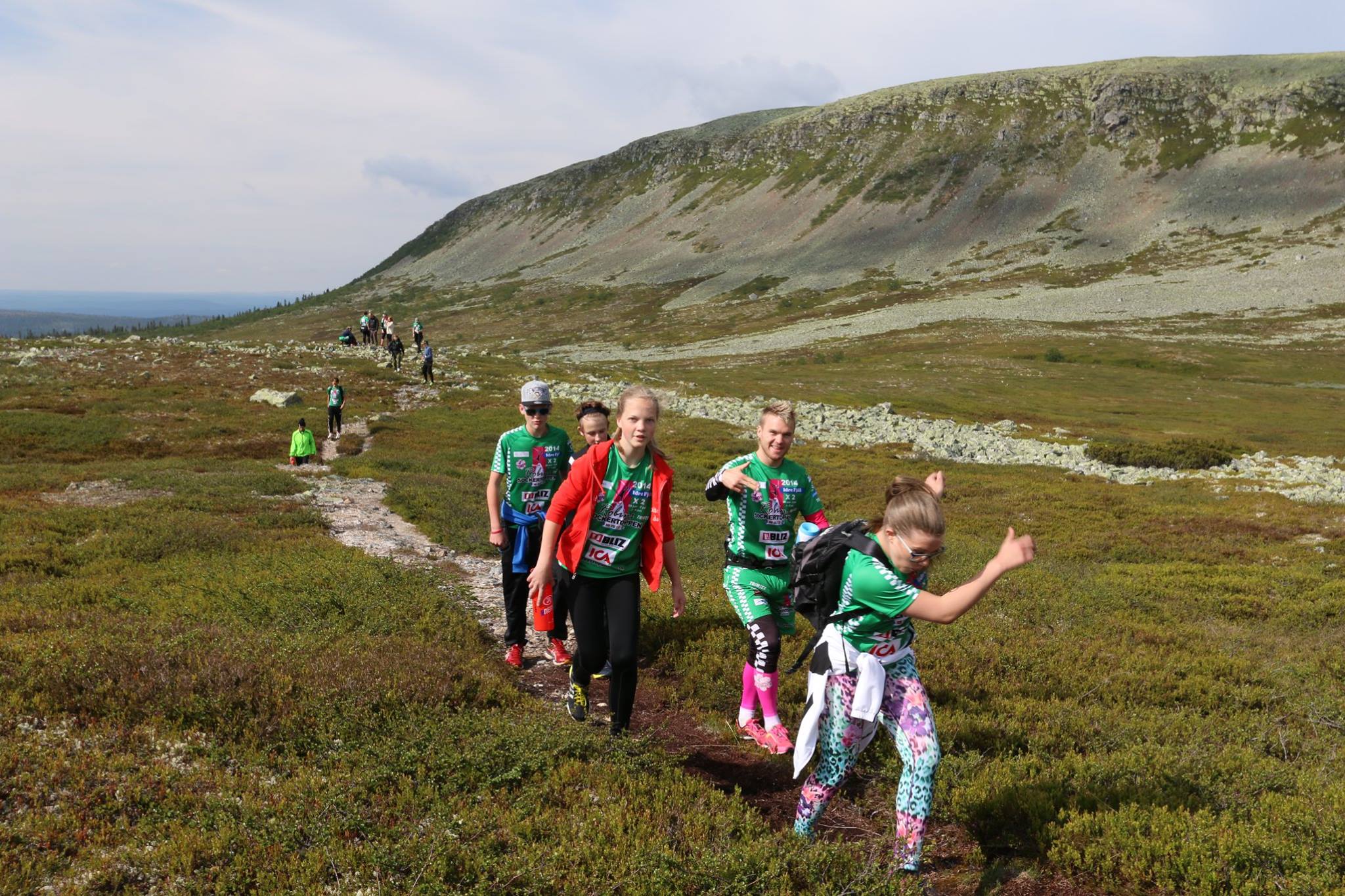
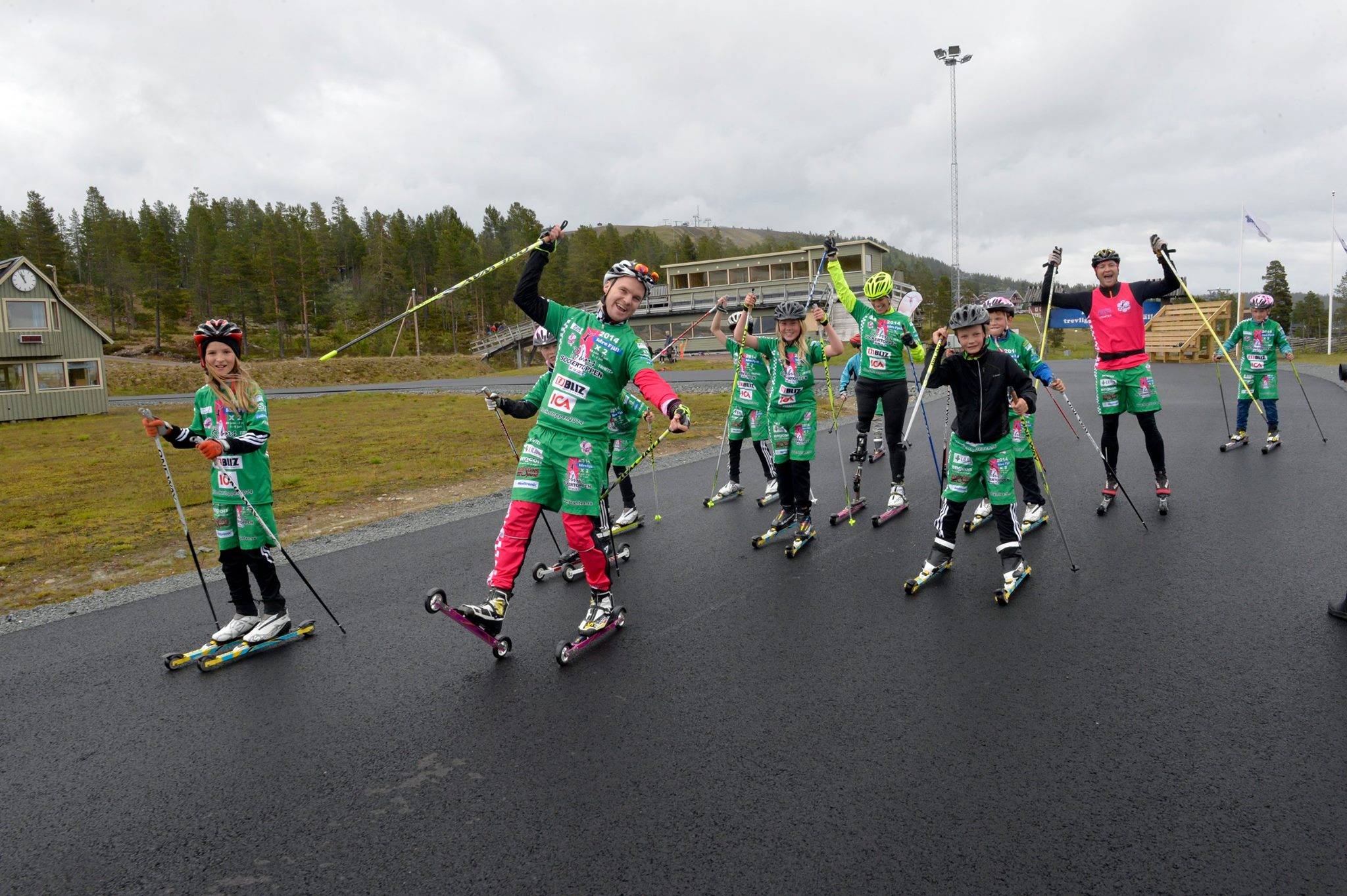
Bryntesson and his campers reach new heights around Idre, Sweden. Photo: Team Robin.
The pink hats for “Team Robin” have become ubiquitous – and in a restrained country of muted wardrobes and Jantelagen, Brytnesson has made bright colors and particularly pink his trademark. The summer camp, called Söckertoppen, had record enrollment this summer and is popular enough that this year there were two different sessions in the mountain area of Idre, one for kids aged 10-13 and another for those aged 14-17.
The name of the camp is something of a play on words: the Swedish translates to “Sugar Top”, which Bryntesson says he means as “Sugar is good!”
“Examples of what the guys and girls where doing those days was to challenge themselves, get to know others in the same situation, roller skiing, climbing peaks, the Masters champion (one swedish tv show), gymnastics, diabetes paths, swimming, disco and banquet,” Bryntesson wrote. “There was lecture by me and a stunning girl who won Paralympic gold in 2014 in Sochi, Helene Ripa. She’s skiing very fast despite an amputated leg and what a wonderful story!”
While there are a variety of summer camps for diabetic children in the U.S. – Olympic skier Kris Freeman, himself a diabetic, regularly visits camps organized by the pharmaceutical company Lilly to give inspirational speches – Bryntesson says that’s not the case in Sweden. So he struck out on his own.
“There is not so many diabetic camps in Sweden and there is no one like ours,” he wrote. “We have taken the best from the athletic world and put that in the diabetic world. We learn from each other and develop together! It took me 10 years with diabetes before I started the camp. And I´m learning something new every day about diabetes. What’s most important is to learn to know your own body! That’s what´s really matters!”
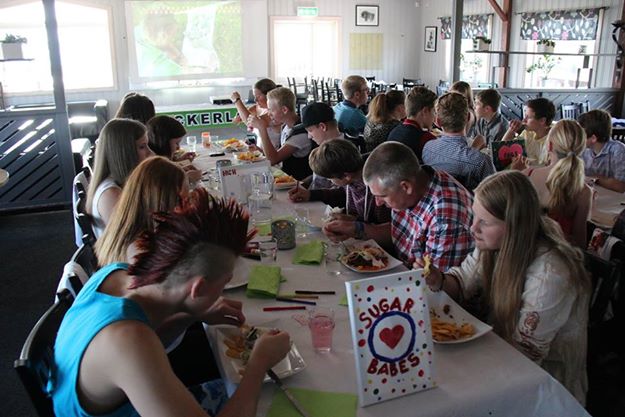
A typical mealtime scene at Sockertoppen. Photo: Team Robin.
Lately, he has had reason to expand his sights somewhat. Bryntesson was asked to announce the Paralympics in Sochi for Swedish television, an opportunity he relished. That has helped him forge closer ties to the world of disabled athletes, not just those with his own illness.
“It was really very inspiring to be in the Paralympics,” he wrote. “They are amazing, they really show that no mountain is too high! Whether one has an arm, leg, or is blind so they just keep on moving and inspires people worldwide. Even diabetics.”
With summer, and Söckertoppen, behind him, Bryntesson is finishing another project: a technique app called “Superb Skiing” which teaches world-class ski technique while entertaining with Bryntesson’s trademark brand of humor.
Of course, the app has a video trailer, featuring a typically Bryntesson attitude towards life.
“I get many questions about different technology/skiteknik and training,” he wrote as an explanation for why he wanted to make an app. “And one time for 1.5 years ago, when we where out and making a movie abaut ‘braking on rollerskis’, then we thought it was time to make an app. Since then we have been working on it. It’s about training in general and skiing in particular, and the goal is to make every owner of the app to a better skier.”
Despite all his other callings, Bryntesson’s biggest goal for the upcoming season is to earn a start at World Championships, which will be held on home turf in Sweden.
“My goal this winter is to try to fight for a ticket to the World Championships at home in Falun,” he wrote. “Although, as usual, Sweden is very tough for sprint spots. Then there will also be many of the longer races with Vasaloppet as the main focus. There I my best finish is 12th place. Which is the goal to beat!”
How can he possibly maintain a full training load and stay one of the fastest skiers in the world, when he’s spending so much time doing diabetes outreach, business ventures, making videos, and entertaining the whole ski world?
“It’s not the first time I’ve heard this question,” Bryntesson wrote. “I often have a lot of energy over besides training so that makes many projects coming up. I also like to make movies, it gives me even more energy. I like to have fun and I try to show that in many of the films that we do! It can sometimes take a lot of time, true. But I think it is worth every minute. If life is fun, then the good results can come.”
The “Superb Skiing” app is available for download from Google Play here for $5.40.
Bryntesson rollerskiing with campers this summer. Photo: Team Robin.
Canada’s Yves Bilodeau at the 1992 Albertville Olympic winter Games. (CP PHOTO/COA/Ted Grant)
Yves Bilodeau is one of the faces on the Canadian World Cup Team that’s seldom seen. Like his crew of wax technicians, he’s a behind-the-scenes guy, one of several responsible for the successes and sometimes lack thereof at international competitions.
Born in Quebec City and currently living in France, the 52-year-old made himself known as a Canadian cross-country skier, competing at five World Championships and three Olympics (the last of which came in 1998, three years after he retired. A wax tech at the time, he competed in the 10 k in Nagano, Japan).
After that, he retired for good — at least from international nordic racing. He’s still known in international adventure-racing circles after winning 2005 World Championships with Team Raid Quechua.
Known by his close friends and relatives as Bilose, Bilodeau is embarking on his 20th season working with the Canadian squad, and he’s witnessed a lot of change within the team since his racing days. At the ’92 Olympics in Albertville, France, Canada had one wax tech. Twenty-two years later, the team had a record nine at the Sochi Olympics.
In a phone interview with FasterSkier, Bilodeau spoke in his native tongue, humbly with a hint of humor. Seemingly attached to the past, he revealed he’s somewhat skeptical of ever-growing progress and new technology.
From his home in Ruffieux in south-eastern France, he talked about his waxing debut in 1995, reflected on what he called the “Sochi drama,” and explained who he’ll be working with this upcoming World Cup season.
Canada’s 1992 Albertville Olympic team, including Yves Bilodeau (top, center). (From left to right) Top: Alain Masson, Dave Wood (the lone wax technician), Dany Bouchard, Yves Bilodeau, Darren Derochie, Al Pilcher, Wayne Dustin. Bottom: Laurent Roux (head coach) Jane Vincent, Lucy Steele, Lorna Daudrich, Rhonda De Long, Marty Hall (NST director), absent Angela Schmidt-Foster. (Photo: Cross Country Canada)
FasterSkier: Starting as an athlete, what made you join the Canadian technical ski team 20 years ago?
Yves Bilodeau: Back in 1995, when I stopped competing after the Nordic World Ski Championships in Thunder Bay, I moved to France with my first wife, who at the time was finishing an international law degree and working at the International Labour Office located in Geneva. I was looking for a job and actually thinking about joining a European ski team for long-distance races. In the end, my luck turned suddenly when my old friend Alain Masson gave up his spot on the Canadian technical team to fill a coach position for the Yukon ski team. It was a great opportunity and I accepted it with no hesitation.
Former Canadian National Team member Yves Bilodeau racing in Calgary. (Photo: Cross Country Canada)
FS: How has your previous racing experience helped shape your interest in ski preparation and waxing?
YB: Times have changed dramatically over the course of two decades. Back in 1992, racers had to put the shoulder to the wheel in terms of ski preparation, since Canada had hired only one technician — who moreover undertook other tasks aside from waxing — for the Olympic Games in Albertville. We were already at the back of the peloton compared to most of the European technical teams. Things then started changing gradually, thanks to the arrival of Dave Wood [head technician in 1992 and head coach in ’02], as more technicians got hired. I think we improved a ton since then, although we sometimes struggle making ends meet with what limited budgets we have.
FS: Who will you be working with on Canada’s World Cup technical team this season?
Canada’s 2014/2015 NST Wax Techs:
– Yves Bilodeau (full-time Sept.-April)
– Joel Jaques (full-time year-round)
– Micke Book
– Alain Masson
– Sacha Bergeron
– Fabio Ghasifi*
– Graham MacLean**(New this season)
YB: Micke Book, a great Swede who couldn’t get along with his fellow countrymen, joined the Canadian team in 2006 after the Olympic Games in Turin. Joel Jacques is based in Canmore and works year-round with us. Alain Masson also gives us a hand during the more important events, when his schedule in Yukon allows for it.
Although he will spend less time with us this years, having recently become a father, we can still count on Sacha Bergeron. We also hired Fabio [Ghasifi], an Italian who previously worked magic for the Japanese team [for the last decade] in difficult snow conditions. Graham MacLean will also help us this year.
For my part, I always join the team full-time from September to April. We usually form a group of six during World Cups, and go up to nine technicians for Olympic Games and World Championships. When few Canadians take part in a World Cup freestyle event, we make ends meet with only four waxers. Micke and Joel are the grip specialists, while Fabio and I work primarily on gliding.
FS: Looking back on the last Olympics in Sochi, what went wrong exactly from a technical standpoint for some of your athletes?
YB: We failed in Sochi due in large part to the abrupt change in snow conditions, which always seemed to occur exactly at the time when most races started, around 2 p.m. At that precise time, one side of the mountain remained cold, while the other was totally exposed to the sun. With only 15 minutes before the start, we were confident with the skis and our racers would tell us just how satisfied they were with them. Then, as the races unfolded, skis became really sluggish. Looking back, we should’ve been able to capitalize on these difficult conditions and set ourselves apart from the rest, as other teams experienced similar technical setbacks.
It was Daria [Gaiazova] who involuntarily provided us with the key to our waxing issues. On race day, after testing her first pair of skis, she asked Sacha to rewax them. Sacha took his spatula and scraped off a thick layer of wax. Before he knew it, Daria took those skis and retested them. She told him they were perfect and needed no additional adjustment! We finally realized that the trick was to apply a very thin layer of red klister on soft skis, which was contrary to our common practices. Unfortunately, this discovery was made too late and they [our athletes] paid the price.
FS: Were these simply the worst snow conditions you’ve experienced in a race?
YB: I had rarely witnessed such bad conditions, that’s for sure. Even with air temperatures approaching -3 degrees [Celsius], accumulated snow in the trees would melt and water dropped constantly on the course, then refroze, then melted again. It was crazy. Nevertheless, we weren’t totally surprised, having skied previously many times on the Olympic course before the Sochi Games. Our greatest oversight was having done no ski testing at 2 p.m. precisely. We underwent various tests from 11 a.m. to 1:45 p.m. and everything worked great. At 2 p.m., we were in serious trouble.
“Looking back, we should’ve been able to capitalize on these difficult conditions and set ourselves apart from the rest. … Our greatest oversight was having done no ski testing at 2 p.m. precisely.” –– Bilodeau on what went wrong in Sochi
FS: In hindsight, what lessons have you drawn from the last Olympics?
YB: Life is made of ups and downs. Yes, we failed in Sochi, but we weren’t the only ones getting rocked. Take Norway for example. Their technical team did much more testing before the Games, in addition to collaborating closely with Swix and having their technicians undergo several separate tests. In the end, they failed just as bad as we did. After Sochi, we quickly came to the conclusion that we needed to work closer with athletes throughout the last minutes leading up to the race start. Next year, Graham and another technician, who weighs the same as Alex Harvey, will accompany and assist Alex for testing and any last-minute wax adjustment.
FS: Were Harvey’s impressive results at World Cup Finals (in Falun, Sweden) a form of redemption after Sochi?
YB: We’re constantly put under the pressure to deliver the best skis possible. We can’t have too many bad days, as our main objective is to always move up in the World Cup standings. But sometimes things go unplanned. Harvey, just like Norwegian Martin Sundby, stood several times on the podium before and after the Sochi Games, but both were out of luck when it counted most. That was the Sochi drama: performing poorly while the expectations we so high in Canada. As Quebecers say, the puck wasn’t going our way. [Laughs]
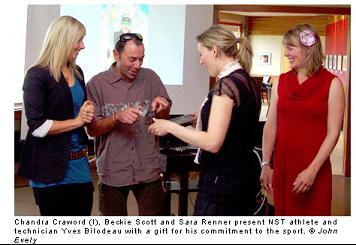
Canadian wax tech Yves Bilodeau (second from l) receives a gift from Chandra Crawford, Beckie Scott and Sara Renner for his commitment to Canadian cross-country skiing. (Photo: John Evely/Cross Country Canada)
FS: How has cross-country ski racing changed since you first joined the Canadian technical team in 1995? What major technical shifts have you noticed?
YB: Major changes are fewer than most people think. When it comes to gliding, what I call “accelerators” — fluor liquids applied at the very end of the ski preparation — make the biggest difference. On the grip side, there are a few new interesting products, but twenty- to thirty-year-old waxes, like Rode Red, still work great. Every piece of equipment is lighter with each year. Ski manufacturers also work hard on bettering the uniformity of their productions, to deliver equal skis as much as possible. It may sound simple, but ski making is no exact science yet.
FS: What makes a ski go fast? What unique features distinguish a great pair from a standard one?
YB: It’s fairly easy to eliminate the pairs we don’t like, but trying to handpick the best ones directly from the manufacturer remains a dubious task. The only way to tell which pairs stand out is to install bindings and try out the skis on snow. In the summer, Micke will do various tests in the Torsby ski tunnel in Sweden and rate each pair. There is no other way to go about it.
FS: How does Canada manage to stay competitive against other larger and wealthier European teams?
YB: Last season, Haywood and AltaGas, two of our long-time sponsors, helped us in acquiring a brand-new wax truck. Only a handful of teams enjoy such luxury, as other nations like France and the U.S. are presently working on purchasing their own truck. Since I first started this job, it’s probably the best technical improvement I’ve seen yet. We’re now completely self reliant, as we can park the truck right at the foot of the ski slopes for quick testing and avoid unvented and crowded waxing rooms. This vehicle can hold easily our 350 pairs of skis and six workstations are available. The ventilation system filters the air every two seconds and my back doesn’t hurt like it normally used to. It makes our job so much easier and more enjoyable.
“… The Sochi drama: performing poorly while the expectations we so high in Canada. As Quebecers say, the puck wasn’t going our way.”
FS: How are you approaching the upcoming World Cup season? Are the World Championships in Falun the team’s main objective?
YB: Definitely. We’re aiming for medals in Falun, that’s for sure. We want to get closure on everything that went wrong in Sochi, move forward and focus all our efforts on the World Championships and the Tour de Ski.
FS: Does living in France gives you and the Canadian team a strategic advantage on European soil?
YB: It works out great for everyone. Joel stays in Canmore year-round and works with the team in the summer, while I stay here in France and rejoin him and Micke later in September. I can test skis in Val d’Isère and in various areas in France. I keep a lot of the team’s equipment to avoid carrying everything by plane from Canada when the World Cup season kicks off. One of the team’s buses we use during competitions also stays at my home in the offseason.
FS: Finally, are you working on any projects for the summer? Are you still competing in expedition races, do you plan to fish a lot in Savoie?
YB: My career in expedition races slowed down quite a bit, but I always stay active, competing locally in trail running mainly. With the frequent showers beating down recently in the region, there’s less fishing in the Rhône valley’s rivers, but perch, trout and other types of fish can be found in lakes nearby.
***
About the author: FasterSkier contributor François Léger Dionne raced for 15 years at provincial and national competitions in Quebec. After obtaining a Bachelor of Law at the University of Montreal, he’s currently enrolled in a full-time program at the Montreal College of Osteotheraphy. French is his first language, but he speaks and writes fluently in English. His claim to fame? Racing and beating a younger Alex Harvey!
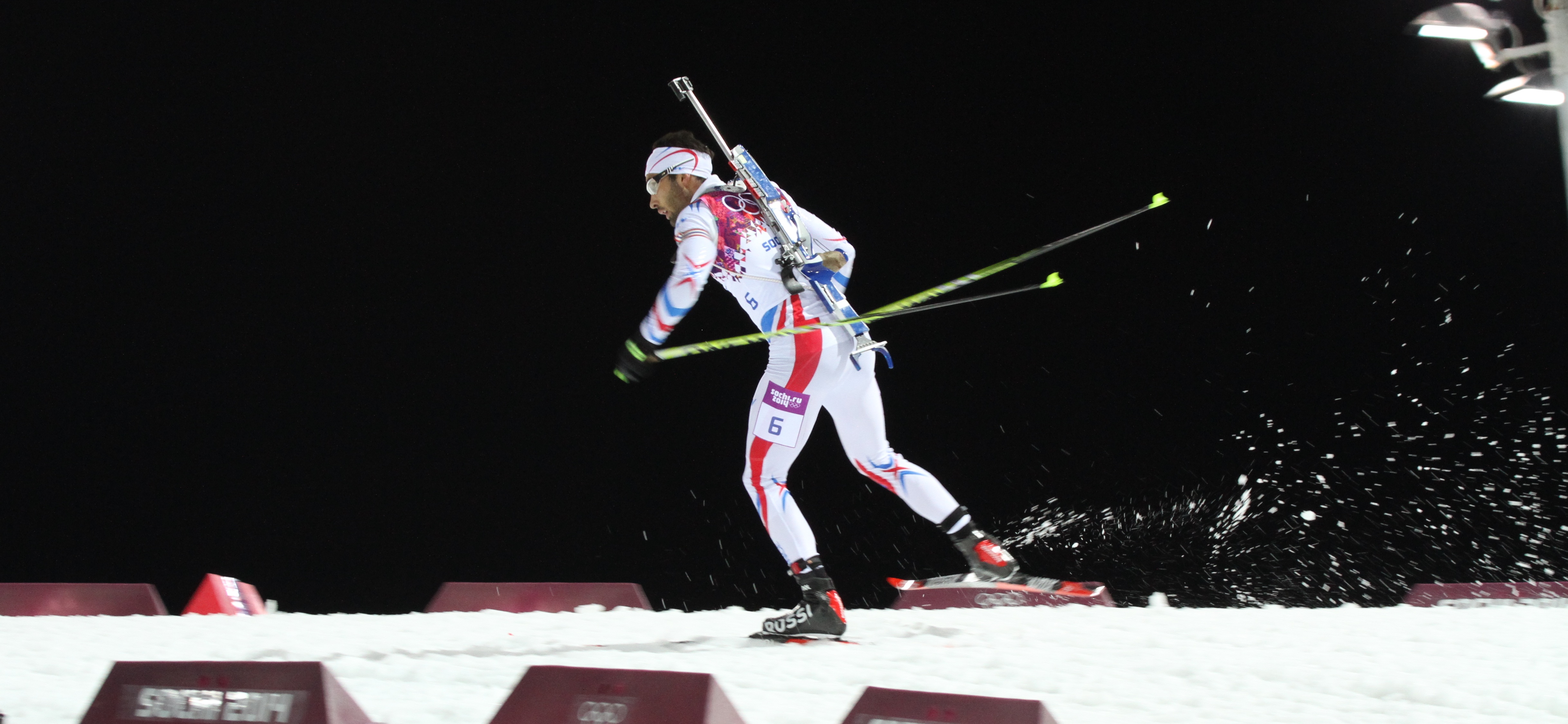
Martin Fourcade of France on his way to gold in the 12.5 k pursuit at the Olympic Games in Sochi this February.
It’s not the first time that Martin Fourcade has wanted to ski race.
But for the French biathlon star, who won two gold medals at the Sochi Olympics in February as well as his third overall World Cup title last season, the 2015 season will be the first time in years that he has seriously dedicated himself to cross-country skiing, with an eye toward World Championships in Falun, Sweden.
“To continue to grow, I feel like I need to put myself in danger and meet this challenge,” the 25-year-old told France’s L’Equipe magazine. “To become a master in something that I have not practiced since I was a junior in just six months, I have decided to integrate into the training group of skiers during three key stages of the season.”
Fourcade gave cross country racing a try back in the early part of the 2012 season. After placing sixth in the opening FIS race in Beitostolen, he earned a spot on the French team in the World Cup openers in Gällivare, Sweden. But there he sputtered to 48th place.
Fourcade left Sweden in 2012 after a disappointing 15 k World Cup cross country ski race, where he finished 48th.
It was not the finish that Fourcade, who routinely has the fastest ski times on biathlon’s World Cup circuit, was hoping for. So this time around, he is focusing on more ski-specific training during the summer.
Last week in Premanon, France, Fourcade spoke with his own trainer as well as the head for the French men’s ski team. It’s clear to all that he will have to earn his selection to the French team for the opening Lillehammer World Cups this season – a gold medal in another sport will not be enough to earn him any special privileges.
The French ski team shone in a surprising place last year, earning bronze in the 4 x 10 k relay at the Sochi relay; a standout performance by one of the team’s stronger members would have been more expected. But the core group of skiers succeeded as a team, one which Fourcade now has to insert himself into.
He recently joined the skiers for a training camp in Vercors, France. Fourcade tweeted a photo of himself road biking with ski star Maurice Manificat and other teammates.
“The good friendship takes nothing away from the spirit of competition,” he told L’Equipe. “At training, the desire for competition assures the power struggles that are inherent in high-level sport. We all know who will be the judge: the selections on November 25. I’ll try to earn my place on the team, and then I’ll decide where to go with my season.”
It’s anticipated that Fourcade could miss up to three biathlon World Cup weekends if he goes all-in on his cross country skiing plan. In the meantime, he will join the ski team in Oberhof for an on-snow camp and then for their final race preparations in Scandinavia.
But he’s definitely not giving up biathlon altogether. Earlier this month he was back training with his older brother Simon, who has 14 World Cup podiums of his own.
“The challenge that I’d like to meet next season is to be in two World Championships, in cross country skiing and in biathlon, and to do my best in both,” he said in a press conference in his hometown of Font Romeu earlier this spring, according to Midi Libre. “This is a big challenge because even though they are fairly similar distances, they are quite different efforts. This is a big challenge in terms of logistics, scheduling, preparation.”
Nevertheless, after another very successful year, the Catalan native is looking forward to spicing things up.
“Without having started in skiing, I never would have discovered biathlon,” Fourcade told L’Equipe. “At the moment when I had to specialize, ten years ago, it was a tough decision. I’ve never regretted this choice to the extent that it brought me any unhappiness, but I never lost the desire to try my luck in skiing.”
Still craving more of the World Cup? Here are some comments from a few of the U.S. skiers who closed their international-racing seasons at World Cup Finals last Sunday in Falun, Sweden:
Kikkan Randall with her third consecutive Sprint World Cup Crystal Globe. (Photo: Fischer/Nordic Focus)
On finishing out the World Cup season:
“The race … was a great opportunity for me. I have had a number of races on the World Cup this season but only one other race has been a distance skate and that came only days after a long slow Birkie and flying across the Atlantic. I felt recovered, adjusted to the time and ready to ski hard. Despite only having a few distance skate races I have stayed positive with every opportunity to race and I feel like I have learned an incredible amount going into this next training season, especially for my classic skiing.” — Caitlin Gregg (Team Gregg/Madshus), 37th in 10 k freestyle pursuit, with the 25th-fastest time
“I felt like my energy was good. I think maybe I have lost a bit of fitness over the last couple of weeks for sure, but it is what it is, I am glad it is over. I’m excited for a training year to revamp, because I need it at the moment.” — Noah Hoffman (U.S. Ski Team), 21st in 15 k freestyle pursuit, with 29th-ranked time
“Starting in the wave with some of the world’s fastest guys, my goal was to go out hard, hang with them, and go like that until I blew up. I wanted to ski as aggressively as possible, which in distance skate races can sometimes be hard for me to do. I did just that. Something about that aggressive mentality switched me into some of the best skating of my life. I felt calm and collected, and like my technique was decent, even while hammering very hard and going pretty fast. I got a split or two saying I was right around 30th for time on day, which would be absolutely insane for me to be in the ballpark of scoring World Cup distance points in a skate race.” — Reese Hanneman (Alaska Pacific University), 37th in final pursuit with 34th-fastest time
Canada’s Alex Harvey (1) started first and finished second in the men’s 15 k freestyle pursuit at World Cup Finals for a career-best third overall in the World Cup. (Photo: Fischer/Nordic Focus)
“10 k skates tend to be the race I dread the most, but [Sunday] wasn’t disastrous and I’m looking at it positively. I can’t say is was my favorite race, but I think I was able to try to follow some really good girls until I blew up and that in itself is an accomplishment for me for a skate distance race. It was really cool to see Liz, Sadie, Kik, Noah, and Alex [Harvey] have great races and that topped the weekend for me. I was beyond happy with how the classic sprint went, so moving forward I didn’t have many expectations and it was cool to see my teammates have some good performances.” — Sophie Caldwell (U.S. Ski Team), 39th in 10 k pursuit, with 37th-ranked time
“When I put my goals down for the season, the biggest goals were on the Olympics and the secondary goals were to fight for the Sprint Cup and I did that. I didn’t really think about [the overall World Cup] too much. … Going into [Sunday], I didn’t want to look at the points too closely because I knew Kerttu [Niskanen of Finland] was in a good position. When I fell I was like, ‘Oh man, I hope this [didn’t cost me] fifth.’ … Given my racing strategy for the season [sixth overall is] a good finish [after training through] the entire Tour — there’s a lot of points available there — and making my training a little more sprint-specific, it took me a while to find my distance skiing again.” — Kikkan Randall (U.S. Ski Team), 13th in 10 k pursuit, with 16th-ranked time
On season highlights:
“The fastest time of the day in Kuusamo and the top-10 finish there, and the second-fastest time in [the Tour de Ski 35 k freestyle pursuit to Austria’s Johannes] Duerr [who was kicked out of the Olympics after testing positive for EPO] so I would call that the fastest time of the day. Doing that twice was encouraging, but I have to get to that level more constantly. … The Olympic results weren’t what I was looking for, but I would say definitely an improvement over last season and a lot more work to do.” — Hoffman
On what’s next:
“It’s been a long season and I have raced every weekend since mid-November except for two weekends, I have traveled a lot and I have prepared for a variety of different types of races, all in all I am still feeling good and still motivated to race Super Tour Finals in Alaska :)” — Gregg
“It’s been a busy three weeks [since the Olympics … definitely [Saturday] and [Sunday] the legs were pretty tired, but it’s a good feeling to be tired. I know being back home will be an energy boost.” — Randall
“I’m going home for two days before heading to Alaska. I can’t put into words how excited I am to go home for a couple days and I’m also really excited to be united with the SMS T2 team in Alaska!” — Caldwell
The start of the women’s 15 k skiathlon on Saturday at World Cup Finals in Falun, Sweden, with American Kikkan Randall in the front row at the far right. Randall went on to place 20th for the second-best U.S. women’s result after Liz Stephen in 15th. (Photo: Fischer/Nordic Focus)
With two races left in the World Cup season, Liz Stephen could’ve raced like she had nothing to lose. But the skiathlon is a race of strategy as much as skill, and on Saturday at World Cup Finals in Falun, Sweden, the longtime U.S. Ski Team member decided she’d better start conservatively in classic.
Hovering in the mid-30’s for most of the race, Stephen later explained that the first half of the women’s 15-kilometer skiathlon, turned out to be a “pretty standard classic race” for her. No bells or whistles, but she didn’t need them. She had 7.5 k to make up ground.
About a minute and a half behind the leader, Norway’s Therese Johaug, at the halfway point, Stephen in 37th transitioned smoothly to skating and began her own race. Between 8.2 and 9 k, Stephen rose from 34th to 25th. With less than 4 k to go, she was up to 16th.
“The skate portion went much better than the racing has been going lately,” Stephen, 27, wrote in an email. “The body was really ready to race out there during the skate.”
Liz Stephen (U.S. Ski Team) racing earlier this season in the freestyle prologue at the first stage of the Tour de Ski in Oberhof, Germany. (Photo: Marcel Hilger)
She ended up picking off one more person (Finland’s Krista Lahteenmaki) to finish 15th, 2:08.3 behind Johaug, who won by more than 33 seconds. The result put her 18th in the World Cup Finals standings and 15th in the season-long distance ranking— tying her personal best from last year. With one race remaining on Sunday, the 10 k freestyle pursuit, she was 17th in the overall World Cup.
“The goal going into the season was top 15 in the overall and top 10 in the distance list,” Stephen wrote. “I am close to those goals, and improving over last year’s standings in the overall is certainly something to recognize as a step in the right direction.”
Last season, she was 20th overall — 22 places better than she had been the year before.
“I am happy that the season is coming to an end and going home for a break is in sight,” Stephen wrote. “I am not so much tired as mentally ready to change it up, get out of hotel rooms for a while and be back in the USA with my family for a while. Recharge a bit.”
First, she’ll go with most of the team to Anchorage, Alaska, next week for SuperTour Finals and U.S. Distance Nationals March 22-28.
Looking back on the season, Stephen emphasized the success of her teammate, Kikkan Randall, the three-time defending World Cup Sprint champion, and how she has impacted the rest of the team.
“She has taught me to believe in myself, how to work harder, try new things, be open to the idea of being the best in the World someday,” Stephen wrote. “The fact that she instills this fun atmosphere on our team while also kicking serious a** on the world cup, year in and year out is really inspirational and special to be a part of. I’m really very proud of her and to be her teammate in so many ways.”
Kikkan Randall (U.S. Ski Team) in Friday’s classic sprint qualifier at World Cup Finals in Falun, Sweden. She went on to place fourth in the final and take home her third-straight Sprint World Cup Crystal Globe. (Photo: Fischer/Nordic Focus)
Randall finished 20th (+2:25.6) on Saturday in one of the few World Cup skiathlons in her career. The result put her 17th in the distance rankings, and kept her in fifth overall — 30 points behind Norway’s Heidi Weng in fourth.
“I wanted to be up in the top 15 so I fell short of that goal today,” Randall wrote in an email. “I still have some good opportunity to move up tomorrow and I need to fight for every point.”
Randall skied around 20th for much of the race, moving up from 21st at the transition to 19th at 8.2 k. Lahteenmaki edged her by 0.4 seconds for 19th, and Randall finishing four seconds ahead of her U.S. teammate, Sadie Bjornsen.
“To have a good result you have to go with that opening pace and try to stay up near the front,” Randall explained. “I tried to start hard but my body was pretty tired from the sprint yesterday. I was skiing mid pack in the classic and then headed out on the skate with some girls to chase. I had some good sections were I felt I was picking up time and then some bad parts where I had a hard time keeping my glide up in the skate. I came into the stadium with a couple girls but didn’t ski the finish very well. It was an okay day for me.”
Like Stephen, she was excited to wrap up the season.
“It’s been a lot of racing and a lot of emotional energy, especially in the last six weeks,” Randall wrote. “It’s been a pretty good season. Overall I was happy with my consistent sprint performance but felt I went backwards a step in my distance skiing. And of course the Olympics was my biggest goal of the season and I didn’t reach my goals there. I am definitely ending this season wanting more.”
Bjornsen started faster and was 12th through 6 k and ninth at the transition at 7.5 k, just 43 seconds behind Johaug.
“The pace went out super hard from the start,” Bjornsen recalled. “It was quite windy out there, and I was breaking wind in my outer track for the first couple of k’s … so I was struggling to stay on pace. After jumping in behind some girls, I found control, and the classic portion went really well from that. I had great skis. I chose to go on the slicker side, which made for some rocket fast skis on the downhill.”
The transition to skating proved to be Bjornsen’s biggest challenge as she slipped to 17th within the first kilometer out of the stadium. She recalled a pack of about 10 people passing her in the first 10 minutes, and was in 20th with 4 k remaining.
“I was able to turn it around shortly after when I got the feelings back in my legs,” she wrote. “It was fun to be out there trying to ski with Kikkan, and then reel back some of the skiers that had passed me by the end.”
Conditions were a factor as the night before brought a mix of rain, sleet, then snow, according to Stephen. “But the skiing was good,” she explained. “Pretty transformed snow and the high winds blew some snow into the tracks in places making the conditions slow in some spots and very fast in others.”
The course itself is what many of these same racers will be tackling at World Championships next season. Several North Americans said they liked the course, and Stephen described it as “hard, fair and fun.”
“The are a fun level of challenging!” Bjornsen wrote.
Noah Hoffman (U.S. Ski Team) racing to 35th in the 30 k skiathlon at the Olympics in Sochi, Russia.
Going against his instincts, he decided to play it relatively safe and pace himself throughout the men’s 30 k skiathlon. Hoffman, 24, is known for his tendency to try to lead or stick with the leaders in distance mass starts, but his goal was to score around 20 to 25 points throughout the three-race Finals to put him in the Red Group in the distance standings.
“I scored 13 points today so I need to do something similar to tomorrow,” he said of the pursuit. “Which is nice, better than it could have been.”
Out of the start, he said the pace wasn’t too fast, but he focused on gradually working his way up from just outside the top 40 to 25th within the first 3.75 k. He was 20th at 5 k, 14 seconds behind the leaders, and halfway through the classic leg Hoffman was skiing 30 seconds back in 22nd.
“I was trying to be patient and stay a little more conservative,” he said. “I wanted to be skiing a little further back in the group. I did that and I don’t know that my strategy mattered that much today because I wasn’t quite good enough to be able to go with that fairly large group that ended up shelling everybody else.”
The group he was talking about was the chase pack, which Norway’s Eldar Rønning initially led to try to cut down a 20-second gap on the four leaders at 8.7 k. Hoffman was at the tail end of the group with Ivan Babikov in 23rd and 24th, respectively, and with one lap to go in classic he was detached, trailing the leaders by 45 seconds with Norway’s Sjur Røthe.
“I did end up with a good ride behind Sjur Røthe for the classic, which was really good and I know he is a great skater and he proved that today,” Hoffman said. (Røthe ended up seventh.)
“I was definitely hoping to be able to go with him which would have led to a really good result, but I just wasn’t quite good enough in the skate,” he added. “I have had a little bit of a tough time transitioning from classic to skate and I need to continue to work on that. Once I got into the skate, in the last two laps of the skate I was feeling better and moving up more.”
For the second half of the race, Hoffman mostly stuck around 20th. He heard he was in 19th about halfway through the skate leg, which was where he figured he needed to be.
“It was definitely the right thing to do, it is what I need to do more of,” Hoffman said of his pacing strategy. “There was definitely a couple of movements where I was like, I could definitely move up from here, and then I had to settle myself down and say this was a fine place to be. But for the most part, I think it was good. I did what I wanted to do and I think I am learning slowly, slower than I would like to be.”
At this point in the season, Hoffman said his energy is good, but he’s excited to go home and will stop at his base in Park City, Utah, between racing in Alaska and vacationing in Mexico.
“I think fitness is tailing off a little bit; I train a lot less than my teammates throughout the winter and it has been a long time since I have done any substantial training,” he explained. “But that is fine … [to] still be able to ski into the points with this fitness is good so I am looking forward to a little bit of domestic races when I go home, something I haven’t done in two years.”
Hoffman ranks 28th in the World Cup distance standings, just within the top-30 U.S. team criteria, and 35th overall with one race to go. He will start 21st, 4:19 back from Harvey as the leader and a second behind 19th and 20th in Sunday’s pursuit.
Reese Hanneman training in spring-like conditions at World Cup Finals in Falun. (Photo: Reese Hanneman/Instagram)
Reese Hanneman was so close, heartbreakingly close, encouragingly close, however you look at it, 0.45 seconds from making it into the points at World Cup Finals as a 24-year-old U.S. Continental Cup leader.
Sixteen days after his first World Cup of the season, Hanneman notched his all-time best World Cup result on Friday: 31st in the classic sprint in Falun, Sweden. The leader at the end of the last SuperTour period, the Alaska Pacific University skier earned his way to Europe, but in a field of fewer than 50 competitors, most of which have made the World Cup top-50 cut to get to Falun, there’s always a fear of finishing last.
Hanneman was far from it on Friday, nearly qualifying for the rounds, which would’ve made him the third American to do so this year.
“To be that close to the heats, and scoring points, is brutal,” Hanneman wrote in an email. “I felt good, but I didn’t even execute it perfectly. There are a few places I know I could have been faster. But there is nothing like a 31st on the World Cup to make you so hungry for the future.”
Reese Hanneman (r) and U.S. women’s coach Matt Whitcomb (l) celebrate with Kikkan Randall (front) after Randall won her third-straight Sprint World Cup Crystal Globe, receiving it at a ceremony following Friday’s classic sprints at World Cup Finals in Falun, Sweden. (Photo: Fischer/Nordic Focus)
U.S. coach Matt Whitcomb was excited about Hanneman’s performance, considering he’s been in their development pipeline for several years. This season, just over two weeks ago, marked his international World Cup debut.
“To put the carrot that close to his face at the end of the season, he’s going to go home more motivated than ever,” Whitcomb said. “It’s a significant accomplishment to come that close to even qualifying for a World Cup sprint … He can review the tape from today and see a few mistakes that he made, very small ones, but that’s all it takes to find that half-second.
“He’s made a big step this year, and APU and all his coaches and all his sponsors have done such a great job of bringing him along patiently,” Whitcomb added. “He’s struggled at times and he’s constantly training with one of the toughest groups of guys in the country and to have patience with the ups and down has really paid off for Reese and he’s seeing this weekend that he can be a World Cup sprinter.”
Since winning his first national title and making the podium in three out of four races at U.S. Cross-Country Championships in January, Hanneman has known this trip was coming with a “pretty decent lead in the SuperTour overall” and Period-1 SuperTour leader Brian Gregg over in Europe racing and preparing for the Olympics.
“I didn’t set too many performance goals for myself over here for all of these World Cups,” Hanneman wrote.
He finished 80th in the skate sprint in Lahti, Finland, a course he felt didn’t play to his strengths. The Drammen classic sprint and Holmenkollen 50 k in Norway were next, and Hanneman knew both would be “insanely deep and competitive fields.”
His goal was to simply ski his best and try to find a sense of normalcy in what he found to be an intense World Cup setting.
“I think for the most part, I have been able to do that. I feel at home, and prepared to compete with these guys, for the first time in my life,” he wrote. “And that’s huge. I guess, in years past any time I raced a World Cup I would be starstruck and running around trying to get autographs and stuff… now I’m over that. Now I’m just like, Johaug, meh, whatever… :)”
On Saturday, Hanneman placed 38th in the 30 k skiathlon, 40.3 seconds ahead of U.S. Ski Team sprinter Andy Newell in 39th. It was his best distance result on the World Cup and second-best individual finish of his career.
“To finish 38th in a World Cup distance race (yes I know there are only like 42 finishers), is good for me, because there are no stragglers here,” Hanneman wrote. “These are literally the best 50 guys in the world, and that’s it. Being here as just the Conti Cup leader, it is encouraging for me to be able to be competitive at all.”
He finished one place and just over a minute behind 2013/2014 World Cup Sprint champion Ola Vigen Hattestad of Norway.
“My goal for today was to ski a strong classic leg and then try to do my best in the skate,” Hanneman explained on Saturday. “I felt good in the classic, but was afraid about pushing it too hard, knowing I still had a brutal 15k skate ahead of me. I hoped to be skiing in the top 30 for the classic leg, and I ended up skiing with the 28-33 group for most of it so I was right there. Haha, it was actually me and like four of the best sprinters in the world (Brandsdal, Peterson, Gloerson, Hattestad), so I was feeling pretty stoked.”
Hanneman described the above-freezing temperatures on a sunny afternoon as “crazy. I have never seen such variable snow in one race. Some parts were absolute saturated, watery deep mashed potatoes, and some parts were drifting cold dry new snow. It was really strange.
“In the skate portion you could be tucking straight down a hill and then all of the sudden your skis would grab as if you had caught your klister, it was weird,” he wrote. “So considering the insane variability, my skis in both techniques were incredible. The US coaches and wax techs, and Eli Brown who is waxing my skis, did what I thought was an exceptional job on what must’ve been one of the hardest waxing days ever.”
Looking ahead to Sunday’s 15 k freestyle pursuit, Hanneman explained that he’s once again going to try for his best and ski aggressively.
“Tomorrow is definitely not my forte, and I will be skiing alone,” he wrote. “So I just want to put in a hard effort and hang on.”
Just Shy of Points
Also just outside the top 30 in Friday’s classic sprint, U.S. Ski Team member Jessie Diggins placed 34th, 1.15 seconds from qualifying. In an email, she explained that she was satisfied with the result her first race back since getting sick after the Olympics.
“Classic sprinting has never really been my thing, but it’s also nice to have some big goals to work on for next year,” Diggins wrote. “I’m still looking forward to qualifying in a classic sprint!”
With a lingering cough she’s told will fade soon, Diggins went with the attitude of “ ‘Screw it … I just want to race!’ ” and decided to give everything she could at World Cup Finals.
“I don’t have really specific results-oriented goals since I don’t know where my body will be in distance racing,” she wrote. “But my overall goals are to enjoy the experience and give 100% so I can finish out the season knowing I didn’t hold anything back.”
On Saturday, Diggins placed 36th in the 15 k skiathlon. Her teammate, Ida Sargent finished 10 seconds later in 37th, and Continental Cup leader Caitlin Gregg (Team Gregg/Madshus) placed 40th, six seconds ahead of Sophie Caldwell in 41st.
On Friday, Sadie Bjornsen, Kikkan Randall, Caldwell, and Sargent all made the rounds, with Randall and Caldwell advancing to the final, where they placed fourth and sixth, respectively.
Gregg finished 48th in the sprint. “I had fantastic skis and felt like I had skied super well,” she wrote in an email. “When I looked at the results board I saw that I had only beaten one girl, but then I realized she didn’t even start 🙁
“I am continuously impressed by how well our USA girls are skiing, we had 4 qualify and Diggs was right there as well then two moved onto the final!” the 2014 American Birkebeiner champion added. “It’s incredible to be in this positive atmosphere!”
Today’s Sprint Podium in Falun, Sweden at the World Cup Finals. Ingvild Flugstad Ostberg (NOR, Marit Bjorgen (NOR), Stina Nilsson (SWE) (l-r) (Photo: Fischer/Nordic Focus)
It’s a race of “threes” between three Norwegians in the World Cup Finals this weekend in Falun, Sweden, and it’s hard to know which is closer: Marit Bjørgen’s race today where she edged her teammate Ingvild Flugstad Østberg by just under three-tenths of a second in the classic sprint, or her race for the overall World Cup Championship, where she now trails teammate Therese Johaug by only three points.
The outcome of the overall point race will have to wait until the end of the weekend, but the sprints are all wrapped up – Østberg led out of the start with Sweden’s Stina Nilsson and Bjørgen in hot pursuit. By the top of the first big hill the race had split into two groups: the Norwegians and Nilsson battling it out for their order on the podium, and Americans Kikkan Randall and Sophie Caldwell racing Finland’s Krista Lahteenmaki for fourth place.
The front group had a tough fight in the rollers after the big hill: Bjørgen made a move on Østberg, with Østberg double-poling hard to catch up. They were neck and neck, but Bjørgen held her small lead into the finish, besting her teammate by 0.29 seconds. Nilsson crossed in third (+1.39), Randall fourth (+6.84), Lahteenmaki fifth (+8.49) and Caldwell sixth (+9.86). This was Randall’s second-best World Cup classic sprint finish, following a second-place finish in Kuusamo earlier this season, and she also officially won her third-consecutive Sprint Globe, although she already had that locked-up in the points after last week’s racing in Drammen, Norway. For Caldwell’s part, this was “by far” her best ever classic sprint finish and her first time advancing beyond the quarterfinals in a World Cup classic sprint.
Norway’s Marit Bjorgen celebrates after winning the sprint at the World Cup Finals in Falun, Sweden. (Photo: Fischer/Nordic Focus)
“Neither Sophie nor I got a very fast start and were chasing the pack right off the bat,” Randall wrote in an email. “[This is] something we need to work on for sure. But once we got onto the climb we worked our way solidly into the chase pack behind the top three. Each time up the steep climb I felt like I wasn’t able to nail the technique well enough to use all my power. I was able to carry my speed off the downhill well but there was too much of a gap up to the top three for any draft. I just hammered as hard as I could the rest of the way.”
“It was exciting [to be in the final],” Caldwell said, “because I’d never even been in the semifinal of a classic sprint. My strength is classic sprinting is probably striding over double poling, so I was psyched to see a course with some good striding hills in it. The only problem with that is that it’s a really hard course, so by the time the final came around I was pretty exhausted.”
Each of the top four women, Østberg, Bjørgen, Nilsson and Randall, won their quarterfinal heats. Randall was third in her semifinal, behind Bjørgen and Nilsson, but moved on to the finals as a lucky loser along with Lahteenmaki, who was in the same semifinal heat. Caldwell was second in her heat behind Østberg, managing to edge German sprint powerhouse and overall sprint points runner-up Denise Herrmann.
U.S. Women’s coach Matt Whitcomb weighed in on his athlete’s performance.
“Sophie was a little tired in the final and Kikkan couldn’t find the climbing gear today, but Kikkan was one of the best in the field from the top of the course to the finish line, which included some descending and cornering and fast paced double poling.”
“We had exceptional skis out there, both kick and glide,” he continued, “and Kikkan just thought she couldn’t find that peak striding gear today, which some times she can and sometimes she can’t, and today that was a challenge.”
Which isn’t to say he was disappointed.
“To put four girls in the heats at World Cup finals is a big accomplishment. [The Falun sprints] have traditionally been a pretty big day for the women’s team and it was again today, with I guess four in the top 20 and two girls in the finals. It was pretty exciting to have Sadie, Sophie and Kikkan go 1, 2, 3 in their quarterfinal heat. But overall just such a tremendous end to a really successful year for Kikkan; grabbing the third consecutive sprint globe is such a big accomplishment and to finish it with a fourth place in a classic sprint is really big. I’m so proud of Kikkan and Sophie and the whole team – it’s a team accomplishment.”
The Unlucky Quarterfinal
American Sadie Bjornsen had a bit of bad luck when she found herself seeded in the same quarterfinal as her two teammates, Randall and Caldwell. In that quarterfinal Randall took first, Caldwell second and Bjornsen third.
“It’s always unfortunate when you get more than two [of us] in the same heat, because only two people move on” Caldwell said of their quarterfinal. “Our goal was just to finish top three in our heat and hope it was fast enough to be lucky loser. Unfortunately, some of the other heats were faster, so Sades [Bjornsen] didn’t get to move on.”
“It was really tough,” Caldwell continued, “because she had an amazing qualifier (she qualified fifth), her fitness if definitely there, she’s an amazing classic sprinter and she led basically the whole heat, but we just sneaked by her in the final.”
For her part, Bjornsen’s strategy had been to go for broke.
“I went out there with no strategy in mind, other than to look for openings… and that found me in the front most of the race,” she wrote in an email. “I had a good start, felt strong on all the climbs, but just didn’t have the extra gas at the end. I think it was challenging to race from the front with so much drafting out there, but again, you have to learn from every race.”
“That’s part of ski racing,” Caldwell said of her friend and teammate’s race. “She was there congratulating us after and happy for us and being a great teammate. Even though it was tough that she didn’t move on, I think she was happy for us.”
Ida Sargent also made the quarterfinals, where she finished fifth in her heat for 20th overall. During her quarterfinal she allowed a gap to open between her position in fourth and third place coming into the technical downhill.
“She missed the draft,” explained Whitcomb. “That was pretty critical if she wanted to advance to the semifinal. So she was disappointed but she was skiing fast, she’s in good shape and we’ll look forward to the pursuit tomorrow.”
A Points Race for Randall
Some other dramas will play out this weekend in the points races. Bjørgen and Johaug are just three points apart in the competition for the overall World Cup title with 1295 and 1292 points each, respectively. Astrid Jacobsen has a solid grip on third place with 974 points, but Randall is in a close race with Norway’s Heidi Weng for fourth; Weng has 791 points and Randall, with 790, is only one point behind, making Randall the top non-Norwegian in the world.
Good Day for U.S. Women
Seven American women started and four qualified (Randall, Caldwell, Bjornsen and Ida Sargent, who finished in 20th after her quarterfinal), with Jessie Diggins less than two seconds and four places out of the qualifying time.
“I was actually pretty satisfied with my race,” Diggins wrote in an email. “This is my first race and chance to do anything really hard since I got sick after the Olympics, so it felt really good just to be racing again.”
“Classic sprinting has never really been my thing,” she continued, “but it’s also nice to have some big goals to work on for next year – I’m still looking forward to qualifying in a classic sprint!”
Distance skiers Liz Stephen and Caitlin Gregg rounded out the American squad, finishing 44th and 48th, respectively.
A former U.S. national team skier, Gregg didn’t hold back in her praise for her teammates.
“I am continuously impressed by how well our USA girls are skiing,” she said. “We had four qualify and Diggs [Diggins] was right there as well, and then two moved onto the final! It’s incredible to be in this positive atmosphere!”
Canadian World Cup Team member Devon Kershaw (l) hugs teammate Lenny Valjas at the end of last year’s World Cup season in Falun, Sweden. There, Kershaw captured second in the World Cup with the 10th-fastest time, Alex Harvey (not shown) skied second fastest for sixth overall, and Valjas posted the 33rd-best time for 28th.
Sunday finally came.
Seventeen weeks and 120 days after the World Cup season started in Gällivare, Sweden, it ended in the same country with final pursuits in Falun.
While the big winners at World Cup Finals shed some tears and smiled for the cameras, the rest of some 50 men and 50 women clicked out of their race skis for the last time – for a while anyway.
For the six Canadians in Sunday’s freestyle races, the moment couldn’t have come soon enough.
“I felt like garbage warming up,” Kershaw said after finishing 4:27.4 minutes behind Norway’s Petter Northug, who won the 15-kilometer pursuit in 35:48.3 and wrapped up the overall World Cup title. “I was struggling with motivation, I’m not gonna lie.”
A year ago, Kershaw stood atop the podium on the last day of the 2011/2012 season as the overall World Cup runner-up. It was both a career best and a historic achievement for Canada, and it came with heightened expectations in the year that followed.
When Kershaw wasn’t winning, or at least living up to what he thought he was capable of, it made for some frustrating races.
Canadian Alex Harvey celebrates his bronze medal in the 2013 World Championships 1.5 k classic sprint on Feb. 21 in Val di Fiemme, Italy, two years after he and Devon Kershaw won the classic team sprint at 2011 World Championships. (Photo: Glen Crawford)
The 30-year-old wasn’t alone. A bronze medalist in the 2013 World Championships classic sprint, Alex Harvey seesawed between podiums and placing outside the top 30. Lenny Valjas came down with strep throat right before World Championships, and Ivan Babikov caught something similar not once, but twice, ultimately leaving him a “little flat,” as head coach Justin Wadsworth put it, at the end of the season.
On the women’s side, three members dwindled to two in February when Chandra Crawford cut her season short to recover leading up to the 2014 Sochi Olympics. Just before she left Europe, Perianne Jones and Dasha Gaiazova teamed up for bronze in the classic team sprint at the pre-Olympic World Cup in Russia. The medal gave them energy, but the two struggled in the World Championships sprints that followed.
At World Cup Finals last Wednesday through Sunday, Canada’s two Continental Cup leaders – Emily Nishikawa and Michael Somppi of the Alberta World Cup Academy –added some strength in numbers, but they were also feeling the wear of the season.
Nishikawa, 23, had done most every race at World Championships and been in Europe for more than a month. Somppi, 24, had been there since early March and was still pushing for his first World Cup top 30.
He didn’t achieve it Sunday in 47th (+9:28.6), but Somppi wrote in an email that he was getting close with the 37th fastest time.
“I felt OK, though certainly not great, as it’s been a long season with a ton of racing and it’s wearing on me,” Somppi explained. “The pace with the pack I skied with didn’t feel unreasonable and I felt pretty strong climbing.”
However, his best pair of skate skis – suited for cold weather – weren’t running well Sunday afternoon with temperatures above 6 degrees Celsius. That made him slow on the downhills.
“Unfortunately on the 3rd lap I was dropped pretty badly on the downhill coming into the stadium and I didn’t have it in me to close the gap,” Somppi wrote. “It was a tough experience being on the World Cup. I’ve learned some valuable lessons and become more comfortable with the racing environment so the next time I have an opportunity to race on the World Cup I will be better prepared.”
Canadians Perianne Jones and Dasha Gaiazova celebrate their first bronze of the season, and together, in the Sochi World Cup classic team sprint on Feb. 3. (Photo: Chandra Crawford)
Somppi was the fourth-best Canadian in the 15 k pursuit after Harvey in 25th (+3:40.5), Kershaw in 31st, and Babikov in 41st (+5:39.9). Valjas finished last in 48th (+10.02.9). In the women’s 10 k, Nishikawa as the lone Canadian was 46th (9:56.4 behind Norwegian winner Marit Bjørgen). Gaiazova did not compete.
“She felt like she couldn’t race,” Wadsworth explained. “That’s her decision.”
As for the rest of his athletes: “They definitely went out there and skied hard,” he said. “Like I told them the last couple days, ‘I don’t care about the result, I just want to see you executing and focusing,’ and they did that and it was good.”
Good, not great, and certainly not what the Canadian World Cup Team had dreamed about before the start of the season. Given their starting positions on Sunday, with Harvey going earliest in 32nd, 3:16 behind Northug, the team knew miracles weren’t quite within reach. But as Kershaw pointed out, anytime you put a bib on, you have to go out there with some gusto.
“You’ve got to try to get yourself in the best possible frame of mind to give it your best shot,” Kershaw said. “Sometimes your best shot is 20 percent of what you’re capable of or what you’ve shown in the past.”
Regardless of where you end up, whether it’s first or 31st, Kershaw said that’s what motivates you to improve. However, at this point in the season, it was a matter of finishing it out. To add some lightheartedness to Sunday’s race, the Canadian men wore casual sunglasses.
“We still went hard, but we’re trying to find ways to still keep it fun,” Kershaw said. “It’s a beautiful life and ski racing is still a passion for everyone on the team, but it’s challenging. It’s not nearly as fun when you’re the one wiping the floor.”
Wadsworth believes that feeling is what will drive them in the year to come. Coming off an outstanding 2011/2012 outing, in which Kershaw was second and Harvey placed sixth overall and Valjas notched two podiums at World Cup Finals, he thinks the team might have been too ambitious to raise the bar higher.
“I think we came out of last year feeling like we could do anything, and that’s how we approached the whole training season and into the early part of race season,” Wadsworth said. “We were just like, hitting every World Cup and just plowing ahead. … We felt that we could train harder and do everything like more, more, more and we can’t.”
One of many Alex Harvey cheering sections at the Canadian World Cup in Quebec City from Dec. 7-8, 2012.
In the past, he said one of his program’s biggest strengths is its ability to carefully select races and get the most out of training camps and blocks throughout the year.
“It’s my fault for not skipping Kuusamo and Gällivare and just staying in Canada and preparing for the Canadian World Cups and then going on,” Wadsworth said. “Even I got sucked into it. We tried to go and do every race and it was just too much.”
In early December at the Quebec World Cup, Harvey was the only Canadian who qualified for the heats and ended up 21st in the individual freestyle sprint. The next week in Canmore, Alberta, Harvey and Kershaw placed outside the top 50 in the skate sprint qualifier and skipped the skiathlon the next day.
“We’ll be better. Canada will be better next year,” Kershaw resolved. “Five podiums just wasn’t what we were looking for this year. I think we all learned a lot this year and at the end of the day, that’s what skiing’s about.
“You’ve got to learn from your mistakes and move forward,” he continued. “We’re bummed that we’re not skiing well, but everyone is just so motivated to be better next year, and at the end of a long, tough season if everyone is still motivated, that’s a really good place to start.”
While the team had yet to debrief and set new intentions in its season-ending meeting, Wadsworth said they would look to change a few things next year, including their approach to testing skis.
Waxing woes were one reoccurring theme on the Canadian World Cup Team this year – with tough races at Holmenkollen and in the 15 k classic mass start in Falun last Saturday. Wadsworth said his small staff of five wax techs (eight at World Championships) shouldn’t bear the weight of the blame.
“We need to review our race-day testing,” Wadsworth explained. “I think the athletes realize, too, they need to take a little more ownership. A lot of times skis get tested for them, especially on skate days, so they can just kind of show up and focus on their warmup and whatnot, but I think they need to start testing and feeling the skis a bit more on their own and having more input on that. That will be something we do differently next year.”
Wadsworth would also like to hire another core technician, someone who could work more closely with his skiers and test right up until the start.
“You have to be pretty fit to ski even their warm-up speed,” he said. “The athletes need to take responsibility and come out earlier and take more time. You see a lot of the other countries doing that with their athletes, they’re out like an hour and a half before the race.”
After weathering a steep learning curve in 2013, Wadsworth’s confident it will bode well for the upcoming Olympic season.
“I think it will be really good to be flying under the radar because I know one thing and that’s both the men and the women on this team can win medals at the Olympics,” he said.
“We’re at such a high level that we feel like this year was kind of a failure, but at the same time, we got a medal at the World Championships and two fourth places, a near miss for another medal, as close as you can basically be and not get a medal,” he added, referring to Kershaw and Harvey’s fourth-place finish in the team sprint, three-hundredths of a second off the podium.
Wadsworth also pointed out the team’s four Tour de Ski podiums and the women’s team-sprint bronze on the Olympic course in Sochi.
“Those are solid and we need to remember those and remember the results from last year, too, and hold those in our pockets on the days when it gets hard training,” he said. “We learned a lot about the different athletes on the team and we’re going to use that to our advantage.”
The Canadian World Cup Team flew home Monday and most of its athlete will compete at Canadian Nationals in Whistler, B.C., this week. Kershaw planned to attend, but in need of some time off the skis, said he wouldn’t race. Harvey will not be there as he rehabs a shoulder injury from earlier this season in Sochi.
Marit Bjorgen may not have won this year’s World Cup title, but she dominated World Cup Finals. Fischer/Nordic Focus; facebook.com/FIS Cross Country)
Well, what else is there to say? The World Cup season is over, and in stunning fashion. After Justyna Kowalczyk and Petter Northug winning the sprints around the palace in Stockholm quite convincingly. That day, however, Emil Joensson and Kikkan Randall had some fun of their own, picking up the crystal Sprint Cup globes even if they didn’t win the day.
From there the circuit’s 50 fastest men and women moved to Falun for World Cup Finals proper, starting off with prologue races that were almost canceled due to an athlete protest (here’s the follow-up to that saga). Marit Bjørgen and Northug set the tone for a weekend of Norwegian dominance as they won the opening 2.5 k races; the U.S. women put three in the top eight and Andy Newell finished 16th, while Canada, in a bad omen for the rest of the weekend, limped home.
In the next day’s 10/15 k classic mass starts, the Norwegian women swept the top three spots, led by Bjørgen, while Eldar Rønning scored another victory for the team in red. While Bjørgen cruised to the overall victory in Sunday’s pursuit, Therese Johaug moved up behind her for second place. Rønning fell behind and instead Northug won for his second overall World Cup title, crossing the line just ahead of teammates Finn Hagen Krogh and Martin Johnsrud Sundby. The only non-Norwegian on the podium was Charlotte Kalla, who finished third in the women’s tour.
With strong racing over the weekend, Kikkan Randall secured third place in the overall World Cup standings and shared a podium with Kowalczyk – who had dropped out of Finals after it appeared that she had no chance of winning – and Johaug. Liz Stephen, Holly Brooks, Jessie Diggins, and Noah Hoffman also finished in the top 30 of the tour itself. Alex Harvey was the top Canadian, placing 25th at the end of the weekend.
From here, most of the Americans are returning home and some will be racing at Spring Series. Domestic racers tuned up at Canadian Nationals, where Caitlin Gregg won the 5 k classic, and at the Craftsbury Spring Tour, where Sophie Caldwell and Pat O’Brien won overall titles and Eric Packer also notched a victory in the sprint.
Speaking of Canadian Nationals: they have started up and will continue. While Gregg won the first women’s individual race and several other non-Canadians made themselves known at the top, two first-time winners claimed the Canadian titles on Sunday, with Paralympian and recent IPC World Champion Brian McKeever winning the men’s 10 k and Heidi Widmer the top Canadian in the 5 k at Whistler Olympic Park.
Kikkan Randall (USA) reached another history-making career goal on Sunday in Falun, Sweden. She finished World Cup Finals in seventh to complete the season in third in the overall World Cup rankings.
Kikkan Randall set out in Falun, Sweden, on Sunday with a very concrete task in front of her. She had already crossed one major goal off her list in claiming the World Cup sprint title in Stockholm, but in order to hang on to her third-place position in the overall standings she needed to finish 15th or higher in the last stage of World Cup Finals. Marit Bjoergen (NOR) threatened to score 200 points in the process of winning the mini tour, but 32 points from Randall would be enough for the American to remain on the third rung of the podium for the season finale.
With the best distance form she’s demonstrated in a long while, Randall made sure it wasn’t even close. Starting from the 15th position in the mini tour she climbed up eight places over the course of the freestyle pursuit to finish seventh, post the second-fastest time of the day behind Therese Johaug (NOR), and make history yet again for the U.S. in finishing in the top-three in the overall World Cup, a first for the country.
Her teammates followed suit with strong results, too. Stephen skied the sixth-fastest time to finish 16th in the tour while Jessie Diggins and Holly Brooks skied together to climb to 26th and 27th, respectively, in the pursuit with the 12th- and 15th-fastest splits. Ida Sargent finished 37th in her first World Cup Finals appearance and Rosie Brennan maintained her starting position to end up 43rd.
“I feel great,” Randall said after climbing down from the podium. “It’s been a long season and a lot has happened, and I really wanted to cap it off with a strong performance today and hang onto that third spot. And I did, so I’m just super happy and looking forward to celebrating with my team and coming back and celebrating in the U.S.”
U.S. Ski Team women’s coach called Randall’s achievement “one of the biggest accomplishments of her life.”
She made it look easy, though there was no guarantee on Sunday morning that she would be able to pull it off. Randall’s distance skiing has been slightly off since before World Championships, but on the last day of the season it became apparent that she was back to feeling normal.
In the pursuit-style format she started 2:52 down from the mini-tour leader and within 25 seconds of the next five women in front of her. Randall’s game plan included an aggressive start in order to catch the group in front of her and as she sought to keep Bjoergen at a safe distance in the points.
“I knew that I needed to be in the top 15 today to fight for my third place in the overall, and I knew there was a chance to get up to the top 10 if I was aggressive in the start and made it to the next group,” Randall said. “I made it my strategy to go out and try to catch that group right away, and I was actually surprised at how quickly I got into that group.”
After she caught the athletes in front of her she skied safely in twelfth in the group until the final climb up an abbreviated Mördarbakken, where she made a move to the front and left her nearest competitors behind her.
“The last big hill I decided to make a move and I wasn’t sure, with the shortened Mördarbakken, if there’d be enough space,” Randall said. “But I was able to break up the pack a little bit and then coming into the stadium I saw [Anne] Kylloenen, and so I was able to pick up one more place before the finish. I felt strong and good out there and, yeah: it went just as planned.”
With her distance fitness coming back to her in the last World Cup of the year, Randall almost wished there were more races left in the season.
“This is certainly a very different feeling from what I had at world championships in that 10 k skate, and I think my distance form is coming back up again,” she said. “I mean, in some ways it’s probably a shame the season’s done — although we do have five more races at SuperTour Finals and 30 k Nationals. So I’m hoping a nice week away from racing will be a nice rest and then come in strong for those races.”
Stephen, whose time-of-day split was only 14 seconds behind Randall’s, capped off her season on a high note as well. The pack that Randall skied in was “a little bit too far away to catch,” but she finished feeling good about the result and being done with the World Cup season.
“It’s definitely a good way to end the season,” Stephen said. “I skied for sure the best I could today and it was fun to try and go catch some people.”
Stephen caught the three people in front of her within the first 1.4 k and skied in 17th behind Sweden’s Anna Haag for much of race before passing her in the final kilometers.
“I didn’t feel quite as sparky as I did a few weeks ago in Val di Fiemme or Holmenkollen last week, certainly the fatigue is starting to build, but I don’t feel bad,” Stephen said. “I’ve had seasons where at this point I’m so done, and I don’t feel that way.”
Behind Stephen, Diggins and Brooks combined forces and helped put four Americans total in the top 30. The duo worked together with Italy’s Deborah Agreiter for the middle sections of the race, taking turns pulling each other along, and in the end finished back-to-back in 27th and 28th, about 4:30 back from the leaders.
Diggins started the pursuit in 38th and skied the 12th-fastest split in order to climb into the top 30 and finish her World Cup season on a high note.
“[Today] was one of the most fun races,” Diggins said. “I got to ski with Holly for most of it, I spent the first lap catching up with her and [Agreiter], and the then the three of us worked together…and we just started reeling people in.”
After a “disappointing” classic race on Saturday, Diggins was happy to know she could still post one of the fastest distance times in the field.
“It’s a good confidence boost to end the season, for sure,” she said.
Brooks felt the same, and half wished the race could have kept going past 10 k.
“I think if we had one more lap we could have gotten another couple people, so I had a great time out there,” she said. “It was really nice end on a high note after struggling a little bit yesterday.”
Sargent and Brennan, who finished 38th and 43rd, respectively, in the mini tour, wished a few things had gone differently on Sunday, but in the minutes following the podium ceremony they were both pleased to be finished with the season.
“I made it,” Sargent said. “It was a distance skate race which is always pretty tough for me. I’m pretty tired, so I’m just happy to be done and to be here and celebrating with the team for the great season that we’ve all had.”
Brennan had hoped to stay with the women she started with, but even though they got away from her she was able to maintain her 43rd position in the final standings.
“It wasn’t so bad,” she reasoned. “I guess I was a little bummed to come over here and not be feeling my best and having struggles with my back, so that was a little disappointing, but at the same time any way I can get the experience is worth it, particularly at the end of the year.”
As a group, the U.S. women finished fifth in the Nation’s Cup to help the team end up sixth in the overall competition behind Norway, Russia, Sweden, Finland and Germany. Athletes and coaches had their eyes on those standings all season, and after watching the top teams be recognized on Sunday Whitcomb wasn’t shy in saying he wants to bring his athletes to that podium in the future.
“We just got out of the awards ceremony and it was really cool,” he said. “They called Kikkan up there and the Nation’s Cup and our team sat around and watched all that… It’s an important thing I think for the team to see, myself included, because it’s something we all aspire to moving forward together so that we can maybe one day win one of those team awards.”
The U.S. women have hit many high notes this season, reaching nearly every goal they set for themselves and putting every team member in the top-10 on the World Cup at some point in the season. All six athletes will participate in a Swedish Fast & Female event on Monday before heading back home.
Asked what part of the season was most memorable for her, Randall was hard-pressed to choose just one highlight.
“It’s a hard question,” she said. “A little girl gave me a picture to autograph today as I was walking out, and it was of me holding the flag in Quebec. And [I’m] thinking about the world champs win, and to finish off here — there’s just been so many good memories this season. It was really cool just to see the whole team take another step up. Last September I was first dealing with the injury and I wasn’t sure what was going to be possible. This turned out even better than I could have imagined.”
“It’s always pretty nice to finish the season here in Falun because it’s always pretty nice out,” Andy Newell said. Here, he celebrates with some acrobatics. Photo: Adam Alexander Johansson, XHC.
Andy Newell and Noah Hoffman started today’s 15 k skate pursuit at World Cup Finals just three seconds apart. But after their paths briefly crossed on the Falun trails, the American teammates’ trajectories diverged, sending Hoffman into the points and Newell towards a 37th-place finish in the mini tour.
Hoffman, along with Alex Harvey of Canada and Tord Asle Gjerdalen of Norway, quickly caught Newell. Johanne Duerr of Austria, who had started another twelve seconds behind, joined on. The pace was too high for Newell, who fell off the back.
“Distance skate races are tough for me,” he told FasterSkier. “I tried to ski with Hoff and Gjerdalen for a little bit, but they were obviously moving a little too quick.”
Hoffman didn’t have the same feeling; far from it.
“I felt like I was one of the stronger guys in the group, definitely Johannes Duerr was very strong but he had caught us… so he was probably a little more shot than I was,” Hoffman explained.
From their starting positions in the mid-30’s the group climbed their way into the high 20’s; Hoffman had the 22nd-fastest time of the day. He was left feeling gratified to have scored points in the World Cup finale – which he only qualified for in the last pre-Finals weekend of the season – but still a little frustrated to end up 27th in the tour, after failing to beat Harvey and Duerr to the line.
“I felt like I probably should have won the group, but I tried to break them – I basically tried to go for the entire last lap and was kind of stretching them and getting a little bit away on some of the hills, but they were able to come back,” he told FasterSkier. “Gjerdalen crashed around the final corner, so he took himself out of the sprint, but I lost the sprint finish to Alex and Johannes. I still need to work on my finishing abilities.”
That said, the group caught everybody they could in front of them – there was a gap to Tobias Angerer of Germany – and Hoffman did the best he could on the Falun course.
“I felt like the course skied quite easy, a lot of V2, a lot of transitions, not long hills,” he said. “I think that had we been on a more typical World Cup course I might have been able to break them, but that’s neither here nor there. You race the course that’s presented to you, and overall I’m glad to move up into the points in the Tour.”
The third American racer was Continental Cup leader Torin Koos, who started a bit behind Hoffman and finished a bit ahead of Newell. He also left the line twelve seconds before the wave, which encompassed anyone four minutes back or more in the tour standings going into the final day. That, he said, had made him nervous.
“I was a little concerned about if the wave caught me and then you’re all hitting a tricky downhill at the same time,” Koos explained. “So I knew they were catching me and I just made sure that they didn’t catch me on Morderbacken on the first lap so that I could choose my own line… There were no big issues. Nobody was really attacking the downhill.”
And getting caught had its upsides, too.
“I was right before the wave, so the wave caught me at the end of the first lap, with David Hofer and Ivan Babikov driving,” he said. “So then I had a group to ski with for the next three laps, and that was pretty cool.”
Making the best of the situation, Koos ended up 35th in the tour standings; Newell was 37th. As one of the only men in the field who was not associated with a national team (Rosie Brennan filled a similar position in the women’s field), that was an accomplishment for the Bridger Ski Foundation racer.
“I thought that if everything broke right, there would be a possibility of being in the top 30 in the Tour, and I think I was about 20 seconds away from that after all was said and done,” he told FasterSkier. “So that’s right in the mix and I have to be pretty satisfied with it.”
What does it mean? A few years after parting ways with the U.S. Ski Team, Koos believes he has proven himself again.
“I think that I showed that I’m absolutely at a world class level in all disciplines – skating, classic, not very far away in distance, right in the mix in sprinting,” he said. “It wouldn’t take much for me to be in the top ten on a week-in, week-out basis, so hopefully I’ll get some more opportunities.”
Season Wrap-Up
Hoffman and Newell also considered the season successful, and both considered that they had made progress in redefining themselves as skiers. For Hoffman, that meant being consistent. A big goal had been to make the distance Red Group, and he appears to have fallen just short, but how close he came underscored the major improvements he has notched this season.
“On my good days I was definitely a top-30 skier, so that’s progress,” he said. “I think I took a step forward this year and I’m looking to take another one next season… I made my goal of qualifying for Finals and just missed out on my goal of the Red Group, but those are ambitious goals and you can’t expect to achieve all of the goals you set out to achieve.”
While he can carry that goal on to 2014, there’s also some bigger things the Coloradoan wants to accomplish. Notably, he had a disappointing Tour de Ski. Not scoring points until the final climb, he said, didn’t help him in the overall standings and is something that he needs to improve on. And there’s also the Olympics next season, which will make some other goals take the back seat.
This year Hoffman has learned some important things to help him succeed, however. It’s not just the better consistency, but the ability to ski well at big races and some lessons about how to live on the road.
“Certainly the World Championships 15 k skate [was a highlight]”, he said. “After a disappointing first race at World Championships in that pursuit… I talked to Zach Caldwell about fixing some things in my day-to-day routine. I feel like that was the biggest accomplishment of my season when it comes to execution in the days leading up to the race and then in the race, the pacing was also a big improvement for me and something that I can learn from and take confidence in.”
For Newell, finishing fifth in the Sprint Cup was a return to the form that saw him end up fourth in the rankings in 2010. Notably, he qualified for the heats in every sprint this season.
“I’m not sure about my best season ever, but one of my most consistent seasons ever,” Newell said. “I feel like I’m back up to that level, of being super consistent and super competitive in any kind of sprint, whether it’s classic, skate, flat, hilly. I feel like I can do all that now, which is a good feeling.”
Furthermore, he’s been trying to drop the sprinter label “since high school” and made some big steps in his distance skiing this year.
“It was pretty fun this year to be pretty good in some of those mass start classic races,” he said. “And my relay skiing has really improved. I feel like every relay I did this year I was able to have a really good leg and bring the team in right with the leaders at the front of the pack.”
He admitted that he’ll probably always be called a sprinter.
“I don’t think I’ll ever be able to do it, that’s just the way it is,” Newell lamented. “People still call Kikkan a sprinter too, and she’s obviously very good in every race. But I think that people see now, the way that I can ski relays and the way I skied some of the mass start races that I’m not just a sprinter. And I hope to show people more of that in the next few years.”
While Koos and Newell are headed for Spring Series in California when they get home, Hoffman will go in for surgery on his shoulder this Friday, eschewing any late-season racing. The shoulder, originally dislocated a few years ago, is finally going to get fixed for good.
“It was a question last spring after one dislocation, and we decided we could wait a season and I’m glad we did because I don’t think I was ready mentally for surgery,” he explained. “But it really has been an issue, it has come out upwards of 15 times in the last year including several times this season, in races… at this point, no longer am I questioning the surgery, I’m actually looking forward to it.”
While he’s rehabbing, Newell will be enjoying the sun and the opportunity to race on U.S. soil for the first time all season.
“Two years ago I was really tired, too much to race at Spring Series, and then last year I got sick,” he said. “So I’m looking forward to hopefully feeling good for Spring Series and having a good mini tour… Sometimes by now I’m feeling really blown out, really psyched for the season to be over and to get back home. I’m definitely ready to go home, but I feel like it has been such a good season and such a fun season of racing that I’m not totally blown out yet. That will be fun.
Norway’s Marit Bjørgen racing to her first victory of 2013 World Cup Finals in Friday’s 2.5 k prologue in Falun, Sweden. Bjørgen went on to win two more stages, including Sunday’s freestyle pursuit, to win the mini-tour title and finish fourth in the overall World Cup. (Photo: Fischer/Nordic Focus; facebook.com/FIS Cross Country)
It wouldn’t quite be accurate to call Marit Bjørgen’s World Cup Finals pursuit performance on Sunday a formality. Sure, Norway’s 12-time World Champion started the 10-kilometer freestyle race a full minute and 20 seconds ahead of the field in Falun, Sweden, with teammate Therese Johaug being the only one that could potentially test her.
And yes, chances were Johaug would never catch her, but there’s always several races within a race, and Bjørgen had one going from the start.
Therese Johaug after finishing second to Norwegian teammate Marit Bjørgen in Saturday’s 10 k classic mass start at 2013 World Cup Finals in Falun, Sweden. Johaug went on to place second to Bjørgen in the pursuit for the mini-tour silver. (Photo: Fischer/Nordic Focus; facebook.com/FIS Cross Country)
Sixth in the World Cup standings after missing more than a month of racing in December (Bjørgen sat out the Canadian World Cups to rest up for the Tour de Ski, then skipped the Tour because of a heart arrhythmia), the 33-year-old had the opportunity to capture 200 World Cup points on Sunday and rise to at least fourth overall.
If American Kikkan Randall – the World Cup sprint champion – placed outside the top 15, Bjørgen could finish third in the overall standings. But Randall, too, was out to finish strong.
Bjørgen did have several things going for her. Without Poland’s Justyna Kowalcyzk challenging her from what would’ve been a 46-second starting deficit (Kowalczyk skipped the last race of the season), Bjørgen enjoyed somewhat of a solo journey throughout the three-lap race to seal her 59th World Cup victory. Able to pick her head up, she soaked in the thousands of spectators lining the course.
“I was in control,” she told NRK, according to a translation. “When one goes all alone in front, [it’s] not too full.”
Meanwhile, Johaug charged from behind to fend off Sweden’s Charlotte Kalla, who started just 6 seconds behind her.
With one lap remaining, Johaug was within 55 seconds of Bjørgen, but unless something dramatic happened – like a crash – Bjørgen was going to bring this one home. She finished first in 26:39.6, 49.3 seconds ahead of Johaug, who topped Kalla by 22.4 seconds.
“I had a lot of time to enjoy the track and the people around the track,” Bjørgen told FIS. “It’s been a great season for me and to finish like this … I’m looking forward to some vacation and to a new season and Sochi. I’m really happy.”
Repeating her bronze from last year’s World Cup Finals, Kalla finished 1:11.7 out of first for her first World Cup podium (outside of a stage top-three) this season. She was second to Bjørgen in Friday’s 2.5 k freestyle prologue.
“It feels great to be on the podium again,” Kalla said. “I tried to keep the pace with Therese but she was too fast.”
Sweden’s Charlotte Kalla, shown finishing fifth on Saturday in the 10 k classic mass start. Kalla notched her first World Cup podium (outside of a stage top-three) on Sunday in the 10 k freestyle pursuit at 2013 World Cup Finals in Falun, Sweden. There, she was third behind Norwegian winner Marit Bjørgen and runner-up Therese Johaug. (Photo: Fischer/Nordic Focus; facebook.com/FIS Cross Country)
On Sunday, the Swede initially responded to Johaug’s pace, coming within eight seconds of her 2.3 kilometers in. But by the second lap, the gap between Johaug and Kalla had grown to 11 seconds. The third time around, Kalla’s technique began to falter, yet she managed to keep it together for the final two kilometers.
Kalla finished 40.1 seconds ahead of Heidi Weng, who for the second-straight race outlunged a competitor to the finish. A day after placing third in the 10 k classic mass start ahead of Kowalczyk and behind Bjørgen and Johaug, respectively, Weng placed fourth (+1:51.8), 0.3 seconds ahead of Finland’s Kerttu Niskanen.
Norway’s fourth woman, Astrid Uhrenholdt Jacobsen took sixth (+2:09.3), and Randall outsprinted Finland’s Anne Kyllönen and Krista Lahteenmaki for seventh (+2:29.3) after starting 15th.
With the second-fastest time after Johaug, Randall held onto third in the overall World Cup to become the first American woman to finish the season in the top three.
Bjørgen finished fourth, behind Crystal Globe winner Kowalczyk and runner-up Johaug. But that respectable finish – and 24 consecutive podiums in as many races – weren’t what Bjørgen would remember most about this season: World Championships were.
“Four gold and one silver is more than I hoped for,” she told FIS.
Asked how she’d celebrate Sunday’s win and a triumphant season overall, she told NRK, “I do not know whether it is suitable to tell on TV.”
Johaug, who notched more than a dozen podiums this season, said it would be an all-nighter.
“We will [stay out] until tomorrow morning,” she told NRK.
As for Kowalczyk, who called it quits before the end of World Cup Finals because of leg troubles: “It was a perfect season for me,” she told FIS. “If you take away the World Championships it was almost ideal. I won the Tour de Ski and my fourth Big Crystal Globe. … I will start training again in the first half of May. I think I will ski the same program as this year.”
Petter Northug (NOR) began and ended his World Cup Finals campaign in Stockholm and Falun, Sweden, with victory, and his win in the 15 k pursuit on Sunday secured his claim on the overall World Cup crystal globe. Photo: Fischer/Nordic Focus.
He won the mini tour. He won the BMX trophy drive. He won the overall World Cup.
“We’re going to let loose and do something fun tonight, but whatever that is, I still don’t know,” Petter Northug (NOR) said after finishing the 15 k freestyle pursuit on Sunday.
You can hardly blame him. Northug completed an astonishing reversal in the season standings, finding late winter form and motivation to take his second overall World Cup title, his first since the 2010.
With this victory at World Cup Finals, Northug becomes only the second Norwegian to take more than one overall title. He’s still shaded by Bjørn Dæhlie’s six triumphs, but Northug is in rare company.
Leading into Sunday’s 15 k freestyle pursuit the question on everyone’s lips asked what Northug’s tactics would be. Would he try to keep the chasing pack away, or would he be caught and have to sprint for the finish?
A yawning gap separated Northug from his closest competitor in the Falun mini tour on the start line; Maxim Vylegzhanin (RUS) started 30.5 seconds after Northug.
Northug wasn’t concerned about Vylegzhanin.
In prerace interviews he indicated to FIS that “I don’t care much about Maxim Vylegzhanin. I have to keep Legkov and Cologna behind.”
Realistically, neither had a chance to overthrow Northug. Cologna started 1:20 behind the Norwegian. Indeed, Northug had gone as far to say that he would cancel his holiday if he lost it.
“I’ll go on a camping trip in Falun,” Northug said to Aftenbladet after being asked what he’d do if he lost. “I don’t think that’s very pleasant.”
Legkov, the closest to Northug in the overall, started 1:47 back. Barring a spectacular implosion, the title was Northug’s for the taking.
Judging by Northug’s start, it appeared his tactic would be to slot in behind Vylegzhanin and pace himself to the finish. Northug came out of the starting gate sluggishly, without his characteristic spark.
At the first 1.4 k checkpoint the clock revealed another story. Northug passed the mark in 3:47.7, with Vylegzhanin coming through 32 seconds later. The Norwegian had started in earnest.
Further back, Martin Johsrud Sundby (NOR) had already latched onto Eldar Rønning, whom had started third, 40 seconds behind Northug.
Rønning, the classic specialist, was already leaking time. After the first 3.6 k loop, the race began to take shape. Rønning faded, and Vylegzhanin formed an elite group of chasers containing Sundby and Finn Hagen Krogh (NOR), whom had already eaten up a significant margin after starting 54.4 seconds behind Northug.
The chase was on, but the spirit of the chasers might have dampened after one lap through the stadium when they found themselves 39.8 seconds down to a determined Northug.
As the chase group approached the uphill spectators were treated to some theatrics by Vylegzhanin when he took a drink from a coach and face planted after he poled between his legs. Perhaps World Cup racers are more human than we suppose. That misfortune effectively ended Vylegzhanin’s fight for a mini-tour podium. Seeing the Russian lying on the track behind them, Sundby and Krogh ratcheted up the pace and left the Russian for dead.
Northug passed the 5 k mark in 12:38.5, coaxing his 83 kilograms up the long uphill. Half a minute later Sundby and Krogh roared past in hot pursuit of their teammate, taking 8 seconds out of Northug’s lead in the steep pitch.
Northug’s overall rivals hadn’t made the necessary inroads to pose a real threat, with Cologna and Legkov passing the 5 k mark over 90 seconds down.
It appeared the real drama would be if Northug could hold off his teammates. Sundby and Krogh were clearly hunting Northug, and if they didn’t have the same race suit on you’d have hardly thought they were Norwegian. Northug wasn’t getting any favors. Yet for all of Sundby’s and Krogh’s advances on the uphill, their downhill track craft muted their climbing prowess.
Northug conceded seconds on the climbs but stabilized the losses on the downhill, taking advantage of the untidy snowplowing of his teammates.
As they came into the stadium for the second time, a huge group had formed 1:36.7 behind Northug, led by Legkov. Even if the overall appeared out of his reach, the fight for second place between he and Cologna was on.
As Northug crested the big hill again, Sundby and Krogh had sight of their teammate, only 24.9 seconds back at the 8.6 k mark.
Vylegzhanin passed through in damage control after his fall, 1:10 behind Northug, while the pack led by Legkov and Ilia Chernousov (RUS) came through 1:26.9 seconds down.
In the chasing pack Krogh took charge and tried to close those final meters to Northug, but the tall Norwegian was doing just enough to keep the chasers at bay. At the 12.2 k mark Northug had 14.9 seconds to play with in the final 3.7 kilometers of the season.
Out of the stadium Northug grimaced up the last hills and swooped into the stadium, while Sundby and Krogh attacked each other behind.
A few quick glances over his shoulder, and Northug knew he had done it. He cruised into the stadium and took his time towards the finish while Krogh and Sundby lit up the afterburners to fight for second place.
In the end Northug stuck his toe across the line only 0.7 seconds ahead of Krogh, who got the better of Sundby in the end. Northug finished in a time of 35:48.3.
In the end Northug’s margin of victory in the overall flattered to deceive, with a 180-point margin over Legkov by virtue of the 200 points awarded the Falun mini tour victor.
Northug afterward was unexpectedly emotional.
“It’s really fun to do it,” Northug told the NRK.. “It’s not simple to win the World Cup; many of my competitors prioritize the overall over world championships, and that is huge.”
With Ja Vi Elsker, the Norwegian national anthem, playing over the loudspeakers as he raised the second crystal globe of his career, tears welled in his eyes. The jubilant champion felt relief after the pressure of the last two weeks.
“It feels a little like I’ve stolen the overall title,” he said. “It has been a fantastic season. I won an individual world championships gold, additionally in an individual start, and the world cup overall. I’m very satisfied.”
Even the head of the Norwegian ski federation Vidar Løfshus expressed his admiration.
“We came here to win the crystal globe, and we did it,” he told the NRK. “Both the support crew and the athletes have done a great job.”
Northug leaves Falun with a hefty payday and a new BMW. But you won’t see him driving it, as he’s donated the vehicle to charity.
It was Northug’s day, but he wasn’t the only one with something to celebrate.
Like Rønning the day before, Krogh delivered one of his best results of the season to take second place in the mini tour. He also posted the fastest time on the day in 34:54.6.
“On a good day I can deliver a good result,” Krogh said to the NRK. “In the future I will deliver more consistent results than this year. I am prepared to train a lot to be even better next year.”
Sundby was third and Legkov fourth in a time of 35:05.5 and 35:14.7 respectively.
In the final analysis Legkov fell just short of his first overall World Cup title, but he can take consolation in claiming the distance world cup, winning the Tour de Ski, and improving upon two successive seasons where he finished the season fifth in the overall rankings. If his career arc continues on the same trajectory, he’ll be a contender for the overall next year.
Northug topped the prize money list for the season, earning himself a substantial payday of 212,500 CHF. Legkov and Cologna were second and third, padding their bank accounts with 165,625 CHF and 136,250 CHF respectively.
Norway took the Nations Cup competition with a 14,208 points. Russia accrued 9,130 points for second place, and Sweden third with 6,352 points.