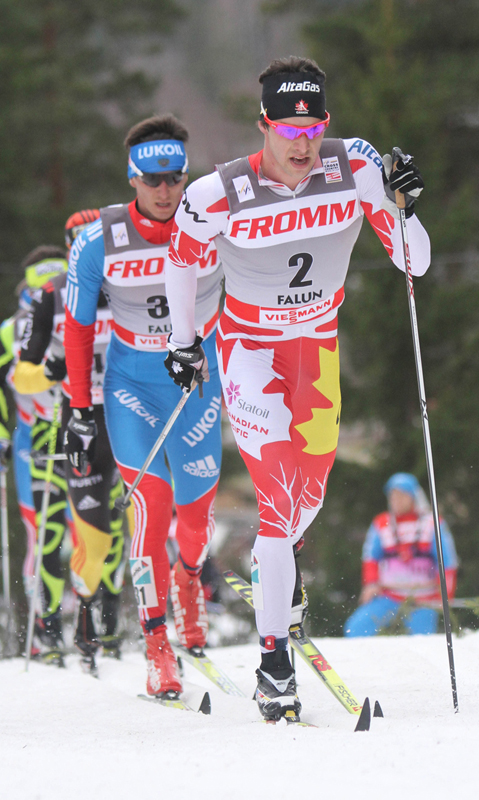
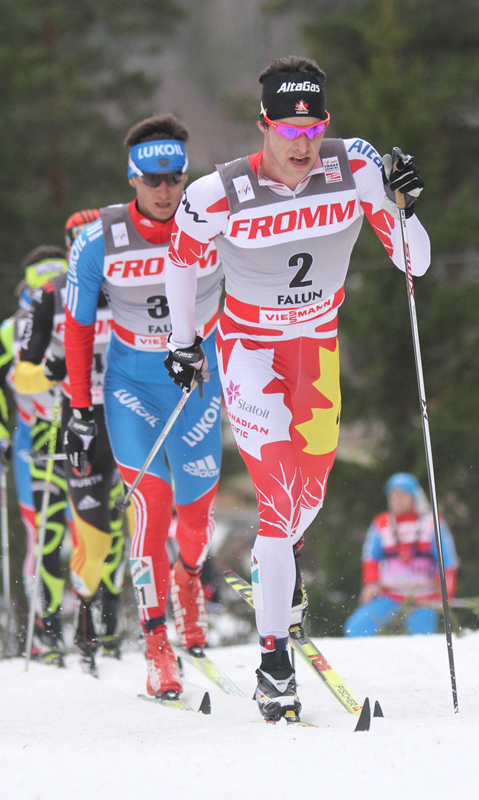
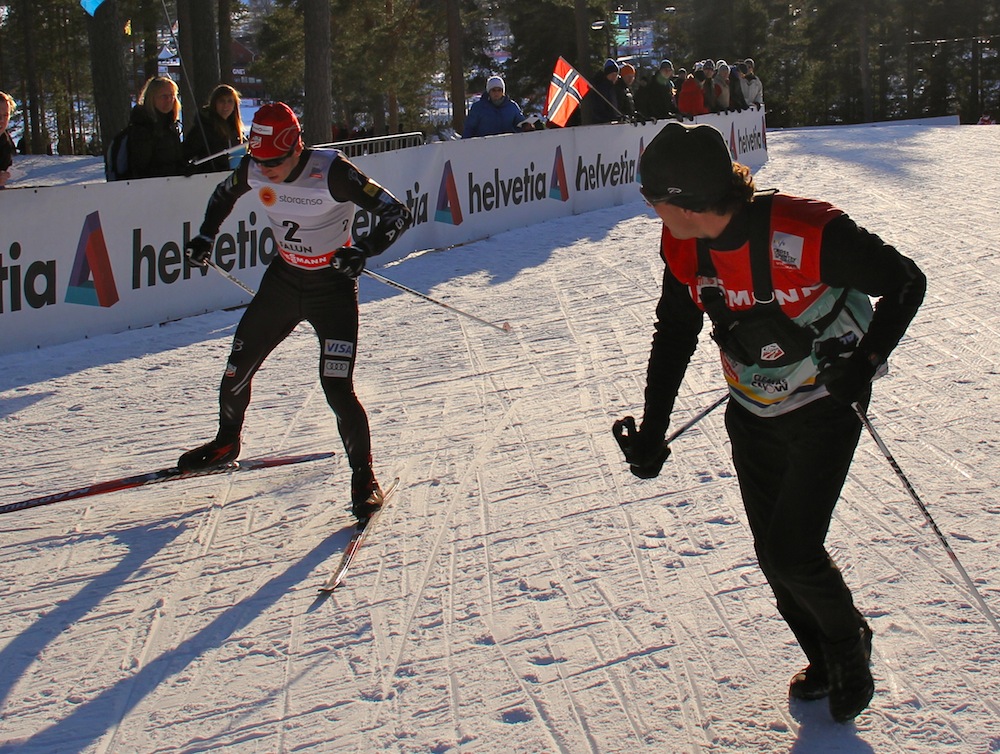
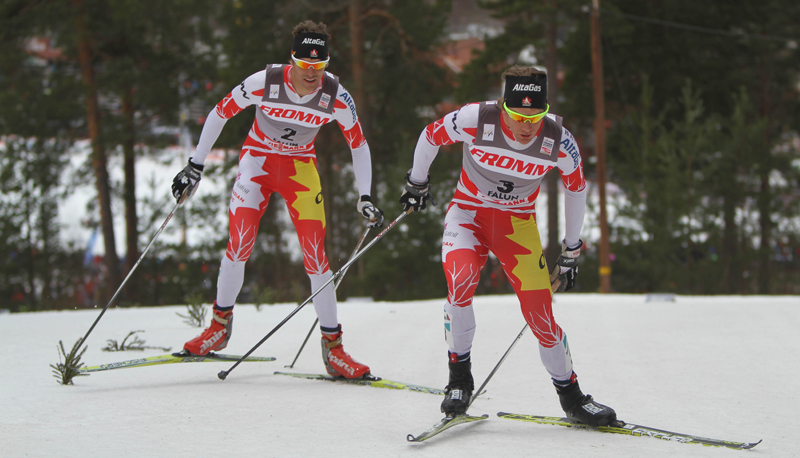
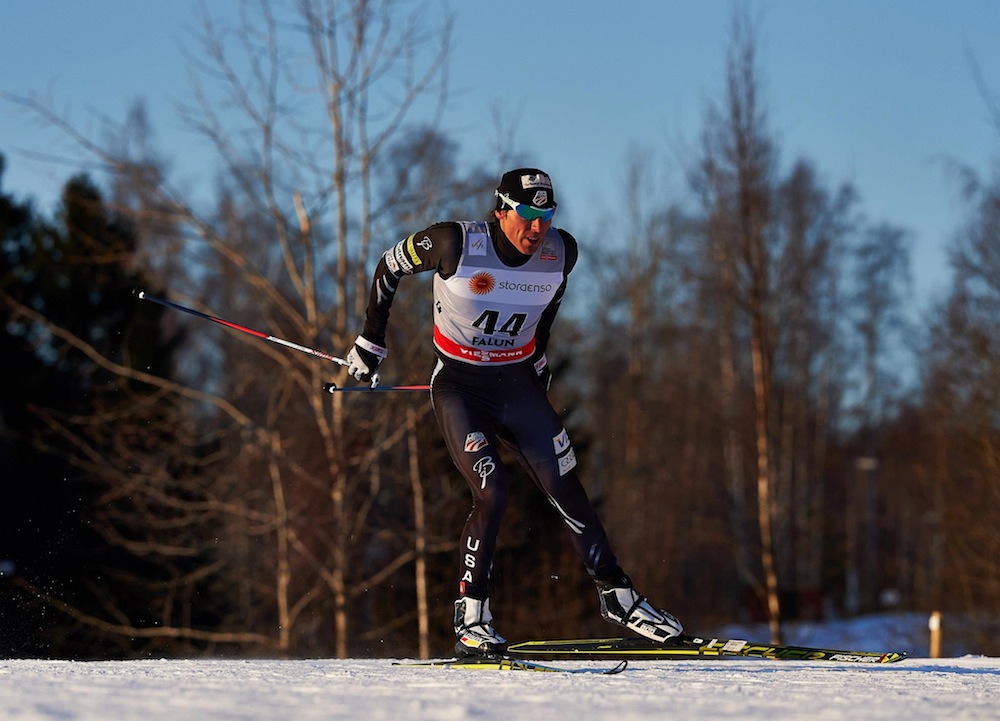
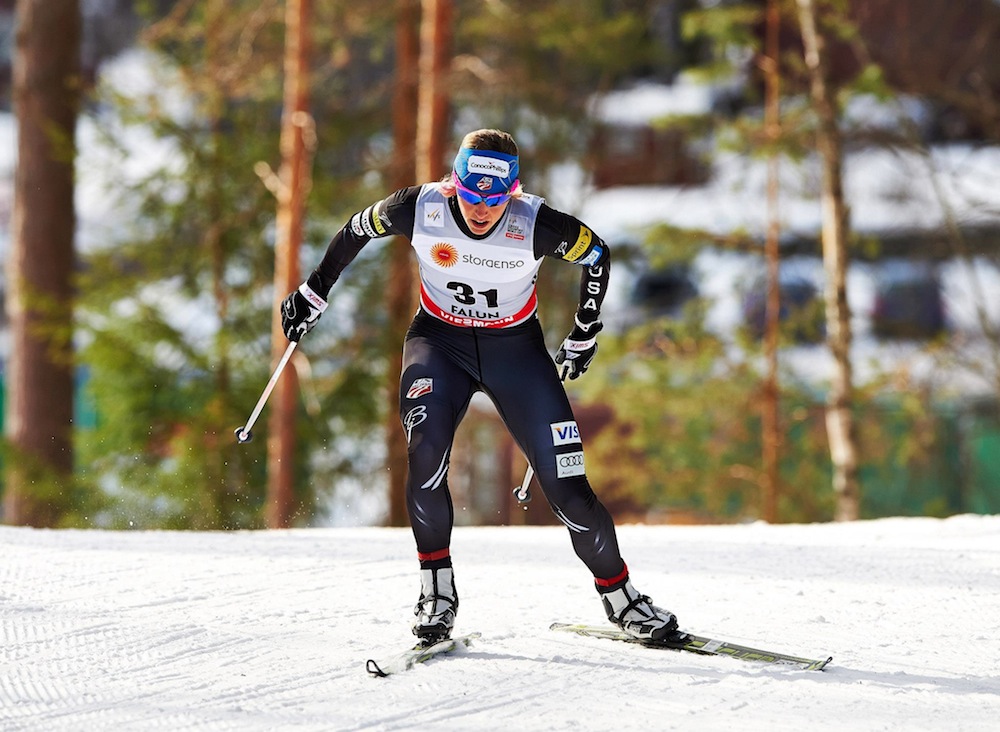
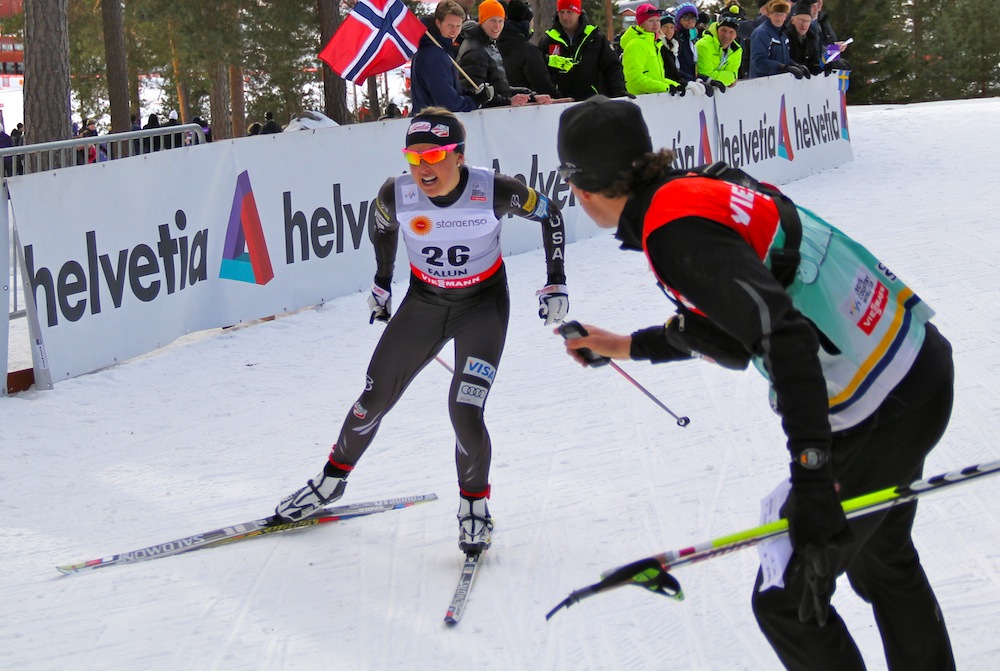
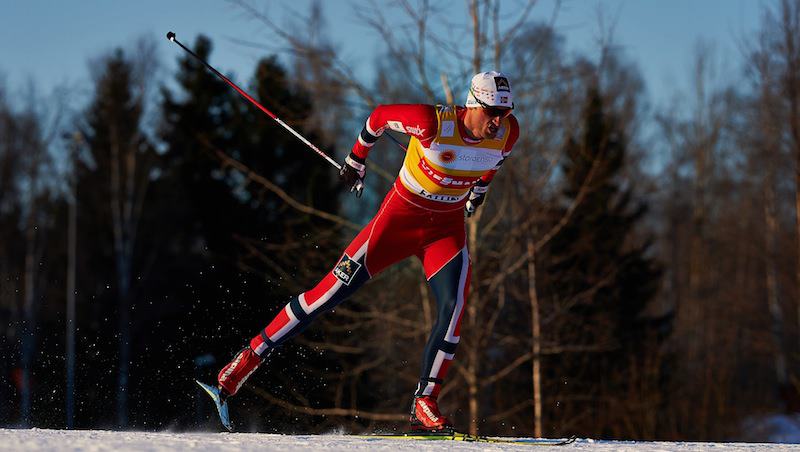
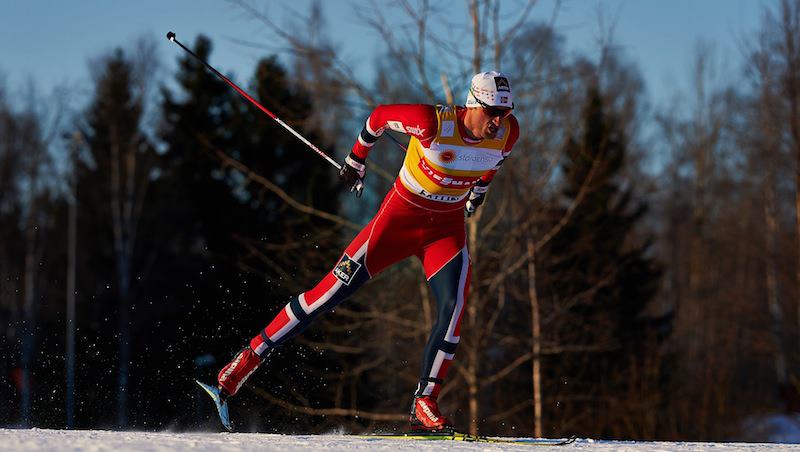
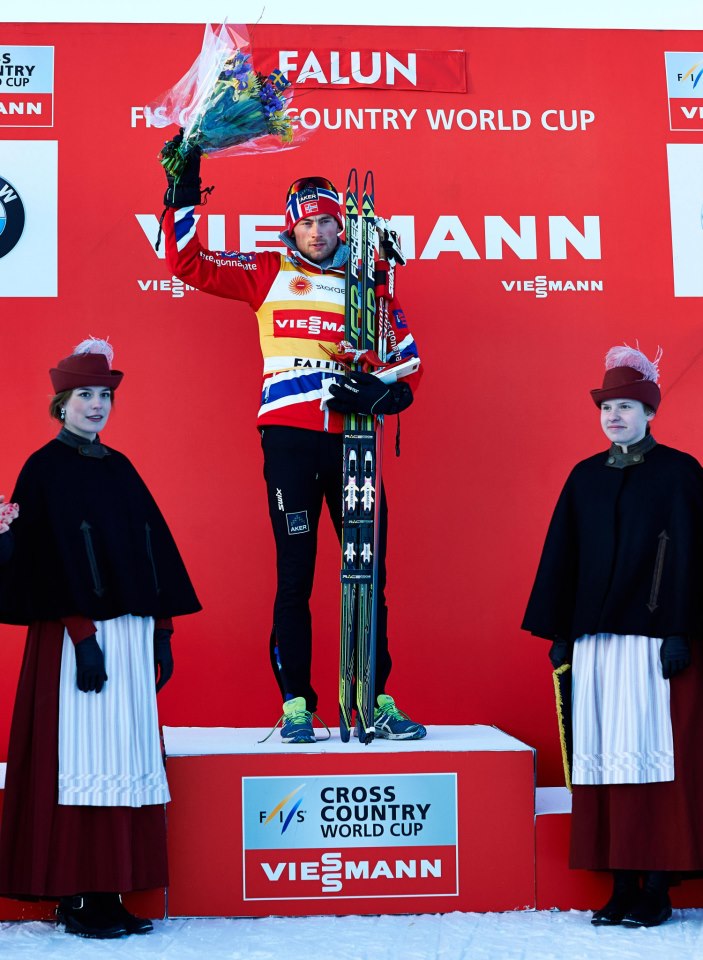
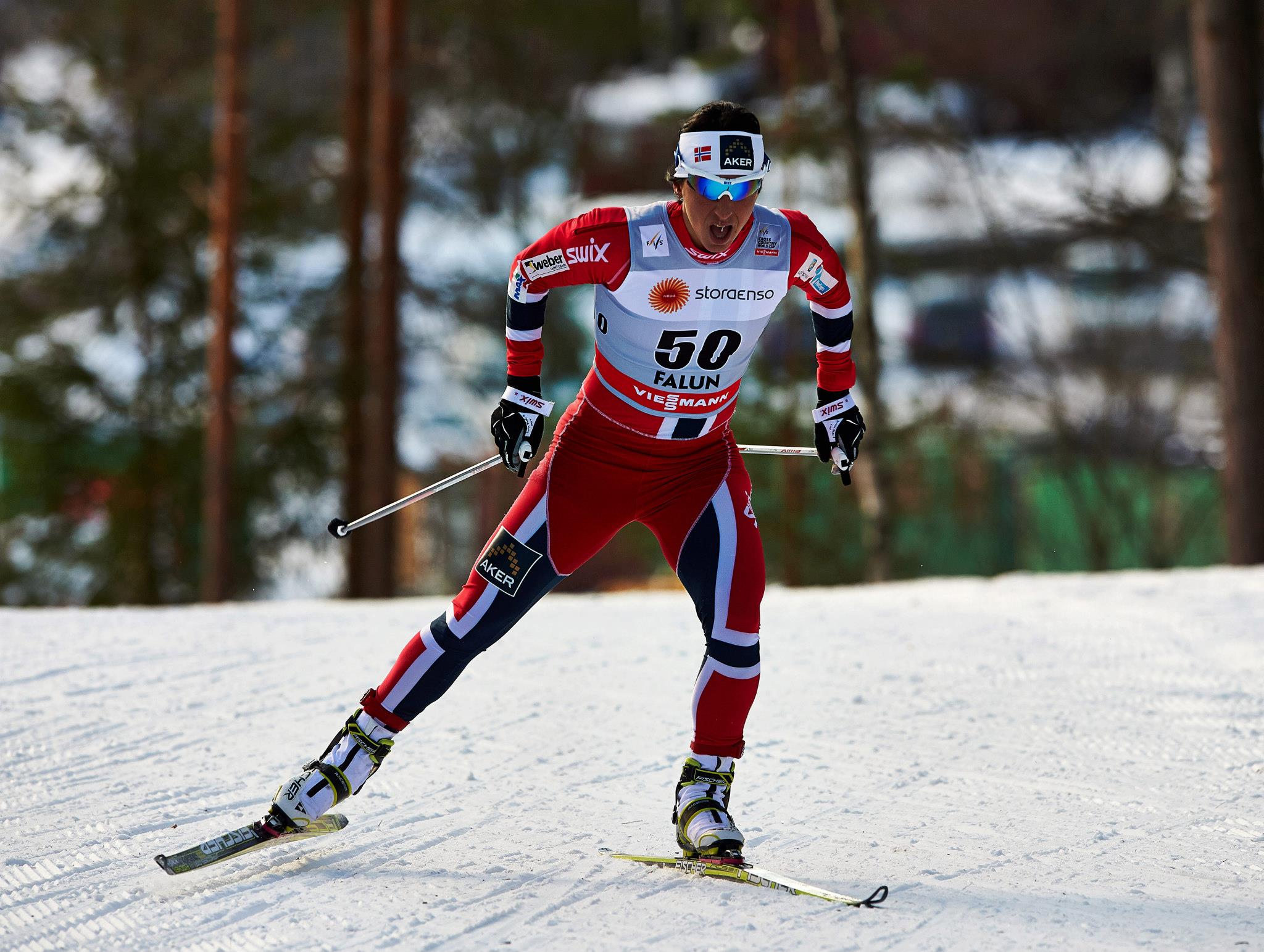
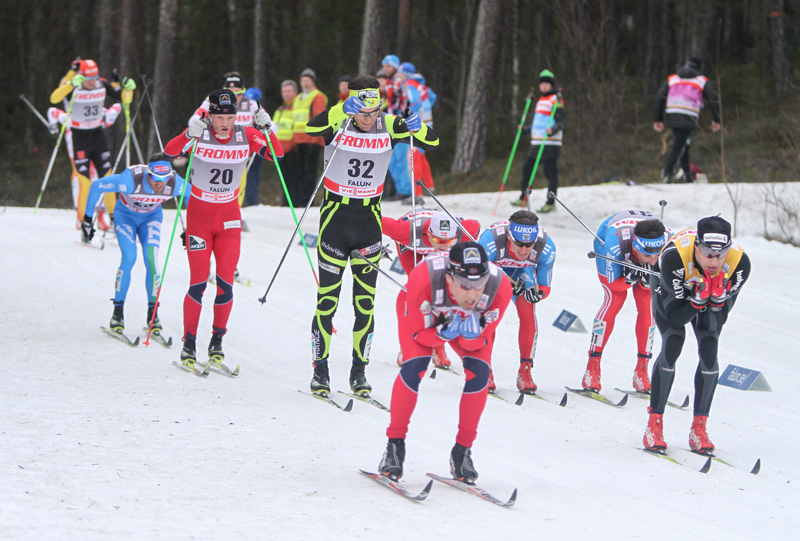
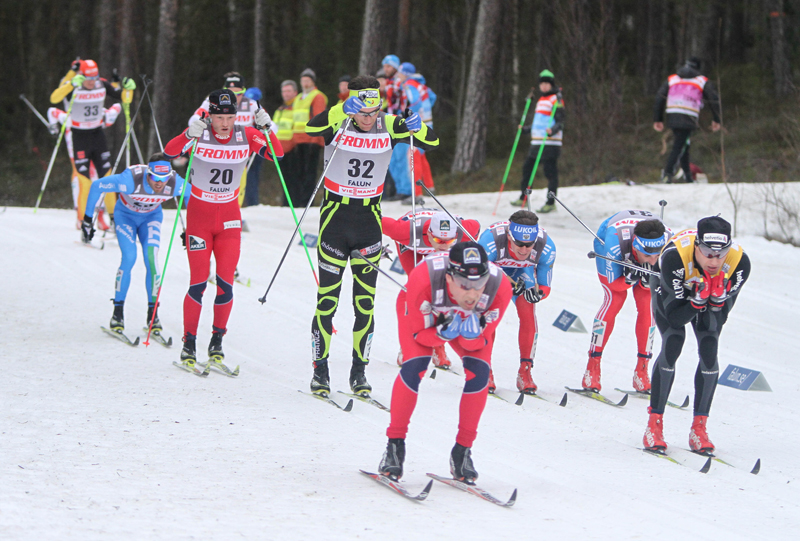
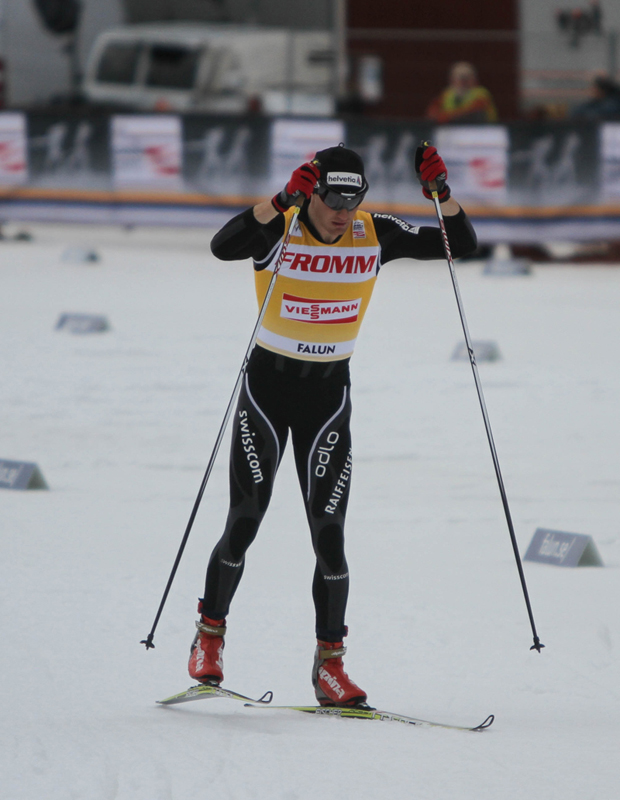
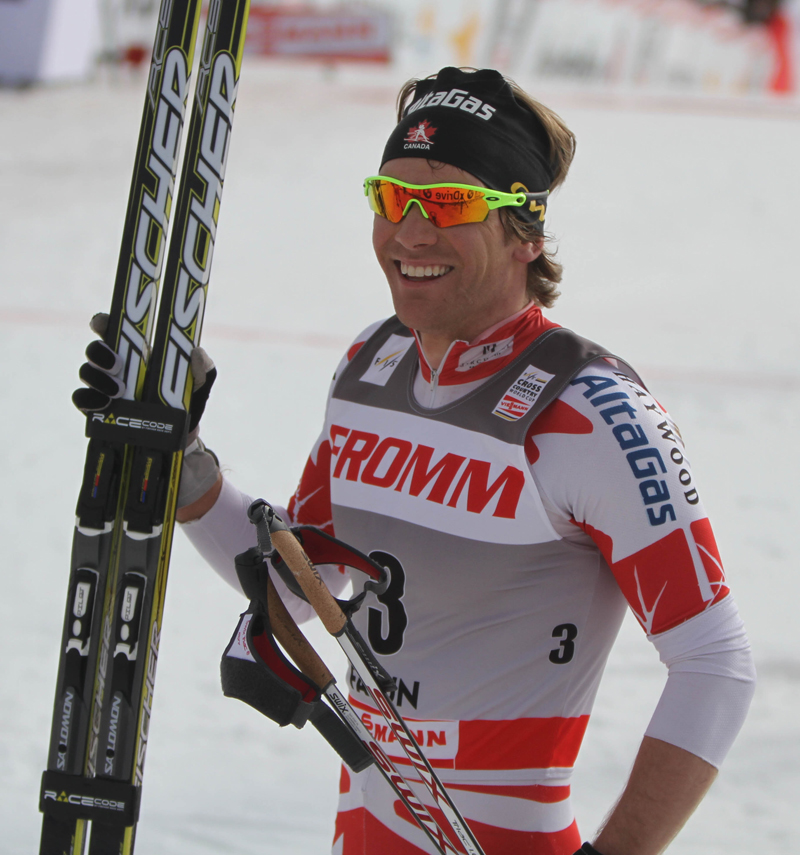
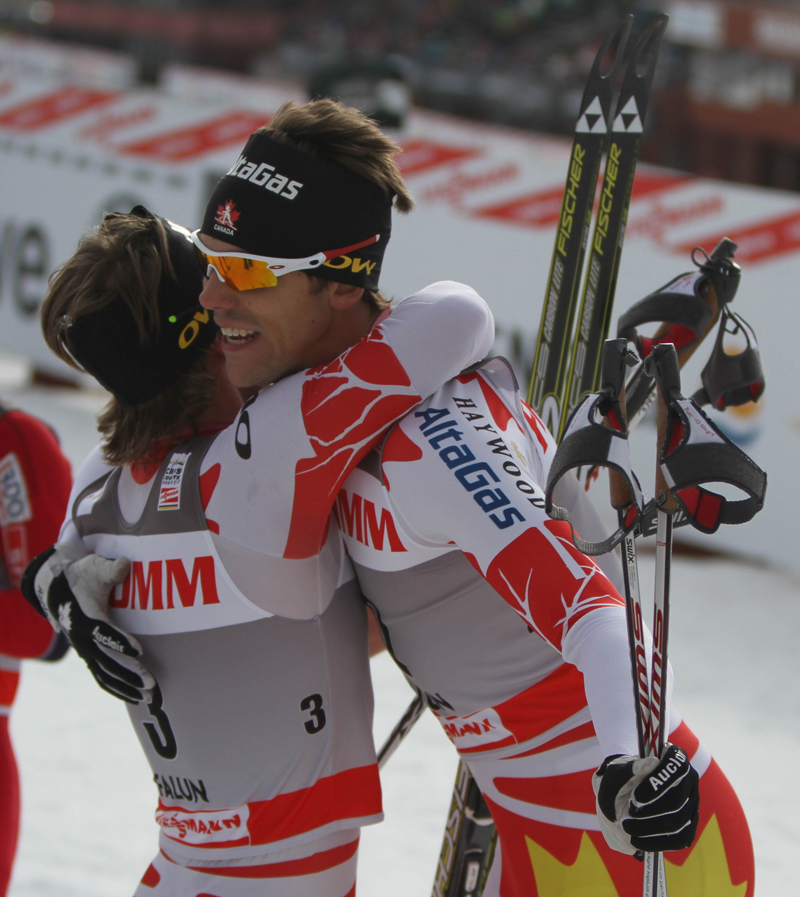
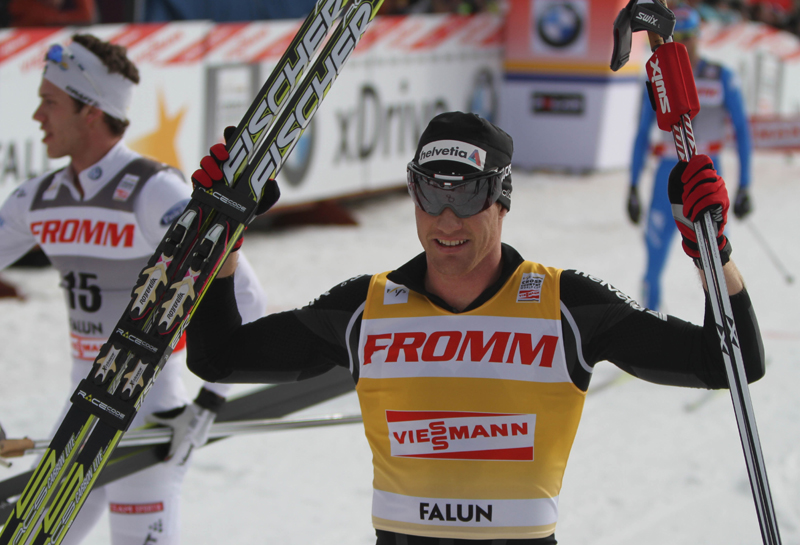
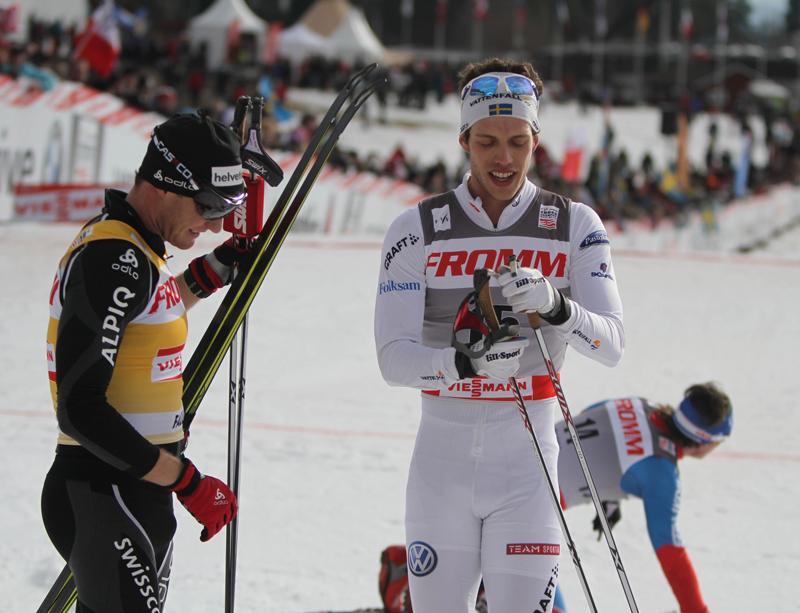
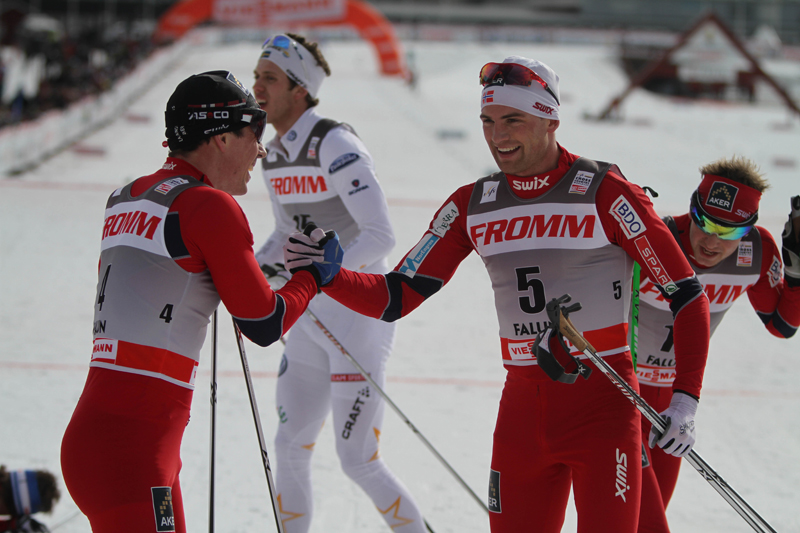
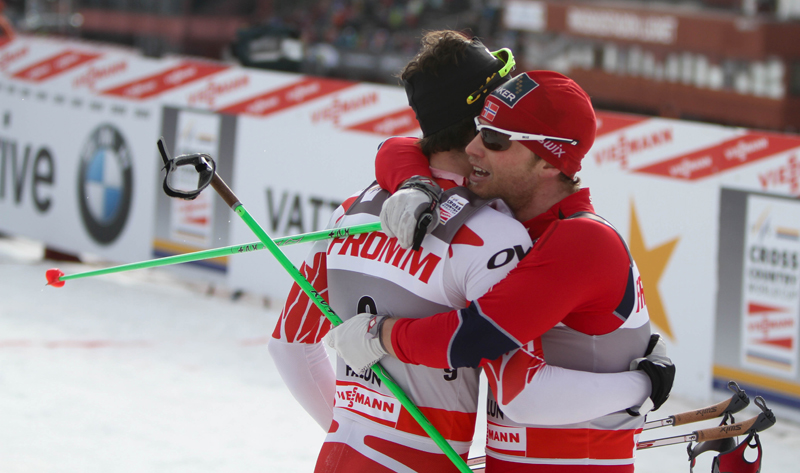
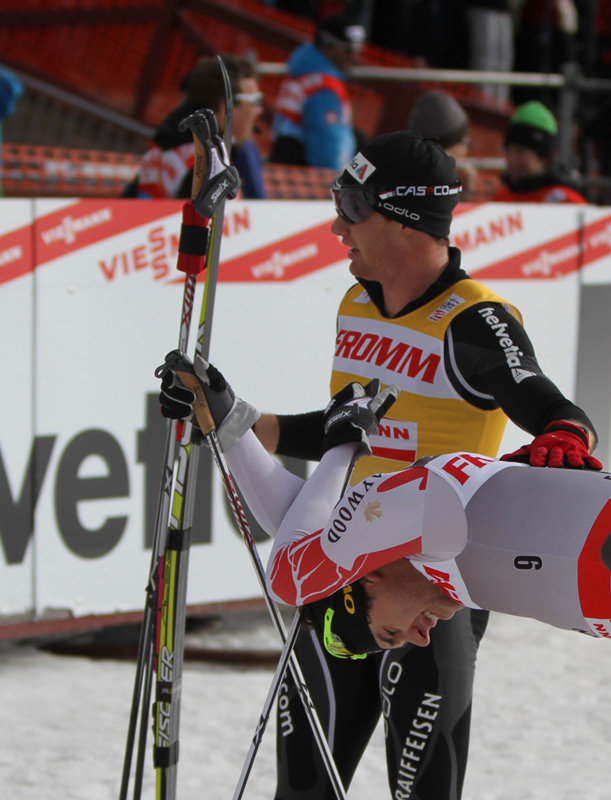
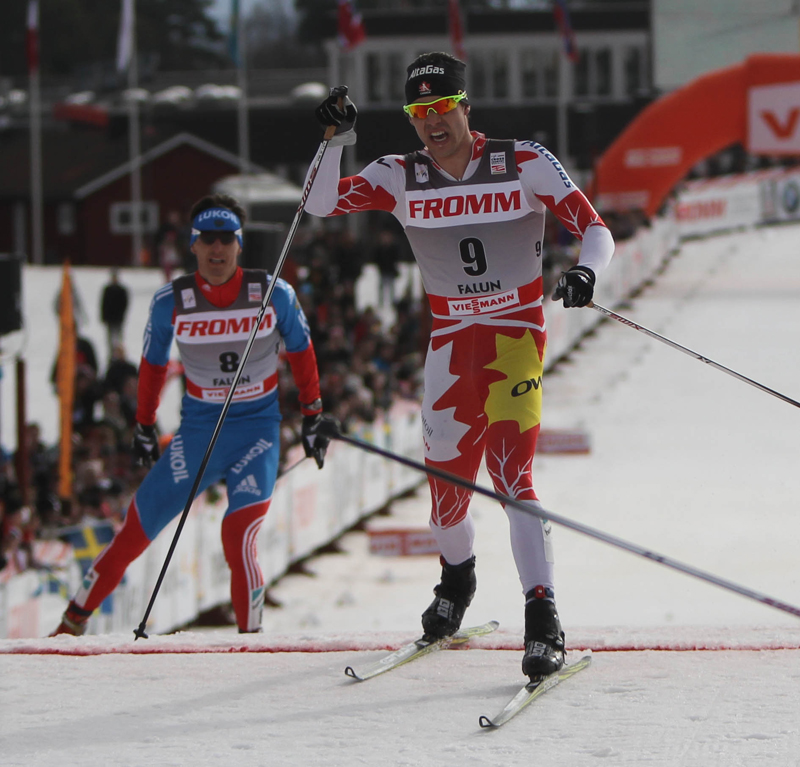
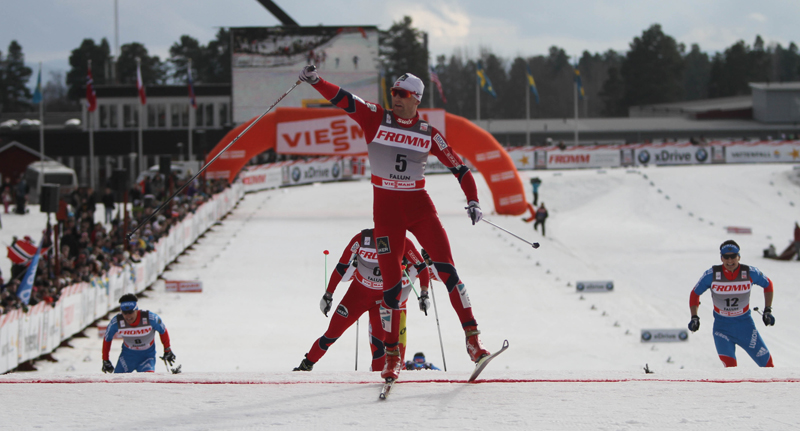
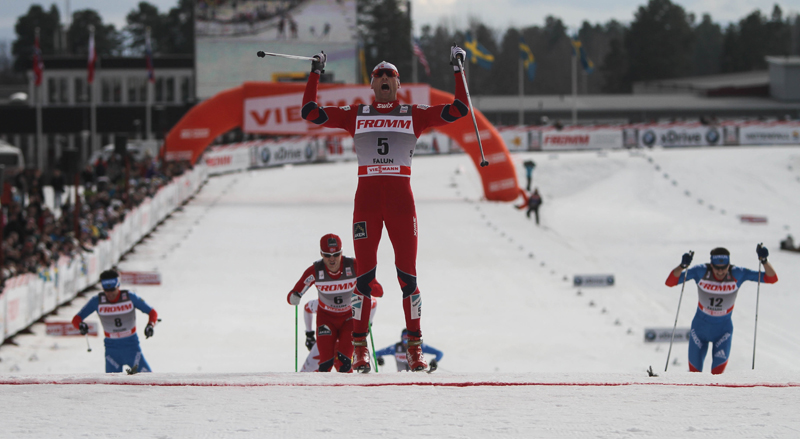
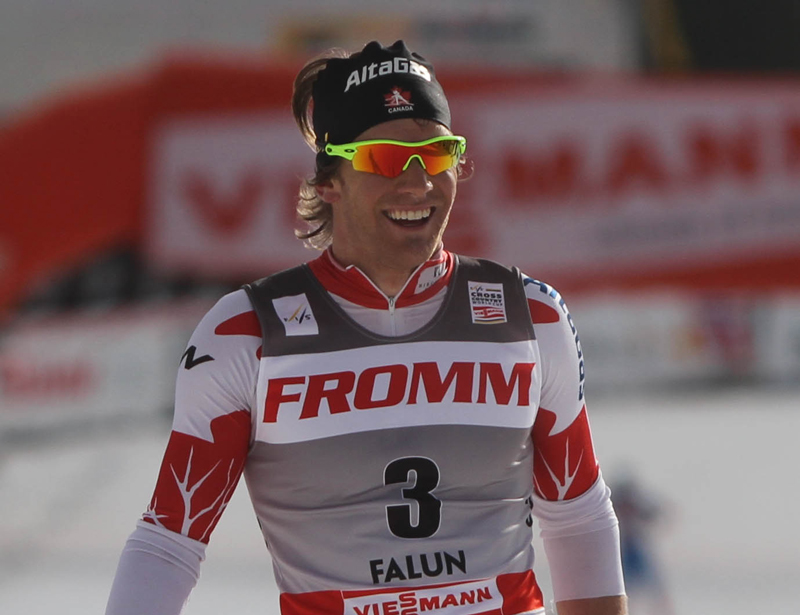
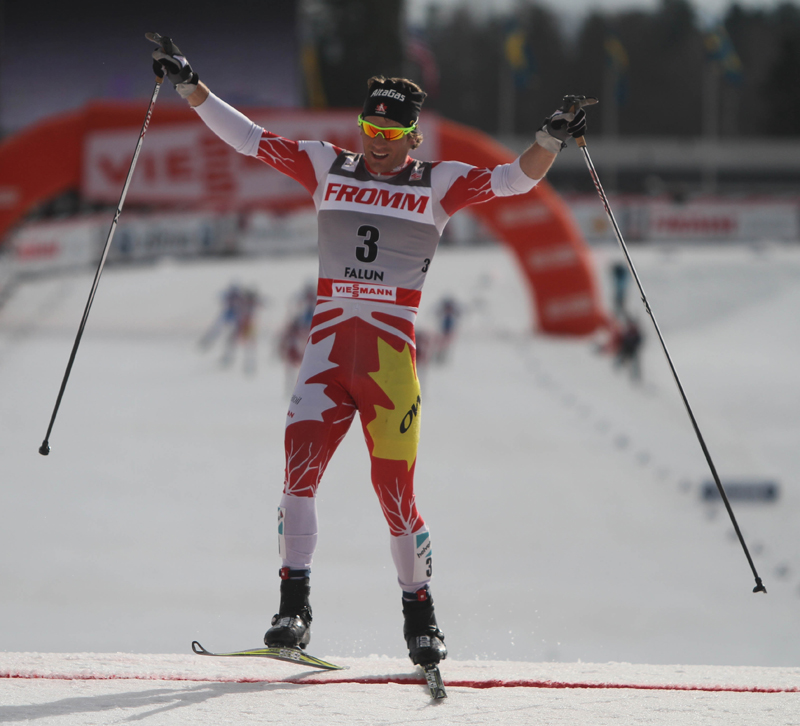
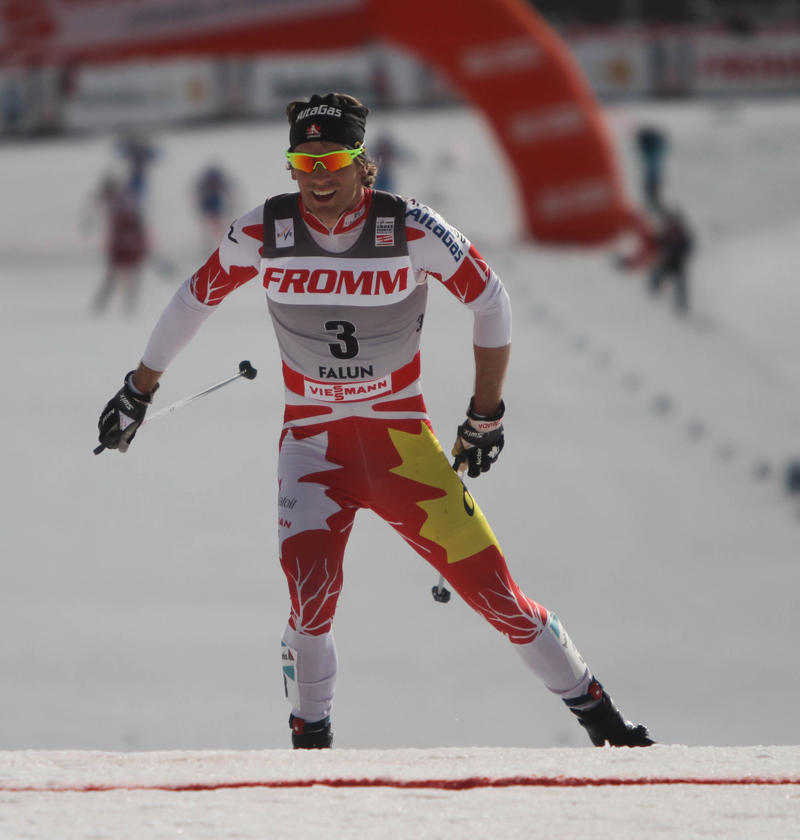
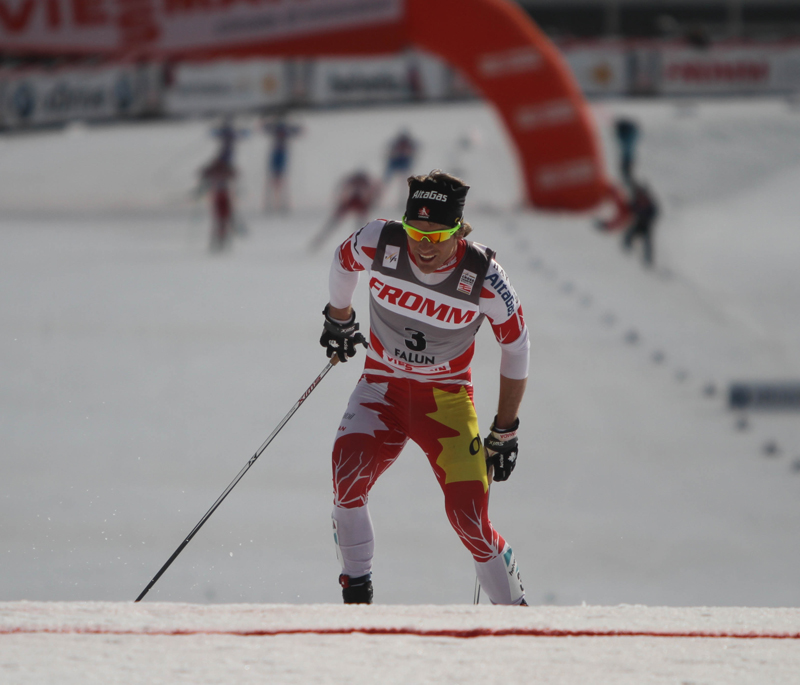
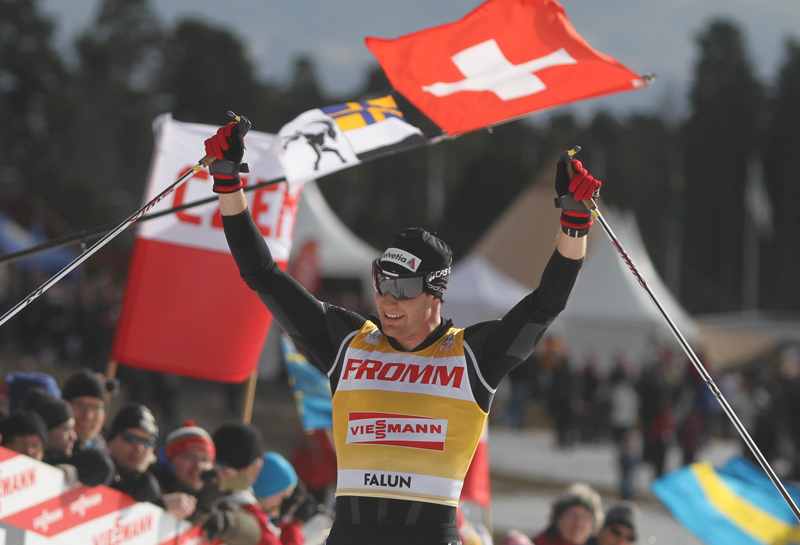
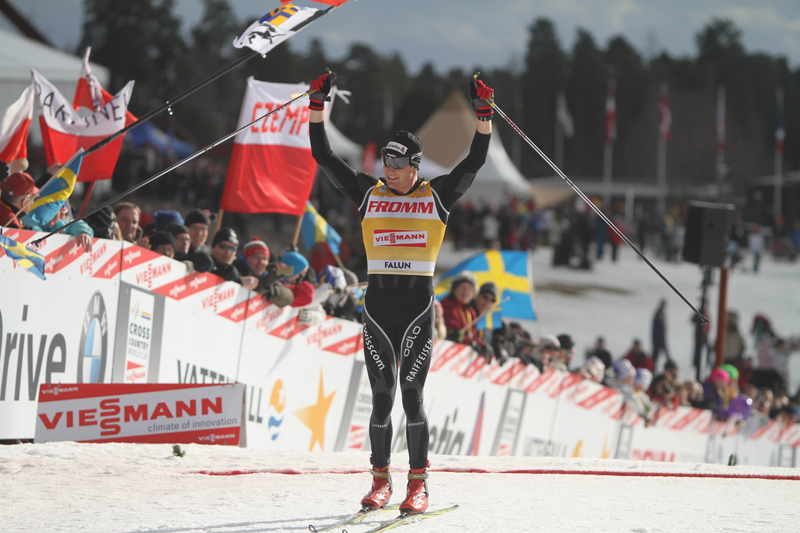
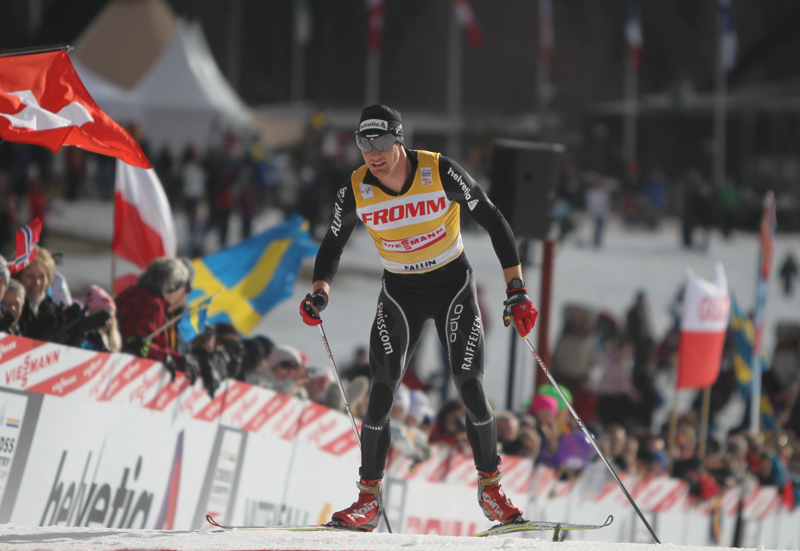
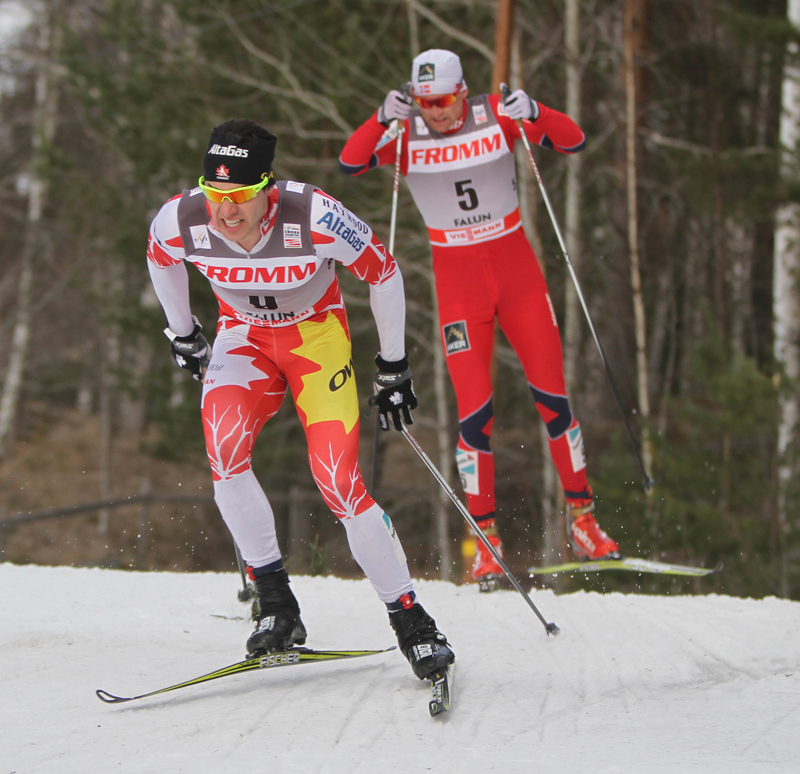
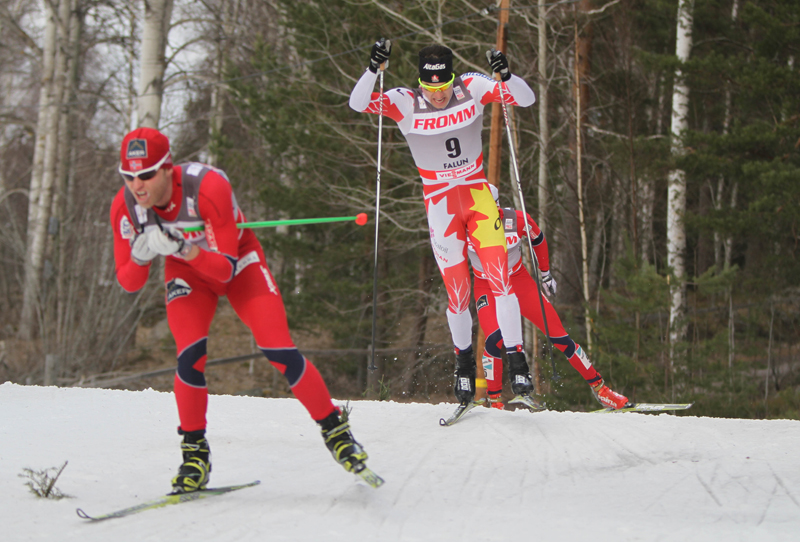
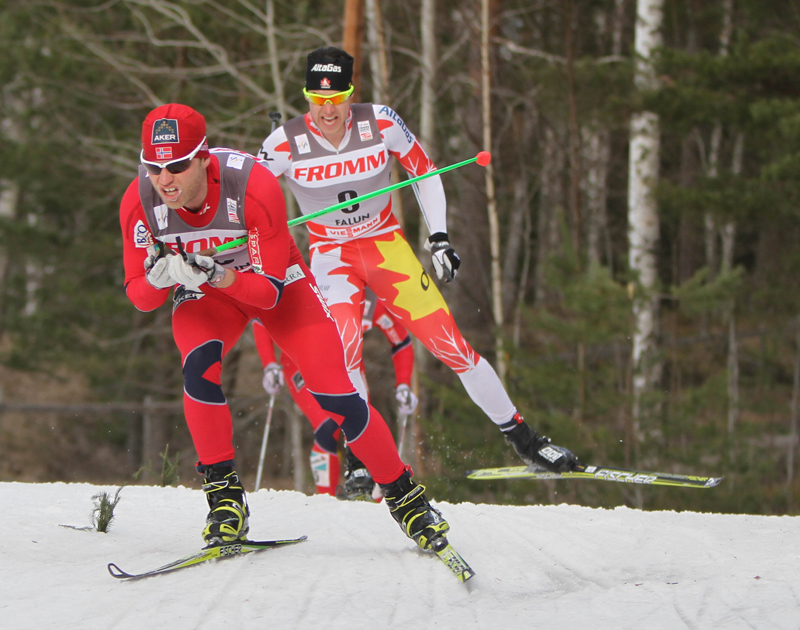
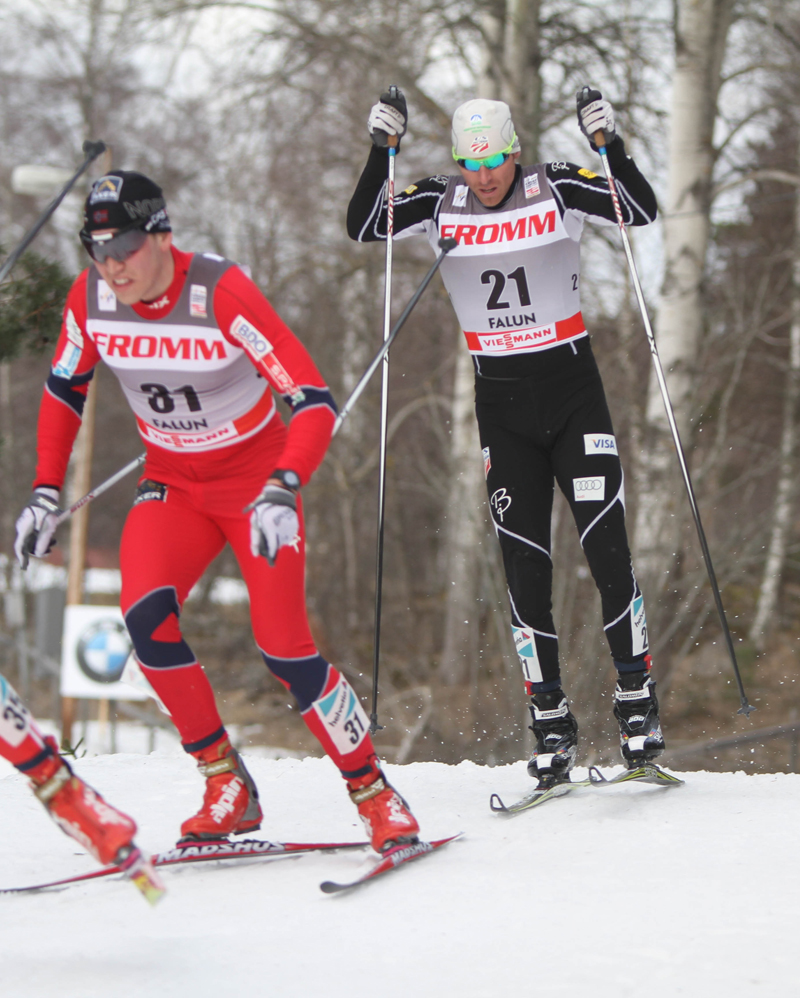
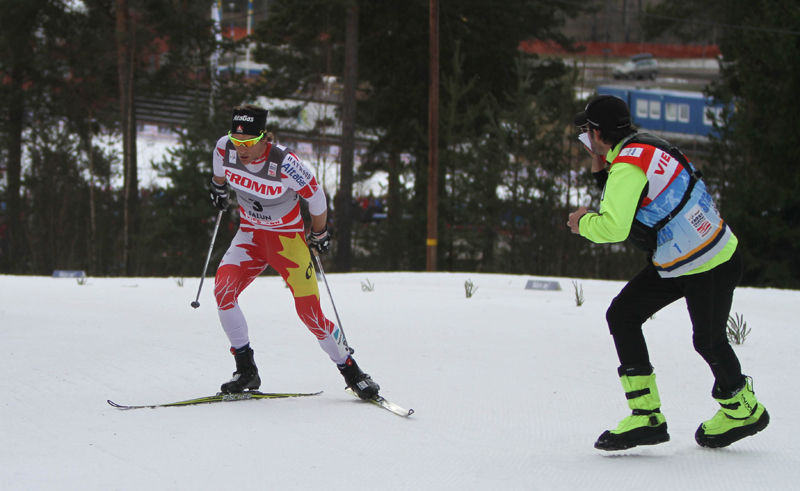
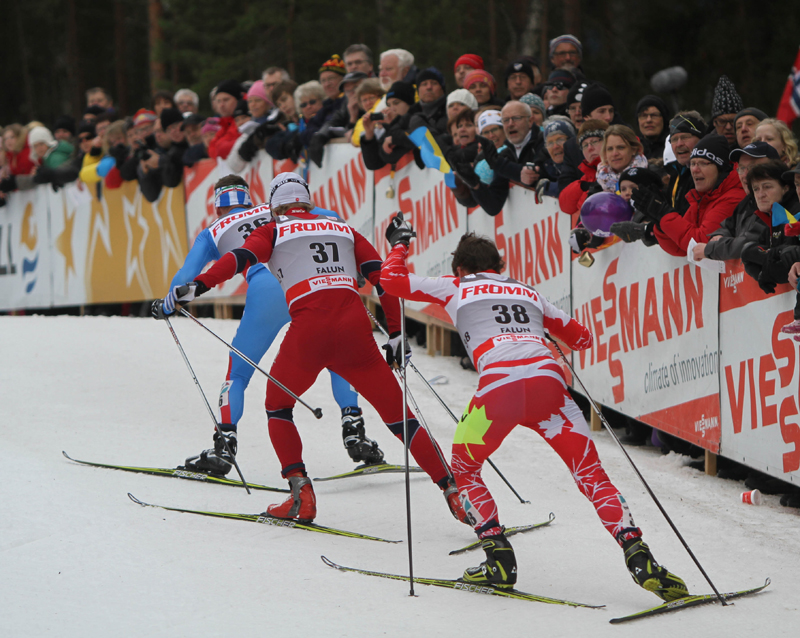
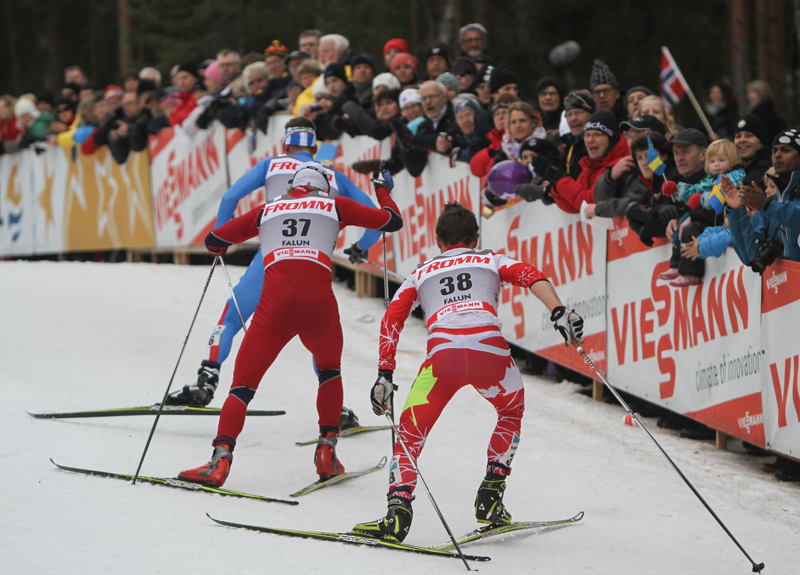
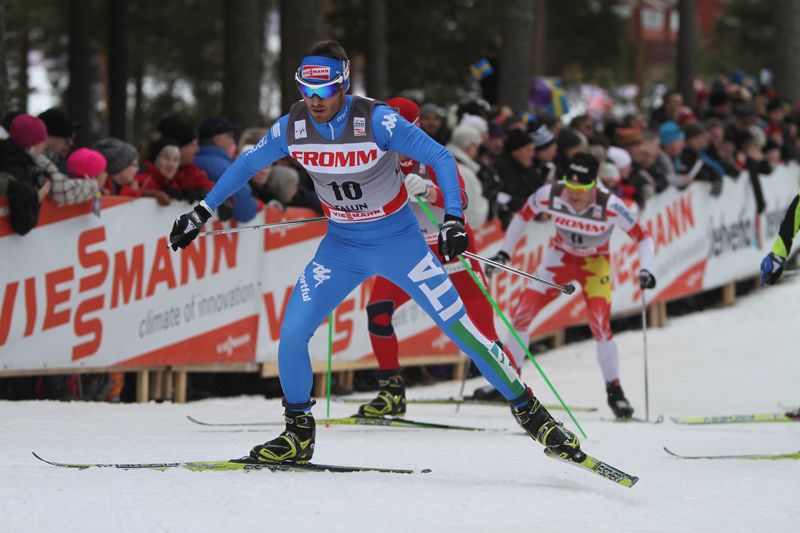
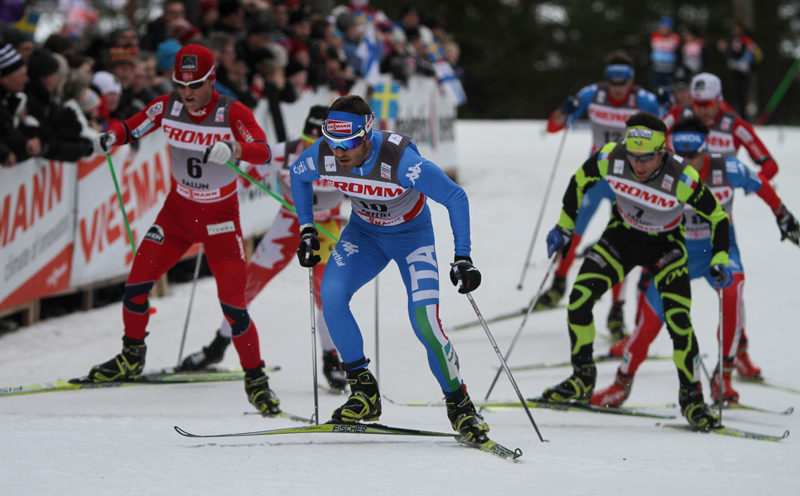
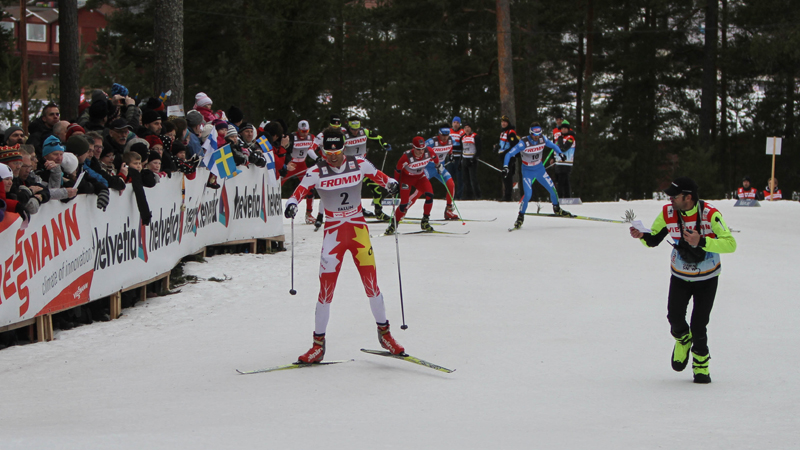
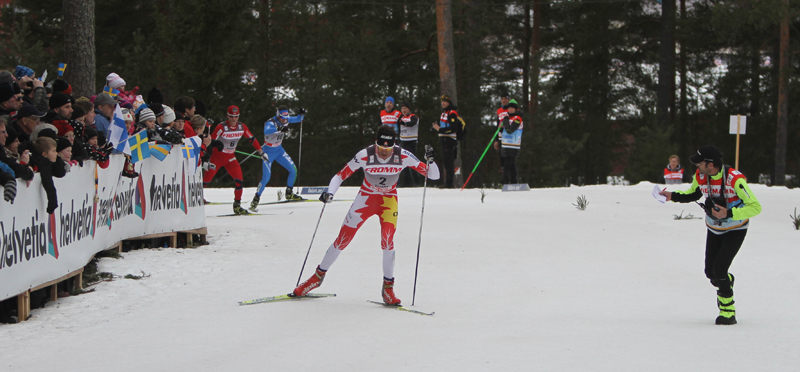
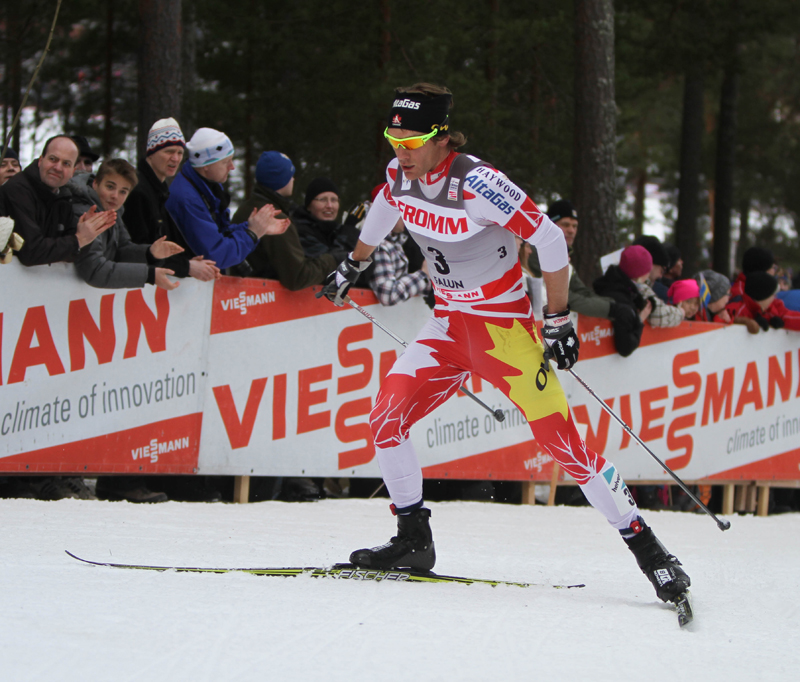
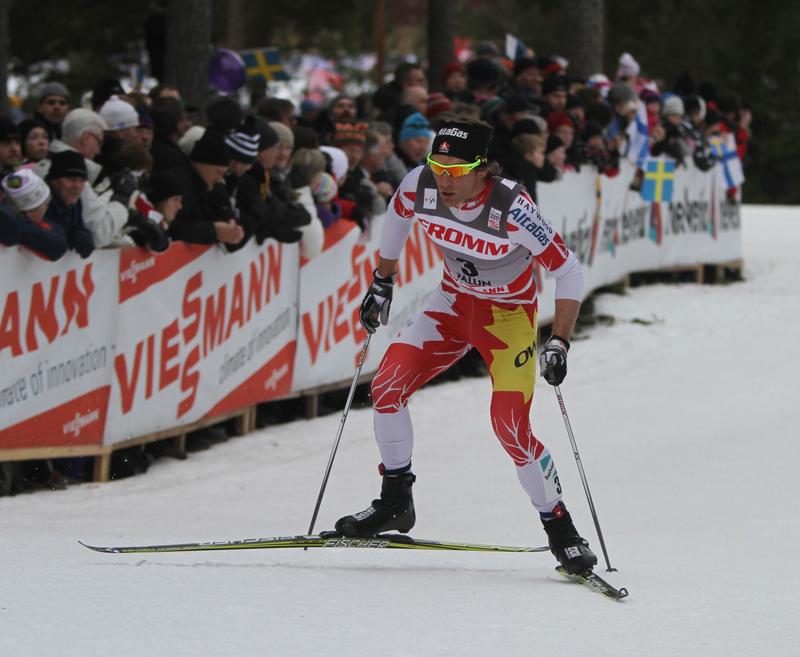
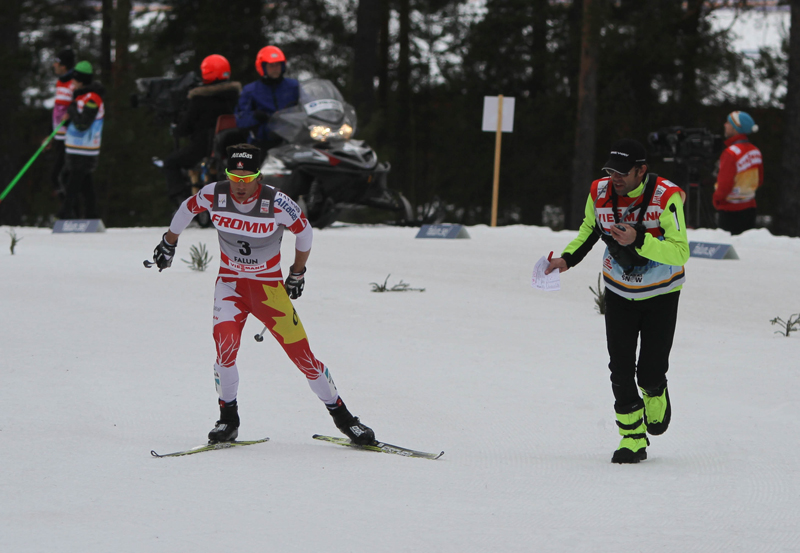
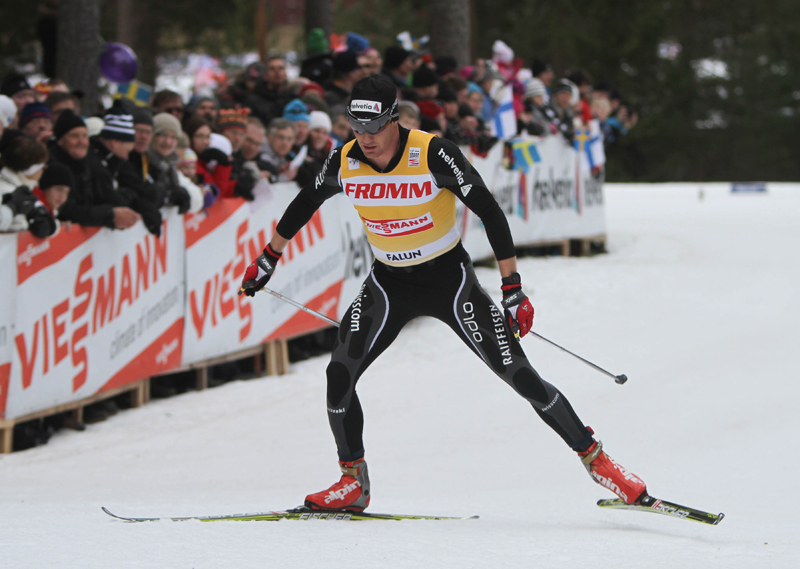
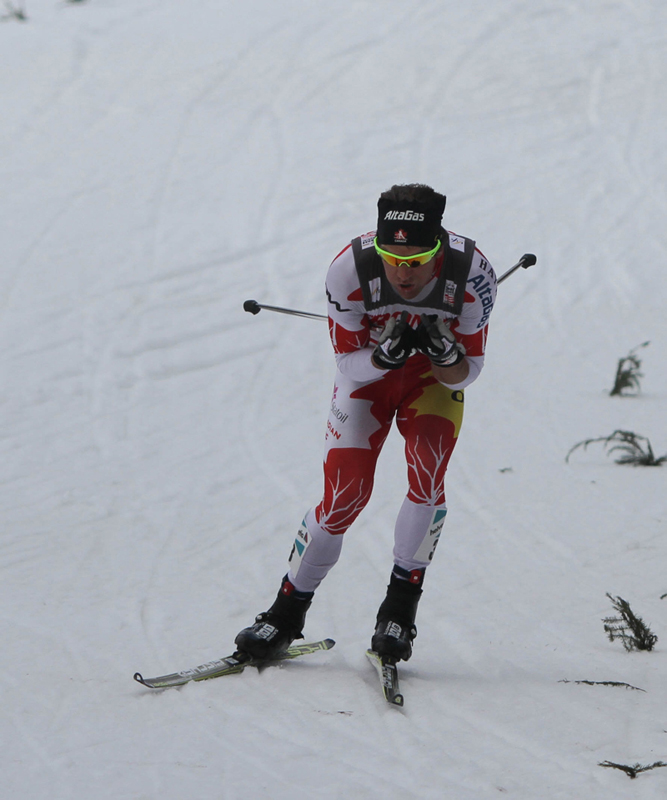
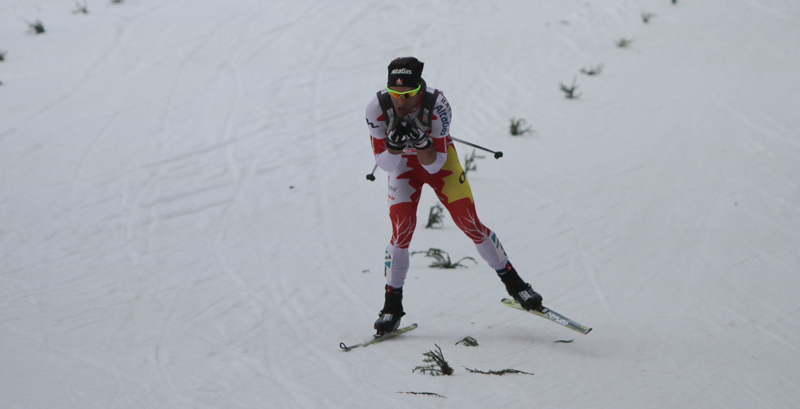
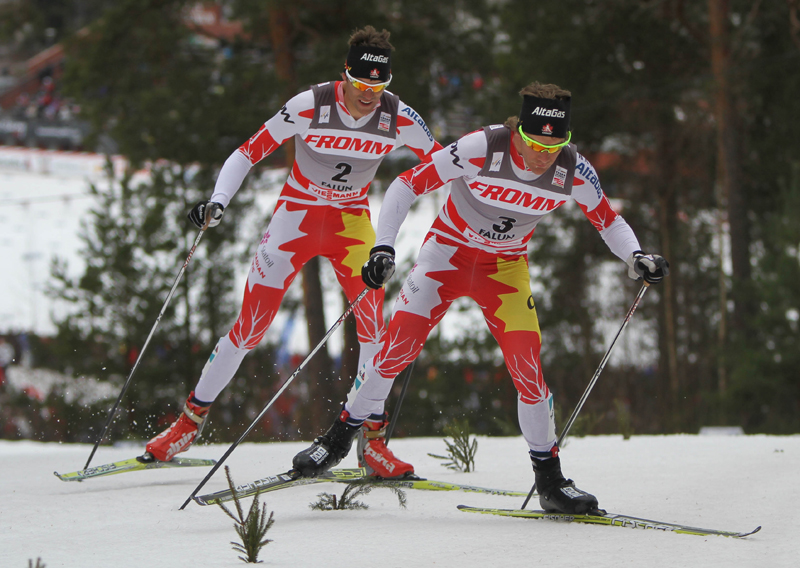
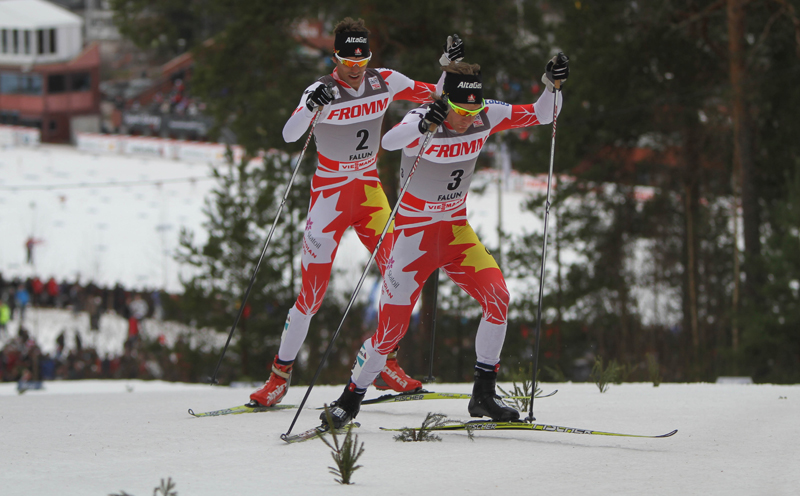
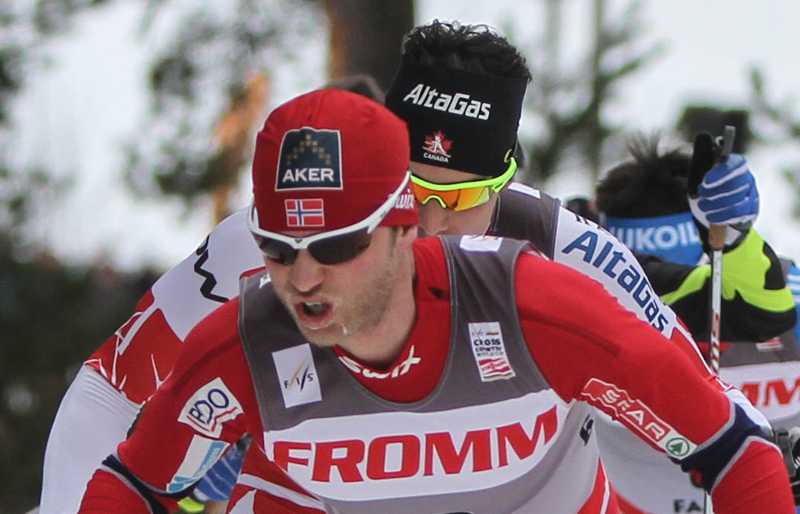
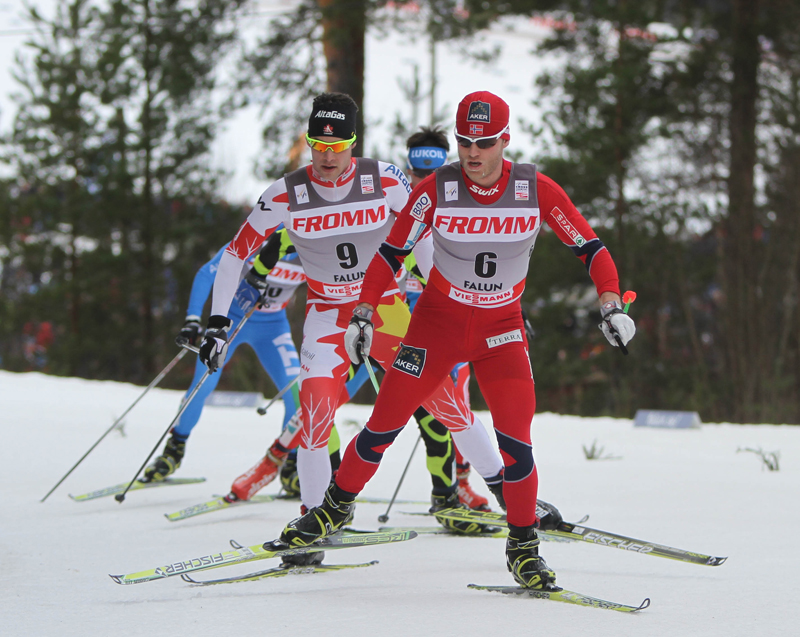
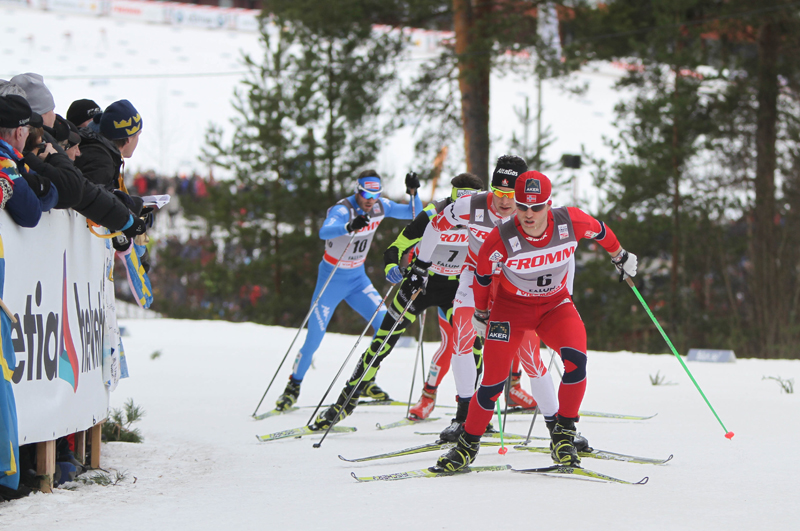
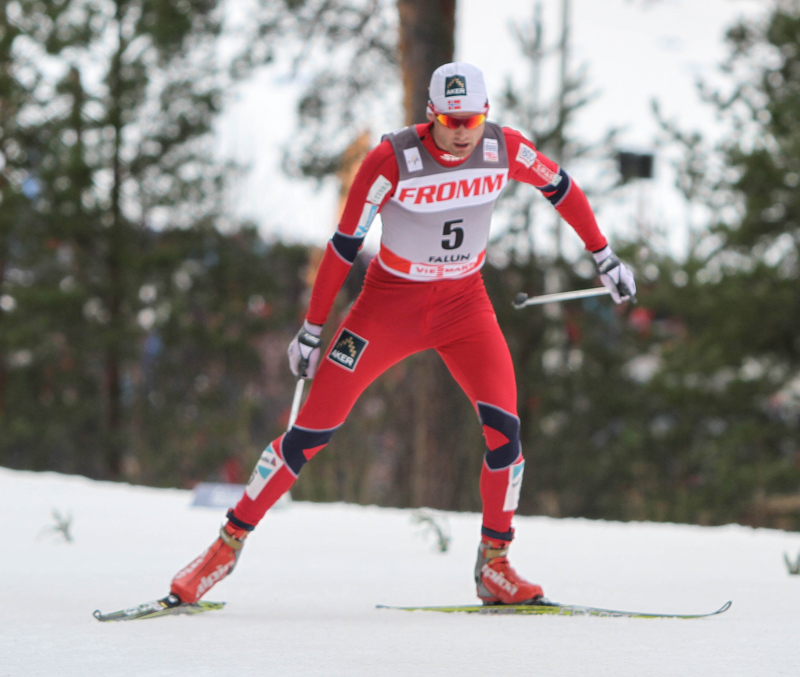
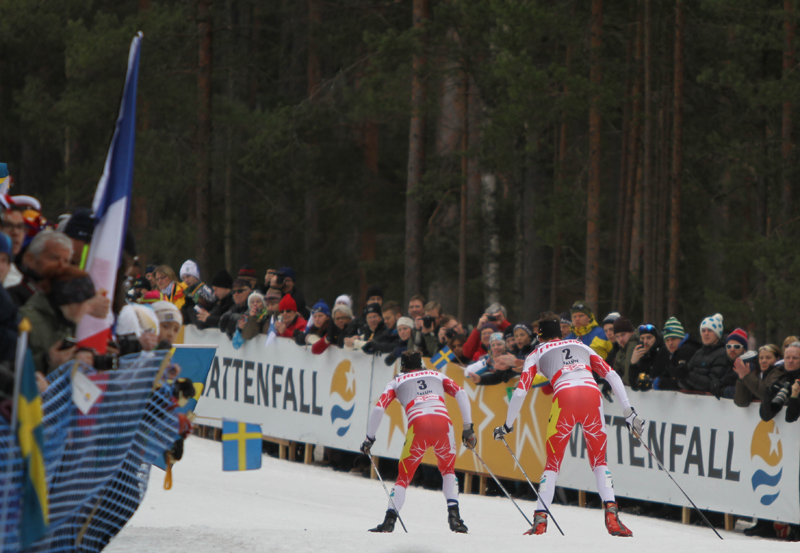
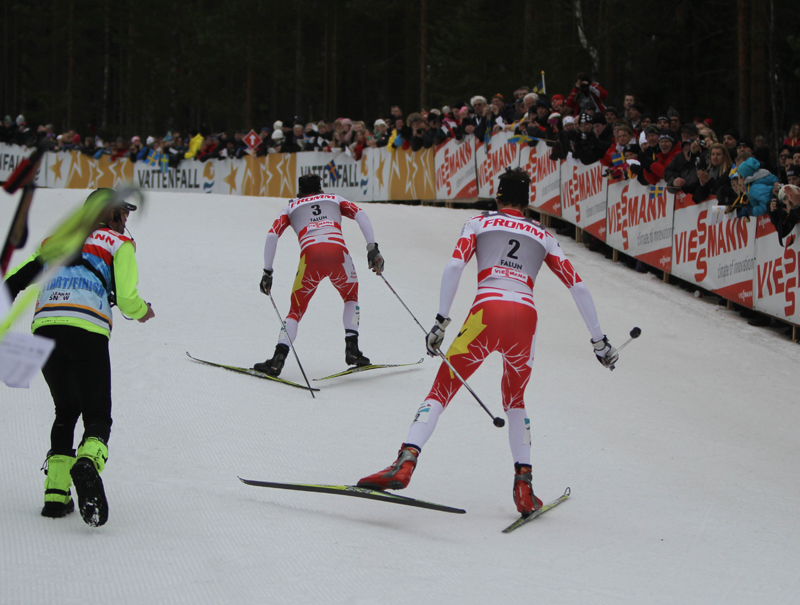
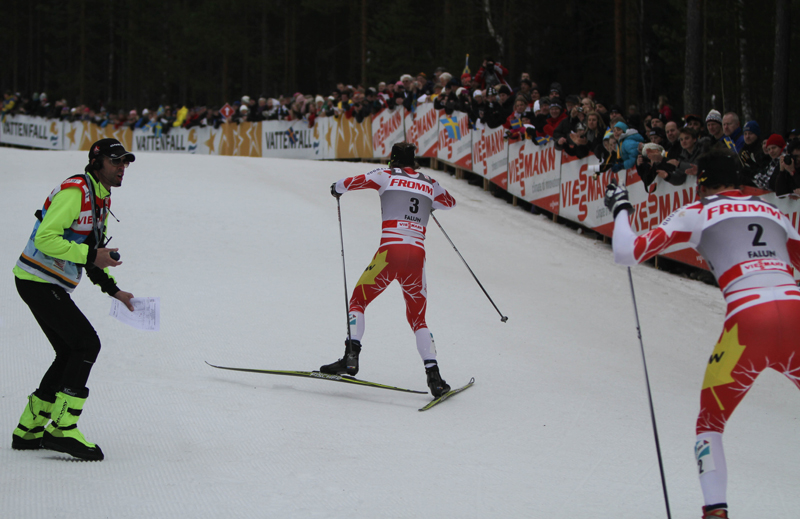
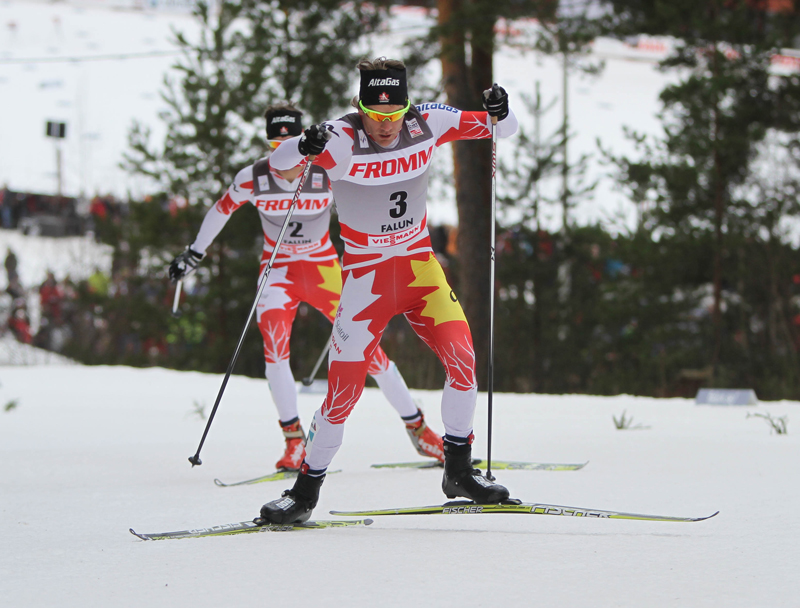
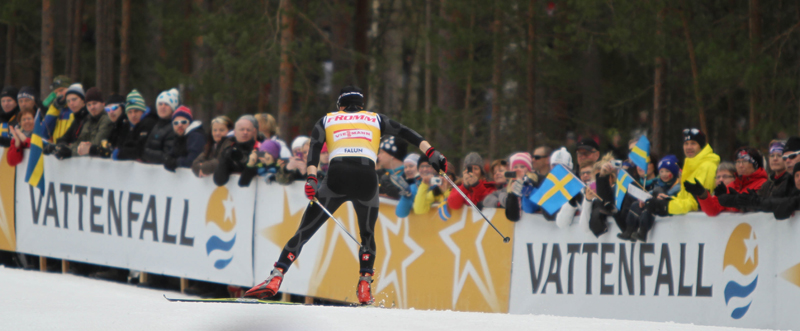
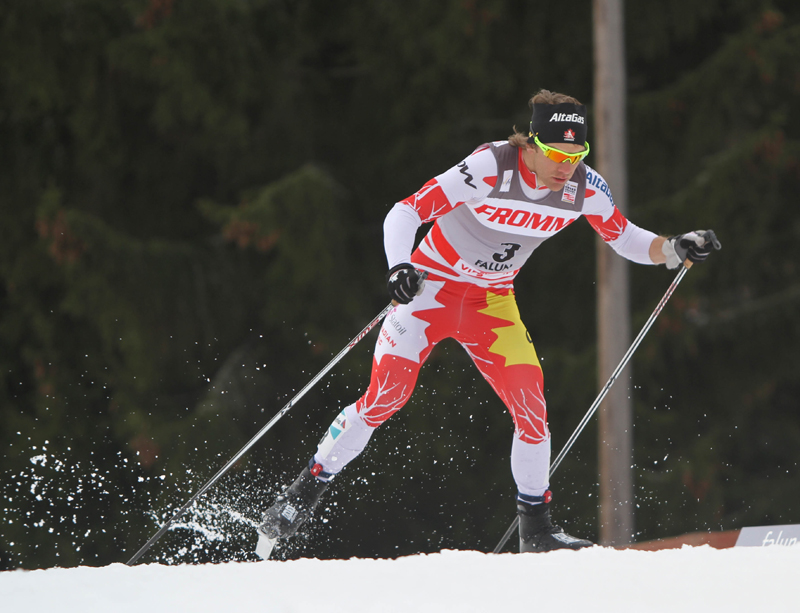
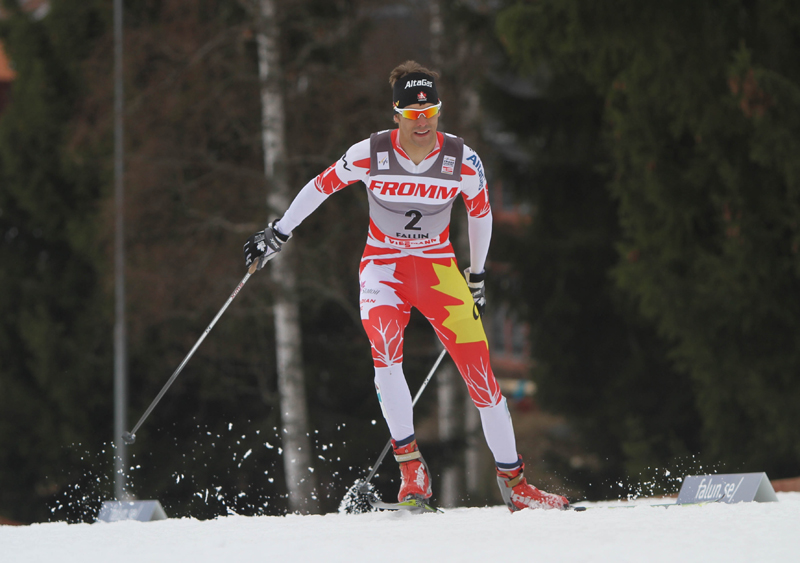
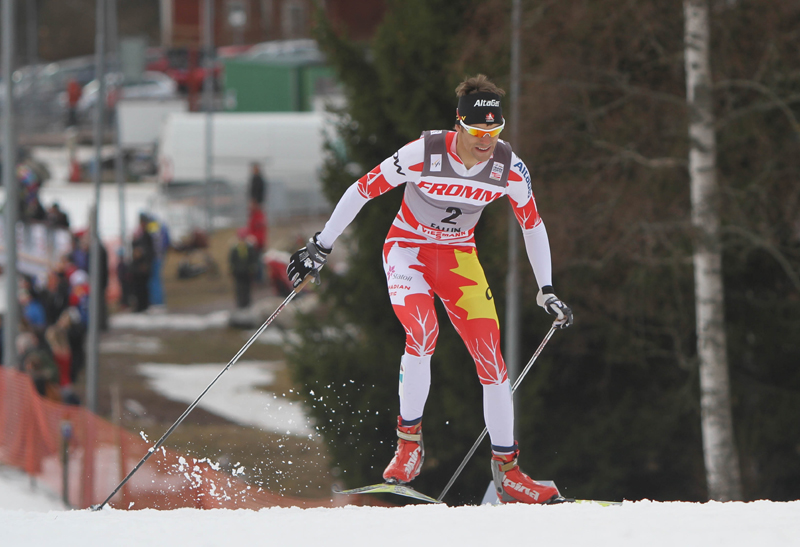
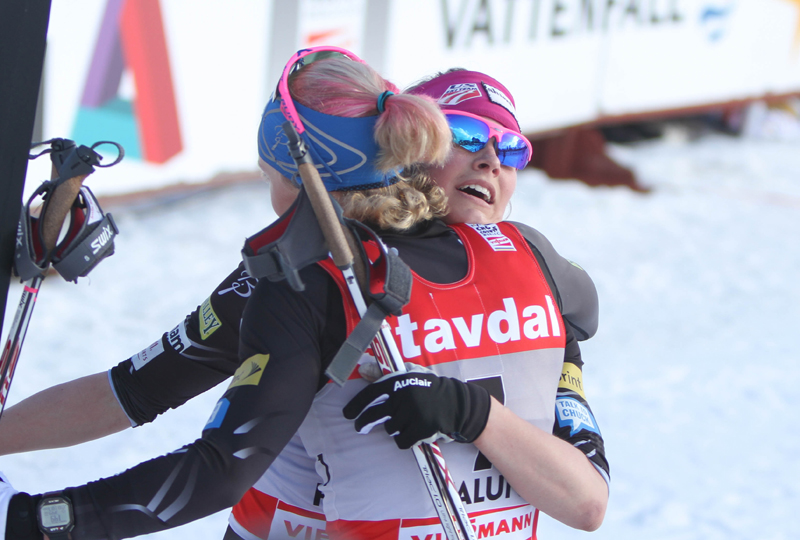
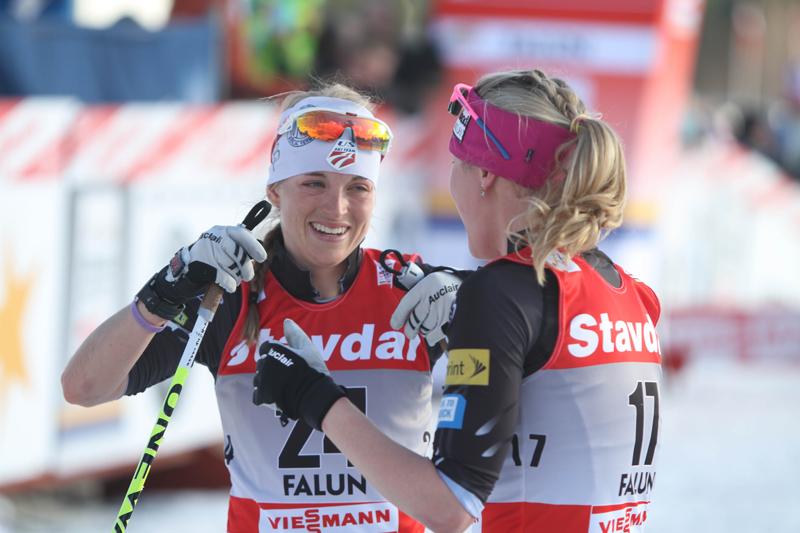
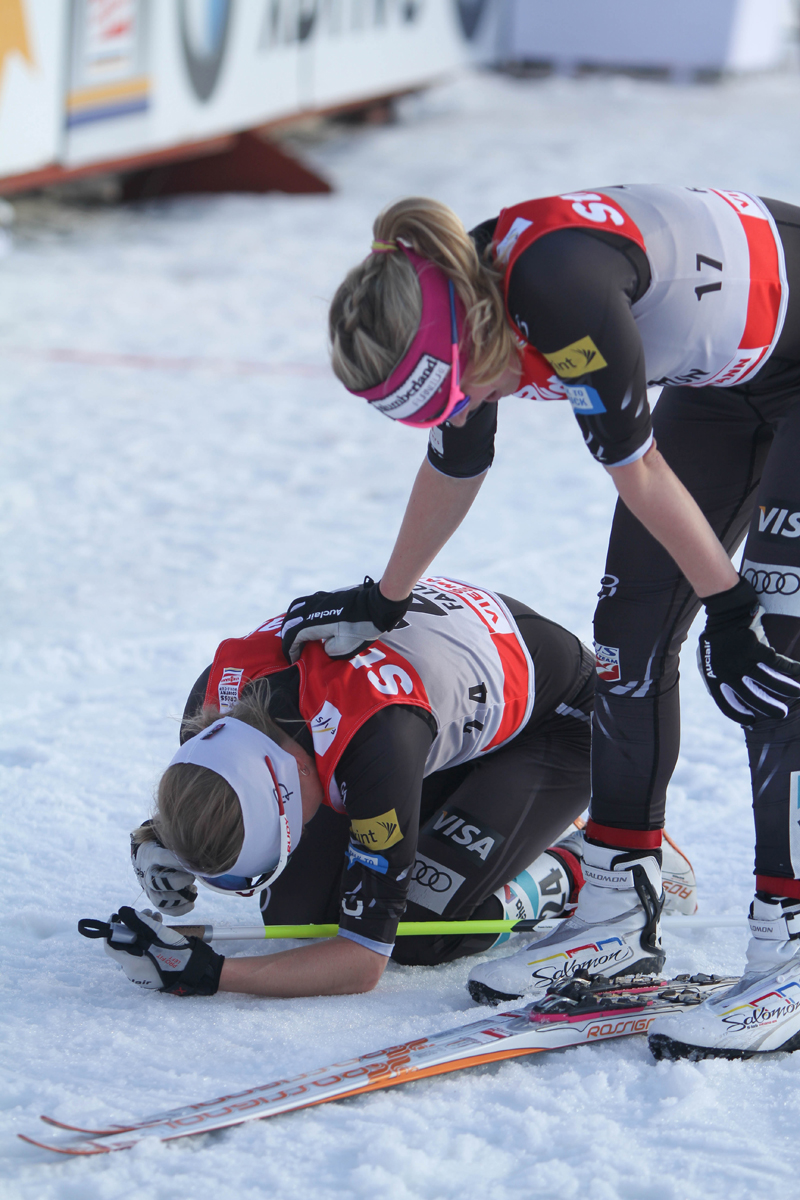
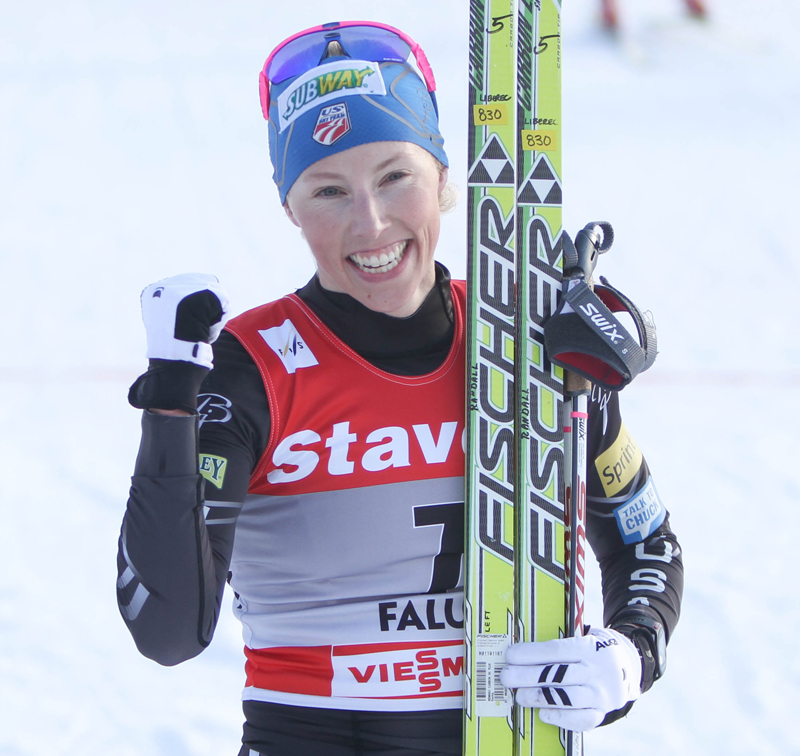
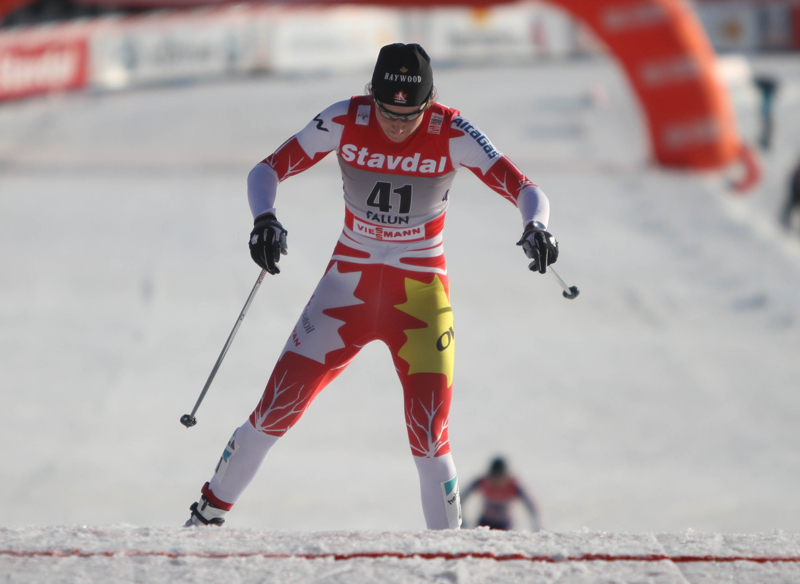
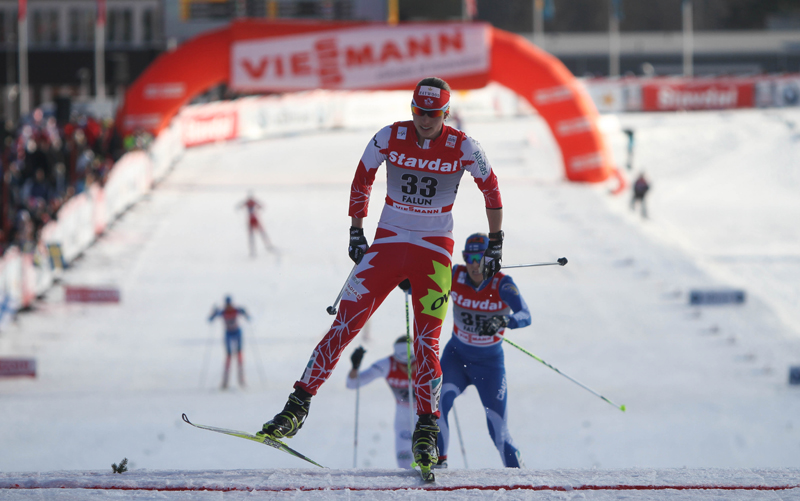
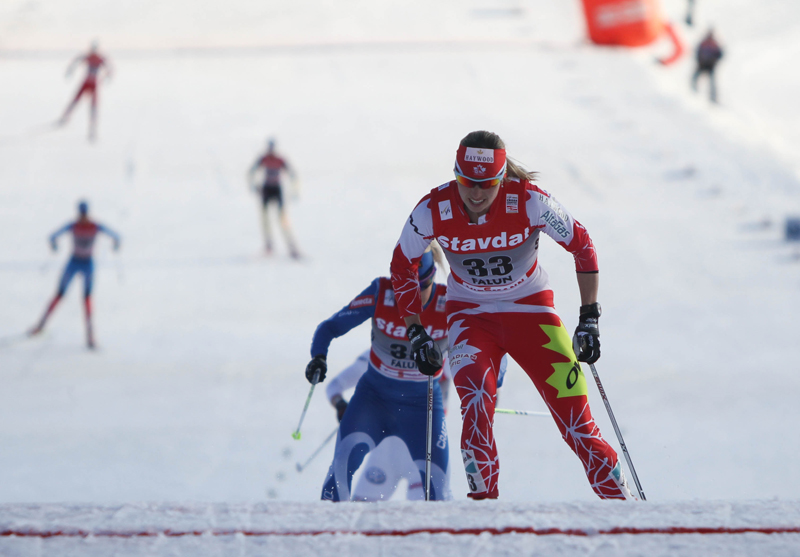
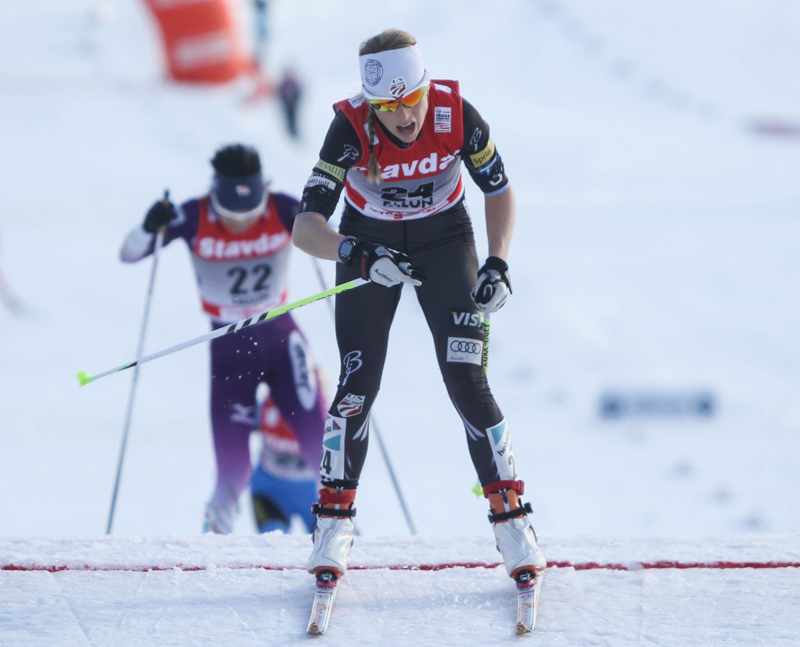
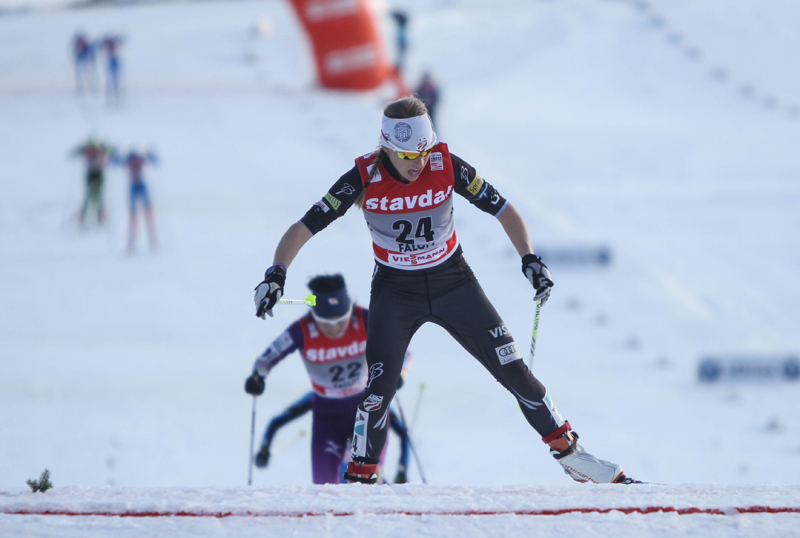
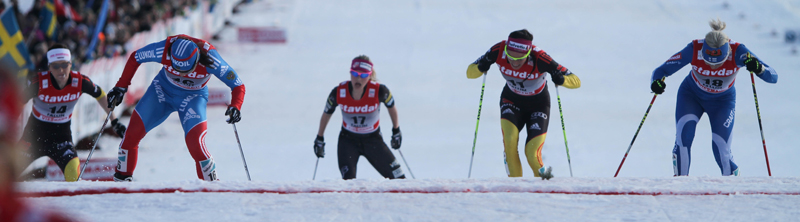
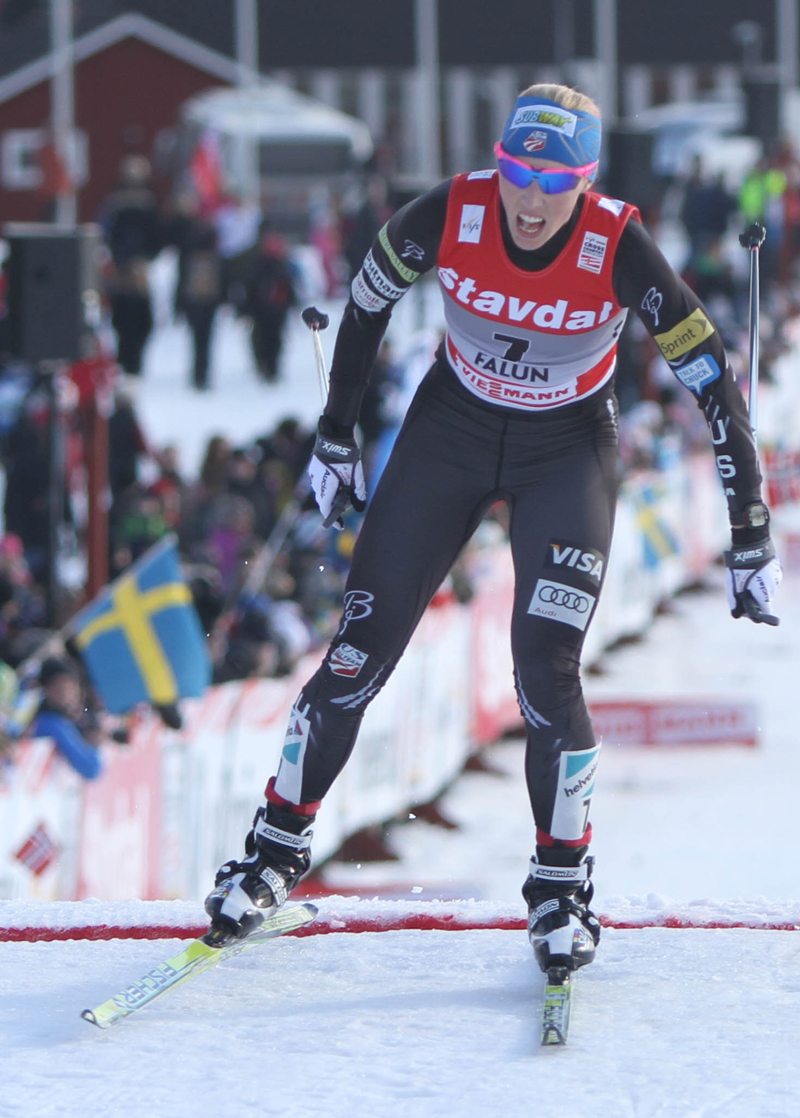
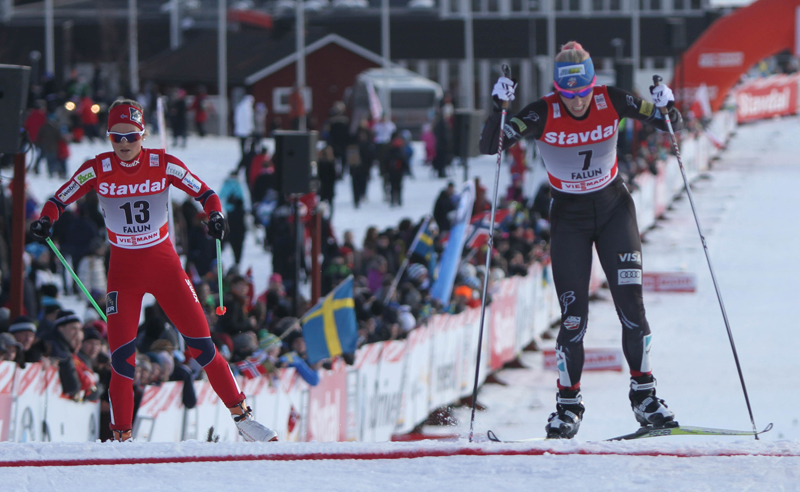
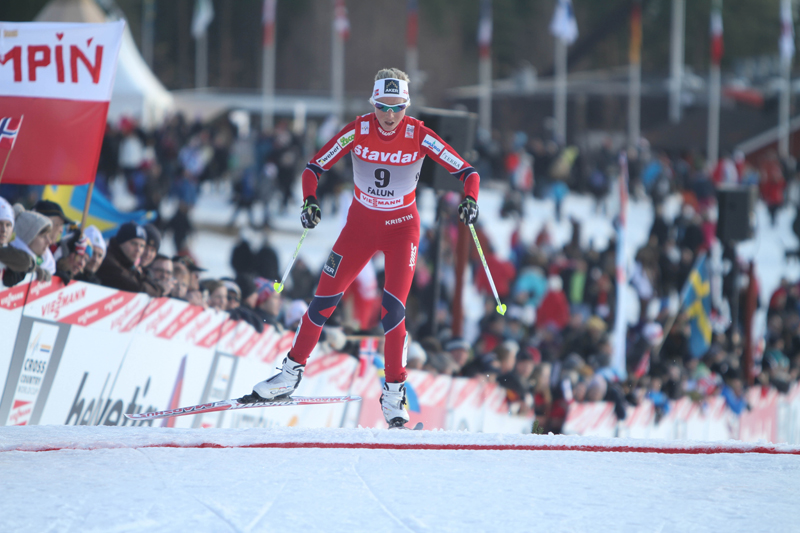
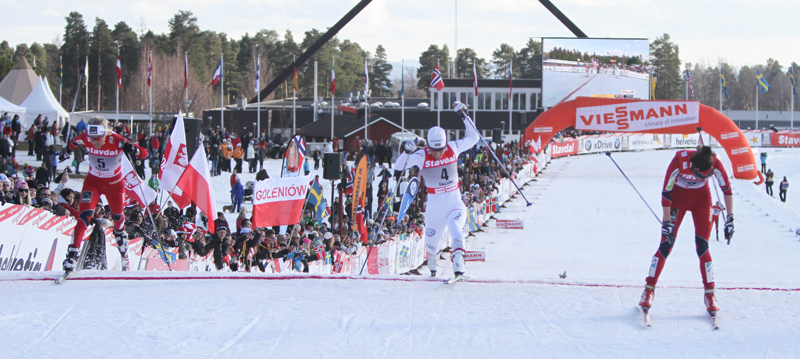
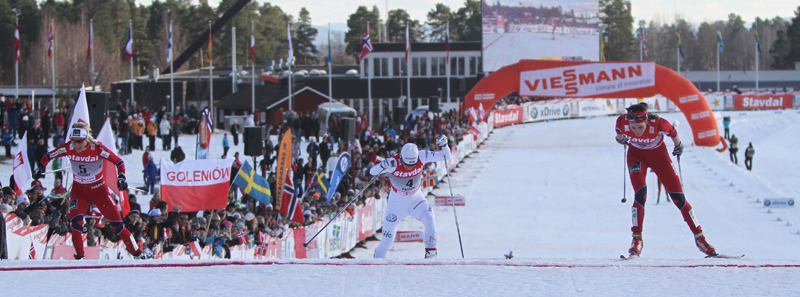
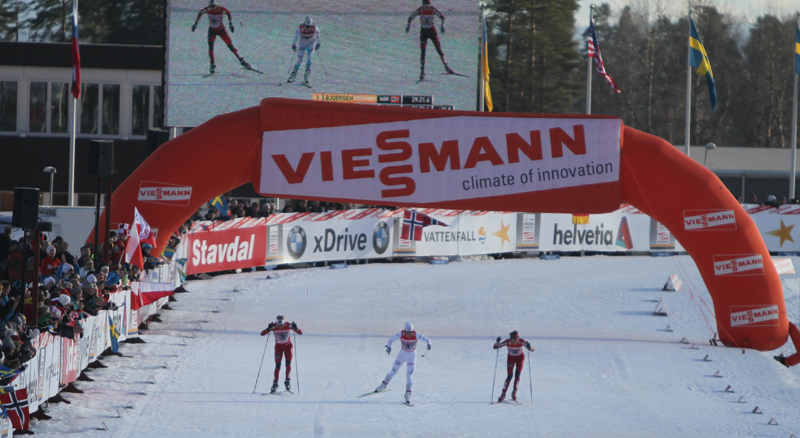
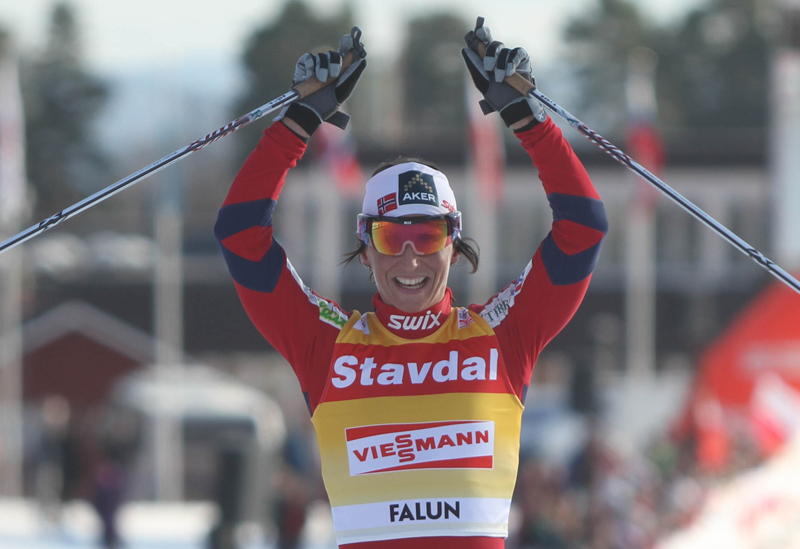
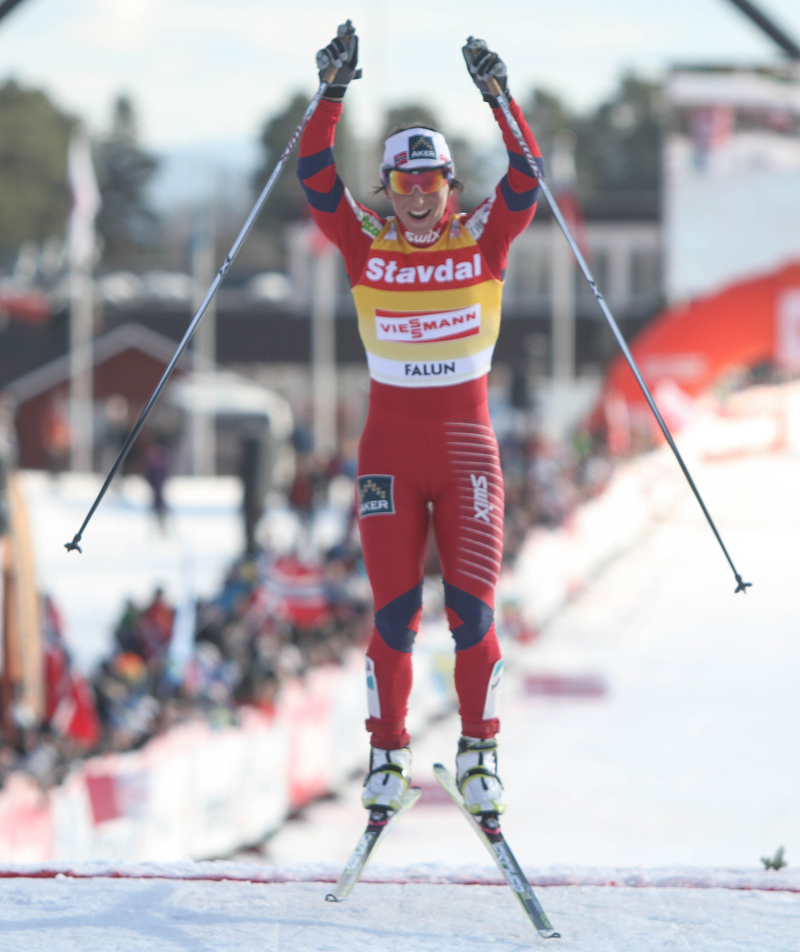
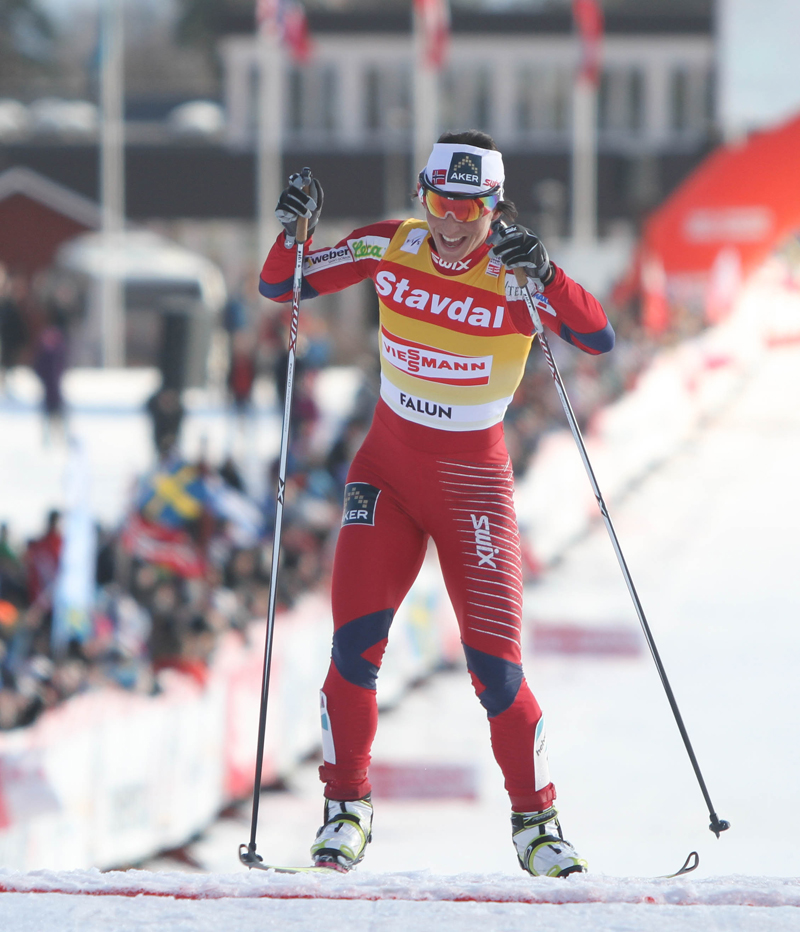
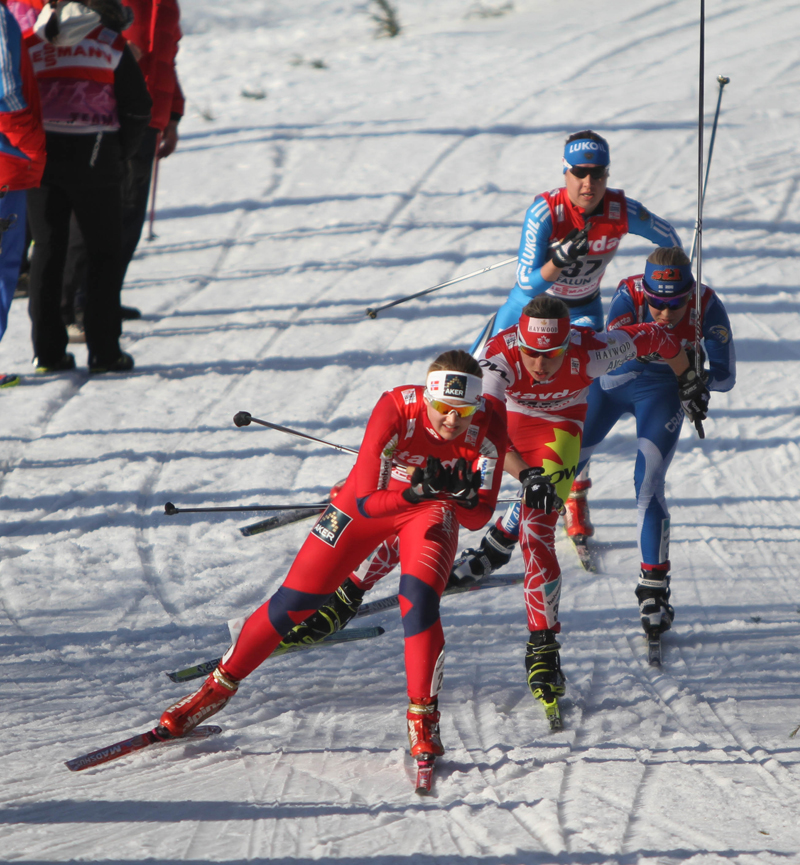
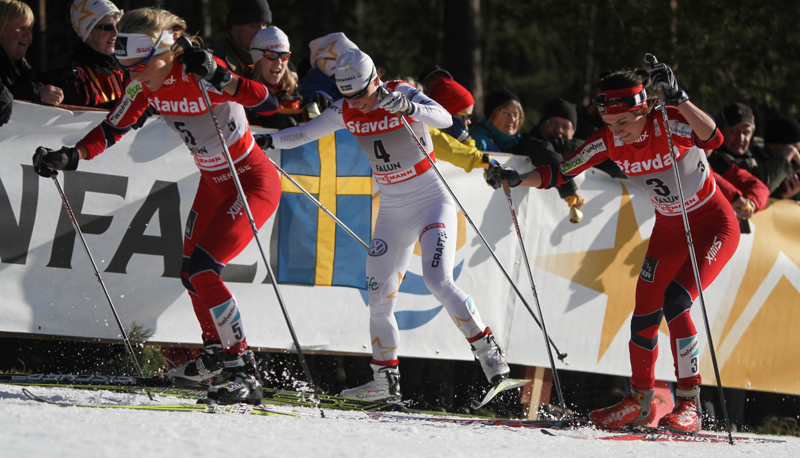
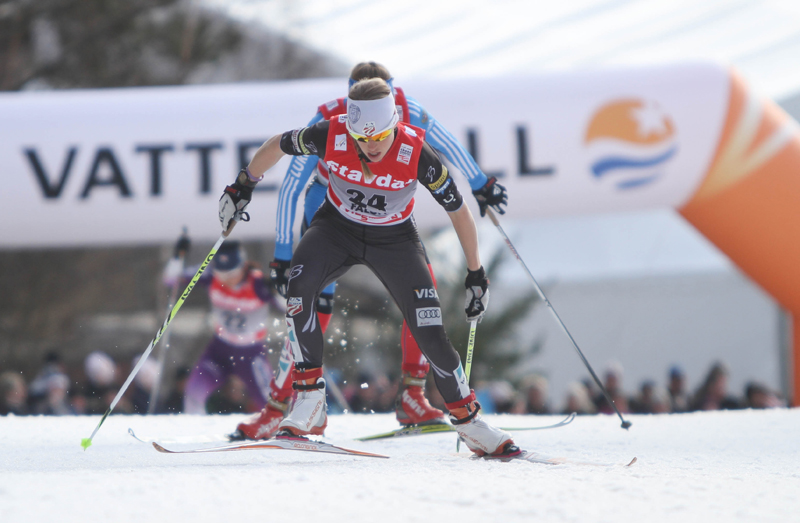
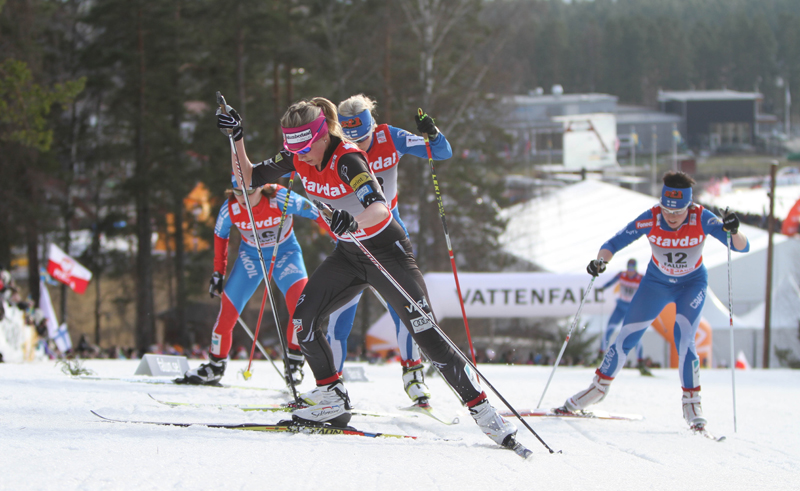
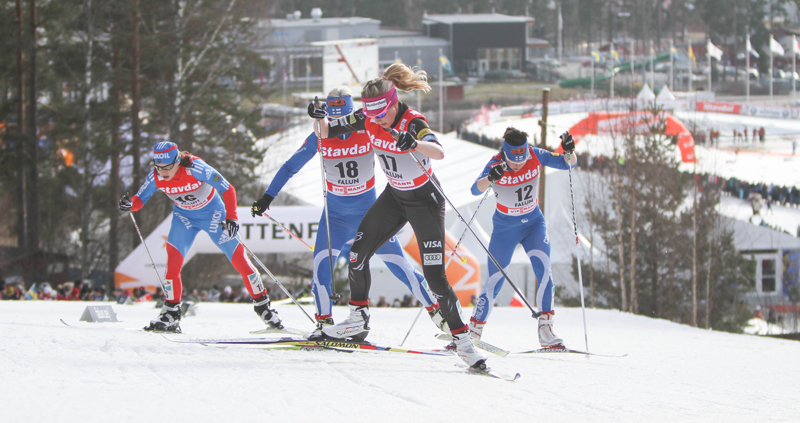
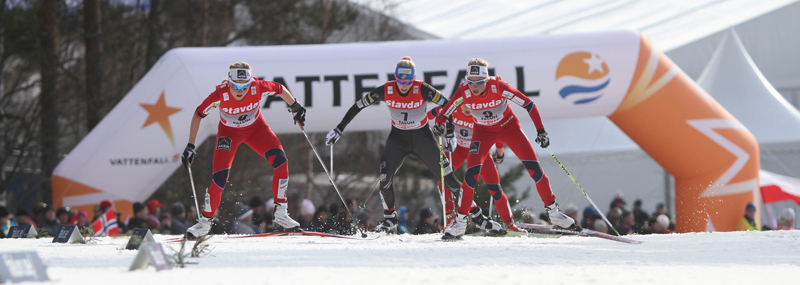
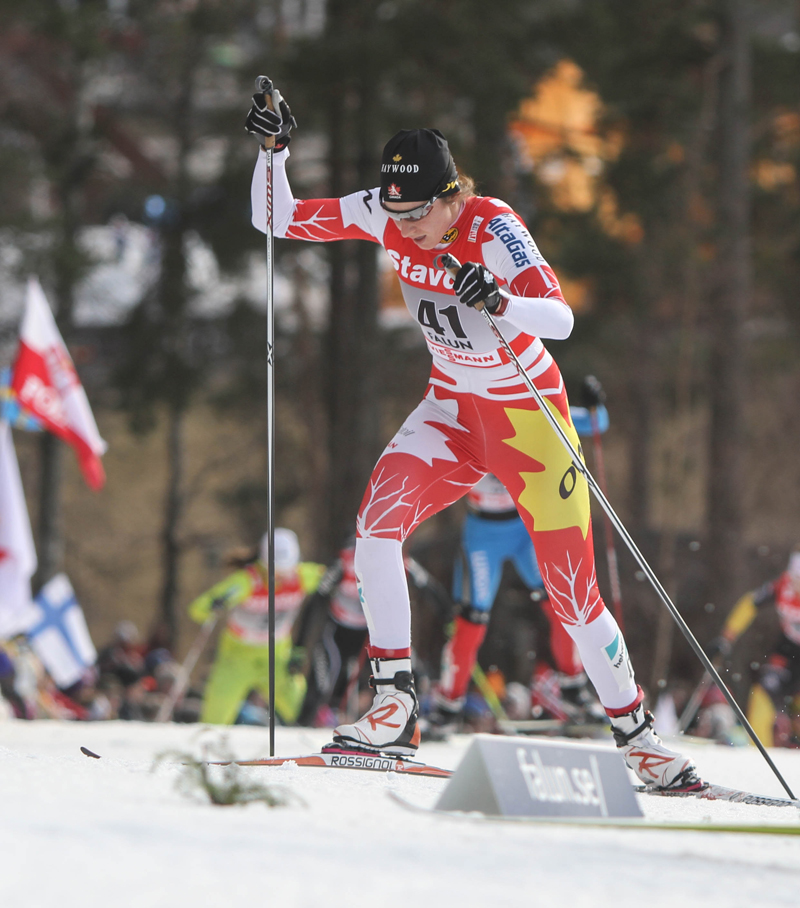
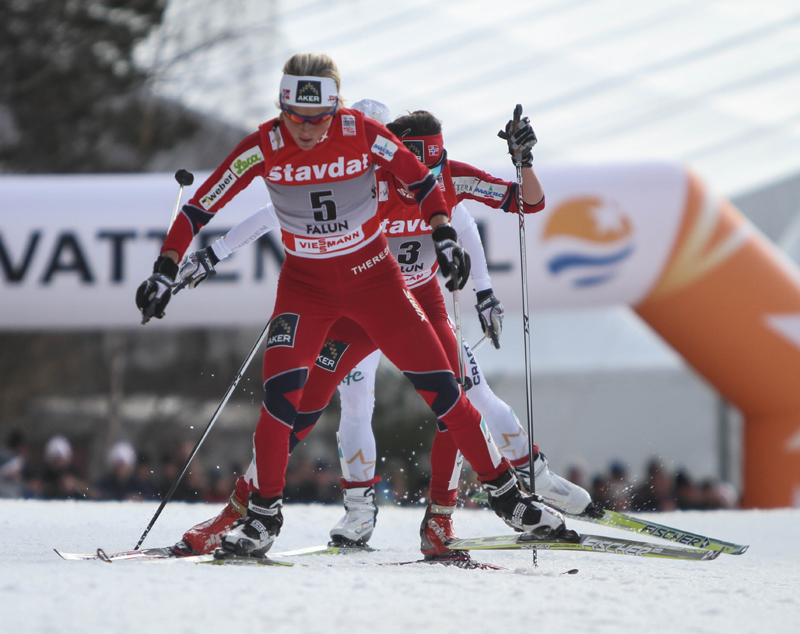
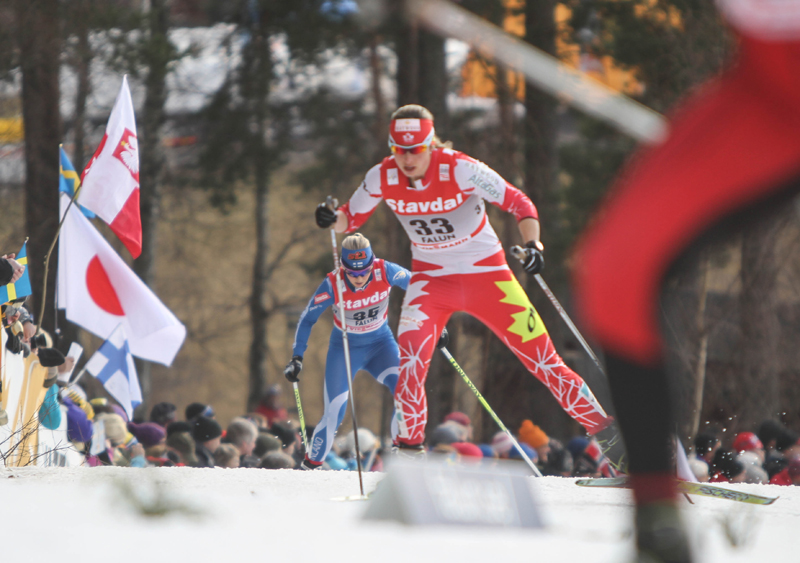
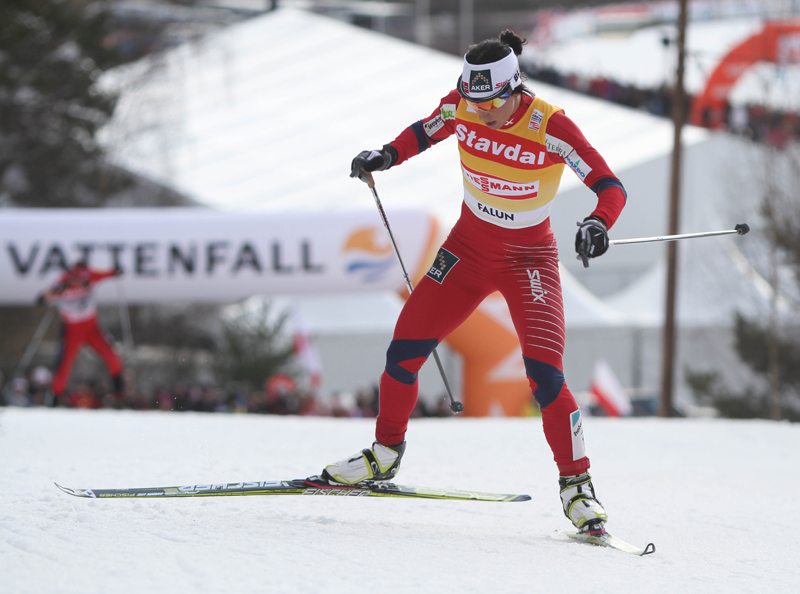
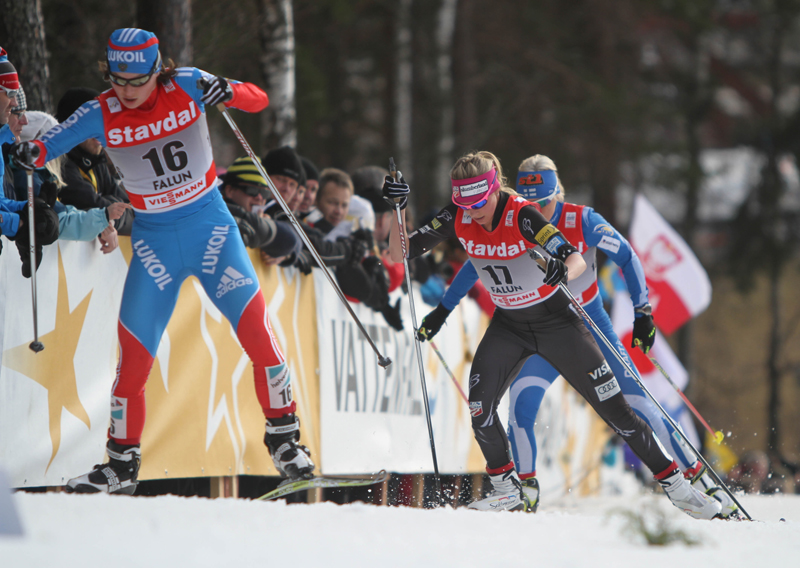
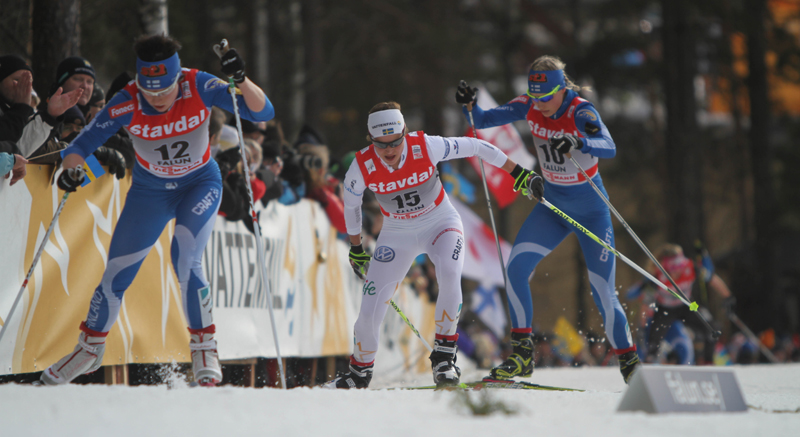
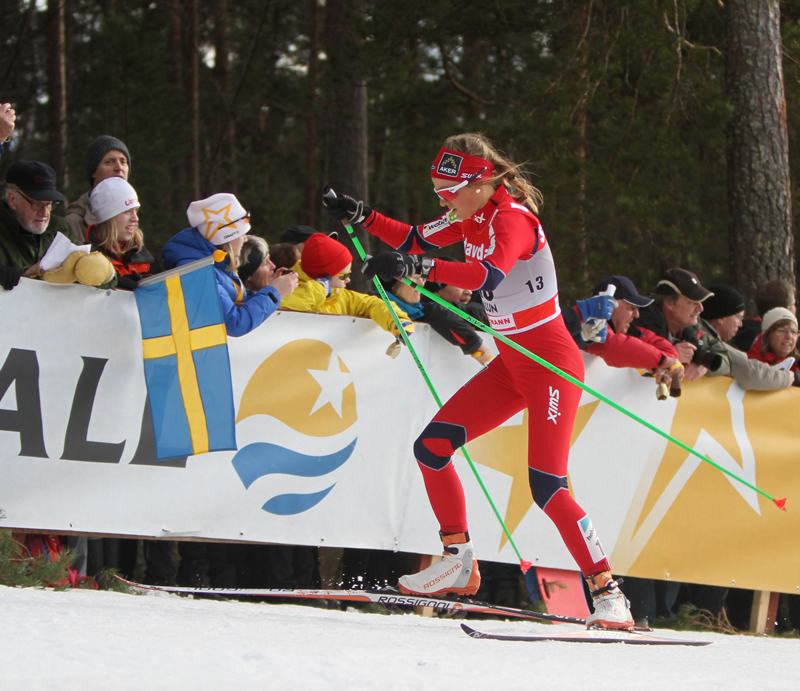
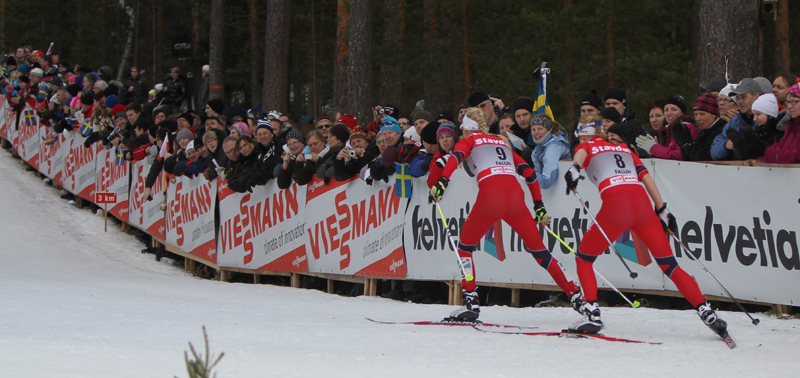
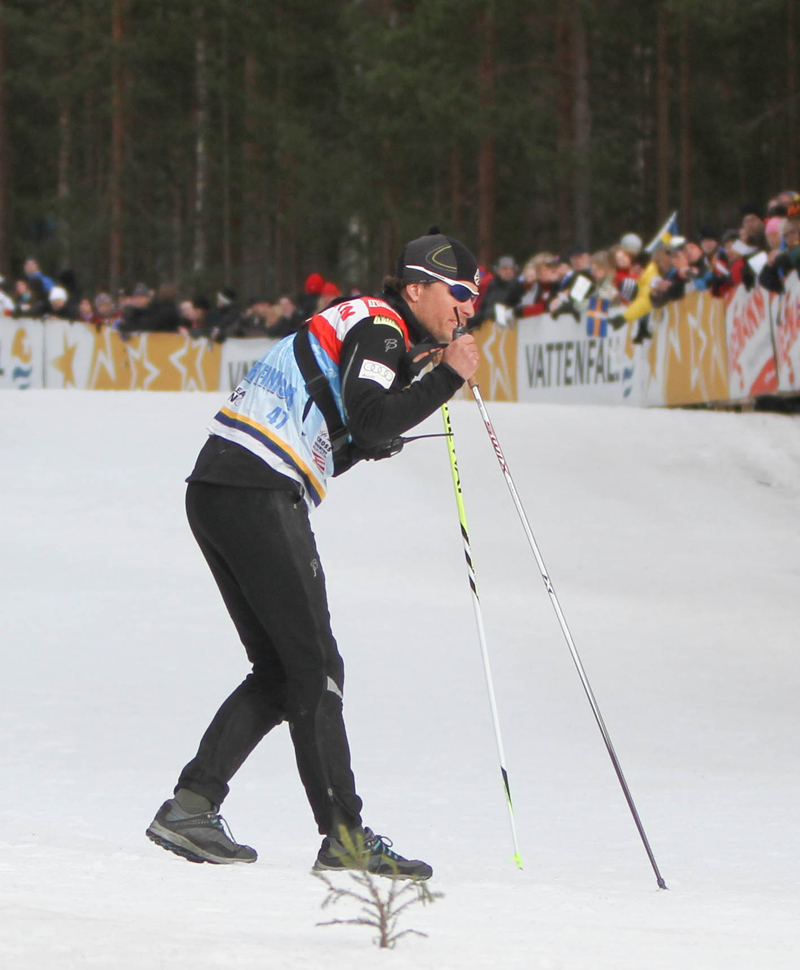
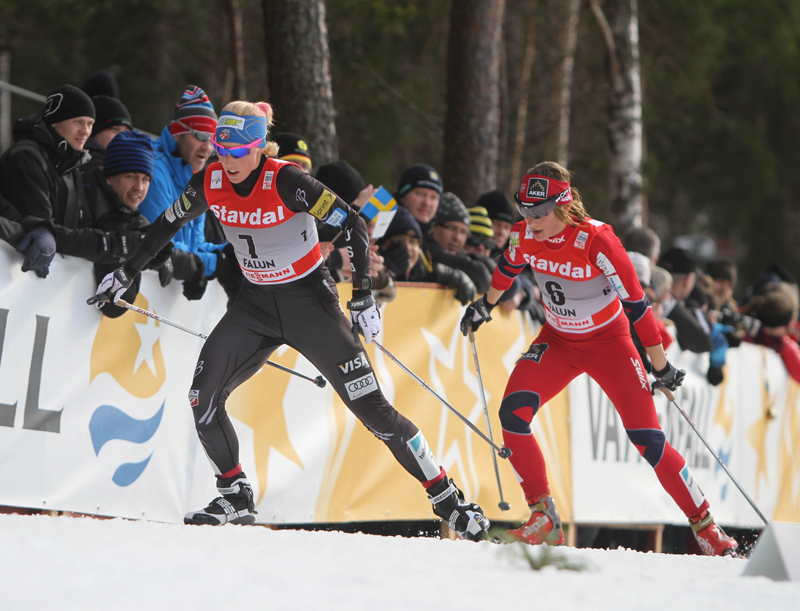
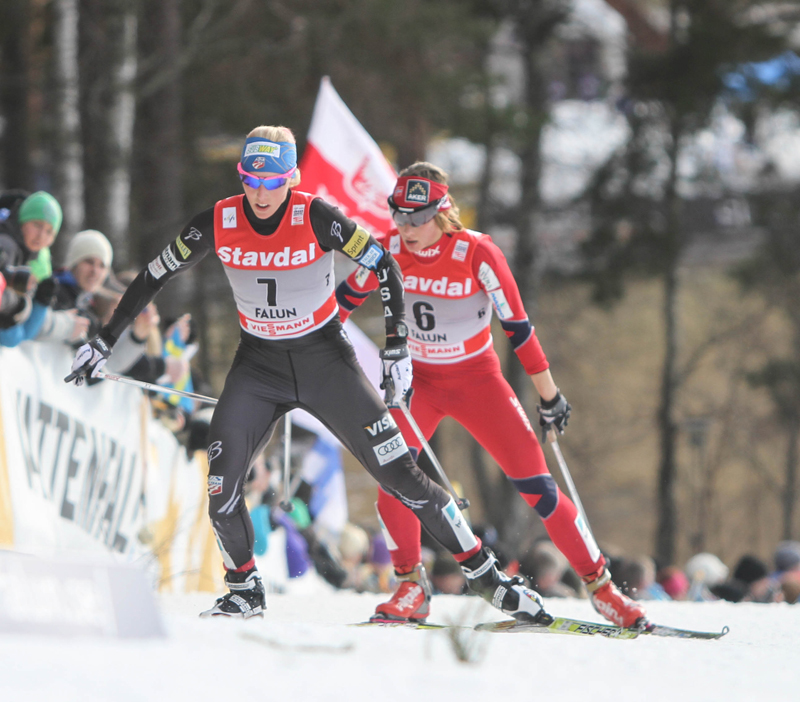
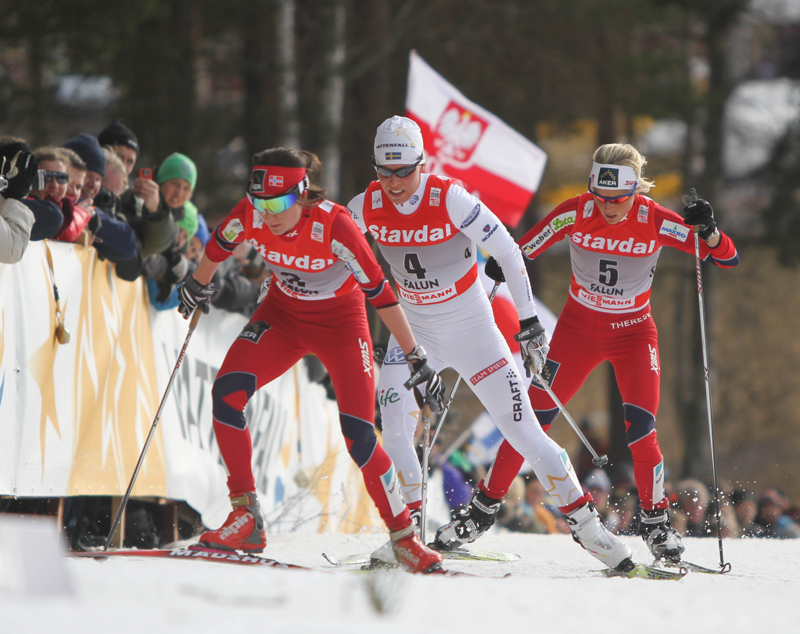
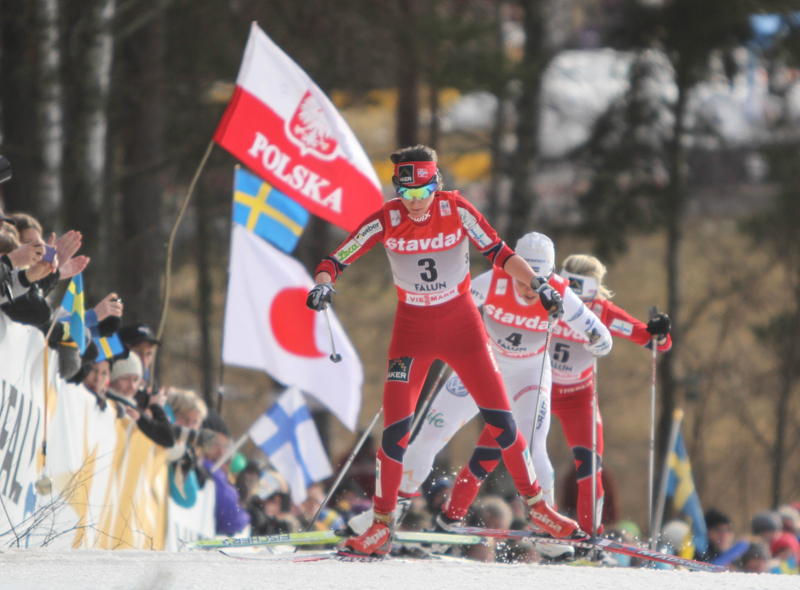
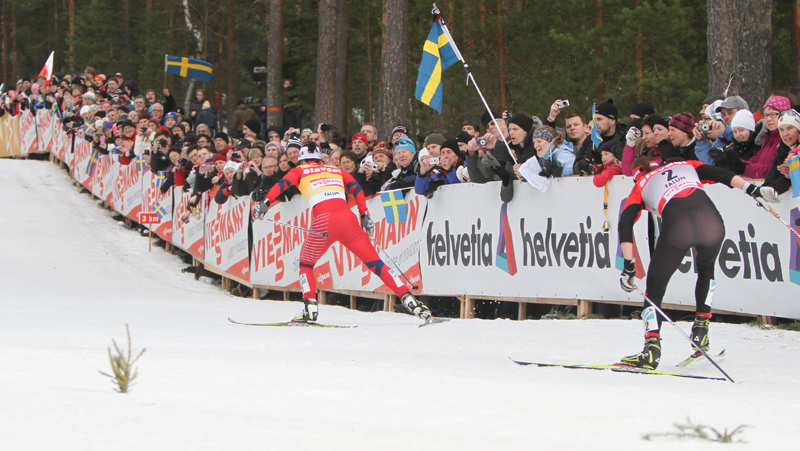
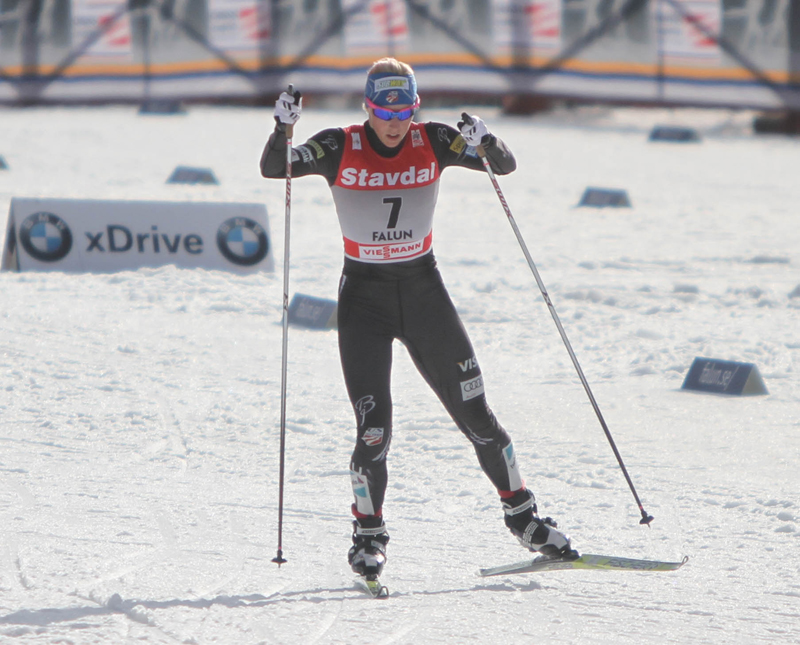
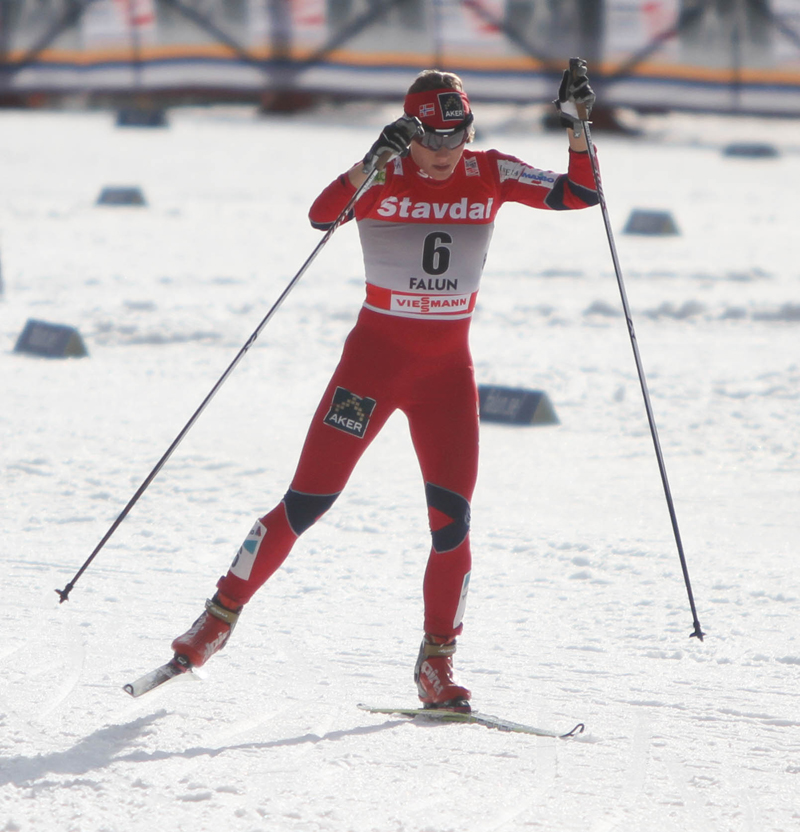
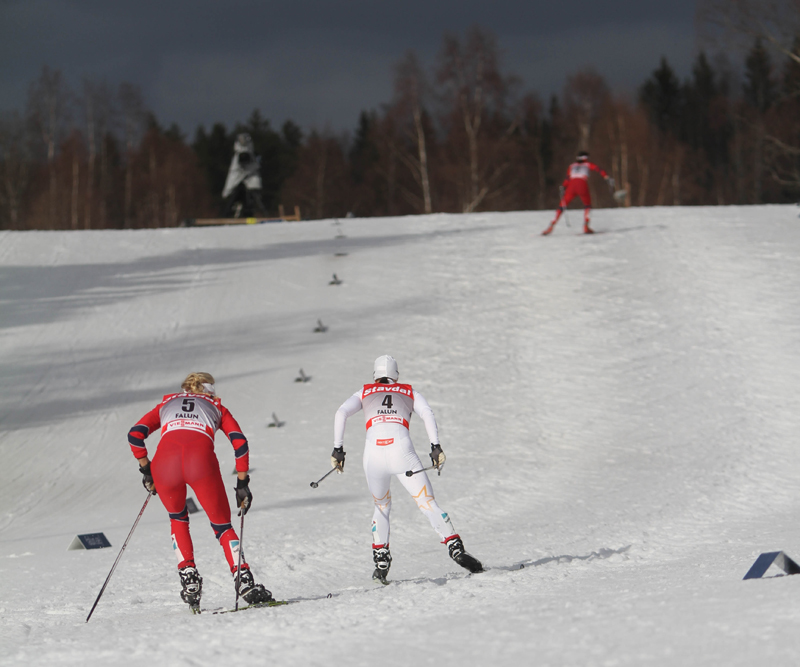
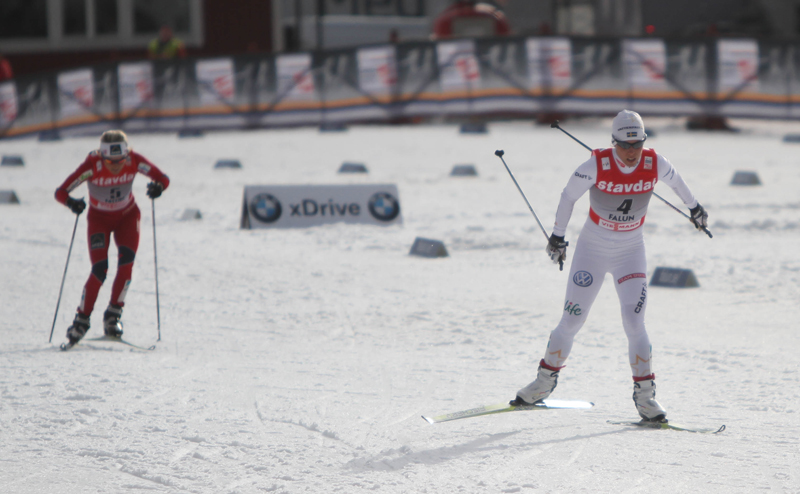
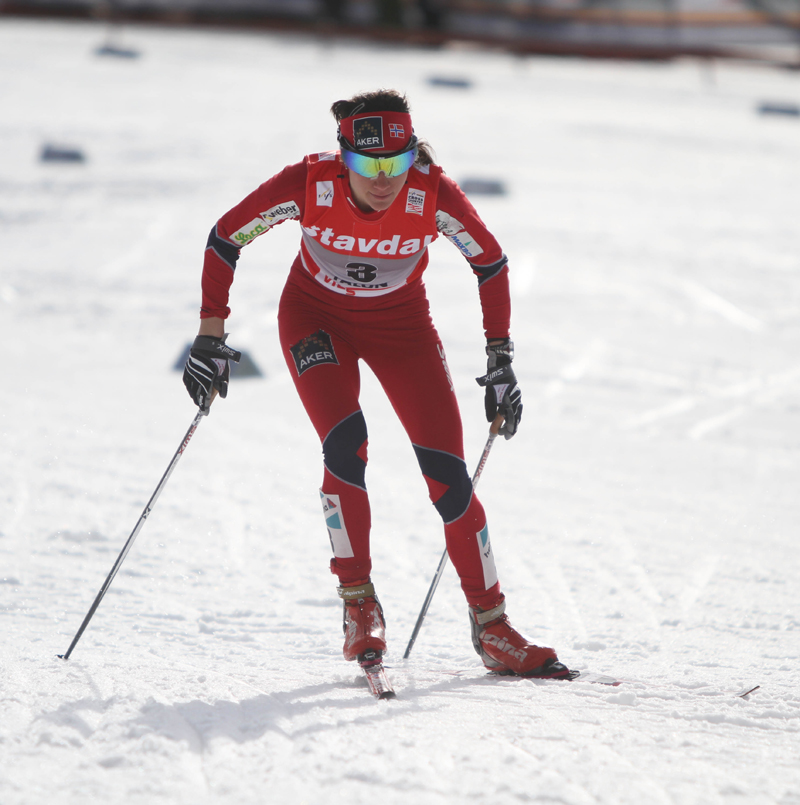
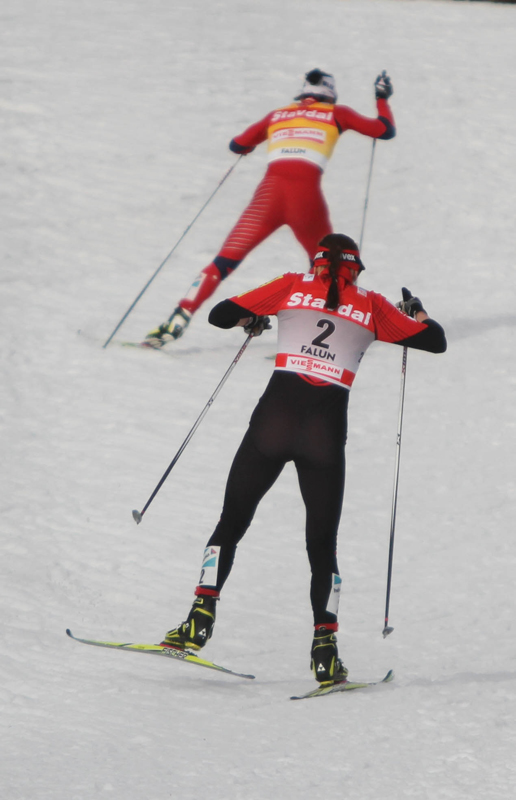
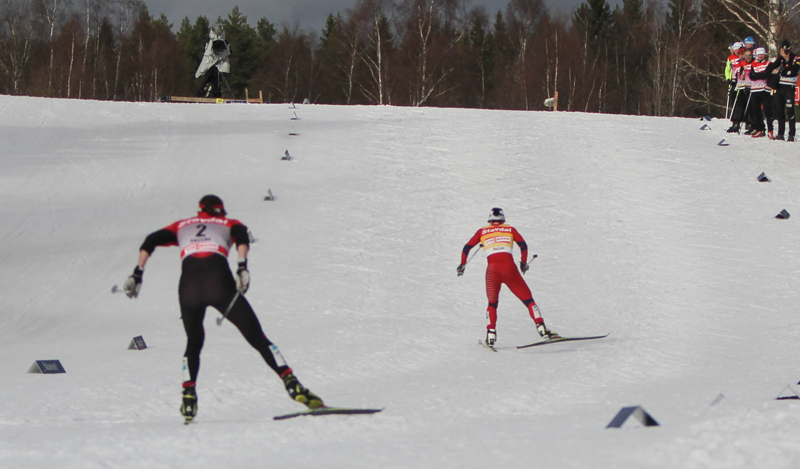
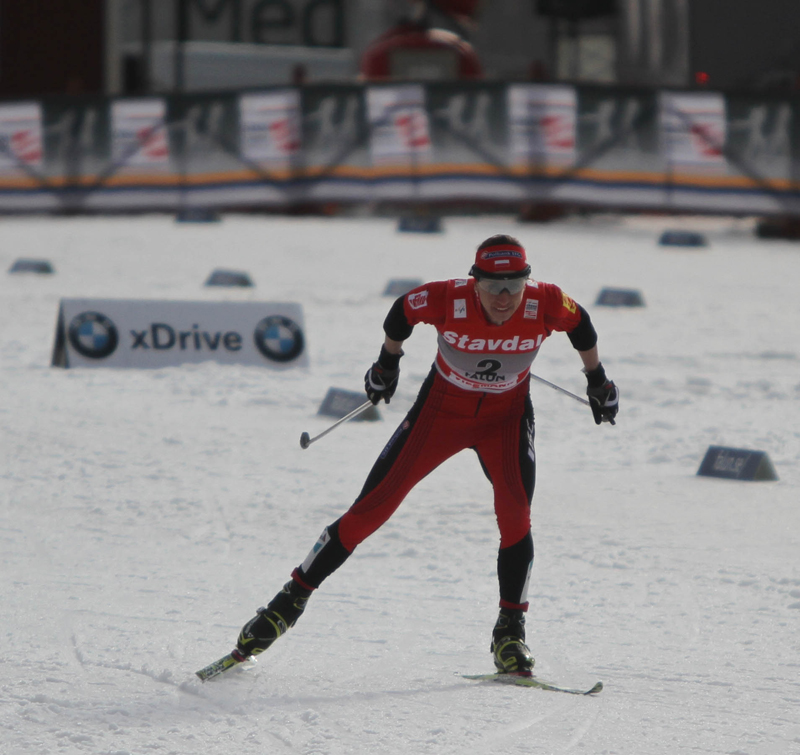
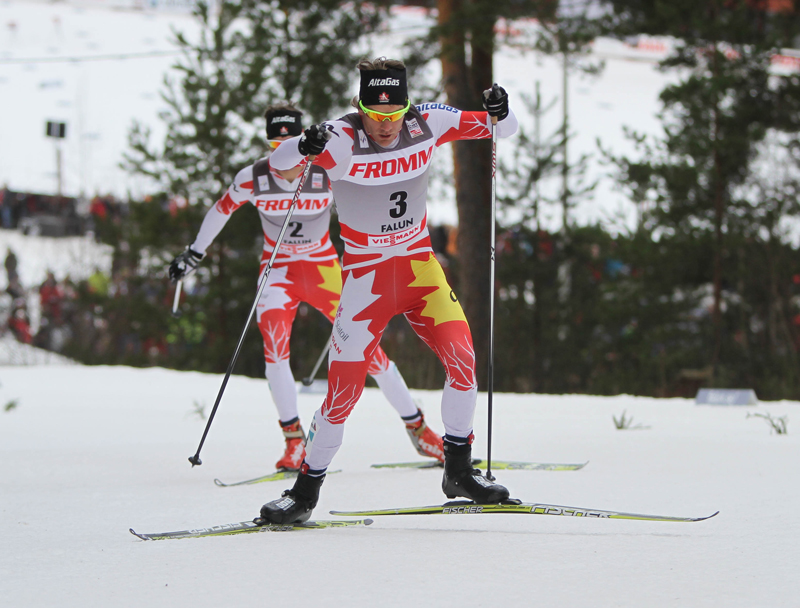
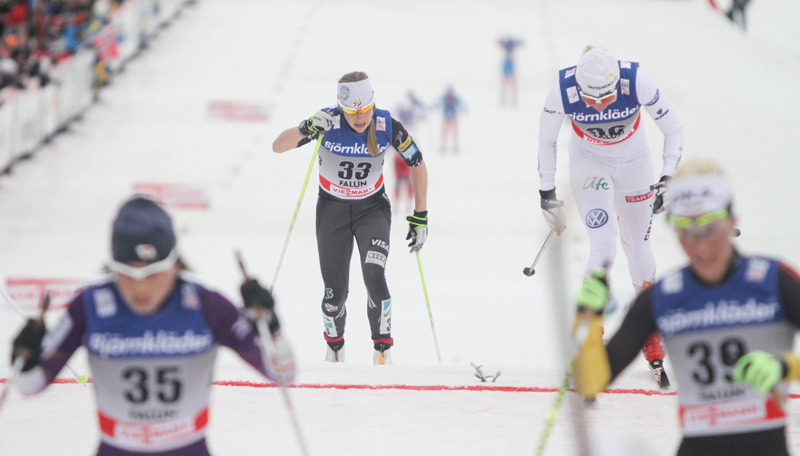
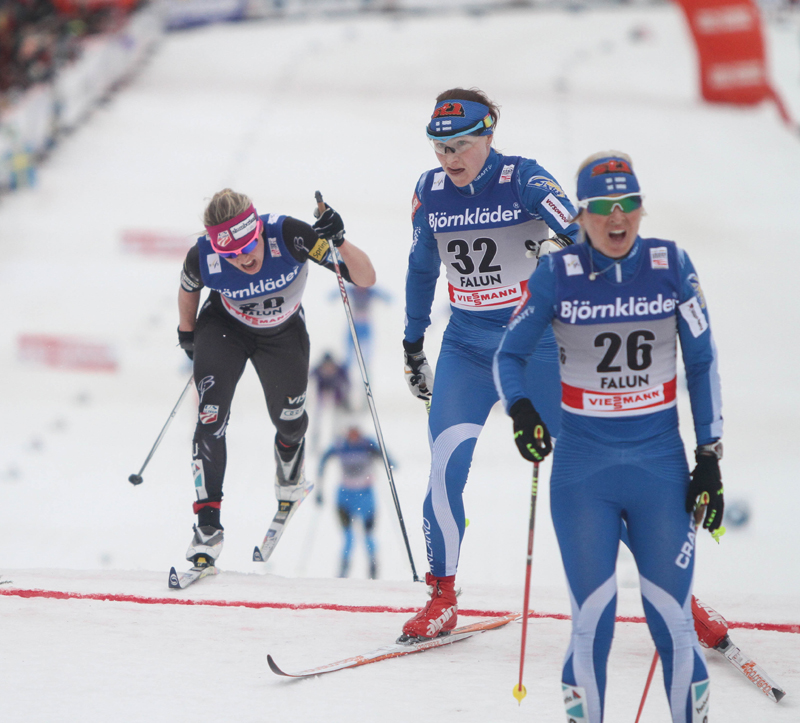
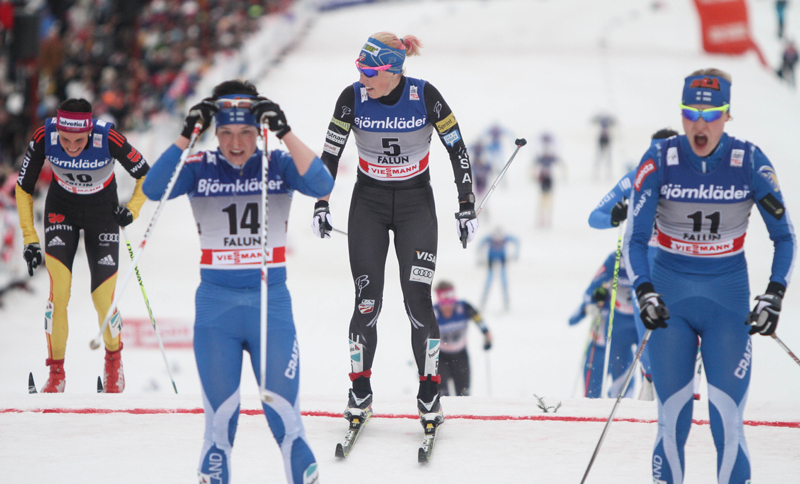
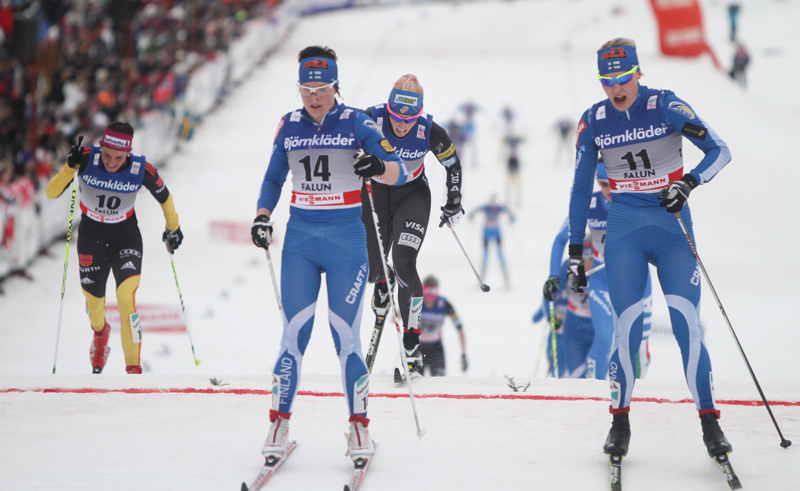
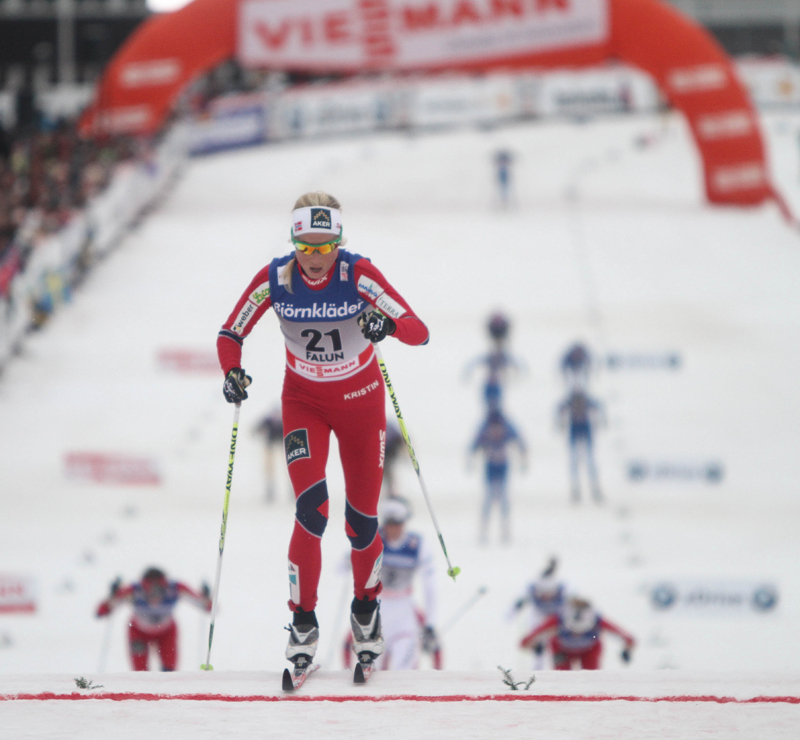
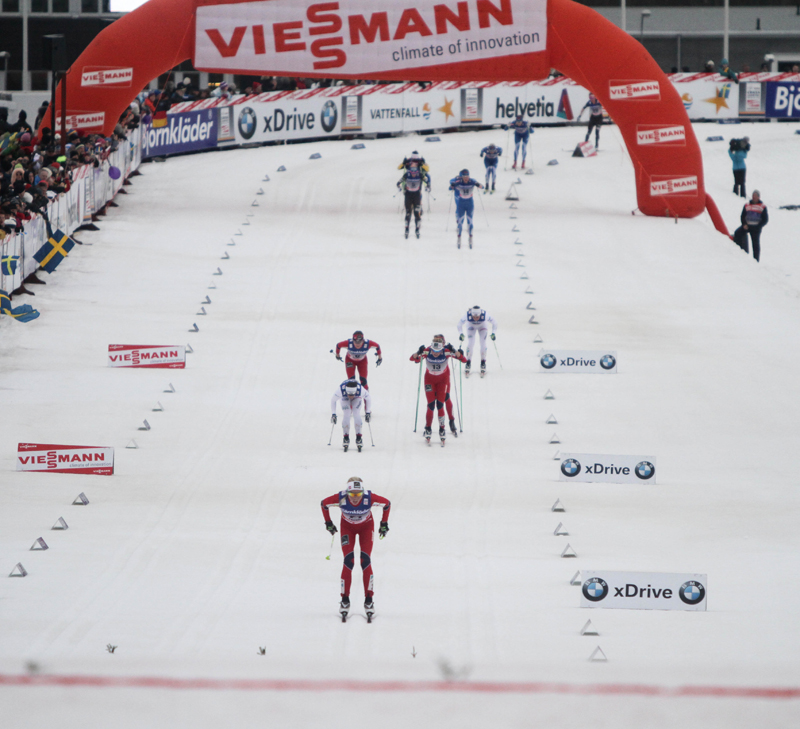
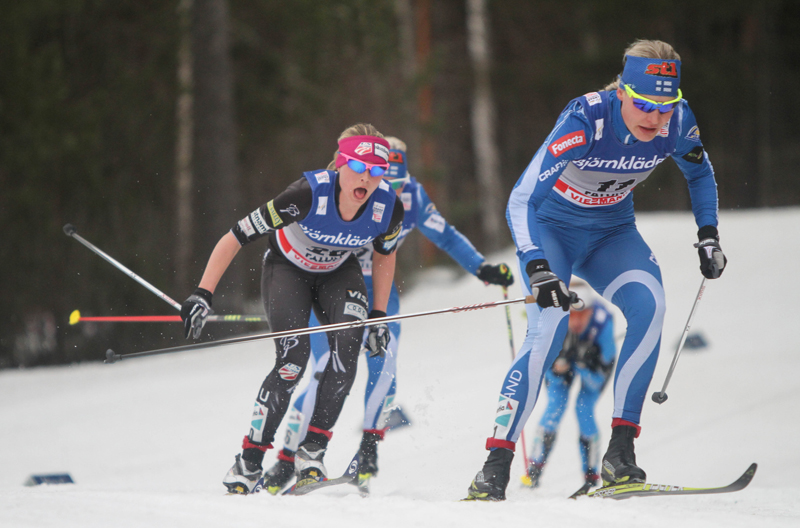
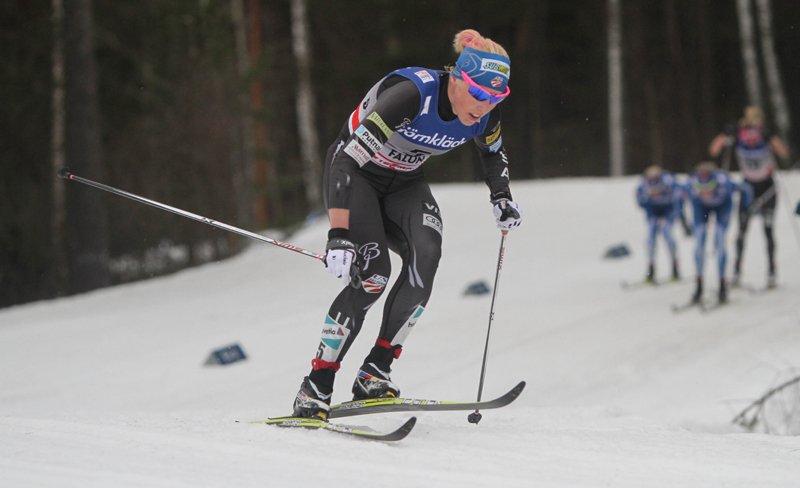
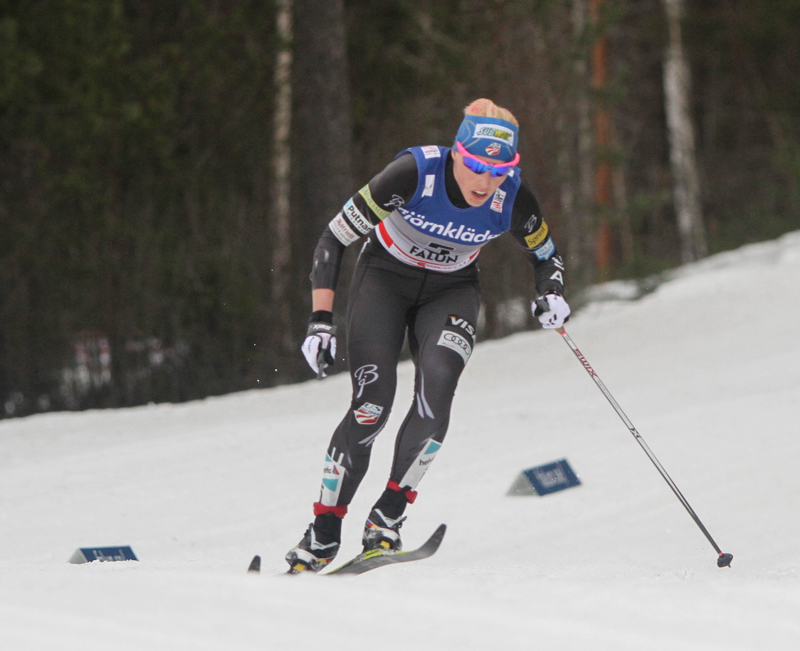
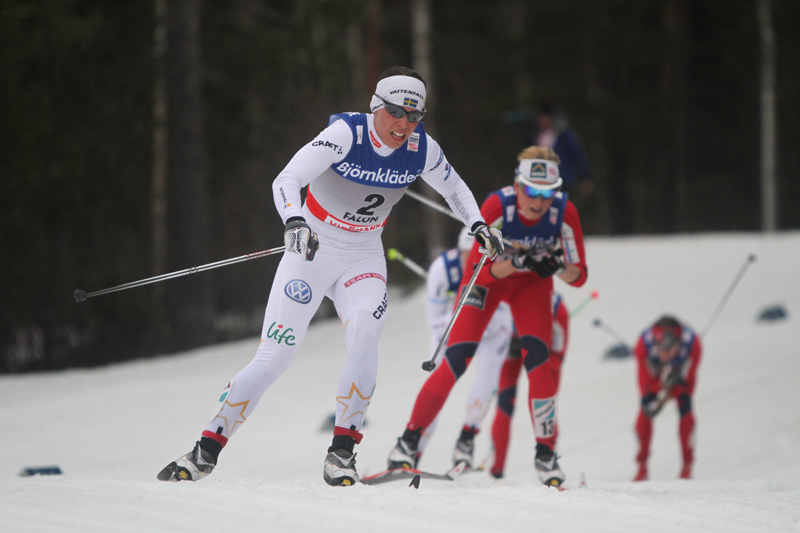
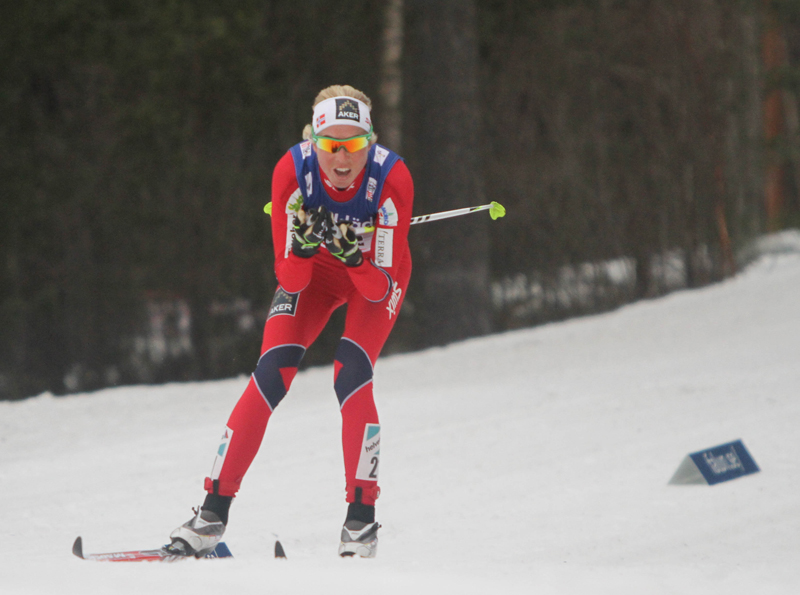
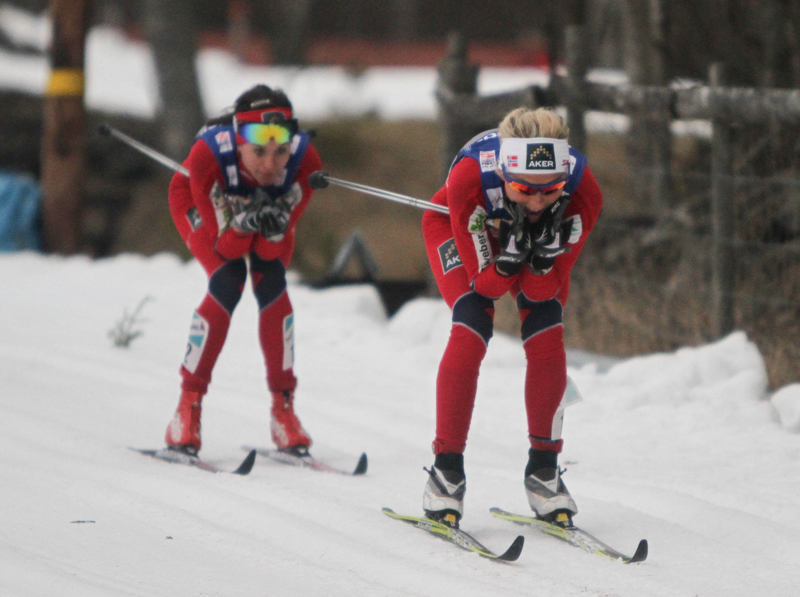
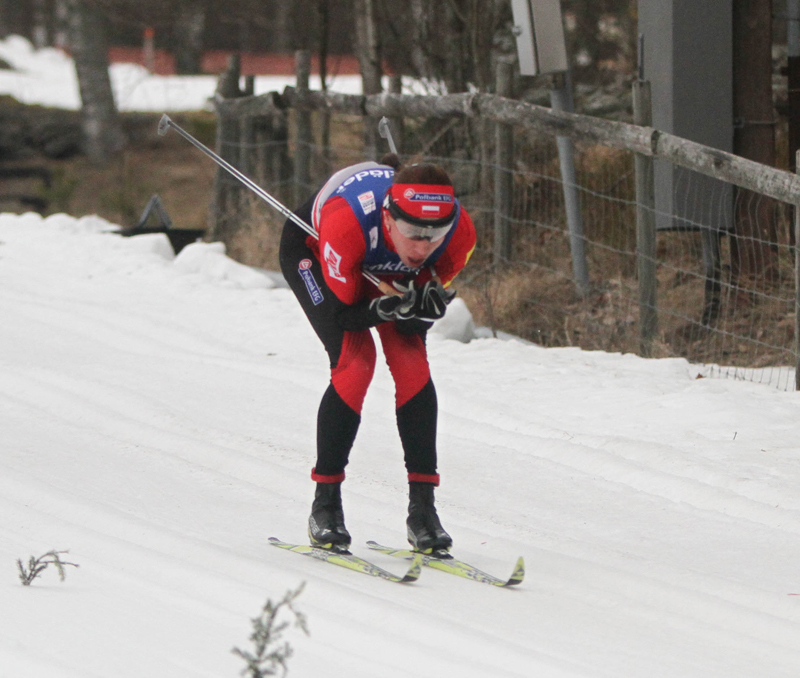
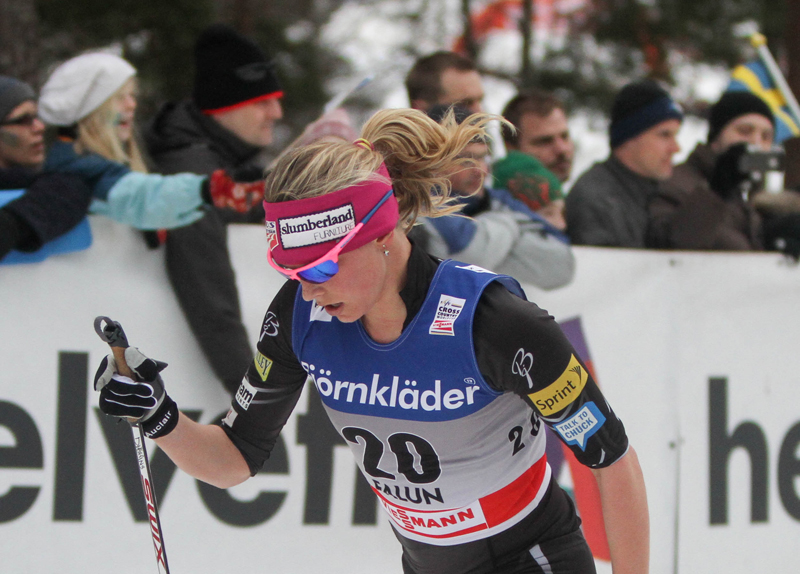
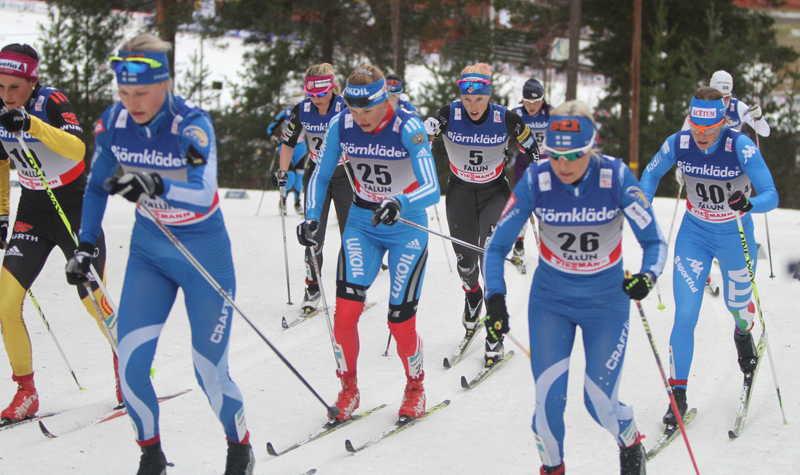
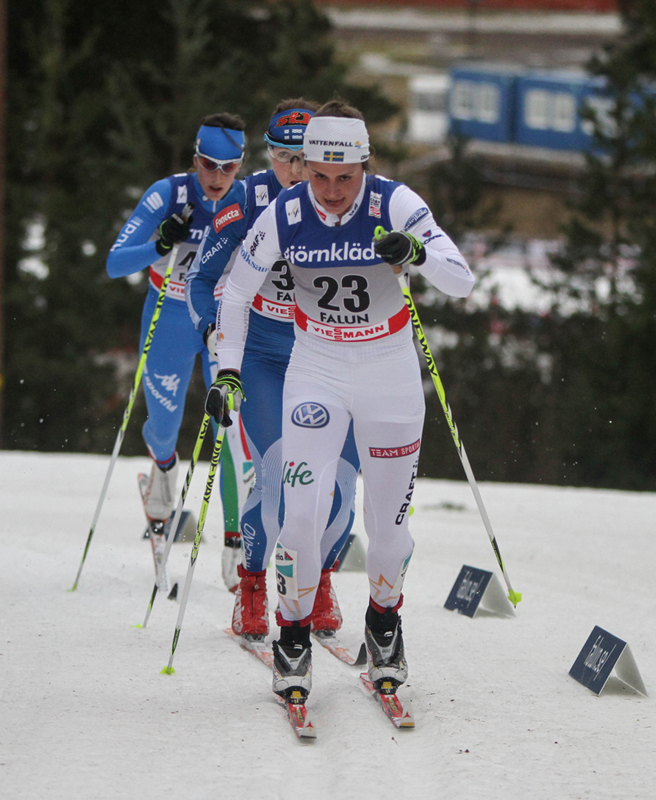
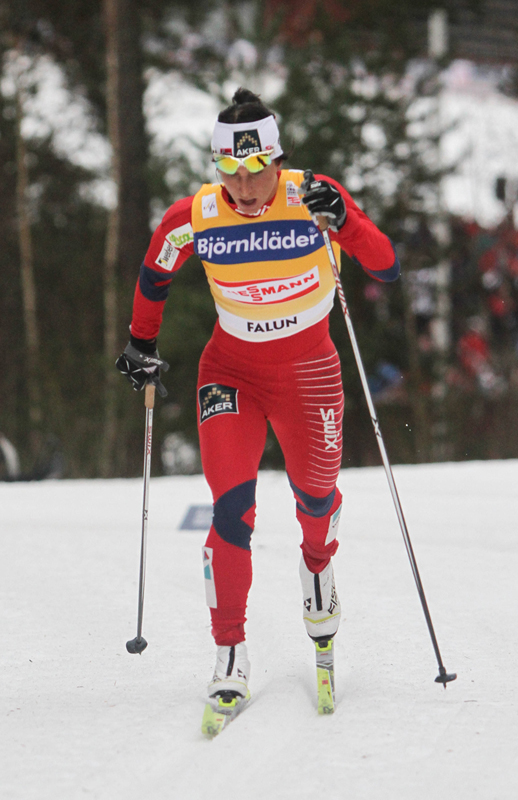
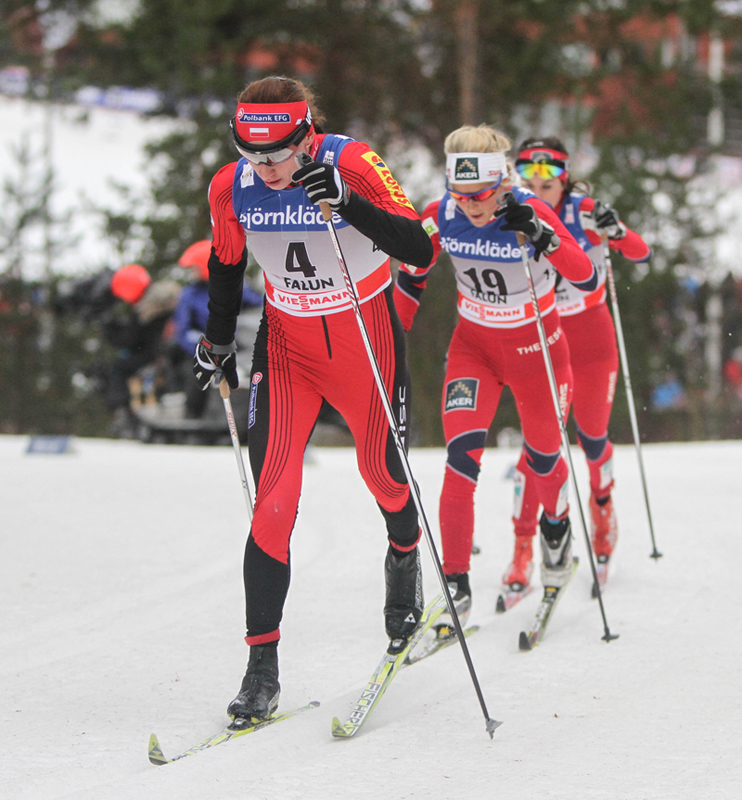
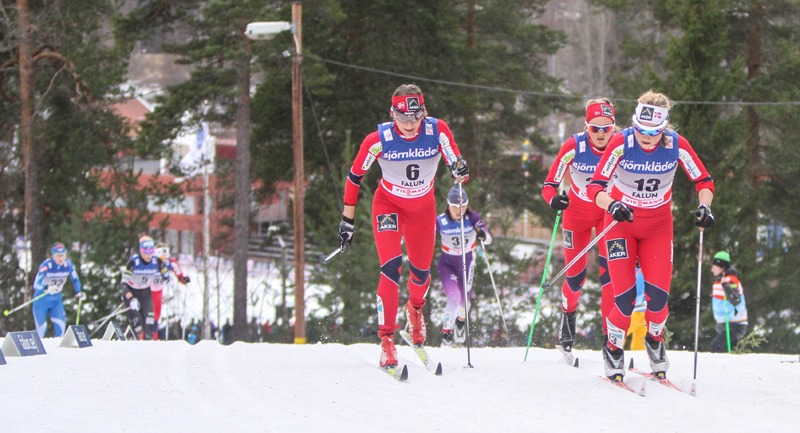
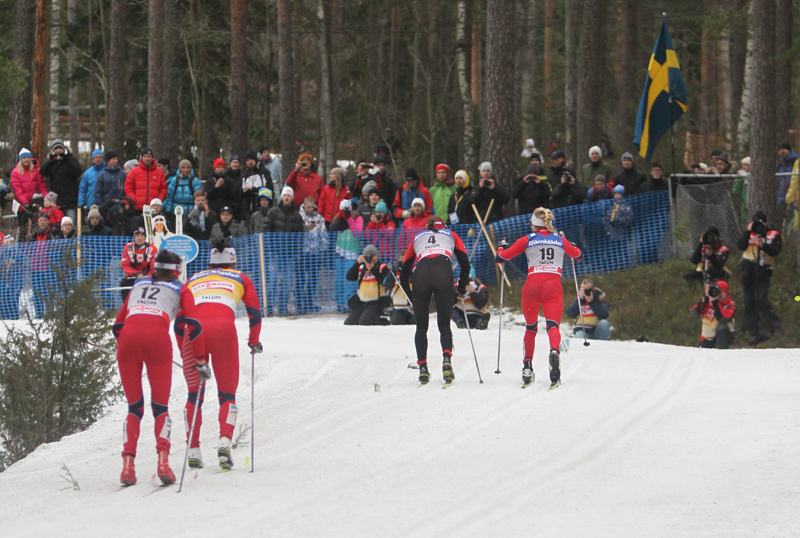
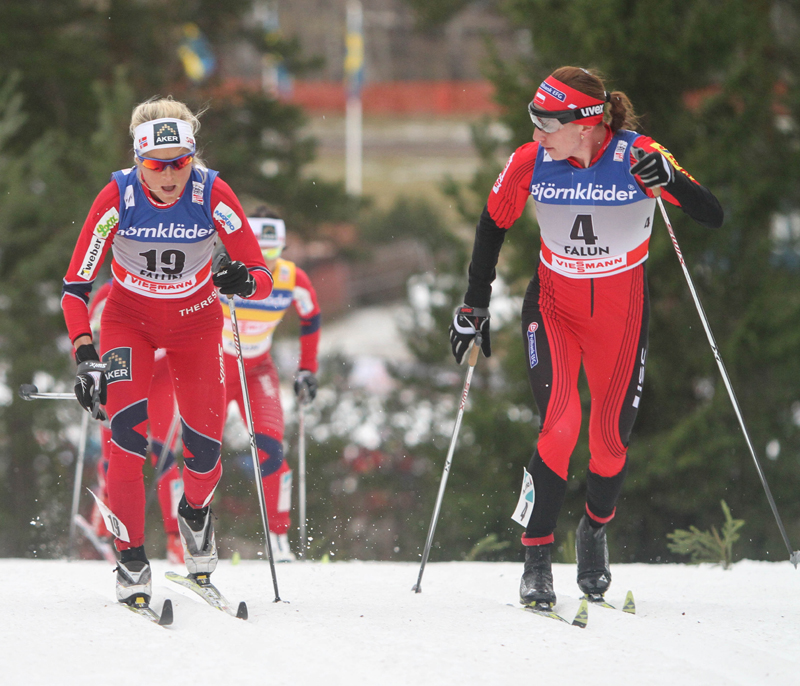
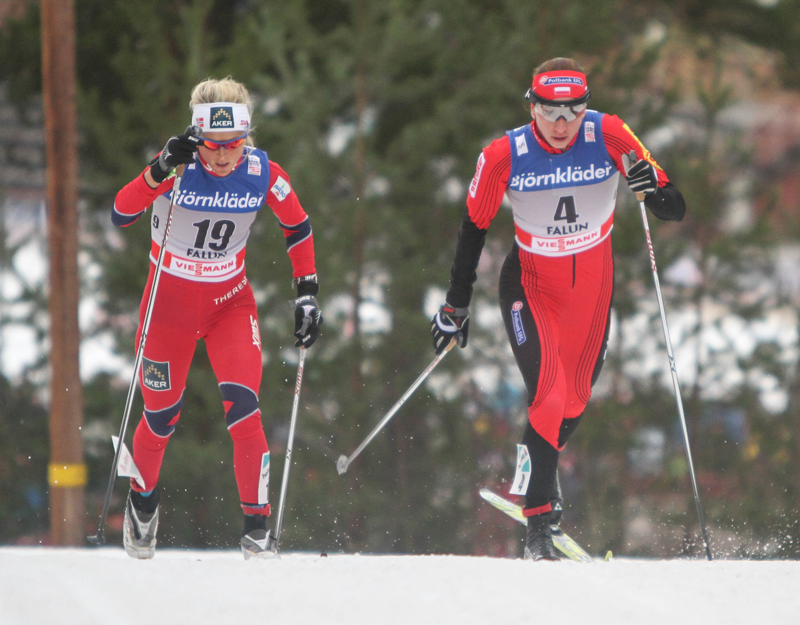
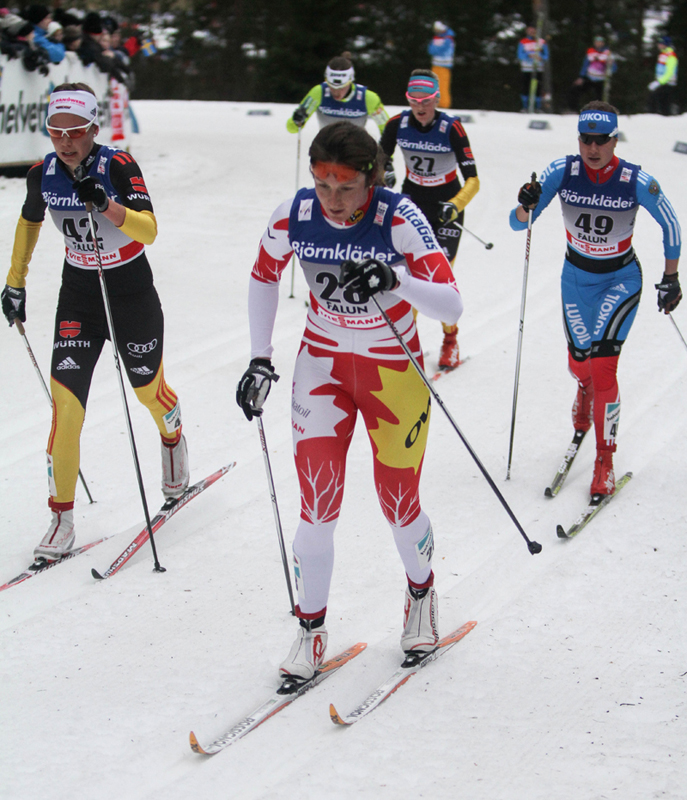
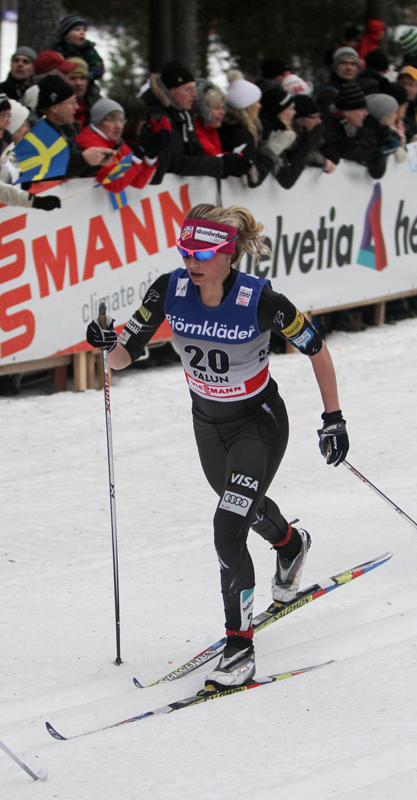
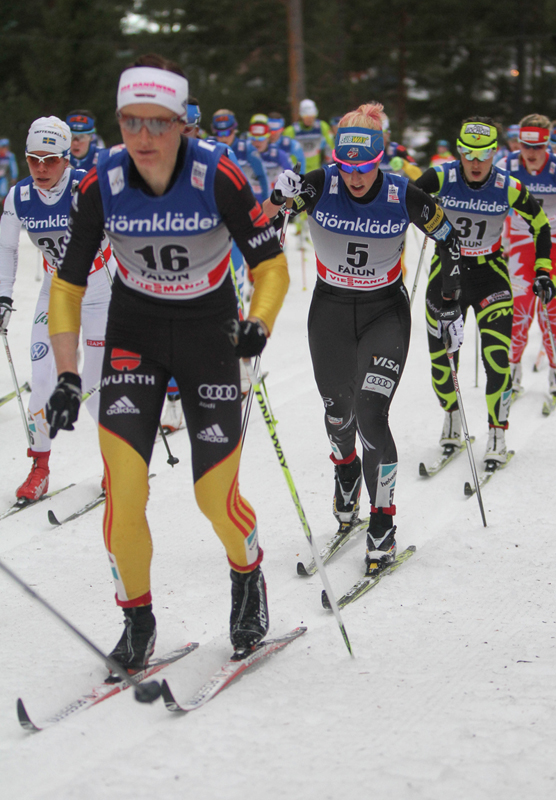
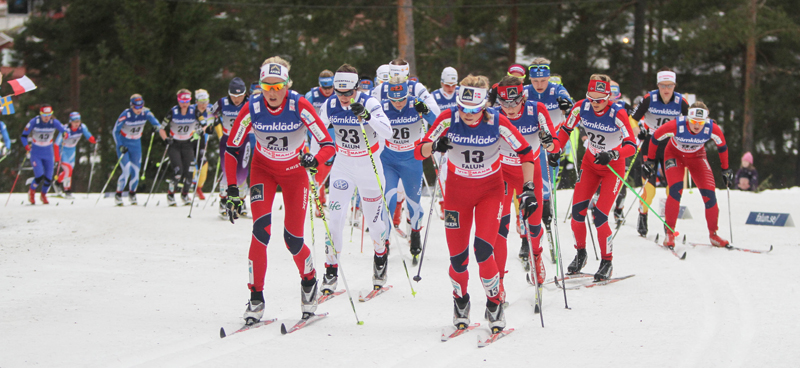
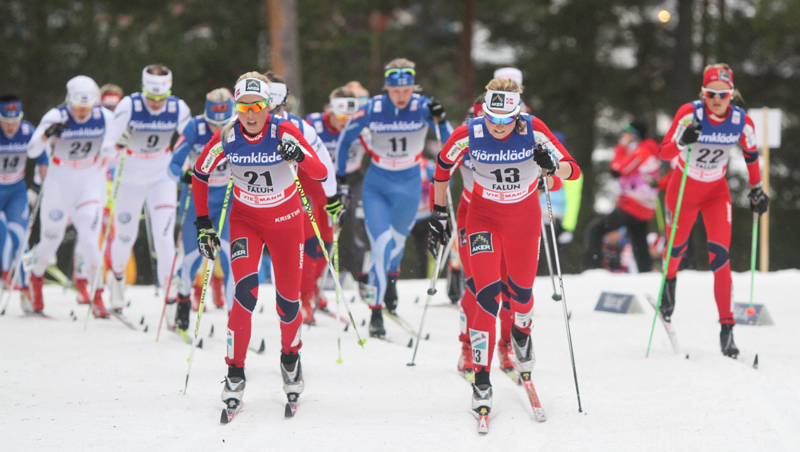
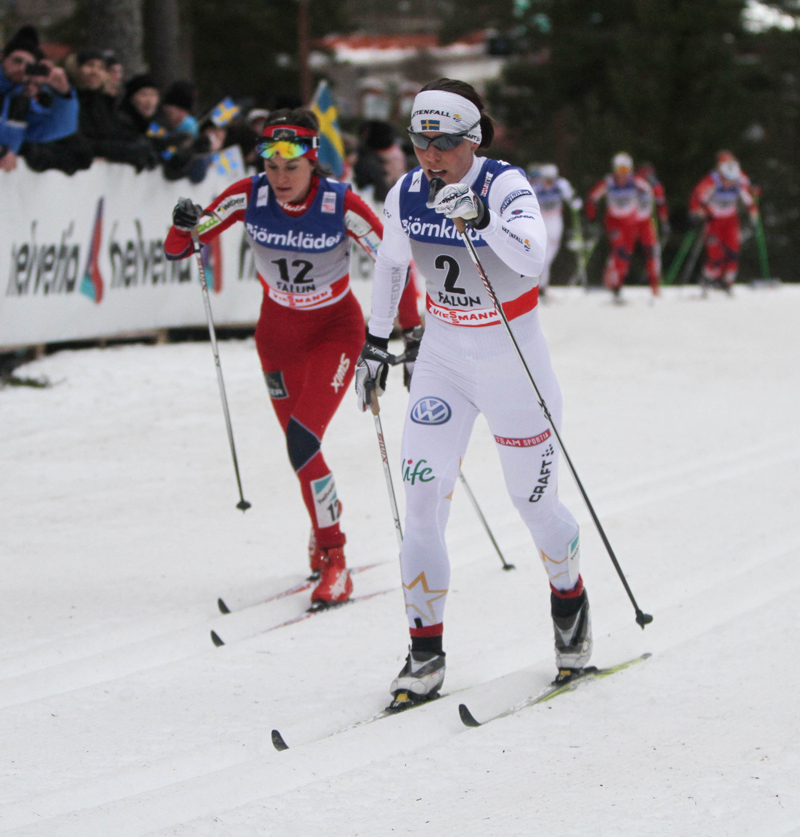
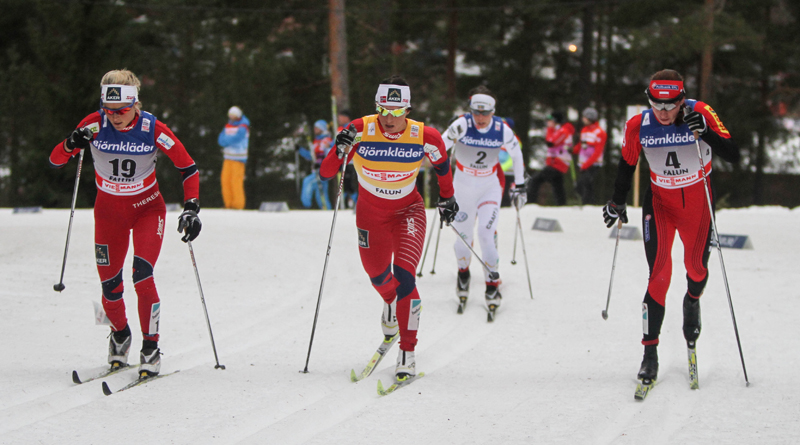
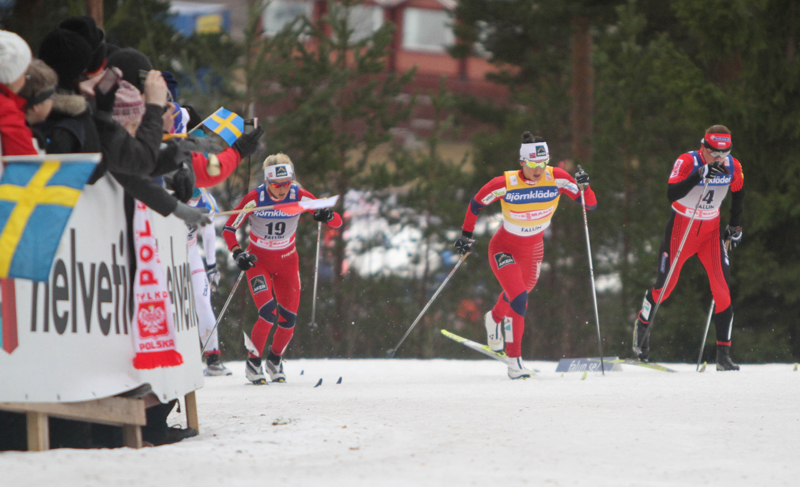
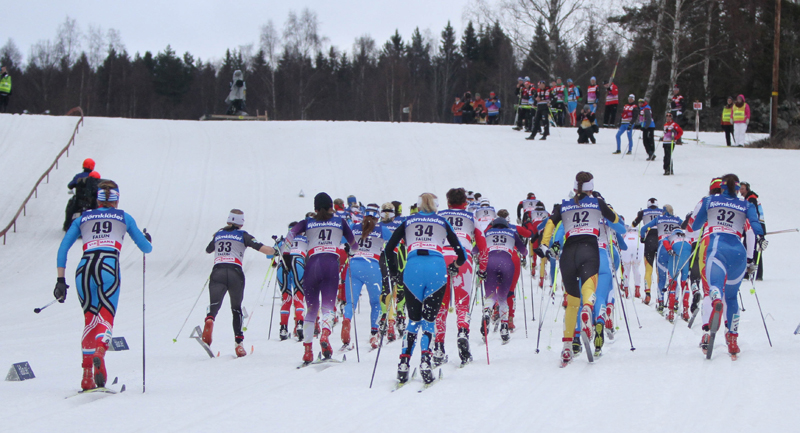
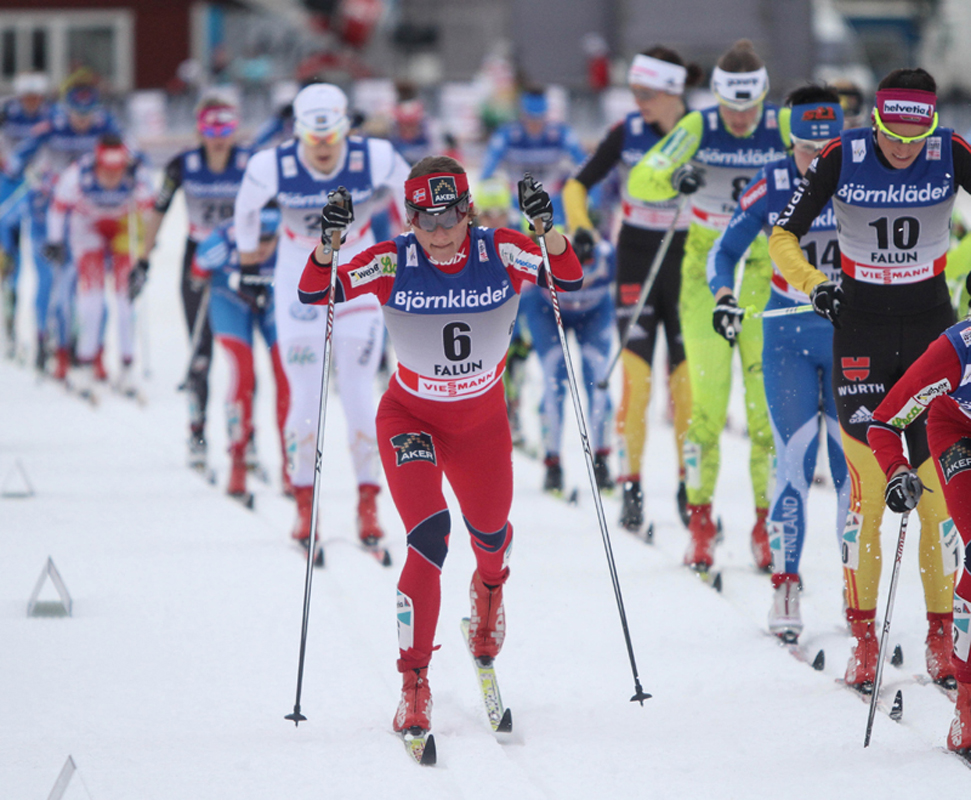
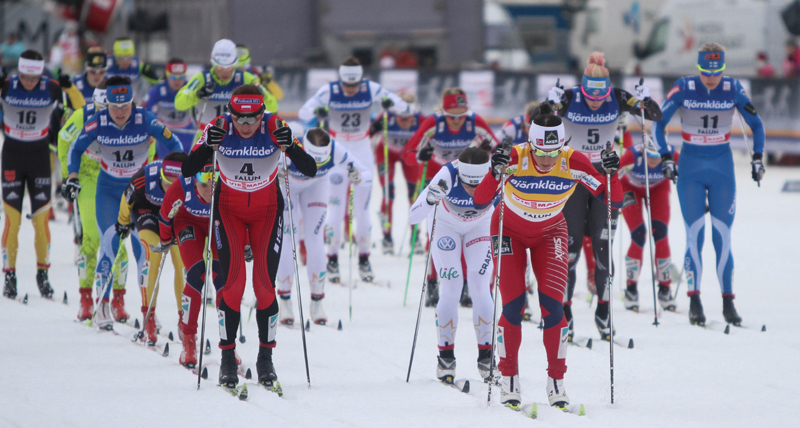
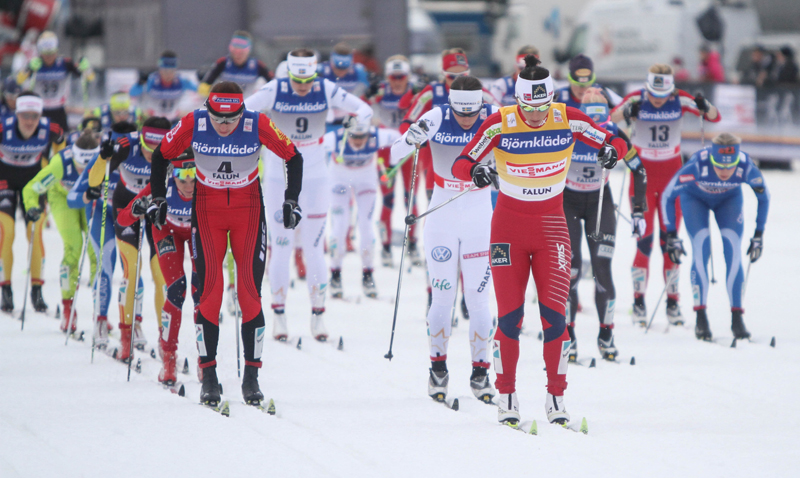
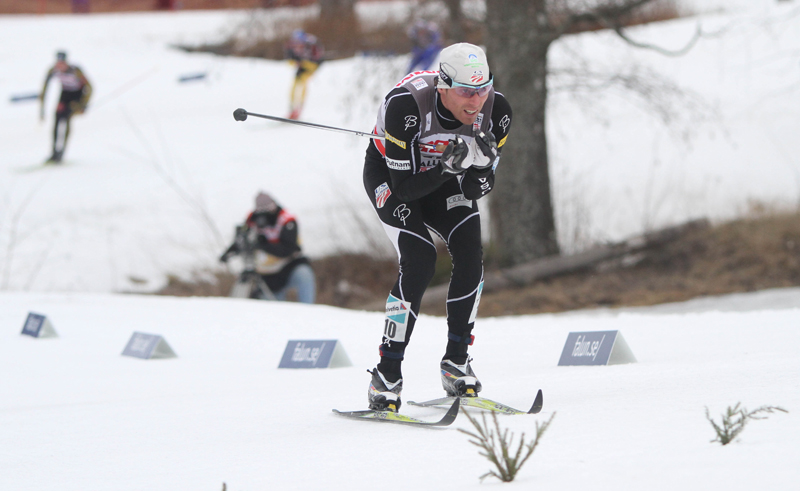
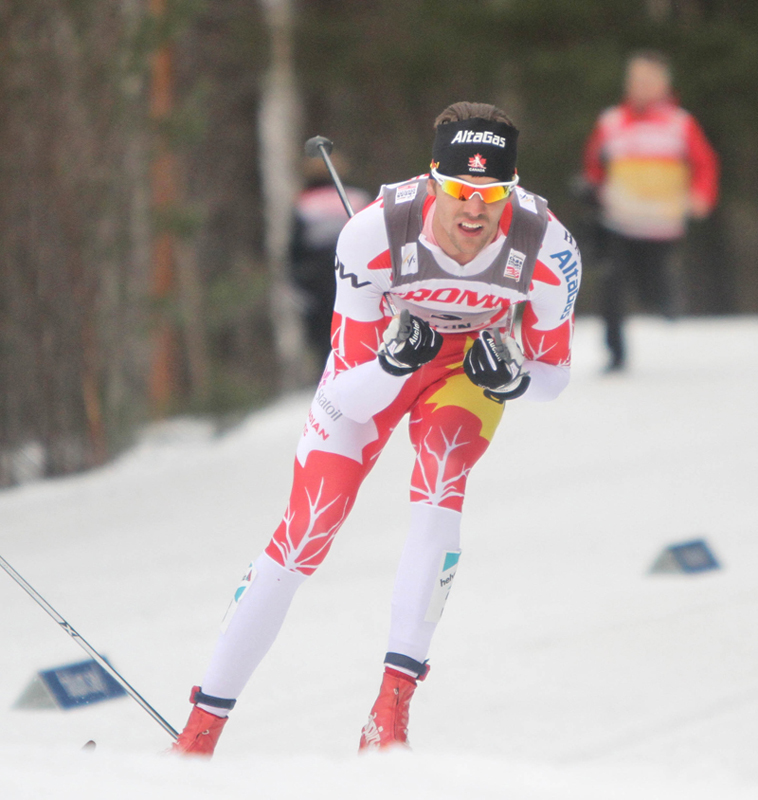
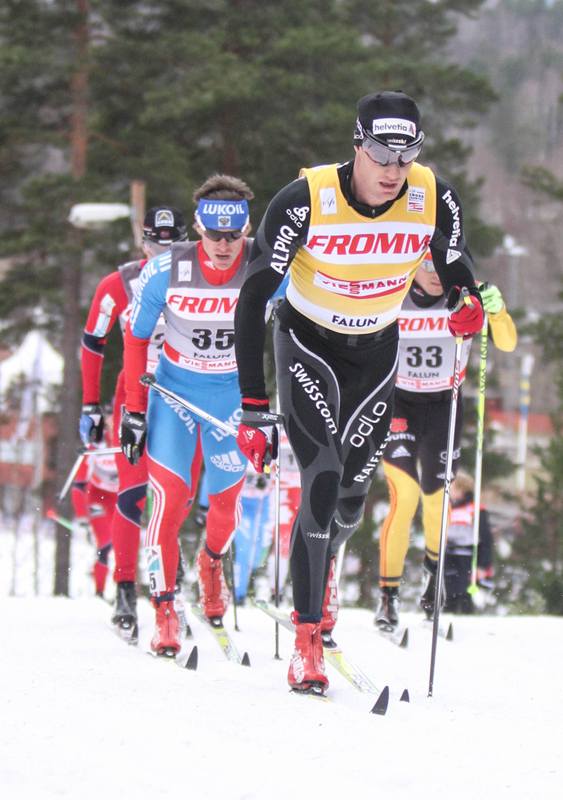
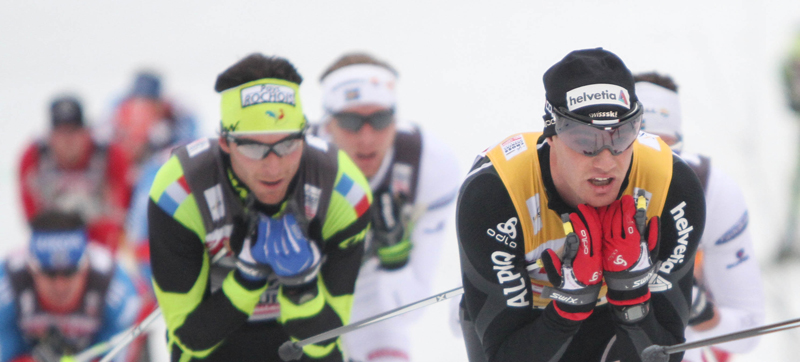
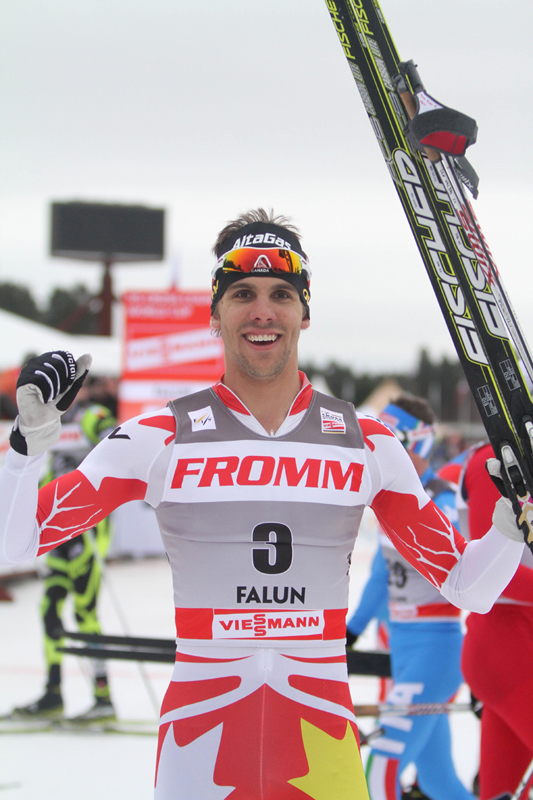
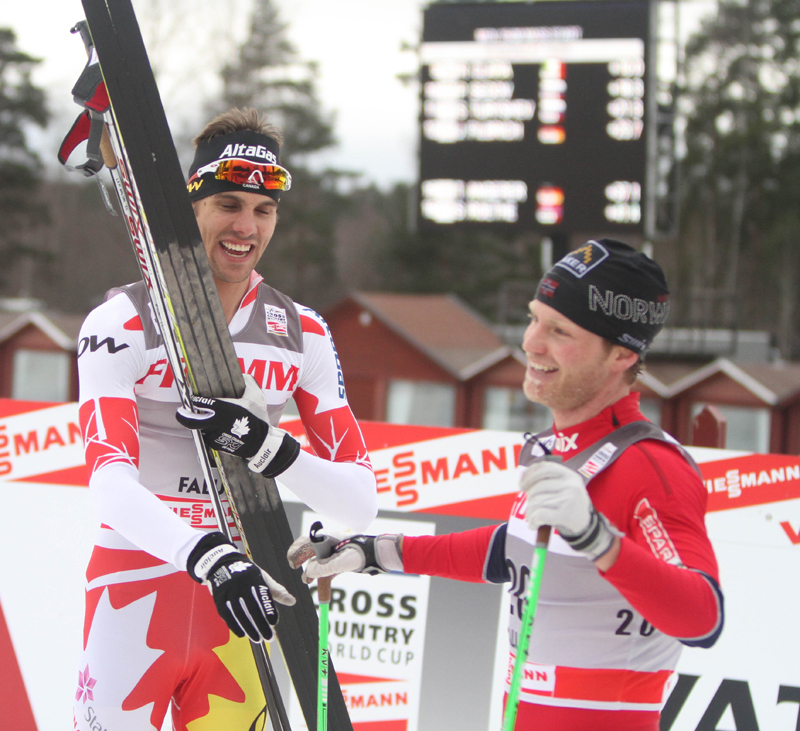
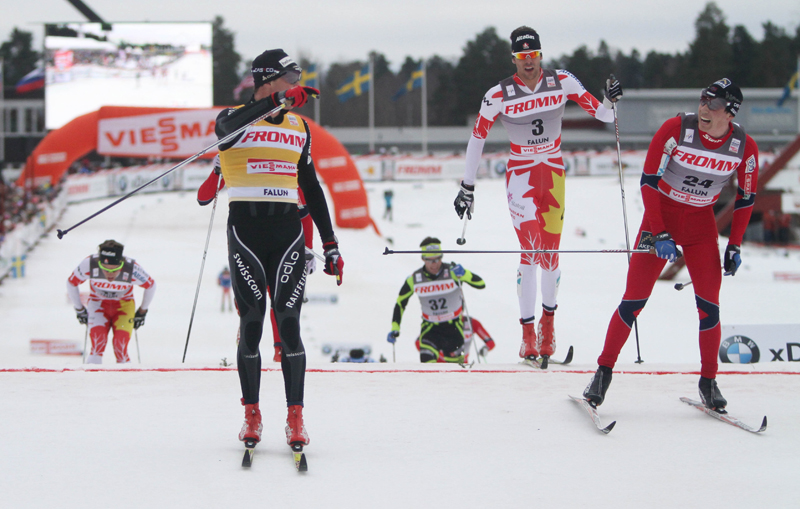
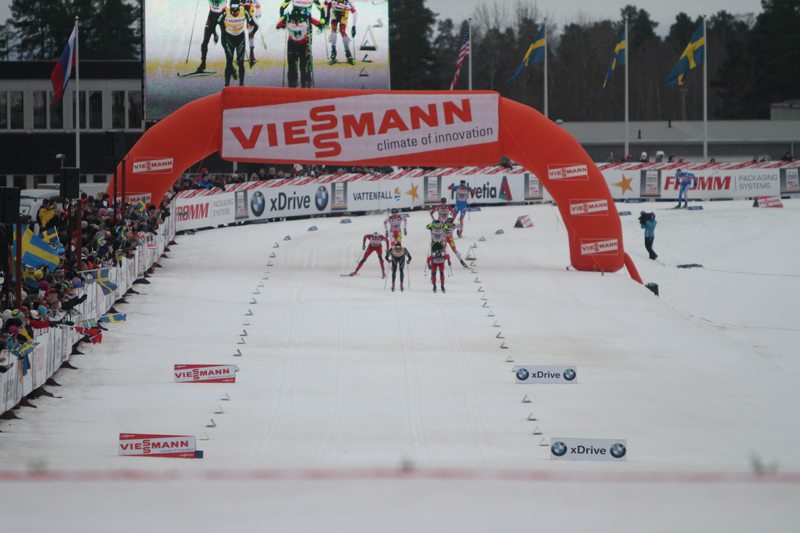
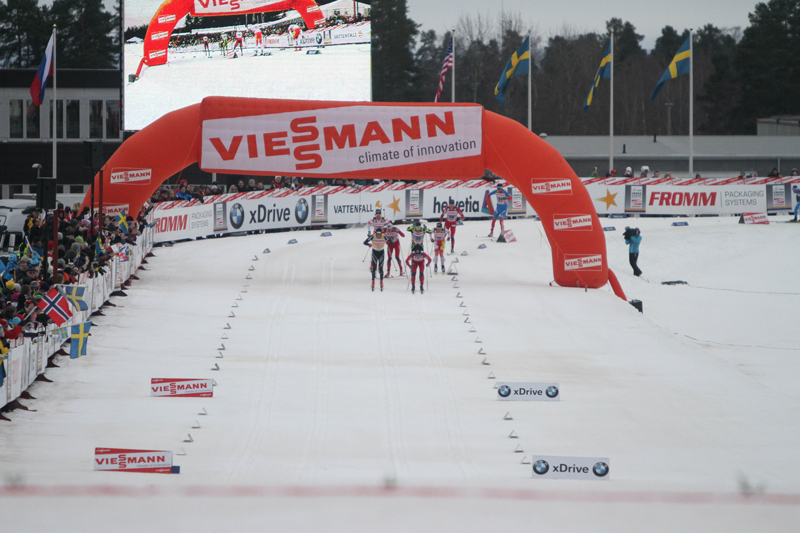
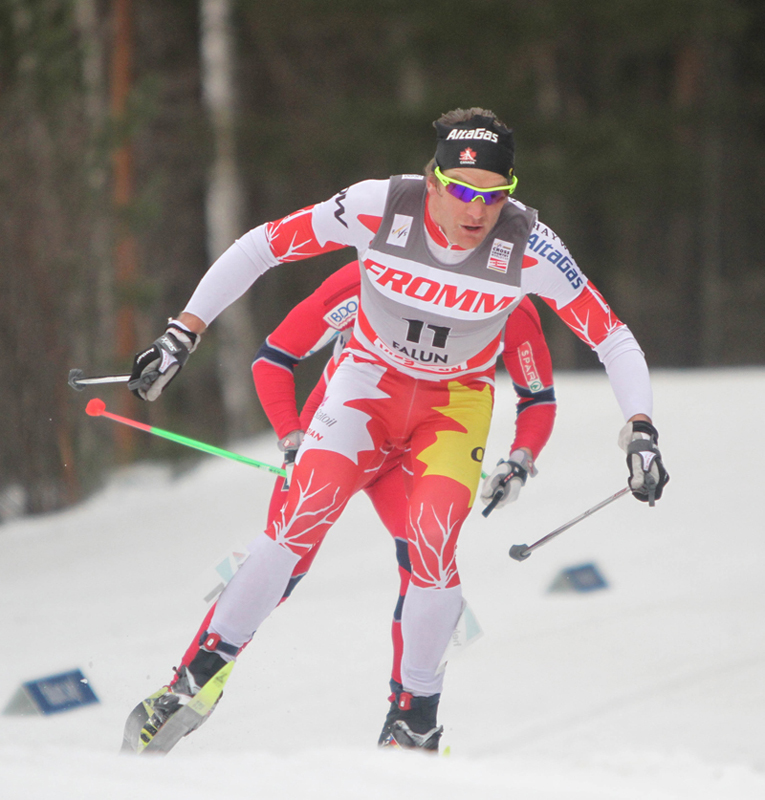
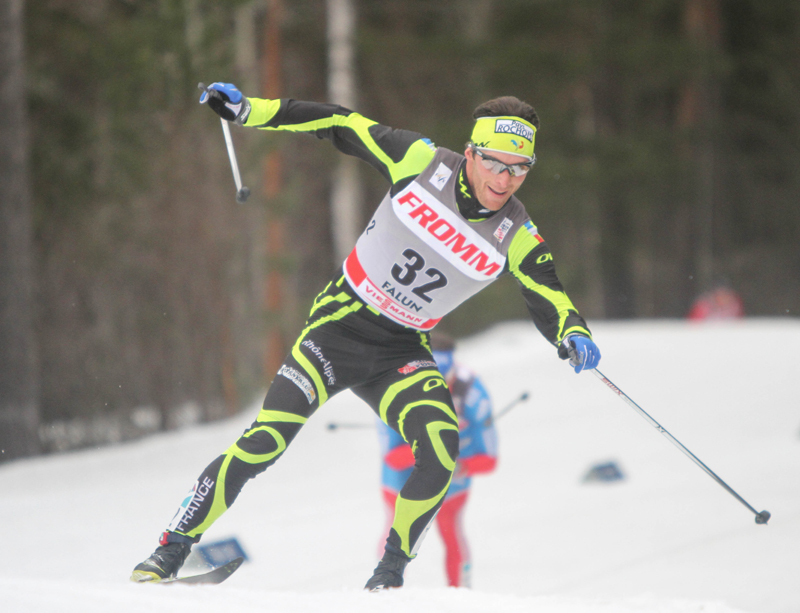
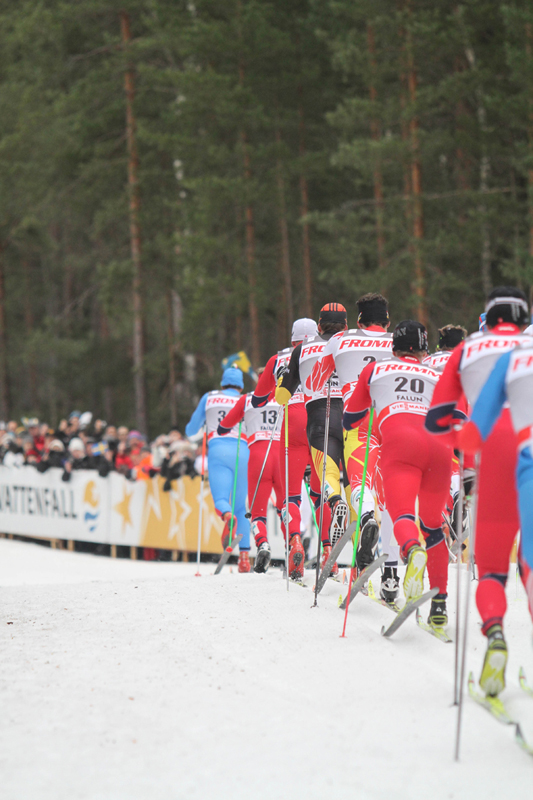
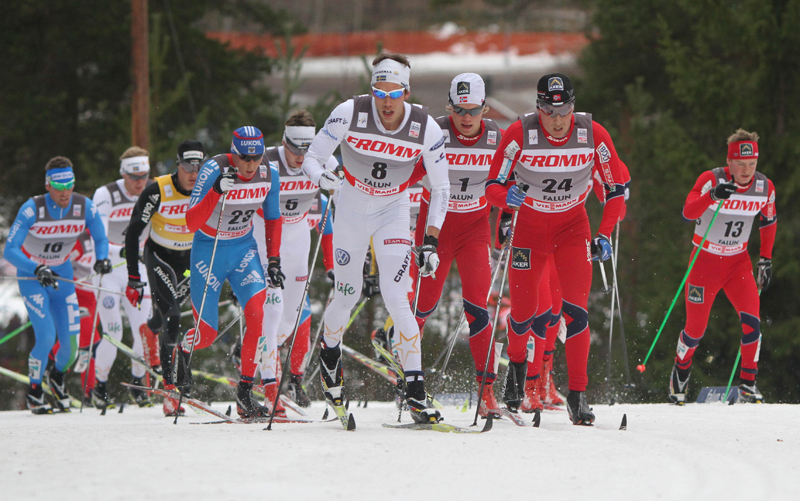
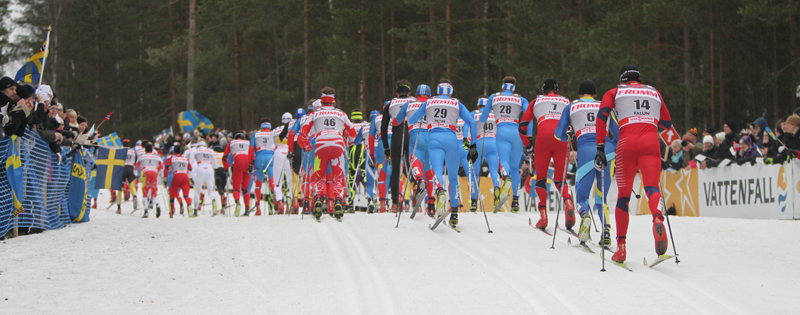
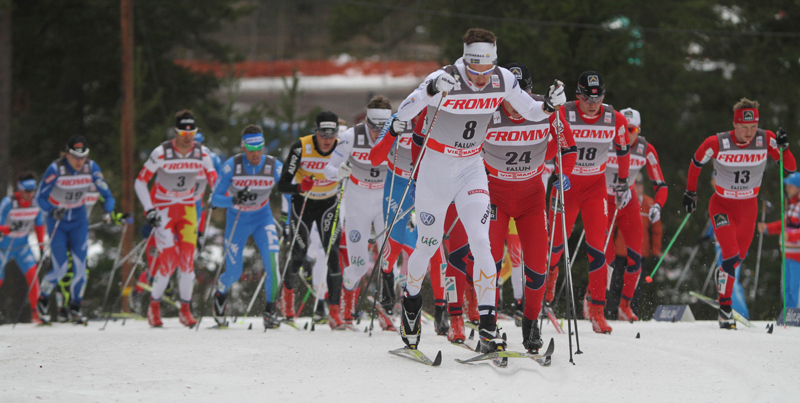
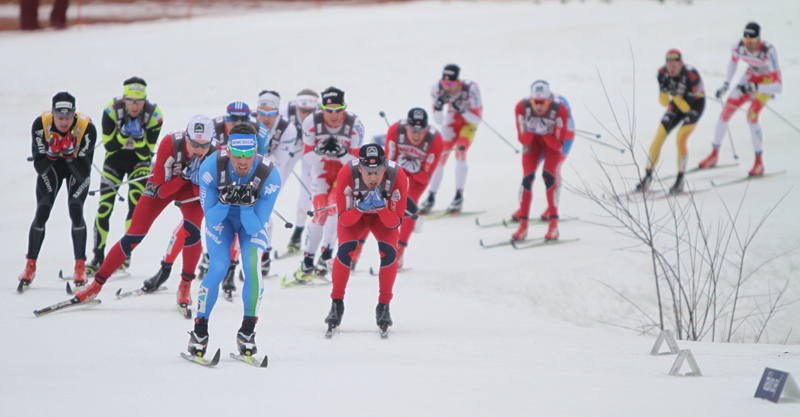
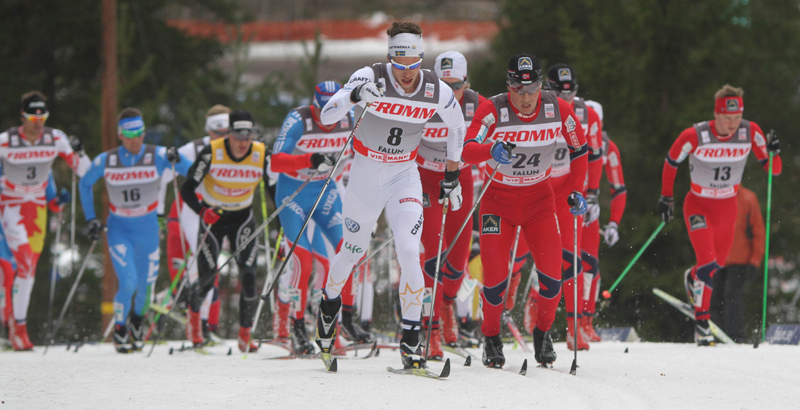
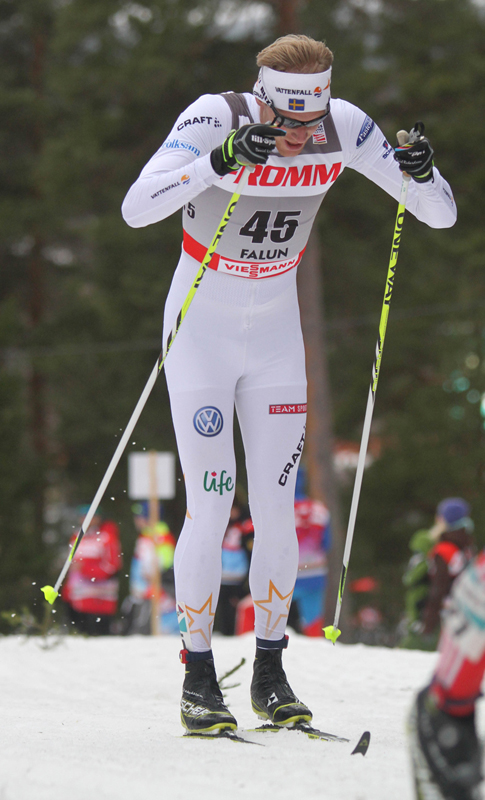
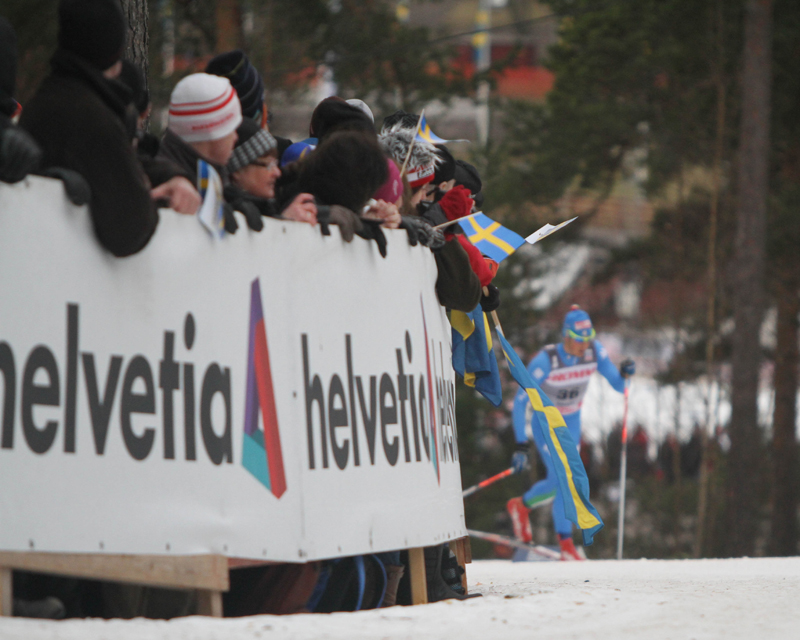
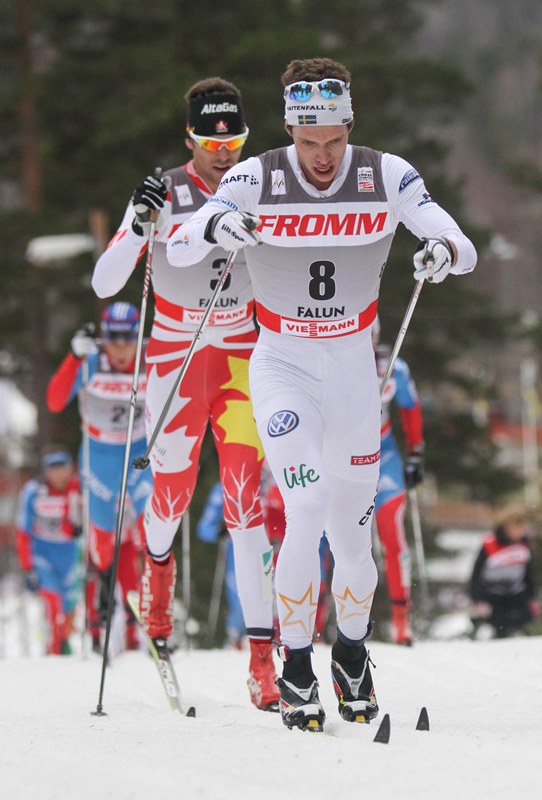
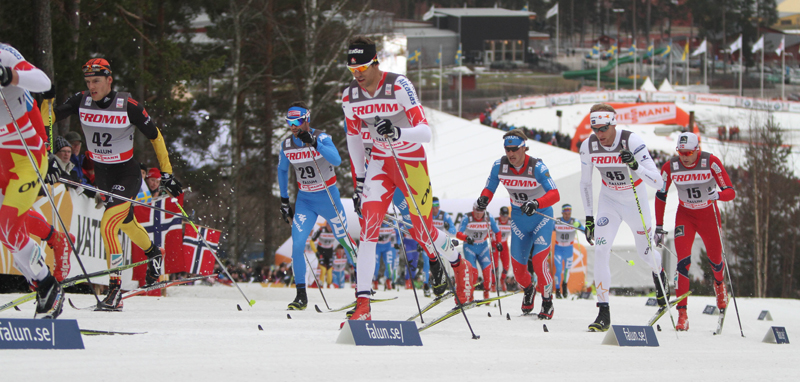
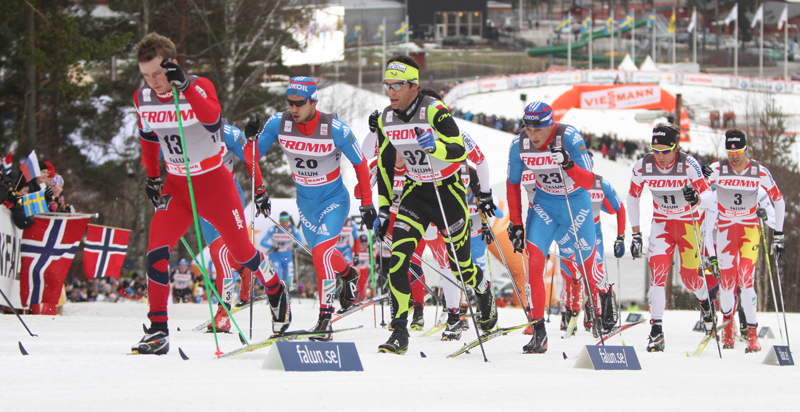
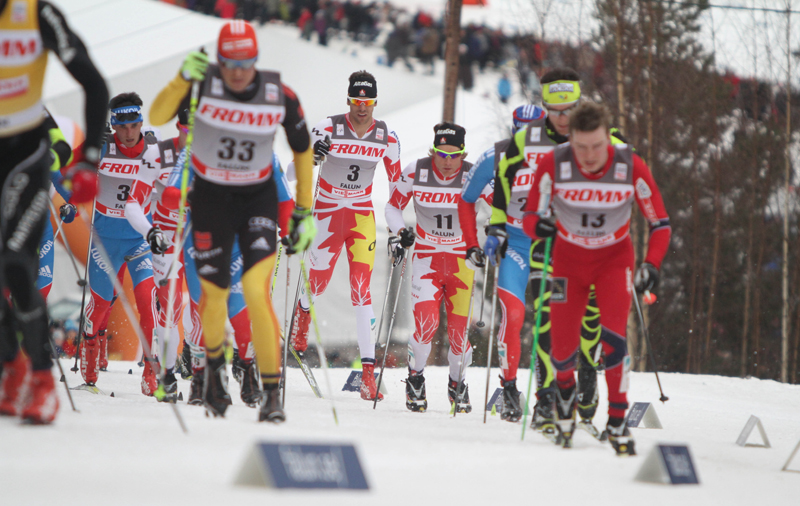
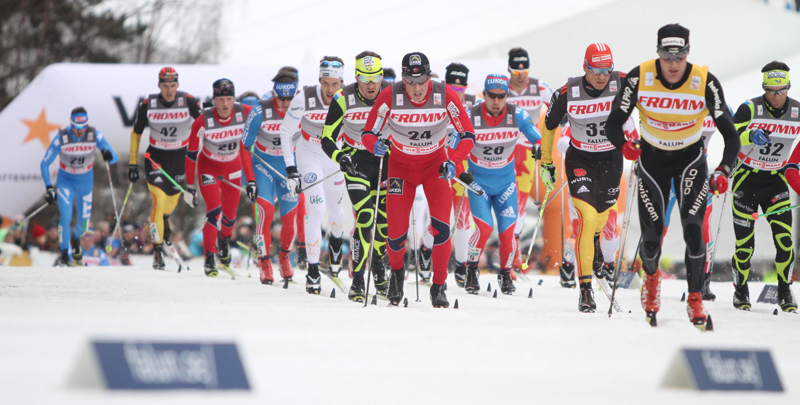
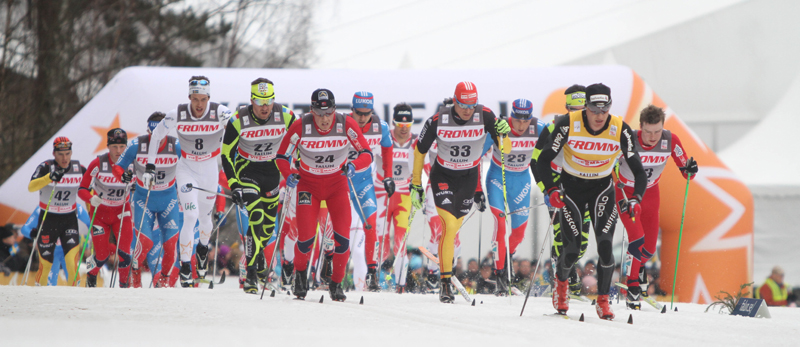
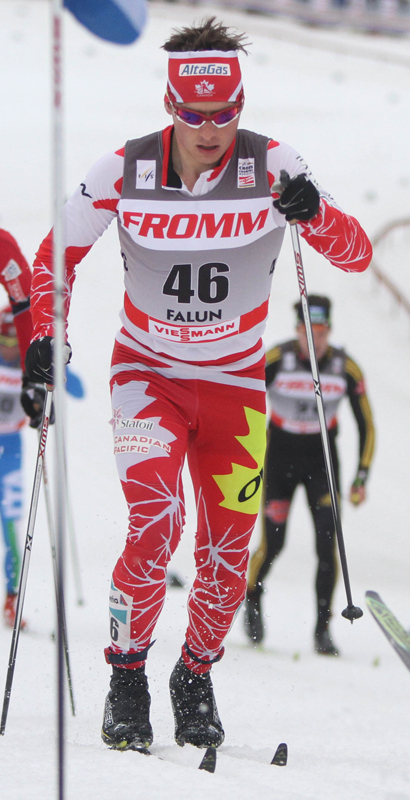
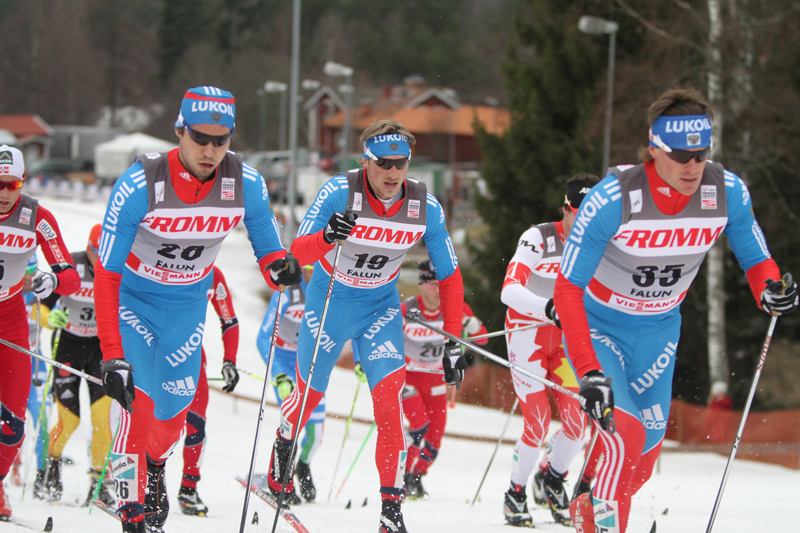
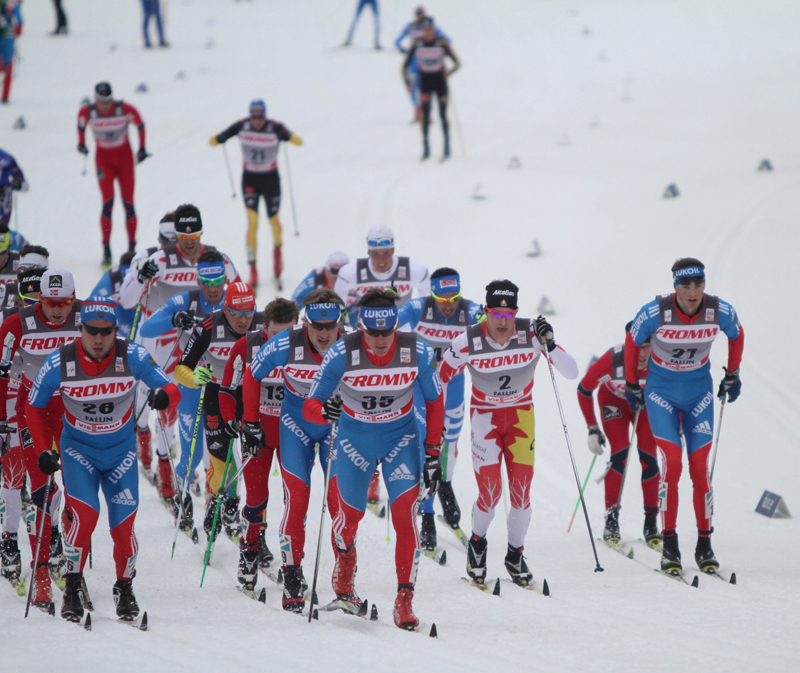
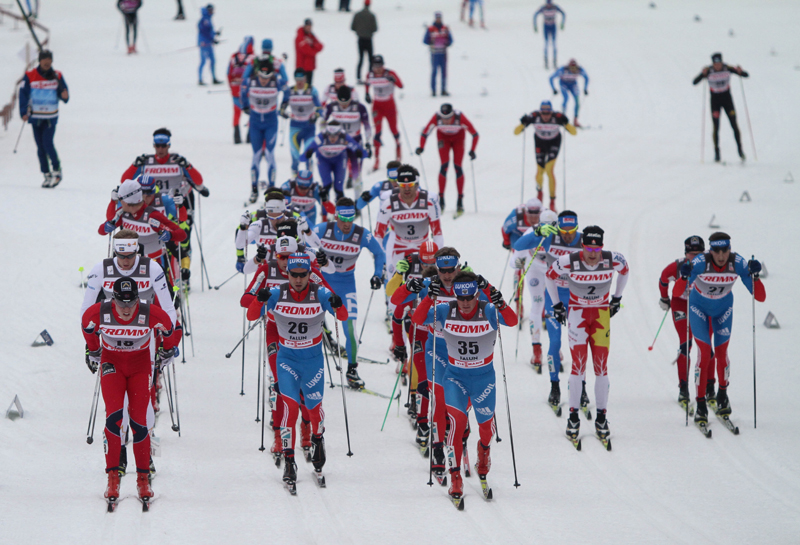
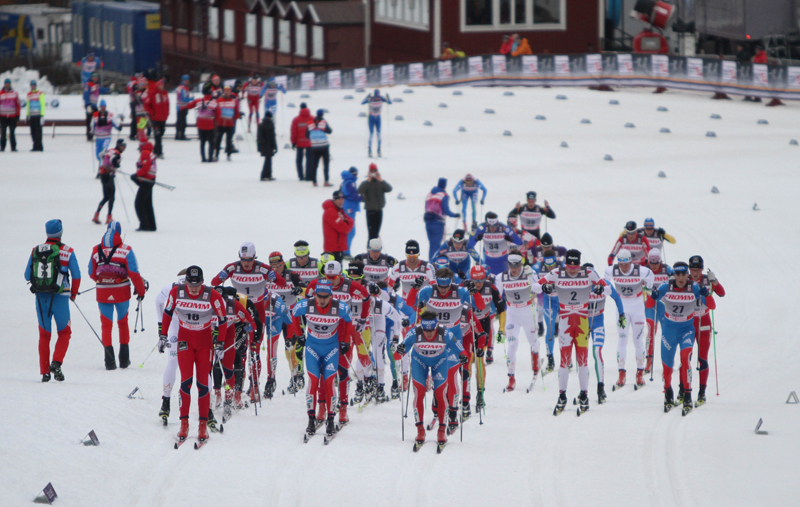
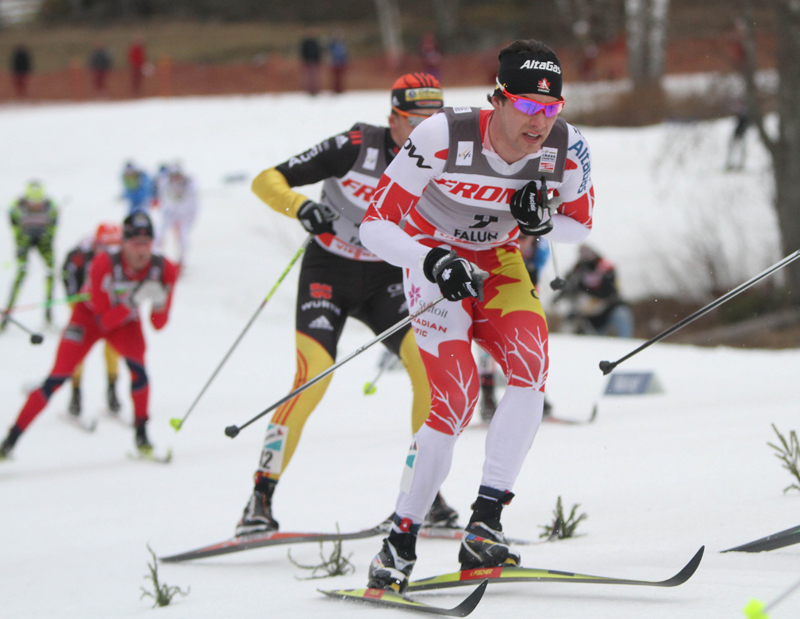
Alex Harvey during the 2012 World Cup Finals 15 k classic mass start in Falun, Sweden, where he placed 18th behind teammates Lenny Valjas in third and Devon Kershaw in fifth. On Saturday in the 2013 edition of the race, he led Canada in 30th.
Sometimes a rough day at the races is as simple as missing the wax. The Canadian National Team has been there before, probably more often than it would like to recall this season, but the reality is, you still have to finish.
That’s what stood out to head coach Justin Wadsworth on Saturday. As he watched his team, particularly his men, struggle in the five-lap, 15-kilometer classic mass start on the second-to-last stage of World Cup Finals, the three-time U.S. Olympian remembered what it was like to be in their position.
It’s bad enough when you’re not feeling 100 percent, but if you’ve got no kick to work with, it’s going to be a long day.
Wadsworth noticed the problem on the main hill of the men’s first lap.
“You could see the sun really beating on it and the guys, for so early in the race, were having a little bit of a hard time climbing up it,” he recalled on the phone. “We had really bad grip on the skis so there was no chance for the guys. The women, the skis were OK.”
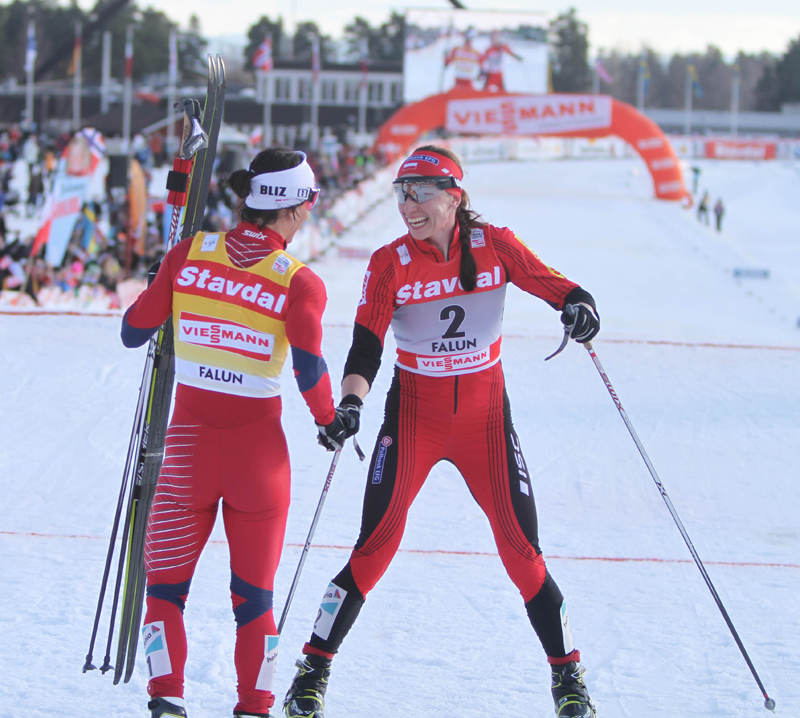
The women’s 10 k classic mass starter took place earlier on the warming afternoon in Falun, Sweden. NorAm leader Emily Nishikawa of the Alberta World Cup Academy (AWCA) placed 46th, 3:36.3 behind Norway’s Marit Bjørgen, who won in 28.06.7. Canadian World Cup Team member Dasha Gaiazova finished last in 50th (+4:07.3).
Gaiazova told Cross Country Canada she was simply “really tired,” according to a press release. “My energy tank needs a refill.”
That’s how most of the Canadians – and many World Cup skiers on the five-month circuit were feeling these days, but Wadsworth was disappointed his five men didn’t have much of an opportunity to push their limits.
Temperatures warmed from around 3 degrees Celsius (37 Fahrenheit) at the start of the women’s race to 6 degrees (43 Fahrenheit) for the men’s 15 k.
“It was one of the days I would say we missed the wax quite badly,” Wadsworth said. “That doesn’t help because the bodies aren’t perfect anyways, and that combination of not-perfect bodies and bad skis is not so much fun.”
Alex Harvey turned out the team’s top result in 30th, tying Sweden’s Calle Halfvarsson in a photo finish 1:38.2 behind Norway’s Eldar Rønning, who won in 43:26. Harvey skied with teammate Devon Kershaw for much of the race, hovering in the mid-30s. The two stuck with the pack for the first half of the 15 k, skiing 35 seconds off the pace by 10 k. By 12.2 k, they were more than a minute back from the leaders.
Kershaw ended up 36th (+2:09.3), and Ivan Babikov finished 41st (+2:47.7). Around 5 k, Babikov and Lenny Valjas were about 30 seconds back in the mid-40s. Michael Somppi (AWCA) was 50 seconds behind in 51st.
Babikov passed a few places to finish slightly higher, but Valjas ended up 50th (+5:04.5) and Somppi was last in 51st (+6:14.5). A year ago, Valjas captured bronze in the same race on a different course in Falun, which has been altered for 2015 World Championships. Kershaw was fifth in the 15 k classic mass start.
But that was then, and seeing how his athletes were feeling the wear-and-tear of the season, Wadsworth told them before the start he didn’t care where they finished, he just wanted them to work hard.
“All the guys hung in there,” he said. “They went through a day that I can tell you, haven been there myself as a racer, was no fun at all. They knew early on in the race their skis weren’t going to be good and they kept fighting, and I’m really proud of those guys for that.”
Asked what specifically went wrong, Wadsworth said something with the team’s lines of communication.
“I think it was just not going and looking ahead enough, maybe the connection between the wax team and looking at how the weather was changing,” he said. “Everybody’s got to be aware of that and communicating and somewhere that broke down today.
“I don’t think anyone was probably going to win the race today, but at the same time, you need to have good skis to be in the competition,” he added. “The kick wasn’t there for them.”
With one race left, Harvey will be the first Canadian starter in the pursuit in 32nd, 3:15.7 back from Norwegian leader Petter Northug. Last year in the pursuit, Harvey started ninth and finished second.
After Sunday, Harvey will take another look at his shoulder injury from earlier this year while most of the team heads to Canadian Nationals in Whistler, B.C.
“They just really need to refocus again and fight,” Wadsworth said of his athletes in the last World Cup race of the season. “A bunch of them are in positions that aren’t a lot of fun to be in, but they still have to go out there and do their job and work hard.
“It’s gonna be tough [Sunday], but we gotta go into every race and do our best,” he added “If they get there and they grit their teeth and they can see that they’re giving it everything they have, than that’s all I can ask, that’s all we can all ask.”
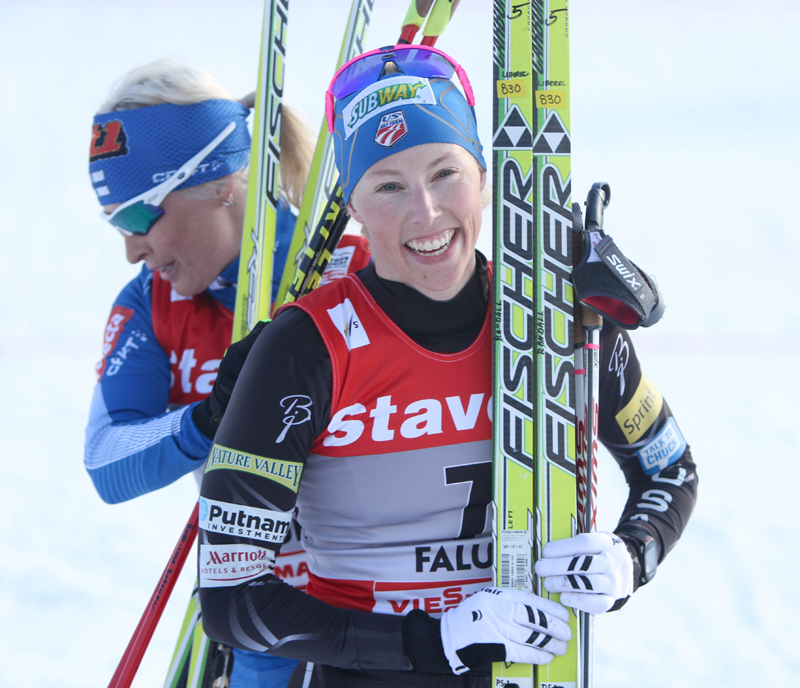
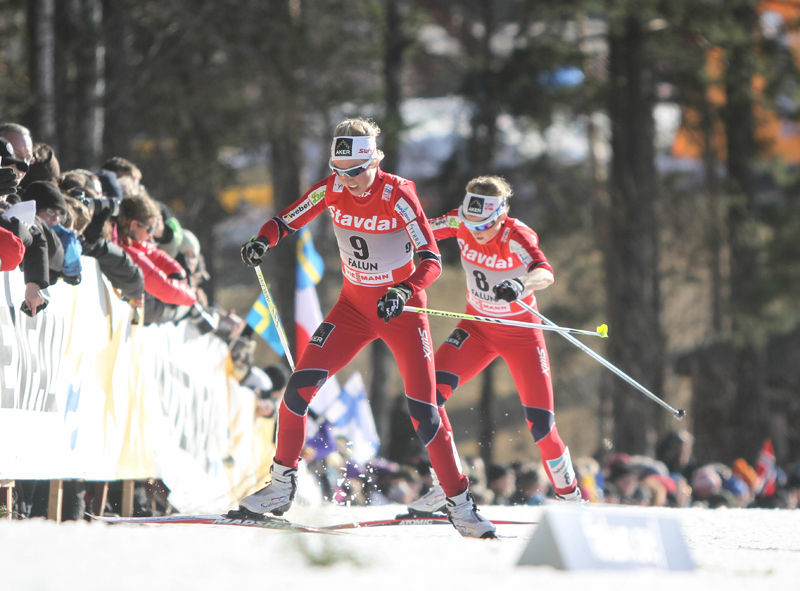
Kikkan Randall (USA), wearing bib 8, during the 10 k mass start classic race on Saturday in Falun, Sweden. She led the U.S. with a 19th-place finish. Photo: Fischer/Nordic Focus/FIS Cross Country.
On one of the first nice days for classic skiing the World Cup has seen all year, Kikkan Randall and Liz Stephen led the U.S. in the 10 k classic mass start in 19th and 21st, respectively, on Saturday for the third stage of World Cup Finals in Falun, Sweden. It was a race that both women ultimately wished was a few kilometers longer, as they both picked up places together in the last few minutes of the 30-minute race. But given that classic has been the weaker technique for both of them lately, and Randall’s distance form “has been pretty rocky since the Tour,” they were satisfied to keep themselves in decent positions for the final stage of the mini-tour on Sunday, a 10 k freestyle pursuit.
“We both would have been psyched for one more lap,” Stephen wrote in an email. “We were really catching people that last lap.”
The two teammates started relatively far apart and didn’t find each other until the last two laps of the 3.3 k course. Randall sat in 26th at the 5 k time check and Stephen was four seconds ahead of her in 22nd in a field that separated quickly. It wasn’t a pace any harder than usual for a women’s mass start, but the tempo was a challenge on this particular day for the Americans, at least in the first half.
“It’s a women’s race! It was all out from the word ‘go!’” Randall said. “The pace was pretty fast and I had a decent start, but just kind of had trouble adjusting to that pace in the middle section of the race.”
Stephen started hitting her stride just as Randall was struggling, and after the two converged they together to pick off a few skiers and finish on a high note.
“It was kind of nice to have her to follow for a bit,” Randall said of Stephen. “She was carrying a pretty good tempo and then I had really good kick on the uphills, so that was a strong point for me in the last couple kilometers.”
Randall kicked it in slightly ahead of Stephen to finish 1:20.2 behind Marit Bjørgen’s (NOR) winning time. Stephen finished two places and 3.1 seconds behind Randall.
Both Americans had both hoped for more in the second-to-last World Cup of the season, but were satisfied to have maintained good positions going into the final stage of the mini-tour, where they really want to do some damage.
“I am really looking forward to tomorrow’s pursuit start race, as I think they are my favorite kind,” Stephen said. “I am feeling physically good going into tomorrow, so we shall see how it goes! Last World Cup race of the season!”
Stephen moved herself up a few places with Saturday’s result and will start in 22nd, 3:32 back.
Randall sits in 15th in the tour standings and will start the 10 k freestyle on Friday 2:52 behind Bjørgen (who leads the entire field by 1:19 now that Poland’s Justyna Kowalczyk has dropped out) and a minute behind Heidi Weng (NOR) in sixth. The outcome of World Cup Finals carries particular weight for Randall’s final placing in the overall World Cup standings, where she currently sits in third. Bjørgen is currently 170 points behind Randall, and if the Norwegian wins the pursuit on Sunday she will be awarded 200 points for the mini-tour win. All Randall has to do to hold onto third is finish at or above fifteenth, which would earn her the necessary 32 points to hold Bjørgen off.
Behind the two leaders of the American squad, Ida Sargent placed 29th behind her teammates on Saturday to put three American women in the top-30, a marker that always brings the satisfaction of World Cup points even if the result itself isn’t as fulfilling. This was how Sargent felt about the place on Saturday, which brought her through the finish 1:56.3 behind the leaders.
“I felt horrible on the first lap and lost a lot of time but then I started feeling better on the next two laps so I tried to move up when I could,” Sargent wrote in an email. “They changed the course to get rid of the sketchy downhill but then there were not any big hills so it was a fast pace all the time and hard to make up time without any significant climbs. But any time I score distance points it’s a good day, so I’m happy.”
A few seconds behind Sargent, Jessie Diggins and Holly Brooks once again finished back-to-back, this time with Diggins taking a few seconds out of her elder teammate. Like Randall and Stephen, the duo skied together for the back half of the race and in the end Diggins nipped Brooks by 1.3 seconds and the pair finished 38th and 39th, respectively.
“We would ski together and we were always trying to bridge the gap back to the next group,” Diggins said. “You know, one of us would try to pull the group up and get tired, and then the next one would try to pull the group up… It’s always sweet to ski with your teammate.”
Diggins alluded to feeling slightly better than the result showed, and she attributed the difference to having “a lot of things to work on with classic technique and wax adjusting and ski picking,” she said. “I was just doing too much slipping and herring boning to be able to hold any sort of pace, so that was a little disappointing. But that said, leaving the season with concrete things to work on for next year is always really nice.”
Rosie Brennan was the sixth American to cross the finish line. She started the race wearing bib 47 in a field of 50, “so the race was relatively uneventful for me,” she said.
She still managed to move up a few places over the course of 10 k to finish higher than where she started in 43rd, 3:04.8 back. The fast opening pace was a challenge — “I felt terrible for the first few k at such a high pace,” Brennan said — but found her stride and skied in a small pack for most of the race.
“I felt pretty good through the race and am certainly becoming more comfortable with the World Cup each race,” she concluded.
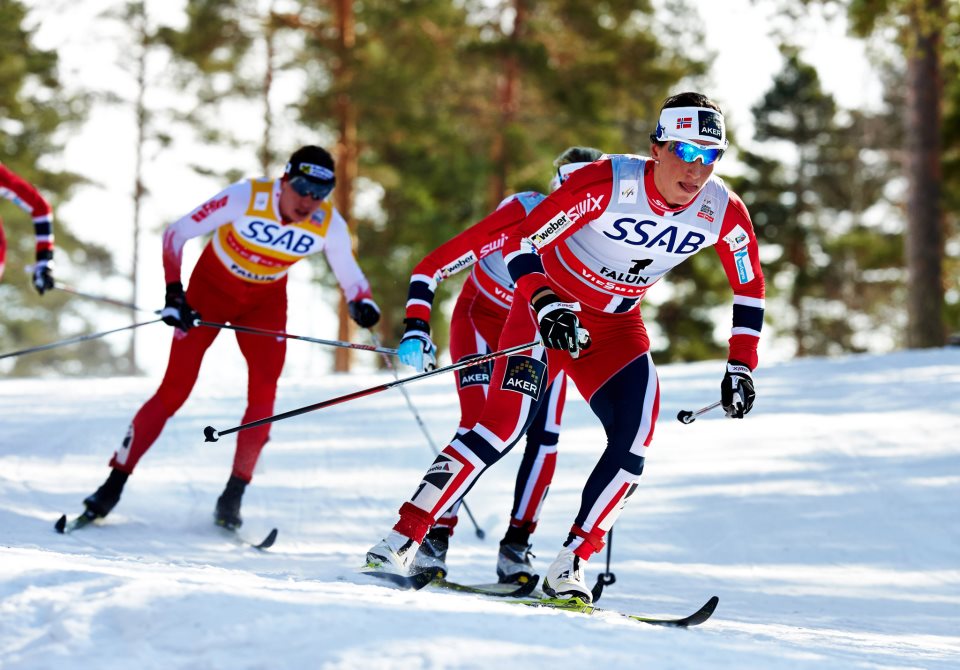
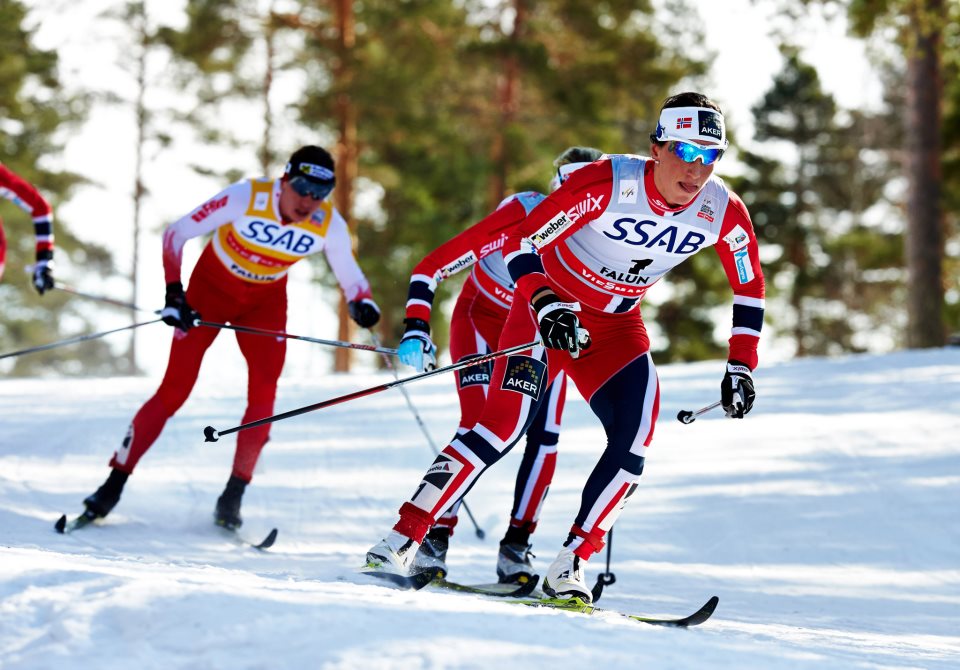
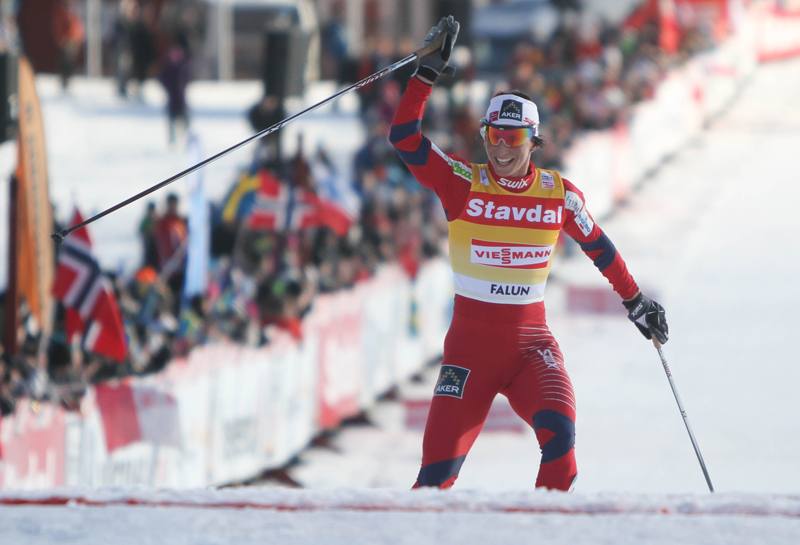
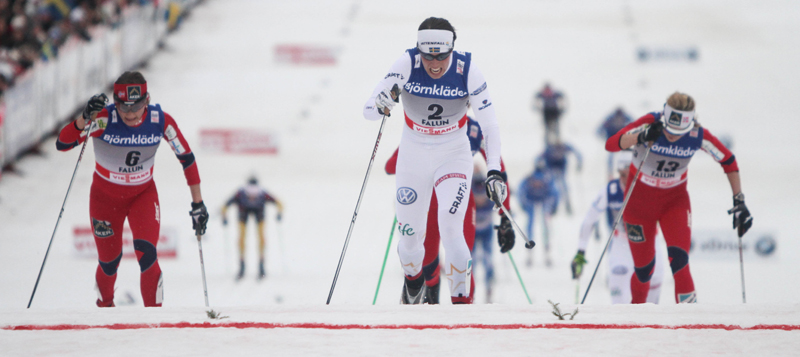
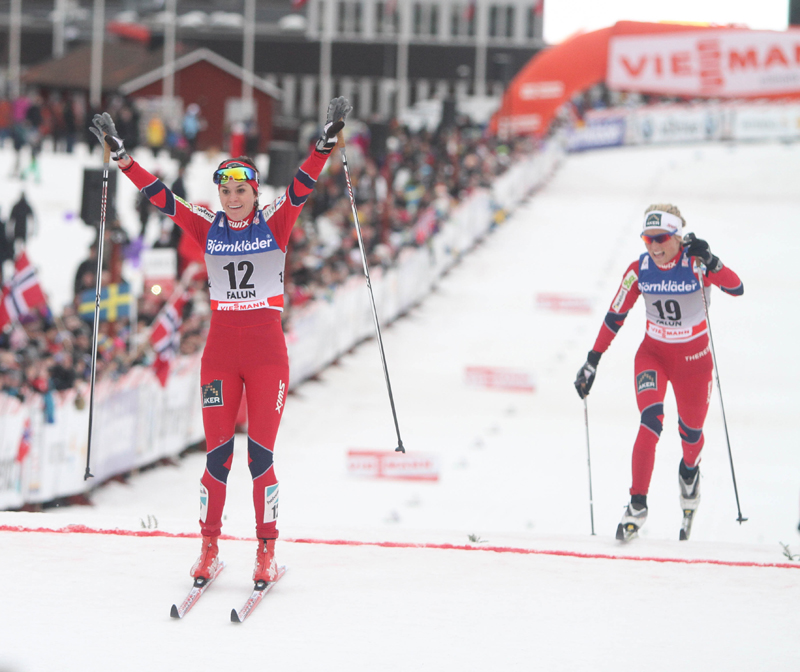
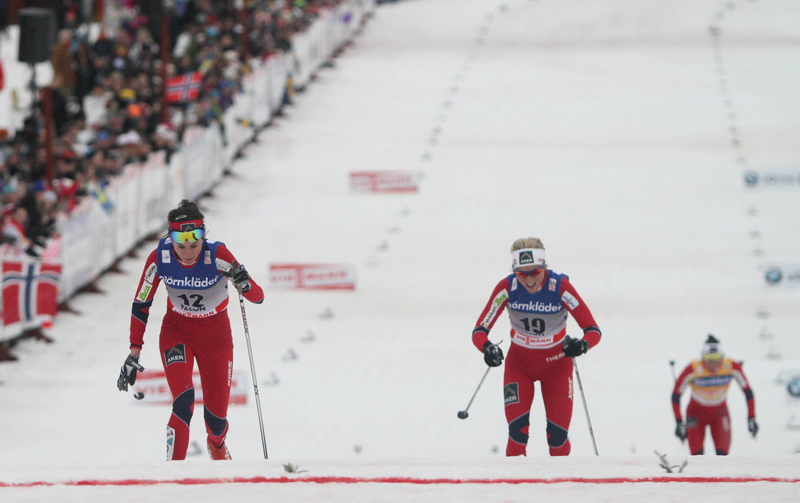
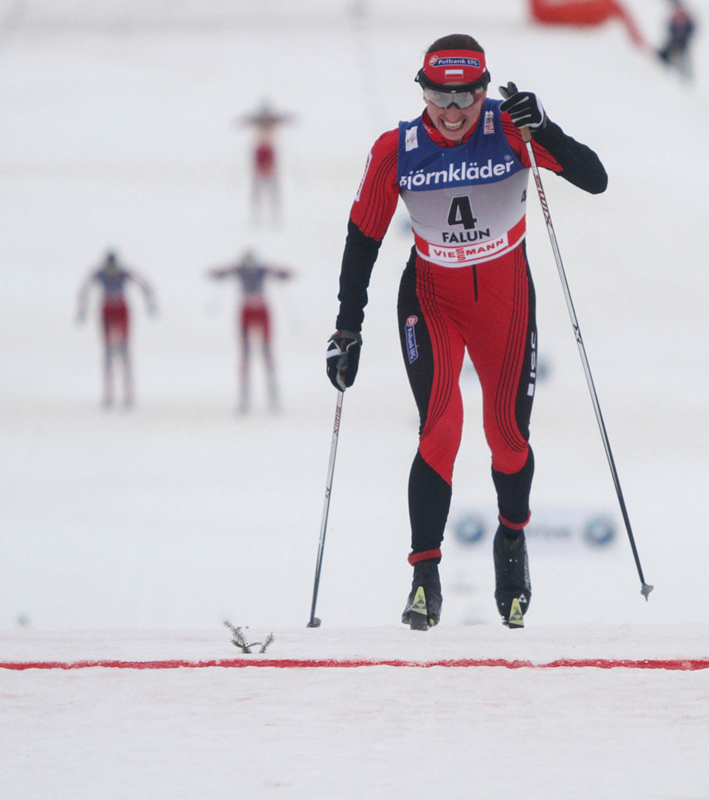
Marit Bjørgen leads Norwegian teammate Therese Johaug (c) and Poland’s Justyna Kowaczyk (l) during Saturday’s 10 k classic mass start at the 2013 World Cup Finals in Falun, Sweden. Bjørgen went on to win by 3.9 seconds, Johaug was second, and Kowalczyk took fourth, 0.1 seconds behind Norway’s Heidi Weng, who took third. (Photo: Fischer/Nordic Focus; facebook.com/FIS Cross Country)
Marit Bjørgen had seen the scenario play out before. Poland’s World Cup leader, Justyna Kowalczyk would suddenly decide it’s time to ski faster, and off the 30-year-old would go.
Come catch me, she’d beckon. Many would try; few ever did.
But when you’re Bjørgen, Norway’s most decorated female with 12 World Championships golds and three Olympic titles, that’s not an act you readily follow. In Saturday’s 10-kilometer classic mass start at World Cup Finals, Bjørgen certainly wasn’t going to let it happen without a fight.
The 33-year-old kept her head down as Kowalczyk opened a few-seconds lead at the start of the last lap. The Pole was pulling away from Bjørgen and two other Norwegians, Therese Johaug and Heidi Weng, but she still had some three kilometers to hold it. And in Falun, Sweden, that’s a tough task.
The 3.3 k course is unforgiving, marked by the infamous Mörderbacken hill that requires a lengthy climb followed by a multiple-tiered descent. If you can lead through the high point, that’s one achievement, but the real test comes on the downhill.
Bjørgen kept all this in mind as Kowalczyk strided away up the long climb. With about two kilometers to go, the Norwegian nearly reined her back in, trailing by just 2 seconds while Johaug followed 0.8 seconds back. Weng kept them all in sight with a 7.4-second deficit.
The second chase group, led by Finland’s Kerttu Niskanen at 8 k, was more than 36 seconds back and six strong with Sweden’s Charlotte Kalla, Finland’s Anne Kyllönen, Yulia Tchekaleva of Russia, Norway’s Astrid Jacobsen, and Katrin Zeller of Germany.
But with three Norwegians and a Polish favorite up front, all eyes were on the leaders. Bjørgen rode up alongside Kowalczyk during the descent, skiing on the outside of one curve and using her speed to take control up the next climb.
With about a kilometer remaining, Bjørgen led into the final steep rise, and Kowalczyk suddenly slipped behind. Her kick had worn off on the klister day, with temperatures just above freezing. Kowalczyk would have to fight for bronze with Weng, while Bjørgen and Johaug cruised down into the stadium.
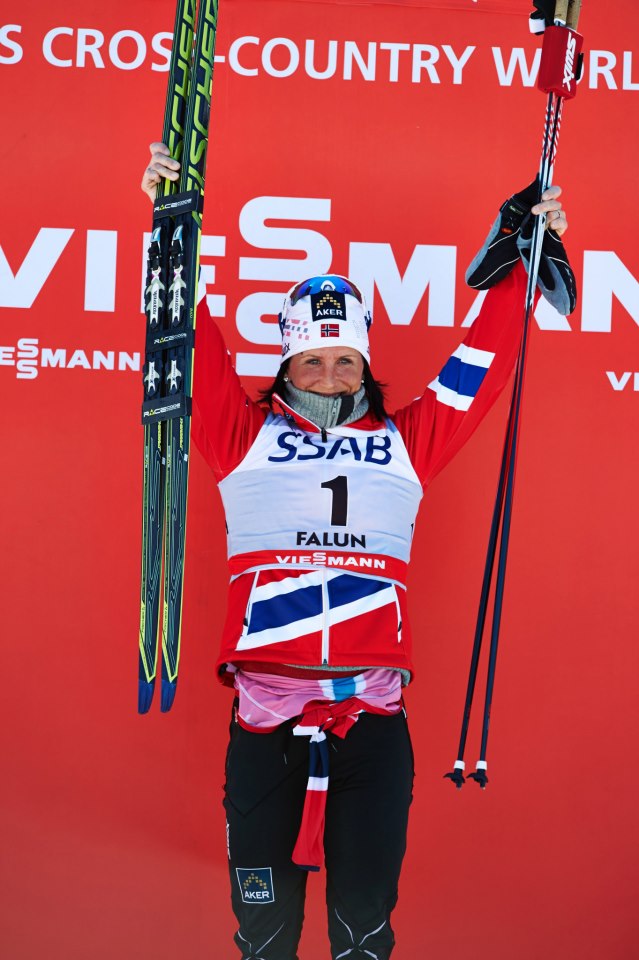
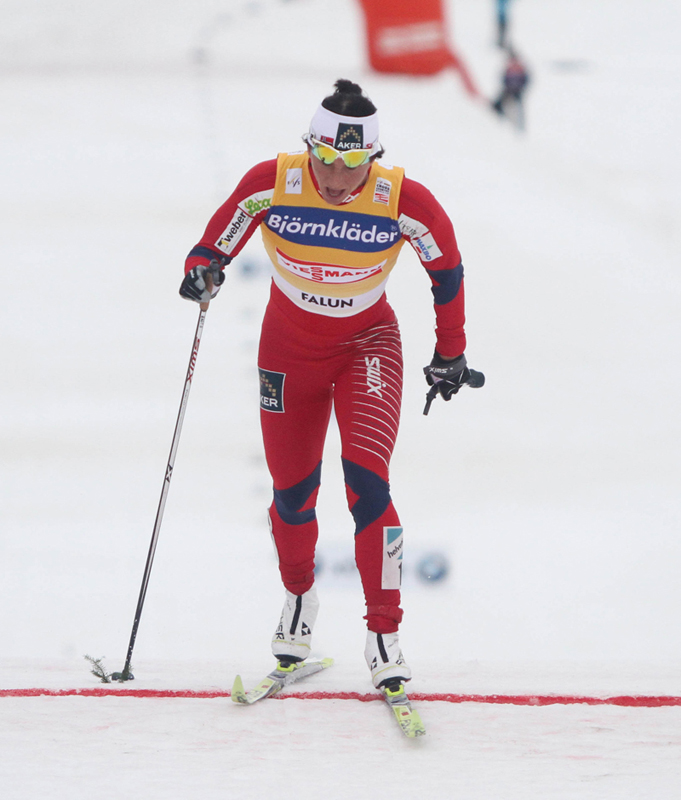
Norway’s Marit Bjørgen tops the podium for the second straight day at World Cup Finals in Falun, Sweden, after winning Saturday’s 10 k classic mass start and leading a Norwegian top-three sweep. (Photo: Fischer/Nordic Focus; facebook.com/FIS Cross Country)
There, Bjørgen continued to push the pace and won comfortably in 28:06.7 minutes, 3.9 seconds ahead of Johaug in second.
The two looked back to see if Weng could pull off the Norwegian sweep as she entered the finishing straight with Kowalczyk. The 21-year-old did just that, outlunging Kowalczyk by one-tenth of a second, 11 seconds after Bjørgen crossed the line.
“I just thought that I should have the third place,” Weng told NRK, according to a translation. “I stiffened bad when Kowalczyk caught, but when I saw that she struggled in the last hill I saw hope.”
“She was nervous and fiddled with her porridge a lot at breakfast,” Bjørgen said at a post-race press conference. “But Heidi skied a fantastic lap and I’m very proud of what she did.”
The 1-2-3 finish was about as good as Norway could have asked for, especially with Bjørgen leading the way with her second-straight victory of the Finals. With one race remaining in the mini tour, Bjørgen would enter Sunday’s freestyle pursuit with a 46-second lead on Kowalczyk. However, after the race, Kowalczyk announced she would not be competing.
“I’ve decided not to go on Sunday,” she said a press conference, according to NRK. “I did not have the chance to win mini tour anyway.”
Kowalczyk said she was past her best races of the season, and after competing in essentially every one possible, she needed a break.
“I’ve only been home a few days throughout the year and long for a holiday,” she added.
She’s also struggling with leg pains, and her personal doctor has suggested she might need surgery in the offseason.
The news came as a surprise to Bjørgen, who was excited about the gap she’d built on her longtime rival.
“I had expected her to be here and fight,” Bjørgen told NRK. “But it has been a long season for her and it’s a choice she has to make.”
Kowalczyk is currently 674 points ahead of Johaug in the overall World Cup standings, which will be finalized Sunday. Bjørgen is more than 1,000 points behind in sixth after a heart arrhythmia in December led her to skip several World Cup races, including the entire Tour de Ski.
Even so, Bjørgen has achieved an incredible statistic of making the podium in 23 out of 23 consecutive starts. The last time she didn’t make the top three was more than a year ago on March 18, when she was fifth in the 2012 World Cup Finals pursuit in Falun.
“It is [rare] what she does and shows that she is the world’s best skier,” Johaug told NRK. “I’m terribly proud of her.”
Alternatively, Kowalczyk has been as far back as 43rd this season, and Johaug once placed 49th. Women’s coach Egil Kristiansen believes that even with a health scare, Bjørgen’s season went about as well as the team could’ve asked for.
“Disease breaks [out] involuntarily, but in general, it has been shown before that Marit [needs] a little break from skiing to rest and train,” Kristiansen told NRK. “We’ve realized that it’s a good recipe for success for her.”
Looking ahead to Sunday’s pursuit, Bjørgen’s most concerned about Johaug starting 1:20 back in second.
“Although I have a big gap on Therese, she is very fast and I have to stay focused and do my best,” she said at a press conference.
After the three Norwegians and Kowalczyk took first through fourth on Saturday, Kalla placed fifth (+39.9) and will start third on Sunday, 1:26 behind Bjørgen.
Finland had three in the top 10 with Kyllönen in sixth (+40.2), Niskanen in seventh (+40.6) and Krista Lahteenmaki in 10th (+58.3). Tchekaleva was eighth (+43.9) and Jacobsen finished ninth (+46.3).
Niskanen and Weng will start fourth (+1:37) and fifth (+1:52), respectively, in the pursuit, and Kyllönen will be 1:53 back in sixth.
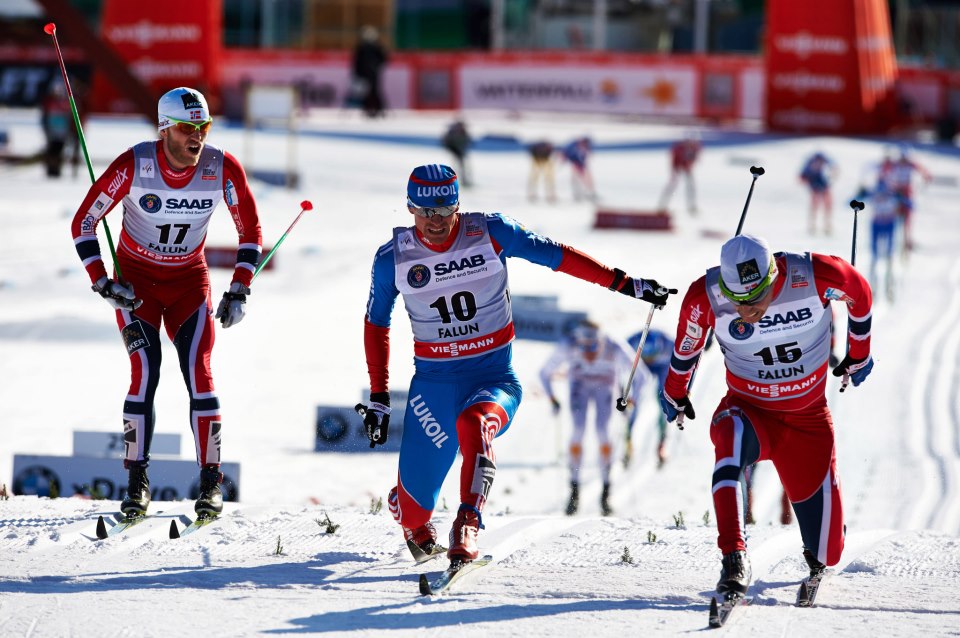
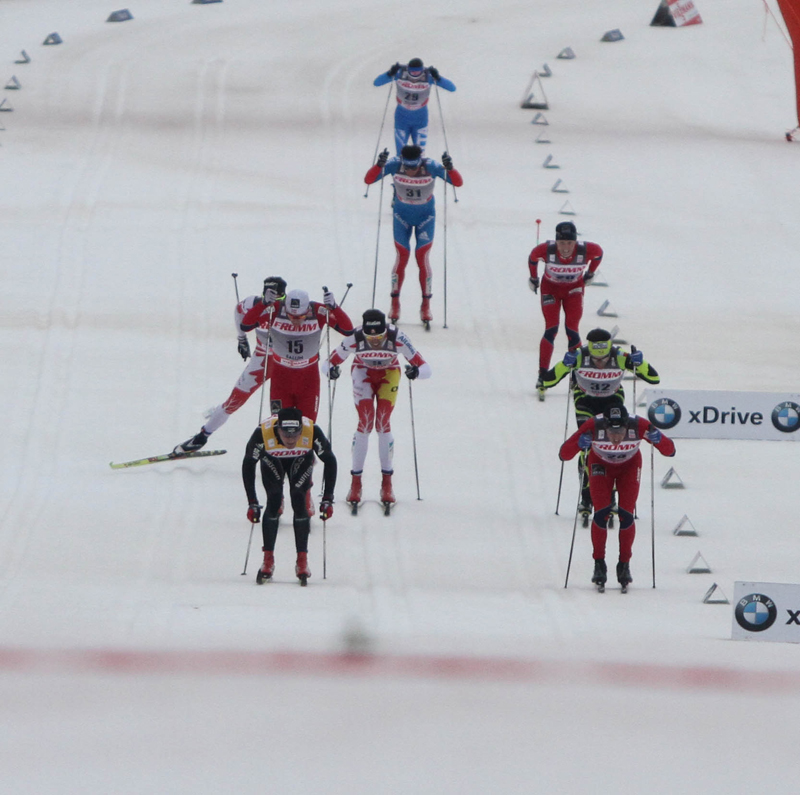
Eldar Rønning (r) edges Russian Maxim Vylegzhanin (c) and fellow Norwegian Martin Johnsrud Sundby (l) in Saturday’s 15 k classic mass start at 2013 World Cup Finals in Falun, Sweden. (Photo: Fischer/Nordic Focus; facebook.com/FIS Cross Country)
The typical plot line never materialized.
Norway’s Petter Northug was supposed to spend the first several laps on Falun’s controversial track back in 25th and then surge to the front for the victory in the final 100 meters at World Cup Finals in Sweden.
Instead, Northug’s teammate Eldar Rønning salvaged a tough season with a surprise 15-kilometer classic mass start victory, posting a time of 43:26 minutes on the 2015 World Championships course.
Rønning, a classic specialist, made use of his late-season form, narrowly outsprinting Russia’s Maxim Vylegzhanin in the finishing straight with Norwegian Martin Johnsrud Sundby just behind in third.
Saturday’s competition had three separate stories at work. First was the fight for the overall World Cup between Northug, Russia’s Alexander Legkov, and Switzerland’s Dario Cologna. Second was the standing in the Falun mini tour, made more dramatic by the bonus seconds offered at the 5.6 k and 12.2 k marks. Third was the contest for the race honors itself.
Northug began the mass start with two victories in a row and appeared to be in indomitable late-season form.
Legkov and Cologna are off their best, but even after Northug’s two successive victories, Legkov and Cologna only trailed the Norwegian by 56 and 69 points, respectively.
It was up to Legkov and Cologna to deliver a strong result and stop Northug’s momentum.
Northug was up to his usual antics in the first few laps of Falun’s unforgiving course, lazing to the back of the field while others took up the pace.
It opened the door for someone like Legkov to up the pace. However, Legkov appeared to be missing a gear, as Northug observed.
“It looked like Legkov had spent a night out on the town,” Northug told told NRK. “He looked tired.”
Cologna initially looked dangerous.
He gamely came to the fore at the first intermediate sprint for bonus seconds at 5.6 k, narrowly denied the full 15 seconds by Sundby. Cologna stayed at the front, and appeared to have recovered after a recent period of illness.
But Cologna’s pace wasn’t enough to break the field. With Northug and Legkov jostling at the back in their own private battle, others were left to shape the race. Initially Finland’s Matti Heikkinen took up the donkey work at the front, but his moment was short-lived and he quickly disappeared back into the pack.
The decisive pace change came from the unlikely figure of Emil Jonssen, the overall World Cup sprint champion.
Many would bet on Jonssen dying quickly, but as the kilometers ticked by, it appeared the sprinter had could go the distance as well.
At the 8-kilometer mark he made a move, with Northug lagging at the back of the field. By Northug’s account, this was the pivotal move of the race, and unlooked as it was initiated by the Swede.
“The Swede brought up the speed and that’s what dropped Legkov and Cologna,” Northug told NRK. “I hadn’t expected help, so I must thank them for that.”
Northug, ever an antagonist, was asked by a Swedish journalist whether he would repay the Swedish the favor.
“No,” he deadpanned.
In any event, Jonssen’s attack injected speed into the race. His aggression was more than a hubristic charge for a moments glory, and he took 10 bonus seconds at the 12.2 k mark, beaten again by a hungry Sundby. Jonsson looked like he was in contention for a breakthrough distance result.
Northug had finally moved toward the front and crossed the intermediate sprint line in sixth place, seven seconds behind the winner.
Legkov held on to the frantic pace at the front, crossing the 12.2 k mark in 10th place. Cologna was starting to break, dropping down to 12th, 12.2 seconds off the pace.
After the final intermediate sprint, Jonssen faded. Sweden’s Daniel Richardsson, Sundby, Vylegzhanin, and Rønning all revved their formidable distance motors and charged, Northug clinging to the group. Legkov and Cologna were dropped.
As the leaders began the final 3.3 k loop, the race was on, led by the giant, searching stride of Richardsson.
Coming into the last hill, Sundby found another gear and led Rønning and Vylegzhanin into the infamous downhill, as Richardsson and Northug lost a few meters. Sundby was tearing the field apart.
“I had a F***ing good day,” confirmed Sundby to adressa.no.
Lurking just behind was the unheralded Rønning.
As the frontrunners crested the big uphill and plunged down the final chicane Northug passed an ailing Richardsson and appeared to be within striking distance of Rønning, Sundby, and Vylegzhanin.
As the camera angle panned to an aerial view of the race, however, it became evident that Northug left himself too much to do.
“I was busy trying to stay focused on what happened behind rather than chase victory,” Northugsaid.
Meanwhile, Rønning kept his feet on Falun’s tricky downhill, jumped into his slipstream, and slingshotted past the Russian in an impressive display of double poling. Sundby coasted in for third place, his double poling power failing him in the end.
“I killed myself to get out that little extra, and I had good skis,” Rønning said. “In addition I’ve been working hard on my finish.”
The victory came as a relief for Rønning.
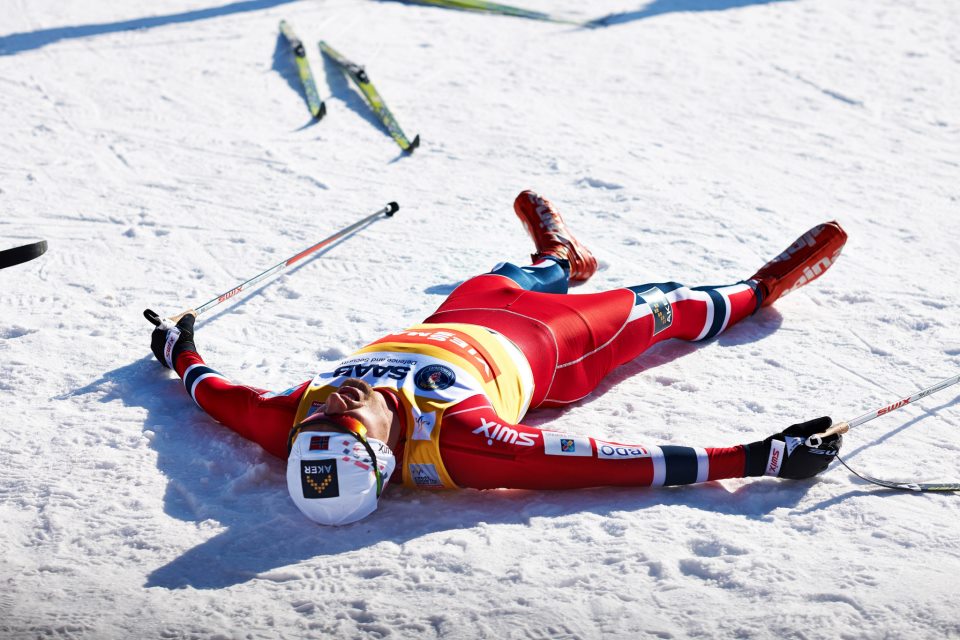
Petter Northug after an exhausting fourth-place finish in Saturday’s 15 k classic mass start at 2013 World Cup Finals in Falun, Sweden. (Photo: Fischer/Nordic Focus; facebook.com/FIS Cross Country)
“It was great fun to win today. I have been struggling this season a bit and the victory here today means a lot for me,” Rønning said. “Now I can go into my Easter holiday with a good conscience.”
Sundby concurred. “It’s great that Rønning took the win,” he said. “It’s been a tough season for him.”
Northug never contested the victory, but his fourth-place finish was enough to solidify his lead in the mini tour and the overall title race.
Contenders for the overall World Cup title, Cologna and Legkov didn’t deliver the result needed to unsettle Northug. Cologna finished 12th, and Legkov was 15th, respectively 17.9 and 25.6 seconds behind Rønning.
Northug will go into the final day of the mini tour, a 15 k freestyle pursuit race, with a 30.5-second head start on Vylegzhanin. Rønning will start 40.2 seconds behind Northug in third. Northug had a 1:47 lead on Legkov as his closest title-rival.
In the overall World Cup, Northug leads Legkov by 80 points, and Cologna by 87. For Legkov to win the overall title he would have to win Sunday, and Northug would have to finish lower than third.
It would take a spectacular meltdown on the Norwegian’s part to relinquish his advantage.
So does Northug think he’s secured his second overall World Cup title?
“Normally I’d think it was over,” Northug said. “But it’s about being focused and trying to a have another good race in the morning. I’m going to focus on resting until then.”
Noah Hoffman (USA) skiing in Friday’s freestyle prologue. On Saturday he moved up to lead the U.S. men in the 15 k classic mass start, the third stage of World Cup Finals. Photo: Bryan Fish.
After beginning the World Cup Finals mini-tour with two races in his weaker discipline, Noah Hoffman had the chance to move on Saturday in the 15 k mass start classic race in Falun, Sweden. The American’s placing in the Stockholm sprint and Friday’s freestyle prologue put him in the second-to-last starting position for the third stage, but he took the opportunity to move up through the pack and end up in 25th at the finish line, 1:16.3 back from the Eldar Rønning’s (NOR) winning time, to lead two other Americans in the penultimate race of the World Cup season.
“I was happy to be in the points,” Hoffman said. “Any time I’m in the points it’s not a bad day. It’s a step in the right direction from my last classic races.”
When he was 40th in the individual start 15 k in Lahti, Finland, a few weeks ago Hoffman thought he started the race too slowly, but his starting position in Falun forced him to get out quickly if he wanted to have a prayer of staying with the pack. Two sprint preems, one at 5.6 k and one at 12.2 k, gave the leaders incentive to push the pace almost immediately. By the first bonus sprint at 5.6 k Hoffman had climbed from the pack up to 20th, about 30 seconds behind the frontrunners.
“I definitely had some moving up to do and used some energy doing that for sure,” Hoffman said. “The pace was high up with the leaders as well, and I held on for a while but just couldn’t last up there.”
The lead group remained 20-strong or so until the last lap, and Hoffman hung onto the very back of it until fatigue set in. On a sunny day with solidly set tracks he was kicking well, but simply tired in the last few kilometers. Even with a surge in pace for the preems at the front, Hoffman didn’t think there was much of a lull in between them and he eventually lost contact with the skiers in front of him.
“I was definitely struggling today; I got pretty tired,” Hoffman said. “Like, end-of-season type tired as opposed to just, this-race-is-hard type tired. But yeah, I think it’s good to score a couple more points and I’m looking forward to come back better next year. I’m looking forward to one more opportunity [to race] and then looking forward to a break, as well.”
After Hoffman, Andy Newell was the second American finisher in 38th, 2:19.5 behind Rønning, and Torin Koos was 39th, only 0.1 behind Newell.
Newell pushed himself so hard in Friday’s prologue he made himself sick, and felt the leftover fatigue on Saturday when he “just kind of blew up” after the third lap of the 15 k.
“Today wasn’t so great,” Newell said, who began the mass start race near the front wearing bib number eight. “The first lap felt fine and even the second lap felt fine, but the pace for sure picked up for some of those bonuses. There were a lot of fliers off the front it seemed like, so it just kind of stretched things out on the second lap and then I got kind of tired on the third lap and had to shut it down for two laps…and then just skied it in. I definitely lost some time out there but that’s all right.”
Koos noted that the race played out somewhat unexpectedly at the front, with top contenders getting dropped quickly.
“I was a little surprised, the race was a real grinder,” he wrote in an email. “I thought maybe the snow would be fast and the race would stay more tightly packed longer, but there were some big names getting shelled, just getting dropped from the pack.”
Newell’s goal prior to starting had been to stay in the top 30 and score more World Cup distance points, but he reevaluated after three laps and aimed instead to avoid losing as much time as possible. He skied in “no-man’s land” for the third lap, sitting around the mid-30s, but on the last lap got a ride from Koos and Sergey Ustiugov (RUS) to at least make for a more enjoyable finish.
“It was fun to at least have people to ski with on my last lap and stuff, so it was a good workout, I guess,” Newell said.
Rather than feeling the end-of-season fatigue that Hoffman referred to, Newell thought his exhaustion had more to do with Friday’s effort.
“When we’re in a tour format like this, when you’re racing every day this late in the season, that can be hard for sure,” he said. “I was pretty worked over from yesterday, like, just getting such a bad leg burn out there yesterday in the prologue and from puking so bad after the race, so I’m not surprised I didn’t feel great today.”
Newell also felt held back by skis that, despite kicking well, weren’t gliding fast on the double-pole sections of the course, a part of classic races where he normally tries to recover.
“It’s one of my strengths, so today I think it was one of those things that made it so it wasn’t a great race,” he said. “My skis, for whatever reason, were a little bit dragging when I was double-poling so it made it harder to recover, I think, on the flats. So that wasn’t great, but at least I had some OK kick on the uphills.”
Newell outsprinted Koos in the finish by a few inches. Koos’ progress through the race a little different than Newell’s — he started with bib 27, dropped to 44th at 5 k, and then climbed back a few places in the final two kilometers as he skied with Newell, Ustiugov, Anders Gloeersen (NOR), Teodor Peterson (SWE) and Eirik Brandsdal (NOR).
“[We] had a pretty decent sprint up the uphill home straight,” Koos said. “Newell got me, but it was close — like six inches, maybe.”
Koos had hoped to ski in the points on Saturday but was missing that little bit extra after a hard effort in the prologue.
“My lungs were really hurting after the prologue and through the night, so I had some trouble getting the recovery I needed to have a great day today,” he said. “The conditions were stable, but I think even so it was also a bit tricky to find the right grip and glide. I was getting pushed on most every downhill, and had to ski with really good technique on the steep climbs. If I didn’t, I had instant feedback.”
After three stages Newell still leads the U.S. in the mini-tour standings in 31st, 3:13.6 back from tour-leader Petter Northg (NOR). Hoffman is close behind him in 33rd and Koos sits in 41st. The fourth and final World Cup Finals stage is a 15 k freestyle pursuit on Sunday.
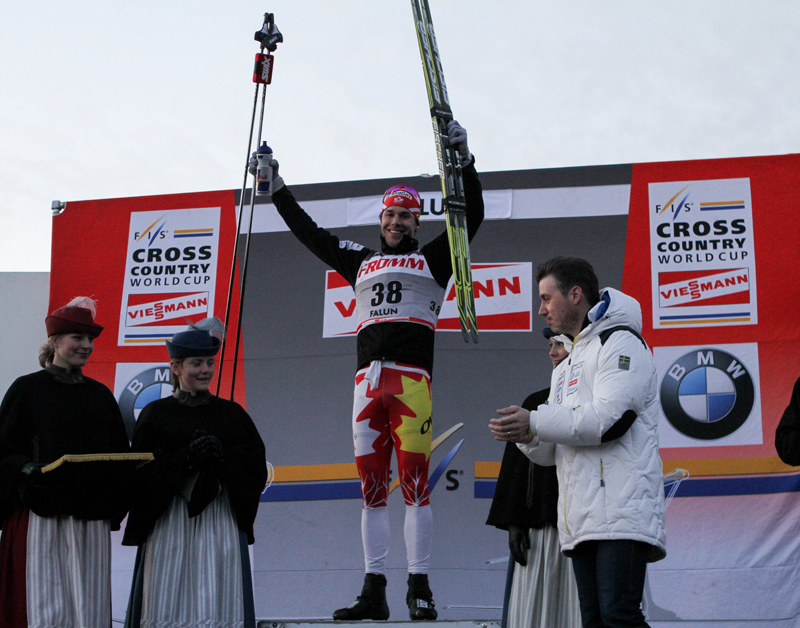
Canadian World Cup Team member Alex Harvey celebrating his prologue victory at last year’s World Cup Finals in Falun, Sweden. Teammate Devon Kershaw joined Harvey on the podium, and the next day, Lenny Valjas placed third in the 15 k classic mass start.
The Canadians had some supreme memories to live up to Friday at the World Cup Finals in Falun, Sweden.
A year ago at the same venue, Alex Harvey and Devon Kershaw owned the 3.3-kilometer freestyle prologue, placing first and third, respectively. Kershaw went on to finish second overall in the World Cup and Harvey, at the age of 23, was sixth.
Never ones to sugarcoat disappointing performances or a sub-par season overall, the Canadians weren’t exactly expecting to repeat those results on the renovated course (for 2015 World Championships) this year. But they wouldn’t be happy with much less, either.
Facing a shortened 2.5 k freestyle prologue, modified because of safety concerns on the infamous Mörderbacken hill, the Canadian men set out to achieve some redemption.
Harvey had already shined at World Championships, becoming the first Canadian male to medal at that level with bronze in the classic sprint; Lenny Valjas wrapped up the season with a career-best eighth in the World Cup sprint standings, and Kershaw notched a few season-best top 10s, but continuity and momentum were what they were looking for.
That’s what they thrived off last year, and that’s why they hoped they could end the season with.
Kershaw leads Valjas up the mini-Mördarbacken in last year’s 15 k freestyle pursuit at 2012 World Cup Finals in Falun, Sweden. There, Kershaw placed 10th behind teammate Alex Harvey (not shown) in second.
Two top 30s on Friday, with Valjas placing 27th and Harvey finishing 30th, didn’t quite cut it. Valjas finished 14.2 seconds behind Norway’s Petter Northug, who won in 5:20.7. Harvey was another 0.6 seconds back, and Kershaw placed 32nd (+15.3).
NorAm leader Michael Somppi of the Alberta World Cup Academy (AWCA) came in 44th (+19.4), and World Cup veteran Ivan Babikov was last in 52nd (+30.2).
In the women’s 2.5 k, Emily Nishikawa (AWCA) was 41st, 37.6 seconds behind Norwegian winner Marit Bjørgen (who finished in 6:03.2). The lone women’s World Cup Team member competing, Dasha Gaiazova was 43rd (+43.6).
“It’s not the greatest day for our whole team,” Valjas said on the phone. “It’s hard when nobody’s really skiing to their potential. Usually when one guy’s doing well, he can help motivate the rest of us, but none of us are really having stellar days so we’re all just kind of bummed.”
Don’t get them wrong; the results weren’t bad. Harvey, Kershaw and company have been outside the top 30 before, with Kershaw most recently returning to form at the Holmenkollen 50 k freestyle mass start last Saturday in Oslo, Norway. Despite waxing struggles there, he pulled off 29th. Again, not a podium, but an improvement.
Heading into Friday’s prologue, the team tried to keep in mind that anything was possible.
“This was such a good race for us last year and we were trying to get revved up thinking about that success,” Canadian head coach Justin Wadsworth told Cross Country Canada. “But the bodies just aren’t there right now.”
Last year, they were. Plus the Canadians had one success story upon another to feed off. After Harvey and Kershaw topped the prologue podium, Valjas placed third in the 15 k classic mass start at 2012 World Cup Finals.
“[Prologues] should be good for them, but it’s mostly about the shape, which for many reasons isn’t there now,” Wadsworth wrote in an email. “The guys tried hard, but just didn’t have it. Dasha didn’t have it from the get go…”
The 31st of 53 starters, Valjas sped up on the second half of the course down Mörderbacken, improving from 29th at the high point to 27th overall. Harvey skied consistently in 30th, and Kershaw rose from 41st at 1.2 k to 32nd.
“It felt more like a long sprint qualifier,” Valjas said. “Five and a half minutes? It ended pretty quick, but tomorrow’s [15 k classic mass start is] a good day for all of the guys so we’ll give it another shot and see where that leads us.”
Harvey was eager to forget Friday after what he wrote off as one of his worst prologue results.
“I just didn’t feel too good out there,” he wrote in an email. “When I wanted to open it a bit harder, near the top of the climb and on the last 500m at the bottom of the downhill, there was just nothing there … no extra power.”
Somppi had perhaps one of the most notable Canadian performances of the day, starting sixth and leading through 1.2 k. He ended up having the 15th fastest time at that checkpoint, but was disappointed about dropping to 44th.
“I think I skied the first climb well. I was certainly attacking, but was in control,” Somppi wrote. “It was when I received a split from Justin that I was leading out the few guys that started in front of me that I got excited. I just went for it up the big climb, hop skating as hard as I could.
“When I crested the hill right after the time check my legs had nothing left,” he added. “Definitely should have kept it in control a little more on the climb to save something for the downhill/stadium finish loop. … Lesson learned.”
Nishikawa was satisfied with her result. “I felt I skied well on the climbs, but my legs were super shaky on the downhills, so I skidded more than I would have liked,” she wrote.
According to several athletes, the Friday-morning course alteration, which cut off the top of Mörderbacken, didn’t affect much.
“I think the course change was good, although you still had a fair amount of speed at the big corner,” Nishikawa wrote. “It was fine for an individual race.”
“It was a weird change, it just made it really short,” Valjas said. “But I don’t know if that really helped or hurt us, we just really didn’t have the best day out there.”
On Friday night, the Canadians had a team meeting. There, Wadsworth asked his athletes “to stay focused and fight,” he explained.
“As long as each of them tries 100% and crosses the finish line having laid it out, then we should all be able to walk away with our heads up,” Wadsworth wrote. “It’s hard to do this time of year, especially when the shape isn’t there, but really what other option do we have – To go home? I gave them that option, but they are still here, so I hope everyone really pushes hard and goes for the best effort they have.”
Andy Newell (USA) finished 16th in the 2.5 k freestyle prologue in Falun, Sweden, on Friday to move into eighth in the World Cup Finals standings after two stages. Photo: Fischer/Nordic Focus/FIS Cross Country.
If the rerouted 2.5 k prologue course in Falun, Sweden, on Friday was short and fast for the women, it was even more so for the men in the second stage of World Cup Finals. American sprinter Andy Newell has the distance and sprint chops to pace a five-minute race well, but that didn’t mean it was an easy race. After five minutes and 31.8 seconds of skiing he crossed the finish line in 16th overall to lead the U.S. men on Friday, after which he retrieved his warm-ups, started cooling down and promptly lost his breakfast.
“I made it through the mixed zone without puking, which was good, but then as soon as I started warming down I had a good barf,” Newell said. “That usually means I pushed it too hard in some places.”
Newell did, indeed, push it pretty hard in the beginning of the prologue. The course took athletes directly up the Mordarbakken to the high point of the course, and there was enough transition in the second half after the descent to require some smart pacing in the beginning. After he skied the fourth fastest split to the top of the course, Newell felt “pretty worked over” by the time he crossed the finish line.
“I skied the first three quarters of it pretty good and then killed some speed on the downhill,” Newell said. “In the transition up the last two hills, though, I lost a bit of time and kind of blew up a little bit. I haven’t looked at the times yet but I have a feeling I lost a bit of time in the last half k.”
Newell has now been to five World Cup Finals in his career and sixteenth place is his best prologue finish by far, 14 spots ahead of where he finished the event last year. Combined with his 11th-place finish in the Stockholm sprint stage, he sits in eighth in the mini-tour after two stages. But Newell still only thought of it as an OK result.
“It could definitely be a lot better,” Newell said.
As a sprinter, Newell approached the prologue with the idea that he would have to hold back in the beginning, where a distance skier might look at the whole race as a near-sprint. It’s a distance only seen a few times a year, if that, and the ideal plan of approach varies depending on the strengths of the individual skier.
“I think it depends on the person,” Newell said. “I think for some people, especially the distance skier, they think of it as going all-out, but for other people like myself it’s definitely more of a pacing game. I try to always tell myself to hold pack during the first few uphills, and the first hill I’m definitely trying to pace it for sure so I can go a bit harder at the end.”
He also held back on the downhill after the Mördarbakken, the one that organizers adjusted on Friday at the athletes’ insistence that the original version was not safe.
“I took it pretty cautious for sure, because it was so sketchy and I didn’t know what to expect,” Newell said. “We were trying to get some info from people who’d raced earlier. It was a little bit of an unknown going into it, but it seemed like it was OK. It definitely would have been nice to ski it before [the race].”
The second finisher for the American men on Friday was another sprinter who has brought his distance skiing further along recently. Torin Koos, competing in World Cup Finals as the U.S. continental cup leader, scored the first distance points of his life with a 25th-place finish (+14.1).
It was only the second prologue Koos has ever skied, so he approached it just as Newell had: as a long sprint, “only make sure to put even more emphasis on keeping it smooth and not rushing it,” he said.
Koos thought he stuck with that plan well; he had the 10th-fastest split at the top of the course, five seconds down from the leader, and still had some ‘spring’ in his legs at the top of the Mördarbakken.
“I just skied the downhill way, way too conservatively,” he wrote in an email. “I guess I could be frustrated knowing I left for sure at least a top-ten distance-scored World Cup on the table today. Instead I’m going to stay pretty psyched, with both taking World Cup points for the first time in a new discipline, and with the feeling of having tiger legs today. These next two 15 k’s could be really interesting. This is what you train for all those days…”
As Koos points out, the 2.5 k race was a distance-scored event, and in finishing in the top-30 he joins Newell as one the few American men who have ever scored World Cup points in both sprint and distance.
“It’s one of those career accomplishments I hoped to reach, and now finally after many years, have,” Koos said.
Noah Hoffman was the third U.S. man to compete in the prologue, and he finished 51st out of 52 starters, 25.2 seconds off the winning time. It was not a result he was thrilled with, but as it was such a short race the distance-specialist said he “couldn’t have expected much more.”
Hoffman noted that his time back was a better showing than the two prologues skied in January, where he was 94th and 60th.
“Overall I have to be satisfied with today as a significant step forward from the two prologues in the Tour de Ski,” he said. “I lost significantly less time today, even considering the shorter duration. I skied an aggressive race today. I got tired and lost places from the top of the course to the finish, but I think it was better to be too aggressive than too conservative like I was in the opening prologue of the Tour.”
The final two stages of the men’s Finals are a 15 k mass start classic on Saturday and a 15 k freestyle pursuit on Sunday.
Kikkan Randall (USA) led the U.S. women in the Falun, Sweden, prologue on Friday with a third-place finish. Photo: Fischer/Nordic Focus/FIS Cross Country.
In a race that held a lot of unknowns for the entire World Cup Finals field before it began, the freestyle prologue stage that was held on Friday in Falun, Sweden, was a particularly important moment of truth for the American women. After a mediocre performance in the classic sprint two days prior, a shorter event in the team’s generally stronger disciple presented a more weighty test for a group of athletes that, like the entire field, is getting ready to be done racing for the season.
“I was feeling tired and pretty mentally done in Lahti,” said Jessie Diggins. “I was like, ‘Man, I’m pretty ready to go home.”
Somewhere there must have been energy to burn, for it sparked to life on Friday to help Kikkan Randall, Holly Brooks and Diggins post three top-10 performances for the U.S. Randall landed on the podium with a third-place finish and Brooks and Diggins went back-to-back in seventh and eighth, respectively. Liz Stephen crossed the finish line in 20th to put four team members in the top 20.
“It was a great race. Putting three in the top eight and Liz in 20th was a great day for us,” said U.S. Ski Team women’s coach Matt Whitcomb. “For Kikkan it was no surprise that she could unleash something like that, but it was refreshing for her to come up with that effort this far into the season and the same is true for Jessie and Holly, who were in need of a good result to bring back some confidence at the end of the year.”
The Falun course definitely favored a team like the Americans who are usually good at climbing and good at short distances on skate skis. The track, only 2.5 k long with the readjustments made at the insistence of the athletes on Thursday night, essentially climbed out of the stadium to the top of the Mördarbakken hill 1.2 k from the start. The course then spun athletes in a 180-degree turn at the crest and shot them back down the other side to navigate the last bit of the windy descent, the one that had first caused the field to protest the course over safety concerns the night before the start. At the bottom of the hill there was still a few rolling transitions to get through before it was over, requiring some amount of energy conservation to avoid bleeding time in the last 500 meters.
Randall thought she played the conservation game right, posting the fourth-fastest split at the top of the Mördarbakken, 5.5 seconds down to Astrid Jacobsen (NOR). She moved up a place as others dropped back to finish 6.6 seconds behind Marit Bjørgen’s winning time.
“Obviously today showed I’m in a good place,” Randall said. “Classic is all over the place these days so who knows about tomorrow, but basically I just want to show up at the starting line, ski like crazy, and it’ll be what it’ll be.”
It’s hard to say whether the late-night negotiations between athletes and the race jury affected Randall. She admitted to feeling fatigued in her warm-up but OK once the race got underway. As the only athlete representative present at World Cup Finals this week, the responsibility of organizing the athlete protest over the original course fell largely to Randall the night before.
Whitcomb didn’t think she showed significant signs of fatigue during the race.
“Kikkan has a pretty high capacity to carry stress like that, but there was no doubt that it was a weighty effort on her part,” Whitcomb said. “These guys kind of inherited a problem that maybe could have been dealt with beforehand, but they had to deal with it last night and I was impressed with their ability to roll through the punches with a cool attitude. It took a big toll on everybody, not just Kikkan and the people leading those meetings… We came out of it OK.”
Randall moved herself from 22nd to ninth in the mini-tour standings with her prologue performance.
Matt Whitcomb (r) cheering on Holly Brooks during the 2.5 k freestyle prologue on Friday in Falun, Sweden. Photo: Bryan Fish.
Behind the team’s leader, two teammates were ecstatic with confidence-building races again at the tail end of the season. Brooks, whose time of 6:15.5 brought her a seventh-place finish, 12.3 seconds behind Bjørgen, has been waiting to be back in the top-ten since she last raced in Sweden in November and was “psyched” to have returned to the position.
“It’s been a little while since I’ve had a really good one, so I’m pumped,” she said.
Brooks’ ability to set a concrete strategy for the course was, like everyone else’s, waylaid somewhat by the fact that the newly modified course was closed prior to the start to conserve snow. In general, she attacked it almost like she would a sprint race.
“I think it was Astrid [Jacobsen] that said it’s like 1% less than sprint pace,” Brooks said. “I love prologues, especially skate prologues. They’re probably my favorite race, and I think about going maybe 1% less than sprint pace but holding really good technique, and that tactic usually works really well for me. Sometimes in sprint races you get too jumbled and your technique kind of falls apart because you’re trying to go too fast, so I really like the prologue length.”
Brooks observed that the earlier starters took about six and a half minutes to finish the course and surmised that “OK, if it’s a six minute race you really have to go,” she said. “And I think the course skied a bit easier than I anticipated so you had to go pretty hard from the start.”
Brooks eased off on the rerouted descent, but also figured everyone probably did after all the pre-race hype about the downhill.
“Just talking to some of the other girls, others were a little reluctant,” she said. “And talking about it more probably made us a little more paranoid than we needed to be… I definitely bled some time there but I figured it was better than falling and losing a ton of time.”
Just a few seconds behind her, Diggins had a similar reaction to her eighth place-finish: satisfied to know that she can still crack the top-10 threshold this late in the season.
“It’s really nice to know that my body was feeling ready to go today and that everything wasn’t quite shut down just yet,” she said. “It’s always nice to have a good race at the end of the season to kind of end things on a high note, especially having three girls in the top 10… That’s sweet; a really good thing for our team.”
The accomplishment stood in contrast to the way the team ended their Thursday the night before the race. There were three athlete meetings in the lead-up to the prologue that were widely attended by the entire field and when Diggins went to bed on Thursday, “I was actually pretty certain my season was over and that we weren’t going to be racing,” she said, because the jury had not yet responded to the athletes’ final assertion on Thursday night that the course was still not safe enough.
“It was interesting waking up being like, ‘Well, I don’t know if I’ll get to race,” Diggins said. When athletes approved newer changes to the course on Friday morning, “In a way that kind of made us all appreciate getting to race more, because at one point we thought we wouldn’t be at all.”
Behind Diggins, Stephen posted a top-20 as the fourth U.S. women in the prologue. As a distance specialist, Stephen approached the beginning of the race at a relatively conservative pace, and in hindsight wished she had started faster than she did.
“It was a short course, but it was still a hard one, with two good-sized climbs and technical downhill skiing, so not really any rest,” she wrote in an email. “However, six minutes is a really short amount of time to be doing anything, and I think if I could do it over again I would have started faster than I did. The tracks were closed on the downhill and so we didn’t get a chance to preview it, as they were trying to preserve the tracks for our race, so knowing how it would ski, and how quickly it skied, wasn’t quite possible today.”
Overall, Stephen is satisfied with 20th and looking forward to the remaining two stages of World Cup Finals, particularly the final 10 k freestyle pursuit on Sunday.
“The body remembered I still have a few more races to go this season!” she said.
On a six-woman U.S. squad that qualified the Finals, Ida Sargent was the fifth American on Friday in 38th. It was only the third prologue race of her life and she thought she started a might too slow in an effort not to “blow up” like she has before.
“I started conservatively and finished feeling like I had more in the tank,” she said. “The finish line came way too quickly which never happens for me. But hopefully it will be a good warm-up for tomorrow.”
Rosie Brennan, the U.S. starter in the continental cup leader spot, finished 46th in the prologue, 41.9 seconds off Bjørgen’s winning time. This period of World Cup racing has been her first exposure to the circuit and she has been attempting to make a point to evaluate each race in Europe before she sees results. On Friday, Brennan noted she could have probably started more aggressively.
“I am still figuring out how to do prologue. It’s a very tricky distance and I think the strategy changes a lot depending on the course. Today, I think I skied a little too conservatively,” she said. “Also, being an early starter, I wasn’t able to see the times it was taking girls before I started. Looking back and seeing that it only took six minutes, I think I should have pushed harder in many places.”
Brennan has struggled with a lingering back injury for the last few races, but for the prologue she felt “much better.”
World Cup Finals continues on Saturday with a 10 k mass start classic and on Sunday with a 10 k freestyle pursuit.
Norway’s Petter Northug racing to his second-straight victory at 2013 World Cup Finals in Friday’s 2.5 k freestyle prologue in Falun, Sweden. (Photo: Fischer/Nordic Focus; facebook.com/FIS Cross Country)
Petter Northug might not let others in on it all the time, but Norway’s favorite son is pretty calculated when it comes to racing.
Friday’s prologue, the second stage of four in the World Cup Finals, was no different. Like everyone else, Northug hadn’t had a chance to preview the men’s shortened 2.5-kilometer course on Friday. There had been a lot of discussion about it the day before: organizers added some length to the already challenging Mörderbacken hill, and athletes wanted a safer descent.
The two parties came to an understanding on Friday morning, removing the top part of the newly redesigned hill, which was altered for 2015 World Championships. Camera crews and organizers had to get out on course to make the changes, keeping competitors off it and essentially in question about how it would ski.
The last of 53 starters, Northug let the men ahead of him test it out and quickly realized that going too hard too soon could lead to disaster. Northug had no way of knowing, but Russian Sergey Ustiugov, who started two minutes ahead of him, teetered over at the top of the infamous hill. The climb for the first half of the race was brutal, and if you didn’t have your legs in check, you might as well pray yourself to the bottom.
“The plan was not to go out too hard in the first kilometer because people tend to pay at the end,” Northug told FIS after the race. “I wanted to carry high speed [in the] downhill into the finish.”
Those were pretty wise words for the 27 year old, who often speaks without a filter. But with the last races of the season deciding whether he’ll be the 2012/2013 World Cup champion, Northug was all business.
Sixth at near the height of the course at 1.2 k, Northug was 4.8 seconds down Finland’s Matti Heikkinen, the leader through that checkpoint. Just when it seemed the World Cup leader had erred in starting too conservatively, Northug hit the jets and soared down into the stadium.
Norway’s Petter Northug tops the podium for the second time in as many races at 2013 World Cup Finals on Friday after winning the 2.5 k freestyle prologue by 2.1 seconds in Falun, Sweden. (Photo: Fischer/Nordic Focus; facebook.com/FIS Cross Country)
He finished with the fastest time of 5:20.7 minutes, bumping teammate Pål Golberg out of first by 2.1 seconds and another Norwegian Anders Gløersen down to third (+2.9).
After Sweden’s Calle Halfvarsson in fourth (+3.4), Norway took six of the top seven. Martin Johnsrud Sundby placed fifth (+4.0), Finn Hågen Krogh was sixth (+5.7) and Eirik Brandsdal was seventh (+6.8).
Sweden’s Marcus Hellner finished eighth (+8.3), Northug’s World Cup overall rival Alexander Legkov of Russia placed ninth (+8.8), and Alexey Poltoranin of Kazakhstan took 10th (+9.2).
Switzerland’s Dario Cologna was 9.8 seconds off Northug’s winning time in 11th to remain in third in the overall World Cup standings. Northug increased his lead to 56 points over Legkov and 69 points ahead of Cologna, and is currently 27.3 seconds ahead of Brandsdal in the mini-tour standings.
But he’s not comfortable yet.
“I do not feel that the lead is big enough to relax,” Northug told NRK, according to a translation. “But it’s clear I have faith in victory. If I [didn’t I’d be] sitting at home on the couch.”
Cologna, however, told reporters he was feeling a little deflated.
“Petter is in good shape, and I’m in too poor shape to close the gap,” he told NRK.
Northug didn’t buy it. If he were the underdog, he’d be saying the same thing.
Last year, Cologna won the coveted Crystal Globe by 750 points over Canadian Devon Kershaw. Northug was third, more than 1,000 points behind Cologna.
The season before that, Cologna beat the Norwegian by 330 points, but in 2010, Northug won the overall title ahead of Lukas Bauer (CZE) and Hellner, respectively. Back then, Cologna was fourth.
“I do not believe anything that he [Cologna] says,” Northug told NRK. “It is only tactical game to take the pressure away from himself.”
Looking ahead to Saturday’s 15 k classic mass start, Northug knows it’ll be important to ski both fast and stay upright on Mörderbacken hill.
“I’ll be on guard and stay away from Legkov and Dario,” Northug told NRK. “I hope to keep the lead until Sunday.”
He is 1:14.6 ahead of Cologna and 1:22.9 up on Legkov in the mini-tour standings. World Cup Finals wrap up Sunday with the women’s 10 k and men’s 15 k freestyle pursuits.
Marit Bjørgen (NOR) won the 2.5 k freestyle prologue stage of World Cup Finals by 2.2 seconds over Charlotte Kalla (SWE) on Friday, putting herself in the mini-tour lead. Photo: Fischer/Nordic Focus; facebook.com/FIS Cross Country
Despite an uncertain start to the morning of the second stage of World Cup Finals in Falun, Sweden, on Friday, the day ended with a very familiar name at the top of the results. Marit Bjørgen (NOR), one of the last starters to leave the line, resumed her usual position on the podium and won the 2.5 k freestyle prologue by 4.4 seconds over Sweden’s Charlotte Kalla in a time of 6:03.2. Kikkan Randall (USA), who spend the better part of the last 24 hours engaged in debate with FIS over the safety of the race course, finished a comfortable third in the individual start race.
“It was a race that suited me,” Bjørgen told the NRK after finishing the short event. “I felt fine and could press. I was a bit cowardly down [the hill], but could run again when I got into the stadium.”
The downhill Bjørgen referred to has been at the center of heated debate recently about the safety of Falun’s new trails, and something that threatened whether race would happen at all. Athletes were concerned enough for their safety on a few new twists to the Mördarbakken’s downhill section that they submitted a petition to FIS, threatening to boycott the final three stages of the Finals if governing body and the organizers didn’t eliminate the dangerous sections.
The race jury initially resisted changing the course but ultimately compromised with the athletes’ demands late Thursday evening. Athletes and coaches seemed happy with the outcome, but it put the entire weekend in flux the day leading up to the second stage. After athletes agreed at a 9:00 a.m. meeting Friday morning that they were satisfied with the course adjustments, they were still unable to preview the changes to the downhill. Bjørgen was not the only one who consequently felt she had to ski the descent “a bit cowardly” during the race.
“I probably didn’t gun it as much as I normally would have just because I didn’t know how much speed I’d be coming out of the turn with, and it’s a pretty tight turn,” Randall said. “I figured being a little conservative was probably a better bet than going crazy and falling. It’s definitely a loud corner and it’ll be pretty crazy to do it in a mass start on classic skis.”
Randall, as the only athlete representative present at World Cup Finals, had the responsibility of organizing athlete meetings, communicating with FIS and handling questions from a strong media presence until 11:30 p.m. the night before the race. Though the running around wasn’t the ideal way to prepare, her body must have handled the extra stress well.
“It’s been an interesting 24 hours and it didn’t feel great to warm up today, but once I got out on the course in the race it felt pretty good,” Randall said. “It was definitely different race prep than I normally do.”
Randall started a few bibs numbers in front of Bjørgen on Friday and initially finished with the top time in the field. She recovered a sluggish feeling in her warm-up to feeling well enough to post one of the top splits to the top of the course an was an early race-leader as the 31st starter.
“I felt kind of drained after yesterday and felt that, well I’ll just have to go out there and go for it,” Randall said. “But once I got on course I actually felt a lot better. I could find some good zip in my stride and was able to lay down a really good effort. I got a slight indication up the hill that things were going pretty well so, yeah. I’m glad I could re-find my energy again today.”
With a strong late-season effort from Kalla, Randall was soon demoted from the leaders chair. The Swede hasn’t been on the podium since the 15 k freestyle stage of the Tour de Ski, but on Friday she found some of her old spark to post what would end up being the second-fastest time.
Bjørgen quickly overtook the lead and the eventual win, but Kalla was happy to be on the podium again.
“It was really wonderful to get a podium here in Sweden at the end of the season,” she told the NRK. “The crowd was good and supported us. 2.5 k is a bit strange distance and you have to press all the way.”
Kowalczyk, who led the World Cup Finals mini-tour after the first stage in Stockholm on Wednesday, dropped to second behind Bjørgen after finishing fifth in Friday’s race, 10.8 seconds behind the winner.
“I am happy with my result today,” Kowalcyzk told FIS. “It is the same position I was last year so it is ok with me. I hope to ski really well tomorrow. I think the Norwegians will be very strong and it will be a good competition.”
Bjørgen, who was also present at the many athlete meetings preceding the prologue, thinks her fitness is in top shape in Falun.
“I was 100% today,” she said. “My shape is good. I was curious to know how it was but it was also 100% in Stockholm and I felt really good again today. I have not competed that much this season so I would be happy if the season went a few weeks more. Tomorrow I think Justyna and Therese [Johaug] will go fast and I hope that I can go with them.
The third stage of World Cup Finals on Saturday is a 10 k mass start classic.
Norway’s Eldar Rønning (l) and Dario Cologna of Switzerland (r) during last year’s classic mass start in Falun, Sweden, at the 2012 World Cup Finals. Changes to the back side of the Mördarbakken this year have given athletes cause to question its safety.
When athletes competing in World Cup Finals arrived in Falun, Sweden, on Thursday to preview the trails for the remaining three stages of the mini tour, they were surprised to discover that the course they were expecting had been modified to add height and more hairpin downhill turns to the fabled “Mördarbakken” hill, according to the NRK.
Alarmed at the prospect of racing a chaotic mass start with 50 other skiers on such a hill, which an NRK video shows as heavily populated with padding-wrapped trees around several turns, athletes decided they would boycott Friday’s race if the course wasn’t changed, even though their primary concern was for the mass starts on Saturday and Sunday.
Kikkan Randall (USA), a FIS athlete representative, submitted a complaint on Thursday on behalf of her fellow athletes and the International Ski Federation quickly decided to modify the course for the mass starts. The upper part of the hill was reportedly cut off, as were most of the problematic descents. The prologue course would remain the same, however, with a few added safety precautions.
Directly after the changes were announced, Randall couldn’t say whether they would satisfy her fellow athletes.
“I need to discuss this with the other athletes first. We will look at the changes, and then decide whether this is enough,” Randall told NRK. “We really hope that they can find a solution so that we can have good racing this weekend.”
The athletes were apparently not happy with the changes, and meetings between representatives of the athletes and FIS reportedly continued throughout Thursday evening.
“We can not be unless there are further changes in the course of the evening,” said Kazakhstan’s Alexey Poltoranin.
Competition jury member and FIS Cross-Country Director Pierre Mignerey was unsure how many athletes would show up in the morning for the individual start 2.5/3.3 k freestyle prologue.
“I do not know how many people will participate in the morning,” he told the NRK. “I hope it gets everyone. We have made changes to the mass start, as we experience the main problem.”
Eldar Rønning (NOR) told Adressa.no after a widely-attended athletes’ meeting that the sentiment was unanimous: “If nothing is done, so we did not start. If these are the tracks that will be used in the World Championships in two years, so we are going to have to put your foot down. Mass [start] in these trails are harmful.”
Justyna Kowalczyk (POL) told Adressa.no that she would not start in Falun at all.
As of Thursday evening, Mignerey said there would be no further changes to the prologue course.
“Our decision is final,” he said. “Competition will continue as usual in the morning, then we’ll see who compete.”
Adressa.no posted a video of Randall and Mignerey discussing safety concerns. Randall is shown telling Mignerey that if changes are made to the mass start course, there would be no way for athletes in the second race to preview icy conditions after the first race finished.
Start lists released by FIS on Thursday afternoon, local time, listed full fields for both the men’s and women’s races.
Randall told Adressa.no there will be another athlete representative meeting with FIS on Friday morning before the start of the prologue.
“We will have another meeting tomorrow. Until then, athletes must live in the unknown,” she said.
All 2012 FIS World Cup Finals coverage is brought to you through the generous support of Fischer Sports USA, proud sponsors of Kikkan Randall, 2012 overall Sprint Cup Champion.
FALUN, Sweden – As the World Cup season came to a close with the freestyle pursuit on Sunday at the World Cup Finals there was movement in all directions to witness; all the racers went up and down the Mördarbacken three times, several racers made big moves forward through the field, while others went the other way and the Canadian men took advantage of an ‘open’ course to go left and right as needed.
Kershaw, all smiles after a ver successful World Cup Finals.
Team Canada, like brothers. World Cup Finals Falun, Sweden. men’s 15 k freestyle pursuit
Dario Cologna (SUI), salutes the crowd.
Cologna and Hellner, all smiles.
Roenning congratuales Dyrhaug on his podium.
Harvey and Sundby worked hard.
Cologna acknowledges Kershaw’s effort.
Harvey, with the second fastest time of the day, crosses in sixth place.
After two days in fourth, Dyrhaug finally gets on the podium.
Pure excitement
Devon Kershaw (CAN) after finishing the 15 k freestyle pursuit at World Cup Finals in Falun, Sweden in 2012.
Getting it done.
Those dogs in the background couldn’t catch this old fox.
Almost there…
Cologna gave his fans something to chear about.
Success
Cologna enjoyed a relaxing ski down the homestretch.
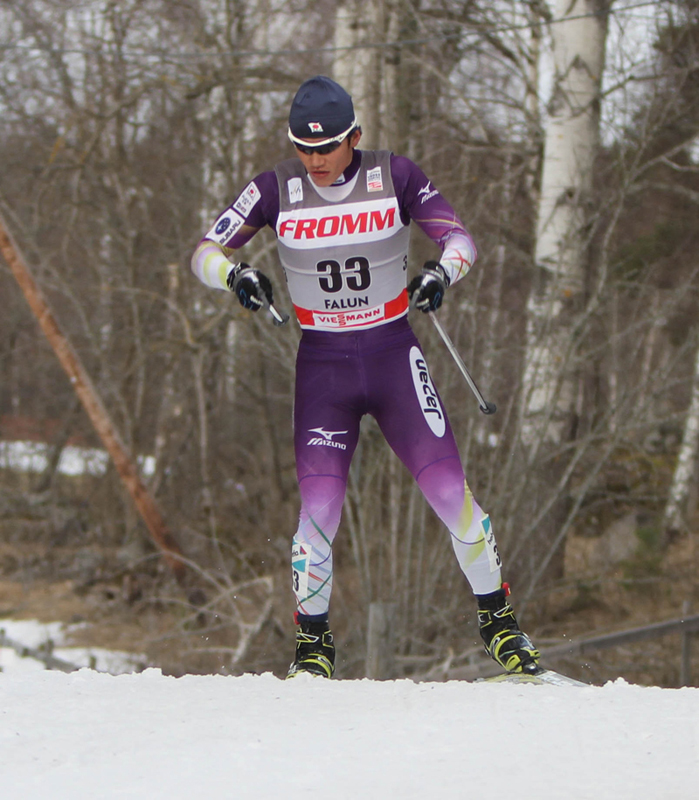
Hiroyuki Miyazawa (JPN)
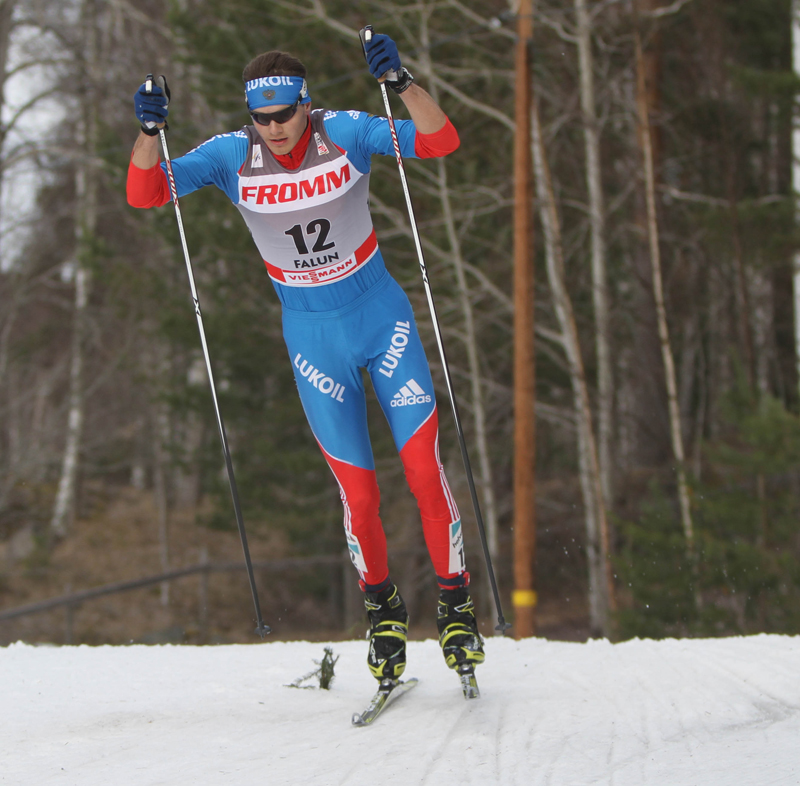
Petr Sedov (RUS)
Dryhaug maintaining contact with the chase pack.
Alex Harvey leading Norway’s Niklas Dyrhaug in the men’s 15 k freestyle pursuit at World Cup Finals on March 18 in Falun, Sweden. Harvey ended up second to Petr Sedov of Russia and Dyrhaug was ninth.
Sundby did a lot of work at the front of the chase pack.
Sundby, Harvey and Dyrhaug following.
Newell battles with Paal Goldberg (NOR) for a top thirty position.
By the time the women’s race had started the FIS had added v-board that was not there for the men’s race.
Canada’s Head Coach Justin Wadsworth was giving out splits during the men’s 15 k freestyle pursuit at the World Cup Finals in March in Falun, Sweden.
The trio traded leads throughout the race.
Kevin Sandau (CAN) quickly joined forces with Fabio Pasini (ITA) and Eirik Brandsdal (NOR).
Roland Clara pulling the chase pack up the Mördarbacken.
Three out front, soon to be two, and a big chase pack hunting them down.
Valjas gets encouragement from Wadsworth with the chase pack closing in.
Perspective changes quickly, but Valjas skied above even his dreams at the World Cup Finals.
Kershaw on his way to one of his best skate races ever.
Getting it done on the Mördarbacken.
Justin Wadsworth giving splits to Canada’s Devon Kershaw at World Cup Finals in Falun, Sweden, in 2012. Wadsworth will move into a newly-formed head coaching role with Cross Country Canada.
Cologna skiing big on the Mördarbacken.
Kershaw giving Valjas a ride up the mini-Mördarbacken 15km freestyle pursuit, 2012
Kershaw looking for fast snow.
Kershaw went back went back and forth depeding more on the snow than the line.
Canada’s Head Coach Justin Wadsworth had doublechecked with the race jury before the start.
A new FIS rule this year allows skiers to cross pine boughs, but not v-board. The Canadian men took advantage of that rule which led to some cofusion from other coaches and teams.
Sunby working at the front of the chase pack.
The chase pack heads up the Mördarbacken.
Sundby and the chase pack head up the Mördarbacken.
Niklas Dyrhaug (NOR)
Kershaw leading Valjas up the Mördarbacken.
Canada’s Head Coach Justin Wadsworth encourages Valjas to hang tough.
Team Canada
Kersaw with Valjas just behind.
Cologna heads up the Mördarbacken.
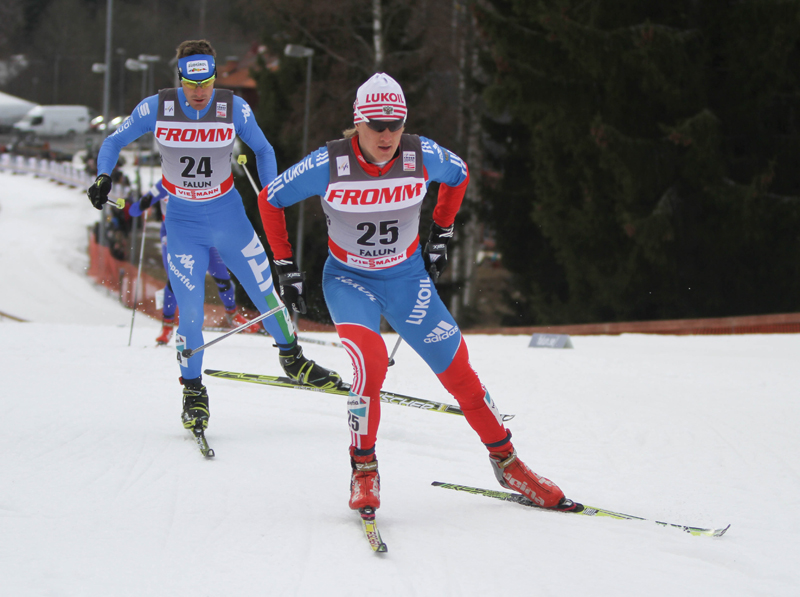
Dmitriy Japarov (RUS, bib 25) and David Hofer (ITA, bib 24)
Andy Newell (USA) had some fast skaters starting around him.
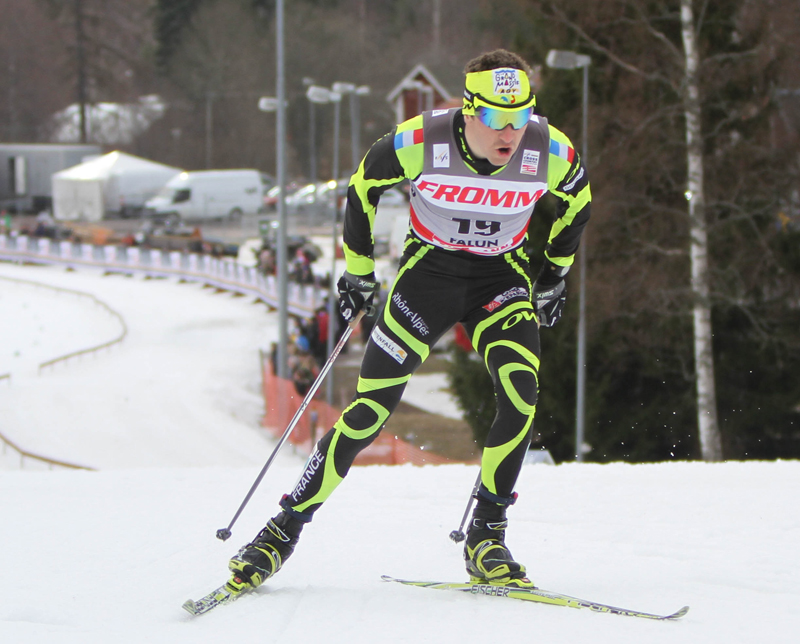
Maurice Manificat of France competing in the 15 k pursuit at World Cup Finals in Falun, Sweden, in March.
Tobias Angerer (GER)
Kershaw had some ground to make up on Valjas.
Kershaw charged out of the start gate.
Lenny Valjas (CAN) stayed relay early, ‘waiting’ for his teammate Devon Kershaw (CAN) who started right after him.
Lenny Valjas (CAN) heading out on course.
Dario Cologna (SUI) getting things started for the men in the 15km freestyle pursuit.
All 2012 FIS World Cup Finals coverage is brought to you through the generous support of Fischer Sports USA, proud sponsors of Kikkan Randall, 2012 overall Sprint Cup Champion.
FALUN, Sweden – The last race of the World Cup season was the ladies’ 10km freestyle pursuit at the World Cup Finals on Sunday. It was clear from the very first starter that they were going to leave every last drop of energy they had remaining out on the course. Like in the men’s race, some charged forward, some slid backwards and others hung on. When they crossed the finish line for the final time there was a united comradery and sense accomplishment, as this line in the snow did not just mark the end of a measured ten-thousand challenging meters, but nearly five grueling months of racing and travel.
Teammates… United.
Teammates… USA.
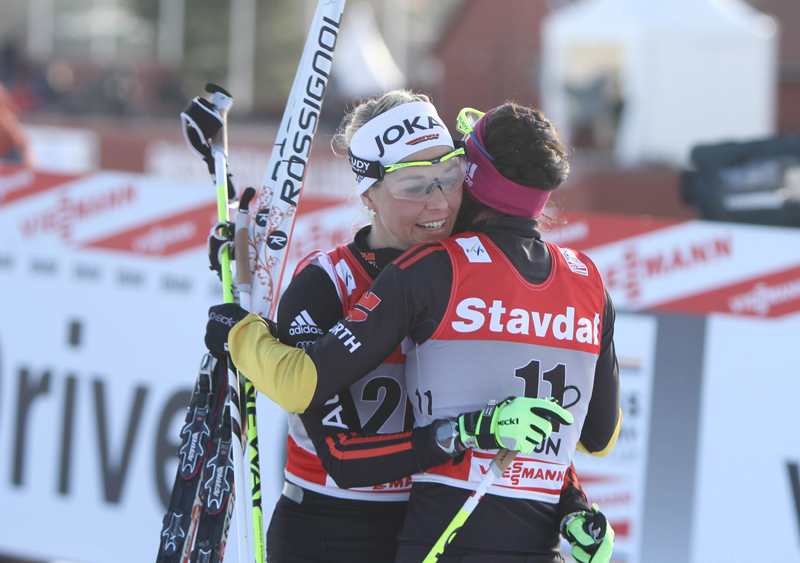
Teammates… Germany.
Teammates… USA.
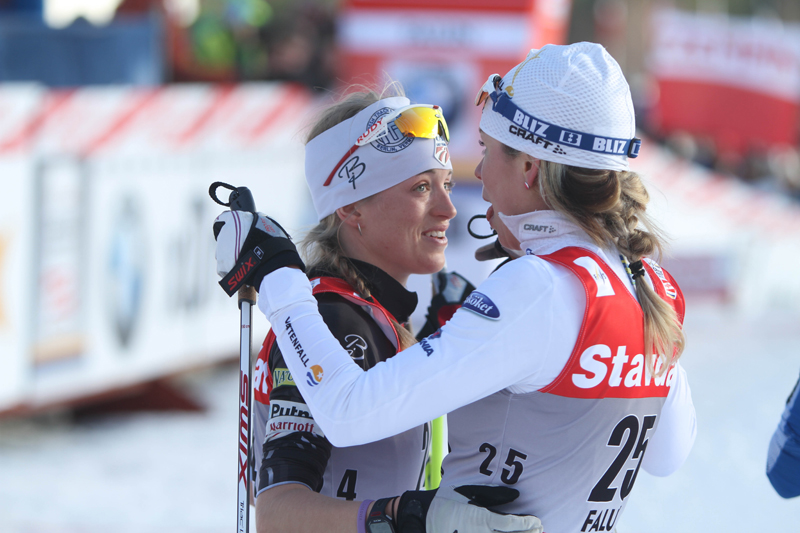
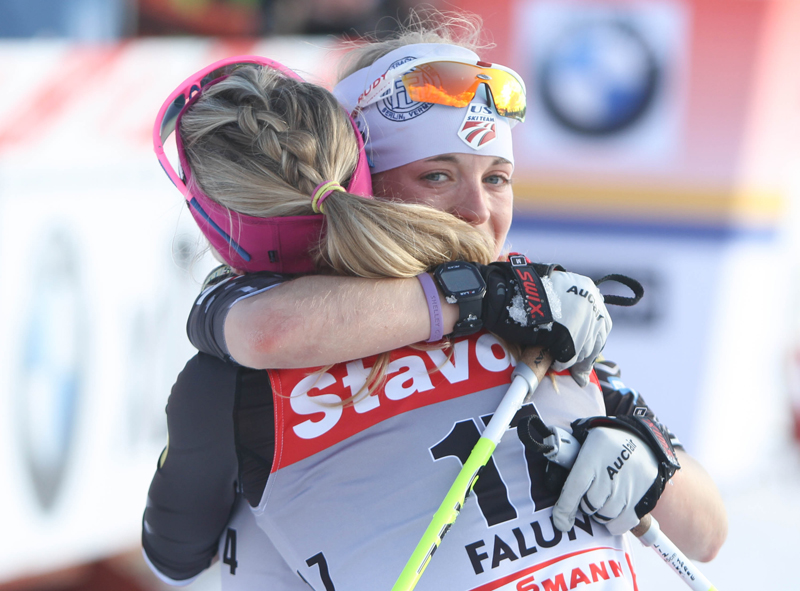
Liz Stephen and Jessie Diggins of the U.S. celebrate at the finish of World Cup Finals in Falun, Sweden last weekend.
Support
One happy Alaskan.
Kikkan Randall’s Sprint Cup victory means that she can automatically start every World Cup sprint in 2013, without counting towards an already-expanded quota for the U.S. women.
Tough day out there for Hagen.
Weng takes her well deserved curtain call.
Exiting stage right.
Some classy ladies.
Kowalczyk still smiling.
Bjoergen proud of her teammate.
Weng left it out there.
Gaiazova – finished.
Crawford revved it all the way to the line.
Crawford
And left it out there.
Stephen was impressive to watch.
Diggins might have been outsprinted down the homestretch, but she went for it out on the course.
Randall at the World Cup Finals in the 10 k freestyle pursuit in Falun, Sweden, where she placed 15th on March 18. The 2011/2012 World Cup sprint champion proved she is one of the best overall skiers in the world.
Randall outsprints Hagen for eigth place.
Kristin Stoermer Steira (NOR) for fifth place.
Kalla just out lunges Johaug.
Weng takes second.
Down the stretch they come.
The battle for second.
Bjoergen
World Cup Finals, Falun, Sweden, women’s 10km freestyle pursuit, 2012
World Cup Finals Champion
Celebration
Bjoergen brings home the victory.
One happy Marit.
Crawford finding some help.
Steira and Kristoffersen
Johaug, Kalla and Weng
Johaug and Weng
Dasha Gaiazova (CAN)
Chandra Crawford (CAN)
Stefanie Boehler (GER)
Liz Stephen (USA)
Jessie Diggins (USA)
Diggins heading up the mini-Mördarbacken.
Randall making friends witht he Norwegians.
Dasha Gaiazova (CAN)
Johaug pulling up the Mördarbacken.
Chandra Crawford (CAN) heading up the Mördarbacken.
Kowalczyk in the background.
Bjoergen (NOR)
By the time Bjoergen had looped around to start up the mini-Mördarbacken she was all alone.
Stephen loves the Mördarbacken.
‘On it, off it’ does not even begin to explain the way Liz Stephen (USA) climbed.
Jessie Diggins (USA) went for it.
Krista Lahteenmaki (FIN, big 12), Anna Haag (SWE) and Anne Kylloenen (FIN, bib 10).
Dario Cologna (SUI) heads up the Mördarbacken during the men's 15km freestyle pursuit.
All 2012 FIS World Cup Finals coverage is brought to you through the generous support of Fischer Sports USA, proud sponsors of Kikkan Randall, 2012 overall Sprint Cup Champion.
FALUN, Sweden – Sometimes boring is good, and today, at the Lugnet Rikkskidstadion, both Darion Cologna (SUI) and Devon Kershaw (CAN) were happy to avoid any excitement in the 15km freestyle event.
Cologna started the final stage of the World Cup Finals mini-tour, and the last race of the 2012 season, with a 36 second lead on Canadian Lenny Valjas and another 10 seconds on Kershaw.
Despite having wrapped up the overall World Cup title weeks ago, and winning his third consecutive Tour de Ski, Cologna is hardly unbeatable.
He has but together an amazing run of podium finishes in distance races this season, but a number of different men have relegated him to second or third at times.
But Cologna has been in top form of late—so much so that 46 seconds could just as easily be a year.
Devon Kershaw (CAN) pulled his teammate Lenny Valjas early before going it alone on a solo mission.
If anyone had a chance to track down the Swiss star, it was Kershaw, second in the overall rankings this season, and a much-improved skater.
Valjas shocked the ski world with his third place result in the 15km classic on Saturday, but there was little hope he could hang with his teammate when Kershaw inevitably tracked him down, and even less of getting Cologna.
Cologna has not been 46 seconds behind a race winner since the 30k individual in Davos back at the beginning of December, so while World Cup cross-country skiers are fond of saying “anything can happen,” sometimes it really just can’t
While catching Cologna may have been a near impossibility, Kershaw put himself in position to take advantage of an epic blowup or crash, gaining some time here, losing a few seconds there, but never closer than 35 or farther back than 51.
But Kershaw had more pressing concerns than the exact size of the gap up to Cologna.
Out on his own, he said he was “just focused purely and solely on the technique and tried to ski as big as possible—big glide big power.”
By the 2.5k mark, two strong chase packs had formed up, the first led by Martin Johnsrud Sundby (NOR) and consisting of Jean Marc Gaillard (FRA), Evgeniy Belov (RUS), Alex Harvey (CAN), and Rolan Clara (ITA), a formidable a group of skaters to say the least.
The men had all started within 13 seconds of each other, coming together quickly in an effort to reach the podium.
While Kershaw was reeling in Valjas, the chase pack caught Dyrhaug before the end of the first lap, and the Norwegian immediately fell into line, leaving just classic specialist Eldar Roenning between the group and the podium.
Like Valjas, Roenning was expected to drop back through the field, but fought valiantly, though futilely. He too was caught, eaten up by the hard charging chase group on the gradual terrain at the beginning of the 5km loop.
Unlike Dyrhaug, however, Roenning was quickly spit out the back, unable to match the pace of the chasers in the wet and dirty spring snow.
The morning had dawned gray and somewhat dreary in Falun, with evidence of light rain overnight. Temperatures never caught a glimpse of the freezing mark so the course was soft and slushy at daybreak.
As they did for Friday’s prologue, the Jury decided to salt the course, a move that help the situation, but only so much.
One can only fight mother nature so much, and as the day warmed, the track softened in many places despite the salt.
Downhill corners turned to deep corn snow, and salt will not help with puddles and run-off.
The firmest part of the course was Mördarbacken. On the first lap Kershaw and Valjas came through together, the former having closed the ten-second gap quickly.
But on the lesser pitches at the beginning of the second lap, Valjas had to let his teammate go.
Devon Kershaw (CAN) gets splits and encouragement from Canadian Head Coach Justin Wadsworth.
“Len did a good job hanging in there, but knew his limits,” Canadian Head Coach Justin Wadsworth told FasterSkier. “And Devon was skiing well, keeping pace with Dario.”
Valjas held off the chasers until the first pitch of Mördarbacken the second time around, finally succumbing as the grade increased.
A good portion of the reported 10,000 fans lined the lengthy hill, forming a walled corridor of noise and color.
The loudest cheers were reserved for the home skiers in white, blue and yellow, but in classic Scandinavian fashion, every skier who made the trek received cacophony of support, replete with flag waving and cowbell ringing.
Clara was now leading the chase pack as it powered by Valjas, and another man had impressively joined the trackers—Petr Sedov (RUS) had bridged up from the second group of hunters, leaving the likes of Marcus Hellner (SWE), Sjur Roethe (NOR) and Maxim Vylegzhanin (RUS) behind.
Meanwhile, up at the front, Cologna went about his business with machine-like efficiency, every stride smooth and powerful devoid of wasted motions.
By this point in the race, it was clear that Kershaw would not get the miracle he needed to take the victory, but was moving through the course with a strength and confidence that signaled bad news for the pack behind.
According to Wadsworth, Kershaw was losing some time on the steeper sections of Mördarbacken, but quickly made that back on the flats over the top into the descent.
“That was part of the strategy,” Wadsworth said. “Just control it and ski steady.”
Despite Wadsworth’s post-race confidence, the chasers did manage to close within just over 20 seconds.
Sundby, who had been pushing the pace hard said “we thought he was getting tired and we could catch up with him,” but unspoken disagreement in the pack was their undoing.
“There is always someone who is not so eager to push the speed and somebody who wants to push the speed,” Sundby explained. “So the dynamics were not too great.”
One of those with no incentive to pull was Harvey.
With his teammate up ahead in second, he wasn’t going to lead the charge.
The plan, Harvey said, was to “just stay in the group and then fight for position there, but not fight for any time ahead.”
“The pack starts to chew time,” Wadsworth said. “It is funny how it works…they just feed of each other and everybody is pushing. So we knew it was going to be dangerous for sure.”
When the group failed to close any further, the pace relaxed somewhat Harvey said, but with Marcus Hellner leading a group behind, there was not much room to back off further.
Martin Sundby (NOR) and Alex Harvey (CAN).
Sundby was disappointed to see the chase fail.
“I went for second place, for sure, but Devon was far too strong ahead of us. He did a great job,” the Norwegian said.
With five kilometers to go now the, the stage was now set for the final act—of the race, the World Cup Finals, and the entire season.
Cologna and Kershaw kept their respective distances and the chasers remained grouped behind until reaching the Mördarbacken for the final time.
With just the single big climb remaining, there was little doubt that someone would attack.
That person was Clara, coming off a strong season in which he earned three of his four career World Cup podiums.
The 30-year-old hit the afterburners halfway up the ascent, and only Belov could respond.
The move was exactly what the crowd had been hoping for. After nearly 14 kilometers of hard racing, the game was truly afoot and the spectators roared their approval.
On most courses, the gap the Italian created would have been enough to secure the final podium spot for one of the two men.
Just the day before, however, Cologna and Roenning held a lead down toward the stadium, only to get overtaken by the chasers on the seemingly endless gradual downhill on the backstretch.
Today played out nearly identically, with the pack of Harvey, Sundby, Dyrhaug and Sedov quickly closing the nearly 10-second gap.
The six skiers rounded the final turn and accelerated toward the last uphill pitch to the finish.
Dyrhaug was confident in his kick and still had his eyes set on the bronze.
The sprint to the line was fast and furious as such affairs are wont to be.
The two men who had risked it all with the break left with nothing to show for their efforts, dropping to the back of the group at the end.
It was none other than Dyrhaug who came through to take third, his first World Cup podium of his career.
“I have been in very good shape for a long time,” said Dyrhaug who finished fourth in both the other two World Cup Finals races in Falun. “I wanted this podium so much.”
Dyrhaug said he wasn’t worried when Belov and Clara broke, counting on the descent to bring them back.
“This was the last chance [for a podium this year], and I am so so so happy,” Dyrhaug said. “I don’t know what to say.”
Cologna celebrates the victory and a great season.
Cologna, pumping his arms in celebration, had crossed the line 40 seconds earlier, wrapping up a stellar season in which he held off a challenge by Petter Northug in the Tour de Ski, and captured his third overall World Cup title.
He said the day was good for him, but the victory did not come easily despite all appearances.
“I kept my pace but it was not easy as I was skiing alone the whole time,” Cologna said.
Harvey came across in 6th, ahead of only Belov and Clara in the group.
“Because I had to start so hard, I had no sprint at the end,” Harvey said. “I was in pain the whole race, just fighting the whole time, so I got passed.”
Kershaw attributed much of his victory to the focus he has put on his skating over the last several years.
“I think today is the biggest testament to the work that I’ve done,” he said. “I can’t believe it, a second in the World Cup Final it is a perfect way to end a season.”
Therese Johaug (NOR) and Justyna Kowalczyk (POL) push the pace up the Mördarbacken.
All 2012 FIS World Cup Finals coverage is brought to you through the generous support of Fischer Sports USA, proud sponsors of Kikkan Randall, 2012 overall Sprint Cup Champion.
FALUN, Sweden – With only the freestyle pursuit remaining, the second to last day of racing at the World Cup Finals and the World Cup season brought plenty of excitement and setup a final day packed with races within the race.
Stephen brings it home.
Diggins left everything out there.
Finishing another day of work.
Randall up the final pitch.
Kalla breaks up the Norwegian seven.
Kristin Stoermer Steira (NOR)
And down the stretch they come…
Bjoergen
Weng celebrates her big day.
Norway puts seven in the top nine.
The top four.
Kowalczyk while Weng makes her move on Johaug in the distance.
Jessie Diggins (l) was a discretionary pick last year.
Randall tries to stay clear.
Randall approaches the mini-Mördarbacken for the last time.
Charlotte Kalla (SWE)
Kristin Størmer Steira racing in the 10 k classic mass start at 2012 World Cup Finals.
Weng and Johaug work for second.
Kowalczyk out clear.
Jessie Diggins racing to a ninth-place finish in the 10 k classic on March 18 at the World Cup finals in Falun, Sweden.
Diggins and Randall staying strong.
Anna Haag (SWE)
Bjoergen tries to maintain contact.
Kowalczyk, Johaug and Weng leave Bjoergen behind.
Fans and coaches line the Mördarbacken.
On the Mördarbacken and in the Lugnet Skidstadion there were fans packed in to cheer.
Liz Stephen (USA) in Falun, Sweden 2012.
Diggins in the 10 k classic at World Cup Finals in Falun, Sweden.
Kikkan
Norway’s second group lifts the pace.
The loop takes you part way up the Mördarbacken a second time before branching off.
Kowalczyk surveys Johaug
Therese Johaug (NOR) and Justyna Kowalczyk (POL) push the pace up the Mördarbacken.
Dasha Gaiazova (CAN)
Jessie Diggins (USA) Falun, Sweden 2012
Kikkan Randall (USA) finding some space.
The Norwegian women finding their way to the front.
The chase pack.
Charlotte Kalla (SWE) and Heidi Weng (NOR)
Impressive
The big three head up the Mördarbacken for the first time.
It’s all about finding the best place from which to watch.
The start of the World Cup Finals women's 10km classic mass start.
All 2012 FIS World Cup Finals coverage is brought to you through the generous support of Fischer Sports USA, proud sponsors of Kikkan Randall, 2012 overall Sprint Cup Champion.
FALUN, Sweden – The Tour de Ski Trophy is safely ensconced at home in Poland and the World Cup overall is out of reach, but Justyna Kowalczyk (POL) is not backing down, staging a comeback in the World Cup Finals that will have the World Cup Finals a microcosm of the entire season—a battle between Kowalczyk and Marit Bjørgen (NOR).
After winning the prologue on Friday, Bjørgen predicted that Sunday would come down to herself and Swede Charlotte Kalla.
Johaug, Bjoergen, Kalla, Weng and Kowalczyk head up the Mördarbacken for the first time.
Kowalczyk, after crashing in the Stockholm sprint, and placing an uncharacteristic 4th in the prologue was 50 seconds down.
But Bjørgen should know better than to count Kowalczyk out.
The Pole stormed back, blowing Bjørgen, and ultimately the rest of the field, off the icy course in the 10km mass start classic.
Bjørgen didn’t even reach the podium, placing fourth behind teammates Heidi Weng and Therese Johaug, and enters the pursuit start on Sunday just six seconds up on Kowalczyk.
Traditionally one can count on two things in life—death and taxes. But it would make sense to add in one more—World Cup women’s races starting at an insane pace.
Wile the men took plenty of time skiing into their race, the women’s field had split apart less than four minutes in, obviously led by Bjørgen and Kowalczyk, with Johaug, Weng and Kalla along for the ride.
Thirty seconds later Weng and Kalla were gone, and any hope of someone new on the podium appeared to evaporate.
The chase pack.
Bjørgen said after the race that she felt good at that point and the pace was just fine.
As the women came down from the early gradual ascent, Kalla made a valiant effort to bridge back up, pulling Weng along. But she came up short, as the race approached Mördarbacken.
The three leaders had lost time on the descents, but began pulling away again on the lower slope.
When they kicked into the steep pitch of herringbone, spectators were greeted with an unfamiliar site—Marit Bjørgen sprung off the back.
Bjørgen didn’t look bad, she was just skiing slower, and passed the intermediate bonus sprint five seconds back with a resurgent Weng on her heels.
“The speed was too fast for me, so I had to concentrate on myself and try to keep the speed up so the gap would not be too big,” Bjørgen said.
The race was not over for Bjørgen, however, as she and Weng reeled in the leaders over the short trip up the first third of Mördarbacken at the end of the lap, and closed the gap on the long backstretch down into the stadium.
But contact was short lived as Bjørgen immediately fell back again on the climb out of the stadium and into the second lap.
Weng, on the other hand, locked in with Kowalczyk and Johaug, forming a new trio at the front.
While Bjørgen worked to minimize the damage, et leaders set about breaking each other.
That didn’t happen for another 2.5 k, when Mördarbacken came around for the final time.
Johaug and Kowalczyk stride for stride.
Kowalczyk dropped the hammer, and in the matter of 30 meters had opened up a seven second gap on Johaug and Weng.
At this point Bjørgen was nearly 30 seconds down, but with the steep climb out of the way, she worked to close up.
Over the last 2.2k of mostly flat and down, Bjørgen took seven seconds out of Kowalczyk and 11 from her teammates, but she ran out of snow to close any further.
Weng and Johaug meanwhile, looking much the same with similar physiques and high tempo skiing, battled to the line, up the final rise to the finish.
The less-experienced Weng took the sprint by a single second, earning just her second World Cup podium and moving into third in the World Cup Finals.
Kowalczyk attributed much of her success to her skis—“the reason I was so fast,” she said.
A stronger classic skier, she also said she enjoyed skiing Mördarbacken today.
With Weng over a minute back in third in the overall mini-tour, Kowalczyk will have to work alone to catch Bjørgen, though the Norwegian scoffs at her lead—“six seconds is nothing.”
Neither Johaug nor Bjørgen were shocked to see Weng on the podium, pointing to the 20-year-old’s third place in Lahti two weeks ago.
“I know what is living in her, so I know she is very strong,” Bjørgen said. “She is a good woman for the future. It is a little bit of a surprise, but she is good enough to be on the podium.”
While Kowalczyk has not been mathematically eliminated in the competition for the overall World Cup title, it would take a collapse of epic proportions for Bjørgen to give up her lead of 160 points.
Thirteen women would need to overtake Bjørgen to give Kowalczyk the win, with at least one skier making up a minimum of two-and-a-half minutes over 10k.
The battle for third should be interesting in its own right with Weng, Kalla and Johaug all within 15 seconds.
The Norwegian women took eight of the top-10 spots today, and as a team have scored more World Cup points this season than any other country’s women and me combined.
Only Kowalczyk and Kalla in 6th were able to disturb the juggernaut.
Kowalczyk celebrates the win with her competitors coming to the line behind her.
Andy Newell skiing to 29th place in the 15 k classic mass start in Falun Sweden on Saturday.
All 2012 FIS World Cup Finals coverage is brought to you through the generous support of Fischer Sports USA, proud sponsors of Kikkan Randall, 2012 overall Sprint Cup Champion.
FALUN, Sweden — For the second time this season, Andy Newell (USA) broke through the top 30 in a distance classic mass start. He was 24th in the 15 k classic in Rogla, Slovenia in December, and with the knowledge that it was possible on Saturday, he did it again in Sweden for the third stage of the World Cup Finals, skiing to 29th.
“It definitely helps once you do it, once you know you can be top 30 or top 20 in a mass start. That confidence definitely helps you,” said Newell following his race.
“They are so hard, the pace just pulses so much—it goes from really fast and then it will slow down, so you are never skiing your own pace.”
Even without being able to go his own pace, Newell said he felt comfortable skiing in the pack. His plan had been to start in a decent position, then stay relaxed and “not blow up” through the first time bonus, even if everyone else went for it.
The pack did accelerate through the bonus, but quickly came back together. As the race went on it strung out again, and Newell fought to hold onto 24th position or so as the leaders stretched further away.
The pack early on.
“They just got away up the top of the Mördarbacken on the last lap and I wasn’t able to get back to them, which sucks,” said Newell. “I was really fighting for that 25th spot, but ended up 28th and lost a few seconds in the last kilometer.”
“That’s alright, it’s a long season.”
Newell’s personal best performance in Rogla came on a similar course: plenty of long striding and kick double pole.
“That is kind of where I do best at,” said Newell. “I’m not so great on the steep stuff like the Mördarbacken, but I’m starting to practice and get better at that.”
Newell currently ranks 21st in the World Cup Final mini-tour headed into the final event on Sunday, a 15 k freestyle pursuit.
The other American, Sylvan Ellefson (USA), had kept his name on the start list for the 15 k despite seriously injuring his ankle in a crash during Friday’s prologue, but on Saturday morning decided to skip the race.
* * *
Chandra Crawford (CAN) skiing to 35th place.
Chandra Crawford led the Canadian women in the 10 k classic on Saturday, finishing 35th in her best distance race of the year.
“It was great,” said Crawford. “I was really charging.”
She described the pace as steadily fast, but Crawford didn’t let it bother her.
“I just tried to relax and witness the fitness as I slowly slide back,” she said. “I did not worry too much about my pace, I just tried to do the maximal pace I could sustain and breath a lot on the down hills to get ready for the next surge.”
In preparation for the final event of the Finals on Sunday, a 10 k freestyle pursuit for the women, Crawford’s goal is to not lose too many places—she currently sits in 33rd.
“I just try to strike a balance between realism and optimism here,” she said.
At this late point in the season, Crawford said her fitness is holding up well, thanks to an increase in training earlier this year and shutting everything down to taper for these final two weeks.
“Now I am just racing and resting and traveling,” she said. “So I don’t really know, I’m almost curious myself how it is going every day, I just strap [the skis] on and see what I can do.”
Dasha Gaiazova was the next Canadian woman across the line in 41st, and teammate Alysson Marshall did not finish.
All 2012 FIS World Cup Finals coverage is brought to you through the generous support of Fischer Sports USA, proud sponsors of Kikkan Randall, 2012 overall Sprint Cup Champion.
FALUN, Sweden – Results for the men’s 15km classic mass start in Falun—Cologna, Roenning, Valjas. Valjas? Yes Valjas.
While Dario Cologna (SUI) and Eldar Roenning (NOR) were busy repeating their final sprint of a week ago in the Oslo 50k, sprinter Lenny Valjas (CAN) turned more than a few heads at the Lugnet Riksskidstadion on Saturday, including his own.
Lenny Valjas (CAN) on his way to another podium at the World Cup Finals.
“This is a surprise,” Valjas told FasterSkier, laughing at the idea he might have expected to be on the World Cup podium in a distance race.
“I don’t belong there yet [at the front of a distance race],” Valjas said. I think a few people were surprised to look over, thinking ‘the sprinter is still here, what’s going on?’”
The other big name sprinters rapidly made their way to the back of the pack—Brandsdal, Gloeersen, Hattestad, Wenzl, Peterson, Pasini, Strandvall, Pellegrino, and Retivykh, an all-star team of short distance racing took eight of the last nine spots on the results sheet while Valjas was duking it out with the likes of Cologna and Roenning, not to mention teammates Devon Kershaw and Alex Harvey.
“I honestly thought Lenny could hang at the back part of the lead group,” Canadian National Team Head Coach Justin Wadsworth said. “He definitely has the capacity to do that, but for him to be third…no way.”
Valjas earned his first World Cup podium less than two weeks ago in the Drammen city-sprint, finishing second.
He followed up with a third place a week later in Stockholm, and was a solid 21st in Friday’s prologue, and the goal today was for Valjas to try to hang in the top-15 of the overall World Cup Finals.
Instead he ended up second, 36 seconds behind Cologna.
The 23-year-old Valjas had a clear plan for the race and executed it nearly perfectly.
“My goal was to be with the group at 11k or so because that is when I start to feel better,” Valjas said. “Everyone is starting to get tired and I hit this point and I can push as hard as I want.”
He wasn’t able to explain this ability much further, saying only that if he doesn’t blow up early, it is hard for him to do so between 10 and 15k.
“I don’t know what it is,” Valjas said. “But it is when I can make up some time.”
The key is staying under control early, and Wadsworth felt Valjas “did a really good job” of doing just that.
Valjas getting his big stride on.
Valjas found the early pace relaxed, and since the mass start was seeded by the World Cup Finals standings, Valjas was wearing bib number three,” which he said was a big help.
Valjas usually is back in bib 60 or higher. Not having to fight the traffic makes a huge difference.
But even with the clear start, two bonus sprints at the top of Mördarbacken provided plenty of opportunity to explode.
“When the sprints went I just totally let them go. Gaps opened up—I wasn’t worried,” Valjas said.
He was just shooting for the points (top-30), so wasn’t going to mess around up front early.
When Cologna raised the pace on the second lap heading for the preem, Wadsworth said Valjas “just did his own thing.”
“You can’t go that hard on those sprints and not pay for it in someway,” Wadsworth explained.
Heading out on the third lap, Valjas had some ground to make up.
“I just used my long stride again on those gradual climbs to keep bridging up the gap on the flats,” Valjas said.
He had been happy to be in contact after 10k and with his work on the mellow terrain, was back in strong position by the start of the last time up Mördarbacken.
Once again he resisted getting carried away.
“I crawled my way to the top where it starts to get gradual,” Valjas said of his final ascent.
At that point, as the hill begins to level, he hopped back in the tracks and began striding out.
With people dying all around, he began moving past, and he knew he had a chance for a “fairly good day,’ as he wasn’t “walking dead” at that point.
Dropping into the stadium, he, teammate Kershaw and Niklaus Dyrhaug still trailed leaders Cologna, Roenning and Jean Marc Gaillard (FRA) by a significant margin, but the lead would not last.
“I pushed on the flats when they were tucking—high speed double pole. And that gave me a tiny speed advantage that brought me up,” Valjas said.
He towed several others behind, and they used the draft to come by.
“I was happy to be in top-5 and two guys went by me and I was like ‘come on,”’ Valjas said.
He dropped his head and charged, and the next time he looked up there were only four skiers in sight and he thought “I gotta go. This might be the closest I am to a distance podium for a long time, so I just went for it.”
The Falun finish is gradual up to one last steeper pitch. Valjas came flying by Dyrhaug with just 20 meters to go, crossing the line just a few meters behind Cologna and Roenning.
While Wadsworth did not expect to see a distance podium from Valjas anytime soon, he knew that the tall Canadian had the potential.
“You can just see it in the way he handles the training load,” Wadsworth explained. “He can handle the same load that Devon and Alex can at all the camps.”
Wadsworth also said that at the team’s summer training camp in Hawaii last summer, Valjas was able to stick with his veteran teammates in intervals on a regular basis, “providing glimpses” of this very day.
Kershaw, who was 5th just behind Dyrhaug said he was “super impressed” with his teammate.
“I guess you could say he is the king of the gradual uphill finish,” Kershaw said.
Kershaw working up the Mördarbacken.
For his part, Kershaw was somewhat disappointed to miss the podium, but in an effort to improve his standings in the mini-tour, he had pushed hard for bonus seconds, earning 15 for his efforts.
“I went for the preems, which left me with nothing for the end,” Kershaw said, a strategy that he has employed at several other times during the season in his quest for points.
“He has put himself in a very good position,” Wadsworth said.
Sometimes, Wadsworth explained, it is necessary to prioritize the bonus over the result sheet, and that can be hard.
“But look at what it got him,” Wadsworth said. “He has the potential to be 2nd in the mini-tour, and the way he is skating anything can happen.”
The final Canadian in what now can be considered a “big three,” didn’t fare nearly as well as his compatriots.
Harvey entered the day sitting in second in the World Cup Finals after winning the prologue on Friday.
But after starting well, he ran into trouble halfway through the race.
“I tried to go for the first preem,” Harvey said. “It knocked me down and I never recovered.”
Wadsworth said “I think yesterday cost him a lot of emotional energy,” but doesn’t see Harvey completely out of the mini-tour despite sitting in 9th +1:39.
“I hope he bounces back and can go well tomorrow because big groups can come all the way back up on the podium in pursuits, Wadsworth said.”
Like everyone else, Harvey was more than a little impressed with Valjas’ race.
“It is crazy,” Harvey said. “He doesn’t cease to surprise us. We knew he could be good in distance but…”
And after the stadium announcer seemed at a loss for words when Valjas crossed the line, the third place finisher said “I think a few people might have been a little confused.”
Sandau had some work in front of him with his starting spot.
Sandau Strong in the Shadow of Podiums
With regular podium appearances by his teammates it is easy to overlook Kevin Sandau, the fourth Canadian man racing at World Cup Finals.
As the leader of the NorAm Continental Cup series, Sandau earned a start spot at the Finals, and today he made good use of it, placing 34th.
“Overall a good day, but just missing some top end to squeeze into the top-30 for today’s race,” Sandau told FasterSkier.
Sandau started last in the field and was aggressive from the line as he wanted to move up in the field before the race hit Mördarbacken for the first time so as not to get blocked on the hill by slower skiers.
Overall, however, he wanted to stay relax and “make up some spots mainly on the climbs without pushing the body too hard.”
He said he passed the most people on the big hill on the first or second laps, but lost some of that the last time around.
Valjas powers up the homestretch for third while teammate Kershaw comes to the line in fifth.
The World Cup Finals men's 15km classical gets started in mass.
All 2012 FIS World Cup Finals coverage is brought to you through the generous support of Fischer Sports USA, proud sponsors of Kikkan Randall, 2012 overall Sprint Cup Champion.
FALUN, Sweden – They say revenge is sweet. If so, Dario Cologna could skip hispost-race recovery drink after taking a good slug of redemption when he best Eldar Roenning (NOR) in the final meters of the World Cup Final 15k classical mass start.
Exactly a week ago, Cologna and Roenning staged an epic battle in the Holmenkollen 50k in Oslo, Norway, with the Norwegian coming out on top in the final sprint.
The race today consisted of three five-kilometer laps that included the monster Mördarbacken, but no other substantial climbs, a sharp contrast to the inescapable ascents in Oslo.
After days of brilliant sun and borderline hot temperatures, the day dawned gray and damp, and while the thermometer was well above freezing, there was a chill in the air.
In true spring skiing fashion, the track was highly variable—water, ice, corn snow, and slush all made appearances at points.
The pace out of the start was relaxed, and did not pick up until Cologna went to the front on the second lap.
Unlike the Friday’s prologue, course did not take the race directly to the lone large climb, instead winding up a gradual ascent from the top of the stadium.
The first of two intermediate bonus sprints awaited at the top of Mördarbacken, and Cologna, feeling good, kept pushing into the climb.
Swiss Head Coach Guri Hetland told FasterSkier that Cologna’s plan for the race was to stay toward the front where he could keep an eye on the Canadians, who he viewed as the biggest threats, and be in position to fight for bonus seconds.
“He felt strong and was racing hard up there,” Hetland said of the second time up Mördarbacken.
Marcus Hellner (SWE) leads up the Mördarbacken with Eldar Roenning right behind.
Roenning had been hovering toward the front the entire race to this point, and was in position when Cologna attacked.
This was the Norwegian’s plan—to stay at the front to respond and “have good control on the rest of the field.”
The icy conditions also played into Roenning’s approach.
“The snow today was quite fast and people were coming from behind all the time,” he said. “So you had to stay at the front to keep your positioning into the big hill.”
Cologna took the first preem and the accompanying 15 seconds with Maxim Vylegzhanin (RUS) and Kershaw just behind.
The attack on the steepest part of the climb completely shattered the field.
By the time the field looped back down and approached Mördarbacken for the “short version” to close out the second lap, a group of four held a lead of 20 meters.
Cologna, Vylegzhanin, Roenning, and Angerer maintain a short lead.
Cologna, Roenning, Tobias Angerer (GER) and Vylegzhanin pushed into the stadium, but the long gradual descent of the backstretch allowed the field to compress.
After the race Cologna said he knew that the lead group would likely be caught given the lengthy descent, but he still wanted to break up the field and maintain position at the front, out of trouble and ready for a final sprint.
“I think it was almost impossible to get away,” Hetland said also pointing to the structure of the course.
Martin Johnsrud Sundy (NOR) bridged up, and Devon Kershaw brought another group up from behind on the climb out of the stadium.
While the race closed up, the acceleration had taken its toll. There was less of a pack, and more a compact string, with the same men toward the front.
Jean Marc Gaillard joined the part at the front, taking a turn leading before yielding to Roenning who kept the pressure on.
The two men, skied side by side up Mördarbacken the final time, with Roenning gaining the edge for the bonus seconds, and only Vylegzhanin, and Gaillard could hang.
A rematch was in the making.
“I wanted to keep the speed all the way over the top and into the downhill,” Roenning explained of his strategy.
He was looking to get away from any chasers before the descent into the stadium, and it appeared he had succeeded.
The four men stayed tight on the descent, but Vylegzhanin was sprung on the bottom part of the short Mördarbacken loop, and Cologna, Roenning and Gaillard dropped into the stadium together.
The backstretch in Falun seems endless, and the three-man race suddenly got more complicated.
By the time the leaders had reached the sweeping turn at the bottom of the stadium and were headed up to the finish, they had lost nearly 30 meters on the chasers.
Niklaus Dyrhaug, who had lost contact at the top of Mördarbacken, along with Kershaw and Valjas drove the chase.
Cologna's double pole outmatches Roenning's stride to the line.
Cologna and Roenning powered up the final rise to the finish, Cologna double poling the ascent and Roenning striding out.
In the slow Oslo snow last week, Roenning use a strong stride in the sprint to move past Cologna who stuck with double pole a bit too long.
Today, however, in faster conditions, the double pole would take it.
“It was nice to take the revenge today,” Cologna said after avenging the defeat in Oslo.
“He repaid me here,” Roenning said. “But I am quite satisfied because for me it is much more important to win in Holmenkollen of course.”
Just behind, Valjas shocked Dyrhaug when he came flying past the Norwegian.
“I thought I should take my first podium,” Dyrhaug said. “But Valjas came by in the last twenty meters.”
Cologna wrapped up the overall World Cup title weeks ago, but has showed no signs of slowing down.
“I am still in good shape so for me it is fun to race,” Cologna said, noting that nothing has changed since he clinched the crystal globe. “As long as the shape is good I try to win the races,” he continued.
“He is so motivated to ski good races,” Hetland added. “This is what he wants to do and is enjoying it. He was focused on ending the season as good as it has been all the way through.”
The Swiss coach says that given the way Cologna is skiing, “any course is good for him.”
While that may be the case, Cologna would like to see some changes to the Falun loops prior to the 2015 World Championships.
He said he liked the track, but that it was perhaps not the most modern.
“They have the Mördarbacken—It is a very hard hill but there is only the Mördarbacken. The other hills are nice for skiing, but not very steep,” Cologna explained.
He would like to see more climbs on the other parts of the course, and most importantly another hill to break up the descent to the finish, a drop that measures nearly a kilometer.
Cologna enters the ultimate stage of the World Cup Finals with a 36-second lead on Valjas and 46 seconds on Kershaw.
“It is a good gap and if everything is going well and my shape is good it should be enough,” Cologna said of his chances of victory.
Roenning, however, has no illusions regarding his skating abilities, though he has more confidence in the spring conditions.
“My skating is not good enough to be in the front and fight about the podium, so maybe top ten is realistic for me,” he said.
His teammate, Dyrhaug, still looking for his first World Cup podium, will start in 6th, 26 seconds behind Kershaw in third.
After placing fourth in Friday’s prologue, Dyrhaug has one simple goal—crack the top-3.
All 2012 FIS World Cup Finals coverage is brought to you through the generous support of Fischer Sports USA, proud sponsors of Kikkan Randall, 2012 overall Sprint Cup Champion.
With three trips up the Mördarbacken today in the men’s 15km classical mass start there are plenty of stories to be told, but here is a glimpse of what it looked like.
Valjas celebrates.
Martin Sunby (NOR) congratulates Valjas.
Valjas takes third as Kershaw battles for fifth.
Valjas, still in fifth as teammate Kershaw looks to make a move of his own.
And here comes Lenny…
Entering the homestretch.
Devon Kershaw
Jean Marc Gaillard (FRA)
Roenning and Cologna move to the front.
Striding up the Mördarbacken.
Hellner and Roenning control the pace up the Mördarbacken.
Find your spot in line.
Hellner takes the lead and pleases the croud.
Lots of tucking today.
The leaders.
Daniel Rickardsson (SWE)
Starting up the Mördarbacken.
Marcus Hellner (SWE)
Alex Harvey during the 2012 World Cup Finals 15 k classic mass start in Falun, Sweden, where he placed 18th behind teammates Lenny Valjas in third and Devon Kershaw in fifth.
While other sections of the course were soft and wet, the Mördarbacken was quite hard.
Heading up the Mördarbacken.
The Canadian men mixing it up in the lead pack.
Heading up the Mördarbacken.
Cologna comes to the front.
Kevin Sandau (CAN)World Cup Finals, Falun, Sweden, Men’s 15km classical mass start, 2012