
All 2012 FIS World Cup Finals coverage is brought to you through the generous support of Fischer Sports USA, proud sponsors of Kikkan Randall, 2012 overall Sprint Cup Champion.
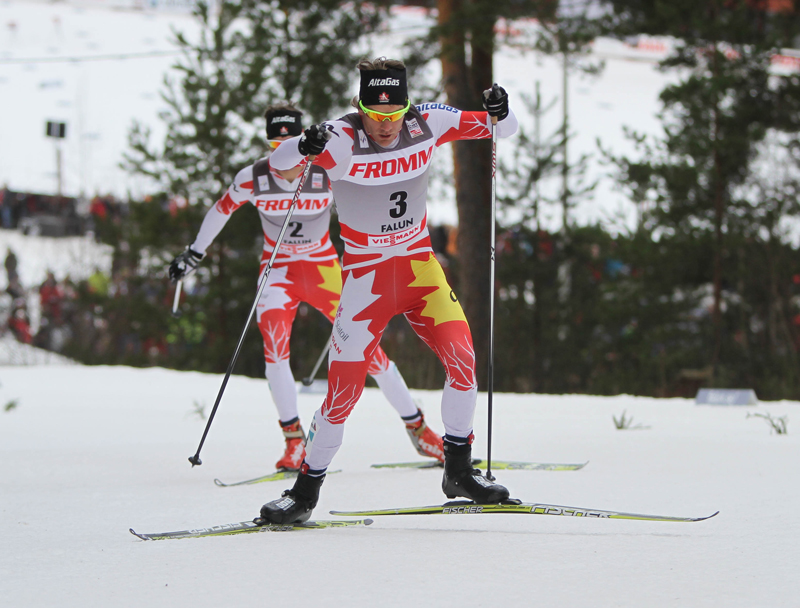
FALUN, Sweden – Sometimes boring is good, and today, at the Lugnet Rikkskidstadion, both Darion Cologna (SUI) and Devon Kershaw (CAN) were happy to avoid any excitement in the 15km freestyle event.
Cologna started the final stage of the World Cup Finals mini-tour, and the last race of the 2012 season, with a 36 second lead on Canadian Lenny Valjas and another 10 seconds on Kershaw.
Despite having wrapped up the overall World Cup title weeks ago, and winning his third consecutive Tour de Ski, Cologna is hardly unbeatable.
He has but together an amazing run of podium finishes in distance races this season, but a number of different men have relegated him to second or third at times.
But Cologna has been in top form of late—so much so that 46 seconds could just as easily be a year.

If anyone had a chance to track down the Swiss star, it was Kershaw, second in the overall rankings this season, and a much-improved skater.
Valjas shocked the ski world with his third place result in the 15km classic on Saturday, but there was little hope he could hang with his teammate when Kershaw inevitably tracked him down, and even less of getting Cologna.
Cologna has not been 46 seconds behind a race winner since the 30k individual in Davos back at the beginning of December, so while World Cup cross-country skiers are fond of saying “anything can happen,” sometimes it really just can’t
While catching Cologna may have been a near impossibility, Kershaw put himself in position to take advantage of an epic blowup or crash, gaining some time here, losing a few seconds there, but never closer than 35 or farther back than 51.
But Kershaw had more pressing concerns than the exact size of the gap up to Cologna.
Out on his own, he said he was “just focused purely and solely on the technique and tried to ski as big as possible—big glide big power.”
By the 2.5k mark, two strong chase packs had formed up, the first led by Martin Johnsrud Sundby (NOR) and consisting of Jean Marc Gaillard (FRA), Evgeniy Belov (RUS), Alex Harvey (CAN), and Rolan Clara (ITA), a formidable a group of skaters to say the least.
The men had all started within 13 seconds of each other, coming together quickly in an effort to reach the podium.
While Kershaw was reeling in Valjas, the chase pack caught Dyrhaug before the end of the first lap, and the Norwegian immediately fell into line, leaving just classic specialist Eldar Roenning between the group and the podium.
Like Valjas, Roenning was expected to drop back through the field, but fought valiantly, though futilely. He too was caught, eaten up by the hard charging chase group on the gradual terrain at the beginning of the 5km loop.
Unlike Dyrhaug, however, Roenning was quickly spit out the back, unable to match the pace of the chasers in the wet and dirty spring snow.
The morning had dawned gray and somewhat dreary in Falun, with evidence of light rain overnight. Temperatures never caught a glimpse of the freezing mark so the course was soft and slushy at daybreak.
As they did for Friday’s prologue, the Jury decided to salt the course, a move that help the situation, but only so much.
One can only fight mother nature so much, and as the day warmed, the track softened in many places despite the salt.
Downhill corners turned to deep corn snow, and salt will not help with puddles and run-off.
The firmest part of the course was Mördarbacken. On the first lap Kershaw and Valjas came through together, the former having closed the ten-second gap quickly.
But on the lesser pitches at the beginning of the second lap, Valjas had to let his teammate go.

“Len did a good job hanging in there, but knew his limits,” Canadian Head Coach Justin Wadsworth told FasterSkier. “And Devon was skiing well, keeping pace with Dario.”
Valjas held off the chasers until the first pitch of Mördarbacken the second time around, finally succumbing as the grade increased.
A good portion of the reported 10,000 fans lined the lengthy hill, forming a walled corridor of noise and color.
The loudest cheers were reserved for the home skiers in white, blue and yellow, but in classic Scandinavian fashion, every skier who made the trek received cacophony of support, replete with flag waving and cowbell ringing.
Clara was now leading the chase pack as it powered by Valjas, and another man had impressively joined the trackers—Petr Sedov (RUS) had bridged up from the second group of hunters, leaving the likes of Marcus Hellner (SWE), Sjur Roethe (NOR) and Maxim Vylegzhanin (RUS) behind.
Meanwhile, up at the front, Cologna went about his business with machine-like efficiency, every stride smooth and powerful devoid of wasted motions.
By this point in the race, it was clear that Kershaw would not get the miracle he needed to take the victory, but was moving through the course with a strength and confidence that signaled bad news for the pack behind.
According to Wadsworth, Kershaw was losing some time on the steeper sections of Mördarbacken, but quickly made that back on the flats over the top into the descent.
“That was part of the strategy,” Wadsworth said. “Just control it and ski steady.”
Despite Wadsworth’s post-race confidence, the chasers did manage to close within just over 20 seconds.
Sundby, who had been pushing the pace hard said “we thought he was getting tired and we could catch up with him,” but unspoken disagreement in the pack was their undoing.
“There is always someone who is not so eager to push the speed and somebody who wants to push the speed,” Sundby explained. “So the dynamics were not too great.”
One of those with no incentive to pull was Harvey.
With his teammate up ahead in second, he wasn’t going to lead the charge.
The plan, Harvey said, was to “just stay in the group and then fight for position there, but not fight for any time ahead.”
“The pack starts to chew time,” Wadsworth said. “It is funny how it works…they just feed of each other and everybody is pushing. So we knew it was going to be dangerous for sure.”
When the group failed to close any further, the pace relaxed somewhat Harvey said, but with Marcus Hellner leading a group behind, there was not much room to back off further.

Sundby was disappointed to see the chase fail.
“I went for second place, for sure, but Devon was far too strong ahead of us. He did a great job,” the Norwegian said.
With five kilometers to go now the, the stage was now set for the final act—of the race, the World Cup Finals, and the entire season.
Cologna and Kershaw kept their respective distances and the chasers remained grouped behind until reaching the Mördarbacken for the final time.
With just the single big climb remaining, there was little doubt that someone would attack.
That person was Clara, coming off a strong season in which he earned three of his four career World Cup podiums.
The 30-year-old hit the afterburners halfway up the ascent, and only Belov could respond.
The move was exactly what the crowd had been hoping for. After nearly 14 kilometers of hard racing, the game was truly afoot and the spectators roared their approval.
On most courses, the gap the Italian created would have been enough to secure the final podium spot for one of the two men.
Just the day before, however, Cologna and Roenning held a lead down toward the stadium, only to get overtaken by the chasers on the seemingly endless gradual downhill on the backstretch.
Today played out nearly identically, with the pack of Harvey, Sundby, Dyrhaug and Sedov quickly closing the nearly 10-second gap.
The six skiers rounded the final turn and accelerated toward the last uphill pitch to the finish.
Dyrhaug was confident in his kick and still had his eyes set on the bronze.
The sprint to the line was fast and furious as such affairs are wont to be.
The two men who had risked it all with the break left with nothing to show for their efforts, dropping to the back of the group at the end.
It was none other than Dyrhaug who came through to take third, his first World Cup podium of his career.
“I have been in very good shape for a long time,” said Dyrhaug who finished fourth in both the other two World Cup Finals races in Falun. “I wanted this podium so much.”
Dyrhaug said he wasn’t worried when Belov and Clara broke, counting on the descent to bring them back.
“This was the last chance [for a podium this year], and I am so so so happy,” Dyrhaug said. “I don’t know what to say.”

Cologna, pumping his arms in celebration, had crossed the line 40 seconds earlier, wrapping up a stellar season in which he held off a challenge by Petter Northug in the Tour de Ski, and captured his third overall World Cup title.
He said the day was good for him, but the victory did not come easily despite all appearances.
“I kept my pace but it was not easy as I was skiing alone the whole time,” Cologna said.
Harvey came across in 6th, ahead of only Belov and Clara in the group.
“Because I had to start so hard, I had no sprint at the end,” Harvey said. “I was in pain the whole race, just fighting the whole time, so I got passed.”
Kershaw attributed much of his victory to the focus he has put on his skating over the last several years.
“I think today is the biggest testament to the work that I’ve done,” he said. “I can’t believe it, a second in the World Cup Final it is a perfect way to end a season.”
Matt Voisin contributed reporting.


Leave a Reply
You must be logged in to post a comment.