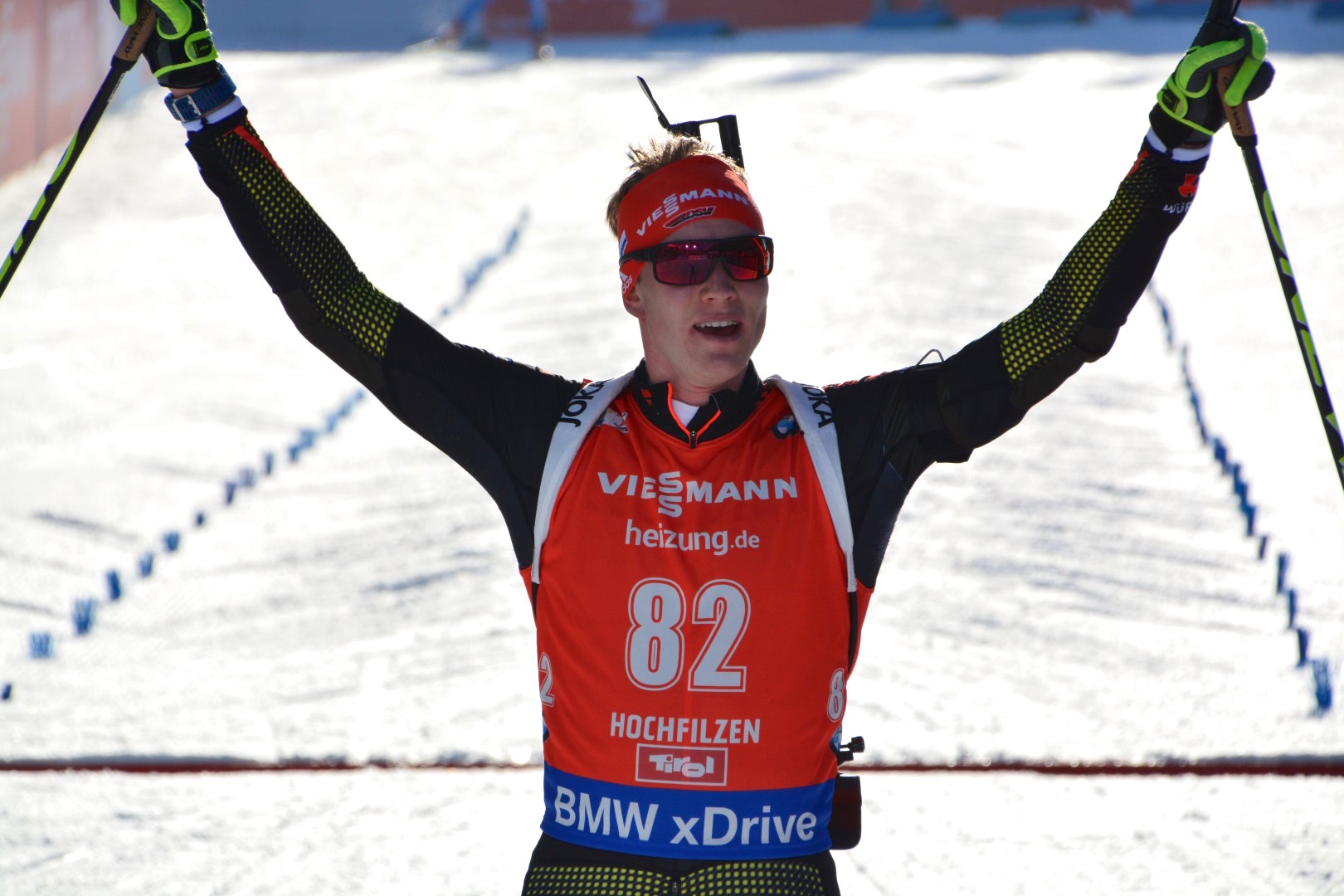
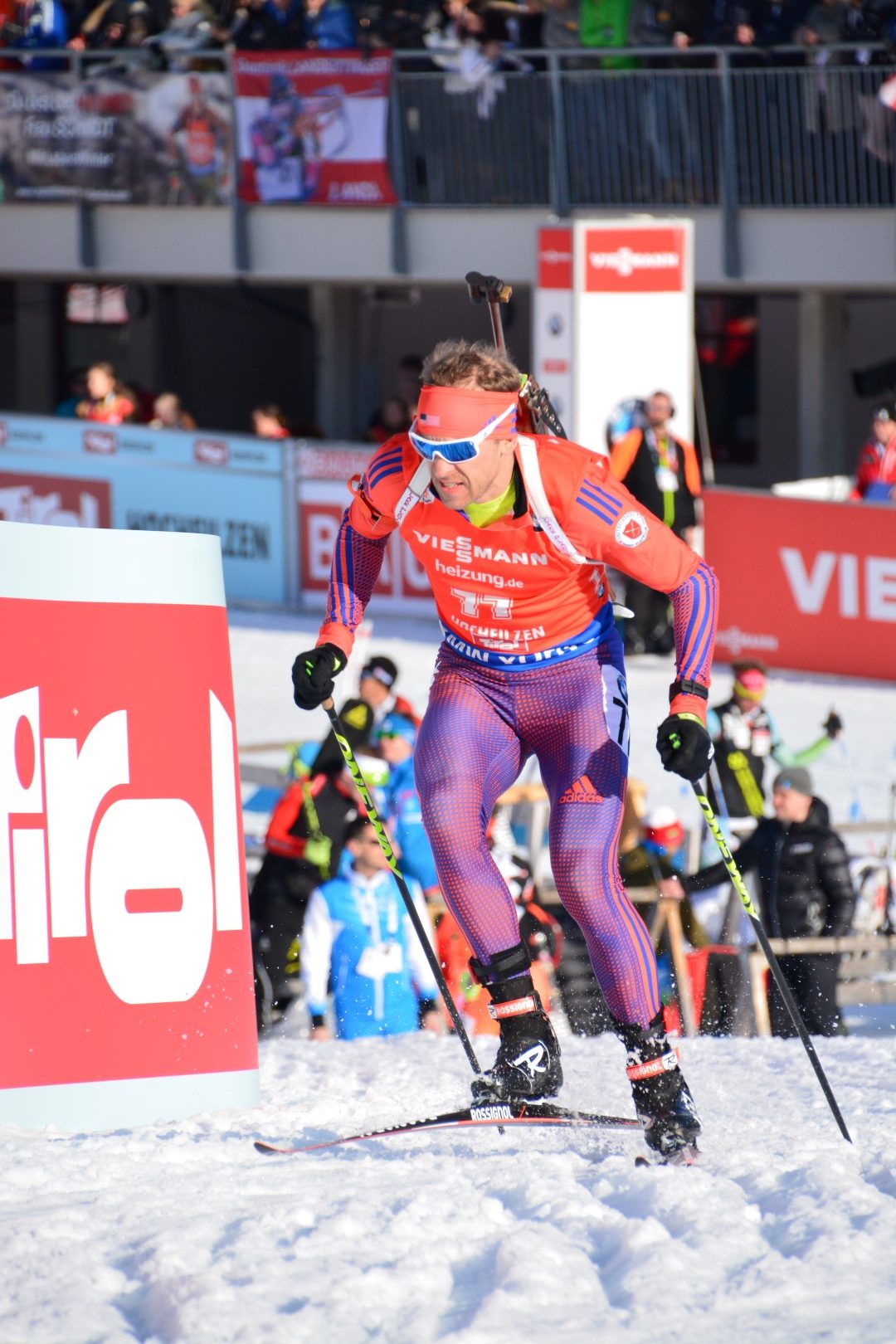
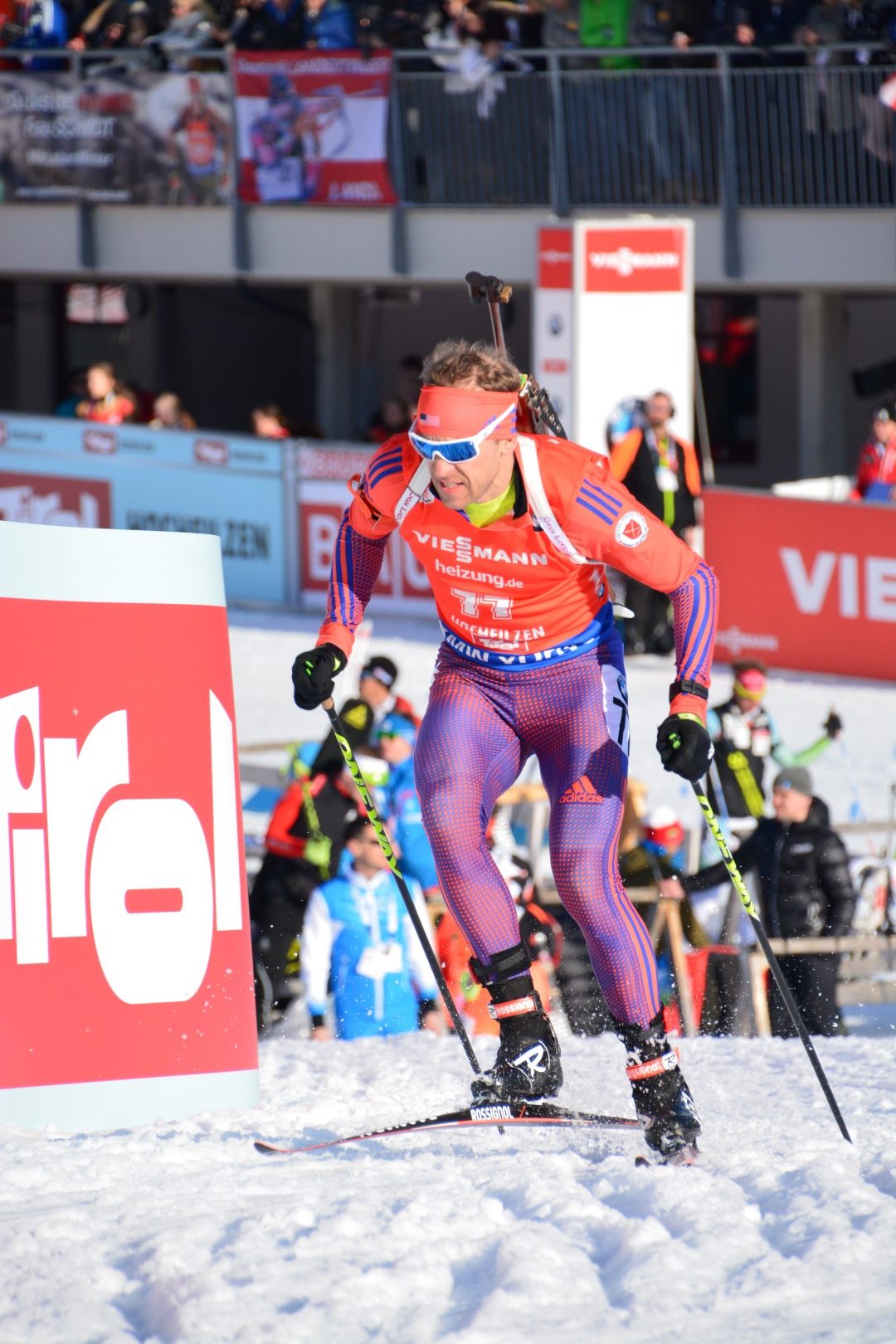
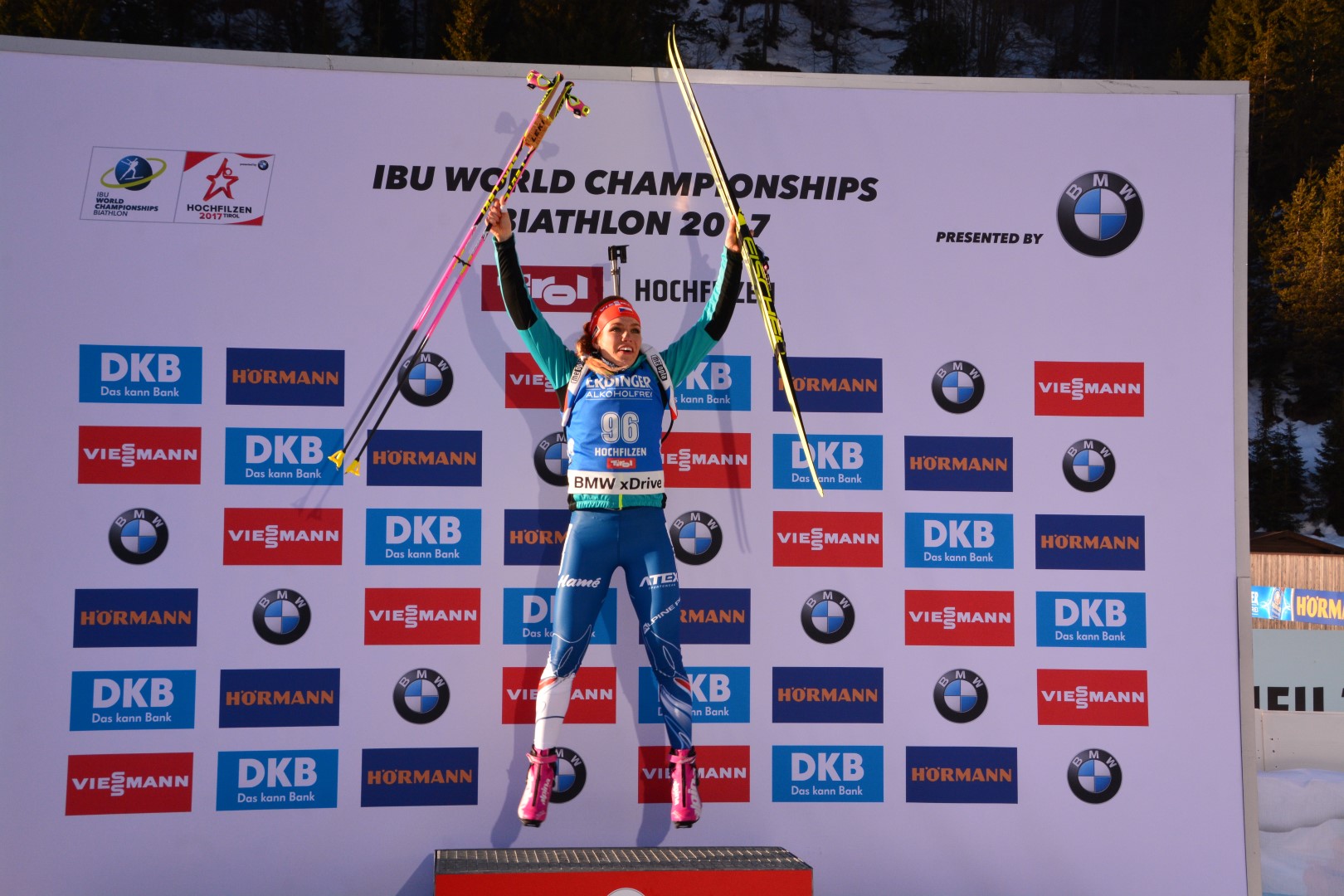
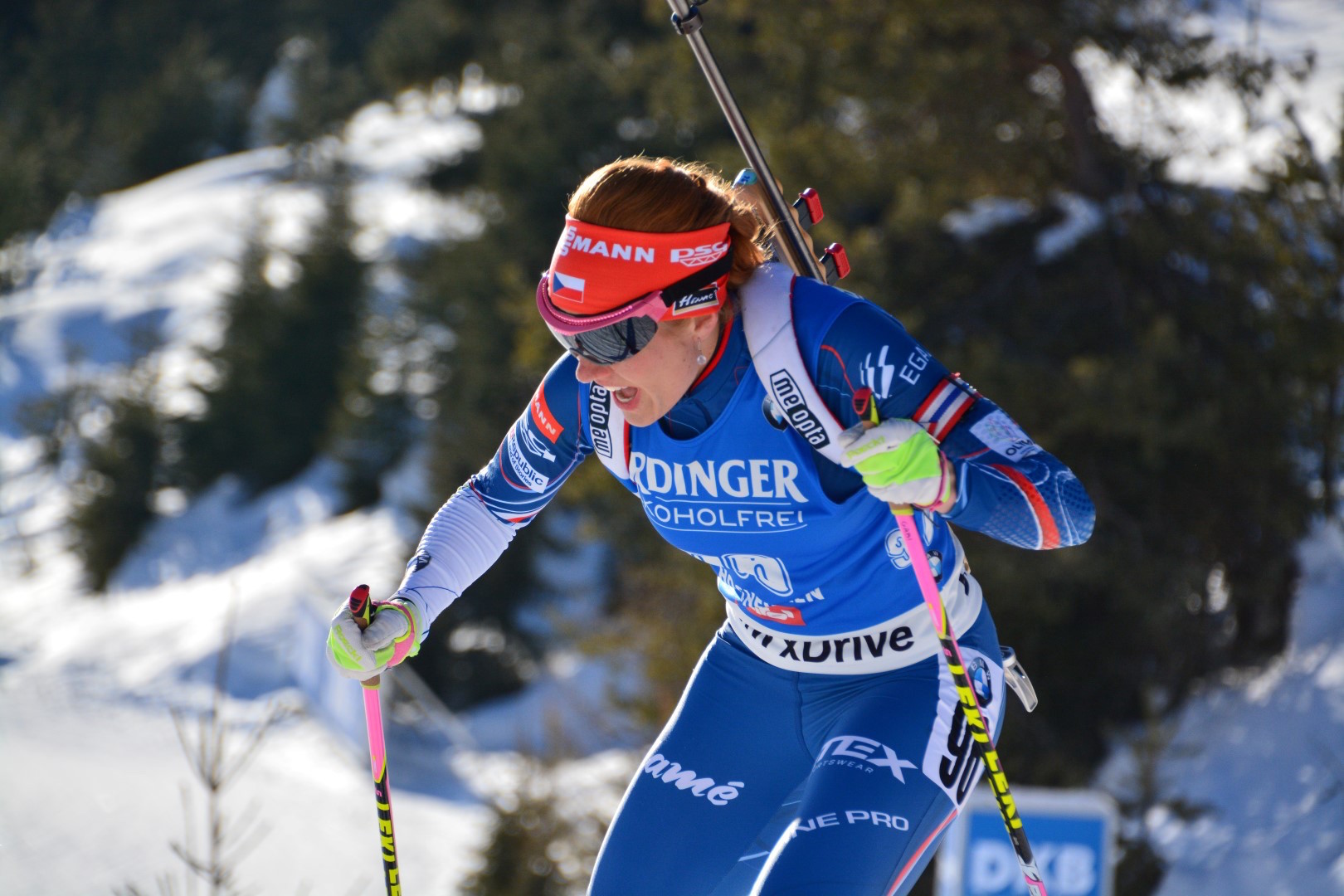
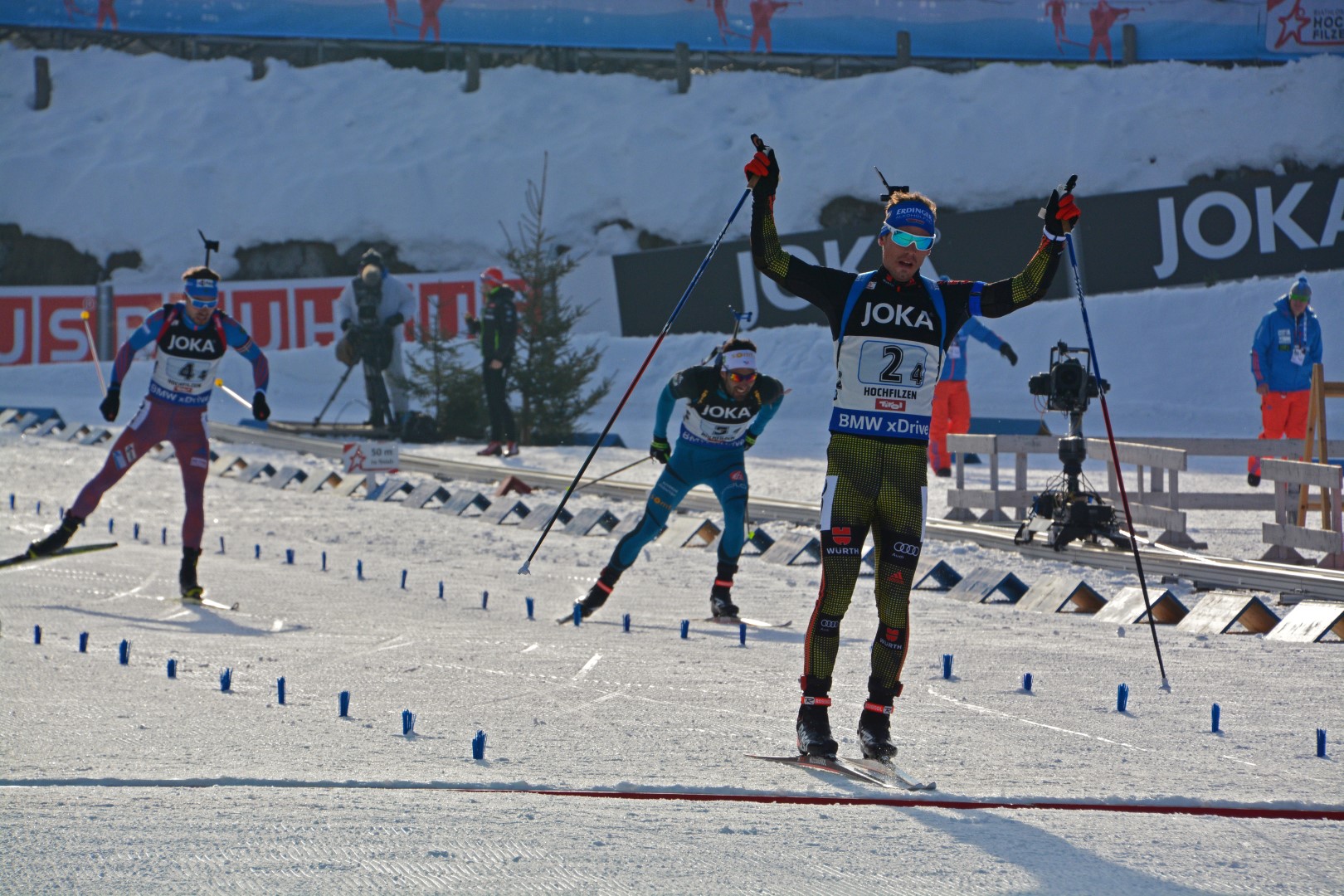
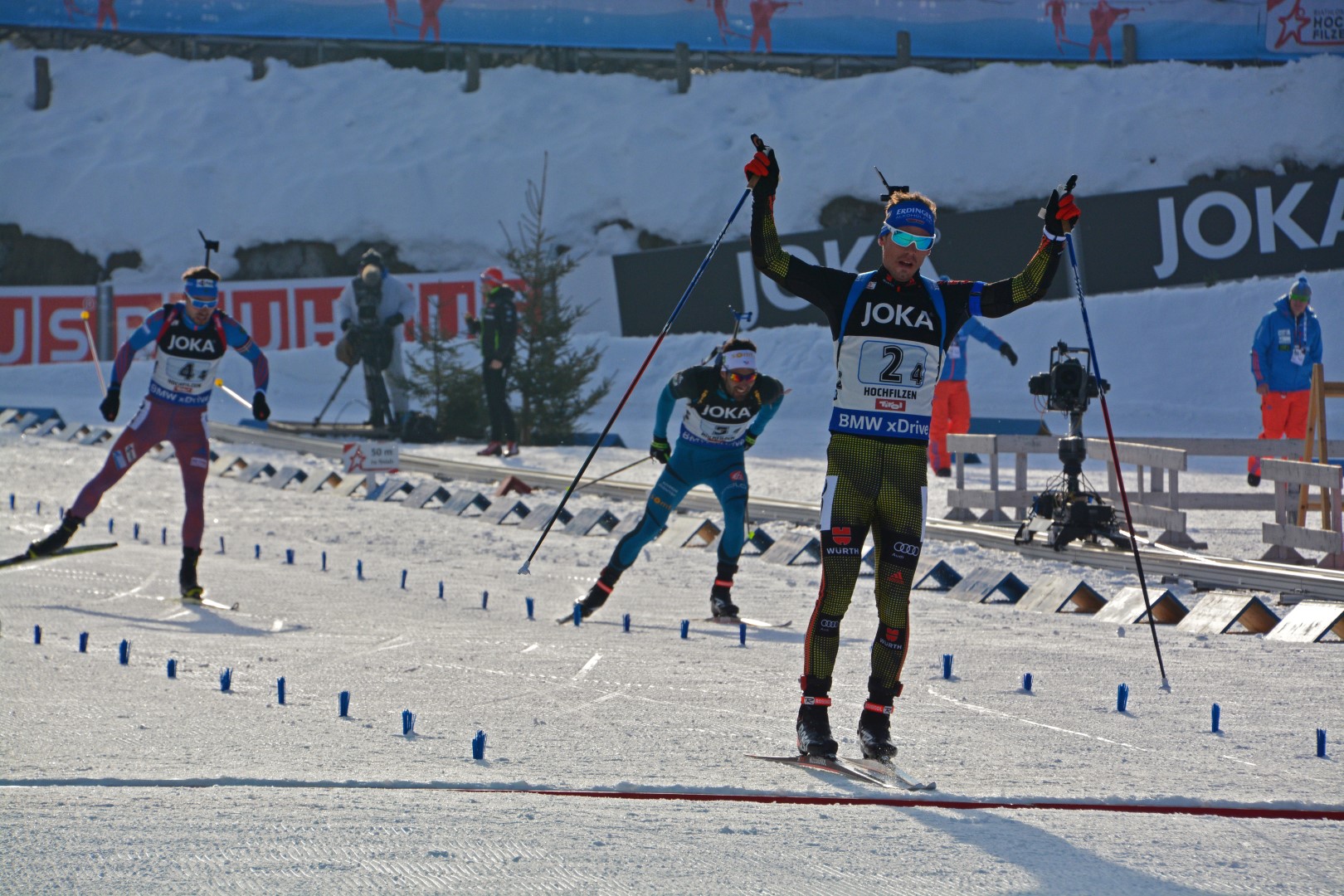
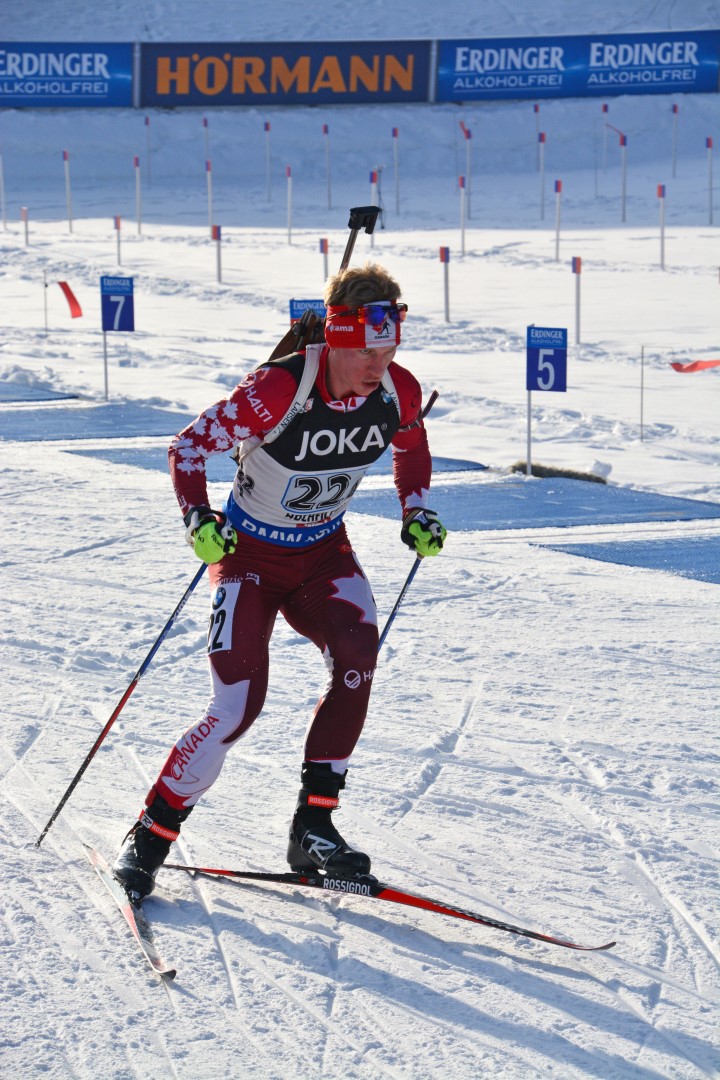
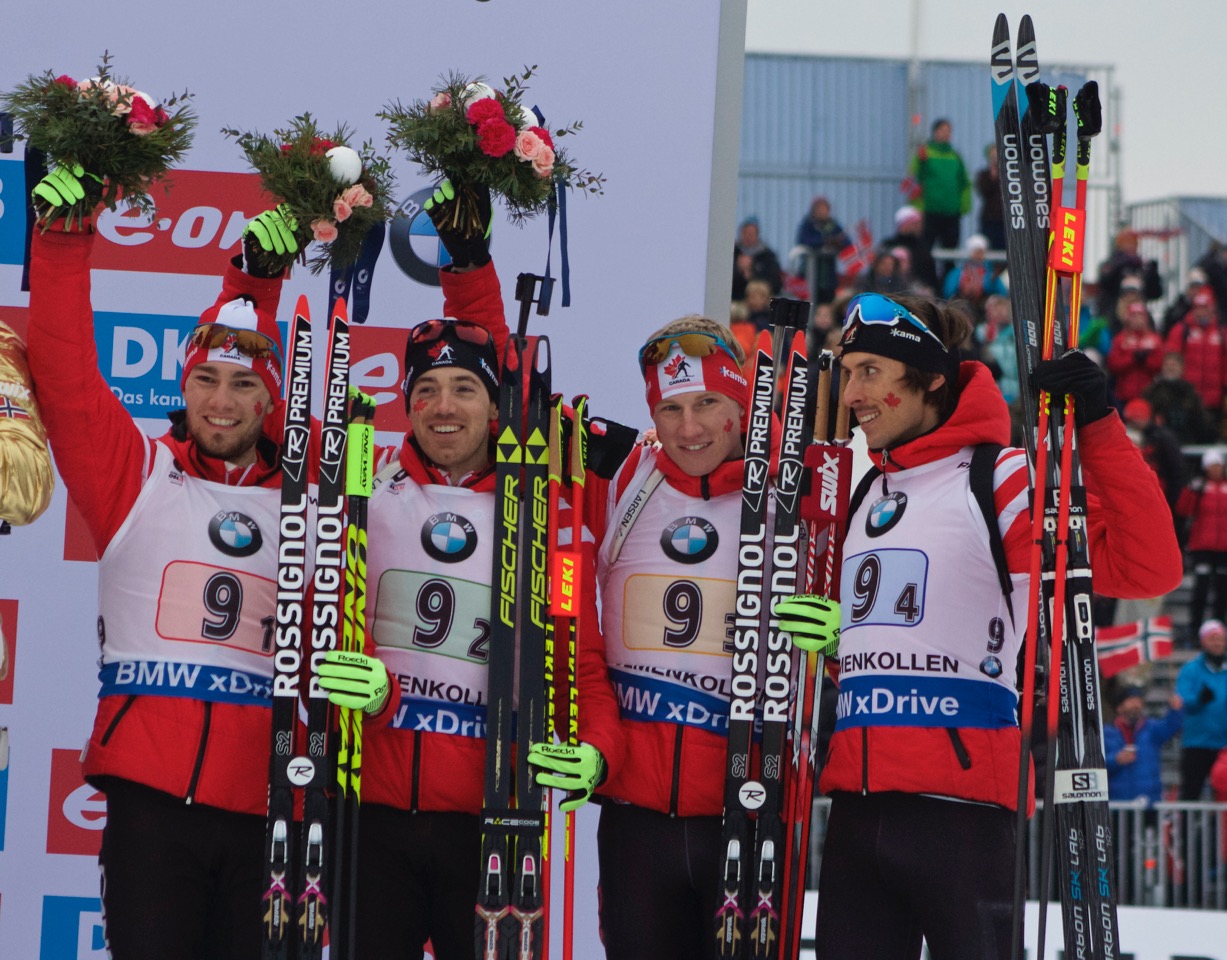
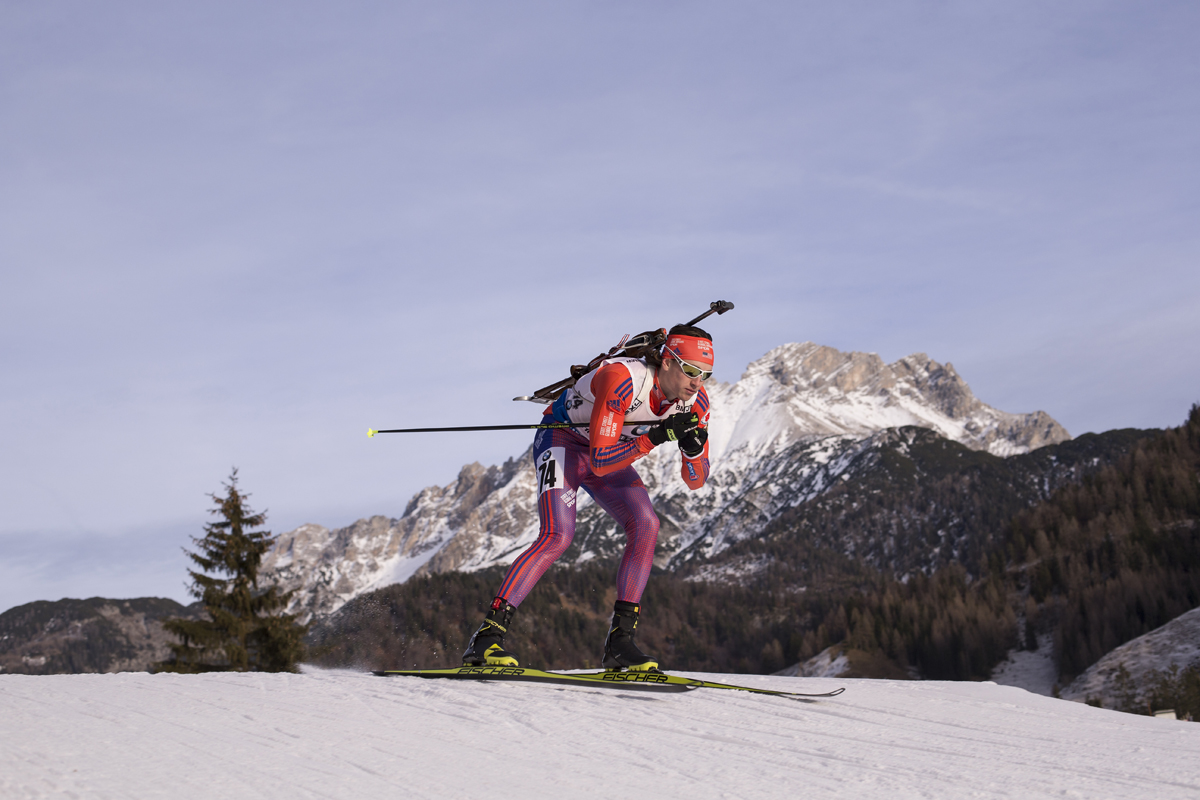
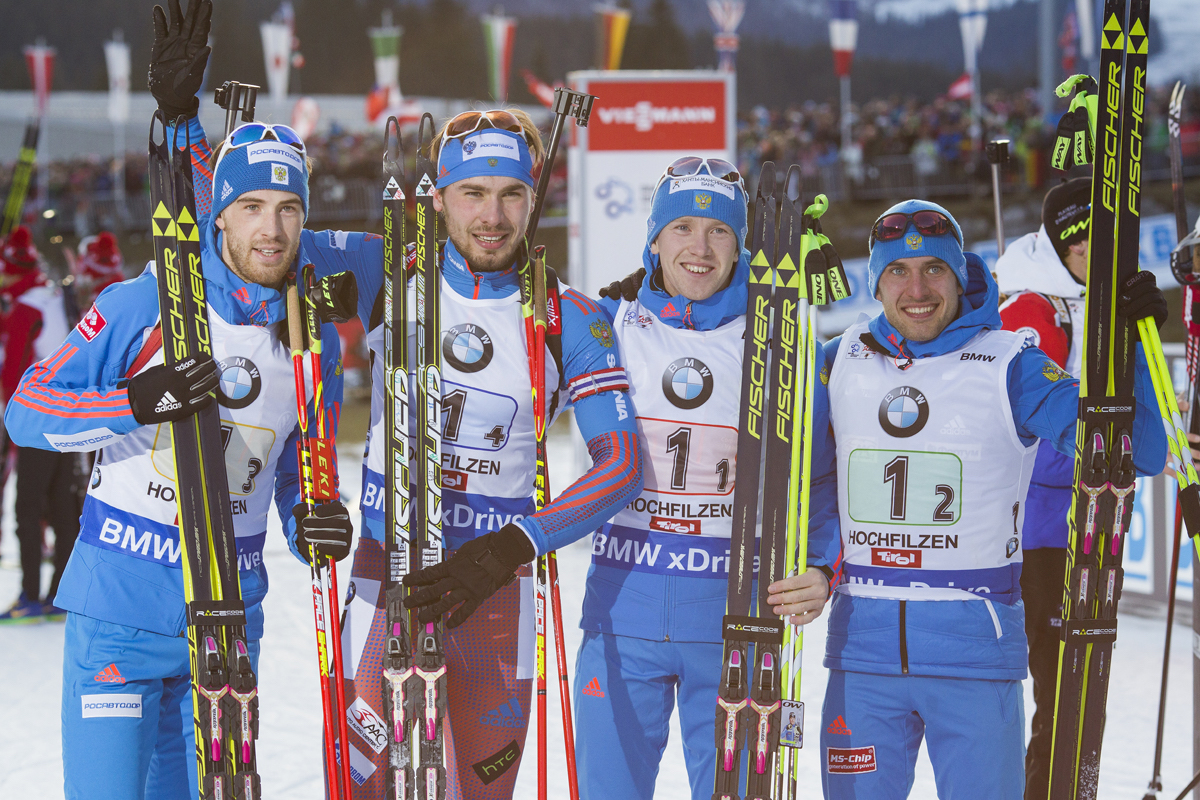
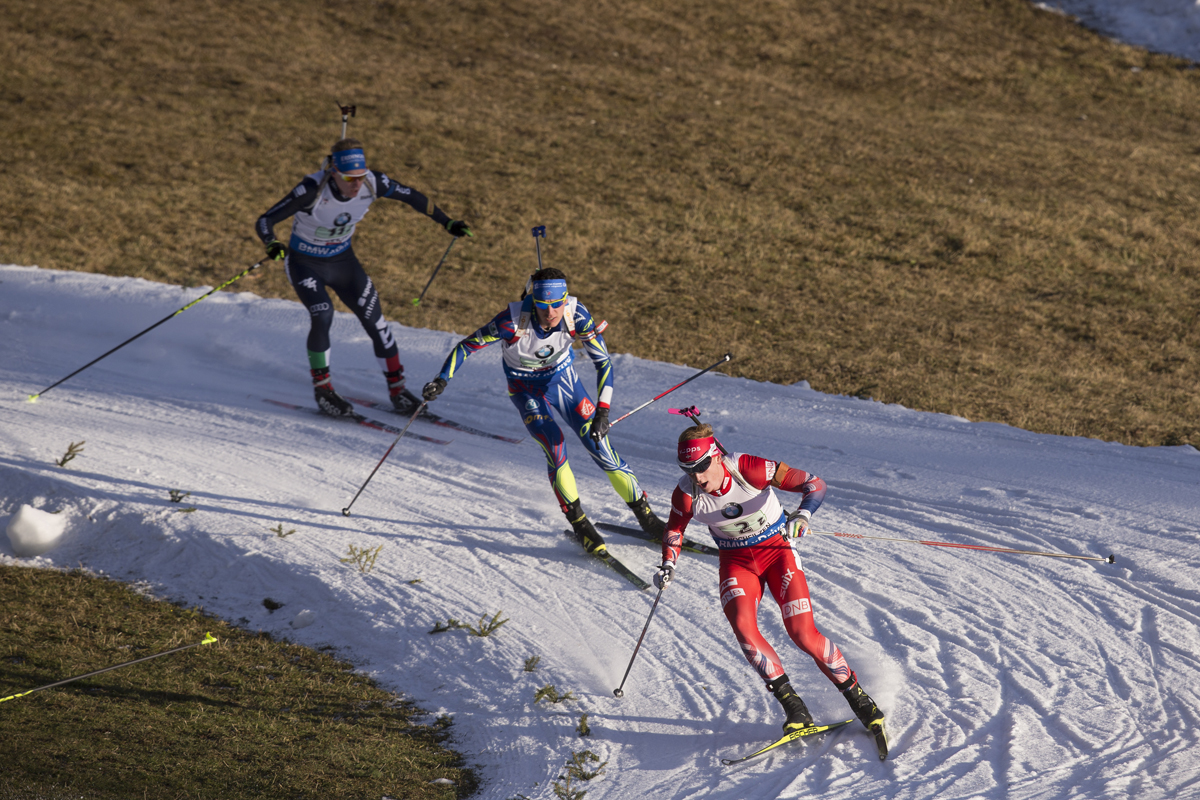
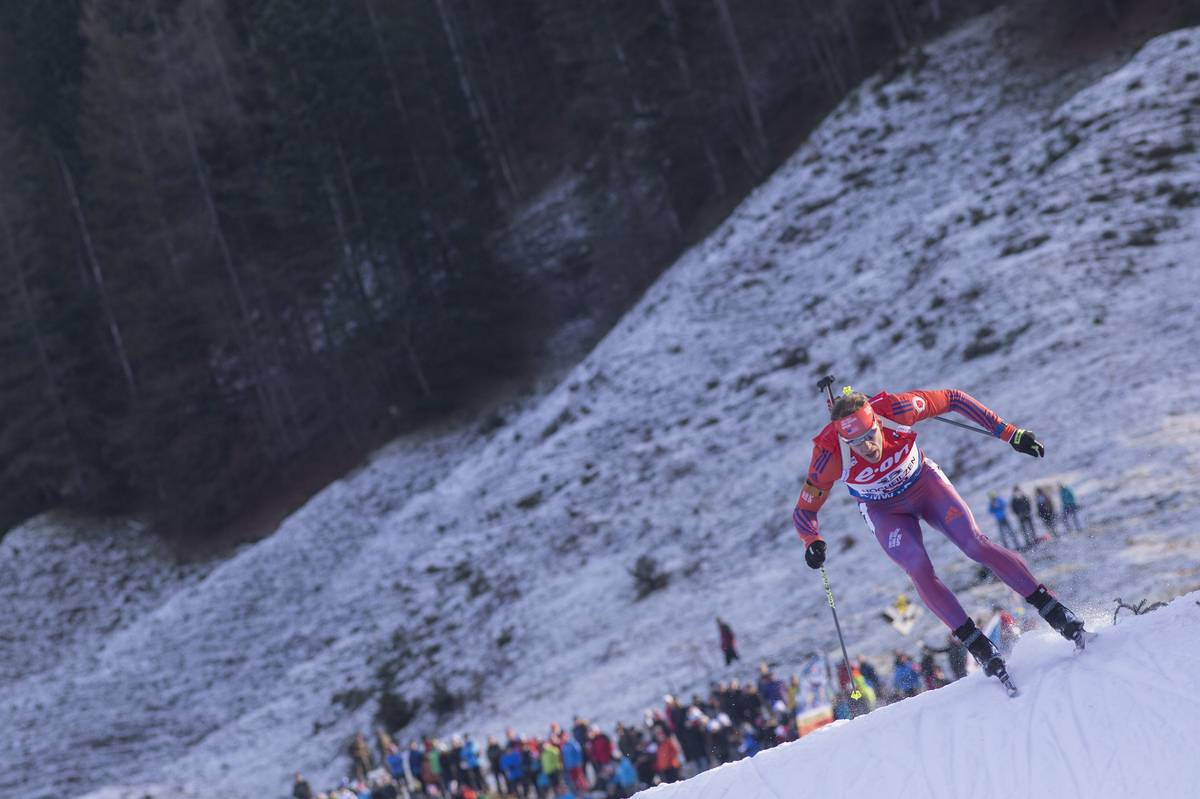
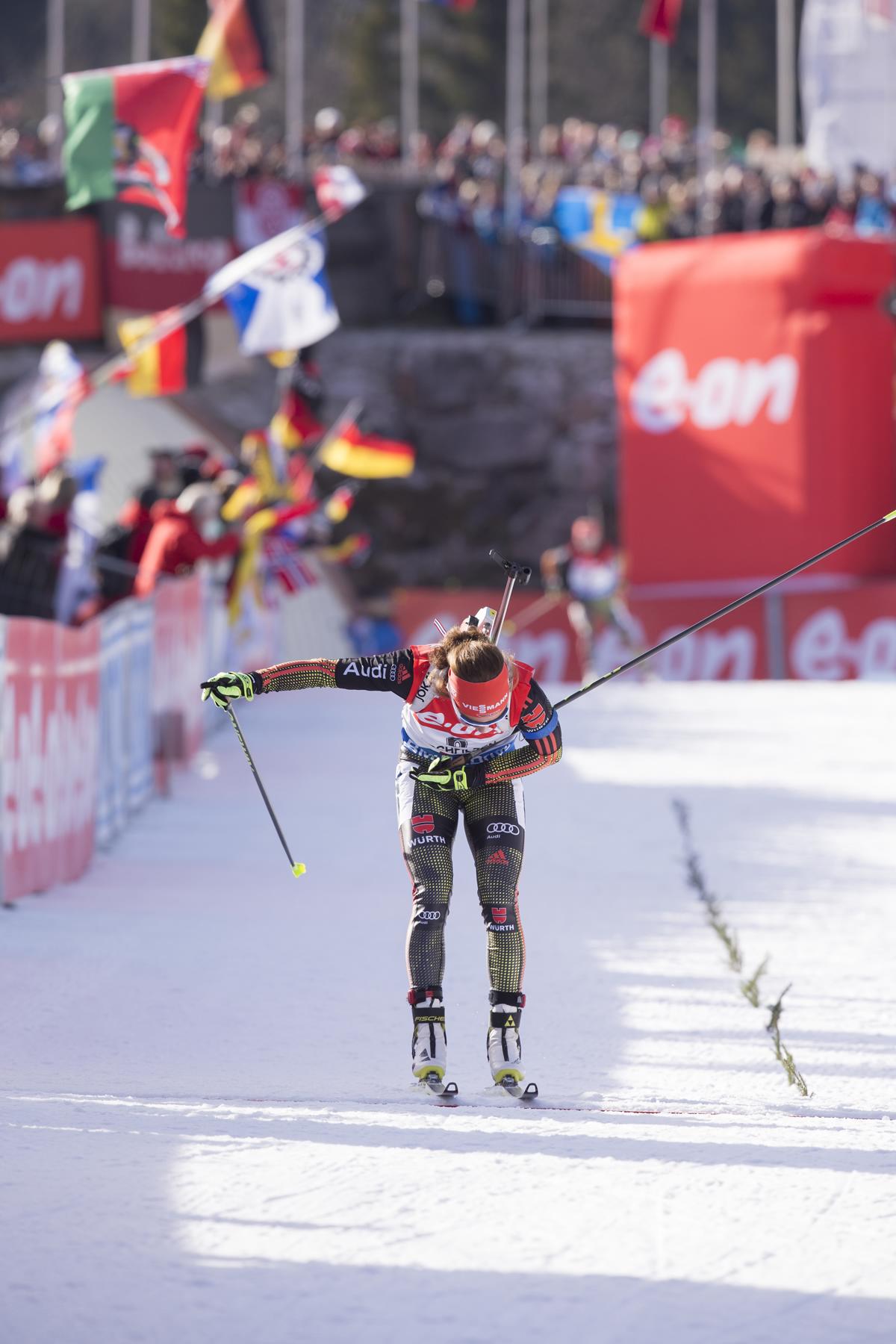
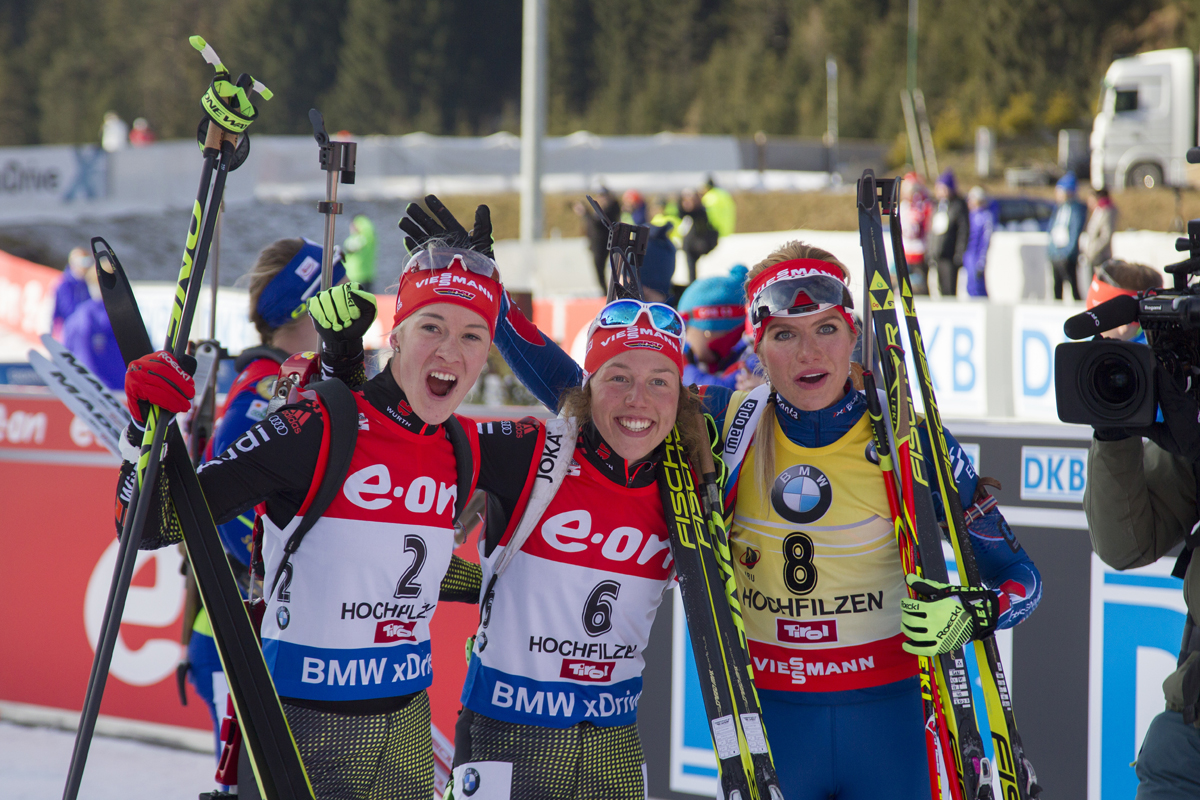
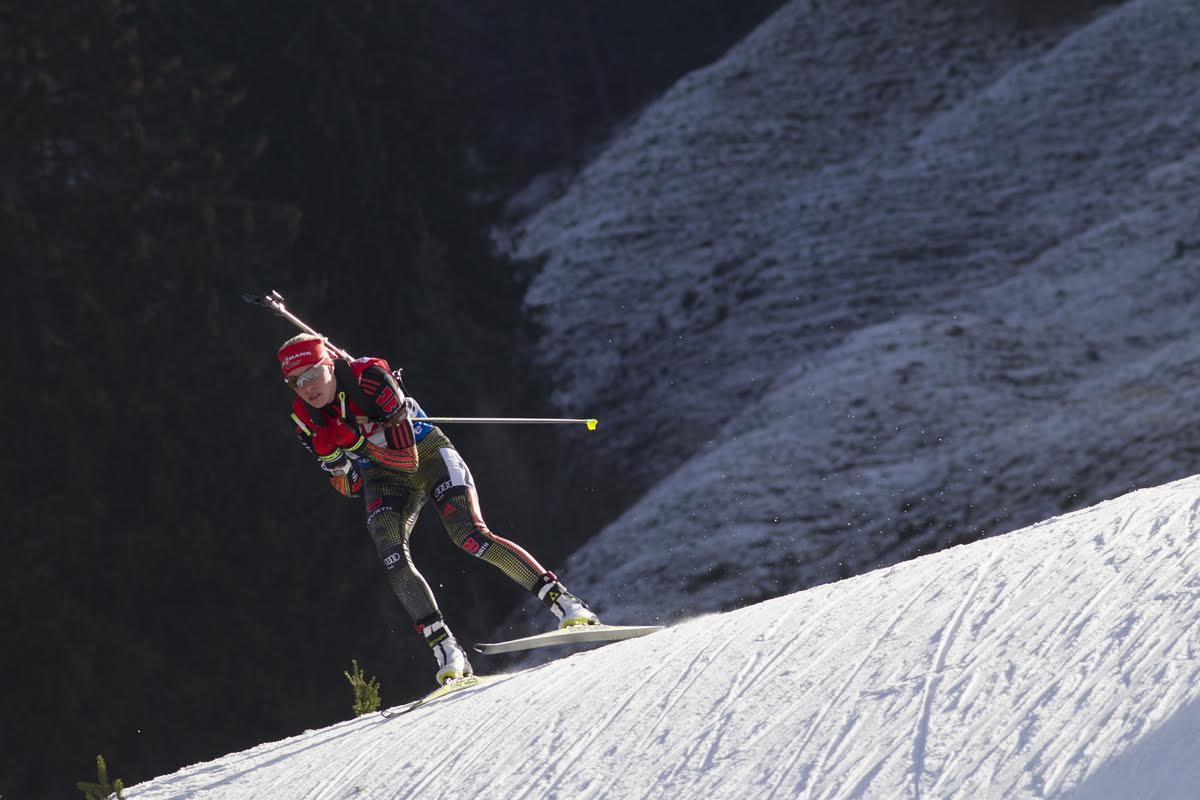
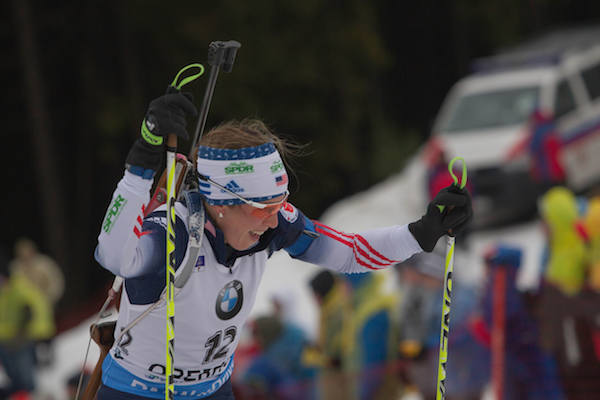
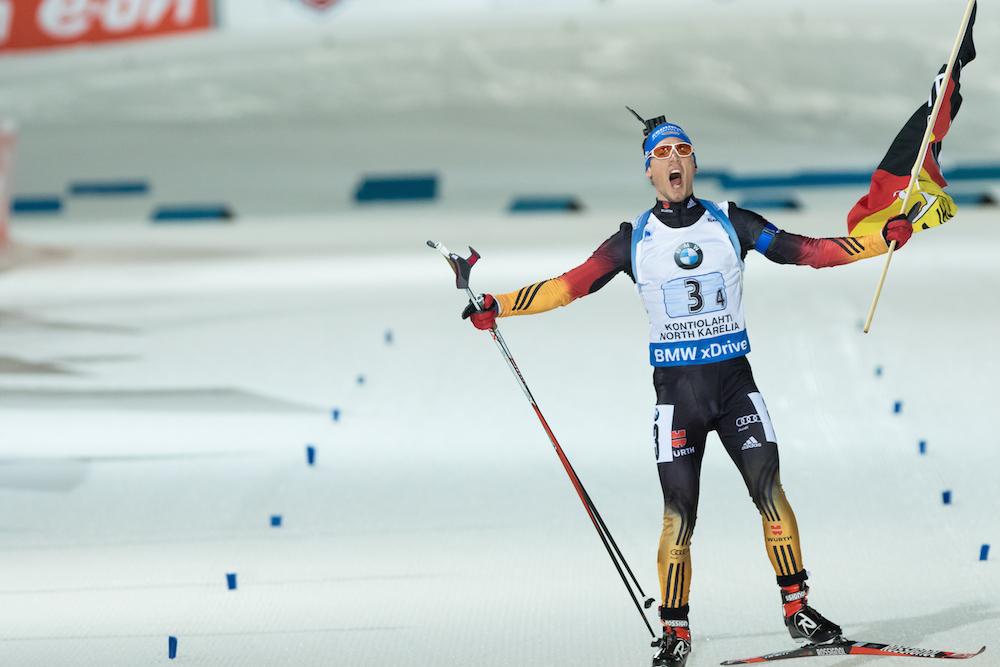
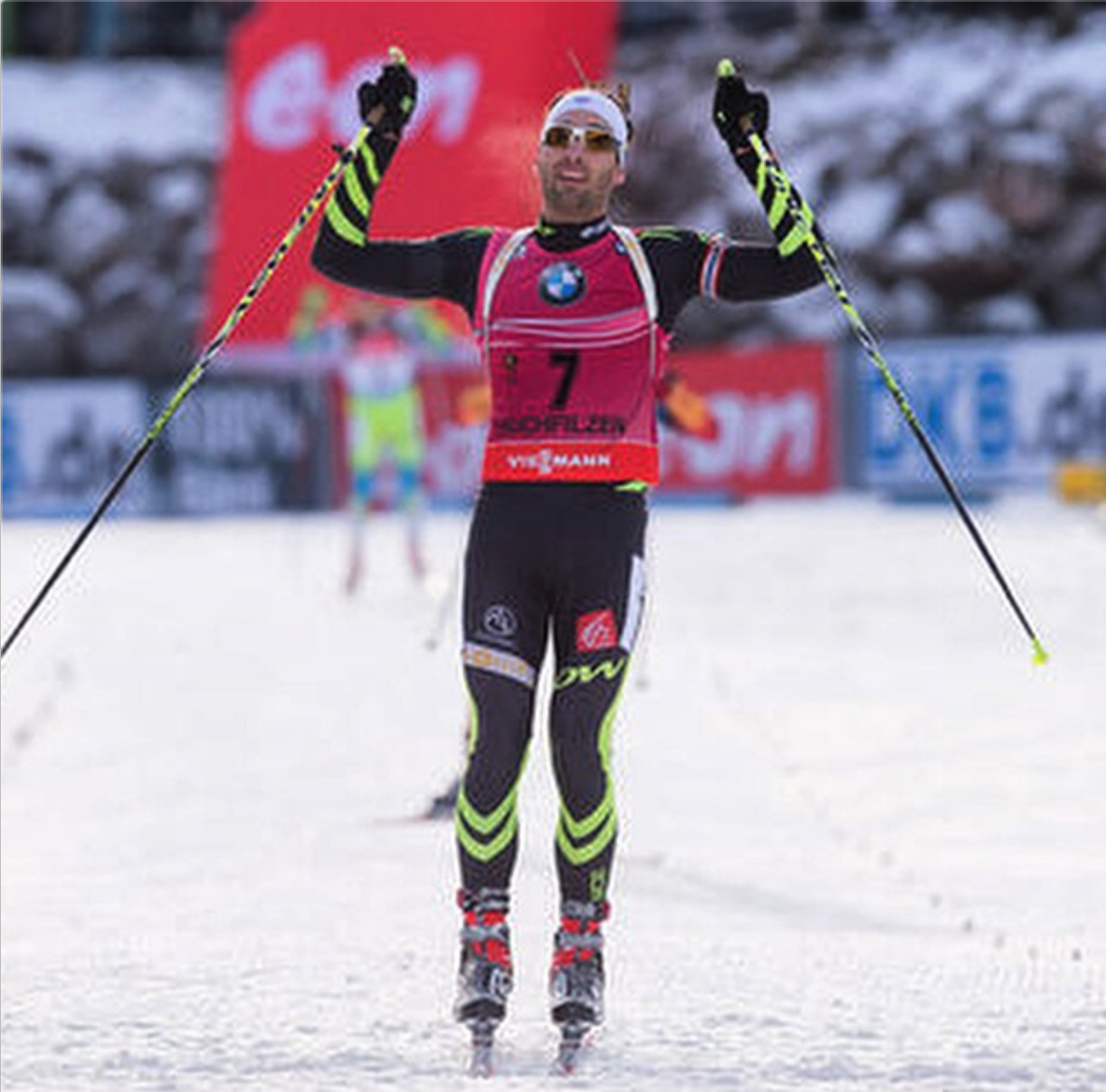
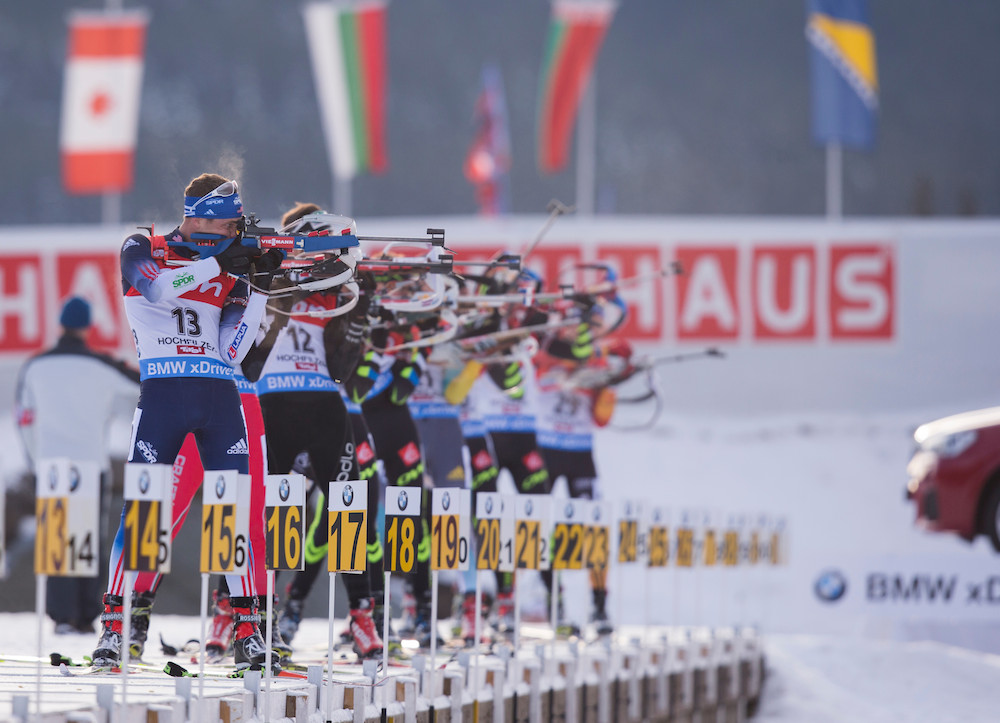
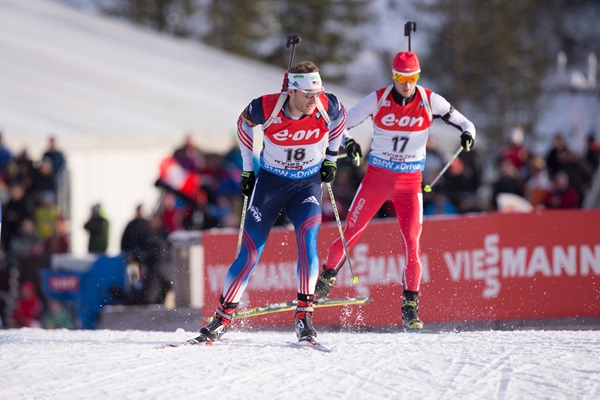
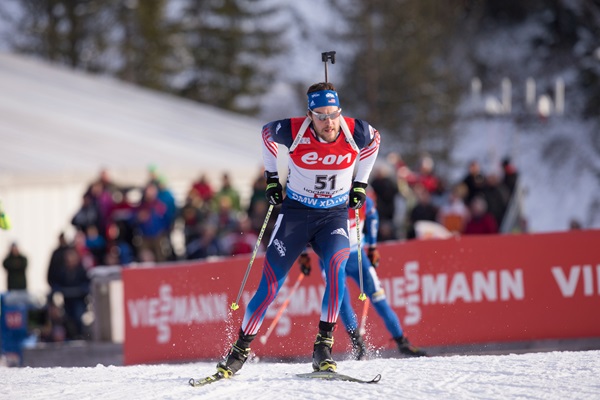
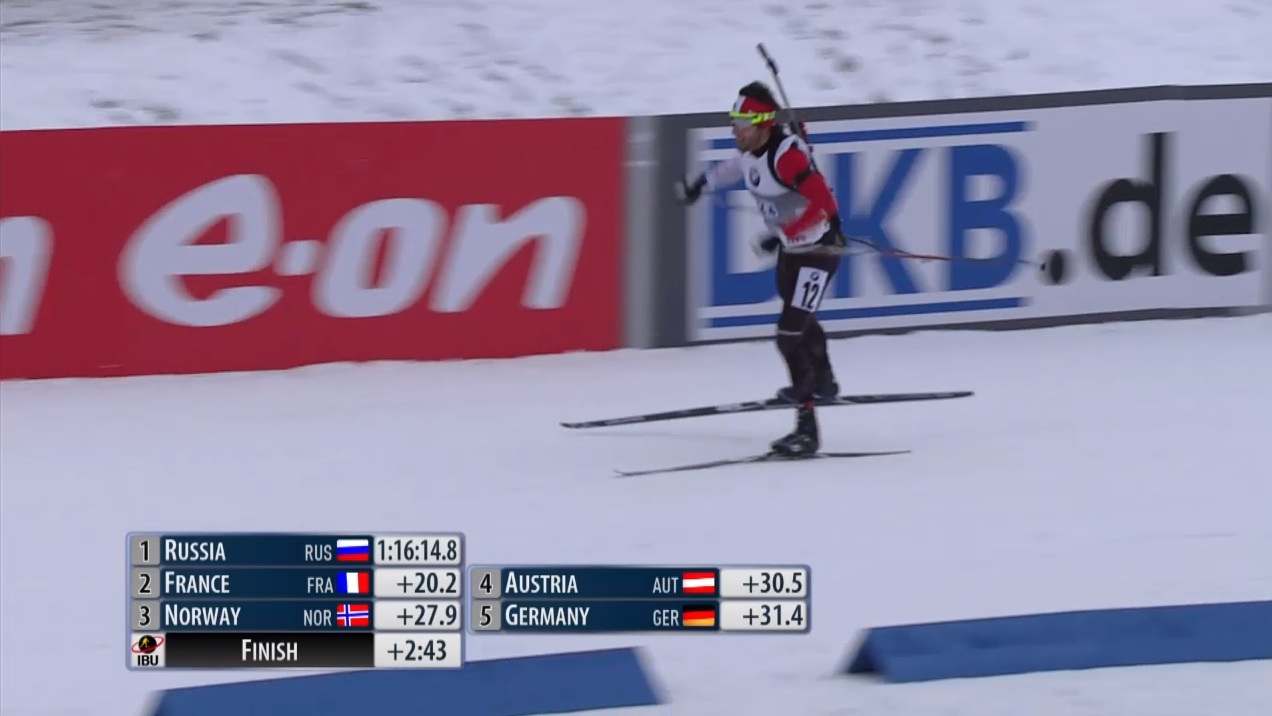
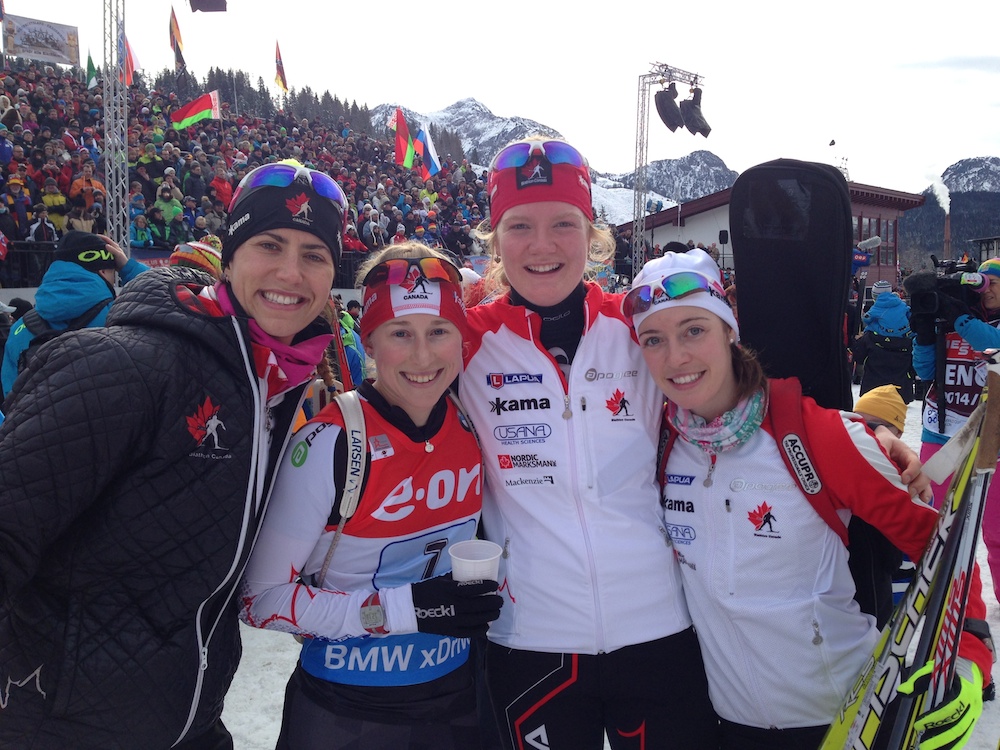
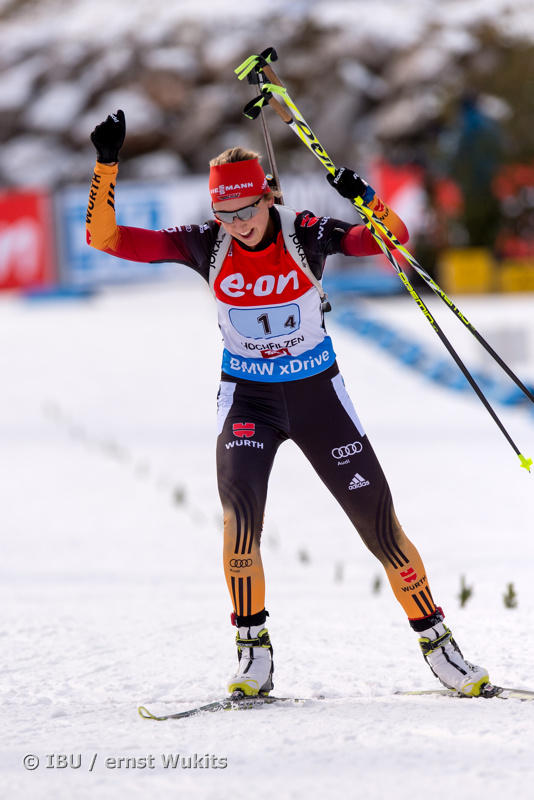
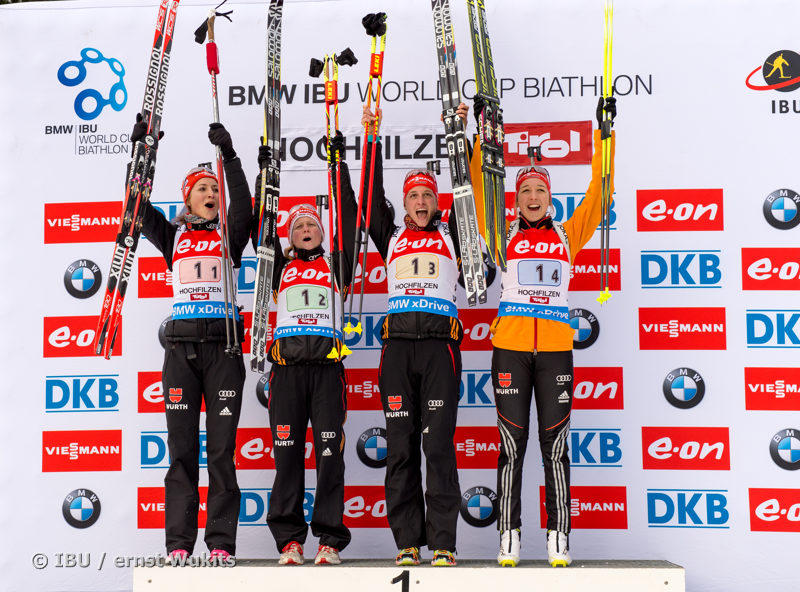
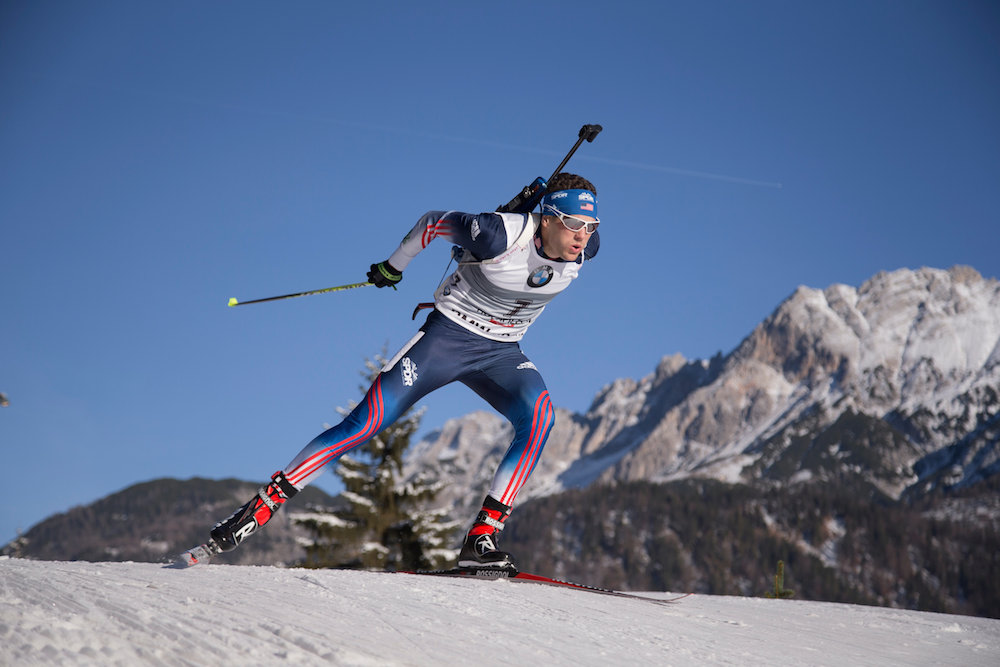
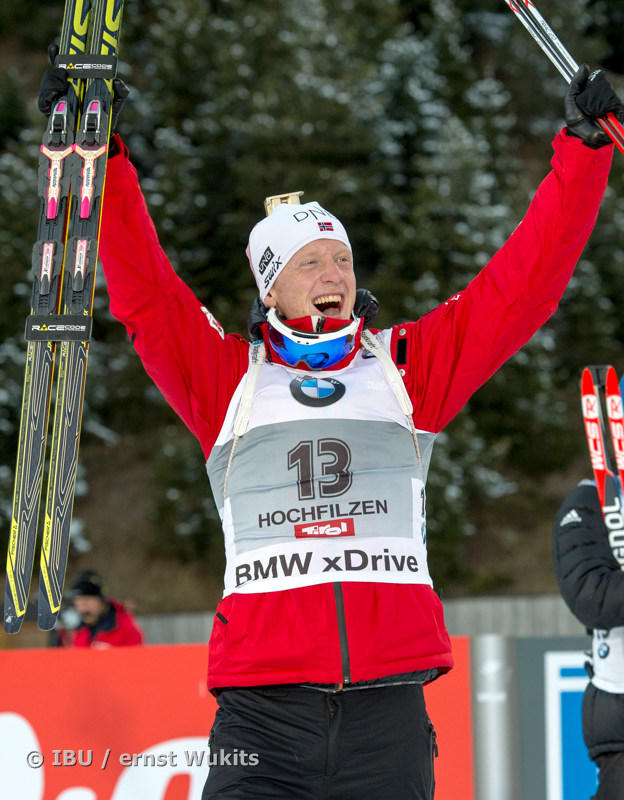
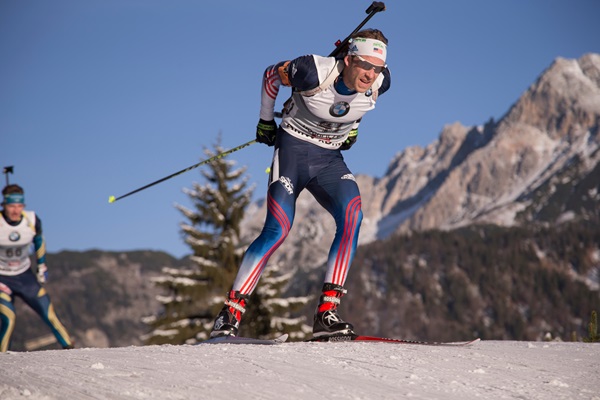
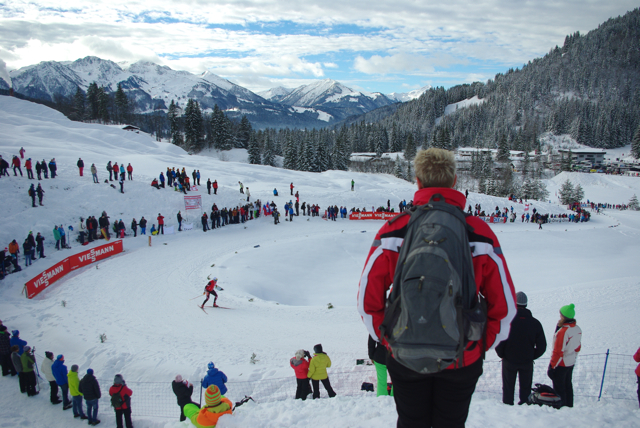
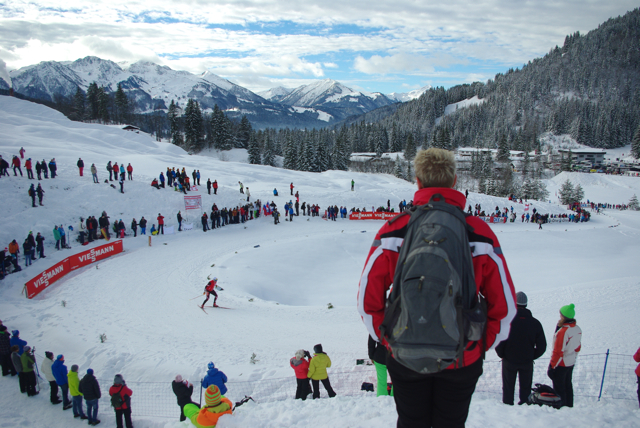
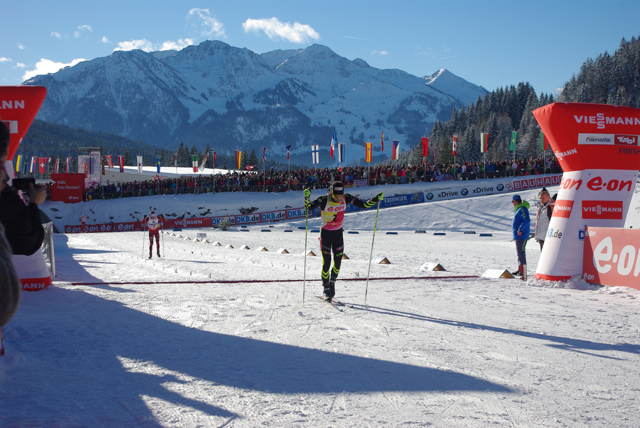
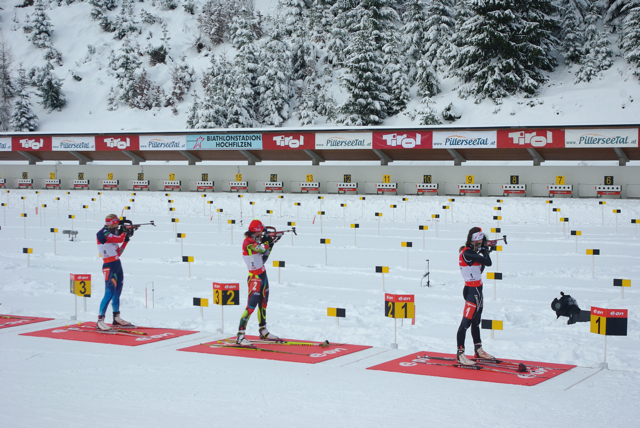
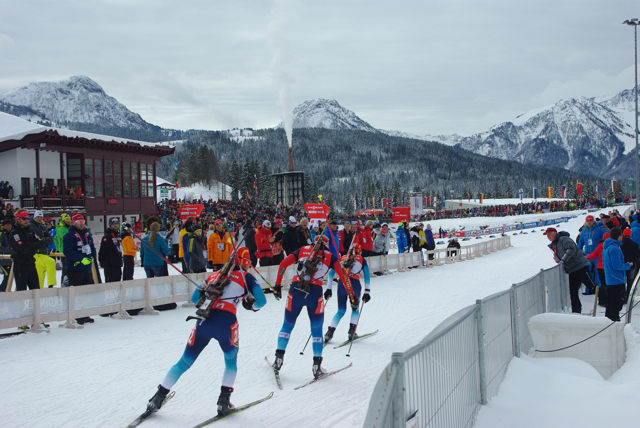
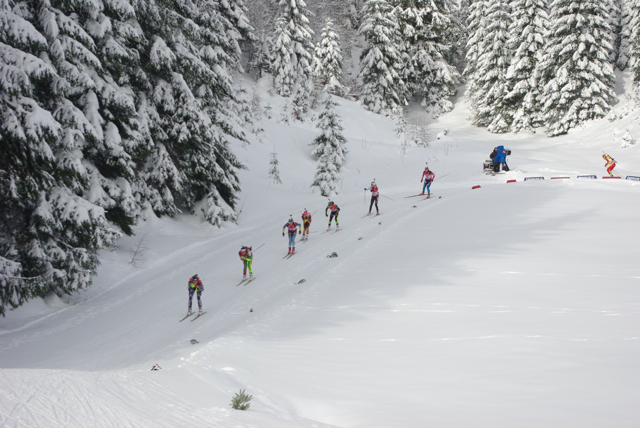
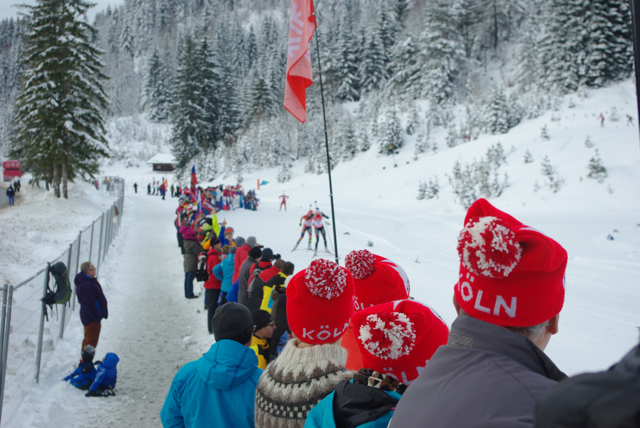
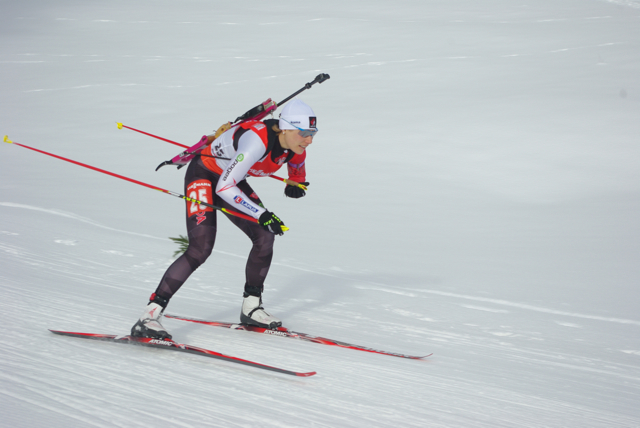
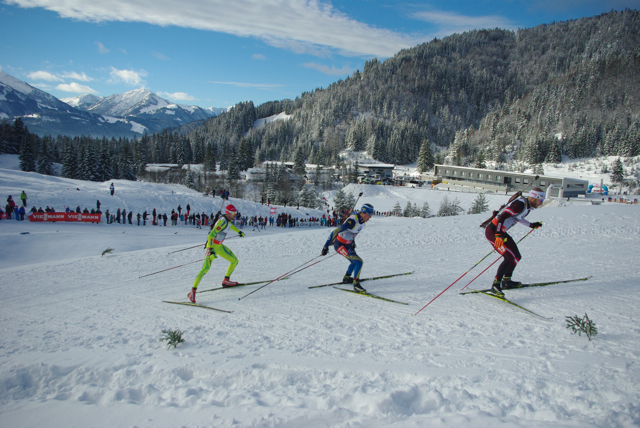
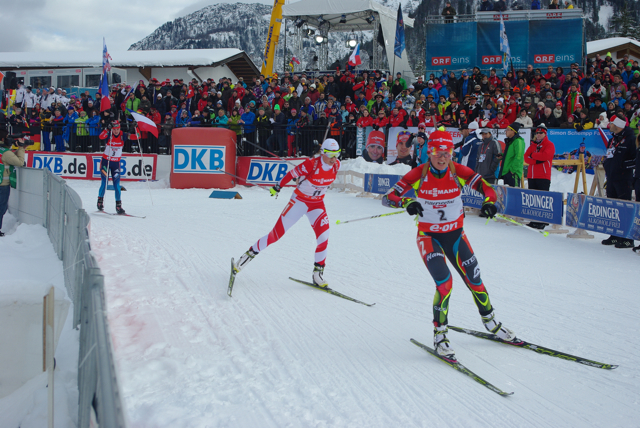
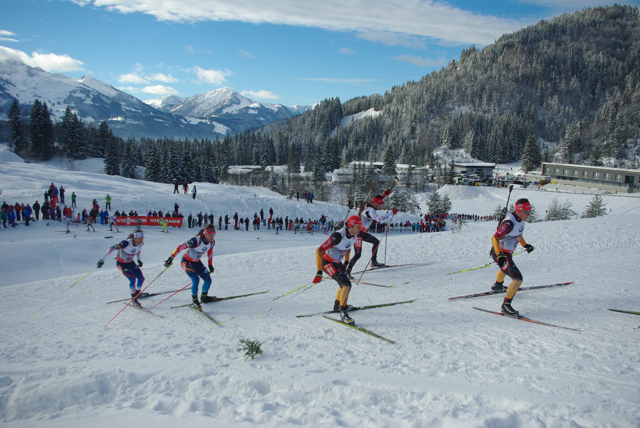
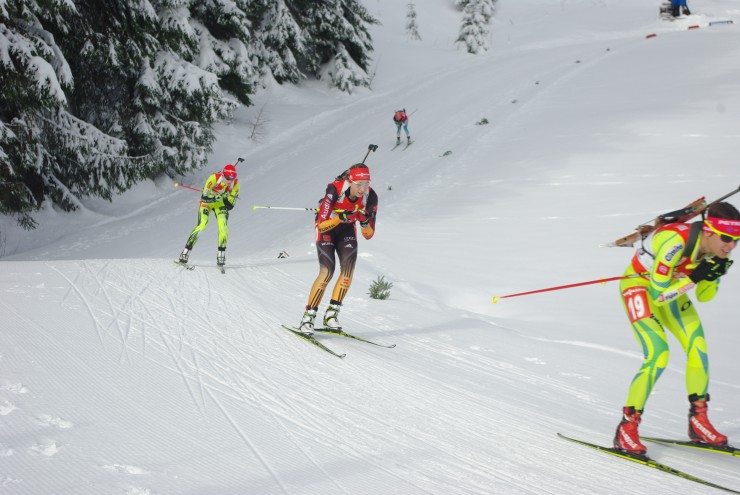
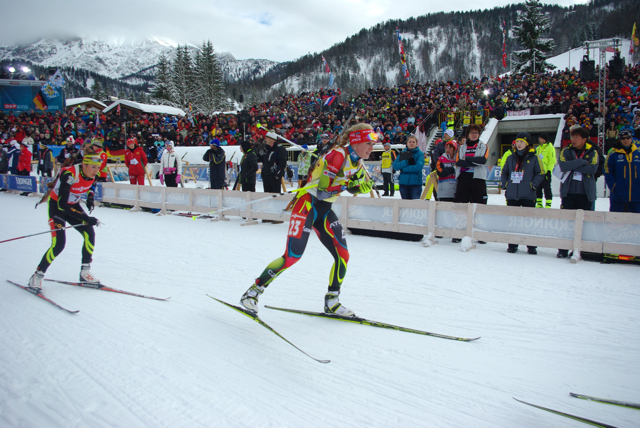
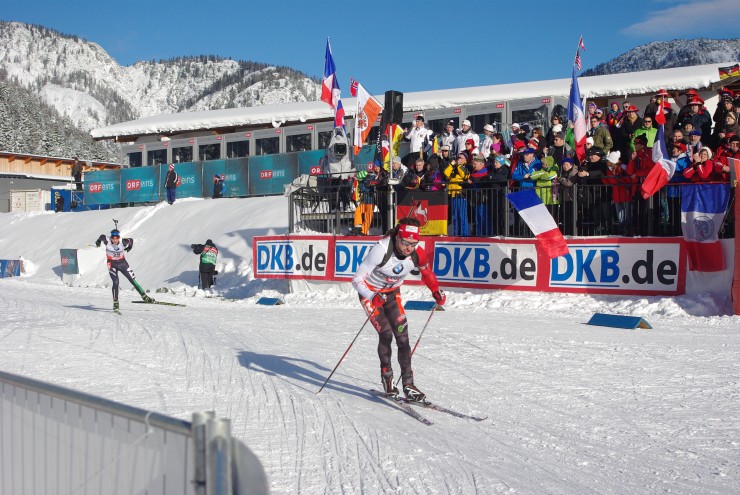
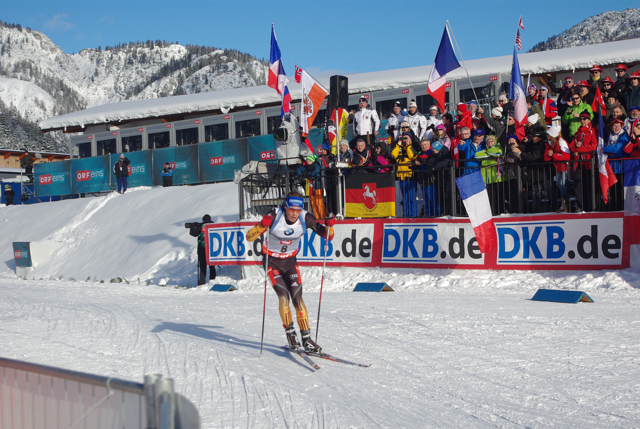
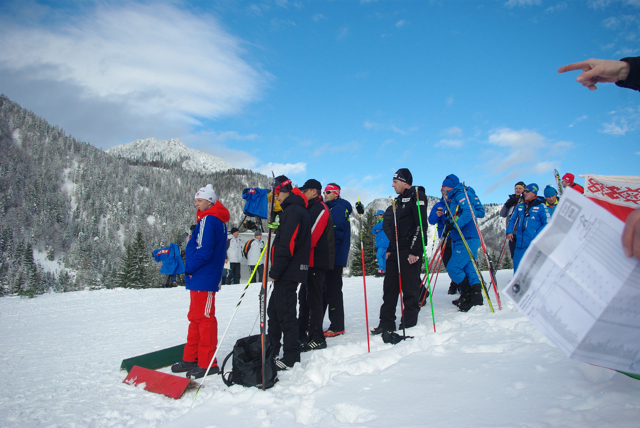
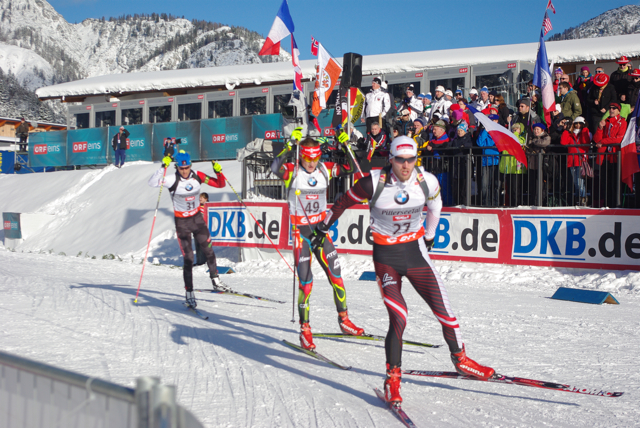
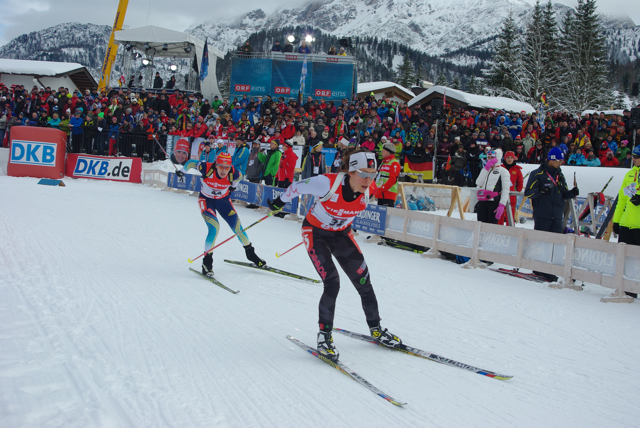
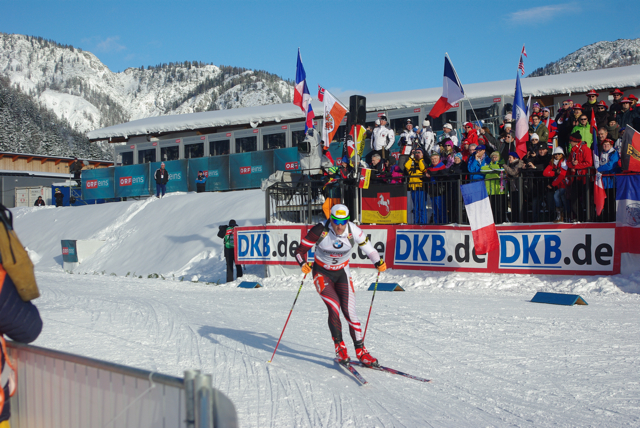
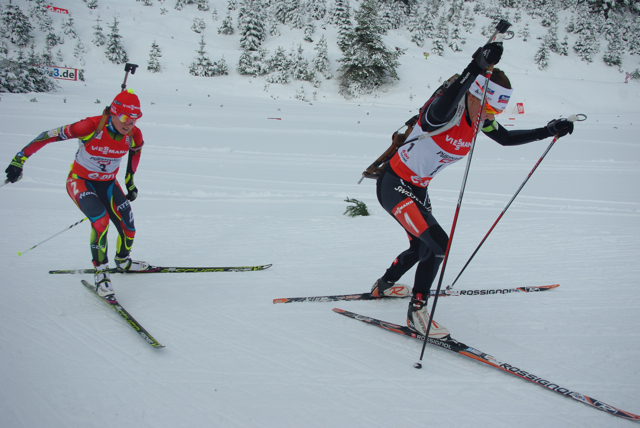
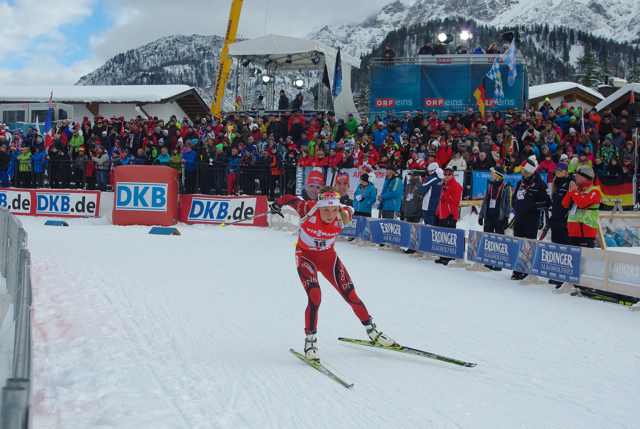
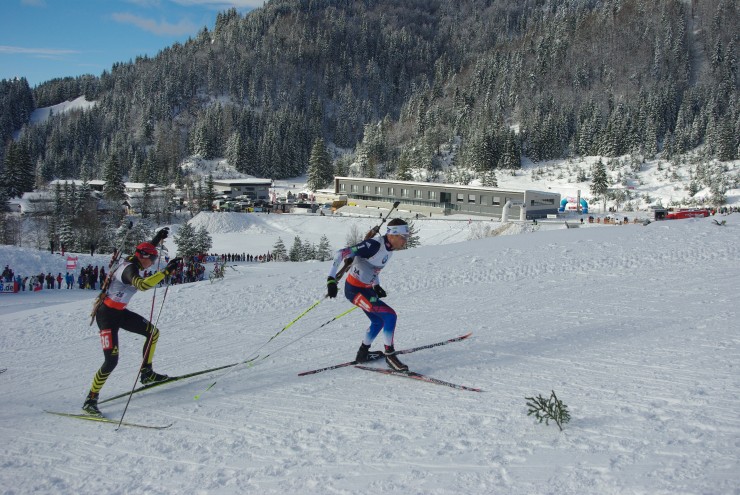
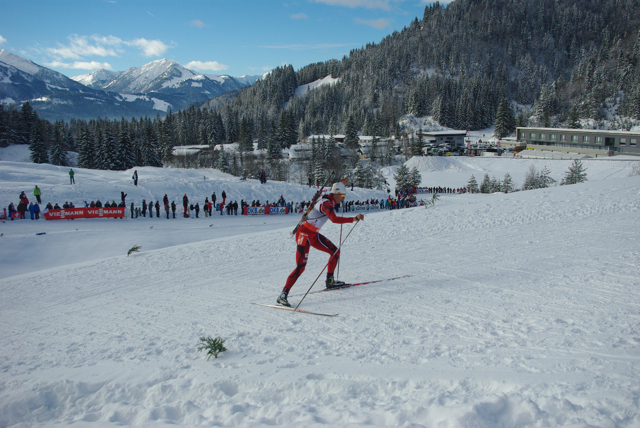
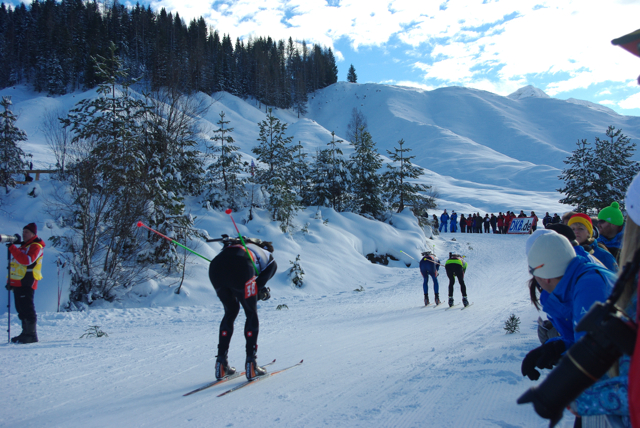
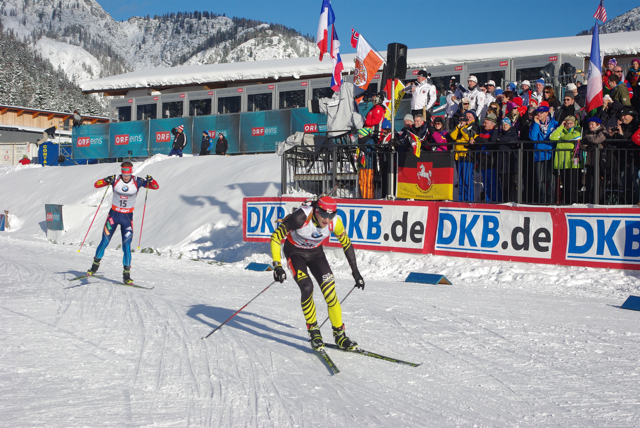
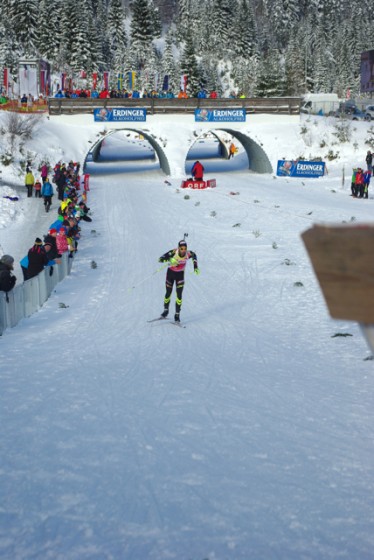
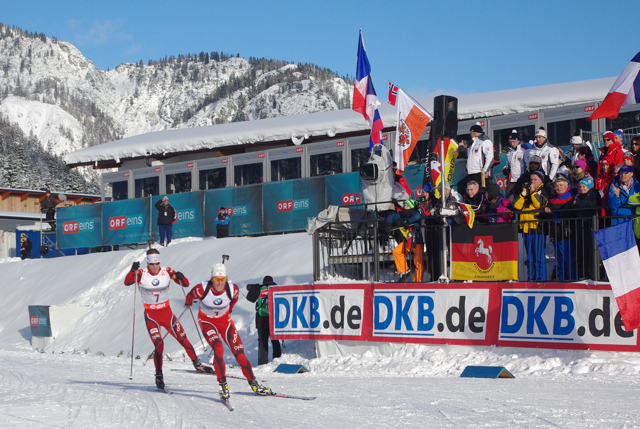
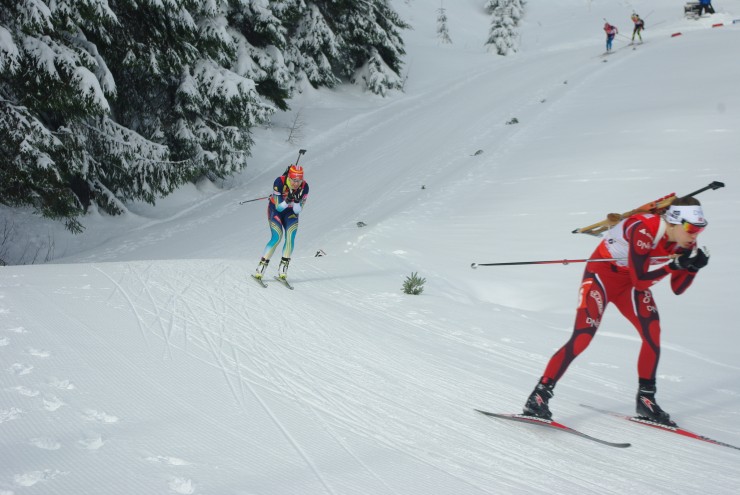
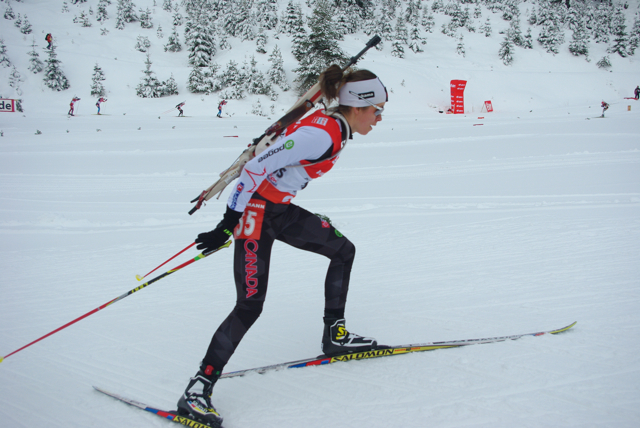
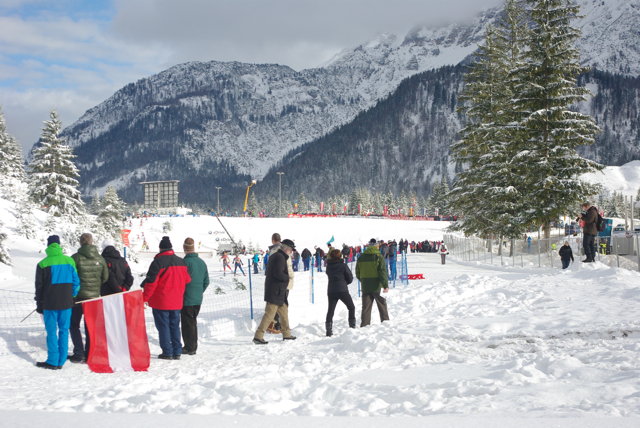
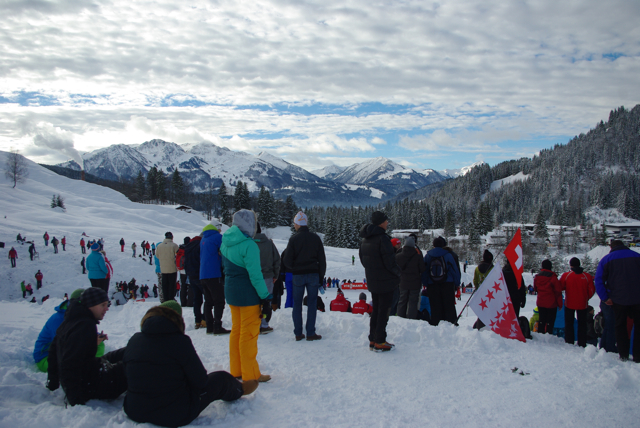
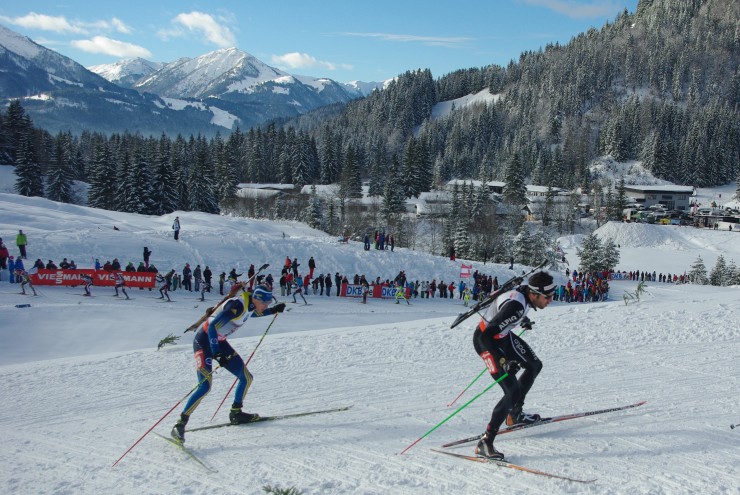
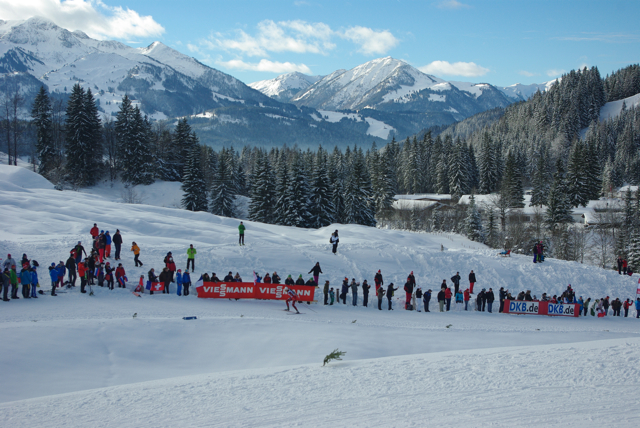
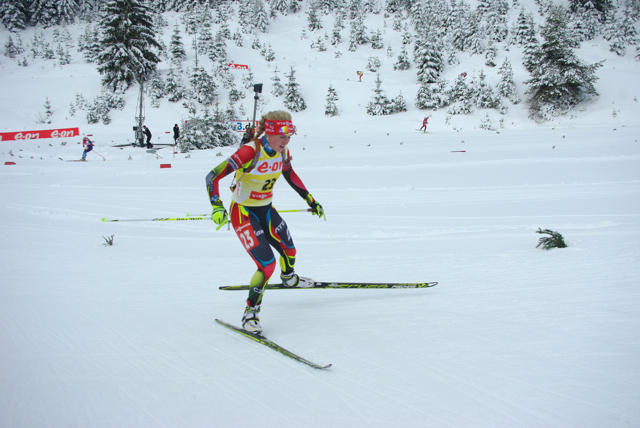
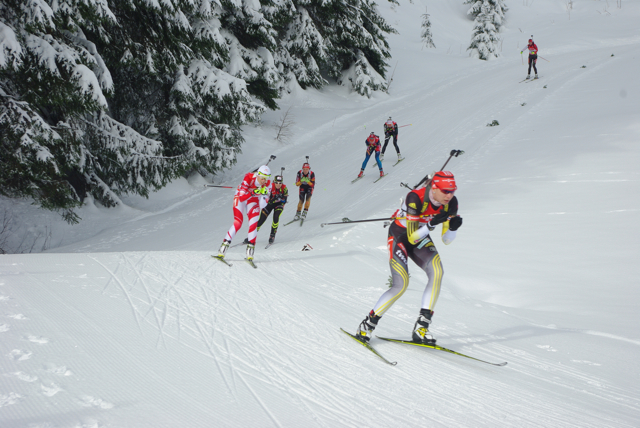
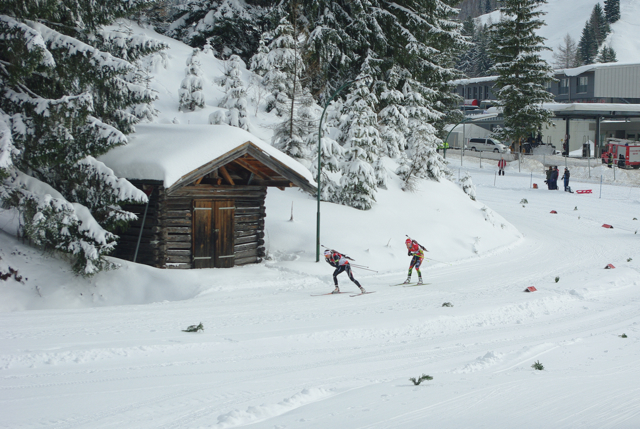
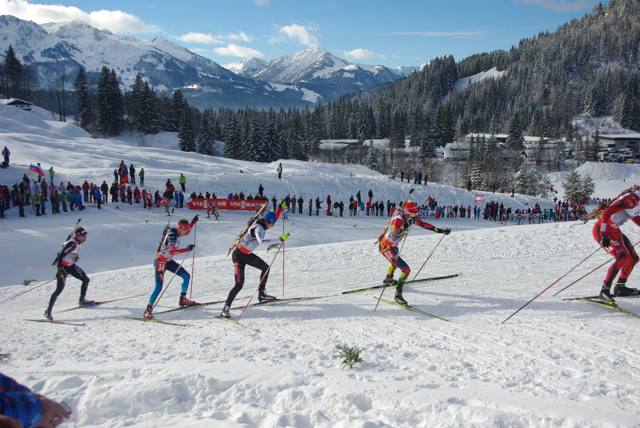
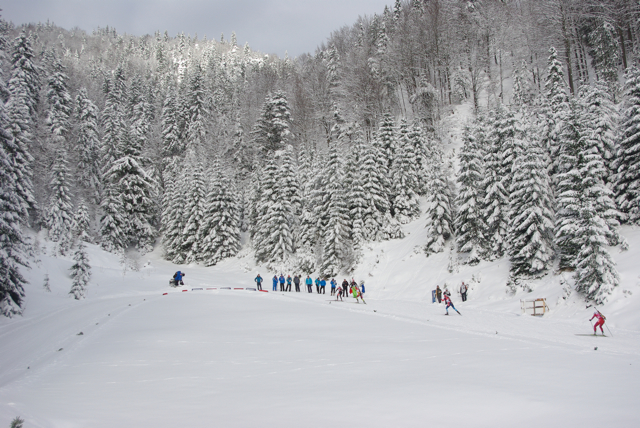
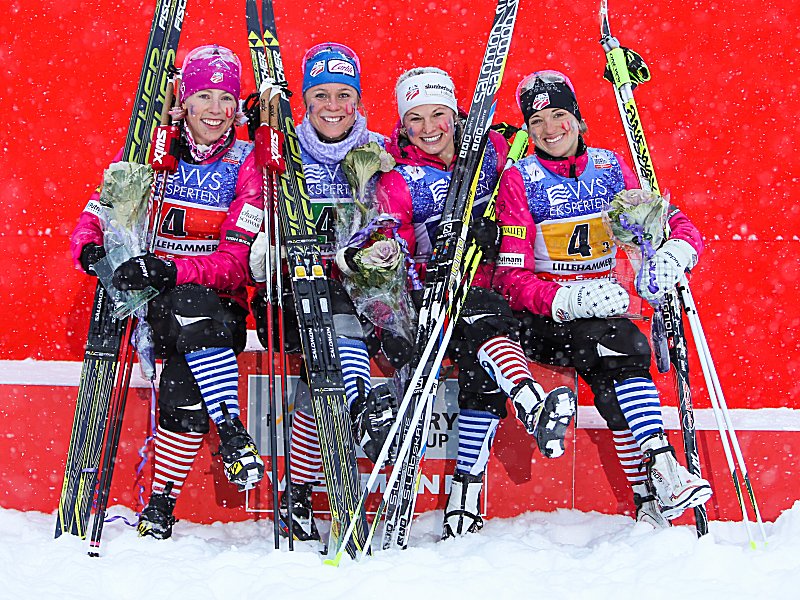
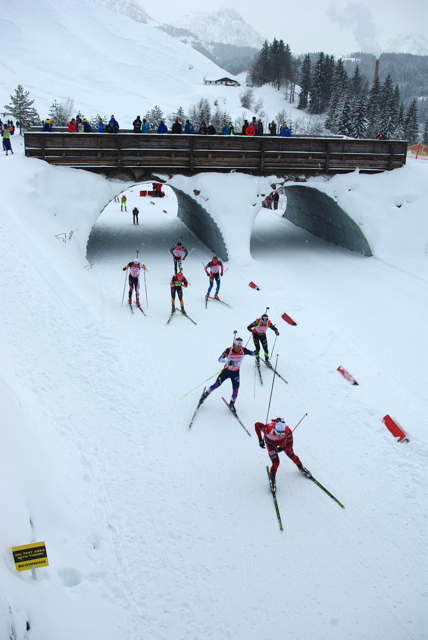
Benedikt Doll of Germany has never won a World Cup — but he did take World Championships gold on Saturday in the men’s 10 k sprint in Hochfilzen, Austria. “In the end, there was the fight with Johannes [Bø]… I thought Johannes will make it. It was crazy in the end that it was me on the top,” he said at a press conference. (Photo: Glen Crawford)HOCHFILZEN, Austria—On a day when the wind seemed like only a flutter, it could still throw the World Championships biathlon field into disarray.
Take Martin Fourcade, the best biathlete in the world this year. He missed two shots out of ten: one in prone, and one in standing.
“When I crossed the finish line, I expected to be top ten,” the Frenchman said in a press conference. “Then when I saw the race I expected for top five.”
He ended up third – a pleasant surprise.
Ten men shot clean, and four of them landed in the top six. Benedikt Doll of Germany claimed his first top-level win – at World Championships, no less, and by just 0.7 seconds over Norway’s Johannes Thingnes Bø. Both shot clean and were late starters; the race came down to whether or not Bø could keep a 9.3-second lead over Doll on the final 3.3 kilometers. He couldn’t.
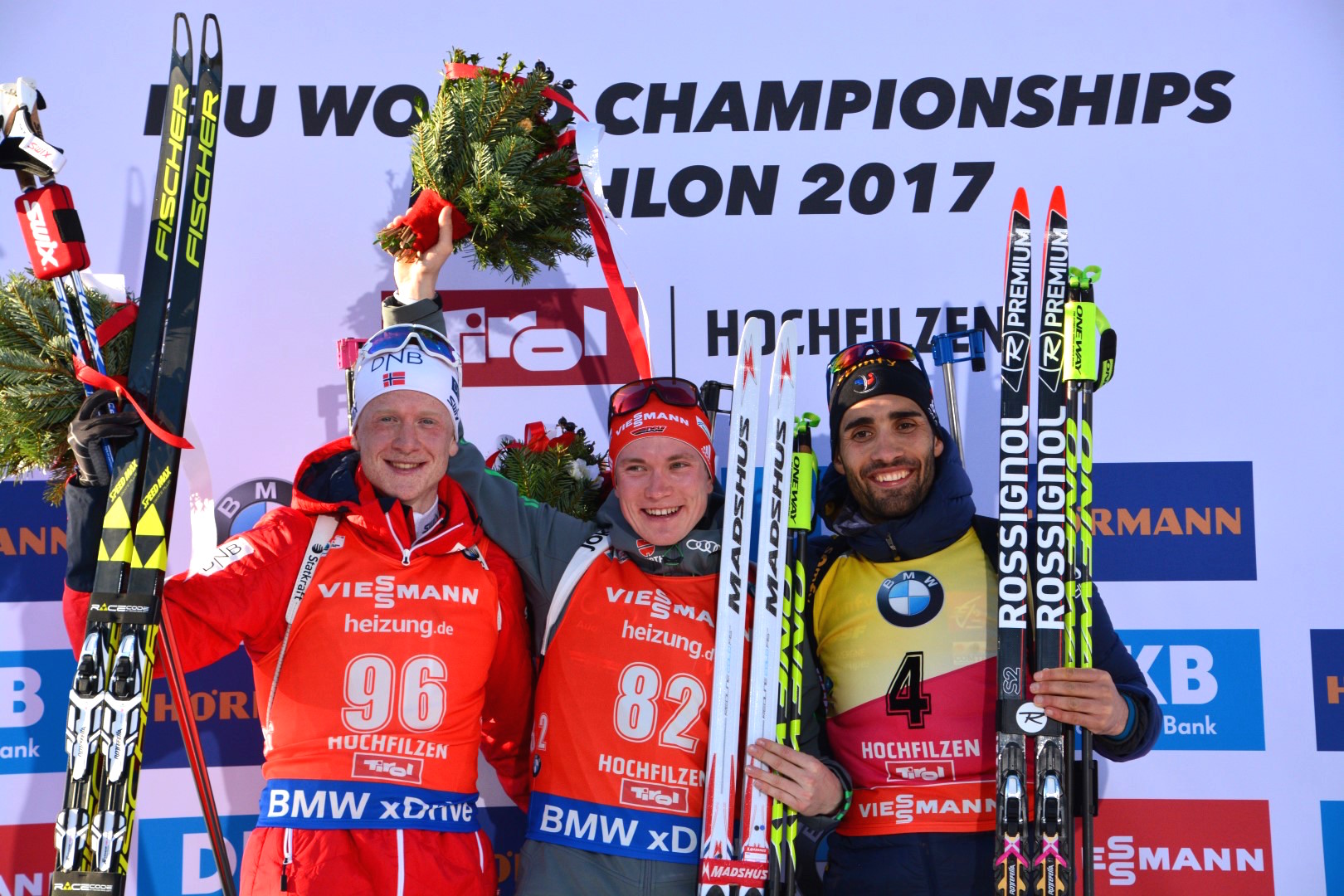
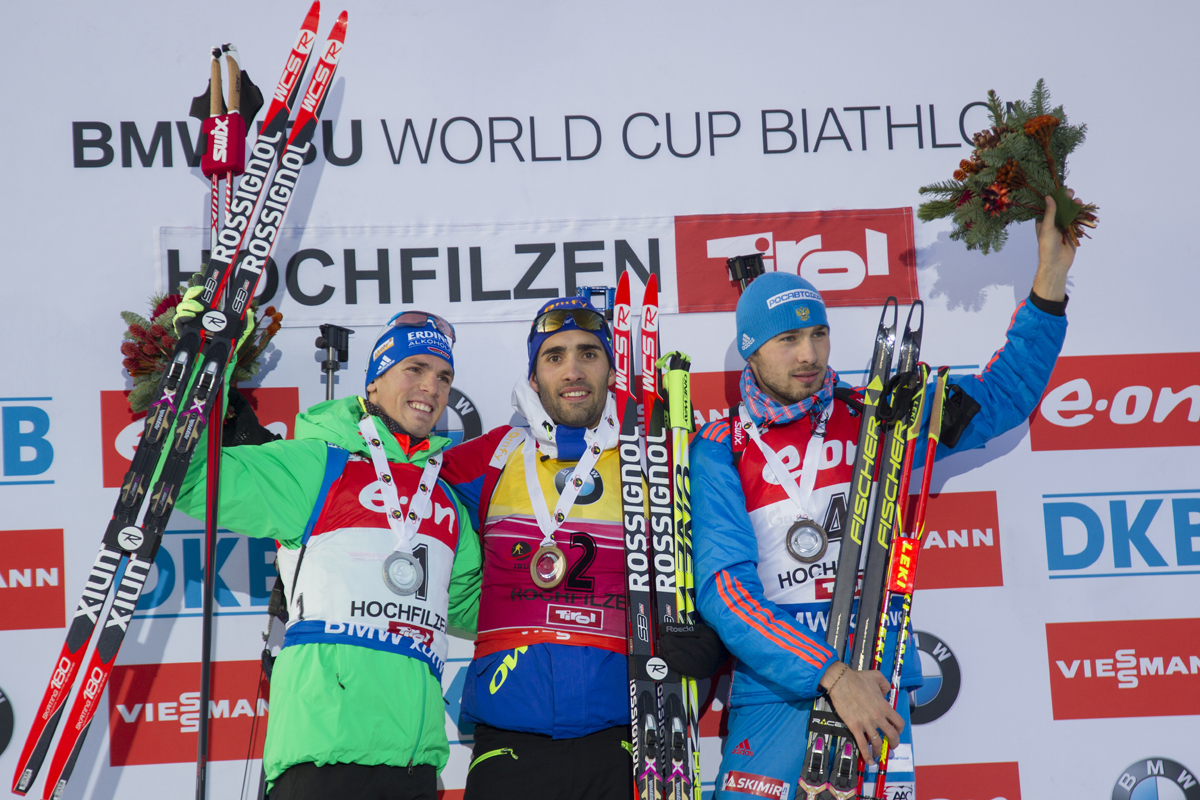
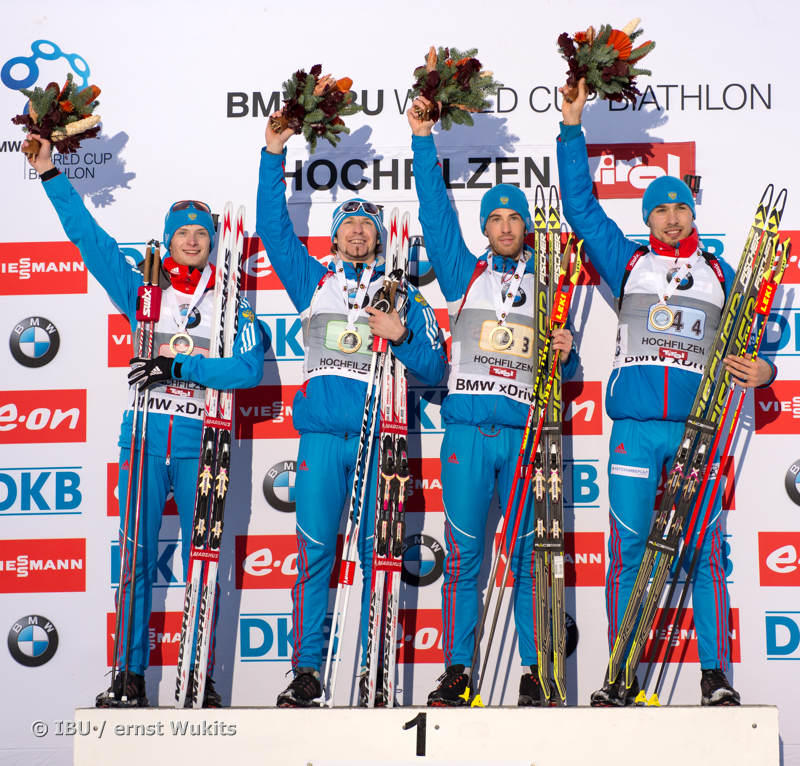
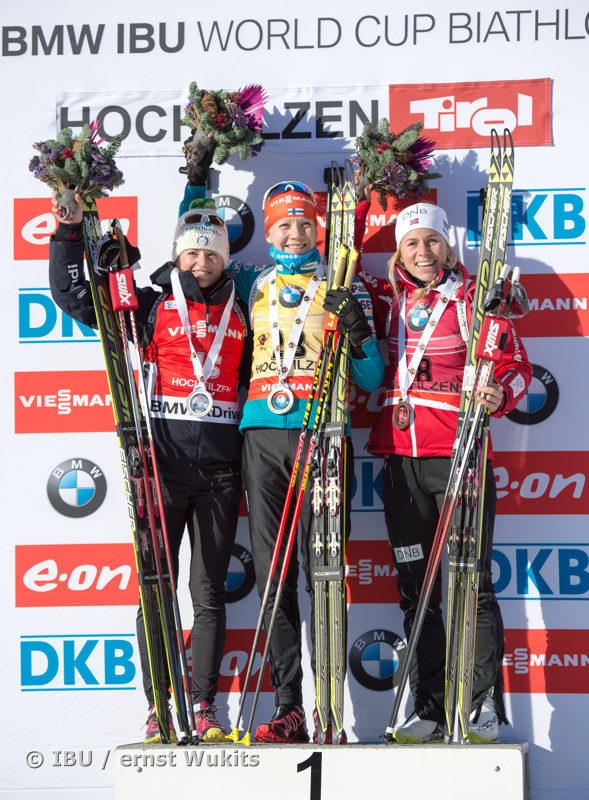
The men’s 10 k sprint podium at 2017 IBU World Championships, with German winner Benedikt Doll (c), Norway’s Johannes Thingnes Bø (l) in second, and France’s Martin Fourcade (r) in third. (Photo: Glen Crawford)
“It’s not so fun to go out of standing as the leader and lose seconds and be number two at the finish,” Bø said. “Especially when it’s that close… I did a quite good race and I was really fighting on the last loop. The last two kilometers I was really fighting deep. My head wanted to win today, but my legs couldn’t follow the head. That’s why I was in second place.”
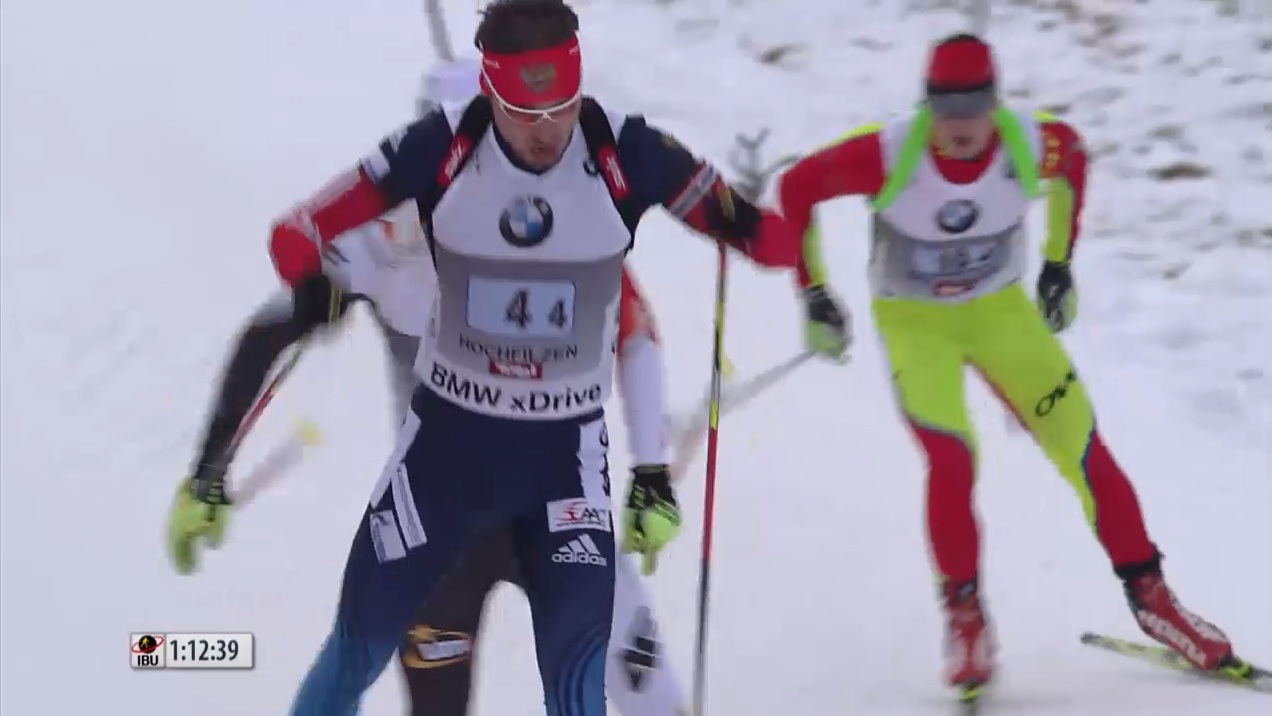
Doll, meanwhile, had seen Fourcade (bib 4) finish before he even started. Knowing that he had two penalties in hand, Doll saw his chance.
“I know that if I can make a perfect race, I can win,” he said. “The whole season I had always problems with my shooting. So I had really good feeling at the zeroing, especially standing shooting, I felt really sure… After the fourth shot in standing, there comes something in my mind that says, if you make a clean shooting you maybe will get to be World Champion. I hit the last target. I think that was one of the best moments today.”
“This year I have really tried to step back from worrying about where I end up on the result list and focus on the quality of what I’m doing, both in shooting and skiing,” he said. “Today I went out and really tried to execute the technique that I wanted to execute. And also on the range, to do what I have been training on the range all year to do. Some days it doesn’t work, and today it worked.”
The top finish for the home team went to Julian Eberhard, who placed seventh (+35.5) despite two penalties.
Three in the Points for Canada
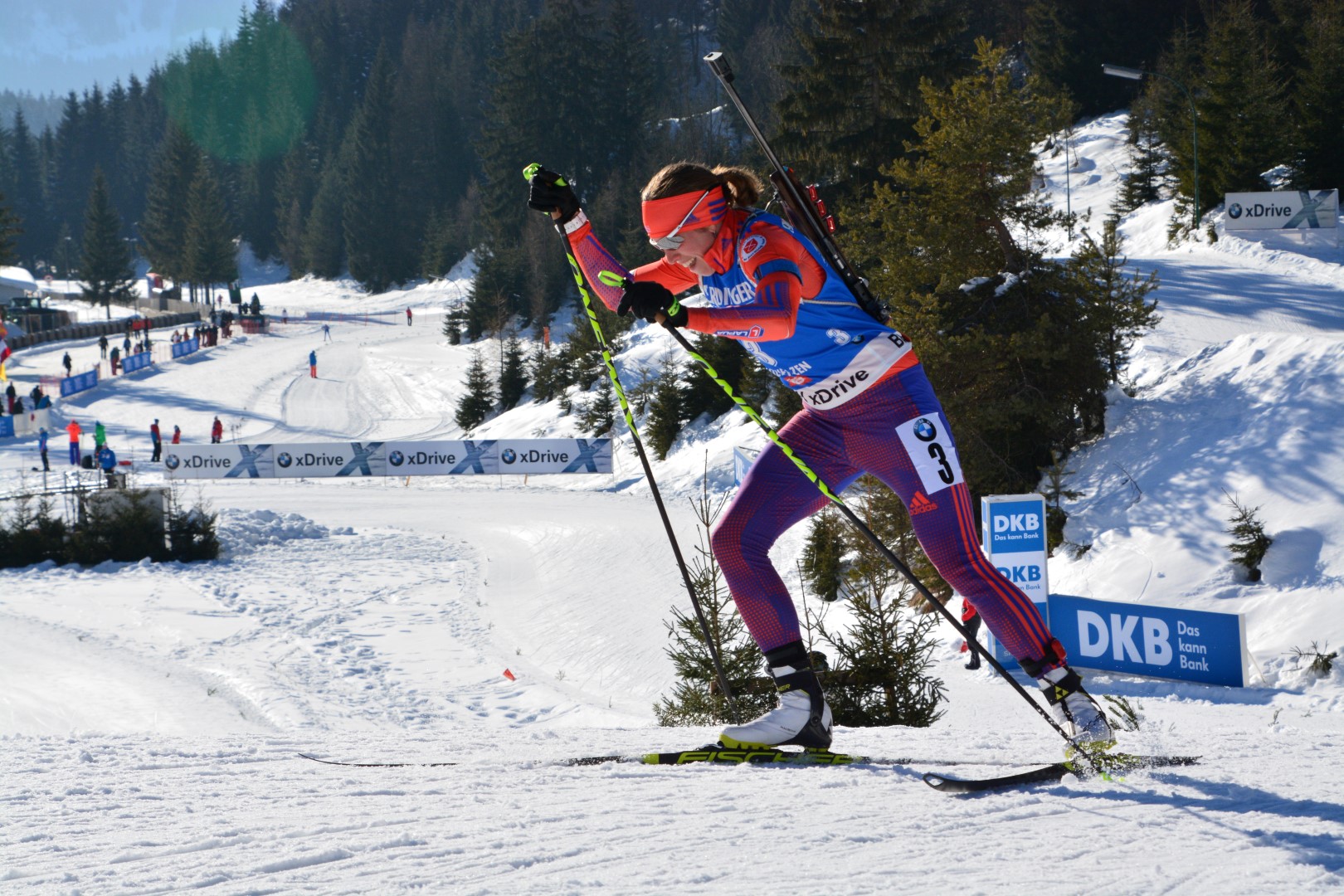
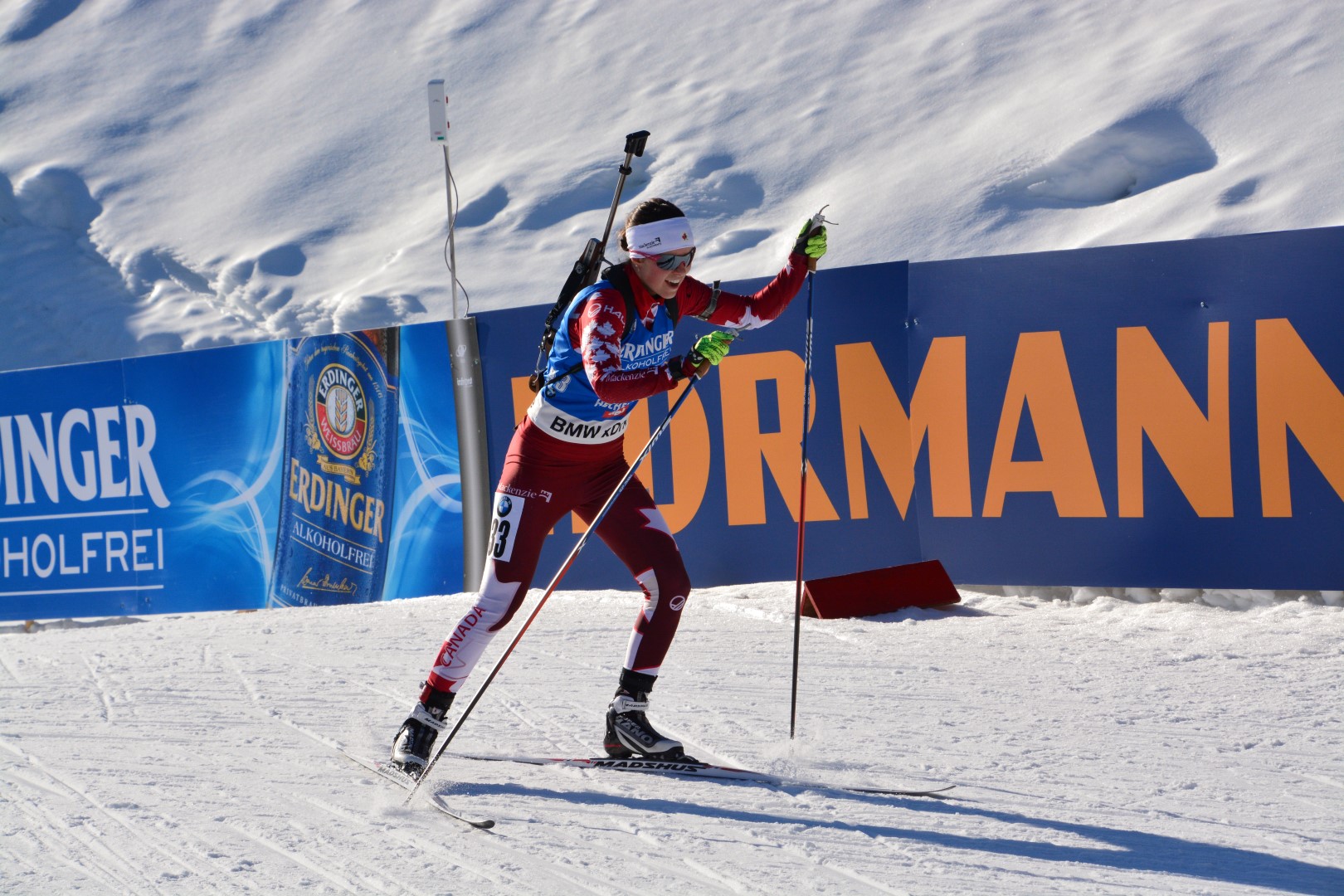
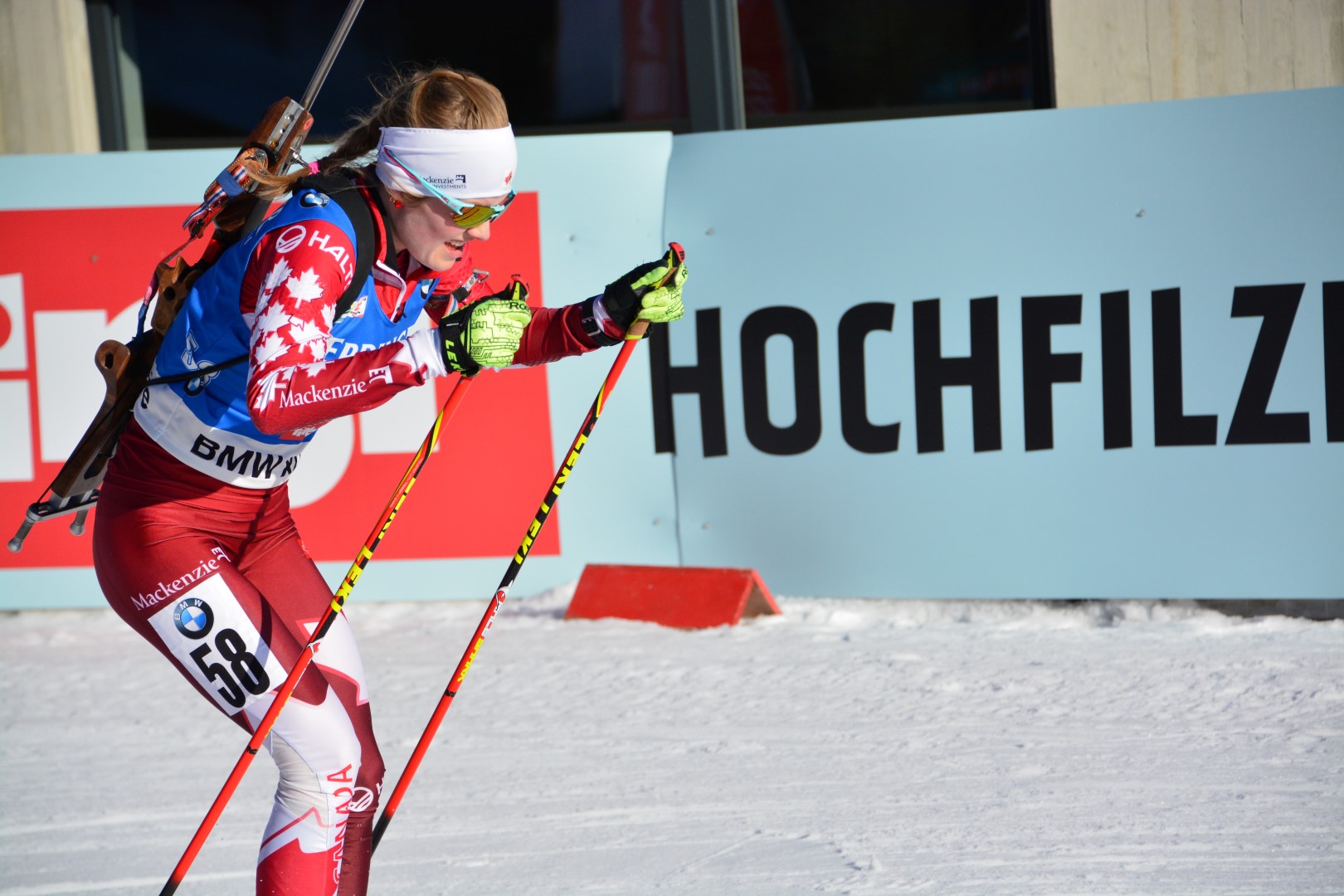
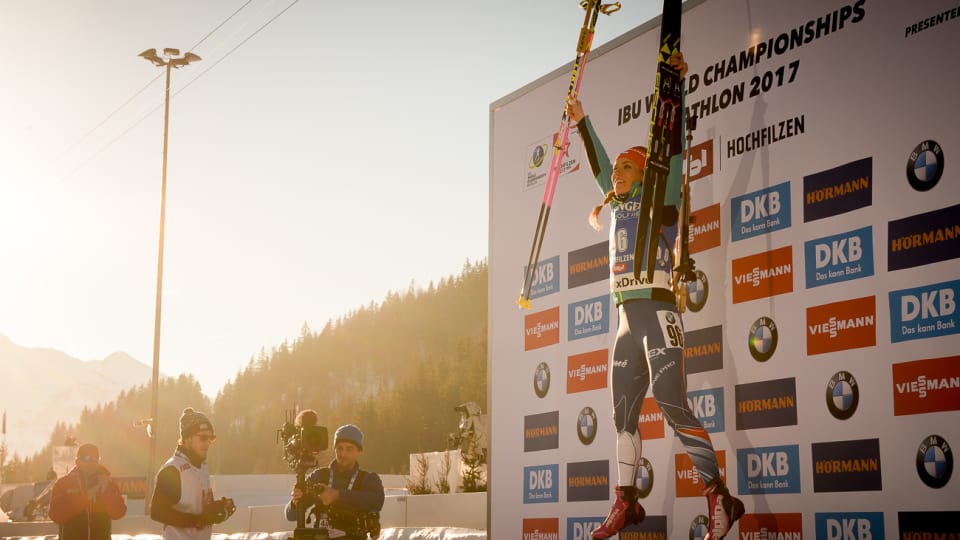
Much like Fourcade, Canada’s top finisher Scott Gow had two penalties and was relieved that much of the rest of the field struggled as well. He landed 25th, +1:22.4, for the second-best World Championships finish of his career.
“I was definitely disappointed,” Gow said of the missed shots. “But I knew that if I wanted to be in the pursuit or have a good result I had to go extra hard. So that was my motivation… It’s a solid result, to be honest. I’m really lucky that everyone else also missed today. Martin is winning [right now] with two misses. So I’m in the same ballpark as the top part of the field, which is good. Because otherwise I’d probably be close to the [top-60 pursuit qualification] bubble.”
Gow attributed the misses to nerves, saying it was “all me” and not the tricky wind.
“I was just too much inside my own head for the first shot — I just pulled it,” he explained. “Then the rest of the five were fine. Then I had the opposite in standing, where the first four were great, and I just tensed up and missed the last one… My sprint racing has been quite strong, especially in the first trimester where I cleaned every sprint. I was trying not to think about that and just do what I did in those races, but at an event like this the pressure is extra high.”
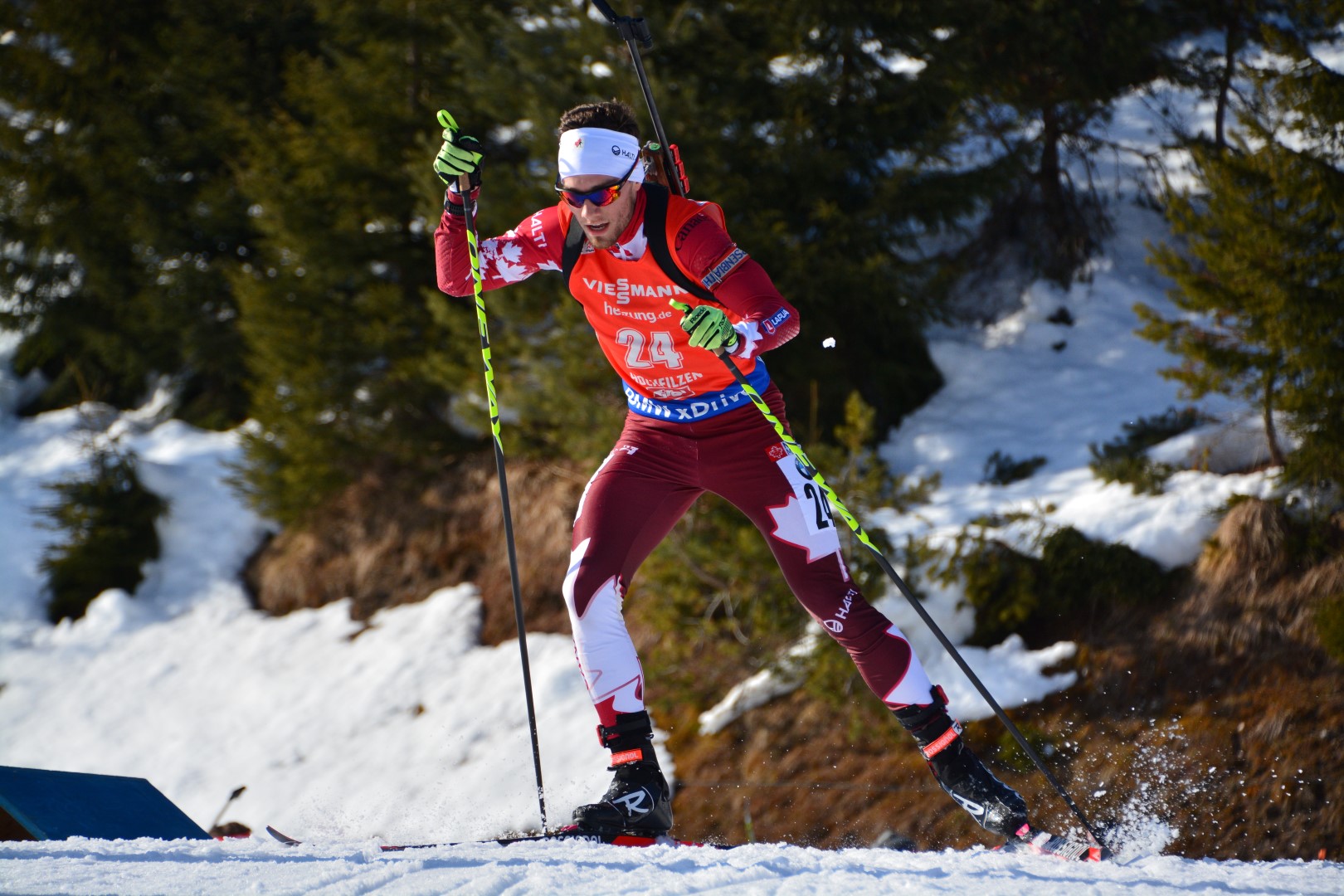
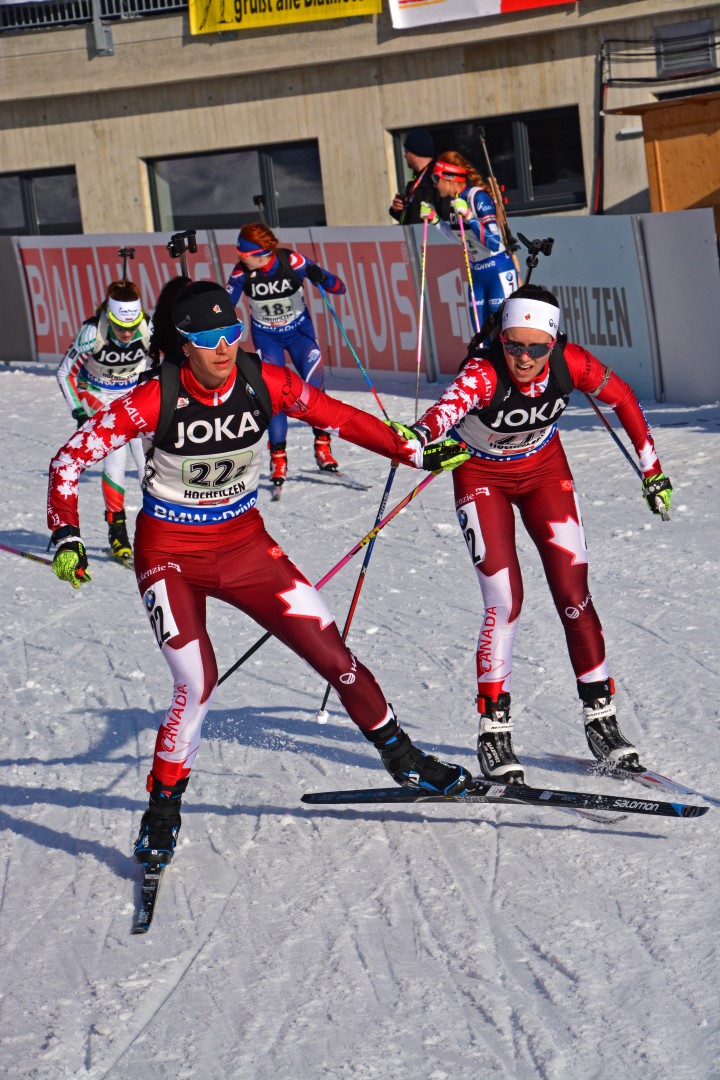
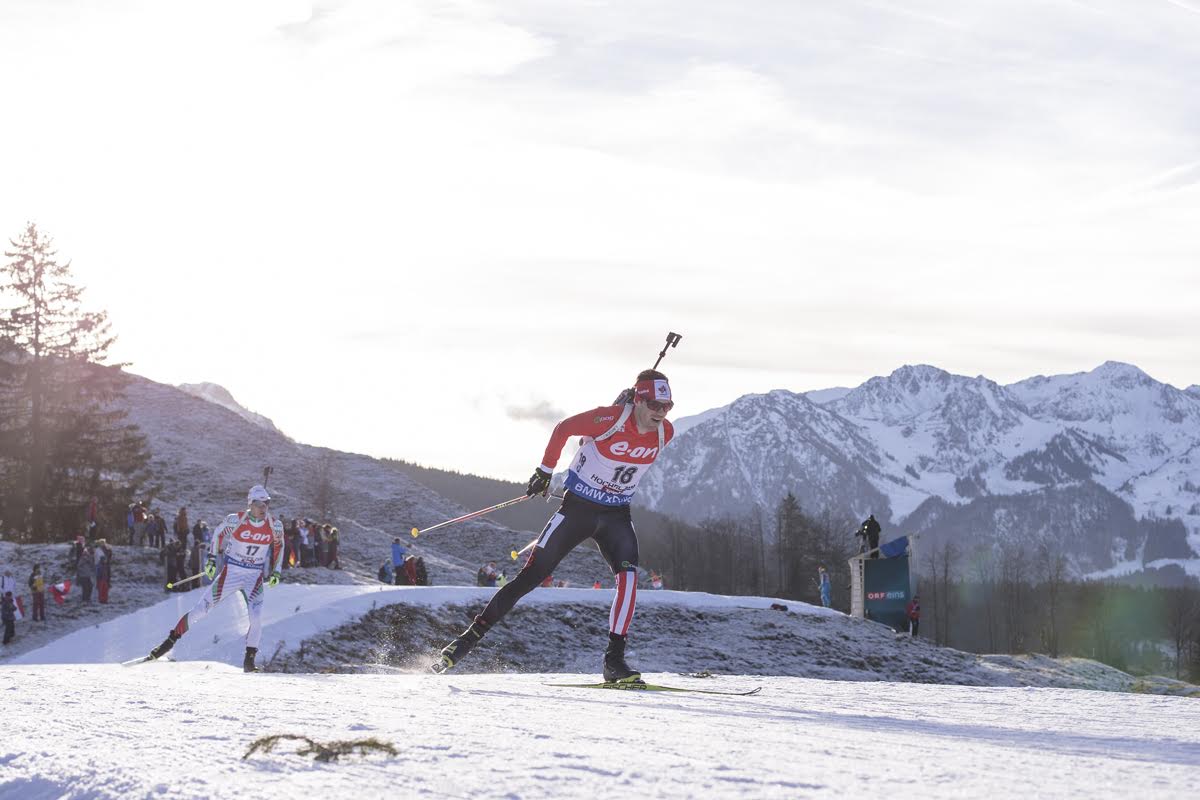
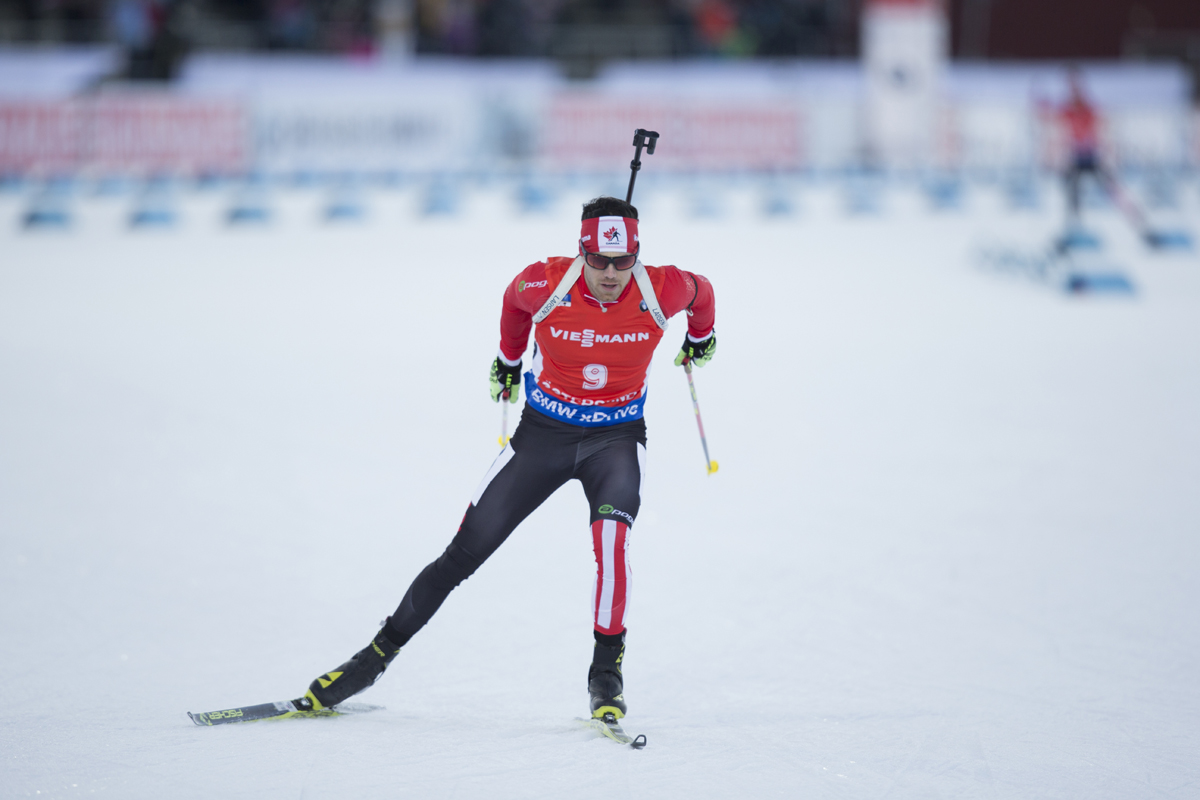
Canada’s Christian Gow racing to 32nd in the men’s 10 k sprint at 2017 IBU World Championships on Saturday in Hochfilzen, Austria. (Photo: Glen Crawford)
His brother, Christian Gow, did clean all ten targets and landed 32nd (+1:30.6).
“I shot clean, obviously a big advantage,” the younger Gow said. “It looks like the field isn’t shooting so well, so that’s important. Skiing wasn’t exactly where I’d like it to be. I felt like I pushed really hard and left it all out there, but I’m not sure why.”
All in all, he said, he was satisfied with the race: “I just went out and did what I could, and I’m happy to be here and happy to have done that.”
Team veteran Brendan Green will join the brothers in the pursuit after finishing 38th (+1:36.4) with one penalty. Green was disappointed with his skiing as well.
“The skiing, it just hasn’t been there this season,” he said. “I tried my best. I gave it my all. But for sure I was hoping for more.”
Macx Davies, who finished 79th (+2:53.4) with two penalties, agreed: “It has been hard finding my legs this season.”
For the Canadian team, it will be back to the drawing board to try to regain speed before next season’s Olympics in PyeongChang, South Korea.
“It’s hard,” Green admitted. “I have been trying to take it trimester by trimester. At this point of the season I’m just trying to ride out the season and do the best that I can. Once we’re back home, we are definitely going to sit down and evaluate and see where things might have gone wrong.”
U.S. Team Solid Behind Bailey’s Fourth Place
While Bailey’s flower-ceremony appearance highlighted the U.S. results, all four starters made the top 40. That’s easily under the top-60 cutoff to appear in Sunday’s pursuit.
Leif Nordgren placed 26th (+1:24.3) with one missed shot. After injuring his toe in an accident in November and missing almost the entire first period of World Cup racing, as well as part of the second, Nordgren said the result was just fine.
“The one miss I had was a really bad one, so I’m kind of pissed about that,” he said. “I tried to take my time and make sure that all the shots were quality. Nine of them were, one of them was not. [On skis] I actually felt good. It has been kind of an interesting year for me with the whole toe thing, so I don’t have that many races yet… I’m not unhappy with where I am right now. What happened happened and I can’t really change it now. I can just do my best.”
Sean Doherty had also missed more than half the World Cup season to date, thanks to mononucleosis. He missed two shots in prone and finished 39th (+1:37.7).
Right behind him was Tim Burke, who missed two shots in standing to finish 40th (+1:38.6).
“I just got out of rhythm trying to get that second shot,” he said.
Like some of the Canadians, Burke has been working to find his ski speed. It didn’t show up today, at least not the way he wanted it to.
“I have no idea,” he admitted about his skiing. “I’ve been feeling good training, I’ve just felt really flat so far racing this, pretty much this entire year. I don’t know what’s going on… I had to take a break after the first few days of the [pre-Championships] training camp because I felt so bad. Not sick, I felt totally healthy, just really really flat. So I really only had about a week preparation. I was hopeful – I had a few sessions where I felt like, oh, maybe it’s coming back. But I haven’t felt that yet in a race.”
For seven of the eight North Americans, though the pursuit will be a chance to see if head-to-head racing can bring the fire. 15th and 55th place in the sprint were separated by one minute; the opportunity to move up in the field is huge.
And if anything was proven in the sprint, it’s that shooting well could mean a lot.
“Even on a day like today where it seems like it’s pretty calm, the shooting is really challenging,” Burke said. “Especially in prone. So I’m hopeful that I can get something going tomorrow. Just being around other people, being able to ski with other fast guys — maybe that can help me find the rhythm a little better.”
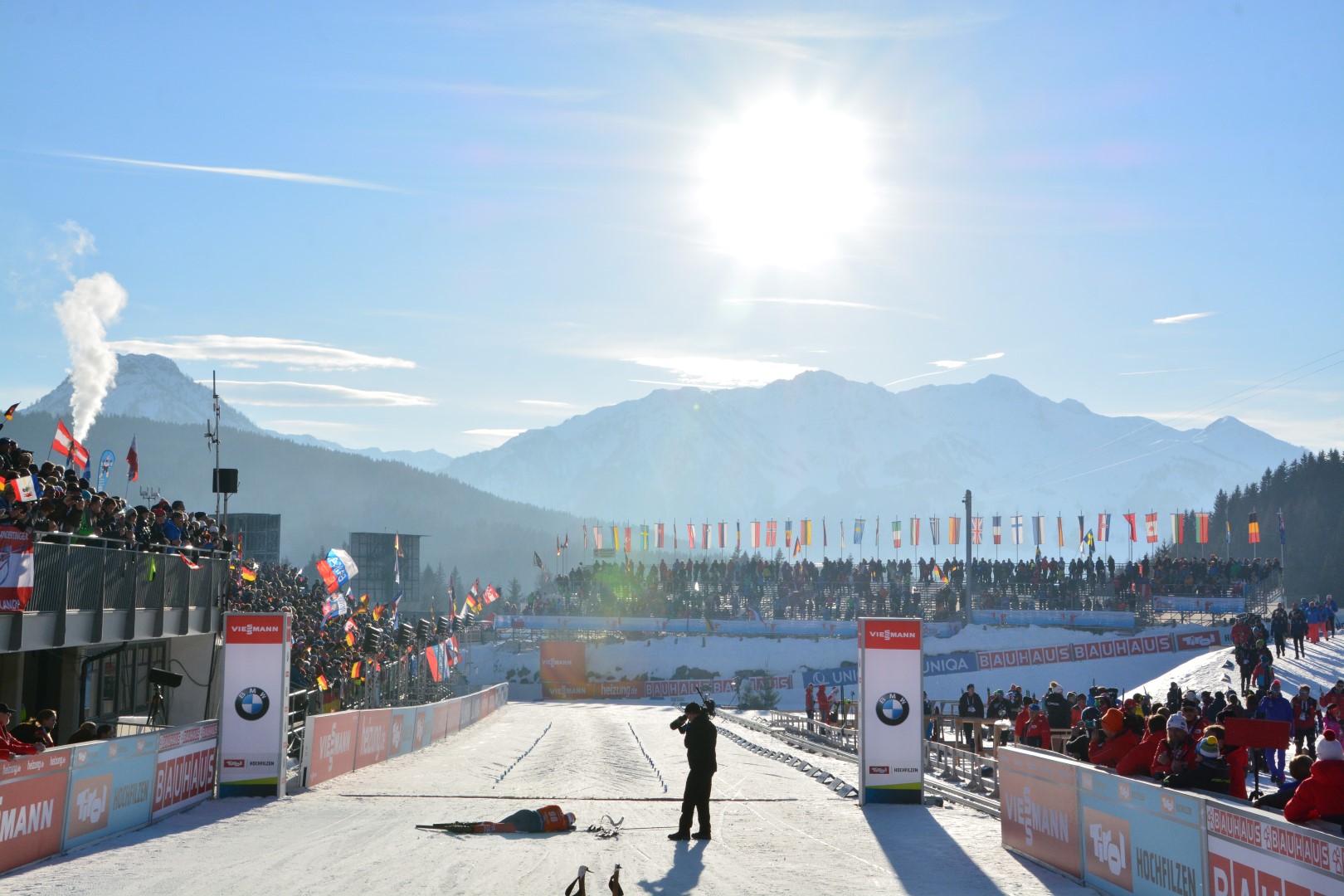
Norway’s Johannes Thingnes Bø (l, on ground) after finishing second in the men’s 10 k sprint at 2017 IBU World Championships in Hochfilzen, Austria. (Photo: Glen Crawford)
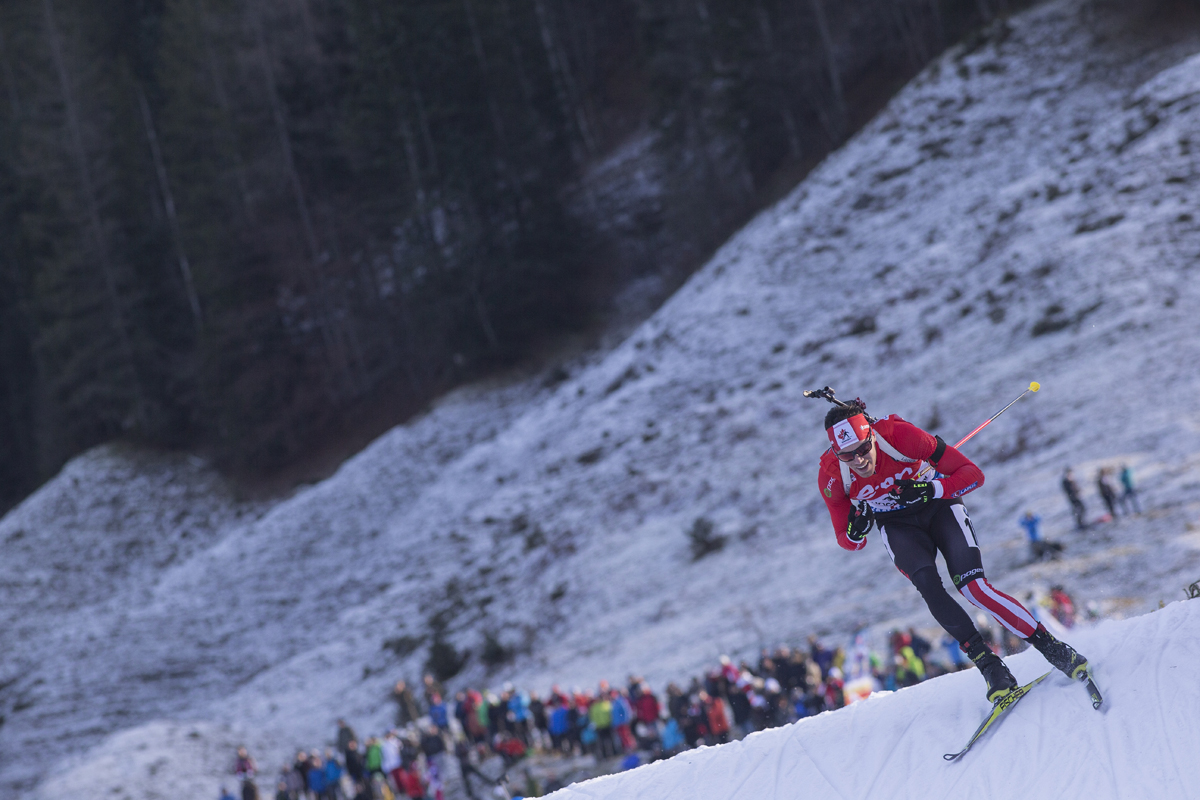
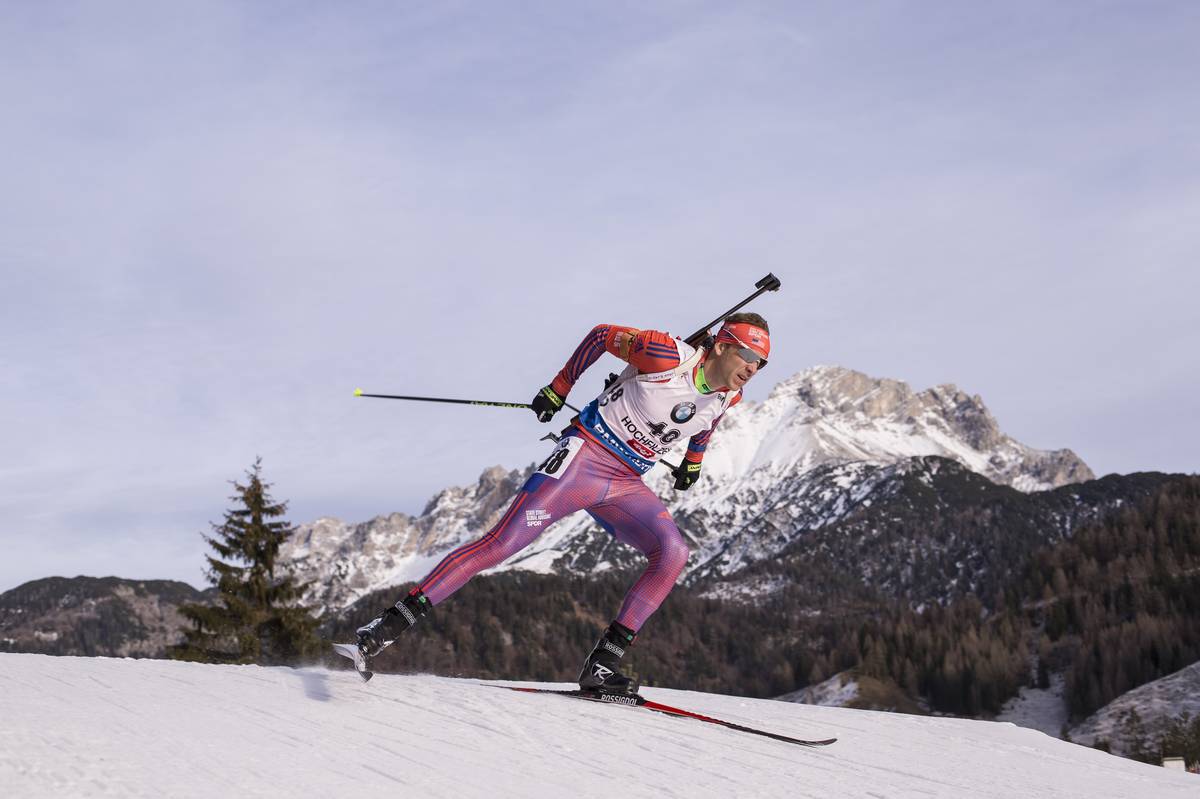
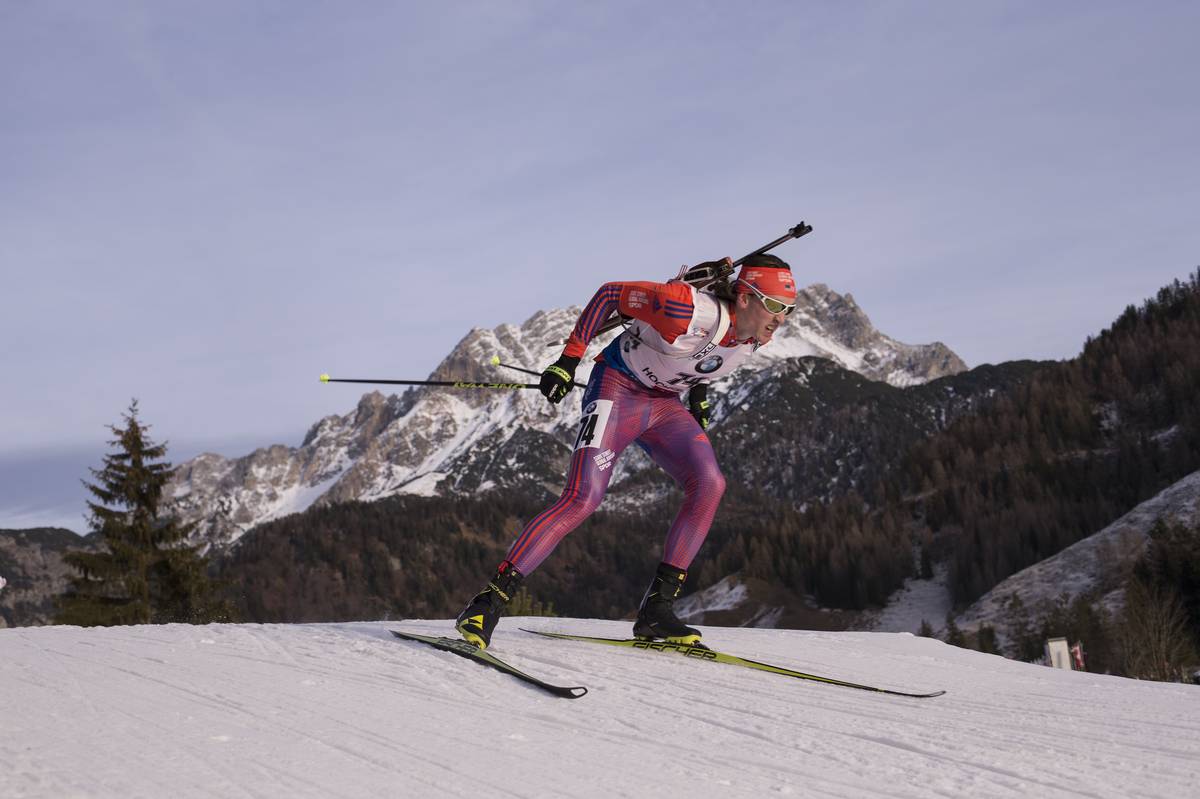
Lowell Bailey fighting his way to fourth place in the 10 k sprint at 2017 IBU World Championships in Hochfilzen, Austria. (Photo: USBA/NordicFocus)
HOCHFILZEN, Austria – The U.S. men’s biathlon team got off to a slow start this year. Sean Doherty had mononucleosis. Leif Nordgren injured his toe in a freak accident and had to miss weeks of competition. And Tim Burke said he has felt “flat” all season.
Many have been frustrated…
“Except for Lowell!” Burke exclaimed, referring to teammate Lowell Bailey. “One of the benefits of having a strong team is that when some of us have been struggling for different reasons, it’s great to have someone doing well. It brings up morale for the team a lot, and he has been that guy for us this season.”
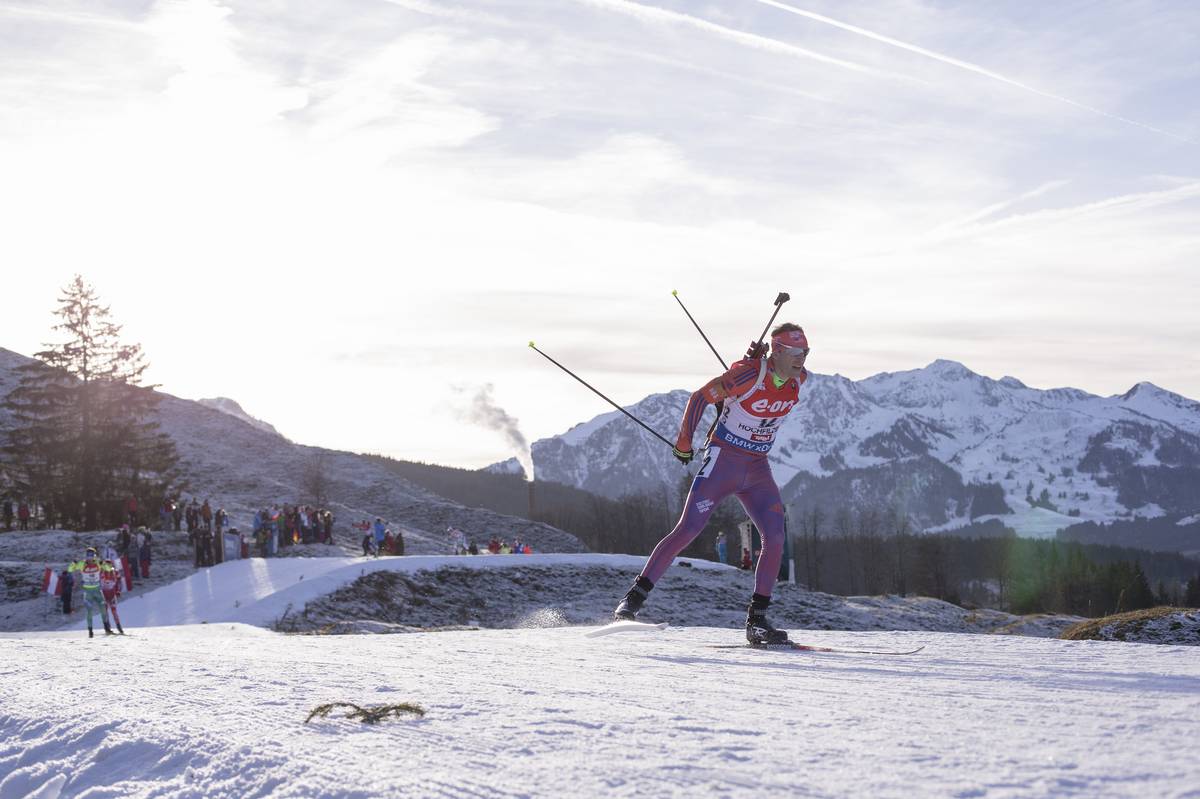
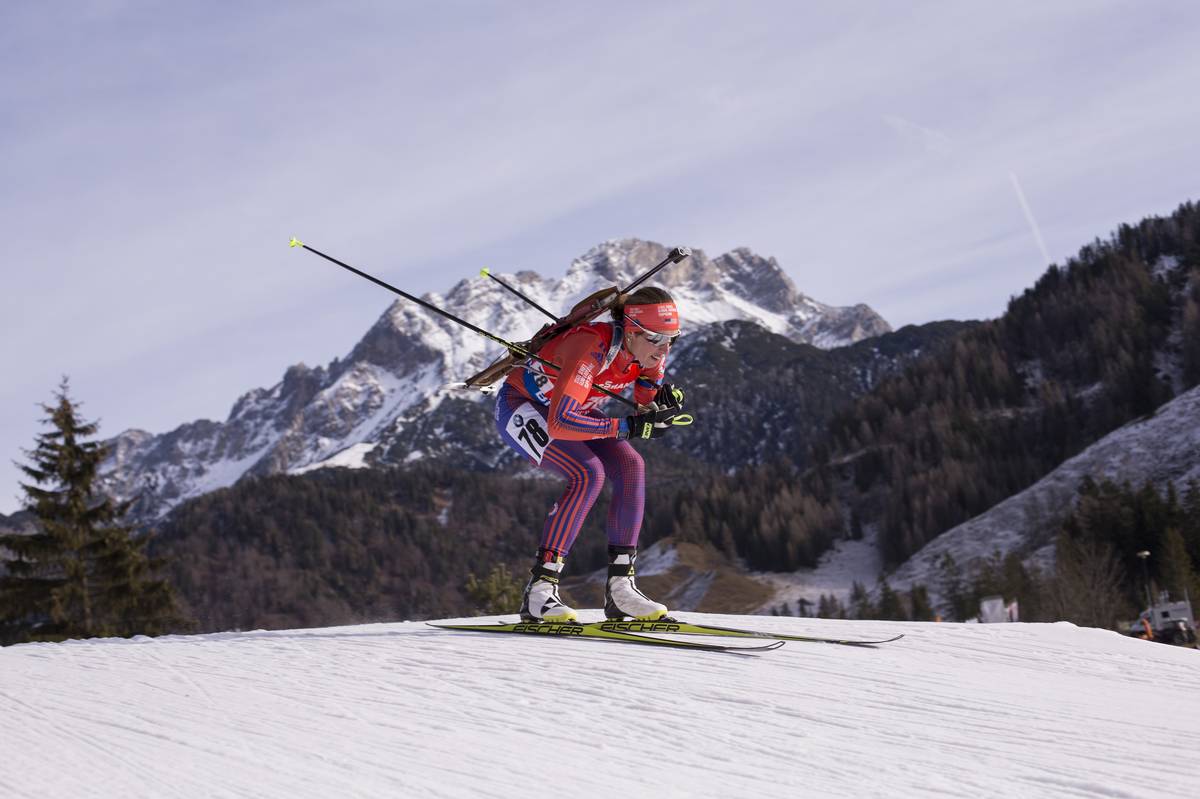
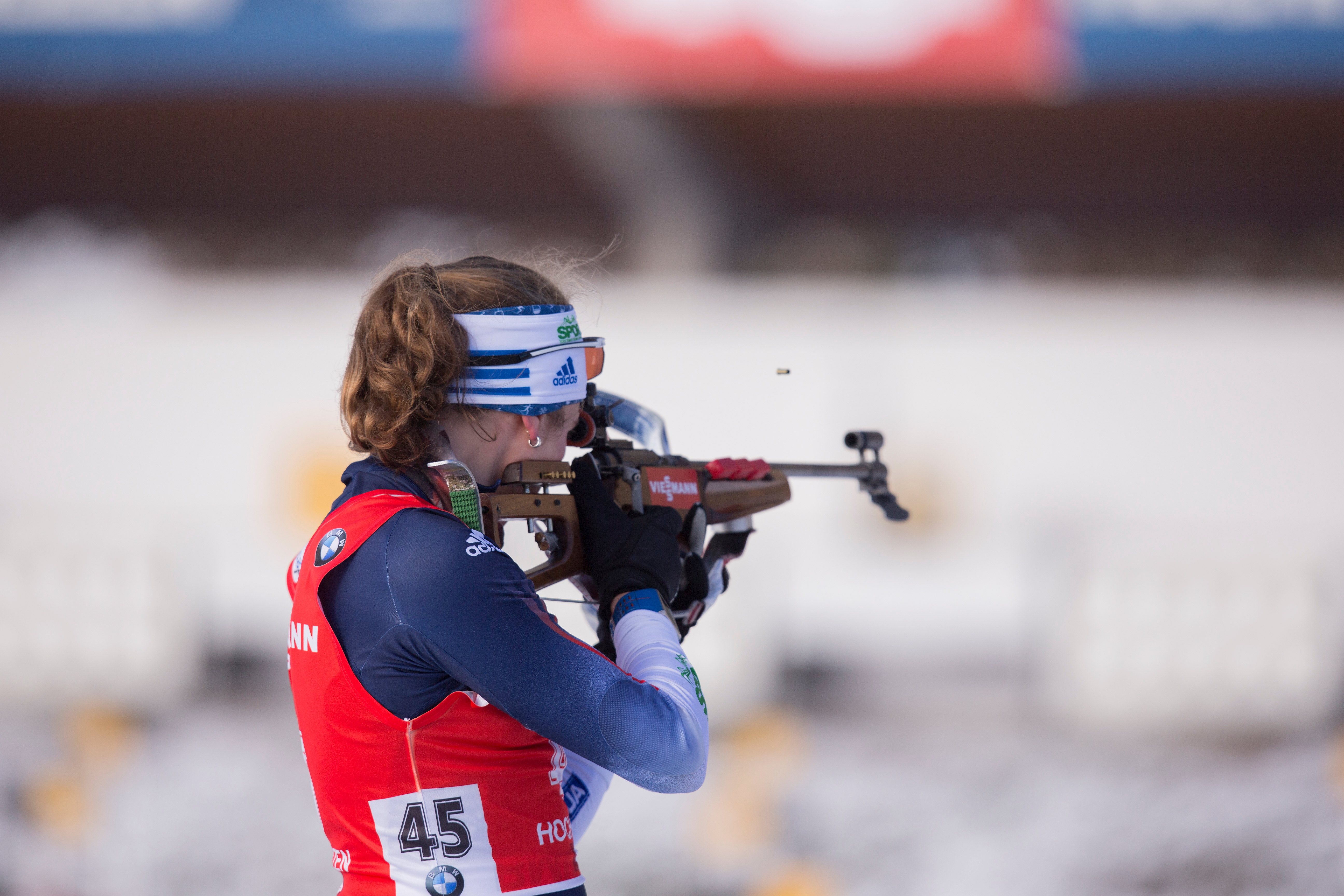
Lowell Bailey (US Biathlon) racing to fourth in the men’s 10 k sprint on Saturday at 2017 IBU World Championships in Hochfilzen, Austria. (Photo: Glen Crawford)
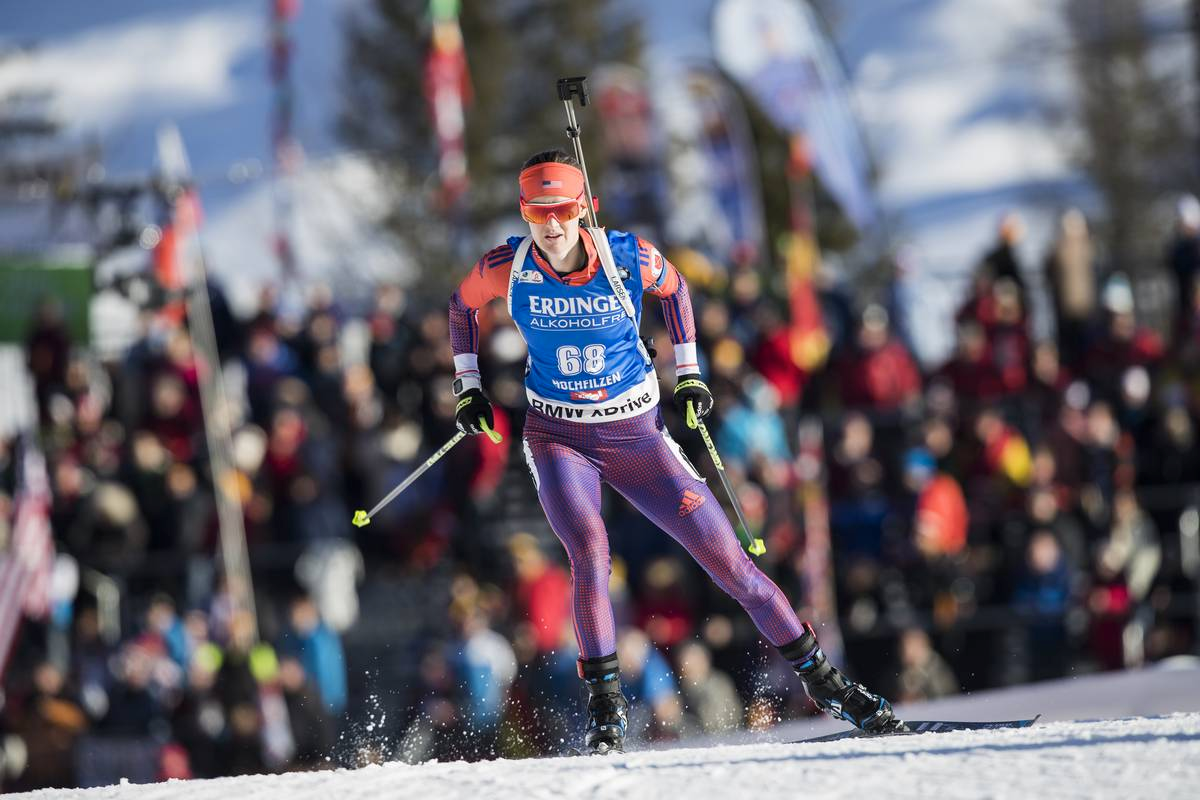
The men’s 10 k sprint at World Championships was no exception. Bailey shot perfectly and finished fourth, 29.5 seconds behind Benedikt Doll of Germany, a first-time World Champion.
When he crossed the finish line, Bailey was in second place. But he was later knocked off by later starters.
“I am really happy with the result,” he said. “It’s the wooden medal, as they say in Germany. But I think more important to me is that I really feel like I did everything that I could do today. This was what I could do for the day, and I guess I can be proud for that.”
That gives Bailey the second-best Championships result ever by an American. Burke won silver in 2013 and Josh Thompson in 1987, both in the 20 k individual. Bailey’s fourth-place finish is the next best result, and the best ever in a sprint competition.
The first key to his success was clean shooting. A number of top racers had a tough time on the range: Martin Fourcade of France, for instance, missed a shot each in prone and standing. He finished third (which he considered a miracle – in the post-race press conference, Fourcade admitted that with two penalties the best he had initially hoped for was a top ten).
“Yeah, it’s tricky wind here,” Bailey said. “It’s sensitive. It moves the bullet quite a bit for a relatively small amount of wind. I spent a lot of time on the range before the race just standing and watching the flags, and getting a good idea when I zeroed what the wind was. And what I would do if it shifted one way or the other.”
Doll and runner-up Johannes Thingnes Bø of Norway both cleaned, as did Bailey, sixth-place Krasimir Anev of Bulgaria, and six others scattered throughout the field.
“When I came into prone, the wind was about where I zeroed, at about four o’clock left to right,” Bailey explained. “So I kept my zeroing the same, and just — the one thing I have learned over the years is it’s better to be aggressive and decisive in the range. Go with what your gut feeling [is], rather than second-guessing yourself. So I tried to be decisive.”
Another key was shooting fast. Bailey had the second-fastest total shooting time of the entire 106-man field. He finished just 1.2 seconds ahead of fifth-place Ondrej Moravec and his shooting time, six seconds faster than the Czech’s, helped him get there.
“I worked all year on the sports psychology front, to not worry so much about the results but worry about the quality of my performance,” Bailey said. “Things like getting to my first shot in 11 seconds, taking an aggressive shooting cadence, efficient range times, and all this dorky biathlon stuff that I have been working on for years, really. But if feels good to put it all together.”
If you can put together that kind of a shooting performance, a merely “good” day on skis can still net a great result. Bailey had the 23rd-fastest course time, and said that he didn’t exactly feel like a superhero on Hochfilzen’s big, rolling climbs.
“It wasn’t one of those days where you go out and you don’t feel any pain,” Bailey laughed. “It definitely hurt, a lot. But I think the ski speed was there, and we had a really good preparation camp that set us up well for the race. So I think I am truly happy with everything about the race today.”
It has been a big year for Bailey. He is now a father – his wife and daughter joined him and U.S. support team at the finish as he waited for the flower ceremony – and he has played a major role as one of the International Biathlon Union’s Athlete Representatives, lobbying hard for anti-doping reforms in the wake of the McLaren report.
On one hand, that’s a lot to handle. But on the other, the University of Vermont graduate (who double majored in political science and environmental studies) isn’t shocked that he is able to turn in some of the best performances of his career despite having so much on his plate.
“I always make sure that training and biathlon is the priority,” he explained. “And then, if I can fit things in, I try to do this Athlete Representative thing. I always have that kind of threshold in my head. If it’s ever too much then I will say, okay, I’ll do it later. Biathlon always comes first. But on the other hand, I good balance can be really positive. And I know every athlete is different, but definitely for me having balance in my life is crucial. Having my family as something I can be [about] away from biathlon, and being with my family and not worrying about sport.”
While Bailey has been focusing on process rather than results or standings, his teammates were not at all surprised at the numerical, record-book aspect of his most recent result.
“He has been really close all year,” Burke said. “He’s been between 10th and 20th almost every single race. Any time you have the ability to consistently do that, you also have the ability to be on the podium.”
But if Bailey has been a rock for his teammates this season, he is still humble about it. And he believes in them. In the second relay after Nordgren and Doherty returned to the World Cup, the team finished sixth, and Bailey says there’s more to come. He has a shot at the podium again on Sunday in the pursuit – but he is also looking forward to the relay.
“Honestly I don’t feel any pressure, because I know all four guys that are here can pop a podium race any day,” Bailey said. “And I wouldn’t be so surprised at all if one of them did that in these World Championships. And as much as there have been some setbacks for Sean [Doherty] and Leif [Nordgren] with health issues, I think we are all in a pretty good place right now… If you kind of analyze and read between the lines in the results it looks pretty good for our team. I think it may have been a slow start for some athletes, but if I were a betting person I would bet on the U.S. guys.”
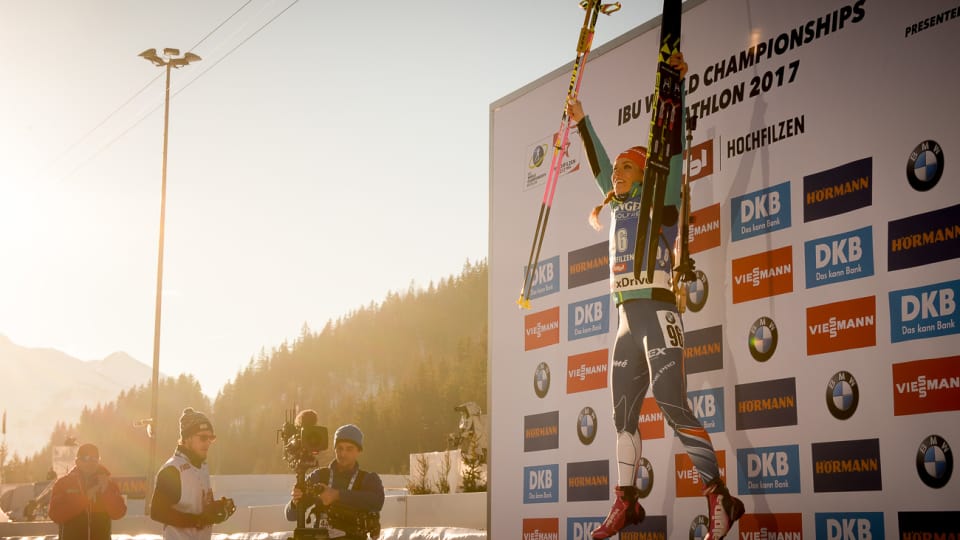
Gabriela Koukalová of the Czech Republic celebrating her first individual victory at a World Championships (or Olympics) on Friday after winning the women’s 7.5 k sprint at 2017 IBU World Championships in Hochfilzen, Austria. (Photo: Glen Crawford)
It was a day of redemption. Both for a biathlon superstar and for the best North American in the women’s 7.5-kilometer sprint at the 2017 International Biathlon Union (IBU) World Championships in Hochfilzen, Austria.
A year ago, Czech Republic’s Gabriela Koukalová (back then starting under her maiden name Soukalová) was disappointed when she failed to win any medal at the Oslo World Championships, twice placing fourth, once fifth, and twice sixth with her team. She won the overall World Cup that season, but not being on the podium at the highlight event of the year still stung.
Gabriela Koukalová (Czech Republic) racing to her first individual World Championships gold on Friday in the women’s 7.5 k sprint at 2017 IBU World Championships in Hochfilzen, Austria. (Photo: Glen Crawford)
“I had a lot of expectations,” Koukalová recalled in a post-race press conference on Friday. “And I was only fourth all the time. A lot of ‘potato medals’ as we say in the Czech Republic.”
Now after a sprint race that had been suspenseful from the first to the very last starters, she stood on the top of the podium at the flower ceremony in Hochfilzen, smiling but with tears welling up in her eyes after winning her first individual title at IBU World Championships (or Olympic Games) in a time of 19:12.6 minutes with no penalties.
“I am not able to describe my feelings,” Koukalová told the IBU in an interview afterwards. “I had a lot of thoughts about this position in the last months. It’s amazing. I did not believe that I am able to win a World Championship.”
A day ago, US Biathlon’s Clare Egan was also disappointed when she ran out of spare rounds and shot a penalty in the mixed relay, causing her team to fall back.
“It is a horrible, horrible feeling to take your team from podium contention to 17th place at world championships,” Egan stated in a US Biathlon press release on Thursday.
She vowed to focus on the sprint race, and she sure did.
“I know that a positive outlook is a prerequisite for a good race,” Egan wrote in an email to FasterSkier after Friday’s sprint. “My performance in yesterday’s mixed relay was one of the more brutal failures of my biathlon career, and I certainly struggled to rebound and lost some sleep over it. One decisive factor in my mental turnaround was a message I got this morning from my cousin Liz Egan. She reminded me of my very own words from my recent blog post: ‘How you do one day has absolutely no bearing on how you might do the next.’ It’s so true and I needed the reminder!”
Clare Egan (US Biathlon) racing to 20th place in the women’s 7.5 k sprint at the 2017 IBU World Championships in Hochfilzen, Austria (Photo: USBA/NordicFocus)
Taking her time on the range (with the 92nd-ranked shooting time among 101 starters in the sprint) became beneficial when Egan shot clean in both stages to avoid any penalty laps on Friday.
“I had a good plan for my shooting execution today and I stuck to it for 10 shots and it worked,“ Egan wrote. “That doesn’t always happen so I’m grateful it worked today. I had to take 4 clicks in prone (about the distance from the center of the target to the edge), which is fairly significant but clearly the right choice. In standing I focused on getting the set up perfect, which took a while but paid off.“
Egan skied the 31st-ranked course time overall, and was able to pick up the pace on the last loop when she knew she was fighting for a top position (22nd loop time).
“I started my last loop as [Biathlon Canada’s] Megan Tandy was starting her first. Knowing I had someone right behind me pushed me.“
She crossed the line in a time of 20:25.0 in 20th place, 1:12.4 back from Koukalová.
For Egan it was her second-best result in an individual World Cup race, only behind a 16th place in Östersund, Sweden, at the beginning of the 2015/2016 season. And it was her best result (excluding relays) in her third World Championship, improving 20 positions on a 40th place (also in the sprint) from 2015 in Kontiolahti, Finland.
Throughout the race, the athletes at the top changed repeatedly as some of the favorites including France’s Marie Dorin Habert in bib 1 and Finland’s Kaisa Mäkäräinen in bib 4 had picked the first start group, while others such as Germany’s Laura Dahlmeier chose positions in the middle, and Koukalová in bib 96 or Norway’s defending world champion Tiril Eckhoff starting in bib 101 had opted for a start at the very end of the field.
On a clear and sunny day with mild wind, it seemed unclear which starting positions would be the most advantageous. Several of the favorites starting early incurred penalties, and it took a while until the first starter remained clean in both stages.
That was Russia’s Irina Uslugina, replacing her teammate Ekaterina Glazyrina at the last moment after Glazyrina had been provisionally suspended by the IBU and taken out of the start list about an hour before the race began, creating additional unrest. Uslugina emerged as Russia’s top finisher on Friday, but was ultimately a bit too slow on the course to contend for the medals and ended up 15th (+1:03.6).
After missing just one target and skiing fast, Dorin Habert initially held the lead in the finish narrowly ahead of Slovakia’s Anastasiya Kuzmina, before she was bumped out of first by her teammate Anaïs Chevalier. Then, two Italians secured preliminary positions on the podium, but it was not Italy’s star Dorothea Wierer (who went on to finish one position behind Egan in 21st), but Wierer’s teammates Lisa Vittozzi and Federica Sanfilippo.
Starting with bib 64, Germany’s Dahlmeier began the race at a controlled pace for her ability level, and also took her time on the range (with the 43rd-ranked shooting time) in order to stay clean in both stages. Then on the last loop, Dahlmeier skied the fastest time of the day, and in the finish she had improved on Chevalier’s time by 21.1 seconds.
But the last word in this race had not yet been spoken, as Koukalová had only just started. She set the best time after her prone stage, narrowly ahead of Kuzmina, and kept pushing hard on the next loop coming into the standing stage with a lead on the field. Shooting clean again, Koukalová left the range with a 10.5-second lead on Dahlmeier.
With her coaches shouting split times from the side of the track, Koukalová did everything to carry her lead into the finish, but after initially expanding it to 12 seconds, it began to shrink up the last climbs.
Pushing out of a tunnel and up the inclined finishing stretch in Hochfilzen with her long earrings dangling side to side, Koukalová rescued a 4-second lead to Dahlmeier into the finish, which also knocked Chevalier down to third place (+25.1) and Vittozzi off the podium by a mere 0.2 seconds (+25.3).
Despite the ungrateful place, it was Vittozzi’s best career result in an individual race, and also the second-best career and best World Championship result for Sanfilippo in fifth place (+31.9).
“I am a little bit disappointed, because yes of course I dreamed about the medal,” Sanfilippo told the IBU in an interview. “But today with my fifth place I have to be happy. And in any case, we will see what happens in the next days.”
All of the top six, including Dahlmeier’s teammate Vanessa Hinz (+37.9), shot clean in both stages.
“I think it was a very clever decision by our coaches,” Koukalová told the IBU when asked about her late start group. “I think it helped me a lot, because I was feeling that my skis [were] faster and faster every loop … And I heard a lot of information about Laura, that she was just 10 seconds behind me [in the split times]. I did not believe it [would be] enough because I know her very well, and I realized she was very fast mainly on the last part of the track.”
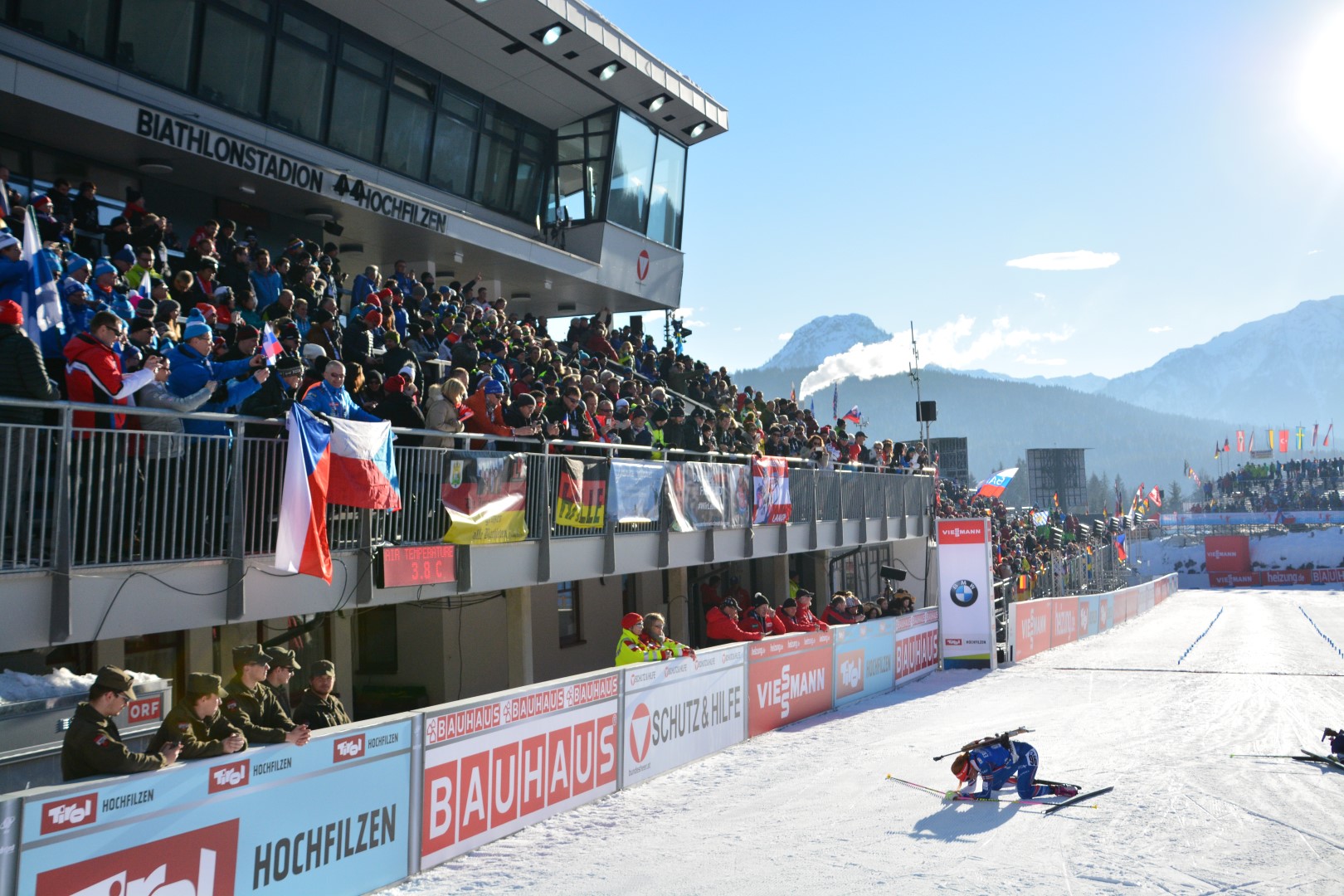
Gabriela Koukalová of the Czech Republic catches her breath on the ground after winning the women’s 7.5 k sprint at 2017 IBU World Championships in Hochfilzen, Austria. (Photo: Glen Crawford)
“When I saw four seconds [lead] in the finish I thought that I am sleeping, but I hope it is real,” Koukalová said at the press conference. “Is it real?”
Yes it is. And it is the fifth gold medal for the Czech Republic at IBU World Championships. The women’s relay team won the first title in 1993, then Kateřina Holubcová won a title in the women’s 15 k individual race in 2003, Roman Dostal in the men’s 20 k individual in 2005, and Koukalová herself won the mixed relay title in 2015 in Kontiolahti with Veronika Vitková, Michal Šlesingr and Ondrej Moravec.
Dahlmeier, the current overall World Cup leader ahead of Koukalová, was pleased with her result, following up her gold medal in the mixed relay a day before with another silver on Friday.
“This was the perfect race for me,” Dahlmeier told German TV broadcaster ZDF. “I shot clean, I felt great on the shooting range, and I was able to execute on the course what I had set out to do. This was my best race and I gave it everything I had. Today, Gabby was just stronger, that’s how you have to look at it… The second medal is a dream.”
“In the last part of the track, she is amazing and she is able to run fast like a horse,” a smiling Koukalová said at the press conference, drawing a big laugh from the attending media as well as Dahlmeier.
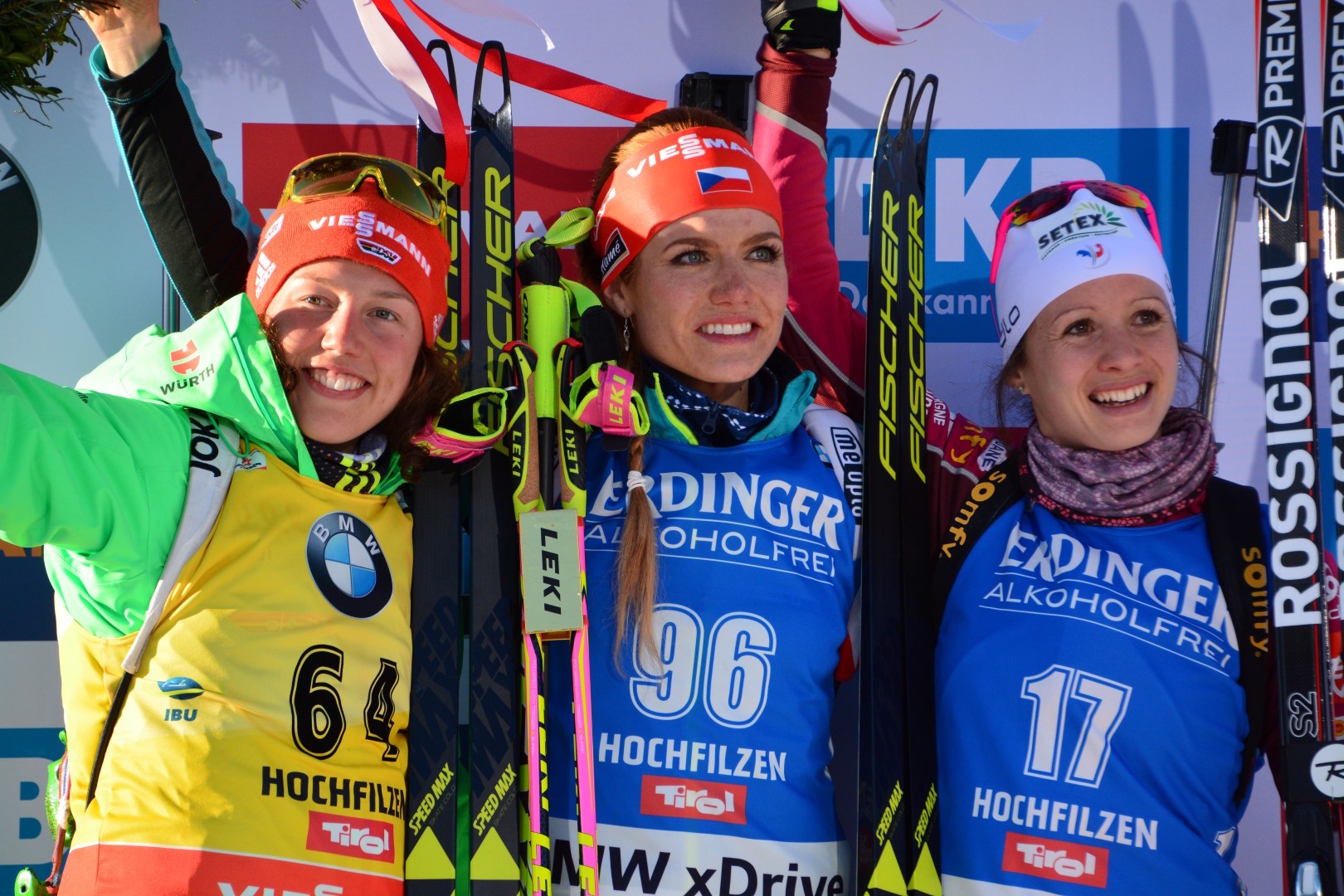
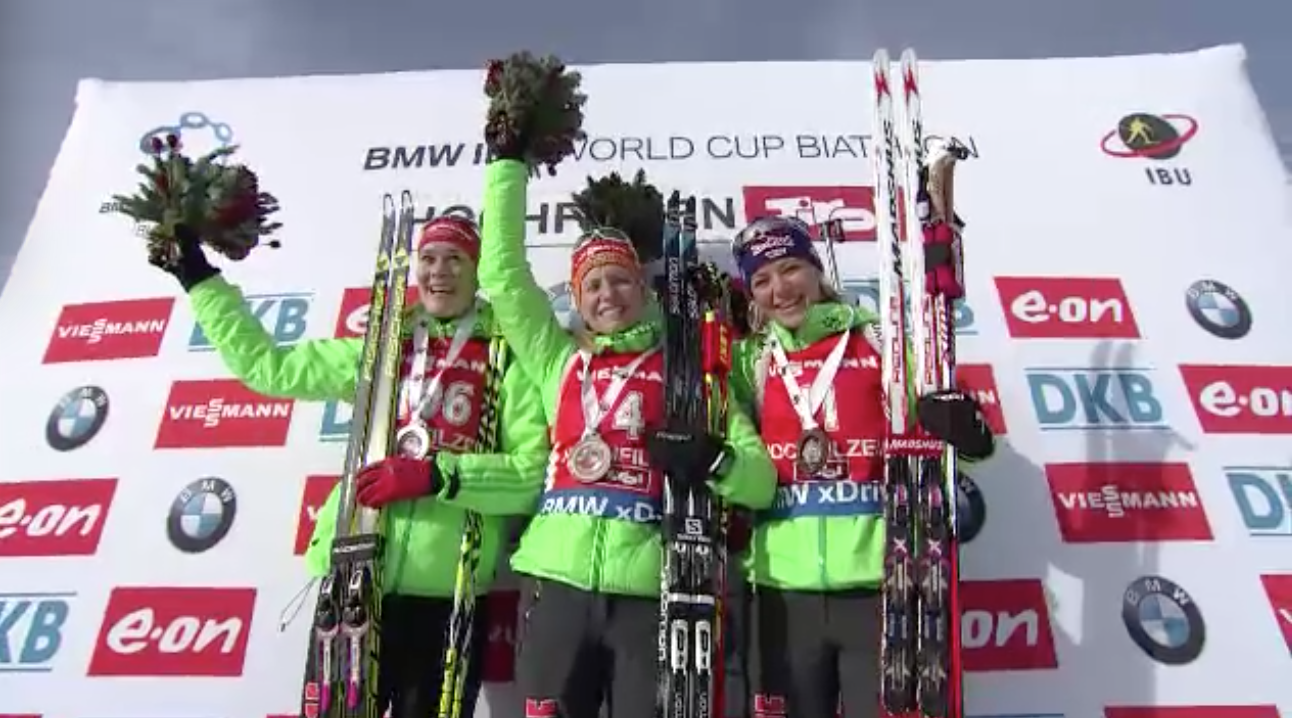
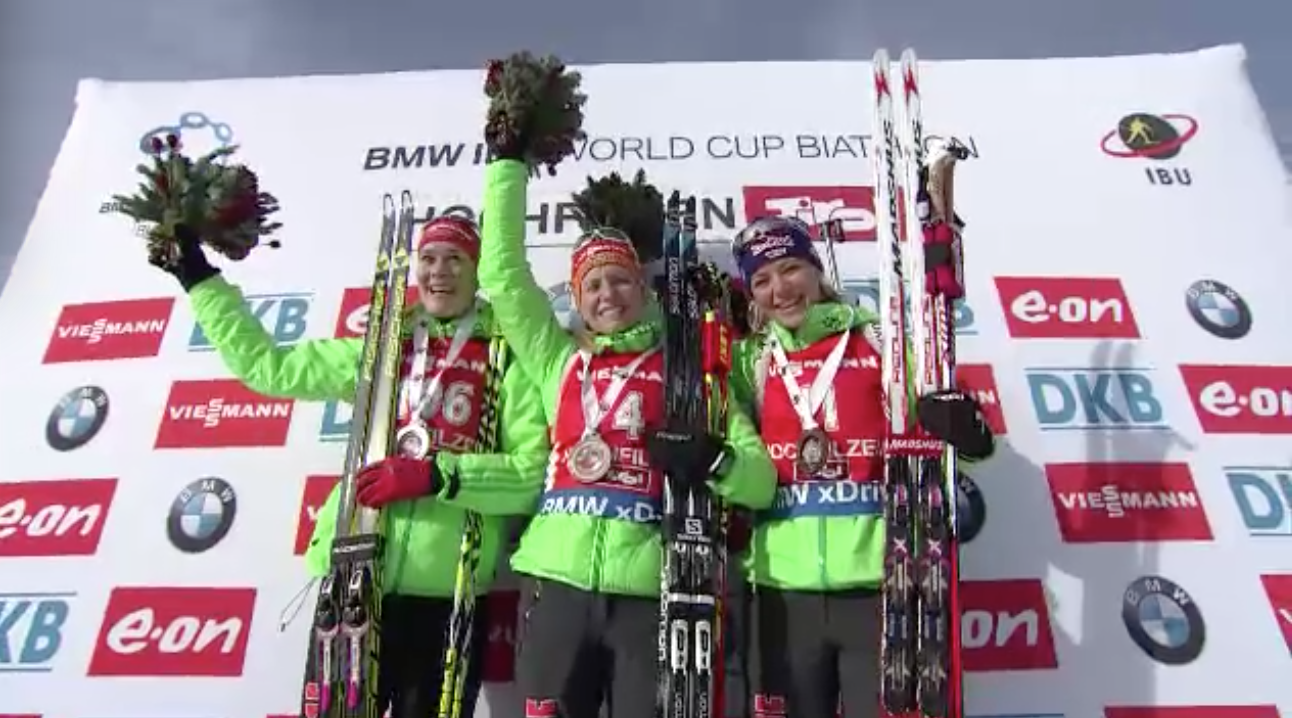
The women’s 7.5 k sprint podium at 2017 IBU World Championships on Friday in Hochfilzen, Austria, with the Czech Republic’s Gabriela Koukalová (c) in first, Germany’s Laura Dahlmeier (l) in second, and France’s Anaïs Chevalier (r) in third. (Photo: Glen Crawford)
At last year’s World Championships in Oslo, Dahlmeier finished third in the sprint before winning the following pursuit race.
“I will enjoy today’s success, and then I am already excited like crazy for the pursuit,” Dahlmeier told ZDF. “I think that is just my type of race. Four shooting stages, 10 kilometer, and then I will attack the very top again.”
For Chevalier, it was her first individual medal at IBU World Championships and her third medal overall. Similar to Dahlmeier, she instantly followed up on her silver medal with the French mixed relay from the previous day, and previously earned silver with the women’s relay in Oslo a year ago.
“I am really happy because I did not expect to have an individual medal,” Chevalier stated in the press conference, also echoing Dahlmeier’s comments. “I did a perfect race today, and two of the girls were better than me. So I have no regrets.”
Chevalier is going to celebrate her 24th birthday on Sunday, the day of the pursuit race.
Four North Americans Qualify for Pursuit
The second-best North American starter on Friday was Biathlon Canada’s Rosanna Crawford in 26th place with one penalty (+1:23.2).
Rosanna Crawford (Biathlon Canada) racing to 26th in the women’s 7.5 k sprint on Friday at 2017 IBU World Championships in Hochfilzen, Austria. (Photo: Glen Crawford)
Despite some tricky wind conditions, Crawford shot fast (with the 10th-ranked shooting time overall) and stayed clean in her prone stage, before incurring a penalty in standing.
“I struggled in zero [pre-race target practice] today, so am really happy to have cleaned my prone,” Crawford wrote in an email. “It was quite windy during zero and I had to make a big correction, but once the race started it was a much more manageable wind.”
Initially posting one of the best times after starting early in bib 12, she was pushed down in the standings as more and more athletes finished the race ahead of her, partly due to her middle-of-the-pack, 45th-ranked overall course time.
“This is one of my better ski ranks of the year,” Crawford commented. “I felt more normal out there today, we had good skis and the course held up well. I had a few people to chase down on my last loop, but for the most part skied the race alone. I skied better than the mixed relay.”
It was Crawford’s second-best result in a sprint this season, following her 21st place last month in Oberhof, Germany.
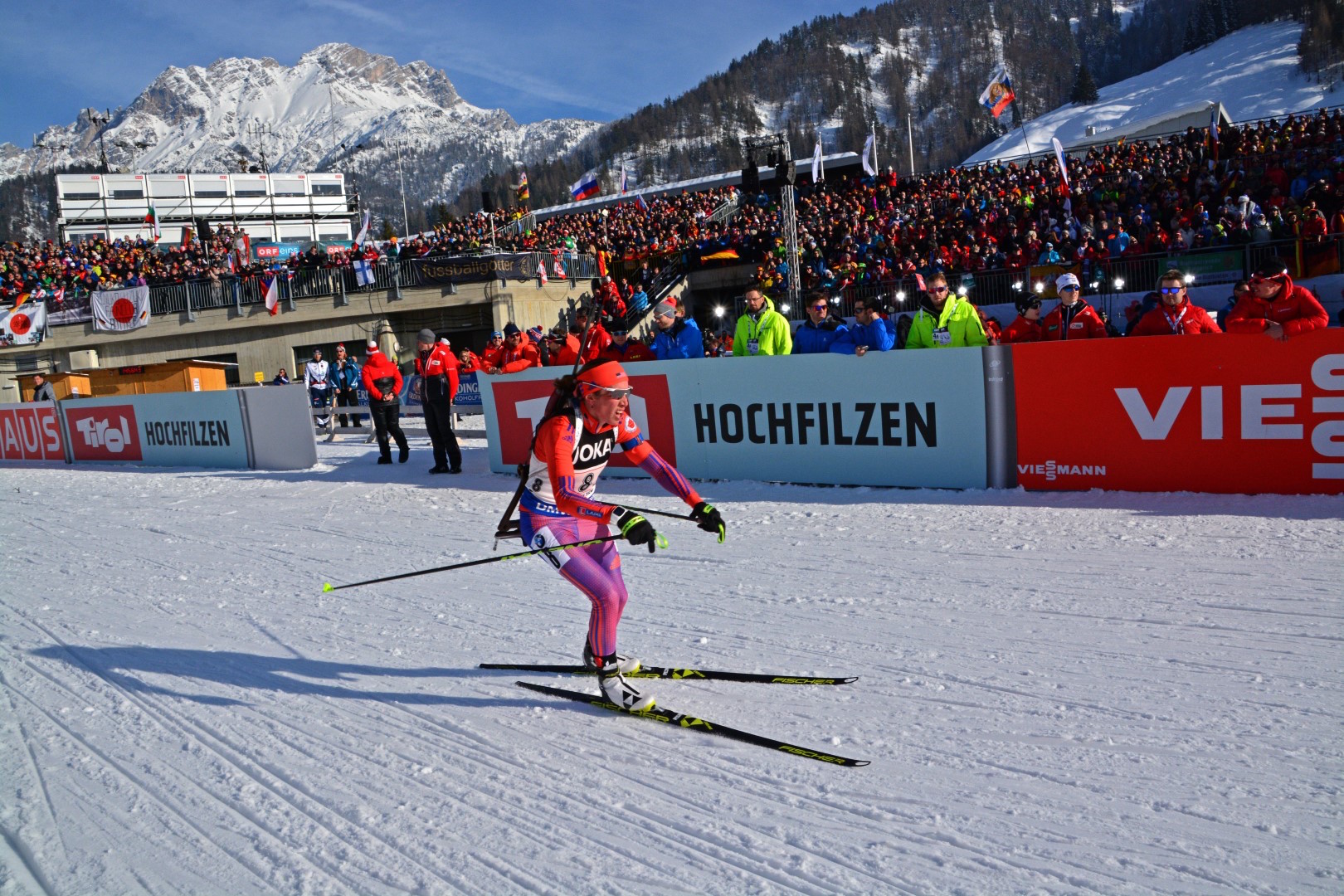
Susan Dunklee (US Biathlon) racing to 29th in the women’s 7.5 k sprint on Friday at 2017 IBU World Championships in Hochfilzen, Austria. (Photo: Glen Crawford)
Three positions behind her, US Biathlon’s Susan Dunklee finished 29th (+1:27.4) with three penalties.
Dunklee started very early in bib 3, getting some time on the TV broadcast. Just like the other early starters, the American had to deal with a bit more challenging wind conditions, though according to her they were consistent with the zeroing target practice and the course remained fair throughout the race.
“Every team had a different idea about when the track would be fastest,” Dunklee wrote in an email. “I have no complaints about my start position. I think the spectators enjoyed having the favorites spread out.”
On the range Dunklee took the opposite approach to Egan, shooting very fast (tied for the eighth-ranked shooting and fifth-ranked range time), yet unlike her teammate she missed one shot in her prone shooting stage and two more in standing, having to ski 450 extra meters.
Thanks to skiing the 11th-ranked course time overall and even faster on the last loop where she could ski behind Finland’s Mäkäräinen (who had the second-best course time of the day), Dunklee improved by 18 positions on the last loop to finish 29th.
“Kaisa was a great ride for my last loop and I enjoyed the opportunity to ski together with her and Julia [Ransom of Canada, who started a loop later],” Dunklee wrote. “It helped me dig into a deeper gear for my finishing push.”
“I was psyched to see Clare and Rosanna throw down strong performances when it counts the most,” Dunklee commented regarding the performances of Egan and Crawford. “Biathlon is one of the most mentally challenging sports out there because of the extreme ups and downs, and they have proved their resilience this season.”
In her first start at IBU World Championships, Joanne Reid finished 49th (+1:57.6) with a penalty in each of her shooting stages (1+1). With this result, Reid qualified for the pursuit with the third-best individual World Cup result of her career, the best being a 29th place from a 15 k individual race in Östersund, Sweden, earlier this season. The former standout cross-country skier switched to biathlon a little over a year ago.
“I absolutely love this course and had a great time,” Reid commented on her race, according to US Biathlon. “I can’t wait for the pursuit.”
For Canada, Megan Tandy finished 64th with one penalty (1+0), 2:20 minutes behind the winner.
“What can I say?” Tandy posted on her Facebook page. “I am satisfied with 9/10 shooting. I did my job today and while I am sad and frustrated with 64th place, I am also at peace knowing I did everything possible: every detail of training, sleeping, eating, activation, warmup, etc. but my body was just not able to deliver. I fought my hardest but felt empty. Whatever is going on with me, I am not in the shape I expected [this] season and my best is simply not enough. Tough.”
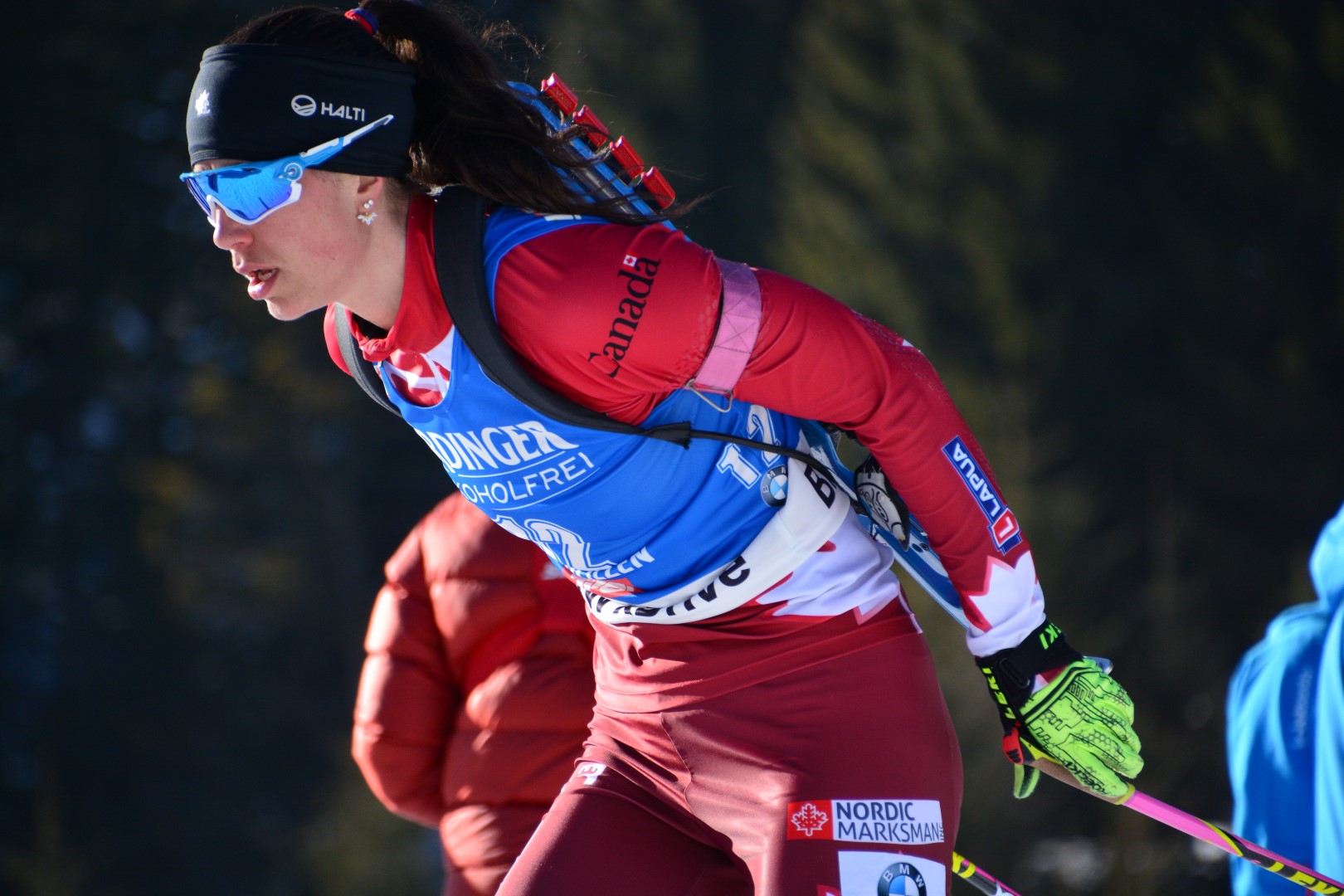
Julia Ransom (Biathlon Canada) racing to 65th in the women’s 7.5 k sprint on Friday at 2017 IBU World Championships in Hochfilzen, Austria. (Photo: Glen Crawford)
Her teammate Julia Ransom was one position behind in 65th with two penalties in her standing stage (+2:24.7, 0+2).
“Unfortunately the race today didn’t play out as I’d hoped, but I skied my heart out, soaked up some sunshine, and enjoyed those incredible fans!” Ransom wrote after on Instagram.
Starting late in the field in her first start at senior World Championships, US Biathlon’s 21-year-old Maddie Phaneuf shot clean in her prone stage, then missed two targets in standing to finish in 78th place (+2:56.6, 0+2).
“Well…frustrated with today’s results,” Phaneuf commented on her Facebook page after the race. “I was happy with my skiing on the first two loops and my prone shooting but not psyched on my standing shooting… hoping for better days here at World Champs. On the other hand, this is my second best result on the World Cup (out of the 5 individual races I’ve done). So happy to see my teammates doing well, all three placing in the top 50…Clare with clean shooting and getting her second best result ever in 20th!”
Emma Lunder (Biathlon Canada) racing to 84th in her first IBU World Championships race on Friday, the women’s 7.5 k sprint in Hochfilzen, Austria. (Photo: Glen Crawford)
Also competing in her first senior World Championships race, like Reid and Phaneuf, Canada’s fourth woman Emma Lunder missed qualifying for the pursuit in 84th, after incurring three penalties in her prone shooting stage before shooting clean in standing (+3:10.1, 3+0).
The IBU World Championships continue on Saturday with the men’s 10-kilometer sprint, followed by pursuits for both the women and men on Sunday.
Gabriela Koukalová of the Czech Republic celebrates her first individual victory at a World Championships or Olympics on Friday at 2017 IBU World Championships in Hochfilzen, Austria. She won the women’s 7.5 k sprint by 4 seconds. (Photo: IBU)
IBU World Championships (Hochfilzen, Austria): Women’s 7.5 k sprint
Gabriela Koukalová, formerly Soukalova, had been so close to a World Championships individual gold medal, yet through five World Championships and two Olympic Games, a world title still eluded her — until Friday.
In the second race of 2017 IBU World Championships (and first individual competition), the 27-year-old Koukalova, of the Czech Republic, raced to first in the women’s 7.5-kilometer sprint, edging Germany’s Laura Dahlmeier, the World Cup Total Score leader.
Koukalova started 96th and cleaned both prone and standing before finishing with the fastest time in 19:12.6 minutes. That bested Dahlmeier’s time by 4 seconds, after the German (in bib 64) also cleaned both stages and took the lead from France’s Anais Chevalier (bib 17). Chevalier remained on the podium in third, 25.1 seconds off Koukalova’s winning time.
Italy’s Lisa Vittozzi missed a medal by 0.2 seconds in fourth (+25.3).
US Biathlon’s Clare Egan shot clean and landed 20th (+1:12.4) for her best individual World Championships result by 20 places (she previously raced at 2015 and 2016 World Championships). Egan led three Americans in qualifying for the pursuit, with Susan Dunklee placing 29th (+1:27.4) with three penalties (1+2) and Joanne Reid in 49th (+1:57.6) with two misses (1+1). Maddie Phaneuf missed the top 60 necessary for the pursuit in 78th (+2:56.6) with two standing penalties (0+2).
Biathlon Canada’s Rosanna Crawford placed 26th (+1:23.2) with one standing penalty (0+1) and was the lone Canadian to qualify for the pursuit. Megan Tandy missed the top 60 in 64th (+2:20.9) with one miss (1+0), Julia Ransom followed 65th (+2:24.7) with two misses (0+2), and Emma Lunder was 84th (+3:10.1) with three penalties (3+0).
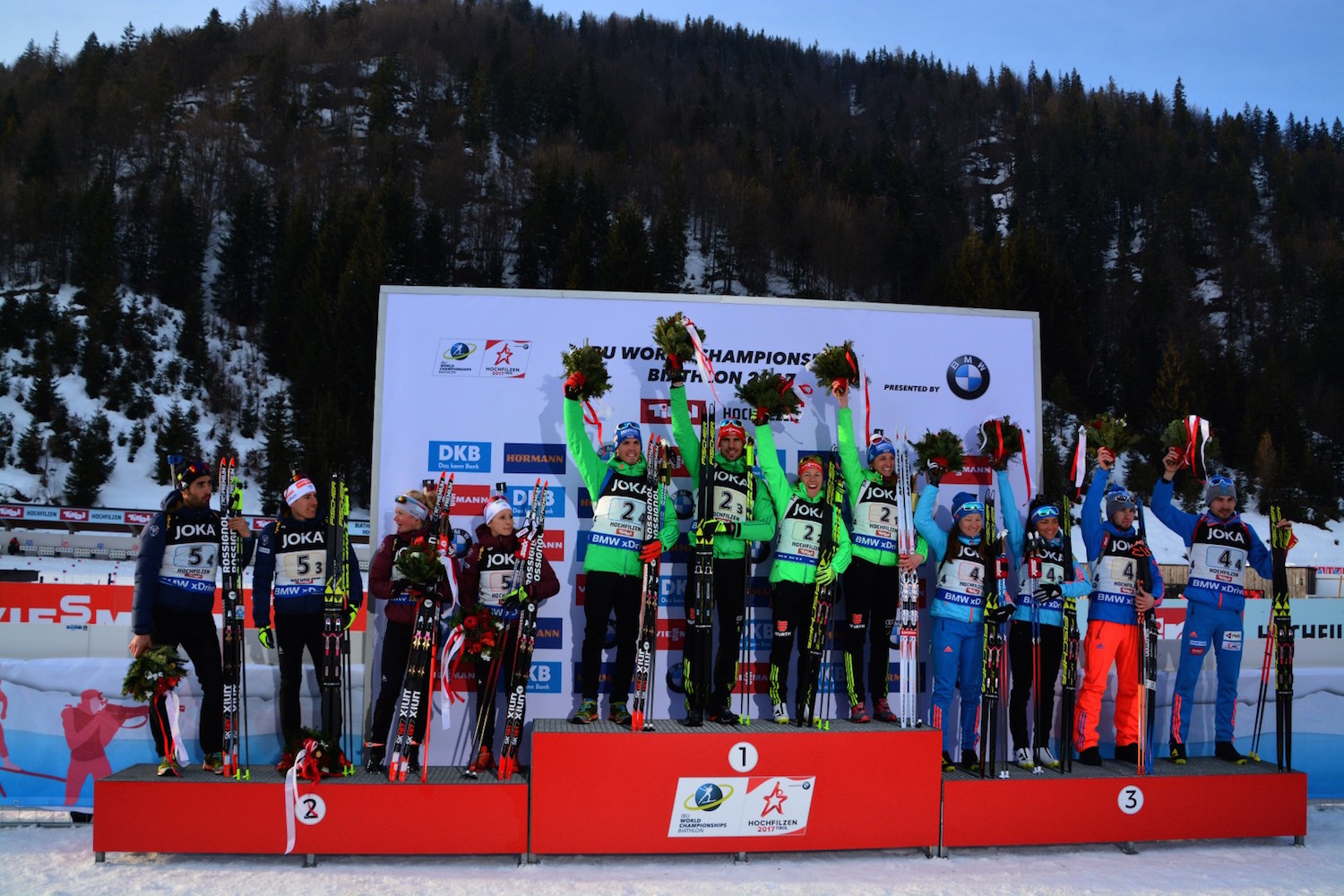
The mixed relay podium on the opening day of 2017 IBU World Championships in Hochfilzen, Austria, with Germany in first (c), France (with Martin Fourcade at far left) in second, and Russia in third (r). (Photo: Glen Crawford)
Germany was front and center for the first race of 2017 International Biathlon Union (IBU) World Championships on Thursday in Hochfilzen, Austria, but there was a sideshow that stole a good chunk of the limelight between France (namely Martin Fourcade) and Russia (namely Alexander Loginov).
The action began with the 2 x 6 + 2 x 7.5-kilometer mixed relay, a co-ed event where teams start women for the first and second legs, followed by men for the third and fourth legs.
Germany ran away with the lead with a rock-solid performance from third-leg Arnd Peiffer, who cleaned both his prone and standing stages without using any spare rounds, but the team had to credit second-leg Laura Dahlmeier, who built the lead in the first place.
Dahlmeier, the World Cup Total Score leader, raced from sixth to first after getting the tag from her teammate Vanessa Hinz just 9.8 seconds out of first. Dahlmeier used two spares to clean prone and another two to clean standing, yet she avoided the penalty lap and remained in third for much of her race — behind Italy’s Dorothea Wierer and France’s Marie Dorin Habert.
As she left the range for the last time and embarked on her last loop, Dahlmeier remained in third, nine seconds behind Wierer in first. Dorin Habert remained on Wierer’s heels, 1.6 seconds back.
Dahlmeier caught both by the second exchange and tagged Peiffer in first, 0.8 seconds ahead of France and 3.8 seconds ahead of Italy.
The rest was history as Peiffer extended the gap to 11.1 seconds over Italy’s Lukas Hofer after the first shooting stage on the third leg. With another clean bout one loop later, Peiffer was up to 20 seconds ahead of Hofer, who used one spare in prone and cleaned standing without a miss.
“After the prone shooting I was alone on the loop, that is a pretty thankless job,” Peiffer told German broadcaster ZDF after. “Then I tried to focus on my tempo, to keep pushing into the standing shooting, and that worked well. But it was not clear to me while on the course that it would work out like that.”
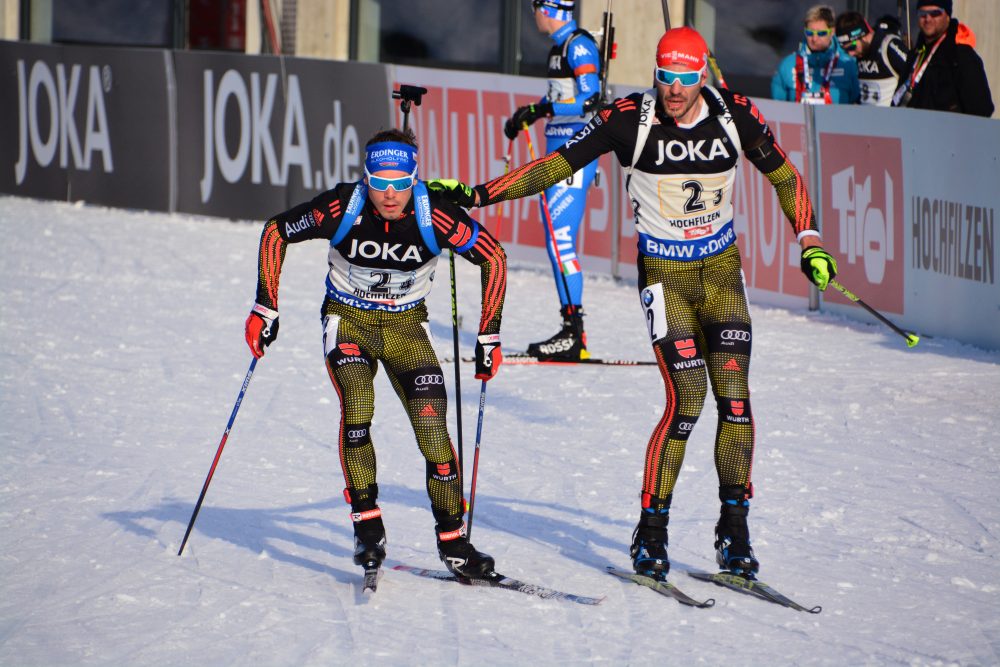
Germany’s Arnd Peiffer (r) tagging his teammate Simon Schempp during the final exchange of the mixed relay at 2017 IBU World Championships on Thursday in Hochfilzen, Austria. Peiffer tagged in first, and Schempp held the lead through the finish. (Photo: Glen Crawford)
Peiffer tagged German anchor Simon Schempp 21.2 seconds ahead of Italy’s last leg, Dominick Windisch, and 46.5 seconds ahead of France’s Martin Fourcade in third. Russia entered the final exchange with France, with Loginov tagging Anton Shipulin just 0.9 seconds behind France.
That’s where things got interesting. Schempp executed as needed to secure the win — cleaning prone without any spares and using just one in standing — and Windisch as his most immediate threat fumbled on the last stage when the he missed two and left the range in fourth, 32 seconds behind Schempp.
There, Fourcade moved into second with his second-straight flawless stage (0+0, 0+0), 17.9 seconds behind Schempp, and Shipulin remained in third (+18.6) after cleaning both stages as well (0+0, 0+0). Fourcade and Shipulin started the race together and jockeyed between third and fourth for the first two loops, until both moved ahead of Windisch and had the opportunity to battle for second place on the last loop.
For Fourcade, who had already won 10 races (including relays) this season and entered the World Championships mixed relay as a defending champion with France, it wasn’t so much about the silver. It was about beating Russia.
As Fourcade and Shipulin descended a downhill together on the last loop, Fourcade took the lead by the bottom and attacked on the long uphill that immediately followed. Shipulin remained on his heels as the two came within view of Schempp, who was skiing what appeared to be a casual pace off the front — although Schempp would later say he was going full speed.
“I think you could see that they wanted to get back up to [Schempp],” German men’s head coach Mark Kirchner told ZDF of Fourcade and Shipulin on the last loop. “But when they reached the highest point of the course it looked like they rather skied tactically, who becomes second and who becomes third. Then I was sure that this would end well for us.”
About 100 meters before the finish, Schempp glanced back to see Fourcade and Shipulin charging hard. Schempp appeared unfazed and maintained his pace, holding his arms up to celebrate before he crossed the line first.
Germany’s Simon Schempp (2) celebrates his team’s victory in the mixed relay on the opening day of 2017 IBU World Championships in Hochfilzen, Austria, after he held off France’s Martin Fourcade (second from r) in second and Russia’s Anton Shipulin in third. (Photo: Glen Crawford)
Germany took the relay gold in 1:09.06.4 hours, while Fourcade finished 2.2 seconds later to secure silver for France. One second later, Shipulin anchored Russia to bronze (+3.2).
“Fourcade really attacked enormously,” German men’s assistant coach Andreas Stitzl told ZDF. “Thank God Fourcade and Shipulin were not totally in agreement, so it went our way.”
Schempp later said he realized those two were getting closer, “but there was a bit of a buffer,” he told ZDF. “I wasn’t certain, so I still skied full speed … Of course this is an enormously cool start for our team into the World Championships, immediately with a first place. And I think I am speaking for everyone that we are overjoyed.”
It was the first mixed-relay win for Hinz and Dahlmeier.
“These are big emotions, winning it all in a team together with the men,” Dahlmeier told ZDF. “I have never won a mixed relay before, and this is only my second one ever. I think this means a lot to the whole team, that we became world champions right in the first race.”
“I am still a little bit speechless,” Hinz said. “I was very happy that the coaches trusted me with this assignment, and it means quite a lot to me.”
During the flower ceremony, Germany’s four racers stood on the highest step of the podium. France followed them to the second step, with Anais Chevalier, Dorin Habert, Quentin Fillon Maillet, and Fourcade, and Russia was introduced third, with Olga Podchufarova, Tatiana Akimova, Loginov, and Shipulin.
As the four Russians approached the French team to shake hands in usual fashion, Fourcade shook the hands of the two women, but did not come in contact with the two men. As Russia proceeded to its spot on the podium, Fourcade clapped sarcastically, then stepped down from the podium and attempted to leave the ceremony. Not long after, he returned, likely having been instructed to.
“I’m a bit sad,” Fourcade said at the post-race press conference. “I just want to remember that one week ago the president of the Russian federation asked the IBU to take disciplinary sanctions against me because I did a tweet about Loginov and today they decide to not shake my hand on the podium so I’m a bit surprised the president of the Russian federation wants to disqualify his own athletes.”
While it’s tough to pin down exactly which tweet Fourcade was referring to, he wrote on Twitter, “We didn’t think it was possible so they did it………….” on Wednesday, the day before the opening race of World Championships, likely when he learned Loginov would be starting the relay. Loginov is coming off a two-year ban for EPO use and dominated the competition at last month’s IBU Open European Championships.
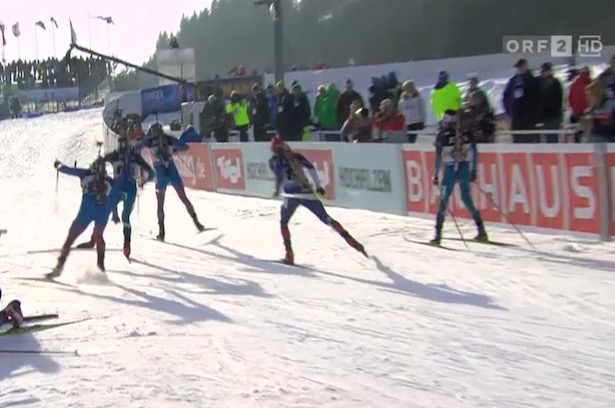
Russia’s Alexander Loginov (l) takes a tumble after tagging his teammate Anton Shipulin (third from l) in the final exchange of the 2017 IBU World Championships mixed relay in Hochfilzen, Austria. France’s Martin Fourcade (second from l) skated left after getting the tag from his teammate Quentin Fillon Maillet (far r). (Photo: ORF screenshot)
Whether the Russian men didn’t shake Fourcade’s hand on the podium, or vice versa; whether they were upset about his tweet or the fact that he appeared to go out of his way to trip Loginov in the exchange zone on Thursday (after Loginov had tagged Shipulin right after Fourcade), one thing is clear: there is some definite tension between Fourcade and Team Russia.
And it’s not all on Fourcade; this has been months in the making after World Cup athletes demanded that the IBU implement stricter anti-doping policies and measures. Fourcade walked out of a meeting last month, telling NRK, “I am pissed off.” The next day, the IBU Executive Board announced it would hold an “Extraordinary Congress” before World Championships to vote on rule changes. The IBU announced the Congress decisions on Wednesday, which included plans to impose higher fines and reduced quotas for nations that violate anti-doping rules. Moreover, 2021 World Championships will not be held in Tyumen, Russia.
An IBU press release on Thursday didn’t get into details beyond the mixed relay itself: “Today is not the best example of a sprint finish battle that I could have done,” Shipulin said, according to the release. “I hope the rest of the World Championships it will be better.”
In terms of shooting performance, Russia was the best of the 25-team field with a total of four spares (three of which came on Loginov’s standing stage) and zero penalties. France had eight spares and overcame one penalty (on Fillon Maillet’s standing stage), and Germany used a total of seven spares but avoided the penalty lap.
“I was expecting us to be in the mix and fight for the medals,” Kirchner told ZDF, “but you can’t plan it working out like this, standing on the first position is always a surprise.”
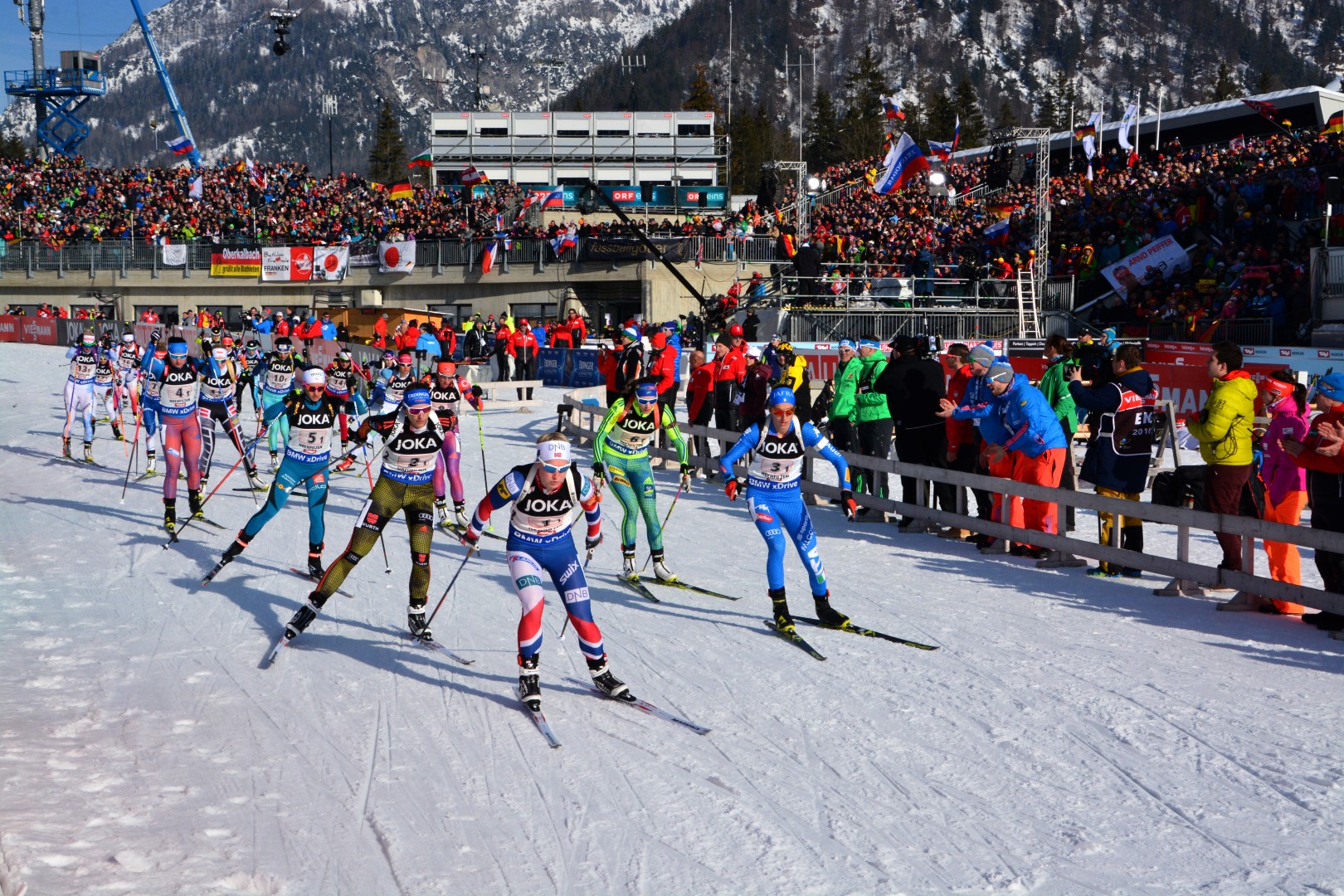
Norway’s Marte Olsbu (front left) and Italy’s Lisa Vittozzi (front right) leading early in the mixed relay at 2017 IBU World Championships on Thursday in Hochfilzen, Austria. (Photo: Glen Crawford)
Italy (Lisa Vittozzi, Wierer, Hofer, Windisch) placed fourth, 28.7 seconds out of first and 25.5 off the podium, with six spares and zero penalties.
Vittozzi initially put the team in first at the first exchange, 1.8 seconds ahead of Norway’s Marte Olsbu in second. There, Austria’s Lisa Theresa Hauser followed 5.7 seconds back in third, and American Susan Dunklee was fourth, 7.6 seconds out of first.
Dunklee used two spares to clean prone and another two in standing (0+2, 0+2), but posted the second-fastest course time of the first-leg skiers to stick with the leaders through the first exchange. While Vittozzi hit all 10 of her targets (0+0, 0+0), Olsbu used a spare (0+1, 0+0) and Hauser required two (0+2, 0+0).
“It wasn’t overly tricky wind but there is more mental pressure in championship situations,” Dunklee wrote in an email about the conditions and why many of the top racers struggled on the range on Thursday. “The days when it matters most can be the days that it’s hardest to perform normally.”
She explained that she was disappointed with her shooting percentage but happy with her speed.
“My skiing feels sharper than it has all year and my body feels ready. That’s a big confidence booster going into the rest of the week,” Dunklee added.
Susan Dunklee racing the first leg of the 2017 IBU World Championships mixed relay for the U.S. She tagged off in fourth and the U.S. went on to finish 16th. (Photo: Glen Crawford)
The U.S. finished 16th (+3:20.2), with two penalties and 13 spares. Second-leg Clare Egan remained in the top 10 until her standing stage, where she skied a penalty lap (0+1, 1+3) and slipped to 17th by the exchange, 2:01 minutes out of first. There, Lowell Bailey took over and used one spare in each stage (0+1, 0+1) and skied the sixth-fastest third leg to hand off in 16th, 2:24.2 back. The team’s anchor, Sean Doherty had the team’s second penalty in his prone, but cleaned standing without any spares (1+3, 0+0) to finish 16th.
“We had a disappointing result as a team, but the Championships are long,” Dunklee wrote. “The most important thing is to take one day at a time and come to the venue fully focused and ready to make the most of each opportunity.”
Canada’s Julia Ransom (r) tagging teammate Rosanna Crawford after the first leg of the mixed relay at 2017 IBU World Championships in Hochfilzen, Austria. Canada went on to finish 13th. (Photo: Glen Crawford)
Canada finished more than a minute ahead of the U.S. in 13th (+2:18.2), with nine spares and zero penalties. Julia Ransom started the Canadians off and used four spares (0+3, 0+1) to tag Rosanna Crawford in 18th, 59 seconds out of first. Crawford used three spares as well in prone but also avoided the penalty lap, and cleaned standing (0+3, 0+0) to tag her boyfriend Brendan Green in 15th, 1:29 back.
Green improved one place to 14th, using just one spare in his prone stage (0+1, 0+0) and tagged Scott Gow 2:06.8 out of first. Gow cleaned prone and used one spare in standing (0+0, 0+1) to finish 13th, just 0.6 seconds ahead of Switzerland in 14th.
“The goal during my leg was to ski hard and push the shooting as much as I could,” Gow wrote in an email.
Both his shooting and range times were sixth-fastest among the anchor legs.
“My shooting was good, and all I can attribute it to is my prep the last two weeks,” Gow explained. “Shooting conditions were quite good, a little bit of wind here and there, so the environment wasn’t too much of a factor. I spent the last two weeks adding extra stress to my shooting and making sure all the fundamentals were in place, and that is what helped me today.
“I’m happy with my race and our team is optimistic for what is to come,” he added. “There were a lot of positives from the past two weeks within the whole team, so there a lot of possibilities.”
Personally, Gow’s main focus for the championships is the men’s relay after Canada earned a historic bronze in the event at 2016 World Championships.
“Last year our team had an incredible result in the relay and it would be great to have another awesome team result at these championships,” he wrote. “Aside from the relay, I’m looking most forward to the sprint. I’ve had some great sprints this year and I’d like to continue the good trend.”
IBU World Championships continue Friday with the women’s 7.5 k sprint at 8:45 a.m. Eastern time. Watch it live on Eurovisionsports.tv.
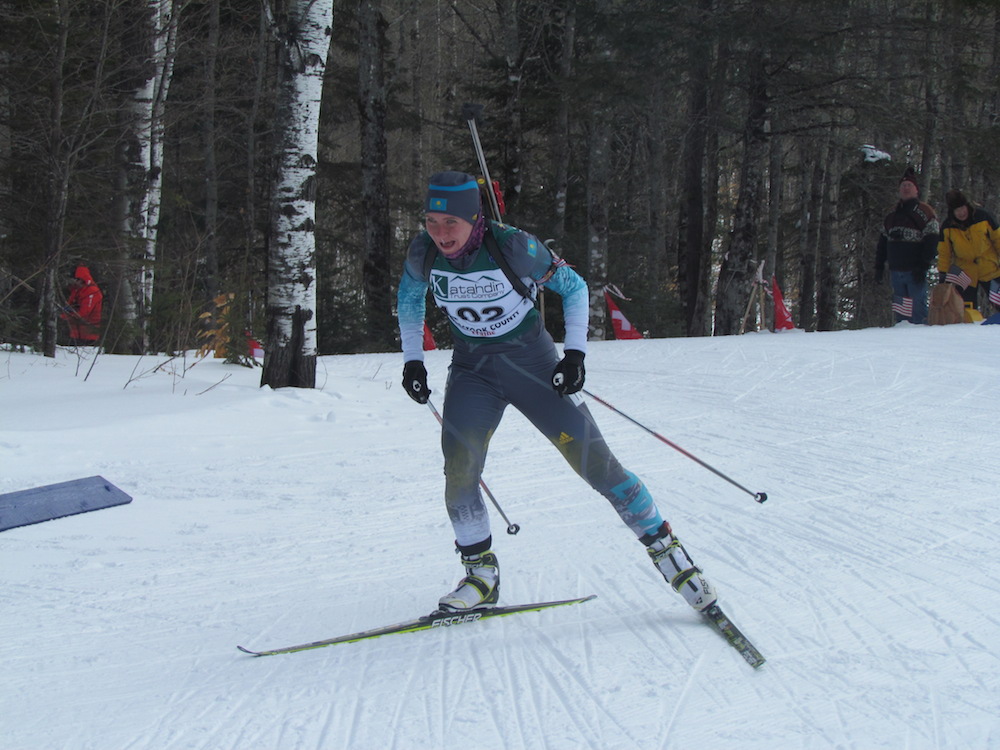
Kazakhstan’s Galina Vishnevskaya on her way to winning the pursuit at 2014 IBU Junior World Championships in Presque Isle, Maine. Vishnevskaya is not a member of the senior national team which is being investigated for doping. (Photo: Katrina Howe)
Austrian police raided the lodgings of Kazakhstan’s national biathlon team outside of Hochfilzen, Austria, on Thursday morning. The Kazakh team is there to compete at World Championships, where they finished 11th in the opening competition, a mixed relay, later in the day.
“Numerous medical devices and medications were seized,” the Criminal Intelligence Service of Austria wrote in a statement translated by the International Biathlon Union. “The investigations are still underway.”
Apparently, a month ago someone spotted a minivan of people tossing a cardboard box in the trash at a gas station in another part of Austria. Team accreditations in the box linked it to the Kazakh squad, and the other items were alarming: according to the Associated Press, it contained needles, materials for infusions, and ampules of medicine, along with written notes indicating that doping was taking place.
“We are not worried,” Manas Ussenov, the Secretary General of the Kazakh Biathlon Association, said according to the BBC. “They found in the room of our doctor some medicine. But according to our doctor, we have all the documentation for these medicines.”
On Thursday, 30 police personnel descended on the hotel in Hochfilzen and collected medicine, equipment, and cell phones from the Kazakh team. After the mixed relay all the team members were given anti-doping tests.
Austria has strict criminal laws about doping, which is part of what spurred the police investigation.
“We fully trust the investigations by the authorities,” International Biathlon Union Secretary General Nicole Resch told the AP. “Until now, we don’t know if banned substances or banned methods are involved. Only then we can take measures.”
Christian Gow (right) and Biathlon Canada teammate Brendan Green out training this fall. (Courtesy photo)
Welcome to “17 Questions for 2017″, where we are catching up with American and Canadian national-team members before the beginning of the winter season.
***
Christian Gow started his first World Cup in 2015 and one year later was a World Championships bronze medalist with the Canadian men’s relay team. The Alberta biathlete, 23 years old, is looking to build in his next full season on the World Cup.
1. Biggest change in your life in the last five or so months since the ski season ended?
The biggest change in my life since the race season was the passing of my grandpa. He was always one of my biggest supporters and was always out volunteering at events. It was the biggest personal loss I have ever had.
2. Biggest change in your training?
Christian Gow (left) and Emma Lunder skiing at the Snow Farm during the Canadian national team’s New Zealand training camp. (Courtesy photo)
The biggest training change this year is that Matthias Ahrens is now my primary coach. It has been a good transition and I think we are both feeling positive approaching the season.
3. Major areas of improvement you’ve seen so far?
I have seen improvement in most areas so far this year, the biggest would probably be my physical fitness.
4. Whom you’ve been working closest with this offseason (coaches or training partners)?
I have been working primarily with Matthias for coaching. As for training partners, we are a small and close-knit team, so I would say that all 5 of us have been working together all year.
5. Best trip in the last five months (and why)?
Best trip this year was our annual Park City training camp. I don’t know what it is exactly that I love so much about Park City, but year-in and out it is my favourite trip of the year.
6. Favorite cross-training?
My favourite cross-training would have to be mountain biking.
7. Favorite non-athletic activity or pastime this summer?
My favourite non-athletic activity this year would have to be either reading or gaming.
8. Song that was your jam this summer?
Gold by Kiiara.
9. All time favorite race moment?
The Canadian men’s team (l-r) Christian Gow, Nathan Smith, Scott Gow, and Brendan Green celebrate bronze in the men’s 4 x 7.5 k relay at 2016 World Championships in Oslo, Norway. (Photo: JoJo Baldus)
All time favourite race moment would definitely be the World Champs bronze medal from last year. It was by far the most surreal racing experience I have had.
10. First thing you pack in your bag when you leave for Europe?
The first thing I pack for Europe is probably my foam-roller or my underwear.
11. Venue/event you’re most excited to visit this season?
I am really excited for this years World Championships in Hochfilzen, Austria. It is a great venue and will be really exciting to have the Championships there.
12. Who will win the men’s and women’s World Cup titles this year?
Martin Fourcade and Marie Dorin Habert.
13. Biggest sacrifice you feel you’ve made choosing this career path?
The biggest sacrifice would probably be my schooling since it isn’t really possible to train effectively and take a meaningful number of courses.
14. If you could change one thing about your sport, what would it be?
I would make it so that doping didn’t exist and we could all participate on an even playing field.
15. What did you have for breakfast this morning?
Tortilla egg wraps and a bowl of yogurt with granola.
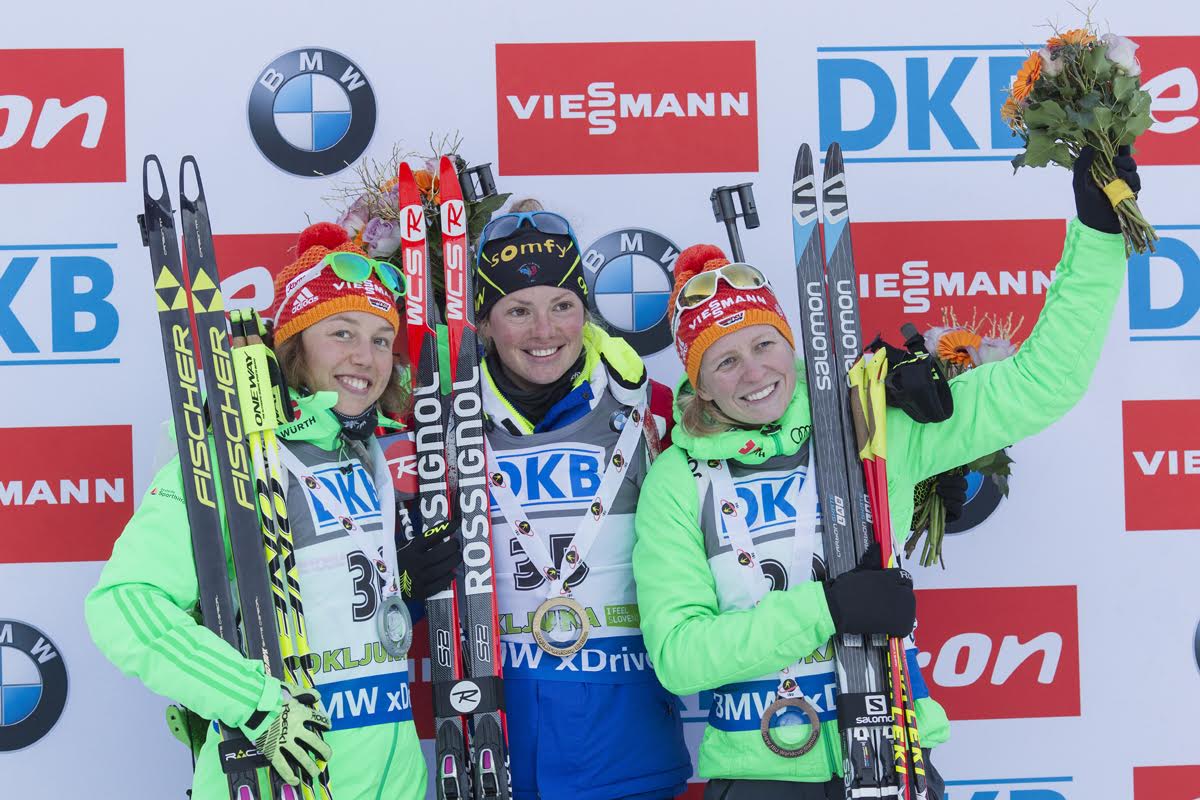
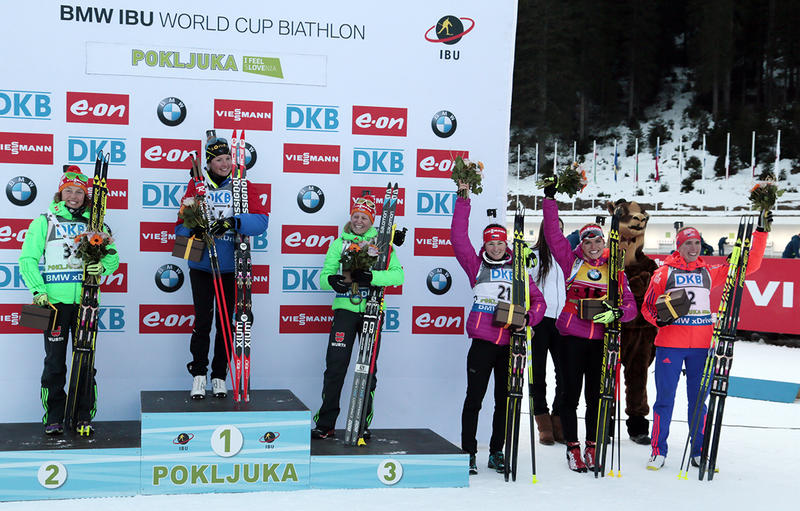
The women’s 7.5 k sprint podium on Friday at the IBU World Cup in Pokljuka, Slovenia, with winner Marie Dorin Habert of France (c), and two Germans: Laura Dahlmeier (l) in second and Franziska Hildebrand (r) in third. (Photo: Fischer/NordicFocus)
Note: This article has been corrected to include American Susan Dunklee’s sixth-place pursuit finish last season in Antholz, Italy. On Friday in Pokljuka, Slovenia, Dunklee tied her best result last season and posted her best sprint finish in two years.
This season, several of the best cross-country skiers in the world, including Norway’s Marit Bjørgen, Kikkan Randall of the U.S. Ski Team, and Finland’s Aino-Kaisa Saarinen, are taking a sabbatical while expecting the birth of their first children. If the skiing of France’s young mother Marie Dorin Habert is any indication, they really don’t need to worry about making successful comebacks.
For quite a while during the women’s 7.5 kilometer sprint at the International Biathlon Union (IBU) World Cup in Pokljuka, Slovenia, it looked like Germany could achieve another victory on Friday — just like the team did a week ago with a podium sweep of the sprint in Hochfilzen, Austria. But Dorin Habert had other plans and claimed the top spot on the podium with a winning time of 20:17.8 minutes.
France’s Marie Dorin Habert takes aim during the standing stage of Friday’s sprint at the IBU World Cup in Pokljuka, Slovenia. She cleaned the two-stage race and won by 1.1 seconds. (Photo: IBU/Kvetoslav Frgal)
Last March, the 29-year-old French biathlete was the big surprise of 2015 IBU World Championships in Kontiolahti, Finland, with two gold medals (in the sprint and pursuit) and two silvers (relay and mixed relay), which she achieved just half a year after the birth of her daughter Adele in September 2014. She returned to the World Cup last January.
On Friday, Dorin Habert added and first victory of the season (and third World Cup win) to her list of achievements, beating two Germans, Laura Dahlmeier — the winner of last week’s pursuit — by 1.1 seconds and Franziska Hildebrand, the winner of last week’s sprint, by 13.0 seconds.
Under sunny skies with calm, stable wind, just like the men raced in Thursday, all of the three women on the podium shot clean in the two-stage race, incurring no penalties.
Asked how she is managing her life with a 1-year-old while competing as a World Cup athlete, Dorin Habert explained in an English interview with German broadcaster ZDF: “It is very complicated to organize everything. I am lucky because my husband [retired French biathlete Lois Habert] can sometimes go with me. He is a commentator on TV for Eurosport France,” she said.
He and the baby joined her at the first IBU World Cup in Östersund, and last week, Adele returned home while Dorin Habert raced in Hochfilzen.
“This week she is with me in the hotel in Bled [Slovenia] with the nanny,” she explained. “So very nice, but very complicated to organize the travel and flights and everything.”
Dorin Habert started 35th on Friday and after two flawless stages, she left range for the second time trailing Dahlmeier, in bib 30, by 5.4 seconds.
“My standing [shooting] was very bad throughout all the start of the season,” Dorin Habert told ZDF. “[Today is] the first time that I am okay, so I’m very happy for that.”
Already skiing fast and with the added advantage of hearing her coaches call out split times to the leaders, Dahlmeier and Hildebrand, Dorin Habert pushed hard on the final loop to make up the deficit. Descending down a small ramp into the stadium, she entered the finishing straight with long, gliding steps while swinging her arms without using her poles, and crossed the line 13 seconds faster than Hildebrand (who started 20th) to take the lead. At the end of the day, nobody else out of 105 starters could catch her, although Dahlmeier came within 1.1 seconds at the finish.
“I am not surprised, but I am very happy,” Dorin Habert said of her win at an IBU press conference. She posted the third-fastest course time.
“I did a good job on the shooting range. I worked hard on my standing shooting,” she added. “It was hard on the skis, as we had a lot of races last week. I tried to be very concentrated on each target.”
Germany’s Laura Dahlmeier racing to second in the women’s IBU World Cup sprint in Pokljuka, Slovenia. (Photo: Fischer/NordicFocus)
Looking like the winner for a long time, Dahlmeier shot clean and skied the fourth-fastest overall course time.Despite missing out on another win by just over a second, the 22-year-old German was very satisfied with her performance.
“This is the first time this season that I’ve managed to shoot a ‘zero’ [no misses],” she told ZDF. “I’m extremely excited to be back on the podium. I knew it would be a close race, and that you really would have to deliver a ‘zero’ on the shooting range.
“It was a perfect day for me,” she said at the press conference. “Marie was first today, we will see what happens tomorrow. I am happy about my form. We are a little higher above sea level, and that’s stressful [on the body]. I am already looking forward to the Christmas break.”
Dahlmeier missed the World Cup opener in Östersund, Sweden, with a nagging cold. She’ll start Saturday’s pursuit 1 second behind Dorin Habert and 12 seconds ahead of Hildebrand, her teammate.
Like the other two podium finishers, Hildebrand, 28, took her time on the shooting range to hit all 10 targets. Her standing shooting time ranked 96th.
“I had to catch my breath after the second or third shot. From my point of view that was a great series, all very secure hits, everything in, everything white,” Hildebrand told ZDF. “That saved me today.”
But she more than made up for a few lost seconds on the range by avoiding the penalty lap and skiing fast, recording the fifth-ranked overall course time. From the last shooting to the finish she still lost about ten seconds to Dahlmeier, but for a reason: “I’m a little bit under the weather today,” she said. “I didn’t know how it would work. I felt during the race, especially on the last lap, that I was not quite as fresh anymore. But I think it was still a great race, and overall I’m really satisfied.”
Showing the depth of their team, all six of Germany’s starters finished in the top 15 with Maren Hammerschmidt in seventh, Franziska Preuss in ninth, Vanessa Hinz in 13th, and Miriam Gössner in 15th. Less than two years after leaving the 2014 Olympics without any women’s biathlon medals — and with several decorated athletes such as Magdalena Neuner and Andrea Henkel (now Andrea Burke) having retired in recent years — the team feels like it is on a good trajectory again.
“We trained hard. We are a good team, and we can push each other to become better,” Hildebrand said in the press conference.
“We have proven that we have arrived at the top again, and you always have to account for us,” Dahlmeier told ZDF. “I hope we can keep this up all season, and then achieve our peak at the World Championships [in March].”
Fourth place went to Veronika Vítková of Czech Republic, who finished 16.4 seconds behind Dorin Habert, also with two clean stages. Her teammate and overall World Cup leader Gabriela Soukalová placed fifth (+25.2), as the best athlete who had to ski a penalty lap (with a single standing miss).
American Susan Dunklee placed sixth for her best sprint result in two seasons. She finished 30.6 seconds behind Dorin Habert and 17.6 seconds off the podium. She might have been able to make it had she avoided her penalty lap in the prone shooting, and was the second-best athlete with a penalty on Friday. She’ll start 31 seconds back in the pursuit.
The women’s top six at the flower ceremony following the IBU World Cup sprint in Pokljuka, Slovenia, with Marie Dorin Habert of France in first, Germany’s Laura Dahlmeier and Franziska Hildebrand in second and third, respectively, Veronika Vitkova (third from r) and Gabriela Soukalova (second from r) of the Czech Republic in fourth and fifth, and American Susan Dunklee (far right) in sixth. (Photo: IBU/Kvetoslav Frgal)
Pursuit up next
The times back from Dorin Habert as the winner of the sprint carry over into the pursuit race on Saturday.
“Everyone can expect a very exciting race,” Dahlmeier told ZDF. “The shooting range will be decisive again. You just have to shoot well, and then everything is possible, I am looking forward to it.
“Everything is possible,” she said in the press conference. “It is difficult to predict who will win, but I will fight for the first place in tomorrow’s competition.”
Brendan Green racing to sixth for Canada in the men’s 4 x 7.5 k relay at the IBU World Cup in Hochfilzen, Austria. Sixth place remains the Canadian men’s second-best relay result. (Photo: Biathlon Canada/NordicFocus)
The men’s 4 x 7.5-kilometer relay at the IBU World Cup in Hochfilzen, Austria, was marked by frequent lead changes on Sunday, leaving the big question of which nation — out of several — would actually win.
At one point, US Biathlon’s Tim Burke was sitting in first place as his team’s second skier. But in the end, three of the “usual suspects” prevailed, with Russia catching up to and eventually overtaking Norway at the very end of the final lap. France claimed the third podium spot, and Canada and the U.S. finished sixth and eighth, respectively.
For Canada, sixth place stood as the second-best men’s relay finish since the same four skiers placed fifth at last season’s World Cup in Oslo, Norway. With Christian Gow, Nathan Smith, Scott Gow, and Brendan Green racing in the same order as they did in Oslo, the Canadians rose to sixth during the second half of Sunday’s race and ended up 21.3 seconds off the podium in Hochfilzen.
With a clean prone stage and one spare in standing, Christian Gow, 22, tagged Smith 25.7 seconds behind Latvia in first. The Latvians had been elevated by a flawless leg from their scramble skier, Andrejs Rastorgujevs. On the second leg, Lativa slipped to 23rd (and was ultimately lapped on the final leg), while Canada moved into seventh with Smith.
“It was a lot of fun to race and to be so close to the top of the field,” Christian wrote in an email. “I am happy with how well I held it together in the range and out on the course! It was an all round very good day for me.”
Smith explained that while his men’s team repeated its sixth-place result from last year’s Hochfilzen relay, the competition was a lot tighter on Sunday.
“It was a much more exciting race to be in, with constant changes,” he wrote.
“Each time I went into the range I could still see the leaders,” Smith added. “This might’ve led me to be overly aggressive in shooting as I knew a quick clean could get me up there. Unfortunately I didn’t have any of those…”
Smith needed all six spares — three for each shooting — but knocked down all his targets to avoid the penalty lap. He noted that “6 spares is a lot on this course. Ski times are so close that it really all came down to shooting accuracy and speed. The rest of the guys had phenomenal shooting, though. I’ll admit I was the one that didn’t race to my potential today.”
With the seventh-fastest course time, Smith overtook three teams to move the Canadians into seventh, 49.3 seconds back at the second exchange. From there, Scott Gow cleaned without needing any spares and also skied the seventh-fastest course time for his leg to put his team in sixth (+59.0) before the final leg.
“My goal today was to try and not rely on spares, and the end result was exactly what I wanted,” Scott, 25, wrote in an email. “My skiing felt good today and my shooting was perfect, so overall I’m very happy.”
Canada’s anchor leg, Greene used one spare in both prone and standing and posted the fifth-fastest course time of his leg to secure sixth. He was able to still overtake Sweden’s Jesper Nelin, while Germany’s Simon Schempp moved ahead of him.
“Austria has been great to us,” Green said with a laugh. “It’s hard to say what it is. I think right now momentum is building on the team with some good results early in the season. But I think as a team we are more confident now.
“The biggest thing for me is knowing if I don’t perform, one of the younger guys will, so that removes some pressure because the expectations for the team are not all on one athlete anymore,” Green added.
A 29-year-old team veteran, Green felt the pressure on the final leg after his teammates skied as high as fifth during the race.
“There was a lot of pressure out there on that last leg today but I’m happy with how I handled it,” Green said.
He considered the Gow brothers to be the difference-makers on Sunday, and Smith agreed.
“The Gows are a lot stronger this year skiing and can fight with the top teams now,” Smith wrote. “I think a relay medal is within reach if we can all lay down our best on the same day.”
After using nine spares, the Canadians ended up behind Russia in first, with Alexander Volkov, Evgeny Garanichev, Dimitry Malyshko, and Anton Shipulin winning in 1:11:40.8. Norway placed second, 3.1 seconds back, with Henrik L’Abee-Lund, Johannes Thingnes Bø, Tarjei Bø, and Emil Hegle Svendsen. France was more than a minute back in third (+1:01.9), and Austria finished fourth 9 seconds later. Germany placed fifth (+1:18.4), 4.8 seconds ahead of Canada.
According to Smith, sixth place wasn’t necessarily a surprise. The team ranked seventh in the relay based on last season’s results. At the same time, coming close to a team best was always a good thing.
“All of us put forward strong legs to get in to the top 6 and that is an accomplishment we are all proud of,” Christian wrote. “I am hoping that we can match or hopefully even improve upon our 5th place relay from last year. That will be a tall order to say the least, but today was a good sign that we are on the right track!”
“That was some high-pressured racing today. We are all pretty happy for sure,” Green told Biathlon Canada.
“It was a really exciting race. I mean when you look at how the position changed, and now at the end still a good fight for the sixth place with the Swedes. I’m very happy that we made it,” Ahrens said.
Asked which athlete he would single out he added: “You know I’d have to pick all four, they put their work in, and not having a penalty and shooting very solid all throughout. But also the skiing, really fighting it out there, attacking … And our anchor Brendan at the end, when Schempp passed him to go with him and catch the Swede was the highlight.”
“It’s a young season, but so far, besides our other relay, the mixed relay in Östersund, it’s definitely a highlight,” he added.
Sean Doherty on his way to anchoring the U.S. men’s 4 x 7.5 k relay to eighth on Sunday at the IBU World Cup in Hochfilzen, Austria. (Photo: Fischer/NordicFocus)
The U.S. men placed eighth (+2:06.6) with Lowell Bailey, Burke, Leif Nordgren, and Sean Doherty requiring a total of 12 spares and one penalty lap.
Sixth after Bailey’s first leg, in which he used one spare in prone and cleaned all of his targets, the U.S. moved into eighth with Burke, who ended up skiing a penalty lap after using all three spares on his second shooting (0+0, 1+3). Nordgren used a total of three spares between his two stages (0+2, 0+1) before tagging Doherty in ninth. Doherty recovered to eighth despite five spares (0+3, 0+2) with the sixth-fastest anchor leg.
“I was really happy with the performance. I felt a little bit better on course today, too,” Bailey wrote in an email, ”which is encouraging leading into the Pokljuka World Cup next week. I think we are satisfied as a team, but we all know that we have the potential to be on the podium…”
“We’re all capable of much more,” Nordgren wrote in an email. “This was a good starting point, but as we get deeper into the season we’ll be expecting more.”
Shipulin Attacks for the Win
n a large field of 27 starting countries, Russia came out at the top, requiring just six spare rounds and no penalty laps. Russia’s anchor Anton Shipulin achieved his first podium of the season on Sunday, and later said in the post-race press conference that he felt that he was “doing better and better race by race.” He put an exclamation mark to this statement on Sunday, outsprinting Norway’s Svendsen on the last meters.
The Russian men’s relay team won the IBU World Cup 4 x 7.5 k on Sunday in Hochfilzen, Austria, with (from l to r) Dmitry Malyshko, Anton Shipulin, Alexey Volkov, and Evgeniy Garanichev. (Photo: Fischer/NordicFocus)
“After the last shooting stage, I saw Emil was not too far away from me and I knew I had to attack and catch him; I was a bit better on the track, so that was basically the plan,” Shipulin said through a translator. “This was not just my victory; all of the guys on the team were really great today.”
Norway had decided to give superstar Ole Einar Bjørndalen some rest, with L’Abee-Lund starting in his place, then handing off to the Bø brothers and finally closing with Svendsen. For quite a while they looked like the eventual winners, with Tarjei Bø handing over to Svendsen with a 30.8 second lead over Russia at the final exchange. But that gap wasn’t enough.
Svendsen still led by 18.1 seconds after the penultimate shooting, and many local as well as Norwegian fans that had traveled to Austria loudly chanted the typical “Hey!” with every target he cleaned while uncontested in the range (0+0). He still came into the final stage first, but then required two spares and his lead shrunk significantly to 10.4 seconds when he left the stadium.
Seeing the opportunity to catch Norway, Shipulin began his chase up the last climbs, posting the best course time on the final loop and sprinting past Svendsen as they approached the finish. Just 3.1 seconds behind Russia in the finish, Norway required seven spare rounds, and had no penalties.
Despite the close loss, the Norwegians weren’t too disappointed: “The team did a good job today, and we are satisfied with the race,” L’Abee-Lund said during the press conference.
“I feel my shape and confidence is coming back,” Johannes Thingnes Bø said.”Hopefully after the New Year I will come back and fight with Fourcade, Schempp and the best.”
13.12.2015, Hochfilzen, Austria (AUT): Norway’s Johannes Thingnes Bø leads France’s Quentin Fillon Maillet (c) and Italy’s Lukas Hofer during the second leg of the men’s relay at the IBU World Cup in Hochfilzen, Austria. (Photo: Fischer/NordicFocus)
France grabbed the last spot on the podium, finishing more than a minute behind Russia, also requiring six spares and no penalty lap. The team chose a lineup of Simon Fourcade, Quentin Fillon Maillet, Simon Desthieux, and Martin Fourcade, and was skiing just outside the top three for most of the race.
Then, anchor Martin Fourcade, last year’s overall World Cup winner and runner-up in Friday’s sprint and winner of Saturday’s pursuit, managed to move them up one position after he required just one spare in his prone shooting. On the next loop, he crashed descending down a bridge before the final shooting stage, a mistake that didn’t cost France the podium, yet ended any chances to catch up to the two leading teams before the last shooting.
“It was not a perfect race, but I’m satisfied with it,” the team’s starter Simon Fourcade said in the press conference, after using one spare in prone and handing off in eighth. “I had some little mistakes in the shooting … But yeah, satisfied with the race today, and satisfied to see that my ski level is back.”
Local favorite Austria, with Sven Grossegger, Julian Eberhard, Simon Eder, and Dominik Landertinger placed fourth (+1:10.9) and just 9 seconds off the podium, despite having to ski two penalty loops, which all the other top teams avoided. They used a total of 13 spares, two of which came from Landertinger on his first stage, but the Austrian anchor closed out the race with a flawless standing stage and the second-fastest time behind Shipulin on the final loop.
“A little bit more would have been possible, the two misses in prone shooting are really annoying,” Landertinger told Austrian broadcaster ORF. In the pursuit the day before, he had already achieved the best individual result of the season so far for his team.
Germany’s Simon Schempp, who had battled Martin Fourcade for the win in the other two races this weekend, again skied a very strong last lap with the third-fastest time behind Shipulin and Landertinger and only required two spares. With that performance he elevated his squad from 10th to fifth place (+1:18.4), after his teammates Erik Lesser, Andreas Birnbacher and Benedikt Doll struggled throughout the race with shooting. Uncharacteristically, Germany required 16 spares, the second-most of any team on Sunday, and narrowly avoided the penalty lap on four of eight stages.
Arguably the biggest surprise of the day was Sweden in seventh (+1:26.1), with Torstein Stenersen, Ted Armgren, Fredrik Lindström and Jesper Nelin. Aside from Lindström, the team had little World Cup experience. Despite that, Sweden managed to stay near the top the whole race and even tagged off in third place on the last exchange, before Nelin missed three targets on his leg and fell back a bit to seventh place, finishing 2.9 seconds after Canada and 40.5 seconds ahead of the U.S.
Lowell Bailey (US Biathlon) on his way to 13th in the men’s 12.5 k pursuit at the IBU World Cup in Hochfilzen, Austria. (Photo: USBA/NordicFocus)
Despite the best efforts of his competitors, it appeared French biathlon star Martin Fourcade was almost his own worst enemy in Saturday’s 12.5-kilometer World Cup pursuit in Hochfilzen, Austria.
In a scene reminiscent of Norwegian cross-country skier Heidi Weng’s mistake in Kuusamo earlier this season, Fourcade, who was being followed closely by Germany’s Simon Schempp and Russia’s Anton Shipulin, nearly skipped his final shooting stage. He was saved, though, because as he turned towards the finishing stretch, he saw his two competitors ski toward the range again. He very quickly realized his mistake, and followed them, keeping his focus to clean the final stage.
After that he never looked back until he finished first in 31:19.9, pounding his chest and pointing to the crowd as he did so. Schempp finished 8.9 seconds later in second place and Shipulin was 19.1 seconds back in third to round out the podium.
After what runner-up Simon Schempp (l) of Germany called a “psycho race” Schempp, winner Martin Fourcade (c) of France, and Russia’s Anton Shipulin (r) shared the pursuit podium at the IBU World Cup in Hochfilzen, Austria. (Photo: Fischer/NordicFocus)
During a post-race press conference, Fourcade had no comment on his nearly-disastrous wrong turn. But Schempp, who suspected a mistake mused it might just have been a move by Fourcade to avoid having to go on the first position on the shooting range.
“It was a wonderful victory at the site of the next [2017] World Championships,” Fourcade told the IBU. “My fan club, my family, is here, and it was a really good fight. I love to win, but I love to win more when the opponents are really strong. Today it was a great fight, which is why I’m so happy to succeed.”
For most of the race, Friday’s sprint runner-up Fourcade had struck with or been within a few seconds of sprint winner Schempp and Shipulin, who started fourth. After taking the control of the pursuit, each with two clean shooting stages, Schempp and Shipulin at times slowed down considerably on the track, skating next to each other with Shipulin gesturing wildly for Schempp to take his turn in front, but the German was seemingly unwilling to set the pace.
This posturing enabled a few athletes, including Fourcade, to close the gap to them again, after Fourcade had missed two targets in the second shooting. But he, too, didn’t want to take the lead.
All three athletes managed to leave the crucial last shooting stage without a miss. Fourcade shot the fastest, and Schempp entered the final lap about five seconds later, with Shipulin 12 seconds behind. They tried everything in their power to catch Fourcade, but to no avail.
“I am happy about the second place,” Schempp told the German broadcaster ARD, “but it was a complete psycho race. Like Martin not wanting to go in front, then attacking just ahead of the shooting, then he wanted to skate into the finish…”
“It was not so easy for my brain. Topsy-turvy, but that’s part of the game,” he added. “It was a fine competition [for me] with one miss on the shooting range. And of course I’m happy with the second place.”
Nathan Smith (Biathlon Canada) racing to 18th in the IBU World Cup pursuit in Hochfilzen, Austria. (Photo: Fischer/NordicFocus)
Both athletes complimented their fierce competition afterward.
“I gave all I had in the beginning of the loop,” Schempp said in the press conference. “The gap was the same a long time, but at the last hill, Martin was very strong, so I had to defend my second place to Anton.”
Fourcade echoed those remarks after swapping positions with Schempp in two races between Friday and Saturday.
“Simon showed me on the last lap it was necessary to do my best,” Fourcade said. “This week I had to give 100 percent. It was a great fight between us.”
Shipulin also expressed his satisfaction with his first podium of the season.
“I realized those are my conditions and I’m getting better and better compared to the first leg in Östersund,” he said through a translator. “I still have to work hard on my form, but I’m really glad this is the first podium for me, and I’m doing better and better race by race.
“I have always loved pursuits,” Shipulin added. “Of course, I was a bit disappointed [Friday] with the fourth place, but I only tried to pay attention to today and in the end the podium is a good result.”
Last week at the World Cup in Östersund, Sweden, Schempp struggled mightily with the windy range, missing the pursuit after placing out of the top 60 in the sprint.
Asked before Saturday’s race how he coped and turned a difficult situation into a sprint victory on Friday, Schempp revealed his latest training secret to ARD: last week, he had worked with his home-team coach and assistant national-team coach Andreas Stitzl, using a leaf blower to simulate strong sudden gusts of wind.
While he acknowledged Fourcade’s strong performance in the two Hochfilzen individual races, Schempp was not too pleased with a scene that happened during the final shooting stage. He claimed Fourcade, who was next to him, nicked Schempp’s ski poles on the mat between his legs while Fourcade left the range.
“You have to be able to focus on yourself, but of course you notice what happens left and right,” Schempp told ARD. “I noticed Martin had hit everything in the last shooting, he was a little bit faster than me. And then when he was leaving, he hit my ski poles good, while I still had one shot. That brought me out of my rhythm a little bit, but thank God I hit it. Then on the last round I tried everything, but there was nothing left.”
Schempp reiterated this irritation in his post-race interview with the IBU: “I was not calm every time. It was a psycho race. You have to be calm.”
Norway’s Tarjei Bø, who had started the pursuit in third, always kept the leaders in viewing distance but couldn’t quite catch them in the end, finishing with two penalties (0+1+0+1) and missing the podium by 12 seconds (+31.2).
With about 8,000 spectators in the stadium and lining the course in the Austrian Alps, local fan favorite Dominik Landertinger managed to move up eight positions with a single miss, finishing fifth place (+39.8), ahead of Norwegian stars Ole Einar Bjørndalen (+57.5) and Emil Hegle Svendsen (+59.5).
Landertinger told the Austrian television broadcaster ORF that he’s been struggling with the recent death of his mother and wished she could have been there to see him.
“Everything I had to go through in recent weeks, I can tune that out pretty well during the race,” he said. “I have a great family with everyone supporting each other, but this has been a hard time for me.
“That was a very good race. I came through the shooting great. I achieved exactly what I had set out to do. Focus just on myself,” Landertinger added. “But for the podium I should not have had that miss. You’ve got to be satisfied, there are so many good guys here.”
Bailey Just Outside Top 10
Lowell Bailey on his way to 13th in the men’s 12.5 k pursuit at the IBU World Cup in Hochfilzen, Austria. (Photo: USBA/NordicFocus)
Of the eight North American men in Saturday’s pursuit, US Biathlon’s Lowell Bailey came closest to a top 10 after starting 12th and briefly moving into eighth with two clean prone stages. He skied the third lap in a fairly large chase group with six other athletes, but after missing a target in the first standing, Bailey fell back to 13th.
From there, the 34-year-old Bailey pushed to hang on up two climbs on the course. After cleaning his final standing stage, he left the range for a last time in 10th place, just between Germany’s Andreas Birnbacher and Slovenia’s Jakov Fak. Bailey faded a bit on the last loop, and in the finish he had given up the positions he previously gained on the shooting range, ending the day in 13th place (+1:20).
“Today was a great indicator of how strong the current men’s World Cup field is,” Bailey said in a US Biathlon press release. “I feel really good about my race today, but unfortunately I wasn’t able to hold or improve my starting place. Some days the field is just that strong and you just have to live with the result. Still, I’m happy with another top-15 and excited for the relay tomorrow.”
Nathan Smith (Biathlon Canada) racing to 18th in the IBU World Cup pursuit in Hochfilzen, Austria. (Photo: Fischer/NordicFocus)
Biathlon Canada’s Nathan Smith ended the day in 18th (+1:48.4) — the same position he had started in — with too many penalty laps preventing a better result. Smith missed two targets in the first shooting, then cleaned the next two stages before adding another two penalties in the last standing to his tally. His skiing remained strong, posting the fifth-fastest time on the final lap for the 13th-best course time overall.
On Friday, Smith had predicted “some spectacular crashes” in the pursuit, due to the difficult snow conditions on the course. Crashes didn’t decide the outcome of Saturday’s race, but indeed, there were some victims. Germany’s Daniel Böhm careened off the course on the third lap in a downhill hairpin turn, then struggled back to his feet and onto the elevated track. Worse yet, in addition to the lost time, Böhm damaged his rifle in the crash and had to switch to the official reserve each team has in store during a race. However, as he explained after the race, that replacement rifle has a generic fit, rather than being fitted to any one athlete. Böhm went on to miss three shots between the last two standing stages, ultimately falling nine spots to 55th (+6:14.2).
Tim Burke achieved another top 30 for the U.S., moving up three spots to finish the day in 27th (+2:38.5). He cleaned the first two prone stages, before missing three on the next two (0+0+2+1) and crashing, which set him back farther.
“I had a great start to the race today with two clean prone stages and solid skiing,” Burke wrote in an email. “Unfortunately, I had a huge crash on the third loop and lost a lot of time. This definitely took a little wind out of my sails.”
He was cheered on by his wife, retired German biathlete Andrea Burke (formerly Henkel), who attended the race with a few friends from her national-team days.
“Considering [the crash], I was very happy to still move up a few places,” Burke continued. “I was really happy with my skiing so far this week. It was a big improvement from Ostersund and I feel like I am back to my normal ski form.
“I am pretty banged up from the crash today,” he added. “But am hoping to feel better for the relay tomorrow. Everyone seems to be in good shape, so anything is possible!”
A third American, Sean Doherty started 45th and ended the pursuit in 35th (+3:24.8). He missed six (2+1+1+2) while skiing the 23rd-fastest course time. Leif Nordgren placed 52nd (+5:27.1) for the U.S., with three misses in the first shooting and five in all (3+0+1+1).
Canada’s Christian Gow moved up 20 spots to finish 39th (+3:43.1) after having missed two targets and cleaning both standing stages (1+1+0+0), while his older brother Scott Gow missed six targets (2+3+1+0), and dropped 12 places to end the day in 45th (+4:23.8).
Germany’s 22-year-old Laura Dahlmeier takes a bow as she wins the women’s pursuit at the IBU World Cup in Hochfilzen, Austria, by 13.3 seconds on Saturday. (Photo: Fischer/NordicFocus)
This offseason, the avid mountaineer Laura Dahlmeier achieved one of her dream goals: she summited the steep face of the iconic 4,478-meter (14,692-foot) Matterhorn in the Swiss Alps. On Saturday, she reached a lower elevation-yet-more-difficult summit, the top of the podium of the International Biathlon Union (IBU) World Cup 10-kilometer pursuit in Hochfilzen, Austria.
After sitting out the first World Cup races in Östersund, Sweden, because of a nagging cold, the 22-year-old German biathlete gave a strong debut to her season in Friday’s sprint in sixth place. While she was out of the limelight, so to speak, her teammates pulled off a German podium sweep.
But Saturday, none of the other women in the 60-skier field could keep up with Dahlmeier on the icy and narrow pursuit course, cheered on by roughly 8,000 spectators in the arena and around the track.
“No drift Laura!” yelled one of her coaches, sprinting to keep up with a group of German athletes who led the field on a steep climb after the first shooting stage — meaning there was no need to compensate for wind on the range and that she should “zero” her aim on the center of the target.
She went on to clean the next two shooting stages as well, before missing a shot on the last standing. Regardless, she left the stadium after the 150-meter penalty lap with a 17-second lead.
On the final lap, Dahlmeier, who earned silver in the pursuit at 2015 IBU World Championships in Kontiolahti, Finland, held onto a less-than-comfortable lead over the athletes chasing her, and preserved 13.3 seconds of it to the finish.
“It was agonizing, but all starters sometimes have to torture themselves to the max on the round, and those who manage to do that best stand at the very top in the end,” she told German TV broadcaster ARD.
Informed that the color commentator nicknamed her a “fighting hog” and “fighting dwarf” during the races, which were meant as endearing terms, she laughingly accepted that description of her race style.
“I believe that’s pretty fitting,” she said. “I think you need to be a little bit like that [in this sport], otherwise it’s not possible.”
The victory was Dahlmeier’s first in a World Cup pursuit, after having won a mass start and sprint last season, as well as in five relays.
“Of course you have goals for a day like this,” she told ARD. “I knew my starting position was a good one. I wanted to be at the top, but of course one could not expect this. This is a dream, a perfect day for me!”
The IBU World Cup women’s pursuit podium on Saturday in Hochfilzen, Austria, with winner Laura Dahlmeier (c), her German teammate Maren Hammerschmidt (l) in second, and Gabriela Soukalova (r) of the Czech Republic in third. (Photo: Fischer/NordicFocus)
In 15 months, Hochfilzen will host the 2017 IBU World Championships, and Dahlmeier will likely associate good memories of the renovated arena with a brand-new facility building for athletes.
In yet another strong performance, only missing one shot in each of the two standing stages on the range, Maren Hammerschmidt — Germany’s least-experienced skier on Saturday in terms of World Cup starts — was able to defend her second-place finish from Friday’s sprint for yet another 1-2 German finish.
In a pre-race interview from the stands, Hammerschmidt’s twin sister and former biathlete Janin said she was “very nervous, but also very excited.” Asked what the sisters talked about Friday night following her surprising podium? “Just planning gifts for Christmas!” Janin said.
On the last two laps, Hammerschmidt, 26, was still going strong, and able to hold off a five-person chase comprised of her teammates and international veteran racers, posting the 14th-fastest course time.
“I wouldn’t have thought that it will work as well again today!” Hammerschmidt told ARD afterward. “I had a good preparation phase in Sjusjøen (Norway), and felt good knowing I could keep up. And if it then also works in shooting, you can race to the top. In Östersund it didn’t work out for me, but here the shooting range is just great.”
Germany’s Maren Hammerschmidt, 26, racing to her second-straight podium at the IBU World Cup in Hochfilzen, Austria. She placed second on Saturday in the women’s 10 k pursuit. (Photo: Fischer/NordicFocus)
Informed that her twin sister predicted a top-10 finish before the race, Hammerschmidt said with a laugh, “Next time she can very well be a bit more optimistic! No, just kidding.”
Gabriela Soukalova of the Czech Republic prevented another German podium sweep by dropping Friday’s winner Franziska Hildebrand on the final lap to place third (+18.5).
Hildebrand had shot well again and stayed at the top of the field for most of the race, at times by over 18 seconds. But two crucial misses in the standing stages sent her to the penalty lap, which opened the door for Dahlmeier, who only had to compensate for one miss in the final stage. Hildebrand pushed hard trying to keep up with Soukalova’s fresher legs on the final round, but the Czech prevailed and Hildebrand finished fourth just 6.5 seconds off the podium.
Soukalova was only five seconds behind Hammerschmidt at the finish, almost catching up to the German on the last stretch. Even so, she told the IBU that she was still very happy about her position.
“To be again in the top 10 is amazing. I enjoy skiing in yellow,” Soukalova said, referring to the overall World Cup leader’s jersey. “I tried to improve in a shooting and have clean targets, but sometimes you need a longer time to achieve this.”
Rounding out the top five was Norway’s Tiril Eckhoff, who advanced all the way from her unusually late starting position of 30th, in large part by skiing the second-fastest course time only behind Kaisa Mäkärainen of Finland. Eckhoff might even have reached the podium, had she not missed her only 2 shots of the day in the last stage.
Friday’s third place finisher Miriam Gössner of Germany again demonstrated her strong skiing form by posting the fourth-best overall time on the icy loop. But four misses (0+1+2+1) made her lose contact with the top skiers on Saturday and she finished 15th (+1:07).
Dunklee Narrowly Misses Top 30
Susan Dunklee racing to 21st place last season at the 7.5 k World Cup sprint in Oberhof, Germany. (Photo: USBA/NordicFocus.com)
Starting the pursuit 53rd, 1:49 minutes behind Hildebrand as Friday’s winner, US Biathlon’s Susan Dunklee raced to the 17th-fastest course time to help her finish 31st (+2:25.2).
“Of course I’d rather start near the front of a pursuit, but starting at the back like I did today can be a ton of fun,” Dunklee wrote in an email. “There is less pressure because there’s nowhere to go but up, plus I love chasing people down.”
She cleaned all of her targets on the first shooting, then missed one shot on each of the next three stages. The performance was still good enough to propel her up 22 spots from to 31st place, just five seconds behind Veronika Vitkova of the Czech Republic in 30th.
“My season has gotten off to a disappointing start,” Dunklee continued, “mostly due to some slight problems with timing in my standing shooting. Today was a great opportunity to regain confidence and practice implementing small changes I’ve made to fix the timing problems.”
Canada’s Rosanna Crawford started 39th, 1:25 behind Hildebrand. She began her race by cleaning the first prone stage, but then, like Dunklee, she also went on to miss one target in each of the next three stages. Her skiing times on the round deteriorated as the race went on, opening with the fourth-fastest time on the first loop, but closing with the 49th-ranked time on the final loop. Ultimately, Crawford improved slightly to finish 35th (+2:42).
Her Canadian teammate Julia Ransom, in her first season starting out on the World Cup, raced up 11 spots to place 43rd with three penalties (1+1+1+0). Megan Tandy missed five shots (3+1+0+1) and had to skate 750 extra meters, but ended up 48th, up eight spots from her starting position.
Upcoming Relay
On Sunday the biathlon races in Hochfilzen will wrap up with the first relay of the season for the women and men. Asked about the chances of the presumed favorite, Germany, Dahlmeier didn’t say whether she would start the 4 x 6 k relay or take a break after two hard races following an illness.
“I have to see how I feel health-wise,” she said. “I have not competed in races for a long time now, and this was just intended as a first check of my form. I am surprised that it worked so brutally well already, but don’t want to risk anything and consult with the coaches and doctors first.”
With the deepest roster of the weekend so far, Germany should be able to cope either way.
Lowell Bailey of the United States flying to 11th place in the men’s 10 k sprint in Hochfilzen, Austria. (Photo: US Biathlon / NordicFocus)
After Simon Schempp swept the season-opening biathlon Grand Prix races in Sjusjøen, Norway, it seemed he would be a force to be reckoned with on the World Cup circuit.
The German placed second in the opening 20 k in Östersund, Sweden, but then staggered in the sprint, missing eight targets and the next day’s pursuit. The beginning of the season had been derailed.
Schempp was back with a vengeance when the World Cup moved to Hochfilzen, Austria, on Friday. With perfect shooting, he survived challenges from a charging Martin Fourcade of France (second place, +9.9 seconds) and late starter Tarjei Bø of Norway (third, +18.9).
Germany’s Simon Schempp soaks up his team’s victory after anchoring the men’s relay to gold at 2015 IBU World Championships in Kontiolahti, Finland. (Photo: Kontiolahden Urheilijat/Risto Kuittinen)
“It was really hard after last week,” Schempp said in a press conference after the race. “It did not go away easily. It was very hard on myself-confidence…I was really nervous today after that. But I worked very hard all week on the shooting range. I was really powerful on the skis today. I am really proud of myself today.”
That’s a feeling some of the the North American men can appreciate. Lowell Bailey also shot clean, finishing 12th (+40.9); like Schempp, he had missed the pursuit in Sweden, saddled in his case with six penalties on a particularly gusty day on the range.
“I was definitely frustrated with last week, although I think last week was just sort of a lottery,” the American said in a phone interview. “Some people were luckier than others and I didn’t fall on the positive end of that spectrum. Nevertheless it was a tough start to the season so I was really focused on trying to have a high quality result today, regardless of where that ended up on the result sheet. I was more interested in getting my shooting confidence back.”
Mission accomplished, with a perfect score on the range. Skiing so many penalty loops in Sweden, Bailey said he also hadn’t been sure how his ski speed actually compared to the rest of the field; in Hochfilzen, he found that he was “happy with the skiing”.
Bailey was followed into the Hochfilzen pursuit, to be held Saturday, by all three of his teammates: Sean Doherty in 25th (+1:13.1), Tim Burke in 30th (+1:26.9), and Leif Nordgren in 55th (+2:06.5).
Sean Doherty working the course; he had the 11th-fastest ski time of all competitors. (Photo: US Biathlon / NordicFocus)
“I think we’re all pretty psyched,” Bailey said. “It’s great to have four guys who on any given day can be at the top of the [team] list. That’s really encouraging and it’s really unprecedented – at least as long as I’ve been doing biathlon I’ve never been part of a team which is this strong and with this depth.”
For Doherty, it was a strong follow-up to a sensational top-20 performance in Östersund, a major breakthrough for the junior athlete.
“I’m really happy to follow that up with another really great sprint here in Hochfilzen,” Doherty said. “It was awesome. I really like this course. We had great skis today and I’m really putting it together on the ski part at least, so I’m really encouraged by that.”
The course in Hochfilzen has its advantages, for those who know how to use it.
“It’s a course that really suits my strengths as a skier,” Doherty said. “It’s a very high speed course. None of the climbs are incredibly steep at any given moment. There’s a very nice rhythm and flow to the way the trails are laid out here, and you can really carry momentum well. I think it rewards when you plan ahead and put transitions together in a nice string. You can really build some great speed.”
Nathan Smith of Canada racing to 10th in last weekend’s 12.5 k pursuit in Ostersund, Sweden. (Photo: Fischer/NordicFocus)
But with conditions they way they are, it also presents challenges. There’s no snow in central Europe so the course had to be built from scratch with manmade snow. On Friday, the base had frozen hard, but was covered in a layer of loose sugar snow. There were multiple crashes and even more close calls.
“Honestly, I did not expect it to be as icy as it was,” Bailey said. “Those corners, this particular course has three hairpin turns where you come in from a downhill. Normally they are challenging but they are not anything to worry about. Today for sure – I’ve never seen ice like that on the World Cup… It was really dicey. I think a lot of people got worked over by some of those corners.”
That doesn’t bode well for athletes’ equipment come pursuit time, when many more skiers will be navigating those corners at the same time.
“I’m sure there will be some spectacular crashes,” Canada’s Nathan Smith wrote in an email.
He led his team by placing 18th with one penalty, ten seconds behind Bailey. Although he expected to have a higher finish with only one penalty, Smith is in good shape for the pursuit.
“The race went quite well,” he wrote. “I felt really solid in shooting and was actually surprised about my one standing miss. Usually it feels obvious when there is a miss… Even though my result number at the end was higher, in reality I’m not very far at all out of top 8 or 10.”
Like the Americans, the Canadians will have four men in the pursuit. Scott Gow placed 33rd with clean shooting (+1:30.6), just ahead of Brendan Green who had two penalties (35th place, +1:32.3).
Macx Davies finished 93rd with four penalties.
For Gow, too, it was a race to get back on track.
“I was not happy with my results in Östersund,” he wrote in an email. “The Sprint was a tough day because it was so windy, but I still felt like I under performed, so the goal going forward was to focus extra hard on the process and build up my confidence again to trust myself and my abilities… I’m very happy with my shooting, and my goal for today’s race was to pay extra attention to my entire range process to make sure I have the best chance for a clean race.”
Franziska Hildebrand (center) claimed the first win of her career, while teammates Maren Hammerschmidt (left) and Miriam Gössner were thrilled to join her on the sprint podium in Hochfilzen. It was the first German podium sweep in four years.
The relay hasn’t even happened yet, but after one day of racing in Hochfilzen, Austria, it’s clear which women’s team is on top of the biathlon world: at the moment it’s Germany, which pulled off a remarkable podium sweep in the women’s 7.5 k sprint.
It’s hard to say which member of that sweep was happier. Was it Franziska Hildebrand, who has led the team on many occasions but collected her first World Cup win today with clean shooting and a 15-second cushion to second place?
“I went on the first loop and thought ‘oh somehow my legs are heavy’,” Hildebrand told Germany’s ARD television crew. “I didn’t even feel that springy. When I heard on the first split time that it was alright, I thought ‘okay, it might feel bad, but somehow it seems to work well’. And then on the last lap I felt good again, my legs could still give something, and then I was overjoyed when I was leading in the finish.”
Hildebrand was one of the very first starters, in bib four. In the finish she raised her arms after catching her breath, sensing that she had done very well, but still was not sure what her performance would be worth with so many athletes still left to even start the race.
So when the win was secured and Hildebrand stepped onto the podium, she was beaming.
But second-place Maren Hammerschmidt seemed just as happy.
With green grass on the shooting range infield and on the side of the trail, biathletes organized by Hannah Dreissigacker and her U.S. teammates called for action at the Paris climate change conference: they hope they won’t continue to see less and less snow every winter. (Photo: Manzoni, NordicFocus/ US Biathlon Women Facebook).
The second-to-last starter of the day, Hammerschmidt shot a clean race. Her coaches yelled split times as, all alone, she pushed hard up the final climbs and through a ski tunnel into the stadium, then crossed the line in second place.
Unlike Hildebrand, she didn’t need to wait to see if anyone else would dethrone her. This was real. With an incredulous look on her face she checked the video screen, before finally raising her fists to the fans, with many giving her a standing ovation.
Hammerschmidt has done less than a dozen World Cup race in her entire career, but the 26-year-old started the season off right with a third-place finish in the single mixed relay in Östersund, and has been building from there.
“Today everything fit together,” she told ARD.
And her family was even there to watch her get her first podium
“It’s an unusual situation (for me) with so many spectators,” she said. “My family is here, I talked to my father before the race so that we will meet up. Maybe this will now take a bit longer. I am just happy that so many people came (to cheer), I have never run in front of such an audience, this is just cool.”
And the third gleeful member of the podium? Miriam Gössner. Even younger, Gössner was a shooting star early in her career, competing in the cross-country relay at the 2010 Olympics where Germany won silver.
After winning three biathlon World Cups in 2013, Gössner seemed poised to replicate that success in biathlon at the 2014 Games. But a training accident led to a serious back injury and she could barely compete at all in 2014. She missed the Games and had a rough 2015 season as well.
Susan Dunklee of the U.S. biathlon team snuck into the pursuit with a 53rd place finish, making up for four penalties with fast skiing on the tracks. (Photo: US Biathlon / NordicFocus)
After qualifying again for the first German national team this fall, her comeback now got rewarded with her best World Cup result since the 2013 season. Today, Gössner – a huge star and something of a celebrity personality – was back. She missed just one shot and skied the fourth-fastest course time to claim a spot on the podium.
“There were highs and lows, it was not easy, but in the end the fighting was well worth it,” she told ARD of her time with injuries.
Typically a dominant skier who sometimes struggles on the range, Gössner focused on her shooting on Friday.
“Definitely, it was important to me to get through the shooting alright,” she told ARD. “I skied a tactical race not really going all-out at first in order to still have some power on the last round, and I think that worked out for me. This is an easy track, so you really have to shoot well.”
Germany has long been strong in women’s biathlon, but this was the team’s first podium sweep since February 2011.
“We have a great atmosphere in the team,” Hammerschmidt told ARD.
It’s just wicked cool.”
Anais Bescond of France placed fourth, +23.4, and newcomer Lucie Charvatova of the Czech Republic fifth +24.6. And Germany’s Laura Dahlmeier finished sixth, giving the team even another finish to celebrate.
It was a remarkable breakthrough for the young Czech.
“Of course I’m really happy because I’m not so good a shooter,” the 22-year-old – who has competed in even fewer World Cups than Hammerschmidt – told Biathlonworld in a video interview. “I’m surprised…. I did cross-country skiing. I started biathlon two years ago. It’s a short time to do so well. I’m really happy.”
But few could focus on anything other than Germany.
“I don’t train directly with those girls but sweeping the World Cup podium is obviously no easy feat so – wow, respect!” Megan Tandy, a Canadian who is based in Germany, wrote in an email.
Tandy’s team wasn’t as happy with their handiwork. Tandy herself finished 56th with two penalties (+1:52) – inside the cutoff for the pursuit, but not what she had been looking for.
“It was all around mediocre, nothing was literally a disaster but I am not too happy either,” she wrote. “I was pretty mad at myself for missing my first standing shot today – it doesn’t happen very often, but I pulled the trigger before I was ready. I was not seeing the target when I accidentally let the shot go. I am glad that I was able to stay relaxed and be super controlled for the next 4 shots though – I really needed to hit those!”
Teammate Rosanna Crawford wrote that “Ski speed just doesn’t seem to be there for me right now,” but she also crashed and lost time, leaving her in 39th (+1:24) place despite having just a single penalty.
The race course was only a thin band of snow meandering through an otherwise completely green Pillersee valley. The manmade snow had frozen hard overnight, giving corners an icy base with loose corn snow on top. It wasn’t a good combination – and with a steep dropoff from the snow down to the grass below, skiers were wary of mistakes.
“The corners were pretty sketchy on two downhills!” Crawford wrote. “I did fall on my last loop. I was coming down the shorter downhill with a Swedish girl and she snow ploughed, so then I went into a skid and hit an ice patch and fell on my bum. With the loss of speed into the uphill and just how your legs feel after a crash I think I probably lost 20-25 seconds. Which is too bad. I would have been much happier with todays race had I avoided falling!!”
Julia Ransom finished 54th with one penalty and will join Crawford and Tandy in the pursuit, while Emma Lunder missed five shots and ended up 101st.
The Americans were also left wanting more. Susan Dunklee was the lone team member to qualify for Saturday’s pursuit, slotting in just ahead of Ransom in 53rd with four missed shots.
Annelies Cook narrowly missed the top-60 cutoff, finishing 65th (+2:04) with two penalties, while Clare Egan finished 83rd (+2:36) and Hannah Dreissigacker 99th (+3:38).
The women are hoping for better snow conditions and fewer crashes in the future: led by Dreissigacker and her team members, athletes from several countries had taken a stand in training and posed for a photo with a placard reading “Biathletes For Climate Action” to urge a resolution at an ongoing summit in Paris.
France’s Martin Fourcade celebrates the finish of Sunday’s IBU World Cup 12.5 k pursuit in Hochfilzen, Austria, which he won by 4.1 seconds over Germany’s Simon Schempp. (Photo: Martin Fourcade/Instagram)
Martin Fourcade was pretty pumped about his 12.5-kilometer pursuit win on Sunday on the last day of the Hochfilzen IBU World Cup in Austria. Like, eight exclamation points excited.
“Yes!!!!!!!!” the two-time Olympic gold medalist and five-time world champion from France wrote on Instagram, posting a photo of himself holding his arms high above his head at the finish line.
Fourcade started seventh, 28 seconds behind Friday’s sprint winner Johannes Thingnes Bø of Norway, and raced his way up to sixth, 21.4 second back, after cleaning the first prone.
Bø cleaned as well to leave the first stage with a 19-second lead on Germany’s Andreas Birnbacher, who started 18 seconds back in third.
After the second stage, Fourcade was up to fifth behind Bø, Slovenia’s Jakov Fak, Germany’s Simon Schempp, and Norway’s Emil Hegle Svendsen, respectively — all of which cleaned back-to-back prone stages.
On a calm, bluebird afternoon with warming conditions, the men’s race was clearly going to come down to mistakes — or who could escape without any.
Fourcade and Schempp turned out to be those guys. Both cleaned the two standing stages to shoot 20-for-20 and finish first and second, respectively. Schempp had started second, 14 seconds after Bø.
The 21-year-old Norwegian leader dropped to fourth on the third shooting stage with two standing misses, putting him 27.8 seconds out of first. Svendsen, Fak, Fourcade, and Schempp entered the ranged together after him, and Fak, Fourcade and Schempp emerged without any misses. Fak took the lead, 1.5 seconds ahead of Fourcade and 3.6 seconds over Schempp, and Svendsen dropped to ninth with two penalties.
On the fourth lap, Fourcade passed Fak, leading the Slovenian by one second at 8.7 k. Schempp was right there in third, trailing by another half a second. Meanwhile, Bø led the chase 31 seconds back in third, just ahead of Austria’s Dominik Landertinger and Russia’s Anton Shipulin.
Entering the range first a few seconds ahead of Fak and Schempp, Fourcade cleaned once more. Fak missed one and Schempp hit every target to move into second, 8.1 seconds behind Fourcade.
The penalty put Fak into fourth, 26 seconds back and 0.6 seconds behind Bø, who cleaned to leave the range in third.
“I knew Johannes was the best skier, but I tried to give it my all in the last uphill and that tactic paid off,” Fak told the IBU, after attacking on the last climb to pass and drop Bø, along with Shipulin in tow.
Fourcade held off Schempp on the last lap by 4.1 seconds for the victory in 32:53.7. Fak powered to third, 10.9 seconds after Fourcade, and Bø finished fourth, 5.3 seconds later. Shipulin fell off the pace on the last climb, but held onto fifth (+28.5), and Bø’s older brother Tarjei Bø placed sixth (+45.1), ahead of Birnbacher (+48.8) in seventh.
Landertinger, the fourth starter, ended up eighth with three penalties (+56.2), Ondrej Moravec of the Czech Republic was ninth (+56.5), and Russia’s Dmitry Malyshko took 10th (+1:02.6).
“This was a great weekend for me,” Fourcade told the IBU, after placing seventh in the sprint with clean shooting. “I am happy that I gave 100 percent of myself today and shoot 20. I am very happy with that … My instinct on the shooting range was not to go too fast but to hit the targets and win the race.”
Second twice this weekend, Schempp was satisfied.
“I am really happy with my start to the season,” he said. “The first two weeks have been really great for me. This is the result of good preparation for the season with no injuries and illness.”
Burke Top North American in 25th
Tim Burke on his way to 25th in the IBU World Cup 12.5 k pursuit on Sunday in Hochfilzen, Austria. (Photo: USBA/NordicFocus)
After starting 13th, 40 seconds behind Bø, American Tim Burke ended the pursuit with five penalties and 25th overall (+2:35.6).
“I am definitely disappointed with my pursuit race today,” he wrote in an email. “I felt like I had really good ski form but I struggled with the shooting until the last stage.”
Burke missed one on each of his prone stages, then three in the first standing. He went from 16th after the first shooting to 34th by the end of his third bout.
“I was a little frustrated with my mistakes in prone because I felt like I had taken good shots and I was surprised with the penalties,” he wrote. “On the first standing stage I just never felt comfortable and was not able to get into any flow.”
As for his finish, he was pleased to land in the points, especially before the first mass start of the season next Sunday in Pokljuka, Slovenia.
“I feel like I am in great shape right now and Pokljuka is one of my favorite courses,” Burke wrote.
Lowell Bailey leads Bulgaria’s Krasimir Anev during Sunday’s 12.5 k pursuit in Hochfilzen, Austria. After starting 18th, Bailey went on to place 32nd. (Photo: USBA/NordicFocus)
His US Biathlon teammate Lowell Bailey started 18th and 58 seconds behind first. With four penalties, one on each prone and two on the final standing, he finished 32nd (+2:53.2).
“It was just one of those days where nothing went totally wrong but nothing went right either,” Bailey explained in an email.
His prone penalties put him in 25th, nearly two minutes out of first, halfway through.
“I recovered a bit with a clean stage in the first standing but I set myself pretty far back with two misses in the end,” he wrote after leaving the range for the last time in 31st. “I’m not sure why I missed in the last standing. I felt good with the position and I felt stable. Sometimes you just miss!
“My legs were a little heavy, this being the third of a three-day mini-series… But that too is biathlon, three races a week, three weeks in a row,” he added. “It’s a brutal schedule but normally I’m able to handle it ok. The trick now is to get some recovery in before the next races in Pokljuka.”
The third U.S. man, Leif Nordgren skied up to 37th after starting 51st and 2:19 back. On Saturday, Nordgren and the rest of the U.S. men’s 4 x 7.5 k relay were lapped on the final leg after a tough day on the range. After getting tagged in 11th, Nordgren used all his spares and skied four penalty loops.
Leif Nordgren racing up from 51st to 38th on Sunday in the IBU World Cup 12.5 k pursuit in Hochfilzen, Austria. (Photo: USBA/NordicFocus)
He tried to forget it soon after.
“It was such a spectacular mess that it wasn’t worth even giving a second thought to,” Nordgren wrote in an email. “I know that I’m better than that, sometimes those things happen and it doesn’t help to worry about it! Not really sure what happened, or why, but like I said I’m not really trying to think it out.”
For Sunday’s race, he figured anything could happen and aimed to land in the top 30.
“The first lap is my least favorite, everyone in the back just guns it as fast as they can, I think this is the second week in a row where I’ve been the last one into the range for the first shooting!” he explained. “But I like starting out a little more conservative and hopefully having some more gas for the last loop.”
Nordgren cleaned his first two stages, missed one standing, and cleaned his last standing.
“I was a little too relaxed in the first standing, I took it shot by shot instead of getting into a nice rhythm,” he wrote. “So it was just a bad shot, I was more aggressive in the second standing and it worked out perfectly.”
Without much left to give on the last loop, he went from 36th to 37th at the finish (+3:30.1).
“Overall I’m pretty happy with the weekend,” he wrote. “It was a step up from Ostersund for sure, hopefully I can keep climbing into next week as well.”
The two Canadian men in Sunday’s race — Brendan Green and Nathan Smith — struggled on the range, with Green missing five and Smith being penalized two minutes for another racer’s crossfire. While it appeared he cleaned his first and last stages, Smith didn’t actually clean his last standing — the person next to him did.
“This has never happened to me in all my years of biathlon,” Smith explained. “I wasn’t exactly sure what to do so I waited for a good 40 seconds, the target did not reset, so I took my partially full magazine out, cleared the chamber and left.”
It didn’t take him long to realize that he’d be penalized for not firing all five shots.
“Right after I left I was like f***, I’m disqualified now!” Smith wrote. “Turns out it’s actually a 2 min penalty for failing to use each bullet. So that mishap cost me close to 3 minutes total.”
With two misses (0+1+1+0) and the added time penalty, Smith finished 49th (+5:19.6) after starting 44th and 1:57 behind the leader.
“I was really happy with my ski form in yesterday’s relay, so I was optimistic about how today could go,” he wrote, referring to his team’s sixth-place relay on Saturday. “I felt absolutely wrecked yesterday evening though and just hoped that I would feel a lot more energetic after a good night’s sleep.”
Yet on Sunday, he realized his skiing wasn’t there.
“It was a tough race for me and I couldn’t really find the extra motivation to give 100% because it was just hurting too much,” Smith wrote. “I made good time in the range, but suffered on course. I was mostly able to maintain position thanks to shooting quickly.”
Green started 49th and ended up 44th (1+0+1+3), 4:21.9 back. In an email, he explained that his race was “fairly decent” up until the last standing. For one, he was feeling good skiing and posted the 32nd-fastest course time overall.
“I had my best ski of the year today which is a step in the right direction,” Green wrote.
Hovering around 42nd before his last bout, he knew he could potentially move up with a clean last stage.
“Unfortunately I ended up with three misses,” he wrote. “I just kind of went for it with a nothing-to-lose attitude in the last shooting and the first miss felt very close to a hit so I continued with my rhythm and kept missing by what felt like just a small margin. It was frustrating and in hindsight I should have taken a second or two to reset after the first miss, but the shots were feeling good and not out of control. Lesson learned on that front today I guess.”
Overall, he felt the weekend was an improvement, although, “I’m still not content with my form and know I’m capable of a lot more,” he added.
On the bright side, after he and his teammates tied a team-best relay result, Green watched his girlfriend Rosanna Crawford achieve a career-best fifth in Sunday morning’s women’s pursuit.
“When it hit me that if she shot clean she would be leaving the range in 3rd or 4th I held my breath until she was done shooting,” Green wrote. “That’s when I started yelling at the TV and things really got intense! It was a little more action then I’m used to in the morning while I’m getting ready to race, but it was awesome.
“She’s had a taste of what it’s like to fight it out for a podium today and there’s no doubt it will happen any day now,” he added. “I think she’s finished in the top 10 just once prior to today, so as soon as she accepts that she belongs in the top 10 and then the top 5, a podium will be the next step.”
The Canadian men’s 4 x 7.5 k relay, which tied a team-best sixth on Saturday at the IBU World Cup in Hochfilzen, Austria. From left to right, Nathan Smith, Scott Perras, Brendan Green, and Marc-Andre Bedard. (Courtesy photo)
Note: This article has been updated to include quotes from Canadian national-team head coach Matthias Ahrens.
Just a couple steps from the podium on Saturday, the Canadian men’s 4 x 7.5-kilometer relay team was pretty psyched to get flowers — and chocolate, and a “sweet medal,” and cash, according to third-leg Marc-André Bédard.
They had been in the hunt for sixth, which tied each of their career bests in the team event and was worthy of the flower ceremony, since the first leg of Saturday’s IBU World Cup relay in Hochfilzen, Austria.
The Hochfilzen World Cup men’s relay awards ceremony on Saturday night, with Canada (far right) in sixth. (Photo: Matthias Ahrens)
Temperatures were colder than Friday’s sprint, their skis seemed to be running great, and by the first exchange, the Canadians were well on their way to the top-eight Nathan Smith thought they were capable of on a given day.
Saturday turned out to be especially impressive, Smith explained.
“After yesterday’s disappointing showing for our team in the sprint I was unsure of what to expect today,” Smith wrote in an email, referring to his 44th-place finish, which led the Canadian men in Friday’s 10 k sprint. Teammate Brendan Green was 49th, Bédard placed 82nd and Scott Perras was 100th.
On Saturday, they tagged off in that order.
Smith started first in the 24-team field and found himself drifting toward the back of the pack — farther than he would have liked. After his first shooting, where he had to use three spare rounds, he was 21st, nearly 37 seconds behind Sweden and Italy in the lead. France and Russia hovered a few seconds behind in third and fourth, and the Americans — with Lowell Bailey leading off — ranked ninth, 14.5 seconds back, after Bailey missed one prone.
In an email, Bailey in bib 20 explained he started six rows back, based on the IBU’s new start rules, which he considered “a significant disadvantage for teams with higher bib numbers.”
“I was able to make it up into the top five during the first loop but it was definitely tough starting with bib 20,” he wrote in an email. “I disagree with the change and I think it gives the lower bib numbers an advantage that they didn’t have with the previous format. That being said, I was able to work my way through the field, but it took a lot of effort and I expended a lot of needless energy trying to pass.”
While Bailey was satisfied with his shooting, using one spare on each stage, Smith was stressing over prone.
“I was pretty worried in prone,” Smith wrote. “I’m not sure exactly what went wrong there, but it felt exactly the same as the prone in [Friday’s] sprint. I knew I was feeling good skiing though so I just tried to ski hard and hopefully catch some teams off guard that were skiing in groups.”
By the second stage, the Canadian was up to 12th with a clean bout. He went on to post the fastest course time of his leg on his third-and-final lap.
“I felt strong and tried to make up time on the second half of the course where all the climbing is,” Smith explained. “My last lap felt amazing. I passed a lot of people and it was actually ranked 1st for that leg. I had hoped to put Brendan in a slightly better position, but given 3 extra, I’m pretty happy that the deficit was only 25 seconds.”
Russia won the men’s relay on Saturday at the IBU World Cup in Hochfilzen, Austria. From left to right: Maxim Tsvetkov, Timofey Lapshin, Dmitry Malyshko, and Anton Shipulin. (Photo: IBU/Ernst Wukits)
Smith tagged Green in seventh, 25.7 behind Friday’s sprint winner, Johannes Thingnes Bø of Norway in first — who missed one in prone. France’s Simon Fourcade cleaned to put his team 12 seconds back in second, and Ukraine tagged in third (+14.4) after 10-for-10 shooting from Dmytro Pidruchnyi.
The U.S. slipped to 15th during Bailey’s leg as a result of less-than-ideal skis, second-leg Tim Burke explained.
“I knew right away when I saw Lowell’s race that he was having a problem with skis,” Burke wrote after his team placed 14th overall. “Unfortunately, I did not have time to change my skis and we were using the same grind. The temperature dropped more than we thought at race time and the snow really dried out. We simply ended up on too big of a grind.”
Heading out 56 seconds behind the leaders, Burke remained hopeful that he could pick a few teams off. He ended up using two spares in prone and another in standing.
“I definitely made a mistake in prone when I tried to push the pace a little too much and ended up pulling the last two shots,” he wrote. “After standing I ways able to pick up a few spots on the last loop but we were still far from where we should have been after two legs.”
Meanwhile, Green cleaned both stages for Canada to improve to sixth. He led Italy’s Dominik Windisch, who started a second behind him, on his first lap. The two entered the range together, and despite Windisch using one spare, they left together as well.
“I was able to work off him for my second lap and relax a little bit more in certain areas before standing,” Green explained. “I knew my skiing should be decent if worked with him so I didn’t try and do anything too heroic on course and more just tried to settle into a solid pace.”
After his standing stage, Green was up to sixth, 39 seconds behind Russia’s Timofey Lapshin up front. Lapshin and Norway’s Emil Hegle Svendsen both cleaned standing to leave the range together, and France’s Jean Guillaume Beatrix used one spare to fall slightly off the pace, eight seconds back in third. Windisch missed three and dropped to ninth.
On the long climb back up to the stadium, Svendsen led Beatrix and Lapshin, while Austria’s Simon Eder tried to close the 12-second gap in fourth. Germany’s Andreas Birnbacher trailed by another 12 seconds in fifth — 14.7 seconds ahead of Green.
“I always feel a ton of pressure during relay races,” Green reflected. “But last year we had multiple strong relay performances where we were contending at the front of the race, so I’m sure those experiences helped me out today…
“When setting up the next teammate for the tag, it’s ideal if you can tag them with other nations close by so they have people to work with skiing,” he added. “If that scenario works out, perfect, but if not that’s fine, and we’re always doing our best to tag as close to the lead as possible.”
Green handed off to Bédard in sixth, 50 seconds behind Norway and France, neck-and-neck for first, and 24 seconds behind Germany in fifth. Russia tagged off 7.8 seconds back in third, and the U.S. came through in 11th, 1:55 behind the leaders.
Upon receiving the tag, Bédard — the team’s newest member and the only one not to experience sixth place in the relay in Antholz, Italy, last January (former national-team member J.P. LeGullec scrambled in that race) — he focused on keeping his cool and trying not to lose too much ground.
“It was a bit lonely during the first 2 laps but I tried to go as hard as I could knowing that it would be super short,” Bédard wrote.
He used one spare in prone and three in standing to slip one place to seventh behind Italy’s Thomas Bormolini after his second stage.
“On the final lap I took extra time on the range to clear my targets and the Italian came back strong cleaning his, so I had to fight back 8-10 seconds,” Bédard explained. “I got to him pretty fast. I felt good so I attacked right away but he kept up to me and we ended up together.”
Bédard and Bormolini entered the final exchange at the same time, 1:56.4 behind Russia. After Dmitry Malyshko cleaned, Russia remained the definitive race leader heading into the final leg, more than 17 seconds ahead of Norway’s Lars Helge Birkeland in second. Birkeland used five spares — two in prone and three standing to account for half of Norway’s 10 total spares at the end of the day.
France’s Simon Desthieux, who missed two standing, trailed Birkeland by 0.7 seconds through the tag zone in third.
Russia’s Anton Shipulin laps several teams en route to a 20-second victory for the Russian men’s team in Saturday’s 4 x 7.5 k relay in Hochfilzen, Austria.
At the front of the race, it was all about chasing Russia with anchor leg Anton Shipulin ultimately cleaning both stages to bring it home. France’s Martin Fourcade and Norway’s Tarjei Bø duked it out for second, with Fourcade missing one prone and Bø missing three standing to drop to third.
Then there was Austria and Germany, some 35 seconds behind Russia after prone and 48 seconds back after standing, racing for fourth.
“The gaps were quite big when I started,” Canada’s anchor, Perras wrote. “My race was all about getting into the prize ceremony. I couldn’t even see 4th or 5th.”
He missed two prone and three standing for five total spares — half of what Canada ended up with.
“In prone I shot a bit slow. I threw my first spare round down range to try and leave the range with Italy,” Perras explained.
Italy’s Christian Martinelli used one spare in prone to exit the range 15 second ahead of him. Perras made up that time on the second lap and entered the range with him, then reclaimed sixth. While Perras missed three that bout and Martinelli missed two, Perras left the range 22 seconds ahead.
Canada’s anchor Scott Perras pushing for sixth in the finishing straight of Saturday’s IBU World Cup 4 x 7.5 k men’s relay in Hochfilzen, Austria.
“I had no idea how close Italy was to me or any team for that matter,” Perras explained of his last lap. “I fought the whole way. I was fighting for my teammates out there.”
He secured sixth to match the team’s best from Antholz, finishing 2:55.4 behind Russia, which won in 1:16:14.8 after using just one spare round. Fourcade cleaned standing and outsprinted Bø by 7.7 seconds to lock up silver for France (0+4), 20.2 seconds behind Russia, and Norway took third (0+10).
Dominik Landertinger cleaned prone and used one spare in standing to finish fourth for Austria (0+7), 30.5 behind Russia, and Germany’s Simon Schempp also cleaned the first stage then missed one standing to finish 0.9 seconds later in fifth for his team (0+9).
“Matching a top finish is always a must, we obviously want to get better and better,” Bédard wrote. “But it was great to be [in] the flower ceremony.”
“I think we are happy to get back there so early in the year,” Perras explained. “It sets the bar for the whole team. It makes everyone want to work harder, coaches, wax techs and athletes to repeat or better days like today.”
In an email, Canada’s national-team head coach Matthias Ahrens called their performance “solid … especially in the shooting range taking the opportunity of other team’s weaknesses,” he wrote in an email. “This was an important result for our team in building confidence towards their individual races. This also applies for our women’s team who had a decent result [11th] with 2 young athletes, one being a junior in her first [World Cup] race.”
While the Canadian men ended the day with zero penalties and 10 spares, the Americans, which were lapped during Russell Currier’s anchor leg, ended up with four penalties and 14 spares.
After Burke tagged Leif Nordgren in 11th, Nordgren used three spares and had to ski a penalty loop on his first stage, then slipped to 12th. In standing, he used all three spares again and had three more penalty loops to leave the range in 17th.
He tagged Currier in 17th, nearly five minutes behind the leaders. Currier went on to use two spares in prone and one in standing before being pulled on his last lap.
“We are not reading too much into this result as a team,” Burke wrote. “We know we are far better than what we showed today. In one way, at least everything went wrong for us on the same day.”
“I think we are capable of a podium,” Bailey noted. “The field is incredibly strong on the men’s side this year and a few small mistakes make a big difference on the results list. If we are perfect, we have a chance at the podium.
“Tomorrow is a new day,” he added. On Sunday, Burke and Bailey will start 13th and 17th, respectively in the pursuit. Nordgren, who also qualified, will head out 51st of 60 men.
Smith and Green will also be hunting for a top 30 after starting in 44th and 49th, respectively.
Germany’s anchor, Franziska Preuss celebrates a 21-second victory in the women’s 4 x 6 k relay at the IBU World Cup on Saturday in Hochfilzen, Austria. (Photo: IBU/Ernst Wukits)
For three out of the four legs in the IBU World Cup women’s 4 x 6-kilometer relay on Saturday in Hochfilzen, Austria, it could’ve been anyone’s game, especially Russia’s, Germany’s, Poland’s and the Czech Republic’s.
All four were within 40 seconds of one another behind Russia in first at the final exchange — and while it might have seemed like Russia with a 19-second lead was untouchable — any biathlete will tell you nothing in biathlon is ever a sure-thing.
Ekaterina Shumilova tagged off in first, upholding the position teammate Olga Podchufarova put her in during the second leg. However, by the final prone, Russia’s lead started to unravel. Ekaterina Glazyrina used all three spare rounds, then had to ski the team’s first penalty loop of the day.
She dropped from first to fifth, 44 seconds out of the lead.
Meanwhile, Germany’s anchor Franziska Preuss cleaned her first stage to take control — not knowing what happened to Glazyrina.
“I had no idea that she was on the loop,” Preuss told the IBU after the race. “I did not know it until the finish line.”
Veronika Vitkova of the Czech Republic used one spare to move to second after prone and trailed Preuss by 24.1 seconds leaving the range. Belarus was suddenly back in contention when Darya Domracheva cleaned prone to jump from sixth at the exchange to third, 37 seconds after Preuss.
For the final standing, the pressure was on for Preuss. She had to use one spare, but so did Vitkova and Domracheva in second and third.
The German left the range with a 29-second lead over Vitkova and remained 37.4 seconds ahead of Domracheva in third. With a huge smile, Preuss entered the stadium uncontested and waved to the Austrian crowd as she finished. Domracheva outsprinted Vitkova for second, giving Belarus the silver, 21.1 seconds behind Germany, and the Czech Republic took third another 1.1 seconds back.
The German women’s relay atop the podium on Saturday at the Hochfilzen World Cup: (from left to right) Luise Kummer, Franziska Hildebrand, Vanessa Hinz, and Franziska Preuss. (Photo: IBU/Ernst Wukits)
For Germany, the relay victory marked the first podium for two of its members: first-leg Luise Kummer and third-leg Vanessa Hinz, the latter of which lifted the team from fourth to second with two spares.
“It is very exciting being up there; it is such a great feeling!” Kummer said.
Second-leg Franziska Hildebrand, who brought Germany from 11th to fourth by the second exchange, said the team’s goal was to be on the podium.
“People should be happy, because we are a very young team and this shows how good we can be,” Hildebrand said.
The Czech Republic’s second skier who brought her team to third from seventh, Gabriela Soukalova was also pleased with the top-three finish.
“We realized at the beginning of the season that we can have a strong relay team I think this result will be a great motivation for our whole team,” she said. “For me, I have had some problems and I needed to have a great race.”
Germany finished the day with zero penalties and eight spares, Belarus had 10 spares and the Czech Republic had nine spares.
Italy (1+4) fell from an early lead set by first-leg Dorothea Wierer, to 13th when second-leg Nicole Gontier had a penalty loop on her second stage. Karin Oberhofer lifted the team from 11th at the final exchange to fourth overall (+39.9) with clean shooting.
Norway placed fifth with a penalty and 12 spares, five of which came from second-leg Synnøve Solemdal. Anchor Tiril Eckhoff skied the team up from 14th to fifth (+46.3).
Poland ended up sixth (0+8), Ukraine was seventh (1+11), Russia eighth (1+7), France ninth (1+10), and Slovenia 10th (0+7).
The Canadian women’s relay team after placing 11th on Saturday: (from left to right) Rosanna Crawford, Audrey Vaillancourt, Sarah Beaudry, and Megan Heinicke. (Photo: Rosanna Crawford)
The Canadians finished 11th overall (0+7), 2:11.1 behind Germany. They were 16th at the end of Megan Heinicke’s first leg, after she cleaned prone and missed three standing.
“I wasn’t feeling particularly snappy but I have been recovering from a cold since last Saturday so I am hoping for a bit more explosiveness next week,” Heinicke explained in an email.
While she was “happy and motivated” by her prone stage, which put her in seventh, Heinicke added that she was surprised by her standing.
“I didn’t feel like I had pushed very hard during the 2nd loop so I was pretty surprised when my left leg was shaky during standing,” she explained. “I have often struggled with standing in the last 2 seasons but rarely because of shaky legs! There was definitely that element of slight panic at needing to use all 3 spares and a fierce determination to hit then. I admit, I was relieved to bypass the penalty loop. My goal on the last loop was simply to giver and try to catch 1 or 2 of the girls ahead of me.”
She moved up one spot from 17th to 16th, tagging teammate Rosanna Crawford 52 seconds back from Italy in first.
“I knew that with some good quick shooting on the range that you can move up a lot in a relay,” Crawford explained, adding that she didn’t think about shooting right away. “You don’t want to start thinking about shooting as soon as you start a race or that’ll put too much pressure on yourself. So I focused on my skiing and switched to shooting when I was getting closer to the range. My skis were really good today, which always makes for a fun race, because you just feel like you’re flying!”
With clean shooting on both stages, she left the range in 12th after prone and sixth after standing. She recorded the fastest shooting for her leg.
“I just took it one shot at a time never getting ahead of myself,” Crawford wrote. “Things can go wrong quickly in a biathlon races if you start thinking about the 5th shot when you’re only on the 1st!”
She handed off to 20-year-old Sarah Beaudry, who was in her first World Cup relay and second-ever World Cup race, in sixth. In an email, Beaudry explained that she simply wanted to hit her targets and ski fast.
After cleaning prone, she was up to fourth.
“Moving up to fourth wasn’t really part of any plan, it was more just a result of my good prone shooting,” Beaudry wrote. “For my prone I just came in really relaxed and my focus was to watch wind. Sometimes I am a little forgetful about wind so I think having that focus helped me stay calm.”
Fortunately for the women’s and men’s races on Saturday, there wasn’t much wind to speak of.
Beaudry tried to stay calm as she approached her standing stage, but after hitting her first two targets, she got “a little too excited” and ended up missing the last three, she explained.
“Then I was just trying hard to avoid the penalty loop with my spares,” she added. She avoided it, tagging Audrey Vaillancourt in 12th, 1:09.4 back.
“Today I was going to give everything I had no matter what place I was tagged in, and this is exactly what I did,” Vaillancourt wrote.
With a single prone miss, Vaillancourt maintained her position in 12th. One lap later, she cleaned standing to improve to 11th.
“I kept focused on trying to get closer to the other team, but I also knew there were some very strong women out there in the last leg,” she wrote.
Slovenia’s Urska Poje was 15 seconds ahead of her in 10th heading into the final lap. Vaillancourt ended up finishing 18 seconds behind in 11th.
“Overall I am very happy with my race, both on the skiing and shooting side. I have had a cold all week which affected my training and preparation a lot, but today I felt a lot better so I think I’m back on track,” Vaillancourt wrote.
Crawford referred to her team’s 11th place, with zero penalties and seven spares, as a “decent result.”
“We had two legs with some scary standing, but no penalty loops is great!” she wrote. “A few less spares and we could have been top 10. We were trying a different order today and it seemed like it worked out pretty well. Megan did a great job at the start of the race.”
Later Saturday afternoon, the Canadian men tied a team-best sixth in the 4 x 7.5 k relay.
“So excited for men’s team,” Crawford wrote. “They’ve had a bit of a bumpy start and not performing like they were hoping for. A top 6 is a great way to build some confidence into the rest of the season.”
With three women on the World Cup circuit, the U.S. did not field a women’s relay.
American Susan Dunklee on her way to 29th in Friday’s 7.5 k sprint at the IBU World Cup in Hochfilzen, Austria. Dunklee missed one prone and one standing. (Photo: USBA/NordicFocus)
No skiing? No sweat, according to US Biathlon’s Susan Dunklee.
Earlier this week, after leaving the first IBU World Cup venue in Östersund, Sweden, Dunklee and her team found the skiing in conditions in Hochfilzen, Austria, well — non-existent. Organizers were working on transporting snow great distances to hold the race.
“Considering how uncertain we were last week about whether these races would happen, the organizers have done a fantastic job,” Dunklee wrote on Friday. “They brought in all the necessary snow for a nice clean 2.5 km loop.”
But before that, the U.S. skiers prepped with some trail running.
“We did some running when we first arrived since the ski loop wasn’t ready yet and it was beautiful up in the mountains,” Dunklee explained in an email. “The great thing about not having natural snow is that the hiking trails are all still open so we got to explore more than usual.”
Dunklee’s an avid hiker, so that worked for her. Come Friday, when a 2.5-kilometer loop was ready to go for the women’s and men’s 7.5- and 10-k sprints, so was she.
“I feel like I already have all the pieces I need to be earning top tens,” she explained. “I am starting the season with top-end ski speed, a huge improvement from last year. I’ve been consistently hitting higher percentages of targets in practice than ever before.”
On Friday, she missed one prone and one standing for 80-percent shooting: not perfect, but something she made up for with the 11th-fastest course time. Dunklee finished 29th overall, 1:29.3 behind Finnish winner Kaisa Mäkäräinen.
“So far I have had solid results but nothing big,” Dunklee wrote. “I am a little disappointed it hasn’t come together for me yet, but the season is young.”
“I feel like I already have all the pieces I need to be earning top tens. … So far I have had solid results but nothing big.” — Susan Dunklee (US Biathlon) after placing 29th in Friday’s 7.5 k sprint
Finland’s Kaisa Mäkäräinen after winning the IBU World Cup pursuit last Sunday in Östersund, Sweden. Five days later, she repeated with a sprint victory in Hochfilzen, Austria. (Photo: IBU/NordicFocus)
For Mäkäräinen, Friday’s victory was her second straight after she topped the Östersund pursuit last Sunday. The defending IBU World Cup champion started 23rd and missed one in prone, but cleaned standing and consistently posted the fastest loop times to take the win in 20:55.6. Italy’s Karin Oberhofer cleaned for second, 10.4 seconds back, and as the 15th starter, her time remained ahead of Mäkäräinen until the last lap. But it gave Mäkäräinen a time to beat.
“I felt good on the first loop and the second loop, but I do not know where I got that power on the last loop,” Mäkäräinen told the IBU, referring to her illness earlier in the week. “My legs were feeling really tired … The sickness this week did not affect me on the shooting range, but it did on the tracks. I was not able to do my normal training all week, just a lot of slow skiing.”
She was pleased with her shooting, even with a penalty.
“I am quite happy and a bit surprised to win. My level is quite high now, so that helped me,” she said.
Norway’s Tiril Eckhoff in bib 18 was primed to take the lead from Oberhofer heading into the last stage before missing one, her only penalty of the day. She fell off the pace to place third, almost 20 seconds after Oberhofer and 29.9 seconds behind Mäkäräinen.
For Oberhofer, 29, who was fourth in the sprint at the Sochi Olympics last winter, it was her first individual podium.
“I trained a lot, hoping that maybe I might get to the podium at least once,” Oberhofer told the IBU. “In the last loop, I just concentrated on the tracks, did my best and it turned out good.”
While Dunklee will start 1:29 back from Mäkäräinen in Sunday’s 10 k pursuit, she predicted she’d have opportunities to move up with seven women starting within seven seconds ahead of her.
The women’s podium after the Hochfilzen World Cup 7.5 k sprint on Friday, with Finland’s Kaisa Mäkäräinen (c) in first, Italy ‘s Karin Oberhofer (l) in second, and Norway’s Tiril Eckhoff in third. (Photo: IBU/Ernst Wukits)
Five seconds behind her, Canada’s Rosanna Crawford will head out 34th, 1:34 behind Mäkäräinen, based on Friday’s result.
“Today was a tough day on the skis for me,” Crawford wrote in an email. “Right from the start I just didn’t feel I had that snap I needed and it warmed up quite a bit right before start which made for suction on the skis. On my last loop I just didn’t have the same energy I had last week. But you can’t expect to be fast all the time.”
The top Canadian in 34th, Crawford cleaned prone and missed one standing. She was pleased to shoot 90 percent — especially considering it was “blustery” during zero, then calm, then windy again during the race, she explained.
“I made a pretty big correction, so I was happy that I hit them all [on the first stage],” she said. “I seem to be having a lot of one misses so far this year, but 90% is still good.”
After fresh snow arrived Thursday, Crawford described the course as packed and fast — until the sun hit it on Friday afternoon. “[Then] things really slowed down,” she wrote.
The lone Canadian woman to advance to the pursuit in the top 60 (Megan Heinicke was 61st, Sarah Beaudry placed 63rd in her World Cup debut, Audrey Vaillancourt was 66th, and Zina Kocher finished 82nd), Crawford was hoping for a top 30 in the pursuit.
“For Sunday, hopefully I will be feeling better on the skis and able to move up some positions. The goal is to stay in the points,” she wrote.
Before that, she’ll race in the women’s 4×6 k relay on Saturday morning with Heinicke, Beaudry and Vaillancourt.
“I think if we each have a good leg that a top 10 is possible,” Crawford wrote. “Right now Audrey and Megan are just getting over a cold, I’m not skiing like I would like to be and it’s Sarah Beaudry’s first World Cup, so the focus will be some good shooting on all parts.”
“You can’t expect to be fast all the time.” — Rosanna Crawford (Biathlon Canada) after placing 34th on Friday
While Heinicke missed three (1+2) to finish 2:39.2 behind the winner, Beaudry, 20, who earned her World Cup starts last weekend in Canmore, Alberta, had a single standing penalty.
“Sarah had a great day on the range today, and I am sure things slowed down a lot by the time she hit the course [after starting 94th],” Crawford explained. “It’s always really exciting to be with someone who it’s their first World Cup, they bring so much energy to the team! Sarah is a blast to have around!”
Vaillancourt also missed one (1+0) and Kocher finished with five penalties (3+2).
American Annelies Cook qualified for the pursuit in 50th (+2:04.9) with a single prone miss.
“After a rough start in Östersund, I had to reevaluate my training a bit,” she explained in an email. “Clearly, I am lacking the high-end speed and lactate tolerance that I need to have to keep up on the World Cup. It’s easy to look back and try to figure out what went wrong, but it can be hard to let it go and just focus on what you can control. So that is what I am trying to do now.”
“It’s easy to look back and try to figure out what went wrong, but it can be hard to let it go and just focus on what you can control.” — Annelies Cook (US Biathlon), 50th on Friday
Cook added that she’s been working on speed, and since placing 79th in last weekend’s sprint and missing out on the following pursuit, she did some intervals and pushed as hard as she could on Friday.
“I am glad I can race in the pursuit and get one more hard session under my belt,” she wrote. “I have to say, I was actually pretty sore today … I must be getting old! But I felt good once I started to race. But I can’t hold on to that speed for the entire race yet, which is frustrating. I was really happy to clean standing after missing prone because that is one of my demons. I told myself I had to relax and I was going to clean, luckily it worked.”
While the Americans are one woman short for the relay, Cook and Dunklee will race on Sunday.
“It’s another opportunity to push hard, to ski with other girls and to challenge myself in the shooting range. Plus, it’s fun!” Cook wrote.
The third U.S. woman, Hannah Dreissigacker placed 78th on Friday (+3:12.7) with three penalties — one prone and two standing. Last weekend, she was 81st in the Östersund sprint.
Tim Burke racing to 13th in the men’s 10 k sprint at the IBU World Cup on Friday in Hochfilzen, Austria. (Photo: USBA/NordicFocus)
Note: This article has been updated to include comments from Canada’s Nathan Smith.
Tim Burke knows you have to get a little weak in the knees to achieve the performance of a lifetime. Or something like that.
Friday’s IBU World Cup 10-kilometer sprint in Hochfilzen, Austria, wasn’t exactly that race for the U.S. biathlete — he’s had plenty of top 10s and top 15s in his career — but it was headed in that direction.
“One of my big goals this year is to really try to attack every race and give myself the best chance I can to get on the podium,” Burke said on the phone after Friday’s race.
As the seventh starter of 105 men on an unusual 2.5 k loop (shorter because of Hochfilzen’s lack of snow; racers had to ski two uninterrupted loops between the first and second stages), Burke started fast and tried to hold it the pace throughout the three-lap race.
He ended up cleaning prone and hitting every target but his last in standing.
That was the one he wanted back — but he also acknowledged that he pushed himself to the brink.
“I came into that last stage really gassed; I definitely went all out after the start,” Burke said.
After organizers trucked in snow to hold the races, conditions were fast and solid on a just-above freezing, sunny afternoon. According to Burke, he experienced good conditions and no wind during his race. It was just a matter of fatigue when it came to the last stage.
“After the third and fourth shot, I was starting to shake a little bit and couldn’t really hold it together for that last shot,” he said. “I feel like right now in men’s biathlon, it’s so competitive that there are always a bunch [of guys] who are going to take a gamble, and I realize that to get the podium now, I really need to get right to the edge and sometimes over the edge, and that’s the way I want to start every race.”
That’s also the way he finished it. Glad to have just 2.5 k to go on his last lap, Burke crossed the line in Burke fourth. He would eventually end up 13th.
“Even after the miss, I still thought I could be up there in the top-ten today,” he said. “Normally at this range, you see a lot of penalties because it’s a challenging approach to the range.”
Johannes Thingnes Bø celebrates his 10 k sprint win at Friday’s IBU World Cup in Hochfilzen, Austria. (Photo: IBU/Ernst Wukits)
After the start, racers headed straight down into the valley before turning around for a long grind back to the top. Burke said that type of “gradual climbing” was what suited him best. To his surprise, several others hit most of their targets as well. The top four — Norway’s Johannes Thingnes Bø, Germany’s Simon Schempp and Andreas Birnbacher, and Austria’s Dominik Landertinger, respectively — all cleaned.
At the end of the day, Burke knew his one miss probably cost him the podium, but he continued to focus on the positives and was pleased he took the risk. His course time ranked ninth-fastest overall.
“I’m really happy with my ski speed right now; I think it’s probably my strongest start ski-speed wise that I’ve ever had,” he said.
Burke finished 39.6 seconds behind Bø, who took the lead from fellow Norwegian Emil Hegle Svendsen, who started second, after starting 13th and quickly cleaning prone. Hegle cleaned as well, but missed one standing and gradually fell farther behind the 21-year-old Bø, who notched the fastest course time.
Bø finished in 24:34.9, beating Schempp by 14.3 seconds for the win on Day 1 of the second World Cup of the season. Birnbacher was 17.9 seconds back in third, and Landertinger finished 22.5 seconds after Bø in fourth. He edged Slovenia’s Jakov Fak by 0.4 seconds, and Bø’s older brother, Tarjei, cleaned for sixth (+26.7).
In fact, sixth through eighth place finished with perfect shooting. France’s Martin Fourcade was seventh (+27.8) and Russia’s Dmitriy Malyshko eighth (+29.2). Svendsen, the overall World Cup leader, placed ninth (+30.9) with a single miss.
Friday’s sprint finishes determine the start order and time back for Sunday’s 12.5 k pursuit.
“I stayed really close today, only 39 seconds back and I’ll start in a big group of guys,” Burke explained. “It should be an exciting race. I think a lot of guys will be contending for the podium.”
Lowell Bailey (US Biathlon) racing to 17th in Friday’s 10 k sprint at the IBU World Cup in Hochfilzen, Austria. (Photo: USBA/NordicFocus)
Burke’s teammate Lowell Bailey also landed in the top 20 for the U.S. on Friday, cleaning and tying Bulgaria’s Krasmir Anev for 17th, 57.6 seconds behind the winner.
On Saturday, Bailey, Burke, Leif Nordgren, and Russell Currier will team up — in that order — in the men’s 4×7.5 k relay. “Anything can happen for sure,” Burke said.
Nordgren placed 51st on Friday (+2:19) to qualify for the pursuit, with a single miss in prone. Currier was just outside the top-60 needed to qualify, finishing 61st with three penalties — two prone and one standing.
Nathan Smith led the Canadians in 44th with three misses as well — two prone, one standing, and 1:57 behind the winner. Brendan Green placed 49th with two prone penalties (+2:13.9).
In an email, Smith explained more than half of their team came down with a cold in Östersund.
“I felt tired and on the edge during the travel day Monday. Thankfully I managed to turn things around and feel good again,” he wrote. “My prone just plain did not feel very solid. I fought for the shots but they didn’t come easily. Standing was pretty good but my first shot, which missed, I pulled a little early.”
Smith felt better about his skiing. I felt like today could have been a top-20 ski time but I didn’t quite make it,” he said. “Usually I feel better race to race, so maybe on Sunday I’ll be there.”
In Sunday’s pursuit, he’ll aim for a top 30, and “with an amazing race, perhaps top 20,” he said. “I’m farther back than I’d hoped.”
In an email, Green explained he was frustrated to open with two misses.
“My shots throughout that bout were consistently high but I think that’s something I should be able to work through going into [Saturday],” he wrote. “Standing felt solid with a nice rhythm which I’m happy with.”
Struggling with back pain since the start of the season in Sweden, Green explained that it wasn’t quite 100 percent, but it hadn’t kept him from doing any of his planned workouts this week, either.
“The travel day from Sweden was hard on it but I’ve been able to get daily treatments here which are definitely helping it from getting any worse,” he wrote. “I’m hoping that over Christmas I’ll be able to spend time with my physio and sort things out to a more manageable level again. Hopefully I won’t have too many issues with the rest of the season in the new year.”
As for how he felt skiing on Friday, he wrote that it was “slowly starting to come along. I’m definitely disappointed with my start to the season thus far and with my form, but I know there is the potential there for a lot more and hopefully I will get a glimpse of that soon. The course seemed to hold up fairly well and although we had to ski a double 2.5km loop after prone the race still went by pretty fast.”
In Saturday’s relay, Smith will start for the first time, followed by Green, Marc-André Bédard, and Scott Perras. On Friday, Bedard placed 82nd with three misses (2+1) and Perras was 100th with six penalties (3+3).
“I’ve never been anything but 3rd or 4th leg,” Smith wrote, “so it’s going to be a new experience for sure! I want to tag Brendan off in a position where he can be right in there with the lead pack. A good result right now for where we’re at is top 8.”
“I know we’ll all be focused on doing our job during each leg of the relay and racing to the best we can,” Green wrote. “We’ll see at the end of the day how we stack up against other nations.”
The first sunny day of this past weekend’s three-day race series in Hochfilzen, Austria, came at the very end – the women’s and men’s 10 and 12.5 k pursuits. It was an exciting day of racing, but spectators were also simply thrilled to be out in the warm sun with great views of the Tirolian Alps. Here are some snaps from the day.
Selina Gasparin (SUI), Veronika Vitkova (CZE), and Irina Starykh (RUS) shooting in the second stage.
Vita and Valj Semerenko (UKR) with Olga Zaitseva (RUS).
The women’s field hits a downhill.
spectators watch as Selina Gasparin (SUI) and Veronika Vitkova (CZE) approach.
Zina Kocher (CAN).
Daniel Mesotitsch (AUT), Fredrik Lindstrom (SWE), and Jakov Fak (SLO).
Team staff wait for racers to arrive on the range.
Veronika Vitkova (CZE) and Krystyna Palka (POL).
A group of men chase early-race leader Lars Berger of Norway.
Teja Gregorin (SLO), Franziska Preuss (GER), and Jana Gerekova (SVK).
Gabriela Soukalova (CZE) and Marie Laure Brunet (FRA).
JP Le Guellec (CAN) leads Dominik Windisch (ITA) out of the range.
Simon Schempp (GER).
Irina Starykh racing in Hochfilzen, Austria, last December, is one of three Russian biathletes caught using EPO since December 2013.
Coaches at the top of the course’s biggest climb.
Dominik Landertinger (AUT), Ondrej Moravec (CZE), and Brendan Green (CAN).
Megan Imrie (CAN).
Christoph Sumann (AUT).
Selina Gasparin (SUI) and Veronika Vitkova (CZE).
Elise Ringen (NOR).
Tim Burke (USA) and Andrejs Rastorgujevs (LAT).
Lars Berger (NOR).
The men’s field heads towards the big climb.
Andrejs Rastorgujevs (LAT).
Tora Berger (NOR).
Martin Fourcade (FRA) enters the range the final time, nonchalant.
Juliya Dzhyma (UKR).
Martin Fourcade (FRA).
Martin Fourcade (FRA) racing earlier this season in Hochfilzen, Austria. Today he turned in a strong anchor performance to help the French men to a World Cup relay win.
Anton Shipulin (RUS) leads a pack.
Lars Berger (NOR) leads teammate Emil Hegle Svendsen.
Synnove Solemdal (NOR) and Juliya Dzhyma (UKR), eventual 1-2 finishers.
Men snake their way uphill.
Megan Imrie (CAN).
Hometown spectators brought an Austrian flag.
spectators at the top of the course.
Simon Hallenbarter (SUI) and Bjorn Ferry (SWE).
Lars Berger (NOR) hits the first climb still in the lead.
Gabriela Soukalova (CZE).
Anastasiya Kuzmina (SVK).
Selina Gasparin (SUI) and Veronika Vitkova (CZE) on their first loop, still in the lead.
Checking out the views.
Brendan Green (CAN, middle) on lap one.
The top four finishers from the women’s sprint attack one of the first hills on the course.
The U.S. women after capturing third in the 4×5 k relay at the World Cup in Lillehammer, Norway, (from left to right) Kikkan Randall, Sadie Bjornsen, Jessie Diggins, and Liz Stephen. (Photo: Fischer/Nordic Focus)
The second weekend of World Cup action produced plenty of North American highlights between the cross-country and nordic-combined competitions in Lillehammer, Norway, and the three-straight days of biathlon in Hochfilzen, Austria.
Sadie Bjornsen of the US Nordic Ski Team opened with a career-best seventh place that tied her result from a week earlier in Kuusamo, Finland. Bjornsen, 24, finished seventh in the 10-kilometer classic, Kikkan Randall placed a solid 16th, and Jessie Diggins snuck into the points in 30th. With those three women plus Liz Stephen, the Americans closed out the weekend with a podium in the 4 x 5 k relay, tying their best ever of third in the team event.
Alex Harvey gave the Canadians someone to celebrate, as he finished 16th in a stacked men’s 15 k classic on Saturday. The Canadian men closed out the weekend in 14th in the 4 x 7.5 k relay, and the U.S. men placed 17th.
Vetle Sjåstad Christiansen (NOR) leading Lowell Bailey (USA) on the first loop of Saturday’s IBU World Cup relay in Hochfilzen, Austria.
The IBU World Cup moved to Hochfilzen, where two days of racing featured heavy snow. FasterSkier’s Chelsea Little was on site, witnessing Lars Berger and Synnøve Solemdal of Norway each tally wins at a venue which has been friendly to them before, while Selina Gasparin took the very first World Cup victory in Switzerland’s history, and Martin Fourcade notched his 27th win but the first in Hochfilzen.
For the North Americans, the best finishes came in Saturday’s relays. The U.S. women placed eighth with exceptional shooting, their best relay result in at least a decade. All four relay teams (American and Canadian men and women) were skiing in the top six until late in the race.
Qualifying for their first individual competitions of the season, U.S. Nordic Combined notched three top 20s: two from Bryan Fletcher, who was 16th on Saturday then up to 10th on Sunday, and an 11th place from Todd Lodwick, his best World Cup result in almost three years.
A cold snap affected domestic races in the U.S. and Canada, cancelling Saturday’s classic sprint at the SuperTour in Bozeman, Mont., and delaying the start of the NorAm season at Sovereign Lake, British Columbia. Sovereign was able to hold both its scheduled freestyle distance and classic sprint races, and Bozeman saw its 10/15 k classic mass come to fruition Sunday afternoon.
Cross-Country World Cup, Lillehammer, Norway (Photo Gallery)