Tag: Hochfilzen

  • Biathletes Finish World Cup Period I With Mixed Relay, Russia Dominates

    Biathletes Finish World Cup Period I With Mixed Relay, Russia Dominates

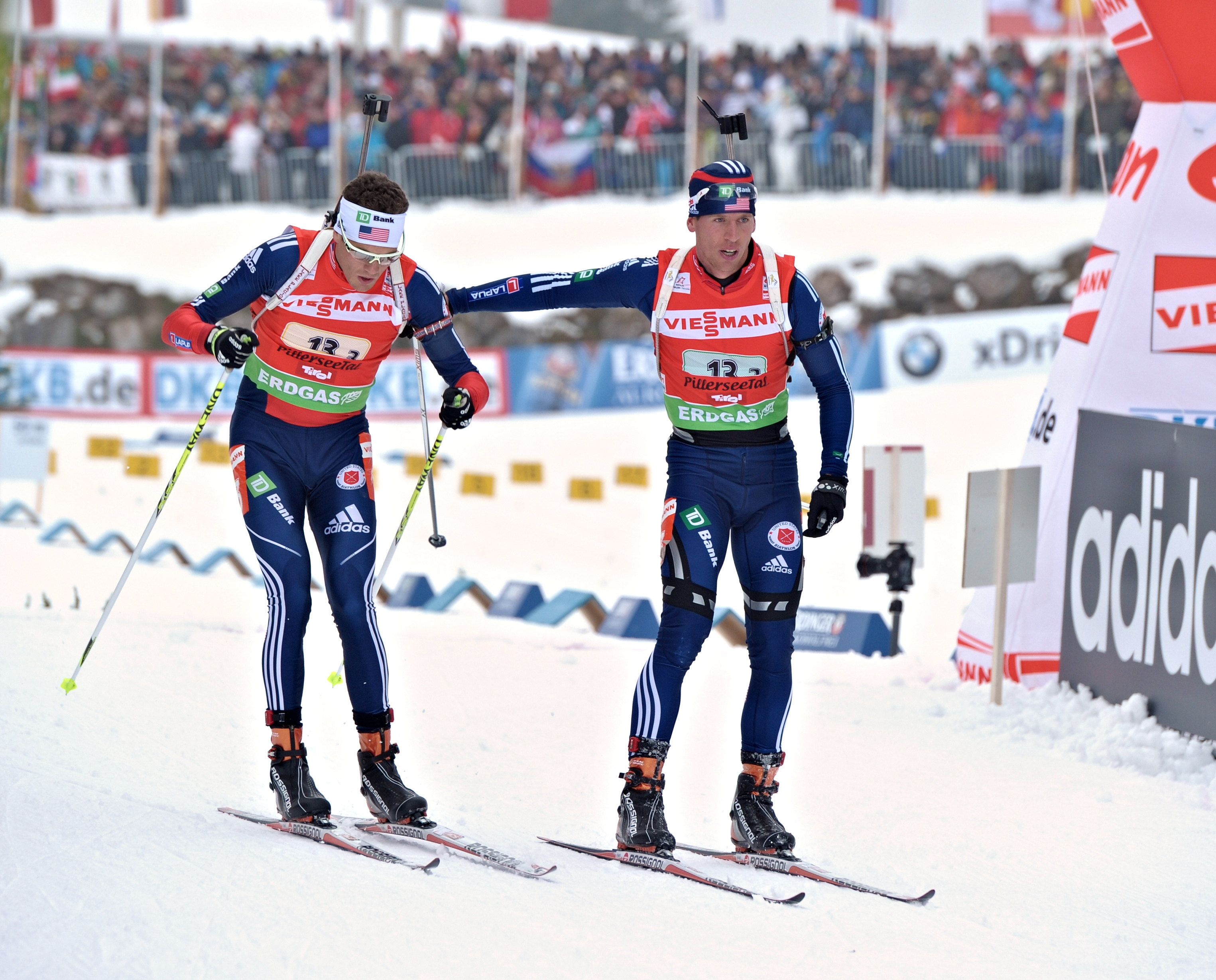
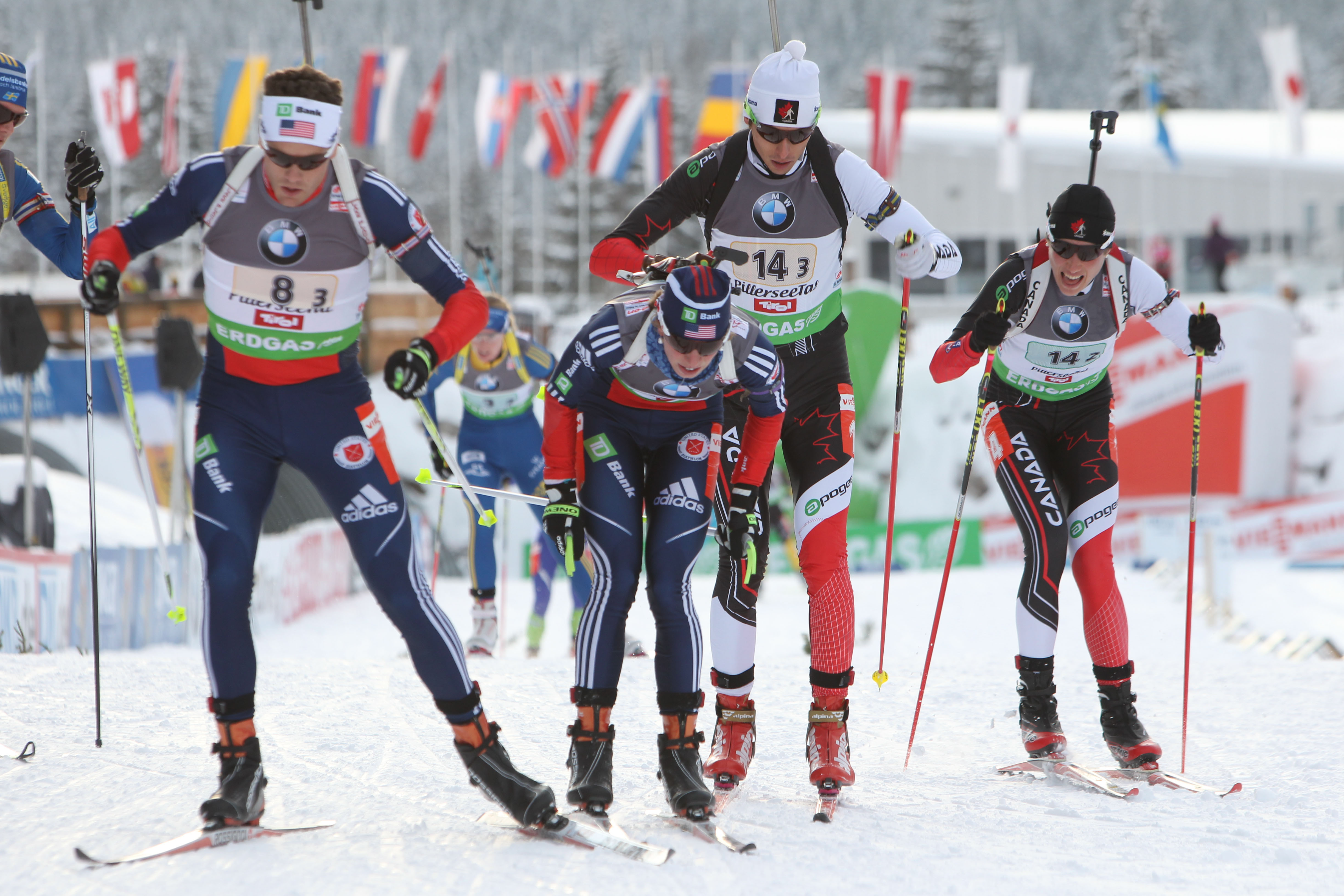
    Annelies Cook tags to Tim Burke for the US (l) as Zina Kocher hands off to Brendan Green for Canada (r). Photo: nordicfocus.com courtesy of USBA.

    After a grueling early-winter schedule of three consecutive three-race weekends, biathletes around the world were ready to head home for the holidays.

    But they had one last little piece of business to check off their lists before they departed from Hochfilzen, Austria on Sunday: the first mixed relay of the season. Athletes had to survive a quick six kilometers for the women, seven and a half for the men, and two shooting stages each.

    A few teams and racers chose to cut out early. Norway, the defending World Champion in the event, did not field a team, and Germany, Sweden, and France benched some of their biggest stars.

    “After three weeks of hard racing it’s kind of the last women and man standing,” United States Biathlon Association President and CEO Max Cobb said regarding team selection.

    Partway through the second leg, it was clear that one team had managed to preserve the energies of its athletes best, and that was Russia.

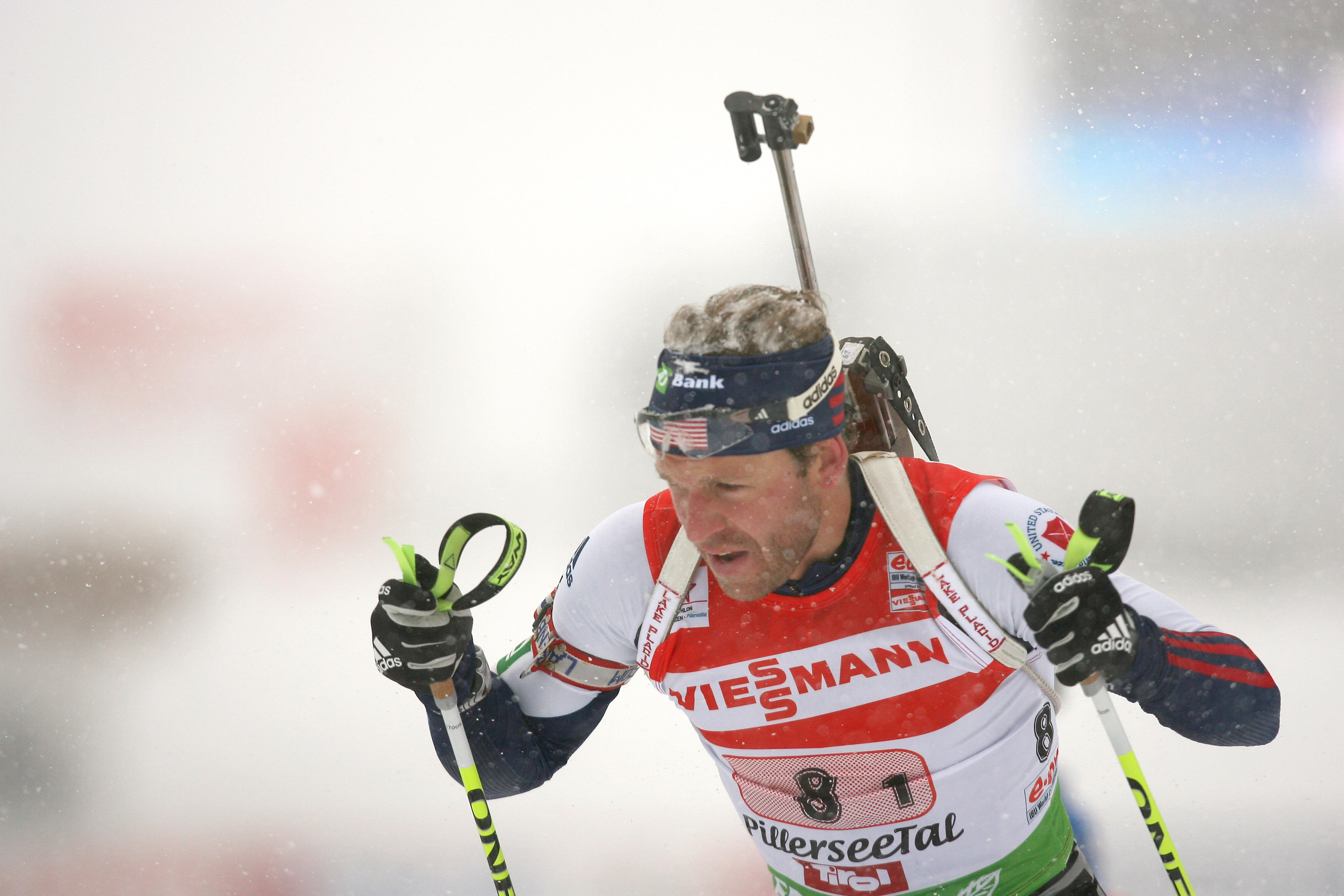
    Tim Burke (USA) shooting during the third leg of the race. Photo: nordicfocus.com / USBA.

    After Olga Zaitseva took the lead on her last loop, the Russians never looked back. Between the Olga Vilukhina, who had tagged off in ninth, Zaitseva, Alexey Volkov, and Anton Shipulin, the team only missed five targets and thanks to the use of spare rounds never hit the penalty loop.

    The two men not only hit every single target on their first try, but they had some of the fastest range times in the field. Shooting quickly and accurately, they quashed the hopes of the chase pack and waved goodbye to the possibility of getting caught. Shipulin stopped at the beginning of the stadium to grab a Russian flag and still finished with a lead of almost 30 seconds.

    “The team was very strong and we were lucky- the shooting went very well,” said a modest Shipulin through a translator in the post-race press conference. “But I don’t think that we are the only team who can win the mixed relay. Today we won and maybe tomorrow another team will win.”

    The victory gave Zaitseva three first-place finishes in as many races. In two weekends of racing in Hochfilzen, she has finished on the podium six times and now sits in fourth place in the overall World Cup rankings.

    Behind Shipulin, the anchors for the French and Czech teams fought it out for second. While France started the last leg with a ten-second advantage, Simon Fourcade used one more spare round than Michal Slesingr, and by the last loop the two men were skiing together.

    French fans may have wished that Fourcade’s younger brother Martin, who has already won two races this year, had anchored, because when Slesingr put in a charge up the course’s biggest hill, the elder Fourcade was unable to stay with him. As the pair jump-skated in unison at a speed that seemed impossible to maintain for the kilometer that remained before the finish, Fourcade was the one who fell off the pace.

    “Already in the first loop I had tested Simon a little bit and realized I was skiing faster,” Slesingr said in a Czech Biathlon Union press release. “I believed, therefore, that the most difficult climb [was the crux].”

    The Czech team wore black ribbons today to honor the death of Vaclav Havel, an activist and writer who helped bring the country out of communism and went on to serve as president for 14 years. Thanks to Slesingr’s skiing, they took second in comfortable fashion, 11 seconds ahead of France.

    “I am pleased that everyone could see that [we] can compete,” said Czech women’s coach Henry Sikola. “I believe it will encourage our entire team… I think that such euphoria before the holidays is important and motivational.”

    If that’s the case, then the Canadian team will have a very productive break. After Megan Imrie led off in tenth and Zina Kocher improved one spot, Brendan Green cleaned without using any spare rounds and skied his way into fourth place.

    JP Le Guellec used two spare rounds in his standing stage, dropping the team to sixth place, but still notched one of the best results in national team history.

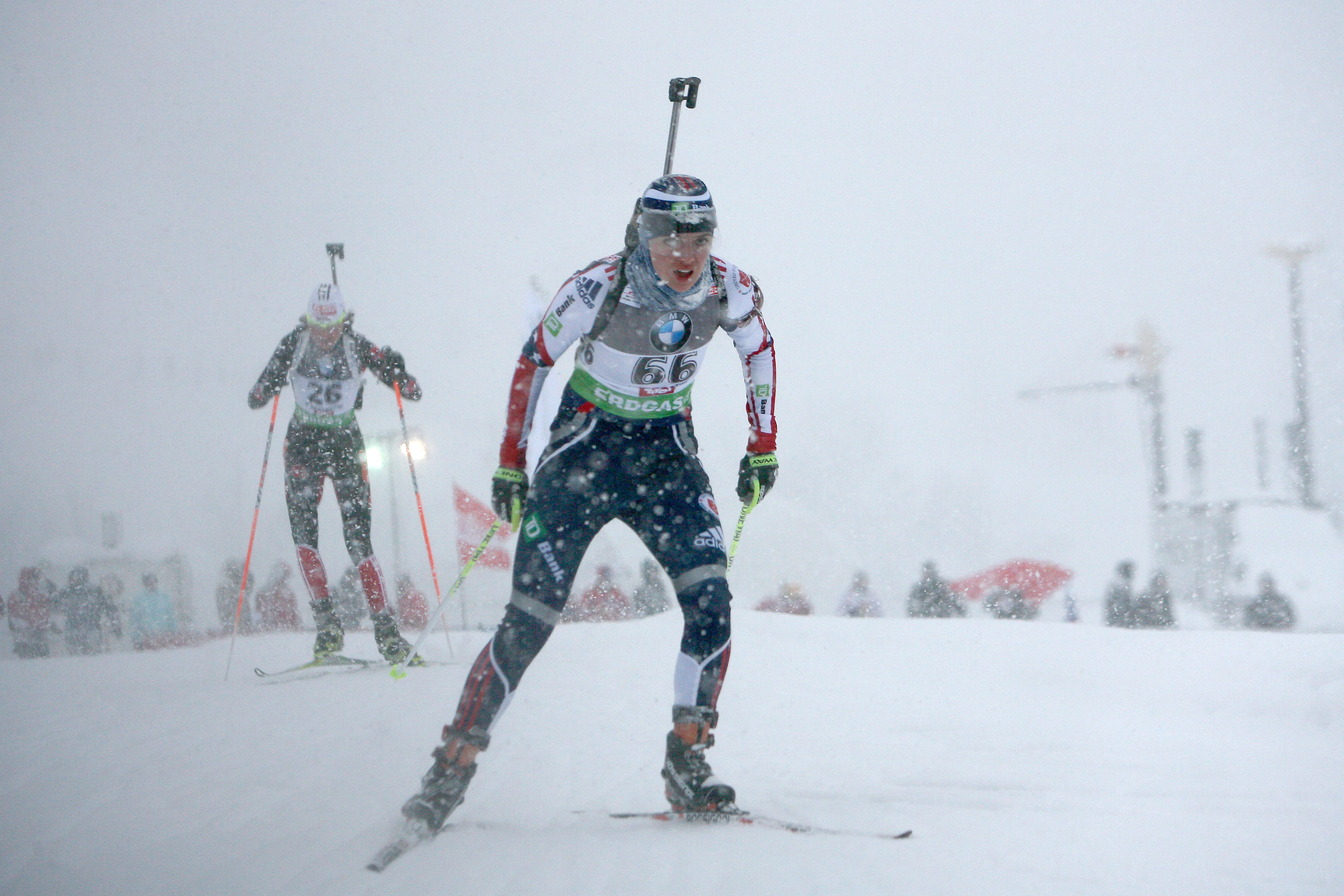
    Studebaker. Photo: nordicfocus.com / USBA.

    The athletes could not be reached for comment after the race.

    Their northern neighbors may have finished higher, but the American team actually had a stronger start. Leadoff racer Sara Studebaker skied a smart leg and cleaned both prone and standing; she was in fourth place when she left the range the final time.

    “Cleaning in a relay is always advantageous, and today it really worked out for me,” Studebaker wrote in an e-mail. “It was a pretty amazing feeling, leaving the range after standing in fourth!”

    While she has had a few strong efforts so far this season, Studebaker is still working to consistently achieve the top-30 results she saw last season.

    “This was a very solid day for me, and shows me that my ski speed and shooting are coming together,” she said. “It was the perfect race for me to head into the break on- it was the confidence boost I needed.”

    Cook. Photo: nordicfocus.com / USBA.

    Studebaker tagged off to Annelies Cook, who made the most of her first weekend of World Cup racing this season by cleaning prone and leaving the range in second.

    “I finally did what I know I can do in the range and cleaned,” she told FasterSkier. “At this point, I’ll take whatever I can! I knew some of the big guns would catch me and so I just tried to keep doing my own thing so I wouldn’t come in too gassed.”

    While Cook used two spare rounds to clean in standing, she still kept the team in a good position, tagging off in eighth with a group of other skiers.

    “I was scared to let my teammates down and I am so happy I didn’t,” she wrote in an e-mail. “It’s a good way to go home for Christmas. Now I can finally relax.”

    Burke in prone. Photo: nordicfocus.com / USBA.

    Tim Burke took over and had an inauspicious start, using all three available spare rounds in prone and dropping to twelfth. But after a single spare in standing, Burke turned in the fastest finishing loop of the leg and jetted back up to eighth, where he had started.

    Leif Nordgren also needed four spare rounds, and the team was in 14th place by the finish.

    But the women had no hard feelings.

    “Today was fantastically fun,” Cook said.

    The team selection, on paper, was somewhat unexpected; left off were Lowell Bailey, currently ranked ninth in the overall World Cup, and Jay Hakkinen, who had placed ninth in the pursuit the day before. Absent too was rookie Susan Dunklee, who led the women’s team in several races and had the top finish so far, 28th.

    But as Cobb had said, it was an issue of which athletes could make it to the start line. Dunklee, for instance, had come down with a cold.

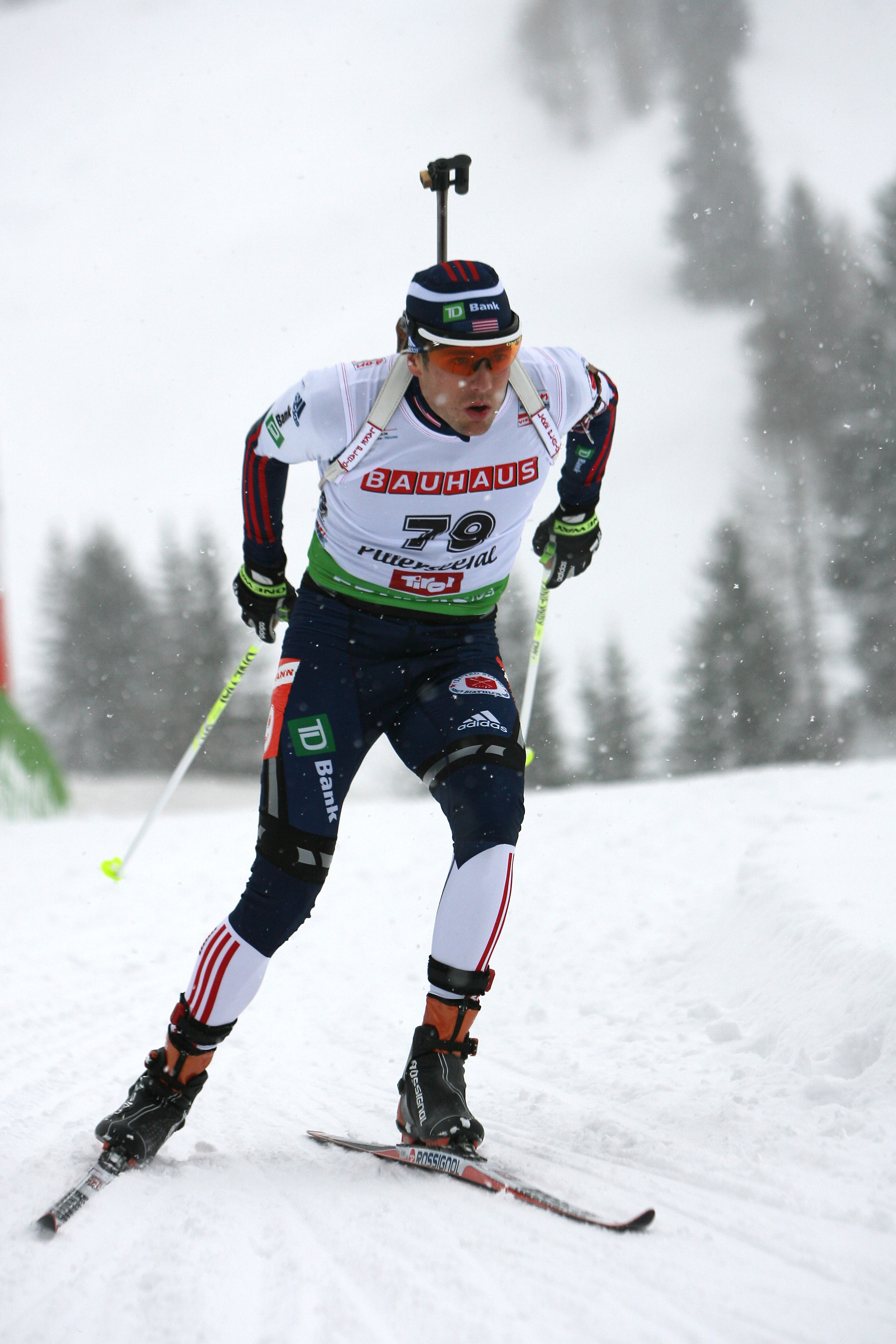
    Burke tagging to Nordgren. Photo: nordicfocus.com / USBA.

    “We have a better core now to choose from, so we are not so affected if we have to switch on or two names,” said head coach Per Nilsson. “Lowell and Jay have had many races with good results, but they were on the edge in terms of body and minds. We chose to go with Tim and Leif instead, to get one more race for them before the break.”

    Studebaker was enthusiastic for future relays, including the women’s races – an area where the U.S. has not traditionally excelled. Over the course of Studebaker’s career, the top finish in a women’s relay has been 13th place.

    “The fact that both Annelies and I had such good legs, and with Susan and the other girls in the mix, I think we can expect some good things from our relays this year,” Studebaker said.

    And Nilsson saw promise for the mixed relay, which will be an Olympic sport for the first time in 2014.

    “It’s fun to see that we have the potential to be up there,” the Swedish coach wrote in an e-mail. “As you saw, Canada was up there fighting for the top spots until the bitter end. I feel that we have at least the same potential as them.”

    Full results

  • Snowy Trails and Packed Fields Make a Barnburner in Hochfilzen; Le Guellec, Hakkinen Top-Ten in Pursuit

    Snowy Trails and Packed Fields Make a Barnburner in Hochfilzen; Le Guellec, Hakkinen Top-Ten in Pursuit

    Andreas Birnbacher of Germany (l) and Ole Einar Bjørndalen of Norway plow through fresh powder in their sprint to the line in Hochfilzen, Austria. Photo: nordicfocus.com courtesy of Fischer USA.
    Andreas Birnbacher of Germany and Ole Einar Bjørndalen of Norway plow through fresh powder while sprinting to the line in Hochfilzen, Austria. Photo: nordicfocus.com/Fischer USA. Click any photo to enlarge for better quality.

    There were a lot of unusual things about the World Cup biathlon races in Hochfilzen, Austria on Saturday.

    First, there was the inch of snow that fell during the men’s 12.5 k pursuit. Then, there was the fact that the field was incredibly compressed thanks to some strange weather in the original sprint race.

    “The snow storm that stopped [mid-race on Thursday] had a bigger effect than I expected,” U.S. biathlete Jay Hakkinen told FasterSkier.

    What Hakkinen (and others) hadn’t considered was the effect of setting up a pursuit where all 61 starters broke the wand in the space of two minutes.

    Course workers swept constantly to clear the shooting mats of snow. Photo: nordicfocus.com courtesy of Fischer USA.

    While cross-country race organizers can put as many skiers as they want in a mass start, it’s more complicated in biathlon due to the fact that there are only 30 points on a shooting range. In mass start racing, only 30 athletes get to start; in pursuits, which are seeded off of 10 k sprint races, 60 racers get the honors with the assumption that time gaps will prevent bottlenecking at the range.

    But in today’s pursuit, with so many starters so close together, things were a bit different. The race was essentially turned into a mass start with 60 racers.

    Tactics were further complicated by the fact that fresh snow was accumulating on the trail, and nobody wanted to work outside of the single skied-in track in the middle. As a result, long, single-file lines of closely-packed skiers snaked around the winding, open course in Hochfilzen all day, and the points on the range filled continuously during the first prone stage. The penalty loop looked like a merry-go-round at full capacity.

    “It was difficult today as only a small part of the track was fast, so it was hard to pass,” Norwegian veteran Ole Einar Bjørndalen told the press.

    But despite the close quarters and the potential stress on the range, there didn’t seem to be any problems. And for many, the mass-start feel created opportunity. The eventual winner, Andreas Birnbacher of Germany, started 26th. In a normal pursuit, that would have been minutes behind the leader, and he wouldn’t have had a chance. But today?

    “With clean shooting and perfect skis, it happened,” Birnbacher said in a press conference, still in shock that he had moved through the entire field.

    Simon Fourcade (FRA) leading the field through a tunnel. Photo: nordicfocus.com courtesy of Fischer USA.

    While Tarjei Bø of Norway and Martin Fourcade of France spent the first several loops out front, both missed shots in the third shooting stage, allowing a chase group of Simon Fourcade (Martin’s brother), Simon Eder of Austria, Birnbacher, and Bjørndalen to go by while they were stuck in the penalty loop.

    Bø and Martin Fourcade soon caught up – they are two of the fastest, most aggressive skiers on the circuit – and the six men skied together, shuffling positions, for much of the fourth loop.

    When they entered the range for the final time, the crowd held its breath. It is unusual for such a large group to be together so late in the race, and as a result the pressure to knock down targets was immense. For a few, it was too much, but Birnbacher, Bjørndalen, and Simon Fourcade were able to clean and sprint out of the stadium together to battle it out on the last loop.

    It certainly wasn’t what anyone had expected from this race – Bjørndalen may be the “King of Biathlon”, but he hasn’t won a race yet this season, and started with bib 15. Birnbacher had been even further back, and Simon is the less successful of the Fourcade brothers. Spectators are used to seeing Martin at the front, but instead, Simon had led the race on and off for several kilometers.

    By the time the men, led by Birnbacher, came down the final hill into the range, so many skiers had passed through single file that the trail looked like it had classic tracks. Even inside the tracks, it was slow; trailing skiers sometimes had to reach up and push the poles of the leaders to even out their speeds.

    Birnbacher using the powder like a waterslide. Photo: nordicfocus.com courtesy of Fischer USA.

    The crowd – waving flags and drinking beer as the snow piled up on their hats and shoulders – held their breath and watched the trio slingshot into the stadium. Bjørndalen made an aggressive move to draw even with the German; even despite his 92 World Cup wins, it’s always surprising to see such quick skiing from a 37-year-old. Fourcade trailed slightly, but the two leaders flailed through the powder to the line with amazing speed.

    “Everything was coming together as we came to the finish,” Bjørndalen said later. “I tried in the last meter, but Andi was stronger.”

    Part of the veteran’s problem may have been that the deep snow impeded his lunge to the line, and he ended up tangling and falling across the finish. But regardless of whether he would have made it on perfect corduroy, those weren’t the conditions in Hochfilzen, and Birnbacher came away with a 0.2-second victory, just the second of his career.

    The racers collapsed into the inch of fresh powder, leaving snow angels behind when they finally stood up to face the cameras.

    For Birnbacher, the win was especially meaningful as he is not considered the leader of his team.

    “Simon [Schempp] or Arnd [Peiffer] could win on any day, but this was my day,” he said in the postrace press conference. “At our training camp in Muonio, all of us showed we were in good shape. I hope that I can maintain it and be in good shape for [World Championships in] Ruhpolding. It is very important, almost the only thing everyone was talking about all summer.”

    The adversaries hugged it out after dusting off the snow. Photo: nordicfocus.com courtesy of Fischer USA.

    Fourcade was similarly thrilled. He has watched his brother pick up several victories already this season, and didn’t think he’d find similar success.

    “After the sprint, I thought I would never be on the podium ever again,” Fourcade said in the press conference. “That was the best race of my life, and I was sixth. It seems like something always happens to keep me from the podium.

    “Today, I kept thinking that something would happen and I would not make it,” he continued. “I have waited two years [since my last podium] and am very happy now. I knew my shape was very good – now all I am looking forward to is being up here with my brother!”

    Just 50 seconds after the leaders’ sprint to the line, Jean-Phillipe Le Guellec of Canada crossed in eighth place. And four seconds behind him, Hakkinen claimed ninth.

    The pair had started with bibs 48 and 45, respectively, and were among the biggest movers in the field. They were also among only five men to clean all four stages of the race (Birnbacher and Bjørndalen were two of the others).

    While each had finished in the top twenty so far this year, neither had reached the kinds of results they thought they were capable of. Le Guellec finished top-ten in the 2010 Olympics, while Hakkinen had a similar finish in the 2006 Games. For the last two seasons, they had said the same things after races: it was okay, but not what they were looking for.

    Today, that changed.

    Hakkinen leading Le Guellec. Photo: nordicfocus.com courtesy of USBA.

    “Today was a race I have known I am capable of but took awhile to accomplish,” Hakkinen wrote in an e-mail. “Skis were great, skiing was strong, and cleaning in both the sprint and pursuit [is something] I am quite proud of.”

    Le Guellec, too, was relieved to get some confirmation that his previous results were not a fluke. He explained that a changed attitude had led to his improvement.

    “I’ve been getting very anxious over the last few weekends and totally over analyzing everything,” Le Guellec said in a Biathlon Canada press release. “My motto this weekend was to just focus on skiing and shooting. Mentally I didn’t want to sweat the small stuff… I did that today and it took the pressure off.

    “This gives me the confidence to know I can be there,” he concluded. “This was a great result and I’m very happy.”

    Chris Lindsay, the High Performance Director for Biathlon Canada, confirmed that Le Guellec had been hard at work to achieve this result.

    “Today was a clear indication of JP’s capacity,” he told FasterSkier. “It has taken a few races to shake out the bugs, but he has always had his sights on being back among the best in the world. JP has been carefully strengthening each weakness in his execution. This precision in training will inevitably lead to top ten results.”

    It wasn’t just practice that returned Le Guellec to the top, Lindsay said, but also the talent of a young and improving Canadian team; Brendan Green, who finished 40th today, is currently ranked 33rd in the world and Le Guellec 36th.

    “I really think he has been helped by having strength among the rest of the team,” Lindsay said. “And the rest of the team has been helped through his previous successes and his maturity as an athlete.”

    Hakkinen nearing the finish. Photo: nordicfocus.com courtesy of USBA.

    For 34-year-old Hakkinen, who had not finished in the top ten since the 2008 season, shooting clean and netting the 22nd-fastest ski time of the day were a big deal, but there was an added bonus to his finish today.

    “Now I am also ranked in the top 30 which means I have a chance to qualify for the mass start in Oberhof, which is a big motivational boost going into the Christmas break,” he said. “It feels good to be back in the top ten, so I am planning to keep improving on today’s result.”

    With Lowell Bailey, who slipped from 21st to 25th on the back of four penalties, ranked ninth in the standings, the U.S. has a lot to be happy about. And Leif Nordgren, who had struggled through this first period of racing, finally had a strong race, missing a single shot and moving up from bib 49 to finish 33rd.

    “I followed my plan and everything except for the last ski loop went well,” he wrote in an e-mail. It feels good to be back in the points! That’s where I expect myself to be in every race – I’m happy with the direction of both my skiing and my shooting, and it’s only a third of the way through the season so there is a lot of races left.”

    Full results

    Nordgren leading Emil Hegle Svendsen of Norway. Photo: nordicfocus.com courtesy of USBA.
  • Un-Retired Zaitseva Picks Up First Win of Season; Imrie Notches Personal-Best 25th in Hochfilzen Sprint

    Un-Retired Zaitseva Picks Up First Win of Season; Imrie Notches Personal-Best 25th in Hochfilzen Sprint

    The podium, l-r: Darya Domracheva (Belarus, 2nd), Olga Zaitseva (Russia, 1st), and Helena Ekholm (Sweden, 3rd). Photo: nordicfocus.com courtesy of Fischer USA.

    Remember all those Russian shenanigans about firing coaches, during which Olympic biathlon gold medalist Olga Zaitseva abruptly announced her retirement in disgust?

    It’s a good thing that Zaitseva returned to biathlon, because recently she’s been on a tear. The 33-year-old Moscow native picked up her first win of the season on Friday in a 10 k sprint in Hochfilzen, Austria, to go along with two podium finishes from last weekend.

    She’s now finished on the podium four times in seven starts, and that’s the way she likes it.

    “I would like to be on the podium in all races,” she said in a press conference.

    Wouldn’t everyone? But part of Zaitseva’s confidence comes from working with the new coach, Wolfgang Pichler, who came in to head up the women’s team after a fairly disastrous 2010-11 season. Pichler had worked with the Swedes for over a decade, and launched the careers of Magdalena Forsberg, Anna Carin Zidek, and Helena Ekholm.

    “With the training schedule of our coach, we know that anything is possible,” Zaitseva said. “We have seen what he has done with his athletes before.”

    While many athletes her age would not necessarily jump on the chance to completely reconsider their training, Zaitseva, who won her first World Junior Championships medal in 1998 in Jericho, Vermont, seems enthusiastic.

    The feeling was mutual: Pichler has said that he believes the Russian women are more talented than the Swedes, and likes Zaitseva in particular.

    “Olga had a very good race,” he commented in a Russian Biathlon Union press release. “She demonstrated her professional level once again. Today was a great day! This result is a consequence of long and systematic work, which we did in the summer.”

    Zaitseva missed a single shot, which was an accomplishment on a particularly windy day when only three women shot clean.

    Behind her, two familiar faces rounded out the podium: Darya Domracheva of Belarus and Helena Ekholm of Sweden. But while neither was a surprise, it was for completely different reasons.

    Domracheva has already won two World Cup races this season, and has consistently racked up some of the fastest ski times in the field. Today, she was twenty seconds faster than Zaitseva on her skis, but missed one more shot and finished fourteen seconds back. In the press conference, she stated that she is aiming for the overall World Cup title; she currently trails Germany’s Magdalena Neuner by 28 points.

    Ekholm is no slouch on her skis, but more frequently shoots her way to the top. So far this season, she hadn’t been her usual sharpshooting self, but the Hochfilzen race was an improvement: like Zaitseva, she missed a single shot. Today was her first podium of the year.

    “I have been very frustrated, especially last week when I was so close,” Ekholm said in the press conference. “[Today] I finally felt normal in standing. I have been struggling with my shooting this year; that is not a usual situation for me. This week, I worked really hard on my shooting.”

    The 2009 overall World Cup champion finished thirty seconds down on Zaitseva. She was followed by the 2010 overall champion, Neuner, who had two penalties.

    * * *

    Out of all the North Americans, it could really only be said that one was thrilled with her performance. That honor went to Canada’s Megan Imrie, who despite windy conditions notched a career-best 25th place finish.

    “Today was my best result ever, which is always exciting,” she told FasterSkier. “I commented before the race that these were my favorite conditions: challenging wind for shooting, and fast, warm, skiing conditions.”

    While skiers might not find warm conditions to be the best, Imrie pointed to another consideration for biathletes: “When the temp’s above zero, my hands are the happiest of all- I can wear normal-person gloves, not massive insulated alpine ones, making shooting easier.”

    Imrie missed only two shots, which was one of the things separating her from the rest of the North Americans.

    “Hit targets were valuable today,” she said. “I made an error in my prone wind correction which resulted in two penalty loops. My standing was great- I was fully in control, and made a good lane choice (avoiding some high wind gusts) and just worked on one shot at a time.”

    Imrie finished 1:41 behind Zaitseva, but only 35 seconds out of the top ten thanks to large gaps in the top finishers. As such, she’ll be right in the thick of things for Saturday’s pursuit, and she’s excited for the possibilities.

    The 25-year-old said that her approach to racing this season was to keep things fun, and that seemed to have made a difference in her results so far.

    “I have been focusing on fully enjoying each race, like just being the goofball I am in the start pen,” Imrie explained. “It relaxes me, and I’m able to have more clarity during the race.

    “I’m easy to spot,” she joked. “I’ll be the one dancing around with huge mittens on.”

    Imrie’s teammate Zina Kocher had a more disappointing race, missing four shots. Luckily, her usual quick skiing helped her to 50th place, and she will join Imrie in the pursuit tomorrow. Despite starting two and a half minutes behind Zaitseva, with clean shooting Kocher could make a splash – she had the eighth-fastest ski time today.

    Rosanna Crawford, the final Canadian, missed three shots to place 73rd, and will sit out the rest of the weekend.

    “Not a great day for me,” she tweeted following the race.

    * * *

    Annelies Cook in her first World Cup race of the year. Photo: nordicfocus.com courtesy of USBA.

    If the Canadians had a single bright spot on the result sheet, then the Americans had none – or at least none that shone so strong.

    The team qualified a single athlete, Annelies Cook, for Saturday’s pursuit, which takes the top 60 finishers. Cook was the last qualifier.

    “I made it by the skin on my teeth,” she wrote in an e-mail. “I actually think it may have been my fast skis that got me into the pursuit! The course starts out rolling and then goes up a big climb and then is downhill with a small uphill before the finish. I think my split at the top of the uphill was out of the pursuit, so I am thankful for our good techs!”

    It was Cook’s first World Cup race of the season; she spent the first two weekends on the IBU Cup circuit before getting exchanged for Lanny Barnes and Laura Spector.

    “We want to have the athletes that perform to have a chance to show what they can also in the World Cup,” women’s coach Jonne Kahkonen told FasterSkier to explain the roster changes. “And also if the World Cup level is not there, the IBU Cup provides really good quality racing, so the train goes both directions.

    “With this we also want to have the bar high enough for the athletes, so that they have to push hard to get there – even though we don’t have huge numbers, we want to create a competitive situation.”

    Cook appreciated the strategy, and though she would have liked to have started the season on the World Cup, agreed that the progression was a smart decision.

    “The first IBU Cup went poorly and I had to get my confidence back up,” she said. “My goals were not to be on the IBU cup  but I also didn’t want to be racing at the World Cup and doing awful either. Last weekend [in Ridnaun, Italy] was awesome for me as far as skiing confidence went… that kind of feeling will keep you racing for another year.”

    Dunklee, skiing fast. Photo: nordicfocus.com courtesy of USBA.

    In the sprint, Cook missed three shots and had the 53rd fastest ski time; considering how great she felt, she said that she was disappointed not to have skied faster.

    “But I really love pursuits and being in a race with people around me,” she said, looking towards Saturday.

    Another inspiring thought? The only thing she can do is move up.

    Susan Dunklee and Sara Studebaker, the two other Americans, struggled on the range and placed 71st and 72nd with seven and five penalties.

    “The race for sure was not quite what we would’ve wanted today in the World Cup, but that’s biathlon,” Kahkonen said. “At the same time, I was pleased to see that both Susan and Sara are picking it up on the skis; Susan was less than a minute behind the fastest and Sara less than two minutes, for the first time this year. So, it is taking a bit longer but happening for sure.”

    Dunklee had the 18th-fastest course time of the day, and beat 23 starters even though some spent literally minutes less time in the penalty loop than she did.

    Full results

    Studebaker negotiating one of the course's downhills. Photo: nordicfocus.com courtesy of USBA.
  • With Recent Success, U.S. Biathletes Left Hoping for More After Ninth-Place Relay Finish

    With Recent Success, U.S. Biathletes Left Hoping for More After Ninth-Place Relay Finish

    Jay Hakkinen tags to Tim Burke in today's World Cup relay in Hochfilzen, Austria. Photo: USBA / nordicfocus.com.

    With three men who have placed in the top twenty so far this World Cup season and one more who was the hero of last year’s World Championships relay, the U.S. had high hopes for Sunday’s 4 x 7.5 k relay, the first of the season.

    The team chose Lowell Bailey, who has finished as high as fifth in these first two weeks of racing, as their leadoff leg.

    And in some ways, he lived up to the hopes: Bailey had the fastest course time of all the leadoff racers in Hochfilzen, Austria.

    Bailey en route to the fastest first-leg time. Photo: USBA / nordicfocus.com.

    But unfortunately, he was less steady on the range, missing one shot in prone and three in standing. With the use of spare rounds, which is allowed only in relay races, Bailey did not have to hit the penalty loop, but the time needed to load the spare rounds and finally drop the targets added up. Despite his quick skiing, he tagged off in 11th.

    “A bit of a bummer with the shooting today,” Bailey lamented in an e-mail. “I felt great on the skis but just couldn’t get the standing going!”

    Luckily, his teammates were able to bring the team back up towards the top, even despite some shooting woes of their own.

    The second leg belonged to Jay Hakkinen, who quickly cleaned his prone stage and moved the team up to eighth, less than 20 seconds out of the top five. But in standing, Hakkinen, too, needed three spare rounds to drop all the targets. Despite a hard charge to the finish, the U.S. was still in tenth when Hakkinen tagged to Tim Burke.

    Burke has had an up-and-down start to the season – he’s been in the top twenty and even the top ten, but has had even more races that didn’t go quite as planned.

    Burke on the shooting range. Photo: USBA / nordicfocus.com.

    Today, things didn’t go as planned either, but as in his ninth-place pursuit finish in Ostersund last weekend, there were glimmers of brilliance. Like Hakkinen, Burke cleaned his prone stage with no difficulty. But also like his teammates, he struggled in standing, using all three rounds and this time still leaving one target standing. Burke had to ski a penalty loop before he could head for the exchange zone.

    But Burke skied the second-fastest closing loop, and had the fourth-fastest third leg of all the teams; thanks to his hard work on the trails, the team moved up to eighth.

    And then it was time for Leif Nordgren, the skier who had so deftly anchored the U.S. to a sixth-place finish at 2011 World Championships.

    Where his teammates had struggled on the range, Nordgren capitalized, cleaning both stages with perfect ten-for-ten shooting.

    “It was nice to finally get my shit together shooting,” said Nordgren, who has had a rough start to his 2012 campaign. “I’ve made a few changes in the last couple days, not something you usually want to do during the season, but I didn’t really have much choice!”

    While Nordgren’s ski times weren’t the best – “it’s still early but [the skiing] will be getting better and better”, he said – Nordgren still put in an impressive leg, leaving the U.S. in ninth place at the end of the day, two and a half minutes behind the winning Norwegian team (Russia was second and France third).

    Nordgren racing for the finish. Photo: USBA / nordicfocus.com.

    U.S. Biathlon President and CEO Max Cobb said in a press release that the athletes found the result “frustrating”, but that there were high points in the men’s racing as well.

    In Bailey’s mind, one of those high points was the youngest team member’s performance.

    “Leif came back with a great last leg – clean shooting and good skiing,” he told FasterSkier.

    After adding up the successes and disappointments from the day’s race, the U.S. team was left wondering what might have been.

    “As far as the team goes, for sure we know we have more to give and we expect more,” Nordgren told FasterSkier. “This was an okay place to start for now.”

    Bailey had also hoped for more, but he was able to look at the ninth-place finish with the team’s history in mind and come away feeling positive.

    “I think we definitely hoped for a better result as a team but it’s nice to see that with a mediocre day, we were in the top ten,” Bailey said. “Just a few years ago, that would have been a great day for us! It’s a long season and this is the just the first relay of the year.”

    A variety of U.S. Biathlon Association staff had similar reactions, including Cobb.

    “Watching today’s men’s relay, I was struck by how much potential the team has to be top-six now and to fight for the podium if we improve a little,” Cobb told FasterSkier. “It did not come together that way for us today, but the ski speed and range times are there for these four guys.”

    Cobb pointed to the spare rounds as the major culprit in the team’s performance.

    “Today, several times, a single missed target took three extra rounds to hit,” he explained. “So instead of that one miss costing ten seconds, it cost 20. We need to be better at getting every missed shot with just one extra round and then we’ll be on the podium.

    “it is a sign of great progress from years past when we come up with a ninth place, and say, ‘There was so much potential to do better today.’”

    * * *

    Studebaker on her way to tagging off in 11th. Photo: USBA / nordicfocus.com.

    The Canadian men raced to 15th place. Leadoff racer Brendan Green had an incredible start, cleaning both stages and tagging off in sixth place, less than 15 seconds off the leaders. But over the next three legs, Jean-Phillipe Leguellec, Scott Perras, and Marc-Andre Bedard used ten spare rounds and hit the penalty loop once, and the team dropped down as low as 18th before climbing a few places to the finish.

    In the women’s 4 x 6 k relay, the Canadian team of Megan Imrie, Zina Kocher, Rosanna Crawford, and Megan Heinicke put together a strong showing, placing ninth with ten spare rounds and no penalty loops. Imrie and Kocher each used several spare rounds to start the team off, but after skiing the sixth and fifth fastest times of their legs, the team was in good position.

    “It was definitely one of our better races,” Crawford said in a Biathlon Canada press release. “We tied with our result at [2009 World Championships] in Korea and know that we still have room for improvement. Hopefully by World Championships this year we will be making top-eight or better!”

    Crawford has not had much individual success so far this season, but today she cleaned both of her stages and moved the Canadians from ninth up to eighth.

    Barnes anchoring the U.S. team. Photo: USBA / nordicfocus.com.

    With Canada only receiving three quota spots for individual racing, Heinicke had not yet competed on the World Cup this year, but she made a strong debut, using three spare rounds in prone and none in standing and keeping the team in ninth place.

    The Canadians finished 3:14 behind the winning Norwegian team.

    The American women faltered after a strong start, where Sara Studebaker used two spare rounds to tag in 11th place and then Susan Dunklee turned in the second-fastest second leg time and after using five spare rounds tagged in tenth. After four spare rounds from Laura Spector and two penalty loops by Tracy Barnes, however, the team was lapped and pulled from the race in 14th place.

  • Kocher Improves to 23rd in Biathlon Pursuit; Dunklee, Studebaker 43rd and 44th for U.S.

    Kocher Improves to 23rd in Biathlon Pursuit; Dunklee, Studebaker 43rd and 44th for U.S.

    Susan Dunklee (USA) competing in the sprint in Hochfilzen, Austria on Friday. Photo: US Biathlon / nordicfocus.com.

    Is it possible that Magdalena Neuner has checked out of biathlon?

    The German biathlete – who recently announced that she would retire at the end of the season at the young age of 24, and held a huge press conference to discuss her decision – slipped from first to third in Saturday’s World Cup pursuit. True, she had two penalties, but so did winner Darya Domracheva of Belarus. And true, she only lost by three seconds, but the Neuner of old would have outsprinted her competitors.

    Neuner, however, explained her performance in a different way. She has said that she is focusing on World Championships, which will be held in Ruhpolding in March.

    “The power was not there today, but as I have previously said, I am not quite in top form yet,” Neuner said in a press conference today. “However, I am headed in that direction and in a good place now. My running was good today, I finished third and being so close to Darya is not so bad.”

    She has a point. It was the fifth World Cup win for the Belorussian, and the second this season. Domracheva had the fastest ski time of the day.

    “The other girls are very strong and that made last loop very hard for me,” she said in the press conference. “Most importantly, sometimes the power of your mind is as important as the power in your body. That is what carried me to the finish.”

    Olga Zaitseva of Russia moved from third up to second, just 0.3 seconds behind Domracheva.

    Zina Kocher of Canada, who has had a strong start to the 2012 season, started the pursuit with bib 33. After missing a shot in each prone stage, she cleaned in standing and skied up to 23rd place.

    “I’m really happy with my shooting today,” Kocher told FasterSkier. “Shooting well is really crucial to moving up in a pursuit. And cleaning standing and skipping the penalty lap is such a great feeling!”

    Only one woman, Anna Bogaliy-Titovets of Russia, cleaned all four stages and six women had a single penalty, meaning that Kocher’s shooting was among the best in the field. But despite the lack of clean sheets, the Canadian said that conditions were perfect.

    “Pursuits are a difficult mental game, because you are around so many athletes skiing, and so many are shooting all at once that it is easy to be caught up in the excitement,” Kocher said to explain the stats.

    “First you want to keep up and pass others around you and ski fast, but if you have gone too hard, you may find shooting incredibly difficult with a high heart rate and high lactate, and be distracted by someone shooting faster or cleaner than you…. It is very important to stay in control.”

    Kocher did just that, and continued to produce vastly improved results over last season. She is currently ranked 24th in the overall World Cup.

    “What is most important is that today gave me a lot of confidence and a reminder that, oh yah, I do know how to flip the targets to white when it matters most,” she said.

    Kocher was the only Canadian who qualified for the pursuit, but tomorrow the Canucks will field a full relay team with Kocher, Rosanna Crawford, Megan Imrie, and Megan Heinicke.

    Two Americans competed in the pursuit, and despite wildly different start numbers, Susan Dunklee (bib 37) and Sara Studebaker (bib 58) finished just under five seconds apart in 43rd and 44th places.

    Dunklee had a rough time on the shooting range, missing three shots in each of the prone stages. By the time she had finished two loops, she had dropped to 54th.

    “In prone I never found my rhythm or my focus,” Dunklee wrote in an e-mail. “I wasted a lot of time on the mat and had slow shooting times compared to normal. I’ve had plenty of races in the past where I’ve gotten off to a rough start in the range but pulled it together for a strong finish, and I was confident I could turn things around in standing today.”

    She did – after collecting a single penalty in her first standing stage and cleaning the second, Dunklee was able to move up to 43rd.

    She also had some added motivation at the end of the race.

    “Coming out of the penalty loops after the second lap, I saw the race leaders coming into the range for their third shooting and I realized I was battling just to finish the race,” Dunklee said. “I really don’t like the idea of getting pulled from a race.”

    Rather than getting lapped and consequently pulled from the race, Dunklee turned on the afterburners. It also helped that she caught up to Studebaker, who had passed her during the first loop.

    “We connected at the start of the last lap and worked together to past three women together before the finish,” Dunklee wrote.

    Just like last weekend in Sweden, Studebaker was able to improve in the pursuit after a frustrating sprint. She felt like she was missing the form that brought her top-20 finishes and a 34th-place overall ranking.

    “The race today was a definite step in the right direction for me,” Studebaker told FasterSkier. “Today the skiing was much better; having so many people so close together made it easy to catch rides with other skiers, which certainly helped. I know there’s still another level for me to reach, though, so being patient in making that happen is my focus for now.”

    The American women are looking forward to tomorrow’s relay, where Dunklee and Studebaker will be joined by Laura Spector and Tracy Barnes. Barnes was originally nominated to the IBU Cup team for this period of racing, but with sister Lanny, who was named to the World Cup squad, falling ill, Tracy was pulled up for the relay.

    “The relay tomorrow will be fun,” Studebaker said. “We didn’t have the chance to do many last year, so we’re all really excited to get a relay start so early. I think if we all have a solid day on the range we can have a good result, but either way it will just be fun to do a race as a team!”

    Full results

  • After Climbing to Fifth in World Cup Pursuit, Bailey Slips to 17th On Back Of Late Shooting Errors

    After Climbing to Fifth in World Cup Pursuit, Bailey Slips to 17th On Back Of Late Shooting Errors

    Lowell Bailey (USA) racing in Friday's sprint in Hochfilzen, Austria. Photo: US Biathlon / nordicfocus.com.

    “Today was one of the best biathlon races of my career,” Lowell Bailey told FasterSkier after Saturday’s World Cup pursuit in Hochfilzen, Austria. “…Except for the fourth shooting.”

    The American biathlete started the day ranked 14th, 52 seconds behind leader Carl Johan Bergman of Sweden. Through three stages, Bailey shot clean and skied his way up into fifth place.

    “This is really only the second time in my career that I have been in this position in the pursuit, so I have to be happy with that,” Bailey said.

    The first time was last weekend at the World Cup openers in Ostersund, Sweden. There, Bailey placed fifth in the sprint, so he started the pursuit closer to the front. Today’s effort was in some ways even more impressive since he had a larger deficit to make up before reaching the top five.

    Either way, though, Bailey’s chances for podium were dashed when he missed two shots in the final standing stage.

    “I wish I could get those two misses back!” Bailey wrote.

    Bailey following Daniel Mesotitsch (6th place) of Austria in the pursuit. Photo: US Biathlon / nordicfocus.com.

    Bailey had the 18th-fastest course time of the day, and spent time skiing around champions like Michael Greis of Germany, Bjorn Ferry of Sweden, and Emil Hegle Svendsen of Norway, who outsprinted teammate Tarjei Bø for the win. Bailey also passed Bergman, who dropped down as low as 12th place after struggling in prone before rebounding, passing Bailey, and winding up fourth, roughly ten seconds off the podium.

    “I felt good on course and solid in the first three shooting stages,” Bailey told FasterSkier. “Overall, I am happy with the race and excited for the first relay tomorrow.”

    While Bailey couldn’t capitalize on his good position midway through the race, the fact that he got there at all is just one more positive in a young season that has been filled with career-best results. In Ostersund, Bailey racked up finishes of ninth in the individual, fifth in the sprint, and 13th in the pursuit. In Hochfilzen, he has notched two more top-twenties.

    Before this year, Bailey had only finished in the top ten once.

    He was able to point to a few specific things that had influenced his performance.

    “First, I was able to make a few major changes in my ski technique and I think that has helped me a lot in the way I approach a race tactically,” Bailey explained. “Secondly, I was able to stay healthier this year, especially during the fall and the World Cup prep training blocks. [For] the past few years it seems that I’ve been plagued by some kind of ailment just before the start of every season.”

    But additionally, Bailey thought that his recent success had a lot to do with the fact that he’s stuck with a good program, been patient, and waited for good results. He thought that U.S. biathlon on the whole was on its way up.

    “I feel very fortunate to have worked with the teammates, staff, and trainers that have been a part of my training over the last five years,” Bailey said. “I have been on a lot of different nordic sports teams over my career and I can confidently say that this is the most professional and dynamic group of people I’ve ever been a part of.

    “It makes all the difference to work with a team rather than for a team.”

    Two other Americans raced in the pursuit, which only takes the top 60 finishers from the sprint. Jay Hakkinen maintained his bib number, 45; he gained several spots early in the race, but encountered shooting problems in the last two stages and fell back to 45th.

    Tim Burke fell from 42nd to 46th on the back of six penalties. Burke and Hakkinen had the 35th and 39th-fastest course times of the day.

    * * *

    While Bailey has been celebrating his spate of top-ten and top-twenty results, another North American has had a strong start to the season as well. Brendan Green of Canada placed 14th in the sprint in Ostersund before falling to 32nd in the pursuit. In Hochfilzen, he started the pursuit with bib 34.

    After cleaning both prone stages, Green had moved up to 21st, and seemed to be on track for the fifth top-twenty finish of his career.

    He then missed one and two shots in the standing stages and fell back to 33rd – still in the World Cup points, but frustrating given the possibilities at the start of the race.

    “Although I picked up some misses late in the race during the standing bouts, I had a strong ski,” Green, who had the 19th-fastest course time, wrote in an e-mail.

    He explained that while he had hoped to replicated his sprint result from last weekend, his body threw a wrench in the works partway through the week.

    “After the last race in Sweden my back flared up quite badly – related to a disk herniation that happened while training in late July,” Green said. “Early on in the week I was considering flying home, but our support staff worked extra hard to get me back on my feet and things improved a lot over the last few days.

    “It’s been a really a roller coaster week for me.”

    The sprint was particularly difficult for Green – he did not feel comfortable on his skis – but he managed to shoot clean and keep himself in the game for the pursuit. Luckily, he said, today he felt much better.

    “I was actually able to enjoy the race, as opposed to yesterday which physically was a struggle from the get go,” a relieved Green explained. “Given the circumstances I am satisfied I was able to maintain my position today, and I am hoping I can keep things rolling in the right direction.”

    No other Canadians competed in the pursuit.

    Full results

    Jay Hakkinen racing the sprint. Photo: US Biathlon / nordicfocus.com.
  • Weather Wreaks Havoc on World Cup Biathlon Relay; U.S. Has “Worst Race Possible”

    Weather Wreaks Havoc on World Cup Biathlon Relay; U.S. Has “Worst Race Possible”

    Lowell Bailey leads off the U.S. relay in Hochfilzen, Austria, on Sunday. Photo: U.S.B.A. / nordicfocus.com.

    At the first handoff of the men’s World Cup biathlon relay in Hochfilzen, Austria on Sunday, it looked like Norway might not be able to turn in the performance that everyone expected of them.

    Then Ole Einar Bjorndalen took over, and things went back to normal.

    Alexander Os, Norway’s first-leg skier, can be forgiven for turning in a less-than-perfect performance. Conditions were stacked against him, with huge wind gusts that held the range’s indicator flags at perpendicular and heavy snowfall that made the targets appear 80 percent white at times.

    “It continued to dump snow similar to the last the last few days, and the gusting wind once again made the shooting a challenge which many teams struggled with,” Canadian biathlete Brendan Green told FasterSkier.

    The conditions made Bjorndalen’s performance – and Norway’s turnaround – all the more impressive. He cleaned both shooting stages with no extra rounds and had the fastest ski time on the first two of his three loops. After receiving the tag in 10th place with a 36-second deficit, he handed off to teammate Emil Hegle Svendsen in a completely different situation: the Norwegian was now even with Klemen Bauer of Slovenia and had a sizeable lead on the rest of the teams.

    Svendsen, a double winner in Ostersund, Sweden, last week, continued the trend, and added thirty seconds to Norway’s lead. Tarjei Boe, who had already won both the sprint and pursuit this weekend, came into the stadium the final time, didn’t have to push himself to hold onto the win, and by the time he finished, the Austrians were almost a minute behind.

    The Norwegians have truly dominated the World Cup so far this season. In Ostersund, Svendsen won the individual and the sprint, with Bjorndalen passing him near the end of the pursuit for a victory of his own. Here in Hochfilzen, Boe won both the sprint and pursuit races. In addition, Norway has picked up three second-place and three fourth-place results in the five non-team races.

    Boe summed up his team’s dominance well in an interview with IBU News.

    “That is pretty awesome,” he said. “Everyone in our team is smiling. It is good that the whole team feels like they are winning together.”

    Austria’s second-place finish had its basis in solid skiing, but it was the home team’s shooting that put them ahead of the rest of the field. The Austrians were one of only three teams to avoid the penalty loop in the gusty conditions, and, incredibly, used only four spare rounds to do it. The next best-shooting team used seven.

    France finished third, thanks to a last-minute sprint by Martin Fourcade, who passed Germany’s Michael Greis. Sweden was just two seconds behind in fifth.

    The North American teams had a rough time both skiing and shooting, and ended up with less-than-satisfying results: the Canadians were 16th and the Americans 20th. There has been increasing pressure on the teams to turn in strong relay performances after American Tim Burke’s stint as the overall World Cup leader last year and Canadian Jean-Phillipe Leguellec’s inspired performances at the Vancouver Olympics. But on Sunday, neither team was able to be as competitive as they had hoped.

    The Canadians seemed to be off to a promising start, with Brendan Green tagging off in eighth place, just thirty seconds behind the leader – and ahead of Norway, a somewhat surprising situation.

    “I felt good on course, and was able to ski a strong leg,” he said in an e-mail. “My shooting was solid which I was happy about, and being able to tag off to my teammate in a pack not too far from the lead was exactly what I had hoped for.”

    But it didn’t last. Nathan Smith, Canada’s next skier, used all six spare rounds and still hit the penalty loop three times, leaving the team in 18th place. And after Scott Perras left one standing target up, the team was sitting in 19th.

    “Unfortunately our luck with the shooting didn’t hold up,” Green said. “But everyone skied strong, which shows that we have the ability to be in the running when our shooting is more together. As a team we are not happy with this result, but we are working the bugs out and are excited for our next relay opportunity.”

    Leguellec was able to provide a strong finish, with the seventh-fastest anchor leg. He used four spare rounds to clean all the targets – not ideal, but a start.

    “I didn’t really have a strategy per se today, I guess it was to simply do my race and stay out of the penalty loop,” Leguellec told FasterSkier. “I’ve been looking for that sweet sensation you get when you’re in your zone, and I guess I was able to find it a bit today in skiing. Shooting was good since I didn’t do any loops, but my standing was a struggle. In the end, I just wanted to keep it steady in skiing and make up spots on the range.”

    He was more philosophical about the team’s final result, and pointed out that the Canadians have had plenty of mediocre relays before: Leguellec has been part of twenty-one relay teams as a senior, and only two have finished in the top ten.

    “The race in its whole wasn’t the best we’ve had, but wasn’t the worst either. 16th is kind of an average considering we did two penalty loops. We’re going to play around with our start order until World Championships to see what works best for this fairly new and young team.”

    The Americans had trouble right out of the gate, with Lowell Bailey visiting the penalty loop after his standing stage and tagging off to Burke in 17th. Burke had the seventh-fastest ski time for his leg, but his standing stage was a disaster. After using all three spare rounds, he still had to ski three penalty loops. As a result, his strong skiing was unable to gain the team a single place.

    Leif Nordgren, the youngest and least experienced member of the U.S. team, was the only one who managed to avoid the penalty loop, but it took him five of a possible six spare rounds to do it, and his shooting time was one of the slowest of all the third-leg skiers. As a result, the U.S. actually fell one more spot, to eighteenth.

    Nordgren was unable to find the positives in his performance.

    “It was pretty much a total shit show today,” he told FasterSkier in an e-mail. “Being the only American to not hit the penalty loop makes me feel worse than it does good. The relay is a total team competition. Even though my race wasn’t as bad as everyone else’s, I still feel like I let down the team.”

    To finish things off, Jeremy Teela gave the team one last visit to the penalty loop, and the U.S. slipped to twentieth place.

    “I can’t really speak for the other guys, but I didn’t think the conditions were super tough,” Nordgren said. “It was just a day when everyone had almost the worst race possible.”

    It was Nordgren’s first World Cup relay, and he hopes that the next one will be different.

    “I was maybe a little nervous looking at the start list, looking at all the other guys who were skiing the third leg,” he said. “I was thinking, ‘well if Lowell and Tim have a good day, I will have to race these guys head to head.’ It didn’t come down to that today, but hopefully someday it will.”

    Next week, the World Cup moves to Pokljuka, Slovenia, and the U.S. is relieved to be saying goodbye to Hochfilzen.

    “Overall, I think we’re all ready to put this week behind us,” Nordgren said. “I’ve never raced in Pokljuka. But I’m excited to get the opportunity, and hopefully it will go better than this week.”

  • Henkel and Germany Take a Victory Lap in Women’s Biathlon Relay – Updated

    Last weekend, if you had asked which country had the best female biathletes, the answer probably would have been Sweden. Anna Carin Zidek and Helena Ekholm both graced the podium multiple times at the World Cup openers in Ostersund, Sweden.

    But last weekend, Magdalena Neuner wasn’t racing.

    In Hochfilzen, Austria, things are different. In Saturday’s 4 x 6 k relay, Neuner was Germany’s second skier. She took the tag in third place, twenty seconds behind Svetlana Sleptsova of Russia, and only used one spare round in two shooting stages to clean and tag off to Sabrina Buchholz with the lead.

    Germany never looked back. By the time their fourth skier, Andrea Henkel, entered the stadium for the last time, she had a lead of over a minute. Henkel took a German flag from a spectator and skied with it into the finish, all smiles, to meet her teamates.

    The team, consisting of Kathrin Hitzer, Neuner, Buchholz, and Henkl, had been the subject of some speculation. Could this new team – minus the now-retired trio of Martina Beck, Simone Hauswald, and Kati Wilhelm – possibly be as successful as the old German team?

    The answer was a resounding “yes.”

    Henkel told IBU News that the Germans had never doubted their abilities.

    “Everyone kept asking if our new team would do as well as the old team,” she said. “All of the time we said that we were still a strong team and no one believed us. Today we could finally show how good we are.”

    Still, what unfolded behind the Germans was almost more interesting. After controlling the early portion of the race, Russia watched their medal chances all but disappear as third-leg skier Ekaterina Yurlova, who was sitting in second position, used all of her spare rounds in the standing stage and still left one target black. While she was shooting, the French and Ukranian teams came into the range, cleaned with no extra rounds, and skied away without her. Russia never recovered and had to muster a strong effort just to secure fourth place.

    Beginning the final leg, Marie Laure Brunet of France and the Valj Semerenko of Ukraine were skiing together about a minute behind Henkel, followed by Olga Zaitseva of Russia and Tora Berger of Norway. At the exchange, it seemed inevitable that France and Ukraine would round out the podium.

    But there was more drama about to unfold. While all four athletes cleaned in prone, with only Semerenko using a spare round, Brunet faltered in standing, using all three extra bullets and still missing one target. Semerenko disappeared ahead of her, second place secure, while Brunet had to head to the penalty loop.

    And meanwhile, Berger was showing why she was an Olympic gold medalist in Vancouver. She quickly cleaned standing and set out on the final lap at a pace that could not be matched by either Zaitseva or Brunet, who left the range ten seconds behind her. Berger had visibly more power and zip, and rescued her Norwegian team’s hopes for a medal. By the time she reached the finishing stretch, she was able to ease up and celebrate as she crossed the line. And with a team that included two World Cup rookies, Norway did have reason to be proud.

    But while the Norwegians were pleased, it was the Ukrainians who seemed most excited by today’s result. It had been nearly two years since they last stood on a World Cup relay podium. In January 2009, Ukraine won a relay in Oberhof, Germany, and since then their women have finished fourth several times. Today, they mobbed Semerenko as she crossed the finish line nine seconds ahead of Berger.

    Sweden raced to an uninspired and distant sixth-place finish.

    The Americans did not enter a team, as they have only two women on the World Cup right now. The Canadian team of Megan Imrie, Zina Kocher, Rosanna Crawford, and Melanie Schulz finished 11th, using twelve extra rounds and tallying one missed target.

    “11th is a decent result for us,” she told FasterSkier in an e-mail. “However, with less spare rounds and without the penalty lap, the result could have been better. Megan started off strong shooting clean in prone, but then struggled in standing, needing all three spares to clean. My skiing felt much stronger today and was able to pull off a great ski race, but then my shooting was a disaster needing 2 spares in prone and ending up with a penalty lap in standing. Rosanna shot much better with 2 spares in prone.”

    The Canadians were the last team not to be lapped by the Germans, and Kocher said that it was an issue the whole team felt during the race. Everyone wanted to be able to finish the race.

    “[Rosanna] tagged off to Melanie, who needed to push hard to make it to standing shooting before the winning team finished the race,” Kocher sad. “Otherwise our team would have been pulled from finishing the race. Melanie needed spares in standing and said she strongly felt the stress of the top teams finishing.

    “Many teams struggled in the first prone in leg one,” she continued, “and therefore, Megan’s clean prone really helped us stay in the game. Room for improvement, but not bad for the first relay, faster skiing and clean shooting is the ticket.”

    The World Cup continues on Sunday with a men’s relay and a women’s pursuit.

  • Boe Cruises to Victory in Pursuit, Leaving Field to Battle for Second

    Boe Cruises to Victory in Pursuit, Leaving Field to Battle for Second

    Lowell Bailey (USA) moved up 16 spots to 39th in the pursuit in Hochfilzen, Austria. Photo: U.S. Biathlon Association / nordicfocus.com.

    As Alexis Boeuf of France told IBU News on Friday, “You know, in biathlon one day you can be on the podium and the next day be last.”

    That wasn’t quite true on Saturday, although Sergui Sednev of the Ukraine, who finished second in Friday’s sprint, dropped to 29th in the next day’s pursuit.

    No, what is more noticeable is that the stars of last weekend’s World Cup openers in Ostersund, Sweden, haven’t shone as brightly since the circuit moved to Hochfilzen, Austria. Emil Hegle Svendsen of Norway, a double winner in Ostersund, had the fastest ski time in the pursuit, but missed four shots, removing himself from contention for the win. He finished fifth, while his legendary teammate Ole Einar Bjorndalen, who had also picked up a win in Ostersund, missed three shots and finished seventh.

    Instead, their young teammate Tarjei Boe raced to his second win of the weekend. Boe began the day with a 27-second lead, and extended it to 38 seconds by the end of the 12.5 k race. Along the way, he missed only one shot in four shooting stages. Boe was entirely unchallenged and skied his own race.

    “Before the last shooting, I knew I had a one-minute lead,” he told IBU News. “I knew that I should continue shooting fast and I could still miss two and still win.”

    He only missed one in that last stage, and left the range with still almost a minute over his next closest competitor. Coming into the finish through the still-falling snow – Hochfilzen has received almost two feet of fresh powder in the last 48 hours – he didn’t have to push to maintain his lead.

    While he appeared confident on the trails and in the range, Boe told IBU news that he wasn’t expecting to do so well this weekend.

    “I never expected to come here and win twice. I knew that my form was good enough to win, but it is hard in biathlon to win with so many athletes who can win. My shape in cross-country was good and my shooting is good and fast, then it would be no problem.”

    Behind Boe, a fierce battle for second place unfolded. Coming into the final shooting stage, Russian teammates Ivan Tcherezov and Evgeny Ustyugov were second and third, with a fifteen-second gap back to Simon Eder of Austria. But the Russians missed shots and were stuck in the penalty loop while Eder cleaned. The Austrian managed to maintain a lead all the way to the finish, where Tcherezov outsprinted Ustyugov for third place. The three skiers finished within two seconds of each other.

    While Eder had appeared to be the weaker skier earlier in the race, he told IBU News that it was actually part of his strategy.

    “I was saving,” he said. “You have to save for the last loop when you are not in top shape. That is what I knew I had to do, you have to do your own race when you are not in top shape.”

    Biathletes, take note, and watch out when he is in “top shape.”

    As usual, Tim Burke led the Americans. He finished 19th after starting 23rd. Burke started the race strong, skiing well and cleaning both prone stages, and was in fifteenth place after two loops. But he faltered as the race went on. Burke missed three shots in the last two standing stages, and slowed on the fourth and fifth laps as well. In the end, he came into the finish just a few seconds ahead of Anton Shipulin of Russia and Klemen Bauer of Slovenia, who had made up almost twenty and ten seconds on him, respectively, in the last lap.

    Lowell Bailey moved up even more in the standings, skiing from 55th place into 39th. He missed only one prone shot and one standing, and had the 42nd-fastest ski time.

    “Today was a good step forward for me,” he told FasterSkier in an e-mail.  “I was happy with the shooting and I felt much better skiing. It is a good sign heading towards the middle of the season. It has been a tough couple of days here in Hochfilzen as we have gotten more than two feet of snow in the last 48 hours! Considering the weather, I’m happy with result and looking forward to the relay tomorrow.”

    The Canadians struggled on the range, with Jean-Phillipe Leguellec missing eight shots and falling from 27th place to 59th. Brendan Green missed seven shots and slipped from 35th place to 54th.

    World Cup action continues Sunday in Hochfilzen as the men race a relay. The Norwegian team, featuring Boe, Svendsen, and Bjorndalen, will be heavy favorites, and the men will have to work together rather than against each other as they did last weekend, where there was a bit of animosity between Svendsen and Bjorndalen after the pursuit.

  • Studebaker Career-Best 26th In Hochfilzen

    Studebaker Career-Best 26th In Hochfilzen

    Sara Studebaker (USA) skiing through the snow in the sprint in Hochfilzen, Austria, on Friday. Photo: U.S. Biathlon Association / nordicfocus.com.

    Sara Studebaker was the only woman the United States Biathlon Association had enough confidence in to pre-select for the first period of World Cups this year.

    And after last weekend’s racing in Ostersund, Sweden, some people were wondering why: she finished 72nd in the individual race and 88th in the sprint.

    But in Ostersund, Studebaker had water-borne parasites to contend with. When the World Cup moved to Hochfilzen, Austria this week, she was ready, and on Friday proved that she deserved that pre-qualified spot, finishing a career-best 26th in the sprint competition.

    Studebaker shot clean, and said that her shooting gave her the confidence to go for it on skis, too.

    “I felt much better than last week, and shooting well definitely gave me a boost,” she told FasterSkier in an e-mail. “Cleaning my shooting was very exciting. I had a lot of confidence and was very excited going into the last loop, so that definitely helped me ski well.”

    As for her health, Studebaker was simply relieved that her stomach problems and corresponding lack of energy were behind her.

    “It was great to feel good skiing again, and though I know I still have improvements to make, this was a step in the right direction. In the last lap I was catching up to an Italian skier, and was getting splits that I was one second from 20th place, so it was helpful to be able to chase her down… I had a great race and was really happy with the outcome.”

    Just as the men had earlier in the morning, the women had to contend with heavy snowfall during their race. However, conditions were more or less equal throughout the course of the race, so nobody had much of an advantage, unlike in the men’s competition. Nevertheless, the effects of the snowstorm were obvious, with even the fastest women spending more than an minute in the range during each stage.

    Anastasiya Kuzmina of Slovakia skied to the win, shooting clean and besting the field by almost twenty seconds. Kuzmina won the sprint at the Vancouver Olympics, but this year her season had not started off well. In Ostersund last weekend, she missed 10 of 20 shots in the individual competition.

    “My only problem last week was on the shooting range, so I was not too concerned,” she told IBU News. And she was right to be confident: her ski time was the eleventh-fastest, but none of the women faster than her could manage to hit all the targets. Kuzmina is back on track and a force to be reckoned with again this year.

    Darya Domracheva of Belarus finished second, collecting her tenth career World Cup podium.

    Overall World Cup leader Kaisa Makarainen rounded out the podium four seconds behind Domracheva, and will maintain her position at the top of the standings. She told IBU News that given the pressure of wearing the yellow bib for the first time, she was surprised she skied so well.

    “Last night, I was very nervous when I received this bib,” she said. “I was very concerned about how I would do today. But by this morning, I was calm again.”

    However, the conditions suited her and she was able to ski to another podium finish.

    “It was very tough on the course and the weather was difficult. I do not think I had the best skis, but they were obviously good enough to get me to the podium. My skiing is feeling quite good… I am usually good on hard courses and in tough conditions, when you have to work a lot; I am not too good in very fast conditions. My technique is not at its best in those conditions. So today was actually good for me. Still, it felt quite tough.”

    Laura Spector was the only other American in the race, and tied for 55th place, qualifying her for Sunday’s pursuit. None of the Canadians were so lucky: Zina Kocher, Rosanna Crawford, and Megan Imrie finished 62nd, 70th, and 80th.

    None of the women will be competing tomorrow. A relay is on the schedule, but with only two Americans and three Canadians present, neither country can field a whole team.

    Studebaker told FasterSkier that while a relay would be fun, there was a silver lining to skipping it.

    “I think it can work well for us, since when most of the other girls must go out and race hard again tomorrow, we will have an easy day of training and resting to get ready for the pursuit. I’m looking forward to the pursuit race; I’m in a good position, and with so many women so close I think it will be a very exciting race. It will be fun to get my first pursuit start of the year!”

  • Fourth Straight Norwegian Win in Biathlon, but It’s Not Who You’d Expect

    Fourth Straight Norwegian Win in Biathlon, but It’s Not Who You’d Expect

    Tim Burke (USA) finished 23rd in the World Cup sprint held in Hochfilzen, Austria, on Friday. Photo: USBA / nordicfocus.com.

    For the fourth straight race, a Norwegian biathlete stood atop the World Cup podium.

    Was it 36-year-old veteran Ole Einar Bjorndalen? Or perhaps the overall World Cup leader, Emil Hegle Svendsen?

    Those would be smart guesses, but they’d also be wrong. Instead, it was their teammate, 22-year-old Tarjei Boe, who was the second-fastest skier on Friday and shot clean. Boe has never graced a World Cup podium before, much less won a race. But in the sprint, held in Hochfilzen, Austria, he bested the field by a solid 27.5 seconds.

    Sergui Sednev of Ukraine finished second after missing one shot. Alexis Boeuf of France was third, climbing the World Cup podium for just the second time in his career.

    Most of the field had to contend with heavy snowfall, which slowed both skiing and shooting times as competitors struggled to make out the targets through the snow. The back of the field seemed to have it the worst, at least in terms of skiing. Conditions slowed considerably as more and more snow built up.

    Boe told IBU News that he had actually felt better in Ostersund, Sweden, last week, but he thought that he handled the conditions better than the other men.

    “I was pretty lucky in the first two laps, but in the third loop, it started to snow really hard,” he said. “I thought that I would lose the victory because of that. Then I increased my lead from 20 to 25 seconds and knew that I could handle the conditions.”

    Boe was excited for his first victory, which was also the first time he had topped his two more famous teammates.

    “It is pretty cool,” he told IBU News. “It is the first time that I beat both of them in a World Cup. If you beat them, you are at the podium because they are up there all of the time. Emil is in such good shape these days that I have to do better shooting than him to be up there.”

    And that was indeed the case. Svendsen had the fastest ski time of the day, as has been his habit lately, but missed one shot in each shooting stage. Despite those misses, he was only 0.5 seconds behind Boeuf, narrowly missing the podium.

    Meanwhile, Boeuf had to contend with disappointment himself – he fell on a downhill on the last loop. Since he was less than six seconds behind Sednev, this almost certainly cost him second place.

    When he talked to IBU News, though, Boeuf was philosophical about the error.

    “It might have been better, but I fell down, not on a turn, but a perfectly straight place,” he said. “My ski just turned the wrong way and I was down. I lost some seconds there, but that is biathlon… You know, in biathlon one day you can be on the podium and the next day be last.”

    Tim Burke of the U.S. and Jean-Phillipe Leguellec of Canada finished 23rd and 27th, continuing a string of solid but unexceptional results from last weekend. With two misses each, the pair has been nothing if not consistent so far in the early season, collecting several top-30 finishes.

    Burke was frustrated with the race, saying that he had made a huge mistake in choosing the third U.S. starting position. He had assumed that it would snow for the entire race and that by the time he started, at least the track would be skied-in. Instead, the going got slower as the day went on.

    “Today felt like a flashback to the sprint race at the Olympics,” he told FasterSkier in an e-mail. “The good thing for tomorrow is that I am not too far back and everyone will ski through the same conditions. I will be looking to take out some of my frustrations from today during tomorrow’s race.”

    Leguellec said in a Biathlon Canada press release that he felt good today.

    “I felt a lot better skiing today than I did last weekend, but feel doesn’t mean you actually go faster,” he said. “I guess it just hurts less. My skis were bombing but my two misses cost me a lot. I’ll be in a good spot for tomorrow’s pursuit. Hopefully I can shoot well and climb up some spots.”

    Brendan Green had the next Canadian finish, placing 35th with one missed shot.

    “Starting in bib #1 meant I was breaking trail for the first loop,” he told FasterSkier in an e-mail. “I suffered more time loss on that loop than I would have liked, but the next two loops were better once the track had been skied in, and the shooting was solid today which I was very happy with. I’m sitting in a good position heading into tomorrow’s pursuit so I’m looking forward to that race and hopefully moving up in the standings.”

    Green hadn’t had an impressive weekend in Ostersund, finishing 65th and 74th. Friday’s result was a relief, he said.

    “Ostersund was a bit of a rough go for me with a disappointing showing on the range. My skiing was in pretty good form there, but without good shooting that doesn’t mean much. Hochfillzen has been a nice change from the cold temperatures and parasites in Ostersund, and I had a couple days earlier on in the week to regroup and bring more focus to my shooting. There’s still a long season ahead, and I’m confident that my best form is still yet to come.”

    Nathan Smith also qualified for the pursuit, riding clean shooting to a 54th-place finish. Scott Perras rounded out the Canadian results by finishing 92nd.

    For the Americans, Lowell Bailey shot clean and finished 55th, and will join Burke in the pursuit tomorrow. Leif Nordgren, Jeremy Teela, and Russell Currier finished 70th, 89th, and 94th. All struggled on the range, with Nordgren and Teela missing four shots each and Currier seven out of ten.