Tag: Hochfilzen

  • Biathlon Veterans Teela and Barnes Back on the World Cup, Hoping for Olympic Comebacks

    Biathlon Veterans Teela and Barnes Back on the World Cup, Hoping for Olympic Comebacks

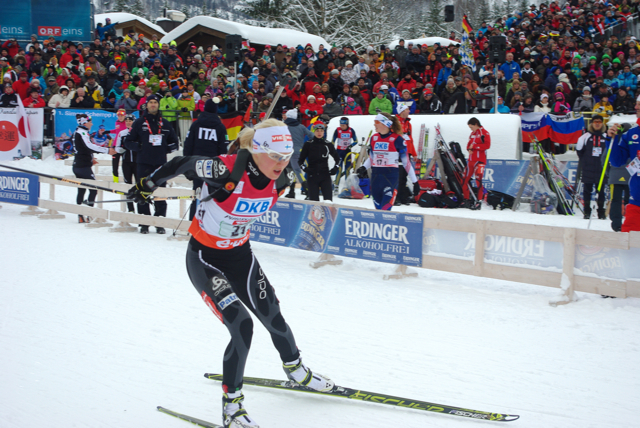
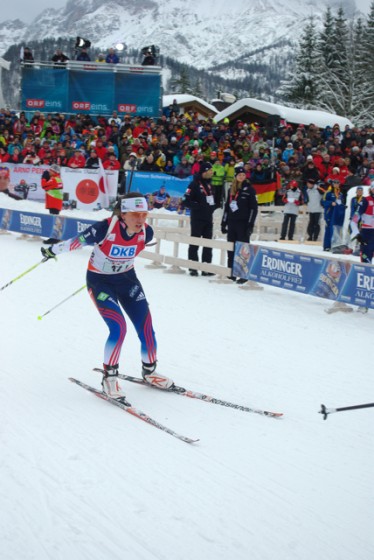
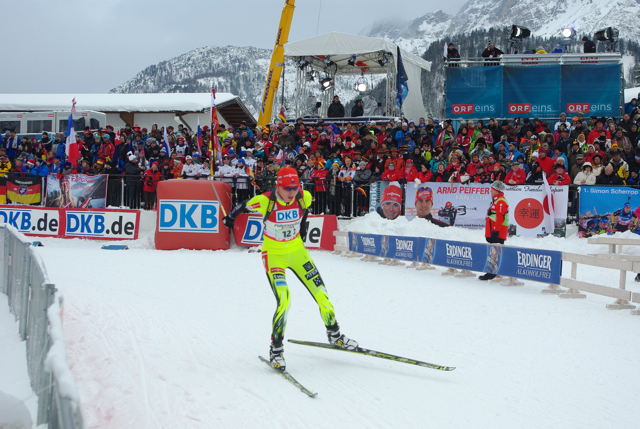
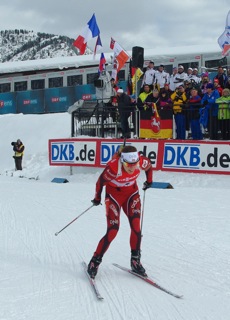
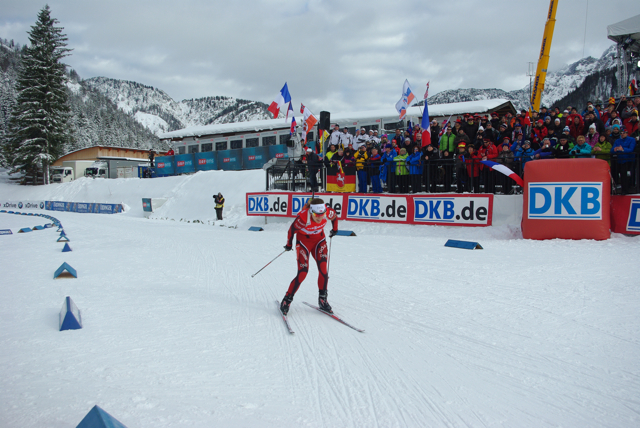
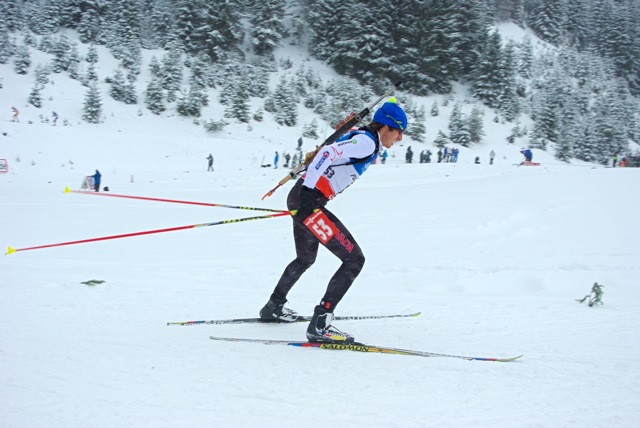
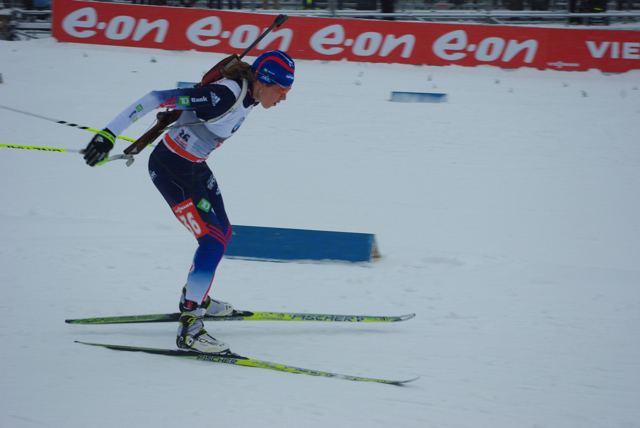
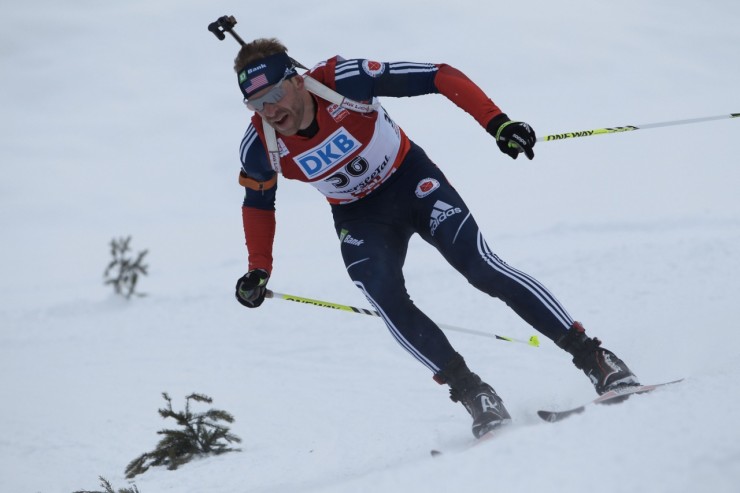
    Lanny Barnes (USA)
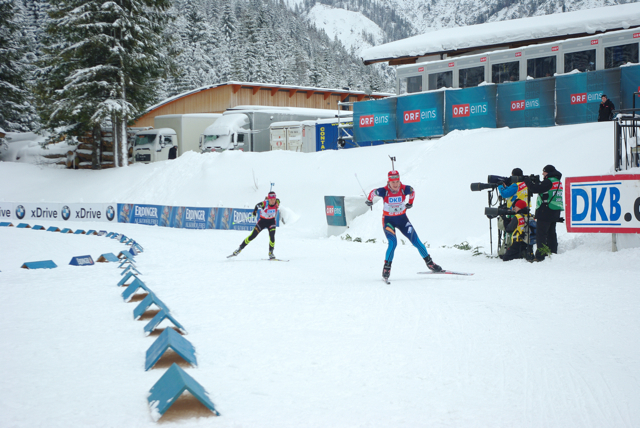
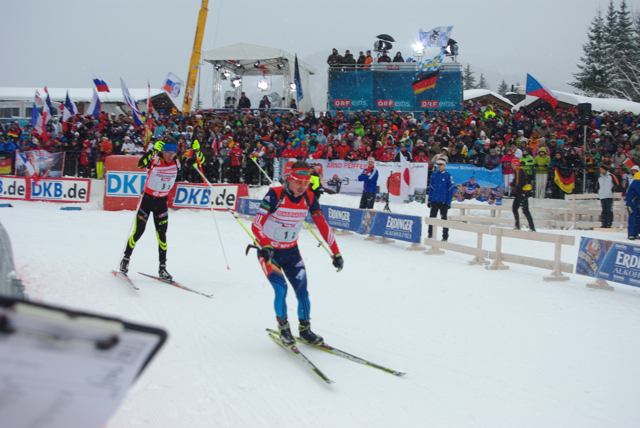
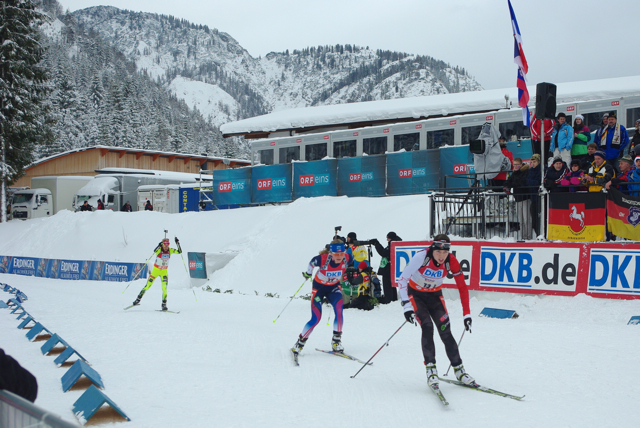
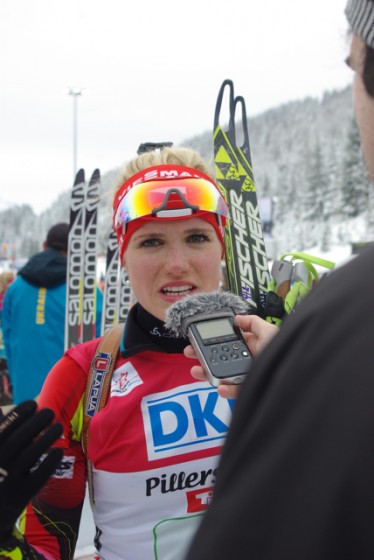
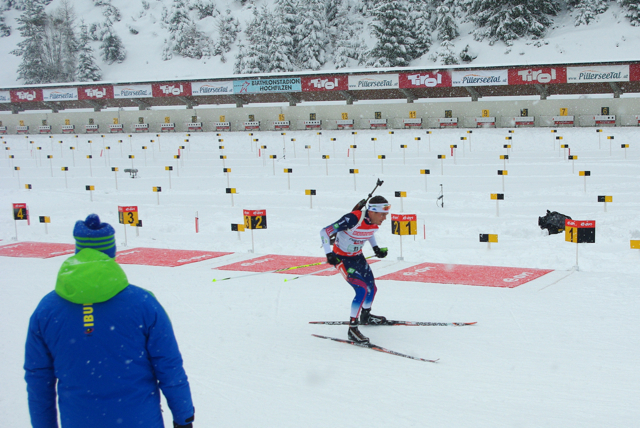
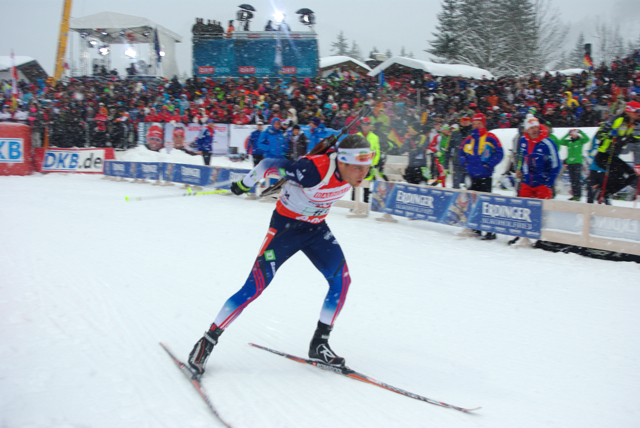
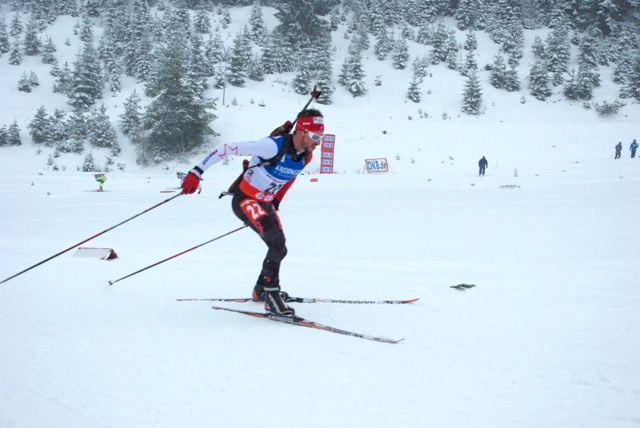
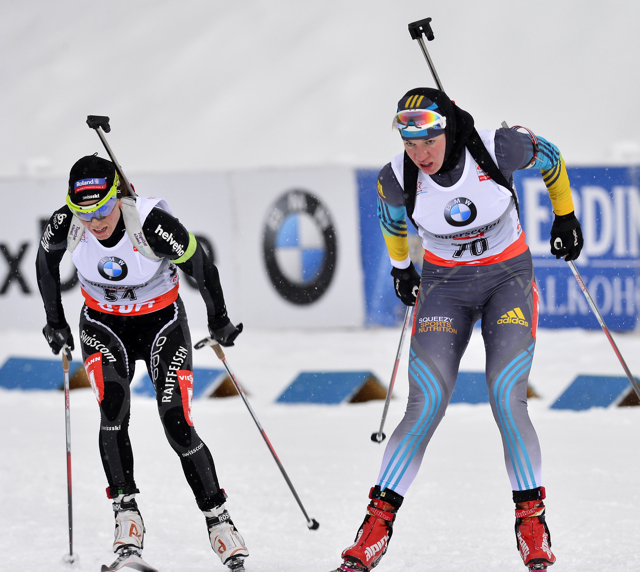
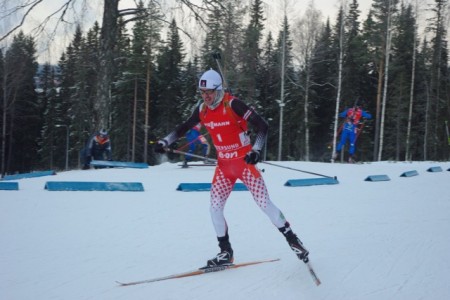
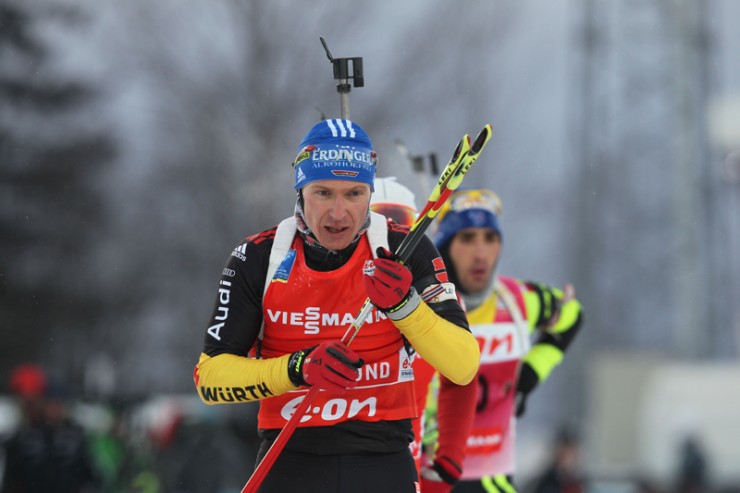
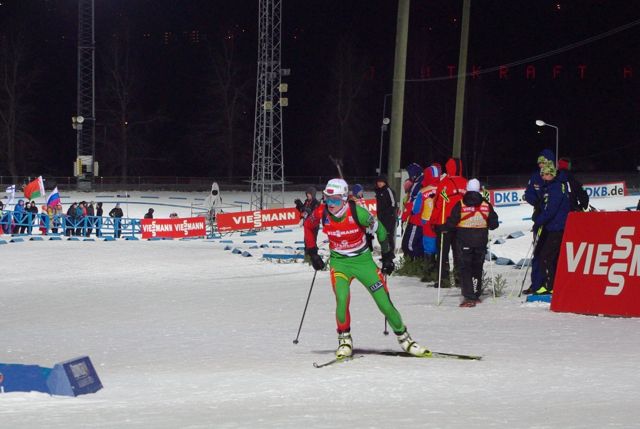
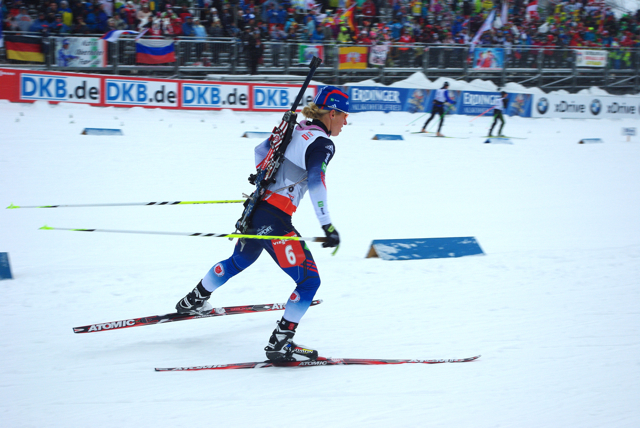
    Lanny Barnes competing in the World Cup sprint on Friday.

    HOCHFILZEN, Austria – Four years ago at the Vancouver Olympics, the best American results in biathlon came from a pair of veterans: Jeremy Teela, who placed ninth in the sprint in the best-ever finish for a U.S. biathlete at a Games, and Lanny Barnes, whose 23rd-place finish in the sprint was a historical record for a U.S. woman.

    You might not have seen much of either racer last season, but they’re still around – and in fact, you might say they are making their comebacks. Both Teela and Barnes were on hand this weekend for World Cup racing after spending most of last year on the second-tier IBU Cup circuit. In Friday’s sprint, they both placed 65th, just outside the cut for Sunday’s pursuit. But on Saturday they upped their games and turned in strong relay legs: Barnes helped the U.S. women finish eighth, the best result since she joined the team more than ten years ago, and Teela tagged off after the third leg in sixth (the U.S. men eventually finished 11th, but closer time-wise to the podium than they often are).

    Were these the best performances of their careers? Certainly not. But for a pair of athletes who didn’t get to see this level of competition much last season, it’s a step in the right direction.

    “You might say that everything since Vancouver was a down season,” Teela laughed. “But I’ve had a really good season of training.”

    Like Barnes, he is hoping to qualify for the upcoming Sochi Olympics. It would be the third Games for Barnes and the fourth for Teela – definitely his last, he said.

    After Vancouver, Teela began spending more time on other aspects of his life. Maybe most importantly, he now has a child. That changes your priorities a lot, he said. He was still training hard, but wanted to spend time with his family. That’s the main reason he’ll retire at age 37 at the end of this season.

    This year? All of that is suspended temporarily while he tries to go for it one more time.

    “An Olympic year is always extra motivation,” Teela said. “Oh yeah.”

    Both athletes qualified through rollerski races in Jericho, Vermont, and Soldier Hollow, Utah, to take part in a national team trip to Sweden this fall in advance of the race season. There, they raced in the IBU Cup openers. Teela did well enough to earn an immediate promotion to the World Cup.

    Barnes wasn’t so lucky – she started off with a strong race, placing 13th in the opener, but in the second sprint shooting woes knocked her way out of contention. So she spent a second weekend on the IBU Cup while Hannah Dreissigacker got the World Cup starts. But Barnes stayed consistent in the next IBU Cup races, placing 16th and 18th, and got a promotion (the U.S. now has five women traveling with the World Cup despite only having four start spots).

    “It feels good,” Barnes said on Friday of her first World Cup start of the season. “That was one of my goals for the year, was to climb my way back up.”

    While Teela has fatherhood to deal with, Barnes and her sister Tracy faced a different challenge. This spring they had surgery for compartment syndrome, a painful condition that affects the lower legs, particularly in skating. They are now back to 100 percent and feeling better than ever.

    “It’s night and day,” Barnes said. “I was trying to explain to a lot of people how it’s like for ten or twelve years, or maybe my whole career, I’ve learned how to not push in my legs, because I haven’t been able to use them. And now I have to remind myself to actually push with my legs. So I have to work with my technique to keep stepping on them.”

    The fresh snow on Friday’s course tested her legs seriously for the first time this season – if they were ever going to feel painful, the heavy, slow conditions would have done it. But Barnes reported that there wasn’t pain, just a struggle to adjust her technique to the conditions and her new legs. That means she can focus all of her energy on racing well and making the Olympics.

    “It’s always a struggle when you come back from surgery and you’re basically the bottom of the pond,” she said. “So it’s nice to finally be back here and having a chance to fight.”

    Fight they will have to, if the pair want to compete in Sochi. Three athletes – Tim Burke, Lowell Bailey, and Susan Dunklee – are already qualified for the Games. Two more will be picked after this pre-Christmas World Cup period. Teela said he hopes to be that guy so he can avoid the post-Christmas selection trials process, the more painful route towards Olympic qualification.

    Barnes is up against Annelies Cook, Sara Studebaker, and Dreissigacker, among others who may qualify for a January IBU Cup tour that serves as the last set of trials. Cook has the best result of the trio so far and is likely to snag the automatic qualification spot; Studebaker is also a 2010 Olympian, while Dreissigacker is a newcomer to the team who placed in the top 60 at last year’s World Championships.

    For Teela, the main rival for qualifying off the World Cup is Leif Nordgren, a young but veteran World Cup and World Championships racer who is the habitual anchor for the U.S. relay team. The Americans also have Sean Doherty – last year’s World Youth Champion – on the tour, but his results so far don’t make him competitive for the Olympic spot. Racers like Russell Currier, Wynn Roberts, and Jay Hakkinen will vie for the spot available through IBU Cup qualification.

    “He’s 18 years younger than I am,” Teela laughed of traveling with Doherty. “I mean, technically, I could be his father. But it’s great to have the young guys here pushing. Sean is going to be a great biathlete in the future, I just hope he doesn’t expect it to come too fast.”

    Regardless of whether he makes the Olympics or not, Teela is hoping for big things from his team.

    “Tim Burke is so strong and so focused,” he said. “He’s a real threat for the overall. He could medal in any race. Me, I still feel like I could get a medal, but I can’t be so good for the whole season like Tim. I’m focusing everything on being my best for three weeks, for the Olympics, and hopefully that is enough.”
     

  • Photo Gallery: Hochfilzen Relays

    Photo Gallery: Hochfilzen Relays

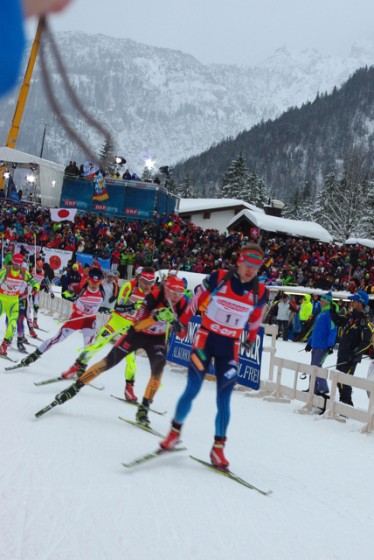
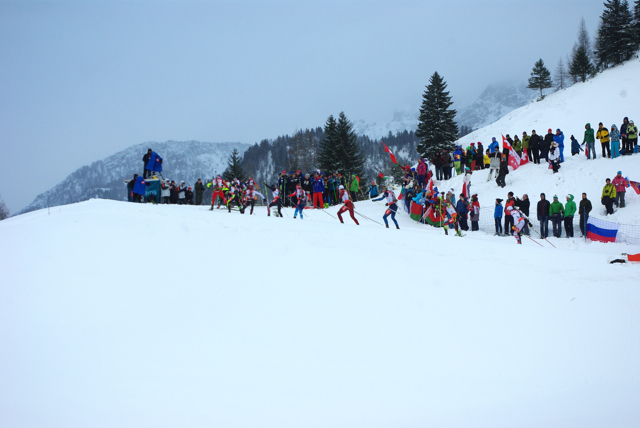
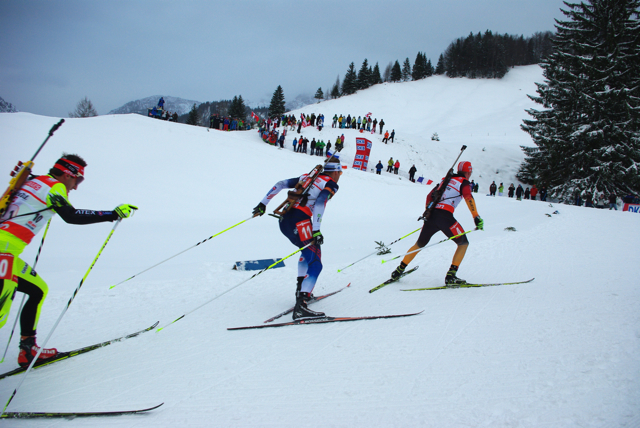
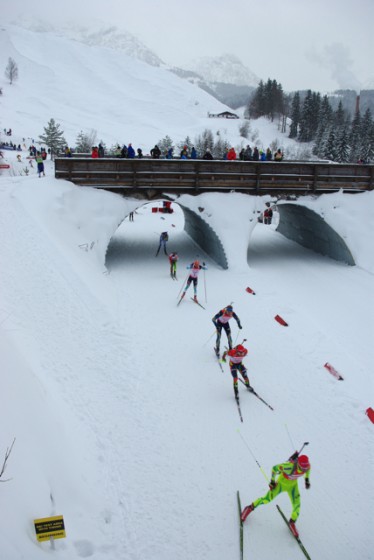
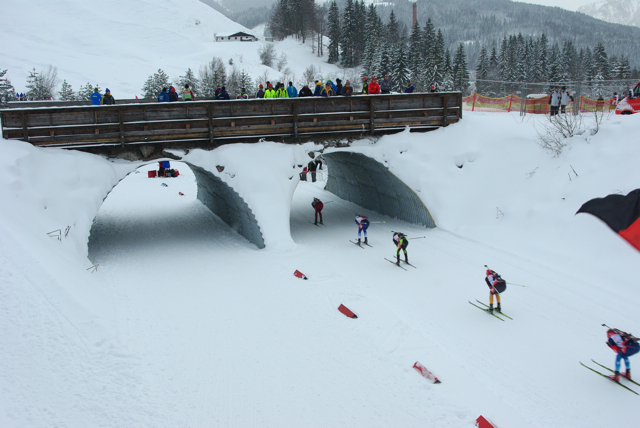
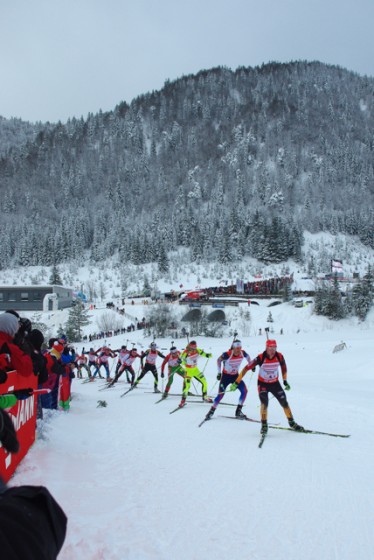
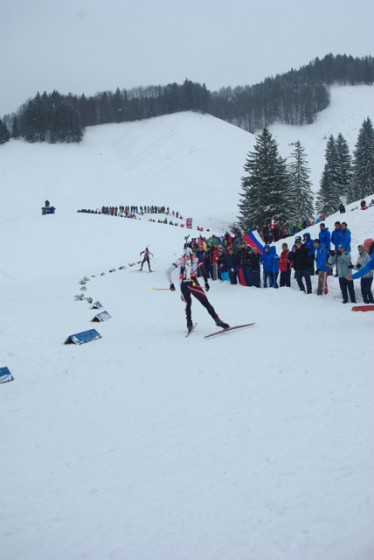
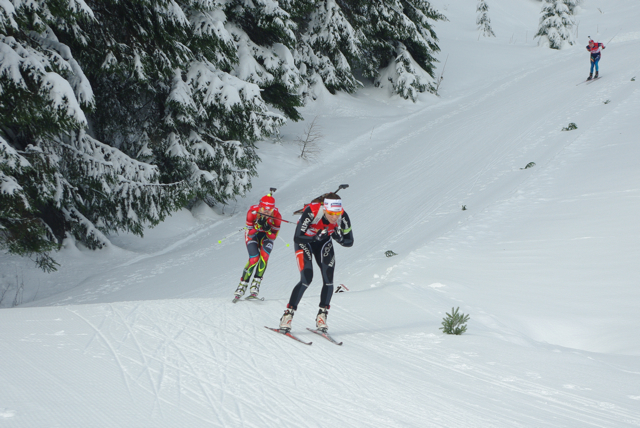
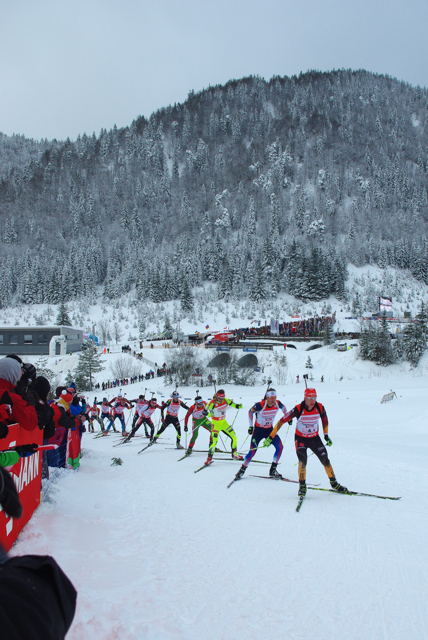
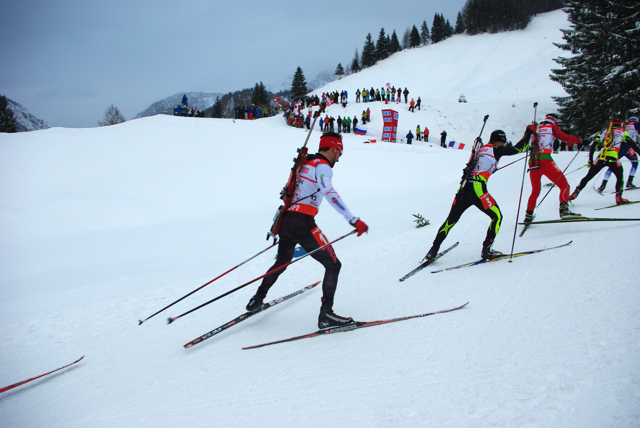
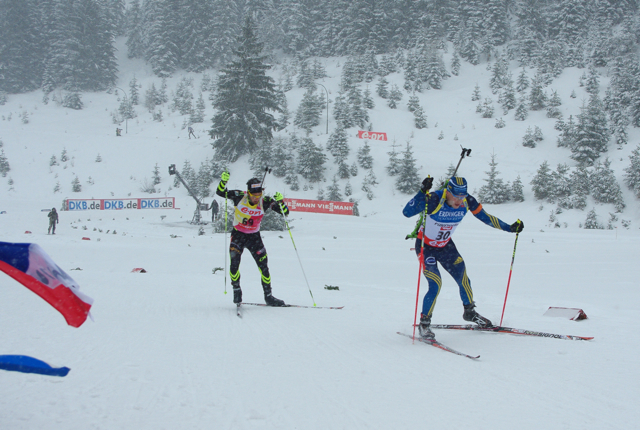
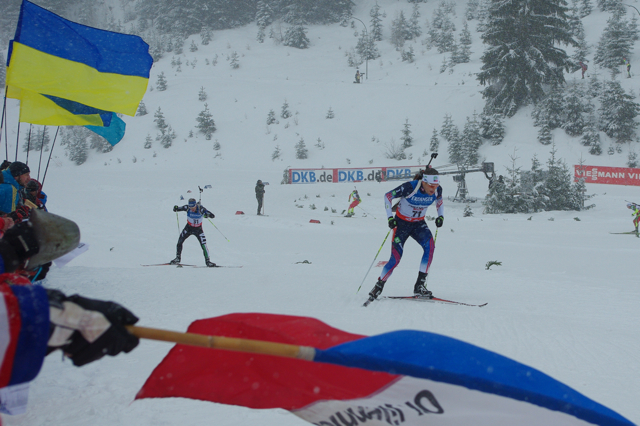
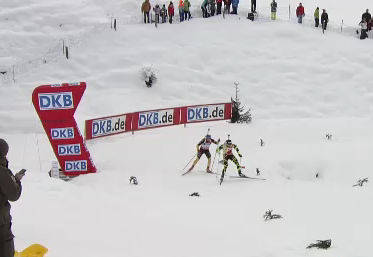
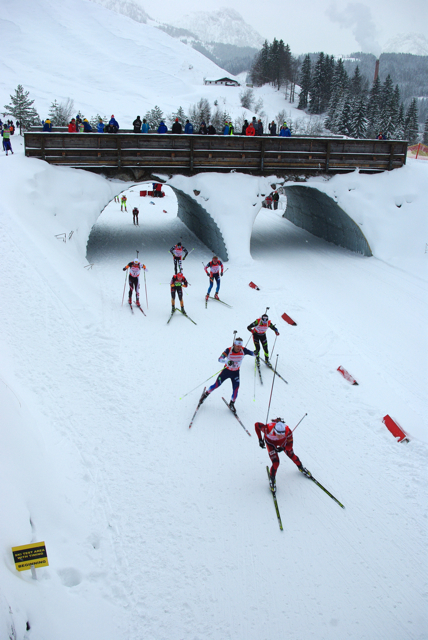
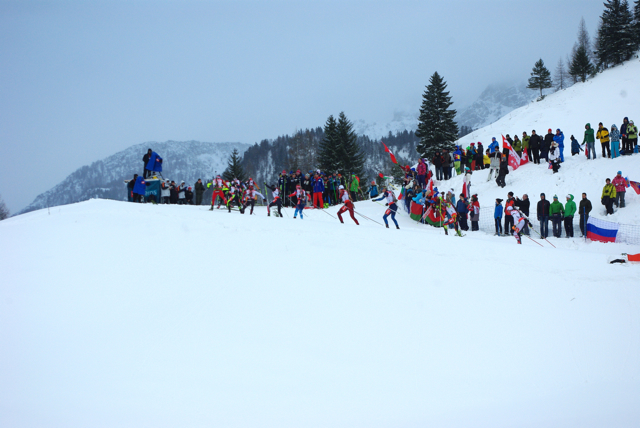
    The men's field reaches the top of the course's biggest hill.
    The men’s field reaches the top of the course’s biggest hill.

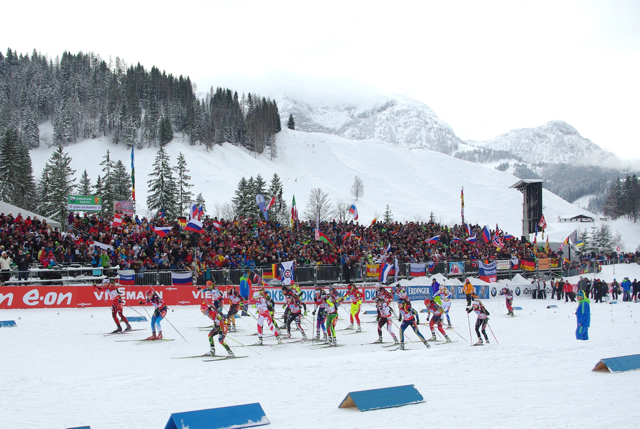
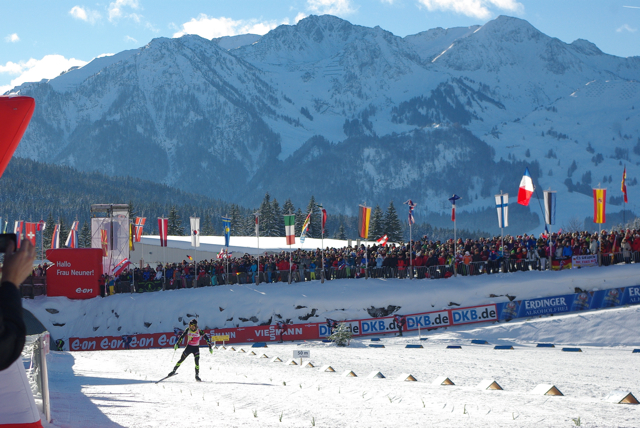
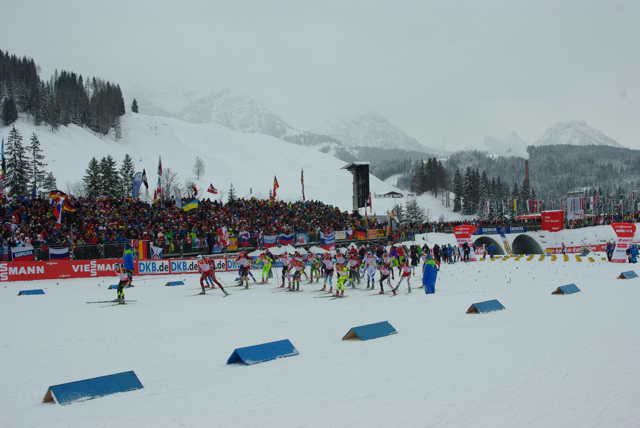
    HOCHFILZEN, Austria – The men’s and women’s World Cup biathlon relays brought excitement to this small town on Saturday – along with a lot of fans. Announcers reported that the crowd of 40,000+ spectators was the largest they had ever had for a regular World Cup race (the venue has also twice hosted World Championships).

    The Ukraine women’s team flexed their muscle at the start of the day, taking over the lead halfway through and never relinquishing it, skiing to a one minute victory. Germany’s Laura Dahlmeier outsprinted France’s Anais Bescond for second.

    In the men’s race, Norway staged one of its usual comebacks to take yet another win, while Sweden was a more improbable presence on the podium – after a slow start, the team used exceptional shooting, a blazing fast leg from Fredrik Lindström, and a furious finishing sprint from Carl Johan Bergman to shoot past Russia’s Dmitry Malyshko and into second place.

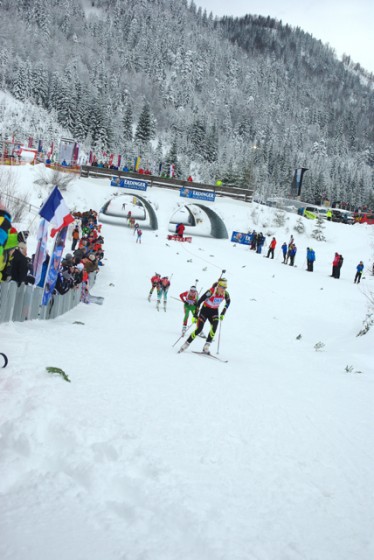
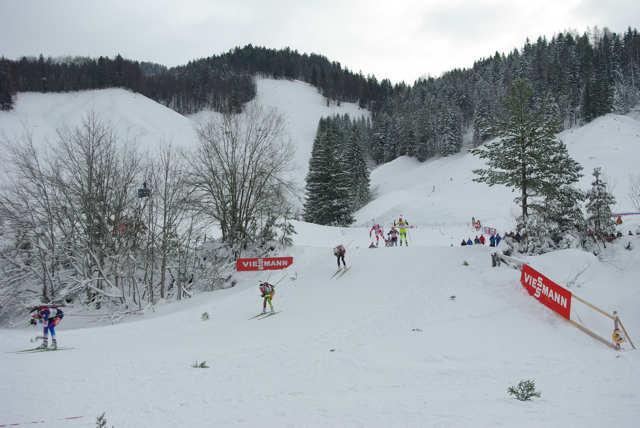
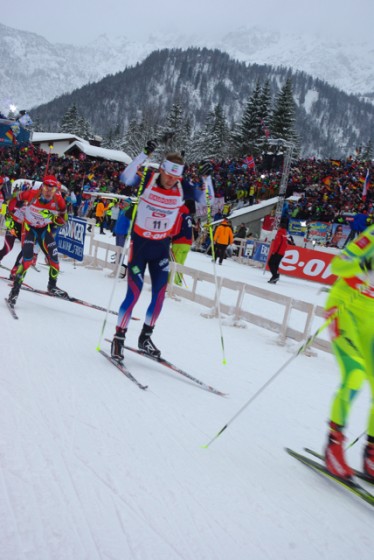
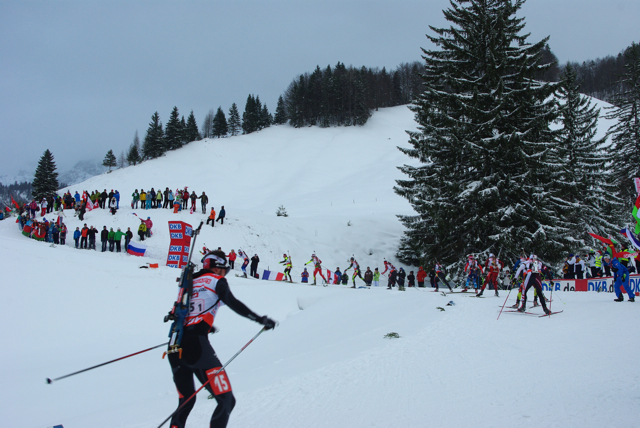
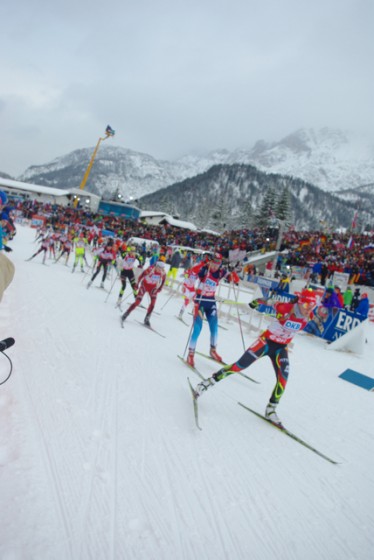
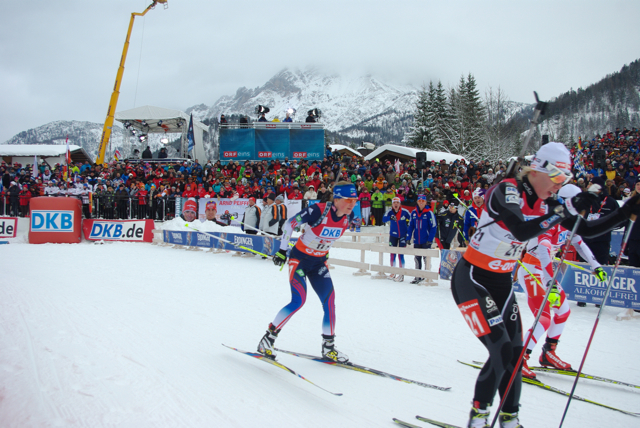
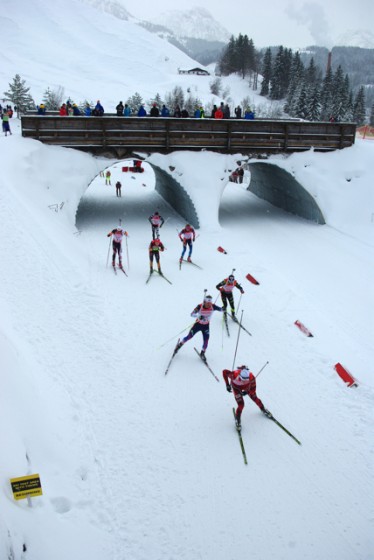
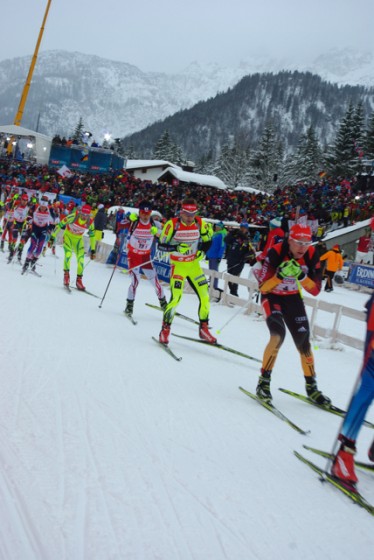
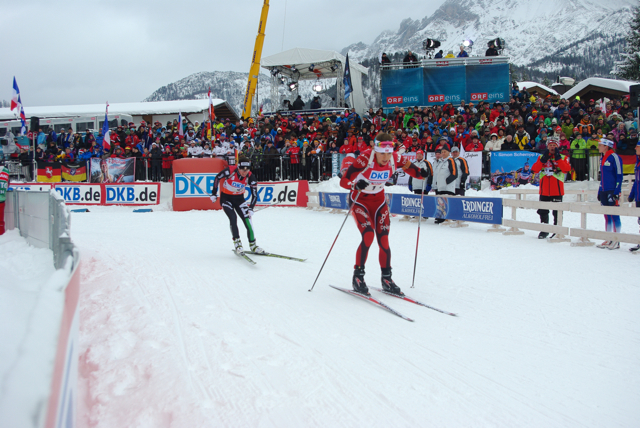
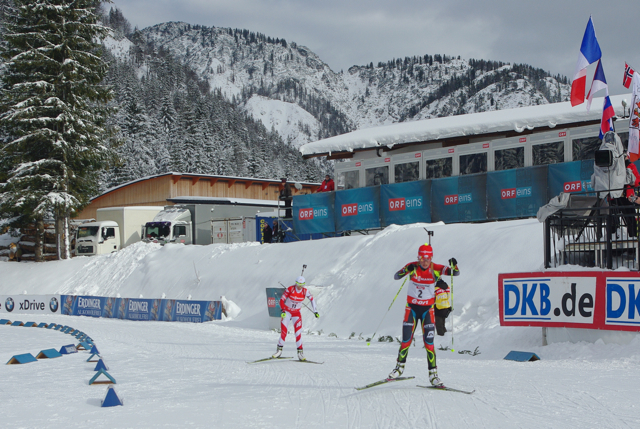
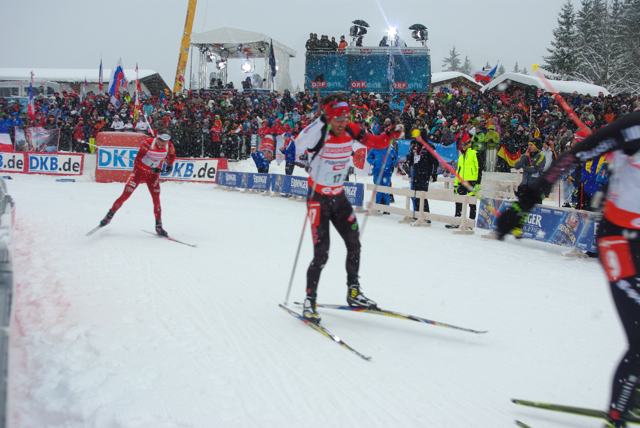
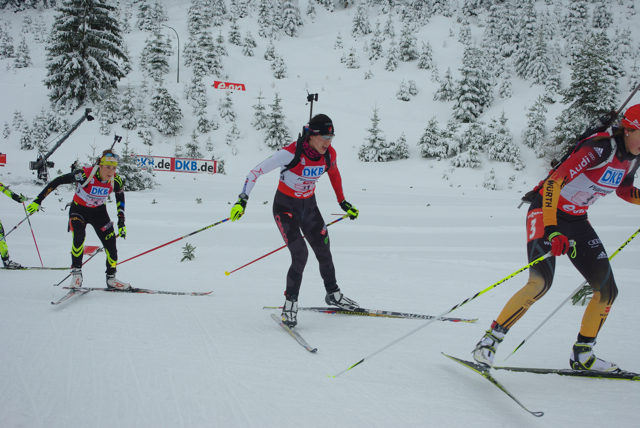
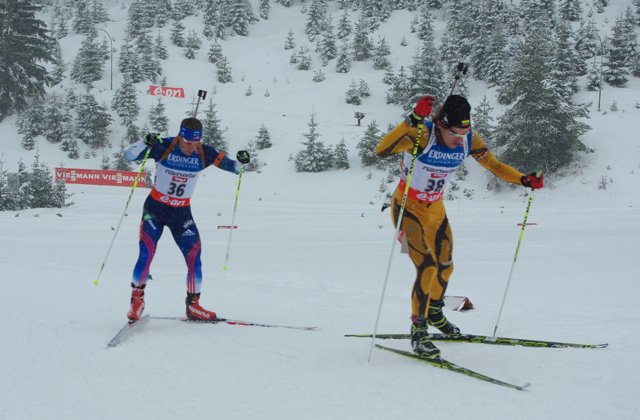
    The trains of skiers were picturesque and beautiful as they moved through the venue’s wide-open landscape and up its snaking hills. A heavy snowstorm came through partway through the men’s relay, meaning we didn’t snap any photos from the second half of the race – but enjoy these images from the women’s race and the start of the men’s!

  • Photo Gallery: Hochfilzen Sprints

    Photo Gallery: Hochfilzen Sprints

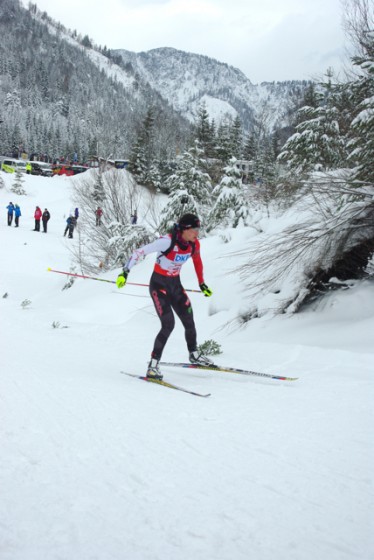
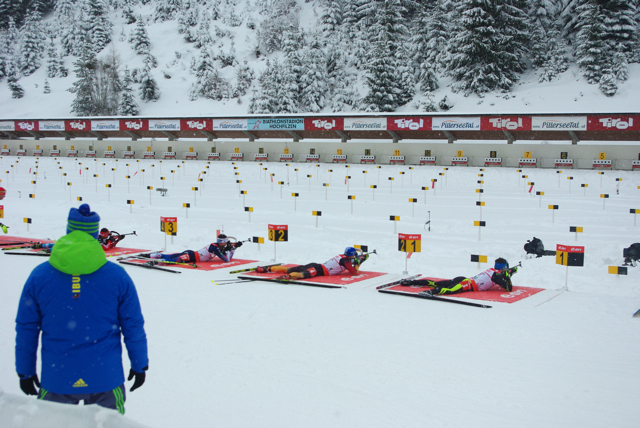
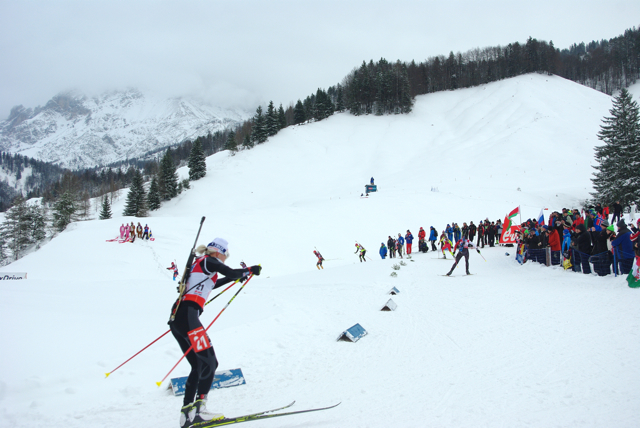
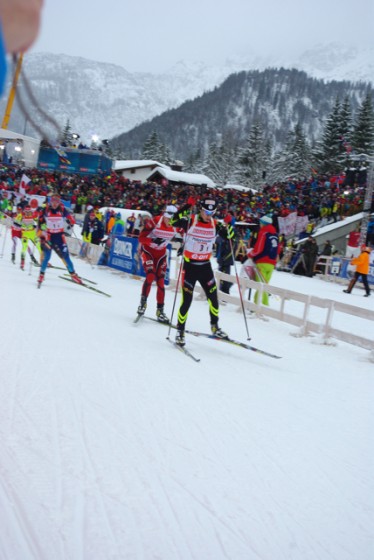
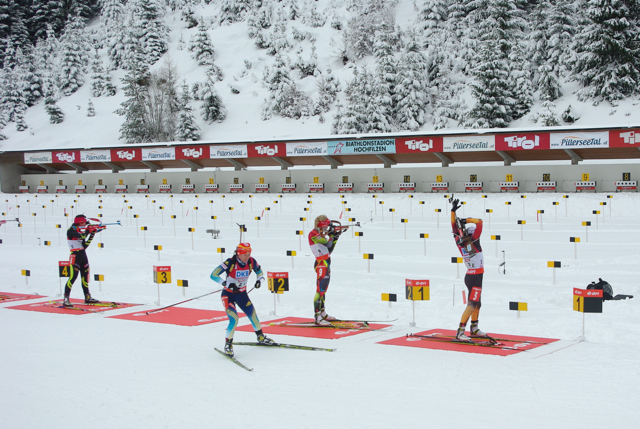
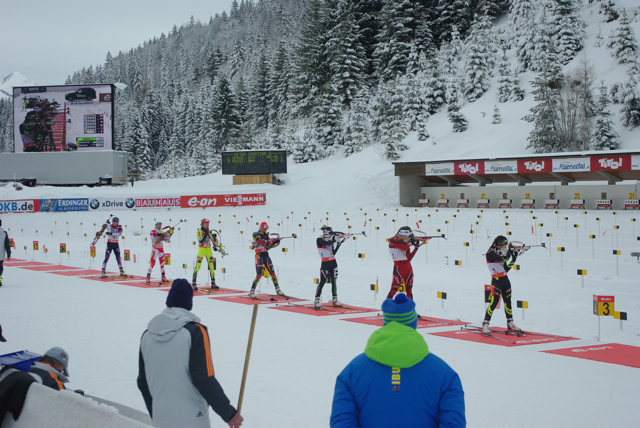
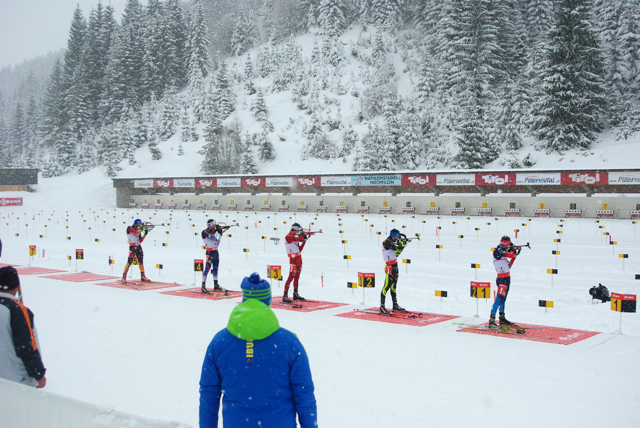
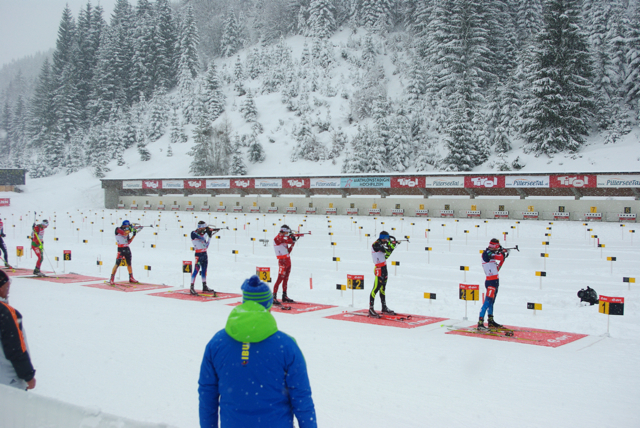
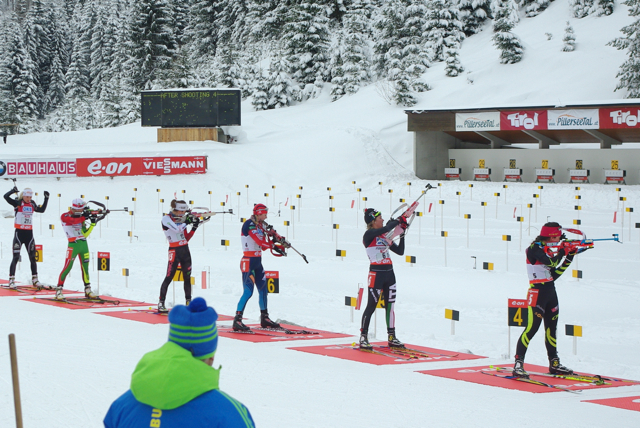
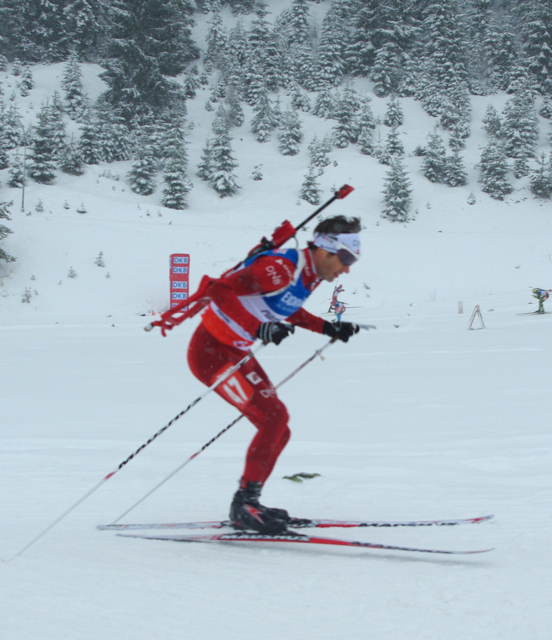
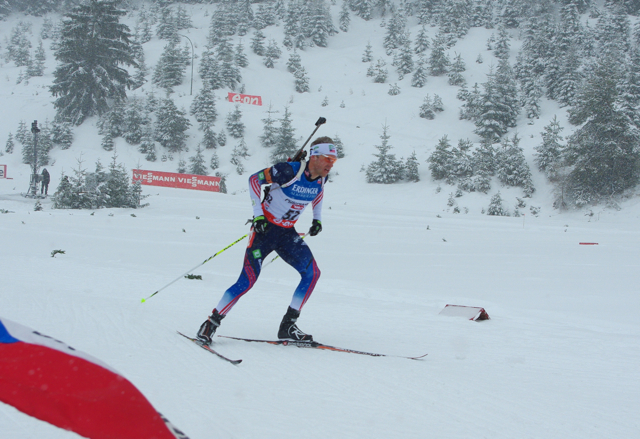
    HOCHFILZEN, Austria – The action was fast, it was slow, it was colorful in the men’s and women’s 7.5 and 10 k sprints on Friday. Snowstorms meant changing conditions over the course of both races, but the world’s best biathletes still tried their hardest to knock down targets and get their skis moving in the snow that piled up on course. Here are some photos of the day’s action.

  • Despite Good Performances, North American Men Struggle to Gain Spots in Hochfilzen Pursuit; Smith the Lone Big Mover

    Despite Good Performances, North American Men Struggle to Gain Spots in Hochfilzen Pursuit; Smith the Lone Big Mover

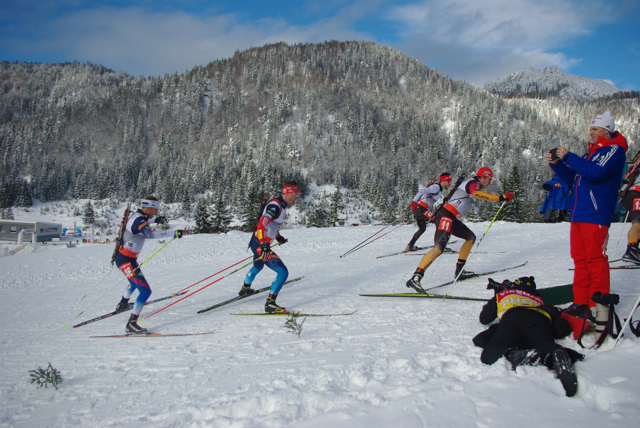
    Lowell Bailey (left) and Jean Philippe Le Guellec (far side of pack) climb a hill early in the race, as U.S. head coach Per Nilsson takes video.
    Lowell Bailey (left) and Jean Philippe Le Guellec (far side of pack) climb a hill early on, as U.S. head coach Per Nilsson takes video.

    HOCHFILZEN, Austria – The five North American athletes who qualified for today’s men’s 12.5 k World Cup pursuit each had their work cut out for them if they wanted to meet their goals. After the sprint on Friday was disrupted by a snowstorm, the results didn’t fairly reflect each athlete’s performance (more info: stories about the Canadian and U.S. teams).

    Lowell Bailey of the United States had been frustrated to end up out of the top ten – and off the podium even – despite clean shooting and what he felt was good skiing. Teammat Tim Burke had made the podium the weekend before in Östersund, Sweden, but placed 24th in the sprint here. Ditto on Canada’s Jean Philippe Le Guellec, who had placed fourth in the individual in Östersund but 13th on Friday despite a single penalty.

    Then there was Nathan Smith and Brendan Green, each trying to complete their Olympic qualification for Canada. Green had come so close in the sprint – he needed a top 30, and finished 31st, just 0.1 seconds away from his mark. It seemed like the pursuit would offer a second chance to make that qualification.

    Green needed more if he wanted to finish his qualification – a second top-16 finish (Green already had two of three top-30’s, a different way to qualify from the two top-16’s that Smith had already collected one of). But starting late in the pursuit, he had been hammered by the snowstorm and placed 48th. Getting his criteria in the pursuit was obviously going to be tough.

    Nathan Smith on the move for Canada.
    Nathan Smith on the move for Canada.

    But in the end it was Smith who came the closest to knocking off his goals: with a single penalty and the ninth-fastest isolated pursuit time, he moved all the way up to 27th. Now, instead of a top-16 to complete his qualification, he needs a top 30 in the final week of racing instead.

    The rest of the men struggled for various reasons. Or, if you ask Burke, maybe they didn’t even struggle. They just didn’t have great results.

    “I was happy with the shooting and the performance, it’s just that everyone was shooting really well,” Burke said. “So it was tough. I guess I would have thought that with two penalties I would have been in the top 15 for sure… A day like today I feel like I performed really well, but I’m 21st. Not exactly a result that I’m too excited about, but I’m happy with the performance and I think I’m headed in the right direction.”

    Burke said that thing that was strange about this pursuit was that it was based off the unusual results from the sprint. That meant that there were a lot of fast, strong athletes starting later in the order than usual – and so simply shooting well wasn’t enough to move up. The normal rules didn’t apply.

    “We saw some people towards the end of the race with really low bib numbers who were struggling,” he said. “I think they benefitted a lot in the sprint. In that way it was definitely different.”

    For Le Guellec, this certainly played a role – his four penalties dropped him to 32nd – but the schedule was also unusual.

    “I think it was a weird pursuit because they spread it out with the relay in middle,” he said. “Being the third race, you know, the relay is usually the last race, and 7.5 k you can do even if you’re dying a little bit. But with 12.5 k as the last race in a three-in-a-row race weekend, it’s pretty rough.”

    After saying that he “didn’t consider himself worthy of an interview,” Le Guellec explained that he just didn’t have it in his legs for such a long effort today.

    “Skiing was good for the first two laps, but then I just died in the third lap,” he said. “I just couldn’t maintain pace with whoever was passing me… I was talking with Lowell and it can go both ways, either you’re going to feel good, or you’re going to die. I died.”

    Bailey also had four penalties, and finished just ahead of Le Guellec in 30th.

    And Green, too, spent more time in the penalty loop than he would have preferred. Three missed shots left him in 43rd, Olympic qualification criteria still incomplete. If Canada does not qualify four men for the Olympics by the end of racing next weekend in France, they will face a trials series back in Canmore just a few days later.

    So for many of the men, it was a frustrating ending to an imperfect weekend in Hochfilzen, which also saw both men’s relay teams come close to best-ever performances.

    At this point in his career, Burke said, he tries not to get too hung up on the results, and to think about how he’s feeling. But it’s hard and he’s not always successful.

    “It’s funny,” he mused. “Last weekend I had a podium, but this weekend I actually felt better. I think that’s a really good sign going into the final week of racing before Christmas.”

    Results / international race report

  • Together Again: Fourcade, Svendsen, and Bø Pack the Podium in Hochfilzen Pursuit

    Together Again: Fourcade, Svendsen, and Bø Pack the Podium in Hochfilzen Pursuit

    Martin Fourcade pumps up the crowd as he coasts towards the finish line in another victory.
    Martin Fourcade pumps up the crowd as he coasts towards the finish line in another victory.

    HOCHFILZEN, Austria – Give Martin Fourcade an opening, and he’ll slam the door on you.

    The best biathlete in the world last year, the French star was hampered in Friday’s sprint when a mid-race snowstorm put most of the field at a huge disadvantage against the earliest starters. Despite clean shooting, he placed second behind Norway’s Lars Berger, who had two penalties but a low bib number. At the time he seemed unconcerned, and said he was simply happy for Lars Berger, a veteran in need of a boost.

    Fourcade showed in today’s 12.5 k World Cup pursuit why second place in the sprint was just fine with him. As soon as Berger faltered, missing shots in the first standing stage, Fourcade took off. He then cleaned his final targets and skated off to victory.

    “My plan was to catch the lead and then do kind of training, to do what I have trained to do,” Fourcade said.

    He was patient through the early stages of the race, stealing a second here or there from Berger but never putting himself under as he tried to make it to the front. By the time Berger came in for the first standing stage, Fourcade was just behind him and the pair had a slight gap to the rest of the field.

    Fourcade missed one shot, but Berger missed two – and so did some of the other racers who were in pursuit, like Berger’s teammates Tarjei Bø and Ole Einar Bjørndalen. Even after skiing a penalty loop, Fourcade was out in front. He had a 12-second lead on Simon Schempp of Germany, which he extended slightly on the next loop. But Schempp was caught by a fast-moving train of Norwegians Emil Hegle Svendsen, Bø, and Berger, along with Christoph Sumann of Austria.

    Norwegian red made up three-fifths of the chase group in the late stages of today's pursuit.
    Norwegian red made up three-fifths of the chase group in the late stages of today’s pursuit.

    The group, a sea of red suits, was popular – maybe more so than Fourcade. As Bjørndalen skated by every new group of spectators out on the course, he was greeted by chants of his name: “Ole! Ole! Ole!”

    Although he has made mistakes late in the game at other points so far this season, Fourcade was cool and collected as he knocked down his last set of targets.

    “The guys close to me showed me in every way that I have to be really strong to hope to win,” he said. “I did it today, but since my shape wasn’t wonderful I had to shoot clean. On my last shooting I was really thinking to just shoot clean because I didn’t want to fight with Emil and Tarjei on the last loop.”

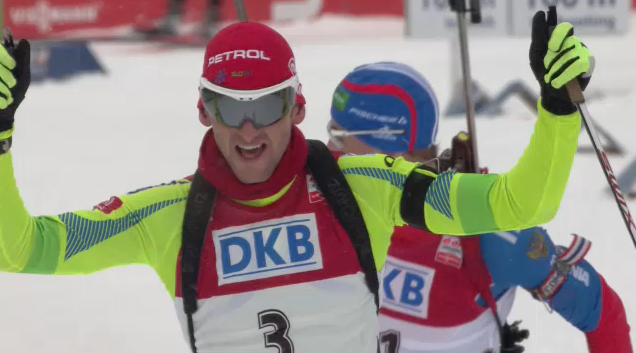
    Fourcade cruised around the final loop, before raising his arms in victory as he neared the finish line. After crossing it, he took a bow. It was a familiar sight: this is Fourcade’s 27th World Cup victory, a remarkable tally for a 25-year-old.

    While Fourcade was secure in his victory, the real fight was unfolding behind him. Berger, usually not the most reliable on the range, missed another three shots in the final standing stage and fell from contention. That left the group of chasers to to fight it out amongst themselves. Schempp also collected a penalty, but Svendsen, Sumann, and Bø all cleaned – in that oder.

    Svendsen shot out of the stadium like a rocket, quickly extending his four-second lead on Sumann. Last year’s World Cup runner-up and double World Champion, he continued to hammer around the final loop and coasted across the finish line eight seconds behind Fourcade.

    It was a relief for the Norwegian, who did not have a good start to the season in Östersund, Sweden, last week.

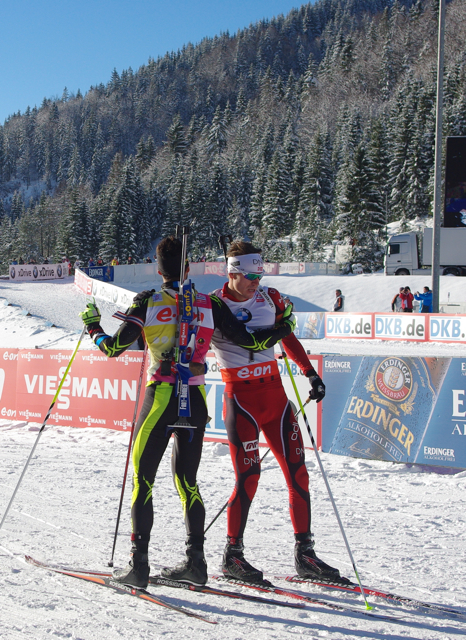
    Fourcade and Svendsen shared a hug at the finish line.
    Fourcade and Svendsen shared a hug at the finish line.

    “Sometimes you’re not in the zone that you want to be in,” Svendsen said of the season’s start. “Last week the whole team was not at our normal level. This is sometimes the way it is without any logical explanation, that you are just not very good. Things go up and down and we cannot always plan when we are in shape. I am happy to be back.”

    Sumann was the great hope for the home Austrian team, which had not yet had a podium in the weekend of racing. They had come close: Sumann was fifth in the sprint, and the men’s relay team was in third going into the final leg when veteran Simon Eder was simply unable to ski fast enough on the final loop to hang on to the podium.

    Unfortunately for the home team, it was a repeat performance by Sumann today.

    “In fact was pretty confident to take him,” Bø said. “Of couse, you never know with Sumi, but when I saw the results from the last competitions I knew he was not in his best shape. So I was confident about that.”

    Sumann dropped through the rankings, and ended up finishing seventh; he lost 20 seconds over the final 2.5 kilometers.

    “I was was more concerned with the guys behind, that they would catch me,” Bø said.

    But he hung on for third, just barely, despite a fiery last lap by Evgeniy Ustyugov of Russia (who finished fourth after moving all the way up from 17th) and Bjørndalen. That made a very familiar podium: Fourcade won the last two World Cup Total Scores, Bø the one before that, and Svendsen the one before that.

    This year, Fourcade is out to an early lead after winning twice in Östersund. Today’s victory makes him three for four in individual races this season. And his lead will only grow: Svendsen and Bø will sit out next weekend’s races in Annancy Le Grand-Bornand, France. It is the first time the World Cup will visit the venue.

    “I have done some good advertising in France the last few weeks,” Fourcade said of finally getting to race on home turf. “I am sad because these guys on the podium with me today will not be there, and I think the French fans will miss that a lot.”

    Bø showed mixed feelings about missing out on the French races.

    “I would love to keep completing because I am in good shape, but it is not about the yellow bib for me this season,” he said, referring to the Total Score. “Of course we love to compete, but this year for me, it is all about the Olympic Games. And it’s at some 1500 or 1600 meters. For us maybe the preparations are a little different than for Martin who was born in the mountains and lives there in France. So maybe we need to prepare a little differently to be ready.”

    The Norwegians will visit Seiser Alm, a high-altitude training site in Italy, in order to prepare better for Sochi. Fourcade may seem unstoppable now, but they believe that training at elevation will give them a chance to beat the Frenchman when the Olympics roll around.

    “I have just decided to put in a couple of weeks of training,” Svendsen said. “It’s important with the Olympics to be well prepared. I wanted to do this this year, not to compete too much before Christmas and have some extra training.”

    Results

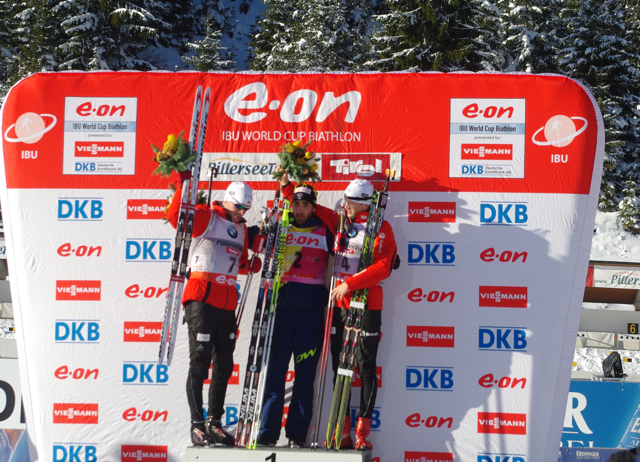
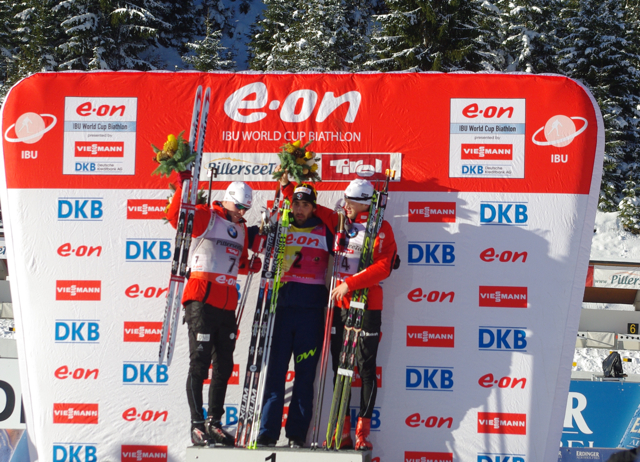
    Martin Fourcade of France (center) won the men's 12.5 k pursuit today, followed by Emil Hegle Svendsen (left) and Tarjei Bø of Norway.
    Martin Fourcade of France (center) won the men’s 12.5 k pursuit today, followed by Emil Hegle Svendsen (left) and Tarjei Bø of Norway. Smile, Martin! You’re in red and yellow!
  • Solemdal Collects Second Career Win at Her Favorite Venue; First Podium for Dzhyma

    Solemdal Collects Second Career Win at Her Favorite Venue; First Podium for Dzhyma

    Synnøve Solemdal of Norway heading out on course for the final loop with a clear lead in the women's 10 k pursuit.
    Synnøve Solemdal of Norway heading out on course for the final loop with a clear lead in the women’s 10 k pursuit.

    HOCHFILZEN, Austria – After finishing just 1.2 seconds apart in Friday’s sprint, the fates of Switzerland’s Selina Gasparin and the Czech Republic’s Veronika Vitkova were bound to be intertwined in today’s 10 k World Cup pursuit.

    Through two bouts of clean prone shooting and three loops of skiing, the pair stayed close together on the twisting trails. And then their fate stayed stuck like glue, only not in a good way: both missed shots in the first standing stage, hit the penalty loop, and relinquished their podium positions forever.

    Selina Gasparin and Veronika Vitkova in the lead early on.
    Selina Gasparin and Veronika Vitkova in the lead early on.

    Instead, it was Synnøve Solemdal of Norway, sixth in the sprint, who moved into the lead with only one penalty, which had come in the very first prone stage. When Gasparin and Vitkova were taking their punishment, Solemdal cleaned and hit the trails. The course took her around the outside of the penalty loop before she shot out through the stadium, so she had ample time to take in her competitors’ ill fortune.

    After Solemdal led the fourth loop, followed by a clean-shooting Juliya Dzhyma of Ukraine, she quickly cleaned – her shooting was the fastest of the day on that final stage – and skied to the win by 11 seconds.

    “Last year I had my first win here, so this today, I just can’t believe it!” Solemdal said. “This is my favorite place right now, for sure.”

    When asked why the courses here suit her so well, Solemdal wasn’t able to come up with a real answer.

    “I have no idea why it’s so good for me,” she admitted. “I like the tracks really well, and also I have very good memories from here, so that helps… [and] it’s really beautiful here.”

    She added that in Norway at this time of year it is very dark, so the fact that the sun finally came out in the Tirolian Alps today might have boosted her spirits.

    After the final shooting, Solemdal’s lead had seemed unassailable. The Norwegian is usually one of the faster skiers on the women’s circuit. But Solemdal wasn’t sure.

    “I was trying to just think about myself, but on the last loop I was really afraid that [Dzhyma] would catch me,” she said.

    Dzhyma was unable to close the gap, and coasted home to second. It as also an amazing race for the 23-year-old Ukrainian, who had never stood on a World Cup podium before except in relays (she contributed to the Ukrainians’ win in yesterday’s 4 x 6 k competition). After finishing fifth in the sprint on Friday, she had her chance.

    Vitkova Palka
    Krystyna Palka (red and white) chasing down Veronika Vitkova as the two leave the range for the final time.

    Meanwhile, Gasparin struggled mightily in standing, missing two shots in each stage. After making history as the first Swiss to win a World Cup on Friday, she was not able to repeat her success and sank lower and lower in the field, ultimately placing 15th.

    But Vitkova was able to rebound from her initial mistake, and did not miss again. She left the final stage in third place, with the chance to snag her third career podium.

    Krystyna Palka of Poland had other plans. The silver medalist in this event at World Championships last season, Palka had started the day off in 11th and worked her way up with clean shooting in every stage. When she left the range the final time, she could see Vitkova ahead of her, just a few seconds away. Skiing aggressively, Palka closed the gap and ended up beating the Czech to the line by three seconds.

    “I made a really great jump and hard training before this season,” Palka said. “Last season of course I had a lot of chances to be on the podium, but all the time I missed something to be there. This season in Östersund I started not so good, I was not satisfied at all with these competitions. And also here in the sprint, I was not so happy with my result. But now I see that my training has been really good and I am skiing well.”

    It was a new day, and a completely new slate of podium finishers in Hochfilzen, which has shown the biathlon world plenty of surprises already this weekend.

    “I’m very happy,” Dzhyma said in English of her first podium finish. It was the only English the Ukrainian spoke all weekend, but it was also the most important message.

    And Palka, too, reminded the field not to expect the same old winners every weekend, or complete dominance by the traditional teams.

    “I know that my shooting is really good, I can shoot well and fast, and I am sure that now it is time for me make the podium more often,” she said.”

    Results

    Synnøve Solemdal (right) and Juliya Dzhyma on the range in the final standing stage. Both cleaned.
    Synnøve Solemdal (right) and Juliya Dzhyma on the range in the final standing stage. Both cleaned.
  • Podium Contenders, U.S. Men’s Relay Takes 11th in Sprint Finish

    Podium Contenders, U.S. Men’s Relay Takes 11th in Sprint Finish

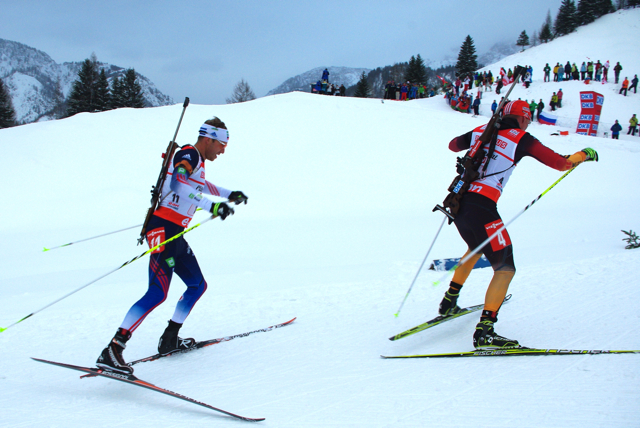
    U.S. scramble leg Lowell Bailey racing in the pack of Saturday's 4 x 7.5 k relay at the IBU World Cup in Hochfilzen, Austria. The U.S. men went on to place 11th.
    U.S. scramble leg Lowell Bailey (second from r) racing in the pack of Saturday’s 4 x 7.5 k relay at the IBU World Cup in Hochfilzen, Austria. The U.S. men went on to place 11th.

    HOCHFILZEN, Austria – Speaking after he finished the third leg of the World Cup 4 x 7.5 k relay on Saturday, Jeremy Teela was prophetic about what would happen, even though he had tagged off in sixth.

    “Any time you have Lowell [Bailey] and Tim [Burke] in start positions one and two for a relay, they might come in first place and tag off, and you might come in tenth,” he said. “You just go for it. It’s a relay and yeah, you want to be safe, but not too safe.”

    The U.S. men certainly went for it today, and the team was in podium position for much of Bailey and Burke’s legs over the first half of the competition. The name of the game was to shoot well and be ready to attack – and even a few spare rounds here or there did not set them back too far. For instance, Bailey used one spare in standing, but moved from seventh coming out of the range to third when he tagged off to Burke.

    “I went out of standing with a 10-second gap to close, so I really pushed on the first part of the loop, and I just didn’t quite have it on that last climb, but I tried to keep Tim within contact,” he said. “I would have liked to clean, but at the end I was able to get out and shoot that extra round quickly and get back up with the leaders, so I was happy with that.”

    For his part, Burke stayed right in that spot until his own standing stage, when he used two spare rounds and then had an unfortunate mishap with a pole, dropping it as he picked it up from the shooting mat. He had to turn around as he skied off, retrieve the pole, and then try to catch up to the leaders. It didn’t work as well as it had for Bailey, and he was left skiing his last loop alone as Ole Einar Bjørndalen of Norway hammered away at the lead.

    US Biathlon's Tim Burke pushing as the second legs of the U.S. men's relay at the IBU World Cup in Hochfilzen, Austria. The Americans went on to place 11th.
    US Biathlon’s Tim Burke pushing as the second legs of the U.S. men’s relay at the IBU World Cup in Hochfilzen, Austria. The Americans went on to place 11th.

    The two spares? Those weren’t too much of a problem. As it happened, much of the field struggled on that stage, with many spare rounds used by everyone. In the midst of that second leg, the snow really started to come down on the course.

    “I was really happy to hear that,” Burke said of the clangs of bullet not meeting target. “The mats were pretty snowy and slippery. So that wasn’t the easiest. But it wasn’t windy or anything. It could have been a lot worse.”

    Bjørndalen, for instance, also used two. It was the pole that bothered Burke more than anything.

    “It’s something that – I’ve never done that before,” he said. “That cost me getting a ride with that group, which would have been key. The way the course is, you kind of go down for half of it and then turn around when you hit the bottom really rested after being in the draft. So that was tough. I managed to limit the damage.”

    Teela used two spares as well, and kept the team in sixth place although he struggled to keep up on the final loop.

    “The relay felt good, but it’s a short race, and I kind of died,” he explained. “I need to get a little bit stronger to be able to push harder.”

    The big question mark was Leif Nordgren, the team’s usual anchor leg who sat out the sprint because he’s been feeling sick.

    “Leif is back to anchor,” Burke said after he finished his own leg. “We’ll see – he’s been more or less on bed rest all week. Maybe he’ll be super rested, you never know with those things!”

    Lowell Bailey follows Germany's Daniel Boehm during the first leg of the men's relay at the IBU World Cup in Hochfilzen, Austria, where the U.S. men placed 11th.
    Lowell Bailey (l) follows Germany’s Daniel Boehm during the first leg of the men’s relay at the IBU World Cup in Hochfilzen, Austria.

    Teela, too, seemed to have confidence.

    “Normally, in the past, before Leif came on strong, I used to be the anchor,” he said. “But Leif has really come along and he’s super fast with a really good kick.”

    Nordgren, in all honesty, probably did better than you might expect for someone who just two days ago was going on a short jog, which was at that point a victory. He hasn’t been training much, but skied the 14th-fastest anchor leg. He also used two spare rounds in each shooting stage.

    “Race went okay for me considering,” Nordgren wrote in an email. “I’ve been sick all week, today was my second time on skis all week, so I wasn’t expecting too much. I could tell though in the last kilometer or so though that I hadn’t trained at all. I am really disappointed to have let the team slip so far down after the great races put together by the other three.  But that’s how it was today.”

    Neither his shooting nor his skiing were among his best in relay performances, but one alone may have kept the U.S. in the top six.

    “This is one of the closest relays I can remember, with 11 teams only 1:25 behind the leaders, that’s how high the level of the field is now,” Nordgren wrote. “I know that we’ll be in better shape getting closer and closer to the Olympics, so I’m excited to see what future relays bring this season.”

    As it was they finished 11th, but at the back of a sprint finish which also included eighth-place Switzerland. They were 25 seconds out of the top six.

    Throughout the race, the team had just tried to stay smart. Part of that came on the shooting range.

    “I tried to stay in my own shooting and do my own thing even though people shoot really fast in that last stage,” Bailey said.

    “A good day means you’re sleeping when you’re shooting,” Teela said, agreeing with the sentiment that staying calm was key. “You’re not thinking. Once you wake up from your shooting sleep slumber, things go wrong. Once your brain gets involved, it can cause problems. So it was normal good shooting for me. I just did the thing I’ve been doing for 18 years.”

    The other part of the stay-smart strategy was not to lead. And so that’s why you could see Bailey sitting in second place for much of the first and second loops of the course.

    “I tried to just hang with the person I was with,” he said. “I tried to stay in second. I felt like going into the lead with some of the headwinds wasn’t a good advantage. I could save some energy by drafting a little bit. So that’s why the pace was really slow in the first lap. I probably could have pushed ten seconds but I don’t think it would have gotten me much. You always have to make that decision in the first leg.”

    Results

  • Svendsen and Co. Stage Comeback in Snowy Hochfilzen as Norway Takes Relay Win

    Svendsen and Co. Stage Comeback in Snowy Hochfilzen as Norway Takes Relay Win

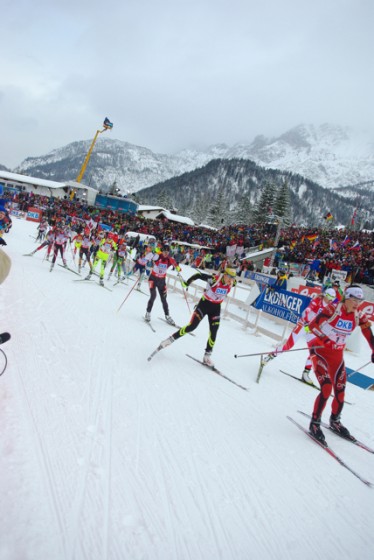
    The start of the men's relay in Hochfilzen, Austria, today.
    The start of the men’s relay in Hochfilzen, Austria, today.

    HOCHFILZEN, Austria – Emil Hegle Svendsen is one of the best in the business, but the Norwegian isn’t known for his perfect shooting. More often than not, the ten-time World Champion acknowledges his bad habit of letting his fast skiing make up for a miss on the range.

    But today in the World Cup 4 x 7.5 k relay, he was cool, collected, and on-target when it counted most. The habitual anchor leg for Norway cleaned his prone stage with no spare rounds, then took off and never looked back. Norway, the defending Olympic and World Champions in the men’s relay, won again.

    “I knew that after me there were some really strong guys,” said young leadoff skier Vetle Sjåstad Christiansen. “I tried to do my best and the other guys did a better job.”

    The end of the race was a familiar situation for Svendsen, who was skiing with Dmitry Malyshko, the anchor leg for Russia. The two had squared off a year ago in the World Cup relay in Oberhof, Germany, where Svendsen’s shooting errors allowed Malyshko to take the lead and Russia to win the race. That weekend, Malyshko had shown himself to be among the very small handful of biathletes who can match Svendsen’s ski speed.

    But today, when the pair came into prone together, it was Malyshko who faltered, requiring all three spare rounds to clean his targets. Next to him, with one satisfying click after another, Svendsen cleaned quickly and was off on the course. Although he used a spare in standing, by that point he had enough of a lead that it didn’t matter and Norway still won the relay by 19 seconds. A hard-charging Swedish team passed the flagging Malyshko to secure second place.

    “It was a good race,” Svendsen said. “I am finally starting to get into shape a little bit, and the shooting was quite good. So I’m happy with the performance and I’m looking forward to tomorrow.”

    Ole Einar Bjørndalen, center in red, on the range en route to moving Norway into the lead.
    Ole Einar Bjørndalen, center in red, on the range en route to moving Norway into the lead.

    It was not always a smooth path to victory for Norway. Unusually, Svendsen had the best shooting of the bunch. Six-time World Juniors medalist Vetle Sjåstad Christiansen had used one spare round in prone and three in standing in his initiation onto the men’s relay team. This came one day after Christiansen had a poor performance in the sprint, tying for 54th place.

    “I did a really, really, really bad race yesterday but this relay was already decided last week in Ostersund,” he said of his selection to lead things off for Norway.

    Svendsen’s teammates and fellow World Champions Ole Einar Bjørndalen and Tarjei Bø used two and three spare rounds, giving the team a total of ten – the same number used by Russia and fourth-place Austria, although the top four teams all did manage to avoid the penalty loop.

    Bjørndalen did the most to save the day. Despite his spare rounds (actually, almost the whole men’s field struggled in standing on the second leg), he moved the team into first place, mainly by setting an unmatchable pace first while he played catch-up – even after the last shooting he was still in fifth place – and then at the front of the pack. With Bjørndalen in charge, there was little tactical rest happening out on the course. More than in any other leg of the relay, it looked like a horse race, with the skiers reaching impressive speeds despite the fresh snow falling on the tracks. The weak were jettisoned as the fastest skiers flew past them.

    “I think I’m in really good shape and I also felt really strong today,” the veteran said.

    Perhaps the most surprising finish of the relay came when Carl Johan Bergman of Sweden blasted past Malyshko in the finishing straightaway. Despite the Russian’s best efforts, he just couldn’t shake Bergman – and it took too much out of him trying.

    “To be honest, I wanted to run away from Bergman on the last ascent on the track, and I put all my power into it,” he said through a translator at the press conference. “But I couldn’t manage it. So in the final meters he could pass me and take second place.”

    The affable Swede, before he became a World Championships medalist in 2012, was known as Sweden’s quick-sprinting anchor man. Bergman hasn’t been able to recapture his individual success from the 2012 season, when he won two World Cup races, but his spurt at the end of the relay was a reminder that he’s still a threat.

    “Of course it’s good to have a good result,” Bergman said. “I have had some good races on the skis and some with shooting so far this season, but this is the first time we see it in the result list. So it’s fun to make a good result. But I have a good imagination so I can always see the positive things in bad races.”

    It was a whole-team effort from Sweden, however. Christopher Eriksson used three spares in standing to start things off, and the team was a minute back in 16th place at the first handoff. But by the end, they had accumulated only five spare rounds – half the total of Norway, Russia, or Austria. Björn Ferry shot perfectly to move into 13th, while keeping the time gap even, then Fredrik Lindström used one spare and racked up the second-fastest course time of anyone on the third leg. With one spare round and a furious sprint from Bergman, second place was sealed.

    When asked whether he was surprised to be on the podium, Eriksson – a new addition to the relay team, who has only scored individual World Cup points twice, both last season – didn’t flinch.

    “It’s surprising, yeah,” he said, as Bergman laughed quietly beside him. “But it’s our goal to be on the podium, every time.”

    Results


  • So Close for Canada with 9th- and 11th-Place Relay Finishes

    So Close for Canada with 9th- and 11th-Place Relay Finishes

    Scott Perras in the lead pack with Ole Einar Bjørndalen (NOR) and a lot of freshly falling snow.
    Scott Perras in the lead pack with Ole Einar Bjørndalen (NOR) and a lot of freshly falling snow.


    HOCHFILZEN, Austria – For the Canadian biathlon team, today’s men’s and women’s relays offered a tantalizing glimpse of what is possible.

    The women’s team was as high as sixth and seventh place at times in the relay, including after the second-to-last shooting – and that was despite a penalty loop and three spare rounds by Megan Imrie in the second leg. That definitely hadn’t gone according to plan.

    Rosanna Crawford in the pack with Franziska Preuss (GER) and Marie Laure Brunet (FRA) on leg one.
    Rosanna Crawford in the pack with Franziska Preuss (GER) and Marie Laure Brunet (FRA) on leg one.

    “If we can all just use one spare round each, it will be great,” Rosanna Crawford said after finishing the leadoff leg in tenth place, just 19.9 seconds off the lead.

    It was a strong opening for Crawford, who also placed 17th in the sprint yesterday.

    “My plan was to go off super aggressive and really try to get to the start of the pack, because it’s so narrow here that if you get to the back you can easily lose 30 seconds without it even really being your fault,” she said. “So I was happy with my start. Bummed about my one miss in prone, but stoked to finally clean my standing.”

    Ultimately, Zina Kocher had a disastrous final shooting stage, racking up two more penalty loops in standing. That dropped her to 12th place, although she passed one team by the finish to end up 11th.

    It wasn’t a good way to end the relay, yet there were plenty of positives – the Canadians were just 10 seconds from the top 10, the distance of one spare round or half a penalty loop. Kocher, despite her shooting woes, skied the fifth-fastest anchor leg. Megan Heinicke was cool under pressure and cleaned both her shooting stages with no spare rounds on the third leg, gaining the team valuable spots.

    In the men’s race, Canada had an even more stellar start. Jean Philippe Le Guellec used a single spare round to tag off in eighth, 23 seconds out of the lead, and then Scott Perras used the same shooting to move into fourth by the halfway point of the relay race. When he tagged off to Brendan Green, Canada was just six seconds from the lead.

    “I didn’t even realize I was up there until partway through the last lap, when I looked up the hill and was like, wow, there’s really nobody farther up,” he said. “I was desperate to take the top three, but I got cut off a couple of times on the last lap and that just zapped any energy I had.”

    JP Le Guellec in the train going up a long grinding hill on leg 1.
    JP Le Guellec in the train going up a long grinding hill on leg 1.

    Since Canada only has three quota spots for individual racing on the World Cup this season, Perras took a strategic rest to try to allow his teammates Green and Nathan Smith to finish their Olympic qualification, which he has already done (it didn’t quite work). This being his only start of the weekend, he had a little extra motivation to fly.

    “It’s the only bit of excitement I get to have all week, so I think I had a little bit of extra [power],” he said. “Even today I was trying to get the boys going, like, guys, this is my only chance for excitement this week! … ’d prefer to have a race in the body, even if it is the day before. Especially with conditions like this, it’s kind of the first time I’ve skied on [falling snow] this year.”

    As Perras tried to get his team into the top three – he had the fifth-fastest ski time of racers on his leg, impressive especially considering how Ole Einar Bjørndalen put the pedal to the metal and broke up the field with his aggressive pace – he faced off against that new snow. Hochfilzen already has a fairly narrow course with lots of twisting corners, and the weather didn’t make it any easier to pass.

    “When I tried to make two passes, I have small baskets on and they just punched through,” he said. “It’s okay, you just get back in the group, but I did have to yell at someone.”

    When Green took over, he kept the team in a good spot through prone, but then accrued a penalty loop in standing. Anchor leg Smith took over in 12th place, and was able to move the team up to ninth with perfect shooting. He finished the race in a pack with Simon Hallenbarter of Switzerland, Leif Nordgren of the United States, and Lukas Hofer of Italy.

    “I didn’t know the Swiss guy behind us,” Smith said. “I could hear someone behind me, but I couldn’t tell who. He went for it, and had a little more than Leif and I, so I kind of lost it on that last hill. But I started to recover coming down, and then I had a pretty good sprint to the finish. It was hard.”

    The ninth place finish was still strong for Canada, which has had just three other top-ten men’s relay results in the last decade.

    “Unfortunately Brendan got a little choke in his standing, but other than that it was probably one of our best relays ever. And the finish was really close from third, so with one less penalty loop or whatever, we could have moved up a lot.”

    Results: men / women

    Megan Imrie (3rd from left) on the shooting range.
    Megan Imrie (3rd from left) on the shooting range.
  • Le Guellec Leads Canadians in 13th, Crawford Gets ‘Lucky’ in 17th in Hochfilzen Sprint

    Le Guellec Leads Canadians in 13th, Crawford Gets ‘Lucky’ in 17th in Hochfilzen Sprint

    Canada's JP Le Guellec racing to 13th in Friday's 10 k sprint at the IBU World Cup in Hochfilzen, Austria.
    Canada’s JP Le Guellec racing to 13th in Friday’s 10 k sprint at the IBU World Cup in Hochfilzen, Austria.

    HOCHFILZEN, Austria – The snow was supposed to stop. Then again, Friday’s International Biathlon Union (IBU) World Cup 7.5- and 10-kilometer sprints were held in a place that eventual men’s winner, Lars Berger, called “snowfilzen.”

    Five minutes before the start of the men’s 10 k, it started snowing – and the weather deteriorated throughout the race.

    That was especially frustrating to Biathlon Canada’s JP Le Guellec, not because it threw him off his game, but because he thought the conditions would improve as the race went on. Anticipating that, he asked his coach Matthias Ahrens to give his teammates Brendan Green and Nathan Smith the benefit of starting later.

    “I wanted to give priority to Nathan and Brendan because they have criteria to meet for the Olympics,” Le Guellec said after starting 22nd and placing 13th in Friday’s sprint. “We thought it was going to be snowing at the beginning of the race and then stop snowing at the end.”

    Canada's Brendan Green racing to 31st in Friday's 10 k sprint at the IBU World Cup in Hochfilzen, Austria. Green was one second away from making the top 30 and qualifying for Canada's 2014 Olympic team.
    Canada’s Brendan Green racing to 31st in Friday’s 10 k sprint at the IBU World Cup in Hochfilzen, Austria. Green was one second away from making the top 30 and qualifying for Canada’s 2014 Olympic team.

    With Le Guellec, 28, already prequalified for the Olympics, his teammates need a top 30 to do the same. Green finished 31st, one second out of 30th, with two misses after starting 53rd. Smith, who started in bib 105, placed 48th with a single penalty.

    “It’s a bit frustrating, but it is fun for me to have had the better conditions,” Le Guellec said after cleaning the prone and missing one on the standing. “The tactic missed though.”

    Green described the weather as “a little bit nasty” in the middle of his race, adding that it did let up a bit. His nemesis was shooting, he said. After missing the last shot of his prone, Green repeated with a final miss in the standing.

    “Missing the last shot in standing was not good,” he said. “There was a little bit of wind, but I think it was manageable. I just got a little bit too excited and shot it off a little too soon. … I was really hoping for a top 30 to finish off my Olympic criteria, so hopefully in the pursuit I can do that.”

    Smith hit nine of 10 targets, missing just one in the second bout.

    “I felt better than the last sprint, but not as good as the individual in Östersund,” he said after notching a World Cup career-best 16th in the 20 k individual in Sweden last week.

    “The last lap, I had no chance. It was so much slower,” Smith said of Friday’s race. “There was nothing I could do.”

    While earlier starters enjoyed better conditions, it wasn’t easy for anyone out there, and Le Guellec used his experience to manage the increasing wind.

    “In prone, it was pushing a little more than in zero so I shaded a bit instead of correcting, and ended up cleaning,” he said. “I did the same thing [last week] in Östersund in the sprint and I missed two, but then after the race, my coach told me I didn’t shade enough.”
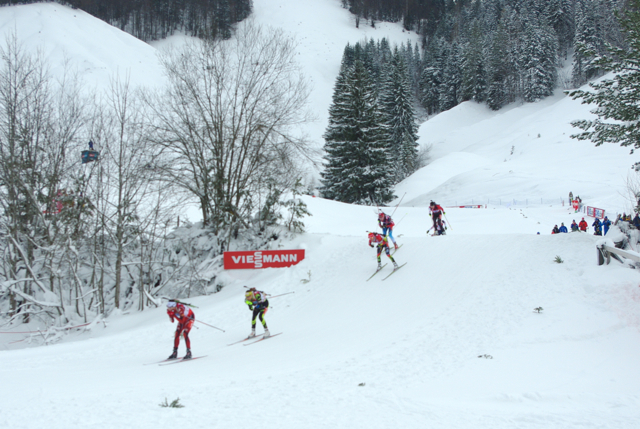
    Lesson learned. At the first World Cup in Östersund, Le Guellec came out firing with a fourth-place finish in the 20 k individual on Nov. 28. Two days later, he placed 29th in the 10 k sprint with four penalties – two in each stage.

    Heading into Friday’s standing, Le Guellec noticed the wind was coming from the opposite direction and heard German Andreas Birnbacher (who ended up 33rd) coming out of shooting “pretty frustrated with three misses,” Le Guellec said.  “I had a clue and setting up, I really took my time. I ended up missing one anyway, but it was pretty decent considering the wind.”

    Overall, he was pleased with his result, 55 seconds behind Berger (who won in 25:02) and feeling like might have been able to push harder earlier. With the 27th fastest first-lap time, he improved to 11th fastest the second time around.

    “I don’t know if I went [out] too conservative, but the skis were definitely good,” Le Guellec said. “I hammered on the last lap and I had some guys to follow.”

    Canadian Zina Kocher chases Ekaterina Glazyrina of Russia out of the starting gate in Friday's IBU World Cup 7.5 k sprint  in Hochfilzen, Austria. Kocher ended up 25th and Glazyrina was 51st.
    Canadian Zina Kocher (l) chases down Ekaterina Glazyrina of Russia during Friday’s IBU World Cup 7.5 k sprint in Hochfilzen, Austria. Kocher ended up 25th and Glazyrina was 51st.

    Another Canadian prequalified for the Olympics, Rosanna Crawford placed 17th with two penalties – both standing – in the women’s 7.5 k. She finished 47.1 seconds behind Selina Gasparin, who became the first Swiss biathlete to win a World Cup (finishing in 23:16.9).

    “I got lucky,” Crawford said of starting 90th, a bib number she initially dreaded fearing the conditions would worsen.

    “The course sped up a lot,” she explained. “If I’d started early, I don’t think I would have been that high.”
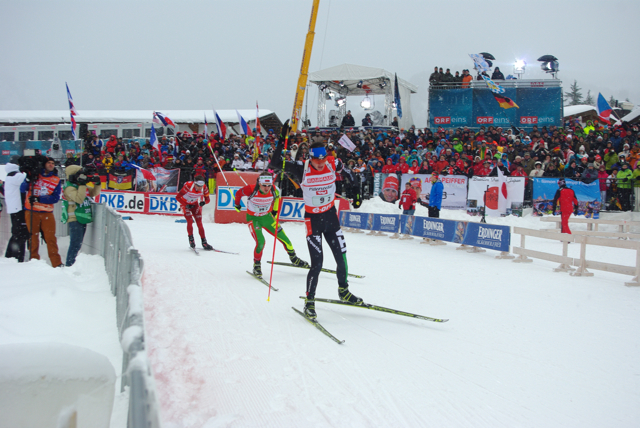
    In last week’s Östersund sprint, Crawford missed three standing for 51st overall. After cleaning her prone again on Friday, she was disappointed with two standing misses, but recognized that “the potential is there.”

    “The season always seems to start off pretty bummy for me for some reason,” Crawford said. “Today, 80 percent, I’m not very happy with it especially since it came in one bout, but it will come together. I think we have a big potential for a great relay. Three of us had great races today.”

    Zina Kocher was the second Canadian woman in 25th with two misses – one in each stage. Megan Imrie placed 35th with two penalties as well (0+2), and Megan Heinicke finished 70th with four misses (1+3).

    “Skiing was quite good, but shooting was a disaster,” said Heinicke, who posted the 38th-fastest course time overall. “I’m waiting to see if I’m in the pursuit. It will be pretty tight I think.”

    Similar to the men’s race later in the day, the wind picked up significantly for the women from zeroing to prone.

    “I clicked four left, which is a lot, but … I only missed one,” Heinicke said. “Standing, [the wind] wasn’t very strong, but it was sort of on and off. It was just tough and I was pretty disappointed because I had really good windy shooting in that [Östersund] pursuit that was canceled so I was thinking, ‘be confident,’ but it didn’t work out.”

    Heinicke finished 56th in last week’s sprint with three misses (1+2). The following Östersund women’s 10 k and men’s 12.5 k pursuits were canceled because of high winds, a decision that was made midway through the women’s race. Both Heinicke and Imrie were skiing in the top 10 when it was called off.

    “I was disappointed at first, but then when I saw the footage, I was like, ‘Okay, be realistic. I would never have been in that position in normal conditions,’ ” Heinicke said. “I was just happy that I had managed the wind well, and I felt good skiing that day. It was fun while it lasted.”

    World Cup racing continues in Hochfilzen this weekend with the women’s 4 x 6 k and men’s 4 x 7.5 k relays on Saturday, and the women’s 10 k and men’s 12.5 k pursuits on Sunday.

    Results: men | women

  • Lars Berger is Back from the Dead with Surprise Win in Hochfilzen

    Lars Berger is Back from the Dead with Surprise Win in Hochfilzen

    Norway's Lars Berger heads out of the start box as Simon Schempp of Germany looks on. In bibs seven and eight, the two capitalized on their early start positions and the shifting weather: Berger won, and Schempp placed eighth.
    Norway’s Lars Berger heads out of the start box as Simon Schempp of Germany looks on. In bibs seven and eight, the two capitalized on their early start positions and the shifting weather: Berger won, and Schempp placed eighth.

    HOCHFILZEN, Austria – Lars Berger has made two things clear over the course of his long career: expect fast skiing, and expect the unexpected.

    But rarely have these things come into focus as much as they have today, when Berger – the Norwegian nobody saw coming – swept to a 13-second win the 10 k sprint. Starting very early in the order, Berger had two penalties and had to wait a long time before he could be certain he had won. Martin Fourcade of France cleaned and put on a hard charge towards the top, but ultimately came up short. It was after that when Berger could be certain of his victory.

    “It was cool but I knew that I had bib number seven so I would have to wait a long time,” he said. “It seemed quite surreal that I could win today, but I can only say that I love “snowfilzen!” I am really happy to win, really happy… It was a long time ago, my last one, and it is now three times in Hochfilzen.”

    First, let’s make something clear: it wasn’t a fair race. A snowstorm picked up during the middle of the competition and left later starters at a huge disadvantage on the slow tracks. On almost any other day, a clean-shooting Fourcade would have won, probably by a lot.

    “I was just happy to be on the podium today,” Fourcade said in a press conference. “When I saw my coach out on the track just before the first shooting he said, ‘you are 20 seconds behind Lars Berger,’ so I thought, okay, it’s over… That’s part of biathlon and part of outdoor sports. Sometimes you’re lucky, like I was last week with Fredrik Lindstöm’s fall, and sometimes you are unlucky like today.”

    Plenty of other athletes were frustrated too, and had fewer penalties than Berger but were slowed by snow conditions. American Lowell Bailey was among them, along with many Russians, Austrians, and others. Norways’ Emil Hegle Svendsen had a single penalty but placed seventh, 40 seconds back, another anomaly.

    Mid-snowstorm, Martin Fourcade chases Carl Johan Bergman of Sweden.
    Mid-snowstorm, Martin Fourcade chases Carl Johan Bergman of Sweden.

    Fourcade was remarkably zen about the whole situation, however. And he had other things to celebrate: it was his 11th podium in a row, which he thinks puts him ahead of Norway’s Ole Einar Bjørndalen in the history books (although he has a ways to go to catch up to Bjørndalen’s 90+ wins). And speaking of Bjørndalen: he had one penalty and placed third, despite also having a few snowy and slow laps.

    “I’m so happy to be on the podium and when I saw Lars on the screen, I was just happy for him,” Fourcade said.

    Indeed, it has been quite a journey for Berger, who has battled injury and has never been a particularly consistent shooter. He was left off the national team roster for Norway this year and trained independently. In fact, Fourcade and his brother Simon invited Berger and fellow ex-national teamer Alexander Os to their hometown of Font Romeu, France, to train this fall.

    Perhaps the slight from his longtime team served as extra motivation. Berger was third in a season opening race in Sjusjøen before the start of the World Cup season, and also hit the podium in an IBU Cup race in Beitostolen last week.

    “I know that I’m unstable but I also know when my shape is good, especially in the sprint competition it is my chance,” he said. “The race in Beitostolen gave me some confidence, and I know that if I do my very best I can be among the top places here.”

    But he wasn’t thinking about winning until the very end.

    “I knew it was a really tough competition with these two guys and a lot of others,” he said. “My aim was to do good shooting… [On Fourcade’s last lap] I heard that he was really strong and it was really close. But I had really nice conditions on the last loop, it was a little bit icy in some places, and he had quite poor conditions. So I knew I had a chance.”

    Berger said that this will be his last season, thanks to the lingering knee injury. He’s nearing 35, so even without the pesky knee it would be pushing it to continue. He hopes to go out with a bang, but despite the win has some work to do if he wants to make the Olympics.

    “I had a good bib today,” he said. “… I also have to have some good results in January if I can make the Olympics.”

    * * *

    Ole Einar Bjorndalen working it for third place.
    Ole Einar Bjorndalen working it for third place.

    If one thing was familiar, it was that Fourcade squared off against a cadre of Norwegians. The red tide swept through the top ten despite being scattered throughout the field and encountering a variety of snow conditions. Bjørndalen was third and teammate Tarjei Bø fourth; then Svendsen managed to eke into seventh.

    Bjørndalen told NRK, the Norwegian broadcaster, that it was his best race of the season so far.

    “On the second and third loops it was so slow that I was standing still at times,” he said of starting in bib 40. “I take my hat off to Lars.”

    Crowd favorite Christoph Sumann of Austria placed fifth (starting with bib number 4) and Dmytro Pidruchnyi of Ukraine (bib 2) sixth, a career-best by 40 places. Simon Schempp of Germany, starting in bib 8, also placed eighth behind Svendsen. The number of early starters in the top ten showed precisely how hard it was for Fourcade, Bjørndalen, and Svendsen to break into the top despite starting later.

    Results

  • Conditions Leave American Biathletes Looking for More in Hochfilzen (with Photo Gallery)

    Conditions Leave American Biathletes Looking for More in Hochfilzen (with Photo Gallery)

    Lowell Bailey on course in Hochfilzen. Despite frustrating conditions, he finished 16th.
    Lowell Bailey on course in Hochfilzen. Despite frustrating conditions, he finished 16th.

    HOCHFILZEN, Austria – The U.S. biathlon team was left frustrated after today’s 7.5 and 10 k World Cup sprints, although for very different reasons.

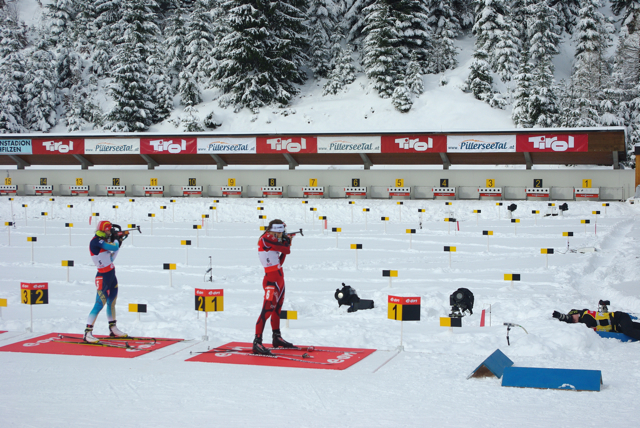
    In the women’s race in the morning, early starters had a disadvantage as the fresh snow that fell overnight and into the morning hadn’t been skied in much. Wind was also an issue on the range and Susan Dunklee, Annelies Cook, and Hannah Dreissigacker all had four penalties. Lanny Barnes escaped with one, but in part because of her early start seed was left out of the pursuit like her teammates. All the women finished in the 60’s and 70’s.

    “The wind was a little stronger than during zeroing, but it wasn’t strong enough that I wanted to take clicks,” Dunklee said of the conditions. “Maybe I regret that in retrospect. And I couldn’t even feel where the misses were.”

    In the men’s race, the tables were turned. Snow was forecasted to stop, but instead it intensified partway through the race, much to the detriment of later starters. Leif Nordgren, who had the American spot in the first seed group, didn’t start because he has been sick. That left the team without a single man in the favored conditions.

    “The guys who started early today definitely had a little bit of an advantage, especially on the first two loops,” shooting coach Armin Auchentaller lamented.

    That doesn’t mean that there weren’t any good races. Despite everything, Lowell Bailey finished 16th and Tim Burke 24th.

    “We can’t control the weather, it’s not possible, but we have to take the positive things out of this race,” Auchentaller said.

    Bailey was perhaps more frustrated than anyone. He had clean shooting over the two stages, yet started smack in the middle of the field, just when the snow started coming down with a vengeance. Later it let up a bit so some athletes were able to have a better last lap. Not Bailey.

    “I can’t believe the weather,” he said as his timing chip was removed at the finish. “I just can’t.”

    But Auchentaller found plenty of positives to focus on for Bailey, namely that clean shooting.

    “He had really great shooting, which is important,” he said. “That should for sure give him a lot of confidence. It’s a good sign – it’s always important to keep it together at the range [when things aren’t going well]…. When Lowell was out was when it was the worst.”

    Burke had it a little better. Despite his two penalties in standing, he was able to stay in the top 30.

    “It’s really unfortunate that it started snowing so hard just five minutes before I started,” he said. “It started glazing up a little bit more again at the end, but the first loop was really slow. I actually felt a lot better today than I did last week. I don’t know if the results will show that, but I’m pretty happy with it.”

    For both men, another positive is that they are in good position for the pursuit on Sunday. Many other top racers also failed to make the top ten or even the top 20: Anton Shipulin, Dmitry Malyshko, and Evgeniy Ustyugov of Russia; Fredrik Lindstrom of Sweden; Simon Eder, Dominik Landertinger, and Daniel Mesotitsch of Austria; Jakov Fak of Slovenia; Andreas Birnbacher of Germany.

    All, like the U.S. men, will be looking to move up, so there may be some fast-moving trains jetting towards the front.

    “The pursuit will be interesting, for sure,” Burke said. “Everyone will be racing in fair conditions.”

    Jeremy Teela finished 65th with two penalties and Sean Doherty 99th with five.

    Results: men / women

  • Gasparin Scores One for Switzerland with Historic Win

    Gasparin Scores One for Switzerland with Historic Win

    Selina Gasparin of Switzerland (left) on the way to victory in Hochfilzen, Austria, today. Photo: Ross Burton/Biathlon News International.
    Selina Gasparin of Switzerland (left) on the way to victory in Hochfilzen, Austria, today. Photo: Ross Burton/Biathlon News International.

    HOCHFILZEN, Austria – Selina Gasparin has been close to the World Cup podium before – heartbreakingly close. At last season’s opener in Östersund, Sweden, the 29-year-old Swiss biathlete was just eight seconds out of third place in the 15 k individual.

    Today, she finally took the step, this time going all the way to the top. Gasparin won the 7.5 k sprint here by 1.2 seconds over Veronika Vitkova of the Czech Republic, and in the process became the very first Swiss biathlete to ever win a World Cup competition.

    “I had been thinking for so long about getting on the podium, but I was never thinking about the win,” Gasparin said.

    It took a huge effort for her to make it to the top. She had a strong start but then collected a penalty in standing, which knocked her back as she headed out on the final loop. At that point she was 13 seconds out of the lead, although since she was in bib 54 about half the field was still to come. Later racers would have even faster split times, and when all had finished the last shooting, Gasparin’s time was 22 seconds back, leaving her in fifth place.

    Yet she pushed and pushed over the final 2.5 k loop and made up all that time. When she crossed the finish line, Gasparin sensed a victory: she raised both fists in the air before crumpling, exhausted. But it was just a victory over that missed shot.

    Gasparin accepting flowers at the podium ceremony.
    Gasparin accepting flowers at the podium ceremony. Photo: Ross Burton/Biathlon News International.

    “I was just happy to have had a good race,” she said. “With so many starters still to finish, I did not think at all that I could stay in the lead.”

    But Gasparin has consistently skied fast over the last few seasons. She even competed for Switzerland in the 15 k freestyle at cross country skiing World Championships last season, placing 31st against the best skiers in the world. Today she had the seventh-fastest course time and the fourth-fastest final loop.

    Fresh snow slowed down the course today, which might be why Gasparin didn’t feel like she had been going fast enough to win.

    She later she said that it seemed “not possible” that she ended up with the win: “After all, I did have one mistake.” That’s how surprised Gasparin was to make history today.

    “I was missing the last shot, so then I thought, well, one more time it’s the standing shooting where I miss the last shot,” she said, referring to previous frustrating races. “I wasn’t really in a good position. I just skied the last loop as fast as I could. There were a lot of athletes coming behind me so I didn’t think about the podium or win at all.”

    Considering that the first Swiss biathlete didn’t even get a World Cup podium until December 2006 – that was Matthias Simmen – and a Swiss woman has never been on the podium, the win was especially huge for the team from a tiny country of eight million people.

    “In Switzerland we had not so many podiums before and no victories,” Gasparin said. “I thought that it would be cool if a woman had the first victory since the men had some second and third place finishes before. So it is cool that women and men have now both been on the podium. For me it is a big honor to be the first winner. I think it is a big day for Switzerland today.”

    The Swiss biathlon team hasn’t been able to capitalize much on the exploits of skier Dario Cologna, and remains a small squad, especially on the ladies’ side. There are just ten women listed in the national team roster, seven of which are on the “C” team. Three of those are juniors.

    But this summer the Swiss created a new women’s team, which Gasparin is very optimistic about. Some of the younger athletes have podiums in international competitions like World Junior Championships and European Championships, which Gasparin pointed out was much better than she had done at a similar point in her own career.

    “I think the hardest thing is for them to keep the motivation and keep doing the work,” she said of her country where women’s nordic sports are rarely celebrated. “But I will try to give them some of my knowledge and experience, and it’s also good for them to be able to train with me and see what kind of speed you have to have, to see how fast it is at this level on the World Cup.”

    Teammate Irene Cadurisch, competing in just her third World Cup race ever (she finished 69th), was ecstatic about Gasparin’s result.

    “It’s awesome!” she said. “It’s so exciting for her, because she’s trained a lot. And it’s really great for us, because we can train with her. Selina, she was great before, but I hope this will help us to have a win.”

    * * *

    It was a remarkable day across the board in Hochfilzen, in part because both of the other podium finishers also had career-best performances. Vitkova, whose win slipped away at the very last second, tied her second-place result from Oberhof, Germany last year. Irina Starykh, who only raced one weekend of World Cups last year, placed third, less than a second behind the Czech.

    “Basically I had never ever had good results in Hochfilzen, so this was a very good birthday present,” Vitkova said through a translator. On Monday she will turn 26.

    For her part, Starykh was identified by Russian coaches this fall as the athlete who had improved the most in the off season. In Östersund last week, she came out of the gate strong with a fifth-place finish.

    “I am very happy about my third place today. In Östersund there was a lack of just a few seconds, and so maybe it gave me a little more reason to push hard today,” she said through a translator. “The most important thing for me was my trust in my coaches and by my coaches, and also after I had an injury in June that it would be okay and I would be ready for the season.”

    Tora Berger of Norway, last year’s runaway World Cup champion, placed fourth, hampered by two penalties. She is yet to collect a win this season. Juliya Dhzyma of Ukraine finished fifth and Synnøve Solemdal of Norway rounded out the flower ceremony in sixth.

    Results


  • Back on Track after Baby and Tough 2012, Heinicke Adds to Canadian Biathletes’ Momentum

    Back on Track after Baby and Tough 2012, Heinicke Adds to Canadian Biathletes’ Momentum

    Canada’s Megan Heinicke and Italy’s Michela Ponza approaching the range during the pursuit race at 2012 World Championships.

    At the 2010 Olympics, Megan Tandy turned in the best Canadian performance in the women’s biathlon races, placing 36th in the 10 k pursuit. She was just 21 years old, and seemed sure to contribute to a growing Canadian team in the next few years.

    But then, Megan Tandy disappeared. She got married, had a baby, moved out of Canada and then squeaked her way onto the 2012 World Championships team as Megan Heinicke. Although that season, her first full one since giving birth to her son Predo, didn’t go as planned, she placed 30th in the individual race.

    This season, Heinicke is off to a better start. She was selected to race on the IBU Cup in the openers, and then after a top-ten finish in Beitostolen, Norway, moved up to the World Cup. After a single weekend of competition at the highest level, Heinicke has already turned in an impressive race: the pursuit in Hochfilzen, Austria, where she skied from 57th up to 29th.

    “I did have a tough season last year with a lot of health struggles during the first half of the season,” Heinicke wrote in an e-mail after the Canadians’ 13th-place effort in Sunday’s relay. “I have had a really great training this summer and fall and have been able to stay healthy and injury free. I am really happy to be back on tour full time. Racing is simply a lot of fun when you feel fit and can fight for your goals.”

    Especially nice, she said, was the feeling of being able to attack on her skis. She believes that she’s never been this fast.

    “This year I am skiing faster than ever before which is, of course, great,” she told FasterSkier. “Seeing myself with ski times among the top 30 in the world certainly opens the door to results that simply weren’t realistic before.”

    Megan Heinicke with her 2-year-old son Predo in Hochfilzen, Austria. Photo courtesy of Rosanna Crawford.

    The increase in ski speed has likely come with Heinicke’s maturing as an athlete, but also other major changes. This season, for instance, she’s had a solid summer of training in a new venue: Altenberg, Germany. Before, Heinicke and her family lived in Klingenthal, but Heinicke’s husband iLmar took a job as head coach of the German National Training Center in Altenberg this spring, and Heinicke can train with the squad.

    “Looking back on this month I am sure that I have a good setup here that can take me through the rest of the season,” she wrote on her blog shortly after the first big training block in Altenberg.

    The summer progressed well too, with Heinicke competing at German national championships and, she indicated on her blog, achieving results that would have placed her on the German “A” team.

    And unlike last fall, when illness during the trials that led to team selection took place, Heinicke was able to start the season on the World Cup instead of playing catch-up and trying to hitch on later. But even though she’s doing well athletically and is happy with her training situation, taking a year off and then struggling in 2012 has taken its toll.

    “Funding has definitely been a bigger challenge for me post Olympics,” Heinicke said. “I think it is a combination of the excitement over the Games fading, my having taken the 2010-11 season off and me training outside of the country a lot of the time. Sometimes it is frustrating as I am still training with 100% dedication and am still as Canadian as ever!

    “I still need a lot of help from my family to make a full season of training possible,” she continued, noting that it isn’t currently feasible for her to move the family back to Canmore and take advantage of the usual national team benefits, despite being named to the team for the last several years. “Of course I am very, very lucky to have a family who is so willing to help me make my sport goals possible but it would be fantastic if I could get back to a point where my training needs could be fully covered by sponsorship.”

    Several sponsors, including NFA and ACCUPRO, have stuck with her, but Heinicke says that she doesn’t receive the government support that her other Canadian teammates do.

    Nevertheless, private and family support has allowed her to get back to the World Cup, where she’s doing better than ever, although it’s come in many cases despite uncharacteristically poor shooting, which the British Columbia native finds frustrating.  In the 29th-place finish in Hochfilzen, the second-best of her career, Heinicke bested that pattern, and she says that she will be trying to put the same lessons to use in her next several starts.

    “I am really looking forward to the next races and a calm mentality on the range will continue to be my focus next weekend as well,” she told FasterSkier. “I need to find the right balance between my skiing and shooting and I am sure that the more races I do the more confident I will become, and will be able to slowly return to my reliable shooting from previous seasons.”

    She is going to be missing one source of inspiration now that the World Cup has moved to Pokljuka, Slovenia.

    “It was really nice to have my in-laws and my 2-year-old son, Predo, here to cheer me on this weekend,” she wrote before leaving Austria.

  • Bailey’s Tenth Headlines North American Performances in Hochfilzen; Crawford and Heinicke Top-30 for Canadian Women

    Bailey’s Tenth Headlines North American Performances in Hochfilzen; Crawford and Heinicke Top-30 for Canadian Women

    Lowell Bailey climbed through the pursuit field in Hochfilzen today, missing a single shot and moving from 36th into the top ten for his best result of the season so far. Photo: USBA/NordicFocus.

    Although it was part of the U.S. biathlon team’s plan in the early season to focus on training and build toward World Championships, not worrying too much about the first races, it never feels good to flounder. And after a sensational start to the previous season, Lowell Bailey was perhaps one of those most wishfully thinking that he might start improving.

    Today in Hochfilzen, Austria, it was mission accomplished, as Bailey turned 36th in the sprint into a tenth-place finish in the 12.5 k pursuit.

    “A much better day for me today,” Bailey wrote in an e-mail he sent to several news sources. “I went into the race with the plan to be aggressive on the shooting range and to try and ski within my level at the moment. I was able to work into the race and after two clean prone stages I found myself up in the top twenty-five.”

    In last week’s pursuit in Östersund, Sweden, Bailey faced a similar challenge – moving up through a large chunk of the field. In that race, he faltered on the range and after gaining a good position at the halfway point, slipped back into the 20’s. In fact, that has been a pattern for the American over the last several seasons.

    “The third stage was a bit windy and I think alot of the guys I was around missed so that by the time I came in for the final standing stage, I was in 13th and within sight of the top ten,” Bailey wrote. “It’s interesting because pretty much the exact same thing happened in the pursuit here last year. Except last year, I missed two in my final stage and fell out of the top fifteen. Today the targets went down and I left the range in eighth.”
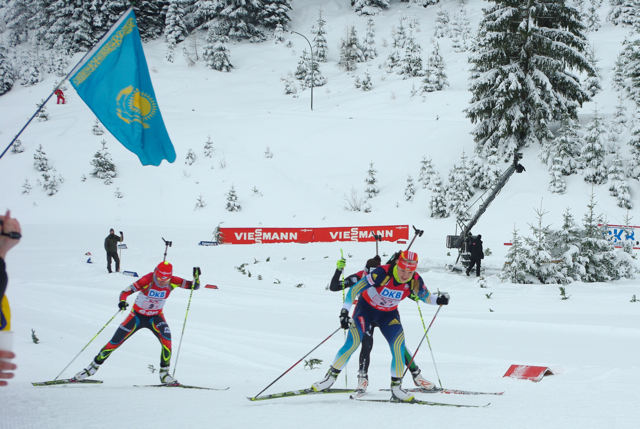
    He was ultimately unable to hold that position, losing ground to Dominik Landertinger of Austria and Evgeny Ustyugov of Russia on the final 2.5 k loop; those two were on a mission, and wowed the spectators with a sprint for eighth place. Nonetheless, Bailey was able to hold on to the top ten and turn in his best performance of the young season. He was buoyed by a surprising amount of fan support, he said: “The crowds are awesome here – a lot of enthusiastic USA fans! Surprising to see so far from home!”

    To those around him, shooting clean in the final stage was a big accomplishment and hopefully signals that he can overcome the patterns of the past.

    “It was really exciting to see him clean the last standing,” U.S. Biathlon Association President Max Cobb wrote in an e-mail to FasterSkier. “That’s something he’s been working really hard to be able to do. You can ski off a miss early in the race, but if you miss in the last stage there is just not enough skiing left to be able to catch up in the last loop and everyone goes all out to finish the race.”
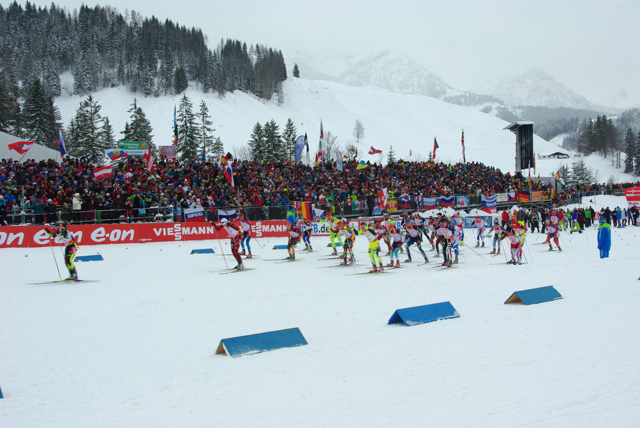
    Overall, Bailey said it was nice to be back on track, and getting toward race shape instead of just recovering from hard training sessions.

    “’I’m happy with the race and glad to have bounced back from a disappointing sprint,” he wrote. “I’m really looking forward to the relay tomorrow.”
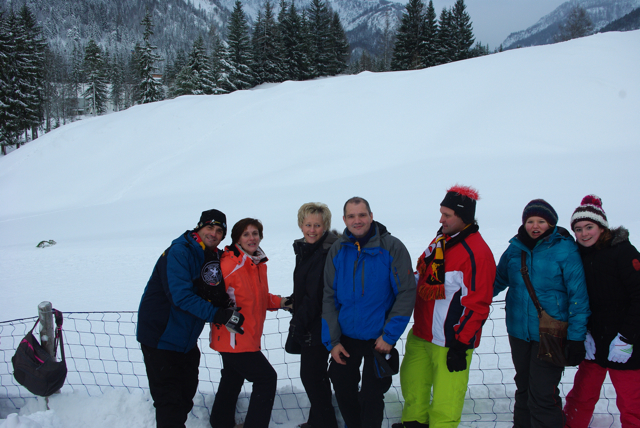
    Tim Burke did not have the same luck in the later rounds of the range, missing four shots in total of which three came in the final two stages. After starting 22nd, he was unable to move into the top-20 and finished 23rd. The third U.S. starter, Russell Currier, gained a few spots to move from 57th up to 52nd.

    Meanwhile, Canada’s Jean Philippe Le Guellec took an opposite trajectory to Bailey’s. After finishing tenth in the sprint and shooting clean through two stages, the race got “odd,” he told FasterSkier.

    “For one, my skis were not great and I ended up being passed a whole lot throughout the race, which was very frustrating,” he wrote in an e-mail. “As much as I felt good today, it felt like everyone was on steroids. Everything derailed even more with my epic three misses standing. I was the last on the range and ended up being the wind blocker. That on top of having to work extra hard to try to even keep up to the field ended up costing in standing. On the second bout I missed my third and jerked the trigger for the fourth round, which went off (over the targets).”

    Despite having “not a very satisfying day,” there were a few good moments for the Canadian. On the third lap, he was in a pack led by Martin Fourcade of France and Ole Einar Bjørndalen of Norway. When asked whether the pace of those stars was what led to his problems in standing shooting, Le Guellec replied that they did not.

    “Paradoxically, the lap with Martin and Ole was my most enjoyable,” he said. “These guys are so smooth, it’s a pleasure to ski behind skiers like that.”

    After a rough November, Le Guellec’s teammate Scott Perras turned in a career-best 25th-place performance in the sprint yesterday. Today, he was unable to hold his position in the sprint, where he was undone by poor shooting. Without a single clean stage and after accumulating six penalties in total, Perras slipped to 43rd.

    It was unlikely to dampen his confidence too much, though.

    “For sure JP’s win [last weekend] sparked some momentum, so I’m just jumping on the band wagon and having fun doing my part,” he wrote in an e-mail Saturday morning. “When you are training with guys like Brendan [Green] and JP and can keep up, you know you should be in the ball park come winter. A huge difference so far this year has been shooting speed and accuracy. Training with Nathan [Smith] and JP who are so quick and often accurate, I knew I had to get there and I put the time in. Come the end of March we will see if it all paid off.”

    More Canadian Success in Women’s Pursuit

    After a huge personal best in the sprint, Rosanna Crawford told FasterSkier that she was nervous going into the pursuit with bib 24. She knew she was in for a different experience.

    As it turned out, it was a better experience.

    “Today was by far the most fun I’ve had racing!” Crawford told FasterSkier in an e-mail. “I’ve never really done a pursuit where there were people around me, I was always fighting for last place, so this was great to be able to ski with a pack and move up.”

    With just three misses after twenty shots, Crawford was able to stay in 25th place, for the second top-30 finish of her career. There was a tight moment after she missed two shots in the first prone stage – never the way a biathlete wants to start a race – but she later regained her confidence.

    “I did have the fastest prone time, and my misses were just splitters, so I made sure to be calm and take it one shot at a time for the next prone,” she said. “Standing was good and I was happy to shoot clean on my last bout.”

    Megan Heinicke joined Crawford by skiing all the way from 57th up to 29th, on the merit of a single penalty. Heinicke only matched that result once last season, at World Championships. All in all, it was a confidence-building day for the team.

    “I feel like this weekend has shown me I can be in the top 30 and with even better shooting I can maybe crack the top 20,” Crawford wrote.

    For the Americans, Sara Studebaker moved from 58th up to 47th with three penalties, a major improvement as, like Bailey and Burke, she seems to be settling into the routine of racing after a tough start in Östersund. Susan Dunklee started in 31st position and was clean through two rounds, but missed a disastrous seven of her last ten shots.

    Dunklee posted a short poem on her facebook and twitter pages:

    Pursuit today started out quite well;
    But the standing targets I could not fell.
    Clean! Clean! Three… Four…
    Tomorrow hoping for a little more.

    International race reports: men / women

  • Aiming for Her First World Cup Podium, Solemdal Shoots Straight to the Top

    Aiming for Her First World Cup Podium, Solemdal Shoots Straight to the Top

    23-year-old Synnøve Solemdal of Norway could not have been happier to collect her first World Cup victory in Hochfilzen, Austria today.

    After yesterday’s sprint race, where Synnøve Solemdal came so close to having her first World Cup podium but got bumped from third place by more famous Norwegian teammate Tora Berger, she made a prediction: that all she had to do was to ski a good pursuit race, and the podium would finally be hers.

    Solemdal accomplished that and more in Hochfilzen, Austria, today, missing only a single shot out of twenty to stay in the running for the whole race before taking charge in the later stages and skiing to an easy 30-second victory.

    “It’s crazy,” the 23-year-old told NRK, the Norwegian broadcaser. “Everyone was cheering ‘Synnøve’ all the way to the finish.”

    In the first half of the race, it had been Kaisa Makarainen of Finland leading the way. Yesterday’s winner, Darya Domracheva of Belarus, missed two shots in the first prone stage and effectively took herself out of the race for the next several laps. Makarainen, the 2011 World Cup champion who placed second in the sprint, cleaned and left with a 13-second lead over Tora Berger. The fastest skier yesterday, Makarainen put time into the Norwegian, then cleaned her second stage to gain an even bigger advantage.

    By the time Makarainen missed two shots in the first standing stage, nobody else was even shooting yet. But Solemdal was first to fire all her rounds, and she shot perfectly, smiling as she put her rifle on her back and left the range. She had a seven-second lead on Makarainen heading out onto the trails.

    Makarainen quickly closed the gap, but was unable to pass Solemdal; they came into the final shooting stage together, turning the last five shots into a psychological battle. It was a fight that Solemdal won, cleaning yet another while Makarainen missed twice, shooting wide.

    “My standing shooting was not so good,” Makarainen said in a press conference after the race. “My legs were shaking on the last stage. I never have this problem in training, but it was there today. I need to work on that.”

    Meanwhile, a single miss, coming in the first stage, was Solemdal’s best ever in a World Cup.

    “I have never hit more than 18 targets and today I hit 19,” she said. “The standing targets looked so big today! I don’t know what happened.”

    As the next two racers, Domracheva and Marie Dorin Habert of France, each missed a shot, it seemed like Makarainen might have a chance to stay in second. But Berger, coming into the range late after collecting a penalty in each of the previous two stages, shot clean and left in second. Solemdal had a 45-second lead and would not be challenged on the final two-kilometer loop, but Berger, Domracheva, Makarainen, and Teja Gregorin of Slovenia all left within a few seconds of each other.

    They formed a tight pack, and initially Domracheva moved to the front, trying to ski away from the rest. But Makarainen quickly hunted her down. The group came back together briefly before Berger put in an attack; only Makarainen was able to go with her. While the pair had initially only a small gap on the others, it widened as the meters ticked by. First one would push the pace, then the other.

    Berger finally made an aggressive move on a sweeping downhill, 90-degree turn late in the course, passing Makarainen on the inside and carrying her momentum towards the finish line. Makarainen could almost regain contact, but as they skied through the final tunnel, Berger put in a furious burst with her trademark high tempo and left no doubt about whether the Finn could keep up. She couldn’t. Berger crossed the line in second, immediately congratulating Solemdal.

    “This maybe was not the hardest competition of my life, but it was hard,” Berger said in the post-race press conference. “I tried to stay focused in the last loop and keep ahead of Kaisa.”

    The sprint for fourth place ended with Gregorin charging to the line, past an exhausted, giving-up Domracheva who may have thought she had closed the door on the Slovenian.

    Miriam Gossner of Germany passed Dorin Habert late in the loop to secure sixth, while Ekaterina Shumilova of Russia placed eighth for her first World Cup top-ten. Vita Semerenko of Ukraine placed ninth and Germany’s Nadine Horchler tenth.

    But all attention was on Solemdal, who had raised her arms in victory as she coasted across the finish line, finally achieving not only her longstanding goal of a World Cup podium, but an even bigger goal – winning. She didn’t thank Berger after being knocked off the podium in the sprint, but today she gave credit to her mentor for helping her reach this level.

    “Just watching Tora last week win three times was a great inspiration,” Solemdal said. “This summer, I trained very hard and watched Tora and tried to copy what she did.”

    The other podium finishers congratulated the young racer as well; Berger must have been especially relieved, as it was the first time since 2005 that two Norwegian women finished in the top three. Finally, Berger has a teammate she can rely on.

    “I am really happy for Synnøve,” Makarainen agreed. “I have known her for a long time and she deserves this win!”

    Results

    Tora Berger didn’t have her best shooting day, but it was good enough to secure second place behind her Norwegian teammate.
  • Fak Regains Form of a Champion, Crushes Final Hill to Earn First Regular-Season Victory

    Fak Regains Form of a Champion, Crushes Final Hill to Earn First Regular-Season Victory

    Jakov Fak of Slovenia said that he wanted to do his work on the range, not the trails, but his skiing was at least as impressive as his two penalties in the 12.5 k pursuit race in Hochfilzen.

    Coming into this season, Jakov Fak was in the odd position of having won a World Championship, but never a regular-season World Cup race.

    The Croatian-turned-Slovenian turned heads in Ruhpolding, Germany, in March, when his strong shooting gave him a seven-second win over Simon Fourcade of France. It wasn’t his first good race; he had won bronze in the sprint at the Vancouver Olympics, and had two other podiums to his name.

    But after placing third in the sprint in Hochfilzen, Austria yesterday and then skiing a smart, clean race to move into the front in today’s pursuit, Fak has gone a long way towards proving that he can be a consistent competitor rather than just making the occasional appearance near the top of the results sheet.

    “Most of my podiums before have been in big events and I said that I wanted to be on top of the podium in a World Cup next,” Fak said in a press conference after the race, which he won by 0.9 seconds. “Today, my dream came true…I have been waiting for this almost since I was born…Approaching the finish line was a very emotional experience for me.”

    Despite his consistency and a lack of major errors, the 12.5 k pursuit was something of a rollercoaster for Fak. He started in third, and stayed there through the second shooting; there, he cleaned while the other leaders, Martin Fourcade of France and Andi Birnbacher of Germany, collected penalties. So he left on his third loop with the lead, which he extended over the 2.5 k loop. Birnbacher, who had been in second, got swallowed by a group of three Russians.

    Martin Fourcade (front) and Andreas Birnbacher led the way early, but couldn’t handle their three and two penalties, respectively.

    But in the first standing stage, Fak missed a shot, erasing the lead he had built. Birnbacher and Russians Anton Shipulin and Dimitriy Malyshko cleaned, and Fak was able to pull Malyshko the five seconds up to the leaders. By the final shooting stage, he was back at the front – but he had done some hard work.

    So had everyone else. In that final stage, all five of the leaders missed at least one shot. While Fak’s stray bullet must have initially felt like a punch in the gut, something sure to keep him from his long-dreamed-of win, it quickly became apparent that it wouldn’t set him back that much. The first athlete to clean, Fredrik Lindström, was just able to hitch onto the back of the pack of Birnbacher, Fak, Malyshko, and Fourcade as they left the penalty loop.

    Based on recent results and swagger, Fourcade was the one expected to make a move and smoke the rest of the men on their skis. But instead, it was Fak who moved to the front and put on a clinic, surging up the long, grinding hill on the far end of the race course.

    “I followed my race plan and paced myself from the start,” Fak explained later. “I knew that I had enough power left for a sprint up that last hill if I needed it.”

    Only Malyshko was able to do anything resembling following the Slovenian; Fourcade, susprisingly, struggled up the hill. By the time Fak entered the stadium, Malyshko was close behind, but it was clear that the Russian was not going to be able to muster the energy to catch or pass him. Victory belonged to Fak.

    “I wanted to do all of the work on the shooting range, not the tracks,” Fak said of the strategy that brought him the win. “Being on position one for the last standing stage is a very different feeling, but I was confident and not nervous, since I am usually very good in standing shooting.”

    For Malyshko, second place represented the best finish of his career, and just his second podium on the World Cup, although he was a frequent top-ten finisher during the 2012 season.

    Fourcade, who looked completely spent and emotionally deflated after finishing third eight seconds back, said in the press conference that despite three misses he was going for the win, which he thought he could snag. But in the end, he wasn’t shocked that Fak and Malyshko were stronger.

    “We all competed together as juniors and I know they are both good, so there is no surprise,” he said.

    Lindström was able to pass Birnbacher on the final stretches of the course and secure fourth place, his best result so far this season. Shipulin placed sixth, while Ole Einar Bjørndalen led Norway in seventh.

    One of the most exciting sprint finishes of the day was actually for eighth place, with Dominik Landertinger of Austria and Evgeny Ustyugov of Russia ratcheting up the pace again and again over the final kilometers until they appeared to be flying into the stadium. Landertinger managed to edge Ustyugov in the finishing straight, but it took an impressive display of speed. Lowell Bailey of the United States placed tenth.

    Results

    Fak was all smiles as he crossed the finish line in front of Dimitry Malyshko of Russia.
  • Le Guellec 10th in Hochfilzen Sprint; Career-Best Breakthroughs by Crawford, Perras Boost Canada

    Le Guellec 10th in Hochfilzen Sprint; Career-Best Breakthroughs by Crawford, Perras Boost Canada

    Jean Philippe Le Guellec of Canada racing in Sweden last weekend.

    When Canadian biathlete Jean Philippe Le Guellec stood on the starting line of the 10 k sprint in Hochfilzen, Austria, today, two things were different than usual.

    For one, he was in the red bib, signifying that he was the World Cup points leader in the discipline. That’s a first for a Canadian man.

    And secondly, he had a bad case of the nerves.

    “It was totally related to last week’s performance,” Le Guellec told FasterSkier in an e-mail. “At any stage, for any athlete, I think it’s safe to say that when you reach personal best performances, you always want to be able to back it up in the following event, thus confirming to yourself it wasn’t just a fluke performance. So my nervousness was definitely in line with: ‘OK, let’s see if I can back that race and repeat something worthy.’”

    Luckily, once he left the starthouse he was able to focus on the race and ditch the nerves. Le Guellec missed a single shot and skied the 18th-fastest course time, good for tenth place on the day.

    So, in response to the question he had been asking himself: “I’m very happy that that was today’s case… I’m totally happy with following up last week with a top 10.”

    Hochfilzen definitely didn’t feel the same as last week’s races in Östersund, Sweden, Le Guellec said; for one thing, there’s snow everywhere, and not of the saved or man-made variety. Despite slower snow, the clear skies made it a perfect day for racing, and Le Guellec reported that he had fast skis. There was only a bit of wind on the range, which he almost mastered. But not quite.

    “It was slightly windy on my standing, so my rifle was being pushed a little,” he wrote. “In an effort to compensate for the wind, I ended up overcompensating and missing in the left quadrant. I’m still happy with 9/10 though. Like [French Olympic champion] Vincent Jay said after the race when we spoke: ‘you can’t clean all the time!’ … although it’s always the goal for sure!”

    It was also a good day for teammate Scott Perras, who missed a single shot in standing and finished 25th, a career-best. Nathan Smith, however, didn’t fare as well, placing 73rd with four penalties. While he missed making the cut for the pursuit, Perras and Le Guellec are fired up.

    “Focus for tomorrow will be the hunt, which will be totally enjoyable once again given such a tight field! To be continued…” wrote Le Guellec.

    For the Americans, Tim Burke placed 22nd, Lowell Bailey 36th, and Russell Currier 56th; Jay Hakkinen and Leif Nordgren missed the pursuit, placing 67th and 81st.

    * * *

    Rosanna Crawford (CAN) on the range in Ostersund last weekend.

    A few hours later in the women’s 7.5 k sprint, Rosanna Crawford not only joined Perras in collecting a career-best finish, but one-upped him by placing 24th.

    “I was hoping for some good shooting because last week was pretty bad, for me, so I knew that was going to be key today,” Crawford told FasterSkier in a skype interview. “My prone had definitely come full circle since Östersund and my training had been really good, shooting-wise.”

    The single penalty, coming in standing, helped her achieve the result, which put her a minute and 19 seconds behind winner Darya Domracheva of Belarus. It was a huge breakthrough for the Canmore-based biathlete, who is a 2010 Olympian but has been bouncing on and off the World Cup.

    “I think my best result before this was a 51st,” she said. “There were the World Cups in Maine where I was 46th, but there were only [ten more] women so I don’t really count those results… It’s pretty exciting to finally crack that. Top 40 had been my goal at the beginning of the summer, and then at the end of the summer after testing I thought maybe I could make my goal the top 30. It’s a pretty big weight off my shoulders to know that hopefully this will become a reoccurrence.”

    After “spending ten years of my life training for biathlon,” as Crawford says, she was due for a breakthrough.

    “Are we surprised?” Biathlon Canada High Performance Director Chris Lindsay wrote in an e-mail. “Not entirely. Rosanna has been on a very impressive upward trend for the past two years. In our regular testing, in the field and the lab, she has been improving very quickly. We are beginning to see her potential. She has always been a fantastic shooter but now the speed is increasing and we see no evidence of her reaching a limit.”

    Matthias Ahrens, the head coach of the national team, agreed.

    “In my opinion the main improvements happened in all her summer training, partially to great commitment to all the training prescribed, being highly motivated and wanting to know how to improve in every aspect,” Ahrens told FasterSkier. “The other reason is great improvements in upper body strength and ski technique. But as she has good biathlon shooting faculties, when everything comes together a performance like today becomes reality.”

    While Crawford has historically been a very strong shooter in IBU Cup and national championships races, she has struggled to put that into practice on the World Cup, which had been the main thing holding her back.

    “It seems to me that I can always shoot really well to make teams, and at trials and the end of the season, but even last season the first three World Cups were awful, I was shooting 60 and 70 percent,” she explained. “I was worried that trend was going to happen again. So maybe it’s just that little bit of more pressure that there is on the World Cup.”

    For this weekend’s competition, she took a page out of Le Guellec’s book and focused on the process, not how she’d stack up a the end of the day.

    “After seeing my ski speed in the individual, I saw that with some good shooting I could have a good result,” Crawford said. “I think I got a little bit ahead of myself last week, and then this week it was a lot more not focusing on results and just focusing on my shooting and my skiing, and that will get the result I want. Not dreaming of the top thirty!”

    For tomorrow’s pursuit race, Crawford admitted that she was nervous; many of the women who will be starting around her had more penalties in the sprint, but skied faster. She knows that she’ll have to try to stay calm on her skis and relay on good, fast shooting to gain spots on the range.

    But with the momentum the Canadian team has going right now, there’s no reason not to be optimistic.

    “When people start doing well, the rest of the team can just sort of build off of each other,” she said. “A lot of us, we train together every day, so if you see them doing well, you know that you’ve done the same training, you’ve shot on the same range, so we should all be able to be up there.

    So it was pretty exciting with JP’s result and Zina’s tenth last week,” she concluded. “And JP getting to start with the red bib today made me start my race with a nice big smile on my face.”

    Megan Imrie and Megan Heinicke will join her in the pursuit after placing 56th and 57th today, while Zina Kocher was undone by shooting errors and wound up 73rd with five penalties.

    For the Americans, Susan Dunklee notched a much-improved 31st place finish, and Sara Studebaker will join her in the pursuit  – and perhaps work with the Canadians – after placing 58th today. Annelies Cook just missed the cut in 63rd, and Lanny Barnes placed 71st.

    International race reports

  • Birnbacher, Domracheva Get Revenge with Tight Victories in Hochfilzen Sprints

    Birnbacher, Domracheva Get Revenge with Tight Victories in Hochfilzen Sprints

    Andreas Birnbacher of Germany (foreground) and Martin Fourcade of France on the range in Ostersund, Sweden, last week; today in Austria, Birnbacher bested Fourcade by 0.4 seconds for his first win of the season. Photo: Fischer/NordicFocus.

    Last weekend in Östersund, Sweden, Andreas Birnbacher got the wrong end of a bargain with Martin Fourcade of France, who told the German that the pair should work together on the final lap but then blocked him coming into the finishing lanes and used that advantage to beat him to the line.

    At the press conference, Fourcade smirked that Birnbacher probably wouldn’t do the same thing next time.

    And today in Hochfilzen, Austria, Birnbacher turned the tables. In an individual-start 10 k sprint, the German biathlete eked out a narrow, 0.4-second victory over Fourcade. It was Birnbacher’s fifth career win and just his second in a sprint.

    Fourcade was a late starter, and Birnbacher told IBU News that as he went to cool down, he was sure that he would not win.

    “I was sure he was going to catch me,” he said.

    But the Frenchman was not able to, despite having splits going into the final lap telling him how close the race was. The gap was 6.9 seconds after the final shooting stage; Fourcade closed the gap, but not quite enough.

    “I was informed of the difference to Andi, and it was for sure an advantage to be in the back [of the field],” Fourcade said in a press conference. “But it was not enough for me today. Andi was a bit faster on the final kilometer. I heard that I was 0.7 seconds ahead of him, so in that moment I hated the one who was in front of me, but at the finish line I smiled because 0.4 seconds, this is really, really close.”

    When asked whether he was happy with second, Fourcade responded, “I’m happy with second, but sad because of the small gap between us.”

    Despite the fact that he been on the podium last weekend, Birnbacher wasn’t overly confident today.

    “The men’s sprint is always so tight,” he said in a press conference after the race, adding that he hadn’t felt great in the two days leading up to the sprint. “I never thought that I could win today, so I’m very happy.”

    His perfect shooting was what got him the win; both Fourcade and third-place Jakov Fak of Slovenia (+13.7) missed one shot, Fourcade in prone and Fak in standing. Fourcade said that he had been confident that he could win despite a penalty, even though he was in 38th place after the prone stage.

    For Fak, it’s the first podium since a sensational World Championship win in the individual in March, and a major improvement over the Östersund races.

    “I think our whole team put too much pressure on ourselves last week,” Fak said in the press conference. “We made a lot of mistakes on the shooting range… but I think we have gotten over that now. Personally, I am happier with the warmer conditions here; they are much better for me.”

    After getting serious frostbite on one of his fingers in Fort Kent, Maine, two years ago, that almost led to amputation, Fak has to be more careful than most in cold conditions. While it was ten degrees and bitterly windy in Sweden, Hochfilzen is a relatively balmy 20 degrees, with the snow temperature reported just around freezing.

    Friedrich Pinter was fourth, eleven seconds behind Fak, just missing out on giving Austria their third podium from as many athletes just four races into the season. Russians Evgeniy Ustygov (+26.1) and Andrei Makoveev (+27.1) narrowly edged Carl Johan Bergman of Sweden (+27.4), who placed seventh. Simon Hallenbarter of Switzerland placed eighth (+30.5), and Alexis Boeuf of France (+32.0) and Jean Philippe Le Guellec of Canada (+34.0) followed up podium performances in last weekend’s sprint by rounding out the top ten.

    * * *

    Darya Domracheva (BEL) competing in Ostersund last weekend.

    Darya Domracheva was also left looking for a win last weekend, as she was unable to ski quite fast enough to make up for the near-perfect shooting from Norway’s Tora Berger, who swept all three individual races.

    But in Hochfilzen today, the top four finishers all had one penalty, so the playing field was even with respect to ski time. And the Belorussian beat Berger on the trails – in fact she beat almost the whole field – so earned the win.

    “To be a winner is always special,” the 2012 World Cup runner-up said in a press conference, where she was informed that it was her tenth victory. “I tried to be more calm today.”

    But her win came partly from luck – the second-place finisher, Kaisa Makarainen of Finland, actually had a better course time than Domracheva, and matched her shooting as well. But while Makarainen hit the same number of targets, she was actually undone on the range, taking an extra 45 seconds to complete her final standing stage. Without that delay, she certainly would have taken the win; as it was, she only finished 4.7 seconds out of first.

    “I had some ice in my sight, and I tried to blow it away but it didn’t go away,” Makarainen reported in a press conference. “I almost couldn’t see anything when I was shooting in standing. Then my legs started to shake!”

    After completing her marathon shooting stage and a penalty loop, Makarainen hit the trails and turned in the fastest last-lap time.

    “I was really happy after the not-so-good shape last week that I could be on the podium here,” Makarainen said. “It’s nice to be here, but I’m a little bit sad, too, that I had problems with the standing shooting.”

    Starting several bibs behind, Domracheva heard exactly how fast the Finn had skied and had to turn on the jet engines to collect the win.

    “For sure, the results from Kaisa was a big red flag for me,” Domracheva said. “I always try to fight really hard to the finish line, but her result today was a very big motivation for me.”

    Third place went to Berger, who said coming into this race that Hochfilzen was not a great venue for her. Still, she narrowly beat teammate Synnøve Solemdal, who was looking for her first World Cup podium. At the finish line, Berger actually thought Solemdal had beaten her, but she held a three-second lead over the younger athlete.

    “With her legs, going up the last hill, I knew that it was going to be hard [to hold onto third,” Solemdal told Norwegian broadcaster NRK after she had nervously waited at the finish line to see if Berger would beat her. “But I fought as hard as I could, and in tomorrow’s pursuit, then I can be on the podium.”

    Poland had a strong showing as well, one of their best days in recent memory, with Krystyna Palka and Magdalena Gwizdon finishing fifth (+29.3) and sixth (+33.7). Teja Gregorin of Slovenia and Nadezhda Skardino of Belarus tied for seventh (+40.2), before Miriam Gossner of Germany turned in one of the more inspired performances of the day to place ninth (+44.0) despite four penalties. The rest of the top ten either shot clean or had a single missed shot, and Gossner was only beat on the trails by Makarainen. Marie Dorin Habert of France placed tenth (+48.7).

    Results: men / women

  • UPDATED – Notes and Quotes from the Hochfilzen IBU World Cup Weekend

    UPDATED – Notes and Quotes from the Hochfilzen IBU World Cup Weekend

    Sara Studebaker leading things off for the U.S. mixed relay team. Photo: nordicfocus.com / USBA.

    Biathletes on the IBU World Cup circuit hit up Hochfilzen, Austria for the second straight weekend after poor snow conditions in France forced the cancellation of a scheduled weekend there. While doubling up in Hochfilzen wasn’t too exciting, U.S. biathlete Lowell Bailey said that it wasn’t as bad as he’d expected, either.

    “The second week of racing here in Hochfilzen turned out to be quite a bit different than the first even though we were racing identical race formats on identical courses,” he wrote on his blog.

    While FasterSkier provided coverage of most of the races, there were bits and pieces we didn’t include in our race reports, as well as accounts from athletes and coaches who were out of contact due to travel following the races on Sunday. Here’s a roundup.

    Canadian Results in the Pursuit

    FasterSkier didn’t cover the women’s pursuit on Saturday, but two Canadian women finished in the top thirty. The first was Megan Imrie, who started 25th after a career-best finish in the sprint and then moved up to 24th. What was more surprising was that Zina Kocher, who had started 50th, managed to make her way up to 30th despite having four penalties. Kocher skied the 6th-fastest time in the whole race. Here’s what she wrote in an e-mail to FasterSkier on Sunday:

    It was an excellent day for our women’s team because I can’t remember when the last time two of us made top 30! The conditions were definitely a bit tricky – there was some wind, and before the race it was dumping snow. Once we started the snow eased up though.

    I approached the race knowing that I had great opportunity to move up by staying in control. I was determined to move up as much as possible right from the get go as there was a good train of athletes right ahead of me. I knew that the techs have been doing a wicked job here in Hochfilzen, and that my skis were going to be fast in this new snow.

    In the shooting, I had blocks of ice for hands in both prone stages and had to be very careful squeezing the trigger as I couldn’t feel anything. Fortunately, my hands warmed up by standing and I tried to be more aggressive and automatic. I would have been more satisfied with a few more hits, but it is what it is. After my last standing I gave it everything I possibly could to make up as many spots possible.

    U.S. Places 14th in Mixed Relay

    Sunday brought a mixed relay, which was something of a roller coaster ride for the U.S. (see race report).

    Sara Studebaker skied the scramble leg, and with perfect shooting and solid times on the trails stayed in the top ten and within striking distance of the top five.

    “Sara did an awesome job yesterday and had her best race in this season,” U.S. shooting coach Armin Auchentaller told FasterSkier. “This is good for her confidence and she will improve for sure in the next World Cups.”

    Next up was Annelies Cook, who cleaned prone and left the range in second place. But while she was psyched about her own performance, she also knew why it was possible: Studebaker.

    “I was super psyched that Sara had such a good one and she put me in a great spot,” Cook explained. She also told FasterSkier about her race strategy: “I had to make sure not to get too excited as is typical for me so I just tried to relax behind some of the faster girls.”

    Cook had just moved up from the IBU Cup, biathlon’s second tier of coordinated international races, which made her performance all the more impressive.

    “Annelies did a really good job, and it was also for good for her confidence,” Auchentaller said. “It was difficult for sure for her coming from the IBU Cup and to perform right away, but she did.”

    After Cook had to relay on spare rounds to clean in standing and with the men, Tim Burke and Leif Nordgren, having more trouble on the range, the team dropped to 14th. But Auchentaller was still enthusiastic.

    “The boys tried to close the little gap and tried to push all the way to the shooting range and went for it in the shooting. Overall the boys had an amazing start this season. The relay from yesterday gives us confindence for the future- we definitely can do a top-ten result very soon. We can see clearly the potential for that.”

    Canadians Aim For Top-Six, Shoot, Score

    With each member of their relay team notching top-thirty performances so far this season, and with powerhouse Norway sitting the event out, the Canadians stated a goal to finish in the top six.

    “Feeling great for the mixed relay today,” Kocher wrote in an e-mail the morning of the race. “We have a strong team and we really have the potential to finish in the top. All four us need to focus on the process, and stay in control.”

    Imrie, Kocher, Brendan Green, and JP Le Guellec did just that, tagging off as high as fourth at one point before slipping back to sixth. Here’s what Kocher wrote to FasterSkier after the race:

    “We were ecstatic in the warmup/finish area (Megan, Rosanna [Crawford], Marco [Marc-Andre Bedard], myself and massage therapist Scott) when Brendan shot clean again. He hasnt missed a shot in sprints and relays this trimester. And we called him our superhero. I’m thrilled that we showed today that we have the ability as a team to be in the top 6, not just as individuals. And that is an inspirating, motivating confidence booster for the entire team. Not just the athletes but support staff and pyramid around us that help us get there.”

    As for her own race, Kocher had some adventures with mechanics:

    Standing shooting was going super until those last two shots. I had some trouble loading one of my spares- it got stuck in my chamber and I wasted some time fixing this and loading another round. And when I missed one of my extras I felt a bit stressed, and my legs were shaking as the lactate pooled! Thoughts of ‘focus you better hit this because you are not doing a penalty loop today’ flashed through my brain!

    Kocher did drop the last target and the team avoided the penalty loop completely.

    Here’s how Imrie described the result:

    The relay ended in a great result for us. Everyone put everything they had into this race today. Zina’s ski time was one of the best of the day, Brendan was an absolute professional out there, and JP was, as usual, a rock solid anchor under pressure.

    I got involved in a tangle leaving the mass start, but I didn’t panic about it. The accordion effect on the first climb was so huge that I was back in the pack immediately, stress free. Shooting was just alright- I wanted to be more aggressive the whole way through the race, and I did that.

    The prize ceremony was an early Christmas present for the team.

    Finally, anchor skier JP Le Guellec had this to say:

    The whole week end was a high for Canadian biathlon I think. From the races on the World Cup, finishing with a strong mixed relay (6th), but also on the IBU Cup – 3rd and 4th places, and 4th on their mixed relay also. As a whole, I think the team will be able to enjoy the vacation and be able to focus on quality training. For me, it’s definitly a good way to head back home. Leaving on a “team high” like this is pretty priceless.