Tag: Ida Ingemarsdotter

  • Sadie Bjornsen Second in First Race of Season; Nilsson Tops Ruka Classic Sprint

    Sadie Bjornsen Second in First Race of Season; Nilsson Tops Ruka Classic Sprint

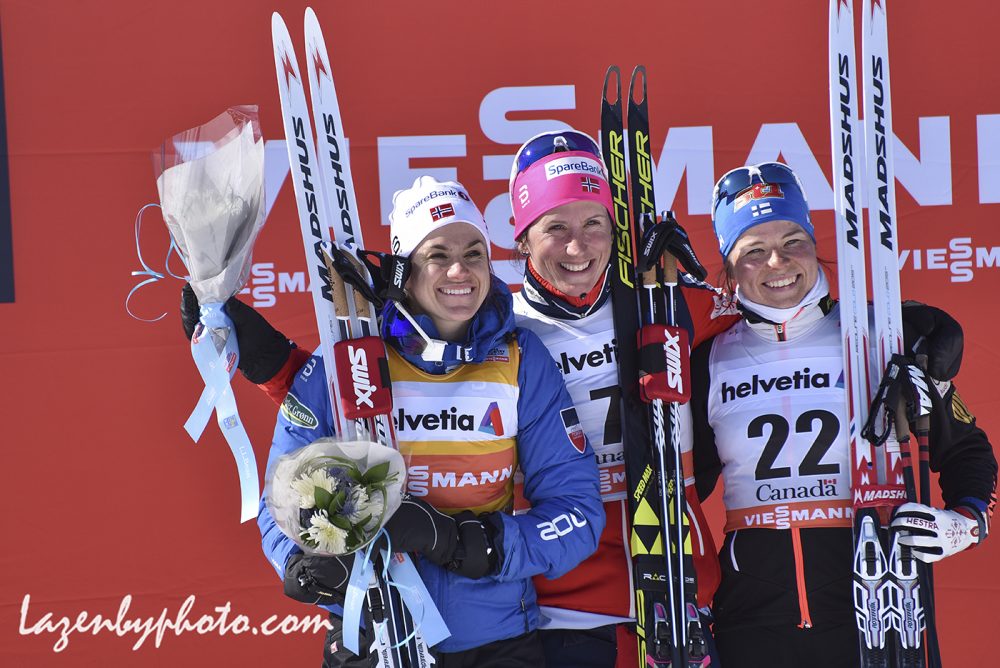
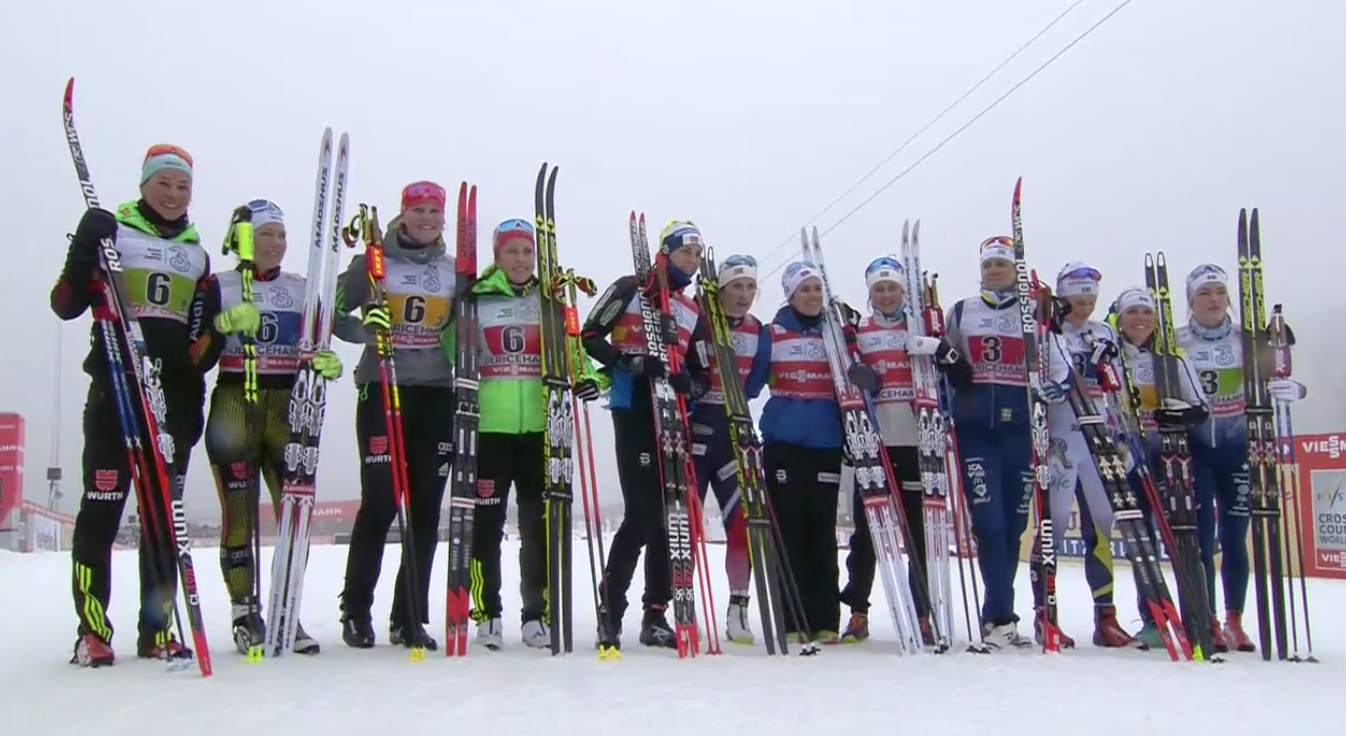
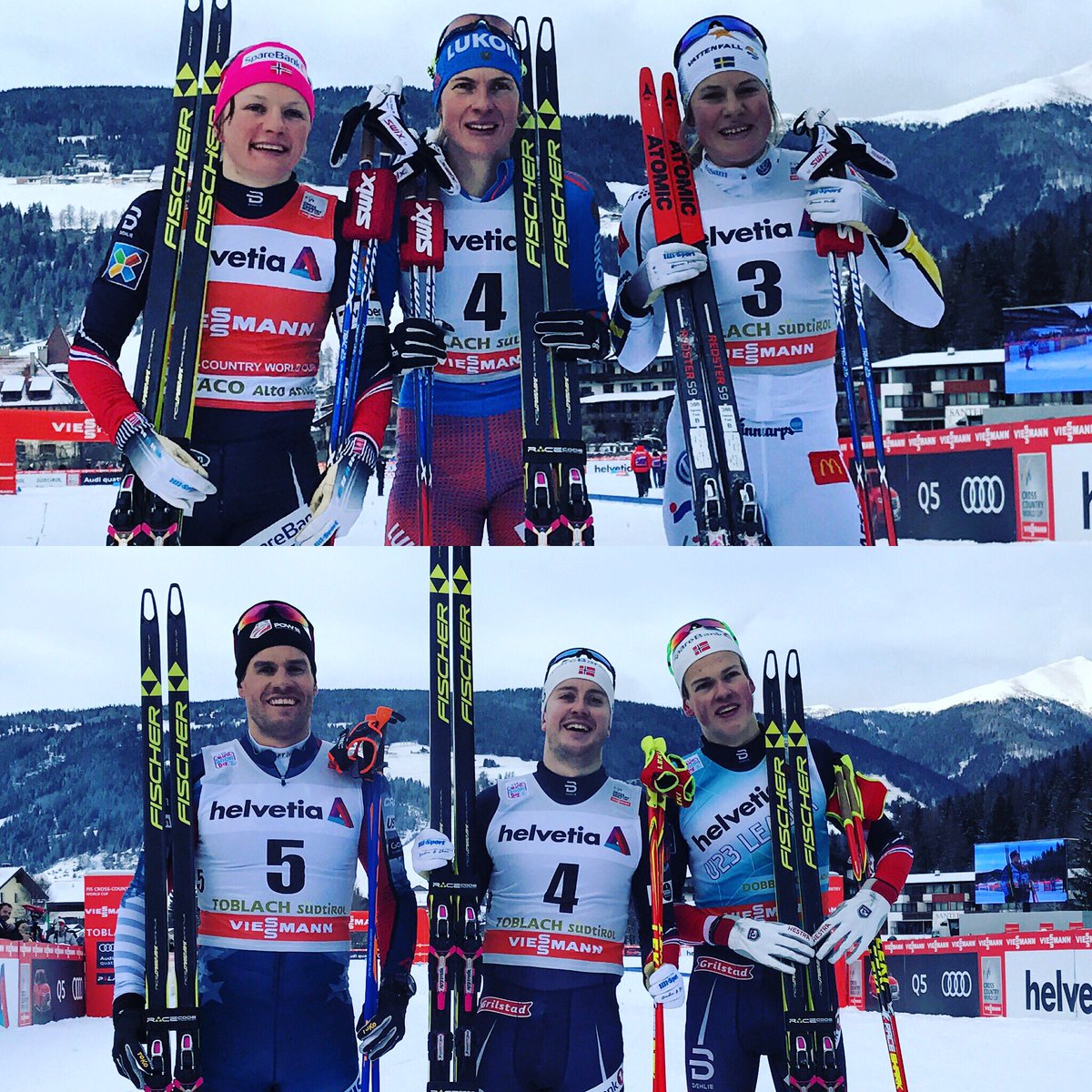
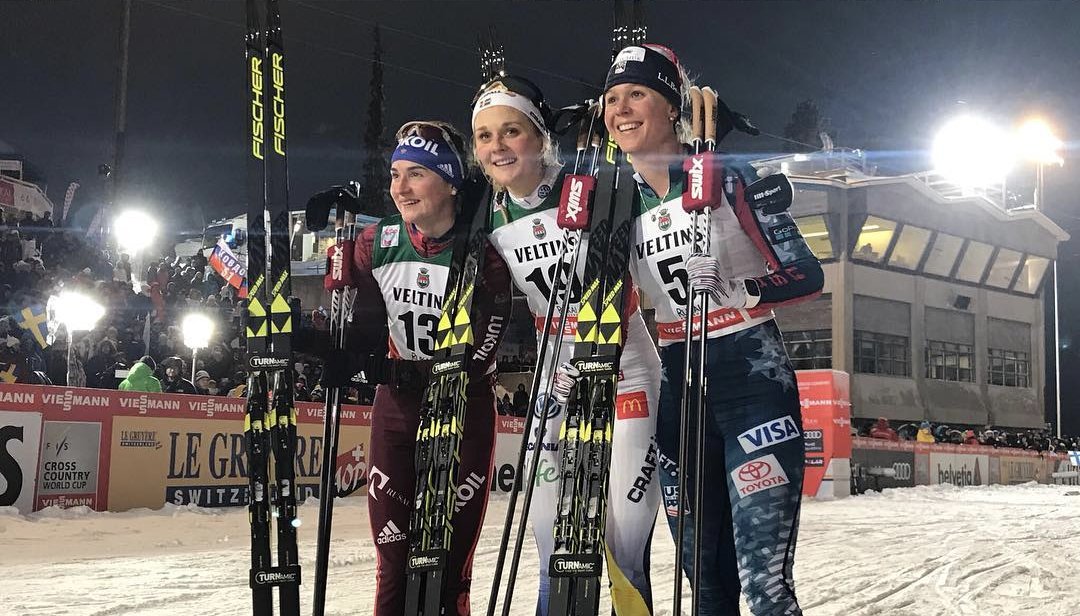
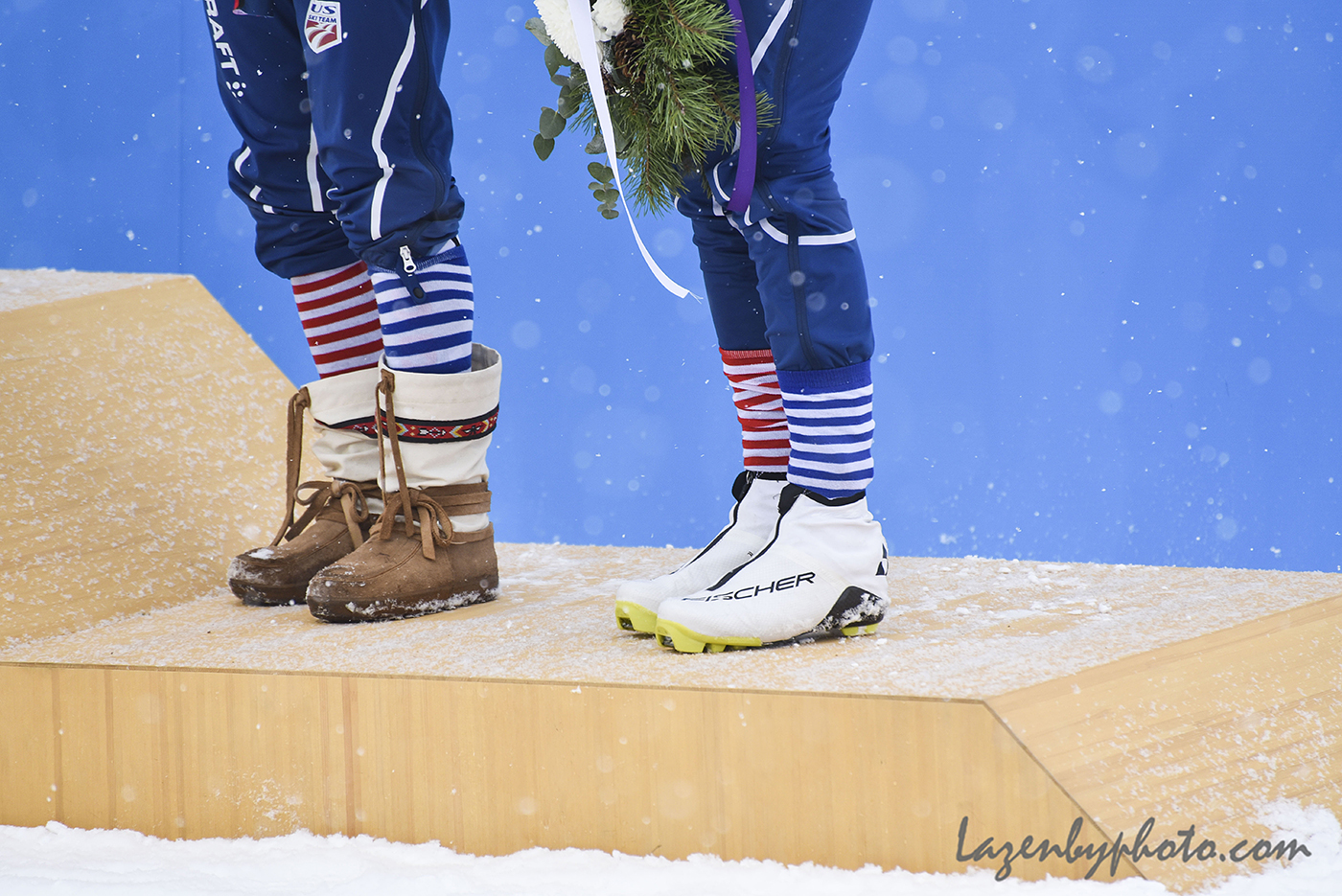
    The women’s podium for the first race of the 2017/2018 World Cup season, the Ruka classic sprint in Kuusamo, Finland, with (from right to left) American Sadie Bjornsen in second, Sweden’s Stina Nilsson in first, and Russia’s Yulia Belorukova in third. (Photo: U.S. Ski Team/Twitter)

    On Friday in Kuusamo, Finland, the 2017/2018 Cross Country World Cup began with the first day of racing in what’s called the Ruka Triple — a three-day event featuring a 1.4-kilometer classic sprint, 10 and 15 k classic races on Day 2, and 10/15 k freestyle pursuits on Sunday.

    For many, considering how multifaceted the U.S. Ski Team (USST) women are, and how five to six of them are podium threats, the biggest step up today was USST member Sadie Bjornsen’s leap onto the podium’s No. 2 spot.

    “What an amazing and exciting way to start this new season,” Bjornsen wrote in a post-race email. “I have been feeling good for the past few weeks, but as always at the beginning of the season, you wonder where you are. Starting with the qualifier, I had great feelings. I love this course, because it is so tough all the way to the finish line, and you don’t have many places to recover throughout the course. I also love how steep the climb is, it is a grade that I have always enjoyed!”

    For Bjornsen, who turned 28 on Tuesday, it was her first-career World Cup individual sprint podium. (On the World Cup, she’s placed third in a 5 k freestyle, second in a team sprint, and with the 4 x 5 k relay, second and third place twice. At last year’s World Championships, Bjornsen also teamed up with Jessie Diggins to finish third in the classic team sprint.)

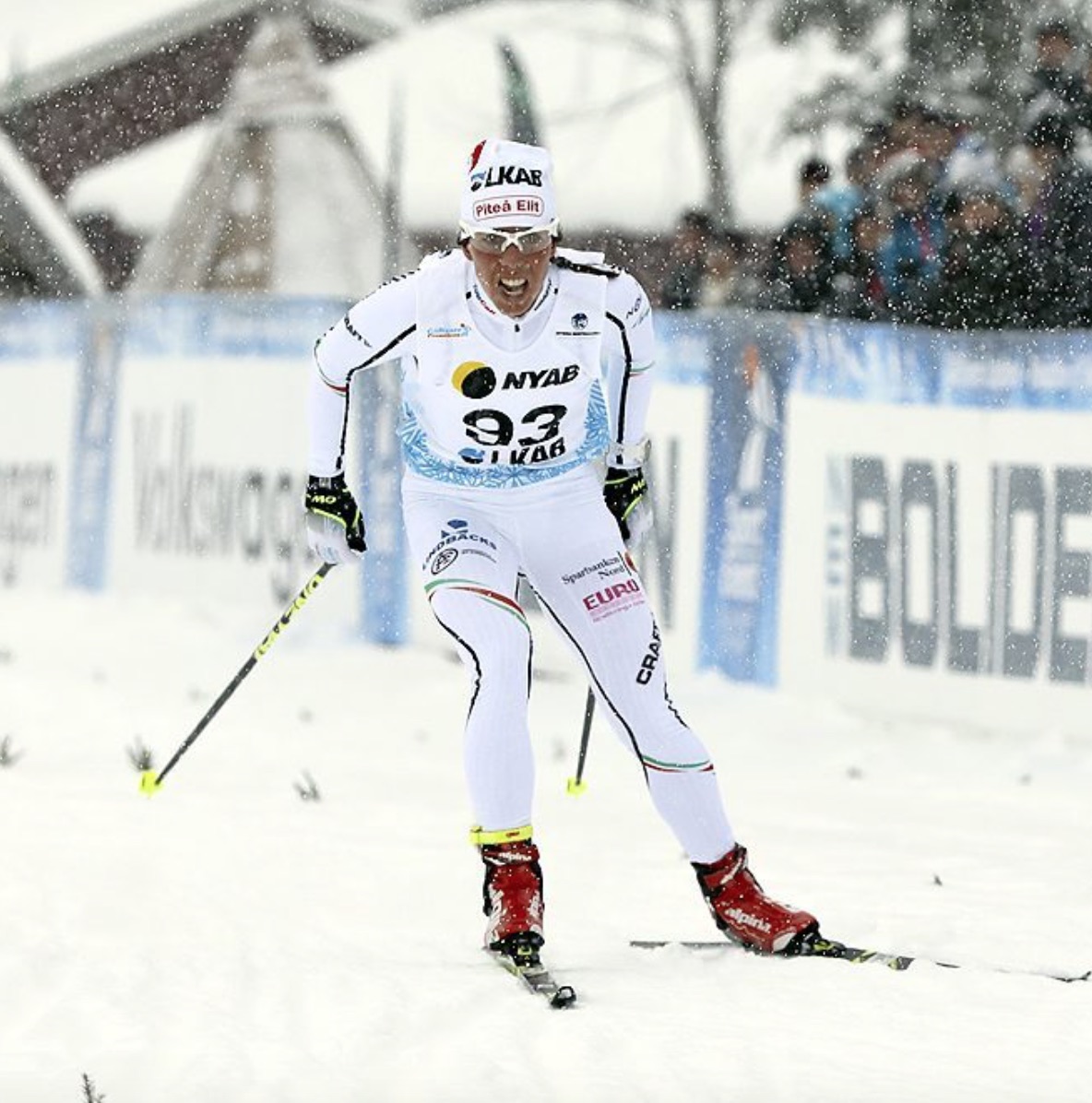
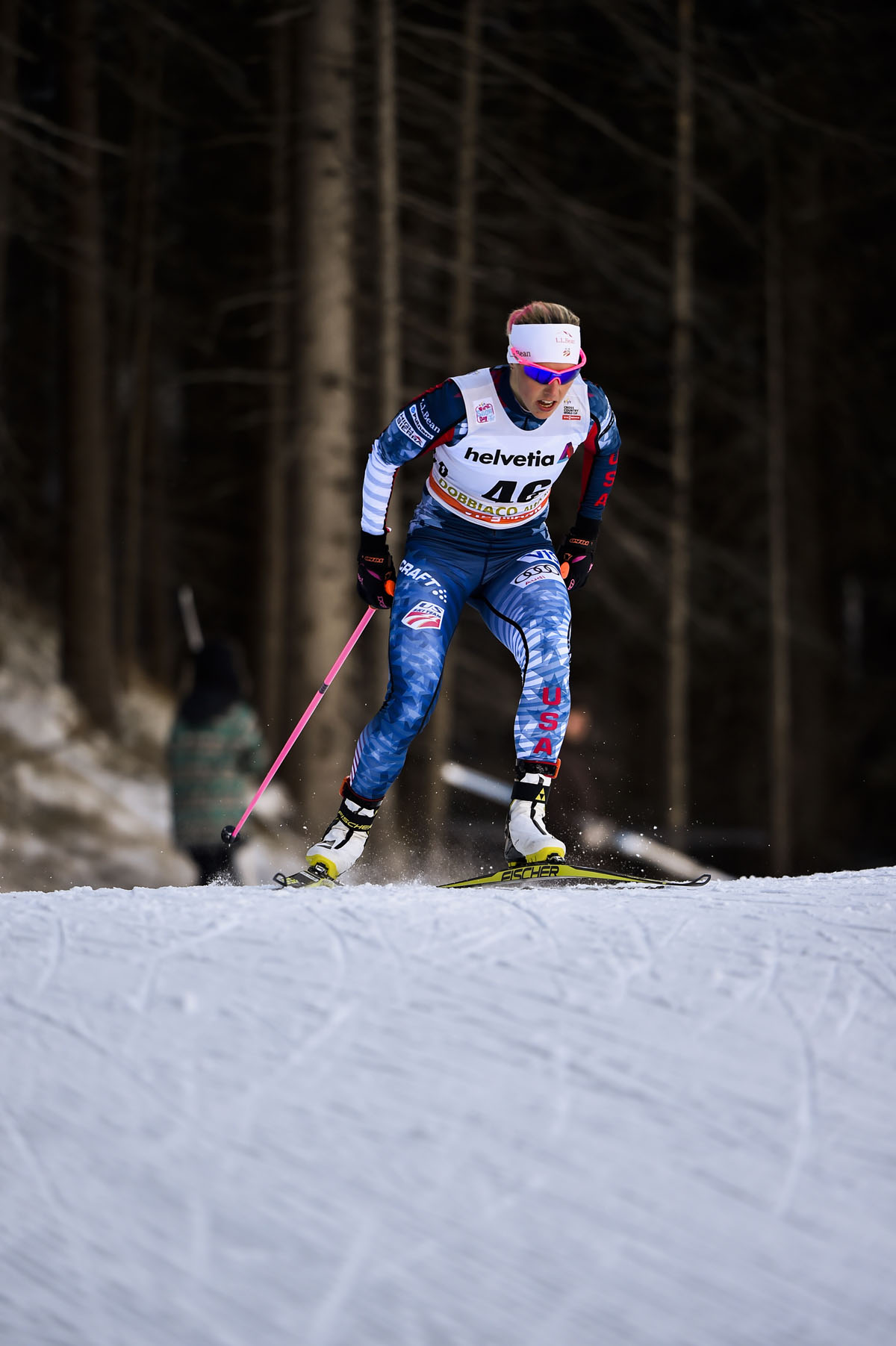
    On Friday, the Alaska Pacific University (APU) skier’s cylinders were firing from the moment she tipped the wand in the qualifier. Bjornsen qualified in fifth, sprinting around the course in 3:13.67 minutes. Sweden’s Ida Ingemarsdotter was the day’s fastest qualifier in 3:11:69 minutes, 1.98 seconds faster.

    After her qualifier, Bjornsen continued to rise to the top, winning both her quarterfinal and semifinal. On a course with a steep but strideable final climb near the finish, she controlled each heat. She won her quarterfinal in 3:18.14 minutes over Russian runner-up Yulia Belorukova (+0.39) and Sweden’s Hanna Falk in third(+1.97).

    “The general tone of the day was a fast start so that Sadie was in control in the front half of her heat,” U.S. Ski Team Women’s Coach Matt Whitcomb said on the phone. “In particular in the semifinal, she was able to have a fast start and shut the race down a little bit and pick it up when she was ready.”

    Her ability to acquire the lead, command the pace, essentially set the first semifinal’s tone, allowed her to also keep other skiers in the turbulence of her wake by the slimmest of margins.

    She won the semi in 3:20 flat. Again, Belorukova was second, this time just one-hundredth of a second back. Another Russian, Evgenia Shapovalova* was third (+0.39), and U.S. teammate Sophie Caldwell finished fourth (+0.50) in that semifinal.

    Nilsson’s Moment

    The final was where Bjornsen finally met her match in Swedish speedster Stina Nilsson.

    Nilsson qualified 19th, 8.15 seconds behind her teammate Ingemarsdotter — nothing stunning by her standards, but a safe margin with which she could enter the heats and then take control like she’s been known to. She won the fifth quarterfinal with the fastest time of all the quarterfinal heats in 3:14.38.

    Nilsson then dominated the second semifinal with a time of 3:17.61. That semi was nearly 2.5 seconds faster than Bjornsen’s winning semifinal time, and both lucky losers advanced from Nilsson’s heat. Those beneficiaries were Ingemarsdotter in third and Finland’s Krista Parmakoski in fourth.
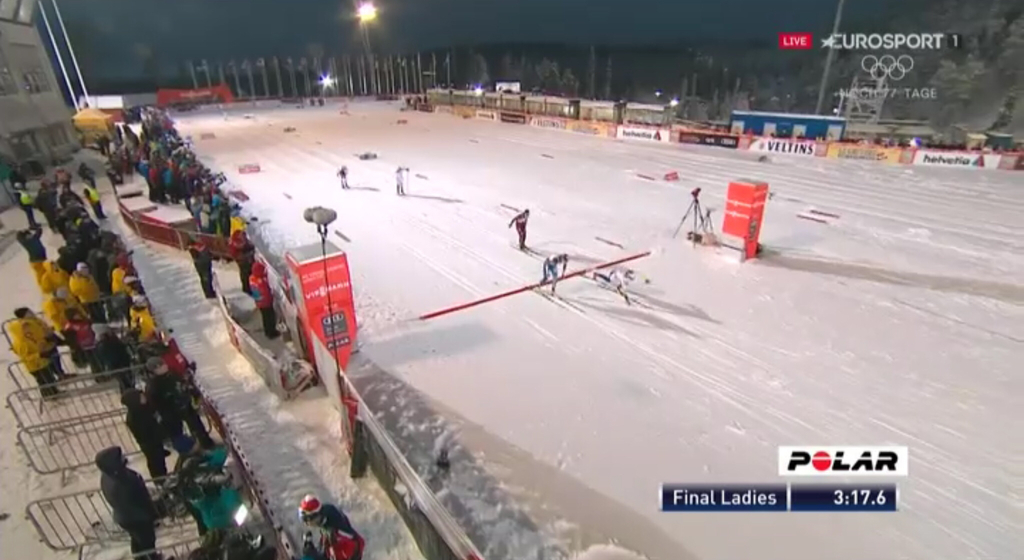
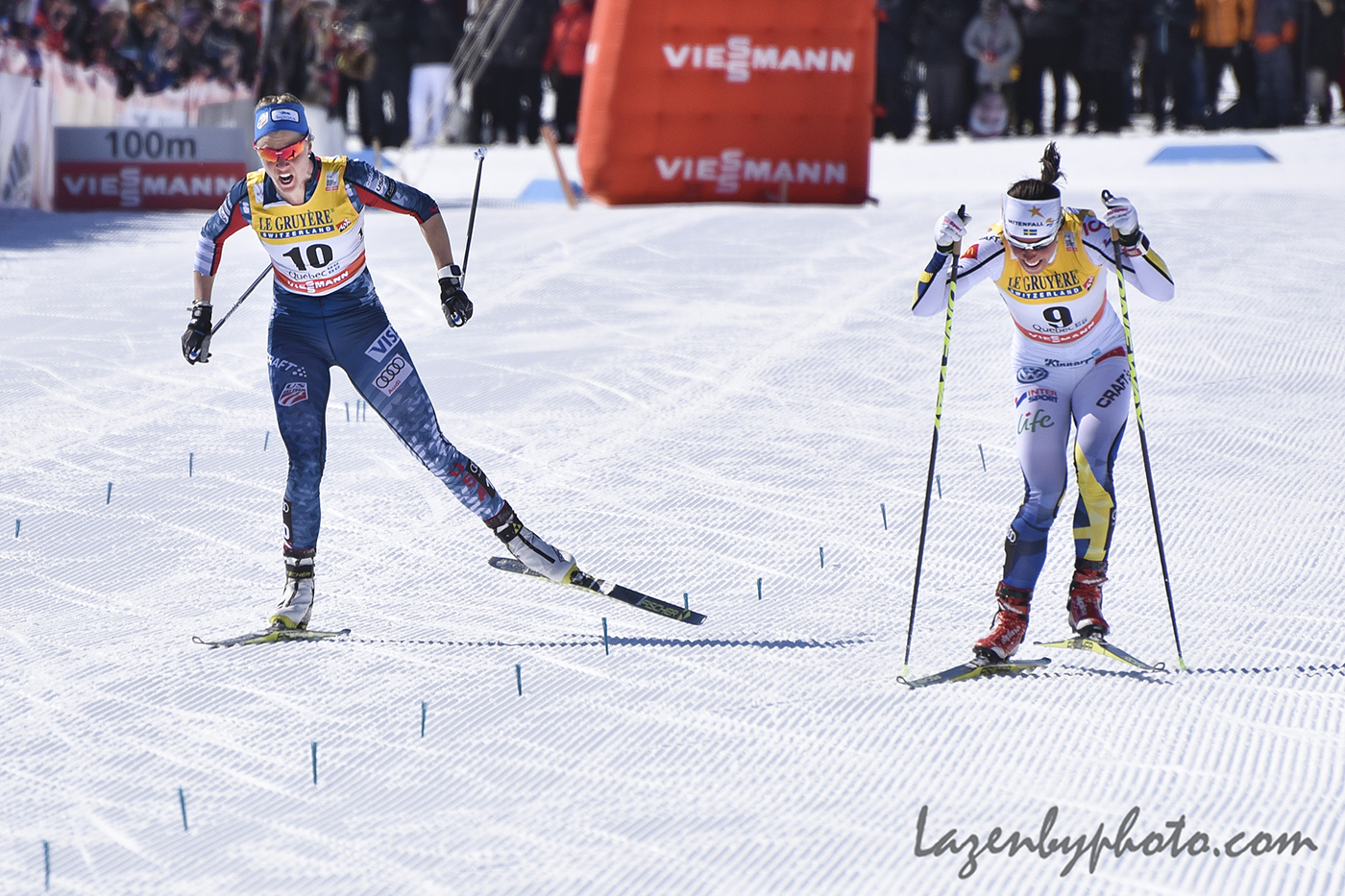
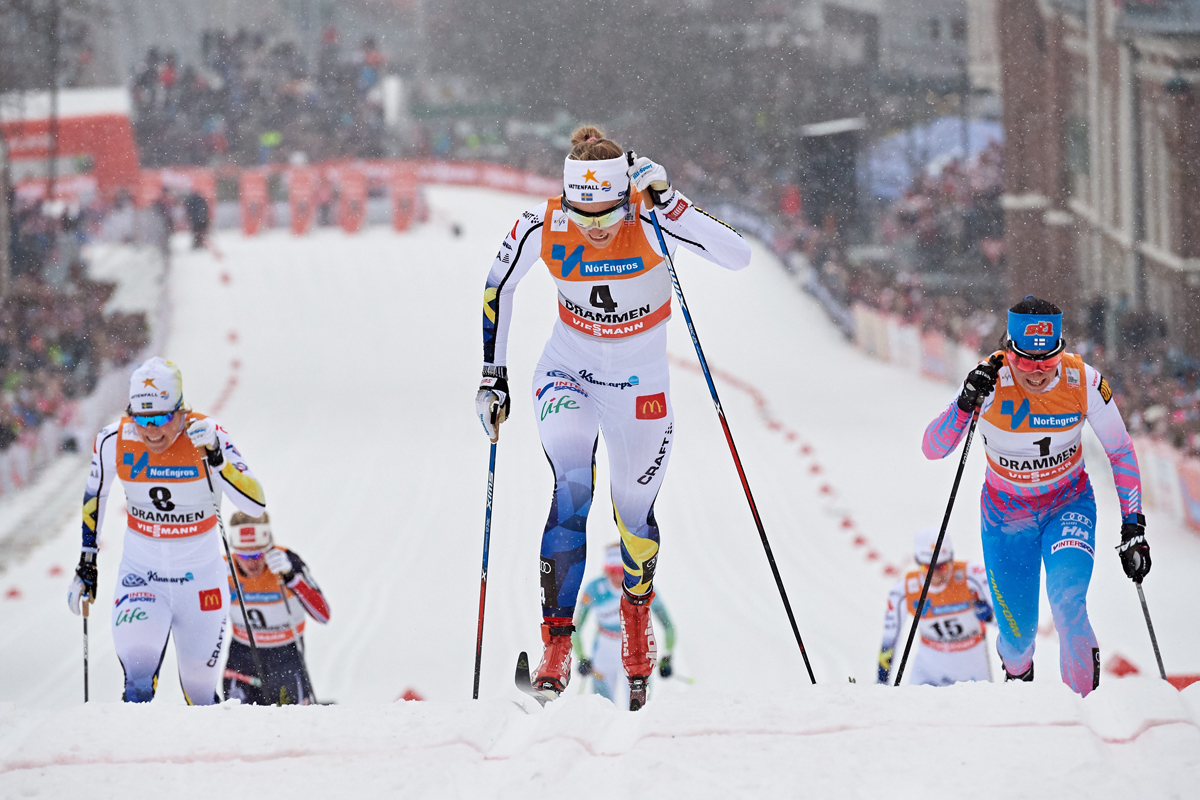
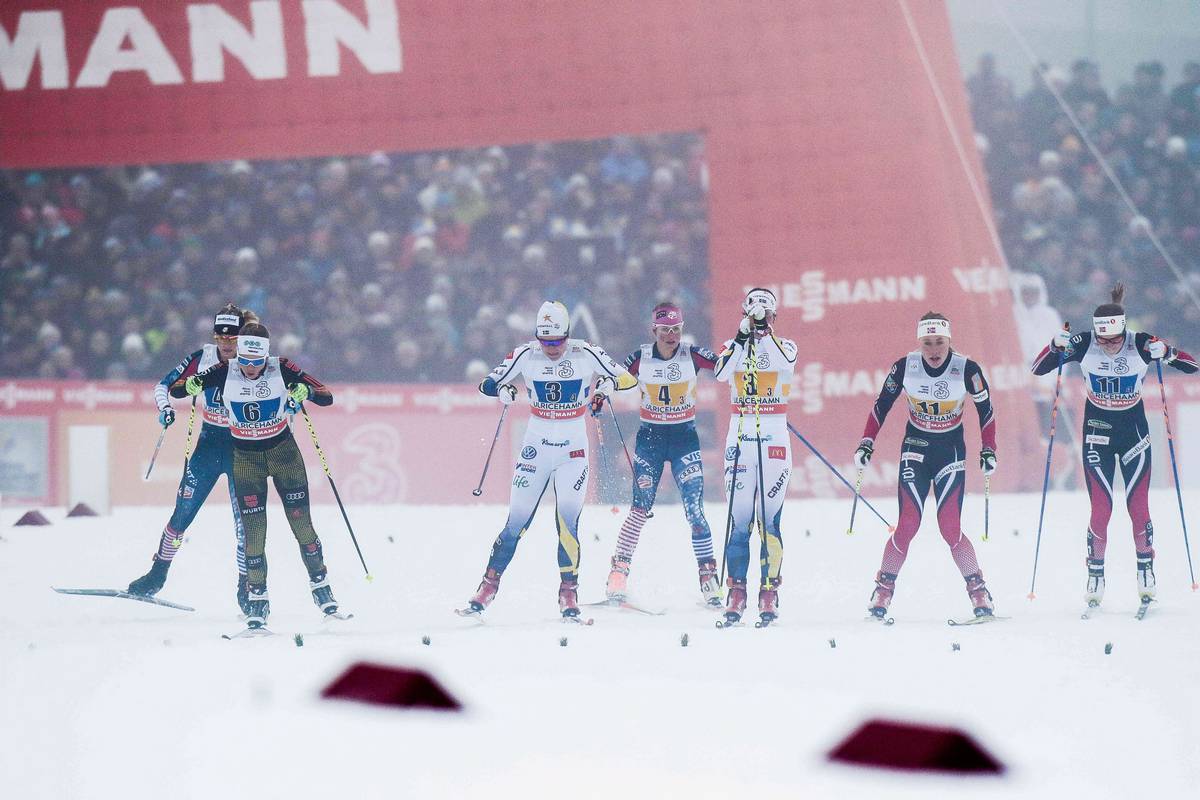
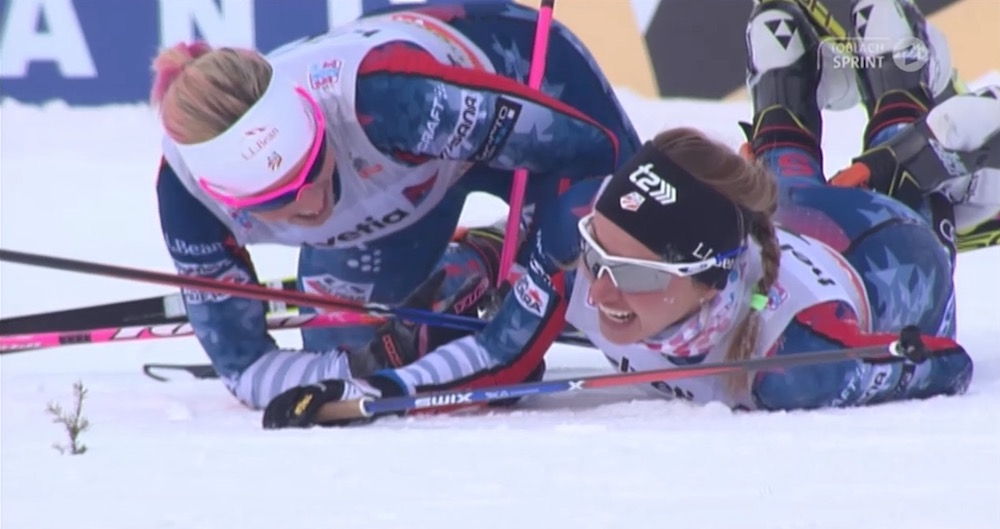
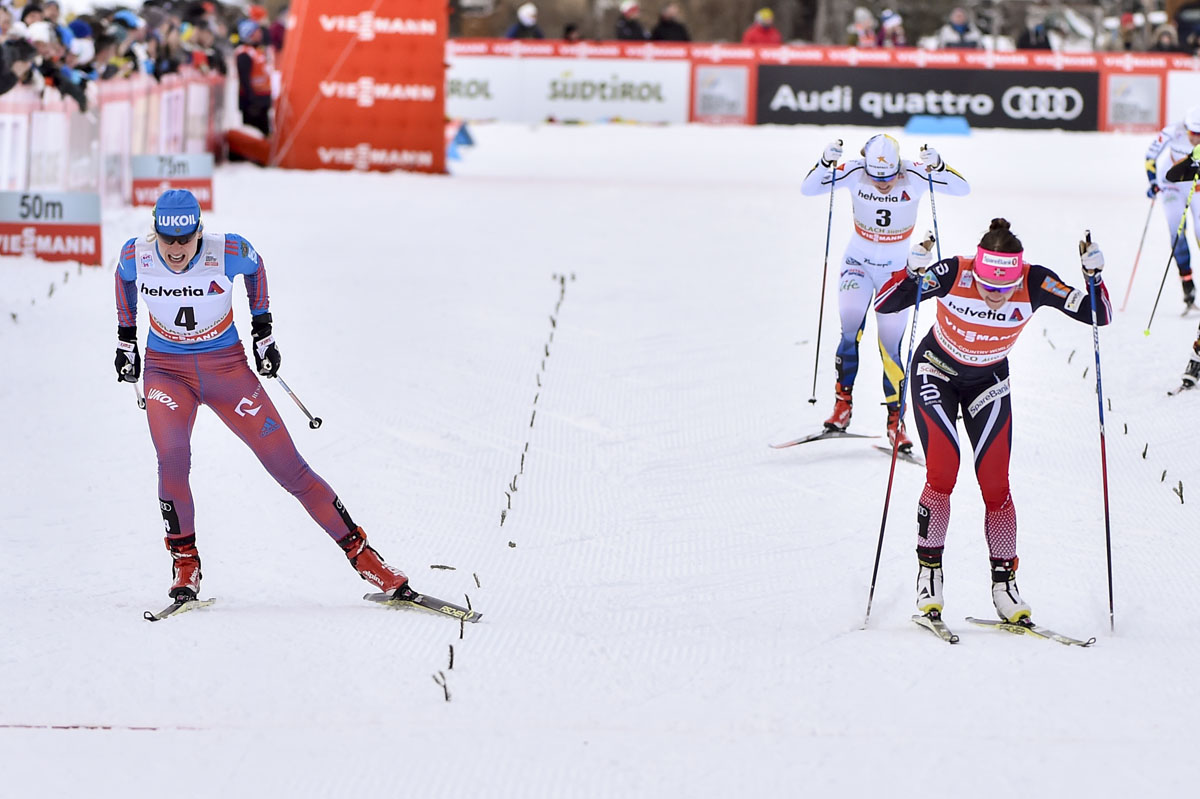
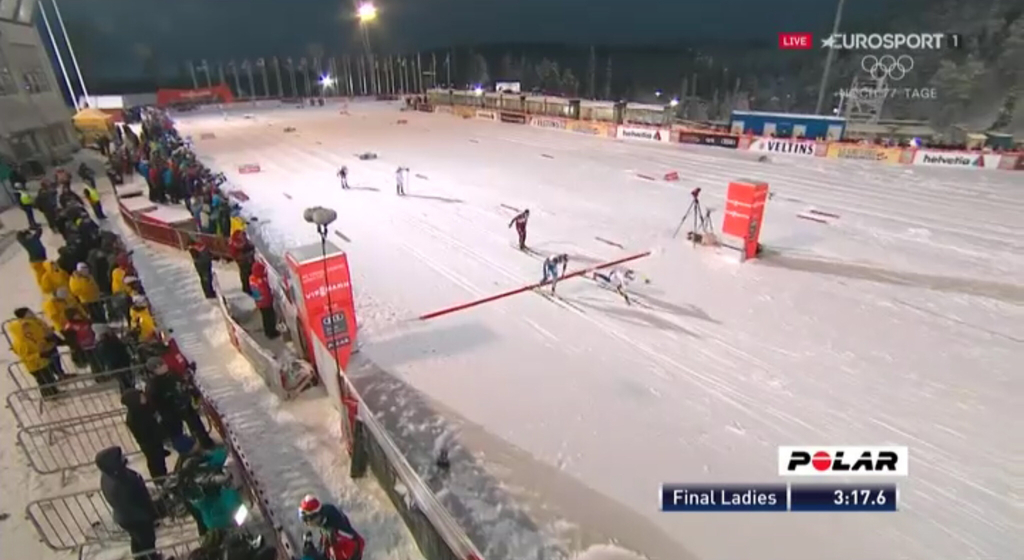
    Sweden’s Stina Nilsson lunges for first place as Sadie Bjornsen (USST) places second on Friday’s classic sprint on Day 1 of the 2017 Ruka Triple World Cup in Kuusamo, Finland. (Screenshot: Eurosport)

    As much as Nilsson may have played a poker hand while qualifying, this much was clear: once into the knockout rounds, she’d leave nothing up for chance. Nilsson won the final in 3:17.62. Bjornsen placed second by 0.24 seconds. Russia’s Belorukova was third (+0.91), Ingemarsdotter fourth (+2.72), Norway’s Kathrine Rolsted Harsem fifth (+3.54), and Parmakoski sixth (+18.62).

    The win marks Nilsson’s 19th career World Cup sprint podium and her 10th sprint victory. She won the classic sprint in Kuusamo last year and placed second there in 2015. She also finished last season in second in the 2016/2017 Sprint World Cup standings and fourth in the overall World Cup.

    Friday’s classic sprint was a bit unusual from the get-go. The qualifier revealed a big void compared to recent seasons’ results. Only two Norwegians, Harsem and Anna Svendsen, skied into the top 30 and moved onto the rounds. Last season’s Sprint World Cup Overall champ, Maiken Caspersen Falla, missed qualifying by 0.32 seconds in 31st.

    Whitcomb commented on the waxing struggles some skiers had out on course. He paraphrased a quote he heard from fellow American Anne Hart, who now races for the Stratton Mountain School (SMS) Elite Team, in 2010 to describe a common waxing puzzle.

    “It’s always challenging on this course to find the right balance — as Annie Hart would say —  the kick-to-glide ratio,” Whitcomb said. “But the kick-to-glide ratio is the key here in Ruka, and I think perhaps what happened with Norway. We will have to see what is said in the press by them and what we find out from our peers, I think they just went for more glide today, and some ended up struggling on the climbs. … It was noticeable. They had women that were herringboning up the entire final climb and most of the field was striding right up it. It’s a little bit of a trap — easy kicking snow and you are strong as a skier and a nation. It can be easy to perhaps try to go for speed. We have done it here before as well. Sometimes it works.”

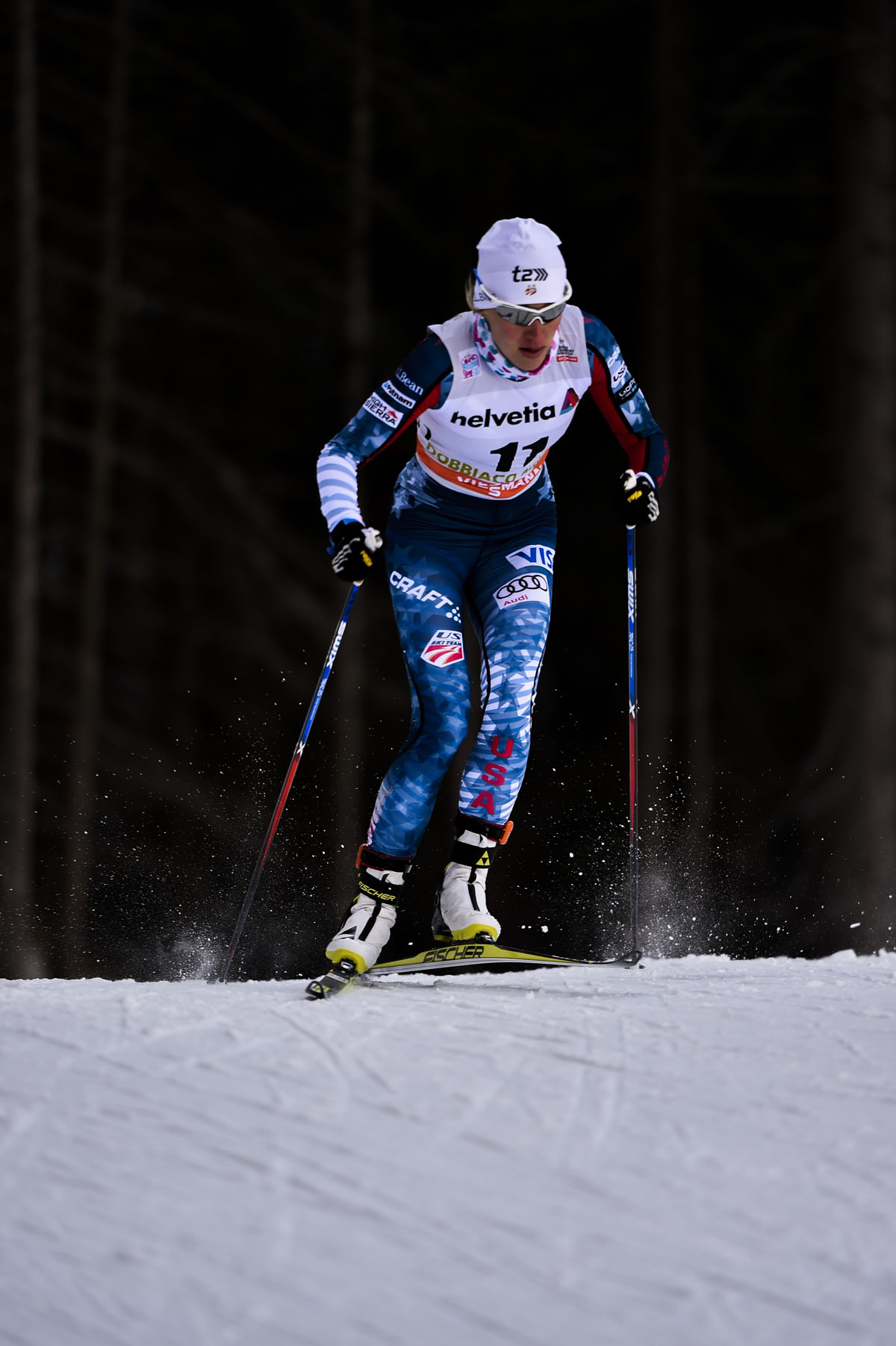
    On the right side of that kick-to-glide ratio was USST member Sophie Caldwell. She smoked the qualifier, placing third, 0.59 seconds behind Ingemarsdotter.

    “The first race of the season is always a little funny because you don’t know what to expect,” Caldwell said on the phone. “But I have been doing good, smart training this year where I wasn’t pushing things too much and just doing what I knew worked, and I was feeling good going into it, but I have also never been able to have a great race in Kuusamo before. I think I’ve qualified twice, and both times I just sort of snuck into the top 30 in qualifying. But going into today I just sort of looked at it as a new day, and it was kind of a fun situation because there was no pressure, I have never done great here before.”

    After her top-three qualifying result, Caldwell’s day way up north in Finland progressed smoothly. She chose Heat 2 in the quarterfinals, which turned out to be a quick heat and produced both lucky losers that would advance to the semis.

    “I led out of the start and into the first downhill and then generally after that first downhill, places switch up a lot because there is a big draft, and so I think I got passed by a couple of people,” she said of her quarterfinal. “And then [Sweden’s Charlotte] Kalla sort of sent it from there, and I actually got in a little jumble at the low point of the course after dropping down the big hill. Maybe I was back in fourth or something, and then just tried to stay relaxed and ski well up that first hill. But she led it pretty much from that low point to the finish, I think, and she looked really good. After that heat I was like, ‘That’s proof right there that you don’t really need to be leading out of the start, because so much can change.’ ”

    Kalla won the heat in 3:15.93, while Caldwell also automatically advanced to the semifinals in second (+0.70).

    Caldwell skied in the first semifinal along with Bjornsen. Caldwell, of the SMS Elite Team in Vermont, let others lead out, understanding that an early burst of speed might not have a big payout.  

    “And at some point … it was funny because I was expecting Kalla to sort of hammer out from the start again and having it be another really fast, hard heat, but once we got to the bottom of the big hill I didn’t really see her again,” Caldwell recalled. “So it was just the two Russian women, Sades [Sadie] and me heading up the big hill. And I think Sadie and one of the Russians were a little ahead, and then we started filing behind them.”

    After all the tactics and jousting, it came down to a lunge-fest at the line, and Caldwell just missed advancing. Caldwell placed fourth in a semi where the top-four places were separated by half a second. She was two spots away from advancing to the final and ended up eighth overall.

    A third U.S. Ski Team member, Ida Sargent also began the season with a standout performance. Ruka has been kind to Sargent. Historically, she’s able to begin the season in Ruka with head-turning results. In 2014, Sargent she placed fifth in the Ruka classic sprint. In 2015, she placed seventh in the season-opening classic sprint. Last year she was 23rd, also in the classic sprint.

    On Friday, Sargent qualified 22nd (+8.70).

    “I was really nervous and excited for this race,” Sargent wrote in an email. “I really love this course and have been feeling great in training lately with a very solid prep period but the first race of the year can be a little nerve racking. Most other teams have already raced a couple weekends and this was our first time putting a bib on!  The qualifier was solid for me but nothing special but I was psyched to get it over with and I felt a lot more relaxed going into the heats.”

    Sargent skied in the third quarterfinal which included Swedes Anna Haag and Ingemarsdotter. On a day when skiers contended with snowfall and wind, keeping one’s line and maintaining speed in the fast tracks were paramount.

    “The quarterfinal was playing out exactly as I was hoping for but then I ran into some bad luck in the finishing lanes with a track that was full of snow so I’m actually pretty disappointed with the result,” Sargent wrote. “ I felt like I had the skis and the body to do better today so I was bummed to be out after the quarters.”

    Sargent explained she felt great in her quarterfinal and had the physical ability to keep pace. She maintained a reserved start, but soon moved into second place. On the final climb, she felt as if she could make a move.

    “Ida [Ingemarsdotter] and I led over the top of that hill but then I was getting pushed to the outside on the final corner and then only had the far right track open into the finish because Ida was in the next one over,” she wrote. “Unfortunately everyone was skiing up the two middle tracks and since it was windy and snowing, the outside tracks were full of snow and super slow. I was having to plow my own track so I tried jumping in behind Ida hoping she would have a fast finish and I could get second behind her.  But she wasn’t making much time and Anna Haag was coming up on the other inside track so I was totally trapped.  I switched back to that outside lane hoping I could make up some time but it was a lot slower.  It’s a huge bummer that there were really only two finishing tracks and just some serious bad luck to be in a different one.  But I had great energy today and we had really good skis so I think its a good takeaway to be in a good place at the start of the season and there is lots of racing ahead!”

    Sargent placed third in the heat, 0.65 seconds out of first and 0.43 seconds out of second place. She finished the day in 15th overall.

    Rosie Brennan, a USST member known for her distance racing, finished 29th overall after qualifying in 26th. She skied in the fifth heat in which Nilsson set a blistering pace. Brennan placed sixth in her quarterfinal, 4.3 seconds behind Nilsson.

    “My heat ended up being very fast, but also tight,” Breanna wrote in an email to FasterSkier. “My tactics are severely lacking as I have skied maybe 3 heats in the last three years so I was happy with my skiing, but not so happy with my group tactics. It certainly left me hungry for more opportunities to ski heats.”

    Brennan went onto explain that she had developed her sprinting as part of her larger goal of performing at a high standard in tours.

    “The biggest reason I wanted to work so hard on my sprinting this summer was for tours,” Brennan wrote. “I love tours, but I feel it is hard to be competitive if you can’t qualify for the heats so I’m thrilled to have done that for the first tour of the season. I am looking forward to getting some distance racing started.”

    Outside the top 30 necessary to qualify for the heats were USST standouts Jessie Diggins and Kikkan Randall. Diggins skied to 34th overall (12.51 seconds behind Ingemarsdotter and 2.45 seconds out of qualifying), while Randall placed 36th (+13.92; +3.86). Other U.S. starters were Julia Kern (USST), who finished 57th, Liz Stephen (USST) in 70th and last season’s overall SuperTour winner Chelsea Holmes (APU) in 86th.

    Whitcomb did comment that the team made use of its new waxing bus for the first time at a race on Friday. And although some skiers had dynamite skis, others may have had less-than-desirable race skis. 

    “It is the first race we have operated out of the truck,” Whitcomb said. “It was great. But I don’t think all the athletes had great skis. And that is more of a product that it is early season, techs working with athletes, us functioning as a team. It is just straight-up getting the wax up is hard to start with. In terms of the function of the truck, we had power all day, the place never filled with smoke. We had space, light was good, and we had athletes that had skis that were good enough to win races.”

    Canada started three women, none of which qualified. Dahria Beatty (National U25 Team) placed 64th, Emily Nishikawa (World Cup Team) 74th, and Cendrine Browne (National U25 Team) 87th.

    Heading into Day 2 of the Ruka Triple, Bjornsen leads the mini-tour standings by 2 seconds over Ingemarsdotter. Saturday holds a 10 k classic individual start for the women.

    Results: Qualifier | Final | Ruka Triple standings (Day 1)

    (*Although Shapovalova has been sanctioned by the International Olympic Committee, the International Ski Federation (FIS) announced on Thursday that it would not prohibit the six IOC-sanctioned Russian skiers, including Shapovalova, from contesting FIS sanctioned races “for the time being”.)

  • Friday Rundown: Sadie Bjornsen Opens with Career-Best Second in Ruka

    Friday Rundown: Sadie Bjornsen Opens with Career-Best Second in Ruka

    The women’s podium for the first race of the 2017/2018 World Cup season, the Ruka classic sprint in Kuusamo, Finland, with (from right to left) American Sadie Bjornsen in second, Sweden’s Stina Nilsson in first, and Russia’s Yulia Belorukova in third. (Photo: U.S. Ski Team/Twitter)

    FIS Cross Country World Cup (Kuusamo, Finland): Classic sprints

    Women’s race report

    Men’s race report

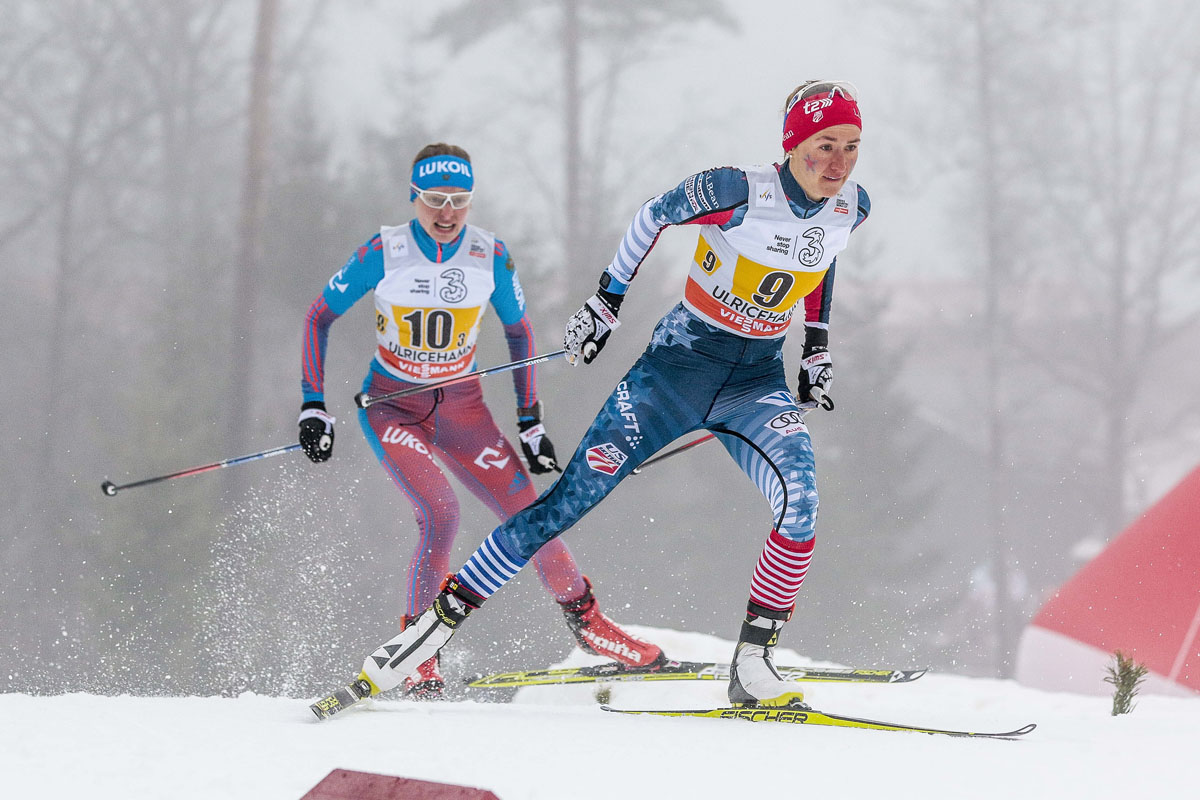
    In the first race of the 2017/2018 cross-country World Cup season, U.S. Ski Team (USST) member Sadie Bjornsen, who turned 28 on Tuesday, raced to the best result of her career, placing second to Sweden’s Stina Nilsson in Friday’s classic sprint in Kuusamo, Finland.

    Last season, Bjornsen notched her first World Cup podium in third place in the 5-kilometer freestyle in Toblach, Italy, and teamed up with USST teammate Jessie Diggins to take third in the 2017World Championships classic team sprint. Friday’s 1.4-kilometer classic sprint — the first race of the Ruka Triple mini tour to kick of the 2017/2018 World Cup season — was Bjornsen’s first race of the season. She did not participate in any preseason International Ski Federation (FIS) races.

    Bjornsen started out the day by clocking the fifth-fastest time in the qualifier, 1.98 seconds behind Sweden’s Ida Ingemarsdotter, who won the qualifier in 3:11.69 minutes. Bjornsen’s USST teammate Sophie Caldwell qualified third (+0.59) after another Swede, Hanna Falk in second (+0.19), and a total of four American women finished in the top 30 to qualify for the heats. Ida Sargent finished 22nd (+8.70) and Rosie Brennan was 26th (+9.51) to reach the quarterfinals.

    There, Bjornsen won her quarterfinal by 0.39 seconds over Russia’s Yulia Belorukova. Caldwell also advanced to the semifinals by placing second in her quarterfinal, 0.7 seconds behind Sweden’s Charlotte Kalla in first.

    Sargent finished third in her quarterfinal, 0.65 seconds behind the winner of that heat,  Sweden’s Anna Haag. Brennan placed sixth in her quarterfinal, 4.3 seconds behind Sweden’s Nilsson in first. Neither Sargent nor Brennan advanced to the semifinals.

    In the semifinals, Bjornsen again raced to first, and once again held off Belorukova — this time by just one-hundredth of a second. Caldwell followed in fourth in that semifinal, 0.5 seconds behind Bjornsen in first and 0.11 seconds behind Russia’s Evgenia Shapovalova in third (+0.39). Neither Caldwell nor Shapovalova advanced to the final.

    In the final, Nilsson took the overall win in 3:17.62 and Bjornsen captured a career best in second place, 0.24 seconds out of first. Belorukova rounded out the podium in third (+0.91), while Ingemarsdotter placed fourth (+2.72), Norway’s Kathrine Rolsted Harsem was fifth (+3.54), and Finland’s Krista Parmakoski sixth (+18.62).

    Overall, Caldwell placed eighth, Sargent 15th and Brennan 29th for the U.S. Diggins and Kikkan Randall missed out on qualifying in 34th and 36th, respectively. Julia Kern placed 57th, Liz Stephen 70th, and Chelsea Holmes 86th.

    None of the Canadian women qualified, with Dahria Beatty in 64th, Emily Nishikawa in 74th and Cendrine Browne in 87th.

    (Continues below)

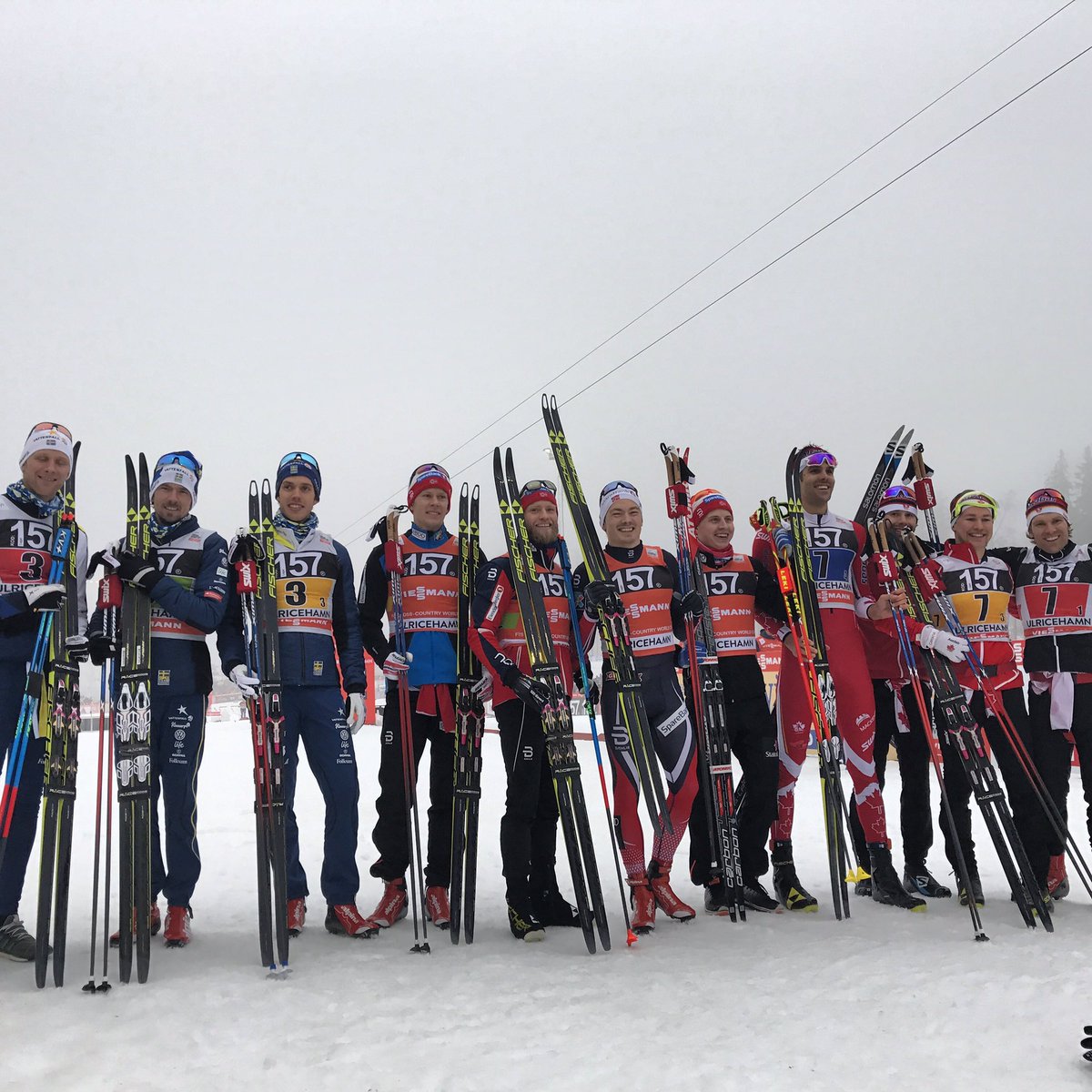
    In the men’s 1.4 k classic sprint, Norway’s Johannes Høsflot Klæbo won out the day after winning the qualifier, quarterfinal and semifinal en route to another dominant performance in the final.

    Klæbo started off by winning the qualifying round by 2.26 seconds in 2:46.53. Finland’s Anssi Pentsinen qualified second and another Finn, Ristomatti Hakola, qualified third (+2.35), ahead of Italy’s Federico Pellegrino in fourth (+2.66).

    Cross Country Canada’s Alex Harvey was the top North American man in the qualifier, finishing 13th (+6.13), while Erik Bjornsen of the USST qualified in 26th (+8.71).

    Both Harvey and Bjornsen finished fifth in their quarterfinals and did not reach the semifinals. Harvey ended up 21st on the day, after finishing 2.16 behind the winner of his heat, Finland’s Lauri Vuorinen. Bjornsen was 24th overall after finishing 5.12 seconds behind Klæbo, who won the first men’s quarterfinal.

    Klæbo used the extra recovery time he had from racing an early quarterfinal to prime himself for another win in the semifinals, where he beat Sweden’s Calle Halfvarsson by 0.29 seconds. Another Norwegian, Pål Golberg, followed in third (+0.49), and Hakola placed fourth in that semi (+1.72). Both Golberg and Hakola had fast enough times to advance to the final, where they met Pellegrino — the winner of the second semifinal — and Norway’s Sondre Turvoll Fossli, who was second in the second semifinal (+0.1).

    In the final, Klæbo once again won convincingly, this time by 1.35 seconds with a finishing time of 2:48.19. Golberg took second place and Halfvarsson reached the podium in third (+4.03), while Hakola placed fourth (+5.65), Pellegrino fifth (+8.87), and Fossli sixth (+17.31).

    For the U.S., Andy Newell missed qualifying by 0.38 seconds in 34th and Simi Hamilton finished 60th. Scott Patterson was 84th, Paddy Caldwell was 103rd, and Noah Hoffman was 105th.

    For Canada, Julien Locke, of the national U25 Team, finished 59th, Len Valjas was 63rd, Knute Johnsgaard 73rd, Devon Kershaw 74th, Graeme Killick 85th, and Jesse Cockney 95th. Last year’s NorAm winner Russell Kennedy did not start.

    Results: 

    Women’s qualifier | Women’s final

    Men’s qualifier | Men’s final

  • Kalla Continues to Dominate in Gällivare; Russia Sweeps Men’s 15 k Classic

    https://www.instagram.com/p/BbpElh6gxkx/?taken-by=kalla_87

    Note: This article has been updated to include comments from Sweden’s Charlotte Kalla.

    For the second day in a row, Charlotte Kalla, a name synonymous with the yellow and blue of Sweden, stood atop the podium, placing first in the women’s 10-kilometer classic International Ski Federation (FIS) race on Saturday in Gällivare, Sweden. On Friday, Kalla won another individual-start race, the 5 k freestyle, by a margin of 8.8 seconds. She more than doubled that time gap by the finish of Day 2, winning the 10 k classic in 27:55 minutes, 17.7 seconds ahead of Russia’s Yulia Tchekaleva in second place. Natalia Nepryaeva, also from Russia, skied to third, 40.9 seconds back of Kalla.

    “I am feeling good and I think I am where I should be at this moment,” Kalla wrote in an email. “I had a good feeling on the classic race and handle the condition well. On Friday I opened hard and tried to push hard all the way.”

    Known as a skate powerhouse, Kalla has improved her classic skiing and is now a double threat. “I have improved my classic technique the last years,” Kalla explained. “When I am in shape it doesn’t matter if it is skating or classic. I am glad I managed to ski well in the condition we had. It was a little bit soft because of the snowfall.”

    Although a home FIS event for Sweden, Russia secured six of the top-10 spots with Sweden settling for three. Japan’s Masako Ishida, the only non-Russian or Swede outlier in the top 10, placed fourth (+1:02.4). Russians Anna Zherebyateva raced to fifth (+1:08.8) while teammate Yulia Belorukova was sixth (+1:12.8).

    Sweden took the next two spots with Stina Nilsson in seventh (+1:20.9) and Anna Haag in eighth (1:20.9). Russia rounded out the top 10 with Anatasia Sedova placing ninth (+1:24.1) and Mariya Guschina in tenth (+1:25.0).

    Sweden’s Ida Ingemarsdotter, a World Cup regular, placed 11th (+1:30.6).

    Kikkan Randall was the only U.S. Ski Team member at the race, and a day after finishing eighth in the 5 k skate, she finished 15th (+1:48.1) on Saturday. In an email, Randall explained that snow had fallen continuously for the last 24 hours in Gällivare.

    “Conditions were pretty nice, the track was a little soft and a lot of racers here made the pole track a little punchy,” she wrote.

    Considering the massive time-zone shift from her home in Anchorage, Alaska, to Central European Time, it appears Randall is adjusting well.

    “I felt decent today, not too tired from the jet lag or yesterday’s race. I wanted two back-to-back races to get ready for next weekend’s triple World Cup opener,” she wrote, referring to the first three World Cup races in Kuusamo, Finland, starting Friday, Nov. 23.

    Throughout Saturday’s 10 k, Randall steadily improved her overall placing: she was 32nd at 4.2 k, 23rd at 6.8 k and locked into 15th by 9.2 k.

    “It was definitely good to race a 10km classic today,” Randall wrote. “I had trouble really digging into my race gear on the first lap today. I think I was skiing a little stiff and not carrying my momentum down the track. Nepryaeva [the third-place finisher] caught me going into the 2nd lap and that was the jumpstart I needed. I was able to match her pace for most of the rest of the race and it helped me find better technique and tempo.

    “I wanted to be a little stronger today but I got some really important feedback on where I’m at and what I need to work on as the race season progresses,” she added. “My fitness feels pretty good and now it’s just a matter of fine-tuning.”

    Emily Nishikawa was the only Canadian entered on Saturday and finished in 51st (+3:39.3). Sixty-nine women started the race, 38 from Sweden, 17 from Russia, seven from Japan, two from Switzerland and Estonia, and one each from the U.S., Canada, and Poland.

    Yesterday’s 12th-placed skier, Russian Evgenia Shapovalova, who was recently handed down a lifetime Olympic ban by the International Olympic Committee (IOC), did not start the race.

    Russia Sweeps

    In Friday’s 10 k skate in Gällivare, only Swiss star Dario Cologna kept the Russians from sweeping the top nine by placing third. In that race, Evgeniy Belov and Sergey Ustiugov of the Russian national team finished first and second, respectively.

    Saturday was a different race, a 15 k classic, but with a similar thread and no Cologna as a Russian foil.

    The Russian men finishing in unison to take first, second and third in the men’s 30 k skiathlon, the final race of 2017 U23 World Championships at Soldier Hollow in Midway, Utah. Alexander Bolshunov (8) was deemed the winner, Alexey Chervotkin (1) was second, and Denis Spitsov (11) third. (Photo: FlyingPointRoad.com)

    It was Russia, Russia, Russia.

    Alexander Bolshunov, winner of the 30 k skiathlon at 2017 U23 World Championships, won the race in 37:13, one second ahead of Maxim Vylegzhanin in second. Alexey Chervotkin was third (+5.1).

    Classic specialist, Kazakhstan’s Alexey Poltoranin finished fourth, 13 seconds off the podium, and Cologna placed fifth (+22.1).

    Despite being on Swedish soil, the rest of the top 10 became a mostly Russian affair. Russian teammates Alexey Vitsenko and Artem Maltsev placed sixth (+29.5) and seventh (+37.4), respectively, Sweden’s Calle Halfvarsson interrupted the trend by tying Russia’s Evgeniy Belov for eighth (+38.0), and Russia’s Alexander Bessmertnykh took 10th (+40.1).

    There’s a pattern: Russia took 14 of the top-20 places. Twenty-eight of 126 starters were from Russia, with the vast majority of the field being Swedish. Outside of the top 10, Sweden’s Daniel Rickardsson was the next-best Swede in 12th (+49.6).

    Devon Kershaw (World Cup Team), who finished 12th on Friday, once again led Canada in 20th (+1:06.7). At 6.8 k, Kershaw was ranked 15th, and at 9.6 k he was down one spot to 16th. By the 11.4 k checkpoint, he began slipping further in the standings.

    “Today was a tough one,” Kershaw wrote in an email. “I felt pretty good but conditions were soft, so you had to really feather it (the technique) – especially on the climbs.  Pacing wise I think I was doing pretty well, but in the last 2.5km today I was missing any semblance of a kick to the finish and ended up conceding a few seconds to those around me, knocking me from about 15-16 to 20th.”

    Although an interval start race, Kershaw never found a strong pacing partner. “I was skiing alone – no help at all today,” Kershaw wrote of his solitary effort. “It would have been so helpful! Especially that last lap when things get tough. But in individual start races, you need to learn to do it alone. So good to try and get used to that “time trial” feeling.”

    Three other Canadians competed, with Graeme Killick (World Cup Team) finishing 50th (+2:32.3), Jack Carlyle (Alberta World Cup Academy) 91st (+4:06.1), and Brian McKeever (Para Nordic Team) 110th (+5:16.0).

    As of press time, Fasterskier could not confirm if the International Ski Federation (FIS) held an emergency meeting to discuss the involvement of IOC-banned Russian skiers in FIS-sanctioned races. Of the six IOC-sanctioned Russian skiers, four are men: Belov, Vylegzhanin, Alexander Legkov, and Alexey Petukhov. All four skiers raced on Friday, however, Legkov and Petukhov (and Shapovalova, one of the two women sanctioned by the IOC) did not contest Saturday’s race.

    Racing continues in Gällivare on Sunday with classic sprints.

    Results: Women | Men

  • Kalla, Belov Top Gällivare FIS Opener; Randall 8th, Kershaw 12th

    Kalla, Belov Top Gällivare FIS Opener; Randall 8th, Kershaw 12th

    Sweden’s Charlotte Kalla racing to a win in her first race of the 2017/2018 season, the women’s 5 k freestyle in Gällivare, Sweden, on Friday. (Photo: Sporteventgallivare/Instagram)

    Sweden’s Charlotte Kalla and Hanna Falk went 1-2 in Sweden’s season-opening International Ski Federation (FIS) race on Friday in Gällivare, with Kalla winning the women’s 5-kilometer freestyle by 8.8 seconds in 12:58.1 minutes. Falk, her teammate on the Swedish women’s team, placed second and Russia’s Yulia Belorukova took the third spot on the podium, 10.3 seconds out of first.

    The host nation had three in the top four, with Ida Ingemarsdotter in fourth (+16.1). Switzerland’s Nathalie von Siebenthal finished fifth (+17.8), Russia’s Yulia Tchekaleva placed sixth (+23.4), and Russia’s Natalia Nepryaeva was seventh (+25.0).

    Kikkan Randall of the U.S. Ski Team raced to eighth (+27.2), just ahead of Sweden’s Evelina Settlin in ninth (+32.0) and Russia’s Anna Nechaevskaya in 10th (+33.5). Japan’s Masako Ishida was just 0.3 seconds out of the top 10 in 11th.

    In an email, Randall explained that she decided to venture to Europe earlier this year to get some racing in ahead of the World Cup.

    “We also wanted a little extra time to let Breck adjust to the 10hr time change!” she wrote of her 1-year-old son, who will be traveling the World Cup circuit with Randall and her husband, Jeff Ellis, this winter.

    (Article continues below)

    Most of the U.S. Ski Team arrived in Rovaniemi, Finland, on Thursday, Nov. 16 (with the exception of Andy Newell, who is racing this weekend in Beitostølen, Norway, with Noah Hoffman). The rest of her teammates planned to train at the Santasport Olympic training center in Rovaniemi until Nov. 21, when the entire team will meet up in Kuusamo (also known as Ruka), Finland — the site of next weekend’s World Cup opener.

    “I’m happy with my start today,” Randall wrote of Friday’s race. “It took my a couple km’s to get going today but I felt like I was finding my rhythm in the 2nd half of the course.  It’s my first hard session this week after the travel over so today was a good jolt!  It was a competitive field and I was satisfied to be in the mix.”

    Ninety-two women raced the Gällivare 5 k skate, compared to 56 women on Friday in Beitostølen (Norway’s FIS season-opener). Randall planned to race the 10 k classic on Saturday in Gällivare, then skip Sunday’s classic sprint.

    “It’s great to be back around other World Cup skiers again and I’ve always liked Gällivare so it’s nice to be back here,” she wrote. “My former wax tech lives here and has been taking great care of us. … Looking forward to meeting up with the team in Ruka next week.”

    With 46 Swedes and 23 Russians accounting for most of the women’s field, Canada’s Emily Nishikawa put herself in the mix in 26th, 54.9 seconds behind Kalla. Nishikawa’s Canadian World Cup teammate Dahria Beatty placed 56th (+1:38.3).

    For Nishikawa, who’s known as a distance skier, the top-30 result was notable in that a 5 k falls somewhere between a sprint and a distance race.

    “5km is such a hard distance, and it is over so fast, but it is a lot of fun,” Nishikawa wrote in an email. “I have been able to work on my sprinting a bit more this summer as I have been injury free, so I’m looking forward to seeing more speed in my racing this season.”

    She planned to race all three days in Gällivare, including Sunday’s sprint.

    “With these races, I am just hoping to fine tune my fitness and get some hard intensity in to feel sharp for the upcoming World Cup races,” added Nishikawa, who’s entering her fifth World Cup season as a leading member of the Canadian women’s World Cup Team. “Today’s race was a really hard effort and I am happy with how I skied today.”

    The 12th-ranked Russian woman on Friday, Evgenia Shapovalova, who was recently banned for life from future Olympics, placed 22nd.

    Belov Bests Ustiugov

    In the men’s 10 k freestyle on Friday, another one of the Russians sanctioned by the International Olympic Committee (IOC), Evgeniy Belov won in 23:08.5. He was 6.5 seconds faster than his Russian teammate Sergey Ustiugov, who placed second. Ustiugov is the defending Tour de Ski champion and Overall World Cup runner-up.

    Switzerland’s Dario Cologna placed third, 7.6 seconds out of first, and Russia swept fourth through ninth, with Sweden’s Marcus Hellner following in 10th (+36.4). Out of the five actively competing skiers the IOC sanctioned earlier this month, all five raced on Friday in Gällivare, which was legal considering FIS had not ruled they can’t.

    Four of those skiers are men. In addition to Belov, Maxim Vylegzhanin placed 14th (+43.2), Alexander Legkov followed in 15th (+45.9) and Alexey Petukhov finished 23rd (+56.7) out of 157 finishers on Friday.

    Devon Kershaw (front) training with U.S. Ski Team sprinter Andy Newell in Sjusjøen, Norway, last week. (Photo: Noah Hoffman)

    Ahead of them, Canada’s Devon Kershaw ended up 12th (+39.9), tying another Russian Artem Maltsev (who is not on the IOC-banned list) with identical times.

    “My stance on the whole Russian fiasco is unchanged,” Kershaw wrote in an email, referring to a previous email he wrote to FasterSkier earlier this week when asked how he felt about the IOC-banned Russians competing in FIS events. “I find the entire thing both disturbing and hilarious. The fact that FIS is risking their credibility like this makes no sense to me. Apparently there will be an emergency meeting of sorts tomorrow about it (with FIS I’m assuming but I haven’t heard much about it) – so we’ll have to all wait and see what they come up with.

    “As for seeing Belov win – I mean, that’s no surprise,” Kershaw continued. “He’s shown that he’s a force when he’s in form. But yeah, the fact that he and others have been recently banned for life by the IOC are winning races after that news came out just shows the Mickey Mouse club that our sport has become.”

    As for his own race, Kershaw wrote that he felt great about it. The course suited him well without too much hard climbing. “… You kind of need to be pushing the whole way around. I really like courses like that,” he wrote.

    The conditions, however, with about 10 to 15 centimeters of new snow from the early morning that continued into the race, made the course slower, which Kershaw found to be more challenging.

    “But that is another reason why I am so satisfied with the effort today. Individual start skating in soft conditions? Not my favourite, so I’m happy how I was able to execute things,” he wrote. “For me to be in the mix in a 10km skate like that feels great. I had good energy all race and hit my technical goals for the race too, so I have to be satisfied.”

    Kershaw and the rest of Canada’s Period 1 World Cup team arrived in Gällivare last Sunday. Over the last week, they’ve been testing equipment and getting into a race routine ahead of the World Cup opener, he explained.

    “I changed various things with my training this year so it’s exciting to see how my body feels in the beginning of a new season,” Kershaw wrote. “… My goals are really to just be calm and execute well – which means going into the racing with no expectations other than to ski as technically well as possible while working on the whole pacing thing (which can be challenging at the beginning of the season when you don’t have that many races in the body). I’ll look to have another well executed race tomorrow and the results will be what they will be.”

    Canada’s NorAm leader at the end of last season, Russell Kennedy (Team R.A.D.) was the next-best Canadian in 48th (+1:35.7), followed by Len Valjas (World Cup Team) in 49th (+1:37.0). Jack Carlyle (Alberta World Cup Academy) placed 67th (+2:07.2), Julien Locke (National U25 Team) was 72nd (+2:10.9), Graeme Killick (World Cup Team) 90th (+2:32.2), Brian McKeever (Para Nordic Team) 97th (+2:39.0), and Jess Cockney (World Cup Team) 119th (+3:10.7). Knute Johnsgaard (World Cup Team) did not start.
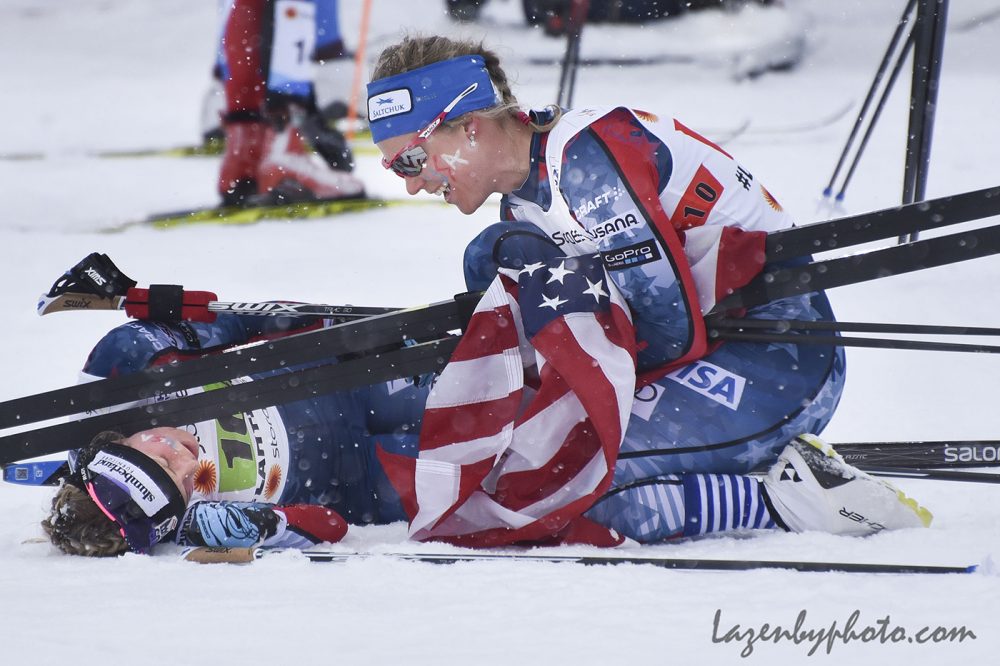
    Racing continues in Gällivare this weekend with 10/15 k classic individual starts on Saturday followed by classic sprints on Sunday.

    Results: Women | Men

  • Bjørgen Bests Weng to Finalize Unbeaten Streak; Bjornsen Fifth on the Day in Quebec

    Bjørgen Bests Weng to Finalize Unbeaten Streak; Bjornsen Fifth on the Day in Quebec

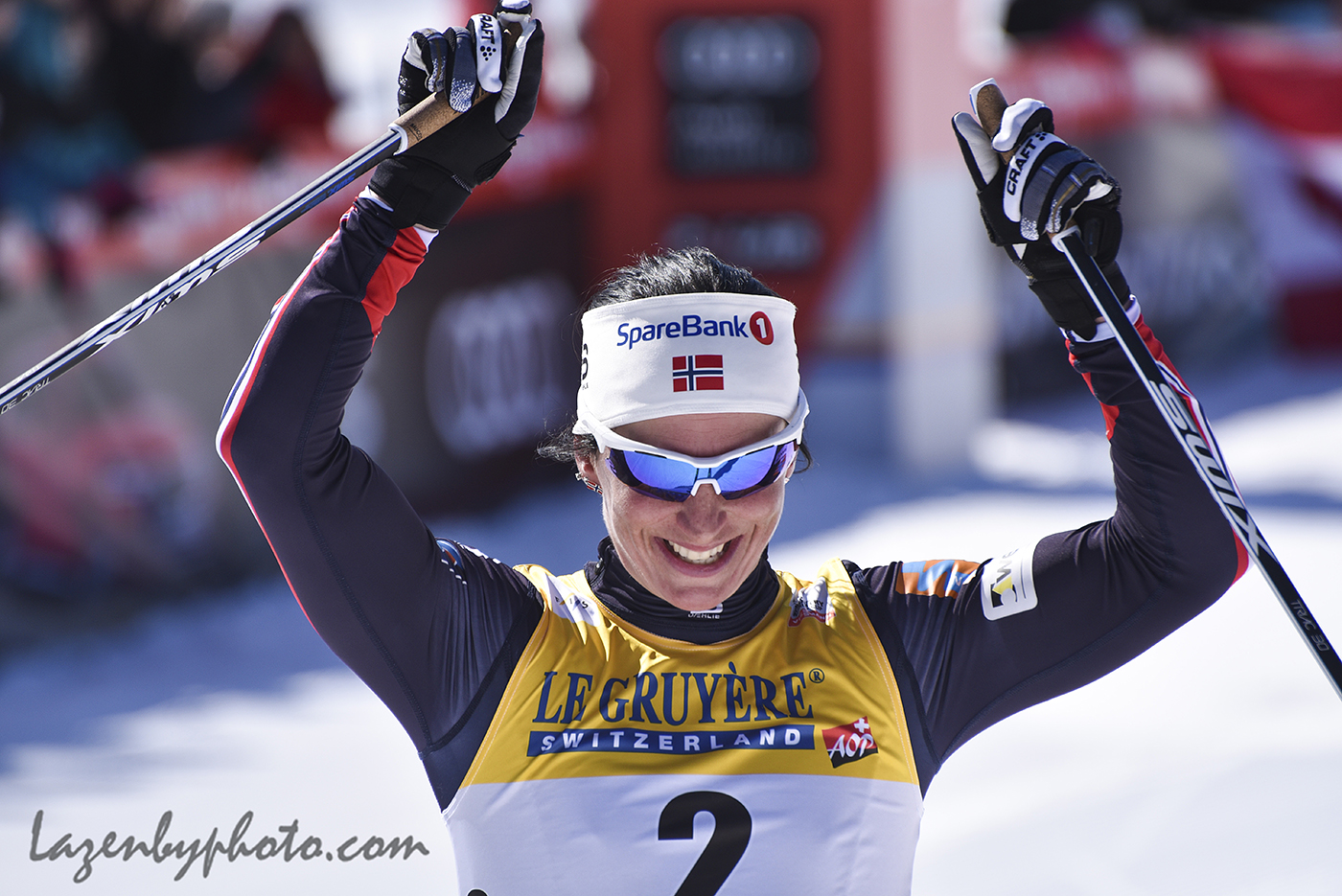
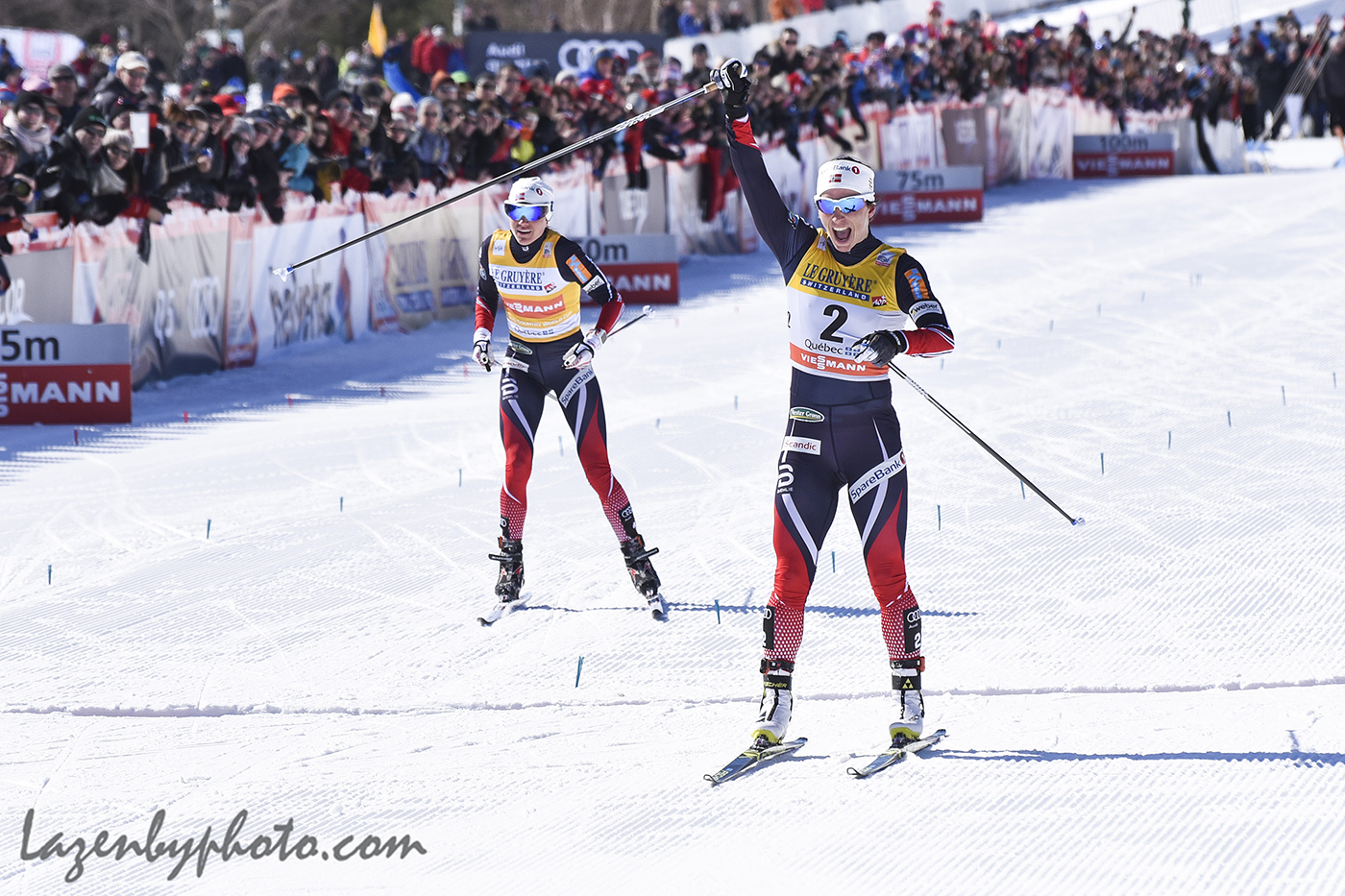
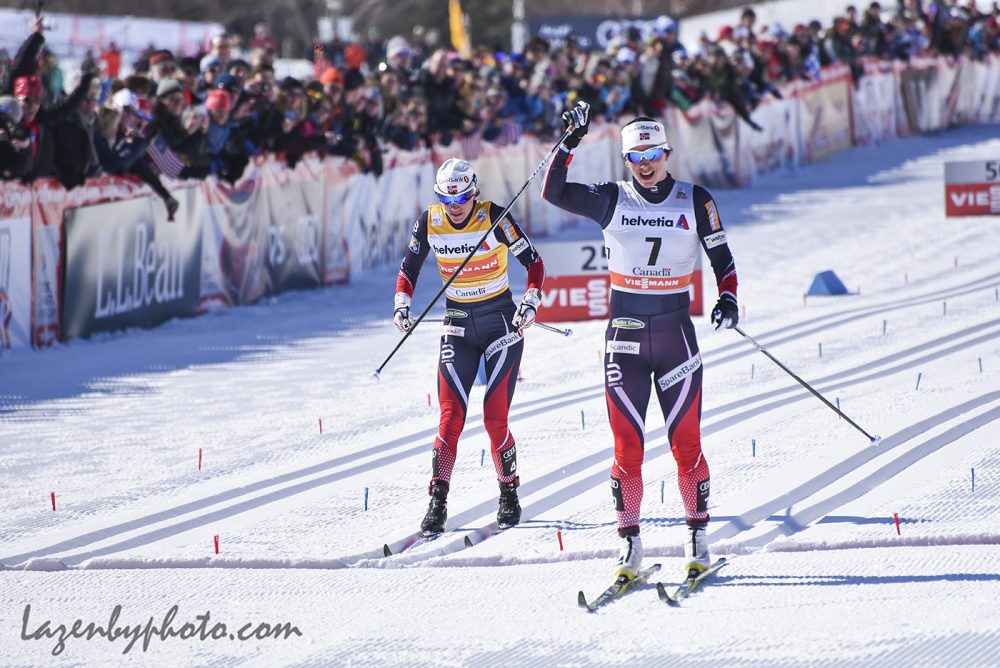
    Norway’s Marit Bjørgen celebrates her ninth-straight win in World Cup distance races (anything longer than a sprint) in the last race of the 2016/2017 season, the women’s 10 k freestyle pursuit on Sunday in Quebec City. (Photo: John Lazenby/Lazenbyphoto.com)

    QUEBEC CITY — Generally speaking, most European-based World Cup skiers wouldn’t have picked Canada as their ideal place to end the season. It’s too far across the pond, too far from the beaches, too far from home.

    The other option had been Tyumen in Siberia, so that probably wasn’t a top pick, either, but Québec City became the International Ski Federation’s choice once Russia relinquished its hosting responsibilities for World Cup Finals.

    Québec City organizers, headed by Gestev, had just under two months to prepare. Having hosted two stages of the Ski Tour Canada last season and a World Cup sprint weekend in 2012, they had the experience, but World Cup Finals — complete with three uninterrupted days of racing and season-ending awards — was another animal of its own entity.

    Fortunately, the weather cooperated. Three days before World Cup Finals, Québec City and the eastern part of North America got its biggest snowstorm of the season and perhaps the last several winters. With three straight days of racing taking place on the open-aired Plains of Abraham, most familiar with the expansive downtown park expected bone-chilling wind. Yet with above freezing temperatures at race time, that wasn’t much of a factor, especially not on Saturday and Sunday.

    Each day, spectators and athletes required fewer layers, and by Sunday, some of the athletes were down to bibs only. The sun was intense, there wasn’t a cloud in the sky, and the athletes were happy.

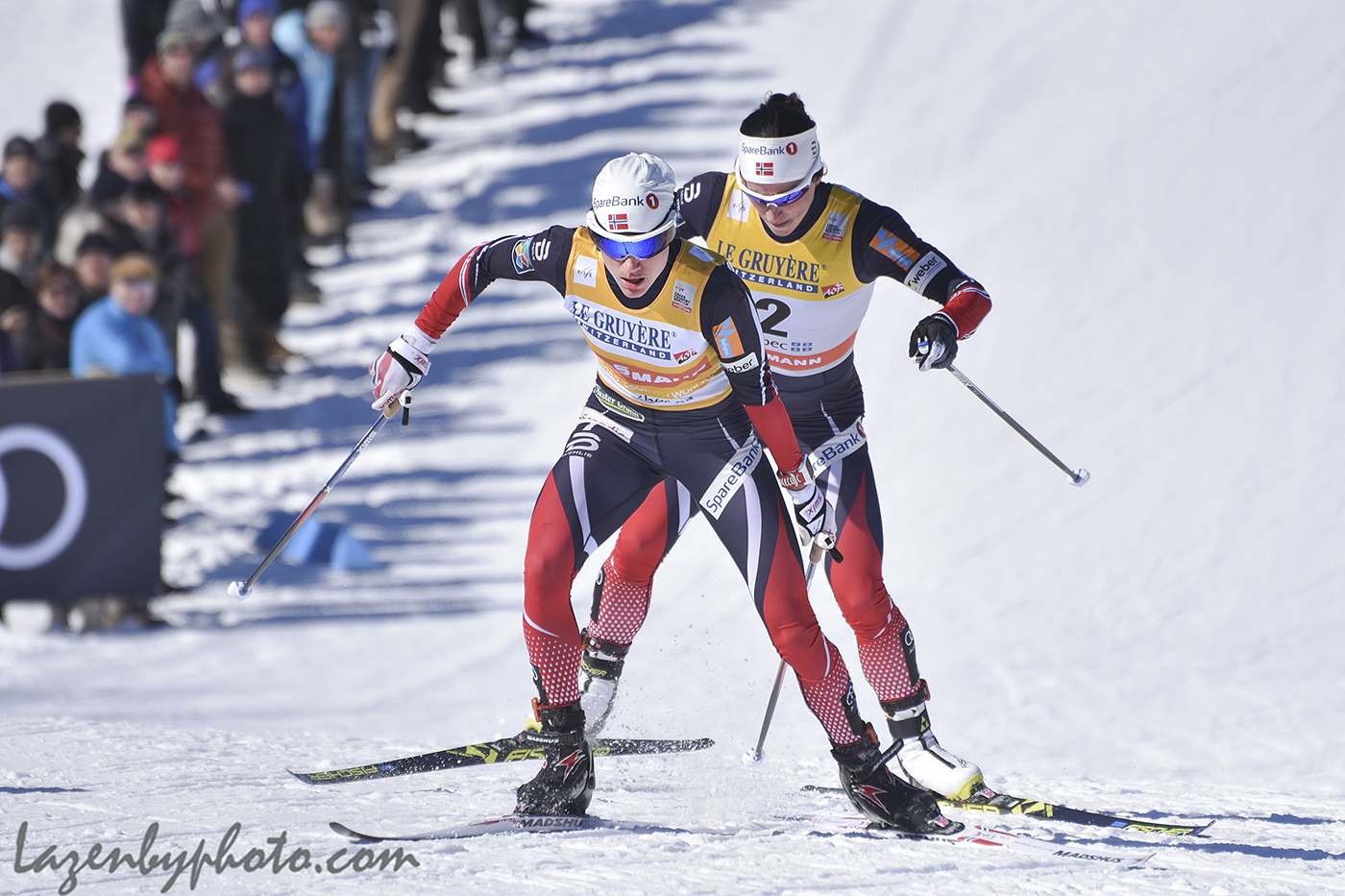
    Norway’s Heidi Weng leads her teammate Marit Bjørgen during the women’s 10 k freestyle pursuit on the last day of World Cup Finals in Quebec City. Bjørgen went on to win while Weng was 1.2 seconds back in second. (Photo: John Lazenby/Lazenbyphoto.com)

    “When I saw that we would race here, I thought, ‘Oh no. We’ll have to go so far from home,’ ” Norway’s Heidi Weng told FasterSkier on Sunday. “But when I come here, it’s more like winter, and I like the track here, and I’ve gone very fast here before. So I knew I could go do a very good race here, so now I hope we come here often. It’s very good, and many people, and the atmosphere, and good snow. It was very great to be here.”

    Weng spoke to a horde of reporters with a large, silver briefcase by her side. In it was one of the Crystal Globes she had just received for winning the Overall and Distance World Cups (she won one globe for each season-long category). Between Friday, Saturday and Sunday, Weng finished sixth in the freestyle sprint, second in the 10-kilometer classic mass start, and second in the 10 k freestyle pursuit. Her Norwegian teammate and longtime idol, Marit Bjørgen beat her in both the distance races.

    In all, Weng racked up about 20 individual World Cup podiums (including her Tour de Ski win, Lillehammer mini tour win, and World Championships silver in the 30 k freestyle mass start). She was the most consistent skier throughout the season, thus earning the Overall World Cup crown by 40 points over Finland’s Krista Pärmäkoski, and distance title by 97 points over Bjørgen.

    “I’ve had many podiums this year,” Weng said. “In sprint I have taken huge steps, so I am very happy with the season. I have won a sprint race, and that’s the most important to me…

    “Maybe I must have a little more confidence that I am good and a good skier, because I always think I am not so good as the others, but now I have a better head,” she added. “Maybe you can say in your head that you are very good and very strong, so next year I do a joke with my head.”

    While Weng keeps telling herself that she can win, Bjørgen is fully aware that she’s back to her top form having won every distance race since the new year. That’s nine straight individual wins, including two from this past weekend.

    After starting one second behind Weng in Sunday’s 10 k skate pursuit, she outlasted the overall and distance World Cup champion by 1.2 seconds at the finish after leading Weng for most of the three-lap race.

    “It has been an incredible season for me after Christmas,” Bjørgen, who had a child in December 2015 and took last season off, told reporters on Sunday. “I won every long distance and four golds in the World Championships so this has been incredible and to win today also.”

    On Sunday, Bjørgen caught Weng quickly and with the third starter, Norway’s Ingvild Flugstad Østberg, heading out 29 seconds back, the two skied off together and away from any threat to their top-two quest.

    On the first lap, Østberg tried to close the gap, coming within 23 seconds of them at 1.3 k, but by the time she lapped through the stadium at 3.3 k, she was 33 seconds behind and just seven seconds ahead of a chase pack with her Norwegian teammate Maiken Caspersen Falla, Pärmäkoski, and Sweden’s Ida Ingemarsdotter and Stina Nilsson. Another 20 seconds behind them, American Sadie Bjornsen and Sweden’s Anna Haag were leading a pack of eight.

    One lap later, Bjørgen and Weng cruised into and out of the stadium 46 seconds before Østberg, who was still 10 seconds ahead of the four-woman chase pack by the time she came through. The group, which was down to Nilsson, Ingemarsdotter and Parmakoski, eventually caught Østberg less than a kilometer before the finish, and Østberg finished at the back of that group in sixth, 1:06.8 behind Bjørgen. In a race for third, Nilsson took it by 1.9 seconds over Ingemarsdotter in fourth and 5.6 seconds ahead of Pärmäkoski in fifth.

    “It was a mental struggle the whole way because they were 15 and 10 seconds behind me all the way, and that’s a difficult gap,” Østberg told FasterSkier. “They were three and four working together, and I was all by myself in front. I really tried to push as hard as I could, and stay in front of them, and I had 10 seconds, and it was less than 1 kilometer left, and I really believed that I could take it, but when they passed me, they had such high speed, I couldn’t keep up with them. So that was not so fun to see them pass me there, but I managed to take the third place overall [in the World Cup], so I have to be satisfied with that, I guess.”

    “I think we worked well together,” Nilsson told FasterSkier. “Krista did the hardest work, I think, but I tried to help her as much as I could, and I was very excited that we could catch up to Ingvild. … I knew that when we started to be in the sprint course, I started to feel at home, then I just wanted to go as fast as I could.”

    Norway’s Marit Bjørgen after outlasting her teammate Heidi Weng for the win in the women’s 10 k freestyle pursuit on Sunday at World Cup Finals in Quebec City. (Photo: John Lazenby/Lazenbyphoto.com)

    Exactly a minute before Nilsson — a sprint specialist — finished third, Bjørgen had crossed the line first in 22:36.1 minutes after getting slightly ahead of Weng coming out of the downhill with 100 meters remaining. Leading up to that point, Weng had come from behind to attack on the second-to-last climb, a markedly steep one, but Bjørgen responded quickly.

    “I thought that Marit was a little bit more tired than me, but when I attacked on the sprint uphill I hoped that I could get some meters to Marit, but she was there, and in the downhill she came from behind and take a better speed,” Weng said. “That sucks, but I was number two, and it’s not many who can be on the podium, so I am very happy.”

    “I knew that it would be a sprint in the end with Heidi and to have her behind me is a very good feeling,” Bjørgen said. “I’m 10 years older and to be there is a good feeling to take with me into the Olympic [year next season].”

    Bjørgen is 36. Weng will turn 26 in July. Nilsson is 23.

    On Sunday, Bjørgen not only won the pursuit and with it, the World Cup Finals mini tour, but she was also the fastest for time of day in 25:35.1. Weng was second fastest, 2.2 seconds back, and Nilsson third (+11.9) after starting seventh and moving her way up to third.

    On her 34th birthday, Germany’s Nicole Fessel was fourth fastest (+15.3), and Bjornsen of the U.S. tied Sweden’s Charlotte Kalla for fifth on the day, 17.8 seconds off Bjørgen’s time.

    Sadie Bjornsen (U.S. Ski Team) soaking up her top-10 finish at 2017 World Cup Finals in Quebec City after placing 10th in the 10 k freestyle pursuit and fifth for time of day. (Photo: John Lazenby/Lazenbyphoto.com)

    Overall Bjornsen placed 10th (+1:27.2) after starting 1:10 minutes back in 10th with Kalla in ninth and skiing with her and Fessel (the 13th starter) to the finish.

    “Charlotte was going so hard from the start,” Bjornsen said after. “I actually did my warm up behind her, trying to get used to her speed because that was my main goal, to stay with her today. I knew it was going to be rippin’, and at one point some of the girls went in front of me, and I let her get away, and I was like, ‘No! I have to stay with her!’ So I had to do a full sprint in the middle to catch back on, which took a lot to recover from.”

    At the finish, just 0.4 seconds separated Kalla, Fessel and Bjornsen, who placed eighth (+1:26.8), ninth (+1:26.9) and 10th, respectively. Ahead of them, Norway’s Falla placed seventh (+1:19.8).

    “I really wanted to outsprint those girls in the finish for some redemption from the sprint race the other day,” Bjornsen said, referring to her 13th place in the World Cup Finals opening skate sprint. “I’m super happy with a top 10 in the tour. That’s some of the best general skiing I’ve done this year, and it’s good to end on a high note.”

    The U.S. had two in the top 20 both overall and for time of day, with Jessie Diggins in 16th (+2:14.8) after skiing the 14th fastest time of day (+35.0). After placing ninth in the sprint and 27th in the classic mass start, she started Sunday in 20th and moved up four places by the finish.

    “This weekend, in particular, was not what I wanted,” Diggins told reporters after. “To be honest, I was in tears before the race, because I was up all night coughing. I don’t know if I was getting sick or what, but I was getting nauseous, and I started to puke a little bit, and I was like, ‘I just want to race, and race in front of my family. I just want to go out there and be able to have a good day.’ ”

    Diggins immediately got to work out of the gate and was up to 19th at the end of the first lap with Germany’s Stefanie Böhler. She skied with Böhler to the finish, before edging the German by two seconds for 16th.

    “I decided I was going to go for it, and it was really working for me when Stefi came by,” Diggins said. “I was just hanging on in the uphills, and then on the downhills, if I was right in her draft, I could push or pull and help each other that way, and that was really cool. I really like skiing with Stefi, she’s awesome, and we were both working together to get the fastest time we could.”

    Jessie Diggins (U.S. Ski Team) racing to 16th in the women’s 10 k freestyle pursuit (up from 20th at the start) with the 14th fastest course time on Sunday at World Cup Finals in Quebec City. (Photo: John Lazenby/Lazenbyphoto.com)

    At the end of the season, Diggins ranked sixth in the overall World Cup and seventh in the distance standings.

    “My biggest goal for today was to only say positive things to myself all day, no matter what anything felt like, no matter what the skis were doing, no matter what my body was doing, no matter how sick I felt, and the only thing was to push really hard and cross the finish line and be proud of pushing,” Diggins said. “You can’t control a lot of things in ski racing, but you can control, how much effort you put into it, and I can honestly say I’ve put 100 percent in this season, and I’m really proud of that.”

    While 12 American woman completed the tour, 15 Canadians women did the same, with Emily Nishikawa (Canadian World Cup Team) leading them in 38th (+4:52.7) after starting 39th. Cendrine Browne, of Canada’s national U25 Team and Pierre Harvey Training Centre, finished just two seconds later in 40th (+4:54.7) after starting 41st.

    “I was the last person to start before the wave,” Nishikawa explained. “And the wave, they’re working together as a mass start and moving pretty fast, so I got caught by them at the end of the first lap. I tucked in behind Rosie [Brennan of the U.S.] for the second lap and I actually had a big tangle with [Switzerland’s] Laurien van der Graaff on the fast downhill so I lost contact, lost all my speed. … and I did my best to come back.”

    Browne started in the wave and described skiing in that group throughout the race.

    “Unfortunately, I finished at the back of the group as I was losing energy,” she told FasterSkier. “I still managed to gain 30 seconds on the leader, which I’m happy about. I finished 41st again, behind my goal of moving towards the top 30, but it’s not dramatic. I think it’s a nice way to cap off the season.

    “It was really an amazing weekend, the atmosphere, the crowd, the conditions, everything was on point,” Browne added in French. “I couldn’t have hoped for a better way to end the season.”

    “We were so lucky to get [the World Cup Finals] here instead of Russia,” Nishikawa said. “We got to start 30 athletes, lots of people starting their very first World Cups, which is so exciting to see. It’s great for development for our country… We’ve got a really exciting group of women coming coming up in Canada now and to see this group of 15 women get starts this weekend is just great.”

    Also for Canada, Dahria Beatty finished 50th, Annika Richardson 55th, Frédérique Vézina 57th, Katherine Stewart-Jones 58th, Andrea Dupont 59th, Annika Hicks 62nd, Sophie Carrier-Laforte 63rd, Sadie White 64th, Lisle Compton 65th, Katherine Weaver 66th, Laura Leclair 67th, and Mia Serratore 68th. Alannah MacLean did not finish.

    American Sadie Bjornsen (10) racing to the line with Sweden’s Charlotte Kalla (9) and Germany’s Nicole Fessel (not shown) during the women’s 10 k freestyle pursuit on Sunday at World Cup Finals. Kalla placed eighth, Fessel ninth and Bjornsen 10th. (Photo: John Lazenby/Lazenbyphoto.com)

    For the U.S., Sophie Caldwell placed 36th (+4:26.1), Rosie Brennan 42nd, Caitlin Patterson 43rd, Chelsea Holmes 45th, Julia Kern 46th, Kaitlynn Miller 52nd, Liz Guiney 53rd, Becca Rorabaugh 54th, Erika Flowers 56th, and Jennie Bender 60th.

    “Sadie’s skating has reached a new level this season,” U.S. Ski Team Head Coach Chris Grover said, according to a team press release. “Jessie also had a measure of redemption leading a train of women and moving up four places in the standings today. Rookie Julia Kern continued to impress, staying in front of the chasing group for the entire race and winning the sprint at the end.

    “We are very proud of the American effort this weekend — athletes, club coaches and U.S. Ski Team staff,” he continued. “We had some great races but, of course, were left wanting a bit more.”

    The U.S. Ski Team will finish out its season in Fairbanks, Alaska, with the SuperTour Finals next week, March 27-April 2. Most Canadians are traveling to Canmore for Canadian Ski Nationals, which started Sunday and extend through this Saturday.

    Pursuit results

    Time of day

    Final Overall World Cup standings

    Final Distance World Cup standings

  • Sunday Rundown: Harvey 2nd in Quebec Pursuit; 2nd in Distance World Cup

    Sunday Rundown: Harvey 2nd in Quebec Pursuit; 2nd in Distance World Cup

    Canada’s Alex Harvey leading Norway’s Niklas Dyrhaug (2) and Johannes Høsflot Klæbo (r) up a short, steep climb during the men’s 15 k freestyle pursuit on Sunday, the last day of the 2016/2017 World Cup season, at World Cup Finals in Quebec City. Harvey went on to place second, Klæbo won the photo finish, and Dyrhaug placed third. (Photo: Gretchen Powers)

    FIS Cross-Country World Cup Finals (Quebec City): 10/15 k freestyle pursuits

    Even after Sunday’s 15-kilometer freestyle pursuit, Alex Harvey had a busy day ahead of him with three different podiums to stand on: one for placing second on the day, another for placing second in the Distance World Cup, and yet one more for finishing the season in third in the Overall World Cup.

    It was a suitable ending for Harvey’s storybook three-day venture in Quebec City, after he won Friday’s skate sprint and placed fourth in Saturday’s 15 k classic mass start.

    Starting third the pursuit third, 23 seconds behind Norway’s Johannes Høsflot Klæbo in first and 1 second behind another Norwegian Niklas Dyrhaug in second, Harvey set a blistering pace from the gun and caught Dyrhaug around 5 k in.

    From there, the three jockeyed for the ideal position and ultimately, the win with over the next 10 k. The chase pack was closing on them slightly, but not enough to be a threat. A loose dog on course at the end of their third lap caused a little alarm as it ran alongside the three leaders, but didn’t affect any of the racers to be a problem.

    On the fourth and final lap, just before one of the last long descents into and out of the stadium, all three nearly came to a stop — none of them eager to lead, fearing their attack out of the ensuing draft.

    Klæbo finally decided to go first, and he put in a sprint in an attempt to catch the others off guard. The three remained together all the way to the finish, lining up side by side as they squared off for the final 100-meter showdown. In a photo finish for first, Klæbo took it by less than a one-hundredth of a second over Harvey in 32:44.5 minutes, and Dyrhaug settled for third, one-tenth of a second back.

    The third Norwegian in the top four, Sindre Bjørnestad Skar outlasted the six-man chase pack that followed the top three across the line. Skar finished fourth, 26.1 seconds out of first, just 0.4 seconds ahead of Switzerland’s Dario Cologna in fifth. Also in that group, Sweden’s Marcus Hellner posted the fastest time of the day (31:55.5) to finish sixth overall (+26.8) Norway’s Sjur Røthe followed in seventh (+27.2), Russia’s Andrey Larkov placed eighth (+27.6), and Great Britain’s Andrew Musgrave ninth (+30.6).

    American Erik Bjornsen (33) racing to the 11th fastest time of day in the men’s 15 k freestyle pursuit at World Cup Finals on Sunday in Quebec City, for his career-best World Cup result. He finished 25th overall. (Photo: Gretchen Powers)

    For time of day, American Erik Bjornsen broke through in 11th for his best World Cup result. He placed 25th overall (+2:19.1), just ahead of Canada’s Devon Kershaw in 26th (+2:21.4). Kershaw was 19th for time of day.

    Four Americans landed in the points (top 30) for time of day, with Paddy Caldwell in 25th, David Norris 27th, and Scott Patterson 30th.

    Overall in the pursuit, Patterson finished 41st (+3:45.6), Norris 43rd (+4:15.9) and Caldwell 46th (+4:25.6).

    Also for the U.S., Andy Newell placed 44th, Simi Hamilton 45th, Noah Hoffman 52nd, Jack Hegman 57th, Brian Gregg 58th, and Cole Morgan 65th.

    Among the Canadians, Graeme Killick finished 42nd, Knute Johnsgaard 53rd, Len Valjas 54th, Evan Palmer-Charrette 60th, Bob Thompson 61st, Brian McKeever 62nd, Joey Foster 64th, Andy Shields 66th, Russell Kennedy 67th, Jess Cockney 68th, Gareth Williams 71st, Ricardo Izquierdo-Bernier 72nd, and Julian Locke 73rd.

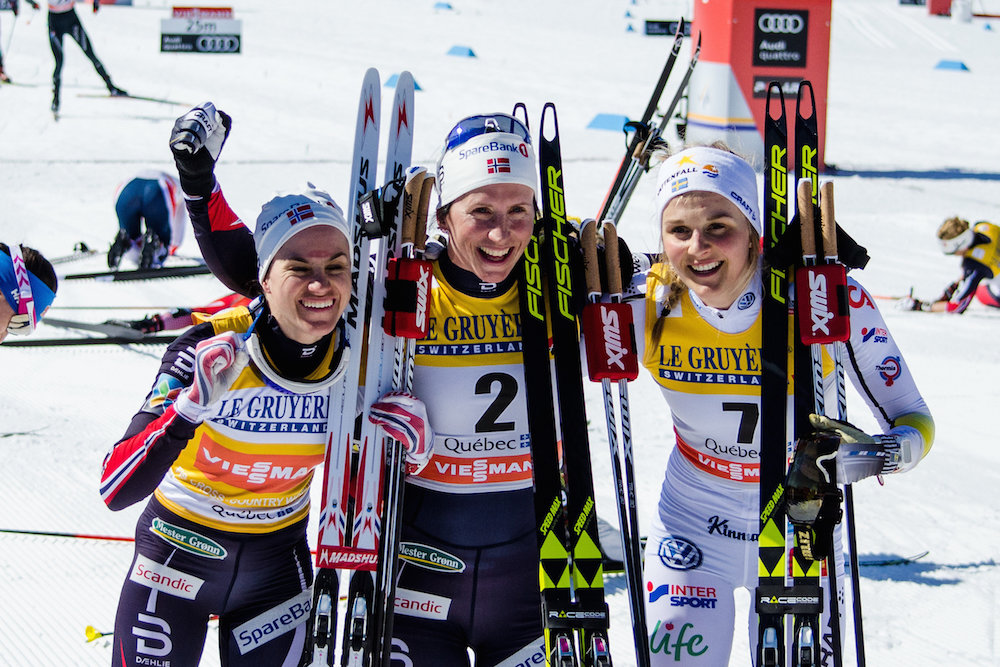
    The women’s 10 k freestyle pursuit podium on Sunday at World Cup Finals, with Norway’s Marit Bjørgen (c) in first, Heidi Weng (l) in second, and Sweden’s Stina Nilsson (r) in third. (Photo: Gretchen Powers)

    In the women’s 10 k freestyle pursuit earlier in the day, Marit Bjørgen caught her Norwegian teammate Heidi Weng almost immediately after starting 1 second back in second, and the two skied together well ahead of anyone else for the rest of their three-lap race.

    After leading for most of it, Bjørgen ultimately took the win, entering the finishing stretch slightly ahead of Weng and holding her off by 1.2 seconds across the line with a time of 22:36.1. For Bjørgen, it was her second win in two days, after winning Saturday’s 10 k classic mass start, and she ended her first full season back since having a child ranked second in the Distance World Cup. Weng won both the Distance and Overall World Cup titles.

    Bjørgen also won for the time of day (22:35.1). Weng’s time ranked second and Sweden’s Stina Nilsson was third for both time of day and overall after moving up from seventh and outlasting the chase pack.

    Nilsson finished exactly a minute after Bjørgen and 1.9 seconds ahead of her Swedish teammate Ida Ingemarsdotter in fourth (+1:01.9). Finland’s Krista Parmakoski finished fifth (+1:05.6) and ended the season second in the Overall World Cup and third in the Distance World Cup.

    Norway’s Ingvild Flugstad Østberg started third but ended the day in sixth (+1:19.8) after skiing alone for a good portion of it, well behind Bjørgen and Weng and just ahead of the hungry chase pack. Østberg finished her season in third in the Overall World Cup.

    Sadie Bjornsen (U.S. Ski Team) racing to the fifth-fastest time and 10th overall in the women’s 10 k freestyle pursuit on Sunday at World Cup Finals in Quebec City. Dyrhaug placed third. (Photo: Gretchen Powers)

    Sadie Bjornsen led the U.S. women with the fifth-fastest time of day in 10th overall (+1:27.2). Jessie Diggins moved up from 20th to place 16th (+2:14.8) with the 14th fastest time of day. Diggins ended up sixth in the Overall World Cup and seventh in the Distance World Cup.

    Emily Nishikawa was the top Canadian woman in the pursuit in 38th (+4:52.7) and Cendrine Browne followed in 40th (+4:54.7).

    For the U.S., Sophie Caldwell placed 36th (+4:26.1), Rosie Brennan 42nd, Caitlin Patterson 43rd, Chelsea Holmes 45th, Julia Kern 46th, Kaitlynn Miller 52nd, Liz Guiney 53rd, Becca Rorabaugh 54th, Erika Flowers 56th, and Jennie Bender 60th.

    Also for Canada, Dahria Beatty finished 50th, Annika Richardson 55th, Frederique Vezina 57th, Katherine Stewart-Jones 58th, Andrea Dupont 59th, Annika Hicks 62nd, Sophie Carrier-Laforte 63rd, Sadie White 64th, Lisle Compton 65th, Katherine Weaver 66th, Laura Leclair 67th, and Mia Serratore 68th.

    Pursuit results: Men | Women

    Time of day: Men | Woman

    Overall World Cup: Men | Women

    Distance World Cup: Men | Women

  • Bjørgen Completes Undefeated Streak in World Cup Finals 10 k Classic

    Bjørgen Completes Undefeated Streak in World Cup Finals 10 k Classic

    Marit Bjørgen (7) celebrates her victory over Norwegian teammate Heidi Weng during the women’s 10 k classic mass start on Saturday at World Cup Finals in Québec City. (Photo: John Lazenby/Lazenbyphoto.com)

    When it comes to distance classic events, at least this season, Norway’s Marit Bjørgen is calling the shots. She completed her undefeated streak in 10-kilometer classic competitions (in both individual or mass starts), winning her fourth in a row on Saturday at World Cup Finals in Québec City.

    Starting in bib No. 7, Saturday’s eventual mass-start winner was skiing just outside of the top 10 for the first kilometer, following two U.S. skiers, Sadie Bjornsen in eighth and Jessie Diggins in fifth. Setting the pace from the front were Norwegian teammates Heidi Weng and Ingvild Flugstad Østberg.

    In another half a kilometer, Bjørgen moved to an outside lane and tucked past Sweden’s Ida Ingemarsdotter and Stina Nilsson. The maneuver moved her from 12th to fourth by the bottom of the third major downhill. And within the next climb, the classic queen had changed tracks and strode her way to the front, overtaking Weng.

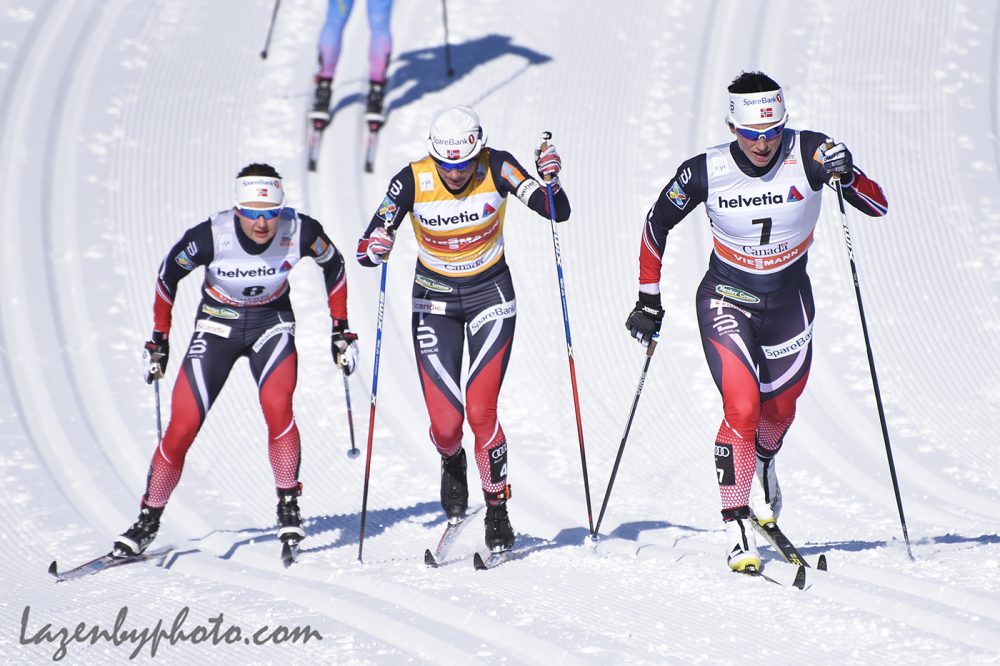
    Right to left: Norway’s Marit Bjørgen leads her teammates Heidi Weng and Ingvild Flugstad Østberg during the women’s 10 k classic mass start on Saturday at World Cup Finals in Québec City. (Photo: John Lazenby/Lazenbyphoto.com)

    From there, the race for the win became one about Bjørgen.

    While the Norwegian stayed put up front, Finland’s Krista Pärmäkoski, who started the day ranked 22nd in the mini tour, began gaining ground from the back. At 3.3 k the eventual third-place finisher, Pärmäkoski, who had crashed earlier in the race, was skiing 8.1 seconds back from the leader in 21st. In another kilometer, she had moved up ten places and was within 5.3 seconds of Bjørgen.

    “I fell today after the start and I had to fight hard to ski back to the leading group,” Pärmäkoski said during an International Ski Federation (FIS) interview.

    While Pärmäkoski managed to move up, Diggins, who had been within striking range of the podium, had slipped 19th. The American explained that, while her energy felt good throughout the race, the real struggle came from her lack of kick.

    “I had many races when I had outstanding skis this year, arguably the best in the world,” Diggins said.  “I guess at some point, it was natural to fall on the other side of that. You can’t nail it every time.”

    Despite ideal conditions for spectators — clear, blue skies and a strong sun that sent temperatures soaring into the mid-30’s Fahrenheit (about 2 degrees Celsius) by midday — it was a tricky one for classic waxing.

    “Our wax techs work so hard, they are under incredible pressure,” Diggins added. “We did the best we could, we tested as well as we could, and it was a huge struggle for me out there today. But I’m ready for tomorrow. I know at the end of the season, everyone is tired, I just want a good race to finish it off. In skating, you don’t have to worry about kick, so I’ll go out and fight.”

    As Diggins dropped back, a trio of Norwegians spearheaded the front. Around the halfway point, Bjørgen, Weng and Østberg began their breakaway, foreshadowing an all-Norwegian podium.

    But what they hadn’t counted on, least of all Østberg, was Pärmäkoski. The Finn had decreased her distance from the Norwegians within the next kilometer by another 4 seconds, now merely a meter away from the top three.

    “I was really fighting and hoping for a podium,” Østberg told FasterSkier. “I actually felt strong and strong enough but there was three girls stronger than me so, fourth is also good.”

    With less than four kilometers to go, Østberg took a pull at the front, but it wasn’t long before the lead was back to Bjørgen.

    “I think Marit and I did an awesome job in the front,” Østberg said. “Marit for sure did most of the job, but I tried to help and tried to keep up the speed in the leading group because there was someone chasing behind and I knew that she had some power left at the end of the last lap.”

    Left to right: Norwegians Heidi Weng and Marit Bjørgen and Finland’s Krista Pärmäkoski on the podium for the women’s 10-kilometer classic mass start on Saturday at World Cup Finals in Québec City. (Photo: John Lazenby/Lazenbyphoto.com)

    As the four headed into their final kilometer, Bjørgen and Weng steamed off the front, while Pärmäkoski passed Østberg and locked into third. The two Norwegians cornered into the finishing stretch together, but Bjørgen’s double pole proved too strong for Weng and she crossed first in a time of 24:23.6.

    Weng crossed 0.6 seconds later for second place, and Pärmäkoski finished 2.9 seconds back in third, while Østberg was 4.9 seconds off the podium in fourth.

    “I have been winning all of the distance, so I’m happy with that,” Bjørgen said. “I was fighting for my position from the beginning, so I wasn’t in front before 2 kilometers, and then I wanted to speed up and then I saw the group was smaller and smaller. A good finish, so I am happy.”

    A day after Weng locked up the Overall World Cup title, she clinched the Distance World Cup season-long title as well on Saturday. For Sunday’s pursuit, the last World Cup race of the season, Weng has a 1-second head start on Bjørgen in the 10 k freestyle pursuit.

    Bjornsen Top American in 15th; Nishikawa Top Canadian in 37th

    The top North American woman on Saturday was U.S. Ski Team (USST) member Sadie Bjornsen in 15th (+29.9).

    Bjornsen and Diggins had been skiing with the top 10 for the first 3.3 k loop. As Diggins began to fall back, Bjornsen continued to race within and around the top 10. Bjornsen, like Diggins, also explained she had trouble slipping.

    “I just couldn’t get up that hill,” Bjornsen said, referring to one of the course’s final climbs. “I started slipping so much, I was trying to keep it together. I made the mistake of wanting to go on the steep part of the climb, because I wanted to follow Kalla, but it was super hard to kick there, so it was a bit of a mistake … But I didn’t lose too much time on the group in front of me for tomorrow, so I’m excited.”

    American Sadie Bjornsen (13) racing alongside Norway’s Kathrine Rolsted Harsem (14), ahead of Sweden’s Charlotte Kalla (27) and Stina Nilsson (1) and Norway’s Maiken Caspersen Falla (2), during the women’s 10 k classic mass start on Saturday at World Cup finals in Québec City. Bjornsen went on to place 15th. (Photo: John Lazenby/Lazenbyphoto.com)

    Bjornsen will start Sunday’s pursuit 1:10.4 minutes after Weng. While she admitted that classic races used to be her favorite, Bjornsen has embraced the fact that she can perform well in either discipline and attributed part of that newfound confidence to the depth of the women’s team.

    “In 2011, we knew that Kikkan was good, but we didn’t know that we could be good,” Bjornsen said. “Each year, a new person on the team is discovering that they have podium potential, and they belong here. Yesterday, for example, for Rosie to make it into the heats is just crazy, the lift it gives the team, or Julia making her first World Cup points.

    “We talk a lot about what we can do to improve together, and that’s different from 2011, because we’re not like, ‘OK, we have to do what Kikkan is doing,’ ” she continued. “Now we can speak with each other, and have an idea of what we can do.”

    Diggins finished Saturday’s mass start in 27th (+1:06.9) followed by her teammate Sophie Caldwell in 38th (+1:56.0).

    “I felt pretty good. I haven’t done much distance racing this year so it was fun to hop in one,” Caldwell said.

    Following Caldwell, was Caitlin Patterson crossing in 44th (+2:39.9), Liz Guiney 45th (+2:43.3), Kaitlynn Miller 47th (+2:46.5), Chelsea Holmes 48th (+2:48.4), Rosie Brennan 50th (+2:48.8), Julia Kern 52nd (+3:05.5), Erika Flowers 55th (+3:37.2), Becca Rorabaugh 57th (+3:39.5), and Jennie Bender 58th (+3:41.9).

    “I was happy with the result,” Guiney said. “I got in a little bit of a pile out of the start. I didn’t expect it to stop, but other than that it was good. I had fast skis and good kick so I was happy.”

    Brennan explained that she broke a pole on her first lap.

    “I was fighting my skis a lot and fighting myself, then fell and broke a pole and then it was not a good race,” she said.

    For Canada, Emily Nishikawa led the team in 37th (+1:51.7). She explained that while she once again finished outside the points (top 30), a result is not so much her ultimate goal as a feeling.

    “I have just been out of the top 30 a lot this year … it has been really close” Nishikawa said. “Everyone always bases it on top 30 is good and anything other than that is not that good. But I just kind of focus on my own self and if I have been skiing well I am happy with that.”

    Nishikawa further indicated that being able to race the final World Cup competitions in front of a home crowd is indescribable.

    “I can’t wipe out the smile of my face, it’s hard to put into words just how special it is to race in your home country,” she said.

    Cendrine Browne, of the Canadian U25 Team and CNEPH, after finishing 41st in the women’s 10 k classic mass start on Saturday at World Cup Finals in Québec City. (Photo: John Lazenby/Lazenbyphoto.com)

    Following Nishikawa was Cendrine Browne in 41st (+2:28.2). Despite getting caught early on in the competition, Browne is satisfied with her position heading into tomorrow’s pursuit and hopes to move up into the top 30.

    “Unfortunately, I got stuck behind on the first uphill, which prevented me from staying with the leading group,” Browne said. “I felt I could of stayed with them, I felt strong and relaxed. At the start of the last lap though, I was leading my pack, which made it harder for me. I still managed to distance myself from the skiers behind, but I was unable to catch those in front. I was caught up between two groups. Anyway, it’s good news for tomorrow.”      

    Also competing for Canada, Dahria Beatty finished 53rd (+3:15.4), Annika Richardson 54th (+3:36.3), Katherine Stewart-Jones 56th (+3:38.1), Frédérique Vézina 59th (+3:43.6), Annika Hicks 60th (+3:45.6), Sophie Carrier-Laforte 61st (+4:05.9), Andrea Dupont 62nd (+4:05.9), Katherine Weaver 63rd (+4:27.9), Alannah MacLean 64th (+4:29.4), Sadie White 66th (+5:31.1), Lisle Compton 67th (+5:34.3), Mia Serratore 68th (+5:58.6), and Laura Leclair 69th (+6:46.2).

    Results | World Cup Final standings | Pursuit start list

  • Nilsson Back to Winning Ways in Drammen Classic Sprint; Caldwell Top American in 9th

    Nilsson Back to Winning Ways in Drammen Classic Sprint; Caldwell Top American in 9th

    Sweden’s Stina Nilsson charging to her eighth World Cup victory of the season in Wednesday’s 1.2 k classic sprint final in Drammen, Norway. She finished first, ahead of Finland’s Krista Pärmäkoski (r) in second and her Swedish teammate Hanna Falk (l) in third. (Photo: Fischer/NordicFocus)

    Drammen is one of those staples on the World Cup, appearing on the circuit late each season and remembered for its trademark uphill finish in the middle of a city of 63,000 inhabitants, just 40 kilometers west of Oslo, Norway.

    “It tends to be fairly predictable snow,” U.S. Ski Team Women’s Coach Matt Whitcomb told FasterSkier during an in-person interview in Drammen on Wednesday. “It’s generally clean [snow]. It’s generally some sort of klister.”

    But that doesn’t make Drammen easy. Finding the ideal balance of kick and glide on the city’s 1.2-kilometer course, marked by a steady uphill out of the start, followed by a 60-second downhill, and finally, one last climb to the finish, is key and something even the most seasoned World Cup skiers can struggle with at this venue, Whitcomb explained.

    “We tend to see athletes focusing a little bit too much on the climbs, getting those good sensations and not enough gliding … out on the downhills,” he said. “That’s where the heart of this course really lies.”

    For instance, consider Maiken Caspersen Falla. Coming off an individual skate-sprint victory at 2017 Lahti World Championships, the Norwegian didn’t ski fast enough to qualify for the heats on Wednesday. She finished 31st, 0.34 seconds out of qualifying in 30th but 6.49 seconds off the top qualifying time set by Finland’s Krista Pärmäkoski. With Falla usually qualifying first or close to it in sprints (and Pärmäkoski better known for her distance skiing), it was a shakeup that confused even Falla — Drammen’s three-time defending classic-sprint winner.

    “I think it is weird,” Falla told NRK, according to a translation. “I do not know what’s going on. I was thinking I was going pretty well. I’m not far behind [the top 30], but I have no idea. Maybe I didn’t have the best skis or maybe I left far too much time in a turn. I am very unsure of what’s going on; the body has worked great the last few days.”

    American Kikkan Randall, who placed third in the world-champs freestyle sprint behind Falla, was in the same boat. She finished 52nd out of 56 women in Wednesday’s sprint qualifier, 12.76 seconds out of first.

    Whitcomb said that was likely due to too much kick and too little glide. Drammen as a downtown sprint poses an additional challenge for athletes and wax techs, allowing just 20 minutes for testing on race day.

    “Every athlete’s working out of one depot so you have basically 100 people, male athletes and female athletes, and just trying to control the chaos as much as possible,” he said. “But I feel like our athletes, I can trust them to ask for more kick and know that it’s not gonna compromise their glide. Sometimes it does, it’s just the risk that you have to make because on this course, you spend a fair amount of time gliding and if you’re not close to having enough grip, you’ll be too tired in the finish.”

    U.S. teammates Sadie Bjornsen (l) and Jessie Diggins after placing third for bronze in the women’s classic team sprint at 2017 World Championships in Lahti, Finland. (Photo: John Lazenby/Lazenbyphoto.com)

    One U.S. Ski Team member thrilled with her skis was Jessie Diggins, who qualified sixth (+2.12) behind her teammate Sadie Bjornsen in fifth (+1.63). Behind them, Sophie Caldwell was the third American to qualify in 11th (+2.95).

    While Diggins and Bjornsen went on to finish sixth and fifth in their quarterfinals, respectively, and did not advance to the semifinals, Diggins said that in her case, it wasn’t for a lack of speed. After some physical contact at the top of the course got her fired up and surging into first on the long descent, Diggins slipped back to the middle of the pack coming out of the downhill draft and broke a pole around the last hairpin corner before the long, uphill finishing straight.

    “Jessie came into the final corner with too much traffic and a pole broke somehow,” Whitcomb said. “If it had been made out of steel, it would’ve bent, but it was loud and unfortunately none of us could get to her because there were too many cameras and fences in the way.”

    “I was just ready to fight on that final climb,” Diggins reflected. “I knew I was strong because even after skiing with a broken pole, I caught back up to [the group] at the end so I mean, I did everything I could.”

    She finished 5.11 seconds behind the winner of that quarterfinal, Sweden’s Stina Nilsson, who would go on to win the day.

    “I was so stoked with my skis,” Diggins added. “They were fast, they had good kick and I know they had good kick because I had one pole and I was like, ‘Wow! They really nailed it!’ ”

    While Diggins raced in the second quarterfinal, Bjornsen was one of the guinea pigs, so to speak, in the first heat of the day. Whitcomb explained that coaches and athletes routinely watch the first women’s quarterfinal on sprint days to figure out the course and determine strategies for the remaining rounds.

    While Bjornsen skied in third for much of her quarterfinal behind Norway’s Mari Eide, who led for most of it, the American bronze medalist in the world-champs classic team sprint (with Diggins) positioned herself closer to second entering the final climb to the finish.

    While the last few hundred meters of the race were shaping into a four-way fight for first between Eide, Bjornsen, Sweden’s Hanna Falk, and Slovenia’s Anamarija Lampič, Bjornsen in the far right tracks suddenly found herself behind a V-board when the course narrowed from four tracks to three across, and her tracks ended. She jumped to the left, slotting in behind Eide, and ran out of room to make any more moves to end up fifth, 2.52 seconds behind Falk in first.

    “I felt really strong in the qualifier, had some great skis, and was so excited for the heats,” Bjornsen said, according to a U.S. Ski Team press release. “Unfortunately in the final stretch, I chose a lane that didn’t go to the finish, so I had to stop and go in behind the others — which simply didn’t work. That was an expensive mistake, and cost a day full of great feelings. Fortunately I feel really good right now, and I am so excited to keep racing and get my chance.”

    Sophie Caldwell (U.S. Ski Team) striding to 11th in the women’s 1.2 k classic sprint qualifier at Wednesday’s World Cup in Drammen, Norway. She went on to place ninth overall. (Photo: Fischer/NordicFocus)

    Bjornsen and Diggins ended up 21st and 26th on the day, respectively. Leading their team, Caldwell reached the semifinals and ultimately placed ninth overall.

    In an in-person interview after the race, she told FasterSkier that she was particularly pleased with her qualifier considering her past results in Drammen. Before Wednesday, had never cracked the top 10 there.

    “The first three years I raced in Drammen, it was just a really hard course for me for some reason and I found myself not qualifying, but not even close to qualifying, like, back in the end of the pack,” Caldwell said. “Last year I figured out how to qualify and I was just thrilled to have qualified so this year it was one step further making the semis so I’m really happy with that.

    “It’s still a tough course for me,” she added. “It’s so gradual that it’s a really good course for power skiers and that’s been something I’ve been working on a lot, but power skiing for classic for sure isn’t my strength. … I think that’s probably why it’s been so difficult for me in the past but I’m really happy with today.”

    Third in her quarterfinal, just 0.79 seconds behind Norway’s Ingvild Flugstad Østberg, who won it, and half a second behind another Norwegian, Kathrine Rolsted Harsem, who automatically advanced in second, Caldwell reached the semifinals as a lucky loser — along with Finland’s Aino-Kaisa Saarinen in fourth (+0.95) in that heat.

    Caldwell went on to place fifth in the second semifinal, 1.44 seconds behind Sweden’s Ida Ingemarsdotter in first. The American had put herself in third behind Pärmäkoski and Harsem before Ingemarsdotter hammered up the finishing straight to take the win.

    “There was a little jostling around both on the downhill and up the final stretch,” Caldwell explained. “I kind of tried to cut inside Ida on the downhill and she moved in front of me so then I switched to the other side, then coming back up this way, Ida sort of hopped in the track in front of me so I went to move to the other one without knowing [Slovenia’s Katja Višnar] was coming up on the side so I had to bop back. There was a lot of bouncing around, but that’s part of the game. You want to be aggressive, but you want to be fair, and I think that’s something I’ve always tried to do.”

    Also for the U.S., Rosie Brennan finished 37th in the qualifier and Ida Sargent was 42nd. Canada’s lone woman racing on Wednesday, Dahria Beatty, who turned 23 on Tuesday, finished 48th.

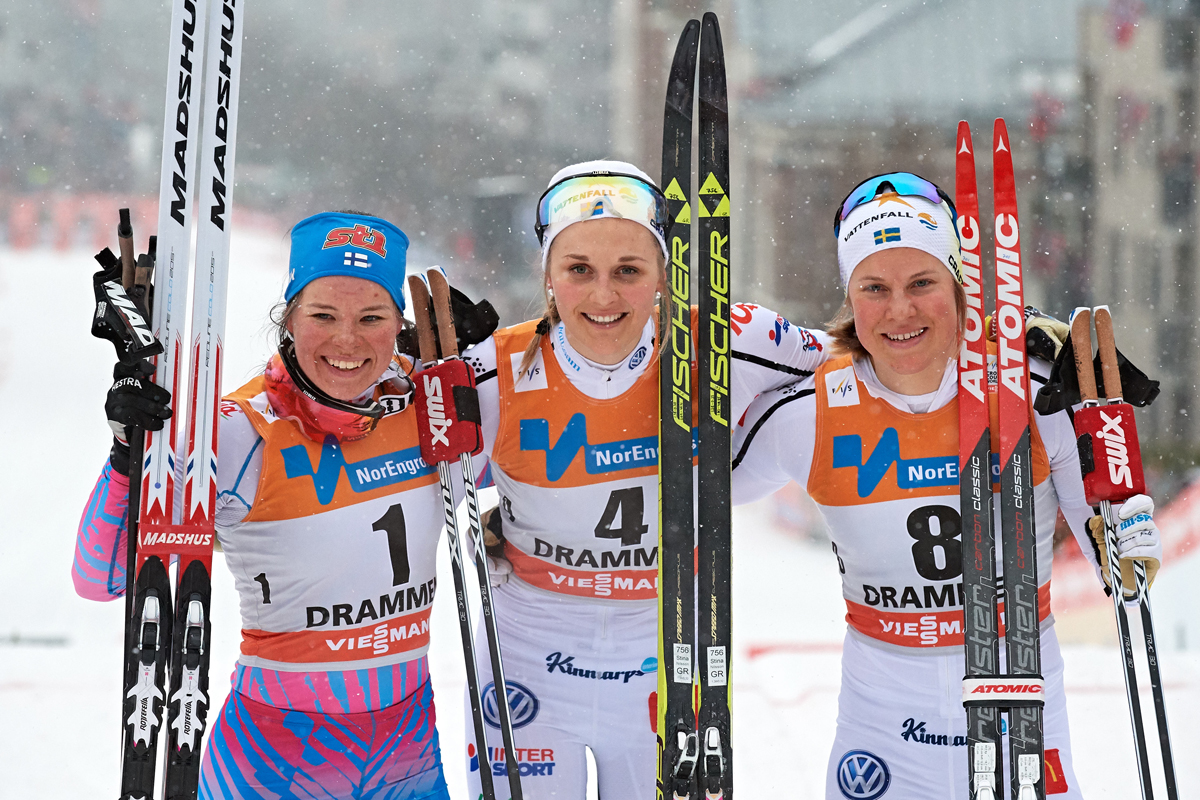
    The women’s 1.2 k classic sprint podium at Wednesday’s World Cup in Drammen, Norway, with Sweden’s Stina Nilsson (c) in first, Finland’s Krista Pärmäkoski (l) in second and Sweden’s Hanna Falk (r) in third. (Photo: Fischer/NordicFocus)

    As the day progressed, Sweden’s Nilsson continued to pick up steam. Coming off a World Championships in which she earned one medal (silver in the 4 x 5 k relay) and placed 12th in the freestyle sprint, the world’s second-ranked sprinter (behind Falla) had something to prove.

    She started by posting the fourth-fastest qualifying time, 1.54 seconds behind Pärmäkoski, then won her quarterfinal and first semifinal before dusting her competition in the final. While Nilsson followed the lead of fellow Swede Linn Sömskar in the quarterfinal and drafted off Diggins on the downhill to slingshot to first before the finishing stretch, Nilsson took a backseat to Østberg in the semifinal. With energy to spare, Nilsson and her teammate Falk pounced on the long grind to the finish, placing first and second, respectively, while Østberg dropped to fourth behind Lampič in third.

    In the final, Nilsson didn’t bother with games. She led out of the start, with Harsem following in second up the first double-pole section of the initial climb. While Nilsson continued to lead over the top, Falk and Pärmäkoski ended up duking it out for second place. Pärmäkoski double poled hard up the finishing straight to move into second, which she took by 0.84 seconds over Falk for her first World Cup sprint podium. Nilsson powered to the win in 3:07.57 minutes, 0.42 seconds clear of Pärmäkoski and 1.42 seconds ahead of Falk.

    The remaining finalists, Harsem finished fourth (+3.27), Ingemarsdotter was fifth (+4.86), and Lampič, the U23 World Cup leader, placed sixth (+9.67).

    The victory was Nilsson’s eighth of the season and puts her 42 points behind Falla with one sprint to go — a freestyle sprint in Quebec City next Friday, where 50 points for a win are on the line.

    “I thought I could win and this feels really great,” Nilsson told the International Ski Federation (FIS), according to a press release. “I was sure Maiken would win the sprint globe today. I don’t think it’s possible still to win it, but there is still a chance and I will travel to Quebec and try my best.”

    For Pärmäkoski, the podium showed her continued momentum after two World Championships medals (second in the 15 k skiathlon and third in the relay).

    “I am really happy,” she told FIS. “I wasn’t sure how I would feel after the championships but I felt really strong today.”

    Falk is third in the overall sprint standings, 154 points behind Nilsson and 29 points ahead of Norway’s Heidi Weng in fourth. At World Championships, Falk missed a medal in the skate sprint in fourth.

    “This makes up a little bit for my fourth place finish at the World Championships, so it feels good to come here today and get a podium,” Falk said.

    The last European World Cup races of the season will take place Saturday and Sunday with the famous Holmenkollen 30/50 k mass starts near Oslo. This year, those races are classic technique. The men race on Saturday at 12:45 p.m. Central European Time (6:45 a.m. Eastern Standard Time) and women start at noon CET (5 a.m. Eastern Daylight Time) on Sunday.

    — Jason Albert and Harald Zimmer contributed

    Results | Sprint World Cup standings

    Kikkan Randall (U.S. Ski Team) during the women’s 1.2 k classic sprint qualifier on Wednesday at the World Cup in Drammen, Norway. (Photo: Fischer/NordicFocus)
  • After The Medals: Team-Sprint Bronze Medalist Sadie Bjornsen

    After The Medals: Team-Sprint Bronze Medalist Sadie Bjornsen

    American Sadie Bjornsen (r) during the women’s 6 x 1.3-kilometer classic team sprint on Sunday at the 2017 Nordic World Championships in Lahti, Finland. (Photo: John Lazenby/Lazenbyphoto.com)

    LAHTI, Finland — While Monday marked a rest day for skiers competing in the 2017 Nordic World Championships, FasterSkier took the opportunity to sit down and chat with Sadie Bjornsen of the U.S. Ski Team, one day after she earned bronze with teammate Jessie Diggins in the women’s 1.3-kilometer classic team sprint. Not only was it Bjornsen’s first-career World Championships medal, it was the first for the U.S. women’s program in a World Championships classic race.

    Bjornsen, 27, who lives and trains in Anchorage, Alaska, claimed the third spot on the podium with Diggins after a nail-biting sprint finish. With Bjornsen racing the first leg for the U.S., two of the three times she posted were the fastest first leg splits. No small feat with names like Norway’s Heidi Weng, Sweden’s Ida Ingemarsdotter, and Finland’s Aino-Kaisa Saarinen, Slovenia’s Katja Visnar, Russia’s Yulia Belorukova, Switzerland’s Nadine Fähndrich, Germany’s Stefanie Böhler among others all on the list for the first leg.

    In the interview, Bjornsen explains what the bronze medal means to her and how racing the team sprint has been a goal of hers for quite some time. She outlines some of the challenges she’s faced throughout her career up to this point and highlights the importance of her club coach, Erik Flora, of Alaska Pacific University.

    (Note: the interviews were conducted in a non-studio environment and are best listened to without headphones.)

    Bjornsen is entered in the women’s 10 k classic race slated to take place Tuesday, Diggins is not. The men will race a 15 k classic on Wednesday. Men’s start lists were not available at the time of publication.

    U.S. 10 k classic entries:

    Women

    • Sadie Bjornsen
    • Rosie Brennan
    • Kikkan Randall
    • Ida Sargent

    Canadian 10 k classic entries:

    Women

    • Dahria Beatty
    • Emily Nishikawa
    • Katherine Stewart-Jones
    • Cendrine Browne

    Start list: Women

  • Classic Combo: Bronze for Bjornsen & Diggins; Gold for Norway in World Champs Team Sprint

    Classic Combo: Bronze for Bjornsen & Diggins; Gold for Norway in World Champs Team Sprint

    U.S. Ski Team teammates Jessie Diggins (l) and Sadie Bjornsen celebrate their bronze medal in the women’s 6 x 1.3-kilometer classic team sprint on Sunday at the 2017 Nordic World Championships in Lahti, Finland. (Photo: John Lazenby/Lazenbyphoto.com)

    LAHTI, Finland — Statistically speaking, most might have bet on the Swede — particularly if it came down to a lunge to the line. After all, that’s how Sweden’s Stina Nilsson won her first World Cup sprint against Norway’s 2017 sprint world champion Maiken Caspersen Falla.

    On two other occasions, Nilsson has skate sprinted to the win in a photo finish — once during last year’s Ski Tour Canada and the other during this season’s freestyle sprint in Falun, Sweden. Perhaps most memorably, it’s also how the Swede won her first classic sprint title, denying Norway of a podium at this season’s opening World Cup weekend.

    Considering her finishing history, if Sunday’s 2017 Nordic World Ski Championships 6 x 1.3-kilometer classic team sprint came down to a lunge, Nilsson as Sweden’s anchor was ready.

    American Jessie Diggins (l) going head to head with Sweden’s Stina Nilsson (r) during the final 100 meters of women’s 6 x 1.3-kilometer classic team sprint on Sunday at the 2017 Nordic World Championships in Lahti, Finland. (Photo: John Lazenby/Lazenbyphoto.com)

    And when Nilsson’s white suit cornered the final turn centimeters behind that of American Jessie Diggins, some saw Sweden on the podium with bronze.

    Even less than a year ago, the U.S. saw themselves as an outside contender for the 2017 World Championships classic team sprint, according to U.S. Ski Team women’s coach Matt Whitcomb. American success in freestyle team sprints was a little more palpable after Diggins and Randall took gold at the 2013 World Championships in Val di Fiemme, Italy, while the year before that, Randall and her U.S. teammate, Sadie Bjornsen finished second during a regular World Cup event in Düsseldorf, Germany.

    The U.S. team’s best team-sprint result following 2013 World Championships was fifth in last year’s freestyle team sprint in Planica, Slovenia, with Sophie Caldwell and Ida Sargent. Never before had the U.S. women medaled in a classic World Championships event.

    “This was an event that, in April, we talked about as an outside medal shot,” Whitcomb said after Sunday’s race.

    With that in mind, the team started brainstorming of a way of “coming from some sort of surprising attack” when the time came in Lahti.

    “This was a team that has been in the making for a while,” Whitcomb said of the eventual Lahti Word Championships classic team-sprint combo, Bjornsen and Diggins. “Once we knew [Bjornsen] was healthy. We had her specifically skip the skiathlon because we thought with a little extra rest, she could be that much sharper. But we had four other women that were up for serious consideration for this spot and we didn’t make the call until yesterday afternoon at 2:25 p.m.”

    Whether they made the right call would not be determined until a little less than 12 hours later: in the final 100 meter showdown between Diggins and Nilsson.

    But while the Swede appeared to have experience on her side, drafting off Diggins until the final turn and pulling around to her right within the finishing stretch, the American showed no signs of letting up. With every pole Nilsson took, Diggins poled a centimeter further. Finally, with nineteen hundredths of a second to spare, Diggins crossed first, holding off Nilsson and securing bronze for the U.S.

    “I was happy it didn’t just come down to a walk-through medal,” Whitcomb said. “[Bjornsen and Diggins] felt the pressure of being selected for this team and … they’ve awarded everybody that could have been on it.”

    Bjornsen’s First, Diggins’s Fourth: Bronze Medals in the Making

    Sunday’s bronze medal marks Diggins’s fourth World Championships podium, a record for the U.S. She now has two team and two individual podium finishes in three world champs — half of those coming from this week in Lahti.

    However, Diggins is adamant that her medals would not be possible without her teammates. And with regards to the team events especially, the 25-year-old Minnesota native is right.

    Two of the three laps Bjornsen skied for the team were the fastest recorded for the first-leg skiers.

    Bjornsen, 27, led the entire field coming into the exchange after her first lap, pulling the likes of Russia’s Yulia Belorukova, Norway’s Hedi Weng, Sweden’s Ida Ingemarsdotter, and Finland’s Aino-Kaisa Saarinen behind her.

    American Jessie Diggins (10) leads Sweden’s Stina Nilsson (11) and Germany’s Nicole Fessel (12) during the first climb of the women’s 6 x 1.3-kilometer classic team sprint on Sunday at the 2017 Nordic World Championships in Lahti, Finland. (Photo: John Lazenby/Lazenbyphoto.com)

    After her third lap as well, Bjornsen was first through the exchange, putting Diggins in the front for the first climb of the final lap, just ahead of Russia’s Natalia Matveeva and Germany’s Nicole Fessel.

    “Both of us were very strong in the first hill,” Bjornsen said of her and Diggins.

    Both women strode evenly through the first climb of every lap.

    It was in the second climb, where the pitch made the switching to herringbone requisite for most skiers, that both Bjornsen and Diggins indicated they found themselves losing time.

    “Herringbone isn’t my particular strength,” Diggins explained.

    Instead, the American emphasized areas where she would excel: the downhills and flats.

    “[I was] just thinking ‘go, go, go, go, go!’ on the herringbone, and then reel them in on the double-pole and on the downhills,” Diggins added.

    The 2017 Nordic World Championships classic team sprint podium on Sunday in Lahti, Finland, with Norway’s Maiken Caspersen Falla and Heidi Weng in first (c), Russia’s Natalia Matveeva and Yulia Belorukova in second (l), and Sadie Bjornsen and Jessie Diggins in third (r). (Photo: John Lazenby/Lazenbyphoto.com)

    Diggins did just that by her final lap, regaining contact with Nilsson by the final descent back into the stadium and passing her by the final turn. She held off the Swede for third and crossed 18.6 seconds behind Falla, who clinched gold for Norway with a time of 20:20.56 minutes.

    “To go with Maiken is a dream for me,” Weng said during a press conference. “She was just flying there. I was yelling at her. So I’m so happy today.”

    Russia’s Belorukova and Matveeva finished second, 5.56 seconds behind Norway to take silver. This being Matveeva’s fifth World Championships, the 30-year-old Russian expressed gratitude at finally finding the podium, especially after crashing and missing out on the final in Thursday’s freestyle sprint.

    “It’s really great to finally have a medal from this championship,” Matveeva said during the press conference via a Russian translator.

    Though the world-champs medal is Bjornsen’s first, it’s not the first time the thought has crossed her mind. A Washington state native, Bjornsen indicated she has been targeting a world-champs podium for quite some time. The chance to do so in the classic discipline, her preferred technique, was also surreal.

    “I have been dreaming to be on a team sprint at World Championships or Olympics for a while now and it’s so cool to finally be here,” Bjornsen said after the race. “I think it’s finally sinking in, because I feel like I just wanna cry.”

    Despite it being Diggins’s fourth medal, she explained this one had no less meaning than the any of the rest. With her other world-champs podiums in the skating disciplines, she sees the classic team sprint bronze she earned alongside Bjornsen as a sign of her growing abilities as an all-around cross-country competitor.

    “For me, this is one of the most exciting ones, because as Sadie said, it’s in classic,” Diggins said.  

    Sadie Bjornsen (r) tends to her U.S. teammate Jessie Diggins after Diggins outlunged Sweden’s Stina Nilsson (not shown) for the bronze medal in the women’s 6 x 1.3-kilometer classic team sprint on Sunday at the 2017 Nordic World Championships in Lahti, Finland. (Photo: John Lazenby/Lazenbyphoto.com)

    “And I don’t want to be just a skater, or just a 5 k skater,” she added. “I want to be able to do it all, and do it with my team and do it for the team. So this is really pretty special for us.”

    Further reflecting on the race, Diggins saw her move to drop out of Saturday’s skiathlon as playing a role in her eventual podium on Sunday. Though her intent in the 15 k skiathlon had originally been to aim for top-three finish, upon realizing she was out of contention she made the decision to stop racing. Almost halfway through the race, she saw she stood a better chance at medaling in the team sprint by saving herself and not pushing through the event’s skating portion.

    “At the halfway point I had a choice to make — dig deep for a race that wasn’t going to be close to what I felt I was capable of or stop and save everything for the team sprint,” Diggins wrote in an email on Sunday after the team sprint, referring to her skiathlon effort.

    Even if the decision was hard, the youngest U.S. World Cup team member made it without any outside advice. In retrospect, her foresight to forego finishing the race appeared accurate after Sunday’s result.

    “I had to trust my gut because I believe so much in Sadie and that we had a chance to do something amazing together, and for me, the team event will always come first! And today looking back, I absolutely confirmed that it was the right choice because when Stina went on that climb I was able to follow and catch up, and have that extra gear in the finishing lanes!”

    The other North American women’s team competing on Sunday, Canada’s Cendrine Browne and Dahria Beatty finished the day in 13th, after missing a spot in the final by two places. They finished seventh in the first semifinal.

    While they didn’t advance, the two Canadian National U25 Team members were pleased with the effort and the progress they see the team as having made over the season and during these championships.

    “We pretty much always have someone who has a good day personally, whether it’s a strong result or they just felt really good,” Beatty said after. “It’s nice to have those takeaways so that when I have a bad race, someone else had a good race and you can kind of talk to them about what they did right on the course.”

    In future team sprints, too, the two see Canada as one day in the mix.

    “I think it will be possible to qualify eventually,” Browne said. “I think we were pretty close on that first and second lap. And I think we’ll get faster and we’ll be competitive at some point. So it’s positive.“

    Results

    — Jason Albert, Harald Zimmer, Chelsea Little, and Alex Kochon contributed

    The iconic U.S. women’s relay socks, belonging to Jessie Diggins (l) and Sadie Bjornsen (r), standing on the third step of the women 6 x 1.3-kilometer classic team sprint podium on Sunday at the 2017 Nordic World Championships in Lahti, Finland. (Photo: John Lazenby/Lazenbyphoto.com)
  • Sunday Rundown: Lahti and Osrblie (Updated x2)

    Sunday Rundown: Lahti and Osrblie (Updated x2)

    Heidi Weng and Maiken Caspersen Fall of Norway (center) bested Yulia Belorukova and Natalia Matveeva of Russia (left) for gold in the women’s team sprint at 2017 World Championships, with Sadie Bjornsen and Jessie Diggins of the U.S. (right) outsprinting Sweden for bronze. (Photo: FIS Cross Country/Twitter)

    FIS Nordic World Championships (Lahti, Finland): Classic team sprints

    Defending champions Norway repeated gold in the women’s team sprint, with Heidi Weng and Maiken Caspersen Falla crossing the finish line first in Lahti, Finland. On the second-to-last loop, it looked like Russia could have something to say about that. Yulia Belorukova put in a furious sprint up the course’s biggest climb, and then beat Weng to the exchange. But her teammate Natalia Matveeva could not match the pace when Falla put on her own sprint on the last uphill. Russia finished second for silver, +5.56.

    The competition for bronze was closer, with Germany, Finland, Sweden, and the United States going out of the stadium for the last loop together in chase of the Norwegian and Russian leaders. The last climb was defining in the race for bronze, with Jessie Diggins of the United States staying closest to Sweden’s Stina Nilsson. Diggins caught Nilsson on the downhill and was able to stay just ahead of the Swede to the finish, claiming bronze (+18.38) along with teammate Sadie Bjornsen. It was a return to the team sprint podium for Diggins: after winning the team sprint at 2013 World Championships with Kikkan Randall, she teamed up with Sophie Caldwell in 2015 but the pair finished eighth.

    Nilsson and Ida Ingemarsdotter settled for fourth (+18.57), and the Finnish team of Aino-Kaisa Saarinen and Kerttu Niskanen finished fifth (+23.02).

    The Canadian team of Cendrine Browne and Dahria Beatty was seventh in their semifinal and landed 13th overall.

    In the men’s team sprint, Norway set a high pace from the beginning, with phenom Johannes Høsflot Klæbo attacking on the steep uphill every time he skied. On his second and third loops, he tagged off to Emil Iversen with gaps of just over five seconds to the rest of the field. But Iversen had a hard time holding the lead, in part because of Russia’s Sergey Ustiugov, who had won the 30 k skiathlon the day before and put in a huge effort to catch Iversen on the fourth loop of the team sprint.

    On the final loop, Finland’s Iivo Niskanen bridged the gap up to Iversen, mostly on the steep uphill and then also with ski speed on the downhill. But the time the pair entered the stadium, Niskanen had caught the Norwegian and was moving with higher speed. He decided to switch tracks to overtake Iversen, but Iversen decided to switch tracks just a second later, without checking one last time to make sure the track was clear. He fell, taking out Niskanen with him.

    That allowed Ustiugov and Italy’s Federico Pellegrino to go sailing by to claim gold and silver (+2.14) with their teammates Nikita Kriukov and Dietmar Noeckler. It was the second gold for Russia in the event in three World Championships; Kriukov and Alexey Petukhov won in 2013, and also took silver in 2015.

    Niskanen got up and claimed bronze (+8.64 with Sami Jauhojärvi), swearing as he crossed the finish line; with a broken pole, Iversen limped across the line in fourth (+18.42). He was called to a jury meeting but ultimately no teams were disqualified because of the crash.

    Erik Bjornsen of the United States won a sprint finish for fifth (+23.58) with teammate Simi Hamilton), besting Lenny Valjas (+27.02 with teammate Alex Harvey) of Canada.

    Results: women | men

    ***

    FIS Nordic World Championships (Lahti, Finland): Nordic combined 4 x 5 k team event

    Germany (Björn Kircheisen, Eric Frenzel, Fabian Rießle, and Johannes Rydzek) took gold in the nordic combined 4 x 5 k team event on Sunday at Nordic World Championships in Lahti, Finland, while Norway placed second and Austria third. (Photo: FIS Nordic Combined/Twitter)

    [UPDATED] After sweeping the first individual nordic-combined competition of 2017 Nordic World Championships on Friday, Germany achieved gold as a team, with Björn Kircheisen, Eric Frenzel, Fabian Rießle, and Johannes Rydzek winning the 4 x 5-kilometer team event in 47:57.3.

    The Germans combined for the best jumping score of 11 teams and started the relay in first, 44 seconds ahead of Japan in second. Norway started 1:07 minutes back in fifth but rose to second place (+41.7), with Magnus Moan, Mikko Kokslein, Magnus Krog, and Jørgen Graabak. Moan raced them into third at the first exchange, then Kokslein secured second, which they held onto for the remaining two legs.

    “It was our goal to ski a controlled race,” Germany’s Frenzel told ZDF. “Not really look at how the gap was developing, but just make our own race. And put up a little more pressure towards the end of each leg. That worked well, that was a wickedly cool team performance today. And I am just happy that we could put a little golden crown on the whole event today.”

    “I think today you could see again that we all worked together and enjoyed the competition,” Rydzek added. “We were all happy about each other’s performance, and just rewarded ourselves for hard hard work.”

    Austria started fourth, 1:05 behind Norway, and clinched bronze (+1:03.7) with Bernhard Gruber, Mario Seidl, Philipp Orter, and Paul Gerstgraser. Gruber initially raced them into second at the first exchange, but they relinquished one spot and hung on for third, ahead of Japan in fourth (+1:06).

    Japan (Hideaki Nagai, Takehiro Watanabe, Yoshito Watabe, and Akito Watabe) jumped to second, but found themselves in fourth at every exchange.

    Finland took fifth, Italy sixth, France seventh, and the U.S. eighth (+3:27.2) with Bryan Fletcher, Taylor Fletcher, Ben Berend, and Ben Loomis. The Americans started the race in seventh and were in sixth after the first two exchanges, but slipped to eighth on the third leg.

    Results

    ***

    IBU Youth/Junior World Championships (Osrblie, Slovakia): Youth & junior pursuits

    Four seems to be Chloe Levins’s lucky number. After a career breakthrough of fourth place in the pursuit at last year’s Youth Olympic Games (YOG) in Lillehammer, Norway, the 18-year-old Vermonter raced to fourth in the youth women’s 7.5-kilometer pursuit on Sunday at the International Biathlon Union (IBU) Youth/Junior World Championships in Osrblie, Slovakia.

    Italy’s Irene Lardschneider winning the youth women’s 7.5 k pursuit on Sunday for her second-straight gold at 2017 IBU Youth World Championships in Osrblie, Slovakia. (Photo: IBU)

    Levins started the race in 11th and worked her way up to fourth with clean shooting in three stages. She missed two in the first prone but rebounded and held off Ukraine’s Khrystyna Dmytrenko by seven seconds for fourth place. Levins finished 1:55.5 minutes behind the winner, Italy’s Irene Lardschneider, who started the race first and held on for her second-straight gold medal despite four penalties (0+0+2+2), finishing in 26:57.1. France’s Lou Jeanmonnot-Laurent rose from fourth to second place with 19-for-20 shooting (0+0+1+0), and Italy’s Samuela Comola took bronze (+1:08.5) for the second-straight race with two misses (1+0+1+0).

    Three U.S. women qualified for the pursuit, with Amanda Kautzer finishing 42nd (+6:16.2) after starting 59th and shooting 80 percent (1+0+2+1), and Grace Gilliland finishing 55th (+8:32.1) with six penalties (2+3+1+0).

    Canada’s Shilo Rousseau followed in 54th (+9:02.1) with eight misses (3+1+2+2).

    Results: Youth women

    In the junior women’s 10 k pursuit, Canada’s Megan Bankes raced to 16th for the best finish for a North American in that race. The gold medalist in last week’s 12.5 k individual, Bankes finished 13th in Saturday’s sprint and thus started in that position, 1:25 out of first. She ended up 16th with four penalties (0+1+2+1) and finished 2:15.8 behind the winner, Russia’s Valeriia Vasnetcova, who started 24th and worked her way all the way up to first with clean shooting.

    Vasnetcova was the only one to clean the four-stage pursuit on Sunday, and in doing so, she achieved her first gold of the championships and second of her career at Youth/Junior Worlds after her team won last year’s youth relay in Romania.

    Coming off a sprint win, Italy’s Michela Carrara started first and took second at the finish, 10 seconds behind Vasnetcova with three misses (1+1+1+0). Norway’s Ingrid Tandrevold scored her second-straight medal as well, after starting second and finishing third (+10.8), with two penalties (0+0+1+1).

    Canada’s Nadia Moser had her best result of the championships in 30th (+3:43.5), moving up one place after starting 31st, with three penalties (0+1+0+2). Emily Dickson finished 47th for the second-straight day (+6:29.9) with four penalties (1+0+1+2).

    Siena Ellingson was the lone American to start after placing 18th in Saturday’s sprint. She finished 41st (+5:24.7) with seven misses (1+2+1+3).

    Results: Junior women

    In the junior men’s 12.5 k pursuit, Canada’s Pearce Hanna rocketed to 23rd after starting 47th, shooting 17-for-20 after cleaning the first two stages (0+0+1+2) for his first top 30 of the championships. Hanna finished 3:12 behind the winner, Russia’s Igor Malinovskii who picked up his second-straight gold.

    Malinovskii started first and finished in 32:39.8, 13 seconds ahead of second place, with four penalties (0+1+2+1). Norway’s Sindre Pettersen took the silver medal after starting in eighth and posting the fastest course time to overcome five misses (2+1+1+1). Belarus’s Anton Smolski moved up from fourth at the start to reach the podium in third (+27.4) with five misses as well (0+0+3+2).

    All four Canadian junior men qualified for the pursuit. Trevor Kiers led them in 39th (+5:13.3), after starting 48th, for his best result of the championships. Jules Burnotte placed 43rd (+5:35.3), up from 55th, for his best result as well, and Zachari Bolduc finished 57th (+8:18.3). Kiers missed five targets (2+0+1+2), Burnotte had seven misses (3+1+1+2), and Bolduc missed eight (2+3+2+1).

    For the U.S., Cody Johnson finished 55th (+7:19.5) with nine penalties (2+1+2+4) and Travis Cooper 59th (+8:46.2) with eight misses (5+0+1+2).

    Results: Junior men

    In the youth men’s 10 k pursuit, the first race of the day on Sunday, two Canadians finished in the top 30, with Leo Grandbois in 22nd and Adam Runnalls in 27th.

    For Grandbois, it was his first time outside the top 15 of the championships after he had won the youth men’s 12.5 k individual last Wednesday and finished 14th in Friday’s 7.5 k sprint. He had to ski six penalty loops on Sunday (0+2+2+2), dropping outside the top 20 after the third shooting. Grandbois finished 3:21.8 behind the winner, France’s Emilien Claude, who won the sprint as well to start the pursuit first.

    Claude, who had four penalties (1+1+0+2) and finished in 29:22.4, held off Italy’s hard-charging Cedric Christille by 16 seconds after Christille shot just two penalties (0+0+1+1) to move up from fourth to second for his first medal in his first Youth World Championships. Germany’s Danilo Riethmüller rose from sixth to third place (+30.7) despite four misses (1+0+1+2). For the German, it was his second bronze of these championships after placing third in the 12.5 k individual.

    Canada’s Runnalls moved up from 32nd at the start to 27th at the finish (+3:47.5) for his first top 30 of the championships. He had five penalties (1+3+1+0), but cleaned the last stage to move into the top 30.

    Vasek Cervenka was the lone American to qualify in the youth men’s pursuit, and he moved up from 49th at the start to 30th (+3:52) with five penalties (1+1+1+2).

    Results: Youth men

  • For Diggins and Randall, Life’s Sweet with Silver and Bronze

    For Diggins and Randall, Life’s Sweet with Silver and Bronze

    An American sandwich: U.S. Ski Team members Jessie Diggins (l) and Kikkan Randall (r) sharing the podium with Norway’s Maiken Caspersen Falla (c) after Falla won the women’s freestyle sprint at 2017 Nordic World Championships on Thursday in Lahti, Finland. Diggins placed second and Randall was third. Diggins and Randall are now tied for the most World Championships medals with three apiece. (Photo: John Lazenby/Lazenbyphoto.com)

    LAHTI, Finland — Three: that’s the magic number. On a historic night in Lahti on Thursday, three of the four U.S. women entered in the 2017 Nordic World Championships 1.4-kilometer freestyle sprint advanced from their quarterfinals to the semifinals and eventually, the final.

    Toeing the start line for the American triad was the U.S. Ski Team’s (USST) Kikkan Randall, Jessie Diggins and Sophie Caldwell. Filling the final three spots were two Swedes — Hannah Falk and Ida Ingemarsdotter — as well as Norway’s Maiken Caspersen Falla.

    Not making the cut was the week’s sprint favorite, Stina Nilsson. The young Swedish superstar had crashed while cornering the final turn in her semifinal, taking out Russia’s Natalia Matveeva and earning herself a yellow card and relegation to last in the heat. Randall and Caldwell, who were both in Nilsson’s semi, maneuvered around the spill to advance in second and third, respectively.

    With no Nilsson, Sweden put its faith in Ingemarsdotter and Falk, while the U.S. comprised half of the field in the women’s final.

    “That’s for sure the funnest final I have ever been a part of,” Randall said during a post-race press conference. “Before we went to the start we did a little team cheer … we had such good energy between the three of us.”

    Norway’s Maiken Caspersen Falla (1) leading Sweden’s Hanna Falk (r) and Stina Nilsson (l) and American Kikkan Randall (10) during the first semifinal of the women’s 1.4 k freestyle sprint at 2017 Nordic World Championships in Lahti, Finland. Falla went on to win the final for the first gold medal of the championships and Randall placed third overall. (Photo: Fischer/NordicFocus)

    Feeding off each other’s energy as they started the race, the Americans remained grouped together through the first climb toward the back of the pack. Meanwhile, Falla found herself skiing in the front by the time the finalists crested the top of the first hill.

    “That’s my favorite tactic I am always using. If I am doubting or don’t know what to do, I take the lead and hope for the best,” Falla said during the press conference.

    The Norwegian kept it that way for the remainder race, distancing herself by close to 10 meters by the top of the second climb. With one final descent to go, she had tightened her hold on the World Championships freestyle sprint title.

    Leading the charge from behind was Ingemarsdotter. Diggins pressed closely behind to the Swede’s right, Randall to the left. Breathing down their necks were Caldwell and Falk.

    By the bottom of the descent, Diggins had moved around the Swedish skier. Randall continued press from behind, but so, too, did Falk.

    Norway’s Maiken Caspersen Falla celebrates her gold medal in Thursday’s freestyle sprint ahead of Americans Jessie Diggins (19) and Kikkan Randall (r), who placed second and third, respectively, at 2017 Nordic World Championships in Lahti, Finland. The third U.S. woman in the final, Sophie Caldwell (second from r) finished sixth. (Photo: Fischer/NordicFocus)

    In the final 100 meters, Falla staved off any attempts from Diggins, crossing first in a time of 3:02.34 minutes for the gold medal. Just 1.66 seconds back, Diggins claimed silver — her third World Championships medal and second individual silver.

    Though she placed second in last year’s Lahti World Cup freestyle sprint, Diggins admitted that the 2017 event was not where she had planned to put her focus for the week.

    “I was … targeting some other races this week,” the 25-year-old Diggins said during the press conference, noting that she has been feeling strong this year on the World Cup. She’s already won two individual races this season and placed second in the skiathlon Obsterdorf, Germany. At the start of Thursday’s sprint, she recalled thinking, ” ‘Why not? This could be my day.’ ”

    Jessie Diggins (U.S. Ski team) during qualification on Thursday in the 1.4 k freestyle sprint at the Lahti World Championships. She qualified in 19th and went on to finished second overall for her second-career individual World Championships silver medal. (Photo: John Lazenby/Lazenbyphoto.com)

    The Minnesota native proved it was, with her second-place finish tying her for the most champs medals won by a U.S. woman. The other woman to have three? After capturing third place (+3.76) on Thursday, that would be Randall.

    The U.S. Ski Team veteran and three-time Sprint World Cup winner, now has two individual World Championships medals, as well: a bronze on Thursday, a silver from the 2009 sprint in Liberec, and her 2013 freestyle team-sprint gold, which she earned with Diggins in Val di Fiemme, Italy.

    “It was a slow start to the season, and it took a lot of patience,” Randall said of some of her earlier-season performances and whether those had her worried as she entered World Championships. “But the shape was building and building, and I hoped to find the best shape here, and it worked!”

    This year’s world medal, however, is a bit different for the 34-year-old Alaskan. It’s one she’s won as a mom.

    The U.S. Ski Team’s Kikkan Randall lays it down during the women’s 1.4 k freestyle sprint qualifier on Thursday at Nordic World Championships in Lahti, Finland, where she qualified 10th and went on to claim bronze in the final. (Photo: John Lazenby/Lazenbyphoto.com)

    “I think it’s very encouraging to know that it’s only been 10 months [since I had a baby], and I have been able to come back to top form,” Randall said. “I was able to train well through my pregnancy, and come back to training pretty soon after the birth. So it’s great to see everything come together here.”

    Sweden was shut out of the medals; Falk placed fourth (+3.91) and Ingemarsdotter finished fifth (+4.42).

    Caldwell once again performed on the big stage. In front of a packed Lahti Ski Stadium and a global television audience, the 26-year-old Vermonter appeared unfazed. In fact she’s been in this spot before — she placed sixth at the 2014 Sochi Olympics in the skate sprint. Déjà vu all over again? Not exactly. But in Sochi, the sprint final did feature two athletes Caldwell faced in Lahti: Falla and Ingemarsdotter. And if familiarity breeds comfort, racing against teammates Diggins and Randall positioned her against known athletes, a book she’s read hundreds of times either in practice or in competition.  

    Caldwell, teammates with Diggins at the Stratton Mountain School in Vermont, qualified 13th. And her first pass through the media zone after placing second in her quarterfinal was the look of hyper-focus.

    By the time she moved onto the final as a lucky loser — after deftly angling around Nilsson and Matveeva — a grin broke through. 

    Sophie Caldwell (U.S. Ski Team) racing to 13th in the women’s freestyle sprint qualifier on Thursday at 2017 Nordic World Championships in Lahti, Finland. She went on to reach the final, where she placed sixth to tie her career best at a world championship (actually an Olympics, after placing sixth in the skate sprint in Sochi). (Photo: John Lazenby/Lazenbyphoto.com)

    Caldwell placed sixth in the final, 5.37 seconds in back of Falla after qualifying 13th, for her best result in her third World Championships.

    “Today was an incredible day for the team. I don’t know if we ever had three people in the final,” Caldwell said. “And to have Jessie and Kikkan on the podium is amazing.”

    Caldwell acknowledged the personal significance of the evening’s sprint. “It was a great day for me, this is the first final I made this year,” she said. “And I had strong feelings throughout the day. I feel like I felt better as the day went on, with the exception of the final where my legs got a little tired.”

    Of the four U.S. women that started Thursday’s sprint, all four qualified for the heats. Ida Sargent made the top 30 in 27th, behind her teammates Randall (10th), Caldwell (13th), and Diggins (19th). Sargent went on to finish fifth in her quarterfinal (4.6 seconds behind Matveeva, who won that heat)  for 24th overall.

    “I am just really proud of the athletes,” U.S. Ski Team Head Coach Chris Grover said. “All of the athletes that were competing today, all of the athletes on the U.S. program that were not competing today that were cheering from in front of the television this evening. … I am really proud of the team that we have collected here, in terms of the service team, and coaching team, medical and support team … and everyobdy that is surrounding that for USA.”

    Kikkan Randall (l) and Jessie Diggins celebrate their bronze and silver medals, respectively, in the women’s individual freestyle sprint on Thursday, the first day of 2017 Nordic World Championships in Lahti, Finland. (Photo: John Lazenby/Lazenbyphoto.com)

    “For us this was definitely a target event,” he explained.

    In five consecutive visits to Lahti, the U.S. has reached the podium in every World Cup skate sprint. Andy Newell started the trend back in 2008, but Randall got the ball rolling for the women’s program in 2013 and 2014, winning the skate sprint there both years. Also in 2014, Caldwell reached the podium for the first time in third place. In 2015, Randall scored another Lahti podium in third (while Diggins was just off it in fourth), and last season, Diggins placed second.

    So you can say freestyle sprint, especially in Lahti, have been the U.S. team’s jam for some time.

    “It’s been a great race historically for us,” Grover said. “When we looked ahead at what our best medal-potential races were for the championships, obviously skate sprints have been one of the best events for us for years in general, but in particular for these championships, we really targeted this day.”

    Canada entered three women, all members of its U25 Team, with Dahria Beatty placing 37th and missing the top 30 necessary to qualify for the heats by 3.67 seconds. Cendrine Browne finished 48th (+20.42) and Katherine Stewart-Jones 58th (+26.29) out of 107 women in the qualifier.

    Results

    — Harald Zimmer, Chelsea Little, and Alex Kochon contributed

    Kikkan Randall (l) and Jessie Diggins (r) hold the American flag during a victory ski down the finishing lanes to celebrate their bronze and silver medals, respectively, in the women’s individual freestyle sprint on Thursday, the first day of 2017 Nordic World Championships in Lahti, Finland. Ahead of them, Norway’s Maiken Caspersen Falla celebrates gold. (Photo: Fischer/NordicFocus)
  • Norway Women Win Again, But It’s Closest Relay in Two Years; U.S. Fourth in Nailbiter (Updated)

    Norway Women Win Again, But It’s Closest Relay in Two Years; U.S. Fourth in Nailbiter (Updated)

    Marit Bjørgen taking Norway home for a win in the 4 x 5 k relay in Ulricehamn, Sweden. (Photo: Fischer/Nordic Focus)
    Marit Bjørgen taking Norway home for a win in the 4 x 5 k relay in Ulricehamn, Sweden. (Photo: Fischer/Nordic Focus)

    Another women’s 4 x 5 k World Cup relay, another Norwegian win.

    Yawn? Not so fast. While the team of Ingvild Flugstad Østberg, Heidi Weng, Astrid Jacobsen, and Marit Bjørgen may have picked up the victory, the women’s race in Ulricehamn, Sweden, was anything but dull.

    For one thing, it was the closest race in 23 months, going all the way back to the 2014 Olympics where Sweden took gold. The top four teams all finished within 10 seconds of one another – a far cry from the more recent Norwegian victories by 30 or 40 seconds or even well over a minute.

    And for another thing, the race for second place was a nailbiter. After trailing the leaders by 11 seconds at the first exchange, the German and American teams had clawed their way back into the fight for the podium. So by the time 19 kilometers had gone by, it was Hanna Falk of Sweden, Sandra Ringwald of Germany, and Jessie Diggins of the United States flying into the stadium to the finish together.

    All were highly motivated. It is Falk’s home course, and the very first time her club has hosted a World Cup.

    “It was again a great experience,” Falk told FIS. “I was motivated by the audience.”

    For Germany, being in that group of three meant the potential for the team’s best finish in three or even seven years.

    And for the United States? Well, the U.S. women are always game for a relay, and Diggins is always game for a fight.

    Jessie Diggins skiing the anchor leg for the United States. (Photo: Salomon/Nordic Focus)
    Jessie Diggins skiing the anchor leg for the United States. (Photo: Salomon/Nordic Focus)

    In the end, though, Diggins was boxed at the back of the group coming into the finishing straight. She had to choose an outside lane and couldn’t quite catch Ringwald and Falk.

    The German edged the hometown favorite for second place, earning Germany their best relay finish since 2010.

    “It was in my head that I absolutely did not want to become fourth today,” Ringwald told German broadcaster ZDF. “And then I just thought: killer instinct for the end, just keep at it! When Hanna [Falk] started her first attack I tried to somehow fight, and then on the last meters I knew that finish stretch suits me pretty well. And I just gave it all I had, and then it worked out for a second place.”

    She crossed the line 8.8 seconds behind Bjørgen and Norway. Falk took Sweden to third, +9.0, and Diggins and the United States were left in fourth, +9.2.

    “Of course we were hoping to be on the podium,” U.S. Ski Team Head Coach Chris Grover said in an interview. “So it’s hard when you’re that close to the podium, within a few hundredths of a second, and then not able to be on the podium. But all the women skied really well.”

    U.S. Women Strong, But Can’t Crush the Course

    The consensus from the U.S. team was that all four members of the first squad – the U.S. also fielded a second team, which finished 12th – skied well, but that the course wasn’t especially suited to them.

    The classic portion of the relay (the first and second skiers) did ascend a major climb that had featured in the individual 10 and 15 k freestyle races on Saturday. But the skate course skipped that hill, and instead was rolling and flatter.

    Sadie Bjornsen bringing the U.S. back up toward the leaders on leg two. (Photo: Fischer/Nordic Focus)
    Sadie Bjornsen bringing the U.S. back up toward the leaders on leg two. (Photo: Fischer/Nordic Focus)

    Rosie Brennan kicked things off for the U.S. She lost contact with the lead group (both Norwegian teams, Ida Ingemarsdotter of Sweden, and Anamarija Lampic of Slovenia), but tagged in fifth place, just 11 seconds back.

    “I didn’t have the best start, but found my groove about half way through and was able to pull back some time in the second half,” Brennan said in a USSA press release. “I will always want more when it’s a relay because I want to be the best for my teammates, but I am satisfied with today and now know exactly where I need to put in some work to be better next time.”

    From there, Sadie Bjornsen took over.

    “I knew I needed to be somewhat patient closing that gap,” Bjornsen said. “Thinking back to Lillehammer when a similar thing happened, I tried to close the gap in one kilometer and I exploded. I was trying to be a bit more conservative for the first part today, and it all worked out well.”

    By partway around the loop, Bjornsen and Germany’s Steffi Boehler had bridged up to the chase group. Heidi Weng of Norway had taken off, putting 15 seconds on the rest of the field – Norway never faltered after that – but the American and German teams were now skiing with Sweden, Slovenia, and the second Norwegian team.

    “Once we finally did catch the group it was a bit challenging because there really wasn’t anywhere you could pass,” Bjornsen said. “There were just two lanes.”

    Coming into the stadium she took the lead, but it still wasn’t what she had hoped for – and she wasn’t able to drop the other skiers.

    “I was double poling as hard as I could coming down that hill, while others were tucking,” Bjornsen said. “It was the only way to get around. It was impossible to pass, which I knew the classic legs were the only places to make a break, so for that reason I was wondering how it could be possible to go around those girls, but yeah. It was what it was.”

    “The goal is always to be as close as possible after the classic leg, and to put our skaters in contention for the podium,” Grover said. “Rosie and Sadie did exactly that. They brought it in right in contact with the second-place team.”

    The inability to create gaps was something that would come back to haunt the Americans on the next two legs, as the race transitioned to skating. Charlotte Kalla of Sweden tried to move and break up the chase group, but the U.S. racer Liz Stephen stayed right on her – and then the rest of the group caught up too.

    Charlotte Kalla of Sweden and Liz Stephen of the United States trying to make a break for it. (Photo: Fischer/Nordic Focus)
    Charlotte Kalla of Sweden and Liz Stephen of the United States trying to make a break for it. (Photo: Fischer/Nordic Focus)

    “Kalla took it out hot — I tried to stay with her, and then Ragnhild [Haga, of Norway] and [Germany’s] Victoria Carl caught up,” Stephen said. “It was a really hard course to pass on because the draft was pretty amazing. There’s just no real long hill to showcase fitness, or to make any moves on, and I think you saw that in both the men’s and women’s races today. But it was a really fun race to do, and I feel like I skied really well, especially tactically well, which is not always my strong suit.”

    Later, Stephen tried to up the pace herself, but similarly failed to get a gap. On the particularly fast course, the draft effect was just too strong.

    “Today I had to think about the best way for me to ski the course,” she explained. “I skied the uphills really well, and as fast as I could. But we weren’t able to fully break the group, Charlotte and I. I led some of the downhill, flat stuff, and I felt like I was really moving,and speeding people out — but then there were three people right up on me again. Once you realize what’s going on, you have to play to your strengths, so I knew that I needed to just hang with the girls.”

    By the time Stephen tagged off, Slovenia had dropped out of the group and it was a four-way race for second place, about 16 seconds behind the leading Norwegian team.

    Diggins took the tag and the lead of the group. But she, too, was unable to ski away from her competitors, although Kari Øyre Slind of the second Norwegian team did drop back.

    “For my leg, it felt like a chess match,” Diggins wrote in an email. “After watching Charlotte and Liz racing so well but seeing the drafters in their pack still clinging on, I knew my usual strategy of going all out was unlikely to work. I did the best I could with how it played out, but I feel like my fitness wasn’t reflected well in this particular race. It was a huge drafting course and it was exceedingly hard to drop people in the skate leg.”

    Coming down the final downhill to the finish, Diggins was in back of Falk and Ringwald and trying to get past. She couldn’t, and dropping down to the finishing straight didn’t have an immediately obvious choice of finishing lanes. She eventually had to swing wide to the left. Despite a hard sprint to the finish, Ringwald and Falk got there first.

    “In the sprint finish, we fell short by a quarter of a second,” U.S. Ski Team women’s coach Matt Whitcomb said in a USSA press release. “Jessie felt like she made a tactical mistake with her positioning, but she also did a lot right out there. She skied great. We’ll take a look at the footage to learn from the race for each athlete. I know she’d like to do it again, and the good news is that she will.”

    While the U.S. didn’t make the podium – a goal which had been made easier by a disastrous start by Finland, almost always a podium contender – the women seemed philosophical about the day.

    “We all had these little things that we wish we could have improved, but the thing about the U.S. relay team is that the harder the course is, the better for us,” Bjornsen said. “Today was a challenging course; it was really hard to make breaks on the skate legs. On the classic legs, I think if it would have been an even more challenging course it would have been better. Every course is different, and you want to be the best on every single course, but I think all four of us, all eight of us, really, finished the race today feeling… we wanted to be on the podium, of course, but feeling no crush of confidence out there. We all feel confident going into the next relay.”

    A Second U.S. Team Toes the Line

    It’s not often that the U.S. has two relay teams in a race, but that happened in Ulricehamn. Kikkan Randall, Ida Sargent, Sophie Caldwell, and SuperTour leader Liz Guiney finished 12th, +3:03.0, after losing a finishing-stretch battle with the Russia I team.

    Sophie Caldwell skiing leg three for the second U.S. team. (Photo: Fischer/Nordic Focus)
    Sophie Caldwell skiing leg three for the second U.S. team. (Photo: Fischer/Nordic Focus)

    “It was really cool,” Grover said. “We had eight women so we were really hoping to field two teams, but you’re always worried that somebody’s going to get sick or something. But we were lucky that everyone was healthy and ready to go. That was cool. I wish we could do that more often.”

    Randall had been 10th at the first tag, just 29 seconds behind the leaders and 18 seconds behind fifth-place teammate Brennan.

    Sargent then took over and skied the eighth-fastest time among second-leg skiers, losing only 24.6 more seconds on Weng.

    “I was really happy with how I felt today and had a lot of fun racing,” Sargent wrote in an email. “I skied solo for the whole race except for when [Finland’s Anne] Kylloenen caught me around the 4km mark, so we skied the last kilometer together. It was a very tough course to ski by yourself because there was a lot of flat and some long gradual downhill sections that would have been a lot easier to be in the draft or working with someone else during those sections… Considering that I was skiing solo I was really happy with how close I stayed to the leaders. I haven’t done many distance races this year so I wasn’t sure what to expect.”

    After that, Sophie Caldwell brought the team to 11th, and Guiney, in her first World Cup relay, to 12th.

    “I think the travel and excitement of the weekend caught up to me a bit,” Guiney wrote in an email. “I was mostly excited to be able to start on a World Cup relay, so I didn’t have any expectations beyond getting to the finish as fast as I possibly could. Skiing alone in a relay is always tough, so I just tried to focus on skiing each section as well as I could. Of course, I was really hoping to stay in front of the Russian team, but their last leg caught me with around 1 k to go. While I was able to stick with her until the finish, I didn’t quite have the sprint to get around her in the lanes.”

    “Being on a team with Liz Guiney in her first World Cup weekend was also a blast!” Sargent, a Craftsbury Green Racing Project teammate of Guiney’s, wrote.

    Results

    -Jake Ellis and Harald Zimmer contributed

    Teams in the tag zone in Ulricehamn. (Photo: Salomon/Nordic Focus)
    Teams in the tag zone in Ulricehamn. (Photo: Salomon/Nordic Focus)
  • Sunday Rundown: Ulricehamn, Antholz, Chaux-Neuve, Whistler, & Truckee (Updated x3)

    Sunday Rundown: Ulricehamn, Antholz, Chaux-Neuve, Whistler, & Truckee (Updated x3)

    The men's 4 x 7.5 k relay podium at the World Cup in Ulricehamn, Sweden, with Norway (c) in first, Sweden (l) in second, and Canada (r) with with its best-ever men's relay in third. (Photo: FIS Cross Country/Twitter)
    The men’s 4 x 7.5 k relay podium at the World Cup in Ulricehamn, Sweden, with Norway (c) in first, Sweden (l) in second, and Canada (r) with with its best-ever men’s relay in third. (Photo: FIS Cross Country/Twitter)

    FIS Cross-Country World Cup (Ulricehamn, Sweden): 4 x 5 k and 4 x 7.5 k Relays

    Men’s report | Women’s report

    Norway notched back-to-back team victories in the women’s and men’s relays on Sunday at the World Cup in Ulricehamn, Sweden, with Finn Hågen Krogh securing a win in the men’s 4 x 7.5 k relay by 0.5 seconds over Sweden’s Calle Halfvarsson and Canada’s Lenny Valjas. With two kilometers remaining, nine teams were within 3.8 seconds of first. Krogh outlasted both Halfvarsson and Valjas in the finishing stretch, as Sweden placed second and Canada third for its best-ever relay result, according to a Cross Country Canada press release, besting its fifth-place finish from 2012 (with then-anchor Ivan Babikov, now a Canadian World Cup coach).

    Krogh teamed up with Simen Hegstad Krüger, Martin Johnsrud Sundby and Anders Gløersen and finished in 1:06:47.5, while Sweden placed second with Daniel Rickardsson, Johan Olsson, Marcus Hellner, and Halfvarsson.

    For Canada, with Devon Kershaw, Alex Harvey, Knute Johnsgaard, and Valjas, it was Harvey’s third-straight World Cup podium, Valjas’s second-straight team-event podium, and national U25 Team member Johnsgaard’s first podium.

    “I have been waiting my whole career for this,” Kershaw said, according to a FIS press release. “All the guys did a great job today.”

    The U.S. placed 10th (+1:16.5) with Andy Newell, Erik Bjornsen, Noah Hoffman, and Simi Hamilton.

    The Norwegian women's team (center) won the 4 x 5 k World Cup cross-country relay in Ulricehamn, Sweden, by 8.8 seconds over Germany (left), with home team Sweden (right) edging the United States for third.
    The Norwegian women’s team (center) won the 4 x 5 k World Cup cross-country relay in Ulricehamn, Sweden, by 8.8 seconds over Germany (left), with home team Sweden (right) edging the United States for third.

    Earlier on Sunday, the women’s 4 x 5 k relay didn’t break apart until the second leg, but Norway still proved its dominance over the ski world with a win to start the day.

    After the group of Ingvild Flugstad Østberg and Lotta Udnes Weng (Norway), Ida Ingemarsdotter (Sweden), and Anamarija Lampic (Slovenia) more or less stayed together on the first relay leg, Heidi Weng made a break for it, giving Norway a 16.8-second lead at the second tag. The Norwegian team never looked back and after the race Weng and teammates Østberg, Astrid Jacobsen, and Marit Bjørgen were able to climb to the top step of the podium.

    The race for second place, though, wasn’t resolved until the finish line. Sweden, Slovenia, Norway’s second team, the United States, and Germany were all in contention at various points in the race.

    On the last leg, Jessie Diggins of the U.S., Sandra Ringwald of Germany, and Hanna Falk of Sweden battled it out, dropping Kari Øyre Slind of Norway. The three shot to the finish line together, with Diggins stuck behind the other two. Ringwald eventually won the sprint finish by 0.2 seconds over Falk, with Diggins another 0.2 seconds back in fourth.

    That gave Ringwald, Katharina HennigStefanie Boehler, and Victoria Carl a second-place result, one of Germany’s best since taking silver at the 2010 Olympics. (The team won bronze at the 2014 Olympics.)

    Ingemarsdotter, Falk, Charlotte Kalla, and Sofia Henriksson took the third step of the podium. Rosie BrennanSadie BjornsenLiz Stephen, and Diggins were left to settle for fourth.

    The second U.S. team, of Kikkan RandallIda SargentSophie Caldwell, and SuperTour leader Liz Guiney finished 12th after skiing in 8th and 9th earlier in the race.

    Results: MenWomen

    ***

    IBU World Cup (Antholz, Italy): Men’s mass start and women’s relay

    Men’s mass start reportWomen’s relay report

    ***

    NorAm Western Canadian Championships (Whistler, B.C.): Relays

    [UPDATED] This season brought a changeup to the Western Canadian Championships with a three-person relay event in response to athletes’ request to add “fun” events to the NorAm series.

    While 146 teams finished in 17 categories, it was Ontario winning the open men’s 3 x 7.5 k in 50:32.9 (Bob Thompson, Jack Carlyle and Andy Shields) and B.C. dominating the open women’s 3 x 5 k in 41:09.47 with three juniors (Katie Weaver, Anna Goodwin and Hannah Mehain).

    The masters men and juvenile girls categories included the most teams, with 15 and 14, respectively.

    Results


    FIS Nordic Combined World Cup (Chaux-Neuve, France): Individual large hill/10 k

    Sunday's Nordic Combined World Cup podium in Chaux-Neuve, France, with German winner Fabian Rießle (c), German runner-up Johannes Rydzek (l), and Germany's Eric Frenzel (r) in third. (Photo: FIS Nordic Combined/Twitter)
    Sunday’s Nordic Combined World Cup podium in Chaux-Neuve, France, with German winner Fabian Rießle (c), German runner-up Johannes Rydzek (l), and Germany’s Eric Frenzel (r) in third. (Photo: FIS Nordic Combined/Twitter)

    On Sunday, after the large hill jump and 10 k ski, Germany swept the podium in the second event of the NoCo World Cup in Chaux-Neuve, France. Fabian Rießle placed first in 22:44, and his German teammates Johannes Rydzek skied to second only 2.2 seconds back, and Saturday’s winner Eric Frenzel was third (+7.9).

    (Frenzel leads the NoCo World Cup, Rydzek is second overall, Rießle is third.)

    Norway’s Jarl Magnus Riiber flew the farthest with 139.8 points. Franz-Josef Rehrl from Austria jumped to second with 135.7 points while his teammate Bernhard Gruber jumped to third with 131.7 points.

    Magnus faded to 23rd (+47.5) in the 10 k ski. Rehrl started 15 seconds back from Magnus and placed 17th overall (+31.5). Gruber maintained a top-ten, placing 9th (+13.5), after starting 32 seconds behind first place jumper Magnus.

    While the top three jumpers all dropped back in the ski, it was a day of catch up for the German’s after the jumping portion.

    Rießle ranked eigth after the jump and earned 128.7 points, he began the ski 0:44 back. Rydzek placed 11th in the jump with 126.9 points, while Frenzel jumped to fourth with 131.4 points.

    The only U.S. skier entered in Sunday’s event was Ben Berend. The U.S. Nordic Combined skier jumped to 13th with 126.8 points — starting the ski 0:52 behind Magnus. Yet Berend couldn’t capitalize on his strong jump, he dropped to 37th (+2:06) after the ski.

    The Nordic Combined World Cup continues next Friday in Seefeld, Austria.

    Results

    U.S. SuperTour (Truckee, Calif.): 10 k/5 k free 

    Events cancelled due to weather.

  • Bringing Back the Air Guitar, Harvey & Valjas Win Toblach Team Sprint

    Bringing Back the Air Guitar, Harvey & Valjas Win Toblach Team Sprint

    Canada's Alex Harvey (l) and Len Valjas celebrate their World Cup freestyle team sprint win on Sunday in Toblach, Italy. It was the first team-sprint victory for Canada since 2011 World Championships. (Photo: Salomon/NordicFocus)
    Canada’s Alex Harvey (l) and Len Valjas celebrate their World Cup freestyle team sprint win on Sunday in Toblach, Italy. It was the first team-sprint victory for Canada since 2011 World Championships. (Photo: Salomon/NordicFocus)

    It’s been a year since the last World Cup freestyle team sprint. That event went down in Planica, Slovenia. Historically, the men’s skate team sprint has been a revolving door when it comes to the podium’s top step. According to the International Ski Federation (FIS), the last seven World Cup skate team sprints were won by seven different nations.

    Add an eighth nation to that list: Canada.

    On Sunday in Toblach, Italy, the Canadian duo of Alex Harvey and Len Valjas once again got an opportunity for some grandstanding air-guitar: a celebratory tradition it seems when the Canadians take the win. Harvey and Valjas won the 6 x 1.3-kilometer freestyle team sprint in 16:02.1 minutes. As the times back suggest, no team was able to pull away. Occasionally one nation shot off the front, trying to break the chain of drafting skiers, but that tactic proved fruitless. With Toblach’s undulating draft-friendly course, the chase pack would eventually glide up tight onto the skis of any athlete trying to make a break.

    Here’s how the podium rounded out. Sweden I, comprised of Karl-Johan Westberg and Oskar Svensson, placed second (+0.53). Dietmar Nöckler and Federico Pellegrino of Italy I were third (+0.65).

    As the times back to Harvey and Valjas suggest, it was a no-margin-for-error race; fourth through 11th place were separated by a little more than three seconds. So after five exchanges, where one skier tags the other for another two-lap 1.3 k leg, the U.S. team, with Simi Hamilton and Andy Newell, were in it: they finished sixth (+2.62).

    Harvey + Valjas

    Just one week ago, Harvey finished the Tour de Ski in seventh overall, a career best in the annual multi-stage event. And just days ago, Sunday’s win might have been off his radar.

    “If you had asked me that two days ago, it’s surprising. I felt really good yesterday,” Harvey explained on the phone Sunday. “My qualification was my best qualification in two years.”

    In Saturday’s individual skate sprint, he qualified eighth.

    “I had a lot of speed, a lot of punch yesterday,” Harvey added. “Then I was like, ‘OK, maybe we can do something in the team sprint.’ ”

    Canada's Lenny Valjas (in red) en route to his first World Cup victory in the men's freestyle team sprint in Toblach, Italy. (Photo: Fischer/NordicFocus)
    Canada’s Lenny Valjas (in red) en route to his first World Cup victory in the men’s freestyle team sprint in Toblach, Italy. (Photo: Fischer/NordicFocus)

    Sunday’s win was the first World Cup victory for Valjas, Harvey’s teammate on the Canadian World Cup A-team. It was also the first win for Harvey and Valjas together in a team sprint. Harvey said the pair came into the day with little on-the-ground practice, but they had discussed their exchanges beforehand.

    “We did not practice, actually, but we talked about it,” Harvey said. “Most of the time, after the pre-race meeting, it’s always the same; people say, ‘Don’t stress it. You can’t win the race with the exchange, but you can lose it, if it’s a bad one.’ So, we told each other, ‘Let’s not f- up, but if we can, let’s try and get position in the exchange.’ Like, why not? It’s part of the race.”

    The Canadians executed their verbally mapped-out plan: they kept to the back and side of the exchange zone, and efficiently communicated when to accelerate once the tag was made.

    “We made it clear what we wanted to do, and what we would say. Like, if I said your name and yell, ‘Go, go, go!’ that means you can go full gas, and I’ll still be able to touch you,” Harvey said of their exchange plan. “That’s half a second here, half a second there, and sometimes it’s two positions, and on a course that’s turny like this, two positions for free is a big difference.”

    For Valjas, the victory marked his sixth-career podium on the World Cup. Four of those podiums, including Sunday’s win, came in sprints. His last podium came four years ago.

    “This is unreal,” Valjas, 28, told the International Ski Federation (FIS) in a televised, post-race interview. “Honestly, we were hoping for a good result today, but I had no idea it was going to be this good.”

    He described Sunday’s race as crowded. For this season, FIS expanded the team sprint finals from 10 to 15 teams.

    “The final, there’s a lot of guys who go out,” Valjas explained on the phone. “[We] just kept ourselves out in the top half of the group in the top six or seven. Otherwise you just have so much traffic and it was on my last leg of my final, I got a little boxed in on the big climb, and I was making contact with people’s poles and skis and, instead of trying to make a move and potentially crashing, just doing everything I could to ski smart and to keep my skis off other people’s skis.”

    That patience paid off. Other teams led throughout the race, including Sweden II, Norway II, Finland II, Norway I, and France I.

    “The goal was to stay close to the front, but never in the lead because there was no point,” Harvey said of the team’s on-course strategy. “You could see the Norwegians on Lenny’s second leg in the final — the two guys gapped the field a little bit. But then it comes back in the downhill, and that surge, it takes it out of you because the recovery is so short in the team sprint, so it’s about positioning yourself in the best way possible while saving energy for the last lap.”

    The fifth exchange, when Valjas tagged Harvey for the final leg, it was still early, but maybe time to tune the air guitars.

    “I think it was around sixth place when I came around the corner … and out of the exchange. Alex had a great lane on the left, too,” Valjas recalled. He actually tagged off in eighth, but just 2.1 seconds out of first, it was close enough.

    “[Alex] made a quick burst leaving the exchange and passed three guys right there and moved into a contending position,” Valjas said.

    Respect the power of the mustache: Canadian Alex Harvey celebrates as he anchors his team to a World Cup freestyle team sprint win on Sunday in Toblach, Italy. (Photo: Salomon/Nordic Focus)
    Respect the power of the mustache: Canadian Alex Harvey celebrates as he anchors his team to a World Cup freestyle team sprint win on Sunday in Toblach, Italy. (Photo: Salomon/NordicFocus)

    Harvey was ready to capitalize. Having watched other nations take flyers off the front, he had reserves. Harvey skied the fastest final leg, moving into third at the base of the last climb then leading over the top. It was a risky move, staying in first from the final descent down into the stadium and all the way into the looping finishing stretch. Nobody on Sunday had won from that position before, having become victims of the draft, but Harvey didn’t let that stop him from leading.

    “Look at those, look at those,” he said, pointing to his skis when FIS asked how he pulled off the win from that position. “The wax techs did a good job and we had good skis.”

    While several teams scurried for the remaining spots on the podium behind him, the Canadian crossed the line looking relaxed and grooming his mustache for the cameras.

    “I’m feeling good, but I had a really good teammate,” Harvey told FIS.

    With 2017 World Championships beginning late next month, Harvey and Valjas are likely eyeing the classic team sprint there.

    “Today was an amazing performance by those two, and I think it’s going to give them a really good boost for the world champs,” Canadian World Cup coach Ivan Babikov said from his home in Canmore, Alberta. “It’s a pretty stacked calendar [at World Championships] especially for Alex, who can be podium potential in every race. He wants to do everything, but sometimes you just have to be smart, and focus on the things he feels strongly about. Lot’s can change with the time, too. We’ll be looking forward to world champs, and try to plan it out perfectly, so enough energy through the whole World Championship.”

    Hamilton, Newell in It Until the End

    Canada's Alex Harvey (13) leading American Simi Hamilton (15) among others in the men's 6 x 1.3 k freestyle team sprint on Sunday at the World Cup in Toblach, Italy. (Photo: Salomon/Nordic Focus)
    Canada’s Alex Harvey (13) leading American Simi Hamilton (15) among others in the men’s 6 x 1.3 k freestyle team sprint on Sunday at the World Cup in Toblach, Italy. (Photo: Salomon/NordicFocus)

    For the U.S. men’s team, Sunday was also a day to unkink and de-rust the team sprint tactics and techniques. Hamilton and Newell combined for fifth in their semifinal, one place behind Valjas and Harvey in fourth in that heat.

    Hamilton was coming off a second-place finish in Saturday’s skate sprint. He explained his initial sensations for the day were bland, as he spent over three hours after Saturday’s sprint navigating doping control in a cold, restricted area, absent equipment for a proper warmdown.

    Despite feeling sharp in the semifinal, Newell crashed just before the tag zone for the first exchange in the final.

    “It was unfortunate that I took an early, hard crash right before the tag zone on my first [leg],” Newell said on the phone. “I was kind of spun like a top and landed right on my butt. I was able to get up pretty fast, and sprint towards the tag zone, but we were still in last.”

    Also on that first leg, Newell received a yellow card for obstruction. He explained that he stepped on another racer’s ski on a downhill section of course. The infraction did not cause a crash, but it did give Newell a written reprimand. Accumulating two yellow cards in a season leads to a disqualification (although, according to the FIS rulebook, “Written reprimands given during the season are not valid in the WSC [World Ski Championships] and OWG [Olympic Winter Games] periods. Written reprimands given during WSC or OWG are valid until the end of the season.”)

    After that initial tag, Hamilton gunned it. He skied the fastest second leg, keeping the team from losing ground. Newell and Hamilton kept in the hunt, conserving energy, maybe losing a spot here, then gaining two there. Hamilton tagged Newell in 12th.

    “My right glute took a hard hit, and it wasn’t a super-easy course to pass on either, so I think we spent some energy trying to get around people, but even still, we were right in it by the last lap,” Newell said.

    Despite the spill or less-than-perfect exchanges, the U.S. was never out of it. Hamilton brought them into ninth and 4.2 seconds out of first after the fourth of six legs, and Newell slipped back slightly to 11th, just 4.5 seconds back. Finally, Hamilton’s second-fastest final leg time put them in sixth at the finish.

    “We are both quick on our feet and we’re adaptable and we figure things out like that pretty quickly, but I think, for sure, we will spend some time just working on our tags to make them a little more crisp,” Hamilton said on the phone. “At the same time, you can’t dial in just one way you are planning on doing things in the future because things are constantly changing. You never know if the race is going to be at a pretty ‘pedestrian’ pace off the bat and you might be tagging in the very front of the pack, or if it is a really hot pace, you might be closer to the back. You just have to change things on the fly a little bit. I think that is something that we are both really good at, just being able to adapt to kind of a changing environment.”

    The shifting nature of this race, when most teams at one point either seemed way out of it or right in it, was the type of changing environment Hamilton referred to.

    The next team sprint prior to World Championships will take place Feb. 5 at the World Cup in PyeongChang, South Korea. Hamilton and Newell plan on contesting that event.

    Russia’s Matveeva 2-2 in Toblach; U.S. Women 10th

    On the women’s side, race organizers were most likely thankful for modern technology: after the teams of two raced their shares of the 6 x 1.3 k team-sprint pie, a hypersensitive camera was needed to determine the winner. It was a three-way photo finish.

    Russia's Natalia Matveeva (r) winning a three-way photo finish for first in the women's freestyle team sprint on Sunday in Toblach, Italy, ahead of Sweden's Hanna Falk (in white), who placed second (+0.04), and Norway's Maiken Caspersen Falla (second from l), who ended up third (+0.11), respectively. (Photo: Fischer/NordicFocus)
    Russia’s Natalia Matveeva (r) winning a three-way photo finish for first in the women’s freestyle team sprint on Sunday in Toblach, Italy, ahead of Sweden’s Hanna Falk (second from l, in white), who placed second (+0.04), and Norway’s Maiken Caspersen Falla (second from r), who ended up third (+0.11), respectively. Germany’s Sandra Ringwald (l) finished fourth. (Photo: Fischer/NordicFocus)

    Team Russia I’s Yulia Belorukova and Natalia Matveeva won in a time of 18:00.96, after Matveeva repeated her tactics from Saturday’s individual sprint to come from behind in the finishing stretch.

    Just like on Saturday, she followed Norway’s Maiken Caspersen Falla up the last climb and trailed her closely on the descent. Between them on Sunday, Sweden’s Hanna Falk drafted Falla while skiing in second on the downhill, then went wide on the curve to challenge her over the last 100 meters. Matveeva took the inside line around the turn and snuck up on the other side of Falla. Upon close review, the final results revealed that Matveeva captured the win — her second in two days — by 0.04 seconds over Falk in second, and Falla settled for third (+0.11).

    “Today I was definitely not world-class level,” a disappointed Falla said, according to a FIS press release. “I have a strong competitive instinct so this loss really irritates me.”

    For Matveeva, it was the beginning of a winning streak, and for her teammate Belorukova, a U23 skier, it was her first World Cup podium.

    “It was an amazing weekend in Toblach,” the 30-year-old Matveeva said, according to FIS. “To leave with two wins is great. Yulia did a great job in her leg, and I had a lot of confidence from yesterday I could be again fast on the home stretch. To win with my teammate is really special.”

    Falk teamed up with Ida Ingemarsdotter for Sweden I, while Falla combined with Astrid Uhrenholdt Jacobsen for third.

    “It was a good day at work,” Ingemarsdotter said, according to FIS. “We raced well and this was a big step in the right direction for the upcoming competitions.”

    Canada did not enter a women’s team, and the U.S. team of Sophie Caldwell and Kikkan Randall placed 10th (+20.63).


    In an email, U.S. skier Caldwell mentioned it was a grind.

    “While I always love the opportunity to do a team event, I think I was running on fumes today,” Caldwell wrote. “The semifinal went well, but I didn’t have too much left in me for the final, so was bleeding some time on pretty much all parts of the course.”

    Russia's Natalia Matveeva (l) and Yulia Belorukova celebrating Belorukova's first World Cup victory and Matveeva's second-straight win after Sunday's freestyle team sprint in Toblach, Italy. (Photo: Fischer/NordicFocus)
    Russia’s Natalia Matveeva (l) and Yulia Belorukova celebrating Belorukova’s first World Cup victory and Matveeva’s second-straight win after Sunday’s freestyle team sprint in Toblach, Italy. (Photo: Fischer/NordicFocus)

    According to the email, Caldwell went to the hospital last Monday with a “stomach bug”.

    “I’m looking forward to getting in some solid training and focusing on eating back the energy I lost earlier this week from being sick. It’s a bummer to have a bad race, especially in a team event, but all I can do is look ahead and try to put this one behind me,” she wrote.

    Caldwell placed 11th in Saturday’s sprint, following Randall in 10th.

    In their semifinal, the duo raced to third to secure a spot in the final.

    “With 15 teams in the final it was pretty busy those first few laps,” Randall wrote in an email. “I just tried to stay relaxed in the pack on my first round. On the second round I tried to move up but it was really hard to find space to get around. I was always able to make up a few places coming off the last turn before the tag zone. But the tag zone was always really chaotic. Matveeva almost took Sophie out on the 2nd tag.”

    On her second leg, Randall skied the fastest split and was a handful of seconds back from the lead as she tagged Caldwell.

    “We were still right with the lead group going into Sophie’s last lap,” Randall wrote. “Sophie laid it out there up the first climb, but I think the effort caught up with her and we lost touch with the leaders before the last tag. I was able to chase a few teams down to get us into the top 10.”

    Like others, Randall is eyeing the World Championships team sprint.

    “World Championships this year will be classic so it could play out a little differently than today,” Randall wrote when asked what the U.S. will be looking to improve on in the team sprint. “We just need more durability so we can stay in the fight all the way until the last round and then I think we have several finishers on this team that could be in the hunt for a podium.”

    Results: Men | Women

  • Sunday Rundown: Valjas, Harvey Win 1st Team Sprint of Season in Toblach

    Sunday Rundown: Valjas, Harvey Win 1st Team Sprint of Season in Toblach

    Canada's Alex Harvey (l) and Len Valjas celebrate their World Cup freestyle team sprint win on Sunday in Toblach, Italy. (Photo: ARD broadcast screenshot)
    Canada’s Alex Harvey (l) and Len Valjas celebrate their World Cup freestyle team sprint win on Sunday in Toblach, Italy. (Photo: WDR/ARD broadcast screenshot)

    FIS Cross-Country World Cup (Toblach, Italy): Freestyle team sprint

    Race report

    The Canadians pulled the upset on Sunday in the first team sprint of the season, coming from eighth place and 2.1 seconds back at the last exchange to take the win in the men’s 6 x 1.3-kilometer freestyle team sprint final in Toblach, Italy.

    For Len Valjas, it was his first World Cup victory and first time back on the podium in four years. For Alex Harvey, the team’s anchor leg who secured the 0.5-second win over Sweden’s Oskar Svensson, it was a flashback to his team-sprint gold (with teammate Devon Kershaw) at 2011 World Championships. He hadn’t reached the podium in a team sprint since.

    “This is unreal,” Valjas, a 28-year-old member of Canada’s World Cup A-team, told the International Ski Federation (FIS) in a televised interview. “Honestly, we were hoping for a good result today, but I had no idea it was going to be this good.”

    Harvey did the unthinkable on Sunday, taking the lead on the last climb and into the downhill before the finish. In the preceding women’s team-sprint final and throughout the semifinals earlier in the day, no one had won the race by leading into that downhill. Harvey changed that, surging from third at the base to first by the top, ahead of Sweden’s Svensson and Italy’s Federico Pellegrino.

    As he rounded the final lefthand corner into the finishing straight in first, Harvey unleashed one last push to distance himself from his competitors, crossing the line in 16:02.1. Svensson (who teamed up with Karl-Johan Westberg for Sweden I) followed him in second (+0.5), just ahead of Pellegrino (who teamed up with Dietmar Nöckler for Italy I) in third (+0.6).

    “I’m feeling good, but I had a really good teammate,” Harvey told FIS. “We said we needed to stay near the front and try to have a good exchange. … People say, ‘Oh, you can’t win the race in the exchange, you can only mess up,’ but today we were moving really well in the exchange and that put me in a great position for the last lap.”

    Despite leading for much of the six-leg, 12-lap race, Norway missed the podium with Norway II (Håvard Solås Taugbøl/Pål Golberg) in fourth (+1.1) and Norway I (Sindre Bjørnestad Skar/Johannes Høsflot Klæbo) in fifth (+1.9).

    The U.S. men, Andy Newell and Simi Hamilton, placed sixth (+2.6), after Hamilton came on strong on his final lap to overtake both Russian teams and France, among others, after starting the last leg in 11th and 4.5 seconds out of first.

    In the women’s 6 x 1.3 k freestyle-sprint final, Russia’s Natalia Matveeva notched her second-straight victory, beating Norway’s Maiken Caspersen Falla and Sweden’s Hanna Falk down the finishing stretch after Falla led up and over the final climb. Matveeva finished in 18:00.9 for Russia I, teaming up with Yulia Belorukova for the win after a three-way photo finish for first. Sweden I’s Falk (who teamed up with Ida Ingemarsdotter) edged Falla by seven-hundreths of a second for second place (+0.04), and Norway I (Falla and Astrid Uhrenholdt Jacobsen) placed third (+0.11).

    The U.S. women’s team, Sophie Caldwell and Kikkan Randall, reached the final and ended up 10th (+20.6), with Randall moving up from 14th at the final exchange.

    Final results: Men | Women

  • Hamilton Back on Podium in Toblach Sprint; Five Americans in Top 13

    Hamilton Back on Podium in Toblach Sprint; Five Americans in Top 13

    Simi Hamilton (l) racing for first with Norway's Sindre Bjørnestad Skar (r) as they lead the men's final down the finishing stretch of Saturday's 1.3 k freestyle sprint at the World Cup in Toblach, Italy. Skar won the photo finish with Hamilton by 0.03 seconds. (Photo: Fischer/Nordic Focus)
    American Simi Hamilton (5) racing for the win with Norway’s Sindre Bjørnestad Skar (r) as they lead the men’s final down the finishing stretch of Saturday’s 1.3 k freestyle sprint at the World Cup in Toblach, Italy. Skar won the photo finish with Hamilton by 0.03 seconds. (Photo: Fischer/NordicFocus)

    The feeling was beyond déjà vu. Simi Hamilton remembered the exact moment so clearly: almost exactly 13 months ago, he had led the World Cup men’s freestyle-sprint final in Toblach, Italy, into the last climb and ensuing descent into the stadium. There he was, leading the six-man final and racing for first place. Italy’s Federico Pellegrino took it from him after taking advantage of the downhill draft, slingshotting from second to first, while Hamilton secured second. It was the second podium of Hamilton’s career and first in a non-stage World Cup.

    Great moment, but on Saturday, the U.S. Ski Team member was out to make it even better on the same 1.3-kilometer sprint course in Toblach.

    In an instant, Hamilton recalled his positioning on that last hill and how those final seconds played out last season as he approached the last hill of Saturday’s final. Hamilton charged from behind to put himself in second by the top, right behind Pellegrino.

    “I remember thinking coming down that long downhill, ‘This is awesome because this is exactly what Federico did to me last year,’ ” Hamilton said on the phone after Saturday’s race. “He got a really good draft off of me coming down that downhill and he was able to slingshot through the corner and into the finish stretch so I was really psyched. I was like, ‘This could be a really good thing right now.’ ”

    His observations were spot on as the U.S. sprinter — who has worked to improve his distance racing as well — slingshot around Pellegrino to lead into the final curve before the finishing straight. There, he skied over a pocket of softer snow, which caught him off guard and put him back on his heels, he said.

    “It kind of it messed with my head a little bit,” Hamilton said. “So I think it took me a second to recover from that, and I was just focusing so hard on not doing anything really stupid in the last 100 meters with the snow conditions kind of being a little funky there.”

    At the same time, he knew he had as good a shot at ever at winning.

    “I knew that I was fighting for first right there and fairly confident I was going to be on the podium at that point, but I really wanted that first spot, especially with having gotten second last year,” the 29-year-old Colorado native said.

    Behind him, Norway’s Sindre Bjørnestad Skar had also taken advantage of the draft, as well as Hamilton’s slight bobble under the archway banner 100 meters before the finish, and came up on Hamilton’s left side to challenge him for first place.

    The two went stride-for-stride to the line, which ended in a photo finish for first. Skar celebrated across the line, holding one arm high, while Hamilton teetered out of exhaustion and face planted alongside him. It took several moments to determine the actual winner. Finally, the results revealed that the 24-year-old Skar had taken it by three-hundredths of a second (winning the final in 2:47.91 minutes) for his first individual World Cup victory. For Hamilton, second place marked his first podium this season and the fourth of his career.

    The men's freestyle sprint podium at Saturday's World Cup in Toblach, Italy, with American Simi Hamilton (l) in second, Norway's Sindre Bjørnestad Skar (c) in first and Norway's Johannes Høsflot Klæbo (r) in third. (Photo: Fischer/NordicFocus)
    The men’s freestyle sprint podium at Saturday’s World Cup in Toblach, Italy, with American Simi Hamilton (l) in second, Norway’s Sindre Bjørnestad Skar (c) in first and Norway’s Johannes Høsflot Klæbo (r) in third. (Photo: Fischer/NordicFocus)

    “He had a really really solid last 100 meters,” Hamilton said of Skar. “We both threw for the line and he was just coming up a little faster than I was. … It was a little frustrating, for sure, to be second again for the second year in a row, but at the same time he skied really well, and all of those other guys in the final. It is great to share the podium with a bunch of other really talented, strong skiers, who are the best sprinters in the world.”

    Norway had two on the podium with 20-year-old Johannes Høsflot Klæbo in third (+0.66).

    Pellegrino missed out on the podium by 0.61 seconds in fourth (+1.27), Switzerland’s Jovian Hediger placed fifth (+1.84) and another Norwegian Håvard Solås Taugbøl was sixth (+3.77).

    For Skar, who turns 25 on Jan. 22, the victory (which was his third podium this season and his career) was another check mark on his list of season goals.

    “Getting my first World Cup victory and then qualifying for the World Championships was one of my goals this year and it seems like that’s going well,” he told NRK after.

    After qualifying in fourth (0.78 seconds behind Taugbøl, who won the qualifier in 2:47.38), Skar went on to win the first men’s quarterfinal in a photo finish with Hediger, then placed second in the first semifinal. Taugbøl won that semifinal by just six-hundredths of a second over Skar, while Hamilton was just another 0.05 seconds back in third and Hediger 0.03 seconds behind Hamilton in fourth. All four advanced to the final, where Skar positioned himself in the middle of the pack for much of the two-lap race, skiing in third up the second-to-last climb.

    “It was almost like a lottery,” Skar said of the frequent change of leaders in the final during a post-race, televised interview with the International Ski Federation (FIS). “I just tried to stay calm and to have a good sprint.”

    He had a feeling that he had the edge on Hamilton, but “it was very, very tight,” Skar said.

    For Hamilton, who qualified fifth (+0.83), the podium confirmed what he had been searching for. So far this season, he has only competed in six World Cup races. Three of them were sprints, and his best result before Saturday had been 18th in the skate sprint at the Tour de Ski’s first stage in Val Müstair, Switzerland. After leaving the Tour after Stage 2, Hamilton competed in two OPA Cup races last weekend in Planica, Slovenia. There, he won the skate sprint and finished fifth in the 10 k skate.

    “That definitely increased my confidence and I felt much better about where I was fitness-wise and speed-wise with those races last weekend,” Hamilton said. “And I knew that I have skied this course well before and I really enjoy racing here. It is a great place and I love it, and I was just psyched to see what I could do today, and fortunately it ended pretty well.”

    U.S. Ski Team Head Coach Chris Grover said it was “incredible” that Hamilton has placed second in Toblach’s sprint two years in a row.

    “It’s been fun watching him train on this course this week,” Grover said on the phone Saturday. “He did a big intensity session on the sprint course on Thursday, and when you watch him do it, he just looks like somebody who could be on the podium in this race, and of course he looked like that last week when he won the OPA Cup, too. He was able to go out there and make moves at will and see an opening and take it.

    “He’s shown a mastery of this course, and his fitness is quite high,” Grover added. “It’s also worth mentioning that we had incredible skis today. Athletes kept coming back saying, ‘My skis are incredibly fast!’ That’s a key part of the equation.”

    As for Hamilton’s form leading up to World Championships late next month?

    “I’m hoping that I am not peaking right now because obviously we have quite a bit more time to go before Lahti, but I am definitely feeling like things are still going in the right direction,” Hamilton said.

    All 7 Americans Advance

    Men and women combined, five Americans and two Canadians started Saturday’s sprint — held less than a week after the nine-day Tour de Ski (TDS) ended last Sunday. Three of those Americans were women; the two Canadians were both men. Just one of them completed the Tour. Most of the competitors in Toblach this weekend did not compete in this year’s TDS.

    Of those seven North Americans, all of them finished in the top 30 of their respective qualifiers on Saturday to advance to the heats.

    Hamilton led the group in fifth, and just another 0.27 seconds back, his U.S. teammate Andy Newell qualified in sixth, 1.1 seconds behind Taugbøl.

    Canada's Alex Harvey racing to eighth in the men's 1.3 k freestyle sprint qualifier on Saturday at the Toblach World Cup in Italy. (Photo: Salomon/Nordic Focus)
    Canada’s Alex Harvey racing to eighth in the men’s 1.3 k freestyle sprint qualifier on Saturday at the Toblach World Cup in Italy. (Photo: Salomon/Nordic Focus)

    Canada’s Alex Harvey qualified eighth (+1.73) and Len Valjas 23rd (+4.16) out of 70 starters. (Of note: Russia’s TDS winner Sergey Ustiugov finished last in the qualifier in 70th, nearly 42 seconds off Taugbøl’s time.)

    In the first men’s quarterfinal, Newell took third at the finish, 0.38 seconds behind Skar in first. Their quarterfinal time wasn’t fast enough to put Newell through as a lucky loser, and he ended up 13th on the day for his best result this season. In his fourth World Cup sprint this season, Saturday marked Newell’s first time qualifying in the top 30.

    “Skate skiing and I haven’t been on great terms the last year or so haha,” Newell wrote in an email. “But in all seriousness I knew this year was meant to be a rebuilding process for me so I’m happy to be back on track.

    “I finished last season not ever wanting to race a sprint race again, so I knew mentally and physically it was going to take some work to build back up to being a medal contender again,” he added. “I have to keep reminding myself that it’s still just January and to be patient and continue to try to make small gains and build throughout the season. Points and standings aren’t important to me at this time, just staying healthy and strong and building toward the World Championships and especially the Olympic year.”

    Harvey raced to fourth in the second quarterfinal, 0.42 seconds behind Hamilton, who won that heat. The Canadian ended up in a photo finish with Norway’s Sondre Turvoll Fossli for third in that quarterfinal and missed it by 0.08 seconds. Neither Fossli nor Harvey advanced to the semifinals, and Harvey placed 17th overall (moving him up to fourth in the overall World Cup standings).

    “I think that was my best qualifier in two years so I was a bit surprised,” said Harvey, who was coming off a career-best seventh in the TDS and had originally planned to skip the individual sprint to rest up for Sunday’s freestyle team sprint, according to a Cross Country Canada (CCC) press release. “It was such an easy trip to come down to Toblach. I just felt if I’m doing race prep I might as well put a bib on and see what happens. I felt a lot of speed today and was quite happy.”

    Harvey noted the precise tactics of the Toblach sprint with a “good course here that has you always turning left,” he told CCC. “You need to keep on the inside lane because it is a little quicker, especially with the fresh snow, so if you took the lead it was hard for someone to go by you. I was just not quick enough from the start.”

    Valjas also finished fourth in his quarterfinal, 1.58 seconds behind Pellegrino who won that heat, to place 20th overall. While Valjas remained in contact with the leaders throughout, he found himself at the back of the group early and moved up slightly to secure fourth at the finish.

    Three U.S. Women in Semis

    Meanwhile in the women’s race, the three U.S. entrants — Sophie Caldwell, Ida Sargent and Kikkan Randall — qualified for the heats in 15th, 16th and 27th, respectively.

    Caldwell’s 15th-ranked qualifying time was 4.82 seconds behind the qualifying winner, Norway’s Maiken Caspersen Falla, who completed the 1.3 k course in 3:10.89.

    American Sophie Caldwell racing to 15th in the women's 1.3 k freestyle sprint qualifier at the World Cup in Toblach, Italy.(Photo: Fischer/NordicFocus)
    American Sophie Caldwell racing to 15th in the women’s 1.3 k freestyle sprint qualifier at the World Cup in Toblach, Italy.(Photo: Fischer/NordicFocus)

    Sargent was another 0.27 seconds back in 16th (+5:09), and Randall was 7.52 seconds off Falla’s qualifying mark.

    All three U.S. women reached the semifinals, with Caldwell and Sargent automatically advancing after taking second in their quarterfinals. In the first quarterfinal, Caldwell finished 0.18 seconds behind Sweden’s Hanna Falk, and Sargent was 0.23 seconds behind the winner of the fifth quarterfinal, Slovenia’s Vesna Fabjan. Randall reached the semis as a lucky loser, after placing fourth in the fourth quarterfinal, 1.42 seconds behind Germany’s Sandra Ringwald in first.

    For Randall, it marked her first semifinal appearance in two years (she took last season off to have a baby).

    “I am feeling a little closer to my normal sprint gears every race,” Randall wrote in an email on Saturday. “Today’s qualifier was a good start. In the quarterfinals I was in a really fast heat and just tried to stay relaxed in the pack. We had really fast skis today and I was able to be strong in the finish so it was really exciting to advance to the semis.”

    In the first semifinal, Randall and Caldwell squared off against a stacked heat with Norway’s Falla, Sweden’s Falk and her teammate Ida Ingemarsdotter, and Russia’s Natalia Matveeva. During the first lap, Caldwell positioned herself in third and trailed Matveeva and Falla on the descent before the start of Lap 2. There, on the downhill, Randall rode up into Caldwell and both tumbled to the ground and out of contention before the second lap.

    “Our skis were incredibly fast today and that was actually a little bit of the problem,” Randall explained. “When our pack came down the hill that first time in the semi, everyone came together into the corner. The other girls went right so I could really only take the inside. I came up on Sophie faster than expected and tried to sneak by on the inside. But there wasn’t much space and I think I may have knocked her boot with my ski.

    “When she lost balance there was nowhere to go and my skis went underneath her as we fell,” she continued. “I feel really bad because I think I caused the crash. It was a real bummer because I think both of us were feeling good and ready to mix it up. But luckily we are both OK and there was no broken bodies or equipment.”

    U.S. teammates Kikkan Randall (l) and Sophie Caldwell (r) after colliding in the first women's semifinal on Saturday at the World Cup skate sprint in Toblach, Italy.
    U.S. teammates Kikkan Randall (l) and Sophie Caldwell (r) after colliding in the first women’s semifinal on Saturday at the World Cup skate sprint in Toblach, Italy. (Photo: ARD broadcast screenshot)

    In what appeared to be a slow-motion tangle, both Randall and Caldwell appeared to smile at each other as they realized their misfortune. Caldwell particularly had trouble freeing her ski. The two finished fifth and sixth in that heat (Randall 22 seconds back in fifth, and Caldwell a minute back from Falla as the winner of that semifinal in sixth).

    “[Kikkan] asked if I was okay and apologized,” Caldwell recalled. “It’s a bummer, but it’s unfortunately part of ski racing and there are no hard feelings.”

    “We’ve had problems with that same thing before,” Grover noted. “Everyone from behind runs up on everyone who’s in front, and then, depending on if you’re pinched on the inside, or if you can make some space on the outside, you can end up making it through or you can end up in some trouble. It’s a pinch point, a tough point on the course, for sure.”

    He added that Randall “took full accountability” for the crash, and there were no hard feelings.

    “She felt quite bad about it, and Sophie bears no grudge about it because she knows that’s the kind of thing that happens in sprint racing all the time,” he said. “Those guys are good and they are going to be sprint teammates tomorrow, so we’ll start looking forward to the next day.”

    Grover said his staff had to make the tough call of picking two women out of three for Sunday’s team sprint.

    Sargent raced to sixth in the second semifinal on Saturday, just 0.86 seconds out of first. She had moved up to third on the final climb, trailing Norway’s Astrid Uhrenholdt Jacobsen and Germany’s Ringwald, respectively, and held her position on the final curve into the finishing straight. There, both Jacobsen and Sargent were overtaken by Slovenia’s Fabjan (who came on strong for second place) and Switzerland’s Laurien van der Graaff (third), following Ringwald in first.

    Kikkan Randall (U.S. Ski Team) racing to a season-best 10th on Saturday in the World Cup freestyle sprint in Toblach, Italy. (Photo: Fischer/NordicFocus)
    Kikkan Randall (U.S. Ski Team) racing to a season-best 10th on Saturday in the World Cup freestyle sprint in Toblach, Italy. (Photo: Fischer/NordicFocus)

    At the end of the day, U.S. women occupied 10th through 12th place, with Randall in 10th, Caldwell in 11th and Sargent in 12th.

    “I tried to stay relaxed in the heats, but I felt really good so I just tried to ski near the front of the pack,” Sargent wrote in an email. “The course is really frustrating though with a long downhill with a draft that brings everyone back together but I just tried to stay out of trouble. I thought that I was in a great position in the semifinal going into the finish but then I hit something and I’m not really sure what it was, but it stopped my ski dead and I almost fell. After that bobble it was hard to get going again and so I was really bummed to lose all the places and not advance.”

    For Sargent, 12th was her best result in over a year.

    “I felt really strong today so I’m happy with my fitness at this point in the season,” she wrote. “We had a small staff this weekend but they did an amazing job and I’m very thankful for such awesome skis!”

    In terms of how the U.S. coaches made the call for between those three for Sunday’s team sprint, Grover said it wasn’t easy.

    “… As luck would have it, we had three athletes finish 10, 11, 12 on the day today, which did not make it any easier,” he said. “You actually had three athletes who are fairly evenly matched in a lot of respects right now, in terms of how they’re skiing. In the end, we decided that we really wanted to have Kikkan’s experience, in team sprint in particular and in closing out a team sprint, and in the second leg, we wanted Sophie to be able to rely on her aerobic conditioning at the moment …  It was a very hard decision for us … I really wish we had a fourth woman here, so we could start two teams.”

    Matveeva Gets First Win in Nearly a Decade

    While the three U.S. women missed Saturday’s final, Russia’s Matveeva — who hadn’t won a World Cup race since 2007 — went on to outlast Falla for her 12th-career individual podium. Eight years ago, Matveeva tested positive for EPO was was suspended from competing from December 2009 to March 2011. After that, she reportedly had two ACL tears. Now 30, Matveeva captured her second-career sprint win on Saturday by eight-hundredths of a second over Falla.

    Russia's Natalia Matveeva (l) winning Saturday's freestyle sprint final, by 0.08 seconds over Norway's Maiken Caspersen Falla (r), for her first World Cup win since October (!) 2007. (Photo: Fischer/Nordic Focus)
    Russia’s Natalia Matveeva (l) winning Saturday’s freestyle sprint final, by 0.08 seconds over Norway’s Maiken Caspersen Falla (r), for her first World Cup win since October (!) 2007. Sweden’s Hanna Falk (3) placed third. (Photo: Fischer/NordicFocus)

    “I’ve waited a lot of time to be [here],” Matveeva told FIS in a post-race interview. “I’m very happy and the Russian team is very happy. Thank you very much my service team. Good job today.”

    Matveeva charged to an early lead in the final, while Falla challenged her on the first of two climbs on the second lap. Matveeva followed her closely leading into the last climb, where Falla beat her to the top with a quicker-tempo V1. As the two descended into the stadium with a slight gap to Falk in third place, Matveeva drafted Falla then rode up alongside her, taking the outside line around the turn. The two sprinted toward the line, with Matveeva getting one extra push in for first place in 3:04.13.

    “I don’t feel particularly well so second place is all right, but of course it’s frustrating to be beaten in the final stretch,” Falla told NRK. “I knew she would be fast in the final stretch. I’m a little lighter than everyone else, and that’s not an advantage.”

    At the same time, Falla wasn’t bitter.

    “It’s good that more people are fighting for the top spots before the World Championships; it’s more exciting then,” she said. “We have to see the positive in it all.”

    Falk took the final spot on the podium in third (+2.41), and Ringwald was one second shy of it in fourth (+3.46). Ingemarsdotter finished fifth (+5.88) and Fabjan was sixth (+19.39).

    In Sunday’s 6 x 1.3 k freestyle team sprint, Caldwell and Randall are teaming up in the first women’s semifinal, while their men’s team of Newell and Hamilton will be in the second men’s semifinal. Also in that second men’s semifinal are Canada’s Valjas and Harvey.

    Results: Men | Women

  • Saturday Rundown: Hamilton Second in Toblach Skate Sprint (Updated)

    Saturday Rundown: Hamilton Second in Toblach Skate Sprint (Updated)

    The women's (top) and men's (bottom) podiums at the World Cup 1.3 k freestyle sprints on Saturday in Toblach, Italy. Russia's Natalia Matveeva (top center) won the women's final, ahead of Norway's Maiken Caspersen Falla (top left) and Hanna Falk (top right). American Simi Hamilton (bottom left) took second in the men's final, behind Norway's Sindre Bjørnestad Skar (bottom center) and ahead of Norway's Johannes Høsflot Klæbo (bottom right) in third. (Photo: FIS Cross Country)
    The women’s (top) and men’s (bottom) podiums at the World Cup 1.3 k freestyle sprints on Saturday in Toblach, Italy. Russia’s Natalia Matveeva (top center) won the women’s final, ahead of Norway’s Maiken Caspersen Falla (top left) and Hanna Falk (top right). American Simi Hamilton (bottom left) took second in the men’s final, behind Norway’s Sindre Bjørnestad Skar (bottom center) and ahead of Norway’s Johannes Høsflot Klæbo (bottom right) in third. (Photo: FIS Cross Country)

    FIS Cross-Country World Cup (Toblach, Italy): Freestyle sprints

    Race report

    Simi Hamilton is back on the World Cup podium and was three-hundredths of a second away from the win on Saturday in the men’s 1.3-kilometer freestyle sprint in Toblach, Italy. The American qualified fifth and went on to win his quarterfinal then advance as a lucky loser in third out of him semifinal. In the men’s final, Hamilton waited until the last hill to strike and used his conserved energy in the two-lap race to outlast the likes of Italy’s Federico Pellegrino and Norway’s Johannes Høsflot Klæbo at the finish. Hamilton put it all on the line in a photo finish with Norway’s Sindre Bjørnestad Skar, with Skar taking his first individual World Cup victory in 2:47.91. Hamilton placed second for his first podium of the season and fourth of his career. It was also Hamilton’s first time in the final this season.

    Klæbo was the second Norwegian on the podium in third, 0.66 seconds behind Skar, Pellegrino placed fourth (+1.27), Hediger was fifth (+1.84), and Norway’s Håvard Solås Taugbøl (who won the qualifier to start the day in 2:47.38) took sixth (+3.77).

    “I just had a good feeling that I was a little bit before [Hamilton],” Skar said in a post-race interview with FIS of his immediate finish-line celebration before confirming that he won. “It was very, very tight.”

    Skar, who turns 25 on Jan. 22, qualified fourth and won his quarterfinal and finished second in his semifinal, 0.05 seconds ahead of Hamilton.

    Also for the U.S., Andy Newell qualified for the heats in sixth and took third in his quarterfinal for 13th overall. Canada’s Alex Harvey qualified eighth and finished fourth in his quarterfinal for 17th overall, and the second Canadian racing this weekend, Len Valjas, qualified 23rd and took fourth in his quarterfinal for 20th.

    In the women’s race, Russia’s 30-year-old Natalia Matveeva notched the 12th individual podium of her career (all in sprints) and first victory since 2007. She challenged Norway’s Maiken Caspersen Falla on the last climb and overtook her in the finishing stretch of Saturday’s 1.3 k skate sprint final for the win in 3:04.13. Matveeva qualified fourth to start the day, then placed second in both her quarterfinal and semifinal en route to the victory. Falla won the qualifier in 3:10.89, and continued to dominate her quarterfinal and semifinal before ending up second on the day, just 0.08 seconds out of first.

    “I’ve waited a lot of time to be [here],” Matveeva told FIS afterward. “I’m very happy and the Russian team is very happy. Thank you very much my service team. Good job today.”

    Sweden’s Hanna Falk reached the podium in third (+2:41), Germany’s Sandra Ringwald placed fourth (+3.46), Sweden’s Ida Ingemarsdotter was fifth (+5.88), and Slovenia’s Vesna Fabjan sixth (+19.39).

    Americans Kikkan Randall and Sophie Caldwell tangled in the first semifinal and ended up 10th and 11th, respectively, at the end of the day. Also for the U.S. Ski Team, Ida Sargent qualified for the heats in 16th (behind Caldwell in 15th while Randall qualified 27th), and reached the semifinals as well, placing sixth in the second semifinal after skiing in third into the finishing stretch. Sargent ended up 12th for her best result in over a year.

    Results: Men | Women

    ***

    IBU World Cup (Ruhpolding, Germany): Women’s 7.5 k sprint

    Race report

    Finland’s Kaisa Mäkäräinen posts a 22-second win for her first victory of the season and first time shooting without a miss in an individual race since the Ruhpolding sprint almost exactly a year ago. Dunklee leads North Americans in 33rd and qualifies for the pursuit, along with Canada’s Rosanna Crawford (55th), Megan Tandy (56th) and Julia Ransom (60th).

    Results

    ***

    Ski Classics Kaiser Maximilian Lauf (Seefeld, Austria): 60 k classic 

    [UPDATED] Imagine knee-deep snow drifts over the course of 60 k. That’s what faced racers in Saturday’s Kaiser Maximilian Lauf, the fourth stop in the 2016/2017 Ski Classics series, in Seefeld, Austria.

    Team Santander’s Kateřina Smutná and Andreas Nygaard fared best in the conditions, racing to the women’s and men’s victories in 3:43:48.7 and 3:21:44.5, respectively.

    Smutna won the women’s race by 10.8 seconds over Astrid Øyre Slind (Team United Bakeries), and Britta Johansson Norgren (Lager 157 Ski Team) finished more than three minutes later in third place (+3:35).

    “It was the right decision to go with kick today,” Smutná said after, according to a Ski Classics press release. “It was hard for us to be in the lead and open the tracks for men. We waited for them to catch up and do the work on our behalf. I noticed it was tough for Britta because she was double poling. So, Astrid and I decided to work together in the final section of the course, and it worked perfectly.”

    The men’s race was much closer with Nygaard holding off his Team Santander teammate Tord Asle Gjerdalen by 0.6 seconds. Stian Hoelgaard (Team Leaseplan) placed third, another 0.6 seconds back.

    “It was a tough race because there was so much snow on the course,” Nygaard said, according to the press release. “At some point, we were knee-deep in soft snow. The pace was slow, but you get tired after a while because you have to work hard when it’s snowing like this. I just kept telling myself that I need to keep up with the guys and win the race in the end. This is something that I didn’t expect to happen when the season started. Let’s see how long I can keep the yellow [leaders] bib.”

    The overall Ski Classics series leader, Nygaard is also the sprint leader as well. On the women’s side, Johansson Norgren possesses both the overall and sprint bibs as well.

    FasterSkier Editor-at-Large Chelsea Little placed 17th.

    Results: Men | Women

  • Widmer Waits for World Cup Window, Shines With Swiss Status

    Widmer Waits for World Cup Window, Shines With Swiss Status

    Heidi Widmer, who lives and trains in Switzerland, racing to 15th in the women's 8 k classic preseason race on Nov. 19 in Davos, Switzerland. (Photo: NORDIC-ONLINE.CH)
    Heidi Widmer, who lives and trains in Switzerland, racing to 15th in the women’s 8 k classic preseason race on Nov. 19 in Davos, Switzerland. (Photo: NORDIC-ONLINE.CH)

    In 2015, Swiss-Canadian skier Heidi Widmer moved from Canada to Switzerland. In 2016, she moved between the World Cup and the lower-tier Alpen Cup. Now she’s trying to figure out what’s next, while left rueing the difference that four-tenths of a second can make.

    Widmer, now 25, skied strongly throughout the 2013/2014 season. She represented Canada in three races at the Sochi Olympics, won her first Canadian national championship, and won the season-long NorAm sprint title (Canada’s Continental Cup). But 2014/2015 was in many ways a step back for Widmer; her results suffered, and she failed to earn World Cup or World Championship starts.

    Heidi Widmer, a former Alberta World Cup Academy and Canadian national team member, racing a skate sprint at 2014 Canadian Olympic trials. (Photo: Angus Cockney)“I was under recovered” throughout that season, Widmer told FasterSkier in May 2015, “and when your body is run down, it leads to other problems such as low iron and ferritin as well as sickness.”

    Widmer was not re-named to the Canadian national team, but wanted to continue with high-level racing. Thanks to a Swiss-born father, and a sympathetic ally in coach Christian Flury (currently in Switzerland, but formerly with Widmer’s Canadian club, the Alberta World Cup Academy), Widmer successfully embarked on the process of using her dual citizenship to begin racing for Switzerland.

    Positive results soon followed. Widmer gained World Cup starts at several weekends in the 2015/2016 season, qualifying for the heats in two out of five freestyle sprints she entered. She consistently placed in the teens on the Alpen Cup, and on the podium in Swiss Cup races. The move to trade the red-and-white maple leaf for the white-and-red Swiss cross seems to have served her well.

    But vexillology aside, her most recent results are still somewhat vexing. Widmer finished 32nd in last Sunday’s skate sprint qualifier in Davos, 0.39 seconds away from making the heats and earning World Cup points. (Sprinting can be a cruel mistress: Widmer’s 32nd in qualifying placed her ahead of, among many others, Norway’s Heidi Weng, Ida Ingemarsdotter of Sweden, and American Kikkan Randall. All three have World Cup sprint wins on their résumés. Randall and Ingemarsdotter have World Championships sprint medals.)

    Objectively speaking, that’s almost nothing, the difference between 5.95 seconds back from the qualifying winner, Jonna Sundling, and 6.34 seconds back. The literal blink of an eye. Less time than it takes a Major League fastball to reach home plate. But when it comes to World Cup-level racing, tiny margins can have a big impact.

    “It’s really hard to say now” whether or not start rights for this year’s Tour de Ski are in her future, Widmer told FasterSkier in an in-person interview shortly after her qualifying effort. “Had I qualified today it would have been an easy decision, but who knows.”

    Widmer added that she had “no idea, to be honest,” where she would be racing this coming weekend.

    “I usually play my season one step in front of the other,” she said. “My first priority is to process today and if I am granted the opportunity and the privilege next weekend in La Clusaz for the relay I would be super stoked; I know that we want to start a team in the relay there so that is unfortunately not in my hands. If I don’t go there then I will be in Goms [Switzerland] again for COC Cup [Europa Cup], which is also super-good competition. So yeah … those decisions are above my reach. And then hopefully a Tour de Ski start.”

    Widmer was disappointed with her result in Davos, but clear-eyed about the implications of 0.39 seconds at this level of competition. “[I] had really good feeling in my legs today,” she said in Davos. “I lacked that last little [bit]. 99.9 percent was there, but I lost a little; a little snap was missing. So I need to be really happy with what I put on the line today, but obviously super disappointed at the same time.”

    She continued, “It’s the name of the game that we sign ourselves up for that all the ladies here are obviously super strong, and to know it can go one way” or the other. “Last year,” Widmer recalled, she was “so close on the other side of the fence in 29th qualifying … and I think there were more ladies on the start line this year, and that’s what we want to see.”

    Stepping back to consider her season as a whole, Widmer was pleased that her training “has been really good.”

    Heidi Widmer (c) with Swiss skiers Nathalie von Siebenthal (l) and Christa Jäger after rollerski intensity on Stelvio Pass in Switzerland in June 2013. (Courtesy photo)She added that she has found a challenging and complementary training group in her fellow Swiss skiers.

    “I can say confidently that I have never trained so hard in my life and never challenged myself so much. Training with Nadine Fähndrich and Nathalie von Siebenthal is an incredible opportunity, those girls train really hard and have an incredible work ethic and professional take on the game. … We are all completely different personalities and we gel together really well. I think we challenge each other in ways that the other person can’t take the lead in and vice versa.”

    In November, Widmer was getting in some early racing on farmed snow in Davos. She said at the time that her performance was “FAR off the mark!” and that “the fitness is not where it should be.” By early December, things had come around somewhat, and Widmer was winning the season’s first Swiss Cup race in Goms, posting the top qualifying time by 1.79 seconds in a three-minute sprint. But then came last weekend in Davos, and those missing 0.39 seconds.

    “We want it to be a close game,” Widmer graciously told FasterSkier immediately after her just-short qualifying effort, “because we always – we all work so hard to be here.”

  • Nilsson Takes On Norwegian Stampede to Top Stage 3; Bjornsen Eighth After Qualifying Win

    Stina Nilsson (Sweden) takes the win in the women's 1.5 k freestyle sprint at Stage 3 of the Ski Tour Canada. (Photo: FlyingPointRoad.com/NNF)
    Sweden’s Stina Nilsson (in U23 leader’s bib) takes the win in the women’s 1.5 k freestyle sprint at Stage 3 of the Ski Tour Canada, 0.11 seconds ahead of Norway’s Maiken Caspersen Falla (r) in second on Friday in Québec City. (Photo: FlyingPointRoad.com/NNF)

    At the age of 22, Sweden’s Stina Nilsson has established herself as a sprint force on the women’s World Cup scene. She’s reached the podium 14 times in individual World Cups and on Friday, she added a third-career victory to her list.

    What’s more, she did so by beating not one, two, or three, but four Norwegians in the women’s 1.5-kilometer freestyle sprint at the third stage of Ski Tour Canada in Québec City.

    “I am really excited about my victory,” Nilsson, who’s worn the U23 World Cup leader’s bib for most of the season, told FIS afterward. “I felt very good since we came to Canada. It amazing to be again on the podium and win here in Québec City.”

    Nilsson won the final in 3:37.15, preventing Norwegian Maiken Caspersen Falla from winning her fifth-straight skate sprint by 0.11 seconds. Falla settled for second overall and finished behind the Swede for the second time this season

    The Final

    With four Norwegians in the final and two skiers from Sweden, Falla, who had already locked up the Sprint World Cup title by reaching the semifinals, figured her fight for the win would come in the final parts of the Plains of Abraham course.

    Norwegian coaches hold up Sprint World Cup overall winner Maiken Caspersen Falla on Friday in Quebec City. (Photo: John Lazenby/Lazenbyphoto.com)
    Norwegian coaches hold up Sprint World Cup overall winner Maiken Caspersen Falla on Friday in Quebec City. Falla finished second in the freestyle sprint but took the overall Sprint World Cup title for her first Crystal Globe. (Photo: John Lazenby/Lazenbyphoto.com)

    “I knew it was important to stay in front for the last climb,” Falla said at the post-race press conference. “My first plan was to be in front in the last climb. My second plan was to try to pass in the last turn.”

    Falla’s plan did not include gunning from the start. The winner of the Stage 1 skate sprint on Tuesday in Gatineau, Quebec (where Nilsson placed second and American Jessie Diggins was third), Falla left the work of leading to Nilsson and Norwegian teammate Heidi Weng on Friday and skied in third for much of the final.

    As the trio approached the last ascent, Falla followed her formula and endeavored to overtake Nilsson and Weng before the top of the climb. However, as Falla attempted to pass Nilsson from the left, the Swede shifted her position to the same side. Weng closed off any chance to pass on the right.

    With the amount of course meters available for calibration quickly diminishing, Falla fell back on her second plan. But by the final turn, it wasn’t the red of the World Cup sprint leader’s bib that cornered first. It was the turquoise U23 leader’s bib and white suit of Nilsson.

    With 100 meters to go, Falla chose the outside lane and went once more for the win. Nilsson wavered, but only for a moment before she powered past the finish line in first, Falla close behind in second and Weng in third (+0.56). 

    The women's freestyle sprint podium at the third stage of the Ski Tour Canada in Quebec City, with Swedish winner Stina Nilsson (c), Norway's Sprint World Cup champion Maiken Caspersen Falla (l) in second and Heidi Weng (16) of Norway in third. (Photo: John Lazenby/Lazenbyphoto.com)
    The women’s freestyle sprint podium at the third stage of the Ski Tour Canada in Quebec City, with Swedish winner Stina Nilsson (c), Norway’s Sprint World Cup champion Maiken Caspersen Falla (l) in second and Heidi Weng (16) of Norway in third. (Photo: John Lazenby/Lazenbyphoto.com)

    “I thought I’d be [tired] toward the homestretch,” Nilsson said in an interview with Langd.se. “But when I was still in the lead, it was just to run. I lost my balance a bit but am so glad I did it anyway.”   

    In second place, Falla celebrated her first Crystal Globe as the Sprint World Cup winner, but not before first acknowledging the Swede’s win.

    “Stina was really strong today, so she really deserved this victory,” Falla said at the press conference.

    “When she got a gap, it was very hard to close it,” Falla told FIS. “But to win the Crystal Globe is amazing. I want to keep up the good work and train even harder. Olympic Winter Games in 2018 is the biggest goal.”

    After placing fourth in the Stage 1 skate sprint, second in the Stage 2 classic mass start and now third in Friday’s Stage 3, Weng moved into the lead in the overall Tour standings, displacing teammate Therese Johaug (who finished 18th on Friday) by 11.8 seconds.

    “I was simply better.” Johaug said to NRK according to a translation. “In retrospect, I should perhaps have lain behind down. But I did not want to be behind in terms of accidents and swings and stuff. But it was the quarterfinals, so now I charge legs pursuit Saturday.”

    In terms of displacing Johaug, Weng claims “I have not thought of yet.”

    “It was a difficult to track, and I thought that here is not going to go en route to the final.” Weng said in an interview with NRK. “[I was] losing certainly longer than those people when I had to go so many outside of corner for others past.”

    Also making it to the final on Friday, Norway’s Ingvild Flugstad Østberg and Astrid Uhrenholdt Jacobsen finished fourth (+1.09) and fifth (+1.57), respectively, and Sweden’s Ida Ingemarsdotter took sixth (+9.43).

    Bjornsen Wins Qualifier, Eighth Overall; Caldwell 10th

    Known for her classic? Not anymore. After winning the qualifier in a time of 3:42.81, by eight-hundredths of a second over Jacobsen in second, U.S. Ski Team member Sadie Bjornsen reached the semifinals and finished eighth overall in Friday’s freestyle sprint — proving her skate sprinting is headed toward contention for the World Cup’s top step. 

    Sadie Bjornsen racing to her first qualifying victory in the freestyle sprint at Stage 3 of the Ski Tour Canada in Quebec City. (Photo: FlyingPointRoad.com/NNF)
    Sadie Bjornsen (U.S. Ski Team) racing to her first qualifying victory in the freestyle sprint at Stage 3 of the Ski Tour Canada in Quebec City. She did so by eight-hundredths of a second over Norway’s Astrid Uhrenholdt Jacobsen. (Photo: FlyingPointRoad.com/NNF)

    “My skate skiing is feeling really good right now,” Bjornsen, who is originally from Washington state but lives and trains with Alaska Pacific University in Anchorage, told FasterSkier afterward.

    Bjornsen not only had her best skate sprint qualifier result on Friday, but also went on to win her quarterfinal in 3:42.10, ahead of Finland’s Krista Parmakoski (+0.72), Germany’s Denise Herrmann (+1.22), Sweden’s Jennie Øberg (+2.44), Russia’s Natalia Nepryaeva (+4.86), and Germany’s Carl Victoria (+9.80).

    Bjornsen then advanced to the first semifinal on the hunt for the final, skiing in third. However, as she ascended the final climb,  a tangle with Sweden’s Hanna Falk and Germany’s Sandra Ringwald left her looking to latch back onto the leaders.

    “I was feeling awesome. Things didn’t quite work out on the hill. Hanna tried to make a lane where there wasn’t really a lane so we went down unfortunately,” she said.

    This was the third crash involving Falk and a U.S. Ski Team (USST) member in the last three races. In the two previous stages, Falk and Ida Sargent collided.

    On Friday, Bjornsen tried to recover by chasing down Nilsson and Østberg, but ultimately crossed the line in fourth, 2.94 seconds behind Nilsson’s semifinal winning time of 3:39.58.

    “Sometimes it works, sometimes it doesn’t,” said Bjornsen of her effort to move back to the front.

    Despite her fall during the final climb of her semi — and narrowly avoiding a crash with Germany’s Carl in the same spot during her quarterfinal — the eighth-place finish left Bjornsen a blazed trail to continually better herself.

    “Hopefully I am in a good place today in the overall, so that I can chase with some really good skiers tomorrow,” she said, regarding her 11th place overall standing in the Tour in relation to Saturday’s 10 k freestyle pursuit in Québec City.

     Sophie Caldwell (U.S. Ski Team) racing to 22nd in the women's freestyle sprint qualifier at Stage 3 of the Ski Tour Canada in Quebec City. (Photo: FlyingPointRoad.com/NNF)

    Sophie Caldwell (U.S. Ski Team) racing to 22nd in the women’s freestyle sprint qualifier at Stage 3 of the Ski Tour Canada in Quebec City. (Photo: FlyingPointRoad.com/NNF)

    Her USST teammate Jessie Diggins, Sophie Caldwell, and Sargent also qualified for the heats in fourth (+1.84), 22nd (+7.12) and 27th (+9.05), respectively.

    Caldwell raced to 10th overall, despite an illness which left her questioning if qualification was even possible.

    “I woke up this morning fighting a cold,” she said afterward. “I figured with the way I was feeling, if I were really lucky I would qualify.”

    Caldwell did more than just qualify. The Peru, Vt., native raced to second place in her quarterfinal and finished just 0.67 seconds behind Falla, who posted the fastest quarterfinal time in 3:35.44.

    She also advanced to the second semifinal, and crossed in fifth, 3.21 seconds behind Falla’s winning time of 3:37.48.

    “I didn’t really feel good, but it went well today,” said Caldwell, also thankful for the support from those around her.

    “It’s pretty rare that you’re at a race where you get more cheerers than the Scandinavians,” she added.

    Jessie Diggins (U.S. Ski Team) racing to fourth in the women's freestyle sprint qualifier at Stage 3 of the Ski Tour Canada in Quebec City. She went on to place 13th after a crash in her quarterfinal. (Photo: FlyingPointRoad.com/NNF)
    Jessie Diggins (U.S. Ski Team) racing to fourth in the women’s freestyle sprint qualifier at Stage 3 of the Ski Tour Canada in Quebec City. She went on to place 13th after a crash in her quarterfinal. (Photo: FlyingPointRoad.com/NNF)

    After a disappointing fall, Diggins finished third in her quarterfinal for 13th on the day. 

    “That was frustrating because I was ready to win it today,” Diggins said. “I feel good, I know I’m in good shape, it’s a great course for me and I just somehow turned my ski and fell.”

    While leading into the initial descents, Diggins slipped, forfeiting the front spot to Ringwald. Newly positioned in sixth, the American made like a metronome. She attempted to first pass on the right of the group, then on the left, and again on the right.

    “I could not get around people. I kept trying and kept getting blocked,” she said. “That is sprint racing. That happens sometimes.”

    Diggins finished third, 1.59 seconds behind Ringwald, who won the heat in 3:39.50. After starting the day ranked fifth overall in the Tour, she moved into seventh, 1:27.2 behind Weng in first and 10.5 seconds behind Nilsson in sixth.

    The fourth and final U.S. woman in the heats was Sargent, and she finished the day in 20th.

    “I felt really good in the heat,” Sargent wrote of her quarterfinal in an email. “I tried to stay relaxed and just work the draft. Stina did a stop and go on the big climb and I wasn’t ready for that change in momentum so a little gap opened. I worked really hard to get back in contact but just missed it.”

    Ida Sargent (U.S. Ski Team) placed fourth in her quarterfinal for 20th overall. (Photo: FlyingPointRoad.com/NNF)
    Ida Sargent (U.S. Ski Team) placed fourth in her quarterfinal for 20th overall. (Photo: FlyingPointRoad.com/NNF)

    Sargent finished fourth in the first quarterfinal, 3.56 seconds behind Nilsson, who won it in 3:35.86.

    Though the lucky loser spot was what Sargent described as “frustratingly close,” she was excited about racing through one of North America’s oldest cities before familiar faces and fans. 

    “Today was a blast,” she wrote. “I loved having so many friends and family out on the course so it was a really fun day.”

    No Canadians finished in the top 30 to qualify for the heats, with Maya MacIsaac-Jones (Rocky Mountain Racers) leading the team in 34th. 0.86 seconds out of 30th.

    Just 0.13 seconds ahead of her, USST member Rosie Brennan placed 33rd. Caitlin Gregg (USA) was 38th, Dahria Beatty (CAN) 39th, Annie Hart (USA) 47th, Liz Stephen (USA) 50th, Olivia Bouffard-Nesbit (CAN) 51st, Sophie Carrier-Laforte (CAN) 53rd, Emily Nishikawa (CAN) 54th, Jennie Bender (USA) 57th, Kaitlynn Miller (USA) 58th, Katherine Stewart-Jones (CAN) 59th, Chelsea Holmes (USA) 60th, Jenn Jackson (CAN) 61st, Cendrine Browne (CAN) 62nd, Marie Corriveau (CAN) 63rd, Katharine Ogden (USA) 64th, Alannah Maclean (CAN) 65th, and Annika Hicks (CAN) 68th. MacIsaac-Jones’ RMR teammate, Andrea Dupont did not start.

    Racing picks up again on Saturday in Québec City for the fourth stage of the Ski Tour Canada, the women’s 10 k pursuit. 

    ResultsQualifier | Tour standings (through Stage 3)

    — Gerry Furseth, François Léger Dionne, Harald Zimmer, and Alex Kochon contributed

    Heidi Weng in the Ski Tour Canada leaders bib, after taking the lead from Norwegian teammate Therese Johaug on Friday with a podium in the freestyle sprint. (Photo: John Lazenby/Lazenbyphoto.com)
    Heidi Weng in the Ski Tour Canada leaders bib, after taking the lead from Norwegian teammate Therese Johaug on Friday with a podium in the freestyle sprint. (Photo: John Lazenby/Lazenbyphoto.com)