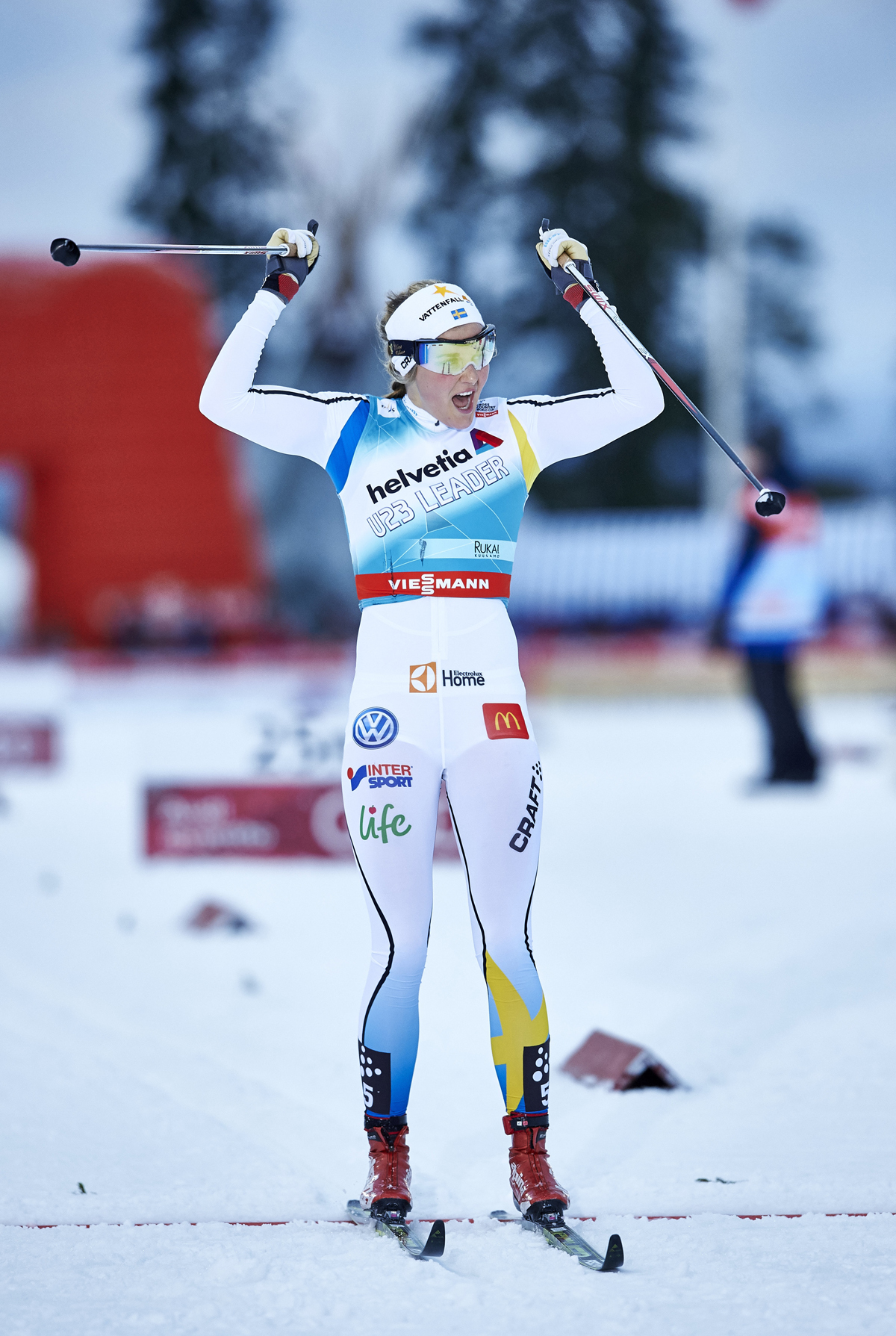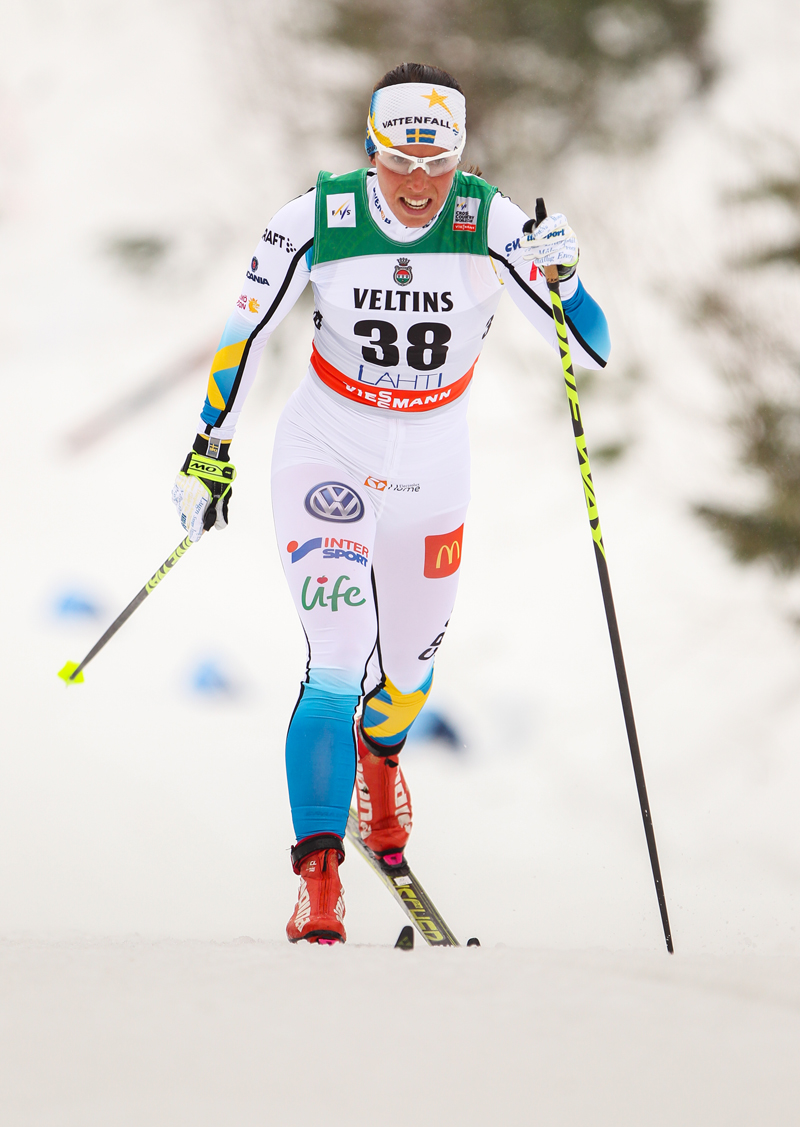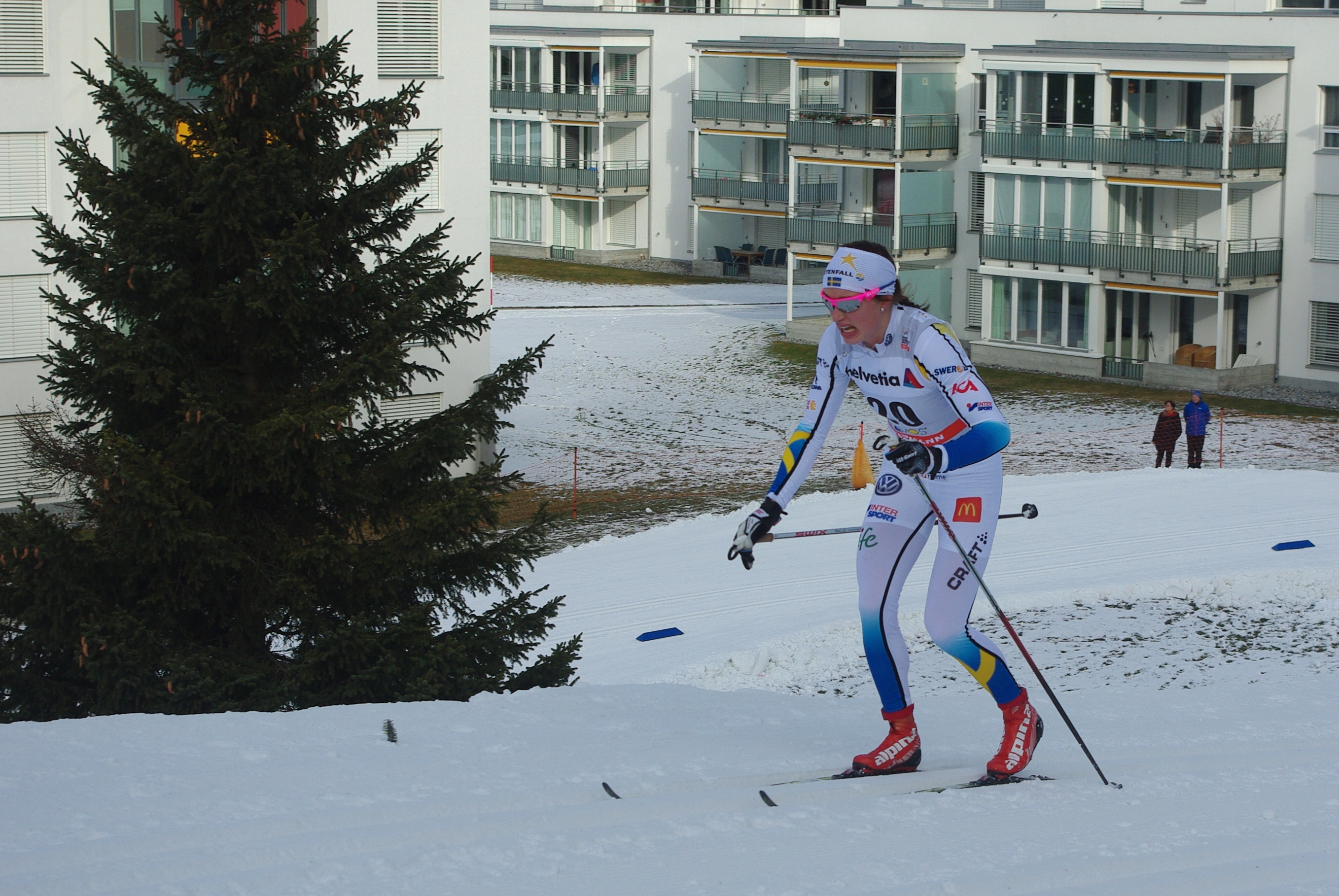
Tag: Ida Ingemarsdotter

  • Sargent and Caldwell Fifth for U.S. in Planica Team Sprint; Newell and Hamilton DQed

    Sargent and Caldwell Fifth for U.S. in Planica Team Sprint; Newell and Hamilton DQed

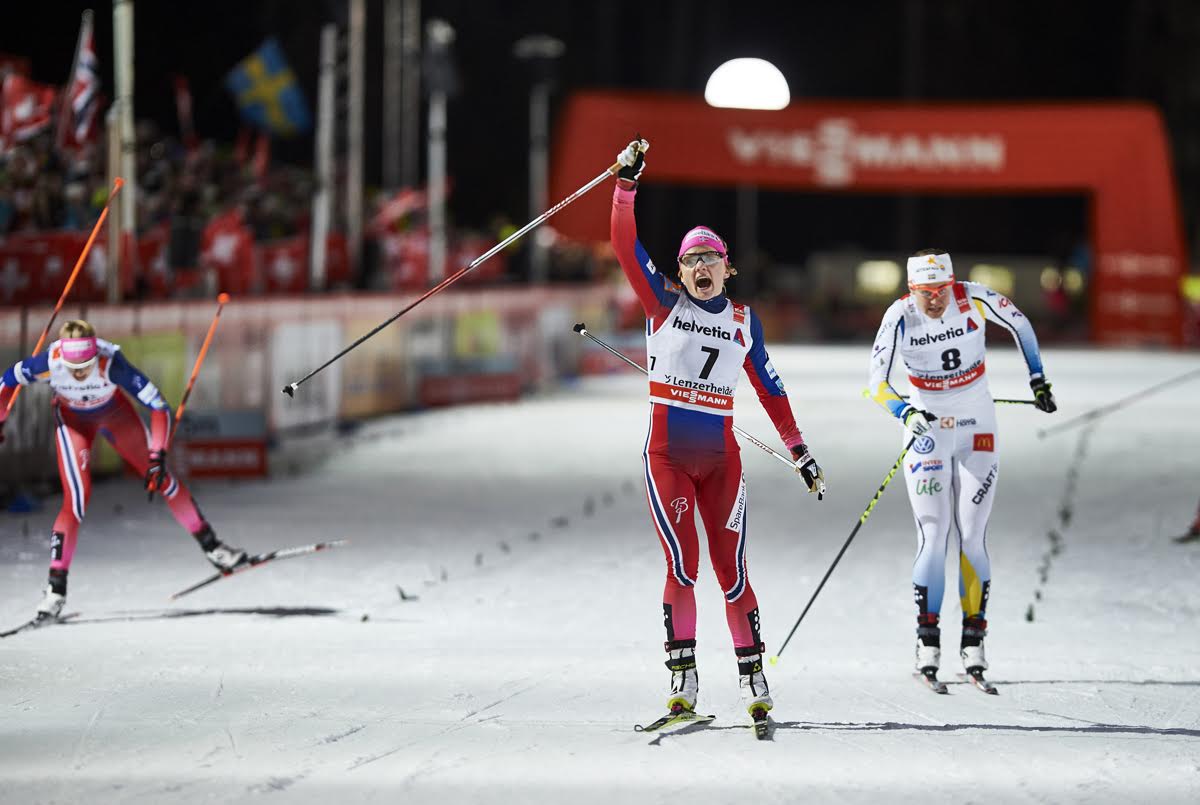
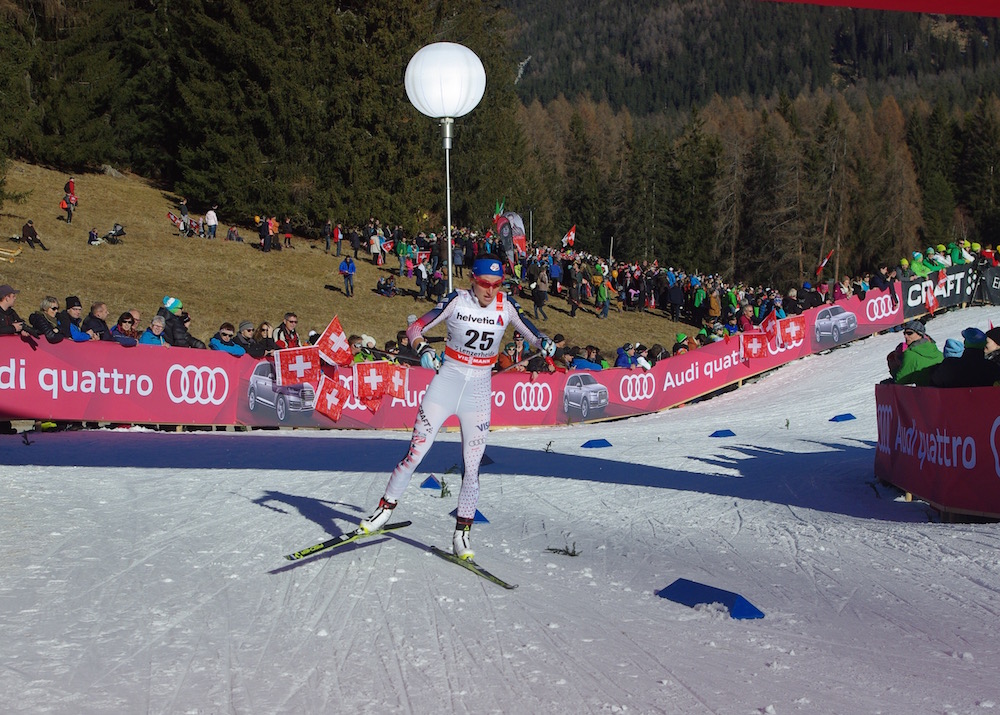
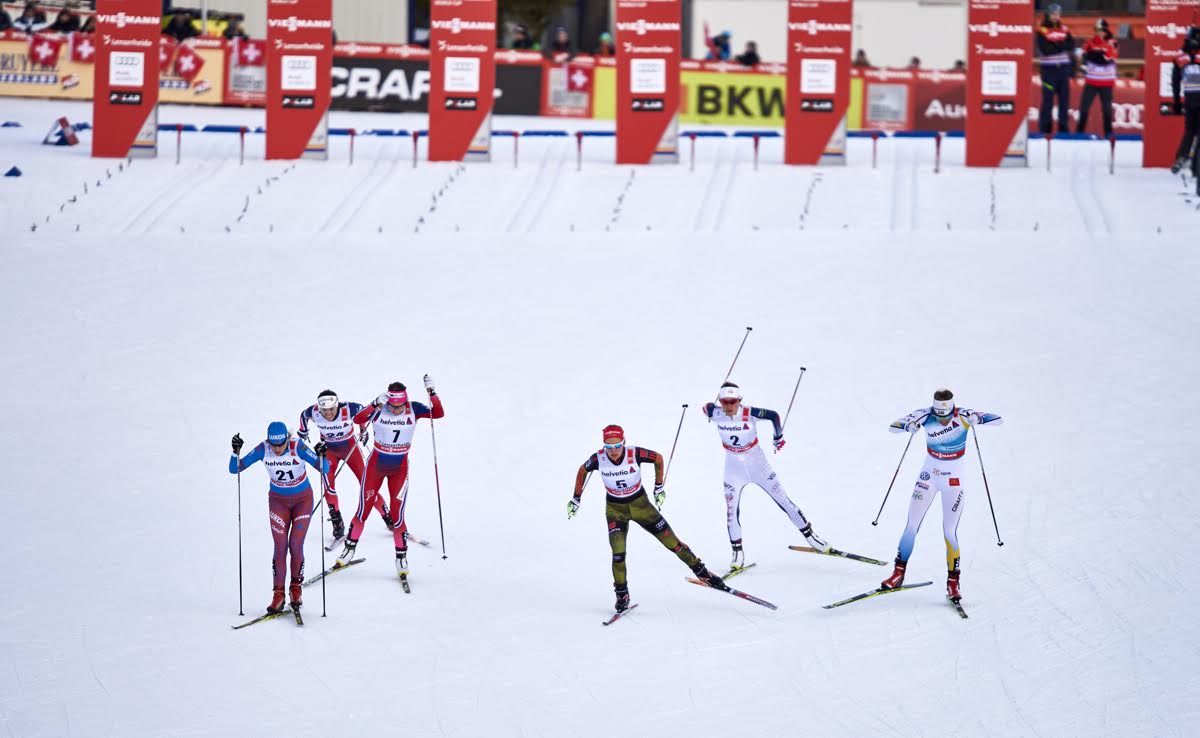
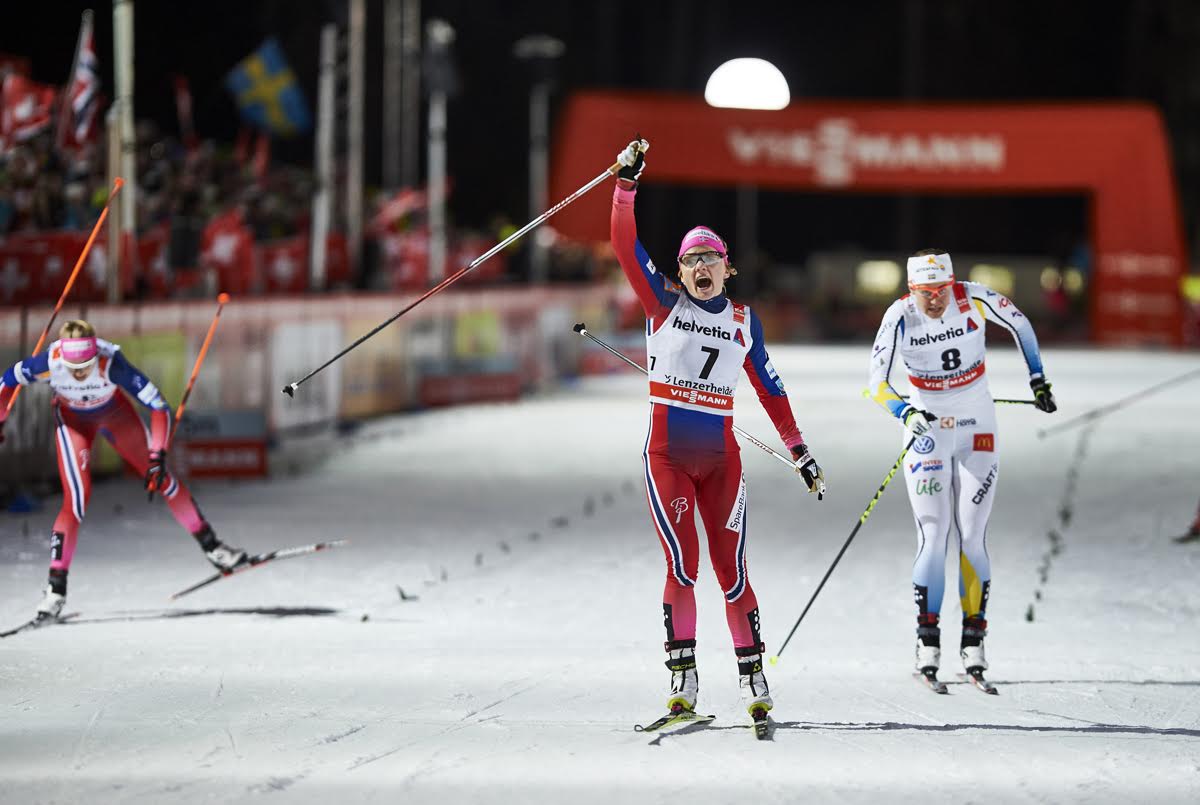
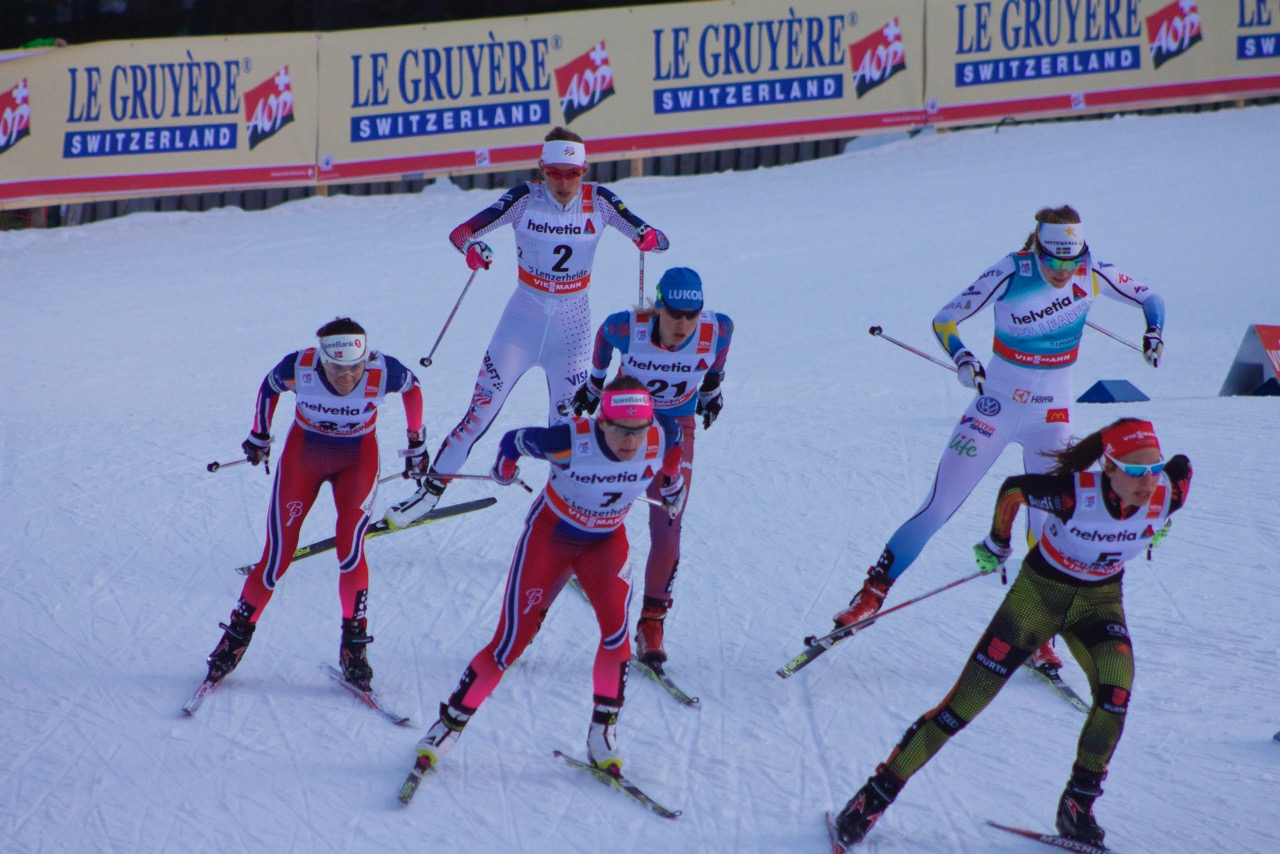
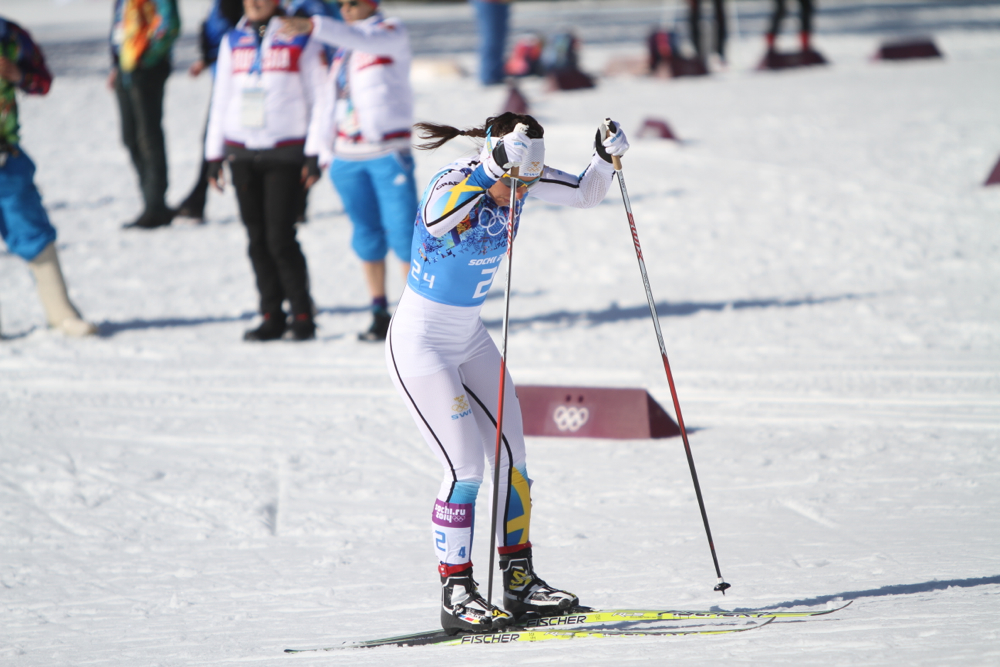
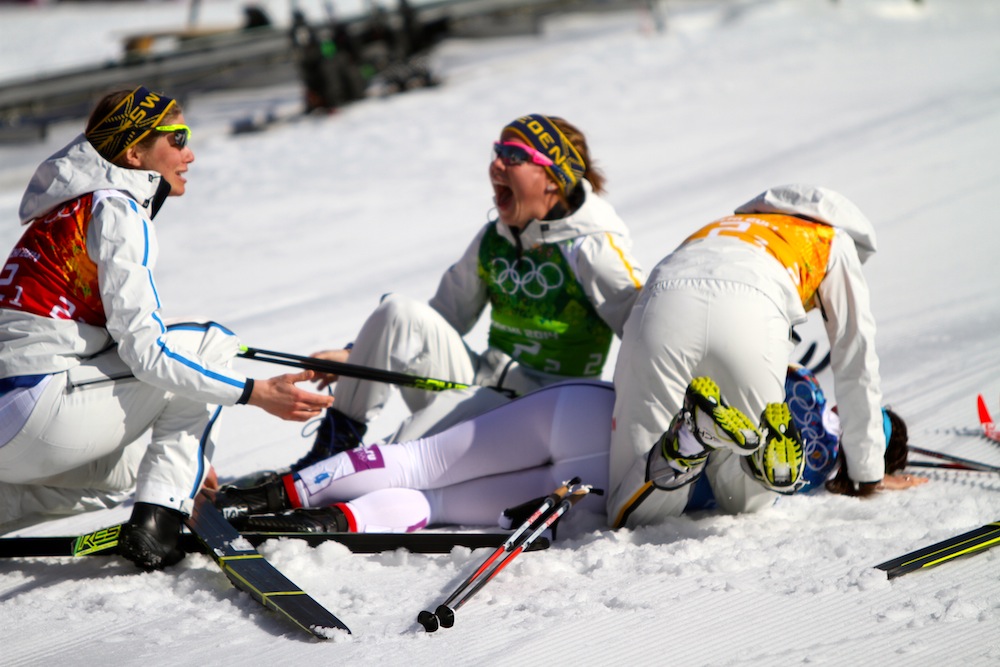
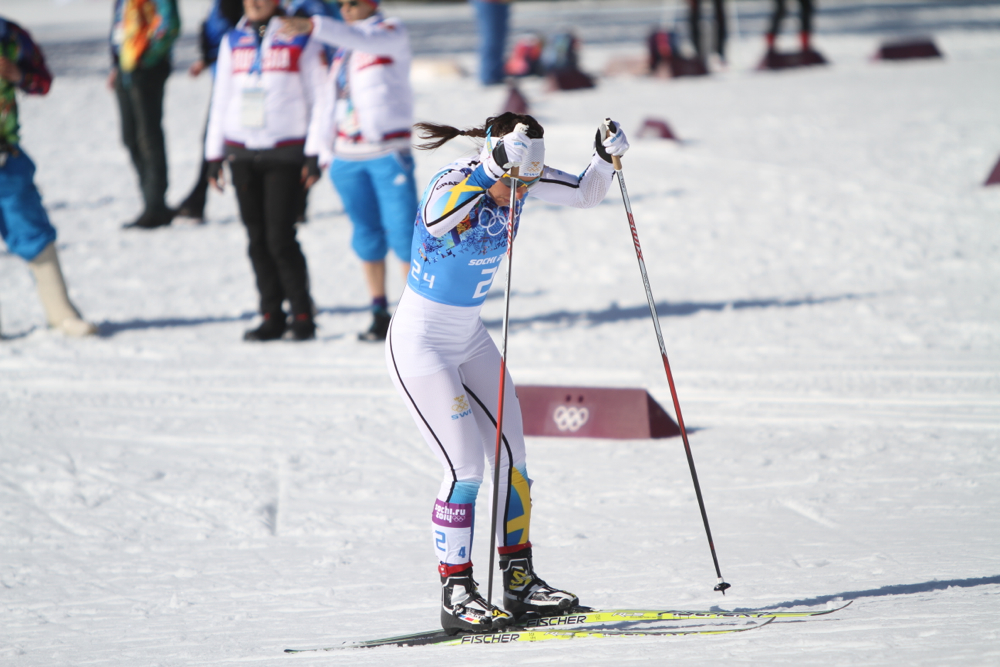
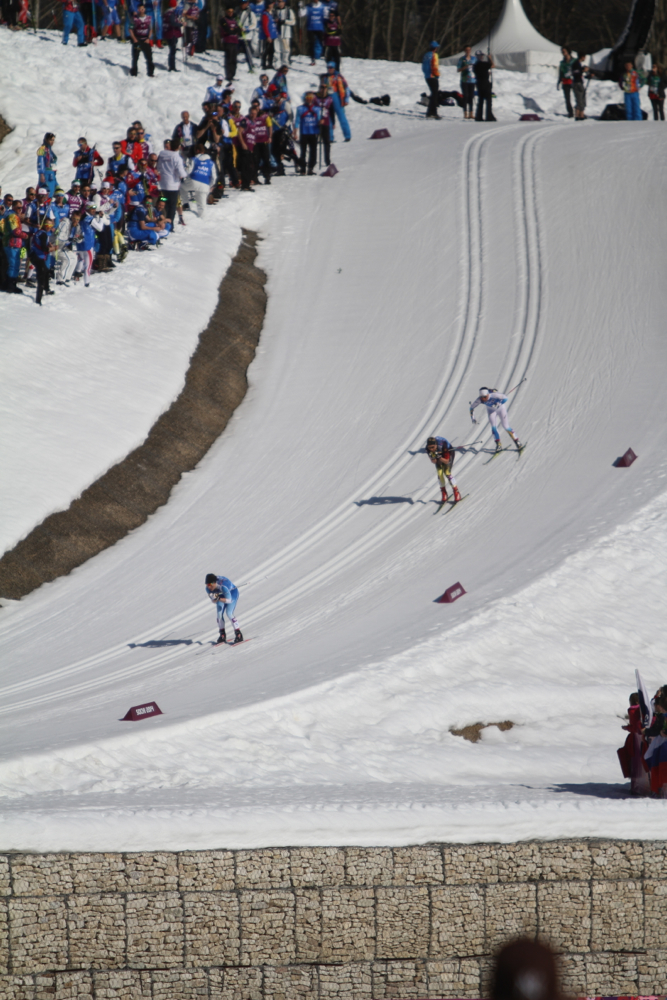
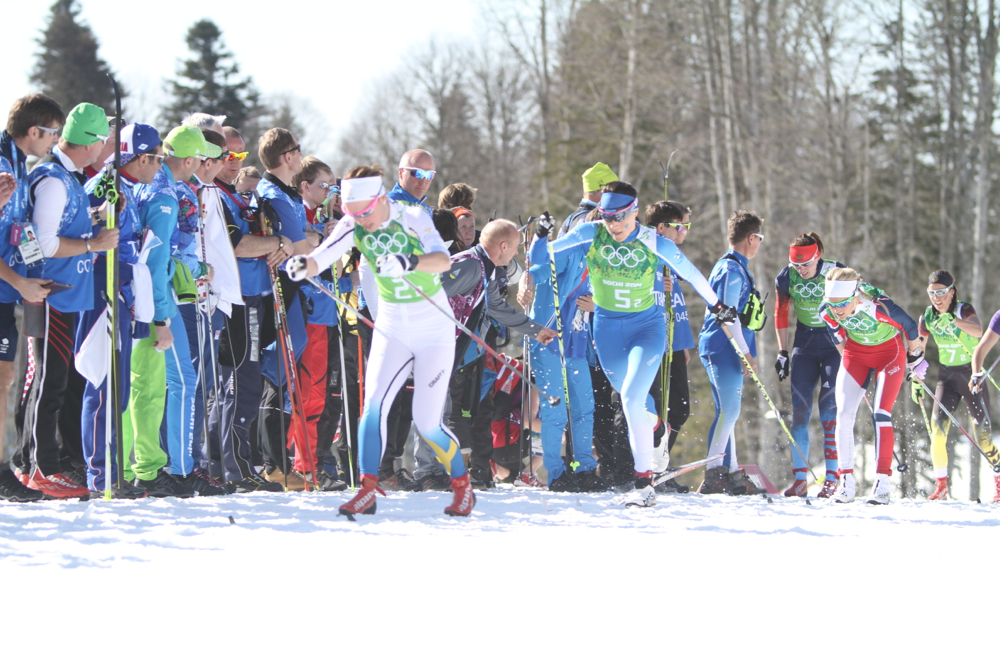
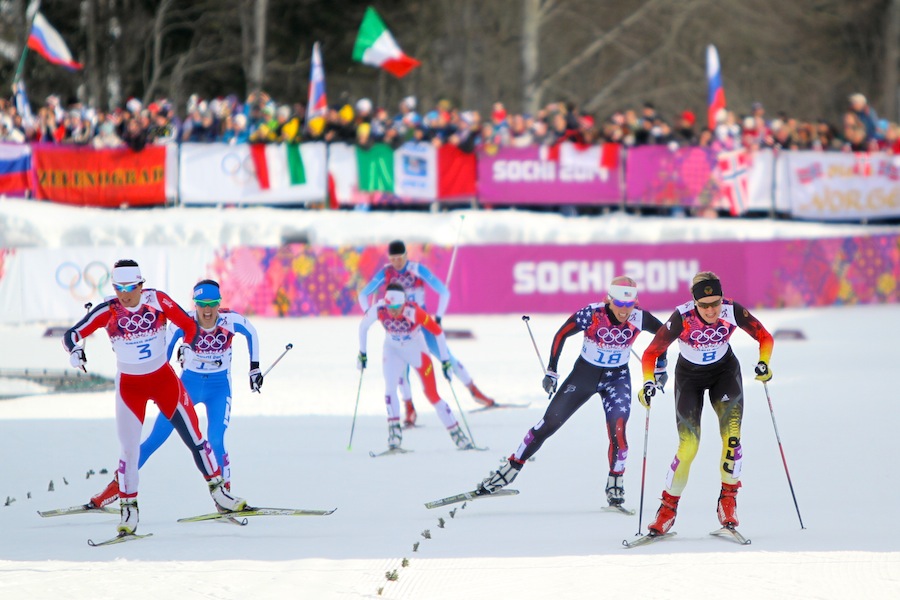
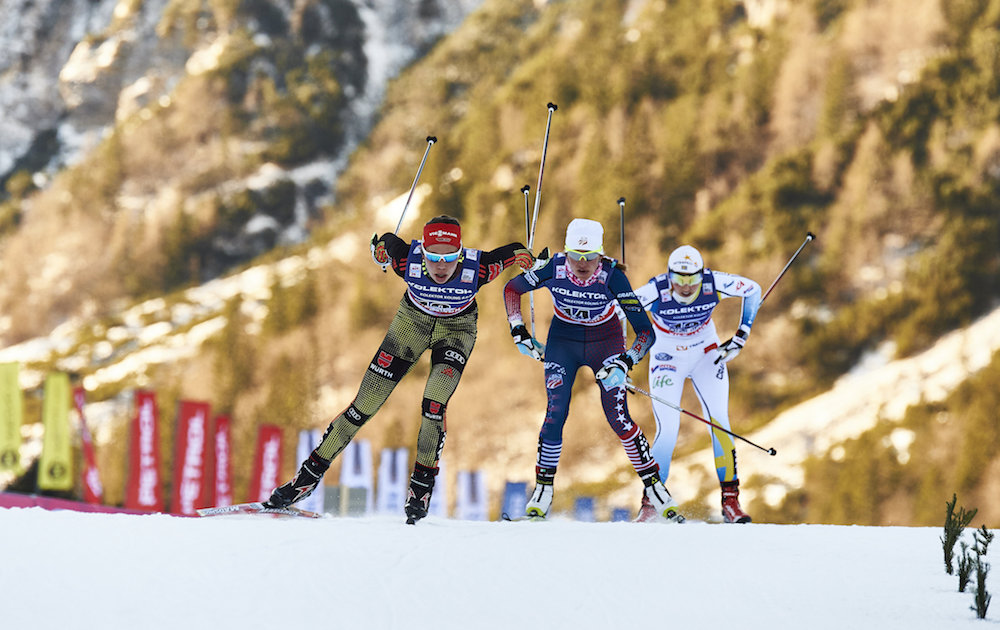
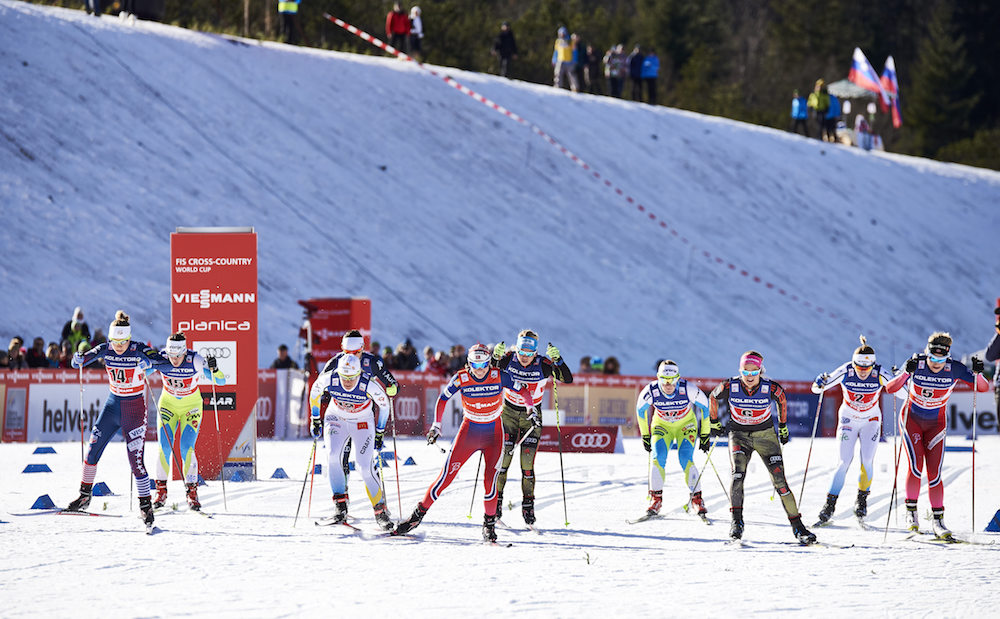
    The start of the women's freestyle team sprint final, with (from left to right) American Ida Sargent, Slovenia Vesna Fabjan, Sweden's Ida Ingemarsdotter, Norway's Heidi Weng, Germany's Sandra Ringwald, Slovenia's Nika Razinger, Germany's Laura Gimmler, Sweden's Jonna Sundling, and Norway's Mari Eide at the World Cup in Planica, Slovenia. (Photo: Fischer/NordicFocus)
    The start of the women’s freestyle team sprint final, with (from left to right) American Ida Sargent, Slovenia Vesna Fabjan, Sweden’s Ida Ingemarsdotter, Norway’s Heidi Weng, Germany’s Sandra Ringwald, Slovenia’s Nika Razinger, Germany’s Laura Gimmler, Sweden’s Jonna Sundling, and Norway’s Mari Eide at the World Cup in Planica, Slovenia. (Photo: Fischer/NordicFocus)

    The team sprint is a unique beast that World Cup racers only get one or two shots in a season to tame. Despite strong skiing, the U.S. men’s and women’s team came up just short of being in podium contention in the 6 x 1.2-kilometer freestyle team sprint at Sunday’s World Cup in Planica, Slovenia.

    The format of the team sprint competition features two-skier teams who each race alternating legs of a sprint course. Each skier completes three legs and they must make contact with their teammate in the exchange zone between each leg. The Planica team sprints were held on the same fast, twisty and technically-challenging 1.2 k course as Saturday’s freestyle sprint.

    The format poses unique challenges for athletes as well as logistical challenge for the staff. For the athletes racing three separate legs, it is a challenge of measuring energy output to be ready for the decisive moves in the last lap. The technicians have their own race in between heats to work on skis.
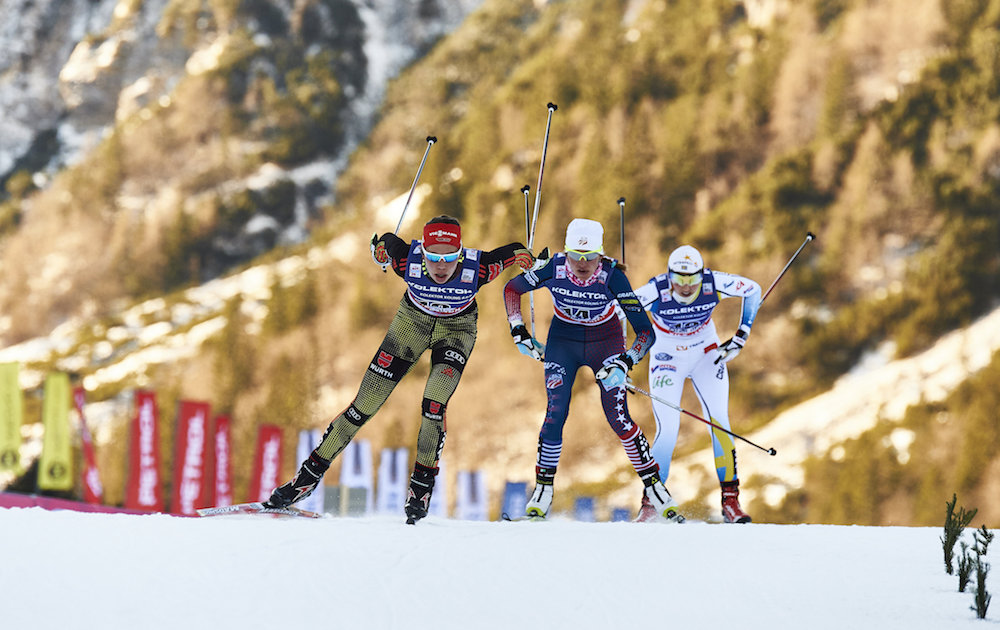
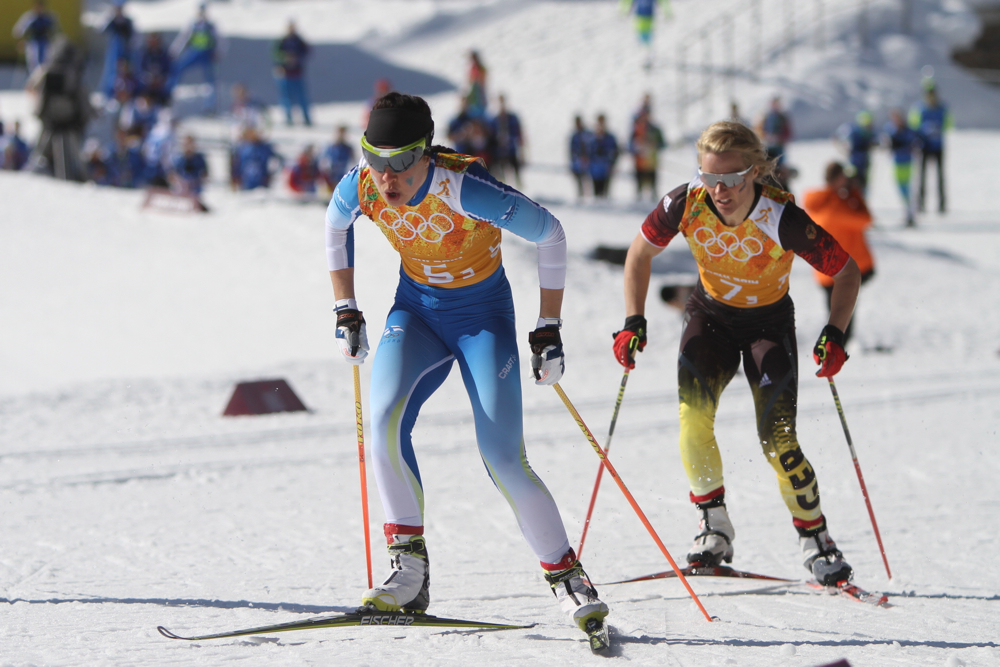
    American Sophie Caldwell (c) and Sweden's Stina Nilsson (r) trail Germany's Hanna Kolb during the women's freestyle team sprint final at the World Cup in Planica, Slovenia. (Photo: Fischer/NordicFocus)
    American Sophie Caldwell (c) and Sweden’s Stina Nilsson (r) trail Germany’s Hanna Kolb during the women’s freestyle team sprint final at the World Cup in Planica, Slovenia. (Photo: Fischer/NordicFocus)

    “One of the challenges is we don’t get a chance to race this event very often,” head coach Chris Grover said on the phone after Sunday’s race, in which two of three U.S. teams qualified for the final. “We are doing the only team sprint out of 37 starts [this season], so it is a very rare format.

    “It is really fun for the athletes and the staff. It is so logistically intense in terms of ski prep,” he added. “It is a race to get the skis off the athletes’ feet, freshened up, and back on their feet.”

    Grover noted the course was shorter than typically used in team sprints (it took the men about 2 1/2 minutes and the women 2:45 to round each time on Sunday.

    “Because of that short window, it makes for an extremely hectic time for the techs,” he said. “But our techs did an awesome job and we had great skis.”

    The U.S. entered one women’s team (with most of its athletes taking the weekend off following the Tour de Ski); Ida Sargent and Sophie Caldwell teamed up to take fifth in the final, 20.57 seconds behind Sweden I, with Stina Nilsson and Ida Ingemarsdotter, who won the event in 16:14.08. Norway I (Heidi Weng/Astrid Uhrenholdt Jacobsen) placed second (+3:51) and Germany I (Sandra Ringwald/Hanna Kolb) took third (+8.84).
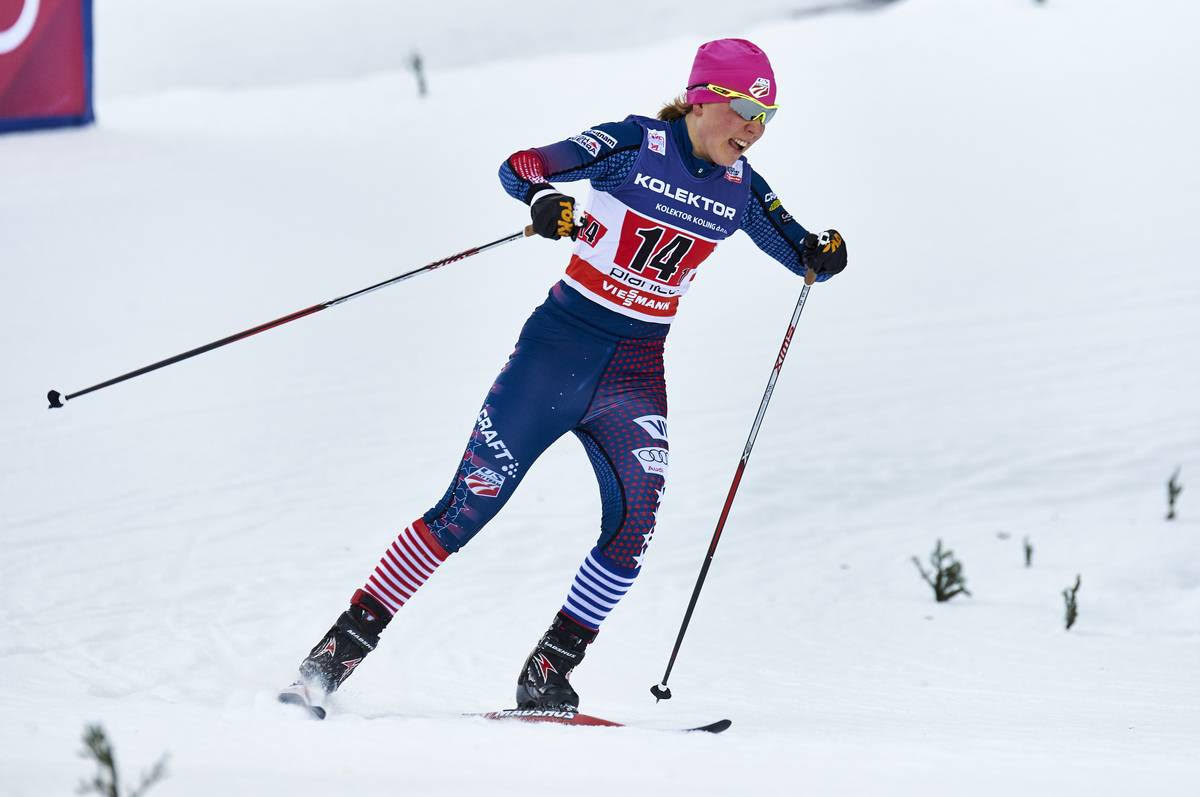
    Ida Sargent (U.S. Ski Team) teamed up with Sophie Caldwell (not shown) to place fifth in the 6 x 1.2 k freestyle team sprint at the World Cup in Planica, Slovenia. (Photo: Madshus/NordicFocus)
    Ida Sargent (U.S. Ski Team) teamed up with Sophie Caldwell (not shown) to place fifth in the 6 x 1.2 k freestyle team sprint at the World Cup in Planica, Slovenia. (Photo: Madshus/NordicFocus)

    Sargent and Caldwell delivered a well-executed semifinal to automatically advance in second place behind Sweden I, the eventual winners. In the team sprint racing, the top two teams advance in both semifinals, in addition to six lucky loser qualifiers.

    “Ida learned from yesterday how to pace the course and made a great move at the end of her last leg and tagged off in first,” Grover said of the semifinal. “Sophie brought it in easily in second to advance.”

    In the final, the field broke apart during the third leg when Weng began pushing the pace. Sweden and Germany responded, but Sargent lost time on the leaders. By the final handoff, the U.S. had slipped several places to sixth, 13 seconds behind the leaders.

    At the final handoff, Sargent tagged Caldwell in sixth, 13 seconds behind the leaders, for the finishing charge. Caldwell was able to catch Norway II and hold off Germany II to secure fifth place, 20.57 seconds behind the Swedish winners.

    “Those top women’s teams just skied away. They [Sargent and Caldwell] actually skied great all day and did tactically what they wanted to do,” Grover said.

    “It ties my best-ever team sprint result and is my best ever with Sophie so it was a good day,” Sargent said on the phone. “The course was really hard with lots of climbing and fast technical downhills so there wasn’t much recovery and it was important to balance pushing the pace and conserving energy for later rounds.”

    Newell and Hamilton Miss the Tag
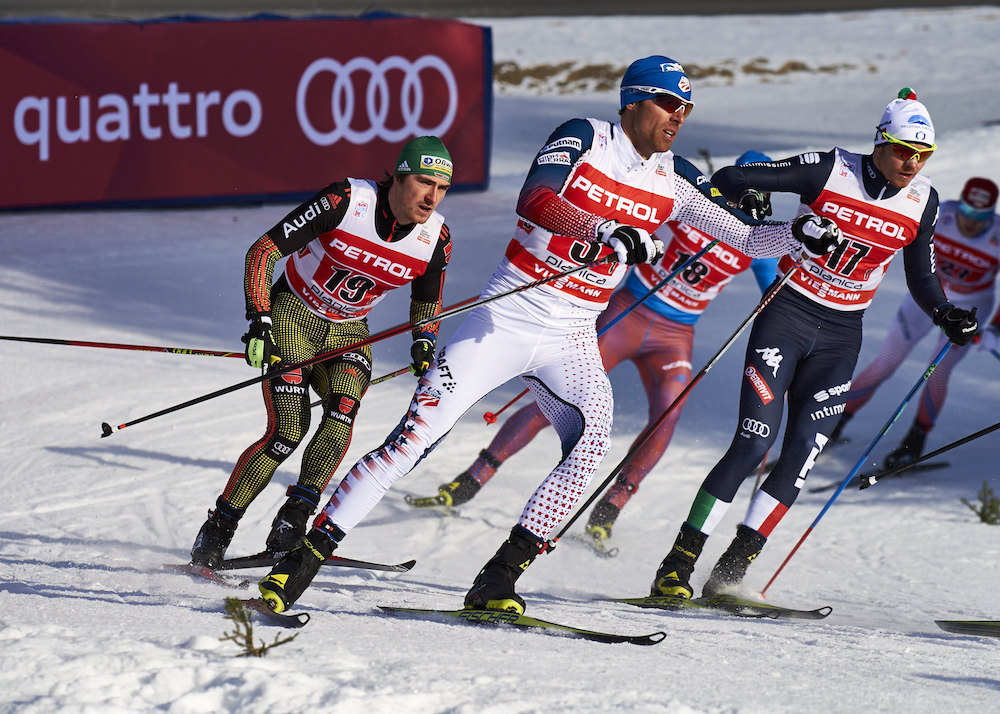
    Andy Newell (in white) rounds a corner with Germany's Thomas Bing (l), Italy's Dietmar Noeckler (r) during the World Cup men's freestyle team sprint final in Planica, Slovenia.
    Andy Newell (in white) rounds a corner with Germany’s Thomas Bing (l), Italy’s Dietmar Noeckler (r) during the World Cup men’s freestyle team sprint final in Planica, Slovenia.

    The men’s team of Andy Newell and Simi Hamilton made it to the final after advancing in fourth out of the first semifinal (behind the second teams for France, Russia and Norway, respectively). In the final, the Americans initially finished eighth, but were disqualified for missing a tag in the exchange zone.

    The men’s field remained tight throughout the final, making the exchange zone both challenging and game-changing.

    The U.S. men’s team ran into trouble when Hamilton entered a chaotic tag zone after his first leg for the second exchange.

    “It was basically unavoidable since the Norwegian, who was tagged right before I reached out to tag Andy, cut to the left and skied right between Andy and I, essentially creating a barrier,” Hamilton said on the phone. “We were tagging towards the end of the zone, so we didn’t have room to stop to ensure we made contact, even though both of us stretched as best we could.”

    They emerged out of second exchange in eighth, 2 seconds behind Norway II in the lead. One lap later, by the third exchange, they were 3.22 seconds back in ninth.

    Unsure whether the jury would rule an infraction, Newell and Hamilton continued to race. They finished eighth, less than six seconds off the podium. Italy I took the win with Dietmar Nöckler and Federico Pellegrino in 14:44.82, and France swept the remaining podium spots in second (+1.79) and third (+2.41), with Renaud Jay/Baptiste Gros and Valentin Chauvin/Richard Jouve, respectively. The first teams for Germany, Norway and Russia ended up fourth, fifth and sixth, respectively, and the top eight teams at the end of the day — not counting the Americans — all finished within nine seconds of one another.
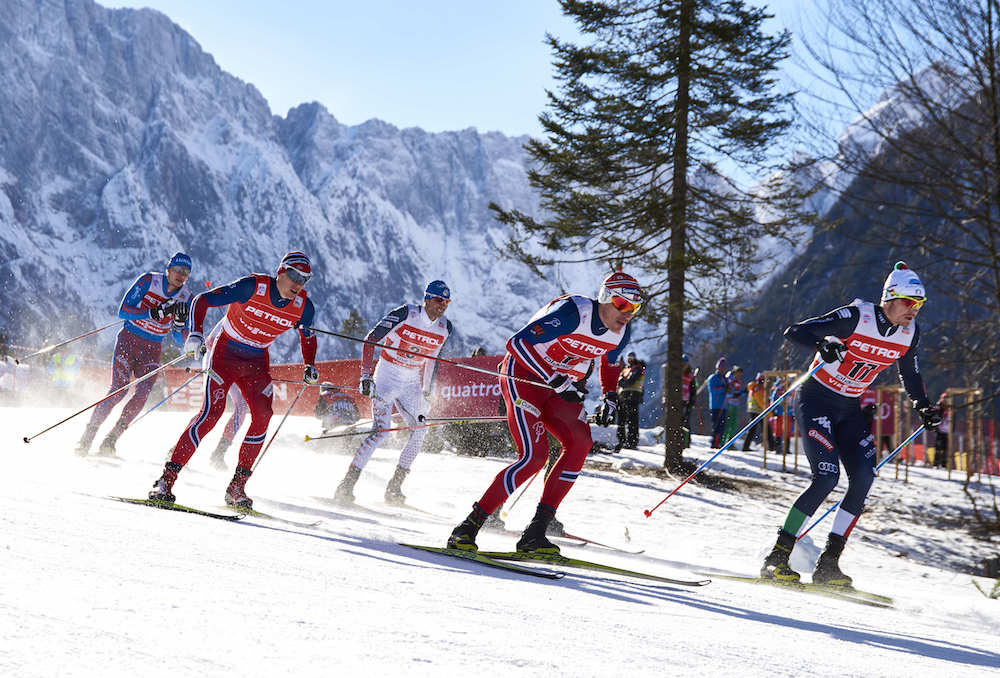
    (From right to left) Italy's Dietmar Nöckler leads Norway II's Ola Vigen Hattestad, American Andy Newell, and Norway I's Anders Gløersen and a Russian in the men's freestyle team sprint final at the World Cup in Planica, Slovenia. (Photo: Fischer/NordicFocus)
    (From right to left) Italy’s Dietmar Nöckler leads Norway II’s Ola Vigen Hattestad, American Andy Newell, and Norway I’s Anders Gløersen and a Russian in the men’s freestyle team sprint final at the World Cup in Planica, Slovenia. (Photo: Fischer/NordicFocus)

    “It was disappointing for sure, but it was a good call by the jury,” Grover said. “Andy and Simi have done a lot of team sprints together and tags are such a critical part of the team sprint. Andy and Simi are usually some of the very best at maintaining speed and having really good tags in chaotic situations, but today they just missed it.”

    Reflecting on their semifinal, in which they advanced as lucky losers, Newell was pleased with how he balanced his energy.

    “I was able to stay up near the front with Norway, stay out of trouble, and put down a hard third lap tagging Simi in second,” Newell said on the phone. “In the final I don’t think we found the same rhythm, at least I hard a harder time feeling the line of hard versus too hard. We got bounced around a bit in the back and our tags weren’t as smooth as in the semi. It’s easy to waste energy even just trying to pick off a few places can take it out of you each lap when you are coming from the back.”

    Considering the circumstances, Hamilton was content with the day.

    “I felt good today, and my speed and shape are rebounding after getting sick during the Tour de Ski,” he said.

    “Team sprinting is one of the hardest race formats we have, but it super fun,” Hamilton added. “It combines the best of sprinting and distance racing I think, and I hope we see more of it, or events similar to it, in the future.”

    This was the first and only team sprint on the World Cup calendar this season.

    (Story continues below)
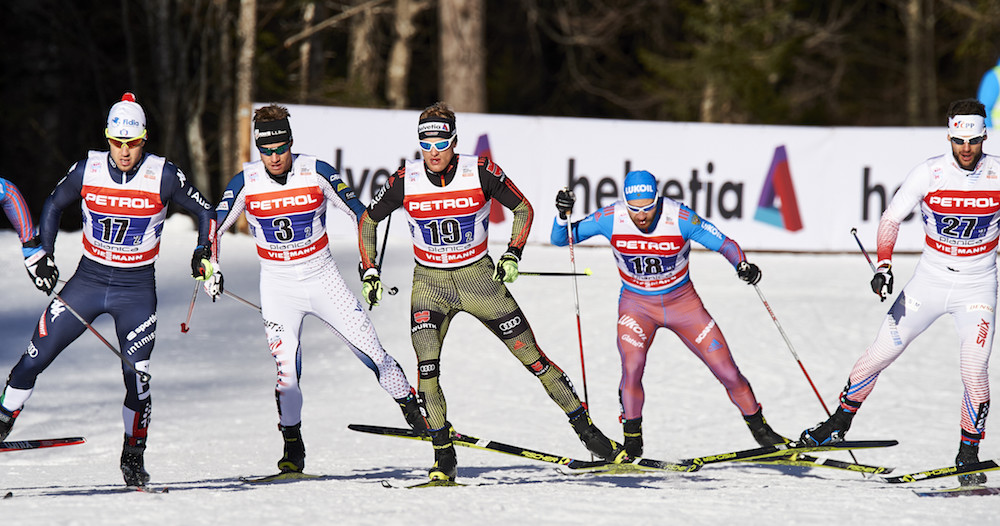
    (From left to right) Italy's Federico Pellegrino, American Simi Hamilton, Germany's Sebastian Eisenlauer, Russia's Alexey Petukhov, and Dusan Kozisek of the Czech Republic during the men's freestyle team sprint final at the World Cup in Planica, Slovenia. (Photo: Fischer/NordicFocus)
    (From left to right) Italy’s Federico Pellegrino, American Simi Hamilton, Germany’s Sebastian Eisenlauer, Russia’s Alexey Petukhov, and Dusan Kozisek of the Czech Republic during the men’s freestyle team sprint final at the World Cup in Planica, Slovenia. (Photo: Fischer/NordicFocus)

    Also competing for the U.S. was the second men’s team of Dakota Blackhorse-von Jess and Reese Hanneman. They finished 12th in the same semifinal as Newell and Hamilton, 51.08 seconds behind France II (Chauvin and Jouve) as the winner of that heat. Blackhorse-von Jess and Hanneman did not advance and ended up 23rd overall.

    “For Dakota and I, it was just a chance to get right in the big pack of the fastest guys in the world and see what we could do,” Hanneman wrote in an email. “No amount of preparation could really prepare you for the chaos that happens at breakneck speed out there.”

    “I think they were both left wanting more,” Grover said. “They are going to need some time in Europe to get get acclimated some good training and racing and hopefully come into their top form.”

    The weekend following the Tour de Ski can be rough on teams and the U.S. team is feeling the effects.

    “It was a little bit of a flat weekend overall for us,” Grover observed. “We are certainly feeling the effects of post-Tour de Ski fatigue, both physical and mental, and we have a bit of illness going around the team so all of these things added up to take our edge off a bit, but I think we’ll be back by next weekend.”

    ‘Good save Canada!’

    Four Canadian teams raced Sunday, but none advanced out of the semifinals. Canada’s second women’s team, with Cendrine Browne and Emily Nishikawa, placed eighth in the second women’s semifinal, 55.64 seconds behind Sweden I as the winners of that heat, for 15th overall.
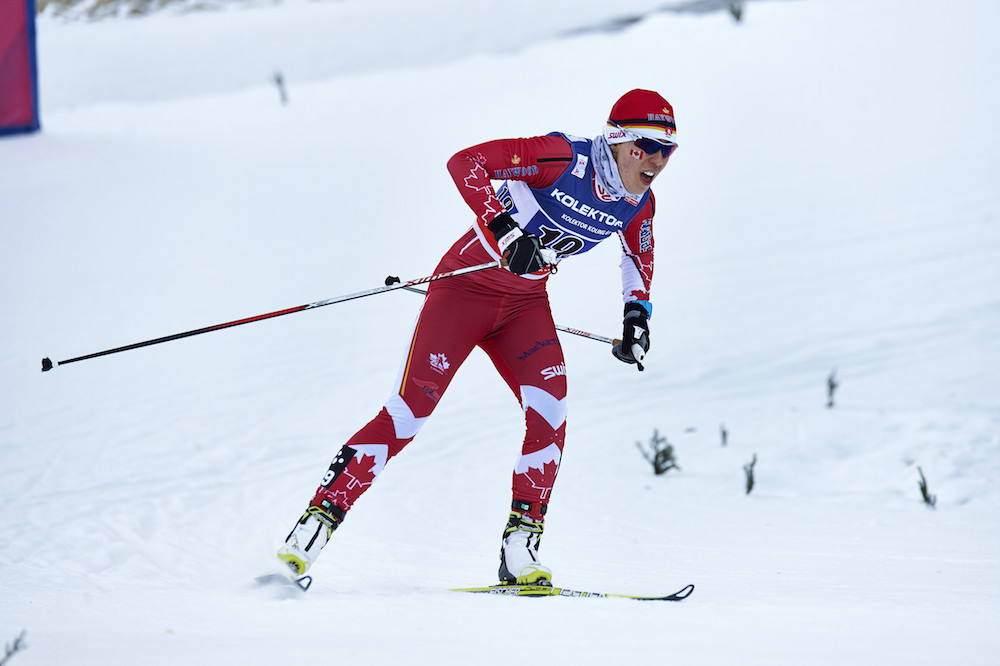
    Emily Nishikawa teamed up with Cendrine Browne (not shown) to represent Canada II in the women's World Cup freestyle team sprint on Sunday in Planica, Slovenia. They placed eighth in the semifinal for 15th overall. (Photo: Fischer/NordicFocus)
    Emily Nishikawa (above) teamed up with Cendrine Browne (not shown) to represent Canada II in the women’s World Cup freestyle team sprint on Sunday in Planica, Slovenia. They placed eighth in the semifinal for 15th overall. (Photo: Fischer/NordicFocus)

    In that same semi, Canada I, with Maya MacIsaac-Jones and Dahria Beatty, finished 10th (+1:06.39) for 19th overall.

    “I focussed on staying with the pack as long as possible,” Browne, Canada II’s first starter, recalled in an email. “I managed to stay with them on the first lap but on my second lap, we were already a couple seconds back.

    “The down hills are pretty sketchy … I almost fell today but catched myself at the last second!” she added. “The jury even told me: Good save Canada!”

    “The women fought hard, but it will take some more racing at that level to get used to the speed,” Alberta World Cup Academy head coach Chris Jeffries, who’s leading the Canadian team in Slovenia, said in a Cross Country Canada press release. “These World Cups are definitely focused on development, and hopefully they will take some really good lessons to their training in preparation for the Ski Tour Canada races in March and the coming years.”

    Both Canadian men’s teams squared off in the second semifinal, with Knute Johnsgaard and Len Valjas placing ninth for Canada I (+13.23) for 16th overall, and Jess Cockney and Andy Shields finishing 12th for Canada II (+23.85) for 22nd overall.

    Results: 

    Women: Semifinals | Final

    Men: Semifinals | Final

  • Nilsson, Pellegrino Anchor Team Sprint Victories, Complete Slovenian World Cup Sweep

    Nilsson, Pellegrino Anchor Team Sprint Victories, Complete Slovenian World Cup Sweep

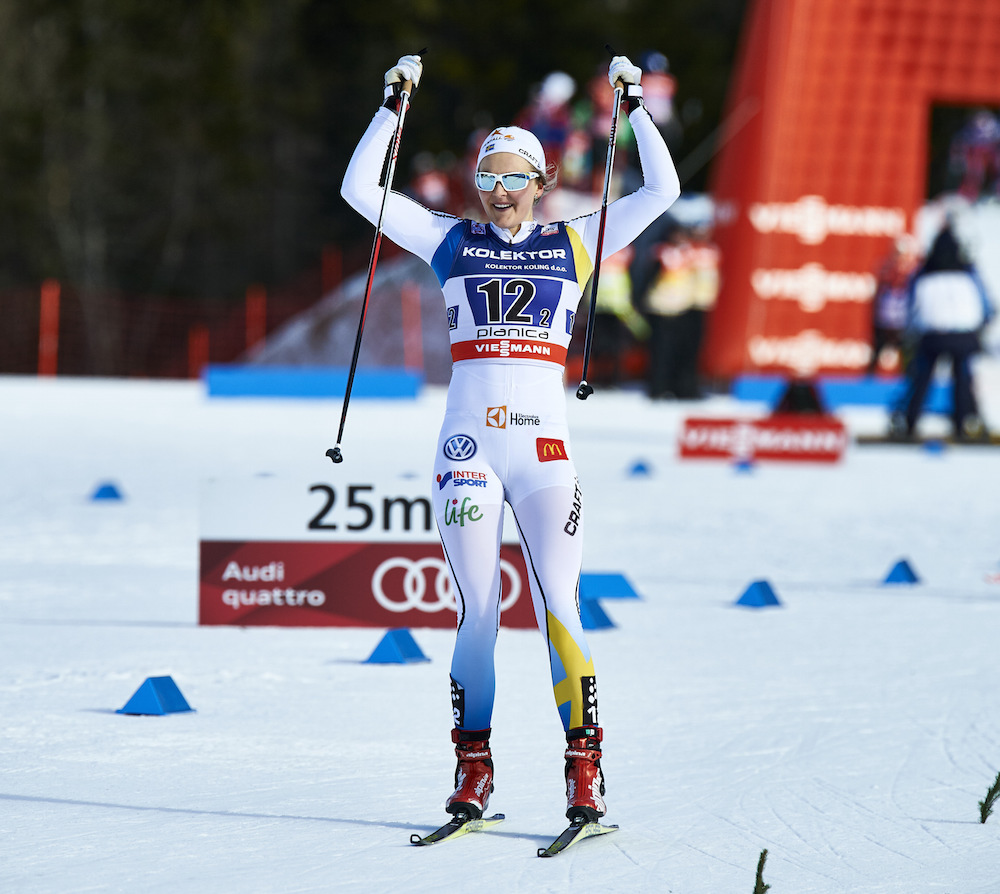
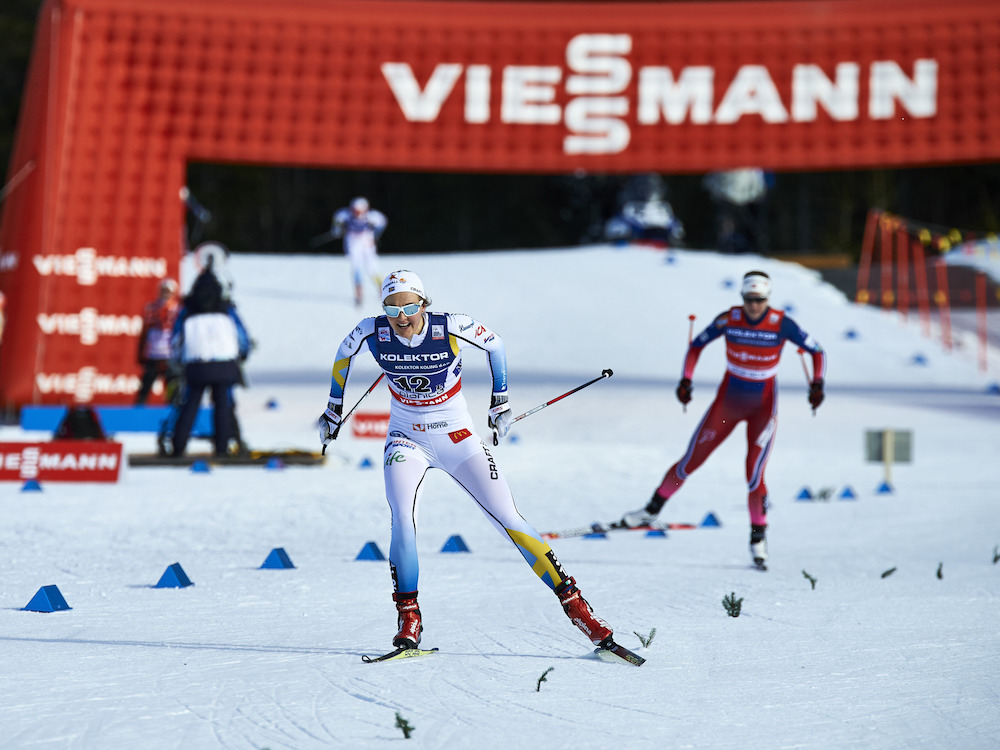
    Stina Nilsson on her way to securing the win for Sweden, with teammate Ida Ingemarsdotter (not shown), in the women's freestyle team sprint at the World Cup in Planica, Slovenia. (Photo: Fischer/NordicFocus)
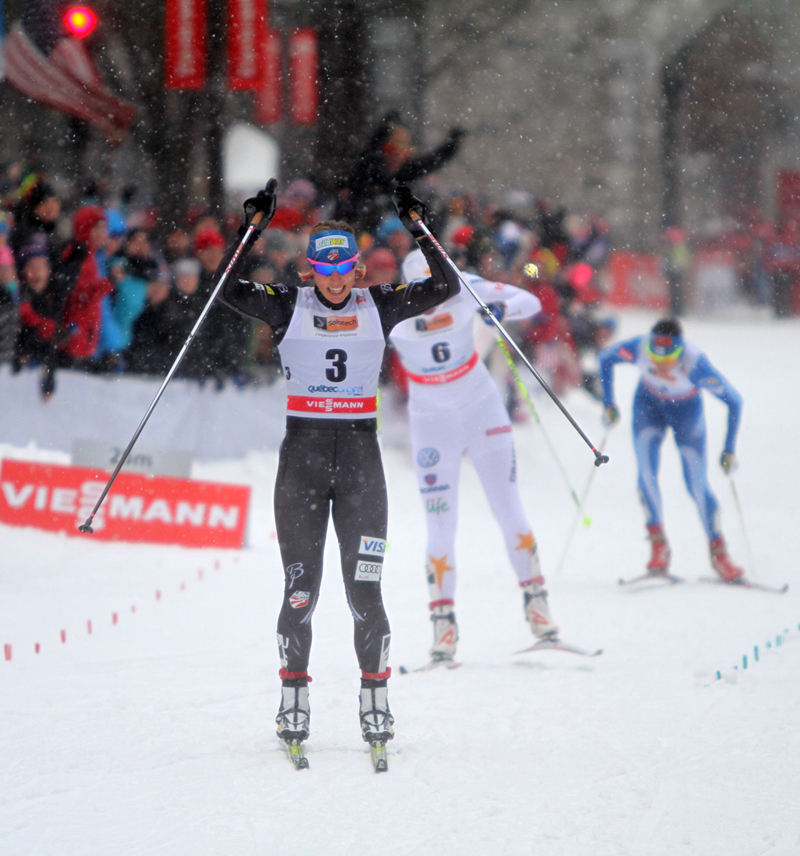
    Stina Nilsson smiles as she secures the win for Sweden with teammate Ida Ingemarsdotter (not shown) in the women’s freestyle team sprint final at the World Cup in Planica, Slovenia. She beat Norway’s Astrid Jacobsen (behind) for the victory. (Photo: Fischer/NordicFocus)

    Groundhog Day. That was the feel of Sunday’s 6 x 1.2-kilometer freestyle team sprints at the World Cup in Planica, Slovenia, a day after Sweden’s Stina Nilsson and Italy’s Federico Pellegrino won the individual freestyle sprints on the same one-lap 1.2 k course.

    The women’s team sprint came down to the final climb on the last leg — just like in the last round of the individual women’s sprint on Saturday. Trailing a Norwegian on the last descent and into the base of the climb back up to the stadium (yesterday it was Ingvild Flugstad Østberg; today it was Astrid Uhrenholdt Jacobsen), Nilsson carried her speed to pull up alongside and blow past the Norwegian, leading by the top.

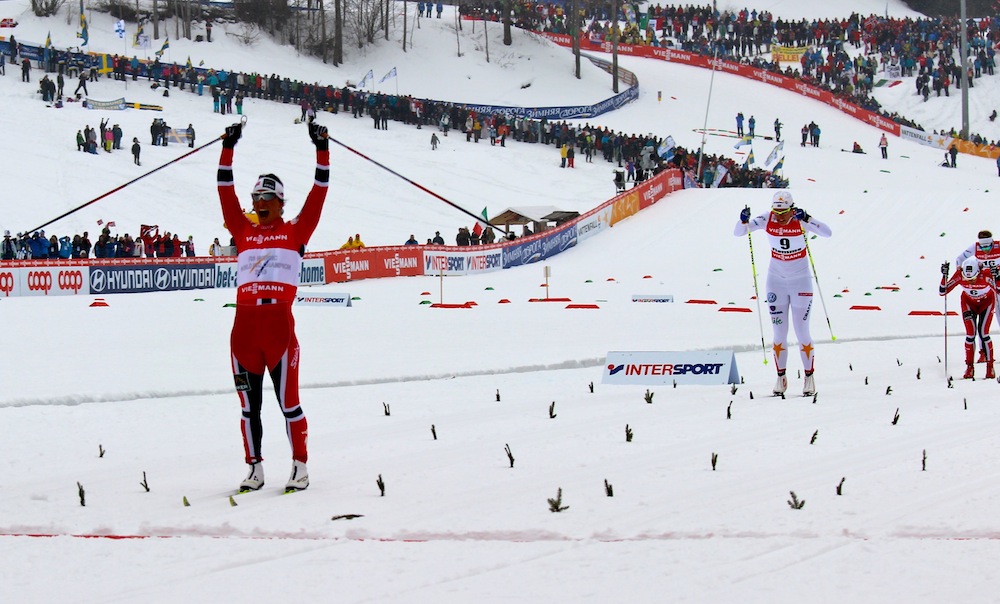
    Look familiar? That's because it is. Sweden's Stina Nilsson notched her second-straight victory of the World Cup weekend in Planica, Slovenia, on Sunday, anchoring Sweden I to the freestyle team sprint win. (Photo: Fischer/NordicFocus)
    Look familiar? That’s because it is. Sweden’s Stina Nilsson notched her second-straight victory of the World Cup weekend in Planica, Slovenia, on Sunday, anchoring Sweden I to the freestyle team sprint win. (Photo: Fischer/NordicFocus)

    The 22-year-old Nilsson, both U23 and Sprint World Cup leader, continued to accelerate in the last 200 hundred meters to the finish, winning in 3.51 seconds for her second victory of the weekend. Nilsson shared it with Ida Ingemarsdotter, 30, teammates on Sweden’s first team (noted as Sweden I).

    “We had a great day as a team. You could say we are a good couple,” Nilsson told FIS after the race. “Ida did a great work. In the final lap I was in a good position and I could ski as I wanted. I am very satisfied with the weekend in Planica.”

    After sharing the podium with Nilsson on Saturday, Heidi Weng and Jacobsen teamed up for Norway I and finished second after leading at every exchange, just ahead of the Swedes. Nilsson and Ingemarsdotter had won their semifinal (ahead of Americans Ida Sargent and Sophie Caldwell in second) to automatically advance to the final, and Weng and Jacobsen won the other semifinal.

    “This is better than third, but not good enough tactically to win,” Jacobsen told VG after the final, according to a translation. “Towards the end Stina had a gear that I had not.”

    After nine of 10 teams skied within four seconds of the lead through the first two exchanges, Weng picked up the tempo on her second leg (third overall), and Ingemarsdotter and Germany’s I’s Sandra Ringwald stuck closest to her. Meanwhile, Sweden II slipped about 1.5 seconds off the pace in fourth, while the U.S., with Ida Sargent and Sophie Caldwell, skied in fifth (+4.46) at the third exchange — the halfway point.

    One lap later, Jacobsen and Nilsson remained close, about half a second ahead of Sweden II’s Hanna Falk in third. Germany’s I’s Hanna Kolb came through the exchange a second later in fourth. By the final exchange, Weng and Ingemarsdotter had gapped Germany’s Ringwald, skiing in third, by 2 1/2 seconds.

    “I knew Weng would run hard, especially in the second and third lap and am happy that I could latch on to and give Stina a good position,” Ingemarsdotter told Dagens Nyheter, according to a translation.

    “Ida made it perfect. I just got the position I wanted,” Nilsson said.

    Germany’s first team hung onto third and secured third, 8.84 seconds behind Sweden and 5.33 seconds behind Norway, for their first podium in almost two years.

    “My attack came maybe a little too early, but it was the plan, and maybe that didn’t totally work out because I folded a little in the end,” Ringwald told German TV broadcaster ZDF. “But the three of us were able to create a gap, and so we are satisfied with the third place.”

    “I am really relieved, because we knew we had a gigantic chance today and that we had to grasp it,” Kolb said. “Just a great feeling.”

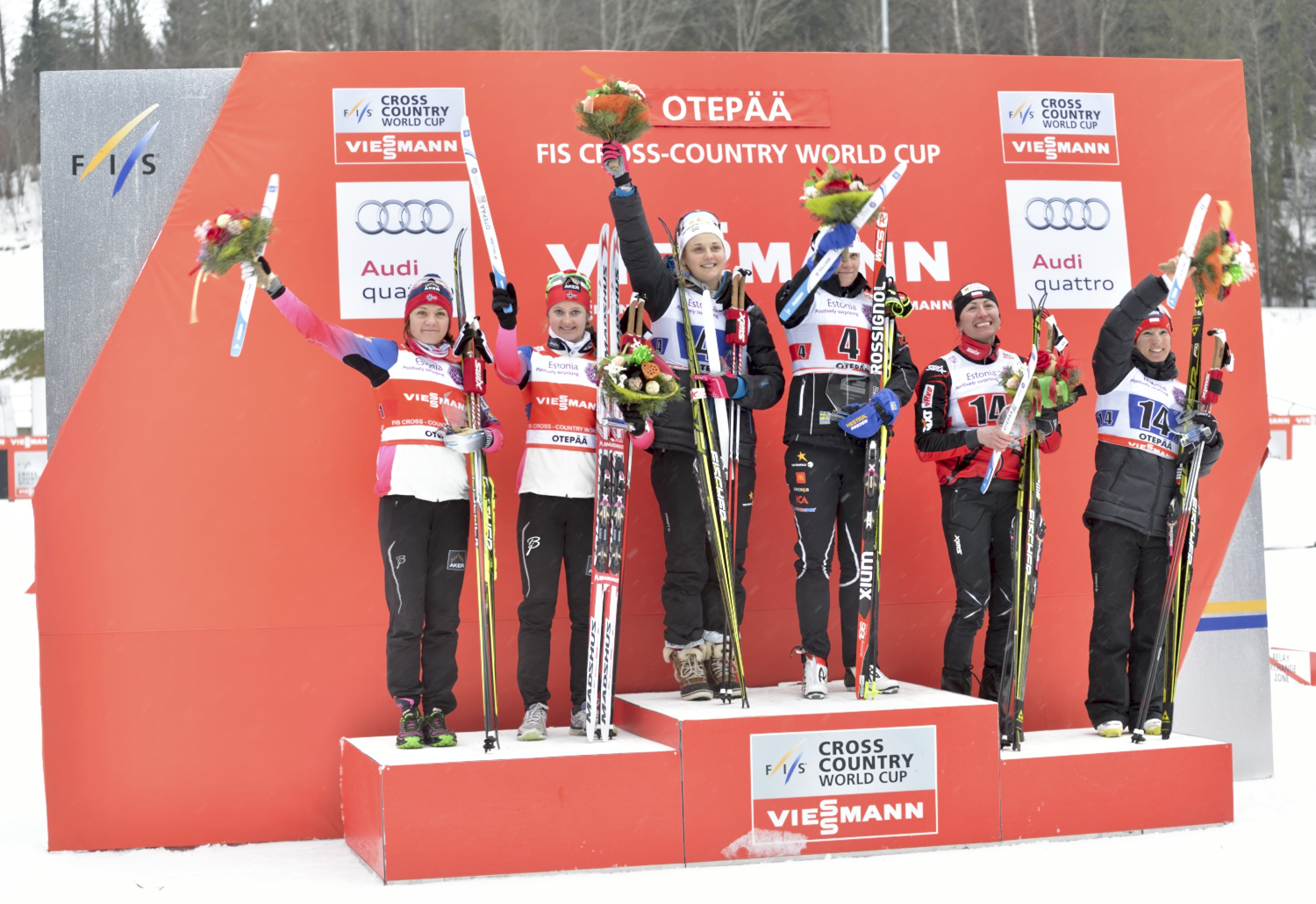
    Last season, Nilsson and Ingemarsdotter won the only team sprint on the schedule — also freestyle technique — in Otepää, Estonia. There, they beat Norway’s Maiken Caspersen Falla and Østberg by 0.85 seconds, and Poland’s Justyna Kowalczyk and Sylwia Jaskowiec finished 0.95 seconds back in third.

    Falla and Østberg rested on Sunday, while Mari Eide and Kathrine Rolsted Harsem represented Norway II. Fourth through seventh were separated by 2.77 seconds, with Falk (Sweden II) leading the chase group in for fourth (+18.24), followed by Caldwell in fifth (+20.57).

    Germany II’s Lucia Anger edged Harsem in a photo finish for sixth by 0.01 seconds, 21 seconds behind the winners. Two Slovenian teams reached the final, placing eighth (+47.24) and 10th (+2:42.12), while Italy finished ninth (+55.98).

    (Story continues below)

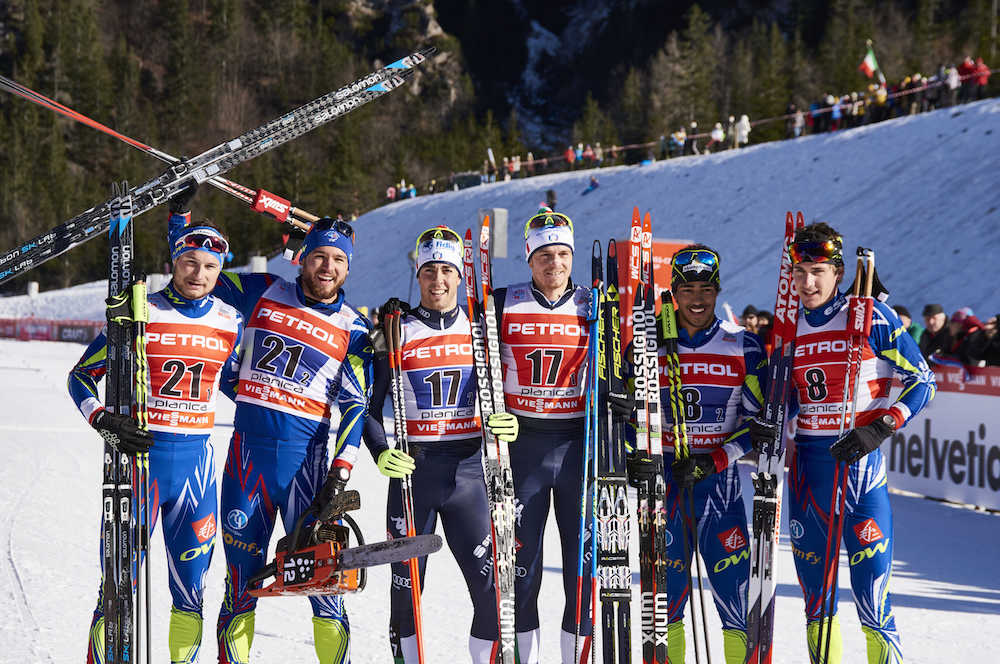
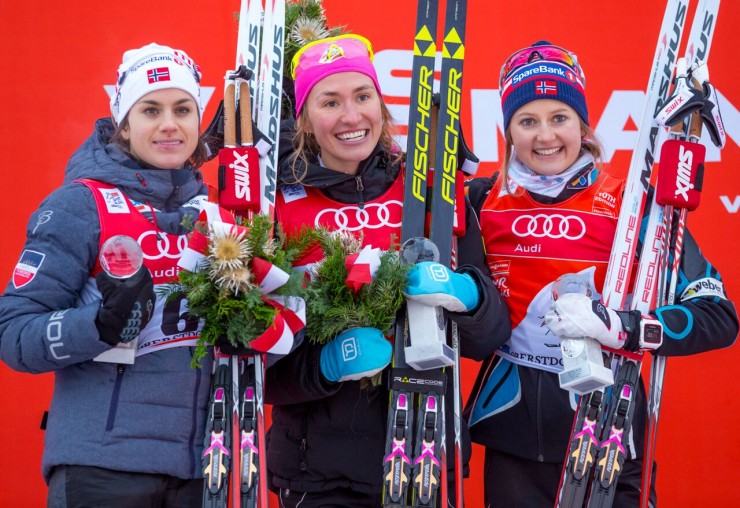
    The men's freestyle team sprint podium at the World Cup in Planica, Slovenia: with Italian winners Federico Pellegrino and Dietmar Nöckler (c), France I's Renaud Jay and Baptiste Gros (l) in second, and France II's Valentin Chauvin and Richard Jouve (r) in third. Yes, Gros is holding a chainsaw -- a noisemaker borrowed from spectators. (Photo: Fischer/NordicFocus)
    The men’s freestyle team sprint podium at the World Cup in Planica, Slovenia: with Italian winners Federico Pellegrino and Dietmar Nöckler (c), France I’s Renaud Jay and Baptiste Gros (l) in second, and France II’s Richard Jouve, age 21, and Valentin Chauvin, age 20, (r) in third. Yes, Gros is holding a chainsaw — a chain-free noisemaker borrowed from spectators. (Photo: Fischer/NordicFocus)

    Italy, France, France 

    Minutes after the women’s final, the men’s final played out to produce the identical winner to Saturday’s sprint — Italy’s Federico Pellegrino — who essentially pulled off the same move as Nilsson, not long after she anchored the Swedish women to the win in 16:14.08. Pellegrino anchored Italy’s first team (with teammate Dietmar Nöckler) to the win in 14:44.82.

    In yet another repeat, France occupied the remaining spots on the podium in the men’s race. Renaud Jay of France’s first team led five frontrunners into the exchange zone for the last time, with France I, Germany I, Italy I, Russia I, and Norway I all within a second of one another.

    On the next lap, Jay’s teammate Baptiste Gros set a blistering pace and Pellegrino chased him up the longest climb on the course. There, they began to break away from Germany and France’s second team, and Gros continued to lead up the final ascent.

    On that climb, Pellegrino pulled a “Nilsson,” so to speak, as he carried his momentum from the downhill draft to pass Gros before the top. The 25-year-old Pellegrino, who became Italy’s winningest Italian male skier of all time on Saturday with his seventh individual World Cup win, added another victory to his resume as he skated away toward the finish, looking back a few strides before and winning in 1.79 seconds.

    (From right to left) Italy's Dietmar Nöckler leads Norway II's Ola Vigen Hattestad, American Andy Newell, and Norway I's Anders Gløersen and a Russian in the men's freestyle team sprint final at the World Cup in Planica, Slovenia. (Photo: Fischer/NordicFocus)
    (From right to left) Italy’s Dietmar Nöckler leads Norway II’s Ola Vigen Hattestad, American Andy Newell, and Norway I’s Anders Gløersen and a Russian in the men’s freestyle team sprint final at the World Cup in Planica, Slovenia. (Photo: Fischer/NordicFocus)

    France I’s Jay and Gros place second, and France II, with 20-year-old Valentin Chauvin and Richard Jouve, 21, held off Germany for third (+2.41).

    Germany I, with Thomas Bing and Sebastian Eisenlauer, notched fourth (+2.93). Norway missed the podium for the second-straight men’s race with Norway I’s Anders Gløersen and Eirik Brandsdal in fifth (+4.51) and Norway II’s Ola Vigen Hattestad and Pål Golberg in seventh (+7.66), behind Russia’s Gleb Retivykh and Alexey Petukhov in sixth (+6.46).

    Americans Andy Newell and Simi Hamilton crossed the finish line in eighth, but were disqualified for missing the tag in the zone on the second exchange.

    Early in the race, Gløersen led though the first exchange to give Norway I an early lead, but they slipped to sixth with Brandsdal on the next leg, 1.3 seconds behind Norway II in first. Hattestad had brought Norway II into the lead, and by the fourth exchange, his teammate Golberg remained third, within half a second of Pellegrino and Gros. One lap later, Norway I and II came through the last exchange in fifth and sixth, 1 and 2 seconds out, respectively.

    Norwegian commentators were quick to call Sunday’s final another instance of the Norwegians being “outclassed,” pointing out that six Norwegians occupy the top seven in the men’s overall World Cup standings. In the sprint standings, Pellegrino leads Norway’s Sondre Turvoll Fossli by nearly 200 points. Finn Hågen Krogh ranks fourth and Petter Northug is the third Norwegian in the top six.

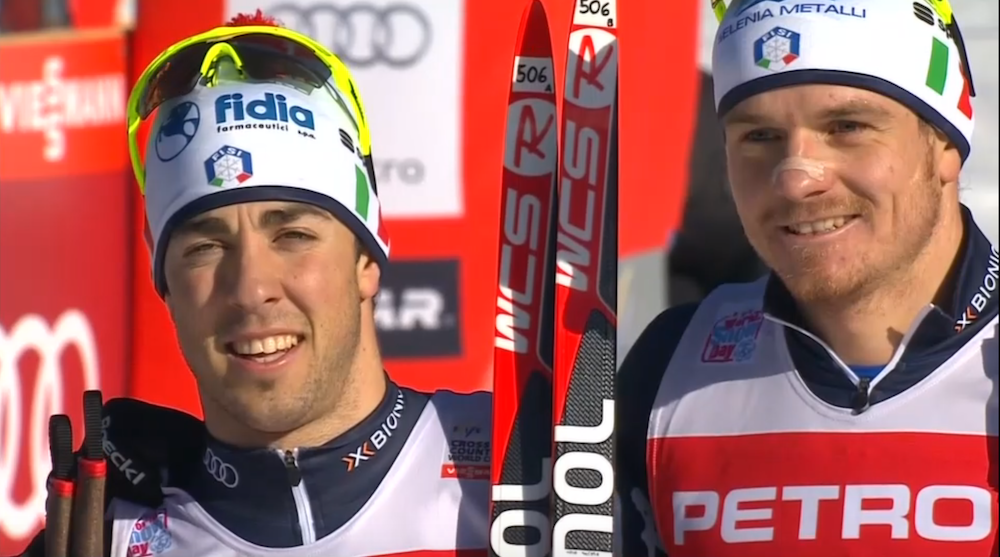
    Italian teammates Federico Pellegrino (l) and Dietmar Nöckler after winning Sunday's World Cup freestyle team sprint in Planica, Slovenia.
    Italian teammates Federico Pellegrino (l) and Dietmar Nöckler after winning Sunday’s World Cup freestyle team sprint in Planica, Slovenia.

    “I realized a dream I had at a very young age,” Pellegrino told Italy’s La Gazzetta after Sunday’s win, according to translation. It was apparently Italy’s first team-sprint win since the women won in 2010 in Düsseldorf, Germany.

    “In my early years of the World Cup, one of my first trips to the World Cup was in Düsseldorf, where they scheduled just a sprint and team sprint,” he added. “Seeing champions such [Italy’s Arianna] Follis and [Norway’s] Hattestad that could make a perfect weekend lit my imagination. I wondered if I could ever do it.”

    For Nöckler, 27, it was his first World Cup win.

    “I did not feel that good in the semifinal,” he told FIS after he and Pellegrino qualified second behind France’s Jay and Gros. France II won the other semifinal.

    “I knew Federico is the best finisher in the world,” Nöckler added. “I tried to work hard to prepare a good position for him. We have won five Italian national championships together. It is great to win the World Cup.”

    At 2015 Word Championships, Nöckler and Pellegrino earned bronze in the freestyle team sprint (behind Norway and Russia, respectively).

    France’s Jay was thrilled to be on the podium after placing fourth on Saturday.

    “I knew Baptiste was very strong today,” Jay told FIS. “I wanted to gain some meters before the last exchange so that Baptiste has advantage on Pellegrino, but Federico was too strong.”

    For Chauvin, the weekend marked his first on the World Cup.

    “It is just amazing,” he said of Sunday’s podium. “It is fantastic I could be on the podium with my friends. The whole team did great here during the whole weekend.”

    Results: 

    Women: Semifinals | Final

    Men: Semifinals | Final
  • One for the Books: Caldwell Wins Oberstdorf Classic Sprint, Over Weng & Østberg

    One for the Books: Caldwell Wins Oberstdorf Classic Sprint, Over Weng & Østberg

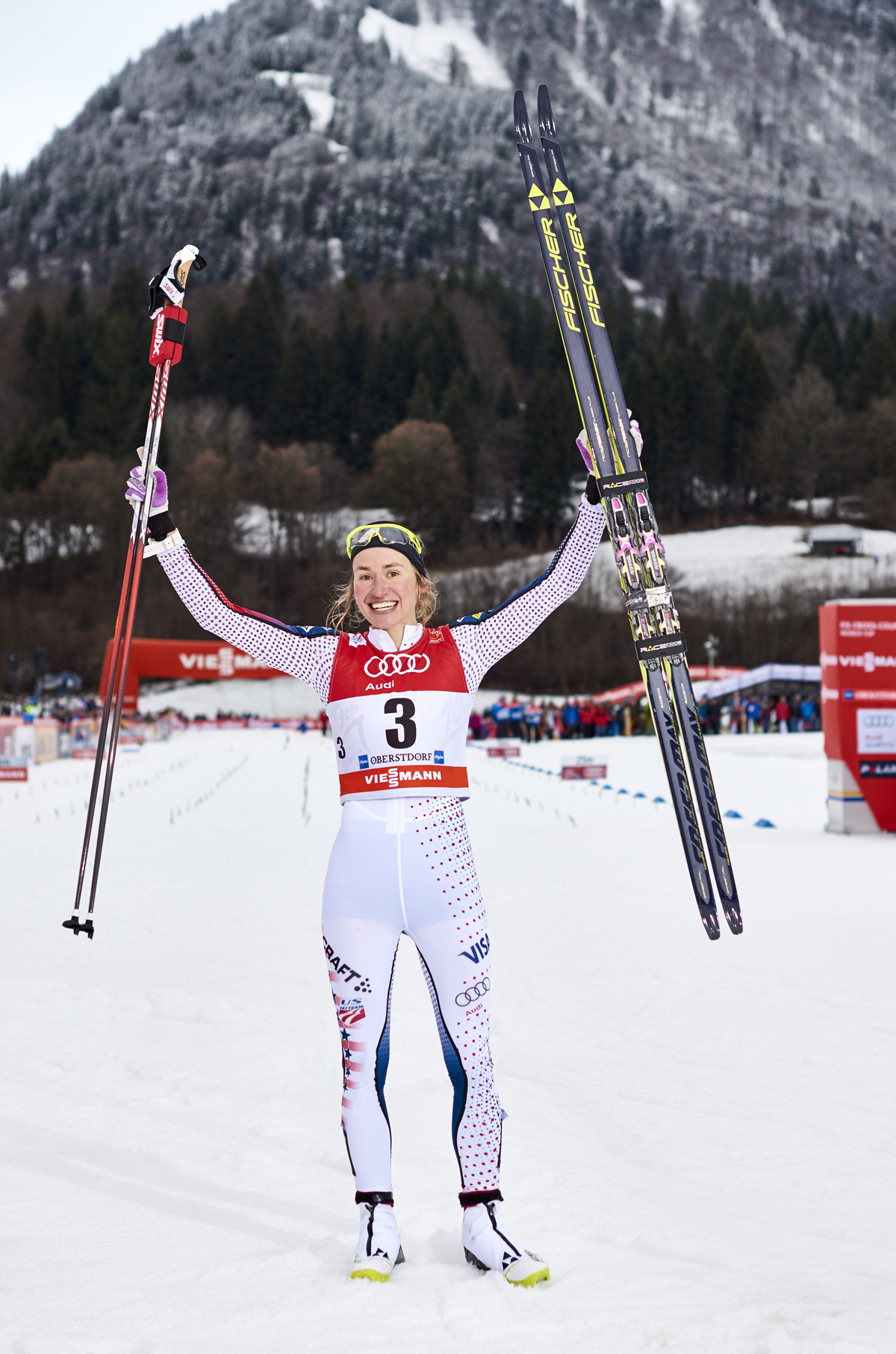
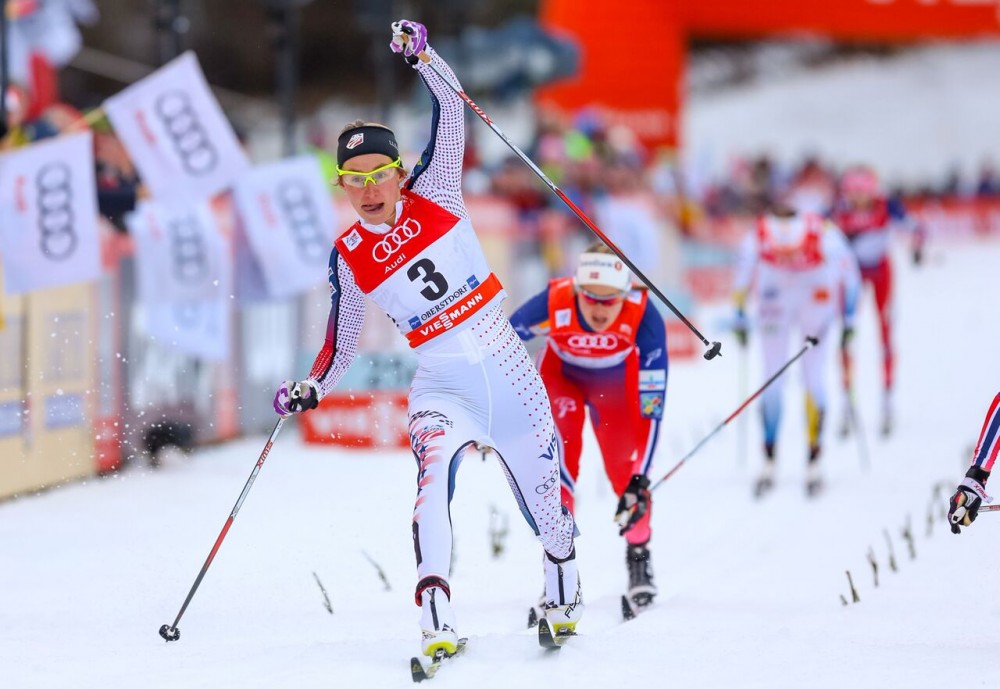
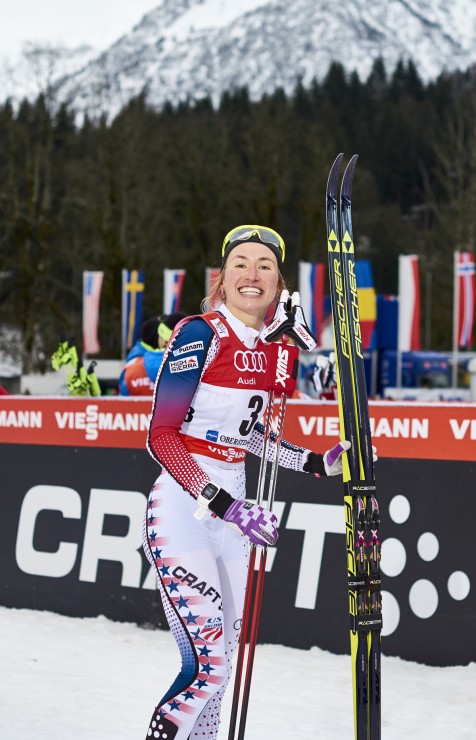
    Sophie Caldwell (U.S. Ski Team) after winning the 1.2 k classic sprint final at Stage 4 of the Tour de Ski in Oberstdorf, Germany. (Photo: Marcel Hilger)
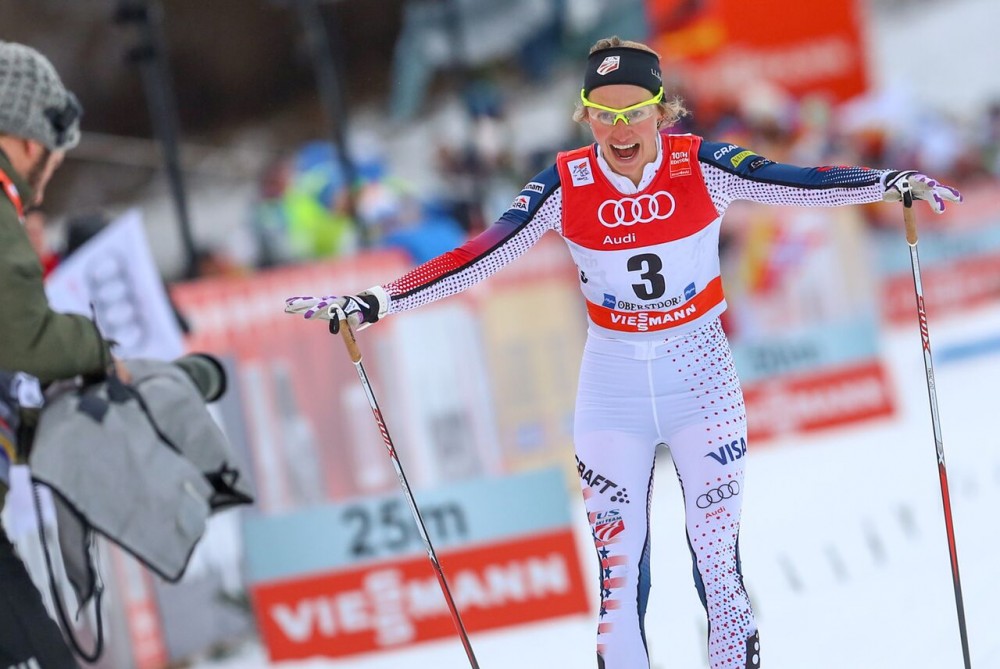
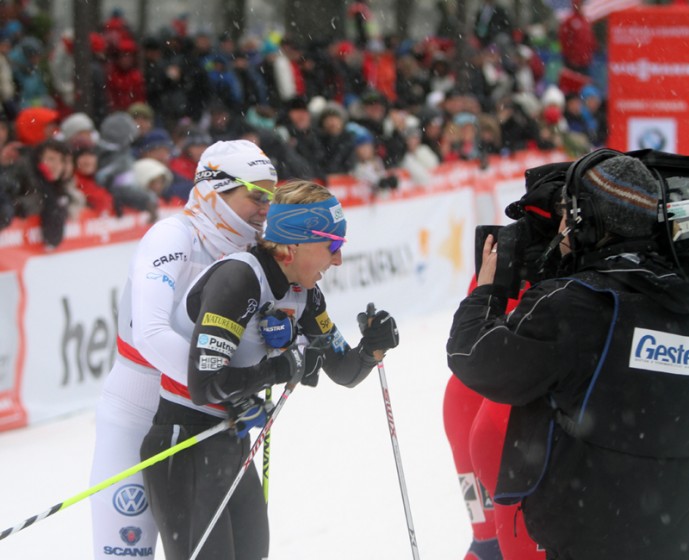
    Sophie Caldwell (U.S. Ski Team) smiles for TV cameras after winning the 1.2 k classic sprint final at Stage 4 of the Tour de Ski in Oberstdorf, Germany. In doing so, she became the third U.S. woman to win a World Cup, after Alison Kiesel (formerly Owen-Spencer) won the inaugural women’s World Cup race in 1978 at Telemark in Cable, Wis. Caldwell’s teammate, Kikkan Randall became the second U.S. woman to top the World Cup podium (and the first in modern World Cups). (Photo: Marcel Hilger)

    OBERSTDORF, Germany — Tuesday was definitely a thrilling day to be a U.S. nordic fan. The race format for the fourth stage of the Tour de Ski: a 1.2-kilometer classic sprint, was characterized by a single lap of wet, mushy, dirty snow.

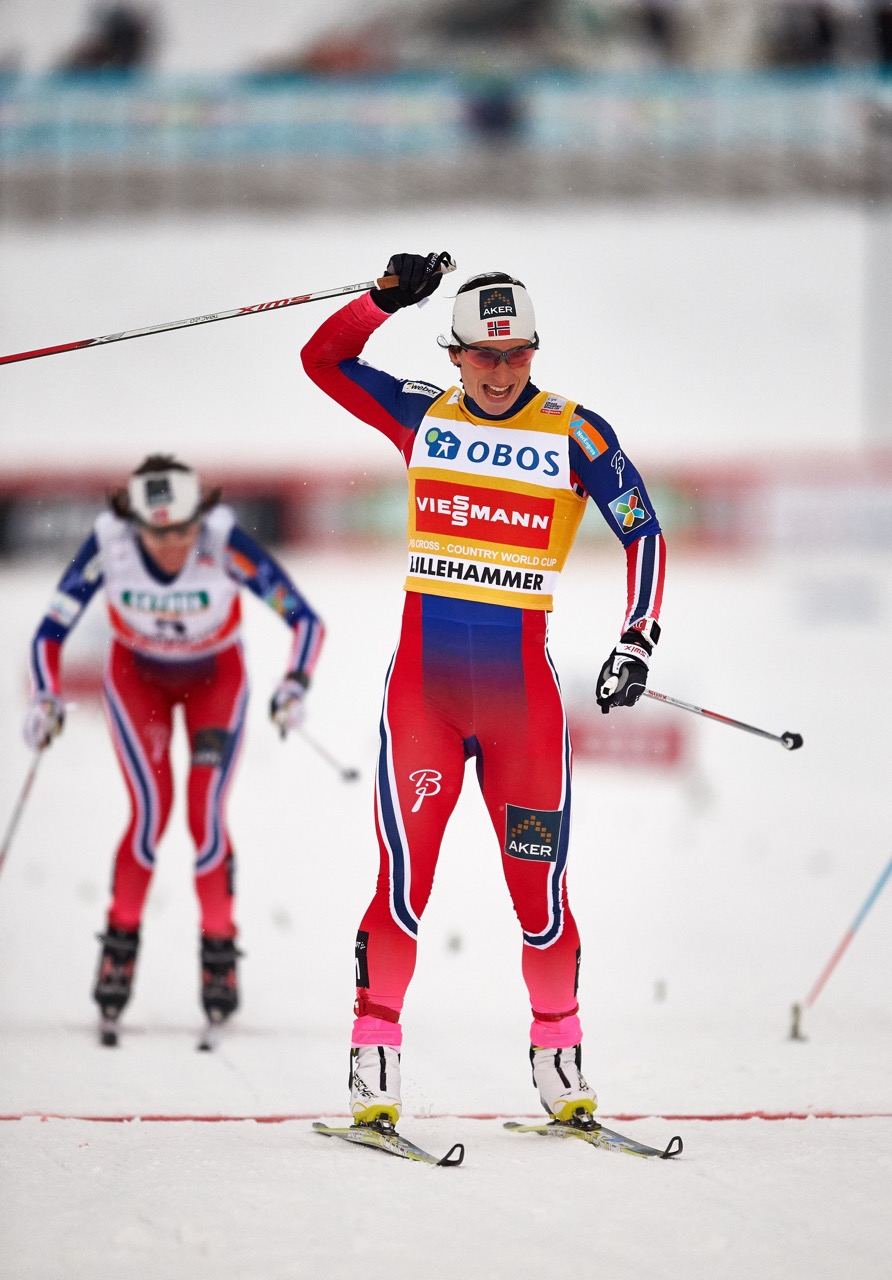
    Sophie Caldwell, of U.S. Ski Team and Stratton Mountain School T2 Team, shined through the gloomy, spitting weather; advancing through the heats and then beating out a final full of Norwegians and Swedes to take the top spot on the podium. In doing so, the 25-year-old Vermont native became the third U.S. woman to win a World Cup race, and the first to do so in a classic sprint.

    Sophie Caldwell soaks up her first World Cup win on Tuesday at the Tour de Ski Stage 4 classic sprint in Oberstdorf, Germany. (Photo: Fischer/NordicFocus)
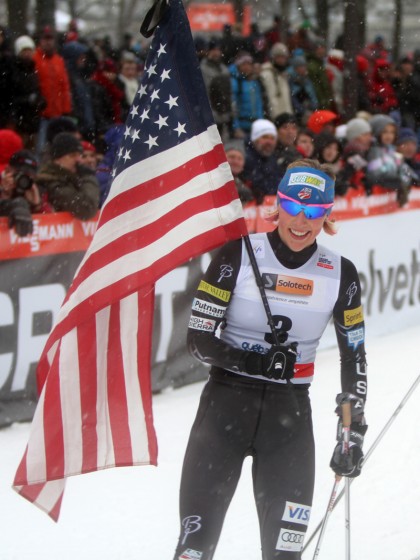
    Sophie Caldwell soaks up her first World Cup win on Tuesday at the Tour de Ski Stage 4 classic sprint in Oberstdorf, Germany. (Photo: Fischer/NordicFocus)

    “Push it over the tops, stick on Ingvild on the ups, and have a strong finish.”

    This was Caldwell’s magic mixture to reach the highest step in the podium, the spot every racer aspires to in their career. It was a simple-enough strategy, but it worked wonders in all of her heats, even securing her joyous victory in the final.

    In the last month or so since the 2015/2016 World Cup season began, Caldwell has emerged as one of the world’s top sprinters. Her win didn’t come out of nowhere; some analysts observed she has been lurking in the shadows of the podium-frequenting Norwegians. She built up to Tuesday with multiple appearances in sprint finals: doing so in two of the three freestyle sprints preceding the Tour’s classic sprint in Oberstdorf.

    The one time she missed the skate-sprint final, she did so by one place — finishing seventh in Toblach, Italy. In the only two sprints of the Tour, Caldwell qualified in second (on Jan. 1 in Lenzerheide, Switzerland; a skate sprint) and third on Tuesday.

    In Lenzerheide, she narrowly missed the podium in fourth in the final. Before the holiday break, she placed seventh in Toblach and sixth in the skate sprint in Davos, Switzerland.

    Yet on Tuesday, she beat the Norwegians at their game — classic sprinting — holding off Heidi Weng by 0.1 seconds in the finishing stretch with the win in 2:46.38 minutes. Ingvild Flugstad Østberg, the overall leader after both Stage 3 and 4 of the Tour, was the second Norwegian on the podium in third (+0.8), but after winning the qualifier to start the day, Østberg had been the favorite.

    “It has been a while since I have been on the podium and that is the first sprint I have ever won,” Caldwell reflected in an in-person interview with FasterSkier after the race. “I am psyched. I never thought it would come in a classic sprint, so that was a pleasant surprise.”

    The course, conditions, and resulting tactics

    The Oberstdorf race stadium was far from a dreamy winter wonderland with sleigh rides and snow falling. There had been much uncertainty about whether the event organizers would be able to produce enough snow to cover the stadium race loop. About a week ago, the International Ski Federation (FIS) and the organizing committee gave Oberstdorf “the green light” for the fourth and fifth stages of the Tour. Then, as a rainy sleet mix fell heavily for all of Monday, it was hard to believe world-class ski races would happen there.

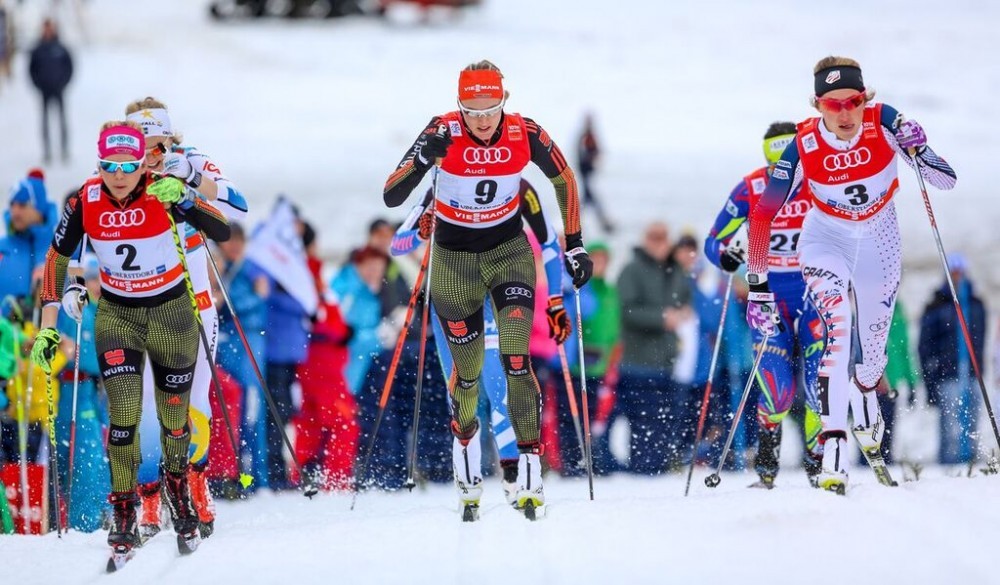
    Germany's Sandra Ringwald (2) and Denise Herrmann (9) go head-to-head with American Sophie Caldwell (3) during the 1.2 k classic sprint at Stage 4 of the Tour de Ski in Oberstdorf, Germany. (Photo: Marcel Hilger)
    Germany’s Sandra Ringwald (2) and Denise Herrmann (9) go head-to-head with American Sophie Caldwell (3) during the 1.2 k classic sprint at Stage 4 of the Tour de Ski in Oberstdorf, Germany. (Photo: Marcel Hilger)

    The course turned out to be quite soft, uneven and thoroughly saturated; a layer of mush on the top seemed to make control tricky. But across the board, athletes were impressed and expressed gratitude about the course the organizers and volunteers worked hard to prepare against the forces of warm weather. Caldwell, a New Englander, thrived in the less-than-ideal snow conditions.

    After the race, U.S. Ski Team Women’s Coach Matt Whitcomb (who previously coached at Burke Mountain Academy in Vermont) commented how “these conditions today are like growing up in New England; skiing through slop, it’s no big deal.”

    Temperatures in the mid-to-upper 30s and drizzle occasionally spitting down on racers made for a brutal day for the waxing team.

    “Really difficult, really difficult,” Whitcomb emphasized, referring to the waxing. “This was a day that could not have been done without great skis.”

    Caldwell described her skis as “amazing. … I was kicking up everything and they were clearly some of the best ones on the downhills.”

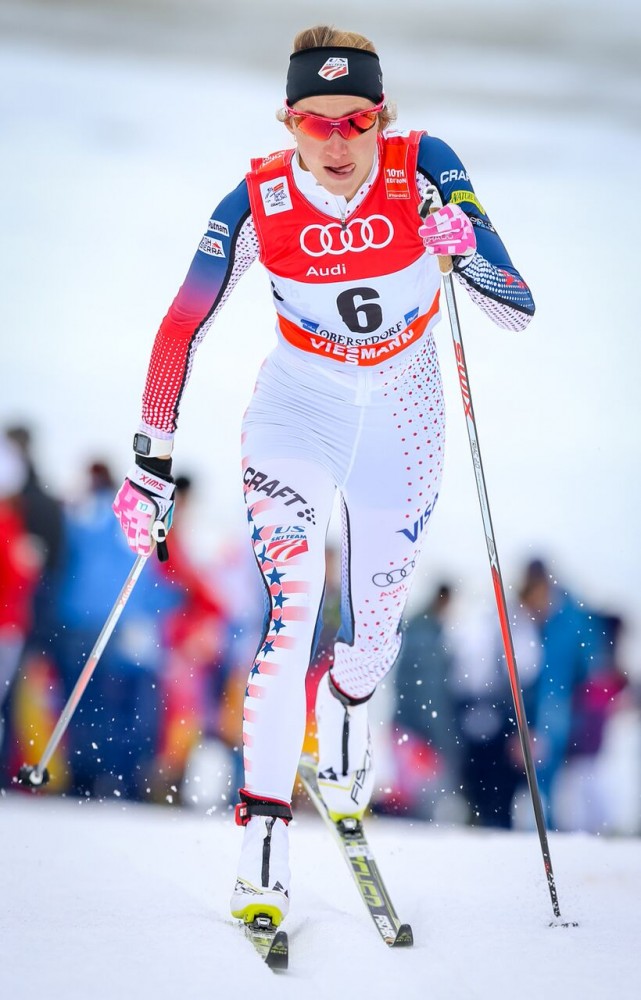
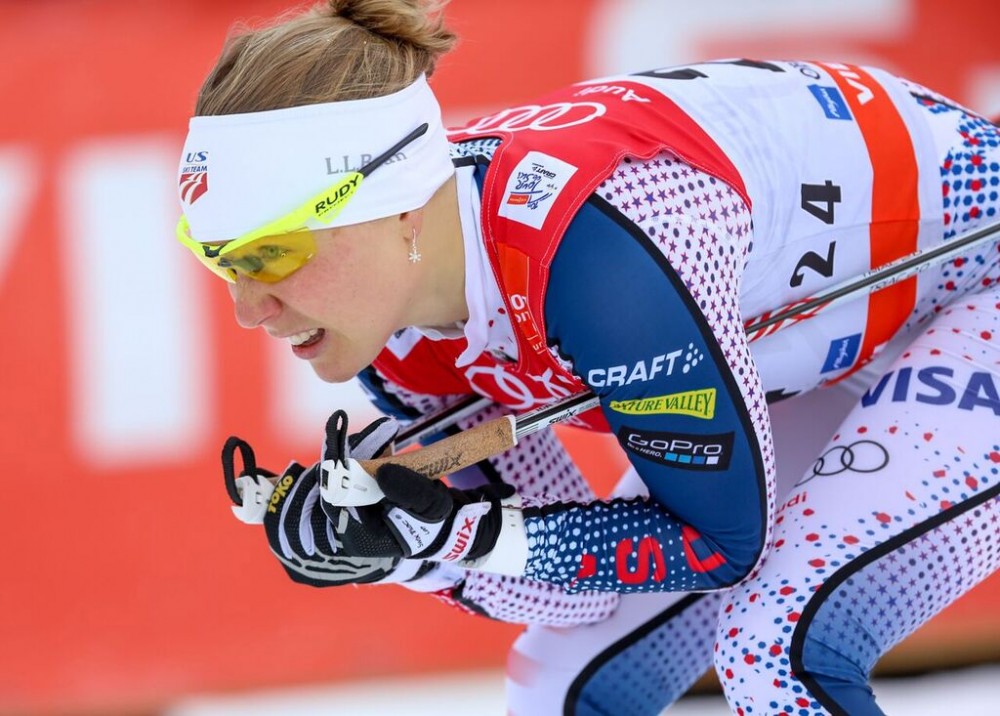
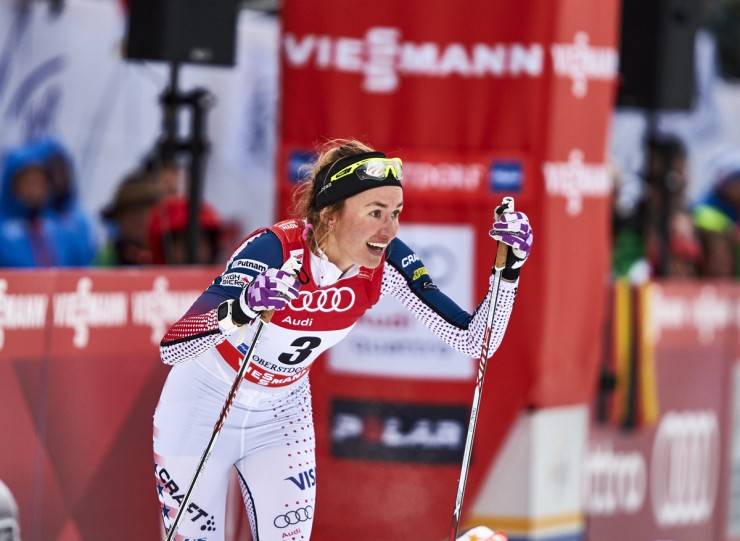
    Sophie Caldwell (U.S. Ski Team) racing to third in the 1.2 k classic sprint qualifier at Stage 4 of the Tour de Ski in Oberstdorf, Germany.  She went on to win the final for her first World Cup victory. (Photo: Marcel Hilger)
    Sophie Caldwell (U.S. Ski Team) racing to third in the 1.2 k classic sprint qualifier at Stage 4 of the Tour de Ski in Oberstdorf, Germany. She went on to win the final for her first World Cup victory. (Photo: Marcel Hilger)

    Not only were her skis some of the best gliding the downhills, but she also proved to be one of the most confident downhill skiers.

    “She got to the tops of climbs and attacked over them rather than backing off, and that was a big difference-maker today,” Whitcomb said.

    There was one particularly treacherous downhill into a turn about halfway into the race. This section gave many athletes trouble during the heats, including a wipeout that took down Caldwell’s teammate Jessie Diggins and out of the running in her quarterfinal.

    In the final, Caldwell avoided any potential for downhill trouble when Sweden’s Ida Ingemarsdotter shifted her skis into a snowplow formation, her ski tails nearly skimming Caldwell’s skis. Caldwell shot past her through an opening on the right, step turning the lefthand corner to get within striking distance of the lead.

    Another major key to Caldwell’s success proved to be a wise tactical move: lock onto Østberg and never let go. That is, until Caldwell passed her on the final roller over a bridge and led down into the finishing stretch. Caldwell faced Østberg in both the semifinal and final, and clamped down on her ski tails without fail. This helped Caldwell, known recognized as one of the most consistent lucky losers in World Cup sprints, comfortably advance to the final: initially winning her quarterfinal (ahead of Sweden’s Stina Nilsson) and placing second in her semifinal to Østberg.

    Østberg won the first quarterfinal by nearly 4 seconds. She entered Tuesday’s race with a broad repertoire of recent sprint podiums, so it fit logic to follow her stride. In the last three skate sprints, she reached the podium in every race. Placing third on Tuesday, she extended her Tour lead over teammate Therese Johaug — a distance skier who notably reached the final and finished fifth (+4.71)

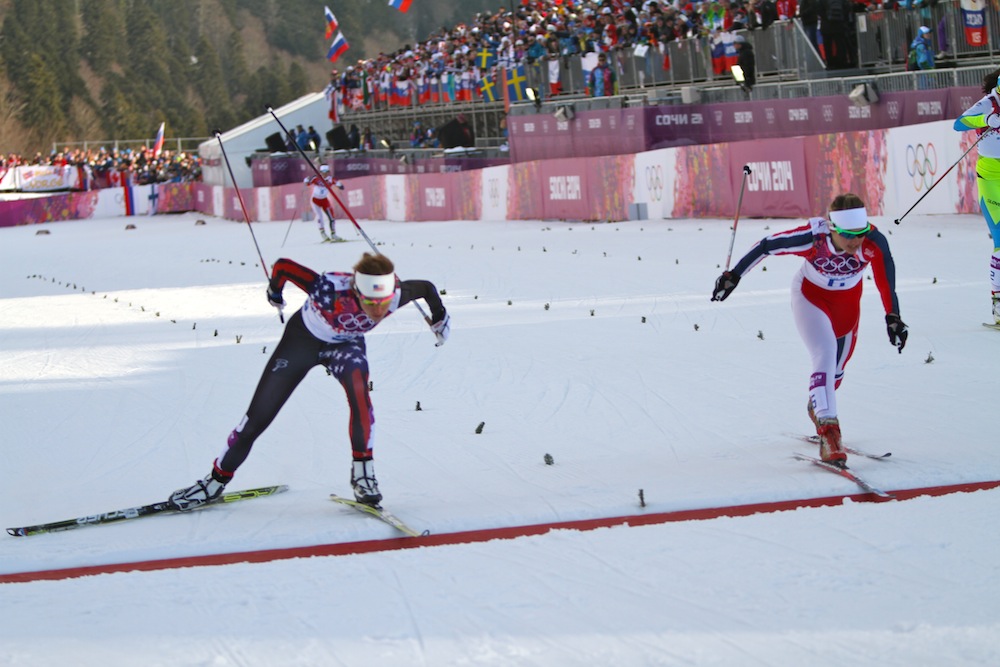
    Sophie Caldwell (U.S. Ski Team)  lunges to edge Norway's Heidi Weng (not shown) for the win in the 1.2 k classic sprint final at Stage 4 of the Tour de Ski in Oberstdorf, Germany. (Photo: Marcel Hilger)
    Caldwell lunges to edge Norway’s Heidi Weng (not shown) for the win in the 1.2 k classic sprint final at Stage 4 of the Tour de Ski in Oberstdorf, Germany. Østberg (behind Caldwell) placed third. (Photo: Marcel Hilger)

    Østberg led the majority of the final with Caldwell behind her, and Weng and Ingemarsdotter skiing beside them in another track. On the final downhill curve, on the backside of the last bridge bump, Caldwell passed Østberg on the inside and led into the finishing flat.

    Weng also passed the tiring Østberg and began gaining on Caldwell. But Caldwell was able to hold off Weng in the double-pole derby and take the win with a final lunge, winning by one-tenth of a second.

    The favorite to win the overall Tour, Johaug was more than thrilled to finish fifth and earn crucial bonus seconds to stay close to Østberg with four distance races remaining. Sweden’s Ingemarsdotter and Nilsson rounded out the final in fourth (+3.95) and sixth (+27.43), after Nilsson crashed alone at the back of the pack on the troublesome downhill and slid into the barrier lining the course.

    Answering a rush of Norwegian reporters after the race, the characteristically modest Caldwell said, “The Norwegians are very dominant, so it feels really good to upset them.

    “But they are all so nice,” she added. “At the end, they were all congratulating me. It was a fun race.”

    Immediately after finishing, Weng was the first to congratulate Caldwell with a hug. Essentially every other competitor in the final made a point to congratulate her as well in a series of embraces before Caldwell’s victory lap.

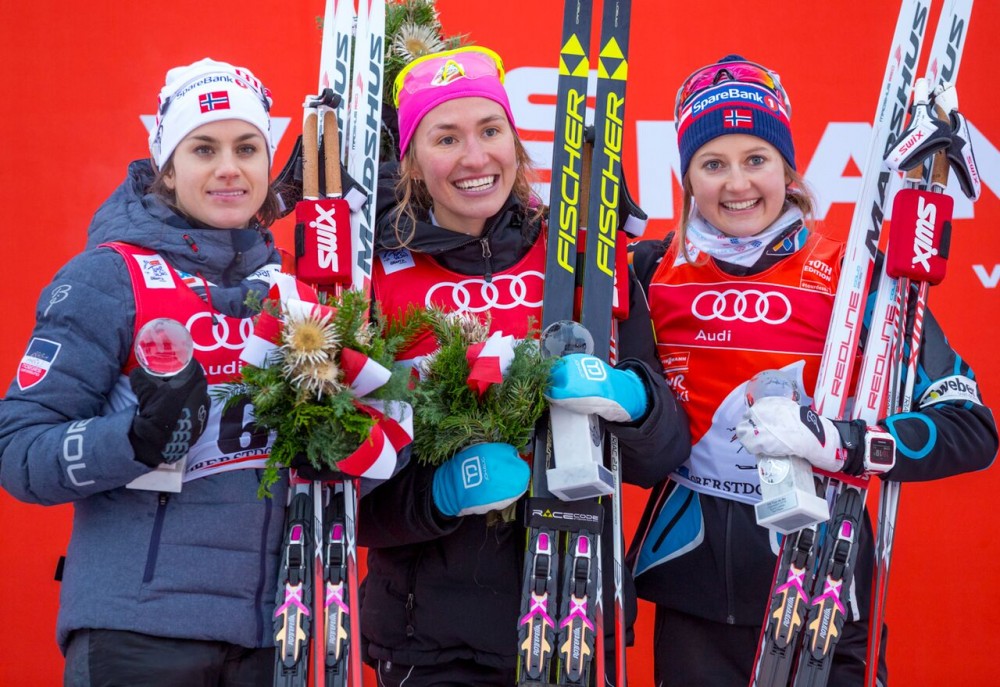
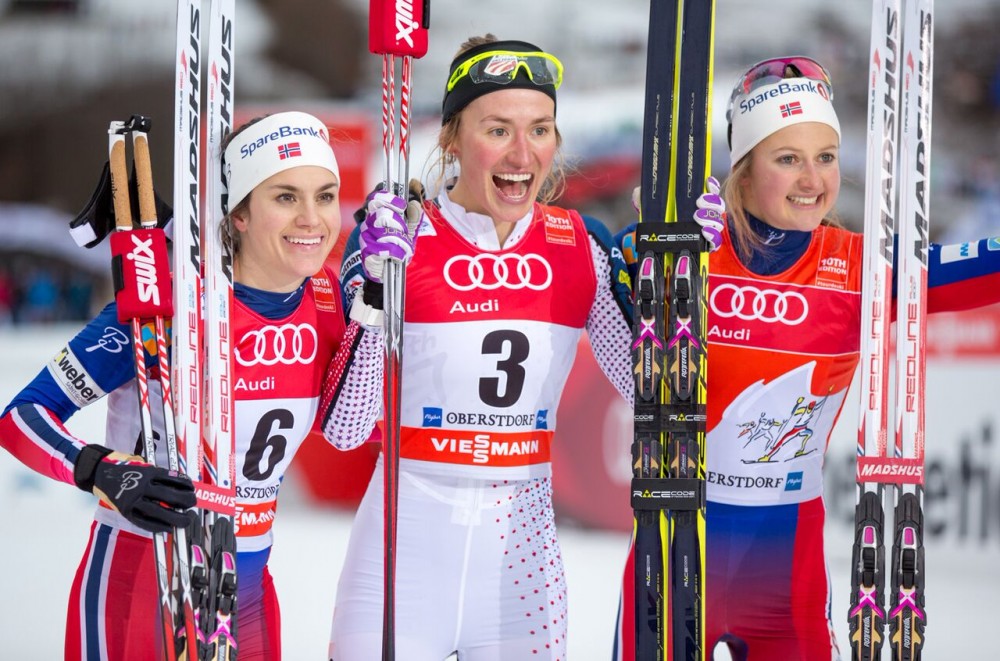
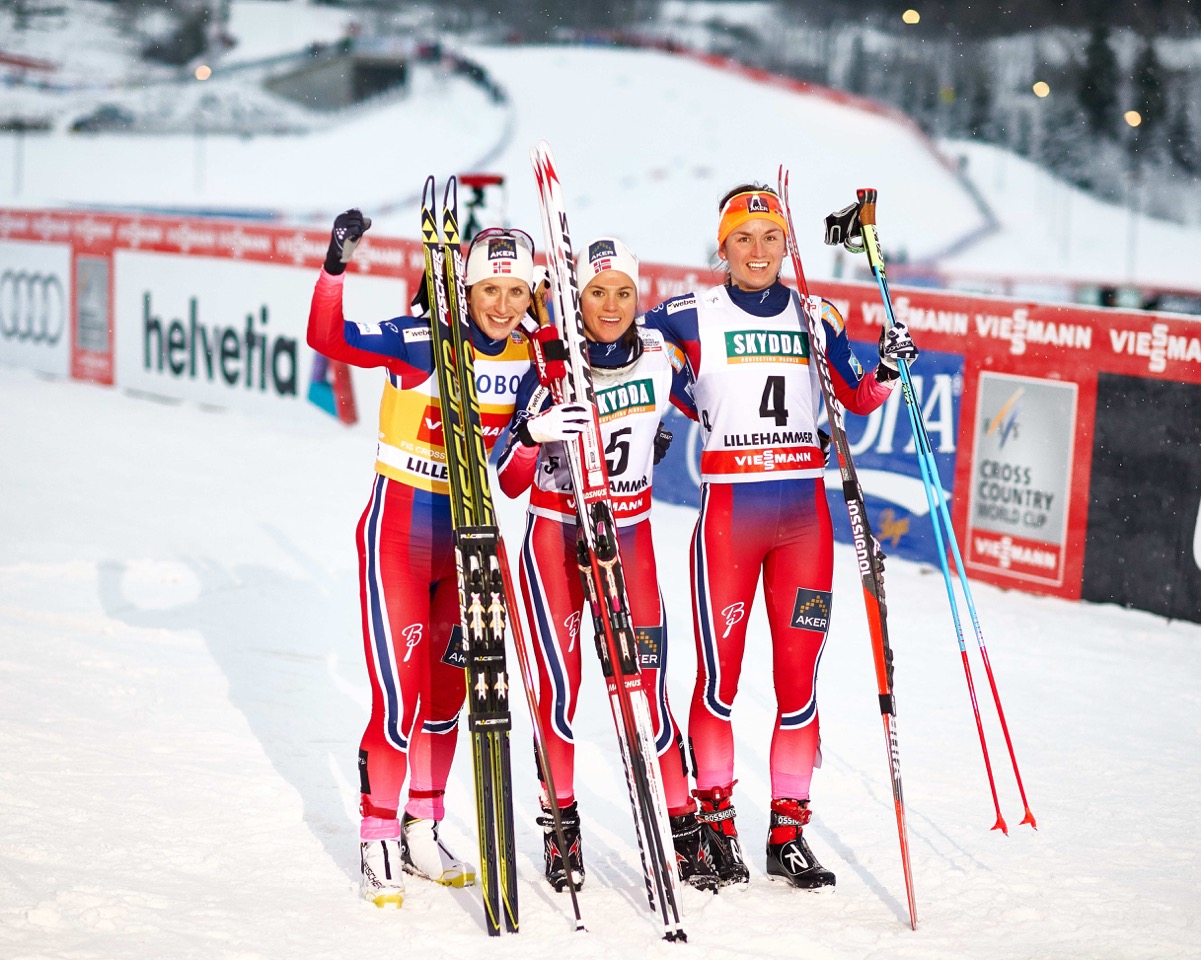
    Sophie Caldwell (c) after becoming the first U.S. woman to win a World Cup classic sprint with the other podium finishers, Norway's Heidi Weng (l) in second and Ingvild Flugstad Østberg (r) in third in the 1.2 k classic sprint at Stage 4 of the Tour de Ski in Oberstdorf, Germany. (Photo: Marcel Hilger)
    Sophie Caldwell (c) after becoming the first U.S. woman to win a World Cup classic sprint with the other podium finishers, Norway’s Heidi Weng (l) in second and Ingvild Flugstad Østberg (r) in third in the 1.2 k classic sprint at Stage 4 of the Tour de Ski in Oberstdorf, Germany. (Photo: Marcel Hilger)

    The dynamics between Caldwell and the two Norwegians sharing the podium with her in the post-race press conference could not have been warmer.

    “These two girls were faster than me the last couple hundred meters,” Østberg said. “That Sophie could win and the U.S. could get a win, I think that’s so fun.”

    A swarm of young children glowing with excitement to get Caldwell’s autograph engulfed the American as she exited the press area. With this, the public celebrations drew to a close and the U.S. team headed back to their hotel with a contagious, electric buzz of team-wide excitement.

    “It’s not just about winning, of course, it’s about watching somebody who put in a lot of work, learned how to believe in themselves, and attack a plan and have it work out,” Whitcomb said. “But at the end of the day it’s also really fun to watch Sophie succeed. She cares every bit as much about her teammates as she does about herself. And so it’s a team win today.”

    Sophie Caldwell plans to race the 10-kilometer classic mass start in Oberstdorf on Wednesday and possibly also race Stage 6 of the Tour: a 5 k skate in Toblach, Italy. Although she does not plan to finish the Tour, it is worth noting a sizable leap from 27th to 14th in the overall Tour standings with her win on Tuesday.

    The rest of the U.S. women: Sargent 15th, Diggins 21st

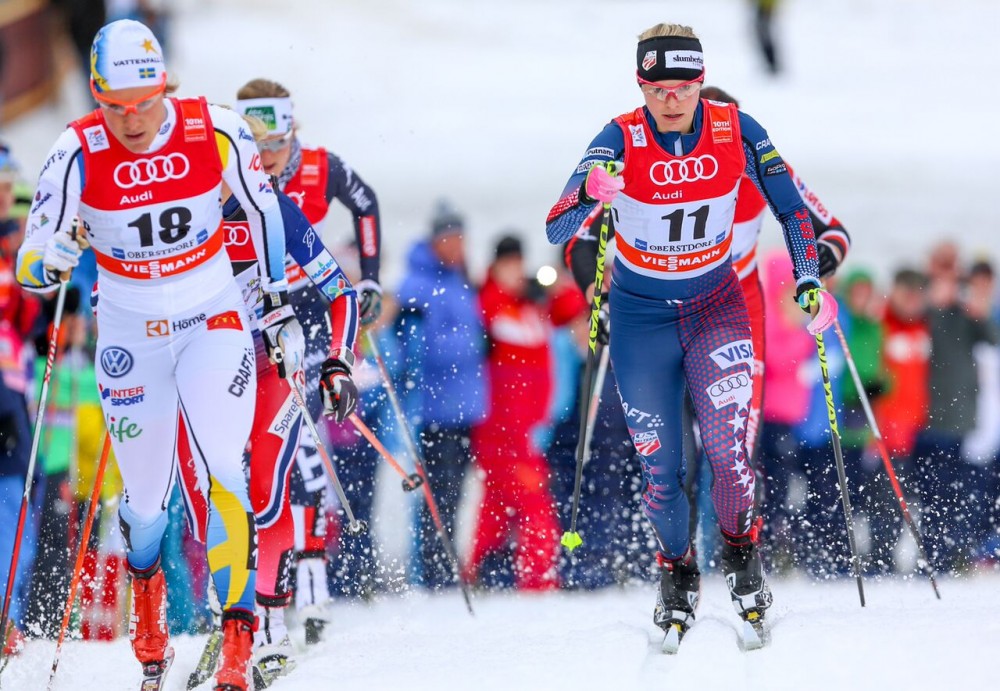
    Jessie Diggins (11) during her quarterfinal of the 1.2 k classic sprint at Stage 4 of the Tour de Ski in Oberstdorf, Germany. The American placed fifth after crashing with Hanna Falk (18). (Photo: Marcel Hilger)
    Jessie Diggins (11) during her quarterfinal on Tuesday. The American placed fifth after crashing with Sweden’s Hanna Falk (18). (Photo: Marcel Hilger)

    Also for the U.S., Diggins and Ida Sargent qualified for the heats with the  11th and 14th-fastest qualifying times, respectively. Notably, Diggins skied her entire qualifier without a pole basket.

    “It fell off at the start and I felt myself punching through, and I was like ‘no way,’ ” she recalled. “So I just skied as hard as I could because I thought, it is going to be a miracle for me to qualify like this.”

    Sure enough she did, and in a comfortable 11th, well within the top 30, 8.45 seconds behind Østberg’s top time of 2:38.18.

    In the quarterfinals, Diggins’ run ended when she collided with Sweden’s Hanna Falk, who snowplowed the notorious downhill. They entered the descent together, side by side in first and second, but as they picked up speed, the back of one of Falk’s skis clipped Diggins and they both went down. Diggins finished fifth in that heat, 26.22 seconds behind Johaug, who won that quarterfinal.

    “The silver linings of today, and I am all about silver linings, are that I felt great … I mean, physically I am fit, I am ready, I am in a good position in the Tour,” Diggins said. She’s currently 10th in the overall standings and 4:33.4 out of the lead. “I am ready for the next race.”

    Ida Sargent ( U.S. Ski Team) racing to third in her quarterfinal for 15th overall at the 1.2 k classic sprint at Stage 4 of the Tour de Ski in Oberstdorf, Germany. (Photo: Marcel Hilger)
    Ida Sargent ( U.S. Ski Team) racing to third in her quarterfinal for 15th overall at the 1.2 k classic sprint at Stage 4 of the Tour de Ski in Oberstdorf, Germany. (Photo: Marcel Hilger)

    Sargent narrowly avoided the first series of crashes of the day in the first women’s quarterfinal (Sweden’s Charlotte Kalla, Russia’s Natalia Matveeva and Germany’s Nicole Fessel all went down on the same hill) and placed third her heat. Sargent finished 10.36 seconds behind the winner of that quarterfinal, Østberg, which was not enough to advance to the semifinals.

    “That downhill was crazy; I was certain I was gonna go down,” Sargent said. “My ski was caught on an ice chunk of some kind so I was really happy to stay up, but I think I needed a little more kick to hammer the [next] uphill.”

    At the end of the day, Sargent placed 15th and Diggins 21st overall. Also for the U.S., Rosie Brennan again narrowly missed qualifying in 35th, Sadie Bjornsen did not make the quarterfinals in 44th due to a crash, Liz Stephen finished 49th, and Caitlin Gregg placed 53rd.

    In terms of overall Tour standings after four of eight stages, Diggins ranks 10th (+4:33.4), Bjornsen slipped out of the top 10 to 13th (+4:53.7), Caldwell is up to 14th (+5:23.7), Stephen is 25th (+6:22.1), Caitlin Gregg 39th (+8:12.6), Brennan 42nd (+8:33.1), and Sargent 45th (+8:47.3).

    Results | Tour standings (after Stage 4)

    — Alex Kochon contributed reporting

  • Caldwell Fourth in Lenzerheide as Falla Extends Sprint Cup Lead

    Caldwell Fourth in Lenzerheide as Falla Extends Sprint Cup Lead

    Sophie Caldwell of the U.S. Ski Team en route to the second-fastest qualifying time of the day in the World Cup sprint in Lenzerheide, Switzerland, the first stage of the FIS Tour de Ski.
    Sophie Caldwell of the U.S. Ski Team en route to the second-fastest qualifying time of the day in the World Cup sprint in Lenzerheide, Switzerland, the first stage of the FIS Tour de Ski.

    LENZERHEIDE, Switzerland — There was a scary moment for Sophie Caldwell in the quarterfinals of Friday’s World Cup sprint, the first stage of the 2016 Tour de Ski.

    Saddled with one of the most competitive quarterfinals of the day, Caldwell got a slow start – which landed her at the back of the pack. She had skied the second-fastest qualifying time earlier in the day, but no matter what angle she tried it was hard for her to get to the front on the course’s one major climb, much less on the downhills.

    “Super scary,” U.S. women’s coach Matt Whitcomb said of watching the heat unfold.

    The second women's quarterfinal (from left to right): Russia's Natalia Matveeva, Norway's Heidi Weng and Maiken Caspersen Falla (7), Germany's Hanna Kolb, American Sophie Caldwell, and Sweden's Stina Nilsson (SWE) shortly after the start in the freestyle sprint at Stage 1 of the Tour de Ski Lenzerheide, Switzerland. (Photo: Fischer/NordicFocus)
    The second women’s quarterfinal (from left to right): Russia’s Natalia Matveeva, Norway’s Heidi Weng and Maiken Caspersen Falla (7), Germany’s Hanna Kolb, American Sophie Caldwell, and Sweden’s Stina Nilsson (SWE) shortly after the start in the freestyle sprint at Stage 1 of the Tour de Ski Lenzerheide, Switzerland. (Photo: Fischer/NordicFocus)

    But the upside to being in a fast heat is that even if you finish fourth – as Caldwell did – you can make it to the semifinals as a lucky loser. Caldwell rode that luck all the way to the final and fourth place overall, changing her strategy along the way.

    “I had a bit of a slow start in my quarterfinal so after that I put my focus on having a fast start and that was a lot better,” Caldwell said. “There were fewer people to go around and I think it’s just easier to keep your head in it when you’re battling for one of the top positions rather than sort of off the back scrambling.”

    Caldwell took a hard inside line on the last downhill corner, putting her in potential podium position. But athletes reshuffled going up the last hill and into the stadium, and was left to edge out Astrid Uhrenholdt Jacobsen of Norway in a photo finish for fourth place, 1.03 seconds out of the win.

    It was her best World Cup result since her podium in Lahti, Finland, at the end of the 2014 season.

    “I am really happy,” Caldwell said. “Fourth is always sort of a bittersweet place to get. I want to be on that podium and I think I can one day. But this is the best result I’ve had in a long time so I’m really happy with it.”

    Norway's Maiken Caspersen Falla (7) celebrates her victory in Friday's freestyle sprint, the first stage of the 2016 Tour de Ski, over Sweden's Ida Ingemarsdotter (8) and Norwegian teammate  Ingvild Flugstad Østberg (not shown). Norway's Astrid Uhrenholdt Jacobsen placed fifth after a photo finish with American Sophie Caldwell (not pictured), who took fourth. (Photo: Fischer/NordicFocus)
    Norway’s Maiken Caspersen Falla (7) celebrates her victory in Friday’s freestyle sprint, the first stage of the 2016 Tour de Ski, over Sweden’s Ida Ingemarsdotter (8) and Norwegian teammate Ingvild Flugstad Østberg (not shown). Norway’s Astrid Uhrenholdt Jacobsen placed fifth after a photo finish with American Sophie Caldwell (not pictured), who took fourth. (Photo: Fischer/NordicFocus)

    Maiken Caspersen Falla of Norway won the day after qualifying in seventh position. She said that the course, with its drag-race uphills and few places to make any huge moves, fit her well.

    “I felt better and better during all the heats,” Falla said in the post-race press conference. “I think the other girls are skiing really fast on the first lap. On the last lap I felt really good especially on the last uphill. I was first in the last 100 meters, so it’s really nice – as always – to get the World Cup victory.”

    Falla leads the World Cup sprint standings this season.

    Ida Ingemarsdotter of Sweden was second (+0.40), and Ingvild Flugstad Østberg of Norway third (+0.54). Ingemarsdotter made her decisive move late in the second lap. It was her second World Cup sprint final of the season, while Falla and Østberg are staples on the circuit.

    “I had a good feeling and was satisfied with myself,” Ingemarsdotter told FasterSkier. “I knew that it’s two laps and it’s not the first lap that counts. It’s the whole way to the finish. I just focused on the second lap and when we went into the stadium I knew that if you can take any position there, you can take it cheap and you don’t have to work so hard.”

    Both she and Østberg are looking forward to the whole Tour de Ski, not only the sprints. She’s “absolutely” going to enjoy more good distance racing, Ingemarsdotter said.

    “Tomorrow is 15 k classic,” she explained. “I think the strong Norwegian girls will go really hard. I will focus as much as possible on following them, to keep the gap to the front not so big.”

    And Østberg? She hasn’t gone all the way to the end of the Tour de Ski since 2012, but this year she has said she’s focusing on also doing excellent distance racing. So finishing the Tour de Ski is on the table.

    “It’s a good start to the Tour,” she said in the press conference. “This year my plan is to go the whole way and up Alpe Cermis, so it’s important to have a good start. Tomorrow is another day with a lot of bonus seconds, so I guess overall standings will look different after tomorrow.”

    Sophie Caldwell stuck at the back of the pack in her quarterfinal heat, which was won by eventual race winner Maiken Caspersen Falla of Norway (bib 7). Caldwell placed fourth to move on as a lucky loser. (Photo: JoJo Baldus)
    Sophie Caldwell stuck at the back of the pack in her quarterfinal heat, which was won by eventual race winner Maiken Caspersen Falla of Norway (bib 7). Caldwell placed fourth to move on as a lucky loser. (Photo: JoJo Baldus)

    Caldwell isn’t as likely to go the whole way. Head coach Chris Grover said before the Tour began that she and the other sprint specialists would probably stop after the Oberstdorf, Germany, stages a few days from now.

    But with four times racing around the course, Caldwell definitely got in her workout today.

    “The semi and final were hard,” she said. “But I’ve been working really hard on recovering in between heats and in the qualifier today that was the best my legs have felt all year. So I was hoping to come into the Tour pretty rested and focusing on recovering between each heat. I think it worked.”

    In fact, that’s one thing that U.S. women’s coach Matt Whitcomb picked out as a highlight of the day.

    “The goal for Sophie is to try to skate through as many heats easily as she can, and she has certainly run into some very difficult heats this year,” he said. “But the nice thing about today is that Sophie had to dig really hard a couple of times, which smoked her in Davos. And it didn’t today. She was in the mix right in the end. So she has clearly taken a nice step in the direction.”

    The reason that today’s quarterfinal and some others this season have been so hard is that athletes now pick their own heats, which can leave some easier and some harder than the former system, which automatically seeded athletes according to qualification position.

    “The new heat selection process is interesting,” Caldwell said. “Sometimes it works in your favor and sometimes it doesn’t. I think so far this year I have to be the world’s luckiest loser. In about five of the six heats I’ve moved on in it has been as lucky loser. I have picked some fast heats, which is tough, because it’s hard to move on from. But then lucky losers come out of that heat so sometimes it’s a good thing.”

    Whitcomb admitted that heat selection is something they are still working on. But part of the strategy is also to get each qualifier from the team into a different heat, if possible, so that they are less likely to bump each other out. With three other women (Jessie Diggins, Sadie Bjornsen, and Ida Sargent) qualifying today, that dynamic was at play.

    “We’ve started to change our strategy [for picking heats] but with Stina [Nilsson] qualifying 28th and 30th in the last two weekends, it has thrown a huge wildcard into the mix,” Whitcomb said (Nilsson ended up sixth, 1.3 seconds behind Caldwell). “So still we’ll do our best to select easier heats moving forward, but you can only do your best when you’re also trying to get all four of your women into different heats.”

    So far, though, things have worked out for Caldwell, even if she’s sometimes had to work harder than she or her coach would prefer.

    After making it to the final she gave it her all, which is the most either of them could ask for.

    “I knew it was going to be tight,” Caldwell said. “I can’t even remember what happened there, but positions can change a lot. People who were on the outside are all of a sudden on the inside and then unless you’re right in the front, you never know when someone is going to come over. So it’s tough. But I fought til the end and I’m happy with it.”

    Results | Tour de Ski standings

  • With Ever-Pressing Diggins, U.S. Women Grab Final Podium Step in Lillehammer 4 x 5 k Relay
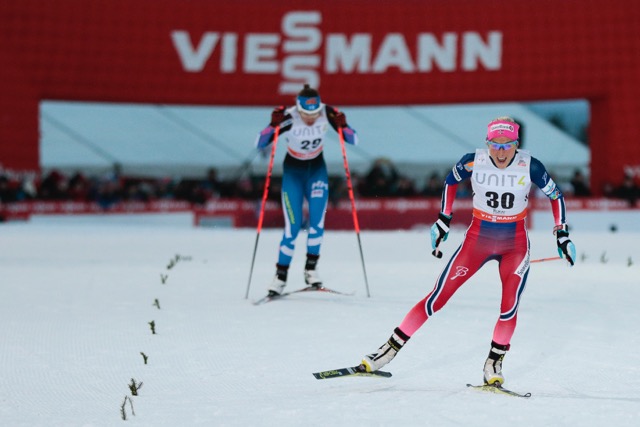
    With Ever-Pressing Diggins, U.S. Women Grab Final Podium Step in Lillehammer 4 x 5 k Relay
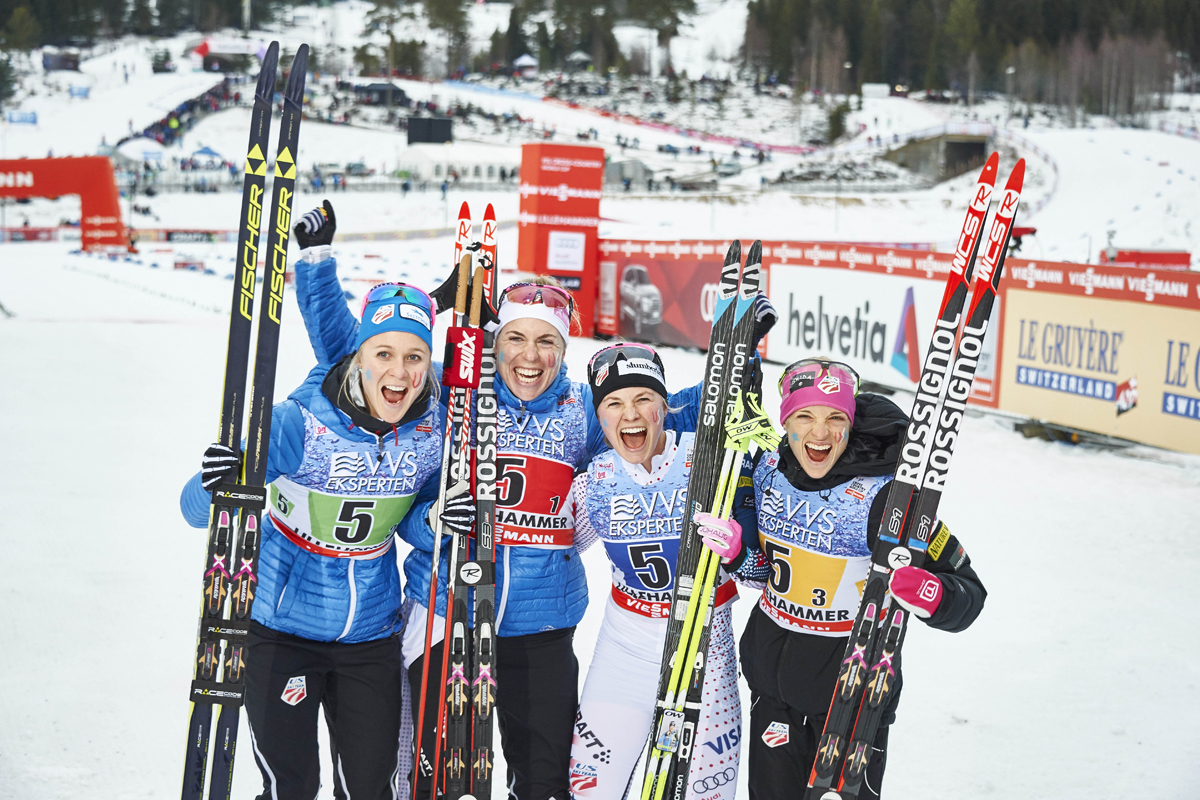
    The U.S. women celebrate third place in Sunday's 4 x 5 k relay at the World Cup in Lillehammer, Norway. (From l to r) Sadie Bjornsen, Rosie Brennan, Jessie Diggins, and Liz Stephen. (Photo: Fischer/NordicFocus)
    The U.S. women celebrate third place in Sunday’s 4 x 5 k relay at the World Cup in Lillehammer, Norway. (From l to r) Sadie Bjornsen, Rosie Brennan, Jessie Diggins, and Liz Stephen. (Photo: Fischer/NordicFocus)

    Note: This article has been updated to include the U.S. women’s third-place finish at the Lillehammer World Cup in Dec. 2013.

    Amidst stunning conditions of bright sun and a dangerously icy track at the Birkebeiner Stadium in Lillehammer, Norway, the Norwegian women’s all-star first relay team of Maiken Caspersen Falla, Ingvild Flugstad Østberg, Therese Johaug, and Heidi Weng, notched another seemingly effortless victory in the women’s 4 x 5-kilometer World Cup relay on Sunday.

    Taking the win by almost two minutes over second place Finland’s Krista Parmakoski, Kerttu Niskanen, Laura Mononen, and Anne Kyllönen, the Norwegians may have won the race, but the Americans stole the show.

    As Norway’s first team reveled in victory, they had to stop their celebratory hugs to turn and witness the crowd roar in both surprise, and applause, as the U.S. Ski Team’s Jessie Diggins flew past Ragnhild Haga of Norway’s second team, careened down the final hill, into the finishing stretch, snatching the final podium spot from Haga by 1.4 seconds.
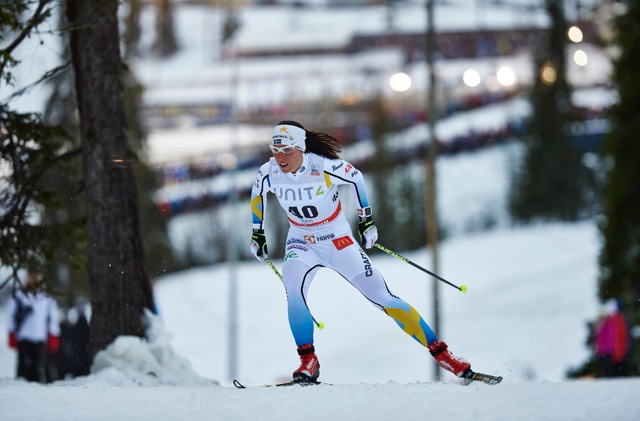
    Diggins crossed the finish line and let out a scream of elation, thrilled for the U.S. women’s first relay podium in two years. It was the third time in relay history the U.S. women have reached the podium, according to USSA.

    Approaching the top of the last short climb before the stadium, Diggins saw a tall figure jumping up and down, swinging their poles in circles around their head, “like a cowboy,” she recalled in a post-race group phone interview with her teammates: Rosie Brennan, Sadie Bjornsen and Liz Stephen.

    It was U.S. Ski Team (USST) Women’s Coach Matt Whitcomb, and he was giving her the go-ahead to go for it in the final meters. “I was like, ‘Yes, this is what I live for!’ … and I just hammered,” she said.
    On a day where the downhills appeared to equal a life or death decisions on bulletproof ice and uphills hurt just as bad as the day before, Team USA’s women showed the world once again they can ski with the best. Knowing this drive and the precarious track conditions, USST Head Coach Chris Grover explained the prerace strategy as the following:
    “In this case, we knew that is was going to be an absolute battle and that anything was possible, so one strategy was just to keep our head in the game and know that at times we might be up and that at other times we might be down, but to just keep our heads in the game and to keep fighting back and fighting back,” he said.

    After the first leg, the U.S. team already had its work cut out for them.

    Brennan skied smooth through the first large climb at 1.2 k, moving through the time check on the heels of Norway’s Falla and Sweden’s Ida Ingemarsdotter. From there, she lost the pace on the downhills.

    On the phone, Brennan explained that they, “woke up to some extremely icy snow conditions,” and she “was quite terrified to be honest.” However, her uphill pace was not far from the leaders’ and she was able to hand off  “close enough for these girls [her teammates] to have somebody in sight to go chase.”

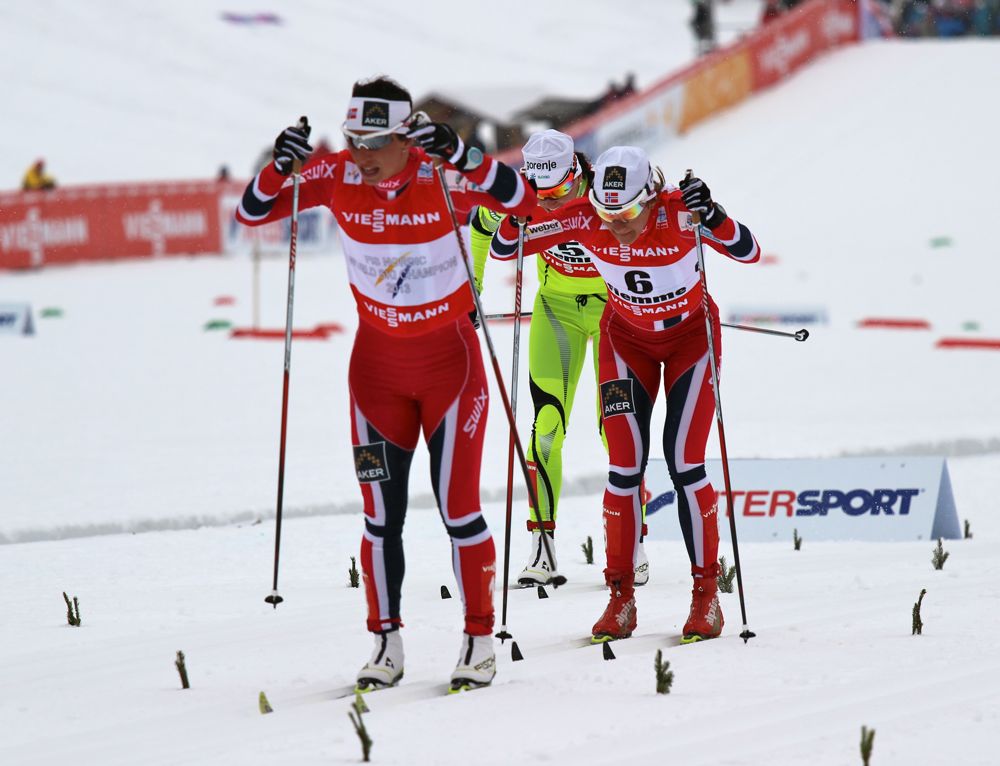
    Krista Parmakoski (FIN), Astrid Uhrenholdt Jacobsen (NOR), Ida Ingemarsdotter (SWE), Maiken Caspersen Falla (NOR), (l-r) ski in the first leg of the 4x5km, Lillehammer (NOR). (Fischer/NordicFocus)
    From left to right: Finland’s Krista Parmakoski, Norway II’s Astrid Uhrenholdt Jacobsen, Sweden’s Ida Ingemarsdotter, Norway I’s Maiken Caspersen Falla during the first leg of the 4 x 5 k relay in Lillehammer, Norway. (Photo: Fischer/NordicFocus)

    At the first exchange Norway’s second-team skier, Astrid Uhrenholdt Jacobsen, led Falla of Norway I by 6.1 seconds, closely followed by Ingemarsdotter of Sweden and Parmakoski of Finland. Brennan tagged Bjornsen for the second classic leg in seventh, 49 seconds back from Jacobsen.

    From there the race for first appeared over. Norway’s Østberg dropped the hammer, skiing away from Finland and Norway II, putting them 21.5 and 36.6 seconds down at the second exchange.

    For Team USA and Bjornsen, the second leg meant hanging tough and staying upright. Bjornsen said she “got a little over excited at the beginning and tried to close the gap to Germany and Russia in the first k.” She spent the “next 2.5 k trying to hold on for dear life,” recover, and more importantly, make it safely down the icy hills with “completely flooded legs.”

    When asked how she managed to hang on despite the excitedly fast start, Bjornsen painted a target on the back of the Norwegians and Swedes.

    “Anytime you see a red [Norway] or white [Sweden] suit, man, you just find another gear because those are the two people you’re gunning for normally,” she said.

    Before handing off to Stephen, the first skate leg, Bjornsen skied the fifth-fastest second leg, and tagged off 1:29.9 behind the Norwegian leaders, in a pack with Russia’s second team (+1:21.3), Germany (+1:21.7), Sweden (+1:23.5).

    Halfway through the first skate leg, Norway II, skiing in third place, looked vulnerable. Falling from only 36.6 seconds back at the exchange to 1:16.0 at the 2.5 k mark; Stephen was also closing the gap, now only down 31.5 seconds to third place.

    “I was focused on the uphills. This course couldn’t be much better for someone like me who likes to climb,” Stephen said. “My goal was to just drop them on the first uphill [Germany and Russia].”

    Stephen explained her strategy going into her leg. Skiing the third-fastest third leg, she mimicked Bjornsen’s motivation, “You see the white suit and you go for that, and when you look up and see a red suit, you really go!” Closing out her 5 k, the red suit of Norway’s second team hovered a tantalizing 21 seconds away.

    At the front, Johaug showed her form from the previous day, skiing the fastest third leg and extending Norway’s lead to 1:04 over Finland at the final exchange.

    Second-place Finland continued to ski in no-man’s land, maintaining its distance ahead third — 45.5 seconds at the third exchange — but unable to gain ground on Johaug, dropping to over a minute back at 1:04.

    In the battle for third, Stephen handed off to Diggins in fifth, 3.6 seconds behind defending Olympic and World Championship gold medalist Charlotte Kalla.

    Diggins quickly passed Kalla up the long climb on the first of two laps, and focused on Haga for the second lap.

    Just over 3 k into her race, Diggins caught Haga and the two skied neck and neck.

    Diggins dropped her on the last big uphill. “I didn’t look back so I had no idea if she was there or not,” she said.

    Coming in toward the stadium, Diggins described the atmosphere as “a total adrenaline rush. The people on that last hill were so loud because I was coming in with a Norwegian. You’re in so much pain, but you just can’t feel anything…”

    Diggins closed out the fourth leg with the second-fastest skate leg of the day and fastest final lap of any team.

    The U.S. women ended up third, their best result in a four-person relay since Kikkan Randall, Bjornsen, Stephen, and Diggins placed third in the 2013 Lillehammer World Cup relay two seasons ago. Before that, Holly Brooks, Randall, Stephen, and Diggins broke through with the first U.S. relay podium at the November 2012 World Cup relay in Gallivare, Sweden.

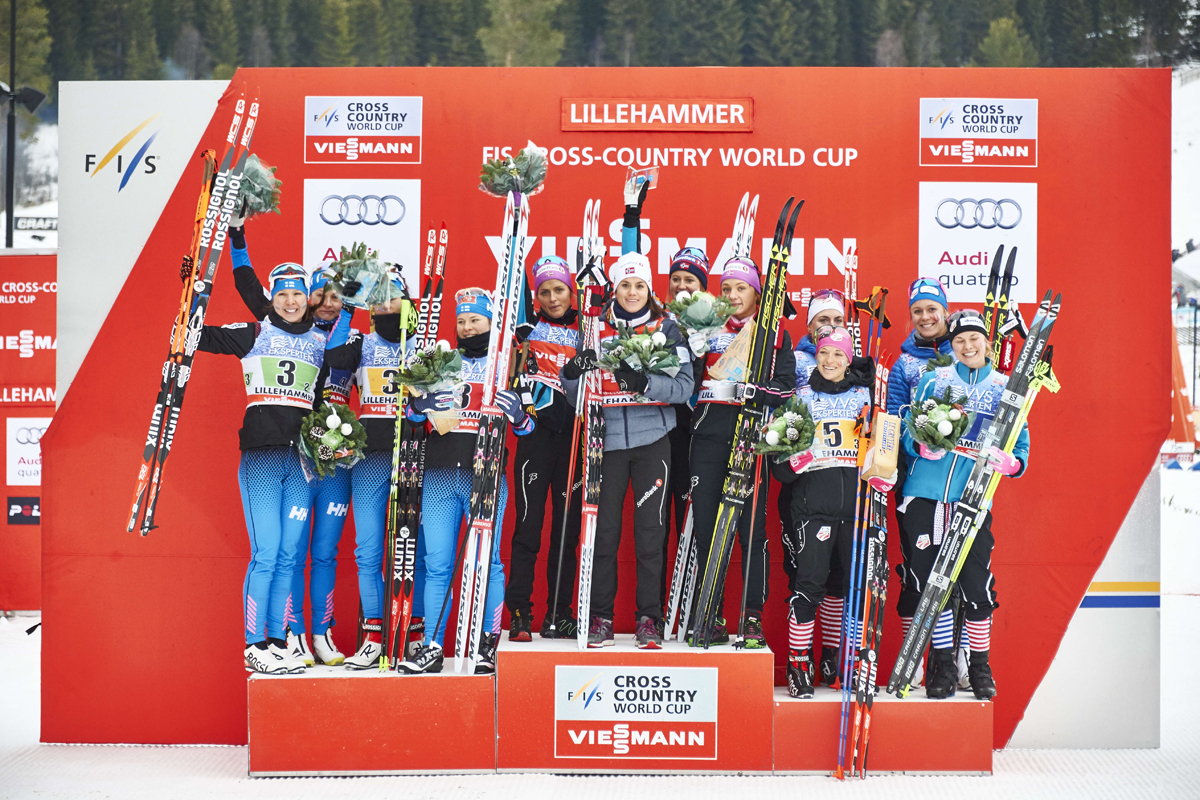
    The women's 4 x 5 k relay World Cup podium in Lillehammer, Norway, on Sunday, with Norway I in first (c), Finland in second (l) and the U.S. in third (r).   (Photo: Fischer/NordicFocus)
    The women’s 4 x 5 k relay World Cup podium in Lillehammer, Norway, on Sunday, with Norway I in first (c), Finland in second (l) and the U.S. in third (r). (Photo: Fischer/NordicFocus)

    “It speaks volumes to do it here,” Bjornsen said. “We have this belief that it can be any number of the four people on this relay team and it’s totally possible.”

    “We’re definitely a team that’s known for our skating on the women’s side — we saw that yesterday in the skiathlon,” Grover said. The U.S. had four women in the top 30. “We know that if we can be close in classic then we can really have a chance in the last couple legs of skating to get to the podium.”

    He added that the service team nailed the wax. “We had incredible skis, incredible kick, fantastic glide, for sure, some of the best skis in the field today, both for the women and for the men,” Grover said. “It was really a big effort not only from the group of women and the guys, but also from the entire staff.  I’m super proud of everybody performed today.”

    What was perhaps most important to the four women was the fact that they recognized not all of them had perfect days.

    “Maybe it wasn’t perfect; it was just solid,” Stephen said, adding that both Norway and Finland are “catch-able” — not out of reach.

    “Today was really special. I’m so proud of these girls,” Stephen added. “I can really relate to Rosie’s fear of downhills; I think we’re both struggling on it … and I’m really proud of her for that. … When you put relay socks on Jessie Diggins, it’s like a different person. It’s a really fun thing for me to touch her butt and watch her go. Sadie… she kicks ass and is just so solid.

    “It’s a really fun team; it’s changed. There’s been a few members changing over the years, but being back on the podium, it’s a real thing to stand on that block and to get a brick of cheese that weighs more than half your team together.”


    — Alex Kochon and Katie Madden contributed reporting

    Results

  • Johaug Dominates in Kuusamo, But Sprinters Shine and Weng Blunders (Updated)

    Johaug Dominates in Kuusamo, But Sprinters Shine and Weng Blunders (Updated)

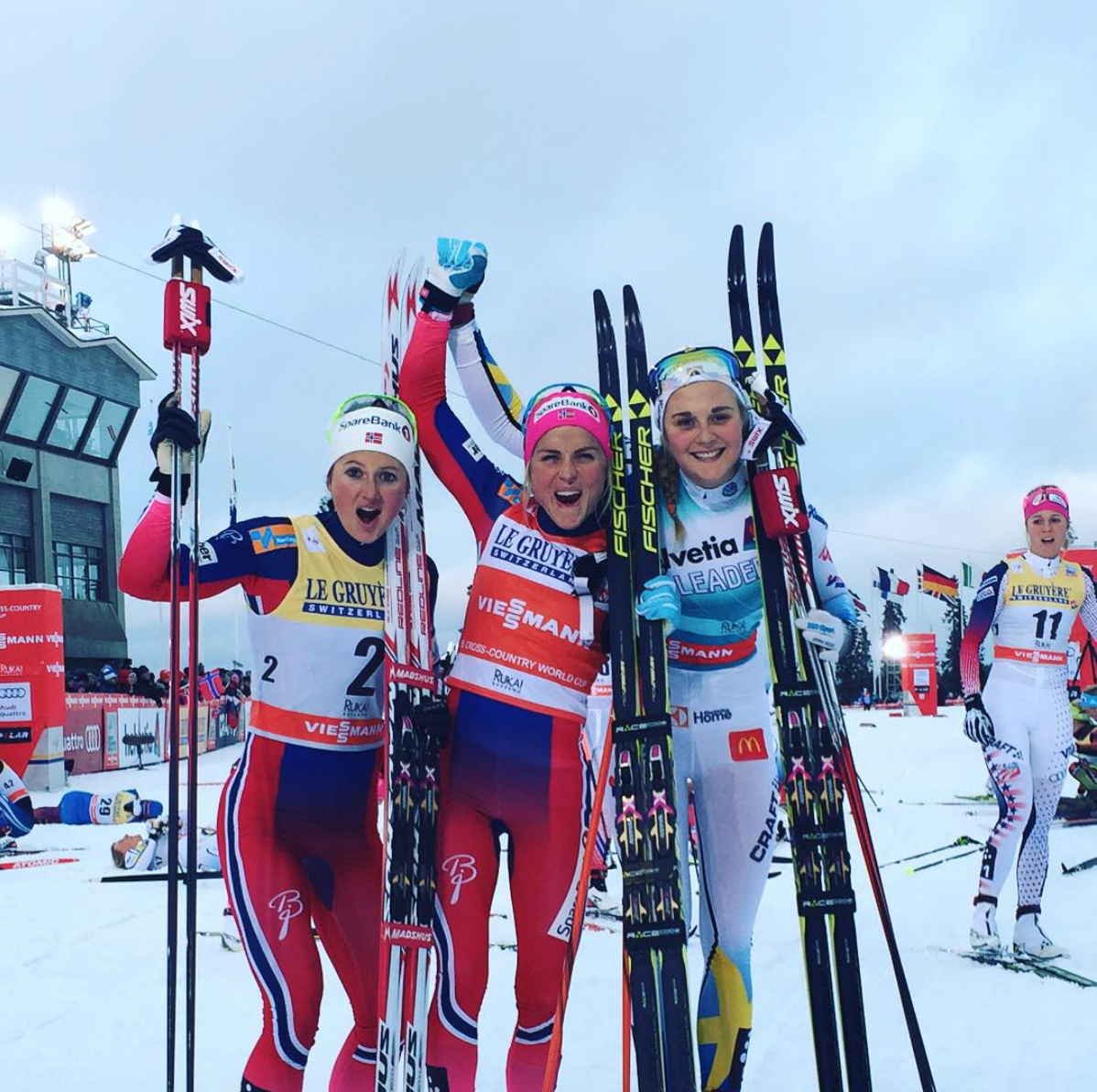
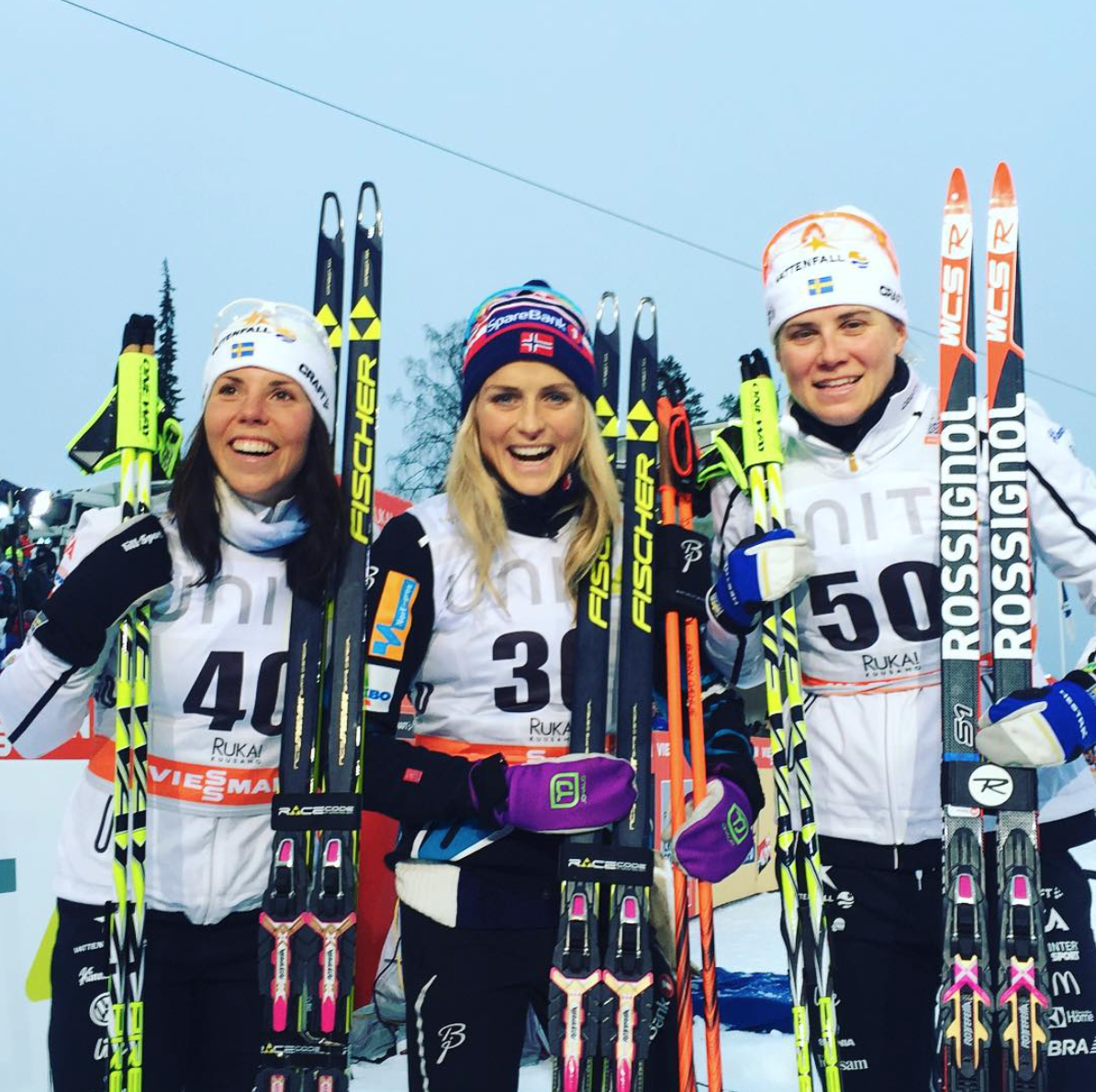
    Therese Johaug of Norway (center) celebrates the overall mini-tour win in Kuusamo, Finland, while Stina Nilsson (Sweden, right) and Ingvild Flugstad Ørtberg (Norway, left) take second and third and prove their distance-skiing chops. (Photo: FIS Cross Country / Instagram)
    Therese Johaug of Norway (center) celebrates the overall mini-tour win in Kuusamo, Finland, while Stina Nilsson (Sweden, right) and Ingvild Flugstad Østberg (Norway, left) take second and third and prove their distance-skiing chops. Sadie Bjornsen, in the background to the right, led the U.S. Ski Team with a 14th-place finish. (Photo: FIS Cross Country / Instagram)

    Seven women started within 20 seconds of Therese Johaug in today’s 10 k classic pursuit in Kuusamo, Finland. But by the finish, the Norwegian was all on her own.

    “I did a very good ski race,” she told Norwegian media. “It was a little hard leading and I had a bit slippery skis, but I probably was not alone. I got a little lump in my throat in the first hill when I felt that skis not set, but then I realized quickly that I was still making seconds on those behind me, so it was fun.”

    Johaug quickly dropped teammate Ingvild Flugstad Østberg, who had started 0.4 seconds back. By 2.5 k into the competition, she had a margin of almost 15 seconds and the race was a foregone conclusion – the only question was who would place second.

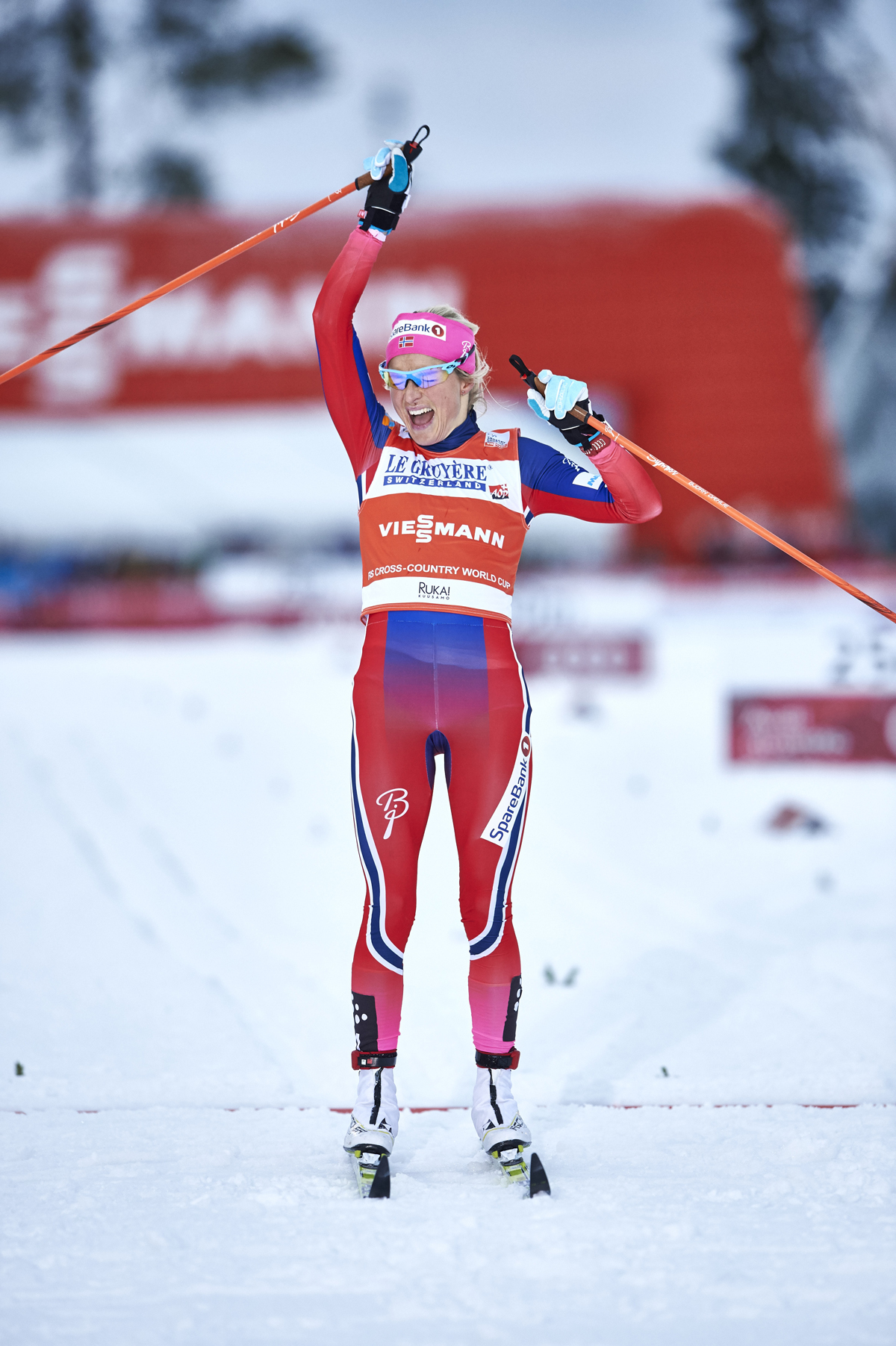
    Therese Johaug of Norway celebrating her win in the Ruka Triple mini-tour in Finland on Sunday. (Photo: Fischer/NordicFocus)
    Therese Johaug of Norway celebrating her win in the Ruka Triple mini-tour in Finland on Sunday. (Photo: Fischer/NordicFocus)

    Despite her dominance today, it was actually the first time Johaug has won the opening mini-tour in a FIS World Cup season. In the first five iterations, her teammate Marit Bjørgen took the win, even in Johaug snagged stage victories.

    I never thought I’d start the season as well as I have,” Johaug told Norway’s VG news service. “Especially during yesterday’s race, I’m happy with where I got the skating technique to now. In classic I have felt strong for a while, so this suggests that my shape is good.”

    Behind Johaug, a pack formed with Østberg and fellow Norwegian Heidi Weng, plus Swedish sprinters Stina Nilsson and Ida Ingemarsdotter.

    That turned out to be a big advantage in northern Finland, where the wind was so strong that nordic combined competitions have been canceled all weekend. While the pack didn’t have a chance to catch Johaug, they were able to pull away from other chasers like Sweden’s Charlotte Kalla, who started a few more seconds behind those four and couldn’t close the gap despite working with Norway’s Maiken Caspersen Falla and, later, Astrid Jacobsen.

    Coming up the steep hill into the stadium before 7.5 k, Weng put on a sprint and headed to the finish. She thought that it was her last lap and didn’t notice that Johaug wasn’t ahead of her until after she collapsed at the finish line.

    “I thought it was 7.5 kilometers, so I went to the finish,” Weng told Norway’s TV2. “I may be the world’s biggest idiot sometimes. I go and I don’t know what comes next.”

    Weng lay in the snow as the seconds dragged on, before realizing her mistake. She was far out of the picture for a podium finish by the time she got back on course.

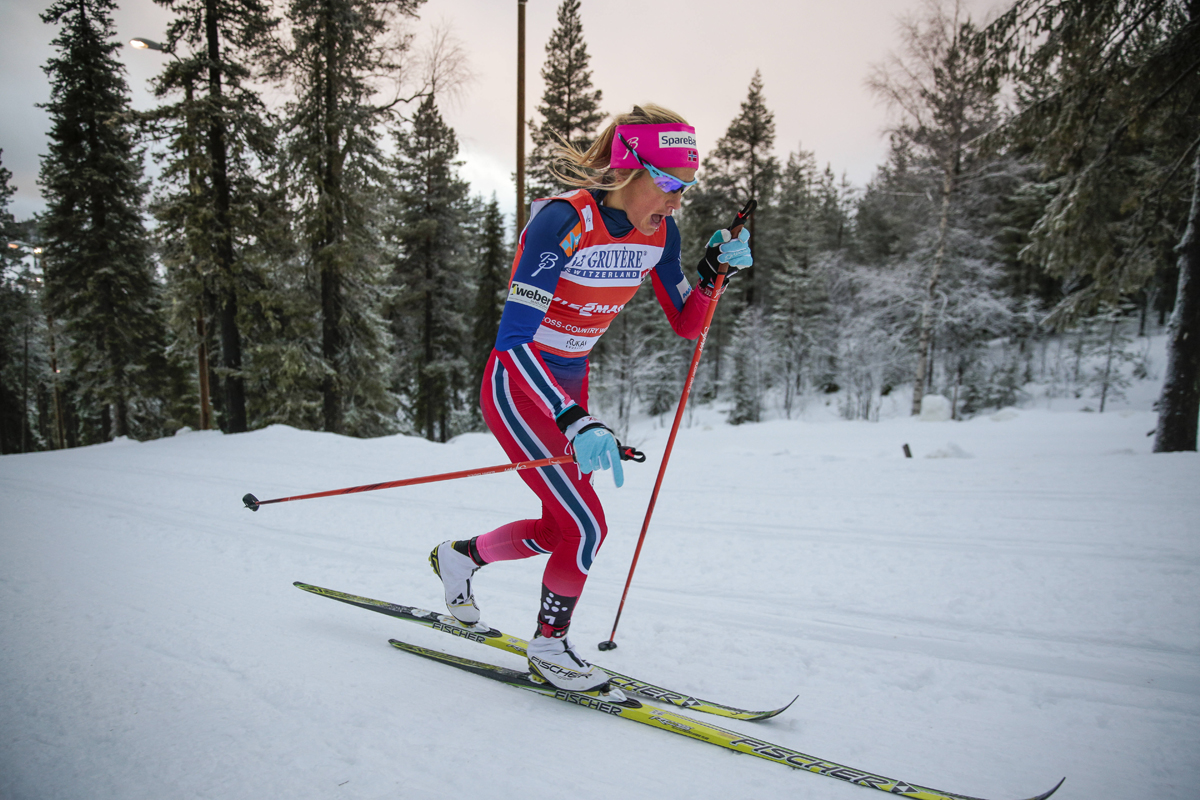
    With the Arctic sun low on the horizon, Therese Johaug of Norway outran the entire field. (Photo: Fischer/NordicFocus)
    With the Arctic sun low on the horizon, Therese Johaug of Norway outran the entire field. (Photo: Fischer/NordicFocus)

    “I thought I must be five minutes behind already, because it felt like I had been at the finish line for so long,” she told TV2. “Then I thought ‘haha’, I’ll just keep going and make the best out of it.”

    But her move did have a big effect on the field. Nilsson had tried to follow Weng’s big move, and only narrowly avoided going into the finishing tracks herself. And Ingemarsdotter was nearly shattered by the effort.

    The remaining trio briefly back together for the final lap to fight it out for second place. But as had been shown when Weng put on her sprint, Nilsson was the strongest on the uphills and Ingemarsdotter slipped even further back.

    Johaug crossed the line in 27:22.3, with Nilsson 22.6 seconds back and Østberg taking third another ten seconds back.

    It was a good day for Nilsson and Østberg (and Ingemarsdotter, even off the podium), who are traditionally considered sprinters but who have tried to focus on becoming better all-around skiers.

    Stina Nilsson bringing it home in second place for Sweden. (Photo: Fischer/NordicFocus)
    Stina Nilsson bringing it home in second place for Sweden. (Photo: Fischer/NordicFocus)

    “I’m very pleased and got confirmation that I made the right training for this season,” Nilsson told Sweden’s SVT broadcaster.

    And it wasn’t just because they had a good starting position that the pair succeeded. Nilsson had the second-fastest ski time of the day, and Østberg and Ingemarsdotter the fourth- and fifth-fastest, proving their distance chops.

    “I had hoped to be in the top ten,” Ingemarsdotter told Swedish daily Expressen. “I thought if I had a good day, I could be up there.”

    It was also a relief for Sweden to be consistently on the podium this weekend.

    “It’s red everywhere, and it’s nice to be able to challenge them,” Nilsson told Aftonbladet, referring to the Norwegians’ ubiquitous ski suits.

    Finland’s Kerttu Niskanen had one of the fastest splits of the day, moving from a 12th place starting position up to fifth at the finish, passing Kalla on her way.

    “At the beginning I felt good and easy, but today was really demanding snow conditions,” Niskanen told the Finnish Broadcasting Company. “Fortunately, we Finns had a pretty good skis. I saw that many others had much worse difficulties.”

    For instance, Kalla, who she had passed.

    “Bad skis, then I don’t have much more to say,” Kalla told Swedish media after finishing sixth, more than a minute behind Johaug.

    Weng crossed the line in ninth place, in tears. Her blunder might have serious consequences for her World Cup points. Weng had been hoping to challenge Johaug for the season-long title, but she lost a lot of points already.

    In FIS rules, mini-tours award half the normal World Cup points for each race, and then the remainder for the overall standings. So a second-place finish in the mini-tour would have been worth 160 points itself, plus whatever points Weng would have accrued for the individual effort.

    Instead, she picked up just 58 points from the mini-tour and her pursuit time, which could have been one of the fastest, put her in 13th place for just 20 points on the day.

    With Johaug taking two stage wins and the overall mini-tour title in the meantime, missing out on more than 100 points in a single mistake could be quite costly as the season progresses.

    Even Weng’s competitors felt bad for her.

    “I tried to call her but she was probably so [inside her own head],” Nilsson told Swedish daily Expressen.

    “I tried to comfort her a bit [at the finish] and said that this is sad, but it is soon [forgotten] in Norway and you are in good shape,” Ingemarsdotter told NRK.

    It did make a little bit of a difference.

    “I was really disappointed for half an hour after,” Weng told TV2. “But the Swedish were really caring. It was actually very touching.”

    How important are 100 points? Last season Johaug placed second in the overall World Cup, and Weng second. They were separated by just 56 points.

    Johaug now leads the overall World Cup by 33 points over Nilsson, with Østberg in third. Weng is in seventh place.

    Final mini-tour results

    Isolated pursuit time / winner-of-the-day results

  • Johaug Opens Up in Kuusamo 5 k, Takes Overall Mini-Tour Lead

    Johaug Opens Up in Kuusamo 5 k, Takes Overall Mini-Tour Lead

    Norway's Therese Johaug on her way to a monster 17-second win over five kilometers of skating in Kuusamo, Finland. (Photo: Fischer/NordicFocus)
    Norway’s Therese Johaug on her way to a monster 17-second win over five kilometers of skating in Kuusamo, Finland. (Photo: Fischer/NordicFocus)

    First she qualified in 15th place in the World Cup classic sprint on Friday. For her next move, Norway’s Therese Johaug won the 5 k skate by more than she has ever won a race so short.

    In fact, it was just the fifth time Johaug has won a 5 k in her career. Once was at World Junior Championships. The most recent was a 0.3-second win over teammate Marit Bjørgen in Lillehammer last year.

    But at this year’s opening World Cup weekend in Kuusamo, Finland, Johaug opened up and took a 17.6-second victory over Sweden’s Charlotte Kalla, a woman assumed to be Johaug’s main rival for the overall World Cup title this season.

    Usually more dominant as the distance gets longer, Johaug is showing that she’s quite a danger in shorter competitions as well.

    “This was not a good distance for me before, but in recent years I have worked extensively on my strength and speed,” Johaug told Norwegian broadcaster NRK after her win on Saturday. “It is very fun for me to see that I managed myself so well.”

    Although it likely wouldn’t have changed the final standings, Kalla fell on a steep uphill near the end of the race course.

    Charlotte Kalla of Sweden skied to second place. (Photo: Fischer/NordicFocus)
    Charlotte Kalla of Sweden skied to second place. (Photo: Fischer/NordicFocus)

    “It was quickly rebuilt,” Kalla said when Swedish tabloid Expressen asked about how the fall affected her speed. “It’s a bit annoying, but it can happen any time.”

    Kalla wasn’t thrilled with how far behind Johaug she found herself.

    “I started quietly,” she told NRK, according to a translation. “But then I heard that the gap was really going up. Therese was very strong last year and she’s not any worse this year.”

    Kalla’s teammate Ida Ingemarsdotter took third, 25.4 seconds behind Johaug. While Johaug impressed at a distance that’s shorter than her usual forte, it was the opposite for the Swede: the finish was Ingemarsdotter’s first podium at the World Cup level in a distance longer than a sprint.

    “I wanted to stay focused on my speed and technique,” she said in the post-race press conference. “I planned to go as fast as possible from the second last uphill before the stadium.”

    Her push landed her just 0.6 seconds ahead of Norway’s Heidi Weng, and 1.5 seconds ahead of Ingvild Flugstad Østberg, the Norwegian who placed second in yesterday’s sprint.

    “I did not really know it was so close between me and Heidi,” said Ingemarsdotter, who with a fifth place finish in the sprint now owns the yellow overall World Cup leader’s jersey. “Tomorrow it will be really interesting and fun race. It will be a big fight.”

    Johaug, who isn’t leading the World Cup but with bonus seconds accounted for will be the first woman out of the gate in Sunday’s 10 k classic pursuit, agreed.

    The women's podium in the 5 k classic in Kuusamo, Finland: winner Therese Johaug of Norway (center) and Swedish teammates Charlotte Kalla (left) and Ida Ingemarsdotter in second and third, respectively. (Photo: FIS Cross Country / Instagram)
    The women’s podium in the 5 k classic in Kuusamo, Finland: winner Therese Johaug of Norway (center) and Swedish teammates Charlotte Kalla (left) and Ida Ingemarsdotter in second and third, respectively. (Photo: FIS Cross Country / Instagram)

    “It will become a rat race,” Johaug told NRK of Sunday’s race. “I’m going to have them right behind me, and there are many good girls there.”

    Indeed: Østberg will start 0.4 seconds behind her and Weng just 4.9 seconds back. Then there will be Ingemarsdotter 5.7 seconds behind Johaug and teammates Stina Nilsson and Kalla 11.2 and 15.5 seconds back.

    Johaug has been excellent in mini-tours as well as the Tour de Ski.

    “Under normal circumstances it should go that Johaug wins mini tour,” her national team coach Egil Kristiansen told Norwegian newspaper Aftenposten.

    But it’s the start of a new season, and you never know. Kalla would usually be seen as the biggest threat; while her fall didn’t cost her the win in Saturday’s race, the few seconds she lost might be more important in the pursuit timing.

    And Østberg, Ingemarsdotter, and Nilsson are traditionally best at sprinting, but all three have shown much improved distance skiing this season, whether at early-season FIS races in Beitostølen, Norway, and Bruskvallarna, Sweden, or in the 5 k skate, where Nilsson finished ninth.

    So while Johaug might be the favorite to take the mini-tour win, it’s not a foregone conclusion.

    “We need to think a little bit,” Kalla told Expressen. “I am staying with Stina and Ida, so we will use our thinking skills and see if we can come up with how to break [Johaug].”

    Kerttu Niskanen of Finland placed sixth in the 5 k (+32.6), Norway’s Astrid Jacobsen seventh (+33.5), and her teammate Kari Øyre Slind eighth (+34.8).

    Slind had never previously made the top 20 in a World Cup, and only got seven starts in the last five seasons. But in the season-opening FIS races in Beitostølen, she excelled and earned herself new start rights.

    “I’m going there to have a good time at the races, enjoy myself and just take things as they come,” she told FasterSkier earlier this week. “I have everything to win and nothing to lose.”

    After Nilsson in ninth (+37.4) was Alenka Cebasek of Slovenia (+37.5) in just her second top-ten appearance on the World Cup.

    Results 5 k skate

    Mini-tour standings

  • Dyrhaug and Norwegians Sweep Bruks 15 k, But Kalla Leads Swedes to Podium in Women’s Race

    Dyrhaug and Norwegians Sweep Bruks 15 k, But Kalla Leads Swedes to Podium in Women’s Race

    Niklas Dyrhaug (2nd from left) and Norwegian teammates after winning the 4 x 10 k relay at 2015 World Championships in Falun, Sweden. Back in Sweden this weekend, Petter Northug (second from right) won Friday's 10 k classic, and Dyrhaug followed up with a victory in Saturday's 15 k skate in Bruksvallarna.
    Niklas Dyrhaug (2nd from left) and Norwegian teammates after winning the 4 x 10 k relay at 2015 World Championships in Falun, Sweden. Back in Sweden this weekend, Petter Northug (second from right) won Friday’s 10 k classic, and Dyrhaug followed up with a victory in Saturday’s 15 k skate in Bruksvallarna.

    With less bravado then Petter Northug’s win provided the day before, Norway still stole host country Sweden’s thunder on Saturday in Bruksvallarna, where Norwegian men swept the podium in the 15 k skate race.

    Niklas Dyrhaug claimed the win by 2.9 seconds over Daniel Myrmæl Helgestad, a relatively unknown 28-year-old with just a handful of World Cup starts to his name. Chris Andre Jespersen placed third, +9.8.

    “I never expect it, but I was hoping to be fighting for the victory today,” Dyrhaug told media after the race.

    The Swedish effort was led by Anders Svanebo. The boyfriend of Charlotte Kalla and a rollerski World Champion, Svanebo stated before this season that he wanted to also focus on winter competitions this season. He made the Swedish “A” team for the first time in May.

    Dyrhaug and Svanebo ended up skiing a substantial part of the end of the race together thanks to the loop length.

    “I had thought that I would get help from him, but it ended up that I took three turns instead,” Svanebo told Expressen.se.

    “I got good help from Anders Svanebo, I have to thank him,” Dyrhaug said to Sweden’s SVT broadcaster.

    With some of the top Swedes sitting out the race – Marcus Hellner is competing at home in FIS races in Gällivare with the American, Canadian, and Russian men, and Calle Halfvarsson is sick – it was not completely surprising that Norway would dominate the day.

    Charlotte Kalla, here racing in the relay at 2015 World Championships, took another big win in the Bruksvallarna FIS races on Saturday.
    Charlotte Kalla, here racing in the relay at 2015 World Championships, took another big win in the Bruksvallarna FIS races on Saturday.

    But some top Norwegians weren’t racing either. With Northug sitting the day out and teammates like Martin Johnsrud Sundby and Sjur Røthe, who had won the previous weekend in Beitostolen, Norway, it was a strong but not complete team by Norway.

    Dyrhaug still managed to get in a jab at the Swedes, even if it was more subtle than what Northug had said the day before.

    “It was good to get started, although the shape was a bit ‘crappy’ today,” he told Norway’s VG newspaper. “I was heavy today, some more weighed down than I had hoped for. Luckily this was a relatively unimportant race. I must raise my level if I will be with [the leaders] next weekend.”

    The message? Winning in Bruksvallarna won’t cut it on the World Cup.

    Sweden did have the last laugh in the women’s 10 k, however, as Svanebo’s partner Kalla took a 35.8-second win over teammate Stina Nilsson. Ida Ingemarsdotter was third, +1:03.7, and Slovenia’s Lea Einfalt was the only non-Swede to break into the top ten, placing sixth (+1:30.2).

    Kalla told SVT that she was happy she could focus entirely on her own race and not be distacted.

    “It was nice to start early in the seeded field and do my own race,” she said.

    That will change next weekend, when Kalla goes to the World Cup and faces top international skiers for the first time this season. While Dyrhaug and some teammates came to Bruksvallarna, none of the Norwegian national team women made the same trip.

    Racing continues in Bruksvallarna on Sunday with freestyle sprint competitions.

    Results: men / women

  • Kalla Wins Bruksvallarna 5 k by 25 Seconds; Henriksson Rebounds to Third

    Kalla Wins Bruksvallarna 5 k by 25 Seconds; Henriksson Rebounds to Third

    Charlotte Kalla racing to third in the Lahti World Cup 10 k freestyle in Finland last March. (Photo: Fischer/NordicFocus)
    A world champion in the 10 k freestyle at 2015 World Championships last February, Charlotte Kalla is shown racing to third in the Lahti World Cup 10 k classic in Finland last March. (Photo: Fischer/NordicFocus)

    Charlotte Kalla. Ida Ingemarsdotter. Those two names in first and second in Sweden’s first International Ski Federation (FIS) race of the season — the women’s 5-kilometer classic in Bruksvallarna — were more or less expected.

    But Sofia Henriksson in third? The 21-year-old Swede hadn’t raced in nearly a year, coming off a hand injury and eating disorder. Leading up to U23 World Championships last season, she had been told she was “too thin and not allowed to go,” she wrote on her blog. “It seemed at first that everything collapsed.”

    Yet on Friday, she finished 29.8 seconds behind 2015 world champion Kalla, the winner in 12:18.6. Another Swedish-national team member, Ingemarsdotter was 25.6 seconds back in second and 4.2 seconds ahead of Henriksson in third.

    While Ingemarsdotter held off Henriksson for the lead late in the race, Kalla ultimately topped them both, leading at every checkpoint. By 1.4 k, Kalla was already 12.5 seconds faster than Ingemarsdotter. At 3 k, she was nearly 25 seconds up on Ingemarsdotter in second. Meanwhile, their teammate Hanna Falk sat in third, but Henriksson edged Falk in the second half of the race. Henriksson finished 1.9 seconds ahead of Falk — who placed fourth — for her first podium since placing second in the Bruksvallarna 5 k classic last year.

    Sofia Henriksson sheds tears at the finish of last year's Tjejvasan, an annual all-female event in Sweden, which she won. (Photo: Hälsningar Adam)
    A teary-eyed Sofia Henriksson of Sweden at the finish of the Tjejvasan, an annual all-female event in Sweden, which she won in 2013. (Photo: Adam Alexander Johansson)

    After the race, Henriksson wrote a blog with the English title: “Comeback”.

    “There are many emotions that move inside me right now,” she began, according to a translation. “Above all, I feel joy and thanks largely to be back [racing]. Today’s race was my first since the middle of January. The 10 months outside racing have been a journey for me with both ups and downs and many emotional challenges.”

    Her main focus had been to feel good on skis. Despite a tremendous amount of nerves in her first international start since December at the Davos World Cup last year, she felt she succeeded at that.

    “I also got frequent updates on how I was doing in relation to the other skiers, but then many of the really [fast] girls started behind me, it was initially difficult to assess the splits,” Henriksson explained.

    Sofia Henriksson (SWE), racing to ninth in the Davos World Cup 10 k classic in Switzerland in December 2014.
    Sofia Henriksson acing to ninth in the Davos World Cup 10 k classic in Switzerland last December. That was her last race before the Bruksvallarna 5 k classic FIS race on Friday.

    She never imagined placing in the top three.

    “It was only a short while after the finish I could rejoice over my third place, a position I before could only dream about,” she added.

    Most importantly, this result gave her hope for this season. “I’ve found it’s important to maintain good balance and also keep the focus on training,” she wrote.

    As for Kalla, Swedish women’s coach Mattias Persson told Aftonbladet she is “better trained than ever.”

    Kalla, 28, led a Swedish sweep of the top 15. Sixty-four women finished the 5 k, representing either Sweden, Norway, Slovenia, Croatia, or Great Britain.

    Results

  • No Bjørgen? No Problem as Norway’s Østberg, Falla Take World Champs Team Sprint Title

    Ingvild Flugstad Østberg awaits her longtime friend and Norwegian teammate Maiken Caspersen Falla at the finish of the women's 6 x 1.2 k classic sprint on Sunday at 2015 World Championships in Falun, Sweden. The two took gold by more than eight seconds over Sweden. (Photo: FlyingPointRoad)
    Ingvild Flugstad Østberg (in red bib) awaits her longtime friend and Norwegian teammate Maiken Caspersen Falla at the finish of the women’s 6 x 1.2 k classic sprint on Sunday at 2015 World Championships in Falun, Sweden. The two took gold by more than eight seconds over Sweden. (Photo: FlyingPointRoad)

    FasterSkier’s coverage of the 2015 FIS Nordic World Ski Championships in Falun, Sweden, is brought to you by the generous support of L.L. Bean, now featuring a complete line of Kikkan Randall training wear.

    FALUN, Sweden — With Marit Bjørgen out of the freestyle team sprint on Sunday after what she considered a disappointing sixth-place finish in Saturday’s skiathlon at 2015 FIS Nordic World Ski Championships, that left someone to step up in her absence.

    The Norwegian national-team staff decided one of their best bets was Ingvild Flugstad Østberg, a longtime friend of their other athlete in the race, Maiken Caspersen Falla.

    Teammates for the last decade, the two wouldn’t have wanted it any other way.

    “If there is anyone who makes me better, it’s Ingvild,” Falla, the 2014 Olympic classic-sprint champion told NRK, according to a translation, after Sunday’s race.

    “We’ve known each other a long time and push each other on countless sessions,” Østberg added.

    Both 24, the two are nearly three months apart in age, with Falla being the elder. Partners in the World Cup freestyle team sprint last month in Otepää, Estonia, Falla and Østberg placed second, 0.85 seconds behind Sweden’s Ida Ingemarsdotter and Stina Nilsson in first.

    While the Swedes stuck with their winning order, the Norwegians switched it up on Sunday, with Østberg leading out and Falla anchoring the 6 x 1.2-kilometer freestyle team sprint. The combination worked, as the two won the first semifinal of the day ahead of Poland’s Justyna Kowalczyk and Sylwia Jaśkowiec. The two teams automatically advanced to the final, and Sweden in third earned a spot as one of six teams with fast-enough times to move on as well.

    Germany’s Nicole Fessel and Denise Herrmann won the second semifinal, and the Americans, with Sophie Caldwell and Jessie Diggins, placed second in that heat. Finland, Russia and Slovenia advanced as well, along with France and Switzerland from the first semifinal.

    Poland's Justyna Kowalczyk leads Norway's Ingvild Flugstad Østberg on the first lap of the women's 6 x 1.2 k freestyle team sprint on Sunday at 2015 World Championships in Falun, Sweden. (Photo: FlyingPointRoad)
    Poland’s Justyna Kowalczyk leads Norway’s Ingvild Flugstad Østberg on the second lap of the women’s 6 x 1.2 k freestyle team sprint on Sunday at 2015 World Championships in Falun, Sweden. Østberg reclaimed the lead for good for Norway. (Photo: FlyingPointRoad)

    In the final, Norway got down to business from the start, with Østberg leading out of the stadium and into the first-and-only climb of the women’s 1.2 k course. Fessel and Ingemarsdotter followed, while the U.S. positioned itself in fourth with lead-out skier Sophie Caldwell.

    By the time the pack returned to the stadium, Kowalczyk put herself in third for Poland, less than half a second behind Østberg in first and Fessel in second. Ingemarsdotter came through the exchange in fourth (+0.88), Slovenia’s Katja Visnar tagged Nika Razinger in sixth (+1.47) while the U.S. was 2.01 seconds back in sixth.

    One lap later, Germany was up to first with Herrmann, and Jaśkowiec was 0.55 seconds back in second and Falla 0.57 seconds behind in third. The silver medalist from Thursday’s classic sprint, Nilsson came through in fourth (+1.01) for Sweden, with Diggins three-tenths of a second behind her in fifth. Flying into the exchange and prohibited from snowplowing to stop, Diggins ran into one of the Germans and nearly caused Ingemarsdotter to crash before the Swede headed out on her second loop.

    “The U.S. was falling in front of me so I had to go around them,” Ingemarsdotter said in a press conference. “It was a little bit scary for a while, I think, ‘Oh I hope, I don’t fall.”

    She didn’t.

    With two of six laps completed, the race for gold appeared wide open — until Østberg launched an attack on the steep climb.

    Fessel went with her, as did Kowalczyk, while Ingemarsdotter started to fall off the pace and Caldwell drifted farther back in fifth. Østberg led Fessel into the exchange, where they tagged in first and second, respectively, 0.43 seconds apart. Kowalczyk tagged her teammate some 3 seconds out of first, while Ingemarsdotter was another second back in fourth and Visnar 10.17 seconds behind in fifth. Behind Russia in sixth (+10.41), the U.S. slipped to seventh (+11.21).

    Heading out on her second lap, Falla made a point to stay up front and push the pace, leading Herrmann up the steep climb while Jaśkowiec and Nilsson clung tightly to them. Diggins moved up into fifth several seconds behind the leaders, while Falla widened the space between her and everyone else on her way back down into the stadium.

    By the time she reached the tag zone, Falla put Norway 1.07 seconds ahead in first, followed by Herrmann, Jaśkowiec (+1.67), Nilsson (+2.56), and Diggins (+16.28).

    Her final time around, Østberg went for it once more on the sprint hill, this time dropping Fessel. Kowalczyk took advantage of the fading German and moved into second over the top, while Østberg led by a significant margin on the way down. Meanwhile, Kowalczyk, Fessel and Ingemarsdotter pushed to take hold of second.

    “I had a little gap to Poland and Germany so I just tried to push everything I had to get Stina in as good a position as possible for the last lap,” Ingemarsdotter recalled. “I know if Stina has a little bit feeling that she is with them, then no one will beat her.”

    While she put Sweden in fourth, Østberg gave Falla a 6.11-second head-start for their final lap. Kowalczyk tagged Jaśkowiec in second, six-tenths of a second ahead of Germany in third and nine-tenths of a second ahead of Sweden.

    Falla continued to plug away alone up front, while Jaśkowiec, Herrmann and Nilsson jockeyed for position in the chase pack. On a tight turn before a final descent into the stadium, Nilsson came from behind and nearly collided with Herrmann. The two stayed upright, but Herrmann dropped to fourth while Jaśkowiec led Nilsson into the finishing stretch.

    The women's freestyle team sprint podium at the medals ceremony on Sunday night at 2015 World Championships in Falun, Sweden. Norway's Ingvild Flugstad Østberg (third from l) and Maiken Caspersen Falla (third from r) teamed up for gold, Sweden's Ida Ingemarsdotter (l) and Stina Nilsson (second from l) took silver, and Poland's Sylwia Jaskowiec (second from r) and Justyna Kowalczyk (r) tallied bronze. (Photo: Falun2015/Twitter)
    The women’s freestyle team sprint podium at the medals ceremony on Sunday night at 2015 World Championships in Falun, Sweden. Norway’s Ingvild Flugstad Østberg (third from l) and Maiken Caspersen Falla (third from r) teamed up for gold, Sweden’s Ida Ingemarsdotter (l) and Stina Nilsson (second from l) took silver, and Poland’s Sylwia Jaskowiec (second from r) and Justyna Kowalczyk (r) tallied bronze. (Photo: Falun2015/Twitter)

    There, Falla, the 2015 World Championships classic-sprint bronze medalist, crossed the line uncontested for the Norwegian victory in 14:29.57.

    “We were planning to start a little bit easy in the first round and speed up in the second and give it all in the last round, and we did as planned,” Østberg explained in the conference. “It was amazing to give Maiken some seconds and she was really strong in the last lap, and then we could cross the finish line first. That was amazing.”

    Nilsson outsprinted Jaśkowiec to clinch second for Sweden, 8.17 seconds after Norway and 0.31 seconds ahead of Poland.

    “I was very inspired by Ida’s amazing last lap so I felt that the medals were really close,” Nilsson said after her second-straight silver. “I gave it everything I had on the last lap and I’m very happy it worked out well.”

    “I saw only the back of Falla,” Jaśkowiec recalled in the conference. “I was going [for] second place in the finish area, but I felt in my back that somebody push very fast and I tried to focus on only to get the final line. Stina was amazing with amazing finish and I could just only watch how she passed, but bronze medal is for us. I am really happy we could even be a part of this today.”

    Her teammate, Kowalczyk was just as thrilled after missing out on a medal when she placed fourth in the classic sprint on the first day of World Championships.

    “Before the race, I was sure that we’ll be good because Sylwia has really good skating, but there was five or seven really strong teams,” Kowalczyk told FasterSkier. “I am so happy because this is the first medal for Poland [at these World Championships], and I’m so happy for me and of course for Sylwia because she’s ranking number two in Poland now, who have the medals in cross-country skiing. … It’s not only Justyna now.”

    Jaśkowiec reveled in her first World Championships medal after coming back from a rollerski accident in 2010.

    “Four years ago, I had a very bad accident and I spent one year on rehabilitation so comeback was very tough,” she said in the conference. “I have a lot of thought if I could come back in skiing — the level is so high that I felt that the top athletes just run away from me so today it’s a huge satisfaction and my dream has come true. I know that the tough time was worth so much pain and fighting, and I hope that my courage just now start to be faster and faster and it will be the beginning of the show.”

    Herrmann anchored Germany to fourth, 11.57 seconds back from the winners and three seconds off the podium. Russia’s Anastasia Dotsenko and Natalia Matveeva improved to fifth (+29.19) after ranking ninth at the second-to-last exchange. France was sixth (+30.26) with Coraline Thomas Hugue and Celia Aymonier, and Switzerland was seventh (+33.98) with Seraina Boner and Laurien van der Graaff.

    The U.S. finished eighth (+34.06) after slipping from fifth to eighth on Caldwell’s last lap. Slovenia placed ninth (+42.39) and Finland — which reached the team-sprint podium in the last three World Championships — was 10th (+42.9) with Riikka Sarasoja-Lilja and Anne Kyllönen,

    At the last World Championships in Val di Fiemme, Italy, the U.S. won the freestyle team sprint with Diggins and Kikkan Randall in 2013. Sweden took silver with Charlotte Kalla and Ingemarsdotter, and Finland earned bronze with Sarasoja-Lilja and Krista Lahteenmaki (now Pärmäkoski).

    Østberg and Falla placed fourth in that race, some 20 seconds after the U.S. and 10 seconds off the podium. After that showing, Østberg viewed Sunday as an opportunity.

    “When Marit said she wasn’t supposed to go [in the team sprint] then I’m really happy that I could show that I also could do a really good job,” she said in the conference. “In 2013, we were the same team and the same distance and then I ruined it, and today we could do this for the team and to do this with Maiken is amazing. We’ve been teammates for several years and good friends so that’s an awesome feeling.”

    “In 2013, we were the same team … and then I ruined it, and today we could do this for the team and to do this with Maiken is amazing.” — Norway’s Ingvild Flugstad Østberg, who won gold with teammate Maiken Caspersen Falla on Sunday in the 2015 World Championships freestyle team sprint

    “We were a proper gold team today,” Falla told NRK, according to a translation. “It means so much to stand here with Ingvild — we’ve been through so much together.”

    The two set the tone for back-to-back Norwegian victories on Sunday, as Finn Hågen Krogh and Petter Northug teamed up for gold in the men’s 6 x 1.4 k team sprint later that afternoon. They beat Russia’s Alexey Petukhov and Nikita Kriukov by 5.64 seconds.

    Women’s results

  • U.S. Taps Caldwell, Diggins for Team Sprint; Randall ‘Playing it day by day’

    Kikkan Randall (U.S. Ski Team) during Thursday's 1.4 k classic sprint qualifier, in which she placed 36th to miss advancing to the heats on the opening day of 2015 World Championships in Falun, Sweden. She finished 35th overall after Sweden's Hanna Falk was disqualified. (Photo: FlyingPointRoad)
    Kikkan Randall (U.S. Ski Team) during Thursday’s 1.4 k classic sprint qualifier, in which she placed 36th to miss advancing to the heats on the opening day of 2015 World Championships in Falun, Sweden. She finished 35th overall after Sweden’s Hanna Falk was disqualified. (Photo: FlyingPointRoad)

    FasterSkier’s coverage of the 2015 FIS Nordic World Ski Championships in Falun, Sweden, is brought to you by the generous support of L.L. Bean, now featuring a complete line of Kikkan Randall training wear.

    FALUN, Sweden — The defending world champions in the women’s team sprint will field a new team at the 2015 FIS Nordic World Ski Championships. Sophie Caldwell will join Jessie Diggins as the Americans attempt to defend their title in a field that features fierce competition in the form of Norway’s team of Maiken Caspersen Falla and Ingvild Flugstad Østberg and Sweden’s team of Stina Nilsson and Ida Ingemarsdotter.  

    Kikkan Randall, a member of the defending 2013 World Championships team, will not start Sunday.

    “It was a really hard decision to make. We had a number of women we were considering for that,” U.S. Ski Team (USST) Head Coach Chris Grover said in an interview. “Jessie was the first pick for that team given what her form has been like.”

    Grover explained that Caldwell, Randall, Sadie Bjornsen, and Ida Sargent were all in the running for the final spot and that U.S. coaches took results, tactical abilities and current states of fitness into the consideration. He said that the decision to start Caldwell was due to her improving form over the season.

    “Sophie seems to be coming into better and better fitness. Her skating in the pack in a sprinting environment is always good,” he said.

    Randall has struggled to find form so far this season. In the first two races of World Championships, she finished 35th in Thursday’s classic sprint and 31st in Saturday’s 15 k skiathlon.

    “[I’m] just kind of playing it day by day, and searching, and trying to find better feelings,” she said after the skiathlon.

    According to Grover, the decision to leave Randall off the team was difficult giver her abilities and experience. He believes that Caldwell’s addition gives the U.S. its best chance at a top result. He also acknowledged that “at the end of the day, you never really know if you made the right choice or not.

    “It was a hard decision with Kikkan because even though she’s not at her peak fitness right now, she’s still good tactically and a good skater. She knows where to be and knows where to see the openings,” he said. “It was tough and in the end, we felt like Sophie’s trajectory right now was putting her in a place right now where she could be part of our best team.”

    The women’s and men’s team sprints begin tomorrow with semifinals at 12:30 p.m. CET (6:30 a.m. EST).

    Team sprint start lists: Women | Men

  • Sweden’s Nilsson Snags Team-Sprint Victory Over Norway

    Sweden’s Nilsson Snags Team-Sprint Victory Over Norway

    The World Cup women's 6 x 1.2 k freestyle team sprint podium on Sunday in Otepää, Estonia, with Sweden (c) in first (Ida Ingemarsdotter/Stina Nilsson), Norway (l) in second (Maiken Caspersen Falla/Ingvild Flugstad Østberg), and Poland in third (Justyna Kowalczyk/Sylwia Jaskowiec). (Photo: FIS Cross-Country/Otepää World Cup)
    The World Cup women’s 6 x 1.2 k freestyle team sprint podium on Sunday in Otepää, Estonia, with Sweden (c) in first (Ida Ingemarsdotter/Stina Nilsson), Norway (l) in second (Maiken Caspersen Falla/Ingvild Flugstad Østberg), and Poland in third (Justyna Kowalczyk/Sylwia Jaskowiec). (Photo: FIS Cross-Country/Otepää World Cup)

    While Norway’s first team dominated both its semifinal and most the final in the freestyle team sprint on Sunday in Otepää, Estonia, both Sweden’s first team and Poland maintained pressure on the Norwegians, before Stina Nilsson, a 2014 Olympic bronze medalist in the classic team sprint with teammate Ida Ingemarsdotter, surged through the final turn and secured a clear victory for Sweden’s first team.

    “It was about time we won something again, but we have more to offer,” Ingemarsdotter told the Swedish TV station SVT after the race. “This was an important confidence builder, and it’s always a little bonus to beat Norway.”

    Last season in Sochi, Russia, Ingemarsdotter and Nilsson teamed up to earn bronze in the team sprint at the 2014 Olympics. On Sunday, the duo beat Sochi’s team-sprint gold medalist, Ingvild Flugstad Østberg (who paired with Marit Bjørgen for the title), and Østberg’s Norwegian teammate Maiken Caspersen Falla.

    Norway, Sweden and Poland took control of the top three by the halfway point of the Otepää 6 x 1.2-kilometer team sprint, and turned the first team sprint of the year into a fight for World Cup points for the rest of the field.

    Poland opened with Justyna Kowalczyk as the scramble leg and Sylwia Jaśkowiec as the anchor. On her last of three laps, Kowalczyk took the lead from Falla, but on the final hill before the stadium, Falla passed Kowalczyk and sent Østberg out in first on the final leg, 0.22 seconds ahead of Jaśkowiec. Sweden’s Ingemarsdotter tagged Nilsson in third, 1.64 behind Norway. Meanwhile, Finland’s second team, with Aino-Kaisa Saarinen and Riikka Sarasoja-Lilja, was another 3.72 seconds back in fourth.

    Not long after the last exchange, the 21-year-old Nilsson quickly closed the gap. She passed Jaśkowiec, 28, and was right on 24-year-old Østberg’s tails at the beginning of the lap, while Jaśkowiec latched on behind. Østberg tried to drop them both, leading them into the climb and up and over toward the finish, but the race turned into a three-way sprint by the finishing stretch.

    Stina Nilsson (l) slingshot past Norway's Ingvild Flugstad Østberg (c) and Poland's Sylwia Jaśkowiec (r) to take the 0.85-second team-sprint victory for Sweden on Sunday in Otepää, Estonia.
    Stina Nilsson (l) slingshot past Norway’s Ingvild Flugstad Østberg (c) and Poland’s Sylwia Jaśkowiec (r) to take the 0.85-second team-sprint victory for Sweden on Sunday in Otepää, Estonia.

    Putting herself in second on the descent, Nilsson took advantage of fast skis and the draft off Østberg to slingshot past her, and put four-to-five meter gap on the Norwegian and Jaśkowiec as the trio rounded the last corner toward the finish.

    In the straightaway, Nilsson increased the gap to cross the finish line with a clear victory, 0.85 seconds ahead of Østberg in second. Jaśkowiec was another tenth of a second back in third for Poland’s first-ever podium in a team sprint. It was also Kowalczyk’s first podium of the season.

    “I knew that Ingvild is really strong, so I stayed behind her until the last turn, when I surged past her,” Nilsson told SVT. “It was marvelous. My skis were amazing, and it was super inspiring to race, and that meant a lot today. We both had a good feeling.”

    “We felt good and tried to get a big gap,” Østberg told FIS. “Unfortunately the plan did not work as we had hoped but the second place is good.”

    With the victory in Otepää, the Swedish duo will be among the favorites for the freestyle team sprint at the World Championships on their home turf in Falun next month.

    While the top three teams duked it out up front, they separated themselves from fourth by nearly 16 seconds at the finish. Germany’s first team, with Hanna Kolb and Denise Herrmann, placed fourth (+16.54), and Finland’s first team, with Anne Kyllönen and Krista Parmakoski, finished fifth (+17.64).

    Ida Sargent and Rosie Brennan, of the Americans’ second team, came through the first exchange in fourth, half a second behind Sweden, after Ingemarsdotter led the first lap. At the second exchange, Brennan tagged Sargent three seconds back in sixth, but remained in the top six with a slight gap to the remaining 10 teams in the field.

    Sargent brought the team back to fourth and within 2.2 seconds of first on her second lap, but by the fourth of five exchanges, the U.S. slipped to seventh, six seconds behind. One lap later, they were back in sixth, 8.4 seconds back, and Brennan held that position to the finish, coming in sixth, 18.14 seconds after Sweden.

    The first U.S. team, with Sadie Bjornsen and Sophie Caldwell, was knocked out in the semifinals after placing fourth and ended up 11th overall. The top-three teams from their semifinal (the U.S. second team, German first team and Poland) advanced based on time.

    Results

  • Bjørgen, the ‘Machine,’ Opens Lillehammer Mini Tour with Sprint Win; Norway Sweeps Top 4

    Bjørgen, the ‘Machine,’ Opens Lillehammer Mini Tour with Sprint Win; Norway Sweeps Top 4

    Norway's Marit Bjørgen (yellow bib) leads teammates Maiken Caspersen Falla (l), Heidi Weng (behind) and Celine Brun-Lie (r) into the finish of the women's 1.3 k freestyle sprint final on Friday at the Lillehammer World Cup mini tour in Norway. Bjørgen dominated every heat from the qualifier on to win by 0.76 seconds. (Photo: Fischer/NordicFocus)
    Norway’s Marit Bjørgen (yellow bib) leads teammates Maiken Caspersen Falla (l), Heidi Weng (behind) and Celine Brun-Lie (r) into the finish of the women’s 1.3 k freestyle sprint final on Friday at the Lillehammer World Cup mini tour in Norway. Bjørgen dominated every heat from the qualifier on to win the final by 0.76 seconds. (Photo: Fischer/NordicFocus)

    Change happens. After four-consecutive seasons of the World Cup opening with the Ruka Triple in Kuusamo, Finland — all of which Marit Bjørgen won outright — Lillehammer, Norway, became the new host of the first mini tour of 2014/2015. And it opened with freestyle sprints on Friday.

    Luckily for Bjørgen, skiing on home snow wasn’t a problem. It actually worked out for her quite nicely in the women’s 1.3-kilometer skate sprint. The overall World Cup leader since last weekend, Bjørgen (who won the opening classic sprint in Kuusamo) steamrolled the competition for her second-straight World Cup sprint victory on Friday afternoon.

    Overall World Cup leader Marit Bjørgen (Norway) celebrates her second-straight sprint win in the first freestyle sprint of the season on Friday in Lillehammer, Norway. (Photo: Fischer/Nordic Focus)
    Overall World Cup leader Marit Bjørgen (Norway) celebrates her second-straight sprint win in the first freestyle sprint of the season on Friday in Lillehammer, Norway. (Photo: Fischer/Nordic Focus)

    “It is always fun to win. That’s what you train for,” she told NRK after the race. It’s a good thing it doesn’t get old.

    To say she was a favorite would be an understatement — but there are never sure-things in racing. Most would put American Kikkan Randall right up there with her, after Randall’s won seven of the last 13 World Cup skate sprints, but it became apparent early on that showdown wasn’t going to play out in Lillehammer, at least not today.

    Randall failed to qualify for the rounds after placing 43rd in the morning prelim. She was 12.48 seconds behind Bjørgen, the fastest woman’s qualifier, and 1.63 seconds outside the top 20.

    The last time Randall missed out on the heats in a World Cup sprint was four years ago in Kuusamo— and that was a classic sprint. In 2009 in Lahti, Finland, she placed 47th in a freestyle sprint.

    “My race shape is not quite 100% yet, and, in combination with battling a cold this week and possibly some tough skis for our team today, I missed advancing to the quarterfinals for the first time since spring of 2009,” Randall wrote in an email. “While this is not what we were all hoping for today, the good news is we get right back at it tomorrow with an individual start skate race. … I always love another chance to get out there and fight again!”

    With Randall out of the picture (and Poland’s Justyna Kowalczyk out of qualifying in 37th), the next question to be answered was which Norwegian would win the day and by how much. After the morning qualifier, Bjørgen appeared primed for the heats, yet eight of the top 10 women were her teammates, or at least skiing for Norway. In total, 13 of the top 30 qualifying spots went to Norwegian women.

    The quarterfinals started off with Bjørgen setting the early pace in the first heat, winning in 3:01.38. Of the five quarterfinal heats, her winning time was fourth-slowest. The fastest quarterfinal belonged to Norway’s Heidi Weng, who won the third heat in 2:59:55, 0.35 seconds ahead of Germany’s Denise Herrmann. In the fourth quarterfinal, Norway’s Therese Johaug pushed the pace up the final long climb back up to the stadium, but didn’t have quite the sprint kick in the finishing stretch and placed third, about half a second behind teammate Ingvild Flugstad Østberg in first (3:02.94) and 0.3 seconds back from Sweden’s Ida Ingemarsdotter in second.

    The first women’s semifinal was stacked with three strong Norwegians: Bjørgen, Weng and Celine Brun-Lie, who took second in the second quarterfinal to Norway’s Mari Eide.

    Bjørgen set a blistering pace in her semi, treating it more like a final than a qualifying round. She had skied similarly in the quarterfinal, controlling the pace and leading out of the start, but this time, she was out for a definitive win and the fastest time as well. She lead from start to finish and held off Weng by 0.14 seconds in 2:56.42.

    Brun-Lie finished third in that semifinal, but moved on a lucky loser with a fast-enough time, along with Slovenia’s Katja Visnar in fourth.

    The second heat showcased Norway’s Maiken Caspersen Falla, the winner of the fifth quarterfinal, and Herrmann. Falla beat out Herrmann in the photo finish in 3:01.51. Leading the race with Falla into the stadium, Østberg narrowly missed out on the final in third (+0.33). Ingemarsdotter dropped off the pace late to finish outside the top three, but nipped Norway’s Ragnhild Haga in a another photo finish for fourth (+2.12).

    Of the six women in the final, four were Norwegian: Bjørgen, Weng, Brun-Lie, and Falla. Visnar and Herrmann toed the start line with them.

    Now the question was how much energy Bjørgen had left after her rocket-fast semifinal. That was easily answered immediately after the start. She flew out of the gate and never looked back, as Weng led the initial chase, followed by Falla and Brun-Lie. Not far behind them on the first hill, Herrmann and Visnar appeared to conserve at the back.

    Halfway through the final, it became clear that the two non-Norwegians simply couldn’t catch the four-woman train ahead of them. Bjørgen continued to lead the charge, with Falla, Weng, and Brun-Lie in tow at the bottom of the last grueling hill. By the top, Bjørgen remained in front, letting the teammates behind her duke it out for the remaining podium spots.

    The all-Norwegian women's skate-sprint podium on Friday in Lillehammer, Norway: winner Marit Bjørgen (l), runner-up Celine Brun-Lie (r) and Heidi Weng (c) in third. (Photo: Fischer/NordicFocus)
    The all-Norwegian women’s skate-sprint podium on Friday in Lillehammer, Norway: winner Marit Bjørgen (l), runner-up Celine Brun-Lie (r) and Heidi Weng (c) in third. (Photo: Fischer/NordicFocus)

    Bjørgen won it in 2:55.71 by 0.76 seconds over Brun-Lie, who edged Weng in a photo finish for second. Four-hundredths of a second separated the two, and Falla completed Norway’s top-four sweep in fourth, 1.43 seconds behind Bjørgen. Visnar took fifth (+4.43) and Herrmann finished sixth (+7.57).

    Shortly after, FIS Media Coordinator Jeff Ellis was at a loss for words interviewing Bjørgen on camera. “We’ve done this many times. What would you like to answer today?” he said.

    “I am very happy today. I was good in the prologue and also in the heats,” she responded. “Thanks to our men in the waxing cabin, it’s amazing how our skis have been in the last week and also this weekend. The shape is very good and today I feel very fast also.”

    It was her 84th World Cup win (including stages), according to FIS, and Brun-Lie’s first World Cup podium since two seasons ago in Sochi, Russia.

    “It’s been a long time since my last podium,” Brun-Lie told FIS. “I am very grateful for the support I got from the people around me.”

    “I’ve had so many downs in recent years,” she told NRK while tearing up, according to a translation. “Now I am very happy.”

    Weng said she had fun in the final with Bjørgen and Brun-Lie, despite being a little irked by Bjørgen’s repeated success.

    “She’s a machine,” Weng told NRK. “That’s a bit irritating. I was thinking that if I could only hang on over the crest, I should be able to beat her. But she just puts a gap on you right away.

    “She’s a machine and difficult to beat. That’s a bit irritating. — Heidi Weng, third in Lillehammer skate sprint on Friday, to NRK

    “I tried to follow Marit so that she did not ski away too far, but she was very strong,” she told FIS. “I am very happy for the third place. I will try to have a good performance tomorrow and beat Marit.”

    Bjørgen is currently first in the Lillehammer “triple” standings with a time of 2:27.5, 6.3 seconds ahead of Brun-Lie and 9.3 second in front of Weng.

    Johaug, who didn’t advance past the quarterfinals, currently trails Bjørgen by 32.4 seconds. Sweden’s Charlotte Kalla is 36 seconds back and Kowalczyk 41 seconds behind.

    Results | Brackets

  • Norway Finds Redemption, Olympic Record in Women’s Team Sprint

    Norway Finds Redemption, Olympic Record in Women’s Team Sprint

    Marit Bjørgen (l) skis toward her Norwegian teammate in Wednesday's Olympic 6 x 1.3 k classic team sprint, Ingvild Flugstad Østberg after anchoring the team to its first-ever team sprint victory at the Olympics.
    Marit Bjørgen (l) skis toward her Norwegian teammate in Wednesday’s Olympic 6 x 1.3 k classic team sprint, Ingvild Flugstad Østberg after anchoring the team to its first-ever team sprint victory at the Olympics.

    KRASNAYA POLYANA, Russia — The Norwegian women’s team of Ingvild Flugstad Østberg and Marit Bjørgen made Wednesday’s Olympic classic team sprint look like a walk in the park.

    At least this time, they weren’t walking.

    Following a series of bad races — badly timed smøreboms at the biggest races in four years — the Norwegian wax staff finally appeared to get things right on Wednesday as their women cruised to a semifinal victory in the 6 x 1.3-kilometer team sprint.

    A decade apart in age, the duo of Østberg, 23, and Bjørgen, 33, found both kick and glide on the taxing course, winning the semifinal in 16:43.45 minutes, 5.31 seconds ahead of Sweden’s Ida Ingemarsdotter and Stina Nilsson in second. The U.S. women placed third in the same semifinal, 7.91 seconds out of first after letting up in the final stretch, confident that their time was fast enough to advance to the final.

    A little over an hour later, the top 10 teams from the semifinals went head to head in the final — same scramble-leg, anchor-leg order, same course, and slightly different conditions after temperatures dropped a few degrees to just above freezing later that afternoon.

    The colder, the better for Norway, which struggled to finding the right wax for the fast-melting, heavily salted snow since the Olympics began a week and a half earlier. Since then, Bjørgen had been the highlight — winning the 15 k skiathlon on the opening day on Feb. 8.

    After that, she face-planted in the semifinals of the skate sprint, placed fifth in the 10 k classic (after teammate Therese Johaug in third), then anchored Norway to fifth in the relay. Not bad, but not exactly up to par by Norwegian standards.

    Marit Bjørgen anchors the Norwegian women's 6 x 1.3 k classic team sprint victory at the 2014 Sochi Olympics. She teamed up with Ingvild Flugstad Østberg to do so, and it was Østberg's first Olympic gold.
    Marit Bjørgen anchors the Norwegian women’s 6 x 1.3 k classic team sprint victory at the 2014 Sochi Olympics. She teamed up with Ingvild Flugstad Østberg to do so, and it was Østberg’s first Olympic gold.

    Something had to change, and by Wednesday, the Norwegians got back to their winning ways — grabbing gold in the team sprint for the first time in the event’s history at the last three Olympics. In doing so, Norway became the first nation to win a medal in all 12 Olympic cross-country events.

    “The waxing team has done a very good job,” Bjørgen said in a press conference after the race. “They have been working very hard the last days and today we had the perfect skis. It was a hard time in the cabin and it’s good to see that we have good skis.”

    Led by a strong opening leg in the final, in which Østberg tagged Bjørgen in second, 0.11 seconds after Finland’s Aino-Kaisa Saarinen, the duo gradually blew apart the field. A 1.63-second lead over Finland by the third exchange grew to nearly 5 seconds by the fourth when Østberg started pushing the pace.

    At the end of the second-to-last lap, Saarinen had reined in Østberg slightly, tagging her Finnish teammate Kerttu Niskanen just 4.21 seconds back in second. With one leg remaining, Germany’s Stefanie Böhler and Denise Herrmann were another 7.86 seconds back in third, and Sweden an additional 3.71 seconds behind in fourth.

    Bjørgen proceeded to post the fastest time of the last lap, nearly four seconds faster than anyone else, and anchor the win in 16:04.05.

    “I was so excited Bjørgen would be able to stand on their feet in the last turn,” Østberg told NRK, according to a translation. “I thought it would be fine, but you never know.”

    Finland finished 9.09 seconds back in second, and Sweden’s Nilsson out-double-poled Herrmann for bronze about 10 seconds later.

    Bjørgen had nothing but praise for her young teammate, who helped her win her second race of the Sochi Olympics and fifth total gold medal.

    “She is totally raw,” Bjørgen told NRK. “She goes wonderfully well at distance races this year … so she is insanely strong.”

    Østberg has looked up to Bjørgen since her early days of skiing, writing an essay about her in high school in 2007.

    “The task was to write an essay about your role model,” Østberg told NRK. “I wrote that she was extremely good at skiing, strong and everything.”

    Seven years later, Østberg won her first Olympic gold with that very woman.

    “It’s crazy, really. I had never in my wildest imagination could have dreamed of this,” she said. “I’ve been training a lot with her and learned lots from Marit … She is a wonderful person both when things are going well and when it does not go well.”

    If we’re comparing apples, it’s interesting to consider that Bjørgen was 22 when she won the sprint at 2003 World Championships. Just a year older into her athletic career, Østberg is a gold and silver medalist in Sochi, after placing second to teammate Maiken Caspersen Falla in the skate sprint.

    “She is very strong, stronger than me,” Bjørgen said.

    The two got a visit from Norway’s King Harald V as well, who hugged and congratulated them after the finish.

    “I wonder if luck turned when the King came to Sochi yesterday,” Bjørgen told NRK. Harald reportedly came to Russia to follow Norwegian Olympians in contention for medals.

    He found it in Norway’s women, who salvaged the reputation of their team on a day when the Norwegian men (with Ola Vigen Hattestad and Petter Northug) failed to make the podium (finishing more than three seconds off in fourth).

    “It has been painful to see all the criticism [our wax technicians] have received recently,” Bjørgen said, according to a translation. “They work round the clock. Now it is incredibly amusing that this was the way. This is good for the wax technicians and all the support.”

    For Finland, silver was good omen for more to come — as its men’s team of Iivo Niskanen and Sami Jauhojärvi won the following 1.8 k classic team sprint for their nation’s first men’s Olympic gold since 1998.

    “We are so happy both of us for the men. They did really excellent work,” Saarinen said. “It was such an amazing race, so interesting to watch. We were screaming and laughing and crying, all the emotions going through.”

    Skiing in fourth behind Herrmann into the stadium, Nilsson knew there was a chance for a medal if she did something spectacular. She beat Herrmann in a sprint finish, although Herrmann told reporters slow skis made her feel like “a lame duck” coming down off the last hill into the final stretch.

    “When I came into the last 100 meters, I felt that I had a lot of power left, and I also saw that Denise was looking tired,” Nilsson said. “When I was right behind her I knew that I had a chance.”

    She beat Herrmann for third by 1.15 seconds. Poland finished fifth, nearly 11 seconds later and 32 seconds behind Norway with Sylwia Jaskowiec and Justyna Kowalczyk. Russia was sixth (Anastasia Dotsenko/Julia Ivanova), and Switzerland seventh (Bettina Gruber/Seraina Boner). The U.S. placed eighth (Sophie Caldwell/Kikkan Randall), Austria was ninth (Katerina Smutna/Teresa Stadlober), and Slovenia 10th (Alenka Cebasek/Kajta Visnar).

    Results

  • Norway Out, Sweden In as Kalla and Company Capture Historic Relay Gold

    Norway Out, Sweden In as Kalla and Company Capture Historic Relay Gold

    The Swedish women's relay team celebrates Olympic gold, their first since 1960.
    The Swedish women’s relay team celebrates Olympic gold, their first since 1960.

    FasterSkier’s coverage is made possible through the generous support of Rudy Project.

    SOCHI, Russia – “When her eyes get dark, I know she will go fast,” Ida Ingemarsdotter said in a press conference today.

    She was talking about Swedish teammate Charlotte Kalla, with whom she won team sprint at 2011 cross-country World Championships and the silver two years later.

    And in today’s Olympic 4 x 5 k relay, Ingemarsdotter – a sprinter who nevertheless turned in a flawless scramble leg for Sweden to tag off in third, just 4.3 seconds behind the leader – saw that expression on Kalla’s face once again.

    “When I saw Charlotte going out on her finish…” Ingemarsdotter marveled.

    She wasn’t the only one. Finnish coach Magnar Dalen said that when he saw Kalla start, he began to worry about whether his team, anchored by Krista Lahteenmaki could hold onto gold.

    At face value, that seemed ridiculous. At the final handoff, Sweden was down 25 seconds to Finland and Germany, who had put themselves in the lead with strong third legs.

    Charlotte Kalla sets off out of the stadium on the final leg of the relay.
    Charlotte Kalla sets off out of the stadium on the final leg of the relay.

    And on a normal day, Kalla should have been arguably more concerned about what was going on behind her, not in front. Marit Bjørgen of Norway – the winningest skier in World Cup history and the gold medalist over Kalla in the 15 k skiathlon – was just eight seconds behind Kalla at the tag.

    The Swede’s challenge was to avoid being caught by Norway. If she could hang on to bronze, it would be Sweden’s first medal in a women’s relay since 1968.

    But neither history nor Bjørgen weighed too heavily on Kalla’s mind.

    “I tried to keep my focus on my own race and my own skiing,” she said. “I tried to open quite controlled and not going too fast before the next kilometer.”

    As it turned out, Bjørgen was slowed down by the same challenge that the rest of her Norwegian team faced: slow skis. The team came in as the defending Olympic champions and hadn’t lost a World Cup relay since before the last Games, but not a single skier was able to turn in a top-three time on their leg of the relay.

    “Innrømmer smørretabbe” was the headline on Norway’s NRK broadcaster, loosely translated as “admitting a wax mistake.”

    It’s not common to see Bjørgen struggling around a ski course, but just like her teammates, she turned in an unusually poor performance. At various points she looked belabored or even checked out, and brought Norway home in fifth – an unmitigated disaster.

    “An ass of a day and one of my worst as a coach,” Norway’s Egil Kristiansen told NRK.

    In any case, Bjørgen wasn’t going to be coming back.

    Instead, Kalla was going forward.

    “I was pretty inspired by the other women in my team,” Kalla said. “They did their best of the season so far, and I knew that we had really good skis. So I was really motivated to do my very best when we went out…. I just tried to catch as much seconds as possible.”

    Slowly, she climbed closer to the front.

    Lahteenmaki leads Herrman and Kalla into the stadium to the finish.
    Lahteenmaki leads Herrman and Kalla into the stadium to the finish.

    “We felt that Charlotte comes nearer and nearer to us,” German anchor Denise Herrmann said, remembering the feeling of the last four kilometers.

    Johan Granrath, Sweden’s assistant coach for its women’s team, said that Kalla had made up five or ten seconds on the leaders very quickly. Then, it got harder.

    “She was really tired,” Granrath said. “I had to coach her.”

    Granrath couldn’t tell exactly how tired – he said that her eyes were “going like this,” waving his arms in circles as a demonstration.

    “But Herrmann and Lahteenmaki were tired as well,” Granrath said. “I knew Herrmann and Lahteenmaki are really good in the end… I was worried about whether [Kalla] could beat them.”

    By 500 meters from the finish line, the Swede had, incredibly, made contact with the two leaders. She followed them down the hill into the stadium, getting pinched on the downhill corner but recovering quickly. By the last turn, she overtook the two and started her finishing sprint.

    “The last 300 meters I thought I could make a good sprint, but the other two girls were really fast too,” said Herrmann.

    “I was full of lactic acid 200 meters before the finish line – I thought I would fall down,” Lahteenmaki admitted.

    Neither was able to hang on as Kalla jetted towards the finish line and crossed it with a half-second lead.

    “When I saw the backs of Finland and Germany, I just wanted to go for gold,” Kalla said. “I was satisfied with a bronze, but I knew that if I fought really hard, it would be possible to cross the finish line first of all.”

    In doing so, she made even bigger history for Sweden: it was the first time the women had won an Olympic relay since 1960. Kalla also became the first athlete of this Olympics to earn three medals, after her silver in both the 30 k skiathlon and the 10 k classic.

    Emma Wiken of Sweden leads Finland's Aino Kaisa Saarinen on the second leg of the relay.
    Emma Wiken of Sweden leads Finland’s Aino Kaisa Saarinen on the second leg of the relay.

    It was Sweden’s eighth medal in cross country skiing so far at this Games, which is one more than Norway and leads all other countries. It’s also already a Swedish record, even with five more races still to come.

    While Kalla and Ingemarsdotter have found plenty of success together, it was a remarkable accomplishment for the team. At 25 years old, Emma Wikén skied a strong classic leg as the team’s second skier to tag off in first place.

    “The skiing Emma did today was probably the best skiing I’ve ever seen from her,” said Johan Granath, the assistant coach for the Swedish women’s team. “This was the best race she did this season.”

    Haag, skiing in the third leg, was an even bigger question mark. She has had a tough season, not receiving full World Cup starts and never finishing in the top 10. It is a far cry from the 2010 Olympic season, where she won silver in the 15 k skiathlon.

    Haag was not chosen for the relay until two days ago, when she learned she had been picked ahead of Sara Lindborg and Britta Johansson Norgren, both of whom have better results at this Games so far.

    “I was so nervous,” Haag said of waking up this morning and knowing the task that faced her, namely not to let the team down.

    A Swedish journalist speculated that had the team not medaled, there would have been calls for Haag’s head on a platter.

    While she lost those 25 seconds to Finland and Germany, Haag’s effort was good enough.

    Kerttu Niskanen of Finland leading Claudia Nystad of Germany, who completed her comeback from retirement with a bronze medal.
    Kerttu Niskanen of Finland leading Claudia Nystad of Germany, who completed her comeback from retirement with a bronze medal.

    “I’m just really happy to be part of this team,” she said. “I fought as hard as I could. Winning a gold medal after this season is just incredible – and these girls! We won a gold for the team today, not just us four. For all the coaches and all the other athletes. It’s just amazing.”

    Granath agreed.

    “We don’t maybe have the best skiers on every leg, individually, but this is a team competition,” he said.

    Finland is used to winning relay medals – this was their ninth relay medal since women began skiing in team competitions at the Olympics in 1956 – but for the Germans, bronze was unexpected.

    It’s not because they haven’t had strong relays in the past. This is the fourth consecutive Olympic relay medal for Germany, the longest active streak of any country’s men’s or women’s team.

    Rather, their distance skiing is not particularly deep or remarkable in the last few years.

    Indeed, the strongest performance of the day came from 35-year-old Claudia Nystad, who won gold in the team sprint in Vancouver before retiring. This is her first season out of retirement, and she has claimed only a single top-10 finish on the World Cup.

    Today, though, Nystad skied a monster third leg for Germany to hang tough with Finland’s Kerttu Niskanen. Nystad tagged off five seconds down from Niskanen, and had left Haag in the dust.

    “This is a great honor to participate in the Olympic games and to be successful,” Nystad said through a translator. “This is wonderful. It’s a great reward because it means I came back to the sport… it’s not always easy to win. I also won a medal [four] years ago, but now with regards to a 5 k race, I had to pull together all my energy. This is great happiness and joy for Germany. This medal means a lot for the team and my joy is endless.”

    Herrmann had quickly made up the gap to Lahteenmaki, and although she had dreamed of gold, was happy to hang on to bronze.

    “We are really happy, because we didn’t think that the German team would be able to be on the podium today,” Herrmann said.

    France finished fourth, their best result in the history of the Olympic Games.

    Host nation Russia missed out on a medal in cross country yet again, finishing sixth.

    -Nat Herz contributed reporting.

    Results


    A happy German team at the finish (l-r): Denise Herrman, Claudia Nystad, Stephanie Boehler, and Nicole Fessel.
    A happy German team at the finish (l-r): Denise Herrman, Claudia Nystad, Stephanie Boehler, and Nicole Fessel.
  • Falla, Østberg Give Norway First 1-2 Finish of the Olympics; Fabjan Third in Skate Sprint

    Falla, Østberg Give Norway First 1-2 Finish of the Olympics; Fabjan Third in Skate Sprint

    Norwegian teammates and friends Maiken Caspersen Falla (l) and Ingvild Flugstad Østberg celebrate gold and silver, respectively, in Tuesday's Olympic skate sprint in Sochi, Russia.
    Norwegian teammates and friends Maiken Caspersen Falla (l) and Ingvild Flugstad Østberg celebrate gold and silver, respectively, in Tuesday’s Olympic skate sprint in Sochi, Russia. Slovenia’s Vesna Fabjan (r) took bronze.

    FasterSkier’s coverage is made possible through the generous support of Rudy Project.

    SOCHI, Russia — Tuesday’s Olympic freestyle sprint was more about survival than tactics, more about crashes and carnage than grace and finesse.

    But some people managed to stay on their feet and ski fast at the same time on the soft and, in some places, salted snow, and at least three of them were Norwegian.

    No, not Marit Bjørgen, the all-around favorite at this Olympics.

    Germany's Denise Herrman (r) leads Norway's Marit Bjørgen (l) down the finishing stretch of the women's freestyle sprint quarterfinals on Tuesday at the 2014 Olympics in Sochi, Russia. American race favorite Kikkan Randall (second from r) tries to hold onto third while Italy's Gaia Vuerich (second from l) charges from behind. Canada's Perianne Jones placed fifth after Randall, who was fourth in the heat, and Finland's Anne Kyllonen was sixth.
    Germany’s Denise Herrman (r) leads Norway’s Marit Bjørgen (l) down the finishing stretch of the women’s freestyle sprint quarterfinals on Tuesday at the Olympics in Sochi, Russia. Kikkan Randall (second from r) tries to hold onto third while Italy’s Gaia Vuerich (second from l) charges from behind.

    Not Kikkan Randall either, who was eliminated in a surprising turn of events in her quarterfinal, where she went from first to fourth between the last corner and the finish, then missed out on third in a photo finish that would’ve advanced her to the semifinals.

    The masters of sprinting on sugary snow turned out to be 23-year-old Norwegian teammates and friends, Maiken Caspersen Falla and Ingvild Flugstad Østberg, who won gold and silver, respectively, in the women’s 1.3-kilometer sprint.

    “My tactic was to stay in the front because so much can happen in sprints and I have learned that the hard way,” Falla said in a post-race press conference. “I get trouble because of other peoples skis or poles. … The people in front of you decide how your race will turn out.”

    Slovenia’s Vesna Fabjan took bronze in the photo finish for second, two-hundredths of a second behind Østberg and 0.4 behind Falla, who won the final for her first Olympic medal in 2:35.49.

    Fabjan’s result matched that of former Slovenian skier Petra Majdič, who placed third in the 2010 Olympic classic sprint and retired in 2011.

    “I think it’s a great achievement for our team,” Fabjan, 28, said of her first Olympic medal. “We weren’t so great organized before; it was everything around Petra and after she retired the sport is on us. I think we showed to the world that Slovenia is not just Petra Majdič.

    “We are much more connected than before,” she elaborated. “We are also like a big family supporting each other. We were working for this medal so hard. This medal is not just mine but it’s from all team.”

    Another Norwegian, Astrid Uhrenholdt Jacobsen, placed fourth (+1.82) less than a week after her brother died unexpectedly last Friday. She broke a pole after tangling with American Sophie Caldwell on a tight corner at the top of the course, but came back for her second-best sprint result of the season in her first race of the Olympics.

    Caldwell lunging for the line in a photo finish with Ingvild Flugstad Østberg in her semifinal heat.
    Caldwell lunging for the line in a photo finish with Ingvild Flugstad Østberg in her semifinal heat.

    Sweden’s Ida Ingemarsdotter passed Caldwell and placed fifth (+6.55) and Caldwell finished 5.7 seconds later in sixth for the best U.S. Olympic women’s result of all time in cross-country skiing.

    Earlier in the afternoon, with temperatures well above freezing, Falla won the qualifier by 0.4 seconds over Fabjan, and Bjørgen followed in third (+1.1). Randall had qualified in 18th behind her U.S. teammates Caldwell in ninth and Jessie Diggins in 12th.

    Caspersen went on to win the first quarterfinal by 0.78 seconds over Sweden’s Stina Nilsson, as did Østberg, who edged Ingemarsdotter in a photo finish for first in the third quarterfinal. Jacobsen won the second quarterfinal by 0.21 seconds over Fabjan, and Fabjan’s teammate, Katja Visnar, won the fourth quarterfinal, 0.76 seconds ahead of Caldwell. Diggins was third in that heat, eight-hundredths of a second back, narrowly missing out on the semifinals.

    The fifth quarterfinal could’ve easily been mistaken for a final, with Bjørgen, Randall and Germany’s Denise Herrmann squaring off, along with Finland’s Mona-Liisa Malvalehto, Canada’s Perianne Jones, and Italy’s Gaia Vuerich.

    Randall took charge on the pivotal climb out of the stadium then lost steam in the finishing straight, as Herrmann and Bjørgen unleashed their energy reserves to take first and second ahead of her. Vuerich lunged ahead of Randall as well, placing third by 0.05 seconds to capture the last lucky loser spot that went with it.

    Falla went on to win the first semifinal by 0.22 seconds, after Fabjan nearly caught her on the downhill with a slingshot that rocketed the Slovenian to second. Ingemarsdotter sprinted up to challenge Fabjan for second, and ended up third by three-hundredths of a second. Jacobsen finished 0.3 seconds later in fourth, and all four advanced to the final.

    Østberg leads while Caldwell challenges her to the line in the women's 1.3 k freestyle sprint semifinal, which Østberg won by 0.01 seconds. Marit Bjørgen crashed in the finishing straight to place sixth.
    Østberg (c) leads while Caldwell (l) challenges her to the line in the women’s 1.3 k freestyle sprint semifinal, which Østberg won by 0.01 seconds. Marit Bjørgen crashed in the finishing straight to place sixth.

    Østberg led Caldwell and Visnar up the first hill in the second semifinal, where Caldwell tucked into second. The order held all the way back to the stadium, while Bjørgen struggled to find room to come from behind.

    Herrmann took the lead early in the finishing stretch while Vuerich and Visnar followed. Østberg and Caldwell caught up along the horseshoe-shaped flat for a five-way fight to the finish while Bjørgen stumbled in last, falling flat on her stomach.

    “I have bad start and cannot find my [position],” Bjørgen told NRK, according to a translation. “There was fighting all the way, and finally it ends with a fall.”

    Østberg clinched first, 0.01 seconds ahead of Caldwell in second, and Vuerich again placed third (+0.21), not enough to advance the finals for seventh overall. Herrmann finished fourth in (+0.28), nearly a second ahead of Visnar in fifth. Bjørgen came through in sixth, nearly 16 seconds after Østberg.

    In the final, Caldwell in her debut Olympics said she was “thrilled to be there.”

    “I definitely wasn’t expecting that coming into today, so it exceeded any expectations that I had,” the 23-year-old Vermont native said.

    Falla and Fabjan led out of the start while Østberg stayed close in third. With a sharp righthand corner leading into the big climb, Ingemarsdotter and Caldwell hung close around fourth and fifth, while Jacobsen was just off the back in sixth.

    The front free broke away slightly down the backside of the hill, and remained in order until the S-turn final descent. Jacobsen pushed hard to make up significant ground on the leaders, nearly reining them in before the finish.

    Falla pressed on and outlasted her competition for gold in her second Olympics. Just 0.38 seconds behind, Østberg beat out Fabjan by two-hundredths of a second for silver.

    Together, Falla and Østberg notched Norway’s 100th gold medal in cross-country and their nation’s first 1-2 finish at the 2014 Winter Games.

    “It’s a little coincidence,” Falla said. “We’re coming from a great winter sport nation and it’s a really big part of that heritage.”

    “It’s great to win with Maiken,” Østberg added. “We’ve been training for so many years and we’re at the same age and still young, proud to be norwegian today.”

    With three women in the top four and a men’s winner in Ola Vigen Hattestad, it was the kind of day Norway needed four days after Jacobsen’s family tragedy.

    “It’s definitely been some hard days for the Norwegian team, but Astrid showed today that she’s really strong and I’m extremely proud of her,” Falla said. “She really pulled herself together … it’s bad that she broke a pole in the final because she also could get a medal. I’m proud of her and I’m proud of the team and I hope we have encouraged her to do a good sprint today.”

    Adding to the excitement for Falla, she got to meet the Crown Prince of Norway, Haakon Magnus. According to NRK, he said he pinned her as the winner from the first round.

    “I had absolutely wonderful skiing; the best ever!” Falla replied, according to a translation.

    “It feels like I have fallen from the moon and it’s so great to share the day with my good friend Ingvild and other supporters,” she added.

    “I have said that the goal is a medal,” Østberg told NRK. “I’m absolutely ecstatic and cannot believe it.”

    — Nat Herz and Chelsea Little contributed reporting

    Results


    Ingvild Flugstad Oestberg (NOR), Maiken Caspersen Falla (NOR), Vesna Fabjan (SLO) gather on the top step of the podium.  Photo: Fischer / Nordic Focus.
    Ingvild Flugstad Oestberg (NOR), Maiken Caspersen Falla (NOR), Vesna Fabjan (SLO) gather on the top step of the podium. Photo: Fischer / Nordic Focus.


  • Bjørgen Reigns Supreme in World Championship Classic Sprint

    Bjørgen Reigns Supreme in World Championship Classic Sprint

    Marit Bjørgen (NOR) lets out a triumphant yell, arms raised, as she wins the classic sprint at World Championships in Val di Fiemme, Italy, on Thursday.
    Marit Bjørgen (NOR) lets out a triumphant yell, arms raised, as she wins the classic sprint at World Championships in Val di Fiemme, Italy, on Thursday.

    FasterSkier’s coverage of the 2013 FIS Nordic World Ski Championships in Val di Fiemme, Italy, is brought to you by the generous support of Fischer Sports.


    VAL DI FIEMME, Italy — In classic sprint racing there are sometimes unexpected wins and at others predictable victories. Marit Bjørgen’s tiumph in the opening event at the 2013 Nordic World Ski Championships was a bit of both — it was a show of the Norwegian’s usual dominance on the surface, but also marked the completion of her return from a no-show in Davos last weekend. She won by a huge 2.32-second margin over Sweden’s Ida Ingemarsdotter and teammate Maiken Caspersen Falla.

    Slovenia’s Katja Visnar took fourth, Stina Nilsson (SWE) was fifth and Justyna Kowalczyk finished sixth, 6.34 seconds behind Bjørgen in a spread-out finish.

    “I am so happy, I must admit that this I did not [expect] this,” Bjørgen told the NRK after her victory.

    Bjørgen relishes her victory for the cameras.
    Bjørgen relishes her victory for the cameras.

    It is rare to hear Bjørgen confess to doubting herself. Usually poised in the face of enormous pressure from her ski-crazed country, the leader of the Norwegian women’s squad uncharacteristically lost composure before distance World Cup in Davos, Switzerland, last weekend and did not start at the last minute.

    Bjørgen admitted to breaking down in tears before the race went off, frustrated at feeling unprepared so close to World Championships.

    “I had some hard days in Davos, I think,” Bjørgen told reporters. “That’s what makes the sport so very interesting.”

    Less than a week later she was back to her winning ways when it mattered most. Bjørgen’s recent doubts, coupled with her heart arrhythmia scare earlier this season, perhaps explained the depth of emotion behind her cry for joy as she raised her arms in victory.

    “I thought before the start today it would be hard to be on the podium, but in the final I’m feeling the skis are perfect and thought that yes, this is possible to be fighting for the podium,” Bjørgen said. “It’s an incredible feeling to have a good start for the rest of World Championships.”

    The falling snow changed conditions in the tracks for the heats and complicated matters for many teams, but Bjørgen said her skis were “incredible.” Though she only qualified in fourteenth, she was all business in the rounds and handily won her quarter- and semi-final.

    Bjørgen and Falla controlling their semifinal.
    Bjørgen and Falla controlling their semifinal.

    “The track was fitting me good today; it’s a long track, so it was not so important to be fast in the beginning,” Bjørgen said.

    She and Falla worked well together in that respect; Falla would start strong and be able to control the pace while her elder teammate worked backed towards the front. In the final Bjørgen seemed almost lethargic out of the gate and left the lanes in dead last, but by the top of the first small hill she’d tucked behind Falla and gained two positions.

    As Bjørgen began to make moves, some part of the race was decided to her left when disaster struck her biggest challenger. Kowalczyk’s and Nilsson’s poles made contact as the two vied for position up the first climb and the former went down hard, taking herself out of the race and removing the possibility of a Bjørgen-Kowalczyk showdown in the final meters.

    Afterwards Bjørgen said she had no idea Kowalczyk had fallen, but was nonetheless encouraged by the Pole’s absence from the front.

    “I didn’t know Justyna was falling, but it she wasn’t first in the climbing I knew everything was possible,” Bjørgen explained. “She is very strong there. When I didn’t see her I knew I had very skis and can push hard in the flats and down hills, so I didn’t look behind me. I really didn’t know she was falling, I was just pushing hard in the front.”

    Justyna Kowalczyk (POL) en route to the second-fastest prologue time.
    Justyna Kowalczyk (POL) en route to the second-fastest prologue time.

    As Bjørgen noted, the rest of the course worked to her advantage. When the pack came over the final crest to the finish she had a gap on Ingemarsdotter that was impossible to close. The Swede held Falla off for her first medal at worlds and second career podium in any race, World Cup or World Championships.

    “Marit is a great skier and she’s a tough woman to meet in the final,” Ingemarsdotter said. “I’m really satisfied with second; I didn’t think I was one of the favorites but I had a good feeling after Davos and today I had really good skis and a good feeling in the body.”

    Falla, 22, was happy with third despite dropping back from her original lead.

    “I’m so happy, very happy. I can’t believe it,” she said. “It’s been a big goal all season and finally I’m finishing here as number three. So it’s a dream come true.”

    With two medals from the women’s sprint and Petter Northug’s silver from the men’s race, Norway sits in the medal-count lead after the first event in Val di Fiemme. Roar Hjelmeset, the Norwegian women’s sprint coach, was pleased but cool after the podium ceremony.

    “Three medals for Norway is a very good start,” he said. “Maiken had a very good start of the final…but was a little tired in the middle. Marit was very strong.”

    A Bjørgen-Falla duo would seem like an obvious choice for Norway in the team sprint after Thursday’s showing, but Hjelmeset said only Falla was a fixture in the scramble leg.

    “Maybe Marit will start, maybe not,” he said. “We have a lot of good girls.”

    As Bjørgen’s only stated goal going into the championships was to win at least one gold medal, she is now relaxed about what the next few races might hold.

    “My goal was one gold medal and I have it now, so now I can enjoy the rest of World Championships,” she said.

    Ten years ago in this very valley, a 22-year-old Bjørgen won the first World Championships gold in the freestyle sprint. At the time her name wasn’t intrinsically associated with cross-country supremacy the way it is now, but since 2003 she has collected nine gold medals at World Championships. She’s become one of the biggest names in the sport, but Bjørgen is quick to appreciate how far she’s come.

    “I’m a better [skier] for sure. But ten years — you’re getting older, are maybe not so fast,” she said with a laugh. With the performance she put on for Val di Fiemme on Thursday, it should be a while before she slows down.

    — Alex Matthews contributed reporting

    Results


  • Young Norwegians Top Liberec Team Sprint, U.S. Finishes Seventh

    Young Norwegians Top Liberec Team Sprint, U.S. Finishes Seventh

    Norway's Maiken Caspersen Falla beats Sweden's Ida Ingemarsdotter to the finish of Sunday's World Cup freestyle team sprint in Liberec, Czech Republic.
    Norway’s Maiken Caspersen Falla (l) beats Sweden’s Ida Ingemarsdotter to the finish of Sunday’s World Cup freestyle team sprint in Liberec, Czech Republic.

    With two teammates alternating between six laps on the women’s 850-meter course in the World Cup freestyle team sprint in Liberec, Czech Republic, there was hardly enough time to get the skis off and another pair back on. As for catching your breath, forget it.

    Tactics were essentially pointless. If you wanted to win, better get in front and stay there, hanging tough for the duration. But in a team sprint, which starts with a round of semifinals followed by a final, there are six total exchanges. One can ski clean throughout and mess up there, and well, it could be over.

    Falla holding her own celebration. Canmore 2012-13 women's 10k classic mass start.
    Falla celebrates placing third in the Canmore World Cup 10 k classic mass start on Dec. 13.

    Norway and Sweden had the right idea Sunday, getting ahead early in both the semifinal and final to secure top finishes in each. Maiken Caspersen Falla led Norway’s A-team to a triumphant victory in the final, challenging Sweden’s Ida Ingemarsdotter in the final 200 meters and beating her by 0.5 seconds in 11:26.2. Falla teamed up with Ingvild Flugstad Østberg for the win, and Sweden’s A-team of Ingemarsdotter and Stina Nilsson settled for second.

    Sweden’s second team (Linn Soemskar/Magdalena Pajala) was third (+5.7), ahead of Germany, Switzerland, Russia and the U.S., respectively.

    In the second semifinal, it was Norway’s B-team (Kari Vikahgen Gjeitnes/Celine Brun-Lie) that advanced in first with a time of 11:34.9. Sweden I placed second, Norway I was third and the lone U.S. women’s squad, with Sadie Bjornsen and Ida Sargent, made it through in fourth (+7.3).

    Behind Switzerland (Bettina Gruber/Laurien van der Graaff) in fifth (+9.2), Canada’s Dasha Gaiazova and Perianne Jones was sixth (+12.0) and missed qualifying by a mere hundredth of a second.

    Germany’s Nicole Fessel and Hannah Kolb won the first semifinal in a considerably slower time of 11:43.2, with Slovenia and Sweden II taking second and third, respectively.

    Ten teams advanced to the final, where Norway II’s Gjeitnes made a point to lead early. Nilsson and Østberg stayed close in second and third on the first lap, and by the end of the leg (one of three apiece), the Americans had moved to third.

    The race stayed in essentially the same order throughout the second leg, with Norway’s A-team moving to first, Sweden hanging in second, the U.S. in third, and Norway II and Germany around fourth. By the end of the leg, Norway II was back up front again with Brun-Lie and it appeared the Norwegians were working together ahead of Sweden. The Americans sat tight in fourth, then third, with two laps to go.

    At the last exchange, things fell apart a bit for the Americans while the Norwegians and Swedes continued to push toward the finish.

    “My last leg we kind of botched the tag and almost missed the end of the tag zone,” Sargent wrote in an email. “Norway and Sweden had a little gap and I tried to sprint to catch them to get the draft on the downhill, but I think I went too hard and really flooded with lactic acid.  I had nothing left in the last few hundred meters and was doing everything I could just to stay on my feet and not fall over.”

    Earlier in the day, Sargent and Bjornsen had another tag-off snafu on the last exchange.

    “The semifinal was really good until the last tag when Sadie’s ski hit my pole and broke it,” Sargent explained. “I had to ski part of the first hill with one pole until I got another pole from the Norwegians, which was better than nothing but way too big for me. So I lost contact with the two Norwegian teams and Sweden, but I was able to hold off the teams behind us. Luckily our semifinal was a lot faster so we got a lucky loser spot.”

    After finishing the final in seventh, Sargent said she was excited about her personal best in a team sprint, especially after she and Bjornsen placed 14th in the event last season in Milan, Italy.

    “A year ago we raced a team sprint together in Milan and didn’t make the final and were barely hanging to the back of our semifinal,” Sargent wrote. “So to be in the fight today was really fun.”

    After finishing behind two Norwegian teams and the Swedes in the semi, the Americans had confidence going into the final.

    “We knew we could ski with the group,” Bjornsen wrote in an email. “The pace is of course always higher in the finals, so we had the plan of simply going when we could.”

    At the top of the first big hill, Bjornsen said someone stepped on her pole and nearly pulled her glove and handle off, but she gripped tight and managed to keep it together. By the end of the first lap, Bjornsen was in sixth, and Sargent kept picking off the places until she reached the leaders.

    “The fact that we were able to ski in 3rd for 95% of the race is exciting!” Bjornsen wrote. “[In Saturday’s individual sprint] we weren’t quite as happy, so today was a great way to finish the weekend on a positive note. It was much closer to our own expectations!”

    At the front of the pack, Ingemarsdotter and Falla skied away from the group on the last lap. Brun-Lie attempted to go with them, but crashed into the fence on the curving descent before the stadium and ended up 10th. Meanwhile, Ingemarsdotter led into the final stretch, but Falla found another gear and overtook her before the finish.

    “I was really not confident, but I was focusing on myself and pushing hard on the last lap,” the 22-year-old Falla told FIS News. “I knew I had more power left in the last hundred meters.”

    For her 22-year-old teammate, Østberg, it was her first World Cup victory.

    “It is the first time I stand on top of the podium,” Østberg told NRK, according to a translation. “I tried to save energy for the final round, and luckily we managed to get a [win]. I’m very pleased.”

    In a race that didn’t allow much pacing, Ingemarsdotter said she tried to save some for the final lap.

    “The last leg I just had to ski and give all my power,” she told FIS. “I’m really satisfied.”

    Overall, the Canadians placed 11th after Gaiazova posted the fastest times in her second and third semifinal legs. She and Jones just missed a lucky-loser spot, but Gaiazova said that’s part of racing. After both notched career bests on Saturday, they struggled more on Sunday.

    “Somebody stepped on [Peri’s] pole and the whole pole came off her hand at the bottom of an uphill,” Gaiazova explained. “She only was able to get a new one at the top of the hill so we lost some precious time there, but I guess it was just bad luck and it could happen to anyone.”

    After the race, Gaiazova said she and Jones talked about where they could’ve made up that 0.01 second.

    “It was really close and we wished we skied a bit better, but overall I was happy with my skiing,” she said.

    Women’s results

  • Randall’s Quebec Sprint Victory ‘One of the Coolest Things I’ve Ever Done’

    Randall’s Quebec Sprint Victory ‘One of the Coolest Things I’ve Ever Done’

    Kikkan Randall rushes past screaming fans ahead of Sweden’s Ida Ingemarsdotter (6) and Norway’s Maiken Caspersen Falla (not shown). Randall went on to win the Quebec World Cup 1.6 k freestyle sprint final on Saturday in Quebec City. It was her sixth individual World Cup gold and seventh including Friday’s team sprint.

    QUEBEC CITY – When you’re as talented as Kikkan Randall, there are a lot of great moments to put in the memory bank. The soon-to-be 30-year-old’s silver medal from 2009 World Championships stands out, but so do the five World Cup wins she had before Saturday’s 1.6-kilometer World Cup freestyle sprint.

    The sixth one in Quebec City turned out to be a real keeper. After the U.S. Ski Team veteran beat Norway’s Maiken Caspersen Falla and Sweden’s Ida Ingemarsdotter to the line of the women’s final, it wasn’t so much the race itself but what happened after that she’d never forget.

    Thousands of fans lined the 800-meter course, several of which stood near the finish holding American and Canadian flags across the barriers in front of them. Randall was certainly focused on keeping Falla and Ingemarsdotter at bay just behind her throughout the final, but it wasn’t to say she didn’t see all that outside stuff.

    Randall: two wins in two days.

    She did.

    Upon entering what was considered the stadium (actually a historic street called Grand Allée) for the last time, Randall picked up the pace in the final stretch, fulfilling the crowd’s excitement. She wasn’t Canadian, but this might as well have been a home race for the Anchorage native. Screams filled the air.

    Randall continued to push toward the line as Falla and Ingemarsdotter struggled to remain close. She finished first in 3:42.25 and gave three little fist pumps as Falla came through 1.1 seconds later, followed by Ingemarsdotter in third (+1.4 seconds back).

    “I knew Kikkan would be really fast in the last lap like she was yesterday,” Falla said, referring to Randall’s team sprint win – a first for the Americans – with teammate Jessie Diggins. “When she was passing me I was just trying to hold on, but she was really good today. I think I did my best but she was better today.”

    From the start, Falla vied for position with Randall and took the lead by the first uphill corner. Much like Randall’s semifinal (which she won as well as her quarterfinal), she sat tight in second – but not for long. By the start of the second lap, Randall accelerated up the outside and jetted to the front.

    When it comes to sprint tactics, Randall said she prefers to lead in order to set the pace and pick the best lines. But she’s trying to get used to following, too.

    She made her move on the last lap based on good feelings in her legs and decided, “Why not?”

    “The strategy worked well yesterday, being in the lead for the first two laps, so when I saw that opportunity, I took it,” she said.

    Meanwhile, the rest of the field, including Falla, Ingemarsdotter up front, tried to hang on.

    “When I went out of the second lap I felt something behind me was happening [and] it was Kikkan,” Ingemarsdotter said. “It was us three, but then I switched position and just worked the whole way.”

    In her first individual World Cup sprint of the season, Ingemarsdotter said she was satisfied. “This is a good start to the sprint season for me,” she said.

    Ida Ingemarsdotter (SWE) congratulates the winner Kikkan Randall.

    Just off the podium, Norway’s Ingvild Flugstad Oestbergtook placed fourth (+2.2). Mona-Lisa Malvalehto of Finland was 2.9 seconds behind in fifth, and Russian Natalia Korosteleva took sixth (+3.2).

    As the others caught their breaths, Randall looked over to the sideline to see her U.S. teammate Holly Brooks holding a large American stick flag out for her. Randall suddenly realized she got to lead the victory “lap” back down final stretch and took it from her.

    “It was one of the coolest things I think I’ve ever done, definitely one of the sporting moments that’s going to stand out for me,” Randall said after notching her sixth individual World Cup gold and second victory in as many days (she and Jessie Diggins became the first Americans to win a World Cup team sprint on Friday). In total, she’s won seven World Cup titles, all in skate sprints.

    “I had heard that would maybe get to ski up and down the finish stretch if you made the top three,” she said. “I was so focused on the race that I kind of forgot about that until Holly handed me the flag and was like, ‘Oh yeah, that’s right, we get to do this.’ It was totally fun.”

    It was the first time she got to celebrate a win that way, and doing so in front of so many animated fans made it a more unique experience.

    Randall: “To be able to do that victory lap afterwards was something I will definitely remember for the rest of my life.”

    “I’ve never seen so much enthusiasm come together all at once,” she said. “I was getting comments from all the other European athletes going, ‘Wow, you guys really get fired up. In Sweden it’s a polite clap’… I’m proud that our fans came and put on a good show as well. We’re in Canada and yet the U.S. presence was so strong.”

    That kind of outwardly motivation makes each win or personal best exciting for her, even if it wasn’t surprising. She put Saturday’s right up there with World Championships in Liberec, Czech Republic.

    “All those experiences have their special places,” she said. “At World Championships that was kind of like a new level and that was incredible, but [this] was right up there. … It’s taken so much to get here and to be able to do it here at home, which is hopefully inspiring the next generation, it’s so cool. It just keeps me coming back for more.”

    In the qualifier, Randall placed third, 6.3 seconds behind wMalvalehto, who was first in 3:35.89. (Russia’s Svetlana Nikolaeva ranked second, but didn’t advance to the finals and ended up 11th.) For Randall, that qualifier alone was a good sign of things to come, U.S. head coach Chris Grover said.

    “If you ever see her in bib 10 or less, you know she’s probably going to go all the way to the podium,” he said. “To ski with such authority and control in each heat, you knew that she wasn’t on the edge of her fitness … and you knew she’d be able to dig deep when the time came in the final.”

    Her consistency has worn the novelty pretty thin, but her biggest fans haven’t lost their excitement.

    “I’ve definitely seen her win a few World Cups now … but it still feels incredibly good to have that kind of success,” Grover said.

    “We’re super-excited. … All the hard work and dedication paid off,” Randall’s mom, Deborah, said. “Now we can really super-party.”

    — Topher Sabot contributed reporting

    ***

  • Weekly Roundup: Season Kickoffs

    Liz Stephen (l) with Justyna Kowalczyk (POL) and Russia’s Yulia Tchekaleva (r) on the podium on Sunday in Muonio, Finland. Kowalczyk won the FIS 10 k skate race by 4.46 seconds over Stephen. (Holly Brooks courtesy photo)

    After months of training and anticipation, the nordic sports opened their seasons around the world this weekend with races around the world. Established veterans had several dominating performances, but there were new faces on the podiums as well, signaling that when World Cup racing starts next weekend, things could be pretty interesting.

    In Bruksvallarna, Sweden, the Swedish, Canadian, and Slovenian national teams butted heads in a three-day race series. One of the biggest surprises was Swedish 23-year-old Emma Wiken taking a 2.4-second win over Charlotte Kalla on the first day of racing. But otherwise, Sweden’s top stars prevailed, with Daniel Richardsson, Johan Olsson, Teodor Peterson, and Ida Ingemarsdotter taking wins and Kalla returning to completely decimate the women’s field in the 10 k skate. Canada had strong performances as well, with Alex Harvey placing fourth in the 10 k classic, Ivan Babikov third in the 15 k skate, and Chandra Crawford second in the skate sprint. Katja Visnar of Slovenia also stepped on the podium in the sprint.

    To the northeast in Muonio, Finland, even more national teams tried out their racing legs. Finland was joined by Russia, the United States, the Czech Republic, Poland, Kazakhstan, Japan, and Germany in a three-race series. Justyna Kowalczyk of Poland swept the women’s competitions, and was at her most dominant in a 29-second win in Saturday’s 5 k classic. For the men, Alexey Poltoranin of Kazakhstan took two victories before Matti Heikkinen of Finland bested the field in the 15 k skate. The U.S. had several top performances, headlined by Liz Stephen‘s second-place finish in the 10 k skate, just 4.6 seconds down on Kowalczyk; Holly Brooks and Jessie Diggins also made the top ten. But Kris Freeman also placed fourth in the men’s classic race, and Andy Newell and Ida Sargent both made the sprint finals.

    Meanwhile, Beitostolen, Norway, was hosting the opening races for both skiers and biathletes. The women’s races were characterized by familiar Norwegian faces on top of the podium: Maiken Caspersen Falla in the sprint, Therese Johaug in the two distance races, and Tora Berger dominating the biathlon competitions. Perhaps the biggest surprise was Marit Bjørgen‘s two losses to Johaug, including a 50-second blowout in the classic race. Petter Northug won on Friday before falling in the sprint final, leaving Anders Glørsen to take the win, while Chris Andre Jespersen skied to a huge victory on Sunday. World Champion Martin Fourcade of France won Saturday’s biathlon sprint, before sitting out Sunday’s mass start and leaving the victory to Erlen Bjøntegaard.

    Finally, the U.S. race season began in Fairbanks with the Tour de Ski Fairbanks, a three-day series culminating in pursuit races on Sunday. Designed to be a meet for University of Alaska Anchorage and University of Alaska Fairbanks skiers, the weekend consisted of prologues on Friday, classic mass starts on Saturday, which included sprint preems, and then skate pursuits on Sunday. Logan Hanneman and Raphaela Sieber, both from UAF, picked up the overall titles, although Viktor Braenmaark and Marine Dusser (UAA) had the fastest ski times on Sunday and Rebecca Konieczny (UAF) won the women’s prologue.

    Elsewhere on the site, we previewed the upcoming race seasons – nordic combined, biathlon, the U.S. and Canadian World Cup squads – and conditions and potential start lists for on upcoming races at West Yellowstone and Canmore. Finally, we checked in with Canadian biathlete Nathan Smith as his team made their final World Cup preparations, interviewed APU coach Erik Flora, reviewed the history of Olympic anti-doping efforts, and examined why U.S. skiers no longer have free phone service in Europe.

    Here’s a roundup of race reports and results.

    Bruksvallarna, Sweden: Friday 5/10 k classic | Saturday 10/15 k skate | Sunday skate sprints | results

    Muonio, Finland: Friday classic sprints | Saturday 5/10 k classic | Sunday 10/15 k skate | results: here from race organizers (scroll down for earlier races), eventually here on FIS

    Beitostolen, Norway: Friday 10k skate & 15k skate | Saturday classic sprints | Saturday biathlon sprints | Sunday 10/15 k classic | Sunday biathlon mass starts | biathlon results | ski results

    Fairbanks, Alaska: Friday blog post  |  Saturday blog post  | Sunday blog post  | results will eventually be posted here.