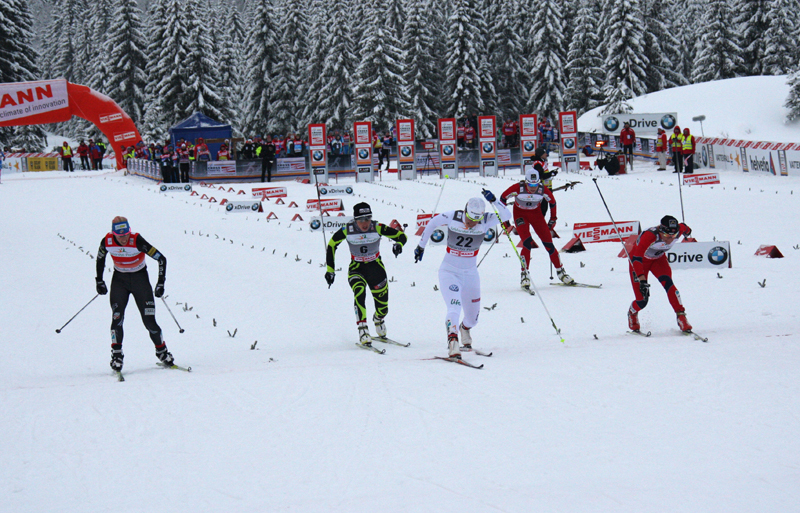
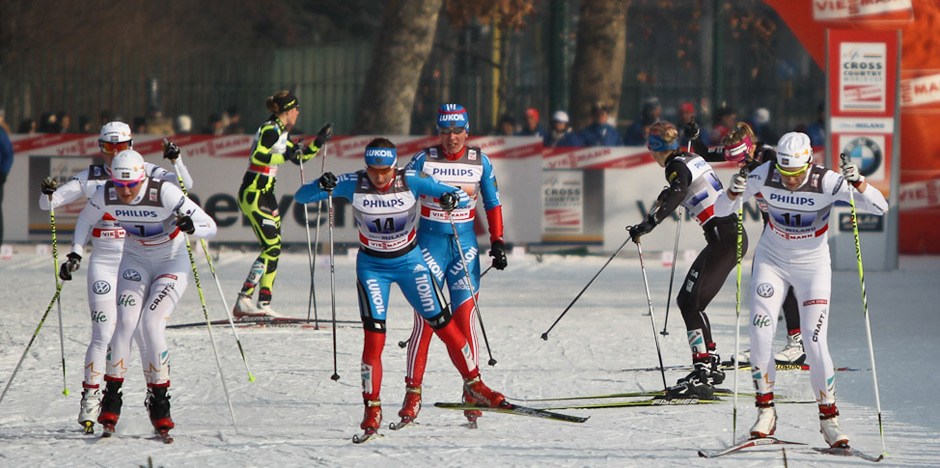
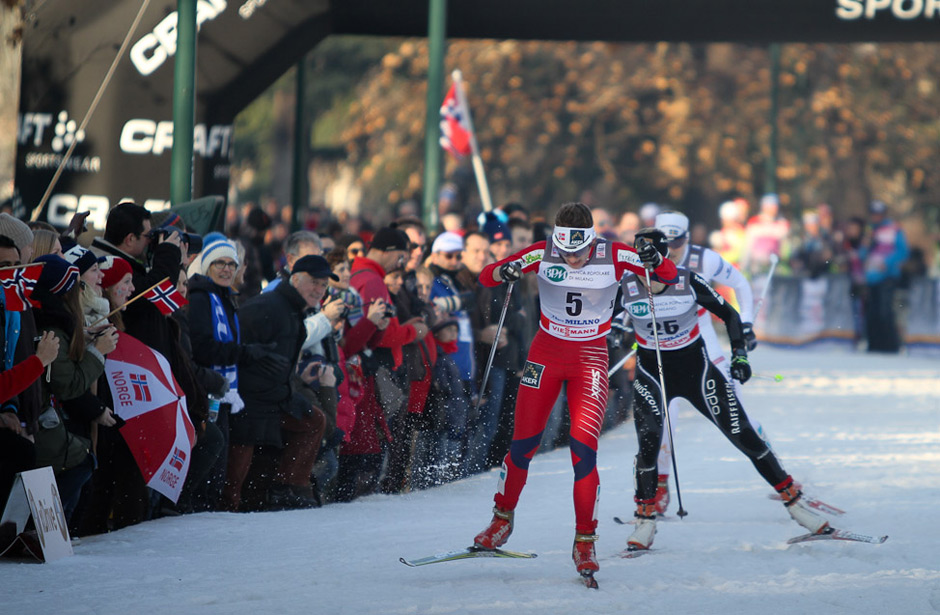
Canadian Chandra Crawford wrapped up her pre-season tune-up in fine form, placing second to fellow World Cup sprint star Ida Ingemarsdotter (SWE) in the Bruksvallarna, Sweden skate sprint.
Crawford qualified in 7th, three seconds down on Stina Nilsson (SWE) before placing second to Katja Visnar (SLO) in the first quarterfinal, in the process bumping teammate Dasha Gaiazova, who was third in that heat.
In the semis, Crawford returned the favor, besting Visnar as both women advanced to the final.
“I felt better and better with every heat, getting more and more into it,” Crawford told FasterSkier in a post-race interview. “It was fun to mix it up with the Swedes and some Slovenian talent out there.”
In the final the Canadian, couldn’t get the better of Ingemarsdotter, who won two World Cup races last year, but kept the edge on Visnar, relegating the Slovenian to third.
“I just got psyched up listening to music like I always do [at the start of the final], jumping around and just thinking about how I want to feel when I cross the finish line,” Crawford said.
She added that she doesn’t usually make a race plan based on her competition, but said “generally my plan is try to be in second or third, ideally second. That’s the best place to be at all times right ‘til the finish line.”
She implemented that plan, letting Visnar lead for three-quarters of the fast-skiing 1.2-kilometer course, before attacking after the downhill.
Ingemarsdotter moved as well, and took over the lead on the last small climb, setting up the drive down the homestretch.
“From my perspective, I was just following Ida and she was flying,” Crawford said.
Gaiazova qualified in 14th and teammate Perianne Jones in 17th. Both were bounced in the quarters, placing 13th and 18th respectively.
Jones told FasterSkier that it felt good to race but that “it wasn’t a great day.”
She was more pleased with her performance on Friday, when she placed 14th in the 5km classic.
“I think Friday took a little more out of me than it normally would,” Jones said. “I just have to get back to that state where I can recover from a hard effort in a day or so.”
The men’s race featured a similar level of talent, including 2012 Sprint Cup champion Teodor Peterson (SWE) and the always dangerous Emil Joensson (SWE).
Joensson, always a strong qualifier, set the time to beat and earned bib #1 for the heats, with the lone Canadian, Alex Harvey advancing in 11th.
Harvey placed second to Joensson in the quarters, advancing to the semis, but he knew the conditions were not ideal for success.
“It was just way too short, 2:15 with all the work in the first minute or so,” Harvey wrote to FasterSkier in an email. “The sprinters didn’t have time to get tired!”
He said he skied aggressively, attacking hard over the top and free-skating the entire downhill.
“I got by four guys in my quarterfinal and two in my semi, but it wasn’t enough to move through,” Harvey wrote.
Harvey ended up fourth in his semi, albeit a particularly stacked heat. Joensson crossed first, followed by Peterson and then Robin Bryntesson (SWE), another strong Swedish sprinter.
“I feel great about this weekend,” Harvey concluded. “I did a ton of training before I flew over here, then some more…in Ostersund so considering that, I think I skied pretty well.”
In the final, Peterson out-kicked Joensson in the homestretch to take the win with Calle Halvarsson (SWE) rounding out the top three.
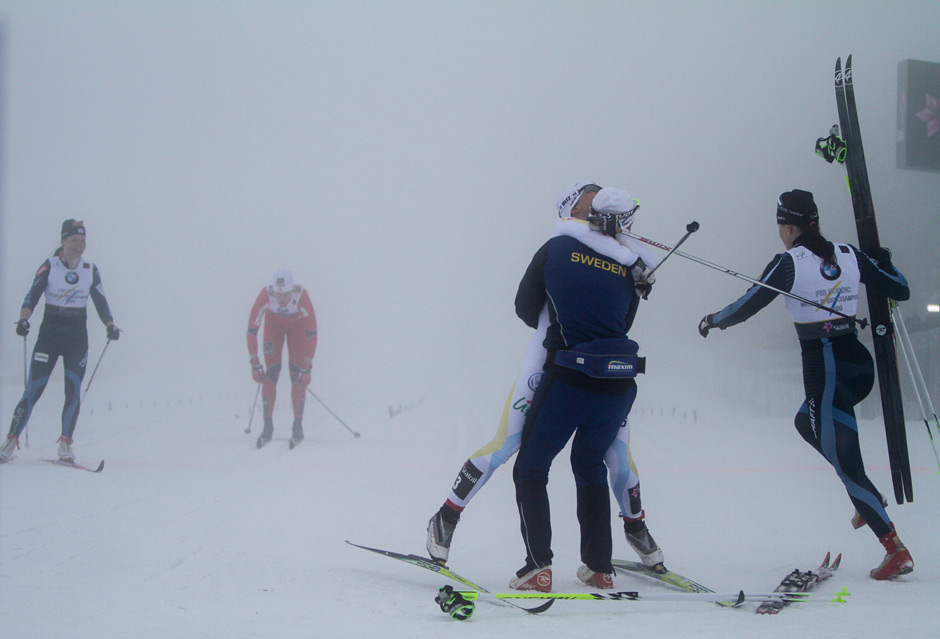
The ladies' final comes to the line with Ida Ingemarsdotter (SWE) capturing first just ahead of Astrid Uhrenholdt Jacobsen (NOR) and Kikkan Randall (USA). Photo: Fischer/Nordic Focus.
Ida Ingemarsdotter (SWE) bided her time, letting Maiken Caspersen Falla (NOR) lead the final in the skate sprint in Szklarska Poreba, Poland before using a strong finish to take her second victory of the season.
The trail to the top of the podium was hardly easy, packed with star power despite the early exits of Marit Bjørgen (NOR) and Justyna Kowalczyk (POL). In addition to Ingemarsdotter, Falla and Kikkan Randall, the final featured the always dangerous Astrid Jacobsen (NOR), Russian Natalia Matveeva, currently second in the overall Sprint Cup, and the lone upstart of the bunch, Laure Barthelemy (FRA).
Perhaps with the exception of Bathelemy, it would not have been a surprise to see any one of those women lead the field to the line. What did turn heads, however, was the aforementioned absence of both Bjørgen and Kowalczyk.
The pair has been locked in a tight battle for the overall World Cup lead, and are clearly established as head and shoulders above the rest of field—at least in distance races. But despite having eight sprint podiums combined this season, both were knocked out in a stacked quarterfinal, a heat won by Randall.
For once, that is enough about Bjørgen and Kowalczyk. The woman of the day, Ingemarsdotter notched her first sprint victory since besting both Falla and Randall in downtown Milan in January.
The Swede didn’t make it easy for herself, struggling in qualifying with just the 22nd fastest time before grabbing the final lucky loser spot in the semis to advance.
Randall, who was also uncharacteristically slow in qualifying, won both her quarter and semi with poise, looking in control after sitting out the previous World Cup weekend as she recovered from illness.
The Szklarska Poreba sprint course, at 1.6k is long, yet relatively flat, with just a single climb that barely kicked skiers from V2 to V1.
The result was a tightly packed field over the first part of the loop with just the on opportunity to attack coming later.
Several skiers used the crest of the hill, with the subsequent plateau before the descent, as the spot to make a move.
Jacobson executed this perfectly in the quarterfinals, gapping the field, and holding on for the top spot.
Such tactics, however, were not without risk as the extended technical descent provided plenty of opportunity for closing.
Given her performance in the first two heats, and her tendency to increase speed throughout the day, Randall entered the final as the favorite.
She was unable to clear the start line at the front however, and headed out of the stadium in the middle of the pack—finding herself in a similar position to the sprint in Slovenia earlier this year.
In that race, she crashed, and was out of the race before it started. Potential disaster struck this time around as well when Matveeva skied over one of Randall’s skis, taking both out.
The Russian went down hard, completely turned around. But Randall was back on her feet in moments, and with Falla taking the race out at a conservative pace, all was not lost.
By the time the group reached the climb, Randall was back on board. She immediately went wide, moving up on the hill, and gaining position to counter any attack over the top.
“I knew I still needed to move up so I tried to make a move up the outside,” Randall wrote in an email following the race.
When Falla accelerated into the downhill, she was unable to get away, and Ingemarsdotter took the lead into the hard left turn above the stadium.
“Towards the top of the hill, the others responded and we all pushed hard over the top,” Randall continued.
She maneuvered into third, and as the race gained the finish stretch, Randall hit the gas and moved into the lead on the inside.
Over the last two years, as Randall has established herself as the top skate sprinter in the world, this position has been as good as gold, and it appeared that the American was on-track for a stunning comeback and her third win of the season.
This time, however, as the meters ticked away, Randall began to falter. She looked tired, and unsteady on her skis. Ingemarsdotter gained slowly, and then more quickly, driving by in the center, with Falla moving up on the outside.
The Norwegian used a superior lunge to take second, flip-flopping the lower podium spots from Milan.
“When I went to switch into my finishing gear, I didn’t have my full power left and I couldn’t fight off Ingemarsdotter and Falla who were closing hard,” Randall said. “I think that early surge to catch back up drained my finish power.”
Randall was satisfied with third despite entering the race hoping for the victory, Her body felt good, and she was able to come back from a potentially race-ending crash.
Ingemarsdotter’s attack in the downhill was no coincidence. In a post-race interview, she said she planned the move, hoping to surprise her competitors with a tactic she did not employ in the earlier heats.
With Matveeva straggling across the line in 6th after the crash, Randall still picked up valuable ground in the Sprint Cup. She is now 129 points up on the Russian, and 178 ahead of Falla.
Ingemarsdotter is moving up, and has won five of the last seven head-to-head sprint meetings with Randall. But her absence in two early races that Randall won have put her in a big hole.
Only three sprints remain on the docket, all of the classic variety, and with the lead, Randall’s destiny will be in her own hands.
“I am getting quite attached to the red bib so I hope I will keep until the end,” Randall said at the post-race press conference.
Of Note:
– Barthelemy set a career-best with her 4th place result, a performance that catapulted into the Red Group for next period.
– Kowalczyk ended up in 16th, her only finish outside the top-7 since placing 24th in the Rogla, Slovenia sprint in December.
– Bjørgen was even further back in 22nd, the only time she has been outside of the top-7 all season, and amazingly just the second time she has missed the podium in a World Cup race in 2011-2012.
– Eight different nations were represented in the top-12.
– Agnieszka Szymanczak (POL) scored her first career World Cup points in front of a boisterous home crowd, placing 27th in her 13th World Cup start. The 27-year-old qualified 21st.
The ladies' podium in Szklarska Poreba (POL): Ida Ingemarsdotter (SWE, 1st place – middle), Astrid Uhrenholdt Jacobsen (NOR, 2nd place – left) and Kikkan Randall (USA, 3rd place – right). Photo: Fischer/Nordic Focus.
MILAN, Italy – Italy is a place of great history, with ruins from ages past, ancient works of art and a culture that existed long before North America felt the footfall of Western civilization.
Americans and Canadians generally travel to Italy to admire the history of the country, not make it.
Ingemarsdotter celebrating at the finish.
But on another brilliant sunny day in the northern Italian metropolis of Milan, Kikkan Randall, Jessie Diggins, Chandra Crawford and Perianne Jones did just that, setting a new mark for North American success in a season already replete with banner achievements.
While the Swedish pair of Ida Ingemarsdotter and Hanna Brodin won the freestyle team sprint in convincing fashion, giving the former her second victory of the weekend, the story of the day begins one step down on the podium.
Randall and Diggins took second in the race, just ahead of Crawford and Jones, marking the first time that the US and Canada have shared a World Cup podium in cross-country skiing.
The achievement is notable, and worthy of celebration by North American ski fans—but it is hardly surprising.
The quartet did not come to Milan to take in the sites, admire new fashions, and sip cappuccino in cafes. They came to ski, and ski fast—something that has become more and more the norm this World Cup season.
Randall and Crawford nearly set this mark back in November, in Dusseldorf, when the American won the individual sprint, and Crawford placed fourth.
Crawford gives Randall a congratulatory kiss.
Then in Rogla, both women reached the final of the skate sprint, but Randall crashed and only Crawford reached the podium.
It may have been only a matter of time before the two countries stood together at the flower ceremony, but putting together four great races as opposed to two is no mean feat.
Throw in the uncertainties of city sprint team racing and the result is even more impressive.
The day nearly came to an early end for both teams. Fortuitously, they did not match up in the semifinals, but with just two teams in each heat advancing automatically to the finals, and the remaining six chosen based on time, there would be no assurances.
The Canadians skied well in the first semi, coming back from a slow start and placing third on the strength of a fine final push from Crawford.
But the heat was slow, with a winning time ultimately eight seconds behind the second semi, and despite placing third, Canada advanced as the very last of the six lucky losers.
Racing in the second semi, the Americans were significantly faster, but had to overcome the usual challenges of team sprint racing.
Diggins (USA) and Jones (CAN) on their way to the history books.
Diggins, in her first World Cup weekend of the year (and only the second of her career), fell in the tag zone, both a foreshadowing of what was to come, and a very present setback.
But the veteran Randall did not panic, and Diggins bounced back just fine. The pair rallied to place fourth in the faster heat, safe within the land of lucky losers.
Crawford and Randall have been around the World Cup block a few times, and each holds a major championship medal. Jones, while less accomplished overall, has also had her fair share of success in the big show.
Diggins, however, is just twenty years old, and had all of one World Cup start under her belt prior to this weekend (she also raced at World Championships in Oslo last year, faring very well).
After a strong performance in the individual sprint, Diggins posted lap times ranked 2nd, 4th and 1st in the semifinal, proof that she would not be holding the Americans back in the final round.
The first laps of the final were as uneventful as a team sprint can get—plenty of jockeying for position and movement within the pack, but nothing race-deciding.
Both the US and Canada remained trouble-free, and with Randall and Crawford closing, they just needed to stay in the mix.
Throughout the day, it became clear that with no hills to speak of, the one spot on the course that could be truly decisive was the tag zone.
US Ski Team head coach Chris Grover said that this is often the case in this race format.
“The team sprint is often won or lost in the exchange zone,” Grover told FasterSkier, adding that it is easy to lose a second or two while tagging off—time that is difficult, if not impossible to make up on course.
The Canadian pair used smooth tags to move into position for the last leg of the semis, while the American men went the other direction, falling out of the race due to a collision in the transition.
Coming into this roiling storm of skis, poles, and high speed for the second time in the final, one of the French skiers cut across in front of Diggins, hitting her skis and sending the American tumbling to the ground.
Randall skiing the wrong way to get the tag-off from Diggins, who fell in the exchange.
Randall, already in motion, said she felt some tag-like contact, but it didn’t seem to be the required hand-to-body.
She slammed on the brakes, and had to actually retreat back down the course when Diggins, back on her feet, went down a second time.
“She fell again, right as she was tagging me, but that time it felt solid enough,” Randall said. “I knew I had a lot of work to do, and it really just depended on how those front girls wanted to ski.”
If the leaders had hit the accelerator, Randall said she would be hard-pressed to close the gap. Randall described the pace as “pretty fast,” but by the end of the first lap of her second leg, she had made up the full 25 meters nonetheless.
One her second lap, she began to move back through the field, work that Diggins continued on her final leg.
“I was just feeling like, man, I need to get a shot of redemption here after falling twice,” Diggins said. “I’ve had girls skiing all over me—I need to just go as hard as I can early on.”
Brodin was pushing at the front, and actually opened a small gap, stringing out the field and leaving a bit more room to move. Diggins slipped up into 3rd with Jones right on her tails.
A tightly-packed field lapping through the stadium.
Both teams executed the final exchange with aplomb, and when Norway and Switzerland went down in a tangle, Randall shot out of the tag in the lead, a remarkable reversal of fortunes.
“It’s crazy,” Diggins said. “It was just blowing my mind how fast it could change… You could be in second place and then take one corner wrong, and be in the back of the pack and then take the next corner well and be back near the front, and …everything kept shifting. It was nuts.”
Confident in the fitness that has made her a consistent top-10 threat in World Cup distance racing, Randall still liked her chances when Diggins tagged off in good position.
“I knew it wasn’t going to be quite as nice as having not had to expend that extra energy on the second leg,” Randall said of her final leg.
Crawford locked in on her American counterpart, telling FasterSkier that she was making decisions on the fly while sticking to her one plan.
The final charge to the finish, Ingemarsdotter in the lead.
“Today, I employed a strategy I’ve been working on since December which was: follow Kikkan, she’s going to get to the front,” Crawford said.
At the lap, Ingemarsdotter passed aggressively on the inside, but Randall held strong, Falla skiing to her outside.
Randall, lunging for the line.
Out of the final turn, Linn Soemskar of Sweden II swung wide along with Falla, leaving Crawford a lane behind Ingemarsdotter.
Randall was clear on the inside and the race was on.
The Swede had too big a gap, and Randall used a lunge at the line to wrap up second place for the Americans, with Crawford holding third.
“We’re really focused on staying smooth and relaxed and out of trouble, and kicking when it counts. That was our whole strategy,” Crawford said.
“Through the last few months I’ve attacked too early and too late and not at all. So today, I just keep working to get those attacks right,” she continued.
Jones certainly felt her teammate timed this one perfectly, rushing the finish pen and practically leaping into her teammate’s arms. This marked the first World Cup podium appearance for the almost-27-year-old.
“I was hoping this day was coming soon,” said Jones. “I’m super pumped right now!”
Randall, off-balance from her lunge, crashed to the ground and lay on her back, totally spent, but smiling even as she lay in the snow.
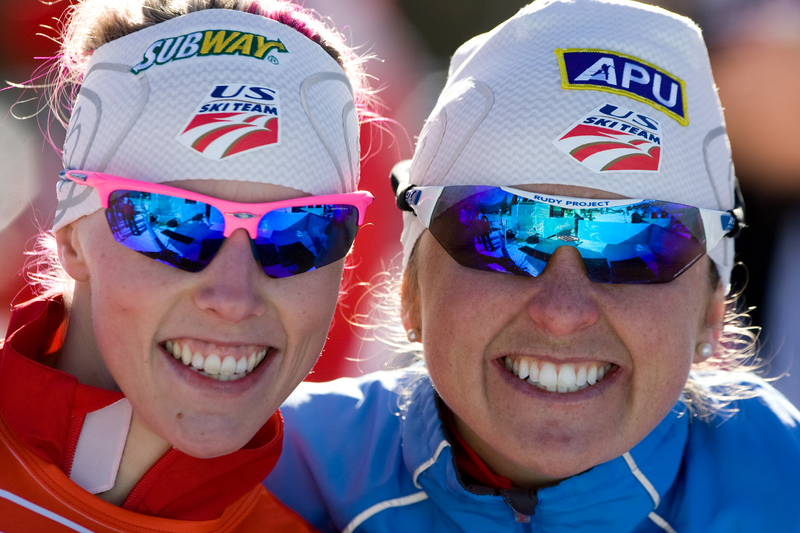
Crawford and Jones, celebrating at the finish.
“North America didn’t used to be on the podium at all, and now to take two of the three places, it’s pretty awesome,” Randall said later.
All the attention showered on the North Americans should not minimize the accomplishments of the Swedes. Ingemarsdotter was a machine this weekend, dismantling the field in a precision performance.
In the final leg today, she bested Randall, Crawford, and Maiken Caspersen Falla, the first-, third- and fifth-ranked sprinters in the World—and she made it look relatively easy, opening a significant gap and holding the energy to celebrate the win with a vigorous fist pump and leg kick.
Brodin held up her end as well, keeping the team out of trouble, and putting Ingemarsdotter in position to make her move.
Thank you to Joran Elias of StatisticalSkier.com for confirming that Canada and the USA had never shared the World Cup Cross-Country podium prior to today.
MILAN, Italy – Eat your heart out Justyna Kowalczyk, there is a new sheriff in town — or in this case, sheriffs, and they are hanging out in central Milan.
Kowalczyk, the ironwoman of cross-country skiing, who rarely misses a race, is back in Poland, recovering from the Tour de Ski, and preparing for the next phase of World Cup racing, while Ida Ingemarsdotter (SWE) and Kikkan Randall (USA) are duking it out in the lovely Parco Sempione.
Ingemarsdotter bested Randall in the homestretch of the freestyle city sprint in front of a reported crowd of 20,000 boisterous spectators, a 1-2 finish by women who completed the entire Tour just six days ago — the phrase “no rest for the weary” has never been so apt.
While the likes of Kowalczyk, Marit Bjørgen (NOR) and a host of others (including a high percentage of the men’s field) are off licking their wounds, Ingemarsdotter and Randall survived the usual mishaps of city sprinting to stage a thrilling run for the line.
Ingemarsdotter celebrates.
It is unlikely anyone from the organizing committee counted every person who strolled by the event, but if all comers are counted, from the passionate Federico Pellegrino fan club, bedecked in matching t-shirts and custom buffs, to the confused tourists wandering out of the museums of the Castello Sforzesco, there very well may have been a crowd worthy of one of the world’s great city.
The fans lined both sides of the 650-meter loop, packed half-a-dozen deep in some places, cheering raucously for everyone, though saving the most vigourous bell clanging, air-horn tooting, and cries of “die die die” (Italian for “go go go”) for the home team.
They were not disappointed on this sunny day, balmy by any measure of a ski race, with the performance of Randall, the top sprinter in the world.
Randall in qualifying.
The American entered the race as the clear favorite, especially with Bjørgen absent, and a victory in the November city sprint in Dusseldorf, where she flawlessly navigated the tight turns and narrow course with precision.
As become the norm, Randall was able to stay relaxed toward the front of her quarterfinal, cruising across the line behind top qualifier Anne Kylloenen (FIN), another Tour survivor.
The semis, however, presented another challenge.
While Swedish coach Rikard Grip sung the praises of the Milan course, pointing to ample opportunities to pass, advancing was no simple cone of gelato.
Each heat started tightly packed, and there was a surprising lack of carnage on the first corner — perhaps a testimony to the fine layout Grip congratulated as the turn offered plenty of space, and did not angle a full 90 degrees.
For those who enjoy roller derby, or watch NASCAR for the crashes, there was still plenty of damage, with a number of crashes and countless broken poles.
Randall was coming off a strong second place in the Toblach skate sprint, but crashed in her previous two outings, at significant cost.
Early in her semifinal, while trying to move back up after a bad start, she bumped with Swiss skier Laurien Van der Graaff, who was taking a tight line in front of Randall, and disaster almost ensued.
Ingemarsdotter catches her breath after qualifying.
“I felt my weight kind of go to my heels and one ski go up in the air, and I went ‘no way, not this time,’” Randall told FasterSkier.
Whether it was force of will, or just excellent ski handling, Randall recovered and set about the task of regaining position, only to avoid a second close call when Finland’s Mona-Lisa Malvalehto, skiing to the American’s side, went down.
“It was definitely wild out there,” Randall said.
Despite the challenges, Randall was able to move through the field, taking the top spot ahead of Kylloenen, meaning the two women would match up in the final for the third head-to-head meeting of the day.
Meanwhile Ingemarsdotter was having her own wild ride en route to the finals.
The powerful Swede favors flat courses, but also skis with an Achilles heel that can wipe away any advantage that a city-sprint course might hold.
Grip attributes Ingemarsdotter’s success on gradual terrain to her height and associated power and her ability to ride her skis.
And the weakness?
“She is not that fast in the start,” Grip told FasterSkier. “When the start is really important, she is not making the best result.”
In a tough quarterfinal, with Natalia Matveeva (RUS), Riikka Lilja-Sarasoja (FIN) and Denise Hermrann (GER), among others, Ingemarsdotter suffered worse than a poor start.
Kylloenen leads out Randall in the quarters.
Halfway through the first lap another skier hit her pole, breaking the shaft. As luck would have it, a coach stood just meters ahead, and Ingemarsdotter tossed the splintered piece of carbon aside, grabbing the replacement with barely a hiccup.
There is not a hill worth mention in the Parco Sempione, meaning no hard ups, and just as importantly, no rest. This made for a lung-burning interval, and also left nowhere to strap on a ski pole.
Ingemarsdotter said she was trying “just to keep calm and do my work as good as possible,” and stay patient while regaining position.
Impressively, she worked her way through the field to win the heat, tightly gripping the unstrapped pole for the duration.
In the semis, she had no one to blame but herself for any drama. Suffering the slow start that Grip pointed to, she was never able to regain position, but advanced as the second lucky loser.
The day may have been missing many of the big names of the women’s field, but any discerning ski fan would be hard-pressed to put together a stronger final, especially on this course.
Randall, Ingemarsdotter, Kylloenen, Matveeva and Maiken Caspersen Falla (NOR), who won the skate sprint in Rogla, and now sits third in the Sprint Cup, just behind Matveeva headed to the start pen together.
The only surprise was 22-year-old Mari Eide (NOR), making her first finals appearance.
Falla, who won both her earlier heats, and appears to enjoy leading from the front, was out early, Randall tucked in behind on the inside, Kylloenen to her left.
Falla leading her quarterfinal.
The pack remained jammed tight, no one giving an inch, and no one appearing to suffer for the kilometers already raced.
The Finn made the first move halfway through the second lap, with Randall responding to hold second position, dropping Falla back.
It appeared it would come down to those three as the race swung into the homestretch, but Ingemarsdotter took the last turn very wide, skiing significantly more distance, but gaining harder, faster snow.
At that point it became a simple drag race between the two, and for many it may have come as a shock to see the Swede take the win.
Randall had the position to reach the top of the podium, but in hindsight made one critical mistake.
She said she knew Ingemarsdotter was coming, but said, “I think maybe I just relaxed a little too much coming off the final turn and didn’t build momentum soon enough coming into the final [homestretch] there.”
She added that it wasn’t a matter of fatigue, saying “I definitely had the energy left in my legs, so it is one of those things when you cross the finish line and go ,‘Oh I want to do it again.’”
Sarasoja qualifying.
Falla came across in third, edging Matveeva for the last spot on the podium.
While Randall may have felt her legs had everything she needed, U.S. Ski Team Head Coach Chris Grover saw differently from the sidelines.
“I felt like watching her ski she is still carrying some fatigue from the Tour de Ski,” Grover said after the race. “You could see she didn’t have the exact snap that she has had say in Davos or Dusseldorf.”
He was referring to Randall’s two victories this season, but that “given that big of a load [of the Tour], I am super impressed she was on the podium today.”
For her part, Ingemarsdotter pointed to the Tour as helping her find her top form.
“Maybe the Tour de Ski has been a good training session to do a lot of races, and just competing and competing and finding a good shape,” Ingemarsdotter responded when asked for the secret of her success.
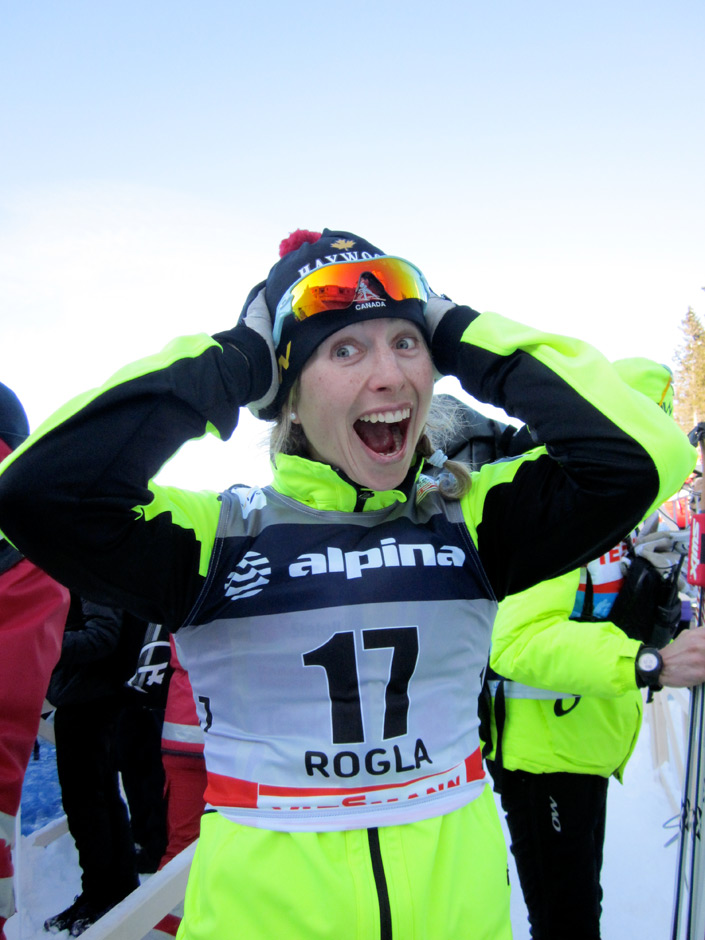
Crawford moments before heading to the podium ceremony in Rogla (Photo: Holly Brooks)
It has been three-and-a-half years since Chandra Crawford has graced the podium in an individual World Cup race, but that drought has come to an end as the 2006 Olympic Champion powered her way to second on a short yet challenging sprint course in Rogla, Slovenia.
Crawford finished right on the tails of Norwegian Maiken Caspersen Falla, who laid claim to her first individual World Cup win. Ida Ingemarsdotter (SWE) finished third.
Sprint Cup leader and clear favorite, Kikkan Randall (USA), was tripped up in the final heading out of the stadium. She went down, breaking a pole, and fell well off the pace to finish sixth.
The one-kilometer Rogla sprint course clocked in at just 2:15. Racers descended out of the start and worked down through a series of tight S-turns before heading up the one big climb to the finish stretch, and a long gradual ascent to the line.
The top-3 and Randall all looked strong through the early heats, using the hill and the run to the finish to advance.
The start was clean in the final, but just 100 meters in, Randall went down. It appeared another skier, clipped Randall’s ski or pole.
The American was twisted around, and went down, shattering a pole.
Such a crash is usually debilitating in any sprint, but if it had happened on a climb, Randall may have had some hope. As it was, with 500 meters of descending ahead, and her momentum gone, Randall was done.
Meanwhile, up at the front, Natalia Korosteleva (RUS) led the way through the downhill with Oestberg close behind.
With all the climbing at the end, position was less critical through the first half of the course. The hill was wide, leaving plenty of room to move for skiers with enough left.
As the women hit the base of the climb, Falla accelerated, charging to the front. Crawford, in fourth followed right behind, and in a matter of seconds it was as good as over at the front.
Falla and Crawford were clear, and once in the finish lanes, it was evident that Crawford was not going to be able to muster a final attack on the Norwegian, and they crossed single file.
Ingemarsdotter held off Oestberg and Korosteleva for her first podium appearance this season.
“I’m extremely happy today,” the 21-year-old Falla said after the race. “It is a dream come true for me.”
She expressed disappointment that Marit Bjoergen (NOR), who skipped the Rogla World Cup due to illness, and Randall, were not part of the final sprint.
Maiken Caspersen Falla (NOR) leads Chandra Crawford (CAN) across the line in Rogla, Slovenia (Photo: Fischer/NordicFocus)
“I was hoping to fight with Marit and Kikkan in the finishing straight, and I’m sorry for Kikkan that she fell,” Falla said.
Prior to today Falla had finished on the World Cup podium five times in individual races, all sprints, without taking a victory, though she has been part of two winning Team Sprint squads, including two weeks ago in Dusseldorf.
Crawford, on the other hand, has that Olympic Gold and two other World Cup victories, but her career has been a rollercoaster.
She struggled in her post-Olympic season before bouncing back strong with two wins in 2008. But she missed all of 2009 with injuries, and has been slowly working her way into to top form.
For the first time since 2008 she appears to have the high level fitness to compete right through the heats. She just missed out on a podium in the individual sprint in Dusseldorf where she placed fourth, and has been looking consistently good.
Canadian National Team Head Coach Justin Wadsworth was not surprised to see Crawford on the podium today, feeling the course suited her strengths—according to Wadsworth she is an excellent one-skater (Canadian for V1), so the big hill toward the end was a perfect fit.
“It was just a good layout for her and she skied tactically very well,” Wadsworth told FasterSkier in an interview.
“This feels really good to punch through onto the podium,” Crawford said. “I was thinking a lot about that [Christmas Break] today as I was approaching the final. The wax techs told me today before the final ‘in five minutes from now it is Christmas.’ I wanted to make the best of my chance today and it was so cool to break through for the entire team.”
Despite fielding one of the deepest teams in recent history, the Canadians had yet to make the podium this year—though there have been plenty of strong results.
Crawford changed that today, and served notice she is once again one of the top freestyle sprinters in the world.
Wadsworth also pointed to other races this season that demonstrated her increased fitness level—the skate sprint at altitude in Davos where she bested Bjoergen in a drag race in one heat, and the classic sprint in Kuusamo where she qualified in 10th.
After all the missed training due to injuries, it has taken time for Crawford to build back to full strength.
“I think her body is really healthy,” Wadsworth said, with the key being “another full year of training, of really good quality training.”
He also pointed to Crawford’s willingness to be patient and “do the training that doesn’t feel like it is making you faster,” but pays off in the long run.
“She hung in there and kept believing,” Wadsworth said.
He sees more success in the near future. She will skip the Tour de Ski, but will be back on the World Cup starting with the skate sprint in Milan, Italy.
Following the race Crawford explained that her strategy was to stick on Randall, the winner of the last two World Cup sprints.
Crawford hugs Kikkan Randall in the finish area (Photo: Fischer/Nordic Focus)
“My goal was just to follow Kikkan. If I can stick with her it will be an awesome day,” Crawford said.
That plan was scrapped when Randall went down however.
The American has plenty of experience with disappointment due to crashes. She entered last season’s World Championships as the favorite in the sprint, but was taken out in a crash in the semifinals.
“Today isn’t easy to take but I’ve had a great first period,” Randall told FasterSkier. “I know I am skiing really strong and there will be more.”
Randall said she felt good again and the biggest letdown may have been knowing she had plenty in the tank to make a run at another victory.
“It doesn’t feel nearly as good as the last two weekends,” Randall said. “But I’m at least satisfied with how I skied my first three rounds of the day. To make the final is always a good thing.”
US Ski Team Women’s Coach Matt Whitcomb pointed out that three years ago, a finals appearance and the resulting sixth place finish would have been cause for celebration.
“This is definitely a little bit of a disappointment, but it is a reminder of all that can happen in sprinting,” Whitcomb said.
Randall is not sure what exactly caused the fall.
“It happened so fast, I’m not really sure,” she said. “I just got to see some footage of it and it appears that maybe Korosteleva’s pole or ski just nicked the tip of my ski and it caused my legs to split.”
The men’s final was marred by a similar incident a little further in, but still on the straight section of the course.
Randall said the twisty downhill was the area of concern heading into the race.
Laurien Van der Graaff, the young Swiss skier who has broken through in sprinting this season, made an aggressive move on one corner in Randall’s semifinal, jumping up three places momentarily. But she swung wide after passing on the inside, and Randall was able to shoot through the resulting hole and into position to advance.
“I felt that going wide initially and then cutting inside was the best way to go, and it worked out well,” Randall explained. “The best strategy was just to take a deep breath and try to get through the turns without incident.”
She was confident in her abilities on the subsequent climb, so didn’t feel the need to take risks on the downhills.
“It was a really good course for me,” Randall said. “I was really looking forward to the hill up and over the bridge and the long finish stretch.”
Randall maintained her spot atop the sprint rankings, sitting on a 64 point lead over Falla, and Crawford climbed to fourth overall.
Randall is also fourth in the overall World Cup standings. Had she won today, she would have been second.
Ingemarsdotter skipped Saturday’s distance race after several days of feeling a bit sick. The strategy clearly paid off as she posted the fastest qualifying time and made it back to the podium for the first time since 2010 in Canmore.
Ingemarsdotter leads her quarterfinal. American Ida Sargent is in black (Photo: Holly Brooks)
The host country got off to a good start qualifying four skiers for the heats. Veterans Katja Visnar and Vesna Fabjan both looked strong while winning their quarterfinals, but neither woman was able to survive the semis.
Dasha Gaiazova (CAN) set a personal best in a skate sprint, placing ninth. Gaiazova used a stunning comeback to advance out of the quarterfinals.
Entering the final climb, she was literally out of the picture on the television feed, but made up enough ground to stage a late charge on the homestretch.
Ida Sargent was the only other North American to make the heats, slipping into the final qualifying spot. Sargent ended the day in 25th.
A complete report on these North American results, will follow.
The World Cup now breaks until the Tour de Ski begins on December 27th.
Norwegians Petter Northug and Marit Bjoergen have now both sat out a race at World Championships – not Charlotte Kalla though, and the Swedish star has no plans to take a day off.
In another day at the office, Kalla teamed with Ida Ingemarsdotter to win the women’s World Championship classic team sprint in Oslo, Norway, skiing away from Finland and Norway in the last lap.
Ida Ingemarsdotter (L) and Kalla (R) celebrating at the medals ceremony.
The team sprint features pairs of athletes, alternating laps, for a total of six loops in a contest that favors neither pure speed, nor great endurance, but a balance of the two. Referred to as the “Championships of interval training,’ the nearly twenty minute race is a brutal test, especially on the challenging Holmenkollen course.
The big climbs, and relative lack of recovery played into team selection, with more weight being placed on the ability to maintain a high pace for a long period – the bread and butter – or perhaps more appropriately, the brød and gjetost – of the distance skier.
With that taken into account, Finland, the two-time defending Champions, were favorites to keep a tight grip on the crown. Both Aino Kaisa Saarinen and the young Krista Lahteenmaki excel in the longer races. But the women’s field generally features many fewer sprint specialists than the men’s, and with the emergence of Ingemarsdotter as a solid World Cup racer on the longer courses, Sweden certainly looked good coming in.
Two semifinals of eight teams kicked off the day in a battle for the ten slots in the final. The top three teams in each heat advance automatically plus the next four fastest pairs.
With only one team per nation allowed at the World Championships, the field was somewhat diluted. In both semis, the top teams were able to break away, back off the pace, and cruise to the finals, leaving the rest to fight for every second, and a lucky loser slot.
Norway, Sweden and Slovenia easily outpaced their competition in the first semi booking their spots in the final. In the
Finland's Aino-Kaisa Saarinen leading through the fog.
second heat, Finland and Italy easily advanced, with the US taking down Germany for the last automatic slot.
Ingemarsdotter summed up the basic strategy for the medal favorites, saying “In the qualification I tried to do an easy job…just going with the others slow and easy, and save all energy I could for the final.”
Two teams from each semi moved on as lucky losers, and the table was set.
Right from the gun it was clear this was a different race – the pace was high the intensity palpable. There would be no “easy job” here.
Finland, with Saarinen taking the first leg, pushed the pace from the start, a planned approach according to Finnish head coach Magnar Dalen.
“They are distance skiers first of all,” Dalen said of his women, “so the thing was to ski fast and hard from the beginning.”
The goal was to break as many teams as possible, and tire out anyone who could hold on. In many ways, the strategy paid off. Sweden, Finland, Norway, Slovenia and Italy quickly opened a gap, and even among these teams there were some clear differences.
Slovenian Katja Visnar and Italy’s Arianna Follis were both struggling to remain in contact, putting pressure on their teammates – Petra Majdic and Marianna Longa respectively.
By the time the fifth lap came around, those teams were out of the medal hunt, the stronger skiers unable to make up for their weaker teammates. Barring something cataclysmic, the podium would be an all-Scandinavian affair.
The Swedes celebrating their victory.
“We were quite happy to drop Slovenia so Majdic doesn’t have the possibility [of fighting for the podium], Dalen said. “If she is coming close [at the finish] she is very hard to beat.”
Saarinen’s approach to accomplishing this goal was simple – ski each lap faster than the last.
Down to the homestretch for the final tag, the three teams were all within a second, Finland holding a slight lead. Out of the fog and into the tag zone, they came, double poling with a fury – these were the last meters for the scramble skiers.
In a matter of seconds the race changed, Sweden making a move that would result in gold. Kalla waited right at the beginning of the zone, and took over from Ingemarsdotter before Saarinen had reached Lahteenmaki.
This gave the Swedes an edge as Kalla was able to accelerate to speed first, and shealmost instantly had three meters on Finland and Norway. She continued to attack up and out of the stadium and into the descent.
The move was not in response to Finland’s late tag. After the race Kalla said that she planned all along to go hard from the start of her last leg. And Finland’s error was one of strategy, not of execution. According to Dalen, the Finn’s had picked out a spot for the exchange before the race, and merely were following that plan.
Lahteenmaki and Astrid Jacobsen, who had taken over from Maiken Caspersen Falla for Norway, faced a solid 10-meter deficit by the time they hit the big climb. Halfway up they had made no progress, and Jacobsen, seeing the chance for gold slipping away, made her move. She stepped out from behind the Finn, and pulled alongside. Over the top she led, a position she held around the stadium, up the final hill and down into the homestretch.
“I saw that Krista – that she didn’t have the power to catch Kalla,” Jacobsen said. “I tried to go in front…because I was
The women's final.
dreaming for the gold.”
Kalla meanwhile opened her lead further, pumping her arms as she crossed the line, skiing into the arms of the strapping Ingemarsdotter, laying claim to the medal that has eluded the Swedish women so far this Championships.
Jacobsen held her lead until the last 50 meters, but finally succumbed to the relentless Lahteenmaki.
“I knew that being first into the finish with a girl just behind was not the best,” Jacobsen said. “So when I got in front I knew I was going for the gold and risking the silver.”
Lahteenmaki described her legs as “full of lactate” on the finish run, but said that her arms still felt good. And with the last 200 meters straight double pole, that was all she needed.
It was still a good day for the Norwegian pair. Falla is just twenty-years-old, and she bounced around the finish area, still in just her race suit, like a child on Christmas morning, helping the exhausted Jacobsen, and enjoying the moment.
Jacobsen, for her part, grew up just several kilometers from the venue, and was able to thrill the hometown crowd. At one point her Championships appeared to be over. With Falla besting her in the last two sprints, she had no spot in this event until Marit Bjoergen opted to sit out.
The former overall World Cup runner up, and the sprint World Champion in 2007 said the bronze today bested both of those accomplishments. Two summers ago, Jacobsen was hit by a car while biking, and for a time it was unclear that she would walk again, let alone ski race at a high level.
Norway after the race.
The silver was also a fine accomplishment for the Finns. Veteran Saarinen claimed her second medal of the Championships, and the performance marked the first major conquest of Lahteenmaki, Saarinen’s heir-apparent on the women’s team.
It wasn’t always the plan for Kalla to race every event. Over the summer, when she was planning for World Championships, she considered dropping the team sprint. She hadn’t had much success classic sprinting in 2010, and that technique has always lagged behind her skating.
But with her first World Championship gold in hand, Kalla has to feel pretty good about her decision. At the post-race press conference she said that the decision to race was made before she heard that Bjoergen would take a pass.
She pointed to the improvements she has made in her classic skiing this year and Swedish coach Rikard Grip noted several strong classic sprint results for Kalla.
And Grip is not concerned about Kalla breaking down under the tough schedule.
“At the moment when she has the gold medal that gives her much more energy and confidence than if she not should race and have a rest day today,” Grip told FasterSkier.
The race was also some bit of redemption for the Swedish wax staff who were responsible for the men’s slow skis in both the classic portion of the pursuit and Tuesday’s 15km classic.
The Championships are likely over for the two Norwegians. Barring something unforeseen, neither has a start spot in the two remaining races. The young Falla can count her first World Championships a great success, despite failing to reach the individual sprint final.
Before the team competition, she said she was very nervous. “My whole body was shaking,” she described at the press conference.
Jacobsen, the veteran of numerous big races, shared the feeling.
“We sat up in the wax cabin shaking together,” she joked.
Kalla and Ingemarsdotter look to lead Sweden to another medal in Thursday’s 4x5km relay. The two will bookend the race with Ingemarsdotter scrambling and Kalla anchoring.
Saarinen skis the critical second classic leg for Finland, and Lahteenmaki has another opportunity to close.
The Swedish sprint relay team selection was a surprise for Charlotte Kalla, although the coaches have been tossing the idea around for a couple of days, especially as Hanna Falk doesn’t seem to have nailed the peak for the World Championships.
“If you had asked me last summer if I thought I’d be racing the team sprint at the world Championships I would have laughed,” Kalla admitted.
Good course
But the decision being what it is, both Kalla and Ingemarsdotter are excited for the race.
“I think the course suits us well as a team,” said Ida Ingemarsdotter. She pointed out that there are several teams that will be fighting for the hardware in the women’s teams sprint: Norway and Finland are the obvious suspects, both teams that have proven their position in Holmenkollen this week, but Ingemarsdotter also doesn’t rule out Italy and Slovenia in the mix for the medals.
Norway’s team will consist of Maiken Caspersen Falla and Astrid Uhrenholdt Jacobsen, giving Marit Bjoergen an extra rest day before the relay on Thursday.
“I think we could beat the competitors with an ambush, come up from behind,” said Ingemarsdotter, who is not worried about racing the team sprint the day before possibly racing the 4x5K relay on Thursday.
“The rest of the season we do back to back races on the World Cup all the time. You learn to just put your head down and get the job done,” Ingemarsdotter said.
Ida Ingemarsdotter also in the 10k classic. She has added distance racing to her sprint-heavy resumé.
Confident in Kalla
Sweden’s national team coach Rickard Grip said he felt that he had named the most promising team for the race, based on Kalla’s improvement in classic technique the last season.
Over the past season, Kalla has made several strong bids for classic starts. In Kuusamo in November, she placed fourth in the classic sprint, and during Tour de Ski Kalla delivered a solid 11th place in the classic sprint.
“I really feel like I nailed my peak this week. It will be exciting to see what Ida and I can do out there tomorrow,” Kalla said. “I hope I’m able to ski to my potential tomorrow. We’re skiing for a medal.”
With four World Cup podiums this season, including a win in the final World Cup sprint before the World Championships last Sunday, Kikkan Randall (US Ski Team) is on the minds of both coaches and racers in the Norwegian camp.
“Kikkan Randall won last Sunday. It’s rarely a bad sign to win a major event four days before the World Championships,” said Jon Arne Schjetne, sprint coach for the Norwegian women’s team.
Marit Bjoergen admits that Kikkan Randall is a concern for the sprint.
“Kikkan is definitely a candidate for the gold. She won the last sprint race, and she won in Liberec and in Otepää. She’s one of the very best sprinters out there and she’ll absolutely be tough in the final,” Marit Bjoergen said to FasterSkier at the press conference Tuesday morning.
So far this season, Randall has posted four World Cup podiums in the sprint: two first places (Drammen last Sunday and Liberec in January), a second place in Duesseldorf in December, and a third place in Davos, also in December.
Although Bjoergen has proven herself a solid sprinter this season after a few seasons of struggle, she is both nervous and excited to try her power against the rest of the field, knowing that everyone will be on top of their game.
“I look forward to the sprint now. I get a chance to race at home,” Bjoergen said, noting that she knows the expectations are sky high.
“It’s the first race, it could be good enough to be in the final, but it’s a difficult course and a lot of the girls are good enough to be in the final,” she said.
Norway’s team consists of Marit Bjoergen, Celine Brun-Lie, Maiken Caspersen Falla and Astrid Uhrenholdt Jacobsen.
Scared Swedes
Kikkan Randall is causing concern also among the Swedish women. While the Swedish team is already proven in the sprint, both Charlotte Kalla and Ida Ingemarsdotter have a lot of respect for the swift Alaskan, who definitely is on a roll in the skate sprint this season.
“Kikkan is in killer shape this season. She’s been on the podium in all the skate sprints this season, she’s solid. I’d say she is THE favorite for the sprint,” Ingemarsdotter said to FasterSkier.
Charlotte Kalla and the Swedish women consider Randall THE favorite to win the sprint.
Kalla agreed, but added that the sprint event is wide open, and that there are a lot of candidates for the gold.
“Everything can happen in the sprint,” she said, noting that she feels confident after last weekend’s World Cup in Drammen, where she was third – behind Randall and Maiken Caspersen Falla (NOR) in second.
Kalla liked the course in Drammen, but doesn’t fear the course in Holmenkollen, though it has been widely criticized for being unfair, too narrow and poorly designed.
“The course in Drammen was a little longer, and the final stretch was longer. That gives you more to work with. But I think it will be fun tomorrow, and I like the course,” Kalla said, explaining that she knows it will be challenging.
“I have to focus on skiing fast in the qualifier, then treat each heat as an individual race, one at a time,” Kalla said, adding that doing well at the sprint would be a big relief.
“If it goes well tomorrow, I’ll surf on that wave through the whole championships. It’s always nice when it goes well from the start,” she said.
For a while, Kalla considered racing every event at the Worlds, but has since decided not to.
“I think it will be too hard both mentally and physically to do every event at the Worlds. I will race every competition the national director signs me up for, but right now it looks like I’ll skip the team sprint. There are a lot of good skiers on our team that can do that job,” Kalla said, adding that she will do it if someone gets sick.
Marit Bjoergen is still holding the option of racing everything open. When Kalla thinks it’s too much, what makes Bjoergen think she can get away with it?
“If anyone can do it, that would be Marit Bjoergen,” Kalla said, her voice filled with respect.
The Swedish sprint ski team consists of Charlotte Kalla, Ida Ingemarsdotter, Hanna Brodin and Hanna Falk. The freestyle sprint competition gets under way with qualifiers starting at 1:30pm, local time.
Hanna Falk coming from absolute obscurity to lead a strong Swedish women’s sprint team. For the average or even the dedicated World Cup fan, there would have been no reason to know Falk’s name before last fall. Prior to the start of the season, she had just one World Cup start, which was an uninspiring, out-of-the points finish, and some good-but-unremarkable results at two World Junior Championships.
But after three World Cup starts in two weekends before Christmas, Falk had a victory, a second place and a top 10 finish, shaking up the predictable women’s sprint standings. She never looked back, making the final twice more, as well as collecting another win on her way to a fifth-place finish in the sprint rankings. In her eight career individual World Cup starts, she has earned two wins, which is pretty darn impressive.
While sprinting has long been an area where the Swedes have excelled, as Bjoern Lind and Peter Larsson have shown, Emil Joensson is cut from the same cloth. In winning the Sprint Cup, the man failed to make the final in just a single sprint race this past year, in Oslo. So long as he steered clear of those pesky Russians, Joensson was a good bet to make the podium every time he hit the start line.
Emil Joensson (SWE) captures the World Cup victory in Canmore, Alberta. Photo: Philip Bowen.
What You Should Know For This Season
The Swedes have arguably the best all-around team on the circuit, as one might expect from a top three country.
In distance events, they have greater male skiing depth than Norway. Marcus Hellner, Johan Olsson, Daniel Richardsson and Anders Soedergren showed at the Olympics that Sweden is no longer playing second fiddle – and so long as they don’t pull a Brink (make sure you have the sound on – we need announcers like that here in North America), they will be Norway’s greatest competition in Oslo come February.
The only hole in the line up is women’s distance skiing. While the return of Charlotte Kalla – arguably the best skater on the circuit – to top form will be an answer to Marit Bjoergen, Kalla doesn’t have much help. Anna Haag can chip in on distance, but it’s a long way down to Magdalena Pajala after that.
They have greater consistency in sprinting than just about everyone. Emil Joensson is as good as they come, and Jesper Modin is a tower of power, standing at 6’7. Hanna Falk and Ida Ingemarsdotter finished fifth and sixth in the sprint cup, leading a collection of young, strong sprint women. The Swedes had a skier in every single final in a sprint on the World Cup last year, which is the only way to keep pace with the Norwegians and Russians.
Anders Soedergren has to be the most unlucky skier on the circuit. He has a lengthy track record of illness and injury, and this summer he got into an altercation with an off-duty police officer while rollerskiing that resulted in a fairly serious injury. Also, his house burned down this fall, luckily without him in it. And the International Ski Federation is taking away his favorite race, the 50 k individual start!
While Soedergren seems to have nothing but bad luck, his team mate Marcus Hellner has elevated his skiing to the next level. After taking a few lumps early in his career, Hellner is now on track, and is considered one of Petter Northug’s main rivals – especially after their poker showdown in Las Vegas this past summer.
The retirement of Anna Olsson, who went out with a bang in the Stockholm city sprint, is no big deal, as there are loads of young Swedish sprinters itching to get into the action. While the Norwegians are pressing the panic button over the lack of women in their system, the Swedes have no such problems.
Hanna Brodin. Brodin finished 11th in her first World Cup of the season, and cracked the final in the Stockholm city sprint. She looked a little out of place in her non-national team suit in the same sprint final in Stockholm where Olsson retired, and she did get blown away, but so would just about anyone else with that field.
Brodin has an excellent track record as a junior sprinter, owning a silver medal from World Junior Championships in 2009 as well as gold from 2010.
In the men’s classic sprint in Canmore on Saturday, there were all kinds of tactics in play. In the women’s version, there was just one: go like hell, and leave everyone else in the dust.
That was Justyna Kowalczyk’s M.O. today. Using the massive engine she’s developed by racing every event in her path, the Polish dynamo crushed her competition in every single heat she skied on Saturday. In the final, she had more than seven seconds on her nearest challenger even after an easy cruise over the last hundred meters—enough time, in the words of the announcers here, to eat a sandwich before crossing the finish line.
“There is only one tactic, and that is Kowalczyk going,” said Jochen Behle, the head coach of the German team.
Ida Ingemarsdotter of Sweden was second, edging hometown hero Sara Renner (CAN), who took the final podium position. But the big story today was Kowalczyk—or, more specifically, the degree of domination she demonstrated.
Her first two heats unfolded identically: get off the start first to stay out of trouble, build a big lead over the first two hills, and then continue to open the gap before cruising easily into the finish. The closest anyone came in either of those heats was three and a half seconds.
Canada’s Dasha Gaiazova had the misfortune of drawing Kowalczyk in her semi.
“She’s been crazy fast this year, and just shows no sign of fatigue,” Gaiazova said. “Just superhuman powers.”
The Canadian ended up thirteen seconds down in that heat for a twelfth-place finish—and that was on a good day.
In the final, Kowalczyk had just one small hitch—she was slow off the start. After trailing going up out of the stadium, she quickly passed the leaders on the outside going over the top of the first hill, then put it into overdrive on the course’s main climb. She came into the finish with a gap of what looked to be thirty meters—made all the more impressive by the fact that it only took her half a lap to build it.
Canadian Sara Renner captures the final step on the podium. Photo: Philip Bowen
Renner, who lives in Canmore, took advantage of a little home course knowledge to help garner her first World Cup podium in four years. There was a tricky righthand corner on the final descent into the stadium—which claimed favorite Petra Majdic (SLO)—and each time through it, Renner found the perfect line around the ice patch in the middle.
In the final, she moved into third on the last big climb and stayed there until the finish. On the home stretch, it looked like she might be able to claw her way back to Ingemarsdotter, but she couldn’t quite do it, even buoyed by the boisterous crowd here.
Those fans got to cheer on a grand total of four Canadian women in the heats—Perianne Jones and Chandra Crawford qualified in addition to Renner and Gaiazova, though neither advanced out of the quarters.
Out in droves on another crystal-clear Canmore day, the Canadian spectators packed the stadium and lined the switchbacking sprint course, clearly giving their women a boost. Renner acknowledged them by skiing back out into the middle of the stadium for a bow after the finals.
While the Canadians were able to mix it up with the Euros here, the gap to the Americans was a little wider. After a sub-par qualifying heat left her in 22nd, Kikkan Randall struggled through two heats, advancing to the semifinals as a lucky loser. Though she ended up with a respectable tenth place, she still seemed to be missing the top gear she had at U.S. Nationals in early January.
Alaskans Kikkan Randall (10th place) and Holly Brooks (28th place) enjoy the sun in Canmore. Photo Philip Bowen.
While it’s a tough place to be psychologically—Randall looked very disappointed after her qualifier—her club coach, Erik Flora, said that the Alaskan is still not quite at her peak. According to Flora, these races are still just preparation for the Games for Randall, after a block of altitude training here in Canmore.
“A little bit of the training camp is still in her,” Flora said.
The rest of the U.S. women were further back. Holly Brooks was the only other to make the heats, and she finished fifteen seconds behind Kowalczyk in her quarterfinal—a stern reminder of the distance between even the strongest American women and the rest of the world, and one that Flora said he’d be taking home with him.
“Every time we come here, we leave with a lot of good ideas,” he said. “To be here and to look and watch and feel it—it’s great.”
As the circuit moves from Canmore to the Olympics, the question that must be on the minds of the top international women is whether Kowalczyk can be stopped.
She was untouchable Saturday, but there were a few women missing who could challenge Kowalczyk in Whistler. The Finns and the Norwegians took a pass on the Canmore races, and though Majdic was M.I.A. in the finals today, she will be a force to be reckoned with in the Olympic sprint. And Kowalczyk said that the Canmore course is one of her favorites.
But after today, the Pole looks like she will be tough to beat. Ultimately, it comes down to the fact that she’s racing more and training harder than everyone else, according to Behle, the German coach.