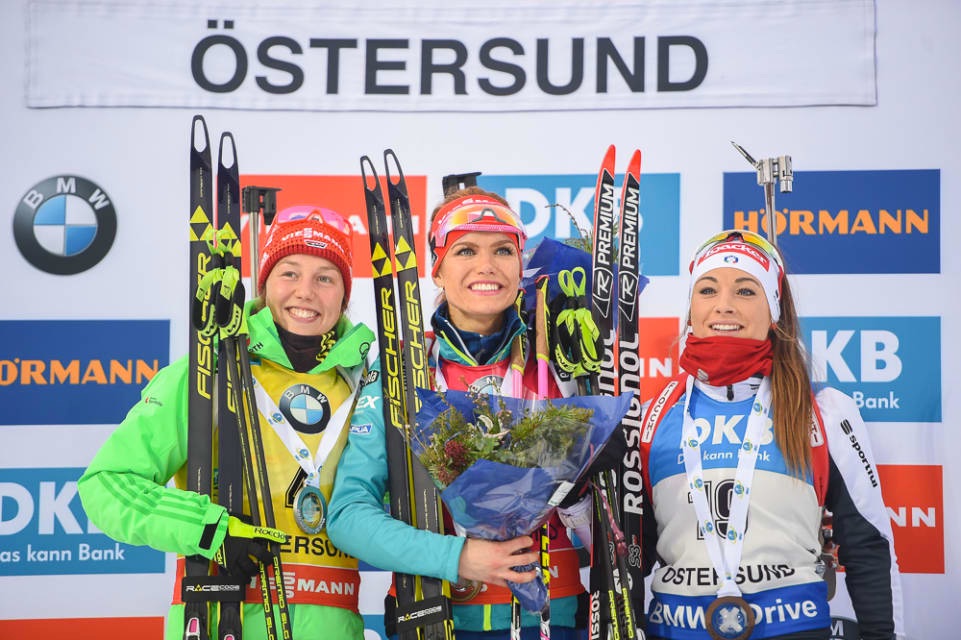
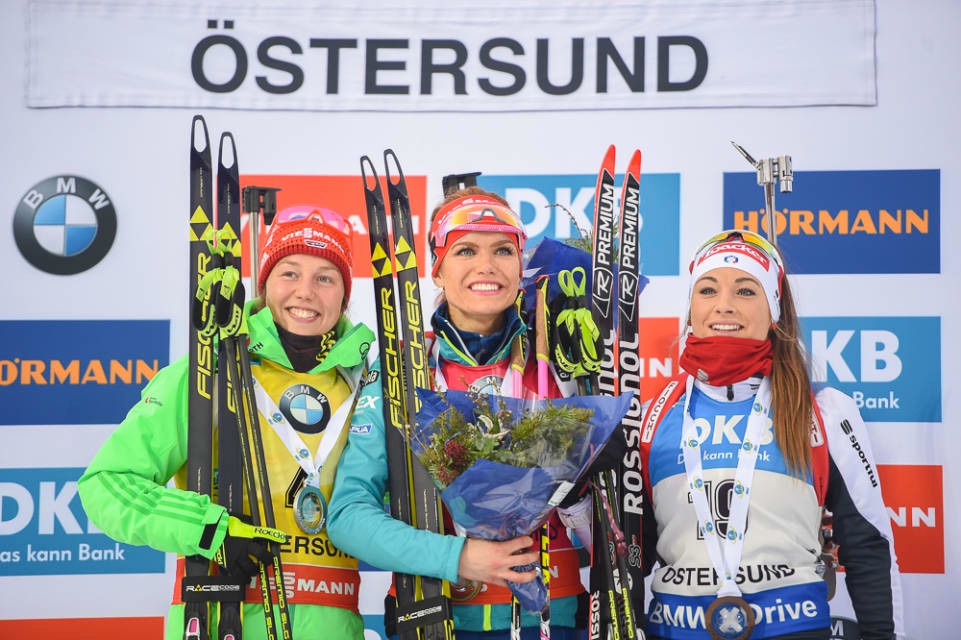
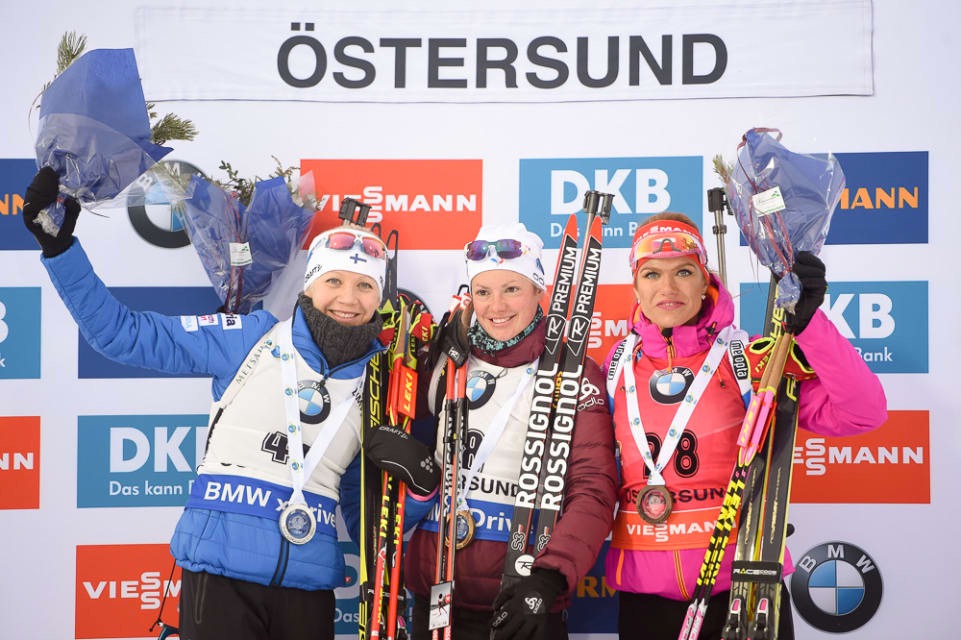
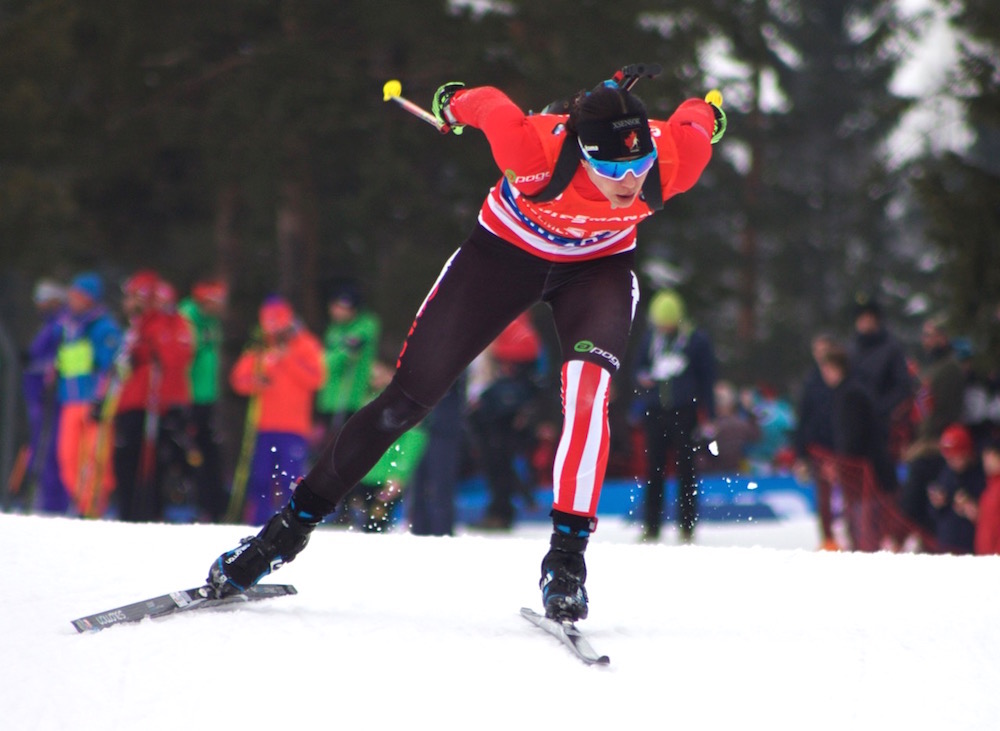
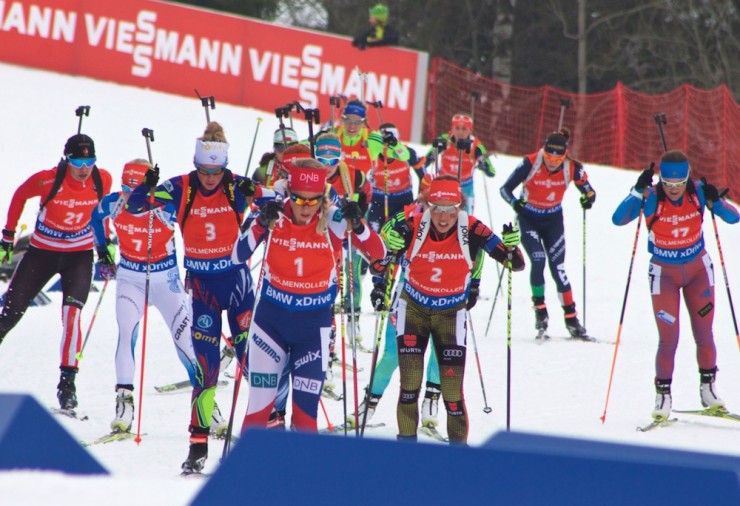
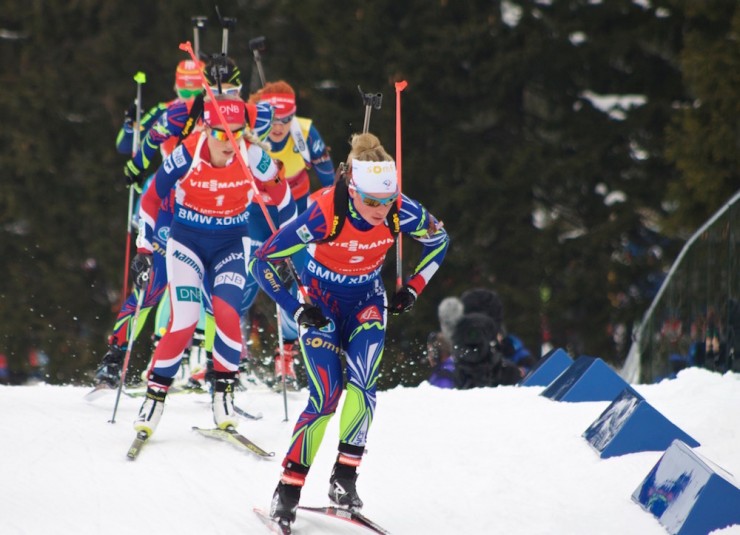
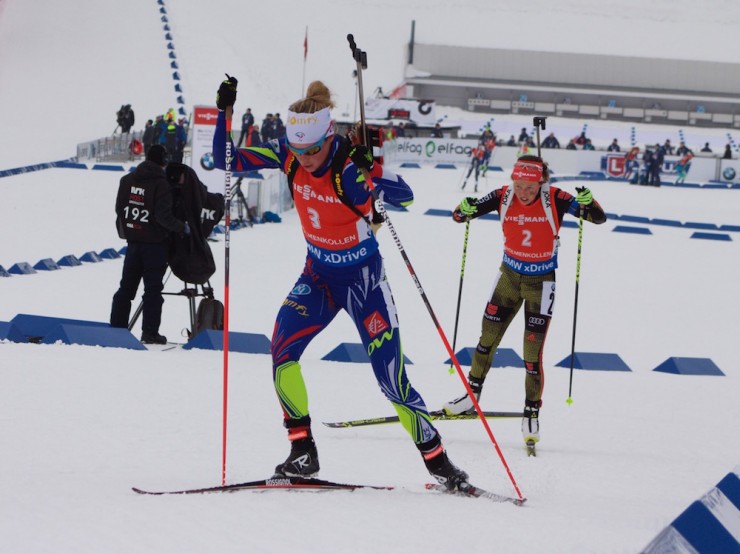
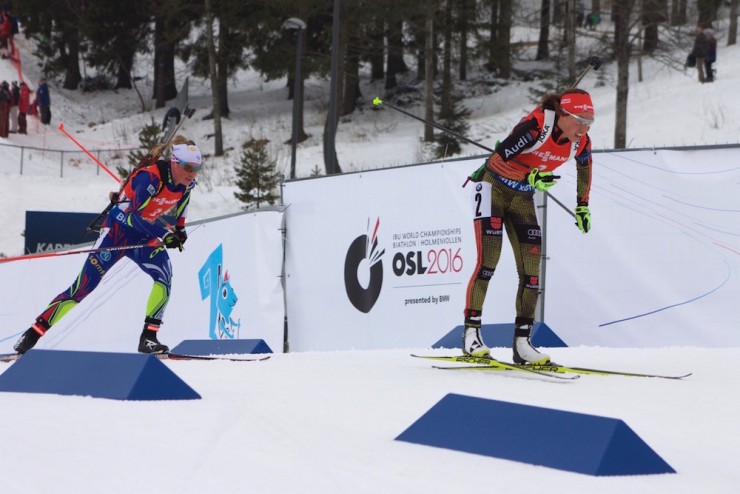
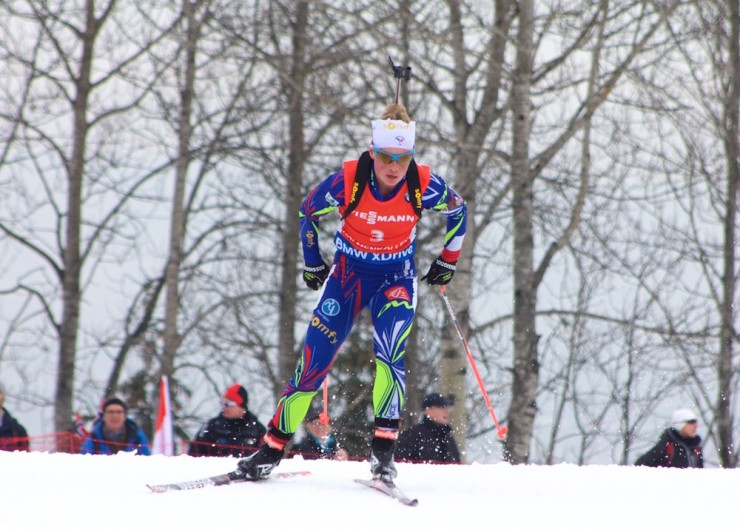
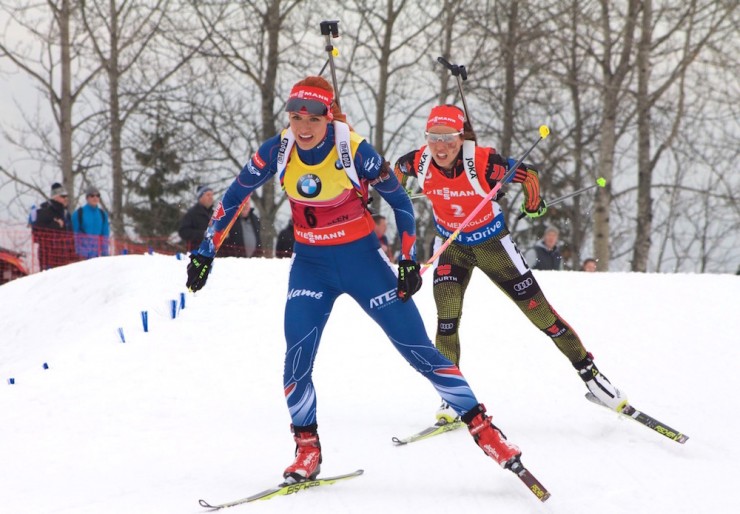
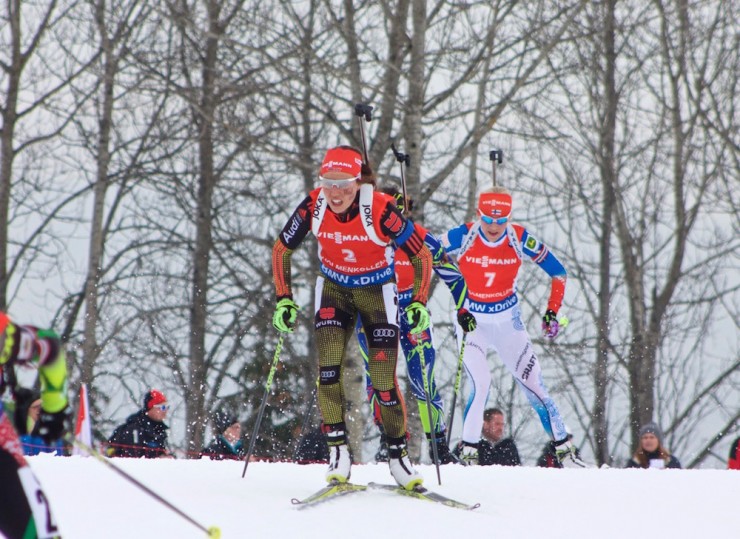
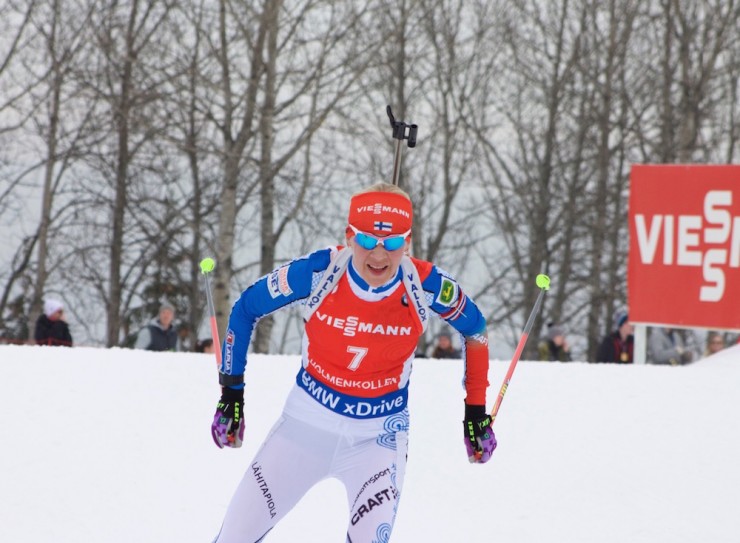
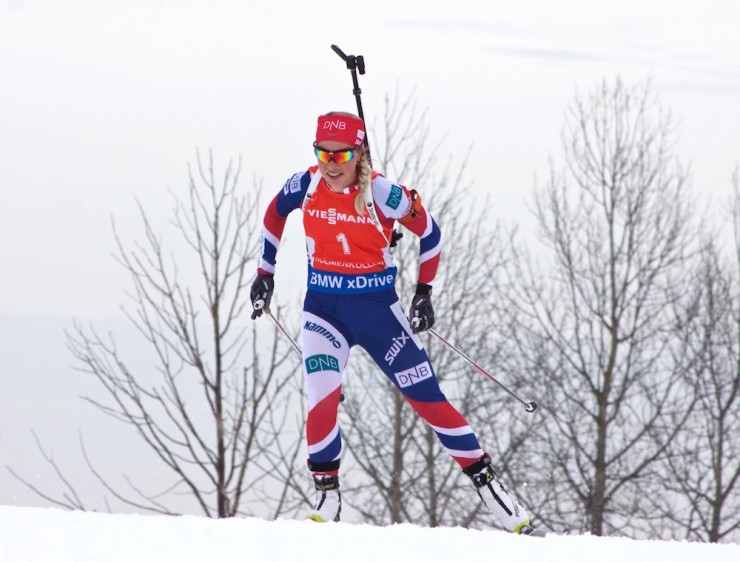
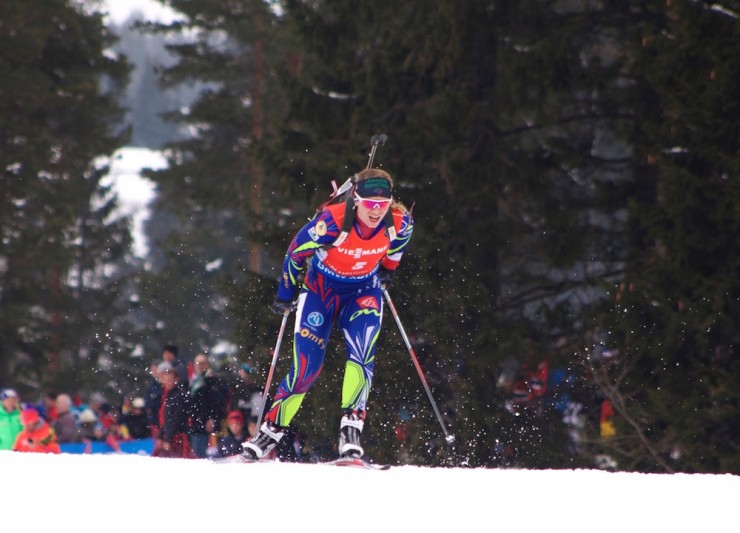
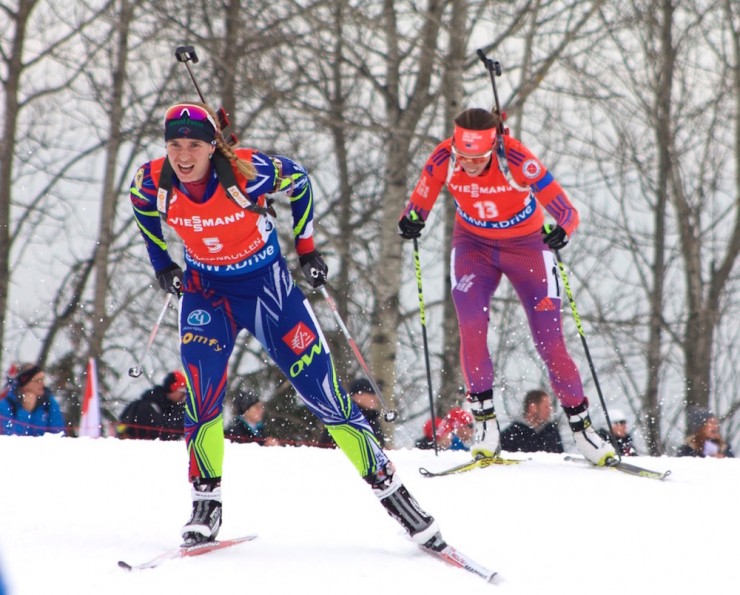
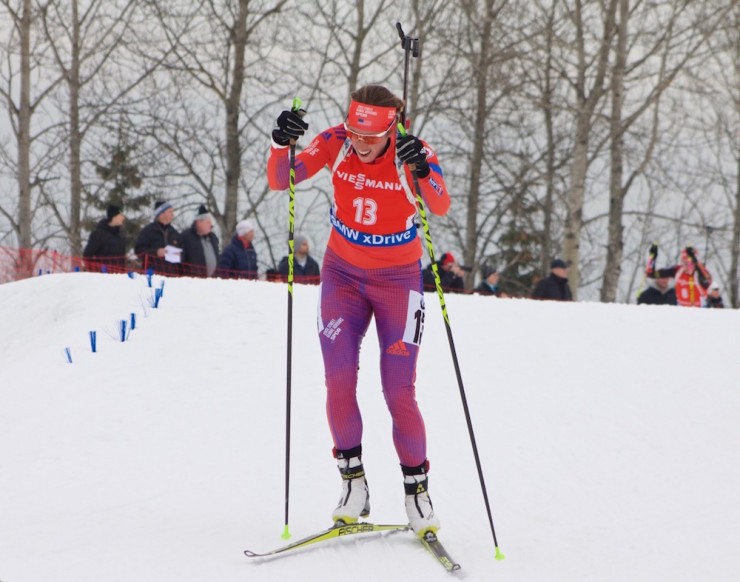
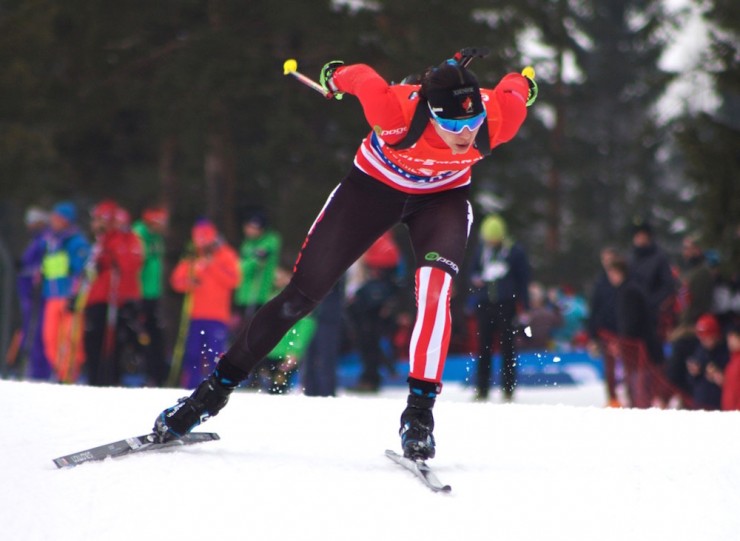
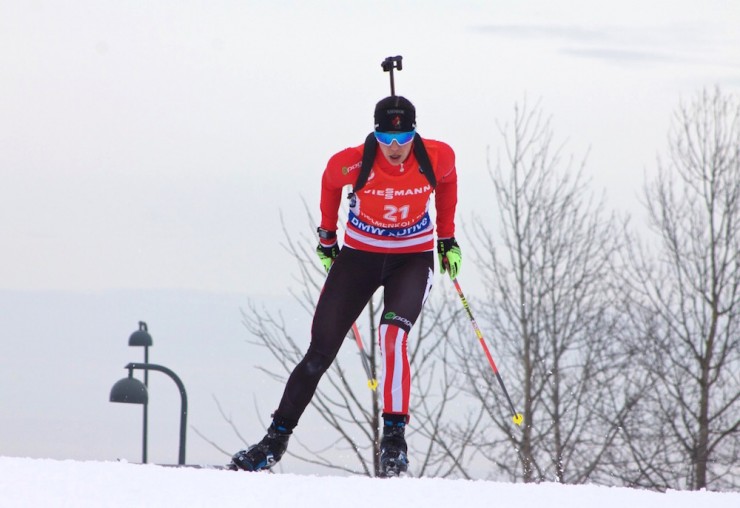
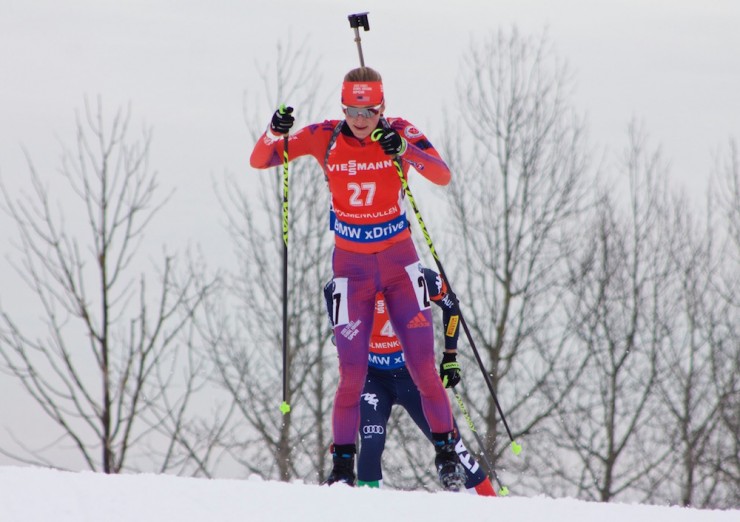
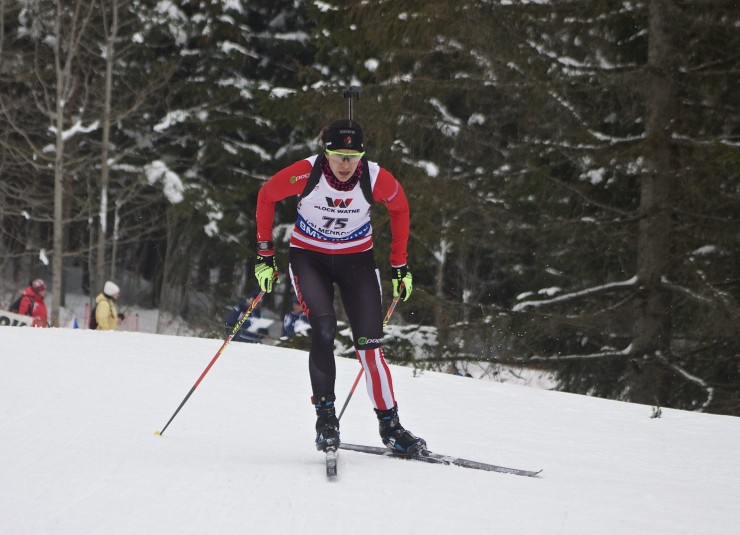
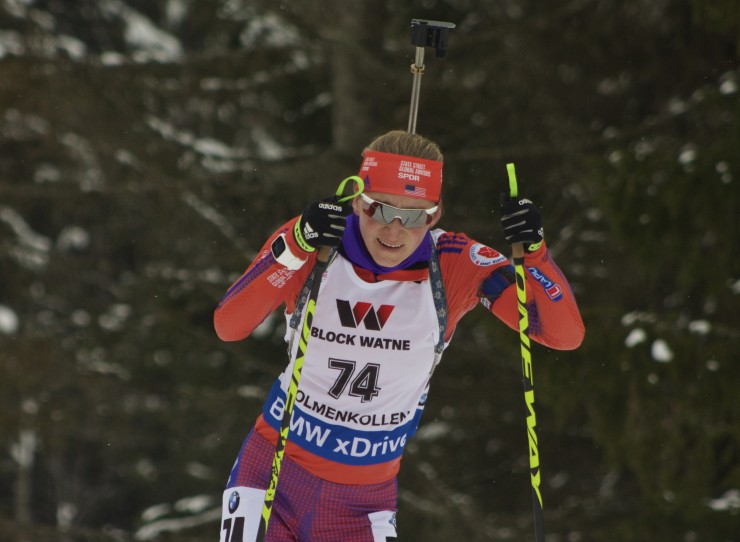
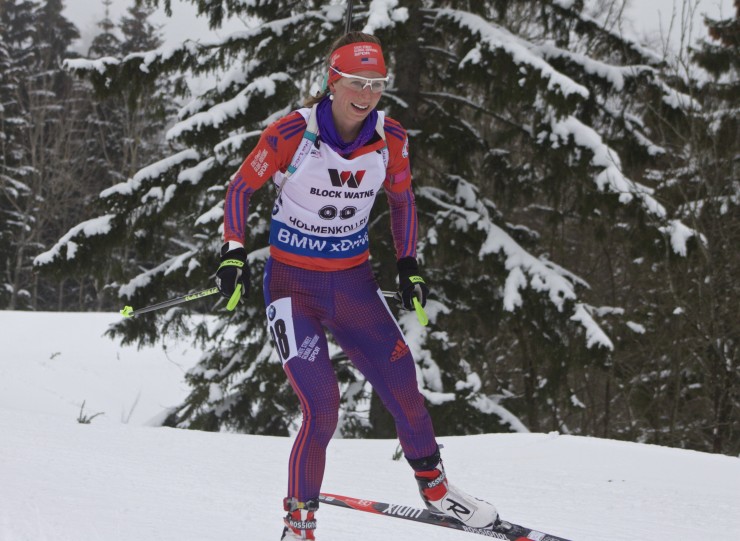
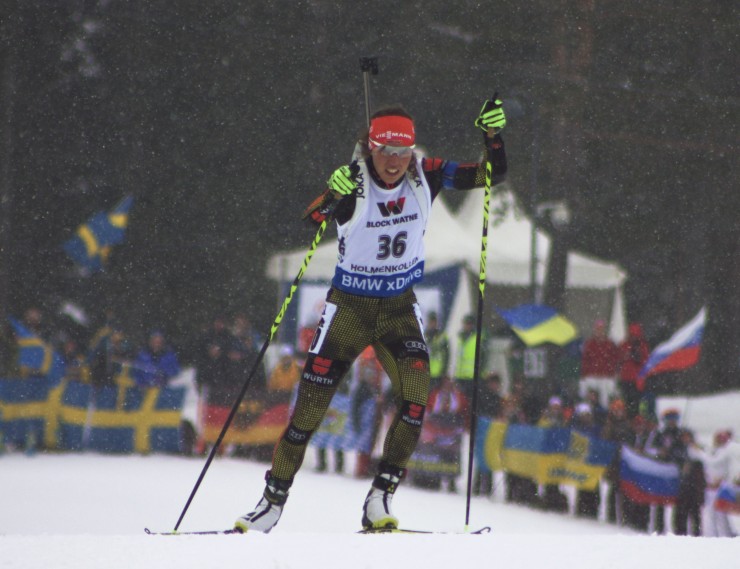
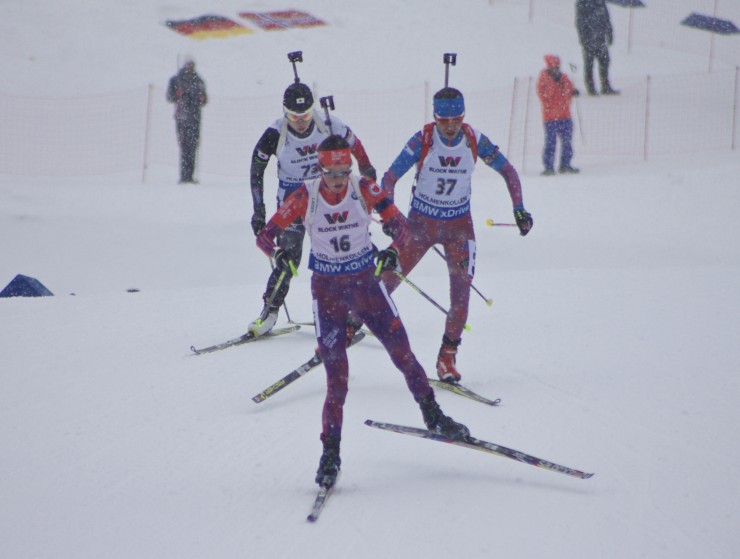
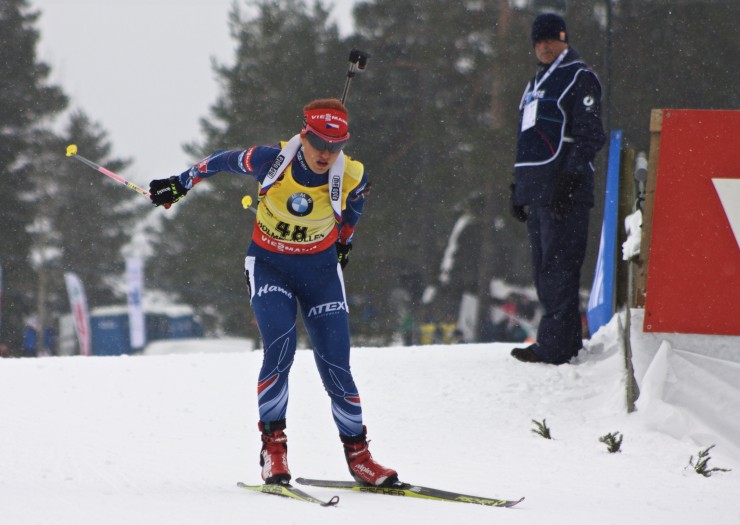
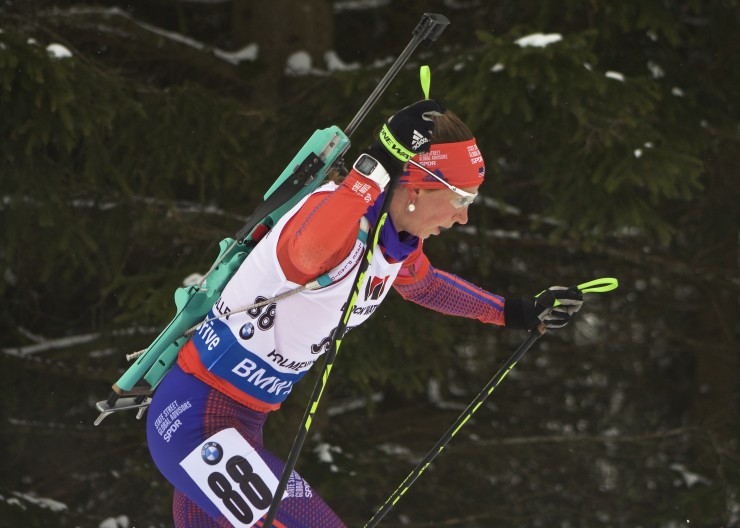
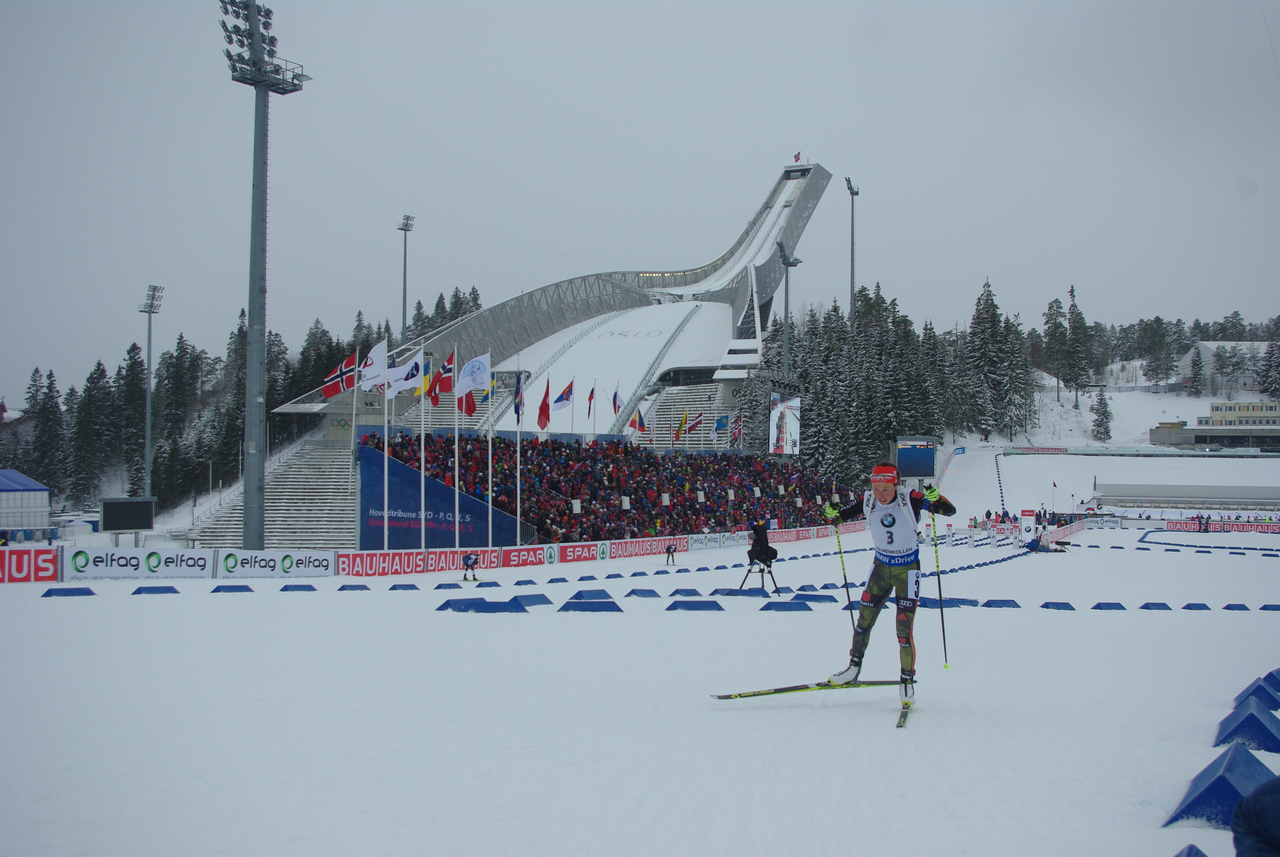
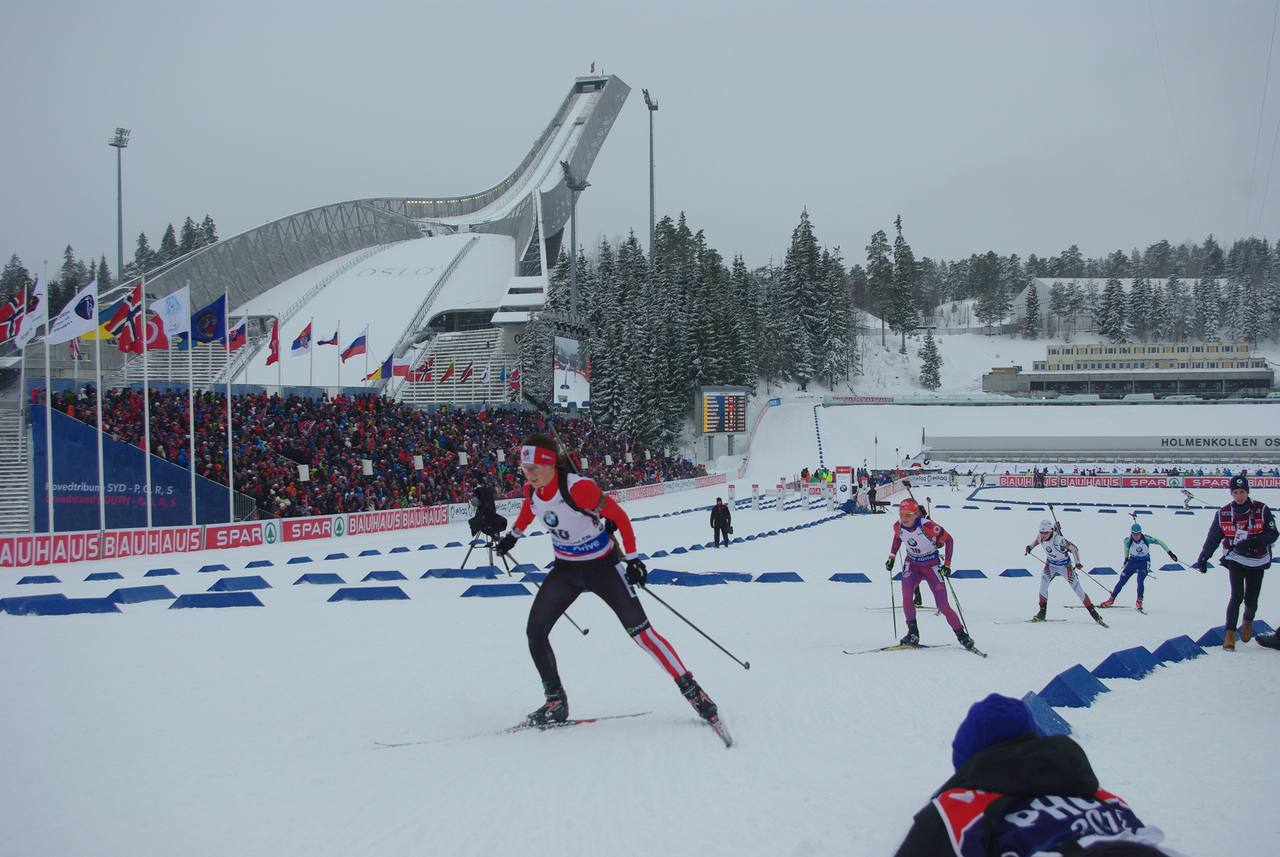
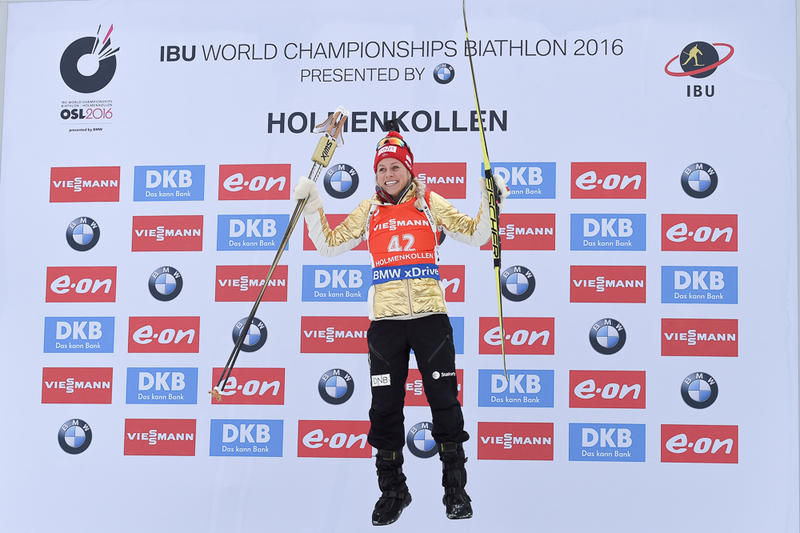
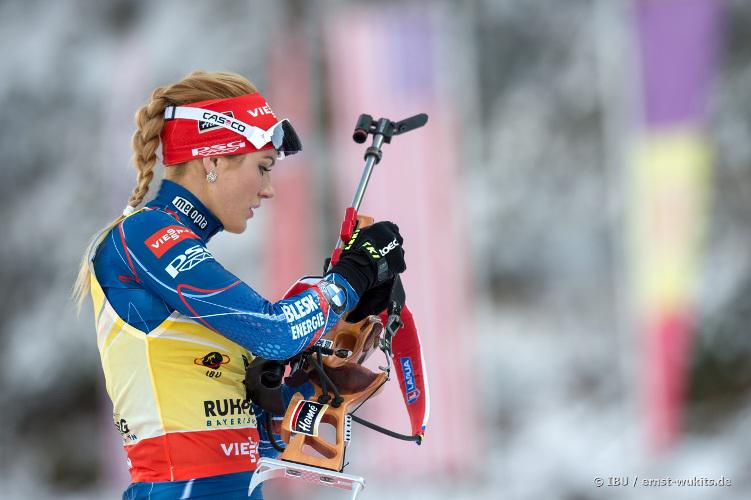
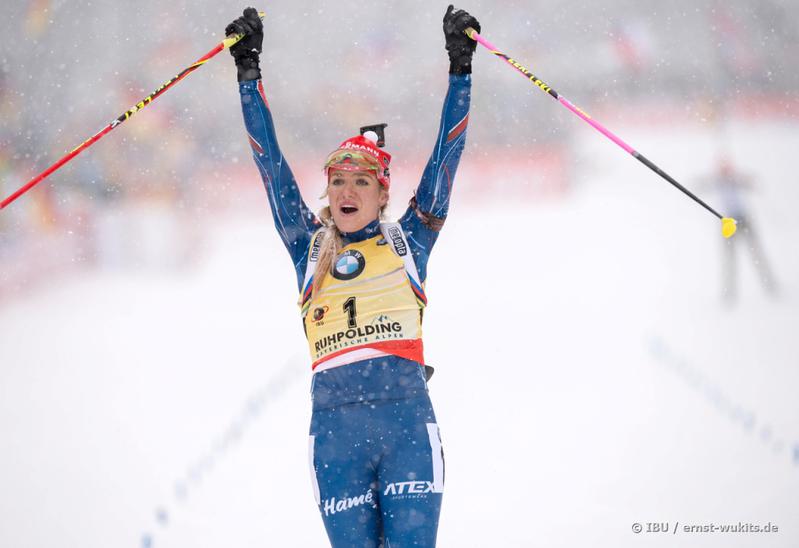
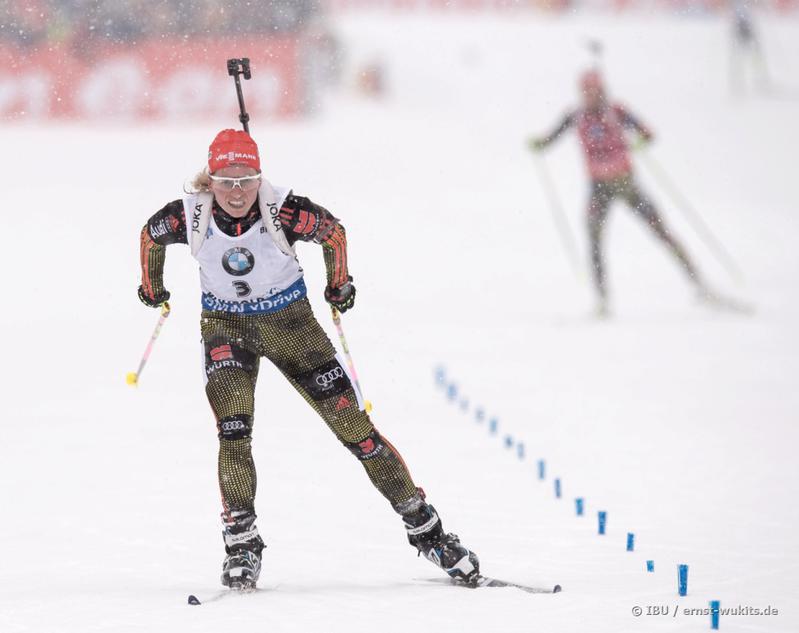
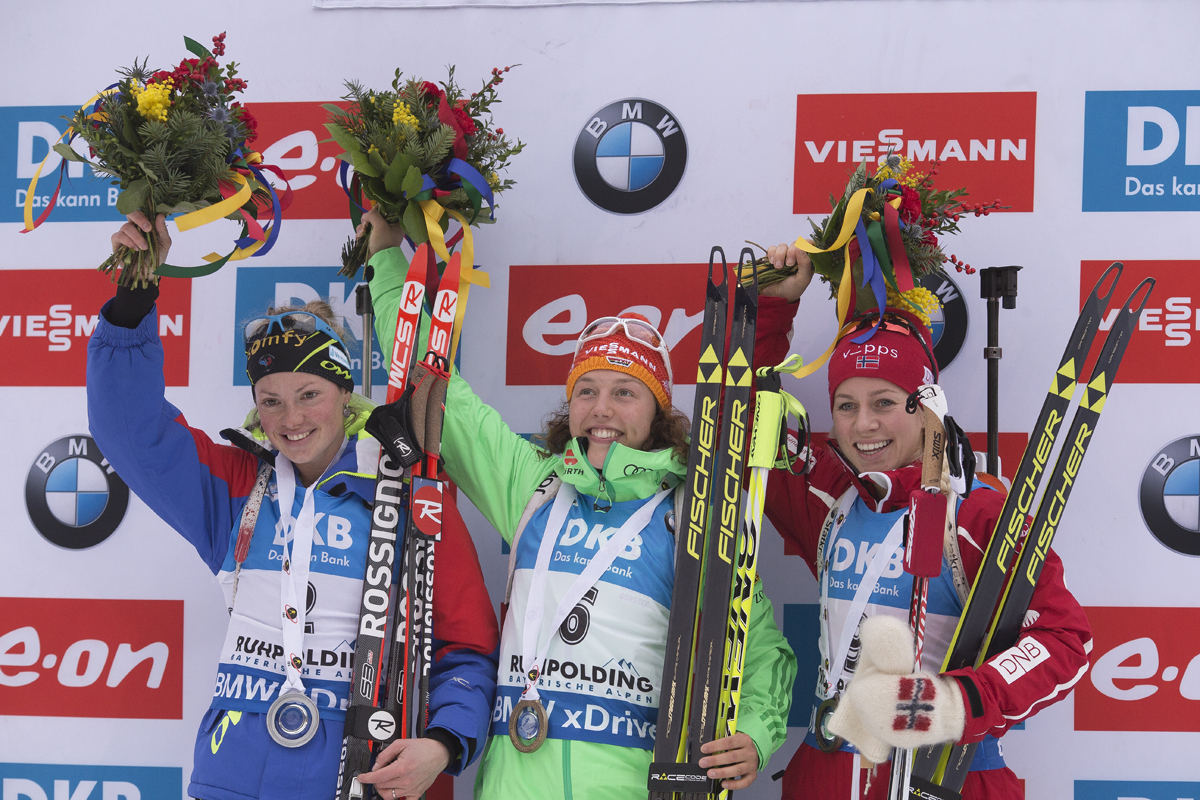
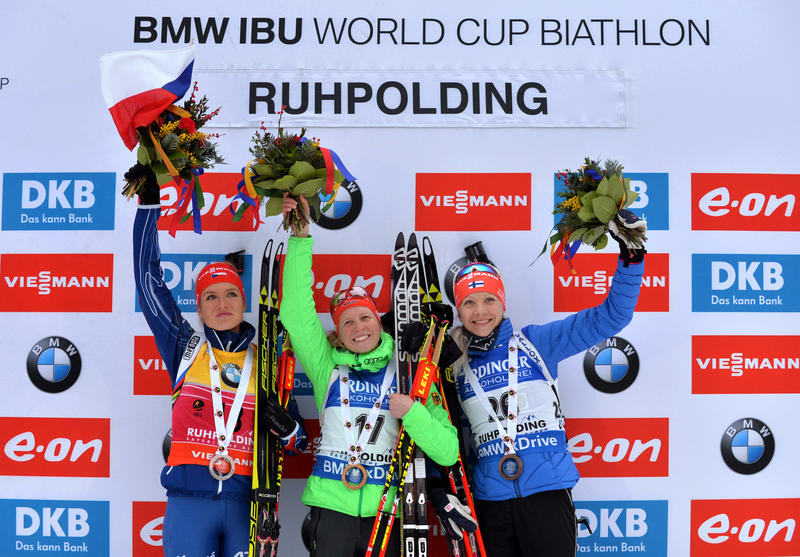
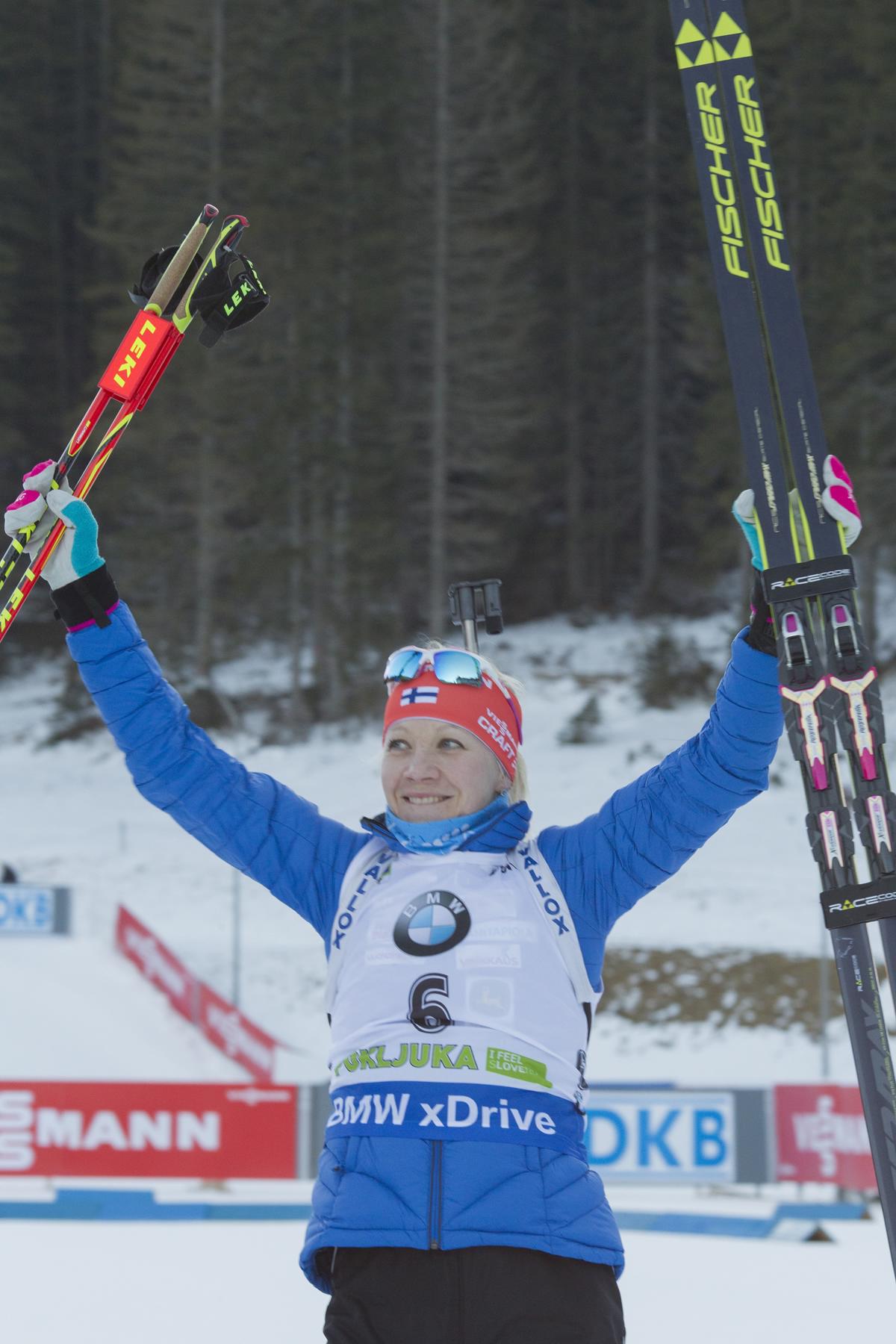
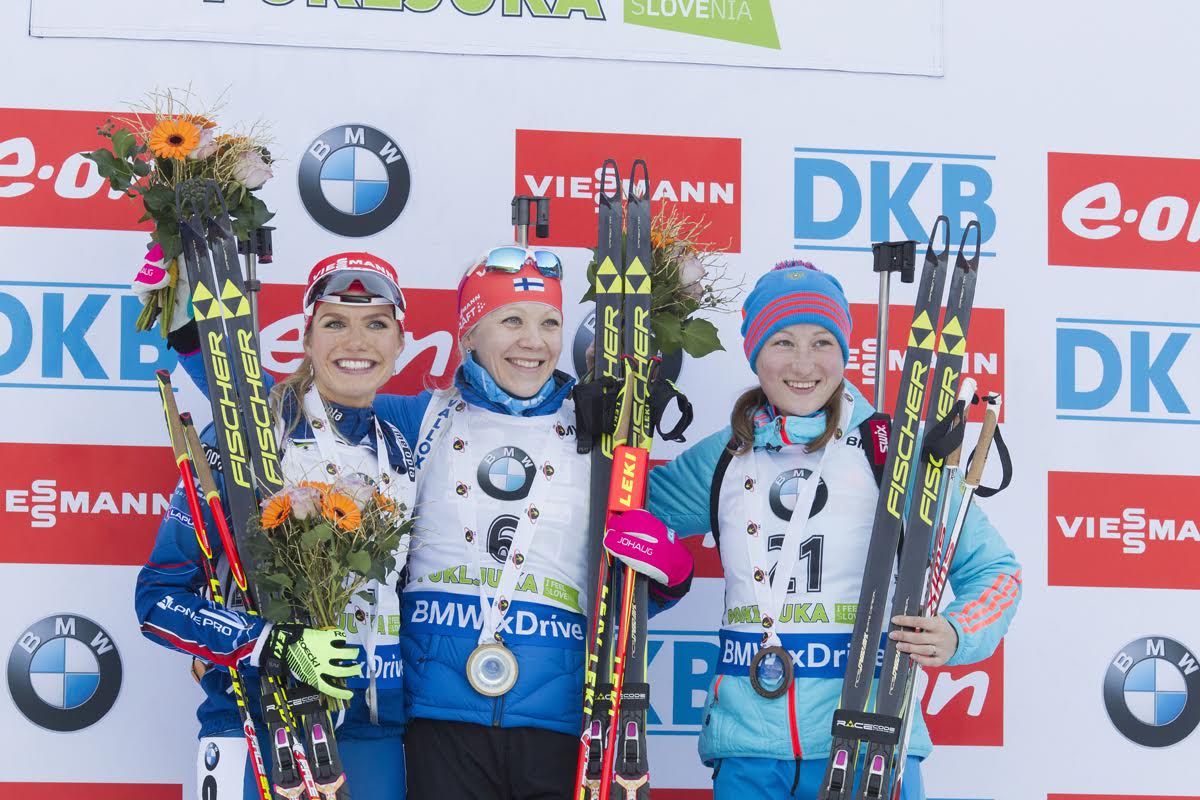
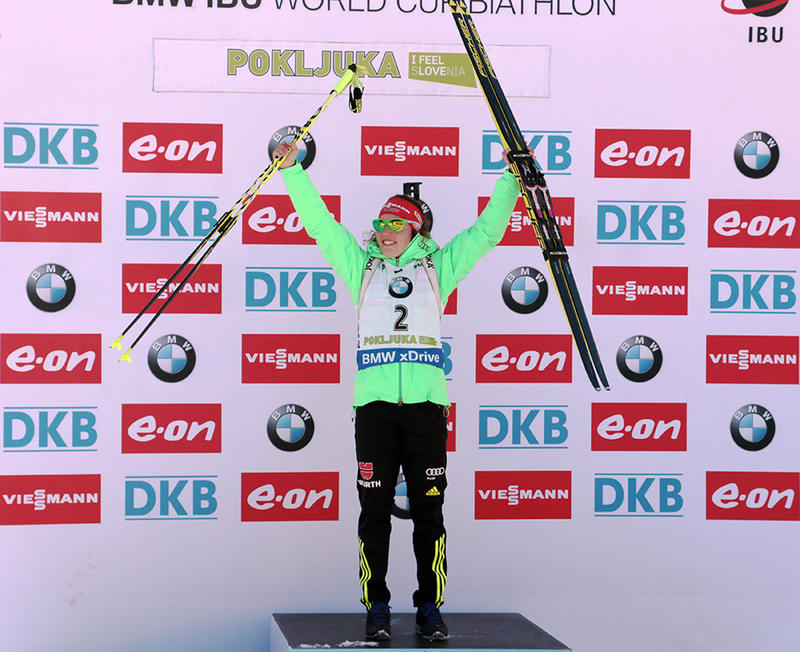
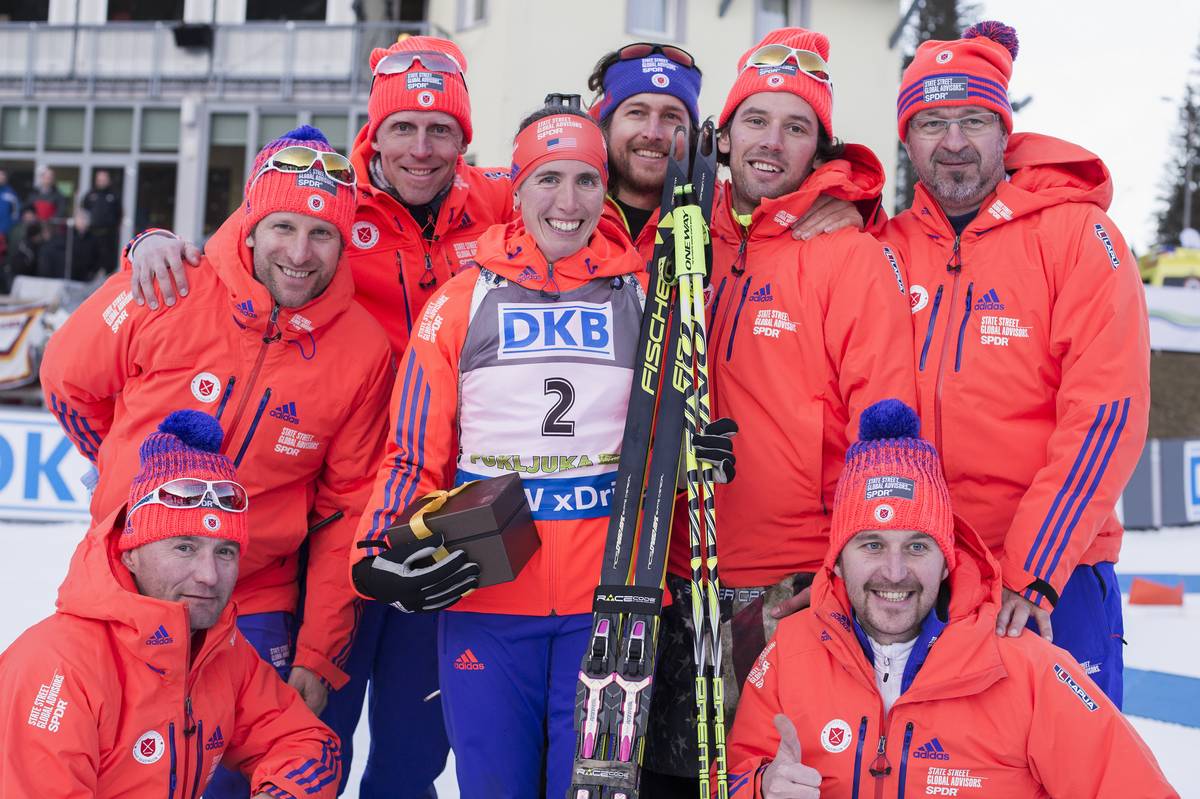
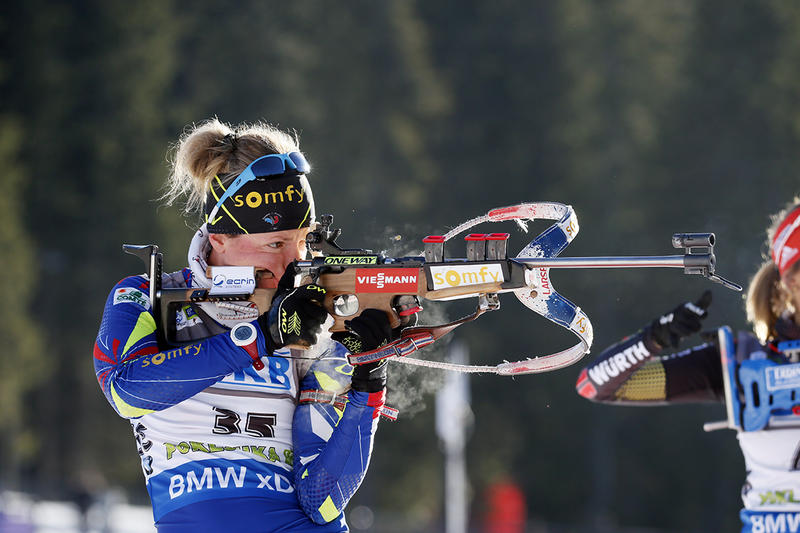
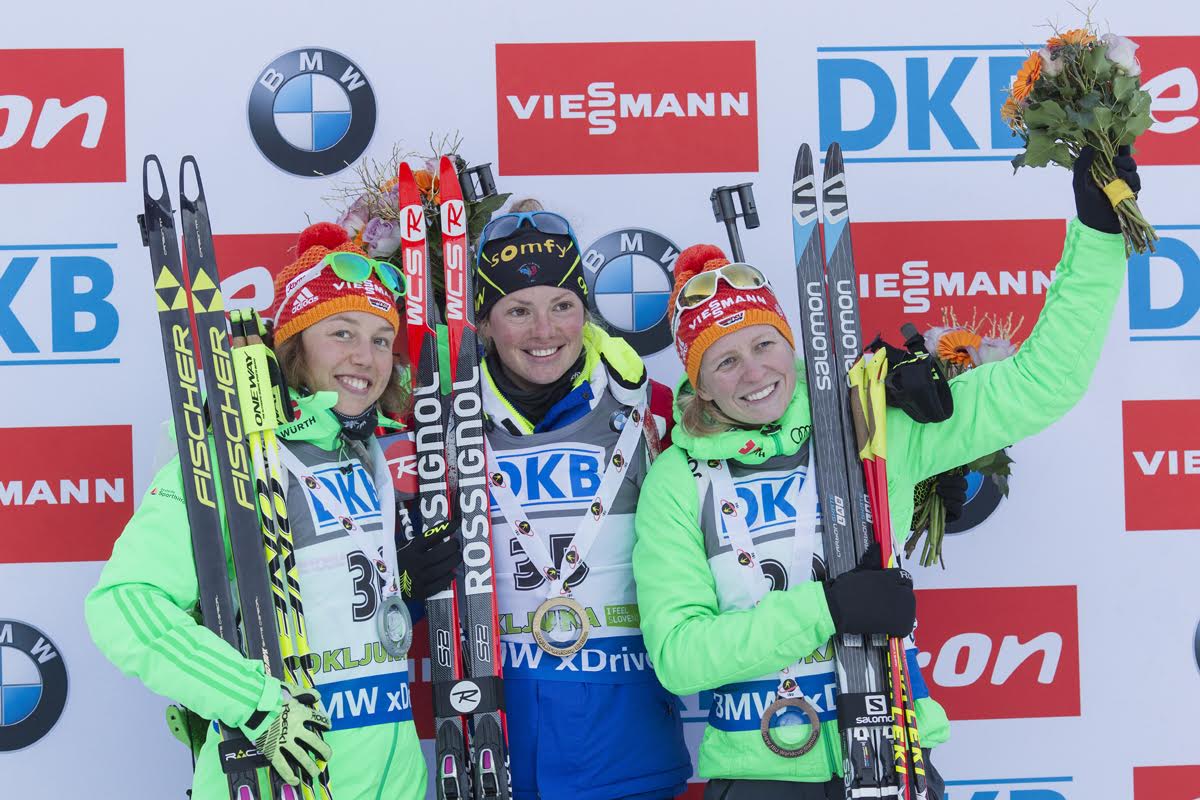
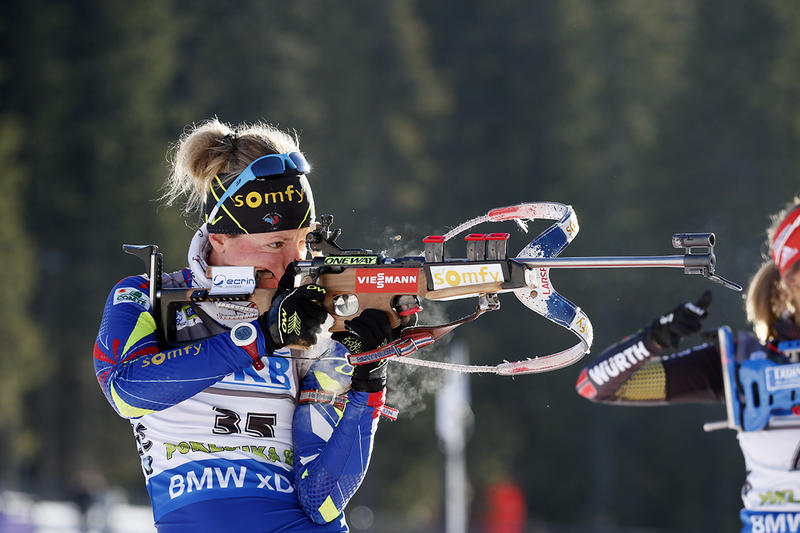
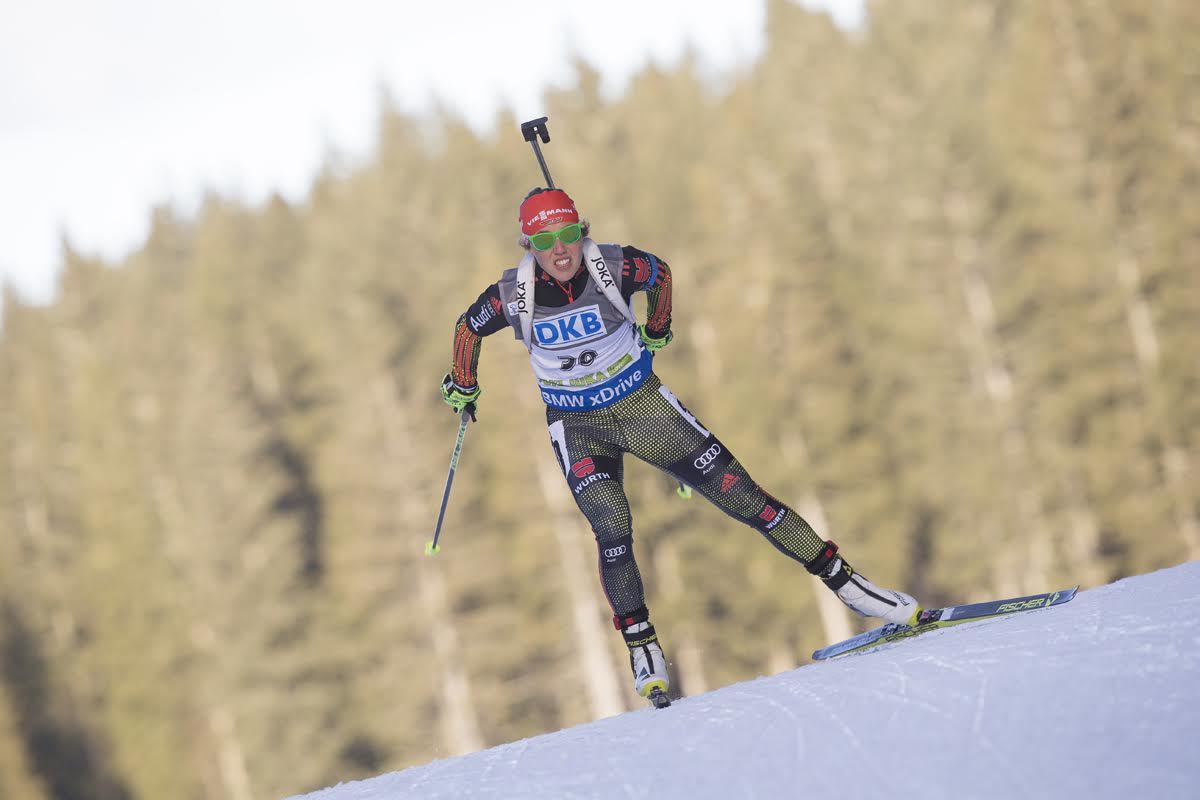
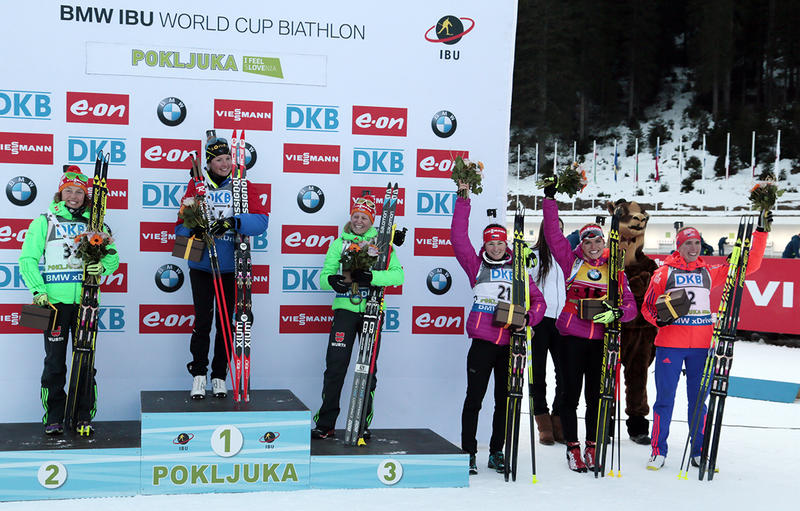
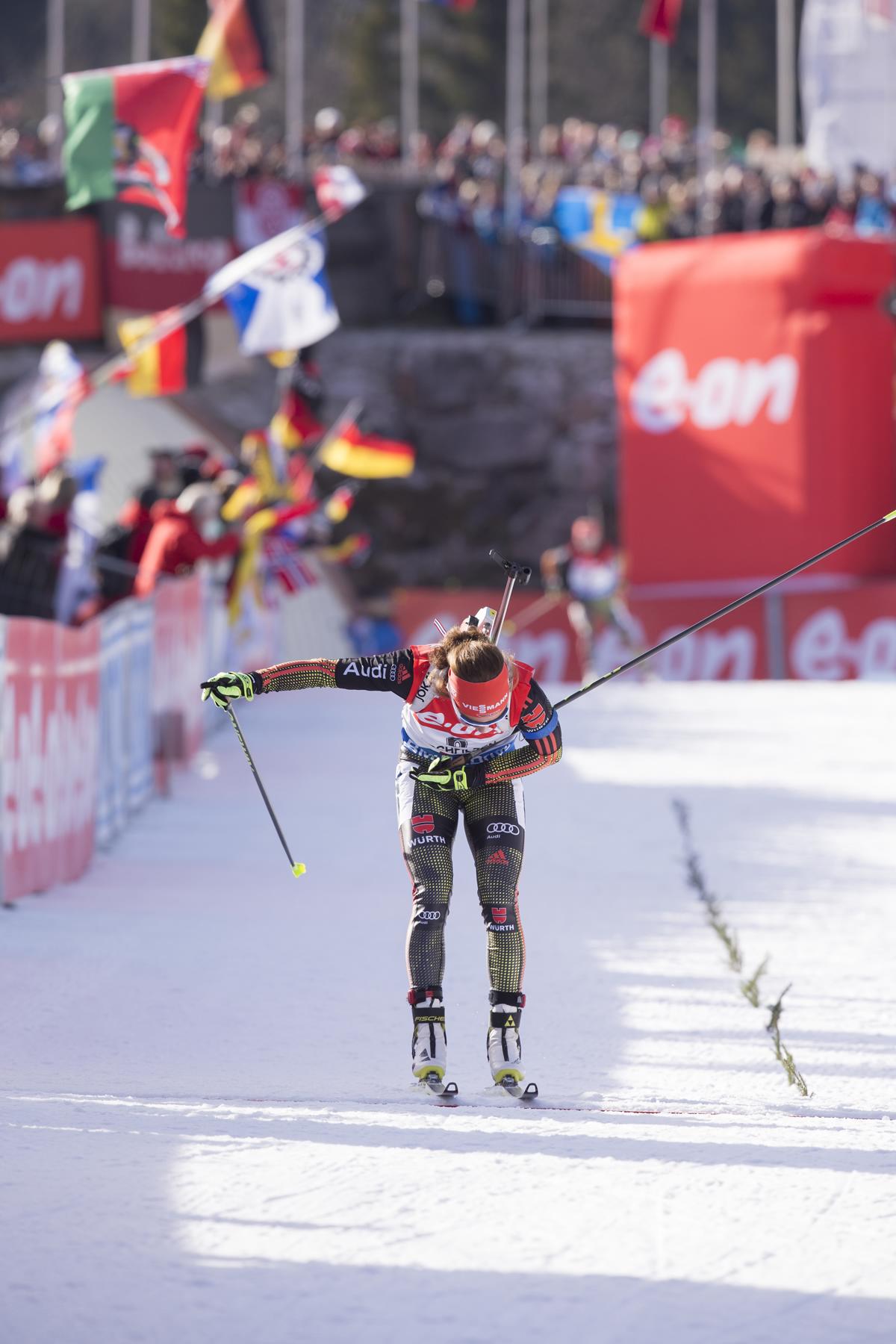
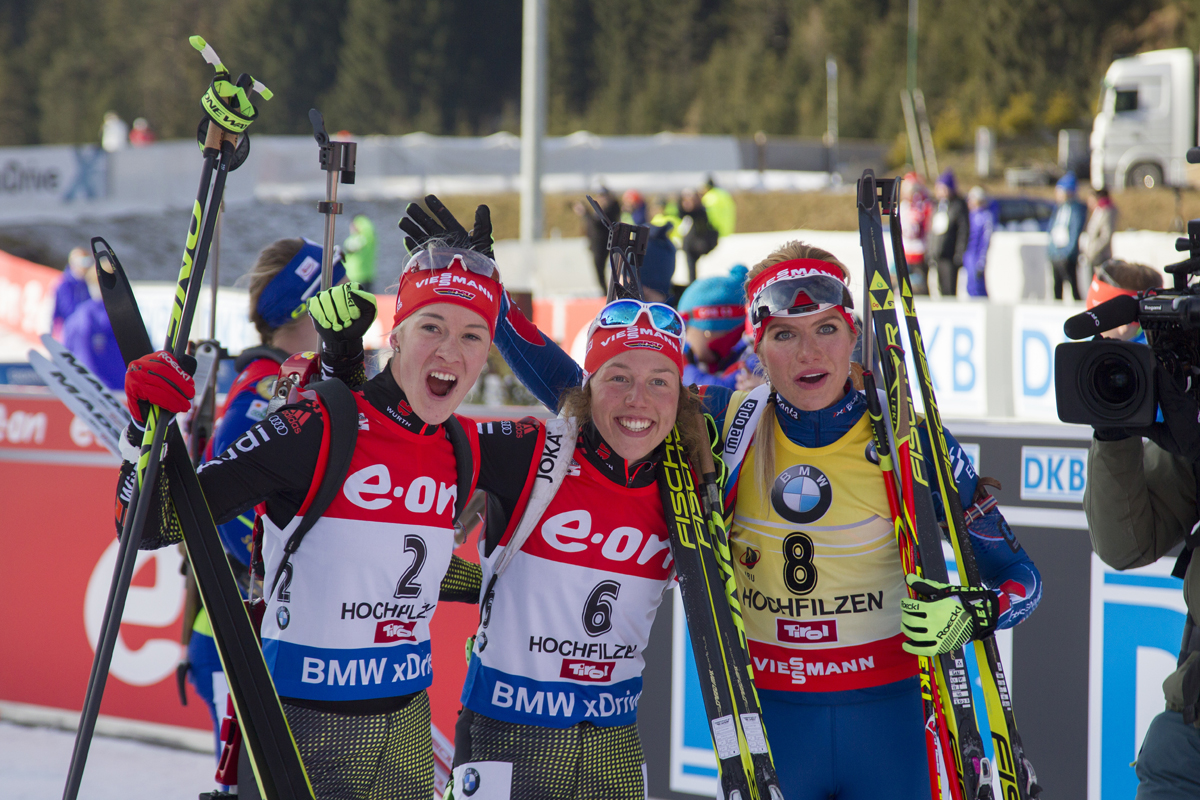
The women’s 10 k pursuit at the IBU World Cup In Östersund, Sweden. From left to right: Germany’s Laura Dahlmeier in second, Czech Republic’s Gabriela Koukalová in first, and Italy’s Dorothea Wierer in third. (Photo: IBU)
Last year’s defending overall World Cup champion Gabriela Koukalová of the Czech Republic also had started out fairly well into the new season during the International Biathlon Union (IBU) World Cup opening week in Östersund, Sweden. But a victory was still missing.
She corrected that on Sunday, moving up from the third starting position, based on her sprint result, to the top of the podium in the women’s 10-kilometer pursuit, in a time of 31:43.3 with only one penalty lap (0+0+1+0).
Following strong gales in the individual and nearly no wind in the sprint races, for the pursuit the conditions were somewhere in between those extremes, manageable but still forcing a number of competitors into the penalty lap in each of the four shooting stages (in pursuit races the athletes are not allowed to use spare rounds).
By the end of the first shooting stage, Koukalová took the lead and never gave it up. Based on course time, she was seventh fastest, but her direct pursuers incurred more penalty laps. Even so, they didn’t make it easy for her.
“I didn’t expect that I can race with Kaisa [Mäkäräinen] so I just tried to concentrate for the last shooting,” Koukalová, formerly Soukalová, explained during the post-race press conference. “I didn’t feel so strong… It was like walking in hell, mainly the last two loops.”
Asked if she looked back over her shoulder repeatedly on the final lap, she smiled broadly: “I don’t know, because I don’t remember nothing what happened there.”
Germany’s Laura Dahlmeier managed to defend the “yellow bib” distinguishing the current World Cup leader for a third day, this time finishing in second place, just 8.4 seconds behind Koukalová. After incurring two penalties during the race (0+1+1+0), Dahlmeier made up about ten seconds on Koukalová on the final lap, but was not able to completely close the gap.
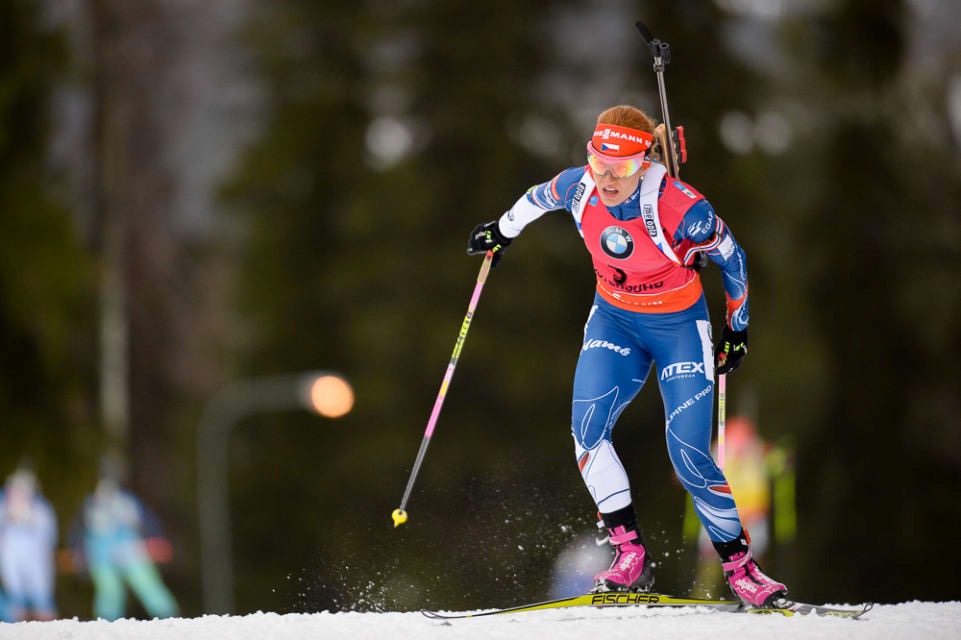
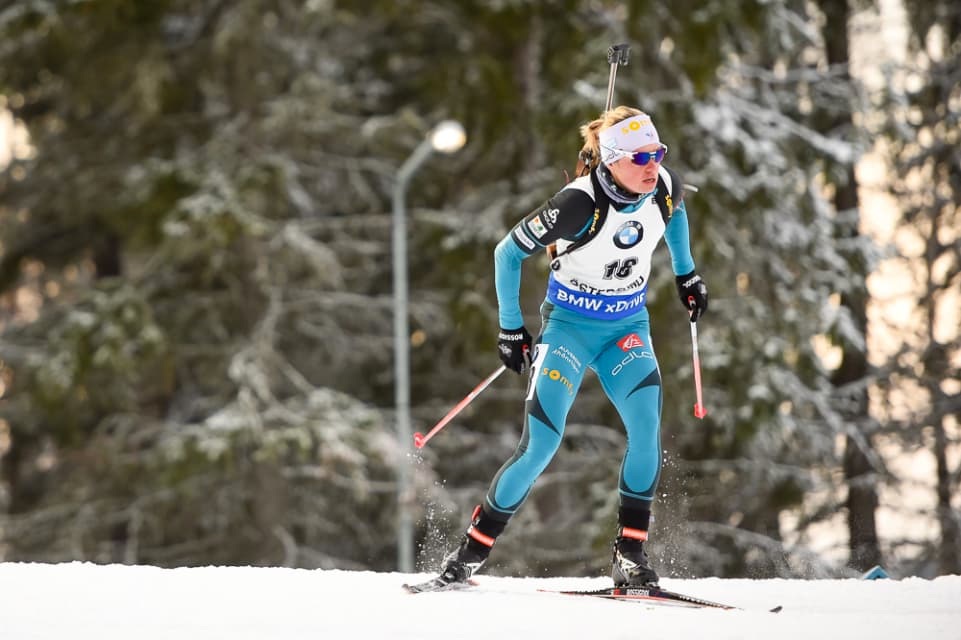
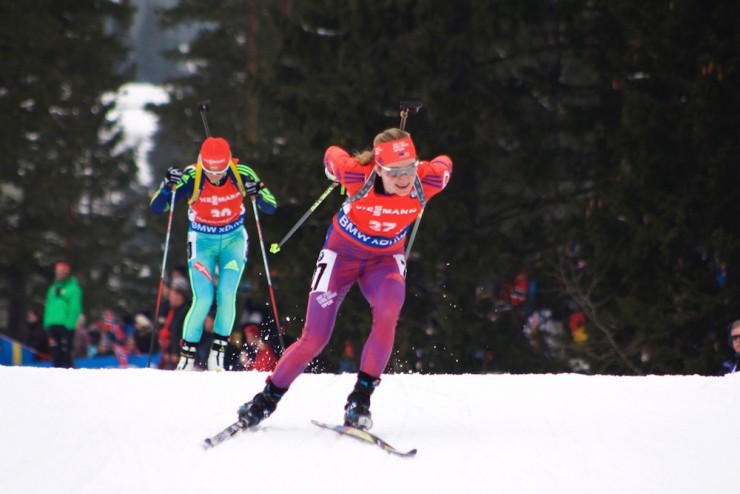
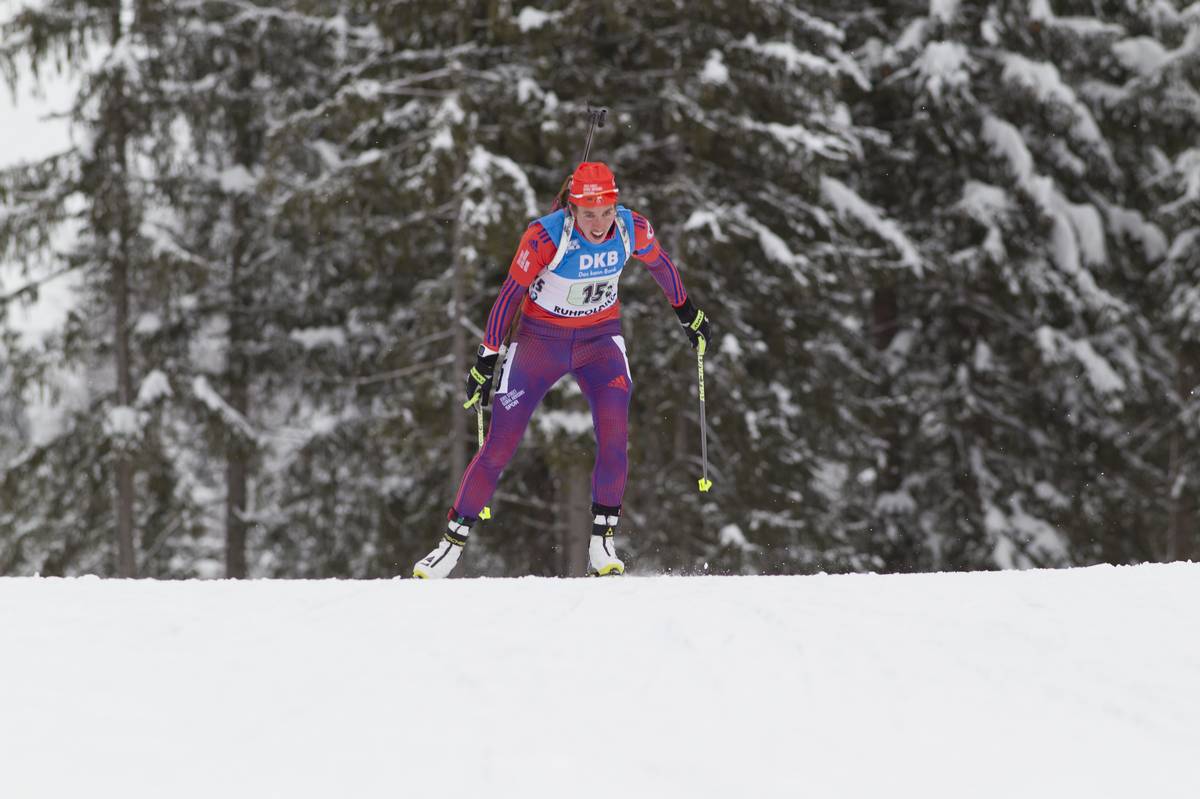
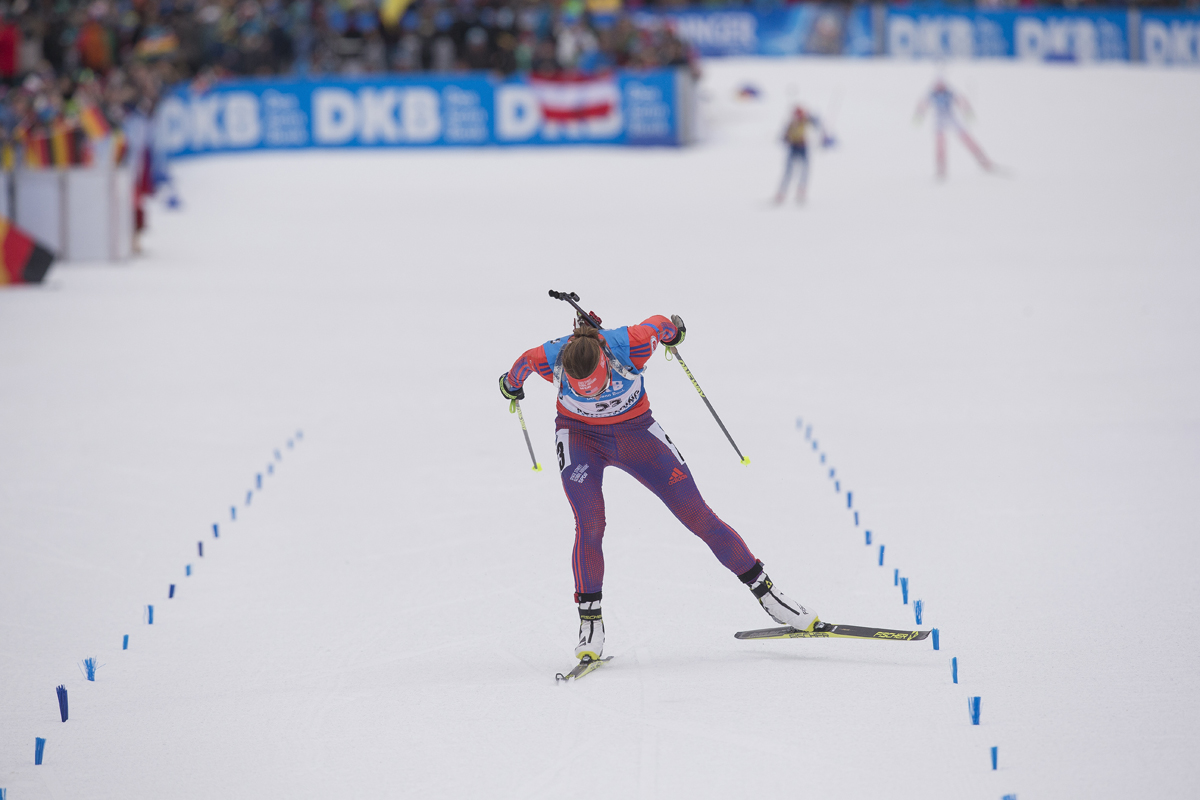
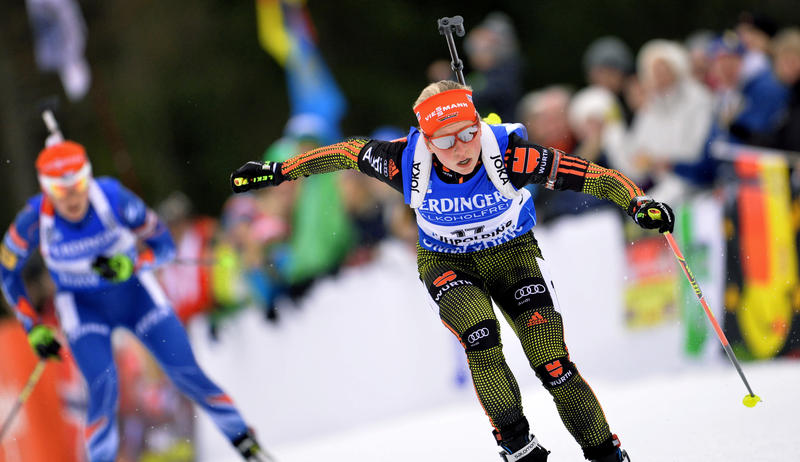
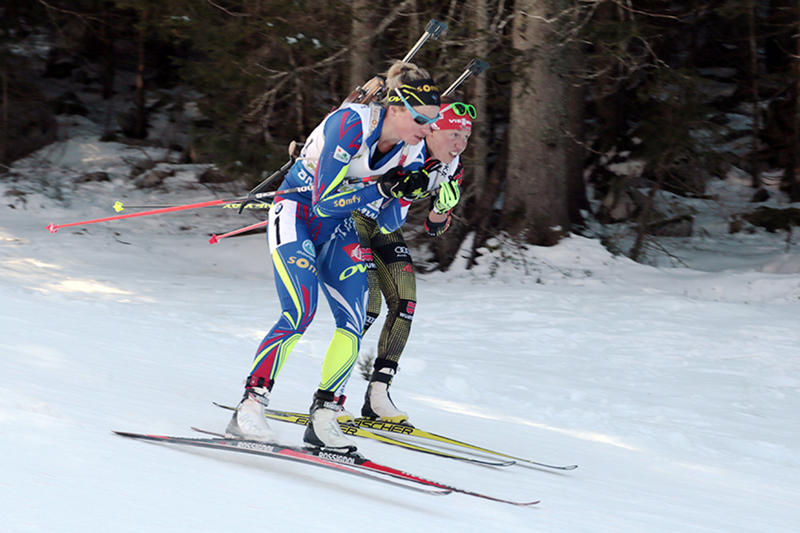
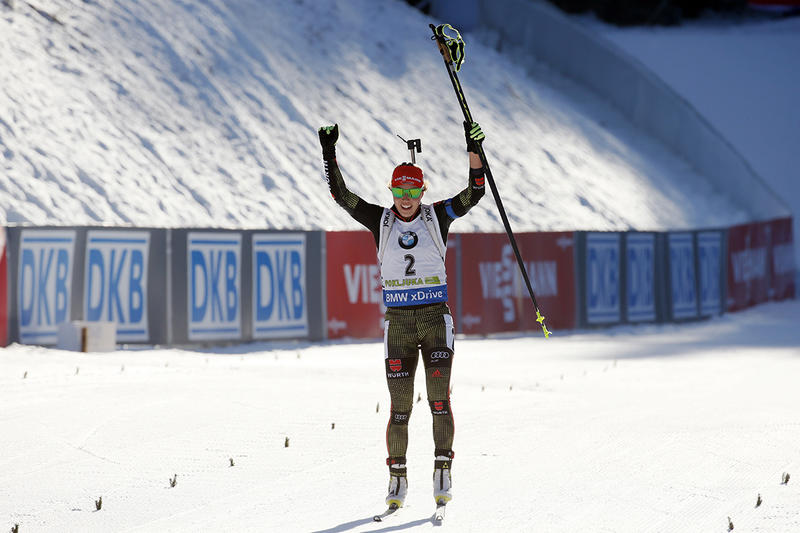
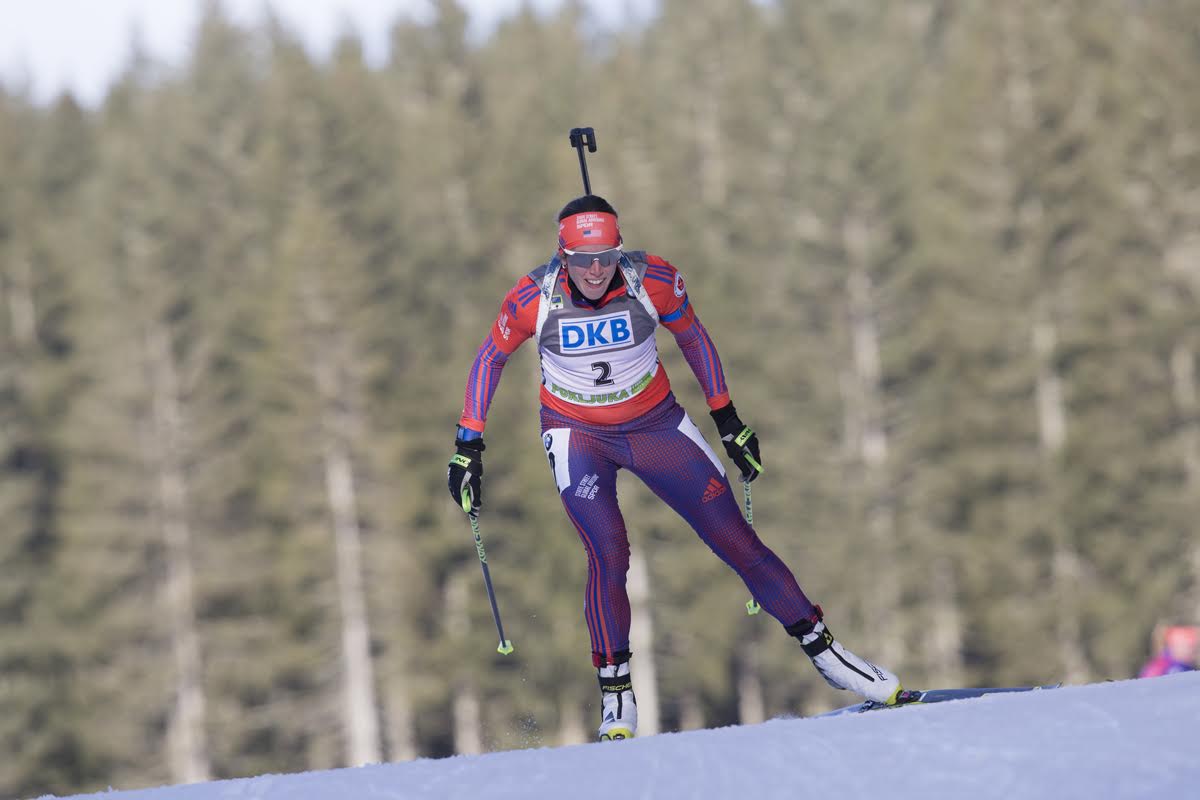
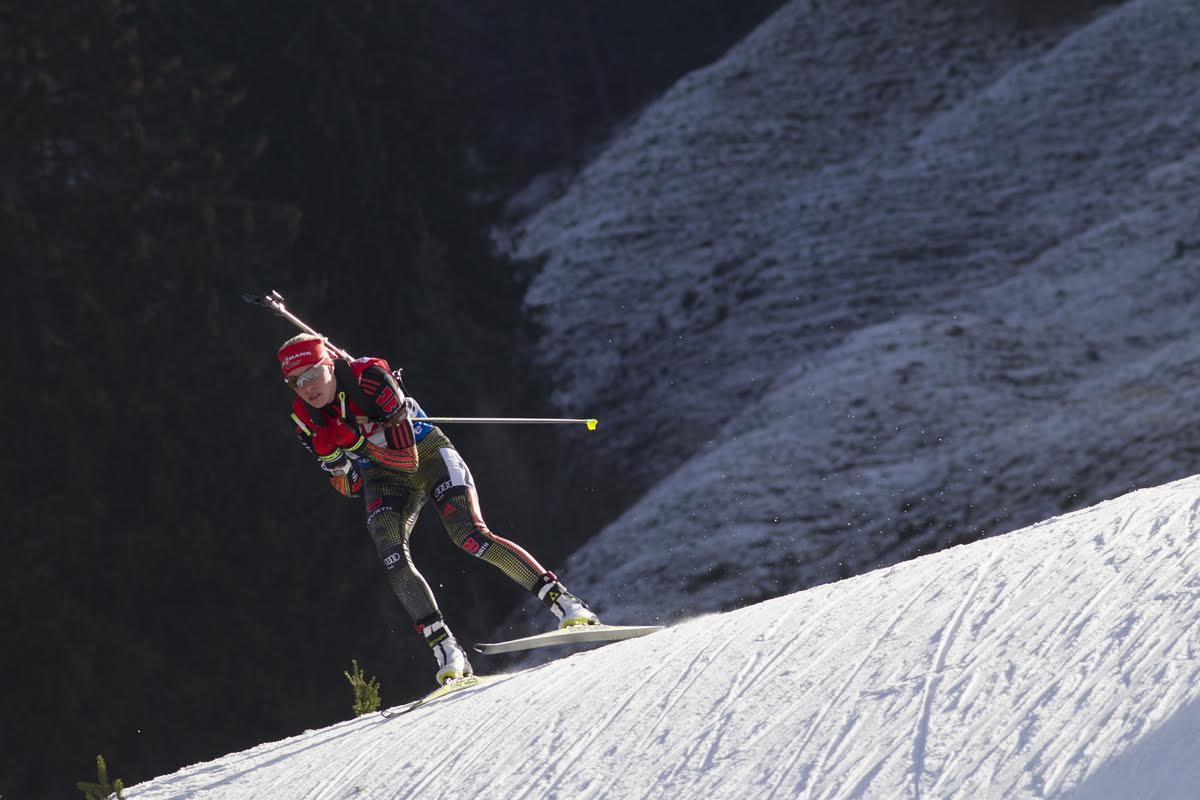
Gabriela Koukalová (Czech Republic) on her way to winning the women’s 10 k pursuit on Sunday in Östersund, Sweden, the first pursuit of the 2016/2017 IBU World Cup season. (Photo: IBU)
“I got instructed by the coaches that I should try and catch up to Gabi, that she was not going as fast anymore,” Dahlmeier told German broadcaster ARD after the race. “I got close on the downhill. I tried everything, but the last loop is only 2 kilometers, maybe if it were 500 meters longer… But I am super-happy about the second place.”
Asked in the press conference about competing for overall World Cup title this season, Dahlmeier explained, “My aim is to stay healthy and to have enough power for every race. I will try, but we will see how the season goes. Perhaps I have to miss one, but my aim is to compete in all races… We can talk about it in Oslo [the World Cup final in March 2017].”
Also back on the podium was another familiar face with Italy’s Dorothea Wierer, third in the World Cup standings last year, who, by her standards, had experienced a slow start into the new season. Starting in 19th due to her sprint result, she quickly began to overtake athletes in front of her thanks to her trademark fast-and-accurate shooting. In the finish, her chase was rewarded with a third place, 21.4 seconds back (0+0+0+0). Still, Wierer was a bit surprised to have regained her form so quickly within the opening weekend.
“Yesterday evening I just told my trainers that tomorrow I will make four times zero [misses], but I thought I was kidding,” the happy Italian remarked during the press conference. “But today it was like that … It was not so difficult [on the shooting range], but also yesterday it was not difficult but then I had two [misses] in the last shooting.”
After her last standing stage in the pursuit, Wierer had gone back on the course in second place, but the faster skier Dahlmeier was just behind her and managed to pass her on the final lap.
“That’s the fascination of biathlon … I saw she had shot clean and skied out of the range a bit ahead of me,” Dahlmeier told ARD. “I already noticed in the prior loops that we had top equipment today, and thought that I could catch her on the downhill. That worked faster than expected. Then I heard we should try to catch Gabi … also from the Italian coaches, and I started the flight ahead.“
“My coach said ‘she is coming behind you, she is pushing hard’. I was losing Laura on the downhill, but I was also looking back,” Wierer explained.
The true surprise of the race was the 21-year-old Lena Häcki of Switzerland, who had already achieved a strong result with a 12th place in the sprint, and on Sunday moved up even further with four clean stages, an achievement only matched by Wierer among the 60 starters. Häcki celebrated across the finish line, just 36.3 seconds behind the winner and 15 seconds off the podium. It was the best World Cup result of her career and her first individual result in the top 10.
“Unbelievable, I had tears in my eyes,” Häcki told Swiss broadcaster SRF. “All the top stars congratulated me … I can only remember half of it. It’s like a movie with a happy end that is moving past me, and I can’t believe yet that this is my real life.”
She credited her strong shooting performance to training with a mental coach.
Fifth place went to the runner-up from the sprint race, Finland’s Kaisa Mäkäräinen (1+1+0+2, +52.7). For a large part of the race she had held a position on the podium. But two penalties in her final shooting dropped her back to sixth when all other athletes in her vicinity shot clean, and despite recording the best course time again the strong skier was only able to make up one more place on the last lap overtaking Austria’s Lisa Hauser who finished sixth (0+0+1+0, +1:15.5).
The French sprint winner Marie Dorin Habert fell back to seventh place (+1:15.6), losing her lead with two misses in the first stage before incurring four more penalties (2+1+2+1).
Dunklee Up to 22nd, Egan in 30th
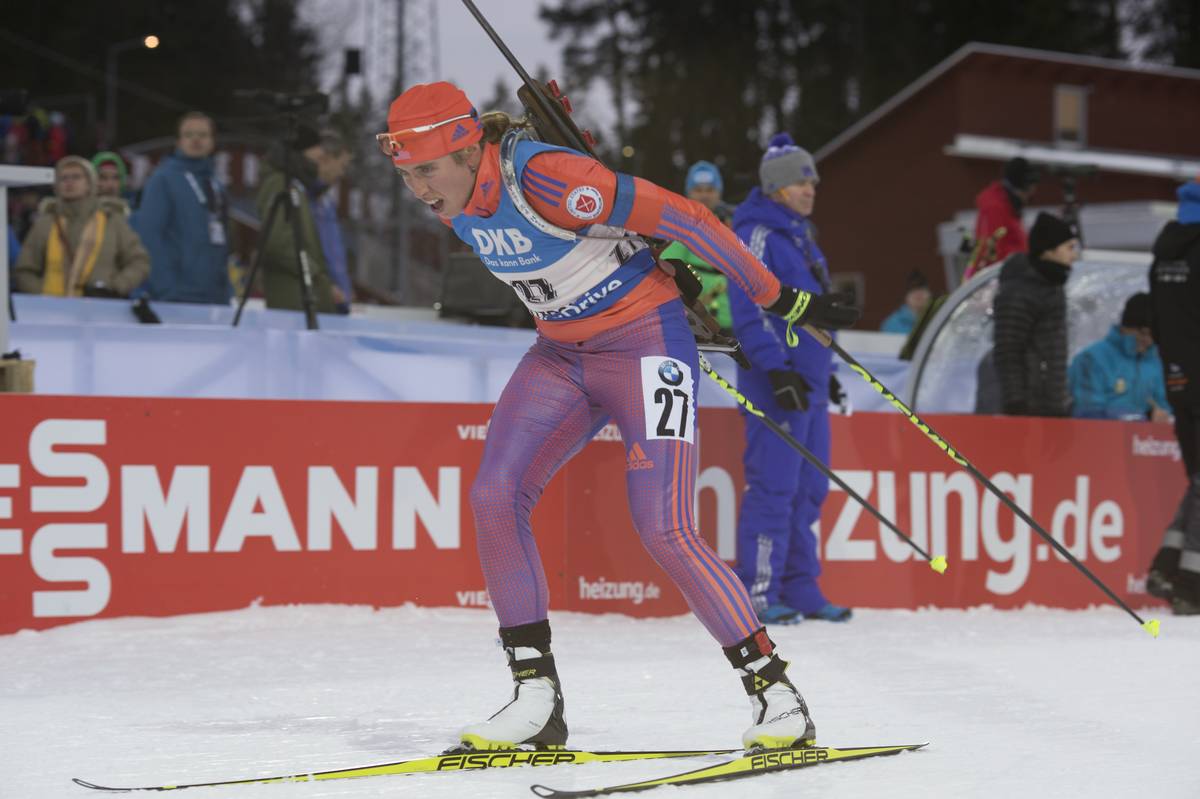
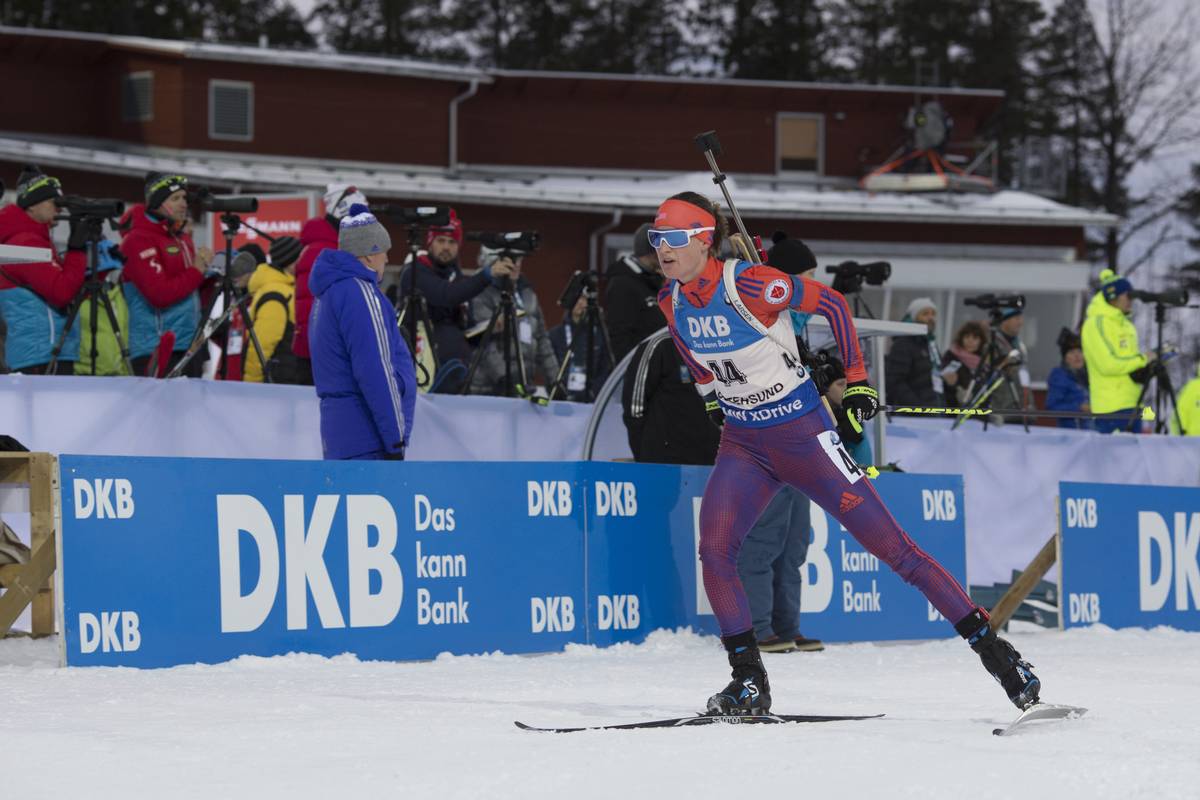
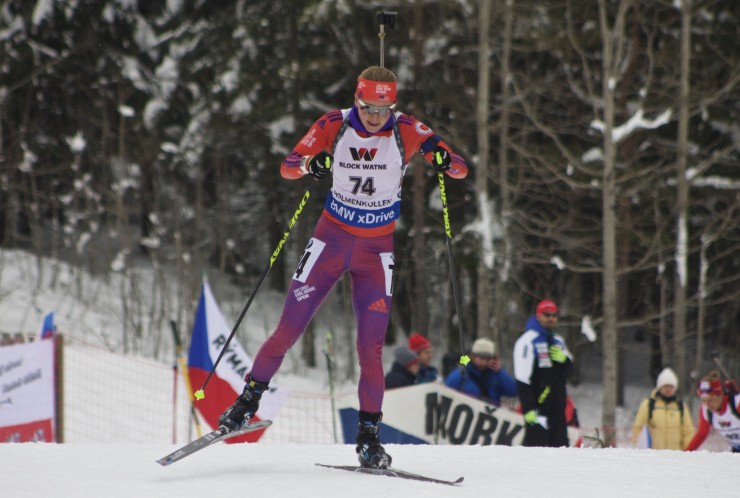
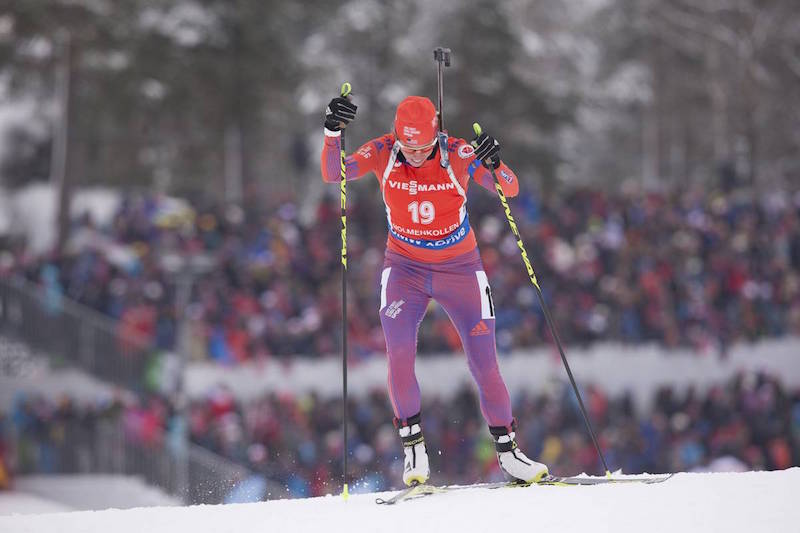
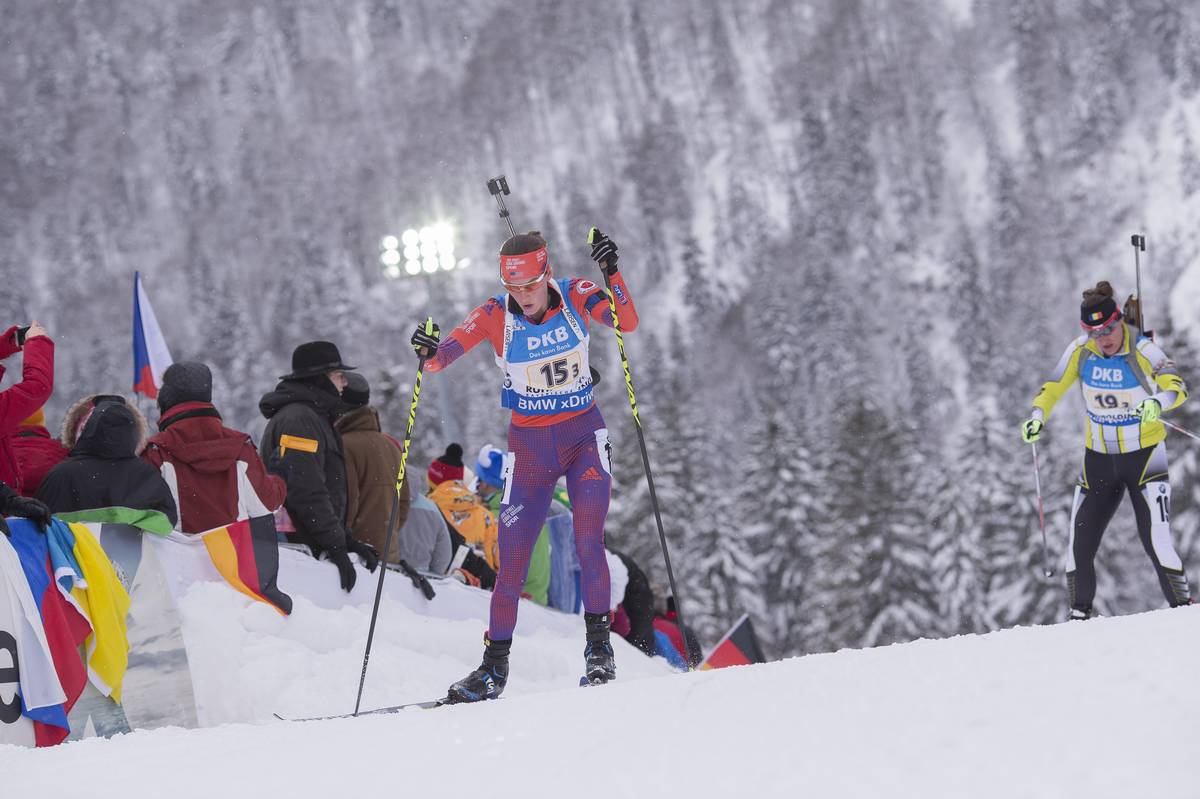
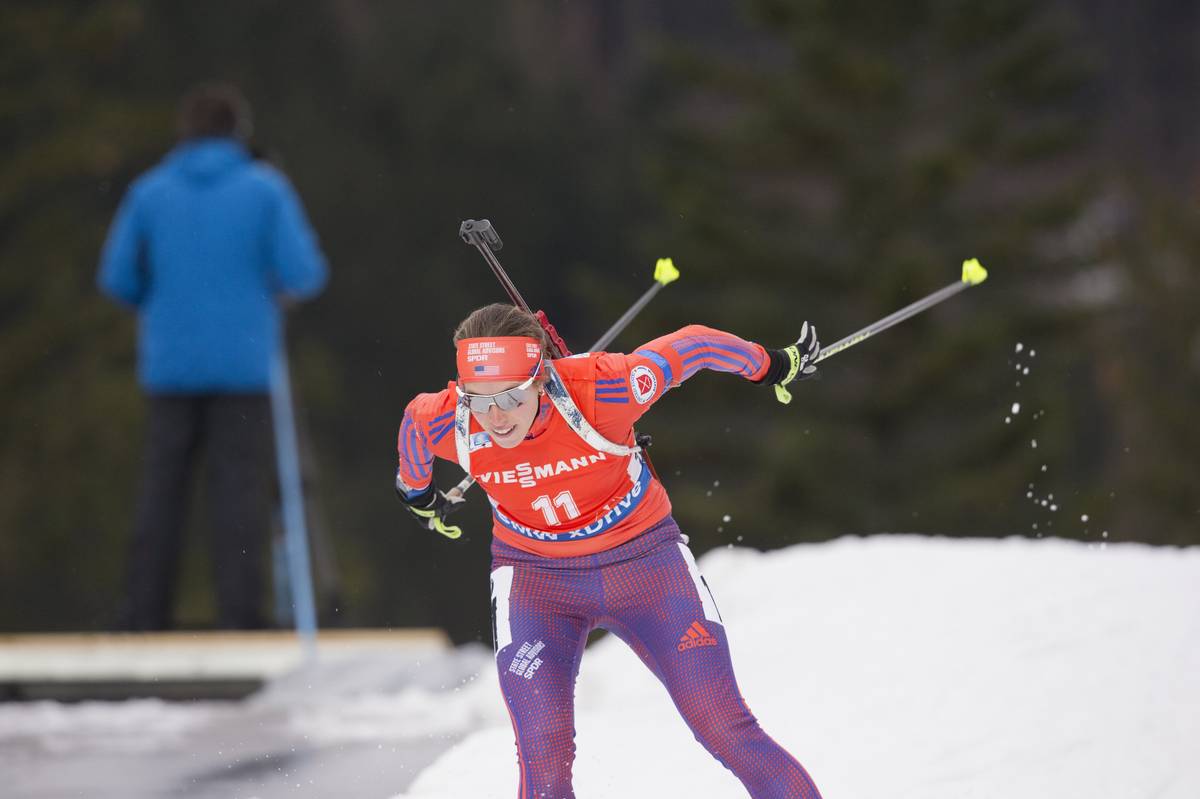
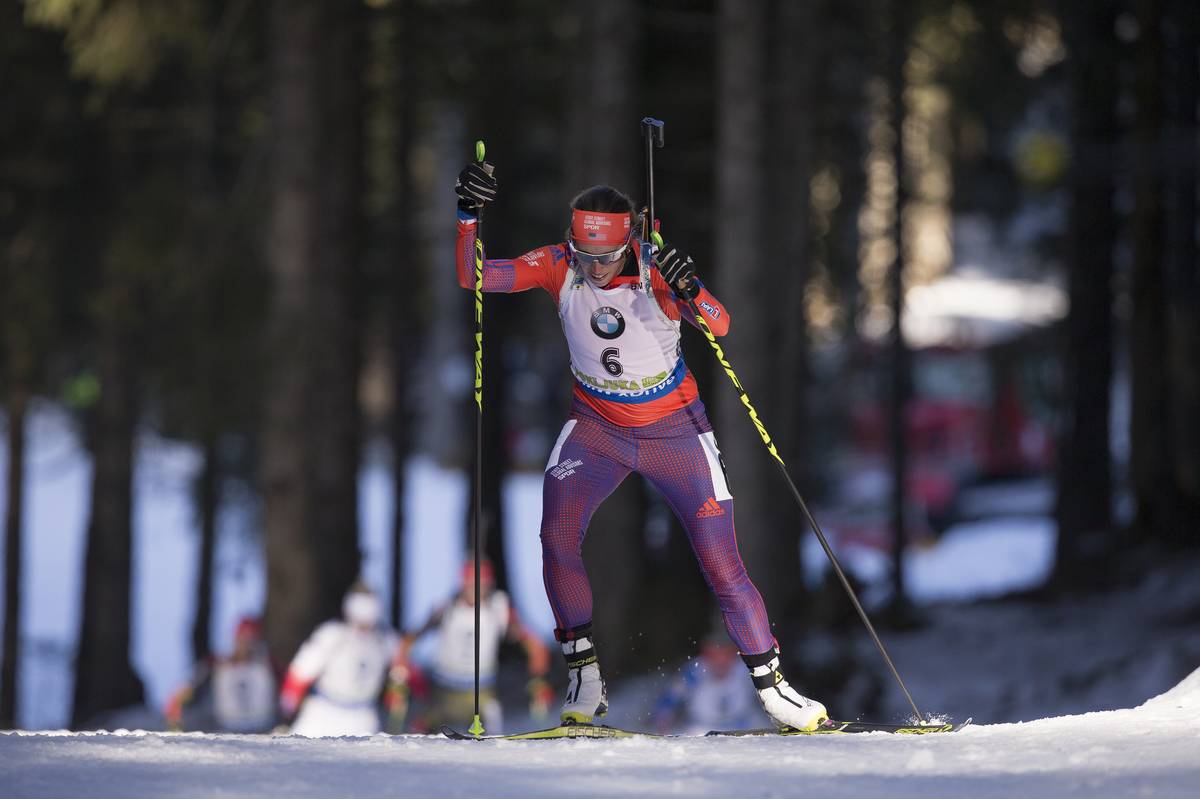
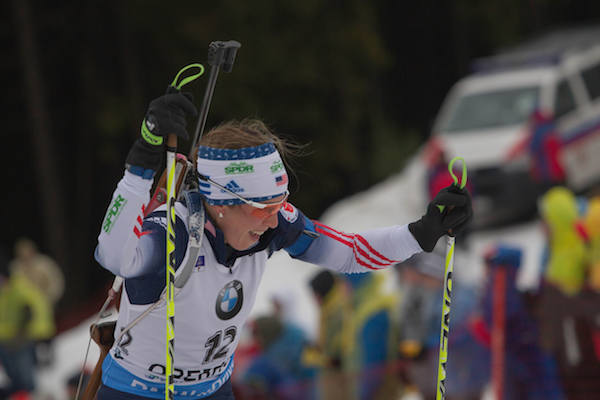
Susan Dunklee (US Biathlon) racing to 22nd in the women’s 10 k pursuit on Sunday in Östersund, Sweden. (Photo: USBA/NordicFocus)
Leading the North Americans, Susan Dunklee jockeyed with a Swiss athlete on her final lap, but instead of the young Häcki it was the more experienced Selina Gasparin. Dunklee’s race had not started off well; she fell back to 40th after two misses in each of the prone shooting stages.
“I don’t think the wind was all that tricky; the mistakes are my own fault,” Dunklee wrote in an email to FasterSkier. “On one of my misses my trigger went off a little early but I’m not sure about the others.”
She managed to catch up again, thanks to fast skiing (with the 17th-fastest overall course time) and a clean third shooting stage in standing, before incurring another penalty in her final shooting and finishing in 22nd place (+2:55.7, 2+2+0+1).
“Throughout the race I had plenty of people to chase and that kept me motivated,” she wrote. “I did catch a ride for half a loop behind my teammate Clare. I had a close battle to finish with Selina Gasparin and she out-sprinted me today, but I look forward to challenging her again soon.”
Teammate Clare Egan moved up to 30th place after starting in the 44th position from her sprint result. She began the race with two clean prone shootings advancing to the 23rd position, before falling back a few places again with three misses in the standing stages (0+0+1+2, +3:35.4).
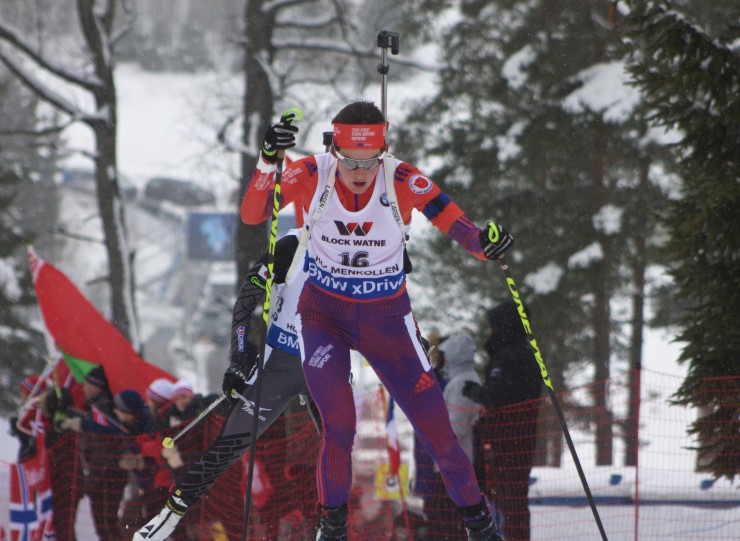
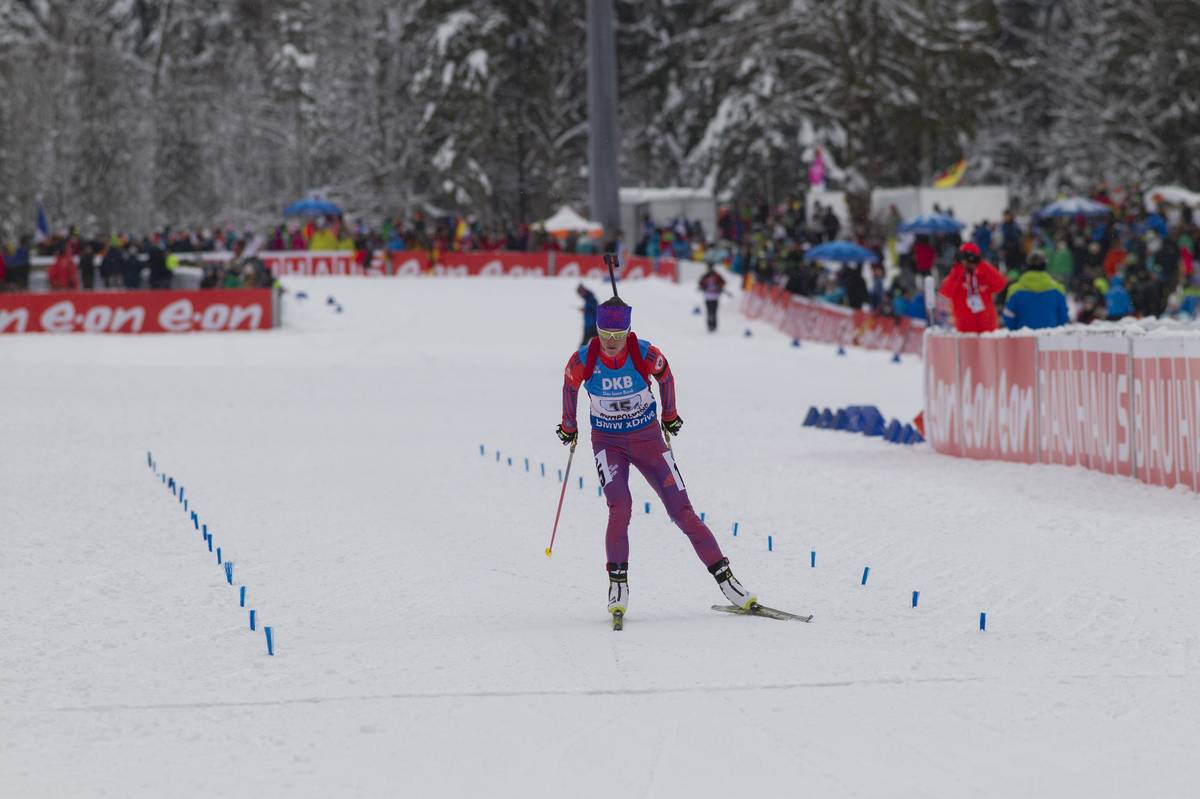
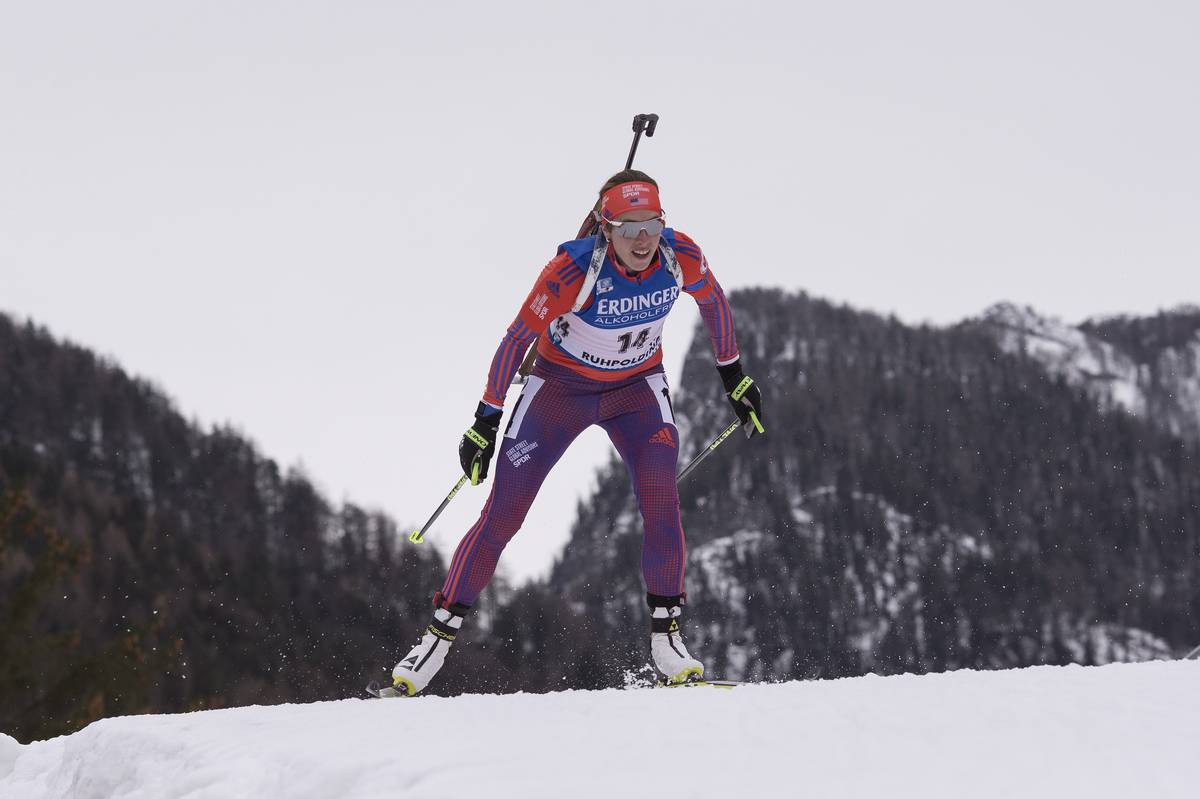
Clare Egan (US Biathlon) racing to 30th in the women’s 10 k pursuit at the IBU World Cup in Östersund, Sweden. (Photo: USBA/NordicFocus)
In an email, Egan described the wind during the pursuit as “totally manageable”.
“My prone execution has been really solid lately,” she wrote. “I’m able to work smart even when tired or under pressure. In standing, however, I am still working up to that point. Especially towards the end of a race when I am more fatigued and my mind isn’t as sharp, and perhaps I feel more pressure because I am aware of my result, it is easy to lose focus on the shooting process. I need more practice to find the right balance between thinking through my actions and overthinking them.”
Combined with the 26th-best course time, this resulted in Egan’s second-best finish in a World Cup pursuit, after a 23rd place last season in Presque Isle, Maine.
“I felt very depleted warming up today, after traveling and then doing 4 races in the last week,” Egan explained. “My wax crew did an excellent job today and definitely gave me an advantage – I was gliding past everyone on the downhills so I was able to pick up a few places just from having the fast skis… I was able to fight for top-30 on my last lap and won a sprint between 4 people in the finish. I’m proud of all my results from this week and looking forward to learning from these experiences and moving up throughout the season!”
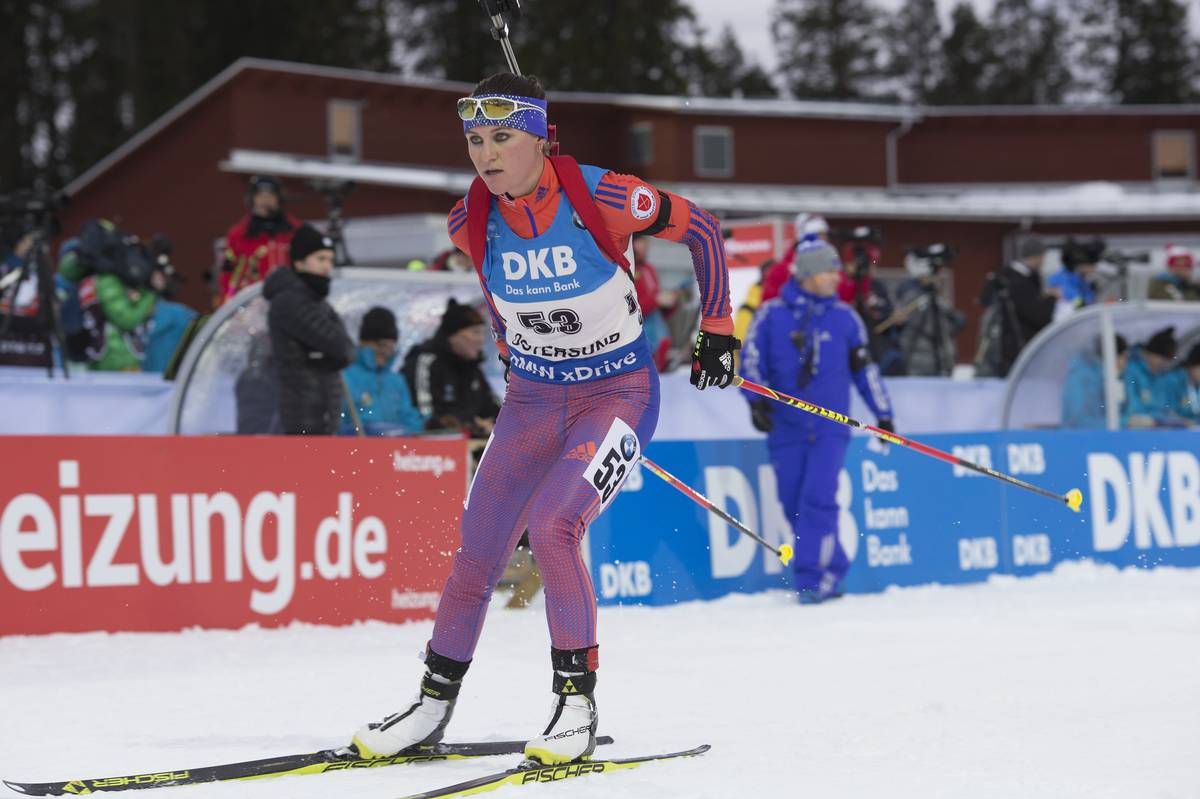
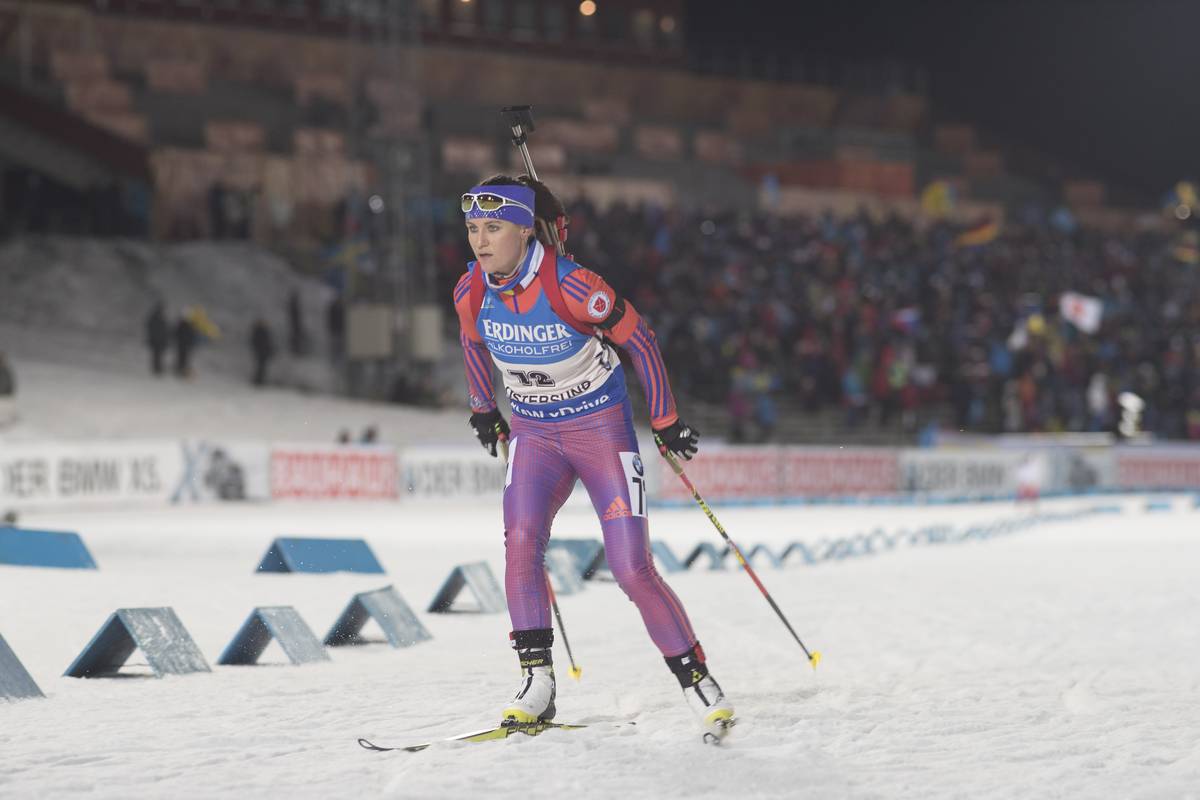
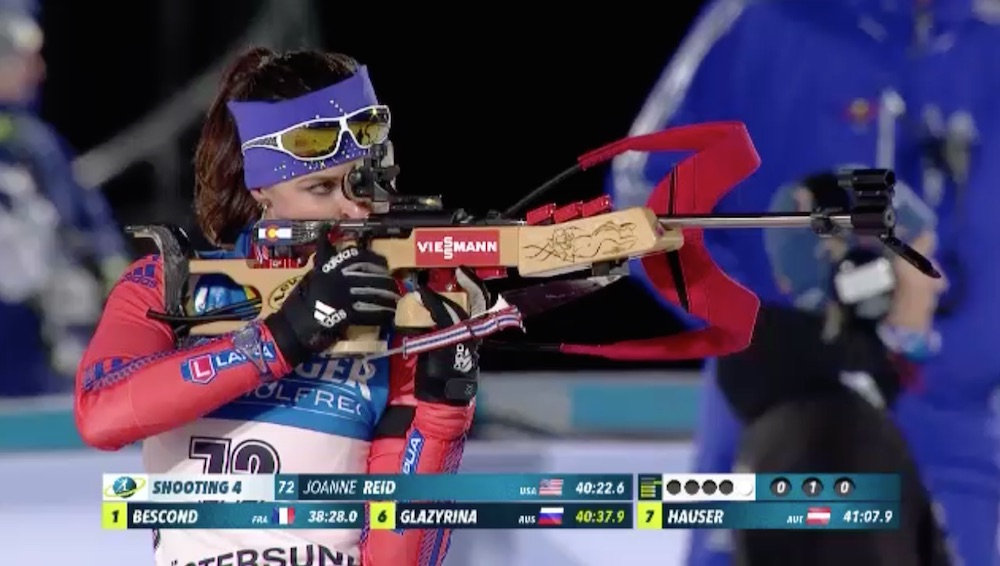
Joanne Reid (US Biathlon) racing to 47th in her first World Cup pursuit, the first pursuit of the 2016/2017 season in Östersund, Sweden. (Photo: USBA/NordicFocus)
The third U.S. woman, Joanne Reid had qualified for her first World Cup pursuit with a 53rd place in the sprint, and after moving up slightly, she finished the day in 47th (+4:59.6) with a not flawless but consistent shooting performance (1+1+1+1).
Julia Ransom, the lone Canadian to qualify for the women’s pursuit, started in 38th but lost ground quickly due to two penalties in the first stage. At the end of the day, Ransom is known for her secure shooting, had a whopping eight penalties (2+0+4+2). Only Germany’s Miriam Gössner had more with nine. Ransom finished her day down 20 positions in 58th (+6:36.8).
The IBU World Cup resumes on Friday, Dec. 9, with sprint races in Pokljuka, Slovenia.
The women’s IBU World Cup sprint podium on Saturday in Östersund, Sweden. (From left to right) Finland’s Kaisa Mäkäräinen in second, France’s Marie Dorin Habert in first, and Czech Republic’s Gabriela Koukalova (formerly Soukalova) in third. (Photo: IBU)
When eliminating all external variables, often the most consistent athletes come out on top in biathlon.
After a wind lottery strongly influenced the individual race of the International Biathlon Union (IBU) World Cup opening week in Östersund, Sweden on Wednesday, by Saturday the race course presented itself in near-perfect weather conditions with no wind, temperatures just below freezing point, freshly fallen snow from the prior night covering up most of the icy patches, and only a little fog moving in from the lake below.
And thus three athletes who already dominated last season’s IBU World Cup standings also claimed the positions on the podium in the women’s 7.5-kilomter sprint on Saturday.
With two clean shooting performances, France’s Marie Dorin Habert celebrated her next World Cup win in a time of 20:09.7 minutes. She only struggled a bit on her final shot trying to find the target for several seconds, with the TV broadcast showing her coach visibly relieved when she finally hit the shot.
“I am very happy about today’s race,” Habert said during the post-race press conference. “I was just thinking ‘speed, speed, speed, full speed’!”
France’s Marie Dorin Habert en route to winning the women’s IBU World Cup sprint on Saturday in Östersund, Sweden, the first sprint of the season. (Photo: IBU)
“Shooting was perfect, too,” she added. “I had to fight a lot of things in the standing shoot[ing]. It was a hard shoot for me, a lot of tension. I am very happy to stay focused and just on the target.”
Starting later than Habert, Finland’s Kaisa Mäkäräinen came closest to preventing the victory despite a miss in the standing stage (0+1) by skiing the second-fastest course time (+11.4). If her shape holds up, the Finn also plans to compete in cross-country skiing at her “home” World Championships in Lahti later this season, as she already did in Val di Fiemme in 2013 and at several national championships.
“Today the weather changed, so it was not so difficult anymore,” Mäkäräinen commented on her improved shooting performance during the press conference. “I changed my rifle stock in the spring, and have had some difficulties to get used to it in the wind. But I like it a lot in prone shooting and today I felt very comfortable, and that gave me a good start to the race. In standing I had one mistake, but I have to be happy with it.”
“I did not expect to be in the top three with one penalty,” she added. “I thought the race is quite tight. A lot of girls now ski fast. So I thought in these conditions I should shoot clean. I was happy when the coaches were telling me [out on the course] that I was still fighting for the top three.”
Behind her, the defending overall World Cup champion Gabriela Koukalová, of the Czech Republic (formerly Soukalová, before her marriage to Czech badminton Olympian Petr Koukal this summer) made up for her seven misses in the individual race earlier this week by shooting clean this time to claim the third place (+19.9). She had left the range for the final lap just 4.9 seconds behind Habert, but was unable to keep up on the course.
“It is always very nice to be in top five,” Koukalová said during the press conference.
“I didn’t have any expectations before. A lot of people were asking me about my ambitions for this season. But I don’t want to be under pressure, so I didn’t expect [anything]…I am very happy about today’s result, it’s many times better than the last race.”
Germany’s Laura Dahlmeier, who had started the race wearing the “yellow bib” of the World Cup leader for the first time in her career (and as the first German athlete since Magdalena Neuner), finished fourth, just six seconds off the podium (+25.7). She was in a great position to pass even Habert coming into the final stage in first place, but missed the very last shot of her competition forcing her to ski through the penalty lap.
“I don’t have to hide today with the third-best course time,” Dahlmeier told German TV broadcaster ARD after the race. “Today there were outstanding conditions on the shooting range. I knew that you would likely need the zero [misses] for the podium … For that last shot I also stood firm, but I maybe was back out on the course again with my head already. That was the problem. I would have had to keep my concentration high. That happens.”
Thus the same women who had placed at the top in last season’s IBU World Cup standings also started out strong for this year’s season. Only Italy’s Dorothea Wierer who was third in the overall was missing from the usual suspects, finishing 19th after two misses in the standing stage (0+2, +1:16.0)
Four North Americans Qualify for Pursuit
Susan Dunklee achieved the best result for a North American biathlete in the women’s sprint on Saturday, finishing in 27th, 1:29.9 back from Habert, with two penalty laps (1+1). Dunklee also posted the 26th best course time.
“My experience on the shooting range felt more routine today and there was nothing notable about my misses,” Dunklee wrote in an email. “I am very happy with my shooting speed. Right now my ski speed isn’t quite there yet – I’m in ‘training shape’ rather than ‘race shape’ but that is typical for me in the early season and it will change with more race starts.”
“Absolutely no wind today. Colder. Light fog came in partway through the race but not thick enough to obscure targets,” Dunklee explained. “Fresh snow that slowed the tracks down. Still some icy patches to watch out for underneath, but a huge improvement compared to the day of the individual.”
Julia Ransom led the Canadians in 38th place (+1:54.1) thanks to a clean shooting performance (0+0), one of 13 athletes to achieve that on Saturday. But her overall course time, which ranked 70th, kept her from the top 30.
US Biathlon’s Clare Egan placed 44th (+2:04.1) after incurring two penalties in her standing shooting that let her fall behind a top 30 position which she had achieved in her prone shooting (0+2).
Her teammate Joanne Reid also missed two shots in standing after a clean prone stage and placed 53rd (0+2, +2:21.2). On Wednesday, she scored her first World Cup points in the individual race to start out her second season (and first full one) on the World Cup team.
Biathlon Canada’s Rosanna Crawford finished 64th with one miss in each shooting stage (1+1, +2:40.3). Her teammate Megan Tandy was 78th (0+2, +3:09.1) and Sarah Beaudry placed 97th (2+0, +3:54.2) among 103 starters.
The times back to the winner from Saturday’s sprint will carry over into the pursuit race on Sunday.
“I think it will be a very good fight with all the girls tomorrow,” Habert predicted during the press conference. “I will try to be focused on my race. But I like the pursuit and mass start because you are not alone.”
For the Americans, Dunklee also looks forward to that race: “All three of our women qualified for tomorrow’s pursuit and we are thrilled!”
Joanne Reid (US Biathlon) racing to a career-best 29th in the IBU World Cup women’s 15 k individual on Wednesday in Östersund, Sweden. She led her team, with Clare Egan also finishing in the points in 40th. (Photo: USBA/NordicFocus)
Wind and Joanne Firesteel Reid — a dangerous combo that worked to the American’s favor on Wednesday.
In her fourth-ever individual World Cup race (as in, not counting relays), US Biathlon’s fastest-rising up-and-comer finished 29th for a career best in the first individual race of the 2016/2017 International Biathlon Union (IBU) World Cup season: the women’s 15-kilometer individual in Östersund, Sweden.
Considering that Reid, 24, picked up the sport a little over a year ago, it’s even more impressive that she recorded her first World Cup top 30 in the longest-format (four-stage) biathlon race on one of the windiest race days in recent memory.
“This was definitely my best result, probably more due to luck than anything else,” Reid wrote in an email on Wednesday night.
Of 99 finishers, only one woman hit all 20 targets: third-place finisher Darya Yurkevich of Belarus. Four racers hit 19 of 20, and Reid was among 10 with three penalties or less.
Joanne Reid (US Biathlon) during her final shooting stage of Wednesday’s 15 k individual IBU World Cup in Östersund, Sweden. Reid missed two in that stage (for a total of three penalties) and placed 29th for a career best.
A member of US Biathlon’s X-team, she ended up leading the U.S. women on Wednesday.
“Had I been the top American because I cleaned the whole race, and skied unbelievably fast, that would be a much different feeling than being the top American because I happened to wander into the range when the wind wasn’t quite as crazy,” Reid wrote. “You are no more your best race than you are your worst race, really. But an individual is a very strange race to ski, and I actively chose to not go out and ski like the ground was on fire, because I watched so many misses happening with all the early starters — a minute penalty per miss is a LOT, and a lot of skiing leeway time.”
Reid started 72nd, at the opposite end of the field of Germany’s Laura Dahlmeier, who wore bib 3 and won in 46:14 minutes. About 30 minutes into the individual-start race, the wind noticeably picked up.
“It was a relatively difficult race today,” Dahlmeier said in a post-race interview with German broadcaster ARD. “I had an early bib, and I didn’t get right into it from the start. My feeling was that I was a bit on the slower side, but apparently that feeling was deceiving.”
She ended up winning by 15.8 seconds over France’s Anais Bescond, who cleaned three-straight stages until missing on the final standing.
“I believe it was a difficult race for everyone,” Dahlmeier continued. “It was very icy, a lot of grainy snow. No easy conditions, and in addition there was the wind on the shooting range. During the last shooting, I stood there forever together with Doro [Wierer]. I think I’ve never experience a shooting stage where Doro stood that long on the range. I had to really fight, but in the end it now looks very very good. I would not have expected that.”
Known for her fast and accurate shooting, Wierer, of Italy, ended up 31st on the day, 5:11.5 minutes out of first with seven penalties (0+2+2+3). Reid was about 10 seconds faster in 29th (+5:01.8) with three misses (0+1+0+2).
“An individual is a very strange race to ski, and I actively chose to not go out and ski like the ground was on fire, because I watched so many misses happening with all the early starters.” — Joanne Reid, (US Biathlon) 29th for a career best on Wednesday
After the first three stages, Reid, whose previous best was 57th in a sprint last season, was skiing in 11th at one point. But she didn’t know it.
“I believe the whole staff was under strict instructions not to tell me [what place I was in],” Reid wrote. “It’s not always wise to tell a shooter something that will make them feel more pressure, especially one that’s as new as myself. So, I had absolutely no idea.”
Two more penalties on her final prone stage put her in 26th, but she held on for a top 30 — despite dropping a pole while leaving the range for the last time.
“Oh yeah, I dropped my pole. Not because the pole was defective, but mostly because I’m defective,” Reid wrote. “If you’re fast and skilled at it, you can slide the loop of the Leki strap right into the pole as you push off, but those are brand new poles (two days ago) and the system is just a touch different than my old pair, so I didn’t click in correctly, and I also didn’t realize. It was completely my fault, I shouldn’t have tried that with a brand new pole at speed mid-race. But hey, maybe I skied faster because I knew I had to make up seconds after I picked it up, who can really say?
“I did pause for a split second trying to figure out if I actually had to pick it up, or if I should keep skiing, or if the range rules require that I pick it up,” she added. “In the end, it’s my pole and I wanted it, so I went back for it. No pole left behind!”
Overall, her range and shooting times ranked in the middle of the pack in 64th and 54th, respectively. And she pointed out that her prone stages brought that shooting time down, with both of those range times ranking 84th or slower.
“Since I have very little experience shooting in wind, but I do a lot of shooting slow, I decided to take my time in the range and really focus,” she explained.
“When I arrived for the second prone stage the wind was blowing the other direction, so I moved three back to center and then three left, only when I looked up again it had died down, so I moved three back right (to center), and this ended up being so distracting to me (I’m still learning wind) that I forgot to actually load my next magazine into my rifle,” she recalled. “So I had to come back up, unhook the sling, load the magazine, and shoot. Pretty sure THAT helped the range time….”
Comparably, Dahlmeier took her time to shoot more accurately than most, with her overall range and shooting times ranking 60th and 69th. She skied her way to first place with the fastest overall course time.
“I never would have expected that my course time would be so good,” Dahlmeier said. “I was pretty satisfied in terms of skiing technique, but I had pretty heavy legs, so I thought I wasn’t quite as fast and that surely there would be faster ones. But I said to myself‚ ‘It’s all right,’ and to just focus on my shooting. The individual race has a strong emphasis on the shooting, so that’s what matters…”
The fastest shooter of the top three and the only competitor to clean, Yurkevich was the 22nd fastest on the range and the 29th fastest shooting overall. She ended up 1:17.3 behind Dahlmeier at the finish for third place.
Germany had three in the top 10 with Franziska Preuss in fourth (+1:37.9, three misses) and Vanessa Hinz in 10th (+3:32.0, three misses).
“I am really satisfied with [the race] today. That’s the best individual race performance I’ve had here [in Östersund],” Preuss told ARD. “Normally I remember this course as very tough, but today it went all right, and on the shooting range I am pretty satisfied with the three misses considering the difficult conditions.
“There were changing winds, and then you start to think, then the legs start shaking from standing around for so long,” she added.
Germany’s women’s coach Gerald Hönig was impressed with Dahlmeier and the women’s team in general.
“This is a great debut for Laura, she just picked up where she left off last year, and that is very successful,” German women’s coach Hönig told ARD afterward. “As a team, one can only wish for a debut like this. … And that shows the last weeks in training went very well, since we didn’t specifically prepare for the start of the season in Östersund because it is a long season, but we are already in pretty good shape. And that lets us look confidently into the future.”
Clare Egan finished 40th (+6:19.3) for the U.S. with five penalties (1+4+0+0), and Canada’s Julia Ransom was 42nd (+6:23.4), also with five misses (0+2+2+1).
Canada’s Megan Tandy placed 53rd (+7:33.0) with five penalties (1+1+0+3), American Susan Dunklee was 73rd (+8:53.6) with nine minutes worth of penalties (4+2+0+3), and Canada’s Rosanna Crawford was 80th (+10:06.2) with eight penalties (2+3+2+1).
“I had the misfortune of shooting during some big gusts for three of my four stages,” said Dunklee, who started 32nd, according to a US Biathlon press release. “The wind was consistent and manageable for my second prone. Four minutes is a disheartening amount of time to lose in the first stage. All I could focus on then was just putting one foot in front of the other.”
She described the snow as “sugary and deep with some ice patches beneath.”
” ‘Wallowing’ might be the right word to describe the uphill skiing,” Dunklee added. “We had two women in the World Cup points today, which is a great achievement. We lost two of our top women to retirement last spring, Hannah (Dreissigacker) and Annelies (Cook), so it is very hopeful to see Joanne and Clare performing so well.”
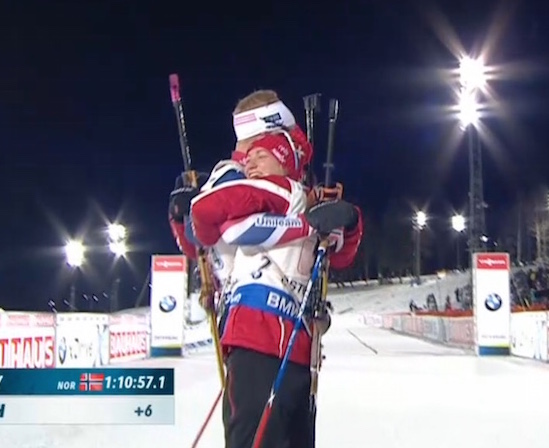
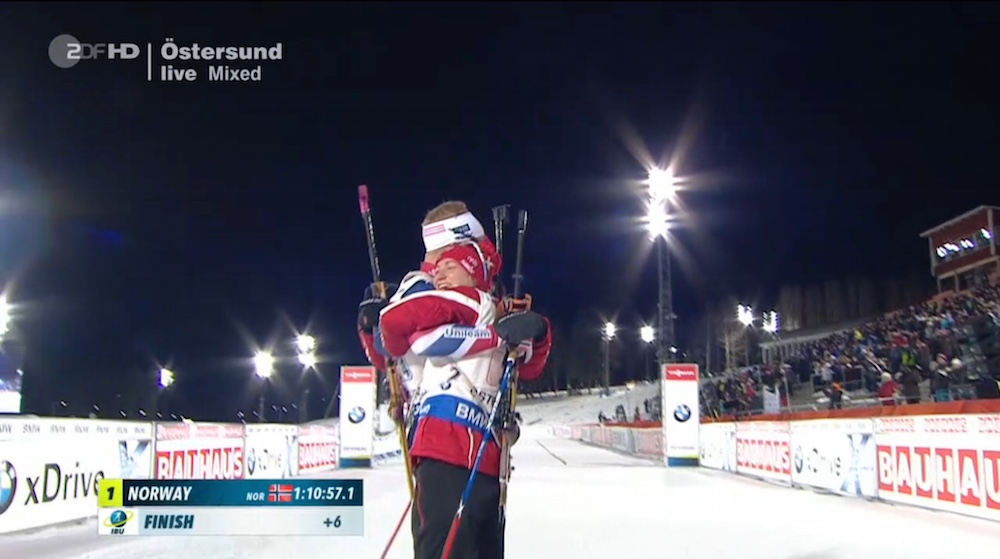
Two members of the Norwegian mixed relay, Johannes Bø and Marte Olsbu, celebrate their win in the first IBU World Cup race of the 2016/2017 season on Sunday in Östersund, Sweden. (Photo: ZDF screen shot)
Welcome to The Rundown, your quick primer of need-to-know information about the day’s racing. We’ll be updating this digest as the day goes on with additional results, photos and quotes. The Rundown is NOT a race report; stay tuned for complete race reports later today with interviews from the day’s top racers.
***
IBU Cup in Beitostølen: 7.5/10 k sprints
[UPDATE] With the second set of men’s and women’s sprints canceled Saturday and moved to Sunday in Beitostølen, Norway, the first IBU Cup relays of the season were bumped off the schedule, and no North Americans competed on Sunday. (American Russell Currier placed 44th in the IBU Cup sprint on Friday.)
In the women’s 7.5 k sprint, Marketa Davidova of the Czech Republic pulled out a 3.6-second win over Germany’s Nadine Horchler, and Germany had two on the podium with former cross-country skier Denise Herrmann in third (+29.9). Davidova hit 9 out of 10 targets (1+0) en route to the victory in 24:18.3. Horchler missed just one target as well (0+1) and Herrmann (who won the IBU Cup women’s sprint two days earlier) had three penalties (1+2) but skied fast enough for the podium.
In the men’s 10 k sprint, Russia’s Matvey Eliseev edged his teammate Dmitry Malyshko by just 3.2 seconds for the win in 26:16.8. More than a minute later, Norway’s Henrik L’Abee-Lund placed third (+1:15.9) with four penalties (1+3). Both Eliseev and Malyshko had one miss apiece, with Eliseev missing one in prone (1+0) and Malyshko missing one standing (0+1).
The next IBU Cup is set for Dec. 6-11 in Ridnaun, Italy.
The first race if the International Biathlon Union (IBU) World Cup season went to Norway, which won Sunday’s co-ed mixed relay (2 x 6 k + 2 x 7.5 k) by nearly 34 seconds over Germany in Östersund, Sweden.
The Norwegian team of Marte Olsbu, Fanny Horn Birkeland, Ole Einar Bjørndalen, and Johannes Thingnes Bø used a total of six spare rounds to get to the finish line first in 1:10.57.1.
Germany, with Franziska Hildebrand, Laura Dahlmeier, Benedikt Doll, and Arnd Peiffer, used the same amount of total spares for second place (+33.7), and both teams avoided the penalty loop.
Italy took third (+44.2), with Lisa Vittozzi, Dorothea Wierer, Lukas Hofer, and Dominik Windisch using a combined 12 spares and having one penalty loop during Hofer’s standing stage.
The Italians narrowly held off Russia (Olga Podchufarova, Tatiana Akimova, Maxim Tsvetkov, Anton Shipulin) by 0.3 seconds for the final spot the podium.
France placed fifth (+1:13.3), Sweden was sixth (+1:20.9), the Czech Republic seventh (+1:20.9), and the U.S. eighth (+2:38.5).
Susan Dunklee started first for the Americans using three spares to clean (0+1, 0+2), then tagging off to Clare Egan, who didn’t need any spares for prone, but had to use all three and skied two penalty loops in standing. Lowell Bailey used just two spares (0+1, 0+1), and Tim Burke locked up eighth for the team with a flawless prone and three spares in standing (0+0, 0+3). In all the team used 13 spares and had two penalty loops.
Of 24 teams in the race, Canada (Julia Ransom, Megan Tandy, Scott Gow, and Brendan Green) was among the four that were lapped. In seven out of eight stages, the team combined for 11 spares and two penalties.
FIS Nordic Combined World Cup in Ruka: Individual Large Hill/10 k
Germany’s 24-year-old Johannes Rydzek celebrating his first of two wins on Saturday at the Ruka Nordic Combined World Cup in Kuusamo, Finland. He now has eighth career individual World Cup victories. (Photo: FIS/NordicFocus)
Germany’s Johannes Rydzek can do the Usain-Bolt-victory stance all the way to the next Nordic Combined World Cup after winning the first two competitions of the 2016/2017 season, with another individual large hill/10 k win on Sunday in Kuusamo, Finland.
Rydzek posted the fifth-best jump after Norway’s Jarl Magnus Riiber, Watabe, Denifl, and Austria’s Mario Seidl, respectively. Rydzek started the 10 k Gundersen 1:04 minutes after Riiber and posted the seventh-fastest course time to capture first. Riiber slipped to 10th (+1:07.5) at the finish, with the 37th-ranked course time of 42 in the cross-country race.
Of note, Frenzel improved from 27th in the jump to 17th (+1:32.4) at the finish with the second-fastest course time.
Bryan Fletcher was one of two Americans in the race, finishing 31st (+3:40.7). His jump ranked 40th, but he skied the fourth-fastest course time to pick off nine places. Taylor Fletcher placed 40th (+6:24.4), improving slightly from 43rd in the jump.
The Nordic Combined World Cup now moves to Lillehammer, Norway, for a team and two individual competitions Dec. 2-4.
Visma Ski Classics Prologue in Pontresina: 8 k Classic
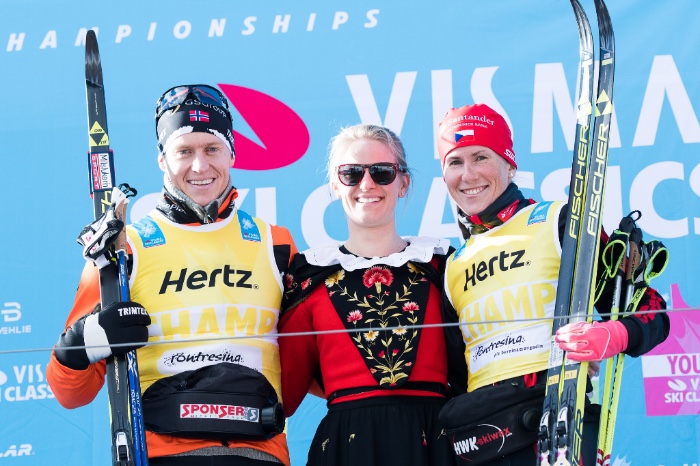
Petter Eliassen of Team Leaseplan Go (left) and Katerina Smutna of Team Santander (right) celebrate after winning the Visma Ski Classics 8 k prologue in Pontresina, Switzerland. (Photo: Visma Ski Classics)
The Visma Ski Classics series started off in Pontresina, Switzerland, with 8-kilometer time trials for both men and women.
In the women’s race, an individual interval start seeded last to first, Kristin Antonsen of Team Synnfjell set an early best mark. But as the previous season’s top women hit the course times began to come down, and the race ended as a battle between Britta Johansson Norgren of Team Lager 157 and Katerina Smutna of Team Santander. Smutna ended up with the win by just 0.66 seconds over Johansson Norgren, with Sara Lindborg of Team Serneke third (+20.66).
The men’s race was a team interval start, with the teams separated by five minutes and with skiers at 15 second intervals within that span. Last year’s Visma Ski Classics Champion, Petter Eliassen of Team Leaseplan Go, came out on top with a time of 19:42.66. Bastien Poirrier of Team Gel Interim Rossignol was second (+8.53), leading five members of his new France-based team into the top ten and turning heads along the way. Morten Eide Pedersen of Team BN Bank was third (+15.80).
Twenty-four-year-old Finnish A-teamer Iivo Niskanen notched his second-career World Cup victory the men’s 15-kilometer classic on Sunday, Day 2 of the Ruka World Cup in Kuusamo, Finland.
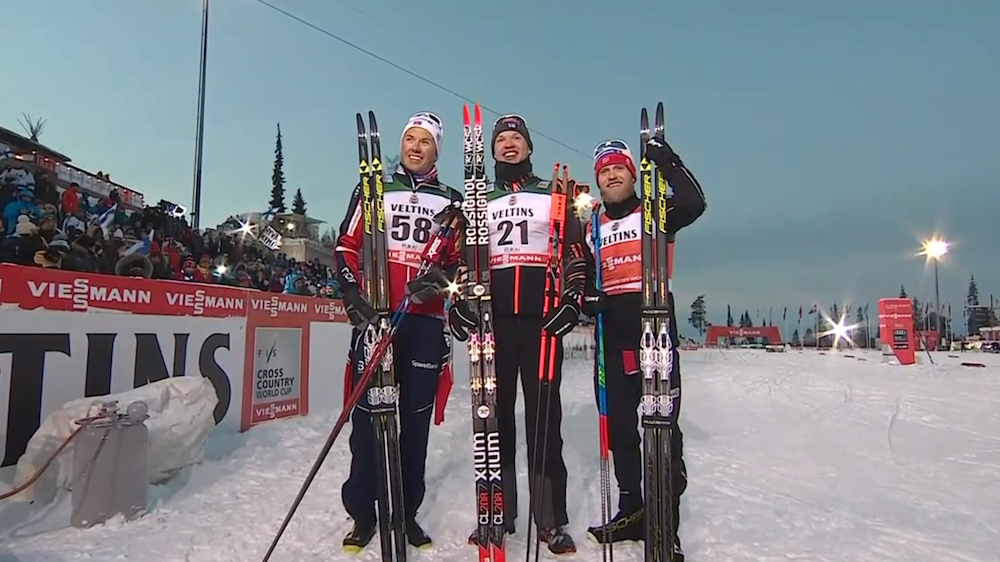
The men’s podium in Sunday’s 15 k classic at the Ruka World Cup in Kuusamo, Finland: with Finnish winner Iivo Niskanen (c) and Norway’s Emil Iversen (l) in second and Martin Johnsrud Sundby (r) in third. (Photo: NBC Sports screen shot)
Niskanen started 21st of more than 90 in the men’s field and finished in 35:27.6, which stood as the fastest time all day. After the finish, he paced between the leader’s chair and the finishing pen, even jogging around the stadium and course. But every time he looked the Finnish crowd, he was all smiles.
Niskanen held off three Norwegians in the top four, with Emil Iversen 10.2 seconds behind him in second, Martin Johnsrud Sundby 11.2 seconds back in third, and Didrik Tønseth missing the podium by about six seconds and tying Sweden’s Johan Olsson for fourth (+17.0). Norway’s Finn Hågen Krogh placed sixth (+18.3), Sweden’s Calle Halfvarsson was seventh (+21.2), Russia’s Alexander Bessmertnykh was eighth (+24.3), Finland’s Matti Heikkinen ninth (+32.0), and Great Britain’s Andrew Musgrave 10th (+33.8).
Canada’s Alex Harvey was close behind in 11th (+35), and was the lone North American man in the points on Sunday. His teammate Devon Kershaw missed the top 30 by 4.5 seconds in 33rd (+1:23.4).
Erik Bjornsen led the U.S. men in 41st (+1:37.2). Canada’s Graeme Killick was 53rd (+2:12.9), American Noah Hoffman was 64th (+2:42.6). For Canada, Len Valjas was 76th (+3:19.8), Jess Cockney 78th (+3:26), Knute Johnsgaard 85th (+3:53.4), and Andy Shields 91st (+4:26.1), and for the U.S., Eric Packer 87th (+4:01) and Andy Newell 88th (+4:17.4) out of 96.
In the women’s 10 k classic earlier in the day, Marit Bjørgen of Norway picked up her first win of the season, a 4.6-second win over Finland’s Krista Parmakoski.
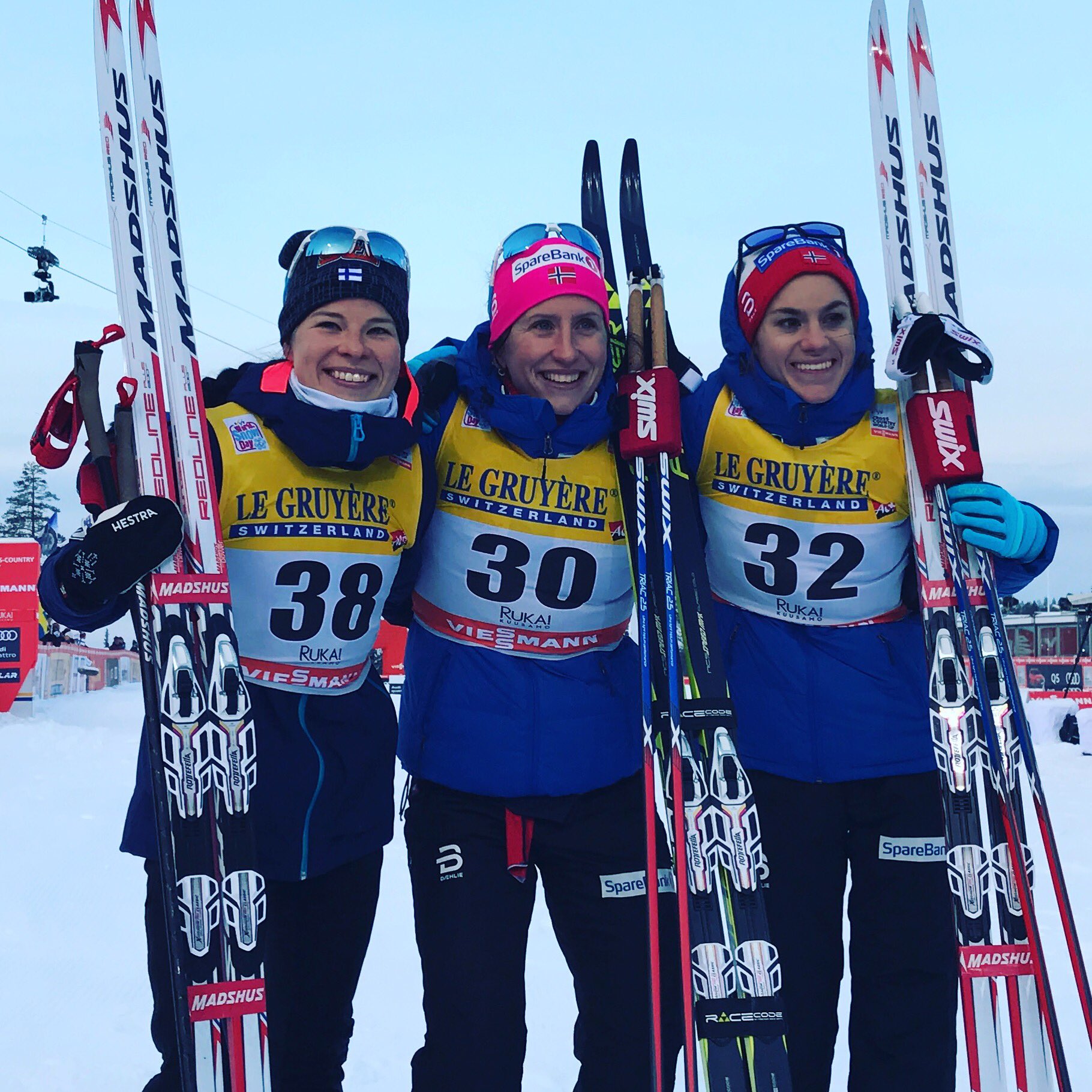
Marit Bjørgen of Norway (center) collected her first World Cup win of the season in the 10 k classic in Ruka, Finland, ahead of Finland’s Krista Parmakoski (left) and Norway’s Heidi Weng (right). (Photo: FIS Cross Country/Twitter)
It is the 103rd World Cup win for the 36-year-old Bjørgen, who took last season off to have a baby. Norway followed up Bjørgen’s win with third and fourth place finishes by Heidi Weng (+12.7) and Ingvild Flugstad Ørtberg (+36.8).
Parmakoski also led a good day for the Finnish team, with Laura Mononen coming in seventh (+50.0). She was just behind sixth-place Nicole Fessel of Germany (+42.4).
Jessie Diggins led the U.S. women’s team with a 13th-place finish (+1:09.0), one of her best distance classic races ever outside of Tour and mini-tour stages. Sadie Bjornsen followed in 17th (+1.14.9), and 2016 SuperTour champion Caitlin Patterson of the Craftsbury Green Racing Project scored points in 28th (+1:45.4). The U.S. Ski Team rounded out its results with Rosie Brennan 39th (+2:22.2), Kikkan Randall 43rd (+2:29.7), Ida Sargent 44th (+2:30.4), and Sophie Caldwell 61st (+3:13.4)
Cendrine Browne and Emily Nishikawa slotted into 58th and 59th for Canada, +3:04.8 and +3:07.1, respectively. Dahria Beatty finished 74th (+3:54.4).
OSLO, Norway — On the final day of International Biathlon Union (IBU) World Championships at Holmenkollen’s famous venue, both Susan Dunklee of the U.S. and Canada’s Rosanna Crawford posted their best-ever results in a championships mass start, in 11th and 15th, respectively. For another American, Hannah Dreissigacker, it was the last international race of her career, as she finished 27th in the prestigious final competition.
France’s Marie Dorin Habert took gold in the 12.5-kilometer mass start, shooting clean and finishing 7.3 seconds ahead of Germany’s Laura Dahlmeier in second and 8.1 seconds ahead of Finland’s Kaisa Mäkäräinen in third.
Norway’s Tiril Eckhoff en route to 25th in the women’s 12.5 k mass start at 2016 IBU World Championships in Oslo, Norway. She had five penalties, three of which came in the third stage.(Photo: JoJo Baldus)
(Photo: JoJo Baldus)
Anais Bescond of France racing to fifth in the women’s 12.5 k mass start at 2016 IBU World Championships in Oslo, Norway. (Photo: JoJo Baldus)
Marie Dorin Habert of France on her way to mass start gold in the last women’s race of 2016 IBU World Championships in Oslo, Norway. (Photo: IBU/Twitter)
OSLO, Norway—After showing good form all week, Susan Dunklee was hungry going into her last race at World Championships: the 12.5 k mass start.
But the American biathlete didn’t have a good start on Sunday, missing two shots in the first bout and immediately heading to the penalty loop. Twice.
“It was disappointing,” she said of coming out of the loop in 28th place, third from last in the elite 30-woman field.
But Dunklee was able to work her way back up. After making up ground on the trails, she calmly knocked down all the targets in her next two shooting bouts and moved into the top ten.
“I’ve had a lot of practice over the years with biathlon, even if you get off to a bad start. You never know what can happen. A little bit of the pressure is off, but it also means that you have a lot more hard work because you’re skiing by yourself… In some ways it’s better to miss one early, because the pack is still skiing together and people aren’t usually making breaks that early.”
It had seemed like her chance of a medal was gone after those first two missed shots, but by the final stage Dunklee found herself all of a sudden in seventh place, with the leaders in sight.
Then she missed one more target.
“On the last bout I think I was shooting on point seven or something,” she said. “So it was right there. I had one miss in that last stage, so it was close, but I could have really been right there.”
Once out of the penalty loop, she attacked on the trails, able to move from 14th up to 11th and crossing the line one minute and four-tenths of a second behind race winner Marie Dorin Habert of France.
She was also just a few seconds behind Nadezhda Skardino of Belarus.
“I didn’t know where I was standing until the last hill, when Jonas told me that the top ten was right there, and to go after her because she was getting tired,” Dunklee said. “So I tried. But she rallied at the end and I didn’t quite catch her.”
In a way, the race was disappointing, she said. Dunklee had the third-fastest ski time of the field, and has had comparable speed all week. With three misses, she somehow still managed to be near the top ten.
“I was certainly dreaming of medals here, and I feel like my level is high enough that I’m capable of being on the podium at an event like this,” she said. “It didn’t come together this week, but one of these years it will.”
Still, she was able to call it a successful World Championships, with individual finishes of eighth, 10th, 11th, and 18th as well as two strong relay legs.
She wasn’t able to match her career-best Championships result of fifth back in 2012, but as a group of results, it was her best Championships yet.
And there’s still one week of World Cup racing to come, in Khanty-Mansiysk, Russia.
“I want to have a little bit of fun today,” Dunklee said. “But I definitely have some motivation left, probably more than some of these ladies, so we’ll see what happens next week.”
Following an opposite trajectory to a similar result was Rosanna Crawford of Canada, who cleaned the first stage and was skiing in the lead group. But then she missed one shot each in stages two and three.
“One miss would have been okay,” she said. “For sure, the prone, both of them I shouldn’t have missed. I think I just jerked the trigger for my second shot in prone. The skiing felt good, but just not quite as good as the relay.”
Still, Crawford cleaned her final standing stage and crossed the finish line in 15th, +1:25.7.
“You always want to make big gains every year,” Crawford said. “But the reality of the sport is that as you get older, the gains get smaller and they are harder to get. We’ll have to put in that extra couple percent to make it next year.”
To try to stay grounded, she had set “realistic” goals for the Championships: to make a top fifteen, and to qualify for the mass start (qualification goes to the top 15 athletes in the World Cup standings, with the field filled out with medalists and athletes with the best combined results from the Championships).
“I achieved the realistic goals,” said Crawford, who also finished 14th in the 15 k individual on Wednesday. Before this season, her best Championships result was 17th in the individual in 2013.
So like Dunklee, she had to be happy with the sum and total of her week, even if she wished she had hit one more shot.
Hannah Dreissigacker also toed the start line for the U.S., crashing on the first loop and then collecting three penalties to finish 27th.
It was her last international competition before retiring; teammate Annelies Cook, also retiring, was done after the relay, as was Canada’s Zina Kocher.
“Big hugs to Zina and Annelies and Hannah,” Crawford said. “We’re going to miss them very much. It won’t be the same.”
Sixth Medal for Dorin Habert as French Biathlete Takes Gold
Dorin Habert capped off a perfect week by shooting 20-for-20, the only woman in the field to do so. She earned gold, which was her sixth medal in as many start.
Those results had exhausted her, and the mother of an 18-month-old said she was relieved to have shot clean.
“I think today was hard for me,” she said. “I am happy to be the only woman with no misses behind the rifle… I didn’t think that I could have no misses in a mass start. Because all of the starts of the season I make some misses on the standing shooting. So today was very perfect. I tried to do my best today, but on the loop it was very hard.”
Three women with a penalty apiece left the range on the final stage together behind Dorin Habert. They were Gabriela Soukalova of the Czech Republic, the overall World Cup leader; Laura Dahlmeier of Germany; and Kaisa Makarainen of Finland.
Dahlmeier and Makarainen attacked and Soukalova could not keep the pace, slipping to fourth over the course of the 2.5 k loop. For the other two, it was a tough battle as both said they were tired from the week so far.
“Perhaps I don’t look very tired, but I am tired, I’m really tired,” Dahlmeier said in the press conference. “We had a really hard fight on the last loop, Kaisa and me. I thought I had to be directly behind her and then perhaps it would be possible to win the bronze medal.”
Makarainen had a bit of a disadvantage as the German had faster skis, and the finish of the Holmenkollen course is downhill into the stadium.
“My only plan was that I try to make the gap in the uphills, and I wished that the gap was big enough that nobody would pass me,” she said.
She did lead Dahlmeier up the last big hill, Hellnerbacken, as well as up the steep hill behind the range. But the German stuck to her tails and was able to pass her just before the finish line to claim silver.
“I just could take more speed with me, you can see that she has to start pushing earlier, I could just create more forward drive,” Dahlmeier told German broadcaster ZDF. “It’s absolutely gigantic that it was enough for silver. I really wouldn’t have thought that would be possible while the race was going on.”
With the medal, Dahlmeier nearly matched Dorin Habert: in five starts (she sat out the mixed relay), she earned five medals.
Makarainen, a former World Champion and World Cup Total Score winner, was happy with bronze.
“I had no chance against Laura on the last downhill,” she said. “I am sure that our wax team worked really hard these last two weeks, and today they only made skis for me, so I don’t want to blame them. It’s a big thing for our small team to win a medal… We have seen that it’s only the big teams who win most of the medals, the ones with a lot of athletes and support, so this is great for our small team.”
Zina Kocher of Canada placed 54th. (Photo: JoJo Baldus)
Rosanna Crawford of Canada finished 13th, the best World Championships finish of her career. (Photo: JoJo Baldus)
Hannah Dreissigacker earned her first mass start qualification after today’s race. (Photo: JoJo Baldus)
Annelies Cook of the United States on course in the women’s 4 x 6 k relay at 2016 World Championships in Oslo, Norway. (Photo: JoJo Baldus)
Laura Dahlmeier of Germany earned bronze in the 15 k individual. (Photo: JoJo Baldus)
Susan Dunklee’s parents wave an American flag in the stadium. (Photo: JoJo Baldus)
Susan Dunklee pushing over a hill for 18th place. (Photo: JoJo Baldus)
Marie Dorin Habert of France won her first individual gold of these World Championships. (Photo: JoJo Baldus)
The scene at Holmenkollen stadium in Oslo during the women’s 15 k individual of IBU World Championships. (Photo: JoJo Baldus)
Oslo 2016 IBU World Championships – Clare Egan of the United States. (Photo: JoJo Baldus)
On course in the 15 k individual. (Photo: JoJo Baldus)
Sarah Beaudry of Canada is urged on by head wax tech Tom Zidek. (Photo: JoJo Baldus)
Julia Ransom en route to 20th place for Canada. (Photo: JoJo Baldus)
Hannah Dreissigacker of the United States finished 33rd in the 15 k individual at World Championships on Wednesday. (Photo: JoJo Baldus)
Clare Egan en route to 66th place. (Photo: JoJo Baldus)
A scene outside of the race course at Holmenkollen. (Photo: JoJo Baldus)
Sarah Beaudry of Canada. (Photo: JoJo Baldus)
Canadian tech Tom Zidek showing an athlete their shooting group. (Photo: JoJo Baldus)
Gabriela Soukalova of the Czech Republic, the overall World Cup leader, placed fifth. (Photo: JoJo Baldus)
Annelies Cook of the United States placed 77th. (Photo: JoJo Baldus)
OSLO, Norway—After frustration on the shooting range in the World Championships sprint and pursuit competitions, the Canadian women’s team were pleased to up their percentages in the 15 k individual, translating to top-20 performances by both Rosanna Crawford and Julia Ransom.
Crawford missed just one of her targets, finishing 14th, 2:15.3 behind new World Champion Marie Dorin Habert of France.
And Ransom was one of only two women in the whole field to shoot 20 for 20, finishing 20th, +2:33.5.
“It always is a big focus,” Ransom said of perfection on the shooting range. “I’m just glad it came out today, because those one minute penalties hurt. I was more calm and confident today.”
As in Antholz, Italy, earlier this season, Ransom gained momentum as she knocked down target after target: first five out of five, then ten out of ten, then 15 out of 15.
But not so few athletes cleaned three stages. It’s the fourth one which can be trouble. The gold and silver medalists, Dorin Habert and teammate Anais Bescond of France, had each hit 15 for 15 before missing a shot on their last stage.
So did last year’s World Champion, Ekaterina Yurlova of Russia, who ended up 11th after that one miss. And so did several other women, as well.
Ransom was able to keep her focus.
“I think it’s easy to get into your own head, especially if you shoot 15 for 15,” she said. “So I was happy to stay solid.”
Crawford after the sprint had complained of a “nine out of ten curse”, but started off her 15 k with ten straight hits before missing a shot in her second prone stage.
“Shooting was so good,” Crawford said. “It’s always so good in training so I really tried to bring that feeling to the race today. As I was cresting the top of Hellner’s hill [the last big climb before the stadium], I kind of just said to myself, OK, now for the easy part, which is shooting. That was really nice to have that feeling. I really took my time on the last standing. I didn’t want to have a repeat of the pursuit.”
On the tough and hilly Holmenkollen course, Crawford was satisfied to finish 14th, her best World Championships or Olympic result to date, and also one of her best of the regular season.
“My best was 13th in Östersund [the first week of the World Cup] in an individual with 18 for 20 I think,” she said. “So the ski speed is coming around. It would’ve been really nice to have that top 10, especially for funding for the team. This will probably secure me a spot for the mass start so I’ll just try again on Sunday.”
Canada also started Zina Kocher, who finished 54th with four penalties (+5:33.6) and Sarah Beaudry, who finished 60th with two penalties (+6:02.3).
“I’m happy I hit 18,” Beaudry said. “I didn’t feel great skiing, but I did some of the things I was hoping to do. To push with the hills – there are so many long tops of the hills, and I find that I struggle with that, so I focused well on that in the race, which is good. I’m just happy that I feel better than during my sprint.”
In her first senior World Championships, Beaudry was thrilled to see Ransom hit perfect shooting. Separated in age from Beaudry by just a year, Ransom got her senior World Championships debut last season and has already made good on her accumulated experience.
“We’ve known each other longer than we haven’t known each other,” Beaudry said. “I’ve always watched Julia do everything one year before me. So it’s so neat to watch and say, that could be me next year. She leads the way and I have someone to follow.”
So perfect shooting next year?
“That would be great,” she laughed.
Dunklee Leads U.S. in 18th
After two top-tens in the sprint and pursuit, Susan Dunklee missed a few more shots on the range to finish 18th in the individual, +2:29.5.
She missed a shot in each of the first three stages, but cleaned her last one for three total penalties.
“I finished on a good note,” she said. “I’m making that a habit, which is nice.”
Earlier in the week Dunklee talked of shooting feeling good and easy, and that didn’t necessarily change. She thinks she’s still got it for the rest of the week.
“Today felt a little more average, to be honest, but it still felt in control, which is exactly what I want,” she said. “I was really surprised I only missed one in the first standing because I was kind of seeing spots a little bit. Spots beyond just the five dots. It was hard to stay focused.”
That might be from exertion: Dunklee had the fourth-fastest course time behind medalists Dorin Habert, Besond, and Laura Dahlmeier of Germany. The four were separated by just 6.8 seconds.
“Today I was feeling good,” she said. “Ideally you would want to start out a little slower then speed up as the race goes on in a long race like this. But when I’m feeling really good I don’t worry too much about that. I just go and then deal with the consequences later. I was definitely hurting on loop four, but Doro [Wierer of Italy, who finished eighth] was right there. She was on her finishing loop so I just kept her within reach and that helped a lot.”
With two penalties, Hannah Dreissigacker finished 33rd (+3:45.2).
“The shooting has been feeling so good lately,” Dreissigacker said. “Like in practice yesterday, I missed one shot the whole time and I was feeling so solid. Today, also, I just felt like I didn’t even need to miss those two, I could’ve just hit them. That’s a great feeling, that’s how it should feel, close.”
Along with an 18th place finish in the sprint and 36th in the pursuit, the result was enough to qualify Dreissigacker for her first ever mass start competition.
It’s a cherry on top of what has been a good World Championships, the last before Dreissigacker retires.
“This will be my second mass start,” she wrote in an email after the mass start qualification list was announced. “I started with bib 30 in the mass start in Khanty-Mansisk last year. It was definitely a goal of mine for this year do another mass start, and I really didn’t think that it would happen for a while there so I am just SO happy about it! It will be the perfect way to end my biathlon career.”
Clare Egan had four missed shots, three of which came in one stage, to finish 66th (+6:41.9). Annelies Cook finished 77th with seven missed shots (+8:49.4).
“I had one bad stage,” Egan said. “I was pretty bummed out. But I was psyched that I was able to keep it together after that and not go downhill… I’m happy to have another race with 80% shooting. My goal this year was to average 80%, and I’ve only had one individual race (sprint or pursuit or individual) below that. With my shooting I’m doing way better than I could have hoped this season.”
The U.S. women are now looking toward the relay, which has extra significance since with Dreissigacker set to retire next year.
“This is our last relay as a group, and it’s going to be sad but it’s also going to be a nice way to go out,” Dunklee said. “I’m going to miss being on a team with [her] a lot, and I’m going to try to savor this last one.”
Will that added emotional aspect make it harder to focus?
“I’m just going to try to go out and do what I always do,” Dunklee said. “We’ll see.”
Laura Dahlmeier of Germany on her way to her first individual World Championships gold.
OSLO, Norway—On Saturday it was unbeatable skiing that brought Laura Dahlmeier a bronze medal in the 7.5 k sprint at World Championships, despite one penalty when most other top competitors shot clean.
On Sunday it was shooting that brought her gold. The 22-year-old German was a perfect 20-for-20 on the range and took the lead in the 10 k pursuit after the final shooting stage, with such a comfortable margin that she never had to look back.
“It was really a perfect day for me, a perfect race,” she said in a post-race press conference. “I hit all targets… The last loop was amazing. I had a little bit of time to look around and thank the whole team, and get the German flag. It was great for me to come to the finish as the World Champion.”
She finished 48.3 seconds ahead of Dorothea Wierer of Italy, who moved up from fifth place with just two penalties. Marie Dorin Habert of France was third, +57.3, after leading early, but missing three targets in her standing stages.
It was the first individual World Championships medal for Wierer, who has a reputation as a sharpshooter.
Julia Ransom of Canada (left) and Hannah Dreissigacker of the United States on course in the 10 k pursuit.
“The medal was something special,” she said. “I knew it was not easy because everybody is preparing well for the World Championships. I had so much problems last week. I was changing the position of the shooting maybe five times and I wasn’t able to make a zero in the shooting in training. And I also had a strange feeling in the body yesterday, like I was getting sick or something. But today is a new day, and I’m really happy.”
Dorin Habert earned her medal on the last loop. Though she left the range in fourth position, behind Franziska Hildebrand of Germany, she managed to pass Hildebrand and, with gritted teeth, hang on for the medal all the way to the finish.
“I’m very happy to be third and I don’t care about my standing shooting,” she said.
Dunklee a Hard-Fought Tenth
U.S. biathlete Susan Dunklee had only one missed shot through her prone stages, moving from bib eight into the top five.
Then came standing. The first standing stage, Dunklee called a “distaster.” Missing three shots, she dropped all the way to 20th.
“I’m not sure what happened, but it didn’t feel as in control as all the rest of the stages I have shot this week,” she said. “I was really glad to come in and clean the next stage, to get back on the horse right away, so to speak.”
That clean final stage had her leaving the range in 15th with the race far from over.
Dunklee charging hard.
“It was exciting, because Gabi [Soukalova] and Anais [Bescond] came out of the penalty loop right ahead of me,” she said. “I thought that was sweet because they are both really good skiers, so I got a ride. Then I was feeling good on that little hill halfway around the course. They boxed me out – one was on one side, the other was on the other side, and they were passing someone else, but I wanted to pass them. I couldn’t.”
Never one to let a challenge defeat her, Dunklee found a way past.
“Clare [Egan], my teammate, was there yelling, ‘Come on Susan! You have to go now! You have to go now!’” Dunklee said. “So I did a little slalom on the uphill to get around them. I knew they would just hang onto my tails because they are good skiers. So I charged, and we caught a few more people. It was a fun last loop.”
That put her in tenth by the finish, something that she wouldn’t have thought possible with four penalties on the day. Dunklee had the second-fastest ski time behind Kaisa Makarainen of Finland, who finished seventh.
“You don’t know until you try,” she said of her last-loop heroics. “You have to always try. I am happy with [the result] given the shooting. I’m still kicking myself on that one stage. Luckily we still have a few races this week.”
Even though she can’t pinpoint what went wrong in her first standing stage, Dunklee isn’t letting it worry her.
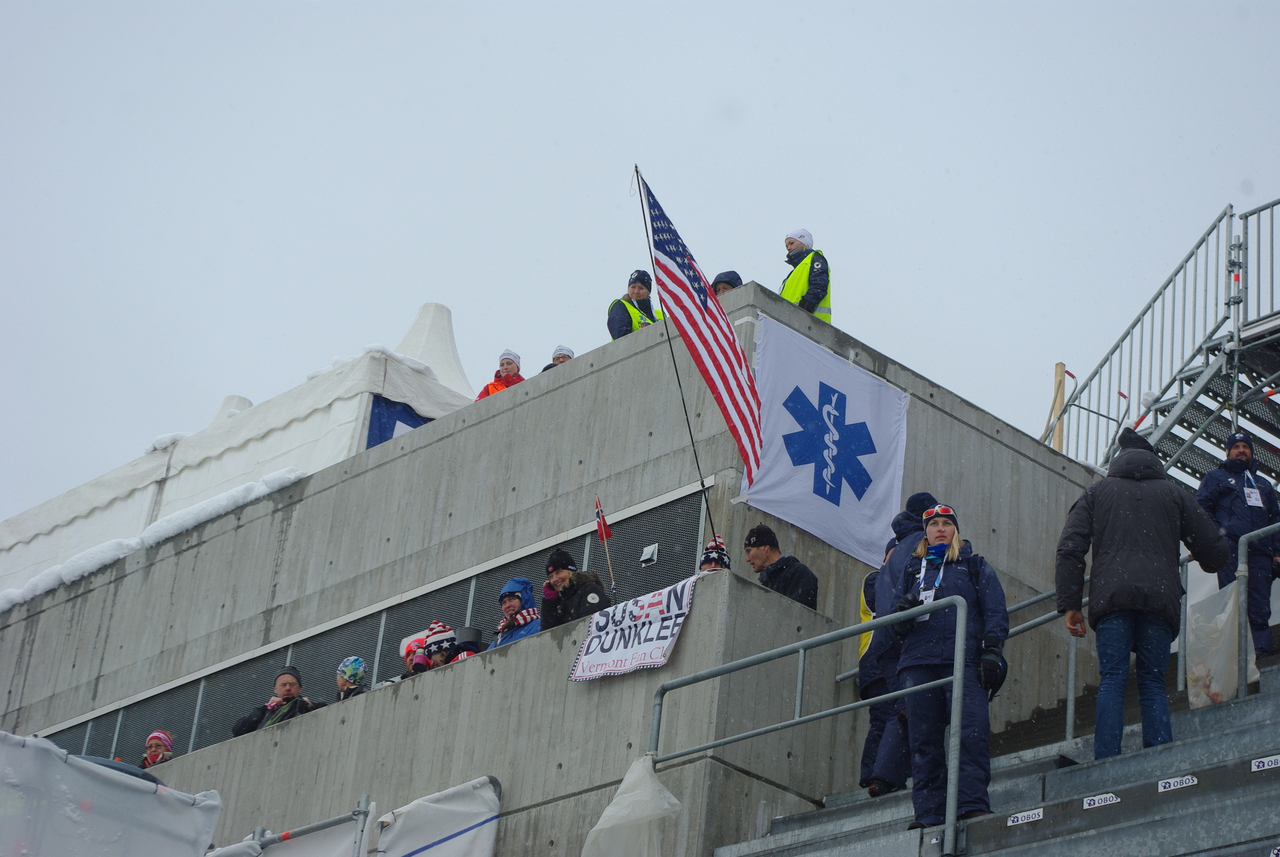
The Susan Dunklee fan club (made up partly of her parents).
“Tomorrow is a day off and I’m going to take a break from thinking about biathlon,” she said. “Honestly I’ve had a better feeling on the range this whole week than I have all season. I’m still on a roll with that, and it hasn’t gone anywhere. Yeah, it was gone for one stage, but it’s still there. I’m going to feel very confident going into the next few races.”
Teammate Hannah Dreissigacker was 36th with four penalties, crossing the line +3:43.2. Both had to battle the wind, which was, if anything, worse on course than on the range.
“My three middle loops I didn’t have anyone to ski with,” Dunklee said. “That was extremely tough because it was really windy.”
Both also got caught up trying to ski with other women, which they guessed might have contributed to a few of their problems on the shooting range.
“Maybe I pushed it a little harder on the last section of the loop, and maybe that affected me a little bit,” Dreissigacker said. “And I was shooting at the far end of the range, which means you have less time to shake out the legs as you ski in. I think that might have been a little bit of a factor in the standing. I shot in 29 and 30 and you have to do a sudden snowplow to a stop and then shoot immediately. That’s a little tough.”
Still, the two U.S. skiers were happy with their execution.
“My goal was to ski my own race and shoot my own race,” Dreissigacker said. “I felt like I did that, but it just wasn’t a perfect day out there. It was okay. It wasn’t bad, although two on the first one was a bummer. That really sets you back a bit. But anyway, it could have been worse, could have been better.”
For Canada, Rosanna Crawford led the way in 27th (+3:14.9). After missing four shots, she finished the day frustrated.
“I threw it away in my last standing,” she said. “I had a chance for a top 20. As I came down the hill I was saying my cue words and focusing, but then I think my brain just went blank. I didn’t do what I trained to do.”
But there were also positive points: for instance, she felt good on skis, and was able to work the sections of the course that she had tactically focused on.
“It was fun,” she admitted. “I love pursuits and I felt quite good on skis. If you really work the downhills, you can make up a lot of time. I passed maybe four or five people on the last loop on the two downhill sections.”
Julia Ransom also competed for Canada, finishing 42nd (+4:38.2) with three penalties.
Tiril Eckhoff of Norway jumps for joy after claiming her first ever World Championships title, in the 7.5 k sprint in Oslo, Norway. (Photo: IBU)
OSLO, Norway—Norwegian biathlon fans had high expectations coming into a home World Championships this season.
But perhaps the biggest pressure was on the men’s team. With the four core members all hitting the podium so far this season and two picking up individual wins, the demand for medals – preferably gold – was strong and loud.
And so it was something of a coup when on the first day of individual competition, Norway’s new World Champion in the sprint was 25-year-old Tiril Eckhoff in the women’s 7.5 k.
Kaisa Makarainen of Finland put down an early blazing-fast time, but many top competitors had started later in the field. In bib 42, Eckhoff was one of them.
It wasn’t until Makarainen had finished that Eckhoff took her first shot. She hit that one and the next four in prone, leaving the range with the fastest split time so far, and then also cleaned her standing stage. After powering around the final lap, cheered on by 20,500 rabid fans, she laid down a race that no other woman could match.
“A big thanks to all the crowd,” she said in the press conference. “My friends and family were watching and cheering at me. Thanks to the crowd who got me around the last loop. I was really really tired and they cheered and cheered.”
It’s not that Eckhoff is unknown. Far from it. She earned bronze in the Olympic mass start in 2014, and won a World Cup the following season.
But after being annoited as the heir to Norway’s biathlon throne upon Tora Berger’s retirement, Eckhoff hasn’t dominated.
Her 15-second victory over Marie Dorin Habert of France, the World Champion in this event last year, was just that, though: dominant.
Susan Dunklee on her way to eighth place in the World Championships sprint. (Photo: USBA/NordicFocus)
She was almost at a loss for words to describe winning on home turf. Her club, Fossum IF, has its office just a few kilometers from Holmenkollen.
“It’s amazing,” Eckhoff said. “I went my first ski race here. Now I’m back and – it’s unbelievable to be World Champion. It’s amazing. Of course I had a dream, but I didn’t expect this victory. I worked hard. I don’t know how to describe it.”
Both Eckhoff and Dorin Habert shot clean. Another late starter, Laura Dahlmeier of Germany, worked her way into third despite a miss in prone.
“After the first mistake, I thought okay, for today it’s over, perhaps it could be a position in the top ten,” Dahlmeier said. “I never expected to reach the podium. The second shooting I shot zero, and the coaches told me I was on the seventh place. I thought maybe fifth or fourth. In the end I’m on the podium and I’m really happy about this position. I think it’s one of the best days of my life.”
Eighth for Dunklee
The first person to knock Makarainen out of her leader’s position was Dorin Habert, trailed by Susan Dunklee of the United States, who had started one bib ahead but missed a shot in standing. The pair crossed the finish line just seconds apart and then collapsed, before getting up to congratulate each other.
For a long while, Dorin Habert and Dunklee sat in first and second, perhaps in part because they had been able to push each other on the last lap.
“I was so glad to have a ride,” Dunklee said. “If you have anybody pulling away from you like that, you want it to be the best skier out there. She’s certainly one of them. I knew if I could just keep her in touch as much as possible it would help me a lot. I was actually accelerating – I think I closed some of the gap near the end.”
That was part of a very deliberate strategy. Dunklee earned her first podium on this sprint course in Oslo two years ago.
“I know I can be really strong on the big hill and on this little hill here [in the stadium],” she said of the Holmenkollen course. “And just holding back a slight, slight percentage of effort so I have something to give on those efforts, helps a lot. So I feel very confident being able to pace it.”
Eighth isn’t a podium, but it’s still one of the best performances ever by a U.S. woman at a Championships. Only a handful of women have ever placed in the top ten: Dunklee and Kari Swenson both have fifth-place results to their names.
“Susan’s off to an awesome start at the World Championships,” said U.S. Biathlon Association President and CEO Max Cobb. “It’s great to see her in such good form. The performance today sets her up really, really well for the pursuit competition, and she’s shown that she has the speed to go head to head with anybody in the world. We’re going to see a really exciting competition tomorrow. And with this solid performance I think she’s virtually assured a start in the mass start too.”
After earning her first podium of the season two weeks ago in Presque Isle, Maine, Dunklee had found some motivation that had been lacking earlier in the season.
“I don’t think I had been super hungry in Canmore, for example, and I was a little worried about that,” she said. “Like, if I don’t have the hunger, then what am I doing out here? But then that Presque Isle podium really got me excited again. Motivated, and confident, and very hungry.”
After a two-week training block to sit and think about racing, Dunklee got nervous. But then the nerves went away and she was simply ready to race.
It showed in the mixed relay on Thursday, where Dunklee skied the leadoff leg for the United States. She shot perfectly and tagged off to teammate Hannah Dreissigacker in first place.
“The relay was fun,” she said. “That was a fantastic day. I felt really on. I felt like tactically I skied it really how I meant to going in, shooting I was exactly where I wanted to be, very focused, I was just trying to find that place again without putting so much pressure on myself. Trying to take the confidence from it but not feeling weighed down by it.”
Dunklee is honest about how important the mental aspect is for her. She says that it just takes her a little while to get psychologically focused and confident, and that World Championships often comes right at the time when things are coming together.
Dunklee’s breakthrough came in 2012 at World Championships, where she placed fifth in the 15 k individual. And she set best-ever marks for the American women’s team she doesn’t want to be defined by championship success.
After all, it was a regular World Cup podium that got her fire going again this season.
“I don’t want to be a big-race specialist,” she said. “I think that what I’m good at is peaking at the right time of the year. I think something about our training plan works really well for me.”
Needless to say, Dunklee is looking forward to the pursuit.
“I think it will be fun,” she said. “The better skiers you have to ski around, the better you’re going to ski. If I can get in behind a pack and relax a bit, I’ll do well, and I think there will be a lot of opportunities to do that.”
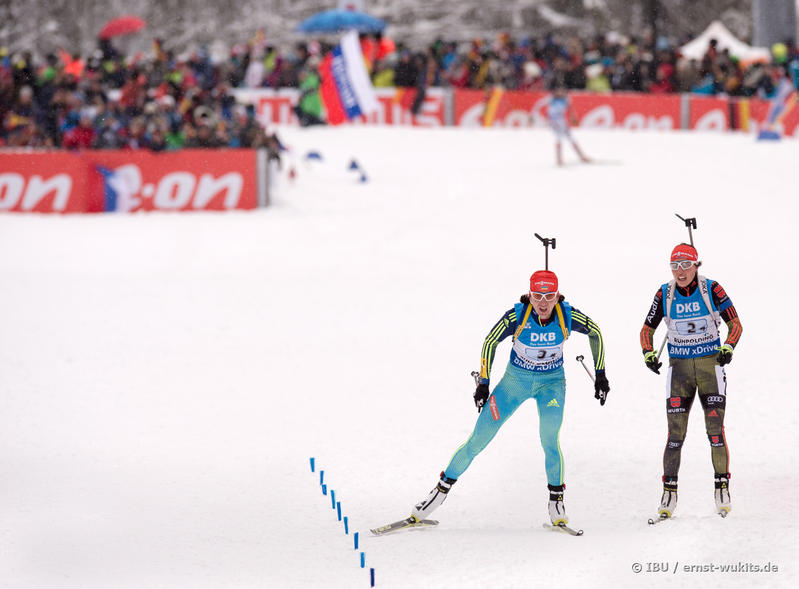
Ukraine’s Olena Pidhrushna (l) boxing out Germany’s Laura Dahlmeier (r) in the final meters of the women’s 4 x 6 k relay in front of a packed Chiemgau Arena at the IBU World Cup in Ruhpolding, Germany. (Photo: IBU/Ernst Wukits)
It’s not often that you can hear catcalls and booing in a ski stadium. A football, basketball or soccer game maybe, but biathlon? On Sunday, 20,000 spectators packed the Chiemgau Arena in Ruhpolding, Germany, and many were not pleased with how the IBU World Cup women’s 4 x 6-kilometer relay played out. Just before the finish, Ukraine’s anchor Olena Pidhrushna, skiing in first, cut off local fan-favorite Germany’s Laura Dahlmeier to claim the ideal left lane in the final stretch. That ended Dahlmeier’s furious chase on the last loop to finish, and Ukraine took the win by 1.2 seconds in 1:16:14.2.
Ukraine, with Iryna Varvynets, Yuliia Dzhyma, Valj Semerenko, and Pidhrushna, incurred one penalty lap and only needed four spare rounds (three prone and one standing), while Germany, with Karolin Horchler, Miriam Gössner, Maren Hammerschmidt and Dahlmeier, had two penalties and required eleven spares (six prone, five standing), but the latter three athletes all skied the fastest course times on their legs to make up the deficit.
Behind them, Dorothea Wierer anchored Italy — which had no penalties and used 10 spares — to third (+43.8), about a second of Russia’s Olga Podchufarova, after the Russians had two penalties and required seven spares. Thus the same teams that had already been on the podium after the first relay of the season December in Hochfilzen, Austria, made it again, except Italy and Ukraine swapped positions.
Teams from 22 countries started on Sunday and 17 finished without being lapped.
Canada, with Julia Ransom, Rosanna Crawford, Megan Tandy, and Zina Kocher, placed ninth (+1:59.5) with no penalties and seven spare rounds, while the U.S., with Annelies Cook, Susan Dunklee, Clare Egan, and Joanne Reid, finished 16th(+5:39.8) with three penalties and eleven spare rounds.
‘Of course you are angry in the moment’
At first, Dahlmeier was visibly annoyed about the end of the race, after she erased a 27.7-second gap on the last leg (and was still 9.2 seconds behind heading into the last loop). After getting blocked she switched back to the middle lane, but once she realized she couldn’t beat Pidhrushna, Dahlmeier stopped pushing and slammed her right pole into the snow across the finish.
“The final loop was really hard. Of course you are angry in that moment, after going at full throttle for 6 kilometers, and then it fails on the last few meters,” said Dahlmeier, who anchored Germany to a relay gold at 2015 World Championships, told TV broadcaster ZDF. “But we can be very, very happy about the second place, especially with the penalty laps that were shot, and with this lineup. I think that’s really nice, and a beautiful finish for the days in Ruhpolding.”
“It was a hard last loop,” Pidhrushna said at the post-race press conference through a translator. “I know Laura is a really good skier, and I knew that I would have to fight for every meter. I am really happy that the team won. I just held the shortest line to the finish. I really wanted to win; it was a big battle but it is sport.”
After seeing a replay again, Dahlmeier agreed in a later interview with ZDF: “That was all correct, you can’t say anything against that. For me, it’s too bad; it didn’t help to switch lanes, and then it was already all over. Maybe I have to train a little bit with the cross-country skiers, pick up some things on how they solve sprints in order to become better.”
“That’s biathlon, that’s the race,” her teammate Hammerschmidt said at the press conference. “It was the same in Hochfilzen [where Germany lost a finishing sprint to Italy], maybe in the next relay we are first. But I think it was OK, and the girls [from Ukraine] make a good job, congratulations to the first place.”
The German athletes did not complain for long, knowing their day could have ended much worse after second leg Gössner incurred two penalty laps earlier in the race, at that time falling back to 15th position with the podium seemingly out of reach.
(Story continues below)
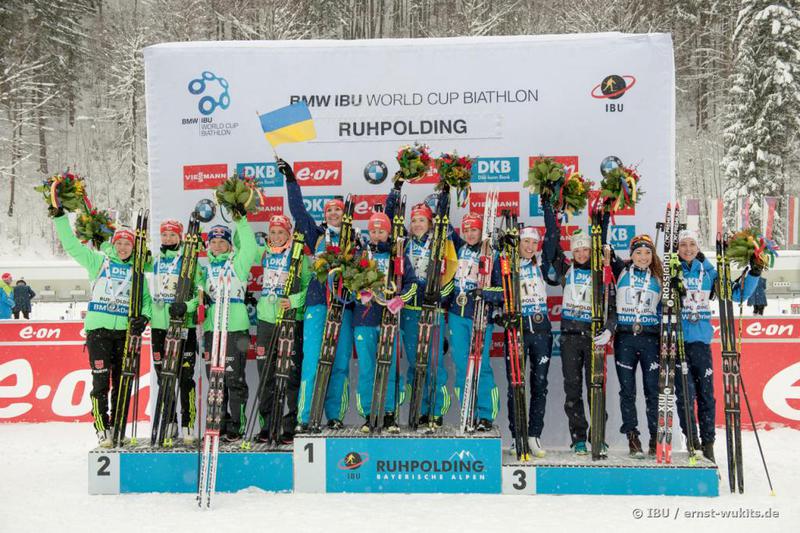
The women’s 4 x 6 k relay podium at the IBU World Cup in Ruhpolding, Germany; with Ukraine (c) in first, Germany (l) in second, and Italy (r) in third. (Photo: IBU/Ernst Wukits)
Race Day
Several teams had opted to rest good athletes for Sunday’s relay at the end of a long block of races, including Germany. Franziska Hildebrand, who already won two World Cups this season, had asked her coaches for a break, and then Vanessa Hinz also had to defer her relay start due to a cold, while teammate Franziska Preuss missed the entire Ruhpolding weekend with a hairline fracture in her tailbone.
That prompted the coaches to change their second-place relay from Hochfilzen on three positions, and make a call to Karolin Horchler, 26, who originally had other plans for Sunday:
“[Saturday] afternoon I had been on my way to Ridnaun, South Tyrol [Italy], because I was supposed to compete there in an IBU Cup mixed relay today,” Horchler told ZDF. “And shortly before the arrival Gerald [Hönig, women’s head coach] called me and said I should please turn around. All in all, it was on the road for five hours… To start here in my second home in Ruhpolding, that’s what I always dreamed of.”
“It’s surely not a very common lineup,” coach Hönig told ZDF before the race. “But in general our expectation is that any relay team we start contends for a spot on the podium.”
Similar to Germany, the Czech Republic chose to rest overall World Cup leader Gabriela Soukalová, France rested Marie Dorin-Habert, currently second place in the World Cup standings, Italy’s Federica Sanfilippo sat out the relay, and Austria’s top skier Lisa Theresa Hauser missed it as well. Finland didn’t enter a team, missing their best athletes Kaisa Mäkäräinen and Marie Laukanen.
The newly called-up Horchler began the race well for her team, skiing at a pace that allowed her to stay in contact with the best and requiring only one spare each in prone and standing. She tagged off in fifth place, 22 seconds behind Norway’s Marte Olsbu in the lead, with Ukraine’s Varvynets in second after shooting clean.
“It was a really crazy day, in the morning I heard that I can start here. The second place is very good for the team. It’s wonderful,” Horchler said in the press conference after the race.
“It’s surely not a very common lineup, but in general our expectation is that any relay team we start contends for a spot on the podium.” — German Women’s Head Coach Gerald Hönig
Germany’s second skier,Gössner skied out fast on her first loop making up positions, but struggled in prone, missing two of her targets and quickly running out of spare rounds.
“Trying to do everything especially well because it’s a relay is a fitting description,” Gössner told ZDF while the race was still going on, with tears welling up in her eyes. “I really can’t explain myself how I can shoot two penalty laps in prone. I didn’t have the feeling that conditions were difficult or that I was shaking… Then I was completely flustered, I didn’t know if that shot went left or right, just didn’t know where to aim.”
After another fast loop, at least she was able to avoid the penalty lap in the standing position after requiring two spare rounds, usually her more shaky discipline, moving up to 13th place.
“Without my two penalty laps a lot more would have been possible today,” a still-disappointed Gössner later told ZDF after the race. “Our luck was that the other nations also shot penalty laps, so the other two [teammates] could make up some time, and that saved us. But my race was absolutely not good.”
“Yeah, she is very annoyed, but that’s relay,” said Hammerschmidt, who lifted Germany from 11th to second on the third leg. “That happens to everyone, but it’s all the better for her that we still got the second place. And I just told her she is allowed to say two more sentences about her shooting, and then we’ll call it a day.”
“I just told her she is allowed to say two more sentences about her shooting, and then we’ll call it a day.” — Germany’s Maren Hammerschmidt, about her teammate Miriam Gössner
While Gössner had been struggling on the range, Ukraine’s Dzhyma shot clean at the top of the field, and while not quite as fast as the German behind her, also skied the sixth-fastest time on her leg.
“Our skis were really good today, thanks to the service team,” she said in the press conference. “I like the new [additional] snow better.”
Hammerschmidt received the tag 1:48.8 minutes behind Ukraine in 11th place, then began a furious chase to get closer to the top again (“one of the best relay performances I can remember in quite a while” ZDF color-commentator Herbert Fritzenwenger commented).
She missed two shots in her prone shooting stage, and then needed one more spare round in standing.
“I have to say, I was a little too cautious there,” Hammerschmidt told ZDF. “I should have turned [on the sights] immediately but thought ‘maybe it will work,’ and when you think that it usually doesn’t. So I should have reacted earlier, I got pretty nervous there after the two misses. In standing I went with full risk, and thankfully only had to reload once.”
Like Gössner, she skied the fastest course time of all athletes on her leg, and handed off to Dahlmeier in second place, 27.7 seconds behind.
“Of course I would have liked to have a better starting position,” Hammerschmidt told ZDF during the race. “But maybe the pressure was off a little. I just wanted to do my own race, and see that I can catch a good pack. I had really good skis today, and felt good on the course. On the last loop I could catch one after another, that was such a great feeling. And then I was really surprised to be second in the finish.”
Ukraine’s Semerenko skied the third leg, and at this point could have secured a large gap over the rest of the field. She narrowly missed her last shot in prone, but then the usually solid shooter was not able to clean the remaining target with her three spares, and had to ski a penalty lap. That opened the race back up as Belarus’ Nadzeya Pisareva overtook her and some other teams moving back within striking distance of the lead.
“I had nothing left but to run faster,” Semerenko joked in the press conference, according to a translator.
How quickly the fortune of a team in a relay can change was demonstrated once again after the next shooting. Pisareva and Semerenko each needed one spare in standing, with Semerenko still trailing by 9.8 seconds as she left the range. Then suddenly Pisareva completely ran out of energy, and could be seen trying to herringbone up the next hill without any glide.
Semerenko quickly passed her, along with several other teams as well. At the bottom of the next climb, Pisareva stopped next to one of her coaches to exchange a few words, seemingly ready to quit the race, before continuing to ski again.
The Belarusian tagged her teammate Darya Yurkevich 1:28.2 minutes behind in 11th place. Yurkevich would end up losing two more positions, finishing 13th (+2:40), despite Belarus posting one of the best shooting performances of the field for Belarus (no penalties, five spares).
With Belarus now out of the picture, the race for the podium on the final leg came down to Ukraine, Germany (+27.7), Norway (+28.6), Italy (+42.4), Sweden (+43.0), Slovakia (+45.3), and Russia (+45.7), with more teams looming shortly behind.
Dahlmeier set out at a fast pace to close the gap to Pidhrushna, and after both shot clean in prone, the lead had been reduced to 18 seconds. On the next loop, Dahlmeier stormed up the climbs and managed to catch Pidhrushna, overtaking her just before the shooting range. But while the Ukrainian stayed clean in the final standing stage, Dahlmeier required one spare, again falling behind by 9.2 seconds as they left the range.
On the final loop, Dahlmeier had more problems catching up to Pidhrushna again, who managed to preserve her lead through the last flat section and descent into the stadium. Then the most talked-about scene of the race happened, and Ukraine prevailed in that final sprint.
“I was pretty down on my strength, but too bad, at the end it went a little poorly,” Dahlmeier told ZDF. “Maybe I should have stayed behind her and then pick the middle lane. A little unfortunate. But still, considering how it looked initially, we are mega-happy about the second place. That was a grandiose success, and you really see what is all possible in a relay race.”
After a number of changes between several countries vying for third place, Italy,
with Lisa Vittozzi, Karin Oberhofer, Alexia Rungaldier and Wierer, beat out Russia’s Ekaterina Shumilova, Daria Virolaynen, Ekaterina Yurlova and Podchufarova in a second exciting finishing sprint by 1.1 seconds.
“I think the relay is the work of the whole team, everybody has to do their best, it’s not only one man or one woman,” Wierer said in the press conference. “I was in the fourth position when I started, and I was a little bit worried because [there were] also Tiril [Eckhoff] and Laura. I hoped that I would shoot well. I was a little too fast in the standing so I missed the first one. But I was lucky that Tiril shot more misses than me. And then behind me was the Russian, and I was really nervous. I was sure that she will pass me on the finish line, but I gave everything and it was the third place, finally.”
Norway was fifth (+1:11.5) with Marte Olsbu, Fanny Horn Birkeland, Synnøve Solemdal and Eckhoff combining for one penalty and 13 spares. Olsbu tagged the team in first after the first leg, and after Birkeland’s penalty on the second leg, Norway still remained in podium contention, picking off the places with Germany, until Eckhoff required all her spares on the last leg — three in prone, three in standing.
Ahead of the upcoming World Championships at home in Oslo, the Norwegian women have not reached the podium since taking bronze at the 2014 Olympics, though they remain hopeful.
“It may not look like we’re there yet, but we are good enough. It’s about getting the final touches in place,” Eckhoff told Norwegian broadcaster NRK.
Canada in Top 10
Canada’s 22-year-old Julia Ransom (116) during the 2014 IBU Junior World Championships pursuit. (Photo: Katrina Howe)
For Canada, Ransom’s day began with tangle out of the start and a resulting broken pole, but she quickly received a replacement.
“It caught me a little by surprise but I quickly realized that I needed to signal to someone for a spare,” Ransom wrote in an email to FasterSkier. “I was on the opposite side of the trail as all of the coaches, but one of our wax techs was somehow able to get a pole to me despite having a few girls between us. Unfortunately that little mishap put me to the back of the pack, but I was able to sneak my way back in there before the first shooting.”
After the field had stayed closely together on the first loop, Ransom shot fast and accurately in the first prone, cleaning all five targets and leaving the range in fifth place. By the next timing point, she even had moved up to third.
“I was stoked to be skiing with the top 3 girls! I felt strong and controlled on skis,” she wrote. “Unfortunately, I struggled with my [standing] spares and lost those leaders. I’m not letting that happen again next relay! “
In her standing stage, Ransom initially missed just one shot, but then required all three spares to clean it and avoid the penalty lap. She fell back a few positions, and tagged off to Crawford in 11th place, 50.7 seconds behind Norway up front.
Crawford shot flawlessly, cleaning both her prone and standing positions, something only 10 other athletes achieved on Sunday. When she left the range after the last stage she had moved her team back up to fifth place (+1:01.5), then only lost only a few more seconds on the final loop tagging Tandy still in fifth (+1:07.7), behind Slovakia and ahead of Norway.
In the prone stage, Tandy missed two targets, then needed all three spares to clean them, leaving the range in 10th place (+1:17.1) with Germany still behind in 12th. In standing, Tandy was able to stay clean, though she could not make up another position. But she also barely lost any more time, tagging off in 10th and 1:17.6 back.
Kocher winning an IBU Cup sprint in Canmore, Alberta, last season. (Photo: Pam Doyle)
Team veteran Kocher anchored the relay, and like her teammates, displayed a strong shooting performance. She cleaned prone, and then had only one miss in the final standing, leaving the range in the vicinity of a number of other teams fighting for position.
“Last laps are usually my strength so I attacked leaving standing,” Kocher wrote in an email. “Unfortunately, just before the uphills the French competitor [Celia Aymonier] stepped on my pole and it broke, costing me metres of time. I got a pole fairly soon from Norway, but it was very short, and then for the last sprint to the finish switched it for my own pole from our coach Matthias [Ahrens]. But that cost us a potential top 6. Two broken poles for our team, crazy!”
In the end, she finished the ninth for Canada, 1:59.5 minutes back, with no penalties and only seven spares. “Excellent momentum for going forward to next week’s relay for our team,” Kocher concluded.
“Our team had a goal of collectively using 8 spares and stay in the top 10… We also wanted to beat Sweden to maintain our current Nation’s Cup position,” Ransom wrote.
They achieved both those goals. The Nations Cup is its own end-of-season award by the IBU, but also determines the number of starting spots a country gets awarded for the next year. Germany is still in the lead after the races of this weekend, with Canada in 10th position and the U.S. in 15th.
“I was proud of our women’s team today. We all had fairly solid races and had the potential for top 6; unfortunately Zina broke a pole on her last lap, which caused a fall and a few positions. I think we are all fired up for another exciting race next weekend,” Ransom added. “The crowds here in Ruhpolding were fantastic. They brought a lot of energy to the races and were devoted fans in even the worst conditions.”
U.S. 16th with three penalties
For the U.S. the relay got off to a difficult start, when Cook incurred a penalty lap in her first prone shooting, leaving the range in 20th position, 58.6 seconds back behind the leaders.
“I was disappointed in myself today because I had a penalty in the first prone shooting that put me in the back of the pack,” Cook said in a US Biathlon press release. “I was unable to get the girls into a good starting position, although I had a lot of confidence in what could happen after that. It was a crazy day with lots of penalty loops happening to great teams and the standings changed a lot through the race.”
After a better standing stage shooting where she only required one spare, Cook about kept her position but lost a few more seconds to the top (despite skiing the 14th best course time on her leg), tagging Dunklee in 21st (+1:38.4).
Susan Dunklee (US Biathlon) skied the second leg for the U.S. women’s relay on Sunday, picking off three places to bring them from 21st for 18th. They ultimately placed 16th. (Photo: USBA/NordicFocus)
Dunklee, who had been the starter for several years, again moved to the second leg, the same order the team had experimented with in the relay in Hochfilzen. After needing one spare in the prone, she had moved up one position, but had lost additional time to the leaders (+1:58.8) despite skiing the fastest first loop.
In standing, she again had to use one spare and left the range in 19th (+2:26.3). Dunklee barely lost more time on the final loop, and tagged Egan in 18th, having made up three positions on her leg, but almost losing another minute to the top, now 2:29.9 behind.
On Sunday, Egan had one of her best recent shooting performances, cleaning prone and only requiring one spare round in standing.
“I made a breakthrough in my standing shooting at the beginning of the winter, and I’m taking advantage of that newfound confidence. I have bad stages now and then but I am learning from each one and improving all the time,” Egan wrote in an email. “For example I missed 1,3 in the first two stages of Thursday’s Individual, but then pulled myself together and finished the race with 0,0 on the last two stages. Today I missed my last (10th) shot, which is a letdown, but I was able to hit it with my first spare round.”
Clare Egan (US Biathlon) skiing the third leg of the 4 x 6 k relay on Sunday, bringing her team from 18th to 16th with just one spare round. (Photo: USBA/NordicFocus)
Out on the loop, Egan skied the 14th-fastest time of her leg, and was able to move her team up two positions, tagging off 2:45.4 minutes behind in 16th.
“The conditions were relatively fast today,” she added. “It snowed a ton last night but we were lucky and it stopped during our race. Our wax staff gave me excellent skis this morning, but unfortunately I was not able to put them to very good use, as my body was not responding well at all.”
In her first week with the World Cup team, Joanne Reid anchored the relay (in place of Hannah Dreissigacker, who skied that leg during the first relay of the season).
“I think the reason the coaches put me last is because I don’t have the consistency or the experience of the rest of the team, and therefore any mistakes I made would be after they had already raced,” Reid wrote in an email.
Reid emerged from prone having used just one spare, but then struggled in the final standing, running out of spare rounds and ultimately having to ski two penalty laps (0+1, 2+3).
“Today I made what I assume is a classic error for a new biathlete coming in from pure skiing, and came into the range too hard in standing,” Reid explained. “I was intensely focused on catching the two teams in front of me, which was going well until I got to the range. It’s always hard to remember in the heat of the moment that your shooting is just as important as your skiing.”
In her first IBU World Cup relay, Joanne Reid anchored the U.S. women’s team to 16th with the 11th-fastest course time on that leg. (Photo: USBA/NordicFocus)
“The pacing on that lap was certainly my mistake, and not just pacing, but the fact that I don’t have the shooting skill to handle as high of a heart rate or shoot at the same speed as the rest of the girls, not to mention I hand load spares much slower.”
Overall, Reid skied the 11th-fastest course time.
“It was definitely a fast course out there, but still very difficult. I can only imagine how tired the athletes are who have raced the entire world cup period, and also qualified for and raced the mass start this weekend,” she wrote. “For Susan to go out there and ski the fastest leg after all those races (and long ones besides) is incredibly inspiring to me, and I wish I could have given her a better performance on my end.”
“I really enjoyed the course out there today — we were much luckier than everyone in the mass start to have such hard-packed conditions,” Reid added. “I think that’s the only 6 km I’ve ever skied in my life, so I wish I could compare it to something, but until I do a few more biathlons I have no reference point.”
Reid finished in 16th for the U.S., ahead of Romania, with the other five teams behind them lapped.
“We wanted to do better than last time (15th) but unfortunately we fell just short of that today,” Egan concluded in her email.
“This team has so much potential and I really believe in that,” Cook said in a US Biathlon press release. “So many of the pieces are there and are also showing, but not quite enough of them to do what we are capable of. It is frustrating but it is also making us hungry to do better and we have another relay coming up next week.”
“I think a team always goes into a relay with the hope that they can improve on their start position,” Reid wrote. “Obviously for us today, that didn’t happen, but I think we have a lot of the pieces right, and I’m certain this team (whether or not in the future it includes me), can have an incredible day.”
The IBU World Cup now moves on to Antholz-Anterselva, Italy, where there will be another relay for the women and men on Sunday.
Gabriela Soukalová on her way to third in the IBU World Cup women’s 15 k individual in Ruhpolding, Germany, on Thursday. On Saturday she won the 12.5 k mass start. (Photo: IBU/Ernst Wukits)
Gabriela Soukalova has worn the yellow World Cup leader’s bib for all but three starts this season – but up until Saturday she had only won a single World Cup, the sprint in the opening week of racing in Östersund, Sweden.
In the 12.5 kilometer mass start in Ruhpolding, Germany, the Czech rectified that situation by capitalizing on the errors of her main rival, Marie Dorin Habert of France. When both Habert and Franziska Hildebrand of Germany picked up penalties in the final round, Soukalova found herself in the lead and skiing uncontested in the final loop to take a 13.9 second victory – the tenth win of her career.
“I almost don’t believe this experience,” Soukalova said in an interview with Czech news service iDNES.cz. “Just before the start of the season, I was talking with a friend about whether I would ever this tenth World Cup. I put ten as a goal before the finish [of the season]. So that now I’ll have to increase that a little.”
Soukalova celebrating her win in the mass start. (Photo: IBU/Ernst Wukits)
It was heavy skiing, with snowfall slowing down the course. Soukalova rarely led. Instead it was Dorin Habert who was far and away the fastest and most aggressive skier of the day, and was leading coming into the final stage. But the French athlete missed four shots there, sending her to a long bout of purgatory in the penalty loop.
“It was bad from start to finish,” Habert, who eventually finished ninth, told L’Equipe of that last stage. “I sent the shots any which way, I forgot all the fundamentals, in fact I thought of nothing. I missed my shots… I’m really disappointed. It’s a bad way to end the week… four missed shots, it doesn’t happen to me often, but it happened to me today.”
Soukalova, on the other hand, was the only woman in the 29-starter field who hit all 20 of her targets.
“I thought that those two would somehow handle it,” she told iDNES. “But I really am not able to perceive anything of what was happening around me. In addition, I came to the last so tired that no one probably imagine it. I was glad when I pulled the trigger, and tried to focus on the entire process.”
Leaving the range with a 22-second margin to Hildebrand, Soukalova still didn’t feel safe. She felt the support, but also the pressure, of the sold out stadium in Ruhpolding.
“It’s really nice to feel the big support of my family here,” she said in a video interview with the IBU’s Jerry Kokesh. “We have a lot of members of my family here. Also I appreciated that I could hear the voices of the Czech spectators on the track during the race. It’s an atmosphere like in Nove Mesto.”
Franziska Hildebrand of Germany pushing to the finish for second place, as teammate Laura Dahlmeier lurks in the background. (Photo: IBU/Ernst Wukits)
While Dorin Habert missed four, Hildebrand beside her missed just one. She closed a few seconds on Soukalova on the final loop, but not enough to take the win (finishing second +13.9). She also had to push to hold off her charging teammate Laura Dahlmeier, who closed hard for third place (+24.4).
“I’m just happy that today it worked so well and I’m on the podium in a mass start,” Hildebrand, who sits third in the World Cup overall score, told German broadcaster ZDF. “I just noticed that Marie had shot a miss, aside from that I just focused on myself. I hit four, and the fifth scurried away. But I was satisfied to get through that with one [miss].”
Dahlmeier was the third-fastest skier of the day, which is how she earned third despite two penalties, one each in the second and fourth stages.
“I think you could see on the first round, everyone stayed together in a pack, nobody wanted to take the lead,” she told ZDF regarding the snowfall. “It was a bit like a traffic jam on the autobahn (highway), stop and go. That was a new experience, but also fun to ski in a pack. Of course it was slower, but I just enjoyed it, the first real winter day. It’s nice if it’s all white every once in a while.”
Tiril Eckhoff of Norway used the second-fastest ski time of the day to earn fourth place, catching and outsprinting Maren Hammerschmidt of Germany on the final loop.
Susan Dunklee, the lone American starter, agreed with Dahlmeier’s assessment of the start.
Susan Dunklee (US Biathlon) at the flower ceremony for last Sunday’s mass start in Ruhpolding, where she finished sixth. This time around it was 22nd. ” I’ll be looking to find that good feeling on the range again like I had last week. It’s there, I know it is,” she wrote. (Photo: Fischer/NordicFocus)
“Conditions weren’t as challenging as they looked,” she wrote in an email. We got a lot of new snow last night, but the groomers packed it down very well. The new snow on top was slow, but I much rather have that than a deep slog through mush. I’ve never seen the women’s field take the first loop out so slowly. It felt like we were doing an OD. Nobody wanted to lead.”
For Canada’s Rosanna Crawford, the conditions were more challenging.
“I do struggle a bit in soft, fresh snow,” she wrote in an email. “I’m a big girl and it’s hard carrying that through soft snow! Skiing was really hard for me today, even though it’s been 7 days since I got to Europe I do find that I take a bit longer to get over jet lag, day 5 is usually good, which was the Individual. I tried really hard to stay on any pack that passed me, but just couldn’t.”
Crawford only found out she was racing 90 minutes before the race, since she was on the reserve list for the competition. But she had had a good idea that Kaisa Makarainen of Finland wasn’t starting, and then Franziska Preuss went out with a hairline fracture in her tailbone. She is out for at least one more weekend, perhaps more.
“I was pretty excited when I found out and had to tell my self to calm down about 3 times before I left for the venue!” Crawford wrote. “I looked at it like a nice surprise and a good opportunity to get some more points.”
Crawford had only a single miss, coming in the last shooting bout. Despite that, she finished 19th, +2:16.5.
“Roddy [Ward, Crawford’s coach] and I chatted a bit about how lane 30 was with the wind compared to the other lanes, so that was on my mind for the race,” she wrote. “I didn’t have to make any corrections though and my prone hits were solid… I think [the tough skiing] allowed me to be more calm in the range, because I knew that today was not a top 10 day. Shooting felt easy today and that showed with my shooting speed. It was fun to leave the range in 1st after the first prone, but I knew it wouldn’t last!”
Dunklee had a tough day on the range, hitting the penalty loop six times. She finished the day in 22nd, +2:40.7.
“My physical shape feels good and we had great equipment today, but I can’t expect to stay in the mix with six misses,” she wrote. “Going forward I’ll be looking to find that good feeling on the range again like I had last week. It’s there, I know it is.”
Both North Americans hope they can improve their performances for Sunday’s relay, the final competitions before the World Cup moves to Antholz, Italy.
“Looking forward to tomorrows relay and hopefully my legs will fell better,” Crawford wrote.
Susan Dunklee pushes for sixth, tying a season best, on Sunday at the IBU World Cup 12.5 k mass start in Ruhpolding, Germany. (Photo: Fischer/NordicFocus)
The third International Biathlon Union (IBU) World Cup race in the three-straight days in Ruhpolding, Germany, was one wild ride for American Susan Dunklee, but in a good way.
During Sunday afternoon’s 12.5-kilometer mass start, Susan Dunklee — who had made the top-30 cut for the race in 23rd — found herself in second place after the second of four shooting stages.
The 29-year-old American then incurred just one penalty in the first standing stage to remain in contention for a spot on the podium until the final loop. Ultimately, two competitors passed her the last time around Ruhpolding’s 2.5 k loop, and Dunklee finished sixth, 31.4 seconds behind Germany’s Laura Dahlmeier, who won her second-straight race of the weekend in 33:17.7.
“This is really fun for me,” Dunklee said in an IBU video interview. “I’m super psyched to shoot that well in a head-to-head situation. It’s taken me years to get to this level, and I’m happy to be there finally.”
For Dunklee, the result tied her season best from last month’s sprint in Pokljuka, Slovenia.
“I did put a lot of thought and work into cutting down my shooting times this summer and I have clearly seen that work paying off,” Dunklee wrote in an email to FasterSkier after hitting 95 percent of her targets on Sunday (0+0+1+0). “This was by far my best ever shooting performance in a World Cup.”
“I’m super psyched to shoot that well in a head-to-head situation. It’s taken me years to get to this level, and I’m happy to be there finally.” — Susan Dunklee, after placing sixth in Ruhpolding mass start
Dahlmeier Doubles Up in Ruhpolding
The women’s 12.5 k mass start podium at the IBU World Cup in Ruhpolding, Germany: with German winner Laura Dahlmeier (c), France’s Marie Dorin Habert in second (l) and Norway’s Tiril Eckhoff in third (r). (Photo: Fischer/NordicFocus)
Saturday’s pursuit winner, Dahlmeier also won on Sunday — in convincing fashion — as she cleaned in all four stages and skied to the third-fastest course time to beat runner-up Marie Dorin Habert of France by 15.3 seconds.
Habert had a single penalty in the first prone stage, and third place was decided in an extremely close photo finish between Norway’s Tiril Eckhoff, who had two penalties between the last two stages, and France’s Anaïs Bescond, who shot clean but was slower on the course.
A few years ago, the race might have been called a tie with both awarded the third place (i.e. 2003 World Championship in Khanty-Mansiysk, Russia, with the gold medal of the pursuit race awarded to both France’s Sandrine Bailly and Germany’s Martina Glagow). But with more advanced timing and imaging technology, the race jury ruled Eckhoff took third and Bescond fourth, both 21.9 seconds back from the winner.
Dunklee started out skiing fast with the seventh-best course time on the first loop. Once she reached the first prone stage, she also shot clean and fast with the fifth-best shooting time. Dunklee left the range in second, at that time just 0.3 seconds behind Germany’s Vanessa Hinz.
“Sometimes I have a habit of starting out a little too fast in the early loops and not having enough left to lay down a killer last loop,” Dunklee wrote. “I was actually talking with my coach before the start about maybe trying to pace a little more evenly. Then the gun went off and I just took whatever opportunities came my way. The reality is that I’d rather take some risk and put myself into the race early and then see if I can hang on.”
“For the shooting, my plan was to use the same rhythm and focus keys as I usually do and I did that,” she continued. “In mass starts, you shoot on the same lane as your bib number for the first stage and I got to my lane earlier than the ladies I was skiing around.”
After staying close to the front of the field on the second of five loops, Dunklee again managed to shoot clean and fast in the second prone (with the sixth-best time), leaving the range still in second, 2.2 seconds behind Eckhoff, with Dahlmeier trailing 2.7 seconds behind Dunklee.
A little surprised by this race development, a TV commentator for Germany’s ARD had to consult his notes: “Tiril Eckhoff, that was to be expected, but Susan Dunklee, she keeps up exceptionally well. She turns 30 next month; lives in Craftsbury, Vermont, the American here in second position. She shares hobbies with Laura Dahlmeier, mountaineering, especially when training in Utah, she has good opportunities for that.”
Susan Dunklee (US Biathlon) at the flower ceremony. Dunklee tied a season-best sixth on Sunday in the mass start at the IBU World Cup in Ruhpolding, Germany. (Photo: Fischer/NordicFocus)
On the third loop, Dunklee lost a few positions, coming through the next split times at 6.1 and 6.4 k in third, then fifth place, but still just 1.9 seconds back and a few meters ahead of the next chase group.
In the third shooting — the first standing stage — Dunklee missed one target and had to ski through the 150-meter penalty lap, leaving the range in sixth, 21.6 seconds behind Dahlmeier.
She kept that position on the loop, skiing just behind overall World Cup leader Gabriela Soukalová of the Czech Republic and ahead of Poland’s Magdalena Gwizdon.
In the final stage, Dunklee cleaned all of her targets in a high-pressure situation, standing in the range with a group of at least five others, where every miss would be one too many. She started out on the final loop in fourth, 24.5 seconds back, chasing Bescond who had left the range 10 seconds ahead of her, with Eckhoff and Ukraine’s Olena Pidhrushna (who had cleaned all four stages) within eight seconds behind her.
Dunklee’s US Biathlon coaches and teammates in their new brightly colored orange-and-purple uniforms cheered her on from the side of the course.
“I did hear my coaches and teammates cheering on all the loops,” Dunklee wrote. “Clare [Egan] had an American flag and was sprinting up the last hill, urging me to chase down Tiril and Anais. She gave me a tremendous burst of energy there.”
Dunklee tried everything in her power to reach the podium, but Eckhoff passed her on a climb shortly before the arena. Eckhoff quickly created a little gap and chasing down Bescond.
“Oh, I was so tired,” Dunklee explained in her interview with the IBU. “I don’t think my ski shape is perfect yet, but hopefully will be in Oslo [for World Championships]. I was a little bummed I couldn’t keep up with a couple of girls who passed me on that loop.”
Overall, Dunklee posted the eighth-fastest course time. She skied the fifth-fastest last loop.
The second-fastest on the last loop (and fourth-fastest overall), Eckhoff caught Bescond before the finishing stretch and outlunged her by about an inch to achieve her first podium of the season.
“It was really, really exciting on the last loop,” said Eckhoff in an IBU video interview. “I was really tired, so I was very luck to get the margins on my side, and I’m happy.”
“I haven’t actually been on the podium this year, so I really wanted to get on the podium,” she added. “So I just had to stick my [ski out]… Yeah, do whatever I could to be on the podium.”
In the finishing stretch, Pidhrushna overtook Dunklee and edged her by 0.9 seconds at the line. Dunklee ended up 9.5 seconds off the podium.
After a hard fight, Dunklee seemed happy with her result, kneeling in the snow for a while in the finishing pen to catch her breath, but smiling for the TV cameras and waiving to the large crowd in the stands.
From left to right: Veronika Vitkova of the Czech Republic, Norway’s Tiril Eckhoff, and Czech Gabriela Soukalova prepare to shoot during one of two standing stages in the women’s mass start on Sunday in Ruhpolding, Germany. (Photo: Fischer/NordicFocus)
On Sunday she succeeded at keeping a number of athletes behind her who already achieved World Cup victories this season, including Soukalová in seventh place, Finland’s Kaisa Mäkäräinen in 13th, and Germany’s Franziska Hildebrand in 17th.
“The conditions were so good today,” Dunklee commented in the video. “Yesterday was a little deep, was a little warped. Today it was all good; it was beautiful skiing.”
“Range race conditions were very similar to the zero for the women [target practice to adjust the rifle sights before the race]; no tricky winds like the men had,” she added in her email.
First and second place were already mostly decided after the last shooting, with Dahlmeier leaving the range 6.9 seconds ahead of Habert and extending that to 15.3 seconds until the finish. Habert skied the fastest course time of all athletes, but was visibly tired on that final loop only recording the 17th best time.
“I am hungry for other wins and I hope to be on the podium next week,” Habert said Sunday, according to an IBU press release. “I didn’t see a chance to catch Laura in this form, I knew she was strong. … I made a miss at the first shooting, and it was hard to come back to the top of the race.”
“This was definitely a perfect race for me,” Dahlmeier told ARD in a post-race interview. “Four times zero [misses], and skiing was good again, too. Really crazy, a dream, a wicked race today.”
Asked why she went all-out on the final loop when she appeared to be comfortably in the lead, Dahlmeier recounted a story from her early years of racing with a laugh:
“I had an experience at the student-level [youth], when I got still outsprinted in the finishing stretch of a cross-country race by the little sister of Miri Gössner [her current teammate on the German biathlon national team]. And I swore to myself that would never happen again in my life, unnecessarily giving away a race at the finish. That’s why it’s hard for me to ski relaxed on the final loop. I tried to not go full-throttle today, but didn’t really succeed at that. Main thing was to win.”
“I tried to not go full-throttle today, but didn’t really succeed at that. Main thing was to win.” — Laura Dahlmeier, winner of the Ruhpolding IBU World Cup mass start on Sunday
No other North American female athlete qualified for the mass start on Sunday, where only the top-25 in the overall World Cup standings plus five additional athletes with the best performances of the weekend are given a start.
The World Cup circuit stays in Ruhpolding, with races starting again on Wednesday with the men’s 20 k individual race , and on Thursday with the women’s 15 k individual race.
“We’ll hope our men can reach the podium again,” Dahlmeier told ARD. “We are in great shape. I particularly feel really strong right now. Each race is a lot of fun, and I’m looking forward to part two of our World Cup at home.”
Germany’s Franziska (1) leads Gabriela Soukalova of the Czech Republic (2) and German teammate Laura Dahlmeier in the women’s 10 k pursuit at the IBU World Cup in Ruhpolding, Germany. Dahlmeier started fourth and finished first, 7.3 seconds ahead of Soukalova. (Photo: IBU/Eberhard Thonfeld)
It was a pursuit race, but it must have felt more like a mass start.
The first four women all started within the first three seconds of one another in Saturday’s 10-kilometer pursuit at the IBU World Cup in Ruhpolding, Germany. Franziska Hildebrand of Germany started first, followed by Gabriela Soukalova of the Czech Republic, Finland’s Kaisa Mäkäräinen, and another German, Laura Dahlmeier in fourth.
Hildebrand and Mäkäräinen didn’t hold on to their top spots, each accruing too many penalties in such a tight field to remain competitive for a spot on the podium. After an initial miss in the first prone shooting took her out, Hildebrand ended up ninth and 1:24.3 behind the eventual winner with four penalties (1+0+1+2). Behind her, Mäkäräinen took 13th (+1:52.1) after skiing five penalty laps (0+1+2+2).
But Dahlmeier and Soukalova stayed neck-and-neck at the front of the race, each earning one penalty — Dahlmeier on the second-to-last stage, Soukalova on the final standing stage. Dahlmeier passed Soukalova on the last lap, much to the delight of the German crowd, holding on to win by 7.3 seconds in 32:35.9.
Ruhpolding’s already-sloppy course got worse, along with the weather, as the race went on. Light rain ensured mushy conditions, a factor that Soukalova cited in losing her lead to Dahlmeier. “Traditionally, I am not very strong on the last loop,” the runner-up said in a post-race press conference. “Besides, I am not very light for this kind of snow.”
Italy’s Dorothea Wierer moved up from sixth to claim the final podium spot in third (+53.6) despite two penalties (0+1+0+1). She led a tight pack into the finish, including Norway’s Tiril Eckhoff in fourth (+57.3), France’s Marie Dorin Habert in fifth (+57.5), and Slovakia’s Paulina Fialkova in sixth (+1:01).
Susan Dunklee (US Biathlon) racing to 15th in the IBU World Cup women’s 10 k pursuit on Saturday in Ruhpolding, Germany. (Photo: USBA/NordicFocus)
American Susan Dunklee started 11th and finished 15th (+2:04.1) in a sprint to the line with Karin Oberhofer, edging the Italian by 0.1 seconds.
Over the four-stage race, Dunklee accrued three penalties, all of which came in the last two standing stages (0+0+2+1).
“It was one of those days when it is difficult to apply any sort of power effectively without simply wasting energy,” Dunklee explained in an email. “The race started great. … I moved up as far as 6th.”
However, she experienced some technical difficulties, and lost a clip while putting her rifle back on after the second prone stage. She got a new one, but “I didn’t do a perfect job of regaining control of my focus before beginning shooting,” she explained. She missed two shots in next shooting stage.
Julia Ransom was Canada’s top finisher, gaining four spots to finish 45th (+4:19.6), with two misses (0+0+1+1), followed by teammate Sarah Beaudry, who improved one place to 54th (+6:12.4) with three penalties (0+1+0+2). American Annelies Cook started 43rd and finished 58th (+7:50.6) with eight penalties (1+2+3+2).
“I had an exciting sprint battle with Karin Oberhofer of Italy for 15th place,” Dunklee wrote. “Inspired from watching the Tour de Ski all week, I thought it was the perfect opportunity to use a finishing lunge. The good news: I outlunged Karin. The bad news: I broke my rifle stock when I crashed after the line.”
Was it worth it?
“Worth it, I think. The stock will be fixed by tomorrow.”
Dunklee will start Sunday’s 12.5 k mass start in bib 23 (of 30). Race starts at 8:45 a.m. Eastern time. Watch here.
Germany’s Franziska Hildebrand on her way to winning her second IBU World Cup during Friday’s sprint in Ruhpolding, Germany. (Photo: IBU/Eberhard Thonfeld)
In a 7.5-kilometer sprint that came down to the wire on Friday afternoon, Germany’s Franziska Hildebrand, who has made Ruhpolding her training ground in recent years, achieved the second World Cup win of her season and career in front of thousands of excited fans, clamoring for a good result after the German men failed to reach the podium earlier that day.
Hildebrand crossed the finish line in 19:46.5 minutes, just 0.3 seconds ahead of Czech World Cup leader Gabriela Soukalová who had been the race leader until then. Finland’s Kaisa Mäkäräinen, who won the last race of the 2015 before the holiday break, could not make up a deficit on the final loop, taking third, just 2.3 seconds back. All podium finishers cleaned both shooting stages.
Susan Dunklee achieved the best results for a North American biathlete on Friday, finishing 11th, 45 seconds back from Hildebrand with one penalty (0+1).
Despite no direct sunshine on most of the track, snow conditions on the course started to get softer compared to the earlier men’s race where athletes had still described the track as “icy,” giving a slight advantage to starters with an earlier bib.
“Starting early was good today,” Hildebrand said in a post-race interview with German TV broadcaster ARD. “On that long climb back there, the snow was pretty deep because temperatures are above freezing point, you can see on the [TV] images that we kind of had to dig through that.”
Soukalová, starting in a red bib 13 as the overall World Cup leader, initially set the best split times on the course and at the finish by hitting all 10 of her targets. A slight mistake cost her several seconds, when she rushed to leave the mat on the range but dropped a ski pole, having to step back to pick it up.
Starting four positions behind her, Hildebrand skied fast while opting to shoot slow and methodical, only recording the 65th fastest time on the range (all podium finishers ranked in the bottom half of that statistic). After the second shooting, Hildebrand left the range 5.1 seconds behind the Czech, but was able to make up the deficit by skating the third-fastest last loop (and second-fastest course time overall). She received split times from her coaches, while Soukalová clocked the seventh-fastest final loop.
The IBU World Cup women’s sprint podium on Friday in Ruhpolding, Germany, with German winner Franziska Hildebrand (c), Gabriela Soukalova of the Czech Republic (l) in second, and Finland’s Kaisa Mäkäräinen in third. (Photo: IBU/Eberhard Thonfeld)
Hildebrand took time to waive to the crowd and kiss her skis in the finish: “We had really great skis today, and that was the foundation for the outstanding result,” she told ARD.
“I expected this today, it’s my home track so I’m very powerful,” Hildebrand added.
“It was a big surprise for me today,” she said in a post-race press conference. “It is difficult to compete in Germany with so many spectators, and so it’s unbelievable that I finished first. Over a couple of years, I think I can manage it better and better. I remember the first time when I competed in Oberhof [in front of a home crowd], it was a difficult feeling for me, because all the people screamed when they saw me.”
“I am very happy to have this result after Christmas, this is amazing for me,” Soukalová said during the press conference. “Sometimes you just don’t know what to expect, as other people might have better preparation than you.
“I was a little bit afraid of the range conditions, because I have seen the track after the guys’ race,” she added. “But I thought it was definitely quite well, and snow was not as deep as I thought. I just tried to do everything like in the training.”
One of the later starters to land on the podium, Finland’s Kaisa Mäkäräinen in bib 26, considered one of the best skiers in the field with frequently the best course times, could not quite make up a 12-second deficit to Hildebrand on the final loop, significantly reducing, but not closing the gap despite her coaches’ encouragement to catch the German.
“I was really really happy to shoot clean today. It has been many years since my last sprint zeroes,” Mäkäräinen said in the press conference. “Skiing in these conditions when it’s a little bit soft and no big uphills, it’s not my favorite, but I tried to do my best. I was quite behind the fastest skiers, so I still have work to do and am waiting for the more difficult track.”
Asked about the increasing level of competition, she added: “It looks like that. Many girls can now ski the fastest times, there are no big differences anymore. As you see, the women shoot always very well so if you want to be on the podium, you also need really good shooting. Some years ago I could shoot two penalties in the sprint still get high on the result list, but not anymore.”
Hildebrand recalled Mäkäräinen telling her in the locker room that she had not cleaned a sprint in a long time.
The top three all shot clean, but fourth-place finisher Laura Dahlmeier did not: widely missing her first shot of the competition to the audible dismay of many spectators. She could not know it then, but in the end, this mistake cost her a spot on the podium despite skiing the fastest course time by 17.7 seconds. She finished 2.8 seconds behind Hildebrand and just 0.5 seconds back from Mäkäräinen (a penalty lap typically costs racers about 20 seconds).
Dahlmeier achieved all that despite still suffering from the aftereffects of a cold, according to her interview with ARD.
“I am pretty surprised by that [course time], especially because it was so decisive,” Dahlmeier said. “I am extremely happy that it works so well so early again, but it’s all the more annoying that I shot the miss.
“I was not really nervous, but I just didn’t know where that shot went, and now I am irritated by that,” she recounted of her prone miss. “But well, that’s biathlon, that’s only human.”
“I think this [race] was an argument for how close the German team, and in general the international women’s biathlon field, is grouped together these days,” Dahlmeier added.
Also all shooting clean, Russia’s Olga Podchufarova finished fifth (+22.3), 0.2 seconds ahead of Italy’s Dorothea Wierer in sixth place (+22.5).
Shuffled Squads for North Americans; Dunklee Leads 4 in Pursuit
Susan Dunklee (US Biathlon) racing to 11th in the women’s 7.5 k sprint at the IBU World Cup in Ruhpolding, Germany. (Photo: USBA/NordicFocus)
The U.S. and Canadian women’s teams came to Ruhpolding out of the holiday break with changed and smaller rosters.
US Biathlon assigned regular A-team member Hannah Dreissigacker to the second-level IBU Cup in Nove Mesto, Czech Republic, reinforcing a team with her sister Emily Dreissigacker, Maddie Phaneuf and Joanne Reid.
As with the men, the plan is to call up the best finisher for the next World Cups, in order to have the chance to collect Nation Cup Score points and secure at least the fourth starter spot for next season. Phaneuf is also pre-qualified for the upcoming Junior World Championships in Cheile Gradistei, Romania.
Thus only three U.S. athletes started the Ruhpolding sprint on Friday: Dunklee, Annelies Cook and Clare Egan.
“The break was good. I enjoyed spending a couple weeks at home in Craftsbury [Vermont],” Dunklee wrote in an email. “I stayed healthy and got in a super training block with the [Craftsbury Green Racing Project] biathletes and visitor Maddie Phaneuf.
“Normally the first races after the break aren’t my finest, but this week I have been adjusting to jet lag better than I ever have before and feel well rested and relaxed,” she continued. “I tried to approach the race without any expectations and just do my normal thing and see what happened.”
Dunklee added that she was glad to be racing in Ruhpolding two weeks in a row, after the originally scheduled IBU World Cup 4 in Oberhof, Germany, had to be moved to Ruhpolding for this week.
“Ruhpolding isn’t my favorite skiing course because everyone’s ski times tend to be very tight, but I love the general atmosphere and have great memories of this place,” she wrote.
In the 2011/12 season, Dunklee had achieved fifth in an individual-start race in Ruhpolding, her first major World Cup breakthrough.
On Friday, Dunklee started early in bib 14, one position behind eventual runner-up Soukalová. Dunklee went out of the gate fast, recording the ninth-fastest course time on the first loop. Nevertheless, she hit all five prone targets in what looked like a fluid sequence by her usual standards on the range (with the eighth-fastest shooting). After skiing a slower second loop, she went on to miss one of her standing targets (0+1).
“My prone shooting has been going well lately but standing has been challenging all winter,” Dunklee reflected. “Although it wasn’t perfect, I was satisfied to have a good standing stage today.”
Dunklee skied the 11th-fastest course time overall, but as she explained, an error on the last loop — out of the sights of TV cameras — might have cost her an even better position.
“On the last loop I planted my pole between my legs and fell which cost me a couple places but I’m hoping to make those up tomorrow!” she explained.
One position behind Dunklee was France’s Marie-Dorin Habert in 12th. Ranking second in the overall World Cup standings, Habert missed two (1+1) and finished 53.4 seconds back from Hildebrand.
Starting closer to the middle of the field in bib 41 when course conditions already had started to deteriorate, Cook also qualified for Saturday’s pursuit in 43rd place. Like Dunklee, she initially shot clean, before missing one shot in the standing stage (0+1), and finished 1:47 back.
Egan started even later in bib 79, and two misses in the standing shooting (0+2) cost her a better result after initially skiing in 49th after the first loop and prone stage. In the end she finished in 74th (+3:08.6), over 30 seconds out of the top 60 needed to qualify for the pursuit.
Like the U.S., Biathlon Canada also only had three women at the start of Friday’s sprint.
Rosanna Crawford, who stands as Canada’s best woman in the overall World Cup, caught a cold over the holiday break and decided to stay home in Canmore, Alberta, to rest and train.
Thus Zina Kocher and Sarah Beaudry were called up from the IBU Cup team, while first-trimester World Cup starter Emma Lunder was assigned to join a group heading to Nove Mesto.
Kocher notched fifth in an individual 15 k and sixth in a 7.5 k sprint race in Obertilliach, Austria, just before the holiday break. Beaudry had placed 12th in the sprint and 37th in the 15 k there.
In Ruhpolding, they joined Julia Ransom as the only woman who already competed in the World Cup weekend in Pokljuka, Slovenia. On Friday, 22-year-old Ransom achieved the best result for her team in 49th (+2:02.1). She initially cleaned prone, leaving the range in 25th, but missed two shots in standing (0+2), while skiing the 44th-fastest course time overall.
Beaudry finished 55th (+2:23.0) after missing one shot (0+1), narrowly qualifying for the pursuit 10 seconds ahead of 60th.
Kocher finished 76th (+3:10.7), after skiing four penalty laps (1+3). She ended up just behind Egan, also missing the pursuit.
Pursuit Race on Saturday
“Tomorrow will be another very close race,” Hildebrand predicted of the 10 k pursuit. “I am not actually getting chased, the four of us [Hildebrand, Soukalová, Mäkäräinen, Dahlmeier] are only 2.8 seconds apart going on the first loop, so it rather has a mass-start character. I hope we can benefit from each other and pull each other, because the others are also extraordinary skiers.”
“For tomorrow I think everything is wide open,” her teammate, Dahlmeier added. “I think the four of us will go on the first loop [together]. It will surely be a suspenseful race that will be decided on the shooting range again. I feel strong in terms of skiing, especially on the final loop. This will be an exciting race in front of a home crowd.”
Finland’s Kaisa Mäkäräinen celebrates her second IBU World Cup victory of the 2015/2016 season on Sunday at the 12.5 k mass start in Pokljuka, Slovenia. (Photo: Fischer/NordicFocus)
“I know I will probably feel tired, but everyone else in the race will be exhausted from the past month so that shouldn’t be a big problem,” US Biathlon’s Susan Dunklee predicted in an email to FasterSkier on Friday.
Several other athletes had echoed this feeling of really looking forward to a break, including France’s Marie Dorin Habert and Germany’s Laura Dahlmeier, winners of the IBU World Cup races last Friday and Saturday, respectively.
A bit of mental and physical exhaustion toward the end of a long stretch of eight races was evident in the women’s 12.5-kilometer mass start race on Sunday afternoon. Even athletes who had already been highly successful this season skied slower and shot more misses than usual. At least one woman seemed to be at the top of her game: Finland’s Kaisa Mäkäräinen.
After achieving third place in Saturday’s pursuit, the two-time Overall World Cup champion improved on that by winning the mass start in 34:40.2 minutes.
Despite a penalty lap in the first prone shooting, which set her back to 20th place, with her skiing strength as the fastest athlete on the course and three-consecutive clean stages thereafter (1+0+0+0), Mäkäräinen was able to close the gap to the leaders again.
On the final loop, she managed to distance herself from the Czech Republic’s Gabriela Soukalová and Russia’s Olga Podchufarova, two athletes who cleaned the entire four-stage race.
“When I had one penalty in the first prone, I thought the day would not be that good,” Mäkäräinen said in the post-race press conference. “But I decided it would be my last mistake for this competition!”
On the third loop, she had come back to the top of the field and was skiing in a small group with Soukalová and her Czech teammate Veronika Vítková. Both strong skaters with the eventual fifth- and seventh-fastest course times, they nonetheless had no chance to keep up with Mäkäräinen when she decided to push the tempo.
She came first into the final shooting and fired before the others had reached their positions, hitting all her targets, and left the stage 4 seconds ahead of Soukalová in second. On the last loop, she almost tripled that lead until the finish.
Soukalová finished second, 11.8 seconds back, and Podchufarova placed third, 27.7 seconds after Mäkäräinen. Vítková was fourth, 12.5 seconds off the podium, with her only miss in the final stage.
The women’s IBU World Cup mass start podium in Pokljuka, Slovenia: with Finland’s winner Kaisa Mäkäräinen (c), runner-up Gabriela Soukalova (l) of the Czech Republic, and Russia’s Olga Podchufarova (r) in third. (Photo: Fischer/NordicFocus)
For Mäkääainen, the win was her 17th in an IBU World Cup and her second one of the season.
Asked in an English interview with German TV broadcaster ZDF if the improved shooting was most likely reason for her recent successes, Mäkäräinen said, “Probably. It seems like all the women are shooting really well, and skiing times are more and more close to each other, so I cannot do that much on the course even if I feel strong. So I also need to shoot well.”
“I now plan to go home to Joensuu [Finland] to spend time with my family, with my parents,” Mäkäräinen said when asked about her plans for the holiday break.
“I think the first week is a little more easy, and then I will start preparing for Oberhof [Germany, the site of the next World Cup races Jan. 6-10].”
Runner-up Soukalová was satisfied with her result, commenting in the press conference about the race and about Pokljuka in general, the site where she achieved her first World Cup victory.
“I am so happy, I was feeling that I lost energy from yesterday,” Soukalová said. “My teammate Veronika Vítková was helping me on the track. Pokljuka is my favorite destination, I would like to continue to be on the podium here.”
After Vítková had shot a miss in the final shooting, Podchufarova was still able to overtake her to grab the final spot on the podium. It was the Russian’s first World Cup podium, and while this result might have been unexpected to outside observers, she believed she executed her game plan well.
“I am not surprised. I had a certain plan before the competitions, and everything went according to the plan,” Podschufarova said at the press conference. “I was almost the last one at the start, as I was trying to take it slowly and save my energy for the final loops.”
Susan Dunklee (US Biathlon) placed sixth in the IBU World Cup sprint on Friday, Dec. 18, in Pokljuka, Slovenia. (Photo: Fischer/NordicFocus)
Podchufarova added that she expects this result will also help her team, since this was the first podium for the Russian women this season.
“I think it’s because of the last preparation period, it was hard for us to start,” she said. “With this podium, things will get easier as the pressure will be off.”
At the halfway mark, 22-year-old Norwegian Hilde Fenne had been in the lead, after creating a little gap to a larger chase group. But in the first standing, she missed three of five shots and lost almost a minute in the penalty laps. She finished in 16th place with four penalties (0+0+3+1), 1:40.2 minutes back from Mäkääainen.
Austria’s Lisa Theresa Hauser, also 22, was one of four athletes in the women’s field to clean all four shooting stages, but could not quite keep up with the fastest skiers on Sunday, coming in eighth place (+1:08.7) to tie her career best.
“Four times zero, that’s amazing. The mass start seems to be my race,” Hauser told Austrian TV broadcaster ORF. “I am almost surprised it worked so well today because the last two days were quite hard. Today I even could improve on the track during the course of the race. I am super happy. Now I can really enjoy the holidays.”
Dunklee was the lone North American to qualify for the mass start as the best athlete outside of the top-25 due to her results in the preceding two races (sixth in the sprint and 10th in the pursuit) in Pokljuka. She finished 22nd (+2:29.5) after missing four targets throughout the mass start( 1+0+1+2).
Starting out of the ninth row in bib 26, Dunklee initially attempted to improve her position on the first round, but broke or lost a ski pole early in the first loop. After recording a miss in the first prone, she exited the penalty loop in 22nd place, already 31.9 seconds behind the leaders.
After the second loop and a clean second prone shooting, she improved to 16th and 38.4 seconds behind. She skied a strong third loop with the 11th-fastest course time, but a miss in the first standing prevented her from moving up more, as she fell back 30 more seconds to 19th place.
Then in the final shooting, Dunklee had two more penalties, almost doubling her time back behind the leaders to 2:11.6 in 22nd place. She kept that position to the finish, only losing a bit more time to Mäkäräinen.
New Women’s World Cup Leader is The Old One
Martin Fourcade tweeted the following photo on Saturday of him and French teammate Marie Dorin Habert holding up the overall World Cup leader’s bibs: “This does not happen every day!” he wrote. (Photo: Martin Fourcade/Twitter)
On Saturday evening, a proud World Cup leader Martin Fourcade posted a picture on Twitter that showed himself and teammate Dorin Habert both holding up the “yellow bibs” of the Overall World Cup score leaders, with the caption “this does not happen every day!”
While Fourcade was able to defend his position on Sunday, Dorin Habert, who had said in a press conference after the pursuit that she hoped, “I won’t wear it just for one competition,” didn’t get her wish granted after finishing seventh on Sunday.
When the World Cup resumes in Oberhof next month, Soukalová will be the woman in yellow again, leading the overall standings with 359 points to Dorin Habert’s 345. After eight competitions, Germany’s Franziska Hildebrand is in third place (307), while Mäkäräinen moved up to fourth (278).
“This is really good motivation for me,” Soukalová said. “I know that the season will be long. We will have a lot of competitions, and girls are very strong. We will see.”
Dunklee improved to 27th place in the World Cup standings with 97 points, and Biathlon Canada’s Rosanna Crawford, the other North American in the top 30, ranks 29th with 91 points.
Germany’s Laura Dahlmeier after winning the women’s 10 k pursuit at the IBU World Cup in Pokljuka, Slovenia. (Photo: IBU/Kvetoslav Frgal)
The IBU Biathlon World Cup season, and especially this weekend of races in Pokljuka, Slovenia, is shaping up more and more as a duel between German and French athletes at the top.
Just like Martin Fourcade and Simon Schempp battled it out on the men’s side, the women’s weekend was highlighted by close races between France’s Marie Dorin Habert and Germany’s Laura Dahlmeier.
In Friday’s sprint, Dorin Habert prevailed by just over a second. But after skiing together for most of the pursuit on Saturday, the positions on the podium were reversed and Dahlmeier was victorious, finishing first in 30:08.9 minutes, 18 seconds ahead of her French rival, just like she had publicly announced as her goal after the race on Friday.
In sunny and warm conditions on Saturday afternoon with almost no wind on the shooting range, the two athletes quickly established a sizable lead to the rest of the field, which kept growing until the finish as neither incurred a penalty lap in the four shooting stages.
Third place went to Finland’s Kaisa Mäkärainen, winner of the first pursuit of the season in Östersund, Sweden, who has since been struggling with her shooting accuracy. Mäkärainen missed just one target in her final stage in this race (0+0+0+1) and left the range in fourth, just behind the Czech Republic’s Gabriela Soukalová (0+0+1+0) in third. Mäkärainen was able overtake her on the last loop and finish 9.4 seconds ahead of her for the final step on the podium. Mäkärainen skied the fastest course time of 55 finishers.
“It’s very nice to be back on the podium,” Mäkärainen said in a post-race press conference. “I felt very good today and very happy about my range time. I hope to be back in the top five every competition, but most important are the World Championships in Oslo next March.”
After Gabriela Soukalová in fourth, Germany’s Franziska Preuss placed fifth, edging teammate Vanessa Hinz in sixth by 0.5 seconds. Both had only one penalty in the third shooting (0+0+1+0).
Susan Dunklee (US Biathlon) racing to 10th in the women’s 10 k pursuit at the IBU World Cup in Pokljuka, Slovenia. (Photo: USBA/NordicFocus)
US Biathlon’s Susan Dunklee, who started sixth, 31 seconds behind Dorin Habert, hit 18 of 20 targets (1+0+1+0) and finished the day in 10th (+1:35.4).
“I realized halfway through the race that my typical greatest strength, my skiing, wasn’t quite in top form today,” Dunklee explained in an email. “Usually I move up through packs, but today big trains of people passed me and I had to let them go.
“Perhaps I overdid it in the second loop,” she added, referring to the loop where she posted the third-fastest course time. “Luckily I had another great day on the shooting range and that kept me in the race.”
Friendly Rivalry
Unlike in the men’s race where Schempp and Fourcade seemed to disagree about skiing tactics, not wanting to make the pace for each other, Dorin Habert and Dahlmeier skied together from the start and frequently exchanged in the lead in order to create a gap to the rest of the field.
“I was lucky that I could ski all four loops with Marie Dorin. I think we distributed that well, with her taking the first part of the round, and me taking the lead on the second part being faster out of the downhill,” Dahlmeier told the German TV broadcaster ZDF. “I think that was decisive. And then of course a zero [clean shooting] on the shooting range is still required.”
The crucial situation deciding the race happened on the third loop leading into the final stage, when Dorin Habert stumbled in soft snow in a sharp downhill turn, falling on her belly and just narrowly avoiding the V-boards on the edge of the track. She quickly got back up, and at the next split time, she was still only 7.4 seconds behind Dahlmeier.
France’s Marie Dorin Habert (l) and Germany’s Laura Dahlmeier stuck together for the majority of Saturday’s pursuit at the IBU World Cup in Pokljuka, Slovenia. (Photo: IBU/Kvetoslav Frgal)
“I don’t know what happened,” Dorin Habert said in an English interview with ZDF.
“I think I just made a wrong movement with my ski, and that’s why I was a few seconds late behind Laura, and I think that’s why I lost the win because of that. But no problems, it’s good to be second.”
In the press conference, she elaborated: “It was a stupid error. I made the wrong move with my skis,” she said. “Falling on a downhill is stressful, as it’s hard to come back to the race.”
In addition to the seconds Dorin Habert lost when she fell, Dahlmeier gained another advantage when she was able to hit her first targets before the French skier even reached the shooting mat. In previous shooting stages, Dorin Habert had put some pressure on the Dahlmeier by beginning and cleaning her targets first.
“I let her in front before the shooting range because we had zeroed our aim [before the race] on range 3 and 4 and the French on 1 and 2, and you always prefer to shoot there,” Dahlmeier said of another tactic. “I generally try to focus just on my own targets, clean the shots one by one. Of course you notice when the spectators are yelling [after a hit or miss], but I try to ignore that as much as possible.”
Both cleaned all targets for the fourth time, but Dahlmeier left the range 10.8 seconds in front of Dorin Habert, who was not able to catch up to her again on the last loop. Despite opening her ski pole straps and waiving to the crowd already on the final stretch, in the finish Dahlmeier expanded that lead, winning by 18 seconds.
Germany’s Laura Dahlmeier after winning the women’s 10 k pursuit at the IBU World Cup in Pokljuka, Slovenia. (Photo: IBU/Kvetoslav Frgal)
Despite her mishap, Dorin Habert was not disappointed at all with second place.
“No, no, no, because we made a perfect race with Laura,” she told ZDF. “It was very exciting to compete with her all the time. I am very happy that my shooting was perfect, I always want to do races like that, and congrats to Laura.”
The two athletes hugged each other after the finish, exhausted but smiling.
“Today you had to run a smart race,” Dahlmeier said. “The strength is fading towards the finish, and this is the last block of races before Christmas.”
Despite the pursuit loss, Dorin Habert achieved a different kind of victory on Saturday by taking over the yellow bib as the overall women’s World Cup leader. She has 309 points after seven competitions, and is currently five points ahead of Soukalová, and she’ll wear the bib in Sunday’s mass start.
“I don’t want to compete tomorrow. It will be very hard. I hope to get a good sleep and perform well tomorrow,” Dorin Haber joked in the press conference. “Yellow is a very nice color, I like it a lot. I hope I won’t wear it just for one competition.”
10th for Dunklee
Dunklee finished the pursuit in 10th and seemed happy with that result, briefly pumping her right fist and later waiving to the many spectators in the arena that was filled to capacity. She recorded the 12th-fastest skiing time on the course among all athletes, but was most satisfied with her shooting with just two misses (1+0+1+0).
“Cleaning the last standing stage especially is extremely important in a pursuit,” Dunklee wrote. “I was pleasantly surprised to hear I was in tenth heading out on the last loop. I realized I had to fight hard early in that loop to dissuade Doro [Dorothea Wierer of Italy] from thinking she might be able to hunt me down.”
Her effort got rewarded, with Dunklee skiing the 10th-fastest final loop, and Wierer, who had already won a World Cup 15 k in Östersund this season, finishing 14 seconds behind her.
Biathlon Canada’s Julia Ransom, who achieved her best World Cup result of 31st in Friday’s sprint, held her position for a long time, then missed three shots in the final shooting (1+0+1+3), which set her back. After leaving the range in 47th, she finished 44th (+4:46.2).
One position and a second behind her in the finish was teammate Rosanna Crawford, who started the race in 23rd, but got off to a problematic start after missing four shots in the first prone. That put her in 54th heading into her second loop.
“My misses were all high but moving around, so not a group,” Crawford explained in an email. “I think I was maybe so focused on wanting to hit my standing shots that I didn’t give my prone enough thought and focus. It’s amazing how quickly you can go from thinking you are a good shooter to missing 4 in your first bout!”
She had two more penalties before the finish (4+1+0+1), yet steadily picked off racers along the way to end up 45th (+4:47.4).
“For the next 3 shootings I was mostly over it, I didn’t hammer the skiing, just thought of it as a good opportunity to work on some good ski technique and cleaning my standing,” Crawford wrote.
Canada’s third woman in the pursuit, Megan Tandy had a scare when she lost consciousness on the course. After starting in 51st position, she skied the 39th fastest time on the first loop, then had to ski three penalty laps after the first stage. Shortly after that on the second loop, she was seen on the TV broadcast suddenly collapsing to the ground on a fairly flat section, seemingly not caused by an obvious skiing error or contact with another athlete.
A bit later she was shown sitting on the side of the track, conscious and receiving attention from coaches and course staff. She could not finish the race.
“Unfortunately, my race ended unexpectedly early today when I lost consciousness on course, eek,” she later posted on Facebook. “While passing out on TV during the pursuit was a far cry from my idea of a “good day”, I can assure you that the footage looked much worse than it felt. Not to worry, I am already feeling much better and am being well taken care of. Thanks a lot to all the people who helped me out today. After a good Christmas break I will be ready to go again ☺”
In an email, she confirmed that she was unharmed by the incident: “I am really not sure what happened, I felt unwell skiing and a bit lightheaded, but I was just thinking to make it to the top of the hill so I could tuck and rest a second, and then I was aware of blackness closing in very fast – but I don’t remember falling at all,” Tandy wrote. “There were several people around me when I came to and they had already taken my skis and rifle off.”
She had not noticed any warning signs ahead of time: “Only that I was feeling exhausted and unwell during the race for a minute or two before. Other then that, no — I actually had a good ski performance yesterday and felt completely healthy and normal.”
This was only the second time she did not finish a race, she explained.
“I think I will be just fine, I am just taking it easy and feeling a bit weak / tired,” she wrote.
Most of the team plans to return to Canada on Monday for the holiday break.
Mass Start on Sunday
The weekend in Pokljuka concludes Sunday with the first mass start of the season, 10 k for the women and 15 k for the men. In this discipline, all participants start at the same time in 10 rows of three athletes each. The 25 best athletes on the World Cup total-point score standings at that time of the season are pre-qualified, plus five more athletes not among those top 25, who achieved the best results in the events that race weekend, make the cut.
Via this second criterion, Dunklee qualified for the women’s race, and is scheduled to start out of row 9 (bib 26).
“One more day left of full focus and full gas for the mass start. I know I will probably feel tired, but everyone else in the race will be exhausted from the past month so that shouldn’t be a big problem,” Dunklee wrote.
No other North American woman made the cut, though Crawford would be the first athlete on the “reserve standby list” in case another qualified athlete would not be able to start, for example due to illness.
“I thought I was a bit safer for the mass start in the overall World Cup standing, but I guess not,” Crawford wrote in an email. “Now I am sitting as first reserved for tomorrows race. So that’s disappointing. Looking forward to heading home and getting back to real winter and some family time.”
On the men’s side, Canadian Nathan Smith as well as Americans Tim Burke and Lowell Bailey qualified.
Susan Dunklee (US Biathlon) placed sixth in the IBU World Cup sprint on Friday in Pokljuka, Slovenia. (Photo: Fischer/NordicFocus)
(Photo: Fischer/NordicFocus)
Note: This article has been corrected to include Susan Dunklee’s sixth-place pursuit finish last season in Antholz, Italy. On Friday in Pokljuka, Slovenia, Dunklee tied her best result last season and posted her best sprint finish in two years.
***
For Susan Dunklee, it felt really good to smell the roses (and gerbera daisies or whatever those orange flowers were) on Friday at the third International Biathlon Union (IBU) World Cup stop in Pokljuka, Slovenia.
It’s not that she hadn’t been to the flower ceremony before; the 29-year-old US Biathlon veteran placed sixth in a pursuit last January in Antholz, Italy, and she reached the podium two seasons ago at a World Cup sprint in Oslo, Norway. Before that in January 2014, Dunklee placed fourth in a sprint in Antholz, Italy, which, at the time, stood as the best result by a U.S. female biathlete since 1994.
In the time since Dunklee’s 2014 sprint podium, she has continued to lead the U.S. women’s team while experimenting with some tweaks to her training and her approach.
“Biathlon is a notoriously up and down sport,” Dunklee wrote in an email after Friday’s 7.5 k sprint, in which she placed sixth for her best result in two seasons.
In two weeks of racing beforehand, Dunklee had not finished higher than 31st this season. She placed 64th in the World Cup opening sprint in Östersund, Sweden, then 53rd at the sprint last weekend in Hochfilzen, Austria. In both races, she missed four of 10 targets.
“After getting off to a rough start this season, I realized that my biggest challenge would be to remain happy and confident, and to keep my focus forward,” Dunklee explained.
She described her summer training as high-quality.
“I took a lot more ownership in the planning, specifically targeting my weakest areas,” she wrote. “After seeing huge steps forward in training, I was hoping for big things this winter. In those first few races of the season I did a great job executing my race plan, but the results didn’t reflect that at all. That was frustrating and disappointing.”
Susan Dunklee (US Biathlon) racing to sixth in the women’s 7.5 k sprint at the IBU World Cup in Pokljuka, Slovenia. (Photo: Fischer/NordicFocus)
Thank goodness for breakthroughs. On Friday, Dunklee knocked down 9 of 10 targets for her best shooting of the season. Combined with fast skiing (with her overall course time ranking seventh of 103 finishers), she ended up sixth, 30.6 seconds behind winner Marie Dorin Habert of France and 17.6 seconds off the podium.
Dunklee started second and set a long list of split times to beat for those behind her. Her time on the first loop held up as third-fastest of the day, and her last loop ranked eighth.
The eventual top four — Dorin Habert in first, Germany’s Laura Dahlmeier in second (+1.1) and Franziska Hildebrand in third (+13.0), and Veronika Vitkova of the Czech Republic in fourth (+16.4) — all cleaned the two-stage race. Another Czech skier, Gabriela Soukalová in fifth (+25.2) missed one prone shot, like Dunklee. Fortunately, prone hasn’t been Dunklee’s problem.
“Skiing and prone shooting have already been strong,” Dunklee observed. “Standing shooting has been what held me back this season. I’ve been working to fix a very minor issue with my timing. The trigger-finger/brain connection has been off and caused my shots to land left.”
In Pokljuka, her standing shots grouped more toward the center, she explained. She cleaned that stage, and that was the moment she knew Friday’s race could be a good one.
The second starter, she didn’t hear much in terms of split information, so she told herself to imagine she was fighting for a top 10. Dunklee finished first and held the lead until Soukalová in bib 15 finished 5.4 seconds faster.
“I felt relaxed today,” Dunklee noted. “Everything seemed so quiet that first loop — it reminded me of starting bib number 1, at Ruhpolding World Championships in 2012 when I had one of my best performances [placing fifth in the 15 k individual]. I tried to recreate that feeling.”
Back then, she was 26 and only four years into her biathlon career. Fifth stood as the best result ever for a U.S. woman at IBU World Championships.
Susan Dunklee and the US Biathlon support crew following Dunklee’s sixth-place finish in the women’s IBU World Cup sprint in Pokljuka, Slovenia. (Photo: Fischer/NordicFocus)
Three and a half years later, she was back at the flower ceremony and within striking distance of the podium.
“This is a huge confidence booster for me going into the Christmas break and reaffirms the work I did this summer,” she wrote. “I am very happy today. Our whole staff is happy. Seeing them so excited at the flower ceremony reminds me of how many people are behind creating a good performance.”
According to US Biathlon Chief of Sport Bernd Eisenbichler, the last few weeks haven’t been easy for Dunklee.
“She struggled a bit in the last weeks with her confidence, especially in standing shooting, but made a great step forward in the pursuit in Hochfilzen and today was just perfect,” he said in a US Biathlon press release. “She worked hard to cut her shooting times over the summer and showed that today very impressively. On the track she looked good and the seventh ski time reflects that. But I also know there is quite more to come for her on the ski speed in the coming weeks.”
U.S. Women’s Coach Jonne Kähkönen said he’d seen her progression throughout the summer and fall, but knew Dunklee needed a good race “to get the ball rolling.”
“Susan had the patience to analyze and the hunger to keep working during the first weeks of racing,” Kähkönen said. “We talked a lot about the challenges of the shooting specifically at this venue and it is just great to see her stick with the plan and get a reward for all the hard work. What is even greater is the fact that this was not by all means a perfect race, so there are still things to keep working on and trying to get even better — as always.”
Dunklee will start Saturday’s 10 k pursuit in sixth, 31 seconds behind Dorin Habert.
“I am very happy today. Our whole staff is happy. Seeing them so excited at the flower ceremony reminds me of how many people are behind creating a good performance.” — Susan Dunklee, sixth in Pokljuka sprint
Also qualifying for the pursuit, Canada’s Rosanna Crawford finished 23rd (+1:11.4) in the sprint with a single standing penalty. She started early in bib 10 and while her race was slower than Dunklee’s (her course time ranked 38th overall), Crawford cleaned standing, and hit every target up until her last shot.
At that moment, she let out an audible scream, which TV cameras picked up, and she shook her head as she skated out of the range and into the penalty lap.
“I’m feeling a bit frustrated with my ski speed right now,” Crawford said afterward in a Biathlon Canada press release.
Like Dunklee, the 27-year-old Crawford also tried something different this training season. Specifically, she was hoping to peak later this winter.
“The shooting has been pretty good but the shape isn’t quite there,” Crawford said. “I knew that with changing things the first trimester of racing might now be where I want to be. Hopefully things pay off and the ski speed will come.”
About 15 seconds behind her, Crawford’s teammate Julia Ransom placed 31st (+1:26.3) for a new career best, improving upon 32nd in the Östersund sprint this season. The 22-year-old Ransom finished the day with a single prone penalty.
A third Canadian woman, Megan Tandy, made the pursuit in 51st (+2:00.8), finishing with three penalties (1+2). One of the latest starters in bib 95, Emma Lunder got some TV time during her shooting stage, where she missed two in addition to two preceding prone penalties en route to 89th (+3:31.7).
In the men’s race on Thursday, five Canadians qualified for the pursuit — a first for their team.
“This has been a pretty good start for the team, and our younger athletes are definitely ahead of where I was at their age,” Crawford said. “I think the good results by the older athletes in the past few years has allowed us to better prepare athletes coming up. With more support on Tour, less Tour fees, and more money put towards summer training – the results are showing with many of the team members getting World Cup points.”
Three U.S. women missed the top-60 pursuit criteria, with Hannah Dreissigacker finishing 7.3 seconds back from 60th in 64th (+2:20.5) with a single standing miss. Clare Egan placed 84th (+3:18.8) with two prone penalties, and Annelies Cook finished 94th (+3:47.0) with five misses (2+3).
Saturday’s races start at 11:15 CET (5:15 EDT) with the men’s pursuit, followed by the women’s pursuit at 13:30 CET (7:30 EDT).
The women’s 7.5 k sprint podium on Friday at the IBU World Cup in Pokljuka, Slovenia, with winner Marie Dorin Habert of France (c), and two Germans: Laura Dahlmeier (l) in second and Franziska Hildebrand (r) in third. (Photo: Fischer/NordicFocus)
Note: This article has been corrected to include American Susan Dunklee’s sixth-place pursuit finish last season in Antholz, Italy. On Friday in Pokljuka, Slovenia, Dunklee tied her best result last season and posted her best sprint finish in two years.
This season, several of the best cross-country skiers in the world, including Norway’s Marit Bjørgen, Kikkan Randall of the U.S. Ski Team, and Finland’s Aino-Kaisa Saarinen, are taking a sabbatical while expecting the birth of their first children. If the skiing of France’s young mother Marie Dorin Habert is any indication, they really don’t need to worry about making successful comebacks.
For quite a while during the women’s 7.5 kilometer sprint at the International Biathlon Union (IBU) World Cup in Pokljuka, Slovenia, it looked like Germany could achieve another victory on Friday — just like the team did a week ago with a podium sweep of the sprint in Hochfilzen, Austria. But Dorin Habert had other plans and claimed the top spot on the podium with a winning time of 20:17.8 minutes.
France’s Marie Dorin Habert takes aim during the standing stage of Friday’s sprint at the IBU World Cup in Pokljuka, Slovenia. She cleaned the two-stage race and won by 1.1 seconds. (Photo: IBU/Kvetoslav Frgal)
Last March, the 29-year-old French biathlete was the big surprise of 2015 IBU World Championships in Kontiolahti, Finland, with two gold medals (in the sprint and pursuit) and two silvers (relay and mixed relay), which she achieved just half a year after the birth of her daughter Adele in September 2014. She returned to the World Cup last January.
On Friday, Dorin Habert added and first victory of the season (and third World Cup win) to her list of achievements, beating two Germans, Laura Dahlmeier — the winner of last week’s pursuit — by 1.1 seconds and Franziska Hildebrand, the winner of last week’s sprint, by 13.0 seconds.
Under sunny skies with calm, stable wind, just like the men raced in Thursday, all of the three women on the podium shot clean in the two-stage race, incurring no penalties.
Asked how she is managing her life with a 1-year-old while competing as a World Cup athlete, Dorin Habert explained in an English interview with German broadcaster ZDF: “It is very complicated to organize everything. I am lucky because my husband [retired French biathlete Lois Habert] can sometimes go with me. He is a commentator on TV for Eurosport France,” she said.
He and the baby joined her at the first IBU World Cup in Östersund, and last week, Adele returned home while Dorin Habert raced in Hochfilzen.
“This week she is with me in the hotel in Bled [Slovenia] with the nanny,” she explained. “So very nice, but very complicated to organize the travel and flights and everything.”
Dorin Habert started 35th on Friday and after two flawless stages, she left range for the second time trailing Dahlmeier, in bib 30, by 5.4 seconds.
“My standing [shooting] was very bad throughout all the start of the season,” Dorin Habert told ZDF. “[Today is] the first time that I am okay, so I’m very happy for that.”
Already skiing fast and with the added advantage of hearing her coaches call out split times to the leaders, Dahlmeier and Hildebrand, Dorin Habert pushed hard on the final loop to make up the deficit. Descending down a small ramp into the stadium, she entered the finishing straight with long, gliding steps while swinging her arms without using her poles, and crossed the line 13 seconds faster than Hildebrand (who started 20th) to take the lead. At the end of the day, nobody else out of 105 starters could catch her, although Dahlmeier came within 1.1 seconds at the finish.
“I am not surprised, but I am very happy,” Dorin Habert said of her win at an IBU press conference. She posted the third-fastest course time.
“I did a good job on the shooting range. I worked hard on my standing shooting,” she added. “It was hard on the skis, as we had a lot of races last week. I tried to be very concentrated on each target.”
Germany’s Laura Dahlmeier racing to second in the women’s IBU World Cup sprint in Pokljuka, Slovenia. (Photo: Fischer/NordicFocus)
Looking like the winner for a long time, Dahlmeier shot clean and skied the fourth-fastest overall course time.Despite missing out on another win by just over a second, the 22-year-old German was very satisfied with her performance.
“This is the first time this season that I’ve managed to shoot a ‘zero’ [no misses],” she told ZDF. “I’m extremely excited to be back on the podium. I knew it would be a close race, and that you really would have to deliver a ‘zero’ on the shooting range.
“It was a perfect day for me,” she said at the press conference. “Marie was first today, we will see what happens tomorrow. I am happy about my form. We are a little higher above sea level, and that’s stressful [on the body]. I am already looking forward to the Christmas break.”
Dahlmeier missed the World Cup opener in Östersund, Sweden, with a nagging cold. She’ll start Saturday’s pursuit 1 second behind Dorin Habert and 12 seconds ahead of Hildebrand, her teammate.
Like the other two podium finishers, Hildebrand, 28, took her time on the shooting range to hit all 10 targets. Her standing shooting time ranked 96th.
“I had to catch my breath after the second or third shot. From my point of view that was a great series, all very secure hits, everything in, everything white,” Hildebrand told ZDF. “That saved me today.”
But she more than made up for a few lost seconds on the range by avoiding the penalty lap and skiing fast, recording the fifth-ranked overall course time. From the last shooting to the finish she still lost about ten seconds to Dahlmeier, but for a reason: “I’m a little bit under the weather today,” she said. “I didn’t know how it would work. I felt during the race, especially on the last lap, that I was not quite as fresh anymore. But I think it was still a great race, and overall I’m really satisfied.”
Showing the depth of their team, all six of Germany’s starters finished in the top 15 with Maren Hammerschmidt in seventh, Franziska Preuss in ninth, Vanessa Hinz in 13th, and Miriam Gössner in 15th. Less than two years after leaving the 2014 Olympics without any women’s biathlon medals — and with several decorated athletes such as Magdalena Neuner and Andrea Henkel (now Andrea Burke) having retired in recent years — the team feels like it is on a good trajectory again.
“We trained hard. We are a good team, and we can push each other to become better,” Hildebrand said in the press conference.
“We have proven that we have arrived at the top again, and you always have to account for us,” Dahlmeier told ZDF. “I hope we can keep this up all season, and then achieve our peak at the World Championships [in March].”
Fourth place went to Veronika Vítková of Czech Republic, who finished 16.4 seconds behind Dorin Habert, also with two clean stages. Her teammate and overall World Cup leader Gabriela Soukalová placed fifth (+25.2), as the best athlete who had to ski a penalty lap (with a single standing miss).
American Susan Dunklee placed sixth for her best sprint result in two seasons. She finished 30.6 seconds behind Dorin Habert and 17.6 seconds off the podium. She might have been able to make it had she avoided her penalty lap in the prone shooting, and was the second-best athlete with a penalty on Friday. She’ll start 31 seconds back in the pursuit.
The women’s top six at the flower ceremony following the IBU World Cup sprint in Pokljuka, Slovenia, with Marie Dorin Habert of France in first, Germany’s Laura Dahlmeier and Franziska Hildebrand in second and third, respectively, Veronika Vitkova (third from r) and Gabriela Soukalova (second from r) of the Czech Republic in fourth and fifth, and American Susan Dunklee (far right) in sixth. (Photo: IBU/Kvetoslav Frgal)
Pursuit up next
The times back from Dorin Habert as the winner of the sprint carry over into the pursuit race on Saturday.
“Everyone can expect a very exciting race,” Dahlmeier told ZDF. “The shooting range will be decisive again. You just have to shoot well, and then everything is possible, I am looking forward to it.
“Everything is possible,” she said in the press conference. “It is difficult to predict who will win, but I will fight for the first place in tomorrow’s competition.”
Germany’s 22-year-old Laura Dahlmeier takes a bow as she wins the women’s pursuit at the IBU World Cup in Hochfilzen, Austria, by 13.3 seconds on Saturday. (Photo: Fischer/NordicFocus)
This offseason, the avid mountaineer Laura Dahlmeier achieved one of her dream goals: she summited the steep face of the iconic 4,478-meter (14,692-foot) Matterhorn in the Swiss Alps. On Saturday, she reached a lower elevation-yet-more-difficult summit, the top of the podium of the International Biathlon Union (IBU) World Cup 10-kilometer pursuit in Hochfilzen, Austria.
After sitting out the first World Cup races in Östersund, Sweden, because of a nagging cold, the 22-year-old German biathlete gave a strong debut to her season in Friday’s sprint in sixth place. While she was out of the limelight, so to speak, her teammates pulled off a German podium sweep.
But Saturday, none of the other women in the 60-skier field could keep up with Dahlmeier on the icy and narrow pursuit course, cheered on by roughly 8,000 spectators in the arena and around the track.
“No drift Laura!” yelled one of her coaches, sprinting to keep up with a group of German athletes who led the field on a steep climb after the first shooting stage — meaning there was no need to compensate for wind on the range and that she should “zero” her aim on the center of the target.
She went on to clean the next two shooting stages as well, before missing a shot on the last standing. Regardless, she left the stadium after the 150-meter penalty lap with a 17-second lead.
On the final lap, Dahlmeier, who earned silver in the pursuit at 2015 IBU World Championships in Kontiolahti, Finland, held onto a less-than-comfortable lead over the athletes chasing her, and preserved 13.3 seconds of it to the finish.
“It was agonizing, but all starters sometimes have to torture themselves to the max on the round, and those who manage to do that best stand at the very top in the end,” she told German TV broadcaster ARD.
Informed that the color commentator nicknamed her a “fighting hog” and “fighting dwarf” during the races, which were meant as endearing terms, she laughingly accepted that description of her race style.
“I believe that’s pretty fitting,” she said. “I think you need to be a little bit like that [in this sport], otherwise it’s not possible.”
The victory was Dahlmeier’s first in a World Cup pursuit, after having won a mass start and sprint last season, as well as in five relays.
“Of course you have goals for a day like this,” she told ARD. “I knew my starting position was a good one. I wanted to be at the top, but of course one could not expect this. This is a dream, a perfect day for me!”
The IBU World Cup women’s pursuit podium on Saturday in Hochfilzen, Austria, with winner Laura Dahlmeier (c), her German teammate Maren Hammerschmidt (l) in second, and Gabriela Soukalova (r) of the Czech Republic in third. (Photo: Fischer/NordicFocus)
In 15 months, Hochfilzen will host the 2017 IBU World Championships, and Dahlmeier will likely associate good memories of the renovated arena with a brand-new facility building for athletes.
In yet another strong performance, only missing one shot in each of the two standing stages on the range, Maren Hammerschmidt — Germany’s least-experienced skier on Saturday in terms of World Cup starts — was able to defend her second-place finish from Friday’s sprint for yet another 1-2 German finish.
In a pre-race interview from the stands, Hammerschmidt’s twin sister and former biathlete Janin said she was “very nervous, but also very excited.” Asked what the sisters talked about Friday night following her surprising podium? “Just planning gifts for Christmas!” Janin said.
On the last two laps, Hammerschmidt, 26, was still going strong, and able to hold off a five-person chase comprised of her teammates and international veteran racers, posting the 14th-fastest course time.
“I wouldn’t have thought that it will work as well again today!” Hammerschmidt told ARD afterward. “I had a good preparation phase in Sjusjøen (Norway), and felt good knowing I could keep up. And if it then also works in shooting, you can race to the top. In Östersund it didn’t work out for me, but here the shooting range is just great.”
Germany’s Maren Hammerschmidt, 26, racing to her second-straight podium at the IBU World Cup in Hochfilzen, Austria. She placed second on Saturday in the women’s 10 k pursuit. (Photo: Fischer/NordicFocus)
Informed that her twin sister predicted a top-10 finish before the race, Hammerschmidt said with a laugh, “Next time she can very well be a bit more optimistic! No, just kidding.”
Gabriela Soukalova of the Czech Republic prevented another German podium sweep by dropping Friday’s winner Franziska Hildebrand on the final lap to place third (+18.5).
Hildebrand had shot well again and stayed at the top of the field for most of the race, at times by over 18 seconds. But two crucial misses in the standing stages sent her to the penalty lap, which opened the door for Dahlmeier, who only had to compensate for one miss in the final stage. Hildebrand pushed hard trying to keep up with Soukalova’s fresher legs on the final round, but the Czech prevailed and Hildebrand finished fourth just 6.5 seconds off the podium.
Soukalova was only five seconds behind Hammerschmidt at the finish, almost catching up to the German on the last stretch. Even so, she told the IBU that she was still very happy about her position.
“To be again in the top 10 is amazing. I enjoy skiing in yellow,” Soukalova said, referring to the overall World Cup leader’s jersey. “I tried to improve in a shooting and have clean targets, but sometimes you need a longer time to achieve this.”
Rounding out the top five was Norway’s Tiril Eckhoff, who advanced all the way from her unusually late starting position of 30th, in large part by skiing the second-fastest course time only behind Kaisa Mäkärainen of Finland. Eckhoff might even have reached the podium, had she not missed her only 2 shots of the day in the last stage.
Friday’s third place finisher Miriam Gössner of Germany again demonstrated her strong skiing form by posting the fourth-best overall time on the icy loop. But four misses (0+1+2+1) made her lose contact with the top skiers on Saturday and she finished 15th (+1:07).
Dunklee Narrowly Misses Top 30
Susan Dunklee racing to 21st place last season at the 7.5 k World Cup sprint in Oberhof, Germany. (Photo: USBA/NordicFocus.com)
Starting the pursuit 53rd, 1:49 minutes behind Hildebrand as Friday’s winner, US Biathlon’s Susan Dunklee raced to the 17th-fastest course time to help her finish 31st (+2:25.2).
“Of course I’d rather start near the front of a pursuit, but starting at the back like I did today can be a ton of fun,” Dunklee wrote in an email. “There is less pressure because there’s nowhere to go but up, plus I love chasing people down.”
She cleaned all of her targets on the first shooting, then missed one shot on each of the next three stages. The performance was still good enough to propel her up 22 spots from to 31st place, just five seconds behind Veronika Vitkova of the Czech Republic in 30th.
“My season has gotten off to a disappointing start,” Dunklee continued, “mostly due to some slight problems with timing in my standing shooting. Today was a great opportunity to regain confidence and practice implementing small changes I’ve made to fix the timing problems.”
Canada’s Rosanna Crawford started 39th, 1:25 behind Hildebrand. She began her race by cleaning the first prone stage, but then, like Dunklee, she also went on to miss one target in each of the next three stages. Her skiing times on the round deteriorated as the race went on, opening with the fourth-fastest time on the first loop, but closing with the 49th-ranked time on the final loop. Ultimately, Crawford improved slightly to finish 35th (+2:42).
Her Canadian teammate Julia Ransom, in her first season starting out on the World Cup, raced up 11 spots to place 43rd with three penalties (1+1+1+0). Megan Tandy missed five shots (3+1+0+1) and had to skate 750 extra meters, but ended up 48th, up eight spots from her starting position.
Upcoming Relay
On Sunday the biathlon races in Hochfilzen will wrap up with the first relay of the season for the women and men. Asked about the chances of the presumed favorite, Germany, Dahlmeier didn’t say whether she would start the 4 x 6 k relay or take a break after two hard races following an illness.
“I have to see how I feel health-wise,” she said. “I have not competed in races for a long time now, and this was just intended as a first check of my form. I am surprised that it worked so brutally well already, but don’t want to risk anything and consult with the coaches and doctors first.”
With the deepest roster of the weekend so far, Germany should be able to cope either way.
Darya Domracheva of Belarus, here winning a pursuit in Antholz, Italy, was at it again, capturing the penultimate win of the 2014-2015 season in a pursuit in Khanty-Mansiysk, Russia. (Photo: Fischer/NordicFocus)
Darya Domracheva had a few little hangups en route to winning Saturday’s 10 k pursuit in Khanty-Mansiysk, Russia.
The Belorussian seemed unfocused: on the second shooting stage, which is prone in pursuit format races, she came into the range first, skied onto the mat on point one, and then set up to shoot standing. Rival Kaisa Makarainen set up in prone on mat two, and Domracheva eventually realized her mistake just before firing her first shot.
“I think today I was maybe too much into the race,” Domracheva said in an interview with the IBU’s Jerry Kokesh. “I think the spectators rescued me today with their loud cheering. In understood that something wrong was happening on the shooting range.”
Then, in the third shooting stage – which she cleaned, perhaps why she was so overexcited to shoot standing – she nearly dropped her rifle as she went to sling it back over her shoulders.
Despite the seemingly wacky errors, Domracheva was perfect when it counted. A miss after that standing-to-prone transition, understandable since she was undoubtedly flustered, resulted in her only penalty loop of the competition. Domracheva cruised to a 15.7-second win and inched further ahead of Makarainen in the overall World Cup standings. Domracheva is now 32 points ahead of the Finn, and with one race to go it’s hard to see her losing the crown.
“It’s a big emotional win,” she said. “I felt really good physically, and also mentally good, but of course it’s the end of the season and you feel a little bit tired. But we keep all of our power to fight.”
Behind her, two young Germans – 21-year-old Laura Dahlmeier and 20-year-old Franziska Preuss – fought for podium positions. Dahlmeier left the range with a 3.2 second advantage on her younger teammate, but Preuss caught and passed her on the trails, leading into the final climb into the stadium.
Dahlmeier stayed on her tails, but couldn’t pull even and pass until the pair entered the finishing lanes. Even there, they were nearly inseparable, sprinting side by side to the finish. Dahlmeier prevailed by 0.2 seconds.
“Franziska was ahead and then I was ahead,” Dahlmeier said in a press conference. “We were touching skis on the uphill. It is nice that we are both now on the podium.”
“We are teammates and friends,” Preuss said. “But here at the end of the season, it is nice to be on the podium. There is no pressure now that the World Championships are over.”
Rosanna Crawford, the only Canadian woman to travel to this far-flung Siberian venue, moved from 28th up to 13th with 19-for-20 shooting.
“I was pretty disappointed after World Champs, I had set some high goals and didn’t meet any of them,” explained Crawford, who had top-six finishes earlier this season but a best finish of 25th at the World Championships which ended last weekend. “I was more than ready to head home and just not in a good head space going into Russia. Going from Finland food to Russian food is bound to make anyone a little grumpy! I was trying really hard to turn the motivation around for the races and didn’t quite make it yesterday. Tom kept telling me I seemed out of it and to put a smile on my face.”
Despite being tired after a grueling World Championships, she found her energy come back more and more in the past few days. In the final loop, she moved from 15th up to 13th. Being a stronger finisher is something she’s proud to have accomplished this season.
“This year I’ve been able to be strong on my last loop and really pace my self well,” she wrote in an email. “I think this has come with age and learning my body and getting fitter as an athlete. I now look forward to that last loop battle rather than dread it! Our skis were great today so I knew if I could hang onto that group of girls I could take a few of them on the last up hill. Sprinting is something [sister] Chandra has taught me well, and downhills!”
With one race remaining, Crawford sits in 21st place in the overall World Cup standings.
“It’s funny: my goals this year was to consistently place in the top 30, a few top 15 and top 10’s and I really wanted to be on the podium at least once,” she wrote. “I did achieve all but the last one. I was only outside of the top 30 two or three times I think (and Nove Mesto when I cross fired). Since my season started off so great with top form it was hard to come back down to top 30 level. This season has been my best yet and I am happy to finish it will a good race today. I can hit the targets!!”
For the United States, Susan Dunklee moved from 26th up to 10th with clean prone shooting, but missed five targets over her two final standing bouts and slid back to 23rd. She had the second-fastest ski time of the field, but five penalties were too many loops to make up.
“Today’s plan was to approach the race like a biathlon race and not just a ski race,” she wrote in an email. “That meant giving myself the time and space necessary to approach the range with 100% mental focus. I slowed coming through the stadium, took lots of deep breathes, checked for a solid feeling in the setup, and thought about my trigger pressure. I think I executed this plan very well for all the stages. It worked great in prone. Obviously something was slightly off in the standing and I’m not sure what it was.”
She was joined by Hannah Dreissigacker, who after a career-best 14th-place finish in the sprint missed two shots in each prone stage and one in the final standing stage to end up 38th.
“I actually wasn’t too nervous today, I was mostly just excited to be doing a pursuit with such a good start spot!” she wrote in an email. “It was a bummer that prone went so badly…its never fun to see yourself moving backwards like that in a pursuit. But I’m happy with how standing went!”
It’s all part of the learning process, said USBA Chief of Sport Bernd Eisenbichler.
“Hannah had some good positions for starting pursuits this season, and she will learn out of every single one and soon will go through there as well and keep her position and even climb up,” Eisenbichler wrote in an email. “It’s important to state that she had kind of a muscle spasm yesterday, so was not in full power today. I a, not worried about her for tomorrow. The coaches will find the right words to get her prepared for that special race and it’s just a really great way to end the season and see what’s out there for the future for her.
Despite the errors, Dreissigacker was still in the points, and her result was good enough to qualify her for the 30-woman mass start which will conclude the 2014-2015 season. It will be her first World Cup mass start.
“I’m psyched and kind of amazed that I still made the mass start after today’s race!” she wrote. “It is a nice surprise to end my season with! It has been a goal of mine for a while to make a mass start. I’m hoping for some better prone shooting tomorrow, and also that my legs miraculously feel fresher than they did today.”
All three North Americans will compete, and that’s something Dunklee is looking forward to.
“Two US women in a mass start- that hasn’t happened in a few years,” Dunklee wrote. “Hannah has come on strong this winter and it’s going to be a thrill to toe that start line together with a teammate!”
With teammate Leif Nordgren appearing in the men’s mass start for the first time in four years, it’s an exciting time for U.S. biathlon.
“We approach every race the same way and try to get the best result, and it’s great to see that Hannah and Leif even after long season and a lot of traveling, did that this week again,” Eisenbichler wrote. “They both knew that if they have a good sprint race, like they showed this season a couple of times, they have a really good chance to get in the mass start. They both wanted this to get accomplished for the whole past season- this will be a great motivator for the coming training period and shows that both of them made a good step forward and are on the right track.”