Ben Ogden, the Vermonter, taking the cake in the men’s sprint final. (Photo: Tryg Solberg / FasterSkier)
CRAFTSBURY, Vermont — Craftsbury Outdoor Center kicked off the first of the SuperTour Finals races with a classic sprint on Friday. Yesterday’s weather brought gnarly, foggy, and temperatures in the 50s. Craftsbury’s grooming crew has been putting in long hours over the last few weeks to ensure that conditions would hold on through a warmup. Overnight, they prepared the 1.5-kilometer course that baked under the strong spring sun, creating saturated spring conditions even with temperatures below freezing.
Most of the top American competitors came to cap off their long race season, many of whom are freshly off the electric World Cup Finals. Following up huge events like the 2026 Olympics and the World Cup Finals in Lake Placid, one might think that races in the quaint Northeast Kingdom of Vermont would be a quiet, less competitive affair. Today’s competition couldn’t compete with the 10,000+ fans across the state border last weekend, but it proved to be a tight and fierce battle for sprinters to finish off their season.
85 men and 63 women started the qualifier, representing an array of professional domestic teams, Canadians, Eastern Intercollegiate Ski Association (EISA), and junior racers.
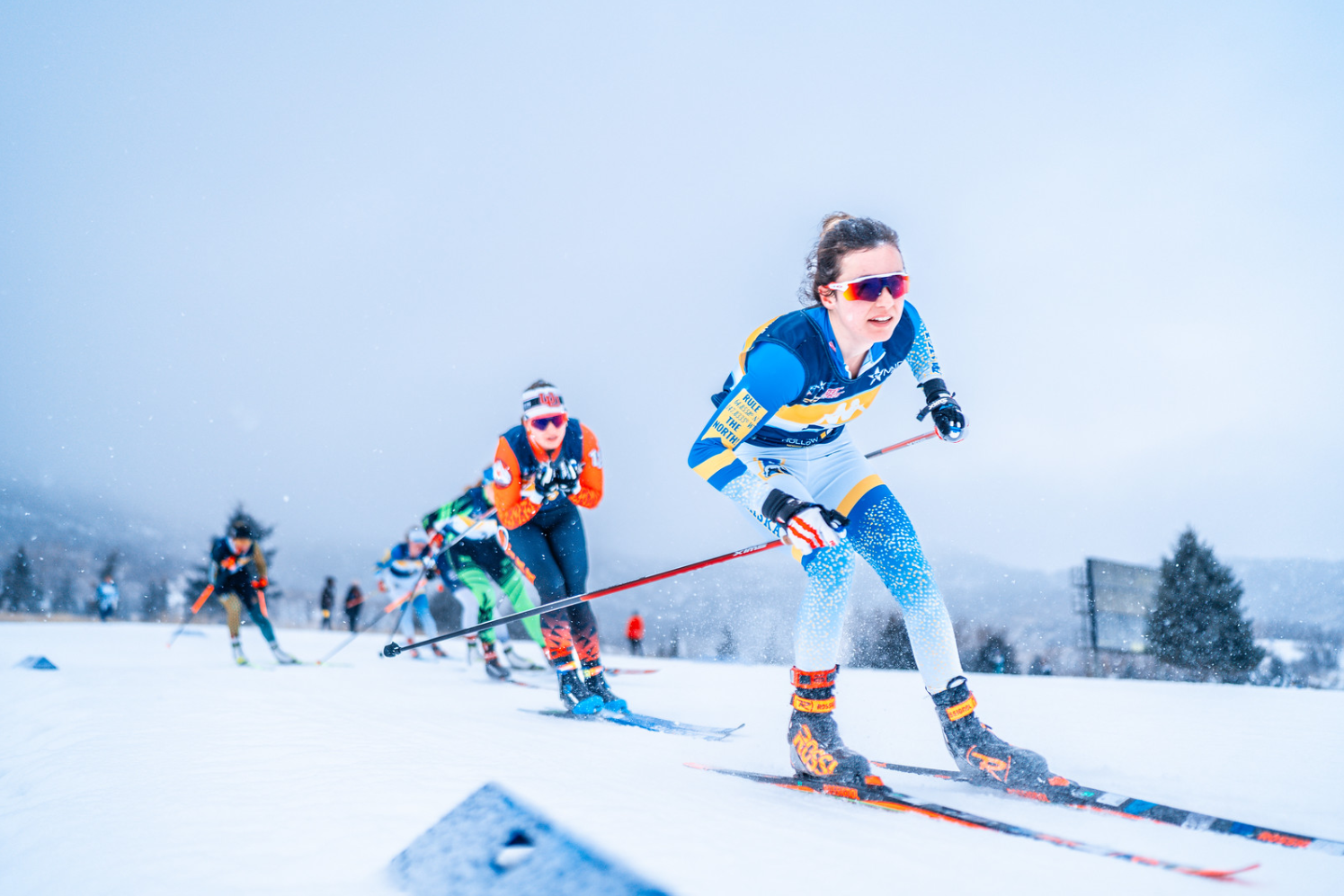
Ben Ogden of SMS T2 won the men’s qualifier with nearly 3 seconds over Gus Schumacher of APU. Murphy Kimball, the 19-year-old sophomore at the University of Alaska – Anchorage, qualified in an impressive eighth, only getting beaten out by elder World Cup regulars.
U20 Murphy Kimball heading to an 8th place in the qualifier. (Photo: Tryg Solberg / FasterSkier)
Erin Bianco of BSF won the women’s qualifier by over 3 seconds over second-place Canadian and Alberta World Cup Academy athlete Katie Weaver. Mia Gorman is a U16 athlete for the neighboring Mansfield Nordic Club who finished the qualifier in 27th, beating out all other junior women and making the heats with the big dogs.
Erin Bianco winning the qualifier by over 3 seconds. (Photo: Tryg Solberg / FasterSkier)
Ogden moved comfortably through the heats, eventually winning the men’s final over APU teammates JC Schoonmaker and Gus Schumacher, who finished in second and third, respectively.
Men’s final starting at Craftsbury Outdoor Center. (Photo: Tryg Solberg / FasterSkier)
Ben Ogden of SMS T2 was very happy about racing in his home state. “It’s a bit more chill” he said in comparison to the World Cup and Olympic stages that he’s been prominent on this season. Ogden also mentioned that, even though the race environment was low-key, the competition was stiff with the U.S.’s top skiers duking it out for the top of the podium.
In addition to representation from many different clubs throughout the heats, the women’s side saw a shake-up in the competition when the third qualifier, Lauren Jortberg of Mansfield Pro/NCPH, fell in the final. Canadian Katie Weaver and her Alberta World Cup Academy teammate Olivia Bouffard-Nesbitt finished first and second. In an interview after the race, Weaver said “conditions were fun, crazy and a bit hectic.”
Canadians Katie Weaver and Olivia Bouffard-Nesbitt embrace after their strong finish for first and second overall. (Photo: Tryg Solberg / FasterSkier)
Emma Albrecht took the top domestic position in third place with her first Supertour win in a sprint race. Erin Bianco of BSF and Alayna Sonnesyn of Team Birkie rounded off the domestic podium.
Albrecht crossing the finishing line as the first American and 3rd overall. (Photo: Tryg Solberg / FasterSkier)
Albrecht was very happy with her racing throughout the day: “The biggest feat for me is being competitive this late in the season.” When asked about her tactics in the heats with the warm spring sun softening the track, she said that she had to “find a rut and see it through.”
Logan Drevlov of Loppet Nordic Racing and Claire Serrano of Craftsbury won the junior heat finals.
Temps are forecasted to drop into the single digits overnight before 4 x 5 km team sprint competitions throughout the day. Tune in for more pictures and results tomorrow.
JC Schoonmaker (APU) and Kevin Bolger (Team Birkie) side by side in the heats. (Photo: Tryg Solberg / FasterSkier)
Help Support Our Olympic Coverage!
FasterSkier will have our own Nat Herz on the ground at the Olympics, which, to be honest, is a very big financial lift for us. If you value the thoughtful work and access FasterSkier provides at championships like this one, please consider becoming a Voluntary Subscriber. Your support directly fuels the work we do to cover the people, places, and moments that make our sport special.
This coverage is made possible through the generous support of Marty and Kathy Hall and A Hall Mark of Excellence Award. To learn more about A Hall Mark of Excellence Award, or to learn how you can support FasterSkier’s coverage, please contact info@fasterskier.com.
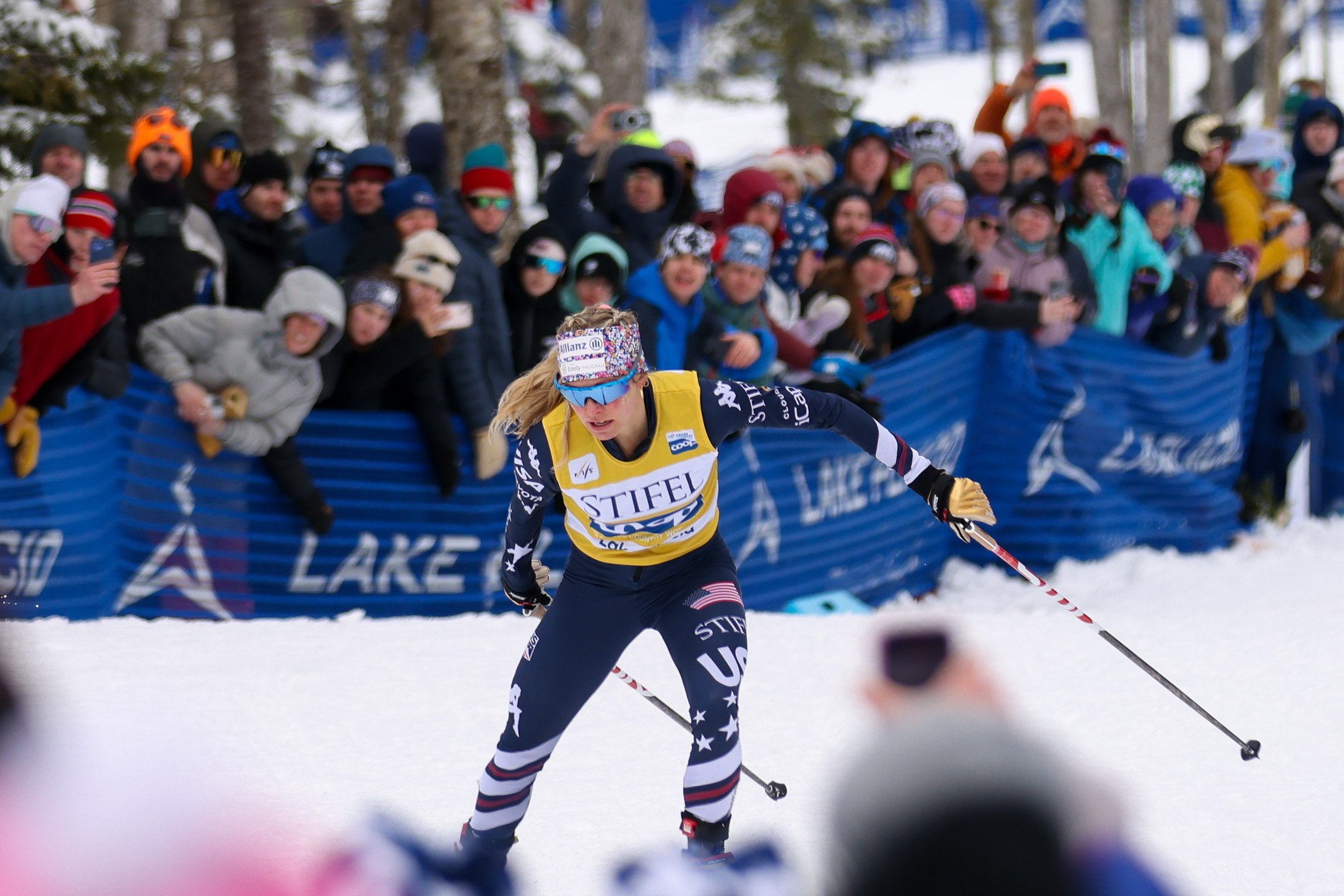
Jessie Diggins during the quarterfinals of the Freestyle Sprint on Saturday in Lake Placid, New York, USA. (Photo: Voisin / FasterSkier)
Lake Placid, N.Y. — The French coaches had questions. Two days before racing began at Mount Van Hoevenberg, they were standing in Saranac Lake — 55 degrees, windy, woods in every direction — wondering who exactly was going to show up to watch cross-country skiing in the middle of the Adirondacks.
By Saturday, an estimated — rumored to be fair — 14,000 people had answered.
Today, as Jessie Diggins lines up for the 20-kilometer mass start freestyle, the final race of her career, this corner of upstate New York will try to top itself one more time.
Screaming fans, chainsaws, flags, signs, and glitter all over the course in Lake Placid, New York, USA. (Photo: Voisin / FasterSkier)
A Weekend That Kept Building
The first sign that Lake Placid was going to be different came Friday, and it wasn’t entirely smooth. With an initial estimate of 10,000 fans on Friday, the transportation system to and from Van Hoevenberg buckled under the demand. Some fans waited over two hours to get to the venue.
US Head Coach, Matt Whitcomb, after the races yesterday in Lake Placid was really happy because the standout performance was not one of his athletes, but instead the North American ski community that showed up in droves and created an electric atmosphere. (Photo: Voisin / FasterSkier)
“Only Holmenkollen and Minneapolis”
U.S. Ski Team head coach Matt Whitcomb has been on the World Cup circuit for years. He said the only events throughout his career that have ever rivaled the atmosphere here this weekend in Lake Placid are the Holmenkollen in Oslo — the sport’s grand prix if you will — and Minneapolis two years ago.
That’s the company Lake Placid is keeping. And for those who were in Minneapolis, the comparison lands. Diggins said earlier this week that Minneapolis was the most special day of her career.
“It was the most I’ve ever cried,” she said at Wednesday’s press conference. “I got to race in front of some of my grandparents who haven’t been able to travel overseas. They got to see me race for the very first time in a World Cup. And having so many friends and family and getting to share the thing that I love doing with them — that is the most incredible thing ever.”
She paused, then added: “I think this weekend’s probably going to join that.”
College skiers from all over the Northeast came in force to the trailside in Lake Placid, New York, for the races this weekend. (Photo: Voisin / FasterSkier)
The Scene on the Ground
What the numbers don’t capture is the texture. Young kids running around the venue in their NNF fan bibs — the ones with athletes’ faces printed on them — clutching Sharpies, hoping to meet their heroes. Fans who drove and flew from Vermont, from Alaska, from Minnesota, who planned vacations around this weekend months ago. The school buses that became part of the story, ferrying the faithful up the mountain road when the original plan couldn’t hold.
This is what U.S. cross-country skiing looks like when it gets the stage. Not a packed NFL stadium or a sellout basketball arena — but thousands of people standing in the woods, screaming themselves hoarse for athletes from every country, because they love this sport and they know how rare these weekends are.
The fans — especial the college skiers — made it sound like the race was happening in Davos, Switzerland with the chainsaws out on course. (Photo: Voisin / FasterSkier)
One More Race
Diggins has spent this weekend doing exactly what she said she would — being present, soaking it in, putting on a show. She clinched the Crystal Globe on Friday. She raced the sprint on Saturday. And now there’s one more.
At Wednesday’s press conference, she talked about the way her mindset around suffering has evolved — how she’s learned to see the pain cave not as something to dread but as confirmation that she’s doing what she came to do.
“This is what 100 percent feels like,” she said. “And sometimes this is what it looks like, and it’s some ugly scene, but that’s okay. It just has to be all heart and all effort, and that’s what I have to give in that moment.”
She also made one thing clear about the team she’s leaving behind: “The team is going to be just fine without me. And I feel like that’s how I know I did my job.”
Then, with a smile: “I’m excited to be a fan on the other side of the fence and get to cheer for them.”
Today, in just ten minutes, Jessie Diggins will clip into her bindings for the last time as a World Cup racer. The 20-kilometer Mass Start Freestyle.
And based on everything this weekend has shown us, “no one” will be watching.
Love Stories Like This? Help Keep Them Coming.
Feature stories like this one take time, access, and care to produce. If you value thoughtful storytelling and independent ski journalism, please consider becoming a Voluntary Subscriber. Your support directly fuels the work we do to cover the people, places, and moments that make our sport special.
This coverage is made possible through the generous support of Marty and Kathy Hall and A Hall Mark of Excellence Award. To learn more about A Hall Mark of Excellence Award, or to learn how you can support FasterSkier’s coverage, please contact info@fasterskier.com.
Jessie Diggins answering questions at the press conference before the World Cup in Lake Placid, New York. (Photo: Voisin/FasterSkier)
Lake Placid, N.Y. — The eve of the World Cup finals at Mount Van Hoevenberg brought press conferences, sound checks that went sideways, and three American skiers who couldn’t stop making each other smile.
Jessie Diggins, Ben Ogden, and Gus Schumacher sat side by side Wednesday afternoon — the same trio that has turned the 2025-26 season into something U.S. cross-country skiing has never seen before. Between them: Olympic medals, historic podiums, a 50-year drought shattered, and one very good birthday cake.
But with three races left and Diggins’s retirement looming, the mood wasn’t heavy. It was loose, funny, and deeply human — exactly the way this team tends to do things.
“Probably Glitter”
Asked to define her legacy heading into her final World Cup weekend, Diggins did what Diggins does: she went somewhere unexpected.
“I think I define my legacy honestly, completely outside race results,” she said. “I am more proud of the things I have done off the course. I think my legacy is going to be in my advocacy and the way that I have spoken about mental health and eating disorders specifically, and the way I’ve tried to make really hard conversations less hard for people to have.”
She pointed to her work with Protect Our Winters and Share Winter, to the energy she’s poured into the team’s culture over the years. And then she landed the dismount.
“And probably glitter. I think there’s a lot more glitter in ski races now, and that’s always a great thing — as long as it’s biodegradable.”
Diggins has spent the season saying goodbye in pieces — a little cry leaving training camp in Bend, quiet moments at each World Cup stop. She knows what’s probably coming Sunday.
“I suspect it’s probably going to hit like a dump truck on Sunday, and there’s probably going to be a lot of tears.”
But she’s ready. And what she’s ready for is maybe the most Jessie Diggins thing of all: she sees ski racing as performance art, and she wants her final show to leave people wanting to go run up a mountain or sign their family up for ski lessons.
“I realized that I can do that moving forward, but just with my story and with my words, and I don’t have to push my body so hard, but I can still leave people inspired and motivated.”
In the meantime, she’s looking forward to being able to wash her clothes when they’re dirty, cook whatever she wants, and bake cookies on the weekend instead of training and racing all day.
Ben Ogden answering questions at the press conference before the World Cup in Lake Placid, New York. (Photo: Voisin/FasterSkier)
“Your Life Is Not Going to Be the Same”
Ben Ogden grew up in Landgrove, Vermont. American skiing legend Bill Koch lived close by in Peru, Vermont. Same zip code, as Ogden puts it — “not so different.”
Fifty years separated Koch’s 1976 Olympic medal from Ogden’s silver this season, and when Ogden finally got on the phone with his neighbor and mentor after breaking the drought, Koch didn’t mince words.
“Bill just sort of said, ‘Hey, congratulations, and your life is not going to be the same from this point forward.’ And that was kind of crazy to hear.”
Ogden hopes to see Koch at the races this weekend. And racing at Van Hoevenberg carries its own weight for him — not just because of Koch, but because of his father, who was deeply embedded in the New England ski racing community.
“I think it’s really hard for me to come race in the U.S. and look around and not just, like, constantly think about him, because this was his scene,” Ogden said, his voice softening. “He would have been in such paradise on the side of the trail here in Lake Placid. And I’ll be thinking about him a lot this weekend, for sure.”
This is technically Ogden’s first home World Cup — he was sick for Minneapolis — and it’s hitting him right. He grew up racing the NYSEF Festival series at Lake Placid, bringing crews of Vermont kids over for slushy late-season races.
“It’s not my home, but it feels like it.”
Gus Schumacher answering questions at the press conference before the World Cup in Lake Placid, New York. (Photo: Voisin/FasterSkier)
Aspirations, Not Goals
Gus Schumacher has been doing some linguistic rebranding.
“I’ve been calling them aspirations for a few years now,” he said of his season targets, “because I feel like the pressure of goals was kind of weird for me.”
The distinction matters to Schumacher. He sets plenty of small goals — the daily, tactical kind — but the big ones, like winning an Olympic medal or finishing in the top 10 of the overall World Cup standings, he holds more loosely. They’re aspirations: things he wants, things he’ll chase, but things he won’t let crush him if they don’t happen.
“Those are things I want to do, but if they don’t happen, it won’t be because I didn’t try.”
He accomplished the Olympic medal. He entered this final weekend ranked sixth in the world, with a top-10 finish still in play. And he’s approaching Lake Placid the same way he approached Minneapolis, where he won his first World Cup in front of a hometown crowd: just be happy to be racing, and feed off the energy.
“Already today, it was really cool to have people cheering us on in the race prep, which doesn’t really happen much on the World Cup ever.”
Schumacher also dropped maybe the best origin story of the press conference: the formative moment that lit a fire under his career was Luke Jaeger beating him at an Anchorage cup race.
“That kind of put a fire under my belly to really start training, because I didn’t want him beating me anymore.”
The Knitting Club, the Water Pump, and the Greenhouse
The press conference’s best stretch might have been when someone asked the athletes how they decompress.
Schumacher keeps it clean: headphones, 10 to 20 deep breaths — four seconds in, eight seconds out. Standard operating procedure.
Ogden? He knits. And he’s not shy about it.
“After races, I’ve been doing a lot of knitting and stuff like that. Helps me just relax really quick.” After the season, it’s bigger projects: car work. “You can feel like you’re the king of the world after a couple medals, but go and try and replace a water pump on a Forerunner, and that’ll make you feel completely incompetent.”
Diggins revealed there was a full-on knitting club on the team this winter. Her own reset button is simpler: she calls her husband.
“He’s my absolute center of my world. The race could have been amazing, and it could have been also completely horrible. And we’re just talking about what I want to do with the garden, and how I want to start a greenhouse. And he’s like, ‘Uh huh, yeah, sure, I’ll support you in that.’”
One More Thing
Almost as a throwaway, Ogden mentioned that Andy Newell — “the original Nordic ski backflip guy” — is in Lake Placid this weekend. And Ogden himself has had a backflip dialed since he was 17.
“I’m hoping on Sunday we can kick up a little ski jump. I’m looking to take another one Sunday afternoon. So stay tuned.”
Three races to go. A retirement to honor. A culture to celebrate. And maybe a backflip.
It’s going to be a weekend.
Love Stories Like This? Help Keep Them Coming.
Feature stories like this one take time, access, and care to produce. If you value thoughtful storytelling and independent ski journalism, please consider becoming a Voluntary Subscriber. Your support directly fuels the work we do to cover the people, places, and moments that make our sport special.
Jessie Diggins (USA) has inspired fans of all ages across the world. This weekend, many of them will gather along the race course, on her home snow, to say thank you. (Photo: Vanzetta/NordicFocus)
This Sunday, a lesser-heralded chapter of American history will close when Jessie Diggins enters her final World Cup event. She will leave the sport at the absolute top of her game, for the fourth time as the overall Crystal Globe winner, having slogged it out over a season that began the day after Thanksgiving above the Arctic Circle in Finland and will end 33 races later right here in Lake Placid, NY. She is the only skier, male or female, to compete in every single individual competition this year, from sub-three-minute sprints to two-plus hour marathons, before throngs of beer-guzzling fans in the sun and to empty Teutonic stadiums in the spritzing January rain.
During the run-up to the Milan Olympics, she briefly returned to the national zeitgeist, hyped for her ability to dig into the pain cave, and seen writhing on the ground beyond the finish line, a paroxysm of gasping. A high school student of mine had seen the feature on her in the New York Times, and a room of young athletes in Greenwich, CT — alien to Nordic ski culture — spent the full English class discussing the efficacy of pushing one’s limits. People around the once skilliterate Westchester County even started making the connection of why I’d named my dog “Diggins.”
Diggins Donahue (Photo: Timothy Donahue)
During her first Olympic race this year, Diggins crashed in traffic on the slushy snow and bruised her ribs. So naturally, five days later, she gritted her way to a bronze in the 10-kilometer freestyle and to 5th in the 50-kilometer classic on the final day of the Games. But just a week after this, when the collective gaze had drifted from the luge and returned to the Epstein files, she came improbably, from back in the field to within 0.1 second of winning a 20-kilometer in Falun. I watched this tuck-skate drag race with my daughter, who has a Diggins poster on her wall, and we screamed so loud the neighbors asked if everything was okay.
Against the slow off-gassing of rage coming across the airwaves — the sex trafficking, the elementary school bombing, the painful erosion of dignity and competence — Diggins has given us an important antidote all these years. In early 2021, when insurrectionists were sprawling their feet and flag across Nancy Pelosi’s office, Diggins was on her way to winning her first Tour de Ski. I remember the Alpe Cermis climb, when she crested into view in her red, white, and blue race suit, and thinking that she, too, is a compatriot. This past January, when her native Minnesota had become an epic fury, she won her third Tour de Ski title and was entering her fourth Olympics. She wrote, “For everyone out there caring for others, protecting their neighbors, and meeting people with love — every single step is for you. YOU are the ones who make me proud to carry the flag, and I hope I can bring you joy over these next few weeks.”
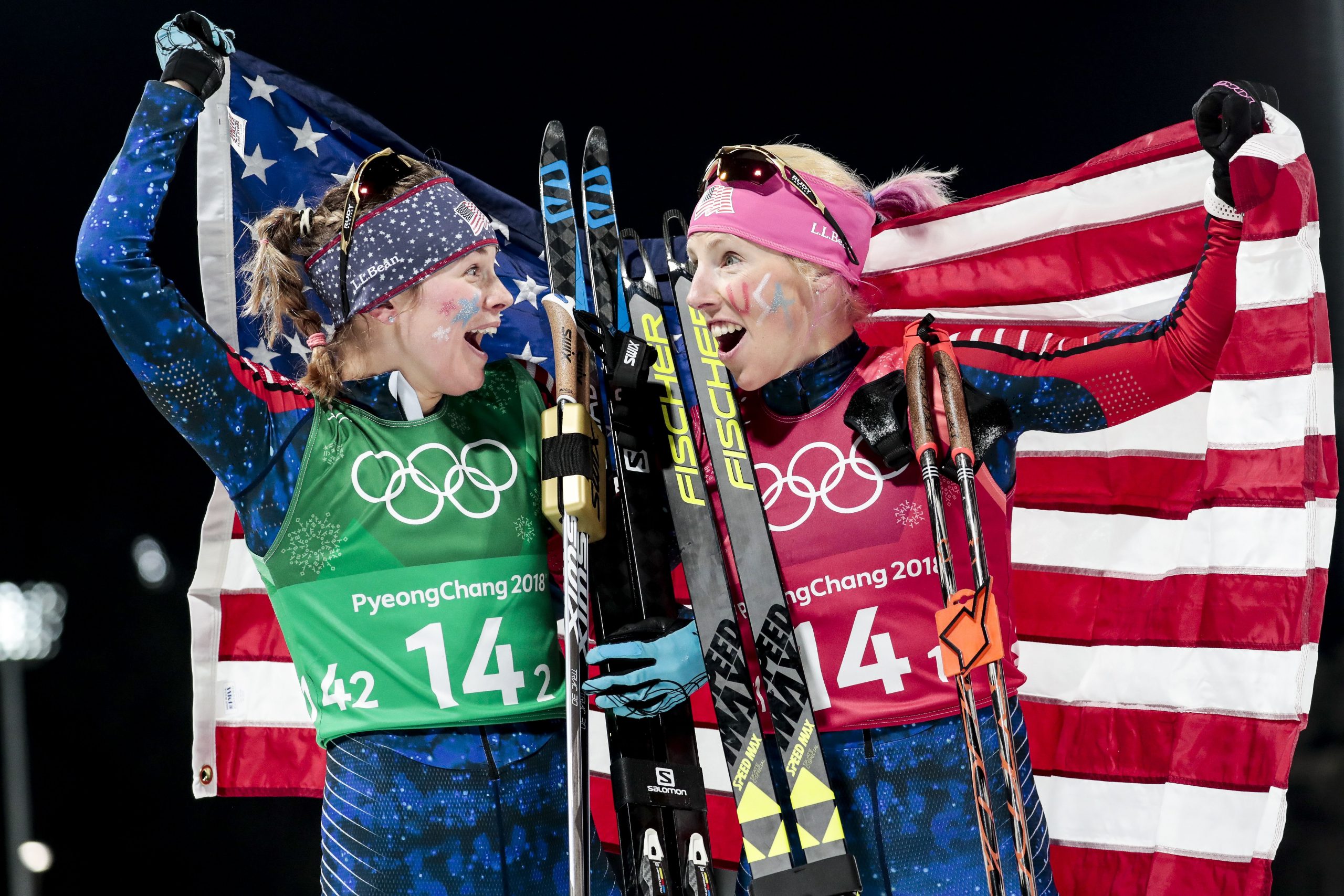
Jessica Diggins (USA), and Kikkan Randall (USA), (l-r) win America’s first cross-country Olympic gold in the women’s team sprint at the 2018 Pyeongchang (KOR) Olympics Pyeongchang. (Photo: Fischer/NordicFocus)
When she won Olympic gold with Kikkan in 2018, she was suddenly in the spotlight. Unfamiliar territory for our stoic sport whose only other American medalist to that point was Bill Koch, who won silver a half-century prior, and retreated into the moss of Vermont. But she was on the Wheaties box, and on commercials for Chipotle, Salesforce, Deliotte, and Toyota. She gave countless Swift-like appearances to throngs of impressionable youth; she lobbied in Washington D.C. for climate change reform. They found out her team nickname was “Sparkle Chipmunk,” and her pre-race glitter applications became her meme. She choreographed music videos; she shared homemade baked goods during the five-month-long European exodus. And she infected a hunger-based confidence that vaulted our underfunded, lowly squad to rival the Scandinavian powerhouses. Proclaimed as “the face of American skiing” and “America’s sweetheart,” she shouldered all this as she simultaneously maintained the fitness to train and race to her own world-best standards.
But as she reveals in the excellent, newly-released documentary about her called “Threshold” (with screenings all weekend at Lake Placid’s Palace Theater), the pressure of doing this day-in, day-out, for six solid years, got to her. As she tells the movie camera, it reacquainted her with senior year of high school: “I was trying to go 100 percent into every single corner of my life because I couldn’t sit still with the feeling that I was not enough.” In 2023, she relapsed with her eating disorder. In the film, she narrates this journey with a raw earnestness that, like her approach to skiing itself, cuts right to the marrow. “I’m willing to put my story on the line to help change this,” she says.
Jessie Diggins (CXC) on her way to first place at US Nationals in Rumford, Maine. (Photo: Hallie Herz)
Those of us who recall her first U.S. National title, back in 2011, among the paper mill aromas of Rumford, ME, fold this into our meta-narrative of triumph over challenge. Where others stand tall and firm on their skis, like maestros conducting their symphonies, Diggins hides none of the pain. Her head bobs, her shoulders undulate, her breathing seems louder than anyone else’s. She’s dropped off the back of the pack and yet somehow, she finds something. She’s not done. Here comes Diggins! If she can do it, I can do it.
This winter, I was particularly attuned to Diggins because, after two partial knee replacements, I was trying to claw my way back into competitive skiing. There were no Toyota endorsements at stake for me, but it was enough to re-connect with the core of this sport. Yes, it’s a beautifully nurturing, soul-susurrating exercise, but climbing up a hill deep into a race, it’s really just about holding off an explosion. The lack of oxygen excites my imagination and it’s all I can do to stay quiet and suppress the inevitable voices saying no, it’s too hard, this guy ahead of me is probably a wonderful father, it’s ok.
Who can say for sure what’s inside the mind of Diggins as she enters this state, this tribute of her current to her source that she has alchemized into fist-pumping, tear-jerking frenzy? But I know that the highlight reels she has brought us over her 15-year career – breaking a pole and scrambling with one arm to her first World Championship gold in 2013, finishing gloveless with a bloody face in 2023 (after another pole incident) and still earning silver, collapsing the day after food poisoning to win silver in the 2022 Olympics – this is something that should give the nation pride. She tells us, “I want to cross that finish line and I want to be so tired that I can’t even stand up, so that I know I gave everything in my heart toward my very best effort.” And she speaks with her actions.
We project our own wish fulfillment onto our heroes, and for the run of her career, with its 365 World Cup starts — more than anyone in history — Diggins has sturdily and gracefully absorbed our collective desires. Now she is leaving on her terms, from the top step of so many podiums, a master of her time.
The Donahue daughters have been inspired by Diggins their entire lives — and they’ll be on-site for one last weekend of racing, sending her off with the skier’s signature heart and a glorious sunset on an amazing career. (Photo: Timothy Donahue)
Love Stories Like This? Help Keep Them Coming.
Feature stories like this one take time, access, and care to produce. If you value thoughtful storytelling and independent ski journalism, please consider becoming a Voluntary Subscriber. Your support directly fuels the work we do to cover the people, places, and moments that make our sport special.
Thanks to the fantastic success of the redesigned youth programs at the resort this past winter, Royal Gorge XC will offer expanded teams for the 2026-2027 season.
New team offerings for the coming season will include middle school age racing, junior racing, gap year programming, pro level racing and masters training groups.
Youth programming will remain the same as offered this past season, with groups comprised of young skiers from Kindergarten through 8th grade with a focus on skill development and fun.
The new racing and training focused offerings will put into place a full ladder of nordic ski development at Royal Gorge XC, allowing every level of skier to see the complete range of possibilities this life-long sport can offer.
Programs will be headed by Will Sweetser, now in his 33rd year of professional coaching. An expanded staff of U.S. Ski and Snowboard certified coaches will support programming and lead the Royal Gorge XC Teams as they represent the resort and Far West Nordic in local, regional and national racing.
All programs will be competitively priced, with both à la carte and full menu pricing options. Registration for programs will open at SkiReg.com by April 1, 2026.
Royal Gorge XC Programs 2026-2027
Manzanitas — Grades K–2
Fun, fun and more fun. Saturdays only. Classic skiing focus. Weekend and seasonal rentals available.
Aspens — Grades 3–5
Fun, coordination and skill development weekend program. Classic and skate skiing. Limited racing opportunities for those interested.
Lodgepoles — Grades 6–8
Fun, skill development and fitness focused weekend program for middle schoolers. Independent Middle School racing and limited racing opportunities for those interested.
Devo — Ages 12–15
September through March programming options, both fall/winter and winter only. Summer camp offered. Coached sessions held 3 days per week. Local and regional race support with experienced, certified coaches.
Comp — Ages 15–19
June through March programming options, both full year and winter only. Coached sessions held 4 days per week on average. Local, regional, and national race planning and support with experienced, certified coaches.
Gap Year — Ages 18–20
By application only. Program limited to 5 athletes. 4–5 days per week in conjunction with Pro Team. Head coach: Will Sweetser.
Pro Team — Ages 19+
By application only. Program limited to 5 athletes. Individual training and competition planning. Job opportunities. Coaching requirement. Head coach: Will Sweetser.
Senior/Masters Training Groups — Ages 21+
Multiple training groups offering beginner to expert skate and classic training. From “learn to” to racing level groups. 1–3 days per week. Scheduled in conjunction with youth and junior training groups and offering race/experience travel.
The April 4 event pairs a live global broadcast with on-snow programming at Tahoe XC.
The inaugural Tahoe Nordic Expo will take place April 4, 2026, bringing together some of the most accomplished names in Nordic sport for a live, global virtual panel focused on the past season, the Olympic year, and the future of the sport.
Designed as a hybrid event, the Expo centers around a live virtual panel featuring Olympic, Paralympic, and World Cup athletes across multiple Nordic disciplines, including cross-country skiing, biathlon, Nordic combined, and telemark.
Julia Kern (USA) racing the World Cup cross-country mass start in Ruka (FIN). (Photo: Modica/NordicFocus)
The panel lineup includes:
Kikkan Randall, Olympic gold medalist and one of the most decorated U.S. cross-country skiers in history
Oksana Masters, 24-time Paralympic medalist in Nordic skiing and multiple sports
JC Schoonmaker, Tahoe native and two-time Olympian
Julia Kern, World Cup medalist and Olympian
Annika Malacinski, national champion and leading voice in women’s Nordic Combined
Jaz Taylor, multiple-time World Cup champion
The discussion will be moderated by Andy Newell, a four-time Olympian and prominent voice in the sport.
The 90-minute panel will serve as a live season recap, covering the 2025–26 World Cup circuit and the Milano Cortina Olympic and Paralympic Games, while offering audiences a rare opportunity to hear directly from athletes about training, competition, and the evolving culture of Nordic sport. Virtual attendees can submit questions in advance, while in-person participants will engage in a live Q&A.
Coach Andy Newell all smiles at the 2023 BMT. (Photo: BMT)
Founder Elyse Sara created the Expo to fill a gap in the Nordic landscape – one that emphasizes connection, storytelling, and access to athletes across disciplines and levels. The event brings together voices from across the global Nordic community, from Olympic medalists to emerging leaders shaping the future of the sport.
The event also includes a limited in-person component at Tahoe XC featuring clinics, demos, a laser biathlon relay, live viewing of the virtual panel, and other community events.
In addition to its focus on sport and storytelling, the Expo also supports inclusion in athletics. Ten percent of all proceeds will benefit Move United, a national leader in adaptive sports programming.
The Tahoe Nordic Expo aims to establish a new kind of gathering within the sport – one that reflects, connects, and looks ahead.
JC Schoonmaker (USA) onhis way to finish the individual sprint in 15th place at the World Championships in Trondheim (NOR) in 2025. (Photo: NordicFocus)
This coverage is made possible through the generous support of Marty and Kathy Hall and A Hall Mark of Excellence Award. To learn more about A Hall Mark of Excellence Award, or to learn how you can support FasterSkier’s coverage, please contact info@fasterskier.com.
Johannes Hoesflot Klaebo (NOR) took all six gold medals awarded in men’s cross-country skiing at the Olympics last month. (Photo: Barbieri/NordicFocus)
Johannes Hoesflot Klaebo made the call late Tuesday night… he’s racing.
According to the Scandinavian press, Klaebo departed Oslo’s Gardermoen airport at 6:25 Wednesday morning, beginning a roughly 20-hour journey to Lake Placid, where he’ll arrive about a day and a half before Friday’s 10-kilometer classic interval start. The Norwegian Ski Federation confirmed the news in a press release on Wednesday morning.
“I can see this isn’t going to be an optimal buildup, both with the long travel and not being able to adjust to the time difference,” Klaebo said. “But I want to be part of the World Cup finale in the USA.”
The decision came after Klaebo did a training session on Tuesday morning in Trondheim and responded well. National team doctor Ove Feragen gave him the green light.
Ben Ogden (USA) checks on Johannes Hoesflot Klaebo (NOR) after their crash eliminated them from the race in Drammen, Norway. (Photo: Nordnes/NordicFocus)
“After the fall during the sprint in Drammen, and some quiet days at home, Johannes has gradually resumed training and normal activity,” Feragen said. “He has responded well to this, without any recurring symptoms after the fall. After observation and further examinations, we have concluded that he is fit to compete.”
Klaebo has been sidelined since March 12, when American Ben Ogden fell across the Norwegian’s skis during Classic Sprint semifinals in Drammen, Norway. The resulting crash sent Klaebo’s head into the hard-packed snow. He was diagnosed with a mild concussion, withdrew from the Holmenkollen 50k, and scrapped a planned media tour in New York City that included sit-downs with CNN, NBC, the New York Times, and the Wall Street Journal.
Now the question shifts from whether Klaebo will race to how much he’ll race. He’s not committing to the full program.
Harald Oestberg Amundsen (NOR), Johannes Hoesflot Klaebo (NOR), and Martin Loewstroem Nyenget (NOR), (l-r) share the Skiathlon podium in Falun, Sweden, on March 1st, 2026. (Photo: Thibaut/NordicFocus.)
“My expectations for performance are not sky-high,” Klaebo said. “I’ll do my best despite a poor buildup and potential jet lag. Whether I race one, two, or three events in Lake Placid, I’ll decide once I get to the USA and get skis on my feet.”
The stakes are real despite the measured tone. Klaebo has already clinched the overall World Cup — his sixth, tying Bjoern Daehlie — and the sprint globe. But he trails Harald Oestberg Amundsen by three points in the distance standings after missing the Holmenkollen 50k. Two distance events remain: Friday’s 10 k Classic and Sunday’s 20k Freestyle Mass Start. A clean sweep of the overall, sprint, and distance globes would be a first in Klaebo’s career.
“For cross-country skiing, it’s especially important to have World Cups in the USA,” Klaebo said. “I’ve been looking forward to this finale for a long time.”
Racing begins Friday at Mt. Van Hoevenberg. Klaebo will be on the start line — jet lag and all.
Love Stories Like This? Help Keep Them Coming.
Feature stories like this one take time, access, and care to produce. If you value thoughtful storytelling and independent ski journalism, please consider becoming a Voluntary Subscriber. Your support directly fuels the work we do to cover the people, places, and moments that make our sport special.
Ben Ogden (USA) and Johannes Hoesflot Klaebo (NOR), along with Oskar Opstad Vike (NOR), (l-r) on the Olympic sprint podium last month. It should be made clear that Ogden and Klaebo have a strong respect for one another, to say the least. (Photo: Vanzetta/NordicFocus)
You’ve got your tickets. You know the race schedule. You’re making the trip to Mt. Van Hoevenberg for the first World Cup finals ever held on American soil. But the racing doesn’t fill every hour of the day, and Lake Placid is the kind of town that rewards a little wandering. Over the last 15 years, my family and I have spent a lot of time in Lake Placid, and here’s what we’d suggest for filling in the gaps — whether you’re traveling solo, with a crew, or with kids in tow.
Fuel up
Start the morning at Big Mountain Deli & Crêperie on Main Street. They’ve got 46 sandwiches named after Adirondack high peaks, plus breakfast burritos, crepes, and all the espresso drinks you need to survive a cold morning in the stadium. A word of advice: order online in advance. The line moves faster if your food is already being made. Note that they’re closed on Wednesdays, so plan accordingly if you’re arriving midweek.
If you’d rather sit down and take your time, The Breakfast Club is just up the street and serves a proper breakfast and lunch with views of Mirror Lake. The portions are generous, the pancakes are legit, and if you’ve got kids, the hot cocoa is a guaranteed win. They open at 8 a.m. daily and close at 1, so don’t dawdle.
Lunch and dinner
For a real meal, Lisa G’s is our pick. It’s a short drive from Main Street on Sentinel Road, with a menu that leans American but doesn’t phone it in — think elevated pub food with creative wings, excellent fish and chips, and a solid beer list. They serve lunch on Fridays through Sundays starting at 11:30, and dinner Thursday through Monday. Closed Tuesdays and Wednesdays, so keep that in mind for early-week arrivals.
For something more upscale, the Mirror Lake Inn is one of the classic Adirondack properties — a lakefront resort with a polished dining room and views to match. And if you want something a bit more casual but still special, check out The Cottage, also on the Mirror Lake Inn grounds. It’s a cozy spot right on the water where you can grab dinner or a drink in an old gondola. It’s open Tuesday through Sunday — closed Mondays.
If you’re looking for a spot that can handle a crowd, Dancing Bears at the High Peaks Resort is worth a look. It’s at the far end of Main Street and has plenty of space — which matters on a weekend like this one, when every restaurant in town is going to be slammed. We’re fans of the food here, especially the salmon. It’s a reliable pick when other spots have a 45-minute wait.
Breweries
Lake Placid has two breweries worth your time, and both serve food if you’re looking to make a full stop of it.
Lake Placid Pub & Brewery has been an institution on Mirror Lake Drive for years. The beer list is deep, the vibe is pub-casual with college banners lining the walls, and the upstairs bar is a solid spot to post up after a day at the races. They’re open daily from 11:30 a.m. (noon on Sundays) and stay open late — midnight on weeknights, 2 a.m. on Fridays and Saturdays. If you can only try one drink, ask about the Smoked Berry Old Fashioned.
Big Slide Brewery & Public House is out on Cascade Road, about a five-minute drive from downtown and right near the Olympic Jumping Complex — which makes it an obvious stop if you’re heading to the Skirious Problems live recording Saturday evening. The beer ranges from fruit-forward lighter options to solid IPAs and porters, and the food holds its own. The burgers are good, the pizza is legit, and the buffalo wings have a bit of a cult following. They’ve also got outdoor seating with fire pits and Adirondack chairs if the weather cooperates. Open daily from 11:30 a.m. (10 a.m. on Sundays).
Catch some NCAA March Madness
The World Cup finals land smack in the middle of the NCAA basketball tournament, and if you need a screen and a cold beer between race sessions, Lake Placid has you covered. Wiseguys Sports Bar & Grill on School Street is the classic move — TVs everywhere, good wings, no pretense. They’re open Wednesday through Sunday. Players Waterfront Eatery on Main Street is another solid option with screens and lakeside seating if the weather cooperates.
Stroll and Explore Main Street
Don’t underestimate a good Main Street stroll. Lake Placid’s downtown is walkable and full of shops worth ducking into.
Saratoga Olive Oil Company is one of those places you walk into out of curiosity and end up spending way longer than you planned. They’ve got dozens of flavored olive oils and balsamic vinegars you can taste — some combinations will surprise you, and it’s a genuinely fun challenge for your taste buds. Great for picking up a gift or just entertaining yourself for half an hour.
The Maple Shop is exactly what it sounds like — a deep dive into maple syrup and all things maple. But it’s more interesting than you might expect. They carry different varieties and grades, and tasting your way through the range is a quick education in how much variation there is in something most people think of as one flavor.
Adirondack Popcorn Co rounds out the Main Street tasting tour. They specialize in creative popcorn flavors — some classic, some funky — and it’s the kind of snack you can grab and take with you to the races or back to wherever you’re staying.
Get Outside
You’re in the Adirondacks. Get some fresh air.
Though having recently CLOSED at the end of the 2026 season, Olympic Speed Skating Oval is open for public skating and is one of the few outdoor refrigerated ovals in the country. If the oval’s schedule doesn’t line up with yours, Mirror Lake itself often has a maintained skating area — check conditions locally when you arrive.
Get out on the Ironman Lake Placid course on Mirror Lake Drive — hopefully it won’t be raining — like IMLP Champion Trevor Foley. (Photo: Voisin / FasterSkier)
For our money, no trip to Lake Placid is complete without a walk or jog around Mirror Lake. The loop is about 2.7 miles on a paved path, it’s flat and accessible, and the residential architecture along the shoreline is worth the trip on its own — beautiful old Adirondack homes mixed in with classic lake houses, all set against the mountains. It’s a perfect way to shake out your legs before or after a day in the stadium.
If you’re looking for something a bit more rugged, there are dozens of short hikes in the area, but be warned: this time of year, trail conditions are unpredictable. You might hit packed snow, mud, ice, or all three in the span of a quarter mile. Bring traction devices if you have them, and dress for the mess. Cobble Hill is a nice short option with a rewarding view at the top — nothing too long or steep, but enough to feel like you earned it.
Need to get out for a Nordic Ski
If you’re itching to actually ski while you’re up here, your options may be limited. Mt. Van Hoevenberg’s trails will almost certainly be closed to the public during the World Cup weekend. But if you’re willing to make the drive, the Paul Smith’s College VIC in Paul Smiths — about 30 minutes north of Lake Placid — is a strong option. We checked in with Paul Smith’s head Nordic coach Matt Dougherty, who had his team out on the trails Wednesday morning for biathlon practice. “It was actually fantastic,” Dougherty told FasterSkier. “Conditions will reflect the temperatures — normal spring skiing.” Most trails are open and being groomed daily with the college’s PB 100, though a few trails that got washed out last week are closed for the season. The VIC maintains over 25 miles of trails, including more than 10 kilometers of FIS-homologated courses and 25 kilometers of skate skiing. The system benefits from heavier snowfall than other parts of the region, which tends to keep trails skiable even when conditions elsewhere are lean. Trail conditions are updated on their Nordic Pulse page. The VIC’s winter season runs through April 1.
Saturday Evening at the Jumps
After the sprint finals wrap up on Saturday, head over to the Olympic Jumping Complex on Cascade Road for a live recording of the Skirious Problems podcast at 6:00 p.m. Hosts Mika Vermeulen and James Clugnet will be joined by Ben Ogden, Frida Karlsson, and Federico Pellegrino. It’s free, but organizers are suggesting it may already have sold out — check the World Cup Finals event page for the link. After that, the Palace Theatre downtown is screening Threshold at 7:00 p.m.
Family-friendly fun
The Lake Placid Toboggan Chute on Mirror Lake is one of those only-in-Lake-Placid experiences — a 30-foot wooden tower that launches you and a toboggan out across the frozen lake. Warmer spring temperatures have caused the chute’s closing for this season, but it’s typically open Friday evening and Saturday and Sunday during the day. Lines can build, but it’s worth the wait.
If you’re already out at Mt. Van Hoevenberg, the Hi Notch Indoor Climbing center is right inside the Mountain Pass Lodge. It will be CLOSED during the FIS World Cup finals, but other days you’ll find a 30-foot top rope wall with over 1,500 square feet of climbing space, plus bouldering and traverse walls. All gear is provided, and instructors are on hand during daytime sessions. It could be busy this weekend, given the crowds, but it’s a great option for families or anyone who needs to burn off some energy between races.
If you’ve got a free morning or want a half-day excursion, the Wild Center in Tupper Lake is about 45 minutes west and worth every mile. It’s a natural history museum with live animals, hands-on exhibits, and the Wild Walk — a series of treetop bridges with panoramic views of the Adirondacks. It’s open Friday through Sunday, so you could pair it with a race day or build it into your travel schedule. Just know you’ll have to choose between the Wild Center and a morning at Van Hoevenberg if you’re trying to do both.
Closer to town, the Palace Theatre on Main Street is a beautifully maintained old single-screen movie house — a perfect way to wind down after a long day in the cold. And if your group wants something more active, Lake Placid Lanes (also known as Big Z’s) has bowling, arcade games, shuffleboard, darts, and a full bar. Reservations are recommended, especially on weekends — this place fills up.
Lake Placid has been hosting the world’s best winter athletes since 1932. The town knows how to do this. Get out there and enjoy it.
Fans from across the United States who will be in Lake Placid are anxiously hoping Johannes Hoesflot Klaebo (NOR) is well enough to travel and race in Lake Placid this weekend. (Photo: Authamayou/NordicFocus)
Johannes Hoesflot Klaebo has been included in Norway’s 22-athlete squad for this week’s World Cup finals at Mt. Van Hoevenberg in Lake Placid, N.Y., BUT the six-time Olympic gold medalist’s participation hinges on a decision being made today.
Klaebo, 29, suffered a mild concussion in a dramatic crash during the sprint semifinals at last Thursday’s World Cup in Drammen. American sprinter Ben Ogden lost his footing on the icy course and fell across Klaebo’s skis, sending the Norwegian backward and slamming the back of his head into the hard-packed snow. Klaebo lay on the ground for several minutes before being helped off course and transported to a hospital for evaluation.
The Norwegian Ski Federation confirmed the concussion diagnosis on Friday, and Klaebo withdrew from Saturday’s 50-kilometer race at Holmenkollen.
“He shall make an evaluation together with the national team doctor on Tuesday and would potentially travel on Wednesday,” Klaebo’s manager, Lasse Gimnes, told Norwegian broadcaster NRK on Monday. If cleared by national team doctor Ove Feragen, Klaebo would travel to New York on Wednesday — arriving just two days before Friday’s 10-kilometer classic interval start.
The crash also disrupted a planned trip to New York City for media appearances with CNN, NBC, the New York Times, and the Wall Street Journal — a reflection of the enormous international attention Klaebo has drawn since his record-setting six-gold performance at the Milano Cortina Olympics. Those in-person interviews have been scrapped, though some may shift to virtual formats.
Johannes Hoesflot Klaebo (NOR) poses with the FIS Crystal Globes he won last season at World Cup Finals in Lahti, Finland. (Photo: Thibaut/NordicFocus)
The distance globe is on a knife’s edge
The distance cup title is the central subplot heading into the finals. Before Holmenkollen, Klaebo held a 128-point lead in the distance standings. But with the Norwegian watching from home on Saturday, Amundsen’s 131-point haul vaulted him into the distance lead: Amundsen now sits at 939 points, three ahead of Klaebo’s 936. Martin Loewstroem Nyenget climbed to 914 in third. Just two distance events remain — Friday’s 10-kilometer classic interval start and Sunday’s 20-kilometer freestyle mass start. If Klaebo can travel and race, the margin is thin enough that a single strong result could flip the standings again. If the concussion keeps him out, the distance globe almost certainly goes to Amundsen.
Klaebo has already clinched both the overall World Cup — his sixth, tying Bjoern Daehlie’s all-time record — and the sprint globe.
Norway’s men’s squad: Harald Oestberg Amundsen, Martin Loewstroem Nyenget, Einar Hedegart, Andreas Fjorden Ree, Mattis Stenshagen, Emil Iversen, Johannes Hoesflot Klaebo, Lars Heggen, Even Northug, Ansgar Evensen, and Even Solem Michelsen.
Jessie Diggins soaks in all the energy from the home crowd during her warmup in Minneapolis — the last time the World Cup was on American snow. (Photo: Leann Bentley/USST)
Diggins’s farewell, and notable absences
The Lake Placid finals will serve as the final competitive races for Jessie Diggins, the most decorated cross-country skier in U.S. history. The women’s overall cup and distance cup are both decided, with Diggins winning with a comfortable margin over Sweden’s Moa Ilar in second. The three-time Olympic medalist and three-time overall World Cup champion announced before the season that this would be her last, and a farewell on home snow in front of an American crowd at the first-ever U.S.-hosted World Cup finals is about as fitting a send-off as anyone could script.
Klaebo is not the only notable question mark heading into the weekend. Norway’s Kristine Stavaas Skistad and Mathilde Myhrvold have opted to skip the finals to prepare for part two of Norwegian nationals in Harstad next week. Sweden’s Ebba Andersson has also pulled out.
Norway’s women’s squad for Lake Placid includes Astrid Oeyre Slind, Heidi Weng, Kristin Austgulen Fosnaes, Karoline Simpson-Larsen, Nora Sanness, Karoline Groetting, Julie Bjervig Drivenes, Tiril Udnes Weng, Julie Myhre, Lotta Udnes Weng, and Milla Grosberghaugen Andreassen.
The men’s freestyle mass start gets started at the US National Championships in Lake Placid, NY, 1/8/26. (Photo: Nancie Battaglia)
A historic venue
The Lake Placid finals mark the first Cross-Country World Cup finals ever held in the United States and the return of World Cup racing to Lake Placid for the first time since 1979. Racing kicks off Friday at Mt. Van Hoevenberg with the 10-kilometer classic interval start, followed by a freestyle sprint on Saturday and a 20-kilometer freestyle mass start on Sunday.
This is a developing story. FasterSkier will update when Klæbo’s decision is announced.
Help Support Our Olympic Coverage!
If you value the thoughtful work and access FasterSkier provides, please consider becoming a Voluntary Subscriber. Your support directly fuels our work to cover the people, places, and moments that make our sport special.
Stifel Lake Placid Finals, a Coop FIS Cross-Country World Cup, to Bring Elite Ski Racing and Winter Festival Atmosphere to Lake Placid
FIS Cross-Country World Cup racing, fan experiences, athlete engagement, and live entertainment coming March 19–22
LAKE PLACID, N.Y. — The Stifel Lake Placid Finals, a Coop FIS Cross-Country World Cup, will offer more than world-class competition this March. The event will transform Lake Placid into a multi-day winter sports festival featuring themed race days, live entertainment, film screenings, interactive expo activations, and family-friendly programming.
In collaboration with the New England Nordic Ski Association (NENSA), the 10th Mountain Division, U.S. Ski & Snowboard, and the International Ski and Snowboard Federation (FIS), the Olympic Regional Development Authority (Olympic Authority) has curated a dynamic schedule that celebrates Nordic skiing and outdoor winter-sport culture.
A central focus of the week will be spotlighting women and girls in sport, networking opportunities, and hands-on activities. Fans will also have unique opportunities to connect with athletes through meet-and-greets, alumni celebrations, and special legacy moments — including Sunday’s “Last Lap” ceremony honoring retiring World Cup athletes.
Together, these events are designed to foster engagement, connection, and shared celebration across the Lake Placid community and the global ski family.
One final celebration of Jessie Diggins (USA) amazing career. (Photo: Authamayou/NordicFocus)
Event & Community Programming
In addition to World Cup racing, the Stifel Lake Placid Finals will feature a range of community events, athlete appearances, and festival programming throughout the week. Activities include youth programming, athlete conversations, live music, demonstrations, and opportunities for fans to connect with past and present champions.
Programming details may evolve, and additional events may be added throughout the week. Visitors are encouraged to check the official event schedule for the most up-to-date information.
Thursday, March 19 – Community & Kickoff
Opening day features official training and festival programming at Mt Van Hoevenberg, along with an evening film screening at the Palace Theatre that kicks off the festivities in downtown Lake Placid.
Friday, March 20 – Theme: Past
Friday celebrates the legacy of Nordic skiing and Olympic history in Lake Placid. The venue opens with festival programming, including the NENSA Terrain Park and Expo with L.L. Bean, regional athlete recognition connected to the 2026 Winter Olympics, and Adirondack Birds of Prey demonstrations. Fans can also watch presentations from the 10th Mountain Division, enjoy live music, and attend athlete interviews and meet-and-greets throughout the day. A highlight of the afternoon is the “One More Lap” legacy ski, featuring international and U.S. Ski Team alumni, including Olympic legend Thomas Wassberg and American champion Bill Koch, before World Cup racing and awards ceremonies conclude the day.
Saturday, March 21 – Theme: Future
Saturday’s programming focuses on the next generation of Nordic skiing. Activities include the NENSA Terrain Park and Expo with L.L. Bean, athlete appearances, and fan engagement opportunities. The Women in Sports Heroic Panel highlights leadership and opportunities for girls and women in athletics, while fans can also attend athlete meet-and-greets and participate in interactive programming throughout the venue. Competition highlights include the freestyle sprint finals, followed by Crystal Globe presentations. Youth racing also takes center stage with the World Cup Future Stars Sprint. Additional programming includes Lollipoppers to Olympians: A Celebration of New England Skiing, a live recording of the Skirious Podcast featuring Ben Ogden and special guests at the Olympic Jumping Complex, and evening film screenings at the Palace Theatre.
Sunday, March 22 – Theme: Present
Championship Sunday features entertainment, athlete appearances, and the season-ending races of the World Cup Finals. Live music, a DJ set, and ceremonial elements, including the 10th Mountain Division Color Guard and flyover, set the stage for the final competition. The afternoon concludes with awards ceremonies and the “One Last Lap” ceremony honoring retiring World Cup athletes.
Gus Schumacher (USA) and Ben Ogden (USA), (l-r) celebrate their silver medal at the Olympic Winter Games in Tesero, Italy. (Photo: Vanzetta/NordicFocus)
Competition Schedule | FIS Cross-Country World Cup Finals
Mt Van Hoevenberg | March 19–22, 2026
World Cup official training and competition runs March 19–22 at Mt. Van Hoevenberg, where the world’s top U.S. and international cross-country skiers will compete for overall and discipline Crystal Globe honors. The weekend culminates on Sunday with championship racing, awards presentations, and the “One Last Lap” ceremony recognizing retiring athletes.
Full competition schedule:
Thursday, March 19, 2026:
11:00 – 1:00 pm | 10km Official Training
1:00 pm – 3:00 pm | Sprint Official Training
Saturday, March 21, 2026:
10:30 am | Women’s Sprint Qualification Free
10:30 am | Men’s Sprint Qualification Free
1:00 pm | Women’s Sprint Final Free
1:00 pm | Men’s Sprint Final Free
Sunday, March 22, 2026:
12:30 pm | Men’s 20km Mass Start Free
2:30 pm | Women’s 20km Mass Start Free
Jessie Diggins (USA) and the US Ski Team celebrate in Goms. (Photo: Authamayou/NordicFocus)
Broadcast Schedule
NBC will air the Sprint Finals live on Saturday, March 21, from 1–2 p.m. ET. CNBC will air coverage of the Men’s and Women’s 10km Interval Starts on Saturday, March 21, from 2–4 p.m. ET. NBC will also air the Women’s 20km Mass Start on Saturday, March 29, from 1–2 p.m. ET on tape delay.
This coverage is made possible through the generous support of Marty and Kathy Hall and A Hall Mark of Excellence Award. To learn more about A Hall Mark of Excellence Award, or to learn how you can support FasterSkier’s coverage, please contact info@fasterskier.com.
Jessie Diggins (USA) on her way to third place in the 10 k Classic Individual Start in Lahti, Finland. (Photo: Authamayou/NordicFocus)
As Jessie Diggins climbed the final hills in Lahti on Sunday, she could hear something unusual rising above the crowd noise. Scattered along the course were hand-made signs held by Finnish fans and young skiers. Many carried the same simple message: “Thank you, Jessie.”
For Diggins, racing through what has increasingly become a farewell tour of World Cup venues that have defined her career, the moment carried emotional weight. Lahti has not always been a place where the American felt the course played to her strengths, particularly in classic technique. But on Sunday, she delivered one of her most meaningful performances there, skiing to third place in the women’s 10-kilometer classic interval start.
“There were so many people out on the course with signs saying ‘Thank you, Jessie,’ and it was really emotional in the best way,” Diggins said afterward. “It was incredibly touching. Seeing all the little kids in glitter after the race was just really special.”
Frida Karlsson (SWE) on her way to the 10 k Classic win in Lahti, Finland. (Photo: Authamayou/NordicFocus)
Sweden’s Frida Karlsson powered to the victory in 25:57.6, edging teammate Linn Svahn by just over four seconds. Diggins followed in third, 6.2 seconds behind the winner, securing the 90th World Cup podium of her career — a milestone that came in her 375th World Cup start.
The podium also represented a breakthrough for Diggins in a discipline she has spent years working on. Despite her long list of accomplishments, Sunday marked her first World Cup podium in a standalone 10-kilometer classic interval start.
“The Lahti course hasn’t always suited my strengths in classic skiing,” Diggins said. “So it felt really cool to pull it together a bit more today.”
The result allowed Diggins to maintain control of both major season-long competitions. With only three World Cup stops remaining this winter, she continues to lead Sweden’s Moa Ilar by 264 points in the Overall World Cup standings and by 188 points in the Distance standings, positioning herself strongly in the race for the sport’s coveted crystal globes.
Moa Ilar (SWE) and Linn Svahn (SWE), (l-r) reflecting at the finish. (Photo: Authamayou/NordicFocus)
Svahn Sets the Early Benchmark, Karlsson Finishes the Job
With the interval format — one athlete starting every 30 seconds — stretching the field across the Lahti course, the first major time to chase appeared almost immediately.
Sweden’s Linn Svahn, starting with bib 5, was among the earliest contenders onto the course and quickly posted the fastest times through the early checkpoints. Known primarily as one of the World Cup’s dominant sprinters, Svahn skied aggressively over the opening kilometers and established the benchmark that much of the field would spend the next hour chasing.
Her time held atop the standings as racer after racer attempted to match it.
Later in the race, however, another Swede began to close the gap. Frida Karlsson, wearing bib 40, remained within seconds of Svahn through the intermediate checkpoints before edging ahead in the final kilometers.
“I was just trying to stay in my own skiing,” Karlsson said afterward. “I heard it was between me and Linn, and I was super excited to get that fight.”
Karlsson ultimately crossed the line in 25:57.6, securing the victory by 4.1 seconds over her teammate.
The win came after a brief illness, which prevented her from competing in the Olympic 50 k, but Karlsson said she was eager to keep racing despite the setback.
“I was sick after the Olympics, but I was really excited to keep racing and just do what I know best,” she said. “So I’m super glad to be here.”
Diggins, starting shortly after Karlsson, kept herself in contention throughout the race, skiing within striking distance of the Swedish pair at each checkpoint before finishing 6.2 seconds back in third place.
Linn Svahn (SWE) on her way to second place. (Photo: Authamayou/NordicFocus)
Three Different Approaches to the Same Race
The split times revealed three distinct pacing strategies among the podium finishers.
Svahn, starting fifth, set the tone early. She posted the fastest time through the opening 1.1 kilometers and maintained the lead at the 3.4-kilometer checkpoint, immediately putting pressure on the rest of the field as they left the start gate.
Karlsson, starting later in bib 40, remained just seconds behind through the early checkpoints, skiing a controlled opening before gradually closing the gap. By the middle of the race, she had moved into contention, and over the final kilometers, she proved strongest of all, ultimately pulling ahead to secure the victory.
Diggins, meanwhile, delivered perhaps the most evenly paced effort of the three. She remained within striking distance of the leaders at every checkpoint — fifth at 1.1 kilometers, third by 3.4 kilometers, and still in podium position through the final lap.
That steadiness proved decisive in the final standings. While the two Swedes battled for the win, Diggins’ consistent pace allowed her to secure third place and another important podium in the fight for the season-long crystal globes.
Jessie Diggins (USA) sprints for the finish line. (Photo: Authamayou/NordicFocus)
Diggins’ Classic Progress
Diggins’ podium also reinforced one of the season’s quieter developments: the continued evolution of her classic technique.
For much of her career, the American’s greatest moments have come in skating events, where her aggressive pacing and powerful finishing speed often prove decisive. But this season she has shown remarkable consistency in classic distance races, finishing in the top ten in every classic distance event on the World Cup calendar.
Conditions in Lahti — warming temperatures and increasingly soft tracks — placed an additional premium on ski preparation, something Diggins was quick to acknowledge after the race.
“I had great skis, which is a huge part of the equation, especially when the conditions get slushy,” Diggins said. “This podium really belongs to the team. I’m so grateful for all the hard work they put in.”
Rosie Brennan (USA) on her way to 12th place. (Photo: Authamayou/NordicFocus)
Brennan Continues Return to Form
A bit further down the results list, fellow American Rosie Brennan continued a gradual return toward form after a long battle with illness that has affected much of her season.
Brennan finished 12th (+38.6) in Lahti, a result that reflected both solid skiing and a cautious approach early in the race.
“This whole process has really been a game of time,” Brennan said. “There have been many moments when I’ve wondered if I’ll ever feel normal again in my life. But the last three days are the most normal I’ve felt racing since December 2024.”
The Lahti course, known for its steep climbs and technical demands, offered a test of efficiency in classic technique — a challenge Brennan felt she handled well.
“Lahti requires really good technical skiing,” she said. “I felt like if I could relax and focus on my classic technique, that would give me the best chance.”
Kendall Kramer (USA) working her way up one of the many Lahti climbs. (Photo: Authamayou/NordicFocus)
Kramer Finds Lessons in the Lahti Hills
For American Kendall Kramer — 42nd in 27:40.8 (+1:43.2) — the Lahti race presented a different kind of challenge: starting first.
Wearing bib 1, Kramer had the advantage of pristine tracks before the course began to break down as temperatures warmed. But the early start also meant racing without reference splits from the rest of the field.
“I was actually okay starting with bib 1 today, given the state of the tracks,” Kramer said. “They tend to break down as the race goes on, and the corners can get icy, so it was nice to have cleaner conditions early.”
Without other athletes on course to gauge pacing against, Kramer said the race became more about skiing freely and trusting her own effort.
“Racing without reference splits definitely makes pacing tougher, but at the same time it lets you ski freely and focus on your own race.”
The steep Lahti climbs also highlighted the technical demands of classic skiing at the World Cup level.
“The punchy hills were fun because I could really bound up them, which is something I haven’t done much in World Cup racing so far,” Kramer said. “But the sections where it turns into pure power striding showed me I still have a lot to work on.”
Despite the challenges, Kramer described the experience as valuable for understanding the technical standards required to compete consistently at the highest level.
“I’ve learned so much from racing here this season,” she said. “At the World Cup, every strength and every weakness gets highlighted, and that really helps show what to work on heading into the summer.”
Julia Kern (USA) catches a rest from both the climbs and the sunlight. (Photo: Authamayou/NordicFocus)
Kern Heading Home Early to Recover
Julia Kern, who finished 51st — 28:11.4 (+2:13.8) — today, said she will return home early from the World Cup circuit as she continues working through health issues that have lingered since the Olympic races.
“I’ve been battling my body on various fronts since the Olympics,” Kern said in a team media statement. “One of my strengths is showing up and continuing to try and believe despite the challenges, while also being patient and smart.”
Kern added that she will take additional time to recover while seeking answers about her condition, with hopes of returning to competition at the Stifel World Cup Finals in Lake Placid later this month.
“Right now, my body needs more time to recover and is in search of answers, so I’m headed home early with the hopes of being in a place to race in Lake Placid.”
Lauren Jortberg (USA) and Katherine Weaver (CAN), (l-r) charge for the line. (Photo: Authamayou/NordicFocus)
Jortberg Gets a Front-Row Look at Karlsson’s Pace
For American Lauren Jortberg — 55th in 28:32.7 (+2:35.1) — the Lahti race offered a unique opportunity to measure herself against one of the sport’s best.
Early in the race, Jortberg found herself skiing behind Sweden’s Frida Karlsson for several kilometers as the eventual winner was completing her second lap while Jortberg was still on her first.
“I skied with Frida for about three kilometers, which was really cool,” Jortberg said. “She’s obviously a beast, and it was cool to hang with her and get a taste of what that pace actually feels like.”
Jortberg said the experience offered valuable insight into the demands of racing a 10-kilometer interval start at the World Cup level, where pacing often means pushing near maximum effort from the start.
“Ten-k pacing on the World Cup is basically as hard as you can go the whole way,” she said. “It’s about learning how to navigate that kind of effort and still ski your own race.”
She added that the race reinforced both the progress she has made in classic technique and the areas she hopes to continue developing as she gains more experience at the international level.
“I’m really proud of how my classic skiing is coming along,” Jortberg said. “There’s still a lot to work on, but it was definitely a good first start in a distance race.”
Jortberg said she hopes to carry the fitness and lessons from Lahti into the next stop on the World Cup circuit in Drammen, Norway.
Emma Albrecht (USA) giving it everything she can all the way to the finish. (Photo: Authamayou/NordicFocus)
Albrecht Sees the Margins Up Close
Further back in the start order, fellow American Emma Albrecht — 58th in 28:50.7 (+2:53.1) — experienced firsthand just how tight the margins can be in World Cup distance racing.
“The tight margins were shown by skiers finishing at similar times,” Albrcht said after the race. “For me, I was not passed, and I did not pass anyone. Which meant the skiers in front and behind me were skiing at a similar pace to me.”
Like Kramer, Albrecht said the steep Lahti climbs emphasized the technical demands of classic technique, particularly the efficiency required to stride uphill without losing grip.
“The uphill sections are the most technical and demanding here,” she said. “The climbs in Lahti are steep, and striding up efficiently requires really good technique to avoid slipping.”
For Albrecht, the race served as a clear reminder of the areas she hopes to refine moving forward.
“One of my biggest takeaways is that I want to keep working on my striding technique and get better at adjusting my tempo based on the terrain.”
Dariya Nepryaeva (AIN) and Novie Mccabe (USA), (l-r) come to the line. (Photo: Authamayou/NordicFocus)
Other North Americans in the Field
Novie McCabe raced her way to 43rd in 27:45.0 (+1:47.4) in the 64-skier field.
For Canada, Jasmine Drolet led the team in 41st place with a time of 27:39.8 (+1:42.2). Liliane Gagnon finished 46th in 27:56.4 (+1:58.8), and Katherine Weaver placed 59th in 29:00.9 (+3:03.3). Teammate Olivia Bouffard-Nesbitt, who had been listed on the start sheet, did not start the race.
Take a bow, Jessie Diggins (USA) . (Photo: Authamayou/NordicFocus)
The Season’s Final Push
Sunday’s race in Lahti brought us even closer to the end of the season, now with only two sprint races and three distance races remaining until the sport’s biggest prizes will ultimately be decided.
For Diggins, the third-place finish represented more than another podium in an already historic career. It also reinforced the remarkable consistency that has defined her season. With top-10 finishes in every classic distance race this winter, she has transformed what was once considered a relative weakness into one of the foundations of her bid for both the Overall and Distance crystal globes.
Three stops remain on the calendar: the classic city sprint in Drammen, Norway, the iconic 50-kilometer race at Holmenkollen in Oslo, and the Stifel World Cup Finals in Lake Placid, New York.
For Diggins, those races now carry both competitive stakes and emotional significance. As the American continues what has increasingly felt like a farewell tour across the World Cup circuit, the crowds that gathered along the Lahti course on Sunday offered a glimpse of how much her career has meant to fans of the sport, not just in the United States, but all around the world.
And as Diggins pushed across the final climbs toward the stadium — signs waving, glitter-clad children cheering from the side of the course — she did what she has done so often over the past decade: she kept fighting for every second and left everything she had, once again, on the course.
Feature stories like this one take time, access, and care to produce. If you value thoughtful storytelling and independent ski journalism, please consider becoming a Voluntary Subscriber. Your support directly fuels the work we do to cover the people, places, and moments that make our sport special.
Linn Svahn (SWE), Frida Karlsson (SWE), and Jessie Diggins (USA), (l-r) share the 10 k Classic podium in Lahti, Finland. (Photo: Authamayou/NordicFocus)
This coverage is made possible through the generous support of Marty and Kathy Hall and A Hall Mark of Excellence A Hall Mark of Excellence Award. To learn more about A Hall Mark of Excellence Award, or to learn how you can support FasterSkier’s coverage, please contact info@fasterskier.com.
The Men’s 20 k Skiathlon gets underway in Falun, Sweden. (Photo: Authamayou/NordicFocus)
With fresh snow overnight and temperatures hovering just above freezing, it was the kind of conditions that keep ski technicians guessing and athletes second-guessing. A week removed from the Olympics in Italy, the World Cup resumed for the second day with a 20-kilometer Skiathlon on a course that rewards patience and punishes weakness.
And while viewers looked on, whether to witness something historic or something new, Johannes Hoesflot Klaebo won again.
Klaebo covered the 10 k classic and 10 k freestyle in 48:41.8, edging teammate Harald Oestberg Amundsen by 0.7 seconds and Martin Loewstroem Nyenget by 0.8 seconds in a Norwegian podium sweep. The victory extended one of the most remarkable streaks in modern cross-country skiing and tightened his grip on the overall standings and, maybe more importantly for the remaining season-long narrative, extended his lead in the FIS distance ranking for the Distance Crystal Globe.
The race was familiar and predictable, with Nyenget driving much of the pace, Amundsen staying close, and Klaebo remaining measured in the pack. When the decisive move came in the final sprint, Klaebo, once again, not only had the answer, but made it look easy.
“This was a tough one,” Klaebo graciously said on the FIS broadcast after the race. “I think Martin was very strong today. I think he was in the front almost for 20 k.”
Martin Loewstroem Nyenget (NOR) leads, Andreas Fjorden Ree (NOR), Johannes Hoesflot Klaebo (NOR), Harald Oestberg Amundsen (NOR), and the rest of the field at a frenzied pace at the beginning of the Men’s 20 k Skiathlon in Falun, Sweden. (Photo: Thibaut/NordicFocus)
Classic Leg: Bonus points that created a breakaway
The men opened with three laps of the 3.4-kilometer red course, climbing the Mini Mördarbacken each time. Conditions sat just above freezing, with fresh snow complicating the classic wax call. Athletes chose between traditional kick wax and zero-skis, the latter relying on a texture sanded into a softer base material underfoot.
The pace was honest from the gun. At 5.4 kilometers, where bonus World Cup points were on offer, Nyenget and Klaebo pushed hard, with Klaebo claiming the maximum 15 bonus points, followed by Nyenget and Amundsen. That acceleration fractured the field.
A lead group of Norwegians formed with Nyenget, Amundsen, Klaebo, and Andreas Fjorden Ree. Arsi Ruuskanen of Finland and Savelii Korostelew, competing as a neutral athlete, also managed to maintain contact. Behind them, a gap had opened to a chase pack led by American Gus Schumacher.
By the end of the classic leg, the leaders had established a gap that would prove decisive.
Martin Loewstroem Nyenget (NOR) continued to set a fast pace at the front of the Men’s Skiathlon. (Photo: Authamayou/NordicFocus)
The Exchange and the Mördarbacken
Transitions in a Skiathlon are rarely glamorous or decisive, but a skier can lose contact with the lead if they don’t stay calm. Amundsen executed a clean ski exchange and briefly looked poised to dictate terms once the field switched to the blue 5-kilometer skate loop.
That loop includes the full Mördarbacken, a long, layered climb that television struggles to do justice. The ascent, which parallels the ski jumping landing hill, builds in segments, steepening before easing slightly when it cuts across the slope, then rising again one last time. It is not just a memorable climb in name, but once you have skied it, you will never forget the ‘Murder Hill.’
Nyenget continued to press the pace up front. Klaebo, as he often does, sat tucked in, attentive and measured.
On the first lap of the skate course, the lead group remained six, with the four Norwegians, Ruuskanen, and Korostelew. By the second ascent of Mördarbacken, it was effectively a three-Norwegian affair with Korostelew, Ree, and Ruuskanen fading slightly and fighting to limit losses and eventually finishing fourth, fifth, and sixth, respectively.
Behind them, the chase pack raced for seventh.
Martin Loewstroem Nyenget (NOR), Johannes Hoesflot Klaebo (NOR), and Harald Oestberg Amundsen (NOR), (l-r) crest the second to last climb. (Photo: Thibaut/NordicFocus)
The Finish
With less than a kilometer remaining, the three Norwegians — Klaebo, Amundsen, and Nyenget — remained locked together. Nyenget, who historically has the least sprint speed, had done the bulk of the visible work, setting the tempo on both classic and skate sections.
At the top of the final climb before descending into the stadium, the trio jockeyed for position, no one wanting to lead only to be overtaken by those in the draft. Nyenget took the lead, but was predictably passed by Klaebo on the far side of the stadium, and at the line, it unfolded as it so often does, Klaebo easing up to wave to the crowd with Amundsen outsprinting Nyenget behind him.
“It was very hard,” Klaebo said during his post-race interview with FIS on the broadcast. “But at the end, I managed to keep up with [Nyenget] and managed to do a good last sprint at the end.”
The margins were small. The pattern was not.
Klaebo now has 12 consecutive victories across World Cup and Olympic competition. The last race he entered without winning was the final climb of the Tour de Ski, where he managed his effort to secure the overall title rather than contest the stage.
“To be honest, I don’t think I have a goal anymore for this season,” he said. “I think the main goal is completed, and now I’m just going to enjoy the last races and see how it goes.”
Gus Schumacher (USA) seemed to do the majority of the work at the front of the chase pack. (Photo: Authamayou/NordicFocus)
Schumacher: Fast Skis, Hard Hills
Gus Schumacher finished seventh in 49:38.6, 56.8 seconds behind Klaebo and spent much of the day managing a gap that opened during the classic leg and never fully came back.
The decisive acceleration came when the Norwegians lifted the tempo in pursuit of bonus points. Schumacher felt it immediately.
“In the classic, when it got fast, my kick was not great, so it was hard to fight for anything,” he said. “I was kind of just getting up the hills, but the pace was fast the whole time.”
He believed the separation was coming regardless.
“I think that gap was going to open at some point, no matter what,” he said. “Just because of how they were skiing from the start, mostly Nyenget, I think.”
Schumacher was on zero skis for the classic portion.
“I was on zeros. I think most people were on zeros,” he said. “Some people looked good, and I don’t know, there’s some variation there for sure.”
On the flats, he felt competitive.
“The gliding sections were great for me. My skis were really fast,” he said. “But the hills were tough.”
After the exchange, Schumacher exited the stadium aggressively and led the chase group for stretches on the first lap of the skate course. The leaders, however, continued to gain time on the full ascent of Mördarbacken.
Asked to describe the climb, Schumacher was more measured than dramatic.
“Honestly, compared to a lot of the other climbs they do, I feel like it’s not horrible,” he said. “I enjoy it partly because it’s not insanely long and it’s got some steps to it.”
That does not mean it is easy.
“It definitely climbs pretty far and has some steep parts,” he said. “But as far as big climbs go, that’s one of my faves.”
What does it demand?
“Same as other climbs,” he said. “Just fitness, technique, poise… the whole deal.”
Kevin Bolger (USA) during the classic leg, on his way to 36th place on the day. (Photo: Authamayou/NordicFocus)
Bolger: Boxed In Early, Fighting Back Late
Kevin Bolger finished 36th in 51:12.8, but his race was shaped early.
“It’s always hard to feel the pace when you start mid to back of the field,” Bolger wrote in an email afterward. “I’ve always tried to just relax, let the stringing out happen, and take the gaps where they form and make some jumps.”
He later learned from Gus Schumacher that the leaders had opened aggressively from the gun.
“I heard they started quite hard,” Bolger said. “So I think it was just a hot pace from the start and things just naturally spread out.”
For Bolger, the defining moment came within the first lap of the classic leg.
“Unfortunately, I got stuck behind Andrew Musgrave and went from mid pack to last after the first lap,” he said. “So it was a lot of work to catch back up after that.”
In a Skiathlon, that kind of early compression can cost dearly. Once the field stretches, passing becomes energy-intensive, and the leaders ease the pace.
The waxing decision, at least, felt clear.
“Waking up and seeing the fresh snow and the temperature around zero, it was clear it was going to be zeros,” Bolger said. “But you never know what the techs are mixing up in the truck. As you run out to the start, you look around to see what other people have under their skis.”
Bolger chose zero skis and was confident in the call.
“I went with zeros, and I was very happy with that decision,” he said. “Tim Baucom and I did some good testing and landed on zeros because they were running the best for me, and I was super happy with that.”
By the time the race shifted to the skate leg, the front group was already out of reach. Still, Bolger felt he had something left.
“I was really happy with my classic leg,” he said. “Even with getting stuck early and having to work to catch back up, finishing that classic leg with the energy I had, I knew I could put together a good skate.”
The full Mördarbacken climb on the blue loop remained the critical point.
“I think everyone knows when that massive climb is in the mix, that’s a very critical part of the course and a tipping point for a lot of people,” Bolger said. “If I can get up that hill with the group, I’m in. Once there’s separation, the chances of that coming back are small.”
He described the climb bluntly.
“She starts pretty gradually, and you feel confident at the bottom,” he wrote. “But she turns boys into men real quick, or men into boys quick at the top.”
In soft conditions, with lactate building, the final pitch can expose anyone.
“It’s hard to keep the legs moving when the lactate’s flowing,” he said. “It’s really hard to describe it, but that’s the best way to say it.”
JC Schoonmaker (USA) finding joy in the distance racing as he builds fitness and experience with the longer races. (Photo: Thibaut/NordicFocus)
Schoonmaker: Finding Value in the Distance
JC Schoonmaker finished 58th in 52:40.4, but the placement did not tell the full story of his day.
“The longer distance was pretty tough, but also fun to do that kind of race again,” Schoonmaker wrote afterward. “Even though it was a tough day and not my best race, I find a lot more enjoyment in a 20 k like that, where I’m 60th or whatever, than a sprint qualifier where I’m 35th. Cool to push yourself and ski in a pack.”
Falun’s Skiathlon rewards positioning and sustained pace more than sharp accelerations. For Schoonmaker, the takeaway was direct.
“Today shows me that I probably need to have a bit more pace to be competitive in these longer races,” he said. “Just overall need to be fitter and stronger than I am right now.”
He felt competitive through the classic leg, especially in tricky waxing conditions hovering around freezing.
“The conditions were a bit tricky for sure,” he said. “Whenever zeroes are in the mix as well as wax, it can be a little stressful.”
Schoonmaker chose kick wax rather than zero skis, a minority decision in the field.
“I ended up going on wax, and I think I was probably one of the only guys in the field to do that, so I was a bit nervous at the start,” he said. “But they worked great for me, and I think I made the right call.”
The transition to skate proved costly.
“I felt more competitive in the classic leg, had a bit of a blow up as soon as we switched to skating, and found my flow after a bit, but just lost too much time right after the transition there,” he said.
Then came the full Mördarbacken climb, twice.
“The Mördarbacken is a tough one, I think mostly because it’s just so long,” Schoonmaker said. “It has a lot of grade fluctuations, which I think is cool in a hill and a bit of a grind, but I like the way it skis.”
Other American Finishers:
Hunter Wonders – 47th place
Zanden McMullen – 61st place
Antoine Cyr (CAN) on his way to a top ten. (Photo: Authamayou/NordicFocus)
Canada: Cyr Inside the Top Ten
Antoine Cyr led the Canadian contingent, finishing 10th. It was a controlled race from Cyr, who held position through the classic leg and limited losses on the climbs during the skate.
Other Canadian Finishers:
Olivier Leveille – 53rd place
Remi Drolet – 54th place
Max Hollmann – 55th place
Sasha Masson – 66th place
Johannes Hoesflot Klaebo (NOR) charges for the win once again at the end of the Men’s Skiathlon in Falun, Sweden. (Photo: Authamayou/NordicFocus)
The Larger Arc
Falun is more than just another stop as it will host the 2027 World Championships. It is also a venue that rewards discipline. The gradual terrain away from the stadium invites packs, and the big climbs around the ski jumping hill expose any fitness weaknesses.
For Klaebo, it was another example of restraint followed by precision.
He leads the overall standings. He leads the sprint standings. The distance standings remain mathematically contested, but days like this narrow the space for drama as we move towards the final races.
After sweeping the Olympics, one might have expected a pause, yet there has not been one.
In Falun, the snow was fresh, the wax calls uncertain, and the climbs unforgiving. The result, however, was familiar.
And with three weeks remaining before the World Cup finale in Lake Placid, what now remains is not a question of whether Klaebo has delivered a historic season, but how complete it might become.
Feature stories like this one take time, access, and care to produce. If you value thoughtful storytelling and independent ski journalism, please consider becoming a Voluntary Subscriber. Your support directly fuels the work we do to cover the people, places, and moments that make our sport special.
Norwegians Harald Oestberg Amundsen, Johannes Hoesflot Klaebo, and Martin Loewstroem Nyenget (l-r) share the Men’s 20 k Skiathlon podium in Falun, Sweden. (Photo: Authamayou/NordicFocus)
This coverage is made possible through the generous support of Marty and Kathy Hall and A Hall Mark of Excellence A Hall Mark of Excellence Award. To learn more about A Hall Mark of Excellence Award, or to learn how you can support FasterSkier’s coverage, please contact info@fasterskier.com.
Johannes Hoesflot Klaebo (NOR) continues his march on a most historic season in Falun, Sweden. (Photo: Authamayou/NordicFocus)
Six days after the Olympic flame dimmed in Italy, the World Cup caravan reassembled in Falun, Sweden, at the Lugnet cross-country ski center. The Mördarbacken — the famed “murder hill” — still looms over the stadium, waiting to torture the athletes tomorrow. The snow was fast, and the sport’s most dominant man arrived with something bordering on the unthinkable within reach.
Johannes Hoesflot Klaebo had already swept the Olympic program: six races, six gold medals. He had already conquered the Tour de Ski. He leads the sprint standings. He leads the distance standings. He leads the overall.
In Falun’s Freestyle Sprint, he resumed his campaign as if nothing had interrupted it.
And to no one’s surprise, Klaebo won again.
The victory — tactical, controlled, clinical — pushed his streak forward and kept alive the possibility of something the sport has never seen: a season in which one athlete claims the Olympic sweep, the Tour de Ski title, and all three FIS World Cup Crystal Globes.
“So interesting watching Klaebo,” FasterSkier’s John Teaford observed. “In the semi, he had Chanavat in front, so Klaebo went wide to force him into the lead. In the final, Chanavat was already there, so Klaebo took the inside to shut down Heggen. He’s racing, everyone else is just reacting.”
On a course where lane choice and downhill drafting often matter more than raw power, Klaebo once again skied as if he had solved the puzzle in advance.
Johannes Hoesflot Klaebo (NOR) gets his quarterfinal started. (Photo: Thibaut/NordicFocus)
The Course That Punishes Hesitation
Lugnet’s sprint track is deceptively compact — Klaebo won the qualification in 2:33.9 — but it rewards patience and punishes impatience. The downhill into the stadium is long enough to generate devastating draft effects; even if a skier has what seems like a wide enough margin out front, they often get swallowed up.
Lars Heggen, left off Norway’s Olympic team in favor of Oskar Opstad Vike, skied with visible urgency all afternoon. He had qualified 26th but surged through the rounds, eventually finishing second behind Klaebo in the final. Vike, the Olympic bronze medalist in the Classic Sprint, failed to advance to the finals.
In a Norwegian program that might be the deepest in skiing history, the margins remain ruthless, and the storyline between Vike and Heggen will continue throughout the rest of the season.
Gus Schumacher (USA) during qualification. (Photo: Thibaut/NordicFocus)
Schumacher: Six Olympic Races, Then a Movie Theater
If Klaebo’s season has been relentless, Gus Schumacher’s has seen both uncertainty and excellence. Schumacher was the only Olympic racer besides Klaebo to start all six events in Italy, culminating in the 50-kilometer classic last weekend.
His recovery plan for Falun?
“I was just chilling,” Schumacher said afterward. “I didn’t ski Sunday or Monday. Tuesday, I went skiing for a little bit, but I wasn’t too stressed about the training. The biggest thing was just not doing too much.”
He went to a movie theater on Tuesday night.
“Just kind of like doing sort of normal life things,” he said. “Helped with recovery for me.”
There was no urgency in his tone, no sense of chasing something lost. Instead, he described an emotional decompression that many Olympians quietly experience.
“All week it’s been a little low,” he admitted. “Today was just nice to go out and race.”
Schumacher advanced cleanly from his quarterfinal, but the semifinal unfolded differently. His start, he acknowledged, hasn’t been historically a strength.
“My start has never been that fast,” he said. “So for me to get into a top-four spot early on is hard. I was kind of relying on gaps to open up.”
But they didn’t.
“The pace was kind of too high, or it was too wide or both,” he said. “I really should have just pulled up a little bit, embrace sixth until the finish, and then gone fast there.”
He missed a lucky loser qualification by three-tenths of a second.
“I’m not super happy with it,” he said. “But the quarterfinal was nice.”
After the emotional volatility of the Games, including a crash in his opening race, a silver medal in the team sprint with Ben Ogden, Schumacher’s energy felt steadier in Falun.
“I wouldn’t say I’m digging deep,” he said. “I think I’m just enjoying the ride.”
After an Olympic training block, Jack Young (USA) is back racing on the World Cup in Falun, Sweden. (Photo: Thibaut/NordicFocus)
Young’s Gamble
Jack Young arrived in Sweden with a different story.
He made the Olympic team but did not earn one of the four U.S. sprint starts in Val di Fiemme. Rather than chase race sharpness, he chose volume.
“I trained very hard for the two weeks leading up to Falun,” Young wrote us in an email after the race. “The theory was that my speed was really good and I needed a fitness boost to finish out the season well.”
This may have been a bit of a risk, but one Young was willing to take.
“I’ve never trained even close to this much volume this close to a World Cup sprint,” he said. “But it seems to have paid off.”
He did not miss race intensity.
“In fact, the two weeks of training were some of my favorite weeks of the winter.”
Young benefited from Filip Skari’s disqualification after he received a second yellow card of the season in the quarterfinals, advancing to the semifinals. There, the course’s tactical nuance intervened.
“I wanted to ski the corner really well, exit with speed, and hopefully overtake Vike and Ersson right before the course kicks up again,” he said. “I had too much speed out of the corner and passed Vike too early and lost the draft.”
The mistake was microscopic, but the consequence decisive.
“Today was hectic but fun,” Young said. “Really cool sprint racing.”
If there was a change in him, it was mental.
“This was probably the most locked in I’ve been for a World Cup semifinal,” he said. “I was ready to really race with those guys and try to beat them.”
For a 23-year-old navigating the narrowest margins in sprint racing, that shift may matter as much as fitness.
Kevin Bolger, who narrowly missed Olympic selection, qualified for the heats but was eliminated in a stacked quarterfinal that included Klaebo. (Photo: Thibaut/NordicFocus)
Bolger’s Return
For Kevin Bolger, the weeks surrounding the Olympics were heavier. Bolger narrowly missed selection for Milan-Cortina, and the emotional toll was real.
“I mean — at the beginning, life sucked,” he said. “It feels like everything is against you and that I was wronged.”
He had been to the Olympics before — in Beijing — and that perspective helped, but it did not soften the blow.
“It still really sucked and hurt a lot,” he said.
Bolger’s response was simple: train.
“My motivation was training through that period and hopefully be able to attack these last World Cup weekends. And of course pour my energy into Maja and do what I could to help her get some medals.”
By the time Falun arrived and the World Cup season got restarted, Bolger felt ready. He knew his quarterfinal would be stacked — Johannes Klæbo among those in the heat — and expected the pace to be high.
“I was prepared for that,” he said. “I felt great and was mentally ready for the pace.”
But on a course like Falun — fast, tactical, draft-dependent — ski speed can decide everything.
“I don’t think I had the most competitive skis in my heat,” Bolger said. “So on a fast tactical course, it’s a bit of an uphill battle. I was hoping to catch the draft coming back to the stadium, but the skis didn’t seem to be running as I’d hoped. But that’s life, and we move on.”
Bolger did not struggle to keep pace with the athletes racing in Val di Fiemme.
“It’s not that hard,” he said. “I had a few weekends of racing to help keep the sharpness going and the shape. It always seems to get better when you can actually just get back into a good training routine. And right now I feel like I’m in a great place and just happy to be racing back in the heats.”
Johannes Hoesflot Klaebo (NOR) climbs one of the sprint course hills in front of the Swedish fans in Falun, Sweden. (Photo: Authamayou/NordicFocus)
The Stakes Beyond Saturday
Klaebo’s victory further tightened his grip on the sprint and overall standings.
The distance globe remains mathematically alive, though narrowing. The sprint globe appears close to decided, and the overall lead, barring collapse, is substantial.
What remains compelling is not merely whether Klaebo will win, but whether he will complete something approaching total seasonal dominance.
Johannes Hoesflot Klaebo (NOR) once again makes it look easy during his win in Falun, Sweden. (Photo: Authamayou/NordicFocus)
After the Olympics, and the understandable fatigue that would be a result of winning gold in all six races, you might expect Klaebo to take some time off from the World Cup… he did not.
Klaebo moves forward, and what awaits in Lake Placid, where fans will gather to celebrate the close of the season and Jessie Diggins’ final World Cup start, is the possibility of witnessing something the sport has never seen: a Tour de Ski title, an Olympic sweep, and three Crystal Globes claimed in a single winter.
In a season already defined by dominance, Klaebo is now skiing toward something that would endure long after the snow melts.
Feature stories like this one take time, access, and care to produce. If you value thoughtful storytelling and independent ski journalism, please consider becoming a Voluntary Subscriber. Your support directly fuels the work we do to cover the people, places, and moments that make our sport special.
Lars Heggen (NOR), Johannes Hoesflot Klaebo (NOR), and Benjamin Moser (AUT), (l-r) share the Freestyle Sprint podium in Falun, Sweden. (Photo: Authamayou/NordicFocus)
The Head Men’s and Women’s Skiing Coach provides comprehensive leadership and oversight for all aspects of UAF’s Nordic skiing programs within the Department of Athletics. This position is responsible for coaching and program development, student-athlete recruitment, supervision and mentorship of assistant coaches, and fostering a culture that promotes academic success, personal growth, and competitive excellence. The role supports student-athlete welfare, ensures compliance with NCAA, conference, and university policies, and contributes to the department through community engagement, fundraising, and responsible program administration. Working collaboratively with athletics staff and campus partners, the position advances the mission of the department by developing successful student-athletes and promoting the university through competitive achievement and community connection.
To thrive in this role, the successful candidate will demonstrate strong leadership, organization, and communication skills while fostering a positive, inclusive, and high-performance team culture. The individual must be able to effectively balance coaching excellence with administrative responsibilities, recruiting strategy, and student-athlete academic support. Success requires the ability to mentor and supervise staff, build meaningful relationships with student-athletes, alumni, and community partners, and maintain strict compliance with NCAA, conference, and university policies. A proactive, collaborative mindset and a commitment to student-athlete development, competitive success, and community engagement are essential to advancing the mission of the athletics department.
Kendall Kramer (University of Alaska-Fairbanks) leads the Women’s pack during the 20 k Skate Mass start at US Nationals. (Photo: Tobias Albrigsten/@UntraceableG)
Minimum Qualifications:
Bachelor’s degree in exercise science, exercise physiology, or kinesiology. Valid driver’s license required. Master’s degree in exercise science, exercise physiology, or kinesiology preferred.
Position Details:
This is a full-time, term-funded, exempt staff position complete with both a competitive salary and https://www.alaska.edu/hr/benefits/support/prospectiveemployees.php. UA provides a generous compensation package that includes retirement options, annual leave, 12 paid holidays per year, tuition waivers for employees and family members, and affordable medical, dental and vision care coverage. New hires will be placed on the https://www.alaska.edu/hr/benefits/compensation/salary.php, Grade 81, based on education and experience.
Applicant review will begin on March 18, 2026.
The University of Alaska (UA) reserves the right to require employees to work on-site at the UA facilities. Hybrid and remote work may be approved for employees based in Alaska at the University’s discretion. Remote work for employees based outside the State of Alaska may be approved only in exceptional circumstances or when required by the position’s job duties.
If you have any questions regarding this position, please contact Brittany Tappa, Signers’ Business Office HR Coordinator, at bjtappa@alaska.edu or 907-474-6353.
*To be eligible for this position, applicants must be legally authorized to work in the United States without restriction. Applicants who now or may in the future require visa sponsorship to work in the United States are not eligible.
This position is a term-funded position and is reviewed annually for contract renewal at the University’s discretion.
The University of Alaska (UA) is responsible for providing reasonable accommodations to individuals with disabilities throughout the applicant screening process. If you need assistance in completing this application or during any phase of the interview process, please contact UA Human Resources by phone at 907-450-8200.
The successful applicant is required to complete a background check. Any offer of employment is contingent on the background check.
Your application for employment with the University of Alaska is subject to public disclosure under the Alaska Public Records Act.
All employees at the University of Alaska are expected to uphold the highest standards of ethics and professionalism when conducting or engaged in university business.
*Each university within the University of Alaska system publishes an Annual Security and Fire Safety Report which contains information regarding campus safety and security including topics such as: campus law enforcement authority; crime reporting policies; campus alerts (Timely Warnings and Emergency Notifications); fire safety policies and procedures; programs to prevent dating violence, domestic violence, sexual assault and stalking; the procedures the University will follow when one of these crimes is reported; and other matters of importance related to security on campus. The report also contains information about crime statistics for the three most recent calendar years concerning reported crimes that occurred on campus; in On-Campus Student Housing Facilities; in Noncampus buildings or property owned or controlled by the University or a recognized student organization; and on public property within, or immediately adjacent to and accessible from, the campus. The report also contains fire statistics for any fires occurring in an On-Campus Student Housing Facility during the three most recent calendar years.
Access to the reports is available at:
UAA: (Addresses Anchorage campus, Aviation Technology Complex, JBER – Elmendorf Extension, JBER – Richardson Extension, Kenai Peninsula College – Kachemak Bay campus, Kenai Peninsula College – Kenai River campus, Kodiak College, Kodiak High School Extension, Matanuska-Susitna College, Prince William Sound College, and Prince William Sound College – Cordova Extension) Online: https://www.uaa.alaska.edu/students/safety. Request a paper copy in person: UAA Police Department Office at Room 114 of Eugene Short Hall on the Anchorage campus / UAA Dean of Students Office at Room 122 of Rasmuson Hall on the Anchorage campus. Request a paper copy by mail: 907-786-1120 or police@uaa.alaska.edu / 907-786-1214 or uaa_deanofstudents@alaska.edu.
UAF: (Addresses Fairbanks Campus, Bristol Bay Campus, Chukchi Campus, Community and Technical College, Kasitsna Bay Campus, Seward Marine Center, Tok Campus, Kuskokwim Campus, and Northwest Campus) Online: https://www.uaf.edu/orca/files/ASFSR.pdf. Request a paper copy in person: UAF Office of Rights, Compliance and Accountability on the 3rd Floor of Constitution Hall. Request a paper copy by mail: 907-474-7300 or uaf-orca@alaska.edu.
UAS: (Addresses the Juneau Auke Bay Campus, Juneau Technical Education Center, Sitka Campus, & Ketchikan Campus) Online: https://uas.alaska.edu/equity-and-compliance/docs/clery/UAS_ASFSR.pdf. Request a paper copy in person: Hendrickson Building, Suite 202 on the Juneau campus. Request a paper copy by mail: 907-796-6371 or emailing uas.clery@alaska.edu.
The highs were high and the lows were low in the Olympic team sprint in Italy, with the Ogden-Schumacher men’s team claiming silver and the Diggins-Kern women’s pair finishing out of the medals. Devon and Nat break the whole thing down.
We’ll be back after Saturday’s men’s 50 k. Reach us at devon[at]fasterskier.com and nat[at]fasterskier.com. We’re really grateful for all the support during the Olympics — thanks for notes and encouragement.
A reminder: This is a homegrown podcast done by two guys working long hours and late nights. We’re also paying real money to be here in Italy. If you can, support the show and FasterSkier’s ongoing coverage with a voluntary membership. We’re also offering a bonus during the Olympics: a WhatsApp group with notes on Nat’s experiences in Italy, the food he’s eating, interview transcripts and more.
Send nat[at]northernjournal[dot]com a confirmation of your voluntary membership and the number he should use for WhatsApp and we’ll get you signed up. You can also Venmo him directly at @nat-herz if a membership isn’t for you. We’re suggesting a minimum of $10, but we also won’t turn anyone away who wants to join because of an inability to pay.
Help Support Our Olympic Coverage!
FasterSkier will have our own Nat Herz on the ground at the Olympics, which, to be honest, is a very big financial lift for us. If you value the thoughtful work and access FasterSkier provides at championships like this one, please consider becoming a Voluntary Subscriber. Your support directly fuels the work we do to cover the people, places, and moments that make our sport special.
This article was made possible through the generous support of our voluntary subscribers who have helped us put our Nat Herz on the ground reporting at the Olympics. If you value coverage like this, please support FasterSkier with a voluntary subscription.
Jonna Sundling (SWE) follows Jessie Diggins (USA) during the Olympic Women’s Team Sprint in Tesero, Italy. (Photo: Vanzetta/NordicFocus)
PREDAZZO, ITALY — Eight years ago, on a different continent, the words “Here Comes Diggins!” by Chad Salmela vaulted American cross-country skiing into a new era. On Wednesday in Val di Fiemme, the event that changed everything for the United States returned to the Olympic stage.
The Women’s Freestyle Team Sprint has long been one of the Americans’ signature races. In the PyeongChang 2018 Winter Olympics, Kikkan Randall and Jessie Diggins delivered the nation’s first Olympic gold medal in cross-country skiing. Last March in Trondheim, Diggins and Julia Kern claimed World Championship silver.
On Wednesday, Diggins started the race in the first leg, handing off to Kern for the anchor leg, as they had in their previous medal run. They hoped for one more shared championship moment.
It was not to be. The Americans finished fifth, in a race that required not just fitness but flawless execution. Sweden’s Jonna Sundling and Maja Dahlqvist took gold. Switzerland’s Nadja Kaelin and Nadine Faehndrich secured silver. Germany’s Laura Gimmler and Coletta Rydzek won bronze after a late-race crash by Finland opened the door in the final turn.
For the Americans, the margin was not dramatic. But close, at this level, does not bring home a medal.
Jessie Diggins (USA) and Jonna Sundling (SWE), (l-r) come through the stadium during the Olympic Women’s Team Sprint. (Photo: Vanzetta/NordicFocus)
“Honestly, left it all out there.”
The Team Sprint is one of the sport’s most punishing formats. Two skiers qualify individually; their times are combined to determine which 15 nations reach the final. In that final, the athletes alternate laps — three each — on a course that offers no reprieve.
Often, one skier brings distance strength, and the other sprint speed. For the United States, Diggins and Kern blur those categories. Both are capable of driving pace. Both can finish.
From the gun, Diggins did what she has done throughout her career: she went to the front.
She and Sundling stretched the field immediately, driving into the Zorzi Climb, the race’s defining ascent. The early order — Sweden, the United States, Norway, Canada — hinted at the nations prepared to dictate terms.
Jonna Sundling (SWE) stretches her lead. (Photo: Vanzetta/NordicFocus)
When Sundling surged later in the race, Diggins expected it.
“I knew she was probably going to do that,” Diggins said afterward. “And I was like, just do the best that you can do. You know, like, you can’t control anything except your effort and your heart. And I was like, skiing out of my body, and I just did everything that I could, and I’m proud of that.”
That theme — control what you can — carried through her reflections.
“Honestly, I almost passed out like four different times,” she said. Then, clarifying: “No, from going that hard, no regrets. Honestly, left it all out there. I feel like we did everything we could, and that is the only thing you can control at the end of the day.”
Julia Kern (USA) and Jessie Diggins (USA), (l-r) gather in the finish area after the race, Diggins racing in the US team’s relay socks for the final time. (Photo: Barbieri/NordicFocus)
One final lap with ‘Relay Socks’
By the last exchange, Sweden had carved out daylight. Switzerland began clawing into Finland’s hold on silver. Behind them, Germany, Norway, the United States, and Finland battled for bronze.
On the final descent, Finland’s anchor, Jasmin Kahara, lost her balance in the sweeping right-hand turn and fell, sliding out on her stomach. Germany and Norway slipped past in their tucks. Kern, just meters behind, fought to the line, but the podium had narrowed to two.
Coletta Rydzek (GER) brings home the bronze medal for Germany with Norway’s Julie Bjervig Drivenes just off camera. (Photo: Vanzetta/NordicFocus)
As they drove for the line side by side, aerodynamically no-pole skating with everything they had, it was clear this was going to be close. Germany claimed bronze while Norway left empty-handed in fourth. Just behind, Kern brought the United States to the finish in fifth.
For Diggins, the moment carried a different weight. It was, by her admission, her last Olympic relay leg.
“I love racing with this girl. I’m so, so proud of her,” she said of Kern. “And, yeah, it’s emotional to feel like I’m never gonna pull on those relay socks again.”
When asked whether there was a sense of handing the event forward, she reflected on the arc of her career — from her first team sprint world title in 2013 to the growth of youth programs back home.
“It’s just really cool to be part of the evolution of American skiing,” she said.
Julia Kern (USA) and Nadine Faehndrich (SUI), (l-r) find their lines around a tricky corner. (Photo: Vanzetta/NordicFocus)
Whitcomb knows they can win
For Head Coach Matt Whitcomb, the analysis was candid and clear-eyed.
“Yeah, it was a good race,” Whitcomb said. “Of course, this is an event that we know we can win, and we didn’t today.”
In a format this tight, small imperfections are decisive.
“For even a bronze medal to happen, both legs have to be firing exquisitely,” he said. “We swung as hard as we could. We did our best. We were prepared to win today, and we just didn’t.”
Of Kern’s anchor leg, Whitcomb offered both empathy and affirmation.
“Julia is an incredible performer, and one thing you can always trust from her is that you’re gonna get her absolute best,” he said. “We saw it on the final climb. I was happy with how she climbed. Just didn’t quite have the entire thing today, and that’s okay.”
Jessie Diggins tags Julia Kern (USA), while Jonna Sundling tags Maja Dahlqvist (SWE), (l-r) in the exchange zone between laps. (Photo: Vanzetta/NordicFocus)
Diggins in the best fitness of her life
Diggins has raced these Games managing injury concerns, including rib pain after a fall in the opening Skiathlon. But when asked whether her fitness was lacking, she pushed back.
“I feel like I’ve come into this with the best fitness in my life,” she said. “And that’s one of the only things I could control.”
There is comfort, perhaps, in that certainty — in knowing preparation was not the missing piece.
“I was skiing out of my body,” she said. “And I just did everything that I could.”
In Olympic-level team sprinting, that is sometimes enough. On Wednesday, it was not quite.
But the American women did what Diggins described as the only thing you can in cross-country skiing: you have to leave it all on the course without regret.
FasterSkier will have our own Nat Herz on the ground at the Olympics, which, to be honest, is a very big financial lift for us. If you value the thoughtful work and access FasterSkier provides at championships like this one, please consider becoming a Voluntary Subscriber. Your support directly fuels the work we do to cover the people, places, and moments that make our sport special.
This article was made possible through the generous support of our voluntary subscribers who have helped put our Nat Herz on the ground at the Olympics. If you value coverage like this, please support FasterSkier with a voluntary subscription.
Four Norwegian men, including Martin Loewstroem Nyenget (NOR), Mattis Stenshagen (NOR), Harald Oestberg Amundsen (NOR), Johannes Hoesflot Klaebo (NOR), (l-r) set to lead the Men’s 20 k Skiathlon out of the start and begin the 2026 Milano-Cortina Olympic Winter Games in Tesero, Italy. (Photo: Vanzetta/NordicFocus)
PREDAZZO, ITALY — The snow in Val di Fiemme had finally settled. After a colder night and a full day’s distance from the most recent snowfall, the surface beneath the men’s skis on Sunday morning felt less negotiable than it had twenty-four hours earlier. It was firmer, faster, and exacting—the kind of track that rewards decisiveness and punishes hesitation. On a course defined by momentum, there would be no neutral moments.
By the time the leaders crested the Zorzi Climb for the final time, illuminated by the bright northern Italian sun, one truth had been clarified: the Olympic Men’s Skiathlon had not produced a surprise. It had produced a confirmation.
Johannes Hoesflot Klaebo arrived in Val di Fiemme as the most accomplished skier of his generation, the reigning master of range—sprint speed married to endurance patience, and the man who, one year earlier at the World Championships in Trondheim, Norway, became the first skier ever to win gold in every event. On Sunday, in the opening men’s race of the 2026 Olympic Winter Games, he did not reinvent himself. He simply waited, watched, and delivered exactly what the sport has come to expect.
But the Skiathlon is never only about the man who wins it. It is about where the race breaks, who is caught on the wrong side of that break, and how little time there is to recover once it happens.
In Val di Fiemme, that truth arrived early—at a fast right-hand corner about two kilometers into the race—and again, more quietly but just as decisively, midway through the skate leg, when a tangle in the pack ended one of Norway’s strongest medal threats.
An unfortunate early crash took Gus Schumacher (USA) out of a top performance. (Photo: Vanzetta/NordicFocus)
Firmer Conditions, Faster Consequences
The men’s skiathlon opened with a 10-kilometer classic leg, mass start, with athletes seeded by season-long results. It is a procedural detail that becomes strategic fact the moment the gun fires: the highest-ranked skiers line up at the front, while those just behind them must navigate the churn.
On Sunday, the pace was relentless from the first kilometer. The field stretched quickly as athletes fought for position ahead of the course’s first defining technical feature—a fast right-hand corner roughly two kilometers in, where the trail bottoms out before pitching uphill again.
It was the same corner where Jessie Diggins fell in Saturday’s women’s race. And once again, it reshaped the day.
Several skiers went down in the crash, including Edvin Anger (SWE), Zak Ketterson (USA), and Gus Schumacher (USA)—all athletes with legitimate top-ten potential under normal circumstances. The cost of falling there was immediate and severe: not just lost momentum, but lost momentum at the precise moment the leaders were accelerating uphill and creating separation.
“I was dead last after the fall,” Schumacher said afterward. “Unfortunately, Zak fell right in front of me. It was tight coming into that corner, and I didn’t see what happened to Zak, but into the dropdown I got one ski around him and the other caught and spun me around off track.”
“I did what I could, but when the people at the front are still going as fast, it’s hard to catch them. All I could do was ski as smoothly as I could for the next 18 k. At that point, it’s an individual race. I feel like I skied well for being back there.”
Zak Ketterson (USA) was involved in the same crash as Schumacher and was forced to burn many matches early while playing chase, which ultimately proved too costly. He ultimately ended the race in 43rd place. (Photo: Vanzetta/NordicFocus)
Ketterson’s version of the same moment underscored how quickly the situation unraveled.
“I fell on that same corner Jessie Diggins fell on yesterday,” he said. “I was hopeful we’d ski it well, but coming into it everyone started snowplowing and freaking out and someone in front of me fell.
“I fell pretty hard, but I got back up and just burned so many matches catching back up to the group. I was fighting from there to the finish.”
Ahead of them, the race did not wait.
Xavier McKeever (CAN) had, what he described, the race of his life. (Photo: Vanzetta/NordicFocus)
Control Without Calm
With the early chaos, the classic leg splintered the field. A front group formed, thinned, and re-formed, the pace steady enough to discourage attacks but high enough to extract a cost from anyone forced to chase.
For the U.S. team, there was at least one quiet positive. Head coach Matt Whitcomb felt far better about ski preparation than he had the day before.
“We had, in general, very competitive skis today,” Whitcomb said.
But ski quality can only matter if contact is maintained.
“When you get taken out of contact with the leaders,” Whitcomb said, “the people you’re drafting off of are slower than the leaders. It’s kind of negative compounding—you just drift away.”
By the time the top eight skiers entered the stadium for the ski exchange at the end of the classic leg, the race had already begun to select for those who could tolerate discomfort without revealing it. Among them were Norway’s Mattis Stenshagen, who soon faded, France’s emerging depth, and Klaebo himself—observant and patient.
Then the skis changed, and the race revealed its teeth.
Harald Oestberg Amundsen (NOR) got tangled with Savelii Korostelev (AIN), which caused him to fall and lose contact with the lead pack. Korostelev managed to stay on his feet and was able to earn a fourth place. (Photo: Barbieri/NordicFocus)
A Quiet Turning Point in the Skate Leg
The opening kilometers of the freestyle leg altered the race more subtly, but no less decisively.
At approximately 11.5 kilometers, Harald Oestberg Amundsen (NOR)—who had positioned himself exactly where Norway would want him entering the skate portion—tangled skis with Savelii Korostelev (AIN). Amundsen went down. The lead group did not.
He remounted quickly, but the elastic had snapped. His chance to fight for a medal in the opening race of the Games was gone.
For Norway, a team that has dominated the men’s World Cup season at times filling nearly the entire top ten, it was a small moment with outsized implications.
Hugo Lapalus (FRA), Martin Loewstroem Nyenget (NOR), Savelii Korostelev (AIN), Mathis Desloges (FRA), Johannes Hoesflot Klaebo (NOR), (l-r) formed the lead pack and became the group that would battle for the podium. (Photo: Vanzetta/NordicFocus)
Desloges, a Yellow Card, and a Protest That Went Nowhere
As the race accelerated, Mathis Desloges (FRA) briefly found himself leading at the end of the first skate lap. In a moment of confusion, he mistakenly turned into the ski exchange lane before cutting back through the V-boards and rejoining the course.
The detour shortened his route by only a few meters and offered no meaningful advantage. The race jury issued Desloges a yellow card warning and allowed the result to stand.
After the race, AIN filed a protest, arguing that the infraction should result in disqualification and elevate Korostelev, who finished fourth, to the bronze medal position. The jury rejected the protest.
Desloges framed the day not around controversy, but around progression.
“I’m very happy,” he said. “The preparation was very good. Two years ago today, I became [the U23 World Champion], and now it’s different. I’m better than two years ago.
“This medal is for my family, for my friends, and for everyone on the French team—the staff and my family.”
Johannes Hoesflot Klaebo (NOR) delivered a spectacular move on the Zorzi Climb that opened up a large gap in the final kilometer. (Photo: Barbieri/NordicFocus)
Klaebo on the Zorzi Climb
There are moments in ski racing that feel preordained—not because they are inevitable, but because the athlete who executes them has taught the sport to expect them.
Klaebo’s move on the Zorzi Climb belonged to that category.
He waited. He measured. And then, on the final ascent, he applied a pressure no one else in the group could answer. The gap opened quickly, almost unbelievably so if he had not done the same thing so many times before, and by the time the course tipped back toward the stadium, the Olympic gold medal was no longer in doubt. Klaebo came to the finish with enough margin to ease up, take off his poles, and ski the final meters, celebrating in front of the stadium crowd.
For Klaebo, the performance was the product of both familiarity and tension.
“The last couple of days have been nerve-racking,” he said. “I’ve had a very high resting heart rate these days. I’ve been very nervous, but this is my third Olympics, so you get a little bit of experience. This is a track and course that we know a lot from previously—we’ve done a lot of World Cups here.”
When the skis changed and the race accelerated, that experience showed.
“I had good skis, my body felt good,” Klaebo said. “It’s always good to start a championship in good shape.”
One year removed from his historic sweep in Trondheim, Klaebo arrived in Val di Fiemme carrying questions that extended well beyond a single race. Six gold medals are available in Milano Cortina. No man has ever won them all.
“We’ll see,” Klaebo said. “I’m going to take one race at a time. But it’s a pretty good start. With the weather and the crowds, it was amazing out there.”
Mathis Desloges (FRA) and Martin Loewstroem Nyenget (NOR), (l-r) come down the finish stretch battling for the silver and bronze medal. (Photo: Barbieri/NordicFocus)
Nations in Contrast
France: Depth and Belief
If Norway remains the benchmark, France is no longer content to chase quietly.
Desloges acknowledged Norway’s status entering the race, but did not concede anything beyond the present tense.
“The French athletes are very strong,” he said. “Of course, the Norwegian guys are also very strong, but I believe we can be better. Today, I’m very good, and I’m happy.”
France backed up that belief with the most comprehensive team performance of the day, placing second, fifth, ninth, and fifteenth.
“We see the French team on a similar level as our team,” Whitcomb said. “When we have success, they’re one of the first teams to congratulate us. They’re just a really passionate group, and we love to see them succeed.”
Hugo Lapalus (FRA) and Mathis Desloges (FRA) celebrate an unbelievable day for France. (Photo: Vanzetta/NordicFocus)
Norway: Gold, Bronze—and Perspective
For Norway, the medal count told only part of the story. A gold and a bronze would thrill nearly any other nation, but the context surrounding this team—deep enough to leave world-class skiers at home—made the result feel more measured.
Bronze medallist Martin Loewstroem Nyenget (NOR), racing his first Olympic event, framed the day not as a shortfall, but as an arrival.
Johannes Hoesflot Klaebo (NOR), Martin Loewstroem Nyenget (NOR), Harald Oestberg Amundsen (NOR), and Mattis Stenshagen (NOR), (l-r) all entered the day with hopes of an Olympic medal for Norway; two delivered, two did not. (Photo: Barbieri/NordicFocus)
“I’m really happy and proud,” Nyenget said. “It’s a result of training, but also of time away from family and a lot of hard mental work. The past days and weeks, I’ve been nervous, so it’s good to be done with my first Olympic race.
“To have this first race in this atmosphere, with these blue skies, and have my wife and little kid in the stadium somewhere—it’s a really good day.”
Asked whether gold and bronze constituted a satisfactory outcome, Nyenget was direct.
“I think so,” he said. “We have some really high pressure. We’ve been doing crazy good in the World Cup, but usually in championships, all racers are at their very best. You see today that there is strong competition from the French, and we took two podium places. It’s good.”
After the fall Gus Schumacher (USA) spent the day racing his way through the field, eventually finishing in 24th place. (Photo: Barbieri/NordicFocus)
United States: Disappointed, Not Discouraged
For the U.S. team, the early crash changed everything.
Schumacher and Ketterson were forced into playing chase. Zanden McMullen, who avoided the crash, felt the day slip away in the skate leg.
“Today’s race was not great, but not horrendous,” McMullen said. “I felt really good in the classic leg and then I don’t know what happened in the skate portion. I was cramping up quite a bit and just didn’t have it.”
Hunter Wonders (USA) on his way to 31st place. (Photo: Vanzetta/NordicFocus)
Hunter Wonders, making his Olympic debut, focused instead on the scale of the task.
“It was hard,” Wonders said. “It was a hard course with tricky conditions. The skiathlon is difficult because it mixes up the muscle groups you use and takes a second to transition, but it was fun. Great Olympic debut.”
Whitcomb struck a measured tone.
“I’m feeling good, not great,” he said. “Slightly disappointed, but not discouraged. Nothing about that feels negative to me. This is just one of the days of the Games, and now it’s behind us.”
Xavier Mckeever (CAN) fighting for a top ten, eventually finishing in 13th place. (Photo: Vanzetta/NordicFocus)
Canada: The Race of a Lifetime
For Canada, the day belonged to Xavier McKeever, who finished 13th after spending much of the race on the edge of the top ten.
“Oh man—that was incredible,” McKeever said. “I can’t believe what just went down, to be honest.”
He described a race that improved with each kilometer.
“I felt like I skied it really smart—tried to conserve as much energy as possible—and I just felt better and better,” he said. “The skate felt really good, which is sweet, because that’s usually a weak spot for me.”
Mid-race, the realization crept in.
“You can’t really comprehend what’s going on,” McKeever said. “You’re just like, ‘Holy crap, I’m here right now, fighting for top ten.’ It’s surreal, but you’ve got to focus on the race.”
The result carried deeper meaning.
“To be honest, I was about a foot away from not making this Olympic team,” he said. “To come here and have the best race of my life so far on the first day at the Olympics—I couldn’t ask for anything more.”
Mathis Desloges (FRA), Johannes Hoesflot Klaebo (NOR), and Martin Loewstroem Nyenget (NOR), (l-r) share the Olympic Men’s 20 k Skiathlon podium in Tesero, Italy. (Photo: Vanzetta/NordicFocus)
One Race Down
The skiathlon rarely offers mercy, and Val di Fiemme offered none.
There will be more races, more chances, and more medals to chase. Klaebo will insist he is taking this one race at a time. Everyone else will count.
On firmer snow, with no ambiguity left beneath the skis, the hierarchy revealed itself plainly—and the Olympic Winter Games began exactly where cross-country skiing so often does: with Johannes Hoesflot Klaebo setting the standard.
On the ground reporting by FasterSkier’s Nat Herz.
Help Support Our Olympic Coverage!
FasterSkier has our own Nat Herz on the ground at the Olympics, which is a significant financial lift for us. If you value the thoughtful work and access FasterSkier provides at championships like this one, please consider becoming a Voluntary Subscriber. Your support directly fuels our work to cover the people, places, and moments that make our sport special.
Jack Young and Bernie Nelson testing in Toblach for this year’s Tour de Ski – they have a lot of fun. (Photo: Courtesy Photo)
At some point before every race, there is a moment when the conversation ends.
The skis are ready. All the questions have been answered. The athlete has described, more than once, how the ski felt through the camber, how it released, and how it held when needed. Their part is done. Then, they leave the wax truck.
“There’s sort of like a Venn diagram of what the athlete controls and what the tech controls,” Bernie Nelson said. “And once the athlete leaves the room, that part is on us.”
There is nothing dramatic about the exit. No speeches or big gestures. Jack Young doesn’t hand over responsibility; he simply sets it aside. But the change is instant. The skis, once a shared object, now become a problem to solve, a risk to manage, and a promise to keep.
“They’ve done their part,” Nelson said. “They’ve told us what they need. And then they kind of have to let go.”
Letting go is one of the least visible but most important exchanges in cross-country ski racing. Athletes are judged by what happens after the race starts, but long before that, control has already shifted. The responsibility for speed, traction, and how the ski handles changing surfaces moves to someone else.
Nelson takes a selfie during the podium ceremony in Davos, Switzerland, from this year’s Tour de Ski when both Jack Young and Ben Ogden finished in the top six. (Photo: Bernie Nelson)
For Nelson, that responsibility comes from familiarity, not theory. She works closely with Young, and their partnership is built on a shared language developed through repeated experience, not just formulas or measurements.
“It’s a lot about feel,” she said. “Like, I know what Jack is looking for because we’ve spent so many hours testing together.”
Here, testing isn’t about collecting data points. It’s about building a shared vocabulary. Over many training sessions and race weekends, Young has described what he feels underfoot—how the ski responds to pressure, how it releases as speed builds, and how it acts when conditions change. Nelson listens, tests, and learns these sensations until they become her own reference.
“At this point,” she said, “I can get on a ski, and I know if it’s right or not for him.”
This knowledge can’t be easily passed on or turned into a checklist. It comes from shared experience—hours spent skiing the same loops, talking about small differences, and learning what matters. Nelson isn’t trying to copy Young’s race; she wants to understand his expectations well enough to meet them when he’s not there.
That is especially true in classic racing, where the margin between enough and too much is thin.
“With classic, especially,” she said, “it’s about that balance. You want enough kick so it’s there when you need it, but you don’t want it to feel draggy.”
The goal is not perfection, but confidence. When Young steps onto the start line, he needs to believe that the skis under him will do what they are supposed to do. That belief begins hours earlier, in the wax truck, where decisions are made quietly and are completely owned by someone else.
It all started in the driveway for Bernie Nelson. As Nelson says, she has been playing outside in the snow ever since: Just part of growing up in Tahoe. (Photo: Courtesy Photo)
Nobody Owns the Speed Alone
It might seem like the hand-off is a solitary moment—one technician, one set of skis, one athlete’s result. But Nelson quickly rejects that idea.
“I think of it like a chain,” she said. “You know, you can replace any link in the chain, and it still works, as long as everything’s connected.”
The metaphor is important because it shows how responsibility can be shared without becoming fragile. Nelson may be Young’s main contact, but she doesn’t work alone. Every decision she makes is shaped by a system that spreads out knowledge, work, and accountability.
“Someone else can wax Jack’s skis,” she said, “and that’s totally fine, because we’re all communicating the same thing.”
This is one of the quiet changes in modern service work. The old image of a single tech guarding secrets and working alone late at night has been replaced by a more collaborative and, surprisingly, more resilient approach. In the U.S. Cross-Country Ski Team’s service operation, having backup isn’t wasteful—it’s a form of insurance.
The chain is made up of people with different specialties and overlapping skills. Some focus on glide, others on kick. Some handle structure decisions, while others work on wax application and testing. Information moves constantly between them—about snow, about feel, and about what worked earlier in the day and what didn’t.
What holds it together is communication. Not just the volume of it, but its consistency.
When the athlete leaves the room, the system doesn’t get smaller—it grows. Decisions that might seem individual from the outside are actually the result of many conversations layered together.
Some of the US Service Team, including Jason Cork, Chris Hecker, Bernie Nelson, Tim Baucom, Eli Brown, and Paul Choudoir (l-r) in Ruka, Finland, this year. (Photo: Courtesy Photo)
Ten People, One Direction
The rhythm of that system becomes most visible at the end of the day.
“At the end of every day, we all sit down and talk about what worked and what didn’t,” Nelson said.
It happens whether the races went well or not. The format doesn’t change. The expectation doesn’t either.
“The meeting looks the same whether it was a great day or a terrible day,” she said.
There are no major celebrations on good days and no blame on bad ones. Each technician shares what they saw, what they tried, and what they would change. The goal isn’t to assign blame, but to build a clearer picture of the conditions and the choices that followed.
“It’s never about pointing fingers,” Nelson said. “It’s about figuring out what we can do better.”
Being curious instead of defensive is what helps the chain work under pressure. Speed in cross-country skiing depends on many factors, most beyond anyone’s control. What the service team can control is how they respond: how they share information, admit mistakes, and carry lessons forward.
The meetings turn the day’s work into preparation for the next. They also reinforce trust—not just between techs, but between the system and the people who depend on it.
Because tomorrow, another athlete will leave the wax truck. Another set of skis will change hands. And the chain will tighten again, ready to carry the weight.
The US Service Team in Engadin, Switzerland, last year on the porch of their wax truck, Yolanda. (Photo: Courtesy Photo)
Question the Skis, Not the People
Pressure has a way of revealing culture.
In a service room, pressure can show up as defensiveness, silence, or people sticking to their roles. But it can also appear as humor, rituals, and a shared understanding that mistakes will happen, but negative reactions are a choice.
Over time, the U.S. team has built its own mechanisms for navigating that pressure. They are small, almost absurd on their face, but they carry real weight.
“We have this thing called the Try Hard Trophy,” Bernie Nelson said. “And it’s basically for whoever just put everything they had into the day.”
The trophy, one of many, isn’t for perfect decisions or the fastest skis. It’s for effort—for staying engaged when conditions are tough, when answers aren’t clear, and when the work is demanding. In a job where results depend on many things no one can control, effort is the only steady measure.
There are other objects, too.
“If someone messes up,” Nelson said, “there’s an ‘I’m Sorry’ mouse. You own it, you apologize, and then we move on.”
The ritual is deliberate. The mistake isn’t ignored or softened. It’s acknowledged publicly, quickly, and without spectacle. The apology clears the air so the work can continue. There is no dragging of guilt into the next race.
“We say brothers and sisters fight,” Nelson added, “but you still have to come back together.”
These rituals aren’t just about morale. They’re about making things work. In a system where speed relies on teamwork, unresolved tension isn’t just personal—it’s a risk to performance. The culture is there to keep the chain strong when pressure rises.
And pressure always spikes.
Bernie Nelson in Lillehammer, Norway, in 2025. Course bibs are a finite resource, but FIS provides two red bibs, which can only be used by women. The US Cross-Country Ski Team takes full advantage of them, and the team even shared and coordinated the women’s bibs for this race, with more than 2 female staff on site (AWESOME). The Team bib is purple under the radio harness. (Photo: Gretchen Powers)
When the Skis Aren’t Fast Enough
Not every race goes well. Sometimes the skis aren’t competitive. Sometimes the margin is so small that you question everything.
What happens next matters more than what went wrong.
“We question the speed,” Nelson said. “We don’t question the effort or the intent.”
That difference is key to how the service team gets through a long season, especially during the Olympics. Speed can be questioned. Decisions can be reviewed. Processes can be improved. But questioning intent damages trust, and once trust is lost, the hand-off becomes fragile.
After a difficult race, the work looks much the same as it does after a good one. The team sits down. They talk through what they saw. They compare notes. They stay curious.
“You still have to be curious,” Nelson said, “even when it didn’t go well.”
Curiosity keeps the system open. It lets technicians adjust without becoming defensive or making enemies. It also means that when responsibility is shared and the chain works, failure is handled together, not blamed on one person.
For the athlete, that matters. The race may already be over, but the relationship isn’t. Trust has to survive the bad days if it’s going to mean anything on the good ones.
Nelson with her partner, Dakota Blackhorse-von Jess, in Falun, Sweden, in 2015 for World Champs. Dakota was racing in the sprint for Team USA. Qualified in 30th and was trending on Twitter/X in Sweden because of his last name. (Photo: Courtesy Photo)
This Isn’t CPR
Nelson hasn’t always worked in ski service. For a while, she left the sport and became a nurse. This decision was partly influenced by losing her mother and wanting to understand pressure in a new way.
“I worked as a nurse for a while,” she said, “and it really changed how I think about pressure.”
The comparison isn’t rhetorical. Nursing recalibrated what urgency looks like, what stakes feel like, and what consequences truly mean.
“At the end of the day,” Nelson said, “this isn’t CPR. It’s ski racing.”
The line isn’t meant to dismiss the sport. It’s a reminder to stay grounded. Cross-country skiing at the Olympic level is intense, career-changing, and deeply important to those involved. But it’s not a medical emergency. No one’s life depends on picking the perfect ski flex or structure.
That perspective doesn’t lessen commitment; it makes it sharper. Without panic, Nelson can stay focused when conditions change and quick decisions are needed. Calm is an advantage, not a sign of not caring.
Leanne Bentley, the team’s Press Officer, reinforces that calibration.
“Leanne always says, ‘It’s just ski racing,’” Nelson said. “And that really sticks with me.”
The phrase circulates not as a joke, but as a reminder: urgency without clarity helps no one.
Dakota and Bernie in Falun for the World Cup in 2025. Exactly 10 years after the previous photo. (Photo: Courtesy Photo)
No Home Runs in February
The Olympics compress everything.
“They’re career-changing for athletes,” Nelson said. “There’s no getting around that.”
Four years of preparation come down to just a few races. Weather windows get smaller. Snow conditions change by the hour. In that environment, it’s tempting to look for something extraordinary—a new structure, a wax combination, or a last-minute change that makes everything certain.
The service team resists that impulse deliberately.
“You don’t want to be trying something totally new on race day,” Nelson said.
At the Olympic level, restraint is a strategy. Big changes bring risk, and risk adds up fast when conditions are already unstable. The goal isn’t perfection, but to be consistently competitive.
“We’re not looking for home runs,” Nelson said. “We’re looking to be competitive.”
That approach comes from experience, including in Italy, where the team has usually felt confident in its preparation. But confidence isn’t the same as complacency. Every race still needs attention, testing, and communication. Past success doesn’t replace current effort.
The chain is strongest at times like these. Decisions are double-checked. Ideas are discussed. No one person carries all the weight, even when the responsibility feels heavier than ever.
Dakota, Bernie, Bernie’s late mom, Noelle. Noelle was a longtime coach for Stanford Field Hockey and played goalie for the US Field Hockey Team. Bernie credits many of her life (and coaching) lessons to her mom. The Nelsons were a big sports family – always outside playing games. (Photo: Courtesy Photo)
Tomorrow, It Happens Again
After the race, the skis come back. They are cleaned, evaluated, and re-prepped. Notes are taken. Meetings happen. The process resets.
“The process doesn’t really change,” Nelson said. “You just do it again the next day.”
Trust isn’t earned once and saved. It’s built again and again through consistency and follow-through.
“That trust gets rebuilt every single race,” she said.
Tomorrow, another athlete will sit in the service room. Another conversation about feel will take place. Another set of skis will be chosen. And at some point, quietly, control will change hands again.
“You show up,” Nelson said. “You do the work, and you hope you gave them what they needed.”
The athlete will leave the truck. The chain will hold. And the work—unseen, essential, and rarely recognized—will go on.
Help Support Our Olympic Coverage!
FasterSkier has our own Nat Herz on the ground at the Olympics, which, to be honest, is a very big financial lift for us. If you value the thoughtful work and access FasterSkier provides at championships like this one, please consider becoming a Voluntary Subscriber. Your support directly fuels the work we do to cover the people, places, and moments that make our sport special.
Eli Brown gave Nelson this shirt. Feel the Burn. Frequent in the rotation. “It’s an honor to share a bench with Eli Brown, he’s full of stories,” Nelson says. “We have a blast together. His feet still hit the floor with the same level of enthusiasm every day.” (Photo: Courtesy Photo)Service Truck snack haul – Oslo, Norway, edition. Nelson says, “This is a weekly event, we ski a lot!” (Photo: Courtesy Photo)
Hunter Wonders (USA) racing the Skiathlon at the 2023 World Championships in Planica, Slovenia. (Photo: Modica/NordicFocus)
When U.S. Ski & Snowboard released its roster for the 2026 Olympic Winter Games, Hunter Wonders’ name appeared without emphasis. No asterisk. No parenthetical explanation. Just another line in a list that had already absorbed months of speculation, anxiety, and arithmetic.
To most readers, the name represented a straightforward outcome: an athlete peaking at the right moment, a season resolved by results. But the roster line masked a career that did not move in a single direction. Wonders’ path bent, paused, and restarted. At one point, it appeared to end entirely.
Understanding how he arrived at the Olympics requires starting far from the Games themselves — in a place where progress is quiet, repetition matters more than recognition, and development happens long before it is visible.
Hunter canoe racing with his dad in Michigan. (Photo: Courtesy Photo)
Alaska, Not Michigan
Hunter Wonders is sometimes misidentified as a Midwestern skier. His parents are from Michigan — his father from Grayling, his mother from Traverse City — and the family returned there most summers to visit grandparents. Wonders spent long stretches canoe racing in Michigan and maintaining close ties to extended family.
But Alaska is home.
“My parents were originally from Michigan… And yeah, they moved to Alaska. It was supposed to be like a two-year thing for my dad’s work,” Wonders said. “And he just knew, like, nope, we’re not going back. I’m staying here.”
That decision happened decades before Wonders had any agency of his own. By the time he was born, Alaska was already permanent.
“I’m definitely from Alaska and have lived there my whole life,” he said.
In American cross-country skiing, place is not just a backdrop. It is infrastructure. Alaska exists at the edge of the domestic system — geographically distant from centralized camps, expensive to travel from, and easy to overlook. Athletes there develop without constant reference points, often without external validation.
For Wonders, that isolation became formative.
Hunter Wonders, Hailey Swirbul, and Chip Schoff (former APU skier and wax tech) on a multi-day hut trip. (Photo: Courtesy Photo)
Alaska, Off the Circuit
In Alaska, training is often solitary. Progress is built through lifestyle and repetition rather than comparison, and improvement is measured internally long before it is confirmed externally.
The winters matter. So does the darkness. Training extends into hours when daylight is no longer guaranteed, when motivation cannot depend on atmosphere or audience. You go out because it’s how you choose to live and enjoy your life.
That rhythm shaped Wonders’ relationship to skiing early. He did not grow up racing for recognition. He learned to train for alignment — the quiet sense that body, terrain, and effort were moving together. Alaska not only accelerated his trajectory. It birthed it.
Hunter Wonders (APU/Alaska) takes the lead in the U16 Boys Mass Start Freestyle race at the US Junior National Championship in Stowe, Vermont in 2014. (Photo: Voisin/FasterSkier)
A Childhood of Rotation
Wonders grew up chasing his older siblings — twin brother and sister, five years ahead — through a constantly shifting landscape of sports. Alpine skiing. Motocross. Soccer. Ski jumping. Biathlon. Mountain biking.
“Anytime I started getting into a sport, my family shifted away from that one,” he said.
The pattern was not neglect, but necessity. Supporting multiple competitive sports for multiple children eventually became unsustainable.
“My parents were like, all right, we can’t do all this stuff. We gotta limit it. And they chose to Nordic ski. And so naturally, I was kind of dragged into that scene.”
Nordic skiing, at least initially, was not a calling. It was what remained once the family consolidated its energy.
Wonders’ first encounter with skis reflects that informality.
“It was my dad playing with me on my back deck in 2001. And I’m not really skiing that much, but that was kind of my first encounter with it.”
There was no mythology attached to that moment. No sense of destiny. Skiing entered his life as play, then habit, then gradually — almost without announcement — as a central structure.
Hunter Wonders (APU/Alaska) winning the U16 Boys Mass Start Freestyle race at the 2014 US Junior National Championship in Stowe, Vermont. (Photo: Voisin/FasterSkier)
Stowe, Vermont
The first moment when that structure revealed competitive meaning came far from Alaska.
Wonders qualified for Junior Nationals in Stowe, Vermont, in 2014. He did so narrowly, selected as the fifth or sixth skier on Team Alaska.
“I barely made Team Alaska. But it was a big goal for me as a U16,” he said.
What followed surprised nearly everyone, including Wonders himself.
“And just out of nowhere, I ended up getting a second place in the individual start race and first place in the mass start. And that was just like, whoa, where did that come from?”
The results did not instantly rewrite his trajectory. But they altered his internal calculus.
“I think it kind of clicked for me that, okay, I can do this. I can be competitive.”
The significance of that realization was not the result itself, but permission. Permission to imagine a longer horizon.
The U.S. men’s silver-medal relay at the 2018 Junior World Championships in Goms, Switzerland, with (from left to right) Luke Jager, Hunter Wonders, Gus Schumacher, and Ben Ogden. (Photo: Julia Kern)
The Long Middle Begins
What followed was not a rapid ascent, but a prolonged middle years defined by steady development, incremental gains, and results that suggested promise without announcing arrival.
On the World Cup, Wonders often raced from the margins. Finishes in the 50s and 60s gave way slowly to finishes in the 30s. The progress was real, but it did not demand attention.
In American men’s skiing, where depth is both strength and complication, that middle can be unforgiving. Selection is rarely guaranteed. Criteria shift. Opportunity compresses.
Wonders responded the way he had learned to respond in Alaska: by focusing inward. Training remained central.
“For me, training has always been kind of the fun part… The training and living that lifestyle is really, really big to me.”
That orientation would become essential later — when the question was no longer how to improve, but whether improvement was still worth pursuing.
Hunter Wonders races at Government Peak Recreation Area, Palmer, Alaska, Nov. 14, 2021, in the season-opening Race to the Outhouse #1. (photo: Eric Strabel for APUNSC)
APU and Staying Put
Alaska Pacific University provided continuity during those years. It was neither a junior factory nor a national-team satellite. Its athletes often arrived through unconventional paths and stayed longer than expected.
For Wonders, APU offered stability without stagnation. Coaching relationships endured. Autonomy was preserved. Expectations were internal before they were external.
Progress was allowed to be slow.
That patience would later prove critical — because when Wonders eventually left the sport, and then considered returning, there was no system to rebuild, no trust to reestablish. The ground remained where he had left it.
Hunter Wonders (USA) on his way to 16th place in the 10 k Classic in Beitostolen, Norway in 2022. (Photo: NordicFocus)
Proof, Finally
The breakthrough season arrived quietly, without spectacle or announcement.
During the 2022–23 World Cup season, Wonders recorded the strongest international results of his career: a 16th-place finish in Beitostølen, Norway an 11th-place finish in Oberstdorf, Germany and a 23rd-place finish at Holmenkollen. The trajectory was unmistakable, even if it did not demand attention.
“For me, that was a big jump from spending my time in the 50s, 60s,” he said.
The significance of those results was not external. They did not alter his standing overnight or change how the sport viewed him. Their impact was internal.
“It felt good. To prove to myself that I could ski with some of the best out there.”
For years, that belief had existed as conviction rather than certainty. Now it had evidence. The question of whether he belonged — the one that had quietly governed training blocks, selections, and seasons — no longer needed answering.
What remained was not ambition, but choice.
Hunter Wonders (USA) on his way to 23rd place in the Holmenkollen 50 k Freestyle in Oslo, Norway in 2023. (Photo: Modica/NordicFocus)
Leaving Without Collapse
Retirement in endurance sport is often framed as inevitable. Bodies fail. Results decline. Motivation erodes. The decision arrives trailing visible causes.
Hunter Wonders’ retirement did not follow that pattern.
When he stepped away from World Cup racing in the spring of 2023, his career was not unraveling. It was consolidating. The season behind him had not forced his hand; it had freed it.
“My planned last World Cup… it was right after a really good season for me,” he said.
The timing mattered. He was not leaving with questions unanswered. He was leaving with a sense of completion.
For a long time, Wonders had believed he could compete at that level. Now he knew it. And that knowledge altered the logic of staying.
With the central doubt resolved, the future opened in unexpected ways. Instead of sharpening ambition, success created space to consider what life beyond skiing might look like, and whether the cost of continuing still made sense.
“I thought I was content. I thought I was, you know… ready to move on.”
The decision was not driven by exhaustion or dissatisfaction. It was driven by certainty — and by the rare freedom that certainty can bring.
Crust ski in the spring time (Wonders’ all time favorite form of skiing). (Photo: Courtesy Photo)
What It Means to Leave While Improving
Leaving while things are going well carries a specific psychological weight. There is no obvious decline to explain the decision. No external force to blame. The athlete leaves not because the door is closing, but because it remains open.
Improvement, once experienced, does not fade quietly. The body remembers what alignment feels like — when training, racing, and confidence converge. Walking away at that moment does not resolve ambition; it suspends it.
Wonders framed his retirement as closure. But closure in elite sport is rarely permanent. The unanswered questions tend to return first, often in subtler forms.
In his case, the unresolved question was not whether he could ski at the highest level. That had been answered. The question was whether he wanted to continue building a life that revolved so completely around it.
From Seasons to Paychecks
After stepping away, Wonders entered a different rhythm entirely.
“That whole following summer, I worked construction, learned a lot of new skills. That’s when I got my pilot’s license.”
The change was not symbolic. It was practical. Construction offered tangible progress — work that produced visible results and predictable compensation.
“Even when skiing was going well, I just wanted to get out of it and work a normal job, get the normal paycheck, things like that.”
The appeal of normalcy was not rooted in dissatisfaction with skiing. It was rooted in adulthood. After years of living season to season, the idea of stability carried weight.
At the same time, Wonders had recently completed his degree at Alaska Pacific University.
“I graduated with a bachelor’s in business administration,” he said.
What followed was a transition many elite athletes experience but rarely articulate.
“I found a really hard transition when I graduated from being a student athlete to just an athlete. I felt like I wasn’t progressing elsewhere in life. And that was pretty hard for me.”
Without coursework, semesters, or academic milestones, skiing existed in isolation. Progress on snow no longer corresponded to progress in life. The imbalance unsettled him.
The Second Discipline
Aviation entered that gap not as a hobby, but as a parallel discipline.
“I have my pilot’s license now, and I’ve been working on my instrument rating,” Wonders said.
He described the training with precision.
“Being able to fly only using what’s on the dashboard of the plane. Basically, no looking outside the plane.”
Instrument flight is unforgiving. It demands trust in systems over instinct, procedure over perception. For Wonders, it offered a structure that mirrored elite sport without duplicating it.
“It’s been giving me something to work on outside of skiing, which has been really nice.”
More importantly, it offered psychological margin.
“It’s a very important thing for me, I think, to not feel trapped.”
The word matters. Trapped implies more than fatigue or burnout. It implies a loss of agency — the sense that leaving would erase identity rather than expand it.
Aviation gave Wonders a way to be committed to skiing without being consumed by it.
A Life That Almost Fit
For a time, the other life worked.
Construction days were long and direct. Progress was visible. Paychecks arrived on schedule. Flight training offered complexity, mastery, and forward motion.
The pace was different. The stakes were different. The feedback was immediate.
Skiing receded into the background — not as a regret, but as a completed chapter.
Yet even in that distance, the sport did not disappear entirely. It remained embedded in routine, in memory, in the body’s sense of what effort felt like.
Wonders did not describe missing racing. He described missing the calendar.
In November of 2022 Hunter Wonders (USA) was on his way to 30th place at the opening World Cup weekend in Ruka, Finland, but a year later he was home in Alaska. (Photo: NordicFocus)
November
“When everyone started peacing out to go race, I was like, man, what am I doing?”
November arrived the way it always does in elite skiing — as a turning point. Training blocks gave way to travel. Preparation became exposure.
For athletes still inside the system, November is movement. For those who have stepped away, it is absence.
The routines disappear first. Then the shared language. Eventually, the calendar itself feels unfamiliar.
Wonders’ realization was not emotional. It was logistical.
“I can always be installing insulation in some random house someday, but I can’t be skiing forever.”
November clarified something Wonders had not fully confronted while working construction or studying flight manuals: skiing was not just a job he had left. It was a window with an expiration date.
The question was no longer whether another life was possible. That had been answered. The question was whether he was prepared to let the skiing life close while it remained viable.
APU Head Coach Erik Flora, Chip Schoff, and Oscar Flora after getting the PistenBully running on Eagle Glacier last spring. (Photo: Courtesy Photo)
The Conversation That Changed the Direction
Wonders began talking again with his APU coach, Erik Flora. The conversations were not urgent.
“He was very enthusiastic about my getting back into skiing. And so that just made that step a little easier.”
There was no pressure to return immediately. No demand for proof. The space remained open.
What followed was not an impulsive comeback, but a deliberate reconstruction.
Fishing trip on the Gulkana river this last September with close friends. (Photo: Courtesy Photo)
A Three-Year Calendar
Rather than simply resuming his previous life, Wonders built a framework designed to prevent the same tension from reemerging.
“I just planned out this three-year calendar kind of to right now,” he said.
The calendar was not about training volume or race targets.
“I blocked off weeks that I was like, okay, these chunks of time, I’m not going to be thinking about ski racing.”
Those blocks were non-negotiable.
Moose hunting with his father and brother. Fishing weekends on the Kenai Peninsula. Commitments that anchored him to a life beyond snow.
“There are certain things I was willing to give up and certain things I wasn’t.”
The decision to return was conditional. Skiing would be central again, but not all-consuming.
Moose hunting camp with his dad and brother in interior Alaska. (Photo: Courtesy Photo)
The Return, Without Announcement
When Hunter Wonders returned to full-time racing, there was no formal reintroduction. No narrative reset. No expectation that the sport should receive him differently than it had before.
He did not return as a project. He returned as a person who had already tested the alternative.
The first season back was uneven by his own account — fitness arriving in pieces, rhythm coming and going — but the framework held. The calendar he had built remained intact. The boundaries were not abandoned under pressure.
“Coming back from retirement wasn’t the easiest. Not… not the most productive thing,” he said.
The difference this time was not performance. It was posture. He no longer treated each result as a referendum on identity. He had already stepped outside the system once and learned what waited there.
That knowledge altered how he handled uncertainty.
Hunter Wonders (USA) during the 10 k Freestyle in Les Rousses, France of January of 2025. (Photo: Authamayou/NordicFocus)
Progress Without Urgency
As the return season unfolded, improvement came incrementally — the way it always had for Wonders. There was no single race that announced transformation. Instead, there was accumulation: training blocks completed, races absorbed, effort normalized.
The quiet confidence that had once been provisional now appeared settled. Racing no longer felt like a test of belonging. It felt like execution.
That distinction matters in Olympic years, when urgency can distort judgment. Athletes often feel pressure to force form, to manufacture moments that prove readiness. Wonders did not describe that impulse. He described a narrowing focus.
“I really tried to narrow the focus. And limit some distractions in the last year. I just wanted to go all in.”
The phrase carried none of its earlier desperation. “All in” now meant presence rather than sacrifice — committing fully to skiing while refusing to let it consume everything else.
Hunter Wonders (#369 – APU) on his way to winning the opening race, a 10 k Individual Start Classic, at the US National Championships in Lake Placid, New York, at the beginning of January. (Photo: Nancie Battaglia)
The Olympic Winter, Reframed
Olympic selection seasons tend to magnify everything. Results are scrutinized more closely. Criteria are parsed more aggressively. Small margins carry exaggerated meaning.
For athletes who have never stepped outside the system, that pressure can feel total. For Wonders, it did not.
He had already lived the other version of his life — the one with construction hours, flight manuals, and normal paychecks. He knew that version was viable. He also knew it was incomplete.
That knowledge changed how the Olympic Winter Games landed.
The selection process did not define him. It tested him.
Hunter Wonders (USA) racing the 10 k Classic in Oberhof, Germany on the final weekend of racing that was considered for making the US Olympic Team. (Photo: Authamayou/NordicFocus)
Selection as Consequence
When the Olympic team was named, Wonders’ response did not resemble arrival. It resembled recognition.
“My parents are coming over. I’m very excited about that,” he said.
Their presence mattered more than the announcement itself.
“Regardless of whether I made the Olympics or not, they were going to be supportive and proud.”
That certainty allowed the moment to settle without drama.
Still, the meaning was clear.
“To me, making the Olympics is kind of like paying them back… like, I finally made it.”
The phrasing was not triumphant. It was relational. The Olympics were not framed as destiny fulfilled, but as acknowledgment earned — proof that the years of logistics, travel, and patience had resolved into something concrete.
Hunter Wonders (USA) during the 20 k Classic Mass Start in Goms, Switzerland, the weekend after he had been named to the US Olympic Team. (Photo: Authamayou/NordicFocus)
After the Goal
The days after selection often reveal more than the selection itself. For many athletes, the achievement creates a vacuum. The central question disappears, replaced by a quieter one: Now what?
Wonders articulated that shift immediately.
“Now it’s hard. I’ve been kind of thinking about now, what are my goals going forward?”
Qualification had resolved the season’s largest uncertainty. It also removed the shelter of pursuit.
“I don’t want to look like a bum at the Olympics… that’s not why I came here.”
The bluntness mattered. Making the team had never been the end of the story. It was a threshold — one that demanded a different kind of clarity.
Wonders taking his friend, who’s also a pilot, on a flight while he visits Alaska. (Photo: Courtesy Photo)
Flying by Instruments
The metaphor that runs quietly through Wonders’ story — though he never names it as such — is aviation.
“Being able to fly only using what’s on the dashboard of the plane,” he said, describing his instrument rating.
Instrument flight requires a specific discipline. When visibility disappears, instinct becomes unreliable. The pilot must trust systems rather than sensation, training rather than impulse.
That discipline mirrors the way Wonders has navigated his return. He has learned not to chase feelings — not to react to noise — but to trust the structures he has built.
In an Olympic year defined by margins, criteria, and scrutiny, that trust is rare.
When these two embrace each other next, they will have gone from this first ski on the back deck all the way to the Olympics. (Photo: Courtesy Photo)
A Different Kind of Olympic Story
Hunter Wonders will arrive at the Olympic Games as a first-time Olympian. He will not arrive as someone who chased the Olympics at all costs.
He has already lived the alternative. He knows what it means to step away, to build another life, to find meaning beyond the sport. That knowledge changes how the Olympics function in his story.
The arc matters because it resists simplification. It does not fit neatly into the narratives elite sport prefers — prodigy, burnout, comeback. It occupies a quieter space: adulthood.
Wonders did not return because he had nothing else. He returned because he chose skiing again — deliberately, with boundaries intact, with the instruments checked and trusted.
In endurance sport, where careers are often defined by urgency and fear of loss, that choice may be the rarest qualification of all.
Help Support Our Olympic Coverage!
FasterSkier will have our own Nat Herz on the ground at the Olympics, which, to be honest, is a very big financial lift for us. If you value the thoughtful work and access FasterSkier provides at championships like this one, please consider becoming a Voluntary Subscriber. Your support directly fuels the work we do to cover the people, places, and moments that make our sport special.
If Hunter Wonders (#302) earns an Olympic start this February, hopefully, it will be a little less chaotic than the start of the US Junior National Championship in Stowe, Vermont, in 2014. (Photo: Voisin/FasterSkier)
Paul Choudoir with his wife Julia Curry. (Photo: Courtesy Photo)
A Portfolio, Not a Resume
Paul Choudoir did not set out to work at the Olympic Games. He did not study engineering. He did not grow up in a wax room, nor did he apprentice under a legendary grinder with a machine humming in the background. He went to school for communications. Advertising, specifically. He built a portfolio. He expected a desk.
“I was a communications major,” Choudoir said. “Yeah, in advertising.”
In 2018, his life looked orderly in the way young professionals’ lives often do just before they don’t. He was finishing school, assembling work samples, and preparing to enter an industry with defined pathways and predictable ladders. He interviewed at an ad agency. They liked him.
“The next day, they offered me the job,” he said.
The day after that, something else happened.
“And I told them that I took a job with the snowboard team,” Choudoir said. “And I couldn’t be more grateful that I turned that down.”
That second offer was seasonal. It was physical. It came with no guarantee of permanence. It was also the beginning of a career that would, eight years later, place Choudoir at the center of the U.S. Cross-Country Ski Team’s Olympic preparation, responsible for the grinding program that shapes the skis American athletes will consider racing on when the Winter Games begin this Saturday.
It is not a path that makes immediate sense on paper. Which, in many ways, is the point.
Growing Up on Skis, Not Destined for Them
Choudoir grew up in central Wisconsin, five minutes from his local ski trails. Skiing was present from the start, not as destiny but as texture—something you did because it was there.
“I’ve been skiing all my life,” he said. “As soon as you could walk, you played on skis.”
He raced. He trained. He went to college and skied there too, though he is careful not to mythologize that part of the story.
“Not exactly an illustrious college career,” he said. “But I wouldn’t be where I am today if I hadn’t done that.”
The tone matters. Choudoir does not frame himself as a near-miss Olympian or an athlete who found a second life in service. He is precise about what his racing was and wasn’t. Skiing gave him familiarity with snow, equipment, and race culture. It did not hand him a blueprint.
What it did give him—though he didn’t know it at the time—was an eye.
US Snowboard Cross Team started using cross-country skis and techs to help determine what to do to their snowboards for races. Choudoir was one of those techs at the last Olympics. (Photo: Courtesy Photo)
Learning to See the Ski
“I fell in love with the service side of the sport,” Choudoir said.
That love did not arrive fully formed. It developed slowly, through observation, repetition, and mentorship. One name comes up again and again when Choudoir talks about learning to grind: David Chamberlain.
“David taught me to grind,” he said. “I’ve been grinding since… about ten years now.”
Grinding, at its simplest, is the process of cutting microscopic patterns into the base of a ski using a stone grinder. Those patterns—called structure—help manage how water behaves between the ski and the snow. Too much suction and the ski sticks. Too little contact and it chatters. In dry snow, structure can be minimal. In wet snow, it can be decisive.
But Choudoir resists explaining grinding as a purely technical exercise. What matters, he suggests, is not just the machine but how you look at the ski coming off it.
“When running a grinding machine,” he said, “I think you need both. You need right-brain and left-brain people.”
There are databases. There are measurements. There are RA values, stone parameters, and logs that stretch back years. And then there is feel.
“You need the people who have the database of what we waxed with here three years ago,” he said. “And you need the gut-instinct people.”
Choudoir’s background in visual communication—learning how images convey meaning, how patterns read, how subtle differences change perception—became an asset. Grinding is, in many ways, about pattern recognition. Noticing when something looks right. Or wrong.
The First Call to Europe
The moment when Choudoir’s interest hardened into commitment came not in a classroom or a wax room, but through a phone call.
“Someone had to bail from the OPA Cup trip,” he said. “And [Bryan] Fish was asking around.”
Chamberlain’s name came up. So did Choudoir’s.
“David immediately asked me,” he said.
The trip was three weeks long. It was his first sustained exposure to European racing, to the rhythm of international service work, to the stakes that live just behind the results sheet.
“I went on that trip for three weeks,” Choudoir said. “And that kind of solidified what I wanted to do.”
Service at that level is relentless. Skis arrive. Conditions change. Decisions must be made quickly and defended quietly. There is no time to romanticize the work. But for Choudoir, it clarified something fundamental: this was where his skills mattered.
Constructing the Arrow While Shooting It
“This grinding development project is kind of my baby,” Choudoir said.
He is referring to the U.S. team’s effort to build a modern, resilient grinding program—one capable of producing skis that perform across a wide range of snow conditions, with limited resources and little margin for error.
“We’re kind of constructing the arrow while we’re shooting it,” he said.
The phrase captures both the ambition and the constraint. Unlike larger federations, the U.S. does not have the luxury of endless testing or redundancy. Time, money, and personnel are finite. That reality shapes every decision.
The goal is not perfection. It is coverage.
There have been moments of early confirmation along the way. Certain grinds have worked immediately, validating months of off-season testing and reinforcing the idea that the overall approach is sound. But Choudoir is quick to note that genuine development rarely happens when the calendar is full. Race weekends compress decision-making into survival mode: skis need to be ready, not experimental. Time disappears, weather intrudes, and the consequences of being wrong grow heavier. Building new structure in those moments is less about innovation than restraint—knowing when to trust what already exists, and when to leave the next step for another week.
“You’re trying to limit catastrophe,” Choudoir said. “You’re trying to make sure you’re never hand-structuring a ski and making it slower.”
The program relies on building a menu of grinds—each tested, logged, and understood well enough that when race day arrives, choices can be made with confidence rather than desperation. It is a philosophy rooted in risk management as much as speed.
Choudoir with US Snowboard athletes and techs at the last Olympics in Beijing, China. (Photo: Courtesy Photo)
The Detour That Mattered: Snowboard Cross
Before Choudoir arrived in cross-country, he spent six seasons with the U.S. Snowboard Cross Team.
“Not exactly the trajectory I thought,” he said. “But I was with them for six seasons.”
Snowboard Cross is chaotic by design. Courses change. Weather shifts. Equipment choices are compressed into narrow windows. The service environment is intense.
“I went to Beijing with that crew,” Choudoir said. “Had a blast.”
He is not being flippant. Beijing mattered. It was his first Olympics, his first exposure to that particular compression of pressure and permanence. Mistakes echo. Success is fleeting. Everything is amplified.
“Very different environment,” he said, “but still kind of doing the same thing.”
What transferred was not discipline-specific knowledge but temperament. The ability to make decisions under stress. To stay calm when the margins disappear.
Pressure Without a Bib
“I still wake up on race day with that nervous stomach,” Choudoir said.
It is an admission that disrupts the usual hierarchy of anxiety. Athletes are expected to feel it. Techs are supposed to be invisible. But Choudoir does not pretend otherwise.
“We’re being demanded to perform,” he said.
Service technicians do not get a lane. They do not get a split time. Their work is judged indirectly, through glide, through kick, through moments when an athlete looks down mid-race and knows something is wrong—or right.
“If we’re the first ones to freak out,” Choudoir said, “that trickles down.”
Pressure in the wax room is quiet. It hums rather than roars. It lives in choices made hours before a start, when weather models disagree, and snow crystals are in flux.
No Assholes in the Wax Room
“Nobody wants to work with an asshole,” Choudoir said.
It is a blunt statement, and an accurate one. Service teams operate on trust. Ego corrodes that trust quickly.
“We have to be calm,” he said. “If we’re calm, the athletes are calm.”
Calm does not mean passive. It means deliberate. It means creating an environment where athletes feel supported rather than scrutinized. Music plays. Routines settle. Decisions are explained clearly and without drama.
Choudoir describes a culture where competence is expected, and humility is enforced—not through policy, but through proximity.
Collaboration, Not Espionage
There is a persistent myth that ski service at the highest level is governed entirely by secrecy. Locked rooms. Guarded notebooks. Stolen glances.
The reality, Choudoir suggests, is more complicated.
“People help each other more than fans realize,” he said.
There are boundaries, of course. Proprietary information remains protected. But when a machine breaks, when conditions confound everyone equally, assistance flows.
“Nobody wants to see anyone fail because of equipment,” he said.
It is a quiet fraternity, built on shared exposure to the same uncontrollable variables.
Saturday
“At some point, the decisions are made,” Choudoir said. “After that, it’s just execution.”
As the Olympic races begin this coming Saturday, the grinding lists are locked. The skis are prepared. The patterns have been chosen based on months of testing and years of accumulated knowledge.
What remains is the weather. And trust.
Choudoir will be there, awake early, stomach tight, listening to the machines and watching the snow. His name will not appear on the results sheet. But his work will.
And that, for him, will be enough.
Help Support Our Olympic Coverage!
FasterSkier will have our own Nat Herz on the ground at the Olympics, which, to be honest, is a very big financial lift for us. If you value the thoughtful work and access FasterSkier provides at championships like this one, please consider becoming a Voluntary Subscriber. Your support directly fuels the work we do to cover the people, places, and moments that make our sport special.