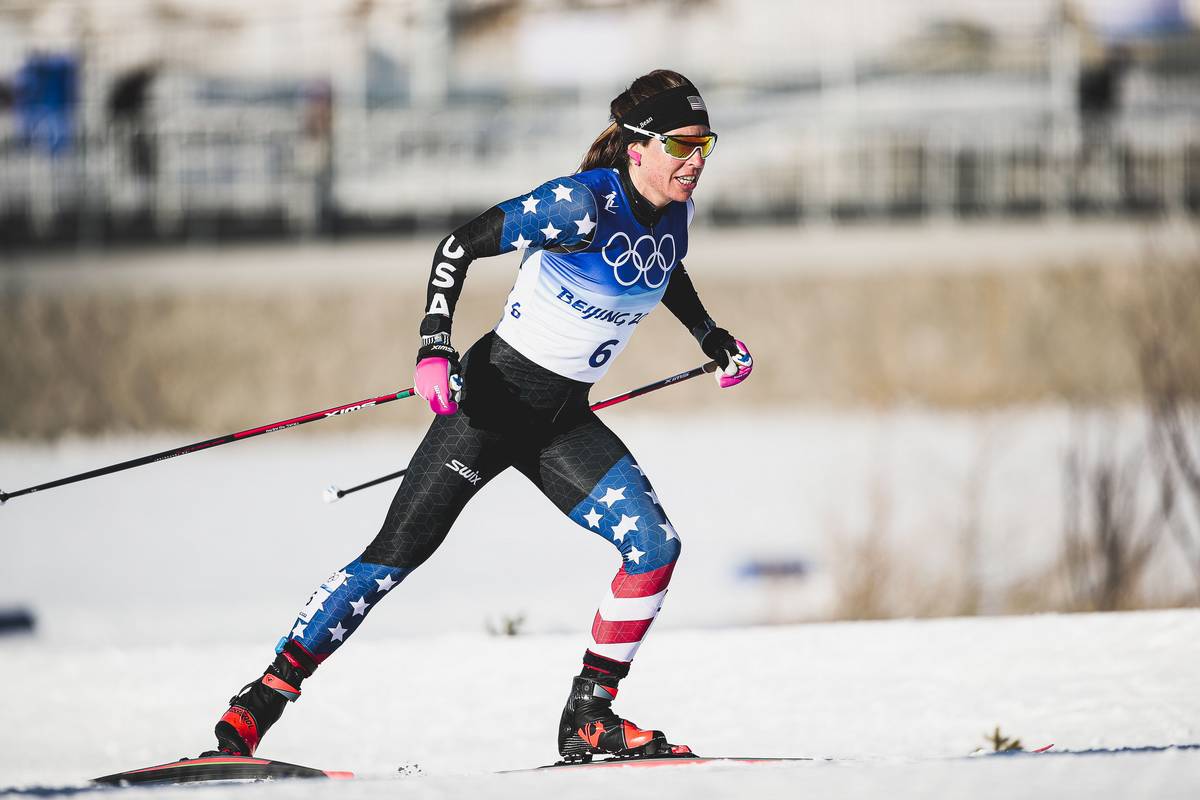
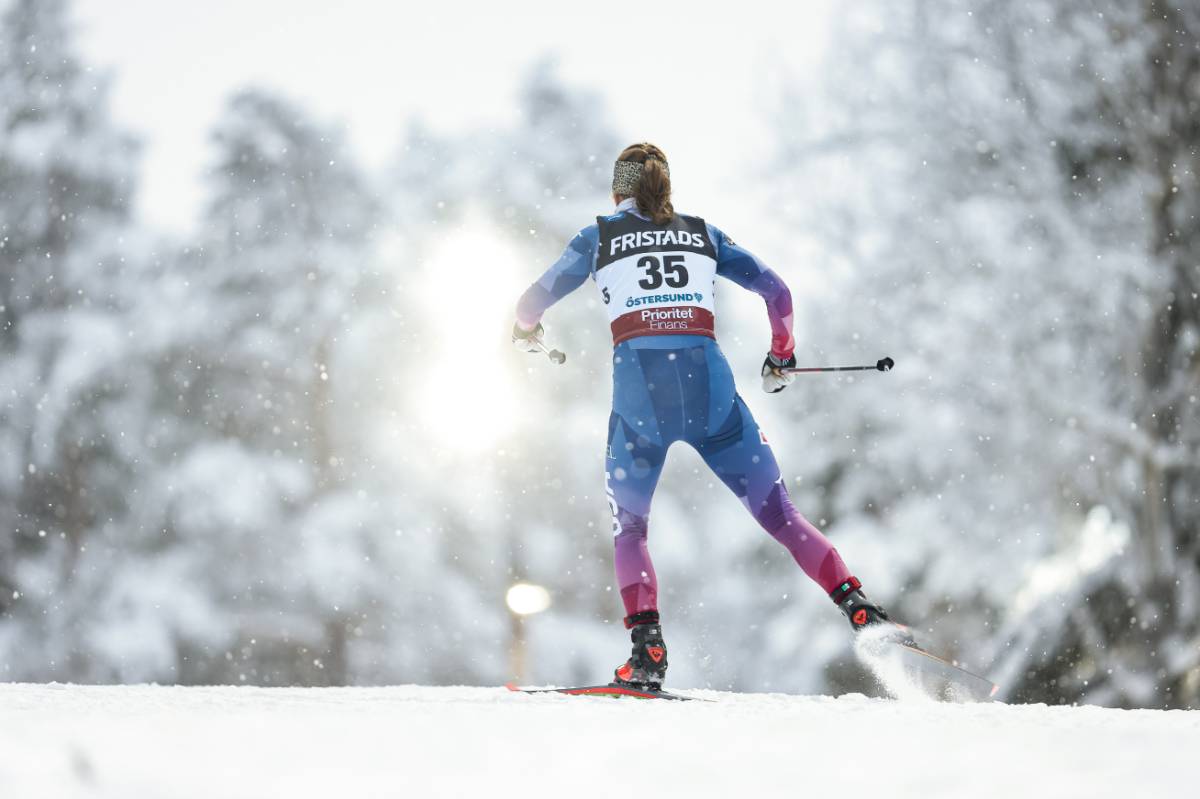
It’s on — the 2026 Olympic season, that is. Devon and Nat break down six season-opening races from northern Finland, including a thriller in Sunday’s men’s race.
Contact us with fan mail, hate mail and everything in between: devon[at]fasterskier.com and nat[at]fasterskier.com. We’re looking for title and other sponsors for our Olympic coverage; email matthew[at]fasterskier.com with inquiries.
This coverage is made possible through the generous support of Marty and Kathy Hall and A Hall Mark of Excellence Award. To learn more about A Hall Mark of Excellence Award, or to learn how you can support FasterSkier’s coverage, please contact info@fasterskier.com.
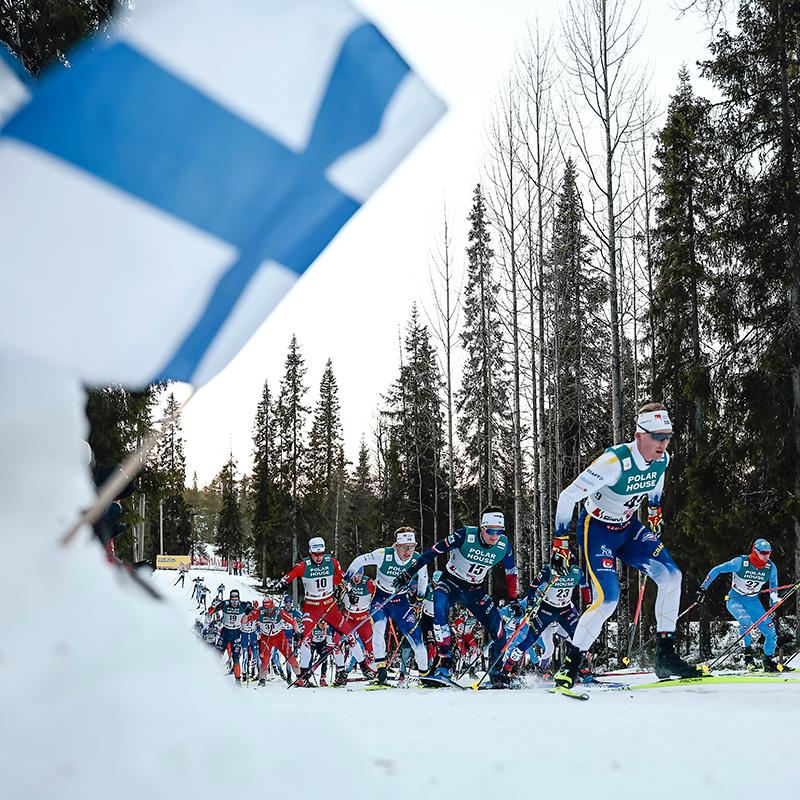
Sunday morning in Ruka had the look of a place holding its breath. The sun sat low over the trees, the air hovered just on the warm side of freezing, and the men’s World Cup field stepped into the stadium with the faint stiffness of athletes who had already skied two challenging races in two days. A thin glaze shone on the 4-kilometer loop, the kind that makes skis feel nervous and alive at the same time, and even before the starter raised his arm, you sensed the day would run fast.
The stadium sits at the high point of the course in Ruka, so the men’s 20km mass-start free begins not with the controlled civility of a long climb but with a plunge. Skiers can hit 80 kilometers an hour on the opening descent, the field funneled into two uneasy lanes, and the whole pack—Johannes Høsflot Klæbo included, wearing the yellow bib and chasing the mythical 100th World Cup win—had to thread that speed through a hairpin that felt too tight for comfort even on TV.
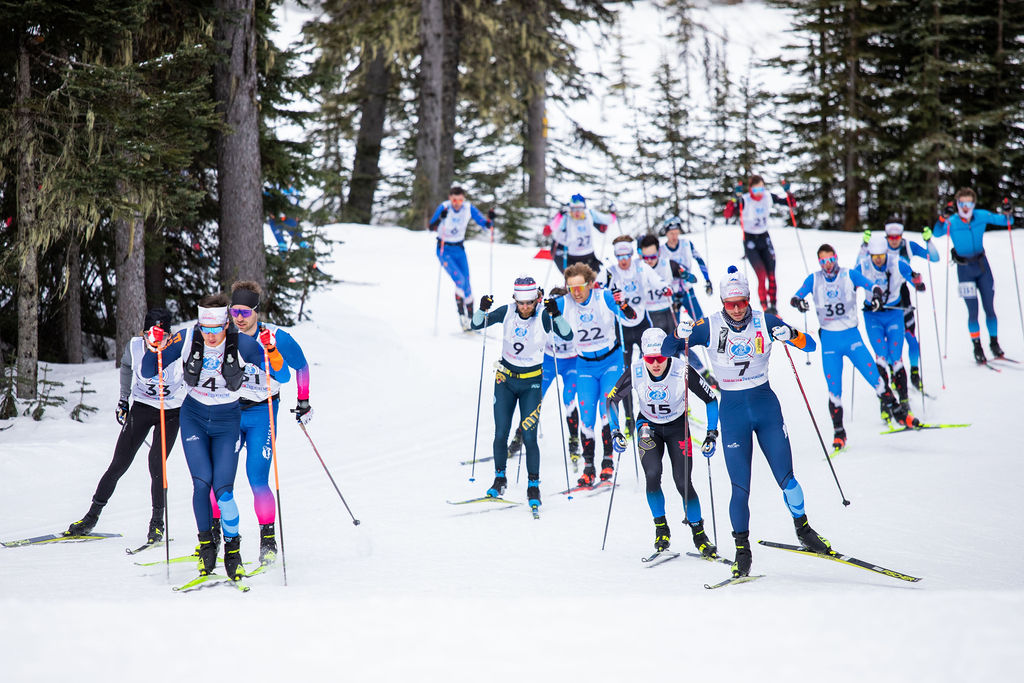
Harald Oestberg Amundsen (NOR) finds his way through the traffic of the Men’s 20 k Freestyle mass start in Ruka (FIN). (Photo: Modica/NordicFocus)
Ruka is an odd, angular loop: long, steady work on the one side; a shorter, punchier grind up the Impilinna climb; then a sweeping dive back toward the stadium before the last drag to the line. Five laps. One early-season opportunity to reshape the winter. And an Olympic year, which meant that every Norwegian on the line was skiing for more than points—they were skiing for selection.
Among the Americans, the storylines were as varied as their bibs: Gus Schumacher and Zanden McMullen seeking another elite result after their success in Ruka a year ago, Zak Ketterson racing with newfound confidence after a career-best 14th in Friday’s classic 10 K, and a young supporting cast learning the dynamics of a fast, narrow pack on a tricky course.
Nothing broke early. The first lap was quick but calm, a kind of rolling truce among athletes who knew how violent the final lap could become. But the race’s character changed—the way good races do—at the unexpected moment.
Mika Vermeulen (AUT) leads Edvin Anger (SWE) through the stadium. (Photo: Modica/NordicFocus)
The Gamble at 9.1km
At the 9.1km sprint banner, Sweden’s Edvin Anger made the first real incision in the race. The 23-year-old surged for bonus points—as expected—but then did something far more interesting: he kept going. Mika Vermeulen of Austria latched on, the two of them taking the descent like they meant it, and for the first time all day, the pack blinked.
Within a kilometer, the gap was three seconds. Then seven. Then ten. The move was reminiscent of the early break in a bike race. The French and Germans led the chase instead of Norway. Hugo Lapalus briefly tried to bridge and cracked. The Norwegians refused to panic.
Behind the break, Schumacher and Ketterson were having very different but equally impressive races. Schumacher hovered between fourth and eighth through the middle laps, completely comfortable in traffic. Ketterson floated near the top ten, choosing clean lanes, maintaining position with a calm that looked like something new.
Further back, Einar Hedegart—the 23-year-old biathlete-turned-cross-country-skier whose win at the Norwegian opener in Beitostølen had already rattled some assumptions inside Norway’s Olympic selection system—drifted quietly toward the front.
By 13 kilometers, Anger and Vermeulen’s advantage peaked at roughly 13 seconds. It wasn’t supposed to hold. But it looked real. And it was enough to force the race’s next twist.
Einar Hedegart (NOR), follows Johannes Hoesflot Klaebo (NOR) through the stadium. (Photo: Modica/NordicFocus.)
The Turn, the Crash, and the Broken Ski
Gus Schumacher’s day changed off-camera.
“The race was going super well,” Schumacher said after the finish. “It felt relatively easy; my body was super responsive with great energy. I was able to keep really good position, which is massive in this race.”
Then came the downhill at roughly 14km, the kind of section where pack dynamics feel like a living organism.
“I was gliding up on the left side, and Klæbo switched lanes right in front of me, sweeping my tips out. It was too quick and unpredictable for me to do anything,” Schumacher said. “I fell off the side of the trail, my ski ran into the hard snow on the edge, and it broke the tip.”
He skied another full lap on the damaged ski.
In the hard, fast conditions, it was just stable enough to keep him in touch—and switching skis would almost certainly have meant losing the group entirely. Remarkably, even with the partial break, Schumacher clawed back toward the front, positioning himself to sprint for a top spot.
And then the bad luck doubled.
“In the last kilometers, it got stuck in the deep snow of the test track and broke the tip fully, and that was the end.”
He finished 39th, but the skiing he showed before the equipment failure will matter more than the result does.
“I’m super proud of how I was skiing… My body is in a great place, but this weekend’s luck just hasn’t gone my way. Long season ahead.”
Andrew Musgrave (GBR) and Einar Hedegart (NOR), (l-r) during the final race of the weekend in Ruka (FIN). (Photo: Modica/NordicFocus)
The Pole Break, the Surge, and the Catch
At ~16 kilometers, Harald Oestberg Amundsen—already a pre-race favorite—snapped a pole.
It could have been the story. Instead, it became the turning point.
Service handed him a new pole instantly. Amundsen slotted back in, glanced up the trail, and began to close the gap. Hedegart came with him. Nyenget followed. The chase, which had felt half-committed earlier, finally had purpose.
With Anger and Vermeulen still dangling up the trail and the course running out of time, Amundsen moved to the front and began applying real pressure. The gap shrank visibly on the Valkosenvaara climb. By the time the race wound back toward the stadium, the two leaders were in sight, the rope fraying.
What came next was pure Amundsen.
He caught the break on the final climb. And then he kept going.
Gus Schumacher (USA), (NOR), Johannes Hoesflot Klaebo (NOR), Zak Ketterson (USA), Harald Oestberg Amundsen (NOR), and Einar Hedegart (NOR) among others climbing up the final climb of the lap in Ruka, Finland. (Photo: Modica/NordicFocus)
The Ruka Climb and the Decisive Moment
With roughly 500 meters left—just before the crest of the Ruka climb—Amundsen stepped out from the group and launched his move. It wasn’t desperate or chaotic; it was clean, timed, andconfident. Hedegart tried to respond. Nyenget tried. Anger fought with everything left.
Nobody matched him.
Amundsen crested alone, floated through the final meters, and took his 11th career World Cup win with the kind of clarity that defines a season.
In an on-air broadcast interview after the finish, he explained the day as a study in patience and timing:
“The conditions were so high-speed that I was quite nervous on the downhills,” he said. “On the first four laps I was pretty far behind and struggling to move up, but I had saved some energy. On the last lap, I felt very strong.
When they got the gap at the beginning, I was quite far behind, so I just had to wait. But on the last lap, I thought, you can’t just let this go, so I put everything in and caught them on the last uphill… I had good legs today.”
Behind him, Hedegart—just one year removed from biathlon—finished a remarkable second. Anger earned third after animating the race with the early breakaway. Nyenget was fourth; Vermeulen fifth.
And Klæbo, in a rare off-day, was 15th.
Zak Ketterson (USA), and Friedrich Moch (GER), (l-r) lapping through the stadium during the Men’s 20 k Mass Start Freestyle in Ruka (FIN). (Photo: Modica/NordicFocus)
An American Breakthrough
Zak Ketterson recorded the best American result of the day—ninth place, the first top-10 of his World Cup career in a mass start—and the performance looked more like the product of design than circumstance.
Ketterson entered the day already benefiting from Friday’s career-best 14th in the 10 k classic, which earned him a forward bib placement on a course where position matters as much as fitness.
“I was fortunate to start really far up in the pack because of my performance in the 10 k, and that was huge in such a tight and tactical field,” Ketterson said. “I knew if I moved too far back, it’d be really hard to move back up, so I planned to defend my position as well as I could.”
He executed the plan with the kind of composure that has eluded him in past mass starts. On a slick, tense course where one mistake could cost half the field, Ketterson held clean lanes, avoided every significant disturbance, and stayed in the top 10–15 as the race stretched into the final lap.
What’s emerging this season is not just fitness, but a foundation built well before Ruka.
“This summer and fall, especially, my wife Julie and I went all in on trying to prepare as well as possible for this year,” he said. “I worked harder than I ever have and also have had a really good mindset. That it’s working so well so far is a big testament to all the hard work, and my wife Julie should get a lot of credit for being my number one support staff.”
The strongest signal of progress came in the final kilometer, when the real attrition began, and Ketterson didn’t fade—he held and even advanced.
“It meant a lot to be able to have a strong finish because, as I said earlier, I often would finish these types of races and move backwards in the pack,” he said. “I think the fact that I was able to relax so much of the race made it so that I had that energy that was necessary when the pace picked up. I am really proud of how calm I stayed, even though the race was so tight, and the conditions were super sketchy, icy, and fast.”
For a U.S. men’s program that continues to build depth quietly, Ketterson’s weekend—14th + 9th—marks a meaningful step. It also gives the team, and head coach Matt Whitcomb, a new data point as Olympic-year relay and selection conversations begin.
Einar Hedegart (NOR) celebrates the victory in Ruka (FIN). (Photo: Modica/NordicFocus)
What This Race Means
For Norway: The selection picture grows even more impossibly crowded. Amundsen is in towering early-season form. Hedegart is no longer a curiosity—he’s a factor. Nyenget remains brutally consistent. Klæbo is still the biggest star in the sport, but his chase for World Cup win No. 100 will now continue into Trondheim.
For the rising generation: Three of the top six—Anger, Hedegart, Desloges—are 23 or younger. The youth wave is no longer a subplot; it’s the plot.
For the Americans: Ketterson’s top-10 creates new conversations about relays and the Olympics. Schumacher’s form before the crash suggests he’s ready for significant results as soon as his luck stabilizes.
For the sport: A genuine breakaway, a serious chase, a late-lap catch, a pole break, a ski break, and a new podium—all in one race.
Ruka is supposed to be the season’s prologue. This one felt like chapter one.
Einar Hedegart (NOR), Harald Oestberg Amundsen (NOR), Edvin Anger (SWE), (l-r) share the podium of the Men’s 20 k Freestyle Mass Start in Ruka, Finland. (Photo: Modica/NordicFocus)
Love Stories Like This? Help Keep Them Coming.
Feature interviews like this one take time, access, and care to produce. If you value thoughtful storytelling and independent ski journalism, please consider becoming a Voluntary Subscriber. Your support directly fuels the work we do to cover the people, places, and moments that make our sport special.
This coverage is made possible through the generous support of Marty and Kathy Hall and A Hall Mark of Excellence Award. To learn more about A Hall Mark of Excellence Award, or to learn how you can support FasterSkier’s coverage, please contact info@fasterskier.com.
Okay, who else didn’t sleep last night? It felt like waiting for Santa Claus on Christmas Eve — that fizzy, restless anticipation you can’t shake, even as an adult who should know better. Part of it was simply the joy of finally watching World Cup racing again after eight long months. But more than that, this morning in Ruka felt like the beginning of something bigger: the start of the Olympic year, the opening chapter of a season that will define so many careers, answer so many questions, and launch a web of storylines that will stretch from today all the way to Milano-Cortina.
This year, the stakes are different. For veterans, it’s legacy. For rising athletes, it’s opportunity. For everyone, it’s a race against time.
And for those of us who follow this sport as if it were a second bloodstream, the first race in Ruka is the moment winter starts breathing again.
Frida Karlsson (SWE) poses with Mr. and Mrs. Claus following the 10k Classic in Ruka (FIN). (Photo: Modica/NordicFocus)
Before the Gun: What Was at Stake
Even before the racers hit the snow, there were subplots everywhere.
Norway opened the season in a moment of transition. Therese Johaug — retired again and pregnant with her second child — leaves a vacuum on the women’s team that hasn’t existed in over a decade. Who leads now? Is Heidi Weng’s late-career renaissance real? Is this the year Norway’s depth must finally be enough?
Sweden, meanwhile, enters the Olympic season with the most complete women’s distance squad on earth. Their classic technique is crisp, balanced, efficient — a signature advantage on days like this.
Finland carries the emotional core of the weekend. Krista Pärmäkoski, racing her final season, took her last opening-day start in Ruka on home snow. Kerttu Niskanen, always a threat in classic, lined up ready to test herself in front of the home crowd.
And for the United States, the arcs were wide-ranging:
Jessie Diggins begins the final season of her career.
Rosie Brennan enters winter in deeply untraditional circumstances after an Epstein-Barr reactivation.
Julia Kern arrives healthier and steadier than in years.
Sophia Laukli brings a redesigned training life out of Norway.
And three additional American women (Kate Oldham, Kendall Kramer, and Alayna Sonnesyn) who begin the short, intense race for Olympic qualification.
Alayna Sonnesyn (USA) lunges for the line at the end of the 10k Classic in Ruka (FIN). (Photo: Modica/NordicFocus)
A Day Shaped Before It Started: New Snow, Glazing Tracks, and Wax Tech Calculus
Ruka had been bitterly cold in recent weeks — until a foot of new snow fell and temperatures climbed toward freezing. The result was a wax technician’s nightmare: soft snow in the shade, glazing climbs in the sun, and a classic course twisting through varying microclimates.
Kick wax that worked at the start failed on the climbs. Skis that kicked well on the climbs dragged on the flats. Double-pole sections demanded freedom; the final climbs demanded grip. There was no perfect answer — only compromise and risk.
This race was always going to reward the skiers with the best technical balance and the wax techs bold enough to choose the right kind of “wrong.”
Moa Ilar (SWE) charges down the finishing stretch at the end of the 10k Classic in Ruka (FIN). (Photo: Modica/NordicFocus)
The Race: Karlsson Sets the Standard, Weng Returns, Ilar Rises, Diggins Surges
1.1 km — Jessie Diggins Takes the First Lead of the Season
From the moment the race began, the tone was unmistakable.
With bib #1 Julie Bjervig Drivenes setting the baseline, Jessie Diggins blasted through the first checkpoint with the early lead — 1.3 seconds ahead of Frida Karlsson.
It was classic Diggins: joyful, aggressive, fearless.
3.3 km — Karlsson’s Stride Takes Control
By 3.3 km, the race reshaped itself. Frida Karlsson, with her strong hip stability and long, economical stride, surged into the lead on the climbing sections. Diggins, whose double-poling and downhill flow looked excellent, lost time on the steepest pitches and slid to seventh.
Behind Karlsson, Sweden formed a front of precision:
Moa Ilar at +3.0
Ebba Andersson at +5.1
Three Swedes in the top three splits.
A message, delivered early.
6.1 km — Heidi Weng Charges Back Into the Story
Heidi Weng, skiing 30 seconds behind Diggins, mounted the late charge of the day. She began cutting into Karlsson’s lead — from 14 seconds at 6.1 km to only 10.5 by the line.
After several up-and-down years, Weng signaled something unmistakable: she’s not done yet.
Final Kilometers — Diggins Closes Hard, Ilar and Andersson Duel, Fosnæs Threatens
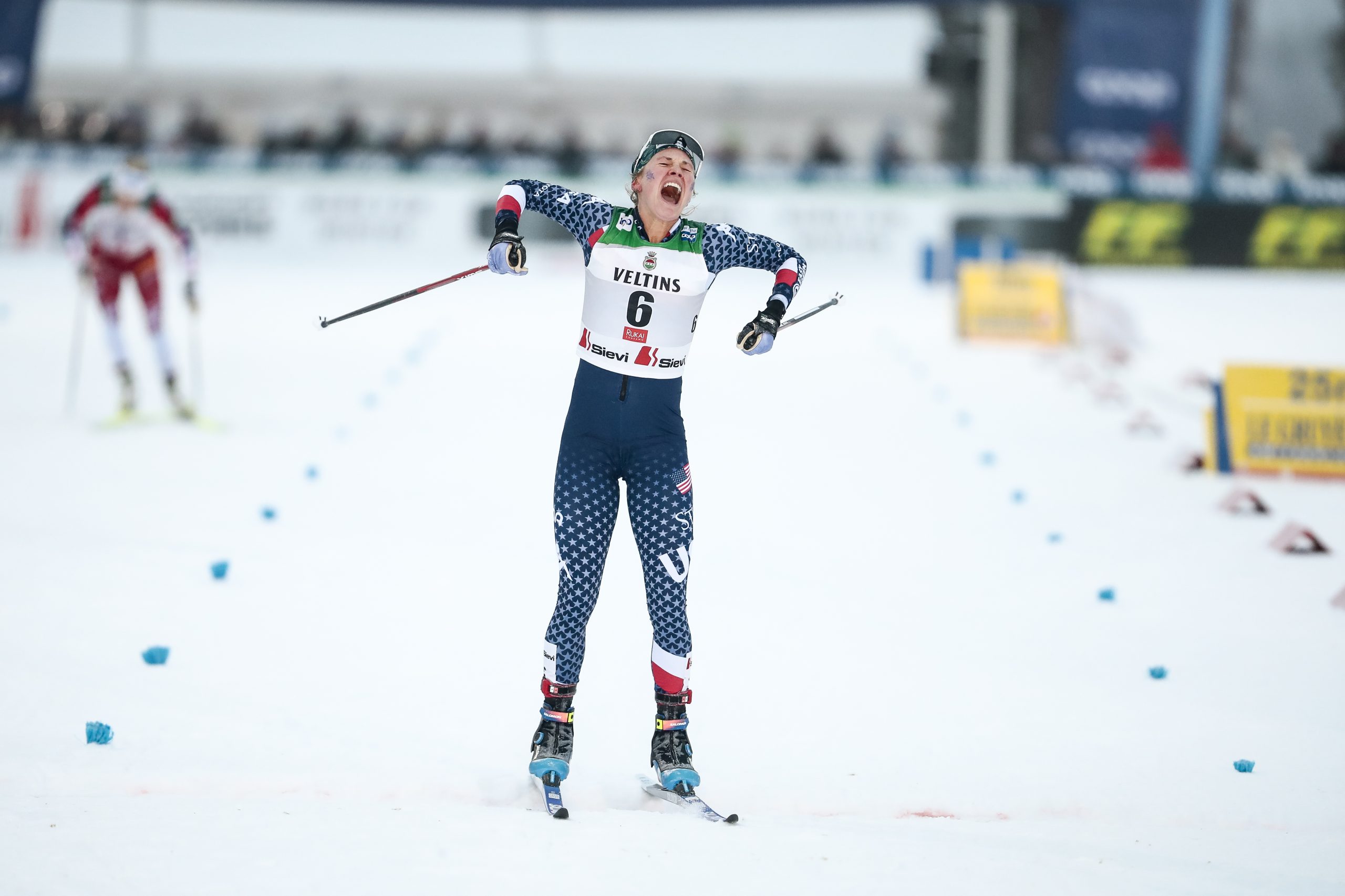
Jessie Diggins mounted her own push on the flats and downhills, gaining time between 6.1 and 8.1 km. She crossed the line in a time that held the top spot until the final seeded skiers, ultimately placing fifth — one of her strongest classic results ever on this course.
Moa Ilar executed a poised final push, taking third and bumping Andersson to fourth. Kristin Austgulen Fosnæs threatened Diggins’ time but ultimately finished behind her in sixth.
Jessie Diggins (USA) was all smiles after the 10k Classic in Ruka (FIN). (Photo: Modica/NordicFocus)
Jessie Diggins: Racing the First Day of Her Last Season
As Diggins enters the last year of her storied career, her goals have nothing to do with podiums.
“My goals are really not about race results at all,” she said. “My goals for the season are to be happy and healthy and just in the present moment… just really soaking in the moment and the feeling of, like, wow, I get to do this.”
She brought that joy directly into today’s start.
“I just wanted to go hard and use this race to get the season started.”
And yet, the question remains: when Diggins puts on a bib, does instinct overtake the plan?
“I do like to push myself to the max whenever I race — maybe not 100% where I’m scraped off the snow, but really darn close,” she said.
“It’s part of my training plan with Cork — we use early season races to build sharpness.”
On a tricky waxing day, Diggins was clear-eyed about the team effort.
“I was really happy with my skis… a great mix of just enough kick but also really free. We needed the skis to be fast in the double-poling, and knowing I was going to herringbone the climbs anyway, we went for that in-between.”
For Diggins, this wasn’t just a top-five finish. It was a signal: the last season of her career may feature some of her best classic skiing.
Rosie Brennan (USA) with her signature long stride during the 10k Classic in Ruka (FIN). (Photo: Modica/NordicFocus)
Rosie Brennan: “This Is Uncharted Territory”
Rosie Brennan entered the winter with one of the most unconventional lead-ups of her career — a necessity after an Epstein-Barr reactivation forced her into weeks of “micro-intervals” and tightly controlled volume.
Her return to full-distance racing revealed both progress and uncertainty.
“If I’m honest, I had a little higher expectations for myself today, so I’m feeling a bit mixed about it,” she said.
“There were some moments of skiing I was really happy with and some that left me wanting more.”
The hardest part, she explained, has been adapting to Europe — travel, fatigue, recovery — with a body that no longer responds as it used to.
“It’s been a really hard adaptation to Europe with a body that isn’t as resilient as I’m accustomed to… this is uncharted territory for me, and I just don’t know what will happen.”
Still, she holds hope — and patience.
“I have to keep trying and experimenting and figure out what will work for me this winter. I’m sure there will be a lot of ups and downs in the process.”
For Brennan, today wasn’t a verdict — it was the next step in a complicated, courageous return.
Ebba Andersson (SWE), Julia Kern (USA), (l-r) push up the climb in Ruka (FIN). (Photo: Modica/NordicFocus)
Julia Kern: A Personal Best Hidden Behind the Result Sheet
Julia Kern’s final ranking might not have turned heads on the results page, but the performance meant far more than the number beside her name. For Kern — often a slow starter in Ruka — today marked meaningful progress.
“Actually, I’m proud of my race today,” she said. “If you just look at the result… You would think I’d be quite dissatisfied, but this was a personal best for me in the opening Ruka 10km.”
The opener in Ruka has long been one of the toughest venues for her, a course whose steep climbs, cold temps, and early-season timing rarely align with her strengths.
“This was my eighth time doing this race, and the result has never been great or representative of other races later in the season,” Kern explained. “I was proud of having moments out there where I skied with good technique, and my body had good energy.”
Her long-term confidence remains intact — today was a step, not a verdict.
“Of course, I want to climb higher in the results list, but my result today doesn’t worry me,” she said. “I use this race to race myself into shape and wake up the body for the sprint tomorrow and the rest of the season.”
Like many in the field, she dealt with some of the day’s most fickle challenges: a mix of new snow, fog, drizzle, and instant glazing that made finding kick nearly impossible.
“It was on and off snowing/light fog or drizzle… a classic Ruka day where the tracks seem to glaze in an instant,” she said. “The glaze made it really challenging to kick from the start, and even harder in the second lap.”
But where the climbs demanded compromises, the flats rewarded her strengths.
“Otherwise the conditions felt fast on the downs and flats,” Kern added, “and I felt strong on the flatter terrain today.”
Kern leaves day one not discouraged, but energized — a skier who knows this course never tells the whole story and who trusts what today’s moments of good skiing suggest about what’s ahead.
Heidi Weng (NOR), Frida Karlsson (SWE), Moa Ilar (SWE), (l-r) share the podium of the 10k Classic in Ruka (FIN). (Photo: Modica/NordicFocus)
The Podium: Sweden Opens the Olympic Year With Authority
The final standings reflected both power and depth:
Frida Karlsson (SWE) 23:31.8
Heidi Weng (NOR) +10.5
Moa Ilar (SWE) +18.3
Ebba Andersson (SWE) +21.2
Jessie Diggins (USA) +27.6
Kristin Austgulen Fosnæs (NOR) 37.2
Sweden finished with three in the top four. Karlsson earned her 16th career victory; Weng her 139th career podium; Ilar her 9th.
On the Finnish side, Krista Pärmäkoski delivered a valiant final Ruka classic performance. Kerttu Niskanen, traditionally a force here, struggled to find her usual early-season spark.
And for the Americans, the opener delivered clarity: Diggins strong, Brennan resilient, the younger athletes gaining essential early-season data for Olympic qualification.
The 10k Classic podium with Heidi Weng (NOR), Frida Karlsson (SWE), Moa Ilar (SWE), (l-r) in Ruka (FIN). (Photo: Modica/NordicFocus)
What It All Means
Today’s 10k classic didn’t answer every question — but it answered enough to shape the early contours of an Olympic year:
Sweden has the momentum.
Norway has a leader again.
Finland is beginning a farewell tour.
The U.S. has real reasons for belief — and real reasons for patience.
The waxing cabins will decide as much as the athletes.
The Olympic shadow looms over every split, every selection, every training day.
And for those of us lying awake the night before the opener, waiting for winter like children waiting for Christmas — the season is here again.
It begins in Ruka, with a direct path to the Olympics in Italy, and ends in Lake Placid.
Feature interviews like this one take time, access, and care to produce. If you value thoughtful storytelling and independent ski journalism, please consider becoming a Voluntary Subscriber. Your support directly fuels the work we do to cover the people, places, and moments that make our sport special.
Frida Karlsson (SWE) looked pretty comfortable in the reindeer pelt-covered leaders chair following the 10k Classic in Ruka (FIN). (Photo: Modica/NordicFocus)
This coverage is made possible through the generous support of Marty and Kathy Hall and A Hall Mark of Excellence Award. To learn more about A Hall Mark of Excellence Award, or to learn how you can support FasterSkier’s coverage, please contact info@fasterskier.com.
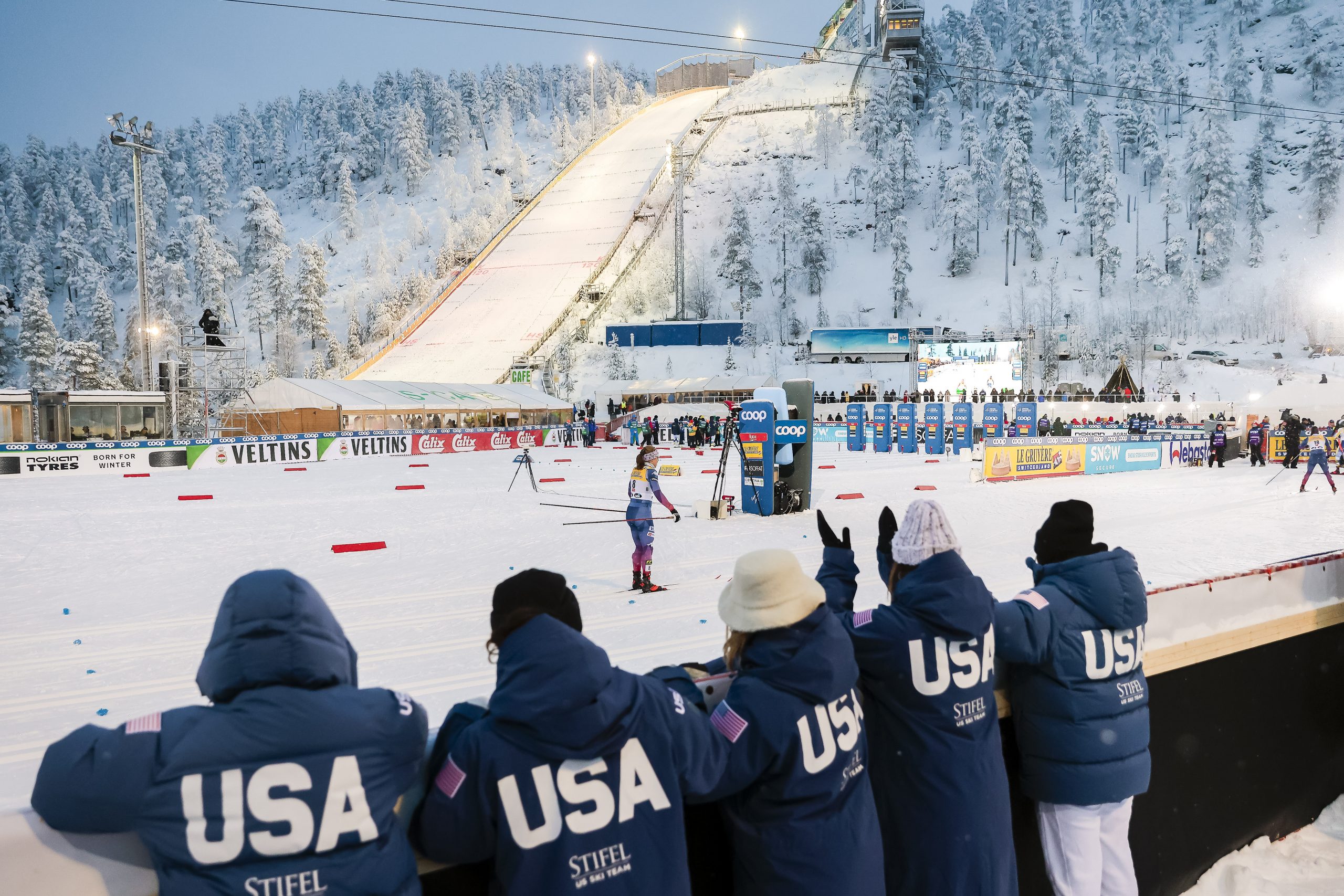
Aerial view of Ruka (FIN) this morning, with the start of the World Cup season less than a day away. (Photo: Modica/NordicFocus)
For six hours on Tuesday, the U.S. Cross-Country Ski Team watched Finland scroll past the windows of a northbound bus, the day’s thin slice of sunlight slanting low across the snow. The sun in late November never rises entirely above the horizon there—”maybe ten degrees,” Matt Whitcomb noted—and so the world outside was washed in a pastel light that never quite felt like midday. In that part of the Arctic, sunrise and sunset are effectively the same event.
That is the moment Whitcomb pays attention to every year.
“As it sets, as you’re driving in those first two hours of the bus ride,” he said, “it sort of feels like it’s the official close of the preparation season.” The athletes may have left Muonio only hours earlier, but that sunset marks a boundary: everything before is training; everything after is racing. “That’s it,” he said. “The prep season’s over. It’s time to race now.”
The bus carried all seventeen athletes—nine men and eight women—each holding a different version of readiness. Some were energized, some were still finding their legs, some were quietly anxious. An Olympic season magnifies everything. For veterans, this opener in Ruka is familiar and charged; for athletes on the bubble, the weekend marks the start of a two-month test whose outcomes will determine whether they get to ski in Italy in February.
But for one last window of time, before the waxing trucks and the bib pickup and the official training, the whole team was suspended in this Arctic twilight. It is a soft entry into what quickly becomes a hard world.
When the bus crested the final kilometers into Ruka, the athletes looked out the left side toward the hill that dominates the course—a climb they will race up and over repeatedly in the coming days. “Every year,” Whitcomb said, “that road goes right up the largest hill on the course… your first trip up that is in the bus.” The hill glowed under floodlights. Below it, the village looked like it had been placed inside a glass ornament. “It’s lit up like a snow globe around here.”
By the time the athletes stepped off the bus and into the cold, the World Cup season had begun.
Jessie Diggins (USA) was able to find another gear at the finish which no one could match to take victory in Ruka a year ago in the Mass Start. (Photo: NordicFocus)
What They Carry From Muonio
A week earlier, the team was skiing through air so cold it could freeze eyelashes. Muonio is remote even by Finnish standards, a strip of trails and cabins surrounded by deep quiet. The temperatures dropped to –5°F for the high and –10°F for the low, and the athletes masked up, moving carefully to avoid frozen lungs. No one did intensity that day; even the coaches agreed the cost wasn’t worth the risk.
And yet the camp was a success.
“It was right on the edge of being too cold,” Whitcomb said, “but we made it work. And nobody has residual coughing, so I think that’s the tangible indicator that we didn’t push too hard.”
More importantly, Muonio was calm this year. There were no lingering illnesses, no cascade of early-season injury setbacks. “This year has been a better year with regard to preparation,” he said. “We’ve had fewer long-term illnesses, fewer acute injuries.” In an Olympic season, where every missed week feels like a month, that is no small thing.
Muonio is the last place where the athletes can simply train, ski, nap, andrepeat. Once they arrive in Ruka, the season accelerates in a way no one can fully control.
Zanden Mcmullen (USA) coming to the line in Ruka in 2024. (Photo: Thibaut/NordicFocus.)
Ruka’s Glow and Ruka’s Pressure
Ruka is where the World Cup hardens into its proper form. The quiet trails of Muonio are replaced by a carnival of nations: wax trucks pulled side by side, technicians moving in practiced circuits, athletes from every powerhouse country striding around the stadium. For all teams, the opener reveals the truth of the summer: whose fitness is real, whose technique held up, whose body needs another two weeks before coming online.
“The moment we arrived here in Ruka,” Whitcomb said, “you start to see the waxing vehicles from other nations… the reality of it hits, and you could feel butterflies sort of emerge as a team.” Even the veterans feel it. “Munio last week was all about recovering from jet lag… and you arrive here, and it’s like: official training, then race, race, race. It’s go time now.”
He emphasized that the stress is not negative. Stress, in his framing, is a sign that something meaningful is at hand. “It’s indicative of the privileged environment that we live in,” he said. “We’re doing something important, something these athletes work really hard for, and something that they’re ready for—and that’s why they feel stressed.”
In an Olympic year, there is no such thing as a low-pressure opener.
The U.S. team looks on in Ruka in 2023. (Photo: NordicFocus)
The Team Within the Team
The most striking thing about this group, Whitcomb said, is not its athletic potential—though several athletes are carrying top-10 ambitions into the weekend. It’s the internal energy.
“It feels as supportive a team as I think we’ve ever had,” he said. “Not better, but certainly as good as any team we’ve ever had.” A year ago, he described a similar feeling, but something about the last month apart has deepened it. “They just vibe together,” he said. “They’ve really missed each other.”
From outside, the U.S. team can look like a logistical patchwork—athletes based in Vermont, Alaska, Idaho, Colorado, Norway; college skiers who drop in and out; development athletes rotating through Europe. But when they’re together, Whitcomb believes the culture gives them a competitive advantage.
“One of the privileges our nation has,” he said, “is that we are not as competitive as Norway is.” He doesn’t mean competitive in results—he means internally. In Norway, a single race in Beitostølen can determine whether an athlete gets a World Cup start or disappears back into domestic anonymity. “Literally that one race… has a lot of say in whether your winter is going to be successful,” he said.
In the U.S., the pressure comes from the Olympics, not from your teammates. “A positive team vibe really does some work for you,” he said. It prevents the “little stresses”—the ones that accumulate in toxic environments—from becoming overwhelming in an Olympic year.
“When the only stress you have to worry about is the silly one that is racing,” he said, “you can overcome that.”
Jessie Diggins (USA) keeping it light with her coach, Jason Cork. (Photo: NordicFocus)
Olympic Stakes, Explained Clearly for Once
For athletes and coaches, the rules of Olympic selection are a map that everyone has memorized; for the public, they are a maze. Whitcomb walked through the system with the clarity of someone who helped write it.
There are three primary pathways:
1. Top-8 in an Olympic event on the World Cup
If an athlete finishes top-8—but only in a race that exactly matches an Olympic event—they automatically qualify.
Classic sprint in Trondheim? Yes.
20k Skiathlon in Trondheim? Yes.
10k skate in Davos? Yes.
Team sprint? No.
Any race similar but not identical (ie, the 15k Skiathlons)? No.
2. Top-45 on the World Cup ranking list (by Oberhof)
Any athlete inside the top-45 overall (distance or sprint, depending on discipline) meets the selection criteria. They still need a spot available, but their case becomes strong.
3. Discretionary selection
This exists—but is avoided whenever possible.
“To be candid,” Whitcomb said, “that’s a goat auction in itself.”
In an Olympic year, the staff prefers not to touch discretion at all.
Ben Ogden (USA) working on ski selection on Thursday in Ruka (FIN) a year ago. (Photo: NordicFocus)
Roster limits
Right now, the U.S. holds seven men’s spots and eight women’s spots, with a realistic chance of earning an eighth men’s spot. It will not exceed 8 + 8.
Domestic results?
For someone skiing exceptionally well at Senior Nationals to force their way in, there must be vacancies left by athletes who didn’t meet criteria on the World Cup. In most years, Olympic qualification is won or lost by Christmas.
This is why every World Cup start in Period 1 matters. Every 12th place, every quarterfinal, every decent distance day contributes to the math.
But to Whitcomb, that math isn’t the point. It’s how athletes handle pressure that determines whether the season becomes joyful or claustrophobic.
“Meet Your Body Where It Is”
On Thursday night, in the team meeting before the weekend races, Whitcomb planned to give a simple message.
“You start that 10k, and you’re going up the first hill,” he said, “you just meet your body where it is. You do your very best that day.”
He wants the athletes to tune out the noise:
the coaches on the sides of the trail
the athletes they pass
the athletes who pass them
the crowd, the music, the reporting, the points
“You deal with the one vehicle that you’re driving,” he said. “And you try to enjoy it.”
Because fitness today doesn’t predict February.
Because the Olympic Games begin on February 7th, the only date that truly matters.
Because early-season expectations are a trap: some athletes are ready this weekend; others won’t feel themselves fully until the Tour de Ski.
“The human body,” he said, “is a wildly unpredictable thing.”
If there is one truth that governs the first weekend of racing, it is that.
Julia Kern testing her skis with her longtime tech, Eli Brown a year ago. (Photo: NordicFocus)
Why Ruka Still Matters
Still, the weekend is not symbolic. It is competitive, decisive, and formative. Whitcomb believes the team is “positioned well to have a great opener,” but he also knows that Ruka rarely tells the whole story of a winter. The temperatures are often frigid, and the travel is too recent. But it gives athletes one thing they cannot simulate anywhere else: the clarity of racing.
“Early,” he said, “but it can’t come soon enough. We’re really excited.”
Ruka is where the starting gun echoes for the first time, but it’s also where the season’s unseen forces begin working: confidence, doubt, momentum, cohesion, luck, health, andperspective. Many Olympic stories begin here without anyone realizing it until months later.
The First Night in the Snow Globe
By Tuesday evening, the team had unpacked their bags in the small condos near the stadium. By Wednesday, when we spoke, through Whitcomb’s thin door, we could hear athletes talking after dinner—laughing, telling stories, building team chemistry. “You can hear people probably through my door,” he said, because “they’ve really missed each other.”
Outside, the northern lights edged across the sky.
Inside, there were skis to prep, race plans to finalize, nerves to manage.
And in the morning, the first climb of the season would begin at the bottom of that hill they had ridden over on the bus.
There are a few actual rituals in a sport defined by travel and unpredictability. But in the U.S. team’s calendar, the bus ride to Ruka is one of them. It marks the line between the world that was and the one that’s about to begin. Between training and racing. Between imagining and knowing.
The sun had long since set, but the trail lights of Ruka glowed through the fog, warm against the cold.
The World Cup season officially starts tomorrow.
And for the U.S. team—healthy, united, a little nervous, and very ready—there is nothing left to do but ski.
Rosie Brennan (USA) dialing in her skis a year ago. (Photo: Modica/NordicFocus)
10k Interval Start Classic – Women at 4:30 am EST and Men at 7:15 am EST
November 29th:
Classic Sprint – Heats begin at 5:25 am EST
November 30th:
20k Mass Start Freestyle – Men at 4:00 am EST and Women at 5:45 am
Love Stories Like This? Help Keep Them Coming.
Feature interviews like this one take time, access, and care to produce. If you value thoughtful storytelling and independent ski journalism, please consider becoming a Voluntary Subscriber. Your support directly fuels the work we do to cover the people, places, and moments that make our sport special.
On the Wednesday before the World Cup season opens in Ruka, Jack Young sits in a small condo, looking out at over a foot of new snow that’s been drifting down all morning. The air is much warmer today than it was before he and the U.S. Ski Team loaded onto a six-plus hour bus ride yesterday — “Muonio was friggin’ cold,” he says — and the mood is calmer, quieter, the way he wants it. This is his final runway before an Olympic year truly begins, and he is spending it doing almost nothing.
Not nothing-nothing, of course. But nothing extra. No bonus minutes, no filler skis, no threshold for confidence, no volume for psychological reassurance. “The biggest thing right now is taking these two weeks absolutely as seriously as possible with rest and just not doing anything extra training-wise that I do not need to be doing,” he says. “I’m training so little right now because of how important Ruka and Trondheim are for me.”
Growing up in Northern Vermont, Jack Young had an All-American childhood. (Photo: Courtesy Photo)
Outside, the classic sprint course cuts through the forest — the first of two classic sprints in Period 1. They matter—more than they ever have. To make the Olympics, he must qualify. To qualify, he must have transformed himself into something he has never consistently been: a classic sprinter capable of making heats on the hardest stage in the world.
That he is even here, on the cusp of an Olympic selection fight, is strange enough. Stranger still is the way he got here — not built from the standardized American skiing pipeline but stitched together from its edges. A football quarterback. A baseball outfielder. A skier whose parents “didn’t know what Nordic skiing was.” A D3 athlete who reverse-engineered sprint training out of 800-meter track plans and the writings of a Swedish speed skater. A young man who kept such detailed training logs that, by the time he made the World Cup, he could begin writing his own plan.
In a sport that often rewards conformity, Young’s ascent is something close to a jailbreak.
Jack Young as he started his racing for Craftsbury. (Photo: Courtesy Photo)
A Vermont Childhood Without the Usual Skiing Script
“Neither of my parents knew what Nordic skiing was,” he says with a laugh. They loved the outdoors, yes — mountain biking, alpine skiing, the typical northern Vermont mélange of mud, woods, and winter — but their son’s athletic identity formed somewhere else entirely. “I played every sport. I loved baseball. I played basketball through elementary school. I started football as soon as I was allowed to, which I think was in fourth grade.”
He became the kind of athlete rural towns understand intuitively: the quarterback on fall afternoons, the center fielder chasing down balls in the summer dusk, the kid who could pick up anything and find competition in it. Skiing entered sideways, almost accidentally, through his sister Callie. She joined the small Nordic program in Newport, and he was brought along because that’s what families do — pack the car, hand over snacks, make it work.
“I immediately fell in love with racing,” he says. “I just love the competition.” Running around on skis made sense to him. Movement, speed, chaos — he could do that. But even with training days at Craftsbury beginning around sixth grade, he didn’t think of skiing as his primary outlet. “I wasn’t as focused as my sister was, but I would still get dragged along,” he says. “I loved skiing, but I loved football and baseball just as much.”
The irony — one he now sees clearly — is that he was training for skiing without realizing it. “All summer was spent doing fun things in the woods. We’d go to Craftsbury a couple of times per week. But I never thought of skiing as my main sport. I weighted those sports equally, even though I was putting a lot more time into skiing.”
If northern Vermont had offered a travel football club or competitive baseball without days of driving south, the story may have gone a different way. But mountain running and biking were nearby, and elite baseball diamonds were not. “I’d so much rather go for a long run in the mountains or go mountain biking than I would hit on the tee for two hours,” he says.
Sometimes this is what talent looks like in real time: a kid choosing the fun version of hard work without realizing he’s choosing a future.
When we spoke, Jack Young sat in a small condo in Ruka wearing a Boston Red Sox baseball hat, just added evidence for how important the game has been for him since he was a boy. (Photo: Courtesy Photo)
The Late Bloom: A Breakthrough and a Decision
He kept skiing in the winter, of course. Not obsessively. Not in the way some junior skiers live their lives by FIS points before they have a driver’s license. But enough to stay close. Enough to remain good. Then came the summer after his sophomore year of high school — the first time he trained like someone who had decided to see what was possible.
“I put a good summer of training in,” he says. “Had a bad football season… but that was the first time I was really starting to push the limit on what I could do training-wise while in season for football.”
He mountain-biked in races on weekends, squeezed workouts around football practices, and tried to make the whole geometry hold together. Then came Junior Nationals, and with it, proof. “I had a pretty good result in the sprint. I think I was like 18th or something… and that was the moment where I was like, okay. I am decent at least at this sport. I’m doing a lot better than I’ll ever be at baseball.”
That spring, Young emailed coaches — the NESCAC schools, Dartmouth, and UNH. Bowdoin and Dartmouth joined Colby on his shortlist. Colby won on something less quantifiable: belief.
“Tracy [Cote] was very excited about me,” he says. “And I think that resonated with me. Maybe it’s my ego, but it was nice to hear.”
He would later call it “a perfect decision.”
Jack Young enjoying some backcountry skiing in Jay. (Photo: Courtesy Photo)
Colby: Building an Athlete in a Place That Shouldn’t Have Worked
Winters in college can blur into one another — classes, training, snow, the strange mix of exhaustion and euphoria that defines 19-year-old life. But Young remembers his freshman fall with clarity: meeting people, finding balance, doing “good, not great” training, and then, once the season started, traveling west for Senior Nationals.
There, in Soldier Hollow, everything sharpened. “I think I qualified in the top 20 in the skate sprint,” he says. “That was an absolutely massive result for me. I never had anywhere near that level of success on the national level.”
He didn’t transform overnight — not yet. His sophomore season brought a “fine college season,” a top-30 at NCAAs in the 10k skate, and the sense that distance skiing was finally, mercifully making progress. But the turning point came not in results but in imagination. He learned that the U.S. would receive twelve start spots for the Canmore World Cup the following year. Twelve starts. “I was like, 12 starts… that’s not that far off,” he says. “I kind of feel like I’m in contention for that.”
To chase it, he would need to master something specific: the sprint qualifier.
And this is where the story breaks from the template completely.
Jack Young hits some big lactate numbers during a hard training session. (Photo: Courtesy Photo)
Reinventing Sprinting from Scratch
“I’ve always thought that sprint qualifiers were really similar to an 800-meter race on the track,” he says. Physiologically, mechanically, conceptually — they looked more alike than different. So he dug into 800m training. He looked for the extreme version, the distilled essence of what sprinters do when they train specifically for the thing that matters. Qualifiers are discrete. Defined. Precise. Why train them like a generalist?
Then he read Nils van der Poel.
The legendary Swedish speed skater’s manifesto, How to Skate a 10k, isn’t a skiing manual, but to Young, it may as well have been scripture: the idea of building huge aerobic capacity, then sharpening with brutally specific intervals at exact race pace. “He wants to skate as many possible laps at world record pace as possible,” Young says. “And that really struck me. I’m like — I can apply this to skiing.”
He wasn’t going to become a single-event specialist, not in college. But he could take the principle and adapt it. So he built a sprint-qualifier program composed of things like:
6 × 1 minute
4 × 90 seconds
10 × 30 seconds
8 × 45 seconds
All at precisely what he believed to be his sprint qualifier pace.
“That was the bread and butter,” he says. “I’d do those workouts once or twice a week. I didn’t actually find them that strenuous, but I was accumulating a good amount of time at exactly what I thought sprint qualifier pace was.”
He went completely dry that fall — no beer, no casual nights out, nothing that compromised sleep. “I was just recovering a lot better all the time,” he says. “I didn’t get sick at all.”
Meanwhile, Colby head coach Tracy Cote allowed him to blend his ideas into the fall plan. “We were working together. I think we ended up writing the training plan together that fall,” he says. “She was pretty stoked about the focus on recovery… and she’d let me get away with doing things a bit more geared towards sprinting.”
He trained more overall, too — a heavy summer that gave him the resilience to handle so much intensity once fall arrived. “My freshman year, I trained a little under 600. Sophomore year was around 650. My junior year I trained like 750 or something.”
This was not an American development pipeline approach.
It was an experiment.
A smart one.
A successful one.
Jack Young, who a week earlier had a 3rd and 5th place in the EISA college races for Colby College delivered the 11th fastest qualifying time in the freestyle sprint at the Canmore World Cup in 2024. (Photo: Cockney/FasterSkier)
Anchorage, SoHo, Canmore — and the Race That Changed Everything
He targeted Anchorage for his first chance at the Canmore World Cup spot. He knew what he had to do: fly across the country in the early winter, race well, then perform at Senior Nationals in Soldier Hollow. Anchorage was the linchpin.
“I went into Anchorage with a lot of confidence,” he says. “I won that qualifier; it was such a surprise.”
He didn’t replicate the magic at Soldier Hollow — “I think I got like 11th” — but the Anchorage win held. He made the Canmore start list.
And then came the race of his life.
“That’s still my lowest FIS points ever,” he says. “I didn’t match that last year.”
When he crossed the line, something shifted internally. “Once I did that in Canmore… that was the first time I really thought I wanted to keep skiing after college,” he says. “That was the moment I realized how good I thought I could get.”
Call it the ignition point, the place where belief calcified into ambition.
Where a multi-sport kid from a non-skiing family, attending a D3 school, doing self-designed intervals, suddenly saw himself in a World Cup heat map and thought: Yes. Here.
Jack Young training on Eagle Glacier this past summer. (Photo: Courtesy Photo)
Writing His Own Plan on the World Cup
Two years later, he is living in Europe, often for months at a time. He is in his second year of racing full-time on the circuit. He is older, stronger, andmore certain. And he is, in many ways, coaching himself.
“For this time of year, it’s entirely guided by what I’ve done the last two years,” he says. “Which workouts worked in which places, which workouts didn’t… the comments are much more important than the hours.”
He still works closely with Pepa Miloucheva at Craftsbury — “She’s the number one on that” — but when he’s on the World Cup, he is the primary author of his training. He reads his patterns. He analyzes sensations. He looks for the combinations of stress and stimulation that make him feel dangerous on race day.
He isn’t reinventing his body now — he’s listening to it.
The independence he cultivated at Colby has become his competitive advantage.
With the Olympic sprint being in the classical technique, Jack Young (USA) hopes to find the form he has historically shown in freestyle sprinting during the early season World Cup stops. (Photo: Modica/NordicFocus)
The Classic Sprint Problem — and the Olympic Dream
To make the Olympics, the math is simple, even if the execution is brutal.
“The simplest answer is: make a big jump in classic sprinting,” he says. “If I can start qualifying for classic sprints consistently, I have a very clear path to making the Olympics.”
Last year’s results would meet the published criteria — “hypothetically, if I had the exact same season… I would technically make the team,” — but this year is different. The Olympic sprint is classic. Period 1 has two classic sprints and only one skate sprint. Some of the contenders for Olympic spots are stronger in classic than he is.
So the path is narrow: qualify in Ruka. Qualify in Trondheim. Hold form in Davos. Don’t step back. Don’t stagnate.
At the philosophical level, the criteria are simpler still.
“It’s all about execution at this point,” he says. “A good season is continuing with progress I’ve made… scoring more World Cup points than I did last year. Anything else is a step back.”
He knows progress isn’t linear. He knows failure is part of sport. But he also knows what a step backward would feel like. “I’d be lying if I said I could look at this season as successful if I don’t maintain what I’ve been doing in skating and at least make a little bit of progress in classic skiing.”
It is clear-eyed. Unsentimental. The kind of assessment you get from someone who has built his career on self-honesty.
Jack and his sister Callie after winning a slow pitch softball tournament. (Photo: Courtesy Photo)
What It Means to Make It This Way
There’s a certain poetry in the fact that Young’s rise mirrors the very way he races: a precise, deliberate accumulation of moments. Nothing in his career came from the prescribed steps, the standard routes, the familiar trophies of a groomed junior-star life. Instead, his path looks more like a map drawn after the fact — connecting points that didn’t seem aligned until the picture emerged.
A sister’s Craftsbury workouts.
A baseball-heavy early adolescence.
Mountain biking and football collisions.
A D3 program that let him try things.
A manifesto by a Swedish speed skater.
A dry collegiate fall at age 20.
A logbook of sensations.
A day in Canmore.
A belief.
There is no template for this. There never was.
But here he is anyway — on the World Cup, in an Olympic year, taking the biggest swing of his life.
And as he sits in a Ruka apartment, resting more than he ever has before a race that matters more than most, he reflects not on what’s missing from his résumé but on what got him here in the first place: a way of building a skier that is his alone.
Love Stories Like This? Help Keep Them Coming.
Feature interviews like this one take time, access, and care to produce. If you value thoughtful storytelling and independent ski journalism, please consider becoming a Voluntary Subscriber. Your support directly fuels the work we do to cover the people, places, and moments that make our sport special.
On a bright March afternoon at Dartmouth’s Oak Hill, with a soft and slow course under his skis and a band he himself had organized blasting in the stadium above, John Steel Hagenbuch approached the final climb where he learned something that would shape the early years of his career far more than any podium ever could.
He had come into the NCAA Championships with the weight of a thousand private dreams — a home championship crescendo and an entire community behind him. Then, with Utah’s Joe Davies charging to the finish line waving the Utes flag and Peter Graves’ voice echoing through the trees, Hagenbuch realized he was not going to win.
“I got dropped, and it just wasn’t gonna happen,” he says. “I told myself, you’ve got until the top of this hill to be upset about it.”
John Steel Hagenbuch was all smiles after crossing the 20k Freestyle finish in second place at the 2025 NCAA Championship where he represented Dartmouth College on their home course at Oak Hill. (Photo: Courtesy Photo)
What happened next wasn’t the reaction of an athlete who had just been beaten in the race he’d been thinking about, talking about, training for, and dreaming about for three years. It was something quieter. Something older. Something that didn’t look like the scripted champion he’d imagined — but ended up becoming the cornerstone of the athlete he is now.
“I stopped poling,” he says. “And I just kind of skated through the stadium… smiling, waving, like the Penguins of Madagascar — smile and wave.”
He remembers the sunshine, the thousands of people lining the stadium, the Stripers — Dartmouth’s biggest student band, coaxed back from post-graduation life because he wanted the place to feel alive — and the thrum of friends, professors, fraternity brothers, and family in the crowd.
“Did I win the ski race? No. But it actually didn’t matter,” he says. “I was just so grateful… all the amazing things in my life that had led me to that point.”
Every day since, he thinks about that race. “But not for the reasons you’d expect.”
John Steel Hagenbuch (USA) racing the World Cup opener in Ruka (FIN) in 2023. (Photo: Modica/NordicFocus)
Muonio, Finland: The Final Quiet Before the Season Begins
Eight months later, Hagenbuch is sitting in a small room in Muonio, Finland, speaking over a fickle internet connection. Outside, winter is closing in; inside, the early-season nervous energy is beginning to hum.
“It’s been a good way to start the season,” he says of the classic sprint and 10k skate he raced the previous weekend. “Hopefully more to come.”
He will likely stay on the World Cup through the Tour de Ski. His primary goal, stated simply and without ornament, is clear: “Primary goal is to go to the Olympics. Everything else is secondary.”
He’s 24, still at Dartmouth — technically a senior, though he took this fall off to focus on training. When winter term begins on January 7, he’ll be back in class, shifting between World Cups and essays, navigating the dual life of a college student and a professional skier the way only NCAA athletes truly understand.
But he is not rushed. Not impatient. Not gripping the rail of his career with white knuckles.
He learned something on that hill at Oak Hill, something that has become his ballast. “It reminds me why I do this,“ he says. “And why this sport is so special.”
Before he was an NCAA champion, skiing on the World Cup, and a trying to qualify for the Olympics, John Steel Hagenbuch was just a kid who loved skiing around on the trails of Sun Valley, ID. (Photo: Courtesy Photo)
The Long View: Three Olympics and a Full-Moon Ski
Hagenbuch surprises you with the distance of his vision.
When asked about the future, he doesn’t talk only about Milano-Cortina in 2026. He talks about three Olympics — a decade of life sketched out in calm, confident lines.
“I would love to go to the next three Olympics,“ he says. “Milano-Cortina, then the French Alps, and then retire at the Salt Lake City 2034 Games.”
Soldier Hollow, where he has raced “probably 50 times,“ would be the perfect ending. But it’s not the race he imagines most clearly. Not the ceremony. Not the result.
It’s the lead-up.
“What will be the crown jewel of my ski career,“ he says, “is having the 2034 Olympic pre-camp in Sun Valley. At my house. With all the fellows.”
He can picture it already: the team skiing at Prairie Creek under a full moon, crispy tracks at 15 degrees after a sunny day, the quiet of the Sawtooths pressing close.
“That’s what I’m gonna remember when I’m 75,“ he says. “That Prairie Creek ski.”
In this way, Hagenbuch does not think like most 24-year-old athletes. He thinks like someone who has already lost something, already gained something, and has made peace with what remains.
A Training Philosophy Built on Feel (and a Fearless Lack of Overthinking)
In an era where professional endurance athletes run lactate strips daily and analyze heart-rate drift with the devotion of day traders, Hagenbuch stands apart.
“Do you do lactate testing?“ I ask him.
“Maybe like once a year.”
He trains primarily by feel—not just how his body feels, but what he feels like doing: long backcountry days, ridge runs, mountain biking, skiing deep into the mountains around Sun Valley. There is structure, but only when he believes it should exist.
“Not taking it too seriously,“ he says, “and kind of just going by what I would like to do and what I think is going to be fun.”
June and July? “Absolutely not“ analytical. Fall? Yes, that’s when he “locks in a bit.”
And if it ever stops being fun, he says, “I will not stick around.”
He has seen athletes grind themselves into dust out of fear of what’s next. “I respect the grit,“ he says, “but… I’m incredibly grateful to have had experiences and opportunities in my life that that’s not the case for me.”
He isn’t clinging to skiing. He’s choosing it — every day — until it no longer feels right.
That clarity is rare. Maybe even elite.
Being cheered up a climb in Soldier Hollow by one of his SVSEF coaches, Rick Kapala, John Steel Hagenbuch proves athletes like him aren’t built by themselves or through the guidance of one coach, they are lifted by a community. (Photo: Tryg Solberg/Courtesy Photo)
The Consortium: Osgood, Whitcomb, Kapala, and Holmes
Though he trains by feel, he is not without guidance. His coaching structure is more like a board of advisors — four voices, each offering a different vantage point.
“I talk with Brayton at Dartmouth, and Matt on the U.S. team, and Rick — my high school coach — and Peter Holmes on the Gold Team,“ he says. “I get input from all of those guys.”
When deciding to come to Muonio early, he called all four. Not for permission — for perspective.
“When I’m at Dartmouth, I do Brayton’s plan,“ he says. “But if I feel like I need to do something different, he’s totally cool with that.”
And contrary to what a young elite athlete might hope to hear, most of what they tell him is not “do more.“
“Oftentimes,“ he says, “it’s settled down.”
Dartmouth College’s John Steel Hagenbuch skied to a 15-second victory on his home trails in the 7.5 k Classic at the NCAA Championship. (Photo: Tobias Albrigtsen)
The Place That Built Him
If you want to understand why Hagenbuch thinks the way he does — why gratitude flows so naturally through him, and why he measures life through moments rather than medals — you have to understand Dartmouth.
“NCAA skiing is a really special thing,“ he says. “People are going to roll their eyes… but there aren’t a lot of places that have the components Dartmouth has.”
The social component is not a distraction — it’s a pillar. “Last year, every single guy on the team was in a fraternity,“ he says. “Different fraternities.”
He explains the structure: students join Greek life in their sophomore year, after they’ve already found their people, their communities, their balance.
“Everything acts as a complement,“ he says. “And providing that much balance… makes everything greater than the sum of its parts.”
The feeling at NCAAs captured this perfectly. “Anyone who was there,“ he says, “left thinking two things: college skiing is [so] sick and Dartmouth is [so] sick.”
He means it.
And he knows it won’t come again — not in this form.
Luke Allen, one of his closest friends, once asked an older alumnus if life ever gets as good as Dartmouth skiing. The man looked him straight in the eye and said, “No.“
There was lots of great energy at Oak Hill for the final day of the 2025 NCAA Championship. (Photo: Tobias Albrigtsen)
The Beauty of Losing
Here is the strange and elegant truth of Hagenbuch’s current career: his most important athletic memory is a loss.
He doesn’t hide from that. He doesn’t twist it into “motivation“ or pretend it fuels some internal fire for revenge.
Instead, he carries it like a compass.
“I think about that race every single day,“ he says. “But not because I lost… It reminds me to be grateful for these amazing people, places, and things in my life.”
He printed 150 photos at CVS the night before leaving Hanover in August — family, friends, the Haig Glacier, Sun Valley, Dartmouth — and plastered them across his fridge at home.
“Think how many times a day you walk by your fridge,“ he says. “All my friends are right there.“
It’s his daily reminder of what matters.
The Thursday classic race at NCAAs, the unexpected great day, the team’s move from fifth to first — these have become larger in his memory than the race he thought he wanted most.
“What was the special day at NCAAs?“ he says. “It was Thursday. I wasn’t even thinking about Thursday. I didn’t care how that one went.”
And yet: “I had probably my best classic race ever… it was such a culmination of a lot of hard work and belief.”
This is the philosophy he now lives by: you learn more from your losses, and sometimes the thing you didn’t expect becomes the thing you carry forever.
John Steel Hagenbuch, who won the 7.5k Classic, celebrates with his teammates after the three raced Dartmouth into the NCAA Championship lead. (Photo: Courtesy Photo)
The Advice Only Someone Who Has Lived It Can Give
At the Haig Glacier last summer — years after his last high school camp there — Hagenbuch offered a piece of advice that caught the younger kids off guard.
They were expecting training insight. Intensity zones. Technique tweaks.
Instead, he told them the thing he wishes someone had told him at 15:
“Be a kid more.”
Growing up in Sun Valley, he had an idyllic childhood — but he wishes he’d stayed on the high school soccer team after freshman year. Wishes he’d allowed himself to do more of what felt right, not what looked right.
“Don’t try to do what you think you should do,“ he says. “Do what you feel you should do.”
And if your friends are doing something slightly reckless, something that wouldn’t make the parental brochure?
“Maybe… F-it, do it,“he says, laughing. “You’ll figure it out for yourself.”
Because that, too, is how you learn.
John Steel Hagenbuch (USA) racing the individual sprint at the Minneapolis World Cup. (Photo: Modica/NordicFocus)
A Career Just Beginning, with the Wisdom of One Already Lived
Hagenbuch is young — young enough to dream of three Olympic Games, young enough to talk about walking onto the Dartmouth lightweight rowing team or running the 5k or 10k for the track team “as a fun challenge“ in his final spring on campus.
But he is also old in the ways that matter. Not jaded — never that. But precise in what deserves his attention, and ruthless in discarding what doesn’t.
He knows what a good race feels like: “When you finish and think, damn, I could have gone a little harder.”
He knows what a good life feels like: something filled with people and place, community and joy, full-moon skis and carnival tailgates and the band you recruited yourself playing you through the stadium after a loss.
And he knows — already — that the real currency of this sport isn’t medals, nor money, nor even wins.
“If you wanted to have glory or make money in sports,“ he says, “we’re all doing the wrong sport.”
So what is it about?
“It’s about the things I’ve talked about,“ he says. “It’s the parking lot tailgates. The little antics in the van. The dumb jokes with your boys. The feeling of being part of something bigger.”
And that’s why the NCAA hilltop moment carries him into this World Cup season — a season he hopes travels through Italy, under Olympic lights, wearing the colors he’s dreamed about.
Because that hill taught him the thing every great athlete eventually learns:
Sometimes the race you don’t win becomes the story you never stop telling.
Sometimes the best version of your career begins the moment you stop being upset… and start taking in the view.
Love Stories Like This? Help Keep Them Coming.
Feature interviews like this one take time, access, and care to produce. If you value thoughtful storytelling and independent ski journalism, please consider becoming a Voluntary Subscriber. Your support directly fuels the work we do to cover the people, places, and moments that make our sport special.
Somewhere over the Atlantic, on a red-eye to another winter in Europe, Ben Ogden opens his laptop and stares at a grid of digital joinery. Tiny posts, miniature knee braces, angled mortises — a small timber-frame sauna, scaled down to the dimensions of an airline tray table. He sketches in precise strokes, clicking through angles and offsets, rotating the model the way he rotates race courses in his head: looking for structure, looking for flow.
“I learned CAD in college,” he says. “Something that I hope to use in a future career post-skiing. It feels good to keep those skills up.” For the past several winters, Ogden has leaned into his engineering degree, which he earned at the University of Vermont. When you talk to him outside of training and racing, you realize this engineering mind was not learned at UVM; it is deeply ingrained in who he is, who he has always been. On planes, in wax truck corners, in small Scandinavian hotel rooms, he opens the software that once helped him model truss systems for class projects. Now, it helps him breathe.
“It kind of gives me a good outlet,” he says. “It’s exactly like you say — the projects in the summertime are fun, and you learn a lot, but ultimately for me the biggest reason to do them is that it gives me this outlet from skiing… gives me a break from everything that’s going on.”
This winter’s project is ambitious in a miniature way: a timber-framed sauna built from small hand-cut pieces, a practice run for a full-sized dream he can’t yet afford the time or money to tackle. In his travel bag, he carries a book — The Art of Japanese Joinery — the same way another skier might carry a novel. “I’m gonna use my CAD software and sort of build all the little pieces,” he says. “Then I’ll have a little plan for what joints get cut where.”
The sauna will be small. The intention behind it is anything but.
Like many New Englanders, Ben Ogden has made it a tradition to conclude his season every spring at Cochran’s Nordic Cross at Cochran’s Ski Are in Richmond, Vermont. (Photo: Courtesy Photo)
Vermont Roots, Wide Horizons
Ogden left for Finland on November 17 — a date marked not with dread, but with a kind of vibrating readiness. “I’m super pumped,” he says. “This season has come with more anticipation than any other.” Partly because it’s the Olympic year, but also because he feels “a little bit better equipped” each season, even as he accepts that no amount of planning can smooth the chaos of a World Cup winter.
“There’s guaranteed curveballs and sicknesses and highs and lows,” he says. “You can only manipulate that so much… at a certain point, you just have to get going.”
He arrived in Europe later than many teammates. While some seek early-snow training blocks, Ogden stays in Vermont — a deliberate choice, not an oversight. “I decided not to change that this year,” he says. “It’s important for me to be home, and the season is very long. I didn’t really want to elongate that by going to Europe or finding snow pre-Finland.”
That choice means his first days on snow in Ruka can feel awkward, but the tradeoff is worth it. It’s also an expression of who he is. Ogden’s identity is tied to Vermont in ways both obvious and subtle — in his work ethic, his self-sufficiency, and the ease with which he moves between elite training sessions and OD runs with college teams.
He feels tugs of longing, at times, when he thinks of the powerhouse men’s group training year-round with Alaska Pacific University. But the pang is mild, not consuming. “I do,” he admits, “feel a little bit” of FOMO. But he has “recognized the importance for me to just kind of live my own life, be a little bit removed from the intense, Nordie vibe all the time.”
Staying rooted means staying whole. It also means arriving each winter hungry for the team environment, not burnt out from it.
It is unusual for a top U.S. skier to build a World Cup foundation outside of a mega-group or a Western training hub. But Ogden sees the value in his separateness. “I kind of took pride in the fact that I was a little bit different,” he says. “Came from a different group and was able to mesh right in when we did come together.”
This, too, is its own kind of engineering: building stability into a system that demands constant travel, constant performance, constant uncertainty.
The Body as a Machine, the Mind as a Circuit
When Ogden talks about training, he toggles easily between the physical and the psychological — but if asked which is more important, he leans toward the mind.
“I think… ski training is a combination of physical and mental adaptations,” he says. “It can be fun to think of things as mental adaptations. I like to, because the power of the mind is just so huge.”
In the fall, he transitions into higher-intensity workouts earlier than he did in college, where the NCAA season starts late and dictates the timeline. “It’s just really good,” he says, “because I find that coming to Ruka and getting into the race season… I’ve had to remind myself what it feels like to go hard for that long.”
That reminder is primarily mental. Hard workouts aren’t just about generating lactate or cardiovascular strain; they’re about rehearsing discomfort.
“You have to learn how to push yourself,” he says. “You have to learn how to go hard, and you have to learn how to pace for a 10k… that, to me, feels like a mental battle.”
This is where his internal monologue — the one few athletes talk about, but all experience — becomes central to his craft.
His best sessions come when he stops listening to the noise inside his body — the burning legs, the heavy breathing — and instead directs his mind outward. “My best races… come when I’m not dwelling on ‘my legs hurt’ or ‘I’m breathing really hard,’” he says. “I’ll be thinking: ‘All right, the top of the hill is right there. I’m gonna push hard until there, and after that I’ll figure it out.’”
But the ideal and the real don’t always align. Not every October time trial feels like a breakthrough. Sometimes he finishes intervals worried that the heaviness in his legs signals doom for the season ahead.
“You sort of forget that you’re still training hard otherwise,” he says. “You don’t have respect for the fact that you’re just tired… it wasn’t a day you wanted to be in peak form, so you’re not.”
In those moments, doubt tries to multiply. It’s a habit of the mind he has learned to anticipate. And anticipation is power.
“When it happens, you can say, ‘Remember, I knew this was gonna happen,’” he says. “Every time, I’ve been happier if I don’t allow it to take over.”
Landmarks on the Course, Checkpoints in the Head
Ogden’s most vivid explanation of mental strategy comes when discussing something humble and universal: a hill in a cross-country running race.
If you tell him two high school runners are nervous about a big climb at the two-mile mark. His response is instant and intuitive — as if he’s revisiting a dozen races at once.
“I would set goals on the course,” he says. “Each goal would have a physical location attached to it.” A tree. A signpost. A bend in the trail. Something visible and near.
He creates segments rather than distances—dividing the race into digestible tasks rather than one looming ascent. “You can really make a hill feel like nothing,” he says, “because you’re like, ‘Okay, I know I can do it if I check these boxes.’”
He gives the example of a 14-minute climb he does in Vermont, a personal benchmark of suffering. The first five to eight minutes are brutally hard. “All you’re thinking about is, ‘Oh my God… this isn’t even the first half.’” But with preparation — knowing where a micro-rest appears, where the next pitch starts, where the end is “in striking distance” — the pain becomes structured. Predictable. Contained.
The same approach guides his 10ks. In the first 5k, he aims to crest hills “breathing, but able to ski crisp.” In the second half, he allows himself to reach the edge — “gassed to the point where I can’t ski with as good of technique” — but only once it’s time.
This is pacing, not as restraint, but as architecture.
The Gus Workout
If the sauna project is the mental escape hatch, then the “Gus Workout” is Ogden’s sharpening stone — a ritual he returns to every year to feel strong again.
“It’s a workout I randomly did in college before a Junior Worlds event with Gus [Schumacher],” he says. The structure is beautifully nerdy and deeply painful:
Six minutes of 20 seconds on / 40 seconds off
Another six minutes of the same
Three minutes of 1 minute on / 1 minute off
All layered on top of an L3 warmup and a progressive L4 effort
Sometimes he does two sets of the 6-minute blocks. The effect is both physiological and emotional.
“It’s an awesome, total sharpening workout,” he says. “It gets you moving at high speed without being a huge cost… By the time you’re done, it’s a pretty hard L4 workout.”
But the real value is how it makes him feel.
“It has often mentally made me feel really good. I think it makes me feel strong… confident.”
He’s done it before “every major championship and before every season since 2017.”
Ben Ogden poses with his UVM coach, Patrick Weaver and his children. (Photo: Courtesy Photo)
Coaching the Machine
Ogden works closely with both longtime mentor Patrick Weaver and newer SMS T2 coach Colin Rodgers, each offering different inputs into the system.
Weaver provides the long arc — the accumulated wisdom of years together, the memory of what has always worked. “Having Patrick involved… is really nice for me mentally,” Ogden says. “We’ve had so many good years together.”
Rodgers provides the in-person structure: “Colin is kind of coming in as the day-to-day,” Ogden says. “He’s the one at practice.” They build training plans collaboratively, with Ogden adjusting based on feel, Weaver offering feedback from afar, and Colin guiding technique and lactate testing.
It’s a three-person engineering team working on a single, complex machine.
Paal Golberg (NOR), Iver Tildheim Andersen (NOR) and Ben Ogden (USA), (l-r) share the World Cup podium after a 10K in Les Rousses (FRA). (Photo: Modica/NordicFocus)
The Long Game: From Sprinter to All-Arounder
Ogden first burst onto the circuit as a sprinter, but his distance results have steadily climbed. He attributes that evolution to two things: years of accumulation and a physiological quirk he had to learn to manage.
“I’m capable of generating tremendous lactate,” he says. “If I went out right now and sprinted for 90 seconds, my lactate could easily be in the 20s.”
That makes him a powerful sprinter — and a volatile distance racer. Early in his career, he went out too hard too often. The memory that stays with him is the 2020 Junior Worlds 10k, when he led early and paid dearly late. “I just pushed so freaking hard,” he says. “I think I was winning the race by… 10 seconds. And then at the end, I just lost so much time.”
Learning patience, he says, has been “huge.” Now, he races distance events with far more control — waiting, building, resisting the temptation to detonate early.
Every year, he gets better at it, not by magic, but with patience and discipline.
Kevin Bolger, Ben Ogden, JC Schoonmaker, and Zak Ketterson, (l-r) teamed up for the FIS World Championships relay in Trondheim (NOR) last season. (Photo: Modica/NordicFocus)
The Olympic Year and the Team Sprint Dream
His biggest goal this year is clear: “An Olympic medal for sure.” He’s unafraid to say it out loud. It’s a reach, he says, but not an impossible one — especially in the team events.
“I’ve had a big asterisk on the team sprint,” he says. “I really want to be on that team, and I really want to just dream big for that event.”
He spent the summer training specifically for it — brutal intervals on the Lake Placid roller-ski track, demanding repeats in Park City. The process goals between now and February are equally mental and physical: “Coming at those two team sprints before the Olympics mentally prepared and ready to execute at a high level.”
Team sprinting is a balancing act. “There’s always this balance of exerting energy… staying at the front, staying out of trouble… and saving energy, staying in the pack,” he says. Believing he can do both — that duality — is the mindset he’s chasing.
Friends, family and fans will be surrounding Ben Ogden with all the Vermont vibes in Lake Placid later this season for the World Cup Final. (Photo: Courtesy Photo)
The Lake Placid Homecoming
After the Olympics, he returns to something nearly as meaningful: a World Cup in Lake Placid, practically down the road from home.
“I’m so fired up for that,” he says. Friends from UVM plan to come — people who helped him survive the missed classes, late assignments, and months of absences that came with racing the World Cup while still in school.
“I always joke with them… they helped in my success as much as anybody,” he says. “They helped me by sending notes, helping with homework.” The Lake Placid races are his chance to show them the world he kept disappearing into.
He’s excited for Vermonters — new fans, old friends, teachers, kids from ski programs — to see a World Cup in person. “Everybody who ever goes to a World Cup has a good time,” he says. “Even if they’re not huge ski fans.”
The people who buoyed him will finally see the thing he disappears into all winter.
Ben Ogden (and his SMST2 teammates) always make time to give back to Vermont’s local communities. (Photo: Courtesy Photo)
Legacy: What He Wants to Build
Ask Ogden how he wants to look back on his career decades from now, and the answer arrives with unmistakable clarity.
“More than results,” he says, “I want to be remembered as something that was positive for the ski community.”
He talks about the junior camps, the youth programs, the OD runs with college teams, andthe way he feels energized by the enthusiasm of younger skiers. He talks about his “little side quest” of collecting T-shirts from New England ski programs: “Every one represents a skiing community I’ve reached out to or been part of in some capacity.”
He lights up when discussing a recent run with the St. Michael’s College team. “It was raining and miserable, and we just had a great time,” he says. “That is so inspiring to me.”
He wants to help more people get out the door. He wants skiing to feel accessible, exciting, and normal.
And, like all good stories, this one has a lineage. His late father, a beloved figure in Vermont skiing, built communities the same way Ogden now does — with enthusiasm, generosity, and the kind of spirit that makes kids believe in themselves.
“There’s nobody I’ve ever wanted to be like more than him,” he says. “He just made kids fired up. And I feel like I can do the same.”
The Ogden children (Charlotte, Katharine, and Ben (l-r)) pose with their father, John. (Photo: Courtesy Photo)
The Blueprint Ahead
By the time January arrives, the first pieces of the miniature timber-frame sauna will be designed, and the digital modeling will start to look recognizable, even to those of us without an engineering degree.
His book on Japanese joinery tucked among race suits and heart-rate straps — a reminder that even in the chaos of a World Cup season, he is building something.
A structure.
A mindset.
A legacy.
He is engineering a career that is not only about skiing fast, but about making more people love the sport he grew up in.
He is designing a life that holds both ambition and community.
Both suffering and joy.
Both structure and imagination.
He is building — in every sense of the word — something that will last.
Love Stories Like This? Help Keep Them Coming.
Feature interviews like this one take time, access, and care to produce. If you value thoughtful storytelling and independent ski journalism, please consider becoming a Voluntary Subscriber. Your support directly fuels the work we do to cover the people, places, and moments that make our sport special.
S2S features officially on the Worldloppet Global Calendar, and is part of the Ski Classics Challenger series. It’s quickly becoming a popular season finale for ski groups, clubs, and elite racers too.
“All of us athletes are so fond of the Loppet, and thrilled by its growing popularity. Every year more and more of our teammates have been adding S2S to their calendars as the finale to their ski season.” Olivia Bouffard-Nesbitt, Olympian and Team Canada, Cross Country Skiing
For most skiers at the S2S, Finishing is Winning. Photos and videos from past years say it best, with the smiles, the hugs, the cheers. We want YOU to experience that this year.
Often the biggest hurdle to finishing is signing up. To help get you over that hurdle, check out a Q&A with a first-time S2S participant. Marcy did it; you can too!
Curious what S2S participants have to say about the event? Their comments are consistent, year over year:
Awesome late season snow and grooming
Extremely friendly and helpful volunteers
The focus on Finishing is Winning
A very fun and social atmosphere; great to enjoy with family, friends, ski groups, and others
A Point-to-Party event at world-class venues; start in the stadium at Sovereign Lake Nordic Club and finish in the village at SilverStar Mountain Resort
Club championships, with prizes for 1st, 2nd and 3rd place
Now that you’re sold on signing up (right?!), be sure to cash in on savings and make your planning as easy as possible. Here’s how:
REGISTER NOW before a price increase midnight Sunday November 23
Check out accommodation deals, with great access to Nordic and Alpine skiing, and lots of options for varied budgets.
The Zoom room filled slowly, one journalist after another blinking into existence in a grid of small rectangles. Los Angeles, Minneapolis, Helsinki, Colorado, New York — not just the coordinates of U.S. skiing scattered across time zones, but also NPR, NBC, and European reporters, over 60 media outlets, all converging on a November morning. Jessie Diggins appeared in the largest box, glowing as she does all the way from Muonio, Finland, where she had arrived two nights earlier. The wooden panels on the wall behind her made it clear she sat in a Northern Scandinavian rental, probably one that has become quite recognizable to her each November. Diggin’s voice is steady and familiar, but beneath the surface, something is newly unbound.
“Hi, everyone,” she began, smiling with that practiced combination of approachability and poise that has made her — for more than a decade — the emotional center of American cross-country skiing.
It was the day after she announced her retirement.
Not an immediate farewell, but a season-long glide toward her final finish line — a full World Cup circuit, the Milano-Cortina Olympics, and a last race on home snow at the Stifel Lake Placid World Cup Finals. Her final year. Her final winter. A long goodbye in the only language she has ever known: motion.
But on this morning, she wasn’t moving at all. She was speaking — clearly, expansively — as though practicing for a stage much larger than a press conference. Which, in a way, she was.
When asked what comes next — “besides knitting,” she said, laughing — Diggins didn’t hesitate.
“I’m really excited… because I feel like when I ski race, it’s usually done with my body moving around as fast as it can, but everyone’s watching and you get this one moment to try to leave people feeling inspired,” she said. “And I want to do that — but through keynote speaking… it’s all about the storytelling and leaving people with this little piece.”
As she talked, I could see it already: a home office somewhere in Wakefield, Massachusetts, where she’ll finally get to spend time with her husband. A wooden desk, house plants, and a neatly stacked pile of notes for a TED-style talk on resilience. And above her desk, three matte-framed photographs from her career — not the ones you’d expect.
Not the historic PyeongChang team sprint.
Not the Crystal Globe.
Not the Tour de Ski.
Diggins has never defined herself by her medals. And in the conference, she explained why.
“To me, it’s not about the racing,” she said. “It’s not about medals, it’s not about results. It never has really been.”
Instead, she pointed to three moments — three stories — that she said she is most proud of. They form a different kind of highlight reel, one that reveals far more about how she sees herself, and how she hopes the sport will remember her when she’s gone.
These are the three frames above the desk.
Jessie Diggins (USA) embraced by teammate and close friend Julia Kern (USA) at the World Championships in Trondheim (NOR). (Photo: Modica/NordicFocus)
The First Frame: Advocacy — Where Her Legacy Lives
When she was asked about impact — real impact, the kind that doesn’t fit in a results database — Diggins leaned forward slightly, like someone stepping out of a doorway into more honest light.
“One of the legacy pieces that I’m leaving behind is how US Ski & Snowboard handles mental health and how they support people,” she said. “When someone says, ‘Hey, I’m struggling with an eating disorder,’ there is so much help available for athletes… and I know I was a part of that because I was so open and shared everything along the way.”
For over a decade, she has made vulnerability her strength — not a PR tactic, not a brand, but a form of leadership she learned the hard way.
She spoke about the younger version of herself with a mix of compassion and urgency:
“18-year-old Jessie needed that so bad… if I had felt less alone and isolated when I was 18, I think I would have hopefully asked for help sooner.”
So she built what she calls a “safety net,” a phrase that recurred throughout the hour:
“When you’re in a good place of recovery… every time you meet with your therapist or your eating disorder specialist, sport dietitian, or eating-disorder doctor, you’re stitching and weaving together more of a really robust and large safety net,” she said. “You have this awesome thing ready to catch you should you need it.”
The metaphor is striking — a net woven from professional expertise, honesty, repetition, andpermission.
She also made clear that part of protecting herself meant protecting her team from having to be responsible for her recovery:
“My coaches, the wax techs, my teammates… they get to help support me, and I get to help support them, but they don’t have to work on the eating disorder side of things,” she said. “That is not something that they have to tackle. They shouldn’t feel obligated.”
Her work with Protect Our Winters (POW) — from lobbying in Washington to serving on the board — is woven into that same mission: to leave the sport stronger, safer, and more sustainable for others. Her climate story has always been an extension of her mental-health story: both about protecting what is fragile, what is at risk of disappearing.
It’s no surprise this is the first frame above the desk. This is the part of her career she insists cannot fade.
Jessie Diggins with teammates and staff after winning a historic silver medal in the 30K Freestyle at the 2022 Olympics in Beijing, China. (Photo: NordicFocus)
The Second Frame: The Beijing 30K — The Race She Calls Her Proudest
When asked about the moment she is most proud of as a competitor, she didn’t hesitate.
She didn’t say PyeongChang, though she acknowledged the magic of that day. She didn’t say her World Cup overall titles, though she earned those through years of relentless precision.
Instead, she chose a different story — one that most athletes would quietly bury.
“The proudest moment… was the 30K in Beijing,” she said. “Because it wasn’t about if I won or not… the fact that I had battled through food poisoning and chosen to start the race… one minute into the race I had [crashed] and got back on… everything had gone wrong… but I decided to go after it anyway.”
There is something primitive about that choice: to define greatness by suffering openly, to measure success by depth rather than placement.
She emphasized that she “had no business going in the breakaway,” no business skiing alone with a body that was “falling apart and cramping.” But she did it anyway. And she finished.
In a career built on composure and precision, this race was about something far less visible: the instinct to keep going when no one would blame you for stopping.
It is not the kind of image that hangs in a sports museum. But it belongs above her desk — the second frame — because it reminds her who she became, not merely what she achieved.
Jessie Diggins soaks in all the energy from the home crowd in Minneapolis. (Photo: Gretchen Powers, U.S. Ski & Snowboard )
The Third Frame: Minneapolis — The Moment That Surprised Even Her
Jessie Diggins’ favorite moment of her entire career was not a race, not a podium, and not a championship. It was a warm-up lap.
Not even the race itself — just the lap before it.
“It was the warm-up lap that I did in Minneapolis,” she said. “I cried like 12 times. It was the coolest moment of my entire career.”
The Minneapolis World Cup, held after years of planning and pandemic delays, drew more than 20,000 fans — kids in ski jackets, families, high school teams, masters racers, longtime volunteers, and the entire Nordic diaspora of America. She helped bring the race to Worth Park; she fought to keep it on the calendar; and then she skied into a stadium that felt like home.
“When you’re warming up, you can really see the crowd and be in it with them,” she explained. “Being a part of bringing together 20,000 plus fans… that was the coolest moment.”
This is the third frame above the desk. It captures the rarest kind of athlete achievement: the moment when an individual’s career transforms into a collective story.
This wasn’t symbolic. It was literal. She had helped create the environment in which the sport could grow.
She wasn’t skiing through fans; she was skiing through the future of U.S. skiing itself.
Staying, Leaving, Returning
If advocacy, suffering, and community are the three frames above her desk, there might be a fourth frame just below them: the one showing something from this final World Cup season or what comes next.
She says she will still support the team, “just not in a way that has to be quite so physically hard on my body.” She imagines herself as “team mom from the sidelines,” cheering but not chasing splits.
She will garden.
She will sleep in her own bed.
She will run a 100-mile race — “just for me… I don’t expect to run it quickly or competitively.”
She will finally come home.
The irony of this final season is that she wants to experience it with the full emotional force of closure — the opposite of detachment, the opposite of stoicism.
“It frees me to enjoy it even when it’s hard,” she said, describing the upcoming Olympics. “Even if it doesn’t go perfectly… my career is this entire body of work, and I just want to be there to be present… because it’s the last time I’m ever going to do this.”
Her retirement announcement wasn’t a curtain; it was an opening.
She’s letting people in.
She’s letting herself feel everything.
She’s letting the sport rush over her one last time.
The Press Conference Ends. The Story Begins.
When the final question was asked and the moderator thanked everyone for their time, Diggins’ Zoom square flickered and the screen returned to its familiar grid. Reporters signed off. Microphones muted. The call ended.
But her voice stayed in my head — not the athlete’s voice I’ve heard in mixed-zones for years, but the one she seems excited to use next.
The voice of someone shifting from performance to reflection, from competition to communication.
The voice of someone ready to tell stories for a living.
Back in Wakefield, someday soon, she’ll sit at her desk beneath those three frames. And as she maps out the arc of a keynote, or a book, or whatever comes after skiing, she’ll look up and see exactly what she spent her career building:
The people she helped.
The battles she fought.
The community she created.
Three frames.
One legacy.
And one last winter to live it fully.
Love Stories Like This? Help Keep Them Coming.
Feature interviews like this one take time, access, and care to produce. If you value thoughtful storytelling and independent ski journalism, please consider becoming a Voluntary Subscriber. Your support directly fuels the work we do to cover the people, places, and moments that make our sport special.
Jessie Diggins (USA) racing on home soil in Minneapolis and will do so again in Lake Placid as she concludes her storied World Cup career. (Photo: Modica/NordicFocus)
The first flakes had finally settled on the branches behind Rosie Brennan’s window in Anchorage. “Yeah, finally,” she said, turning from the screen toward the light outside. “God, it was slow to come, but we are getting there.” Snow matters in November for any cross-country skier. Still, for Brennan—now entering her fifteenth season on the U.S. Ski Team—it has always represented something deeper: familiarity, grounding, the landscape she moves through on her own terms.
Independence, more than victory or longevity, is the quiet force running through her career. Long before she became an Olympian or a World Cup all-arounder, before the podiums and the endurance of her late-blooming rise, she was a kid in Park City who needed space—space to move, explore, test herself, figure out where she belonged. Ski racing would give her a path, but the structure of the World Cup would also challenge the part of her that had always craved autonomy.
Rosie Brennan (USA) celebrates after finishing 2nd in the 10 k classic race in Ruka, Finland in 2023. The result was Brennan’s first classic World Cup podium of her career. (Photo: Nordic Focus)
“I’m a very independent person,” she told me. “So to suddenly be told what your day is gonna look like every single day is mentally… exhausting for me.” It’s the kind of line that quietly explains everything: her training, her rituals, her late-career resilience, and the internal negotiations required to live five months of every winter inside a system built around tight schedules, shared spaces, and routines she cannot control.
That independence—both threatened and defended—shapes the story of Brennan’s life in skiing as much as any result sheet.
“From the FasterSkier Archives: While I never actually went cross country skiing with my Dad, he was incredibly influential in his love for the outdoors and ability to truly enjoy life. My dad taught me to alpine ski and mountain bike, both were activities in which he challenged me and was always up for a race. I don’t know if my mom will ever get over just how much I ski like him. My dad had a great ability to do things in a big way in order to maximize the enjoyment out of each adventure and he did so with incredible passion. I can’t say I have fully learned this yet, but his spirit and enjoyment of life certainly are in me and I think often about how to embrace this a little more each day. At the very least, I have learned to be very passionate about the things I love. My favorite place in the world is the Southern Utah desert and I think my love for the desert stems entirely from family fun, particularly with my Dad.”
A Childhood of Motion
Brennan grew up in Park City, not in some improbable ski-wilderness origin story, but in a family that valued movement the way others emphasize music lessons or math tutoring. “Everyone did outdoor activities,“ she said. “We were pretty typical in that sense.“ Winters were alpine ski weekends. Summers meant hiking and biking. Gymnastics arrived because she liked the conditioning. Soccer came because she could run “a whole game.”
She was athletic but not yet an athlete. “I participated in soccer,“ she said, without pretense. “I won’t say I was crazy competitive in that. And same with gymnastics—I didn’t compete at all, but I really loved it.”
What she loved about gymnastics, specifically, she said, was the work:
“I think it was more, actually, just the strength component… the actual conditioning part. That’s what I really liked.”
The shift toward cross-country skiing came from her mother, whose winter rule was simple: pick an activity. “She was the one who just kept suggesting, ‘You should try the Nordic team,‘” Brennan said. “Finally, I was like, well, I got no better idea, so fine, I’ll try it.”
If her mother’s persistence nudged her toward snow, the 2002 Salt Lake Olympics made the possibility feel real. Brennan was in seventh grade. Her family hosted a Nordic combined athlete. Youth camps sprang up everywhere across Utah.
“I think a lot of it was subconscious,“ she said. “But that obviously had a massive impact on my wanting to pursue other things.”
Then came the moment that still feels slightly mythical in her telling: she found skiing, and skiing made sense to her in a way nothing else had.
“I could see the path forward,“ she said. “It was just… really motivating to me.”
The First Signs of Something
Her early results were small but decisive. “I actually won my first race, but there were only two people in it,“ she said, laughing. “But I honestly think that was kind of powerful for me. Like, oh—if I can beat one person, I can probably beat some other people.”
Within two years, she went from missing Junior Nationals to winning all the distance races at JOs. She remembers calling her mom.
“Mom, I won.” “No, you didn’t.” “No—really, I did.”
When Brennan made World Juniors and cracked the top ten, she earned her first spot on the U.S. Ski Team. It felt surreal, but the reality is that she wasn’t fast because of some stroke of talent. She was fast because she’d been training with boys for years, trying to keep up. “It was one of those social situations in which it’s like, keep up or don’t have friends,“ she said. “So I was like, all right, I’m keeping up.”
Her team was small, her training unorthodox. “I did quite high intensity for junior,“ she said. “But very low volume.“ Meanwhile, she ran fall seasons because running was what she could control.
Autonomy was already the central language of her development.
Rosie Brennan (DAR) Lake Placid SuperTour 2011
The Dartmouth Choice
By the time she visited colleges, Brennan had become a known junior—national team member, World Juniors top-10 skier, and a real recruit. Her first choice was Colorado. They didn’t offer a scholarship. Dartmouth didn’t offer scholarships either, but it did offer something better: Cami Thompson-Graves.
“Her investment was in me and not, like, an NCAA title,“ Brennan said. “That was very obvious… she was willing to help me manage all of it.”
Dartmouth gave her what she needed: an independent women’s team after training primarily with men, a coach who saw the whole person, and a program flexible enough to accommodate a U.S. Ski Team schedule. She raced all four years, graduated in the traditional four, absorbed the mentorship of teammates like Ida Sargent, Sophie Caldwell, and Erica Flowers, and even shared training space with Susan Dunklee.
Dartmouth let her remain the version of Rosie that worked.
But the World Cup—its structure, its relentless pacing—would test that.
Rosie Brennan, Ida Sargent and Sophie Caldwell of Dartmouth, March 2010
Learning to Live in Europe
Her early World Cup years were steady—no fireworks, no collapses. She attributes the eventual breakthrough to something simple: time. “If you think about someone who starts at five,“ she said, “they’re good at 22. That’s the same number of years it took me. It just skewed by a decade.”
But the other part of her progression came from learning how to survive Europe.
“I mean, I finally had trained at a consistently high volume,“ she said. “But I also found it just took a long time to figure out how to manage in Europe.”
What was so hard about it? Not the racing. Not the waxing. Not the altitude.
It was the loss of personal freedom.
“To suddenly be told what your day is gonna look like every single day is exhausting for me,“ she said. “The freedom of being able to jump in your car and go somewhere—that’s gone for like five months.”
The World Cup removes the choice of when you sleep, where you eat, andhow you move through your day. Athletes share hotel rooms, team vans, dining halls, training sessions, and travel itineraries. It works beautifully for some. For Brennan, it was disorienting.
There were no models for how to do it differently. “The example they have is Jessie,“ she said. “She thrives on the road. She’s happy as she can be living in a bag for five months.“ But if you are not Jessie Diggins, Brennan said, “that’s really hard.”
So she began—to use her word—to “navigate.”
“I learned to get pretty good at the bus schedule,“ she said. She found bakeries in every town. She found grocery stores that sold the one piece of candy she liked in that country. She found trails “maybe off the beaten path“ that she returned to each year. She learned to take mountain days, not for training but for sanity.
These rituals were tiny, private rebellions—the things she could choose inside a world where most things were selected for her.
Rosie Brennan and coach Erik Flora (APU) ski on the World Championships sprint course in Trondheim on Wednesday, February 26, 2025. (Nathaniel Herz/FasterSkier)
A Coach Who Understands Her
If Europe tested her independence, her relationship with APU Head Coach Erik Flora reinforced it.
“He has been, like, everything for me,“ she said. “He’s kind of saved my life many times over.”
What she means is that Flora understands her wiring. He sees what she cannot always express.
“He has this ability to just watch you train and know exactly what’s going on in your life,“ she said.
That sensitivity carried her through some of the most challenging years of her career. During Covid, Flora couldn’t travel much; last season he could only watch occasional race film. It wasn’t enough. Brennan needed someone who knew her patterns—her real patterns—not just her splits.
“When I was in the thick of it last winter,“ she said, “he wasn’t there… that’s why ultimately I did end up coming back [to Anchorage]. I needed some of that support.”
Their relationship—its longevity, its trust—became essential when her body began to unravel.
Rosie Brennan (USA) after finishing the 10 K Classic at the FIS Nordic World Ski Championships in Trondheim (NOR). (Photo: Modica/NordicFocus)
A Year the Body Wouldn’t Cooperate
For a year now, Brennan has dealt with a medical mystery—post-viral symptoms likely tied to Epstein-Barr reactivation. “It just, like, really screwed up a bunch of my internal systems,“ she said. “My endocrine system has been shot.“ The effects were unpredictable: inability to push hard, severe inflammation, poor recovery, andmuscle shutdown during intensity.
“Last season I was struggling with… I just had zero ability to use my muscles to push hard,“ she said. “I was just racing on base fitness.”
It wasn’t one bad race. It was the absence of the feeling she loved most that was most frustrating.
The Training Fix
She and Flora tried to solve it through training, but even threshold sessions wiped her out. “It was more the duration part that was killing me,“ she said. They tried sub-threshold work. They tried controlled sessions. Nothing stuck.
So they invented something new: Sub-one-minute Level 4 efforts, hundreds of them, designed to keep neuromuscular pathways awake without triggering overload.
“Basically, what I’ve been doing is what I call micro intervals,“ she said. “I do go level four, but under a minute, many times.”
Strength? Gone. “Strength was destroying me,“ she said. “So I haven’t done any weight-room strength.”
Endurance? Reduced to what she could handle. “I got to a place where I was like, all right—I’ll have to be super excited when I get to go for an hour.”
Most of the battle, though, wasn’t physical.
“There were many times this last year that I have seriously contemplated walking away,“ she said. “I actually tried pretty hard to in August.”
But Flora kept calling—checking in, refusing to let her disappear into the uncertainty.
“I guess I’m not getting away that easy,“ she said.
Brennan took second in the 10-k Classic in Trondheim in 2023. Rosie Brennan (USA), Victoria Carl (GER), Ebba Andersson (SWE), (l-r) 10km podium in Trondheim (NOR). (Photo: Modica/NordicFocus).
Why She Keeps Going
When asked what pulls her back to the sport each day, Brennan didn’t talk about results, medals, or even the Olympics.
She spoke of the feeling.
“I truly love the feeling of being able to push myself,“ she said. “It gives me this sense of freedom that I can’t find anywhere else.”
Freedom—that word again. Not competition. Not performance. Not success. Freedom.
It’s the sensation she’s chased since she was a kid, running entire soccer games simply because she could. It’s the sensation skiing first gave her at 14. It’s the sensation the World Cup often constrains, and the sensation her body has withheld for a year.
But it’s also the sensation that makes her keep trying.
She has leaned heavily into mental work this year. Meditation, mindset projects, and conversations with a U.S. Ski Team sports psych, as well as a teammate who has faced similar issues.
“I was very motivated by her,“ Brennan said. “It was cool that she was taking this time to strengthen her brain, too.”
The process has made her reflective, grounded, andmore self-aware than at any point in her career.
Rosie Brennan (USA), shares a podium moment with coach Matt Whitcomb in Ruka, Finland in 2023. (Photo: NordicFocus)
Leaving for Finland, and What Comes After
Now, on the eve of the World Cup opener, Brennan is set to travel to Finland. She will not race everything. “Maybe two races a weekend,“ she said. They’ll experiment. Observe. Adjust. She plans to return to Utah for Christmas, meet with her medical team, and decide what the rest of the season should look like.
“It’s possible I try to race, and it’s a disaster,“ she said. “We may have to totally redo the plan.”
She won’t do the Tour de Ski—too risky. The goal is simply to get to the Olympics “in the best way possible.“
The million-dollar question, of course, is whether this will be her last year.
“I don’t really know,“ she said. “Most likely something will look different next year. Whether that involves racing or not, I’m not totally sure.”
But she’s proud of the career she’s built. Proud of navigating Covid. Proud of her longevity. Proud that she became a true all-arounder.
“That was definitely a big career project,“ she said. “When I finally did that, it felt really big.”
Rosie Brennan races the individual freestyle sprint qualifier during the 2022 Olympic Winter Games in Zhangjiakou. (Photo: NordicFocus)
Holding Her Own
What emerges from Brennan’s story isn’t a tale of triumph or decline. It’s the portrait of a person who has made peace with the complexity of the life she leads.
She has learned how to navigate Europe—not by loving it, but by building rituals that let her remain herself within it. She has learned to trust her body even when it betrays her, and to trust her coach when she doesn’t trust herself. She has learned that the World Cup isn’t designed for independence, and that independence—her independence—is worth defending.
She has also learned that racing is only part of who she is. She’s a geography major who loves the Arctic for its unique beauty, a mountain person who seeks out quiet trails, and a traveler who can always find a town’s best bakery.
And she’s someone who, after a year of medical uncertainty and near-retirement, still wants one more chance at the feeling she can’t find anywhere else.
That, ultimately, is why she’s boarding the plane.
Because even in a world that demands structure, she is still defining her own path.
Love Stories Like This? Help Keep Them Coming.
Feature interviews like this one take time, access, and care to produce. If you value thoughtful storytelling and independent ski journalism, please consider becoming a Voluntary Subscriber. Your support directly fuels the work we do to cover the people, places, and moments that make our sport special.
We don’t yet know if this season is Brennan’s final curtain call, where she will ski off into the sunset, but we do know she has nothing left to prove.. (Photo: Nordic Focus)
This reporting costs money. Please support this coverage with a voluntary subscription (below) so FasterSkier can provide this level of access to the sport we all love year-round.
This reporting costs money. Please support this coverage with a voluntary subscription (below) so FasterSkier can provide this level of access to the sport we all love year-round.
This reporting costs money. Please support this coverage with a voluntary subscription (below) so FasterSkier can provide this level of access to the sport we all love year-round.
This reporting costs money. Please support this coverage with a voluntary subscription (below) so FasterSkier can provide this level of access to the sport we all love year-round.
This reporting costs money. Please support this coverage with a voluntary subscription (below) so FasterSkier can provide this level of access to the sport we all love year-round.
This reporting costs money. Please support this coverage with a voluntary subscription (below) so FasterSkier can provide this level of access to the sport we all love year-round.
This reporting costs money. Please support this coverage with a voluntary subscription (below) so FasterSkier can provide this level of access to the sport we all love year-round.
This reporting costs money. Please support this coverage with a voluntary subscription (below) so FasterSkier can provide this level of access to the sport we all love year-round.
This reporting costs money. Please support this coverage with a voluntary subscription (below) so FasterSkier can provide this level of access to the sport we all love year-round.
This reporting costs money. Please support this coverage with a voluntary subscription (below) so FasterSkier can provide this level of access to the sport we all love year-round.