Tag: nordic skiing

  • Matintalo First, Diggins Second: A Classic 20 K Test Before the Olympics

    Matintalo First, Diggins Second: A Classic 20 K Test Before the Olympics

    This coverage is made possible through the generous support of Marty and Kathy Hall and A Hall Mark of Excellence A Hall Mark of Excellence Award. To learn more about A Hall Mark of Excellence Award, or to learn how you can support FasterSkier’s coverage, please contact info@fasterskier.com.

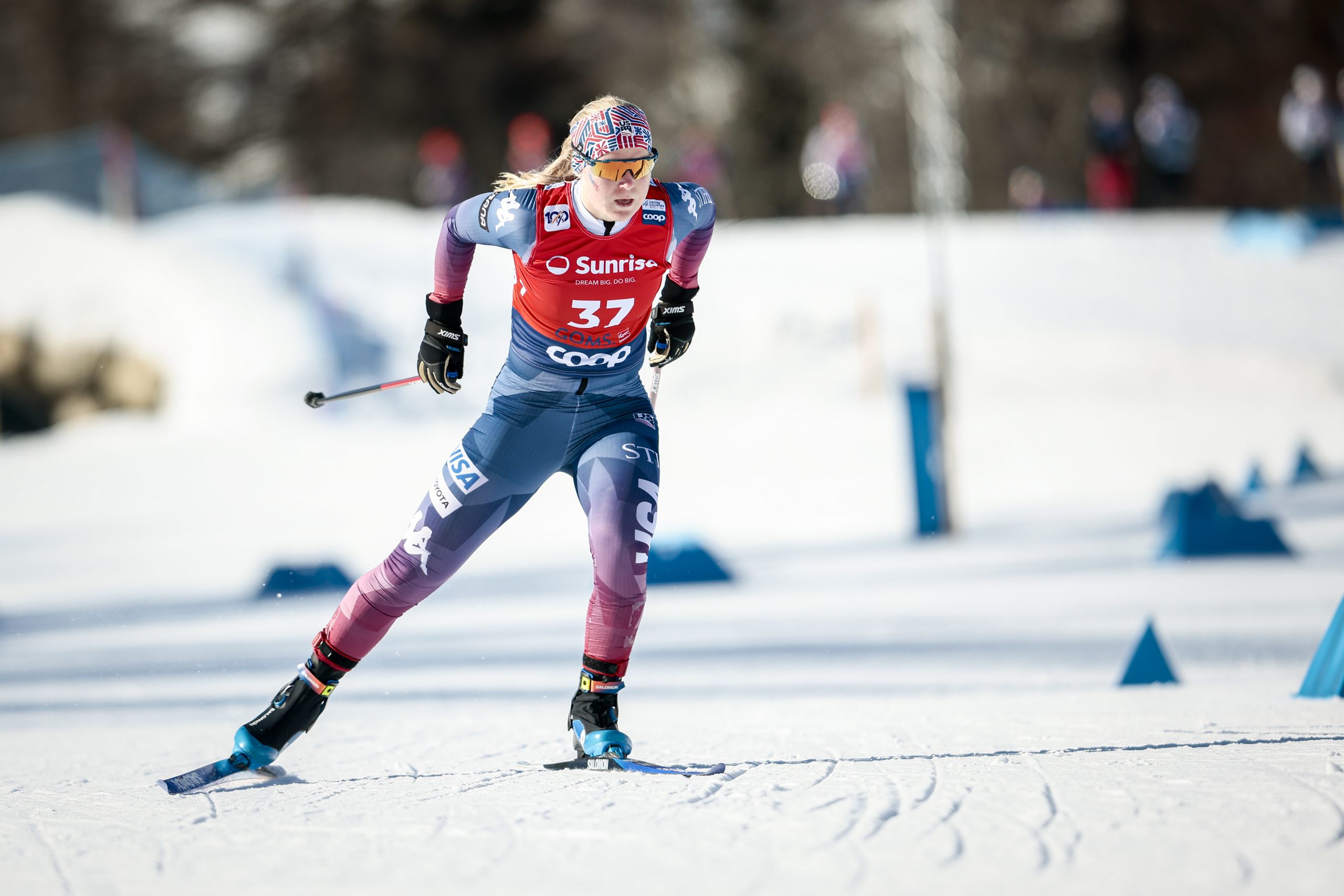
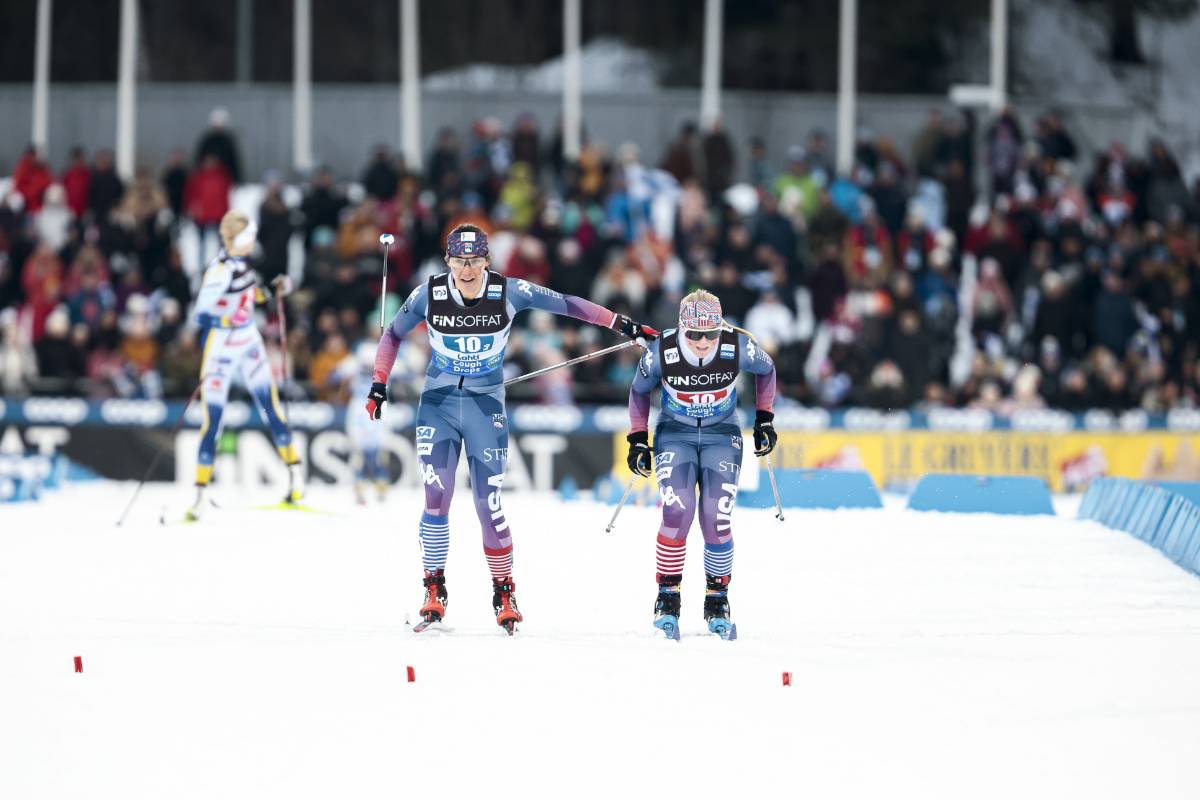
    Emma Ribom (SWE), Moa Ilar (SWE), Kerttu Niskanen (FIN), Karoline Simpson-Larsen (NOR), (l-r) lead early in the women’s 20 K Classic Mass Start in Goms, Switzerland. (Photo: Authamayou/NordicFocus)

    The sky above the Goms Nordic Centre on Sunday morning had the washed-out look of winter at altitude — pale and reflective. Snow had fallen overnight — not enough to transform the valley, but enough to affect ski behavior. The tracks were glazed in some places and soft in others, offering a surface that challenged kick, balance, and restraint.

    This was the third and final race of the last World Cup weekend before the Olympic Games. The final challenge came in the form of a 20-kilometer Classic Mass Start — a distance long enough to punish impatience, short enough to reward precision. In many ways, it felt like a rehearsal, a partial preview of the Olympic 50 k to come, even as two of the discipline’s defining figures — Sweden’s Ebba Andersson and Frida Karlsson — were notably absent.

    Fifty-six women started. Not all of them finished. None of them were anonymous by the time the race ended.

    Jessie Diggins (USA) and Astrid Oeyre Slind (NOR), (l-r) got away early in the first lap before being brought back by the chase pack around 6.5 K. (Photo: Authamayou/NordicFocus)
    An Early Question — and a Fast Answer

    From the opening kilometers, the field confirmed what the course profile had suggested: this would be a race shaped less by outright speed than by rhythm and positioning. Short climbs arrived in quick succession, descents offered only brief relief, and the peloton stretched and compressed like an accordion with every change in gradient.

    The first clear question of the day was posed early.

    On the opening lap, Norway’s Astrid Øyre Slind moved decisively off the front. Jessie Diggins, wearing bib one and leading both the overall and distance World Cup standings, responded immediately. For a moment, the two skied clear — a clean, purposeful break that suggested collaboration rather than desperation.

    The gap grew briefly, then stalled. By roughly 6.5 kilometers, the chase pack — patient, organized, and unwilling to let the race fracture too soon — closed the door. The break dissolved without drama, but not without meaning. The message was clear: separation would be earned later, not gifted early.

    Through the first full lap and into the second, the splits told a consistent story. No one was allowed to escape. The front group remained compact, with the top ten separated by only a few seconds at successive checkpoints. Every surge was answered. Every acceleration absorbed.

    Karoline Simpson-Larsen (NOR), Dariya Nepryaeva (AIN), Katharina Hennig Dotzler (GER), Johanna Matintalo (FIN), and Kerttu Niskanen (FIN), (l-r) work to bring back Diggins and Slind. (Photo: Authamayou/NordicFocus)
    The Long Middle: Where Races Are Actually Won

    What followed was the part of mass-start racing that rarely makes highlight reels but defines outcomes: the long middle.

    The snow conditions amplified this dynamic. The fresh layer over a firmer base rewarded good kick but punished over-striding. Downhills carried enough draft that working alone was inefficient. On climbs, being out of position meant burning matches simply to stay attached.

    Julia Kern spent much of this phase skiing in between packs — strong enough to feel underutilized, cautious enough to avoid overreaching.

    Julia Kern (USA) and Tiril Udnes Weng (NOR), (l-r) trying to maintain contact. (Photo: Authamayou/NordicFocus)

    “Today’s race was definitely a really hilly one, and not that fast, given the new snow,” Kern said afterward. “The tracks were a bit glazed, but also powder. The techs did a really good job giving us great kick, and I really needed that for how much climbing there was.”

    She described a race defined by indecision forced by circumstance rather than confidence.

    “I skied a lot of the race kind of stuck in between two packs,” she said. “In the second lap, I wasn’t sure if I should really go with the pack and risk it. I didn’t want to blow up, especially at semi-altitude. It was just hard to say with such a long, slow race.”

    When a small bridge attempt formed later in the race, Kern hesitated — not from fear, but from realism.

    “It was one of those days where I was feeling stronger than the pack I was skiing in, but not quite sure I could keep up with the pack in front,” she said. “They started to slow down, so it was a little bit of yo-yoing.”

    For Kern, the result — 16th — came with clarity rather than frustration. The margins were small, the lessons specific, and the work ahead clearly defined.

    Hailey Swirbul (USA) coming up the final climb with teammate Kendall Kramer (USA) slightly behind. (Photo: Authamayou/NordicFocus)
    Moving Forward from the Back

    If Kern’s race unfolded in the gray area between groups, Novie McCabe and Hailey Swirbul experienced the race from its deepest end.

    McCabe started with bib 57. Swirbul with 58. Both expected chaos early — and neither panicked when it arrived.

    “I kind of expected the accordion,” McCabe said. “I talked to my tech before the race, and he thought it would be a good idea to stay calm early. When it strung out, that’s when I should try to move up.”

    That patience paid dividends. As the field gradually fractured, McCabe began to advance — not in dramatic surges, but in deliberate steps.

    “I tried to push up to whoever was ahead, then tuck in and rest,” she said. “Eventually, I got into a good group with Catherine Stewart-Jones and some others. At that point, it was about hanging on a little more.”

    The effort came at a cost. McCabe admitted she was suffering late, but also recognized the value of the experience.

    “It was nice to have such a good classic skier to ski behind and try to relax in there,” she said.

    Swirbul’s approach mirrored that composure, shaped by perspective earned through time away from the sport.

    “The start of the race actually didn’t feel stressful to me,” she said. “There’s not much you can do to move up until it breaks up a little bit, so I took that as an opportunity to relax and work into the race.”

    She broke the race into manageable pieces.

    “I like trying to pick people off in a mass start,” she said. “It helps to focus on closing one gap at a time.”

    Swirbul finished 24th, McCabe 22nd — both having moved forward through nearly the entire field.

    Samantha Smith (USA), Hailey Swirbul (USA), and Rosie Brennan (USA), (l-r) early on in the women’s 20 K Classic Mass Start in Goms, Switzerland. (Photo: Authamayou/NordicFocus)
    Rosie Brennan: The Value of a Steady Day

    For Rosie Brennan, Goms was not a race defined by sharp inflection points or dramatic movement through the field. Instead, it was a professional, workmanlike effort — the kind that rarely demands attention but often proves essential when teams begin to think about Olympic lineups, relays, and durability.

    Brennan skied much of the race just outside the most active chase groups, navigating the same glazed tracks and punchy climbs that tested everyone else. On a course that punished inefficiency, her race was marked by steadiness rather than volatility. She did not chase moves that would cost more than they offered, nor did she allow the race’s elastic rhythm to pull her into repeated accelerations that would compound fatigue.

    In a season where results are scrutinized as much for how they are achieved as where they land, Brennan’s day in Goms served as a reminder of her role within the U.S. program: a veteran presence capable of managing long classic efforts even when conditions and dynamics do not invite heroics.

    These are the kinds of races that rarely make headlines — and yet, as part of Olympic preparation, they often matter most.

    Kendall Kramer (USA) comes to the line with a top 30. (Photo: Authamayou/NordicFocus)
    Kendall Kramer: Learning in Plain Sight

    Kendall Kramer’s race unfolded quietly, but not inconsequentially. Still early in her World Cup career and newly named to her first Olympic team, Kramer approached the 20 K Classic as both an examination and an education.

    She remained engaged with the race as it evolved, skiing within her limits while absorbing the tactical realities of a mass start at altitude: when the field compresses, when it stretches, and how much energy it costs simply to stay connected on repeated climbs. In a race where early overcommitment was punished and late positioning proved decisive, Kramer’s task was not to force relevance, but to understand it.

    Her finish inside the top 30 (27th) reflected a growing familiarity with World Cup distance racing — not yet a statement, but a step. For an athlete still building the physical and tactical base required for races of this length, Goms offered clarity about where the work remains, and confidence that she belongs in the conversation.

    Samantha Smith (USA) nears the end of the 20 K in Goms, Switzerland. (Photo: Authamayou/NordicFocus)
    Samantha Smith: Building the Long View

    For Samantha Smith, the 20 K Classic represented another piece in a longer developmental arc — one that continues to unfold quietly but deliberately.

    Smith skied the full distance with control, settling into the rhythm of the race rather than fighting it. In a field that included Olympic medalists, Crystal Globe contenders, and seasoned distance specialists, her goal was not to dictate the race but to measure herself against it. The result reflected that intention: steady pacing, minimal volatility, and a complete performance on a demanding course.

    At this stage of her career, races like Goms are less about immediate return and more about accumulation — learning how long classic efforts feel when contested at World Cup intensity, how fatigue presents itself late, and how small tactical decisions compound over 20 kilometers.

    Those lessons are not always visible on a results sheet. But they are foundational — and necessary — for what comes next.

    Alison Mackie (CAN) continued her strong season as the U23 leader. (Photo: Authamayou/NordicFocus)
    The Canadian Women: Depth That Shapes the Race

    While the podium fight ultimately played out among familiar names, the Canadian women were far from passive participants in the race’s structure.

    Alison Mackie, wearing the under-23 leader’s green bib, skied assertively within the main chase group for much of the race. Starting deeper in the field, she navigated the accordion effect with composure, staying attached as the pace fluctuated and the snow conditions demanded constant adjustment. Her performance reinforced why she has emerged as one of the most promising young distance skiers in the World Cup field.

    Katherine Stewart-Jones, meanwhile, played a quieter but equally influential role. Her presence in the chase packs — particularly later in the race — provided both pace and stability. For athletes moving forward from the back, including Novie McCabe and Hailey Swirbul, Stewart-Jones’ classic proficiency offered a valuable reference point, a wheel worth following when the race began to exact its toll.

    Together, the Canadian performances underscored a broader truth about modern World Cup distance racing: influence is not limited to podium contenders. Nations with depth — even without a skier contesting the final sprint — shape how races unfold, how packs form, and how energy is spent.

    Astrid Oeyre Slind (NOR), Johanna Matintalo (FIN), and Jessie Diggins (USA), (l-r) charge for the podium. (Photo: Authamayou/NordicFocus)
    The Final Selection

    By the final lap, the race had distilled itself down to a familiar truth: six women remained, and no one else was coming back.

    Diggins had conserved. Øyre Slind remained vigilant. Finland’s Johanna Matintalo had been quiet — almost invisible — in the way that often precedes a decisive move.

    Diggins knew exactly what she had left, and just as importantly, what she didn’t.

    “I knew I was going to need to ride the draft as much as possible and save my energy,” she said. “It’s been a really big training week for me, so I knew I kind of had one shot.”

    Her plan was precise.

    “I was going to need to launch that move as late as possible, probably on the hill,” she said. “I had amazing kick. Double-poling isn’t quite my strength right now.”

    On the final major climb, Diggins moved. So did Øyre Slind. But Matintalo matched them — and crested first.

    From there, the race tipped irrevocably. Matintalo exited the climb with speed, controlled the final straight, and claimed her first World Cup victory. Diggins finished second, securing her 77th individual World Cup podium. Øyre Slind followed in third.

    Johanna Matintalo (FIN) claims the victory, with Jessie Diggins (USA) second, and Astrid Oeyre Slind (NOR) third. (Photo: Authamayou/NordicFocus) 


    What It Means Going Forward

    This was the final race before the Olympic Games. Diggins left Goms having extended her lead in both the overall and distance World Cup standings. More importantly, she leaves having confirmed — again — that her classic skiing is no longer something she manages, but something she trusts.

    “I try not to overthink it,” Diggins said of the looming 50 k. “All you can do is the best you can in the moment with the tools you have that day.”

    That sentiment echoed through the U.S. team’s performances — from podium contention to patient rebuilding.

    The race in Goms did not offer easy answers. But it did offer honest ones.

    Jessie Diggins (USA), Johanna Matintalo (FIN), and Astrid Oeyre Slind (NOR), (l-r) share the 20 K Classic Mass Start podium in Goms, Switzerland. (Photo: Authamayou/NordicFocus)
    A Quiet Confidence

    By the time the fog settled back into the valley and the stadium emptied, the course had revealed itself fully. It had rewarded patience. It had punished haste. And it had reminded everyone watching — and skiing — that distance racing rarely announces itself loudly.

    The Olympic 50 k will be longer. The stakes will be higher. The margins may be smaller still.

    But the questions asked in Goms were the right ones — and the answers, for those willing to listen, were already there.


    Goms World Cup Women’s 20 k Classic Mass Start RESULTS

    Women’s World Cup DISTANCE STANDINGS

    Women’s World Cup OVERALL STANDINGS


    Help Support Our Olympic Coverage!

    FasterSkier will have our own Nat Herz on the ground at the Olympics. If you value the thoughtful work FasterSkier provides at championships like this one, please consider becoming a Voluntary Subscriber.

    Join the FasterSkier community!


    Jessie Diggins (USA) and the US team celebrate another podium in Goms, Switzerland. (Photo: Authamayou/NordicFocus)
  • Olympic Preview, Sort Of—USA Third in Goms Team Sprint

    Olympic Preview, Sort Of—USA Third in Goms Team Sprint

    This coverage is made possible through the generous support of Marty and Kathy Hall and A Hall Mark of Excellence Award. To learn more about A Hall Mark of Excellence Award, or to learn how you can support FasterSkier’s coverage, please contact info@fasterskier.com.

    It was a good day at the office, a stunning office, for Ben Ogden (USA) in Goms, Switzerland. (Photo: Authamayou/NordicFocus)

    For the skiing stars of Norway, World Cup victories are commonplace—almost expected. For the skiers of most other nations, any World Cup podium appearance is a career-defining event. That said, some of the most interesting World Cup racing takes place on those days when the strength of the field is re-shuffled, when a few notables stay home, when a few teams re-arrange their rosters. Those are days when World Cup podiums will still be filled, and a greater number of teams know they can rise to that occasion. Still, it’s not a straightforward task, and many teams find themselves stumbling over the challenge rather than rising to the top. Today was a day that the USA saw this opportunity, and rise they did . . .

    Norway may have won today’s Team Sprint (though with Harald Oestbeg Amundsen and Einar Hedegart are a team that’s unlikely to contend for this same win when the Olympics begin in Val di Fiemme), and Italy may have flown second across the finish on the wings of Federico Pellegrino (a performance he would hope to repeat in front of his countrymen in the Olympics), but it was the third-place effort of Team USA’s Ben Ogden and Gus Schumacher that really drew attention. The circumstances of the day offered them an opportunity to ascend to a World podium; they grabbed that opportunity with both hands. It’s great to see American men on World Cup podiums, even greater to see them earn that position with such fortitude and skill.

    “Today was a pretty full field,” said Ogden. “But there was no Klaebo today. There definitely will be Klaebo in Val di Fiemme. I’m sure that some teams will put up different athletes on their Team Sprint than they did today, but it’s really one of those things that’s not worth dwelling on until the time comes to actually seethe start list, to go out and get it done.”

    The day started with Gus Schumacher (USA) having a great qualification for the Team Sprint in Goms, Switzerland. (Photo: Authamayou/NordicFocus)

    The Alpine municipality of Goms, Switzerland (population 1,160) was the venue for a staging of an event that will take place in the Olympic Games in Val di Fiemme—the Freestyle Team Sprint—but today’s race was not exactly a dress rehearsal for that Olympic race. Specifically, the cast of characters is likely to change in the Olympics even as the strategy employed by today’s winner, Team Norway, is likely to remain the same. They’ll set the pace, they’ll stay at the front (and out of trouble). They’ll accelerate in the penultimate leg. They’ll hope to give Johannes Hoesflot Klaebo a lead at the beginning of the anchor leg. They’ll rely on Klaebo to remain unbeatable in any Freestyle Sprint where he enters the finishing straightaway with a lead. We really do expect this Olympic event to follow that script. Even so, many questions remain. Who will team with Johannes Hoesflot Klaebo in what is likely to be the gold medal favorite team? And who will the USA field as its Team Relay pair? Will Schumacher team with Ogden? Or will coaches choose another combination of abilities? Will Pellegrino and Elia Barp continue to be factors in the finishing straightaway? And which other teams will arrive with hopes of a medal: Finland? Switzerland? Sweden?

    “If history is any indicator, then Norway leading and everyone else following will likely (repeat as a strategy) at the Olympics,” said Ogden. “Val di Fiemme is definitely a harder course, so I anticipate it being something like that. Championship Team Sprints are definitely intense; it’ll have some similarities to today, and probably many differences.”

    Individual qualifying saw USA 1—comprised of likely Olympic teammates Ben Ogden and Gus Schumacher—as the third fastest qualifier. They would be joined in the 15-team Final by USA 2’s JC Schoonmaker and Zanden McMullen (who would finish 11th on the day).

    Home-team, Switzerland 1, was the top qualifier thanks to the efforts of seasoned Sprint competitors Janik Riebli and Valerio Grond (though packing a Team Sprint team with a pair of true sprinters is usually not considered to be the best way to excel in this event—Switzerland 1 would top all qualifiers, but would finish sixth on the day). Switzerland’s fast qualifying standard was followed by Norway 1’s Harald Oestberg Amundsen and Einar Hedegart, both of whom were recently named to the Norwegian Olympic team, but neither of whom are likely to appear in this event in Milano-Cortina. Fourth fastest qualifier was Italy 1’s Elia Baro and Federico Pellegrino who are likely to team up when the Olympic Team Sprint takes place in their homeland.

    Ben Ogden (USA) also had an excellent qualification for the Team Sprint – together with Schumacher, they posted the third-fastest time. (Photo: Authamayou/NordicFocus)

    A Plan to Follow—Easier Said than Done

    For some teams, Goms’ Team Sprint was an Olympic dress-rehearsal, for other teams, a consolation prize. Norway 1 had the potential to take a World Cup win, but they will certainly NOT be the Olympic duo that Norway fields in this event (that spot being reserved for Johannes Hoesflot Klaebo and (presumably) his gold medal partner from Beijing, Erik Valnes). Norway 2 was comprised of Ansgar Evensen and Even Northug, two of the world’s best sprinters who, nonetheless, found themselves overlooked when Norway selected its team of Olympians. While the skiers of Norway 2 may have hoped to prove that they belonged on the Olympic Team, their efforts fizzled in Goms. Norway 2 would place 15th, last among starters in the Team Sprint final.

    Norway 1, on the other hand, performed as expected. Amundsen led out Leg 1, keeping the pace high and keeping himself out of trouble. He was followed by Riebli, Barp, and Ogden. Ogden tangled skis briefly with Barp as they entered the exchange, but both skiers shook it off masterfully. Norway 1 continued to lead.

    Norway kept the pressure on to keep things stringed out. (Photo: Authamayou/NordicFocus)

    Ogden tagged Schumacher to begin Leg 2. Schumacher seems a logical choice to team with Ogden in the Olympic Team Sprint, a pairing suggested by the tactic of pairing a sprinter with a seasoned, fast-skiing all-rounder who can navigate in a tight pack and not get dropped. American Olympian, Jack Young, is a world-class freestyle sprinter, but even though it’s called the “Team Sprint,” there’s no use in fielding a team of two pure sprinters. The only sprint that matters is the one to the finish line at the end of the final leg. Before then, each teammate’s job is simply to steer clear of trouble, to hang on to the pace, and to not get dropped. More than perhaps any of his US Olympic teammates, Schumacher fits that bill.

    “The first leg was pretty chill,” said Schumacher. “I found myself a little far back after our tag, but made a good move on the fast corner.”

    “The second leg was pretty fast,” Schumacher continued. “But we still had a group, so it wasn’t too bad. We held the gap to Norway, which is good. Norway was definitely trying to string everyone out. They were really impressive, but we’re not far off. And I think. if the right person was in a good position, they probably could have held that. With Norway, that’s something to think about for the future.”

    Schumacher knows his role, and in Goms’ Team Sprint he skied it brilliantly. Through Leg 2, he remained in contact, preserving energy as Norway 1’s Hedegart set the pace at the front followed by Switzerland’s Grond and Sweden’s Edvin Anger. Leg 3 began with no changes in leaders, and with Ogden remaining solidly in contact with the top five. Amundsen continued to set the pace for Norway followed by Riebli and Barp.

    Einar Hedegart (NOR) clearly was racing with something to prove to the Norwegian team coaches about his place in the Olympic Team Sprint with Johannes Hosflot Klaebo. (Photo: Authamayou/NordicFocus)

    Leg 4 saw Hedegart stringing out the pace while Schumacher continued to mark the skiers at the front. The field began to string out, with Schumacher keeping USA 1 in contention.

    Leg 5 is where the field expects Norway to make a move; Amundsen did not disappoint, storming off the front even before the field had left the flat terrain around the exchange zone. By the time he reached the course’s first uphill, Amundsen enjoyed a lead of 30 meters. Rather than chase him in vain, the chase group—led by Barp—sat up a bit to preserve energy. Norway had earned a gap as Amundsen tagged Hedegart to begin the anchor leg. The rest of the field would fight for second and third.

    The way the Americans set up today’s relay team—with the sprinter, Ogden, leading off and the all-rounder, Schumacher, finishing—showed that Team USA may realize that the Olympic version of this event will NOT come down to a finishing line sprint, but to a final-leg high-speed dash that sheds sprinters and leaves all-rounders leading the way to medals. This may be the scene in a few weeks—Schumacher dueling Pellegrino in the final leg. If so, then today was a bit of a dress rehearsal after all. On the first of the final leg’s two uphills, Schumacher tried desperately to cross the gap to Amundsen. It was a bold ploy, but one that a fast distance skier needed to try in order to shake Pellegrino. Pellegrino shadowed Schumacher, but seemed to struggle in doing so. Over the second uphill, and Pellegrino struggled again under Schumacher’s re-application of pressure . . . but in order to beat a sprinter you need to drop a sprinter.

    Gus Schumacher (USA) kept the pressure on, leading the chase group behind Norway. (Photo: Authamayou/NordicFocus)

    Ahead of them, Hedegart show-boated playfully at the finish line, taking off his poles and sheathing them like a sword after a successful duel. Pellegrino undid Schumacher in the finishing straightaway—a cagey veteran having played his hand with seasoned mastery. Schumacher shrugged across the finish line in third, having done all he could to lengthen the sprint in an attempt to take the sting out of Pellegrino’s sprint.

    “Pellegrino is a super strong sprinter,” said Schumacher.” Today, he basically made me pull through. I didn’t want to mess around with a big bunch sprint, and I’m glad I didn’t. I’m fine with him beating me in the end. But, yeah, we’ll see how it plays out in Val di Fiemme. I think I can beat him if I can get a good draft. We’ll see; you need drop him before the finish line. I guess you just have to go faster! But he’s also a great distance skier, so that’s a tough one.”

    “Having Gus in the second leg felt good for me,” said Ogden. “He’s really good at positioning, and super strong and fit, and he’s going to have legs at the end when it matters . . . Today was just to try something and learn from it. I think that we thought it was a natural thing to try. We went with it today, and it worked out well.”

    After all the strategizing, all the jockeying, all the surging, all the positioning, it’s a skier like Pellegrino—a world-class sprinter who can also contend in distance races—who is the ideal finisher for a Team Sprint. Approaching the Olympic Team Sprint in his home country—and hoping for a gold medal in front of his countrymen—Pellegrino still has one major obstacle to overcome: Klaebo is the one skier who has proven to be even faster, even more durable than Pellegrino. If the Italian wants to claim gold on home turf, he’ll need to beat the best of all time in order to do it . . . but that will be the same for any skier who hopes to claim gold in any event when the Olympic races are run in Val di Fiemme.

    Gus Schumacher (USA) and Ben Ogden (USA), (l-r) proved they are true contenders for a medal in the Team Sprint at the Olympics. (Photo: Authamayou/NordicFocus)

    While the cast may be different when this event is staged at the Olympics of Milano-Cortina, the script is likely to be strikingly similar. If so, then Team USA will be there hoping. To recreate the tactics, the speed, the strength, and the brilliance that took them to a third place finish today in Goms. Ironically, today’s Norwegian winners are not likely to be offered the chance to pursue Olympic gold in this same event. When asked whether he thought this dominant performance ahead of numerous teams likely to contend in this event in Val di Fiemme could cause Team Norway to reconsider their starters in the Olympic Team Sprint, Hedegart was playful, yet again.

    “Message sent,” grinned Hedegart. “I hope the message is received.”

    Chance of Hedegart becoming the face of Team Norway in season’s to come? Quite high, it appears. Chance of Hedegart replacing Valnes (as Klaebo’s teammate) in Norway’s Olympic Team Sprint? Far less likely . . . but much could happen between the World Cup finish line in Goms and the Olympic starting line in Val di Fiemme.


    Goms World Cup Men’s Freestyle Team Sprint QUALIFYING

    Goms World Cup Men’s Freestyle Team Sprint RESULTS


    Help Support Our Olympic Coverage!

    FasterSkier will have our own Nat Herz on the ground at the Olympics, which, to be honest, is a very big financial lift for us. If you value the thoughtful work and access FasterSkier provides at championships like this one, please consider becoming a Voluntary Subscriber. Your support directly fuels the work we do to cover the people, places, and moments that make our sport special.

    Join the FasterSkier community!


    Federico Pellegrino (ITA), Elia Barp (ITA), Harald Oestberg Amundsen (NOR), Einar Hedegart (NOR), Gus Schumacher (USA), Ben Ogden (USA), (l-r) share the Team Sprint podium in Goms, Switzerland. (Photo: Authamayou/NordicFocus)
  • Ilar Surges, Diggins Rebounds in Oberhof 10 k

    Ilar Surges, Diggins Rebounds in Oberhof 10 k

    This coverage is made possible through the generous support of Marty and Kathy Hall and A Hall Mark of Excellence Award. To learn more about A Hall Mark of Excellence Award, or to learn how you can support FasterSkier’s coverage, please contact info@fasterskier.com.

    Moa Ilar (SWE) continued to solidify her position in  the chase for the overall World Cup. she stands second, 149 points behind Jessie Diggins (USA). Ironically, the strongest Swedish skiers—and those who will be the strongest contenders for medals in Milano-Cortina—may be Ilar’s teammates who stayed away from Oberhof. (Photo: Authamayou/NordicFocus)

    When it comes to World Cup cross-country ski racing, season-long progress can be difficult for spectators and commentators to assess. It’s always hard to tell: are skiers getting faster? Are they fading? Or are they holding steady? This is the time of the season when event results begin to swirl and performances can become confusing. Three weeks from now, when the Olympics begin in Milano-Cortina, today’s winners could find themselves on the podium, or off the back. It’s all about the accuracy of their progression, the physiological and psychological costs of their efforts, their ability to remain healthy, and their commitment to the training peak that comes before the taper. And each skier handles it differently.

    Jessie Diggins races . . . that’s what she does. Others rest, others taper, others plan and plot, others pick and choose. Diggins races, a level of every-week race commitment that has decorated her trophy case with three World Cup Crystal Globes. Diggins has said that she doesn’t rely so much on “tapering” for big events as she intends to continue progressing through the races of each successive week. It’s a strategy that has seen her reach extraordinary levels, but not always at the times when she might’ve hoped. Last season, Swedish contenders went home to train and recover in the weeks leading to the World Championshp in Trondheim. It was a successful strategy, as Swedish women—Ebba Andersson, Frida Karlsson, and Jonna Sundling—definitely dominated those events. The Swedes are, once again, back at home in the weeks before the Olympics. It will be fascinating to watch events unfold in the two weeks of Olympic racing. The Swedish strategy may work again . . . but on the days that those races are run, they’ll be forced to deal with the power and the intensity and the will of Jessie Diggins.

    Olympic Talk

    Much of the media coverage of late has been about Olympic qualification: will Norway continue to make their would-be Olympians jump through hoops? Will the USA consider finishes at US Nationals, rankings in SuperTour, point standings on the World Cup . . . or will coaches exercise discretion in filling the team? Those are interesting discussions—rife with intrigue and opportunity, with aspiration and realization, disappointment and heartbreak—but it’s also a conversation that concentrates more on likely Olympic also-rans, and less on the skiers whom fans really follow. Even in talent-rich Norway, the skiers most likely to claim medals in Milano-Cortina have already been named to the team. Same for Sweden. Same for the USA. The contenders are well known, and their tickets to the Olympics were punched long ago. So while some Olympic hopefuls continue working to climb the rankings toward eventual places on their Olympic teams, the races in Oberhof highlighted the efforts of those who may contend for medals in Milano.

    And the Norwegians just keep coming . . . who is this Karoline Groetting getting her first world Cup start in Oberhof? Kristin Austgulen Fosnaes knows: Groetting is the upstart who nearly undid Fosnaes’ hopes of qualifying for an Olympic spot in Milano-Cortina. Fosnaes continued to elevate her profile with a win in the Norwegian National Championships 10 k, potentially paving the way for her naming to the Norwegian Olympic Team. She was followed onto the podium by Groetting who has now placed her name into the running for Olympic Team selections. Fosnaes has been a regular on the roster of the Norwegian Ski Team, but one who has from time to time, been viewed with skepticism by her countrymen, especially after her leaden performance in last season’s World Championship Team Relay in Trondheim all but handed the gold medal to Norway’s arch rival, Sweden. Fosnaes is a fine skier, a skier who would be a franchise player on the national team of nearly any other ski-country in the world. In any other country, Fosnaes would’ve been named to her Olympic Team two months ago. But as a skier competing for  Norway, she’s forced to keep racing and racing, always hoping to sufficiently impress the committee that selects the Norwegian Olympic Team. How interesting it is, then, that Fosnaes was not on the starting line today in Oberhof. Either she thinks she’s secured a spot on her Olympic team, or the committee selecting that team has already decided to stop looking at her. Either way, the focus today was on Groetting.

    Karoline Groetting (NOR) delivered quite a World Cup debut, leading the field through many of the early checkpoints, and finishing in fifth place on the day. Perhaps more important in her quest to be named to her nation’s Olympic Team, Groetting was the fastest Norwegian finisher in Oberhof. (Photo: Reichert/NordicFocus)
    Oberhof 10 k Classic

    With the Olympics remaining at the forefront of many contenders imaginations—and with resting for those races becoming a priority for many of those competitors—there were plenty of stars missing from today’s 10 k Classic start list: Finland’s Classic specialist, Kerttu Niskanen, is not on the starting line. Nor are Sweden’s Ebba Andersson or Frida Karlsson, Norwegians Astrid Oeyre Slind, Heidi Weng, Karoline Simpson-Larsen, or Kristin Austgulen Fosnaes (who is still yet to be named to Norway’s Olympic Team).

    Chasing an Olympic berth of her own, American Hailey Swirbul was the final starter of the day in Oberhof; she seems to be making the very most of her return to World Cup racing.

    “The smiles have been genuine!” beamed Swirbul. “I’m making sure to enjoy this life the most I can (but) I did not enjoy the feelings in the middle of this 10k today though, I won’t lie. I think a lot of us who came from Nationals, straight to international travel, straight to the World Cup were fighting some demons out there. It feels the most challenging, in my opinion, to find the will to keep fighting when your body feels heavy and the suffering feels unrewarding. But that’s also what keeps us coming back: the days where you can keep leaning into the discomfort and be in the fight and be rewarded for it is like no other feeling!”

    “I was the last starter today,” Swirbul continued. “So I was getting splits to know where I stood. An interval start race is a unique mind game because you can’t gauge if the imaginary people on front of you are pulling away or starting to fade. You just have to focus on your own race and get around the course as fast as you can, regardless of how others pace. That is easier said than done, especially with higher expectations on the World Cup. I try to remember that I don’t need to do anything that I haven’t done before. I just want to try to race my own race, regardless of the stage it’s on.”

    Contenders in Oberhof included Sweden’s Jonna Sundling, Maia Dahlqvist, and Moa Ilar (who is chasing Diggins in the season-long chase for the FIS Crystal Globe), Austria’s Teresa Stadlober, and newly discovered Norwegian phenom, Karoline Groetting. An early starter wearing bib 7, Groetting led the field at many of the early splits, and crossed the finish line with an advantage of 30 seconds over her nearest rival, and 37 seconds over her more famous countrywoman—and long-time national team member—Tiril Udnes Weng. But while Groetting settled into the leader’s chair, the more recognizable contenders began racing: Ilar, Stadlober, Sundling, and Diggins.

    Diggins was 15 seconds behind Ilar at the 2.6 kilometer checkpoint. Ilar led again at the 5.8 kilometer mark, coming across 13 seconds ahead of Groetting. At the finish line, Karoline Hennig-Doetzler (GER) challenged Groetting’s time, but fell just six seconds short. Groetting dodged another bullet when Maia Dahlqvist crossed the lone a mere .1 seconds behind Groetting’s finishing time. It was a tremendous finish for Dahlqvist—best known as a sprinter—as she continues to show great form in the approach to Milano-Cortina where she will certainly be a capable partner for Sundling in the Team Sprint event.

    It was later revealed that Diggins unusual split times resulted from her suffering quite a dramatic fall when her tip got caught in soft snow at the course’s edge.

    “I think that the reason my splits looked a litle funny is that I had a crash on one of the downhill corners. I caught my tip in some really deep sugar, and used my arm as a brake to keep myself from sliding off the course!”

    “It was time lost, and it was also a lot of adrenaline lost,” Diggins continued. “But it was honestly a really great practice in mental toughness, in refocusing, my energy and my attention on ‘what can I do in this moment. How well can I ski?’ I’m just really glad that’s really all that the crash was.”

    Ilar crossed the finish line with an advantage of 31 seconds over Groetting, but there were still other stars shining brightly out on Oberhof’s Classic course. Stadlober had begun the chase back at 7.6 kilometers when she was still 17 seconds behind Ilar. The gap narrowed to 10 seconds at 9 kilometers, and Stadlober was pouring it on. Over the final kilometer, the Austrian flew in pursuit of the Swede, only to find herself falling short by the narrowest of margins. Ilar would hold on to win by .7 seconds showing that hers is the best Classic skiing form today. Even so, she was surrounded by serious rivals—Stadlober in second, Sundling in third, Diggins in fourth, Groetting in fifth—who may be on their way up.

    18.01.2026, Oberhof, Germany (GER):
    Rosie Brennan (USA) – FIS world cup cross-country, 10km, Oberhof (GER). www.nordicfocus.com. © Authamayou/NordicFocus. Every downloaded picture is fee-liable.

    Rosie Brennan has continued to navigate her return to world-class form. “I’m still living in a day-by-day world, trying to figure everything out,” she said. “I had some really good training at home but have struggled again for the last two weeks. I haven’t been able to discover a pattern, so I truly feel I have no control over when my body is ok and when it isn’t, and now I’ve added some vascular complications to the whole thing. I had to come race this weekend to qualify for the Olympics and I am very pleased to have accomplished that! Now I need to look forward as best I can to the Games and try to prepare as best as possible.

    “Erik Flora is over here now,” Brennan continued. “Which will help that process immensely. But overall, it’s been a long year and change of living in an unknown, complicated medical world.”

    Brennan would finish the day in 30th, followed by Hailey Swirbul 33rd, Novie McCabe 35th, Alayna Sonnesyn 45th, Sammy Smith 49th, Kendall Kramer 54th. Alison Mackie led her Canadian teammates in 31st, followed by Sonjaa Schmidt 36th, Katherine Stewart-Jones 38th, Amelia Wells 56th.

    Now trailing by only 149 points, Ilar trimmed a bit of Diggin’s advantage in the World Cup overall race. And Ilar’s plans for the season? She was quite frank in her response to those asking if she’s going for the World Cup overall win now. “Of course I am,” Ilar smiled.” I would lie if I said anything else!”
    And what about the others who stayed home this weekend? We shouldn’t forget the impending return of Andersson, Karlstad, Niskanen, Slind, Weng, and Simpson-Larsen. The plot thickens.


    Oberhof Women’s 10 k Classic RESULTS

    FIS World Cup Distance STANDINGS (entering Oberhof)

    Teresa Stadlober (AUT), Moa Ilar (SWE), Jonna Sundling (SWE) on the podium in Oberhof . (Photo. www.nordicfocus.com. © Authamayou/NordicFocus. Every downloaded picture is fee-liable.


  • Where the Snow Hardens and Decisions Stick

    Where the Snow Hardens and Decisions Stick

    This coverage is made possible through the generous support of Marty and Kathy Hall and A Hall Mark of Excellence Award. To learn more about A Hall Mark of Excellence Award, or to learn how you can support FasterSkier’s coverage, please contact info@fasterskier.com.

    Jonna Sundling (SWE) and Laura Gimmler (GER), (l-r) during the heats of the World Cup Freestyle Sprint in Oberhof (GER). (Photo: Authamayou/NordicFocus)

    By the time the stadium lights fully took over in Oberhof, the snow had begun to change its mind.

    What started as a pliable winter surface—the kind that both softens and creates mistakes—tightened as the temperature dropped, and each pass of a ski left a polished, glistening trail under the lit German night. The Thuringian Forest, quiet by geography but loud by reputation, had settled into one of those evenings that reward certainty. Edges held if you trusted them. Hesitation showed immediately. And in an Olympic season, there was very little room for either.

    Saturday’s women’s Freestyle Sprint marked the World Cup’s return after the Tour de Ski, but the pause had not dulled the stakes. For several nations—and particularly for the United States—Oberhof represented the final sprint in the window that matters most for Olympic selection. That context did not announce itself loudly. It rarely does. Instead, it threaded through the day in subtler ways: in heat selection, in how aggressively athletes protected space, and in the quiet tension between racing for today and building the version of yourself you’ll need in February.

    At the front, the results followed familiar lines. Jonna Sundling (SWE) qualified near the top and then won every round she entered, finishing the job decisively for her 15th individual World Cup victory. Coletta Rydzek (GER), fed by a home crowd that never stopped leaning forward, closed hard for second. Maja Dahlqvist (SWE) completed the podium in third, another entry in Sweden’s sprint abundance—a luxury that, paradoxically, can complicate Olympic selection rather than simplify it.

    But Oberhof was not only about dominance. It was about positioning, intent, and the quieter victories that occur well outside the top three—where a season can tilt not with a trophy, but with a single, well-timed decision in a quarterfinal.

    Hailey Swirbul (USA) take the first corner during her quarterfinal in Oberhof (GER). (Photo: Authamayou/NordicFocus)

    A Course That Punishes Drift

    Oberhof’s sprint course is deceptive in its simplicity: an out-and-back layout, one major climb, a technical descent, and a finishing stretch that arrives already under load. What separates it from more straightforward sprint venues is how early it demands decisions. The opening stretch funnels athletes into a tight corner almost immediately, compressing the field before it has a chance to stretch. The central climb—long, steep, and increasingly rutted and churned as the day progresses—forces skiers to declare themselves sooner than they might like.

    There is little room to hide here. Miss the first corner, and you’re fighting for oxygen before the race has found its rhythm. Drift into the wrong line on the climb, and the surface punishes you. Get boxed entering the final turn, and momentum disappears instantly. Oberhof rewards skiers who are decisive without being reckless, aggressive without being impatient.

    Those dynamics shaped the day for the Americans in distinctly different ways, producing four very different American stories inside the heats—plus one clarifying, unfortunate footnote that mattered for selection math and for morale: Alayna Sonnesyn (USA) did start, but crashed and did not finish.

    Jessie Diggins (USA) during qualification in the World Cup Freestyle Sprint in Oberhof (GER). (Photo: Authamayou/NordicFocus)

    Before the Racing: Compassion, and a Reminder Not to “Try Harder”

    On paper, the Olympic selection criteria reads like a legal document—because, in many ways, it is one. It is also, inevitably, a psychological environment: a room everyone lives in, even when no one speaks about it.

    U.S. Head Coach Matt Whitcomb described the team’s internal emphasis heading into Oberhof in terms that had nothing to do with points or spreadsheets.

    The first message, he said, was simple: have compassion—for yourself and for your teammates.

    “This is a stressful job,” Whitcomb said. Some athletes may feel safely “inside” the team; others may feel perched on the edge; others may already feel disappointment. And the team, he stressed, needs to remember that everyone is absorbing the same pressure in different ways. “Read the room,” he said, especially if you have a great race—take care of each other through a stressful period.

    His second point was the one that, in a sprint weekend like this, can save an athlete from the most common selection-week mistake: mistaking urgency for a new identity.

    Because “this may be one’s last opportunity,” Whitcomb said, it’s tempting to believe you can manufacture something extra—try harder, ski differently, do something dramatic. But that instinct is usually the trap.

    “You can’t try something dramatically different,” he said. “What you have to do… is you ski the way that got you here.”

    In Oberhof, Whitcomb felt the athletes largely did that. The plans were executed; warm-ups and routines stayed intact. “We qualified a bunch of people,” he said. The day simply didn’t convert into the results they wanted.

    That, too, is sprinting: sometimes you do many things right, and the course—plus the speed of the other nations—still asks for more.

    Jessie Diggins (USA) during qualification in the World Cup Freestyle Sprint in Oberhof (GER). (Photo: Authamayou/NordicFocus)

    Racing as Training: Jessie Diggins

    For Jessie Diggins (USA), Oberhof was never meant to stand alone.

    Coming off the Tour de Ski, Diggins framed this weekend not as a test of peak form, but as a carefully placed piece of a longer arc: racing as a training stimulus, not a destination.

    “Essentially, I’m using these races as training stimulus,” Diggins said. “It’s a chance to get more reps—working on the tactics, working on communication, just working on all the little things that you really can’t practice any other way unless you’re racing World Cup.”

    That philosophy has long guided Diggins’ career. She has rarely spoken about “peaking” the way outsiders want athletes to: as a clean line on a calendar, a simple on/off switch. For her, form is something you keep building in public, in the only environment where it truly exists—under the clock, in contact, with consequence.

    “So [I’m] keeping the training load really quite high,” she explained, “but just recovering enough that I can still punch some hard race efforts and have that be part of the training and the lead-up. And for me, that’s always been a really important thing.”

    She added a line that sounds like personal preference until you watch her career and realize it’s closer to a blueprint: “I think I race well when I am racing pretty often. I might not do every single race, but just enough that I feel like I’m using them as a really helpful part of my lead-up.”

    Diggins’ day ended in the quarterfinals—13th overall on the official results sheet. But that early exit doesn’t necessarily conflict with the way she described the weekend. In an Olympic season defined less by accumulation than timing, Diggins tends to measure progress in subtler signals than finish position: how quickly the body responds, how efficiently it recovers, whether the details are sharpening rather than dulling.

    Oberhof, in that sense, fits neatly into the plan. Not every race has to be a verdict. Some are simply data—hard efforts taken at speed, recorded by the body, filed away for February.

    Samantha Smith (USA) during qualification in the World Cup Freestyle Sprint in Oberhof (GER). (Photo: Authamayou/NordicFocus)

    A Wild Arc, Embraced: Samantha Smith

    If Diggins arrived in Oberhof as a veteran calibrating form, Samantha Smith (USA) arrived by a far less conventional route—one that still feels almost implausible when you say it out loud.

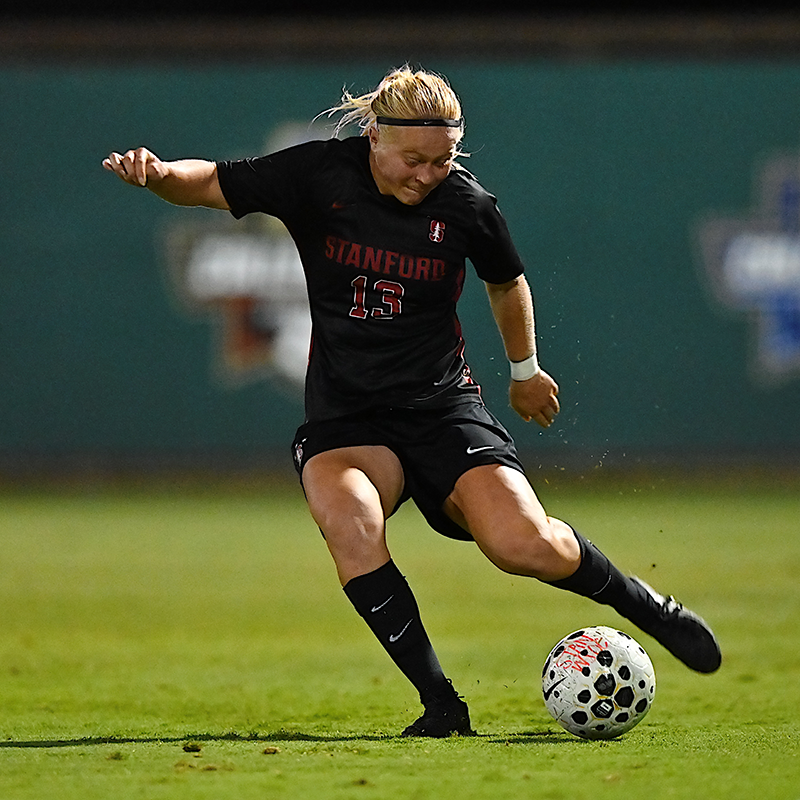
    The last couple of months, Smith said, have been “wild.” She helped Stanford reach the NCAA soccer final. She put her skis on for the first time this season in December. She raced into shape at U.S. Nationals. And suddenly, she was back on a World Cup start line—aware of the stakes, but determined not to let the stakes steal the experience.

    “I’m so grateful for the opportunities that I’ve had,” Smith said. “To have a chance to play for Stanford has been such an incredible journey… and now to be back skiing, it feels great to be out here and competing with everyone.”

    Smith kept returning to the same theme: presence. She likes the work itself—the daily process—whether it’s skis or soccer.

    “I really enjoy the process,” she said. “I love to train, I love to race, I love to play soccer games. So [I’ve] just been trying to focus on enjoying every moment… embracing the opportunities that I have and just trying to be very present.”

    That presence mattered on a day when nerves were unavoidable.

    “Coming in today, I was definitely nervous,” Smith said. “I feel like the first World Cup races of the year are a bit nerve-wracking, especially when you haven’t had a ton of time on snow or a ton of opportunities to really gauge fitness.”

    So she narrowed her goals to what she could actually execute: ski clean; work transitions; be diligent in the “working sections” where Oberhof can hand you time or take it away quietly.

    “I didn’t really have an outcome goal,” she said. “It was just to ski hard, do what I could, and if I got into heats, to really compete.”

    And then, in her quarterfinal, came the moment that extended her day—and changed, materially, what this weekend could mean.

    Smith described herself as not being in the position she wanted over the first big hill. She could see the risk: that the heat would compress into a pure sprint finish, where you either have the lane or you don’t. And then—briefly—she did.

    “Into the last climb before the finish, I saw a window on the inside,” Smith said. “I saw the space open up, and I just tried to take it. To be honest, I wasn’t really expecting that it was going to open up.”

    It did. She went. And she made the move that sprint racing requires: the one that looks obvious in replay and feels like a gamble in real time.

    “I was worried it was going to come down to a complete sprint finish at the end,” she said, “but I think I got pretty lucky… There was a bit of open space, and I was able to make my way up.”

    The reward was tangible: Smith advanced to the semifinals and finished 12th overall. Just as important—at least in the language of selection criteria—she also climbed to 42nd on the women’s Sprint World Cup standings after Oberhof.

    In a season where criteria can hinge on ranking thresholds, that is not a small detail. It is the kind that turns a good day into a consequential one.

    Whitcomb’s reaction captured the strange emotional geometry of selection weekends: elation, paired with an awareness that someone else is hurting.

    “We’re absolutely ecstatic with Sammy,” he said—and then, almost immediately, he acknowledged the other side of it: “It’s always bittersweet because on literally every race I’ve ever been to, there have been people that have good races and then people that are really disappointed.”

    In sprinting, the margins are often only a few meters. In Olympic selection, those meters can echo.

    Hailey Swirbul (USA) during qualification in the World Cup Freestyle Sprint in Oberhof (GER). (Photo: Authamayou/NordicFocus)

    Joy Without Illusion: Hailey Swirbul

    For Hailey Swirbul (USA), the day began with something rarer than confidence: uncomplicated joy.

    “I was genuinely excited just to be back racing and to make the rounds today,” Swirbul said. “It felt like a treat. Honestly, I wasn’t expecting it. I was hopeful that I might have that opportunity, but getting to be in the heats was really fun.”

    What stood out wasn’t that she smiled—it was why.

    “My smiles were genuine out there,” she said, “and I felt an excitement and joy to get to be part of it, rather than a fear or pressure… to live up to some expectation that I might set for myself.”

    Swirbul approached qualifying with a clear-eyed strategy built around her own technical history. She identified the steep jump-skating (V1) section that had dominated the day’s conversation and made a choice.

    “There’s a lot of pressure, a lot of expectation around that steep V1 hill in the middle of the course,” she said, “and that’s just historically not my strength… I felt like I was able to do the working sections well.”

    The plan worked. She advanced into the heats and finished 22nd overall.

    In the quarterfinal, the course delivered its blunt lesson: once you lose contact, you often don’t get it back.

    “I maybe tried to ski my own race a little too much,” Swirbul said. “Once you’re off the main pack, it’s really hard to get back on… I was excited to have a strong finish… but it’s just not enough at this level.”

    The sentence contains both honesty and optimism—because Swirbul wasn’t treating Saturday as an endpoint. She was treating it as preparation for what, in her case, may be the weekend’s more natural opportunity: Sunday’s 10-kilometer classic interval start.

    “I’m excited—really looking forward to the classic 10 k tomorrow,” she said. “I’ve had a couple of good ones this year, so [I] hope I can keep the momentum going.”

    And then she said something that explains why so many distance skiers quietly enjoy sprinting before a 10 k: it’s a way to wake the system up.

    “I do actually really like racing a sprint, especially a qualifier plus a quarter right before a 10 k,” she said. “I think that’s kind of ideal race prep for 10 k. So I’m hoping that can help power me through tomorrow’s race.”

    Swirbul’s mindset for Sunday, she said, would be built on a simple distinction: what she can control, and what she can’t.

    “Every course and every day has so many variables… out of my control,” she said. “So I just want to try to control what I can and do my best at those things.”

    It’s a professional skier’s sentence. It’s also, in an Olympic season, a survival skill.

    Lauren Jortberg (USA) during qualification in the World Cup Freestyle Sprint in Oberhof (GER). (Photo: Authamayou/NordicFocus)

    Boldness, Not Regret: Lauren Jortberg

    Lauren Jortberg (USA) did not set out to lead her quarterfinal. It happened anyway, fast and almost accidentally—the kind of start that changes your entire heat because it changes your options.

    “I took control early… wasn’t necessarily on purpose,” Jortberg said. “I just had a really fast start, and there’s a big corner right away, so I wanted to have good positioning there.”

    She connected that early positioning to what she sees as a strength: the major climbs. In Oberhof, you don’t get to drift into those climbs. You arrive either with space or without it.

    “I wanted… good positioning for the major climbs,” she said. “I feel like that’s one of my strengths.”

    Late in the heat, the day turned on a familiar sprint mechanism: contact and congestion at exactly the wrong time.

    “I got a bit of a tangle… into the final turn,” Jortberg said. “I lost all my speed there.”

    Importantly, she rejected the clean narrative that would blame her early assertiveness for the late cost.

    “I don’t necessarily think that leading… came at a cost,” she said. “I just think… I lost all my speed when we got tangled.”

    And then she said what, in an Olympic-selection sprint, many athletes think, but not all athletes will say out loud: she did not come to Oberhof to hide.

    “With the Olympic implications, I don’t really want to sit in the back and just chill,” Jortberg said. “That’s not really how I like to race heats.”

    She described her approach as an attempt to avoid the passive sprint fate: getting boxed in, stuck behind, hoping someone else would make a mistake.

    “I just really want to try to ski well,” she said. “At least [I] tried to move… and try to ski my best out there rather than just… getting boxed.”

    Jortberg finished 29th overall. But what she took from the day was not despair—it was proof of belonging.

    “A lot of my confidence is just knowing that I really can ski with these women who are really strong,” she said. “That’s important for confidence moving forward.”

    Even in a heat that didn’t break her way, she will leave Oberhof with something World Cup weekends can either confirm or erase: the belief that she belongs on this stage.

    Maja Dahlqvist (SWE), Jonna Sundling (SWE) and Iris De Martin Pinter (ITA), get set to start their semifinal in the Freestyle Sprint in Oberhof (GER). (Photo: Authamayou/NordicFocus)

    The Final, and the Moment That Changed It

    The women’s final unfolded at speed—and then, briefly, at the mercy of chance.

    Sundling drove the pace as expected, forcing the field into single-file. Dahlqvist tracked smoothly. Rydzek hovered, patient and dangerous. Behind them, Iris De Martin Pinter (ITA) skied with poise well beyond her years, positioned to contend.

    And then she wasn’t.

    De Martin Pinter fell, fracturing the race at the worst possible moment—the kind of incident sprinting produces with brutal efficiency. Sundling’s growing gap became decisive. In a course that rewards momentum and punishes disruption, the fall functioned like a door closing: abruptly, unfairly, and permanently.

    Sundling closed the remaining distance with authority. Rydzek surged for second. Dahlqvist held on for third.

    Jessie Diggins (USA), Hilla Niemela (FIN), Nicole Monsorno (ITA), Milla Andreassen (NOR), Samantha Smith (USA), Alina Meier (SUI), (l-r) come around the first corner of their quarterfinal. (Photo: Authamayou/NordicFocus)

    Skis, Speed, and the Truth You Can See on a Downhill

    No sprint weekend exists in a vacuum. Equipment matters, and in Oberhof, that reality was visible in the most unforgiving place: the downhills where small gaps become facts.

    Whitcomb, careful about specifics because he had not yet been fully able to review the race video, acknowledged what many observers sensed: the U.S. skis were close, but not quite at the level of the very best nations on the day.

    “I think that’s a safe and fair assessment,” Whitcomb said. He emphasized that the team was competitive—but in sprinting, “competitive” is often not enough.

    “You need the best skis to go up against other teams that have the best skis,” he said, citing nations that, on this day, appeared to have exceptional speed.

    It’s the part of sprinting that can feel cruelest to athletes: you can execute your plan, hit your cues, make good tactical decisions—and still watch a gap open on a downhill you skied correctly. In Oberhof, where the course magnifies drift, ski speed is not a luxury. It is oxygen.

    Samantha Smith (USA) for the first time advanced into the semifinals in the World Cup sprint in Oberhof (GER). (Photo: Authamayou/NordicFocus)

    Selection Without Ceremony

    For the United States, day one in Oberhof didn’t resolve Olympic selection questions. It narrowed them.

    U.S. Ski & Snowboard’s selection language ties nomination, in part, to World Cup standings thresholds, with specific mention of Top 50 (or Top 45 under certain conditions) in the Sprint or Distance World Cup standings on January 18, 2026.

    Inside that structure, Saturday’s most significant American movement belonged to Smith.

    With her semifinal, she, in just one World Cup race, vaulted to 42nd in the Sprint World Cup standings. That is the kind of number that changes the texture of a season, because it moves her into the zone where the objective criteria has been met.

    The other Americans’ days mattered in quieter ways. Diggins stayed on her February-focused arc, treating racing as stimulus and sharpening. Swirbul used the sprint as both a joyful return to the rounds and a deliberate set-up for Sunday’s classic 10k, a race she believes suits her. Jortberg confirmed her willingness to race with intent rather than hide from consequence, even when the margin for error is razor-thin.

    And Sonnesyn’s crash—real, abrupt, and emotionally expensive—served as a reminder that selection seasons do not always give you clean data. Sometimes they give you a fall, a DNF, and the long work of resetting.

    Jonna Sundling (SWE) comes to the line for the win in the finals. (Photo: Authamayou/NordicFocus)

    What Remains

    By nightfall, the snow had hardened completely. The course no longer absorbed uncertainty. It reflected it.

    Some athletes left with podiums. Others left with confirmation, calibration, or unfinished business. In an Olympic winter, not every race is meant to answer questions outright. Some exist to refine them—to strip them down to what actually matters.

    Whitcomb’s framing, in that light, felt less like a coach’s speech and more like a survival manual for the next month: be compassionate; don’t weaponize the criteria against each other; and when the moment arrives, resist the temptation to become someone new out of panic.

    You can’t “try harder” into an Olympic team. You can only ski the way that got you here—cleanly, boldly, and with enough self-trust to hold your line when the window opens.

    In Oberhof, Samantha Smith did exactly that. And for one night in the German cold, that single choice—one inside lane, one late move—was the difference between a good day and a consequential one.

    Women’s Freestyle Sprint Qualification RESULTS

    Women’s Freestyle Sprint Final RESULTS

    Women’s FIS World Cup OVERALL SPRINT STANDINGS


    Love Stories Like This? Help Keep Them Coming.

    Feature stories like this one take time, access, and care to produce. If you value thoughtful storytelling and independent ski journalism, please consider becoming a Voluntary Subscriber. Your support directly fuels the work we do to cover the people, places, and moments that make our sport special.

    Join the FasterSkier community!


    Coletta Rydzek (GER), Jonna Sundling (SWE), and Maja Dahlqvist (SWE), (l-r) share the sprint podium in Oberhof (GER). (Photo: Authamayou/NordicFocus)
  • Zanden McMullen’s Closing Argument

    Zanden McMullen’s Closing Argument

    This article was made possible through the generous support of our voluntary subscribers. If you value coverage like this, please support FasterSkier with a voluntary subscription.

    Zanden Mcmullen (USA) during the World Cup 10 k Freestyle in Trondheim (NOR) in December. (Photo: Modica/NordicFocus)

    There is a particular kind of quiet that settles in before a decisive weekend—not the calm that follows certainty, but the stillness that comes when outcomes are no longer yours to predict. Zanden McMullen arrived in Oberhof, Germany, this week carrying that quiet with him. Period Three of the World Cup season is underway. These races are the final ones that will be considered for U.S. Olympic Team selection. The committee will meet after Sunday’s races. Until then, there is nothing to do but race.

    “I’m pretty much taking it one week at a time right now and keeping my hopes up,” McMullen said earlier this week via text. “The races should be really fun this weekend, and my focus is on those right now.”

    It is the kind of message that sounds simple until you sit with it. One week at a time. Focus on the races. Fun. Behind those words is a career that has moved forward incrementally, without shortcuts, and a season that has already required recalibration. McMullen’s path to this weekend—both geographically and personally—has been anything but linear.

    Growing Up Where Winter Is Normal

    McMullen was born and raised in Anchorage, Alaska, a place where winter does not arrive as a novelty or an interruption. It simply is. He grew up outdoors, moving easily between sports—hockey, soccer, lacrosse—before skiing gradually took precedence.

    “I grew up doing a bunch of sports,” he said. “Skiing wasn’t really a main focus until maybe, like, first year of high school, when I was like, all right, this is going to be my main sport.”

    Cross-country skiing entered his life less as an ambition than as a community. His mother took him out. He joined a club. He found friends. He was good enough that there was never much reason to stop.

    “I just kind of found my group,” McMullen said. “And then as I progressed and just kept getting better and better, there was never really a reason for me to leave.”

    Anchorage has produced lots of elite skiers, but McMullen has never been particularly interested in mythology. When asked why Alaska continues to turn out athletes capable of racing at the highest level, his answer is understated.

    “We have access to great outdoor activities,” he said. “And I feel like that’s probably a pretty big foundation to our success. The community is great and has always been supportive of ski racing.”

    It is not a romantic explanation. It is a practical one. Snow matters. Time outside matters. People matter.

    Zanden McMullen (APU/Team Alaska), center, won the men’s U18 10K classic mass start race Friday at
    the 2019 U.S. Ski & Snowboard Cross Country Junior National Championships at Kincaid Park. Johnny
    Hagenbuch (Sun Valley SEF/Intermountain), left, was second, followed by Griffin Wright (Craftsbury
    Nordic Ski Club/New England), right. (Photo: Michael Dinneen)

    The First Crack in the Horizon

    For much of his early skiing life, McMullen’s world remained bounded by Alaska. The high school circuit was competitive enough that it was difficult to tell where he stood nationally. That changed almost accidentally.

    “A pretty pivotal point in my ski career was the Anchorage U.S. Nationals,” he said. “I wasn’t planning on going. I was still pretty young, but because it was in Anchorage, it was like, sure, of course I’ll do those races.”

    In the mass start 10-kilometer race, McMullen had what he still describes as a standout performance. The result earned him a spot on a U18 international trip.

    “That was one moment where I was like, holy crap, I can’t believe I made that,” he said.

    The next year, he qualified for World Juniors. Then another benchmark. Then another.

    “Every year was like I hit that next benchmark,” McMullen said. “And I was like, okay, wow, this is really happening.”

    What is striking in retrospect is how little certainty accompanied those steps. McMullen did not grow up believing he would race World Cups. He arrived there gradually, often surprised by his own progress.

    “I never really believed that I was going to be able to do that,” he said. “All the way up until, like, pretty much two years ago when I was like, damn, I’m really ripping the World Cup circuit.”

    Zanden McMullen races a skate pursuit in Ruka, Finland in November, 2021. (Photo: NordicFocus)

    Learning the Long Way

    McMullen’s development has mirrored that of a broader cohort of American men who have risen together, without a single breakout prodigy defining the group. The men’s team has become competitive not through sudden transformation, but through accumulation.

    “There’s definitely a core group of us that have been doing this for a long time and have just been hitting that next level every year together,” McMullen said. “Honestly, I’d say we just have a great attitude towards it, and I think that’s really contagious.”

    Central to McMullen’s progression has been his relationship with coach Eric Flora, who began working with him after high school. The partnership is not flashy. It is deliberate, methodical, and built on constant communication.

    “We all have individual phone calls with him about once a week,” McMullen said. “He’ll be driving to practice every morning, and he’ll just rip through all of us.”

    Training plans are personalized but similar. Adjustments are fluid. There is room to adapt when conditions—or bodies—require it.

    “Training is super fluid,” McMullen said. “There’s no reason to be super methodical about it.”

    If there is a defining value that underpins the approach, it is consistency. McMullen returns to the concept repeatedly, almost reflexively.

    “I don’t enjoy when I’m hot and cold,” he said. “I know I’m in a good place when I’m just consistent.”

    Racing Through Fog

    Consistency, however, is not something that can be summoned on demand. When the World Cup season opened in December, McMullen entered Period One with a clear process goal: race distance events, avoid panic, see where he stood.

    “It’s so challenging going into Ruka every year,” he said. “You just have really no idea what kind of shape you’re in.”

    He described the feeling as “looking through fog.” The metaphor fits. Fitness tests and workouts provide clues, but racing offers the only real clarity.

    “Those could both result in amazing races,” he said. “Or they could be pretty crappy races. I have no idea.”

    December did not unfold the way McMullen had hoped. Results were not disastrous, but they were not convincing enough to quiet questions—his own included. Olympic qualification, with its layers of objective criteria and discretionary judgment, hovered in the background, offering no reassurance.

    “Nothing’s for sure until the last race is over,” he said.

    As Period One ended, McMullen faced a decision that athletes rarely frame publicly: whether to stay in Europe and press on, or to step away and reset.

    Davos to Regroup

    McMullen stayed in Davos to train and regroup during the holidays before flying back to the United States for Nationals.

    The decision was not dramatic. It did not come with declarations or explanations. It was simply what made sense.

    Settling in to training through the holidays stripped things back to essentials. Favorite trails. Simple routines. Fewer variables.

    For McMullen, training has never been a place to escape. It is where things become clear.

    The reset did not guarantee anything. But it restored something harder to quantify: alignment between effort and intention.

    By the time McMullen boarded a flight for Lake Placid in January, he carried less expectation and more readiness.

    Zanden McMullen charges for the win in the Men’s 20 k Freestyle Mass Start last week at the US National Cross-Country Ski Championships in Lake Placid, New York. (Photo: Nancie Battaglia)

    Lake Placid: Evidence

    The U.S. Senior National Cross-Country Ski Championships arrived with their own weight. Nationals are never just Nationals in an Olympic year. Results echo beyond the finish line.

    On Thursday, McMullen won the 20-kilometer Freestyle Mass Start. The race unfolded honestly, favoring patience and pacing. McMullen looked comfortable in control.

    The next day, he returned to win the Classic Sprint.

    Two wins, two very different demands, back to back.

    The performances were not loud. They were authoritative.

    For an athlete who measures progress in consistency, the week in Lake Placid did not feel like redemption. It felt like confirmation.

    Zanden McMullen with his second win in two days in the Classic Sprint last week at the US National Cross-Country Ski Championships in Lake Placid, New York. (Photo: Nancie Battaglia)

    Oberhof

    From Lake Placid, McMullen traveled to Germany for the final races that will be considered in the Olympic team selection. Oberhof will decide whether his season will continue toward Milan or pivot elsewhere.

    “I’ll know by the end of the weekend if I have made the Olympic team,” he said via text. “If I don’t, I’ll head back with a little bit of Birkie fever.”

    The phrasing is characteristically restrained. There is no bargaining, no projection beyond what he can control.

    “I’m in Oberhof now for P3 World Cup, and will stay with the team through Goms,” he said. “I’m pretty much taking it one week at a time right now.”

    That outlook has been hard-earned. McMullen understands that racing well is not the same as demanding belief. His approach is simpler.

    “Let the racing speak,” he said in November. “There’s no reason to freak out about it.”

    The Space Before the Answer

    By Sunday evening, the committee will meet. Names will be discussed. Arguments will be weighed. Decisions will be made.

    McMullen will not be in the room.

    What he will have is a body of work that stretches back much further than this weekend: a childhood shaped by Alaska winters, a career built on incremental belief, a season that required adjustment rather than insistence, and a January that reaffirmed who he is as a racer.

    Whether or not the Olympic team includes his name, McMullen has reached a threshold that is difficult to cross. He is no longer auditioning for relevance. He is racing for a place.

    “I just want to be consistent,” he said. “I feel like when you are consistent, and you find yourself in a position where you might have a standout result, then it’s just that much higher.”

    In Oberhof, consistency will not announce itself. It rarely does. It will show up quietly, in decisions made at speed, on terrain that rewards honesty.

    For now, that is enough.


    Love stories like this? Help keep them coming.

    Feature stories like this one take time, access, and care to produce. If you value thoughtful storytelling and independent ski journalism, please consider becoming a Voluntary Subscriber. Your support directly fuels the work we do to cover the people, places, and moments that make our sport special.

    Join the FasterSkier community!


  • Governing Olympic Sport

    Governing Olympic Sport

    This article was made possible through the generous support of our voluntary subscribers. If you value coverage like this, please support FasterSkier with a voluntary subscription.

    Jessie Diggins (USA) has been the beneficiary of consistent support from US Ski and Snowboard and the Stifel US Ski Team; it’s a distinction she has earned many times over. . The question is, are those organizations really involved in the support of skiers who are at different levels of development (as the Ted StevensOlympic and Amateur Sports Act obligates them to be)? (Photo: Vanzetta/NordicFocus)

    The Ted Stevens Olympic and Amateur Sports Act, passed in 1978 and amended several times (most notably in 1998 and 2020), is the statute that created the U.S. Olympic & Paralympic Committee (USOPC) and granted National Governing Bodies (NGBs) exclusive, monopolistic, authority over Olympic sports in the United States. The Sports Act Is Supposed to Govern Olympic Sport in the U.S. The question is whether or not it does . . .

    At its core, the Sports Act is a trade. NGBs are given control over their sport in exchange for specific obligations: athlete development, growing participation and interest, transparency and accountability, and, after 2020, a SafeSport environment for youth athletes.

    That’s the theory!

    In practice, the 1998 revisions shifted the focus of NGB responsibility toward Olympic and international performance. The emphasis became the “high-performance pipeline,” with increased USOPC oversight and funding focused primarily on elite outcomes. What followed was a quiet but consequential de-emphasis of sport growth and athlete development, the very foundation the Act originally envisioned. Today, under the current Sports Act—and with no real congressional or USOPC oversight—there is little meaningful accountability for NGBs to fulfill their mandate. The Act requires athlete development, but it never defines what that means, never specifies standards, and never requires commitment of resources or personnel. Judging from the published USOPC NGB audits the role in development is not assessed.

    So, development has effectively been outsourced. Some will argue that the development system under US Ski and Snowboard is working because we have a couple of men and women performing well on the World Cup. Not to minimize the work of those successful athletes or the programs they came through, but we can see from the national championship results that level of performance drops quickly and is far off international race speeds. In my view, we need a much more robust development process.

    In U.S. Ski & Snowboard, virtually all athlete development now is in the hands of clubs, families, and private systems. The resurgence of U.S. cross-country skiing since the mid-1990s is a useful example. That progress did not come from centralized NGB investment in development, even though the US Ski Team tried at times to run a centralized program. It came from committed individuals establishing clubs, regional programs, the establishment of the National Nordic Foundation, and the involvement of families. Many athletes who qualified for World Cup starts—without being named to the national team—came from that community-based system, not from NGB-led development.

    The revisions to the Sports Act never eliminated the  NGB’s responsibility for development. They simply allowed elite performance to be prioritized without accountability for the development of the base that makes elite performance possible. Over time, many NGBs shifted the cost and risk of development onto clubs and private foundations, while dedicating their own resources almost exclusively to national teams, while retaining regulatory and selection authority without owning development outcomes.

    That contradiction matters.

    If an NGB claims authority over competition rules, rankings, and selection, then development, coach education, and long-term sport health must be part of that same authority. The Sports Act never transferred those responsibilities to the USOPC, private clubs, or other local entities.

    What we’re living with now isn’t legal clarity, it’s a governance gap. NGBs retain authority. Clubs bear the cost. Families carry financial risks. Athletes absorb the consequences. That outcome wasn’t envisioned in the Sports Act. It’s what’s been allowed by  weak, nonexistent enforcement. As long as USOPC and the NGBs can tout a reasonable medal outcome, everyone is happy. But that doesn’t solve the development gap.

    A Proposed Direction for Reform

    What follows is not a call for more money. It’s a call for better structure.

    Development already works best at the club and regional levels. This has been demonstrated for the last 30 years or more.  Any reform has to be financially neutral and focused on outcomes. The solution is simple: development outcomes are driven less by spending levels and more by how responsibility, authority, incentives, and accountability are structured.

    Today, clubs and families do most of the developmental work, while the NGB controls calendars, rankings, and selection. Any effective proposal will realign responsibility with authority using levers the NGB already controls: regionalization, calendar design, coach education delivery, development benchmarks, incentive structures, and selection timing.

    The Problem We’re Actually Solving

    Despite good intentions and dedicated people, the current system reliably produces the same results:

    • Early specialization pressure driven by rankings, selections, and historical event calendars.
    • Declining participation at the U-16 and U-18 ager groups in USSS races and programs.
    • Ever increasing costs carried almost entirely by families
    • Available program quality dictated by geography and family resources
    • Clubs carrying the developmental load for 30+ years without proportional authority

    This isn’t about bad actors or insufficient funding. It’s about misaligned incentives and lack of local control over early pathways.

    Guiding Principles
    1. Participation, program quality, and retention come before selection
    2. National development standards with regional input, locally delivered
    3. Later, flexible, and reversible selection
    4.  Governance reform
    5. Measurable accountability for system health, not just performance outcomes
    Proposed Structural Reforms
    1. Regionalization With Real Authority

    Current state: Regions exist administratively but have little control over development- pathways, with primary focus on the Junior Nationals selection and management.

    Proposal:

    • Establish consistent regional governance with defined leadership representation
    • Regions sole authority over U12–U18 competition formats
    • Delegate early-stage calendars and race design to regions
    • Require annual regional development plans focused on participation, retention, and building coach capacity
    • Mandate inclusion of high school, college, and masters’ athletes in regional development efforts
    • Incentivize regions to address actual development in the region.

    Outcome: Decisions and decision makers move closer to athletes while standards remain national.

    1. Calendar Design Is Development Policy

    Current state: Dense, result-driven calendars create artificial urgency and unnecessary travel and expense

    Proposal:

    • Cap nationally scored races by age group
    • Limit Junior Olympic qualifier events to reduce travel burden
    • Restrict ranking-eligible events geographically at younger ages
    • Require non-ranking, skill-focused events
    • Publish a distinct development calendar separate from performance pathways

    Outcome: Lower cost, less pressure, better alignment with biological development.

    1. Coach Education: Centralize Standards, Decentralize Delivery

    Current state: Credential-heavy systems disconnected from daily coaching realities.

    Proposal:

    • Delivery entry- and mid-level education regionally, based on the defined needs of the region
    • Encourage mentored coaching hours
    • Publish age-specific coaching expectations
    • Incentivize volunteer and part-time coaches to support programs.
    • Asses the viability of mandatory education and the ability to deliver

    Outcome: Better coaching at the base without added bureaucracy and excessive expenses for the coaches.

    1. Development Benchmarks Instead of Rankings

    Current state: Results are treated as proxies for development and a measure of success.

    Proposal:

    • Define age-appropriate, non-competitive benchmarks (skills, tolerance, adaptability)
    • Make benchmarks visible to parents and clubs
    • Explicitly separate benchmarks from selection criteria

    Outcome: Shared language that supports development without distorting competition.

    1. Cost Control Through Incentive Design

    Current state: The system directly rewards expensive actions and those who can afford it.

    Proposal:

    • Remove ranking advantages tied to national travel at young ages
    • Prioritize regional selection over national qualifiers
    • Require transparent cost disclosures for sanctioned pathways

    Outcome: High-cost behavior is no longer structurally rewarded.

    1. Later and Reversible Selection

    Current state: Early selections are treated as final.

    Proposal:

    • Delay irreversible selection points by 3-4 years
    • Replace fixed teams with rolling pools and invitations
    • Publish selection criteria in advance

    Outcome: Selection becomes a process, not a verdict.

    1. Accountability for System Health

    Current state: Success is measured almost entirely by elite results.

    Proposal:

    • Track participation, retention, regional access, and coach coverage
    • Include development metrics in leadership evaluation
    • Publish development outcomes alongside performance results

    Outcome: Development becomes an operating responsibility, not a marketing line.

    This isn’t an argument against excellence. It’s an argument that durable excellence depends on system design, not individual heroics.

    The question isn’t whether we can afford to do this. It’s whether we can afford not to.


    Love stories like this? Help keep them coming.

    Feature stories like this one take time, access, and care to produce. If you value thoughtful storytelling and independent ski journalism, please consider becoming a Voluntary Subscriber. Your support directly fuels the work we do to cover the people, places, and moments that make our sport special.

    Join the FasterSkier community!


  • Where the Race Breaks Open: Women’s 20 k Freestyle at U.S. Nationals

    Where the Race Breaks Open: Women’s 20 k Freestyle at U.S. Nationals

    This article was made possible through the generous support of our voluntary subscribers.  If you value coverage like this, please support FasterSkier with a voluntary subscription.  

    Traffic was thick at the beginning of the US National Cross-Country Ski Championship Women’s 20 k Freestyle Mass Start in Lake Placid, NY. (Photo: Nancie Battaglia)

    There is a particular moment in a long mass start when the race quietly declares what it will be. It does not arrive with a surge, a crash, or even a decisive move. It arrives when the pack thins just enough that the edges of the course begin to matter—when skis no longer overlap cleanly, when passing requires intention, and when each athlete realizes—often simultaneously—that this is no longer a collective undertaking.

    At Mt. Van Hoevenberg, that moment came early.

    The women’s 20-kilometer freestyle mass start at the 2026 U.S. National Cross-Country Ski Championships unfolded under conditions that rewarded clarity and punished hesitation. The course was wide in places, narrow in consequence. Fresh snow lined the edges, slower and heavier than the main track, turning every attempt to move forward into a calculation of cost. The pace at the front was honest from the gun—fast enough to string the field out, fast enough to strip away the illusion that patience alone would bring opportunity.

    In an Olympic winter, Nationals rarely exist in isolation. They are arguments as much as races, each result carrying the quiet weight of future conversations. But on this morning, before selection scenarios and season arcs could intrude, the race itself demanded attention. Four laps. Twenty kilometers. A course that climbs insistently and asks athletes to be precise even when tired.

    What followed was not one story, but several—layered, intersecting, and revealing.

    Colorado’s Tilde Bångman did much of the work at the front of the Women’s 20 k Freestyle Mass Start in Lake Placid, NY. (Photo: Nancie Battaglia)

    The Fast Start That Changed Everything

    From near the front, the race immediately took on the shape many expected. Kendall Kramer, eager to avoid the kind of chaos that can derail a mass start before it has truly begun, made her intentions clear.

    “I wanted to go out fast because I didn’t want any funny business—colliding or breaking equipment,” Kramer said later. “I was super looking forward to being in the front of a mass start after being caught in the back on World Cups.”

    For Kramer, the early pace felt familiar rather than reckless. World Cups, she noted, often begin faster than domestic races, and the instinct to establish position early has become second nature. The speed was assertive but manageable. She felt fit, capable, present.

    Behind her, the effect was immediate. The field stretched, then fractured, then reorganized into smaller, more intentional units. For athletes starting deeper in the field, this stringing-out created both opportunity and pressure.

    Novie McCabe, starting from bib 26, felt the opening kilometers open rather than close.

    “My plan for the start was just to stay relaxed and try to work my way up,” she said. “It honestly ended up being easier than expected because the front girls took it out so fast. It was very strung out, and there was lots of room to move around.”

    Within minutes, McCabe had navigated cleanly into the front group. What followed was less about advancing and more about survival.

    “I got to the front pack about three minutes into the race,” she said. “So I spent most of it there just trying to hang on for as long as I could—and ended up having it in me to hang till the end.”

    That phrase—hang on—would recur in different forms throughout the day, taking on slightly different meanings depending on where each skier found herself in the race.

    Ava Thurston (#8 – Dartmouth) couldn’t quite hang on to the lead group of three, but eventually skied with Hailey Swirbul (#67 – APU) and Haley Brewster (#46 – UVM) before finishing fourth overall and third-place American. (Photo: Nancie Battaglia)

    When the Front Pulls Away

    Not everyone who tested the front pace could stay there.

    Late in the first lap, Ava Thurston made her own attempt to bridge. She came close enough to feel the rhythm of the leaders, close enough to understand the cost.

    “I tried to get back onto the front group, and I got pretty close,” Thurston said. “But I realized that I wasn’t going to be able to match their pace.”

    The realization came with consequences. For a brief stretch, she found herself skiing alone—a dangerous place in a mass start, especially early, when gaps can grow quietly and decisively.

    “That was where I did have a little bit of that panic,” she admitted.

    The panic did not last. Company arrived in the form of Hailey Swirbul and Haley Brewster, and with it, perspective.

    “Once I was skiing with them, I was kind of just thinking, ‘This is a good group. I can stay with these guys,’” Thurston said.

    From there, her race became less about chasing what was ahead and more about managing what was happening around her. She tucked in, matched surges, and responded quickly to small separations before they became something larger.

    “There were a couple of times where I would fall off the pack just a little bit,” she said. “Each time, I worked hard to get right back on before letting it be a big gap. I was really stoked on that.”

    On a course like Van Hoevenberg—four laps of sustained uphill skating—those moments add up. Fitness is exposed repeatedly, not all at once. For Thurston, the race offered reassurance.

    “This was the first race longer than 10k I’d done this year, and the first mass start that wasn’t a sprint,” she said. “It was a really good indicator that my fitness is there. It’s hard to fake anything on this course.”

    She would finish fourth, clearly separated from the podium trio but equally clear of the deeper chase—an honest result in a demanding field.

    With higher FIS points from not racing the past two seasons, Hailey Swirbul (#67 – APU) needed to ski through a lot of traffic during the early kilometers, but eventually found herself in the chase pack. (Photo: Nancie Battaglia)

    Racing From the Back Without Racing Small

    While the front and mid-pack sorted themselves, Hailey Swirbul was running an entirely different race.

    Starting from bib 67, she entered the day knowing she would need to be deliberate.

    “I didn’t even realize I would be seated so far back until the start list came out,” she said. “Obviously, I would be, because my FIS points aren’t low at this point—but it was an experience.”

    The challenge was not simply moving forward. It was how to do so without paying too steep a price.

    “The edges of the course had fresh snow on them,” Swirbul explained. “It was much slower, and a much higher energy expenditure to get around people that way.”

    Instead of forcing passes, she waited. Instead of locking into the pace of whatever group surrounded her at a given moment, she kept her attention forward.

    “I almost approached the first couple laps like an individual start,” she said. “It’s really easy to lock into the group you’re around and forget about the people ahead of you.”

    Women’s racing, she noted, often begins with a fast, destabilizing surge—a period where the goal is simply to hang on long enough for things to settle.

    “That’s exactly what happened today,” she said. “The leaders go fast, string it out, and then the real race starts again.”

    For Swirbul, the balance was constant: advancing through traffic while respecting the race’s length.

    “A 20k is a long race,” she said. “You can’t really pay for it.”

    Though she never bridged to the front trio, Swirbul finished fifth—solidly clear of the next wave behind her—and left the course satisfied with her execution and proud of the broader team effort.

    “Our coach absolutely crushed it with skis and feeds,” she said. “It was a good day to be APU.”

    Novie McCabe (APU) maintained contact on the uphills and used the downhills to close the small gaps to Tilde Bångman (CU) at the front of the race. (Photo: Nancie Battaglia)

    The Margins at the Front

    At the sharp end, the race narrowed to a familiar dynamic: strength, speed, and patience under pressure.

    As the kilometers mounted, Tilde Bångman began to apply pressure on the climbs, testing the group’s elasticity. By mid-race, the front had distilled to three: Bångman, McCabe, and Kramer. The chase group behind them was no longer within striking distance, and the podium places would be decided among those three alone.

    McCabe felt the pressure immediately.

    “In the last few kilometers, Tilde was skiing super strong and still really pushing the pace,” she said. “She would gap me a little bit on some of the hills.”

    Each gap mattered. Each closure required confidence—in skis, in timing, and in restraint.

    “I had some super good skis, so I was able to glide back up to her,” McCabe said.

    The plan crystallized: stay attached through the final hill, try once to make a move, and if that failed, save everything for the finish.

    “I tried to get a gap on the last hill, which didn’t quite work,” she said. “So I tried one last time at the finish.”

    It was enough.

    McCabe crossed the line first, securing the national title after a race built not on constant aggression, but on measured commitment. The emotion that surfaced surprised even her.

    “I think when I crossed the line, I mostly just felt super happy to be back racing and feeling like myself,” she said.

    The win mattered. So did what it represented.

    “Going into this week, I wasn’t sure it was the best idea for me to race frequently this season,” she said. “Now I have a lot more confidence that I can race—and maybe more importantly, recover from racing.”

    In an Olympic year, that distinction is not trivial.

    The lead pack and eventual overall podium with Kendall Kramer (APU), Tilde Bångman (CU), and Novie McCabe (APU) (l – r). (Photo: Nancie Battaglia)

    Kramer’s Race: Control Without Regret

    For Kendall Kramer, the separation late in the race came not through fitness, but friction.

    “My skis slowed down as they went,” she said. “They started to feel sticky—like I skied through too much Gatorade or something.”

    The effect was most pronounced on the downhills, where speed should have come freely.

    “The girls had to push my poles to speed me up to keep together,” she said. “Eventually, they could just gap on all the downhills.”

    Once the gap formed, Kramer shifted her focus from contesting the win to finishing the race well.

    “I’m happy to maintain my place and feel good,” she said. “I can’t complain.”

    What she wanted from the race, she explained, was not chaos or last-minute risk, but sustained pressure in a small group.

    “I wanted a small pack where we could test at every little bit,” she said, “as opposed to leaving it to a sprint or taking risks at a time like this.”

    She finished third, completing the podium, and left Lake Placid without repeating her national title—but with confirmation that mattered just as much.

    “I felt fit and totally capable today,” she said. “I didn’t feel bad feelings.”

    Novie McCabe (APU) managed to put a small gap on teammate Kendall Kramer to get away with Tilde Bångman (CU) and eventually ski to the national title in the finish stretch. (Photo: Nancie Battaglia)

    What the Race Revealed

    By the time the women completed their fourth lap, the story of the day was no longer about who surged when, but about how each athlete managed the same course differently—and honestly.

    McCabe raced with restraint until she no longer needed to. Kramer raced with intent and accepted the margins. Thurston learned, adjusted, and confirmed her distance fitness. Swirbul navigated from deep in the field with patience and clarity.

    None of those narratives exists in isolation. Together, they form a portrait of a championship race that did what the best distance races always do: expose truth without exaggeration.

    At U.S. Nationals, the women did not simply ski 20 kilometers. They negotiated space, managed doubt, trusted preparation, and tested belief.

    In an Olympic winter, those are not side effects.

    They are the point.

    The national podium for the US National Cross-Country Ski Championship Women’s 20 k Freestyle Mass Start with Novie McCabe (APU) first, Kendall Kramer (APU) second, and Ava Thurston (Dartmouth) third. (Photo: Nancie Battaglia)


    RESULTS:

    US Nationals Women’s 20 k Freestyle Mass Start


    Love stories like this? Help keep them coming.

    Feature stories like this one take time, access, and care to produce. If you value thoughtful storytelling and independent ski journalism, please consider becoming a Voluntary Subscriber. Your support directly fuels the work we do to cover the people, places, and moments that make our sport special.

    Join the FasterSkier community!


    The overall podium for the US National Cross-Country Ski Championship Women’s 20 k Freestyle Mass Start with Novie McCabe (APU) first, Tilde Bångman (CU) second, and Kendall Kramer (APU) third. (Photo: Nancie Battaglia)
  • Where the Margins Speak: U.S. Nationals Opens with Questions, Not Answers

    Where the Margins Speak: U.S. Nationals Opens with Questions, Not Answers

    This article was made possible through the generous support of our voluntary subscribers.  If you value coverage like this, please support FasterSkier with a voluntary subscription.  

    The US National Championships got started yesterday with the 10 k Classic Individual Start in Lake Placid, NY.  Hunter Wonders (#369 – APU) took top honors in the men’s race.  (Photo: Nancie Battaglia)

    On a January afternoon in Lake Placid, Mt. Van Hoevenberg did what it has always done best: it asked skiers to be honest.

    The 10-kilometer classic individual start is not a format that rewards theater. It doesn’t care how good you looked in warm-up, how confident you sounded the night before, or how convincing your season-long narrative might be. It rewards pacing that’s brave but not reckless, technique that doesn’t unravel under strain, and the ability to keep making good decisions when your legs are trying to renegotiate the terms of the day.

    This year, the U.S. National Cross-Country Ski Championships opened with that race—two laps on the 5-kilometer loop—and the timing was no accident. In an Olympic winter, Nationals is never just Nationals. It’s an argument. It’s a week where results don’t merely “count,” they accumulate, and the accumulation becomes the story that follows athletes into selection meetings, petitions, and—if all goes right—onto a plane headed for Italy.

    Men’s 10 k Classic Individual Start Results

    Women’s 10 k Classic Individual Start Results

    Will Koch (SVSEF) on his way to 8th place on the day. (Photo: Nancie Battaglia)

    The Course: Where You Can’t Afford to “Blow Up”

    The Van Hoevenberg course is famous for being “fair,” but fairness in skiing is rarely gentle. The climbs arrive in layered sequences—sections where you can press, sections where you can survive, sections where you can lose seconds simply by being a fraction late to a gear change. There are places to win time, and places where you simply try not to hemorrhage it.

    Hunter Wonders described the central problem precisely after the finish:

    “It has some big hills. And I really think that in this course you can’t afford to blow up. If you blow up, you’re just going to bleed so much time.”

    That idea—bleeding time—was the hidden refrain of the day. Not because athletes were exploding spectacularly, but because this loop punishes any lapse in restraint. It is a course that rewards a mind that stays intact.

    Corbin Carpenter (UAA) on his way to 10th place in the 10 k Classic at US Nationals. (Photo: Nancie Battaglia)

    Men’s Race: Seconds as a Selection Language

    At the front of the men’s race, the margins compressed into something almost absurd: a national title decided in a space so small it could be measured in one imperfect corner, one extra step of herringbone, one pole that slips just slightly at the wrong moment.

    Hunter Wonders won the men’s 10 k Classic National Championship. Behind him, the podium fight came down to an almost unnerving closeness. The story wasn’t simply that the race was fast; it was that it was tight—tight enough to turn pacing into the defining skill.

    Wonders’ post-race reflection didn’t sound like someone who had “controlled” the race so much as someone who had managed it correctly, which is often the same thing in interval start racing:

    “Yeah. So going through it never really felt like it was my day. I knew it was going to be a competitive one, and I knew that it would just come to good skis, good feelings in the body, good pacing, and I’m just really happy that I was able to pull it off.”

    He returned to pacing again, emphasizing that his strategy wasn’t about heroics, but about avoiding the one mistake that the Van Hoevenberg loop will magnify:

    “I think pacing was the biggest challenge for me today… So I was trying to take it out hot to where I could be competitive but not blow myself up.”

    What made Wonders’ win especially convincing was how he described staying committed to his plan and then finishing with intent when the splits told him the race was available:

    “I never really changed my race plan mid-race. But I did get some good splits, especially near the end, so I just tried to finish as hard as I could.”

    And then, because it’s 2026 and everyone knows what this week represents, he said the part that matters most:

    “And then, of course, U.S. Nationals does carry some heavy weight in an Olympic year. And I’ve been thinking about this race since the races in Anchorage ended, so I’m just really happy to have it behind me.”

    He wasn’t pretending the pressure isn’t real:

    “I definitely felt the pressure, and I’m going to continue to feel the pressure throughout the rest of this Nationals. But I think I have good momentum going, and I have good confidence. I know that I’m in shape, and everything else just kind of hopefully falls into place over the next week.”

    The finish-line truth of the men’s race is that it created a kind of selection tension that will hang over the rest of the week: the top contenders weren’t separated by a narrative gap. They were separated by seconds.

    Luke Jager, who finished second, captured what that tightness means on this course and in this moment:

    “Yeah, crazy how close the times were! The course is cool because there are so many different gears in the climb that people can all have different focus spots and still end up so close together at the finish line. It is really cool, fair racing like that.”

    That line—different focus spots, same finish—explains why the top of the results can look like a near-tie without being random. You can ski this course well in different ways. But you still have to ski it well.

    Jager also spoke directly to the Olympic subtext without overplaying it:

    “I’m not naive enough to say that the Olympics aren’t on all of our minds, but I’m also really having fun just trying to do my best and working to solve the puzzle of how to perform on any given day. Italy would be sweet, but I’m super thankful for this opportunity to even be feeling that pressure at all. It’s been fun to have such a big challenge.”

    And then the warning embedded in the closeness:

    “The close times just show me that you can’t take anything for granted, and each race could be someone else’s day. Fun to have to try and be as dialed and prepared as you can every day when the stakes are high.”

    In other words, this wasn’t a day that “settled” anything. It made the next races more consequential.

    Men — Top 10 (10 km Classic Individual Start)

    1. Hunter Wonders — APU — 25:28.8
    2. Luke Jager — APU — 25:30.2
    3. Olivier Leveille — Orford – CNEPH — 25:30.8
    4. Zachary Jayne — University of Utah — 25:31.2
    5. John Steel Hagenbuch — DAR — 25:35.6
    6. Zanden McMullen — APU — 25:36.4
    7. Mons Melbye — University of Utah — 25:55.3
    8. Will Koch — SVSEF — 25:58.1
    9. Brian Bushey — Craftsbury — 26:00.1
    10. Corbin Carpenter — UAA — 26:01.3

    Men’s 10 k Classic Individual Start: Complete Results

    Hailey Swirbul (APU) on her way to a national title in the 10 k Classic at US Nationals in Lake Placid. (Photo: Nancie Battaglia)

    Women’s Race: Swirbul’s Return, and a Course That Doesn’t Flatter Anyone

    If the men’s race was defined by a razor-thin margin, the women’s race had a different feel: not less intense, but shaped by a performance at the front that felt like a statement. And the words that followed from the winner did not sound like someone who had stumbled into a good day; they sounded like someone who had been building toward a day like this for a long time.

    Hailey Swirbul framed her win as the visible outcome of a longer experiment:

    “Winning this race felt like finally getting to watch the outcome of a long experiment unfold! I’ve wanted to approach this season from a place of curiosity to see if I can get fitness and strength back after a 2.5-year hiatus. It has felt so rewarding to get stronger and remember how it feels to race and go hard again.”

    She described the way racing itself can re-teach an athlete what “hard” feels like:

    “Each race or hard interval session reminds me what it feels like a little bit more.”

    And then she said what almost everyone in the finish area seemed to be thinking, whether they admitted it or not:

    “This course is legit. I didn’t hear the words ‘I felt good out there!’ come out of a single person’s mouth! It was a battle of self against hill.”

    That sentence carries the whole day inside it: not a battle against other people, exactly, but against the course’s capacity to strip away pretense.

    Hailey Swirbul (APU) charges up one of the many climbs on that Lake Placid course behind Virginia Cobb (#120 – DAR) and Marit Flora (#76 – UAA). (Photo: Nancie Battaglia)

    Swirbul’s race plan—at least as she described it—was deeply personal in its logic. Not a copy of someone else’s pacing, not a response to what she imagined others were doing, but an attempt to ski in a way that matched her strengths:

    “I tried to ski true to myself. I wanted to use momentum and my own body weight the most effectively I could to get around that course as fast as I could- regardless of how the pacing looked for others.”

    And because it’s an Olympic year, she made the subtext explicit:

    “I have my eyes on an Olympic Team spot, and I’m going to continue to fight for it until the team is officially named. I’m not thinking beyond this week of racing here at Nationals. One step at a time, staying present…”

    Then the line that reminds you why athletes keep doing this:

    “…and enjoying getting to live this life and see so many people from old racing days— it’s a good life.”

    Women — Top 5 (10 km Classic Individual Start)

    1. Hailey Swirbul — APU — 28:42.5
    2. Erica Lavén — University of Utah — 29:14.4
    3. Tilde Bångman — University of Colorado — 29:23.9
    4. Novie McCabe — APU — 29:26.1
    5. Samantha Smith — SVSEF — 29:47.3
    6. Ava Thurston — DAR — 29:48.8
    7. Rosie Fordham — UAF — 29:56.7
    8. Kendall Kramer — APU — 30:02.7
    9. Renae Anderson — APU — 30:14.2
    10. Alayna Sonnesyn — Team Birkie — 30:16.0

    Women’s 10 k Classic Individual Start: Complete Results


    McCabe: Process as a Way Through Uncertainty

    Novie McCabe’s post-race comments carried a tone that felt especially relevant to this week: gratitude, yes—but also a clear-eyed description of how fragile a season can feel, and how an athlete can build stability by focusing on what can be controlled.

    “It meant a lot to be starting today for sure! I think that being a bit unsure of whether I’d be starting these races made me feel pretty grateful for the opportunity to go out there and give it my best today.”

    She described the emotional mix honestly:

    “There were, of course, lots of doubts and some nerves going in as well, but I really tried to just enjoy the skiing and made that my main goal going into it.”

    And she emphasized that conditions and course feel matter—not as excuses, but as context:

    “The conditions were insanely nice today, which helped, and this course is one of my favorites!”

    On pacing, McCabe described a strategy rooted in self-knowledge:

    “Honestly, I kinda just went out as hard as I could within reason, and tried to relax and hold onto it. I know the splits don’t really make it look that way, haha, but I am not the fastest starter, so it is usually best for me to go out at what feels like a pretty hard pace.”

    Then she explained the architecture of her day: not results goals, but process goals. She made a point that’s easy to dismiss until you remember what an Olympic week does to people:

    “Being focused on process goals going into a race really helps me develop a framework for success.”

    She listed those goals with specificity—how she wanted to feel, what she wanted to focus on, what she wanted her mind to do when discomfort arrived:

    “…going out hard but comfortable and trying to hold it, skiing well (not skiing hard), be the focus of the day, keeping up the positive self-talk, and finding the good and noticing what is going well throughout the race.”

    And on Olympic pressure, she offered a perspective that will sound familiar to anyone who has ever had a season disrupted by health or inconsistency:

    “I think it has honestly helped me out in terms of handling self-imposed Olympic qualification pressure to not have had the best lead up and be pretty unsure of what I would be doing as far as racing goes this year…”

    She described her focus as narrower—day by day—because it has to be:

    “…it has taken some of my focus off of results… It has just kind of led to an approach where I take it day by day, and don’t really think much further into the future than that.”

    That isn’t resignation. It’s an operating system. And it’s one that often works, especially on a course where you can lose time in the exact moment you start racing the future instead of the hill in front of you.

    Rosie Fordham (UAF) leaving it all on the course on her way to 7th place overall. (Photo: Nancie Battaglia)

    Samantha Smith: A Double Life and a Very Real Result

    Samantha Smith’s presence near the top of the women’s results came with a storyline that’s unusual even in American ski racing: balancing elite cross-country skiing with Division I soccer at Stanford, and arriving at the heart of ski season off a long NCAA tournament run.

    She spoke about the short transition plainly:

    “Yes, that’s correct, that our soccer team’s long run into the NCAA tournament has made for a much shorter transition to the season. I’ve only been on snow for a few weeks, so I know my ski fitness is improving every day.”

    She described the emotional carryover of playing for a national title—how it can become fuel rather than a distraction:

    “Playing in the National Championship was an amazing experience—we were so close to winning it all. It was a tough way to end such a great season. I’m taking that fire from our final game and pouring it into my skiing.”

    And she framed her path as something she’s embracing, not defending:

    “I know my path is different from others, but I’m doing what I love, and I think there’s a lot to be said for staying true to that. I’m trying to take everything step by step, live in the moment, and focus on what I can control!”

    On the scrutiny that comes with missing ski events earlier in the season, she emphasized the lessons she’s drawn from doing two sports seriously:

    “…for me, I feel like there’s actually a lot I can pull from the two sports and use it to my advantage.”

    She described last year as a “trial year” and explained how she’s adjusted:

    “I needed that test phase to figure out what works and what doesn’t work. I made some adjustments this year in training, switching things up a bit, and I feel like that’s helped me a lot going into this season.”

    She credited Braden Becker for helping with training and coaching through the fall:

    “I owe a huge thank you to Braden Becker, a retired skier, who’s now a grad student at Stanford. He helped me a lot with training this fall, and it honestly made a world of difference…”

    And then she returned to the mental challenge of this week—high stakes, lots of uncontrollables—and the philosophy that keeps an athlete from spiraling:

    “…I’m just trying to focus on what I can control—my attitude and effort.”

    Finally, she addressed the question of what a distance result might “say” about her:

    “I was happy with today’s result… I think today’s race was a good indication of my trajectory for the rest of the week and the rest of the season.”

    And she framed versatility—distance and sprint—as part of the argument she wants to make this winter:

    “…hopefully showcase some of my versatility in different distances and disciplines, which I think can be important for big competitions like the Olympics.”

    Alayna Sonnesyn (Team Birkie) on her way to 10th place overall. (Photo: Nancie Battaglia)

    Why This Week Matters So Much

    For the men, the arithmetic of Olympic selection is already partly written—and partly unresolved. At present, the United States is allotted seven men’s quota spots for the Olympic team, with the possibility that an eighth could roll down following this weekend’s World Cup races in Oberhof, Germany. That uncertainty is where much of the tension at U.S. Nationals resides.

    It is also where most of the speculation comes from—so take it for what it is, informed but unofficial. The six American men who recently raced the Tour de Ski appear, by any reasonable reading of the criteria, to be on solid ground. Each currently ranks in the top 45 on the FIS World Cup sprint and distance overall lists, the threshold set by the US Ski Team that meets the objective requirements for Olympic selection.

    Within that group of six, there is also ample sprint depth to cover the four available starts in the individual classic sprint and to form a competitive two-man sprint relay. As a result, Tuesday’s Freestyle Sprint at Nationals is likely to carry less weight for those athletes racing in Lake Placid with dreams of making the Olympic roster. Instead, the races most likely to function as closing arguments—particularly if an additional quota spot materializes—were Sunday’s 10 k Classic and Thursday’s 20 k Freestyle Mass Start. For at least one man, and potentially two, those performances may determine whether this week in Lake Placid becomes a footnote or a turning point.

    On the women’s side, the picture is far less settled—and far more fluid. The United States has eight Olympic quota spots available, but only a portion of them is considered secure. Jessie Diggins—if it were ever in doubt—has already satisfied the objective criteria by finishing in the top eight in World Cup races that are part of the Olympic schedule. Julia Kern and Rosie Brennan also appear well-positioned, based on their respective rankings on the sprint and distance overall lists.

    That still leaves as many as five remaining spots to be determined, drawing from a complicated blend of results across Period One on the World Cup, the SuperTour events in Alaska, and, critically, U.S. Nationals this week in Lake Placid. For those athletes, Nationals is not simply a domestic championship. It is an audition, a data point, and—in some cases—the clearest remaining path onto the Olympic team.

    John Steel Hagenbuch (DAR) on his way to 5th place overall on the day. (Photo: Phillip Belena/EISA)

    Grover: “There’s Going to be Space”… and then the Paperwork

    US Cross-Country Ski Team Director Chris Grover offered perhaps the clearest explanation for why the opening races at Nationals feel unusually charged—not because they deliver final answers, but because they create space. Space in which athletes can move themselves from the margins of the conversation toward its center.

    The story, as Grover framed it, is not simply who wins. It is what a result permits: what doors it opens, what arguments it strengthens, and how it positions an athlete within the broader, inevitably imperfect machinery of Olympic selection.

    As Grover put it in an interview with FasterSkier, U.S. Nationals does exactly that—it creates room:

    “…it’s going to be a great story because there’s space. There’s going to be space on both the men’s squad and the women’s squad, by the looks of it, for athletes to qualify from Nationals, to have great U.S. Nationals and come over, especially on the women’s side…”

    That space, however, is not filled automatically. In an Olympic year, it is accompanied by paperwork, petitions, and deliberation—an acknowledgment that performance, while central, is rarely the entire story.

    Grover outlined the petition process that follows Nationals, a step that often receives less public attention but carries significant weight:

    “…all athletes who want to be considered for discretionary selection… We’ll put in an application. Or a petition rather, where they will kind of write out what their case is, why they should be considered…”

    Those petitions, Grover explained, are then evaluated by a selection committee—six people tasked with translating results, trends, and context into final decisions:

    “…we have the six-person selection committee that will pick the team. So as a committee, we’ll read everybody’s application, and then we, as a committee, will decide whether we want to elevate somebody using Coach’s discretion to be selected.”

    Even the arithmetic of quota spots, Grover noted, is subject to forces beyond any one athlete’s control. On the men’s side, the possibility of an additional spot remains unresolved:

    “…it’s after Oberhof… qualification for nations also closes on January 18… and at that point a spot [might be] available…”

    Which is to say: timing matters. So does patience.

    Taken together, Grover’s explanation underscores a truth that every athlete racing this week understands intuitively. Lake Placid does not merely crown national champions. It produces evidence—sometimes decisive, sometimes ambiguous—for a selection process that will soon harden from theory into reality. And once it does, the margins that feel abstract today will become permanent.

    Ava Thurston (#45 – DAR) on her way to 6th place overall on the day. (Photo: Phillip Belena/EISA)

    What Sunday Actually Did

    The first day of Nationals did not select the Olympic team. It did something subtler and, in some ways, more powerful: it established the tone of the week.

    On the men’s side, it proved that the domestic field is not going to give anyone breathing room. Wonders’ win was decisive in the only way that matters in interval start racing: he was fastest when everyone had to ski alone. But the closeness behind him reinforced Jager’s point—each race could be someone else’s day. In a week like this, that’s not a platitude. It’s a forecast.

    On the women’s side, Swirbul’s victory felt like a day where preparation and belief finally aligned. But even she framed the week properly: one step at a time, staying present, not thinking beyond Lake Placid. McCabe and Smith offered two different versions of the same survival skill: build a framework, focus on process, control what you can, and let results become the output rather than the obsession.

    If there was a single emotional throughline, it was this: the athletes weren’t pretending the Olympics weren’t there. They were trying, in different ways, to keep that fact from hijacking the work.


    A Conclusion in the Shape of an Interval Start

    There’s a particular quiet that follows an interval start classic race—not silence, exactly, but the hush of athletes doing their internal accounting. A national championship can feel like a celebration. In an Olympic year, it can also feel like a deposit: something placed into the larger selection ledger, something that will matter later, in rooms the athletes won’t be in, in conversations they can’t control.

    What makes Lake Placid different—what makes Mt. Van Hoevenberg feel so permanent—is that it refuses to dramatize any of this. It simply asks the same thing of everyone: ski two laps honestly, manage the climbs, keep your head when your legs get loud, and finish without bargaining.

    Wonders said he felt the pressure—and expects to keep feeling it. Jager said the closeness means nothing can be taken for granted. Swirbul described a long experiment that finally yielded its outcome. McCabe described building success from process, not prediction. Smith described a life lived between two sports, and a focus narrowed to attitude and effort.

    Taken together, those aren’t just post-race quotes. They’re the first chapter of the week.

    And in an Olympic winter, first chapters matter—because the next race arrives quickly, and the story keeps writing itself, one start at a time.


    Love stories like this? Help keep them coming.

    Feature stories like this one take time, access, and care to produce. If you value thoughtful storytelling and independent ski journalism, please consider becoming a Voluntary Subscriber. Your support directly fuels the work we do to cover the people, places, and moments that make our sport special.

    Join the FasterSkier community!


    Brian Bushey (#345 – Craftsbury) on his way to 9th place overall. (Photo: Nancie Battaglia)
  • One Final Climb: Diggins Victorious in Tour de Ski

    One Final Climb: Diggins Victorious in Tour de Ski

    This coverage is made possible through the generous support of Marty and Kathy Hall and A Hall Mark of Excellence Award. To learn more about A Hall Mark of Excellence Award, or to learn how you can support FasterSkier’s coverage, please contact info@fasterskier.com.

    Jessie Diggins (USA) claimed her third Tour de Ski overall victory in Val di Fiemme (ITA). (Photo: Vanzetta/NordicFocus)

    The Tour de Ski does not end so much as it compresses. By the time the women turned onto the ribbon of snow climbing Alpe Cermis, the race had already been going on for a week—measured not only in kilometers and seconds, but in fatigue accumulated quietly overnight, in sore muscles, achy backs, and in confidence gained or lost one race at a time.

    The final climb has a way of making those invisible things visible. It is steep enough to strip racing of pretense, long enough to punish impatience, and familiar enough that every skier arrives with memories—good ones, bad ones, and some they would rather forget. On Sunday afternoon in Val di Fiemme, the climb again became what it always is: less a finish line than a reckoning.

    For Jessie Diggins, that reckoning ended in confirmation. Diggins finished second on the stage, protecting her margin with experience and restraint, and secured her third career Tour de Ski overall title. It was not the loudest way to win. It was, however, the truest.

    Jessie Diggins (USA) paced the final climb perfectly to finish second on the day. (Photo: Modica/NordicFocus)

    A Climb That Decides Everything

    Stage 6 of the women’s Tour de Ski—10.0 kilometers, mass start, freestyle—began with the tension that always precedes Alpe Cermis. Some skiers arrived still dreaming of a stage victory. Others were guarding seconds earned days earlier. Still others were simply hoping to make it to the top without the climb turning overly cruel.

    The early kilometers unfolded with relative calm. The pace was honest but controlled, the group compact as it flowed through the lower valley before turning uphill. On Alpe Cermis, there is no hiding, but there is strategy: when to let others go, when to follow, and—most importantly—when not to.

    The decisive moves came as the gradient steepened and the field stretched into a long, thin line. Norway’s Karoline Simpson-Larsen skied with precision and patience, gradually asserting herself as the strongest on the day. She crested the final meters alone to win the stage in 37:05.3, earning the biggest single-day victory of her World Cup career.

    Behind her, the race unfolded with quieter drama. Diggins, who entered the day with a commanding overall lead, skied with calculation. She resisted the temptation to respond immediately when others surged, choosing instead to manage the climb in segments. When the grade lessened and the gap narrowed late, she allowed herself to push hard enough to secure second place, but not so hard as to invite disaster.

    Diggins crossed the line 8.8 seconds behind Simpson-Larsen, followed by Norway’s Heidi Weng in third at +14.4. The stage podium reflected the day’s effort, but it was Diggins’ second place that carried the most weight.

    Jessie Diggins (USA), as always, left everything out on the course. (Photo: Modica/NordicFocus)

    “Dying at the Right Moment”

    Diggins’ approach to Alpe Cermis was shaped by experience—and memory.

    “I was trying to be smart and safe in terms of the overall Tour,” she said afterward. “And then when I realized we were close enough, I thought, okay, now I can empty the tank. But I’ve paced it badly before where I blow up, and that last 600 meters is the slowest of your life.”

    It is a detail only veterans tend to mention: not the steepest pitch, but the final few hundred meters, when legs that have already been pushed too far simply refuse to respond. Diggins has lived that mistake. On Sunday, she avoided it.

    “I was trying to ski it smart and make sure I was dying at the right moment,” she said.

    That restraint—so often invisible to spectators—was the difference between managing the Tour and risking it. The margin Diggins had built over five stages gave her room to think clearly. The climb rewarded that clarity.

    Julia Kern (USA) and Jessie Diggins (USA) celebrate with US Cross-Country Ski Team coaches and staff, as well as US Alpine Ski Team athletes who came to support them at the end of the 2025/26 Tour de Ski. (Photo: Vanzetta/NordicFocus)

    The Meaning of a Tour

    In the mixed zone at the top, Diggins spoke not with relief so much as appreciation—for the work, the people, and the endurance the Tour demands.

    “The Tour de Ski is one of the hardest things to win,” she said. “When you win the Olympics, it’s amazing—it’s really special. But that’s one race. The Tour is day after day after day. You have to put it together back-to-back, under cumulative pressure. That’s really hard. It’s hard on you, and it’s hard on the team.”

    Her emphasis, repeatedly, returned to the collective effort. She spoke of team energy, of support staff, of consistency rather than dominance. It was a reminder that Tour victories are not seized in moments, but constructed patiently across an entire week.

    Diggins finished the Tour with a total time of 2:11:26.1, winning the overall by more than two minutes over Austria’s Teresa Stadlober. It was not a victory defined by a single attack or a single stage, but by accumulation—time gained when others faltered, mistakes avoided when margins were thin.

    Julia Kern (USA) makes her way up Alpe Cermis to finish 14th on the day. (Photo: Vanzetta/NordicFocus)

    Kern’s Quiet Confirmation

    For Julia Kern, Alpe Cermis offered something different: clarity.

    Kern finished 14th on the stage, 2:01.0 back, after a Tour that reflected both progress and unfinished business. She described the climb as meeting—or exceeding—her expectations.

    “Every year it’s a little different with who’s still left in the Tour,” Kern said. “But I’m taking away from today that my fitness is there. I just need to fine-tune some of the sprinting gears. That’s very trainable at this point in the season.”

    Her assessment mirrored her results. Kern was consistently strong in the distance races throughout the Tour, finding rhythm and confidence as the days passed. The sprint stages, by contrast, left her frustrated.

    “I was a bit bummed with my sprint days for sure, and hungry for more,” she said. “But at the same time, I had consistently good, strong distance races. Halfway through the Tour, I started to find my race legs again.”

    It is a pattern Kern recognizes—slow starts, gradual momentum, strength revealed in longer efforts. In an Olympic season, that trajectory matters more than any single result.

    Maja Dahlqvist (SWE) attacked at the end of the valley trail leading to the Alpe Cermis in Val di Fiemme (ITA) to secure her silver sprinters’ bib. (Photo: Vanzetta/NordicFocus)

    The Bib Battles

    Beyond the overall, the final climb also settled two secondary competitions that added layers of tension to the Tour’s closing act.

    The climber’s bib—awarded for cumulative performance on the Tour’s toughest ascents—went to Teresa Stadlober, who accumulated 45 points across the week. Diggins finished second in the standings with 39, underscoring how consistently she handled the steepest terrain without ever needing to gamble on a single climb.

    The sprint standings, marked by the silver bib, remained unsettled until the final stage, where one final set of bonus points was awarded at the beginning of Alpe Cermis. Sweden’s Maja Dahlqvist emerged with the title at 53 points, ahead of Switzerland’s Nadine Fähndrich and Sweden’s Johanna Hagström. Diggins finished fourth in the sprint competition—another reflection of her Tour: competitive everywhere, decisive where it mattered most.

    Teresa Stadlober (AUT) fought hard to defend her climbers’ bib. (Photo: Vanzetta/NordicFocus)

    Pain, Reconsidered

    Late in the mixed zone, Diggins reflected on something more personal—how different this climb felt compared to recent years.

    “The last two years I’ve been so injured that I was in so much pain outside of racing,” she said. “So for it to be only painful during the race was like, wow—that’s kind of nice.”

    It was not a dramatic declaration, but it carried weight. The Tour de Ski magnifies everything: fatigue, doubt, confidence, pain. To arrive at Alpe Cermis feeling capable—rather than simply enduring—marked a shift.

    She laughed when she added that she told herself, mid-Tour, that she would “never do this again.” Then she smiled at the familiar uncertainty that defines the race.

    “You never know how you’re going to feel every day on a Tour,” she said. “And today I felt really good. One of the best I’ve ever felt on the final climb.”

    Julia Kern (USA), Jessie Diggins (USA), (l-r) at the top of Alpe Cermis in Val di Fiemme (ITA). (Photo: Modica/NordicFocus)

    The American Picture

    For the U.S. women, the Tour ended with a sense of coherence. Diggins’ overall victory provided the headline, but Kern’s steady distance form pointed toward depth and durability within the team.

    Kern’s immediate plans reflect that long view. She will return home to Richmond, Vermont, for two weeks—prioritizing recovery before resuming training on familiar snow.

    “I did this last year, and it worked really well,” she said. “Just getting off World Cup, getting a lot of recovery the first week, being in my own bed.”

    From there, she will rejoin training camps and racing with an eye toward sharpening for the Olympics. It is a plan built on patience rather than urgency—much like Diggins’ approach on Alpe Cermis.

    Teresa Stadlober (AUT), Jessie Diggins (USA), Heidi Weng (NOR), (l-r) take the Tour de Ski overall podium. (Photo: Vanzetta/NordicFocus)

    What the Climb Leaves Behind

    When the last skier crested the climb and the finish corral emptied, Alpe Cermis returned to stillness. The Tour de Ski had done what it always does: clarified things.

    It clarified that Jessie Diggins remains one of the sport’s great stage racers—capable not just of winning races, but of managing weeks. It clarified that Julia Kern’s fitness base is real and growing, even if some pieces still need refinement. And it clarified, once again, that the Tour is not about brilliance alone, but about survival, intelligence, and trust in process.

    Diggins did not win the final stage. She did something harder. She won the Tour by knowing exactly when not to.

    At the end of the longest climb of the week, that knowledge mattered most.

    Women’s Alpe Cermis Climb RESULTS

    Women’s 2026 Tour de Ski FINAL STANDINGS


    Love Stories Like This? Help Keep Them Coming.

    Feature stories like this one take time, access, and care to produce. If you value thoughtful storytelling and independent ski journalism, please consider becoming a Voluntary Subscriber. Your support directly fuels the work we do to cover the people, places, and moments that make our sport special.

    Join the FasterSkier community!


    Jessie Diggins (USA), Karoline Simpson Larsen (NOR), and Heidi Weng (NOR), (l-r) share the final climb podium at the top of Alpe Cermis in Val di Fiemme (ITA). (Photo: Vanzetta/NordicFocus)
  • Klaebo Wins Classic Sprint in Val di Fiemme as the Tour de Ski Heads for Alpe Cermis

    Klaebo Wins Classic Sprint in Val di Fiemme as the Tour de Ski Heads for Alpe Cermis

    This coverage is made possible through the generous support of Marty and Kathy Hall and A Hall Mark of Excellence Award. To learn more about A Hall Mark of Excellence Award, or to learn how you can support FasterSkier’s coverage, please contact info@fasterskier.com.

    Richard Jouve (FRA), JC Schoonmaker (USA), Elia Barp (ITA), Lucas Chanavat (FRA), Gus Schumacher (USA), and Lars Heggen (NOR), (l-r) during the FIS Tour de Ski Classic Sprint quarterfinals in Val di Fiemme (ITA). (Photo: Vanzetta/NordicFocus)

    There are places in cross-country skiing where the scenery tries to soften the message. Val di Fiemme is one of them: chalets tucked into the folds of the valley, the geometry of the Dolomites, the sense that the world is being held in a wide, cold palm. But on Saturday—Stage 5 of the Tour de Ski—the athletes arrived with that gentler Italy already behind them. Toblach, with its familiar corridors of speed and fatigue, was gone. The rest day was gone, too. And in its place sat something more specific and more unsettling: a brand-new sprint course built not for tradition, but for February.

    For the first time, the World Cup sprint field raced the exact Olympic sprint track that will be used at Milano-Cortina 2026. That matters not because athletes need more “practice,” but because courses have personalities, and this one introduced itself like a handshake that squeezes a little too long. It asked for patience in the technical sections, then demanded commitment on a long climb that made everyone reveal something—fitness, timing, ski choice, nerve. And it did all of that during the Tour de Ski, a stage race where every extra match struck comes with a price tag at the bottom of Alpe Cermis.

    It was, in other words, the kind of sprint that is only a sprint if you insist on calling it that.

    Edvin Anger (SWE) leads his quarterfinals in Val di Fiemme (ITA). (Photo: Vanzetta/NordicFocus)

    A course that changes the definition of “sprint.”

    The men’s sprint qualification—one lap, individually, no drafting—made the opening statement. Johannes Høsflot Klæbo (NOR) posted the fastest time in 3:17.64, immediately establishing that the new Val di Fiemme sprint course rewards the kind of controlled power that can climb without unraveling.

    Behind him, the qualification list already hinted at the day’s theme: capacity mattered. The climb mattered. And a handful of skiers who sometimes feel squeezed by short, sharp sprints found themselves looking at something longer, more elastic, more survivable.

    That was the feeling Gus Schumacher (USA) described when he stepped away from the finish area and tried to name what this course was asking for.

    “It’s pretty long… it favors a guy like me,” Schumacher said. “The length, having a long climb, helps me… capacity.” He paused, then gave the most accurate label anyone offered all day: “It feels like a sprint for… yeah. I mean, yeah, it’s not a distance course.”

    Schumacher wasn’t the only American to qualify well. In fact, the U.S. men placed four athletes in the top 14 of qualification: Ben Ogden was 8th (3:21.53), Zak Ketterson 11th (3:22.08), J.C. Schoonmaker 13th (3:22.26), and Schumacher 14th (3:22.32).

    That’s the kind of qualification spread that usually sets a team up for a day of opportunity—multiple rolls of the dice, multiple chances to land someone in the semifinals where the sport’s real math begins.

    But the sprint format never promises fairness. It only promises structure.

    Zak Ketterson (USA) during qualification. (Photo: Vanzetta/NordicFocus)

    How the day works: one lap to qualify, one lap to survive

    The men’s sprint unfolded the way sprint days do: qualification narrowed the field to 30, then the heats began.

    Five quarterfinals. Six skiers per heat. One lap each.
    Advance by placing in the top two—or by being one of the two fastest “lucky losers” across all heats.

    Then two semifinal heats, same rules. Then a six-man final.

    Every lap is a new decision-making problem. Every lap is also a chance to get boxed in, bumped out of rhythm, or forced into the wrong line at the wrong moment.

    If qualification is a test of horsepower, the heats are a test of spatial intelligence.

    And on this course, spatial intelligence was complicated by a finishing sequence that bred uncertainty: a long downhill run-in that made it hard to know whether to lead, draft, or gamble on timing.

    That was Zak Ketterson (USA)’s main takeaway.

    “This course finishes in such a long, fast downhill,” he said. “So it’s like, do you lead and then hope you don’t get passed, or do you go in third or fourth and hope that the draft is good enough?” The group, he explained, tried different strategies. “No one really found something that worked.”

    Ketterson described a moment that will sound familiar to anyone who has ever felt a sprint slip away at the worst possible time: “I was in first at the top of the hill… skied really hard into the downhill, put in some super hard pushes, and still just got kind of swallowed up.”

    What the course offered—passing opportunities on the climb—it took back in the late-run chaos of speed and positioning.

    Lars Heggen (NOR), JC Schoonmaker (USA), Lucas Chanavat (FRA), Elia Barp (ITA), and Gus Schumacher (USA), (l-r) during their quarterfinals in Val di Fiemme (ITA). (Photo: Vanzetta/NordicFocus)

    Quarterfinals: when good qualification isn’t enough

    The official final results show a blunt fact: none of the four U.S. men who advanced to the quarterfinals made it through to the semifinals. Schumacher finished 19th overall, Ketterson 18th, Ogden 17th, and Schoonmaker 22nd, all eliminated in the quarterfinal round.

    That’s the story in the statistics. The story as a race day was more complicated: a series of heats where the differences were small, where a late shove of speed could turn into nothing if the line closed, where the “right” choice was often only identifiable after it was too late to make it.

    J.C. Schoonmaker (USA)—whose comments matched Schumacher’s in tone—captured the frustration of a quarterfinal where the movement simply didn’t happen.

    “I was okay. I felt all right,” he said. “It was just a little… I didn’t really know how to play it in the end.” He described entering the downhill in fourth and finishing fourth—close enough to feel like you were in the race, far enough to be done. “Maybe less movement than before, which is good,” he added, sounding like someone trying to find the useful part of a disappointing outcome.

    Ketterson, too, framed the day as reconnaissance: “We’re really lucky to have this practice since we’re gonna get to race here again in a month… hopefully we learn something.”

    That line—practice—is never said casually in January. It’s a word you use when you want to turn a miss into preparation.

    Antoine Cyr (CAN), Harald Oestberg Amundsen (NOR), Ben Ogden (USA), and Simone Mocellini (ITA), (l-r) sprint for the finish line during the quarters. (Photo: Modica/NordicFocus)

    The Canadian near-miss: Antoine Cyr, 15th

    For Canada, the day held a performance that belonged in the center of the narrative.

    Antoine Cyr (CAN) qualified 24th (3:23.74) and advanced to the heats, then raced well enough to finish 15th overall, just missing progression into the semifinals.

    Fifteenth is a strange place in sprinting: too high to dismiss, too low to celebrate, close enough to the semifinals that the what-ifs come easily. It also matters inside the Tour because athletes like Cyr are not only sprinting for the day—they’re managing the Tour’s overall clock, and every effort has to be weighed against the climb that ends this race.

    In a field loaded with sprinters, all squeezed by the Tour’s cumulative fatigue, Cyr’s result was one of the cleaner statements of form: he belonged in the mix, and he was nearly through.

    Johannes Hoesflot Klaebo (NOR) showed he didn’t need to find someone’s draft to win; he could claim the win during the last climb. (Photo: Modica/NordicFocus)

    The final: Klæbo wins, the course makes its point

    If the quarterfinals were chaos and calculation, the final delivered clarity.

    Johannes Høsflot Klæbo (NOR) won the men’s classic sprint in 3:21.28, with Jules Chappaz (FRA) second (+3.11) and Anton Grahn (SWE) third (+3.14).

    Behind them, Ansgar Evensen (NOR) placed fourth, Lars Heggen (NOR) fifth, and Jan Stölben (GER) sixth.

    Klæbo’s win did not read as a normal sprint win, where the whole story is a final straightaway. This felt like a course that paid out earlier than that—on the climb, on the willingness to push, on the ability to arrive at the downhill with both speed and options.

    And it’s worth noting what the result sheet shows about the men who made it out of the semifinals and into that final: this was not a day dominated solely by pure short-sprint specialists. The course asked for more, and the finalists were the ones who could give it.

    Gus Schumacher (USA) during qualification in Val di Fiemme (ITA). (Photo: Modica/NordicFocus)

    What it means for the Tour: Schumacher in the mix, Cermis ahead

    With the sprint finished, the Tour de Ski narrative tightened. The decisive climb up Alpe Cermis was no longer “upcoming”; it was practically audible.

    The most current men’s overall standings posted by FIS list Klæbo in the lead, with Heggen second and Mattis Stenshagen (NOR) third.

    Gus Schumacher (USA) appears 7th overall on that list, and Antoine Cyr (CAN) 12th overall—a significant position heading into the Tour’s final confrontation with gravity.

    (For U.S. readers tracking the broader picture: the overall standings list shows Ben Ogden 24th, Zak Ketterson 36th, Kevin Bolger 43rd, J.C. Schoonmaker 48th, and Jack Young 70th.)

    That overall placement is why Schumacher’s post-race tone mattered so much. He sounded like someone who sees tomorrow not as a survival exercise, but as a legitimate racing day.

    Asked how he felt physically and mentally going into the final climb, Schumacher didn’t hedge. “Feeling good. Definitely got to push. I’ve got a lot of energy left,” he said. “Today wasn’t too hard, especially on the legs, which is nice.”

    Then the part that reveals what the Tour does to athletes: it turns them into calculators of effort. A sprint can be hard on the lungs and nerves without stripping the legs. That matters on Alpe Cermis, where every athlete arrives with a different version of fatigue.

    Schumacher made his intentions plain: “Obviously, I’m going to race aggressively.” He added a piece of perspective that’s easy to overlook: “I actually haven’t really raced it feeling like myself, healthy, since my first year on the World Cup… I feel like I’m in really good shape and I’m excited to push and try to stay near the front.”

    In a Tour de Ski, that kind of confidence is itself a resource.

    Not everyone sounded like that.

    Simone Mocellini (ITA), Ben Ogden (USA), Roman Alder (SUI), and Antoine Cyr (CAN), (l-r) in their quarterfinals. (Photo: Vanzetta/NordicFocus)

    Ben Ogden: The honest cost of sprinting in a Tour

    Ben Ogden (USA) gave the other side of the ledger—the part that usually stays hidden behind finish-line smiles and polished mixed zone answers.

    “Definitely frustrating,” he said. “A little drained physically and mentally, to be completely honest.”

    He didn’t claim emptiness; he just didn’t claim abundance. “There’s some energy still there,” he said, “not a crazy amount.”

    Ogden described his current skiing with a clarity that is both discouraging and useful: “I feel like strength and fitness are okay when it comes to sprinting, but the tactics are just still a struggle.” He called it a “blow to the confidence,” then separated that from tomorrow: not necessarily a blow to what the final climb will be.

    His plan for Alpe Cermis wasn’t romantic. It was practical. “Tomorrow is what it is,” he said. “Just sort of putting my head down and getting it done.”

    And then, in the simplest possible terms, he described the Tour de Ski’s last stage: stay connected early; endure late. “Try to stay connected to the bottom of the hill. And once the hill starts, it’s whatever you got. And then when it’s done, at least it’s done.”

    That line is not optimism. It’s accuracy.

    Maybe the most interesting moment of the day was when Jules Chappaz (FRA) started celebrating to the crowd before the finish line while Anton Grahn (SWE) almost stole second with a tremendous lunge. (Photo: Modica/NordicFocus)

    What Saturday really was: Olympic reconnaissance under Tour pressure

    Stage 5 didn’t decide the men’s Tour de Ski. But it clarified it, in a way that felt almost clinical.

    The Olympic sprint course in Val di Fiemme is not a nostalgic sprint track. It doesn’t let everyone arrive together and sort it out in a final straight. It makes decisions earlier. It forces athletes to choose between leading and drafting, between saving and committing, between the clean line and the crowded one.

    For the Americans, the day contained both promise and frustration: four men qualifying in the top 14 is a sign of depth and form, even if the quarterfinals didn’t deliver the advancement they were chasing. For Canada, Antoine Cyr’s 15th-place result was the sort of near-breakthrough that keeps a season’s story alive—one more push, one more opening, and the semifinal door swings the other way.

    Jules Chappaz (FRA) and Anton Grahn (SWE) made the podium order exciting at the line. (Photo: Modica/NordicFocus)

    And above all, hovering over it all, was the climb that ends the Tour: Alpe Cermis, an alpine ski slope repurposed into a cross-country crucible, where technique becomes something closer to posture and grit.

    Saturday gave the field one kind of truth—the truth of speed, positioning, and compressed opportunity. Tomorrow will provide the other kind: the truth of endurance, suffering, and the ability to keep moving when the course stops pretending it wants you to.

    The Olympic Classic Sprint rehearsal is behind them. Whatever each athlete learned on Saturday—about skis, about lines, about courage on the climb—will be carried into February, but for now, the one place the Tour de Ski never lets anyone hide is tomorrow. Alpe Cermis awaits!

    Men’s Classic Sprint Qualification RESULTS

    Men’s Classic Sprint Final RESULTS

    Men’s 2026 Tour de Ski OVERALL STANDINGS


    Love Stories Like This? Help Keep Them Coming.

    Feature stories like this one take time, access, and care to produce. If you value thoughtful storytelling and independent ski journalism, please consider becoming a Voluntary Subscriber. Your support directly fuels the work we do to cover the people, places, and moments that make our sport special.

    Join the FasterSkier community!


    Jules Chappaz (FRA), Johannes Hoesflot Klaebo (NOR), and Anton Grahn (SWE), (l-r) sharing the Classic Sprint Podium in Val di Fiemme (ITA). (Photo: Modica/NordicFocus)
  • A Sprint Built for February, Raced in January with Tour Fatigue

    A Sprint Built for February, Raced in January with Tour Fatigue

    This coverage is made possible through the generous support of Marty and Kathy Hall and A Hall Mark of Excellence Award. To learn more about A Hall Mark of Excellence Award, or to learn how you can support FasterSkier’s coverage, please contact info@fasterskier.com.

    Nadja Kaelin (SUI), Ingrid Bergene Aabrekk (NOR), Julia Kern (USA), Jasmin Kahara (FIN), Moa Ilar (SWE), and Nicole Monsorno (ITA) (l-r) start their quarterfinals during the Classic Sprint in Val di Fiemme (ITA) during the penultimate stage of the 2025/26 Tour de Ski. (Photo: Vanzetta/NordicFocus)

    By the time the women arrived in Val di Fiemme for Stage 5 of the Tour de Ski, the race had already narrowed in a way that had nothing to do with start lists or bib numbers. Five stages into the Tour, with travel from Toblach behind them and the final climb up Alpe Cermis looming ahead, every decision began to carry weight beyond the moment.

    Saturday’s classic sprint added another layer. For the first time, the athletes raced the exact sprint course that will be used at the Olympic Games in February — not a modified version, not a nearby loop, but the course itself. It was a rare opportunity: Olympic reconnaissance inside a stage race that punishes excess effort.

    The challenge was simple and unforgiving. One lap to qualify. One lap to survive each heat. No chances to reset.

    Julia Kern (USA) – FIS world cup cross-country, tour de ski, individual sprint, Val di Fiemme (ITA). (Photo: Vanzetta/NordicFocus)

    “It definitely feels like an Olympic course.”

    The Val di Fiemme Olympic sprint course announces itself immediately. Tight turns demand positioning. Technical downhills reward precision. And the long climb — the defining feature — exposes anyone who arrives underpowered or out of position.

    “It definitely feels like an Olympic course,” said Julia Kern. “It is very hard. It has technical downhills, big climbs — it has everything.”

    Jessie Diggins agreed.

    “It’s a really legit course,” Diggins said. “I love that the uphill is long and there are opportunities for people to move and to pass.”

    Then she framed it in terms of February.

    “It’s the Olympics. It should be hard,” she said. “You should have to be the fittest and the fastest and just the best to win. And I think this is a course that demands those things.”

    Jessie Diggins (USA) – FIS world cup cross-country, tour de ski, individual sprint, Val di Fiemme (ITA). (Photo: Modica/NordicFocus)

    Qualification: one lap, no margin

    Qualification was a single-lap time trial, and it set the tone for the day. With no drafting and no tactical games, athletes had to show exactly what they had on the climb. The long uphill created immediate separation, and the results reflected fitness more than finesse.

    For athletes racing the Tour de Ski overall, qualification was also about control: skiing hard enough to stay well inside the top 30, but not harder than necessary.

    Both Diggins and Kern advanced cleanly into the heats, securing places in the top 30 and moving on to the quarterfinals.

    Julia Kern (USA) reached the line in her quarterfinal but was not fast enough to advance. (Photo: Modica/NordicFocus)

    Quarterfinals: positioning becomes everything

    The quarterfinals split the field into five heats of six, with the top two from each heat automatically advancing to the semifinals, joined by two lucky losers based on time.

    With only one lap to work with, positioning was critical. The opening corners and technical sections determined who could enter the climb with momentum — and who would have to spend energy simply fighting back into contention.

    Kern approached her quarterfinal with a clear plan.

    “Today I wanted to be near the front, given all the turns,” she said, “and then open it up on the climb.”

    The plan made sense on a course where passing opportunities exist — but only if you can generate speed when the hill demands it.

    “At this stage in the Tour — in this season — I haven’t quite found my speed yet,” Kern said afterward. “And so didn’t quite have it on the hill today.”

    She finished outside the top two in her heat and did not advance as a lucky loser, ending the day 18th overall, eliminated in the quarterfinals.

    Still, Kern found something constructive in the effort.

    “I feel like I skied the first half better than I have in the past,” she said. “So I’m glad about that — and I just got to practice the hill now.”

    On an Olympic course, even a quarterfinal can be information worth collecting.

    Jessie Diggins (USA) and Johanna Matintalo (FIN), (l-r) lead their quarterfinal. (Photo: Vanzetta/NordicFocus)

    Semifinals: racing the sprint vs. racing the Tour

    The two semifinal heats brought together 12 athletes, each with the same arithmetic: finish in the top two, or be fast enough to earn one of the two lucky-loser spots into the final.

    This is where the Tour de Ski context begins to shape behavior.

    Diggins was explicit about that calculus.

    “My tactics were super different than the guys,” she said, “based on how women generally tend to race — especially on a longer course.”

    She came into the day with a clear objective: protect her overall position, gather bonus seconds if possible, and avoid unnecessary damage with Alpe Cermis one day away.

    Jessie Diggins (USA) came into the finishing stretch in the tracks behind Johanna Hagstroem (SWE), but was soon boxed out by Iris De Martin Pinter (ITA) and Julie Bjervig Drivenes (NOR), which made it impossible for her to find space in the closing meters. (Photo: Modica/NordicFocus)

    In the semifinal, Diggins briefly looked poised to advance into the final. Coming out of the final downhill and into the approach to the home stretch, she dropped into an aggressive low tuck, taking full advantage of fast skis to glide up into contention without spending additional energy. But as the field compressed in the final meters, Diggins found herself boxed in, with no clean lane to move forward before the line. It was a moment that captured both the precision and the limits of sprint racing on a technical course — speed alone wasn’t enough if space never opened.

    “For me, it was really like, okay, I just needed to try to get through to the semis and ideally through to the final,” Diggins said.

    She advanced through her semifinal — but without selling out — and finished 7th overall, just outside the six-woman final.

    “Seventh place was kind of almost best-case scenario,” she said. “One less hard effort for maximum points.”

    In the Tour de Ski, that logic is not defensive — it’s strategic.

    A Swiss, a Swede, a Finn, and repeat with Anja Weber (SUI), Maja Dahlqvist (SWE), Jasmi Joensuu (FIN), Nadine Faehndrich (SUI), Johanna Hagstroem (SWE), Johanna Matintalo (FIN), (l-r) lining up against each other in the finals of the Classic Sprint. (Photo: Vanzetta/NordicFocus)

    The final: Joensuu takes advantage

    The six-woman final delivered what the course promised: a fast, honest race where the climb made the selection.

    Jasmi Joensuu (FIN) executed it best, winning the sprint in 3:45.75. Nadine Fähndrich (SUI) finished second, with Johanna Hagström (SWE) rounding out the podium.

    Where the Tour stands

    After Stage 5, Diggins remains in the gold bib, leading the Tour de Ski overall. Joensuu’s sprint victory moved her into second overall, tightening the standings ahead of the decisive final stage.

    Kern sits 17th overall, a position that reflects both the difficulty of the sprint and the way Tour time gaps become stubborn once established.

    With only the final climb remaining, the math is clear — but the execution is anything but.

    Jasmi Joensuu (FIN) celebrates ahead of Nadine Faehndrich (SUI) at the finish of the Classic Sprint in Val di Fiemme (ITA). (Photo: Modica/NordicFocus)

    One climb left

    The Tour de Ski ends where it always does in Val di Fiemme: on the Alpe Cermis, a climb so steep it turns technique into survival.

    For Diggins, Saturday’s ascent will be the last final climb of her career.

    “This is my 14th Tour,” she said. “I’m really excited that this is the last one. You will not catch me doing that again. I put in my time.”

    Her approach is stripped to essentials.

    “You literally have no idea how you’re going to feel until you’re a third of the way into the climb,” Diggins said. “And then you find out, and then you work with what you got.”

    She wants one thing.

    “I’m excited to be gritty,” she said. “Leave it all out there.”

    What Saturday actually revealed

    Saturday’s sprint didn’t decide the Tour de Ski. It clarified it.

    The Olympic sprint course in Val di Fiemme is technical, selective, and honest. It rewards fitness and decisiveness. It punishes hesitation. And it gives athletes exactly one attempt at a time to get it right.

    For Diggins, the day was about control — gathering points, learning the course, and arriving at Alpe Cermis with something left in the tank.

    For Kern, it was about feedback — confirmation of progress in parts of the course, and clarity about what still needs sharpening.

    And for the field as a whole, it was a reminder that Olympic snow does not negotiate.

    Tomorrow, the Tour de Ski ends on a climb that reduces everything to fitness and will.


    Women’s Classic Sprint Qualification RESULTS

    Women’s Classic Sprint Final RESULTS

    Women’s 2026 Tour de Ski OVERALL STANDINGS


    Love Stories Like This? Help Keep Them Coming.

    Feature stories like this one take time, access, and care to produce. If you value thoughtful storytelling and independent ski journalism, please consider becoming a Voluntary Subscriber. Your support directly fuels the work we do to cover the people, places, and moments that make our sport special.

    Join the FasterSkier community!


    Nadine Faehndrich (SUI), Jasmi Joensuu (FIN), Johanna Hagstroem (SWE), (l-r) share the podium of the Classic Sprint in Val di Fiemme (ITA). (Photo: Modica/NordicFocus)
  • Klaebo Controls Toblach as Schumacher Anchors the Chase in Men’s 20 k Classic Pursuit

    Klaebo Controls Toblach as Schumacher Anchors the Chase in Men’s 20 k Classic Pursuit

    This coverage is made possible through the generous support of Marty and Kathy Hall and A Hall Mark of Excellence Award. To learn more about A Hall Mark of Excellence Award, or to learn how you can support FasterSkier’s coverage, please contact info@fasterskier.com.

    Johannes Hoesflot Klaebo (NOR) paced the Tour de Ski 20 K Classic in Toblach (ITA) to perfection. (Photo: Vanzetta/NordicFocus)

    By mid-morning in Toblach, the cold had settled into the valley in that particular Dolomite way—dry, bright, and unforgiving. The stadium clock read 10:30 a.m., the tracks were hard-packed, and the Tour de Ski—never gentle, always exacting—had reached a moment where patience mattered as much as power. Stage 4’s men’s 20-kilometer classic pursuit would not be decided by theatrics. It would be decided by discipline.

    From the first push out of the starting line, Johannes Høsflot Klæbo made that clear.

    The Norwegian leader skied as if tethered to an internal metronome, clicking off splits that barely wavered across five laps of the 4-kilometer loop. Behind him, the race congealed into a dense, minute-long chase—ambitious but realistic, orderly but never comfortable. Inside that group, Gus Schumacher did what pursuit racing rewards: work when it mattered, wait when it didn’t, and finish inside the race rather than on its margins.

    Johannes Hoesflot Klaebo (NOR) on his way to first place on the 20 K Classic Pursuit. (Photo: Vanzetta/NordicFocus)

    Klæbo’s Quiet Authority

    Klæbo entered the day with the yellow bib and skied as though intent on keeping it uncontested. At 4 kilometers, he led in 9:11.8; at 8 kilometers, 18:23.4; at 12, 27:34.6; and at 16, 36:53.3—the first three splits almost exact to the tenth. He crossed the line in 46:01.7, never once letting the chase compress to a threatening distance.

    Second place belonged to Mattis Stenshagen (+51.1), who skied the most assertive race of those behind Klæbo and briefly tested the cohesion of the chase on the fourth lap’s long climb. Third went to Edvin Anger (+59.8), tied on time with Italy’s Federico Pellegrino, whose classic form looked as efficient as it did economical. Emil Iversen finished fifth (+1:00.2), matching Schumacher stride for stride to the line.

    That minute—barely more than a breath in Tour de Ski terms—defined the race.

    Gus Schumacher (USA) did much of the work early to bring the chase into one pack behind Klaebo. (Photo: Vanzetta/NordicFocus)

    Schumacher in the Middle of It

    Schumacher finished sixth, also +1:00.2, part of the decisive chase that refused to fracture even as the course repeatedly asked for answers. The result came less than 24 hours after his 5 k freestyle win in Toblach, and the transition—emotionally and physically—was not trivial.

    “It was a little bit tough, honestly,” Schumacher said. “This pursuit started at 10:30 a.m., and I haven’t woken up before eight in probably a month because all our races have been so late. … I definitely enjoyed the win, but the focus was to refocus right away. It’s another new day, and this race was really important for the Tour.”

    Inside the race, Schumacher was not hiding. He described closing the gap to Iversen after the early climbs and doing much of the work that consolidated the group—an effort he acknowledged with pride. “I did most of that work, which I’m actually pretty proud of,” he said. What he didn’t do was overreach. “I wasn’t trying to catch Klæbo or anything,” Schumacher added. “Even though some of the guys might have been thinking that.”

    The fourth lap told the story. Stenshagen pressed hard on the long climb out of the stadium, stretching the elastic just enough to test resolve. Schumacher bent but didn’t break. Over the top, the group exhaled. The fifth lap came fast—but not frantic—and Schumacher found himself boxed in late, a tactical note he filed away rather than lamented.

    “With the overall standings so tight, I don’t think it’s worth thinking about it too much,” he said. “I’m sitting in third right now, and top ten is definitely still the goal. … Everyone from second through ninth is so close that it really comes down to focusing day by day.”

    That may be the most Tour de Ski answer of all.

    Gus Schumacher (USA), Emil Iversen (NOR), Edvin Anger (SWE), and Lars Heggen (NOR) worked together to prevent Klaebo from extending his lead. (Photo: Vanzetta/NordicFocus)

    A Chase by Committee

    Behind Schumacher, the chase’s cohesion owed as much to restraint as to strength. Lars Heggen (seventh, +1:00.3) and Benjamin Moser (eighth, +1:00.8) rounded out a group that included Harald Østberg Amundsen (ninth, +1:03.1). No one bridged to Klæbo; no one detonated the pack behind. The race’s geometry stayed intact.

    That stability mattered in a Norwegian context. With Olympic selection pressure already humming and only a few men’s spots still unsettled, Toblach functioned as both race and audition. Stenshagen’s second place was emphatic. The Tour does not reward one-off brilliance. It rewards survivability.

    Ben Ogden (USA) finding his classic distance form. (Photo: Vanzetta/NordicFocus)

    The Americans: Process Over Panic

    Further back, the pursuit revealed its less visible truths. Ben Ogden finished 29th (+3:03.3), a result that reads well on paper and even better when you hear how he raced it.

    “The biggest challenge is always the start,” Ogden said. “For me, it was about trying to pace the race properly, even when people were moving ahead of me early. … I started with a pack, then a bunch of them dropped me, and I just kind of let that happen, knowing I’d be able to catch some of them later—which I did.”

    That in-and-out rhythm—sometimes lonely, sometimes crowded—is pursuit racing in the middle of the field. Ogden framed it honestly. “Racing in a tight group is obviously more fun,” he said, “but you really have to pace yourself and try not to lose unnecessary time in a Tour, especially when you’re already a little tired.”

    For Zak Ketterson, who started deep in the order, the early kilometers were chaos by design. He finished 42nd (+3:55.1), but the route there mattered.

    “The wave is really challenging, especially starting in bib 70,” Ketterson said. “Five or six seconds have already passed before I even reach the start line. The first two laps were chaos, and I was just trying to stay relaxed and avoid trouble.”

    He did move forward—damage control after a Stage 2 crash that had already cost him minutes. “It was nice to move up a lot today,” Ketterson said, “but the classic sprint on Stage 5 is definitely the main focus now.”

    Ketterson also addressed the jury’s written reprimand for use of a banned technique in a marked stride zone—a penalty that did not disqualify him but appears in the official record. “The technique violation came from double poling in a stride zone,” he explained. “I changed tracks to pass someone, and the motion of doing that ended up being a double pole.”

    For Zak Ketterson (USA), the Tour de Ski hasn’t exactly gone as he had hoped, but today in the pursuit, he showed his form from earlier in the season. (Photo: Vanzetta/NordicFocus)

    When the Day Turns on a Ski

    Kevin Bolger finished 51st (+4:18.6), a result shaped by circumstance rather than strategy. Bolger had been patient by design, content to let early red-lining pass him by before advancing after lap two. Then a ski broke.

    “I like to settle in, and then after lap two start working my way up the field,” Bolger said. “I was just about to do that today when someone merged into my track and broke my ski, which cost me close to a minute. That was pretty disappointing.”

    Before that moment, his choices had been sound. Toblach’s two main climbs invite early commitment to kick wax, and Bolger leaned into it. “It was an easy choice to really feel the kick wax early,” he said. “The skis were feeling great, and I was really excited about how I was going to start moving up the field.”

    Bolger’s broader view was measured, almost cheerful in its realism. “This Tour isn’t quite as massive as some of the past ones,” he said. “It’s about gaining confidence and fitness, as long as you’re able to absorb it after the Tour.” Olympic energy is present, he acknowledged, but not consuming. “At the end of the day, I’m just trying to race fast.”

    J.C. Schoonmaker placed 56th (+4:42.7), while Jack Young finished 80th (+8:07.2), both navigating a day where patience was mandatory, and opportunities were earned in inches rather than meters.

    Andrew Musgrave (GBR) and Antoine Cyr (CAN), (l-r) moving up through the field together. (Photo: Vanzetta/NordicFocus)

    Canada: Trials Done, Work Ongoing

    Canada’s men arrived in Toblach with their Olympic trials already behind them and the Tour serving a different purpose. Antoine Cyr led the way in 13th (+1:54.5), with Thomas Stephen 28th (+3:02.6) and Xavier McKeever 30th (+3:08.1). The emphasis now is accumulation—fitness, familiarity, resilience—rather than immediate results.

    Context at the Margins

    The Tour de Ski has a way of narrowing options without warning. On Thursday morning, one Norwegian men’s Olympic hopeful, Oskar Opstad Vike, withdrew close to start time, a reminder that the margins between readiness and retreat are thin, especially in an Olympic year. Toblach did not create that pressure; it merely revealed it.

    Mattis Stenshagen (NOR) was excited when he crossed the finish line as if he knew he had shown the Norwegian Olympic selectors enough to make the team. (Photo: Modica/NordicFocus)

    What the Splits Say

    A look at the time checks explains why the race felt so controlled. Klæbo’s advantage barely fluctuated. The chase group’s gaps among themselves were measured in seconds—Schumacher, Iversen, Anger, and Pellegrino trading fractional advantages without a decisive rupture. Further back, time losses accrued not in dramatic collapses but in quiet inefficiencies: a missed pack, a broken ski, a moment of over-enthusiasm.

    The course profile—five laps, 137 meters of total climb—rewards restraint. Toblach does not forgive impatience.

    A broken ski for Kevin Bolger (USA) didn’t prevent him from showing his form in Toblach (ITA). (Photo: Vanzetta/NordicFocus)

    Looking Ahead

    Stage 4 did not reshuffle the Tour so much as clarify it. Klæbo remains the reference. The men chasing him know exactly how much ground they have—and how little room there is to gamble it away. Schumacher’s position near the top of the standings is real, earned through effort and discretion. Behind him, athletes like Ogden, Ketterson, and Bolger are racing a Tour that asks for perspective as much as speed.

    Val di Fiemme awaits with its own demands and, this year, Olympic resonance. But Toblach offered a simpler lesson. In a pursuit, the clock is visible; the choices are not. The best skiers make the hard ones look easy—and the easy ones count.

    Men’s 20 K Classic Pursuit Start RESULTS

    Men’s 2026 Tour de Ski OVERALL STANDINGS

    Fastest Skiers on the Day – Men (Top 15, Net Time Only)

    This ranking removes pursuit start gaps and shows who skied the fastest 20 km classic on Stage 4.

    Day Rank Athlete Nation Net Time
    1 Edvin Anger SWE 45:39.5
    2 Simen Hegstad Krüger NOR 45:44.0
    3 Federico Pellegrino ITA 45:45.5
    4 Mattis Stenshagen NOR 45:51.8
    5 Emil Iversen NOR 45:51.9
    6 Gus Schumacher USA 45:52.9
    7 Truls Gisselman SWE 45:58.5
    8 Antoine Cyr CAN 45:59.2
    9 Hugo Lapalus FRA 46:00.5
    10 Johannes Høsflot Klæbo NOR 46:01.7
    11 Benjamin Moser AUT 46:03.5
    12 Savelii Korostelev AIN 46:04.5
    13 Harald Østberg Amundsen NOR 46:07.8
    14 Andrew Musgrave GBR 46:13.6
    15 Lars Heggen NOR 46:17.0

    Net time calculated as finish time minus individual pursuit start offset.

    Places 3-7 where this close for Federico Pellegrino (ITA), Edvin Anger (SWE), Gus Schumacher (USA), Emil Iversen (NOR), (l-r) after 20 K in Toblach (ITA). (Photo: Modica/NordicFocus)

    Love Stories Like This? Help Keep Them Coming.

    Feature stories like this one take time, access, and care to produce. If you value thoughtful storytelling and independent ski journalism, please consider becoming a Voluntary Subscriber. Your support directly fuels the work we do to cover the people, places, and moments that make our sport special.

    Join the FasterSkier community!


    Mattis Stenshagen (NOR), Johannes Hoesflot Klaebo (NOR), and Edvin Anger (SWE), (l-r) shared the pursuit podium in Toblach (ITA). (Photo: Modica/NordicFocus)


  • Schumacher Wins in Toblach as New Four-Heat 5K Format Turns the Race into a Clock-Chasing Puzzle

    Schumacher Wins in Toblach as New Four-Heat 5K Format Turns the Race into a Clock-Chasing Puzzle

    This coverage is made possible through the generous support of Marty and Kathy Hall and A Hall Mark of Excellence Award. To learn more about A Hall Mark of Excellence Award, or to learn how you can support FasterSkier’s coverage, please contact info@fasterskier.com.

    Gus Schumacher (USA) and the rest of Heat 2 climb over Toblach’s iconic feature during the 5 K Freestyle. (Photo: Modica/NordicFocus)

    The Tour de Ski has always asked skiers to live with imperfect information. You race hard when you’re tired. You make decisions based on feelings and instincts, while coaches are screaming ‘splits.’ You tell yourself the only honest thing in a stage race: don’t do anything you can’t recover from tomorrow.

    On Wednesday, the Tour leaned fully into that uncertainty — and then amplified it.

    Stage 3, a 5-kilometer freestyle, arrived with a new wrapper: four separate mass-start heats, each sent off at a different time, with final standings determined only after all heats were complete and all times were combined. The spectacle was real — a small parade of high-speed skating races rather than one long pageant — but the competitive implications were sharper than the format’s novelty suggested. Skiers weren’t simply racing the men next to them. They were racing an invisible standard set by athletes they couldn’t see, in heats that could be slower or faster for reasons that had nothing to do with any one skier’s fitness.

    If that sounds like chaos, it wasn’t. Not for Gus Schumacher.

    Schumacher (USA) didn’t treat the new format as a novelty or a gamble. He treated it like a solvable problem — and in doing so, he won the stage in 9:35.4, claiming the second World Cup victory of his career and stamping his authority on a Tour de Ski day that felt, at times, like a controlled experiment.

    Behind Schumacher, Austria’s Benjamin Moser was second (+0.2), and Norway’s Lars Heggen — the U23 skier who helped turn Schumacher’s heat into a metronome — was third (+0.6).

    And here is the detail that will define how this stage is remembered: the top seven overall finishers all started in the same second heat, the heat that began at 11:48:45. In a race decided on aggregate time, that start time became a kind of gravitational center — the heat where cooperation, pace, and intention converged into the day’s fastest runway.

    Ben Ogden (USA), JC Schoonmaker (USA), Remi Drolet (CAN), and others follow Johannes Hoesflot Klaebo (NOR) during the third heat of the 5 K Freestyle. (Photo: Modica/NordicFocus)

    The Format: Four Races, One Result — and a Quiet Incentive to Collaborate

    The four start times — 11:30:00, 11:48:45, 12:07:30, and 12:26:15 — didn’t just separate the field. They separated narratives. In one heat, the pace would be relentless and communal; in another, it might be cagey, tactical, or simply a touch less urgent. In a normal mass start, you can afford to be patient. In a normal 5K interval start, you can measure yourself against the clock. On this day, you had to do both — without complete visibility into either.

    U.S. head coach Matt Whitcomb framed it simply: the 5K has been absent from the World Cup menu for long enough that today was “unknown territory,” and athletes had to be ready to adapt. “Nobody really knew what to expect,” he said — not because the course was mysterious, but because the format forced a different kind of decision-making.

    Whitcomb also emphasized that heat assignments weren’t random theater. They were determined by overall Tour standings after two stages, via a snake-draw system written into the rules — in other words, the groups were structured, and the group you landed in mattered.

    That mattered most in the heat Schumacher found himself in — and, crucially, in the way he decided to race it.

    Gus Schumacher (USA) leads Heat 2 during Stage 3 of the Tour de Ski in Toblach (ITA). (Photo: Vanzetta/NordicFocus)

    Heat 2 Becomes the Day’s Engine

    By the time Schumacher’s heat went off at 11:48:45, the day already had shape: one race had happened, a set of times had been posted, and the Tour’s new experiment had revealed its first truth — you could win your heat and still lose the stage.

    Schumacher and his heat-mates didn’t merely acknowledge that truth. They embraced it.

    “I think my heat-mates and I realized that having a fast heat was the biggest picture,” Schumacher said afterward. “I was prepared to be 10th in the heat if it meant we were fast.”

    That sentence — prepared to be 10th if it meant we were fast — is the kind of thing athletes say when they’re not racing for ego. It’s what they say when they’re racing for an outcome.

    Schumacher described how the plan became practical: “We were able to trade leads also with Ben Moser’s help and keep the pace fast without too much effort before the hills, then actually continued to work together even better than I thought we would from there into the finish.”

    Whitcomb confirmed the same dynamic from the outside: Schumacher “reached out to Lars Hagen and Ben Moser and came up with a plan,” and the result was “well orchestrated trading off of the lead,” the kind of collaboration you don’t often hear described so plainly in a World Cup race. In a typical mass start, you hide. In a typical interval start, you suffer alone. In this format, the fastest solution was neither — it was to share the work early and arrive at the decisive sections with enough fuel to race, not just survive.

    And the split data makes the story legible.

    At 1.7 km, Schumacher hit 2:54.2. Moser was 2:54.4. Heggen was even quicker at 2:53.5. The heat was not strolling into the race; it was setting terms.

    At 2.7 km, Schumacher reached 4:59.6, and the heat’s front remained dense and alive. By 3.1 km, Schumacher was at 6:16.4 — still close enough to the line that the stage would be won in the last two kilometers, but far enough out that the wrong decision on the climb would show up in the final time like a bruise.

    Schumacher’s last 1.9 km — from 3.1 km to the finish — was the sharpest of the podium trio, and among the best in the field. He closed in 3:19.0, a finish that wasn’t just a sprint, but a controlled acceleration from a high baseline.

    This is what it looked like in practice: a heat that refused to turn into a chess match. A group that made the race fast enough to matter. And a skier — Schumacher — who could do the work and still finish.

    Gus Schumacher (USA) and Benjamin Moser (AUT) lead other Stage 3 top finishers to the line in Toblach (ITA). (Photo: Modica/NordicFocus)

    The Podium: Schumacher Leads, Moser Hangs, Heggen Announces Himself

    Schumacher’s stage win — 9:35.4 — put him at the center of the day’s story, but the day’s podium also revealed how perfectly the format could reward the right combination of collaboration and individual capacity.

    Moser (AUT), second at 9:35.6, was integral to the heat’s pace-making. Heggen (NOR), third at 9:36.0, wasn’t a passenger either — he was part of the mechanism.

    Schumacher was explicit about what the format rewarded him for. “Sometimes I feel like a jack of all trades and a master of none,” he said, “but high-speed skating with an element of required distance capacity is a place where I can excel. I think Minneapolis had that too.”

    It’s the kind of description that links two very different wins — one on home snow in Minneapolis in a 10K Freestyle Interval Start, the other here, in a four-heat 5K puzzle — without pretending they are the same. What connects them, Schumacher suggested, is the ability to ski fast in a way that isn’t fragile: pace you can sustain, not just ignite.

    “I’ve been feeling good, but I’m still building momentum,” he said. “Today definitely helped.”

    Benjamin Moser (AUT), Gus Schumacher (USA), Mattis Stenshagen (NOR), (l-r) worked together to claim the podium of the 5 K Freestyle. (Photo: Vanzetta/NordicFocus)

    Where the Race Was Won: The Climb, the Urge to Go Early, and the Last Kilometer

    If Heat 2 was the engine, the course still demanded decisions — and it punished some of them.

    J.C. Schoonmaker (USA), who would finish 29th, described the mental load of the format in a way that felt honest rather than polished. “The new format just changed the way I thought about things because I felt I needed to be prepared for lots of different scenarios,” he said. “I probably haven’t done a 5K since high school… I was just trying to be ready for whatever came and be ready to react to it.”

    Schoonmaker pinpointed the moment that mattered: “On the big climb, I sensed that things were starting to stretch out a bit, so that was where I decided I needed to make a move. It was a bit early in hindsight because our heat ended up staying together, and I got pretty tired in the very end and lost some positions.”

    That’s the stage’s second truth: in a format like this, you can race aggressively and still end up punished by the math. An early move that might win you your heat can also drain the last 400 meters you need to protect your time — the thing that actually counts.

    Ben Ogden (USA), 20th, offered the same theme from a different angle. He admitted he didn’t dictate his heat’s tempo — and that, in hindsight, he wished he had done more when he felt capable.

    “I didn’t really dictate the pacing in my heat,” Ogden said. “I let Klaebo and Stenshagen really dictate the pacing, and I just held on as best I could.”

    Then the key sentence — the one that tells you how easy it was, in this format, to race the wrong race: “It’s hard to remember that it’s sort of us versus them a little bit in that race format rather than just trying to win your group.”

    Ogden noted that his heat’s final kilometer became a bit of a one-man chore: “Pellegrino led for most of the last K… down through the corners and stuff. I think it would have been better if we’d been trading off leads.”

    In other words, the format quietly rewards heats that turn into rotating pacelines and punishes heats that turn into sprints for pride.

    Schumacher’s heat was a paceline that never forgot the clock.

    Ben Ogden (USA) and Johannes Hoesflot Klaebo (NOR), (l-r) leading Heat 3 of the 5 K Freestyle in Toblach, Italy. (Photo: Vanzetta/NordicFocus)

    The Americans: A Day of Depth Under a Day of Headlines

    Schumacher’s win was the headline, but the U.S. team’s men didn’t only deliver a winner. They delivered a set of performances that made the result feel like something sturdier than a single bright point.

    Here’s where the Americans landed on the day:

    • 1st: Gus Schumacher (USA) — 9:35.4
    • 20th: Ben Ogden (USA) — 9:45.4
    • 29th: J.C. Schoonmaker (USA) — 9:46.2
    • 41st: Zak Ketterson (USA) — 9:48.9
    • 42nd: Jack Young (USA) — 9:49.1
    • 79th: Kevin Bolger (USA) — 10:08.9

    Whitcomb framed the broader men’s story as an execution day — athletes moving up within their heats and carrying out their plans — and in a stage race, that matters. You can’t win a Tour de Ski on one beautiful moment if you give it away everywhere else. You win it by repeatedly doing things that don’t make headlines: staying attached, eating enough, recovering enough, skiing smoothly when you’re cooked.

    Schoonmaker, in particular, gave a clear explanation of how the heat system changed the burden of responsibility. “For someone like me, the group I was in played a big part in my result,” he said. “As someone with not a ton of distance prowess, I didn’t have much responsibility to lead, so I was able to sit in the back and wait.”

    Then, without making excuses, he told the truth about the dependency built into the format: “That basically made it so my overall time was in the hands of the top guys — but with that being said, it also does take fitness to stay with them.”

    It’s a nuanced defense of the format — and also a subtle admission that it can be cruel. It can make your best decision feel like passivity. It can make your best fitness feel like waiting.

    Schoonmaker ended with the line the sport’s decision-makers will want to hear: “It’s a cool balance of tactics and fitness, sprinting and distance, and I hope they keep this format around.”

    Johannes Hoesflot Klaebo (NOR) was the fastest in Heat 3, but that was only good enough for 12th place overall on the day. (Photo: Modica/NordicFocus)

    Norway: The Pressure Cooker Is Always On

    Norway, as ever, arrived in Toblach with depth so thick it looks almost unfair from the outside — and with selection pressure that turns every race into a referendum.

    Johannes Høsflot Klæbo (NOR) finished 12th in 9:44.0, a day when his 12th place looked strange even when the format explained it. Emil Iversen (NOR) was 8th in 9:42.5. Harald Østberg Amundsen (NOR) finished 17th in 9:44.7. Andreas Fjorden Ree (NOR) was 9th in 9:42.6.

    But the real Norwegian story at the sharp end was Heggen — third — and the way his podium was tied to a heat that chose to cooperate rather than conserve. In the Olympic year, Norway’s selection picture isn’t just about who can win on a given day. It’s about who can be trusted to perform across formats, courses, and chaos — and this format delivered chaos with a stopwatch.

    If you are a coach trying to build a roster for Milano-Cortina, you probably liked what you saw from athletes who could do the work and still finish — athletes who could be generous early and ruthless late. That’s not a ski cliché. It’s a trait.

    Antoine Cyr (CAN) led the way for the Canadian men on a strong day in Toblach (ITA). (Photo: Vanzetta/NordicFocus)

    Canada: After Trials, Into the Fire — and Right on the Doorstep of the Top 10

    Canada came into the Tour de Ski after holding Olympic trials at home — a different rhythm than many of their European rivals — and Stage 3 gave the Canadian men a tidy set of results that will matter both psychologically and practically.

    Antoine Cyr (CAN) led the Canadians in 11th (9:43.8), with Xavier McKeever (CAN) 13th (9:44.2) and Max Hollmann (CAN) 14th (9:44.3).

    In a race where the top seven all came from one heat, those placements have extra weight: they suggest Canada wasn’t simply lucky with a draw. They were close enough to the best to make the math uncomfortable. They were within seconds — the kind of seconds that, in a Tour, can turn into minutes if you don’t recover, and can turn into opportunity if you do.

    And because this format was so dependent on heat tempo, these results also reinforce a quieter Canadian strength: the ability to race within a fast-moving group and stay composed enough to cash it in at the end.

    Benjamin Moser (AUT), Gus Schumacher (USA), Lars Heggen (NOR), (l-r) celebrate the podium in Toblach (ITA). (Photo: Modica/NordicFocus)

    A Stage That Felt Like a Debate About the Sport — and a Race That Still Had to Be Won

    The Tour de Ski has always been, in some sense, a referendum. It’s a referendum on endurance. On recovery. On whether your season has enough structure to survive a week of high heart rates and thin margins.

    This stage was something else too: a referendum on presentation. On whether cross-country skiing can be made to feel urgent to people who don’t already love it.

    FIS itself framed Stage 3 as a premiere — the first Heat Mass Start event of its kind at the World Cup level — and pointed directly to fan engagement as a key motivation for the format shift.

    Whitcomb put it less diplomatically in his own way: in his view, whether the format stays should be determined by what fans think, because “what the fans think dictates whether or not the sport survives in some regards.” He described traditional, interval starts as difficult for casual viewers — not because the racing isn’t real, but because it can be hard to feel the tension without context.

    Wednesday’s format was designed to create tension. You could see the effort. You could see the decisions. You could see the finish. And then you had to wait — which is its own kind of tension — to learn what it meant.

    But none of that changes the simplest truth of Stage 3: Schumacher still had to win it.

    He had to be strong enough to take pulls. Smart enough to strategize and invest in cooperation. Calm enough to accept a plan that might have left him “10th in the heat” if the math demanded it. And then, at the end, he had to be fast in the most old-fashioned way — a finish that doesn’t care about format innovation, that doesn’t care about start times, that doesn’t care about how clever you were at 1.7 kilometers.

    It cares only about what you have left when the line is close enough to hurt.

    Three nations working together, one shared podium for Benjamin Moser (AUT), Gus Schumacher (USA), Lars Heggen (NOR), (l-r) in Toblach (ITA). (Photo: Modica/NordicFocus)

    The Tour Moves On — and the Final ‘Hill’ Looms

    Schumacher, already looking forward, kept his gaze where Tour de Ski veterans always keep it: on what the next stage demands.

    “Those time gaps are tight,” he said. “I’ll keep taking it day by day and especially try to ski well tomorrow and keep in mind how important that hill climb will be.”

    That’s the Tour in one sentence: tight gaps, day by day, and a hill that doesn’t care how good you felt yesterday.

    The new 5K heat format gave the Tour a jolt of spectacle, yes — but it also gave us something more interesting: a day that rewarded not only fitness, but the willingness to race in a way that made sense for the structure of the event.

    Schumacher understood it. His heat executed it. The numbers validated it.

    And now the Tour moves on with the usual debts: tired legs, shifting standings, and the knowledge that in a stage race, the best days are never purely celebrations. They are also investments — and the bill always comes due tomorrow.


    Men’s 5 K Mass Start Freestyle RESULTS

    Men’s 2026 Tour de Ski OVERALL STANDINGS


    Love Stories Like This? Help Keep Them Coming.

    Feature stories like this one take time, access, and care to produce. If you value thoughtful storytelling and independent ski journalism, please consider becoming a Voluntary Subscriber. Your support directly fuels the work we do to cover the people, places, and moments that make our sport special.

    Join the FasterSkier community!


    The taste of victory for Gus Schumacher (USA) on the FIS World Cup. (Photo: Vanzetta/NordicFocus)
  • The Devon Kershaw Show: recapping stages 1&2 of the TDS, aka Tour di Northern Italy, aka an Olympic selection nightmare

    The Devon Kershaw Show: recapping stages 1&2 of the TDS, aka Tour di Northern Italy, aka an Olympic selection nightmare

    This article was made possible through the generous support of our voluntary subscribers.  If you value coverage like this, please support FasterSkier with a voluntary subscription.  

    Devon and Nat bring you more podcast content from stages one and two of the Tour de Ski, which is proving to be a further headache for those responsible for selecting Norway’s Olympic team. We’ll be back after the next two stages. Thanks for your support.

    Keep the questions and feedback coming; also, we’ve gotten surprisingly little hate mail this year…just saying. Reach us at devon[at]fasterskier.com and nat[at]fasterskier.com.

    Love Stories Like This? Help Keep Them Coming.

    Feature stories like this one take time, access, and care to produce. If you value thoughtful storytelling and independent ski journalism, please consider becoming a Voluntary Subscriber. Your support directly fuels the work we do to cover the people, places, and moments that make our sport special.

    Join the FasterSkier community!


  • Stenshagen Sets the Pace in Toblach as the Men’s Tour Takes Shape

    Stenshagen Sets the Pace in Toblach as the Men’s Tour Takes Shape

    This coverage is made possible through the generous support of Marty and Kathy Hall and A Hall Mark of Excellence Award. To learn more about A Hall Mark of Excellence Award, or to learn how you can support FasterSkier’s coverage, please contact info@fasterskier.com.

    Mattis Stenshagen (NOR) took stage two of the Tour de Ski in Toblach (ITA). (Photo: Vanzetta/NordicFocus)

    By the time the final seeded skier pushed through the finishing straight in Toblach, the race had already revealed what interval starts always do best: not who looks fastest, but who stays fastest when no one is there to help.

    On a clear, cold Monday morning in northern Italy, the men’s Tour de Ski distance competition began in earnest with a 10-kilometer classic interval start — a race that rewards patience, punishes impatience, and exposes any weakness in pacing, technique, or timing. For some, it was a statement. For others, a warning. For nearly everyone, it was a reminder that the Tour de Ski is less a series of races than a slow accumulation of consequences.

    At the front of the field, Mattis Stenshagen (NOR) delivered the cleanest distance race of his World Cup career, leading from the opening checkpoint to the finish and winning Stage 2 in 22:11.0. Behind him, familiar names followed — Johannes Høsflot Klæbo and Emil Iversen — but the day belonged to the skier who never wavered, never overreached, and never gave back time once he took it.

    Mattis Stenshagen (NOR) led wire to wire in the 10 K Interval Start Classic. (Photo: Vanzetta/NordicFocus)
    A Classic Race, Skied Classically

    From the opening 2.1-kilometer split, Stenshagen established a rhythm that no one else matched. His early advantage was not explosive, but it was decisive: a smooth, efficient tempo that translated into the fastest time at every checkpoint — 2.1 km, 3.0 km, 5.0 km, 6.7 km, 8.0 km — and ultimately at the finish.

    Behind him, the race for the podium unfolded with more complexity.

    Klæbo, starting later with the gold Tour de Ski leader’s bib, skied conservatively through the opening kilometers, conceding small amounts of time before gradually tightening the gap. His second-half splits were among the fastest in the field, but by then Stenshagen’s advantage was already established. Klæbo finished 8.9 seconds back, a strong result that preserved his overall lead without demanding unnecessary risk.

    Iversen followed a similar arc — controlled early, assertive late — but never quite bridged the gap to Klæbo, finishing third at +10.1. Behind the podium, the field compressed quickly, with Iivo Niskanen, Edvin Anger, Erik Valnes, and Harald Østberg Amundsen all skiing within seconds of one another through the middle splits before settling into their final placings.

    It was the kind of race that rewards experience — and punishes even small mistakes.

    Johannes Hoesflot Klaebo (NOR) kept close to the lead on the day and preserved his Tour de Ski lead. (Photo: Modica/NordicFocus)
    Norwegian Depth, Olympic Stakes

    If the Tour de Ski is often described as a test of endurance, for the Norwegian men it is also something else entirely: an extended job interview.

    With the Olympic Games returning to Italy in February, every race carries an added layer of pressure. The margins between selection and omission are thin, and performances like Stenshagen’s matter not just for podiums, but for perception. Beating Klæbo, Iversen, Valnes, and Amundsen head-to-head in a classic interval start sends a message — especially when it is done decisively.

    Emil Iversen (NOR) continued making his case for one of the valuable Norwegian Olympic team spots. (Photo: Vanzetta/NordicFocus)

    The depth of the Norwegian field was evident throughout the top ten, but Stage 2 clarified one thing early in the Tour: no spot is guaranteed beyond Klæbo, and even he is racing with calculation rather than abandon.

    Gus Schumacher (USA) led the American men in the 10 K Classic Interval Start in Toblach (ITA). (Photo: Vanzetta/NordicFocus)
    Schumacher Leads the Americans on a Complicated Day

    For the U.S. men, the day unfolded with a mix of promise and frustration — a pattern that became clear as the split times accumulated.

    Gus Schumacher emerged as the top American finisher, placing 17th, just under 50 seconds back. His race was defined by steadiness rather than volatility, with consistent splits that kept him in contact with the top 20 throughout the day. In a Tour de Ski that rewards durability as much as peak form, Schumacher’s result positioned him solidly in both the stage results and the overall standings.

    Still, Schumacher felt there was more on the table.

    “The pacing wasn’t amazing,” he said. “It was close to the race I expected, but it could have been a bit better with a little more energy over the last two or three kilometers.”

    Part of that equation came down to ski feel — specifically, kick wax that required more effort than anticipated.

    “I think my kick was slightly slipperier than I expected based on how it felt in testing,” Schumacher said. “Having to work for the kick more than I planned on the second lap tilted the scales of my pacing a bit. Overall, it was a solid day, but some small changes could have made a big difference.”

    Rather than holding back, Schumacher said he plans to continue racing the Tour aggressively, while being deliberate about recovery away from the course.

    “This year’s Tour doesn’t feel too hard, so managing load isn’t really on my mind during the races,” he said. “Outside of racing, I’m trying to give myself a lot of quiet time, but I don’t feel any reason to hold back in my efforts.”

    His goals for the Tour strike a careful balance between ambition and pragmatism.

    “I want to end up top 10, but most of all I want to finish,” Schumacher said. “A lot of my focus is on doing everything i can to avoid getting sick.”

    Zak Ketterson (USA) was sharp early during the 10 K Classic in Toblach (ITA). (Photo: Vanzetta/NordicFocus)
    Zak Ketterson’s Race Changes in an Instant

    Through more than seven kilometers, Zak Ketterson was skiing the way he had during the first part of the season.

    His early splits placed him firmly in contention for a top-15 finish, and as he crested the final significant climb with just one uphill remaining, the trajectory of his race appeared set. Then, in an instant, it wasn’t.

    “This race was going really well for me up until I crashed on a really high-speed downhill at about 7.3 kilometers,” Ketterson said. “I was fighting for a top-15 finish and had just one uphill left to go.”

    The fall itself was only the beginning.

    Zak Ketterson (USA) continued his form from November and December through most of the race before a crash changed his day. (Photo: Vanzetta/NordicFocus)

    “After I got up, my muscles got insanely stiff, and I felt really dizzy and disoriented,” he said. “I honestly thought about DNF’ing at that point and was just in survival mode to the finish.”

    The split data tells the story clearly: a sharp loss of time between the 7.1- and 8.0-kilometer checkpoints, followed by a fight simply to reach the line. Ketterson finished well outside his early-race position, but his performance before the crash suggested a level of classic skiing that bodes well for the remainder of the Tour and beyond.

    “I’m feeling okay now — I don’t think I injured anything, but I’ll see how things feel over the rest of the day,” he said. “My shape feels good, so hopefully I’m back in the fight on Stage 3.”

    Ben Ogden (USA) looked strong early in Toblach (ITA). (Photo: Modica/NordicFocus)
    Ogden’s Setback Comes Early

    For Ben Ogden, the defining moment came much earlier in the race.

    Based on the split times, Ogden’s momentum shifted between the 3- and 5-kilometer checkpoints, where a promising early pace gave way to a sudden loss of time. The cause was broken equipment — and a prolonged scramble to find a usable replacement.

    “I broke a pole right around three kilometers — maybe a little before,” Ogden said. “After that, I was kind of swapping poles until I finally got one that was the right side and the right length, which was a bummer.”

    What followed was an unusually long stretch of improvisation in the middle of a World Cup race.

    “I was swapping poles for probably two and a half kilometers,” he said. “I think I swapped four times — from an Italian coach, to a Swiss coach, to an American coach, and then finally to one of my own spare poles that was the right height and side.”

    Ogden eventually crossed the line in 46th, a result that understated how well he felt he was skiing before the incident — and how difficult it was to mentally reset afterward.

    Ben Ogden (USA) crosses the line in Toblach (ITA) with a trail of random poles scattered throughout the course behind him. (Photo: Vanzetta/NordicFocus)

    “It was hard to get back into it mentally,” he said. “But I felt like I skied pretty well over the last couple of kilometers, so I was happy with that. I definitely wish I could have put together the race I felt capable of.”

    From a Tour de Ski perspective, the lost time was costly. But Ogden emphasized that his broader season goals remain intact.

    “My biggest goals this year aren’t in the Tour,” he said. “I still feel like I can take steps toward my big goals this year and feel good about that. These tours can change really quick. I’ve been in the top five in the Tour, and then after one race, I’ve been 40th, so maybe the same will happen in the opposite, but, yeah. Definitely just keep my eye on my main goals this year and trying to stay positive and keep fighting.”

    Antoine Cyr (CAN) during his second World Cup race this season. (Photo: Modica/NordicFocus)
    A Canadian Return to the World Cup

    Stage 2 also marked a quiet but meaningful milestone for the Canadian men, who arrived in Toblach for their first World Cup races of the season after holding Olympic trials in Canada before Christmas.

    Antoine Cyr led the Canadian contingent with a solid performance just outside the top 20, while teammates followed in behind. For a group using the Tour de Ski as both a competitive platform and a form-building block toward February, the results offered a baseline — not definitive answers, but a starting point.

    Johannes Hoesflot Klaebo (NOR), Mattis Stenshagen (NOR), Emil Iversen (NOR), (l-r) take the podium of the 10 K Classic in Toblach (ITA). (Photo: Vanzetta/NordicFocus)
    The Long View of the Tour

    The Tour de Ski rarely reveals its winner on the first distance day. Instead, it reveals tendencies: who overreaches, who fades late, who absorbs pressure, and who survives adversity without letting it define the week.

    In Toblach, Stenshagen showed he could control a race from the front. Klæbo showed he could defend without exposing himself. Others — Ketterson among them — showed flashes of form that mattered more than a single line in the results.

    By the time the Tour leaves Toblach for Val di Fiemme, the standings will shift again. Fatigue will accumulate. Risks will sharpen. And the races will begin to resemble not just World Cups, but rehearsals.

    In Italy, on familiar snow, the men are already practicing for something larger.


    Men’s 10 K Individual Classic RESULTS

    Men’s 2026 Tour de Ski OVERALL STANDINGS


    Love Stories Like This? Help Keep Them Coming.

    Feature stories like this one take time, access, and care to produce. If you value thoughtful storytelling and independent ski journalism, please consider becoming a Voluntary Subscriber. Your support directly fuels the work we do to cover the people, places, and moments that make our sport special.

    Join the FasterSkier community!


    Mattis Stenshagen (NOR) had lots to celebrate following today’s race in Toblach (ITA). (Photo: Vanzetta/NordicFocus)
  • Tour de Ski 2026

    Tour de Ski 2026

    Photo: FIS Instagram

    World Cup skiers get a holiday break from the grind of the World Cup tour . . . but it’s up for debate just how much rest they get during that breakIt’s gotta be tough to relax when the horizon is clouded by the impending approach of the Tour de Ski, possibly the most daunting challenge that skiers will face all season. As a ski-fan, I just adore the Tour de Ski—day after day of racing and competition and drama, staged for the edification of the viewing audience. If I were a World Cup skier, I think I might feel differently, especially during an Olympic year.

    Over the span of eight exhausting days—Dec 28-Jan 4—Men’s and Women’s fields will each race six events from Sprints to Interval Starts to the the unbelievably steep and seemingly endless climb up the Alpe Cermis. Nearly insurmountable leads in FIS World Cup points are amassed by the winners of the Tour de Ski; most years, the eventual winner of the World Cup Overall Crystal Globe is the same as the winner of the Tour de Ski . . . except in those seasons—like 2025—when the Tour winner skips most of the other World Cup races in anticipation of a larger prize like the World Championships or the Olympics. In 2026, most of the primary Olympic contenders have also signed up for the Tour de Ski.

    Tour Streaming

    As has been the case for numerous years in a row, North American viewers can stream the 2026 Tour de Ski on skiandsnowboard.live. The website adjusts to the home-area of viewers, so the broadcast time on the thumbnail corresponds to your local viewing time. Yes, the races stream in brutally early time slots, especially for viewers on the west coast. Get up early anyway . . . it’ll be worth it.

    Photo: FIS Instagram
    Women’s TDS

    The championship of the Women’s Tour de Ski is likely to be contested among Jessie Diggins (USA), Frida Karlsson (SWE), Heidi Weng (NOR), and Astrid Oeyre Slind (NOR), and Norwegian upstart Karoline Simpson-Larsen (fresh off her recent win in the World Cup 10 k Interval Start in Davos). Certain contenders are choosing to stay home—Linn Svahn (SWE), Jonna Sundling (SWE)—thus opening up additional spots in Sprint heats for all-rounders who might not normally advance on Sprint days.

    Photo: FIS Instagram
    Men’s TDS

    Johannes Hoesflot Klaebo’s prowess in Sprint events—and his competitive resilience in Distance events—makes him nearly impossible to beat in the race for the Crystal Globe. Even if he does not win the Tour—even if he drops out of the Tour—he’ll likely secure another Overall Crystal Globe if he remains healthy and stays on the World Cup Tour. Though if the Olympics deliver him another amazing week like the one he constructed at last year’s World Championships (where he won an unprecedented six out of six races), Klaebo just might sail off into a well deserved sunset, leaving World Cup scraps for other contenders to scrabble over.

  • The Devon Kershaw Show: Zak Ketterson moved to Norway. Now he’s having a breakout season.

    The Devon Kershaw Show: Zak Ketterson moved to Norway. Now he’s having a breakout season.

    After growing up in the Twin Cities, Zak Ketterson embarked on an experiment this past year, moving to Oslo and training with a Norwegian team. The decision paid off with a top-10 on the World Cup. With Devon focused on family during the Christmas season, Nat caught up with Zak to hear about training, racing and how he covers his financial obligations as a non-U.S. Ski Team athlete.

    Speaking of financial obligations: We’re really trying to pump up our fundraising with just over one month before Nat heads to the Olympics — an event we’re really looking forward to but one that also comes with significant expense. You can become a voluntary member at here. If you’re already a member, thank you.

    We’ll be back soon. Reach us at devon[at]fasterskier.com and nat[at]fasterskier.com. Thanks for listening.

  • “You Can’t Live Nervous”

    “You Can’t Live Nervous”

    Finals week has a way of compressing time. Days shrink into problem sets and exams; nights stretch just long enough to make sleep negotiable. When Jack Lange logged onto Zoom from Hanover in late November, he was finishing his senior fall at Dartmouth, a mechanical engineering major balancing equations while packing for a training block at Silver Star. The snow out west wasn’t cooperating. Races were being reformatted. Nothing felt settled.

    That uncertainty didn’t seem to bother him much.

    “We’re wrapping up school right now and then heading to Silver Star next Tuesday,” Lange said. “Hopefully, the snow conditions there improve a little bit.”

    It was a measured answer—calm, almost deliberately so. Over the next hour, that calm would reveal itself not as indifference, but as something learned the hard way.

    Young Jack Lange skiing in a New England BKL race. (Photo: Heidi Lange)

    A kid who wasn’t supposed to be good at this

    Lange grew up in Vermont’s Upper Valley, skiing out of Green Woodlands and the Ford Sayre Bill Koch League. It was the kind of childhood that feels almost mythic now: full-moon skis to a cabin, hot chocolate on a frozen pond, friends everywhere.

    “I’ve always just made sure that that’s the thing that comes first,” he said. “Getting outside and enjoying being outside and enjoying pushing myself and having fun.”

    He played everything. Soccer, where he was very aware he wasn’t the best. Swimming, where he gravitated toward breaststroke. Cross-country running. Mountain biking. For a while, he did both alpine and Nordic skiing, until a choice had to be made.

    “My sister was doing more Nordic and more of my friends were on the Nordic,” he said. “So I just went with Nordic.”

    Lange and friends meeting Jessie Diggins and Sophie Caldwell Hamilton at the Quebec World Cup. (Photo: Heidi Lange)

    It wasn’t a natural fit at first. Lange remembers being the odd kid out on relay day—the one paired with a skier from another team because the numbers didn’t work.

    “I wasn’t good at it,” he said simply.

    What hooked him wasn’t speed. It was curiosity.

    “I really like the amount that you can learn from being out in training,” he said. “Not even structured training—just being outside and having fun. I really enjoy the process of figuring out how hard I can push myself.”

    By freshman year of high school, something shifted. He trained more. He paid attention. And suddenly the results were better than expected.

    “That was kind of the confidence boost that launched me into, like, ‘Oh, this is something I can do.’”

    2019 Junior National Championships in Alaska. Lange finished in fifth place with Dartmouth teammate Wally Magill in first. (Photo: Heidi Lange)

    The pressure builds—and breaks

    Lange’s junior years were uneven. Seasons were disrupted. Races were canceled. One winter meant nine consecutive weekends racing at Craftsbury, all interval starts—an exercise in patience for someone who loved head-to-head competition.

    “I love mass starts,” he said. “I love racing next to people. Mind games and competitiveness.”

    By his senior year, he had narrowed his focus to Junior Nationals. The goal was simple: qualify. Nothing more.

    When he arrived at the 2019 Junior National Championships in Alaska, he was the last skier to qualify from New England. He started near the back in the 5-kilometer skate race at Kincaid Park.

    “My goal for the entire season was to make JN’s,” he said. “And I was there, and I was like, I’m in Alaska. This is kind of crazy.”

    Mid-race, a coach called out a split.

    “One of the New England coaches is like, ‘You’re like three seconds out of top ten,’” Lange recalled. “And I was like, that’s pretty funny.”

    He kept skiing. He finished fifth.

    “That was way, way beyond where I ever could have expected to be.”

    There’s a photo from that day—Lange among a group of skiers who would later become familiar names on the U.S. Ski Team. At the time, it felt surreal. In hindsight, it was clear it wasn’t the performance itself that mattered most, but the conditions under which it happened: no expectations, no fear.

    That lesson wouldn’t fully sink in until later.

    Lange with his parents, Heidi and Greg. (Photo: courtesy photo)

    Dartmouth, and the weight of wanting it too much

    Lange chose Dartmouth largely because it felt right. He wanted engineering. He liked the people. He trusted the coach.

    “Brayton [Osgood] is such an amazing coach to work with,” Lange said. “He’s never the guy to show up and be like, ‘This is what you’re doing.’ He’s super approachable. He really wants us to find our spot in the sport.”

    At Dartmouth, skiing wasn’t isolated from the rest of life—it was embedded within it. That integration became most visible during the most stressful week of the year: NCAAs, which overlap directly with finals.

    “My freshman year, that finals week with NCAAs was kind of a dark time,” Lange said. “I was close to tears on the start line of the 20k race. Just so much pressure, so overwhelmed.”

    He remembers warming up briefly, then stopping.

    “I skied like fifteen minutes in the warm-up and just put my skis down,” he said. “I was completely broken.”

    A kilometer into the race, he was in dead last.

    And then something shifted.

    “I saw Brayton on the side of the trail,” Lange said. “And I was like, you know—I don’t need to take this so seriously. I can show up, do my best at everything, and give 100 percent effort. If I do that, it’s gonna come through.”

    It did. That race became one of his best of the season.

    Dartmouth Ski Team (Photo: courtesy photo)

    The things that make it lighter

    The story of Dartmouth skiing is often told through tradition—green suits, first-years with mohawks, time trials. Lange points to different details.

    There’s a sauna in the locker room.

    “That’s a prime spot to get to know the team,” he said. “We rip this on all the time.”

    There’s also life beyond skiing. Every non-freshman on the men’s team is in a fraternity. Lange lives in the Zeta Psi house with teammates and classmates—engineers, computer scientists, people whose lives orbit entirely different centers.

    “I’m surrounded by a ton of people who have no clue what skiing means to me,” he said. “And that’s been a really huge part of being at Dartmouth.”

    His best season, he said, came immediately after pledging.

    “It taught me how to not put as much pressure on myself,” Lange said. “How to make this a sustainable thing that I could really enjoy.”

    That balance—academic, athletic, social—isn’t accidental.

    “None of the three would be as good without the others,” he said.

    Lange’s favorite race: Prospect relay with Cam Wolfe and Cooper Camp. (Photo: Heidi Lange)

    “You can’t live nervous”

    Lange keeps a training log. He trains consistently. He admits he’s overcooked himself before. What he doesn’t do is chase numbers obsessively.

    “I don’t think I’ve ever had an hour’s target that I’m trying to hit,” he said. “I’ve just trained for the enjoyment of it.”

    There was a time, early on, when outside voices crept in.

    “I was getting a lot of people saying, ‘You’re training too much. You’re doing this wrong,’” he said. “I got a little worked up about it and a little nervous.”

    He paused.

    “You can’t live nervous.”

    It’s the line that keeps resurfacing, whether he’s talking about high school racing, college pressure, or the future beyond Dartmouth.

    “I think anyone who’s in high school, middle school—just go out there because you enjoy it,” he said. “You’re gonna have crappy days. But if you go out there every day and just have a good time, and surround yourself with people you like to be around, things will work out.”

    That philosophy shapes how he defines success now. Lange talks about team first. About racing in a green suit. About showing up energized.

    “The guys here are here for the right reasons,” he said. “They’re skiing because they really enjoy skiing. That’s super energizing.”

    Lange with his long time coach and mentor, Dennis Donahue. (Photo: Heidi Lange)

    A quiet kind of confidence

    Ask Lange where he sees himself years down the road, and he doesn’t reach for outcomes. He talks about process.

    “The process of showing up every day,” he said. “How can I be the best athlete I can be today? That’s the most rewarding thing.”

    Skiing, he believes, has taught him how to live—how to work, how to recover, how to stay curious.

    “Wherever I am fifteen years from now,” he said, “all of the lessons that I’ve learned are still going to be extremely relevant and important.”

    For now, there are finals to finish and skis to pack. The snow will either come or it won’t. The races will sort themselves out.

    Lange will keep doing what he’s learned to do best: show up, stay loose, and ski without fear.

    Because speed, he’s learned, is hard to find when you’re holding your breath.

    Love Stories Like This? Help Keep Them Coming.

    Feature stories like this one take time, access, and care to produce. If you value thoughtful storytelling and independent ski journalism, please consider becoming a Voluntary Subscriber. Your support directly fuels the work we do to cover the people, places, and moments that make our sport special.

    Join the FasterSkier community!


    Enjoying adventures with Luke Allan. (Photo: Jack Lange)
  • If This Was a Preview, February Will Be Wild: Sweden 1–2, Diggins Third

    If This Was a Preview, February Will Be Wild: Sweden 1–2, Diggins Third

    This coverage is made possible through the generous support of Marty and Kathy Hall and A Hall Mark of Excellence Award. To learn more about A Hall Mark of Excellence Award, or to learn how you can support FasterSkier’s coverage, please contact info@fasterskier.com.

    There are winter mornings when a World Cup feels like a World Cup, and there are winter mornings when the sport seems to slip into its future tense. Today, in Trondheim, was the second kind. The light came late and cold over the stadium, washing the course in the flat silver of early December, but everything else carried the charge of February. Coaches shouted splits with a little more strain in their voices; athletes tightened their warmups with a little more intent. You could feel the nerves of a nation in the Norwegian start pen. You could feel the confidence of another in the Swedish one.

    For the women on the line, the distance was familiar—ten kilometers of freestyle skiing, two laps, clean snow, no drafting, no negotiations—but the meaning was not. This is the race that will award an Olympic gold medal in Val di Fiemme in eight weeks. The stopwatch in Trondheim wasn’t just measuring form in early December; it was auditioning futures, exposing weaknesses, and hinting at hierarchies that might matter when the medals are real.

    What followed was not a rehearsal so much as a warning: Sweden already looks like a finished script; the United States has a veteran in her final season, refusing to yield the stage; and Norway—despite the home crowd—spent the afternoon hunting answers they did not entirely find.

    Jonna Sundling (SWE) and Swedish teammates set the early standard at the 2 k split in the 10km Individual Start Freestyle in Trondheim (NOR). (Photo: Modica/NordicFocus)
    The Swedish Wave: Sundling Lights It, Andersson, and Ilar Finish It

    The Swedish takeover announced itself at the 2 k timing banner. Jonna Sundling, better known as a sprint specialist, hammered through in 5:52, the fastest split of the day at that point. Within minutes, the entire top of the board was yellow and blue: Sundling, Ilar, Emma Ribom, Frida Karlsson, and Ebba Andersson stacked one through five in the early going.

    By 5 k, they had turned that into a proper blockade. Sundling led; Ilar, Andersson, and Ribom were essentially layered behind her on the clock; Karlsson hovered close. The question wasn’t whether Sweden would win but which Swede would be allowed to keep the flowers.

    At the same time, Italy made a serious bid to interrupt the pattern. Maria Gismondi, just 21, moved into the virtual lead near 5.9 k and held it through the stadium. Her final time of 26:31.4 ultimately held up against every challenge except the Swedish trio and Diggins, good for sixth and the best World Cup result of her career. It was exactly the kind of performance the Italian federation will want to see ahead of the home Olympics.

    The race for the win, though, narrowed to two names: Andersson and Ilar.

    Ebba Andersson (SWE) takes the win in the Women’s 10 k Individual Start Freestyle in Trondheim (NOR). (Photo: Modica/NordicFocus)

    Andersson, starting in bib 44, did what she has built a career on. She let Sundling shoulder the riskiest early pace, then began to grind everyone else down. By 6.9 k, she had moved to the top of the virtual standings. At 9.2 k—the final intermediate with 800 meters remaining—she led Ilar by just 1.6 seconds, with Sundling and Diggins already on the defensive.

    Ilar, celebrating her 100th World Cup start, skied the kind of race that confirms her status as more than a supporting player in the Swedish machine. She built steadily through the middle sections, using her high-tempo, slightly more elastic style to put serious time into Sundling and much of the field on the second lap. At that same 9.2 k split, she was 12.4 seconds ahead of Sundling and still closing on Andersson—setting up a finish that felt less like a December World Cup and more like a championship climax.

    With bib 40 pulled over her race suit, Ilar came across the line with the fastest time thus far (26:07.3), but down the last climb and into the final V2, Andersson did just enough. Her final 500 meters looked like a long, controlled sprint—less explosiveness than total commitment. She hit the line in 26:05.3, then folded over her poles as the result rang in—two seconds quicker than the time of her teammate Ilar.

    “I also felt that we had good skis,” Andersson said afterward—an understated summary of a day when Sweden appeared to have both the fastest boards and the strongest legs.

    After yesterday’s Skiathlon victory, Jessie Diggins (USA) went to the well again today in the 10km Freestyle. (Photo: Modica/NordicFocus)
    Diggins in the Pain Cave, Again

    If Saturday was Jessie Diggins’ day—her first-ever skiathlon World Cup win on this same Trondheim course—Sunday was about how much she had left. The 10 k freestyle is one of her signature events and will be her target distance at the Olympics in February. Still, it came after 20 punishing kilometers and a night filled with commitments that follow a World Cup win.

    From the first split, the American was chasing the Swedes rather than matching them. At 2 k, she was 1.3 seconds back; at 6.9 k, she trailed Andersson by 2.2 seconds and Ilar by six, sitting in a tight cluster with Sundling and Norway’s Astrid Øyre Slind in what quickly became a four-way fight for third. By 9.2 k, Diggins had slipped to 13.3 seconds off Andersson and roughly 11–12 seconds behind Ilar, but she still held a tenuous 0.7-second advantage over Sundling and a slightly larger buffer on Slind.
    That’s where the familiar part of the story began.

    Diggins came out of the final tuck, hammered into V2, and turned that 0.7-second margin on Sundling into 3.0 seconds by the finish. Slind, charging from behind, closed much of the gap but ran out of course, ending up 0.5 seconds short of Diggins and three-tenths ahead of Sundling.

    Afterward, Diggins said she felt encouraged by what the weekend revealed about her trajectory:
    “I’m really happy with how I’m racing right now—where I’m at, how the training’s been going, how my body’s been adapting to the training load, and how racing has played into the overall plan. That’s been really cool. I’m super grateful.”
    She also reflected on the advantage of experience in the late stages of her career:

    “It’s really fun to be an older athlete because you get to know your body and you get to know the courses and the flow of things, and you just get to enjoy it. I’m taking it week by week, but I’m not taking it for granted.”

    Jessie Diggins (USA) on her way to her second podium in as many days in Trondheim (NOR). (Photo: Modica/NordicFocus)

    And in her race execution today, she emphasized the fight:

    “I was definitely fighting for every single second out there… In an individual start, you never know when you’re going to need that hundredth of a second. My goal is always to ski as hard and as smart as I can and make sure I get to the finish line with nothing left.”

    What she was most proud of, she said, wasn’t only the podium:

    “I’m super proud of the process with the wax techs—how the team is driving and working together. The puzzle pieces are coming together, and that’s been really special.”

    In her final World Cup season, with retirement announced and Milano–Cortina confirmed as her last Olympics, third place in this exact format—on a day when Sweden finished 1–2, and Norway threw 12 athletes at the problem—counts for more than just another podium. It’s proof that Diggins is still firmly inside the medal conversation for the 10 k free next February.

    Astrid Oeyre Slind (NOR) led Norway in fourth place. (Photo: Modica/NordicFocus)
    Norway’s Almost-Answers

    For a team treating Trondheim as an Olympic trial, Sunday’s box score landed somewhere between reassuring and uncomfortable.

    Astrid Øyre Slind, at 37, produced the kind of race that will look excellent on any selection document. A marathon specialist with much of her career spent on the Ski Classics circuit, she paced the 10 k like someone who knows exactly how deep she can go. Slind wasn’t heavily featured in the early splits, but she climbed relentlessly through the second lap, arriving at 9.2 k close enough to threaten Diggins’ podium. Her final climb was ferocious; the line, unfortunately, came half a second too soon. She finished fourth (+17.0), the top Norwegian on the day.

    Behind her, Nora Sanness delivered a quietly excellent seventh-place finish, moving from roughly 8–9 seconds down at 2 k into the top 10 by the end. Heidi Weng, second in Saturday’s skiathlon, sat as close as 1.7 seconds off the lead at one intermediate but faded to 10th (+35.5) after a second lap that looked like someone running low on core stability and patience. Karoline Simpson-Larsen (11th) and Kristin Austgulen Fosnæs (12th) rounded out the Norwegian block just outside the top 10.

    As always with Norway, the question isn’t whether they have enough good skiers—but which ones they trust when medals are on the line. On Sunday, the answer was Slind and Sanness, with Weng still firmly in the conversation. For the rest of the red suits, Trondheim may end up filed under “evidence, but not enough.”

    Maria Gismondi (ITA) proved she will be one to watch when the women race this race again at her home Olympics in February. (Photo: Modica/NordicFocus)
    Breakthroughs and Quiet Statements

    Behind the podium and the selection drama, the Trondheim 10 k produced a handful of performances that will matter later:

    Maria Gismondi (ITA), 6th (+26.1) — The young Italian’s surge into the leader’s seat midway through the race and her eventual sixth place were arguably as important as any podium. With Italy hosting the Games, the federation will be delighted to see an athlete in blue who can stand up to Swedes and Norwegians for 10 kilometers in skate.

    Helen Hoffmann (GER), 9th (+33.5) — A former world junior champion in the 15 k freestyle, Hoffmann climbed from relative anonymity in the early splits into the top 10 by the finish—a statement performance for a German women’s distance squad trying to rebuild.

    The Finns’ fade — At the first split, Finland briefly went 1–2–3 through Vilma Nissinen, Jasmi Joensuu, and Jasmin Kähärä. By the end, Joensuu and Pia Fink would share 14th (+48.8), Nissinen would slide to 20th, and Kähärä to the low 20s—valuable data for a nation balancing sprint prowess with distance ambitions.

    For the rest of the American squad, it was a hard, unsentimental day. Julia Kern finished 40th (+1:30.2), Alayna Sonnesyn 55th (+2:03.9), and Kate Oldham 63rd (+3:01.4). Rosie Brennan, coming off a heavy workload in Saturday’s skiathlon and still working her way back, finished 51st (+1:59.7)—a result that likely reflects fatigue more than long-term form.

    Kendall Kramer (USA) had a solid day in 46th place. (Photo: Modica/NordicFocus)
    A December Race That Felt Like February

    On paper, Sunday in Trondheim will live forever as just another line in the FIS database: “Women’s 10 km Interval Start Free, December 07, 2025.” But everything around it felt bigger.

    The event is an exact match for one of the six women’s cross-country races on the Olympic program: the same distance, the same technique, the same individual-start format. The Olympic women’s 10 k free is scheduled for February 12, 2026, at the Tesero Cross-Country Skiing Stadium in Val di Fiemme. The names at the top of Sunday’s results—Andersson, Ilar, Diggins, Slind, Sundling, Gismondi—are almost certainly the names we will be circling when that start list goes up.

    In that context, Trondheim wasn’t just an early-season test. It was an audition, a rehearsal, and a warning shot.

    For Sweden, it confirmed what the rest of the world already suspected: the women’s distance team is so deep that a sprinter can lead a 10 k at 2 k, a rising star like Ilar can nearly steal the win, and a seasoned champion like Andersson can still slam the door in the final 500 meters.

    For Norway, it sharpened the selection dilemma: the best individual performance came from a 37-year-old marathon specialist, and the home crowd saw their women beaten soundly in an event they will desperately want to win in Italy.

    For Jessie Diggins and the U.S. team, the weekend now reads as a statement: a skiathlon win and a 10 k free podium on consecutive days, in her final World Cup season, in Scandinavia, in an Olympic-format race. With each race, she’s reminding everyone that the most decorated career in American skiing isn’t easing toward the exit—it’s still trying to slam through one more door.

    If Sunday in Trondheim is any indication, the women’s 10 k free in Milano–Cortina will not be decided by large margins. It will be decided by seconds—and maybe, once again, by whatever is left in the tank over the last kilometer.

    Women’s 10 k Freestyle Interval Start RESULTS

    Love Stories Like This? Help Keep Them Coming.

    Feature stories like this one take time, access, and care to produce. If you value thoughtful storytelling and independent ski journalism, please consider becoming a Voluntary Subscriber. Your support directly fuels the work we do to cover the people, places, and moments that make our sport special.

    Join the FasterSkier community!


    Moa Ilar (SWE), Ebba Andersson (SWE), and Jessie Diggins (USA) (l-r) take the podium in the Women’s 10 k Freestyle Individual Start in Trondheim (NOR). (Photo: Modica/NordicFocus)
  • The U.S. Ski Team Star You Won’t See on Snow This Weekend

    The U.S. Ski Team Star You Won’t See on Snow This Weekend

    On Friday afternoon, as World Cup sprinters snap into their skis in Trondheim and the SuperTour fields gather in Fairbanks, one of the United States’ most electrifying young Nordic athletes will step onto an entirely different stage. Stanford University, the No. 1 seed in the NCAA Women’s Soccer Tournament, is marching toward the College Cup—and at the center of it all is a player who, in just a matter of days, will also begin her bid for the U.S. Olympic Cross-Country Ski Team.

    The athlete is Sammy Smith: 20 years old, a national-team skier, an Environmental Systems Engineering major, and a starter for one of the most dominant college soccer programs in the country. The U.S. Ski Team views her as one of the most promising sprinters of her generation. And yet this weekend, instead of warming up on hard-packed snow in Norway or chasing early-season points in Alaska, she’ll be preparing to face Duke with advancing to the NCAA Championship Game on the line.

    “Get ready to cheer for one of the U.S. Ski Team’s top skiers this weekend,” you might tell Nordic fans. “Just… not on skis.”

    From the outside, the collision of seasons looks impossible to manage. For Smith, it is simply the life she has known since childhood.

    Idaho in Two Parts

    Smith grew up in a pattern that almost feels mythic now: winters in Sun Valley, summers and the rest of the year in Boise. Her family built the rhythm—her mom moving the kids north each winter so they could ski full-time and homeschool them in those snowy months.

    “I kind of grew up splitting time between Boise and Sun Valley,” Smith says. “My mom would move up to Sun Valley during the winter with my siblings and me so we could ski, and she would homeschool us up there… I did that all through high school.”

    In Boise, she was a typical public school student. In Sun Valley, she became a multi-sport anomaly. Her childhood was not just active—it was encyclopedic.

    “Growing up, I played about every sport one can imagine,” she says. “I ran track and cross country all through high school… I played hockey for a long time. Played football. Yeah, like, you name it, I pretty much did it.”

    Soccer was the constant. She started as soon as a child could sign up—though the Smiths occasionally bent age rules to make sure she could play with older kids. When her older sister started soccer, she was right behind her.

    “It’s probably like three years old when I started,” Smith says.

    And then there was freestyle skiing—a considerable part of her identity, something she expected to pursue more seriously than Nordic. Until one day, she couldn’t.

    “I ended up fracturing my tibia in my sophomore year,” she says. “And so I focused on Nordic that winter… I ended up having a great season, and then haven’t really looked back since.”

    The transition was abrupt, but the groundwork had already been laid: years of downhill confidence, years of skiing, years of learning to read terrain and push limits.

    “I’ve been on skis my entire life,” she says. “Very comfortable on downhills… I love to ski aggressively.”

    The athlete emerging in those years was already something unusual. The athlete she would become—balancing multiple sports at world-class levels—was still unimaginable.

    Against the Specialization Tide

    From the outside, Smith’s career appears to defy the common wisdom of modern youth sports. Increasingly, top athletes specialize early; by high school, many are all-in on one discipline.

    Smith resisted that. Not because she lacked ambition, but because multiple sports gave her joy—and made her better.

    “I think that’s something I’ve really thought a lot about,” she says. “There’s been more and more pressure to specialize… but growing up and doing so many different sports just kind of added to different components of skiing that I think are really important.”

    Soccer, for example, translates directly into sprint racing.

    “It’s a very high-paced game,” she says. “There’s a lot of change of direction, a lot of accelerating and decelerating. Particularly when you’re looking at heats, a lot of it is reacting to other people’s moves, trying to find little gaps and squeeze through.”

    The skill set becomes a competitive edge: quickness, agility, and decision-making under pressure.

    “That ability to shift gears really quickly and take openings when you can really emulates in soccer,” she says.

    Freestyle skiing contributed something else entirely: creativity and courage on skis, especially in chaotic or technical downhill sections.

    “At World Juniors last year,” she recalls, “everyone was in the track. I hopped out of the track, went far on the inside, and just double poled… It was a risky move, but it was something I saw.”

    She paused for only a moment before going all-in. It worked.

    The blend—soccer fuel, freestyle instinct, Nordic engine—gives her a uniqueness rarely seen in American skiing.

    U.S. Ski Team head coach Matt Whitcomb sees it clearly.

    “She’s a world-class athlete,” Whitcomb says. “She’s already exhibited the early signs of being a World Cup star.”

    That she is doing this while starting for Stanford’s soccer team? To him, it’s not a contradiction. It’s part of the magic.

    Why Stanford — and Why Now

    Choosing Stanford was not simple. Smith had options—many of them. But a few factors stood out.

    “I really value my education,” she says. “Stanford’s a great school. It’s where my mom went. And my sister is also on the soccer team, so the opportunity to get to play college soccer with her is pretty hard to pass up.”

    Her academic path—Environmental Systems Engineering with an energy concentration—fits a pattern among elite U.S. skiers. Many of the top men (Gus Schumacher, Ben Ogden, et al.) have gravitated toward engineering. Smith sees the overlap, too.

    “You look at a skier and the training that they do,” she says. “They’re very self-motivated, very committed. So I’m sure certain aspects translate pretty well.”

    The challenge, of course, is that Stanford is far from snow. It is not close to ski culture. It is not close to the European World Cup circuit. It is very near, however, to one vital piece of equipment:

    “Fortunately, I have a classic roller-ski treadmill… in a little office space,” she says. “That’s been an irreplaceable part of my training.”

    She uses it for high-quality sessions, often squeezed between classes, labs, or soccer obligations. Running remains a central component, helped by the demands of soccer conditioning.

    But she knows her preparation is different—less volume, more precision. Not ideal. Not textbook. Not expected. And yet:

    “I think I’ve tried to accept that,” she says. “I know that I am not at my best, but skiing is a sport you can do for a very long time. I don’t necessarily need to be the best skier I can be at 20 years old.”

    Again, Whitcomb backs the long view.

    “We’re willing to postpone that timeline,” he says. “We’re just happy for Sammy being happy in her current environment. We’ll take what we can get at this moment, but we want more down the road, and we’re excited for it.”

    This, in many ways, is the crux of the story: the U.S. Ski Team is betting on Sammy Smith not despite her dual identity, but because of it.

    Samantha Smith (USA) racing the World Cup individual sprint in Goms (SUI). (Photo: Modica/NordicFocus)

    The Final Four — and Then the Sprint Start Line

    The most astonishing part of Smith’s season is its timing.

    If Stanford beats Duke on Friday in Kansas City, they move directly to the College Cup championship game. The semifinal is December 5th; the final is December 8th, Monday. Smith has already mapped out the days that follow.

    “We’ll get back Tuesday night from Missouri… I have a final at 8 a.m. Wednesday morning,” she says. “I’m going to fly out right after my final, and then I’ll have one day of snow on Thursday in Alaska, and then I’ll be hitting that sprint on Friday.”

    She says this calmly, matter-of-factly, like someone describing a standard weekend trip.

    The Anchorage SuperTour sprint is not just any race—it is her re-entry into skiing, her first day on snow of the season, and a crucial tune-up before U.S. Nationals in Lake Placid, where she hopes to qualify for the Olympic team.

    The Anchorage races, she says, are not performance indicators—they are simply a way to “bust the rust off.”

    “Obviously, a lot of other skiers will have been on snow for well over a month, and I won’t, she says. “It’ll just be an opportunity to get on skis, do something fast.”

    Her real focus is the 10-day window between Anchorage and Lake Placid.

    “For me, as more of a sprinter, and the way the criteria is set up, I’ve got to target the qualifiers, she says. “So being really deliberate… knowing exactly what I’m going for.”

    The stakes are simple: she must race well at U.S. Nationals to have a shot at Milano-Cortina.

    The stakes are also massive.

    Julia Kern and Sammy Smith paired up for the Team Sprint in Lahti (FIN). (Photo: Nordic Focus)

    The Domestic Gamble

    If Smith had a regular ski season—if she weren’t in the NCAA Tournament—she might have chased World Cup points, fought to crack the top 45, and used international racing to establish selection priority.

    But that route is closed.

    “If you’re only racing a few of the international races, it’s incredibly challenging to get into that top 45, she says. “Whereas if you were able to do all of them, it’s a lot more feasible.”

    She knows she has “had some really good World Cup sprints, and she wonders—without bitterness—what might be possible in a different academic or athletic setup.

    But this year, it is the domestic route or nothing.

    “That’s what I’m planning on, she says. “I need to have some killer races at U.S. Nationals.”

    What sounds like a gamble is, for her, simply the version of the sport she can access this season. And she is okay with that.

    “Just being consistent… being intentional, she says. “Doing what I can.”

    Who She Wants to Be

    Ask Smith what success looks like decades from now, and she doesn’t list medals or championships.

    “You look at Jessie’s legacy, she says, referencing Jessie Diggins. “The amount of skiers she’s inspired and how much she’s done for the sport… I want people to look back on my career and feel like I’ve done a lot for the sport, inspired the younger generation of skiers, and brought a lot back to my community.

    It is the kind of answer that feels too mature for her age, but entirely in character.

    She is not racing to avoid mistakes—she is racing toward something: possibility, growth, a long future. Maybe a future on the World Cup. Maybe a future in engineering. Maybe a future doing both.

    But first, she has Duke.

    Samantha Smith (USA) racing the World Cup individual sprint in Minneapolis (USA). (Photo: Modica/NordicFocus)
    Samantha Smith (USA) racing the World Cup individual sprint in Minneapolis (USA). (Photo: Modica/NordicFocus)

    The Athlete You’ll Watch Twice This Month

    When you tune in this Friday—whether you are a Nordic diehard refreshing live timing from Trondheim, or an American fan checking SuperTour results—remember that one of the most important U.S. prospects in cross-country skiing will be competing too. She just happens to be wearing soccer cleats instead of ski boots.

    And next week, she’ll be back on snow, sprinting against the country’s best, staking her claim for a place on the Olympic team.

    The duality is not a distraction for Sammy Smith.

    It is her identity.

    It is what built her.

    And it might be what carries her into the future of American skiing.

    “She’s been playing a ton this year, Whitcomb says. “Of course, we want her all to ourselves… but we want more down the road, and we’re excited for it.”

    This weekend, she wants one thing: a berth in the College Cup Final.

    Next weekend, another: a ticket to the Olympics.

    Two worlds.

    Two uniforms.

    One athlete.

    A lot of people will be cheering for Sammy Smith this month. Nordic fans just get to do it twice.


    *You can watch #1-ranked Stanford vs. #2-ranked Duke in the women’s College Cup semifinal tomorrow, Friday, December 5, at 8:45 p.m. EST on ESPNU. The game can also be streamed on the ESPN app, Fubo, or Hulu.


    Love Stories Like This? Help Keep Them Coming.

    Feature interviews like this one take time, access, and care to produce. If you value thoughtful storytelling and independent ski journalism, please consider becoming a Voluntary Subscriber. Your support directly fuels the work we do to cover the people, places, and moments that make our sport special.

    Join the FasterSkier community!


    Sammy Smith (USA) in the World Cup individual sprint in Tallinn (EST). (Photo: Modica/NordicFocus)