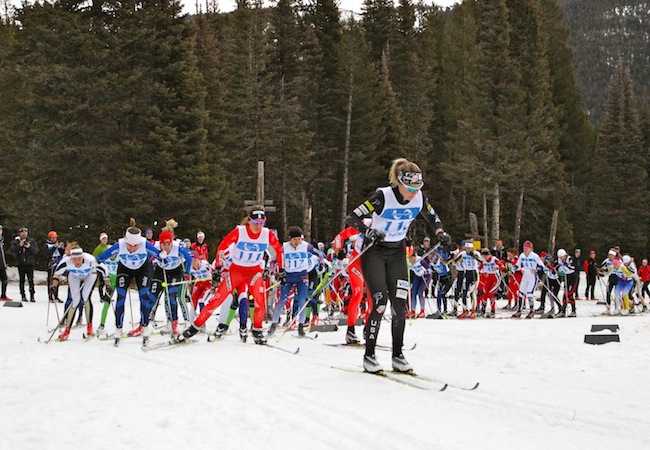
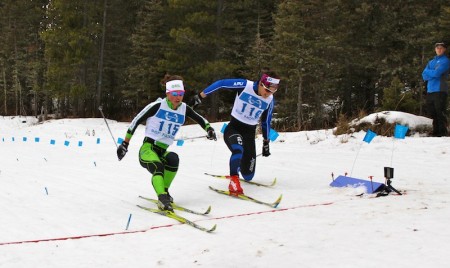
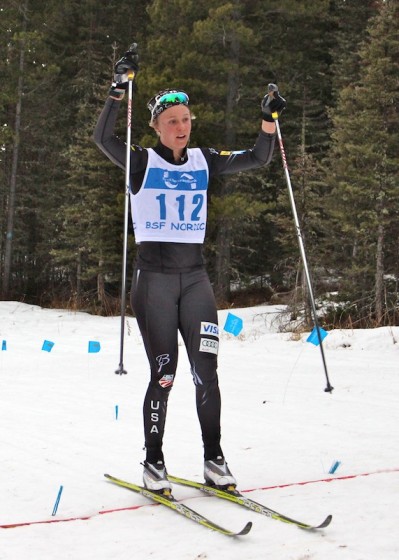
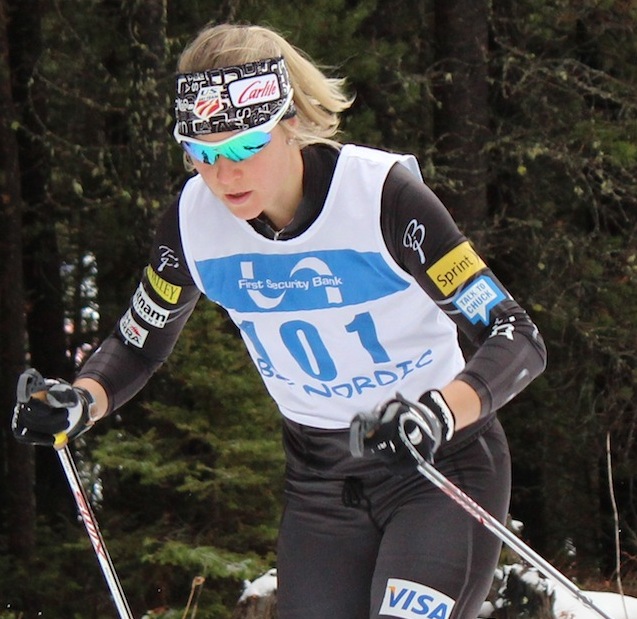
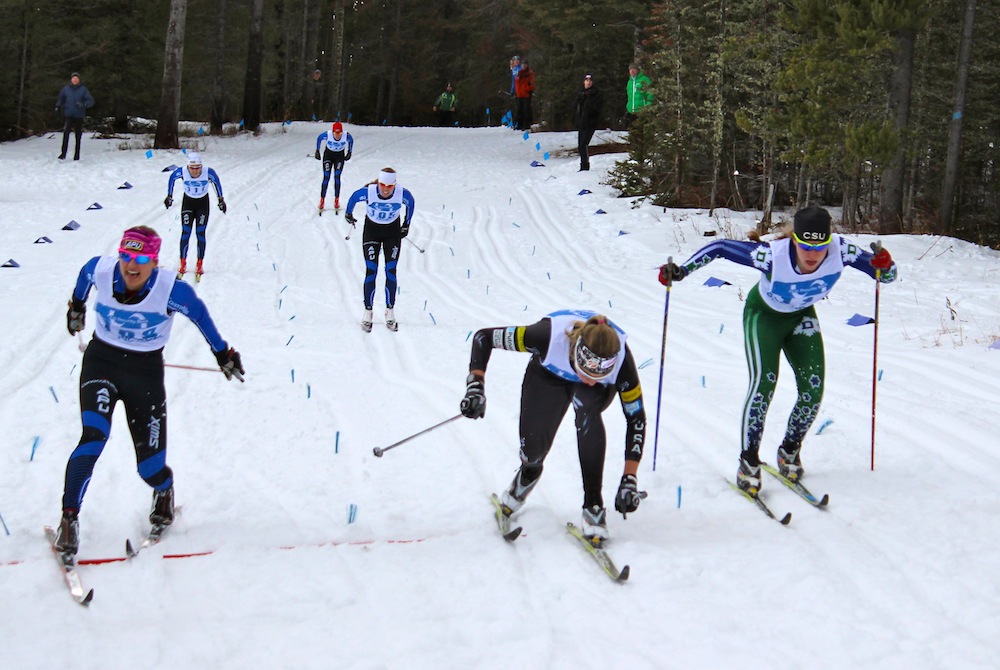
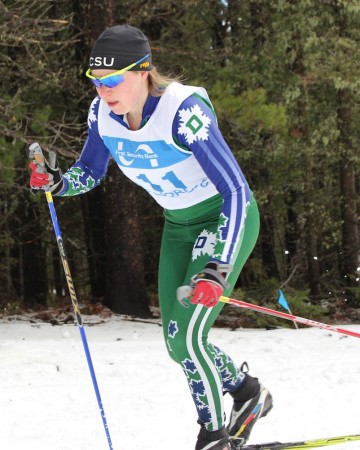
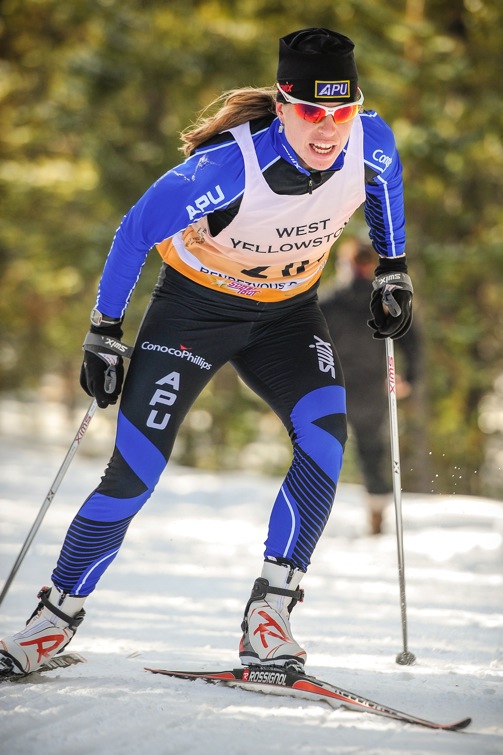
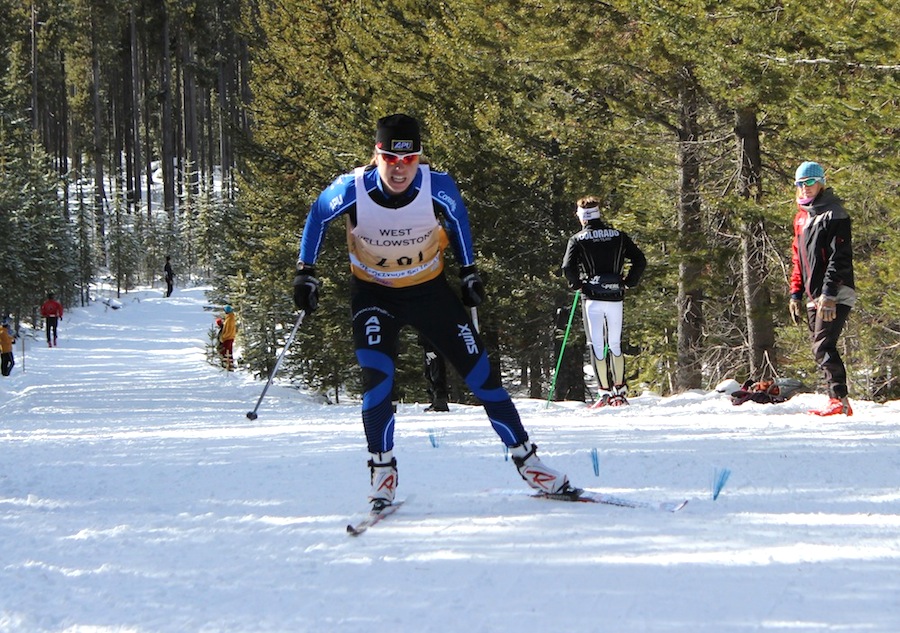
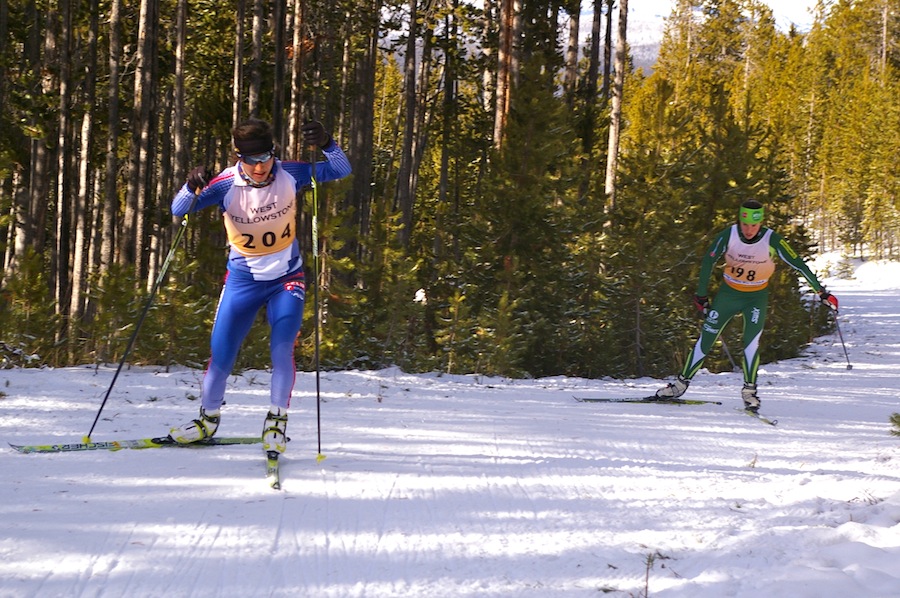
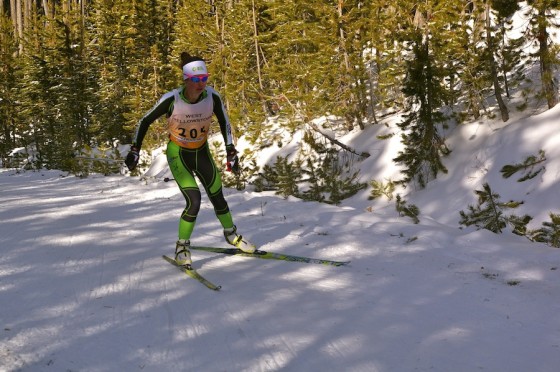
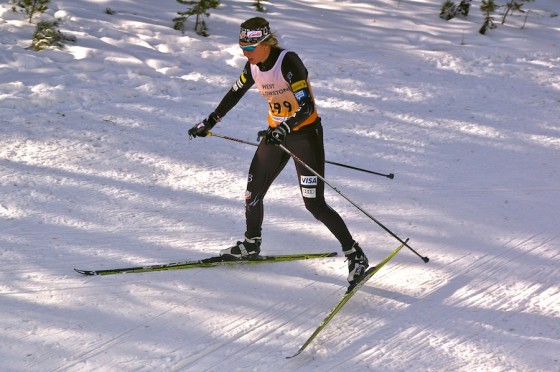
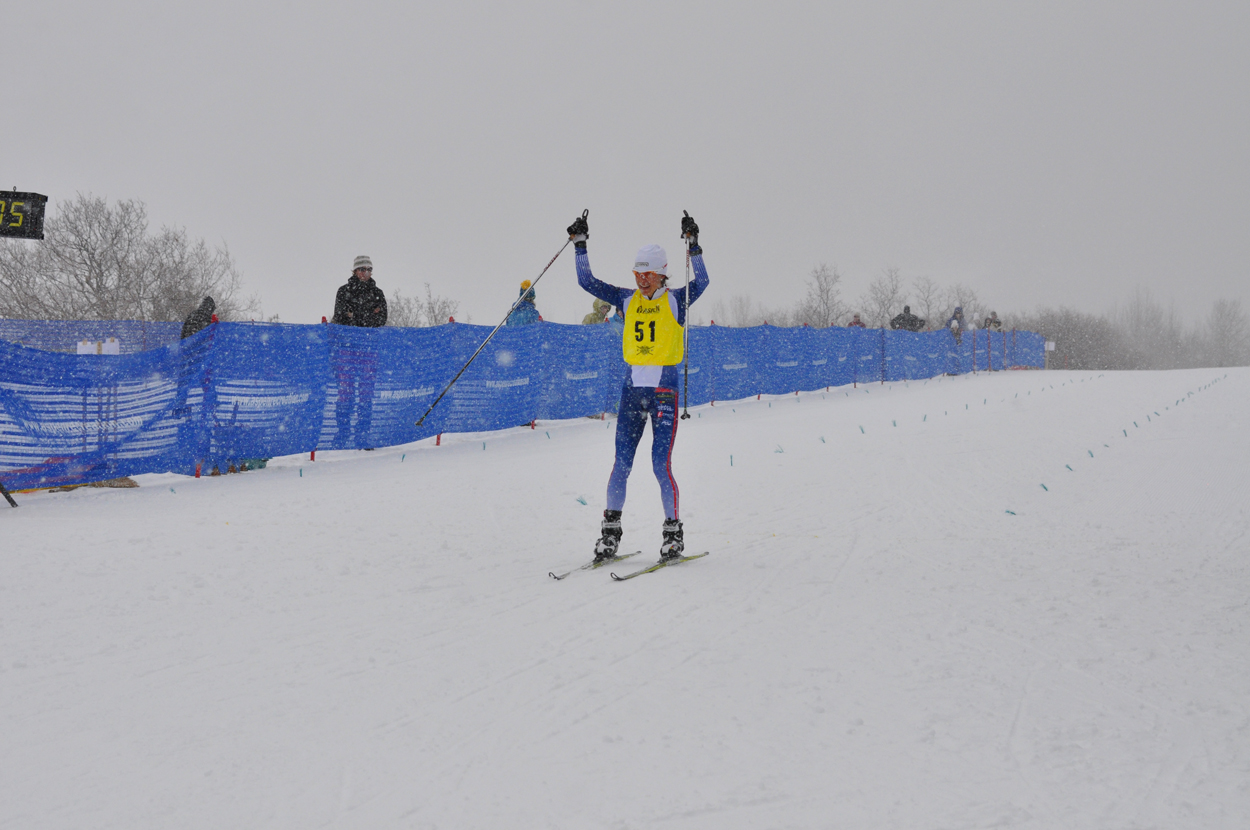
Sadie Bjornsen (APU/USST) leading the women’s field out of the meadow at the start of the 10 k classic in Bozeman, Montana, on Sunday.
BOZEMAN, Mont. — Something rare happened partway through the women’s 11 k classic race at Bohart Ranch on Sunday: Sadie Bjornsen began to falter. On the heels of her classic sprint victory, she charged out of the meadow in front and appeared to settle comfortably in the group for the first lap. But on lap two out of three, the wheels started coming off.
“I had this moment of weakness,” Bjornsen laughed afterwards.
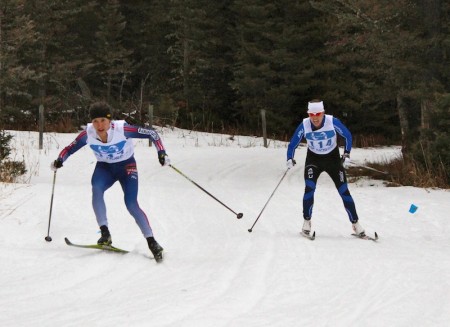
Holmes and Brennan leading, out of sight of the next skiers.
Chelsea Holmes (SVSEF) and Rosie Brennan (APU) began to lay the hurt on in the second lap and pulled away from her. Sophie Caldwell (SVSEF), meanwhile, tagged Bjornsen closely. But rather than let the weak moment last for the rest of the race, Bjornsen dug deep, started the backburners and reeled the leaders back in to win by a healthy 17 seconds. Holmes held on to second and Brennan, on her twenty-fourth birthday, took bronze (+0:27).
Despite only recently coming back to a full training load, Bjornsen was still the odds-on favorite to win on Sunday given her consistent sprint performances earlier in the week (silver in the freestyle technique and gold in classic). Holmes made a gutsy decision to push the pace on a course suited to her light, quick style of skiing.
“This course flows really well and it’s hard, but the timing is good for me,” she said. Knowing this, Holmes chose to pick up the pace on the second lap to avoid a packed sprint finish.
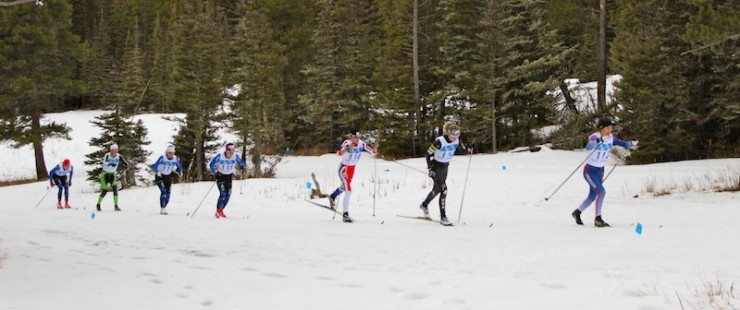
The lead pack on the first lap.
“Sprinting is clearly not my strength,” Holmes said. “I did not really want to lead, but I don’t like being around a million people, so I just did that. It’s not smart sometimes but…”
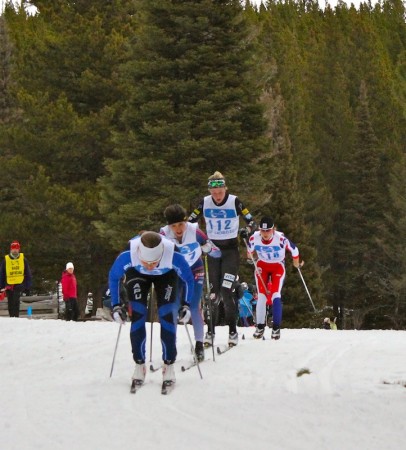
Brennan, whose 24th birthday was on Sunday, leading on the second lap.
Had Bjornsen not found second wind, it would have been a brilliant choice, as Brennan ended up far behind Holmes. But return Bjornsen did, and Holmes was left to hang onto second.
“I just thought about the girls in Europe,” Bjornsen said. “I was like, ‘No, those girls are pushing so hard!’”
Thinking of her teammates, one of whom was fifth on the World Cup earlier that morning, she left it all on the course. Thought it may not have been an ideal way to race, the Bjornsen said the weak moment ended up being instructive for her.
“It worked out well that I had that little thing in the middle. It’s good to remember racing is hard and you have to dig a little bit deeper than you realize you can,” she said.
Holmes was positive about her result after finishing. “Everybody wants to win — obviously I wanted to win and wanted to kind of break away — but those girls are strong,” Holmes said.
Brennan, who led Holmes early on, said she didn’t feel quite as strong as Holmes might have imagined.
“I tried to get out in front and then some other girls took off at a really aggressive pace,” Brennan said. “I didn’t know if I could sustain it, so I backed off the first lap and just tried to keep my own pace going.”
After settling in, picking people off, breaking away with Holmes and then getting passed back by Bjornsen, Brennan was generally pleased with her placing.
“I felt pretty good, it was a decent race,” she said.
Caitlin Patterson nipping Kate Fitzgerald (APU) at the line to take fifth place.
Brennan, Holmes and Bjornsen, along with Caldwell and Caitlin Patterson (CGRP), who was fifth on Sunday, were all named to the American team for the Canmore World Cups on December 13 – 16. The stakes were quite high heading into Sunday, but as the women’s distance field has been generally more stable than the men’s, there were few surprises.
For Bjornsen, who resumed interval work only a month ago after nursing a foot injury this fall, the whole week has been additionally important as a way of racing back into shape. And perhaps most significantly, she was able to regain confidence coming off injury.
“When you’re coming off of injury, your biggest weakness is your confidence,” Bjornsen said. “So that’s really important.”
Lastly, she’s been able to be home with more of her APU teammates and witness the effect the American women’s World Cup performances have had on them in such a short amount of time.
“You wake up in the morning and see Kikkan and Holly at the top and the whole house has a-buzz, like, ‘We can do this!’ It’s been fun to be part of that, too. With them making history, but also it’s fun being the generation below watching how it affects everybody.”
Sadie Bjornsen (APU/USST) sneaking her foot over the line just ahead of teammate Lauren Fritz (left) and Corey Stock at the conclusion of the classic sprint at Bohart Ranch.
BOZEMAN, Mont. — There are days when multiple teams can share the glory of a race well done, and days where a lone set of athletes shines above all others. In the case of the women’s classic sprint at Bohart Ranch on Saturday, the latter scenario played out like it has many times before. Led by Sadie Bjornsen’s consistently strong skiing, Alaska Pacific University pretty much cleaned up.
Bjornsen won a three-way photo finish with teammate Lauren Fritz and Dartmouth’s Corey Stock, who wound up second and third, respectively. The fourth, fifth and sixth place finishers — Rosie Brennan, Kate Fitzgerald and Becca Rorabaugh —were all in APU’s blue and black. For those five women, the final was basically a team workout.
The final lineup: APU, plus Stock.
“It was fun to start on the line with all my teammates; it was just like training,” Bjornsen said. “When you’re with teammates you’re not as timid and you can really get after it.”
“The finals were just: ‘Hey, intervals!’” Fitzgerald added.
The final, as finals usually are, was a harder fought battle than any of the other rounds. Finishers in the quarters and semis were spread out by the time they came through the line, but the desperate lunges from Bjornsen, Fritz and Stock at the end was the product of a very competitive sprint between athletes familiar with each others’ style of skiing.
“It was definitely the scrappiest round out of all of them,” Fritz said, whose second-place was a SuperTour career best for a true sprint.
“We were just hitting each other with poles; Sadie and I almost took each other out a couple times. It was just — not dirty, but being teammates, we’re friends but not afraid to push each other.”
Bjornsen appeared to be the clear favorite when lined up against her teammates. She had skied in control for the rounds, winning her quarter and breezing through in second to Stock in the semis. A near-stumble in the stadium put her off the front for the beginning of the final, however, and she was forced to ski a different kind of race: from the back and aggressively, as there were only 1.3 k of track to make up the time.
On the backside of the hill she tried to make moves around the first corner, but choppy snow made gaining ground difficult. Around the final corner before the finish, Bjornsen finally made progress.
“I took the outside lane and just double poled by and we were all just going for it from there. I’m glad we did so much double-pole work this summer.” she said.
Bjornsen’s pass then spurred on Fritz, who was leading with Brennan, and increased her tempo to keep up.
“It definitely made me take it up a notch,” Fritz said.
Bjornsen won the final lunge, but noted afterwards that Fritz’s strength came as a surprise.
“I didn’t train with [my teammates] as much this summer so I didn’t realize how strong she was; I was really impressed,” Bjornsen said.
Fritz said she was “pretty psyched” with the result given that she hasn’t had the results she’s wanted so far this winter. She placed tenth in the freestyle sprint two days ago and 42nd in the West Yellowstone 9 k.
“It’s pretty cool to be in there with all your teammates,” she said. “Hopefully this’ll bump me up for the World Cup [qualifying] rankings.”
Stock in the qualifier.
The U.S. Ski Team will announce its Quebec and Canmore World Cup teams by December 3.
Equally as impressive as APU’s 1-2 punch was Stock’s navigation of a stacked final to third place. The Dartmouth freshman trained with APU over the summer and did not appear intimidated as she lined up for the final.
“It was a great day,” Stock said. “We were basically all together switching positions throughout, then all six of us came down the last double pole field before the finish… It was so fun to be able to race with them.”
While Bjornsen and Fritz enjoyed racing against their teammates, the back half of the pack found the scenario challenging.
“I have a hard time racing my teammates because I want us all to do well,” Brennan said, who placed fourth after skiing in the lead earlier in the race. Her plan was to get out front and stay out of trouble, which worked until the course started going up.
“Then everyone passed me. I guess I didn’t have as much left as I thought I did,” Brennan said. “[Bozeman] is the first time I’ve gone through the rounds this year. It’s tough to get back into that mode of skiing between each heat, so it was good practice.”
Of note:
The most vulnerable part of the course on Saturday was the first climb out of the stadium. Mud started to show through as more skiers moved over it.
— The fact that athletes had the chance to practice heats at all in Bozeman was significant. Rain soaked the course on Friday, forcing the venue to be moved to higher ground. Volunteer shoveling efforts managed to adequately cover the trail, though as the day progressed snow got sloppier. Overall, athletes said the conditions exceeded their expectations and the races were fairly run.
“I was very surprised this morning; I was expecting far more mud,” Brennan said. The first climb got steadily muddier as more people traveled over it, but “it was the first one so if you didn’t have your best shot up that hill, you still had time and the rest was fine,” she concluded.
— Though the top athletes agreed the racing was clean, there were some complications to the overall race production. University of Utah athletes Rose Kemp and Parker Tyler, who qualified in 20th and 17th, respectively, were originally left out of the top 30 due to an accidentally tripped starter’s wand that went unreported. The resulting confusion, compounded by circumstances of the modified venue, required timers to reissue bibs and delay the start of the heats.
“You just have to go with it,” Bjornsen said of the delay. “Everyone’s in the same boat, everyone’s standing in the cold with you as well so it’s no big deal… You just have to learn to be patient so it wasn’t so bad.”
— Once again, APU’s successful day began before dawn with strong World Cup performances from Kikkan Randall and Holly Brooks in Kuusamo, Finland. APU head coach Erik Flora’s day began, again, with a lot of cheering. With the rest of his team’s results in Bozeman, it ended with more cheering.
“Five lades in the A final is something to be really happy about,” he said. “It was a very strong day, and everybody skied well.”
Rosie Brennan (APU) posting the fastest time in the West Yellowstone SuperTour 9 k individual start on Friday at the South Plateau near West Yellowstone, Mont.
WEST YELLOWSTONE, Mont. – The distance course on the South Plateau wasn’t too bad if you didn’t think about it too much. The 9-kilometer freestyle race – the first of the 2012/2013 U.S. SuperTour series – netted a slight elevation gain of about 300 feet from start to finish. A course profile indicated that the terrain was rolling. No problem.
Try racing it.
The individual start began around 7,260 feet above sea level, which is enough to make breathing difficult for lower-altitude dwellers. After gradual downhill out of the start – a teaser for what was to come – racers endured several kilometers of working hills with little rest and a grand finale at the final multi-tiered climb.
If anything was going to test one’s fitness in the first race of the season, this was it.
Rosie Brennan (APU) on her way to winning the West Yellowstone SuperTour 9 k freestyle individual start Friday on the South Plateau. (Photo: Swix Sport)
The eventual winner, Rosie Brennan of Alaska Pacific University, didn’t feel that great right off the bat – and she’s originally from altitude in Park City, Utah.
“When you race at altitude, within the first k, I feel like as bad as I do the whole race,” she said after winning in 24:36.3, beating runner-up Chelsea Holmes (Sun Valley Ski Education Foundation) by 5.3 seconds. “It’s figuring out how to deal with the taste of blood in your mouth for 9 k or whatever. It’s sort of part of racing at altitude, but I really like it.”
She laughed. That was the kind of grit it took to win Friday’s race on a course that was the same for both men and women. Many said they felt similarly on the final hill, arguably the toughest one of all: horrible.
“I think I V2ed everything but the last steep hill,” Brennan said. “I sort of struggled up that thing, but I made it.”
A staple on APU’s female squad with the likes of U.S. Ski Team members Kikkan Randall and Sadie Bjornsen, the 24-year-old earned some more attention with Friday’s performance. It was her first SuperTour win in nearly half a decade of racing at that level. She had made the podium several times before, but this confirmed her offseason training paid off.
Skating isn’t usually her forte, Brennan said. Flats aren’t great for her, either. The course was certainly rolling, but unforgiving if you let off the gas. One could lose time quick, but burn out even faster.
Brennan thought about all the work she had put into her skate technique and concentrated on making every movement count along the flats.
“I guess I must’ve figured something out this summer so it’s really great,” she said.
While her Anchorage-based team tapered its training for the West Yellowstone SuperTour, which includes a freestyle sprint prologue on Saturday, Brennan hadn’t expected to be in top form.
“We haven’t tried to peak or anything for these races so I still feel like I have race fitness to gain so I’m really encouraged by doing well today,” she said of taking one gigantic step forward toward securing a Canadian World Cup start next month.
Qualifiers for the Québec City skate sprints and Alberta World Cup (which includes a freestyle sprint, skiathlon and classic distance race) will be decided following next week’s SuperTour races in Bozeman, Mont.
Brennan’s not counting herself out of an opportunity to make the World Cup sprints as well.
“I was a really good sprinter when I was a junior and then I had a lot of injuries and lost some of my fast twitch,” she said after having knee surgery in 2010. “It’s something that I’ve been working on trying to get back.”
Chelsea Holmes (SVSEF) after passing Heidi Halvorsen (GMVS) on the last hill of the West Yellowstone SuperTour 9 k.
Not far behind Brennan, Holmes was excited to race in Montana after missing last year’s SuperTour opener to an injury of her own. About three weeks before the 2011 races, she broke her thumb and was in a cast until mid-December.
On Friday, she was raring to go. Training at altitude throughout the summer between Sun Valley, Idaho, and Canmore, Alberta, where she joined some Canadian Ski Team workouts, Holmes anticipated how racing at even higher elevations would feel. So when her breathing redlined and overpowered the splits people were giving her, she didn’t freak.
“My breathing was just about loud enough to cover anything I could hear,” Holmes said with a laugh. “I had an idea [what place I was in], but you can never really tell until you finish.”
Second at this point in the race season was great, she said. After starting 1 ½ minutes behind Brennan, Holmes gauged how she was doing off her.
“It was just a fight the whole way,” Holmes said. “I kept hearing that Rosie was kind of just in front of me. I just couldn’t get her, but I mean, she had a killer day.”
Caitlin Patterson (CGRP) cresting the final hill before ultimately finishing third.
Less than a second behind Holmes, Caitlin Patterson of the Craftsbury Green Racing Project took third (+6.2). Like Holmes, Patterson wasn’t sure the course necessarily suited her. Both were hill climbers, but the mostly V2 race on the plateau didn’t include many of the hills they usually thrive on.
“For a while I was thinking I felt like I started too hard, but that might just be the altitude feeling to some extent,” Patterson said.
Throughout the race, she tried to catch Holmes, who started 30 seconds in front of her. Patterson frequently lost sight of her on the varied and twisting terrain, but didn’t give up.
“She’s a really good skier at altitude and uphill terrain so I knew she would be a good one to chase down,” Patterson said.
By the last climb, however, Patterson said she was nearly done for. From her conversations with competitors and teammates after the race, she discovered everyone suffered there. Luckily, she heard some motivating final splits that pulled her through.
“I knew it was a big hill at the end and I wanted to ski fast as possible, but its amazing how it twists and turns at the top and doesn’t crest,” she said. “Even when you get to the top it’s not even a steep downhill on the other side. It was all I could do to free-skate and not tuck.”
Sadie Bjornsen (APU/USST) skating to fourth-place finish at West Yellowstone SuperTour 9 k.
Also holding steady through the suffer-fest, Bjornsen finished fourth (+23.3) in her first race after a summer hindered by back and foot injuries. Sophie Caldwell (Stratton Mountain School T2 Team) was fourth, 52.7 seconds behind Brennan, Kate Fitzgerald (APU) was sixth, and one of the race favorites, Caitlin Gregg (Central Cross Country), was seventh.
Several A-seeded skiers said they used Greg as a measuring stick. One of the smoothest skaters on the circuit, she started right in front of Brennan.
“I knew when I was catching her that I was having a good race,” Brennan said.
From Gregg’s point of view, the race “hurt like hell,” she said, considering she hadn’t raced or done any sort of time trial since March.
“But I think it did for everybody. It’s at high altitude and a lot of uphill and the first race of the season so it’s just a recipe for pain out there, which felt really good for me,” she said. “This was a definitely good race for me to blow the cobwebs out and remember what that next level, that next gear, feels like.”
While she felt good about her team, sponsor and outside support, Gregg said she simply needs to log some more hard efforts.
“Obviously it’s always great to win the race, but I think the trajectory I want to head in is right on,” she said.
Extras
— Bjornsen is coming off some lingering injuries, and while the tendonitis isn’t completely gone in her foot, she’s happy to have started the race season strong after a walking warmup.
“This year will be a lot about racing myself into shape, so today was a great day to feel the burn and gain some fitness,” she wrote on Skype. “I had the goal of holding my technique together throughout the course, and remembering how to ski at altitude. I felt like I was able to keep pushing even when it felt bad, so it was nice to finally feel like an athlete and a racer again today. So all in all, I am stoked.
“I am also super happy for Rosie. I have been living with her this summer watching her train, and I know she is going to be doing nothing but turning heads this winter. It will be fun!”
Bjornsen knew how well she was doing based on splits from Gregg, who started right behind her.
“I just kept listening for how quickly people were cheering for her after me,” she wrote. “At one point I think she nearly caught me … so that was my split system.”
Asked how her foot felt Friday after the race, she explained that it was an ache and pain that fortunately took a backseat to the burning in her legs and lungs while racing.
“I didn’t feel it once in the race, and it actually doesn’t feel too bad now,” she wrote. While Bjornsen will skip Saturday’s prologue to rest her foot, she’s looking forward to the rest of the season – especially the middle.
“I want to be racing in the World Cups, but these first months are training,” she explained.
— Considering that 10 k skate races aren’t exactly her specialty, Caldwell was pleased with how she fared Friday. The sprint lover had hoped for a top 10.
“I really had no idea where I’d stack up because really the only girls I’ve skied against are the girls on my [Stratton] team,” Caldwell said. “I went to those U.S. Ski Team camps, but those girls weren’t here, either.”
To keep herself in the running, she tried not to go above Level 3 before the last hill. She paced herself pretty well, running in fifth or sixth early and as high as third mid-race, but she worried about blowing up before the end. She thought back to the classic intervals her team had done nearly a week ago on that same climb, and later remembered they didn’t reach the top.
“I kind of forgot once you get around that corner you’re only halfway up,” Caldwell said. “But once you get so close to the finish, you get an adrenaline rush and that pumps you to the finish.”
The major focal points for the SuperTour field this year are qualifying for the Canadian World Cups in December and World Championships in February. Photo: Flying Point Road.
Ready or not, the 2013 SuperTour season is fast approaching. Here’s what you need to know about the domestic race scene this year.
At this point, we’ve pretty much said everything we can about the twelve senior ski programs in the U.S. We ran a series throughout the summer highlighting each team’s past accomplishments and goals for the future. Read back through ‘em for comprehensive rosters and standalone previews (scroll down for links). Now that it’s November, it’s time to discuss who stands a shot at beating whom.
First, there are a few unusual things about the race schedule to understand, as domestic results have an important role to play in qualifying athletes for bigger things this season. The U.S. can enter more athletes than usual in each World Cup race in Canada and can have eight athletes of each gender on its World Champs team, meaning that U.S. Ski Team (USST) members have a shot at top-end international competition this winter (those on the USST are not guaranteed World Championship slots, either).
Not surprisingly, the big focus is a combination of Canadian World Cup starts and World Championships. The overall, sprint and distance SuperTour leader(s) at the end of each competition period get World Cup start rights no matter what year it is, but being consistently fast enough to be in one of those positions is hard.
The five extra Nation’s Group spots afforded to the U.S. for each of the Quebec and Canmore World Cup races will be partially filled based on the SuperTour standings after the Bozeman races. With selection criteria theoretically reaching further into the field and requiring just two weekends of top results, the international stage suddenly seems much closer and more attainable. Who cares if SuperDario Cologna won’t be there, it’s still the World Cup!
World Championship criteria are a slightly different story, but early SuperTour races could still help decide who gets to go. The U.S. will bring up to eight men and eight women, with the first spots going to athletes who reach a certain World Cup ranking by January 14. After that, USSA goes down the National Ranking List, which is created off of competitors’ best four USSA-scored races from the twelve months prior to the selection date.
The road to Val di Fiemme, then, has already begun. The beginning of the current SuperTour and the week’s worth of racing at U.S. Nationals are further opportunities for athletes to turn in one of their four-best results and move up the ranking list.
Consequently, there’s a lot potentially riding on the SuperTour this year, despite the continued absence of leader bonuses at the end of the season. It’s not that everyone wasn’t trying hard before, but with a handful of top-level start rights on the line that only come around every so often, things could get feisty. Dreams will come true and hearts will be broken.
Now, the players: last year’s overall SuperTour leaders, Sylvan Ellefson (SSCV Team HomeGrown) and Jessie Diggins (SMS T2/USST), are already in Europe and out of the domestic picture for the next two weekends. Even so, the potential lineups for West Yellowstone and Bozeman are impressive.
The Rookies
Eric Packer (DAR). Photo: Flying Point Road.
For the purposes of this preview, athletes can pretty much be divided into two groups: knowns and unknowns. Every spring a handful of top-tier college skiers graduate and the domestic circuit gets an injection of new blood. Most graduates have competed in SuperTours before, but not when it’s actually been their job to ski fast.
So while the rookies aren’t joining the circuit as complete unknowns, their changed training circumstances can make the first results of the year a bit of a surprise. The 2012-2013 freshman class has generally never trained without academic demands competing for their time, and given the results they’ve been able to churn out even during school, count on them disrupting the status quo on the SuperTour this year.
Take Eric Packer, who joins the SMS T2 team from Dartmouth College and already has a handful of SuperTour and national podiums to his name. Packer was probably the most consistent college performer, sprinting and distance-wise, on the circuit last year, and could be ready for a significant step forward in his transition to full-time racing.
Reid Pletcher (CU) winning the skate sprint qualifier at West Yellowstone, 2011.
There’s also Reid Pletcher, who has been described as a “sprint fiend” and returns to skiing for Sun Valley this winter after graduating from CU. Remember how he won the skate sprint in West Yellowstone last year, just six months after a climbing accident landed him in the ICU? Yeah, that was ridiculous. Imagine what he might do this winter with a strong summer of training behind him.
Ryan Scott will be another sprinter to watch for. Regardless of the whole obstruction controversy, he was still in the classic finals at U.S. Nationals. At U23s he was the top American performer in the freestyle sprint. He didn’t race a whole lot after that, but his coaches at Ski & Snowboard Club Vail think he’s looking mighty fast in the run-up to the first race of the year.
In the women’s field, newcomer Sophie Caldwell (SMS T2) presents the greatest threat to the usual SuperTour standbys. Amy Glen (Craftsbury Green Racing Project) did beat her by a toe-length at the biggest college race of 2012, but the name Caldwell regularly shows up at or near the top of the results sheet week after week — whether it’s Sophie or one of her equally fast relatives.
The Upperclassmen
Though they represent relatively known quantities, the more seasoned SuperTour athletes are no less intimidating for it. They’ve been around the block and they know what it takes to be at the top of the domestic field.
Jennie Bender (CXC) was the second-ranked woman on the SuperTour last year, and stands a good chance at leading it in winter with Jessie Diggins now in Europe. Photo: Flying Point Road.
Central Cross Country (CXC) was indisputably the best all-around team last year, and won the National Nordic Foundation’s team trophy in a landslide to prove it. The Midwest squad has lost a few athletes and coaches to other programs since last spring, but still claims four athletes ranked in the top five on the SuperTour in 2012: Jennie Bender, Karl Nygren and Caitlin and Brian Gregg. Look out for their fire engine-red spandex when the gun goes off.
The next team to mention is undoubtedly Alaska Pacific University (APU). Sadie and Erik Bjornsen (APU/USST) are both racing stateside this November, and present a formidable threat when united with the rest of their teammates. Kate Fitzgerald, Becca Rorabough, Rosie Brennan, Reese Hanneman, Peter Kling — the Alaskans have a lot of returning talent. Thanks to Eagle Glacier, they’ll also be stepping onto their skis with more on-snow hours under their belts than anyone else.
From the Bridger Ski Foundation, Torin Koos and Leif Zimmerman present solid all-around threats. Zimmerman has traditionally pulled off a distance win at West Yellowstone every year, and Koos will no doubt be looking for redemption for getting erased from the results the last time he raced in the U.S. When we spoke with him in June, Koos said that every day he thinks about the Canadian World Cups more than anything else.
He’s probably not the only one. Mikey Sinnott (SVSEF), after finally earning his first World Cup starts in March, will be raring to get back. With two real, actual, sprints on the schedule in the first two weeks, Sinnott should be in contention to go to Canada. His teammate Matt Gelso is another name to watch in both sprint and distance. Representing Sun Valley’s women, Chelsea Holmes is coming off a strong finish to her 2012 season, where she was fifth in the 30 k at distance nationals.
Matt Liebsch (Team Strong Heart/Team Birkie) skiing to the finish. Photo: Flying Point Road.
Racing for Team StrongHeart/Team Birkie, Matt Liebsch is a perennial distance challenger. He took second in the 15 k freestyle at nationals and usually puts up solid distance results at the opening races. This year he’s been training in West Yellowstone longer than anyone getting ready to hit the ground running on November 23.
In the east, the CGRP has another impressive lineup. Tim Reynolds and Pat O’Brien both finished the season strong at distance nationals and will want to continue the trajectory in 2013. To the north, Maine Winter Sports Center’s Welly Ramsey has been logging the hours with Kris Freeman and apparently been able to keep up at times, which can only be good for his skiing. Skyler Davis will be on the domestic circuit for the first period, at least, and could be a sprint contender for SMS T2 if he’s in full form.
From Oregon, Dakota Blackhorse-von Jess (Bend Endurance Academy) proved last year he is not to be overlooked on a sprint day. And with more of those legitimately on the SuperTour schedule this year he’ll have plenty of opportunity to contend in the heats. XC Oregon added Santi and Carolyn Ocariz to its roster this year, and returning skiers Matt Briggs and Ollie Burruss will be looking to top their career-best SuperTour finishes from last season.
That’s a lot of skiers entering the starting gate this week, and this list doesn’t even include everyone. At some level, each athlete is trying to do the same thing: ski better than they ever have before and hope that it’s enough to break through to the next level. The trouble is, they’ll have to get around each other first.
* * *
For more in-depth discussion of each team and its athletes, read FasterSkier’s features from this summer:
Fresh snow in September on Powerline Pass outside Anchorage, Alaska. Photo: Kinsey Loan.
It’s here: the first skiable snow of the season fell over the weekend in Anchorage, Alaska, much to the delight of area skiers and envy of everyone in the continental U.S. Rock skis were still necessary, but the close access, crisp air and fresh powder ushered in that first-snow excitement even for athletes used to skiing throughout the summer on Eagle Glacier.
“I was a little blown away by the snow,” said Alaska Pacific University’s Rosie Brennan. “We have actually had horrible weather the last month with tons of rain and lots of epic windstorms so to wake up to snow and sunshine was incredible.”
Upon waking up to a white dusting on Saturday morning, Brennan’s first thought was how she would train that day on slick roads. Once word got out that there was more snow higher up, however, the problem became a gift. There would be skiing in September.
Brennan cutting her first tracks of the season. Photo: Kinsey Loan.
“With that, Sadie [Bjornsen] and I actually ran (through lots of snow and mud) up to Glen Alps where we had a car parked with our skis in it, then threw on our skis and went for a little ski,” Brennan said.
“It was certainly rock-ski conditions, but we were able to glide and get the feeling of snow for sure… We were having a blast and enjoying every minute of it. It was certainly winter-like snow, surprisingly dry and fluffy.”
The timing of the unexpected snow meant that, for the first time in her career, Brennan was on skis for at least one day in every month of the year.
“September is the one month we don’t go to the glacier so it is always the hardest month of the year to get on snow,” Brennan said. “I was pretty happy to ski and be able to say I’ve skied at least once a month this entire year.”
Now in her second year living in Anchorage and skiing for APU, Brennan says the total on-snow time has been invaluable to her development as a skier.
“It is one of the biggest perks to training in Alaska. The transition to snow gets easier and easier every time I do it. To be able to keep in touch with the feeling of snow not only helps my muscle memory, but helps my mind. It’s much easier to train for skiing [when] actually skiing… This has been a huge benefit to me and is certainly one of my favorite parts of being part of APU.”
Brennan left the Alaskan snow behind on Monday to fly to Park City, Utah, where she and several of her APU teammates will join the U.S. Ski Team’s October training camp. The dryland and snow skiing alike have helped Brennan get closer to her goals.
“Technique has been a big goal of mine the past few years, so getting so much time on skis gives me the opportunity to work intensely on technique, let my body absorb the changes during dryland, then return to snow to see if any of it stuck,” Brennan said.
Brennan enjoying the snow and sunshine. Photo: Kinsey Loan.No grooming necessary; Bjornsen and Brennan on Powerline Pass. Photo: Kinsey Loan.
Sadie Bjornsen (APU/USST) coming down the homestretch through the falling rain, with teammate Rosie Brennan just behind.
CRAFTSBURY, Vermont — Even though she now has a World Cup podium to her name, a win at SuperTour Finals had eluded Sadie Bjornsen (APU/USST) until Sunday morning, when she claimed the 10 k mass start classic on the second day of racing at the Craftsbury Outdoor Center.
Rain isn’t usually at the top of the list of desirable ski conditions, but as the snow soaked through prior to start, Bjornsen couldn’t wait to start racing.
“When it started raining, I was like, ‘This is pretty awesome — this is Alaska weather, I’m used to this,’” said Bjornsen.
When the siren signaling the start of the race went off, Bjornsen might have had more pent-up energy than she’d realized. She took the lead position right off the bat and never left it.
Women’s mass starts typically go out fast and string out, while in men’s race a pack can stay together until late in the race. Sunday was no exception — by the middle of the second lap, the field had already thinned out behind Bjornsen. With a hill climb preem up for grabs the second time around, the spread was perhaps more pronounced.
Bjornsen, for one, attacked the bonus sections of the course, the second of which came on the third lap.
Bjornsen pacing Brooks and Diggins through the woods. Photo: Evan Dethier.
“Before I knew it I was sprinting for the second one and I kinda looked around and was like, what happened to everyone?” said Bjornsen.
The early surge may have cost her speed later on, but she managed to keep an even pace in her final two laps and hang on for the win. As Bjornsen faded slightly, her teammate Rosie Brennan wove her way from eighth place to third on the penultimate lap, only five seconds off the lead and less than a ski length behind Holly Brooks (APU), who was steadily in the top three for the entire race.
“I had a bad start,” said Brennan. “I don’t know, I was just slow, so I was focusing on picking one person off at a time.”
When she passed Brooks and pulled up behind Bjornsen, she was simply excited to be skiing on pace with her good friend and teammate, and decided to keep pushing the pace.
“She pulled up next to me and was like, ‘Come on Sadie, we can do this,’” said Bjornsen. “So then we just worked together until the end. It was fun to ski with a teammate — fun to come back and have teammates to work together with to go for a win.”
Brennan was surprised to find herself in such a position. A former Dartmouth standout, Brennan’s first season of post-collegiate racing got off to a more variable start than she’d wanted.
“It’s been very up and down trying to figure things out, and I finally feel like I’m coming around now, so it’s better late than never,” she said.
She ended up finishing 5.7 seconds behind Bjornsen.
An APU sweep: 1. Bjornsen, 2. Brennan and 3. Brooks.
Brooks hung onto the third position, but slowed significantly in her last lap and appeared to be struggling. She motivated herself with the thought of an APU sweep to fend off Liz Stephen (Burke/USST) for the bronze medal.
“I just kept telling myself, ‘You know you’re tired, but don’t give up, and let’s go for an APU sweep,’” said Brooks.
Brooks wasn’t the only one digging deep in the final stages of the race. The slushy snow was a challenge to ski through, and each double pole plant seemed to take extra effort as the women crested the final hill and came within sight of the finish line.
“This time of year it’s sometimes tough to stay super spunky; everyone’s a little tired. But today was really fun,” said Stephen, who finished just over three seconds behind Brooks.
Becca Rorabaugh (APU) rounded out the top five (+40.4) for a four out of five showing for APU. Jessie Diggins (CXC/USST), uncharacteristically off the front, finished sixth, 44.8 seconds back. Ida Sargent (CGRP/USST) came in seventh on her home course (+54.0).
The field strength may have paled in comparison to the World Cup, or even a Scando Cup event, but a win is a win and a podium a podium, especially on European snow.
A group of American skiers posted strong results over the weekend in two days of Swiss Cup racing, led by Becca Rorabuagh’s win in the 10k classic on Sunday.
Rorabaugh was also 3rd in Saturday’s 10k freestyle while Tad Elliott, fresh off his American Birkie victory placed 2nd to World Cup veteran Remo Fischer (SUI) in the same event.
Elliott, who was 38 seconds back, was 5th in Sunday’s 15k classic, a race also won by Fischer.
The US took places 2, 5, 6, 7 and 9 in that event, led by Erik Bjornsen.
“My game plan was to get out front and control the pace, go slow on herring bone sections and hammer everything else,” Bjornsen wrote to FasterSkier in an email. “You get to go hard when you want to and at sections of course you feel you are strong at and you get to go slow when you want.”
Of course this only works as long as you are in the lead, Bjornsen explained. And while he was confident that Fischer knew exactly what was going on, he gave the Swiss a strong run for the top spot.
Fischer eventually took over and made his move, but finished just 19 seconds ahead.
Bjornsen (l) on the podium (Photo: Brian Gregg)
“Actually, I didn’t feel great before the start,” Bjornsen said. “I got a cold at the end of the U23 Championships and this cough has held on for a while. It feels like there is something in my lungs. I’ve talked to other people that got this same cold and we are all having a problem getting rid of this hack. Once the race started I raced into it and started feeling good in second and third lap.”
The small field of 15 quickly split into two groups with all five Americans in the front pack of eight.
Reese Hanneman and Peter Kling crashed at 4k, however, losing contact with the lead group and ultimately taking sixth and ninth as the field strung out.
Elliott, a stronger skater, will be racing on the second tier circuit for the rest of the season. With no more straight skate races on the World Cup schedule, and other American performing well, he will continue to gain experience with two weekends racing OPA Cups before heading back to the US for Spring Series.
“Saturday was a better day and race for me,” Elliott told FasterSkier. “I went for the win hard, and faded but Remo was skiing well and it is a goal of mine to beat that guy in a skate race. He is one of the nicest guys on the World Cup—fun to ski with him.”
Despite the travel back and forth to Europe this season, Elliott says he continues to feel strong.
Fellow American Brian Gregg, on just his third European race trip, also said he isn’t showing any ill-effects from the travel.
Elliott (l) had his turn on the podium with Mr. Fischer as well (Photo: Brian Gregg)
Gregg said he was gunning for the podium in Switzerland, and while he missed that goal with a 4th on Saturday and the 7th on Sunday, he was pleased with how he skied, with some qualifications.
“I felt good in both races, but didn’t feel like I was able to really go fast in the classic race today,” Gregg wrote to FasterSkier in an email. “My fitness feels great and I am excited for two more weeks of European racing.”
He did point out that the time gaps were larger than he was hoping for, but that he was “pretty happy” with his skate result.
“I have been saving and planning for this trip for the past two years and want to make the most of the opportunity to be racing in Europe,” Gregg added.
The next stop for the Americans is Slovenia for a set of OPA Cup distance races next weekend, and then on to Toblach, Italy for OPA Cup Finals.
Gregg said he will sit out the 30k classic in Slovenia, focusing on the 10k skate there, while being careful not to spread himself too thin.
“The 30km classic mass start sounds fun and I really enjoy the longer distances, however Jason [CXC Coach Jason Cork] and I decided that it is a lot of racing, and that I can save a lot of energy by skipping one race,” Gregg said. “It is hard for me to do that because I really love racing, but I am excited to cheer on my teammates and maybe lend a hand to Fish and Casey with waxing.”
On the women’s side, Rorabaugh was realistic about the strength of the field, noting that she and teammate Rosie Brennan had the best FIS points in Sunday’s race.
But that didn’t take away from the thrill of victory.
“At my age and level, there aren’t a whole lot of podiums up for grabs any more!” Rorabaugh told FasterSkier. “Unless you’re winning US Nationals or SuperTours, you don’t get to win very often. It’s always fun to really come out on top.”
Rorabaugh with two days worth of hardware (Photo: Brian Gregg)
The unknown nature of the competition also added an extra dimension.
“It was refreshing to learn their strengths at face value, without remembering their successes from earlier this year,” Rorabuagh said. “You get to know everyone pretty well in the US, so you know every race what they’re going excel at, so it was fun to learn about some new girls.”
She added that she felt great on Sunday after struggling in the warm slushy skating on Saturday. With temperatures reaching into the 50’s Rorabaugh said “It’s a little hard for an Alaskan to deal with sometimes, but I made sure to focus on hydrating before the noon skate race yesterday, and it turned out just fine. I didn’t even feel like I was overheating.”
She was also pleased how she handled the skate conditions, pointing to similar snow experienced during summer training camps on Eagle Glacier. With an early start on Sunday, the tracks fell within the opposite extreme—icy hard and fast.
Like Bjornsen and Hanneman, Rorabaugh had travelled from the U23/World Junior Championships in Turkey. She was not thrilled with her races there, but after her performance on Sunday, she is feeling confident heading into the next two weeks of European racing, especially in classic.
Brennan placed 4th in both races while Lauren Fritz was last in the eight-woman field on Saturday and 21st on Sunday.
The team drove nine hours to Slovenia today and will spend the week there training.
Chelsea Holmes (SVSEF) may be used to racing at altitude, but that didn’t make the 5 k classic on Saturday at the Aspen SuperTour any less painful. “Oh my God, I felt like my heart was ripping out of my chest, all the time,” said Holmes after winning by 0.5 seconds in the individual start.
Rosie Brennan (APU) was the runner-up for the second time in one day, as the classic sprint qualifier occurred earlier the same day. Jennie Bender (CXC) took third after winning the classic sprint by over 14 seconds.
Check out their interviews and footage of the action.
Morgan Arritola (SVSEF), victorious at the Owl Creek Chase. Photo: Susan Jackson.
ASPEN, Colo. — Morgan Arritola (SVSEF) was officially back to full form on Sunday at the Owl Creek Chase. After appendicitis forced her to skip U.S. Nationals and subsequent SuperTours, she won the 21 k point-to-point mass start freestyle by nearly four minutes over Lenka Palanova (BNJRT). Chelsea Holmes (SVSEF) finished third (+4:48.6).
“This was my kind of course: hard, uphill,” said Arritola. “I just went out as hard as I could—that’s kind of how I race—and it worked out today.”
After taking about three weeks to ramp her training back up after surgery, Arritola returned to racing last weekend at the Boulder Mountain Tour in Sun Valley, Idaho, where she finished a close second to Rebecca Dussault.
Nothing held her back at in Aspen, where the race started on the Snowmass Club Golf Course and headed east towards the nordic center at the Aspen Valley Ski and Snowboard Club. Many of her competitors had done the classic races the day before, but Arritola was skiing fresh.
The women's leaders shorting after the start.
The sky remained cloudy throughout the women’s traverse over long and hilly terrain, across the Tiehack Bridge, and down a partial slope at Buttermilk. With only 5 k to go as they reached the Aspen trails, the sky opened up and heavy flakes began to fall.
Arritola didn’t let it bother her.
“At that point you’re just tired…whatever’s happening is happening,” she said. A comfortable four-minute lead certainly minimized the effects of a burst of snow on the outcome of the race, but made the tail end of an hour of hard skiing no more pleasant.
Arritola pulled from the front most of the way, and for the first few kilometers a group of five skiers stayed close on her tail. But the chase pack eventually dwindled to two: Palanova and Holmes.
“I was faster on the uphills, [Holmes] was way faster on the downhills, so it was back and forth,” said Palanova.
The former CU standout, now Boulder Nordic Junior Race Team coach, had skied the course once before in college, and knew what she was in for.
“It’s hard—not an easy course,” said Palanova.
The top three finishers: (from L to R) Holmes, Arritola and Palanova. Photo: Susan Jackson.
Palanova passed Holmes for good as they approached the nordic center to head into the final 5 k. Holmes had managed to put a big gap on Palanova on the descent across the Buttermilk trail, but caught back up and managed to maintain the lead.
Palanova thought the squall that started for the final minutes of the race slowed her skis, but wasn’t impossible.
“I think we finished early enough that it wasn’t too bad,” she said.
Like Arritola, she enjoyed the course’s varied terrain.
“It’s really cool—not that I would look around much [during the race],” she said.
“Even if you’re tired you have downhills to rest.”
The field was spread out for the final kilometers. Holmes finished 50.4 seconds behind Palanova, and Alexa Turzian (SVSEF) took fourth 1:49.5 behind Holmes. Tammy Jacques was fifth (+6:58.0) and Rosie Brennan (APU) crossed the line in sixth (+7:12.9).
Last year, the Owl Creek Chase also served as a collegiate race, but on Sunday most RMISA collegiate skiers were in Anchorage, Alaska for the Seawolf Invitational. As a result, the fields were noticeably smaller, but the skiers who made the trip were clearly happy to have the chance to ski on such good snow.
Jennie Bender (CXC) getting off to a fast classic qualifier on Saturday at the Aspen SuperTour.
ASPEN, Colo. — When Jennie Bender (CXC) went from sea level to over 8,000 feet in Aspen, Colo. on Thursday night, she didn’t quite know how her body would react when she began the classic sprint on Saturday. A 14.44-second victory definitely wasn’t what she expected.
“I was going to take it out slower than I normally go; I wasn’t sure how the altitude would be,” said Bender. “But, I felt great—kind of surprised by 14 seconds.”
Bender, typically a strong classic skier, had never before raced in Aspen, but decided to make the trip this year in order to develop her altitude racing. With such a significant gap between her and the other 22 women in the sprint field, clearly she’s already doing something right.
“I just tried to keep a constant L4 pace the whole way and not blow up, and it worked!”
With an eye towards qualifying for the World Cup in Canada next winter, Bender decided that in addition providing good skiing at altitude, a trip to Colorado was worth it for its potential to better her USSA points. The right to compete in Canmore will be weighed by both the current season and early races next fall.
Rosie Brennan (APU) finished second in the sprint, and said she was caught off guard by the short, hard effort.
“I did not feel good this morning,” she said at the end of the day. “I was not quite ready for that, but it was a good warm up for the 5 k.”
Haley Piske (Steamboat Springs Winter Sports Club) took the third spot on the podium (+14.90); Chelsea Holmes (SVSEF) was fourth (+16.30).
The sprint on Saturday was a qualifier-only; after taking a two-hour break following the first round, racers took to a 5 k classic course at 30-second intervals for the chance to earn separate SuperTour points.
* * *
Chelsea Holmes (SVSEF) getting started i the sprint qualifier. She won the 5 k later that day by 0.5 seconds over Rosie Brennan (APU).
In contrast to the way the sprint played out, the 5 k classic was a close call. Holmes and Brennan, who started a minute apart from each other, were locked in a battle against the clock and each other throughout the entire course. Holmes wound up beating Brennan by a mere 0.5 seconds; Bender took third at 57.5 seconds back.
As the race consisted of one lap and most coaches were busy waxing for junior races later that afternoon, few if any athletes got split information on the course to tell them how their races were going.
“I just figured I’d go as fast as [I] can,” said Holmes. “I caught Jennie, and she’s a really good classic skier, so I was psyched.”
Holmes briefly thought about simply tucking in behind Bender to catch a ride, but she decided to go for the top result she was hoping for. When she pulled away from Bender, she hoped it meant she was having a good race.
Training out of Sun Valley may make her slightly more acclimated to altitude, but Holmes was in every bit as much pain as anyone throughout the effort.
“Oh my God, I felt like my heart was ripping out of my chest,” she said, though she conceded “it’s probably easier for me, for sure… I’ve been at altitude for years, so I think my body adjusts pretty readily.”
In addition to the elevation, Holmes had a favored course on her side.
“It’s such an amazing spot here, and the course is very much my style, which I think is why it went better for me—rolling hills and lots of climbing,” she said.
Brennan, who took silver twice on Saturday, knew she was on her way to a good race when she passed eventual fourth-place finisher Alexa Turzian (SVSEF) early on.
“Then when I got into the open I could see Jennie was getting passed, and I figured she was my biggest competition, so I was like, ‘Oh, that’s good,’ but she was getting passed by Chelsea, so I figured Chelsea was doing pretty well, too” said Brennan.
Is losing by half a second tough to swallow?
“I mean, I’m bitter of course—obviously I wish I could have done a few strokes harder somewhere along the line, but…”
Though neither knew exactly how the other was doing, the fight between Brennan and Holmes somehow put nearly a minute gap between the top two and Bender in third.
After winning the sprint my so much, Bender acknowledged she was “probably too pumped for the 5 k.”
“I started way too fast, and I hit the biggest wall… so, I got my butt kicked,” said Bender.
Her focus for the weekend was always the two classic races, so for the Owl Creek Chase on Sunday, Bender isn’t setting specific expectations for the 21 k point-to-point freestyle course.
“I’ve been told horror stories—everyone’s like, ‘Start slow, be careful, don’t kill yourself,’ so I’m just going to go out and have fun with it, I think,” she said.
Jennie Bender (CXC) in earlier action this season. She won the Tour de Twin Cities on Sunday by 19 points.
A top-five was all she needed to secure the overall win, but Jennie Bender (CXC) skied beyond that in Sunday’s 15 k freestyle pursuit at Green Acres, the final event of the five-race Tour de Twin Cities. The first athlete out of the gate, Bender finished third to teammate Caitlin Gregg (CXC), who won the pursuit by over a minute and a half and finished the Tour in second overall. Rosie Brennan (APU) was second on Sunday and third overall.
“I neeed to get in the top five…so it was more of a survival race,” said Bender on Sunday evening. “I wasn’t really feeling it today, but I just had to put my head down.”
Until the night before the race, Bender thought the pursuit start would be based off of the cumulative time difference from the previous four races, rather than only Saturday’s classic race.
“I thought I’d be starting behind Caitlin,” Bender explained.
Bender knew she’d be hunted down in either starting position, but with Gregg starting behind her, she knew she had her work cut out for her.
“Caitlin’s a strong skater, and she caught up,” said Bender.
Not only did Gregg catch up on the first lap, she ultimately gapped the field by over a minute and a half, and skied alone for much of the 15 k.
Caitlin Gregg (CXC) took the pursuit victory on Sunday by well over a minute.
After making up the ground between herself and Bender and Brennan in front of her, Gregg got to work on pulling away.
“[I] just kept the hammer down so they didn’t want to try and stay with me I ended up skiing the entire race alone,” wrote Gregg in an email. “I was fortunate because I passed them on one of the steepest climbs of the course and that is where my strengths are in skating, so I took advantage of that.”
Hunting down her competitors is another of Gregg’s strengths, and after she assessed how her body felt and how everyone else was skiing, she blew the race away.
“I went hard at the start to avoid getting caught by the big group behind me (I was hoping) and soon realized that I was feeling great,” said Gregg. “So I just went with it and decided to charge hard the whole way.”
Brennan, who started eight seconds behind Bender and 15 seconds ahead of Gregg, knew she wouldn’t be able to hang onto Gregg after getting caught in the first lap.
“I didn’t stand a chance,” said Brennan. “I just tried to ski my own race, and I think that worked out well.”
The course, which overlapped Saturday’s herring bone- and double pole-heavy terrain, featured steep hills and fast flats.
“It’s hard, because you had to work the field or you’d lose a lot of seconds there if you didn’t just push all the way with your legs,” described Bender. “And the uphills were steep, so you had to keep the tempo up, and be really energetic up them.”
A perennially strong skater, Gregg held nothing back up the three steep hills on each of the five laps. She knew Bender would take the overall win, but there was still a fight to be had for second.
“The rest of us were still in contention for second through sixth, which keeps the energy high,” said Gregg.
Bender, left, with men's Tour winner Matt Liebsch. Courtesy photo.
Bender’s commanding lead in the points heading into Sunday was by design.
“I wanted to put myself in a position on Wednesday and Saturday where I wouldn’t be stressed out for today,” she said. “I knew those racers would be my better chances, and I don’t like having it all on the line [the last day], so that’s why I was pumped I was third [on Sunday].”
With three 30-point wins and 15 points from the bonus preem, Bender ended up winning the Tour by 19 points over Gregg.
The sustained stress of the week behind her, Bender now looks forward to the rest of the season. Her first stop is the City of Lakes Loppet next weekend, in Wirth Park where the Tour begain.
“Now that this week is over, I can get my thoughts together for what’s next,” she said. “I feel strong; I feel like I’m racing well.”
Jennie Bender wasn’t sure what the noise was, but she remembered it from watching the men’s race before the women’s 5 k classic mass start at Green Acres Park in Lake Elmo, Minn., on Saturday.
As far as she knew, the horn meant go. And so, in the fourth of five stages at the Tour de Twin Cities SuperTour event, Bender reacted. The multi-stage leader from Central Cross Country (CXC) skied to a commanding lead, nearly 16 seconds ahead of her closest competitor in Rosie Brennan of Alaska Pacific University (APU) on the first of two laps.
Despite Brennan’s push to close on the second loop, Bender won her third race in the Tour, this time by 8.12 seconds over Brennan in 14:44.8. Bender’s CXC teammate, Caitlin Gregg was third (+22.13).
Motivated from the start, Bender said in a phone interview she knew the importance of winning Saturday’s stage before the final 10 k freestyle pursuit on Sunday. Every bit of the race – classic, 5 k, mass start – suited her, especially compared to Sunday’s skate race, she said. Her goal remained the overall title, and Bender also wanted to win on Saturday.
It helped that she was particularly in tune from the get-go. After the starter gave the one-minute warning, Bender said there was a long silence. Positioned in the front row, she saw him raise a horn, which made a “different-sounding” noise, she said.
“Everyone jolted forward, but stopped,” Bender said. “I knew that was the noise so I kind of booked it and then I realized that everyone else was a few paces behind me so I decided to go for it.”
With a sizeable lead to her advantage, Bender continued to push the pace – sprinting the first lap and trying to hold on throughout the second. On the second loop, she heard Brennan was closing in, first by 15 seconds, then 10 seconds. In the end, Bender was happy to stay ahead.
“It was a hard effort, but that was what I needed to do today,” said Bender, who aimed to place at least in the top 5 on Sunday and win the Tour. “I’m tired, but I definitely won’t relax until tomorrow’s over.”
In the culminating pursuit, Brennan will start 8 seconds behind Bender. While pleased with the strong second half of her race on Saturday, Brennan said she was a little off from the start.
“I wasn’t warmed up very well, so I was taken by surprise at the start,” Brennan said. “I also had less-than-ideal kick so it took me a little while to relax and react to what was happening. Jennie took off and I kind of gathered myself … and then things went a lot better.”
With one wax tech for five APU racers, Brennan said she found herself running around before the start, trying to pick the best skis. Once the course closed, she likely grabbed the wrong pair, she said.
“Fortunately, the course had very little to no striding … so I was able to keep moving regardless,” Brennan said.
Third throughout the race, Gregg was satisfied with her result, especially considering the fast pace Bender and Brennan set initially.
“I got kind of caught off-guard at the start … and Jennie just took off like a rocket,” Gregg said. “Rosie was a little bit behind her, and I was like, ‘Oh my gosh, these girls are going so fast.’ ”
Free from tangles near the start, Gregg said there was a sudden charge for the preem later on the first lap, and she missed the bonus. By the larger hill on the second lap, she distanced herself from the chase group.
“It seemed like, after about 4 k, I kind of hit my groove, and I was really feeling good,” Gregg said. “Unfortunately, it was about 3 ½ k too late.”
Slated to start 23 seconds behind Bender on Sunday, Gregg was especially excited about the pursuit. The 31-year-old said she had not done a true pursuit, with classic one day followed a skate race the next, since high school.
A few hours after Saturday’s races, Gregg was still on the go, running around in a park in Saint Paul, Minn. She participated in the annual Saint Paul Winter Carnival treasure hunt with her husky, Lahti, and used her husband’s (Brian’s) cell phone for Internet capabilities. While Gregg was only out for about 30 minutes, the idea was to follow clues toward a medallion.
“It’s pretty cool because it gets people out into the park in the wintertime,” she said of the geocaching-like game. “People are pretty serious, though. I’m definitely not.”
The stage 1 podium of the Tour de Twin Cities: 1. Jennie Bender 2. Rosie Brennan 3. Caitlin Gregg. Photo: Brian Gregg.
After landing on the podium six times so far this winter, Jennie Bender (CXC) finally skied to the very top with her win at Wirth Park in Minneapolis, Minn on Saturday for the first race of the Tour de Twin Cities. In the 5 k classic, she ended up 10.3 seconds ahead of runner-up Rosie Brennan (APU); Caitlin Gregg (CXC) finished in third (+21.9).
“I’m pumped to have a good start [to the Tour], but it’s one in five [races], so we’ll see,” said Bender, joking that “I seem to win the races that don’t have money.”
Bender won the classic Birkie last winter, which doesn’t have the same purse attached to it that the skate race does. All the prize money for the Tour de Twin Cities comes at the end of the five races, and goes to the overall podium finishers based on points accumulated.
Traditionally a better classic skier, Bender thought her result was on par how she normally skis.
“I felt pretty strong,” Bender said. “I feel smoother in classic in general, so hopefully I’ll feel my skate mojo for the next few races.”
For her part, Brennan was happy to have skied well and without the aftereffects of a recent cold.
“I didn’t have any specific goals,” wrote Brennan in an email. “I just wanted to feel that good race feeling out there. I knew if I could get there, I had a good chance in a classic race.”
Brennan said the course was mainly rolling, “golf course skiing,” but there were definitely a few climbs that got her legs burning.
Gregg, who finished third, felt at home in Wirth Park, as the course is right out her back door.
“I love this terrain,” she wrote on Saturday.
The course had to be shortened due to lack of natural snow, but Gregg said the altered loop still offered “a sweet view” of downtown Minneapolis.
Gregg said she felt “pretty good” during her race.
“This is the time of year when I will be racing a ton,” she said. Gregg competed in a classic marathon last weekend, and was satisfied with her recovery for the Tour.
“The Tour de Twin Cities should be a lot of fun and keep the stakes high for each event,” Gregg said. “And the spectating should be awesome for the mass start events next weekend!”
Chelsea Holmes (SVSEF) finished fourth in the 5 k and Monica Markvardsen (NMU) was fifth.
Ida Sargent, Sophie Caldwell, Sadie Bjornsen, and Rosie Brennan enjoying freshly groomed snow on Eagle Glacier last week. Photos courtesy of Sadie Bjornsen and Jessie Diggins.
About 15 women and their coaches from the U.S. Ski Team (USST), the Canadian National Ski Team (CNST), Alaska Pacific University (APU), and select elite juniors and U23s recently finished up two weeks of training in Anchorage, AK for the first ever “North American Women’s Training Alliance” camp.
FasterSkier caught up with former Dartmouth College teammates Rosie Brennan, now at APU, and Sophie Caldwell, a U23 in her senior year, in the days following their return from Eagle Glacier, where the camp stayed in its final week for some on-snow training.
FasterSkier: This camp was really unique in bringing the top skiers from both the U.S. and Canada together to train. How do you think it went overall?
Rosie Brennan: It was really good—it was a lot of fun and everything went smoothly, so I think it was very successful overall. It was the first of its kind, especially with the Canadians [Chandra Crawford and Perianne Jones] there, so it was really an all-inclusive women’s camp.
The group after a rollerski near Anchorage. Photo by Matt Whitcomb.
Sophie Caldwell: It was a lot of fun having the Canadians there, because I didn’t know them well before. With them, the APU girls, and the USST girls there were probably 15 of us, and a lot of them are the best in the country, some the best in the world. It was a really good experience, training with them and to have these two countries come together.
I’ve trained with a bunch of those girls before in college, at USST camps, and at World Juniors, but I’d never been to a camp with Kikkan [Randall], Chandra or Perianne before, so it was fun to hop behind those girls and see what they’re doing.
FS: What sort of training did you get in?
RB: For the dryland in Anchorage, we did a lot of rollerskiing. We had two interval sessions, a time trial, and a speed session. There was a lot of distance, and running and strength in the afternoons.
[APU coach] Erik Flora wrote the training plan and organized the whole thing. I’ve been to a handful of USST camps before, but I haven’t done one in a couple of years. This one was different because it was at APU, and it was more just a camp, for anyone.
Matt Whitcomb, Erik Flora, and Chris Grover enjoying some sun.
SC: The coaches [Flora, USST coaches Matt Whitcomb and Chris Grover, and CNST coach Eric De Nys] worked together to figure out the workouts, but we were doing what APU usually does on the glacier, and the U.S. coaches gave their input as needed.
RB: And you could alter the plan to fit your needs, but in general we followed Erik’s plan.
FS: How were the conditions?
SC: We had great weather in Anchorage for the dryland portion, and when we went up to the glacier we had pretty good weather there too. Its not always like that, so we were pretty lucky. It really made for a successful camp.
RB: You fly in a helicopter from Girdwood, AK. It’s a five or so minute ride, and the glacier is just under 6,000 feet. It’s really cool.
The first few days on the glacier the weather was iffy—it was rainy, snowing, and pretty windy. Then the weather got better, so I guess that’s a better progression. When the sun comes out, its really beautiful up there; just unbelievable skiing.
[APU] just got a new piston bully, and this was the first time we used it. You could skate two wide, and then set good classic tracks for the afternoon. I was using klister, a few were using zeroes or harries, but klister is pretty much what you use up there.
FS: Submissions to the Women’s Video Contest were coming in while you were up there. Did you get to contribute to the judging of those at all?
RB: Not to the judging, but we all watched the submission up there together. It was cool to have it going on at the same time, and we all had a meeting and talked about what it meant to have our big group of girls training together.
SC: There were a lot of ideas going around; it was the first time the U.S. and Canada had come together to train, so we were just trying to think of ways to involve girls of all ages all over.
Even though we’re all competitors we were still able to get along, have fun, and have a successful camp.
Some of the girls, ecstatic to be on snow together.
RB: All of us were a little nervous before the camp, since the glacier is such tight quarters. A week is a long time to spend in that small a space with 15 girls, but we all had a lot of fun. The success we had got us even more passionate about getting girls to keep training in groups.
FS: What sort of ideas came out of this meeting?
SC: We didn’t decide on anything for sure, but we were thinking of things like posters and calendars, and using social networking. I think the video contest [which used Facebook for promotion and voting] was really successful. It’s a work in progress.
Chandra and Kikkan were thinking of using Fast and Female to promote more women’s training, and I’m sure we’ll continue to be in touch once everyone gets settled in back home.
RB: I really believe that this camp will happen again, and because of its success I think there will be a lot more girls interested in coming next time.
Caitlin Patterson (UVM) and Rosie Brennan (DAR) lead the charge in the women's mass start 15k classic (photo: flyingpointroad.com)
Dartmouth’s Eric Packer and Rosie Brennan took individual titles on the second day of the EISA Regional Championships hosted by Bates in Rumford, Maine. For Packer it was his third straight win and second win of the Championships, and for Brennan it was her first win, helping put their team ahead of UVM in both team scores for the day.
An inch or two of snow overnight continued to soften the tracks at Black Mountain for the 15 and 20 kilometer mass start races, but the wind was not a factor and the partial cloud cover and mild 20 degree temperatures made for an overall pleasant day of waxing and racing.
The soft conditions contributed to a wide spread in the finish times across both races, shown by the fact that the top eight men were separated by two minutes.
The men’s race was off to a clean start at 10am and right away the top skiers from Dartmouth led the race out, followed by UVM, Williams, and Middlebury: the order the teams – and top individuals – would ultimately finish in.
Packer wore the leader jersey well, letting other racers in front but never letting go, and putthe hammer down at the right moment so that his sprint to the finish could not be matched.
“Going in, I was actually going to try to break away at some point,” Packer explained of his race strategy.
“The races so far this year have tended to be pack skiing and I wanted to try – mainly for the effort and preparation for NCAA’s – to go hard for the third lap and just try to survive to the finish.”
Packer was able to execute his plan well. After the first two laps the lead group consisted of Packer, teammate David Sinclair, UVM’s Scott Patterson, Alex Howe and Franz Bernstein, and Williams’ Dimitri Luthi. Packer made his move on the third lap, skiing as hard as he could to break off the front, but Patterson was able to stick on his tails. Close behind, Dimitri Luthi and David Sinclair tried to maintain a competitive distance. Packer explained that, by the fourth lap, he and Patterson “were pretty well blown up” by their earlier surge, but with Luthi “yo-yo-ing” several meters behind them, they were unable to let down their guard.
Coming into the last kilometer, however, Packer found enough left to commit to a final push, and though Patterson was able to holdon to a solid 2nd place, he could not match Packer’s finishing speed.
“I made my move and just started sprinting as hard as I could,” described Packer “and when I looked over shoulder and saw I had some daylight I was pretty excited about that, and was able to push it in to the finish.”
Scott Patterson (UVM) and Eric Packer (DAR) lead the men's 20k mass start classic race in the final kilometers (photo: flyingpointroad.com)
Luthi also shot into the stadium unchallenged, crossing the line in 3rd, less than 4 seconds behind Patterson and another 27 seconds ahead of Sinclair for his first podium finish of the season.
Benjamin Lustgarten from Middlebury finished in 5th, 11 seconds up on a sprint finish between UVM’s Fritz Horst and UMPI’s Welley Ramsey for 6th and 7th. UVM’s third score was charted when Franz Bernstein edged Williams’ Keith Kantack for 8th place, and Alex Howe of UVM rounded out the top 10.
The team scores were close, but it was the Dartmouth men who took the win, 4 points ahead of UVM, in second, and 19 points ahead of Williams, in third.
Without several of their top guns competing in the weekend of racing, Packer praised his younger teammates for rising to the challenge.
“It was really cool to see them step up. They’ve been really fit in training – Scott Lacy has made a big jump this year and David Sinclair is just an ‘aerobic machine’.”
Packer pointed out that younger skiers are still learning how to race a 20 kilometer distance, which requires a far different strategy and fitness than the 10 and 15 kilometer distances of junior races, but that their efforts culminated when it mattered most.
“They really came through in a big way this weekend.”
The start of the women’s race was a little messy, with several pile-ups resulting in falls and broken poles. Once things were straightened out on the tracks, however, it was a sea of UVM and Dartmouth green that dominated the lead around every lap. At the front – not surprisingly – was UVM’s Caitlin Patterson. Having won 7 for 7 starts in the carnival races this year, the question was: could she finish the EISA season with a perfect record?
Dartmouth was determined the answer would be “no”. Led by Rosie Brennan and Erika Flowers, all six of the Dartmouth women raced in the lead pack of a dozen skiers, switching out positions with the top UVM racers including Patterson, Lucy Garrec, and Amy Glen, UNH’s Clare Egan, and Bates’ Natalie Ruppertsberger.
In the finishing kilometers it was Erika Flowers who tried to crack the field, but Patterson, Glen, and Brennan had more in the tank, catapulting out of the final downhill into the stadium in a double pole sprint to the finish line. Brennan proved the stronger competitor in the race, finishing 3 seconds up on Patterson, with Glen just on the ski tails of her teammate to finish another half second back.
Rosie Brennan (DAR) captures the win ahead of UVM's Caitlin Patterson and Amy Glen (photo: flyingpointroad.com)
Dartmouth’s Flowers, Annie Hart, and Isabel Caldwell finished in a string of 4th-5th-6th , backing up Brennan to take the overall women’s score of the day, a slim 2 points ahead of UVM, for whom Lucy Garrec’s seventh place rounded the score out for 128 points.
Headed by Rupperstberger in 8th place, the Bates’ women had the third team score, with 90 points.
With a 9th and 10th place finish by Sophie Caldwell and Stephanie Crocker, Dartmouth managed to finish with all six women in the top 10.
Brennan made a strong statement with her win: not only was she the first EISA competitor to unseat Patterson this season, but she also showed the strength and form that allowed her to finish in 2nd and 5th place at last season’s NCAA championships.
For Patterson, the loss may not be such a bad thing: a crack in the armor may mean a little release on the pressure. Patterson will still enter the NCAA’s as both the EISA leader and hometown favorite, the championships being held on UVM’s home course at Trapps.
“I can’t overthink it – how much pressure there is on me, but just be sort of ready to have fun with it,” said Patterson of her attitude going into the NCAA’s. “I don’t really know how those Western girls ski at low altitude, at sea level, so yeah – it should be interesting. I’m sure I’ll think about it a ton before then, but I’ll just try not to overthink it.”
Patterson has been keeping her eye on her Western competitors, listing the Colorado women, as well as Utah’s Maria Graefnings, as several of the women to look out for.
“I have to make sure I don’t get too stressed out about it: ‘the big match-up with the Western Girls’,” said Patterson, “but I think it will be really fun.”
Meanwhile, Packer may not have started the year in the contending favorites, but by heating up the last couple weekends he has finished the EISA season heading the All-East Team as the overall points leader.
Packer was hesitant with any concrete speculations.
“I don’t want to make any results predictions. I just want to keep doing what we’ve been doing for the last couple weekends, and do my best to keep rested, and training well, and we’ll see what happens at NCAA’s,” said Packer, who then added, trailing off, “but I think Dartmouth does have a really good team this year, so. . .”
Colorado's Matt Gelso races to his first NCAA title (photo: Curtis C. Snyder)
Where East Meets West: The West took both individual titles with Colorado’s Matt Gelso and Denver’s Antje Maempel, while the East took runner-up titles with Vermont’s Franz Bernstein and Dartmouth’s Rosie Brennan.
– Led by Matt Gelso, Americans take three of six podium finishes on first day of NCAA Nordic Skiing Championships –
It was an unassumingly beautiful, 30 degree, wintry day at Howelsen Hill in Steamboat Springs, Colorado, but for racers and coaches of the first 2010 NCAA Nordic championships races, the tensions were high. Though the snowfall may have been picturesque to a tourist, there were 5 and 10 kilometer National Collegiate Titles on the line, and the difficult waxing conditions made for quite an agitated morning melee of coaching staff and assistants, frantic to find the perfect base cover combination for classic skis.
The snow started falling heavily Wednesday afternoon and continued sporadically during the night, delaying the grooming until just several hours before the races were held on Thursday morning. And the snow kept falling – through the entire women’s race and right through the men’s warm-up – until 10 minutes before the men’s start.
The fresh snow layered over large granular ice crystals, a product of warm and sunny daytime temperatures throughout the week, and accumulated as powder base in some parts of the track while glazing in others.
Denver’s Antje Maempel bests women’s field by 47 seconds
The women’s race started promptly at 9:30am with 30 second individual start intervals, and in 20 minutes the entire field was on course. After a quick one-lap race the victor was decided – and the name was no surprise to anyone who had been following the Western Regional races this season. University of Denver ‘s Antje Maemple, who was the 2009 NCAA champion in both classic and skate races, was also a dominant factor at her western region races this year – winning seven and taking second in the remaining three. Twenty-six years old, Maemple is from Stuetzerbach, Germany and is currently a junior at Denver who is pursuing a business degree. Maempel may have been the only one unsure of her strength this morning as she commented after the race,“I was actually really scared – I didn’t feel that great the last couple of days.”
But though she didn’t feel sure out of the start, Maempel was able to ski into her race form quickly and by the time she heard the first split times from her coaches she was well on her way to winning the race, giving her the boost she needed to finish strong.
“When I heard the first split times I thought ‘yeah, well, it’s going to be a good race’, and once you know that the time is good you kind of feel better,” Maempel explained.
An all-around skier who likes to race skate just as well as she does the classic technique, Maempel is now looking forward to Saturday’s mass start skate race.
“Yeah, I feel better,” Maempel said, adding, “I’m much more confident now.”
Rosie Brennan (DAR) in second, Antje Maempel (DU) in first, and Mari ELden (DU) in third for the women's NCAA 5km classic race (photo: Curtis Snyder)
Rosie Brennan, a junior from Dartmouth who has had a solid ski season on the east coast and even took time off to race at the January U23 Championships in Germany, came into these championships unsure of her health but hoping for the best. Dealing with a painful knee injury (a torn posterior cruciate ligament in her left knee which is slated for surgery this spring), Brennan felt fortunate to not only make it through today’s race, but to finish an impressive second place on the podium in a very competitive field.
“I was a little nervous,” described Brennan of her last-minute race preparations, “we were testing skis and nothing really felt that great so I didn’t really have enough time to test my race skis, but I trusted [Dartmouth coaches] Cami and Ruff and it worked really well, we had really good kick. My skis were a little slow on the downhill but I think having kick was good for this course because it was 3 kilometers uphill to start with.”
Though she goes to college on the east coast, Brennan grew up in Park City, Utah, and therefore she is no stranger to the feeling of racing at altitude. Still, it had been awhile since she had experienced that different sort of pain, and Brennan said of the thin air, “I definitely felt it – I got up the first hill and went ‘Oh, god, this is what it feels like, I haven’t done this in so long!’ and so I was actually kind of nervous, but I just tried to keep that pace and it didn’t get worse so I was like, ‘okay, I’m good, I’ll be fine’.”
More than fine, Brennan finished a solid 17 seconds ahead of third place, Maempel’s Denver teammate, Mari Elden. From Nandalseid, Norway, Elden is a 22 year old freshman at DU. After steadily improving her finish places all the way through regionals, Elden came into these championships ranked 8th in the region and continued stepping up the results list by finishing with a season’s best on the podium today.
Colorado’s Matt Gelso: “It was good to come out and do what I wanted to do.”
After a solid start to his season on the West, University of Colorado’s Matt Gelso caught fire just before regionals, winning both races at the Nevada Invitational on his home course near Truckee, CA, and blazing on to win both regional races two weeks ago at Howelsen Hill. Despite his recent wins, Gelso was nervous coming into this competition.
“I was a little tired in training this week and I was a little worried I had done too much volume in training after skiing so well at our last college season meet and then at our region championships, but I definitely felt strong today and was confident, and it was good to come out and do what I wanted to do.”
One thing Gelso wanted to do was prove to the Nordic world that Americans could keep contest for NCAA titles. Since 1976 only four American men have held the college national title, including Northern Michigan University’s Chris Cook who won the 20km classic race in 2003 and Dartmouth’s Glenn Randall who won the 10km skate in 2008.
Showing his promise as a junior racer, Gelso was lauded with high praise in 2007 from head U.S. Development Coach Matt Whitcomb who pronounced Gelso to be “arguably the most talented racer in the country,” adding,”If Matt can learn to balance life at CU with the demands of racing at the elite level, he will find himself quickly among the best in the country.”
Now 22 and a senior at CU, Gelso is proving good on those words.
Gelso contributes much of today’s success to the pacing of his season, but also says his focus on today’s specific race preparation was a key factor.
“I definitely felt good off the start, because I made sure I was super warmed up – I charged hard out of the start and was able to hold on through the whole race.”
Did this race give him reason to believe he could achieve another top result in the final skate race? “Yeah, this is confidence for Saturday,” Gelso replied with a grin, “historically I’ve skied well in skate races. I’m just going to enjoy it and – last college race – I’m gonna have fun.”
Today’s runner-up in the men’s race, University of Vermont’s Franz Bernstein, described why his pre-race ski preparation was a bit nerve-wracking.
“It was snowing all day long and then all of a sudden it stopped – the sun came out a little bit, the course got a little glassy – and it’s just really hard to find the right kick for that condition.”
Bernstein was thankful to his coaches that he ended up on “great skis”, and as a bonus he started with bib #38 (out of 39 racers), a great position from which to keep track of his competitors. A strong classic skier to begin with, Bernstein could enter the championships with a good deal of confidence after netting a top Eastern ranking with his victories in both Regional races.
“I had a pretty good season so far and I definitely hoped to be up there,” said Bernstein, who tried to chase down Gelso with the splits he received from his coaches.
“It was pretty tight for one and a half laps – [we] were back and forth a couple seconds, then in the end he made a move and I couldn’t follow him,” said Bernstein, concluding, “but I’m happy I got second.”
Not only were the conditions challenging, but Bernstein describes the test of racing above 2000 meters by saying, “At some point on the course – at the highest point – I wished I had an oxygen tank.”
Bernstein explained the difference in competing at a different height above sea level, “It’s difficult here to be at altitude – at home we can just start out really hard and go into the course with all you have, and here you have to change your tactics a little bit, ski easy in the beginning and try to make it through the course – I was a little nervous about that, but it ended up well.”
The big surprise of the day was third place in the men’s race: Nevada’s Charlie Smith. Smith is a sophomore from Bend, Oregon, who spent a good part of last year dealing with ski-race-burnout by trying a different sport: surfing. When he realized he missed the nordic sport, he came back to Nevada’s ski team, and though he started out the season with average results, he placed sixth at this year’s Regional 20km classic, a result which only gave a slight preview toward today’s podium result.
Men's 10km top 5: Vegard Kjoelhamar (CU) in 4th, Franz Bernstein (UVM) in 2nd, Matt Gelso (CU) in 1st, Charlie Smith (NEV) in 3rd, Martin Kaas (UNM) in 5th (photo: Curtis Snyder)
Team Scoring
Considered to be an “individual” sport by the NCAA governing body, ski racers qualify for the national collegiate championships via their individual results at regional qualifying races. Because of this, only a small portion of the teams represented at NCAA’s are able to fill a full squad of 3 men and 3 women. There is, however, still pride in the team rankings which are combined with alpine results in order to determine the overall team title. Currently, Denver sits in first after the first of two races in both nordic and alpine have been contested.
Next Up: The second of two NCAA nordic races: 15 and 20 km mass start skate, to be held on Saturday, March 13, at 9 and 11am, at Howelsen Hill.
Larisa Shaidurova, Polina Medvedeva, and Svetlana Nikolaeva, all of Russia, lead the 15k pursuit at U-23 World Championships
Halfway through the 15k women’s pursuit at the U-23 World Championships, the Russians appeared to have everything under control. Skiing three abreast on their second of four trips up the big climb here, there didn’t seem to be a way for anyone to get around their sea of blue suits.
But when they switched to skate skis, the Russians’ grip on the race disappeared as quickly they had taken it, snatched by a pair of Norwegian women, Hilde Lauvhaug and Astrid Oeyre Slind. Working together, the two blew the race apart, and after shattering the field, Slind powered away from her teammate on the last hill to take the win. Svetlana Nikolaeva salvaged the day for the Russians by finishing third.
After her fifth-place finish in Thursday’s classic distance race, Canada’s Brittany Webster flirted with another top-five today, making the lead group of nine when the pack split up on the third lap. She said that effort was a bit much for her, however, and after Slind and Lauvhaug got away, it was all Webster could do to keep it together to win the sprint for eighth place over Aurelie Dabudyk (FRA) and Britt Ingunn Nydal (NOR).
“I didn’t have much left,” she said.
Sadie Bjornsen was the top American finisher, in 26th. She was sitting 17th after the classic leg, but lost nine places during the second half of the race. Becca Rorabaugh was skiing near Bjornsen at the transition after a rough start, but she said she fell after the exchange and lost a lot of ground, leaving her in 31st place at the finish.
Ida Sargent and Kate Fitzgerald were the two other American starters; they ended in 34th and 38th, respectively.
In an interview with FasterSkier after the race, Slind said that the Russians’ pace during classic section was fairly tame, and that behind them the rest of the field was jockeying for position. Nikolaeva agreed, saying that she and her teammates were just trying to keep things under control.
Astrid Oeyre Slind (l) and Hilde Lauvhaug going over the top of the final climb for the last time
Towards the end of the first skate lap, Slind and Lauvhaug began stretching things out, and an initial group got away as the women went over the course’s big climb. By the last time up that hill, the two Norwegians had left everyone else behind.
They went over the top together, and it looked like the race would come down to a drag race on the finish stretch. But there was one more hill before the pair entered the stadium, and Slind, seeing that Lauvhaug was getting “wobbly,” seized the opportunity, opening up a big gap that reached eight seconds by the finish.
When the rest of the pack reached the top of the big climb for the last time, Japan could almost taste its first medal of the championships after three fourth-place finishes here, with Yuki Kobayashi holding a small lead over Nikolaeva as the two began their descent into the stadium. But by the time the two were over the same hill where Slind had made her move, Nikolaeva was able to sprint away from Kobayashi, and she held on for the bronze.
Today’s races were the last for the U-23 athletes here, and tomorrow’s relay is the final event for the juniors. Check back tomorrow for coverage.
Rosie Brennan is a native of Park City, Utah and began skiing in 8th grade. After a slow start as a J2, Brennan believes that she “really began to understand ski racing” in her first year as a J1 in 2005. She attributes much of her quick rise in the skiing arena to the support of her family, her close friend Tiffany Callahan during her junior years, and her coaches in Park City. In 2007-2008, while a student at Dartmouth University, and a member of the US Ski Team, Brennan finished 10th in the World Junior Sprint, 5th in the US National Sprint, 6th in the NCAA 5K Skate, and 7th in the NCAA 15K Classic. “Skiing is great because there are so many little things that everyone can improve,” Brennan believes.
Brennan’s work ethic carries over into her life outside skiing as well; when she is not training, she spends her time studying and volunteering at a nearby elementary school. “The biggest challenge,” according to Brennan, is keeping “good communication between my coaches…and finding the balance between continuing to raise my level of skiing while going to school.” When Brennan retires from ski racing, she hopes to become a teacher.
Birthdate: 12/2/88 Hometown: Park City, UT Current Residence: Hanover, NH/ Park City, UT Ski Club: Dartmouth Ski Team and Park City Nordic Ski Club Status on U.S. Ski Team: Continental Cup team member Height: 5’6” Weight: 145 Best Results: 10th 2007 World Junior Sprint
5th 2007 US National Sprint
6th 2008 NCAA 5k Skate
7th 2008 NCAA 15k Classic Sponsors: Rossignol, One Way, Toko
Full Interview
When did you start ski racing, and what were some highlights of your young skiing career?
I started skiing when I was in 8th grade. I was a first year J2 and had finally decided to give Nordic skiing a try after a year or so of my mom pushing me to do so. I was nothing special as a J2, but I did love skiing and began to put more and more time into it. Tiffany Callahan was one of the few other girls on the team and was much more experienced than I was and she did so much to help me along the way. We had a blast traveling to qualifiers and she taught me the ins and outs of racing and everything else that comes with it. As a first year J1, I had a great season. I started off a bit slow but things came together for me and I finished the year off with an outstanding JOs.
Where is your favorite place to ski, where is your favorite place to race, what is your favorite part of the season, what are your favorite ski conditions?
My favorite place to race is Donnor Pass outside of Truckee, CA. It is absolutely beautiful there and I have always had great races there. I also love skiing in West Yellowstone as it is the place I really learned how to ski. My favorite place to do intervals is Mill Creek Canyon which is in Salt Lake City. Racing on bomber klister is my absolute favorite.
What drives you to succeed at the highest possible level, and what are your short term and long-term goals as a skier?
I am driven by the desire to always improve and make myself better skier, to see how far I can push myself. Skiing is great because there are so many little things that everyone can improve. There is no one out there that has perfect technique or perfect training habits. There is always something you can work on everyday. I am struggle with technique a lot so I have put more focus into that, especially technique on gradual downhills.
Do you have any consistent training partners? Do you prefer training alone or with others?
Most of the time, I love having a training partner. This works well at school as I have a great team and always someone to train with.
What is your favorite on snow and dryland workout?
I have to admit, I love doing intervals. Moose Hooves are my favorite in the summer.
What do you enjoy doing besides skiing?
These days I spend a lot of time studying when I’m not training. I’m not sure I always enjoy studying, but that’s what I have decided to do. I volunteer at a nearby elementary school as well and I love working with kids and being in the classroom. It’s a blast. In the summer, I love doing all kinds of things outside with friends.
If you don’t end up ski racing for a career, how would you be employed? What is your dream job?
When I am done skiing I hope to become a teacher.
How long do you think you will ski professionally, if you do? What do you see yourself doing after you finish your ski career?
I plan to ski as long as I am having fun doing it and keep making some improvements. I will probably teach when I’m done, maybe go back to school, I don’t know, I haven’t really thought that far ahead….
How did you rise so quickly through the ranks of American skiers? Was there a specific turning point? Describe your training or other factors that have allowed you such success.
I just love skiing so much, I didn’t mind training and spending time focused on improving. I have always just set goals with my coach at the beginning of each season and worked toward those goals. Most years, I reached them. I have always had great coaches that have invested a lot of time into helping me get there and have had lots of support from my family that has allowed me to accomplish everything I can. I had large improvements most years as a junior skier, but I think in 2005 as a first year J1, I really began to understand ski racing and things came together quite quickly.
You ski in the incredibly powerful Dartmouth Skiing program. How has skiing for Dartmouth, and in the east, affected your skiing career?
I love skiing for Dartmouth. The program here is amazing. I have the opportunity to train with great people and to continue to improve in all aspects of skiing. Our coach, Cami Thompson, wants what’s best for us and gives me the chance to compete for both Dartmouth and the US Ski Team. It is a wonderful opportunity. As for the east… I am a wetsterner at heart and always will be, but Hanover is a great place to train. There is good running and good roads to roller-ski on. Oak Hill is a fun place to ski, but only if it snows. The weather gets my down sometimes, but bad weather does make you tougher. More than anything, I just miss looking at the mountains everyday.
Do you enjoy racing/competing in other sports during the offseason, or did you play other sports as a kid? What are some favorite non-skiing competitions?
I ran cross-country and track in high school. We had a great team and won a handful of state championships. It was a lot of fun and I miss cross-country, but focusing on skiing in college was definitely the right thing to do. I played soccer and did gymnastics as a little kid.
How do you pass the time while traveling? Do you have an essential item that you bring with you everywhere?
I always have my computer. These days, I spend most plane rides doing homework, but when I am not in school I watch movies or read magazines.
What does your diet consist of? Do you have a favorite pre-race dinner and breakfast? Do you enjoy eating foreign food when you travel?
Nutrition is a weak spot for me. I am rather picky. I do like trying foreign food on the road though. I love chocolate and eat it just about everyday. For a normal meal with my roommates, we pick a meat, a carb, and some veggies and mix them all together.
How has the transition to the U.S. Ski Team gone? Has there been a major change in your life?
It hasn’t been a huge change as I choose to continue on the path I choose before becoming a member of the team. The biggest challenge for me is to keep good communication between my college coach, my club coach, and the US Ski Team coaches and obviously finding the balance between continuing to raise my level of skiing while going to school is an inherent challenge.
Do you have a message for aspiring young skiers? How does a young skier get to where you are now?
You have to be having fun and hold a lot of passion for what you are doing. Set goals and go big, you never know what you’re capable of until you give it try.