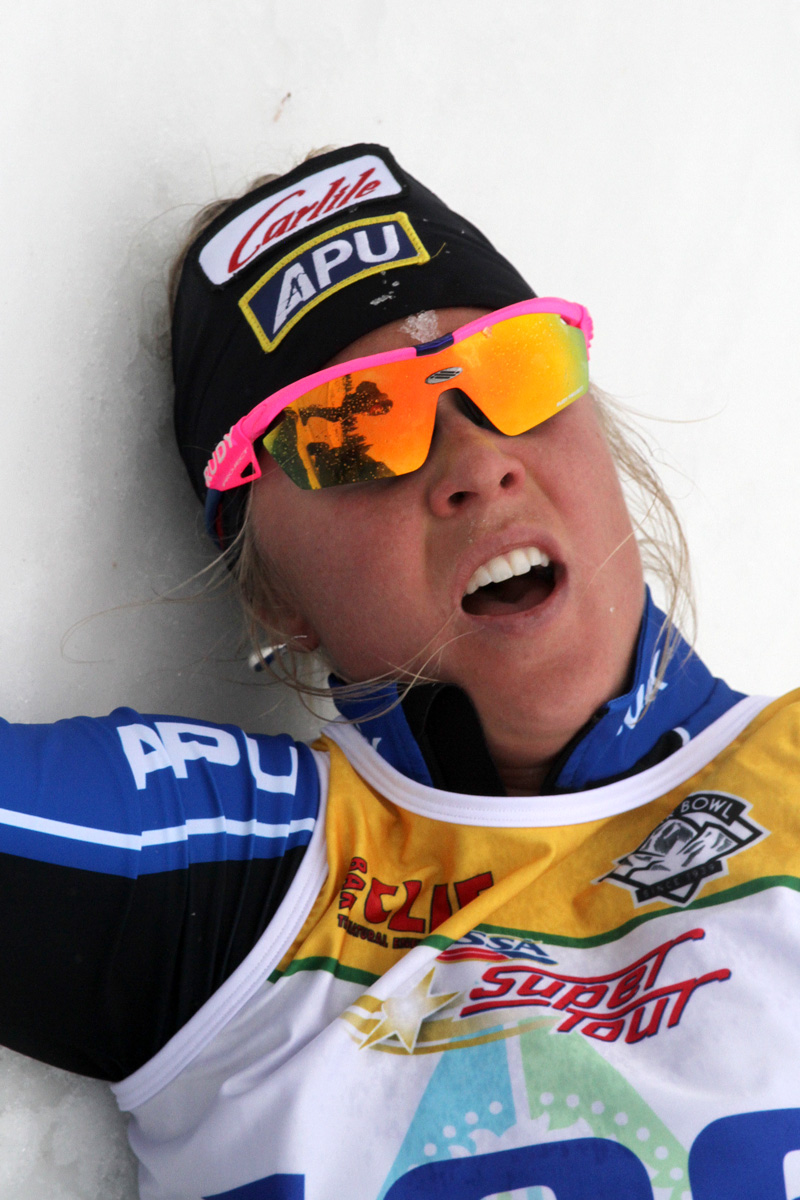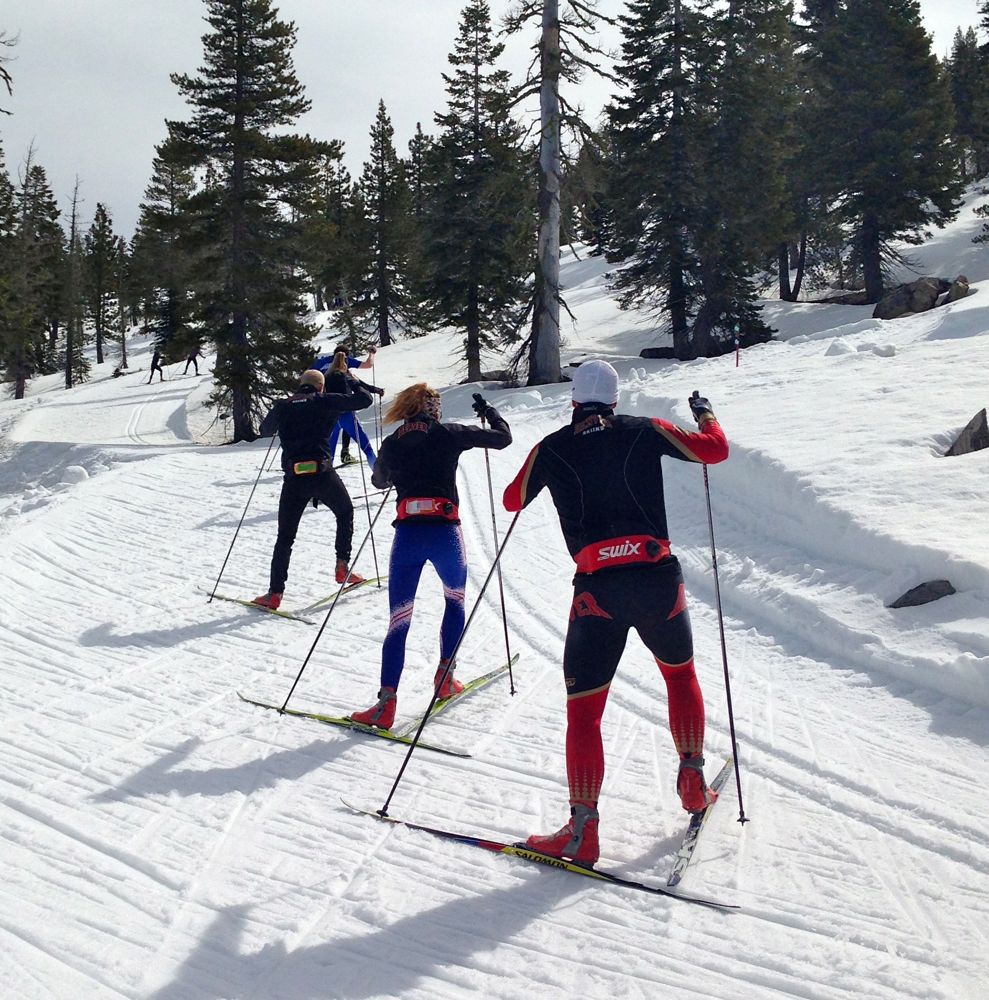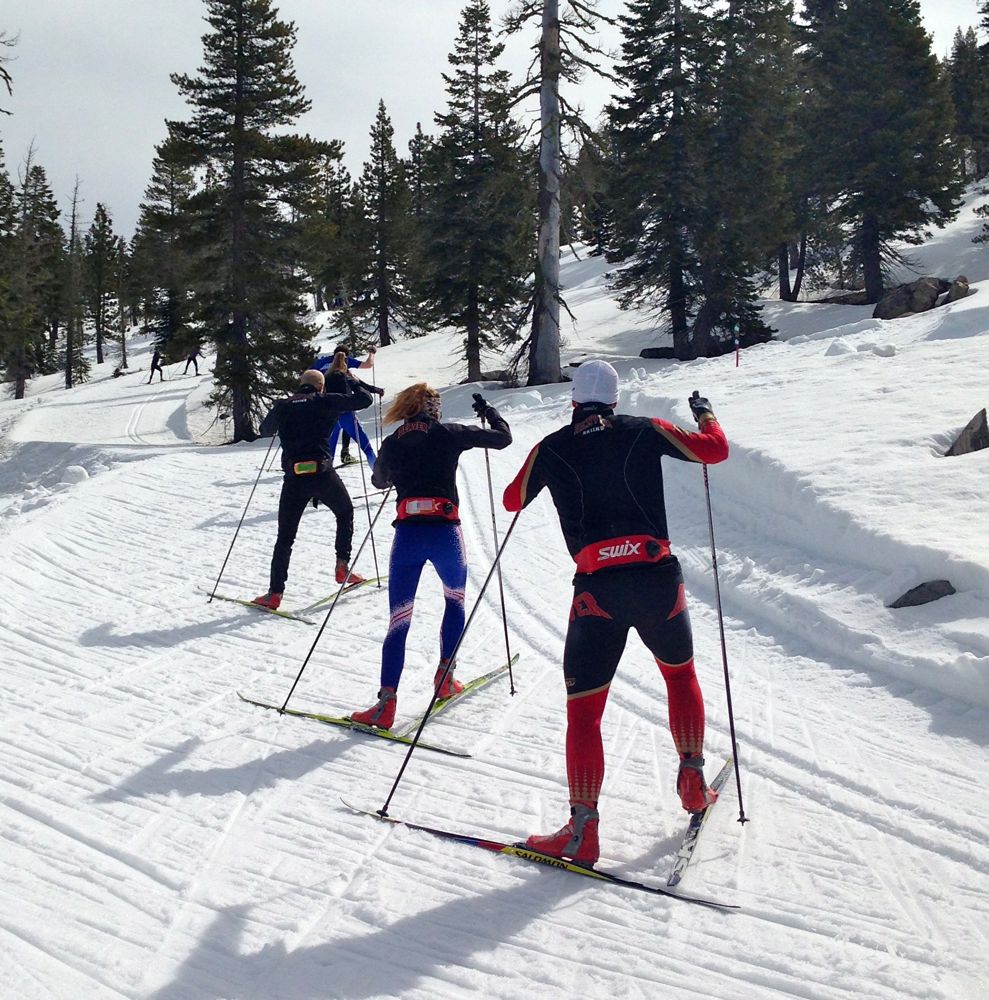
Tag: Rosie Brennan

  • Bender Rallies to Second National Title, Wins Skate Sprint at SoHo

    Bender Rallies to Second National Title, Wins Skate Sprint at SoHo

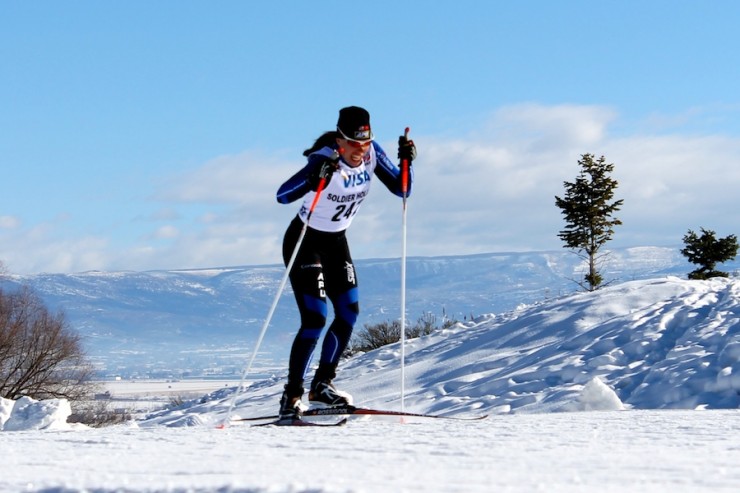
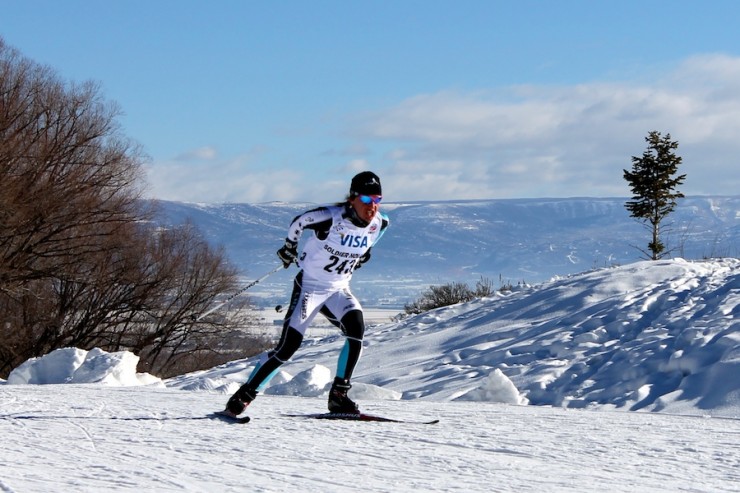
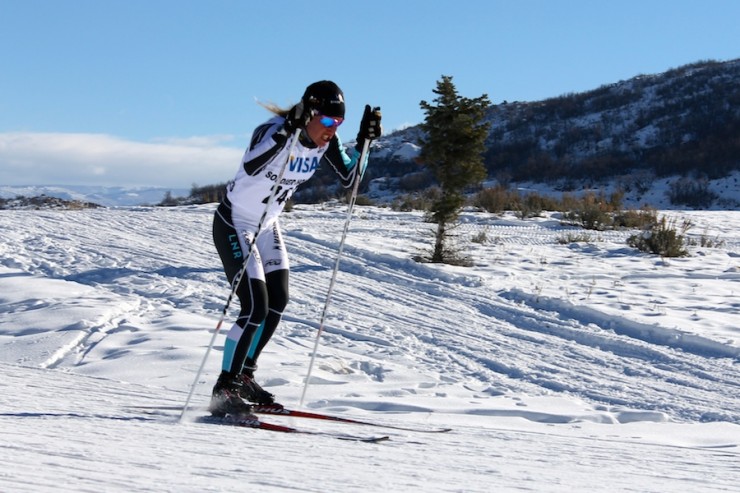
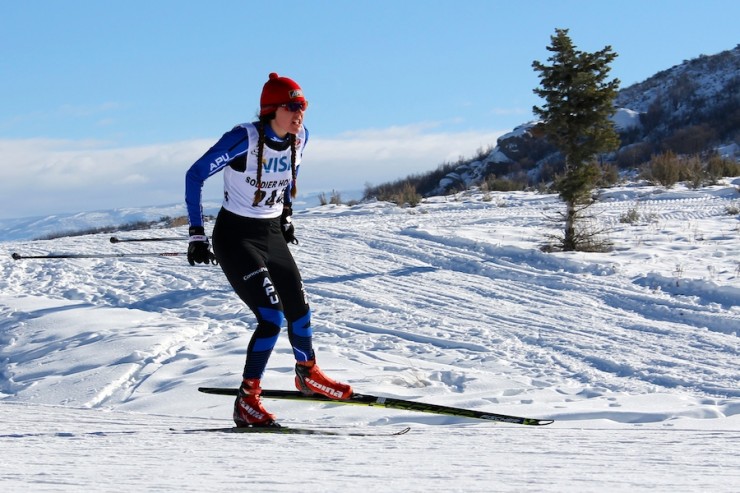
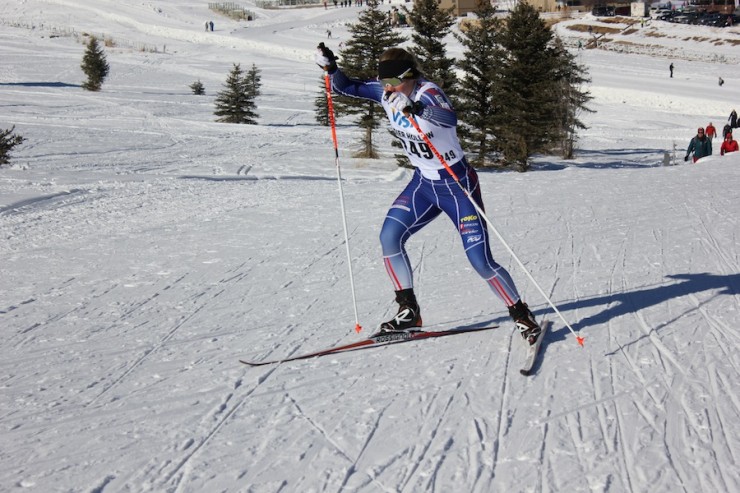
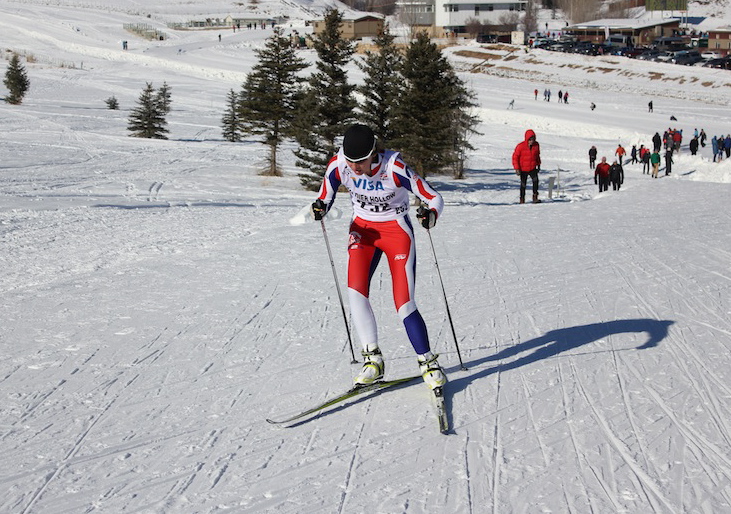
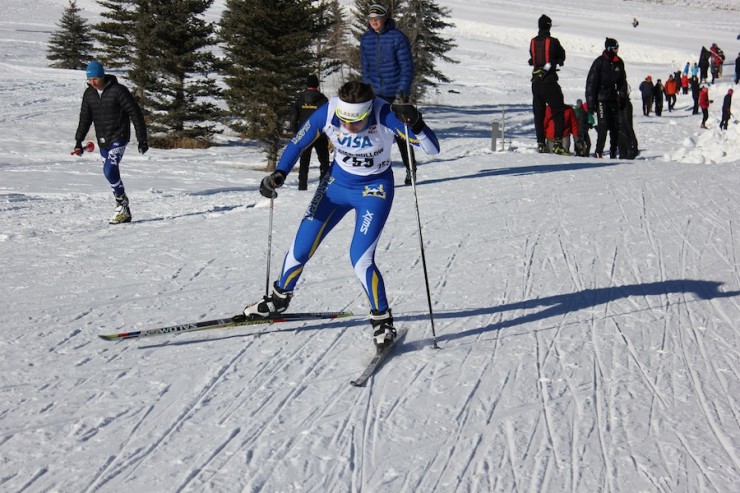
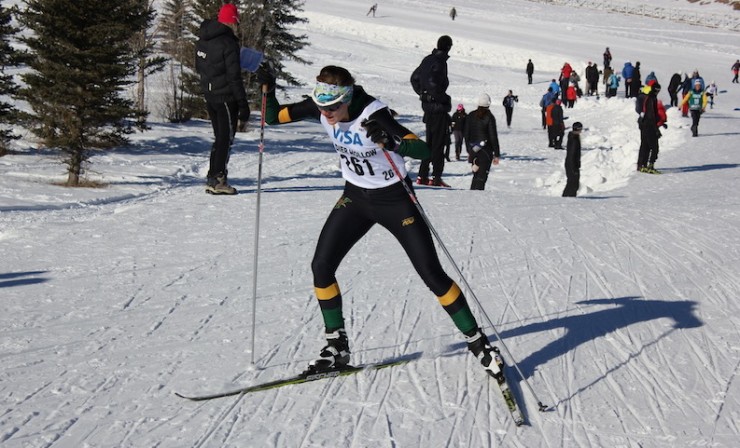
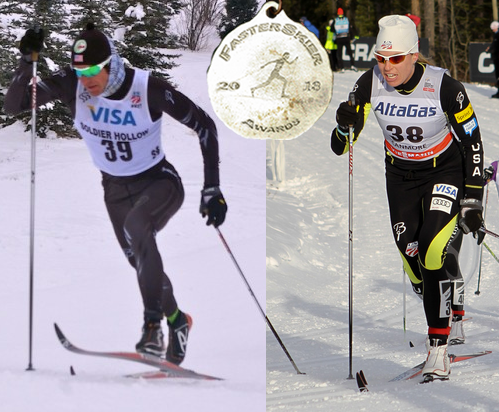
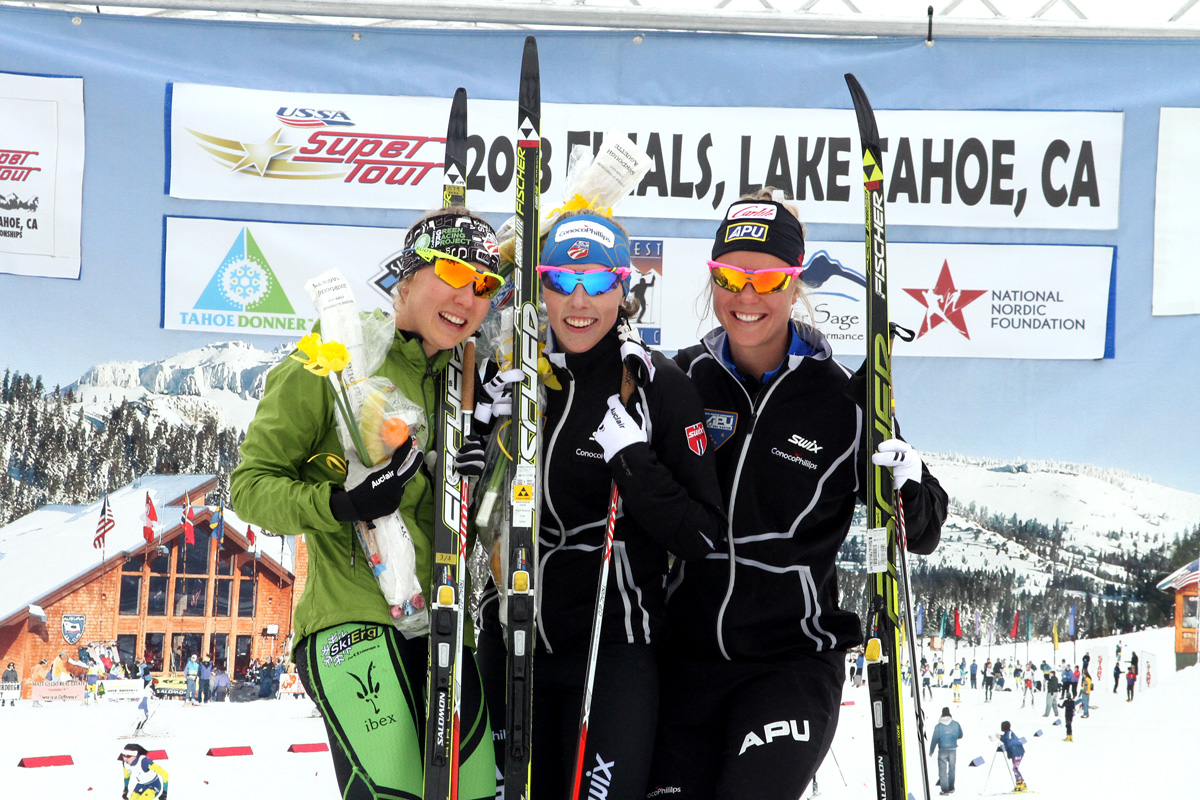
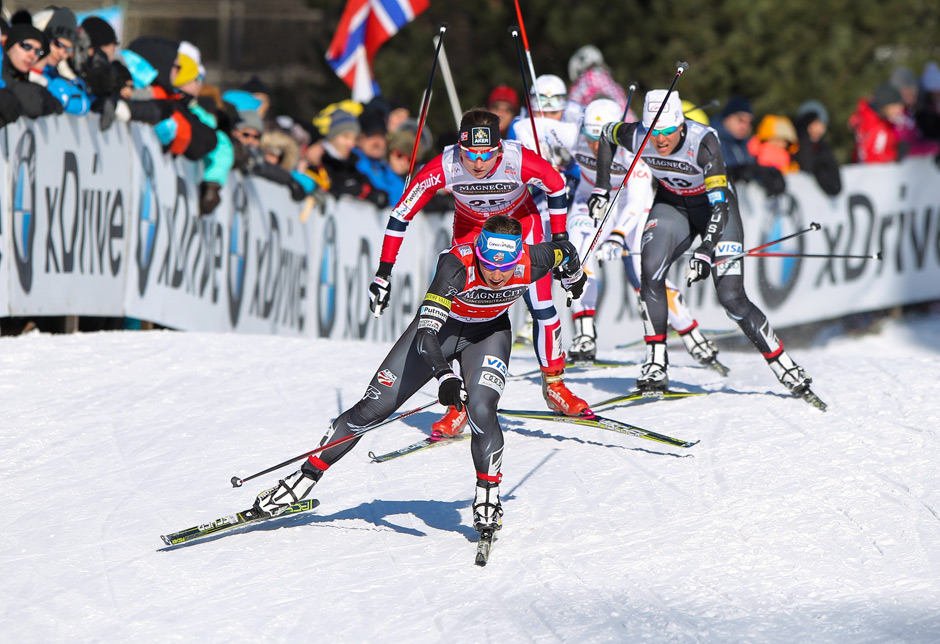
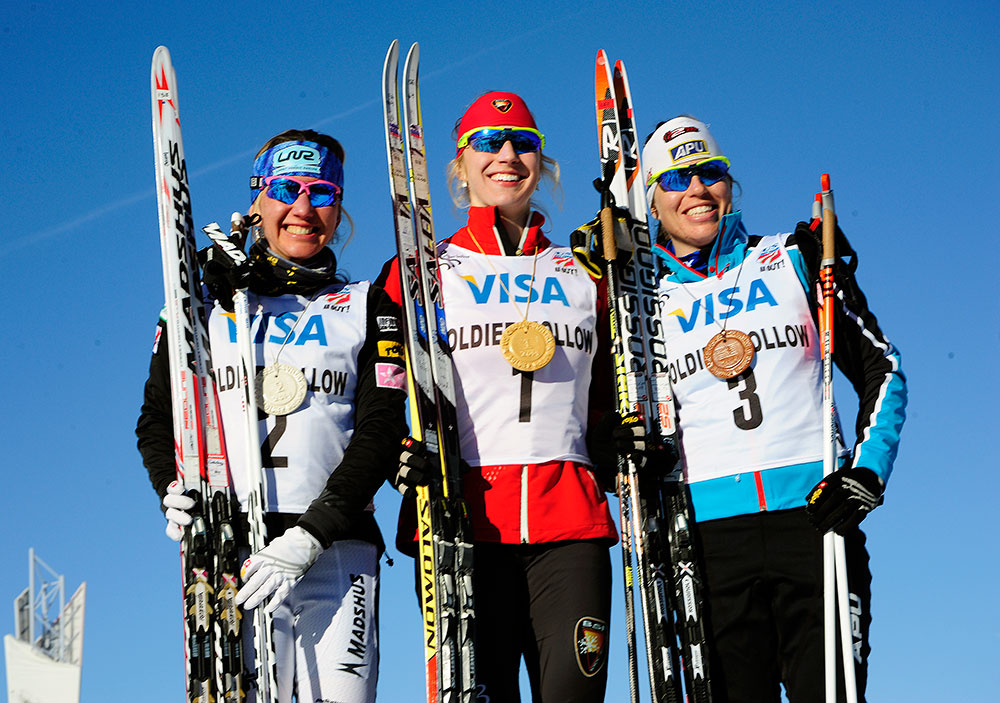
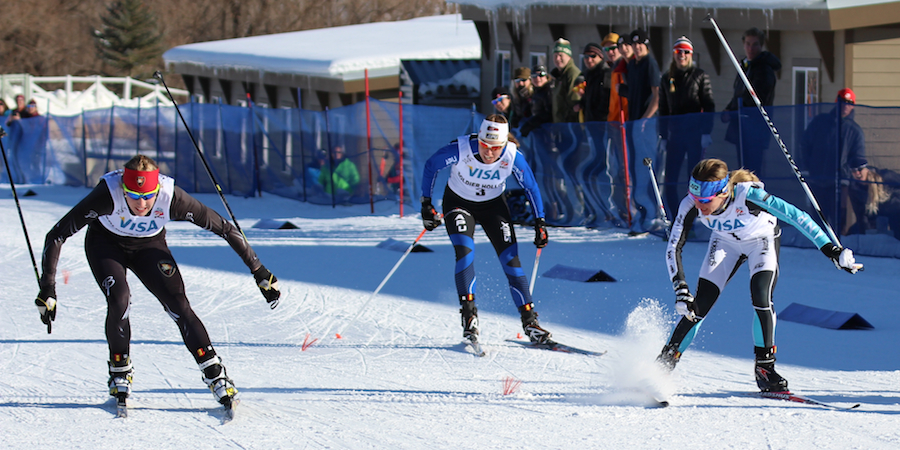
    Jennie Bender of the Bridger Ski Foundation (l) edges Caitlin Gregg (r) of Team Gregg/Madshus for the skate-sprint victory at U.S. Cross Country Championships on Sunday at Soldier Hollow in Midway, Utah. APU's Rosie Brennan (c) took third. (Photo: Tom Scrimgeour)
    Jennie Bender of the Bridger Ski Foundation (l) edges Caitlin Gregg (r) of Team Gregg/Madshus for the skate-sprint victory at U.S. Cross Country Championships on Sunday at Soldier Hollow in Midway, Utah. APU’s Rosie Brennan (c) took third. (Photo: Tom Scrimgeour)

    FasterSkier’s coverage of the 2014 U.S. Cross Country Championships is brought to you through the generous support of The Memory Clinic in Bennington, Vt.

    MIDWAY, Utah — Jennie Bender was this close to being a non-factor in the women’s 1.5-kilometer freestyle sprint at U.S. Cross Country Championships on Sunday at Soldier Hollow. A decision to have back surgery in May could have derailed her ski-racing career indeterminably, and at 25, that would’ve been a tough pill to swallow.

    Newly with the Bridger Ski Foundation in Bozeman, Mont., she instead opted for physical therapy for the herniated disc. Eight months later and seven days before her birthday, Bender was sprinting up and down Hermod’s Hill at Soldier Hollow on Sunday like nothing was or had ever been wrong — even as she continued to undergo regular treatment for her back.
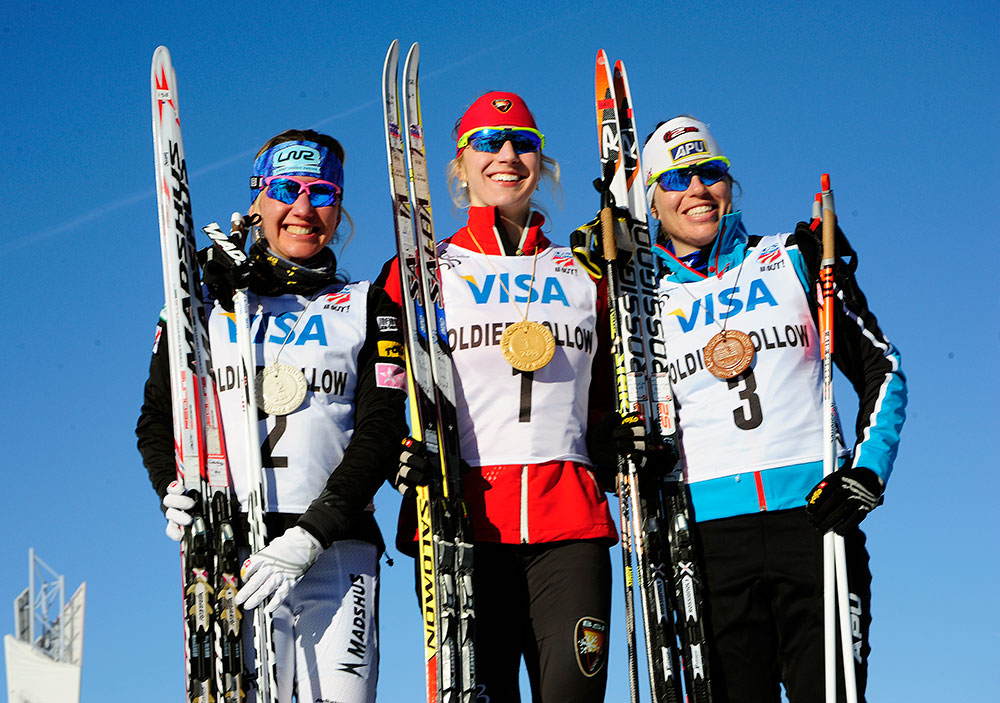
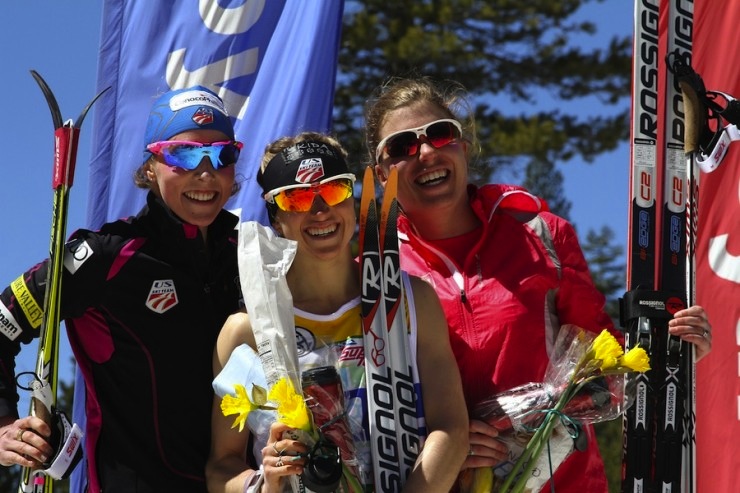
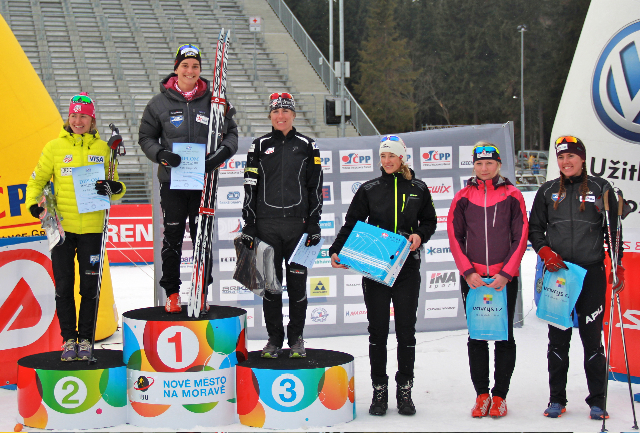
    The women's 1.5 k freestyle sprint podium, with winning Jennie Bender (c) of the Bridger Ski Foundation, Caitlin Gregg (l) of Team Gregg/Madshus in second, and Rosie Brennan (APU) in third. (Photo: Tom Kelly/USSA)
    The women’s 1.5 k freestyle sprint podium, with winning Jennie Bender (c) of the Bridger Ski Foundation, Caitlin Gregg (l) of Team Gregg/Madshus in second, and Rosie Brennan (APU) in third. (Photo: Tom Kelly/USSA)

    A year ago at U.S. nationals, she won her first national title in the classic sprint. Classic skiing was tougher on her body this season, so she put her hopes in Sunday’s skate sprint a day after placing 20th in the 10-kilometer classic.

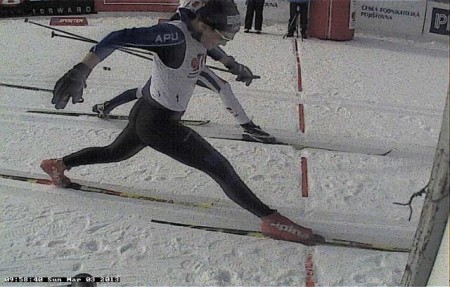
    A finishing-straight comeback, from fifth with 200 meters to go, and last-ditch lunge gave Bender the victory she had been looking for as she edged Caitlin Gregg (Team Gregg/Madshus) in a photo finish for first.

    Alaska Pacific University (APU) took third and fourth with Rosie Brennan and Kate Fitzgerald, respectively. Rose Kemp (Sun Valley Ski Education Foundation) was fifth for a personal best, and Caitlin Patterson (Craftsbury Green Racing Project) rounded out the A-final in sixth.

    “I was really hoping to get on the podium, but I guess with the past two years of ups and downs I was never really sure what would happen here,” Bender said, after coping with mono and lyme disease simultaneously two summers ago.

    “Sprints are kind of like war,” she added. “You have your own personal battle with the qualifier and then the hopefully next three heats are anything goes, it’s tactics, it’s saving energy and making sure you never truly ask yourself how you feel because you don’t want to know the answer.
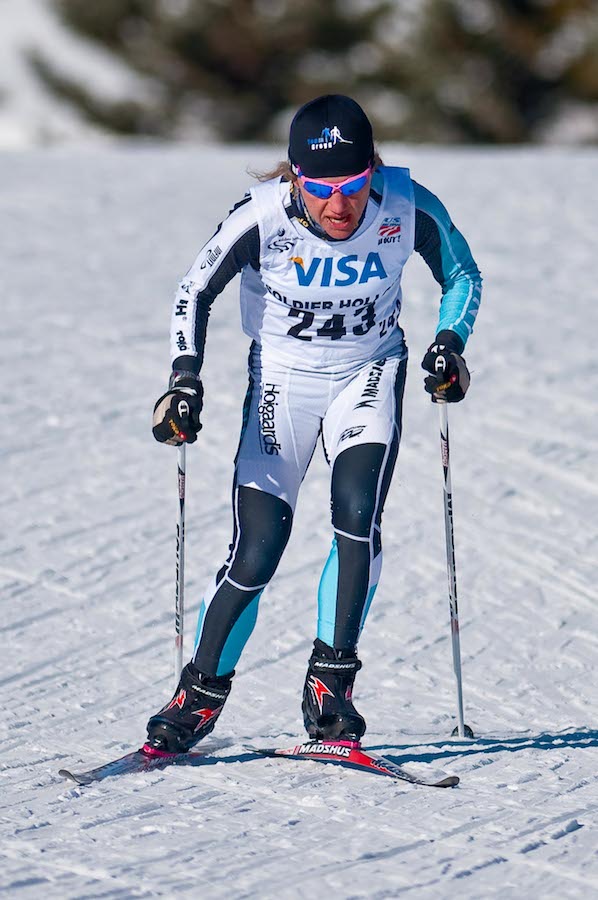
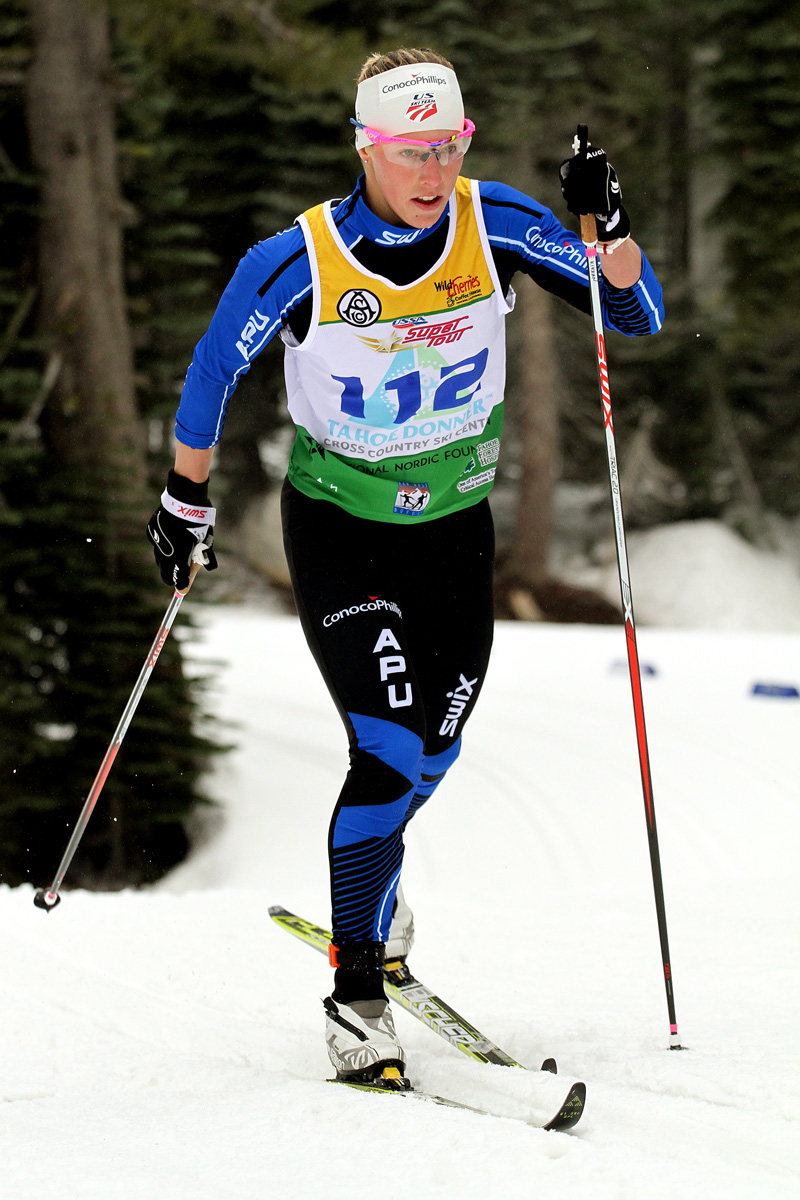
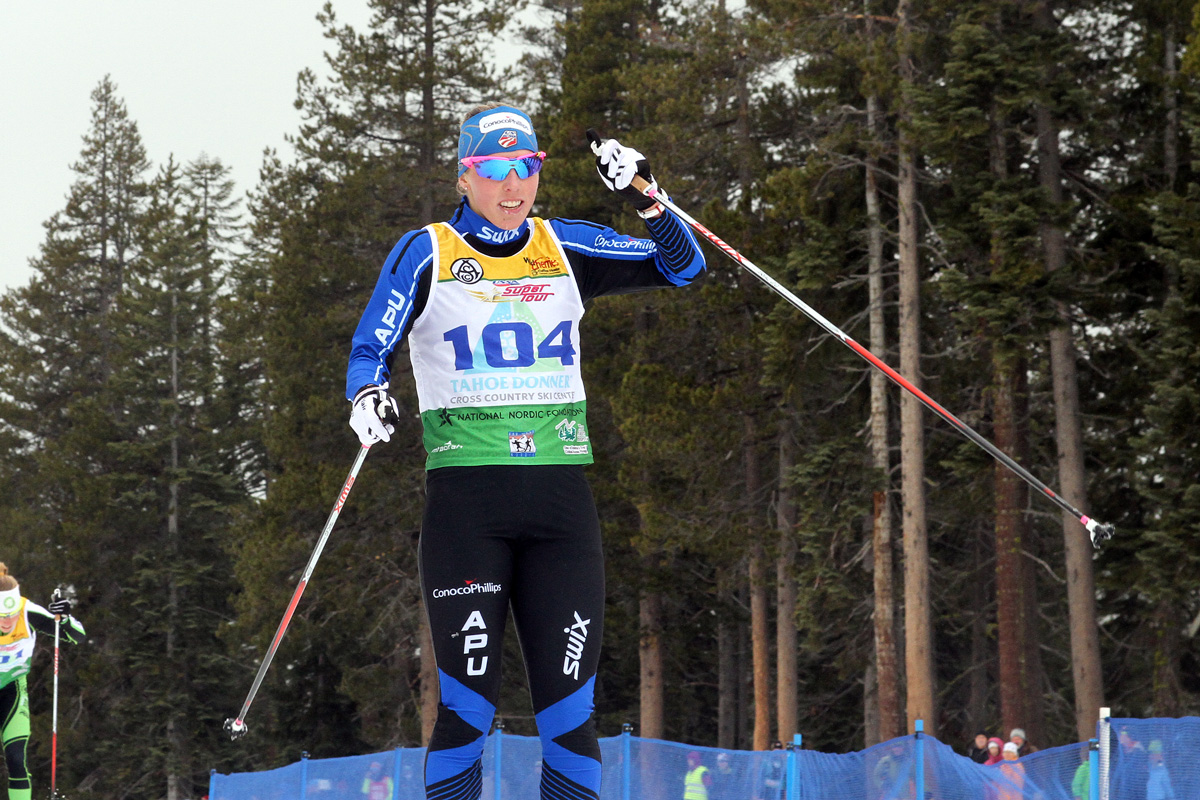
    Caitlin Gregg (Team Gregg/Madshus) on her way to winning the women's 1.5 k freestyle sprint qualifier by more than 4 seconds. (Photo: http://bertboyer.zenfolio.com) All proceeds from photo sales will be directly donated to NNF.
    Caitlin Gregg (Team Gregg/Madshus) on her way to winning the women’s 1.5 k freestyle sprint qualifier by more than 4 seconds. (Photo: bertboyer.zenfolio.com) All proceeds from photo sales will be directly donated to NNF.

    The day started off with Gregg, Bender’s former Central Cross Country (CXC) teammate, sending a message in the qualifying round. Gregg beat nearly 130 women with a time of 3:09.97 on a sprint course that deviated from the traditional under-the-bridge-and-around-the-horseshoe loop.

    Instead, racers shot out of the start and immediately curved around the timing building, built for the 2002 Olympic Games, before heading up the infamous Hermod’s Hill. They didn’t go all the way to the top, turning left and making their way down the less-intimidating parts of Whale’s Tail before cornering sharply, skiing over a bridge and back into the stadium.

    Second in Saturday’s 10 k, Gregg attacked and accelerated at all the right times to win the qualifier by 4.34 seconds over Rose Kemp, a recent University of Utah graduate now with the Sun Valley Ski Education Foundation.

    After crashing out of contention during her first of two times down Whale’s Tail on Saturday, Kemp rose to the second-fastest qualifying time on Sunday, 1.92 seconds ahead of Brennan in third. Fitzgerald followed another 2.18 seconds back in fourth (+8.44) and just one-hundredth of a second behind her, Bender qualified fifth. Patterson was another second back in sixth (+9.51).

    From there, Gregg, Fitzgerald, Patterson, Kemp, and Brennan all won their quarterfinals, but not without a little excitement in Gregg’s first heat. Before the first turn a couple hundred meters out of the start, Gregg tangled with APU’s Sarah Cresap, fell, and came into Hermod’s at least five-seconds behind the pack.

    “I don’t think it was anyone’s fault; it was just tight getting into position,” Gregg said. “So I got down and I was like, ‘Oh, wow, I’m in last place.’ ”

    Fortunately, her poles were in tact. “I’m glad I had two poles for the rest of that,” Gregg said.

    Moments later, Gregg picked off the five other women in her quarterfinal by the top of Hermod’s, then maintained her breakaway on the descent.

    “My skis, in every heat, they were just so fast,” she said. “It almost caught me off guard. I kind of was like, ‘All right, I’m out of this. Maybe this day isn’t going to go so well,’ and then next thing I know I was in first and I was like, ‘Well I guess I’m right back here.’ ”

    Gregg won the heat ahead of Erika Flowers (Stratton Mountain School T2 Team) and Marion Woods (University of Vermont), who placed second and third, respectively.
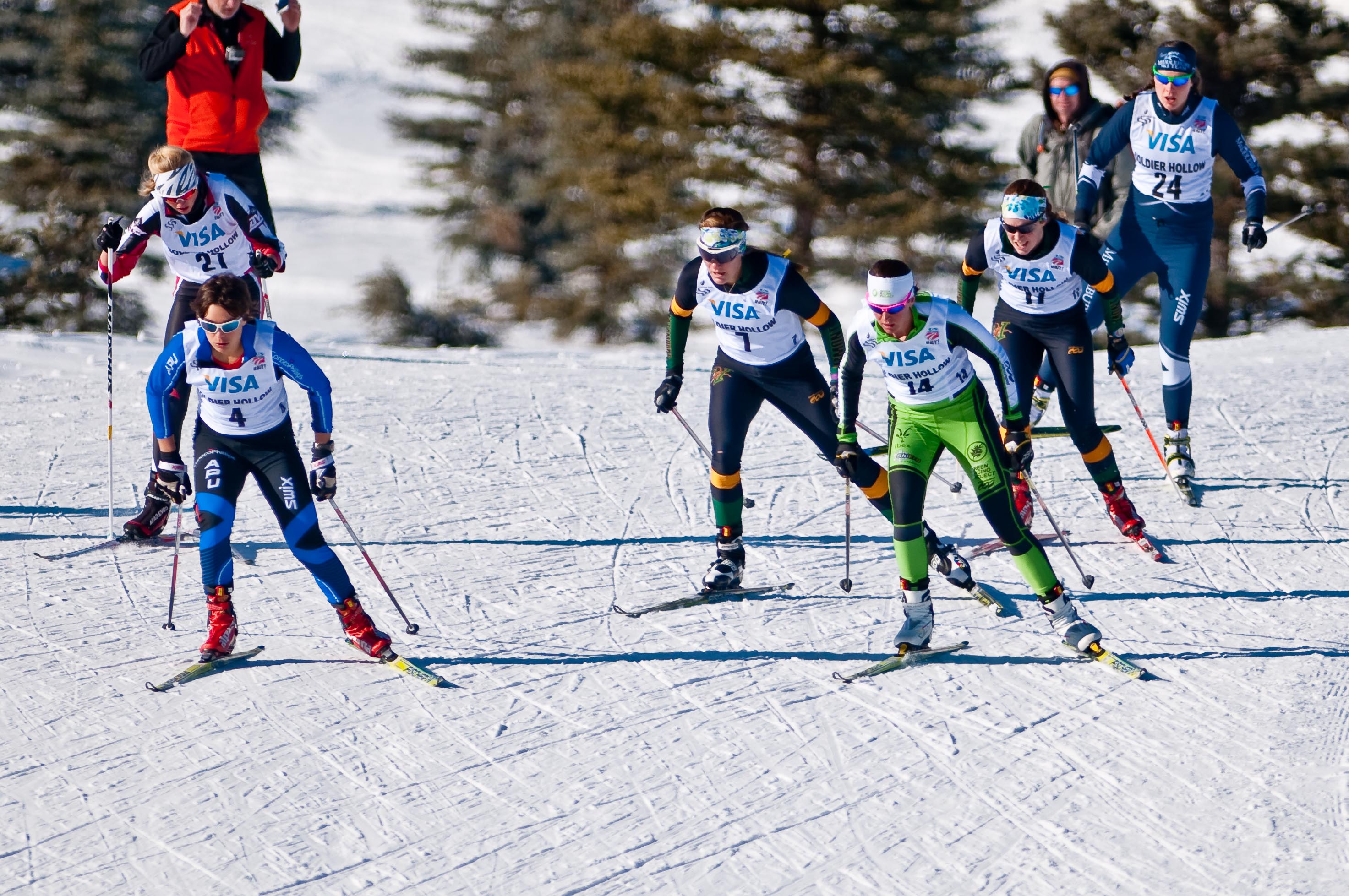
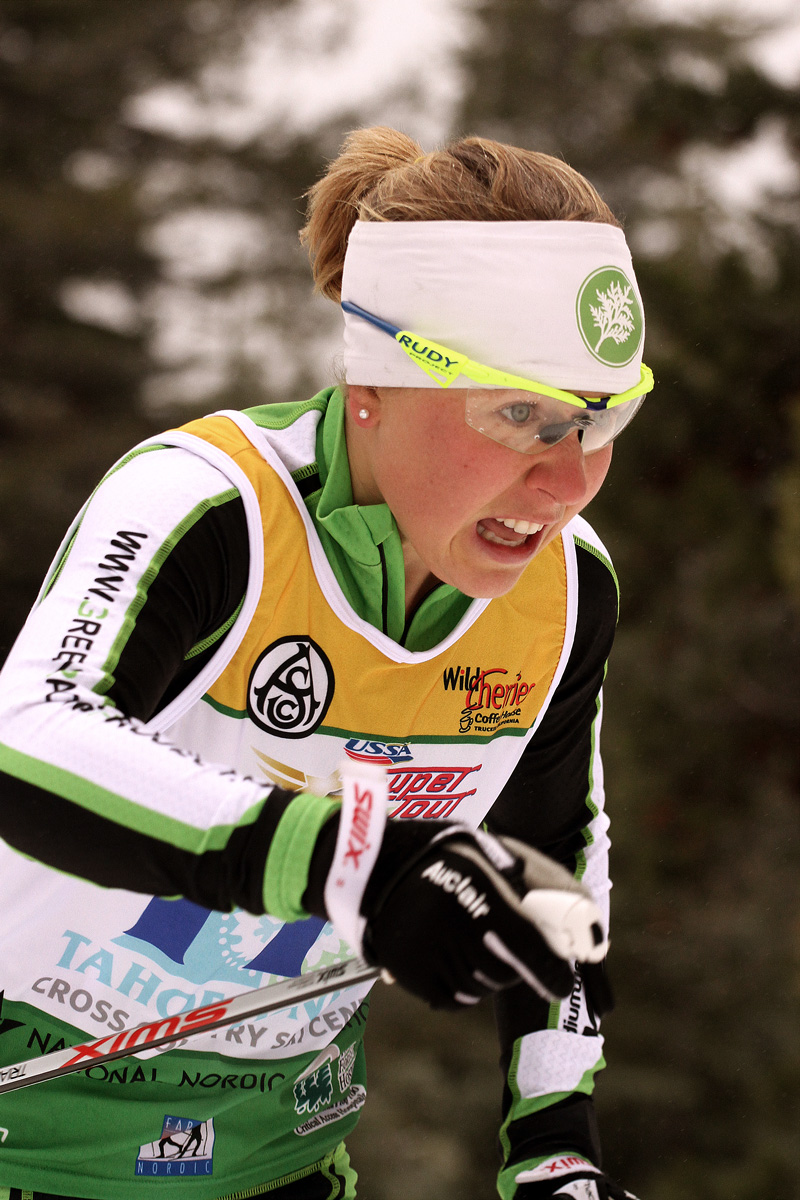
    Kate Fitzgerald leading her quarterfinal in the women's 1.5 k skate sprint at U.S. nationals on Sunday at Soldier Hollow. (Photo: http://bertboyer.zenfolio.com) All proceeds from photo sales will be directly donated to NNF.
    APU’s Kate Fitzgerald (l) leading her quarterfinal in the women’s 1.5 k skate sprint at U.S. nationals on Sunday at Soldier Hollow. (Photo: bertboyer.zenfolio.com) All proceeds from photo sales will be directly donated to NNF.

    Fitzgerald got a lead on the downhill to top two other UVM skiers, Linda Danvind Malm and Stephanie Kirk, who ended up second and third in the quarterfinal.

    A UVM grad, Patterson held off Bender in the third quarterfinal, with the two advancing in first and second. Kemp led Saturday’s champion, Becca Rorabaugh (APU), to the finish in the fourth quarterfinal, and Brennan cruised to a victory in the fifth quarterfinal ahead of Nichole Bathe (University of Alaska-Fairbanks).

    Gregg decided to lead her semifinal, but realized on the hill that it wasn’t easy to string out the group there. Running out of steam into the final straight, Bender came from behind to overtake Gregg before the finish, and both advanced to the A-final along with Fitzgerald in third. Flowers placed fourth, Danvind-Malm was fifth and Kirk finished sixth to move onto the B-final.

    Brennan held off Kemp and Patterson to win the second semifinal, leading them and APU’s Becca Rorabaugh, Craftsbury’s Liz Guiney and Bathe, respectively, from start to finish.

    Rorabaugh went on to win the B-final for seventh overall, Danvind-Malm placed eighth, Guiney was ninth, Flowers 10th, Bathe 11th, and Kirk 12th.

    “Sprints are kind of like war. … It’s tactics, it’s saving energy and making sure you never truly ask yourself how you feel because you don’t want to know the answer.” — Jennie Bender

    Feeling good throughout her heats, Kemp led out the A-final toward and up Hermod’s with Brennan right behind.

    “I felt like I had a lot of good energy going into each heat,” Kemp said. “I kind of just ended up going; that’s how it panned out each heat, but I wanted to ski as well as I could, and that hill was really fun.”

    Gregg initially tried to go off the front from the start, but quickly realized that everyone else was trying to do the same.

    “I couldn’t quite get to the front so I changed my tactics,” she said. “I kind of sat and waited and got to the top of the hill and again on the downhill my skis were just freakin’ fast.”

    Leading Kemp, Brennan, Fitzgerald and Bender, in that order, over the bridge into the finish, Gregg said she couldn’t hear anyone around her. She thought she had it, then Bender suddenly outlunged her at the line.

    Bender had been the queen of sitting back throughout the final, reasoning that she didn’t have to lead up the hill for fear of getting dropped. Instead she put herself in third or fourth, but coming around the final turn before the bridge, she said she nearly got boxed out.
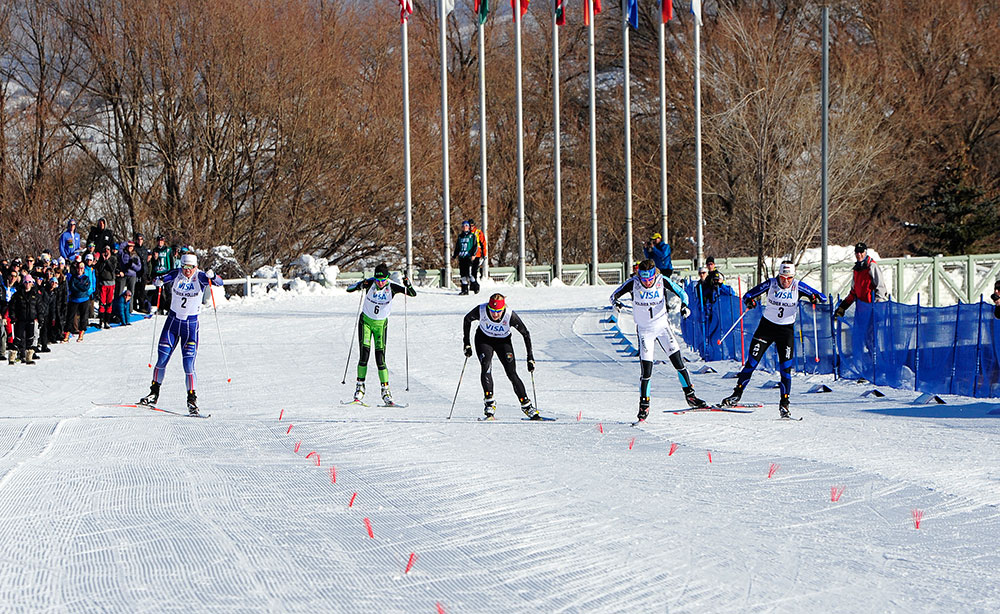
    The women's A-final heads down the last hundred meters to the finish. (Photo: Tom Kelly/USSA)
    The women’s A-final heads down the last hundred meters to the finish. (Photo: Tom Kelly/USSA)

    “I was like, ‘Oh no, this cannot happen,’ ” she said. “Coming right on the crest of the hill I was just waiting, like, ‘I’m looking for my spot, looking for my spot … I’m either gonna bust through somewhere or try to go way on the outside if I have to.’ But a little spot just happened to open up and I gunned it.”

    “I learned a good lesson today,” Gregg said. “She was just charging hard, and it was pretty impressive.”

    A two-time runner-up in the last two days of nationals, Gregg said she was pleased with the results, especially Saturday’s 10 k classic.

    “I think it’s solid and it bodes well,” she said. “Feeling good about my distance skiing, obviously skate skiing, love, and my qualifier today was super evident of that.”

    Brennan thought she could’ve played the final better as well. After she followed Kemp down Whale’s Tail with a slight gap up front, Gregg and Bender caught them by the bottom.

    “I don’t have much finishing speed so I kind of wish I tried to go a little harder over the top of the hill to get more distance,” Brennan said. “But it was OK; I held my own.

    “Any time I can make the podium here it’s great because I have so many friends and family that came to watch,” the Park City native added. “My mom times here so the whole timing crew’s always cheering for me so I always feel like I let them down if I don’t do something good here.”

    Expectations were iffy as Brennan hadn’t raced sprint heats this season since she spent most of the beginning of it on the World Cup. On Saturday, she was sixth in the 10 k after winning the skate version of the distance event at nationals last year.

    “It made me more nervous to race here because I wasn’t sure what my shape actually was,” she said. “[Saturday] I had just a terrible day. I was struggling with my skis and then I kind of blew up a bit on top of that … then you start second guessing yourself. It was really nice to come out and have a sprint race because anything’s possible.”

    The second BSF skier to top the podium after Torin Koos won the men’s final right before, Bender had similar feelings about the sprint.

    “I’m kind of hoping for more good news in the classic sprint,” she said. “In general, a win at nationals is a big confidence booster, and after wading through a lot of sh*t, it’s kind of like a daisy that you find that helps the whole rest of the season.”

    Results

  • U.S. Nationals: Women’s Skate Sprint Qualifier Photos

    U.S. Nationals: Women’s Skate Sprint Qualifier Photos

    MIDWAY, Utah — Photos of some of the top finishers in the U.S. Cross Country Championships women’s 1.5-kilometer freestyle sprint on Sunday. Caitlin Gregg (Team Gregg/Madshus) won it by more than 4 seconds in 3:09.97 to advance to the quarterfinals, which start with the men at 1 p.m. MST. Live results

  • Keeping Expectations in Perspective, Solid is Good Enough for U.S. Women

    Keeping Expectations in Perspective, Solid is Good Enough for U.S. Women

    Holly Brooks (USA, foreground) laps through as Justyna Kowalczyk starts the 15 k freestyle in Davos today. Brooks decided against catching a ride with the Pole, reasoning that skiing too fast at altitude would have disastrous consquences.
    Holly Brooks (USA, foreground) laps through as Justyna Kowalczyk (POL) starts the 15 k freestyle in Davos today. Brooks decided against catching a ride with the Pole, reasoning that skiing too fast at altitude would have disastrous consequences.

    DAVOS, Switzerland – The last race the U.S. women’s ski team competed in was a relay in Lillehammer, Norway, and it’s safe to say that it was a high for the season. For the first time in years, they entered two teams. Both did well, and the first team tied their best-ever result of third place.

    You might think that would lead to especially high expectations for the next weekend of World Cup racing here in Davos. But, said Kikkan Randall, going into today’s 15 k freestyle individual start, everyone had their own separate, and reasonable, goals.

    “This group is becoming more of a veteran group, and I think that we know that every weekend has different highs and lows,” she said after placing 18th to lead the squad. “Everybody’s spirits have been good this week and I think everybody had a good approach going into today. It sounded like maybe people were having some good races out there, and it’s still so early in the season that as long as it was a solid day today, everyone should be happy.”

    If that’s the metric, then everyone definitely should be happy. Just three seconds slower than Randall, Liz Stephen placed 20th. Holly Brooks was 25th and Jessie Diggins 30th, and Continental Cup racer Rosie Brennan placed 51st.

    While nobody had a career-best result, getting every U.S. Ski Team member who started to score points is nothing to laugh at.

    Liz Stephen
    Liz Stephen.

    “I think my standards have just changed,” Stephen said. “It has been interesting watching the team’s standards change as well. Now, when we’re not in the top 30 it’s kind of a bad day. A couple years ago it wouldn’t have been like that. We have to remember that our standards are new, and my personal standards are new after last season.”

    In fact, for Randall and Stephen, the top-20 results were particularly gratifying. Both have raced this course many times in the past. Have they had much, much better finishes in other distance skate races? Yes. But never here in Davos.

    “Honestly, I’ve never had a great race here in Davos, so I wasn’t banking on anything,” Stephen laughed. “It’s a weird course here. I’ve had really bad races here, and decent races. And when I’m out there I never know if I’m having a good one or a bad one. It’s such a weird grade and it’s always really flat light, and it’s not a course you feel super good on.”

    Randall agreed.

    “I’ve tried to race this place so many different ways,” she said. “I’ve tried starting slow, I’ve tried starting fast, it’s just one of those courses where you never feel that good, you never feel that fast. But I think if you can find the right rhythm, there’s a really small window that’s the perfect pace in there. And if you can find that, it can be good. I’m just happy to have skied my way around and get a great workout in.”

    Diggins was the lone team member who seemed disappointed in her race (FasterSkier missed talking to Brennan).

    “It didn’t feel very good for me,” she said. “I was cramping up on the uphills. The downhills felt good, but I think I’m just not used to racing at altitude yet. I felt pretty bad actually. But the skis were good and I tried really hard, and I worked on some things.”

    Rosie Brennan starting out.
    Rosie Brennan starting out.

    But for the rest of the squad, just having an okay result felt like a victory. For Stephen and Randall, it was redemption after many attempts here in Davos. For Brooks, it was a relief after not starting off the season nearly as well as she did last year.

    “It was okay, especially considering how my season has been so far,” she said. “It’s a pretty good step up.”

    After finishing fifth in the very first race of the 2012-2013 season, Brooks hasn’t had the same kind of luck. But it seemed likely that today might turn things around: “This is by far my favorite course and my favorite kind of race, so that suits me well,” she said. Brooks was ranked as high as the top 20 about halfway through the race, but couldn’t quite hang on to match Randall and Stephen.

    She was close though, just 14 seconds behind Stephen, and knows that she was almost even closer.

    “I wish I could have caught a little more of a ride,” she lamented. “[Third-place finisher Charlotte] Kalla caught me at the top of the course, and I just lost contact with her just a tiny bit. I could have moved up a bunch of places if I could have stayed with her and drafted off her on the downhill, but I was just a little bit too far away to do that. She’s flying.”

    Brooks had some other chances too. But at 5,000 feet of elevation, she knew better than to take the risk of following someone who was going too fast.

    “I lapped through when Kowalczyk was starting, and people were shouting for me to catch a ride, but that’s just a recipe for disaster,” she said. “You know if you go one percent too hard at altitude, you’re in trouble. I felt in control most of the time, which was nice. But it’s not like I broke any records or took any personal bests.”

    Randall had better luck, as fourth-place finisher Kristin Størmer Steira of Norway caught her from one minute back about halfway through the race. Randall was able to go with her.

    “From the beginning of that second lap it was really good to ski with her, and we kind of went back and forth on the downhill and worked together,” said Randall. “It made for a solid race.”

    Stephen complimented Steira’s technique, which she said perfectly suite this “weird” course. Randall agreed.

    “She just has a really nice tempo on her V2 for some of those gradual sections, and that’s where I was definitely starting to let my tempo bog down,” she said. “So to be able to follow her tempo there and find a new rhythm, it was perfect. Like, oh, I can do this!”

    For most of the team, today was just a reminder to stay patient, and take the good things out of every race effort.

    “Yeah, it’s so far been a sort of mediocre start for me,” Stephen said. “Of course the relay was awesome, but I personally didn’t ski great that day. So, well, the season is long… I’m not having a bad season, but there hasn’t been a stellar result yet.”

    Today wasn’t that stellar result. But it was something.

    “I’m happy with it,” she concluded. “I fought pretty hard out there, I was mentally in it the whole time, and worked the downhills the best I could, so I’m happy.”

    Results | main women’s race report

    Jessie Diggins.
    Jessie Diggins.


  • Brennan Adds to World Cup Experience, 54th in 10 k

    Brennan Adds to World Cup Experience, 54th in 10 k

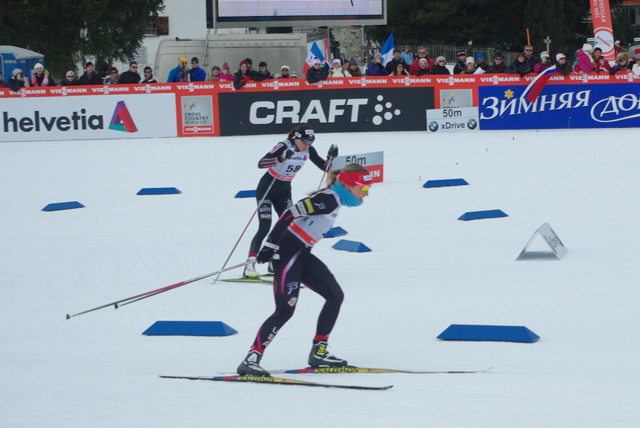
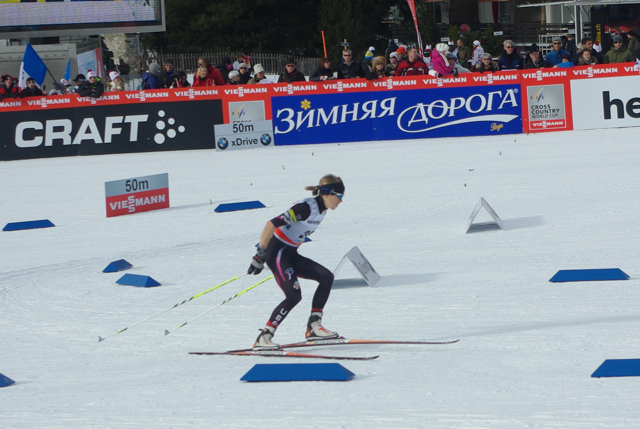
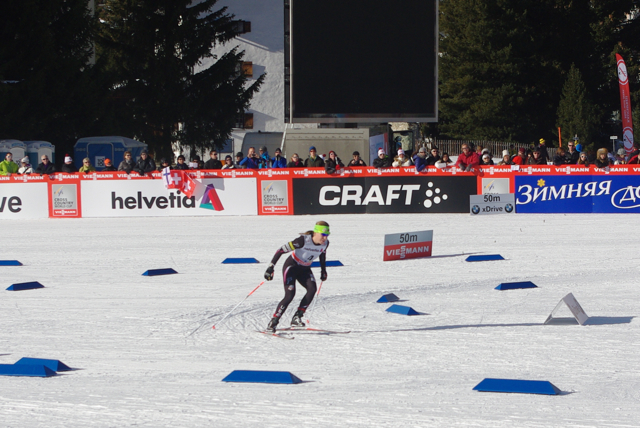
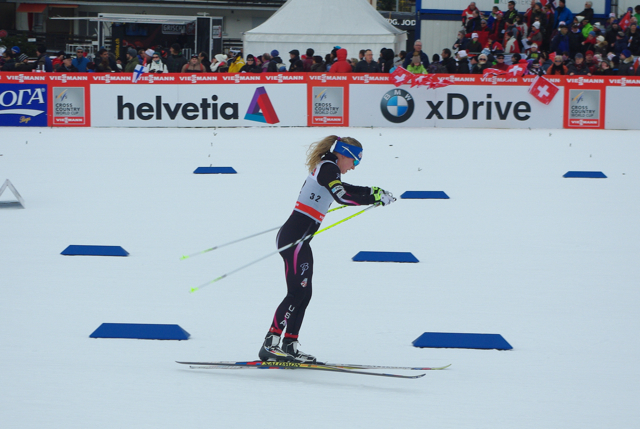
    American Rosie Brennan earned World Cup start rights by capturing the 2013 SuperTour title. She made her European World Cup debut last season, racing the entire final period, before starting this fall at the top level.

    This season she placed 70th in the Kuusamo, Finland mini-tour and finished 54th today, in the 10 k classic in Lillehamar, Norway.

    US Ski Team Women’s Coach Matt Whitcomb termed Brennan’s performance “a strong result.”

    For her part, Brennan was not entirely satisfied.

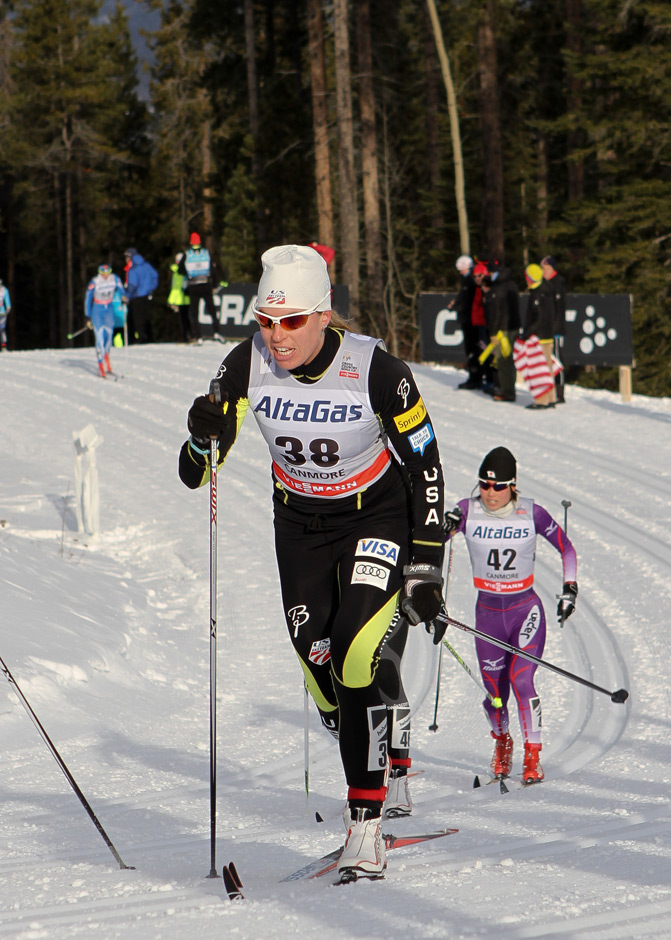
    Brennan racing at the Canmore World Cups last season.
    Brennan racing at the Canmore World Cups last season.

    “I’m not super psyched with the result, but I did feel a little better than last weekend,” she wrote in an email.

    Entering the race, Brennan felt the challenging Lillehamar course suited her strengths as a skier.

    Her plan was to start conservatively, but had forgotten lapping skiers would be coming through the stadium as she was starting.

    She didn’t want to pass up a good ride, so latched on to German Denise Herrmann, who earned her first World Cup podium last weekend in Kuusamo, and ended the day in 18th.

    “It was great for me to feel I could ski with good World Cup skiers, but when I was left on my own heading into the second lap, I started to feel the effects and began second guessing myself,” Brennan wrote.

    She said she recovered, but was not able to find the pace she wanted.

    Brennan said while  she is “less intimidated” by World Cup racing on this trip, she has been struggling to keep her confidence up.

    “Racing in the U.S. does not adequately prepare us for racing on the World Cup, and overcoming those shortfalls takes a long time I am learning,” she concluded.

    But despite the challenges she is looking forward to competing in Sunday’s relay, an event she did expect to start.

    “I am hoping to race with no hesitations and work on building my confidence racing with others,” she wrote.

    Brennan will ski the anchor leg for the second U.S. team.

    — Alex Matthews contributed reporting

  • Eyes on Sochi: Brennan Aims for Olympics While Training Smart

    Eyes on Sochi: Brennan Aims for Olympics While Training Smart

    Rosie Brennan (front) during intervals with the Stratton Mountain School T2 Team earlier this year. SMS athletes Annie Pokorny and Erika Flowers follow. (Photo: Sverre Caldwell)
    APU’s Rosie Brennan (front), followed by Annie Pokorny and Erika Flowers of the Stratton Mountain School (SMS) T2 Team during intervals with Stratton earlier this year. (Photo: Sverre Caldwell)

    This is the first profile in a series about Olympic hopefuls and pre-qualified athletes preparing for the 2014 Winter Games. While we won’t get to everyone who could potentially make it to Sochi, Russia, we’ll do our best to provide snapshots of what individuals endure in the process of getting there.

    ***

    Each obstacle 24-year-old Rosie Brennan encounters in her quest to make the U.S. Olympic ski team for the first time in her young career falls in one of two categories: things she can control and things she can’t.

    Rosie Brennan (r) on the podium with U.S. Ski Team veterans Liz Stephen (c) and Kikkan Randall, who placed first and second, respectively in the 30-kilometer classic at U.S. Distance Nationals in April in Soda Springs, Calif.
    Rosie Brennan (r) on the podium with U.S. Ski Team veterans Liz Stephen (c) and Kikkan Randall, who placed first and second, respectively in the 30-kilometer classic at U.S. Distance Nationals in April in Soda Springs, Calif. Brennan was third for a career best in the distance race.

    The Park City, Utah, native can’t do anything about the seemingly bottomless depth in U.S. women’s skiing, not only on the national team, but extending through domestic clubs like Alaska Pacific University (APU), with which she’s affiliated.

    But to get to Sochi, Russia, she needs World Cup starts. The only way to earn those without being on the U.S. Ski Team (USST) is to advance to the top of the domestic SuperTour standings.

    A national title in the 10-kilometer skate race, seven SuperTour wins and a bronze in the 30 k classic at nationals last season gave Brennan a firm grasp on the 2012/2013 Continental Cup lead (by 147 points to be exact). As a result, she will start this season on the World Cup circuit, right where she finished this spring.

    “I was really happy to see those results on the results page, rather than trying to convince myself I had made improvements,” Brennan said on the phone Monday. “Of course, it always helps when you race really well in the beginning of the year because your confidence just skyrockets.”

    Brennan climbed the podium numerous times in collegiate and junior-national competition, but last season’s results were her most consistent at the next level since joining APU in 2011.

    It didn’t come easy or without pain. Six years ago as a Dartmouth College freshman, Brennan injured her back doing double-pole intervals in Lake Placid, N.Y. She didn’t get a clear diagnosis of the injury until this spring, when the pain had become so severe that she was experiencing loss of sensation in her lower leg. She exhausted her search for medical answers from doctors, physical therapists and specialists in Utah. Then, a breakthrough came in Alaska.

    She met with physical therapist Zuzana Rogers, a former member of the Czechoslovak and Slovak alpine teams who’s contracted through APU. Rogers diagnosed Brennan with a bulging disc (L5-S1) in her lower back, which damaged the nerves running down her leg.

    “That made the biggest difference for me,” Brennan said. “Just having a consistent physical therapy plan and working every week with [Rogers].”

    APU head coach Erik Flora lended personal experience and an eye for technique, Brennan said. Flora had his racing career cut short because of a back injury.

     Rosie Brennan (APU) racing to third in Wednesday's 30 k classic mass start at U.S. Distance Nationals at Royal Gorge. (Photo: Mark Nadell/MacBeth Graphics)
    Rosie Brennan (APU) racing to third in the 30 k classic mass start at U.S. Distance Nationals in April in Soda Springs, Calif. (Photo: Mark Nadell/MacBeth Graphics)

    “We’ve really tried to change my body position during all activities into a position where my back is safe,” Brennan said. “We’re not demanding so much out of it and I’m not risking making it worse.”

    Brennan views the technique work not only as a mode of injury prevention, but also a way to improve her skiing ability. She wants to improve her sprinting, but has been unable to work on it with the back limitations.

    “Right now, Rosie’s strength is in classic distance racing,” Flora wrote in an email. “If you look at last year, she has also really improved her skating. This summer, we have been able to take another step in skate and classic. I see her more balanced starting this season.”

    Brennan raced on the USST during college (2007-2009) and started several World Cups last season (Stockholm, Falun, Oslo, Drammen, Lahti, and Canmore), but will still be a rookie to the early season venues. The first familiar place she will compete is Soldier Hollow in Utah for U.S. nationals in January.

    Brennan hopes starting the season on the World Cup will favor her more than finishing there. She felt her performance lagged late in the season due to fatigue from several months of racing and travel.

    Flora has structured on-snow training camps this summer on Alaska’s Eagle Glacier around conditions that may be present in Sochi and at Soldier Hollow. The rest of Brennan’s training plan will remain largely the same as last year, with adjustments based on how her back is feeling.

    “When [Brennan] joined us, she talked about primarily being a sprinter,” Flora wrote. “I have learned she is incredibly responsive to distance training. If we push base volume, she gets very fit.”

    Rather than worry about what could go wrong in chasing the Olympic dream, Brennan visualizes what could go right and uses it as motivation.

    “I’m just trying to focus on how I can learn from my World Cup experiences last year and use that to train better this summer and prepare myself for the fall World Cups and try and make my impact then,” Brennan said.

    “Rosie’s trajectory is definitely on route to being one of the top U.S. women,” Flora added. “It is a matter of time.”

  • Koos and Brennan Collect Honors as FS Continental Skiers of the Year

    Koos and Brennan Collect Honors as FS Continental Skiers of the Year

    Torin Koos (Bridger Ski Foundation/Rossignol) and Rosie Brennan (Alaska Pacific University) are our Continental Skiers of the Year.
    Torin Koos (Bridger Ski Foundation/Rossignol) and Rosie Brennan (Alaska Pacific University) are our Continental Skiers of the Year.

    Torin Koos (USA/Bridger Ski Foundation)

    When it came time to naming the top domestic-level athlete of 2012-2013, Torin Koos was the clear winner, with few close challengers. As the winner of both the classic sprint and 30 k classic at U.S. Nationals and the SuperTour leader going into the last quarter of the season, Koos was the standout skier on the U.S. circuit in both distance and sprint races.

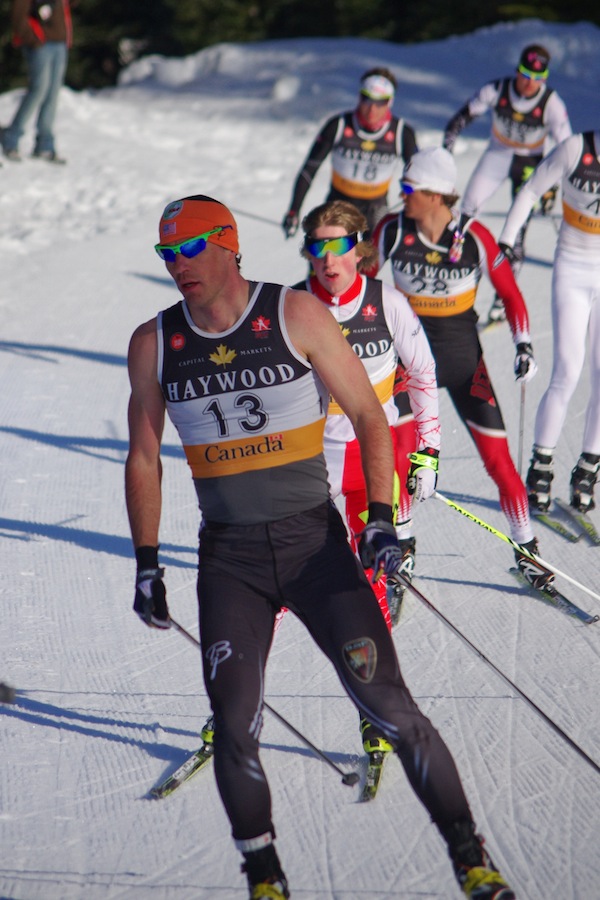
    Former US Ski Team member Torin Koos (Bridger Ski Foundation/Rossignol) leading Saturday's 50 k freestyle mass start at 2013 Canadian Nationals in Whistler, B.C. Koos won the race by 0.4 seconds over Brent McMurtry (AWCA). (Photo: Martin Kaiser)
    Torin Koos (Bridger Ski Foundation/Rossignol) leading the 50 k freestyle mass start at 2013 Canadian Nationals in Whistler, B.C. Koos won the race by 0.4 seconds over Brent McMurtry (AWCA). (Photo: Martin Kaiser)

    Beyond the U.S. field, Koos was the only American continental cup starter who could translate his World Cup opportunity into distance and sprint points this season — and in Drammen, he was the top American finisher in the classic sprint, placing 18th.

    “It’s always a good feeling to finally get a chance again to race the World Cup, and to come through and demonstrate that you are at a world-class level,” Koos said at the time.

    He was sick at the end of the season and his top finish in Truckee was seventh (fifth American) in the 50 k Championship, but overall there were few in the U.S. that could keep up with Koos when he was on form. Sun Valley’s Mike Sinnott and APU’s Erik Bjornsen surpassed him in the SuperTour standings at the end of the season, but that was partly because Koos was in Europe for the Aspen and Midwest races.

    We would be remiss not to mention that Koos’ results amounted to a pretty redemptive year. Davos, Switzerland, was his first time back on the World Cup in three seasons. Illness in December prompted him to give up his spot in the Quebec City and Canmore sprints to the next guy on the list. The year before, Koos’ disqualification from the U.S. Nationals classic sprint lost him 60 valuable points that could have otherwise gone towards sending him back to Europe much earlier. His exclusion from the World Championships squad this February probably left his 2013 feeling a little incomplete, but Koos was still far and away the most impressive skier on the domestic circuit and for that he is our Continental Skier of the Year.


    Rosie Brennan (USA/Alaska Pacific University)

    Photo: Swix Sport.
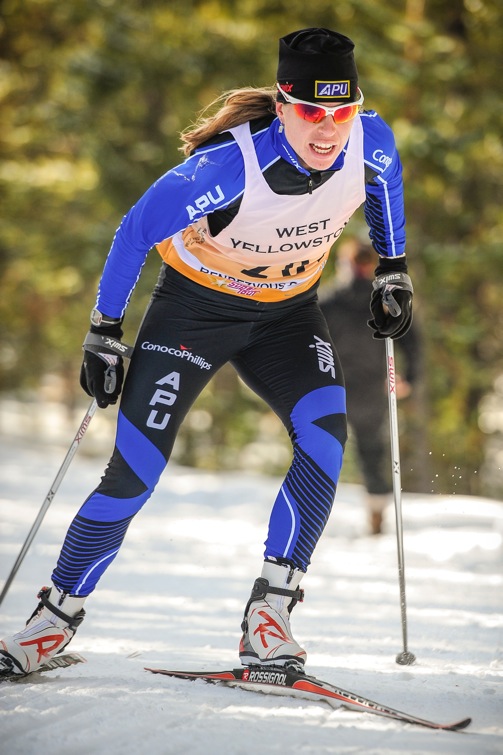
    Brennan starting her 2012-2013 season with a win in the 9 k freestyle in West Yellowstone. Photo: Swix Sport.

    Rosie Brennan’s skiing began showing signs of advancing to the next level at the end of last year, her first winter out of college, when she finished second in the 10 k classic at SuperTour Tour Finals in Craftsbury, Vt., against a quality field.

    “It’s been very up and down trying to figure things out, and I finally feel like I’m coming around now,” she said in Craftsbury.

    Fast-forward to eight months later, when she showed up at the season opener in West Yellowstone, Mont., to win her first career SuperTour on day one to kick off an incredibly successful 2013 domestic campaign.

    “I guess I must’ve figured something out this summer,” Brennan laughed after the 9 k.

    The former U.S. Ski Team member went on to have the year of her life: she won her first national championship in the 10 k skate in January, rose to the top of the SuperTour standings with seven wins by February, got her first European World Cup starts at the end of the season, and came back home to finish on the podium in the 30 k Championship — all while fighting through a nagging back injury. At season’s end, she was still 147 up to teammate Sadie Bjornsen in the domestic points and will be returning to the World Cup next fall as the Continental Cup leader.

    It may be an obvious choice to pick Brennan as our domestic-level skier of the year, but the honor is well-deserved.


    Honorable Mention:

    Graham Nishikawa (CNST/Alberta World Cup Academy), 29, has been competing on the World Cup since 2005, but in December he cracked into the top-15 for the first time in the 30 k skiathlon at home in Canmore, Alberta. He was consistent on the NorAm circuit and was the points leader by early February, and he was brought over to Europe to compete for the Canadian World Championships team for the first time in his career. We place Koos’ season above Nishikawa’s only because the American turned in more performances in the points against a World Cup field.

    Graham’s sister, Emily Nishikawa (CNST/Alberta World Cup Academy), was equally impressive amongst the Canadian women. The 24-year-old won four NorAms this season and podiumed a total of seven times, a record that none of her competitors came close to matching. February brought her World Championships debut, as well, and though she may have struggled in Italy she went on to put together a series of decent results at World Cup Finals and expand upon her international experience.


    medal-final-layer-2013Previous Winners:

    2011

    Lars Flora (USA)/Graham Nishikawa (CAN)

    Perianne Jones (CAN)/Holly Brooks (USA)

    2010

    Dasha Gaiazova (CAN)

    Brent McMurtry (CAN)

    2009

    Kristina Strandberg (SWE)

    Lars Flora (USA)/Graham Nishikawa (CAN)

    2008

    Kristina Strandberg (SWE)

    Ivan Babikov (CAN)


  • NNF Cup Awarded to APUNSC

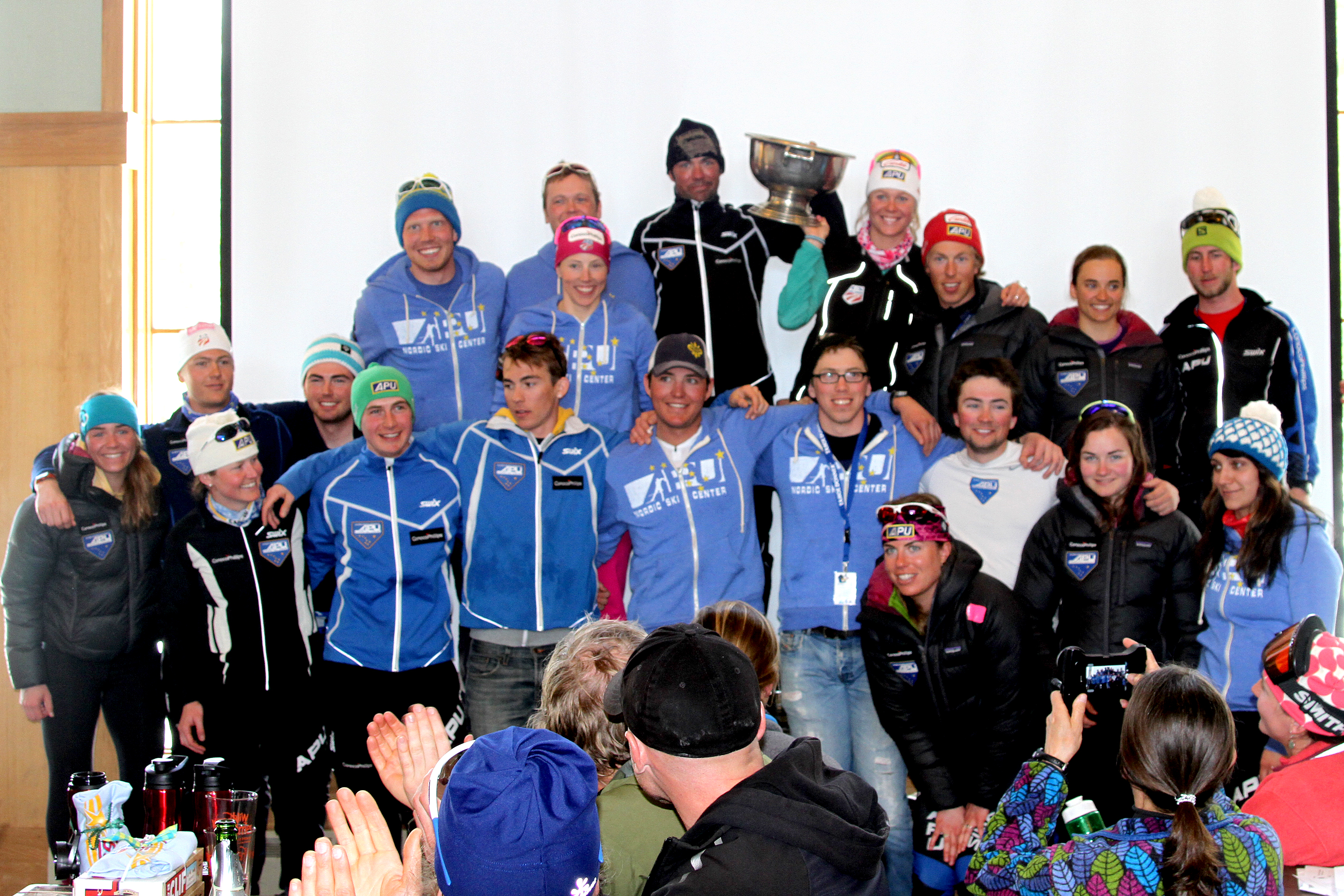
    APU with its 2013 NNF Cup awarded on the last day of SuperTour Finals in Truckee, Calif. (Photo: Mark Nadell/MacBeth Graphics)
    APU with its 2013 NNF Cup awarded on the last day of SuperTour Finals in Truckee, Calif. (Photo: Mark Nadell/MacBeth Graphics)

    NNF Cup 2013 won by APUNSC

    The NNF Cup winner for the 2012/2013 season is the Alaska Pacific University Nordic Ski Center. The NNF Cup is awarded annually to the top domestic club on the USSA SuperTour circuit. APU showed impressive depth in its program by roughly doubling the points of Craftsbury, the 2nd place team. What was equally impressive was APU athletes gained these points with US based SuperTour racing while also amassing unprecedented results on the European World Cup circuit. Two athletes spent the full season on the World Cup, three athletes had World Cup top 10 results, and four raced at the World Championships. To top it off, APUNSC member Kikkan Randall won her second consecutive World Sprint Cup title, and also a World Championship Gold medal with Jessie Diggins (SMS/T2).


    Here are some quotes from the APU skiers and coach:

    “Winning the NNF cup this year was a really big honor for our team, it shows team depth. It’s really fun to be a part of such a strong team, it makes training so much easier when you see all of your teammates pushing so hard for the same goals.” – Erik Bjornsen

    “It has been such a special accomplishment as a team to win the NNF cup. Every individual can have their own personal achievements; but the ability to be the best as a team means the very most. It goes to show how important each athlete, each coach, and each member of this club has contributed to a larger success.” – Sadie Bjornsen

    “Winning a award that is a result of a team effort is a huge honor. It speaks to the hard work everyone involved with APUNSC does every day and shows the tremendous depth our team has built over the recent years. I am ecstatic to have had the opportunity to be part of such a great club.” – Rosie Brennan

    “Winning the NNF Cup is a tremendous honor and speaks to the depth and strength we’ve been working hard to build in the APU program over the last decade. It was really inspiring to see success throughout our club at every level and we are very proud to be bringing the cup back to celebrate with our whole team.” – Kikkan Randall

    “It has been such a special accomplishment as a team to win the NNF cup. Every individual can have their own personal achievements; but the ability to be the best as a team means the very most. It goes to show how important each athlete, each coach, and each member of this club has contributed to a larger success.” – Sadie Bjornsen

    “It is an honor to be awarded the NNF cup. This season we had numerous personal best from world champions, world cup, USSA junior club award, and super tour results. What is really special about the NNF cup is that it is a team award. I believe it takes a strong team to excel in cross country skiing. I am proud of my team for bringing home the cup!” – Erik Flora, Head Coach

    NNF logo

    NNF Cup 2013 final standings

    1) APUNSC 3139

    2) Craftsbury 1545

    3) SVSEF 1161

    About the NNF Cup

    While Nordic Skiing is considered an individual sport, no athlete can do it alone. Just ask Kikkan (APU), Jessie (Stratton), or Noah (Ski and Snowboard Club Vail). Our ski clubs support our skiers and our sport from first time skiers to elite racers and masters. They are the foundation of the sport we love in communities from Boston to Minneapolis/St. Paul to Wausau, Durango and Fairbanks. The NNF Cup was started to promote competition between clubs and recognize the top club in the country though head to head racing.

  • Video: U.S. Distance Championships Women’s 30 k Classic

    Video: U.S. Distance Championships Women’s 30 k Classic

    FasterSkier’s coverage of SuperTour Finals and U.S. Distance Nationals is brought to you by the generous support of Concept2, the leading manufacturer of indoor rowers, racing oars, and the SkiErg.

    NORDEN, Calif. — Liz Stephen (Burke Mountain Academy/U.S. Ski Team) put on another show of dominance in the women’s 30 k classic at Royal Gorge XC for U.S. Distance National Championships, winning the race by over a minute. Kikkan Randall (Alaska Pacific University/USST) claimed silver and Rosie Brennan (APU) took third a minute after that. Our footage from the race.

    Special thanks to Mark Nadell/MacBeth Graphics for contributing video.

  • Stephen Conquers Hill Climb to Snatch SuperTour Finals Victory from Randall

    Stephen Conquers Hill Climb to Snatch SuperTour Finals Victory from Randall

    Liz Stephen (Burke Mountain Academy/U.S. Ski Team) gasping for air as she finishes the 6.0 k hill climb with the fastest time of day and overall SuperTour Finals win. Photo: Mark Nadell/MacBeth Graphics.
    Liz Stephen (Burke Mountain Academy/U.S. Ski Team) gasping for air as she finishes the 6.0 k hill climb with the fastest time of day and overall SuperTour Finals win. Photo: Mark Nadell/MacBeth Graphics.

    FasterSkier’s coverage of SuperTour Finals and U.S. Distance Nationals is brought to you by the generous support of Concept2, the leading manufacturer of indoor rowers, racing oars, and the SkiErg.

    TRUCKEE, Calif. — It’s no secret that Liz Stephen (Burke Mountain Academy/U.S. Ski Team) has an affinity for skiing really hard climbs. Where other people struggle to wrap their minds around a race to the top of an alpine slope, the 26-year-old thrives in environments where she’s up against the mountain, the elements, and the pain and suffering they induce.

    Stephen was second in the world in the final climb of the Tour de Ski this January; and has proven time and again that she is unrivaled when it comes to going up the precipitous pitches that most people prefer do go down.

    For the ultimate stage of SuperTour Finals, a 6-kilometer freestyle hill climb at Sugar Bowl Resort, Stephen continued her impressive record and demolished the field by 1 minute, 44.9 seconds on time-of-day, with a finishing time of 27:57.7. The time gap, though considerable, is not really a surprise. After all, she won the Climb to the Castle rollerski race up Whiteface Mountain in September by five whole minutes.

    What’s surprising, however, was that she was able to surpass Kikkan Randall (Alaska Pacific University/USST) from 2:26 down in doing so, snatching the overall SuperTour Finals title by 38.3 seconds. After three stages, the tour victory had looked to be in the bag for Randall. But Stephen was on her game Monday and, in what turned into a critical factor, Randall handicapped herself when she skied off the designated trail up one of the course’s steepest pitches, losing valuable time.

    The win came as a surprise to Stephen, too.

    Kikkan Randall coaches' skating up the final hill before the finish. Photo: Mark Nadell/MacBeth Graphics.
    Kikkan Randall coaches’ skating up the final hill before the finish. Photo: Mark Nadell/MacBeth Graphics.

    “I honestly wasn’t expecting to catch Kikkan today,” Stephen said. “I was expecting to get close, but I thought that gap was going to be too big. But that just goes to show you go out and you try your hardest each day.”

    With hill climbs, the terrain on which a race unfolds is as much an active player in the outcome as are the people competing. For this particular race, athletes were treated to the additional challenge of extreme weather — as if to say that climbing a mountain on skate skis wasn’t hard enough, Mother Nature provided a special mixture of treacherously strong winds on Monday morning. The higher the course went up Sugar Bowl’s blue runs, the more extreme the wind became.

    “It was brutal,” Stephen said.

    “Brutal. Miserable,” echoed Chelsea Holmes of the Sun Valley Ski Education Foundation, who had the third-fastest time.

    Racers later spoke of having to adjust the angle of their pole plants so they could control where their baskets would land as the wind blew them sideways. The course was stripped down to the ice in some parts and piled up with dense drifts in others. Blowing snow pelted skiers’ exposed faces. A thousand feet above the starting line, the finish banner whipped threateningly in the wind. Nordic skiers are drawn to the sport for its singular difficulty, and the ingredients were all there for this hill climb to go down as one of the most memorable races of them all.

    Knowing what waited for them, the women lined up ready for anything at the base of the mountain. The race began with a flat, rolling 3 k before the real incline began.

    Randall left the start a full minute and nineteen seconds ahead of the next women, Sadie Bjornsen (APU/USST). Stephen didn’t set foot on the course until over a minute after that. But as soon as she did, the two women in front of her knew the clock would be running with Stephen hot on their tails.

    “I knew Liz would be coming by, of course,” Bjornsen said. “I was kind of making bets with her for how far it would be until she caught me.”

    The very first starter in the pursuit, Randall wasn’t fazed by being hunted down.

    “I mean, it’s fun,” she said. “I always view these hill climbs as it’s me versus the mountain, really. So it was fun to be out front, fun to know I had a chance. I knew it’d be close and it was.”

    The course brought skiers to the peak at 7,953 feet by way of two traverses across the face in between direct climbs up the slope. The flat first half of the race was merely a place to conserve energy and anticipate the impending suffer-fest.

    Once the climb began, athletes had to dance a fine line between making forward progress and avoiding the redline. Stephen can accomplish this task at a higher threshold than anyone else on impossible grades, and she tracked down Bjornsen, the first target in front of her, on traverse number one. Focused on her own internal battle, Bjornsen processed Stephen moving past her and quickly returned her attention to moving her own two feet.

    Sadie Bjornsen in the last few meters. Photo: Mark Nadell/MacBeth Graphics.
    Sadie Bjornsen in the first few meters. Photo: Mark Nadell/MacBeth Graphics.

    “It’s hard to look straight up the hill because that just makes it harder, so I watched her for a second when she went by me and then just put my head down,” Bjornsen said. “Just trying to keep a rhythm in my legs.”

    Up ahead, Randall was still a ways in front of Stephen. As the minutes ticked by and the hill kept going up through a tunnel of howling wind, Stephen frequently reminded herself that things could be worse.

    “I kept thinking [of when] I did this hill climb in Poland two years ago and it was like this day except no sun and we had no idea where we were going and it was like a whiteout and then you had to go down, also,” Stephen said. “The wind was coming at you the whole time, pushing you back downwards, and this was a least coming at the side of us or the back of us. So I kept thinking when it was getting really hard, ‘This could be worse this could be worse.’”

    She also kept her eyes on Randall, who was drawing ever closer. She watched as her friend and teammate made a critical error at a turn in the course and start going up the wrong way. Instead of staying inside the quickly-eroding blue borders that marked the course, Randall followed her line of sight up the more direct but incorrect route. By the time she realized her mistake and turned around to go the right way, she likely lost around half a minute.

    The way Randall described it later, the mistake was the product of being too exhausted in the moment to realize what was happening.

    “I saw a gate ahead of me and thought that’s where I needed to go,” she said. “I remember crossing the blue line but it didn’t occur to me that I shouldn’t be crossing the blue line… All a sudden I heard my name yelled out behind me and I was like, ‘Wow, everyone’s getting really excited cheering all of a sudden.’”

    When spectators kept yelling at Randall after she’d passed them, she knew something was wrong. She looked back and saw former APU skier James Southam running up to her, indicating she had to go back.

    “I saw the gate and I went, ‘Ahhhh…’” Randall said.

    So back down she went. On the correct course once more, Randall still had a few more turns to make before the top, and behind her, Stephen was getting ever closer. The race leader didn’t let herself think about the time she cost herself with the wrong turn, as it would have been counterproductive to the race yet to be skied.

    “At that point I was still focused on making it up that pitch,” Randall said. “My legs were really starting to tie up and I just focused on making steps forward.”

    There’s no telling how much of a difference that time made. Stephen closed in on Randall as they crested the top of the last big hill before they meandered along the ridge to the finish line. By the time they came within sight of the timing building, Stephen was well ahead of Randall and crossed the finish line 30:23.7 after the gun had gone off down below for a time-of-day mark of 27:57.7. But even after she’d passed her, Stephen didn’t quite count Randall out.

    “I looked back like three times because I was sure she was going to just outsprint me,” Stephen said.

    Instead, Randall looked tired as she double-poled across the finish. In the base lodge much later, she admitted the wrong turn and resulting loss was a bummer.

    “In the end with it being a little bit close, I could have used that extra 20 or 30 seconds,” she said.

    For Stephen, to end SuperTour Finals by winning it was simply an added bonus to a week that wasn’t geared towards results.

    “I didn’t have expectations this week at all,” she said. “I just wanted to come out and enjoy myself and I’ve totally done that, and I’m psyched to have won today. It’s so fun to end the season on a podium, for sure, but honestly the goal was to go out, have fun, go as hard as I can up that hill. And I happened to bring home a win today.”

    Bjornsen held on to her position and was third across the line, 1:35 behind Stephen. As a skier not traditionally suited towards climbing or skating, she was thrilled to hang on to a podium finish.

    “I’m definitely happy,” she said. “Deep down my goal was to finish still standing on the podium, but I didn’t know if that was realistic.”

    Sweden’s Maria Graefnings (Falun Borlange SK), who started fourth, held off a charging Jessie Diggins (SMST2/USST) to finish in the same position, crossing the line 3:12.6 behind Stephen. Climbing is not usually her strong suit, so she was happy to both hang on and to wrap up the tour in good standing against a strong U.S. field.

    “It’s super competitive; it’s such a good field here,” Graefnings said. “It’s good motivation for next season to see I can kind of keep up with those girls, ’cause they all had a really good season, so I’m happy.”

    Jessie Diggins comes across the line with the second-fastest time of the day. Photo: Mark Nadell/MacBeth Graphics.
    Jessie Diggins comes across the line with the second-fastest time of the day. Photo: Mark Nadell/MacBeth Graphics.

    Embedded within the pursuit-style climb was an individual race, too. Stephen had the fastest time-of-day by far, but it was Diggins who followed her with the next best time, much to her own surprise. Diggins started 10th, four minutes behind Randall, and clambered past five other people to finish fifth in the tour, seven seconds behind Graefnings.

    Diggins caught and passed Annelies Cook (Maine Winter Sports Center/USBA) and Susan Dunklee (Craftsbury Green Racing Project/USBA) on the early flats and later skied with Rosie Brennan (APU) on the climb.

    After the sprint on Saturday, Diggins had considered herself “physically and mentally done.” But with the help of some pink-and-purple race-day makeup, she amped herself up for another competition and was happy to learn that she was still ready to go for the final stage.

    “I was really quite burned out, so I had to go to some drastic measures to get myself excited today, including some lipstick and glitter and colors on my face,” she said. “It’s nice to be like, ‘OK, just get in the mindset one more time, you can do this.”

    It was a mantra she likely repeated to herself as she worked toward the top of the mountain with her poles blowing sideways.

    “It was definitely a real test kind of a day, a mental-stubbornness test,” Diggins said.

    Twenty-four seconds behind Diggins on time-of-day, Holmes was third fastest and 12th overall. She was pleased with the result, though she admitted to not being totally prepared for the difficulty of the course.

    “I was so not prepared, mentally,” Holmes said. “I was like, ‘Oh, it’s not as hard as Jay Peak’ (site of the hill climb in 2012). And then I was going up it and was like, ‘I am so dumb. I am so wrong’… It was tough.”

    Though the women still have a 30 k classic mass start to complete, Monday’s hill climb was the last SuperTour race of the season. There were double SuperTour points available at the Finals, and overall points leaders on the men’s and women’s lists will be going back to the World Cup in the fall. Brennan was the points leader going into the Finals and she still is now that the season is over. She finished sixth overall in the mini-tour, 10 seconds behind Diggins, with the seventh-fastest time of day.

    “More than anything I was hoping to keep the SuperTour lead, and I think I’ve done that now so that’s really nice,” Brennan said.

    If FasterSkier’s calculations are correct, Brennan ends the season with 582 SuperTour points to Bjornsen’s 399 points.

    Results: hill climb | SuperTour Finals.

    For more photos, head to MacBeth Graphics’ gallery.

    — Alex Matthews contributed reporting.

  • Sargent Gives Randall a Run at SuperTour Finals, World Cup Sprint Champ Prevails

    Sargent Gives Randall a Run at SuperTour Finals, World Cup Sprint Champ Prevails

    The women's classic sprint podium at 2013 SuperTour Finals. From left to right: Ida Sargent (CGRP/USST) in second, Kikkan Randall (APU/USST) in first, and Sadie Bjornsen (APU/USST) in third. (Photo: Mark Nadell/MacBeth Graphics)
    The women’s classic sprint podium at 2013 SuperTour Finals on Saturday at Auburn Ski Club. From left to right: Ida Sargent (CGRP/USST) in second, Kikkan Randall (APU/USST) in first, and Sadie Bjornsen (APU/USST) in third. (Photo: Mark Nadell/MacBeth Graphics)

    FasterSkier’s coverage of SuperTour Finals and U.S. Distance Nationals is brought to you by the generous support of Concept2, the leading manufacturer of indoor rowers, racing oars, and the SkiErg.

    SODA SPRINGS, Calif. – Kikkan Randall is quick to note her weakness in classic sprinting, but few at SuperTour Finals wouldn’t have picked her to win Saturday’s 1.5-kilometer classic sprint.

    That made Ida Sargent’s underdog run to the final even sweeter.

    Kikkan Randall (APU/USST) in Saturday's 1.5 k classic sprint qualifier at 2013 SuperTour Finals. She posted the fourth-fastest qualifying time behind USST teammate Ida Sargent in first. (Photo: Mark Nadell/MacBeth Graphics)
    Kikkan Randall (APU/USST) in Saturday’s 1.5 k classic sprint qualifier at 2013 SuperTour Finals. She posted the fourth-fastest qualifying time behind USST teammate Ida Sargent in first. (Photo: Mark Nadell/MacBeth Graphics)

    Both U.S. Ski Team members, Sargent, of the Craftsbury Green Racing Project (CGRP), is six years younger and in her second season on the national team.

    Alternatively, Randall, an Alaska Pacific University (APU) staple, has been racing World Cups since 2001. At 30, she’s coming off her second-straight World Cup sprint crown and entered Saturday’s sprint undefeated in the first two races of the series.

    But on an above-freezing afternoon at Auburn Ski Club with a mixture of rain and snow falling sporadically, anything could happen. Fortunately, Sargent had adrenaline and top-notch wax technicians on her side.

    For Spring Series, Craftsbury enlisted the help of U.S. Ski Team (USST) service techs Randy Gibbs and Cory Wubbels, along with Eli Brown and the team’s own Nick Brown. On Saturday, two CGRP women and two of its men (Pat O’Brien and Tim Reynolds) made the finals. Sargent toed the line with teammate and U.S. Biathlon A-teamer Susan Dunklee.

    To get to that point, Sargent won the qualifier and successive heats thereafter. Suddenly, Randall wasn’t a shoe-in favorite in the final, and the attention turned to Sargent.

    “Ida’s a legit classic sprinter,” Randall said. “She’s been top ten on the World Cup; she’s knocked on the door of the podium. When she puts it together, she can be better than me. I knew I had my work cut out for me.”

    Sargent kept her energy high as she cruised through the rounds, winning the qualifier by 1.35 seconds, then commanding both her quarterfinal and semifinal.

    In her last race of the season, it was the kind of day the Vermont native envisioned. Facing off against two USST teammates in the final, including Sadie Bjornsen (APU), would be the perfect ending despite not feeling well.

    Sargent had been fighting a cold since she arrived in Truckee, Calif., and coming off more than four months on the World Cup circuit, she booked an early flight home. She would leave Sunday, giving her all in the classic sprint.

    Ida Sargent (CGRP/USST) en route to winning Saturday's 1.5 k classic sprint qualifier at 2013 SuperTour Finals at Auburn Ski Club in Soda Springs, Calif. She went on to place second to Kikkan Randall (APU/USST) in the final. (Photo: Mark Nadell/MacBeth Graphics)
    Ida Sargent (CGRP/USST) en route to winning Saturday’s 1.5 k classic sprint qualifier at 2013 SuperTour Finals at Auburn Ski Club in Soda Springs, Calif. She went on to place second to Kikkan Randall (APU/USST) in the final. (Photo: Mark Nadell/MacBeth Graphics)

    “I think when you have that last little bit of energy, you’re like, ‘You’ve got to go, this is it,’ ” Sargent said. “You can see the finish line.”

    Shooting to front of the six-person final from the start, she had every intention of finishing first. Randall tucked behind her, followed by Dunklee and the rest of the field, and they soared down out of the stadium. There, she and Randall took charge and gapped the others.

    “My strategy was to try to hang onto her at the start and try to stay close,” Randall said.

    Sargent had already beaten her once, in the semifinals, where she led Randall and Bjornsen respectively across the line. Randall made some mental notes for the final, then executed accordingly.

    “I saw that Ida had really fast skis and got away early,” Randall recalled. “I knew the key to being able to stay with her in the final was just work really hard at the beginning to get in her draft, otherwise it would be too much gap to make up at the end.”

    After qualifying in fourth behind Sargent, Sophie Caldwell (Stratton Mountain School T2 Team) and Bettina Gruber (Swiss National Team), respectively, Randall asked her wax techs for more kick.

    “I felt a little bit like a fish flopping around on the deck,” Randall said. “But we got the skis dialed in for the rounds.”

    She won her quarterfinal ahead of Sweden’s Maria Nordström (University of Colorado) and fellow USST member Liz Stephen (Burke Mountain Academy). Randall and Nordström advanced to the semis, where they met Sargent, Rosie Brennan (APU), Jessie Diggins (SMST2/USST), and Sophie Caldwell (SMST2).

    “It was kind of crazy how our semifinal was basically as U.S. Ski Team time trial,” Randall said. “It was a good success just to make it past the semifinal, really.”

    That kind of challenge, especially with Sargent, fueled her. Drafting Sargent for the first half of the final, Randall attacked on the last climb. Sargent switched to another track, attempting to hold on as Randall accelerated to the finish. Winning by several seconds, it was Randall’s third-straight victory of SuperTour Finals. Sargent took second ahead of Bjornsen, who was a few more meters back in third.

    “To be chasing someone down in the final … it’s gonna make us all better,” said Randall, referring to her USST teammates. “[We’ll] have a better chance of getting a medal in a team sprint in classic and just being more competitive on the World Cup.”

    Kikkan Randall casually celebrates her classic-sprint win over USST teammate Ida Sargent (l) on Saturday at SuperTour Finals in Soda Springs, Calif. (Photo: Mark Nadell/MacBeth Graphics)
    Kikkan Randall casually celebrates her classic-sprint victory over USST teammate Ida Sargent (l) on Saturday at SuperTour Finals in Soda Springs, Calif. (Photo: Mark Nadell/MacBeth Graphics)

    The win puts Randall 1 minute and 19 seconds ahead of Bjornsen for the last race of SuperTour Finals: Monday’s freestyle hill-climb pursuit at Sugar Bowl Resort.

    “Classic sprints are really hit or miss for me, especially today with challenging waxing conditions, I just never quite know,” Randall said. “The feeling so far the week have been pretty good so I was optimistic and positive.”

    To start the week, Sargent placed 13th in Thursday’s freestyle prologue and sixth in Friday’s 10 k classic mass start.

    “It was tough going up against the sprint World Cup champion, but I’m happy to be there,” Sargent said of Saturday’s silver. “It was a fun way to end the season.”
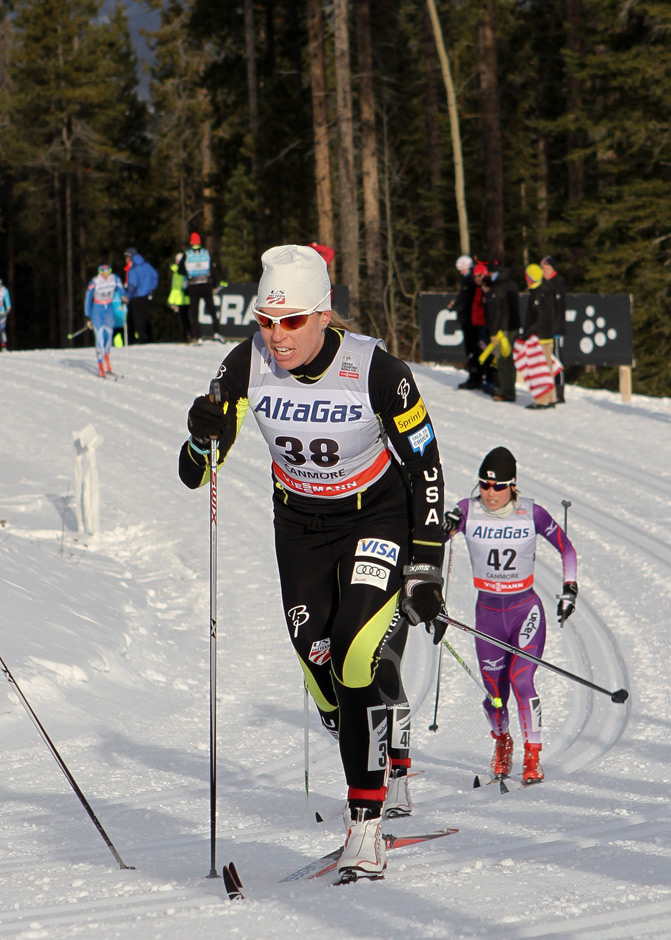
    After notching her third podium of the week, Bjornsen said the hill climb would be “interesting.”

    “I’m not much of a climber, let alone on skate skis, so we’ll see,” she said.

    An exhausted Sadie Bjornsen (APU/USST) after notching her third podium in as many races at SuperTour Finals. She was third in Saturday's classic sprint.
    An exhausted Sadie Bjornsen (APU/USST) after notching her third podium in as many races at SuperTour Finals. She was third in Saturday’s classic sprint. (Photo: Mark Nadell/MacBeth Graphics)

    As for the sprint final, Bjornsen said she made a poor lane choice out of the start and fell off the back early.

    “It was so wet,” Bjornsen said of the snow in the stadium. “From there, I just tried to catch back up to these girls. … I wish I could’ve really been up there or started with them. I was catching them but there wasn’t enough time.”

    With the two steep climbs near the end, she said the course was challenging, but fair.

    “It’s more about the strongest person on the top of the hill instead of who has the fastest skis,” she said. “It’s fun in that regard.”

    Brennan, who finished fourth in the final, noticed the difference in ski speed as she watched Randall and Sargent take off. Unable to catch them on the downhill, she and teammate Bjornsen battled for third.

    “Sadie put on a nice move on the [last] uphill and that was sort of that,” Brennan said.

    Plagued by a back injury, Brennan said she lacked some confidence heading into the sprint.

    “I skied probably way too aggressively in my quarter and semi just because I didn’t know if I could do it or not,” the former USST member explained. “I didn’t have as much in the final as I would’ve liked, but it was really good to be able to ski with Kikkan and Ida and those girls that I haven’t raced against this year.”

    Fifth-place finisher Maria Graefnings, who graduated from the University of Utah last year and returned to Sweden for her first World Cup top 30 this season, was also happy to have made the final. A two-time NCAA champion who placed 28th in the 10 k freestyle World Cup opener in Gällivare, Sweden, the 27-year-old said sprints weren’t usually her thing.

    “I was like, ‘Oh man, just go for it,’ ” she said. “I was debating klister or zeros. It was a little bit tricky waxing today, but I’m super happy with the result. I was like, ‘OK, I better hold on, try to stick to them as long as I can.’ ”

    Dunklee followed Graefnings into the finish for sixth, completely drained by the back-to-back heats. Like her quarterfinal and semi, the biathlete charged hard to lead out of the start. In the final, she said that tactic didn’t work.

    “I fell off fast,” Dunklee said. “I didn’t have much left in the tank at that point. I think I overdid it a little in the semis, but I made it to the final so I’m pretty damn excited about that.”

    Excited to be among a strong showing of U.S. biathletes, with Annelies Cook and Hannah Dreissigacker racing in her semifinal as well, Dunklee was also thrilled at the chance to race Randall.

    “It was a very special moment standing on that start line … and thinking, ‘Man this is a moment I can be proud of,’ ” Dunklee said.

    Tracing her success to her running career at Dartmouth College, she was thankful the course involved a lot of striding and that her skis aided her along.

    “Our techs just nailed it today,” she said. “I had some of the fastest skis going down that hill and then I also had plenty of kick to get up so it can’t really get much better than that.”

    — Audrey Mangan contributed reporting

    Results | SuperTour Finals standingsPhoto gallery


  • SuperTour Finals Preview: A Prologue to ‘Separate the Boys from the Men’

    SuperTour Finals Preview: A Prologue to ‘Separate the Boys from the Men’

    Athletes climb to the high point of the prologue course at the Auburn Ski Club.
    Athletes climb to the high point of the prologue course at the Auburn Ski Club during training on Wednesday.

    FasterSkier’s coverage of SuperTour Finals and U.S. Distance Nationals is brought to you by the generous support of Concept2, the leading manufacturer of indoor rowers, racing oars, and the SkiErg.

    TRUCKEE, Calif. — When skiers think of northern California, they think of the sun, deep snowpack, forested trails, and long, ridge-line ski routes. Unusual weather led to smaller snow banks than usual this April, but the hundreds of athletes and coaches in town for the 2013 SuperTour Finals and U.S. Distance Nationals will nonetheless be getting their racing’s worth starting on Thursday.

    Truckee’s reputation for spring skiing precedes it. This year it’s drawn skiers to the race series from as far away as Sweden, Switzerland and Norway.

    “Four girls from Sweden decided to come here to race, like an adventure,” said Hanna Falk, a Swede with a handful World Cup starts this season. “We’re really happy to be here. This is the first time in the U.S. for me, ever.”

    “We heard that this venue was one of the best in the U.S., so we wanted to come,” added fellow Lisa Larsen, a member of Sweden’s 2013 World Championship squad. “We talked with Kikkan [Randall] and Jessie [Diggins] and they said, ‘You must come to California!’ So we decided late to come.”

    The foreigners add an extra level of excitement and competition to this edition of SuperTour Finals. In addition to the Europeans, a handful of Canadians are on the start lists, as is the regular domestic field, and handful of dedicated college and junior skiers, most of the US Ski Team back from the World Cup and a few biathletes.

    “This is a nice opportunity to ski and have fun and be in the sun,” said Annelies Cook of the U.S. Biathlon team and Maine Winter Sports Center. “And I don’t get to classic race ever. Last year was the last time I classic skied and I loved it, so it was just kind of fun to see what happened. I never go hard but I still love it.”

    For the athletes, the plethora of SuperTour points up for grabs in each race make the stakes high for skiers currently in contention for the lead. But most everyone is looking forward to five relatively laid-back races in between catching up with friends and enjoying California. Some were perhaps hoping for a bit more snow on the backcountry trails, though — like the course at Tahoe Donner Cross Country, where three races were supposed to take place this week, the usually snow-abundant routes along the mountain ridges are pretty bare this year.

    “I was hoping to take people on some of the sweet trails they have here up high,” said Truckee native Matt Gelso (Sun Valley Ski Education Foundation).

    “But this is nice,” he added, indicating the snow around him at the Auburn Ski Club, where Thursday’s prologue will take place. “It’s nice being in Truckee, I like the trails here, I like the setup, I like the spring corn wet skiing.”

    Precipitation is in the forecast this week, but the warmth and blue skies on Wednesday before the first race contributed to a relaxed atmosphere in the stadium.

    “It’s hard to get worked up at this point in the season,” said Alaska Pacific University’s Rosie Brennan, who currently leads the women’s SuperTour. “With double SuperTour points, there’s quite a bit riding on [these races]… but at this point in the season everyone’s just tired. Racing in the West is my favorite thing, so I just enjoy it.”

    Brennan primarily wants to keep her spot on the list in order to get back to Europe for World Cups next fall.

    “I just want to make it through all the races and keep the SuperTour lead,” she said. “So I don’t really care which race goes well as long as a couple of them do!”

    The first step towards that goal is the first race of the series on Thursday, a 3.3 k prologue. Though it’s short, there are just as many points awarded for winning it as there are in the longer events. The course on tap is being described as deceptively challenging. There is nothing illusory about the steepness of the focal point, an A-climb that was built in the last few days specifically for this race, but before and after it there are rolling transitions that will force skiers to stay on their toes where they might not expect it.

    “I’ve never raced this course,” Gelso said. “The climb is new — they put that in a few days ago and this is the third iteration of it. It’s pretty serious. It’s long and steep at the top. You can’t blow it out otherwise you could really not have a good race.”

    The venue sits just over 7,000 feet above sea level, which is good news for athletes who are used to the height at not so good for the unacclimated.

    “I’m excited,” said Sylvan Ellefson of Ski & Snowboard Club Vail/Team HomeGrown. “I haven’t race here since JOs in 2005, and back then the hills certainly seemed a lot bigger than they do now. The A-climb that they just put in is serious and it’s tough and I think it’ll definitely weed out the boys from the men. …  All the hay’s in the barn, so whatever hay is there will hopefully be enough to finish up the season.”

    There are a few notable absences in both the men’s and women’s fields this week. Noah Hoffman (SSCV/USST) just had surgery on his shoulder and is recovering at home in Colorado. Last year’s prologue winner, Simi Hamilton (SVSEF/USST), is having tonsil and sinus surgery next week and decided to skip the series. Holly Brooks (APU/USST) went home to rest after a tiring season in order to be ready for the national team’s first training camp in May.

    The rest of the SuperTour regulars and USST members are in Truckee, however, and are ready to race.

    On the women’s side, the hilly prologue course should be right up Kikkan Randall’s alley. The World Champion and two-time World Cup sprint champion improved her prologue skiing at the end of this season and Thursday’s contest will most certainly be hers to lose.

    “I’m feeling pretty psyched,” Randall said. “It is so great to be back in the USA and good to be skiing in the sun and to see everybody.”

    As for the course?

    “It’s going to be fun,” she said. “It’s deceptively hard. You’ve got the big climb but still a lot of skiing after that and not a lot of rest. And being at altitude, it’s going to be a good challenge.”

    Randall’s teammate was of the same mind.

    “It’s going to make us work,” said Sadie Bjornsen. “It has a lot of hills which at least keeps you awake and working, but there’s also mysterious places where you forget to work, like at the top of the hill where it keeps climbing but at a gradual rate.”

    When it comes time to put on a race bib on Thursday, athletes will ultimately be doing all they always do — going out to see what they’re capable of.

    “It’s fun to go into a race series and not have any specific goals, but more just see what we can do with what we have,” Bjornsen said. “If you do well then it’s super exciting, of course. But you know, it’s more fun to see what we can make of it.”

    Start lists

    SuperTour overall standings: women | men

  • Athletes Take a Stand: ‘No Need’ For Dangerous Tracks in Cross-Country

    Athletes Take a Stand: ‘No Need’ For Dangerous Tracks in Cross-Country

    Petter Northug (NOR) making a turn at the bottom of the Mordarbakken in Falun, Sweden, on Friday during the World Cup Finals prologue. Photo: Noah Hoffman.
    Petter Northug (NOR) making a turn at the bottom of the Mordarbakken in Falun, Sweden, on Friday during the World Cup Finals prologue. Photo: Noah Hoffman.

    In the evolution of cross-country skiing at the world-class level, there has been an undeniable push from the International Ski Federation at every stage to make the sport more spectator- and television-friendly. The World Cup depends on sponsorship to survive, and potential sponsors deal in the currency of TV viewership. Over the years, individual start races have given way to mass starts because they are easier for television audiences to follow. A ski exchange penalty was added to the Holmenkollen 30/50 k this year expressly for its potential entertainment value.

    As a part of this trend, athletes have also observed that the trails they compete on have become increasingly difficult, both in terms of climbing and descending.

    “At each venue, it just seems like they want to outdo each other with the biggest uphill and the steepest, scariest downhill,” says U.S. Ski Team member Holly Brooks.

    They have observed, and become increasingly disgruntled by the trend.

    “That’s not what cross-country is about,” Brooks continued. “This is not skier cross, this is cross-country. We’re not out there wanting to be shoulder to shoulder doing tight slalom turns down hill on skis that weigh however much our skis weigh. That’s not the point. We’re endurance athletes that like to go fast. Yeah, we can take some down hills, but let’s not make them stupidly challenging.”

    Growing unhappiness with the direction they saw the sport heading was partly what led the majority of World Cup athletes to protest the World Cup Finals courses in Falun, Sweden, on Thursday. After arriving at the venue for the last three stages of the mini tour and previewing the course the day before the first race, many were alarmed at how dangerous new features of the downhill were, which had been included in preparation for the 2015 World Championships that will be held in Falun. Several big names in the sport, Norway’s Petter and Thomas Northug included, crashed on the major downhill off the Mordarbakken in pre-race testing. Several Swedish athletes reportedly went to the hospital after crashing at Swedish Nationals on the same course earlier in the season.

    “What they had been proposing was just, like — someone would have gotten hurt,” said U.S. athlete Jessie Diggins. “The odds that there wouldn’t have been any crashes were just none. Originally there were like five turns and it was super narrow through the woods and there was almost no padding on the trees. People even crashed last year [when] the course was much safer.”

    Furthermore, some thought the course was unfair in an individual start on top of being too hazardous.

    “Personally, I’m always one that is for fast down hills and sketchy down hills, but I think the difference between that and what’s going on on this course is: these corners weren’t built well,” said American Andy Newell, who has been racing on the World Cup for ten years. “They need the criticism like they’re getting so the can, for one, bank the corners and make them wider, make them better. The way it is now, for sure it’s dangerous — people could go flying off the course and crash in front of you and cause a major accident — but it’s definitely not even fair in a race like [the prologue] when the S-turns are so different for the first skier as opposed to the 100th skier to go down. The course changes so much when people are scrubbing their skis like that on the down hills.”

    Canada’s Alex Harvey put it pretty bluntly: “There’s no need for this in XC skiing,” he wrote in an email to FasterSkier.

    The athletes met twice on Thursday to discuss the course, and the majority reached the conclusion that they were prepared not to race unless it was changed to make it safer. They sent a signed petition to the race jury on Thursday afternoon through athlete representative Kikkan Randall.

    The jury’s initial response was to change the course for the mass starts but not the individual-start prologue. As someone who has been an athlete representative for four years and has come to understand the needs of the many stakeholders involved in the production of World Cup races, Randall could see the reasons for their resistance to change the course at the last minute.

    “Camera cables had already been laid, there wasn’t really an easy way to route around the downhill…if you wanted to go up the Mordarbakken,” she said. “It wasn’t easy to just switch to a different course because there wasn’t really a good other option and with all the other cameras it was really pretty close. We’re making these decisions twelve hours before the race. So it would have been nice if we had a little bit more time to actually sit down with the jury more in advance and talk through the discussion, so it wasn’t so much us versus them. Because there were a lot of things going on and it’s easy to say, ‘Well why aren’t you guys doing something?’ But they’re not able to react that quickly.”

    When the athletes received word that the jury would not to make last-minute changes to the prologue course, they collectively refused to budge. They went to bed on Thursday night after giving FIS, the jury and the organizers an ultimatum: no change, no race.

    “After we got the official decision we met again as athletes and talked through different scenarios, and the majority decided they were still concerned enough; that unless the course was changed for [the prologue] more than half the field was prepared not to race,” Randall said. “We submitted a proposal to the jury asking them to reconsider their decision and change the course…and if they didn’t make the changes a lot of athletes wouldn’t start.”

    Late Thursday night the jury agreed to meet the athletes’ demands. Organizers cut off the top of the Mordarbakken to reduce speed going into the descent and skipped a few of the downhill turns. Relieved, the athletes met for a final time on Friday morning a few hours before the prologue was set to start and accepted the changes. The race went on, and nobody crashed in any serious ways over the course of three competitions on Friday, Saturday and Sunday.

    “I’m glad we could come to a compromise, because in the meeting last night nobody wanted to sit out three races, but we felt we had to send a strong enough message to really effect the change,” Randall said after completing the prologue on Friday afternoon.

    Not everyone was sure the desired effect of the protest was actually achieved, however.

    “We still came into that last sketchy corner with the same speed,” said Canada’s Lenny Valjas. “It was a weird change. It just made it really short… I guess they only changed it because all the athletes put up such a big stink about it, but the way they changed it, it kept it pretty dangerous still and it turned out to be fine. It was kind of a weird last few days here, what they were doing.”

    The last-minute adjustments the organizers could make, as Randall indicated, were limited by time constraints. But beyond the scope of the specific adjustments made to the course throughout the weekend, it was the whole petition process between the athletes and the jury that was notable, for a few important reasons.

    In the athletes’ view, it demonstrated that they could successfully get their governing body to listen to their demands and act on their behalf. To do it, they united quickly and close to unanimously around the idea that they were prepared not to race in order to be heard — no small feat, given the disruption it would have caused to the overall World Cup standings in the men’s field if the last three races of World Cup Finals simply hadn’t happened.

    “I’ve never seen the athletes come together this much, this quickly,” Randall said.

    (Her second two-year term ends this season, and she hopes the votes athletes cast at World Championships back in February will keep her in the position for another term.)

    “I know there’s been an issue with alpine in the past and they tried to come together, but they weren’t preparing to not start the next day,” she continued. “So again, I hope in the future we don’t have to get to that point, but it was pretty amazing to see so many athletes come together with a similar concern and be willing to band together and not start.”

    Most significantly of all, with the threat of boycott athletes drew a clear line in the sand between what kind of course they are willing race on and what kind they will not. They hope their success in Falun will set some kind of precedent for the future and place some control over the sport’s continued evolution back into their own hands.

    “Some athletes were really concerned with their safety, and with a pretty good reason, and they stood up for what they believed in,” summarized U.S. athlete Torin Koos. “Kikkan, Emil Jonsson and Elder Ronning were the most instrumental and outspoken on finding out what the will of the athletes was, and presenting this to FIS… I think FIS deserves some real credit acting on behalf of the athletes.”

    Athletes’ primary concern throughout the process was the safety and fairness of course, but they are not oblivious to the concerns of the organizers.

    “It’s such a tricky battle, pleasing TV viewers and of course the money that comes with, and pleasing the athletes,” said U.S. athlete Rosie Brennan, who was in Falun at the end of her first stint on the European World Cup. “But it is important for FIS to realize that without the athlete support, the sport isn’t going to attract the attention and money it would otherwise. I am glad to see the athletes have some leverage over what they are doing.”

    Holding onto that leverage was one of the athletes’ primary reasons for putting up such a big stink in Falun: they thought they had to draw a line somewhere to demarcate the upper limit of what they consider a reasonable course, and the danger they saw in Falun was what finally pushed to draw it.

    “That’s the plan; that’s why we were so adamant about not racing today,” Newell said on Friday after the prologue. “Realistically it would have been OK to race on it today, probably, but we didn’t want to give them that leeway to use that on athletes in the future. Like, ‘Yeah, you guys raced on it that one time, so it’ll be OK now,’ type of thing. I think it was a victory for sure that we showed them that we could come together and make a decision that we didn’t want to race that course so now I think they’re kind of forced to change it, especially for the next two years.”

    Before World Championships take place in Falun in 2015 and before World Cup Finals return there in 2014, athletes want to see more changes to the course. The compromise reached this weekend was a quick, temporary fix in their view. It addressed some of the immediate safety concerns, but to the detriment of other aspects of the course — for instance, the changes effectively flattened the profile by turning athletes back down the Mordarbakken partway up.

    “The changes made were a good compromise, but still not enough for what we, as athletes, would like to see,” said Liz Stephen (USA). “The lower corner that we skied [in the prologue] will not make for a very good mass start, and taking out more than half of the Mordarbakken isn’t a good solution for World Champs, I don’t think… This was a good compromise for today’s race and this weekend’s races, I think the OC is going to have to come up with a real solution for next year and World Championships in 2015. Fortunately, they have plenty of time.”

    — Alex Matthews contributed reporting.


  • Randall Secures Overall World Cup Podium as U.S. Puts Four in Top-30

    Randall Secures Overall World Cup Podium as U.S. Puts Four in Top-30

    Kikkan Randall (USA) reached another history-making career goal on Sunday in Falun, Sweden. She finished World Cup Finals in seventh to complete the season in third in the overall World Cup rankings.
    Kikkan Randall (USA) reached another history-making career goal on Sunday in Falun, Sweden. She finished World Cup Finals in seventh to complete the season in third in the overall World Cup rankings.

    Kikkan Randall set out in Falun, Sweden, on Sunday with a very concrete task in front of her. She had already crossed one major goal off her list in claiming the World Cup sprint title in Stockholm, but in order to hang on to her third-place position in the overall standings she needed to finish 15th or higher in the last stage of World Cup Finals. Marit Bjoergen (NOR) threatened to score 200 points in the process of winning the mini tour, but 32 points from Randall would be enough for the American to remain on the third rung of the podium for the season finale.

    With the best distance form she’s demonstrated in a long while, Randall made sure it wasn’t even close. Starting from the 15th position in the mini tour she climbed up eight places over the course of the freestyle pursuit to finish seventh, post the second-fastest time of the day behind Therese Johaug (NOR), and make history yet again for the U.S. in finishing in the top-three in the overall World Cup, a first for the country.

    Her teammates followed suit with strong results, too. Stephen skied the sixth-fastest time to finish 16th in the tour while Jessie Diggins and Holly Brooks skied together to climb to 26th and 27th, respectively, in the pursuit with the 12th- and 15th-fastest splits. Ida Sargent finished 37th in her first World Cup Finals appearance and Rosie Brennan maintained her starting position to end up 43rd.

    “I feel great,” Randall said after climbing down from the podium. “It’s been a long season and a lot has happened, and I really wanted to cap it off with a strong performance today and hang onto that third spot. And I did, so I’m just super happy and looking forward to celebrating with my team and coming back and celebrating in the U.S.”

    U.S. Ski Team women’s coach called Randall’s achievement “one of the biggest accomplishments of her life.”

    She made it look easy, though there was no guarantee on Sunday morning that she would be able to pull it off. Randall’s distance skiing has been slightly off since before World Championships, but on the last day of the season it became apparent that she was back to feeling normal.

    In the pursuit-style format she started 2:52 down from the mini-tour leader and within 25 seconds of the next five women in front of her. Randall’s game plan included an aggressive start in order to catch the group in front of her and as she sought to keep Bjoergen at a safe distance in the points.

    “I knew that I needed to be in the top 15 today to fight for my third place in the overall, and I knew there was a chance to get up to the top 10 if I was aggressive in the start and made it to the next group,” Randall said. “I made it my strategy to go out and try to catch that group right away, and I was actually surprised at how quickly I got into that group.”

    After she caught the athletes in front of her she skied safely in twelfth in the group until the final climb up an abbreviated Mördarbakken, where she made a move to the front and left her nearest competitors behind her.

    “The last big hill I decided to make a move and I wasn’t sure, with the shortened Mördarbakken, if there’d be enough space,” Randall said. “But I was able to break up the pack a little bit and then coming into the stadium I saw [Anne] Kylloenen, and so I was able to pick up one more place before the finish. I felt strong and good out there and, yeah: it went just as planned.”

    With her distance fitness coming back to her in the last World Cup of the year, Randall almost wished there were more races left in the season.

    “This is certainly a very different feeling from what I had at world championships in that 10 k skate, and I think my distance form is coming back up again,” she said. “I mean, in some ways it’s probably a shame the season’s done — although we do have five more races at SuperTour Finals and 30 k Nationals. So I’m hoping a nice week away from racing will be a nice rest and then come in strong for those races.”

    Stephen, whose time-of-day split was only 14 seconds behind Randall’s, capped off her season on a high note as well. The pack that Randall skied in was “a little bit too far away to catch,” but she finished feeling good about the result and being done with the World Cup season.

    “It’s definitely a good way to end the season,” Stephen said. “I skied for sure the best I could today and it was fun to try and go catch some people.”

    Stephen caught the three people in front of her within the first 1.4 k and skied in 17th behind Sweden’s Anna Haag for much of race before passing her in the final kilometers.

    “I didn’t feel quite as sparky as I did a few weeks ago in Val di Fiemme or Holmenkollen last week, certainly the fatigue is starting to build, but I don’t feel bad,” Stephen said. “I’ve had seasons where at this point I’m so done, and I don’t feel that way.”

    Behind Stephen, Diggins and Brooks combined forces and helped put four Americans total in the top 30. The duo worked together with Italy’s Deborah Agreiter for the middle sections of the race, taking turns pulling each other along, and in the end finished back-to-back in 27th and 28th, about 4:30 back from the leaders.

    Diggins started the pursuit in 38th and skied the 12th-fastest split in order to climb into the top 30 and finish her World Cup season on a high note.

    “[Today] was one of the most fun races,” Diggins said. “I got to ski with Holly for most of it, I spent the first lap catching up with her and [Agreiter], and the then the three of us worked together…and we just started reeling people in.”

    After a “disappointing” classic race on Saturday, Diggins was happy to know she could still post one of the fastest distance times in the field.

    “It’s a good confidence boost to end the season, for sure,” she said.

    Brooks felt the same, and half wished the race could have kept going past 10 k.

    “I think if we had one more lap we could have gotten another couple people, so I had a great time out there,” she said. “It was really nice end on a high note after struggling a little bit yesterday.”

    Sargent and Brennan, who finished 38th and 43rd, respectively, in the mini tour, wished a few things had gone differently on Sunday, but in the minutes following the podium ceremony they were both pleased to be finished with the season.

    “I made it,” Sargent said. “It was a distance skate race which is always pretty tough for me. I’m pretty tired, so I’m just happy to be done and to be here and celebrating with the team for the great season that we’ve all had.”

    Brennan had hoped to stay with the women she started with, but even though they got away from her she was able to maintain her 43rd position in the final standings.

    “It wasn’t so bad,” she reasoned. “I guess I was a little bummed to come over here and not be feeling my best and having struggles with my back, so that was a little disappointing, but at the same time any way I can get the experience is worth it, particularly at the end of the year.”

    As a group, the U.S. women finished fifth in the Nation’s Cup to help the team end up sixth in the overall competition behind Norway, Russia, Sweden, Finland and Germany. Athletes and coaches had their eyes on those standings all season, and after watching the top teams be recognized on Sunday Whitcomb wasn’t shy in saying he wants to bring his athletes to that podium in the future.

    “We just got out of the awards ceremony and it was really cool,” he said. “They called Kikkan up there and the Nation’s Cup and our team sat around and watched all that… It’s an important thing I think for the team to see, myself included, because it’s something we all aspire to moving forward together so that we can maybe one day win one of those team awards.”

    The U.S. women have hit many high notes this season, reaching nearly every goal they set for themselves and putting every team member in the top-10 on the World Cup at some point in the season. All six athletes will participate in a Swedish Fast & Female event on Monday before heading back home.

    Asked what part of the season was most memorable for her, Randall was hard-pressed to choose just one highlight.

    “It’s a hard question,” she said. “A little girl gave me a picture to autograph today as I was walking out, and it was of me holding the flag in Quebec. And [I’m] thinking about the world champs win, and to finish off here — there’s just been so many good memories this season. It was really cool just to see the whole team take another step up. Last September I was first dealing with the injury and I wasn’t sure what was going to be possible. This turned out even better than I could have imagined.”

    Results

  • Randall 19th in Falun Classic Stage; In Position For Overall Podium

    Randall 19th in Falun Classic Stage; In Position For Overall Podium

    Kikkan Randall (USA), wearing bib 8, during the 10 k mass start classic race on Saturday in Falun, Sweden. She led the U.S. with a 19th-place finish. Photo: Fischer/Nordic Focus/FIS Cross Country.
    Kikkan Randall (USA), wearing bib 8, during the 10 k mass start classic race on Saturday in Falun, Sweden. She led the U.S. with a 19th-place finish. Photo: Fischer/Nordic Focus/FIS Cross Country.

    On one of the first nice days for classic skiing the World Cup has seen all year, Kikkan Randall and Liz Stephen led the U.S. in the 10 k classic mass start in 19th and 21st, respectively, on Saturday for the third stage of World Cup Finals in Falun, Sweden. It was a race that both women ultimately wished was a few kilometers longer, as they both picked up places together in the last few minutes of the 30-minute race. But given that classic has been the weaker technique for both of them lately, and Randall’s distance form “has been pretty rocky since the Tour,” they were satisfied to keep themselves in decent positions for the final stage of the mini-tour on Sunday, a 10 k freestyle pursuit.

    “We both would have been psyched for one more lap,” Stephen wrote in an email. “We were really catching people that last lap.”

    The two teammates started relatively far apart and didn’t find each other until the last two laps of the 3.3 k course. Randall sat in 26th at the 5 k time check and Stephen was four seconds ahead of her in 22nd in a field that separated quickly. It wasn’t a pace any harder than usual for a women’s mass start, but the tempo was a challenge on this particular day for the Americans, at least in the first half.

    “It’s a women’s race! It was all out from the word ‘go!’” Randall said. “The pace was pretty fast and I had a decent start, but just kind of had trouble adjusting to that pace in the middle section of the race.”

    Stephen started hitting her stride just as Randall was struggling, and after the two converged they together to pick off a few skiers and finish on a high note.

    “It was kind of nice to have her to follow for a bit,” Randall said of Stephen. “She was carrying a pretty good tempo and then I had really good kick on the uphills, so that was a strong point for me in the last couple kilometers.”

    Randall kicked it in slightly ahead of Stephen to finish 1:20.2 behind Marit Bjørgen’s (NOR) winning time. Stephen finished two places and 3.1 seconds behind Randall.

    Both Americans had both hoped for more in the second-to-last World Cup of the season, but were satisfied to have maintained good positions going into the final stage of the mini-tour, where they really want to do some damage.

    “I am really looking forward to tomorrow’s pursuit start race, as I think they are my favorite kind,” Stephen said. “I am feeling physically good going into tomorrow, so we shall see how it goes! Last World Cup race of the season!”

    Stephen moved herself up a few places with Saturday’s result and will start in 22nd, 3:32 back.

    Randall sits in 15th in the tour standings and will start the 10 k freestyle on Friday 2:52 behind Bjørgen (who leads the entire field by 1:19 now that Poland’s Justyna Kowalczyk has dropped out) and a minute behind Heidi Weng (NOR) in sixth. The outcome of World Cup Finals carries particular weight for Randall’s final placing in the overall World Cup standings, where she currently sits in third. Bjørgen is currently 170 points behind Randall, and if the Norwegian wins the pursuit on Sunday she will be awarded 200 points for the mini-tour win. All Randall has to do to hold onto third is finish at or above fifteenth, which would earn her the necessary 32 points to hold Bjørgen off.

    Behind the two leaders of the American squad, Ida Sargent placed 29th behind her teammates on Saturday to put three American women in the top-30, a marker that always brings the satisfaction of World Cup points even if the result itself isn’t as fulfilling. This was how Sargent felt about the place on Saturday, which brought her through the finish 1:56.3 behind the leaders.

    “I felt horrible on the first lap and lost a lot of time but then I started feeling better on the next two laps so I tried to move up when I could,” Sargent wrote in an email. “They changed the course to get rid of the sketchy downhill but then there were not any big hills so it was a fast pace all the time and hard to make up time without any significant climbs. But any time I score distance points it’s a good day, so I’m happy.”

    A few seconds behind Sargent, Jessie Diggins and Holly Brooks once again finished back-to-back, this time with Diggins taking a few seconds out of her elder teammate. Like Randall and Stephen, the duo skied together for the back half of the race and in the end Diggins nipped Brooks by 1.3 seconds and the pair finished 38th and 39th, respectively.

    “We would ski together and we were always trying to bridge the gap back to the next group,” Diggins said. “You know, one of us would try to pull the group up and get tired, and then the next one would try to pull the group up… It’s always sweet to ski with your teammate.”

    Diggins alluded to feeling slightly better than the result showed, and she attributed the difference to having “a lot of things to work on with classic technique and wax adjusting and ski picking,” she said. “I was just doing too much slipping and herring boning to be able to hold any sort of pace, so that was a little disappointing. But that said, leaving the season with concrete things to work on for next year is always really nice.”

    Rosie Brennan was the sixth American to cross the finish line. She started the race wearing bib 47 in a field of 50, “so the race was relatively uneventful for me,” she said.

    She still managed to move up a few places over the course of 10 k to finish higher than where she started in 43rd, 3:04.8 back. The fast opening pace was a challenge — “I felt terrible for the first few k at such a high pace,” Brennan said — but found her stride and skied in a small pack for most of the race.

    “I felt pretty good through the race and am certainly becoming more comfortable with the World Cup each race,” she concluded.

    Results.


  • Led By Randall’s Podium, U.S. Puts Three Women in Top Eight

    Led By Randall’s Podium, U.S. Puts Three Women in Top Eight

    Kikkan Randall (USA) led the U.S. women in the Falun, Sweden, prologue on Friday with a third-place finish. Photo: Fischer/Nordic Focus/FIS Cross Country.
    Kikkan Randall (USA) led the U.S. women in the Falun, Sweden, prologue on Friday with a third-place finish. Photo: Fischer/Nordic Focus/FIS Cross Country.

    In a race that held a lot of unknowns for the entire World Cup Finals field before it began, the freestyle prologue stage that was held on Friday in Falun, Sweden, was a particularly important moment of truth for the American women. After a mediocre performance in the classic sprint two days prior, a shorter event in the team’s generally stronger disciple presented a more weighty test for a group of athletes that, like the entire field, is getting ready to be done racing for the season.

    “I was feeling tired and pretty mentally done in Lahti,” said Jessie Diggins. “I was like, ‘Man, I’m pretty ready to go home.”

    Somewhere there must have been energy to burn, for it sparked to life on Friday to help Kikkan Randall, Holly Brooks and Diggins post three top-10 performances for the U.S. Randall landed on the podium with a third-place finish and Brooks and Diggins went back-to-back in seventh and eighth, respectively. Liz Stephen crossed the finish line in 20th to put four team members in the top 20.

    “It was a great race. Putting three in the top eight and Liz in 20th was a great day for us,” said U.S. Ski Team women’s coach Matt Whitcomb. “For Kikkan it was no surprise that she could unleash something like that, but it was refreshing for her to come up with that effort this far into the season and the same is true for Jessie and Holly, who were in need of a good result to bring back some confidence at the end of the year.”

    The Falun course definitely favored a team like the Americans who are usually good at climbing and good at short distances on skate skis. The track, only 2.5 k long with the readjustments made at the insistence of the athletes on Thursday night, essentially climbed out of the stadium to the top of the Mördarbakken hill 1.2 k from the start. The course then spun athletes in a 180-degree turn at the crest and shot them back down the other side to navigate the last bit of the windy descent, the one that had first caused the field to protest the course over safety concerns the night before the start. At the bottom of the hill there was still a few rolling transitions to get through before it was over, requiring some amount of energy conservation to avoid bleeding time in the last 500 meters.

    Randall thought she played the conservation game right, posting the fourth-fastest split at the top of the Mördarbakken, 5.5 seconds down to Astrid Jacobsen (NOR). She moved up a place as others dropped back to finish 6.6 seconds behind Marit Bjørgen’s winning time.

    “Obviously today showed I’m in a good place,” Randall said. “Classic is all over the place these days so who knows about tomorrow, but basically I just want to show up at the starting line, ski like crazy, and it’ll be what it’ll be.”

    It’s hard to say whether the late-night negotiations between athletes and the race jury affected Randall. She admitted to feeling fatigued in her warm-up but OK once the race got underway. As the only athlete representative present at World Cup Finals this week, the responsibility of organizing the athlete protest over the original course fell largely to Randall the night before.

    Whitcomb didn’t think she showed significant signs of fatigue during the race.

    “Kikkan has a pretty high capacity to carry stress like that, but there was no doubt that it was a weighty effort on her part,” Whitcomb said. “These guys kind of inherited a problem that maybe could have been dealt with beforehand, but they had to deal with it last night and I was impressed with their ability to roll through the punches with a cool attitude. It took a big toll on everybody, not just Kikkan and the people leading those meetings… We came out of it OK.”

    Randall moved herself from 22nd to ninth in the mini-tour standings with her prologue performance.

    Matt Whitcomb (r) cheering on Holly Brooks during the 2.5 k freestyle prologue on Friday in Falun, Sweden. Photo: Bryan Fish.
    Matt Whitcomb (r) cheering on Holly Brooks during the 2.5 k freestyle prologue on Friday in Falun, Sweden. Photo: Bryan Fish.

    Behind the team’s leader, two teammates were ecstatic with confidence-building races again at the tail end of the season. Brooks, whose time of 6:15.5 brought her a seventh-place finish, 12.3 seconds behind Bjørgen, has been waiting to be back in the top-ten since she last raced in Sweden in November and was “psyched” to have returned to the position.

    “It’s been a little while since I’ve had a really good one, so I’m pumped,” she said.

    Brooks’ ability to set a concrete strategy for the course was, like everyone else’s, waylaid somewhat by the fact that the newly modified course was closed prior to the start to conserve snow. In general, she attacked it almost like she would a sprint race.

    “I think it was Astrid [Jacobsen] that said it’s like 1% less than sprint pace,” Brooks said. “I love prologues, especially skate prologues. They’re probably my favorite race, and I think about going maybe 1% less than sprint pace but holding really good technique, and that tactic usually works really well for me. Sometimes in sprint races you get too jumbled and your technique kind of falls apart because you’re trying to go too fast, so I really like the prologue length.”

    Brooks observed that the earlier starters took about six and a half minutes to finish the course and surmised that “OK, if it’s a six minute race you really have to go,” she said. “And I think the course skied a bit easier than I anticipated so you had to go pretty hard from the start.”

    Brooks eased off on the rerouted descent, but also figured everyone probably did after all the pre-race hype about the downhill.

    “Just talking to some of the other girls, others were a little reluctant,” she said. “And talking about it more probably made us a little more paranoid than we needed to be… I definitely bled some time there but I figured it was better than falling and losing a ton of time.”

    Just a few seconds behind her, Diggins had a similar reaction to her eighth place-finish: satisfied to know that she can still crack the top-10 threshold this late in the season.

    “It’s really nice to know that my body was feeling ready to go today and that everything wasn’t quite shut down just yet,” she said. “It’s always nice to have a good race at the end of the season to kind of end things on a high note, especially having three girls in the top 10… That’s sweet; a really good thing for our team.”

    The accomplishment stood in contrast to the way the team ended their Thursday the night before the race. There were three athlete meetings in the lead-up to the prologue that were widely attended by the entire field and when Diggins went to bed on Thursday, “I was actually pretty certain my season was over and that we weren’t going to be racing,” she said, because the jury had not yet responded to the athletes’ final assertion on Thursday night that the course was still not safe enough.

    “It was interesting waking up being like, ‘Well, I don’t know if I’ll get to race,” Diggins said. When athletes approved newer changes to the course on Friday morning, “In a way that kind of made us all appreciate getting to race more, because at one point we thought we wouldn’t be at all.”

    Behind Diggins, Stephen posted a top-20 as the fourth U.S. women in the prologue. As a distance specialist, Stephen approached the beginning of the race at a relatively conservative pace, and in hindsight wished she had started faster than she did.

    “It was a short course, but it was still a hard one, with two good-sized climbs and technical downhill skiing, so not really any rest,” she wrote in an email. “However, six minutes is a really short amount of time to be doing anything, and I think if I could do it over again I would have started faster than I did. The tracks were closed on the downhill and so we didn’t get a chance to preview it, as they were trying to preserve the tracks for our race, so knowing how it would ski, and how quickly it skied, wasn’t quite possible today.”

    Overall, Stephen is satisfied with 20th and looking forward to the remaining two stages of World Cup Finals, particularly the final 10 k freestyle pursuit on Sunday.

    “The body remembered I still have a few more races to go this season!” she said.

    On a six-woman U.S. squad that qualified the Finals, Ida Sargent was the fifth American on Friday in 38th. It was only the third prologue race of her life and she thought she started a might too slow in an effort not to “blow up” like she has before.

    “I started conservatively and finished feeling like I had more in the tank,” she said. “The finish line came way too quickly which never happens for me. But hopefully it will be a good warm-up for tomorrow.”

    Rosie Brennan, the U.S. starter in the continental cup leader spot, finished 46th in the prologue, 41.9 seconds off Bjørgen’s winning time. This period of World Cup racing has been her first exposure to the circuit and she has been attempting to make a point to evaluate each race in Europe before she sees results. On Friday, Brennan noted she could have probably started more aggressively.

    “I am still figuring out how to do prologue. It’s a very tricky distance and I think the strategy changes a lot depending on the course. Today, I think I skied a little too conservatively,” she said. “Also, being an early starter, I wasn’t able to see the times it was taking girls before I started. Looking back and seeing that it only took six minutes, I think I should have pushed harder in many places.”

    Brennan has struggled with a lingering back injury for the last few races, but for the prologue she felt “much better.”

    World Cup Finals continues on Saturday with a 10 k mass start classic and on Sunday with a 10 k freestyle pursuit.

    Results.

  • Newell Left Wanting More after 11th in Stockholm

    Newell Left Wanting More after 11th in Stockholm

    Andy Newell (USA)
    Andy Newell (USA) sprinting in Stockholm, Sweden, last season. On Wednesday he led the U.S. with an eleventh-place finish.

    There were two somewhat disparate takeaways for the Americans on the first day of World Cup Finals in Stockholm, Sweden, on Wednesday. One was the elation that came with Kikkan Randall being awarded the sprint crystal globe for the second time in a row. Andy Newell joined her in being recognized as the fifth-ranked sprinter on the men’s list, which likewise brought the American a sense of accomplishment for the consistency in his sprinting throughout the year.

    On the flip side, the race that took place on the Royal Palace steps did not turn out the way the U.S. would have hoped for on a perfect day, particularly as it was the opportunity to score big in a sprint until next November. Newell produced the team’s top finish in 11th after taking sixth in his semifinal, followed by Torin Koos in 25th after finishing fifth in his quarterfinal.

    Ida Sargent led the women in 20th, Randall placed 22nd and Holly Brooks finished 27th. The U.S. put five athletes in the heats — “Which was good,” said women’s coach Matt Whitcomb, “but Andy was the only one to make it through to the semis. So, it ended a little bit faster than we wanted it to, but I think we showed that we’ve got a little bit of fire left and looking forward to the next three days.”

    On a course that was frigid, windblown and made of manmade snow covered with a fresh dusting of powder, conditions were tricky. The men had a relatively easy time of picking skis, as double-poling turned out to be far and away the more efficient option. With a few exceptions, the men’s field went with skate skis and muscled their way through Stockholm’s climbs. The usual headwind on the far side of the course forced smart early positioning, as leading the pack early wasted valuable energy.

    “Because there was some fresh snow today — last year it was just kind of icy and fast — today I think because it’s also really windy the tracks were getting that powder windblown in to the [them], so skate skis were running a lot faster,” Newell said. “In order to kick you had to use a pretty sticky kick wax, so…especially for the men it seemed like most people were double-poling.”

    Newell’s double-pole strength showed through in the qualifier, where he had the 10th-fastest time, and the quarterfinals, where he was only 0.1 seconds behind Tomas Northug’s (NOR) heat-winning mark. Newell ran into trouble in the semifinals, however, when he simply ran out of steam on the second half of the course after getting out to a fast start.

    “I’m not sure what happened in the semi,” Newell said. “It was really windy out there so maybe I led too much, but for whatever reason I didn’t have the kick I needed to up the last hill. So I’m disappointed with that. I know I’m a better double-poler than to be 11th or whatever I was today. In a double-pole sprint I should be in the final. So it was a little bit of a disappointment, but it was an improvement over last weekend, so that’s good.”

    It’s been since a month ago in Davos that Newell last made it past the quarterfinals, but he was so consistent earlier in the season that he finished his sprint year ranked fifth overall.

    “I’m happy it was such a consistent season with the sprints, and happy to have a handful of top 10s this year, but super frustrated not to get a podium,” Newell said. “I felt like I was feeling good enough for a podium this year on certain days and it just didn’t pan out, so I think that to finish fifth in the sprint cup without a podium is almost ridiculous. It just shows how consistent I was this year but without that extra something to get on the podium, I guess.”

    Newell is actually the only one out of the top nine on the World Cup sprint list who didn’t podium at least once in ten sprint races.

    “I’m happy to be fifth in the world but I know I should do a lot better, especially when I know I should be on the podium more often,” he concluded.

    Looking forward to the rest of World Cup Finals, Newell is most looking forward to the 3.3 k freestyle prologue on Friday and the 15 k mass start classic on Saturday, both in Falun.

    “I’m just looking to score some more distance points,” he said. “If I can be top-30 I’d be psyched.”

    Koos and Noah Hoffman are the other two American men competing in World Cup Finals. Koos finished 25th and Hoffman was 53rd in his first-ever city sprint.

    “Not only was today my first city sprint, it was only my second time ever double poling a classic sprint on skate skis,” Hoffman said. “That is a tough task for me right now, combining multiple weaknesses in my skiing. It was a challenging day but a really cool venue. I’ve never done anything quite like it. I would like to improve my sprinting so I can race more city sprints! I want to see the rumored city sprint in Central Park, New York come to fruition. Overall I had a great time in a brand new experience.”

    Randall’s crystal globe headlined the Americans’ day, but within the women’s race it was Sargent who led the way for in the results. She had her best career qualifier result with the 11th-fastest time and finished fourth in her heat to finish 20th overall.

    “It was my best qualification result yet so I was really happy with that,” Sargent said. “In the quarterfinal, I was hoping to draft and then go for it on the last uphill but I didn’t ski the transition into the hill very well and had to go far wide and was disappointed to not make it out of my quarterfinal. Still it was so fun racing in the city and skiing over the palace steps.”

    Randall finished fifth in her quarterfinal to take 22nd behind Sargent. She’s has had the sprint title in the bag since winning a dramatic freestyle sprint in Lahti, Finland, two weeks ago, so on Wednesday her primary goal was to finally crack through to the final in her weaker sprint discipline.

    “Since this was the last World Cup sprint of the season, I had high expectations to improve upon my previous best finishes here in Stockholm and make the final,” Randall wrote in an email. “I’m still chasing after my first classic sprint podium.”

    As previously mentioned, conditions were a challenge for waxing. Fresh snow blown into the otherwise icy tracks made kick that was good in one place slip or be too slow in others. Randall led her heat around the first corner, but after struggling up the first hill she was unable to stay in contention. Once the leaders got away from her the realization that they weren’t coming back compounded her feeling of fatigue.

    “The manmade snow was breaking down and turning to sugar on the first uphill while freshly fallen snow was getting drifted over the top and really slowing it down,” Randall said. “It was a big challenge to find skis that had kick in the sugary snow but weren’t too slow in the windblown.

    “I struggled to kick up the hill unfortunately and dropped to fourth over the top. Coming into the 180 turn, I got pushed wide by [Anastasia] Dotsenko and did my best to get back in line and draft behind her. But I was having trouble keeping up in the double pole. Going into the last uphill I lost that adrenaline surge of being right in the pack and kind of seized up. Even though we had a fast heat, I was disappointed to have not been fully in the mix and to have had my day end so soon.”
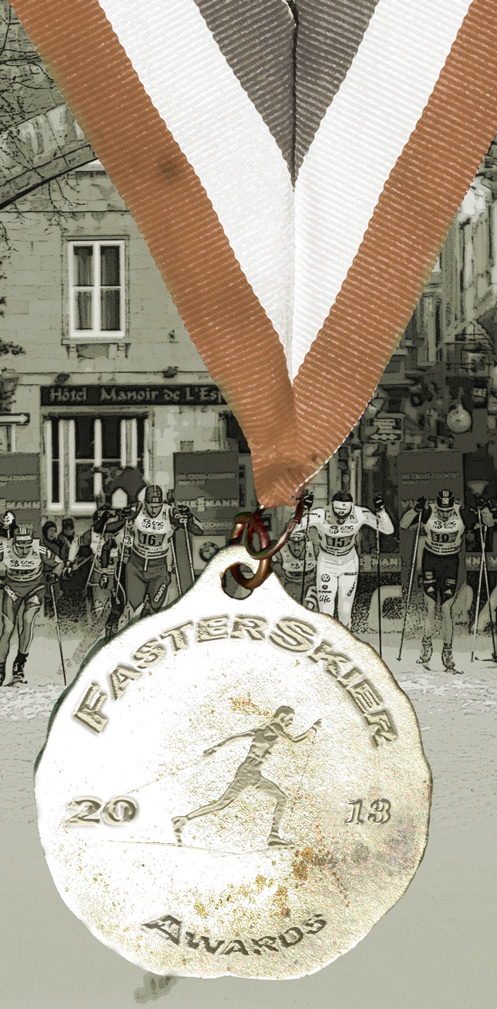
    Holly Brooks finished sixth in her heat to take 27th in her first top-30 appearance since the pre-World Championships World Cup in Davos. Just outside the qualifying cutoff, Jessie Diggins was 34th. Rosie Brennan finished 40th and Liz Stephen was 43rd.

    Overall, Whitcomb thinks the entire World Cup field, including the U.S. athletes, is feeling “appropriately tired for this time of year.” The circuit took a bus to Falun directly after racing concluded in Stockholm to get ready for the second stage, a freestyle prologue, on Friday.

    Men’s results

    Women’s results

  • Diggins Scores ‘Hard-Earned Point’ in Oslo to Join Stephen in Top 30

    Diggins Scores ‘Hard-Earned Point’ in Oslo to Join Stephen in Top 30

    Jessie Diggins (USA) climbs her way to a 23rd-place finish in the women's 10 k freestyle at World Championships on Tuesday.
    Jessie Diggins (USA), competing her at World Championships last month, finished 30th on Sunday in the 30 k freestyle in Olso, Norway.

    Liz Stephen didn’t so much steel American spotlight on Sunday as much as she simply continued to bask in the glow of the best season of her life. Her long stint up front with the lead chase group and eventual ninth-place finish highlighted the U.S. team’s day at Holmenkollen, but right along with her a few minutes back, two teammates toughed out their own races to finish the 30 k feeling relatively good about the effort.

    And, of course, they were ecstatic for their teammate.

    “She skied awesome, I’m super-proud of her,” said Holly Brooks, who finished 35th and +5:12.7 behind Therese Johaug’s (NOR) winning time.

    The Homenkollen course backtracks on itself in a few places, which gave Brooks an opportunity to see part of the race unfolding up front.

    “Partway through the race I saw her in that big chase pack, so it was fun cheering her on during my own race,” Brooks said.

    A few places in front of Brooks Jessie Diggins joined Stephen in the top-30 in a time of 1:25:22.7, just over four off behind Johaug’s mark. Rosie Brennan, the current Continental Cup starter, dropped out of the race after the second lap and did not finish.

    Diggins had a simple objective on Sunday in starting the 30 k: enjoy the Holmenkollen experience while skiing relaxed.

    “In the spring World Cups the field is so tough and the pace is hard from the get-go,” she wrote in an email. “I wanted to not worry about the field stringing out and not bury myself in the first lap. But I also wanted to enjoy the Holmenkollen experience, because it’s really one of a kind. There’s thousands of fans camped out along the course, all cheering and screaming. It’s so awesome!”

    Wearing bib 24, Diggins skied within or close to the top-20 through the first two time checkpoints. During the middle of the race she lost time, but after switching to a new pair of skis at 13 k she reattached herself to a small group that pulled her along for the rest of the race and brought her back into the top 30.

    “We worked together the rest of the race,” Diggins said. “It was super cool — we traded pulls and stayed at a really good pace.”

    Sunday was only Diggins’ second 30 k in Oslo, and with 30th place she picked up one World Cup point and finished 15 places ahead of where she did in the same event last season.

    “Jessie’s was a hard-earned point,” said U.S. Ski Team coach Matt Whitcomb. “She hasn’t been feeling great in distance but the approach today was to go out and have fun and she did that. So [we’re] really proud of that point.”

    Diggins was ‘psyched’ for the point as well. “I’m happy with the result and mostly psyched that I was able to have fun out there and truly enjoy the experience,” she said.

    Brooks, who finished just over a minute behind Diggins in 35th, was in a similar boat as her teammate. Distance racing hadn’t been going well for her prior to Oslo and Brooks wanted get out in a fast group and see how long she keep up.

    “It was OK,” she said of her race. “There were some definite low points and some points where it got a little better.”

    In a field full of competitive Norwegian nations group starters, Diggins and Brooks agreed that the pace started out fast or a 30 k.

    “I wanted to get in a fast group and keep it going, so I had a faster start and kind of faded back through the pack, which was frustrating,” Brooks said. “My first pair of skis weren’t super fast and then I switched at 13 k, halfway through, and had much better skis and was able to turn it around the third and fourth loop.”

    Brooks went from the top-30 at 8 k to 37th after she changed skis. From there she moved back up two places to finish 35th with the help of a few skiers around her.

    “For a while there I thought I’d have to ski by myself and I was not looking forward to it, and then finally a group caught me, or I caught them I don’t remember, and I could work together with them,” Brooks said.

    Diggins and Brooks, along with Stephen, are each ranked comfortably in the top-50 after Sunday’s race and are headed to the four-stage World Cup Finals in Stockholm and Falun, Sweden this week. Though she can feel the season-long fatigue during distance races, Brooks is looking forward to the sprint in Stockholm and the prologue in Falun.

    “For me the shorter stuff now seems to be going better. I’m pretty tired and it shows the most in distance racing,” Brooks said. “So I’m definitely not ecstatic about today’s race, but it wasn’t a complete disaster either, and at this point I’m just trying to have fun with the races that are left.”

    Brennan was a DNF after she experienced pain from a recurring back injury, but she made the difficult decision in the hopes it would help her in the remaining races on her calendar. Continental Cup starters also go to Sweden, and after that there’s SuperTour Finals to think about.

    “I didn’t feel great from the start and I have been suffering from a back injury for awhile now,” Brennan wrote in an email. “The combination got the best of me and by 8 k in, my foot and most of my right leg had gone numb which was the last straw that led me to drop out. It’s never a proud moment and something I hope never has to happen again, but I still have nine races left this season and would like to be able to do all of them. So my back won this battle, but hopefully this is the last.”

    Brennan added that her injury had taken a general “turn for the worse” in the last month, and that she’ll have to figure out soon how to move forward with it.

    The U.S. will head to World Cup Finals this week with an unprecedented five women on its squad: Kikkan Randall, Stephen, Diggins, Brooks and Brennan. It will make logistics busier than ever for the team behind the scenes, but Whitcomb welcomes the change.

    “It’s kind of new territory for us,” he said. “It’s going to be a busy week, but we’re stoked.”

    Results.

    — Alex Matthews contributed reporting. 

  • With 18th in Lahti Classic, Bjornsen Doubles Up on Personal Bests

    With 18th in Lahti Classic, Bjornsen Doubles Up on Personal Bests

    The day after posting a career-best finish in the skate sprint in Lahti, Finland, Sadie Bjornsen maintained the momentum on Sunday and produced a personal-best distance result in the 10 k individual classic. She finished 18th, the top American result, and chopped six places off her previous high water mark from the Sochi, Russia, skiathlon. As the eighth starter in the field Bjornsen even got to sit in the leader’s chair for a few minutes as the rest of her competitors came through the finish.

    Sadie Bjornsen (USA), here in relay action at World Championships, posted the best distance result of her career on Sunday with an 18th place in Lahti, Finland.
    Sadie Bjornsen (USA), here in relay action at World Championships, posted the best distance result of her career on Sunday with an 18th place in Lahti, Finland.

    “It was really fun, I’m really happy,” Bjornsen said over the phone. “When the French (Celia Aymonier) girl got up off the chair I raced over; I didn’t know how long it would last.”

    The afternoon before the 10 k Bjornsen had an inkling the 10 k would go well. Her ninth place in the preceding sprint indicated her fitness was good, and she looked forward to the opportunity to ski an individual distance race and contest an event where her result “wasn’t dependent on how things work out in a mass start.”

    “It’ll be so fun to do my own race, you know?” Bjornsen said on Saturday.

    On the course the next day she was able to pace herself exactly as she wanted, and the result was a new career best. The Lahti venue is closer to sea level than the World Cup circuit has seen in a while, but features deceptively challenging climbs. They were the focal points of Bjornsen’s personal race plan — after observing the way the best women in the world skied over the hills in Val di Fiemme a week earlier, she decided to focus her energy on skiing hard over the tops of the hills in Lahti.

    “Every climb has some form of a downhill after, so I kept trying to tell myself I’d have recovery every time I was in pain,” Bjornsen said. “My goal today was pushing over the tops of hills; that’s something I noticed the fastest girls doing when I was watching the 30 k. They hammer, but they really hammer over the top. So I tried to think about that.”

    Bjornsen said her skis were “really great,” and though a few climbs were still steep enough to require the herring bone technique she welcomed the variation.

    “That was nice to switch up the muscles, so I was excited the course was challenging,” she said.

    On the two-lap course Bjornsen started conservatively, wary of going too hard, too soon. She posted the 22nd-fastest split at the first checkpoint, but moved into 18th by 6 k and stayed there. As such an early starter, she had no real indication as to whether she had paced the race right until she saw the results.

    “I realized I hadn’t skied an individual race in so long,” Bjornsen said. “Did I go hard, how hard do I go? I had no idea if I’d started right. At one point someone told me I was in eighth, but I was bib eight, so I was like, ‘Oh, I guess I went too easy.’ I hammered from there and I was tiring at the end, but my splits were even the whole way through.”

    With two strong results in Lahti, Bjornsen is now sitting 15 points away from being one of the top-50 women on the World Cup overall list that compete in World Cup Finals at the end of the season. Before coming to Finland she’d banked on not qualifying, and booked plane tickets for OPA Cup finals instead, but now that she is three places from the cutoff she’s allowing herself to consider the possibility of going to Sweden.

    “Basically I’m going to need to have another great race at Drammen. It’s totally possible, but going in that’s not what I’m going to think about,” Bjornsen said. “It’ll just be in the back of my mind. Last year I qualified sixteenth there, so I have good memories and I’m going to go into it and think about those. If it goes well, it looks like I’ll have another trip!”

    After Bjornsen, her American teammates Kikkan Randall and Liz Stephen tied for 28th down to the tenth of a second, each finishing the 10 k in 27:48.9. Neither thought it was a stellar result, but Randall considered it a step in the right direction for her distance skiing from where it was in Val di Fiemme for World Championships.

    “I felt a lot better today than I did in Val di Fiemme in the distance races,” Randall said. “I started off a little too slow and it kind of took me until the second lap to really find a good rhythm, but I’m happy with better feelings. It was kind of fun to tie with Liz down to the tenth of a second, kind of crazy.”

    In Italy, particularly after the 4×5 k relay, Randall could tell she was paying the price for the cutback in training her foot injury forced in the off-season, even though her sprinting was clearly fine. The memory gave her reason to take the 10 k in Lahti out a little slower than she might have otherwise, knowing her usual pacing might put her at a deficit.

    “I knew I’d have to build into the race because the feelings in Val di Fiemme were: if I went out too hard everything got flooded and heavy too soon,” Randall said. “So I had the plan of building into it… And I did build speed as I went and felt pretty good on the last few hills. It’s close to being what I wanted to do today.”

    As to how she can be the sprinter to beat while simultaneously struggling to meet her usual distance marks, Randall attributes it to the way she trained for World Championships.

    “Sprinting is definitely a little unique,” Randall said after winning in Lahti on Saturday. “The course was just over 2:40, so it was a fast course and it was more like a real sprint. We were preparing for world champs and putting emphasis on the team sprint and the sprint, so we tailored my training a little bit towards that. That’s why I think the sprinting is continuing to be really strong now.”

    For Stephen, 28th was “an average day.” Where Randall reached the same benchmark by holding back in the first few kilometers, Stephen’s splits were consistently in the top 30 throughout the race.

    “I’m happy to have another race under my belt, and it was fun to tie with Kikkan,” she said, but “I think I’m just continuing to work on my classic.”

    Stephen thought her weakest spots were on the hills, where she struggled to stride over them with good form.

    “The hills are pretty steep and so I need to ski technically well to get up them or I waste a lot of energy running up out of the tracks,” she said. “It was hard to ski technically well while also going fast enough out there today. So more classic races, more time. I think it will come along for sure, but I’m psyched for next weekend.”

    Randall and Stephen are ranked third and 22nd, respectively, on the overall World Cup, which essentially guarantees they will go to World Cup Finals.

    Three other U.S. women competed in the Lahti 10 k. Jessie Diggins placed 43rd after Randall and Stephen (+2:45.9), and Ida Sargent was a few seconds behind her in 44th (+2:47.3). Rosie Brennan was 61st (+4:23.8).

    After the city sprints in Drammen, Norway, on Wednesday, the World Cup circuit heads to Holmenkollen for the fabled 30/50 k freestyle mass start.

    Lahti 10 k classic results

    World Cup Overall standings

  • Bjornsen Crosses Top-Ten Threshold in Lahti Sprint

    Bjornsen Crosses Top-Ten Threshold in Lahti Sprint

    Sadie Bjornsen (bib 13) skiing with Kikkan Randall  (USA) and Celine Brun-Lie (NOR) in the semifinals of the freestyle sprint in Lahti, Finland, on Saturday. She finished a career-best ninth. Photo: Fischer/Nordic Focus.
    American Sadie Bjornsen (bib 13) skiing with Kikkan Randall (USA) and Celine Brun-Lie (NOR) in the semifinals of the freestyle sprint in Lahti, Finland, on Saturday. She finished a career-best ninth overall. Photo: Fischer/Nordic Focus.

    “I’ve been wanting to tell myself that all year, but until you finally do it you don’t believe it.”

    So said Sadie Bjornsen on Saturday from Lahti, Finland, the afternoon of her career-best finish on the World Cup in the freestyle sprint. By ‘that,’ she means the self-assurance she was capable of skiing in the ten, and by ‘it,’ she is referring to the fact that, after wanting to do so all year, she placed ninth against a world-class field on Lahti’s 1.5 k sprint course. The performance is the best individual result of her career by far, and she’s feeling pretty good about it.

    “On our team these days everyone is [skiing in the top ten] weekend after weekend, so it becomes almost normal,” Bjornsen said. “So it’s like, ‘Finally, yes. I can ski in the top-ten as well,’ you know?”

    The personal-best came the same day her elder teammate, Kikkan Randall, won the entire race and secured a position as the best sprinter in the world for the second year in a row. That’s now a familiar position for Randall to be in, so Bjornsen’s break into the top-ten nearly felt like the day highlight for the U.S. team.

    “She almost stole the show, in a way,” said U.S. women’s coach Matt Whitcomb. “Kikkan’s win takes the day, but Sadie’s top-ten is putting her in contention for qualifying for World Cup finals here if things continue this way.”

    What impressed Whitcomb most about Bjornsen’s skiing was the confident manner in which she skied through her heats.

    “She controlled her heats and she didn’t get pushed around,” Whitcomb said. “She skied really aggressively.”

    The aggression was partly fueled by a desire for redemption after a disappointing World Championships last week. Bjornsen knew herself to be capable of more than the 32nd and 37th she produced in Italy, and after skiing the 13th-fastest qualifying time of the morning she set out to ski the heats believing she belonged.

    “I came off of world champs wanting more in sprint racing, so I was just looking forward to another skate sprint,” Bjornsen said. “The qualifier went well and I had the confidence. I’ve had several good qualifiers this year but haven’t yet put together a quarterfinal I was happy with, so today I just went off the start really hard.”

    There were several daunting names in her quarterfinal, like Marit Bjoergen (NOR) and Justyna Kowalczyk (POL). Bjornsen chose to see the competition as an blessing in disguise.

    “When I saw who was in my quarter I was super-intimidated, but then I said, ‘you know, this could actually be good. We could have the fastest heat.’ So I tried to just jump in behind Kowalczyk and Bjoergen at the end, and I had a nice sprint-off with Kowalczyk.”

    Bjornsen finished third in her quarterfinal, only 0.1 second behind Kowalczyk, and advanced as a lucky loser just as she thought she might.

    In the semifinals the American faced Randall, Britta Johansson Norgren (SWE), Charlotte Kalla (SWE) and Celine Brun-Lie (NOR), and left the stadium with Randall at the front of the pack. Bjornsen finished fifth in the heat after getting “quite pinched out” towards the end. She almost wanted more, but ultimately had to be happy with a personal best.

    “At first it’s hard to not be disappointed with that, but I’m also incredibly stoked because I just got my first top ten!” Bjornsen said. “So it’s cool, but there’s more in there.”

    Three American women out of seven-person sprint squad made the Lahti heats on Saturday. After Randall and Bjornsen, Jessie Diggins qualified in sixteenth and went on to finish 25th after placing fifth in her quarterfinal. Where her teammates were able to get out quickly on a course that was difficult to maneuver around, Diggins was last out of the stadium in her heat and was unable to move up in 1.5 k of course.

    “I felt fairly good today and had a good qualifier, but in the rounds I got off to a slow start and was shot to the back of the pack,” Diggins said. “And from there I just couldn’t seem to get around people. I tried a couple times but then kept ending up on the wrong side of the pack and wasn’t able to move on. But every time I get a little more experience!”

    In the aftermath of a demanding World Championships, Diggins says she is close to feeling back to normal on her skis. She is on the start list for the 10 k classic on Sunday.

    “My body feels a bit tired still after the stress and emotion of the World Champs, plus a couple races in a row, but I think after another few days it’ll come right back around!” she said.

    Four other Americans finished outside the heats on Saturday. Ida Sargent was 38th, Sophie Caldwell finished 55th, Holly Brooks was 65th and Rosie Brennan, in Europe as the U.S. Continental Cup leader, placed 71st.

    “I’m disappointed with today but tomorrow is another day so hopefully it will be better,” Sargent said. “Flat and short skate sprint courses have always been tough for me and today was no different. There were a lot of gradual downhill and flat sections which I didn’t push hard enough.”

    Caldwell, who was invited to stay on the World Cup circuit by the U.S. Ski team after a strong showing in the classic sprint at World Championships, was reminded on Saturday how easy it can be to move backwards on such a fast course.

    “Today was not a good day for me,” she said. “It was pretty disappointing because I was excited to skate sprint again, but everyone is so fast here that if everything doesn’t come together perfectly, it’s easy to drop back a lot.”

    Caldwell will compete again in the Drammen, Norway, city sprint on Wednesday before returning to the U.S.

    Brooks was left feeling unhappy with her result on Saturday, particularly as she won’t race again this weekend.

    “The race didn’t feel great today and perhaps more influential, I think I picked the wrong skis,” she wrote in an email. “With such a short, fast course you had to have some fast boards and a fast body. (Obviously our wax team did a great job considering we had some excellent results on our team!) The weekend is a bit of a bummer for me considering the fact that I don’t have a start for tomorrow. We have eight girls over here and not enough start spots. So, I will do my best to look ahead and cheer on my teammates.”

    Likewise, Brennan wasn’t happy with 71st.

    “I am not very pleased with my race today,” she said of her first European World Cup race. “I think there was just a combination of things that didn’t turn out the way I had hoped and, well, on the World Cup, that quickly turns into a horrible day.”

    Though personally disappointed in her result, Brooks was quick to add how impressed she was with her teammates.

    “Highlights of the day were certainly seeing Sadie get her first top ten and Kikkan taking the win for her 100th World Cup start,” she said.”

    Results


  • Podium Sweep in Nove Mesto Builds U.S. Confidence Heading Into OPA Cup in Italy

    Podium Sweep in Nove Mesto Builds U.S. Confidence Heading Into OPA Cup in Italy

    Kate Fitzgerald, Sophie Caldwell, and Rosie Brennan standing on the podium that held biathlon World Champions in Nove Mesto just a few weeks ago; Becca Rorabaugh also made the top six in Sunday's Slavic Cup. Photo: Bryan Fish courtesy of Kate Fitzgerald.
    Kate Fitzgerald, Sophie Caldwell, and Rosie Brennan standing on the podium that held biathlon World Champions in Nove Mesto just a few weeks ago; Becca Rorabaugh also made the top six in Sunday’s Slavic Cup. Photo: Bryan Fish courtesy of Kate Fitzgerald.

    For some racers on last weekend’s trip to Nove Mesto, Czech Republic, the Slavic Cup races were a bit smaller than their previous competitions.

    Take Sophie Caldwell, the Stratton Mountain School T2 skier who had just placed 20th in the sprint at World Championships.

    Or consider her cousin Paddy, a Stratton PG who flew in from Norway where he had just competed at their junior national championships, finishing ninth in the 20 k skate.

    “There were over 250 racers in the 19/20 year old men’s group!” Caldwell marveled after his trip to Lillehammer. “The fields were much smaller [in Nove Mesto] but the top guys are really fast.”

    In contrast, 19-year-old Caldwell was the youngest of 66 other racers in the four-kilometer prologue on Saturday, where he finished fourth.

    “Paddy Caldwell’s skate performance in the prologue was an excellent result,” SMS T2 coach Gus Kaeding told FasterSkier. “Though I didn’t recognize any of the top Czech names, some very accomplished skiers were there. They were younger (like us), but many of them had been in the top 30 at U23s and near the top 10 at World Juniors.”

    Caldwell ultimately slipped back to ninth in the 15 k pursuit on Sunday, but still led the U.S. men; Eric Packer (SMS T2) and Peter Kling (APU) finished 10th and 12th in the prologue before also losing ground in the pursuit.

    It was the U.S. women who truly shone, with Kate Fitzgerald sweeping both races. Most had known that podiums or wins were possible, and thought it was the perfect warmup for a European race trip.

    “I wasn’t sure what countries participated in a Slavic Cup, but I had a feeling the races would be small as none of the countries around there I generally think about as nordic powerhouses, at least in terms of depth,” said Rosie Brennan, who finished fifth in the 3.3 k prologue and third in the 10 k pursuit. “I thought this would be a good way to start out because I had a feeling the Americans could be quite competitive and get on the podium. A little confidence goes a long ways racing in Europe so that was what I was looking for.”

    Mission complete. Daniela Kotschova of Slovakia tied with Fitzgerald on day one, with Sophie Caldwell clocking in just 0.6 seconds behind. After that, it was all America. In the pursuit Fitzgerald and Caldwell quickly dropped Kotschova, and Brennan joined the party too.

    Sophie Caldwell has seen this before: here's her photo finish in Nove Mesto with Fitzgerald. Photo courtesy of Fitzgerald.
    Sophie Caldwell has seen this before: here’s her photo finish in Nove Mesto with Fitzgerald. Photo courtesy of Fitzgerald.

    “I really wasn’t sure what to expect as far as competition,” Kaeding said. “Generally you can get a pretty good feel for how fast people are in the days prior to the races just by watching people ski around. Given this and the overall size of the women’s field, I had a feeling our women might sweep… There were a few impressive Czech juniors but in general, it was obvious our women were the strongest racers there.”

    For Fitzgerald, who said that one reason she wanted to go to Europe was to get out of her “comfort zone” of “always racing the same people,” that could have been a disappointment – but it wasn’t. For one thing, Paddy Caldwell noted that the stadium was still set up from biathlon World Championships, which had been held there a few weekends before.

    “It was really cool to race on trails that I had just watched on TV,” Caldwell said.

    So when Fitzgerald and the women swept the podium, they were standing on the same steps that the very best biathletes in the world had been standing on, in front of cameras and television teams and 20,000 fans.

    Besides that, they just had a good time.

    “The pursuit was really fun – Sophie and I started almost at the same time and Rosie made up her 10 second deficit to us like we were standing still!” she wrote in an e-mail. “After that is was pretty much the three of us skiing together.”

    New venue, familiar feel: it was a good way to adjust for the skiers who were coming from the States. While Packer had been on a family ski vacation in Switzerland, the APU crew came from the U.S., as did Stratton’s Erika Flowers. Fitzgerald said that she wasn’t expecting to feel great after the travel and jet lag, especially since she had come straight from the Birkie.

    She was surprised to find that the marathon effort hadn’t exhausted her too much, and she was right in the thick of it with her American friends in the three-lap pursuit.

    “On the last lap I knew Sophie and Rosie would be hard to beat in a sprint so I tried hammering the hills to try to buy myself some time,” Fitzgerald explained. “Bryan and Gus did a great job on my skis and they were super fast so I knew I would have a chance in the sprint. I was leading into the finish so I got the closest lane but Sophie was coming in hot- it was so close at the lunge neither of us knew who won. I was very excited to find out it was me!”

    And the competition was no less cutthroat just because the women have spent years training and racing together.

    “Racing with just Americans in the end, made it feel more like racing at home and was more comfortable for all us I think, but in the end it comes down to wanting to win regardless of who the other people are and what country they are from,” Brennan wrote.

    Most of the crew will now head to Italy for OPA Cup finals. They expect to face slightly stiffer competition, but the mental boost from a solid weekend in the Czech Republic will be a valuable weapon.

    “The competition was good but won’t be nearly as good (or deep) as it will be in the upcoming OPA Cup races,” Kaeding told FasterSkier. “The races were good confidence boosters for some and gave others a few things to work on before the next round of racing.”

    While the women are clearly on a tear, Kaeding said he thought the men would actually be the ones to jump up their results in the next series, mostly because he knows that both Packer and Kling are capable of much more than they showed in Nove Mesto.

    “Neither Eric or Pete looked quite 100% all weekend,” Kaeding said. “Both had moments but overall, just looked a little tired, Ppssibly due to a training block completed the week before. When either of those guys is at 100%, they can be near or at the top of that field.

    “I should also note that the conditions changed very quickly between the women’s and men’s classic races,” he continued. “The men’s skis were fine during their testing but appeared a little slick during the race. That blame falls to me as I was heading up the kick effort.”

    Brennan will not be making the trip to Italy, instead making use of the World Cup start rights she earned by being the SuperTour leader. But wherever they’re going and whatever level they’re racing at, Brennan said these results were an indication that U.S. women are ready to win.

    “I think it’s pretty clear that the women in the U.S. have built some depth and there are a lot of us not only becoming motivated and inspired by the success at the top, but also a number of us knocking on the door so I suspect the results from the girls will continue hold strong,” she wrote. “

    More on Norwegian Juniors

    Paddy Caldwell had a frustrating U.S. Nationals this January and missed qualifying for the World Juniors team. After that, he did some searching to find a suitable focus for his season. Having had some strong international races in the past, getting to Europe was definitely a priority. Luckily, Pete Phillips of Burke was already putting together a trip to Norwegian junior nationals.

    “After missing the World Junior qualification I took some time to figure out what other races were available for me to compete in for the rest of the season,” Caldwell said. “I really wanted to get over to Europe and this trip seemed like a perfect way to face a similar field of strong juniors… The Norwegian nationals races were a big focus of my season. I really wanted to see how I would stack up with some international racers and get a chance to ski with some Europeans.”

    And that he did. The fields at the races were huge, and fast, including not only top junior skiers but also some biathletes (World Junior champion Johannes Thingnes Bø anchored the winning relay).

    “I skied most of the race by myself but got to chase a world junior racer for the last kilometer of the race,” Caldwell said. “It was really cool to see so many people out there racing. These guys really aren’t doing anything differently, the fields are just much deeper. We ended up 18th overall in the relay, which we were all really happy with. 150 teams started for the guys.”

    Phillips arranged the trip to be also an exchange, and confirmed that six Norwegian J1’s will be coming to U.S. junior nationals to compete as guests. The exchange, Caldwell said, was as valuable as the racing.

    “We also had the unique opportunity to train with a Norwegian club team everyday,” he explained. “I was most impressed by their speed work. We got to do a bunch of starts with the team throughout the week and they were very high-intensity, competitive workouts… Overall one of the best trips I have ever been on. It was a great learning experience and an awesome group.”

    Moving from that trip to the OPA Cup – Caldwell is now with the rest of the team in Madonna di Campiglio – didn’t pose a problem, and he thinks it will help him develop even further as an international racer.

    “This trip has been a great opportunity to learn from some of the older athletes and see how they adapt to travel in Europe,” he said.