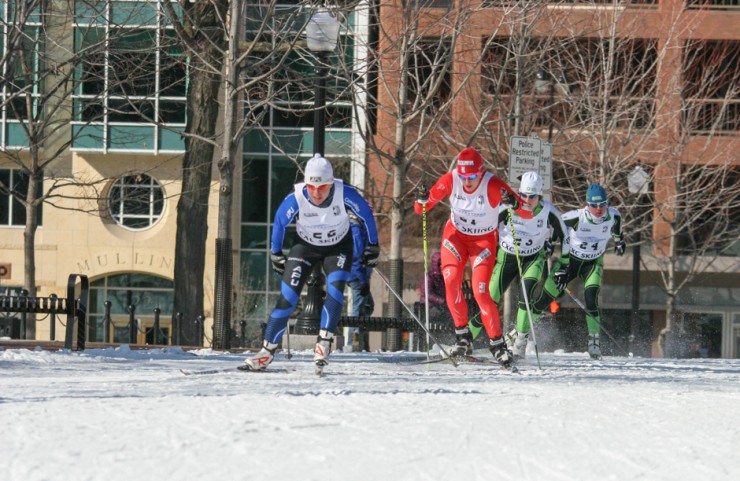
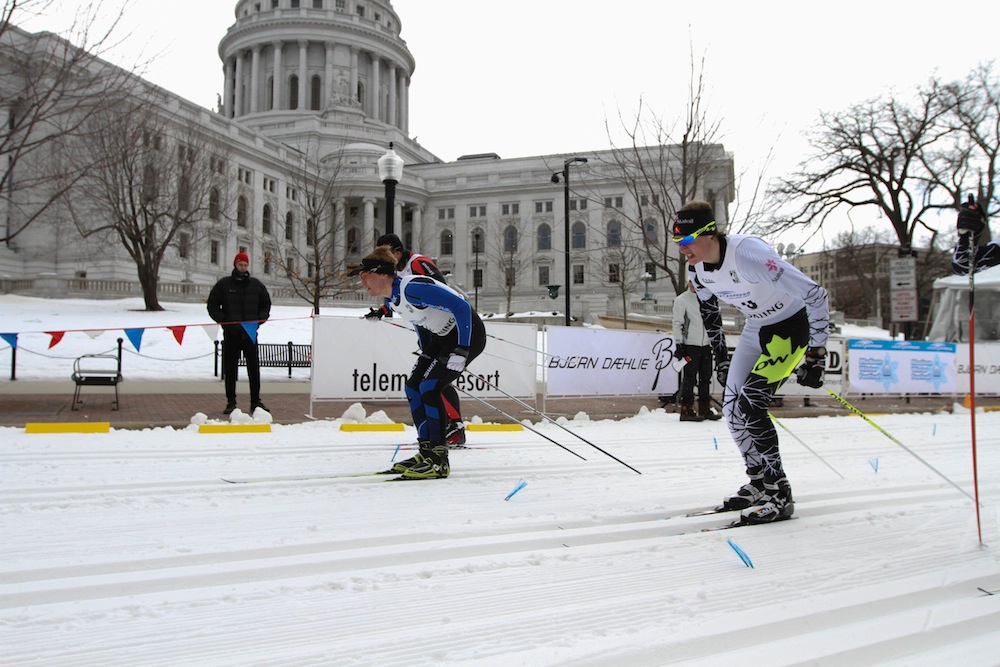
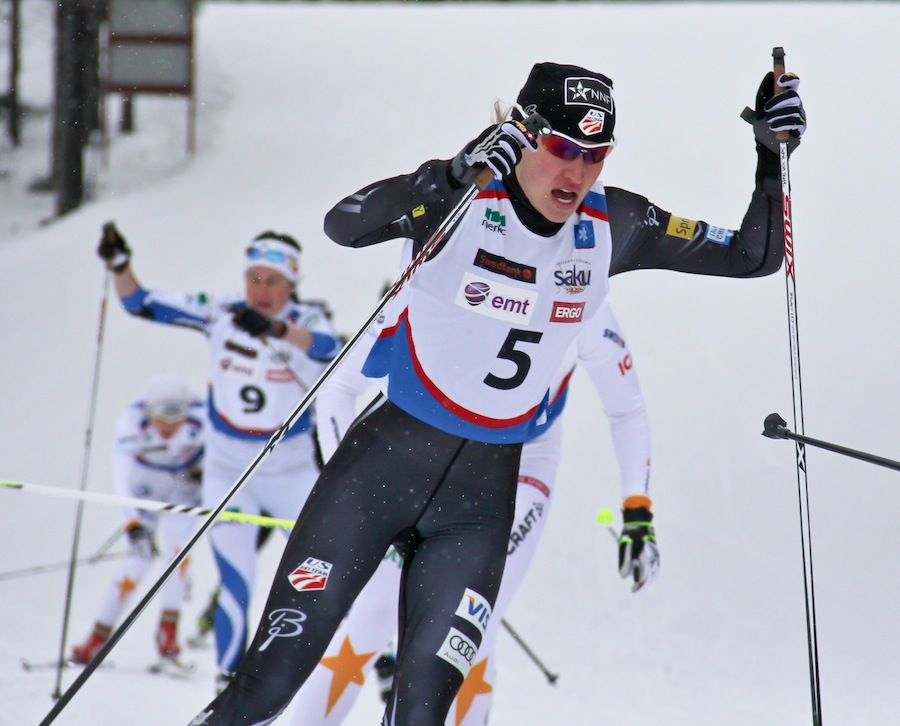
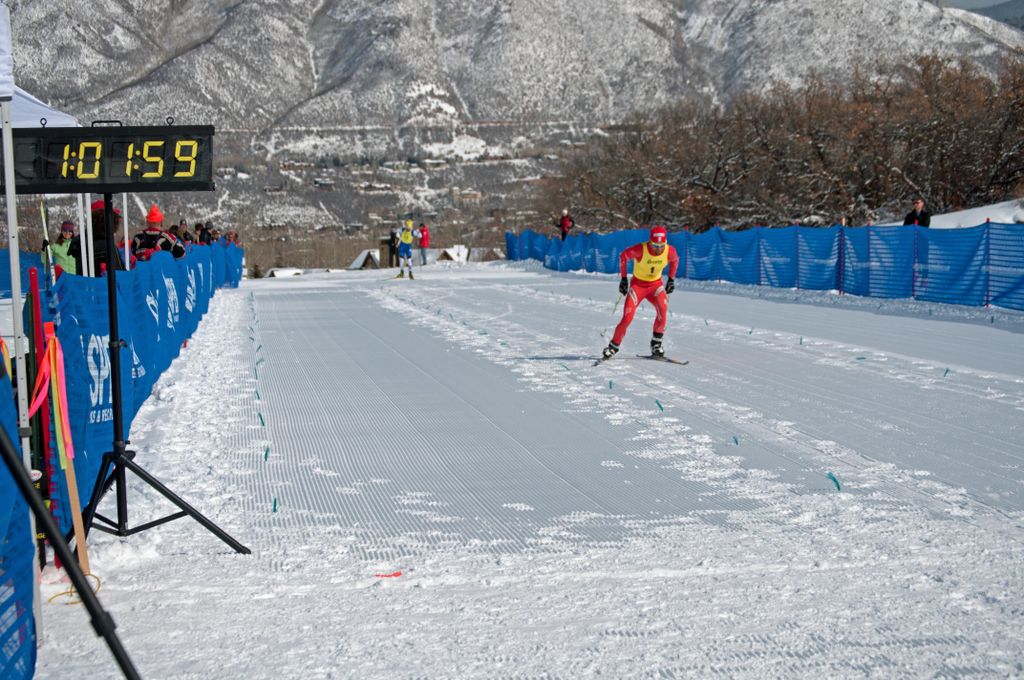
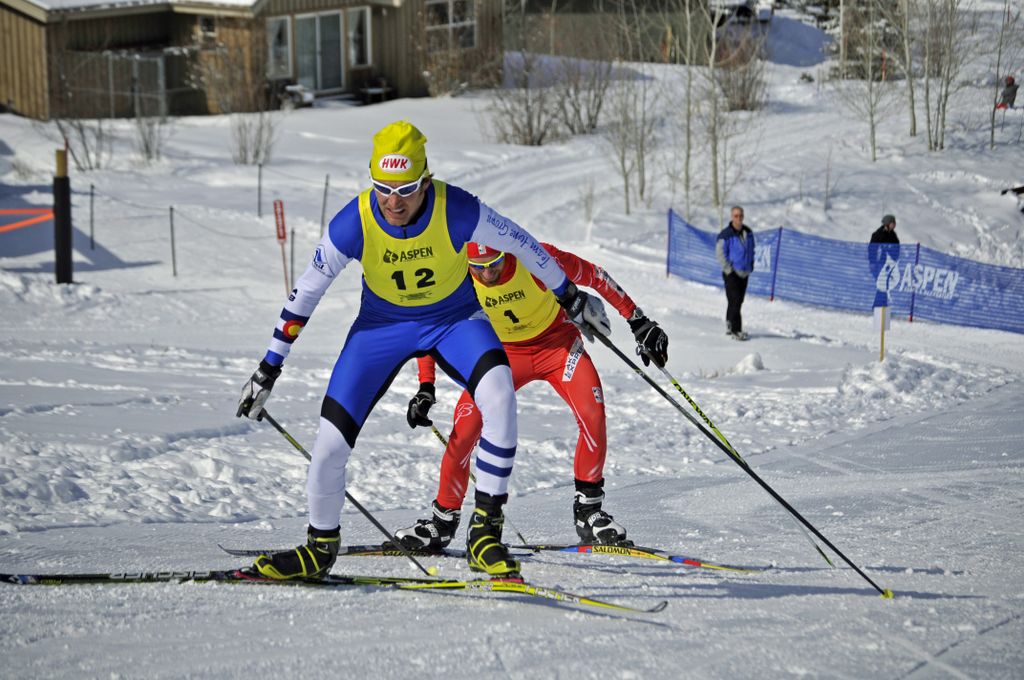
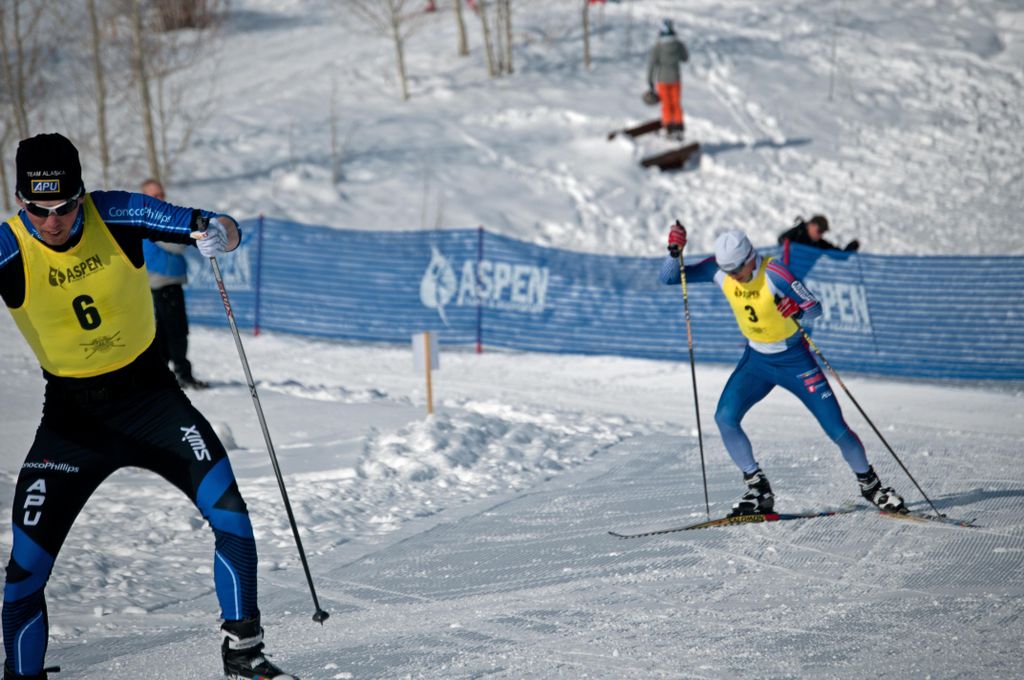
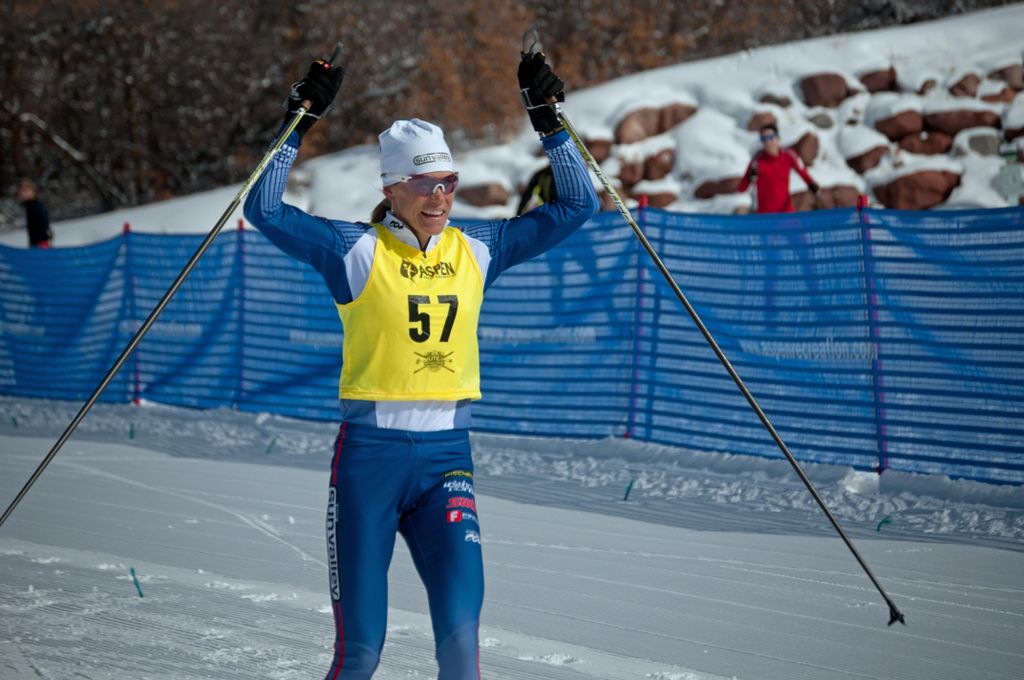
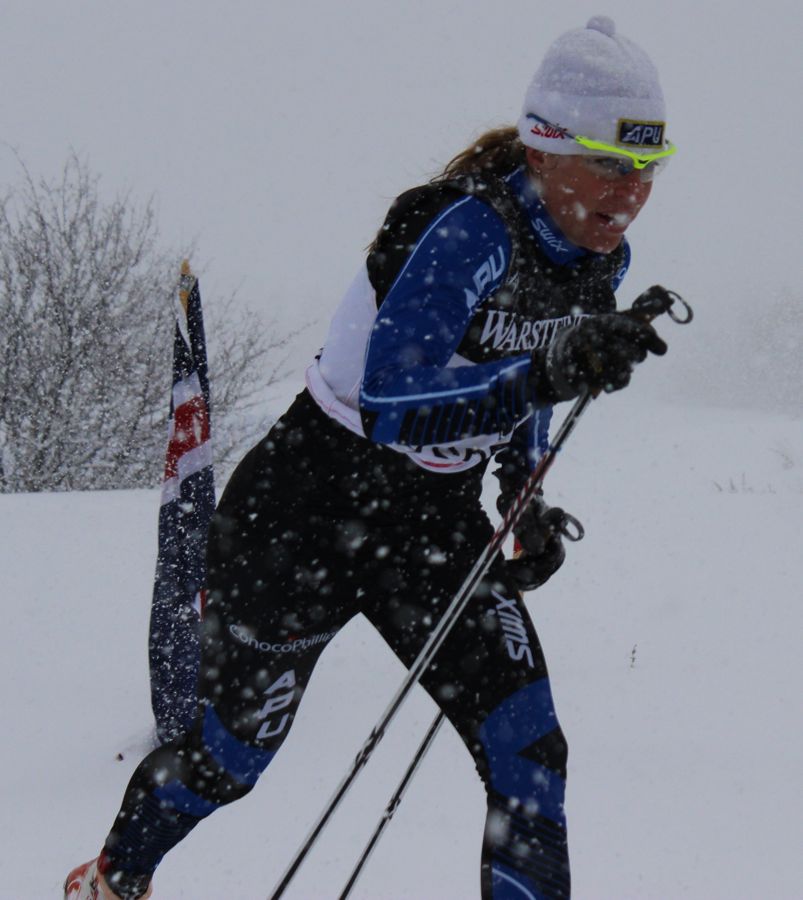
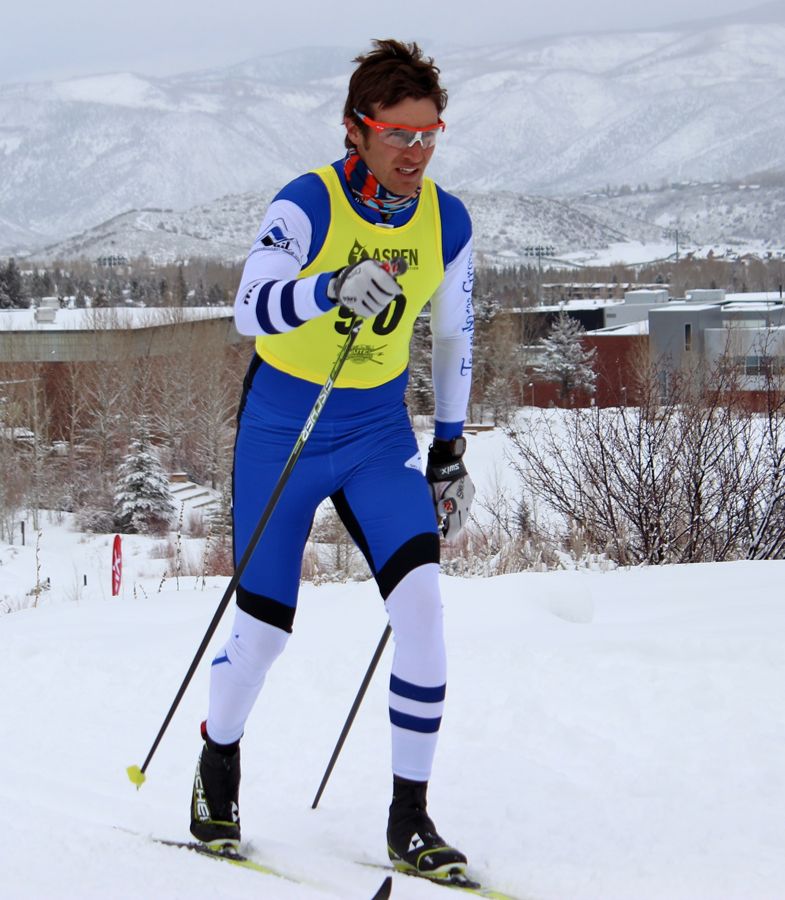
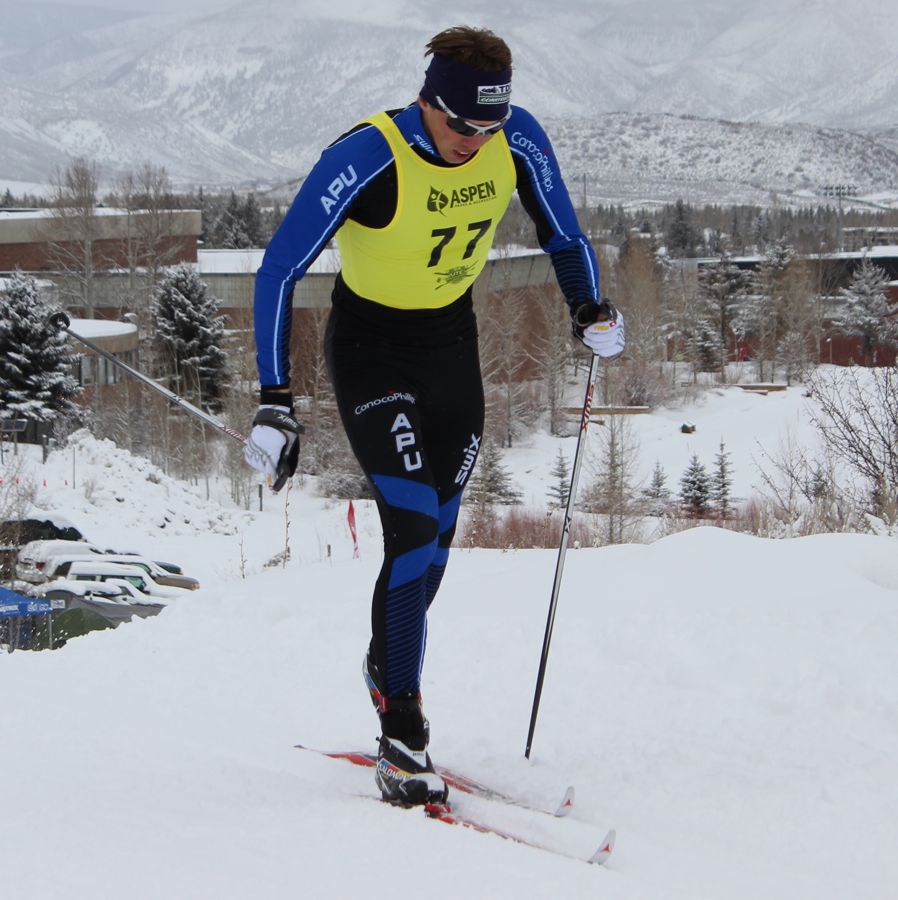
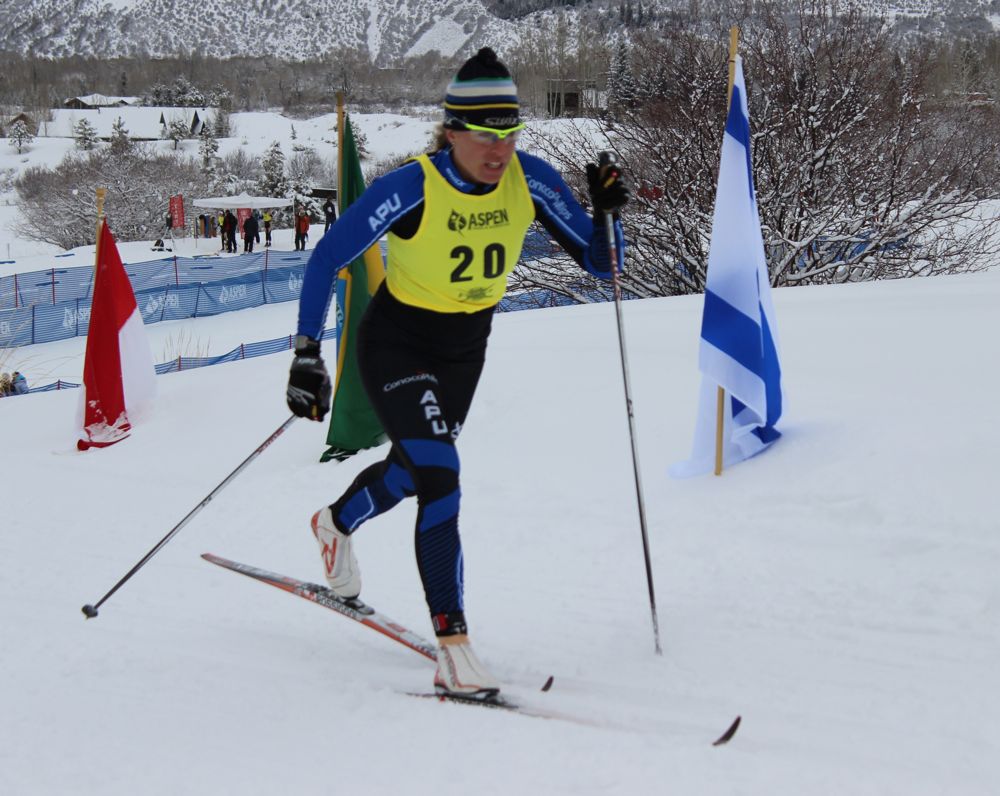
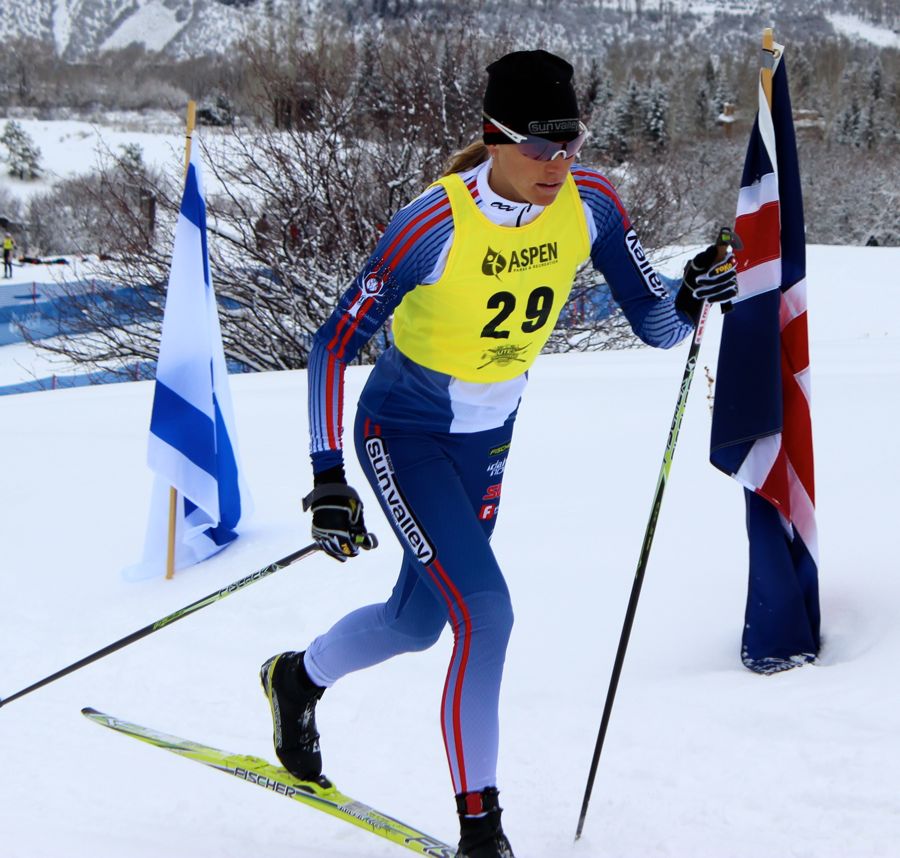
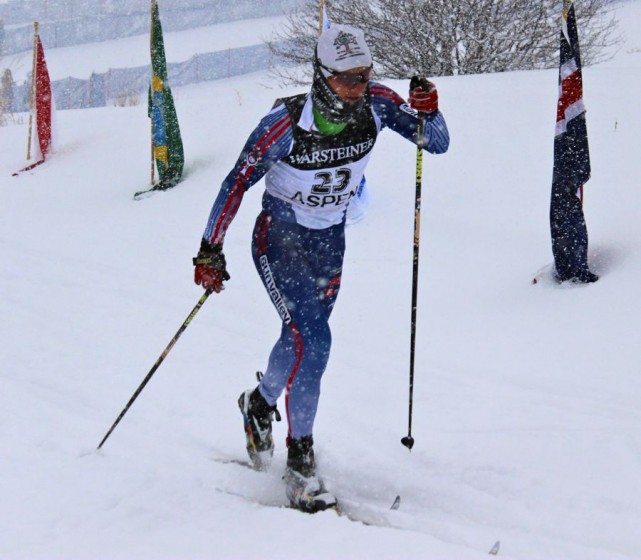
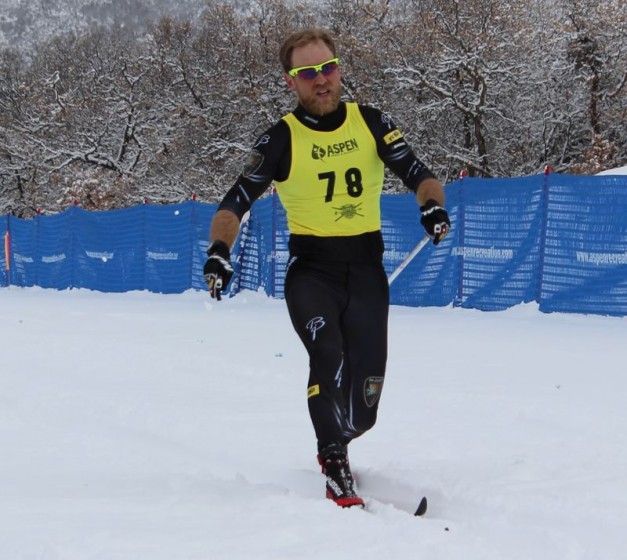
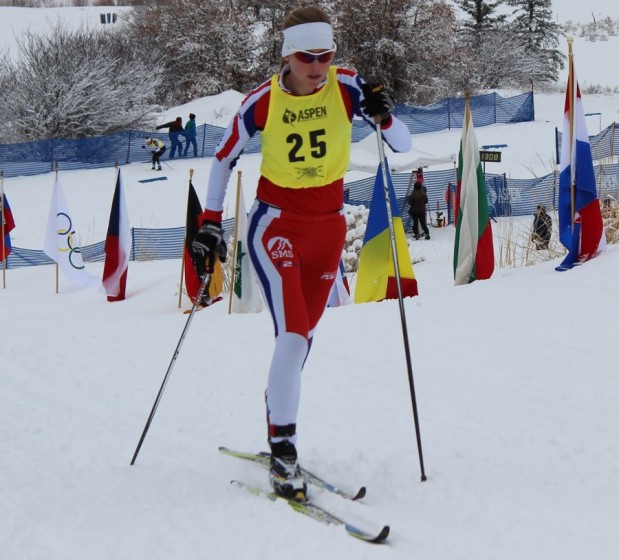
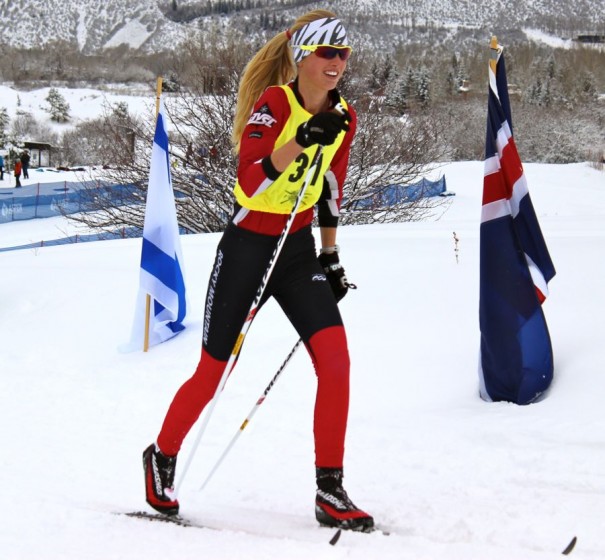
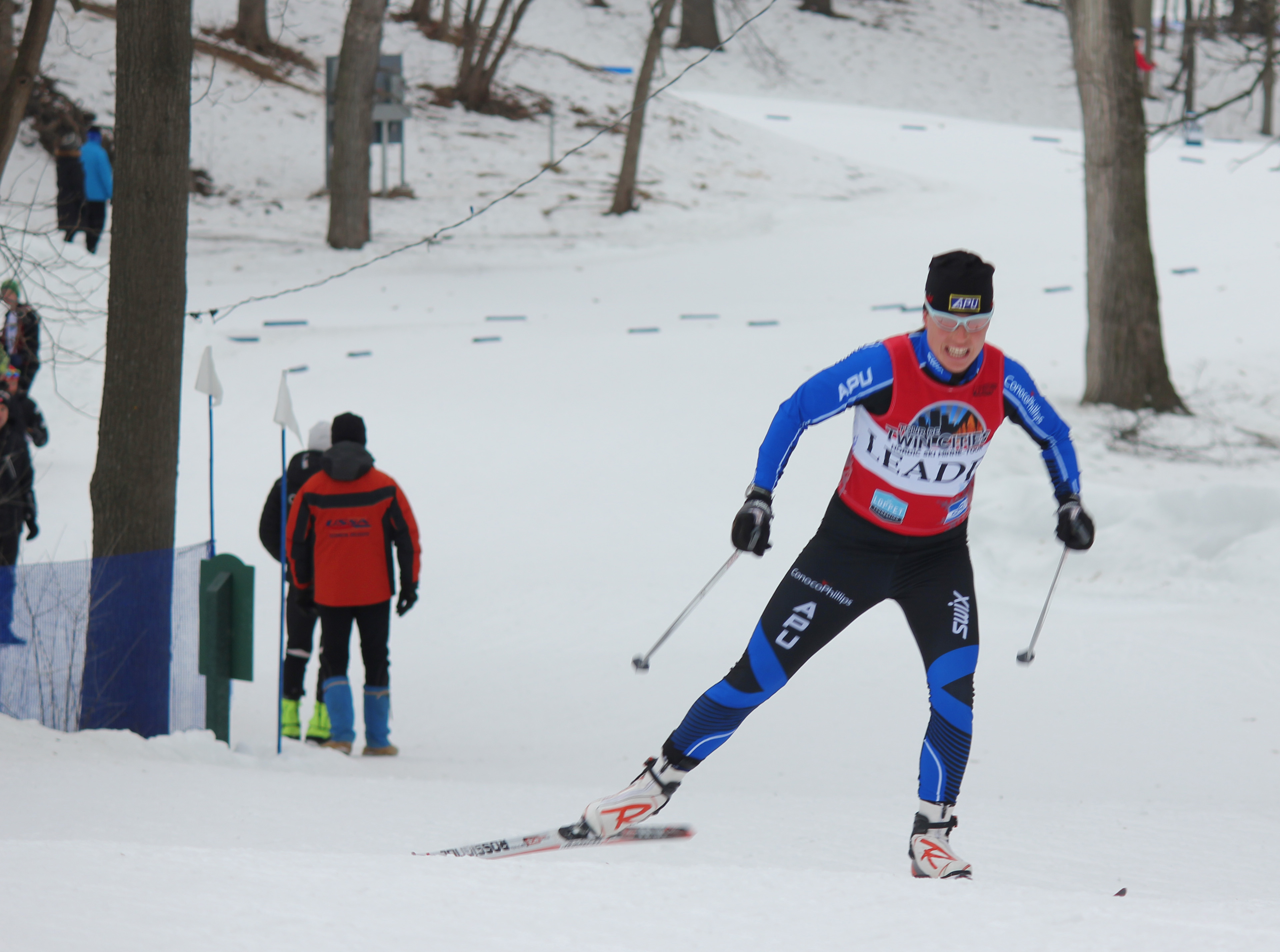
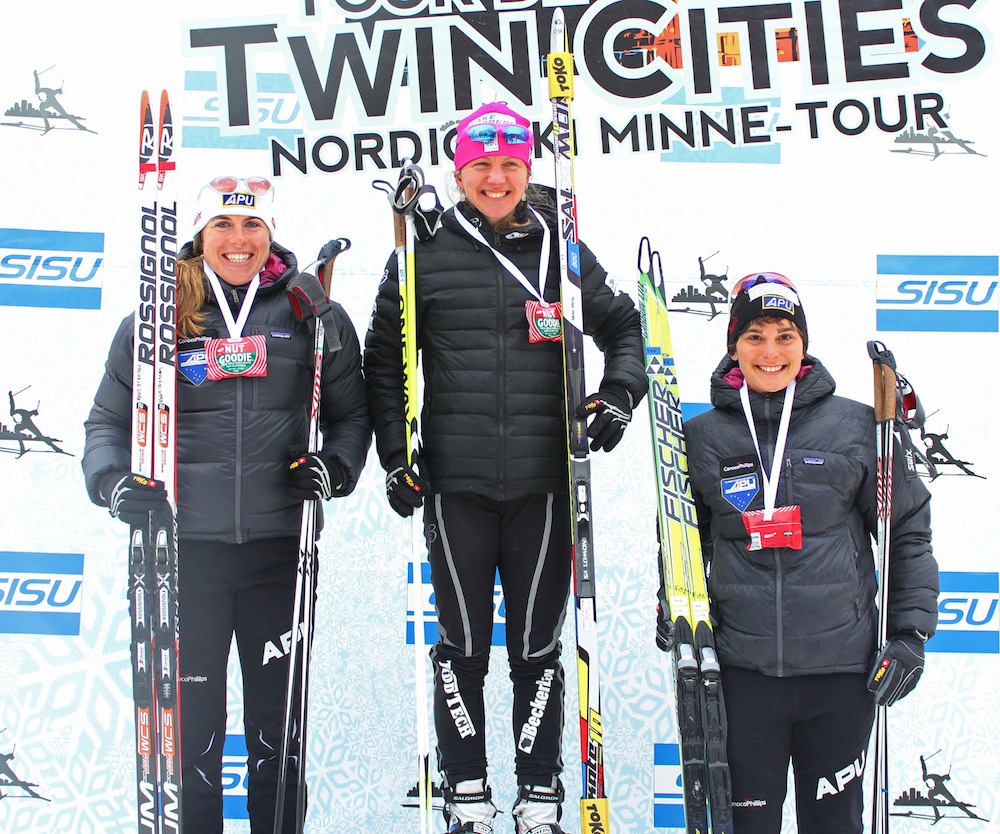
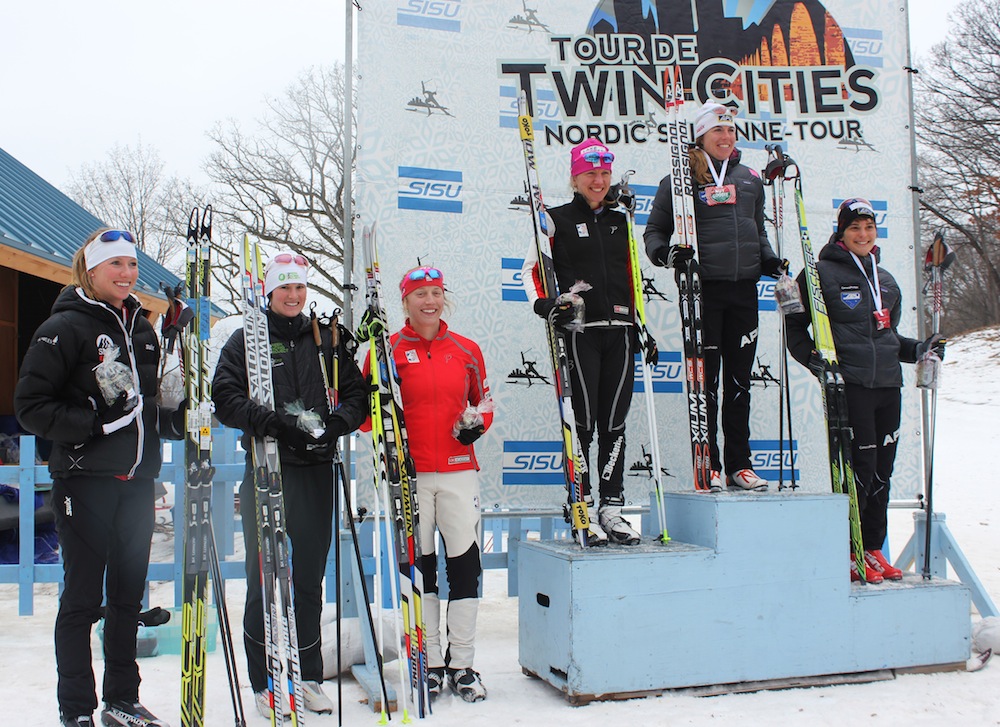
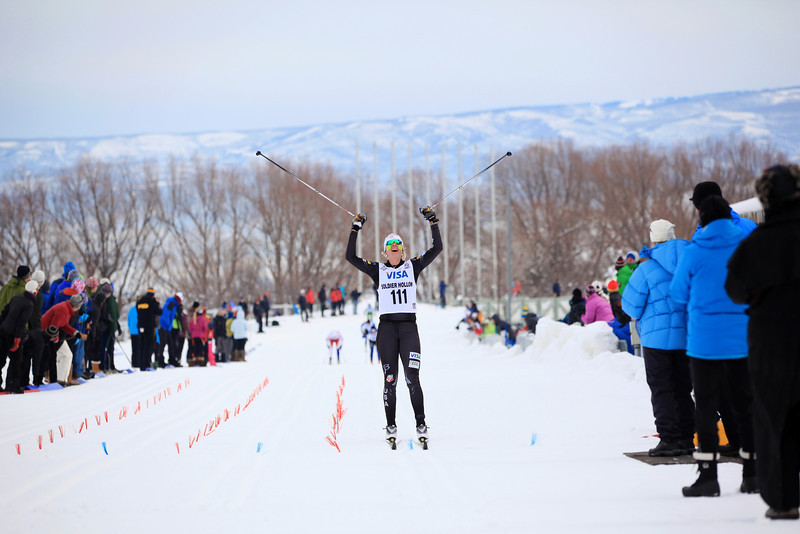
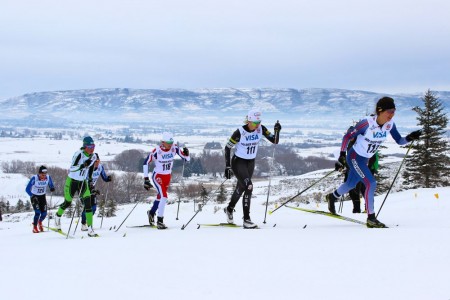
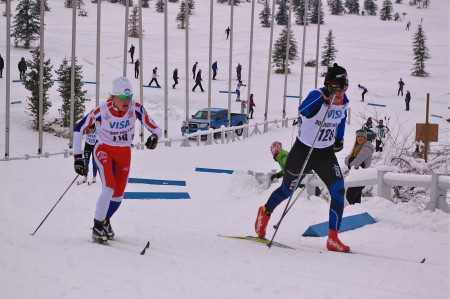
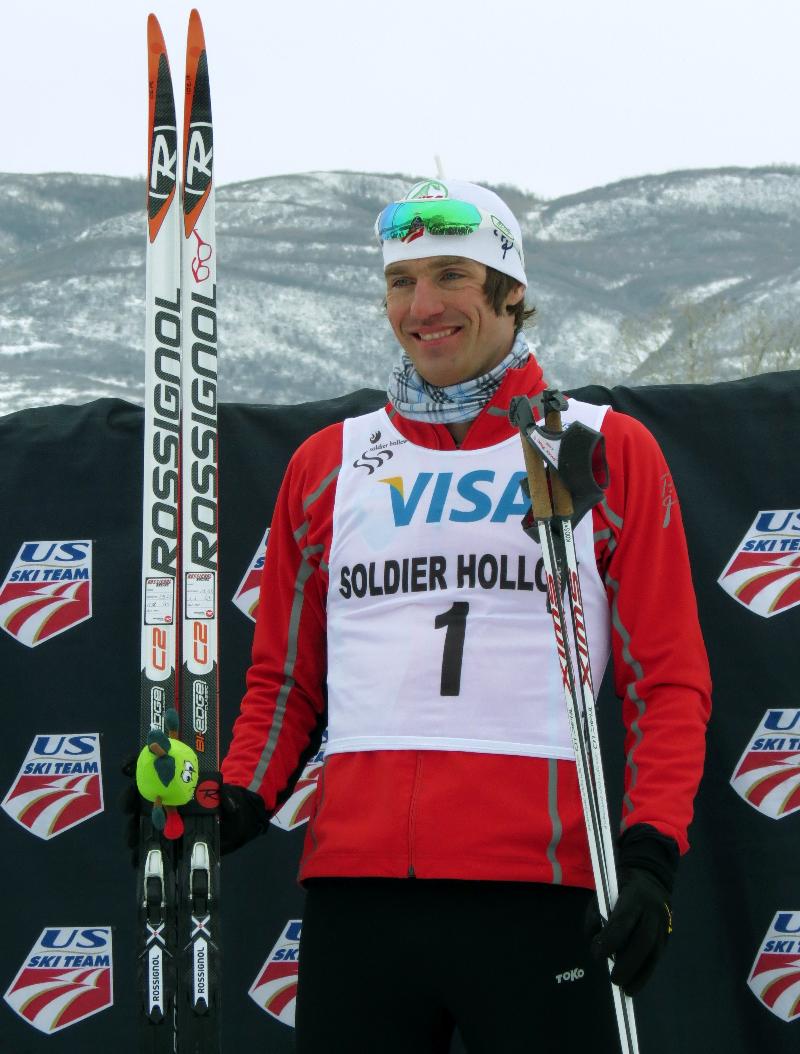
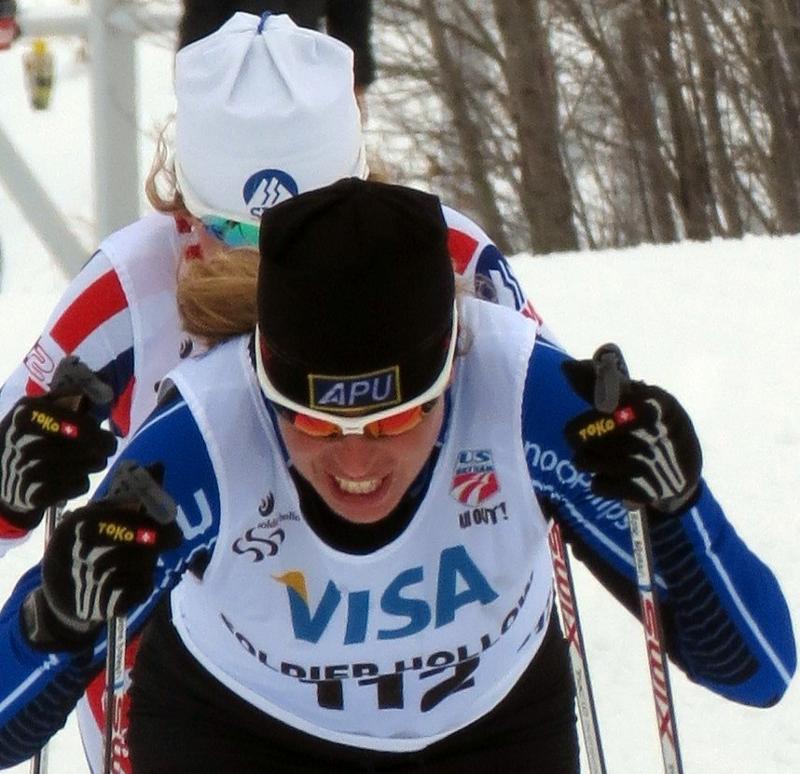
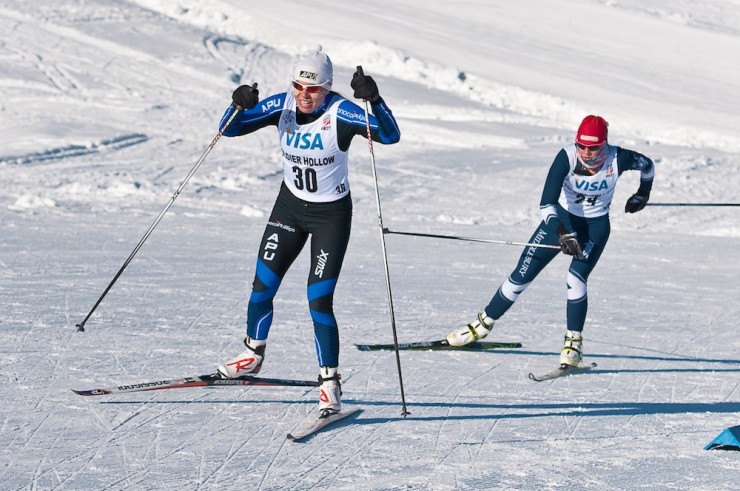
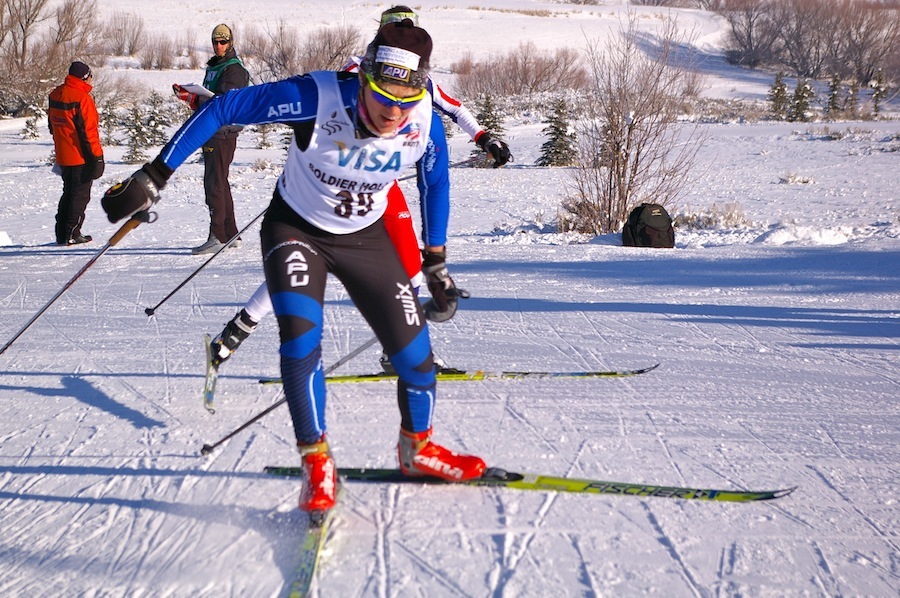
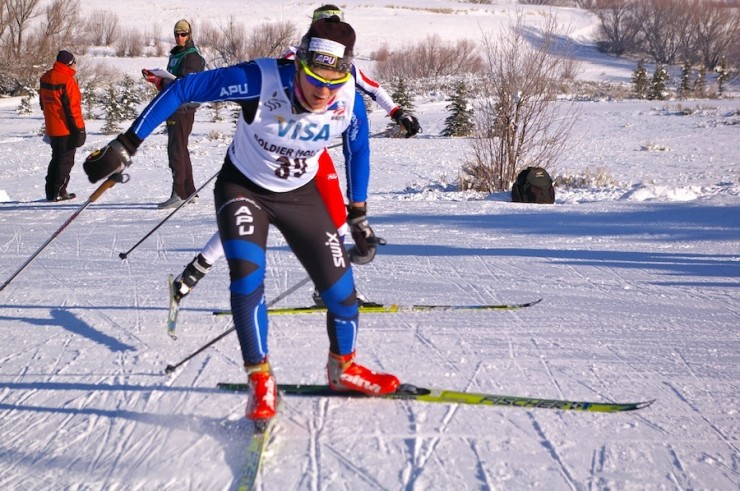
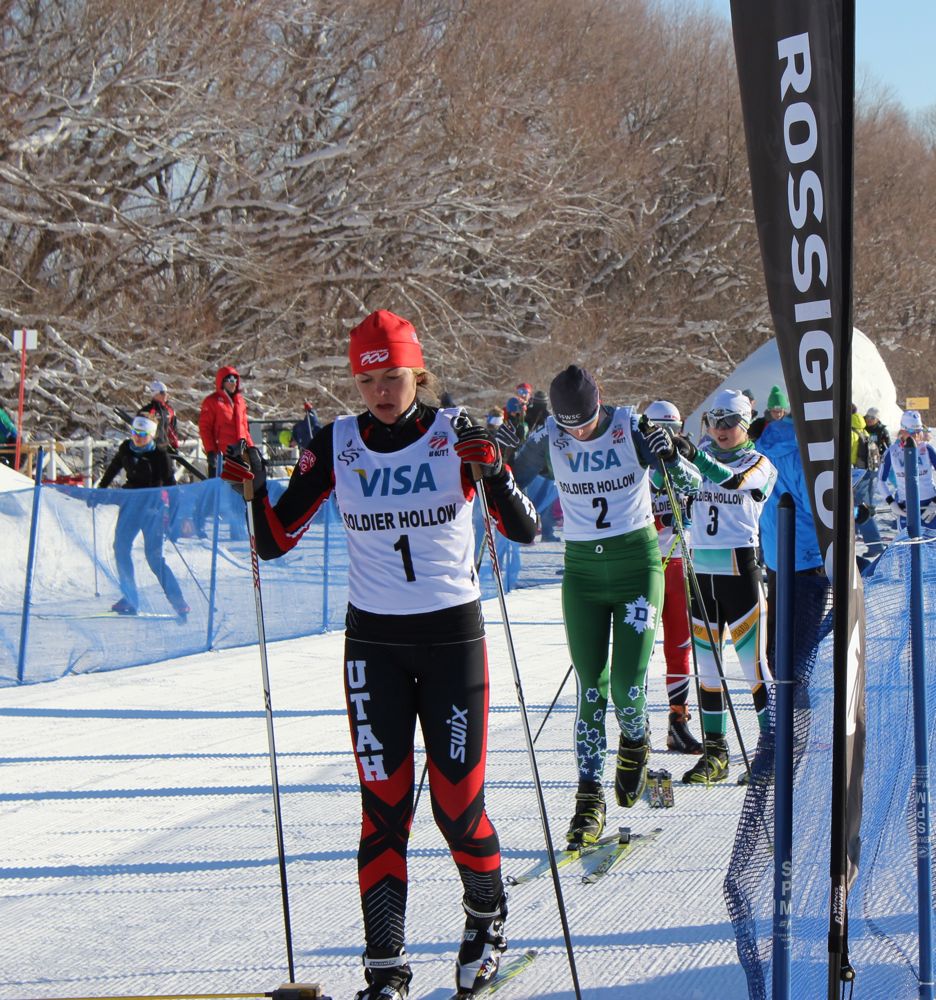
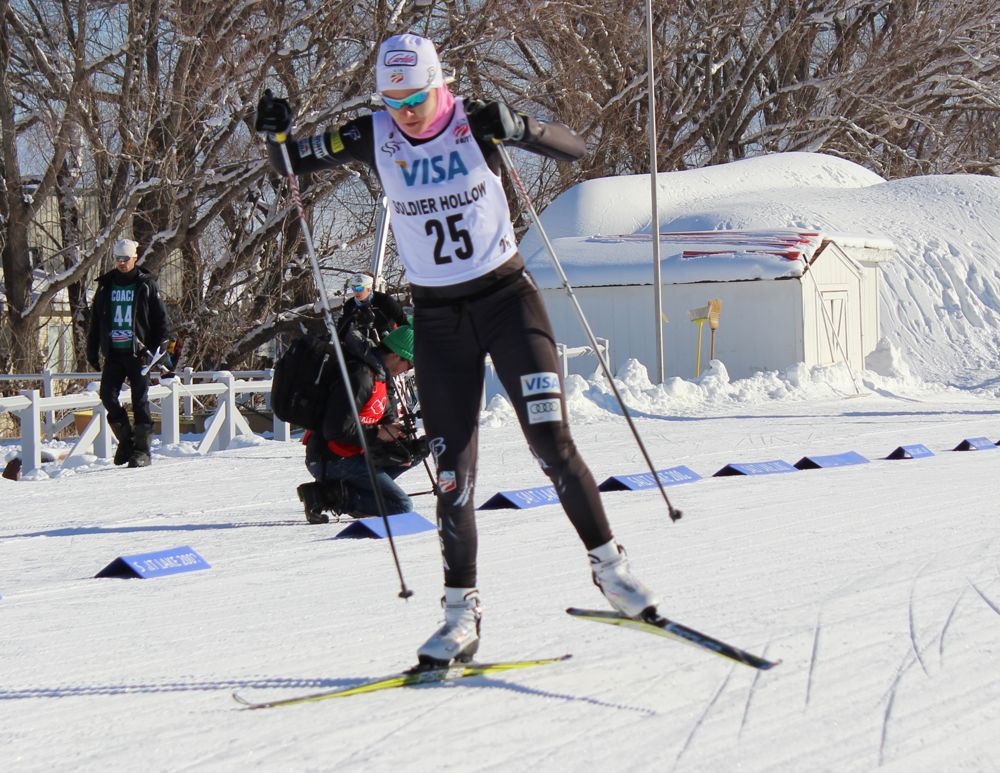
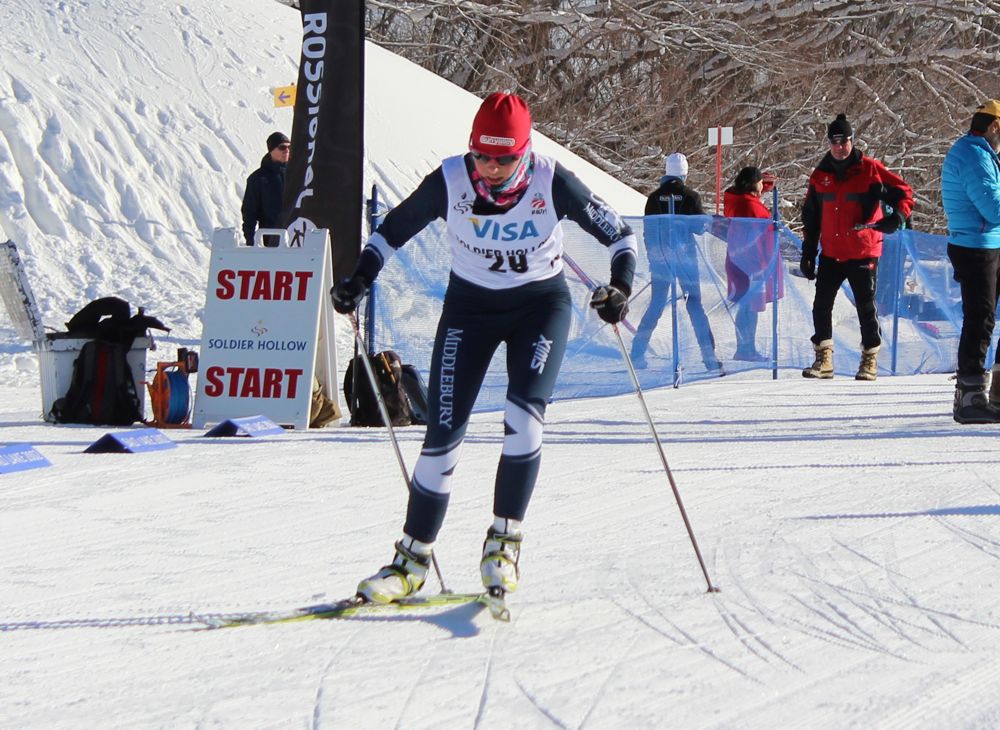
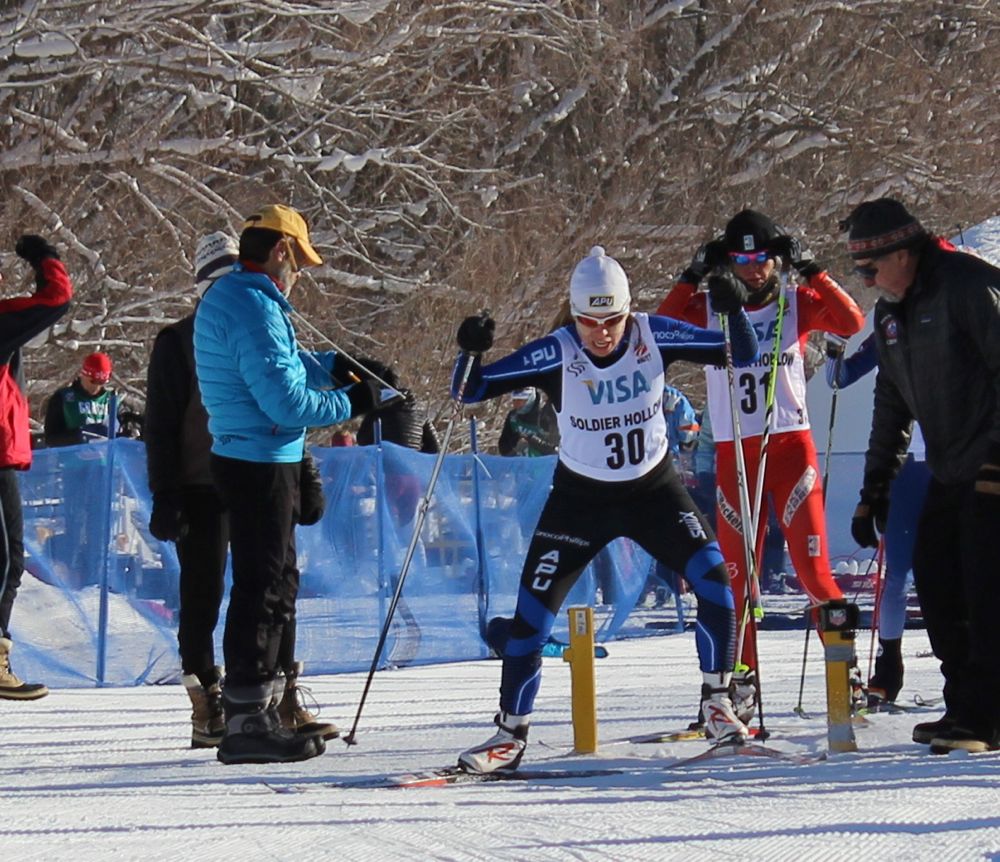
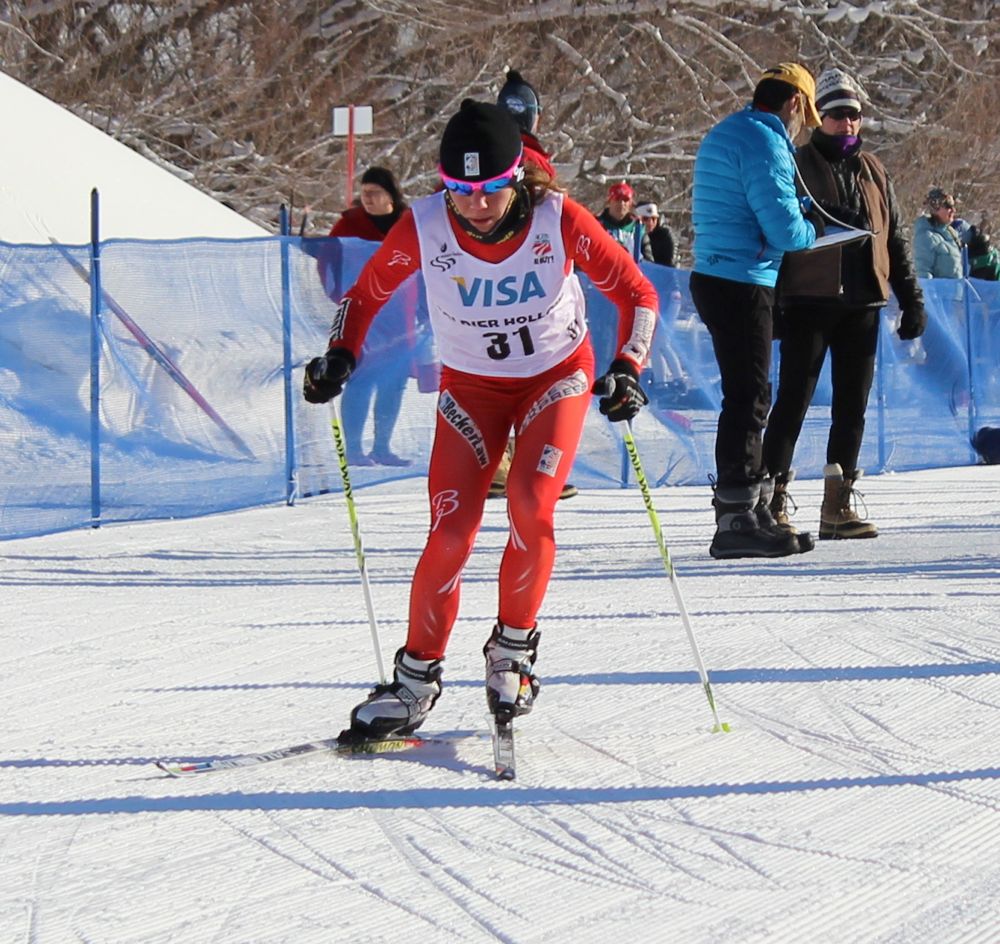
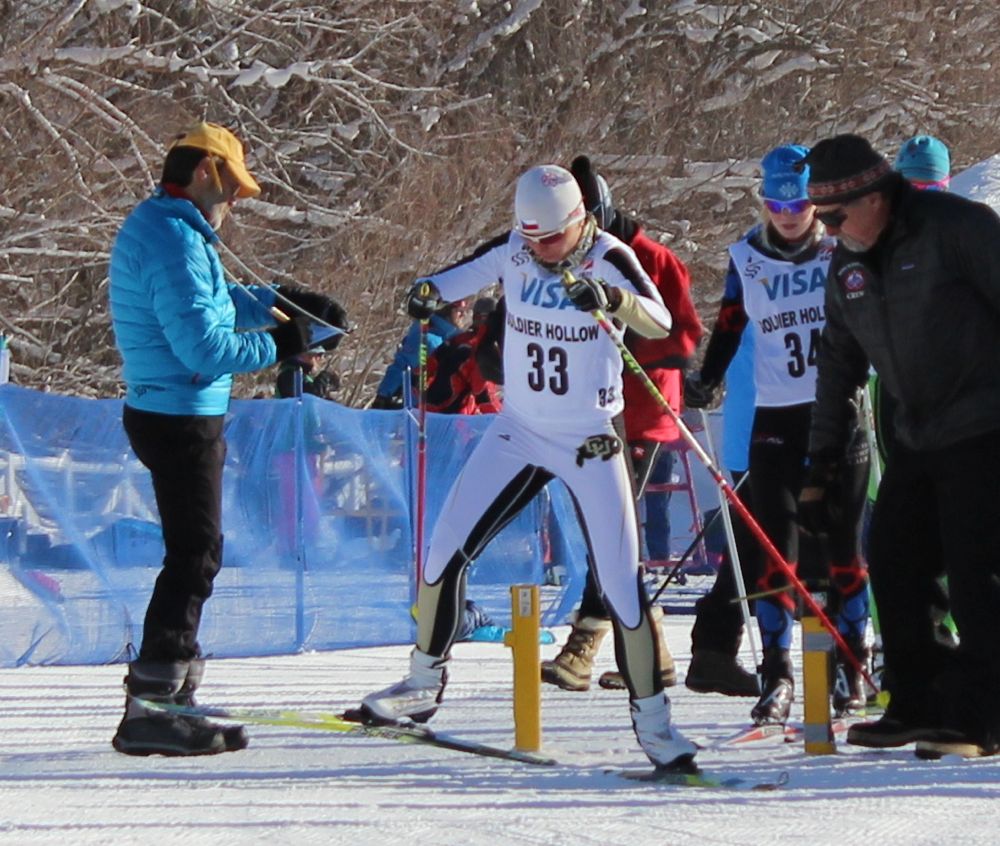
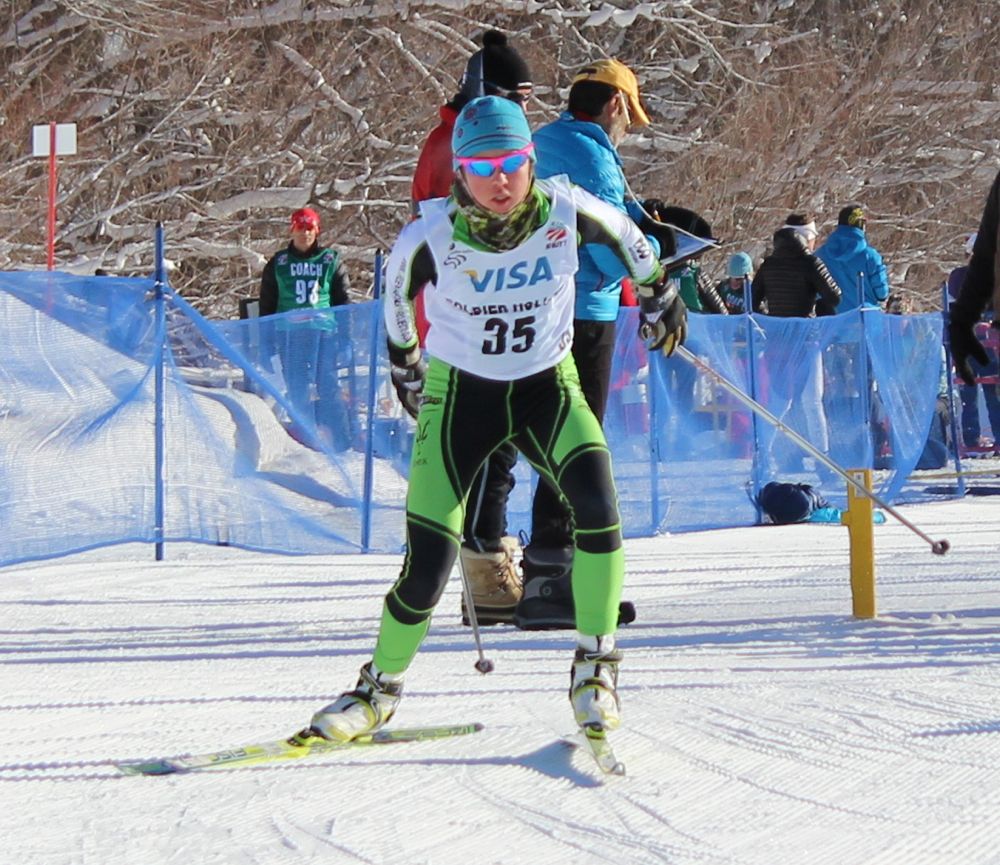
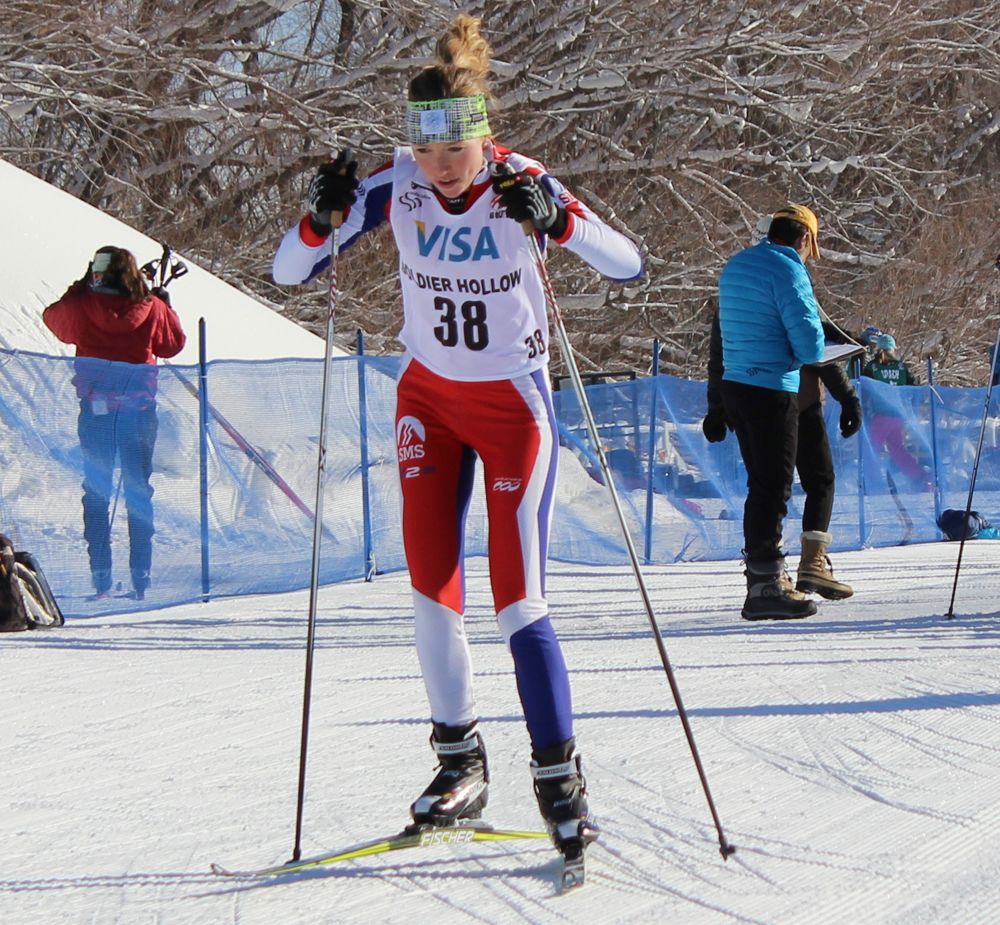
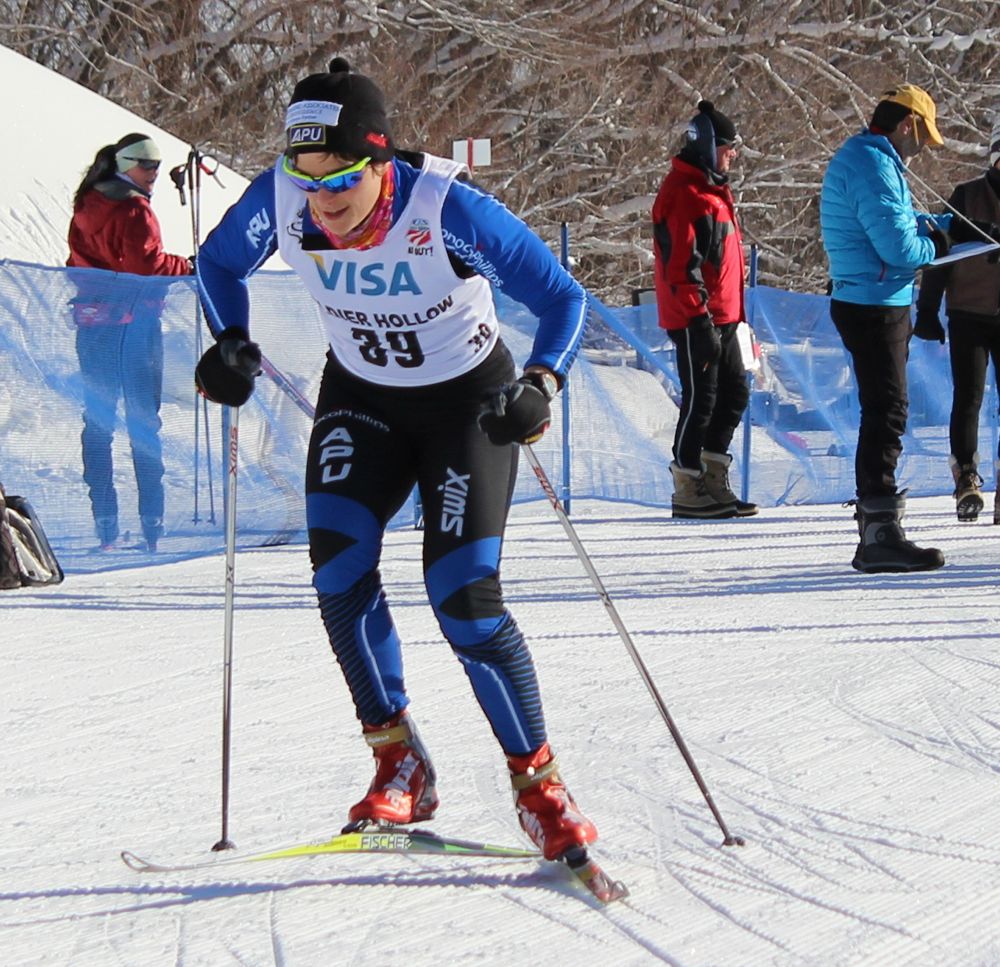
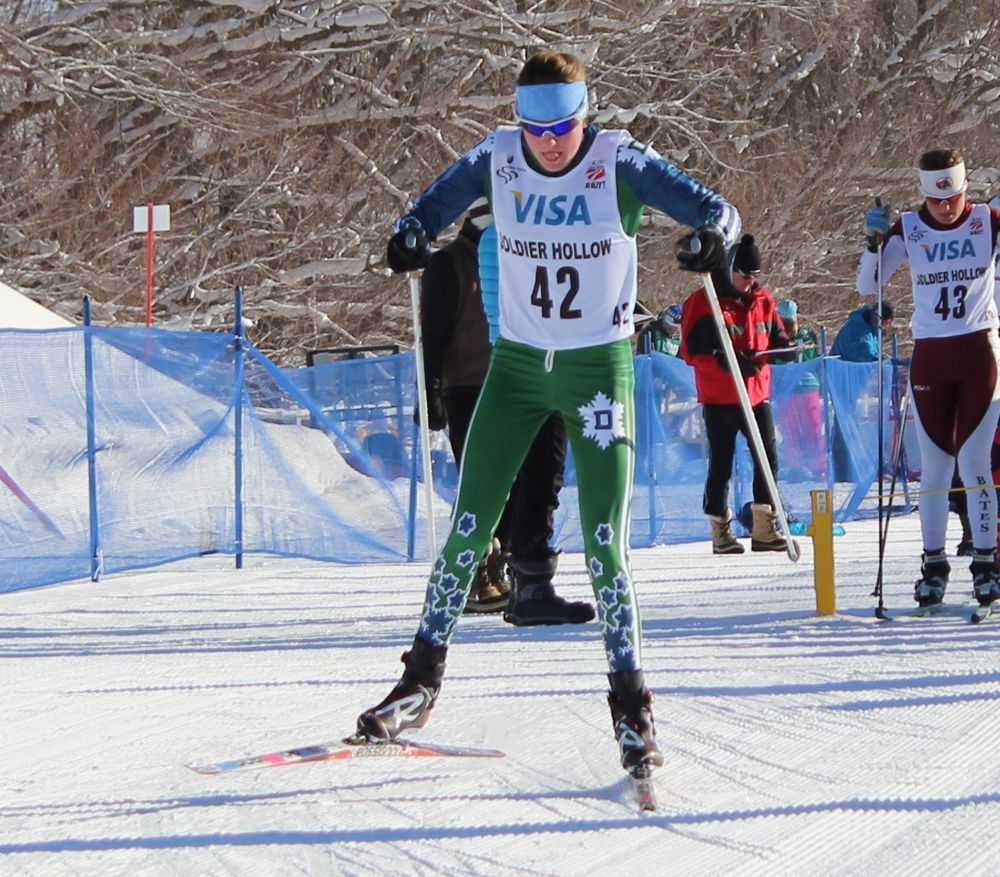
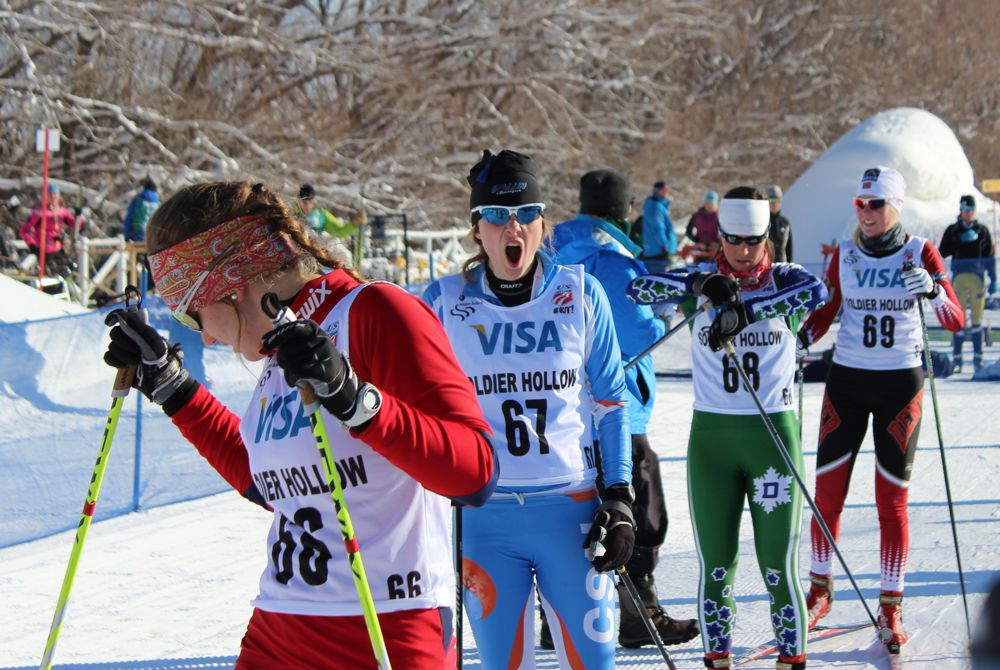
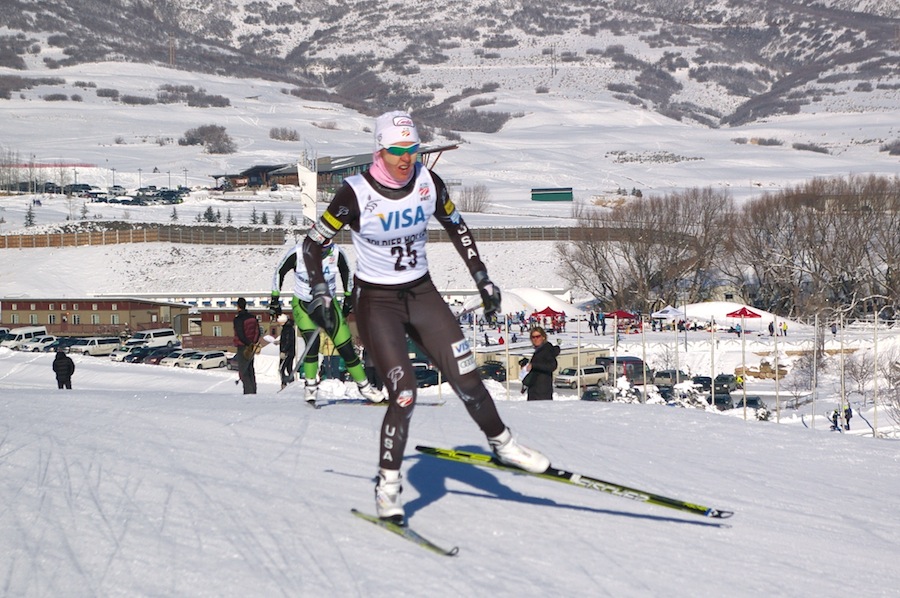
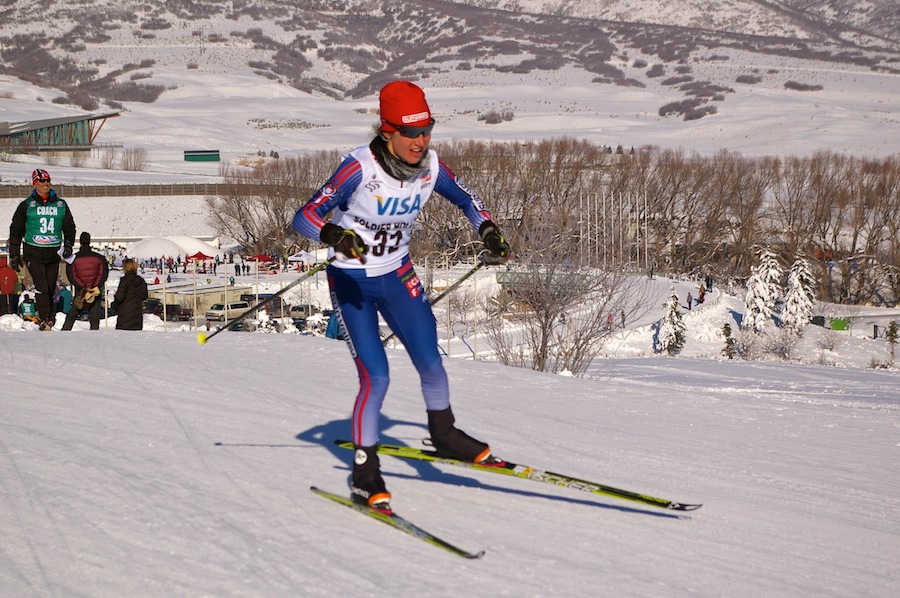
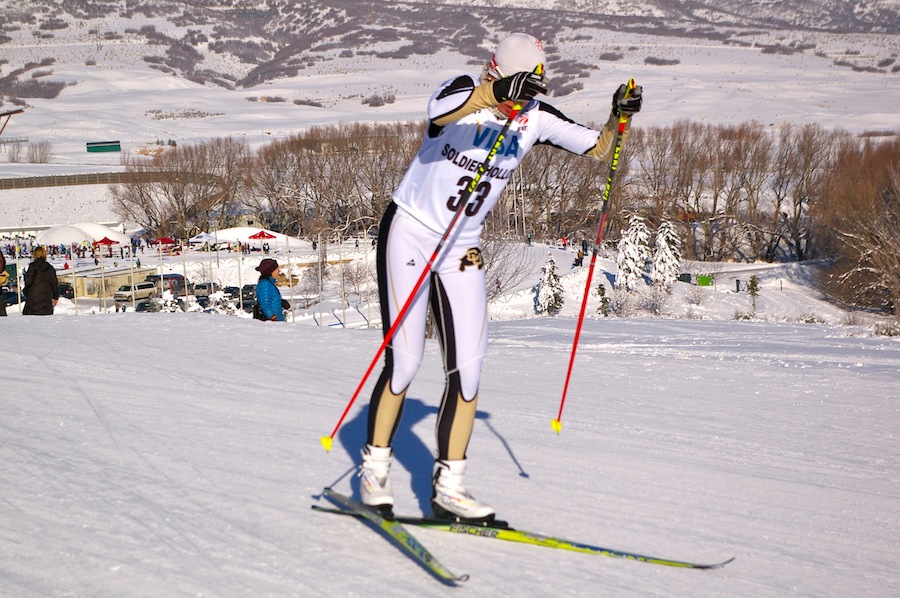
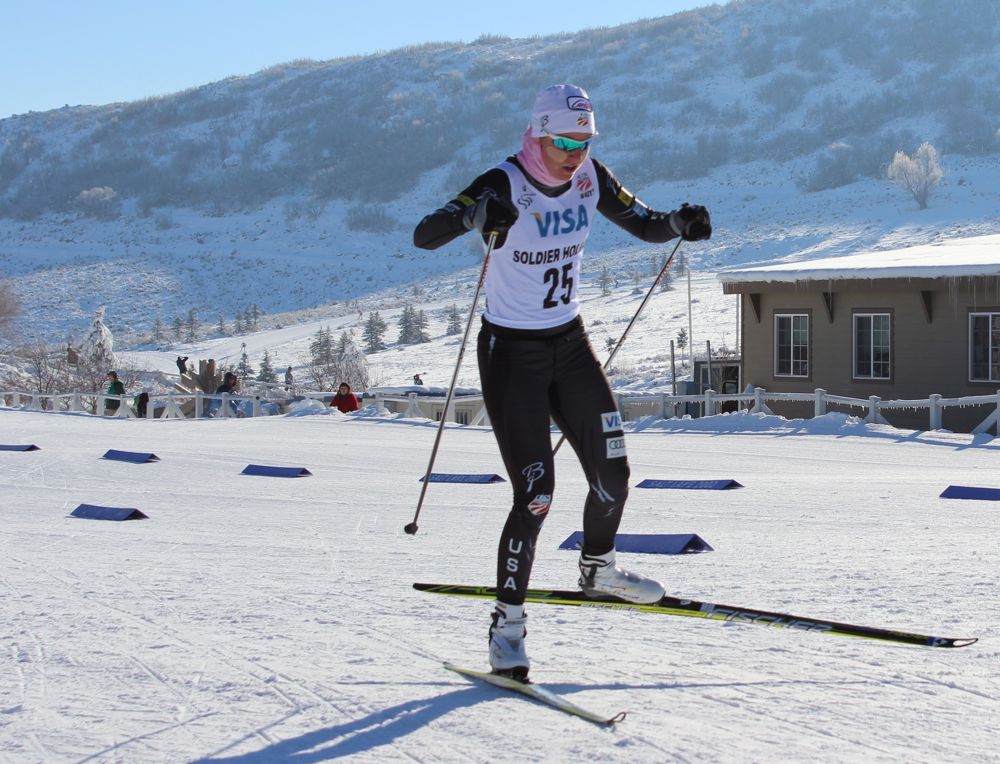
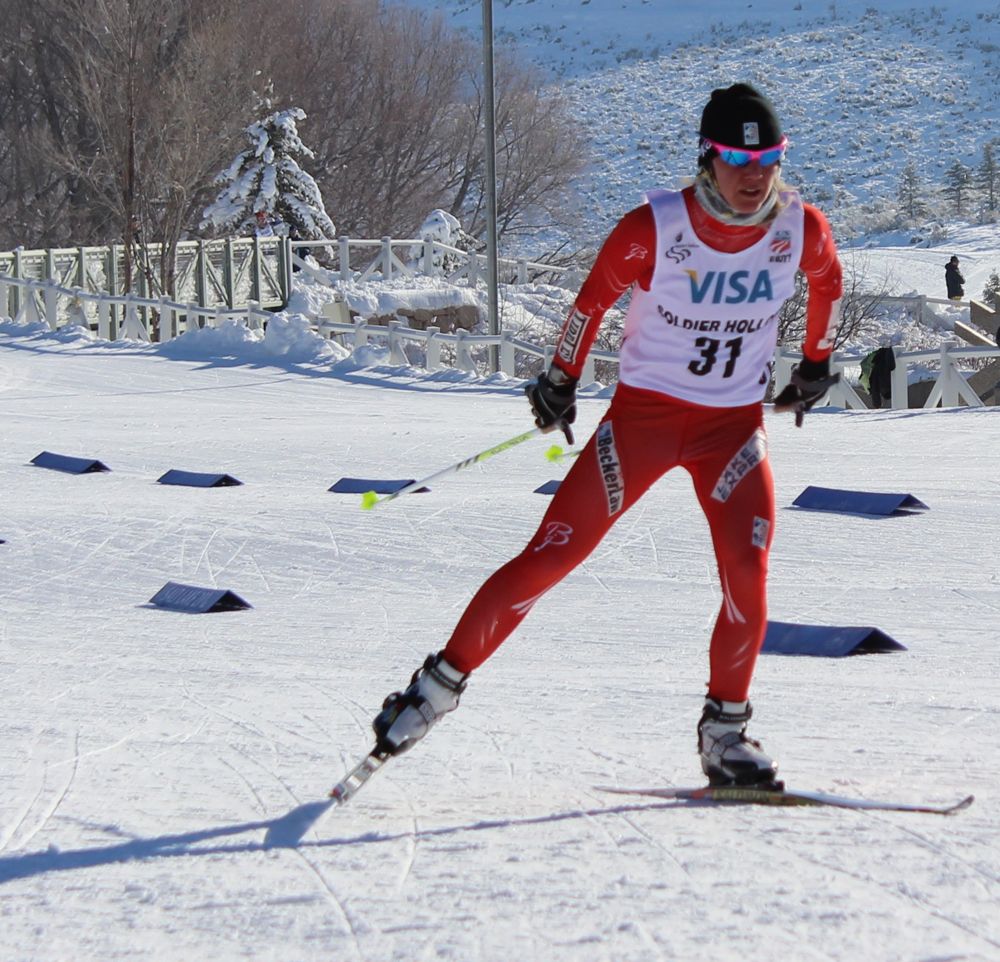
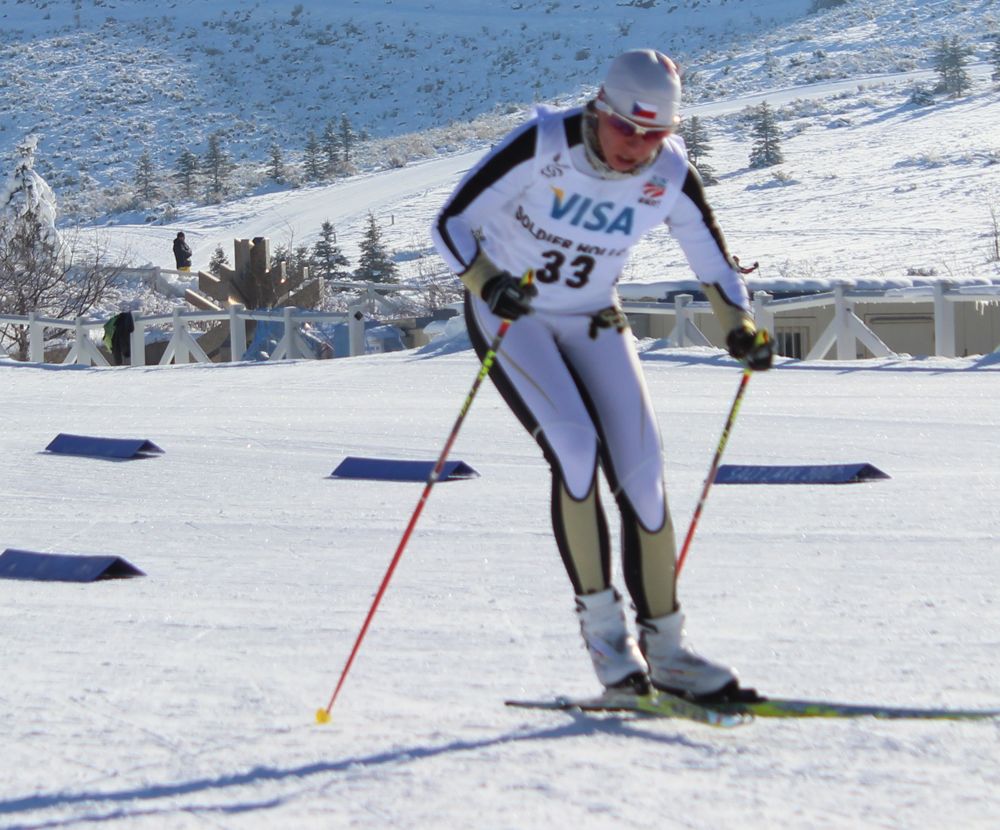
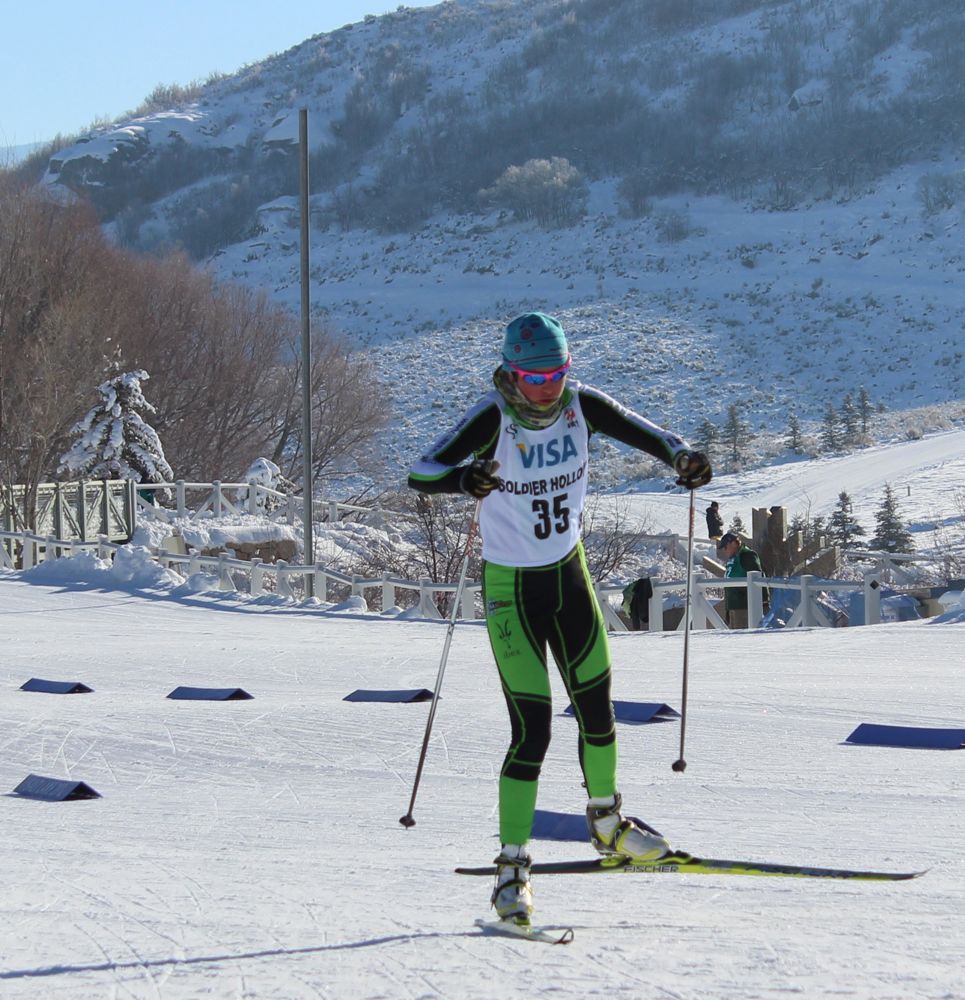
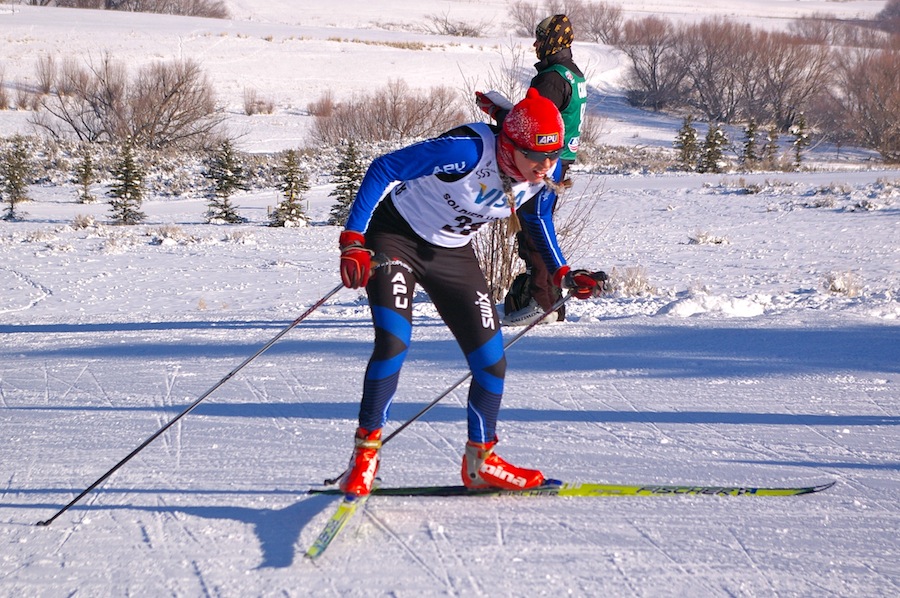
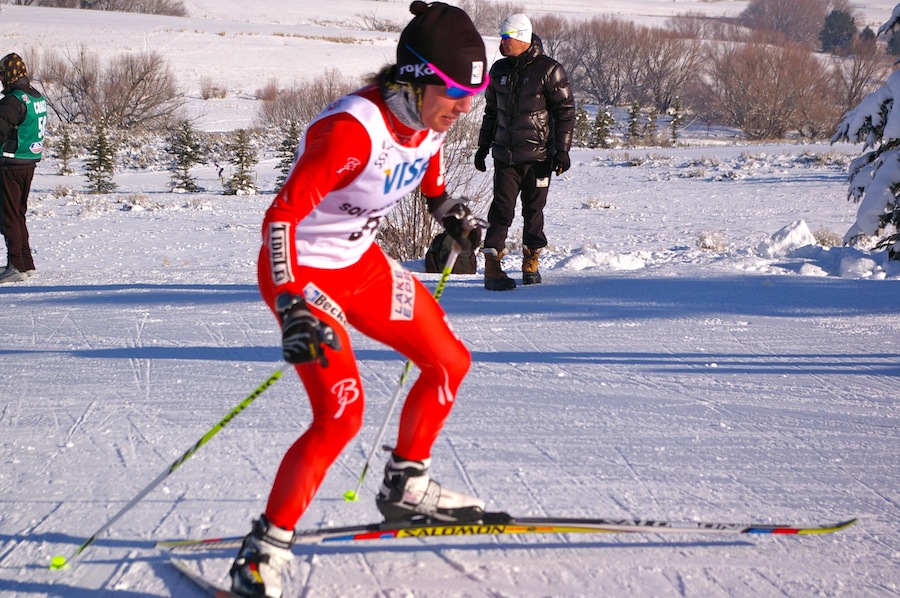
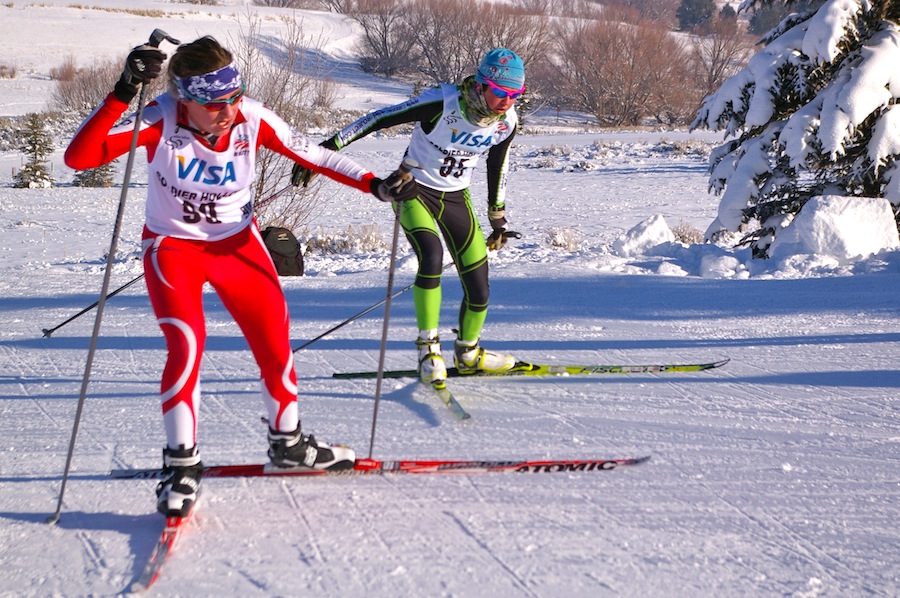
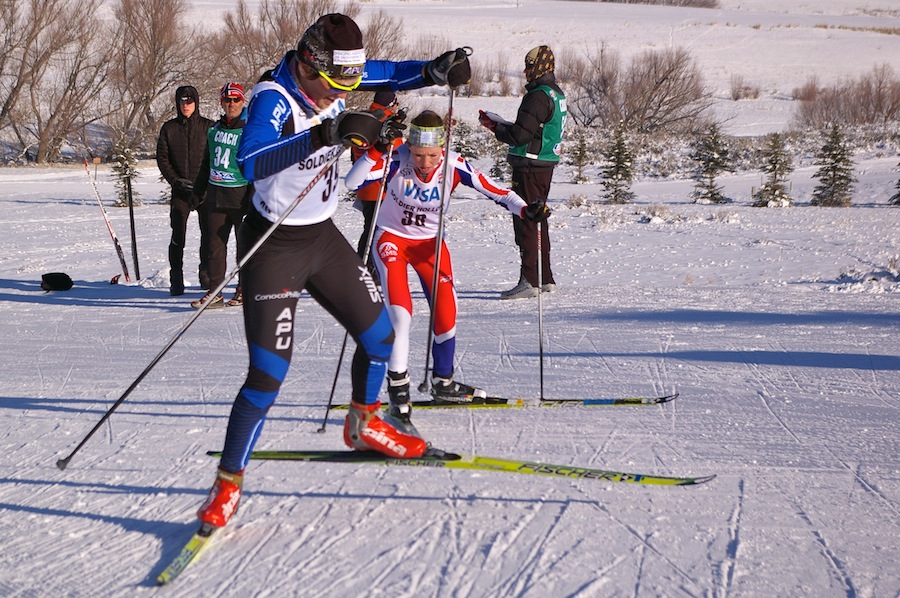
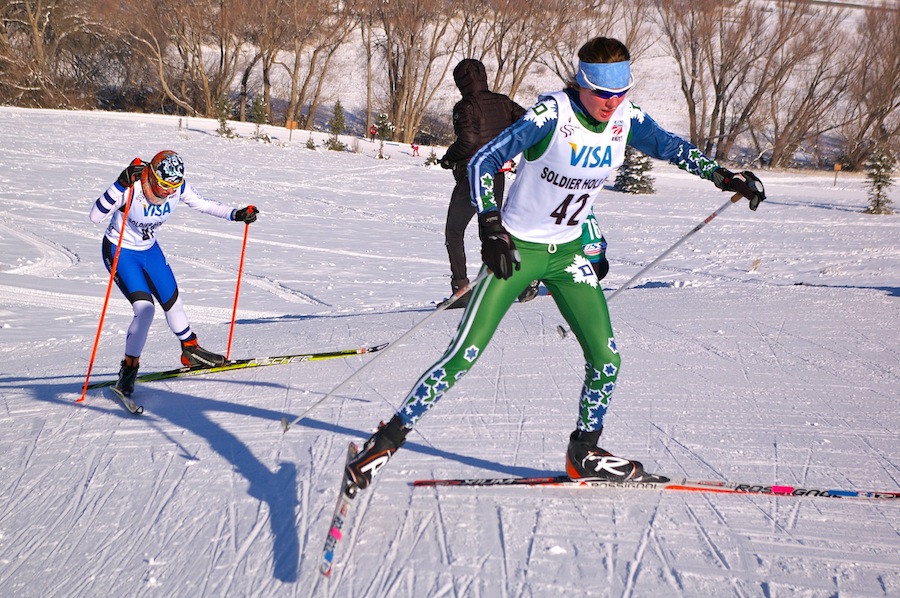
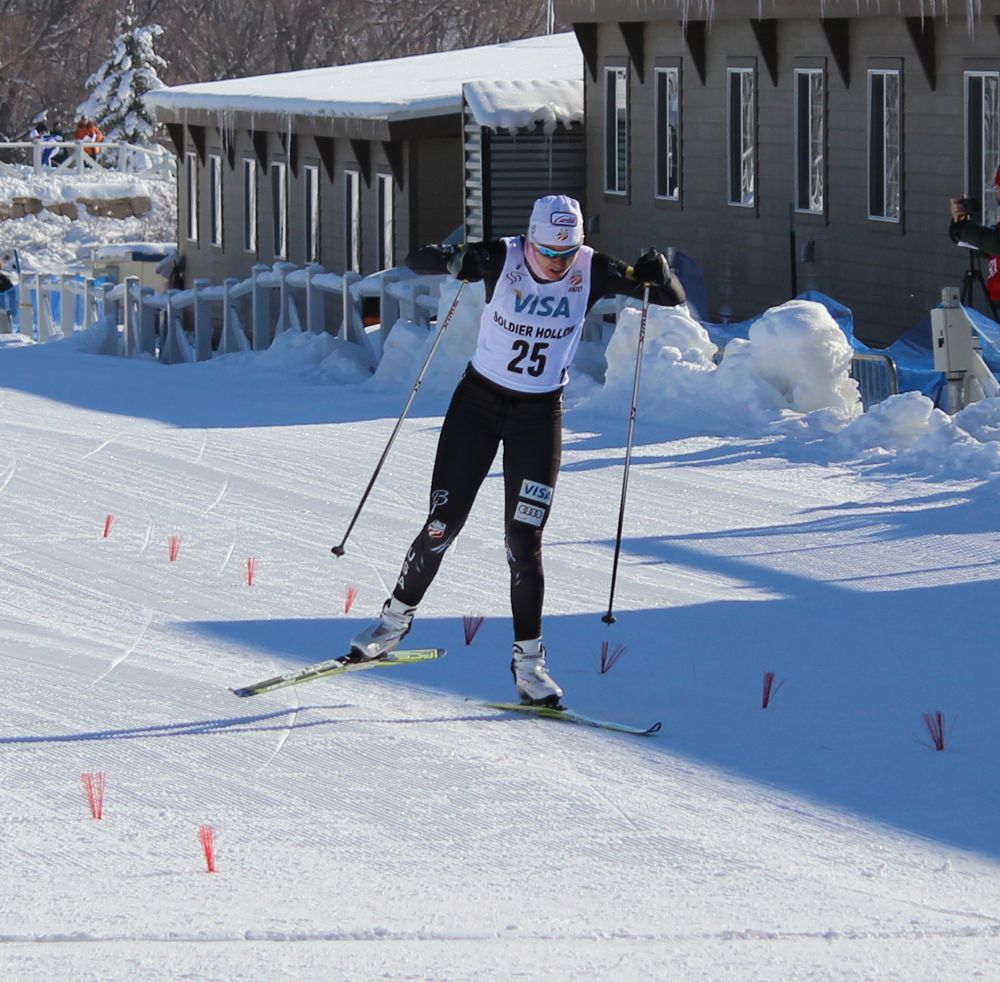
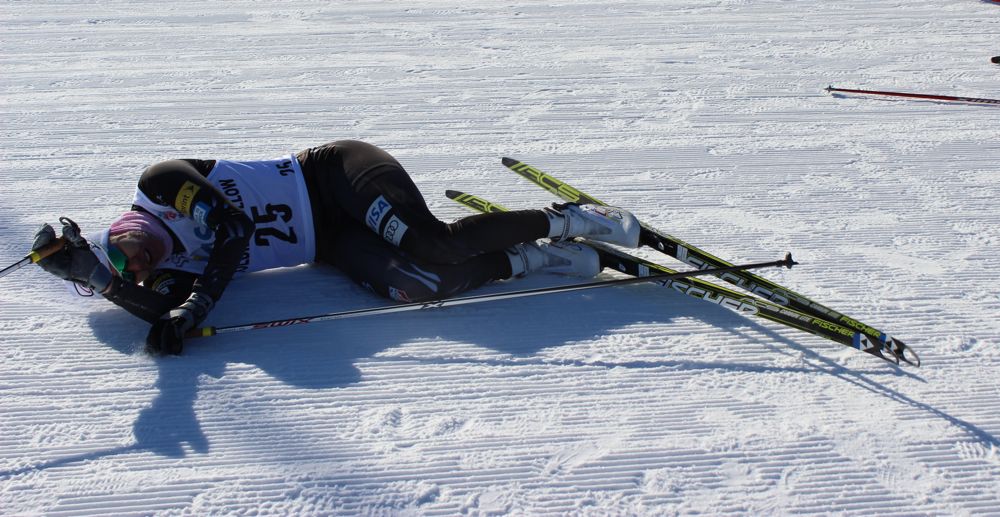
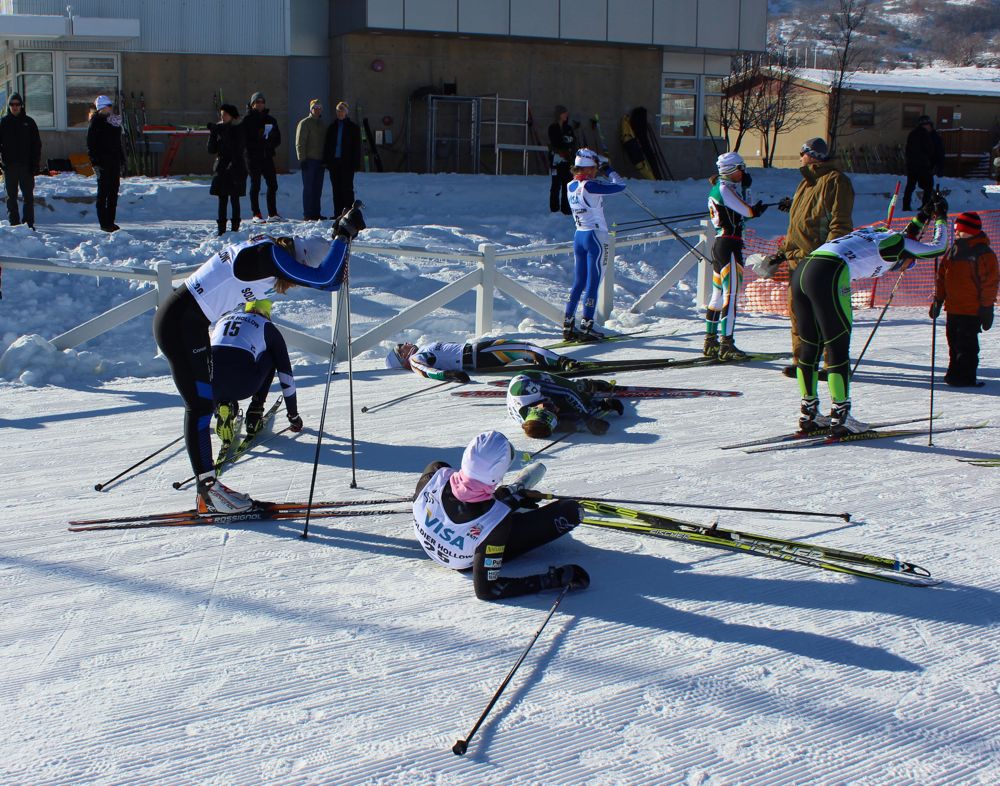
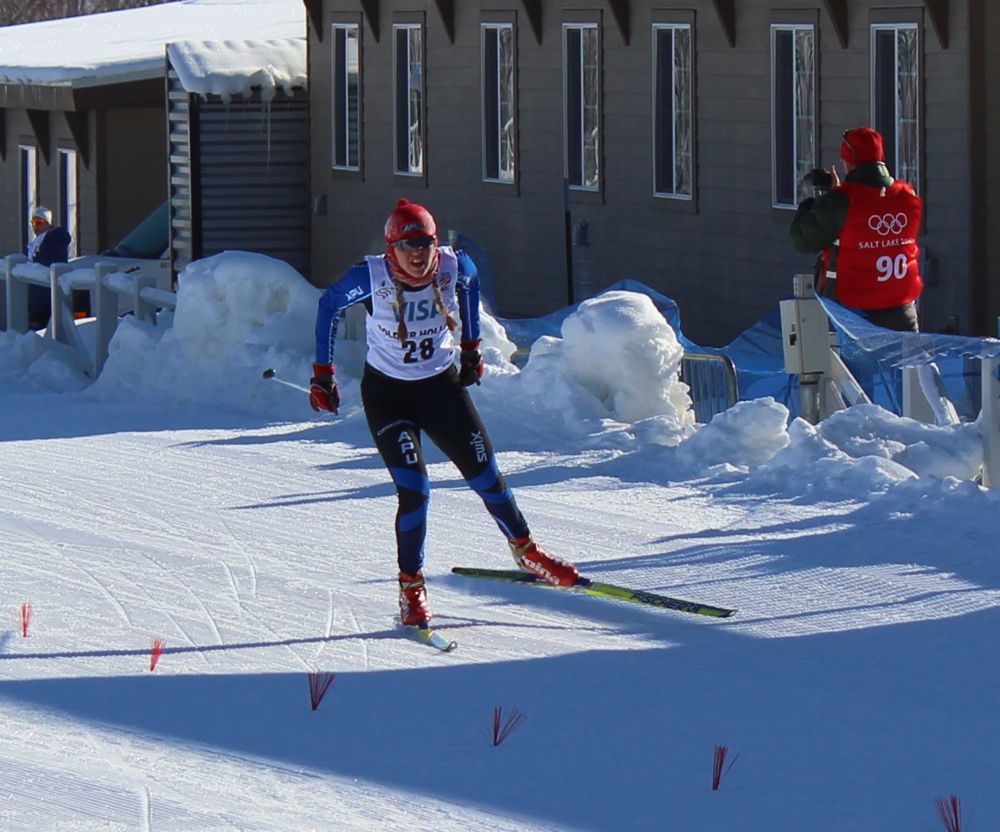
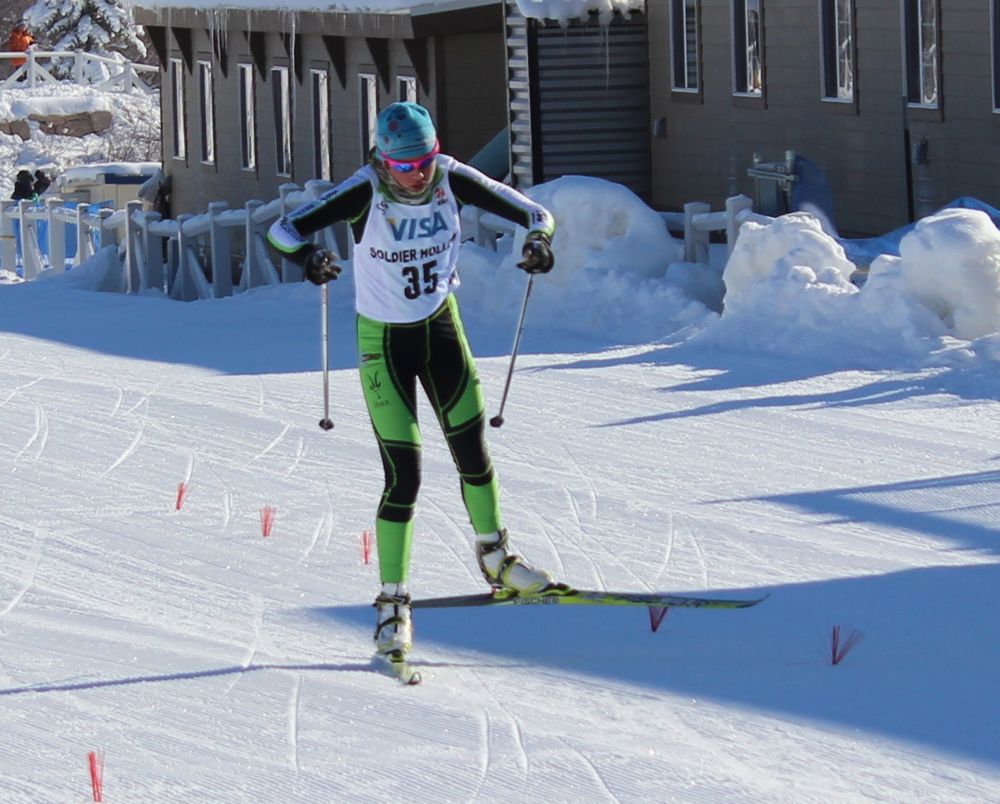
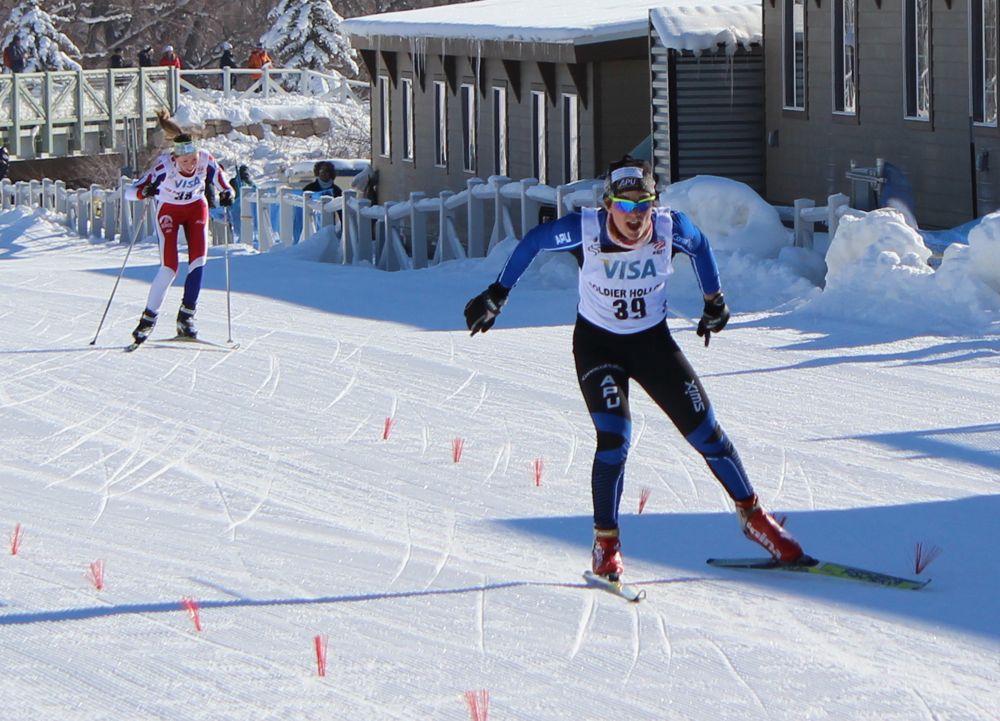
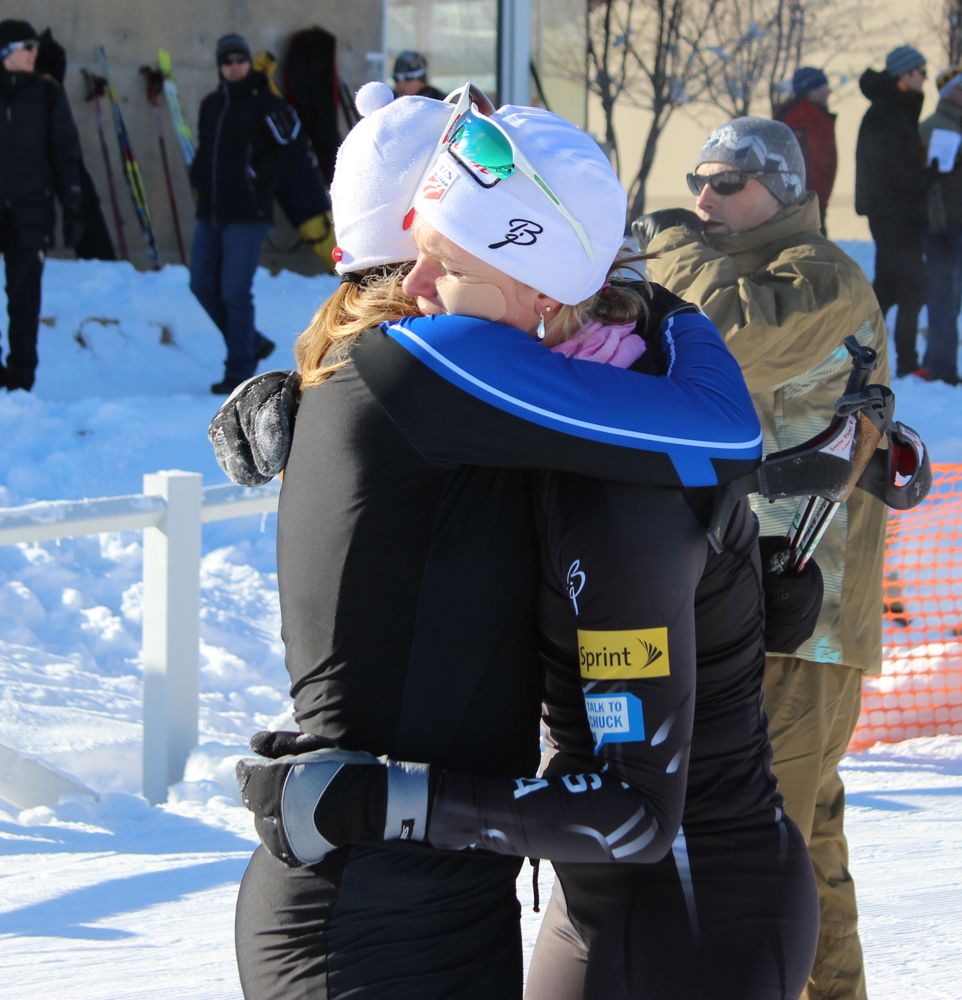
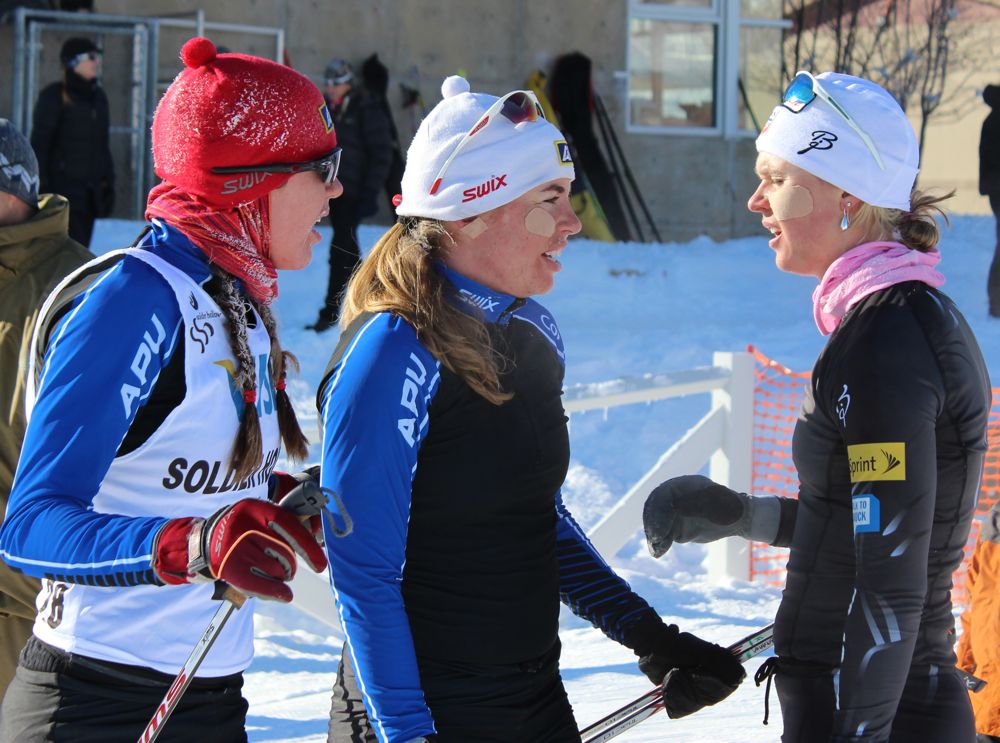
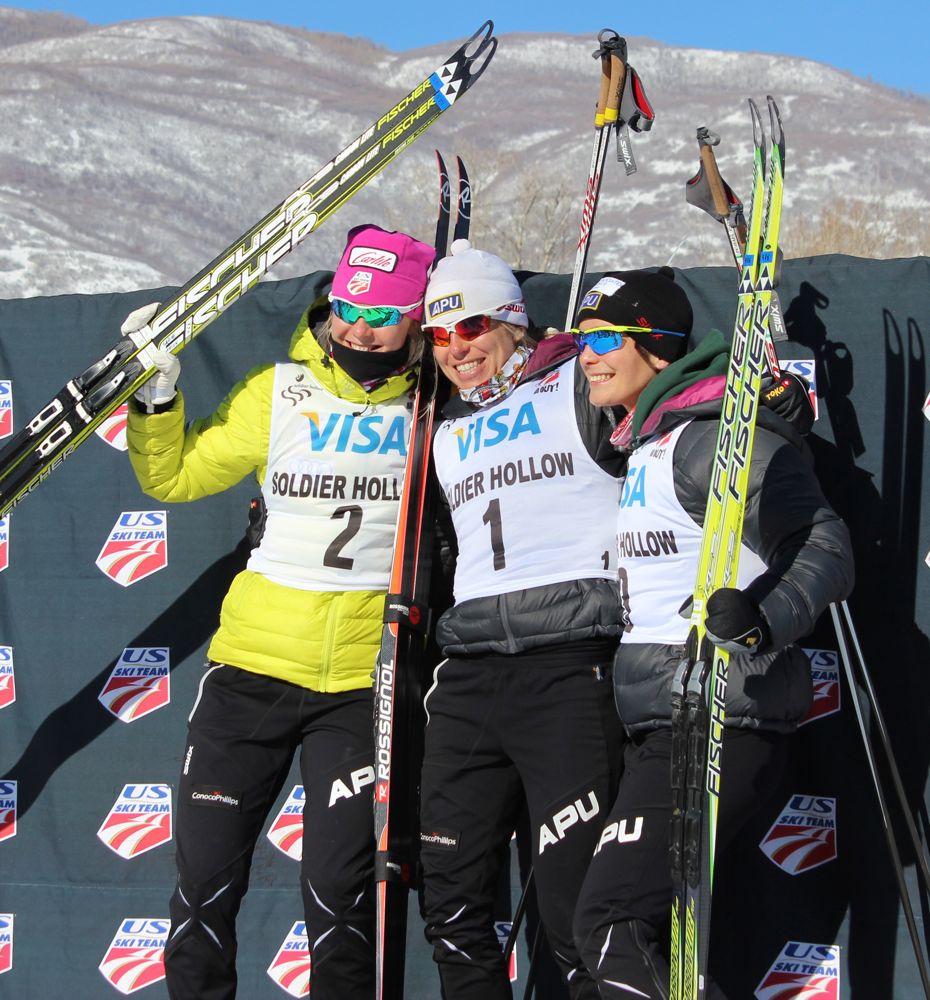
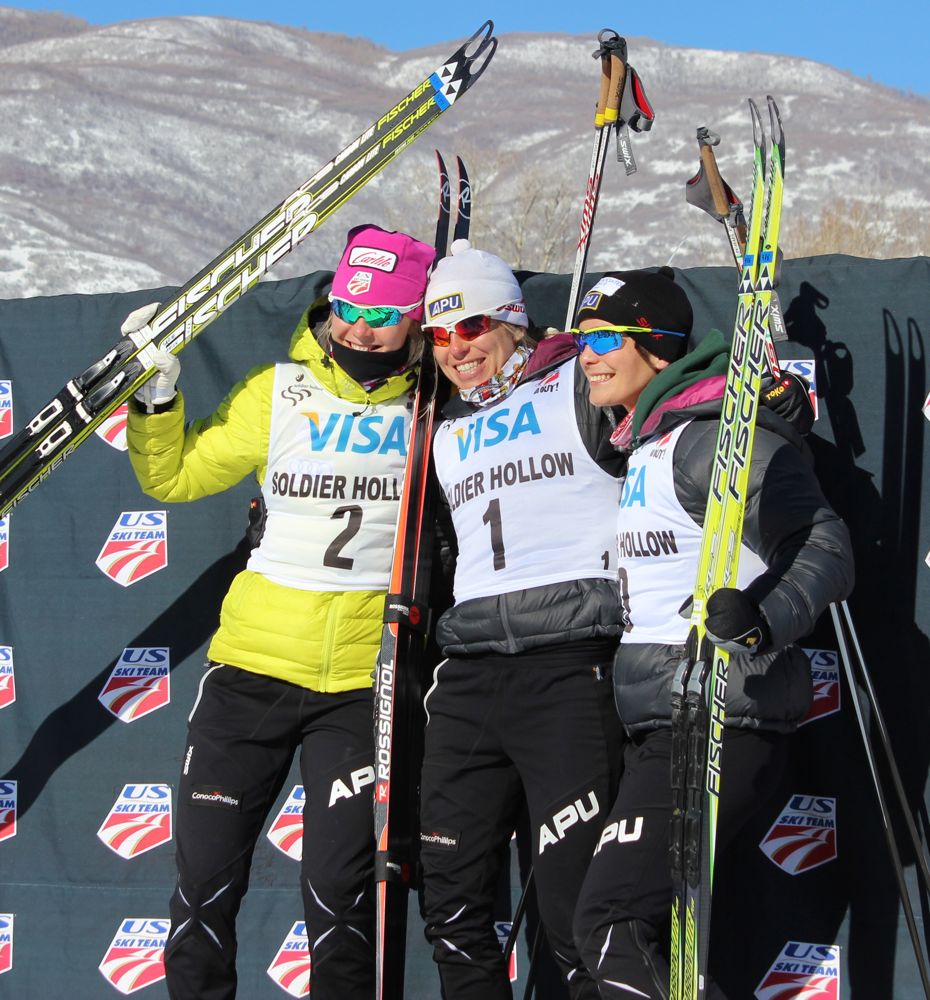
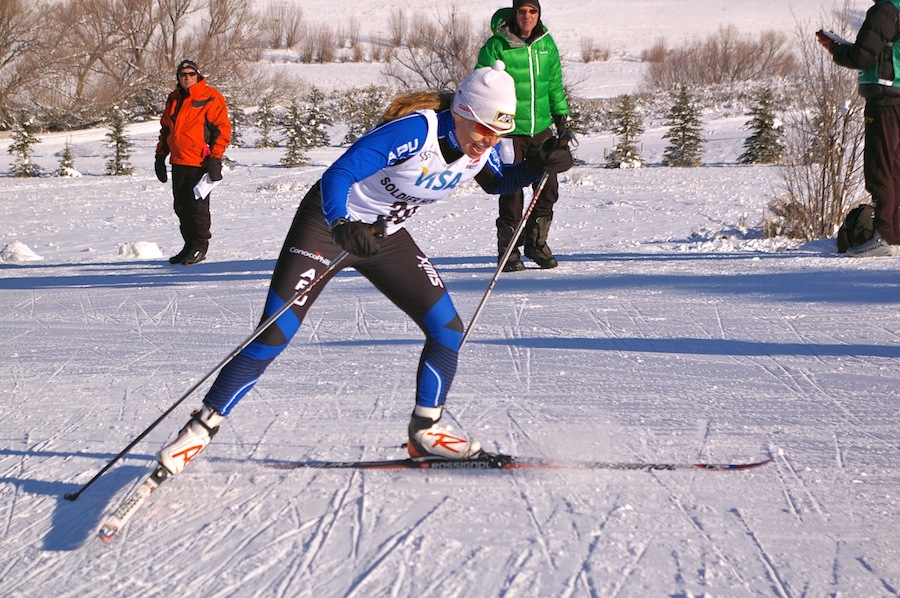
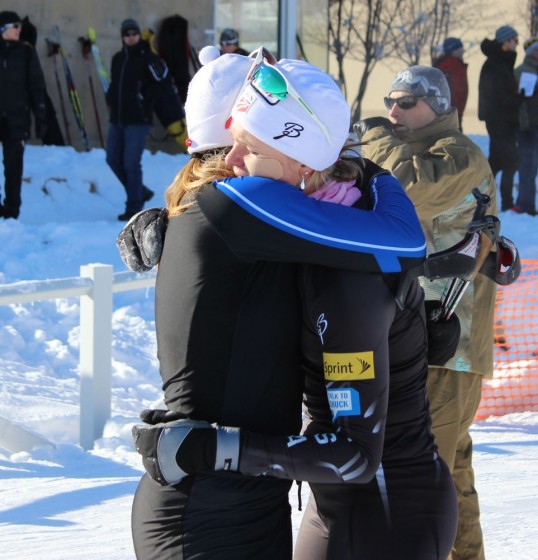
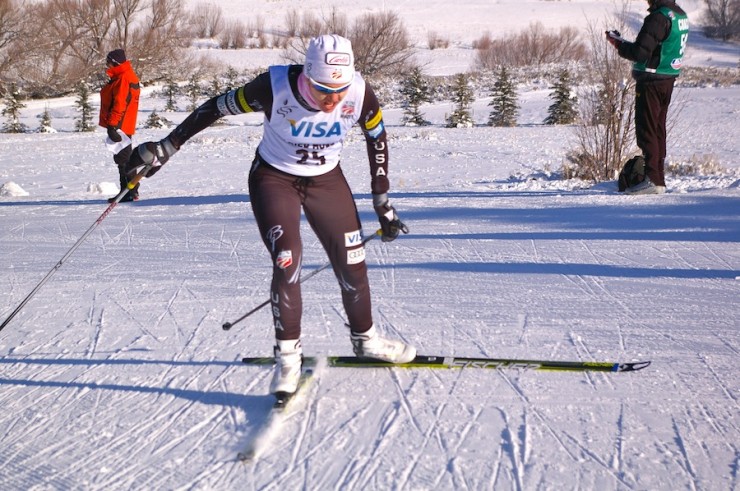
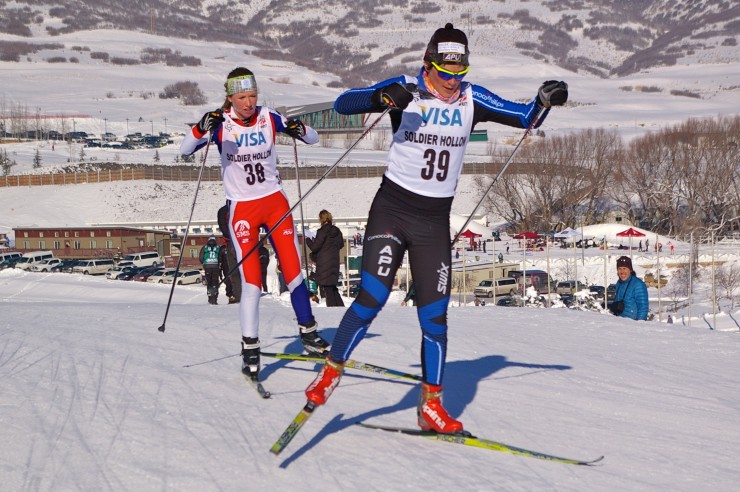
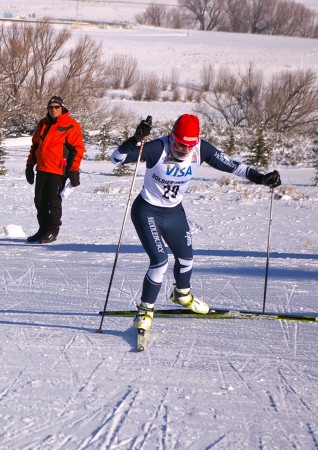
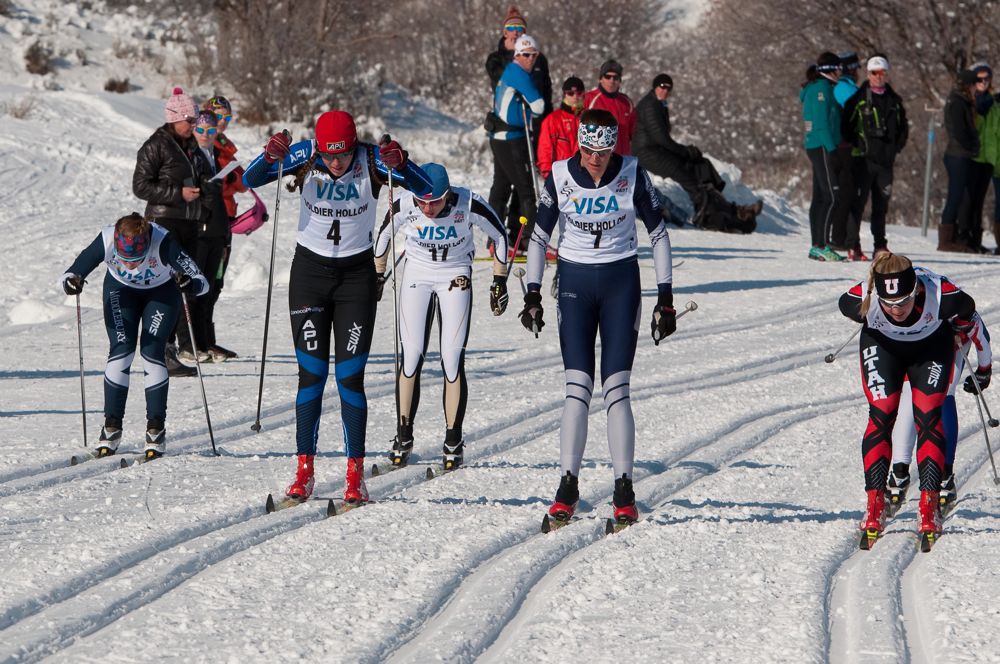
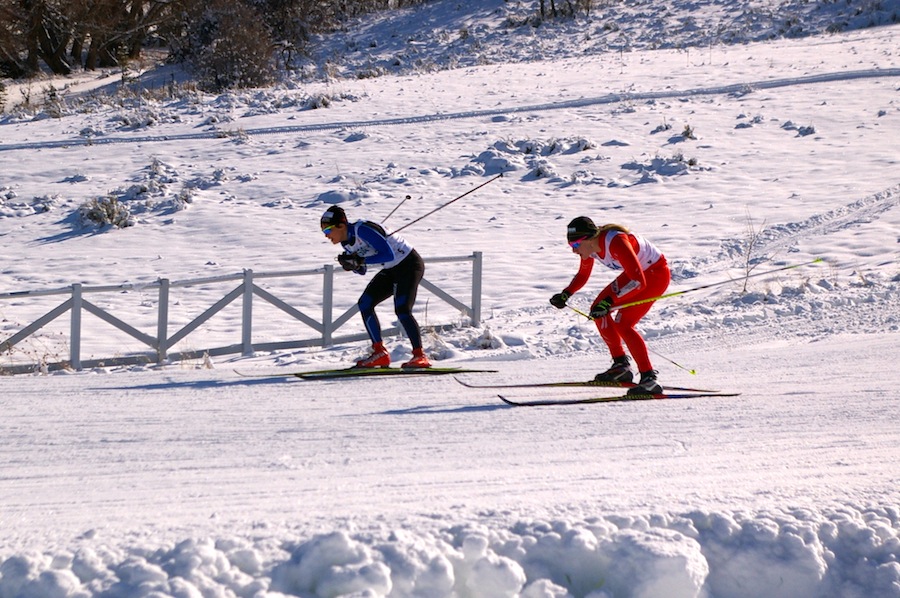
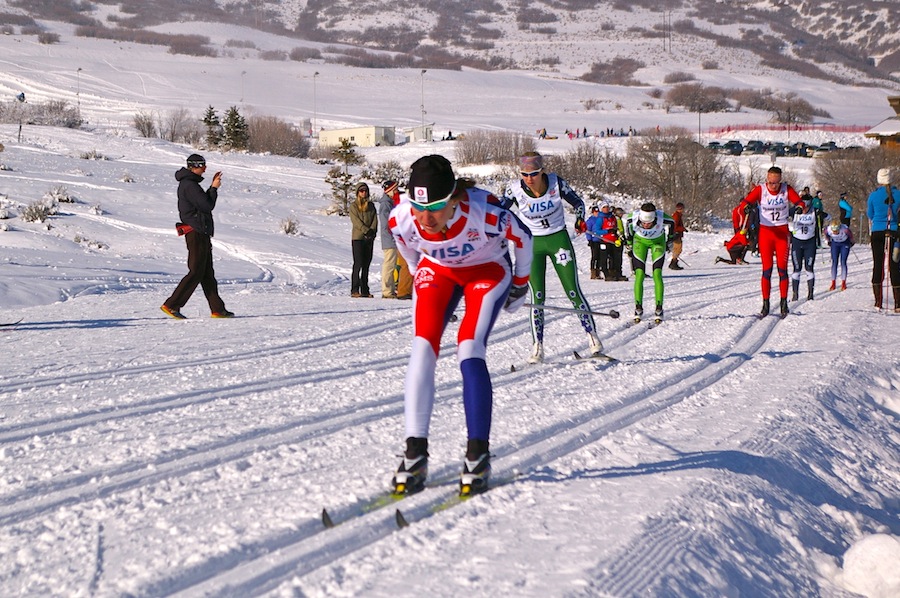
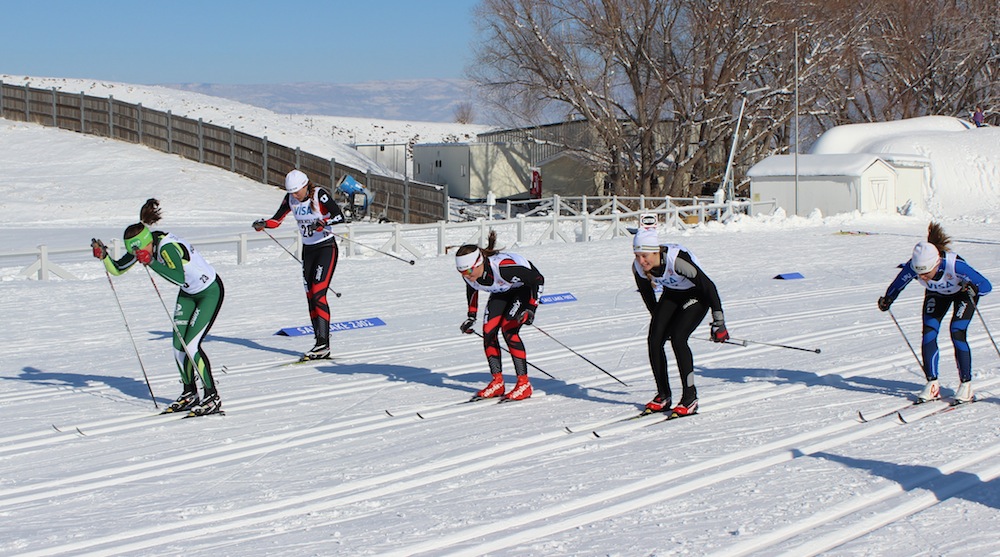
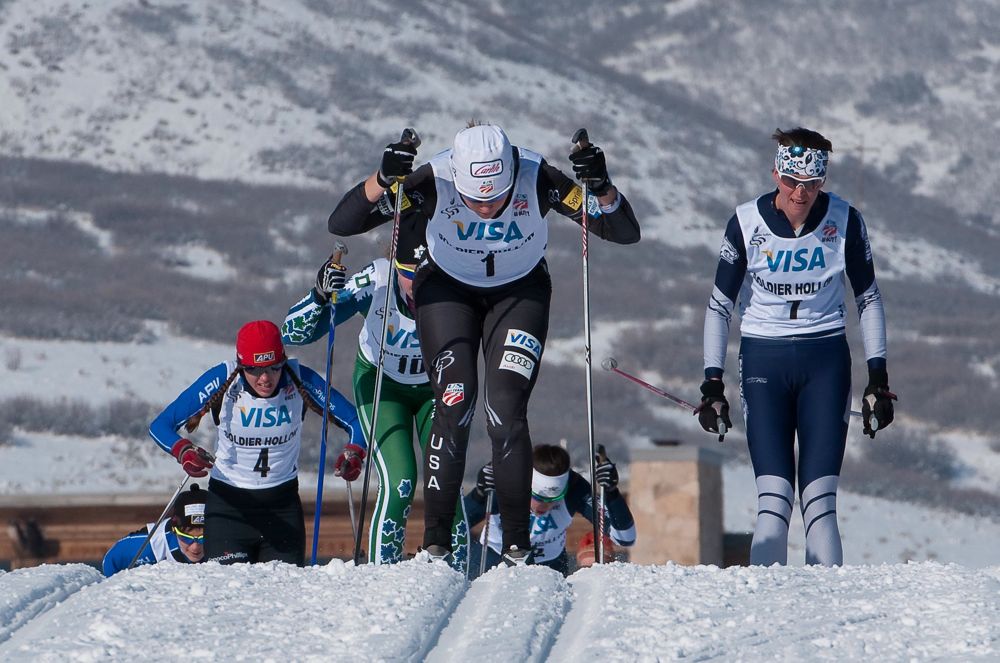
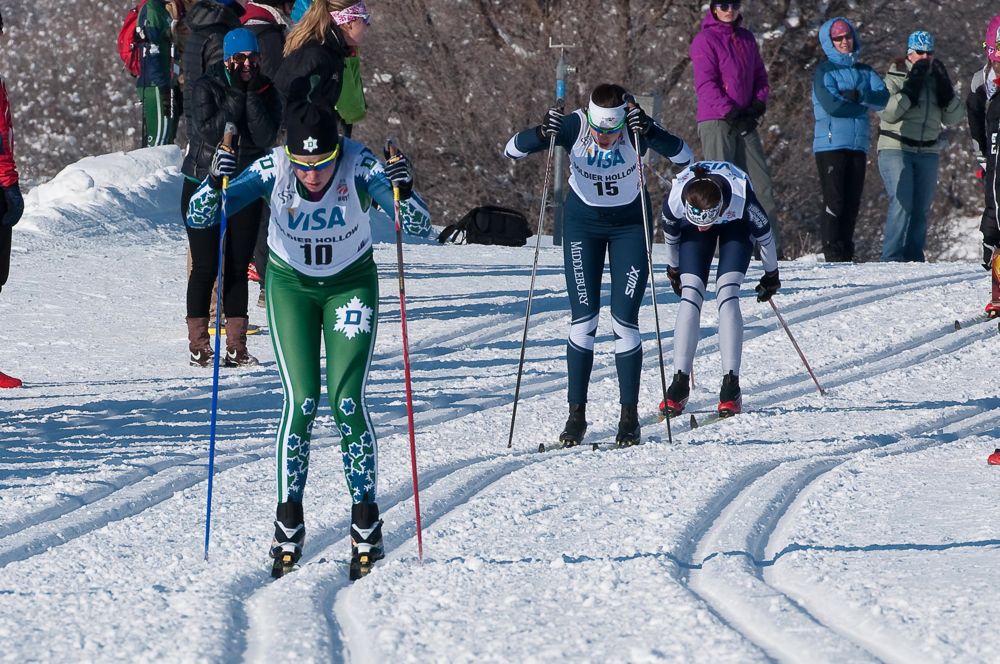
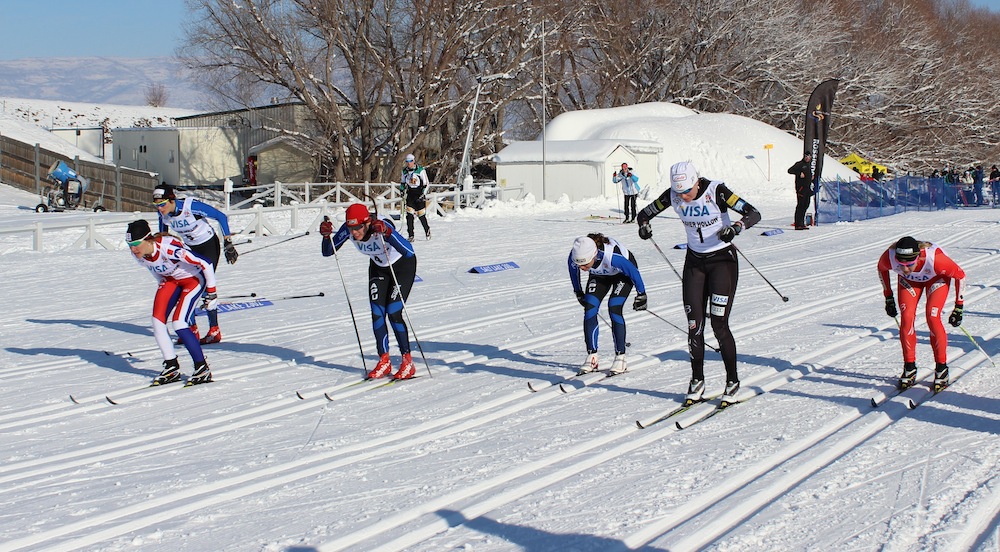
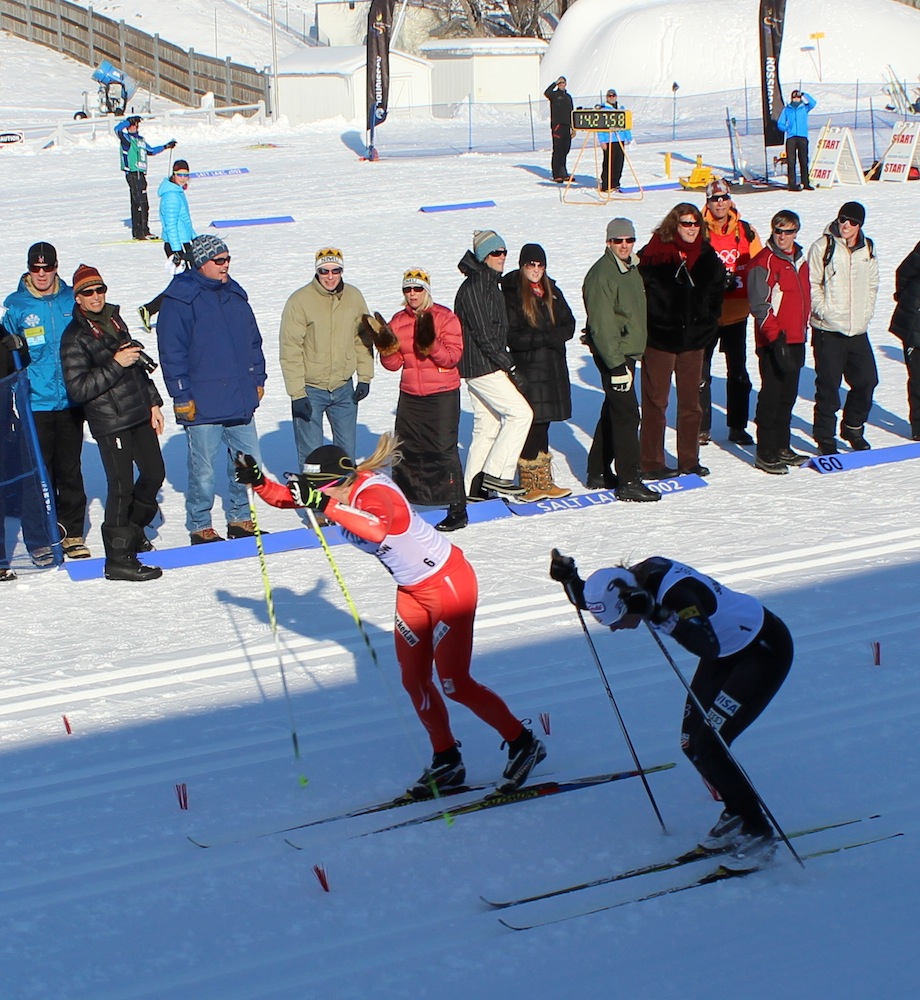
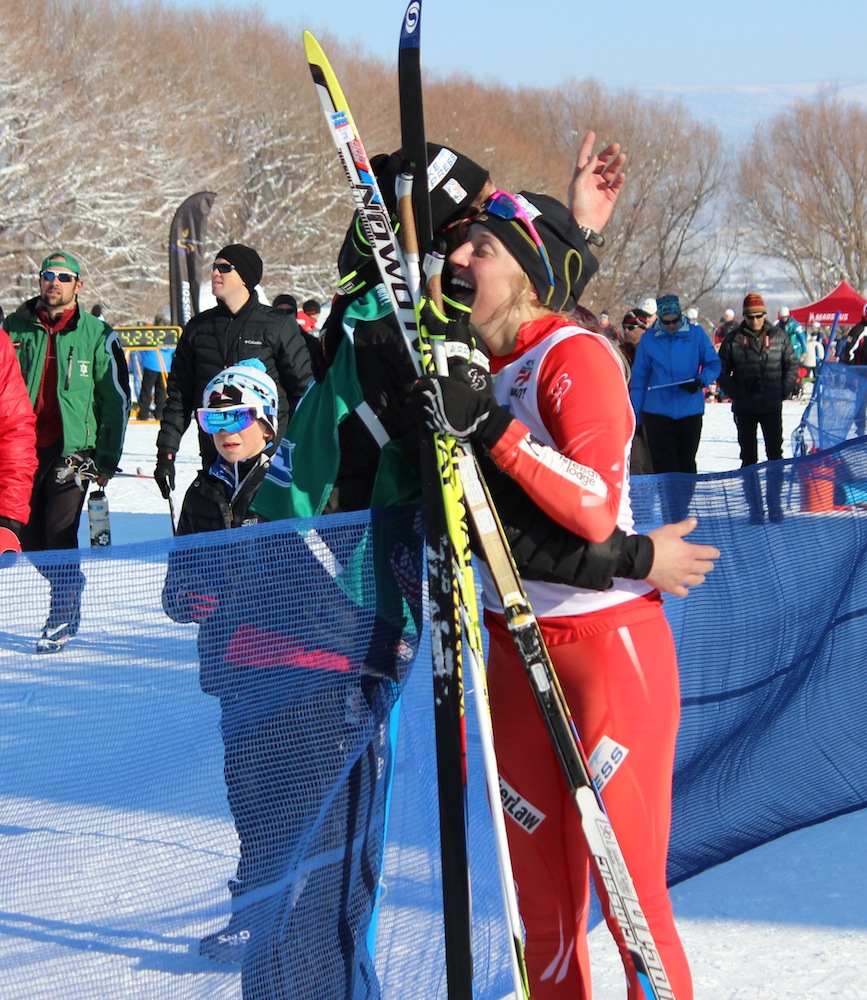
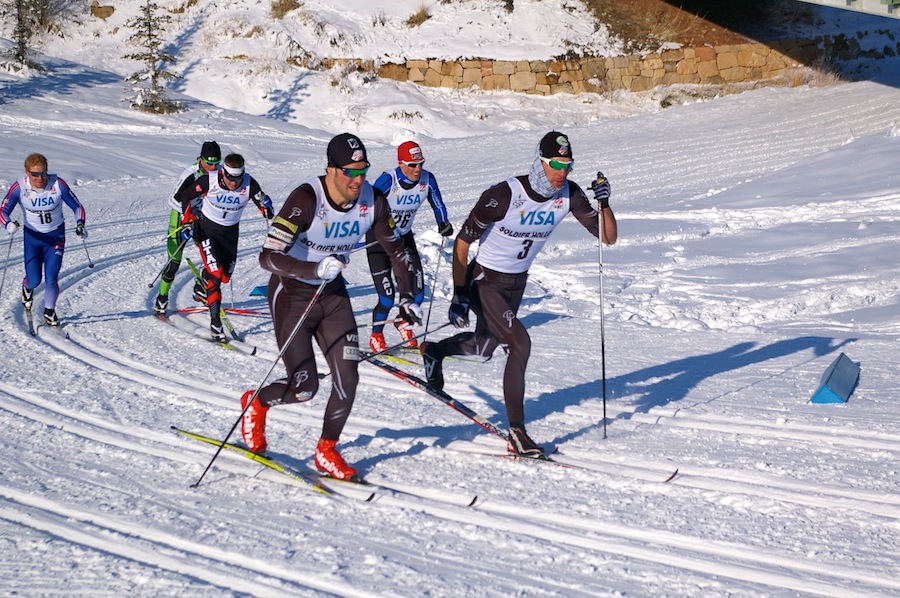
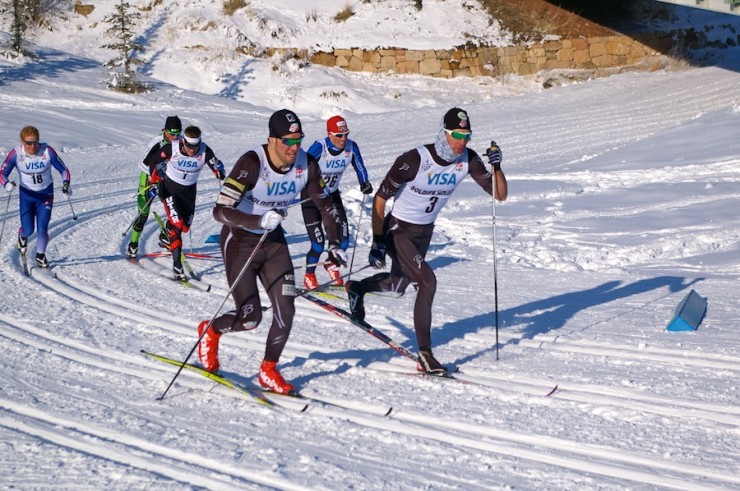
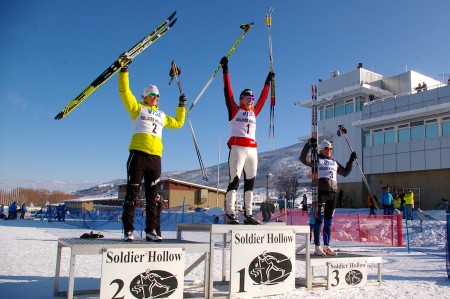
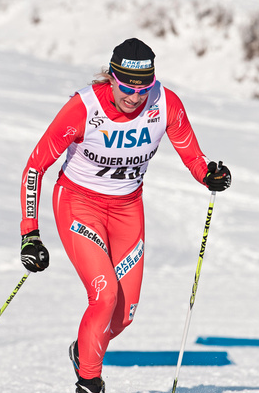
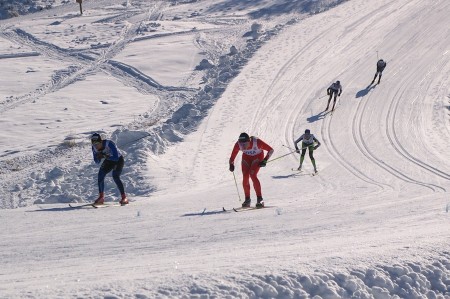
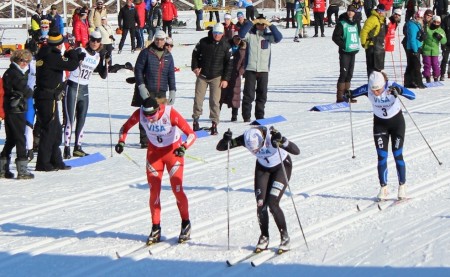
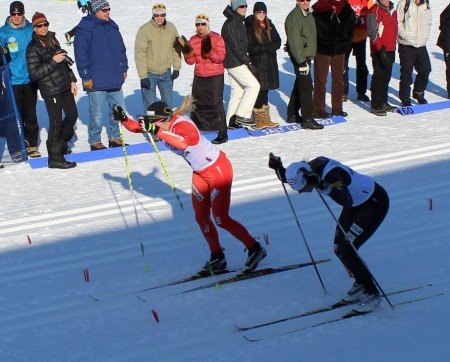
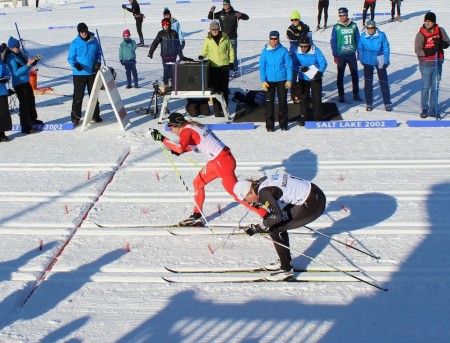
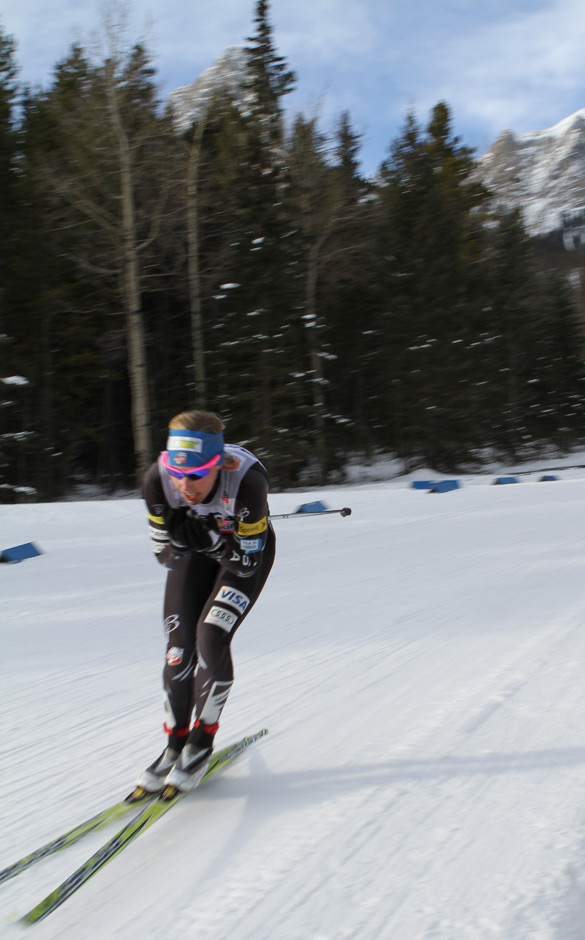
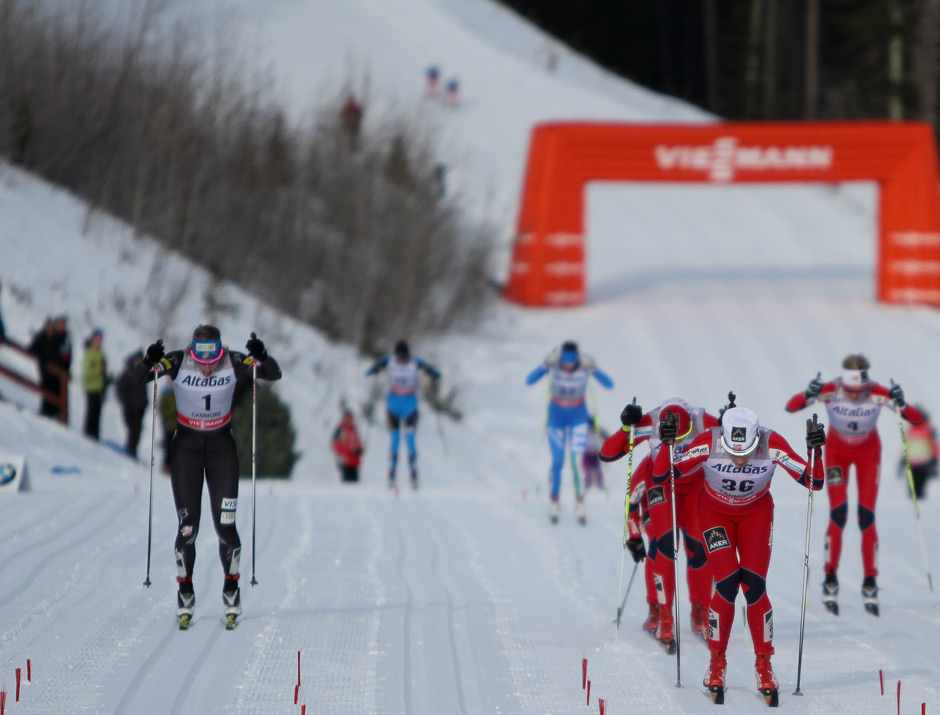
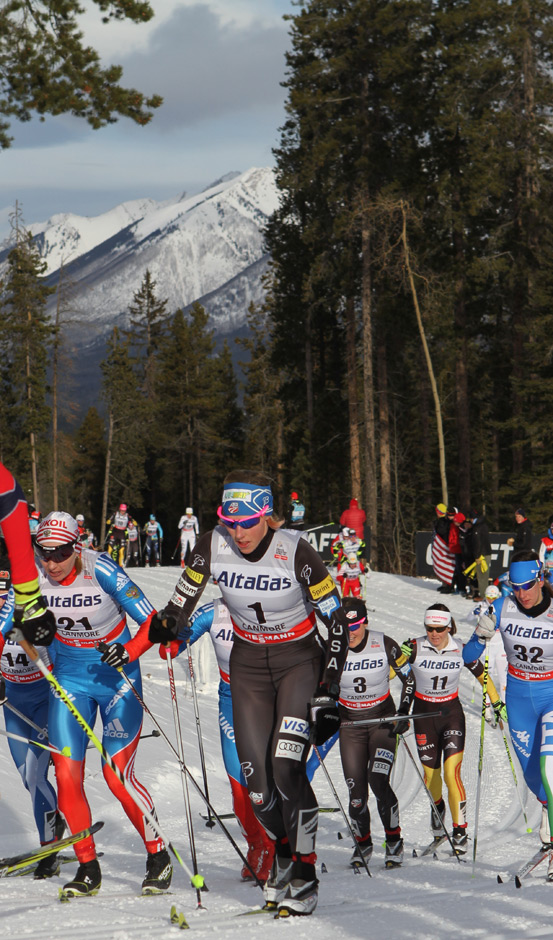
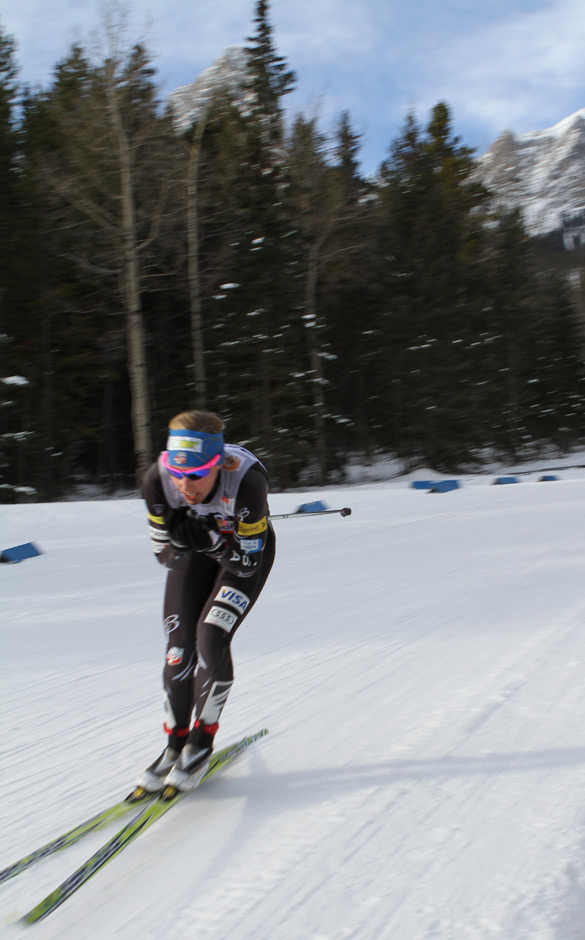
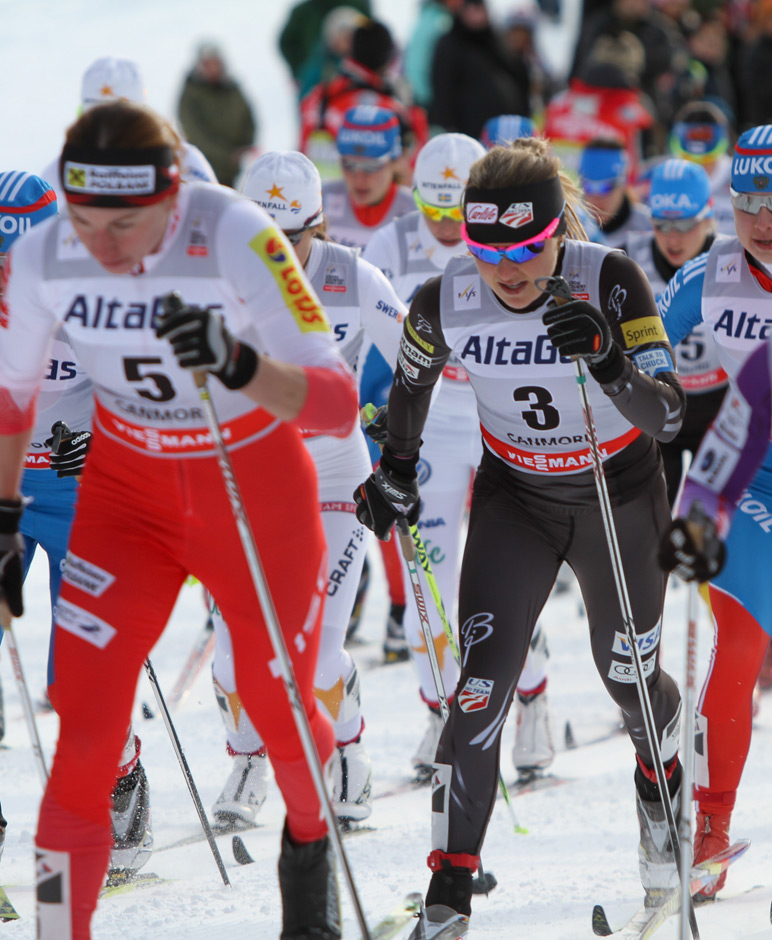
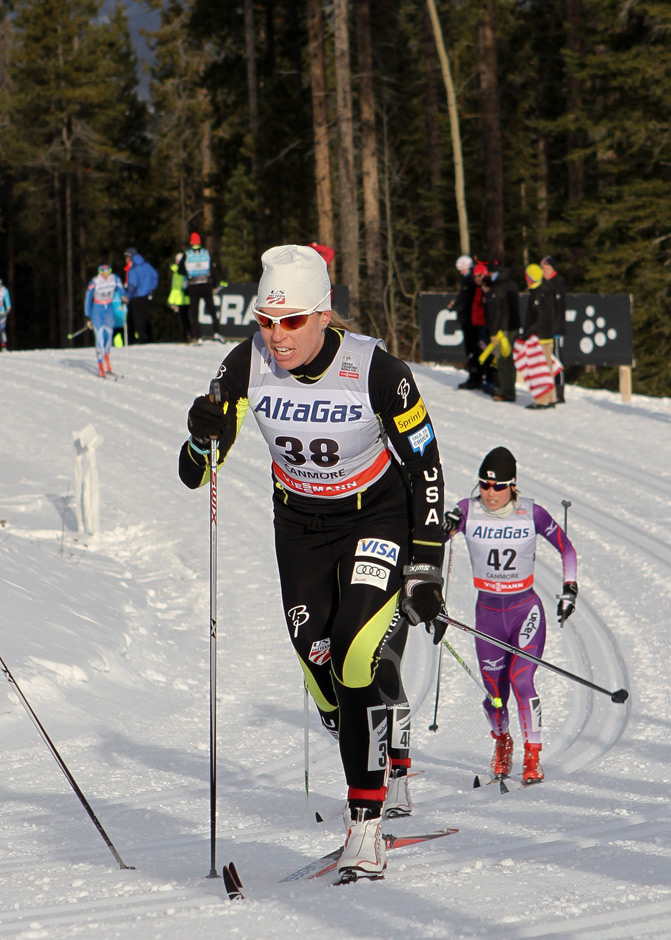
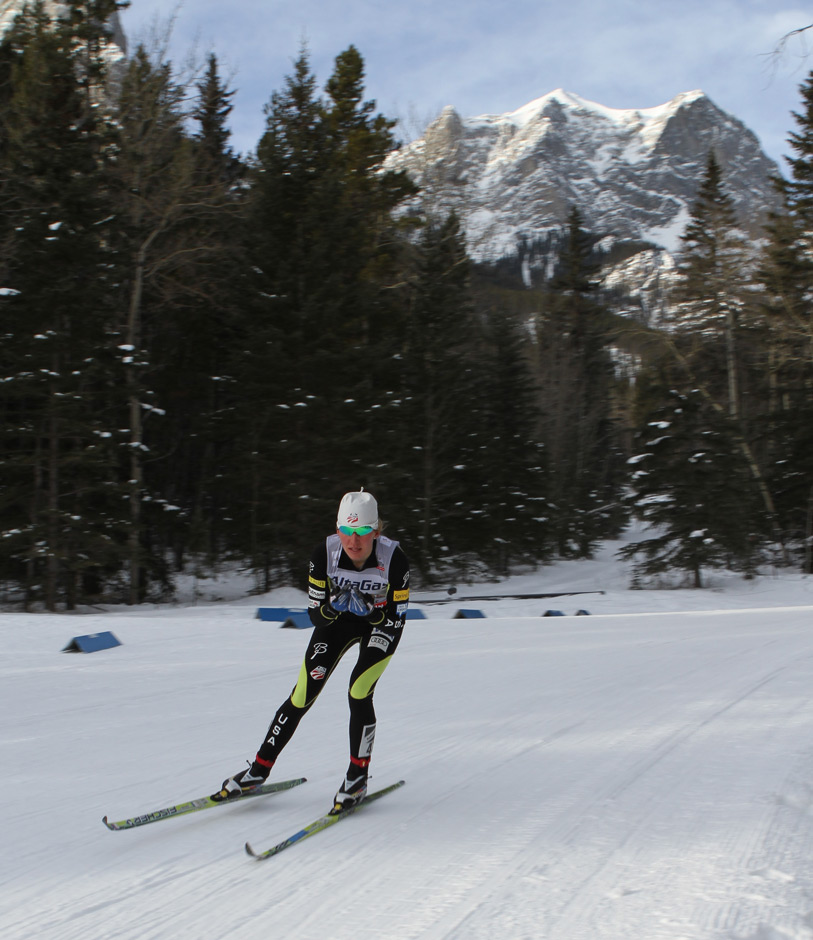
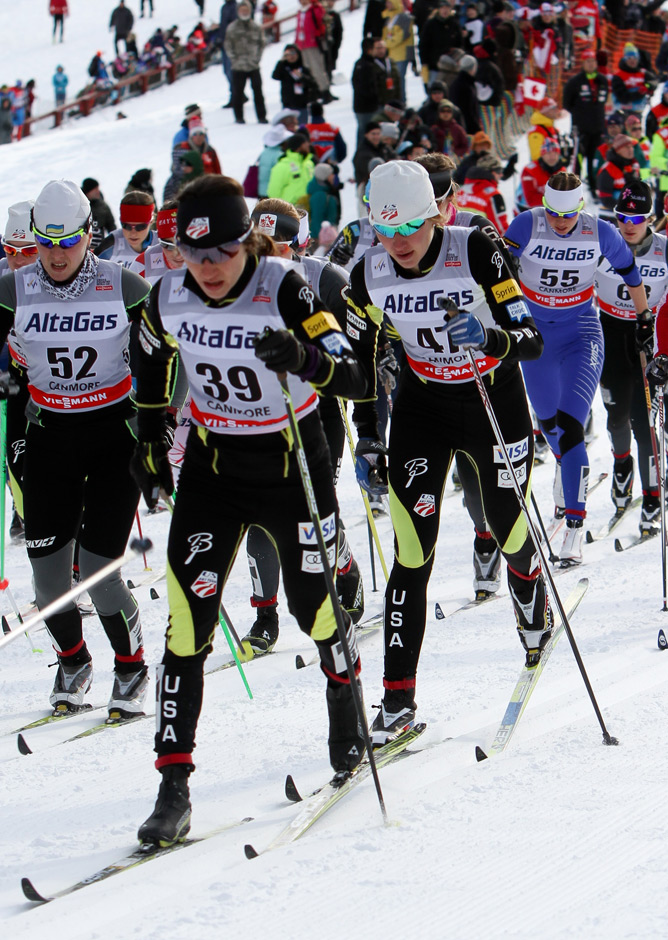
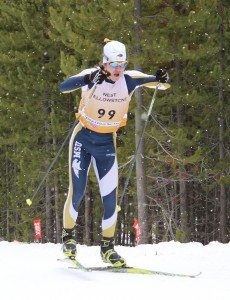
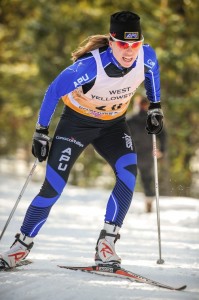
Rosie Brennan leads Jennie Bender in the women’s final of the Madison SuperTour skate sprint. Bender would overtake Brennan for the win. (Photo: Renee Callaway)
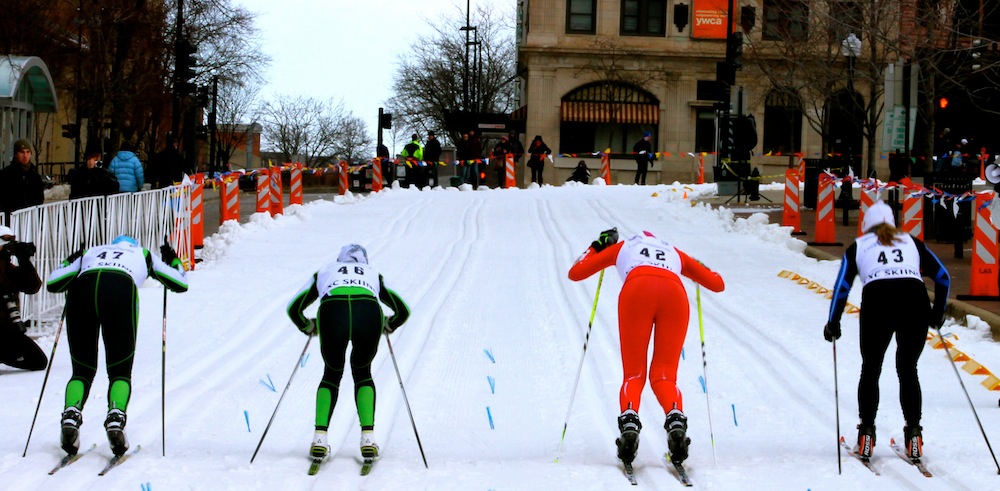
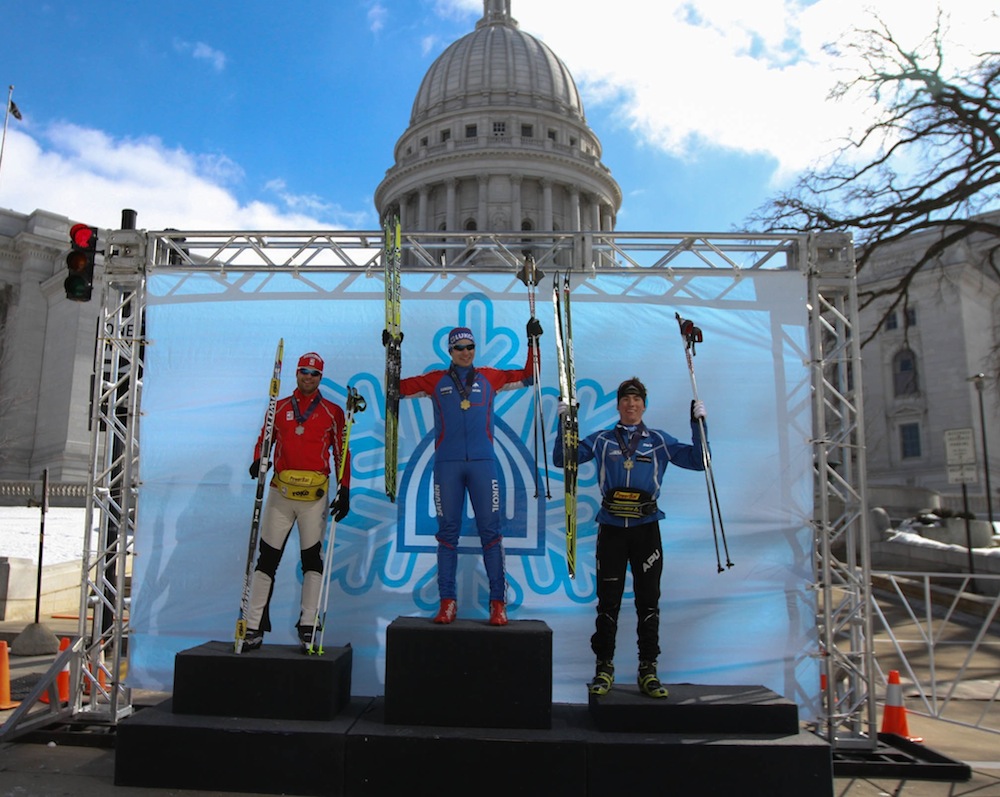
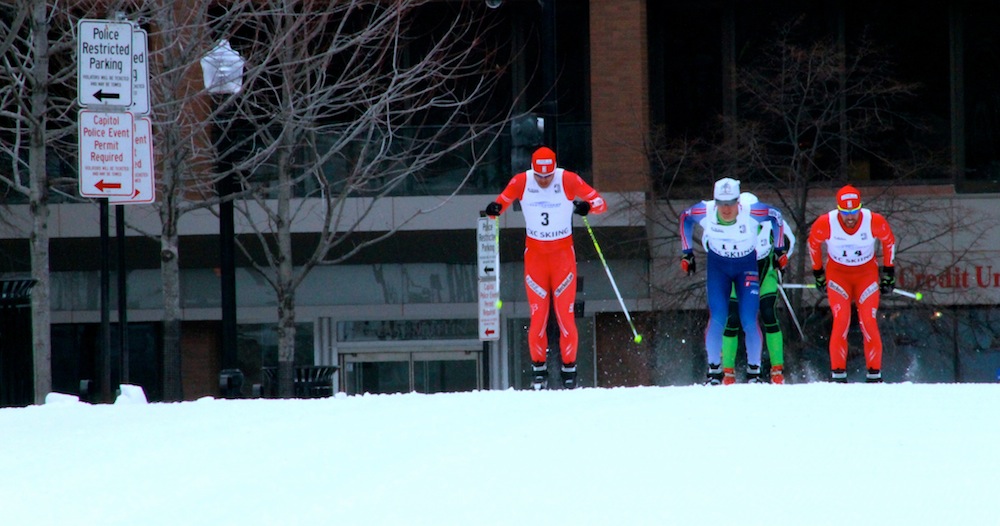
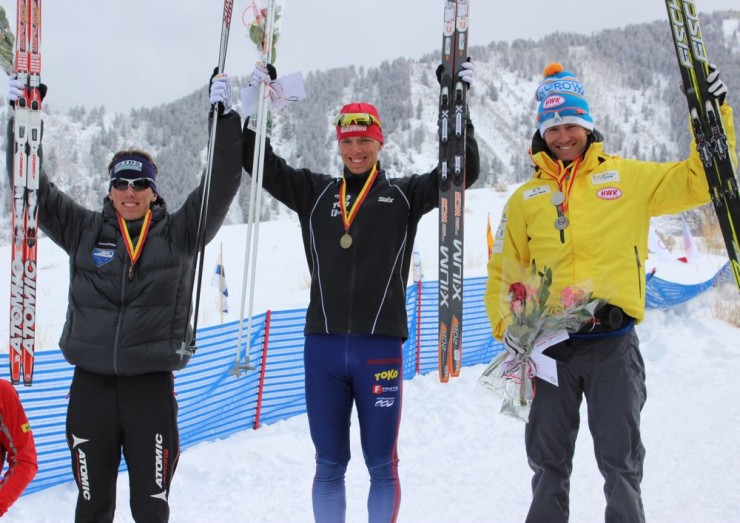
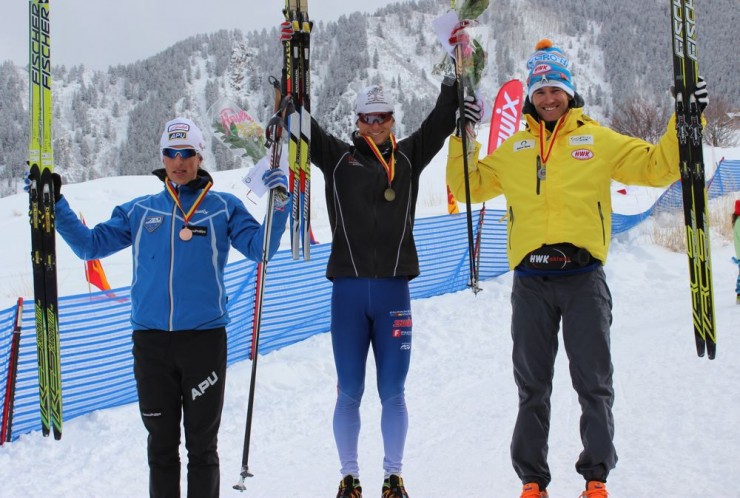
Andrei Tiuterev (RUS) completed a Russian sweep of the Madison Square Capitol Sprints on Sunday in Madison, Wisconsin. Tiuterev bested countryman Dmitry Ozerskiy (RUS), the winner of Saturday’s classic sprint. Midwest native Karl Nygren (CXC) placed third.
Tim Reynolds (CGRP) was the fastest qualifier on the day, narrowly edging out Ozerskiy by 0.1 seconds.
Reynolds would go on to win his quarterfinal but fall in the semifinal, beaten to the line by Samuel Naney (MOD) and Karl Nygren.
Eric Walcott, another CXC team member, qualified third and won his quarterfinal but was found wanting against the Russian duo of Tiuterev and Ozerskiy in the second semifinal, finishing fourth.
Tiuterev, the eventual winner, appeared to pick up speed as the day wore on.
He qualified in 7th position, made it through the quarterfinal with a second place finish behind Ozerskiy, before finding another gear and beating his teammate in both the semifinal and the final.
According to Nygren, the third place finisher, tactics rather than speed prevailed on the narrow course in the final.
“It was very tactical,” Nygren told Fasterskier. “Naney led it out and I sat towards the back. The two Russians went hard around the second to last corner and pushed the pace and moved to the front on the gradual down.”
The Russians closed the door on the final turn into the finish, cutting off any chance for the the chasers.
“They [the Russians] took it on the inside and drifted out to block a pass on the best line,” said Nygren. “I decided to cut way back into the inside lane and was unable to close down the gap. They played it smart and skied well.”
In retrospect Nygren thought there may have been some team tactics, but on a short course with a narrow tracks it may have been as much a function of racing strategy as course profile.
“Looking back it appears they worked together but who knows,” Nygren concluded.
Beyond the racing the setting and crowd at the city sprints always makes this competition a highlight on racing circuit.
“Conditions were excellent and the city sprint atmosphere was amazing,” Nygren said.
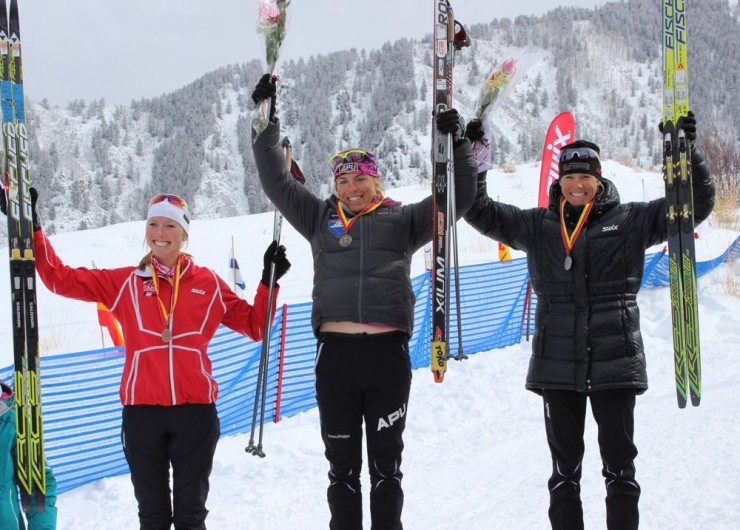
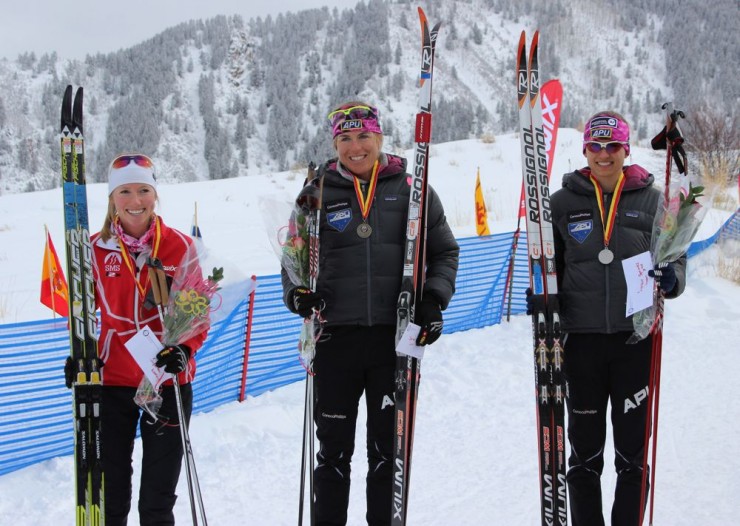
Jennie Bender (CXC) got the better of Rosie Brennan (APU) on Sunday in the Madison Square freestyle sprints, a reversal of Saturday’s classic result.
Bender dominated throughout the day, qualifying in first position in a time of 1:53.0, 0.5 seconds ahead of rival Brennan.
She marched through the quarterfinals and seminfinals, winning both heats on her way to the final.
“City sprints are a nice change, and it is good for the athletes to get used to a different atmosphere of a typical race day,” Bender wrote to FasterSkier in an email. ”
Although the women’s field was small, there were enough top women to make the semis and final heats competitive. I am alway impressed with the wonderful volunteers there, who are super supportive.”
Eventual second placed finisher Brennan followed a similar trajectory to the final, winning both her quarterfinal and semifinal, before the exertions of Saturday’s classic sprint caught up with her.
“Today was challenging because I was unbelievable sore from the double pole derby of yesterday,” Brennan told FasterSkier. “My muscles were not happy to be ski racing today, but it was fun to skate today.”
Brennan eschewed tactics in favor of a more aggressive approach, saying “because of the way I felt, I thought my best chance was to just go for it from the gun and hope everyone else was tired.”
Her path to the final was challenged by third place qualifier Claire Egan (CGRP), whom finished second to her in the semifinal.
Egan would go on to finish fourth in the final.
Third place finisher Caitlin Patterson (CGRP), qualified 4th and delivered a series of gritty performances, finishing second in both her quarterfinal and seminfinal heats, before finding another gear on in the final to better her teammate Egan for a podium spot.
According to Brennan, the final wasn’t tactical, as the absence of a headwind muted the advantages of drafting.
“There wasn’t a head wind on the downhill so drafting wasn’t quite as important,” she said.
Despite a furious pace from the gun, her tempo wasn’t enough to unsettle Bender.
“Unfortunately, Jennie was able to stay with me and did a killer job skating the downhill so she passed me before we went around the final corner and I didn’t have much to answer with,” Brennan said.
Brennan echoed Nygren’s sentiments about the conditions and atmosphere of the Madison Square Sprints.
“The skiing was actually quite nice,” she said. “It was cold all weekend so the snow set up well and was firm throughout all the races.”
Alaska Pacific University’s Rosie Brennan (r), Nichole Bathe, Caitlin Patterson and Maria Stuber leaving the start in the classic sprint quarterfinals at the Madison, Wis., SuperTour on Saturday. Photo: Alexis Turgeon.
City sprints are fast becoming a mainstay on the World Cup circuit, but elite domestic-level skiers don’t have many opportunities to experience the excitement racing on downtown streets. The SuperTour weekend in Madison, Wis., is the only one of its kind in the U.S. with two back-to-back sprints in the shadow of the downtown capital building, and it has the added bonus of additional hype from Winter Fest, the popular Madison outdoor festival that the sprints are a part of.
“This is a fairly big event,” said Central Cross Country’s Jennie Bender. “Madison is kind of, but not technically, one of the CXC headquarters, so there’s tons of volunteers and CXC people around who were great cheering.”
A 1 k classic sprint opened the elite cross-country competition schedule on Saturday. Rosie Brennan (Alaska Pacific University) won the women’s sprint in a tight photo finish with Bender. Two local favorites landed on the podium after her: Nichole Bathe, a high school senior from Madison, took third behind Bender.
The course created on city streets from trucked-in snow was flat enough for both the women and the men’s field to double pole the entire race on skate skis — some also used skate poles. Brennan, in her first Madison SuperTour appearance, was happy with her debut city sprint experience.
“That’s why I came here, because I wanted to practice domestically for city sprints,” Brennan said.
She has her eye on the city sprints in Stockholm, Sweden, in period three of the World Cup. If she maintains her position as overall SuperTour leader Brennan will compete in them this spring. With her first run at the format in Madison under her belt, Brennan has learned a few things about skiing them well.
“It was like drag racing in the rounds,” she said. “The Craftsbury Green Racing Project was able to wax for me today, which was awesome, so I had really fast skis. I sat behind Jennie and drafted off her while she double-poled, then when we turned the corner into the finish stretch I was just barely able to overtake her.”
For Bender, Saturday marked the second year in a row she was out-lunged in a photo finish in Madison. It left her feeling frustrated, especially after qualifying in first.
“Obviously I was not too pumped,” she said. “I led the whole final and I think there’s a strong headwind on the back. I just didn’t race it very smart… When Rosie came around at the finish I was like, ‘Oh, no!’ But she raced a smart race and that’s what it comes down to.”
Bender’s bout with illness over the summer is still affecting the way she races. She says she has trouble knowing how hard to push in the qualifier since she doesn’t have same fitness base she’s used to. When Bender puts all her energy into winning the prologue, like she did on Saturday by 3.7 seconds on a fast course, she has less speed for the heats.
“I’ve been going harder in the qualifiers lately, which I’ve been working on, but because I’m doing that as I go on in the heats I might be suffering a little bit,” she said. “I’ve got to work on it.”
Though disappointed with how her own finished turned out, Bender was “super pumped” to see Bathe, her teammate and summer training partner, climb her first SuperTour podium. Bathe was pretty excited too, as she hails from Madison and knew many people in the crowd.
“I really didn’t expect to make it into the A-final, even, so it was a fun surprise for sure,” Bathe said. “Especially being my hometown and having a lot of people I knew working the event, and the spectators, it was kind of indescribable how cool it was for me.”
The men’s classic sprint podium from Saturday’s SuperTour in Madison, Wis. 1. Dmitry Ozerskiy (RUS) 2. Karl Nygren (CXC) 3. Reese Hanneman. Photo: Renee Callaway.
In the men’s sprint, Russia’s Dmitry Ozerskiy blew the race open early in the final round only to be reeled back in at the end to win by a slim margin. Karl Nygren (CXC) took second and Reese Hanneman (APU) finished third.
“Dmitry kind of took off from the gun and led pretty much from start to finish,” Nygren said.
Karl Nygren (CXC), Mike Sinnott (SVSEF) and Doug Debold (CXC) in the quarterfinals. Photo: Alexis Turgeon.
It was a bold move on such a flat course, which surprised the rest of the men’s field.
“I thought it would be really tactical but the guys were going really hard for the whole sprint,” Hanneman said. “People were just hammering all the straight double-pole sections… I was impressed.
“When the Russian guy took off he was moving, and Karl and I were just trying to hang on for dear life. I was going maxed out the whole time.”
The course followed a square pattern around a city block in front of the capitol building, and between each 90-degree corner Hanneman and Nygren eventually regained contact with Ozerskiy.
“I was just about able to close on him towards the end and I lunged, but got beat by a couple inches,” Nygren said. “It was a fun race, really close.”
He thought the pancake-flat course probably played to his strengths. Though the field was relatively sparse compared to other SuperTours on the calendar, Nygren was still pleased with his first podium of the season.
“I’m feeling pretty good right now, so it was nice to get second,” Nygren said. “It’s a pretty accurate reflection of how I’m feeling. A lot of people weren’t here, so it’s hard to say, but it was good.”
Reese Hanneman (APU) powering through the quarterfinals. Photo: Renee Callaway.
Hanneman was upbeat about his result. A close finish can frustrate competitors who wind up on the losing end of them, but he wouldn’t want to finish any other way.
“It was tight; they always seem to come down right at the end. To make the final when the margins are that small was good,” Hanneman said. “I also want to thank [CXC coaches] Igor Badamshin and Andy Keller for waxing my skis, they took me in this weekend.”
Close finishes are what city sprints are designed to produce in front of a downtown crowd, and in turn the spectators made the race more exciting for skiers.
“It felt a lot like Quebec — just all the people watching, the other stuff going on, and you’re right there with these pretty cool capitol buildings,” Hanneman said.
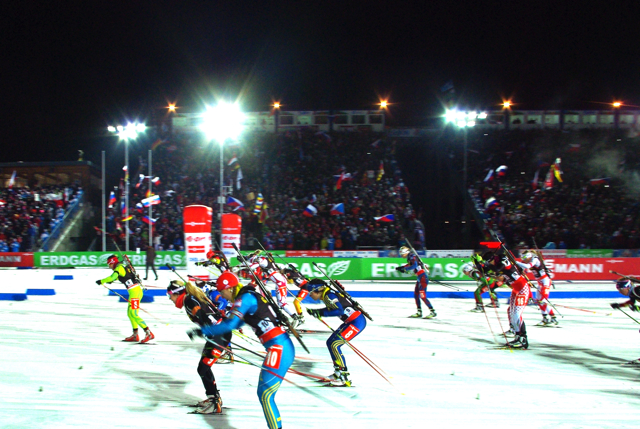
As Czech flags wave in the background, the mixed relay field sets off in pursuit of the first 2013 Biathlon World Championship title on Thursday in Nove Mesto, Czech Republic.
Think you can picture the scene at the International Biathlon Union (IBU) World Championships in Nové Město na Moravě, Czech Republic? Think again.
Veteran and newbies alike found themselves in awe of the stadium and 20,000-strong crowd. After the first few days of racing, many were still struggling to cope with the noise factor, but hey, they weren’t complaining.
Norway opened with its third-straight mixed relay victory, no surprise there, and the hometown fans celebrated its own team making the podium in third right behind France.
The U.S. notched its best mixed-relay result in eighth with Annelies Cook, Susan Dunklee, Lowell Bailey and Leif Nordgren. With Tim Burke out trying to get healthy, Nordgren filled in. Meanwhile, the Canadians were simply happy to get their feet wet at World Champs as Rosanna Crawford, Megan Heinicke, Jean Philippe Le Guellec and Scott Perras combined for 15th.
On Saturday, Norway’s former biathlon king, Emil Hegle Svendsen, made a point to get back on top and captured his second-straight gold medal of the week, beating French rival Martin Fourcade in the 10 k sprint. In the women’s 7.5 k sprint, Ukraine’s Olena Pidhrushna surprised with her first career win and teammate Vita Semerenko tallied her third World Championships bronze.
All four American men in the sprint raced well enough to qualify for Sunday’s 60-man pursuit. Burke was back in action in 28th, Bailey placed 32nd and Russell Currier and Nordgren also made the cut. Two Canadian men and two women qualified, led by Le Guellec in 36th and Scott Gow in his debut World Championship in 45th. In the women’s sprint, Cook also placed 45th and Heinicke narrowly qualified for the pursuit in 54th.
That brings us to Sunday when Svendsen continued his World Championships domination, outsprinting Fourcade by 2.4 centimeters for the pursuit victory. It didn’t come easy: he nearly stopped after getting tangled with Russia’s Anton Shipulin on the last climb.
Norway’s Tora Berger won her first individual gold of the week in the pursuit, rising to the occasion when two skiers in front of her, Russian Olga Zaitseva and Krystyna Palka of Poland, missed one apiece on the last shooting stage. Berger shot clean on the final stage and hammered home for the victory.
Meanwhile, Bailey and Le Guellec led the North Americans in 13th and 15th, respectively. Le Guellec made up 21 places – the second most of any man in the pursuit – and Bailey climbed 19 spots to get back in the mix.
While biathlon expert and FasterSkier editor-at-large extraordinaire Chelsea Little was on site in Nové Město, Audrey Mangan traveled to Aspen, Colo., for the SuperTour – making her first stop at the Vail Mountain Games.
There, the Central Cross Country (CXC) husband-and-wife duo, Brian and Caitlin Gregg topped the men’s and women’s field, respectively, in the 10 k freestyle mass start – a sort of warmup for the SuperTour weekend ahead.
On Saturday, big, wet snowflakes at 8,000 feet above sea level didn’t slow down skiers like Rosie Brennan of Alaska Pacific University (APU), who won both the 1 k classic prologue in the morning and the 5 k classic individual start in the afternoon. On the men’s side, Mike Sinnott of the Sun Valley Ski Education Foundation (SVSEF) won the prologue and teammate Patrick Johnson tallied his first career SuperTour victory in the 10 k.
Sunday’s coveted Owl Creek Chase involved a sprint showdown at the end of the 21 k point-to-point race. Brian Gregg edged Sylvan Ellefson (Ski & Snowboard Club Vail/Team HomeGrown) by eight seconds at the finish, showing all his speed work this summer paid off.
Part-time racer Nicole DeYong (SVSEF) skied away from the pack for a two-minute victory after winning the same race in 2010.
Sophie Caldwell (SMST2) racing to a second-place finish in Sunday’s Scando Cup 1.1 k freestyle sprint final in Pärnu, Estonia. She was just 0.14 seconds out of first for a career best. (Photo: Eric Packer)
Meanwhile, several other American domestic skiers put their skills to the test at the Scandinavian “Scando” Cup in Latvia and Estonia. Caitlin Patterson of the Craftsbury Green Racing Project led the group in Madona, Latvia, where she was ninth in Thursday’s 10 k freestyle mass start and 10th in the 5 k classic on Wednesday. Eric Packer of the Stratton Mountain School T2 Team (SMST2) broke through in 16th in the 20 k freestyle mass start.
A few days later, Sophie Caldwell (SMST2) made the podium in second in Sunday’s freestyle sprint in Pärnu, Estonia, one day after finishing 17th in the classic sprint. Jennie Bender (CXC) qualified as high as fourth in the classic sprint and went on to place 16th. The next day, she was 11th in the skate sprint.
Brian Gregg (CXC) claiming the 2013 Owl Creek Chase on Sunday in Aspen, Colo. Photo: Mike Hoffman.
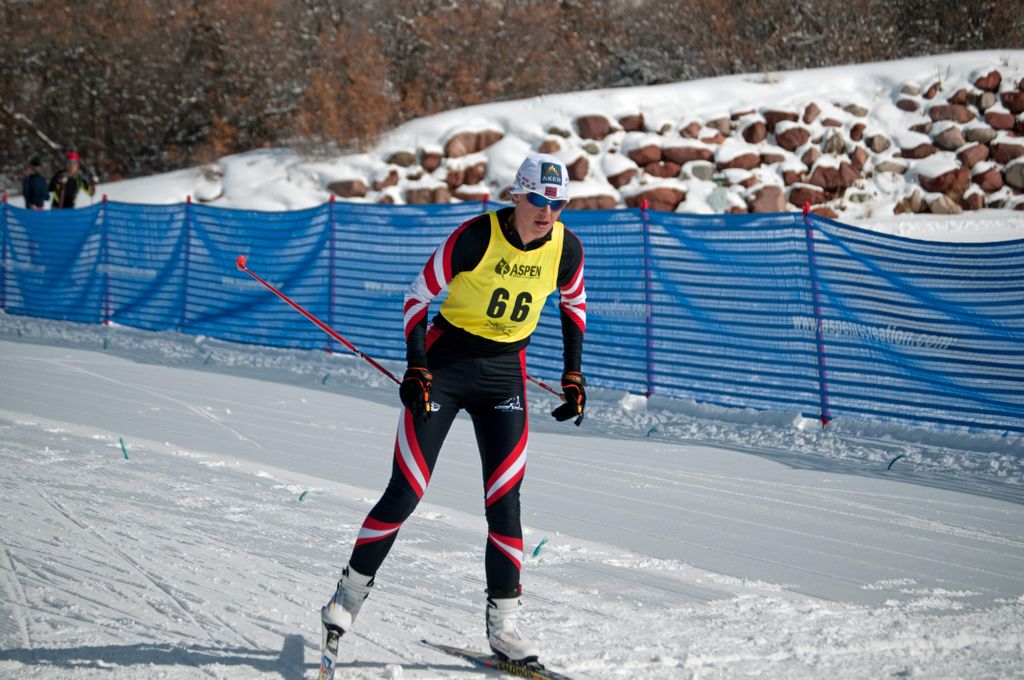
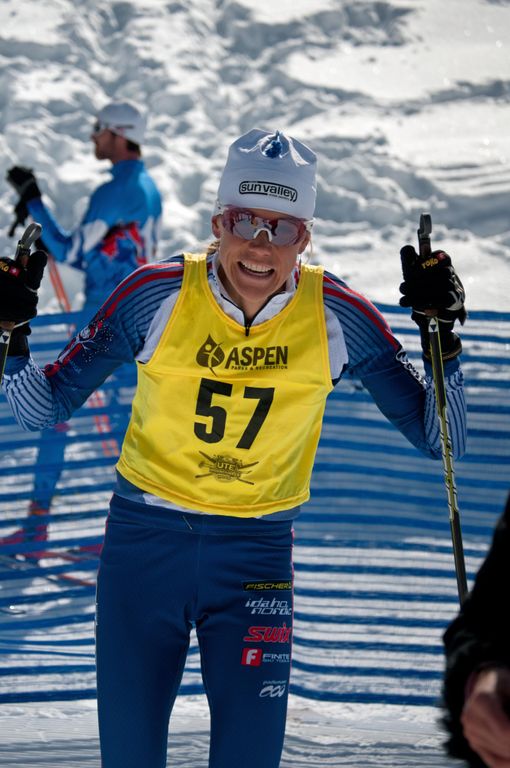
ASPEN, Colo. — The Owl Creek Chase is not a race to be entered lightly. The 21 k course is a taxing point-to-point that starts at the Snowmass Cross Country Center, traverses the slopes of Buttermilk and comes out at the Aspen Valley Ski & Snowboard Club after thousands of feet of long, grueling climbs and dizzying descents. Race favorites describe it as a survivor’s course; murderously challenging. Go too hard, too early, and it will bury you.
It should come as no surprise that Central Cross Country’s Brian Gregg and Sun Valley Ski Education Foundation’s Nicole DeYong conquered such terrain. Both skiers are notorious climbers and well-acclimated altitude racers, and have learned from experience what it takes to outlast at Owl Creek.
“Owl Creek can be pretty painful if you go too far under,” Gregg said. “The last time I was here…the wheels just came off. I don’t think I’ve ever hurt that bad.”
This year Gregg made sure to prepare himself accordingly for the 8,000-foot height and daunting course profile. He and his wife, Caitlin, have been staying with family in Eagle, Colo., for weeks to train high in preparation. They both skipped the classic races on Saturday to save up for the main event, unlike many of their competitors.
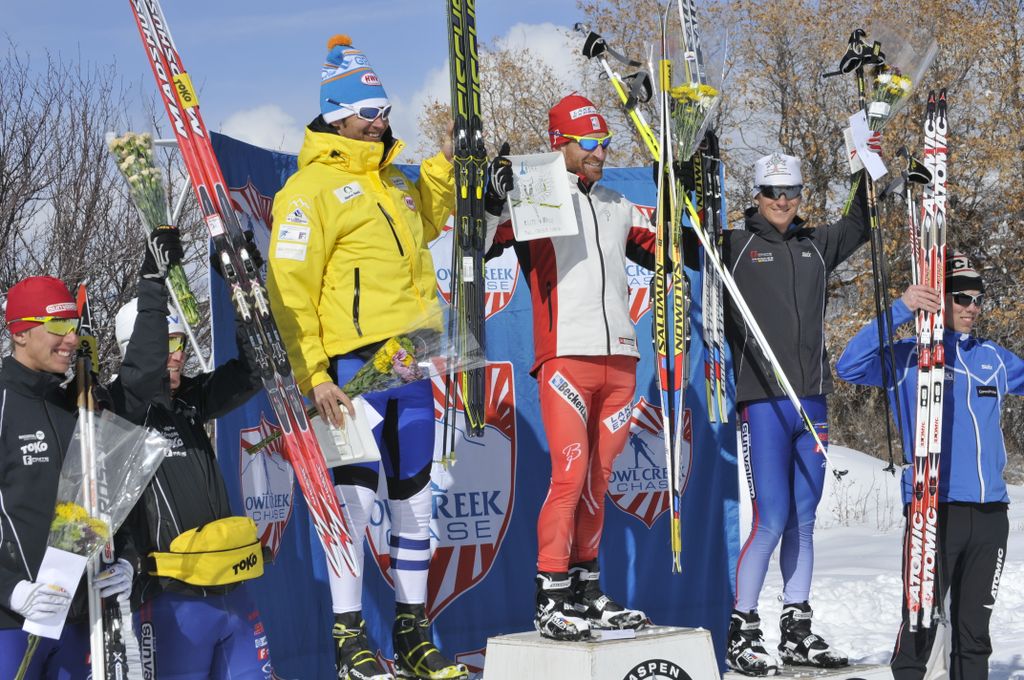
On Sunday it paid off, and Brian outsprinted Sylvan Ellefson (Ski & Snowboard Club Vail Team HomeGrown) by eight seconds to finish in 1:02:04.4 in sunny, hard-packed conditions. Mike Sinnott (SVSEF) took third (+1:23).
Sylvan Ellefson (SSCV) leading Gregg up one of the last few climbs. Photo: Mike Hoffman.
You read that right — in a sprint finish, Gregg outsprinted the field. The CXC veteran has been working particularly hard on his closing kick all year with his coach Scott Johnston and the Methow Olympic Development squad to turn himself into a better all-around skier.
“I’ve done a lot of workouts where we’ll ski 800 meters or something and sprint as hard as we can the last 300 meters to work on that finishing speed,” Gregg said. “It’s always been a weakness of mine, so I got to focus on that this summer and now I’m seeing it come together in the race season.”
It took a full 20 k of intelligent skiing for Gregg to be in a position to kick it in at the end, for the preceding kilometers and broke many a strong skier. The race began at a controlled pace; Brent Knight (Alaska Pacific University) fell in the opening seconds and the leaders waited considerately for him to catch back on. When the lead pack developed, Gregg, Ellefson, Sinnott, Knight and Matt Gelso (SVSEF) helped each other conserve energy and rotated turns setting the pace at the front.
Ellefson and Gregg eventually broke away before the halfway mark and continued to switch in and out of lead duty as they came into the final 5 k on the Aspen trails.
Brent Knight (APU) battles a climb as MIke Sinnott (SVSEF) gains ground from behind. Photo: Mike Hoffman.
“I kind of pulled it in I guess to keep away third and fourth, but also keep the pace high so no win would come too easy,” Ellefson said. “But I think I led a little bit more than I wanted to that last 5 k. I don’t know if it was the three races beforehand or what, but my legs just couldn’t do it in the last 200 meters.”
A minute back, Sinnott gained back a deficit on Knight to claim bronze. At such a suffer-fest of a race, he was happy to hang on to a podium spot.
“I was fighting with those guys for a while, and then once you crack on this course you go backwards fast,” Sinnott said. “I saw a big chase pack coming so I was happy to hang onto third — those sharks were coming up behind me pretty quick.
“It’s a beautiful course, really fun, but so murderously painful. It just hurts. It’s about who’s toughest and who can survive, and I was not the survivor today.”
Knight finished 0.3 seconds behind Sinnott for fourth. Colin Rodgers (SVSEF), a coach at most races, took fifth after a 30-second break in the field. Patrick Johnson (SVSEF) was sixth, 29 seconds behind Rodgers.
Though the course is a lung-burner, most finishers looked happy as they crossed the finish line under the Aspen sun.
“I love this course, it’s one of my favorites,” Ellefson said. “I was expecting to be skiing in six inches of powder this morning and was not looking forward to that, so when the tracks were firm this morning it was good vibes today.”
Nicole DeYong (SVSEF), a competition team coach for Sun Valley, claimed the Owl Creek Chase by two minutes on Sunday in Aspen, Colo. Photo: Mike Hoffman.
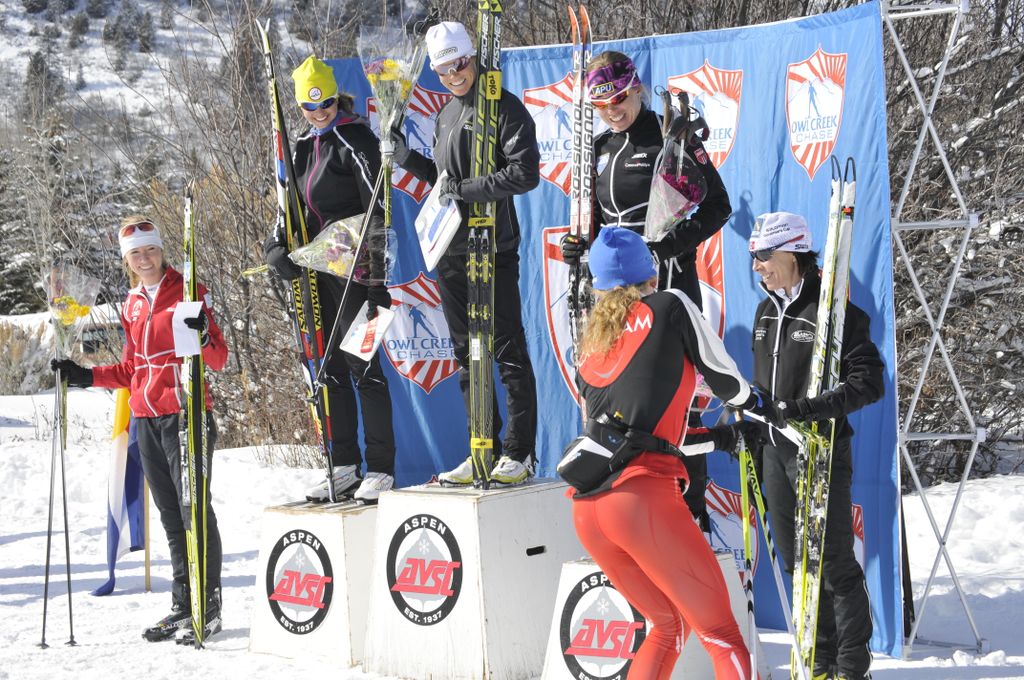
The women’s race played out much like the men’s in the beginning — the course practically requires a comfortable early pace. No one wants to blow up too early at Owl Creek. But in the end DeYong won by a whopping two minutes over Lenka Palanova (Boulder Nordic Junior Race Team).
“From many years of experience I’ve discovered it’s good to just kind of sit back for a little bit and find a good rhythm,” DeYong said. “I was feeling pretty tired and sore this morning, so I just wanted to play it conservatively.”
DeYong won Owl Creek once before in 2010 — in fact it’s the only race she’s ever won. She no longer races full time and doesn’t put too much pressure on results, and on Sunday she just hoped hoped for a good feeling after racing the 5 k classic the day before.
The pace went out “comfortably.” Palanova, DeYong, Alexa Turzian (SVSEF), Rosie Brennan (APU) Erika Flowers (SMS T2) and Caitlin Gregg (CXC) splintered off from the rest of the field as the course wound around a hilly Snowmass golf course in the first 5 k.
Palanova drew first blood at the front of the train, not content to sit back at a leisurely pace.
Lenka Palanova (BNJRT) finishing second at Owl Creek for the second year in a row. Photo: Mike Hoffman.
“I didn’t want them to play the tactical game,” she said. “When I realized they were going a little bit too slow I just went for it.”
Palanova pulled at the front for most of the first kilometers in an attempt to separate the women from the girls, but when the group reached the first major downhill it became clear that DeYong had extremely fast skis. Once DeYong got in a tuck and zoomed away from the field, most figured the race was pretty much over.
“After we crested the first pass Nicole had ridiculous skis, and pretty much just tucked away from us and that was the end of that,” Brennan said.
Gregg and Brennan attempted to follow her, but DeYong was skiing on another level.
“The skis were running so well I just decided to go with it,” DeYong said. “I was praying for a good feeling in the body and I had it.”
Behind her, attempts to close her breakaway were futile.
“I was kind of dumb and tried to go really hard to catch back up, because I thought it’d be easier if I could draft, but I just spend the whole time trying to catch up instead of actually resting,” Brennan said.
At Owl Creek it can be a death sentence to go too hard too early, and Brennan said she paid the price at the end, gradually losing time on DeYong as Palanova closed in from behind.
“I don’t know if Rosie started getting tired or I started getting faster, but I caught her before the last 5 k,” Palanova said.
The BNJRT coach and former Colorado University star kept an even pace as she moved around the last few kilometers, expecting Brennan to be right behind her. When Palanova realized there was no one in sight, she thought, “‘Oh, I should maybe hammer.’ So I did,” she said. “But I think I was more lucky than anything else at that point, because I didn’t have much left.”
DeYong. Photo: Mike Hoffman.
Up front, meanwhile, DeYong created an insurmountable gap. She put on an early surge when she came into the final kilometers at the Aspen Valley course, forgetting about one of the last hills. Somehow, she still found enough energy to keep up the pace and took the win by a two-minute margin.
“I forgot you have to go all the way around and back down, and it some ways I think that was good for me, that I forgot the whole second half of the [final 5 k],” DeYong said with a laugh. “I don’t know if strategically I would have raced the way I did had I known what I was doing.”
While it’s out of the ordinary for junior team coaches to take the top two spots in a SuperTour, DeYong and Palanova in aren’t exactly surprises at the top of these particular results. They both know the Owl Creek Creek course well, have an affinity for long, gradual climbs and ski most of the year at altitude. It takes a different kind of skiing this high up, and both women are practiced at it.
“If you are able to suffer through it, you’re going to do well,” Palanova said. “I think at the end the move I did at the beginning was maybe good, because maybe that made them tired… But who knows, most of these girls aren’t used to skiing at high altitude.”
Brennan confirmed that Owl Creek was a beast of a course.
“I was hoping it would be easier this year because I’m in better shape, but I don’t think it matters how good of shape you’re in for this race, it’s just really hard,” she said. “Very challenging… It’s an unusual course, it’s not something you see every time, so it’s fun to mix it up.”
Fourteen seconds behind Brennan, Flowers took fourth. Gregg finished fifth (+3:10) and Tammy Jacques (Steamboat Springs) was sixth (+3:34).
Patrick Johnson (SVSEF) en route to winning the 10 k classic at the Aspen, Colo., SuperTour on Saturday.
ASPEN, Colo. — As Nemo shook the East with buckets of snow, the winter gods smiled upon the Rockies, too, with inches of heavy flakes on Saturday morning as the Aspen SuperTour got underway. The powder was a blessing for a state that’s had a mediocre winter, but for the handful of nordic skiers that braved the storm in spandex and a race bib it was a daunting environment in which to line up for one classic race, let alone the two in one day.
Rosie Brennan (APU) skiing to a sprint prologue win in dense snowfall.
“This morning was rough,” said Alaska Pacific University’s Rosie Brennan. “You couldn’t see anything. The tracks were washed out and my skis weren’t kicking very well, so it was sort of a struggle.”
It was a sparse field that braved the conditions for the classic sprint qualifier, which preceded the individual distance event, but the adaptable skiers prevailed. Brennan won the 1 k prologue in 4:26, 13 seconds ahead of teammate Lauren Fritz (APU). Erika Flowers (SMS T2) finished third (+0:20) and five elite women finished the race in total as inches of snow piled up in the tracks.
The men’s race was equally vicious. “It was very slow,” said Mike Sinnott (Sun Valley Ski Education Foundation). “I think I came to a stop a couple times. It was a brutal, painful sprint, and I don’t think anyone felt like the were sprinting.”
Sinnott took the prologue win in 3:40, seven seconds ahead of Sylvan Ellefson (Ski & Snowboard Club Vail Team HomeGrown). Peter Kling (APU) took third (+0:14).
After toughing it trough a kilometer of powder at 8,000 feet skiers had two hours to gear up for round two, a 5/10 k individual start classic. A Pisten Bully smoothed out the course in between events, and right on cue the skies ceased cleared as starters began to line up again.
Thanks to high elevation, a hilly course and slightly soft tracks, the second event of the day belonged to the mentally tough. Patrick Johnson (SVSEF), still in his first season out of college, landed his first career SuperTour podium and gold medal all at once, taking the men’s 10 k by six seconds over Ellefson.
Johnson laps through the field.
“I think today it was slow conditions and you just had to ski smoothly, and I’m not really much of a sprinter so it was more of a distance skier’s course,” Johnson said. “I think that’s what helped make it a good day for me.”
The Middlebury College alum has been generally happy with his racing this season — he was fifth in the 15 k at US Nationals — but has skied just shy of breaking through to top of the results.
“It’s always been just sort of waiting to get that few extra seconds that can move you up on the list,” Johnson said. “It came through today.”
He had never raced in Aspen before Saturday, but now that he’s collected his first win at the nordic center Johnson feels pretty good about the venue.
“I really like it, obviously,” he said.
While Johnson was having the race of his life, Ellefson salvaged a painful race to finish just six seconds out of first. The Vail native had raced a 10 k and the prologue in the 24 hours preceding the classic event and started to pay the price.
Sylvan Ellefson (SSCV) climbing.
“I was pretty tired from the sprint,” he said. “Just because all of the snow we got, the sprint felt like I was going 10 k pace, so it was a little bit confusing out there.”
Ellefson knew he wasn’t skiing spectacularly as he moved around the hilly course, but minimized the damage by reminding himself he was in good shape.
“I had an internal battle with myself at the 5 k mark,” he said. “I was like, ‘Man, I’m locking up everywhere, I’m not feeling super great, but I know my fitness is good right now so I just have to work with what I have.’”
Over the remaining 5 k Ellefson brought himself back to a “good mental state” and closed a 15-second deficit on Johnson to finish just six seconds behind him. At relatively relaxed race where teams help each other with wax support, Ellefson was impressed with the victor’s effort.
“I’m really excited for Patrick Johnson,” Ellefson said, nodding in his direction. “It’s his first podium and first SuperTour win.”
Brent Knight (APU) continued a strong run of recent SuperTours to finish third, 41 seconds off Johnson’s mark. In a season he characterizes as consistent, he was pleased to put together a strong classic result the day after a punishing 10 k skate in Vail on Friday.
“I’m super happy with the result,” Knight said. “I raced about as smart as I could. I’ve been in and out of altitude all season and…I think it’s really made a difference, learning how to ski more consistently and learning how to race smart up here.”
Brent Knight.
Though there have been many SuperTours at elevation this season, Knight considers 8,000 feet to be a world away from a place like Sun Valley, Idaho, which is a few thousand feet lower.
“In Aspen and Vail it’s a whole other beast,” he said. “When you’re racing up here if you cross the red line, you’re toast. So up here it’s more just playing with that fine line. The guy who can sit right under that red line the whole time is the guy that’s going to win, generally.”
***
In the women’s 5 k Brennan followed up her prologue victory with a seven-second victory over Nicole DeYong (SVSEF), and Flowers repeated as the bronze-medalist (+1:01).
Brennan taking her second SuperTour win in two hours.
For those who are counting, Brennan has now racked up five wins this season. Though the Park City, Utah, native spent the past week at home she noted how difficult racing is at Aspen’s elevation.
“Even though I grew up at altitude I’ve found that 8,000 feet is the tipping point where I no longer have the comfort that I do a 6,000 feet,” she said. “So I was definitely hurting a lot out there… Doing three races in a row [here] takes it all out of you and I’m just focused on recovery and making sure it doesn’t crush me for later on.”
Though the field was only 29 women strong — “Am I racing right now?” Brennan recalled thinking — it was fairly strong at the top end. On what was a slow 5 k course, DeYoung came within striking distance of the win.
“I actually like this course and I’ve raced it quite a few times,” DeYoung said. “I’ve learned from racing here before to pace yourself and just to ski smooth and relaxed and I felt like I was able to maintain it the whole way and finish strong. That’s what I was hoping for.”
DeYong no longer considers herself a racer as most of her time is spent coaching the Sun Valley competition team, but she stays active enough to enjoy herself and do well at a race most of the field considers daunting. Her last race appearance was at the season opener in West Yellowstone, Mont.
Nicole DeYong, 2nd.
“Someone asked me if I was coming back into racing and I was like, the problem with that is if I do that I have expectations, mostly on myself, and then it seems to go downhill,” DeYong said. “So I’m just here for fun, just because I enjoy skiing.”
Flowers, who took third having never before raced in Colorado, was on board with DeYong’s thoughts on Aspen.
“I liked it, except that it’s really hard,” Flowers said. “You’re breathing hard from your first kick…but it’s fun, it’s so nice here. When we were skiing the [Owl Creek] course easy the other day it was so sunny.”
The 21 k Owl Creek Chase, the weekend’s main event, starts on Sunday at 11:00 a.m. MT.
5/10 k classic results not yet posted; check back here.
Mike Sinnott (SVSEF) winning the sprint prologue.
Formerly of the Bridger Ski Foundation and U.S. Ski Team, Leif Zimmermann finishes fourth for a season-best SuperTour result in the 10 k classic in Aspen, Colo., in early February.
Erika Flowers (SMS T2).
Hailey Swirbul (Aspen), a J2, taking fourth overall in the women’s 5 k.
The men’s 10 k podium: 1. Johnson 2. Ellefson 3. Knight.
The men’s sprint podium: 1. Sinnott 2. Ellefson 3. Kling
The women’s 5 k podium: 1. Brennan 2. DeYoung 3. Flowers.
The women’s sprint podium: 1. Brennan 2. Fritz 3. Flowers.
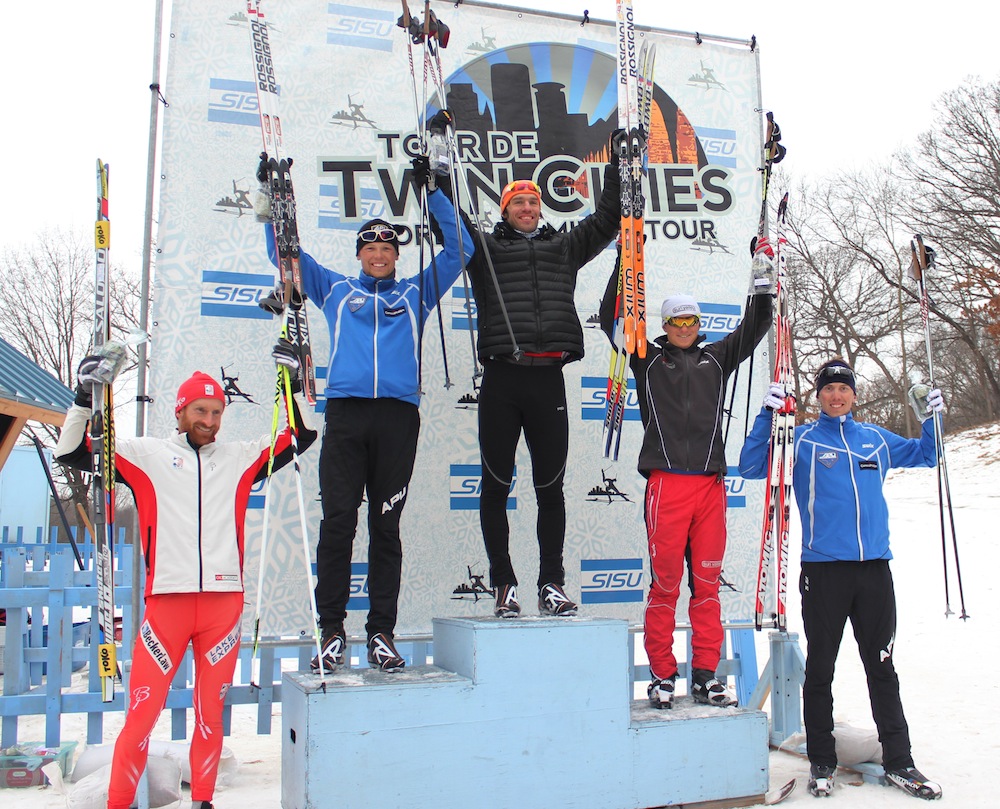
The 2013 Tour de Twin Cities men’s overall podium. 1. Torin Koos, 2. Mark Iverson, 3. Mike Sinnott, 4. Brian Gregg, 5. Brent Knight. Photo: Reese Hanneman.
Five stages and over a week has gone by since the 2013 Tour de Twin Cities began at Wirth Park in Minneapolis, Minnesota, and on Sunday the event concluded dramatically with a 10/15 k freestyle pursuit. After dozens of accumulated laps around the 3.3 k course, Torin Koos (Bridger Ski Foundation/Rossignol) and Rosie Brennan (Alaska Pacific University) each maintained starting leads and emerged victorious in the overall Tour standings. Husband-and-wife duo Brian and Caitlin Gregg (Central Cross Country) both posted the fastest times of the day for the stage five wins.
On a short, rolling course, the men’s 15 k unfolded in predictable fashion: the leaders played with a confortable pace until a final sprint to the finish. Koos began the 15 k pursuit with a 17-second lead on Mike Sinnott (Sun Valley Ski Education Foundation), and with such a small head start he expected the race would come down to the last stretch
“Even before the Tour began, I just knew it was going to come down to the final hunting-start 15 k freestyle,” Koos wrote in an email. “And after seeing how it was so hard for anyone to break away and hold a lead in the mass start 20 k classic, this became more apparent.”
Sinnott and Mark Iverson (APU) left the gate only nine seconds apart and skied together to close the gap on Koos, and by the end of lap three the trio was skiing together at an easy pace, with Iverson leading.
“We slowed down after that and played some little cat and mouse games for laps four and five, content to let it come down to a sprint,” Sinnott said.
Iverson attempted to drop the other two on the last few laps, but was unsuccessful. “On that course, fast with only one real working section, it didn’t work. So we all just settled down with me leading,” he said.
Koos surged ahead with a kilometer to go and held on to the lead through the finish, ultimately winning the Tour by a few seconds.
“In the end, I had an extra step on those two guys and was able to take the [Tour] title by a ski length,” Koos said. “I was pretty psyched to take the overall win. It’s a really great event, one I hope that becomes a staple for the U.S. ski racing circuit.”
Behind him, or rather almost next to him, the battle for second and third was less certain. A jockey between Sinnott and Iverson for the same finish lane generated some contact between them, which Sinnott considered to be the result of a questionable move from Iverson.
With a lead of a few meters Koos was able to chose the center finishing lane, forcing Iverson and Sinnott to go to the inside as they came out of a hard, downhill corner that spit into the finish stretch. The two skied neck-and-neck as they sought the same left-hand lane, causing their boots to briefly connect in the last 50 meters of a fast finish.
In Iverson’s words, he chose the left lane “just in front of Mike. I didn’t want to go wide. Mike and I bumped a bit fighting for the left lane and we both lunged together for the line. Torin was able to get the win and it was really close between Mike and I.”
Sinnott was more descriptive about how the sprint played out, and considered the “bump” with Iverson in the finishing lanes to be a definite infraction of the rules.
“In the finish, I took the inside line as Torin went wide and Mark skied between lanes,” Sinnott wrote in an email. “Mark then decided to shift over, making contact between his boots and mine. He knocked me into the V-boards and I was forced to double pole the remaining 50 m as my lane was no longer mine. The result left me in third and pretty peeved about the clear infractions.”
After the finish Sinnott found spectators who had taken photographs of the incident and brought them before the Technical Delegate, but to no effect.
“I found some photos and several witnesses but was told by the TD, ‘you can protest, but I’ve already made up my mind. So…’ He refused to look at the photos, and again dismissed me when I mentioned [Alexander] Legkov’s move in the Tour [de Ski], resulting in a 15 second penalty,” Sinnott said.
“Basically, I had a strong chance to win, it’s hard to say, but was unequivocally obstructed by Mark as he moved between lanes. As a result, I ended third. It was not how I’d like to see the hard fought five-day event end.”
FasterSkier was not present at Wirth Park, and at press time had only Sinnott’s and Iverson’s accounts of what happened. Besides the finish line incident, Tour competitors were generally happy with how organizers put together the event.
Regardless of how the last 100 m unfolded, Iverson’s run at the podium this week has been the best racing of his career. On Sunday he skied the second-fastest time of the day, 36:07.4.
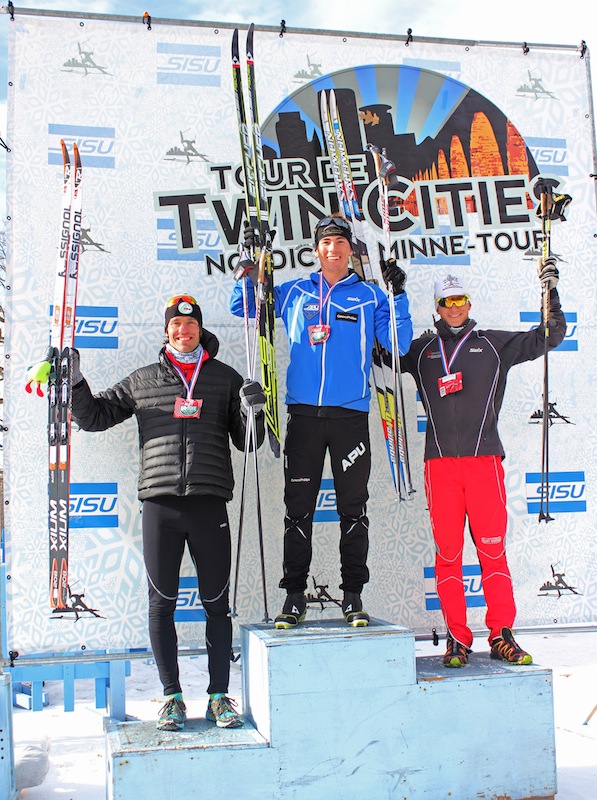
The men’s stage five podium. 1. Brian Gregg, 2. Mark Iverson, 3. Mike Sinnott. Photo: Reese Hanneman.
“It has been really exciting, and satisfying to feel I’m in the race everyday and be confident in my skiing,” Iverson said. “I wasn’t sure that I could catch up and make it a race today after loosing some time to Koos and Sinnott yesterday, but I was patient and just tried to ski my race.”
Gregg, after starting stage five 1:36 down to the leaders in sixth place overall, skied the fastest time of the day to move up to fourth in the final standings.
“I went in to the day planning on skiing my own race against the clock today,” Gregg said. “I started 1:36 off of the lead, but I wanted to have the fastest time of the day.”
He made up the difference between himself and Karl Nygren (CXC) and Brent Knight (APU) by 4 k, and together the three skiers made up some of the time on the leaders by the final lap.
Everyone became intimately familiar with the Wirth Park course by the end of the week, but Gregg is especially at home on it as he lives only a few minutes away. He thought the proximity to the race venue played a big part in his success on Sunday.
“It is a huge advantage to be at home during the middle of the ski season and to be so close to the race venue,” Gregg said. “I think that played a large role in our success on this fifth day of racing. Not too many people are lucky enough to have a 3.3 k snow-making loop within jogging distance of their house.”
Women’s 10 k Pursuit
Rosie Brennan (APU) maintaining her lead to take the overall Tour win. Photo: Reese Hanneman.
As in the men’s race, the women’s 10 k pursuit was a closely-fought race. Rosie Brennan (APU) began with a small lead on her competition —Jennie Bender (CXC) started 17 seconds behind her, Kate Fitzgerald (APU) left the line 13 seconds after that, and Caitlin Gregg started at 1:05. With such formidable skaters hunting her down, Brennan knew the overall Tour victory would take everything she had.
“I had the whole field chasing me which certainly added to the nerves this morning!” Brennan said. “I went out hard hoping [to] make catching me harder, however, after racing the previous two days, my legs did not feel good so I ended up really fighting the whole way.”
On the relatively short loop Brennan could see her competitors as the course wound around twists and turns, which alerted her to the fact that Gregg was having an incredible race.
“I could see my chasers frequently and was doing my best to judge time, but man, that’s hard to do and really only led me to panic more seeing who was coming for me,” Brennan said. “By the end of the second lap I realized Caitlin was crushing it and not slowing down, so I did my best to hold it together and push hard on the last lap.”
Brennan was able to hold Gregg at bay and win the overall, which she was plenty happy with.
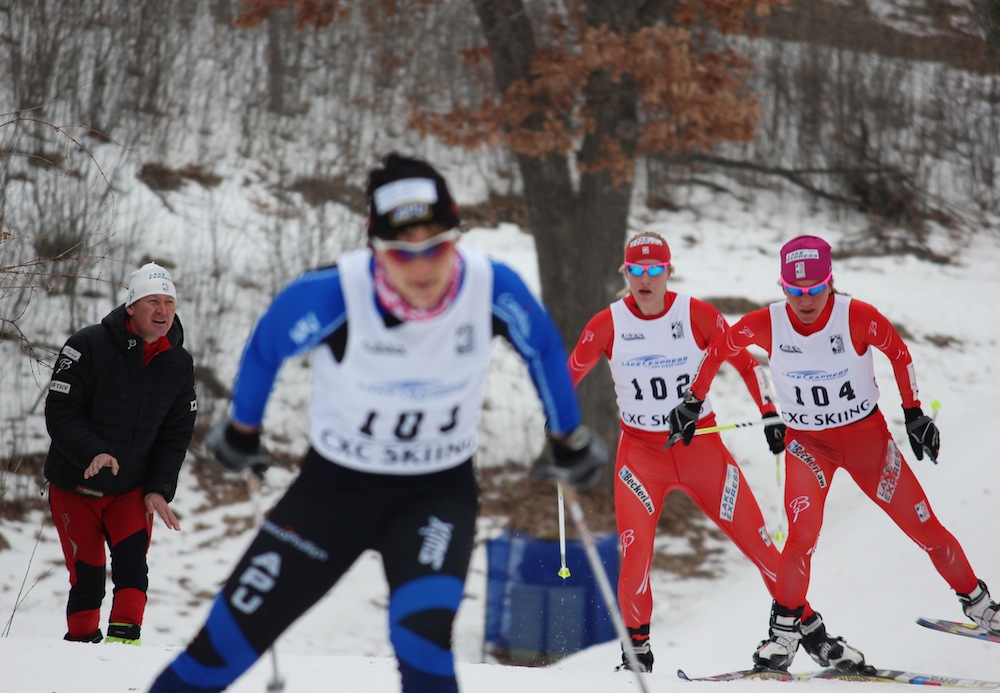
Caitlin Gregg (bib 104) gunning down Kate Fitzgerald (102). Photo: Reese Hanneman.
“It was really stressful and not much fun having to hammer out 10 k alone with a whole field chasing, so I am thankful to have been able to hold it together and stay tough,” she said.
“I don’t think there was anything I could have done to beat Caitlin on the day, though. She was just flying out there. I have always admired Caitlin’s incredible skating so I really can’t complain about taking second to her.”
Gregg ended posting the fastest time by 35.9 seconds. Taking a page out of Lindsay Vonn’s book, the 32-year-old decided right before the start to race on her husband’s winning skis from earlier that morning.
“He told me how fast they felt and I realized that with such a flat course I could probably get away with longer stiffer skis!” Gregg said. “So I tested them for a lap and confirmed I could ski them on the short steep climbs (without tripping) and went with them. The skis were actually Brian’s stiffest pair so he told me to ski like a big girl on them to make them work.”
With the goal of setting the day’s fastest course time, Gregg was pretty happy with how the choice turned out.
“I knew I had a lot of time to make up but I wanted to win the individual race, so I just went out gunning for a good time,” she said.
Brian and Caitlin have been racing together for years, but Sunday was the first time they both won the same race.
“I have always wanted to share the top step of the podium with Caitlin in a Super Tour and it was cool to have that happen,” Brian said.
Stage winners receive $450 for the win on top of the overall purse that goes six deep. Between the Greggs’ stage five victories, Caitlin’s second place finish overall and Brian’s fourth, the couple earned $2,700 on Sunday alone.
“Race winnings are the largest part of our income and it was great to have things come together today,” Brian said.
Kate Fitzgerald (APU), one of the most consistent skiers all week, finished third on the stage once again to take third in the Tour. She started just ahead of Gregg with full knowledge of the latter’s strength in skating, and sought to hold her off as long as she could.
“I know that she is a ridiculously strong skater, and sure enough she came storming past me and it was all I could to do hang on!” Fitzgerald said. “Caitlin, Jennie, and I were in a pack for a little while but then Caitlin’s speed started to break us up. She had an awesome race today.”
Bender finished fourth in the overall standings, Clare Egan (Craftsbury Green Racing Project) took fifth and Erika Flowers (SMS T2) was sixth.
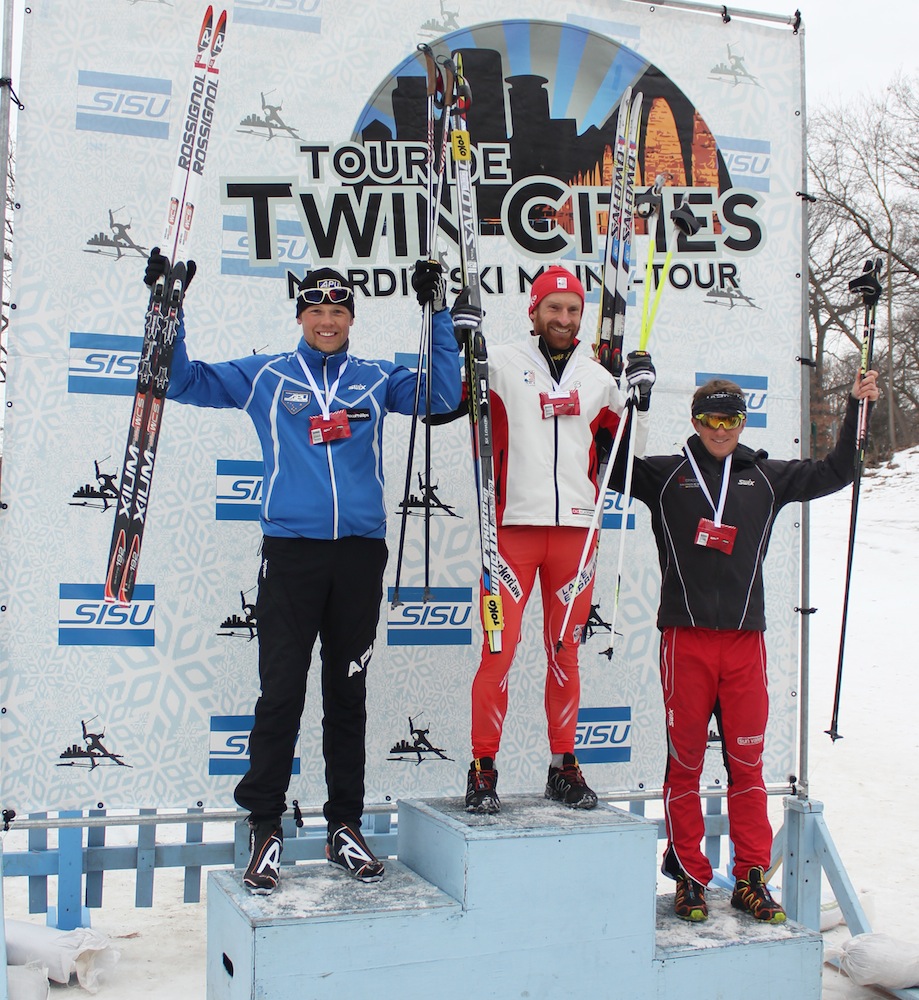
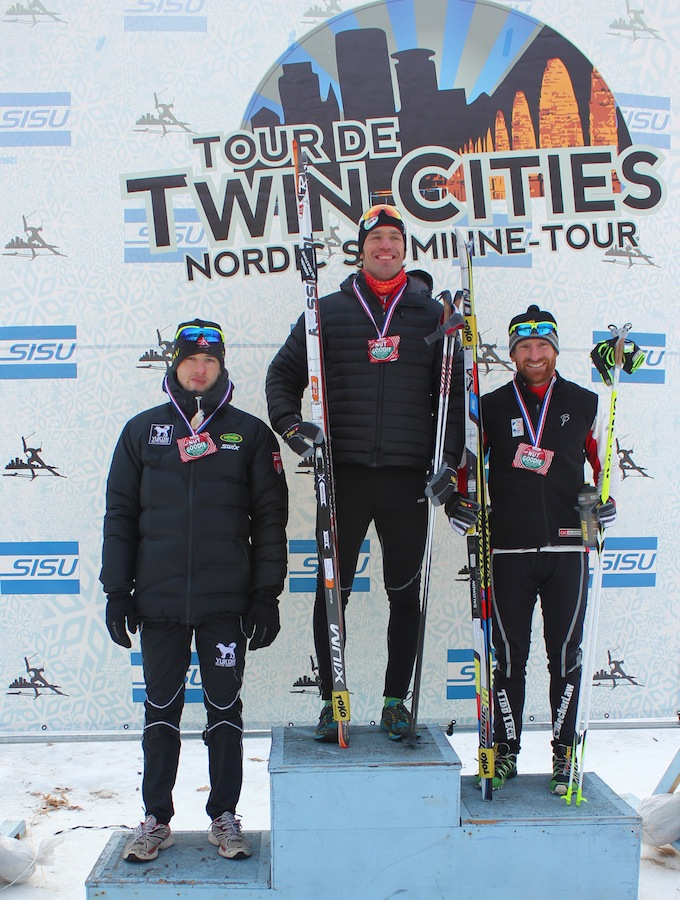
The men’s 10 k classic podium at the Tour de Twin Cities. 1. Reese Hanneman (APU) 2. Mike Sinnott (SVSEF) 3. Torin Koos (BSF/Rossignol). Photo: Brent Knight.
The winner of the 10 k classic stage of the Tour de Twin Cities in Minneapolis, Minnesota, on Saturday is a name you’ve probably heard of, but is not one usually associated with distance podiums. Reese Hanneman (Alaska Pacific University), surprising even himself a bit, won the individual start classic race at Wirth Park for his first career SuperTour distance win. He beat Mike Sinnott (Sun Valley Ski Education Founation) and Torin Koos (Bridger Ski Foundation/Rossignol) in second and third, respectively.
When a sprinter makes that kind of jump in a distance race it’s reasonable to expect him to make a big deal out of it, but Hanneman seemed relatively calm about the result.
“I wasn’t expecting to win, I just kind of thought if I had a good race I could get on the podium,” he said. “And obviously on a course like this, when it’s so tight, then if you have a little bit better of a race then you can win. So when I started hearing I was doing that well I really pushed it hard. I have the speed to win on courses like this.”
The course at Wirth Park was relatively flat, with short and quick uphills that worked to Hanneman’s strengths. A teammate, Brent Knight, started 15 seconds ahead of him on Saturday, which gave Hanneman an indication he was skiing well before he got his first split. Knowing the course favored skiers who could go “full throttle” for the whole thing, Hanneman sought to work the course from the get-go.
“I knew that suits me pretty well, I have the speed, and if there’s no five-minute climbs I can usually do OK,” he said. “I went out pretty fast and tried to ski relaxed and also just working everything; trying to ski really fast because there’s no really sections that you have to pace.”
When Hanneman heard a split that had him leading the race, it only spurred him to work a little harder.
“I was a little surprised but I knew it wasn’t impossible, so obviously that got me pretty fired up, and from there it was basically a 5 k sprint to the finish line. I knew I needed to finish real fast because I knew Torin for sure would be finishing the last couple kilometers insanely fast.”
With the help of fast skis and tracks that held up well for striding, Hanneman made it to the finish line a full thirteen seconds ahead of Koos, who took third, and five seconds ahead of Sinnott in second.
“The tracks were pretty good all the way around,” Hanneman said. “Even the tracks on the two steep hills — yesterday they weren’t there, but today they stayed so it was possible to stride, which was really nice. They did a good job of setting the tracks; up to this point they’d been a little bit questionable.”
Hanneman’s skiing drew admiration from his competitors.
“I was really psyched to see Reece move so fast, it’s nice to see such a classy guy pull out the win,” Sinnott said.
As for his own race, Sinnott was pretty happy. He gave everything he had, and that’s always his first takeaway from a race effort.
“I raced hard and don’t feel like i could have done much more,” he said. “That’s the bottom line of weather I’m happy or not, did I give it my best… My goals going in were to win, same as every race. A tertiary goal was to put time into Torin and Mark, which I did, but I would have liked to see more. You can always want more.”
Koos had a similar thought: happy with a podium, but always going for the win.
“The podium is always nice, but I wouldn’t have minded being a step or two higher… but all in all, a decent competition and good day at the races,” he said.
Women’s 5 k
The women’s race was an incredibly close contest. Rosie Brennan (APU) just nipped Jennie Bender (Central Cross Country) by 0.6 seconds after 5 k of racing against the clock. Kate Fitzgerald (APU) took third, 10.3 seconds back.
Brennan, who began her 5 k in search of some redemption from Friday’s sprint, was pleased with her second win of the Tour.
“I was very happy to win today, even if only by 0.6,” she said. “I was disappointed with the way I skied yesterday so I was looking to turn things around today.”
Brennan noted that the racing atmosphere has been more relaxed this week with SuperTour athletes scattered all over the world at this point in the season.
“With a small field it was difficult to tell how the race was going because all the seeds were mixed in and we don’t have any coaches here giving splits,” she said. “I did get one split with less than a k to go and I was told I had six seconds on Jennie, but after seeing what she did to me in the last k of the mass start, I was afraid six seconds wasn’t enough. But I didn’t want to make the same mistakes as last time.
“It was just barely enough.”
Bender, though disappointed to lose by such a small margin, was satisfied with her race.
“Ahh, so close!” she wrote in an email. “As much as I would have been super pumped to capture all three classic titles, I was happy with my race. Individual starts are always interesting. Upfront they are less intense because you’re on your own, but afterwards they are more stressful compared to mass starts, because there is less feedback until you see the results.”
On the rolling course at Wirth Park, Bender knew every meter would be critical.
“It is a fairly roll-y course, so seconds were gained and lost quite easily if you turned your brain off even for a moment. I started out sixth, and I got a split off of Kate Fitzgerald, but had no idea what was going on behind me. I had a fast first lap, and tried to keep the pace my second but probably slowed a little.”
Fitzgerald took third, 10.3 seconds off Brennan’s winning time.
The fifth and final stage of the Tour de Twin Cities, a freestyle pursuit, takes place at Wirth Park on Sunday.
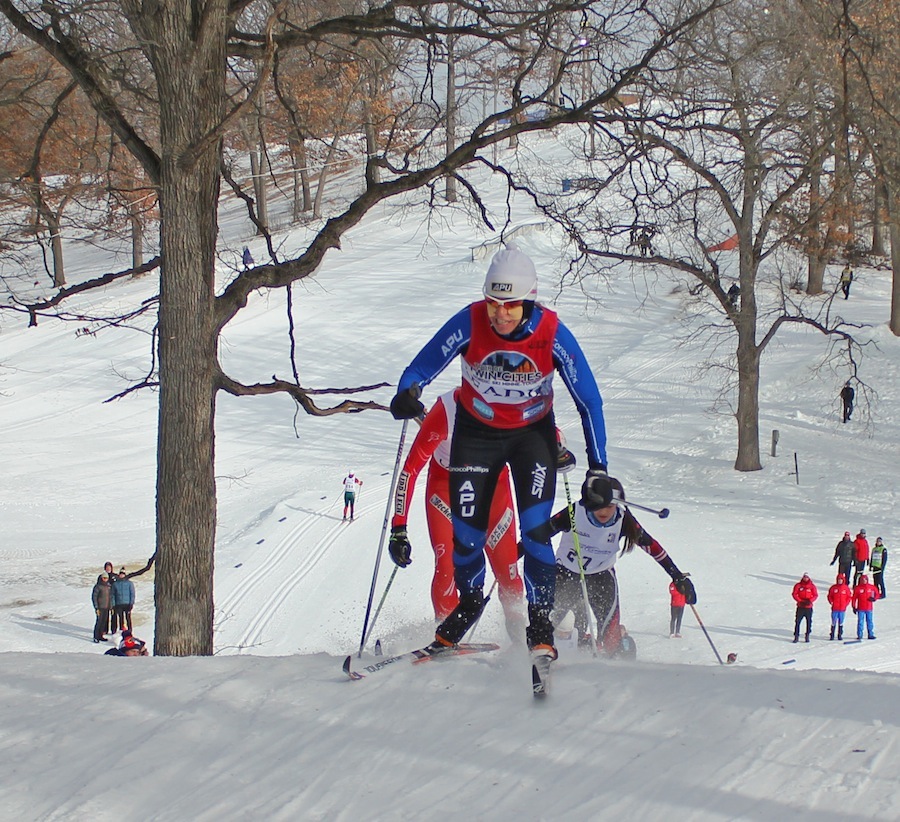
Rosie Brennan (APU) leading over the “wall” in Wirth Park during the 15 k classic mass start on day 2 of the Tour de Twin Cities on Sunday in Minneapolis. Brennan was second behind Jennie Bender (CXC), who won by 6.6 seconds. (Photo: Reese Hanneman/EngineRoomMedia.net)
With temperatures barely extending into the single digits Sunday, the second stage of the Tour de Twin Cities SuperTour circuit was already shaping up to be a tough one. Add to that the nature of classic mass starts – up to six times around a 3.3-kilometer track – and you’ve got quite a race.
Saturday’s 5 k freestyle winner, Rosie Brennan of Alaska Pacific University (APU) arrived to Wirth Park in Minneapolis on Sunday in time to check out the preceding men’s race on the second day of the Tour de Twin Cities.
“I went out to see how the boys were doing, only to witness many boys slipping on ice, falling, and many more yelling for poles causing me to panic a little for our own race,” Brennan wrote in an email. “It was really cold, fast, and icy in some parts.”
A little unsure of how to strategically approach five laps for the women’s 15 k classic, Brennan decided she’d set a high pace and hopefully wear others down.
“As a result, I probably led a fair amount,” she explained. “I had many laps to come up with a game plan after realizing I wouldn’t be able to just ski away from a pack on such a fast course. However, excitement and cheering got the best of me and I went for it on the last lap.”
Using some early hills to her advantage, Brennan built a small gap on the group. The final 1.5 kilometers, however, were flatter and “very twisty,” she wrote. “Both significant weaknesses of mine. I did all I could do to stay away, but Jennie [Bender] just ate me up on that stuff.”
Bender, the Central Cross Country (CXC) skier who skied in second for much of the race, wrote in an email that she found to stay with Brennan on the final lap.
“I thought she was gone, but due to sitting in 2nd my adrenaline kicked in, and I kept hammering,” Bender wrote. “Suddenly I was behind her, and was able to shift into high gear for the last hill.”
Bender nabbed the distance victory, her first on the SuperTour circuit this season, by 6.6 seconds over Brennan in 46.09.9. APU swept second through fourth with Kate Fitzgerald making the podium 8.1 seconds back from first and Becca Rorabaugh placing fourth (+18.4). Caitlin Gregg (CXC) was fifth after crashing just before the last lap when she, Fitzgerald and Rorabaugh tried to pass group of lapped skiers.
“On the big wall before the last lap started we ran into some skiers we were lapping and got tangled,” Gregg explained.
“At that point Caitlin was right in front of me and she fell and I had to stop because I was pinned against the side of the trail,” Fitzgerald wrote.
While those three tried to recover, Brennan started to go for it.
“I gunned it to try and catch back up to Rosie and Jennie,” Gregg continued. “I could see them playing cat and mouse up ahead and thought maybe I could catch them. … Kate, Becca and I tried to reel them in but couldn’t.”
After starting near the front, Bender was happy to stay out of trouble and ski a tactically smart race.
“Every race, I hope I will feel better than the last, and lately that hasn’t been hard since all my distance races thus far have sucked pretty bad,” she wrote. “There were definitely a few moments in the race, where I looked around and felt good that I could add to team red (CXC) once again. It’s a team of 3 this year, but having two in the top five is great. The APU girls are a force to be reckoned with, that’s for sure.”
Brennan took her hat off to Bender, but felt there were some areas she could improve.
“She skied that last section beautifully and overtook me with lots of momentum leaving me in the dust into the finish,” Brennan wrote. “I am happy with the result, but frustrated with my own weaknesses and certainly have made a list of things to keep working on.”
“It was definitely a fun race with some very fast conditions,” Fitzgerald added.
Men’s race
Torin Koos (c) atop the podium in the Tour de Twin Cities 20 k classic mass start on Sunday in Wirth Park, Minneapolis. Brian Gregg (r) was second and Canadian David Greer placed third. (Photo: Reese Hanneman/EngineRoomMedia.net)
In the men’s race, Torin Koos (Bridger Ski Foundation/Rossignol) foreshadowed his own victory – stating Saturday: “I just didn’t have that edge that I been needed to win. It wouldn’t be surprising, though, if today’s effort gives me that little bit I was missing for tomorrow.”
The runner-up in the 10 k freestyle, Koos went on to win Sunday’s 20 k classic mass start by 1.9 seconds over Brian Gregg (CXC) in 47:53.0.
“Today was a cold and icy one, though not as cold as I had prepared for,” Koos wrote. “The biggest name in the game today was staying out of trouble like crashes and broken poles, with so many turns. I raced much more at the front for this reason. Most all of the race I felt so very much in control aerobically.”
A Twin Cities native, Koos explained that he secured the win – his first this SuperTour season – by opening a small gap up “inner-tube hill” on the last lap and holding it to the finish.
“With such high speed snow, I felt skiing in the pack was much easier, though a riskier option,” he wrote. “The cheering section was out there in force again today. The cold weather was nothing for them!”
Gregg was glad to be back on the SuperTour podium for the first time this year. Living with his wife Caitlin just a few blocks away from Wirth Park, Gregg wrote it was great to be able to perform for so many supporters and friends.
“The home course advantage is pretty nice too,” he added. “I have logged many km on the 3.3k loop. It is pretty cool to train in the afternoons with about 300 other skiers. I think training with all the high school skiers last week was helpful in feeling comfortable in the big pack today.”
On the last lap, Dylan McGuffin (Craftsbury Green Racing Project) started to push the pace up front while Koos chased him down, Gregg explained. At the top of the hill, Koos was about 15 meters ahead of Mike Sinnott (Sun Valley Ski Education Foundation). Sinnott was about 15 meters ahead of his teammate, Matt Gelso, Gregg and Canadian David Greer (Yukon Elite Squad).
“About 500m from the finish Mikey went down on an icy corner,” Gregg wrote. “He had a gap and it is always a bummer to pass some one simple because they fell.”
Gregg, Greer, Gelso and Mark Iverson (Saturday’s winner from APU) passed by, and Sinnott ended up sixth (+8.3). Greer was third, 2.4 seconds back from Koos, Gelso was fourth (+5.3) and Iverson was fifth (+6.4).
Greer, who made the long trip down from the Yukon Territory with teammates Knute Johnsgaard and John Parry with some time to kill between NorAm races in Thunder Bay and Duntroon, Ontario, met his goal of the podium after being sick last week. After feeling like he was missing his top gear in Saturday’s race, he decided to go for it on Sunday.
Greer was around 12th when Koos attacked the last kilometer. He followed, picking off the places and moving to fifth and then third by the top of the last hill.
“I usually have a decent sprint finish, but unfortunately I wasn’t able to do anything today because the finish stretch was very short, no time to pass,” he wrote.
“It felt more like a criterium than a ski race. You needed to be really aggressive to stay near the front,” Greer explained. “I consider myself lucky not to have fallen or been taken out because racers were falling right, left and centre throughout the entire race! It was very chaotic.”
With temperatures forecast to remain below zero on Monday, it was unclear whether the third stage of the Tour, the classic sprints, would take place as scheduled.
Note: This article has been updated to include comments from Caitlin Gregg.
The U.S. SuperTour is back underway after a short post-Nationals break, picking up with the Tour de Twin Cities.
Rosie Brennan and Mark Iverson gave APU a sweep of the 5/10k freestyle event drawing first blood in the five-stage Tour.
Brennan, coming of strong performances at U.S. Nationals, skied to a 14.1 second victory over Erika Flowers (SMST2). Caitlin Gregg (CXC) was third, another 0.8 seconds back in the individual start event.
Despite limited natural snow, organizers were able to assemble a 5 k loop, extending a 3.3 k circuit made primarily of artificial snow.
Brennan told FasterSkier that the course was “quite dirty and very sugary,” but was still impressive given there is no other skiing in the Twin Cities.
She started hard in a race that took just over twelve minutes.
“I got sick during Nationals so I hadn’t done much training coming into these races so I wasn’t sure if I would be able to get the engine revving high enough for my first 5km and sea level race this season,” Brennan said.
With no coaches on course, and starting first in the A seed, she had no splits. Her only benchmark was the rough measuring stick of staying clear of later starters.
Flowers wasn’t getting splits either, and just focused on hunting Kate Fitzgerald (APU) and Brennan who started in the two spots ahead.
“I was just trying to ski hard and catch them the whole time,” she told FasterSkier.
Like Brennan she was impressed by the conditions given the rain of the previous weekend, and described the course as “really fun and fast with lots of turns, transitions, and quick ups and downs.”
Fitzgerald ended up in fourth just over eight seconds in back of Gregg. Clare Egan (CGRP) rounded out the top-five, 2.8 seconds behind Fitzgerald.
“I was super happy about my race today,” Gregg wrote in an email. “I skied as hard as I could. 5K Skate races are incredibly painful and I left everything out on the course. I finished the race and thought that I had finally won a race this season, when the results came out and I saw that I was third my first reaction was, Oh man these girls (Rosie and Erika) are fast!”
Iverson Strong and Steady for the Win
In the men’s 10k Iverson outpaced Torin Koos (BSF) by just 9.3 seconds.
Teammate Brenton Knight was third, +17.1 seconds.
Iverson started toward the back of the A seed, and when he passed Gordon Vermeer and heard that Vermeer was just ten seconds off the lead, he knew he was battling at the top.
“I just went out relaxed and tried to ski strong,” Iverson wrote to FasterSkier in an email. “I didn’t really surge anywhere, I just skied a steady pace and then tried to keep pushing through to the finish.”
Heading into the big climb the last time, Iverson got another split — he was five seconds down on the lead.
He finished strong, good enough for a clear victory.
“My hat goes off to Mark, I heard he really pinned it at the end, pickpocketing the victory from me,” Koos wrote to FasterSkier in an email.
“Today, I just didn’t have that edge that I been needed to win,” he continued. “It wouldn’t be surprising, though, if today’s effort gives me that little bit I was missing for tomorrow.”
The victory was Iverson’s first on the SuperTour and spoiled somewhat of a homecoming for Koos.
The three-time Olympian was born in Minneapolis and has been told he first strapped on skis in the city’s well known Theodore Wirth park.
“I have always wanted to race in the Twin Cities, and now I finally get my chance,” said Koos who had various aunts and uncles on course supporting him.
Iverson raced a 20k NCAA collegiate race last weekend, placing second in a sprint finish, giving him confidence as he bounced back from illness that caused him to sit out the 30k at Nationals.
“Yesterday I felt really comfortable in race prep so I thought I could be in there for a top 5 today,” Iverson said.
Men’s Podium – Knight, Iverson, Koos (l-r) (Photo: Lauren Fritz)
After rough first part of the season, marred by illness, Knight was “stoked” with his performance.
“This is a big turnaround from early in the season for me. I never like getting beat by my best friend and training partner Mark in a distance race, but I’m so proud of his result today. We’ve been training together a long time and I’m pumped to share a podium with him today,” Knight told FasterSkier.
Like many of the skiers, Knight did not get any splits, instead “using the bends and curves to gauge the distance of the skiers starting behind.”
Knight raced last weekend in a collegiate race in Colorado, and “felt strong for the first time this season felt strong for the first time this season.”
After the rough start to the year, Knight said his goal was “first and foremost to have fun. It’s easy to stress out about results when the results early in the season are not complimenting the hard training done during the summer and fall.”
The 28-year-old held off Matt Leibsch by five seconds to hold the final podium spot.
“We always want to win, but sometimes if the race strategy is just to go out and ski smooth and strong, the results will follow,” Knight said.
Racing continues on Sunday with a 15/20k mass start classic race, followed by a classic sprint on Monday.
After a four-day break, the Tour wraps up the following weekend with yet another classic event, a 5/10k individual start this time.
The final day features a 10/15k freestyle pursuit for the overall.
Iverson is looking forward to the mass start, entering the race as the Tour leader.
“Classic is typically my stronger distance discipline and I can have faith in my fitness after today. It’s going to be fun,” Iverson said.
The men are scheduled to ski six 3.3k loops, and the women five laps.
Temperatures are expected to plummet overnight, and frigid conditions are expected for the next two days of racing.
“I am really excited to start the Tour out on a high note,” Brennan said. “It’s always good to carry confidence through a long race series.”
And Knight will be looking to take revenge on his teammate Iverson.
“I’ll just have to take him in the sprint here in a couple of days to beat him on his stronger event typically. Keep it even you know!” Knight said.
Alaska Pacific University and U.S. Ski Team member Sadie Bjornsen celebrates her first national title on Sunday in the 20 k classic mass start at Soldier Hollow in Midway, Utah. (Photo: Sarah Brunson/U.S. Ski Team)
FasterSkier’s coverage of the 2013 US Cross Country Championships is brought to you through the generous support of The Memory Clinic in Bennington, Vt.
MIDWAY, Utah – Just like the feeling one gets when cranking the handle on a jack-in-the-box, the women’s 20-kilometer classic mass start at the U.S. Cross Country Championships had the imminent feeling that any one of the six frontrunners was going to pop.
But who would it be, when would they go, and how hard would they push?
While Sunday’s main contenders are probably too young to understand the toy reference – all below the age of 25 – they probably shared a similar sense of anticipation.
Skiing together for the duration of the four-lap race at Soldier Hollow and breaking away from more than 70 others on the first lap, each of the leaders periodically sized one another up while ticking off the loops and buying time before the final showdown.
Somewhere along the fourth lap would most likely be the turning point, but who was going to put up the biggest challenge?
Would it be Chelsea Holmes of the Sun Valley Ski Education Foundation, the established climber, who led much of the race? What about Sophie Caldwell (Stratton Mountain School T2 Team), who sat out the preceding 10 k freestyle race in preparation for this? Then there was Caitlin Patterson (Craftsbury Green Racing Project), a quiet but consistent threat, and of course the Alaska Pacific University (APU) women – Sadie Bjornsen, Rosie Brennan and Kate Fitzgerald – contenders for a podium in any race.
Chelsea Holmes (SVSEF) leads a pack of six women up Hermod’s in the 20 k classic mass start at U.S. Cross Country Championships on Sunday at Soldier Hollow in Midway, Utah. Sadie Bjornsen of APU/USST (second from r) won and Holmes finished sixth.
Spectators flocked to Hermod’s Hill, the infamous multi-tiered climb featured in the 2002 Winter Olympics. That’s where it had to happen on the final lap; someone was going to make a move.
Bjornsen, also on the U.S. Ski Team, spared them the guesswork. She attacked on an earlier hill – the high point of the sprint course – before the long descent leading into Hermod’s for the last time. A runner-up in the two preceding races at the U.S. nationals, Bjornsen wasn’t going to let it happen again. She and the others had responded to Fitzgerald’s move earlier in the lap on one of the straightaways up top, and now it was her turn.
“I was not gonna get second again today,” the 23-year-old Bjornsen said. “The mistakes I made before was I wasn’t fully committing to really going for it, and today when I surged there, I was telling myself in my head, ‘Sadie you gotta commit, you gotta go a hundred percent.’ ”
She was especially trying to shake Caldwell directly behind her.
“When I looked behind me and it was Sophie, I tried to surge on the top of the sprint hill just to lose her sprinting legs a little bit,” Bjornsen said. “When I was coming down the hill, I saw she was still with me so I just gunned it as hard as I could to the finish and that was that.”
Bjornsen won by nearly 13 seconds in 1:05:39.2 for her second national title since dominating the 10 k classic at U.S. nationals two years ago. Fitzgerald was second (+12.9) after reigning in Caldwell on the last climb, tucking behind her on the backside descent and outsprinting her to the finish. Caldwell placed third (+14.1), Brennan took fourth (+20.4), Patterson was fifth (+24.8) and Holmes finished sixth (+36.5) in the front group.
An early leader, Becca Rorabaugh (APU) came through in ninth after falling off the pace after the first lap. She finished about 35 seconds behind Rose Kemp of the University of Utah in seventh (+3:00.6) and Annie Pokorny of Middlebury College in eighth (+3:05.4).
APU teammates Sadie Bjornsen (r) and Kate Fitzgerald congratulate each other after placing first and second, respectively, in Sunday’s 20 k classic mass start at U.S. nationals.
However, the main stories of the day were APU’s Bjornsen and Fitzgerald, who both notched career bests. Bjornsen had never raced a 20 k before yet made a point to win it. Fitzgerald had achieved two bronzes at nationals, but coming off a shoulder injury this summer, she wanted to prove she could achieve more.
Bjornsen said she had been looking forward to this race all week, seeing how classic was her favorite. Generally considered a sprinter, she wanted to erase that.
“There’s a distance skier in all of us,” Bjornsen said. “No sprint specialists.”
To succeed in her desire to win, she enlisted the motivation of her teammates overseas. Sunday morning, APU’s Kikkan Randall and Holly Brooks finished 12th and 38th in the Tour de Ski. Another USST member, Liz Stephen posted the second-fastest time up the 9 k Alpe Cermis and landed 15th overall. Rookie Jessie Diggins (SMS/USST) pulled off 21st in the final standings.
“I talked to all the girls over in Europe this morning and I was like, ‘You guys are so tough today, all I’m gonna think about today is you guys, and when I’m struggling, I’ll think about how you guys went seven days in a row,’ ” Bjornsen said. “I just kept thinking about that. There’s always more when you imagine that.”
Thinking about her teammates racing up Italy’s grueling mountain made accelerating up Hermod’s for the last time slightly easier. Meanwhile, Caldwell couldn’t hold on. After attempting to stay with Bjornsen for the final kilometer after her attack, Caldwell lost ground on the major climb.
“I had really good skis, good kick, so I was hoping people would hold the attack for as long as possible, like wait until the last hill,” Caldwell said. “[That] more or less happened, but I got pretty tired going over the top.”
When Fitzgerald passed her at the bottom of the long downhill, Caldwell knew what was in store: “a double-pole showdown,” she said. Unfortunately, Caldwell was out of gas, but still happy with her first podium in a U.S. nationals distance race.
Stratton Mountain’s Sophie Caldwell (l) chases Kate Fitzgerald (APU) into the finish of the 20 k classic mass start at U.S. nationals. Fitzgerald out-double-poled her for second, and Caldwell was third for career bests for both women.
And despite contending with three APU women, which in many ways worked together, Caldwell wasn’t intimidated.
“I’ve been on a team with Rosie before; I’ve been to World Juniors with Sadie before so we’re all sort of on the same team when it comes down to it,” Caldwell said. “I don’t think they’re plotting against me or anything. It’s fun to ski with friends.”
Bjornsen said there was a bit of joking going on throughout the hour-long race.
“The coaches kept asking, ‘Do you want GU or do you want gel?’ and I was, like, just saying the opposite of Chelsea every time,” she recalled. “And Fitz was tripping over herself and we were making jokes, and then at one point I could see Rosie was pissed off, she kept getting stuck [behind] people and she just takes off and I looked at my other teammates and was like, ‘Uh oh, here she goes.’
“We all know each other’s strengths and we all know how to wreck each other if we wanted to, but we were all sort of working together,” she added. “If Rosie took off, I took off with her and it was the same with Fitz. It’s so fun to have a team, it’s just like another interval day.”
Like most of the other top finishers, Fitzgerald described the race as fun, but said it was a little stressful at times.
“It’s funny with these long races, there are times when you’re just like ‘Oh my gosh, I can barely hang on,’ ” she said. “And then sometimes you’re like, ‘Oh I feel good, all right, I’m just gonna go.’ You can never give up. You can’t count yourself out. It’s definitely cool and having so many teammates around, too, to remind you, like, OK, I can do this.”
The second-place finish was about as good as gold for Fitzgerald, who separated her shoulder in a mountain-bike accident in June. She couldn’t do much of anything for a couple weeks, and according to APU head coach Erik Flora, she trained with one pole until October. Before that, Fitzgerald missed the second half of last season while sick with a virus.
“I feel like it wasn’t a huge detriment, but I feel like I definitely have less upper-body strength this season,” Fitzgerald said of the shoulder injury. “I had a lot of help from my coaches to train around the injury kind-of-thing, so yeah, it was a bummer but I just tried my best to train as best as I could.”
“To be able to be so strong today in the double poling, it’s tremendous,” Flora said of Fitzgerald. “We know she’s really strong and a good racer, but coming off an injury like that, it’s just great to see her back on form.”
Flora had been among the excited spectators running up Hermod’s to get in good cheering position on the women’s last lap. With three of his athletes in the mix, he knew anything could happen.
“The girls train in a group so much that they know how to ski in a pack,” he said. “You could see how relaxed they were, and they were just kind of floating around and they were making good moves.”
As for Bjornsen’s victory, which mimicked that of her younger brother, Erik, who won Friday’s 15 k freestyle and was second in Sunday’s 30 k, Flora said both were exceptional.
“When they first came to us, one of our goals was the distance races and now within a couple years they’re both medalists at nationals in distance racing,” he added. “So I would say that goal’s been met and they’re just getting stronger every day.”
All living together in Anchorage, the Bjornsen siblings and Brennan resolved to become better skaters this summer, Sadie said. “We all proved it to ourselves,” she added.
Brennan won Friday’s 10 k freestyle for her first national title and on Sunday, was slightly disappointed with fourth.
“I wish that I had a little more to get on the podium, but I really can’t be upset with that; it was a good race,” Brennan said. “I actually wasn’t even sure I was gonna start so I’m glad I did.”
Feeling like she was coming down with a cold, Brennan waited until this morning to make a call on whether to race. She decided to give it a go, but felt she might have been missing her top gear. Regardless, she found herself pushing the group early.
“The pace was really relaxed for the first two laps and then on the third lap we turned it up a bit to kind of see where people were at,” Brennan said. “No one was really faltering at all. That’s when I realized that it was gonna be really a battle. I tried to go into relaxed mode without letting any moves go by. It got pretty tough at the end. Everyone was giving a little push at one point or another.”
A two-time fifth place finisher at nationals this year, Patterson said she was simply impressed with the group and satisfied she could hang on.
“The main thought that was coming to my mind when I was out there was, ‘This is one tenacious group of skiers,’ ” Patterson said. “No one was falling off. Everyone was kind of shuffling around, leading here and there and it was pretty intense. … I think I’ve got to be happy with how close I was to them at the finish and just overall.”
For Holmes, who was fifth at U.S. Distance Nationals last year in the 30 k skate race, her sixth-place finish in the classic race was a personal best and an affirmation that she was headed in the right direction.
Despite leading the group for much of the second and third laps, Holmes said she fell off the back on the flat section with one kilometer to go.
“I just couldn’t stay on and it was a little bit gone,” she said.
After starting out the season with three SuperTour podiums, including a skate sprint victory, in Bozeman and West Yellowstone, Mont., Holmes said she struggled to find her form.
“Something went downhill somewhere,” she said. “You always want to feel good. I haven’t, so I said, today I’m just gonna go ski. … Those girls are super strong so stick with them, pull when I could and see where it went.
“Honestly, I’m happier than I have been in a few weeks,” she added. “So that’s good.”
Women’s 20 k classic podium at U.S. Cross Country Championships in Soldier Hollow on Sunday. 1. Sadie Bjornsen (APU/USST), 2. Kate Fitzgerald (APU), 3. Sophie Caldwell (SMST2)
APU teammates Sadie Bjornsen (r) and Kate Fitzgerald congratulate each other after placing first and second, respectively, in Sunday’s 20 k classic mass start at U.S. nationals.
Stratton Mountain’s Sophie Caldwell (l) chases Kate Fitzgerald (APU) into the finish for what Caldwell called a “double-pole showdown” in the 20 k classic mass start at U.S. nationals. Fitzgerald had the edge for second, and Caldwell was third for career bests for both women.
Alaska Pacific University and U.S. Ski Team member Sadie Bjornsen celebrates her second national title on Sunday in the 20 k classic mass start at Soldier Hollow in Midway, Utah. (Photo: Sarah Brunson/U.S. Ski Team)
Bjornsen bringing it home into finish of the 20 k classic mass start at U.S. nationals on Sunday at Soldier Hollow.
Caitlin Patterson and Chelsea Holmes (in back) chase Sadie Bjornsen, Sophie Caldwell, Kate Fitzgerald and Rosie Brennan (not shown) at the start of the last time up Hermod’s Hill in Sunday’s 20 k classic mass start at U.S. nationals.
Sadie Bjornsen working within the group (not shown) on her third of four times up Hermod’s Hill.
Stratton Mountain School T2 Team skier Sophie Caldwell (l) and Sadie Bjornsen (APU/USST) race head-to-head in the 20 k classic mass start at U.S. nationals on Sunday in Soldier Hollow. (Photo: Sarah Brunson/U.S. Ski Team)
Sadie Bjornsen leading the front pack
Chelsea Holmes (SVSEF) leads a pack of six women up Hermod’s in the 20 k classic mass start at U.S. Cross Country Championships on Sunday at Soldier Hollow in Midway, Utah. Sadie Bjornsen of APU/USST (second from r) won and Holmes finished sixth.
Torin Koos with his 2nd Win of the Week (Toko wax, tools, and gloves)
Last night it was just a bit overcast which kept things from getting as clear and cold as it has been recently, but it was still 4f at the venue 2 hours before the start, so the snow was still cold. Although the conditions were slightly different (no hoarfrost that needed to be skied in for example), our wax tests (both kick and glide) showed that the same products that had been performing the past two days continued to. The snow was quite abrasive and a 30k classic race including climbing up Hermod’s Hill 6 times meant that maintaining kick was critical. Green klister covered by Base Green binder offered the best kick and the best glide and was clearly the most durable as well. Yesterday we did a durability test on this combination and after 20k, it showed only a slight bit of wear on the heel only. The way we applied it was to iron the Green klister and put it outside to freeze well. This improves adhesion and makes it easier to apply the next layer which was Base Green binder. After applying the Base Green, iron the Base Green into the klister creating a mix of the two that has more klister on the bottom and more binder on top. Then create a smooth finish with the iron and let it cool again. Some coaches were covering this lightly in an effort to speed it up.
For glide we went with HF Blue covered by JetStream Blue. We applied the JetStream Blue by ironing in the powder fairly quickly (150C and 10 seconds from tip to tail which heats the powder, but doesn’t leave the ski base black behind it. If black, it’ll be slower in the cold powdery snow). Then we did a speed layer of JetStream Blue corked on top. For the women, it was the same except a HF Blue/Red mix and JetStream Blue/Red mix (and for the rest of the day). The kick recommendation also held up all day – for those who need more kick, have the Base Green application slightly thicker.
Feedback from coaches was very positive and it was a great day.
Rosie Brennan (APU) and Annie Pokorney (Middlebury) climbing during the women’s 10 k freestyle on Friday at Soldier Hollow. Brennan won the race and Pokorney took fourth. Photo: Bert Boyer.
FasterSkier’s coverage of the 2013 US Cross County Championships is brought to you through the generous support of The Memory Clinic, Bennington, Vt.
MIDWAY, Utah — Can’t get enough of the action at U.S. Nationals? Here are some bits and pieces from top performers on Friday that didn’t make the original race reports.
On setting new goals:
“I have some goals. I definitely want to get a podium this week; I’ve never podiumed at Nationals before. It’s exciting. A couple of years ago I was feeling like more of a sprinter, but this year I’m pretty excitied for all four races. It’s hard to say, I don’t think there’s one race I’m more excited for.
“I mean, and I was just thinkng about this, it’s interesting — I’m maybe in a position to be on the podium and I’ve been more consistent this year, but I don’t think much has changed. I guess I just trained harder, got more experince and the results seem to keep improving, which is good. I don’t feel like there’s been some radical change. The training plan has been working an the experience definitely helps.”
— Erik Bjornsen (APU/USST), 1st, the Tuesday before U.S. Nationals began.
“I’ve been rollerskiing the paved tracks here in the summer, doing intervals with Tad [Elliott] up Hermod’s. It helps, but I’ve been skiing quite a bit of altitude this season and that helps as well.
“The last couple seasons everybody’s been like, ‘You’re a classic specialist,’ kind of thing. My goal this year was, after sking all those OPA cups and watching what those Europeans were doing with their V2, I was just going to work on that all summer. So this summer I just did a ton of V2ing up the hillsides in Anchorage, a bunch of trying to feel that rhythm, and it kinda clicked near the end of the off-season. Up on the glacier things were starting to feel really good. So I was exciting for my skating this season.”
— Bjornsen, after winning the 10 k skate.
On the power of a strong team:
“I think the number one thing is team. I started as the head coach here six years ago or so. And that was the first thing I thought … as an athlete I was always searching for a strong team.
“It’s incredible. Yesterday everybody was just in a good, light mood. Some people had great races in the classic sprint, others had rough days, and everyone just kind of make sure that everyone was taken care of. It’s something I think is maybe the most important thing.”
— Erik Flora, Alaska Pacific University head coach
On the conditions:
“It was really cold; I cant feel my toes right now. But it wasn’t too bad. The sun is so warm here and most of the course was in the sun so it was OK. You’re working so hard the whole time and there weren’t too many downhills to get too cold. Yeah, [the snow] was pretty slow, but not too bad though.”
— Rosie Brennan (APU), 1st
“In Alaska the snow is cold, where here it’s manmade snow so it’s not so slow and your skis still move. But we also don’t ski in the cold because I’m never in Alaska in the winter. I mean, I leave in November and don’t come back ‘til April, so I don’t experience the cold, fortunately. But this snow, I mean the snow’s great because a lot of it’s manmade so you can still move pretty well on your skis. Fairbanks is challenging; you think of that when you think of cold. There it’s like ‘squeak, squeak, squeak’ and like, you’re hardly moving.”
— Sadie Bjornsen (APU/USST), 2nd
“It’s a really rough, really hard course. It’s obviously fast, but it doesn’t feel really greasy. It was interesting. Our wax techs did a good job — I don’t think skis were the issue, I think Bjornsen killing it was the issue.”
— Tad Elliott (SSCV Team HomeGrown/USST), 2nd
“The snow was a little bit funny with a mix of manmade and natural snow, and that has a little bit different texture from place to place. And it’s certainly a hard course, a lot of rolling hills and then really quick downhills that don’t allow you a lot of recovery.”
— Caitlin Patterson (CGRP), 5th
“It felt worse warming up. It’s one of those courses where you warm up and you’re doing your level 3 and you’re like, ‘Oh man this is gonna be really tough, and then it’s not that bad. Once you get on step and you’re racing there’s more glide than you’d think.”
— Becca Rorabaugh (APU), 6th
On pacing:
“I think it skied smoother than I thought it was gonna be. If you really worked it good along the top of the course it wasn’t as hard as I thought it was gonna be; you could ski big and kind of relax. My body was there so I could go out hard and not blow up. That was probably the biggest thing; my body was in good enough shape that even if I thought I went a little hard it didn’t matter because my body could respond to it.”
— Matt Gelso (SVSEF), 3rd
“I was just trying to ski as hard as I can, as big as I could. I know this course had a lot of strong V2, and I was trying to focus on really getting as much power into the V2 as I could even up the gradual hills and things.”
— Kate Fitzgerald (APU), 3rd
“I tried not to think about the result, it was more: take it easy out of the start and just stack it up through the entire race. Rosie caught me on the first hill, and in that second it was like, ‘All right, here we go! I’m gonna try to stick with her as long as I can.’ And I think it really helped and she really helped me through. Getting to start between two World Cup starters was pretty awesome, between Becca [Rorabaugh] and Rosie, so I was in a good place this morning and excited and it worked out.”
— Annie Pokorney (Middlebury), 4th
“I think it was a fairly good pace [the first lap], then on the second lap certainly some of the people who were starting out started really quickly. I hope they managed to make it through because they were going quite fast, but I think I felt like I wish I could’ve been a little stronger on the second lap.”
— Patterson
“I tried to hang onto Tad as long as I could knowing he was skiing relally well. It was a nice train going, it was fun, it was fast — just really hard. I’m pretty happy with the start to the season. I’m racing into it, I don’t usually race this well this early, so I’m kind of taking it as it comes. Dylan and I actually tied which is pretty sweet, it’s fun to have the green teamers up there, and it’s fitting that we tied since we train together all year.”
— Bryan Cook (CGRP), 7th
On new training methods:
“I think my training is definitely focused a lot more on distance side of things; a bit more on skiing a little bit faster in my distance workouts, maybe not as hard of intervals. I think that’s good in the longer races, I feel I’m more relaxed.”
— Brian Gregg (CXC), 4th
On skiing a course other than the Olympic 5 k:
“I’ve raced a lot here but almost all of it’s been on the Olympic 5 k, not this course… It’s definitely is not a bad course, it’s just a different course. Which is kind of nice, to ski something different once in a while. Skiing in the western college circuit you pretty much ski here every year.”
– Gelso
“Some people complained about it not being the Olypmic 5 k. I think it was still a hard course because there was lot of V2, which can be tough. If you’re tired you can really burn up quickly on V2.”
— Patrick Johnson (SVSEF), 5th
On finally putting the old Rudys away:
“I decided maybe I had to retire them after about 10 years.”
APU’s Kate Fitzgerald and Erika Flowers of the SMS T2 Team (behind) about halfway up Hermod’s on the last lap. Fitzgerald placed third and Flowers was eighth.
FasterSkier’s coverage of the 2013 U.S. Cross Country Championships is brought to you through the generous support ofThe Memory Clinic in Bennington, Vt.
MIDWAY, Utah — Friday’s 10- and 15-kilometer freestyle races at Soldier Hollow were hardly a walk in the park. Racers had to tackle a modified 5 kilometer course, a slight variation of the 2002 Olympic 5 k that some thought was harder. Women went around twice, and the mental game was intensified by the individual start with skiers staggered at 15 seconds rather than 30. It made for a lot of chasing, some tricky passing situations and a lot of gritty racing. Take a look at some of the top women.
The first starters in the 2013 U.S. Cross Country Championships women’s 10 k individual start prepare for the two-lap pain game.
Sadie Bjornsen (APU/USST) among the early starters in Friday’s 10 k freestyle individual start at U.S. nationals at Soldier Hollow.
Annie Pokorny (Middlebury) out of the start. She went on to place fourth.
Rosie Brennan (APU) out of the start.
Caitlin Gregg (CXC) starting out. She finished 10th.
Eliska Hajkova (University of Colorado) out of the start. She went on to place ninth.
Caitlin Patterson (CGRP) starts out. She ended up fifth for a personal-best at nationals.
Erika Flowers (SMST2) takes off out of the start. She went on to place eighth.
Kate Fitzgerald (APU) takes off from the start en route to a third-place finish.
Mary O’Connell (Dartmouth) out of the start. She ultimately placed seventh for a career best at nationals.
Some excited women at the start of Friday’s 10 k free.
Sadie Bjornsen (APU/USST) sets a strong pace on the first of two laps in the women’s 10 k freestyle individual start on Friday at Soldier Hollow. She placed second in the event.
Rosie Brennan (APU) leads a pack, including Middlebury’s Annie Pokorny (second from r) on the first of two laps in the U.S. nationals 10 k freestyle individual start at Soldier Hollow on Friday. Brennan went on to win by nearly 11 seconds.
Middlebury College sophomore Annie Pokorny (r) and others, including Becca Rorabaugh (second from r) chase eventual winner Rosie Brennan (not shown) on the first lap. Pokorny ended up fourth and Rorabaugh was sixth.
Monica Markvardsen (24), APU’s Becca Rorabaugh (28) and Anna Svendsen (21) of the University of Utah ski together on the first lap.
Caitlin Gregg, 2013 U.S. nationals 10 k free Soldier Hollow
Chelsea Holmes (SVSEF) on her first lap.
Hajkova working the straightaway on the first lap.
Fitzgerald (r) and Flowers ski together on a long straightaway on the first of two laps.
O’Connell (Dartmouth) on her first lap.
Bjornsen coming through the stadium after her first of two laps.
Brennan (l), Clare Egan (c) of Craftsbury and Annie Hart (Dartmouth) come through the stadium after their first lap.
Gregg (CXC) enters the stadium to start the second and final lap.
Hajkova in the stadium after her first lap.
Patterson enters the stadium for the first time.
The straightaway before the second tier of Hermod’s Hill.
Bjornsen works her way up Hermod’s Hill for the second and final time on Friday.
Annie Pokorny (Middlebury) climbing Hermod’s for the last time on Friday.
Rorabaugh about halfway up the final climb.
Gregg pushing up Hermod’s for the last time on Friday.
Caitlin Gregg
Patterson (r) passes Hannah Peterson of Durango Nordic on the final climb.
Fitzgerald (l) and Flowers work their way up Hermod’s for the last time.
Fitzgerald and Flowers (behind) about halfway up Hermod’s on the last lap.
O’Connell leads Taeler McCrerey of Summit Nordic up the long climb.
Bjornsen approaches the finish line.
Bjornsen exhausted after women’s 10 k freestyle individual start at U.S. nationals at Soldier Hollow. She ultimately placed second to APU teammate Rosie Brennan.
Some of the early women’s finishers
Rorabaugh stays strong through the finish
Patterson brings it home for fifth place.
Fitzgerald leads Flowers into the finish for third and eighth place, respectively.
Winner Rosie Brennan (l) and runner-up Sadie Bjornsen embrace at the finish.
Three APU teammates converse at the finish: Rorabaugh (l), Brennan (c) and Bjornsen.
Volunteers organize bibs at the finish.
Mr. and Mrs. Bjornsen cheer on their daughter, Sadie, who was second in the 10 k freestyle race at U.S. Nationals on Friday. Later that afternoon, their son, Erik, won the men’s 15 k for his first national title.
Wiggy Brennan of Park City captures the moment as her daughter, Rosie, tops the podium in the 10 k freestyle race Friday in Soldier Hollow. Rosie races for APU and it was her first national title.
APU sweeps the women’s 10 k freestyle podium with winner Rosie Brennan (c), runner-up Sadie Bjornsen (l) and Kate Fitzgerald in third.
Rosie Brennan (APU) pushing up the infamous Hermod’s Hill for the last time at Soldier Hollow on Friday in Midway, Utah. The Park City native won the 10 k freestyle individual start by 10.9 seconds over teammate Sadie Bjornsen for her first national title.
FasterSkier’s coverage of the 2013 U.S. Cross Country Championships is brought to you through the generous support of The Memory Clinic in Bennington, Vt.
MIDWAY, Utah — If there was ever a place for Rosie Brennan to win her first national title, just outside Park City, Utah, had to be it. That’s where the 24-year-old Alaska Pacific University skier grew up; it’s where her mom convinced her to try nordic in eighth grade.
It’s where Brennan said she “had a love-hate relationship” with Soldier Hollow throughout her ski career. How better to erase the memories of some tough-to-swallow results there than dominate one at U.S. Cross Country Championships?
With a podium finish already out of the way (Brennan was third in Wednesday’s classic sprint), she climbed two rungs higher on Friday, winning the women’s 10-kilometer freestyle individual start on the second day of nationals. More than a victory, it was an affirmation for Brennan, who spent two years on the national team from 2007 to 2009 and was known as a classic sprinter.
“It’s sweet to be home, but I’ve always struggled racing here,” Brennan said after her 10.9-second win over APU teammate Sadie Bjornsen of the U.S. Ski Team. “It’s really awesome to be able to excel at home.”
Brennan’s mom, Wiggy, celebrated with her. A Park City resident and volunteer at nationals, she said it was “very exciting” to see her daughter win. “I’ve watched a lot of races in my life,” she said with a laugh.
An all-APU podium at U.S. nationals on Friday. Rosie Brennan (c) won the 10 k freestyle individual start, Sadie Bjornsen (l) was second and Kate Fitzgerald placed third.
Brennan, too, couldn’t have been much happier.
“To be honest I never thought I’d win a skate race,” she said. “Then starting in West [Yellowstone], I realized that the work I’d done this summer was finally starting to pay off, so it suddenly became my goal to start winning more skate races and now, I don’t know, maybe I even like it more.”
At the first SuperTour of the season in November, Brennan started off with a freestyle victory – her first – in a 10-kilometer freestyle individual start. With another staggered start on tap for Friday, she was excited going in.
“I actually really enjoy individual starts, I’m sort of an old-fashioned skier that way,” she said. “I like the grinding-individual mental game a lot. That’s sort of my strength.”
Brennan capitalized on what turned out to be a tough day for most, working hard in the early single-digit temperatures and resulting sluggish conditions. She said the conditions helped her pace the challenging course at Soldier Hollow (a slight variation from the Olympic 5 k with more climbing initially and a turnaround about three-quarters up Hermod’s Hill).
To survive and do well at nearly 6,000 feet above sea level, Brennan knew she’d have to keep her tempo low and power high throughout the two-lap race.
On the first loop, she caught teammate Becca Rorabaugh, who started 30 seconds ahead of her and ultimately placed sixth (repeating her result from Wednesday). Knowing Rorabaugh’s strength in downhills, Brennan followed her lead on the long descent before the massive climb up Hermod’s.
Meanwhile, Brennan was getting splits that she was a couple seconds behind Bjornsen. Then she started hearing she was ahead of her.
“The lead was slowly decreasing the whole time, particularly on the flats ’cause she’s a lot better there,” Brennan said. “The whole time I was thinking, ‘How can I make up seconds on the flats? There’s one more hill at the end. Just pick it up there.’ ”
She did, leaning hard as she V1ed up the two-tiered climb, and racing down the hill’s backside before the stadium for the nearly 11-second win.
“I’m so excited,” Brennan said. “My parents were here, I have lots of friends and family here, all my old coaches are here so it’s been really great.”
Rosie Brennan (l) and APU teammate Sadie Bjornsen embrace after the 10 k freestyle race at U.S. nationals on Friday. Brennan won and Bjornsen took second.
One of the earlier starters in bib 25, five spots ahead of Brennan, Bjornsen said she didn’t have many splits to go off, but heard she was eight seconds behind her teammate just before her last time up Hermod’s. That motivated Bjornsen to give her all.
“I skied that hill with Rosie in a camp in October, and I remember she just flew by me like I was standing still,” Bjornsen recalled. “What she told me was, ‘You know what Sadie? You have to use your weight into your legs,’ and so all I was thinking about was taking big steps and putting my weight into each step so I was just giving it every last bit.”
At the finish, Bjornsen laid on the ground longer than she could ever remember doing. “Just like, eyes in the back of the head,” she said. “So I think I really pushed it at the end.”
A runner-up for the second-straight race at U.S. nationals after placing second to Jennie Bender (Central Cross Country) in the classic sprint, Bjornsen said she “kind of had a fire” fueling her from the start. Two days ago, Bender overtook her at the end of the A-final, winning by 0.3 seconds. Bjornsen, who won a national title in the 10 k classic race two years ago, wanted more.
“I had so much determination from that that I think I did the opposite of what I always do,” Bjornsen said of her pacing, in which she felt she went out too hard. “I was just having so much fun on the transitions, then I got to Hermod’s and all of a sudden I realized I had gone out too hard and started feeling the burn. I really struggled between 5 and 6 k. I think I lost a lot of it right there.”
Sadie Bjornsen (APU/USST) putting her head down up Hermod’s for the last time Friday in the 10 k skate race at U.S. nationals in Midway, Utah. She ended up second to APU teammate Rosie Brennan.
Even though she would retool her strategy next time, Bjornsen was pleased with her performance and even happier for Brennan.
“I knew she had a win; I said this earlier this year that she had it in her,” she said.
And with Kate Fitzgerald placing third (+38.2) to complete the APU podium sweep, she said it was simply an awesome day. Head coach Erik Flora, too, said it was incredible.
“Starting with Kikkan [Randall] this morning and Holly [Brooks] had another solid day for a classic prologue, so lot of good energy and the girls just tore it up,” he said, referring to Randall’s seventh place finish in the fifth stage of the Tour de Ski, a 3.3 k classic prologue in which Brooks was 38th.
Most of all, APU’s success came down to its team element, Flora explained.
“It’s my belief that everybody trains hard, everybody commits themselves to this, but the team is what makes it,” he said. “It gives you an advantage. Every day in the highs and the lows, you have friends you can share those with.”
Fitzgerald also enjoyed the upside, tying her best-national finish of third after last year’s classic sprint. While some felt the 15-second intervals clumped racers together making it harder to pass, Fitzgerald said she didn’t have any troubles and enjoyed the quick turnover.
APU’s Kate Fitzgerald (r) and Erika Flowers (Stratton Mountain School T2 Team) work their way up Hermod’s on the first of two laps in the 10 k individual skate race at U.S. nationals on Friday in Midway, Utah. Fitzgerald placed third and Flowers was eighth.
“You always had someone around so you’re like, ‘All right, just follow that girl!’ ” she said after working to continually pick off people.
Fitzgerald spent the first lap keeping her heart rate in check, “trying not to go above the red line, especially up Hermod’s,” she said. There was no need to kill it in any one spot, just stay smooth.
Earlier this season in West Yellowstone, Fitzgerald’s blood sugar crashed during the 10 k, a similar distance race at altitude. She had the issue once before in a race, she said.
“Now I’m just eating a lot more carbs, which is awesome, I don’t have a problem with that,” Fitzgerald explained. “I am just really cautious about eating a ton for breakfast and dinner and things like that.”
Feeling good on Friday, she aimed to stay competitive and on-track with the split that she was in third or close to it for most of the race.
“I knew I was somewhere around podium so I was just trying to keep it steady and going,” she said.
Fitzgerald succeeded, and Annie Pokorny of Middlebury College shattered her previous best of 16th at nationals in fourth place, 2.3 seconds off the podium. After growing up in Park City, Pokorny moved to Washington and finished high school in Sun Valley. Racing at what felt like home at Soldier Hollow, she had hoped for a top 10.
Annie Pokorny (Middlebury) on her way to placing a career-best fourth at U.S. nationals in Friday’s 10 k freestyle individual start at Soldier Hollow in Midway, Utah.
“It was kind of one of those, ‘I know I can get a top 10; that would be friggen awesome!’ ” the 20-year-old sophomore said.
She had consciously worked to improve her skating since late November after placing 21st in the 10 k SuperTour opener in West Yellowstone. She met with her coach, Andrew Gardner, and told him she wanted to be better in the discipline.
“I think it’s finally starting to click,” Pokorny said. “Today was a really good day.”
After starting relatively easy then finding another gear to stick with Brennan, who passed her on the first hill, Pokorny had a sense of how well she did after finishing. But fourth? She didn’t initially believe it.
“I just like looked at the board and said, ‘All right, I’m gonna cool down and come back and see where I really finished,’ ” she said with a laugh. “When I came back, I was still in fourth and still really excited so it was a perfect day.”
Caitlin Patterson (Craftsbury Green Racing Project) was content with her best national finish of fifth (+42.4) despite feeling like she was missing a little “pop.” Her toes were part of the problem, she said.
“I think I got frostbite or frostnip on my toes when I was in Alaska so my feet are just frozen all the time now,” she said. “So that made it a little bit interesting.”
Rather than hurt, Patterson said they felt more like blocks of ice after racing in sub-zero temperatures at the Besh Cup two weeks ago. “But that happens,” she said.
“Today was fun,” Patterson added. “I usually can feel fairly well when I’m near the edge, the red line that I don’t want to cross at altitude, so I mostly focus on skiing really smooth and in a good rhythm and definitely a little bit conservative on the first lap, though I was hurting a little bit by the end.”
On the final climb, she looked up and saw about 10 people ahead of her and nearly came to a stop at the turnaround at the top.
“It’s a little bit too bad because I think I was pretty close to third,” Patterson said after finishing 4.2 seconds off the podium..
Rorabaugh was next in line, 49 seconds behind Brennan, for her third sixth-place finish in the last four races. She was seventh in the other, the Bozeman SuperTour 10 k classic mass start.
“I feel like it’s very consistent,” Rorabaugh said of Friday’s result. “I’d like to break through that a little bit. I think I was only 10 seconds out of top three today, which is pretty close, so I’m pretty happy.”
She recalled several different tactics throughout the day: “Annie Pokorny went out really hard and then survived, some people went out really hard and died.” She started conservatively and finished hard. “It worked for me,” she said.
Shooting for a top 30, Dartmouth College freshman Mary O’Connell, who raced for the Steamboat Springs Winter Sports Club, achieved seventh (+51.0). She was previously 19th in a classic sprint at nationals last year before competing at Junior Worlds in Erzurum, Turkey.
“I wasn’t sure what my fitness was going to be but it went really well,” O’Connell said. “I was getting splits about being in the top 10, which I did not really believe at the time.”
MIDWAY, Utah – It was a frigid morning on the trails of Soldier Hollow for the women’s 10km freestyle race at the 2013 U.S. Cross Country Ski Championships. After two grueling laps around a challenging course on slow snow it was the APU squad that gathered on all steps of the podium. Here is a look at some of the action.
FasterSkier’s coverage of the 2013 U.S. Cross Country Championships is brought to you through the generous support of The Memory Clinic in Bennington, Vt.
MIDWAY, Utah — The women’s classic sprint at Soldier Hollow was a nail-biter of a race, decided in the final meters of the A-final when Jennie Bender (CXC) eked ahead of Sadie Bjornsen (APU/USST) to take her first U.S. Nationals title. Click through the photos below to relive the excitement. For more photos of the qualifier, senior heats and junior heats, check out Bert Boyer’s gallery.
Quarter 1: Sadie Bjornsen (APU) and Corey Stock (Dartmouth) lead on the plateau. Photo: Bert Boyer.
Quarterfinal 2 on the plateau.
Quarter 2: Becca Rorabaugh (APU), Liz Guiney (UNH) and Rose Kemp (UU) go head to head. Photo: Bert Boyer.
Rorabaugh and Guiney go 1-2 to advance from Quarterfinal 2.
Quarterfinal 3 leaves in the starting lanes.
Heather Mooney (Middlebury) changing lanes.
Quarter 3: Jennie Bender (CXC) leads Kate Fitzgerald (APU), Jessica Yeaton (MSU) and Heather Mooney (Middlebury). Photo: Bert Boyer.
Bender and Yeaton leading Quarterfinal 3.
Quarterfinal 3, led by Bender and Fitzgerald, sweeps down the back descent.
Fitzgerald and Bender.
Bender leans into her poles to take Quarterfinal 3.
Quarterfinal 4: Annie Hart chases down Sophie Caldwell (out of frame).
Quarter 4: Sophie Caldwell (SMS T2) separates from the field. Photo: Bert Boyer.
Quarter 4: Annie Hart (Dartmouth), Clare Egan (CGRP) and Anika Miller (Payette Lakes Sports). Photo: Bert Boyer.
Sophie Caldwell creating a gap on the field in Quarterfinal 4.
Heather Mooney (Middlebury).
Egan and Miller.
Caldwell coasts for an easy advance to the next round.
Heidi Halvorsen (GMVS) gains an early edge in Quarterfinal 5.
Felicia Gesior pulling away.
Quarter 5: Felicia Gesior leads down the hill. Photo: Bert Boyer.
Quarter 5: Heidi Halvorsen (GMVS) and Parker Tyler (UU) on the descent. Photo: Bert Boyer.
Semifinal 1: Bjornsen leads out of the gate.
Sadie Bjornsen and Liz Guiney crest the first hill in Semifinal 1. Photo: Bert Boyer.
Bjornsen, still leading up to the high point before the big descent.
Corey Stock and Liz Guiney lead the chase.
WSemi1.3
Bjornsen cruises to the win in Semifinal 1. Rorabaugh and Brennan advance in 2nd and 3rd for an APU sweep.
Sophie Caldwell gets to a good start in Semifinal 2.
Caldwell leads again over the plateau, with Brennan in the hunt. Photo: Bert Boyer.
Jennie Bender and Felicia Gesior just behind. Photo: Bert Boyer.
Caldwell creating a gap before the descent.
Brennan and Bender catching up.
Bender successfully used the slingshot effect to work her way into the lead by the finish of Semifinal 2.
The women’s B-Final: Stock leading Mooney and Guiney. The trio ended up 1-2-3 in the heat for a collegiate sweep, placing 7th, 8th and 9th overall. Photo: Bert Boyer.
The women’s A-final. Caldwell and Bjornsen get off to quick starts to lead the heat out of the stadium.
Bjornsen and Caldwell fighting for the lead on the plateau, with Bender on their tails.
Bjornsen and Caldwell. Photo: Bert Boyer.
The stadium holds its collective breath as the final comes into the final stretch, Bender gaining on Bjornsen with each pole plant.
Bender pulls event with Bjornsen.
…and starts to inch ahead.
Bender lunges, the finish line catches Bjornsen by surprise, and the national title goes to the skier in red.
Jennie Bender (CXC) receives a congratulatory hug.
Skyler Davis (SMS T2) and Torin Koos (BSF/Rossignol) matched stride for stride on the last climb during the heats.
MIDWAY, Utah – Tactics were the name of the game in Wednesday’s classic sprint at Soldier Hollow on the first day of racing at the 2013 U.S. Cross Country Championships. Some of the best didn’t have them completely dialed in, and with that, they failed to move on.
U.S. Ski Team member Erik Bjornsen, who finished eighth after being eliminated in the quarterfinals, racked it up as a learning experience. At least racers like him will have another shot on Tuesday with the skate sprint – and they’ve got two distance races before that. But enough about the future, let’s get to what we didn’t fit in Wednesday’s race recaps.
On tactics:
“I thought I could break some people on this first uphill, and that wasn’t the case. I went out hard and lead it over the top, and Torin [Koos] and Matt [Gelso] were right behind me and they slingshotted past me like everybody said they would.
I think everybody’s learned that you can’t be leading over that hill unless you really have a gap. Skyler Davis did it a couple times today, but there wasn’t a lot of other people, well the girls were, but that’s a little different. Number one thing is not lead over the top.” – Erik Bjornsen (Alaska Pacific University/USST), 21st
“The beginning is probably the most rough because it’s where the panic sets up coming around the turn, you really can’t drop back too much. … On the down you just need to be top three. So I seemed to catch up on the downhill. I passed Sophie [Caldwell] and I was like, ‘Woah, OK.’ ” – Jenny Bender (Central Cross Country), women’s winner
“The qualifier was really funny. I didn’t do any double-poling warmup, and for the first time, it didn’t feel good and I was concerned about it. But then once we got into the heats the first quarter, I tried tactics but I was a little frustrated because even though we’re back in the U.S. and could be skiing easy, it’s good practice to go hard. So then in the semi, I was like I’m just gonna go for it.” – Sadie Bjornsen (APU/USST), 2nd
“I was just trying not to be the leader at the top of the hill, basically. The draft was so important that it was important to be around second or third on the downhill to make sure you get the advantage in the draft. And then just having a strong double pole; it’s a long finishing stretch. … Because of the way it skis tactically, it was nice to relax. Normally when girls race, we just go as hard as we can the whole time and last one standing wins sort of thing. So it was fun to ski in there and move a little bit and then just really give it over the top of the last hill into the finish.” – Rosie Brennan (APU), 3rd
“[I] definitely tried to get behind people because that’s such a key point to get that draft. And yeah it was just trying to hang in there in the finishing stretch. For sure, it’s a lot longer, like, you can see the finish, but then its like am I there yet? But it’s a great finish for sure.” – Kate Fitzgerald (APU), 4th
“All today I knew my strength was not necessarily the double-pole finish, so throughout the day I tried to put some time in on the hills and I felt great for most of it. My arms just felt dead on that final stretch. … Usually my strategy is not to lead, this is more for skate sprints because I have a pretty good finish kick so I hold on the end of that. But classic sprinting is a little different, especially for the double-pole finish.” – Sophie Caldwell (Stratton Mountain School T2 Team), 5th
On whether or not to use skate skis:
“Qualification was good, it was really cold and I decided to still use the skating skis to use the upper body. It wasn’t the best choice, but I wanted to take that opportunity to know that I could do that in the final, and I ended up opting to go with the kick wax instead. Obviously it was a pretty good choice.
“I think it would’ve been an OK choice to go with skating as well, but I just had the idea that I know how to win this on the kick wax.I had a pretty good idea that I would race against some of the other guys in the heats, and I was like, ‘OK, this is where they’re gonna be really good, but I think I can do this better than them.’ ” – Torin Koos (Bridger Ski Foundation/Rossignol), men’s winner (qualified third on skate skis, won A-final on classic boards)
“I double poled most everything until that last hill and when Torin [Koos] came up beside me, he was afraid I was on no-wax skis so he’s like, ‘Are you double poling?’ because he figured if I was double poling he needed to be leading going into that. I didn’t answer him, but he quickly figured it out when I started striding.” – Erik Bjornsen, who stuck with classic skis
On feeling good:
“In Bozeman, I finished a heat and I wanted to weave around like this (wavers on her feet), and today I felt back to normal. I was kinda jazzed, like, ‘Oh, this is a good sign. I don’t feel completely dead.’ So you know, one heat at a time.” – Bender
“I felt good today. I’m really low on racing. I’ve only done two sprints and both those the health was not good. I was just trying to race for qualification reasons. So this is kind of like a start to the season because it’s only the second of the year. I’m really looking to build on this. … My health’s good. Coming back into race shape. ” – Koos
“I’ve been feeling better. We had some races at home [in Sun Valley, Idaho] and I’ve been getting some rest and feeling pretty good. Ready for the 15 k, for sure.” – Mike Sinnott (Sun Valley Ski Education Foundation), 2nd
“[These] last five days are the best I’ve felt all year so I have to take that as a real good sign for the next week and the next couple weeks.” – Skyler Davis (SMS/USST), 4th
“I’m pretty excited that’s the best I’ve done at nationals ever. I find it ironic because I didn’t think classic sprinting was my forte. … Maybe as a team we did enough double-pole sprinting this summer, … but this summer my goal was to work on my distance racing and my threshold.” – Becca Rorabaugh (APU), 6th
“I was feeling pretty well, been out at altitude for a while so didn’t hurt as much as Bozeman or Yellowstone because those were really bad.” – Ben Saxton (F.A.S.T. Performance Training), 5th
“I was feeling really good at home [in Durango, Colorado], had a great holiday and had some awesome training. My twin brother’s up here helping me test with Team HomeGrown. I had a great holiday training with those guys and had a few down days the last couple days, but feel like I’m coming back now. It’s the best classic sprint qualifier I’ve ever had, just missed the top 30 so I’m stoked.” – Tad Elliott (Ski & Snowboard Club Vail/Team HomeGrown/USST), 39th
“I felt good, I felt powerful. The [SuperTour] races in Bozeman and West Yellowstone were pretty similar to this, but those races I felt pretty weak and I didn’t have the speed. I felt like I had the speed today and whatever it was it just didn’t work out.” – Tyler Kornfield (University of Alaska Fairbanks), last year’s national classic sprint champ, 42nd in Wednesday’s qualifier
On keeping results in perspective:
“I was pretty frustrated after the races in Montana, but I mean, it’s a long season. This happened before, it happens to everyone. You just need to get through it, stay focused stay calm and relaxed. … I’m going to have to adjust my goals, but I still have big goals.” – Kornfield
“I did have some people, a few this summer, that I got angry at who told me to write the year off. I’m pretty stubborn so having something you can’t control is extremely frustrating no matter what it is, but at the same time, to come to terms with what you can’t control is an interesting process. I think that’s what I’ve been: more relaxed and I’ve come into a lot of races with a neutral mentality. I still have goals, but it’s possibly been helpful because I had no expectations.” – Bender
“I always just try to go into races with, I mean, just be myself and we’ll see how the rest of it plays out. A lot of factors on the day, skis and tactics and everything, worked really well for me. The next sprint will be a lot different and next meet will be different. Just changes it up, I guess.” – Saxton
On Soldier Hollow:
“I did my first World Cup here, my first Olympics here, my first national championship here, and so I was looking forward to coming back. It kind of feels like it’s coming full circle, and it’s really cool that it’ll be this year and next because no matter what, the organizers here do a phenomenal job. The course is always in very fair shape. As an athlete it makes you feel like what you do is respected.” – Koos
“It’s great. That’s a great course, it’s a fantastic venue, you know, racing with a bunch of my friends. … These bibs are not as tight as the ones in Rumford (puts on podium bib). That’s nice. Good-fitting bibs are nice.” – Dakota Blackhorse-von Jess (Bend Endurance Academy), 3rd
“SoHo always pumps out a lot of snow and you can see, it’s pretty wild. The course is in great shape, two feet of snow everywhere pretty much.” – Leif Zimmermann (BSF), 48th
“I knew some of the guys wanted to keep skiing in Europe; I wanted to be here, though. That was kind of the plan all along. If I was really killing it early season that might have been an option, but knowing how good Noah [Hoffman] and Kris [Freeman] are doing, they go the Tour [de Ski] starts and I’m here. Both win-win situations. I’m happy to be here and these are big races. I always want to try do well at national champs.” – Elliott
Jennie Bender (CXC) raising her arms in triumph in an emotional win in the classic sprint at U.S. Nationals. She edged Sadie Bjornsen (APU/USST) at the line for her first career national title. Photo: USSA.
FasterSkier’s coverage of the 2013 U.S. Cross Country Championships is brought to you through the generous support of The Memory Clinic in Bennington, Vt.
MIDWAY, Utah — Despite illness, disrupted training, disappointment and frustration with her early season, Jennie Bender (Central Cross Country) will not quit. The odds were stacked against her at Soldier Hollow, but with each successive stage of the classic sprint on Wednesday at U.S. Nationals she moved closer to the kind of comeback usually found in fairytales. With an incredible come-from-behind finish the story was complete: Bender was the first national champion to be crowned in 2013, sneaking just in front of Sadie Bjornsen (Alaska Pacific University/U.S. Ski Team) and Rosie Brennan (APU) in second and third, respectively.
The classic sprint podium: 1. Bender 2. Bjornsen 3. Brenan.
“I’m a little in shock,” Bender said after the podium ceremony. “I mean, I felt good in my other races and knew this would be my best chance of doing well [but]… you never know what’s going to happen.”
After missing months of off-season training when she contracted both mono and lyme disease, after trying to make the Canadian World Cups but finding her body wasn’t yet there, after hoping the setbacks didn’t foretell the end of her entire season, and after, just a little bit, questioning her chosen profession — after all that, Bender was finally where she’d wanted to be all along, standing at the top of a national championship podium for the first time.
“This morning I was like, ‘I would love to be on the podium,” Bender said. “That would have for sure been last year’s goal, and I’ve just tried to roll the goals over this year even though I never know how I’m going to feel on the start line.
“This whole summer and fall has just been a rollercoaster of emotions and results. So I hope this is a good sign of what’s to come.”
Bender in qualifying. Photo: Bert Boyer.
The 1.3 k sprint course was perfect for an athlete like Bender, who favors short classic races and is a phenomenal double-poler, a quality necessary for the impossibly long final straight into the finish. The caveat to that statement is that it was perfect for a fully fit and healthy Bender, and prior to Wednesday she hadn’t seen that version of herself since last season.
“I was trying to be positive but I was a mess sometimes,” Bender admitted of her fall mindset. “I needed this really, really badly.”
Even after she had qualified in sixth and won her quarterfinal, she wasn’t quite ready to say she was on her way to a comeback. “Don’t say that yet, just wait a little bit more,” she said when a reporter suggested as much in between heats.
Then she won her semifinal against Brennan and Sophie Caldwell (SMS T2), who have each had strong December results.
When the A-final got underway Bender was up against women who had all been to the World Cups she’d dreamed of, too, people she had been able to ski with easily the season before. Perhaps that was fuel for the fire as she skied up the hollow with them to head out on course. She tucked into the third position, a few paces off Bjornsen and Caldwell, as the group reached the plateau.
“We came up there and I was like, ‘OK, I think I can stick with these guys,’” Bender said.
At the front of the pack Bjornsen was trying to drop the field, so no one could catch her draft.
“I kept waiting for somebody to come up beside me and nobody was, and so I tried to push over the top of the hill really hard,” Bjornsen said.
Bender and Kate Fitzgerald (APU) coming down the slingshot hill in the quarterfinals.
It didn’t quite work out as planned. Bender caught up to the group on the last uphill and was in a good enough position to draft the leader for a slingshot around them the curve.
Caldwell’s plan had also been to put distance on her competitors before the descent, as she knew her double-pole to be a weakness. But Soldier Hollow’s course can be cruel and erases that distance no matter the effort.
“Even when you put in the effort early on you can still sort of get swept up in the finish,” Caldwell said. “That worked really well for my first quarterfinal but then not as well for the final.”
The group crossed the bridge and rounded the final bend into the stadium. Bender passed Caldwell, “and then it was me and Sadie neck-and-neck all of a sudden.”
The final meters of a close race become the stuff of legends. Bender sat a few boot-lengths behind Bjornsen at the top of the straightaway, but a long stretch of snow provided time for redemption.
“The double-pole happened to be just long enough, because I was able to slowly inch forward,” Bender said.
“I dug deep for that one. I kept having flashbacks of last year when I ate it. I was like, ‘Just don’t fall!’ But this is double-poling, not skating, so I had that under [control].”
Bender drew even with Bjornsen less than 50 meters from the finish and edged in front of her for a slim but clear win.
Bjornsen and Bender neck-and-neck in the final stretch.Bender gradually making up ground.The lunge.
“In the finish I could see everyone come up beside and I just double-poled as hard as I could,” Bjornsen said. “At the finish line there were no flags or anything marking it so all of a sudden Jennie was screaming and I was like, ‘Wait, I didn’t even lunge.’ So it definitely came as a surprise.”
Many emotions at once went into Bender’s cry for joy and arms lifted to the sky in triumph.
“I’m trying to go through my reel of things I want to be saying and I’m blanking,” Bender said. “ I definitely really wanted it. It put a lot of things into perspective for this summer.”
Bjornsen was gracious in defeat. “Jennie has had so many challenges this year and I just feel like we’re in the same boat in that way, so I’m sure it means so much to her.”
Brennan, on familiar turf at Soldier Hollow, came in just behind Bjornsen in the same lane. She’d put herself in a good position off the top of the descent and moved nearly within striking distance of the top two.
“Sadie and Jennie are probably some of the best double-polers in the country, so I was just trying to keep up to the finish,” Brennan said.
A Park City native, this is Brennan’s first nationals medal. “I’m really exited about that. I feel like I’m stronger at distance racing so to have it in a sprint I think is a good sign for the rest of the week.”
APU had four women in the A-final. After a short break in the group behind Bjornsen and Brennan, Kate Fitzgerald finished fourth.
“I think it went quite well; that was really fun,” Fitzgerald said.
Caldwell’s fifth-place showing, though not the same sprint results she’s produced recently, was still a personal best at nationals for her.
“I was especially excited with the prelim, being that close to Sadie. I really had no idea how I’d stack up in a classic sprint, because all we’ve been doing is skating,” Caldwell said.
In sixth place, Becca Rorabaugh got dropped early and wasn’t able to reconnect with the pack. She, too, was excited about a best career finish at U.S. Nationals in her weaker discipline.
On Wednesday evening, even after that the title was hers for several hours, Bender isn’t quite sure what to make of the result — almost as if it hasn’t really happened. She doesn’t even think she’s back to 100% speed yet.
“The fact that I now can see improvements makes me see the big picture a little more, but I don’t feel like I did what I did today, I’m not really sure why,” Bender said. “In previous years this would have been a finishing goal, but now this is a process goal. I’m excited but I’m looking past it because there were bigger things I’d have liked to be achieving this year. This is where I want to be, but I want more consistency in general.”
Coverage of the Canmore World Cups was made possible through the generous support of Travel Alberta and Tourism Canmore.
Kikkan Randall (l) does battle with the Norwegians at the end of the women’s 10km classic mass start.
CANMORE, Alberta — Kikkan Randall (USA) didn’t finish where she started, but she knows she is headed in the right direction.
In a season of firsts, Randall set yet another personal mark, posting her best World Cup classic distance result while starting in bib No. 1 in the mass start.
The Anchorage, Alaska native finished sixth after battling to the line with four other women, all gunning for the final podium spot.
“I wanted to try to be in the fight and I was just off, so I’m happy with it,” Randall told FasterSkier in the finish area.
The three-lap race featured a long sustained climb to a high point with a World Cup points preem on the second lap. Despite the challenging course, the pace was hard from the get-go, with eventual winner Justyna Kowalczyk (POL) pushing at the front.
Randall said she expected this and stuck to her game plan.
“I just tried to make sure to start the race at my own pace knowing that things would have to come back together in the middle,” she explained.
Randall in the pack.
The race did exactly that — the chase group compressing after Kowalczyk gapped the field. Randall said she started feeling stronger on the second lap, her restrint paying off.
On the final climb, a shorter pitch after the long descent from the top, Randall attacked, moving past a group of Norwegian women.
“I thought maybe if I made a good enough charge over the top of the hill maybe I could break their spirits a little bit,” she said.
She didn’t quite have enough to get away headed into the final descent, however, setting up the sprint for the finish.
With Anne Kylloenen (FIN) breaking away earlier in the last loop to secure second, the race was for third.
Randall had her work cut out for her, matching up against the Norwegians.
She slipped in behind Vibeke Skofterud coming out of the downhill, looking to maximize the draft for the long finish stretch.
Many races are won and lost coming out of the final descent in Canmore. Play it right and a skier can shoot past her competition, miscalculate and she will watch her opponents leave her in the dust.
Randall’s position was solid, but not good enough.
“I didn’t quite play my cards right,” she said.
When she stepped out from behind Skofterud, she pulled even, but no better.
Meanwhile Maiken Caspersen Falla, runner up to Randall in the Sprint Cup last season, waited patiently at the back of the group.
She came flying by, generating the speed to support her strong finishing kick, and skied clear for third.
Both Skofterud, and yet another Norwegian, Ingvild Flugstad Oestberg, made it by the American in the final 100 meters.
“I still have some work to do on my double pole,” Randall said.
Randall navigating the corners.
Still, she had no complaints.
“It was a good hard effort. That was my number one goal for today,” she said.
Limited by a stress fracture in her foot for most of the fall, Randall has yet to find her top classic form. Her training consisted of double poling and lots of time on the bike and in the pool.
“I think that is why my skating is so good — just because I was doing a lot of steady work in the legs,” she explained “But classic skiing takes that really quick impulse on the climbs and I didn’t do any bounding.”
Each race effort should bring continued improvement. Right now, she said, “the good feelings aren’t quite there yet,” in classic skiing, a sign of better results to come.
Wearing bib #1 in a World Cup mass start was a first for Randall, an experience she described as “fun.”
The number that ultimately matters, however, is to be found at the end of the race.
“I know I can be bib #1 [at the finish] here pretty soon, and I am excited to be close, but it is still going to take a little bit,” Randall said.
***
Taking a page out of the Norwegians’ book, the U.S. stacked the top of the start list, with Holly Brooks #3, Liz Stephen #6 and Jessie Diggins #12 behind Randall.
But Stephen and Diggins were late scratches due to illness.
U.S. Ski Team (USST) Women’s Coach Matt Whitcomb described the issue as “maybe mild colds.”
He said that while today’s race was a great opportunity for top results for both women, “we just weren’t confident to race them today.”
The hope is that they will be ready to go on Saturday, but with Tour de Ski on deck, Whitcomb said they won’t push it.
“They just felt really run down yesterday and this morning,” USST Head Coach Chris Grover added. “I think for both of them they realize that even though today could’ve been a great race for them, they maybe have stronger potential races in terms of the formats coming up this weekend.”
Brooks, however, was healthy, if a bit fatigued, and enjoyed the experience of heading out at the front of the field.
Brooks on Kowalczyk’s heels.
“It is so fun starting at the front of a mass start. You just avoid so much chaos,” she said.
She was happy with her start, feeling “in control” for the first half of the race. She spent time toward the front, right behind Kowalczyk, but ran into trouble on the second lap, and quickly dropped back through the pack.
The wheels started to come off at the top of the big climbs the second time. She described her body as completely flooded with lactate.
“My arms just felt like lead, my legs felt like lead… I guess it just caught up with me really fast,” Brooks said.
Pointing too an intense first period of World Cup racing where she has contested every event, she is feeling tired.
“I just maybe need a little more rest,” she said. “I know I can ski a lot faster than that.”
She did manage to hang on and earn a single World Cup point for her efforts, placing 30th.
Her teammate Ida Sargent was just meters behind in 31st after trying to battle up through the field.
“I just wasted a lot of energy trying to get up there in the beginning,” Sargent explained.
She started toward the back at bib #44, and while her aggressive start did not pan out she is not sure if she would have done anything differently.
“It is kind of tough — I didn’t want anyone to get away. So it was what you gotta do,” she said.
Whitcomb, however, pointed to pacing as the key to the race, noting that Randall, and Sadie Bjornsen, who placed 25th did quite well on that front.
“The goal for today was get some kick, ski light and turn it up as the race went on,” he said.
Rosie Brennan
Both Randall and Bjornsen were able to attack on their final laps, staying within themselves early on.
“Everybody has to ski within their own parameters because you can have some catastrophic explosions at altitude,” Whitcomb said. “Feathering the gas pedal is what you have to do here.”
“I tried to just focus right in front of me,” Bjornsen said. “If you’re paying attention enough to everyone around you can waste a lot of energy because you’re like, ‘Oh! I’ve gotta go!’”
She added that many of the World Cup women ski with such a high tempo that she couldn’t lock in behind. She found herself looking for her own track and some space.
“A standout race” Grover described Bjornsen’s effort.
Overall she was happy with her race on the tough Canmore course, a sentiment that teammate Rosie Brennan seconded.
Brennan, who like Bjornsen races for the Alaska Pacific University Ski Club, placed 35th.
She found starting at the back challenging on the hilly terrain. Every time the pack hit a hill, she would be forced to slow down as the race compressed, only to have to sprint stay in contact when the field started moving.
“It took a little while to find your rhythm,” she said.
The hills and firm rail-like Canmore tracks also provided an additional challenge — racing domestically all fall, Brennan hadn’t experienced either this season.
“It was relatively flat [previous races] compared to this, and this is the first time we’ve skied in tracks this year, real tracks…It was awesome to ski on a real race course with good tracks and everything but it also takes a little bit of adjustment,” Brennan said.
The U.S field was rounded out by Sophie Caldwell in 43rd, Chelsea Holmes in 47th, and Caitlin Patterson in 50th.
Brittany Webster led the Canadians in 38th, an improvement over her 2010 World Cup result in Canmore, where she was 57th in a 10 k freestyle race. And on Thursday, she fell twice.
“The first lap I crashed twice and that didn’t really help,” Webster said. “The second lap it took a little while to get my feet back under me and by the time the third lap came I felt like I had a groove back again.
“It’s great to just see the consistency coming again,” she added. “I knew that if all the stars aligned I could have a good race and even though it wasn’t perfect out there, it was pretty great. My skis were phenomenal, and yeah, I was just proud that I stayed relaxed and just enjoyed the whole process.”
Coverage of the Canmore World Cups was made possible through the generous support of Travel Alberta and Tourism Canmore.
It’s been almost two weeks since the Americans competing in the World Cup as part of the nation’s group found out they’d earned spots in the Canmore distance races. The initial excitement now abated, the athletes focused on the mass start classic and skiathlon on Thursday and Sunday want to ski within themselves and not let the bright lights of the World Cup get too blinding.
Here’s what they’re hoping for in Canmore:
Mike Sinnott (Sun Valley Ski Education Foundation)
Sinnott got his first European World Cup starts last winter as the mid-season SuperTour leader, and in Canmore he’s hoping to build on that experience.
“You evolve a layer of comfort at the start line,” he said. “I’ve been to Canmore for World Cups before and that helps as well. I think the first couple times you want to think of World Cups as ‘big races’ and thus emotionally tire yourself out or try to ski out of your ability. No race is bigger than the last, and racing each as hard as you can is the best you can do.”
He has his sights set on the 15 k mass start classic on Thursday. “[It] will be a doozy of a race. I’d like to stay with the pack until the end, as I think they will keep it mellow until a furious kick brings it home.”
__________
Matt Gelso (SVSEF)
This will be Gelso’s first World Cup start, and he says he was (and is) “very happy” to have checked a career goal off his list in making the team.
Now that he’s in Canmore, Gelso has ambitious results-based goals, too. First, he’s aiming for a top 30 finish in both races.
“I realize this is a big goal and I would not say it is necessarily probable, but on the right day with the right skis it is certainly possible,” he said.
Secondly, the World Cup production is a good setting to test the mental strength of any athlete, and he’d like to make sure he treats it just like any other competition.
“I want to remain calm and cool, and not let the magnitude of the World Cup I have only seen on TV get to my head,” Gelso explained. “I also want to keep the larger perspective; these are two races, jut like any others I have done.”
That being said, he’s excited to experience what it takes to race at the highest level.
“I look forward to seeing what World Cup racing is actually all about… It will be fun getting an inside view of what is going on and how real top level racing works,” Gelso said.
__________
Matt Liebsch (Borton Volvo XC United)
Liebsch competed on the World Cup when it last came to Canada, placing in the points (29th) in the 15 k freestyle in Canmore in 2010. The distance course should suit Liebsch quite well — he’s dropped weight this fall in part to make himself a better climber for Canmore’s wall of an uphill.
Earlier this season Liebsch skied to a convincing win in West Yellowstone but broke multiple poles during the 15 k classic in Bozeman, and is most looking forward to redemption on Thursday.
“Even though I won’t be in full peak mode I still want to put together a solid result,” he said. “I am looking forward to another chance at a 15 k classic.”
__________
David Norris (Montana State University)
College skiers can sometimes fly under the radar once the NCAA circuit takes up the majority of their race commitments, but Norris didn’t come out of nowhere. The Fairbanks, Alaska, native has long been posting strong sprint and distance results on the SuperTour and was second in the 30 k classic at U.S. Nationals last winter.
This will be Norris’ first World Cup, and is he’s primarily happy with the opportunity to compete.
“I think I have trained well this fall so I should be in a good place,” he said. “The World Cup plus Olympics an World Championships are what I train for.
“This is a stepping stone to those larger goals and I think this experience will give me a chance to raise my level of racing plus motivate me even more for future workouts and races. It’s going to be awesome to go head to head with the guys I watch on TV.”
__________
Photo: Swix Sport.
Rosie Brennan (Alaska Pacific University)
Brennan has competed in World Cup sprints before, but this will be her first distance experience on the circuit.
“I don’t have many expectations for myself, certainly not results wise as I have no idea how I stack up or even who will be in attendance,” she said. “My goal is simply to be in the mix and to feel like I raced as best I possibly good with good technique and smart tactics.”
The distance events will be especially different for Brennan because they’re both mass starts. Brennan is looking forward to the classic event in particular, which she views as her stronger discipline, and to joining the momentum her teammates have built on the World Cup this season.
“[Kikkan Randall and Holly Brooks] have so much more experience and insight and are an incredible asset to have,” Brennan said. “Many of my teammates from Dartmouth will be there as well. Having good teammates and friends makes the whole experience more enjoyable and less stressful.”
__________
Chelsea Holmes (SVSEF)
With two second-place distance finishes on the SuperTour thus far, Holmes is clearly in a good place at this point in the season. Canmore will be her first World Cup start, but she’s approaching it just like any other race.
“I absolutely love racing and this is just a new (and slightly bigger) stage to do it on,” Holmes said.
She has high expectations for herself in Canmore, but her primary objective will be to ski “with good technique and with confidence.”
Above all, “I am just looking forward to an awesome racing opportunity,” she concluded.
__________
Caitlin Patterson (Craftsbury Green Racing Project)
The Anchorage, Alaska, native will be making her World Cup debut in Canmore. She’s seen international competition before as part of the U.S. World Junior team in 2010, but qualifying for the World Cup brings her to a whole new level of competition in her first year out of college.
“I’m definitely looking forward to testing myself against the best skiers in the world and learning what I can about how to become a faster racer,” Patterson said. “I am also looking forward to enjoying the atmosphere of a World Cup race from a first-hand perspective, and to the camaraderie among the athletes from different nations.”
An equally strong skater and classic skier, Patterson claimed third and a fifth in the two distance races on the SuperTour this season. She’s quick on her feet, so the challenging Canmore terrain could be right up her alley.
“If I make the most of every transition and feature of the course during the race, I believe I can ski as fast as many of the women in this field, so I’ll go out there and race as well as I can to prove it,” she said. “With so many U.S. women racing and the mass start format, I’m also hoping to find some teammates out on course to ski with and work together to move up in the field.
__________
In addition to the distance-only nation’s group competitors, a few athletes who were in Quebec City last weekend will be starting again in Canmore. Watch for Sophie Caldwell (SMS T2), Sadie Bjornsen (APU/USST) and Erik Bjornsen (APU/USST) in all three races this weekend and sprint-specialists Ryan Scott (SSCV Team HomeGrown), Reid Pletcher (SVSEF), Reese Hanneman (APU), Skyler Davis (SMS T2/USST), Pat O’Brien (CGRP), Lauren Fritz (APU), Corey Stock (Dartmouth), Becca Rorabaugh (APU) and Kate Fitzgerald (APU) in the freestyle sprint on Saturday.