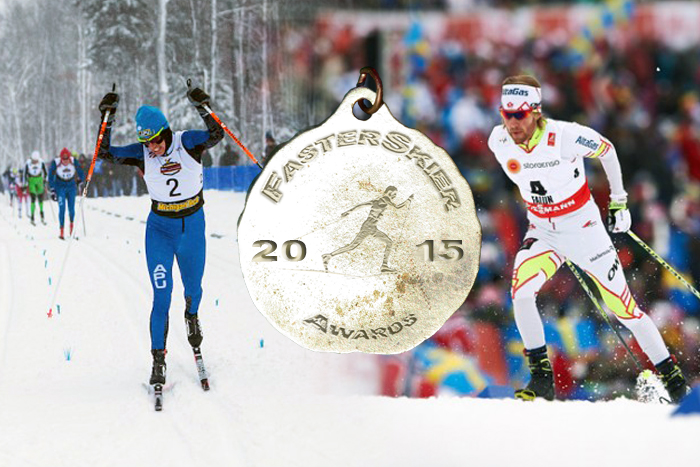
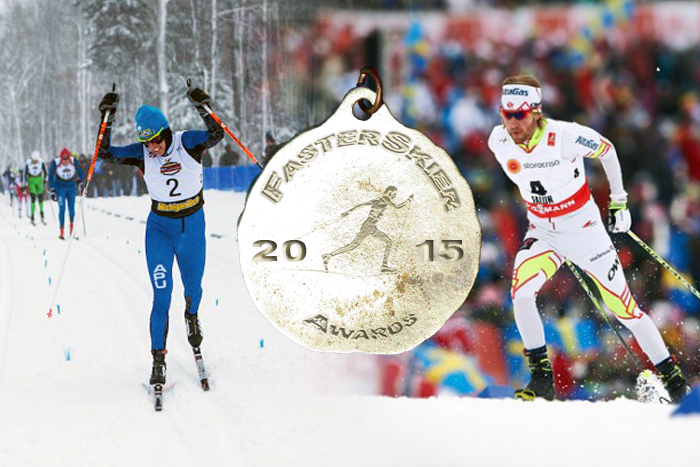
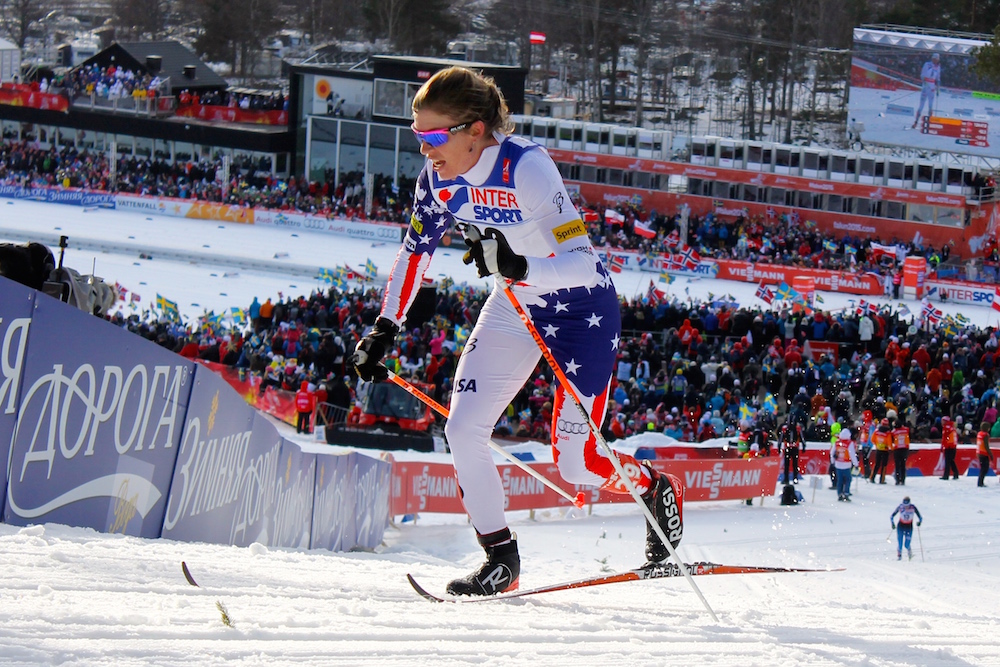
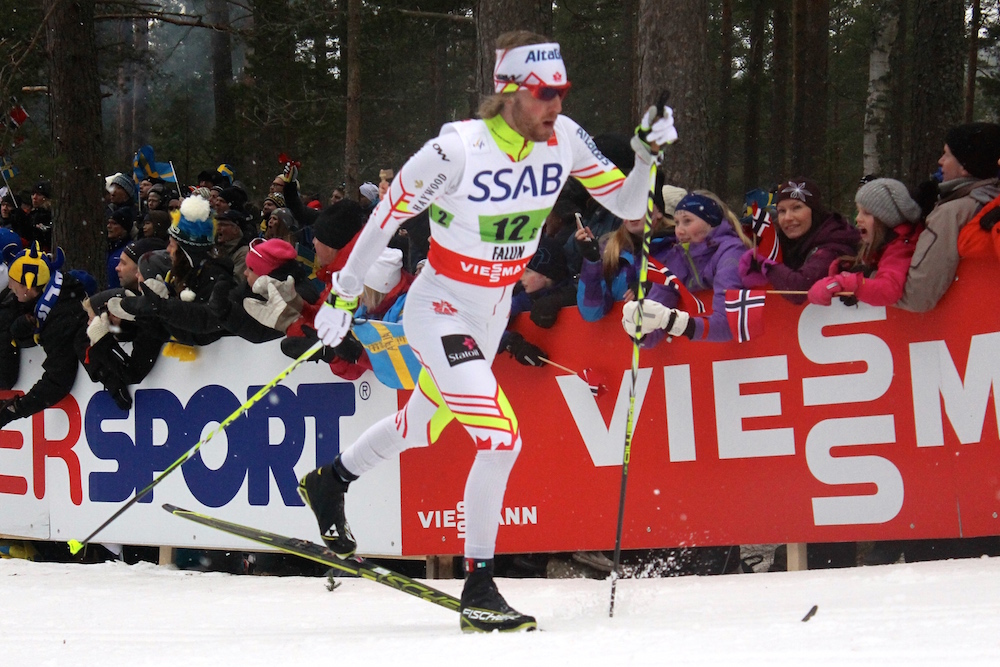
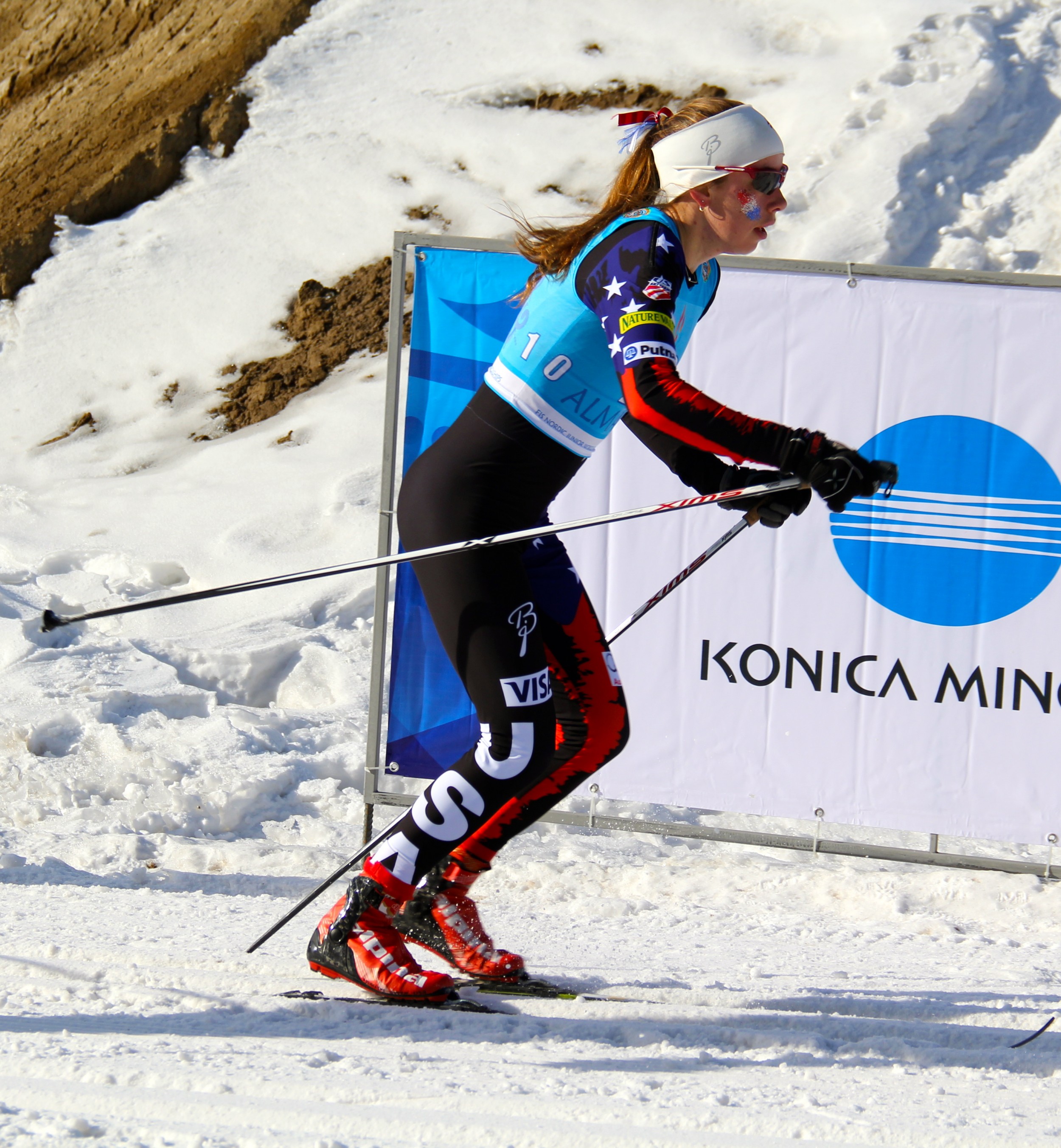
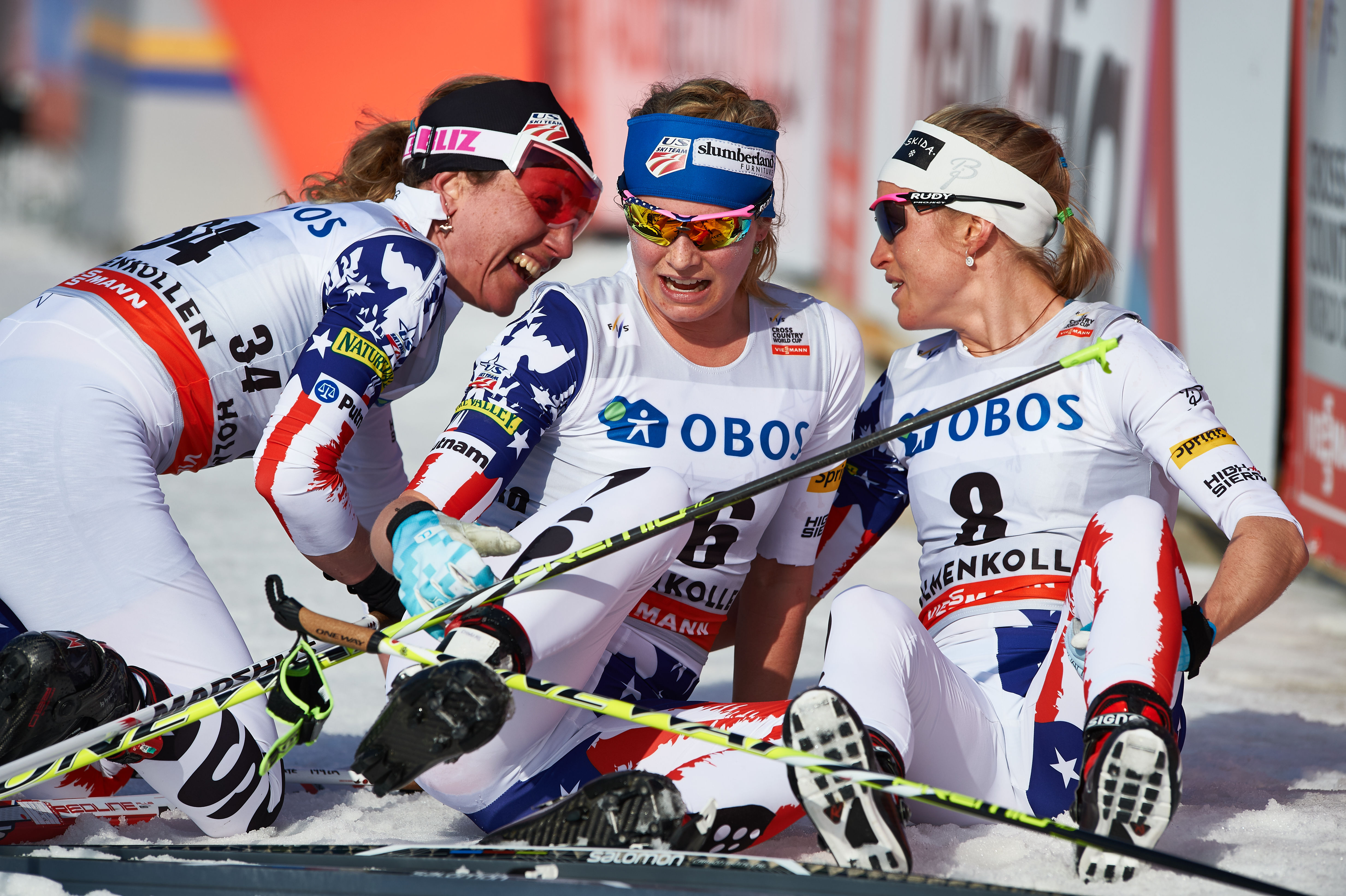
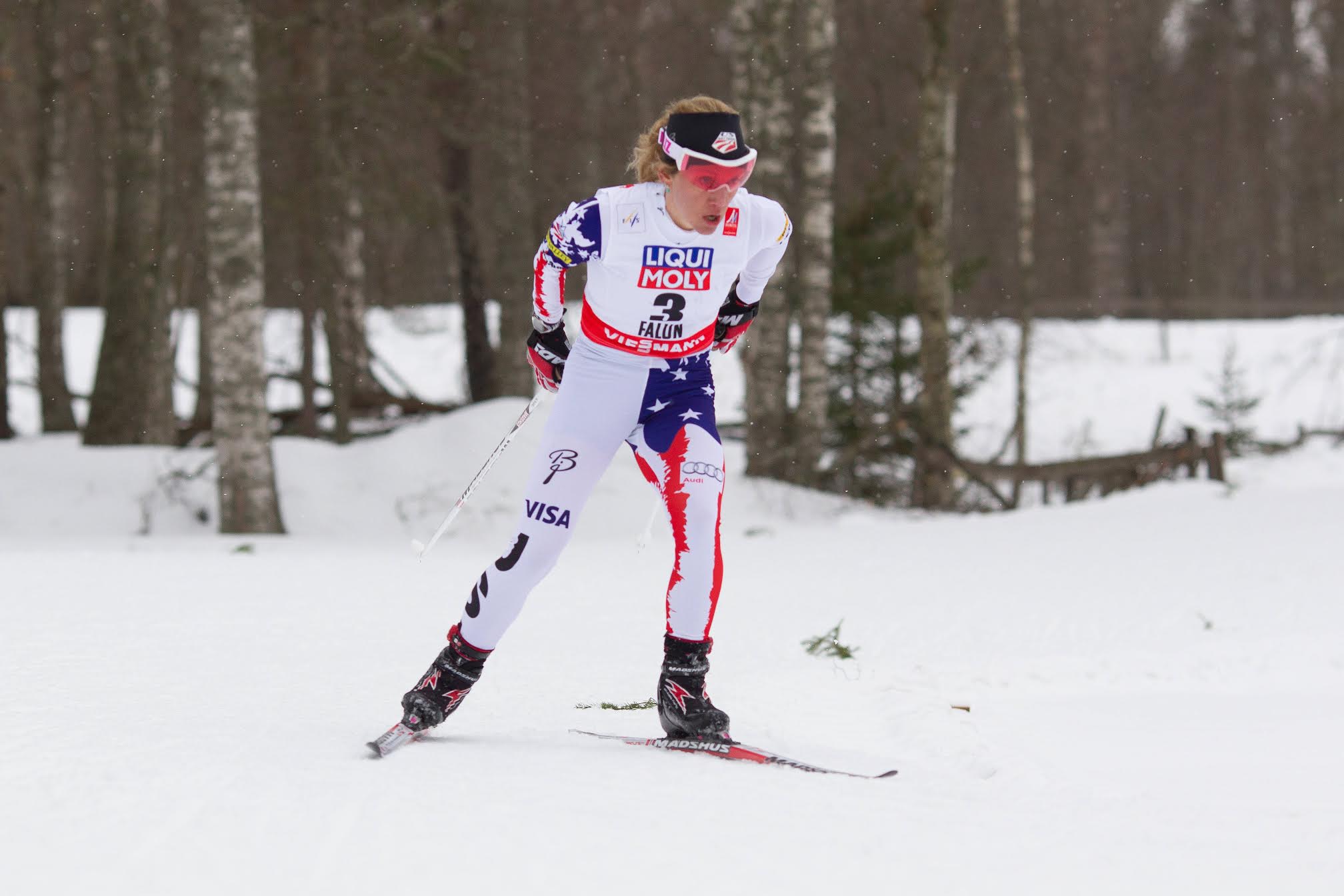
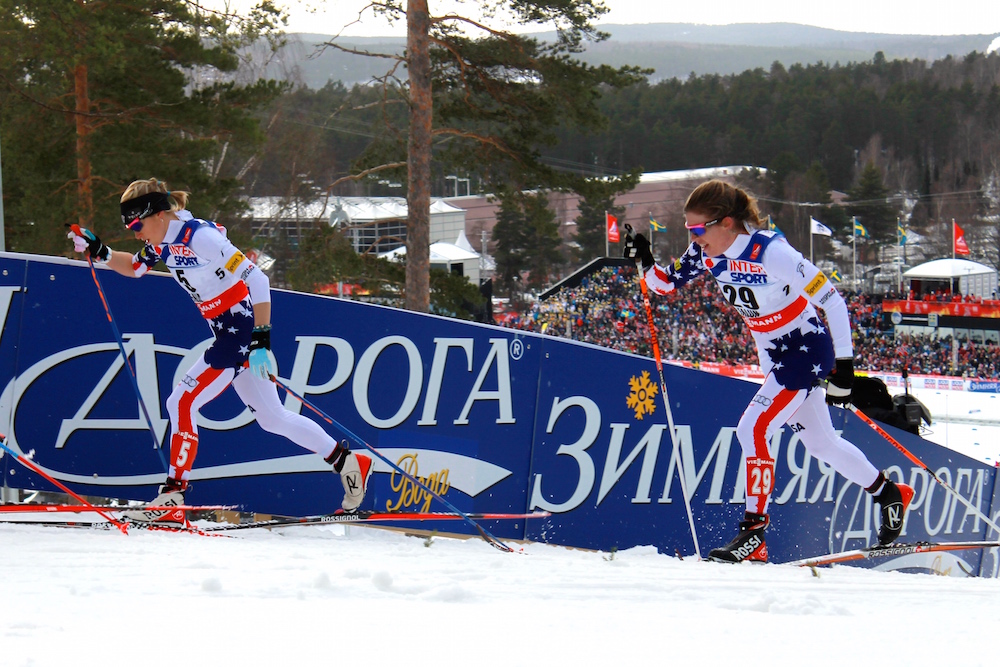
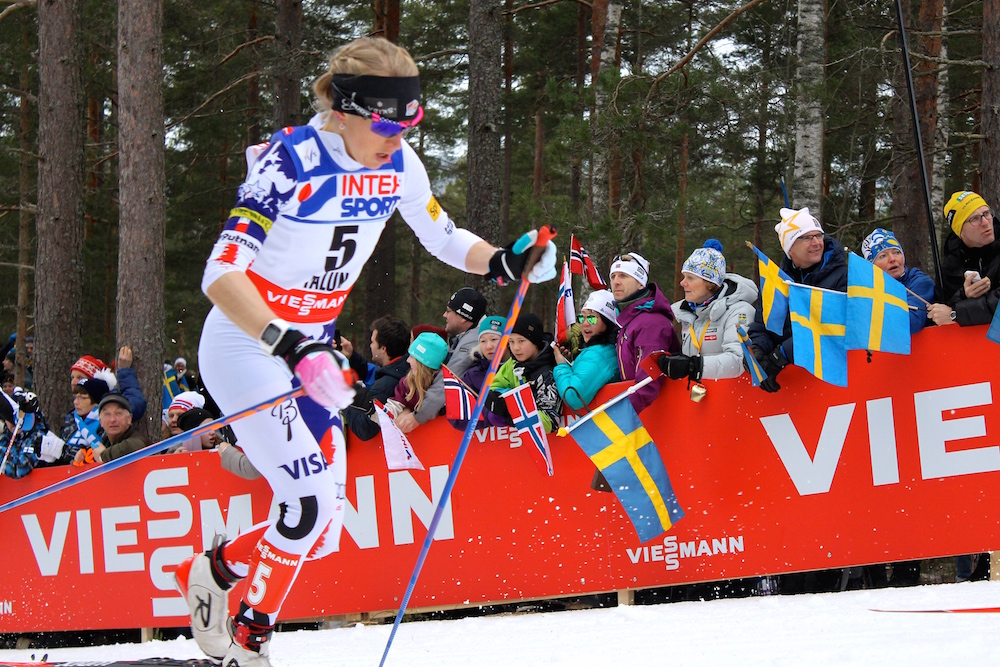
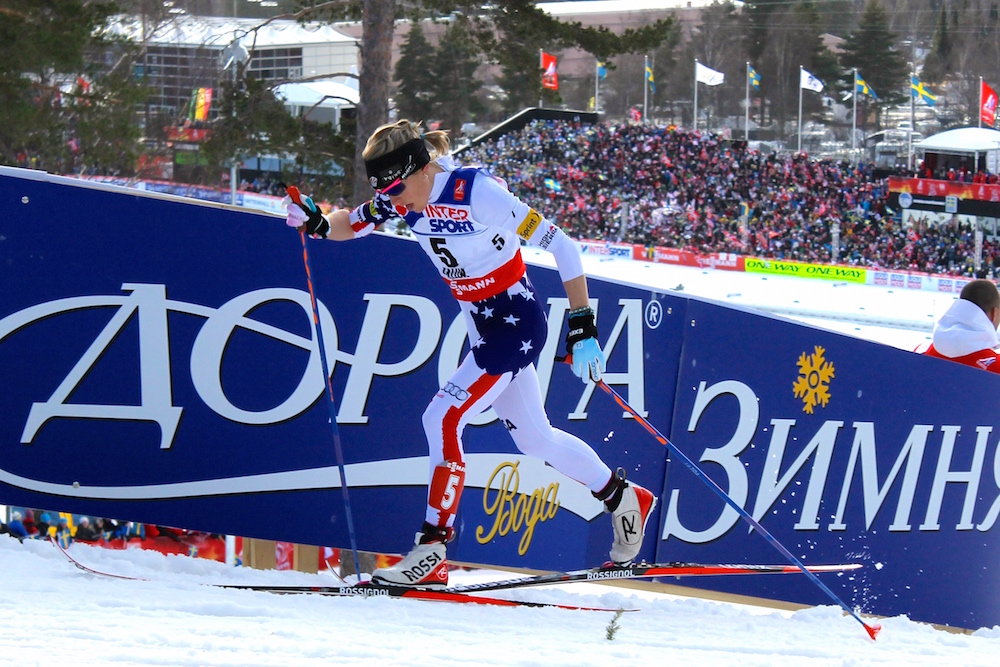
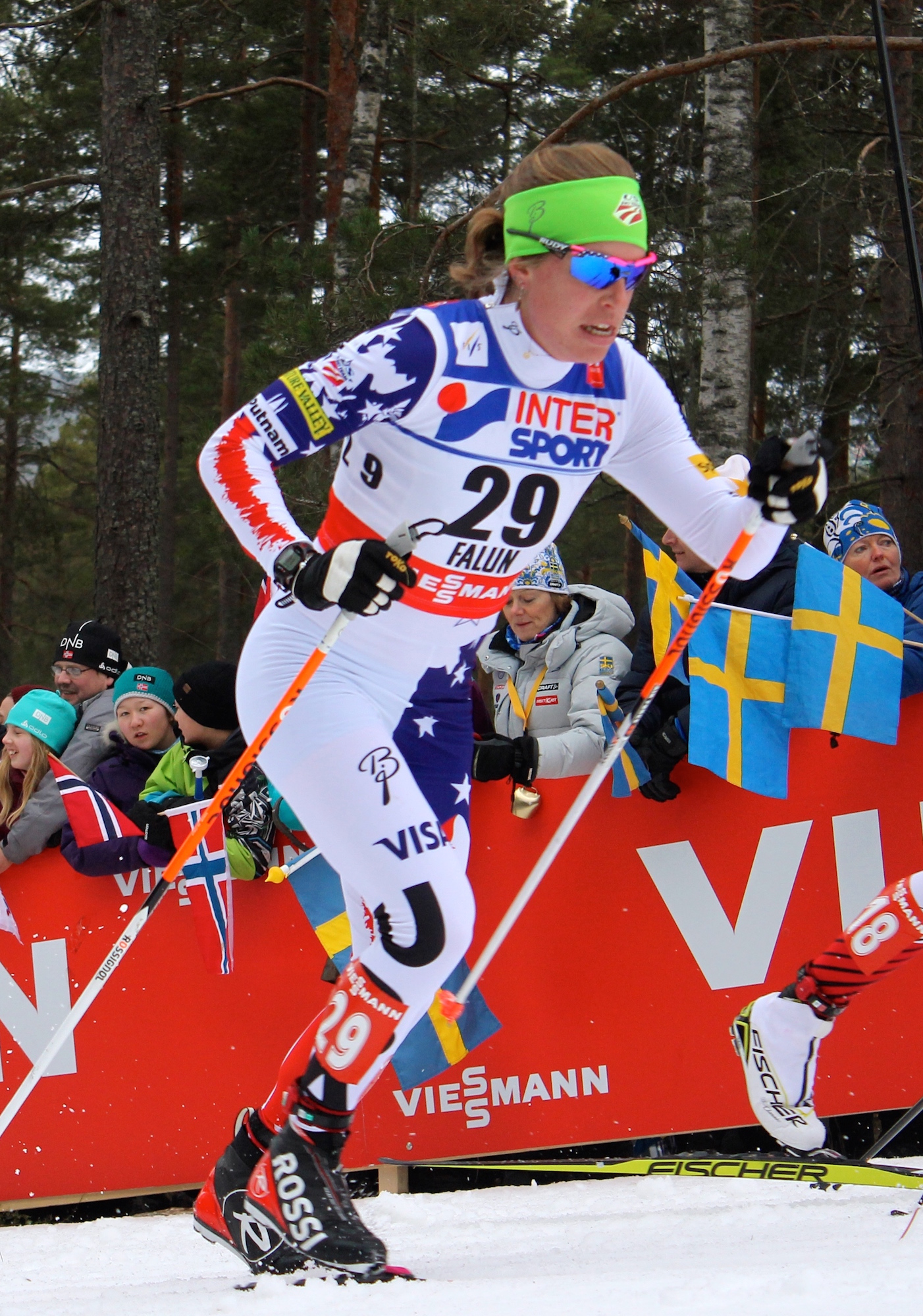
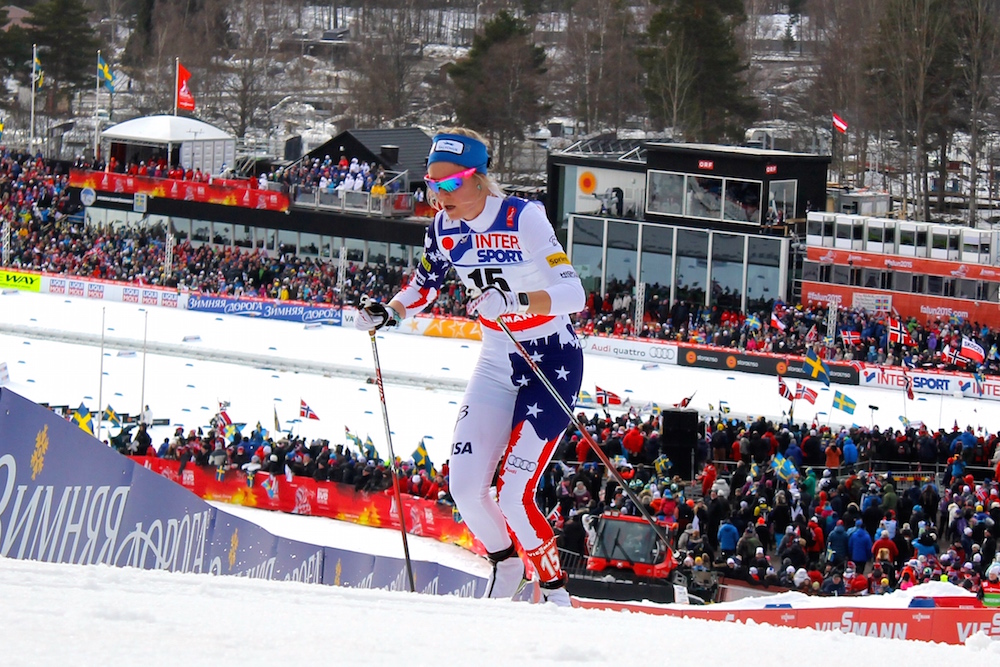
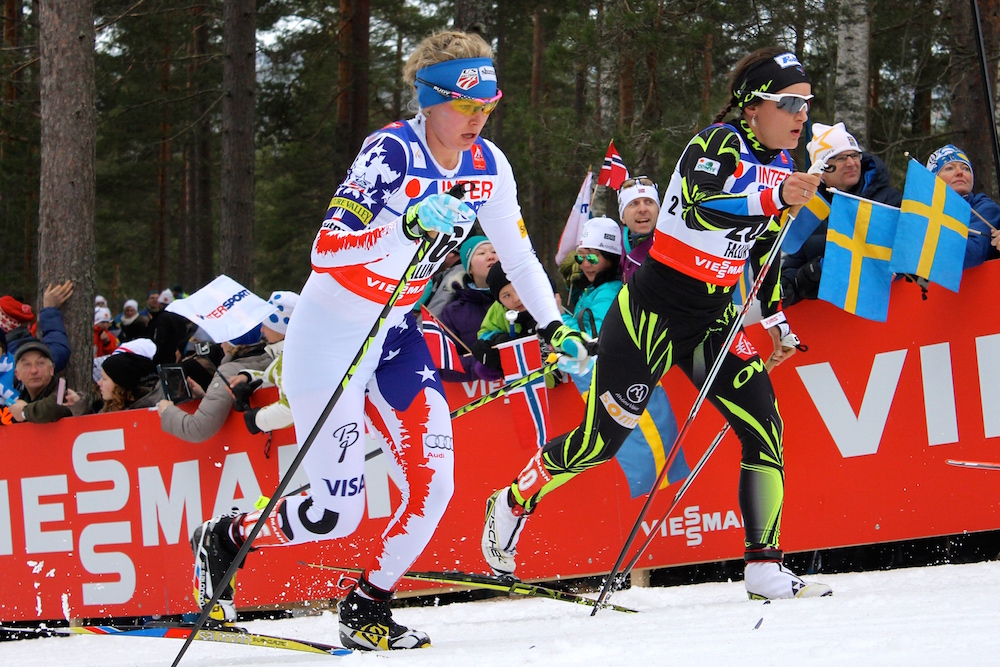
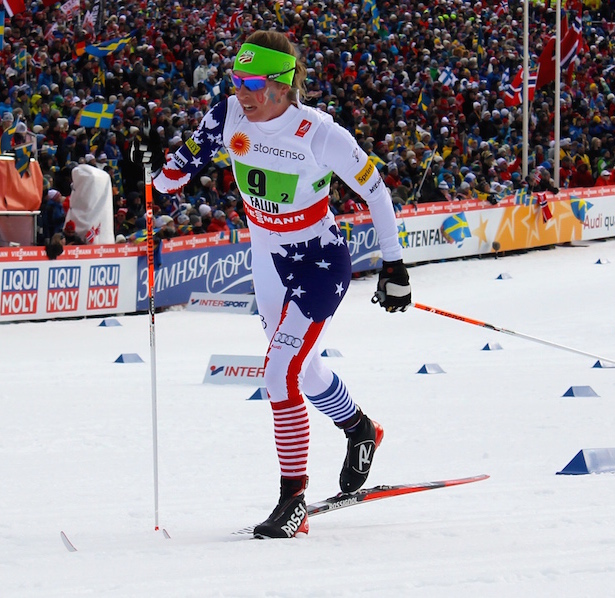
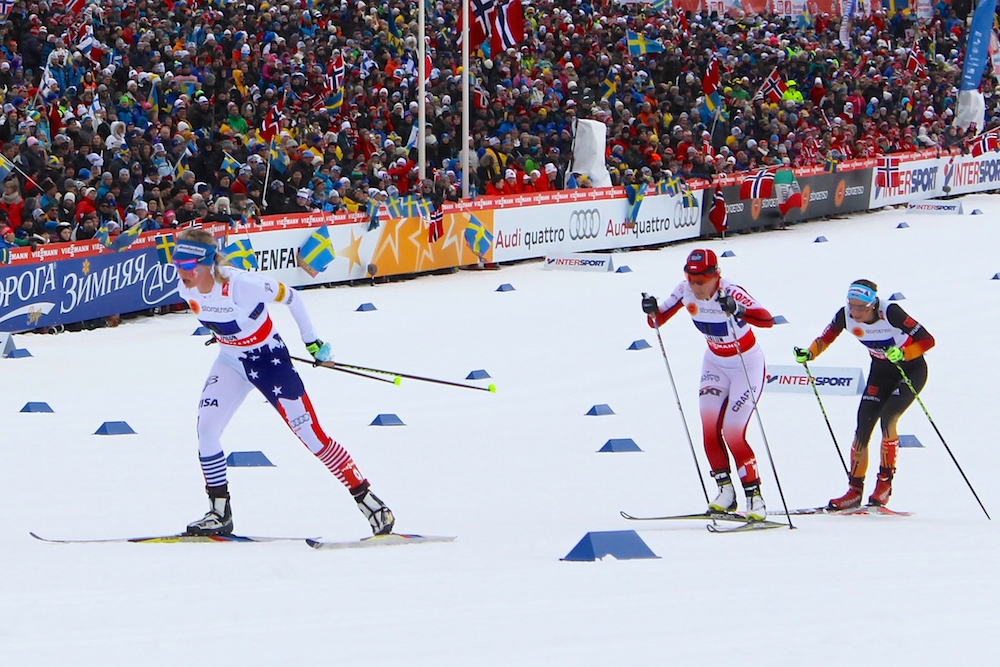
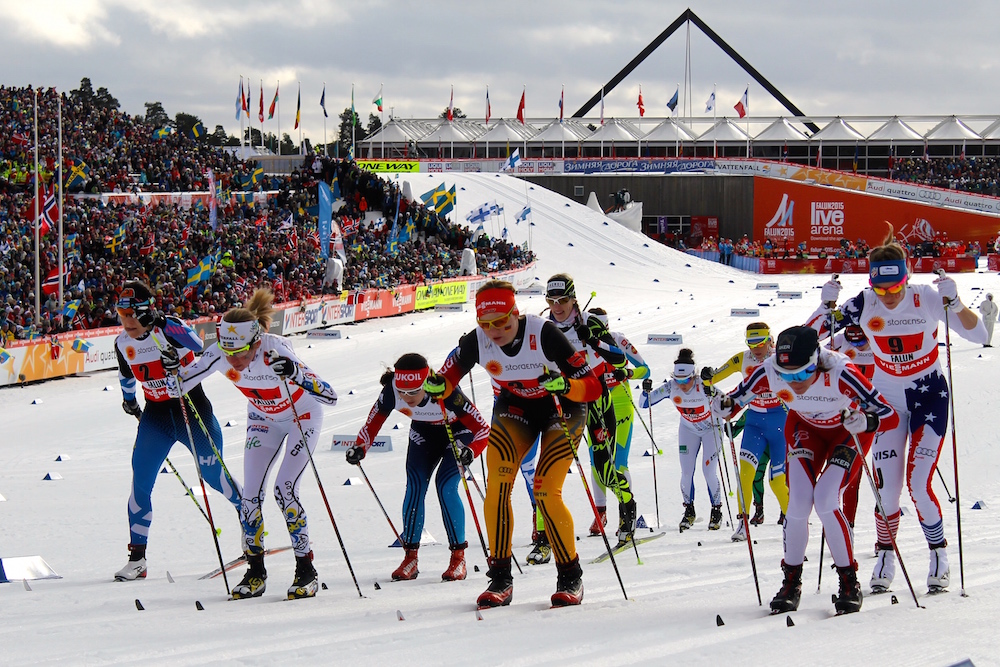
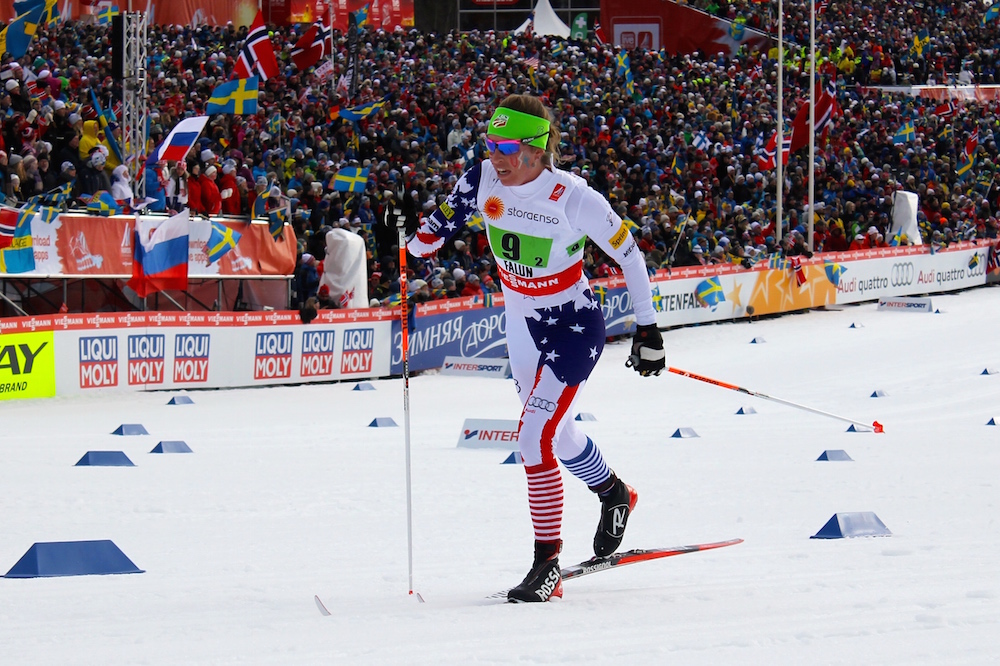
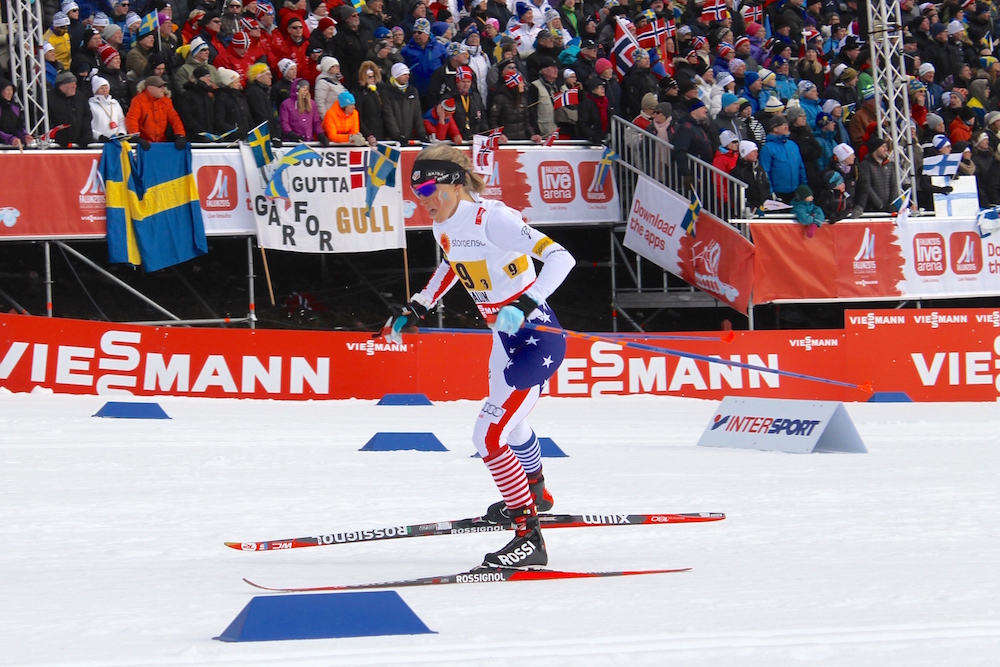
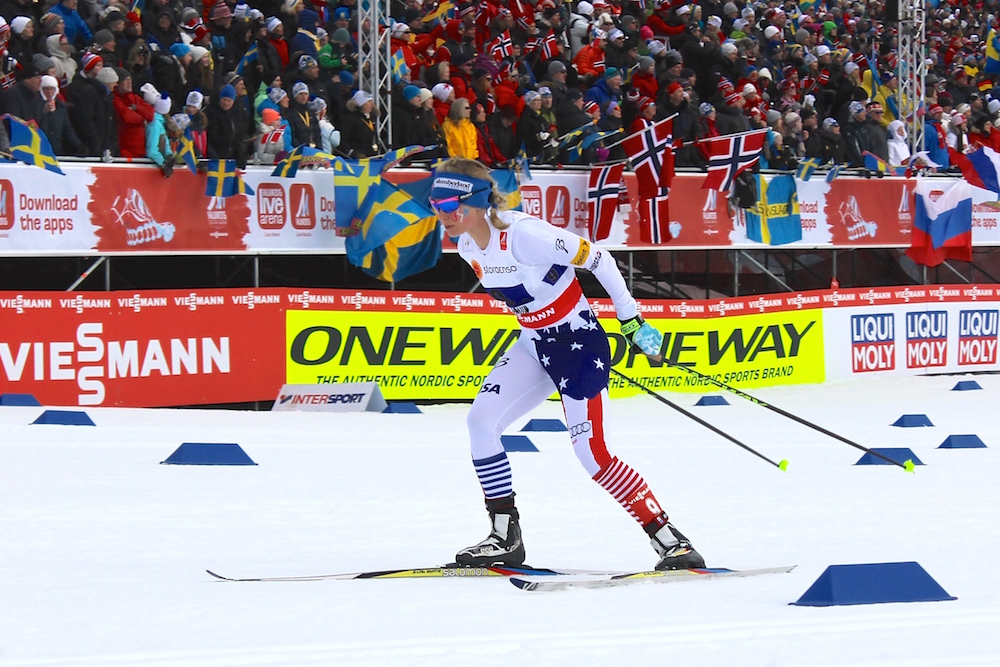
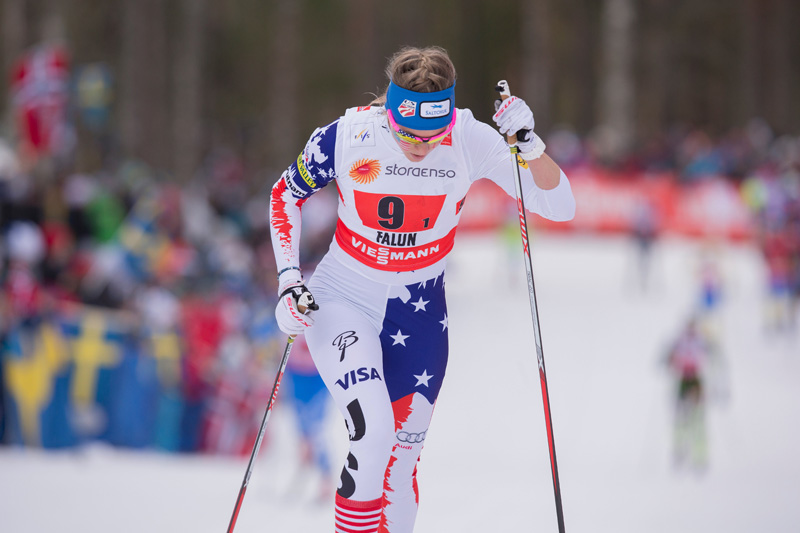
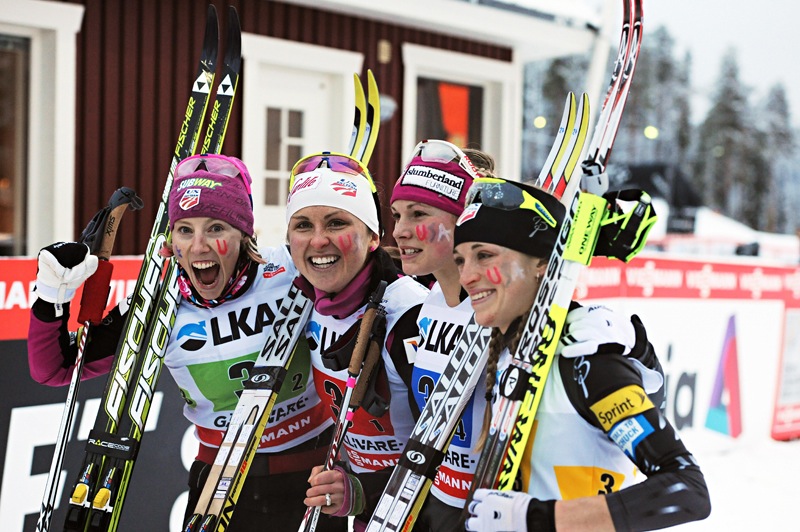
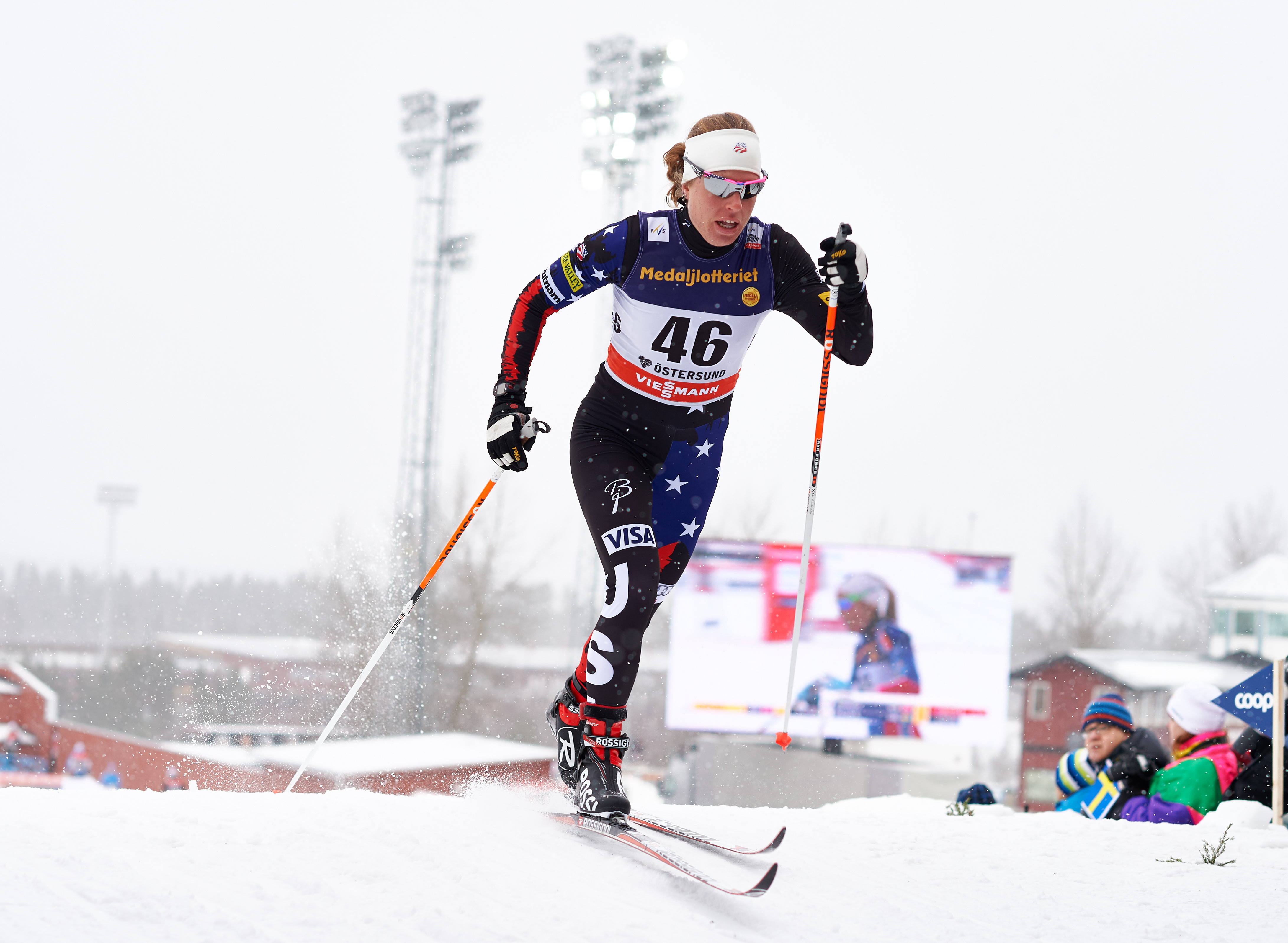
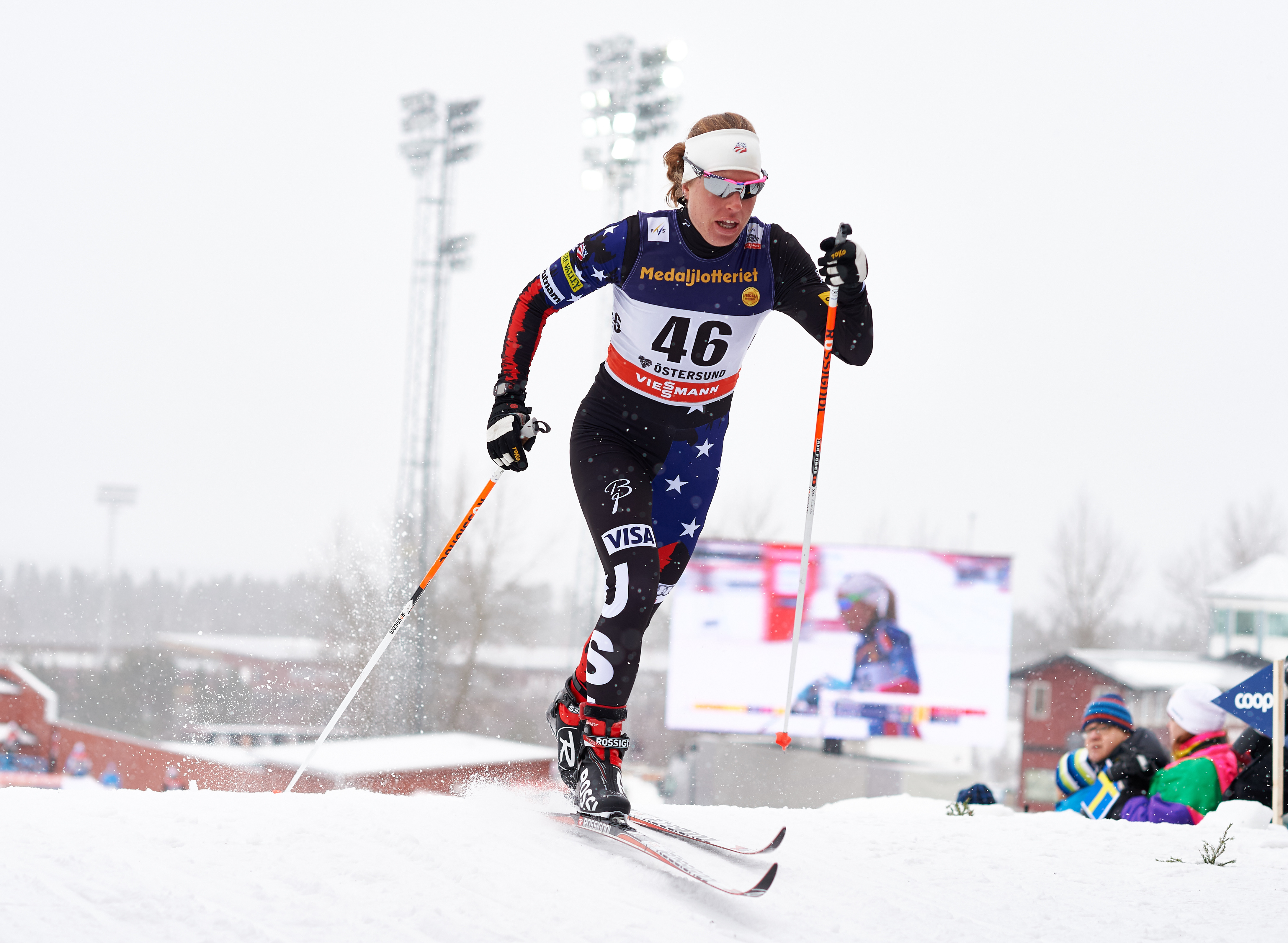
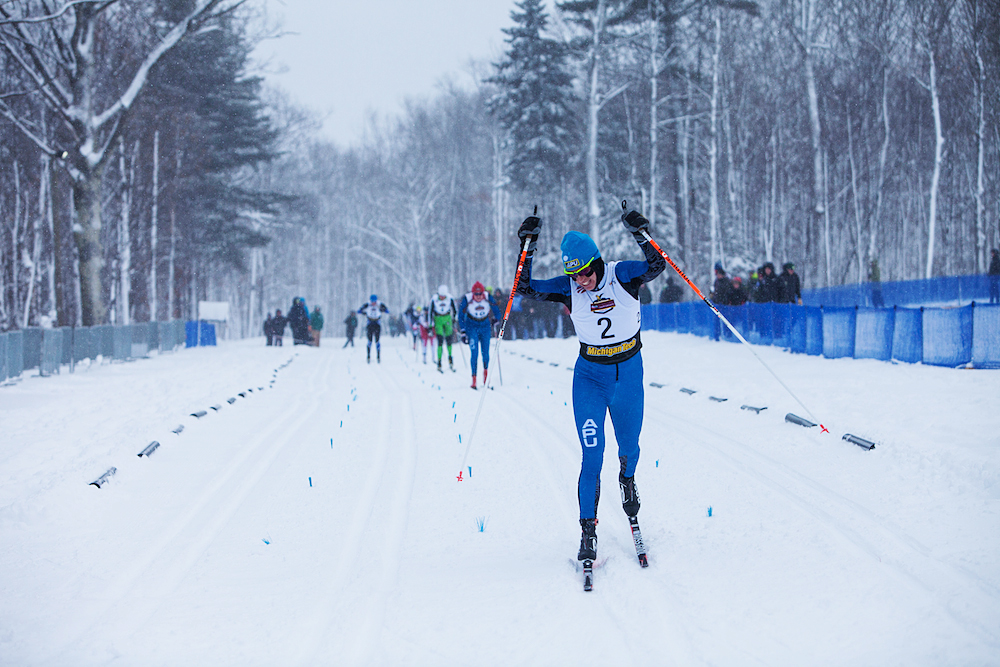
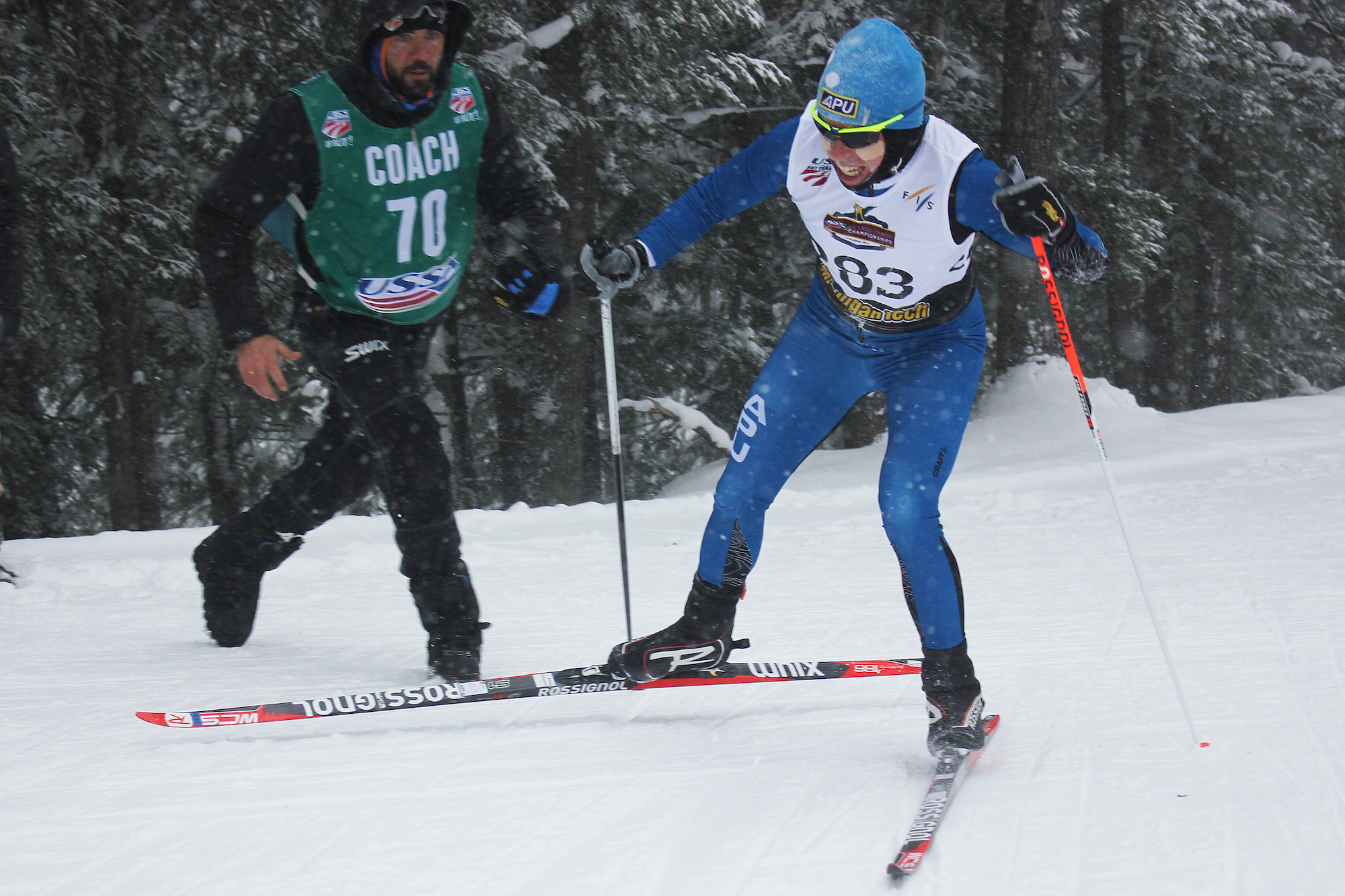
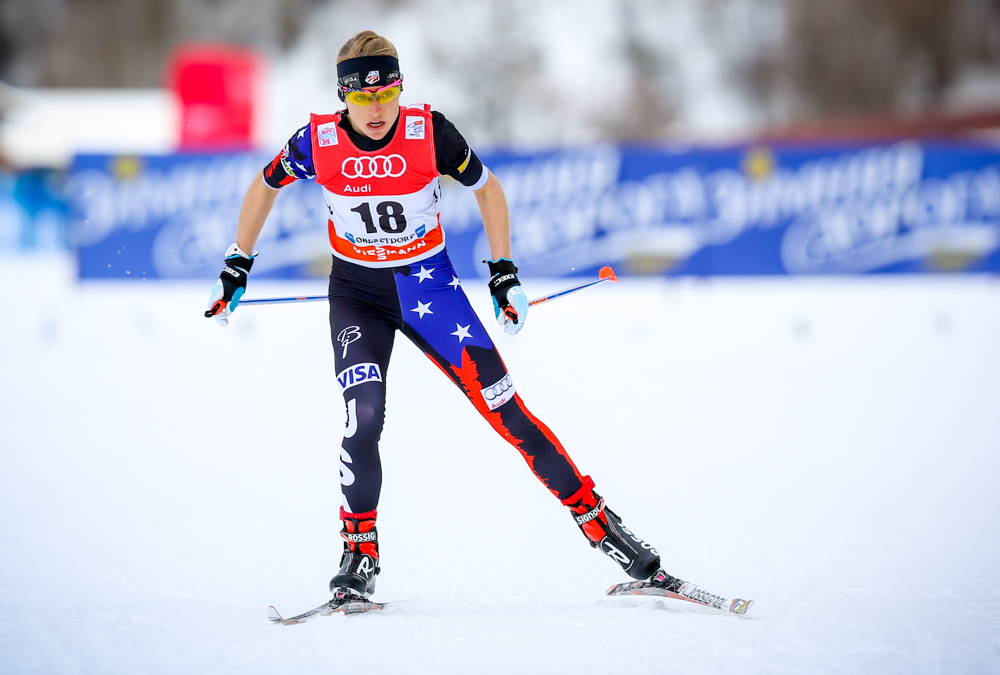
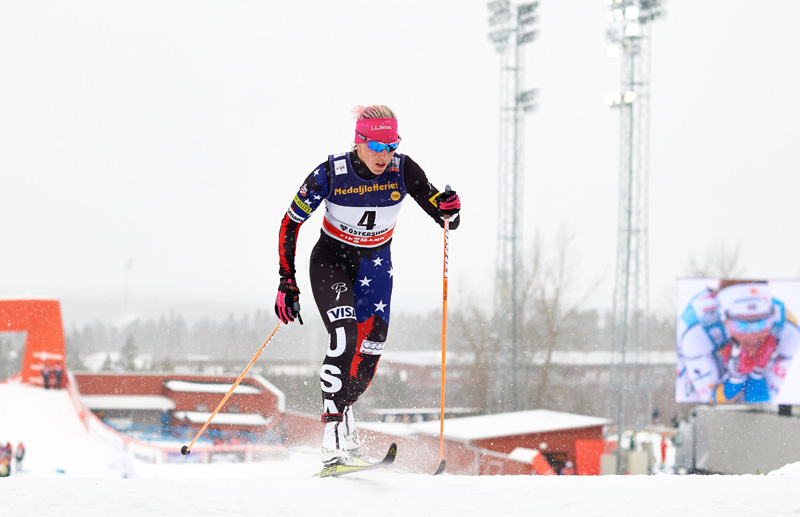
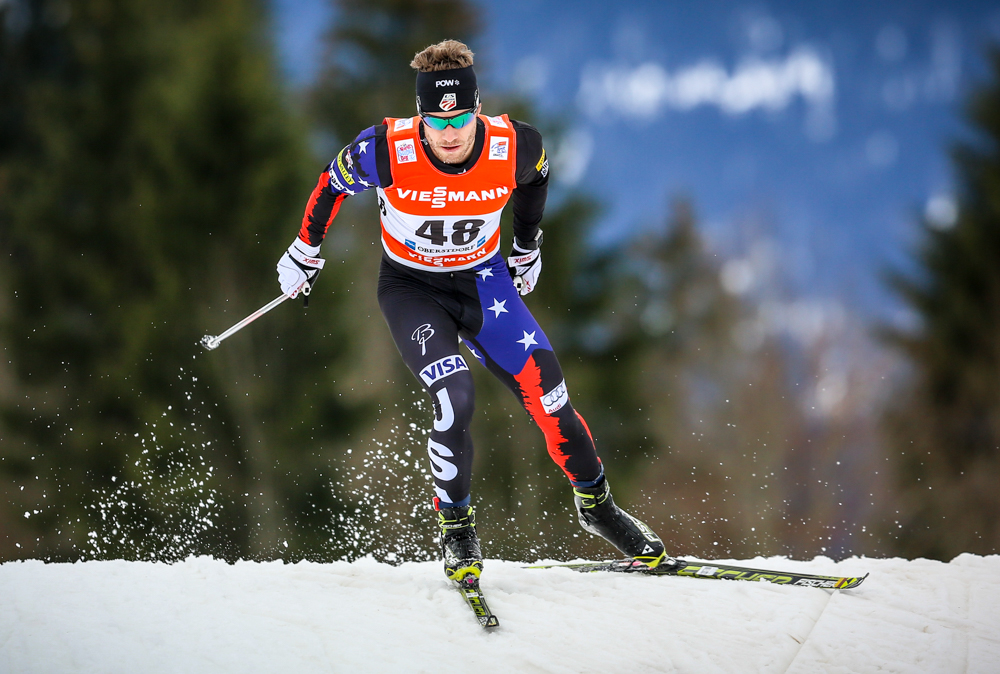
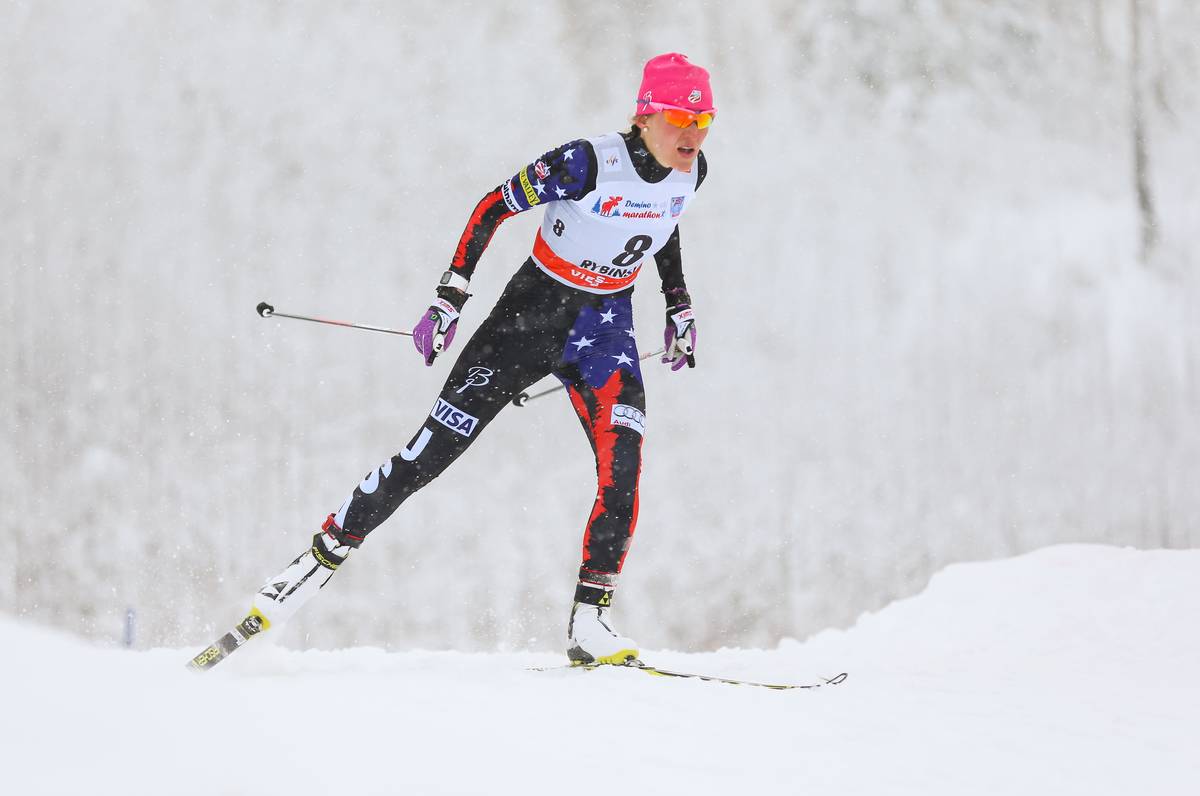
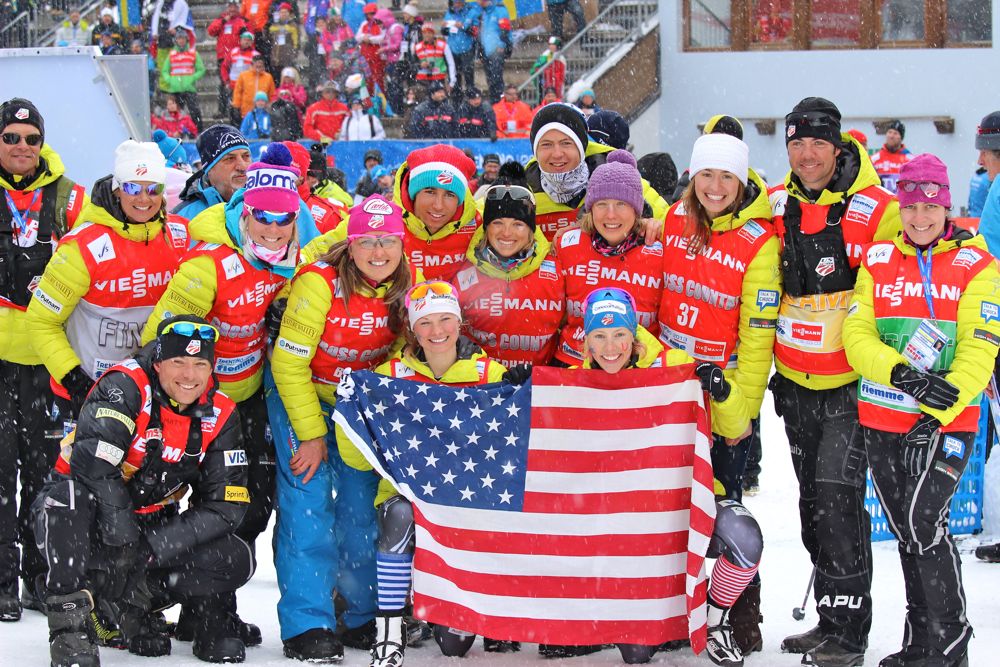
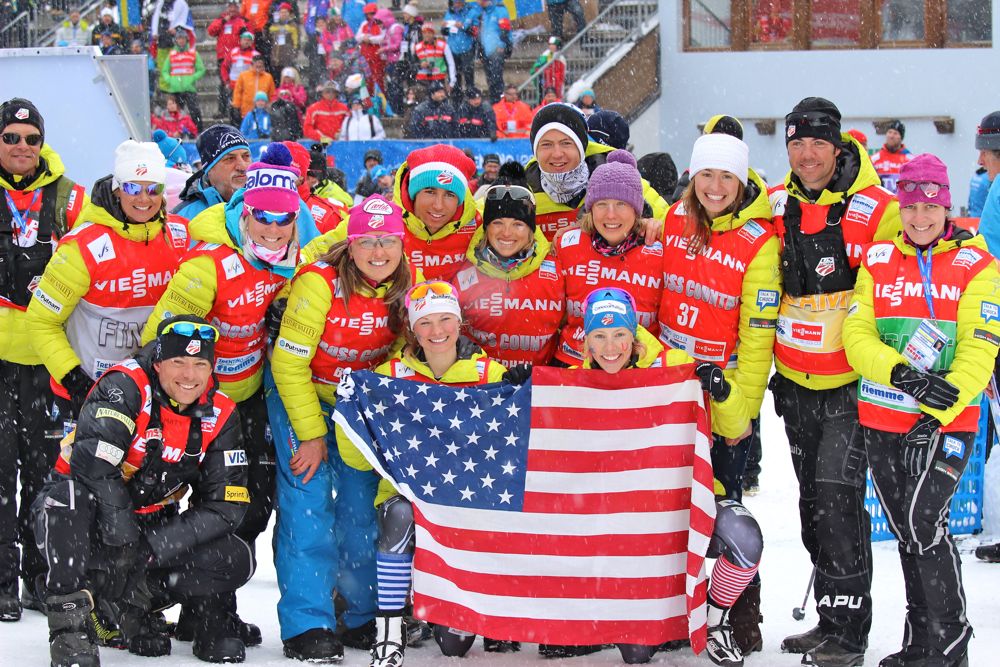
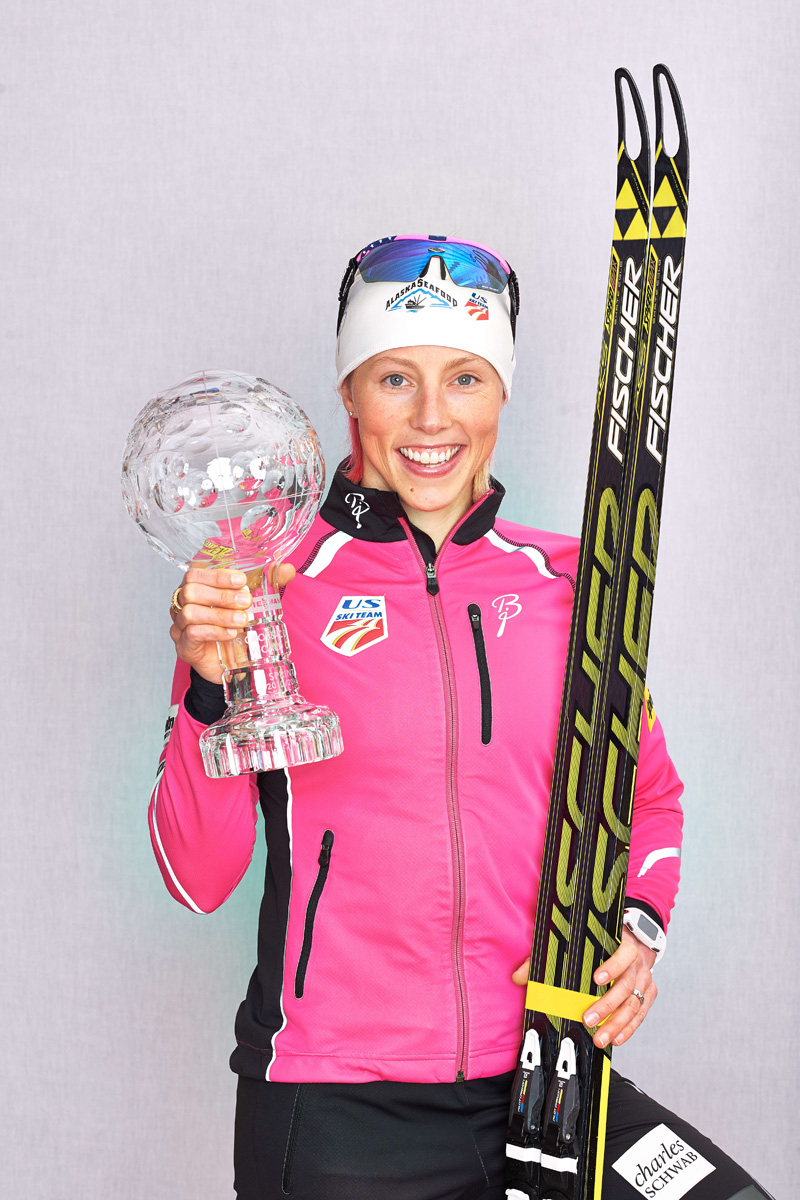
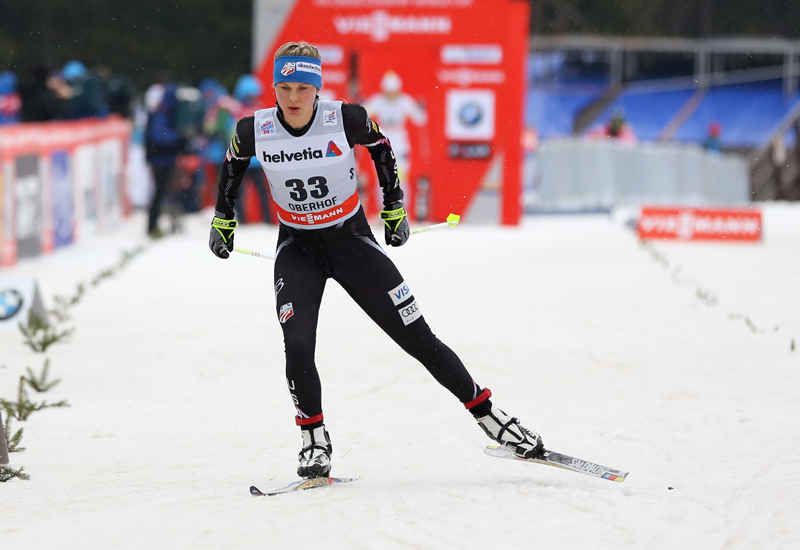
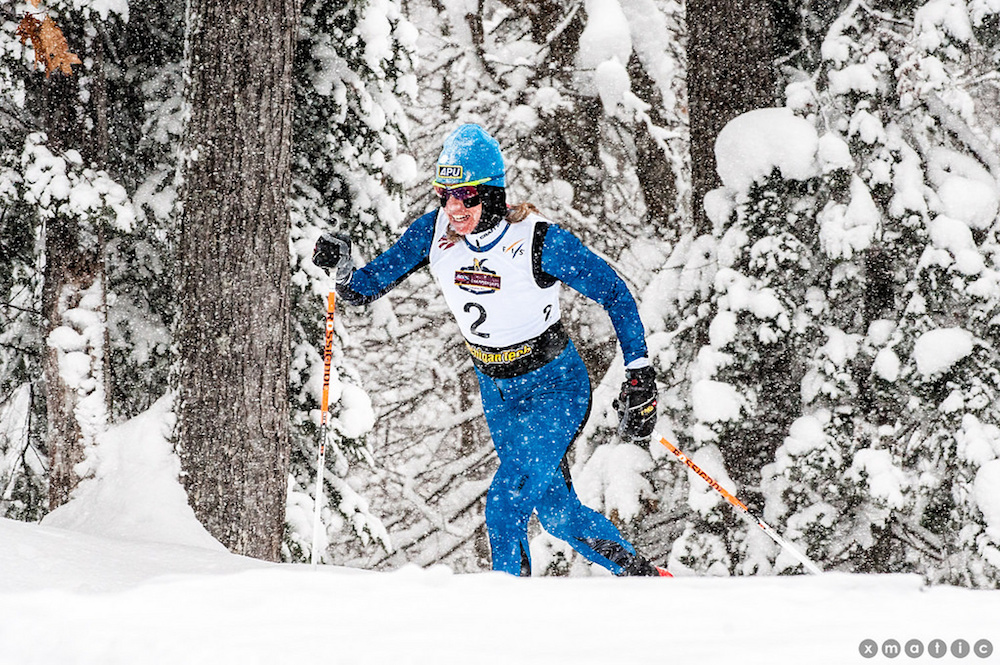
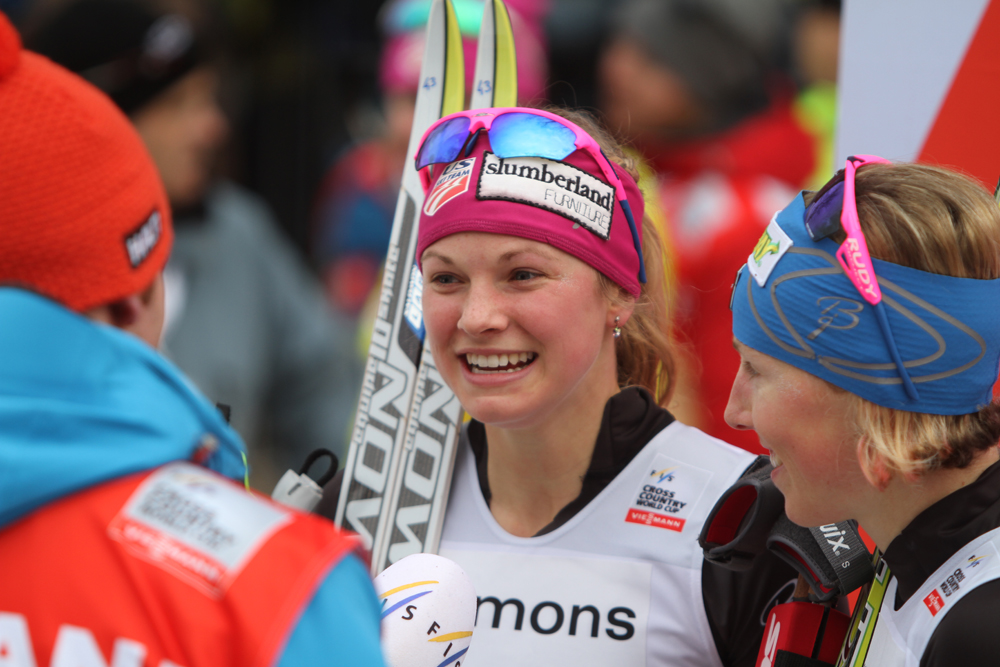
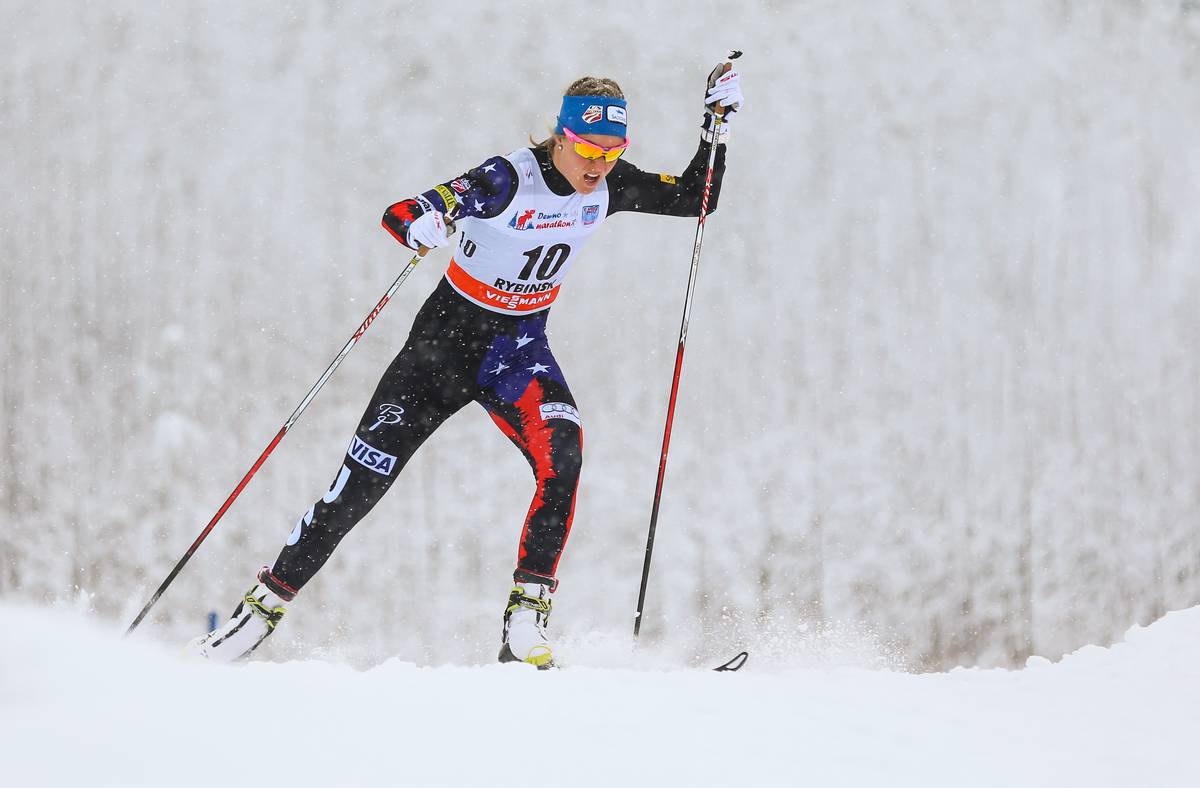
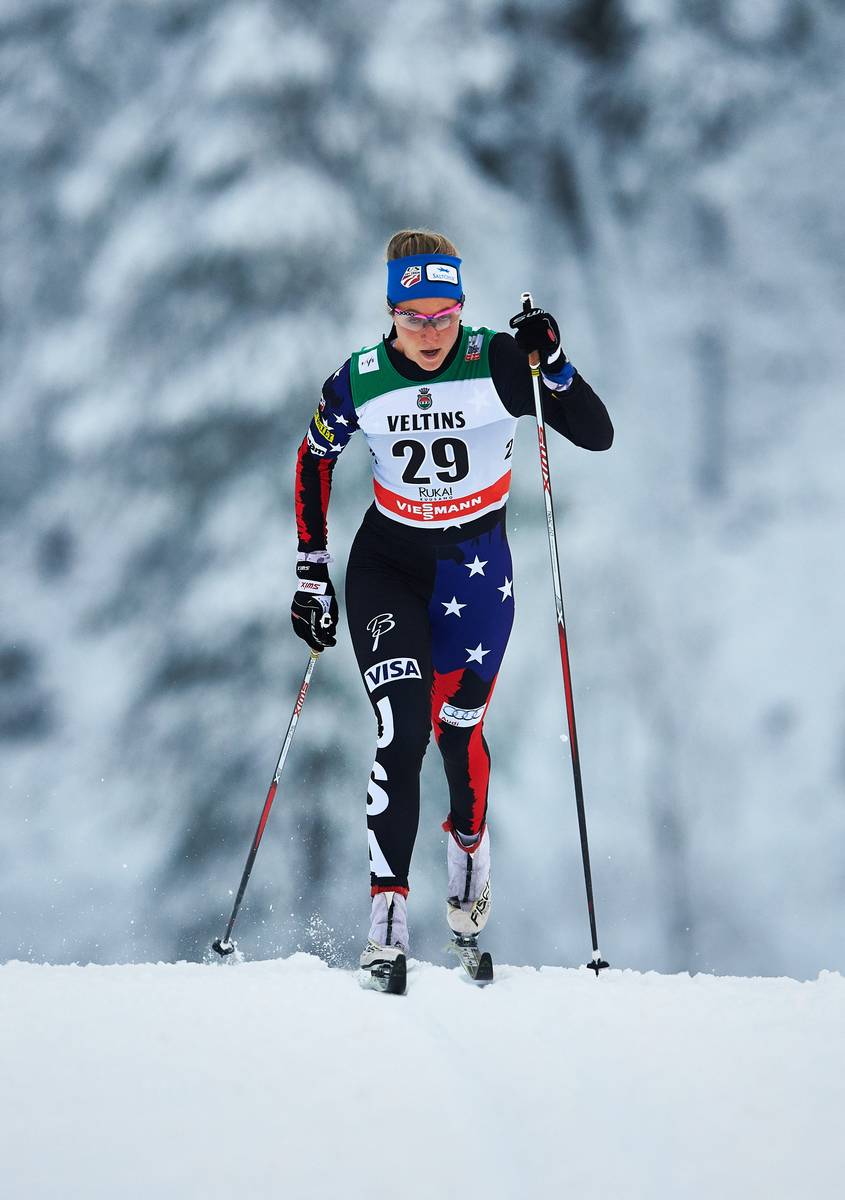
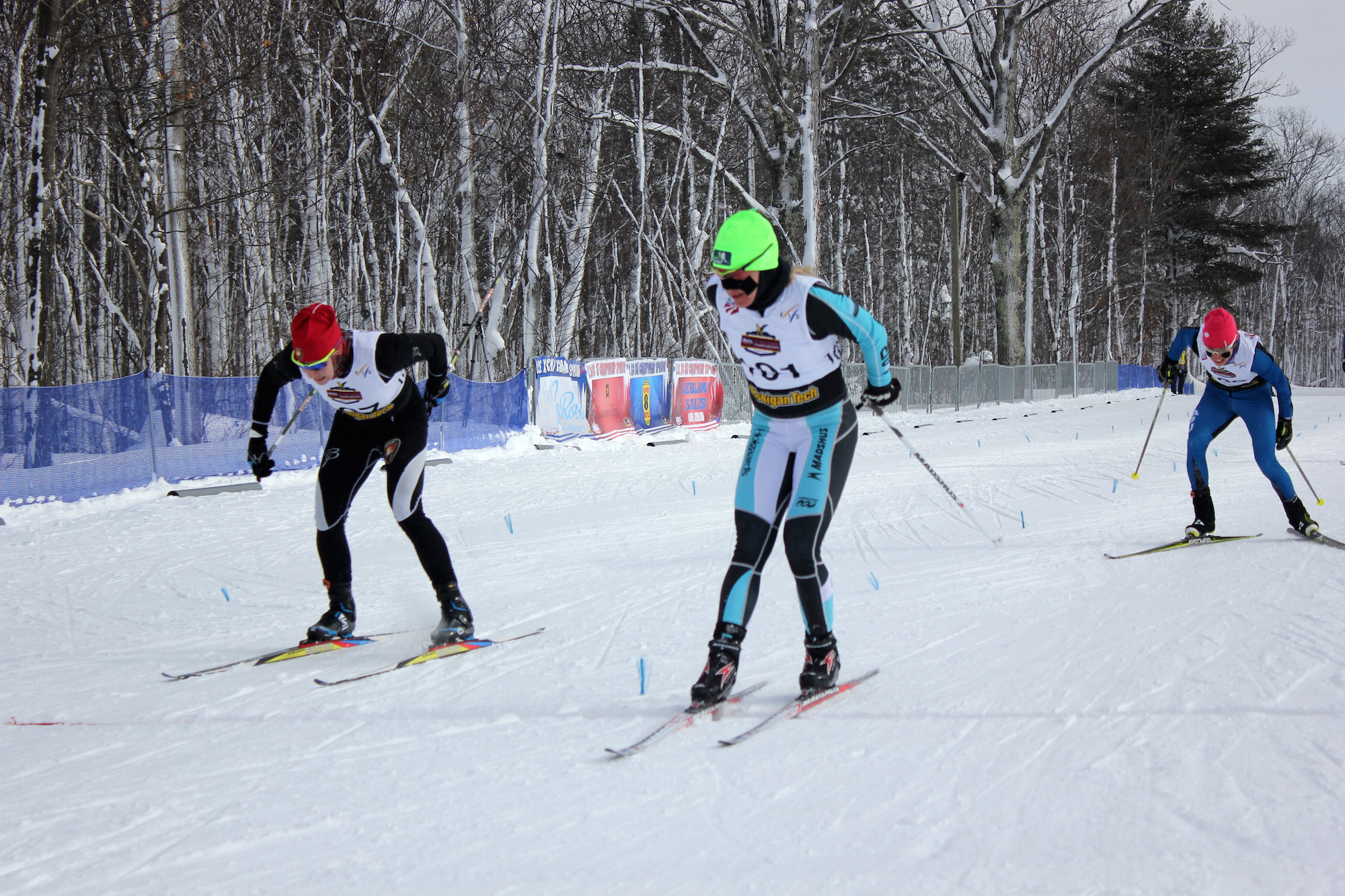
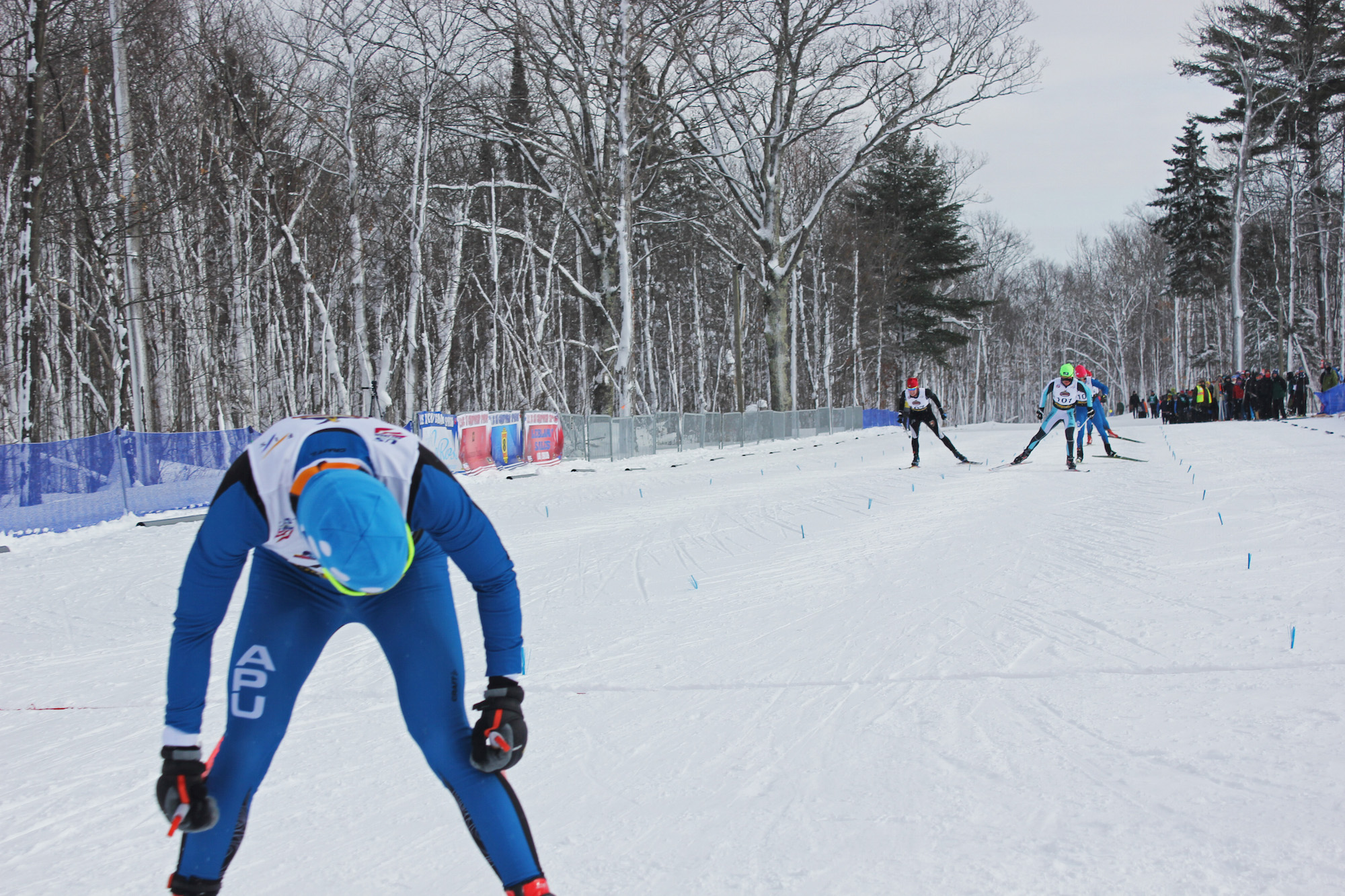
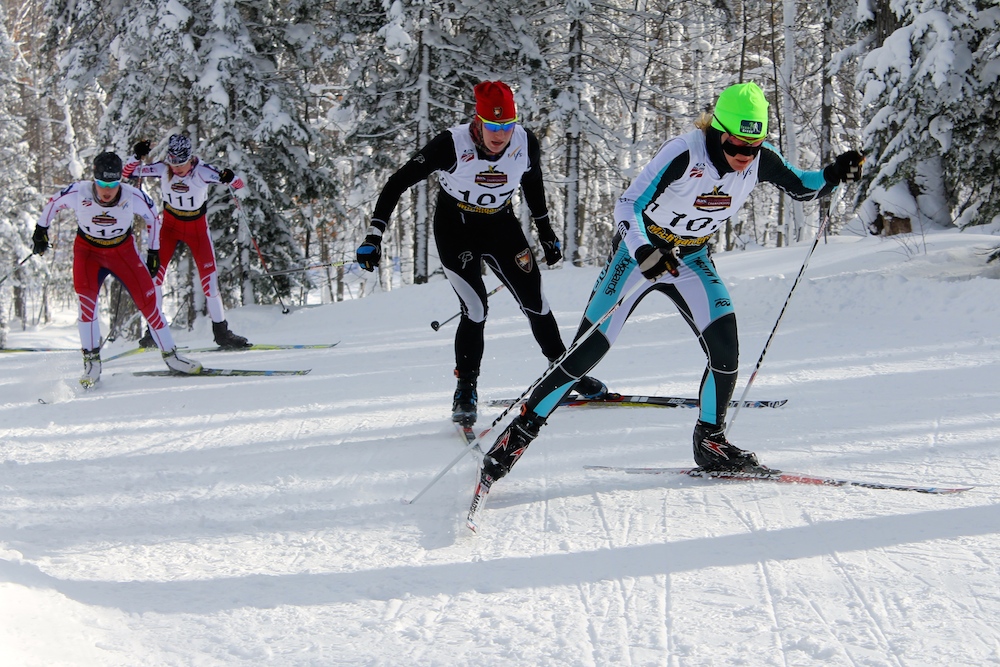
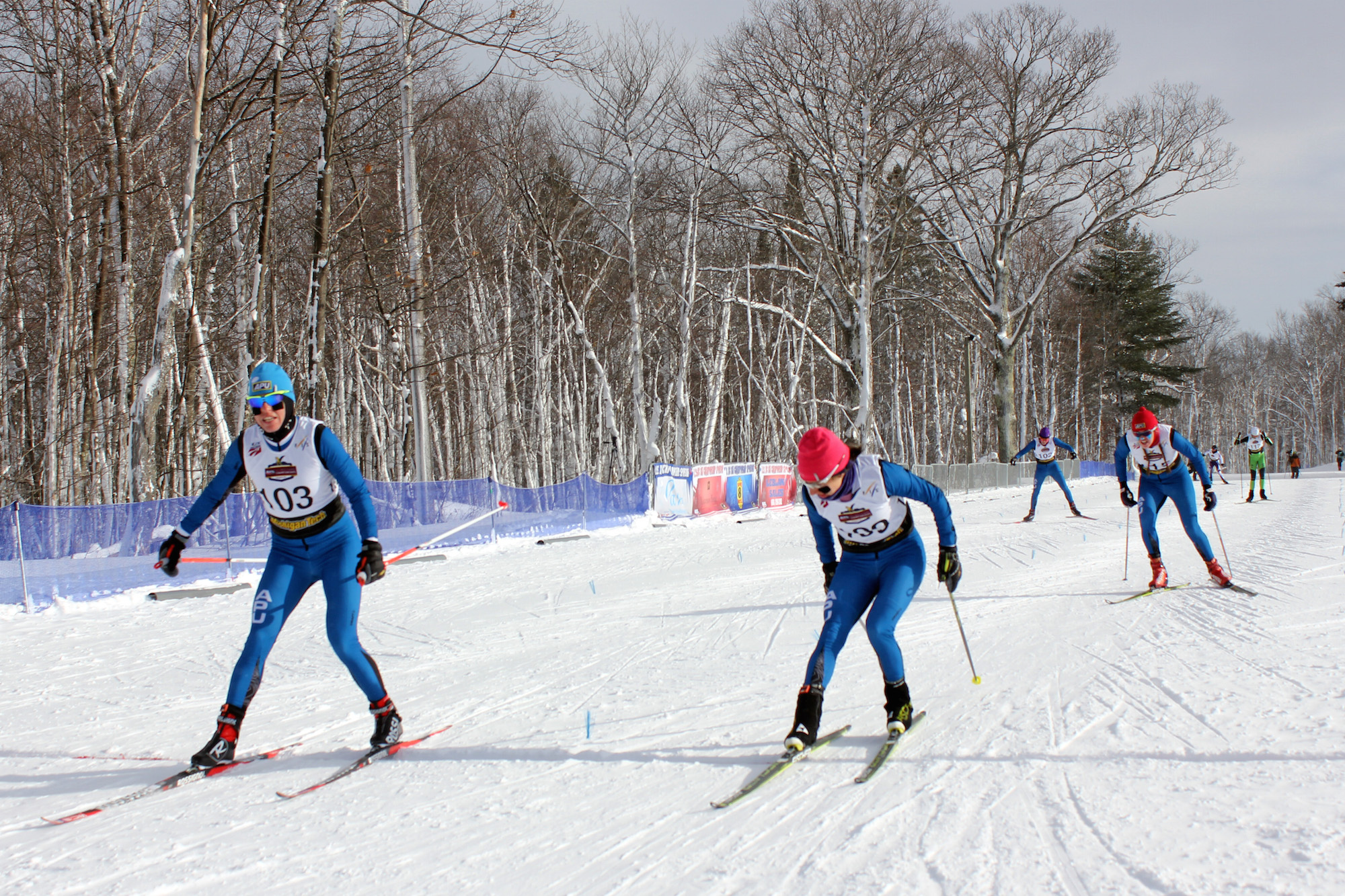
Rosie Brennan and Graeme Killick are FasterSkier’s breakthrough skiers of 2015.
With the 2014/2015 season officially in the rearview, FasterSkier is excited to unveil its annual award winners for this past winter. Votes stem from the FS staff, scattered across the U.S. and Canada, and while not scientific, they are intended to reflect a broader sense of the season in review.
***
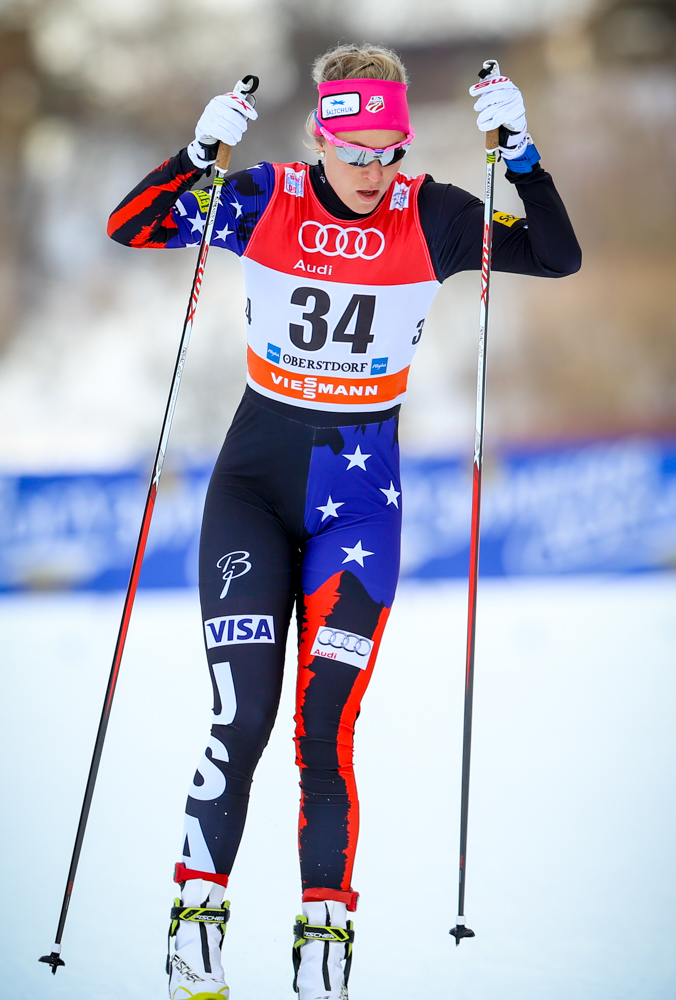
Rosie Brennan, USST B-team, Alaska Pacific University
Rosie Brennan isn’t new to the nordic scene. In fact, she’s been around for a long time and has a list of impressive results to her name. What makes her the 2015 Breakthrough Skier of the Year, you might ask? Her remarkable jump from the continental cup to international success.
“If there is a most improved skier award it goes to Rosie, potentially on the entire World Cup,” U.S. Ski Team Women’s Coach Matt Whitcomb said after her performances at the 2015 World Championships. “I don’t know if any nation has had an athlete show from their continental cup with no prior success and hit it out of the park the way that she has.
“She’s being rewarded for years of hard work. It’s been a tough year for her, and to see all the work pay off and incredible results from start to finish is really neat,” he added.
If Whitcomb hasn’t convinced you, her results from the past season will.
A successful junior skier who earned a top-10 finish at Junior Worlds in 2007, Brennan made large strides in her early career and was named to the U.S. Ski Team in her first two years at Dartmouth College. While her position on the USST lasted only two years, Brennan continued her journey in professional ski racing.
Since beginning her professional career, the APU skier has continually been at the top of the domestic circuit. The 2014/2015 season, however, proved to be a momentous year as Brennan won all but two races between the first period of SuperTour races and the 2015 U.S. Cross Country Championships in Houghton, Mich.
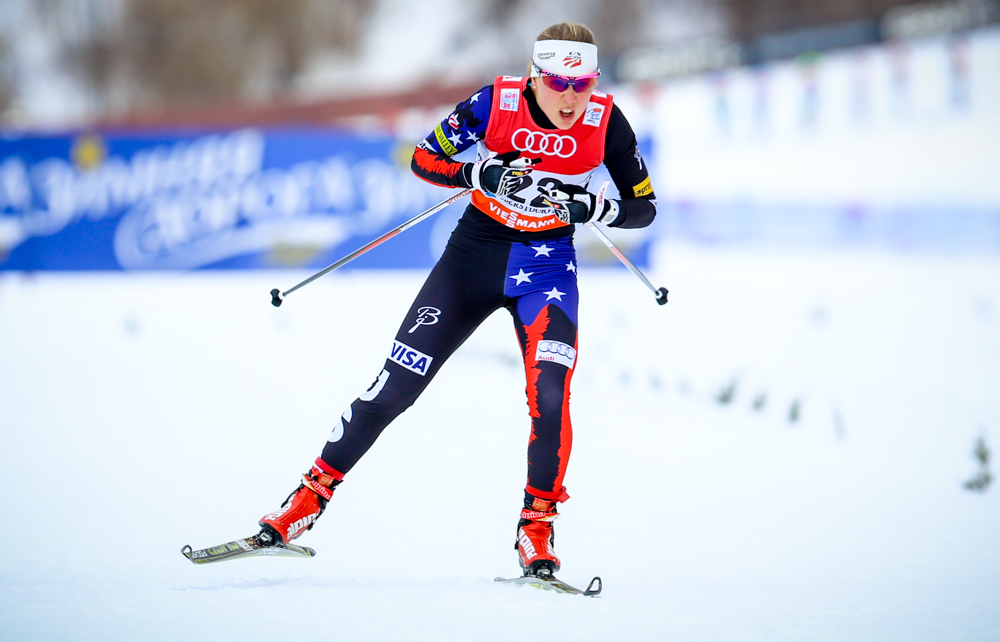
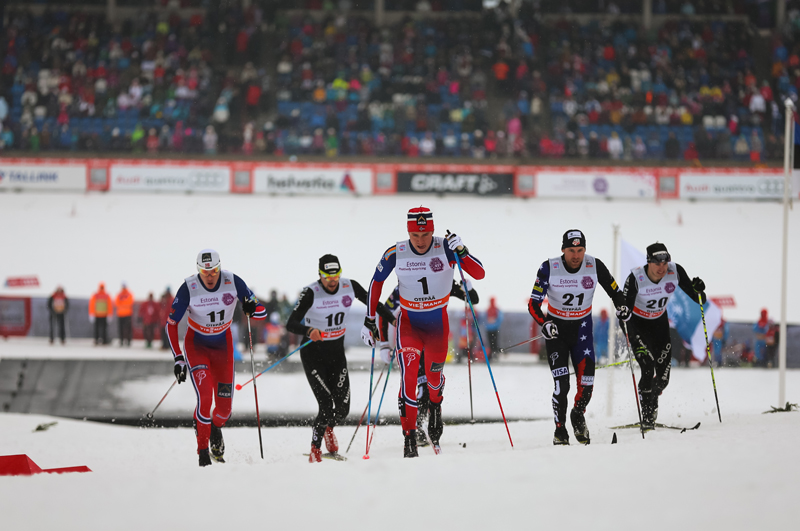
Rosie Brennan skiing in the 30 k mass start at the 2015 World Championships as she focuses on staying on the tails of Justyna Kowalczyk of Poland.
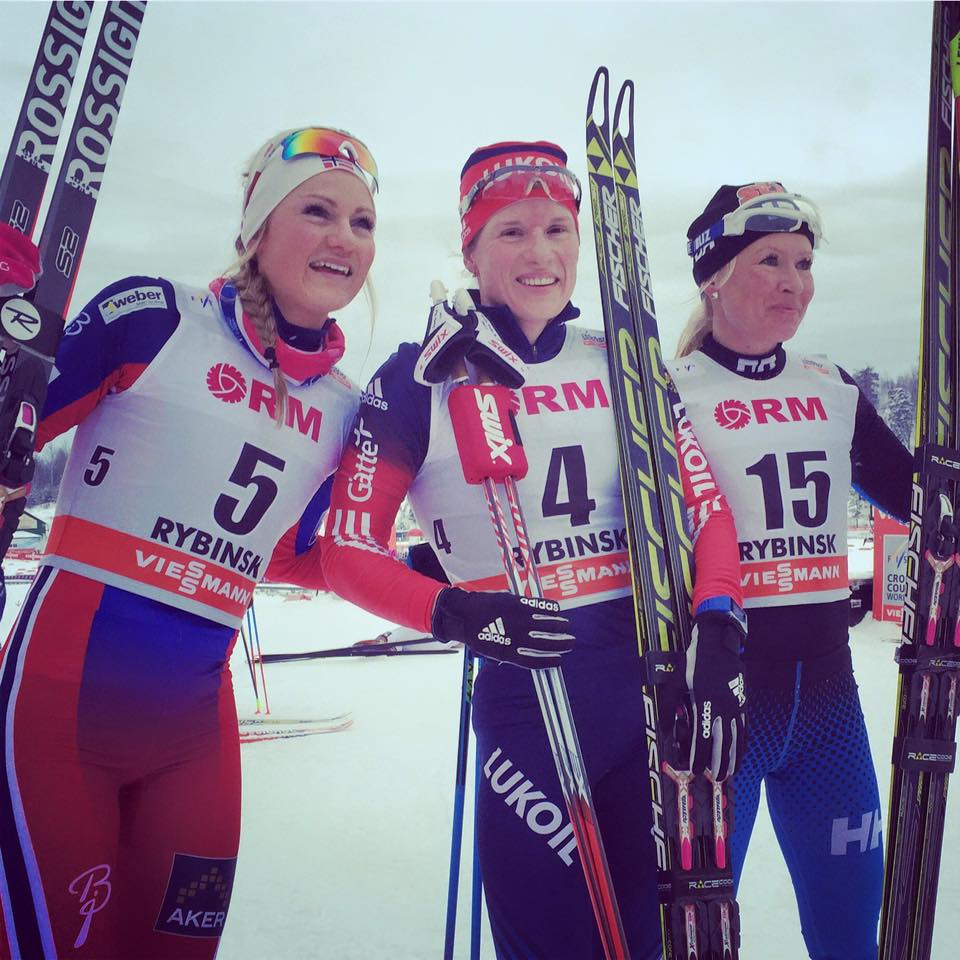
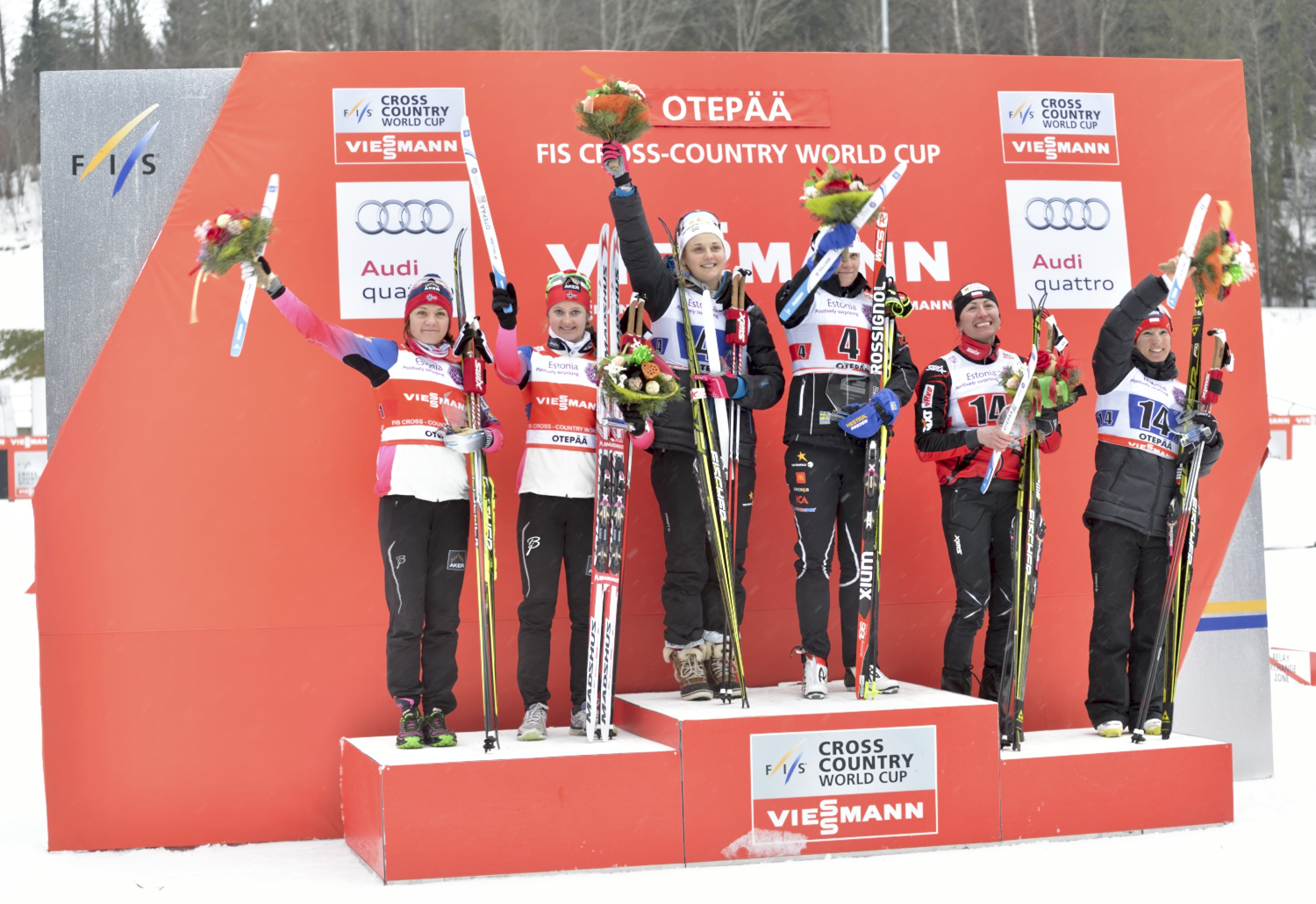
In her first World Cup appearance since 2013, Brennan teamed up with Ida Sargent to take sixth in the Otepää, Estonia team sprint. A week later, Brennan earned a career-best individual result with a 13th place finish in the Rybinsk, Russia World Cup 10 k freestyle. The weekend’s success continued with a 31st in the freestyle sprint and 20th in the 15 k skiathlon. Although the the 10 k marked her best individual World Cup result, both the sprint and skiathlon also surpassed her previous best finish of 35th in the 10 k at a 2012 World Cup in Canmore.
In the leadup to the biggest races of the season, Brennan skied to 33rd and 32nd in the classic sprint and 10 k freestyle in Östersund, Sweden. The best was yet to come, however, as Brennan entered her first-ever appearance in a World Championships.
Brennan raced in three competitions in Falun, Sweden and impressed every time she took to the famed trails. She earned 30th in the 15 k skiathlon and held onto a charging Justyna Kowalzcyk in the second leg of the women’s 4 x 10 k relay to aid the team in a record-tying fourth place finish. Kowalczyk and Brennan would meet again in the 30 k classic mass start, where Brennan out-sprinted the four-time overall World Cup champion to take 16th.
“If you had asked me at the beginning of the year, no way,” she said when asked whether she had expected perform at such a high level at World Championships. “After I came over here and started having a few good results, I was hoping that I could find some sort of peak here and have some good results. So I’m really happy with how it went. I wish I could have raced more races, but it was my first time, so I have to earn my way onto all the starts.”
In the upcoming season, Brennan’s hard work will pay off – she enters the season with a nomination to the USST B-team and will have the option to race in all period one World Cup competitions as the overall SuperTour leader.
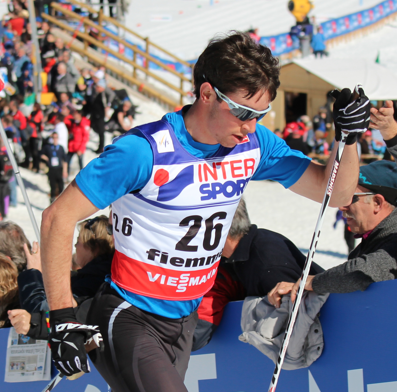
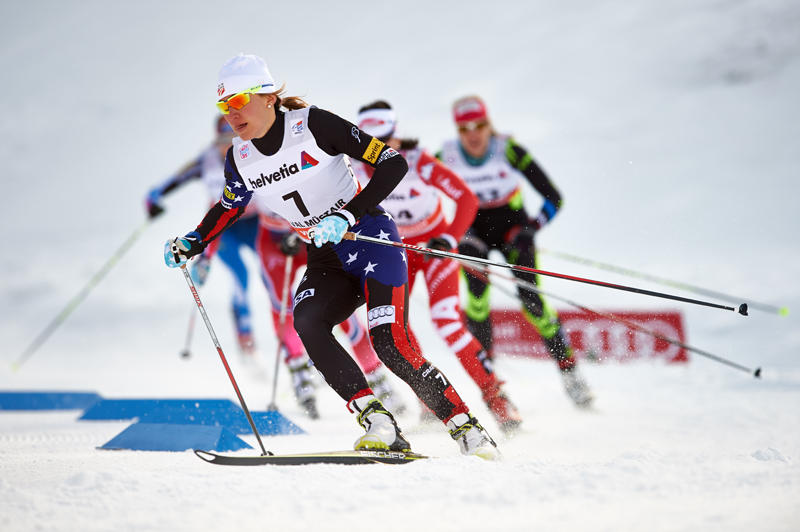
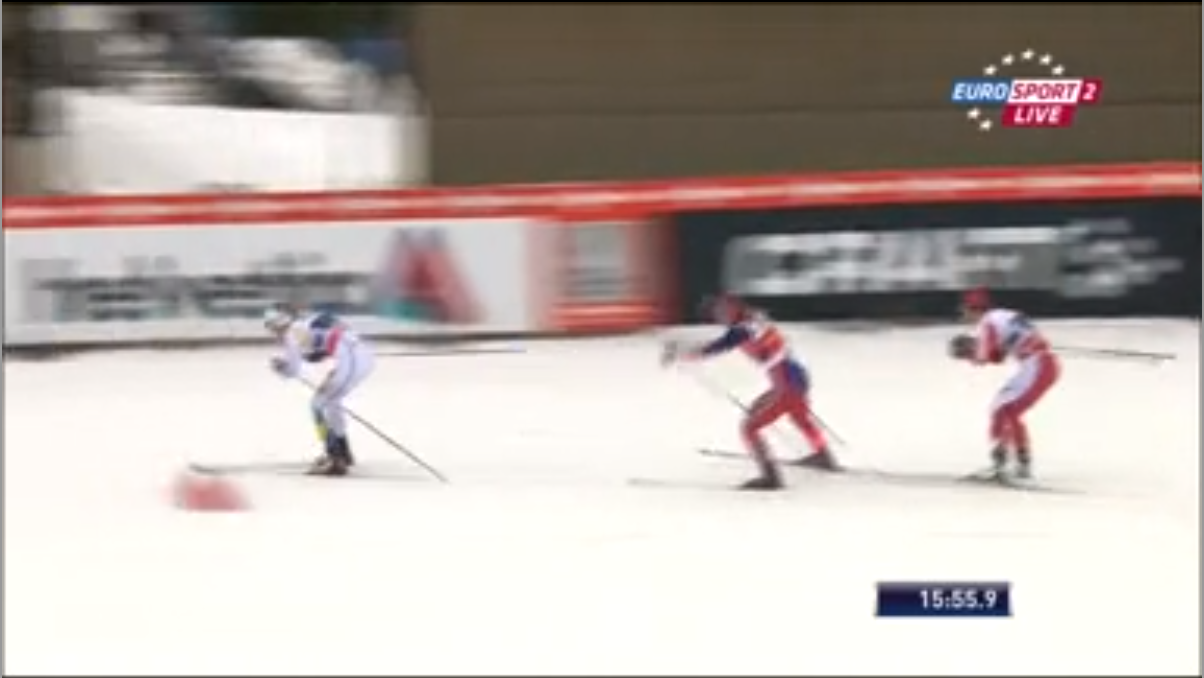
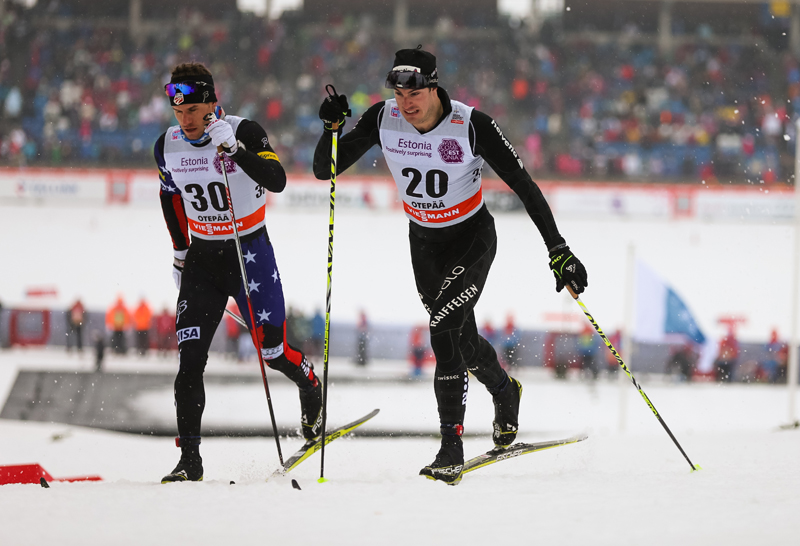
Graeme Killick of Canada on his second loop in the World Championships men’s 4 x 10 k relay in Falun, Sweden.
Graeme Killick, Canadian National Development B-team
Like Brennan, Graeme Killick had a momentous 2015 World Championships. Prior to the two-week event the Canadian’s best result in the 2014/2015 season was 40th in the Rybinsk 30 k skiathlon, but in his first race in Falun, Killick surpassed the mark with a 32nd placement in the 15 k freestyle.
Killick also raced in Canada’s 4 x 10 k relay which finished 10th, but his focus was on the final race of the Championships – the 50 k classic mass start. The 26-year-old had demonstrated his potential in the 50 k at the 2014 Olympics event with a 28th-place finish and was ready to see what he could do.
“I was just hoping I would hang in there and not cramp on the last few laps,” Killick said to FasterSkier in Falun. “[When it comes to] 50 k’s, it seems like they’re really hit and miss for me. Domestically I’ve struggled to get top 15, but internationally, my best results have been in the 50 k. If I’m in shape, they can go really well, but I would say the focus for me [at World Championships] was the pursuit [skiathlon], which I didn’t end up doing because I got sick in Östersund… When that was out, the 50 became the main focus.”
Killick remained within the top 30 during the entirety of the 50 k, at times breaking into top 10. Eventually he placed 19th for his best-ever international result.
Reflecting on his breakthrough finish Killick said he was excited about his prospects.
“This year I was able to start on the World Cup for the first time in my career and spend a significant portion of the year over here,” he said. “Just seeing the level and seeing how these guys train and race I think has given me a lot of ideas for next year. I’m really excited to try to take the next step and become a contender here on the World Cup.”
In the coming season, Killick will return to Canada’s National Development B-team.
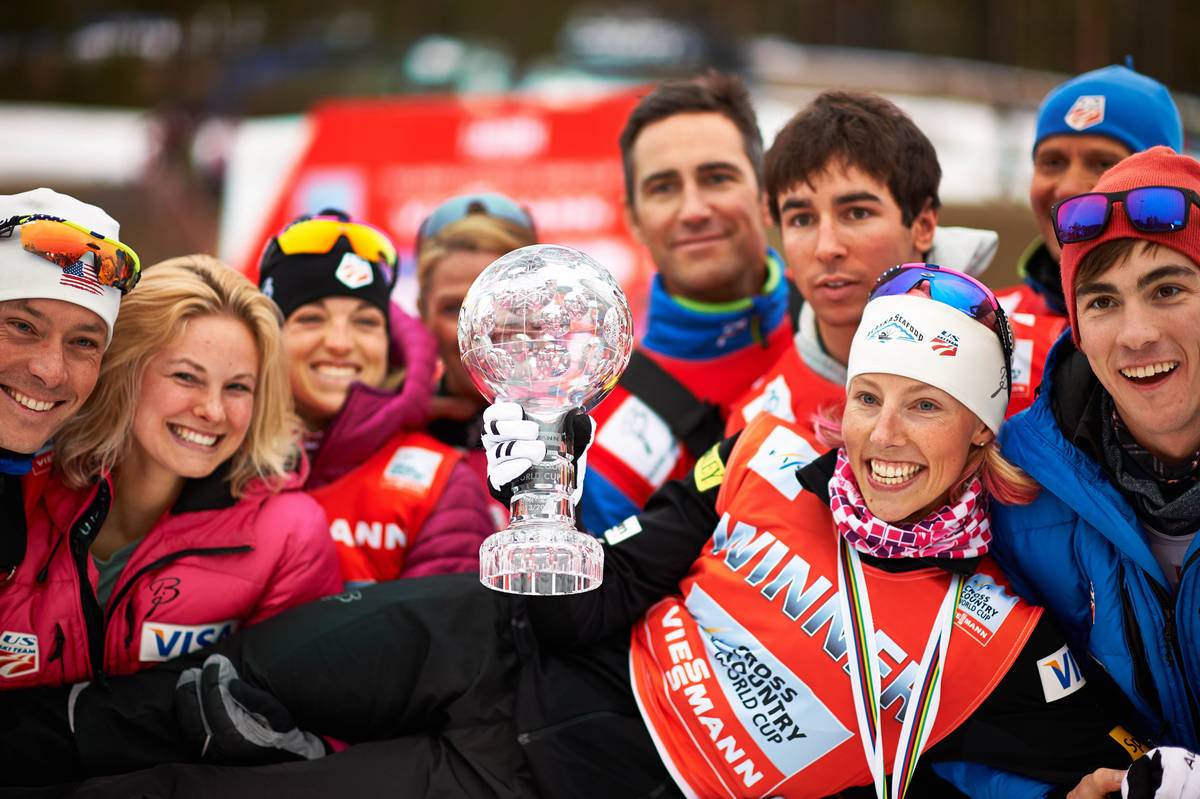
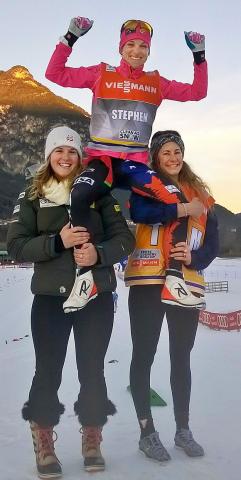
Several members of the U.S. Ski Team lift up Kikkan Randall after she won her third-straight World Cup sprint Crystal Globe a the end of the 2013/2014 season. Randall enters the upcoming season with another A-team nomination after a year of possible over-training. (Photo: Fischer/Nordic Focus)
The U.S. Ski and Snowboard Association (USSA) announced its cross-country team nominations for the 2015/2016 season on Thursday, naming 16 athletes to the team, four more than the previous year.
All 12 athletes from 2014/2015 will return, led by Liz Stephen (Burke Mountain Academy) who finished 10th overall in the season’s World Cup standings. Other A-team athletes include 2015 World Championships silver medalist Jessie Diggins of the Stratton Mountain School T2 Team (SMST2), three-time World Cup sprint champion Kikkan Randall of Alaska Pacific University (APU), Sadie Bjornsen (APU), Sophie Caldwell (SMST2), Ida Sargent (Craftsbury Green Racing Project), Andy Newell (SMST2), and Simi Hamilton (SMST2).
The B-team will feature returning athletes Noah Hoffman (Ski and Snowboard Club Vail) and Erik Bjornsen (APU).
Rosie Brennan (APU) and Caitlin Gregg (Team Gregg) are two new additions to the B-team after breakthrough seasons. Like Diggins, Gregg earned a historic medal in the 10 k freestyle at World Championships in Falun, Sweden, placing third after Diggins. Brennan broke into the top 20 on both the World Cup circuit and at World Championships, most notably in the 30 k in Falun where she placed 16th. Brennan returns to the USST after being a member of the team in 2007/2008 and 2008/2009.
The D-team will also grow in the 2015/2016 season with the addition of two women, Katharine Ogden (SMS) and Julia Kern (Cambridge Sports Union). They were named along with returning D-team athletes, Ben Saxton (SMST2) and Patrick Caldwell (SMST2/Dartmouth).
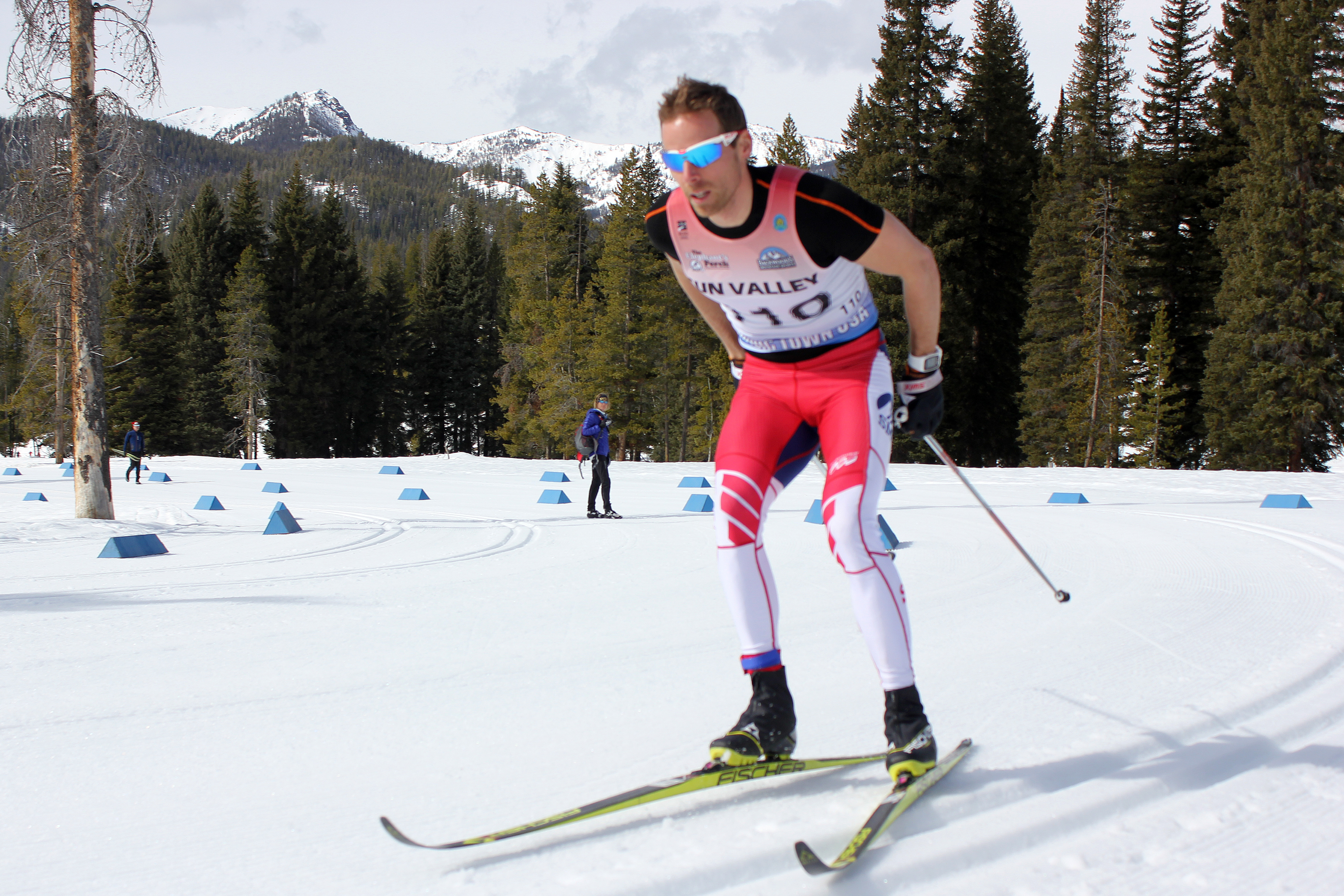
Andy Newell is one of two men on the USST A-team in the 2015/2016 season. Here the SMST2 skier is racing in the 15 k classic individual start at the 2015 Super Tour Finals in Sun Valley, Idaho.
There are objective requirements to earn an automatic nomination to the U.S. Ski Team (USST). An athlete must either be in the top 50 in the overall World Cup rankings or have a top-30 ranking in the distance or sprint disciplines. A skier can also be ranked in the top 30 of the FIS points list in distance or sprint list to earn the nomination. A final qualifying criteria is a top-three finish at either the Junior or U23 World Championships.
Nine athletes automatically qualified for the team: the eight A-team athletes, who all met the World Cup ranking criteria, and Gregg, who was 27th in the International Ski Federation (FIS) distance points list. The remaining seven skiers were all chosen by discretion.
Although Gregg made the objective criteria, she was not ranked in the World Cup’s Red Group and thus was placed on the B-team.
As in past years, USSA will cover the majority of the eight A-team athletes’ expenses. According to USST Head Coach Chris Grover, there are several instances when A-team members will have to cover their own costs, such as the training period over Christmas when the team prepares for the Tour de Ski.
The B-team athletes will receive some support in the form of lodging and meals at certain training camps, such as the upcoming Park City training camp occurring later this month. However, during the actual season, B-team athletes receive no support from USSA in terms of travel and lodging.
D-team athletes are expected to pay for everything they do throughout the season, but receive the support of the national-team infrastructure, such as coaching, when necessary.
According to Grover, the National Nordic Foundation (NNF) has financially aided both B- and D-team athletes at training camps and during the competition season in the past.
Liz Stephen racing to 11th in the 15 k skiathlon at the 2015 World Championships in Falun, Sweden. Stephen will headline 12 returning and four new athletes on the 2015/2016 U.S. Ski Team. (Photo: flyingpointroad.com)
Grover: ‘We’re really excited to see what people can do’
After the nominations were announced, Grover said that he was excited to see what the group of 16 skiers could accomplish in the upcoming season. Although there is no major championship event in the 2015/2016 schedule, he believes that the Americans have an opportunity to shine.
“I’m really excited for the season because I felt like we had so much bad luck with our crew last year,” he said on the phone. “We made some mistakes as a nation and as a coaching crew both within the USST coaches and also with the club coaches. We had bad luck in terms of injuries. First of all, I doubt we will have those injuries again and second of all I think we will learn from some over-training issues going forward.”
The most notable injuries of the season came from Sophie Caldwell and Hoffman. Caldwell broke both her elbows in the leadup to the season, which hindered much of her preparation. Hoffman fractured his leg in a November crash — his first World Cup race of the season — which took him out of competition and full training until late February 2015.
In terms of overtraining, Grover pointed to two specific athletes — Newell and Randall — who may have suffered from its effects throughout the season.
With no championship event, the team will have varying focus races between athletes. However, Grover said that the Tour de Ski and the season-ending Canadian World Cup tour are two events that many team members will target. With a “home-time-zone” advantage and a small break spent in the U.S. to prepare beforehand, Grover said that the Canadian tour gives his team an opportunity for high performance. The midseason World Cup weekend in Nove Mesto, Czech Republic, is another focus as it features some of the Americans’ best events: a freestyle individual distance and a team relay.
Grover explained he’s interested to see how the newcomers perform in their first seasons as full-time World Cup athletes, especially after successful 2014/2015 outings.
“[Brennan] dominated domestically in the fall. We’ve talked about her a lot — she was in great shape last summer when we saw her at the camp at Eagle Glacier and she carried that shape into the fall,” Grover said. “Then she showed up on the World Cup and she proved that her domestically really translated to her speed internationally. It was natural to put her on the B-team.”
“Caitlin by contrast struggled in the early part of the season. She was the Continental Cup leader during the whole first period and she wasn’t skiing particularly fast at that time,” he added. “She went home, regrouped, she obviously did some good training in Colorado. She came back and did some really good skiing in Falun and Holmenkollen in particular.”
Grover said that the coaching staff will be “selective” as to which races they enter the 34-year-old Gregg because of limited starting spots and her tendency for high performance when targeting certain races.
“For her it doesn’t make sense for her to dive into a full World Cup schedule,” he said. “She has shown that she does her best when she targets key events that play to her strengths. One key thing that’s on her radar is the 15 k freestyle in Davos in the middle of December.”
On the World Cup circuit, the U.S. has lost two sprint starts for the women — a reduction from six to four — and will only be able to start seven women in the season’s tours, which make up just over half of the season’s races. (Tour starts are calculated by adding distance spots plus half the sprint spots). With eight women on the A- and B-teams, the entire team will not be able to start the tours. One exception will be the Ruka mini tour in Kuusamo, Finland, which allows an additional spot for the Continental Cup leader for Period 1. Since Brennan will be the leader at the time, all eight women will technically be able to start the mini tour.
17-year-old Katharine Ogden’s sixth-place finish in the women’s 10 k skiathlon at the 2015 Junior World Championships was the best American result in a distance race since 2002 (Photo: Bryan Fish/USSA)
D-Team: An Opportunity for Extra Support
The D-team will double in size from two to four in 2015/2016 with the addition of Ogden and Kern. According to Grover there were several athletes who were strong candidates for positions on the team.
“It’s hard because there are a number of athletes who are out there that could have potential D-team positions,” he said. “Especially on the guys’ side, there are a lot of guys who are really close that maybe had one or two real standout races for the year. There are a lot of guys we are keeping an eye out for and we just want to watch really for another year and see how they develop and see if they can have some big results in Europe.”
Grover explained that Ogden and Kern have been at the top of women’s junior racing in the U.S. for several years and that their successes last season proved they were ready for national-team support.
“With Katharine and Julia, those are two juniors who have been the best juniors for a few years. In general they have been two of the standouts,” Grover said. “Katharine was one of the obvious choices, as her result at the Junior World Championships is one of our historic best U.S. finishes of all time. Julia had some really standout results on the Europa Cup and Slavic Cup in particular where she was the fastest American woman.”
While the D-team does not provide any special starting rights or automatic trip qualifications, it does allow its athletes to take advantage of the USST infrastructure. According to Grover, its four members will have access to USST perks such as sports medicine, sports science and coaching that wouldn’t otherwise be provided to National Training Group (NTG) athletes.
2015/2016 USST Nominations:
A-team
Men
Andrew Newell (Shaftsbury, VT; SMS T2; 11/30/83)
Simi Hamilton (Aspen, CO; SMS T2; 5/14/87)
Women
Sadie Bjornsen (Winthrop, WA; Alaska Pacific University Nordic Center; 11/21/89)
Sophie Caldwell (Peru, VT; SMS T2; 3/22/90)
Jessie Diggins (Afton, MN; SMS T2; 8/26/91)
Kikkan Randall (Anchorage, AK; Alaska Pacific University Nordic Center; 12/31/82)
Ida Sargent (Orleans, VT; Craftsbury Green Racing Project; 1/25/88)
Liz Stephen (East Montpelier, VT; Burke Mountain Academy; 1/12/87)
B-team
Men
Erik Bjornsen (Winthrop, WA; Alaska Pacific University Nordic Center; 7/14/91)
Noah Hoffman (Aspen, CO; Ski and Snowboard Club Vail; 8/1/89)
Women
Rosie Brennan (Anchorage, AK; Alaska Pacific University Nordic Center; 12/2/88)
The start of the men’s U.S. National Championships 50 k freestyle mass start at the 2015 SuperTour Finals in Sun Valley, Idaho. (Photo: flyingpointroad)
SUN VALLEY, Idaho — Sun, warm weather and abundant smiles welcomed the final day of competition at 2015 SuperTour Finals, which featured the U.S. Distance Nationals 30- and 50-kilometer freestyle mass starts.
The men’s 50 k took place on icy and fast snow that made it difficult for skiers to find traction as they skated around the 9-lap course. The 62 starters of the race remained relatively close throughout the first laps, but as the kilometers continued a pack of 14 skiers gained nearly a minute on the field.
The pack was often led by University of Colorado’s Rune Malo Ødegård while other top skiers such as SSCV’s Noah Hoffman and Tad Eliot, Canadian National Team’s Ivan Babikov and Graeme Killick, Alaska Pacific University’s Erik Bjornsen, New Mexico’s Aku Nikander and Brian Gregg shuffled in the mix as well.
Just before the final two laps, Babikov switched his right and left skis to take advantage of intact, smoother edges for further stability on the icy downhills. Regardless of whether the ski switch helped, the Canadian demonstrated his superiority in the remaining 10 kilometers.
On the eighth lap, Babikov sped up one of the 5 k course’s early hills, leaving the remainder of the leading men behind. He held the advantage until the finish, where he crossed in first with a time of 1:57:06.2. Behind him, a four-man fight for second was brewing as Ødegård, Hoffman, Killick, and Bjornsen drew closer towards the finish. The skiers entered the last meters together, but Ødegård used a strong final kick to claim silver, 51.9 seconds from Babikov. Hoffman crossed the line in a close third, 52.4 seconds from the win.
Bjornsen (+52.8) was fourth, while Killick (+54.5) took fifth.
Canada’s Ivan Babikov celebrates his win in Thursday’s 50 k freestyle mass start at the 2015 SuperTour Finals in Sun Valley, Idaho. (Photo: flyingpointroad)
After his finish Babikov, who is fresh off a week of racing at Canadian Ski Nationals, said that he expected the competition to respond to his game-changing move, but soon realized they were nowhere in sight. “The altitude actually works well for me. I pushed a bit with two laps to go and I was surprised I dropped the guys,” he explained.
Babikov’s strategy for the 50 k was to stay at the front of the pack to avoid any mishaps on what he described as “dangerous” conditions.
“To be honest, even at the end, the track was poorly prepared. The downhills were super dangerous and people were all over the place,” he said. “I just tried to stay ahead, not to get in a crash and not to get into a pile up. Then I wanted to go faster in the last laps and that’s what happened.”
Babikov was pleased with his win, especially given his history with U.S. domestic racing. Babikov was once a member of the Subaru Factory team and a regular at SuperTour and U.S. Championships events.
“This is really important for me,” Babikov said of his win. “ U.S. Nationals, I’ve done it so many times, and doing all the SuperTours. I love coming here, all the people are so friendly. Graeme [Killick] was really surprised because all the coaches were offering help, and everyone was really friendly.”
After his second place finish Ødegård said that since the 50 k was the last race of the season he entered with nothing to lose. Like Babikov, the University of Colorado skier worked to stay at the front to control the speed and avoid crashes on the treacherous downhills. “I felt really good in the warm up so I just felt like I should be offensive today and stay in front and control it, especially the downhills,” he said.
As the race became a four-way fight for second, Ødegård said that he was focused on conserving energy for the final meters instead of chasing Babikov.
“When he got the gap I thought it was not that smart for me to chase that down,” he said of Babikov’s move. “I would die and I probably won’t even be able to take second, so it was better to focus on second place today.”
The senior recently finished his college skiing career with a pair of third-place finishes at the 2015 NCAA Championships in Lake Placid earlier this month. He plans to make the jump into professional skiing within the next year and hopes that Thursday’s performance will catch the eyes of teams in his home country.
“It means a lot,” the Norwegian said. “It’s really good skiers around me today, World Cup skiers, and you know they are top performers in 50 kilometers. I hope people back home can notice that I went fast today and that could help me get in some team for next year.”
Colorado’s Rune Malo Ødegård celebrates his second place finish over Noah Hoffman (r) and Erik Bjornsen (l) in the U.S. National Championships 50 k freestyle mass start at the 2015 SuperTour Finals in Sun Valley, Idaho . (Photo: flyingpointroad)
Hoffman placed third overall and was crowned U.S. National Champion in the 50 k as the first American finisher. Hoffman, who suffered a fractured leg in November and returned to racing in February, said that he was happy to end the season on a high note.
“It’s a good way to end a challenging season,” Hoffman said. “I’m happy with the way I skied today especially given the conditions. It was so hard to stand out there, especially on that hill. It was so icy in places.”
Before the race, Hoffman said he was discouraged from a week of mediocre racing at the SuperTour Finals. In the first laps of the race he felt like the 50 k was headed in a similar direction, but he recovered as the race progressed.
“I wanted to feel it out,” Hoffman said of his strategy. “It’s been such a rough week and not an encouraging two months of racing. To be honest, I was really hurting and I thought it was going to be a really rough day, but then I felt better as the race went on and the conditions softened.”
Hoffman said he was proud of his finishing sprint, which is not something the distance skier is known for; “I’m happy with that finishing sprint. Not that long ago I would have gotten last out of the group,” he said. “Bjornsen is a great sprinter so it’s a little team battle there. It’s fun for me to come out on top.”
Caitlin Gregg (Team Gregg/Madshus) leads the start of the women’s National Championships 30 k freestyle mass start at the 2015 SuperTour Finals in Sun Valley, Idaho.
Gregg Skis Away with 30 k Victory
The women’s 30 k welcomed vastly diverse conditions as the sun and warm weather transformed the icy course into a wet, speed-sucking loop. From the start of the race USST/Burke’s Liz Stephen took an early lead on the first uphill. By the top it was just Stephen and Team Gregg/Madshus’ Caitlin Gregg with he rest of the field several seconds behind. Originally suggesting to work together, Gregg took the lead on the downhill but at the bottom of the course her superior skis gave her a large lead over Stephen.
Over the course of the 30 k Gregg increased her lead and crossed the finish line in first with a time of 1:42:46.2. Stephen maintained her second-place standing throughout the race and crossed the line 2:40.8 behind Gregg.
The fight for third proved more competitive, with four skiers – APU’s Sadie Bjornsen, Rosie Brennan, Chelsea Holmes, and Utah’s Veronika Mayerhofer – vying for the final spot on the podium. The three APU skiers eventually dropped Mayerhofer and entered the finish together. In the end it was Sadie Bjornsen who claimed bronze, 3:54.0 behind Gregg.
Brennan (+4:01.8) and Holmes (+4:05.7) finished fourth and fifth.
Gregg’s victory was reminiscent of the 2014 U.S. Cross Country Championships in Midway, Utah where she skied to a massive victory in the 20 k freestyle mass start. Unlike 2014, many strong skiers from the USST like Stephen and Bjornsen were present in Thursday’s 30 k, making the blowout win even more impressive.
Although it was apparent that Gregg was in top-shape, she was unsure if she would participate in the 30 k prior to its start. Earlier this month, Gregg suffered a concussion after being hit with a feed in the Homenkollen 30 k. She explained that she hadn’t raced or trained significantly since the incident.
“To be quite honest I woke up this morning and I sat a little bit and thought I wasn’t going to race,” she said in a post-race interview. She explained that after watching the men’s 50 k she began to change her mind especially as the snow became slower.
Caitlin Gregg (Team Gregg/Madshus) hugs her husband, Brian, after her large win in the 30 k freestyle mass start at the 2015 SuperTour Finals in Sun Valley, Idaho.
As the conditions began to change more rapidly than expected, Gregg realized she had skis that would match the wet conditions – a pair of new Madshus that she hoped to use in the Holmenkollen 30 k that were ultimately never skied on due to the lack of a ski switch. As the race began, it was clear the skis were the answer to the warm Idaho afternoon.
Gregg said that she had originally wanted to ski at the front and slow the pace. However, after a couple hard pushes from the start she realized it was just her and Stephen ahead of the pack.
“Liz skied an amazing first climb and I was doing everything I could do to hang on,” Gregg said of the first part of the course. “I could tell we had a lead and I said, ‘let’s work together, I’ll lead on the downhill because I’ll be a better draft.’ I started going on the downhill and I turned around and she just looked at me and couldn’t keep up.”
Once alone in the front Gregg said her strategy was to ski the uphills efficiently and the downhills aggressively – knowing that was where she could make up the most time. Even with her large lead, Gregg said that there were times when she doubted her ability to maintain the distance.
“There were moments out there where I felt like ‘oh man maybe I only have 10 k in me,’ but after you get positive feedback you just start to build on that,” she said.
Thursday’s win marks the end of a historic season for Gregg where she earned a bronze medal in the 10 k freestyle at the FIS Nordic World Ski Championships in Falun, Sweden in February. Originally, Gregg wasn’t sure if she would continue to pursue international racing in the upcoming season, but with her continued successes she plans to try and prove herself on the World Cup circuit once again.
“I wasn’t sure if I was going to keep racing, but it seems kind of silly to stop now,” she explained. “I feel great and we are really fired up about the rest of our careers going forward. I know what I need to work on and where I’m at. I have a lot more confidence after this year.”
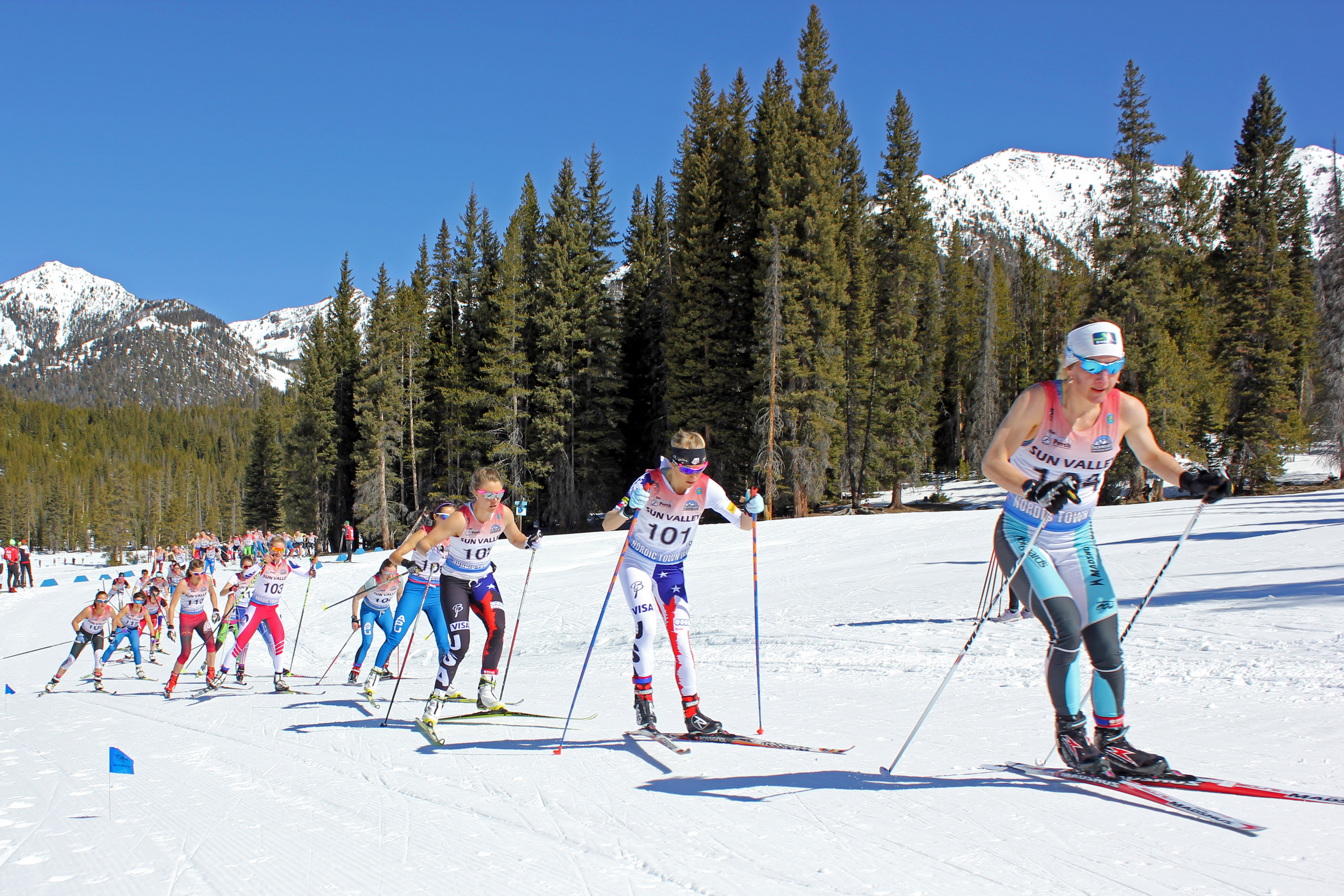
The start of the women’s 30 k freestyle mass start at the 2015 SuperTour Finals in Sun Valley, Idaho. (Photo: flyingpointroad)
In second, Stephen said the 30 k was the hardest race she’s ever completed and was happy to end the season knowing that she earned a break. “I’m really psyched to put an end to the season. It’s been awesome and I’m ready for a break… and to find a beach,” she explained after her finish.
Stephen skied the majority of the race alone and said that she played some “little games” to keep her mind from the slowing and wet conditions. Whenever she hit the shade she would work as hard as possible until she reached the slow snow in the sun.
“Dropping out definitely goes through your head,” Stephen said with a laugh, after being asked what was on the Burke Mountain Academy skier’s mind throughout the lonely 30 k. “You just ski it in and keep fighting. I was focused on not having the pack behind me catch me.”
As Stephen crossed the finish line she collapsed from exhaustion and burst into tears. “Sadie and I have been calling this the trail of tears,” Stephen explained of the finish. “The last five weeks we’ve done three 30 kilometers. Today the trail was definitely a teary one. I was just so happy to be done and have my team around me.”
Although Stephen is focused on getting as much rest as possible in the coming weeks, she said that her mind is already going to next season.
“We’ve had a great season as a team and we’ve all had highlights,” she said. “Even though I’m so exhausted, I am looking forward to making some changes and starting the training up again.”
Taking the final podium position, Bjornsen was happy to ski the race with two APU teammates. She explained that the three were able to take advantage of eachother’s strengths to ski the long race in the most efficient way possible. “It also made for some more smiles than we would have had in a 30 k,” she added.
“It’s a great way to end the season with my teammates,” Bjornsen said of the final race of the year. “I’m really glad we had spring series because I finished the World Cup wanting more. I never felt like I found that shape and had some unlucky things at the end. It was fun to come here and go into the training season with some confidence and believe in my shape.”
SuperTour Final Rankings
With the culmination of the 2015 SuperTour, Brennan and Kris Freeman (Freebird) were named the overall leaders. The two will automatically earn starting rights on the World Cup this coming fall.
Holmes claimed the distance title, while Bridger Ski Foundation’s Jennie Bender won the women’s sprint rankings. For the men, Freeman was the top-ranked distance skier while bend Endurance Academy’s Dakota Blackhorse-von Jess earned the sprint title.
Brennan and Freeman also won the titles of U.S. Grand Champion after earning the most points combined from Thursday’s races and the week of racing in Houghton, Mich. in January at the 2015 U.S. Cross Country Championships.
The final award of the season, the National Nordic Foundation Cup, was given to APU for its domination on the domestic circuit in the 2015 season.
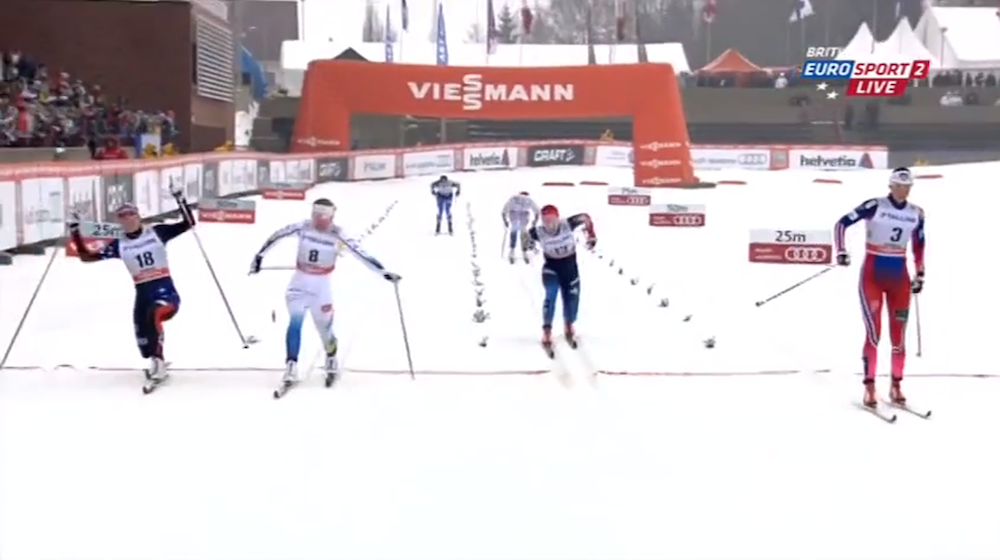
USST’s Caitlin Gregg (r), Jessie Diggins (c) and Liz Stephen (r) in the finish of the 2015 Holmenkollen 30 k which served as the last race of the 2015 World Cup season. Stephen led the three in ninth, while Diggins and Gregg Placed 14th and 19th. (Photo: Madshus/Nordic Focus)
Liz Stephen led a trio of Americans placing in the top 20 of Sunday’s 30-kilometer freestyle mass start in Holmenkollen, Norway – the final World Cup race of the season.
Stephen finished in ninth to earn her sixth individual top-10 finish of the 2014/2015 World Cup season. She was 2:06.7 minutes behind Marit Bjørgen of Norway, who sprinted away from teammate Therese Johaug in the final kilometer to win in a time of 1:14:10.5 and put the finishing touch on her overall World Cup title.
Stephen was fifth after 16.3 k, and led the main chase pack throughout much of the final lap. However, she fell behind in the final kilometer and came across the line 17.5 seconds outside the top five.
Stephen finished the season 10th in the overall World Cup standings and seventh in the distance standings.
The East Montpellier, Vt. native said that she entered Sunday’s race with a goal of reaching the top five and had her sights set on Norway’s Heidi Weng. She explained that to fight for her goal, risks were necessary.
“I took some chances and almost blew up at points. A good indicator for me is when my stomach is knotted and I wanted to throw up which came earlier than usual,” Stephen told USSA in a press release, adding that while she finished four spots away from her goal, she considered the day a success.
With the culmination of the 2015 World Cup season Stephen said the many personal and team achievements of the year gave her hope for the future. Stephen earned a historic fifth-place finish in the 2015 Tour de Ski and claimed the best finish by an American woman in a distance World Cup with her silver medal in the Rybinsk 10 k freestyle.
“The top of the race is closer now. It gives me hope for next year and years in the future,” she said to USSA. “I’m really happy with the day. I’m really happy with the season.”
Jessie Diggins, silver medalist in the 10 k freestyle at the 2015 World Championships, was the second American to finish, coming through by herself in 14th (+2:44.0). She claimed her eighth individual top-15 World Cup finish of the season and ended the season 22nd in the World Cup standings.
Diggins wrote in an email to FasterSkier that she was happy with her race and the World Cup season as a whole. “My skis were great and I was skiing with a pack that didn’t exchange skis so I didn’t either, and it worked out great to be on one pair for the whole race.”
However, Diggins explained that she probably went out too hard, as she was with the lead pack around the 8 k mark but had to settle into the chase group shortly afterward. In addition, she began cramping in her lower quadriceps during the final few kilometers.
“I’ve never had cramping in a race before, so it was totally unexpected, and my legs kept twitching and it was really hard to move!” she wrote.
She explained that instead of trying for a top-10 finish, at that point she was just hoping to get to the finish line “in one piece.”
“I was fine once I got out of the hot sun after the race,” Diggins added.
Meanwhile, Caitlin Gregg finished in 19th (+3:07.7), three weeks after taking bronze in the 10 k freestyle at the 2015 FIS Nordic World Ski Championships in Falun, Sweden.
Gregg said in a phone interview that in previous seasons she would be more excited about Sunday’s result, but her recent successes have left her with higher expectations.
“I’m a little bit bummed, because I was definitely skiing in a place where I was fighting for a top-ten finish and I was feeling really good,” she said.
Gregg put herself in a good position early in the race – she was eighth at the 8 k mark, just 16 seconds off the lead. At that point, she was in a chase pack of roughly six other skiers and feeling strong.
Caitlin Gregg racing to bronze in the 10 k freestyle at 2015 World Championships in Falun, Sweden. Gregg placed 19th in Sunday’s 30 k freestyle mass start in Holmenkollen, Norway. (Photo: Madshus/NordicFocus)
However, she said she picked her second-best pair of skis for the race, expecting the other skiers to exchange their skis at the 13 k point like in previous years. But when the leaders, Bjørgen and Johaug, did not switch, no one in the chase pack did either.
“The skis I selected were a bit stiffer … and as the course broke down I realized they were way too stiff, and areas where I usually would feel the greatest, on those long inclines through some pretty deep slush, my skis were just bogging down and I was struggling,” Gregg said.
As a result, she was caught by another pack and fell to 17th by the 24.3 k point, before finishing the race in the back of that pack.
“Skiing Holmenkollen on your second-best pair of skis isn’t really what you want to do, so it leaves you with that ‘what if?’ feeling. But that’s why we do this; it’s a fun experiment. You’re always playing and the strategy is a cool part of it,” Gregg explained.
Gregg is thrilled with the 2015 season, especially given the fact she dealt with shingles early in the World Cup season. In addition to her performance at World Championships, she won the 10 k freestyle and was second in the freestyle sprint at U.S. Nationals and took third in last weekend’s 42 k mass start Marathon Cup race in Engadin, Switzerland.
“Just being on the World Cup is a pretty incredible experience … I feel like I’ve definitely figured out how to ski on the World Cup, how to travel on the World Cup, how the whole system operates,” she said.
She added that it is a great feeling to know she is finishing strong.
Three other Americans finished in the famed 30 k. Sadie Bjornsen took 44th (+6:59.0) and finishes the season 23rd in the World Cup standings, Caitlin Patterson was 53rd (+8:53.3), and Rosie Brennan finished in 55th (+10:22.7).
The lone Canadian in the field, Emily Nishikawa, took 50th (+8:04.1).
U.S. skiers Liz Stephen (left) and Rosie Brennan racing into the top 16 in the women’s 30 k classic mass start at 2015 World Championships in Falun, Sweden.
FasterSkier’s coverage of the 2015 FIS Nordic World Ski Championships in Falun, Sweden, is brought to you by the generous support of L.L. Bean, now featuring a complete line of Kikkan Randall training wear.
FALUN, Sweden — Everyone knows the U.S. women are strong skaters. It’s been proven again and again by the World Cup sprint globes, World Championships medals, and Tour de Ski final climbs. So when all three U.S. finishers place in the top-20 in the most anticipated 30 k mass start of the year, it was safe to assume no classic skiing was involved.
Wrong.
In Saturday’s 3o k classic mass start at the 2015 FIS Nordic World Ski Championships the U.S. proved it could mix things up in classic distance racing, as Liz Stephen, Rosie Brennan, and Sadie Bjornsen skied away to 11th, 16th, and 20th place finishes. They followed dominant performance by Norway’s Therese Johaug, who was victorious with a time of 1:24:47.0.
Things started off with the U.S. in the spotlight. Stephen, starting in row one, had what she characterized as an unusually good start – striding alongside Marit Bjørgen and Heidi Weng of Norway. Stephen later slipped to 24th as teammate Bjornsen rose through the ranks from bib 15 to lead the race.
“There was one point at 5 k where I was leading the race,” Bjornsen laughed. “Like, this is fun, but….”
By the time Johaug made a break for the lead at roughly seven kilometers into the race, the Americans were out of the lead pack. What they lacked in position, however, they made up for in teamwork as they skied with other chasers to stay in the race – Brennan was in 13th while Stephen climbed back into 14th place followed by Bjornsen in 17th.
U.S. Ski Team member Liz Stephen on the first lap of the 30 k classic competition at the 2015 FIS Nordic World Ski Championships in Falun, Sweden.
“In general I work my way into races probably more than most,” Stephen said. “I knew that people were going to come back to me, maybe not everybody, but certainly people. I was just fighting with a group that I was with to kind of move us all up. When we changed skis, I was really happy to change skis as they were noticeably faster.”
As the race continued women began to drop from the pack that contained Stephen and Brennan. Stephen charged and after several more times up the Falun courses’ punishing climbs, she skied her way into tenth place.
While the much of the course remained firm, the snow on each climb was turning to slush. Some teams struggled to find kick, as skiers like third place finisher Charlotte Kalla of Sweden and Aino-Kaisa Saarinen of Finland were forced to herringbone up the Mörderbacken climb. The Americans’ skis were good, however, and Stephen thrived in the slow snow.
“I was praying that they weren’t going to salt today because a icy classic course is not what I want,” Stephen explained. “It was getting slushy in places but it held together really well. I’d always rather have slow conditions than fast.”
Stephen’s steady pace caught Teresa Stadlober of Austria and dropped Norway’s Martine Ek Hagen, who had been tight on her ski tails at 25 k. At the same time, Ingvild Flugstad Østberg also of Norway, managed to catch up after a slow start that had left her over 30 seconds behind Stephen.
Liz Stephen on her way up one of the last hills in the 30 k race.
The two came into the finishing straight together but Østberg, who won team sprint gold earlier in the Championships as well as two individual World Cup sprints this season, had more speed at the end.
“I was hoping for a top-10,” Stephen said. “11th is pretty close and to be out-sprinted by Ingvild I think is ok. The strategy was to try and have a good start which I did, and to just ski the best classic I could – relax and keep the technique together because that’s when I go the fastest.”
Despite missing the top-10 the race was one of the top classic races of Stephen’s career. This season she had a breakthrough at the Tour de Ski, finishing fifth in a 10 k classic mass start in Val di Fiemme, Italy. Before that, she had finished sixth in another 10 k classic in Poland.
Stephen placed 16th in the same event at 2013 World Championships in Val di Fiemme, and also 16th in the 30 k freestyle at 2011 World Championships in Oslo, Norway. No American woman has placed in the top 10 of a World Championships 30 k since the event debuted in 1989 (before that, when the men competed in a 50 k, the women skied only 20 k, or before 1982, they simply did not compete in long distances at all).
Rosie Brennan skiing in the lead pack in the first 10 kilometers of the women’s 30 k classic at the 2015 FIS Nordic World Ski Championships in Falun, Sweden. She finished 16th on the day.
Two More Top-20
Halfway through, Brennan and Bjornsen were in a group fighting for 15th place.
“I knew that it was going to go out hard, so I thought, I’m going to fight with everything I have for 10 k, and then hope they slow down a little bit and I find a group to ski with,” Brennan explained. “It worked out pretty well, I got a nice little to work with for most of the race.”
Bjornsen was also hoping to hold onto the leaders as long as she could.
“I haven’t been feeling on fire lately, so I just wanted to fight as long as I could and then see what happens,” Bjornsen said. “That’s the way 30 k’s work. Or at least that’s how I have raced 30 k’s in the last couple of years, is to just hold on as long as possible and some days you can, some days you can’t. Today I definitely struggled right around 10 or 15 k.”
But while Bjornsen was unable to stay with the pack, her Alaska Pacific University teammate Brennan just kept on going.
“I knew I was in a good group that was going to mean a good result, and that maybe if we kept charging we’d catch some stragglers from the front group,” she said. “So I just tried to hang on and keep going.”
In the 5 k she was passed by a few skiers – Østberg and Seraina Boner of Switzerland – and caught by Justyna Kowalczyk of Poland. When Kowalczyk went past Brennan, the American fell behind by roughly 16 seconds at the 27 k mark.
“I was really bummed that I couldn’t catch her in the relay,” she said of the two-time Olympic gold medalist. “So when she passed me I was like, ‘now’s my chance! I can get her back.’ I have really bad downhill skills, but she’s also not exactly known for her downhill skiing. So I was like, this is the perfect person to come into the stadium with. I’ll just go for it!”
And go for it she did.
Determined to make up that ground she lost, Brennan demolished the time difference between her and Kowalczyk. Less than a kilometer from the finish, the two were once again skiing together. As the two climbed to short stadium hill, Brennan pulled ahead of the Polish skier to to take the lead into the final meters. She double-poled furiously to stay ahead, out-sprinting Kowalczyk to the line by one tenth of a second.
“You don’t have to tell Rosie to catch somebody. She’s on it,” U.S. Ski Team women’s coach Matt Whitcomb said after Brennan’s finish. “We started giving splits from Kowalczyk to Rosie with about 2 k to go. We figured that with 16 seconds back it could be done.”
Sadie Bjornsen striding up one of Falun’s tough climbs, 18 k into the 30 k classic mass start at 2015 FIS Nordic World Ski Championships. She finished her day in 20th.
Just over a minute later, Bjornsen crossed the line in 20th place.
“It wasn’t the most spectacular race, but I’m certainly happy to have a sub-par race and be in the 20’s,” Bjornsen said. “I’m happy. It was fun. A great way to end the Championships, to spend an hour and a half skiing in that crowd and going through the pain train, and then recovering, and then more pain train.”
Bjornsen, too had a finishing battle, in her case with Anne Kyllönen of Finland.
“The only thing that was keeping me going at the end is that I was skiing next to one of the Finnish girls who I sprint with, and I was like, okay, I know I can be stronger than her – even if I don’t really know if I’m stronger than her!” Bjornsen laughed. “But at least I know how she skis, and I’m going to decide that I’m actually stronger than her right now.”
It was Bjornsen’s third result in a row in roughly the same position: she finished 20th in the 15 k skiathlon and 19th in the classic sprint. While she’s relieved to have consistent performances on days that she doesn’t feel her best, she also said that it can be hard to have consistently good, but not standout, results.
“I guess consistency is the answer this year,” Bjornsen said. “It’s hard to be patient because last year I had some races that were way high, and some that were way low, and this year it’s more stable. It’s sometimes hard.”
Brennan, who is in an earlier stage of her international career despite being a many-time teammate of Bjornsen’s at World Junior Championships and Under-23 World Championships, feels different: she’s having breakthrough results after coming to Europe as the Continental Cup leader in mid-January.
“If you had asked me at the beginning of the year, no way,” she said when asked whether she had expected to leave World Championships with this caliber of results. “Not a chance. After I came over here and started having a few good results, I was hoping that I could find some sort of peak here and have some good results. So I’m really happy with how it went. I wish I could have raced more races, but it was my first time, so I have to earn my way onto all the starts.”
“The only way I was going to finish the race was if I was having a really good day”
Jessie Diggins was the fourth American starter in Saturday’s 30 k, but entered with a different mentality than her fellow teammates. After talking with her personal coach, USST assistant Jason Cork, the two decided that the only way Diggins would finish the 30 k was if race was going well.
“I came up with a plan with my coach to start and the only way I was going to finish the race was if I was having a really, really good day,” Diggins explained.
Jessie Diggins of the United States skiing with Celia Aymonier of France early on in the 30 k classic race at the 2015 FIS Nordic World Ski Championships in Falun, Sweden. Diggins later dropped out.
The Minnesota native began the race as the sixteenth ranked skier and held her position for much of the first kilometers. At the 3.3. k mark she was skiing 11 seconds behind Bjørgen and Johaug and by the time she reached the top of Mördarbacken she was in contact with the large group of leaders.
The deciding factor of Diggins’ race took place soon after. According to the 23-year-old an unidentified skier changed lanes in front of her, causing Diggins to crash and lose precious time. While she was in 19th at the 5 k mark and only 16.8 seconds from the lead, Diggins crossed the 6.2 k checkpoint in 30th and trailed by 1:01.6.
“After [the crash] I just wasn’t skiing as confident and as well as before,” she said.
Having lost contact with the top skiers Diggins exited the race just after the 10 k mark.
According Diggins, who was the silver medalist in Tuesday’s 10 k freestyle, she was content to stick with the plan. She explained that an entire 30 k effort would have left her fatigued for the following week’s World Cup races in Lahti, Finland and that a 10 k time trial was good preparation for the end of the season.
“Doing a 10 k time trial was perfect and exactly what I needed because it set me up really well for the 10 k in Lahti,” she explained. “There was so many great things that I got out of today without even finishing the race. It was a good experience and at first I was feeling, ‘oh maybe I should have kept on going’ but to be honest it would have been a really bad decision for me to finish that race.”
Diggins explained that a top-15 or top-20 would have been an excellent result for the 23-year-old in Saturday’s 30 k mass start. Historically, Diggins has only cracked the top-15 in one World Cup classic distance race – a 5 k in the 2014 Tour de Ski where she finished 10th. Diggins also dropped out of the 30 k classic mass start in the 2013 World Championships after a hard crash.
Satisfaction and Hunger
After the finish of Saturday’s 30 k, U.S. Ski Team women’s coach Matt Whitcomb was beaming.
“It’s the technique that we were probably criticized most for, the classic distance,” Whitcomb explained. “We put some of those criticisms to rest but at the same time I know we can do better.”
Whitcomb explained that a key factor in landing three skiers in the top-20 was the ski exchange occurring at 15 k. It’s an area where the USST has struggled in the past, most notably at the 2014 Olympic Games in Sochi, Russia. Whitcomb explained that in the laps prior to Saturday’s exchange, the U.S. coaches informed their athletes which racers were changing skis ahead of them. The skiers then decided on their own whether they wanted to exchange pairs or keep skiing through the lap. All three women changed skis to much success.
“Of the four or five opportunities we’ve had at ski exchanges I feel like this is the first one we’ve got right,” he said. “It’s a format that’s always a little tricky and what we did was give the athletes as much information as to what the packs ahead of them are doing and then allowing them to make the decision alone.”
In a day where all three U.S. skiers proved their mettle, Whitcomb said Brennan’s 16th-place was a standout performance. He explained that the Alaska Pacific University skier has excelled on the World Cup circuit since arriving in early January, adding new energy to the team. Brennan, who dominated the SuperTour circuit in the fall and early winter, has been consistently in or near the top-30 of the world’s best. Her top World Cup of her career came in Rybisnk, Russia this January, where she finished 13th in the 10 k freestyle.
“If there is a most improved skier award it goes to Rosie, potentially on the entire World Cup,” Whitcomb said. “I don’t know if any nation has had an athlete show from their continental cup with no prior success and hit it out of the park the way that she has.
“She’s being rewarded for years of hard work. It’s been a tough year for her, and to see all the work pay off and incredible results from start to finish is really neat,” he added.
As Whitcomb and the USST women look ahead to the rest of the season the USST coach said they will use the momentum from Saturday’s 30 k to fight for even better results. “We’ll take a lot of satisfaction from today and apply what what we are still hungry for as we look ahead to Lahti and Oslo this year,” he explained.
American anchor skier Jessie Diggins leading Poland’s Sylwia Jaskowiec and Germany’s Nicole Fessel with 2.5 kilometers left to go in the women’s World Championship relay in Falun, Sweden.
FasterSkier’s coverage of the 2015 FIS Nordic World Ski Championships in Falun, Sweden, is brought to you by the generous support of L.L. Bean, now featuring a complete line of Kikkan Randall training wear.
FALUN, Sweden– With two medals in the 10-kilometer freestyle race two days ago here at World Championships, both internal and external pressure was high on the women of the U.S. Ski Team to climb the podium in Thursday’s 4 x 5 kilometer relay.
They had been there before, at least in World Cup racing, when the Americans placed third in the same event in Gällivare, Sweden, in December 2012. But since then, they had won World Championships gold in the team sprint in 2013 and had best-ever individual performances by almost every member of the team.
And so the Americans went into the relay raring to go.
“You can say that you believe in yourself, but to actually believe in yourself is an entirely different thing,” U.S. Ski Team women’s coach Matt Whitcomb said. “I think some of these results earlier in the week, our top 10’s, our top 15’s, our podiums, have really allowed not just those who acquired the results, but those who are connected to them on the team, close to them, to feel that confidence. This is a team that really believes in themselves.”
Things didn’t go smoothly straight out of the gate, with leadoff skier Sadie Bjornsen crashing on an uphill and losing contact with the leaders. But despite that, the team fought their way back to fourth place, 1:49.9 behind the winning Norwegian team and just ahead of Poland and Germany, who had been in contact on the final loop.
“It can be hard, especially last night when you know that there’s a huge opportunity ahead of you, it can really shut you down, the pressure,” said Jessie Diggins, who anchored the relay. “I think we rose up and met it, and I think we can be really proud of that… To be fourth in the world on a day when not everything went perfectly, is something I think we can be really proud of.”
A Rough Start
Bjornsen was embedded in a tight lead pack for the first loop of the tough 2.5 k classic course. Skiing in fourth, she was aggressive and also handling skis which she described as the fastest in the field. Halfway through her 5 k assignment Bjornsen was sitting in fourth place when Anastasia Dotsenko of Russia skied over the tips of her skis on the short, steep uphill in the stadium.
Sadie Bjornsen (far right) at the start of the women’s 4 x 5 k relay.
“Russia just kind of went over the top of my front ski, and spun me around,” she said. “It was in a spot where it was high speed, so it was not ideal. I was feeling great. I was ready to chase with them.”
It was a fateful moment not only for Bjornsen, but for the rest of the field as well. The women had been tightly packed, but because Bjornsen’s fall created chaos in the middle of the group, a gap suddenly opened to the leading two teams, Russia and Finland. While Heidi Weng of Norway and Sofia Bleckur of Sweden were eventually able to recover and bridge that gap, the field had fractured sooner than it otherwise might have.
For Bjornsen, it was tough to fully recover. She initially made up some of the ground she had lost, but by the time she tagged off she was 50 seconds behind Aino-Kaisa Saarinen of Finland.
“Initially I went really hard, and then flooded pretty badly,” Bjornsen said. “So it was hard to come back on.”
When she made it to the tag zone, she handed off to Alaska Pacific University teammate Rosie Brennan. The SuperTour leader through the first period of racing, Brennan qualified for her first World Championships by dint of her domestic racing so far this season.
“I was really nervous,” she said. “But I was really excited to be part of the relay. It’s just really awesome privilege.”
Rosie Brennan striding it out in the stadium during the 2015 World Championships relay. She passed the Russian team to move the U.S. from sixth up to fifth place at the relay’s halfway mark.
While the gap to the leaders grew by 50 seconds under Brennan’s watch – Therese Johaug of Norway seized the lead from Finland and put on a show, caught only by Sweden’s Charlotte Kalla – Brennan moved the team up from sixth to fifth by passing Alevtina Tanygina of Russia. She had a powerful motivator ahead of her: Justyna Kowalczyk of Poland, one of the world’s best classic skiers.
“Kowalczyk was the one who tagged in front of me, so I went out as hard as I could to try to get on the back of her, thinking maybe I could catch a sweet ride,” Brennan explained. “I wasn’t quite that fast, so I just tried to keep her in my eyesight the whole time. Then we caught that Russian girl, so I just tried to put a big enough gap on her so she wouldn’t come back on the downhill.”
When Brennan tagged off, she was 38 seconds behind Poland and in fifth place. Whitcomb was impressed by both Bjornsen’s and Brennan’s performances: one had crashed and the other was in her first senior-level relay ever, and the team was still fifth.
“It’s pretty impressive to see how close she was able to stay,” he said of Bjornsen. “I’m really impressed with her ability to crash, freak out a little bit, and then land right away. She just got up, stayed cool, and it’s a testament to a championship racer.”
And after that, it would have been easier for the gap to the leaders to grow even more. But Brennan kept things under control.
“It’s really cool to see Rosie in her first relay start be part of a fourth-place result,” Whitcomb said. “We’ve had days where we lose contact after one lap and that space that opens up and you’re in no draft. And those skiers ahead of you, if they’re packed up, they are going away from you fast. So that could have opened up to three minutes, but she kept it.”
That left the race up to the Americans’ habitual anchors, Liz Stephen and Diggins.
Skating to Success
Liz Stephen (U.S. Ski Team) working her way through the stadium in Falun.
While the climbs in the classic leg had gone on and on, with Bjornsen and Brennan climbing up “little Mörderbacken,” Stephen and Diggins had less time to work with as they tried to make up time on the leaders. The skate course was 2.4 k compared to 2.8 k on the classic course, and the biggest climb was only half the size.
That corresponded to ski times only 2/3 as long: while the classic legs were 14 or 15 minutes, Stephen and Diggins had only 10 minutes to work with each, as they tried to make up an almost two-minute gap to the leaders. A podium seemed out of the question.
“Short, so short!” Stephen said. “I had two V1 hills to hop the crap out of and I felt great on the ups. It was awesome to have Denise Herrmann [of Germany] lead that first section through the wind. I skied my hardest and my heart out.”
Stephen’s time was only one second off the fastest split for her leg – taken by Herrmann, who had moved up to catch her on the earlier part of the loop. But by the finish, Stephen had put three seconds into the German and made up time on the fourth-place team from Poland. The U.S. was now only six seconds out of fourth place.
“Every relay, no matter where we are, I’m fighting to get the next person,” Stephen said. “When I get that person I fight to get the next person. I think I say it everytime, but the game of tag is my favorite game of all time. I love just going to play tag out there. So I was just focusing on going past Germany and going past Poland and just getting there as fast as possible.”
Jessie Diggins heading out on the final leg of the women’s 4 x 5 k relay.
While the gradual profile didn’t fit Stephen’s traditional strengths – climbing on her skate skis – in a way, it was perfect.
“It’s a very low-profile and fast course, but that’s not to say that it’s easy,” Whitcomb said. “Liz is so fit right now. People will go out and try to jam on this course, and as soon as they start getting tired Liz will find that chink in the armor and destroy them. She came back from 40 seconds to within six of Poland, and as soon as she saw them, that’s like a magnet at work.”
With Poland ahead of her and Germany behind, Diggins set off as she usually does: pedal to the metal, trying to drop the competition. But after a lap, when she had caught but not dropped Sylwia Jaskowiec of Poland, and Nicole Fessel of Germany had also caught up, Diggins had to change her strategy.
Sadie Bjornsen (U.S. Ski Team) skiing the first classic leg for the U.S. women’s 4 x 5 k relay at 2015 World Championships in Falun, Sweden.
“I tried to make them lead, and when they wouldn’t lead, I just stood up,” Diggins explained. “I knew I would recover fast on the downhill. I pretended, OK, it’s the last leg of the team sprint. If you can recover coming into that, and then make a move on the second hill and try to drop them, I knew our skis would be fast, I have a shot at this.”
On the last uphill before the stadium she put in a move, dropping both Jaskowiec and Fessel. She kept that lead into the stadium, up over the final hill, and into the finish line, to secure fourth place by 2.4 seconds over Jaskowiec. It tied the Americans’ best ever relay result.
“I love the chase,” Diggins said, echoing Stephen. “So I was just gunning [Jaskowiec] down… It was really cool to have that chase right there because it just gets you really fired up. I was just hoping I don’t blow up. There was a very real chance.”
Diggins credits the tactics she used to a lot of experience gained since she first anchored a U.S. relay in 2011.
“For sure at first the tactic was ‘head down and hammer’ and sometimes I’d blow up and it wouldn’t work,” she admitted. “Now I’ve definitely started gaining experience, so looking over my shoulder, there’s nobody behind us, I can slow down. I don’t need to pull these girls, I can pass them at the end. Whereas before, I would have been just keep trying to drop them, no matter what. Definitely, as I’m ‘getting older’, I’m getting it.”
U.S. Ski Team Head Coach Chris Grover agreed that he was thrilled to see the added maturity in Diggins’ racing, so that she could make the most of her fitness and skate power.
“I think everyone was excited to see Jessie to ski so tactically well at the end,” Grover said. “She went out with Germany and Poland and both of those women are great sprinters. You knew it could be a really big fight at the line if it came to that. Jessie was incredibly smart to try to pull over and let [Jaskowiec] take the lead. She wouldn’t, so Jessie slowed down the pace and regrouped a little bit so she could make some moves at the end. Incredibly tactically smart race.”
Team Takeaways
The four-woman combination was completely new for the Americans, but Grover felt it was the right one.
The U.S. women (l-r Kikkan Randall, Holly Brooks, Jessie Diggins, and Liz Stephen) after their first ever World Cup relay podium in November 2012 – the team is confident they can get back. (Photo: Fischer/NordicFocus)
“I’m really excited about how all four of those ladies skied,” he said. “They skied their hearts out and I’m really confident that we put together the strongest team, in the right legs, that we could have.”
While Stephen and Diggins were set in their team positions, the squad had done some serious thinking before placing Bjornsen in the first leg and Brennan in the second. It had worked out perfectly, though, Whitcomb thought.
“We were wondering if we should have Rosie scramble and Sadie go second,” Whitcomb explained. “Usually we put our strongest classic skier second because they can cover the most distance. But Rosie has shown that she’s really great at chasing people down. She crashed out of the mass start in the 15 k and was able to catch back up to Sadie and Liz. So that coupled with the fact that she doesn’t really love skiing with people on the descents, she could just be out there putting the hammer down, throwing the eyes into the back of the head, and going.”
Bjornsen was disappointed that her crash had created the initial gap to the leaders, but happy with what her teammates were able to accomplish.
“I am so incredibly impressed with my team,” she wrote in an e-mail later in the evening. “They fought really hard, and did incredible. I was so happy to see Rosie come into her first relay and do incredible too! Super cool. I am bummed that I had that little catch up that maybe lost an opportunity to chase with that first pack of three for longer… but it never works out just perfect on relay days… so that is life! We are happy to have finished so close to that podium, and we will be there again soon!”
Another takeaway from Grover is that while the team knew that a medal was possible, they also knew that things weren’t set up perfectly for them. Norway and Sweden would be tough to beat, and the race itself didn’t favor the Americans’ strengths. For instance, Stephen’s uphill specialization went unused on the relatively mild skate course.
“It was a little bit of a challenging day, and we knew it would be, in that the classic course is so much harder than the skate course,” he said. “So it really stacked it in favor of the classic skiers. Which is why you saw Kalla take the second leg for Sweden. For us in the U.S.A., we’re a little bit of a stronger skate nation, so to have a course that’s a little bit stacked in favor of classic, I think really favored the Scandinavians.”
In some ways fourth place is the toughest result to have – a “wooden medal” – but Grover pointed out that the team had been there before, notably at the 2013 World Championships relay in Val di Fiemme, Italy. He hoped the result could be motivating and not just disappointing.
So did Whitcomb.
“We know that if we can be within 20 seconds of third place tagging off onto our third leg, we can be in it,” he said. “Today was a little bit too much but I’m really excited that we didn’t end up sixth. Or ninth, like [the 2014 Olympics in] Sochi. Fourth place is such a success, and I’m absolutely thrilled.”
According to the women on the team, the motivation is still there, stronger than ever.
“I think all of us keep dreaming for that podium,” Stephen said. “And the fact that we’re not on it today makes us able to dream again for the next time. I’m really proud of all the girls on this relay team and the team as a bigger team. To have two girls on the podium the other day, I think we’re trying to ride the high. We all skied the best we possibly could today. I’m already dreaming for the next chance at a podium.”
Liz Stephen racing to 11th in Saturday’s 15 k skiathlon at the 2015 World Championships in Falun, Sweden. (Photo: flyingpointroad.com)
FasterSkier’s coverage of the 2015 FIS Nordic World Ski Championships in Falun, Sweden, is brought to you by the generous support of L.L. Bean, now featuring a complete line of Kikkan Randall training wear.
FALUN, Sweden — Saturday’s 15-kilometer skiathlon at the 2015 FIS Nordic World Ski Championships went better than Liz Stephen expected. The American entered the day with few goals due to fatigue from the prior week’s training, but exited with an 11th place finish that landed her 1:45 behind race-winner Therese Johaug,
“It was much better than I expected it to be,” Stephen said a post-race interview. “I’ve had a little bit of low energy – just tired muscles and fatigue – coming out of the training week. I’ve been resting a bunch, but today I didn’t really have any expectations, I just wanted to get a race out of the way and test out how racing felt.”
Wearing bib five and starting in the first row of the mass start chevron, Stephen led the pack from the start, along with Norwegians Johaug and Marit Bjørgen. Her action at the front was short lived, however, as the 27-year-old fell back to roughly 15th place in the first 500 meters. Often a slow starter, Stephen said the pace of the pack was relaxed, which helped her maintain contact.
“I’m not a super fast starter,” she said. “I have to say, that was the chilliest mass start I’ve ever done. I don’t know if maybe Marit wasn’t feeling so good or whoever pushes the pace up there just kept it chill, but I couldn’t believe how easy it was in the beginning. So it worked out okay for me.”
Liz Stephen, USST, leading Riitta-Liisa Roponen of Finland as she skied to 11th in Saturday’s 15 k skiathlon at the 2015 World Championships in Falun, Sweden. (Photo: flyingpointroad.com)
Stephen maintained her position in the group, trying to hold her standing before the switch to freestyle – her stronger technique – at 7.5 k. The Vermont native entered the stadium in 20th and clocked the eighth-fastest pit time. Stephen began her attack as she transitioned from classic to freestyle. She made her way through the pack, nearing one of the competition’s favored skiers.
“[I] started to see Heidi [Weng] and Marit. The last time I think I saw Marit in a race was Liberec in 2009, so it was motivating to see her right up there,” Stephen said of seeing the famed Norwegian, who skied to sixth in the skiathlon. “If you see Marit it must be at least fairly good.”
Stephen entered the stadium in a fight for seventh which included Norwegian Heidi Weng, Riitta-Liisa Roponen of Finland, Maria Rydqvist of Sweden and Eva Vrabcova-Nyvltova of the Czech Republic. As they sprinted the final meters Stephen fell behind to finish 11th overall.
While Stephen missed the top-10, her skate leg was the fourth fastest of the day. Her time of 21:04 in the final 7.5 k was only bested by the three podium finishers: Johaug, Astrid Jacobsen of Norway, and Charlotte Kalla of Sweden.
With Saturday’s race complete, Stephen will look to Tuesday’s 10 k freestyle as her best chance for a top performance.
“I have a few days for recovery now, and that’s kind of my key individual race,” she siad, referring to the 10 k freestyle. “I have some focusing to do and figure out exactly how I want to ski the course and ski it the best I can. I’m really excited.”
Teammate Sadie Bjornsen was also pleased with her race after finishing 20th overall and skiing the 17th fastest classic and 22nd fastest freestyle legs. “It was really fun and I’m happy with it,” Bjornsen said in an interview. “Pursuits have never been my strongest suit, and so it’s always a goal to come away from a pursuit feeling good.”
Sadie Bjornsen, USST, races to 20th in Saturday’s 15 k skiathlon at the 2015 World Championships in Falun, Sweden. (Photo: Flyingpointroad.com)
Bjornsen explained that she struggled in the classic portion of Saturday’s race – a technique that usually favors the Washington native. In the end, however, she recovered for a strong second half after skiing in a grouping of competitors. The 25-year-old used the roughly 45,000 fans that lined the trails of the Falun Lugent Ski Stadium as motivation while traversing the challenging course.
“Mördarbacken (a large climb called ‘murder-hill’) was just filled with fans, and it was actually spectacular because I could take my brain outside of my head and just listen to the crowd to channel some rhythm to keep going up that hill,” she said. “I definitely am thankful for that hill and that crowd today.”
“It’s a feeling that I can’t even explain,” Bjornsen added. “But it’s one of those things I’m going to remember past ski racing – the feeling of that crowd powering you.”
In 30th place American Rosie Brennan said she enjoyed skiing alongside the cheering crowd, but that the number of people was often overwhelming.
“I like cross country skiing because I like being alone in the woods,” she said. “Having so many people around is something you have to adjust to.”
Brennan fell in the first meters of the skiathlon and fought to reclaim her position in the group of women for the rest of the classic portion. She eventually made her way up to 23rd, but the Alaska Pacific University skier explained the effort used to comeback ultimately affected her freestyle leg.
“I fell right out of the start, so I was really far back in the classic,” Brennan said. “I worked pretty hard to get back up and I got to the position I wanted to be in right at the end of the classic race. I didn’t feel like I had much time to kind of relax, which I think probably stressed me out in the skating.”
Rosie Brennan, USST, skis to 30th place in Saturday’s 15 k skiathlon at the 2015 World Championships in Falun, Sweden. (Photo: flyingpointroad.com)
Just over 30 seconds behind Brennan was Kikkan Randall, who said her entry in the skiathlon was a last-minute decision. Randall struggled with the classic portion, but explained she was able to ski a solid second half after switching to freestyle.
“I was kind of interested to see what I would feel like out there today. I tried to go in with a positive mindset, but once again I think I felt better and skied better in the warmup,” she said. “Things are not clicking. I’m not getting the good race feel where I can get into a good pace and work there. It is challenging mentally to not be feeling that, not to be feeling in the hunt.”
“[I’m] just kind of playing it day by day, and searching, and trying to find better feelings,” she added.
Randall entered the skiathlon after USST coaches decided that she would not start in Sunday’s team sprint. Randall is the defending world champion in the event after she and Jessie Diggins won the title at the 2013 Championships in Val di Fiemme, Italy. The 2015 team will consist of Diggins and Sophie Caldwell.
The final North American in Saturday’s race was Canadian Perianne Jones, who ended her day in 37th. Jones, a strong sprinter who is competing in her fourth World Championships, said the classic portion of her race went especially well.
“The classic felt great,” Jones said after the race. “When we switched to skating, for sure people started to go by me pretty quickly. I tried to just latch on to people as they went by and stick with them for a little while. It was really painful but better than it could’ve been.”
Jones will not compete in Sunday’s team sprint as both her teammates, Olivia Bouffard-Nesbitt and Emily Nishikawa are recovering from illness in Östersund, Sweden.
Rosie Brennan racing to 33rd overall in Saturday’s World Cup classic sprint Östersund, Sweden. She placed 32nd in Sunday’s 10-kilometer freestyle individual start. (Photo: Fischer/Nordic Focus)
Instead of interrogating them with the usual “tell us how you’re feeling,” we decided to pose the following 10 questions to each of the North Americans headed to their first World Championships from Feb. 18-March 1 in Falun, Sweden.
***
Rosie Brennan, a 26-year-old Park City native who skis for Alaska Pacific University, has been unstoppable in the 2015 season. Described by USST Head Coach Chris Grover as “the number one athlete in the U.S. to beat,” Brennan has dominated the domestic circuit, taking the period one SuperTour leader bib and winning three of four races at the 2015 U.S. Cross Country Championships. In January she achieved her best World Cup results in Rybinsk, Russia where she earned 13th in the 10 k skate and 20th in the 15 k skiathlon. Most recently, she placed 33rd and 32nd in the Östersund World Cup classic sprint and 10 k freestyle.
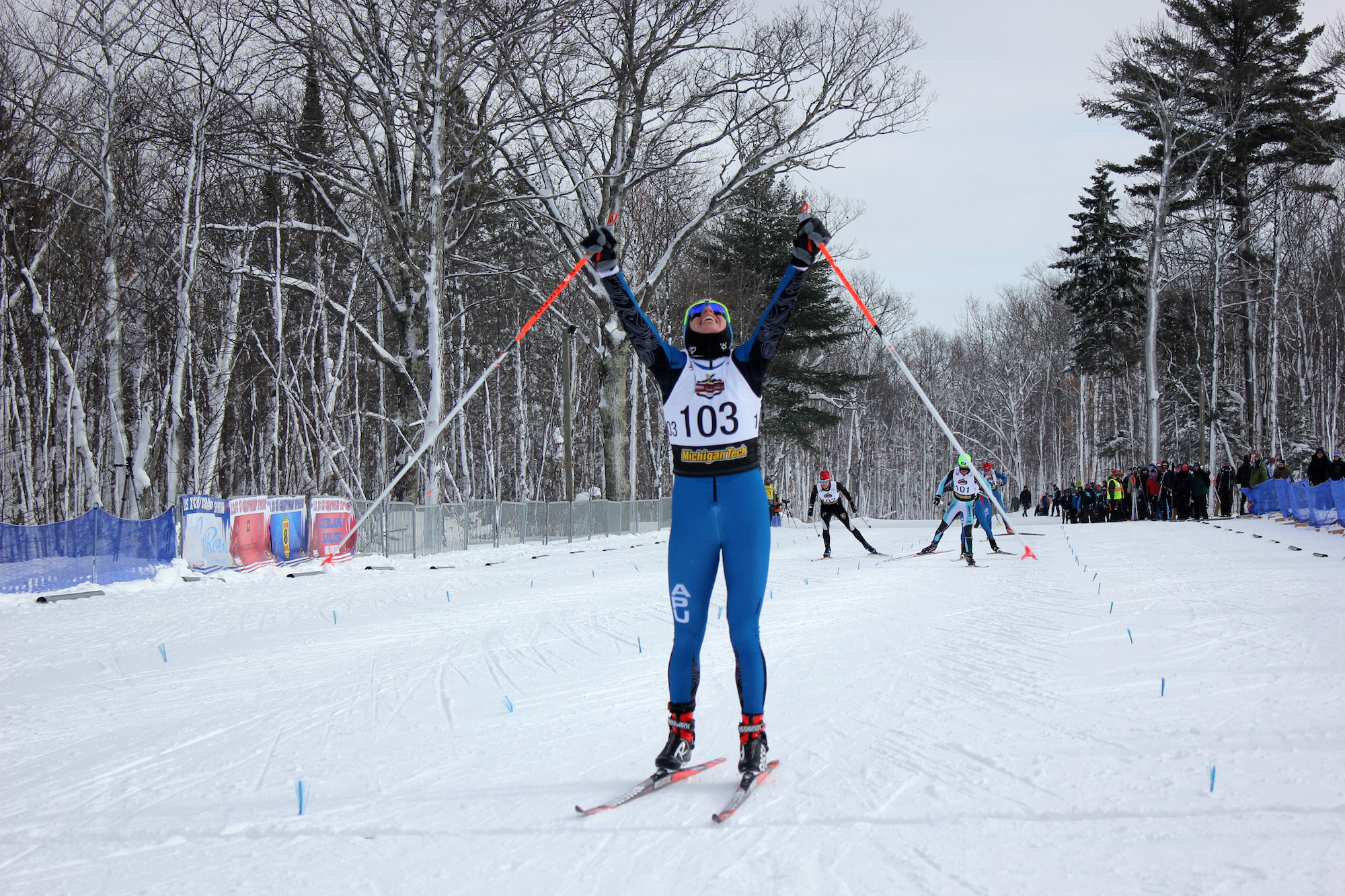
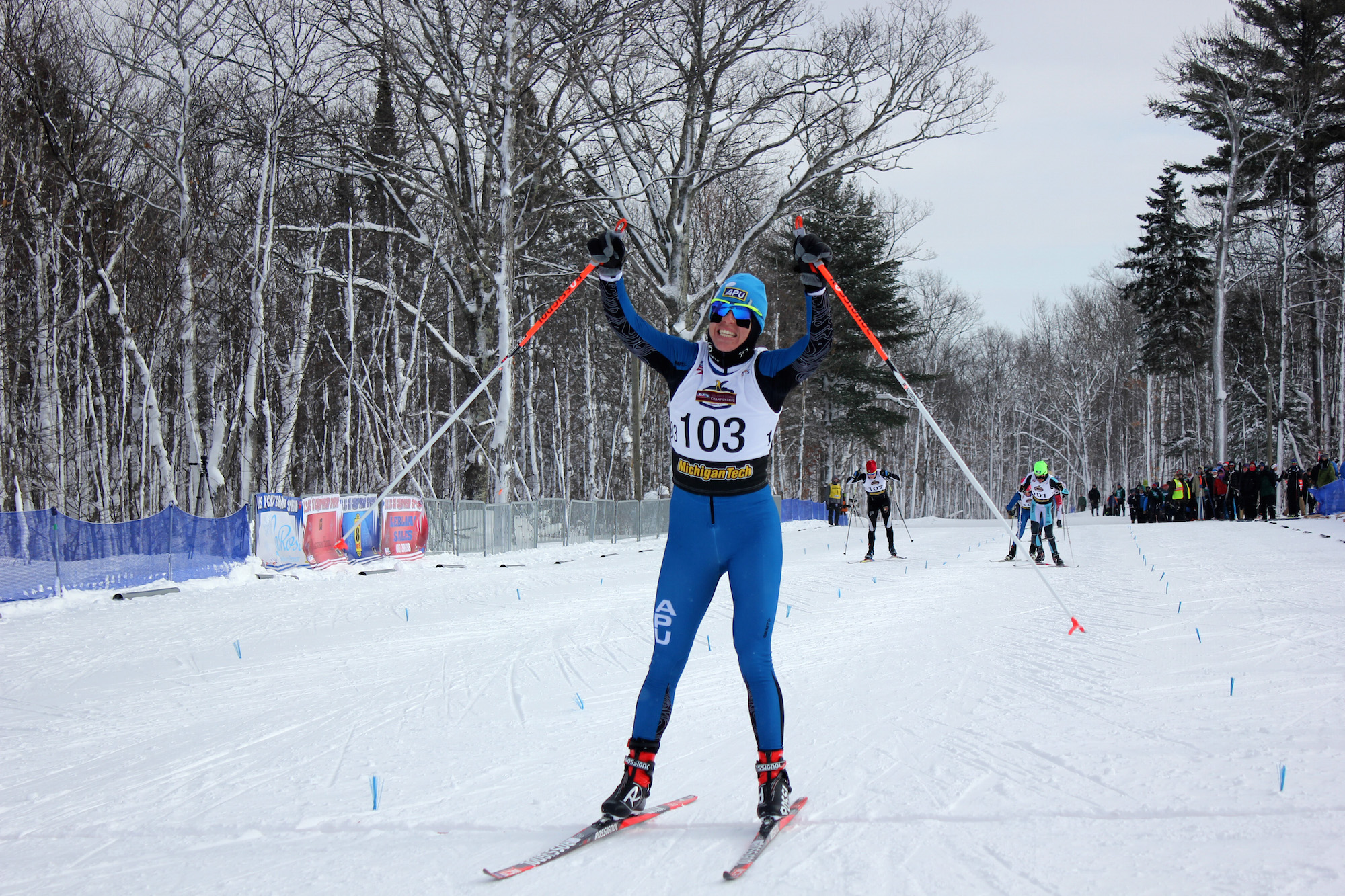
Rosie Brennan (APU) celebrates her definitive win in the women’s 1.5 k classic sprint on at the 2015 U.S. Cross Country Championships in Houghton, Mich., where she notched her third national title. (Photo: Jake Ellingson)
1. What was the first thing you did when you found out you were named to the World Championships team?
“Well I was not supposed to tell anyone, but my roommate, Sadie [Bjornsen], had assumed what my meeting was about so of course, I walked in smiling, and she started screaming so we cracked a beer, made a toast, and sent a picture to Flora.”
2. What’s been the biggest performance of your career so far? What one race stands out the most and why?
“I think the first time I won Junior Nationals was the event that effected my future career the most. Of course I’m faster now and probably look a little better skiing and have won some much bigger races, but that race showed me that anything was possible. I had only been skiing a few years, didn’t know anyone outside of Intermountain, didn’t know what other girls were fast, but just really wanted to be a skier and had put in a lot of work to catch up to my peers. I just went out on a mission and won as a result, completely shocking myself and probably most people, but from then on knew that hard work was effective and I could do anything if I worked hard enough.”
3. What are you most looking forward to at World Championships?
“I’m looking forward to have my mom and brother there with me!”
4. What’s your biggest motivation while racing?
“I am most motivated by wanting to show that my hard work was worth it, that I did everything I could to go as fast as I could.”
5. Which race(s) do you hope or plan to compete in?
“I do not know which races I will be racing in. I don’t like specializing however, so I would gladly race any of them!”
6. If you could race the team sprint with anyone in the world, who would it be?
“Sadie Bjornsen. She has been a close friend and training buddy since my first World Juniors in 2007. We train really well together, have a ton of fun, and she is always an inspiration to me. I hope someday we will race a team sprint together!”
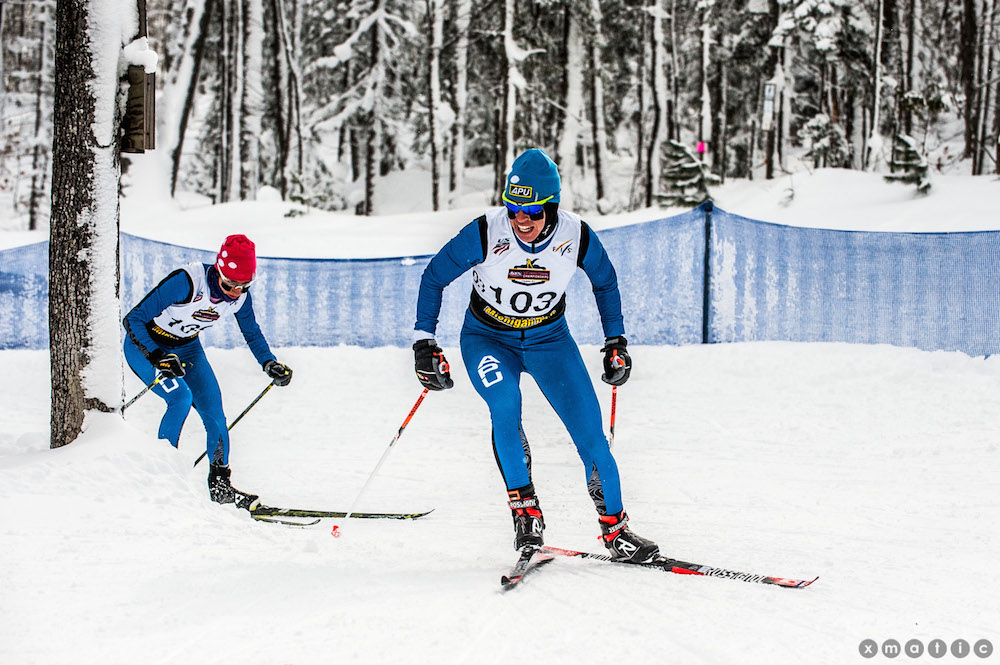
APU Coach Erik Flora runs to grab a new pole for Rosie Brennan after she broke her pole and was given an oversized one in the women’s 10 k freestyle at the 2015 Cross Country Championships in Houghton, Michigan
7. Which world cup skier would you least like to meet in a dark alley (or the final 100 meters of a race)?
“Probably someone from a small, tropical country because it probably means I just had a bad race.”
8. What will be your key to success in Falun?
“Getting in the right mindset and believing in myself.”
9. Finish this sentence: If I made the podium at World Champs __________.
“I would cry for sure.”
10. Name a person who’s had a major influence on your skiing career.
“Erik Flora. I showed up to APU a little beat up and got a little more beat up my first summer, but his positivity kept me believing and kept me coming back. When my father passed away this summer, I didn’t even know if I would keep racing, but here I am headed to World Champs. Erik picked up my pieces and never once talked about racing or the season, but somehow kept me going, reminding me of the daily accomplishments, believing anything was possible, and helping me work through everything I was facing. I have no doubt that I would not be here if Erik was not my coach.”
Rosie Brennan racing to 33rd overall in Saturday’s World Cup classic sprint Östersund, Sweden. She placed 32nd in Sunday’s 10-kilometer freestyle individual start. (Photo: Ian Harvey/Toko)
In the final World Cup race before the 2015 World Championships, Jessie Diggins led the American women’s team by taking 17th in Sunday’s 10-kilometer freestyle individual start in Östersund, Sweden.
Diggins finished 1:47.7 behind winner Charlotte Kalla of Sweden, who posted a time of 23:26.1 in front of a large home crowd. Marit Bjørgen of Norway took second (+36.4) to seal her fourth overall World Cup title, while Norway’s Therese Johaug placed third (+53.6).
Diggins had the fifth-fastest time at the 1.8 k mark, but slowed to 14th by 6.8 k into the race.
U.S. Ski Team (USST) Women’s Coach Matt Whitcomb said in a phone interview, “You might look at the pacing and say, ‘There’s an athlete that went out too hard’ … but I look at it as, there’s an athlete that went out and tried to win a race.”
He explained that while Diggins faded throughout the race, he preferred her intense approach to a more conservative start, adding that she showed integrity and her body responded well to her effort.
“Seventeenth is a great result, and I know she felt good and looked good doing it. So I’m excited for her,” he said.
Diggins could not be reached immediately for comment.
Liz Stephen, who placed fifth overall in the 2015 Tour de Ski, ended up 26th (+2:08.6).
“I was not checked into race mode either in the body or the head, so I have a bit to work on over the next week,” Stephen wrote in an email.
She explained that the course was difficult and consisted of many steep climbs and fast descents, in addition to some icy spots under a layer of crushed corn snow. However, with the large crowd of fans, she wrote that it made for a great ski-racing atmosphere.
Liz Stephen was 26th in Sunday’s 10-kilometer freestyle individual start in Östersund, Sweden. Here she is pictured racing in the 2015 Tour de Ski prologue in Oberstdorf, Germany. (Photo: Marcel Hilger)
“I am feeling good, physically and mentally,” she explained. “I am really excited to be heading to Falun tomorrow and can’t wait to get the World Champs started.”
Whitcomb said that while they were hoping for a stronger race, he is not concerned about Stephen’s performance. He remains confident about where she is heading into World Championships.
“My guess is that we need a couple more significant doses of rest – a day here, a day there – before her first target event at World Champs, which will be the skiathlon. And the plan has that in it already, so no emergency action will be taken,” he said.
Rosie Brennan took 32nd (+2:26.6), a day after finishing 33rd in the classic sprint. She was 2.7 seconds from cracking the top 30.
Brennan wrote in an email that she felt she had a decent day, but thought some parts of the race could have gone better. She explained that she enjoyed the course’s steep-and-numerous uphill sections but struggled in the downhills and “undulating terrain.”
“They lost a lot of snow here last week so most of the course was fast, manmade snow breaking down into sugar-like snow,” she wrote.
Brennan added that she feels confident about her fitness and training, and that it was great preparation for World Championships to race twice this weekend.
“After a few weeks off racing, it usually takes me a race or two to get back in my groove,” she wrote.
Meanwhile, Kikkan Randall finished 33rd (+2:27.7), 3.8 seconds out of the top 30.
Kikkan Randall raced to 33rd in Sunday’s 10-kilometer freestyle individual start in Östersund, Sweden. Here she is pictured during qualifiers in Saturday’s classic sprint, where she placed 51st. (Photo: Felgenhauer/NordicFocus)
She explained in an email to the press that she had a strong start and found a rhythm in the first lap, but found it difficult to “kick it into full race gear.”
“While the pace was not as aggressive as I had hoped to find today, the feelings were a lot more positive than earlier in the season. This confirms that my preparation over the past month has been productive. Now it’s just a matter of getting my body back into race mode,” she wrote.
She added that the weekend was a good boost as she prepares for the World Championships classic sprint on Thursday.
Overall, Whitcomb said Sunday was not a confidence-building day, especially as the team looks toward World Championships. He said the team would prefer to enter Worlds with season-best results.
“But the fact is, no one race can capture where we are as a team,” he explained. “We’re leaving Östersund with some really valuable feedback, and we feel perfectly comfortable with where we need to be right now … We’re an eager team, and we’re really looking forward to putting on a show in Falun.”
Simi Hamilton placed 11th overall in Saturday’s World Cup classic sprint in Östersund, Sweden, after taking sixth in his semifinal heat. Here, he is pictured en route to his first distance points in a World Cup race earlier this season in Oberstdorf, Germany. (Photo: Marcel Hilger)
On what U.S. Ski Team (USST) Women’s Coach Matt Whitcomb called a “wild-and-crazy course,” Simi Hamilton was the lone American to reach the semifinals in Saturday’s 1.2-kilometer classic sprint in Östersund, Sweden.
However, Hamilton would fall while ascending a hill during the first lap of his semifinal heat and took sixth, ending up 6.33 seconds behind semifinal winner Sondre Turvoll Fossli of Norway (who won the heat in 2:27.83) and finishing 11th overall.
Hamilton explained in a phone interview that the difficult course was breaking down quite a bit throughout the day, and the snow was getting deeper on the steep hills that required the skiers to herringbone.
“My right ski just got caught behind me a little bit in the powder, and I just put my right pole right through the top of that ski,” he said. “When you’re trying to hammer a herringbone your poles are just coming so close to your ski it’s definitely a pretty thin margin between a good pole plant and planting right on top of your ski.”
After falling, Hamilton focused on getting up as fast as he could and surged through the end of the first lap in order to make up lost time.
“I made contact with the back of the group again, but just didn’t have a ton of energy left after that to try and get around anyone,” he said.
After qualifying in 12th, 2 seconds behind Norwegian qualifier winner Timo André Bakken, who posted the fastest time in 2:28.25, Hamilton won his quarterfinal in 2:31.97.
“My energy felt really good all day, so I knew I’d be able to put in a good, sustained effort, hoping that a few of those guys in the quarterfinal would start to drop off a little bit,” he said.
Hamilton explained that he was able to put himself in second place, behind Finland’s Toni Ketelä, as they went up the hill above the stadium for the second time. By the last climb before the short, final descent into the stadium, he went as hard as he could and took an open lane on the left.
“I had some room to do my own thing, so I could hammer up and over the top of that climb and focused on having a good double-pole finish,” he said.
“I felt like some times in the past, especially with classic sprinting I haven’t been able to lay down a really good qualifier and haven’t been able to find the energy,” he continued. “So I was definitely pretty happy with the quarterfinal.”
Rosie Brennan racing to 33rd overall in Saturday’s World Cup classic sprint Östersund, Sweden. (Photo: Ian Harvey/Toko)
Meanwhile, Hamilton’s teammate Andy Newell took third in his quarterfinal after qualifying in 17th (+2.68). He finished 12th overall for his best World Cup result of the season.
Newell explained that if he had made “one or two better moves” going into the final uphill of his quarterfinal, he might have had a shot at placing into the semifinals or moving on as a lucky loser. But he ended up 2.61 seconds behind Norway’s Thomas Northug, who was second in his heat, and 1.10 seconds short of a lucky loser spot.
“It was a pretty unique course, that’s for sure. It’s fun in that we don’t get to race courses like that very often,” Newell said in a phone interview. “You had to have a unique technique of herring bone in order to do well.”
Newell was happy with the result, especially in light of his struggles earlier in the season due to both allergies and physical injuries.
“You have years where a 12th-place finish is a disappointment … But at the same time I’m feeling really good, and it’s not always reflected in the results,” he said. “As an athlete you have to gauge your excitement and your momentum on how you’re feeling and not necessarily on your results.”
Norway’s Finn Hågen Krogh would eventually win the men’s final in 2:25.28, holding off Canada’s Alex Harvey by 0.47 seconds. Bakken took the final spot on the podium in third (+1.41).
Bjornsen, Caldwell Lead U.S . Women
In the women’s sprint, Sadie Bjornsen qualified in 27th, 10.02 seconds behind Norwegian qualifier winner Kari Vikhagen Gjeitnes, the fastest in 2:47, while Sophie Caldwell qualified in 24th (+9.84). They raced in the same quarterfinal heat against Sweden’s Stina Nilsson and overall World Cup leader Marit Bjørgen of Norway.
Bjørgen won the heat in 2:50.88, while Bjornsen placed fourth (+4.53) to finish the day 20th overall, and Caldwell took fifth (+5.57) to place 22nd.
Bjornsen said in a phone interview that the course was fun, and much different than what the skiers are used to on the World Cup circuit.
“I knew it was going to be very dependent on my herringboning skills, which I’ve been working a lot on the last couple of years, because I used to be terrible at it,” she said, adding the course featured very little striding and consisted mostly of herringbone, double pole and downhill tucking.
Because of the chevron start, Bjornsen and Caldwell had to begin the quarterfinal heat in unfavorable, outside positions.
“I didn’t have a great start, but I tried not to panic,” Caldwell wrote in an email. She explained that it was difficult to move around skiers because of the constant herringboning, so she spent most of the race in fifth place.
Sophie Caldwell placed 22nd overall in Saturday’s World Cup classic sprint in Östersund, Sweden. Here she is pictured during the 2015 Rybinsk, Russia sprint, where she took seventh. (Photo: Fischer/NordicFocus)
Bjornsen described the race as a “busy scene.” She said that with six skiers trying to funnel into small areas, there were a lot of tangles and opportunities for blocking.
She explained she was not able to close in on the leaders as much as she wanted to at the end, but she said that she definitely felt confident about her fitness.
“I didn’t want to set a goal this weekend that was going to dictate how I felt about my fitness – so it was kind of just for fun today. I’m definitely going into [World Championships] feeling happy and confident,” she said.
Whitcomb said in a phone interview that it was a solid result for the American women and its team’s sprinters would not leave Östersund discouraged.
“You’re always hoping for a top 10 … but it was a tricky course, with a variety of unique demands,” he said.
Based on their positions after qualifying, Caldwell and Bjornsen made the most of what they had, he said, as it was nearly impossible for them to be better than fifth and sixth coming off the top of the steep hill leaving the stadium.
“For Sadie to mix it up in third and fourth, and for Sophie to be able to finish fifth – in good contact with people – I was pretty happy with that. It was a course that was really difficult to move around on, and your place at the start in many cases didn’t change,” he explained.
Rosie Brennan narrowly missed the quarterfinals, qualifying in 33rd (+11.03), 0.72 seconds out of the top 30.
Brennan said in a phone interview that while it is frustrating to be so close to qualifying – especially three weeks after placing 31st in the Rybinsk, Russia freestyle sprint – she is still happy with the result.
“I am really happy with the way I skied so I will just have to work on perfecting the details … As with every race I enter, my goal is simply to push as hard as I can and ski well,” she said.
Whitcomb said that Östersund does not suit Brennan’s strengths, as the Alaska Pacific University skier benefits from powerful striding and not the herring boning the course requires.
“Thirty-third is definitely a success, one of the successes of the day,” he said. “It’s an indication that she’s in the best shape of her life and she should be looking forward to a really positive World Championships.”
Two other American women raced in the qualifying round – Ida Sargent finished 41st (+13.11) while Kikkan Randall was 51st (+16.92).
Whitcomb said that Randall and Sargent were not pleased with their results. He said Sargent reported that she was skiing frantically, while “it took Kikkan a lap to get things going, and you don’t have time for that in a short sprint like this.”
Randall wrote in an email to the press that her qualification was not as strong as she was hoping for after a month-long break from racing.
“I skied too tense and didn’t quite have enough tempo out there, kind of like I was blowing the cobwebs out,” she wrote.
However, she added that she is still confident in the recovery and preparation she has undergone over the last month, and believes it was a good decision to go home and “get a chance to complete reset and get back to basics.”
Bjørgen would end up expanding her overall lead by comfortably winning the final in a time of 2:46.82, 1.80 seconds ahead of teammate Maiken Caspersen Falla. Nilsson placed third (+2.03) in front of a roaring home crowd.
World Cup racing in Östersund continues on Sunday with the 10/15 k freestyle individual starts.
The 2013 U.S. World Championship team poses in Val di Fiemme, Italy, after Kikkan Randall and Jessie Diggins (front right, and left, with flag) won the women’s freestyle team sprint.
On Monday, the U.S. Ski and Snowboard Association (USSA) announced its selections to the U.S. cross-country team for the 2015 FIS Nordic World Championships in Falun, Sweden. The large team of 16 athletes will represent the U.S. in the most-anticipated event of the 2014/2015 season, which takes place Feb. 18 to March 1.
The team of 16 is headlined by defending 2013 world champions in the freestyle team sprint, Kikkan Randall and Jessie Diggins. They will be joined by fellow U.S. Ski Team (USST) athletes Liz Stephen, Sophie Caldwell, Sadie Bjornsen, and Ida Sargent. Two additional women from the domestic circuit, Rosie Brennan (Alaska Pacific University) and Caitlin Gregg (Team Gregg/Madshus), will also compete in Sweden.
On the men’s side, Andy Newell and Simi Hamilton were the only lone two national-team members to prequalify for the championships. They will be joined by fellow USST members Noah Hoffman and Erik Bjornsen, along with Kris Freeman (Freebird), Dakota Blackhorse-von Jess (Bend Endurance Academy), Matt Gelso (Sun Valley Ski Education Foundation), and Kyle Bratrud (Northern Michigan University).
Kikkan Randall with her third consecutive Sprint World Cup Crystal Globe. (Photo: Fischer/Nordic Focus)
The 2015 U.S. World Championships team is larger than in past years. The 2013 roster featured 13 skiers while the 2014 U.S. Olympic team numbered 14.
According to USST Head Coach Chris Grover, the reason for the team’s growth is due to a need to fill the four starting spots allotted to the U.S. in each race. In 2014, one more woman (Holly Brooks) qualified for the Olympics via the World Cup than in 2015 for the World Championships. Grover and the USST recognized that, based on the USST’s World Cup performances earlier this year, they needed one more classic and an additional freestyle skier.
“That was natural to take Rosie [Brennan] and Caitlin [Gregg] as they had won those races at nationals and they were the next women on the points list. It made it easy,” Grover said in a phone interview after the team announcement.
Brennan, who won three out of four races at U.S. Cross Country Championships in Houghton, Mich., earlier this month, has traditionally excelled in the classic technique, while Gregg is known as a strong skater.
Grover explained that because the two men who qualified via the World Cup — Newell and Hamilton — are sprint specialists, there was a need for multiple distance skiers on the men’s team.
“We have some good sprinters already so we needed some distance skiers, and that’s why we took the top-four distance guys on the national ranking list,” he said.
Apart from prequalified athletes, this year’s team was entirely selected from the fourth publication of the USSA points list. Brennan and Gregg were the top two domestic skiers on both the distance and sprinting lists. Hoffman, Freeman, Gelso, and Bratrud were the first four skiers in the distance rankings, while Blackhorse-von Jess and Erik Bjornsen were the top skiers (apart from Newell and Hamilton) in the sprint rankings. Coincidentally, every skier who won a national title at this year’s nationals (Brennan, Gregg, Freeman, Bratrud, and Blackhorse-von Jess) will ski in Falun.
Jessie Diggins (U.S. Ski Team) racing in the 2014 3 k freestyle prologue at Stage 1 of the Tour de Ski in Oberhof, Germany. (Photo: Marcel Hilger)
“It worked out really well. If you went down and took the next athletes based on points, you ended up taking every athlete who happened to win at the U.S. National Championships this year,” Grover said. “That was a nice coincidence of how USSA points reflected performance this fall.”
The USST has an idea of which athletes will compete in the each of the 12 races. Final decisions for the first competitions in Falun will be based on results from the next World Cup from Feb. 14-15 in Östersund, Sweden.
“We’ve got a few people penciled in and we have a lot of alternates in every race so it really depends on what we see in Östersund in the classic sprint and the 15 k freestyle. On the women’s side it is a little bit more cut and dry because we have results from the World Cup,” Grover explained.
There’s also room for expansion of the 16-person team, as each nation is allowed 24 athletes (12 male and 12 female). According to Grover, any additional selections will be made based on results from next week’s Junior/U23 World Championships in Almaty, Kazakhstan.
“Somebody needs to have a standout performance to demonstrate that they would ski faster than somebody who is already on the World Championship team: a top-eight, top-five, or podium performance,” he said of the possibility of additional picks.
The Athletes
Colorado native Noah Hoffman of the U.S. Ski Team racing in the 2013 World Championships in Val di Fiemme, Italy.
The team announcement comes on the heels of the Americans’ best results of the 2015 season in Rybinsk, Russia. Over the course of the three-race weekend, Stephen took second in the 10 k freestyle for the best-ever distance result of a U.S. woman, and Diggins placed fifth in the both the sprint and skiathlon to match her career best.
At the same time, the World Cup weekend in Russia was also missing many of the circuit’s top skiers, with Norway’s Marit Bjørgen, Therese Johaug and Heidi Weng, among others, opting for a training block following the Tour de Ski. Because of the smaller field, Grover said he didn’t read too much into the results.
“The good thing is that the athletes, like Jessie with her fifth places and Liz, are coming into incredible shape,” he explained. “If they can make a little step between now and Falun, it would be really exciting.”
Randall, three-time winner of the Sprint World Cup crystal globe, had uncharacteristic results early in the 2014/2015 season, failing to qualify for her signature event, the freestyle sprint, in December in Lillehammer. After exiting the Tour de Ski, Randall returned home to Alaska to make a “drastic change” before returning to Europe to focus on Falun.
“We had to look at the big goals of the year [at World Championships] in Falun, and I wanted to make sure I could try to make a drastic change in my racing before then,” Randall said earlier this month. “[I] really figured a change in scenery, a change in pace, and a time to actually come home where you can actually recover and recharge was the best way to ensure good performances in Falun.”
Sadie Bjornsen skating to seventh place in the 2015 3.3 k Tour de Ski prologue in Oberstdorf, Germany (Photo: Marcel Hilger)
Randall is also forgoing the current USST altitude camp in Davos, Switzerland. She flew to Östersund on Jan. 26 to train and prepare with her husband and FIS communications employee Jeff Ellis.
“I’ll have almost three weeks before the World Cup in Östersund, so that’s a good training period to actually work on fine tuning things with some good interval training and then hopefully rest a little bit going into [the] Östersund [World Cup]. And off we go,” she said.
Hoffman will also return to competition in Östersund. His fitness and racing ability is still unknown after breaking his fibula in a crash during the first World Cup weekend of the year. After undergoing surgery in December, Hoffman has been recovering in Colorado. As part of his rehabilitation, the 25 year old used a combination of physical therapy, a ski erg, and double-pole workouts to maintain his fitness in an effort to make a comeback for the in Falun. Recently, he graduated to techniques such as skating and striding.
“Noah’s recovery is going really well and he’s at the point now where he’s transitioning out of double pole only and starting other techniques. If everything continues to go well, we’ll see him in the 15 k in Östersund,” Grover said. “At this point he is a wild card. I don’t think anybody, including Noah, knows what to expect.”
The remaining USST athletes, including Sadie Bjornsen, who was consistently the top American skier in Period 1 of the World Cup, will look to peak for worlds.
Rosie Brennan (c), leads Liz Guiney (l) and Anne Hart shortly after the start in the women’s 1.5 k classic sprint final at U.S. Cross Country Championships in Houghton, Mich. (Photo: Christopher Schmidt)
The U.S. team will also feature a strong showing of domestic skiers. Even though they haven’t been on the World Cup circuit for the entirety of the season, they are expected to perform. As in the past, the USST reiterated that it chooses athletes for the world’s biggest competitions because they are at a high level of performance, not to give them international racing experience.
According to Grover, Freeman’s and Gregg’s past World Championships and World Cup experience will aid in the team’s search for performance. Freeman, a former longtime USST member, will compete in his eighth World Championships. Gregg raced the World Cup circuit from November to December before returning to the U.S. for nationals. Plagued by shingles before her first starts of the season, Gregg said that illness prevented her from demonstrating her true potential.
Of the six domestic skiers, four are making their debut appearance in a World Championships: Blackhorse-von Jess, Brennan, Gelso, and Bratrud. The event will serve as a test to see how they shape up against the World’s best.
Grover wants to see Blackhorse-von Jess, who won both sprints at this year’s U.S. nationals, translate his domestic success into international performance.
“He has been dominant in the sprint field in the U.S. Now he needs to prove to everybody that he belongs at the next level. Qualifying in the individual sprint is somewhere where he should be,” Grover said.
The same goes for Brennan, who Grover said has proven she deserves to be at the international level. Brennan won three of four races at the U.S. nationals (and podiumed in all four) and in Rybinsk, finished 13th in the World Cup 10 k and 20th in the 15 k skiathlon. This will also be her first World Championships.
“Rosie is in great shape. She’s demonstrated all fall that she is the number one athlete in the U.S. to beat,” Grover said. “She had some super good results in Rybinsk that demonstrate that she’s at a pretty high level of fitness. Is her fitness better than the distance women on the national team? They’re probably a little bit ahead, but she’s right there.”
Kyle Bratrud crosses the finish line of the men’s 15 k freestyle at the 2015 U.S. Cross Country Championships in Houghton, Michigan. Bartered won the race by more than 50 seconds.
Another first-timer is Gelso, who started international competition this season in Otepää, Estonia, as the Period 1 SuperTour leader. He will look to improve results from his first two weekends of World Cup racing.
There is one exception to the USST rhetoric of performance in the choice of Bratrud. A senior at Northern Michigan University, Bratrud won the 15 k freestyle by more than 50 seconds at U.S. nationals and was third in the 30 k classic in Houghton. According to Grover, the main incentive in choosing Bratrud was to give the young skier more international experience after the U23 World Championships in Almaty, Kazakhstan, and to fill extra starting spots.
“The place for him to really make his mark is the U23 World Championships. That’s the most appropriate level of competition for him now, as well as the younger men and women. World Championships should just be a little bit of a bonus,” Grover explained.
In an email to FasterSkier, Bratrud wrote he was “very honored to be named” and excited to gain experience in both the World Cup and World Championships races.
“This is a gigantic accomplishment for me and not necessarily something that I targeted going into this year. I really think this is a step in the right direction towards accomplishing my goal of making the USST,” he wrote. “I am super stoked to see how the big boys race and hopefully I can contribute to the team in some way! It will be a great step in my ski career.”
What to Expect in Falun
Simi Hamilton celebrates his first victory and podium in the third stage of the 2014 Tour de Ski in Lenzerheide, Switzerland. (Photo: Fischer/Nordic Focus)
According to Grover, the USST’s “target events” are the same as in past years due to relatively low athlete turnaround. The first of these events is the women’s freestyle team sprint, in which the U.S. is defending world champion. Despite the return of Diggins and Randall, Grover explained that there are several women who are being considered for the two-person team.
“The ideal situation is to have three or four women that could potentially do that race on a given day, depending on what their current level of fitness is and what their health status is,” Grover said. “Obviously Kikkan Randall and Jessie Diggins are favorites, but there’s a number of other women who have skied well over the season: Sadie Bjornsen, Ida Sargent, Sophie Caldwell, Rosie Brennan, and all those athletes are under consideration for that event.”
Since the the team sprint is the third competition of worlds, a decision will be made regarding the members of the team after athletes demonstrate their fitness in the previous two races in Falun and the Östersund World Cup.
According to Grover the freestyle team sprint is the most promising event for the men. He said that the event is always a “wild card” due to the necessity for luck and favorable conditions. In last year’s Olympics, Hamilton and Bjornsen teamed up to take sixth in the classic team sprint.
Another target event is the women’s 4 x 5 k relay, in which the U.S. placed fourth in 2013. With a strong Norwegian team, Grover said that the U.S. would need to challenge Sweden, Finland, and Germany to fight for a remaining podium spot.
Both the men’s and women’s individual classic sprints will also prove a chance for the U.S. skiers to shine, despite their usual strength in freestyle races. In the first World Cup sprint of the 2015 season, Sargent notched a career-best fifth in the classic sprint. Grover also pointed to the 10/15 k freestyle races as strong events for both Stephen and Hoffman. The two finished fifth and 15th, respectively, in the same races in the 2013 World Championships.
Currently the majority of the team is at an altitude camp in Davos before heading to Östersund. Once there they will be join the remaining World Championship teammates including Randall, Gregg, Hoffman, Freeman, and Bratrud.
Rosie Brennan leading her quarterfinal in the 1.5 k classic sprint at the U.S. Cross Country Championships in Houghton, Mich. (Photo: Christopher Schmidt)
This week’s Wednesday Workout comes from Rosie Brennan, a 26-year-old Park City native who skis for Alaska Pacific University. Described by USST Head Coach Chris Grover as “the number one athlete in the U.S. to beat,” Brennan has dominated the domestic circuit, winning three of four races at the 2015 U.S. Cross Country Championships. She is also fresh off her best World Cup results in Rybinsk, Russia where she earned 13th in the 10 k skate and 20th in the 15 k skiathlon. Brennan provided FasterSkier one of her favorite and most beneficial workouts as she prepares to compete in the 2015 World Championships in Falun, Sweden.
***
Bounding intervals are nothing new to cross country skiers and certainly not all that innovative, but when it comes down to it, being a good cross country skier requires an immense amount of fitness and bounding is the method I believe builds fitness best.
There are a number of added bonuses of this workout as well. First, it does not require much time. Students, masters, and elite racers can all find an hour or so to make some real fitness gains. Second, it doesn’t not require snow, something that seems important to have in your back pocket these days. I did not have snow before Christmas and had to resort to dryland training. I think bounding is a great way to build race fitness with relatively low impact on the joints, making it a good workout to go back to if you loose snow. Third, and again, there is relatively low impact on your joints when bounding, especially if you can find an alpine resort and can take advantage of a gondola or chairlift. After having knee surgery, I did some form of bounding every other day with the help of a gondola ride down to ensure my knee was not further damaged. Fourth, bounding requires more mental focus and strength then other workouts so it is a great way to build mental toughness as well.
“Bounding is humbling. It never feels good and it never gets easier, but it is absolutely making you stronger in the head, heart, and muscles.” – Rosie Brennan
I think bounding workouts are good to do all summer, but I like to increase the frequency of them towards the fall, Level 4 bounding in particular, because I find bounding helps to sharpen and helps me get ready for race season.
Personally, I love going really hard, so I will highlight some Level 4 bounding workouts I enjoy.
Celine Brun-Lie (l) leads Sophie Caldwell (c) and Rosie Brennan during a dryland session in Anchorage, Alaska, as part of the North American Women’s Training Alliance. (Photo: Matt Whitcomb)
The Altitude Version:
Altitude camps are often used to increase capacity periodically throughout the summer. Bounding at altitude, therefore, feels like the ultimate workout and one I have loved since the day I started training.
I like to run for 30 minutes to warm up on the single track trails at the base of Canyons resort in Park City. Typically, I do 5 x 4 minute L4 with 3 minute recovery, however, with altitude I like to start in L3 and work up. The work road at Canyons is long enough that I can walk up in between intervals to keep the body moving. If the road is not long enough, it’s important to jog or at least walk down in between, remember you can’t stop in a race. If I am feeling good, I increase my effort each interval, making the last one an all-out effort.
The reason I love doing this workout at the Canyons is because the road has an unbelievably consistent grade that allows bounding, not walking or running, the whole time. If you can find a road with a consistent grade, I think that is the most ideal way to do this workout so you can work on the motion of bounding, perfecting your bounding technique and really increasing the efficiency of those muscles. Once I get to the top, there is a 15 minute trail that I jog to get to the gondola for a scenic ride back to my car.
The Sea-Level Version:
At APU, we use a bounding loop on the Hillside trail system as a testing looping that we periodically return to in order to see where our fitness is at. This loop mimics racing terrain as it stair-steps up for somewhere between 4 to 5 minutes.
The format is very similar to the above workout, but because we are using it as more of a test, we do the same loop for every interval and record our time, heart rate, and sometimes lactate for each one. Typically, we do 4 to 5 intervals and they usually take 4 to 4.5 minutes. We jog down a more direct route for a 3 minute recovery. I like to start the first one in L3 and build into the workout a bit. The last one is an all out effort. This is the time we typically take particular note of when we are looking at our training.
A few things to keep in mind:
Good bounding is not the fastest way to get from point A to point B. It is important to remember good bounding technique and not resort to running when the body gets tired. Good bounding looks a lot like classic skiing.
Bounding is humbling. It never feels good and it never gets easier, but it is absolutely making you stronger in the head, heart, and muscles.
Be sure to use bounding poles that come to about chest high, not classic poles. This will make it easier to use good technique.
Misery loves company. Teammates make this workout much more enjoyable and can help push one another to reach that next level of fitness.
Jessie Diggins earned her second fifth place finish of the weekend in Sunday’s 15 k skiathlon in Rybinsk, Russia. She is pictured here at the 2014 Junior/U23 World Championships. (Photo: FlyingPointRoad.com)
Every year has its ups and downs, but for Jessie Diggins the 2015 season just wasn’t cutting it. Whether it was illness or general malaise, Diggins said her racing had yet to match her expectations.
That all changed for the U.S. Ski Team athlete in Rybinsk, Russia, where she skied to her second fifth-place finish of the weekend in Sunday’s 15 k skiathlon, just 2.9 seconds from the podium. En route to her top placement, Diggins clocked the second-fastest time of the 7.5 k freestyle portion, just 0.2 seconds off the pace of eventual race-winner Yulia Tchekaleva of Russia.
The placement matches Diggins best individual World Cup finish. She’s skied to fifth in four instances over her career, one of which was in Saturday’s freestyle sprint.
The 23-year-old is traditionally a stronger freestyle skier and thus planned accordingly. She aimed to ski calm and relaxed in the first 7.5 k classic leg so that she could give it her all in the final 7.5 k freestyle section. Given the course, Diggins knew that as long as she didn’t get too frustrated with the inevitable accordian affect of skiing in a pack, she would be in ideal position to strike in the final kilometers.
According to Diggins, the classic portion of the skiathon ended up going better than expected, as she fought to stay near the front to avoid the messiness of the pack. Heading into the exchange, Diggins was 13th, 37.0 seconds back from Tchekaleva. She exited the stadium ready to attack after posting the second fastest pit time. It was here, however, that Diggins found her greatest challenge of the race.
“I ended up being able to fight more in the classic to be up front and avoid the inchworm effect. It was in the skate half where I thought I was done a number of times. I was yo-yo-ing off the back of this pack. They would drop me on every uphill and I’d make it up on the flats and downhill. Then they drop me again,” she said in a post-race phone interview.
By 9 k Tchekaleva and eventual second-place finisher Martine Ek Hagen were out of reach, but the fight for third was far from over. A group of roughly six women formed behind the two leaders, jockeying for the final spot on the podium. Oblivious to the fact she was seconds away from her best World Cup result, Diggins skied at the back of the group hoping to hold on.
Working to counteract the mental challenge of playing catch-up, Diggins attempted to stay positive and ski smart. Aided by fast skis, she was patient as she approached the course’s final hill.
“It left me hungry for more. I’m definitely psyched, but to see the podium right there is a crazy feeling,” – Jessie Diggins on finishing 2.9 seconds away from Sunday’s podium.
“Eventually I was like ‘you just got to believe that you’re going to keep catching up.’ I was trying to not get dropped on the last hill and I trusted in my skis, which were crazy fast,” she said.
As the skiers attacked the steep pitch of the final climb Diggins made a move and used the momentum to power her way past several women. Skiing into the finish, she was just 2.9 seconds behind Riitta-Liisa Roponen of Finland and Stefanie Böhler of Germany, who lunged for third place.
“I wish I had known how close I was to third place because I would have tried to not get dropped quite as early,” Diggins said of the final meters. “I don’t know if much would have changed anyway, but I was getting closer and closer to those girls who were lunching for third, and that was so exciting.”
At the same time, however, Diggins explained that her lack of knowledge might have been for the best.
Jessie Diggins posted the second-fastest time in the skate leg of Sunday’s skiathlon in Rybinsk, Russia. She’s pictured here with Kikkan Randall after a Quebec sprint in 2012.
“I had no idea and it was probably better that way. If I knew I would have over thought it. For me it’s better when I’m having fun, soaking up the energy of the crowd, and going for it because I’m trying to ski fast,” she explained.
The Rybinsk World Cup weekend delivered Diggins’ best results of the season. Her 12th in Friday’s 10 k, coupled with to the two fifth places from Saturday’s sprint and Sunday’s skiathlon, mark one of the best weekends in the Minnesota native’s career.
Diggins acknowledged that the field was thin, with big names such as Norwegians Marit Bjørgen, Therese Johaug, and Heidi Weng skipping the Russian World Cup to prepare for World Championships. At the same time, she didn’t let the smaller field take away from the meaning of her accomplishment.
“There were some girls who weren’t here racing in Russia, but that’s part of racing – you have to show up and be on the start list if you want the results,” she said.
The strong weekend of racing comes after a period challenge for Diggins, who dropped out of the Tour de Ski due to illness earlier this month. She explained that prior to Friday, the 2015 season has been difficult due to high expectations that were never matched.
According to Diggins the weekend of racing in Rybinsk, especially Sunday’s skiathlon, left her feeling excited and sure of her skiing as World Championships approaches.
“[The skiathlon] left me really excited. I’m feeling like I’m much more confident in my skiing. I’m feeling like I’m back to the old Jessie and skiing like I used to last year when I had that confidence. It’s really cool to have that feeling back,” she explained
Liz Stephen placed seventh overall in the 15 k skiathlon in Rybinsk, Russia. She is pictured here racing in the 2015 Tour de Ski prologue in Oberstdorf, Germany (Photo: Marcel Hilger)
USST Women Land Four in the Top-20
Just behind Diggins in seventh place was teammate Liz Stephen, who earned her first World Cup podium in Friday’s 10 k freestyle. Starting the skiathlon with bib #1, Stephen led the charge out of the stadium.
“It was quite an experience starting with bib 1 for the first time ever in a World Cup for me, though the front position quickly disappeared as soon as the gun went off and I felt like a wave of water just overtook me, with girls passing on both sides all at once. It is amazing how fast these girls can get off the line. It is very apparent that I need to continue to work on my quickness off the line,” she wrote in an email.
Like Diggins, Stephen is a stronger freestyle skier, but clocked the seventh-fastest classic leg of the 15 k. In the skate portion Stephen was fighting in the chase group, but ultimately crossed the line 11.4 seconds out of third.
Stephen explained that the race was enjoyable due to the high level of competition, and that the largely successful weekend leaves her confident as the team enters two weeks of rest and training.
Teammate Sadie Bjornsen skied to 13th in the skiathlon, after jumping in and out of the top five during the classic portion of the race. She entered the technique switch in ninth, but ultimately skied the 29th-fastest freestyle leg to take her out of top-10 contention.
“After a solid classic leg, I struggled for a while when I first switched to skate, but was able to pull it together by the end. Russia has some challenging courses, but I have really enjoyed them this week!” she wrote in an email.
Rosie Brennan, who finished 20th, wrote that the skiathlon format was challenging but that she was excited to complete a mass start-like race on the World Cup. The SuperTour leader said she skied the race consistently despite some challenges in the classic leg and lack of a final kick.
“I skied the whole race within a few places of where I started, which I am happy about. I tend to prefer classic, but the classic was a little tricky today and the hills were quite steep so I was actually happy to switch to skate,” she wrote in an email. “I am definitely feeling some fatigue from the last month so I didn’t feel like I have much finishing speed which was a bummer because I was skiing in a pack and would have liked to finish in the front of that pack.”
Fellow American women Ida Sargent and Sophie Caldwell finished 35th and 43rd respectively.
With four skiers in the top-20 of the women’s races, U.S. Ski Team Head Coach Chris Grover said he was happy with his team’s effort.
Sadie Bjornsen skied to 13th in the Skiathlon Sunday after earning her second-best World Cup sprint result in Saturday’s 1.3 k freestyle sprint in Rybinsk, Russia. (Photo: Fischer/Nordic Focus)
“It was another good day, obviously, to have four in the top-20 on the ladies’ side and with Jessie and those guys were fighting for potential podium places,” Grover said in a phone interview. “We for sure wanted to have a podium in the last two days and we didn’t quite get there, but we were going for it.”
Two USST men started Sunday’s skiathlon but only one finished, with Matt Gelso placing 48th. Gelso said that his race was not what he wanted but that he was able to accomplish several personal goals vote the course of the 30 k.
Erik Bjornsen was sitting in 51st at the exchange, but exited the race during the freestyle portion due to fatigue. In an email to FasterSkier he wrote that his race was one of the most difficult of the season.
“It was a really bad day for me. Probably my worst since I got over here to Europe. I knew I was very exhausted going into the race but the goal was to hang in the field for as long as I could,” he wrote in an email. “I think it’s something I can be strong in but not today. I’m ready for some off days, I think this big load from all the hard racing will pay off in a couple weeks, should be perfect timing.”
The USST now heads to Davos, Switzerland to get some altitude training, rest and sun before traveling to Sweden in preparation for the 2015 World Championships. Most skiers expressed excitement for a break at the USST’s “home away from home.”
“I am really excited to have some good team time next week in Davos, with great tracks, sunny weather and fun activities all together – maybe even a video!” wrote Stephen.
Women’s 15 k skiathlon podium in Rybinsk, Russia (from left to right): Martine Ek Hagen of Norway (second), Yulia Tchekaleva of Russia (first), Riitta-Liisa Roponen of Finland (third) (Photo: FIS/Facebook)
Russian Yulia Tchekaleva won the women’s 15-kilometer skiathlon Sunday by 15.6 seconds, earning her first-ever World Cup victory and delivering her best result of the season on home turf in Rybinsk, Russia. Tchekaleva finished the 15 k skiathlon in 44:16.0, with Martine Ek Hagen of Norway in second place, trailing by 15.6 seconds. Riitta-Liisa Roponen of Finland placed third, 22.9 seconds behind Tchekaleva.
“I tried to save energy in the classic part of the race. I just tried to stay with the front group but not work too hard. When we switched to skating, I felt that I had a lot of power, so I went for the victory,” Tchekaleva said to FIS reporters.
“It was really nice to win my first World Cup here in Russia,” she added.
Tchekaleva attacked at the end of the classic portion of the competition and skied alone for the final 7.5 km freestyle portion of the course. However, she could never relax as a Norwegian was hot on her tail. Ek Hagen broke away from the chase group on the first of three laps in the skate portion. As they neared the final kilometers she chipped away at Tchekaleva’s lead, and at one point was just six seconds back.
In the end Ek Hagen unable to catch Tchekaleva. In the process of the chase, however, she put a gap on the rest of the field and skied alone to the finish.
“This is my first World Cup podium and I am very happy. It was a hard race today. When Yulia [Tchekaleva] attacked, I tried to go get her and hoped someone else would be able to come with me, but I was alone. Which I guess is good because I was able to get second place,” Ek Hagen said to FIS reporters in a post-race interview.
Behind her, a fight was brewing for third as a group of roughly six athletes were all within five seconds of each other. With only a lap to go Roponen pulled away from the chase group, followed closely by Stefanie Böhler. The others in the pack were unable to respond, and the fight for third narrowed to two skiers. As the two entered the finishing stretch, Roponen was able to hold off the German to gain her first World Cup podium since 2010.
The Finnish skier said she was very happy with her return to the podium.
“I am feeling very good right now. It has been a long time since I was on the podium for an individual result. It was a hard fight with Steffi (Böhler) to the finish, and I was hoping that I could stay ahead of her, and I did,” Roponen said after the race, adding that she surprised herself with the result. “I was not sure that I thought I would be on the podium today, so I am very happy that I was.”
U.S. Ski Team’s Jessie Diggins was the fifth finisher across the line, 25.8 seconds behind Tchekaleva and 2.9 seconds from third. She logged the second-fastest skate portion of the skiathlon – only 0.2 seconds slower than Tchekaleva. She also posted the second-fastest pit stop, but given that her 7.5 k classic split was 13th, the gap to Ek Hagen and Tchekaleva was too big to gap.
In addition to Diggins’ result, the USST also boasted a 7th place from Liz Stephen. The weekend has been largely successful for Stephen, as she placed second in Friday’s 10 k freestyle.
Sunday’s race in Rybinsk was the first regular World Cup skiathlon in almost two years, aside from the 2014 Olympics in Sochi. The last regular World Cup skiathlon was held in at the pre-Olympic World Cup in Sochi in 2013, when Steira won ahead of Tchekaleva and Nicole Fessel of Germany was third.
Norway’s selection to the World Championships
With her second place today and her first-ever World Cup podium, Ek Hagen has made a solid bid for a spot on the Norwegian squad to the 2015 FIS World Championships in Falun, Sweden this February. The races in Rybinsk will be a significant part of the World Championships selection criteria for those who did not race the Tour de Ski. Despite the strong result, Ek Hagen doesn’t take anything for granted until the final selection is made.
“It will be difficult to make the Norwegian team for the World Championships, but I feel really good right now and I hope I can make the team,” Ek Hagen said.
Astrid Uhrenholdt Jacobsen, the winner of the women’s 10k skate on Friday, lead most of the first 7.5 k classic but ended up in ninth place after falling back on the skate portion of the race. Jacobsen’s previous win in a regular World Cup event was the skiathlon in Falun, Swden, almost seven years ago in February 2008. Since then Jacobsen has won a stage in the 2014 Tour de Ski.
For sixth place finisher Størmer Steira, Rybinsk was the first World Cup weekend since her hip fracture in October. With Sunday’s result and fifth in Friday’s 10 k, she has definitely put her name in the hat for a selection position.
Jessie Diggins earned a season-best fifth place in the 1.3 k freestyle sprint in Rybinsk, Russia. She’s pictured here on her way to fifth in the 3 k freestyle prologue of the 2014 Tour de Ski in Oberhof, Germany. (Photo: Marcel Hilger)
When Jennie Öberg of Sweden finished the 1.3 k freestyle sprint in Rybinsk, Russia she checked a few items off her bucket list – it was her first World Cup sprint final and her first World Cup podium. It didn’t stop there either, as Saturday’s race marked the Swedish skier’s first victory.
The win came under challenging conditions, where skiers faced a soft, slow course due to heavy snowfall throughout the night and morning. Organizers attempted to harden the track between races to no avail, as the dry snow failed to respond to the groomer’s attempts.
With the extra challenge, Öberg skied confidently throughout the heats and won the final with a time of 3:02.54. It was a close race for the top spot, with Natalia Matveeva of Russia just 0.48 seconds behind the Swede. Switzerland’s Laurien van der Graaff (+0.76) won a photo finish over Anastasia Dotsenko (+0.78) of Russia to take third. American Jessie Diggins (+5.63) and Norwegian Silje Oeyre Slind (+11.17) rounded out the final in fifth and sixth.
Jennie Öberg of Sweden celebrates her win in Sunday’s 1.3 k freestyle sprint in Rybinsk, Russia. (Photo: Fisher/Nordic Focus)
Prior to Saturday’s race, Öberg’s best World Cup result was a 2014 freestyle sprint in Nove Mesto where she placed seventh. She raced the majority of the 2015 season on the Scandinavian Cup circuit, with her first World Cup of the year taking place in Otepää, Estonia earlier in January.
Öberg started her day with a strong qualification round in which she placed first, 2.08 seconds ahead of the next competitor. The quarterfinal was wasn’t as easily conquered, however, as the Swede fell after tangling with van der Graaff while exiting the stadium. The crash set her back roughly 40 meters, but Öberg worked to catch the group as they navigated the soft course. By the time the skiers reached the stadium, she was back in the mix, ultimately taking second to van der Graaff.
With the scare of the fall behind her, Öberg skied a smart and aggressive semifinal and final to take her debut victory. According to the Swede, the win was an important step in qualifying for World Championships, which will be held in her home country in February.
“This was my first ever sprint final so to win is just amazing. I am really so happy. I felt really strong today. I was ready to win. When I fell in the quarterfinal I panicked a little but it all worked out. This gives me confidence for the upcoming Swedish Championships, which will be final selections for Falun 2015,” Öberg said in a post-race interview with FIS.
In second place, the crowd-favorite Matveeva was happy to be near the top of the results again. Her last World Cup podium was third place in a 2012 classic sprint in Otepää.
Matveeva entered the heats as the fourth-fastest qualifier and skied to victory in her quarterfinal. In the semifinal, however, she and van der Graaff lunged for a photo finish. Although Matveeva lost by 0.01 seconds, her time was fast enough to nab a lucky loser position and advance to the final.
“This is a great podium for me. I have been sixth and fourth here before but never on the podium. The spectators were so loud. It was a great racing atmosphere here today. The conditions were challenging. I am happy with myself for this result,” Matveeva said to FIS after the final.
Unlike her counterparts, van der Graaff has been in the running for a World Cup podium multiple times this season. Before Saturday the Swiss skier had advanced to a final twice in the 2015 season, in Davos and Val Mustair. In both instances she placed sixth.
In Rybinsk, van der Graaff was dangerously close to missing the podium as she and Dotsenko were in a photo finish for third. In the end it was van der Graff who came out on top by 0.02 seconds.
“It feels really great to be on the podium today. It was a photo finish at the line but I was pretty sure that I was in third place. It was a relief to see that in the end I was third and on the podium,” van der Graaff said to FIS.
The women’s podium (from l-r): Natalia Matveeva (RUS) second, Jennie Öberg (SWE) first, and Laurien van der Graaff (SUI) third.
In fifth place, Diggins earned her best result of the 2015 season. The Rybinsk World Cup marked her first competition since she pulled out of the Tour de Ski due to illness earlier in January. In Friday’s 10 k freestyle Diggins placed 12th.
The night before Saturday’s competition Diggins said she was plagued by a series of bad dreams, and that she began her warm up feeling exhausted.
“I had a crazy bad night of sleep… When I got out there to warm up I was like ‘oh man I feel tired,’” Diggins said in a phone interview.
Despite the fatigue, Diggins explained that she was reminded of teammate Kikkan Randall, who has achieved some of her best results when pre-race feelings indicated a poor day. Diggins said that instead of thinking about her fatigue she decided to focus on how she was going feel in the race. That, in combination with tasty breakfast prepared by teammate Liz Stephen, gave her a boost heading into the race.
After qualifying 13th, Diggins entered the quarterfinals with more energy. She sat near the back of the pack until the course’s only major climb. There, she moved to second place behind Rikka Sarasoja-Lilja of Finland. The two crested the hill together and attacked the downhill ahead of the four other women. As the two entered the stadium, Diggins free skated past the Finn to take first place.
A similar strategy was used in the semifinal, but this time Diggins found herself in first at the top of the final hill with Dotsenko and teammate Sophie Caldwell close behind. She was worried that the two skiers would use the draft to slingshot into the stadium, but when they arrived Diggins was still in the front and easily crossed the line in second place.
Diggins said that the group dynamic of the final made for a fun heat.
“It was cool because Öberg and Slind had never been in a final before, so we were all high-fiving each other and wishing each other good luck. It was a fun positive energy going into the final,” she said.
Diggins believed she had a good shot at her first individual World Cup podium, but fatigue got the best of her as she traversed the course for the fourth time. Falling to the back of the heat from the start, the 23-year-old maintained fifth throughout much of the race.
Diggins explained that the 2015 season has been mentally challenging but that Saturday’s result was a step in the right direction.
“My confidence this year hasn’t been where it maybe should be because I’m not racing at the level where I was last year, which is hard. It’s definitely one of those things where you have to keep telling yourself that you have what it takes,” she explained.
According to the Minnesota native, the boost in confidence from the result in addition to USST dynamics will set her up for a strong showing at the 2015 World Championships, which take place in three weeks.
“I feel really good going into Worlds because the team is functioning like such a well-oiled machine. I feel like we are in a good place,” she said.
USST Head Coach Chris Grover said that he was pleased with Diggins’ result and that he was impressed with her ability to navigate the soft conditions.
“Jessie usually likes firm conditions but she was awesome. She really skied in control during her quarter and semifinals. She really executed moves exactly the way she wanted so that was pretty cool,” he said in a phone interview.
Ida Sargent (5) leads Sophie Caldwell (16) up the final hill of the 1.3 k freestyle sprint quarterfinal in Rybinsk, Russia. Sargent finished third in the heat while Caldwell placed second. Caldwell and Sargent finished seventh and 13th overall. (Photo: Fischer/Nordic Focus)
American Women Land Four in Finals
Diggins wasn’t the only American to impress in Saturday’s sprint.
Caldwell, a regular in freestyle sprint semifinals, skied to seventh in Rybinsk despite lingering fatigue. The 24-year-old qualified 16th and easily advanced from her quarterfinal. Once in the semifinals, Caldwell used similar tactics to land third place. Unfortunately, Caldwell’s semifinal was too slow for her to advance as lucky loser.
“I was feeling a little fatigued going into the day, but I think I actually felt the best in my semifinal, so I was happy with the direction things were moving… it’s a really tough course that gives your legs a pretty good beating,” she wrote in an email.
Just behind Caldwell was Sadie Bjornsen in 11th. The placement is her her second-best World Cup sprint result and was her first time in the semifinals since 2012.
“I’m really happy because it’s been three years since I made it to the semifinals. It was really fun to get there today. It was really challenging conditions with the soft snow and a hard course,” she said.
Bjornsen was lucky loser in the quarterfinals after finishing third in her heat. While she entered the semifinal hopeful to advance, a poor start prevented her from finding a strategic placement.
Sadie Bjornsen skied to her second-best World Cup sprint result in Saturday’s 1.3 k freestyle sprint in Rybinsk, Russia. (Photo: Fischer/Nordic Focus)
“I didn’t have a great starting position so I was forced into the back. That course is especially hard to ski from the back because it’s a lot of sprint-stop, sprint-stop. I was never able to get into a good position or a good rhythm. I was just hanging on by the horns. I didn’t feel like I could ski what I was capable of but it felt great to be skiing in the semifinals,” she explained.
Ida Sargent entered the quarterfinals as the fifth-fastest qualifier but ended her day after finishing third in the same quarterfinal as Caldwell.
“The qualification was really good for me. I was bib #1 which I was a little nervous about but I think it was really good for me because I was able to stay focused in my own race rather than getting distracted by everything going around me like I often do,” she wrote in an email.
“I was not satisfied with how I skied the quarter and crossed the finish line feeling like I had a lot more to give,” she explained, “Then going into the finish I tried taking the left side which was a shorter line but it was a lot softer so then I went behind Sophie in the lane but the Italian came up on the far right.”
The final American in Rybinsk, Rosie Brennan, placed 31st, 0.12 seconds from qualification.
Grover was pleased with the overall team effort, even though he said the team had the potential to preform even better.
“They did well. Even some of our athletes that traditionally struggle in deeper snow skied really well,” he explained. “We had 4 women in the top 13 so we can’t complain to much… Overall a pretty solid day and nice to have someone in the finals and fight for the podium.”
Racing continues in Russia Sunday with a 15/30 k skiathlon.
Liz Stephen earned the best finish of an American woman in a World Cup distance race Friday, with her second place in Rybinsk, Russia. She is pictured here in the 2015 Tour de Ski. (Photo: Marcel Hilger)
After her second-place finish in Friday’s World Cup 10-kilometer freestyle in Rybinsk, Russia, Liz Stephen had a lot to celebrate – it was her first individual World Cup podium, just two weeks after her historic fifth-place finish in the Tour de Ski.
But there was something the 27-year-old hadn’t realized.
As she sat down for the press conference with FIS Marketing Support Jeff Ellis, he informed her of another historic accomplishment – Stephen had posted the best distance result for an American woman on the World Cup, besting Ellis’ wife, Kikkan Randall’s third place in Gällivare, Sweden in 2012.
With the realization, Stephen said she there was only one word to describe the plethora of feelings surrounding the result.
“To sum it up in one word, I’m ecstatic. I’m really happy to put it all together on one day. I’m ecstatic for sure and a little emotional,” Stephen said in a phone interview.
The results in Rybinsk marked a respite from the familiar podium names with major players such as Norwegians Marit Bjørgen, Therese Johaug, and Heidi Weng avoiding the long journey to Russia in order to rest for the remaining races of the season. However, with strong competitors like Poland’s Justyna Kowalczyk and Finland’s Kerttu Niskanen in the mix, no result was guaranteed.
Stephen placed second to Norway’s Astrid Jacobsen, who finished the 10 k in 28:12.5. Stephen was off-pace by 14.4 seconds, but placed ahead of Germany’s Stefanie Böhler (+36.4) who claimed the final podium spot. Rounding out the top-five were Yulia Tchekaleva (+37.6) of Russia and Kristin Størmer Steira (+41.4) of Norway. Until Friday, Størmer Sterira had been absent from the World Cup after a double hip fracture in October.
The Comeback Podium
Friday’s win was Jacobsen’s first since 2008 when she won the World Cup 15 k pursuit in Falun, Sweden. In the nearly seven years since, Jacobsen has been on the World Cup podium many times but another victory was always been elusive.
Jacobsen’s path to the top of the podium was a difficult one. Just one day before the start of the 2014 Olympic Games, her brother and training partner passed away unexpectedly, causing emotional hardship for the Norwegian throughout the event and remainder of the year. Later that season she crashed into a lamppost in the Holmenkollen 30 k and was rushed to the hospital. With no serious injuries resulting from the crash, Jacobsen began what looked to be a productive training season that spring. By the fall, however, Jacobsen told NRK that her body was no longer responding to training.
Astrid Uhrenholdt Jacobsen of Norway returned to the top of a World Cup Podium Rybinsk, Russia after a seven year absence. She is pictured here in the 2012 Tour de Ski.
According to NRK, the physical hardship lasted through the beginning of the season where Jacobsen raced to uncharacteristic results over the Lillehammer World Cup weekend. With her body feeling out of whack, Jacobsen decided to rest. After seeing improvement since the begging of the year, she participated in Scandinavian Cups while her teammates competed on the World Cup circuit. Her most recent was in Falun, Sweden, the site of the 2015 World Championships, where she won the 15 k skiathlon and placed third in the 10 k freestyle.
“I have felt since New Year that the shape has been better and better. I had some good races in Falun, but today it was even better,” she told NRK Sport.
In Friday’s race, Jacobson dominantly skied the hilly course to earn top splits throughout the race. Skiing one bib behind Stephen for the entirety of the 10 k, she crossed the finish line with her arms outreached and a smile on her face.
“I have had to be very patient this year. My body has not handled training as it should since August. So I am very happy to have such a result today,” she told FIS in a post-race interview. “It is a difficult course with challenging conditions today so I was cautious on the first lap and I think that helped very much.”
Rybinsk has been friendly to Jacobsen in the past. In 2007 she earned her first World Cup win in the 15 k mass start.
Third place finisher Böhler also has fond memories of Russia. In 2009 she earned her first and only other individual World Cup podium in a Rybinsk World Cup 10 k mass start.
Stefanie Böhler of Germany earned the third place and her second-ever individual World Cup podium. She is pictured here in the 2012 Tour de Ski.
“This is a great result. My only other podium on World Cup was here in 2009 so I am really happy to be back on the podium here again,” she told FIS. “I always like coming here. The courses are hard, the people are so friendly and there are many spectators. It’s just really nice to be here in Rybinsk.”
Böhler has faced her share of challenges as well. In 2012 she was diagnosed with thyroid cancer but fought back to compete in the 2014 Olympics where she and her teammates earned a bronze medal in the 4 x 5 k relay.
Stephen, who is close with Jacobsen after the two exchanged training time in Alaska and Norway, said she was happy be on the podium with both her friend and Böhler.
“It was a really fun podium to share. For [Jacobsen] to come back and get a win is pretty special for her,” Stephen said. “After last year’s really challenging year with her it’s really special to be on the podium with a friend and someone who has had her fair share of ups and downs, in skiing and in regular life too. Steffi is the same. She battled cancer a couple years ago and she’s one of the more smiley people on the World Cup and always rooting for everyone else.”
History in the Making
With many of the biggest names absent from Rybinsk, Stephen knew there was an opportunity to land a spot on the podium – and she was ready to take it.
“I really wanted to get on the podium today,” Stephen said of her ambitions. “In order to do that I focused on each section of the course.”
Known for her climbing abilities, the hilly course in Rybinsk favored the Vermont native. Stephen explained that her main strategy for the competition was to ski the flats smoothly. She also focused on skiing over the top of each hill aggressively – an area in which she’s struggled in the past.
“I just like to go up hills, but over the top can be an issue for me so I saved enough to really go over the top and carry good speed on the downhills and grab a low tuck,” she said.
U.S. Alpine Ski Team athletes Paula Moltzan and Resi Stiegler lift Liz Stephen after a leg of the 2015 Tour de Ski. Stephen’s fifth ranking in the Tour was the best American result ever. (Photo: U.S. Ski and Snowboard Association)
The strategy worked and as Stephen sped around the course, consistently earning the second-fastest splits. When she crossed the line it was all but certain she had secured her first World Cup podium. Stephen said she hadn’t thought about the historic possibility of earning the top finish in a distance World Cup by an American woman until Ellis told her in the press conference.
According to USST Head Coach Chris Grover Stephen’s success is due to her superior fitness.
“Obviously she came out of the Tour de Ski where she was in really good shape and then she was able to stay healthy and recover. She’s in good form right now and that’s the absolute key,” he said of Stephen.
Stephen also explained that her result was not just a product of her individual abilities, but also the support of her team. Pointing to her fellow American skiers and coaches, Stephen said that everyone, especially women’s team coach Matt Whitcomb who taught Stephen how to ski at Burke Mountain Academy, played a role in Friday’s historic result.
“It means a lot to be with this team, having this result, and knowing that you’re never ever out there by yourself. Good days, bad days, great days, this team forms around you,” she said.
With World Championships three weeks away, Stephen said she hoped to inspire the team to reach their best results of the season in Falun.
“Having these results going into World Championships for me personally is, of course, wonderful but I also think and hope that it boosts everyone else’s confidence and belief in themselves,” she explained. “I’ve seen it in the past with Kikkan and other teammates having best-ever results for them, or making history. The whole team gets pulled up by it. I think it will.”
U.S. Women Solid in Top-20
It seems that Stephen has already inspired one of her USST teammates.
Finishing Friday’s race in 12th place, Jessie Diggins explained the 2015 season hasn’t met her expectations, but that Stephen has helped her work towards a stronger mental attitude.
“Liz has actually been encouraging and inspiring me to work harder with Sports Psychology and start believing harder that I have what it takes,” Diggins wrote in an email. “This season has been tough on my self confidence so far… and I’ve been working on having more confidence when I step onto the snow. Especially after getting quite sick and having to drop out of the Tour de Ski, there were a lot of thoughts running through my mind – wondering if I would be in good enough shape to race after being sick and not being able to train as planned, etc.”
After taking over week of rest between the Tour de Ski and Rybinsk, Diggins said that she was able to “put those thoughts away” in Friday’s 10 k and ski a focused and driven race. However, even though she was able to perform mentally, said her body was not responding.
“I definitely am not in my greatest race shape right now as I think everything came together quite smoothly in this race and my results weren’t close to what they were a few years ago on this course. I need to be patient as I come out of being sick and let these three races this weekend help me get back in my best race shape!” she wrote.
Just behind Diggins was Rosie Brennan, who earned her best ever finish in a World Cup. As the period one SuperTour leader, Brennan is participating in her second weekend of racing with the USST.
Rosie Brennan earned her first World Cup points in Rybinsk, Russia. Brennan is pictured here racing in Houghton, Michigan. (Photo: Christopher Schmidt)
Throughout much of the competition Brennan’s splits were in and out of the top-10, indicating a rapid start. According to Brennan it was all part of the plan, even if it meant her finish speed was reduced.
“I started pretty hard, maybe a little too hard, but I believe it takes putting yourself out there to really find out what you are capable of. With that in mind, I just tried to keep pushing the whole way. I think I faded a bit at the end, but held it together just enough for a sold result,” she wrote in an email.
Brennan said she was excited to have “broken that barrier” to earn World Cup points and that she hoped the result would give her confidence through the rest of her time in Europe.
“Huge race for Rosie, who really skied exceptionally well. That was really exciting to have her in the mix,” Grover said of her race.
Racing continues in Rybinsk Saturday, with a freestyle sprint.
Ida Sargent (U.S. Ski Team) racing earlier this month in the opening prologue of the 2015 Tour de Ski in Obertsdorf, Germany. (Photo: Marcel Hilger)
Suddenly, it dawned on her. Rosie Brennan of Alaska Pacific University (APU) hadn’t given the team sprint in Otepää, Estonia, much thought until she was on her way to Europe earlier this week and realized that she was going to be one of four U.S. women in Otepää, Estonia, this weekend.
A little quick math — the format required two-person teams — and she and APU coach Erik Flora determined that meant she’d probably get a chance to race the 6 x 1.2-kilometer freestyle team sprint on Sunday.
Brennan, a 26-year-old former U.S. Ski Team member and the current SuperTour leader, had done a team sprint just once before — back in 2009 at the pre-Olympic World Cup in Vancouver, British Columbia. There, she teamed up with Morgan Arritola to place 17th. Arritola and most of the other women in that race are no longer competing.
Alaska Pacific University (APU) Head Coach Erik Flora (l) runs to grab a new pole for Rosie Brennan after she broke her pole and was given an oversized in the 10 k freestyle individual start at 2015 Cross Country Championships two weeks ago in Houghton, Michigan. Brennan went on to place third, then won the remaining races at nationals.
At the time, the 2009 team sprint was only Brennan’s second World Cup race.
With nearly two dozen World Cup starts under her belt in the time since, Brennan returned to the international circuit this weekend for the first time since December 2013. Her expectations weren’t results-based, but she was definitely excited for the team sprint.
“Every time I watch [a team sprint], I always think, yikes, going out for the finals seriously seems like one of the hardest things in ski racing,” Brennan wrote in an email. “So, yes I was a little nervous and unsure how I would fare…”
Brennan and Ida Sargent formed the second-seeded U.S. team, and Sadie Bjornsen and Sophie Caldwell teamed up for the U.S. first team. Both teams were put in the second of two semifinals, on 35-degree Fahrenheit afternoon when racing earlier was definitely better.
“It was really warm out there … snowing, raining so the course was breaking down,” Sargent explained on the phone after Sunday’s race. “It was pretty soft in the morning when we were testing and then by the final it was shin-deep slush.”
Vying for a top-two finish to guarantee themselves a spot in the 10-team final, the two American squads came through the final exchange alongside each other in first and second. Bjornsen handed off to Caldwell for the last lap, and Sargent tagged Brennan.
Sargent explained she had been in second heading into the descent toward the stadium on her last semifinal loop, trailing Poland’s Justyna Kowalczyk closely to make sure she caught her draft. She passed Kowalczyk, and Bjornsen passed Sargent after following her in similar fashion.
“Sadie and I went into the exchange after our last lap in one and two, so that was pretty fun to be there together,” Sargent recalled.
Sophie Caldwell (U.S. Ski Team) racing Jan. 6 at the Tour de Ski freestyle sprint in Val Mustair, Switzerland, where she placed seventh. (Photo: Fischer/Nordic Focus)
After getting tagged in first, Caldwell explained that Germany’s Denise Herrmann and Poland’s Sylwia Jaśkowiec “took off” at the beginning of the final lap and left her struggling to keep up.
“They formed a little gap and I wasn’t close enough to take advantage of their draft on the [downhill],” Caldwell wrote in an email. “Unfortunately, I think I was leading a little train of my own, so people could hop into my draft.”
One of those people was Brennan, who shot past Caldwell to take third in the heat. Caldwell finished fourth, and the top three teams from their semifinal advanced to the final based on time. (The top-two teams in each automatically advance, then the next six-fastest times.) Seven of nine teams in the first semifinal made the final as well.
“Today was a tough day with the weather and snow conditions, with each lap getting slower than the one before,” Bjornsen explained in an email after her team placed 11th overall. “Since we were in the second heat, our strategy was to go as hard as we could, because we knew making lucky loser positions were going to be tough just the way conditions were working.”
One hundred meters out of the start in the semifinal, someone skied over Bjornsen’s ski.
“I found myself lying in the snow,” she recalled. “I worked hard to catch back up, but Soph had to finish closing the gap. From there we had two great laps in the mix. I tagged off in the front of the pack, and Soph did a great job holding on. … As we predicted, lucky loser time was tough to catch, so sadly, Soph and I weren’t able to catch the finals.”
Sargent, Brennan Sixth in Final
Meanwhile, Sargent and Brennan moved on, which both Caldwell and Bjornsen, Brennan’s APU teammate, were excited about.
“I have believed that Rosie is skiing at the same level as us [U.S. Ski Team women] since the start of the season,” Bjornsen wrote. “It was just so exciting and wonderful for her to feel and show that today! It brings tears to my eyes to see everything she has gotten through this year, and here she is on the World Cup, challenging the strongest skaters in the World.”
“We both skied our last laps with everything we had and it turned out to be just enough,” Brennan explained. “I had no expectations for this race so I psyched when we were finding it possible to easily ski in the front of the pack.”
In the final, she resolved to stick with the pack and see what happened toward the end of the race.
Sargent said she was pleasantly surprised to feel better during the final than the semifinal.
“I guess you’re always excited for another chance to race again,” Sargent said.
She expected to feel tired and “on flooded legs” by the last lap, but the goal was to keep pushing.
Out of the start, Sargent put the U.S. in fourth at the high point of the course, at the turnaround before the downhill. She came through the first exchange in fourth, half a second behind Sweden’s Ida Ingemarsdotter — the eventual winner (with teammate Stina Nilsson).
Brennan kept them within three seconds of Norway’s Ingvild Flugstad Østberg in first after her first lap, tagging Sargent in sixth. One lap later, the U.S. was back to fourth, 2.2 seconds from Poland in first and among the nine teams within 5 1/2 seconds of the lead.
“I tried to move up and ski towards the front of the pack more because in the beginning of the semifinal, I was in the back and felt like I was stuck in traffic for the first couple laps,” Sargent explained. “So I tried to get a little farther forward in the final and it was just really fun to be in the mix.”
On Brennan’s second lap, Østberg in first led Nilsson and Poland’s anchor, Jaśkowiec, as the three pulled away. By the tag, they were just over a second ahead of Germany in fourth, Finland’s first team (Anne Kyllönen and Krista Parmakoski) was 4.7 seconds back in fifth, Finland’s second team (Aino-Kaisa Saarinen and Riika Sarasoja-Lilja) was 5.3 seconds behind in sixth, and Brennan 5.9 seconds back in seventh.
“The second lap was the hardest for me,” Brennan said. “I think the pace turned up a bit and I started questioning how much my legs had in them.
“The final was definitely faster paced, there is a lot more on the line,” she added. “It was super slushy and there were trenches around every corner. I think in general, there wasn’t one section that was really good for me or really bad, it was more about putting together a good lap, skiing each section as best as possible and trying to lose as little as possible.”
When Sargent set out on her final lap, she focused on cutting down the gap ahead of her and catching the fourth-, fifth- and sixth-place teams.
Germany’s Hanna Kolb fell off the pace and into seventh, while Sargent moved into sixth, 8.4 seconds behind the leaders and 1.2 seconds behind Kyllönen in fifth.
On the last lap, Herrmann brought the Germans back into contention and led the pursuit of Sweden, Norway and Poland. While there was a three-way sprint for first, Germany finished 16.5 seconds back in fourth, Finland’s first team was another 1.1 seconds back in fifth, and Brennan anchored the U.S. to sixth, 18.1 seconds out of first and half a second behind Parmakoski.
Sargent said both she and Brennan were “really happy” with their result in the first-and-only team sprint before the freestyle team sprint at World Championships.
“[Rosie] just got over here and hasn’t raced a team sprint since 2009 … and she was just skiing really well all day and had some awesome finishes on both of the heats,” Sargent said. “So I was really impressed with her — first team sprint, first weekend on the World Cup this year and just to be right in there the whole time.”
“I was really impressed with her — first team sprint, first weekend on the World Cup this year and just to be right in there the whole time.” — Ida Sargent on teammate Rosie Brennan
“I surprised myself by having a little bit of finishing speed in both the semi and the final so I am happy I was able to pull together 3 solid laps each race even if none of them were outstanding,” Brennan wrote.
Finishing sixth, the two landed in the money, which Sargent said is always a goal. Moreover though, she wanted to make the final.
“We did that and after that, everything was just a bonus,” she said.
“Those guys skis great, actually all the U.S. athletes skied really good,” U.S. Ski Team Head Coach Chris Grover said on the phone. “Despite some crashes, everybody skied super well, so that was really exciting.”
Hamilton Crashes on Last Lap
Simi Hamilton crashed out of contention on the last lap of the men’s first semifinal, and he and Andy Newell, of the first-seeded U.S. men’s team, placed 10th in the heat for 19th overall. The top six teams from their semifinal advanced to the 6 x 1.5 k final.
“Simi and I did a good job of staying up front,” Newell, the team’s scramble leg, wrote in an email. He tagged Hamilton in fifth for the final lap.
“It’s our goal not to ski any harder than we have to until the last laps,” Newell added. “I felt I was able to pace well and did my best to chase down Russia on the last lap and tag Simi in a strong position.”
Positioning himself in the draft behind Nikolay Morilov of Russia’s second team and Canada’s Lenny Valjas on the final downhill, Hamilton went down in a pileup with France’s Baptiste Gros, who had been around third at that point.
According to Grover, Gros face planted on the last rise after the fast downhill into the stadium. Sweden’s Emil Jönsson clipped Gros and spun around, getting tangled with Hamilton, who was on his way down the hill as well.
“[Simi] face planted right into the bridge basically,” Grover said. “He is OK, but he is definitely sore.”
“He was in a good position to move on as [lucky loser] since our heat was a but faster,” Newell explained. “If it wasn’t for the crash I think we would have advanced for sure.”
While the bad luck and resulting missed opportunity to practice a final was disappointing, Newell wrote that they were looking forward to World Championships and putting together a competitive freestyle team sprint there.
“I was feeling pretty good today and think I have regained a bit of my strength and fitness that I was missing during the [Tour de Ski],” Newell added. “I think this is the best my skating has felt for a while and it was fun to be able to accelerate and ski with power.”
Bjornsen, Gelso Miss Top 10 in 11th
The second U.S. men’s team, with Erik Bjornsen and Matt Gelso, the SuperTour leader from the Sun Valley Ski Education Foundation, narrowly missed advancing to the final after placing fifth in the second semifinal. The top four moved on.
Bjornsen started them off in 11th of 12 teams, and Gelso skied up to ninth by the second exchange. One lap later, they were up to seventh, and Bjornsen came through the exchange in fourth on his last lap.
“Once the racing started it was super fun,” Gelso wrote in an email after his first World Cup race in Europe and second team sprint of his career, since racing one at Spring Series about six years ago.
“Erik and I both moved up some places on our second laps, then he moved really well on his third lap,” he added. “For much of the race it was a pack of guys so moving places within the group was more about position when the pace surged than it was about what place you would finish in.”
They had wanted to position themselves in fourth or fifth “as most times the top 4 qualifies for the final,” Gelso wrote. “We did not want to lead but we also didn’t want to sit on the back of the pack as once small gaps form in front of you it is really hard to close them down.”
After getting tagged in fourth just ahead of fifth place, Gelso set out to chase down three leaders. He stayed within a few seconds of them, but lost contact on the short, steep downhill before the wall-of-a-climb before the stadium.
“They really turned it on and put some more time into me and the fifth-place guy behind me [Italy’s Federico Pellegrino] passed me,” Gelso noted. “At this point I was fifth and got over the top of the wall and down into the finish as fast as I could for fifth in the heat.”
He explained that both he and Bjornsen were happy with their race and 11th overall.
“We both skied strong and smart and were able to mix it up with some of the best sprinters in the world,” Gelso wrote. “We would have liked to make the final but we still feel good about our result, that we had a good showing, and that we accomplished many of our goals for the day.”
Bjornsen was pleased that he posted the fastest time on the last lap, but wished he would have had more confidence to make a move earlier in the race.
“I think I could have brought us in at the front of the pack which would have really turned some of those Norwegians heads,” he wrote. “I’m very happy with the way my teammate Matt skied, he just got over here and he was in the mix. It’s a bummer we didn’t get to the finals. I was ready to make some more fast laps…next time!”
Bjornsen added that he’s starting to feel more confident in the event, one of the rarest World Cup formats.
“For some reason I always surprise myself in the team sprint discipline, I’m starting to wonder if it’s a race built for me,” he wrote.
According to Gelso, Bjornsen persuaded him to race the team sprint this weekend.
“I was actually planning to only ski the individual sprint here but once I got over here I talked to [Bjornsen] and he said how fun the team sprint was and how it was like a distance race,” Gelso wrote. “I also thought it would be a better prep race for next weekend in Russia.”
The Americans will head to Rybinsk, Russia, on Wednesday for the next World Cup races starting on Friday. There, they’ll meet up with Jessie Diggins and Liz Stephen, who took the weekend off to recover from the Tour de Ski and train in Seiser Alm, Italy.
At the end of the day and Otepää World Cup weekend, Grover summed it up as “some more tough days. … Of course, there were a lot of crashes out there so we weren’t the only ones that had a rough go of it,” he said.
“I was happy to see that everybody was putting together some good legs out there and some of our best team sprinters weren’t here,” Grover added. “Athletes like Kikkan [Randall] and Jessie on the women’s side. So when it comes time to [make] World Championships [selections], were are going to have some hard decisions to make, that is for sure. It is a good problem. It is nice to know that you have four or five women that could fill that spot and potentially at least three men and maybe more.”
“We have a really strong team,” Sargent said of the women’s team. “We have the defending world champions [Randall and Diggins] in the skate team sprint. We have a lot of girls that can be top 10 in a skate sprint or top 10 in a skate distance race so I think there’s a lot of awesome combinations on our team, and it’ll just depend on who’s skiing fast at that point.”
The World Cup women’s 6 x 1.2 k freestyle team sprint podium on Sunday in Otepää, Estonia, with Sweden (c) in first (Ida Ingemarsdotter/Stina Nilsson), Norway (l) in second (Maiken Caspersen Falla/Ingvild Flugstad Østberg), and Poland in third (Justyna Kowalczyk/Sylwia Jaskowiec). (Photo: FIS Cross-Country/Otepää World Cup)
While Norway’s first team dominated both its semifinal and most the final in the freestyle team sprint on Sunday in Otepää, Estonia, both Sweden’s first team and Poland maintained pressure on the Norwegians, before Stina Nilsson, a 2014 Olympic bronze medalist in the classic team sprint with teammate Ida Ingemarsdotter, surged through the final turn and secured a clear victory for Sweden’s first team.
“It was about time we won something again, but we have more to offer,” Ingemarsdotter told the Swedish TV station SVT after the race. “This was an important confidence builder, and it’s always a little bonus to beat Norway.”
Last season in Sochi, Russia, Ingemarsdotter and Nilsson teamed up to earn bronze in the team sprint at the 2014 Olympics. On Sunday, the duo beat Sochi’s team-sprint gold medalist, Ingvild Flugstad Østberg (who paired with Marit Bjørgen for the title), and Østberg’s Norwegian teammate Maiken Caspersen Falla.
Norway, Sweden and Poland took control of the top three by the halfway point of the Otepää 6 x 1.2-kilometer team sprint, and turned the first team sprint of the year into a fight for World Cup points for the rest of the field.
Poland opened with Justyna Kowalczyk as the scramble leg and Sylwia Jaśkowiec as the anchor. On her last of three laps, Kowalczyk took the lead from Falla, but on the final hill before the stadium, Falla passed Kowalczyk and sent Østberg out in first on the final leg, 0.22 seconds ahead of Jaśkowiec. Sweden’s Ingemarsdotter tagged Nilsson in third, 1.64 behind Norway. Meanwhile, Finland’s second team, with Aino-Kaisa Saarinen and Riikka Sarasoja-Lilja, was another 3.72 seconds back in fourth.
Not long after the last exchange, the 21-year-old Nilsson quickly closed the gap. She passed Jaśkowiec, 28, and was right on 24-year-old Østberg’s tails at the beginning of the lap, while Jaśkowiec latched on behind. Østberg tried to drop them both, leading them into the climb and up and over toward the finish, but the race turned into a three-way sprint by the finishing stretch.
Stina Nilsson (l) slingshot past Norway’s Ingvild Flugstad Østberg (c) and Poland’s Sylwia Jaśkowiec (r) to take the 0.85-second team-sprint victory for Sweden on Sunday in Otepää, Estonia.
Putting herself in second on the descent, Nilsson took advantage of fast skis and the draft off Østberg to slingshot past her, and put four-to-five meter gap on the Norwegian and Jaśkowiec as the trio rounded the last corner toward the finish.
In the straightaway, Nilsson increased the gap to cross the finish line with a clear victory, 0.85 seconds ahead of Østberg in second. Jaśkowiec was another tenth of a second back in third for Poland’s first-ever podium in a team sprint. It was also Kowalczyk’s first podium of the season.
“I knew that Ingvild is really strong, so I stayed behind her until the last turn, when I surged past her,” Nilsson told SVT. “It was marvelous. My skis were amazing, and it was super inspiring to race, and that meant a lot today. We both had a good feeling.”
“We felt good and tried to get a big gap,” Østberg told FIS. “Unfortunately the plan did not work as we had hoped but the second place is good.”
With the victory in Otepää, the Swedish duo will be among the favorites for the freestyle team sprint at the World Championships on their home turf in Falun next month.
While the top three teams duked it out up front, they separated themselves from fourth by nearly 16 seconds at the finish. Germany’s first team, with Hanna Kolb and Denise Herrmann, placed fourth (+16.54), and Finland’s first team, with Anne Kyllönen and Krista Parmakoski, finished fifth (+17.64).
Ida Sargent and Rosie Brennan, of the Americans’ second team, came through the first exchange in fourth, half a second behind Sweden, after Ingemarsdotter led the first lap. At the second exchange, Brennan tagged Sargent three seconds back in sixth, but remained in the top six with a slight gap to the remaining 10 teams in the field.
Sargent brought the team back to fourth and within 2.2 seconds of first on her second lap, but by the fourth of five exchanges, the U.S. slipped to seventh, six seconds behind. One lap later, they were back in sixth, 8.4 seconds back, and Brennan held that position to the finish, coming in sixth, 18.14 seconds after Sweden.
The first U.S. team, with Sadie Bjornsen and Sophie Caldwell, was knocked out in the semifinals after placing fourth and ended up 11th overall. The top-three teams from their semifinal (the U.S. second team, German first team and Poland) advanced based on time.
American Simi Hamilton (l) and Switzerland’s Gianluca Cologna going head-to-head in the quarterfinal of the men’s 1.5 k classic sprint on Saturday in Otepää, Estonia. Hamilton placed third in the heat, ahead of teammate Andy Newell in fourth (not shown) and Cologna in fifth. (Photo: Fischer/NordicFocus)
Three Americans made the heats on Saturday, and all of them felt basically “meh” about their races.
“If at first you don’t succeed…try, try again,” Sadie Bjornsen wrote in an online message after placing 15th in the women’s 1.2-kilometer classic sprint in Otepää, Estonia.
In some ways, she found a good deal of success: Bjornsen qualified in 18th, 6,76 seconds behind Norway’s Ingvild Flugstad Østberg, who won the qualifier and went on to win the women’s final. Then the 25-year-old Bjornsen, who was coming off some of her best results of the season in her first Tour de Ski 10 days earlier, nearly secured a spot in the semifinal.
Sadie Bjornsen (U.S. Ski Team) racing to 29th in the World Cup classic sprint early this season in Kuusamo, Finland. (Photo: Fischer/Nordic Focus)
But she was three-hundredths of a second short. In a photo finish for second in her quarterfinal, Bjornsen finished third to Sweden’s Magdalena Pajala, and was 0.34 seconds behind the heat’s winner of the heat, Kari Vikhagen Gjeitnes of Norway.
According to U.S. Ski Team Head Coach Chris Grover, Bjornsen executed her tactics almost perfectly.
“She skied great and of course she is not that happy with it because she has had a lot of qualifiers, but she has struggled to get through the quarterfinals this year,” he said on the phone Saturday. “She really wanted to get through there and man, did she come incredibly close.”
In six sprints this season (two of which have been classic sprints), Bjornsen has made the quarterfinals in four of them, but yet to advance to the semifinals. Her best result this season has been 13th in the Tour de Ski freestyle sprint in Val Müstair, Switzerland.
Out of the start, she challenged for the lead, but tucked behind Russia’s Anastasia Dotsenko after the two bumped slightly while vying for the same track. Pajala led the group out, with Gjeitnes coming up alongside the Swede at the base of the lone climb on the women’s course.
Bjornsen skied hard to get directly behind Pajala, and with five women bunched together at the apex, she was fifth heading into the descent. Sweden’s Evelina Settlin went down moments later, slipping out of contention, and Bjornsen moved into fourth next to Gjeitnes.
She rode her skis even with the Norwegian, tucking while Dotsenko had to stand up and double pole over the last rise, and Gjeitnes and Bjornsen caught Pajala rounding the corner into the finishing straight.
While it looked to be a double-pole showdown for first between Bjornsen and Pajala, with Bjornsen slightly ahead early, Gjeitnes caught them both before the finish, and Pajala outlunged Bjornsen at the line.
Sweden’s Magdalena Pajala (second from l) edges American Sadie Bjornsen (l) for second after Norway’s Kari Gjeitnes (r) in the quarterfinal of the women’s 1.2 k classic sprint in Otepää, Estonia. Russia’s Anastasia Dotsenko (second from r) pushes for fourth.
“Sadie knew she wanted to be in the top two and she put herself in position with a few meters to go where she was actually second, but she just couldn’t hold off Pajala there at the end,” Grover said.
If she could do it again, Bjornsen explained she would want more of a push at the end.
“I was double poling against one of the finalists [Pajala, who ended up sixth]… so I think I was in there,” Bjornsen wrote. “It was one of those days where the weather was making each heat slower and slower, so maybe on a different day, it could have been a lucky loser position.”
Her heat was the fifth-and-final quarterfinal before the men started. Temperatures hovered above freezing, but it started to rain lightly before the heats. Later on in the rounds, that turned to snow.
Soon after Bjornsen’s heat, two other U.S. Ski Team members — Andy Newell and Simi Hamilton — started next to each other with four others in the first men’s quarterfinal on a 1.5 k course with a second, steeper climb.
Newell pushed to get in front and lead up the first climb with Norway’s Pål Golberg, while Hamilton skied behind Newell at the back of the pack. Another Norwegian, Ola Vigen Hattestad worked to get in front of Newell at the base of the second hill, which required the not-so-pretty herringbone technique to get up in the softening conditions.
Golberg stayed ahead over the top and Hattestad trailed him by a few meters in second, while Newell skied in third ahead of Hamilton and Switzerland’s Gianluca Cologna. None of the men were quite close enough to get a draft, leaving Newell and Hamilton to race the clock in third and fourth into the finish.
“They [Hattestad and Golberg] had good skis today,” Hamilton said on the phone afterward. The two went on to place second and fourth in the final. “Not that we didn’t, but [the Norwegians] have the resources and the people to make great skis every day and that really showed. I was really psyched on my skis for sure, but having great skis, it’s hard to bridge that gap, especially with such a long hard downhill on the second part of the course.”
In the finishing lanes, both Hamilton and Newell realized it was faster outside the track and skied alongside each other. Hamilton came from behind to finish 0.42 seconds ahead of Newell and 3.26 seconds behind Golberg, who won the quarterfinal, and Hattestad, who was 0.3 seconds back in second.
Americans Andy Newell (21) and Simi Hamilton (behind Golberg in bib 1) chase Norway’s Pal Golberg up the first of two climbs in the men’s 1.5 k classic-sprint quarterfinal on Saturday in Otepää, Estonia. (Photo: Fischer/NordicFocus)
Their quarterfinal was the third slowest, and neither Hamilton nor Newell advanced to the semifinals.
While Hamilton, who narrowly qualified in 30th and went on to place 16th overall, hadn’t felt great in the qualifying round, he noted some improvement in the quarterfinals — and some of his weaknesses as well.
“Up the gradual climb from 400 meters to a ‘k’ or so, I felt like I kind of lost some energy there and that’s something I need to work on for the future,” he said. “I wasn’t able to relax as much there.”
However, he felt he regrouped on the second half of the course.
“I was happy how I skied that,” he said, after putting in a surge up the last climb. “I knew that [Cologna and Ueli Schnider] were fading behind me and I wanted to put a gap on them so they couldn’t get a draft off me.”
Hamilton was pleased with his double-pole finish and his ability to maintain good technique and a high tempo in that stretch, which he’s been working on. He also knew the conditions on Saturday didn’t suit him: “It was kind of soft and sloppy … I think it takes really good balance, something that I’m always working on, but I definitely like it when it’s super-icy and fast and firm.
“I know there’s a lot more,” he added. “I still have some work to do before world champs, but that’s what this time of year is for — keep the train going and trust the coaches and know that in just a few weeks we’ll be at the top of our game.”
“His fitness is there,” Grover commented. “He skied really relaxed during his quarterfinal on the back … but then just got stronger as the round went on and actually passed Andy in the final stretch. He had a great finish and double pole [which] he has been working on it a lot and it is really coming.”
Newell, who qualified 21st and placed 17th overall, said on the phone Saturday that it was fun, but “weird” to be classic sprinting again after not having raced that format since the first World Cup of the season in Kuusamo, Finland.
“This was the first time we had raced this [course], and I think if I’m feeling 100 percent, this is a really good course for me … one I hope to make the finals in,” he said. “But I’m still kind of working into things.”
This season, Newell has been struggling to manage an allergic reaction that comes out in the form of hives and elevated heart rates, and seems to intensify with hard workouts. While his heart rate had normalized this week, Newell took it easy leading up to Saturday’s sprint, Grover explained.
“We’ve been just trying to figure out what’s causing that by trying different diets and different medicines,” Newell explained. “It’s more like there’s something suppressing my system … in a way that’s making me hive up when I’m under stress.”
This week, he started eating gluten-free, following the lead of teammate Liz Stephen, which he said he’d try for a couple weeks despite it being hard to do in Europe.
“Until I figure out my allergic reaction, my racing’s not going to be at my potential,” Newell said. “I think if I felt 100 percent, it would’ve been a better day. I was in there and I knew Hattestad and Golberg would be tough in the finish. … I would’ve been happy trying to lead over that hill and gap them a little bit.”
While he knew Golberg and Hattestad would be tough to beat and even more difficult to catch in the finishing stretch, he didn’t realize Hamilton was right behind him.
“I think for both Simi and I, the race was finished at the top hill,” he said.
In the final straightaway, Newell recalled feeling “draggy; a little fatigued for sure. You just have to try to get across the finish line quickly in hopes that you’re going to get a lucky loser spot,” he said.
But after a long break from racing, he was ready to get back at it again.
“I think my body and my energy are feeling good for sure. I don’t think the result showed that,” Newell said.
On Sunday, Newell and Hamilton will team up in the freestyle team sprint, while Erik Bjornsen and SuperTour leader Matt Gelso (Sun Valley Ski Education Foundation) start on the second squad.
On the women’s side, Sadie Bjornsen and Sophie Caldwell will team up, and Ida Sargent and SuperTour leader Rosie Brennan (Alaska Pacific University) will form the second team. Liz Stephen and Jessie Diggins are taking a break after the Tour and training in Seiser Alm, Italy.
Caldwell started first on Saturday and placed 31st in the qualifier, 0.9 seconds out of the top 30 needed to make the quarterfinals in her first classic sprint of the season.
“Even though the result wasn’t anything spectacular, I am not disappointed,” Caldwell wrote in an email. “I knew that classic sprinting was going to be more difficult for me because I’m naturally a better skate sprinter and it requires more upper body strength, which I’m still working on. The course was pretty broken down and the women’s course in particular had a lot of double poling. I don’t mind the soft conditions, but a gradual classic course is probably not my strength.”
She felt like she had good skis — a sentiment echoed by her teammates — and Grover agreed.
“I think our skis were actually pretty good for the day,” he said, explaining they used straight klister. “Norway had smoking-fast skis during qualification. I think probably they were probably just better than everybody else’s. I mean, they had ten guys make the rounds.”
Alaska Pacific University’s Rosie Brennan notching her third-straight win in the last race of U.S. Cross Country Championships with a skate-sprint victory in Houghton, Mich.
Brennan placed 38th in her first World Cup of the season, 2.8 seconds from 30th. It was her first time back on the circuit since December 2013, and her best result since finishing 38th in the World Cup skiathlon two seasons ago in Canmore, Alberta.
Straight off U.S. nationals in Houghton, Mich., seven time zones away, Brennan and Gelso arrived in Estonia on Wednesday night.
“There is always some amount of jetlag and shaking the travel out, but I feel like I have been faring well all things considered,” Brennan wrote in an email. “It felt good to go hard again, but I feel I don’t have the turn over I would like after a long week of really slow snow in Houghton. I have to say, the course even felt really short after Houghton, which is not the usual reaction when coming from the U.S.”
“I was hoping to just feel like I was skiing well today and I think I accomplished that,” she explained. “I have found from my previous experiences over here that putting some sort of results goal in front of you is often counterproductive and that you can’t beat yourself up over results here. It takes a lot of patience. Weaknesses are often inflated when you go against the best so I already have a good idea of what I need to work on to get the result I believe I am capable of. I’m happy to be here and trying to take each day on its own to make the best of my time here.”
Sargent finished 43rd after falling in the qualifier on the downhill corner into the stadium.
“It is kind of a high-speed corner and it was a little bit tricky … you kind of went from an icy track to loose snow,” Grover explained. “I think her klister just grabbed a little bit as she was going around the corner and the skis were on edge. … It was the worst place on the course to lose your momentum because it is absolutely the place where you are going the fastest. … She is obviously bummed out because it is basically the same thing that she did in Val Müstair.”
“Another sprint another fall…Ugh!” Sargent tweeted afterward. “Practicing patience and getting psyched for the next one!”
Erik Bjornsen finished 57th in the men’s qualifier, 15.19 seconds behind Golberg.
In terms of the team on the whole and what they’re working on in the weeks leading up to World Championships next month, Grover said it breaks down on an individual basis.
“Everybody’s got their thing that is holding them back a little,” he said. “For some it is perhaps fatigue, for some it is that they haven’t fine tuned their fitness, for some it is a double-pole finish, for some it is how they are herringboning compared to some of these others. … I think going into our two-week camp in Davos following Rybinsk [next weekend] everybody is going to have their list that needs to get accomplished if everybody is going to take a step forward.”
Alaska Pacific University’s Rosie Brennan notches her third-straight win in the last race of U.S. Cross Country Championships with a skate-sprint victory in Houghton, Mich.
HOUGHTON, Mich. — Rosie Brennan only needed to hear two words from her coach, Erik Flora, before the start of the women’s 1.5-kilometer freestyle-sprint final: “Send it.”
That gave the 26-year-old Alaska Pacific University (APU) skier the go-ahead and guidelines to propel herself to first place for the third time this week at U.S. Cross Country Championships — something she wasn’t sure was possible heading into Saturday’s race.
Brennan hadn’t felt good warming up; in fact, she said she felt “horrible” since the day before the last event of nationals, a race which she considered her weakest.
“Skate sprinting is not my strong suit,” she said. “This was probably the race I expected to win the least.”
In the two races directly before, she added two national titles to her resume in the 1.5 k classic sprint on Tuesday and 20 k classic mass start on Thursday. On track for her third straight in four races at nationals (and seventh-consecutive podium in two months), Brennan didn’t doubt herself, but she wasn’t sure what she had left, either.
“Yesterday testing skis, I was like, ‘Erik, I can’t tell the difference between my skis. I can’t focus. I’m so tired,’ ” she recalled. “I was assuming that most people felt that way. I guess that’s when you really have to believe in your summer training and everything that you’ve done. If you show up on the start line, I just strongly believe in giving it your all no matter what.”
Rosie Brennan (103) leads APU teammate Chelsea Holmes during the women’s 1.5 k freestyle-sprint final at U.S. nationals in Houghton, Mich. (Photo: Christopher Schmidt)
That was the plan, and she stuck to it. Shooting out of the start, Brennan put herself up front, just ahead of APU teammate Chelsea Holmes, who was in her first sprint final at nationals.
“I’m not the fastest starter,” said Holmes, who’s best known as a distance skier. “I was just able to follow, and you can free-ski your way on the downhill into the position you want if you are not in first. So I did that and just tried to stay with Rosie.”
Meanwhile, she and the rest of the six-woman final knew what was coming: “[Rosie] is super strong and she is going to hammer,” Holmes explained.
Brennan wanted to lead and pick the most direct line on the course’s two steepest uphills. She also knew she needed to push over the tops of the hills, “[that] was really where people were kind of breaking,” she said, as well as rely on what she considered her strongest technique in skating: V2ing up steep pitches.
“Everyone was with me, at least Chelsea was with me … as we headed into the second uphill,” she recalled. “I just put my head down there and didn’t look back until I was well around the corner.”
Caitlin Gregg (c) edges Jennie Bender (l) for second place in the women’s 1.5 k freestyle-sprint final (behind Rosie Brennan), while Chelsea Holmes pushes for fourth at U.S. nationals in Houghton, Mich.
Caitlin Gregg of Team Gregg/Madshus, the top qualifier with a time of 4:15.77 (2.23 seconds ahead of APU’s Jessica Yeaton in second and 2.26 seconds faster than Brennan in third) moved from near the back of the pack to third behind Holmes on the second climb.
“Caitlin made a really impressive move… and if I had the legs to follow her I would’ve,” Erika Flowers of the Stratton Mountain School (SMS) T2 Team recalled with a laugh.
“[The final] went out pretty fast and people were kind of jockeying for position,” she added. “I tried to take some outside lines, those weren’t fast. I tried to take some inside lanes, and it just kind of slowly strung out.”
As the sun peaked brightly through the tall birch trees for the first time all week, Brennan began to gap the field, and Holmes pushed hard to reign her back in and distance herself from Gregg in third behind her.
“I ended up getting boxed out in one of the climbs, which is kind of key,” Gregg explained. “That’s where Rosie and Chelsea got away so then I found myself kind of playing catchup for the rest of the race.”
Brennan looked back and saw the cushion she had created, but she still wasn’t comfortable.
“Knowing that Chelsea’s really strong also in skate and [APU teammate] Becca [Rorabaugh] has a hell of a finish, I just didn’t want to take any chances,” she said.
Pushing toward the finish, she heard Flora again. This time, he told her to switch to another gear.
“I thought everyone was catching me so I really didn’t want to look around at that point, and I just tried to give every last bit of energy I could,” she said. “I was like, ‘Oh no, I don’t even want to know if someone’s coming.’ I just went as hard as I could.”
“I was like, ‘Oh no, I don’t even want to know if someone’s coming.’ I just went as hard as I could.” — Rosie Brennan, after winning third-straight race at U.S. Cross Country Championships on Saturday
While there was a three-way battle for second playing out behind her, no one came close to Brennan. The moment she crossed the line, she threw her arms up with what little energy she had left.
Rosie Brennan (APU) catches her breath after winning the women’s freestyle-sprint final by more than six seconds at U.S. nationals in Houghton, Mich.
Brennan had done it, winning in 4:17.93 by 6.1 seconds for her third-straight national title in a week — the first cross-country skier to do so since her teammate and U.S. Ski Team member Kikkan Randall won all four races at 2010 nationals in Anchorage, Alaska.
It was her fifth title overall, and she knew her family — following her results remotely and checking in daily from Park City, Utah — would be proud. Brennan’s father passed away in August, and she said she struggled over the holidays, which weren’t the same anymore.
“It was hard to feel like I was really preparing for nationals,” she said. “One, I was rollerskiing and running, and I just wasn’t in a very happy place. My team has just been so amazing. I’m just the happiest when I’m with them racing, and [coach] Erik [Flora] has just been unbelievable. It’s just my happy place so I think that makes my family happy, too, to know that I’m doing well.
“Of course, I wish my dad could be here to see it — he would be ecstatic,” she added.
After qualifying in third, Brennan won her quarterfinal handily by 3.78 seconds over Joanne Reid, a 2013 University of Colorado-Boulder graduate and NCAA champion. She then went on to edge Holmes by 0.13 seconds for the win in the second women’s semifinal.
Caitlin Gregg (r) leads Jennie Bender (second from r) and Stratton’s Anne Hart and Erika Flowers in the first women’s semifinal with 500 meters to go in the 1.5 k freestyle sprint at U.S. nationals in Houghton, Mich. Bender went on to win the semifinal ahead of Gregg.
Jennie Bender, of the Bridger Ski Foundation, also won her quarterfinal (ahead of Craftsbury’s Caitlin Patterson) and the first semifinal (by 1.4 seconds over Gregg), to advance to the final as well.
After trying to conserve energy in headwind early on in the final, Bender inadvertently slipped toward the back on the second climb. With less than 500 meters to go, she decided to give it her all and see how many places she could make up.
“The last part, you can see your fate ahead of you so it was like, ‘How deep can I dig?’ ” Bender recalled. “I wish I could dig a little sooner.”
The defending skate-sprint champion, Bender overtook Holmes in the finishing stretch and came with 0.32 seconds of Gregg in second, but Gregg got to the line just before her for her second podium in as many races at nationals (after winning the opening 10 k individual skate race, in which Holmes was second and Brennan placed third).
“I just couldn’t close that gap [to Brennan], so it was a little bit of a mistake on my part,” Gregg said. “But that’s what happens in sprint racing.”
Bender reached the podium for the first time this week in third, 6.43 seconds after Brennan, and Holmes achieved a career-best national sprint result in fourth (+7.77).
“I definitely gained a lot more ground than I initially anticipated,” Bender said. “It was definitely a different gear. I let the skis do the work for me, which is also not usually how I skate ski — I usually just try to power through everything. My skis were running well and the wax was good despite it being really, really cold out — it feels faster than it has all week.
“My goal was to get on the podium today,” she added. “This week was kind of off for me mentally and physically.”
After hanging in second for most of the race, Holmes explained she started to fade on the final corner before the last 200 meters into the stadium.
“My legs were getting a little weak, I guess, and coming up the stretch I just I didn’t have the kick,” Holmes explained. In addition to placing second in the 10 k, Holmes was the third American in the 20 k this week at nationals.
APU takes first through third the second semifinal with Rosie Brennan (l), Chelsea Holmes (c) and Becca Rorabaugh (r), respectively, in the 1.5 k freestyle sprint at U.S. nationals in Houghton, Mich. In the final, all three landed in the top five.
“I would I’d say my lack of finishing kick has really summed up this week,” she said. “The better you get, the closer you taste it. … I am still happy with it; that is a really good sprint for me.”
Coming into the finish in fifth, Rorabaugh pushed to gain ground on the three women just ahead of her — Holmes, Bender and Gregg — but ended up fifth, 2.5 seconds behind Holmes and 10.3 seconds behind Brennan. Six seconds after Rorabaugh, Flowers finished sixth.
“I’ve only ever been in one other A-final in my life so I was fired up,” Flowers said. “I think the sun definitely put a smile on everyone’s face today, which helped a lot.”
Gregg was especially pleased with her qualifier, which comes with valuable USSA points in her quest for making the 2015 U.S. World Championships team — should it select additional members beyond the U.S. Ski Team (USST).
“Every week I’m feeling stronger and stronger, so today was a good race,” she said. “I made a little bit of a tactical error in the final, but I felt strong and I feel like I’m leaving on a good note. I’m happy to be on the podium.”
Gregg, 34, skipped the 20 k mass start to “make sure that I’m not pushing the limit to the point where I have the end of my season come before I need it to,” she said on Thursday. “I’m trying to prepare well and conservatively and race when I feel the best. A long race right now doesn’t seem like it would help my training and preparation, should I make it. The goal is to save up and train well, as if I’m going to World Championships.”
As of Jan. 2, Gregg was one point ahead of Brennan in fourth (behind USST members Liz Stephen, Jessie Diggins and Sadie Bjornsen, respectively) on the USSA distance list. Alternatively, Brennan was about three points ahead of Gregg as the top-ranked domestic racer (behind USST members Sophie Caldwell, Randall, Diggins, Bjornsen, and Ida Sargent) in the USSA sprint standings.
While Gregg spent November and December on the World Cup circuit, Brennan earned World Cup starts for Period 2 as the early season SuperTour leader (and is leaving for Estonia on Tuesday before the Otepää World Cup next Saturday and Sunday). She has won six out of eight races so far this season — placing fifth in the opening skate sprint in West Yellowstone, Mont., and second in the nationals 10 k skate last Sunday.
“I didn’t expect to win [today] at all. It was just a huge relief — it’s amazing,” Brennan said. “I’m so happy that I can make my weakness a strength and to be able to get three titles, that’s huge for me. It’s by far the best week of racing I’ve ever had in my life.”
Notes:
The final day of U.S. nationals on Saturday turned out to be the mildest competition day of the week: with temperatures around 1 degree Fahrenheit in the morning warming up to a high of 14 degrees by the afternoon.
Gregg won the first women’s quarterfinal by a 2.92 seconds over Flowers, and Bender topped the second quarterfinal by 3.31 seconds over Patterson. Rorabaugh edged 16-year-old Hannah Halvorsen (Sugar Bowl Academy) by 0.67 for the third quarterfinal win, and Holmes topped Yeaton by 2.08 seconds in the fourth quarterfinal.
Liz Guiney (Craftsbury Green Racing Project) and Anne Hart (SMST2) both advanced to the semifinals after placing third with the next-fastest times beyond the top two in each quarterfinal. Guiney was in Bender’s heat and Hart raced against Holmes.
Halvorsen ended up as the top junior overall in ninth (after placing fifth in her semifinal behind Bender, Gregg, Flowers, and Patterson, respectively).
Ten athletes were named to the U23 World Championships team after Saturday’s sprints: Joanne Reid, Annie Pokorny (SMST2), Anne Hart (SMST2), Paige Schember (Sun Valley Ski Education Foundation), Deedra Irwin (Michigan Technological University), Kyle Bratrud (Northern Michigan University), Logan Hanneman (University of Alaska Fairbanks), Ben Saxton (SMST2/USST), Patrick Caldwell (Dartmouth College/USST), Scott Patterson (APU)