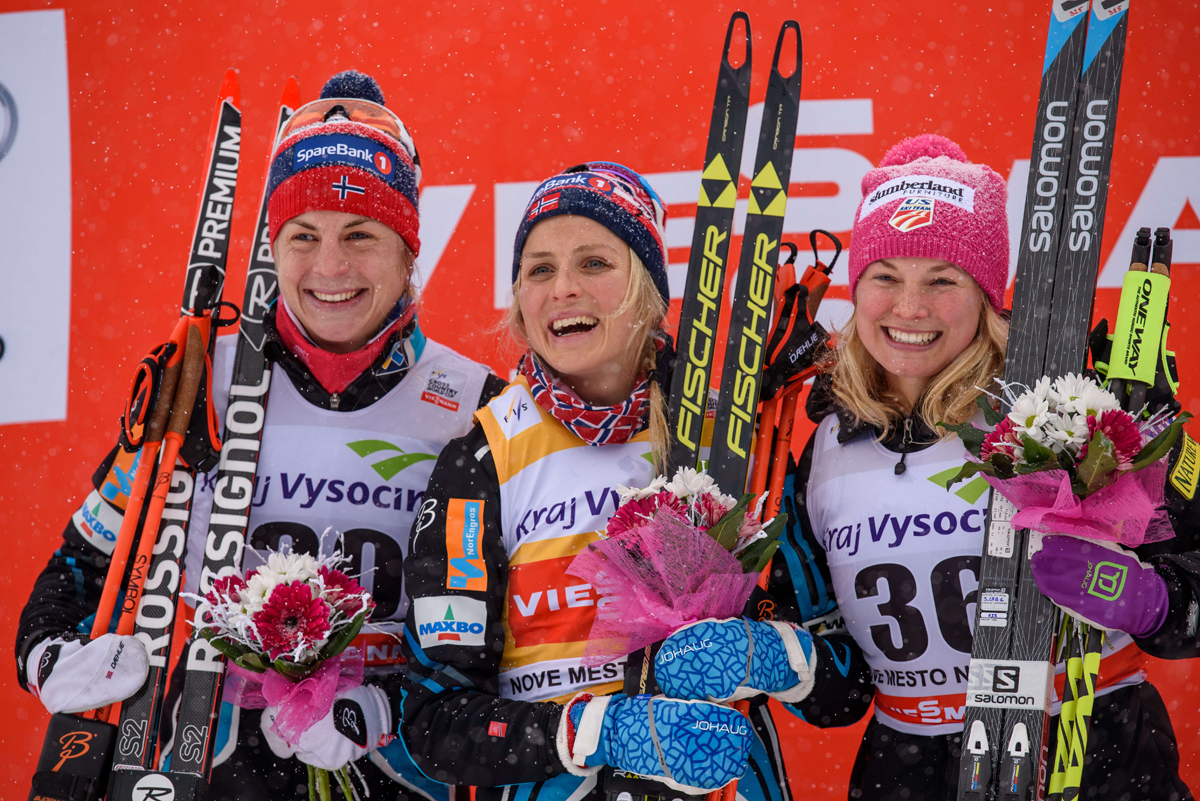
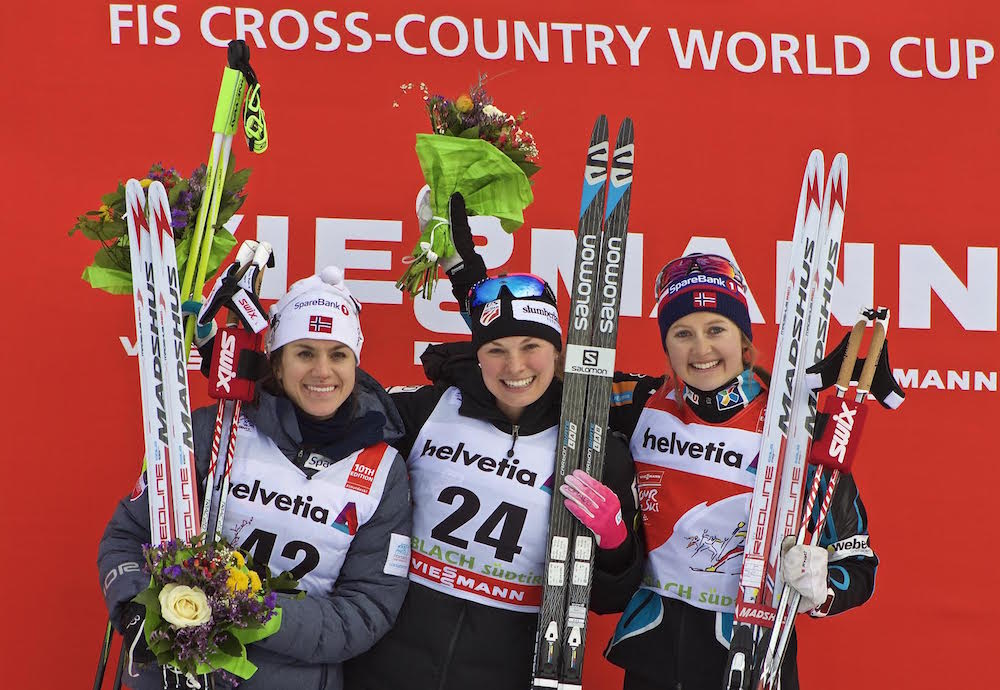
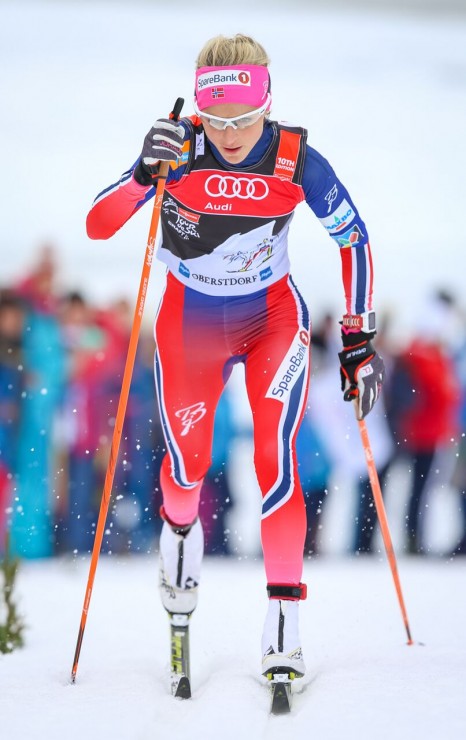
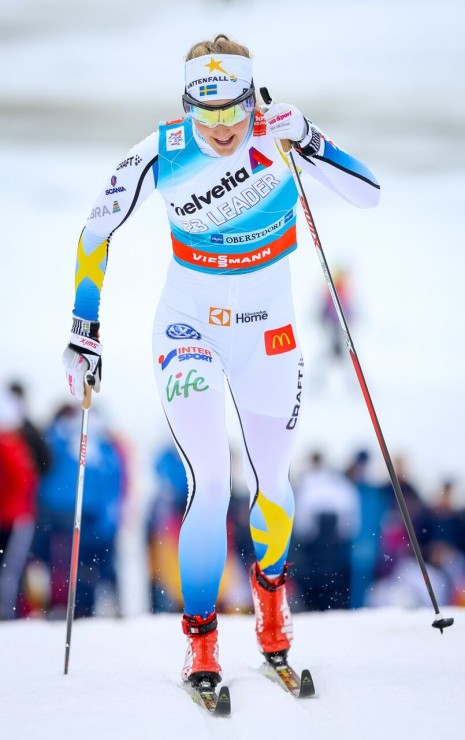
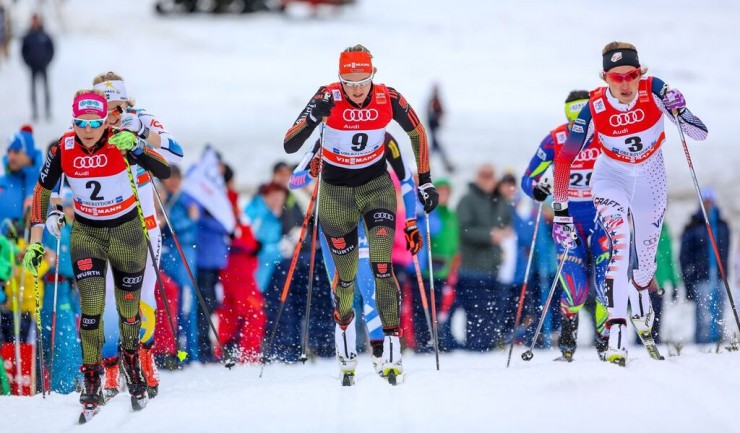
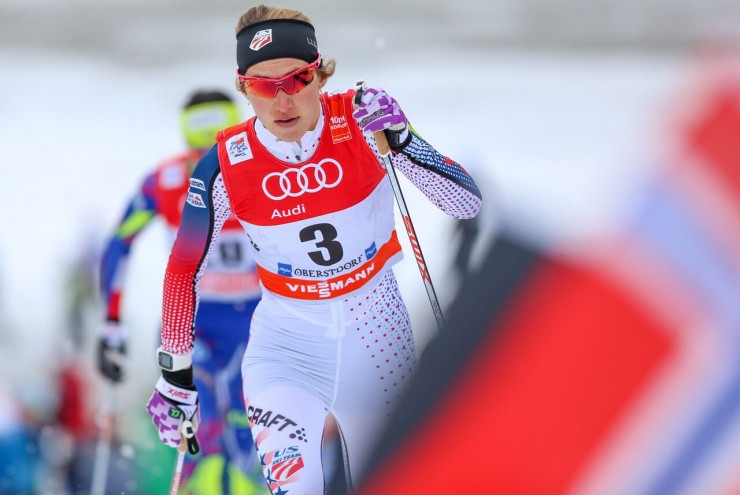
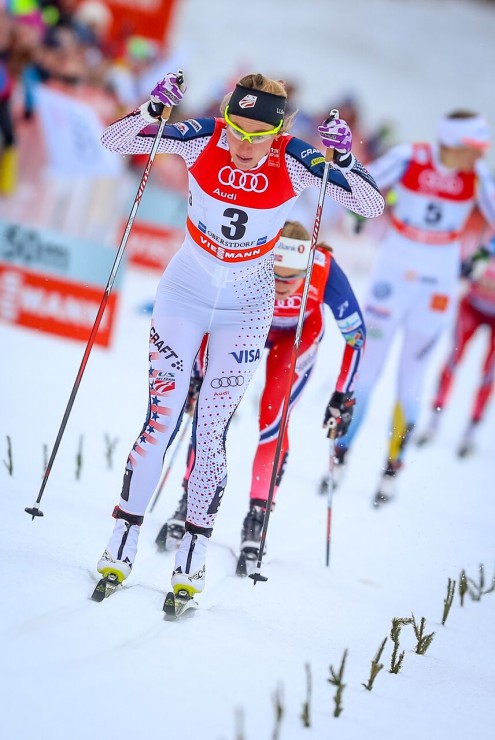
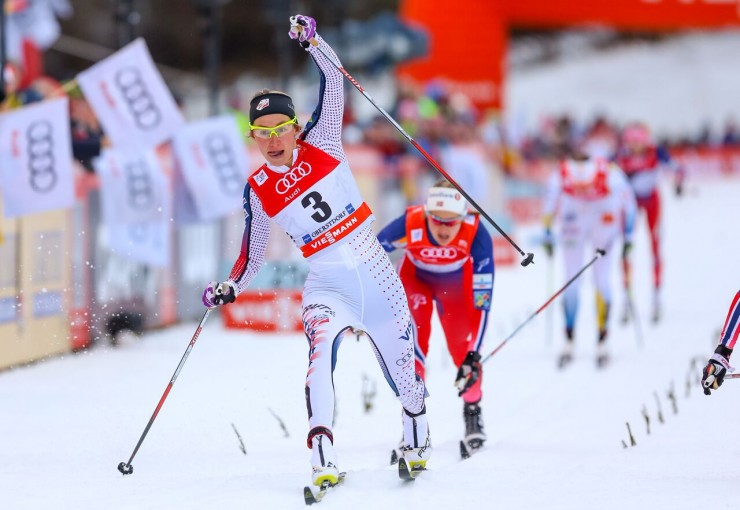
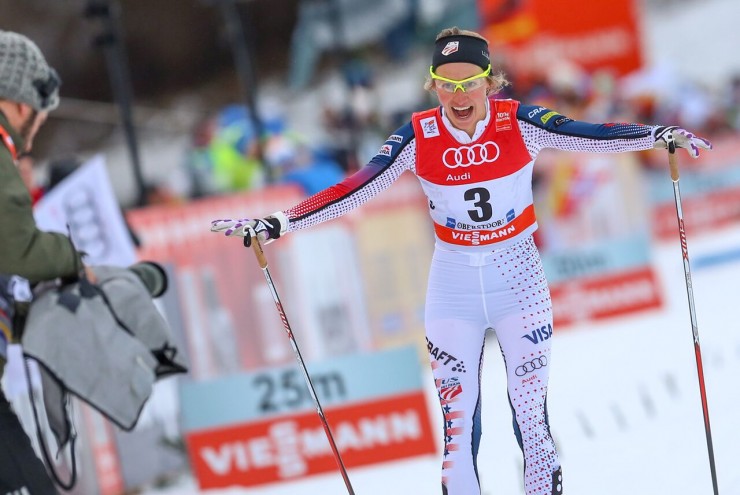
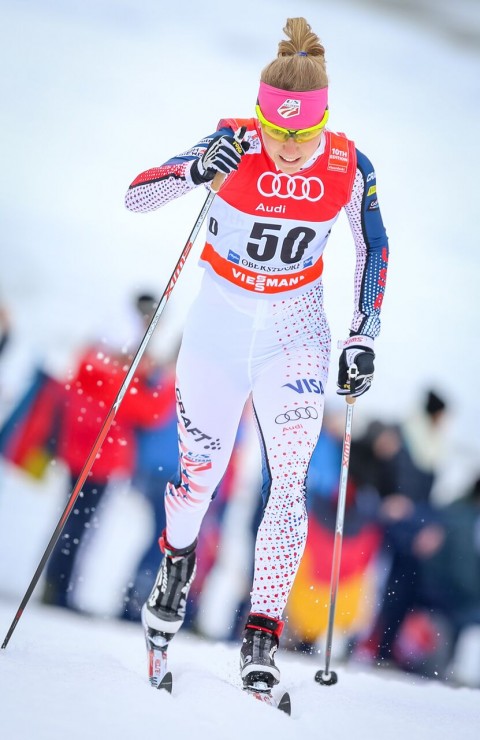
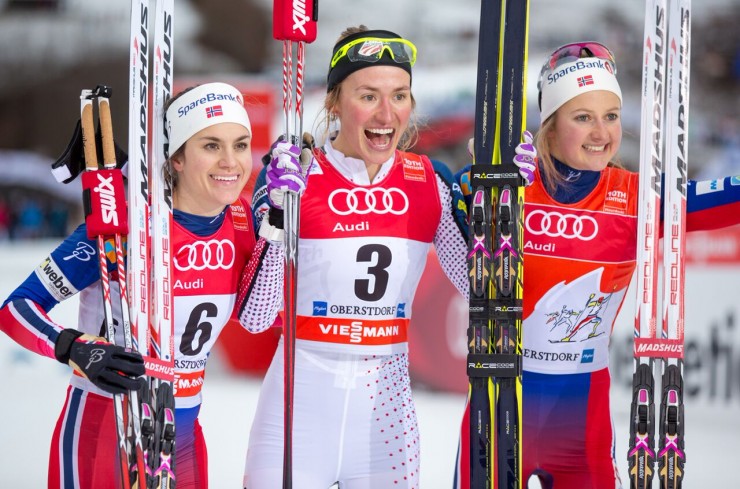
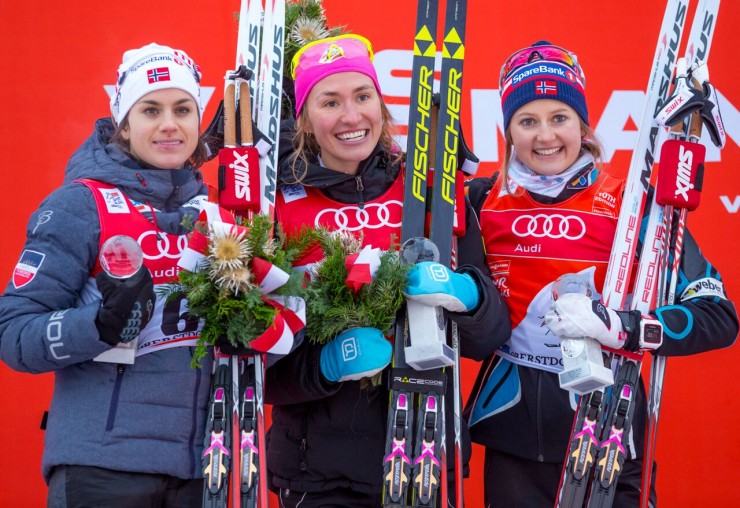
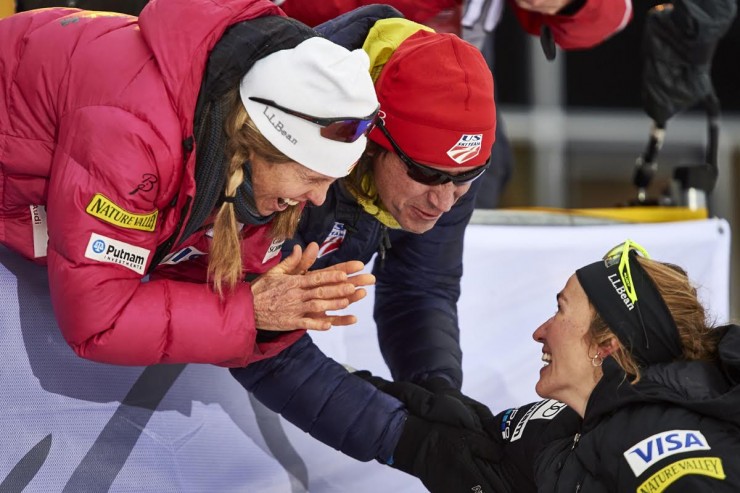
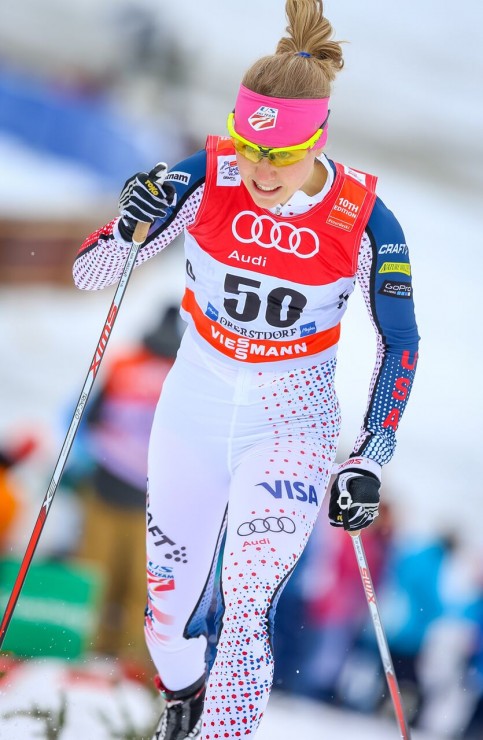
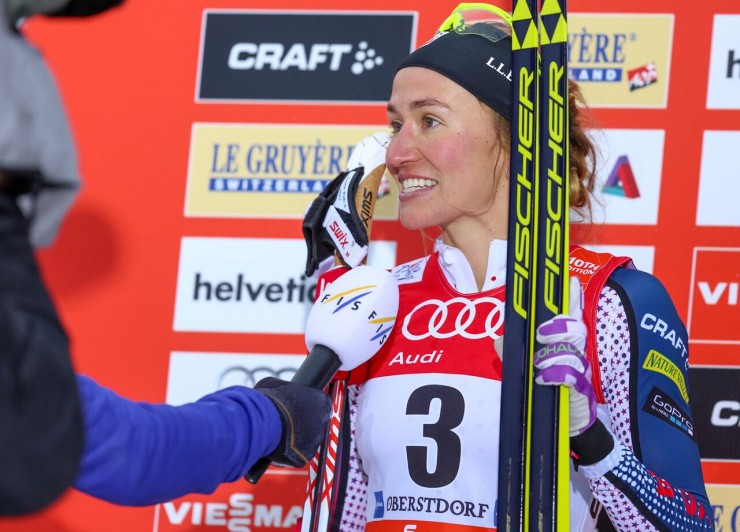
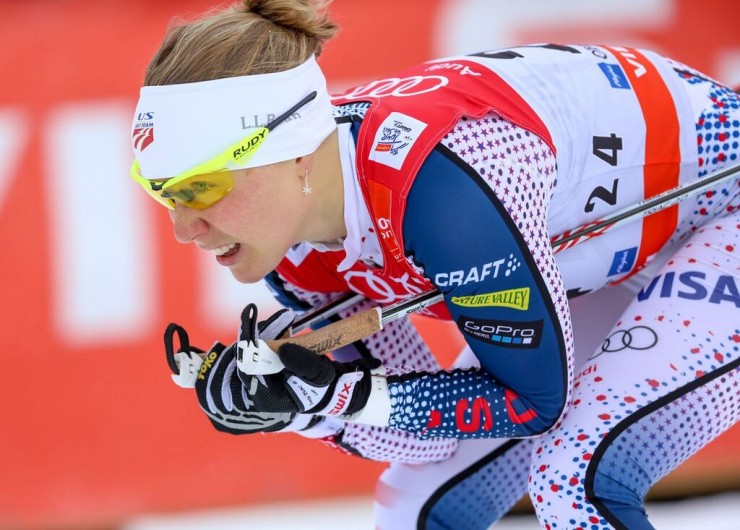
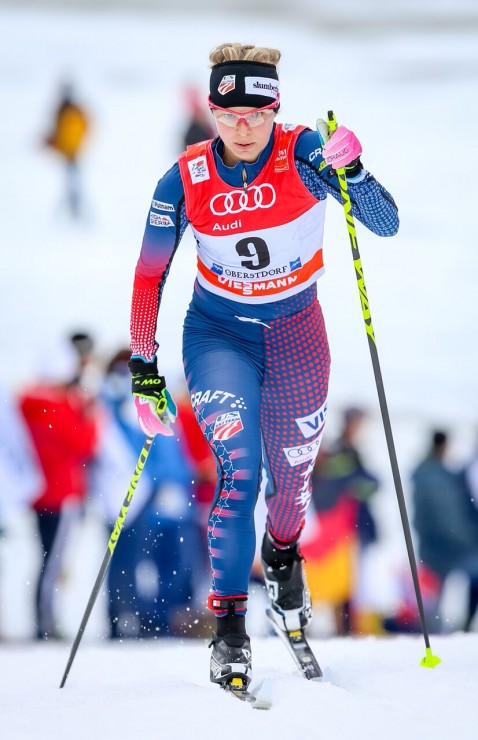
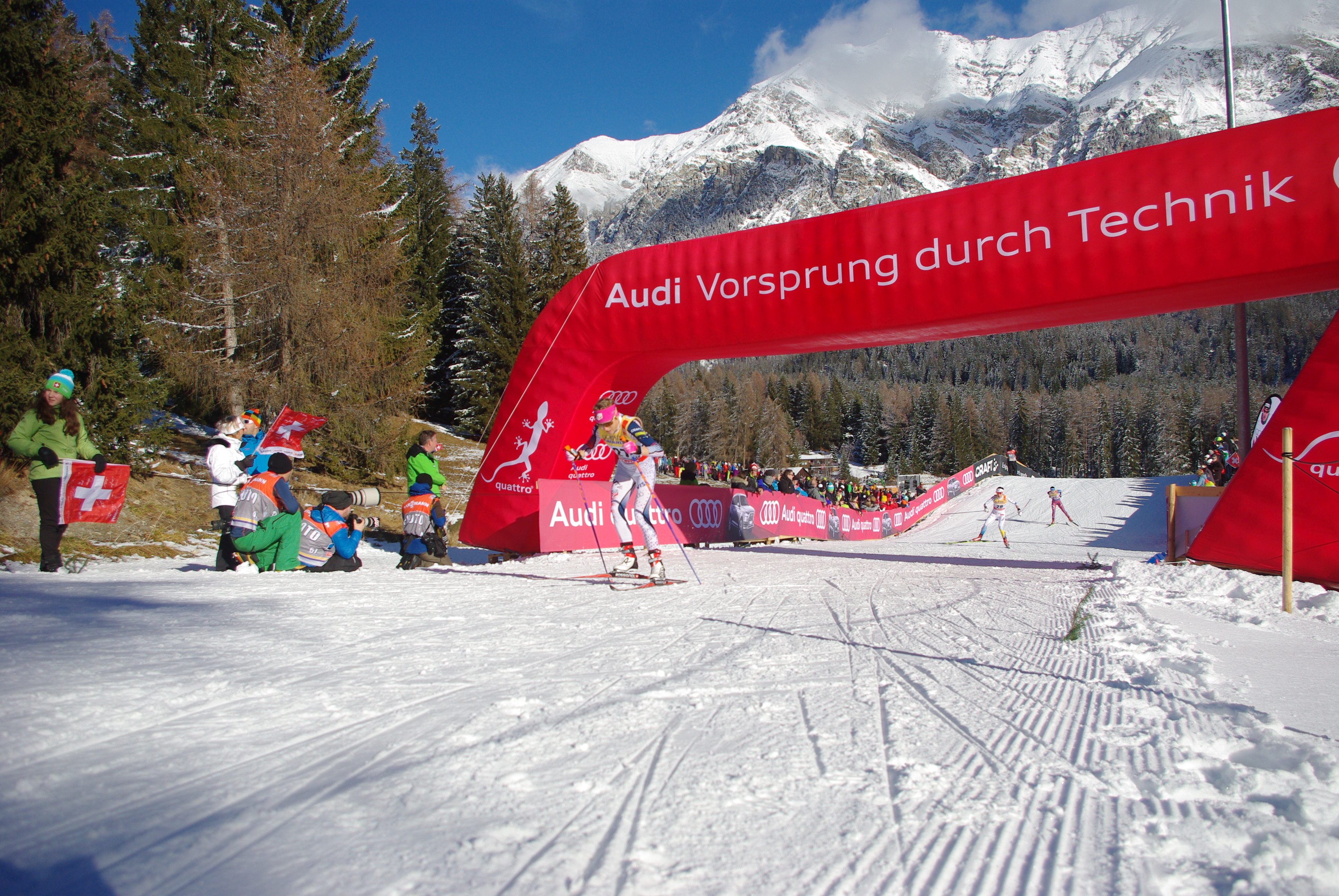
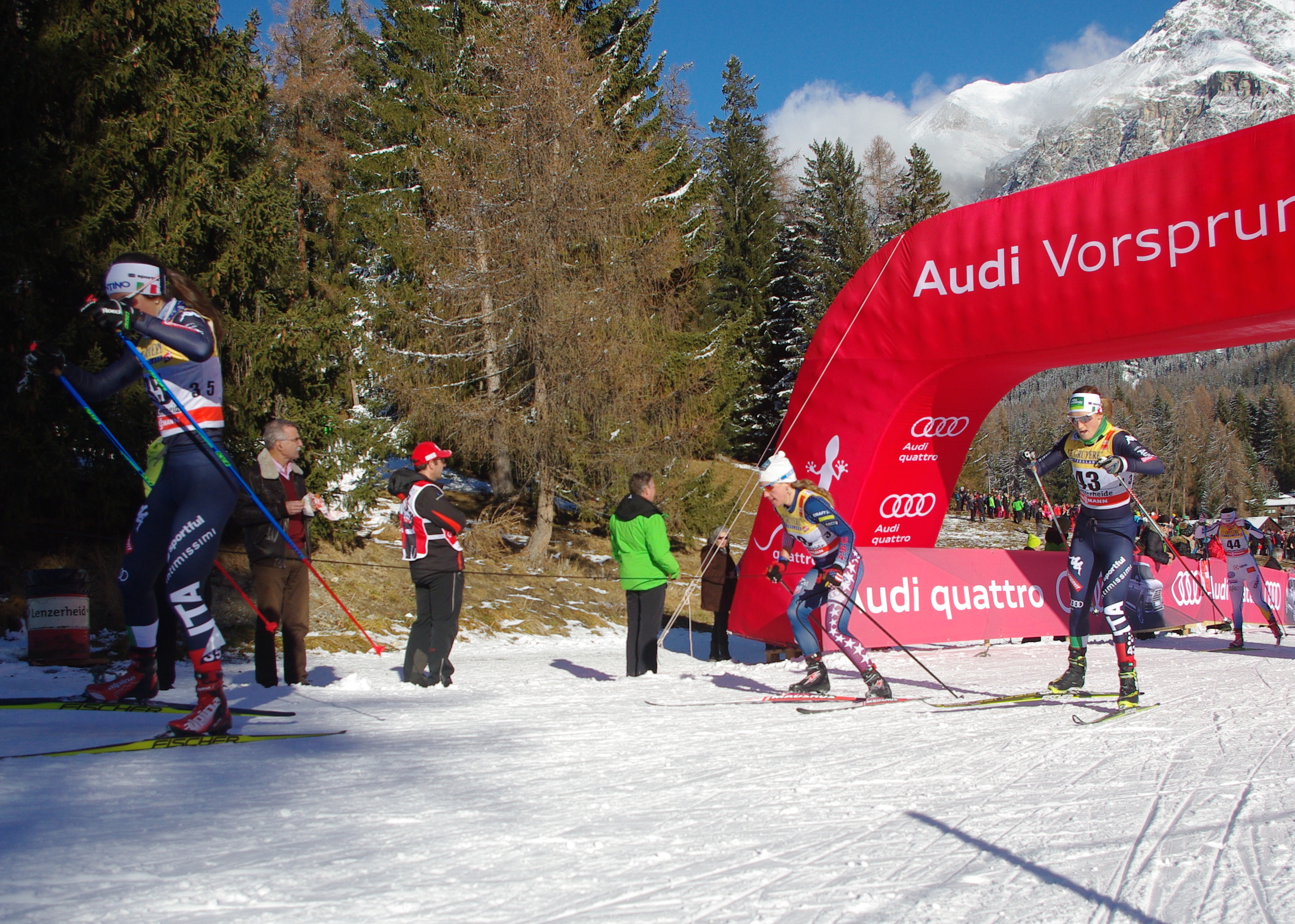
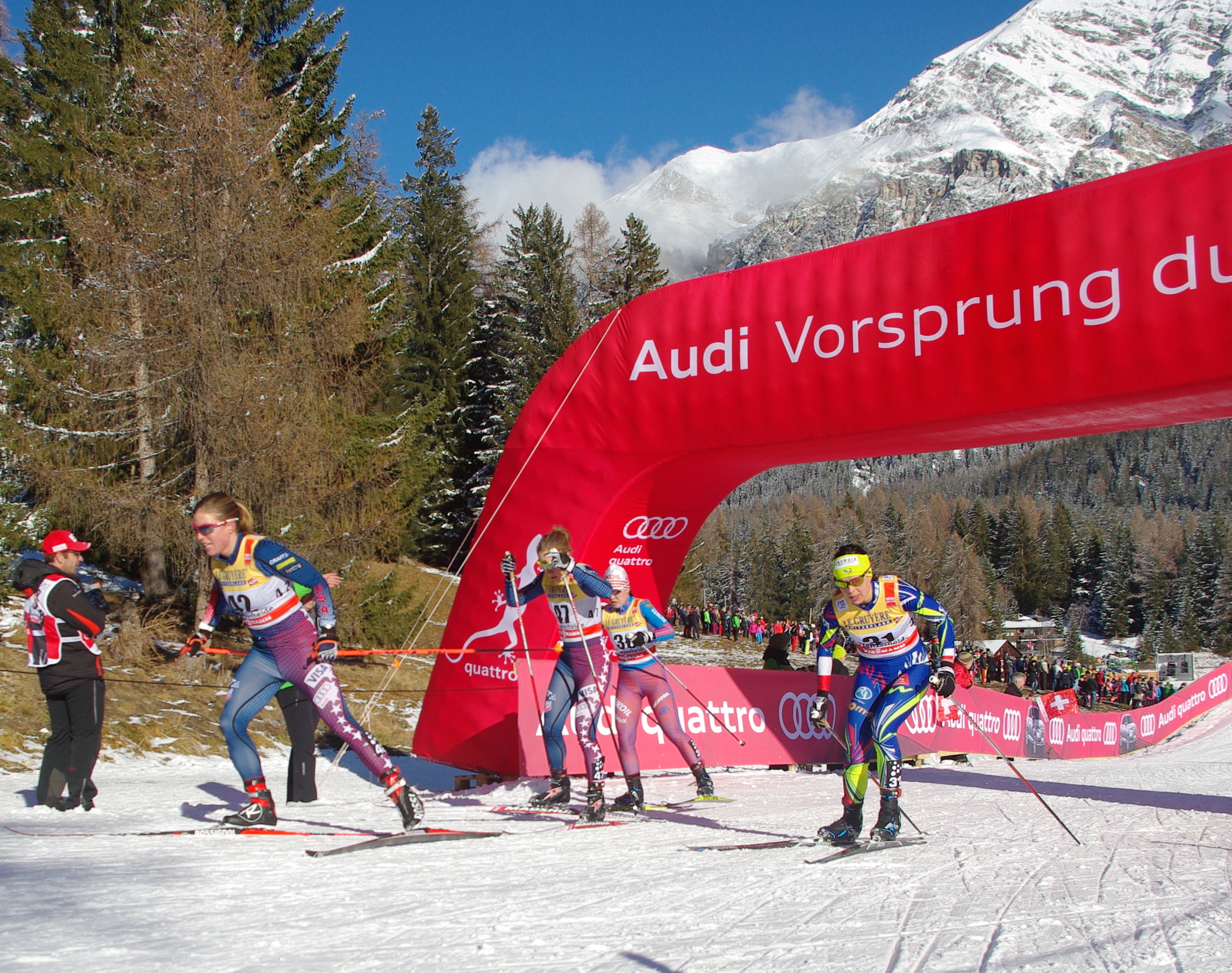
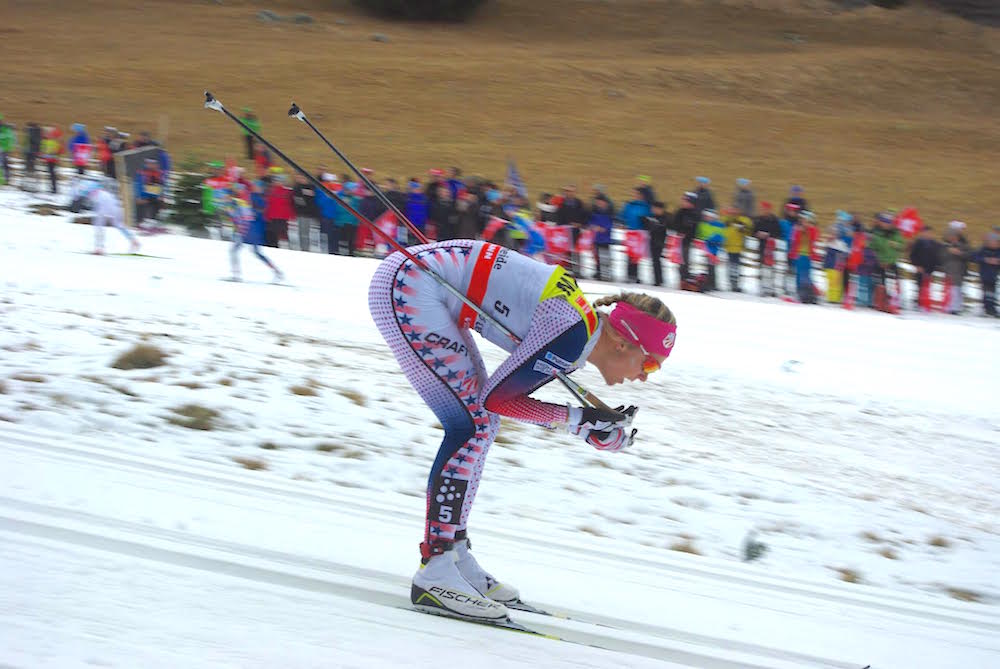
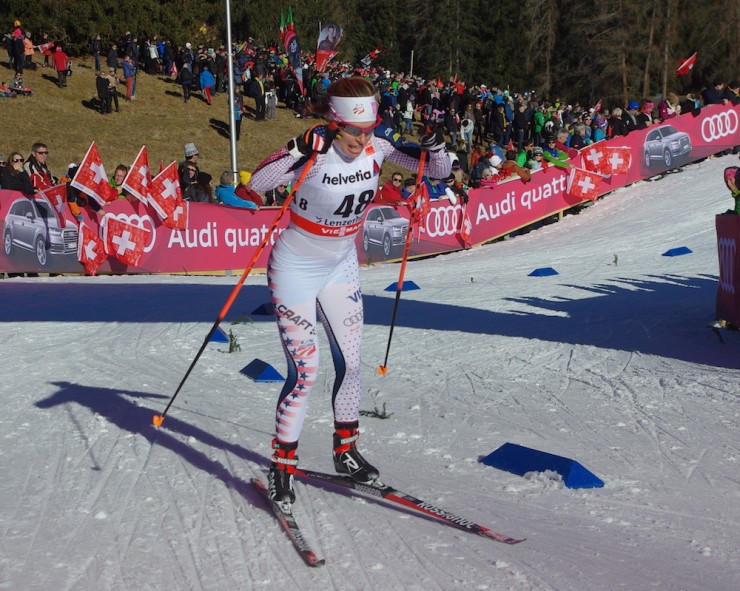
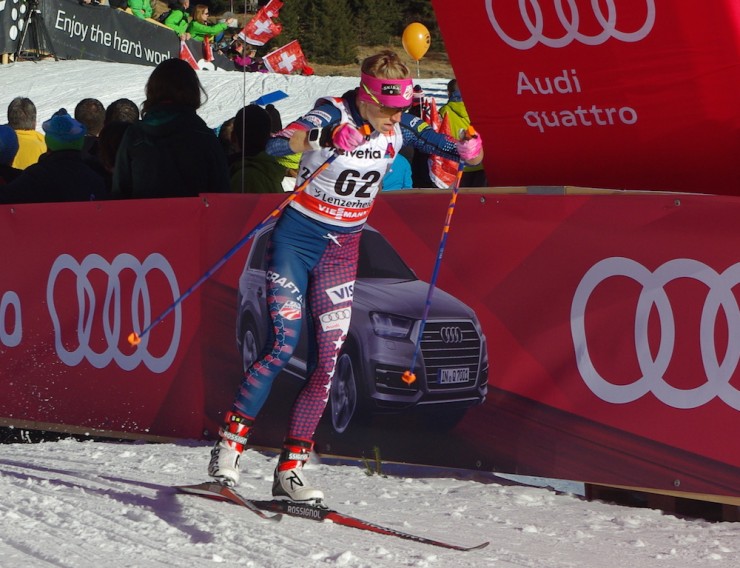
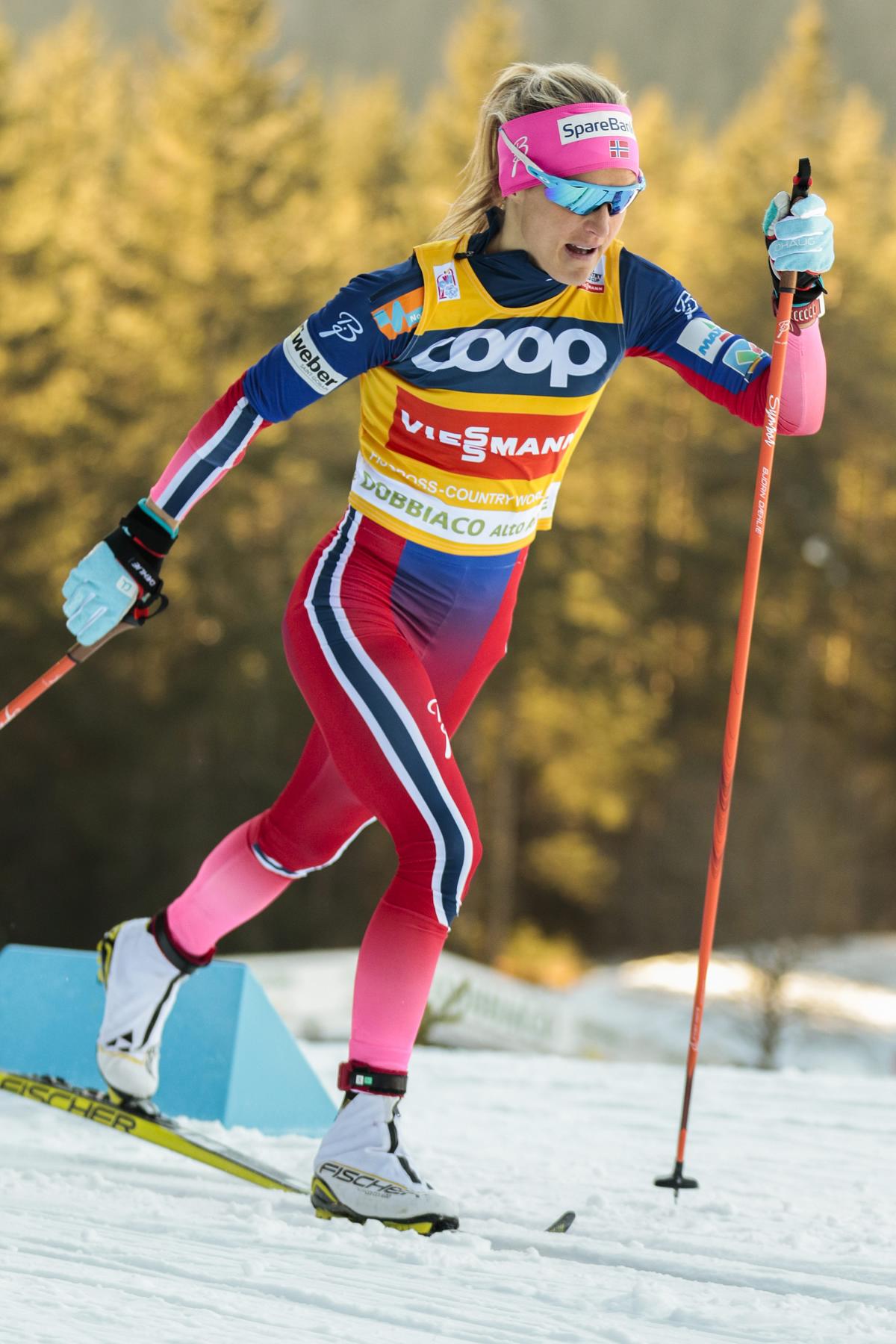
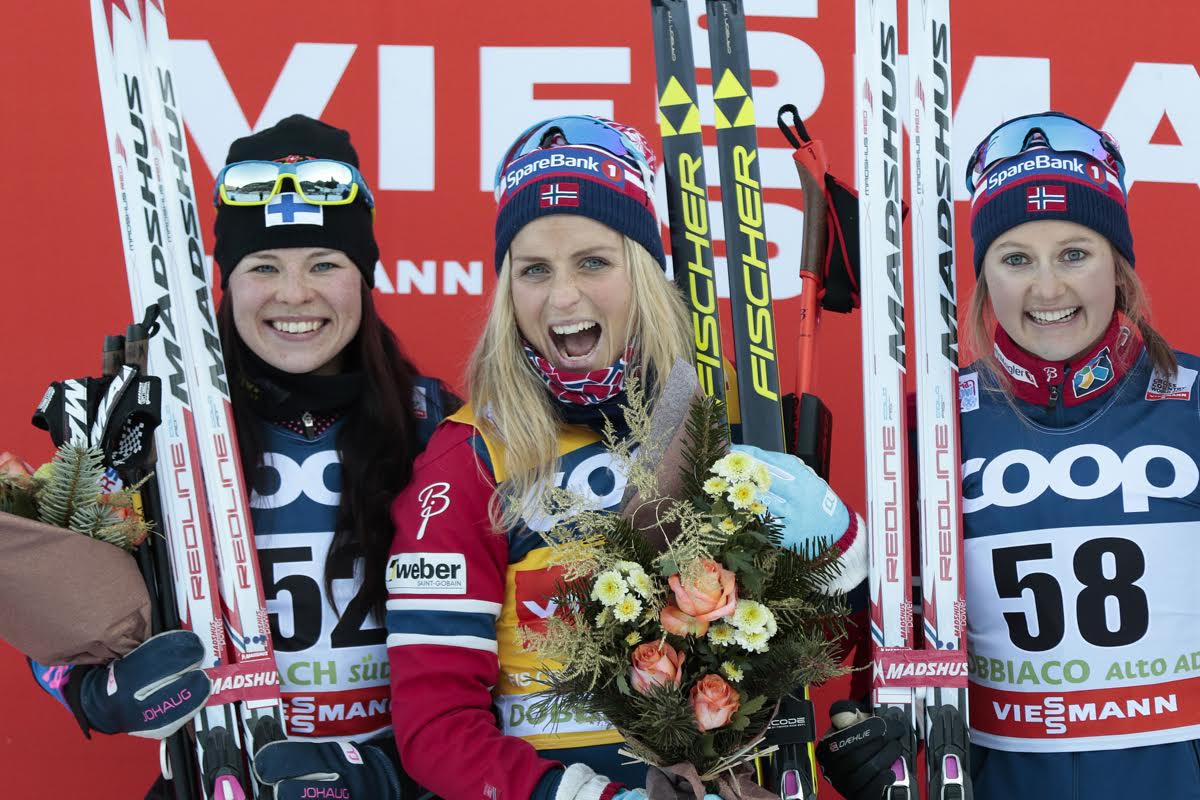
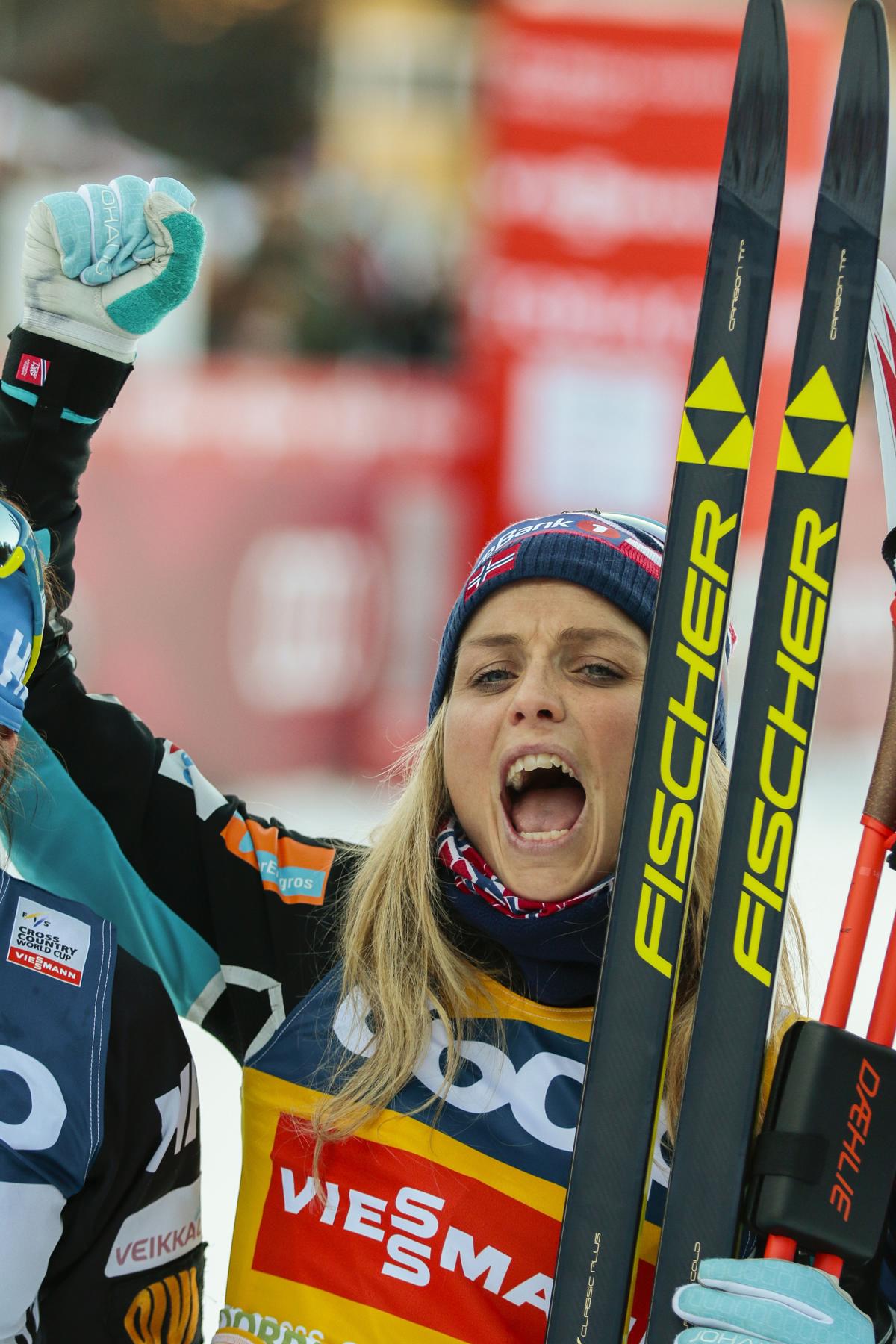
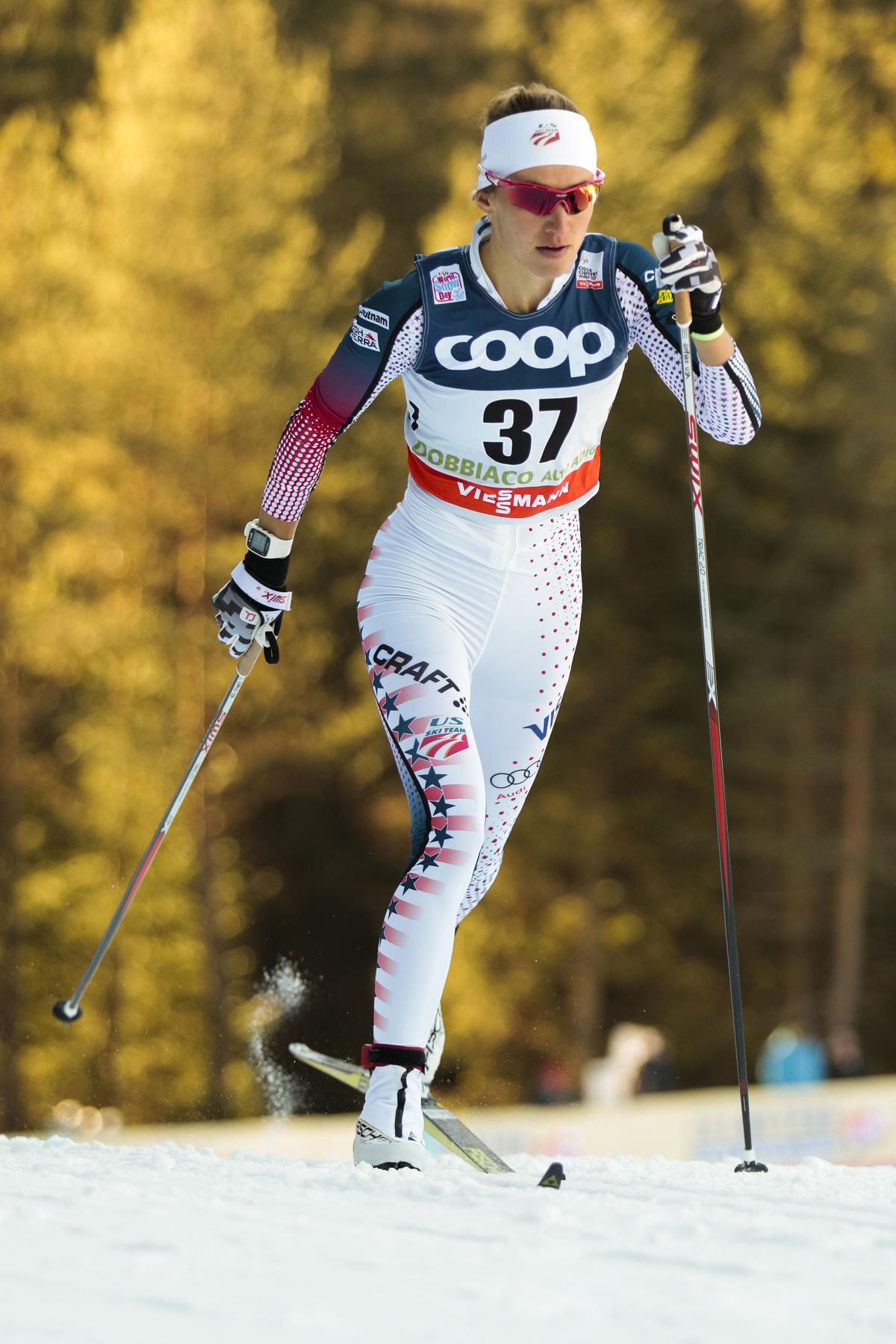
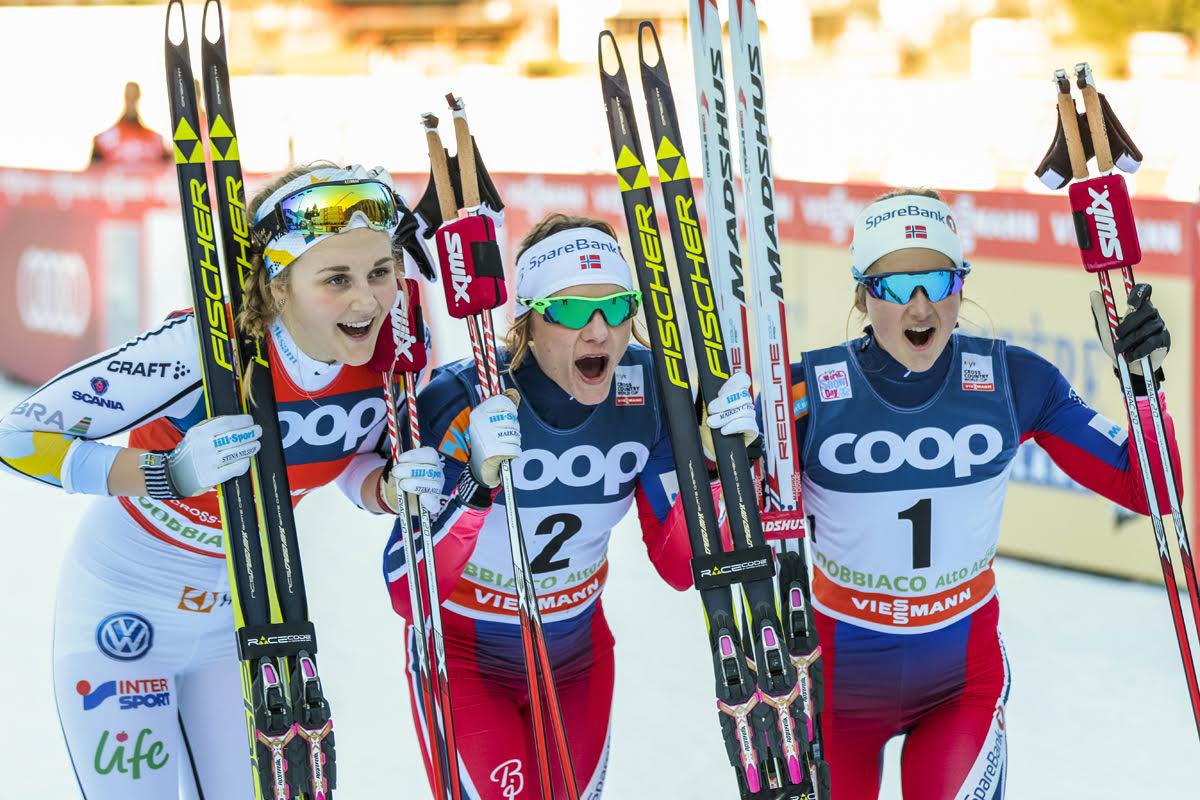
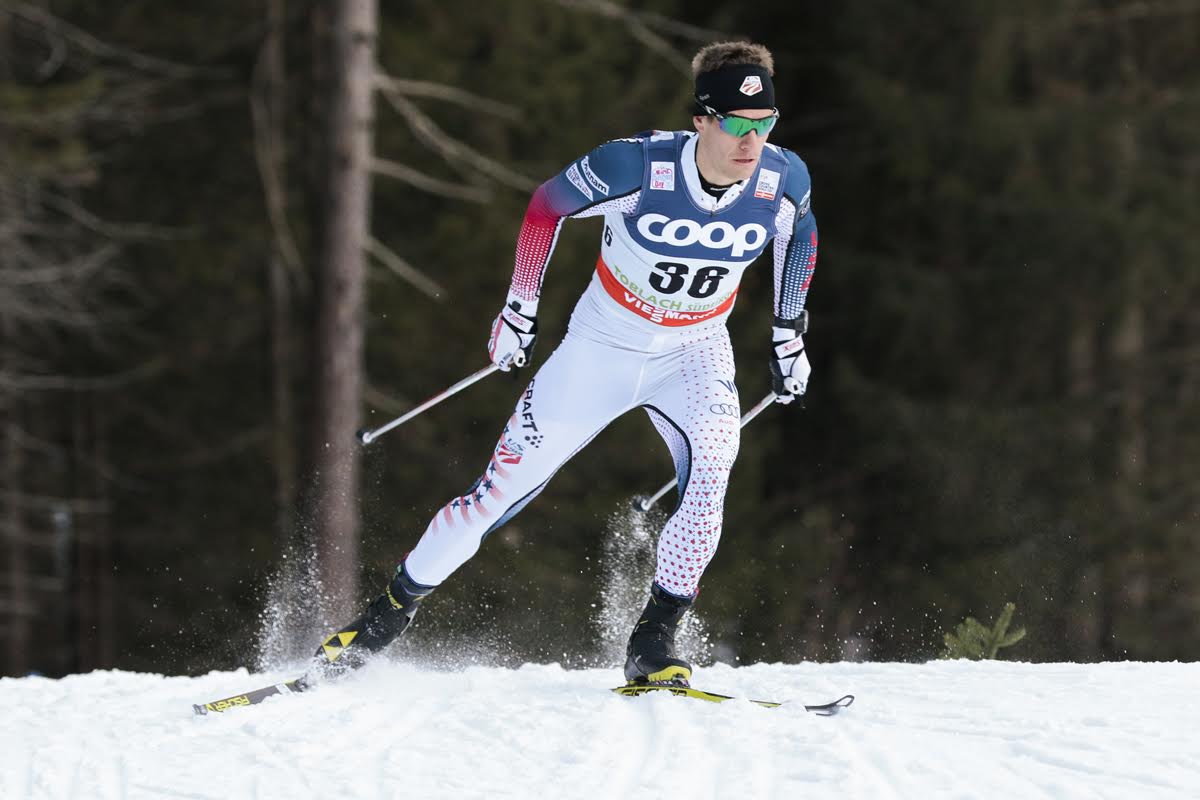
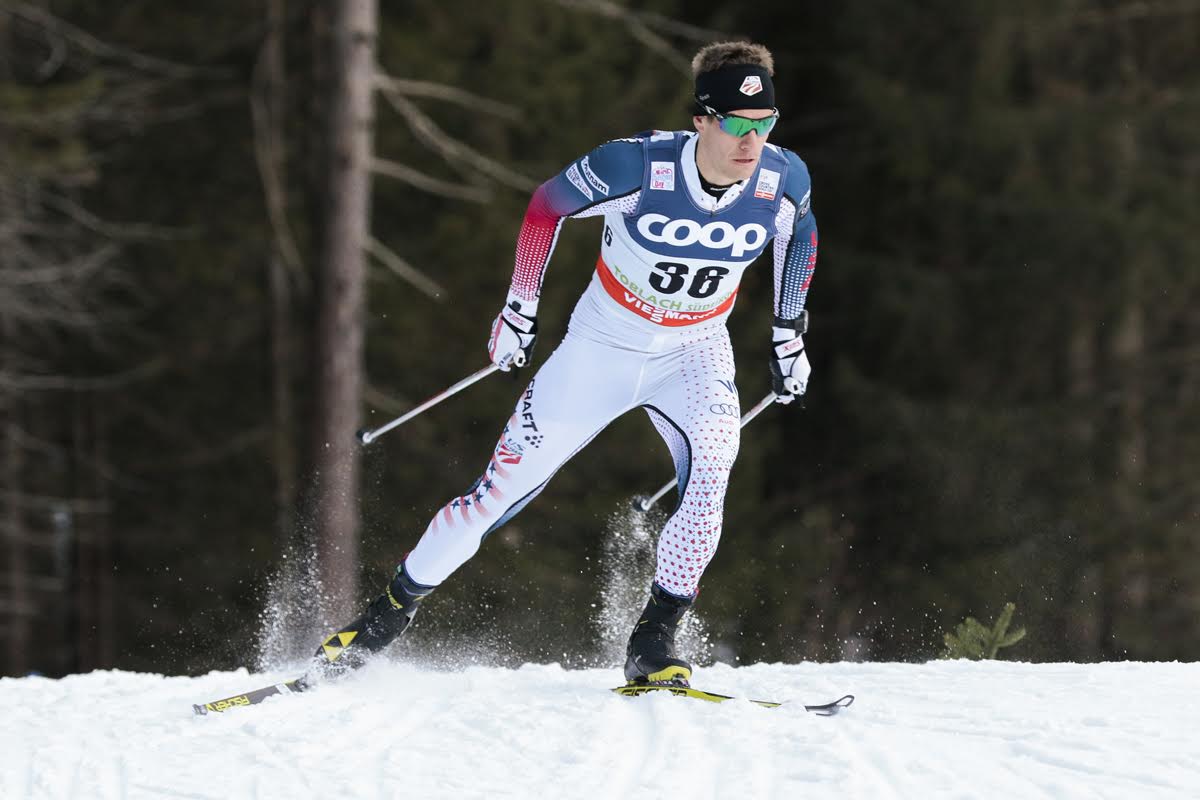
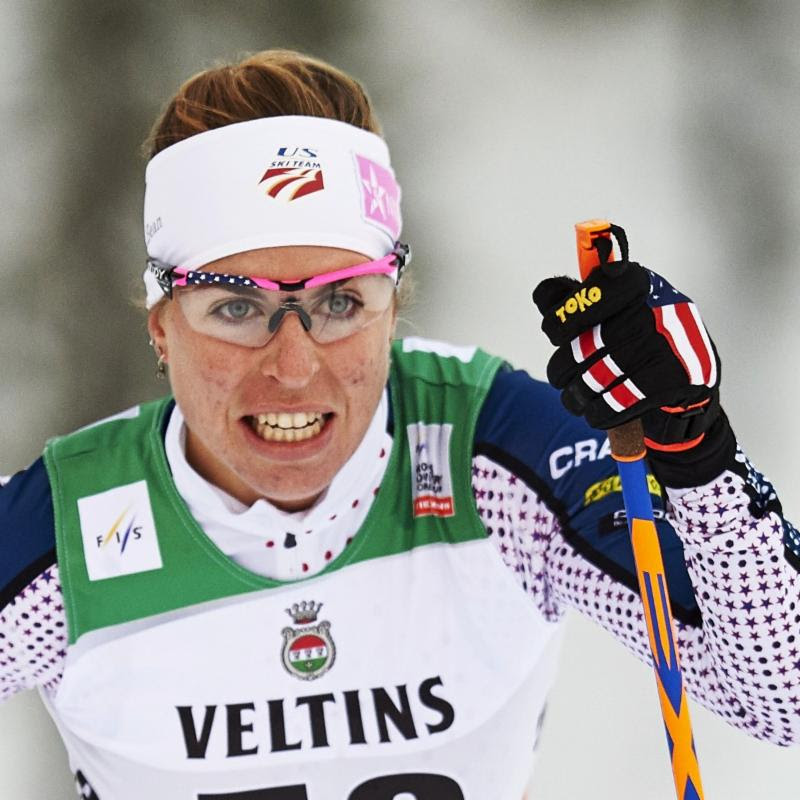
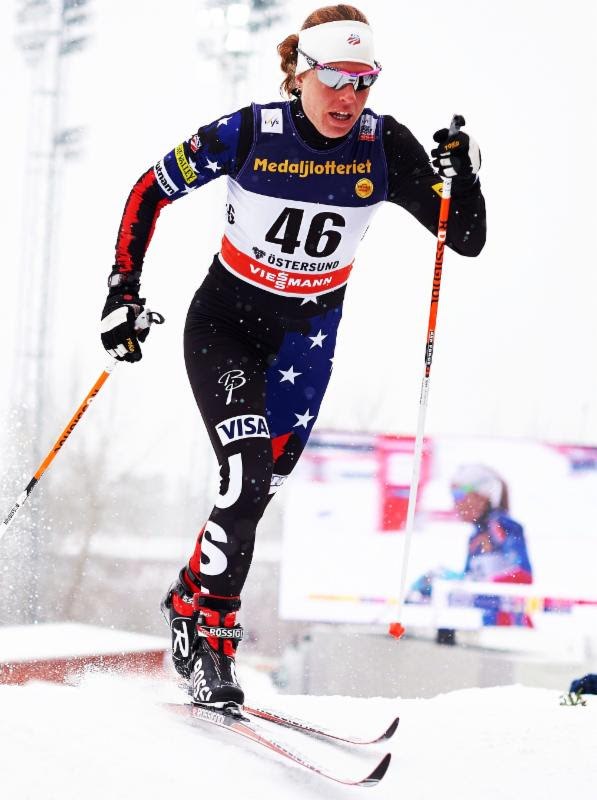
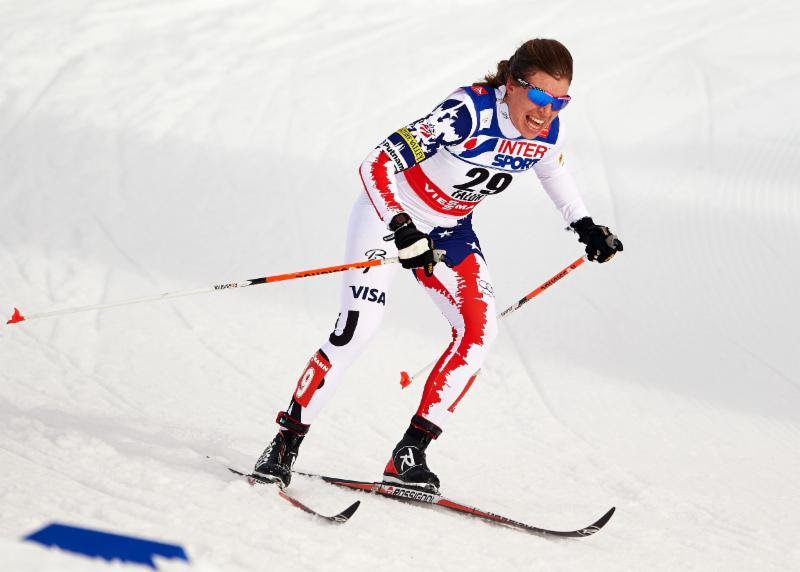
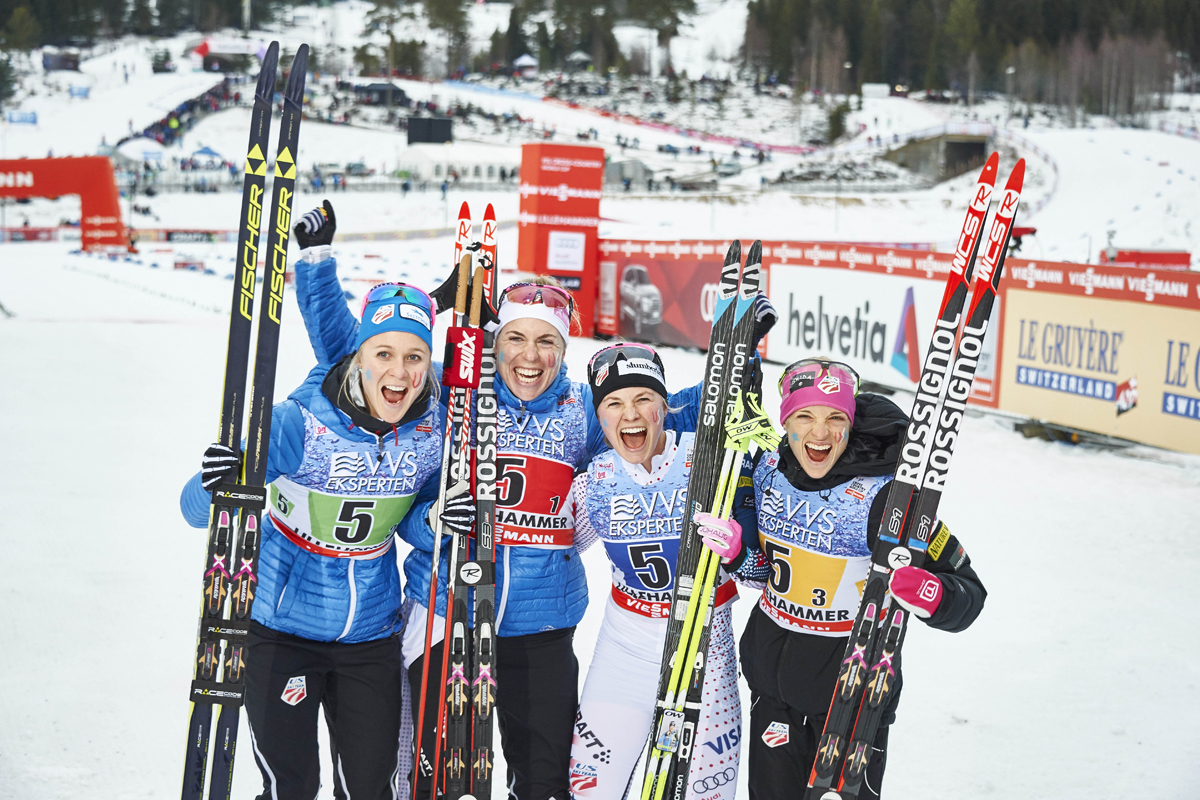
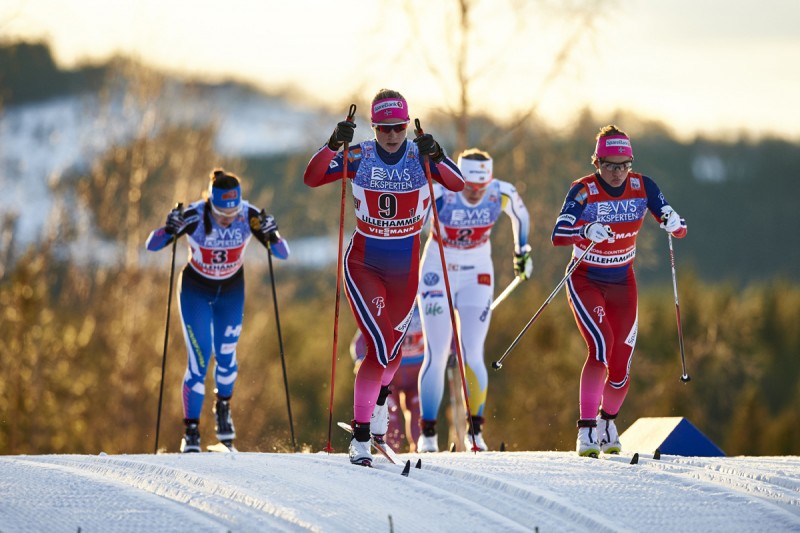
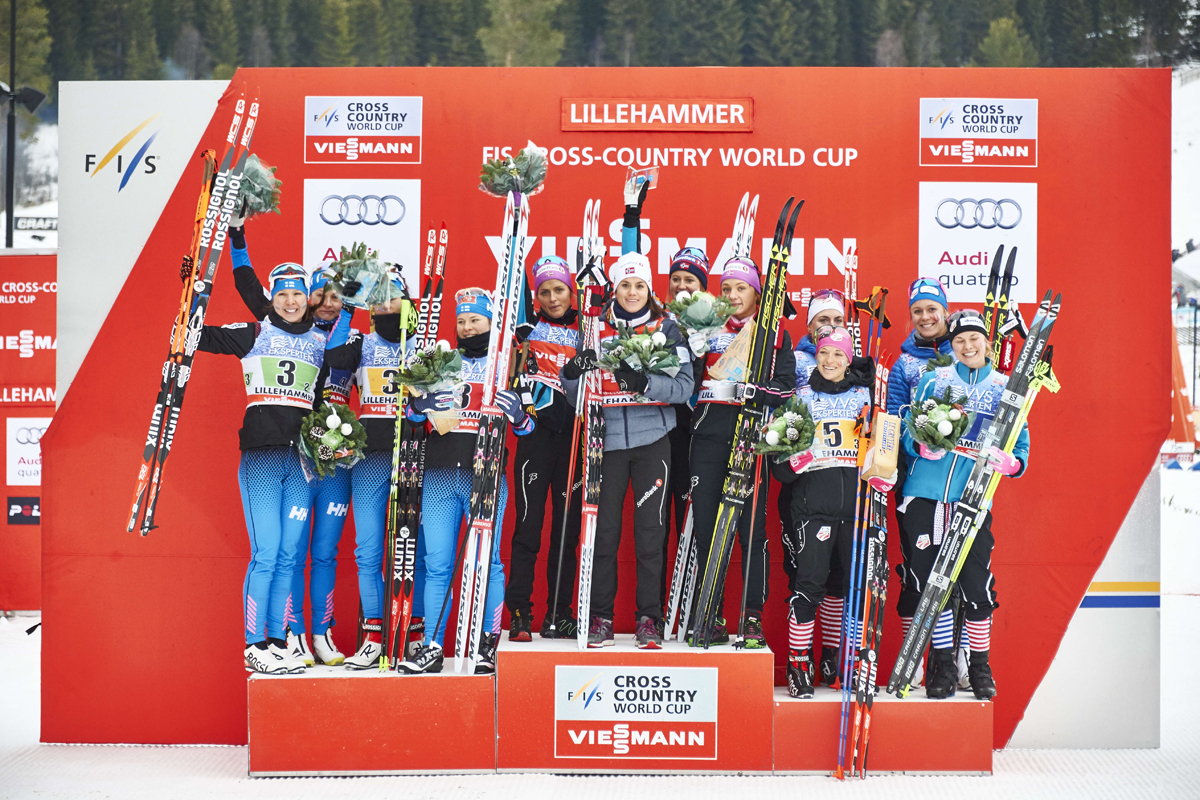
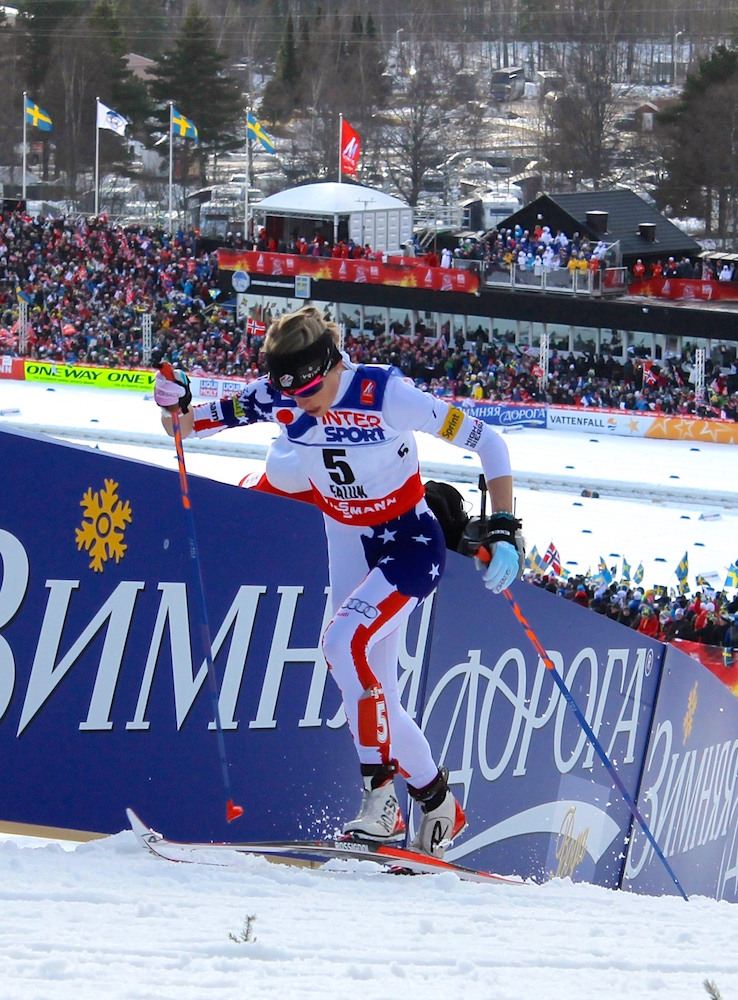
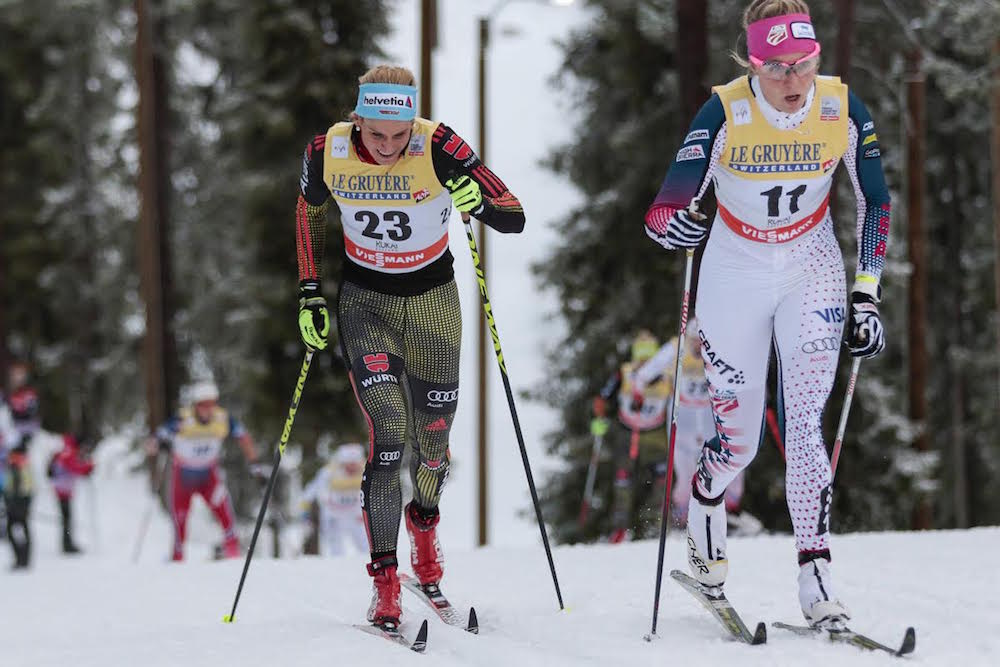
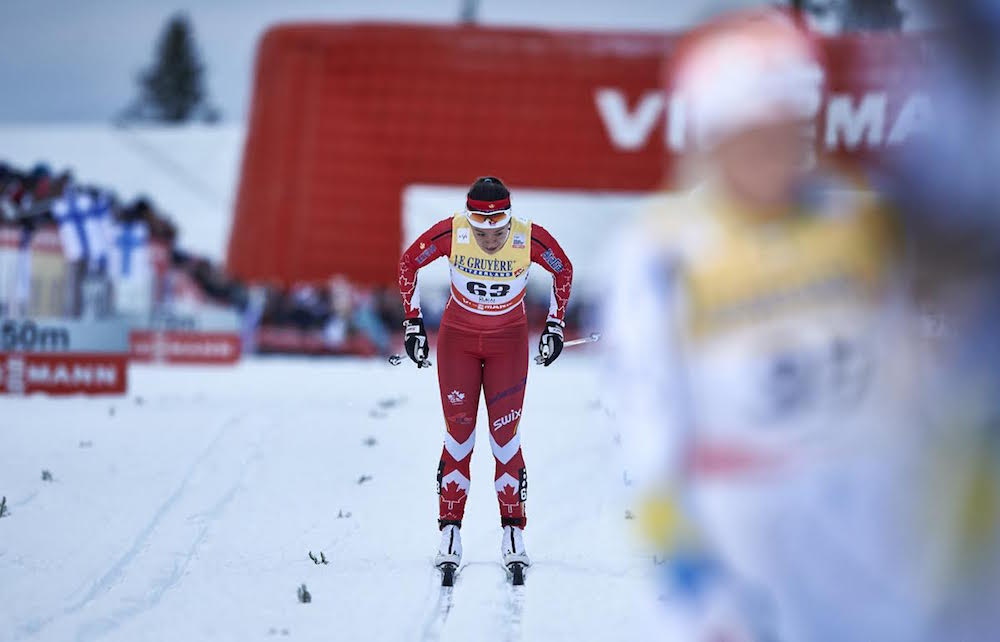
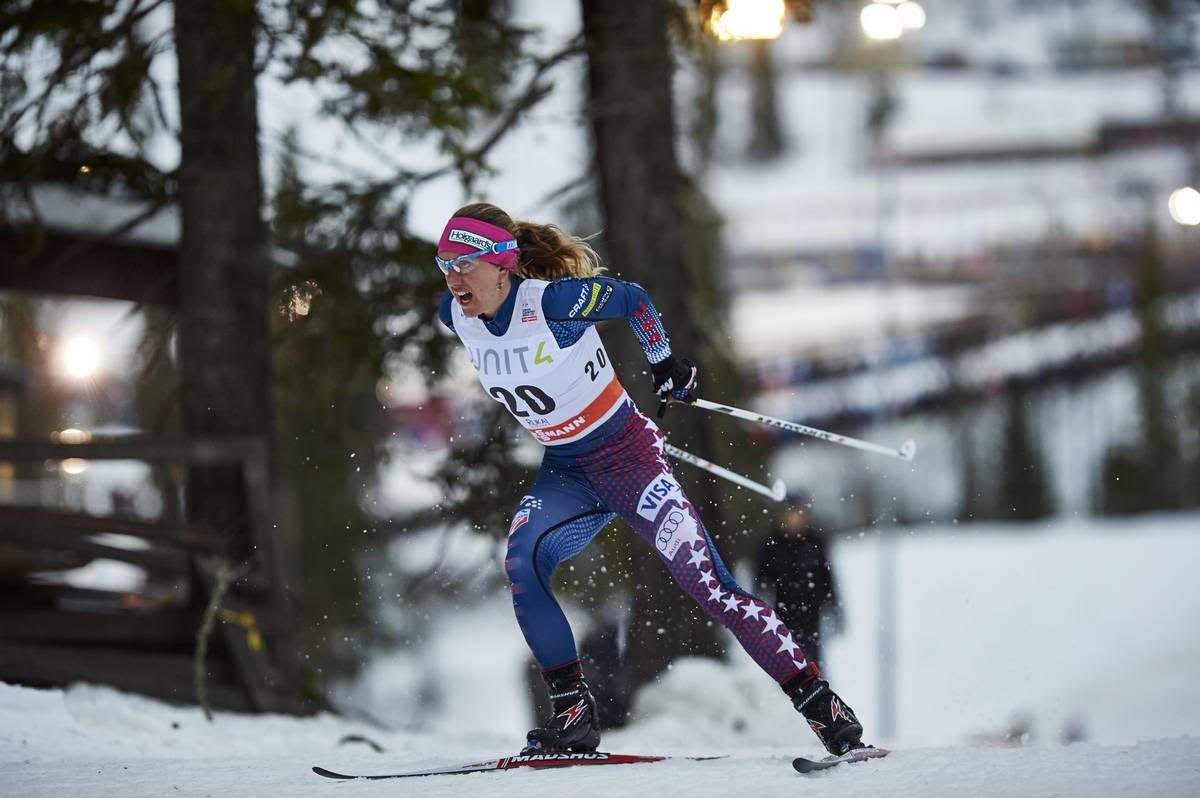
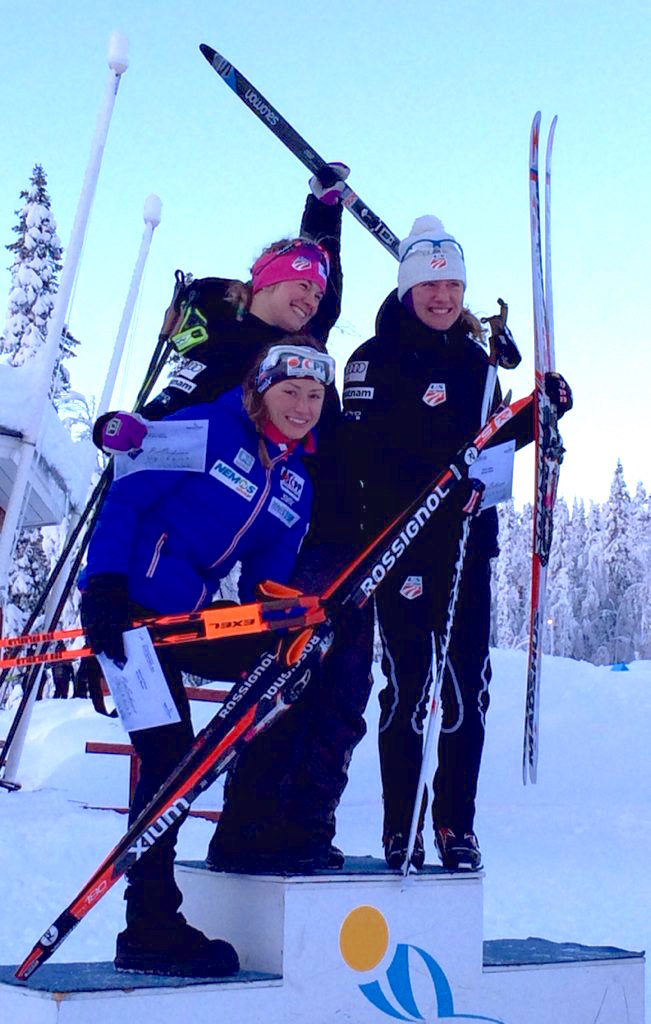
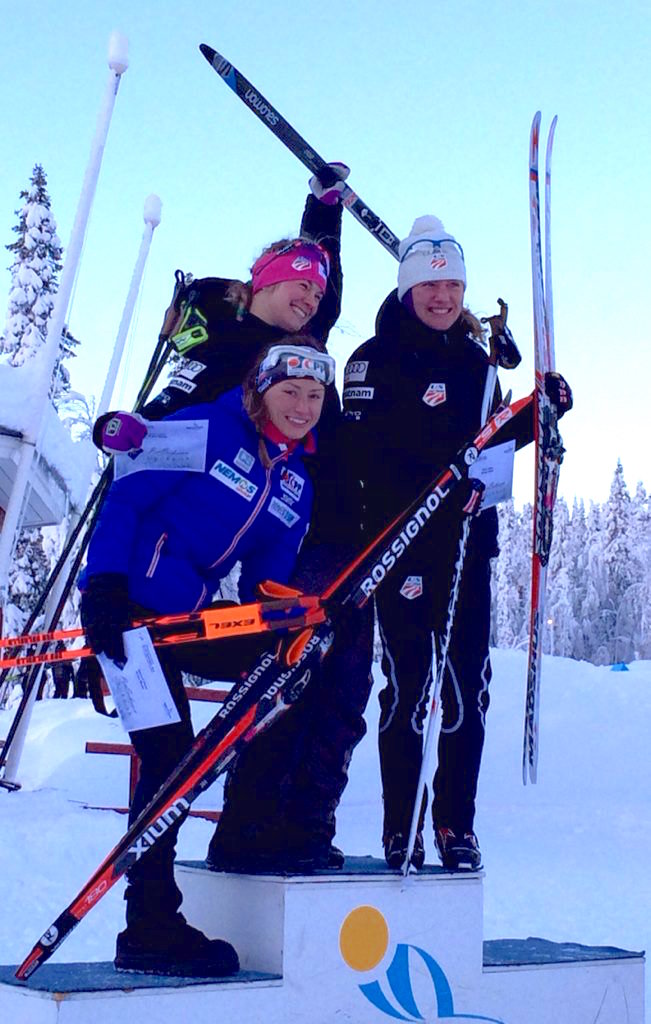
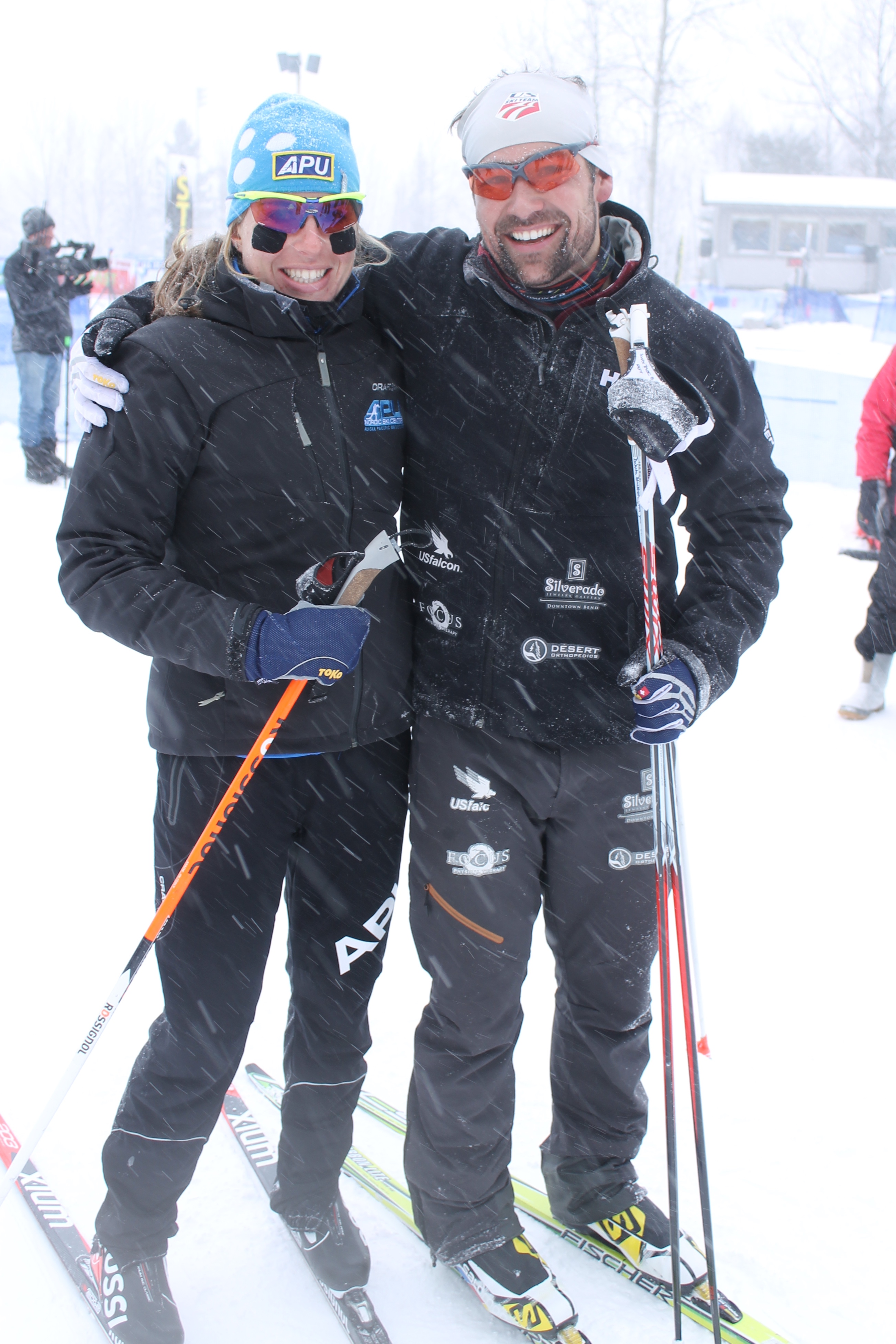
The women’s 10 k freestyle podium at the World Cup in Nove Mesto, Czech Republic, with Norwegian winner Therese Johaug, Norway’s Astrid Uhrenholdt Jacobsen in second and American Jessie Diggins in third (r). (Photo: Fischer/NordicFocus)
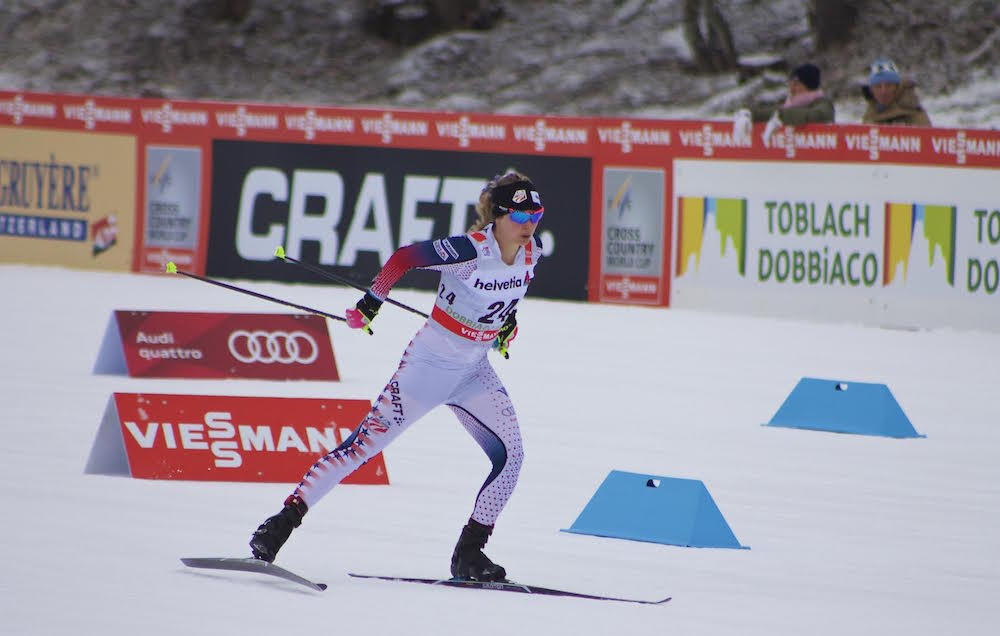
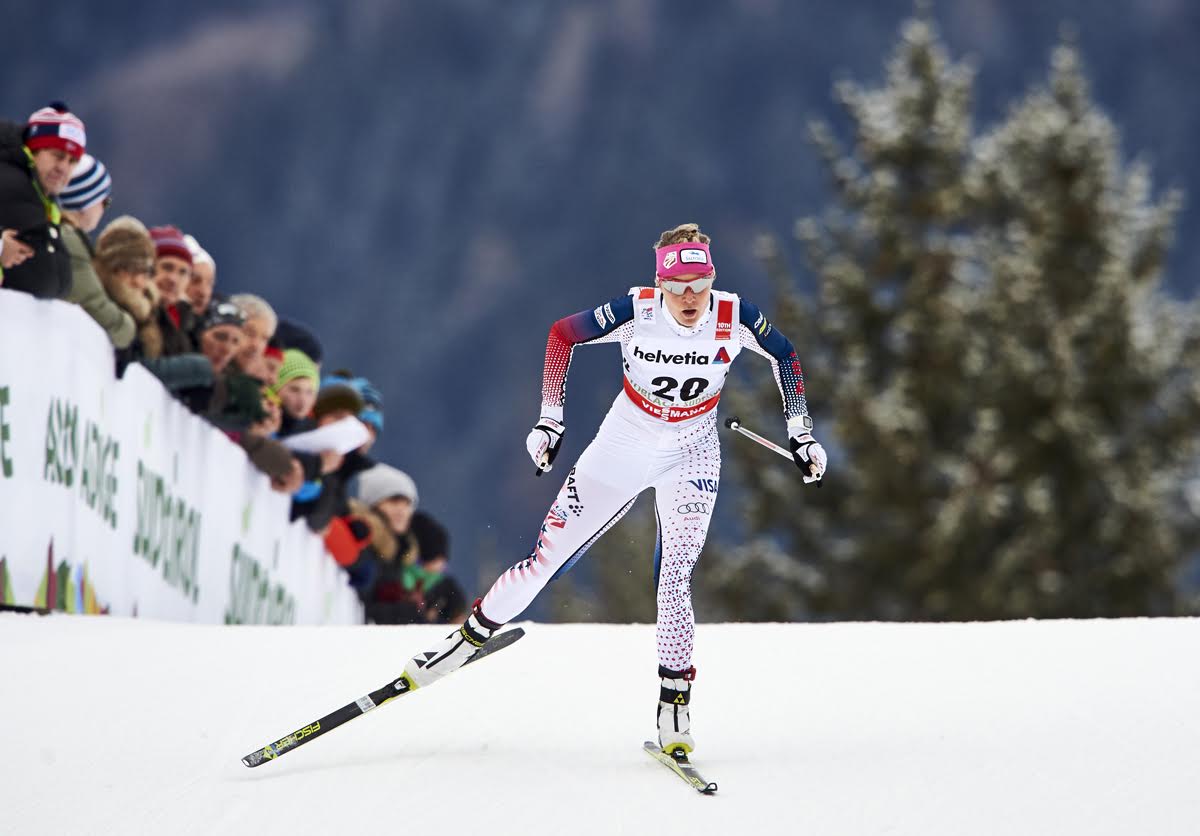
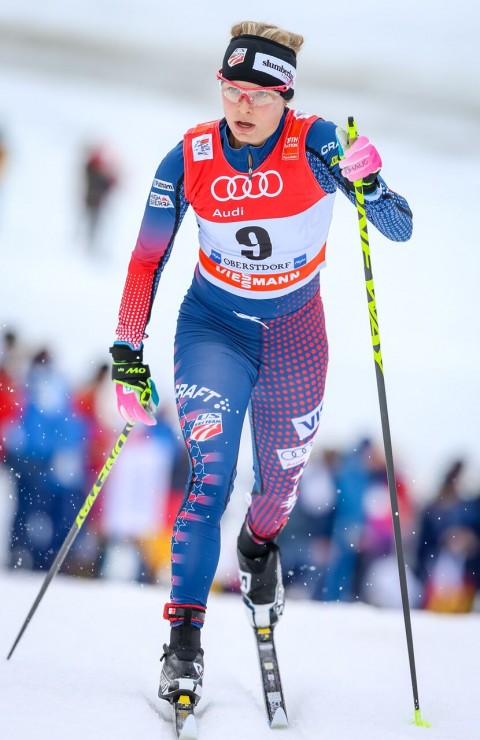
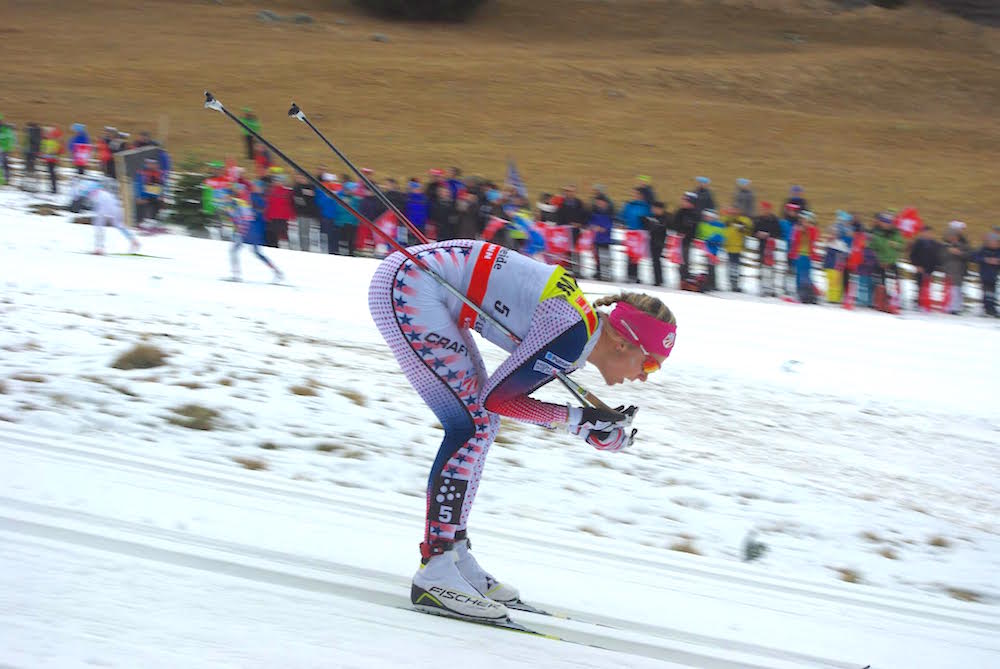
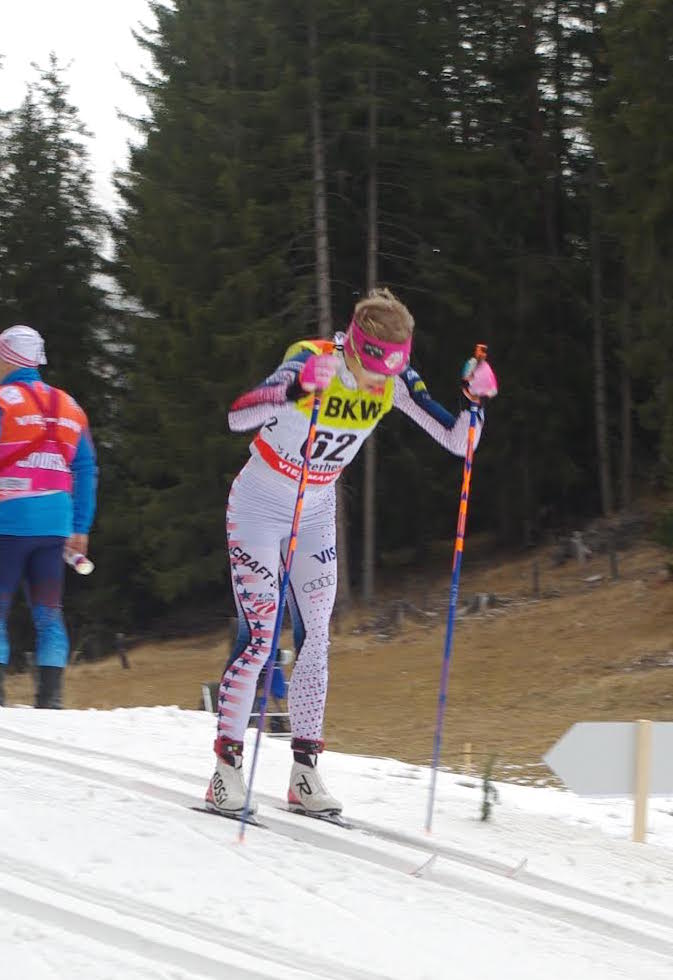
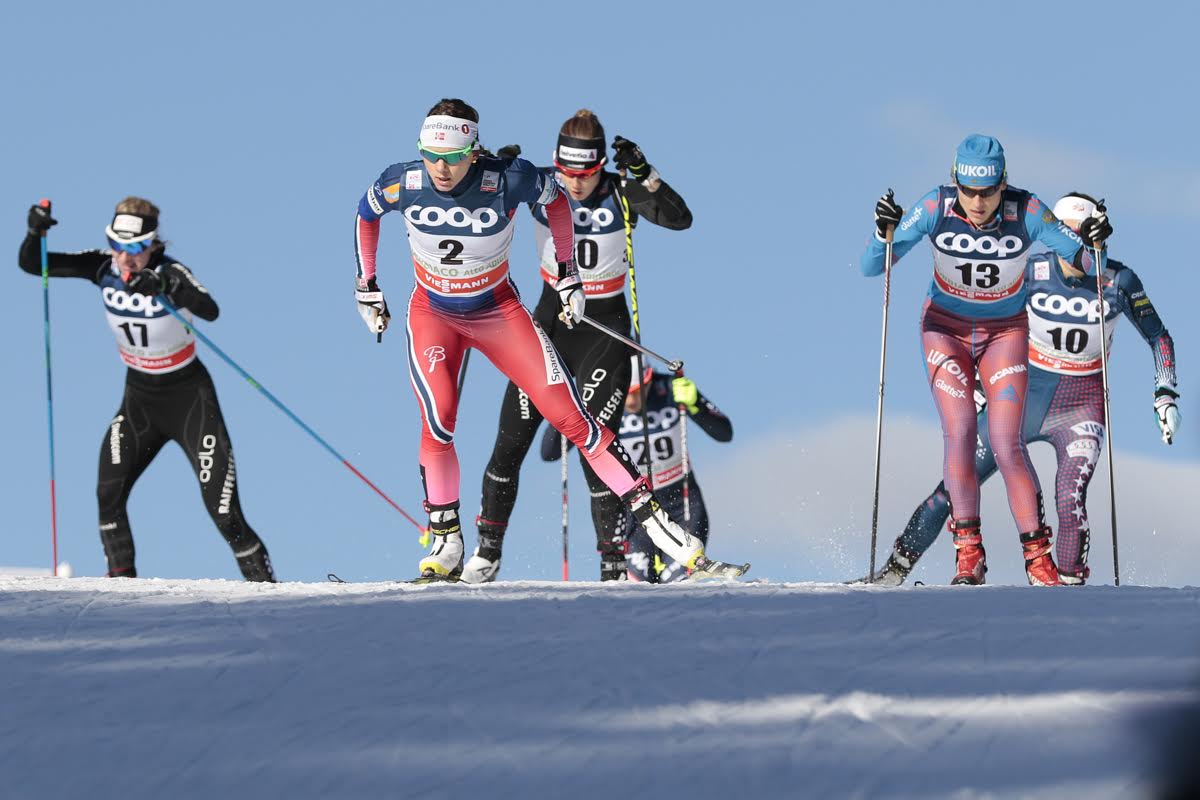
Natural snowfall during a competition isn’t something many World Cup athletes have seen this season. With a steady stream of snowflakes descending onto the women’s 10-kilometer skate course on Saturday in Nove Mesto, Czech Republic, American Jessie Diggins proved that as the snow flies, so can she.
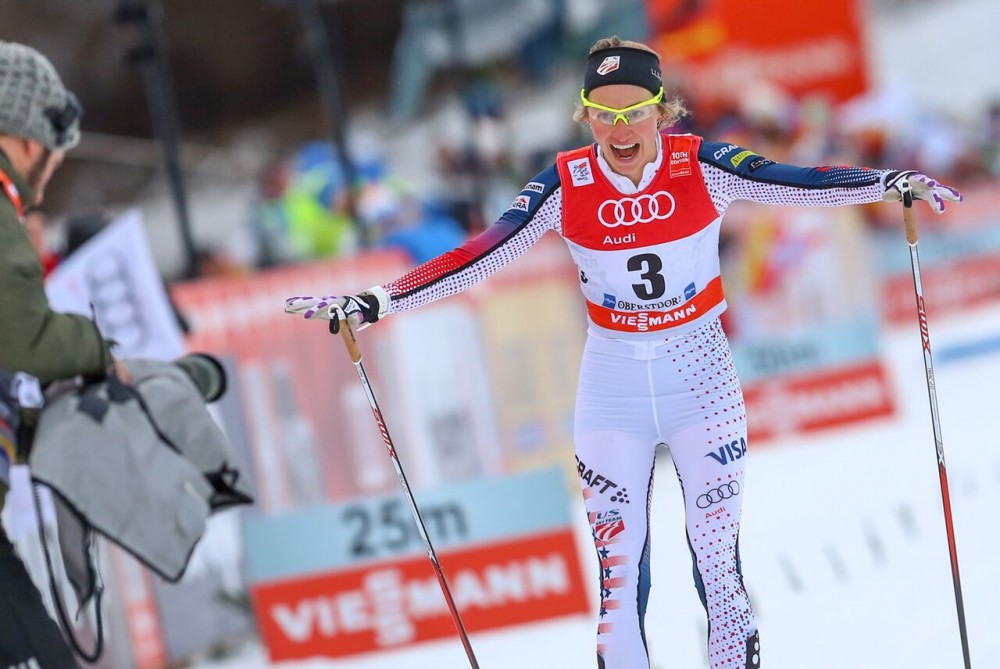
“I mean, there was a snow storm going on, but I love that,” Diggins, who reached the podium in the freestyle individual start by placing third, 9.4 seconds behind the race winner, Norway’s Therese Johaug, said in an interview.
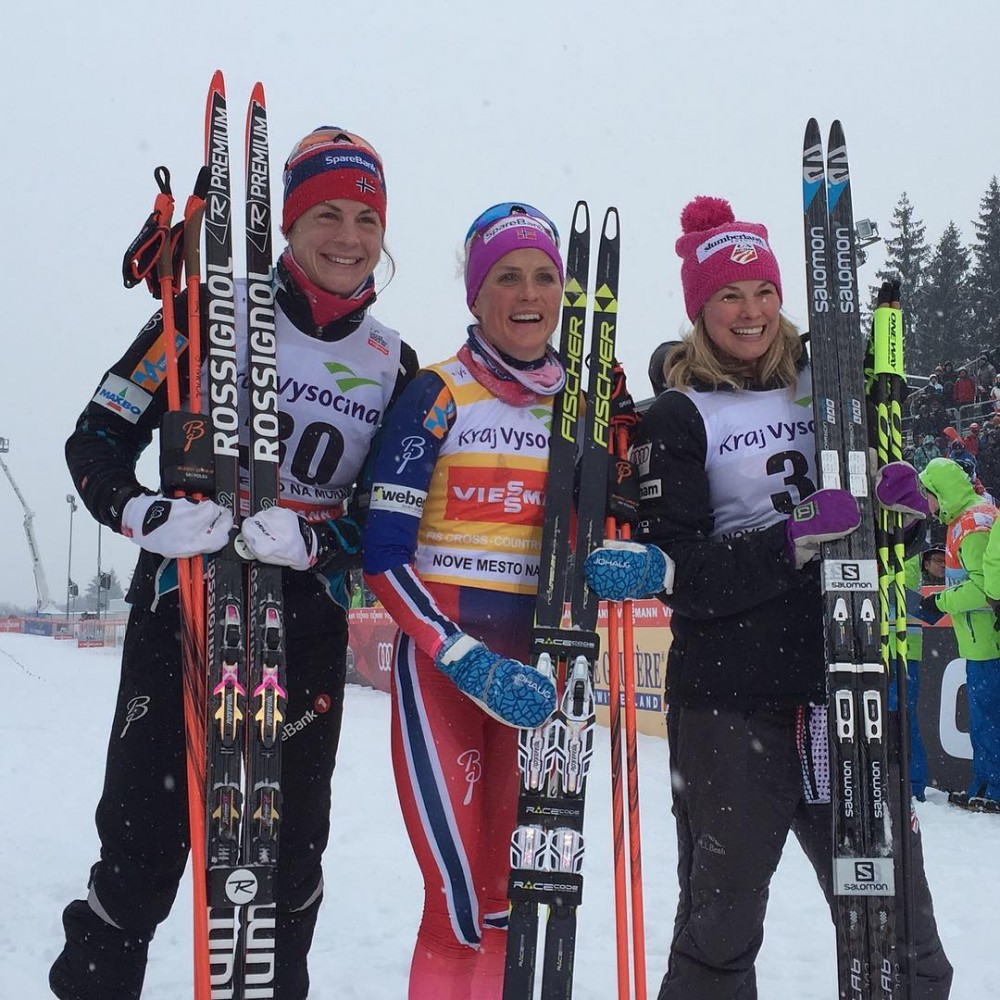
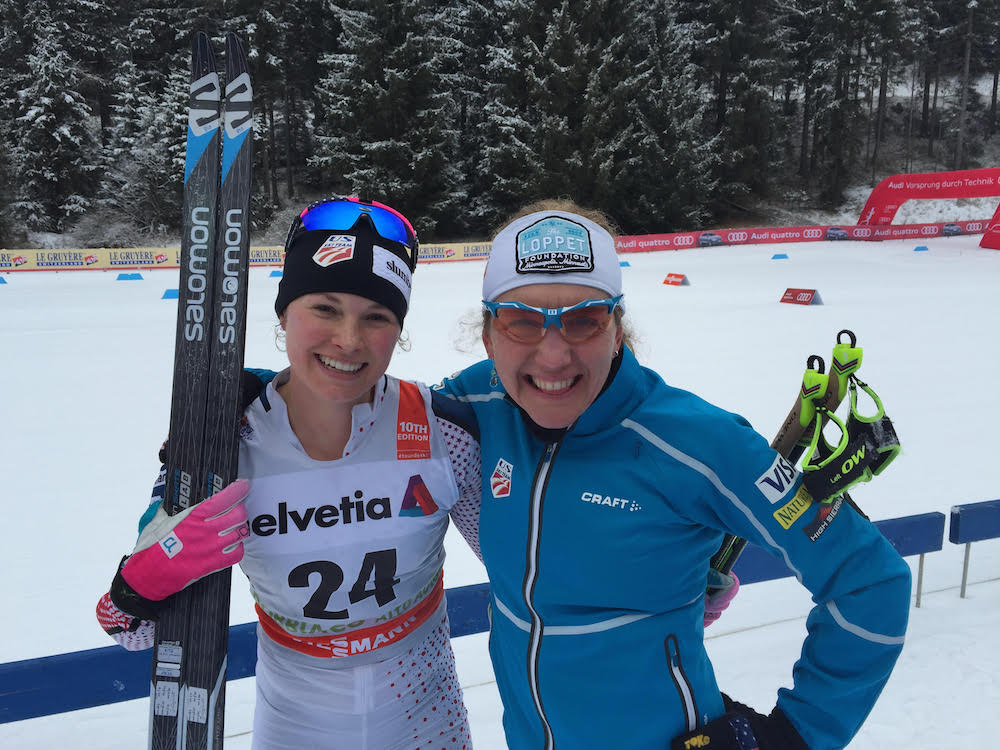
American Jessie Diggins (r) with Norway’s Therese Johaug (c) and Astrid Uhrenholdt Jacobsen (l) all smile after placing third, first, and second, respectively, in the women’s 10 k freestyle individual start on Saturday in Nove Mesto, Czech Republic. (Photo: FIS/Instagram)
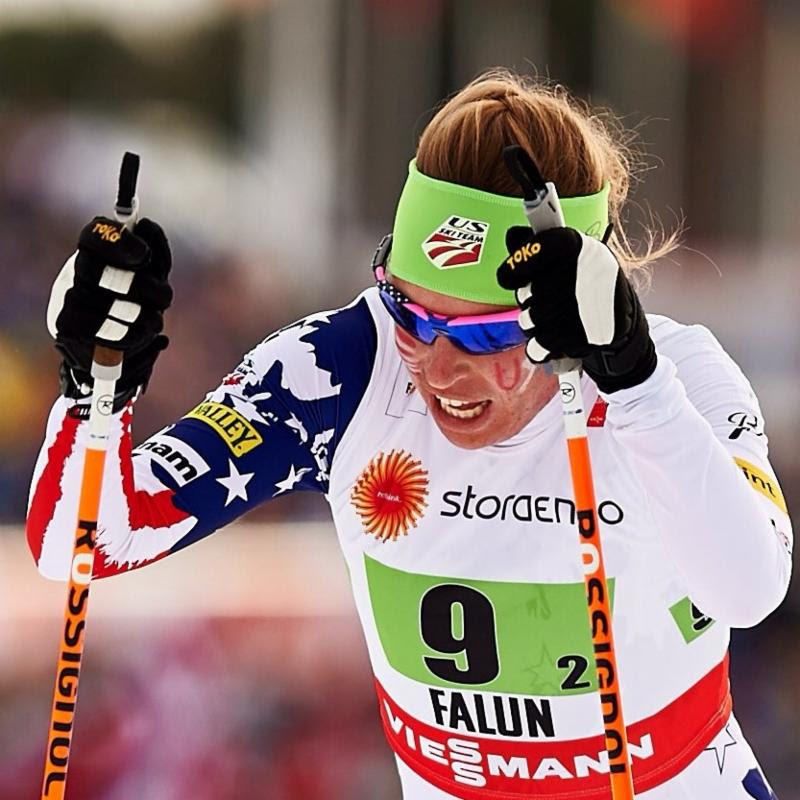
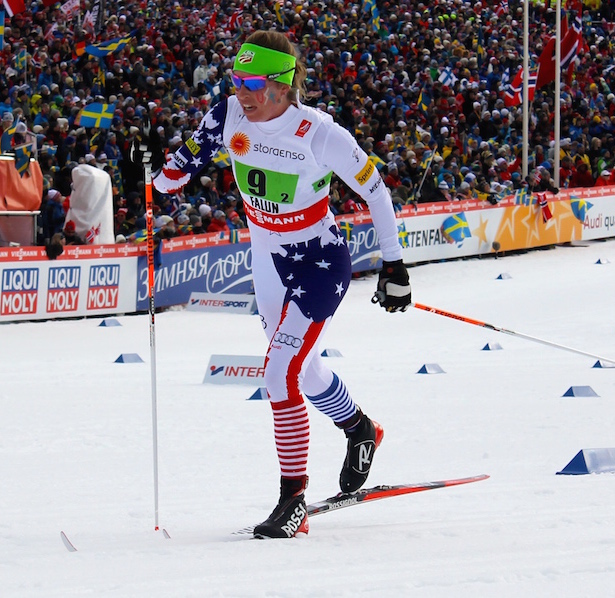
“I just kept thinking, it’s just like Falun and it worked out great there, so I can ski in anything,” the 24-year-old Minnesota native added, referring to her silver-medal finish in the 10 k freestyle interval start event at the 2015 World Championships. “If I can ski in snow at World Championships, I can do it here, too.”
With a World Championships silver medal, an individual World Cup title, and Saturday’s overall third place podium finish, Diggins demonstrated that her ability to push herself as an individual is close to unbeatable.
“I love individual starts because it’s just you out there,” she said. “I can ski the downhills how I want to, there’s nobody elbowing me or stepping on my poles and in my business. It’s just you and the course and you go ski that course as fast a you possibly can and that’s it.”
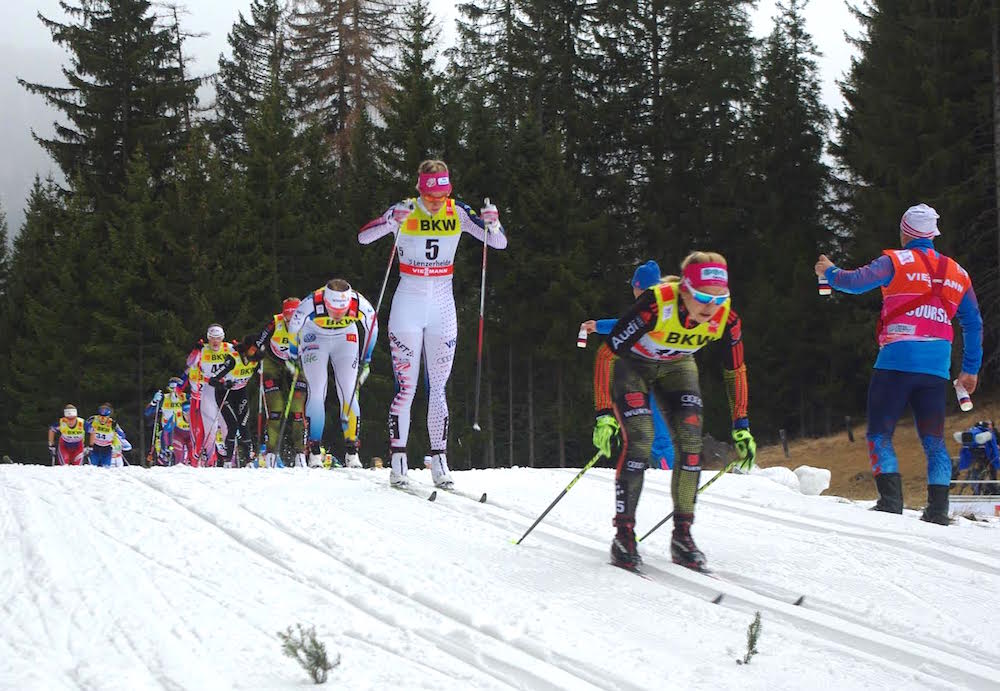
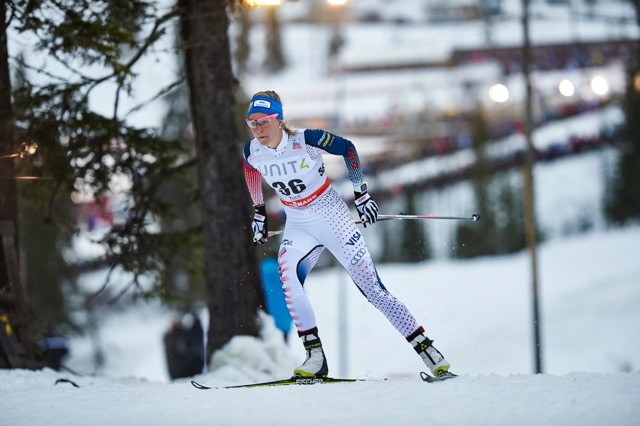
Diggins started in bib 36, just behind Canada’s Maya Macisaac-Jones. One of the favorites for the day’s distance skate event, Charlotte Kalla of Sweden, started four places ahead of her.
After just the first 500 meters of the course, Diggins trailed Kalla by just 0.2 of a second.
“I think some of the challenges of the course are right out of the start,” Diggins explained. “There’s a tiny little downhill drop, but then after that you’re really working all the way up until the highest point of the course. So you have to pace it well and figure out how to push through all those different sections and I think I definitely went out quite hot.”
Diggins did push the pace hard in the beginning, taking the lead over Kalla by one second by the 3.5 k mark.
“I was getting splits, but I also told the coaches to give me technique cues,” Diggins explained. “For me, splits are awesome and it’s sweet to know where you’re at, but it doesn’t make me race any harder. I’m racing as hard as I can anyway, so for me, what I was telling the coaches to do was say specific words that would remind me how to ski fast.”
As more heavy hitters got on course, including the overall race winner Johaug, Diggins maintained mental control of her race.
“When I’m out there I’m thinking about how I’m going to ski the next section, when am I going to switch from V2 to V1, I’m thinking about my cue words, like strong core…when I have a good race is when I can stay focused,” she said.
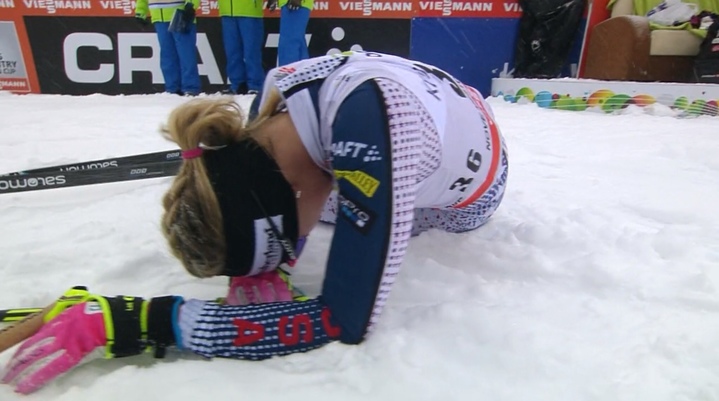
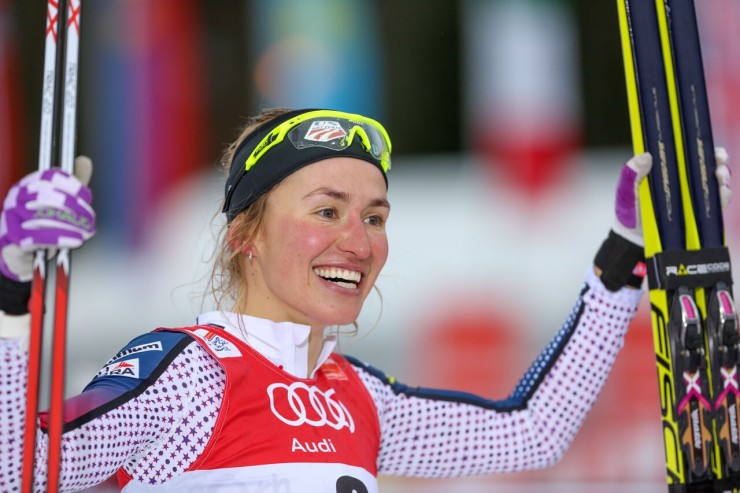
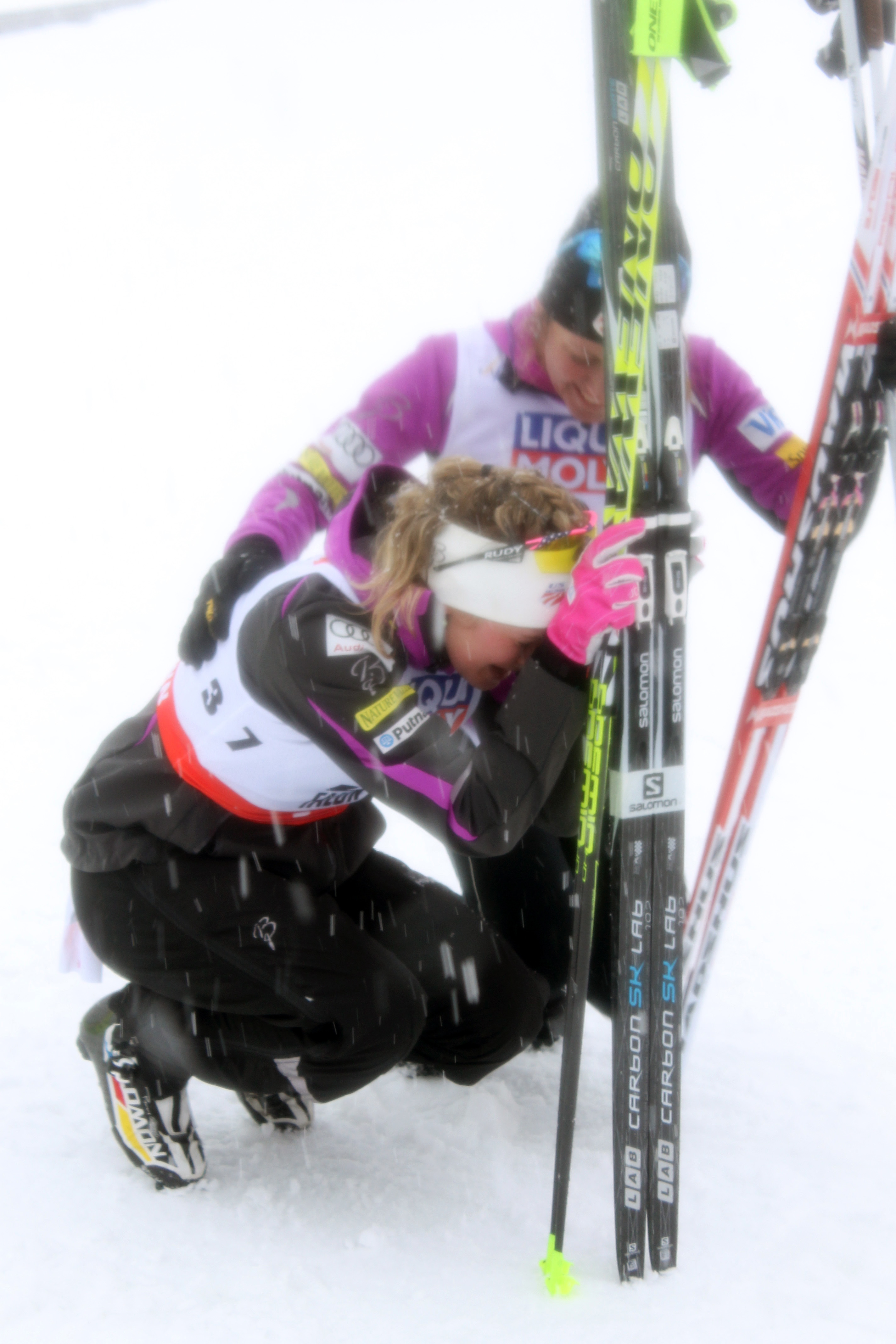
American Jessie Diggins in a “happy pain cave” after her third place finish in the women’s 10 k freestyle individual start on Saturday in Nove Mesto, CZE. (Photo: ARD)
At 5.5 k in, Diggins saw a glimpse of second place and pulled ahead of Norwegians Heidi Weng and Astrid Uhrenholdt Jacobsen. Jacobsen, ultimately passed Diggins for second place, 4.6 seconds behind her teammate Johaug, while Weng dropped back to sixth 31.1 seconds back.
“The wheels were coming off towards the end of the race,” said Diggins of the last few kilometers, “but I think I was able tohold it together just long enough.”
Along with Diggins’ third place finish, the U.S. women saw three other skiers crack the top 30 amidst Saturday’s snowfall.
“It’s funny sometimes you look outside and you see the snow coming and you get really stressed because you’re thinking it’s just going to be slower and slower and maybe it’s not going to be fair,” Sadie Bjornsen, who finished in 14th overall, 1:11.3 seconds back from Johaug, said in a phone interview. “But I just try to stay optimistic and excited. Skate skiing is always a challenge for me, so the weather brought a fun new twist to it. More than anything I think I was just so excited to see winter.”
With many of this year’s races taking place on manmade snow and shortened loops, Bjorsen believes she is not alone in her excitement for the race day precipitation, even if it added an extra challenge.
“It’s been a sad winter of feeling like we’re just doing this crazy sport where we’re skiing on a fake trail in the middle of the summer and sometimes you lose the vibe of ski racing with that,” Bjornsen said, “So I feel like these past couple days, everybody on the World Cup is smiling and just has this extra energy and I would totally crack it down to the fact that we’re seeing winter for the first time,” she added.
Bjornsen, who spent time after the Tour de Ski recovering from illness, also pointed out that the “winter” skiing brings out a different level of racing.
“Today I didn’t feel like I was having a spectacular race, but I just kept pushing,” Bjornsen said. “Even when I crossed the line I had no idea how I was doing because even though I felt like I went as hard as I could, I didn’t feel on fire. But I think that’s a result of not having skied in winter yet this year. When you’re skiing in winter, you don’t feel like you’re flying.”
The two other U.S. women to also finish in the top 30 were Liz Stephen and Rosie Brennan. Stephen’s time was 1:18.4 behind Johaug’s winning mark, and Brennan’s was 1:40.1 back.
“I am satisfied with today’s race,” Brennan wrote in an email. “The conditions were slow so it was hard to get positive feelings out there an starting as early as I did. I wasn’t sure how I was doing for much of the race, but I tried to just focus on working every section and maintaining the pace I was traveling at. I am starting to feel more like myself racing. I think the Tour helped me get into gear. It was unfortunate to end up on the backside of a tight group, I guess that will leave me hungry for more.”
The fifth American to compete on Saturday, SuperTour leader Chelsea Holmes, race to 37th place overall, 1:59.7 seconds back from Johaug.
“It’s been so fun to have all that hard work and all the hours of training pay off in such a big way,” Diggins said of her third place finish, “Of course it’s fun for the team because we all train together, so if I can do it, anyone can do it. It’s positive momentum moving forward and to have four girls in the points today was just awesome.”
With a strong individual and team showing on Saturday, the U.S. women prepare for Sunday’s 4 x 5 k relay event. Sophie Caldwell will lead the team out in the first classic leg, and tag off to Bjornsen for another classic leg. The switch to freestyle will be headed by Stephen in the third leg, and Diggins will anchor the relay team in the final freestyle leg.
“For me a crucial part of racing well is loving what I’m doing and having fun with my teammates,” Diggins added, “And I feel really lucky to be on a team that works really hard to create that environment.”
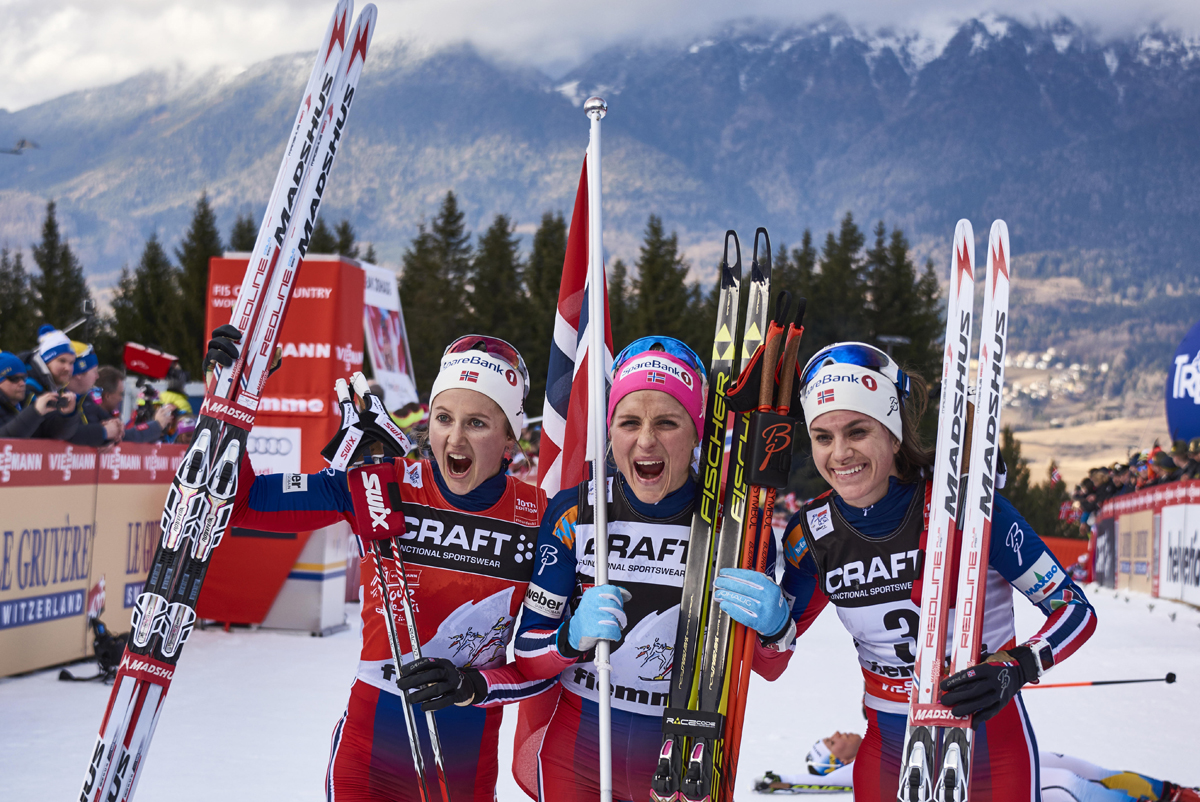
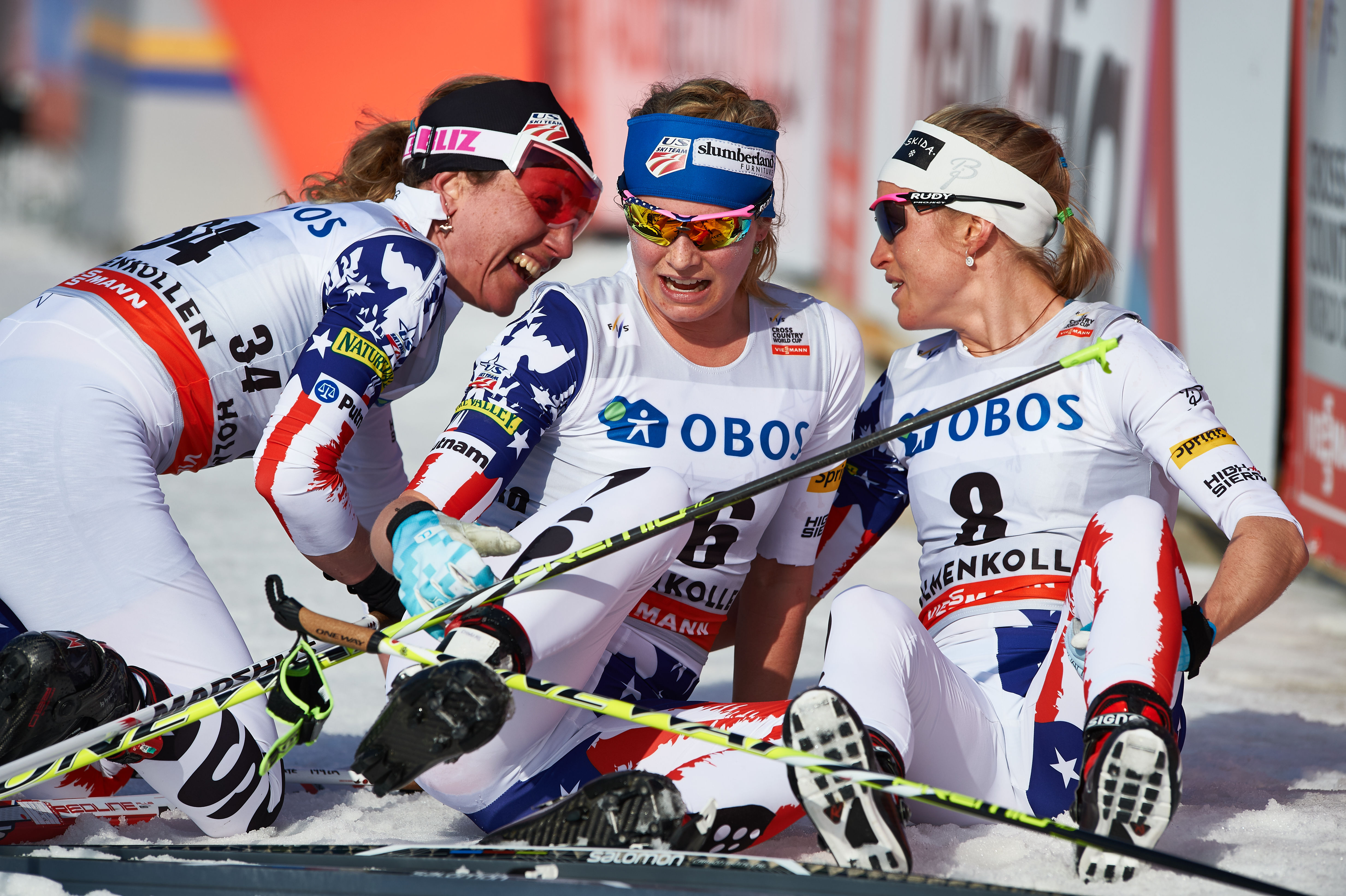
2016 Tour de Ski overall runner-up Ingvild Flugstad Østberg (l), champion Therese Johaug (c) and third-place finisher Heidi Weng (r) celebrate Norway’s sweep of the podium at Sunday’s Stage 8 final climb in Val di Fiemme, Italy. (Photo: Fischer/NordicFocus)
The image of several Norwegians sprawled in the snow at the top of Alpe Cermis, while Therese Johaug, also of Norway, kneels to congratulate them on their efforts, says a lot.
“It was a good fight, Ingvild,” Johaug said to second-place finisher, teammate Ingvild Flustad Østberg, as she sat next to her on the ground.
Østberg was second to — who else? — but Johaug, who had just bested her to the top of the mountain by nearly two and half minutes after starting 39 seconds behind in the final stage of the Tour de Ski, the notorious 9-kilometer freestyle pursuit up Alpe Cermis in Val di Fiemme, Italy.
“I hoped I could take some seconds on Ingvild before the climb. It worked better than I had hoped,” Johaug told FIS afterward.
Norwegian women swept the podium, with Johaug landing at the top with a finishing time of 33:53.5, Østberg reached the summit in second (+2:20.9), and Heidi Weng started third, 2:27 behind Østberg, and held onto third across the line (+3:13.9).
The event was a pursuit, with start times based on cumulative times over seven World Cup stages in nine days. Sunday marked the eighth and final stage on the 10th day of the Tour. Fatigue was the shared theme among 43 women who started and completed the final climb, thus completing the Tour.
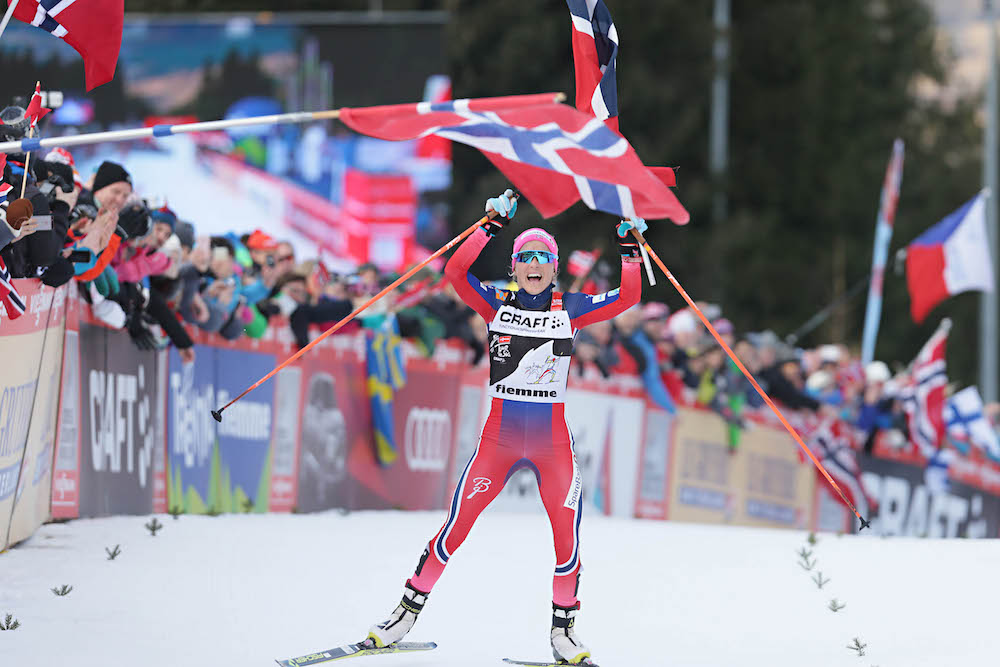
Norway’s Therese Johaug approaches the finish of the 9 k final climb at the last stage of the 2016 Tour de Ski with enough time to grab a Norwegian flag and celebrate her win. It was Johaug’s second overall Tour de Ski victory since last winning in 2014. (Photo: Fiemme World Cup)
While Johaug started the eight-stage series by earning the leader’s bib on Day 1 in Lenzerheide, Østberg took control after winning the 5 k pursuit in Lenzerheide at Stage 3. From that point on, the 25-year-old Østberg continued to lead the Tour, up until about 17 minutes into the final climb, when Johaug caught and passed her.
Still 14 seconds ahead of Johaug at 6.2 k, shortly after the course began to ascend up the mountain at a brutal grade, Østberg hung onto first for another minute before Johaug reached her. Wasting no time, Johaug pushed on, putting 17 seconds between her and Østberg by 7.1 k. One kilometer later, she was 1:26 ahead and in the clear for the win.
Following the zig-zagging course to the top, the 27-year-old Johaug V1-ed past excited spectators before a multitude of waving Norwegian flags greeted her at the finish. She grabbed one a few meters before the line and held it up in elation.
“It was my dream and big goal to win the Tour de Ski,” Johaug said after claiming her second overall title since winning the 2014 Tour. “Ingvild has pushed me at every stage of the Tour this year. I think this was my [best] Tour de Ski ever.”
According to reporters at the summit, Johaug asked Østberg afterward, “Are you tired now?”
“Yes,” Østberg replied.
(Article continues below)
(Photo: Fiemme World Cup)
Norway’s Ingvild Flugstad Østberg pushes toward the top of the 9 k freestyle hill climb, the final stage of the 2016 Tour de Ski. She went on to place second, 2:20 behind teammate Therese Johaug (not shown). (Photo: Fiemme World Cup)
Winner Therese Johaug jumps for joy after taking the overall win at the 2016 Tour de Ski in Val di Fiemme, Italy. (Photo: Fischer/NordicFocus)
Therese Johaug (Norway) after winning her second Tour de Ski title with a victory in the final climb in Val di Fiemme, Italy. (Photo: Fischer/NordicFocus)
Diggins 10th, Bjornsen 14th Overall
After starting 9:01 back in 10th and finishing 10th (+11:20.4), Jessie Diggins led the U.S. women in the final Tour standings. It was the end to an eventful Tour for Diggins, after her first individual World Cup win on Friday.
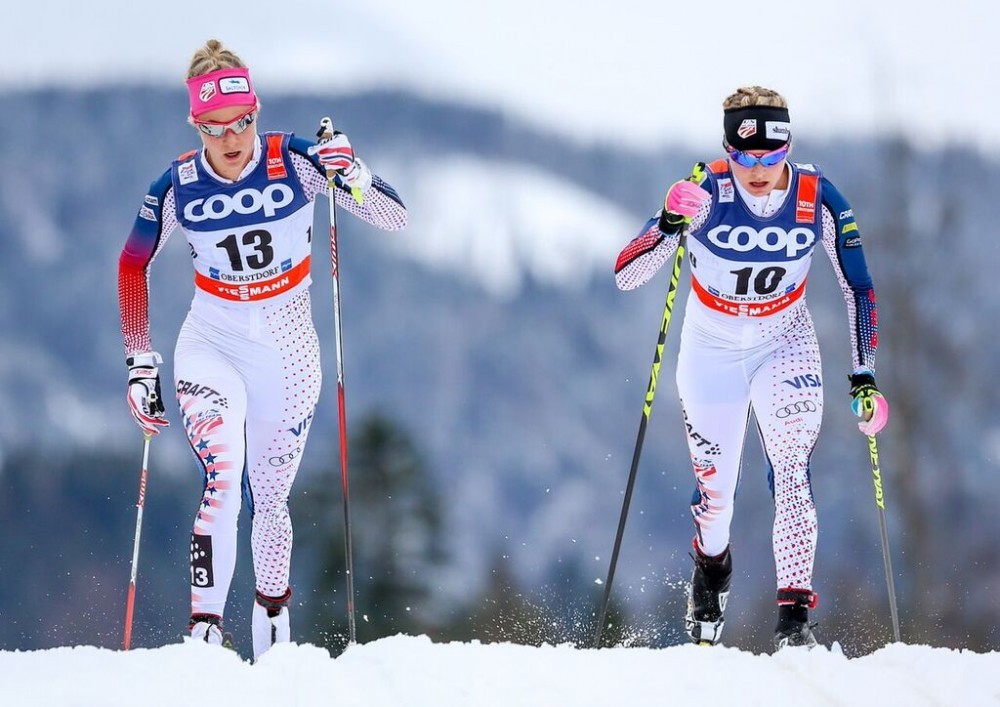
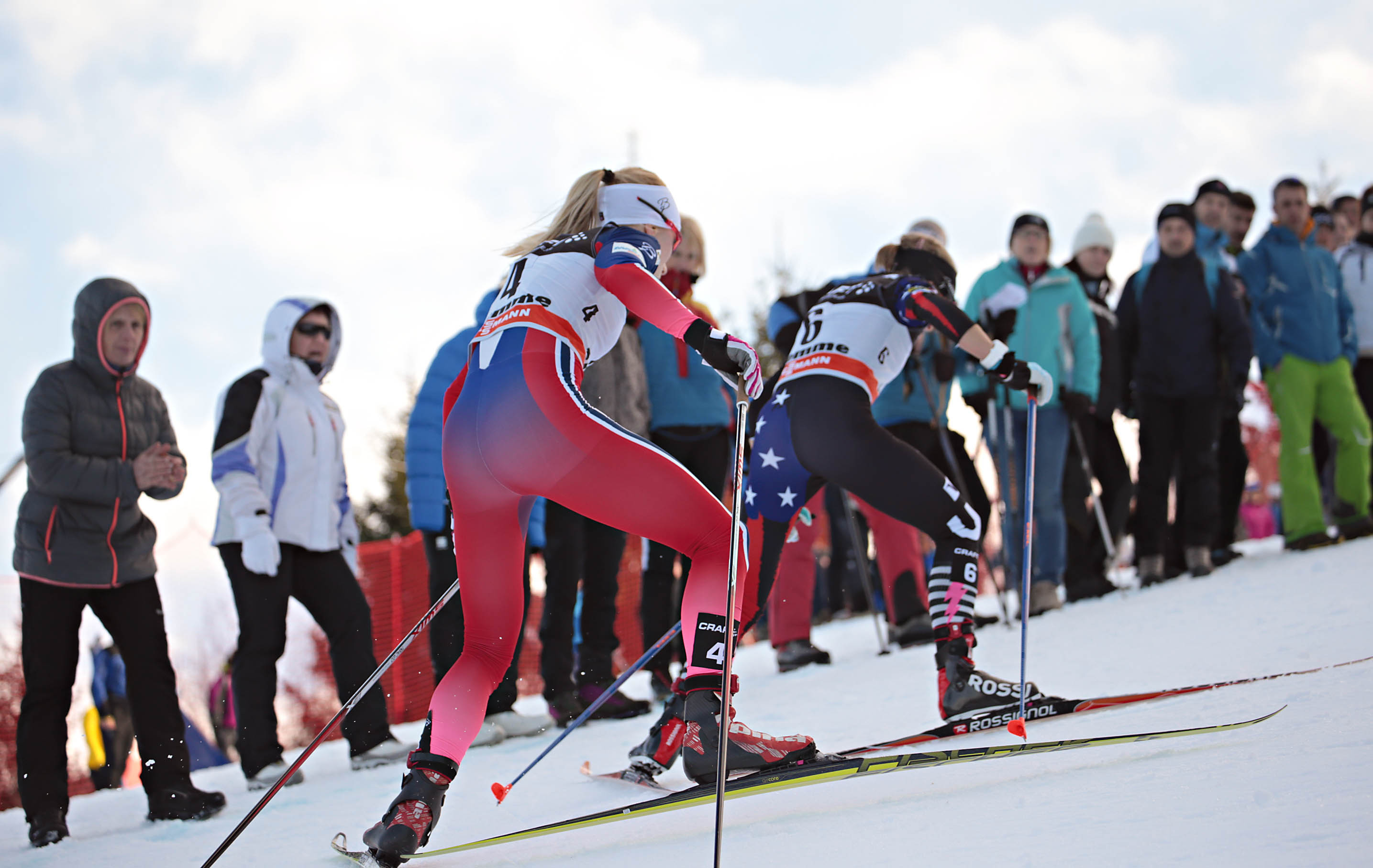
U.S. Ski Team members Sadie Bjornsen (l) and Jessie Diggins (r) started near each other in the fifth stage of the Tour de Ski, a 10 k classic mass start in Oberstdorf, Germany. (Photo: Marcel Hilger)
“One of my big goals for the season was to finish the Tour in the top 10, so I made that goal today!” she wrote in an email to media.
While Diggins didn’t finish the Tour last year because of illness, she did in 2014 and placed 13th overall.
“That climb is brutally hard hard and I was in a world of pain, but I had to tell myself to just keep my feet moving!” she reflected on Sunday. “It was a real mental battle out there so I was happy to be able to hang tough.”
Following her to the top of the downhill ski area was Sadie Bjornsen, who started 12th, 9:32 after Østberg, and slipped two spots to finish in 14th (+12:24.1). This year was her first time completing the Tour, after withdrawing after Stage 5 last year despite being in the top 10.
“I just had no idea what to expect,” Bjornsen said in a phone interview. “I’d done some hill climbs in the U.S., but never against a World Cup field. So I was definitely very nervous because I had a number of people quite close behind me. I decided that I just had to look up the hill, instead.”
“Sadie will tell you that she’s not a climber,” U.S. Ski Team Women’s Coach Matt Whitcomb said. “But she did great today – she only lost two places on Alpe Cermis. She’s skating at a high level now as well classic skiing … Fourteenth place is just a super result for Sadie and for our team.”
Stephen Third Fastest on Course, 2nd on Actual Climb
The U.S. team’s best individual performance in Stage 8 came from Liz Stephen, who climbed six places from 25th to 19th (+13:27.8) and posted the third-fastest time of the day. Stephen’s time was 1:29.5 behind Johaug, who earned “fastest of the day” accolades on Alpe Cermis for the sixth-consecutive year, according to a FIS press release.
American Liz Stephen led Norway’s Ragnhild Haga during last year’s final climb, the seventh stage of the 2015 Tour de Ski in Val di Femme, Italy. She placed fifth overall. (Photo: Fiemme World Cup)
Weng clocked the second-fastest course time, less than four seconds ahead of Stephen’s time.
In her fifth Tour de Ski, Stephen also had the second-fastest split on the climbing portion of the course, the final 3 k to the finish. Only Johaug was 31.7 seconds faster, besting Stephen’s climbing time of 19:18.3.
“I kind of just did my thing on the uphill and went to go catch as many people as I could,” Stephen said in a phone interview. “I felt really strong today, and I had great skis. It’s my favorite race of the year – not a single downhill. I like just getting into that zone and just grinding.
“Today was just my ideal conditions,” she added. “I love it when it’s just soft and wet and sloppy and just wonderful.”
According to Whitcomb, Stephen was coming off a tour that was “stacked against her strengths.” While the U.S. Ski Team veteran, who turns 29 on Tuesday, excels in longer skate races, the tour had a lot of shorter, classical races. Stephen was fifth overall in last year’s Tour – the best result ever for an American at the Tour de Ski.
“She didn’t put together the Tour she wanted,” Whitcomb said. “But we knew that today would test something that is her strength, and would be a good indicator as to where she is physically. She skied better than she did last year during this race – you can’t compare times – but she was able to maintain form and she paced it better, so I think she’s in a confident place.
“Third on time of day and only four seconds off of second — that’s something to be proud of,” he added. “She can leave Italy with some confidence.”
Also for the U.S., Rosie Brennan started 31st and slipped one place to 32nd overall (+20:06.1), and Caitlin Gregg started 38th and finished 42nd (+23:57.6). Both completed their first Tours.
Unsurprisingly, Whitcomb was pleased with the performance of his team.
“I’m really excited with having seven athletes finish the Tour [Diggins, Bjornsen, Stephen, Brennan, Gregg, Noah Hoffman and Erik Bjornsen]. I think it’s a little bit of an unlikely circumstance – battling illness and fatigue, even injury in some cases, anything can happen during the Tour,” he said. “So to have seven athletes finish and have seven athletes stay healthy, that’s a big sign of success for a group of athletes. It means that they’re absorbing the [racing] rather than just getting buried by it.”
Without a World Championships or Olympics this year, the U.S. coaches decided it was safe to have their athletes dig deeper than they otherwise might during the Tour.
“We were able to afford having a few extra athletes that were well beyond their comfort zones finish the Tour, despite it perhaps burying them for the next week or two,” Whitcomb explained.
Sprint specialists Sophie Caldwell, Ida Sargent, Simi Hamilton, and Andy Newell all withdrew from the Tour early, with the intention of saving themselves for two days of skate sprinting at next weekend’s World Cup in Planica, Slovenia. The seven skiers that finished the Tour will sit out the Planica sprints to rest for the Nove Mesto (Czech Republic) World Cup the following week.
But the fatigue runs deep.
“I’m looking forward to the next tour we have,” Stephen said of the Ski Tour Canada from March 1-12. “Which is crazy that we have another one. Thinking about that today was actually a little bit sickening – we’re just so tired that the thought of doing another [eight-stage] tour later on this year is a little bit tiring just to even think about. But I’m sure by then I’ll be really ready and really excited, and of course skiing in Canada is awesome.”
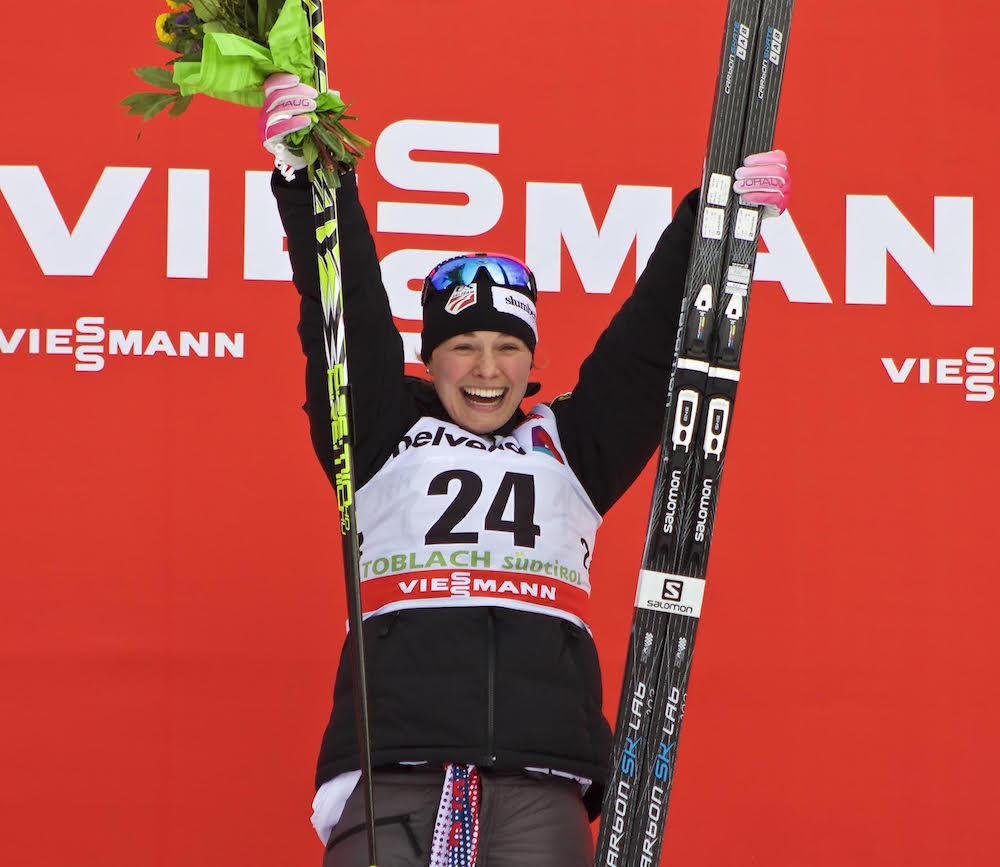
American Jessie Diggins after winning her first individual World Cup on Friday in the women’s 5 k freestyle at Stage 6 of the Tour de Ski in Toblach, Italy. For the U.S. Ski Team, it was their second victory in the last three stages. (Photo: JoJo Baldus)
TOBLACH, Italy – With many smiles, shrieks and leaps of joy, Jessie Diggins won Stage 6 of the Tour: a 5-kilometer freestyle individual start. It was the second of two huge wins for the U.S. women, following Sophie Caldwell’s Stage 4 classic-sprint victory on Tuesday in Oberstdorf, Germany.
Interestingly, the podium remained exactly the same between both races — with Heidi Weng in second and Ingvild Flugstad Østberg in third — except Diggins replaced Caldwell on the top step.
“What’s so cool about this team is we ride on each other’s successes,” Jessie exclaimed in an in-person interview after Friday’s race. “Seeing Sophie do it, we all train together, and we can do this! It really shows the strength of the team that we push each other and train so hard to get to this point where we can start putting together really good races. So this is a pretty sweet victory for the team.”
Diggins is now the fourth U.S. woman to win a World Cup race, and the first to do so in a modern distance race. (Kikkan Randall has won numerous freestyle sprints and a 3 k prologue, but nothing longer.)
A 24-year-old member of the U.S. Ski Team, Diggins was a 2015 World Championships silver medalist in the 10 k freestyle and won gold in the freestyle team sprint at 2013 World Championships with Randall. She also won the preceding World Cup freestyle team sprint with Randall in December 2012, but had yet to achieve an individual World Cup podium before Friday.
Her post-race demeanor was true to herself — bursting with enthusiasm, belief, positivity, and especially a team-focused mentality — times 100.
“I didn’t believe it,” Diggins said when asked about seeing her name in first place. “I mean, to come out on top in this field with those incredible women feels like doing the impossible. So that really speaks to how hard the [wax] techs have worked, how fast the skis were, the incredible cheering…”
Racing to First
Jessie Diggins (U.S. Ski Team) racing to her first individual World Cup victory in the 5 k freestyle at Stage 6 of the Tour de Ski in Toblach, Italy. She won by 0.9 seconds, beating out four Norwegians in the top five. (Photo: JoJo Baldus)
Depending on how racers show up on a given day, the individual-start format can be anything from interesting to anti-climactic, and even nerve-racking.
Forty-six women started on Friday, heading out at 30-second intervals. After racing the clock and crossing the finish line, athletes are left waiting to see how their time stacks up against the rest of the field.
Early starters don’t have much to work with in terms of splits. The race consisted of a single 5 k loop, with gradual climbing out of the start and official timing points at 1.7 and 2.1 k.
Diggins started 24th and reached the first timing point in 4:28.9, which turned out to be the fourth-fastest time of the day. Then at the 2.1 k, her time ranked third, indicating she was accelerating.
“When the split at 2.1 came in that Jessie was 8 seconds out of the lead with everyone by, we knew that meant she could win,” U.S. Ski Team Women’s Coach Matt Whitcomb told FasterSkier afterward. “Nobody finishes this course more successfully than Jessie.”
What made her the best woman out there today? The answer lies largely in the subtle downhill profile of the latter part of the course.
“You are always working and you have to really work those downhills,” Diggins said of the Toblach course. “It is a great course for me because I love to V2 and I love those downhills where you just get in your little tuck and you just skate.”
From Afton, Minn., Diggins won Minnesota state championships three times, which is held at Giant’s Ridge. The end of the course is characterized by a similar, long downhill segment for the last kilometer or two leading out of the woods and right into the stadium.
Several coaches and race organizers on the Minnesota high-school scene remember the way Diggins would come flying down this hill in a bullet-like tuck, practically sitting on the back of her skis. From high-school meets all the way to the top podium spot in the World Cup, Jessie Diggins can truly work the downhills.
“She can lay down the fastest time day after day after day through terrain like this; she is a glider and she is a finisher,” Whitcomb explained. “[The course] suites Jessie’s strengths very well.”
“There are very few skiers in the world that can close down the final kilometer of a course like Jessie,” U.S. Ski Team Head Coach Chris Grover said in a team press release. “She was fierce and unrelenting on the downhills and flats leading back to the stadium; pushing extremely hard on her skis. We’ve been wowed by this ability of hers many times, most notably in the recent Lillehammer 4×5 k women’s relay.”
Diggins crossed the line in 13:15.5, “A new best time!” as stadium commentators exclaimed over the sound system, 15.7 seconds ahead of the previous leader; Germany’s Denise Herrmann, who started 11th. But half the field was still racing, including most of the seeded competitors, who stood the biggest chance at challenging Diggins’ time.
Diggins with fellow U.S. Ski Team member Caitlin Gregg. The two shared the podium at 2015 World Championships in the 10 k freestyle, where Diggins placed second and Gregg was third. (Photo: JoJo Baldus)
The waiting began — a system of delayed gratification. She didn’t know how well her time was going to hold up, and so she collected her skis and left the finishing pen, walking past broadcast reporters who didn’t bother to interview her yet while fielding a multitude of polite congratulatory remarks.
Slowly, but surely, her time weathered more and more finishers, keeping that top spot. She had enough time to go change clothes — little did Diggins know she was changing in preparation for the podium ceremony.
Then came a moment of great excitement. Some of the remaining favorites were entering the stadium and finishing in rapid succession. Where would they stack up?
Norway’s Ragnhild Haga: not quite, as she was 8.4 seconds short for second initially, and fourth at the end of the day.
Sweden’s Charlotte Kalla: 12.3 seconds behind Diggins at the line would eventually be enough for seventh.
One by one, as each of these top athletes crossed the line, Diggins’ eyes and smile grew bigger and bigger. She could not believe it. “I thought, well, this is obviously a really good race, and… maybe, maybe I will be on the podium,” she recalled.
But they kept coming, unable to touch Diggins.
Jessie Diggins (c) of the U.S. Ski Team after capturing the second U.S. women’s win of the week at the Tour de Ski. Diggins won Friday’s 5 k freestyle in Toblach, Italy, by 0.9 seconds over Norway’s Heidi Weng (l) and another Norwegian Ingvild Flugstad Østberg (r) was 1.5 seconds behind in third. (Photo: JoJo Baldus)
As Østberg — the clear leader at both timing points — cruised down into the stadium, the announcer bellowed, “Her pace is matching Diggins’ with a few hundred meters remaining,” and repeated the observation in several different languages.
“No, she is 1.5 seconds back from Diggins’ time,” he continued.
That put the overall Tour leader in second.
Therese Johaug, second to Østberg at the 2.1 k checkpoint, was ultimately unable to match Diggins nor Østberg and finished fifth, 9.6 seconds back.
Then came Weng, another Norwegian threat. “She could do it!” the announcer said.
Spectators watched the seconds tick by on the Jumbotron.
“She is into the final sprint, and ladies and gentlemen, this will be a fight to the end…”
As Weng lunged across the line: “No, Weng cannot beat Diggins. Jessie Diggins has kept the top time. Weng takes second, just nine-tenths of a second behind!”
Diggins melted to the ground in overwhelming excitement and disbelief. Weng and Østberg shared a hug of utter exhaustion just across the finish line before sincerely congratulating Diggins. Just 1.5 seconds separated the top three. “A day of very small margins,” as coach Whitcomb put it.
***
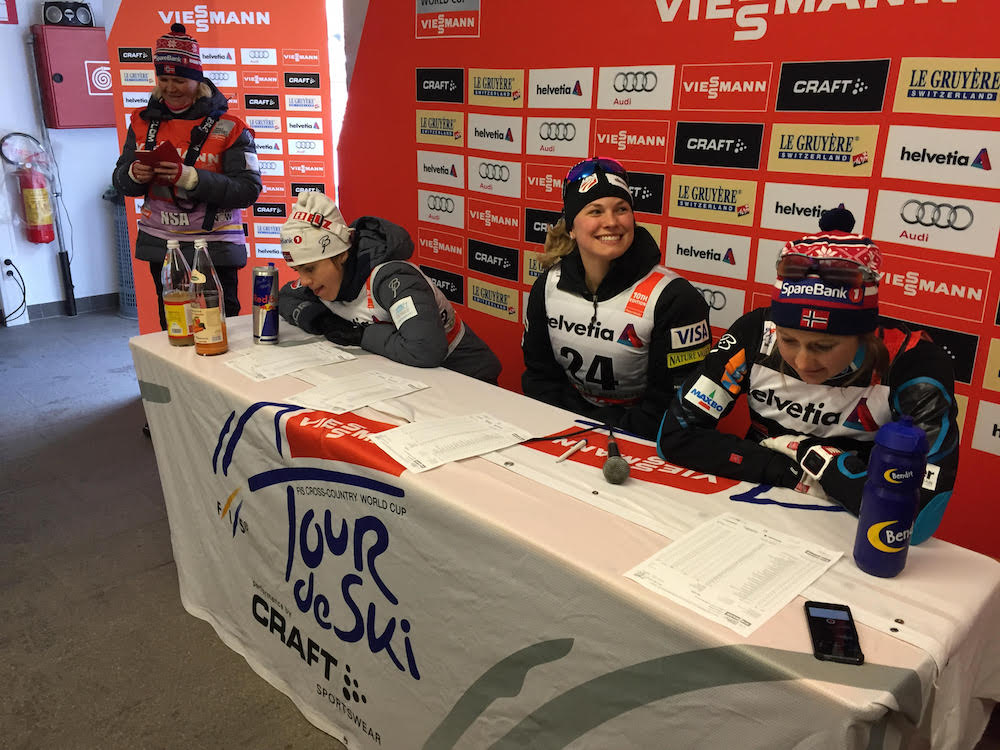
A smiling Jessie Diggins before the post-race press conference after winning her first individual World Cup, the sixth stage of the Tour de Ski (a 5 k freestyle individual start). (Photo: JoJo Baldus)
Diggins emphasized that, despite feeling good about the race, she certainly did not expect to win.
“I’m still in shock!” Diggins said as she awaited the awards ceremony. “I never thought that I would win it.”
Diggins and Weng accelerated through the end of the course into first and second, respectively. Just under seven seconds off the podium in fourth, Haga also had faster second-half splits, but not quite enough to reach Diggins or Weng. Østberg and Johaug both lost time and ranking on the second half of the race.
“I tried to open a bit slowly and get faster in the downhills,” Weng explained in a post-race press conference. “I think that was a very good tactic for me. … It’s a very hard race because you can overpower and it can go very good or it can go [bad] and you can [lose] many seconds in the end. It’s very hard to go five kilometres.”
Østberg in third ended up besting her teammate and biggest Tour rival, Johaug, by 8.1 seconds. She will continue to wear the red Tour leader’s bib heading into the last two stages in Val de Fiemme, Italy, after extending her overall lead to 25.3 seconds ahead of Johaug.
“It was a tight and hard race, and maybe I had a little [too] hard opening, different from the other racers, I guess,” Østberg said in the press conference. “In the last uphill my mother cheered for me, but my legs were just so tired I didn’t think I was gonna come to the finish. Another podium for me, and it’s so amazing that I’m still in the lead of the Tour de Ski. It’s unbelievable, for sure I didn’t believe it was possible. And 1.5 seconds from the win that’s amazing.”
After the stage win, Diggins improved to 10th overall, 6:50.2 behind Østberg.
A Proud U.S. Ski Team
Diggins’ win, piggybacking on Caldwell’s sprint victory just two days prior, provides a very notable marker for the overall success of the U.S. Ski Team.
“You need to have kind of everything perfect to have such a good race,” Diggins said in the press conference. “You have to have really good skis and your head has to be in the right place and then your body has to feel good, so it’s really exciting for us that it all worked out so many times this year.”
“It is totally surreal,” Whitcomb remarked. “It is totally surreal because we have never had such success in a small amount of time with two different athletes. [There are] so many guns on this team.”
Never before had the U.S. team racked up two stage wins by different athletes in the same Tour de Ski, which is in its 10th year. Randall won a prologue and a sprint stage in 2012/2013.
According to FIS, the U.S. joins Norway and Finland as the only nations with a history of two stage wins by different athletes in the same Tour. Aino-Kaisa Saarinen and Virpi Kuitunen won stages in 2007/2008.
“One thing is for sure, the Americans have proved they can for sure play with those Norwegians!!” teammate Sadie Bjornsen wrote in an email. She placed 13th on the day, 25.7 seconds behind Diggins.
The wax team and support staff can revel in the team’s recent successes as well.
“It speaks volumes to the work [head of service Oleg Ragilo] has put forward, the leadership that he has created out there…,” Whitcomb said. “When those guys can be rewarded with good results like this it makes us really happy for them.”
Bjornsen Up to 13th Overall
Sadie Bjornsen (U.S. Ski Team) racing to 13th in the 5 k freestyle at Stage 6 of the Tour de Ski in Toblach, Italy. (Photo: Fischer/NordicFocus)
The 20th starter, heading out two minutes ahead of Diggins, Bjornsen initially finished fourth.
“I went out there today racing for the podium,” Bjornsen recalled after starting the day ranked 14th in the Tour. “I decided to go with no fear and see how long I could hold on for…. And that lasted about 2.5k… At which point I realized I was going to have to dig seriously deep to make it home.”
Her 1.7 k time held up as 10th fastest, 9.8 seconds behind Østberg, and at 2.1 k, Bjornsen sat in eighth, 5.8 seconds behind Diggins in third.
“I am proud for taking a chance… Because at some point it will work,” Bjornsen continued.
She improved one spot to 13th in the Tour, 7:58.8 out of the lead.
U.S. teammates Liz Stephen placed 26th on Friday (+41.5) to move up three places into 25th overall, just over 10 minutes back, Rosie Brennan finished 33rd (+54.4) for 34th overall, and Caitlin Gregg was 39th (+1:05.7) for 39th overall.
“I’m starting to feel more like myself everyday,” Brennan said during an in-person interview after the race. In the sixth stage of her first Tour de Ski, she started 41st on Friday, 30 seconds ahead of Weng.
“I was coming down the hill and Heidi had passed me, and I’m like, Well, I really hope she’s having a good one,” Brennan recalled. “I just saw out of the corner [of my eye], the screen and I saw Jessie’s name, and I’m like, God damn that’s awesome!”
Brennan plans to complete the Tour, ending with the final climb on Sunday.
“I don’t have a particular one event that’s way better than the other, so I think this type of tour really suits me,” she said. “I’m looking forward to chalking this one up to experience and coming back for more later.”
Also in her first-ever, eight-stage Tour, Gregg started 13th, one position ahead of Poland’s Justyna Kowalczyk, on Friday. While Kowalczyk went on to finish 18th (+34), Gregg explained being caught by her was a good thing.
“I got caught by Kowalczyk at like 2 k, but then we actually skied together and that was awesome. It kind of lifted my momentum and I felt like my skis were really good,” Gregg said.
“I think I entered [the Tour] just not really knowing how it would go and maybe I’m a little off — I have been since I got over here,” Gregg added. “Every race … I don’t get those good race sensations when I’m racing. I’m actually going home on Monday and I’m pretty stoked to reset and recharge.”
The Tour continues in Val di Fiemme on Saturday with the women’s 10 k classic mass start and concludes with the 9 k freestyle climb up Alpe Cermis on Sunday.
— Alex Kochon and Harald Zimmer contributed reporting
About the Author: JoJo Baldus is a nordic skier from snowy Minneapolis, Minn. Currently living the dream as a volunteer journalist and photographer for FasterSkier while enjoying a gap year before starting at Macalester College in St. Paul. He could not be more excited to attempt to stagger across the finish line of 8 different WorldLoppet ski races this winter!
OBERSTDORF, Germany — On Tuesday, Sophie Caldwell became the third U.S. woman in World Cup history to win a World Cup race, and the first-ever to win a classic sprint. We are grateful Marcel Hilger shared the following photos recapping the day at the fourth stage of the Tour de Ski, which included another first for Norway’s Emil Iversen, the winner of the men’s final.
Sophie Caldwell (U.S. Ski Team) racing to third in the 1.2 k classic sprint qualifier at Stage 4 of the Tour de Ski in Oberstdorf, Germany. She went on to win the final for her first World Cup victory. (Photo: Marcel Hilger)
Sophie Caldwell (U.S. Ski Team) racing to third in the 1.2 k classic sprint qualifier at Stage 4 of the Tour de Ski in Oberstdorf, Germany. She went on to win the final for her first World Cup victory. (Photo: Marcel Hilger)
Norway’s Ingvild Flugstad Østberg won the qualifier and raced to third overall in the 1.2 k classic sprint at Stage 4 of the Tour de Ski in Oberstdorf, Germany. (Photo: Marcel Hilger)
Norway’s Therese Johaug qualified 10th and raced to fifth in the 1.2 k classic sprint final at Stage 4 of the Tour de Ski in Oberstdorf, Germany. (Photo: Marcel Hilger)
Sweden’s Stina Nilsson raced to sixth in the 1.2 k classic sprint final at Stage 4 of the Tour de Ski in Oberstdorf, Germany. (Photo: Marcel Hilger)
Germany’s Sandra Ringwald (2) and Denise Herrmann (9) go head-to-head with American Sophie Caldwell (3) during the 1.2 k classic sprint at Stage 4 of the Tour de Ski in Oberstdorf, Germany. (Photo: Marcel Hilger)
Sophie Caldwell (U.S. Ski Team) during the 1.2 k classic sprint at Stage 4 of the Tour de Ski in Oberstdorf, Germany. (Photo: Marcel Hilger)
Sophie Caldwell (U.S. Ski Team) during the 1.2 k classic sprint final at Stage 4 of the Tour de Ski in Oberstdorf, Germany. (Photo: Marcel Hilger)
Sophie Caldwell (U.S. Ski Team) lunges to edge Norway’s Heidi Weng (not shown) for the win in the 1.2 k classic sprint final at Stage 4 of the Tour de Ski in Oberstdorf, Germany. (Photo: Marcel Hilger)
Sophie Caldwell (U.S. Ski Team) after winning the 1.2 k classic sprint final at Stage 4 of the Tour de Ski in Oberstdorf, Germany. (Photo: Marcel Hilger)
Ida Sargent (U.S. Ski Team) qualifying 24th in the 1.2 k classic sprint at Stage 4 of the Tour de Ski in Oberstdorf, Germany. She went on to place 15th. (Photo: Marcel Hilger)
Sophie Caldwell (c) after becoming the first U.S. woman to win a World Cup classic sprint with the other podium finishers, Norway’s Heidi Weng (l) in second and Ingvild Flugstad Østberg (r) in third in the 1.2 k classic sprint at Stage 4 of the Tour de Ski in Oberstdorf, Germany. (Photo: Marcel Hilger)
Sophie Caldwell (c) after becoming the first U.S. woman to win a World Cup classic sprint with the other podium finishers, Norway’s Heidi Weng (l) in second and Ingvild Flugstad Østberg (r) in third the 1.2 k classic sprint at Stage 4 of the Tour de Ski in Oberstdorf, Germany. (Photo: Marcel Hilger)
Sophie Caldwell after winning the 1.2 k classic sprint at Stage 4 of the Tour de Ski in Oberstdorf, Germany. (Photo: Marcel Hilger)
Sophie Caldwell checks in with her boyfriend Simi Hamilton’s parents after winning her first World Cup, the Tour de Ski classic sprint in Oberstdorf, Germany. (Photo: Marcel Hilger)
Ida Sargent (U.S. Ski Team) qualifying 24th in the 1.2 k classic sprint at Stage 4 of the Tour de Ski in Oberstdorf, Germany. She went on to place 15th. (Photo: Marcel Hilger)
Sophie Caldwell during a post-race TV interview with FIS after winning the 1.2 k classic sprint at Stage 4 of the Tour de Ski in Oberstdorf, Germany. (Photo: Marcel Hilger)
Ida Sargent ( U.S. Ski Team) racing to third in her quarterfinal for 15th overall at the 1.2 k classic sprint at Stage 4 of the Tour de Ski in Oberstdorf, Germany. (Photo: Marcel Hilger)
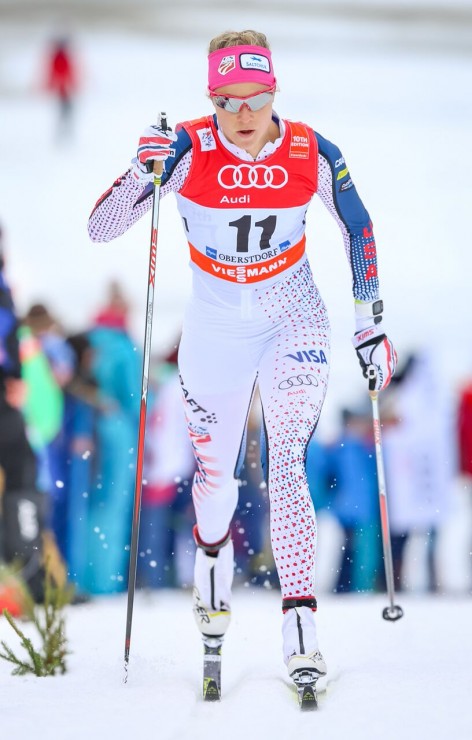
Jessie Diggins (U.S. Ski Team) qualified 11th and went on to place 21st in the 1.2 k classic sprint at Stage 4 of the Tour de Ski in Oberstdorf, Germany. (Photo: Marcel Hilger)
Jessie Diggins (U.S. Ski Team) qualified 11th and went on to place 21st in the 1.2 k classic sprint at Stage 4 of the Tour de Ski in Oberstdorf, Germany. (Photo: Marcel Hilger)
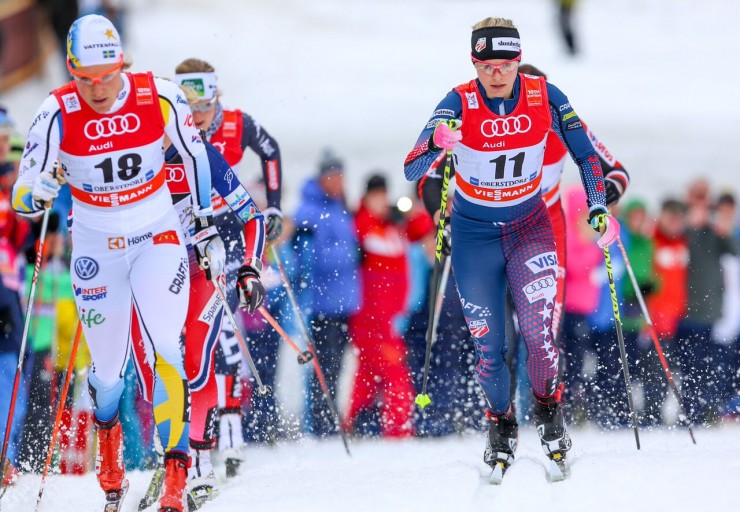
Jessie Diggins (11) during her quarterfinal of the 1.2 k classic sprint at Stage 4 of the Tour de Ski in Oberstdorf, Germany. The American placed fifth after crashing with Hanna Falk (18). (Photo: Marcel Hilger)
Rosie Brennan (U.S. Ski Team) racing to 35th in the 1.2 k classic sprint qualifier at Stage 4 of the Tour de Ski in Oberstdorf, Germany. (Photo: Marcel Hilger)
Rosie Brennan (U.S. Ski Team) racing to 35th in the 1.2 k classic sprint qualifier at Stage 4 of the Tour de Ski in Oberstdorf, Germany. (Photo: Marcel Hilger)
Sadie Bjornsen (U.S. Ski Team) racing to 44th in the 1.2 k classic sprint qualifier at Stage 4 of the Tour de Ski in Oberstdorf, Germany. (Photo: Marcel Hilger)
Sadie Bjornsen (U.S. Ski Team) racing to 44th in the 1.2 k classic sprint qualifier at Stage 4 of the Tour de Ski in Oberstdorf, Germany. (Photo: Marcel Hilger)
Liz Stephen (U.S. Ski Team) on her way to 49th during the 1.2 k classic sprint at Stage 4 of the Tour de Ski in Oberstdorf, Germany. (Photo: Marcel Hilger)
Andy Newell (U.S. Ski Team) qualifying ninth in the 1.2 k classic sprint qualifier at Stage 4 of the Tour de Ski in Oberstdorf, Germany. He went on to place fourth in his quarterfinal for 17th overall. (Photo: Marcel Hilger)
Erik Bjornsen (U.S. Ski Team) finished 38th in the qualifier of the 1.2 k classic sprint at Stage 4 of the Tour de Ski in Oberstdorf, Germany. (Photo: Marcel Hilger)
Noah Hoffman (U.S. Ski Team) finished 61st in the 1.2 k classic sprint qualifier at Stage 4 of the Tour de Ski in Oberstdorf, Germany. (Photo: Marcel Hilger)
Len Valjas (Canadian World Cup Team) qualified 25th and ended up 10th overall in the 1.2 k classic sprint at Stage 4 of the Tour de Ski in Oberstdorf, Germany. (Photo: Marcel Hilger)
Alex Harvey (Canadian World Cup Team) qualified 13th and went on to place third in his quarterfinal for 15th overall at the 1.2 k classic sprint at Stage 4 of the Tour de Ski in Oberstdorf, Germany. (Photo: Marcel Hilger)
Devon Kershaw (Canadian World Cup Team) finished 34th in the 1.2 k classic sprint qualifier at Stage 4 of the Tour de Ski in Oberstdorf, Germany. (Photo: Marcel Hilger)
Ivan Babikov (Canadian World Cup Team) placed 59th in the 1.2 k classic sprint qualifier at Stage 4 of the Tour de Ski in Oberstdorf, Germany. (Photo: Marcel Hilger)
Ivan Babikov, racing on the World Cup in 2016
Emil Iversen of Norway celebrates his first World Cup win in the 1.2 k classic sprint at Stage 4 of the Tour de Ski in Oberstdorf, Germany. (Photo: Marcel Hilger)
Norway’s Martin Johnsrud Sundby qualified 11th and went on to place fourth in the final of the 1.2 k classic sprint at Stage 4 of the Tour de Ski in Oberstdorf, Germany. Now, he not only leads the overall Tour standings, but the Sprint Tour standings as well. (Photo: Marcel Hilger)
Norway’s Petter Northug qualified fifth and went on to place fifth in the final of the 1.2 k classic sprint at Stage 4 of the Tour de Ski in Oberstdorf, Germany. (Photo: Marcel Hilger)
American skiers Jessie Diggins (l) and Sadie Bjornsen working together in the 5 k pursuit in Lenzerheide, Switzerland, the third stage of the 2016 Tour de Ski.
LENZERHEIDE, Switzerland — Based on their starting positions, the top two U.S. women in the Tour de Ski knew that their game plan for the 5-kilometer freestyle pursuit was to pack up and ski hard.
Sadie Bjornsen started in bib 8 just seconds ahead of teammate Jessie Diggins in bib 9.
“My strategy today was to hang onto Jessie for dear life, because she’s one of the best skiers in a pursuit or relay style race,” Bjornsen said. “She caught me pretty quickly and I just stuck on her like glue.”
And Diggins? She had her own strategy, involving Finland’s Krista Parmakoski, who started another four seconds back.
“I knew she’d be trying to catch us and I thought, you know, if I could just get on her and stay on her, she’s having a great year, so if I can keep up with her we can hopefully work and reel in some people,” Diggins said. “Krista and I would take turns leading. I’d lead the flat, she’d lead the hills.”
The trio worked together for the whole race, solidifying their positions in the top 10 of the Tour de Ski.
Sadie Bjornsen leading Jessie Diggins and Krista Parmakoski the first time up the course’s long climb out of the stadium.
“Those two were switching leads, which was good because I think they were the ones pushing the pace, and I was just trying to stay with,” said Bjornsen, who finished third out of the group and in ninth overall. “I’m stoked. Things are going well so far, and today was a test to see if I can be strong in the head in skating. It was good.”
Diggins thought she could get Parmakoski at the finish, but ran into slight trouble on one of the last corners.
“The very last one, I slingshotted her and I came into the corner like, ‘I’ve got this,’ ” Diggins said. “But I hit this ice patch. I knew the ice patch was there, and I just didn’t set it up right. I drifted wide and gave up the line.”
Parmakoski took seventh and Diggins ended up eighth. She and Bjornsen are now 3:42.9 and 3:43.6 minutes back in the overall Tour de Ski standings behind Norwegian leader Ingvild Flugstad Østberg.
While she wanted to beat Parmakoski, Diggins had her eyes on the prize – that is, the final Tour standings. She didn’t get too hung up on the details, as either way the pair would have ended up with nearly identical times in the overall Tour.
“In terms of the Tour, it doesn’t matter at all,” Diggins said. “I didn’t have the amazing body feelings that I was hoping to have, but if you can have a lot of B+ days in a row, that becomes really, really good. If you can keep it consistent, even if you’re not having an amazing day, you can hold your line, hold your place, and that’s what you need to do.”
Looking forward, both Diggins and Bjornsen plan on resting up on Monday before the classic sprint and distance race on Tuesday and Wednesday in Oberstdorf, Germany.
“We have classic sprint, I mean we haven’t done that since Kuusamo, and I’ve forgotten how to do it,” Bjornsen laughed, referring to the very first weekend of World Cup racing. “Like I said yesterday to you guys, I think that the cool thing is just I love any race right now.”
Diggins also loves racing and wants to string together more solid days, but found herself wishing that there were more skate competitions left in the Tour. Of the remaining five races, just two are skate.
Liz Stephen of the U.S. Ski Team, on the move.
“I’m starting embracing my love of classic skiing,” she said. “But deep down, I feel that it is inherently unfair. Of course, the world is not fair, but I think it is a shame that it couldn’t be balanced because if you’re going to put four times the World Cup points at the end of the Tour, it should be fair … even if it was all skate, I would be think it’s not fair, it shouldn’t be that way.”
Stephen Makes Up Ground
Their teammate Liz Stephen started the pursuit in bib 27 and now sits in 22nd in the Tour de Ski standings, thanks to the 14th-fastest split time of the day in the pursuit.
“It was really short, but you know that doesn’t necessarily mean that it’s easier, it just means that it’s not as much time that you can make up,” Stephen said. “It was really fun. The group I was skiing really left out of the gate hot, so I was struggling to keep up and wasn’t able to, until kind of basically like 2 k to go, and then I was able to pass most of them and end up in the front of that group. I was happy with the finish.”
Fifth in last year’s Tour de Ski, Stephen still has ground to make up. She’s currently a minute and 22 seconds behind her two teammates, and just over five minutes behind Østberg.
Caitlin Gregg (center) in an Italian sandwich. Gregg ended up 37th in the pursuit standings.
But saying that the Tour de Ski “picks up every day,” Stephen, a distance specialist who relishes the Tour’s final climb up the Alpe Cermis in Italy, is confident that she can keep moving up.
“I have to get through one more sprint,” she said. “Hopefully, the course in Oberstdorf will have some hills, although I know the big hill’s not in it. If not, I still have Val di Fiemme and Toblach to look forward to, mostly Val di Fiemme, and of course Cermis. The Tour de Ski is not over until you cross that Cermis line. And a lot can happen between now and then. The key for me is keeping my head up, and not really dwelling on like a bad day or a good day, and just kind of keeping going.”
Americans in the Mix
Meanwhile, Sophie Caldwell was happy to find herself in the top 30 of the Tour standings. Since she plans to stop after the Oberstdorf stages, she hadn’t made a goal of where she would rank in the overall standings. But after two solid distance races, she sits in 27th.
“My biggest expectations were for the skate sprint, or both sprints, I guess,” she said. “I knew I was feeling good and rested, so I wanted to have some solid distance races too, and I feel like they’ve taken a big step in the right direction since the distance racing I’ve done before.”
Rosie Brennan (bib 42) and Ida Sargent (bib 47) skiing together early in the 5 k pursuit.
Caldwell finished 34th in the 15 k classic mass start on Saturday, despite breaking a pole. She thought that if she hadn’t, she might have been in the World Cup points.
“I mean, it’s easy to say what if, but I was happy with how I felt,” she said.
And she considered crossing the line in 27th in the 5 k pursuit to be one of her best distance races ever.
“My goal was to hang on for as long as possible,” she said. “I did that and imploded big time going up the hill the last time, but I hung on… I’ve been working hard on improving my distance racing, because not only do I want to become a better distance racer, but I think it will help as I move through the [sprint] heats as well.”
Ten places behind her in 37th, Caitlin Gregg was also happy with her race. Gregg had a tough go in the 15 k, falling in the beginning and skiing in nearly last place around the first lap. But she eventually made her way through the pack to a solid 39th-place finish, and now has a goal of continuing to improve in races.
“My second half of the 15 k was really great,” Gregg said. “I felt better and better and better. Hopefully it’s a good metaphor for me in the Tour. In the end we race a lot of kilometers, and that’s more like my forté. It’s a game of attrition for me – I feel like each day I’m going to get better and better. It has been the case. I keep moving up in numbers. I’m having fun.”
Gregg, Rosie Brennan and Ida Sargent were all in the wave starts at five and five-and-a-half minutes behind the leader, which gave them a different race experience than their other teammates.
Brennan finished 42nd and Sargent 51st.
“It’s like a mass start 5 k,” Gregg said. “I feel like a J4 or something.”
“It was really fun being in the wave,” Sargent said. “Just skiing with people. If I’d look up and still see Caitlin, I’d think, huh, I’m having a good race! She’s still in sight!”
The pair also talked about sharing skis; each have tested and raced the other’s skis now that Sargent has switched to Madshus.
“We’re competitors, but we want to make sure that everyone has the best race possible on the team,” Gregg said. “I’m rooting for Ida to kick ass whether she’s on my skis or not. It brings the level up.”
Sadie Bjornsen (U.S. Ski Team) skiing to 13th in the 15 k classic mass start, Stage 2 of the Tour de Ski on Saturday in Lenzerheide, Switzerland.
If there’s one word that sums up the recent performances of several members of the U.S. women’s cross-country team, it’s consistency. In Stage 2 of the Tour de Ski, the women’s 15-kilometer classic mass start, Jessie Diggins and Sadie Bjornsen proved particularly consistent in their pacing, consistent in their technique, and consistent in their results on Saturday in Lenzerheide, Switzerland.
On a day when Norway swept the podium, with Therese Johaug taking the win in 41:26.4, Diggins placed 12th, 2.44.7 minutes back, and Sadie Bjornsen finished in 13th less than a second later (+2:45.3). Liz Stephen, who started in bib 62, climbed with a vengeance up the leaderboard, finishing 20th (+3:15.2). Also for the U.S. team, Sophie Caldwell placed 34th (+4:17.8), Caitlin Gregg was 39th (+4:49.3), and Rosie Brennan finished in 41st (+5:03.6).
The buzzword, consistency, is a baseline many athletes aspire to. The ability to obtain solid results again and again, not to tax the psyche and the body with roller coaster performances can seem ethereal.
“That’s been my goal the last couple years, to be a consistent racer, and of course it’s really fun when you have your huge breakthrough races,” Bjornsen said in a post-race phone interview. “Sometimes I get frustrated that I didn’t have those like top-10’s or top-5’s, although, I’ve been having couple top 10’s this year. So that’s actually been my goal since working with [Alaska Pacific University coach] Erik Flora, is to be a consistent racer.”
Saturday’s 15 k classic was a grind-it-out race. The kind of race where one’s consistency could manifest with a solid result.
From the starting gun, Diggins and Bjornsen kept with the high pace. At the 5.6 k checkpoint, the duo clocked through in 11th and 12th, respectively. At 10 k, Diggins, in 13th, led out a group that included Bjornsen a few seconds back in 17th.
Sadie Bjornsen in the “pain train” during the 15 k classic mass start, Stage 2 of the Tour de Ski in Lenzerheide, Switzerland.
“I knew that they were doing a parade lap and there is that corner down there — I knew had to really had to gun it like the first 2 k or else I’d get shuttled to the back and then never be able to get around,” Diggins said. “So I just decided my goal was to out as hard as I could the first bit and then try to settle into this kind of L4 pace, that’s just under my race pace because I know at altitude, if I blow up I’m dead.”
Diggins did keep it balanced between heavy on the throttle and subtly dialing it back.
“I know that if I’m able to really be good and relaxed and comfortable, then I can really power-stride,” Diggins added. “This is a really good course for me so I was literally thinking, ‘Right, left, right,’ kind of like glide it out and stay relaxed.”
Keeping Diggins in her sights was motivation for Bjornsen.
“That made it extra fun because when she was quite a ways in front of me and sometimes I was catching her so we were just kind yo-yoing,” Bjornsen said. “Seeing your suit is a helpful thing. … You kind of have an extra motivation because your teammates are real humans. So you know you can race at the same level and be with them.
“When you look up and you see a Norwegian suit, sometimes I get turned off a little bit because they are just amazing,” she added. “So when it’s your teammate, with me, it’s an encouraging little voice in my head.”
Yo-yoing or not, Bjornsen held on. She finished just behind pace-setter Diggins, which put her eighth in the Tour standings after two stages. Diggins is currently ninth.
For Diggins, after placing eighth in Friday’s skate sprint, staying with the front pack was a goal from the outset. Like Bjornsen, who found motivation seeing a stars-and-stripes suit ahead of her, Diggins found motivation having a teammate along for the ride.
“It was really sweet. I knew that Sadie was with me so that was awesome because it was like, ‘All right’ and the two of us we were going around passing people together,” Diggins said. “Pretty cool.”
Liz Stephen began the day in 62nd, but worked her way into 20th at the finish of the 15 k classic mass start in Lenzerheide, Switzerland. She’s currently 27th in the Tour de Ski rankings after Stage 2.
For Stephen, the harder the course, the steeper the hills, the more she likes it. She described Saturday’s course as “kind of a course that eats at you each lap,” she said in a post-race in-person interview. “So if you are patient, people just keep coming back to you.”
Not known for her sprinting, Stephen started the day in bib 62. In order to rise to 20th in the 15 k, Stephen reeled in skier after skier.
“I didn’t want to ski my bib again. It’s been 62 two days in a row now. So I think I’m done with that,” she said.
As the Tour transpires, she’s aiming for better bib numbers with each race.
“I was certainly getting tired by the end , but I think that’s the right pacing strategy … here, you don’t want to be saving a whole ton,” Stephen said. “No need to really conserve any energy, in my opinion, any day of the Tour.
“As the tour builds it’s in my favor,” she added. “If I’m just patient and don’t look too much at each day’s results, but rather what the goal is at the end of the Tour, I think I will stay positive and I’m in a really good place to be able to move up.”
For Bjornsen, who has never completed a full Tour de Ski, she’s entering new territory. But her consistency thus far this season, has her looking forward to the pain to come.
“At that point like everybody is just in a pain train,” Bjornsen said. “I think that the most fun part about it is anytime you are feeling exhausted or tired — like today when I went out to warm up, my legs just felt awful — you literally can just tell yourself everybody is feeling the same way.
“It’s not only the sprinters doing the sprint race and just the distance skiers doing the distances, everybody is having to do everything,” she added. “It’s just a matter of who wants to hurt enough. I don’t know, I love the idea of it.”
The idea of the multi-stage tour as a test of strategy, fitness and suffering can pivot and become a misery. At the end of the day, consistency may not always win the day, but it does win the Tour.
Racing continues Sunday with the women’s 5 k and men’s 10 k freestyle pursuits.
Johaug, the Tour leader, will begin first. Bjornsen, now eighth in the Tour, will start 3:03 behind in bib 8. Diggins will start in bib 9, two seconds later.
Friday’s fourth-place sprint finisher, Caldwell will wear bib 23, starting 4:25 behind the leader. For Stephen, it’s no longer bib 62, she’ll start 27th (+4:27). Gregg will start 38th, 5:55 back, Brennan will go out 42nd (+6:09), and Ida Sargent will start 47th (+6:31).
Lenny Valjas (Canadian World Cup Team) missed qualifying by 0.01 seconds in 31st in Friday’s 1.5 k freestyle sprint qualifier at the first stage of the 2016 Tour de Ski in Lenzerheide, Switzerland. (Photo: JoJo Baldus)
In a World Cup sprint, 31st has a little extra bite. Ask Len Valjas. He’s been in that position twice in the last three freestyle sprints.
On Friday, the Canadian World Cup Team sprinter finished one-hundredth of a second behind 30th, which would have qualified him for the heats in the 1.5-kilometer skate sprint, the first stage of the Tour de Ski in Lenzerheide, Switzerland.
Just over two weeks ago at another Swiss race site in Davos, Valjas ended up 31st, four-hundredths of a second out of the top 30, in the first World Cup skate sprint of the season.
Back then, the 27-year-old Canadian clocked in 4.64 seconds behind the winner. On Friday, he was 6.86 seconds back from qualifying winner Federico Pellegrino, the Italian who went on to rack up his third-straight World Cup sprint victory.
“It’s two races that could have gone way better…,” Valjas told FasterSkier after Friday’s qualifier. “It’s almost harder than being far back when you can just accept that you sucked today. But 1/100th, that’s the difference between having a potentially sweet day here ’cause I love the heats. Qualifying is always hard for me; I’m just disappointed. I couldn’t see what I could have done today.
“It just shows I’m not exactly at the level I was, like, it used to be easy,” he added. “I know I’d be between 25th and 20th on any given day and now I’m between 25 and 35, so I need to get a little bit stronger and fitter so I don’t have this disappointment.”
Leading up to this World Cup season, all had gone according to plan, Valjas explained.
“I’m healthy, just need to get a little bit snap back, just a few parts of my skiing I just need to figure out,” he said, adding that he plans to race the Tour through the fourth stage, a classic sprint in Obertsdorf, Germany.
Just 0.15 seconds back from Valjas’s time, his teammate Alex Harvey placed 33rd (+7.01). Devon Kershaw was 9.72 seconds back from the qualifying winner in 60th, and Ivan Babikov finished 92nd (+18.92) of 100 men in the opening stage.
Two of four American men fared better, with Simi Hamilton and Andy Newell qualifying in 13th and 17th, respectively. Erik Bjornsen did not advance in 69th (+12.61) and Noah Hoffman was 85th (+16.44) in the qualifier.
Bjornsen called his qualifier “really bad,” while Hoffman, a distance skier, said he felt good.
“A tour with six distance stages and two sprints is a great tour for me,” Hoffman told FasterSkier. “Today is just something to get ready for tomorrow.”
Saturday’s second stage of the Tour holds a women’s 15 k and men’s 30 k classic mass start. Hoffman called the course “awesome” and especially opportunistic for him with a longer hill than previously used at the Tour two years ago.
“The weather should be a little interesting. It’s going to be a little mix of rain and snow and sun,” Hoffman said. “Obviously I was frustrated with Period 1, but I feel like I am ready to go. I will continue to take care of the things I can control, and hopefully it will come around.”
In the women’s 1.5 k qualifier, four of seven U.S. women qualified. Sophie Caldwell led the team in second, 2.98 seconds behind the qualifying winner Ingvild Flugstad Østberg of Norway. Sadie Bjornsen qualified ninth, Jessie Diggins was 14th and Ida Sargent 26th.
Rosie Brennan placed 47th, 3.44 seconds out of 30th and 13.03 seconds back from Østberg. Also for the U.S. Ski Team, Caitlin Gregg was 49th (+13.29) and Liz Stephen 68th (+19.24) of 71 finishers.
“This is straight-up my favorite race series of the year and time of year, and mentally I’m psyched to get going.” — Liz Stephen after Stage 1 of the 2016 Tour de Ski
Brennan explained that she’s mostly focused on classic races, and aims to complete the Tour.
“I would like to feel like I skied well to the end, not just like, ragged across the line,” she said.
Caitlin Gregg (U.S. Ski Team) finished 49th in the Tour de Ski freestyle sprint qualifier on Friday in Lenzerheide, Switzerland. (Photo: JoJo Baldus)
For Gregg, also programmed to finish the Tour, it was her first skate sprint in almost a year (since placing second to Brennan at 2015 U.S. nationals in Houghton, Mich.).
“It’s one thing to do a skate sprint at U.S. nationals and it’s one thing to do a skate sprint on the World Cup,” Gregg observed. “All said and done, I was like three seconds out of qualifying. It’s kind of a ways, still also … definitely as close as I’ve ever been. I think I felt great … I kind of wish the skate sprint was in the middle of the whole series.”
Looking ahead, she’s most excited for the 5 k races and the hill climb, which she has never done before on the World Cup.
“Just the whole thing, I think, it kind of suits when I am feeling good and I can kind of build throughout the series,” Gregg said. “The goal coming in was to be … maybe a little bit undertrained. I took a number of days off over the Christmas break, probably a total of four out of the 10 to kind of to reset, recharge the batteries and then come into this and be able to build instead of trying to hold on.”
For Stephen, who ended up fifth in the overall standings last year for the best-ever finish by an American in the Tour de Ski, it was just a matter of getting started.
“I feel like I’m in a good position, shape-wise for the rest of the Tour,” she said. “I mean, this is straight-up my favorite race series of the year and time of year, and mentally I’m psyched to get going. Tomorrow’s 15 k should be really awesome here.”
For that race, Stephen explained she’ll try to get toward the front of the pack within the first 2 k to avoid the “bottlenecking” effect on what she called a “steep kicker” shortly after the start.
“My plan is to get as good a start as I can possibly get and try not to get on the back end of that bottleneck,” she said. “Which generally tends to make you chase the rest of the race…”
U.S. women’s coach Matt Whitcomb was thrilled with the team’s start.
“This is a team that’s on the roll right now. I’m excited to see these four girls who did well sprinting today mix it up in the classic race, but I’m also excited to see Rosie and Liz and Caitlin get things going,” he said. “I’m excited to see our distance skiers start to mix it up too. Tomorrow is going to be a big day to hit the skis and I think our team is 100 percent ready to go.”
Norway’s Therese Johaug racing to a 28.2-second win in the Toblach World Cup 10 k classic on Sunday in Italy. (Photo: Fischer/NordicFocus)
Taking her fifth-consecutive World Cup distance victory in Sunday’s 10-kilometer classic individual start classic race in Toblach, Italy, Norway’s 27-year-old Therese Johaug continued to dominate the women’s distance races this season.
No woman has been able to top Johaug’s incredible fitness this season as her smallest margin of victory was 17 seconds over only 5 kilometers in the opening races in Kuusamo, Finland.
“I don’t think I have ever been in such good shape in my life,” Johaug told FIS after winning Sunday’s race in 27:22.4 minutes.
The 34th starter, Johaug established her lead at the first checkpoint at 1.7 k (where she was 0.2 seconds ahead of teammate Heidi Weng) and extended throughout the two-lap race. By 2 k, she was 4.7 seconds ahead of Weng, and by the halfway point, she was 17 seconds ahead of another teammate Ingvild Flugstad Østberg, who moved into second.
The women’s 10 k classic podium at the World Cup in Toblach, Italy: with Norwegian winner Therese Johaug (c), Finland’s Krista Parmakoski (l) in second, and Norway’s Ingvild Flugstad Østberg (r) in third. (Photo: Fischer/NordicFocus)
Johaug went on to win by 28.2 seconds over Finland’s runner-up Krista Parmakoski, who started 52nd. Norway had two on the podium with Østberg in third, 40.1 seconds behind Johaug.
The win marks Johaug’s 25th-career World Cup distance victory, which ties her for fourth on the all-time list with Norway’s Bente Skari. Ahead of her, Johaug’s teammate Marit Bjørgen has 53 wins, Russia’s Elena Välbe won 44 and Poland’s Justyna Kowalczyk won 34, according to FIS.
Parmakoski, 25, had long awaited her result on Sunday since she last reached the World Cup podium in the Tour de Ski 10 k classic in 2013.
“I have been waiting for this moment since the beginning of the season,” Parmakoski told FIS. “I knew my energy and shape was there, but until today I did not show it in my results.”
Norway’s Therese Johaug celebrates her 25th World Cup victory on Sunday at the 10 k classic in Toblach, Italy. (Photo: Fischer/NordicFocus)
Weng posted the third-fastest times throughout most of the race, but Parmakoski skied a strong final 3 k to hold off both Weng, who started 54th, and Østberg, in bib 58, behind her.
Best known for sprinting, Østberg has been making her mark on the distance races as well this season and currently sits in second in the overall World Cup standings, 112 points behind Johaug. Sunday’s race marked her fifth-individual podium this season, including second place in the Davos 15 k freestyle.
“The season has been so great for me. I nearly cannot believe it,” Østberg told FIS.
Five seconds back from Østberg, Weng placed fourth (+45.2) and Sweden’s Charlotte Kalla was another 5 seconds back in fifth (+50.2). Finland put four in the top nine with Anne Kyllönen in sixth, Laura Mononen in seventh and Kerttu Niskanen in ninth (after Kowalczyk in eighth). Sweden’s Anna Haag placed 10th.
Two U.S. Women in Top 20
The U.S. women’s team had two in the top 20 as Sadie Bjornsen continued her streak of top-20 finishes in every race she’s started so far this season, finishing 19th (+2:04.6), and Jessie Diggins placed 20th (+2:09) for her best classic distance race of 2015/2016.
The American contingent also included Liz Stephen in 34th (+2:39.6), Rosie Brennan in 38th (+3:06.2), Sophie Caldwell in 41st (+3:13.2), and Caitlin Gregg in 43rd (+3.20.1).
Sophie Caldwell (U.S. Ski Team) racing to 41st in the World Cup 10 k classic in Toblach, Italy. (Photo: Fischer/NordicFocus)
In seven individual World Cup races in the last two months, Bjornsen has consistently placed in the top 20, in both distance and sprint events. Even so, her result on Sunday left her wanting a bit more.
“Today was an incredibly challenging day due to conditions and the track,” she wrote in an email. “I gave it 110%, but unfortunately the result didn’t show what I believe It was capable of today. I went out there trying to win, but the ducks didn’t all align today. It’s ok — one day they will, and I’ll fight for a classic podium!”
The 20th starter, Bjornsen skied a consistent race, posting times at each of the four checkpoints that ranked between 18th and 23rd in the field of 60 racers. Meanwhile, Diggins in bib 29 rallied late in her race to move from 27th to 20th overall in the last three kilometers.
The challenges of the Toblach’s 5 k course, with gradual climbing toward the middle of each lap, were compounded by somewhat-tricky waxing conditions on Sunday. Temperatures were forecast to be around 4 degrees Celsius (39 Fahrenheit), but ended up around freezing (0 Celsius) and the snow on the course was entirely artificial. The course included two 5 k laps and more than 600 meters (1,970 feet) of climbing over 10 k.
While some of the competitors in the men’s 15 k, including winner Martin Johnsrud Sundby, chose to forgo kick wax and double pole on skate skis, the women’s field worked to strike the delicate balance of kick and glide.
“It was warm and artificial snow, but the course held up very well,” Brennan wrote in an email. “This course is tricky because you really need fast skis, but if you are going to go with kick, you want to be able to actually kick so some combination of the right skis and right wax can make a big difference.”
U.S. Ski Team Head Coach Chris Grover suggested the conditions were “not that tricky” and his athletes’ skis were sufficient.
“Our wax techs did a great job and we had good skis,” he wrote in an email. “The course was in good shape. Cold snow that set-up firm overnight.”
Diggins described Toblach as a tough course because it features a lot of gradual climbing, “(which I love because it feels like real classic skiing out there — long kicking and gliding) but also not a lot of rest!” she wrote in an email. “The corners and downhill sections are ones that demand to be worked well, and you can make up a lot of time on them by staying focused and working every inch.”
Stephen echoed the unique challenges of the Toblach course.
“Every hill is kind of the same grade, both up and down and it makes it a challenging one for me to keep the glide and powerful pushes that are needed,” she wrote.
For a team steeped in skating depth, improving classic distance results are encouraging.
“I’ve been working so hard for years to improve my classic skiing, so it feels really good to finally have that hard work come across in World Cup races!” Diggins wrote. “I was happy with my race today, for sure.”
Grover called it “a solid day for the USA but not a standout one.” Asked specifically about Bjornsen and Diggins, he observed, “Both looked good but we know they can ski faster. They both were left wanting more and I think we’ll see a step forward during the Tour [de Ski].”
The first period of the World Cup concluded in Toblach and racers now have a week and a half off before racing resumes with the Tour de Ski on Jan. 1.
The break allows World Cup racers some rest and recovery as well as time for some training, and for those who live in Europe — a trip home for the holidays. It’s also a time to take inventory and gear up for strong racing in Period 2.
Emily Nishikawa (Canadian Senior Development Team) racing to 39th in the Davos World Cup 15 k freestyle on Dec. 12 in Switzerland. She tied her season-best 39th in the Toblach World Cup 10 k classic on Dec. 20. (Photo: JoJo Baldus)
“I am happy with my consistency because I think that shows I have good base fitness, but I am certainly looking to pick up a little speed and some more positive feelings during the Christmas break,” Brennan wrote.
“I felt like after racing every single race in period 1, plus the pre-season Gallivare races, my body is a little tired and I’m really looking forward to a nice relaxing week of training in Davos [Switzerland] with my teammates,” Diggins explained.
The lone Canadian in the women’s race, Emily Nishikawa tied Germany’s Lucia Anger for 39th (+3:10.1), which also tied her best result of the season.
“This was a good result for Emily,” Canadian National Team Head Coach Justin Wadsworth said in a Cross Country Canada press release. “She is in better shape now than she has been in years past. We are hoping for Emily to get into that top-30 so we need to keep working and progressing towards that goal.”
Nishikawa could not be immediately reached for comment.
Maiken Caspersen Falla (front left) edges Norwegian teammate and sprint rival Ingvild Flugstad Østberg in the women’s World Cup freestyle-sprint final on Saturday in Toblach, Italy. Falla won by 0.17 seconds, Østberg was second, and Sweden’s Stina Nilsson (not shown) placed third and another Swede Linn Soemskar (also not shown) placed fourth. Two Germans Hanna Kolb and Denise Herrmann (at left) placed fifth and sixth, respectively. (Photo: Fischer/NordicFocus)
Two Germans. Two Norwegians. Two Swedes. These national pairs composed the women’s World Cup 1.3-kilometer freestyle sprint final on Saturday in Toblach, Italy.
It was Norway who took the lead from the start, with 25-year-old Ingvild Flugstad Østberg pulling her teammate Maiken Caspersen Falla, along with the Swedish duo Stina Nilsson and Linn Soemskar.
Østberg remained in front for the first downhill of the 600-meter lap course, followed closely by Falla and Nilsson.
Coming off last weekend’s skate-sprint victory in Davos, Switzerland, 22-year-old Nilsson stuck with the two Norwegians until the final climb of the two-lap course. Last Sunday in Davos, Nilsson shared the podium with the two Norwegians, with Falla in second and Østberg in third.
Norway’s Maiken Caspersen Falla (2) leads her quarterfinal with (from left to right) Switzerland’s Nadine Faehndrich, Laurien van der Graaf, Italy’s Greta Laurent, Russia’s Natalia Matveeva, and American Sophie Caldwell (10) on Saturday in the women’s World Cup freestyle sprint in Toblach, Italy. (Photo: Fischer/NordicFocus)
With one last uphill to go, Falla, 25, took the lead from her teammate while Nilsson moved from third to second.
As the trio descended the final downhill into the stadium, Falla maintained herposition in front, while the battle for second ensued between Østberg and Nilsson.
Rounding the final turn into the 50-meter straightaway, Nilsson attempted to go wide on the the outside corner to get around Østberg and Falla. The Swede’s tactical maneuver, however, didn’t match Østberg’s raw speed.
The Norwegians went 1-2, with Falla winning the final in 2:47.28 minutes, just 0.17 seconds ahead of Østberg in second. Nilsson crossed the line in third, 0.61 seconds after Falla.
“It’s great to be on top again,” Falla told FIS after her second sprint victory of the season. She also won the classic sprint opener late last month in Kuusamo, Finland. “It was a … battle last week and again this week. I think it will be a great battle all season.”
Østberg said she had to be happy with second.
“I had really bad last 100 meters in Davos. I was focused on having a good finish here,” she told FIS. “If it was 20 meters longer I think I could have fought with Maiken for victory. I have been fourth [in the Kuusamo classic sprint], third [in Davos] and second. I am going to be dangerous next time.”
The top-three women in Saturday’s World Cup freestyle sprint in Toblach, Italy, with Norway’s Maiken Caspersen Falla (c) in first place, Ingvild Flugstad Østberg (r) in second, and Sweden’s Stina Nilsson (l) in third. (Photo: Fischer/NordicFocus)
Rounding out the top six in the final was Soemskar in fourth (+1.31), Germany’s Hanna Kolb in fifth (+1.59) and Denise Herrmann, also of Germany, in sixth (+2.31).
During a post-race interview with German broadcaster ZDF, Kolb commented on reaching the final. The 24-year-old German had done so twice before in the skate sprints at the 2013 and 2014 editions of the Tour de Ski, where she placed fourth and fifth, respectively.
“I am a little relieved that I was able to do it [reach the final] because it was a crazy amount of training throughout the summer,” Kolb said. “And in sprints, often small details are decisive. That it finally worked today makes up for all the effort.”
For Herrmann, it was her first appearance in a sprint final this season for her best result so far this winter.
“I am just happy that it worked out again to reach the final, because the start of the season was not good for me,” she told ZDF. “Step by step, I will try to tie it up to [past] results.”
Two U.S. Women in Top 10
Sophie Caldwell (U.S. Ski Team) racing to 10th in the qualifier at the women’s World Cup freestyle sprint in Toblach, Italy. She went on to place seventh overall after making it to the semifinals. (Photo: Fischer/NordicFocus)
Although there wasn’t an American pair in the final, two U.S. women ended up in the top 10.
Sophie Caldwell, 25, of the U.S. Ski Team took seventh overall, after qualifying in 10th, 3.23 seconds behind Østberg, the fastest qualifier in 2:49.45.
Caldwell went on to place second in her quarterfinal, 0.13 seconds behind Falla, before missing advancing beyond the semifinals by eight-hundredths of a second. She finished fourth in her semifinal behind Falla, Nilsson and Kolb, respectively, with Kolb finishing third and advancing as a lucky loser, 0.45 seconds behind Falla.
Their semifinal, with Falla setting the pace and finishing in 2:46.31, turned out to be the fastest women’s heat of the day. This was perhaps expected with players like Falla and Nilsson in the same semifinal.
“My semi final was really close and I knew there were a lot of fast skiers in it, so I had to make every second count in order to fight for a top two place or a lucky loser place,” Caldwell wrote in an email.
She tucked into fifth on the inside of the second large climb, alongside Kolb, Norway’s Heidi Weng, and Laurien van der Graaff of Switzerland. Nilsson attempted to split from the group on the second-to-last downhill, only to be reeled back in by Falla in second Caldwell, who had moved up to third. Meanwhile, Kolb closed in behind them.
The turn into the finishing stretch became a tossup, as Nilsson cut into the center lane, Caldwell went to the inside left and Kolb accelerated to the right of Caldwell.
“I moved into a great position coming into the last downhill, but things got a little jammed up coming into the last corner and I moved back to fourth,” Caldwell explained.
Caldwell and Kolb lunged at the line, but the German snatched third, and ultimately the lucky loser ticket to the final. Last week in Davos, Caldwell advanced as a two-time lucky loser to the sprint final, where she placed sixth.
“I was psyched with every aspect of today,” Caldwell wrote on Saturday. “Mentally I feel like I’m skiing with more confidence and my goal is to ski like I belong in front of each heat and not to just hope that I move on.”
Not far behind, Sadie Bjornsen recored her first top 10 of the season in ninth (after five consecutive top-20’s in as many individual World Cup races this season). She qualified sixth (+1.48), placed second in her quarterfinal, 0.28 seconds behind Østberg, and went on to finish fifth in the second semifinal — 0.46 seconds behind Østberg, who won that heat as well.
Like her teammate Caldwell, Bjornsen was also mere fractions away from making the final.
“Skate sprinting has always been a gamble for me in the past. 50% of the time I make the heats, 50% of the time I don’t qualify,” Bjornsen wrote in an email after the race.
On Saturday, the odds seemed to be in her favor.
“It started with my best qualifier ever, and advanced into some fun heats and skiing. I felt really good out there, and just missed the finals by a touchable hair,” she wrote. “But each week I am feeling more confident and excited about sprint racing.”
Sadie Bjornsen (U.S. Ski Team) racing to her best-ever sprint qualifier in sixth at the World Cup freestyle sprint in Toblach, Italy. She went on to make the semifinals and place 10th overall. (Photo: Fischer/NordicFocus)
In her quarterfinal, Bjornsen, 26, chased down two Norwegians, Østberg and Kathrine Rolsted Harsem. The three battled it out into the finishing straight, where Bjornsen chose the outside line in an effort to move into the top two.
Østberg outskated the two for the quarterfinal win in 2:47.34, while Bjornsen outlunged Harsem by two-hundredths of a second to move on.
In her semifinal, Bjornsen faced off against Østberg, Soemskar, Herrmann, Russia’s Natalia Matveeva, and Finland’s Krista Parmakoski. Østberg flew out of the start to take the lead, while Bjornsen hung in fourth as they approached the first climb.
Descending back into the stadium during the final downhill, Bjornsen leapt into third, behind Østberg in first and Herrmann in second. With 50 meters to go, Soemskar snuck into the mix, along with Matveeva.
In a lunge for the line, Soemskar placed second, 0.22 seconds behind Østberg, and Herrmanb took third another 0.02 seconds back. That close finish gave Herrmann the final lucky loser spot in the final, while Matveeva placed fourth (+0.44) and Bjornsen was fifth (+0.46) behind them.
“It might’ve been Sadie Bjornsen’s best skate-sprint race of all time on the World Cup,” U.S. Ski Team Head Coach Chris Grover said on the phone after the race.
In addition to Caldwell and Bjornsen, U.S. teammates Jessie Diggins and Ida Sargent also qualified for the heats and went on place 22nd and 28th overall, respectively, after finishing fifth and sixth in the same quarterfinal — the first one of the day.
“Great to have six athletes qualify for the heats again, but not really a big surprise,” Grover said in a USSA press release, referring to the four women and two men (Simi Hamilton and Andy Newell) who qualified on Saturday. “The women skied great. Sophie must have been mere hundredths from going through to the finals again as a lucky loser. She executed her race plan perfectly all day.”
In an email, Sargent called her qualifier “decent … although I felt a little flat and had trouble getting going,” the 27 year old wrote after qualifying in 24th (+5.71). Diggins qualified in ninth (+2.98).
“Seeing Simi ski so well and end up on the podium was incredible,” Sargent added, referring to Hamilton’s second-place finish for the U.S. men. “Even if it was a tough day for me personally it was an awesome day for the team, so I’m leaving the day feeling excited and inspired.”
“We’re really gaining momentum and it’s a big lift for the whole team!” Diggins wrote in an email.
“A big thing for me on a really short and tactical course such as Toblach is to learn to hold my ground and not get pushed around out there,” the 24 year old added. “Rounding the finishing corner, someone actually reached out a hand and shoved me, and in years past, I probably would have fallen down. But I didn’t let it get to me or impact my race, which I’m really pumped about!”
The fifth U.S. woman, Rosie Brennan, 27, narrowly missed qualifying in 35th. She was 1.91 seconds out of the top 30.
“We had great skis today and I felt better than last weekend so now it’s just moving on to tomorrow, which I am very much looking forward to,” Brennan wrote.
On Sunday, the women will race a 10 k classic individual start — the final race before the holiday World Cup break.
Simi Hamilton (U.S. Ski Team) racing to his first non-stage World Cup podium on Saturday in Toblach, Italy, where he placed second in the freestyle sprint. (Photo: Fischer/NordicFocus)
(Note: This brief summary of Saturday’s freestyle sprints was intended was followed up with more in-depth reports. Read the full story about Hamilton here.)
Simi Hamilton had this race circled on his calendar. Several U.S. Ski Team members did as the Saturday’s 1.3-kilometer sprint in Toblach, Italy, was the second freestyle sprint in the last two World Cup weekends.
Last weekend, Hamilton qualified in 10th at the skate sprint in Davos, Switzerland. He broke a pole halfwayinto hisquarterfinal and ended up 26th overall. Not bad, but Hamilton, 28, was looking for more.
He said he couldn’t complain on Saturday after qualifying in 16th and placing second in both his quarterfinal and semifinal en route to the final where he reached the podium in second overall. It was his first podium in a non-stage World Cup after winning a Tour de Ski sprint two years ago in Lenzerheide, Switzerland. According to a USSA press release, this stood as the sixth podium in U.S. men’s cross-country history: Andy Newell has three and Torin Koos has one.
“I knew that I wanted to put something together for this weekend; skate skiing is one of my strengths my best thing and we had one on the schedule and it got me fired up,” Hamilton said in a post-race phone interview with FasterSkier. “I’m pretty psyched for sure about the day. A lot of things just came together for me.”
Hamilton placed second to Italy’s Federico Pellegrino, who won his second-straightfinal in 2:29.57, after winning last weekend’s Davos sprint as well. Now with fiveWorld Cup skate sprint victories, Pellegrino is tiedwithChristian Zorzi as Italy’smost successful sprinter ever.
Hamilton finished 0.48 seconds after Pellegrino, just ahead of Andrew Young, who became Great Britain’s first-everskier to podium in aWorld Cup sprint in third (+0.84).Switzerland’s Jovian Hediger placed fourth (+1.09), Norway’s Finn Hgen Krogh was fifth (+1.44), and Norway’s Sondre Turvoll Fossli took sixth (+11.89).
In a press release, U.S. Ski Team Head Coach Chris Grover noted that Hamilton has been in topform and finally had a chance to show it on Saturday.
“Heexecuted his race plan perfectly from quarterfinals to final — relaxing early on in each heat and then making big moves to get himself to the front in the middle of the course and on the last uphill before the finish,” Grover said. “The next sprint on the World Cup is Lenzerheide where Simi won two years ago.”
Also for the U.S., Newell qualified in 13th and went on to place 27th after finishing sixth in his quarterfinal. He was only a second back from the winner, Hediger, in that heat.
In the women’s race, Hamilton’s girlfriend, Sophie Caldwell, narrowly missed her second World Cup final of the season in seventh. Last Sunday, sheplaced sixth in Davos.
On Saturday, Caldwell qualified 10th (she was one of three U.S. women to qualify in the top 10), and went on to place second in her quarterfinal then fourth in her semifinal, 0.53 seconds behind Norway’s Maiken Caspersen Falla, who won that semifinal and went on to win the final as well.
Just behind Caldwell, Sadie Bjornsen ended the day in ninth after qualifying in sixth, advancing in second in her quarterfinal then placing fifth in her semifinal (just 0.01 seconds behind Russia’s Natalia Matveeva in fourth and 0.46 behind Norway’s Ingvild Flugstad stberg, who won that semifinal.
Jessie Diggins qualified ninth for the U.S. and ended up 22nd after taking fifth in her quarterfinal. She raced in the same quarterfinal as teammate Ida Sargent, who finished sixth in that heat after qualifying in 28th. The fifth U.S. woman, Rosie Brennan missed the top 30 by 1.91 seconds in 35th.
Sun Valley SuperTour Field Reports – What the teams used in their own words:
CL Sprint: For the CL sprint day I prepared a qualifier and round ski for each athlete. Temperatures were forecasted to get relatively cold and clear overnight and I figured we would at least be looking at some firm tracks in the morning and some sort of binder and hard wax for the qualifier before conditions soften and turned into unconsolidated sugar. One big challenge for an all classic weekend was to have a few different ski options to deal with changing conditions, especially as the western sun came out on saturday and forecasted snow moved in on sunday. Low base snowpack, coupled with lots of shoveling and a lack of moisture meant that the crystals didn’t have enough structure to form a solid track surface on the steeper climbs and we were going to see sugar out there at some point. Skiers needed a ski with enough camber to handle a warm dry wax, but with a soft enough finish to hold wax down on soft snowpack. For the qualifier I went ahead and applied LF blue, then HF blue. I didn’t go ahead and powder as I was planning on top coating skis during round and liked the speed of blocks over straight HF blue. In the morning I went ahead with JetStream Blue 2.0 block straight up as I liked the top end more than Helix spray in the tracks. I also went ahead and applied hard wax binder cut with a softer hard wax ironed in to the kick zone. Toko green hard wax binder excels in very abrasive conditions as it helps hold wax from stripping but when put on the night before can actually be too firm and inelastic to handle a soft dry wax in loose sugary conditions. For the qualifier I went ahead and used a warmer violet hard wax shelled with a blue hard wax for speed. I dialed in thickness and layering on athlete skis with the warmer wax bringing the kick up to a thickness they felt comfortable with, then shelled with a colder wax for a bit more speed and “freeness”.
Round skis I worked up with a warmer paraffin and jumped to Jetstream red block and spray for a topcoat. By the time of the afternoon rounds, the sun had gotten high enough for some solar effect and slight glazing in places. I stripped off the binder and abandoned shelling the kick wax as temperatures were too warm to freeze the kicking wax in a short time table. I also applied light linear hand structure to the tail of the ski to deal with any moisture or glazing in the track on the downhill finish and try to wring out a bit more top end speed from skis.
Overall I was relatively pleased with our skis although with limited testing resources and time during the rounds picking and dialing in race kick wax often involved some judgment calls especially on many new and unfamiliar race skis. Picking the appropriate ski for sugary conditions and dialing in thickness and and application definitely had the largest effect on kick security and speed, rather than picking the dry wax was working best around race time.
MST Distance: For the distance race I figured we would be looking at conditions closer to the rounds of the CL sprint than the qualifier. I worked the same round skis up again with HF Red and burnt powder for some extra durability for the longer distance. I also went ahead and applied hard wax binder again cut with a soft dry wax for some durability and elasticity. With the warmer temperatures overnight I started athletes kick testing on a wax similar to their round ski from the day before. Although the snow had re-crystalized somewhat overnight, overall it was acting pretty warm and we quickly shot past the blue range into a stronger warm dry wax. Glide again was Jetstream red block with Helix spray. I left the same linear structure in the tails of the ski from the previous afternoon for the traffic of the mass start. As conditions broke down further for the guys race, I bumped them up into a stronger, stickier dry wax, trying very carefully not to over wax the pocket and slow the ski down considerably. A last minute snow squall minutes before the guys start had me rushing to cover with a colder wax and liquid floro the front and back of the zones to help minimize any risk of icing. Ultimately the snow held off and this probably want necessary and robbed some kick security but was worth the risk with the snow forecasted to start right as the gun went off for the guys race. – Pat O’Brien, Head Coach SMST2 Team
Classic Sprint Super Tour December 5, 2015. Conditions: Hard track with cold temperatures in the early morning ~7 degrees Fahrenheit warming to mid 20s during the middle of the day. Mid- low humidity and tracks set very nicely despite the warm temps the proceeding days before. Waxes Used: HF Black paraffin base. Toko HF Red. Topcoat: Toko Red 2.0 JetStream Block for the qualifier. Toko HB 004 Block for the heats.
Classic Mass Start 10/15k December 6, 2015 Conditions: Loose granular track with temperatures in the low 20s overnight. As the day progressed it looked like it was going to snow, but it never amounted to any accumulation. Highs around Men’s race time were 29-30 degrees F. Humidity was approximately 55-60%. Track deteriorated after the Women’s Mass Start competition. Waxes Used: HF Black paraffin base. Toko HF Red/Blue mix. Toko HB 004 Powder. Toko Red 2.0 JetStream Block.
Both days another brand’s kick wax were used -Colin Rodgers, Head Coach Sun Valley Gold Elite Team
Saturday Classic Sprint: Heading into the races last weekend at Sun Valley conditions were classic dry western snow. However, there were a few factors that pushed us away from a colder glide options and ultimately to the paraffin layer, Toko HF Red, which we used. Primarily, warmer temperatures on the day before the race combined with heavy skier traffic on a small loop caused the tracks to ski much warmer than the surrounding snow. For a top coats we liked the temperature range the 2.0 Jetstream Red gave us. We went with a powder layer, ironed in the night before. On race morning we quickly learned that liquids were running better than blocks, even in the cold temps and opted for a 2.0 Helix Red as our race finish.
Sunday Classic Distance: For Sunday’s race we stayed with our paraffin base layer of Toko HF Red. This was in part due to wide range of Toko Red and a decent chance for a mid-race 30°F snow storm. The top coat was again Toko Jetstream 2.0 Red Powder. We went with a 2.0 Red Block layer for the freer feel and breaking speed over the tops of hills. Since the course was a short and hilly loop most teams opted for more kick. While some teams used a base layer of klister with a colder hard wax cover, we were able to find a hard wax combination strong enough to get us up the hills.
For kick on the weekend, we found that we were able to wax pretty warm while not sacrificing glide. We felt that having solid kick was important as the courses were all heavy striding. A kicker of Toko Yellow sandwiched in Toko Red was a good option, especially with the high humidity on Sunday – Spencer Eusden, Sugarbowl Elite Team
Toko Glove All Star: Rosie Brennan
Hot off a third place in a World Cup Relay and just out of the points individually, we thought it would a good time for your all to get to know Rosie a bit better.
1. Who was your skiing role model when you were growing up and why? Beckie Scott. She paved her own path and made it work with what she had, proving we too can accomplish great things.
2. What skier inspires you currently and why? Marit Bjoergen. She can win any event and I have truly never heard a bad word about her. She promotes sportsmanship and teamwork in the finest of ways.
3. Favorite race course and why? Donner Pass/Auburn Ski Club. I have always loved racing in Truckee, something about the scenery and the thin air…
4. Favorite workout and why? L4 Bounding. Nothing humbles you quite like bounding, but also makes you feel like you are getting more fit by the second.
5. Favorite place to train and why? Park City- sunshine, altitude, and miles of single track
6. Favorite movie line and why? Anything from Mean Girls
7. Favorite Toko glove model (and/or color) and why? Thermo Plus- stays on your hands and works for just about every condition
West Yellowstone Supertour Field Reports – what the teams used in their own words:
Skate Super Tour November 27-28, 2015.
Conditions: Hard packed corduroy with sub zero Fahrenheit temperatures. Lows both nights exceeded -15 degrees F with low humidity. Sprint loop became a little sugary on the surface with many skiers on course, but maintained its firm base. Distance loop stayed hard packed on Sunday throughout the entire day. Temperature during the races was warming through the teens. Toko Wax Used: Both days- Paraffin Toko HF Blue with X-Cold Powder. Topcoat: Old Toko Moly Block. Many topcoats were tested both days and the Old Toko Moly block won. We were lucky to have a block left in our box from years ago. I don’t believe it is made any longer. Colin Rodgers, Head Coach Sun Valley Gold Elite Team
Can’t say it enough but that the new Helix 2.0 sprays rock! Easy to apply, always a safe option and really was impressed with the slipperiness of the blue spray in extreme cold and the top end speed on the red spray in those intermediate temperatures! West Yellowstone Friday Sprint: In order to save time on race morning I ran a fair amount of paraffin and powder tests a few two days in a row before sprint day. I did not like the way powder was making the skis run compared to blocks and sprays so I devoted more test time to different paraffin and topcoat build ups as durability really won’t a concern. I tried a few combos ranging from really trying to harden the base of the ski (repeated coats of cold wax) to keeping the paraffin more neutral with a shell hardener over the HF layer. I really liked the later option, especially in slightly warmer temperatures than the single digits we were seeing before sunrise so I simply set up athletes with a colder trending option for the morning and a slightly warmer heat ski option for once there was some solar effect during rounds. Testing topcoats on race morning I sent most everyone in the group out on Jetstream 2.0 Blue block with Helix 2.0 Blue spray. The sprint course was surprisingly variable, especially in the afternoon because of strong warming from the sun. I felt that the Blue Helix did a great job freeing the ski, especially so when climbing back into the stadium over the blue block alone. Running a quick structure test in the AM, I left cold skis as is, and did not hand structure the heat skis unless they were on a cold ski again for the rounds. During the heat of the day, Matt Boobar and I actually switched to Helix 2.0 red over Jet blue block for a period as it was running better in the sun and traffic and gave better finishing speed for the lanes. By the junior rounds, we had switched back to blue spray as the sun was going down and the temps with it. West Yellowstone Saturday Distance: I pretty much ran the same under layers for the distance race the next day, setting up early guy starters with a pretty cold paraffin option on a “green” ski and a slightly warmer paraffin option with less hardening powder for a “blue” ski . For the warmer skis, and the girls who started mid day I also ended up burning powder for some added durability. As the snow had seen more skiing and grooming since testing a few days before, I felt it was getting to be more competitive and less of a liability. A quick test of some different powders race morning confirmed this even early in the morning after temps had dipped down towards -20+ for several hours. Testing topcoats race morning, I again chose to go with blue Jetstream 2.0 block and helix spray in the morning for the slipperiness when climbing and at a working speed. I found some other topcoats that were running better on downhills at high speed, but felt that with the cold, slow snow it was most important to free up the ski during the work sections of the course. Guy starters got a light broken hand structure with ultra fine linear over the tails. Ladies got slightly more hand structure as sun and traffic started to to move sections of the course away from the really really cold aggressive snow we saw early in the morning. By the time of the ladies race I felt the snow had warmed enough in places that jet blue would have been a bit cold in the sun, and red a bit warm in the shade. As an intermediate step before going straight red, I should have mixed the two blocks and experimented with mixing the helix sprays but without adequate testing I wasn’t willing to risk using the race and athletes as the test! Something to play around with during fast warming trends that often occur with Western sun before the Sun Valley races here! Patrick O’Brien, Head Coach SMS T2 Team
Jessie Diggins (U.S. Ski Team) racing to 11th in the women’s 15 k freestyle individual start on Saturday at the World Cup in Davos, Switzerland.
DAVOS, Switzerland — Sitting in the leader’s chair in a World Cup event is a big deal, no matter how long it lasts. On Saturday, Jessie Diggins of the U.S. Ski Team posted a fast early time in the 15-kilometer freestyle individual start in Davos, Switzerland, which held up for 11th place overall.
After starting 16th, Diggins was the woman to beat after 19 finishers, giving her reign of the leader’s chair — long enough for her to put another layer of clothes. Germany’s Nicole Fessel in bib 20 was the first to best Diggins’ time (by 9.1 seconds), but Fessel was immediately bumped by the 24th starter, Therese Johaug of Norway, whose time of 35:40.3 would stand as the fastest of the day by over one minute.
With all four U.S. women starting 18th or sooner, Diggins and her teammates had to wait to see where they stood after 48 potential finishers. When the final results were posted, Diggins’ time ranked 11th, 2:03.9 behind Johaug. Caitlin Gregg also cracked the top 20 in 20th for her best result this season and second-consecutive top 30, 2:45.5 back. Liz Stephen and Rosie Brennan rounded out the American contingent in 30th (+3:13.9) and 34th (+3:32.1), respectively.
U.S. Ski Team rookie Caitlin Gregg signs the pre-race autograph board at the Davos World Cup before the 15 k freestyle on Saturday in Switzerland. Gregg went on to place 20th. (Photo: Madshus/NordicFocus)
On Saturday, the Norwegian women were in a league of their own, taking the top five positions led by another dominant Johaug victory. The first non-Norwegian was Finland’s Kerttu Niskanen in sixth (+1:40.6).
By and large, skate races are the bread and butter of the U.S. women’s team, and the individual-start freestyle race was reminiscent of Diggins’ and Gregg’s historic double podium in the 10 k skate at 2015 World Championships last February in Falun, Sweden. Similar to Falun, Diggins posted a fast time early on Saturday and had to wait to see how that stacked up. But this time, the World Championships silver medalist and her teammates didn’t have to wait long as the top-seeded skiers, starting with Fessel, selected unusually early start positions.
Higher-ranked athletes often start later to gain a better idea of how the race is playing out and hone in on times to beat, however, the potential for deteriorating course conditions on a 5 k loop likely influenced the start order on Saturday. Johaug chose to start 24th and headed out four minutes after Diggins.
Because of a lack of snow, the annual Davos distance race was held on a manmade course, which featured a gradual climb out of the valley, followed by a long descent back into the stadium. The women had to round it three times; the men six.
The snow reportedly held up well despite above-freezing temperatures at the start, which continued to rise during the late-morning race.
“Davos is one of the classic World Cups,” U.S. women’s coach Matt Whitcomb explained. “Fluela Pass is a cold river valley that the race course runs up. It is a very unique course, one of the most unique. There is a lot of gliding and a lot of V2 with a long gradual grind and a long gradual descent that stumps a lot of people. It’s a little bit of a niche course.”
The interval start on a difficult course more than 5,000 feet above sea level made for a physically and mentally challenging race.
Jessie Diggins racing to 11th in the women’s 15 k freestyle individual start on Saturday at the World Cup in Davos, Switzerland.
“There is no rest, it is all gradual up or down,” Diggins explained in a post-race interview. “It is really hard to figure out the pacing. My strategy was to be conservative on the climbs and rip the downhills so my last lap can be quality.
“I think I could have done a better job,” Diggins added. “I’ve done better than in the past, but didn’t quite nail the pacing, but it was a step in the right direction.”
In U.S. Ski Team press release, Diggins said she felt “a little disappointed” at the finish because she felt like she had some energy left.
“If I could do it again, I would have gone for a faster first lap than I did,” she said. “But it was better for me to err on the side of being able to finish hard than blow up, so I’m still learning things every time I race this course!”
Whitcomb was impressed with Diggins’ 11th-place finish — nine seconds behind Fessel in 10th.
“She can really produce a lot of speed through the flats and the downhills and she really sends it through those technical downhills,” Whitcomb said.
“Davos is a challenging race mentally because it is such a gradual climb and you are out there by yourself,” Stephens explained. “My approach was to have specific goals for each kilometer and execute them as best as I could.”
To keep engaged, Diggins focused on technique on the long, steady climb.
“I was just thinking about getting tall, crunching down on my poles, and really stacking my core,” she said.
“Davos is a tricky course with the altitude and not a lot of rest — it is a fine line of pacing and skiing every section well,” Brennan said. “I felt really good on the V2 climb and I skied the downhills better than I have previously.”
Caitlin Gregg (U.S. Ski Team) racing to 20th in the women’s World Cup 15 k freestyle on Saturday in Davos, Switzerland. (Photo: Madshus/NordicFocus)
Pacing was a big part of Gregg’s approach as well.
“I have the tendency to get excited and go out pretty hot,” the World Championships bronze medalist said. “I wanted to make sure I had something left for the last lap. I gave myself a B+ on that because I definitely felt the wheels come off a bit the last lap.”
Despite trying to control her pacing, Gregg, who started 14th, set the time to beat at 2.2 k, which held up to rank 12th overall at that checkpoint.
“The hardest thing about interval starts is to keep pushing and not get complacent,” Gregg said. “You just have to think ‘Keep fighting, keep fighting.’ ”
Whitcomb was pleased to see two U.S. athletes in the top 20, but said the team’s overall results on the day were a mixed bag.
“We expected more out of today. We feel like our team is in better shape than our results expressed today,” he said. “But we are very comfortable with where everybody is, even those who did not put races together … It’s the World Cup so margins are small so If you miss by a little bit, you miss the whole thing.”
Sunday’s race is a freestyle sprint, another strength for the U.S. women, and Whitcomb has high expectations.
“I’m looking for big results tomorrow,” he said. “That’s an expectation that is not of greed, but one of observation made this week watching our athletes ski on these tracks. The team is looking really good and I think the sprinters are going to show that tomorrow.”
Canadian Emily Nishikawa, of the Senior National Development Team, placed 39th ( +4:05.5) of 46 finishers.
The U.S. women celebrate third place in Sunday’s 4 x 5 k relay at the World Cup in Lillehammer, Norway. (From l to r) Sadie Bjornsen, Rosie Brennan, Jessie Diggins, and Liz Stephen. (Photo: Fischer/NordicFocus)
Note: This article has been updated to include the U.S. women’s third-place finish at the Lillehammer World Cup in Dec. 2013.
Amidst stunning conditions of bright sun and a dangerously icy track at the Birkebeiner Stadium in Lillehammer, Norway, the Norwegian women’s all-star first relay team of Maiken Caspersen Falla, Ingvild Flugstad Østberg, Therese Johaug, and Heidi Weng, notched another seemingly effortless victory in the women’s 4 x 5-kilometer World Cup relay on Sunday.
Taking the win by almost two minutes over second place Finland’s Krista Parmakoski, Kerttu Niskanen, Laura Mononen, and Anne Kyllönen, the Norwegians may have won the race, but the Americans stole the show.
As Norway’s first team reveled in victory, they had to stop their celebratory hugs to turn and witness the crowd roar in both surprise, and applause, as the U.S. Ski Team’s Jessie Diggins flew past Ragnhild Haga of Norway’s second team, careened down the final hill, into the finishing stretch, snatching the final podium spot from Haga by 1.4 seconds.
Approaching the top of the last short climb before the stadium, Diggins saw a tall figure jumping up and down, swinging their poles in circles around their head, “like a cowboy,” she recalled in a post-race group phone interview with her teammates: Rosie Brennan, Sadie Bjornsen and Liz Stephen.
It was U.S. Ski Team (USST) Women’s Coach Matt Whitcomb, and he was giving her the go-ahead to go for it in the final meters. “I was like, ‘Yes, this is what I live for!’ … and I just hammered,” she said.
On a day where the downhills appeared to equal a life or death decisions on bulletproof ice and uphills hurt just as bad as the day before, Team USA’s women showed the world once again they can ski with the best. Knowing this drive and the precarious track conditions, USST Head Coach Chris Grover explained the prerace strategy as the following:
“In this case, we knew that is was going to be an absolute battle and that anything was possible, so one strategy was just to keep our head in the game and know that at times we might be up and that at other times we might be down, but to just keep our heads in the game and to keep fighting back and fighting back,” he said.
After the first leg, the U.S. team already had its work cut out for them.
Brennan skied smooth through the first large climb at 1.2 k, moving through the time check on the heels of Norway’s Falla and Sweden’s Ida Ingemarsdotter. From there, she lost the pace on the downhills.
On the phone, Brennan explained that they, “woke up to some extremely icy snow conditions,” and she “was quite terrified to be honest.” However, her uphill pace was not far from the leaders’ and she was able to hand off “close enough for these girls [her teammates] to have somebody in sight to go chase.”
From left to right: Finland’s Krista Parmakoski, Norway II’s Astrid Uhrenholdt Jacobsen, Sweden’s Ida Ingemarsdotter, Norway I’s Maiken Caspersen Falla during the first leg of the 4 x 5 k relay in Lillehammer, Norway. (Photo: Fischer/NordicFocus)
At the first exchange Norway’s second-team skier, Astrid Uhrenholdt Jacobsen, led Falla of Norway I by 6.1 seconds, closely followed by Ingemarsdotter of Sweden and Parmakoski of Finland. Brennan tagged Bjornsen for the second classic leg in seventh, 49 seconds back from Jacobsen.
From there the race for first appeared over. Norway’s Østberg dropped the hammer, skiing away from Finland and Norway II, putting them 21.5 and 36.6 seconds down at the second exchange.
For Team USA and Bjornsen, the second leg meant hanging tough and staying upright. Bjornsen said she “got a little over excited at the beginning and tried to close the gap to Germany and Russia in the first k.” She spent the “next 2.5 k trying to hold on for dear life,” recover, and more importantly, make it safely down the icy hills with “completely flooded legs.”
When asked how she managed to hang on despite the excitedly fast start, Bjornsen painted a target on the back of the Norwegians and Swedes.
“Anytime you see a red [Norway] or white [Sweden] suit, man, you just find another gear because those are the two people you’re gunning for normally,” she said.
Before handing off to Stephen, the first skate leg, Bjornsen skied the fifth-fastest second leg, and tagged off 1:29.9 behind the Norwegian leaders, in a pack with Russia’s second team (+1:21.3), Germany (+1:21.7), Sweden (+1:23.5).
Halfway through the first skate leg, Norway II, skiing in third place, looked vulnerable. Falling from only 36.6 seconds back at the exchange to 1:16.0 at the 2.5 k mark; Stephen was also closing the gap, now only down 31.5 seconds to third place.
“I was focused on the uphills. This course couldn’t be much better for someone like me who likes to climb,” Stephen said. “My goal was to just drop them on the first uphill [Germany and Russia].”
Stephen explained her strategy going into her leg. Skiing the third-fastest third leg, she mimicked Bjornsen’s motivation, “You see the white suit and you go for that, and when you look up and see a red suit, you really go!” Closing out her 5 k, the red suit of Norway’s second team hovered a tantalizing 21 seconds away.
At the front, Johaug showed her form from the previous day, skiing the fastest third leg and extending Norway’s lead to 1:04 over Finland at the final exchange.
Second-place Finland continued to ski in no-man’s land, maintaining its distance ahead third — 45.5 seconds at the third exchange — but unable to gain ground on Johaug, dropping to over a minute back at 1:04.
In the battle for third, Stephen handed off to Diggins in fifth, 3.6 seconds behind defending Olympic and World Championship gold medalist Charlotte Kalla.
Diggins quickly passed Kalla up the long climb on the first of two laps, and focused on Haga for the second lap.
Just over 3 k into her race, Diggins caught Haga and the two skied neck and neck.
Diggins dropped her on the last big uphill. “I didn’t look back so I had no idea if she was there or not,” she said.
Coming in toward the stadium, Diggins described the atmosphere as “a total adrenaline rush. The people on that last hill were so loud because I was coming in with a Norwegian. You’re in so much pain, but you just can’t feel anything…”
Diggins closed out the fourth leg with the second-fastest skate leg of the day and fastest final lap of any team.
The U.S. women ended up third, their best result in a four-person relay since Kikkan Randall, Bjornsen, Stephen, and Diggins placed third in the 2013 Lillehammer World Cup relay two seasons ago. Before that, Holly Brooks, Randall, Stephen, and Diggins broke through with the first U.S. relay podium at the November 2012 World Cup relay in Gallivare, Sweden.
The women’s 4 x 5 k relay World Cup podium in Lillehammer, Norway, on Sunday, with Norway I in first (c), Finland in second (l) and the U.S. in third (r). (Photo: Fischer/NordicFocus)
“It speaks volumes to do it here,” Bjornsen said. “We have this belief that it can be any number of the four people on this relay team and it’s totally possible.”
“We’re definitely a team that’s known for our skating on the women’s side — we saw that yesterday in the skiathlon,” Grover said. The U.S. had four women in the top 30. “We know that if we can be close in classic then we can really have a chance in the last couple legs of skating to get to the podium.”
He added that the service team nailed the wax. “We had incredible skis, incredible kick, fantastic glide, for sure, some of the best skis in the field today, both for the women and for the men,” Grover said. “It was really a big effort not only from the group of women and the guys, but also from the entire staff. I’m super proud of everybody performed today.”
What was perhaps most important to the four women was the fact that they recognized not all of them had perfect days.
“Maybe it wasn’t perfect; it was just solid,” Stephen said, adding that both Norway and Finland are “catch-able” — not out of reach.
“Today was really special. I’m so proud of these girls,” Stephen added. “I can really relate to Rosie’s fear of downhills; I think we’re both struggling on it … and I’m really proud of her for that. … When you put relay socks on Jessie Diggins, it’s like a different person. It’s a really fun thing for me to touch her butt and watch her go. Sadie… she kicks ass and is just so solid.
“It’s a really fun team; it’s changed. There’s been a few members changing over the years, but being back on the podium, it’s a real thing to stand on that block and to get a brick of cheese that weighs more than half your team together.”
— Alex Kochon and Katie Madden contributed reporting
Sadie Bjornsen racing to 14th in the women’s 5 k freestyle at last weekend’s World Cup in Kuusamo, Finland. She placed 14th overall in the Ruka Triple mini tour. In four races so far this season, Bjornsen has finished in the top 20 in all of them. (Photo: Fischer/NordicFocus)
All ski races can be considered a game of balancing strengths and weaknesses, but this is rarely more obvious than in skiathlons. Featuring a technique change halfway through the race, skiathlons are a unique race format that favor versatile racers.
The U.S. women were able to strike this balance on Saturday and end up with four in the top 30 in the 15-kilometer skiathlon at the World Cup in Lillehammer, Norway. Sadie Bjornsen led the U.S. Ski Team women in 20th place (+3:28.2), closely followed by Liz Stephen in 25th (+3:51.7) and Jessie Diggins in 26th (+3:53.2). Caitlin Gregg made the points in 30th (+4:06.3) and Rosie Brennan was about 40 seconds out in 37th.
Norwegian Therese Johaug continued to demonstrate her dominance by winning by nearly a minute and half over her teammate Heidi Weng. Just 0.1. seconds behind Weng, Charlotte Kalla of Sweden claimed the third (+1:29.4).
The skiathlon format featured a 7.5 k classic portion followed by 7.5 k of freestyle. Due to a lack of snow, the skate and classic legs were held on the same 3.75 k lap.
The mid-race technique change poses a challenge for skiers who feel significantly more confident in one technique over another. Both Bjornsen and Brennan consider classic skiing to be their strength.
“In the past, classic technique has been my stronger suite, so it’s always a hard switch for me to go into skating and feel I’m in a league I don’t belong in,” Bjornsen said in a phone after the race. “Today when I switched to skate skis I felt really good and strong and was able to ski with the people I was around so I was pretty stoked about that.”
Although her classic leg was not what Bjornsen was hoping for — she stood in 17th at the ski change — she posted a strong skate leg to finish 20th overall. Her top 20 was on the heels of her 14th overall finish in the Ruka mini tour last weekend. In four World Cup races so far this season, Bjornsen has finished 20th or better in all of them.
“Sadie continued to demonstrate that right now she has the complete package in skating and classic,” U.S. Ski Team Head Coach Chris Grover said on the phone. “She held steady throughout the race, maybe a little stronger in classic. She really just confirmed that last weekend’s results is really where she is at in technique and fitness.”
Rosie Brennan racing in the relay at 2015 World Championships in Falun, Sweden.
Brennan explained that, personally, ending with skating can be challenging.
“I am typically a much better classic skier so this format has always been a bit of a mental hurdle for me knowing I have to finish skating,” she wrote, explaining that she tried to start the race faster to compensate. In the skate portion, Brennan conceded just four places, from 34th at the ski change to 37th overall.
The Lillehammer course is notoriously difficult, and the course challenges were compounded by the multiple-lap format. Because both techniques were held on the same lap, the classic tracks were partitioned off which created a narrow course for a mass start race.
“This was our first mass start so it provided good practice skiing in packs and working through tight sections,” Brennan explained. “It was very challenging to pass anyone with just two narrow tracks for much of the loop.”
“It is one of the hardest courses on the World Cup circuit” Grover said. “The course is defined by a tough 700-meter climb racers had to tackle each lap. People have different strategies for how they were going to survive that hill or excel on that hill or save their energy for that hill.”
For Stephen, one thing she wanted to do was “ski like hell on the climbs.” This mission was accomplished, in addition to her goal of finishing in the top 30 to earn World Cup points for the first time this season.
Thirty-sixth and 2:12 back from race leader Johaug at the halfway point, Stephen skated her way up to 25th over the second half of race.
Liz Stephen attacks a climb in the 30 k classic at 2015 World Championships in Falun, Sweden. She placed 25th on Saturday at the Lillehammer World Cup skiathlon in Norway for her first top 30 of the season.
“Classic is a really big work in progress for me so I am always excited to make the switch to skating,” Stephen said on the phone.
She considered her result “a good step up from last weekend so that’s a good feeling,” she said. At last weekend’s Ruka Triple, she placed 59th overall.
“I know there is a lot more to come and I have a lot more expectations than I was able to fulfill, but it is also a really long season,” Stephen said. “I feel good about where my energy is and I know I’ve trained really hard so I’m being patient.”
For the team’s skating powerhouses, the plan was mostly to stay in contention during the classic leg and attack the second half. However, for Diggins and Gregg, both World Championships medalists in the 10 k freestyle, their classic legs turned out to be pleasant surprises. Gregg was 29th at the transition, 1:57 behind the leader, and Diggins was in 33rd, eight seconds out of 30th and 2:07 back.
Grover cited Gregg’s classic leg as one of the highlights of the day. “It was really a step forward with her technique and her fitness has been great all year,” he said.
“My classic leg felt really good today. I would say it felt better than my skate at times,” Gregg wrote in an email. “Both were a solid step in the right direction and I feel like I will continue to improve.”
Diggins also saw her classic leg as definite progress.
“I think my classic skiing took a step forward with all the steep hills from where it was last year,” Diggins wrote in an email. “I worked my way up a few places in the skate half and I had really great skis today in both techniques. My body was a bit tired and I’ll be doing a little more recovery training next week to prepare for [the World Cup in] Davos.”
“It’s really fun to have the girls finishing in the top 30,” Bjornsen said. “It’s nice that everyone is starting to feel like themselves and it makes me really excited for tomorrow. It should be a really fun day and the Norwegian vibe around here is always amazing with the amount of cheering.”
Bjornsen will start second for the U.S. in the women’s 4 x 5 k relay on Sunday, after Brennan leads the team out in the first of two classic legs. Stephen will ski the first skate leg, and Diggins will anchor.
Canada’s lone female in Lillehammer, Emily Nishikawa placed 52nd (+7:11.9) after ranking 46th at the end of the classic leg.
Sadie Bjornsen (r) of the U.S. Ski Team leads Germany’s Nicole Fessel (l) during the women’s 10 k classic pursuit on Sunday at the Ruka Triple World Cup in Kuusamo, Finland. Bjornsen started 11th and went on to place 14th. (Photo: Fischer/NordicFocus)
It’s easy to get caught up in results and what could have been. Ask Sadie Bjornsen. The 26-year-old U.S. Ski Team member was shooting for a top 10 in Sunday’s 10-kilometer classic pursuit at the World Cup in Kuusamo, Finland.
After putting herself in 11th to start the final stage of the Ruka Triple mini tour, Bjornsen considered 10th or better to be a reasonable goal. That is, until you factor everything else that typically happens in Kuusamo.
On Sunday, a mixture of rain and snow falling amid a windy, 32-degree morning, paired with a combination of natural and manmade snow on the course, made for a lot of variables. With that in mind, Bjornsen noted that it was imperative to stay positive.
She would know. Two years ago, she had her breakthrough result in the Kuusamo 5 k classic, placing seventh. The day before, Bjornsen qualified third in the classic sprint.
She ended up 17th overall in the 2013 Ruka tour. On Sunday, she posted a new personal best in the Ruka Triple in 14th overall. And while it wasn’t the top 10, it took a lot of work to get there.
“It was another fun, and extra challenging day of racing in Kuusamo,” Bjornsen wrote in an email after Sunday’s pursuit, in which she finished 14th, 2:05.6 behind Norwegian winner Therese Johaug.
She had started 35 seconds behind Johag. By 2.5, Bjornsen was about a minute back in 14th, and at the halfway point, she remained in 14th, about a minute and 24 seconds back. That’s partly because Johaug was putting a lot of time into the field; at 5 k, she had a 24.5-second gap to Norwegian teammate Ingvild Flugstad Østberg (who started with her).
But Bjornsen was also struggling.
“My first [2.5 k] lap was really hard, because I realized I had no kick in the track, and I felt like I was being passed by people constantly,” she recalled. “Finally, by the second lap, I pulled myself together, and decided to just ski outside of the track for the majority of the race, and then things worked out much better! I was even having a lot of fun on the final lap!
“Patience and optimism is the key on a day like today though, because there is such a variety of things that are going on,” Bjornsen added. “… I could have easily continued to struggle and drop after that first lap, but I gave myself a little smacking and realized I had to make my opportunity today.”
Sadie Bjornsen (c) skis with Sweden’s Hanna Falk (l) and Germany’s Nicole Fessel (r) during the women’s 10 k classic pursuit on the last day of the Ruka Triple in Kuusamo, Finland. Bjornsen placed 14th in the first World Cup and mini tour of the season. (Photo: Fischer/NordicFocus)
Instead of paying attention to the athletes near her, Bjornsen focused on doing her best with what she had available, she explained. That made her happier in the end.
It was also the key to her success, according to U.S. women’s coach Matt Whitcomb. After the race, he observed that the athletes who didn’t openly complain about how bad the wax was were the ones that fared best.
“Our athletes never complain about the wax midrace, but every now and then you hear another athlete yell in disgust about the wax,” he said. “… Everyone is slipping and sliding around this course and it was those that said, ‘This is what I’ve got, what do I have to do?’ [that succeeded.]”
“Sadie’s race was impressive, but also her reflection on the race was mature,” Whitcomb added. “She discovered after a lap that the way she was skiing wasn’t working. To get out of the tracks on the uphill gave her the biggest benefit. … She resettled, put in three really good laps and was able to hang onto a top 15.”
“There was no simple answer out there today, it was a challenge no matter what!” Bjornsen explained. “My wax tech did such an awesome job of keeping me relaxed and confident with what was going to happen, so I am so thankful for that!
“I am really stoked to finish with my best tour result ever,” she concluded. “I am really satisfied with the weekend, and I know there is more to come, and more ‘less challenging conditions’ to come as well!”
After Bjornsen, teammate Jessie Diggins started 19th, 47 seconds behind Johaug, and finished 38th (+3:17.4). She skied within the top 30 for the first 2.5 k before falling two minutes off the pace between 4 and 5 k.
“I struggled in these conditions, but it was an important step forward for me on the mental side of racing,” Diggins wrote in an email. “A few years ago, I might have heard that I was out of the top 30 and stopped skiing as hard as I could, but I never gave up and kept looking for those seconds out there, and I’m proud of that.”
A weekend after winning both FIS races in Gällivare, Sweden, including a classic sprint, Sunday’s classic distance result left Diggins disappointed, Whitcomb said.
“She’s made big progress on her classic skiing, but today’s conditions required the ability to really feather the kick,” he explained. The best classic skiers who could maintain their technique despite spotty kick tended to do better, he added
But Diggins wasn’t concerned.
“I feel that my fitness is in a good place for the start of the year, and when I let my body recover from the past few weeks of good training and the 5 races I did in the last 9 days I should see a fun boost!” she wrote.
The second-fastest U.S. woman in the pursuit, Rosie Brennan started 34th (1:09 back) and finished 34th (+3:08.5) with the 33rd-fastest time of the day.
“I had my eyes on the top 30 both for the tour and the time of day. I fell just short of both, but I guess I’m putting in my time so to say,” Brennan wrote in an email. “No one had perfect skis so it was all about finding ways to make it work. I started a little slow with some apprehension for both the downhills and my skis, but eventually started finding ways to make it all work.”
While her race had its ups and downs, “some laps I felt I had figured it out and other laps I felt like I couldn’t make anything work,” she explained, Brennan was ultimately pleased with her start to the season.
Emily Nishikawa of the Canadian Development Team skiing to 60th in the 10 k classic pursuit at the World Cup in Kuusamo, Finland. (Photo: Fischer/NordicFocus)
“I learned a lot over the weekend and got my mind back into ski racing which I think will set me up well for the coming weeks,” she wrote.
“She skied so steady in the mid 30s,” Whitcomb said of Brennan. “I know she’s a little disappointed, but points don’t come easy, particularly in Kuusamo and Lillehammer in these first two World Cups … I think it bodes well to Rosie’s trajectory.”
Also for the U.S., Ida Sargent — who placed seventh in Friday’s classic sprint — rose from starting 54th to finish 44th overall. Liz Stephen placed 59th, and Caitlin Gregg was 68th.
“I was really pleased with the whole process [this weekend],” Whitcomb said of his team. “… We really operated like medalists should … However, it wasn’t all fluffy like that. We had some disappointing results.”
“Overall, I feel good about where this team is,” Whitcomb said. “The good results weren’t completely absent this weekend … but we’re heading to Norway to prove we’re in better shape than we showed this weekend.”
Canada’s lone female competing in Kuusamo, Emily Nishikawa placed 60th (+5:11.8) after starting 63rd. Annika Taylor, a University of New Hampshire graduate and former Far West Nordic junior who’s now racing for Great Britain, went from 67th to 62nd overall (+5:33.7) in the tour.
Sadie Bjornsen racing to 14th in the women’s 5 k freestyle at Saturday’s World Cup in Kuusamo, Finland. Her finish put her in 11th overall heading into the final day of the Ruka Triple mini tour. (Photo: Fischer/NordicFocus)
It was a fight for every second in the women’s 5-kilometer freestyle on a damp morning during the second day of World Cup racing in Kuusamo, Finland.
Sadie Bjornsen led the American women in 14th on Saturday, 41.8 seconds behind Norway’s Therese Johaug, who won in 11:23.8. Less than two seconds behind Bjornsen, another U.S. Ski Team member Jessie Diggins tied for 16th with Russia’s Alevtina Tanygina — 43.6 seconds behind Johaug.
In the 500-meter race, 55 seconds separated the top 30 women, making every second count in the results.
“Everything is so tight, a half second will move you up or down a place,” Diggins said in a phone interview after the race. “So it’s really important to look for places to get every second you possibly can, figure out what spots you are good at and where you can make up time.”
All 85 female finishers posted times within 2 minutes and 13 seconds of one another, and 59 of the racers took between 12 and 13 minutes to complete the one-lap course. Johaug’s 17.8-second win over Sweden’s Charlotte Kalla stood as the largest time gap between any two finishers.
“The difference between a good race and your best race ever here can be ten seconds,” U.S. women’s coach Matt Whitcomb explained in a post-race phone interview.
Caitlin Gregg of the U.S. Ski Team racing in Saturday’s World Cup 5 k freestyle in Kuusamo, Finland. While she had the eighth-fastest split at 1.2 k, she ended up 48th. (Photo: Madshus/NordicFocus)
This was illustrated by the rest of the American women as they posted competitive times, but ended up farther down the results than most of them had hoped for. Rosie Brennan took 35th (+59.5), Liz Stephan was 43rd (+1:06.4), Caitlin Gregg 48th (+1:11.8), Sophie Caldwell 56th (+1:22), and Ida Sargent 68th (+1:36.4).
“The girls put in a great effort, just a bit shy of where they wanted to be in some cases, but it was a good process and a good team effort,” Whitcomb said. “Two in the top 20 is a decent day for us and Rosie was close to skiing in the points [top 30].”
“I’m happy, but I wanted more, which is great because I know I have a lot of fire for the rest of the season,” Diggins said. “I know the fitness is there, right where I wanted it to be at the beginning of the season.”
This sentiment was shared by several team members. “I was happy with how I skied and hope to be pushing for that next gear,” Brennan wrote in an email.
“Today didn’t feel as good as last weekend, but I am still psyched about where my fitness and preparation are,” Gregg wrote, referring to the U.S. team’s season-opening FIS races in Gällivare, Sweden, where she placed third in the 10 k freestyle. Diggins won that race; her second-straight last weekend.
According to Whitcomb, the team’s universal goal was to “ski with 11 or 12 minutes of pure focus,” in Saturday’s 5 k. “This is the kind of course that if you start to space out for a moment or two, the race can leave your control.”
An 11-12 minute race also left little room to race conservatively. Diggins said her plan in the short-distance race was to “charge from the start.” This was also Gregg’s game plan as she posted the eighth-fastest time through the first time check at 1.2 k.
“I knew that if I wanted to be anywhere in the mix of the top girls I would have to start hard!” she wrote. “Unfortunately I felt like I wasn’t quite myself and although the pace felt good and my skis were fast, I wasn’t as powerful and high energy as I usually am during skate races.”
Gregg faded in the second half to finish 48th, but Whitcomb commended her effort.
“It’s is a great way to blow up, but also a great way to win races,” he said of her go-hard-from-the-gun tactic. “You can ski conservatively and go for 30th or take it out hard and shoot for the podium.”
Hoffman getting a hard cast on his leg before traveling back to the U.S. after breaking his fibula last year in the season-opening distance race in Kuusamo, Finland. He placed 58th in Saturday’s 15 k freestyle, behind U.S. teammates Simi Hamilton in 49th and Erik Bjornsen in 54th. (Photo: NoahHoffman.com)
The humidity and rain the night before and the morning of took a toll on the course, creating soft conditions and some harrowing downhills. The most challenging part of the course is a sketchy downhill corner, nicknamed “Noah’s corner” after Noah Hoffman’s crash and broken fibula at last year’s Kuusamo 15 k classic.
“It comes right after a tough uphill so your legs are just flooded,” Bjornsen said of the hairpin corner. “It is tough on everyone.”
While all of the American women stayed on their feet, Diggins pointed out that descent as a spot she lost seconds. “I know I am better at downhills than that, I just got a bit freaked out,” she said.
Despite the challenging conditions, the team commended the wax techs for preparing fast skis.
“It always amazes me they can put together awesome skis in challenging conditions with such a small team,” Bjornsen said.
After placing seventh in Friday’s classic sprint and 14th on Saturday, Bjornsen is currently 11th in the overall standings heading into the 10 k classic pursuit on Sunday.
“A couple of years ago I was in a similar position, but now I feel more confident in my overall fitness. I’m excited for tomorrow,” Bjornsen said.
Diggins in 19th overall is also poised to move up in the overall standings.
“Both Sadie and Jessie have a chance to ski into the top ten with a good classic race tomorrow,” Whitcomb said. “We are very much looking forward to that. The rest of the girls are within striking distance of the top 30 so it is going to be a fun day.”
Sunday’s classic pursuit features an especially challenging course with significant climbing. Bjornsen described it as “basically skiing up a wall.” Diggins said the course poses unique challenges because the hills are so steep; you are basically running on skis. “A big goal is just keeping my technique together on the long climbs,” she said.
With Johaug heading out first, the pursuit will feature 27 women starting within a minute of her, with Bjornsen 35 seconds back and Diggins heading out 17 seconds later.
“It will almost be like a mass start because we are all packed in there so tight,” Bjornsen said.
The pursuit format creates an exciting culmination of a mini tour and a chance to considerably shake up the overall standings.
“I really like pursuit starts because you get to start with people of similar speeds and really focus on picking people off,” Brennan wrote. She’ll start 34th, 1:09 back. “I love classic skiing so I am excited to see if I can find my rhythm tomorrow.”
“There was a lot of good that came out of today,” Whitcomb said. “Whether the athletes are disappointed or excited after today, we are all fired up for tomorrow.”
Jessie Diggins stands atop the podium with Czech runner-up Petra Novakova (l) and U.S. teammate Caitlin Gregg (r), who placed third, after the women’s 10 k freestyle in Gällivare, Sweden. (Photo: USSA)
Consider it a test drive. That’s how several members of the U.S. Ski Team viewed this weekend’s season-opening International Ski Federation (FIS) races in Gällivare, Sweden. And while a win or result close to it is always welcomed, it wasn’t essential. No need to go 100 miles per hour on the first try.
That said, if you start fast, go with it. Jessie Diggins, a 24-year-old A-team member who took silver in the 10-kilometer freestyle at the 2015 World Championships last season, kicked off this season with a win on Saturday in the Gällivare classic sprint, then repeated the feat in Sunday’s 10 k freestyle — what’s becoming her signature event.
While it was great to get some good feelings on snow and back-to-back victories to go with it, Diggins said in a post-race phone interview that it was more about taking “inventory of where [we] are and what else needs to be improved, as well as a good reminder of warmups, race routines, and testing skis.”
She added that the wins were a huge confidence boost going into the World Cup season, which starts Friday in Kuusamo, Finland. And she was pleased her offseason of technique work translated to results on snow.
She was the fastest in a women’s field of 38 on Sunday, winning the 10 k in 25:08.7 by 10.7 seconds over Petra Novakova of the Czech Republic. For the second-straight day, the U.S. had two on the podium with Caitlin Gregg in third, 30.1 seconds behind Diggins. It was a flashback to February, when the two shared the podium at 2015 World Championships, where Diggins placed second in the 10 k skate and Gregg was third.
Diggins had started second to last ahead of another teammate, Liz Stephen. Gregg went out 30 seconds ahead of Diggins and kept herself in contention in the top-three throughout the race.
At the finish, Novakova originally bumped Czech teammate Karolina Grohova out of the lead, then stayed 19.4 seconds ahead of Gregg to hold onto first. That is, until Diggins crossed the finish line.
“The course was awesome,” Diggins said. “It’s a challenging track with quite a bit of climbing and twisty, turny descents which doesn’t allow for a lot of rest. It is a great representation of the type of courses we race on the World Cup.”
While she had fun out there, she also made up a lot of time on those who started ahead of her. Diggins jumped out to an early lead, 0.4 seconds ahead of Gregg and 0.7 seconds ahead of Novakova in third, by the first checkpoint.
Jessie Diggins (bottom) and Caitlin Gregg after notching silver and bronze, respectively, at 2015 World Championships in the 10 k skate.
Halfway through the race, she held a 3.5-second lead over Novakova and Gregg was 17.6 seconds back in third. On the second of two laps, Diggins caught Gregg, her 30-second woman, and the two finished together.
“I was psyched when Jessie caught me because I felt like I was skiing well so I knew she was skiing well!” Gregg recalled in an email. “I cheered for her and tried to hang on. As I started following her stride I felt myself actually relax and start skiing way better! I tried to keep the pressure on her because I knew she was fighting for the win without stepping on her skis! I thought it was great to follow her on most of the second lap and it certainly helped me reach the podium!”
Gregg wasn’t exactly sure where she stood throughout the race, but she had a sense she was in the running for a top result.
“Both Jessie and Petra are fantastic skaters so it was a solid result for me,” Gregg wrote, a day after placing seventh in the classic sprint. “My skis were fantastic and I knew I was moving well on the course.
“This has by far been my best preparation season ever,” the 35-year-old U.S. Ski Team rookie added. “I started working with [personal coach] Tom Jorgenson after I came home from Norway this summer and he had helped me immensely in my training and technique! I feel like my fitness is really good right now and I am very excited to start the season.”
Eighteen seconds behind Gregg, Stephen placed fourth, and another 1.8 seconds later, the fourth U.S. woman in the top five, Rosie Brennan was fifth.
“Our coaches were out there giving splits and cheering as were our waxers,” Stephen wrote in an email. “We had a great group out there pushing us on and encouraging us to rally. The splits just encourage me, but I was not focused on the result out there today, I was just focused on the getting back into the groove of it all and maximizing my time taking corners with loaded legs at high speed.”
U.S. Ski Team members Caitlin Gregg (r), Jessie Diggins (c) and Liz Stephen (r) at the finish of the 2015 Holmenkollen 30 k. Stephen led the three in ninth, while Diggins and Gregg Placed 14th and 19th. (Photo: Madshus/Nordic Focus)
On Saturday, Stephen — a well-known distance skier and hill climber — made the rounds and placed ninth in the classic sprint.
“My goals for the weekend were to put a bib on and remember what it feels like to be ski racing on snow again,” she explained. “Snow brings its own set of new challenges and it can take a bit of time to get used to those again. I have a constant project on improving my downhills, so working on that the last couple of races has been on my mind, though today’s race was not my best performance on the downhill skills portion but, it has it’s ups and downs like any project.”
Stephen added that she needed some more races to get into the form she wants to be in. Brennan was looking for the same.
“I know my base fitness is quite high so it is a matter of finding the right balance of rest, quality intensity, and race starts,” Brennan wrote in an email. “I felt my race was solid, but I think I have another level in me that I hope to see as the season progresses.”
Between those four U.S. women, that was everyone from the women’s team that competed. Ida Sargent rested this weekend as she’s been fighting a cold and is aiming to be healthy when the World Cup starts next week, U.S. women’s coach Matt Whitcomb explained. Sadie Bjornsen also did not race as she was coming off an illness from last week.
“Sadie is healthy and back training, but the stomach bug she had earlier in the week isn’t something we wanted to test,” Whitcomb wrote in an email. “We know what happens with that test. She is in great spirits and had a productive workout tonight.”
As for the results, with the U.S. notching two podiums and sweeping third through fifth, Whitcomb said in a phone interview that “the results are fun. It’s great to get a podium regardless of what show you are playing in, but the important thing is they are looking really good in what they are doing.”
He credited Diggins with “another brilliant day” and said he was excited to see what she can do on the World Cup this season.
“People can be scared of skiing fast early in the season, but to be honest, Jessie is just getting started,” he said.
He added that the team’s wax crew was another highlight of the weekend, especially with new members that service chief Oleg Ragilo assembled this year. Diggins agreed.
“The wax technicians did a great job, we had fast and consistent skis all weekend,” she said.
Temperatures were cooler on Sunday, around -11 degrees Celsius (12 degrees Fahrenheit).
Canada’s lone female in Gällivare, Emily Nishikawa placed ninth (+2:35.2), a day after finishing sixth in the sprint.
“I was happy to start the season with a good race!” she told Cross Country Canada after Saturday’s race. “I’ve had a good summer of training and feeling strong coming into the race season so I was really excited to race…”
Monday marks a travel day for most, with the World Cup skiers heading to Kuusamo for four days of preparation before the season begins in earnest with a classic sprint on Friday.
Rosie Brennan (APU) leads Caitlin Gregg (Team Gregg/Madshus) at the 2015 U.S. Cross Country Championships in Houghton, Mich. The two skiers will join the USST B-team in the 2015/2016 season.
When the U.S. Ski and Snowboard Association (USSA) announced the nominations for the upcoming season’s National Team earlier this month, four new faces were added to the ranks. Caitlin Gregg (Team Gregg/Madshus) and Rosie Brennan (Alaska Pacific University) were nominated to the B-team, while Katharine Ogden (Stratton Mountain School) and Julia Kern (Cambridge Sports Union) were placed on the D-team.
FasterSkier caught up with each of the new additions to discuss their motivations, feelings, and journeys to their respective nominations. From the 34-year-old Gregg — who has been working to earn a spot on the team for nearly a decade — to Ogden — a 17-year-old who will be a senior in high school next season — the four women mark changes in the USST lineup that will ultimately shape its future.
Caitlin Gregg (Team Gregg/Madshus) skis to a nearly three minute win in the 2015 U.S. Distance Nationals 30 k in Sun Valley, Idaho.
Caitlin Gregg: A long time coming
Gregg was the only new addition to the USST to qualify via objective criteria. After a season which included two national titles and a bronze medal performance in the World Championships 10 k, she ranked 27th on the International Ski Federation (FIS) distance points list — which was within the USST team standards.
The Minneapolis-based skier had kept her eyes on the list throughout the latter part of the season, but it was only after her dominating performance in the 30 k freestyle at U.S. Distance Nationals in Sun Valley, Idaho that she knew there was a good chance of making the team. Even then there were still several international races left in the season for other athletes to bump her out of the qualifying standard.
“We calculated my points after the 30 k at U.S. Nationals, but there was a period of races after that – the marathon in Russia and a few others around the world – where other athletes could have gotten better FIS points and bumped me down,” Gregg said in a phone interview after the nominations were announced.
Once all international races were complete it was only a matter of waiting. Gregg received a call from USSA in April informing her that the nomination was coming – something the 34-year-old had been working towards her entire career.
When it comes to the USST, Gregg has faced challenges regarding her age for a long time. According to a blog post by Gregg’s husband Brian regarding her 2015 World Championships medal, she was told after the 2007 World Championships that she was “too old for the U.S. Ski Team and their pipeline.” Eight years later, however, Gregg is on the team and excited about the season’s prospects.
For Gregg the nomination is a reward for the years of hard work – physically, financially, and otherwise – that she has put into the sport. She explained that due to her late entry into professional skiing, her career has seen delayed trajectory. While the journey to the nomination was challenging, the 34-year-old said it was worthwhile.
Caitlin Gregg (Team Gregg) hugs her husband, Brian, after her large win in the 30 k freestyle mass start at the 2015 SuperTour Finals in Sun Valley, Idaho.
“It’s been a goal for a long, long time. I’ve been battling; a lot of the criteria is centered around age-based results,” Gregg said of her journey to the nomination. “That was always something that was more difficult for me because I came into skiing after college and even after college there wasn’t a whole ton of programming until CXC came around. By the time that all came together I was on that older end of the spectrum already.
“At my age you’re not going to be discretion-ed onto the team but if you make the criteria they’re going to put you on the team. I think that’s really reassuring for anyone out there who’s really questioning if it is worth it to keep going. It’s not going to be easy and nothing will be handed to you, but it’s totally possible.”
Earlier in the 2014/2015 season Gregg wasn’t sure what her future held, and before the successes of the late-season she contemplated retiring. “It’s a tough decision after every year,” she explained.
According to Gregg, both she and Brian have created a sustainable financial model that has taken years to master. That, coupled with her recent successes led them to ask, “why stop now?” Furthermore, Brian plans to continue to ski through the 2018 Olympics, and while it would be possible for Team Gregg to exist as a one-man project, it largely centers around the two of them.
“As much as it would be sweet for me to be his coach or working or supporting him from the side, we really feel like it’s a pretty incredible opportunity for the two of us to keep racing together and keep building that model we have,” she explained.
“I’m really psyched with that decision. I know it’s early in the season, but I think it was the best call so I’m fired up.”
In the upcoming year Gregg will continue to ski as a skate distance specialist, but will look to improve her classic and sprinting skills. In the past, focusing on several key races instead of trying to compete in them all has helped her perform at the highest level. She will employ a similar strategy in the 2015/2016 season.
Fueled by the exciting developments in her career, Gregg began her busy summer schedule earlier this month with a trip to the USST camp in Park City. She will remain there for Rookie Camp, where she said a joking Matt Whitcomb (USST Women’s Coach) told her she would likely be the oldest rookie in history.
“[The nomination is] super exciting and something I’ve been trying to do since I was 18-years-old,” she explained. “To reach the goal a few years after I had hoped is still awesome and an incredible feeling. Both Brian and I are incredibly fired up. We feel like we learned so much in the last couple years and now with the resources and opportunities that are presented to us and available we feel like it’s a great launching pad and we can build on what we’ve already achieved. We’re excited to see what’s possible.”
Rosie Brennan, USST, skis 30th place in the 2015 World Championships 15 k skiathlon. (Photo: flyingpointroad.com)
Rosie Brennan: A return to the team
Of the four women who will join the team in 2015, Brennan is the only one who held a position in the past. The Park City native was nominated in 2007 and remained on the team until she was cut in 2009. Brennan was 18 and a recent high school graduate when she was first nominated to the team. She decided to attend school and race for Dartmouth College, while juggling her spot on the national squad.
“I was quite young and I decided to school anyway,” Brennan said in a phone interview. “I did a few years on the National Team but was pretty much just racing at school with the exception of Junior Worlds and U23s and camps and stuff. After 2009 the coaches decided that wasn’t the direction they wanted the team to go so they dropped all of us who were in school at the time.”
According to Brennan, her removal from the team was difficult because she felt as if the USST coaches had lost faith in her abilities. “At the time I was really bummed and really devastated by it. For whatever reason it’s hard not to feel that the governing body of skiing doesn’t believe in you,” she said.
“It took me a little while to get over that. I was really thankful that I was in school and I had a really good ski team and coaches that supported me and believed in my skiing regardless of what the direction the ski team was headed in. I kept plugging along.”
Although she debated to continue her skiing career after Dartmouth, Brennan ultimately decided to race professionally for APU. She said the “supportive and conducive environment for training” on the team helped her jump back into racing and eventually regain a spot on the team.
Brennan said that her return to the USST feels especially gratifying given her history. “It makes me extra proud to know that I didn’t give up and believed in myself and I made it back to where I know I should be,” she said.
In the upcoming season Brennan said she hopes to continue on the trajectory she started this past year — where she earned 16th in the 30 k and helped the U.S. ski to fourth in the women’s relay, both at World Championships. “I’d like to just continue on what I was doing last year. I finally figured out how the World Cup circuit works and I’d like to continue along those lines and work forward from there,” she said.
Brennan is planning to attend the two USST camps in Park City, but hopes to remain in Alaska for the majority of the training season to continue a program that has worked for her in the past.
From l-r, Julia Kern (CSU), Hailey Swirbul (Aspen Valley), and Katharine Ogden (SMS) cheering on the U.S. U23 team at World Chamionships in Almaty, Kazakhstan (Photo: Julia Kern)
Katharine Ogden and Julia Kern: Young and up to the challenge
Ogden has been one of the most successful junior athletes in the history of U.S. cross country skiing, so when she received a call from Matt Whitcomb over her spring break it seemed routine. It wasn’t, however, as Whitcomb told her she would be nominated for a spot on the USST D-team – a feat she had only dreamt of since she was a very young skier.
“I was kind of shocked because ever since I was little it has been a huge — I don’t know if you can call it a goal when you’re six — but it’s been something I wanted to do for my entire life,” Ogen explained in a phone interview. “It was just crazy, and while it really isn’t the U.S. Ski Team it’s the next step, which is really cool.”
It was a similar experience for fellow D-team member Kern, who received the call right before she was supposed to meet with her CSU teammates.
“I didn’t really know how to respond,” Kern said in a phone interview. “I was about to meet two of my teammates and it was weird because I couldn’t say anything. I was thrilled and honored to be nominated. It also kind of felt relieving in a way because it is a dream come true.”
The skiers, both 17 years old, will be the youngest members of the team. Kern will graduate from high school this year, while Ogden still has one year left at Stratton. Both had a momentous year on the international circuit, with Ogden claiming sixth in the skiathlon at Junior Worlds and Kern taking third in a mid-season Slavic Cup.
Kern said she is excited about her spot on the team because of the new opportunities that will be at her disposal. “It will offer more support and access to resources which is definitely a big key,” she said. “It’s just a great motivator.”
After Kern graduates this spring, she will make the transition from CSU to take a post-graduate year at Stratton, where she will train with Ogden and utilize the ski-oriented environment at the small Vermont school.
Katharine Ogden (10) on her way to a sixth-place finish in the women’s 10 k skiathlon at the Junior World Championships in Almaty, Kazakhstan (Photo: Bryan Fish/USSA)
“This last year I was thinking about taking the year off and skiing, and since the year went well I wanted to see what skiing full time is like,” Kern said. “With the Stratton option I’ll have one of the best coaches I know, Sverre Caldwell, and also Pat O’brien. I’ll also still be able to stay in contact with Rob, my high school coach. The training group is so competitive with such a great group of girls and guys. I’m so close with Katharine and our strengths are opposite so we’ll have a lot to gain from each other.”
Ogden echoed Kern’s statements, adding that another top female junior skier, Lauren Jortberg from Boulder, Colo., would be joining the ranks at Stratton. “I’m so excited to have everyone coming. The more fast people around the better everyone gets, but also I’m just really close friends with Julia and Lauren and I’m really excited to spend more time with them and I think they’re going to be a great addition to our team.”
Both Kern and Ogden will travel to Park City for the upcoming rookie camp, where they will learn about the inner workings of the USST. From there, the two are looking forward to a season where they can call some of the best skiers in the world their teammates.
“It’s pretty incredible and motivating to be able to consider the U.S. Ski Team A and B team women my teammates because they are so incredibly strong,” Ogden said. “They’re some of the best in the world and that’s incredibly motivating.”
Rosie Brennan (l) and Dakota Blackhorse-von Jess (r), two Dartmouth graduates pictured winning individual races at 2015 U.S. Cross Country Championships, are FasterSkier’s 2015 Continental Cup Skiers of the Year.
With the 2014/2015 season officially in the rearview, FasterSkier is excited to unveil its annual award winners for this past winter. Votes stem from the FS staff, scattered across the U.S. and Canada, and while not scientific, they are intended to reflect a broader sense of the season in review.
***
Rosie Brennan, USST B-team, Alaska Pacific University
While Brennan’s success at the international (World Cup and World Championships) level earned her the accolade of Breakthrough Skier of the Year last week, the 26-year-old Park City, Utah, native racked up her second-straight FS award — this time in the Continental Cup category.
The word “dominant” got a bit overused when it came to Brennan early last season and right up through U.S. nationals before she headed overseas to Europe. Her performances required a stronger adjective.
The Alaska Pacific University (APU) skier reached the podium seven times in the first two months of racing, winning three out of four SuperTours and three straight races at nationals. Her streak, culminating in Houghton, Mich., made her the winning-most skier at a U.S. nationals since her teammate and U.S. Ski Team veteran Kikkan Randall won all four races at the 2010 championships in Anchorage, Alaska.
“I’m so happy that I can make my weakness a strength and to be able to get three titles, that’s huge for me,” Brennan said after winning the freestyle sprint in Houghton for her fifth-career national title. “It’s by far the best week of racing I’ve ever had in my life.”
Of the first eight races of the season (including nationals), Brennan won six and finished fifth in the skate-sprint SuperTour opener in West Yellowstone, Mont., and third in the 10-kilometer skate in Houghton.
“I’m just the happiest when I’m with [my team] racing,” she said at nationals, about four months after her father passed away. “… Of course, I wish my dad could be here to see it — he would be ecstatic.”
Before nationals, her results throughout the first two SuperTour weekends punched her ticket to the World Cup for Period 2, starting in Otepää, Estonia, a week after nationals. She subsequently qualified for World Championships, finished the season as the SuperTour leader and was named to the U.S. Ski Team’s B-team this month.
Dakota Blackhorse-von Jess, Bend Endurance Academy
Rosie Brennan (l) and Dakota Blackhorse-von Jess after winning the skate sprints at 2015 U.S. nationals in Houghton, Mich.
Another Dartmouth grad and one of the most recognizable skiers on the U.S. circuit, the 29-year-old Blackhorse-von Jess, sometimes known as “Von Ballcap” for his affinity for racing with a backwards baseball hat, is our men’s Continental Skier of the Year.
The 2014/2015 SuperTour sprint winner, Blackhorse-von Jess finished the domestic season third overall behind Kris Freeman (Team Freebird) and Lex Treinen (APU), respectively. Both he and Freeman made it to World Championships in February, where Blackhorse-von Jess earned the last qualifying spot in the classic sprint and went on to place 30th overall.
In his first-ever World Championships race, Blackhorse-von Jess briefly led his quarterfinal up the first of two hills.
“I didn’t really mean to take the lead up the first hill, but I wanted to be in the top few coming down the hill,” he recalled. “The first thought in my head was, ‘Damnit!’ … I thought somebody was moving on the outside and I was hoping they would hammer around and take the lead. They didn’t do that.”
He finished less than three seconds behind the winner of that heat and described his World Championships debut as “incredibly fun.”
In Houghton, Blackhorse-von Jess wore the burden of bib No. 1 in the classic-sprint qualifier and plowed through more than half a foot of fresh snow. He qualified second and went on to win the final by six seconds over U.S. Ski Team D-teamer Ben Saxton.
A few days later, he topped the skate-sprint qualifier at nationals by 3 1/2 seconds and edged APU’s Tyler Kornfield in the final by just over a second.
Regardless of whether Blackhorse-von Jess made the World Championships team, he emphasized that his season revolved around his sport’s essence and camaraderie.
“There was a great photo that [Zach] Caldwell took of Sylvan [Ellefson] and I after he won his 30 k championship [in 2014]. Looking at that photo, that’s what ski racing is,” he said in Houghton. “That’s what kept me in the sport for so long and that’s why I’m still here.”
Honorable mentions:
Chelsea Holmes, Alaska Pacific University
Chelsea Holmes (APU) racing to second in the 10 k classic at the 2015 SuperTour Finals in Sun Valley, Idaho.
After leaving Sun Valley, Idaho, to return to her home state of Alaska, Holmes kicked off the 2014/2015 season with two straight SuperTour distance podiums.
Third in the West Yellowstone opening distance race — the 10 k skate — behind Brennan (her APU teammate) and Stratton’s Katharine Ogden, respectively, Holmes finished second to Brennan in the 10 k classic mass start one weekend later in Bozeman.
The Girdwood, Alaska, native went on to notch silver in the U.S. nationals 10 k freestyle, 12 seconds behind winner Caitlin Gregg (Team Gregg) and less than a second ahead of Brennan. Also in Houghton, Holmes finished fourth in the 20 k classic mass start and fourth again in the skate sprint for her career-best sprint at nationals.
Holmes, 28, finished the season as the SuperTour distance leader and was second overall after Brennan.
Michael Somppi, formerly of the Alberta World Cup Academy/Canadian Senior National Team
Thunder Bay’s Michael Somppi racing to a victory in the men’s 50 k freestyle mass start at Lappe Nordic Centre in Thunder Bay, Ont. (Photo: Martin Kaiser)
The top-ranked male Canadian distance skier who didn’t go to World Championships, Somppi, 26, consistently put himself at or near the top of the NorAm podium this season, winning both the skate sprint and skate mass start at Western Canadian Championships.
At the following Eastern Canadian Championships, he won the skate sprint, and placed second in the 15 k skate and third in the 15 k classic mass start behind his teammate Kevin Sandau, who won both races.
Somppi then jetted to Sweden for a World Cup start in Östersund and raced the Scandinavian Cup circuit in Latvia and Estonia (with a top result of 21st in a 30 k skate mass start) before returning to the World Cup in Lahti, Finland.
“The take home message for me was racing against Norway is really hard and I need to continue to improve my fitness if I want to be finishing in the top 10 in Scandinavian Cups and top 30 in World Cups in the near future,” Somppi wrote on his blog.
He wrapped up the season at Canadian Nationals on his home course in Thunder Bay, Ontario, racking up three wins and claiming the overall NorAm crown.
“Without question it was the most consistently strong racing season of my life,” Somppi wrote.