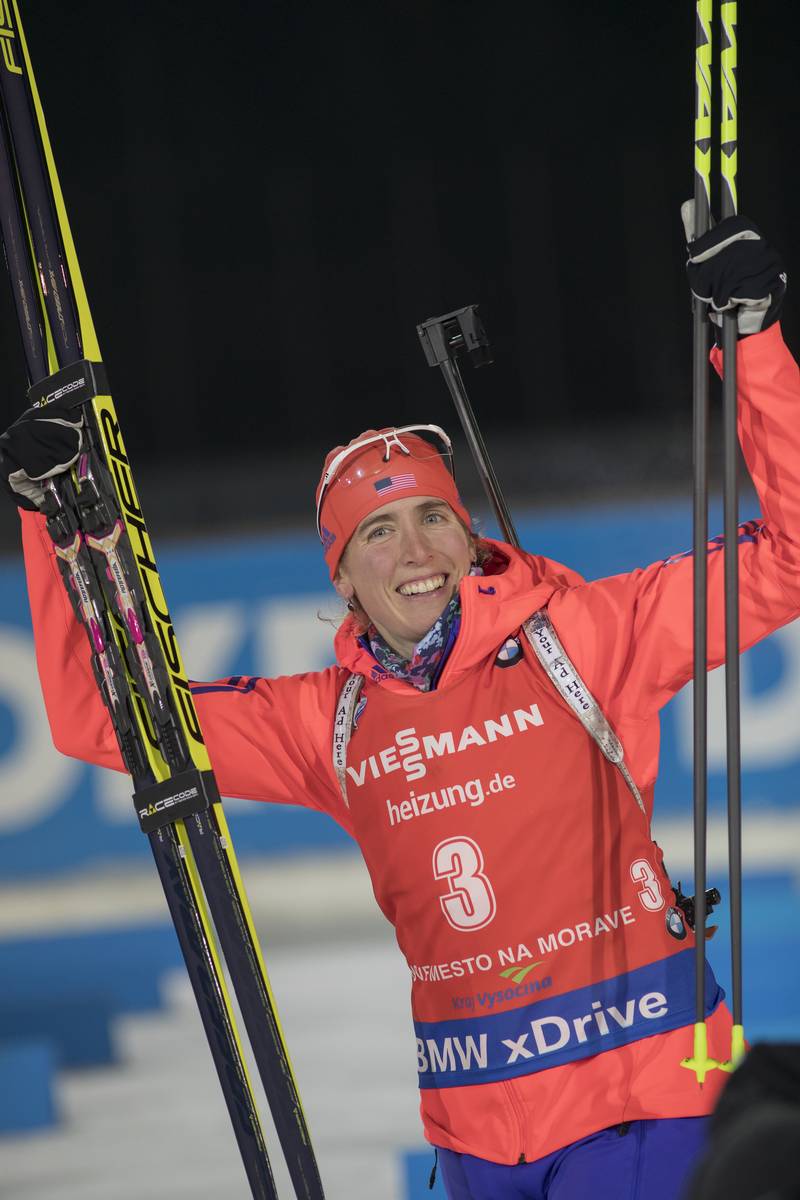
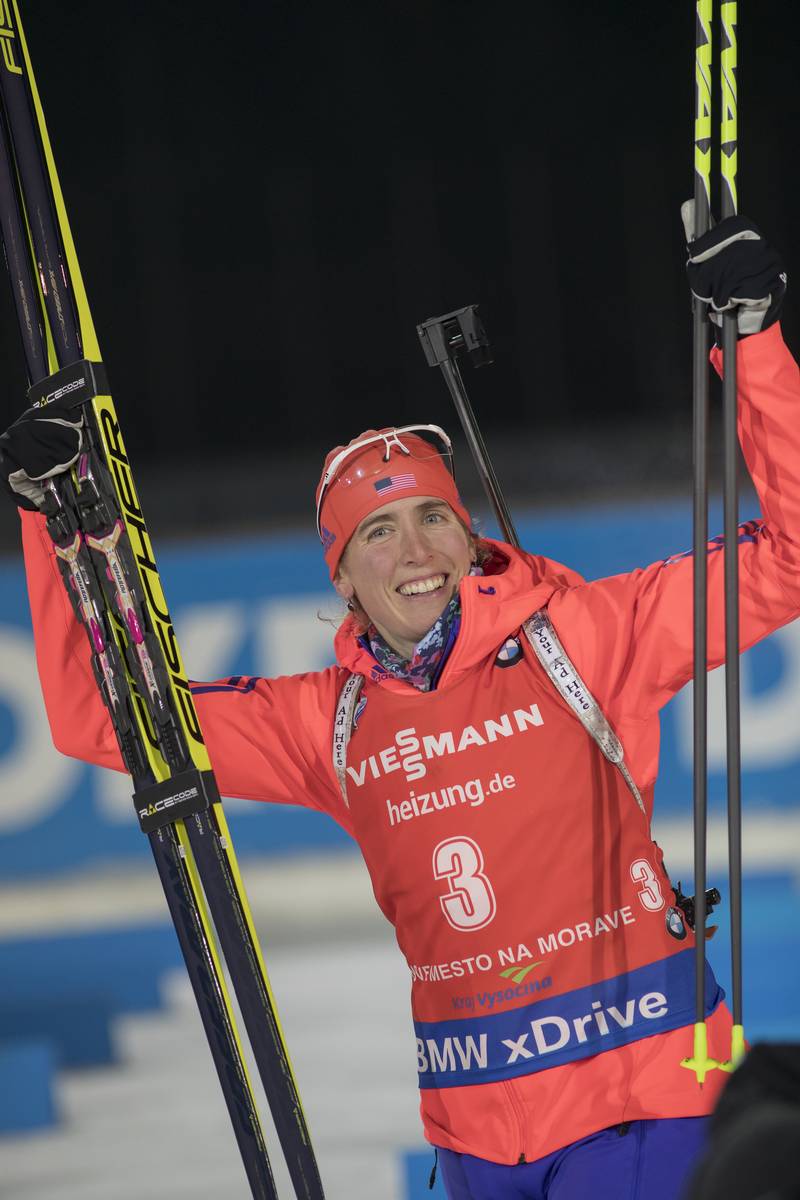
Susan Dunklee (US Biathlon) after achieving fourth place on Saturday for a personal-best pursuit result at the IBU World Cup in Nove Mesto, Czech Republic. (Photo: USBA/NordicFocus)
Welcome to The Rundown, your quick primer of need-to-know information about the day’s racing. We’ll be updating this digest as the day goes on with additional results, photos and quotes. The Rundown is NOT a race report; stay tuned for complete race reports later today with interviews from the day’s top racers.
***
IBU World Cup in Nove Mesto: 10/12.5 k pursuits
[UPDATE] Third one day, fourth the next. That’s the streak Susan Dunklee (US Biathlon) is riding after notching her third career podium on Friday in the women’s sprint, followed by a fourth place in the women’s 10-kilometer pursuit on Saturday in Nove Mesto, Czech Republic.
Dunklee posted the fastest range time and third-fastest shooting time overall and shot 18 for 20 (0+1+1+0) en route to fourth (Dunklee’s best pursuit result), 28 seconds behind France’s Anaïs Chevalier, who won in 30:38.1 minutes. Italy’s Dorothea Wierer landed on the podium in second (+9.5) and Friday’s sprint winner, Tatiana Akimova of Russia, placed third (+19.4). Chevalier missed just one in the first prone stage (1+0+0+0) to improve on her second-place sprint finish on Friday, which was her first podium. Wierer rose from seventh at the start to second with two penalties (0+1+1+0) and Akimova had just one miss on the first stage as well (1+0+0+0).
Canada’s Julia Ransom tied her career best by racing to her first top 20 of the season in 19th (+1:48.5) after starting 26th. She cleaned three straight stages (0+0+0+1), and skied into 18th after the third and fourth stages, before losing one place to Norway’s Marte Olsbu (19th, +1:47.2) at the finish.
Also for Biathlon Canada, Rosanna Crawford finished 32nd (+2:51.8), up from 37th at the start, with two penalties (1+0+1+0). Megan Tandy finished 57th (+5:32.7) with five penalties (1+1+0+3), after starting 44th.
American Joanne Reid slipped two spots to 54th (+4:29) with two misses (1+0+1+0).
US Biathlon’s Lowell Bailey raced from 20th at the start to ninth at the finish, 1:22.1 minutes behind French winner Martin Fourcade, for his best result of the season in the men’s 12.5 k pursuit.
The first starter with a two-second head start, Fourcade hit 19 of 20 targets and cleaned the last two shooting stages (0+1+0+0) to win the second-straight men’s race in Nove Mesto. Russia’s Anton Shipulin, who started second, ended up second again at the finish (+30.2) after a penalty on each of the last two stages (0+0+1+1). France’s Quentin Fillon Maillet and Germany’s Simon Schempp both cleaned all four stages (0+0+0+0) and battled to the very end in a fight for third. Fillon Maillet took third place by one-tenth of a second, 38.3 seconds behind Fourcade, while Schempp finished fourth (+38.4).
Bailey steadily picked off places throughout the race with just two penalties (1+0+1+0), and after leaving the range for the last time in 11th, he moved up two more spots on the final loop to place ninth for his first individual top 10 of the season.
Canada’s Scott Gow finished 40th (+3:31.2) after starting 18th, with a total of three penalties (0+2+1+0). Brendan Green moved up slightly from 54th at the start to 52nd (+5:30.6) with five penalties (1+0+3+1), and American Russell Currier was lapped.
Bailey was listed as the lone North American on the provisional start list for Sunday’s men’s mass start.
FIS Cross-Country World Cup in La Clusaz: 10/15 k freestyle mass starts
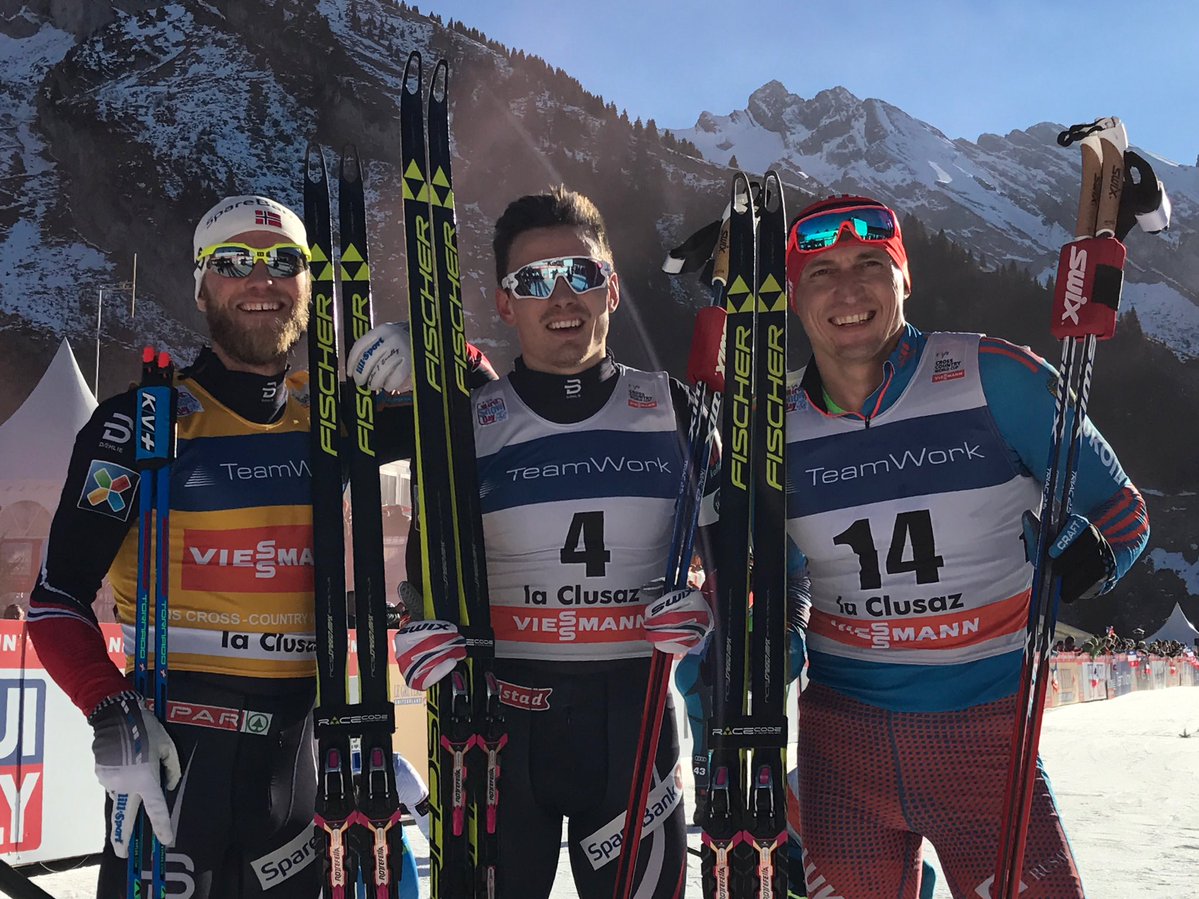
The men’s 15 k freestyle mass start podium on Saturday at the World Cup in La Clusaz, France, with Norway’s Finn Hågen Krogh (c) in first, Martin Johnsrud Sundby (l) in second, and Russia’s Alexander Legkov (r) in third. (Photo: FIS Cross-Country/Twitter)
It was a good day for Alex Harvey of the Canadian men’s team as well as Dahria Beatty of Canada’s women’s team, and for the U.S., Erik Bjornsen, Rosie Brennan and Liz Stephen, all of which landed in the top 30 in La Clusaz, France. Two U.S. favorites, Jessie Diggins and Sadie Bjornsen did not start the freestyle mass starts due to illness.
Harvey raced to seventh in the men’s 15-kilometer freestyle mass start, finishing 26 seconds behind Norwegian winner Finn Hågen Krogh. The big news of the day was Krogh beating his teammate and reigning overall World Cup champion Martin Johnsrud Sundby by 0.3 seconds in 34:09.3. Sundby won the last two distance races: a 15 k classic pursuit in Lillehammer, Norway, and 30 k freestyle last weekend in Davos Switzerland.
While Sundby had to settle for second on Saturday, he held off Russia’s Alexander Legkov, who placed third, 3.1 seconds behind Krogh.
Russia had two in the top five with Sergey Ustiugov in fifth (+25.3), behind Norway’s Didrik Tønseth in fourth (+12.1). Right behind Ustiugov, Finland’s Matti Heikkinen placed sixth (+25.4), 0.6 seconds ahead of Harvey in seventh.
Erik Bjornsen led the U.S. men with his first top 20 of the season and second-best result of his career, placing 20th (+1:02.3). (He had previously finished 18th in a 15 k classic in February 2014.) Two weekends ago in Lillehammer, Bjornsen placed 24th in the classic sprint.
Noah Hoffman finished 49th (+2:14.6) and Eric Packer was 66th (+4:12.5) for the U.S. Canada’s Knute Johnsgaard placed 63rd (+3:50.1), while Andy Shields was lapped for 70th place, Devon Kershaw did not finish, and Len Valjas didn’t start.
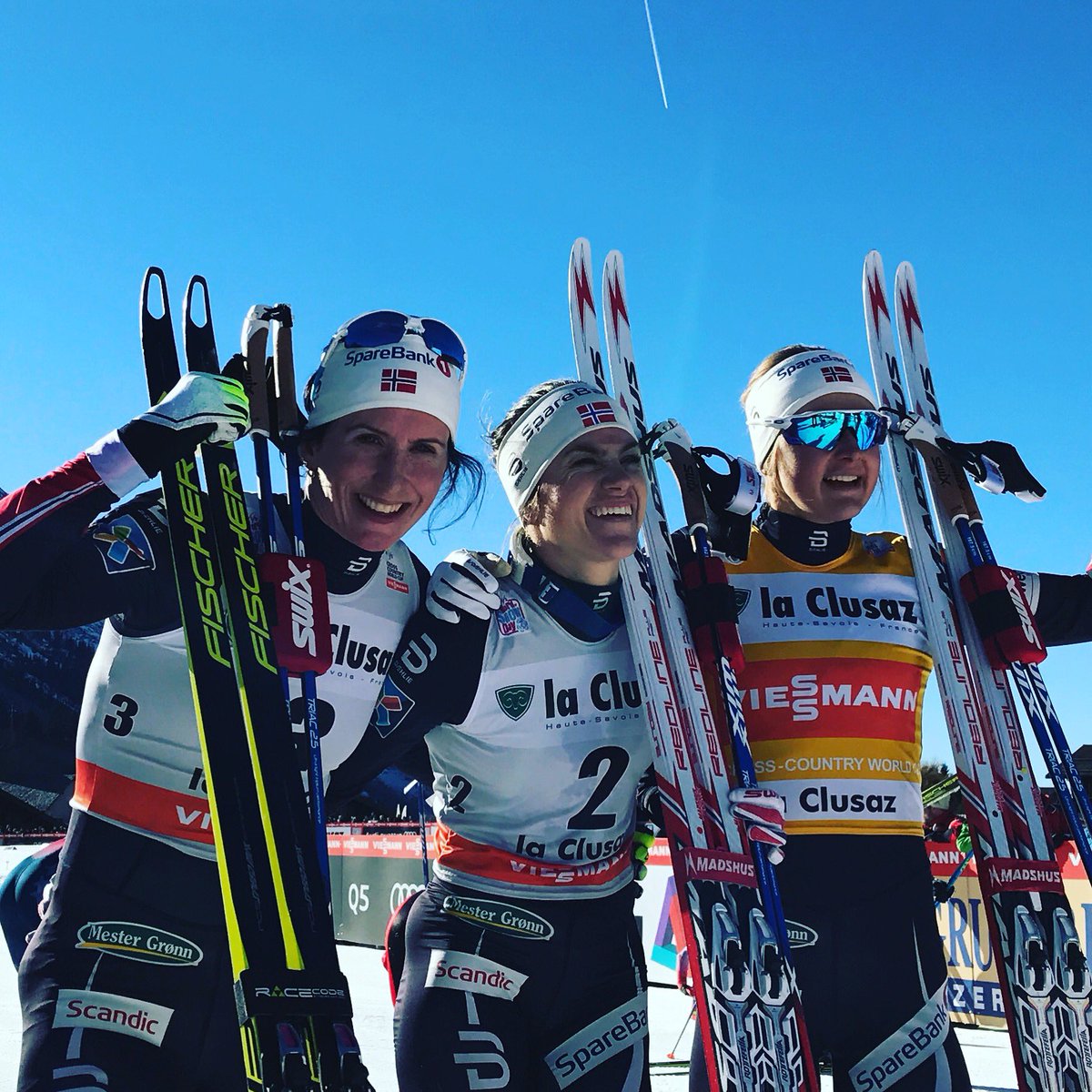
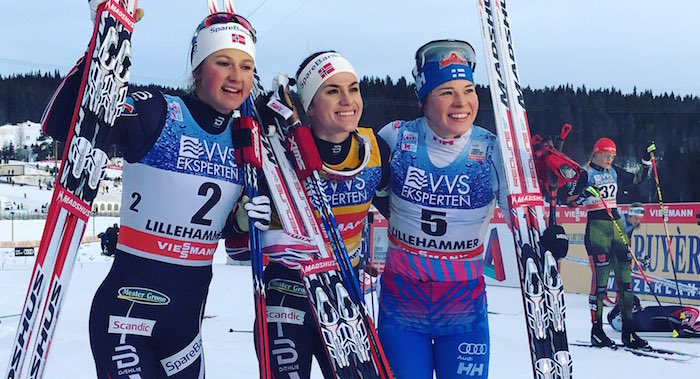
The all-Norwegian women’s 10 k freestyle mass start podium at the La Clusaz World Cup in France, with winner Heidi Weng (c), runner-up Marit Bjørgen (l), and Ingvild Flugstad Østberg (r) in third. (Photo: FIS Cross-Country/Twitter)
In the women’s 10 k freestyle mass start, Heidi Weng outlasted her Norwegian teammate Marit Bjørgen by 2.1 seconds for first, crossing the finish line in 23:43.5. Bjørgen placed second and it was an all-Norwegian podium with Ingvild Flugstad Østberg in third, 0.8 seconds behind Bjørgen and 2.9 seconds after Weng.
Rosie Brennan was the top U.S. woman in 22nd (+1:31.9) for her first top 30 this season and Liz Stephen was next across the line in 23rd (+1:36.5). Kikkan Randall placed 36th (+2:10.6), and Caitlin Patterson 37th (+2:12.7).
Canada’s Dahria Beatty landed in the points for her second-straight race and notched her best distance result in 26th (+1:38.7), Cendrine Browne was 41st (+2:32.3), Emily Nishikawa 48th (+2:52.4), and Sophie Carrier-Laforte 59th (+5:59.8).
Andy Newell and Erika Flowers celebrated their reunion in Rossland with a couples victory in the freestyle technique sprints today. The Stratton Mountain School (SMS) Elite Team couple is racing in the NorAm as a bonus race before their Christmas break in Bozeman, Mont.
Flowers, who was second in the interval start on Friday, won the A-final in 3:15.65, 0.44 seconds ahead of AWCA’s Olivia Bouffard-Nesbitt. Nakkertok’s Katherine Stewart-Jones was 7.09 seconds back, just 0.04 seconds ahead of yesterday’s winner, Chelsea Holmes of APU.
On the men’s side, Newell won comfortably in 2:44.81 after winning the qualifier and each heat. Black Jack’s own Julien Locke was second, 1.05 seconds back. Yesterday’s winner, NTDC Thunder Bay’s Evan Palmer-Charrette was third, 0.05 seconds behind Locke.
Sunday, the mini tour wraps up with a classic pursuit, where the leader after two days starts first and everyone else chases with the first person at the finish line winning the overall.
“Starting at the front tomorrow,” Palmer-Charrette wrote, “the plan is quite simple, stay there!! I’ll have some nerves on the start line knowing there’s a group of guys hunting me down so the big focus is to ski smooth and stay relaxed.”
On the women’s side with larger gaps, Holmes shared the most interesting race plan.
“My strategy for tomorrow is… no surprise here… I think the expression is to go out ‘like a bat out of hell’ and do my best. It will be a hard race any which way — for sure!”
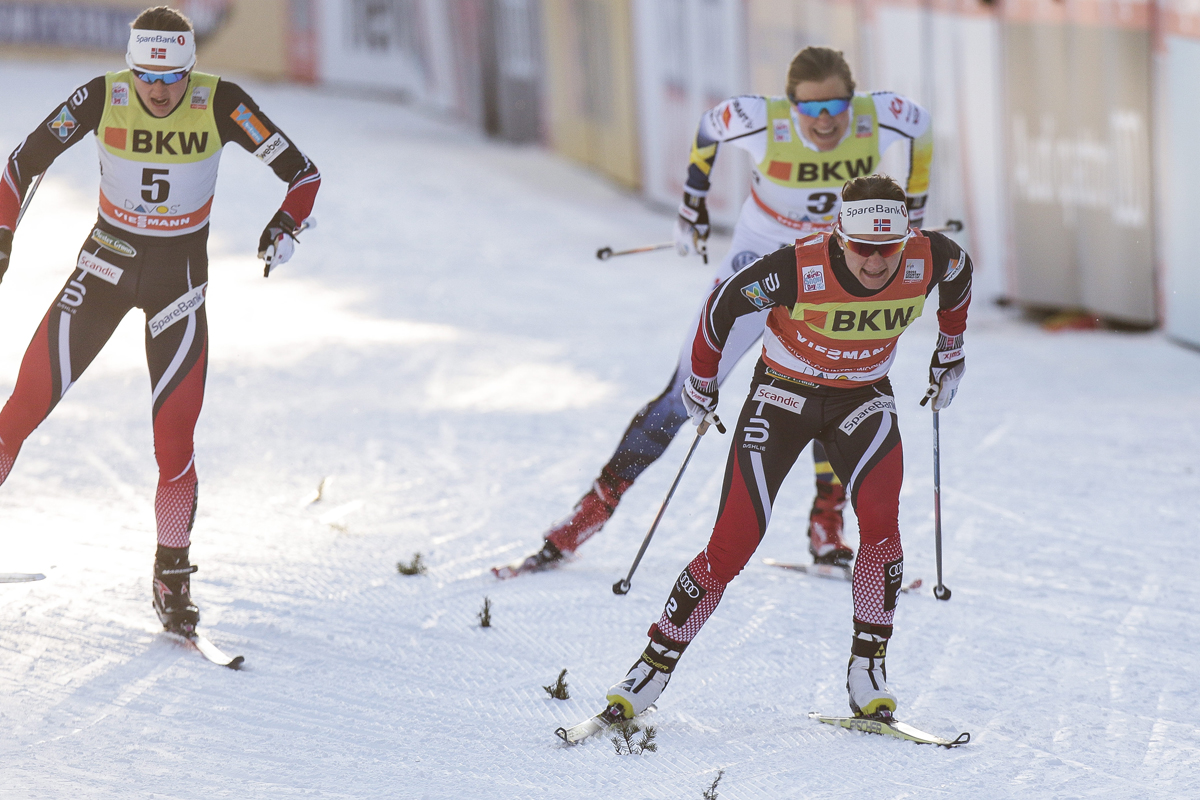
Maiken Caspersen Falla (red bib) wins the final of the skate sprint in Davos, Switzerland, on Sunday. Norwegian teammate Ingvild Flugstad Østberg (bib 5) took second and Hanna Falk of Sweden (bib 3) third. (Photo: Fischer/NordicFocus.com)
Here’s all the reporting – and there’s a lot – that didn’t make it into the race reports.
On ending up in a sprint heat with your teammate
“I picked that heat because it was just the heat with the least amount of people at the time. You never want to be in a heat with your teammate because maybe only one of you can go on, but sometimes you have to, and the last couple of weekends I’ve been with teammates. So it is what it is.”
-Sadie Bjornsen, U.S. Ski Team (15th in the sprint, after a quarterfinal with Sophie Caldwell)
On imperfect preparation
“I had bit of a rough fall after an awesome summer training. I was at high altitude for a long time in October and I got really tired at our camp there, so I had to take a little more time off than I anticipated. Then I caught sort of a mild cold before coming over here. So it wasn’t the perfect fall, but I did try to recognize that it might take a little time to work into the season– the base that I got this summer isn’t going to just disappear. So it will come back, I just have to do some searching.”
-Sophie Caldwell, U.S. Ski Team (12th in the sprint)
“Unfortunately I had a filling right before I left for Europe. I actually had two. The one on the right side was totally fine and didn’t cause any pain, but from the beginning the one on the left was bothering me. And so, long story short, I was in a lot of pain after the sprint race in Norway, and so the Norwegians got me in to see a dentist in Norway. She kind of looked at it and said, ‘I think you need a root canal. Looks like you might like have an issue there.’ But I didn’t want to do it right before the other races. So she pulled the old filling out and put a temporary one in that she thought might not be pushing up against the nerve. I went into the dentist here and she pulled it all out, and was like, ‘Holy shit, you have a huge infection.’ And so I had quite a painful experience with her on Tuesday, but so far – I mean, I was exhausted after that, for sure, but, you know, I have another appointment in a couple weeks to do the actual root canal itself.”
-Liz Stephen, U.S. Ski Team (28th in 15 k, 61st in sprint)
On distance racing
“I like distance racing a lot, because if you’re fit and you’re ready, you will win.”
-Jessie Diggins, U.S. Ski Team (4th in 15 k, 5th in sprint)
“Really exciting for Jessie and really proud of her effort. You can see she had a really strong first lap. Then you can see her getting a little fatigued at the start of the second lap, coming through at 5 k, and you know her standings in the next couple of kilometers dropped. They dropped from third down to maybe seventh or something. And then she really battled back and she was just kind of in the mix there with Roponen and Von Siebenthal and Tchekaleva, so I’m super proud that she could just battle back in that. By far her best Davos finish, and 15 k finish. A big step forward for her, so really cool to see.”
-Chris Grover, U.S. Ski Team Head Coach
“I think I’ve had some pretty bad races here in Davos, and I think this one stacks up as one of my better ones. I wish I could figure out how to get a ride, and actually stay on. That would really help, but honestly the downhill this year skis better than it’s skied in years. I wasn’t scared of it. That’s way more enjoyable than freaking out the whole race thinking, ‘I have to go down that thing again?!’ Overall, I’m not excited with the race, but I’m not disappointed. I guess, it’s just kind of Davos.”
-Stephen
“I got better throughout the race. I feel so unaquainted with the race pace, so it takes me a while to get the feeling; the second half is good. I feel like my body responded pretty well. It’s more about tuning in the mind and the body to the actual race pace, but I think overall I felt pretty good.”
-Kikkan Randall, U.S. Ski Team (33rd in 15 k, 58th in sprint)
On sprinting
“I’m really satisfied with my first podium in sprint this year. I want to be fighting for the podiums in distance and sprint. With the 15 k yesterday and then today, it was more than I expected from this weekend… My goal for the day was to get in the final. Once I was in the final I really wanted to get on the podium.”
-Ingvild Flugstad Østberg, Norway (1st in 15 k, 2nd in sprint)
“Unfortunately Rosie [Brennan]’s not feeling great, so there was an opportunity to start and I was like, ‘Meh, I’ll just take it.’ It’s always fun. I think every sprint I’ve skied so far, I’ve skied my bib number. So I can’t say I’m super psyched on my sprinting right now, but I didn’t have any expectations. I just wanted to get some good training. It’s fun for me to kind of be the one, I don’t know, I can make the jokes in the van, instead of being so nervous that I can’t. It’s totally fun to be a sprinter, for sure.”
-Stephen
On snow farming
“You could tell where the sun had hit it was slower. But the course held up great. I’m so impressed with the organizers here in Davos, because it is not easy to hold a World Cup when we are standing on grass and dirt right here. And they managed to snow-farm extraordinarily well. I’m just very impressed.”
-Diggins
On fatigue
“I’m really tired actually. I’m getting a little bit pooped, but the idea is to load high, and then rest for the Tour de Ski because you need to be able to go ‘boom, boom, boom’ during the Tour, and to be able to recover and to cope with the big load. So I think this is great practice for that. Usually I race everything; last year I raced over 30 times and I was really tired at the end. It’s less physically, more mentally the racing over and over, you have to kind of get psyched, get prepared, do all the work, do all the psychology work every race, and that is the hard part I think. Physically, once you’re in the race you get the nerves, the adrenaline, and you can finish the race, but mentally to really be engaged with the course, that’s a challenge I think.”
–Diggins
On next week’s World Cups in La Clusaz, France
“I am really stoked about next weekend. I have a french boyfriend and I have for 6 years and so I am stoked to have his family and him there and having a relay there it’s like I literally can’t wait.”
-Bjornsen
“The relay, to me is, everything. So I want to rest up for that for sure.”
-Diggins
“I expect as always in this first period really strong competition in the relay. The Swedes are really strong as a team right now, the Finns are strong, Norway’s of course strong, Russia’s women have taken a step up this year with some new faces, Germany is strong, I think we will have an absolute battle on our hands come Sunday next week. It will be fun.”
-Grover
On not going to La Clusaz
“I haven’t made any definite plans, but I don’t think I will go to La Clusaz because we can only start one relay team and the 10 k skate at altitude is not really my strong point! So I might just start Christmas break early. My parents are actually over here. Maybe I will just start getting in a good little training block and feel good for the beginning of the Tour.”
-Caldwell
“I am actually going home tomorrow. There is not a sprint there, and I just feel like I get to February sometimes and am just like, I am so tired of this…. it feels soon to be going home, but also there is good skiing there too.”
-Ida Sargent, U.S. Ski Team, 20th in sprint
On World Championships in Lahti, Finland
“It’s World Championships. The skate sprint there is my biggest goal. I will go home now for some training over Christmas.”
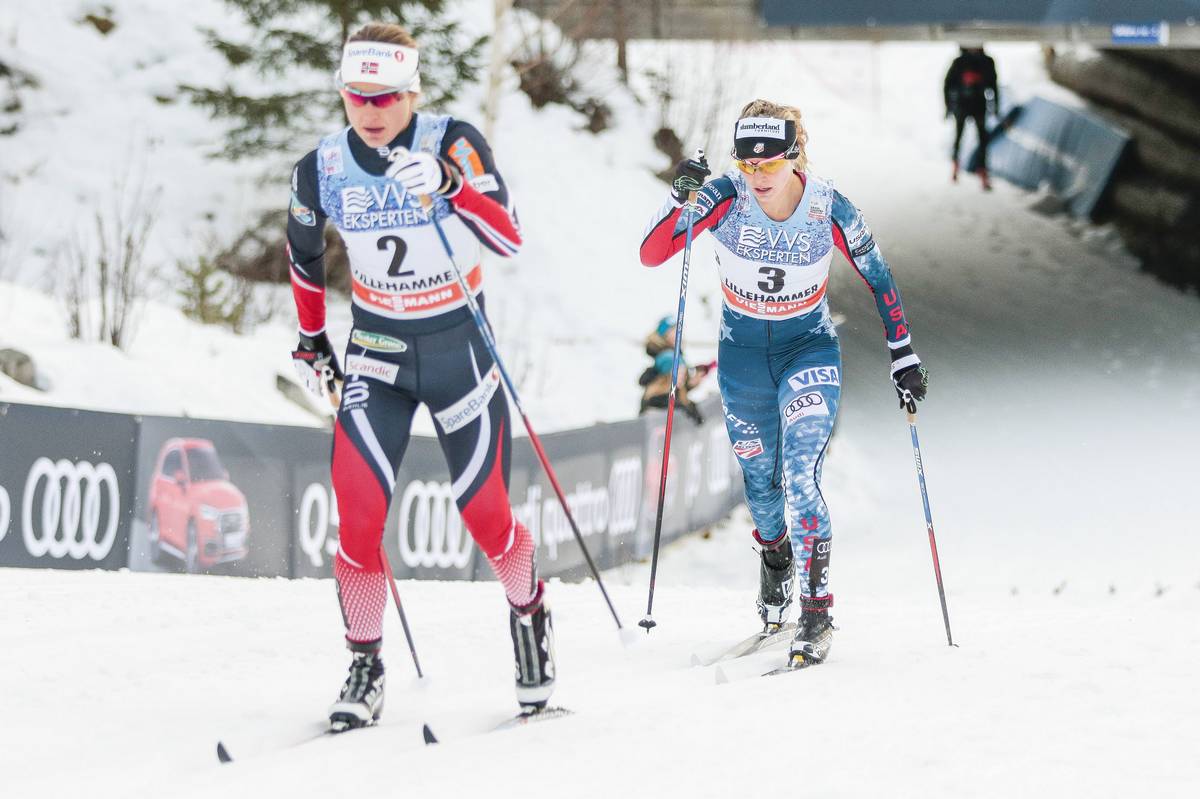
American Jessie Diggins (r) chasing Norway’s Ingvild Flugstad Østberg in the women’s 10 k classic pursuit on the last day of the Lillehammer World Cup mini tour in Norway. (Photo: Salomon/NordicFocus.com)
Norway’s Heidi Weng started the 10-kilometer classic pursuit in Lillehammer, Norway, on her own, and she finished just the same: alone, and in first place.
The 25 year old chalked up her first World Cup mini-tour win on Sunday, after winning the classic sprint on Friday and placing second in the 5 k skate in Saturday. Weng started the day with a 20-second cushion separating her from second-place Ingvild Flugstad Østberg in the mini-tour standings, and extended that lead slightly by the middle of the race before ultimately winning by 16.1 seconds.
Heidi Weng (c) held onto her lead to win the Lillehammer mini-tour by 16.1 seconds over Norwegian teammate Ingvild Flugstad Østberg (l). Finland’s Krista Parmakoski was third after losing a shot at second thanks to a crash. (Photo: FIS Cross Country/Twitter)
“Today it was not easy at all,” she told FIS. “I felt very tired in the first lap.”
With less than her best form, in her own estimation (she said that the sprint had been her “best day”), Weng hadn’t been confident that she could keep her lead.
“I felt like, ‘Oh no, Ingvild and Krista [Parmakoski] will come,’ but they didn’t, I am very happy with that,” Weng said in the post-race press conference.
But if she was exhausted, she didn’t show it, keeping up her trademark high tempo on the long, grinding climbs of the Lillehammer course.
Østberg kept her lock on second place, although the race didn’t go exactly as she had expected. With American Jessie Diggins starting one second behind her and Norwegian teammate Marit Bjørgen only five seconds after that, Østberg could have been caught and then worked in a pack.
Heidi Weng of Norway all alone coming through the stadium on her way to a FIS World Cup mini-tour win in Lillehammer. (Photo: Aleks Tangen)
Instead, Diggins and Bjørgen faded and Østberg worked alone for much of the race before being caught by Parmakoski of Finland.
“I thought that maybe Marit and I would be working together in order to catch Heidi, but it turned out to be a race where I had to do things on my own,” Østberg said.
Parmakoski made a move to pass Østberg and try for second place, but crashed on a high-speed downhill corner and lost several seconds. That turned out to be impossible to make up, and the Finn ended up 4.9 seconds behind Østberg in third place.
The three podium finishers congratulated each other in the finish, and it was clear that Østberg hadn’t caused Parmakoski’s crash.
“On the last downhill I had to take my chances if I wanted to win,” Parmakoski told FIS. “The fall was unfortunate but I am happy for third place.”
Parmakoski and Østberg had the two fastest ski times of the day.
(Article continues below)
https://www.instagram.com/p/BNl5DlGBVrD/
“I feel like my body has been working well all season,” Østberg said. “I think Friday and today were the days I felt best… I have felt steadily good so far, but that final edge isn’t there yet. And it probably won’t be there until around New Year’s and the World Championships, but that is also how it’s planned so it’s not hopeless.”
Bjørgen landed fourth (+57.5), and was unable to make up any ground on the leaders. She said that her energy wasn’t all there, between an imperfect training year and taking care of her son, Marius, who is still less than a year old.
Norway’s Marit Bjørgen racing to fifth in the women’s 10 k classic pursuit on Sunday at the World Cup mini tour in Lillehammer, Norway. (Photo: Fischer/NordicFocus.com)
“That’s something I was prepared for before the season started,” the 36-year-old told the Norwegian press after the race. “Things are a little different than they have been in the past. I trained well after [the opening FIS races in] Beitostølen, and with the two races last weekend the total load of work has been relatively high– and now three quick races here. I tried [to stay with Parmakoski when she passed] but it just wasn’t my day.”
Bjørgen leads the distance standings, because she won the 10 k classic in Kuusamo, Finland, and mini-tour stages only award half the number of World Cup points as a standard World Cup race would.
Sweden’s Stina Nilsson landed fifth (+1:26.1) after skiing up from 27th place at the start. That gave her the fourth-fastest split time of the day.
“I had decided to take it a little easy in the beginning,” Nilsson said.
She is now also fifth in the overall World Cup rankings, which Weng leads by 90 points over Østberg. All were beneficiaries of the big overall points bonus which is awarded based on total mini-tour results: 100 points for Weng, the same as winning a stand-alone race.
While Nilsson started conservatively and then sped her way through the field as she warmed up, that’s not the strategy Diggins had taken. The American initially followed Østberg on the first few hills before falling back through field and ultimately ended up eighth (+1:39.4).
Jessie Diggins (U.S. Ski Team) en route to eighth in the women’s 10 k classic pursuit at the Lillehammer World Cup in Norway. (Photo: Salomon/NordicFocus.com)
“I started out just trying really hard to hold my position,” Diggins said in a finish-line interview. “I think in my excitement to try to follow Ingvild and Marit and learn from them, I was pushing my luck a little bit. So maybe I just took it out a little too hot.”
With a maximum climb of 64 meters – over 200 feet of elevation – that had consequences later in the race.
“I really lost my technique out there,” Diggins admitted. “I got a little tired and I was struggling a little bit to kick– as it was getting warmer out there, I was folding over and my technique was really bad. I lost some time definitely on the uphills. It was a hard race for me.”
But she was pleased with her mental management of the race once the wheels started to come off.
“At the end I was able to get it together and not lose as many places,” she said. “It’s hard when you know there’s a big group working together chasing you. I was happy to be able to hold onto the top ten. And just to keep it in perspective sometimes, if this had been last year, it would have been the most amazing day.”
Just a few places back, U.S. teammate Sadie Bjornsen crossed the line in 11th, +1:51.2. Bjornsen had started 12th, in a group of six women within ten seconds. She skied in a pack for the entire race and finished just half a second behind Norway’s Ragnhild Haga and the top ten.
Liz Stephen was 38th (+3:31.8), and Rosie Brennan and Caitlin Patterson 41st (+3:50.2) and 42nd (+3:56.8), respectively.
“It was good to get another race under my belt,” Stephen said. “I mean, I was hoping for a top 30, and it wasn’t enough … Classic is still a work in progress for me, and it just didn’t happen for me today.”
Patterson was also not completely satisfied with her race, saying she also suffered from choosing skis with less than bombproof kick.
“It wasn’t what I wanted to feel,” Patterson said. “Heavy legs. I think my skis were a little slick too. The bad combination of not very good energy and slick skis made it really tough out there.”
Ida Sargent rounded out the U.S. results in 57th (+5:39.7).
Emily Nishikawa leading Canadian teammate Cendrine Brown during the women’s 10 k classic pursuit on Sunday at the World Cup in Lillehammer, Norway. Nishikawa placed 46th and Browne finished 52nd. (Photo: Fischer/NordicFocus.com)
Emily Nishikawa led the Canadians in 46th (+4:08.5), with Cendrine Browne and Dahria Beatty 52nd (+4:41.5) and 59th (+6:08.2), respectively.
Nishikawa moved up from a starting bib of 52.
“It felt really good, and it was a lot of fun just to be in a pursuit start race and chasing after the next girl ahead of me,” she said in a Cross Country Canada press interview. “I’m really happy with the way I felt. I’m starting to feel like my old self again. My race form is coming around.
Norway’s Marit Bjørgen racing to first in the women’s 10 k classic on Day 2 of the 2016/2017 World Cup season in Kuusamo, Finland. (Photo: Fischer/Nordic Focus)
280 days.
That’s the average gestation time for a human baby. Then there’s the post-birth energy drain: the near constant feeding, lack of sleep. It’s a perpetual expenditure of calories.
Two days of racing.
That’s all it took of the race season for Norway’s Marit Bjørgen to win a World Cup. And to be more precise, it took 26:55.2 minutes — her winning time on Sunday’s 10-kilometer classic individual start in Kuusamo, Finland.
After having missed all of last season with the birth of her first child last December, Bjørgen took charge on Sunday. Her grip on the race wasn’t a work in progress. It was immediate. At the first splt, 3.1 k into the race, this was clear: Bjørgen’s back.
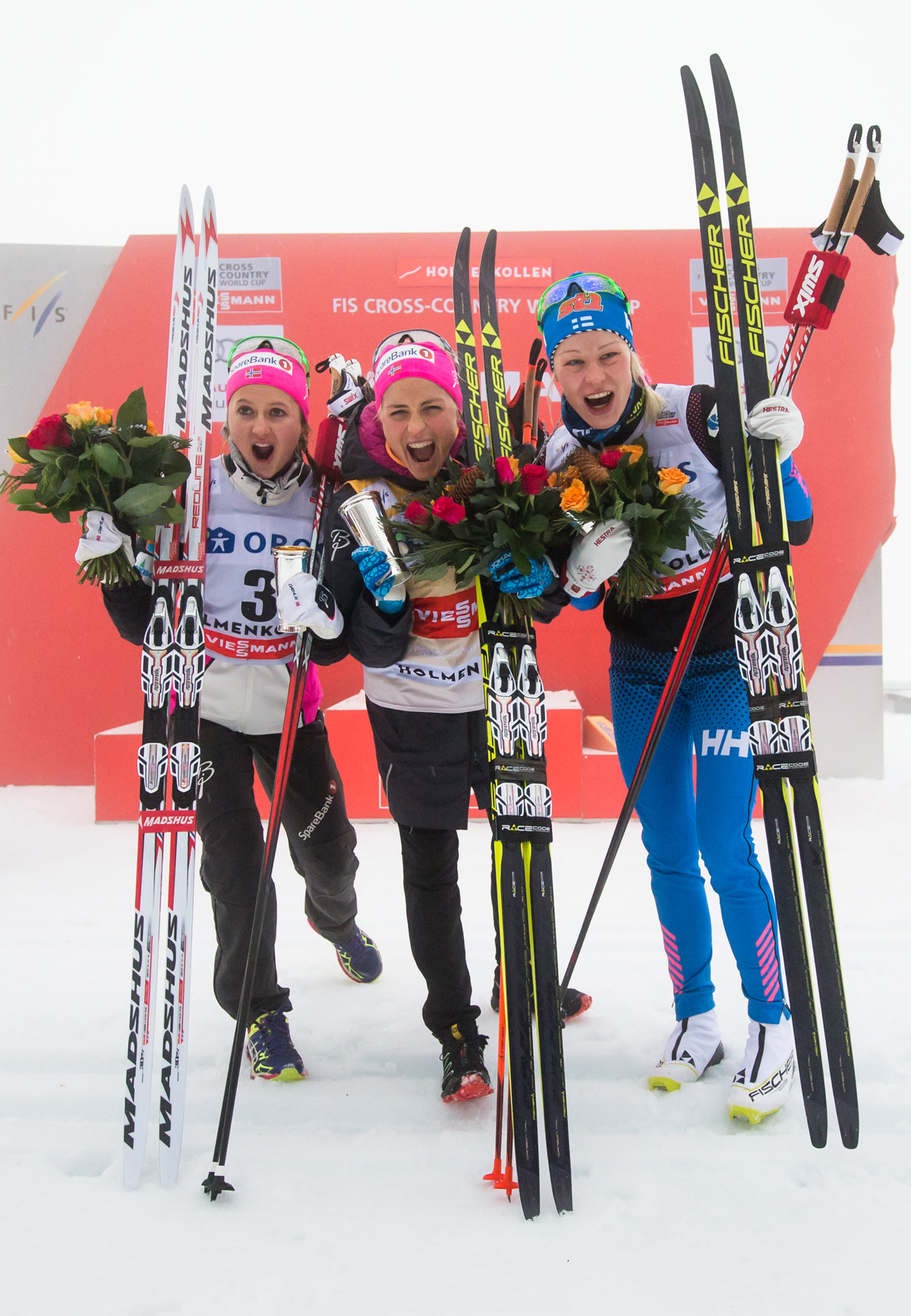
The women’s 10 k classic podium in the first World Cup distance race of the season, with Norwegian winner Marit Bjørgen (c), Finland’s Krista Parmakoski (l) in second and Norway’s Heidi Weng (r) in third. (Photo: Fischer/NordicFocus)
That’s when Bjørgen marked the fastest split. And she ran the board with the fastest splits at 5 k and 8.1 k, culminating with a 4.6-second victory over Finland’s Krista Parmakoski, who skied to second place.
Norway’s winning streak in 10 k classic individual-start races was extended to 11 in a row on Sunday. It also marks Bjørgen’s 14th victory in the event.
Although Bjørgen’s life has taken on new real-world concerns, she made her first World Cup distance race since her pregnancy and child’s birth seem like a fairy tale. Her dream of taking time off from elite sport, starting a family and returning to dominant form — it’s reality.
“I felt after the first lap that I had more to give, then I got some help from a German Victoria [Carl], who is very strong in the easy/flat parts of the race,” Bjørgen told Norwegian Broadcaster NRK after the race. “So I stayed behind her and was able to ski well in the hills, so yeah it was a good tactical race.”
In that same interview, the 36-year-old four-time Overall World Cup winner said her fitness compass hasn’t lead her astray. Instead of due north, the needle still points toward the win.
“It feels really great, absolutely, I feel like I’ve done well this fall, even if the summer was challenging, my own compass has been pointing in the right direction, so it feels really great yea,” she told NRK.
Her victory on Sunday, although sentimental, also proves that for others the new Bjørgen is really the old Bjørgen — powerful, fast and a clinical hunter when it comes to podiums. Weng, the third-place finisher, took note.
“She’s a machine,” Weng commented to NRK. “I said it beforehand, she will be back after having a kid and she will win. It’s insane.”
Three in the points for the U.S. women
The U.S. women placed three in the points, with U.S. Ski Team member (USST) Jessie Diggins in 13th (+1:09), Sadie Bjornsen (USST) 17th (+1:14.9), and Caitlin Patterson, of the Craftsbury Green Racing Project, in 28th (+1:45.4). Patterson, 26, earned Period 1 World Cup starts as last season’s overall SuperTour winner.
Despite a wintery scene to jumpstart the season in Ruka, Diggins’s world was at ease with the World Cup hustle.
“In some ways it was really easy to slip right back in the rhythm,” she said of the World Cup circus. “I am a total social butterfly so I am running around like, ‘Hi, hi, hi,’ talking to all my friends at the World Cup and that part was really fun.”
Along with systematically picking skis with her coach Jason Cork, the routine of warming up and then dialing in the race-pacing calculus, Diggins raced with mid-season poise.
On course, it was a hard-driving Diggins.
“I was getting some splits out there. It’s hard for me to listen exactly to the coaches when I am skiing out of my mind tired,” she said. Her splits would have revealed her effort was just off top-10 pace. After 3.1 k, Diggins was in 10th, 17 seconds out of first. Over the course of the race, she dropped back to 14th and 15th at 5 k and 8.1 k, respectively, but gained a few spots by the finish.
Asked about her 13th place, the Stratton Mountain School (SMS) T2 Team skier best known for her skate skiing said it was a welcome early season wake up. “I didn’t feel like a hero out there. I had spit all over my face and was drooling all over, but it was a great surprise,” she said.
U.S. Ski Team Women’s Coach Matt Whitcomb said he, too, liked what he witnessed from Diggins.
“It was great to see, watching Jessie,” Whitcomb said. “She was just engaged in this race from start to finish. Had that really hungry look on her face and good dynamic movements in her body the entire 10 kilometer race. So I felt really good about where she is; 13th place after a week on the ground in Europe is really phenomenal as well as on really challenging classic courses that haven’t always been her strength, so the work that she’s put in in her classic skiing over the last couple years has been significant and it’s worked.”
Diggins said she has taken responsibility for improving her classic technique. Those improved physical sensations have allowed her to embrace the kick-wax mantra of ‘thin to win’.
“Working with my tech in past years I’ve often just said give me kick at the expense of everything else because I don’t feel confident getting up the hill,” Diggins said about her reliance on more kick, less glide. “So I would ask for so much kick that I shorted myself on glide, which is obviously my fault. I’m not trying in anyway to blame anyone else, I’m just saying that in past years I wouldn’t have the confidence to go with the appropriate ratio of kick to glide and I’m finally starting to learn how to get it a little more at the right ratio … and so that has been really cool working with the coaches on that to get my technique and confidence up to the point where I can give myself a better chance at climbing.”
Sadie Bjornsen (U.S. Ski Team) racing to 17th in the World Cup women’s 10 k classic on Sunday in Kuusamo, Finland. (Photo: Fischer/NordicFocus)
Although not a surprise to find herself well within the points in 17th, Bjornsen was cautiously optimistic coming into Sunday’s race.
“I kind of came into this weekend without having specific expectations, but more just to set a benchmark for where to start from,” Bjornsen said.
During the offseason, Bjornsen, an omnipresent World Cup all-arounder, has been dealing with bone spurs on her feet.
“It’s particularly hard with a weekend of classic racing because it’s only my fourth time classic-ing in the last two months,” she explained. “So I don’t really have the perfect feel yet, but it’s definitely coming back. So I guess I feel encouraged by how things are starting, but I definitely have huge hopes for the weekends to come.”
If she had any questions about her fitness, they’ve been answered. A 10 k effort on Ruka’s steep terrain, going against skiers fighting for their World Cup start rights, Bjornsen couldn’t exactly fake it.
“Sadie had a pretty slow start,” Whitcomb said of her initial splits. “I was giving splits at one point at 1.2, which was also the 6.2-kilometer mark, and she had about a 15- or 16-second deficit at 1.2 k, so that’s always kind of an early warning that the body’s not quite firing. So that was a little bit scary. But a little further into the race, she started coming to life and the attention of the crowd started to draw on Sadie. She was not far from the top 10 today, she was certainly fighting with four or five other girls that all ended up within just a handful of seconds.”
Bjornsen hasn’t had a text book run-up to the season. For the former competitive swimmer, it’s been a lot of SkiErg-ing and tons of laps in the pool.
“It’s funny because I’ve done SkiErg-ing intervals and I’ve done one bounding session,” Bjornsen said of her recent training. “I just haven’t done anything remotely like racing for some time now. So in sprinting you just go as hard as you can. It’s kind of simple, you don’t have to remember how to pace anything because you just send it. So yesterday in my qualifier, I was blown away that I was able to race into seventh place. But today I was like, ‘OK, I guess you have to pace a 10 k a little bit.’ But the most that I’ve done is two-minute intervals on the SkiErg or, I did a bounding session that I did four-minute intervals, but I just haven’t done a consistent 30-minute effort.”
Bjornsen explained her early split, 23rd place at 3.1 k, as a function of starting too easy.
“I think I was just too cautious out of the beginning and I didn’t even realize it,” she said. “I honestly got to the top of the first hill and I was like, ‘Oh, I hope I didn’t go too hard at the start.’ But I think I was in 37th place. At the time Matt [Whitcomb] was like, ‘All right, time to get into it!’ but I had no idea I was way out of the race already … But it took me two kilometers to remember how to go again and I pushed it for the rest of the way and I think I gained some places back. Even that is super encouraging because I feel like next time I go out and do a distance race, I’m going to have the confidence to go a little harder at the beginning.”
The first-weekend race hurdle is over for Bjornsen, a skier who realistically eyes top-10s as newsworthy. She’ll still head into the next World Cup in Lillehammer, Norway, problem solving when it comes to pain-free skiing.
“I still haven’t quite figured it out yet, but it’s really nice to get over here and work with the boot guys and try to figure out a solution. But I haven’t cleared the bone-spur problem yet,” she said.
Maybe no real surprises so far: Three Norwegians in the top four, four in the top ten. Two U.S. skiers in the top twenty.
Then this:
“Caitlin Patterson, it’s not very often that we have COC [Continental Cup] athletes that score points,” Whitcomb said. “Just straight up, that’s a tough thing to do … Being the Continental Cup leader, it’s a tall order to get in the top 30. So Caitlin has now put together, really, a series of races starting last year that’s showing the world that she’s supposed to be here. So that’s really exciting.”
American Caitlin Patterson (Craftsbury Green Racing Project) racing to 28th in the World Cup women’s 10 k classic on Sunday in Kuusamo, Finland. (Photo: Fischer/NordicFocus)
According to the International Ski Federation (FIS) website, this is Patterson’s 15th World Cup start. Not exactly green, but she’s not the most seasoned on the World Cup.
“I figured she would be skiing as a points skier this year,” Whitcomb said when asked about his expectations for Patterson. “I wasn’t sure if it would happen already. She showed some signs of life in Muonio [Finland] that definitely turned some heads. So that was a good indicator a couple weeks ago that she was in good shape. She’s been telling that to us all along and we got to see it today and that was impressive.”
For the Alaska native, being in the points is confirmation.
“I’m definitely pretty happy with it — it was a really solid race and I knew it wasn’t going to be easy at all to squeak into the points here,” Patterson said of her performance. “It’s just typically Period 1 is really tough, there’s so many Scandinavians and really tough competitors out here.”
Not being a national-team member, she’s had to trust that what she’s been doing is World Cup worthy.
“I’ve had a little bit of comparison with some of the other girls, but I’ve mostly just had to trust that my own training has been quite good and more often than not I am training with my other Green Team Members like Kate Miller, and Liz Guiney and others,” Patterson said. “So it’s not necessarily so much World Cup skier comparison but I just have to trust that my own training is going well.”
Patterson’s first official split at 3.1 k put her in 32nd place. From there on, she was in the top 30, in the points. Like no other statement, results matter at this level. And Patterson understands the benchmark by which she is being judged.
“It’s a really good step along the progression of trusting that I belong here and that I can compete with these girls,” Paterson noted about her ability to compete on the World Cup. “I did look at the finishing results and saw that, what was it like, that if I could’ve been like 10 seconds faster, that was 6 places or something … it was like 40 seconds to the top 10 or something. So those things are really encouraging.”
Some U.S. skiers were out of the points which helps explain Whitcomb’s summation of the women’s race. “I’m very satisfied with the race today,” Whitcomb said. “It was a mix of great races and some races with disappointed athletes attached to the result. But as a team I think we skied pretty well and even those that were, some that were wanting more had some good elements that went down today so I’m happy.”
Also for the U.S. Ski Team, Rosie Brennan placed 39th (+2.22), Kikkan Randall skied to 43rd (+2:29.7), Ida Sargent 44th (+2:30.4), and Sophie Caldwell 61st (+3:13.4).
Kikkan Randall (U.S. Ski Team) racing to 43rd in the women’s 10 k classic at the Ruka World Cup in Kuusamo, Finland. A day earlier, she placed 52nd in the classic sprint. (Photo: Fischer/NordicFocus)
Randall is a longtime U.S. Ski Team member and former three-time winner of the Sprint World Cup. Also, like race-winner Bjørgen, Randall took last season off for the birth of her first child.
“I was looking forward to another chance to test myself today,” Randall wrote in an email to several media outlets, referring to her missing out on the heats in Saturday’s classic sprint. “I had a feeling distance may be better for me right now with less intensity in my system as normal.
“I paced myself a little too well,” she continued. “I lost 20 seconds in the first 1.5km and already 1:10 by halfway. Kept about the same pace 2nd lap. Had good energy in the end so I definitely could have gone out a little harder. … I need more hard efforts to get re accustomed with race pace after a year without it. I hope to get a spot to race the mini tour in Lillehammer next week and will look forward to some skate races in Davos!”
Whitcomb mentioned that for Randall, the first weekend does not reflect her race potential.
“She started out very slowly and I can’t say that I’m entirely surprised with that,” Whitcomb said of Randall’s split at 3.1 k, which ranked 51st. “She sometimes takes a little bit to get going in the distance races and having been away from it for so long, I wasn’t sure what to expect. But that was one of the leading options. But what was very cool is she started to turn things up about halfway through the race so the body started to respond and showed signs of life, and she’s had a great attitude all weekend.”
Whitcomb also sensed the importance of the moment for elite athletes when commenting on Bjørgen’s win. “I thought it was a little disrespectful that she only gave us one race where she let somebody else win, then today she was right back at it again,” he said with a laugh. “Marit’s one of those skiers that everybody’s happen when she wins, not just Norway, so you can count me as one of those fans cheering her on.”
“Inspiring and motivating to see both Bjørgen and [Finland’s Aino-Kaisa] Saarinen [who placed 16th] ski so well,” Randall wrote. “Marit is a few months ahead of me so I am optimistic about this season as it progresses. We have been talking Mom and baby stuff between the 4 of us (also Katja Visnar), it’s a fun new conversation.”
Canada entered three skiers in Sunday’s distance race. Twenty-three-old national U25 Team member Cendrine Browne was 58th (+3:04.8), World Cup B-team member Emily Nishikawa was 59th (+3:07.1), and Dahria Beatty (U25 Team) was 74th (+3:54.4).
Sweden’s Stina Nilsson, who won Saturday’s classic sprint, leaves Ruka as the World Cup overall leader with Marit Bjørgen in second, 10 points behind. Racing resumes next Friday with three days of racing in Lillehammer.
Rosie Brennan (U.S. Ski Team) on her way to 28th in the Ski Tour Canada 10.5 k classic mass start Montreal last season. (Photo: flyingpointroad.com/NNF)
Welcome to ’17 Questions for 2017′, where we are catching up with American and Canadian national-team members before the beginning of the winter season.
***
First named to the U.S. Ski Team in high school, Rosie Brennan dominated the 2015 SuperTour and earned rights to race in Europe, including at World Championships where she finished 16th in the 30 k classic. After a six-year absence she was renamed to the national team after that winter and has been there ever since, including finishing her first Tour de Ski last season and skiing scramble for the U.S. women’s relay team, which finished third in the World Cup in Lillehammer, Norway. Brennan, 27, is based in Anchorage, where she is part of the Alaska Pacific University elite team.
1. Biggest change in your life in the last five or so months since the ski season ended?
For the first time since I was 18, I (kinda) lived outside college housing thanks to my boyfriend renting an apartment.
2. Biggest change in your training?
I trained a bit more than last year, otherwise things have been pretty similar.
3. Major areas of improvement you’ve seen so far?
I am happy with the improvements I have made in double poling and pure speed.
4. Whom you’ve been working closest with this offseason (coaches or training partners)?
I spent the majority of the summer in Alaska training under Erik Flora with my APU teammates.
5. Best trip in the last five months (and why)?
Going to the wedding of one of my best friends from college. Nothing beats time with good friends.
6. Favorite cross-training?
Biking
7. Favorite non-athletic activity or pastime this summer?
I started a little garden at APU and was able to harvest quite a few vegetables!
8. Song that was your jam this summer?
I have to admit that I was a little nerdy this summer and listened more to podcasts than music.
9. All-time favorite race moment?
I think my favorite race moment is still the first time I won a Junior National Championship. It was the first time in my life I truly believed I could accomplish anything I set my mind to.
10. First thing you pack in your bag when you leave for Europe?
Teddy
11. Venue/event you’re most excited to visit this season?
La Clusaz. I have never been to France!
12. Who will win the World Cup title this year?
Bjoergen and Sundby, boring I know.
13. Biggest sacrifice you feel you’ve made choosing this career path?
Financial stability and being more or less homeless.
14. If you could change one thing about your sport, what would it be?
More racing in the U.S. and more financial support.
15. What did you have for breakfast this morning?
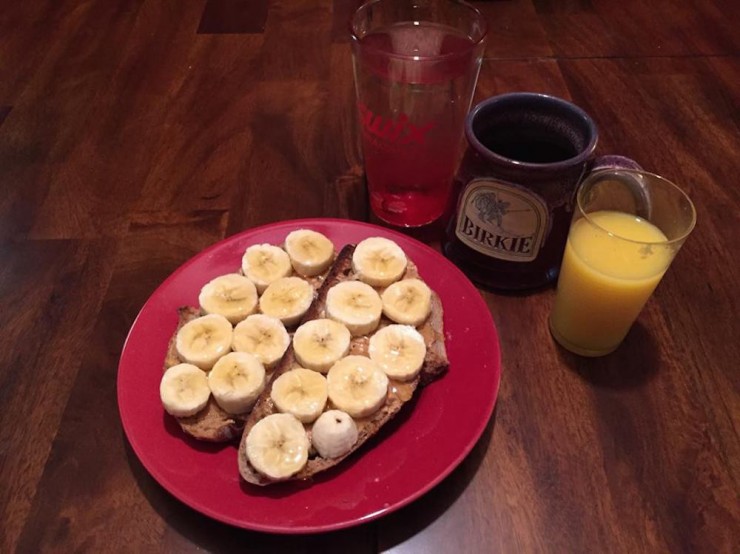
Same thing every morning: Everything bagel, raspberry jam, 2 fried eggs
One thing we can say about most dads: they tell it like it is and they tell it to you straight. Just like we did for our moms on Mother’s Day, we wanted to honor all of the fathers out there on Father’s Day, and we asked top North American national-team members to share a photo and answer one of the following questions:
What was the best piece of advice your dad ever gave you?
What was the biggest lesson you learned from your dad?
Ian, and dad, Mike Torchia at an inline skate race on Madeline Island, Wisconsin, in 2016. Torchia wrote on his dad’s advice at the time: “‘You know what happens to hot dogs, Ian? They get eaten!’ – Mike Torchia
While my dad (affectionately called Sir) has given countless gems of advice, the above is one that I remember the most as he has always emphasized humility in the face of success.” (Courtesy Photo)
“My dad taught me the most basic and important lessons for a kid athlete and that was how to race and pace. He helped organize the first road races in Bennington and would run the 5k with me before heading out on the 10k race for himself. He taught me how to relax on the downhills and try to kick it in to the finish as hard as I could… I distinctly remember learning those two important things from running with my dad.”
“My mom teaches me lessons through words (she is going to school to be a counselor), whereas my dad has always taught me lessons through actions. I’ve observed these actions throughout the years with the intent to grow into somebody similar. His positivity, sense of humor, and ability to make people feel at home are things I hope have worn off on me. The biggest thing my dad has taught me is how to follow my gut feeling through the decision making process. He never tries to control or alter the decisions I’m going to make. Instead, he has allowed me to reap the rewards or consequences from these decisions on my own. And from there, I learn. Happy Fathers Day Hans. Love you!”
“When I want advice, the first person I call is my dad because he is very honest and always puts things into perspective. There is one piece of advice in particular that really stuck with me. I must have been really nervous about an upcoming race and was talking about the criteria I needed to make in order to qualify for a certain event. He reminded me that there was no point in getting worked up about criteria because it is something that I can’t control. He simply told me: ‘When you ski fast, good things happen.’ It made me realize how simple it was. I had worked hard to get to where I was, all I could do was go as hard as I possibly could, the rest is out of my control. I often think about that when I am nervous before important events. I am so glad that I can always rely on my dad to give me down to earth advice. Thank you dad and happy father’s day (and birthday)!”
“The best advice my dad has ever given me is reminding me that I tend to ski the fastest when I’m happy and enjoying myself. One of the times he reminded me of this was when I was at the Olympics and it forced me to step back and soak in the incredible experience I was having. When he said it, he was obviously applying it to skiing, but I think it’s a pretty simple piece of advice that you can apply to most parts of life. It’s easier to succeed in something that you’re passionate and happy about whether that’s a sport, friendship, or class. I think it’s easy for my dad to give advice like that because he’s one of the most kind and happy people I know and he likes to keep things pretty simple. I’ve always admired him for those reasons and would be happy to take advice from him any day :)”
“While I never actually went cross country skiing with my Dad, he was incredibly influential in his love for the outdoors and ability to truly enjoy life. My dad taught me to alpine ski and mountain bike, both were activities in which he challenged me and was always up for a race. I don’t know if my mom will ever get over just how much I ski like him. My dad had a great ability to do things in a big way in order to maximize the enjoyment out of each adventure and he did so with incredible passion. I can’t say I have fully learned this yet, but his spirit and enjoyment of life certainly are in me and I think often about how to embrace this a little more each day. At the very least, I have learned to be very passionate about the things I love. My favorite place in the world is the Southern Utah desert and I think my love for the desert stems entirely from family fun, particularly with my Dad.”
“The biggest lesson I learned from my Dad was to never do anything halfway. Whatever you decide to do, give it your best effort and be present. Whenever I see my Dad engaged in a project, whether that’s yard work, making dinner, going for a ski or going to work for the day, he’s fully committed to what he’s doing. He never does anything part-way, and that’s the way I want to live my life, too!
My Dad is also the gutsiest and toughest racer I know. I cheered him on in marathons when I was little and I’d like to think that when I have my best races where I hang in there with the pack, I’m racing like him.”
Little Jessie Diggins running alongside and cheering for her dad at a road race
“When I was younger I used to always want to quit different sports or activities that I was involved with. One of those sports was biathlon. I definitely didn’t give biathlon a good chance yet, but what I knew was that it was hard and I was bad at it. ‘I want to quit…I’m always coming in last!’ probably came out of my mouth about a dozen times when I began biathlon, but my dad saw something in me that I didn’t see yet. He knew I needed to give it another shot and stick with it, and I’m thankful he didn’t let me give up on it when I was a stubborn teenager. As a result, I slowly saw some improvement and was enjoying it more…quickly forgetting that I wanted to quit only months before. It’s funny to look back on, especially now that biathlon is such a huge part of my life. My dad has continued to support me to this day, and is always the first person that I talk to (along with my mom) after my races, if I’m having a hard time, or just to catch up. I’m excited to see where biathlon takes me, knowing that he’ll be by my side during the entire journey. Love you dad, hope you have a great Father’s Day!”
US Biathlon’s Maddie Phaneuf (c) with her parents after her fourth-place finish at 2014 Youth/Junior World Championships in Presque Isle, Maine.
“In his soccer coaching days, something that my dad always said that stuck with me is ‘Practice doesn’t make perfect, perfect practice makes perfect’, and that taught me to always practice with intent. But the biggest lesson my dad taught me without having to say a word was to find the fun in everything I do. Thanks dad!”
“The biggest lesson I learned from my dad is to enjoy life’s beauty.”
“Being the king of practical jokes, quick wit, and somewhat embellished stories, my father taught me to never take life too seriously. He manages to find humour in any situation, no matter what the mood is. He has always been at the sidelines of races and practices with off-beat cheers and goofy hats. Even now with majority of races overseas, he religiously watches every race live and follows it up with an email commenting on an obscure element of the race such as my earrings. From day one he has been there, encouraging my dreams and making me laugh. Thanks for being so awesome, Dad!”
“My dad has played a major role in my life in so many ways. He is the one who introduced me to the outdoor and sporting world when I was young. From building small ski ramps in the backyard to taking me backcountry skiing. I have so many amazing memories of my dad and what he has taught me it is hard to nail one thing down as the best advice or lesson that he has shared with me. All of the things I have learned seem to relate to a couple key things. Find something you enjoy doing, decide what your level of commitment is going to be and then do it right. I am very grateful that my dad was never one to pressure me in the sporting world but rather support me and help me figure it out. There are so many different avenues one can choose especially in a town like Steamboat where you can participate in almost any sport. With my dad’s help I was able to find the sport I love and figure out how much I really was willing to put into my career. That stage is still panning out but without my dad’s support in everything I tried I would not have learned to love the sporting world. So thank you dad! Love ya!”
“The wisest and most sincere thing that my dad taught me was to be myself. Whether it was going out for a 5-hour mountain bike ride because you felt like it, doing skate intervals until you threw up because you wanted to beat your competition at the next JNQ, or just acting totally goofy while on a desert camping trip, being yourself and knowing what you truly wanted to do and be in the moment of now was the most valuable thing that my dad, or anyone for that matter, has ever taught me. Happy Father’s Day to all of the amazing dads out there! None of us would be where we are now without you, literally and figuratively.”
“The biggest lessons I’ve learned from my dad are to be tough and love what I’m doing. He taught me to hang tough, finding the strength to believe in myself and not give up when the going gets hard. He also always reminded me to have fun and if I wasn’t enjoying or passionate about what I was doing then it was time to do something else. This advice has given me the strength and work ethic to follow my dreams and have a blast doing it.”
“My dad has always had a love for sports, especially skiing. Growing up both my parents encouraged me to do many activities. They were always driving me from practise to practise but skiing was something that my dad and I did together. Over the years skiing became one of my favourite sports. Growing up some of the best advice my dad ever gave me was to make sure the things you are passionate about play and important role in your life, and that real jobs are overrated. He always encouraged me to pursue my goals and supported my racing and training with pride. After high school when I was trying to decide what my future would hold, my dad’s advice and philosophy on life, If I can do what I love as my ‘job’ why wouldn’t I. My dad has been there every step of the way, through my best times and the hard ones. I am so happy to have to chance to be home in Whitehorse this Father’s Day to spend it with my dad. No skiing together at this time of year but we have already been out trail running together in the one day I’ve been home. Happy Father’s Day dad and thank you for sharing your love for skiing with me, I love you! And a very Happy Father’s day to all the dads out there!”
“My Dad has literally supported me in biathlon since day 1 whether it was helping run kid’s practices on the weekends, cheering me on at the Olympics or proofreading website updates! I can’t name a single best advice, but I think the most powerful thing my Dad has given me is honesty. It sounds cliché I know! But really, no matter how well a race or training session went (or anything in life for that matter) my Dad was always positive but honest: he is the person I trust to give me advice or feedback that isn’t sugar coated. My Dad has this way of analyzing things that always leave me feeling more motivated and determined. The skill of being honest with myself, keeping my sport in perspective and not beating myself up when things don’t go as I want has come in a huge part from my Dad – and I doubt I would still be a biathlete without it!
As for my Grandpa, as soon as I think of him and sport I can hear him smiling snd saying ‘Go get’em Kid’….he must of said this to me thousands of times at uncountable races!
I am a lucky girl!”
“The biggest lesson my dad has taught me is the importance of confidence in racing. Whether it was by coming with me to the start pen to help me get my ‘game face’ on or by giving me pre-race pep talks, he showed me that a huge part of being a successful athlete is having confidence in your own abilities.”
” ‘Don’t forget to have fun, Susan.’ Those are often my father’s parting words to me as I leave for competitions. As a former USST member and a 2 time xc skiing Olympian, my father always understood that a passion for the sport must be the foundation to build on, no matter what level is ultimately reached.
When I was a kid, my dad always wanted to make sure I was enjoying skiing and doing it for the right reasons. I’ve always been competitive, sometimes to my own detriment. Dad held me back from intense training environments during my junior high years so that I wouldn’t burn myself out. In high school, he encouraged me to invent games for my teammates and to turn interval workouts into fun relays. I am thankful he led me in that direction, otherwise I would not be competing today.
As I got older and reached a more elite level, he has given me all sorts of wonderful advice. Immediately upon graduating from college, I was uncertain whether I should accept an invitation to move to Lake Placid to try a complete unknown, biathlon. My dad pointed out: ‘If you don’t try this, you are always going to wonder, ‘What if?’ ‘ He knows me well.
Some of his other advice that I have taken to heart:
1. ‘If you are going to be a full-time ski racer, you have to want to be the best in the world. I don’t know if you have that hunger in you — it is something you are going to have to figure out for yourself.’
2. ‘The Euros put their pants on in the morning the same way you and I do — one leg at a time.’
3. ‘I know you want to make an Olympic team, but the real question is, what is your goal once you get there?’
“My Dad always told me ‘do as your dad says, not as he does’… wise words from the Wizard of the North himself.”
“I wouldn’t be writing into Fasterskier if my Dad hadn’t taught me how to ski at a young age. Unfortunately, I can’t remember as far back as my first days on skis, but I do have many memories of him teaching other friends and family various forms of skiing. In this, he taught me that there’s tremendous satisfaction in sharing your passions. In fact, although my dad has never strapped on a pair of jumping skis, he has helped many younger kids progress at the local ski club, and he’s been the Central Division Nordic Combined Representative for years. He’s demonstrates a selflessness that is inspiring for me to try to live up to.”
“My dad has taught me that nature offers so many great adventures and that you always have to remember to have fun and really enjoy what you are doing :)”
“My dad always tells me to think before I speak. I have not fully figured that one out yet, but it is really good advice! Happy Father’s Day pops!”
Bryan Fletcher: “The biggest lesson I ever learned from my dad was not only how to ski but how to enjoy every single day on skis. He definitely showed me how to work hard so you can play harder. Both of the attributes have led me to the competitor I am today! Happy Fathers Day Dad!”
Taylor Fletcher: “My Father (Tim Fletcher) was huge in myself and my brother’s development as skiers. Growing up, my dad was ski patrol on Mt Werner and Howelson Hill. He was the person that taught us to ski beginning at a very young age, but I can’t remember if I started skiing early or walking late. We would go up there any chance we got to ski with him and chase him around the trees and down the slopes. Every weekend that he was working he would try to be at Howelson hill so he could patrol while we had jumping competitions. I can’t even think how many jumps my father has seen me take over the years, from watching at the base of the jumps to finding those hacked streams online to watch us compete in the middle of the night. Over the years, one thing has always stayed the same, and that is his love us and watching us compete. The biggest thing I have learned from my dad, he perseverance and hard work. I have never met a person that works as hard as he does during the summer and winter every year. I have been able to apply that to my training career as he always told me that no one is going to do my training for me!
Happy Fathers Day DAD!”
Linn Eriksen of the University of Denver celebrates her win in the women’s 15 k classic mass start at the 2016 NCAA Skiing Championships in Steamboat Springs, Colo. (Photo: Jamie Schwaberow/NCAA Photos)
In March, FasterSkier recently published an article (Part I) on college ski racing in the U.S. and what a change to National Collegiate Athletic Association (NCAA) Championships might require in regards to adding a sprint race. In the second part of the series, we explore why men’s and women’s race distances are different at the collegiate and World Cup level and whether this constitutes a need for change.
***
Men | Women. Women | Men. Scanning the athletics webpage for an American institution of higher education that boasts a varsity sports team becomes a sail down the Casiquiare canal, with gender bifurcation an obligatory outcome.
Resting under the canopy of NCAA sports, however, nordic skiing presents itself as somewhat of an anomaly. Shared race days. Shared coaches. Shared course site. Shared team. At the surface level, gender in collegiate nordic skiing is almost arbitrary.
Olivia Amber (r) of Colby College and teammate Amy Bianco celebrate their top-20 finishes in the women’s 15 k classic mass start at the 2016 NCAA Skiing Championships in Steamboat Springs, Colo. (Photo: Colby.edu)
Yet, closer inspection reveals one particular area in collegiate cross country skiing where the genders differ: Race distance. In most individual nordic events at the college level, the course length of women’s and men’s races are not the same. The trend is a 5-kilometer deficit for women’s race events in comparison to men’s events.
For Molly Peters, the head nordic coach at Saint Michael’s College and former NCAA All-American in nordic skiing for Middlebury College, this is a problem.
“We’re sending a message to all the young women who have a goal to ski in college,” Peters said in a phone interview. “I just can’t imagine that they feel like their equal as people or athletes when they look and they see, ‘Oh, look every single race I’m going to be skiing 5-kilometers less.’ How are men every going to look at women equally and how are women ever going to look at themselves as being equal if you’re always skiing 5-kilometers less?”
With that in mind, Peters promised herself to reshape the sport.
“It had to be my mission in life to get it changed,” Peters said. “I feel like my best bet to get it changed is to change the NCAA Championships because everyone bases all their racing off of what the NCAA does. Every EISA [Eastern Intercollegiate Ski Association] Carnival is basically not equal because they follow whatever the NCAA does. It all trickles down.”
The Trickle Effect: One Theory on Why Race Distances Differ
A single change can create countless more. When Title IX was passed in 1972, a change was instituted in the treatment of both genders by federally funded college institutions. Within the realm of campus athletics, the alteration brought about numerous others, including an increase in the number of women participating in college sports, the scope of sports available to women and men (in certain instances, harmfully so), and perceptions of women who choose to ‘play.’
Recent Middlebury College returnee, Annie Pokorny, points out that this sort of ‘trickle down’ change should not be looked at lightly.
“When women entered sport, some rules were tweaked to account for physiological differences, but also to support the idea that athletics could be harmful to women, (particularly their reproductive systems,” Pokorny wrote in an email.
Pokorny is completing her undergraduate senior thesis on feminist philosophy and the philosophy of sport. While she admits she is not an expert, her studies and experience in nordic skiing quantify her knowledge on the subject.
Pokorny explained that myths surrounding the female body and exercise in the 20th century, caused men “to adjust sport to make it safer and more “womanly”), which turned into a conceptual connection between women and the need to protect them.”
“That conception turned into tradition, one that still thrives today in the form of shortened distances for female endurance athletes,” Pokorny added.
The top 10 in the women’s 5 k freestyle race at the 2016 NCAA Skiing Championships in Steamboat Springs, Colo. (Photo: Matt Johnson/MSU)
For Pokorny and Peters, these types of traditions were made to be broken.
“The best things that have ever happened are from people changing tradition,” Peters said. “My purpose is to get the NCAA Championships changed to be the same distance for men and women because that will trickle down to the smaller races.”
But implementing change in the NCAA Championship event and NCAA skiing is no easy task.
“NCAA skiing is comprised of a wide variety of institutions: Division I, II and III; private and public; and large and small,” Dave Stewart, head nordic coach at the University of Denver, wrote in an email. “Any choices about race format, distances, etc. must take into consideration the perspectives of this diverse group and, ideally, the decisions should be made with the goal of broadening participation at the NCAA level and increasing competition.”
If Stewart is right, the question becomes: Would making race distances equal between men and women broaden participation and increase competition?
A Second Theory & the Distance Debate: Should Men Race Shorter or Women Race Farther?
When it comes to long distance endurance events, some research argues women fare better than men.
“Women can race just as long as men,” Montana State University (MSU) incoming senior Anika Miller said on the phone. “If [the NCAA] wanted us to do a 50 k in college, sure we could do it, but it wouldn’t make any sense athletically.”
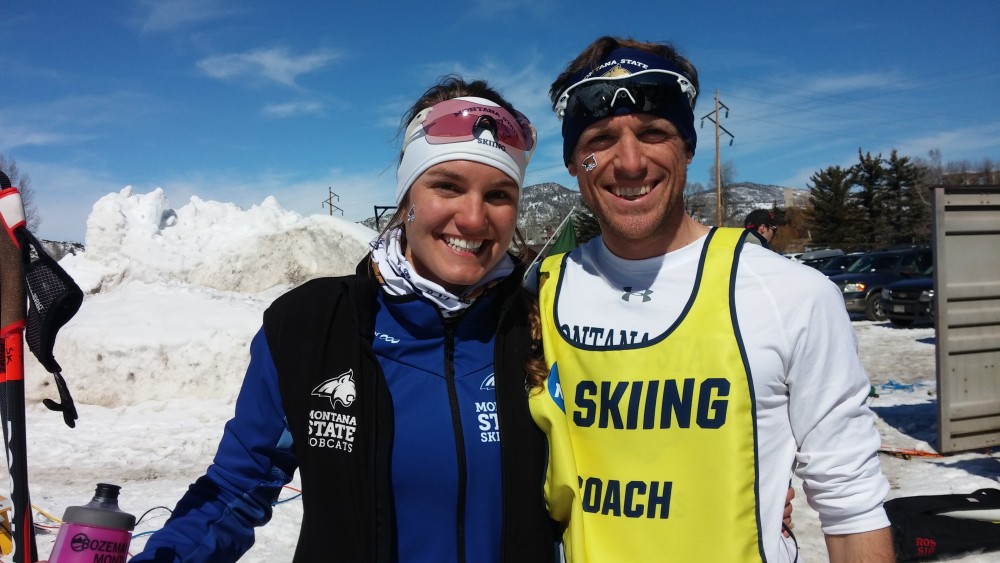
Montana State University’s Anika Miller (l) with head coach Matt Johnson after Miller took won the women’s 5 k freestyle at the 2016 NCAA Skiing Championships in Steamboat Springs, Colo. (Courtesy photo)
Miller — a native of McCall, Idaho, and this year’s NCAA champion in the 5 k freestyle — doesn’t doubt the ability of women to race the same distance as men.
What she questions is whether it’s necessary for women to do so.
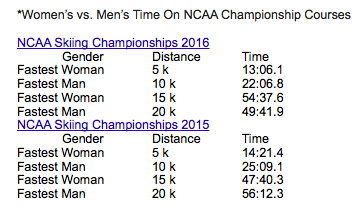
“It’s kind of a hard conversation to have as a female athlete because you don’t want to say that women are inferior,” Miller said. “My opinion on it is that the race distances are good as they are as far as women doing a shorter distance than the men. Because time wise … for the 15 k versus the 20 k at least, sometimes the guys only race it five minutes different than the women, which isn’t really that large of a margin, [meaning] effort wise, it’s more equal.”
The point Miller makes is that women and men are currently racing equal. Equal amounts of time on course, at least in the 15 k and 20 k events (*see men’s and women’s course times).
Oscar Friedman, coming off his senior season at Dartmouth where he was a captain of the men’s nordic team, also argued that close to equal amounts of time on course is more important than equal course distances between men and women.
“The point of having those different race distances was to make the men’s and women’s races equally competitive,” Friedman said on the phone. “That being said, if women are internalizing it, then that’s a bigger issue. If there’s a push from within the sport, women should be the ones deciding the race distances.”
The push from women within the sport varies, but much revolves around whether women race longer or men race shorter distances. Kelsey Phinney, coming of her senior season and also a captain at Middlebury, admitted that originally the idea of equal distances didn’t appeal to her because she assumed women would be required to race farther.
“I think the misconception has been that equal distances meant that women had to race longer,” Phinney on the phone. “But it doesn’t mean that women have to go 10 k and 20 k it could mean that men go 5 k and 15 k. Or that the races range from sprints to 30 k.”
Rachel Hampton, an incoming senior at Harvard University, advocated that while women are capable of racing men’s distances, men would benefit from racing shorter lengths.
“There’s a feminist side of me that wants to say that girls can do anything boys can do and there’s no theological reason why we shouldn’t be able to race the same distance as them,” Hampton said on the phone.
“I will say I sometimes feel bad for the guys because it seems like they only race long races. I think if we added sprinting and a few 5 k races for the guys and did a wider range of distances, that would be better for them. And I think if the men were on that plan, the women could then get on the same distance plan.”
However, when men competing in college were asked if they would be willing to race the same length as women, responses were often shaped by race distances at other levels of nordic competition.
“Shortening the men’s distances would be a huge disservice because as I see it, the goal of NCAA skiing is to make American skiers as competitive as possible on the World Cup,” Friedman said. “I would be completely against shortening the men’s races. But if women want to make the call and race longer, they should fully be able to do that.”
For a few women, however, simply adjusting the women’s race lengths to match those of the men sends a certain message: Women have to be like men to be equal.
“I think the message it sends depends a lot on whether you shorten the distance of men or you increase the distance that women have to race,” Bates College ’16 grad and skier Britta Clark said on the phone. “Trying to increase the distance that we race in the name of equality, but at the same time really just saying that equality is women doing what men do, I don’t think it’s necessarily speaking to the issue.”
Clark’s point is supported by Dartmouth College Women’s Head Nordic coach and Director of Skiing Cami Thompson-Graves, also a member of the NCAA Men’s and Women’s Skiing Rules Committee, chair of the USSA Cross Country Committee, and most recently, a member of the International Ski Federation(FIS) Ladies’ Cross Country Committee.
“I don’t feel the need for women to do men’s distances,” Thompson-Graves said on the phone. “Why don’t we just do women’s distances? Why can’t we just be different … I’m a big believer in being proud to be a woman, and not a little man.”
Harvard’s Rachel Hampton leads a Dartmouth skier during the 2016 Colby Carnival. Hampton went on to compete at the NCAA Skiing Championships in Steamboat Springs, Colo. (Photo: FlyingPointRoad.com/Harvard Facebook)
Increasing women’s distances strikes some as a forfeiture of female identity for one that is male. Which is one reason Peters more strongly advocates for decreasing men’s distances to be the same length as women’s.
“In skiing, I think the men should come down,” Peters said. “The 20 k is really irrelevant, even at the international level. I see nothing wrong with the 5 k, I think men should do 5 k. Five k is super exciting and can be a great race. I think it should be 5 k, 10 k, 15 k, and then add in the relays and sprints.”
However, a men’s 5 k race doesn’t appear on numerous nordic race calendars — national or international — either.
“I don’t think at the national or international level men race 5 k so maybe that’s a distance skill set that would only be applicable to college skiing in the U.S.,” Raleigh Goessling, coming of his senior season at the University of New Hampshire, said on the phone. “If the race distances were changed, I feel like the distances that are contested at other levels of the sport and other formats should also play into it.”
The Window Between U.S. College Racing and the World Cup
At the international level, women and men rarely race the same distance. FIS course lengths — like the NCAA — are designed around the gender of the athletes competing.
FIS Cross-Country Committee Chair and Norwegian Olympian Vegard Ulvang indicated that similar to college racing in the U.S., FIS race distances have been different for decades. One potential reason for these differences aligns with Porkorny’s findings. According to Ulvang, how female athletes were viewed in endurance sports when they started ski racing influenced the original length of women’s race courses.
“The history behind the differences comes from the time where the nations believed that women were weaker — [with the] first female race in 1952,” Ulvang wrote in an email to FasterSkier. “Today we of course know better. Female athletes are better prepared for longer distances than men, so principally the distances should be equal.”
Principality does not always equal response. Ulvang indicated that even if the race distances should principally be equal, one major driving force for the committee to keep women’s race distances shorter than men’s rests on the race experience for spectators.
“The argument has been that the time gap between the 20 best women is bigger than that of the men,” Ulvang wrote. “Longer distances would create a ‘worse TV product’ — with one racer skiing alone [during the race].”
T.V. time does not strike Peters as an excuse for NCAA Championships and U.S. college cross-country ski schedules to follow the same format as the World Cup.
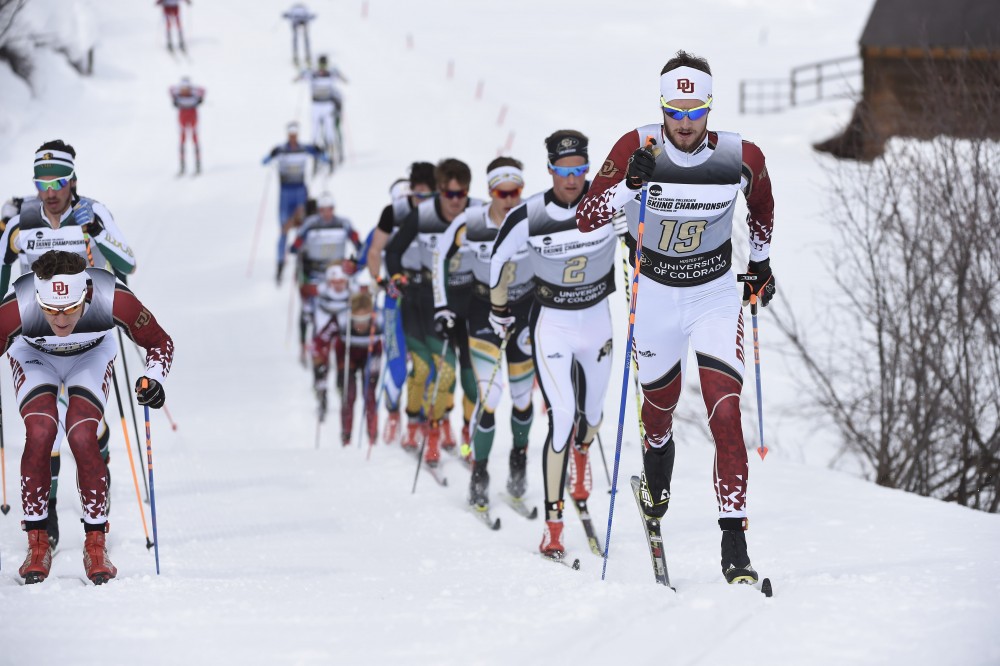
The men’s 20 k classic mass start at the 2016 NCAA Skiing Championships in Steamboat Springs, Colo. (Photo: Jamie Schwaberow/NCAA)
“A lot of people will say well, look at what they do at the Olympics, and look at what they do at the World Cup — it’s vastly different,” Peters said. “The women do so much less. But that doesn’t make it right. That’s a reason why NCAA follows it and EISA follows it, but that doesn’t make it right.”
Stewart, who has helped the Denver Pioneers achieve five NCAA Championship titles, supports the idea that NCAA skiing in the U.S. could act as a catalyst for change.
“As long as FIS schedules longer races for men than for women in international championships, there will be some resistance to equal distances at other levels, but I see no reason why the NCAA should not be a trendsetter and work to turn the tide on this,” Stewart wrote in an email.
He supports equal distances in cross-country skiing, seeing it as a statement that should be sport-wide, not just within NCAA nordic skiing.
“Equal distances for men and women should be implemented in our sport, both at the NCAA and international levels,” Stewart wrote. “We have had equal distances in the sports of swimming and track and field at the international and collegiate levels for many years. Equal distances would reinforce gender equity and would send the right message about our sport.”
Yet, when it comes to World Cup race lengths versus those contested at the NCAA, some argue the Championship event is already sending a message to other levels of cross country competition.
“I actually think that NCAA’s, where the women race 15 k and the men race 20 k, is much more equal than on the World Cup when the women race 15 k and the men race 30 k,” Rosie Brennan, Dartmouth grad and current U.S. Ski Team (USST) member, said on the phone.
Brennan is not opposed to a more balanced race length distribution between men and women. Her concern with changing race distances at the World Cup and NCAA collegiate level is ensuring that the racers’ performance and perspective are taken into account.
“I think it would be nice if they tried to make the [race distances] a little closer,” Brennan said. “I also think the reason the distances were different in the first place was the idea that the time the race takes should be fairly equivalent, so the effort is the same. If the time differences [between men and women] are getting to be much greater, to the point that the races are no longer requiring the same amount of effort, then I think it’s worth proposing some sort of a change and [is] something to re-visit over time.”
Brennan’s suggestion to visit the race experience for athletes doesn’t go unsupported. Men’s and women’s race distance differences have been discussed at the collegiate and World Cup level. But the actual number of times the topic has been statistically ‘re-visited’ remains a bit blurry.
Regarding conversations within the college circuit, Peters indicates that implementing changes to men’s and women’s race distances has been thrown around for some time.
“Patty Ross, who coaches at Middlebury, she’s been fighting it for 25 to 30 years and she’s had no success,” Peters said.
Ross could not be reached for comment.
Within the FIS Cross Country Committee, Ulvang indicated that the turn of the millennium was when most conversations regarding the different course lengths at the World Cup level of racing began.
“[The] question has been discussed in the FIS committee a few times the last 15 years,” Ulvang wrote.
Beyond that, four-time Olympian, USST member, Fast and Female USA President, FIS athlete rep, and now a new mother Kikkan Randall revealed that World Cup athletes have also had at least one opportunity to make their opinion about equal distances known.
Fast and Female USA President Kikkan Randall leading a Fast and Female session two years ago in Bend, Ore. (Photo: Matt Whitcomb)
“It’s an interesting topic that actually comes up quite often on the World Cup,” Randall said. “As the athlete rep to FIS, I do a survey at the end of each season and couple years ago, as part of the survey, I sent out that question [of equal distances].”
The responses Randall received found most women on the World Cup circuit — at least a few years ago — did not want to race the same distances as men.
“The majority of women actually said that they were not interested in racing the same distances as the men,” she said. “I’m considering putting that same question on the survey again this year because the comment was brought up a couple times this spring.”
And how might women racing on the World Cup respond to shortening men’s distances to make the lengths equal? The question has not been posed, but Randall may incorporate it into her next athlete poll.
“That would be another interesting take on the same question,” Randall said. “This year on the World Cup I feel like the distances were reduced a little bit with so many tour [multi-stage] events, so again it’d be an interesting time to poll the athletes and see how they feel.”
Conclusion: Connecting Part I and Part II
As long as there is snow around, colleges with nordic programs in the U.S. will continue to attract a cohort of cross-country skiers looking to compete, while simultaneously continuing their education. For many, choosing college over a club team is not the end of a cross-country skier’s long term career. It is also the potential beginning.
“The way our country is, you’re always going to have athletes choosing to go to college after high school no matter what path they’re on,” Brennan said. “So I think the more that that can be facilitated, the better it is. I mean there are a lot of good club programs that offer alternatives for people who choose that, but I think the NCAA can provide a route as well.”
Some individuals also see the NCAA as an opportunity for Americans to attend college in the U.S. and potentially compete against athletes from other countries.
“As a venue for athletes to develop into international level skiers, [the NCAA circuit] is a great place because there are really high-level skiers from all over the world in the small microcosm of NCAA skiing,” Chad Salmela, outgoing nordic coach of the College of St. Scholastica, said on the phone.
With an assured influx of athletes choosing skiing and school — and the opportunity for some to race international athletes at ‘home’ — many don’t deny the difficulty of disconnecting U.S. collegiate racing and higher levels of nordic competition.
“From a purely objective standpoint, I would say that a junior athlete who chooses to skip college (at least until they are completely done with their racing career, whenever that may be) and pursue ski racing full-time starting at age 18, is much better set up to ski faster on the World Cup level later in their career,” current USST member and former Middlebury skier Simi Hamilton wrote in an email.
“However, because of the small numbers of junior skiers we have in our country (relative to all the other skiing powerhouse nations), college is a great way to keep kids engaged and in touch with racing during a period of their lives when they may have decided they want to do something completely different,” he added.
Yet, if NCAA racing is to preserve itself as one potential path for athletes looking to make professional steps in the sport, college and World Cup racers alike agree that conversations about change — be those for adding sprinting or making race distances equal between men and women — need to continue.
“I think incorporating sprints at the NCAA is definitely worth talking about and pushing forward because that’s at least one-third of the races we do [on the World Cup], if not more,” Brennan said. “I think trying to stay current is a valuable thing.”
Ida Sargent, a Dartmouth grad and current USST member, agreed that sprinting deserves spotlight attention in present-day skiing.
“I can obviously only speak for the women’s distances but I liked how there was a short and a longer distance race,” Sargent wrote in an email regarding NCAA race distances. “I think a more important change would be adding in more sprint races. We race a sprint almost every weekend on the World Cup and when I was in college we would have one a year at the most.”
With one more year of college racing left at MSU, Miller also pushed adding more sprint races to the college race circuit to foster cross country skiers’ development.
“I think it’s unfortunate that we don’t have sprinting,” she said. “Because that’s such a great development tool.”
Though Miller and Sargent are at odds with Pokorny’s press for equal distances, all three do seem to agree that changing customs can create better opportunities and a better outlook for cross-country skiers.
“When you wake up in the morning, Pooh,” said Piglet at last, “what’s the first thing you say to yourself?”
“What’s for breakfast?” said Pooh. “What do you say, Piglet?”
“I say, I wonder what’s going to happen exciting today?” said Piglet.
Pooh nodded thoughtfully.
“It’s the same thing,” he said.
— A.A. Milne, Winnie-the-Pooh
Breakfast, as you learned in elementary school (or more recently from Ryan Gosling), is The Most Important Meal of the Day. That’s likely true for anyone. It is emphatically true for skiers. Whether you’re training once a day or three times a day, 100 hours a year or 1,000, it all starts with breakfast. If training is the foundation for racing, and proper nutrition is the foundation for proper training, then it logically follows that breakfast is the foundation for, well, everything.
Kikkan Randall in the kitchen “getting ready and fueled” in the fall of 2014. (Photo: Twitter)
Certain types of breakfast tend to get all the press. Pretty much everyone is a fan of second breakfast. J.R.R. Tolkien explains that hobbits eat second breakfast as the second of their six daily meals – after (first) breakfast and before elevenses. Thomas Mann, in The Magic Mountain, ups the ante, discussing not only second breakfast but also, remarkably, third breakfast. Robert McCloskey, in the seminal 1941 children’s book Make Way for Ducklings, underscores that second breakfast is best in the animal kingdom as well; his Mr. and Mrs. Mallard follow around the late-morning duck boat until they get “another breakfast, better than the first.” Everyone, it seems, is a fan of second breakfast.
There is no question that everyone is a fan of pancakes (and their close relative, the waffle). Turning from early-20th-century literature to the modern institution of the 21st-century skier blog, it is clear that there could not be a skier blog – or maybe even skiers – without pancakes or waffles.
And a generation earlier, before the term blog had even been invented, Luke Bodensteiner, at the time a struggling Olympic hopeful, wrote in Endless Winter: An Olympian’s Journal of downing 18 (!) “steaming hot buttermilk pancakes” one morning in September 1993, then crushing a 50-kilometer rollerski followed by a 12-mile run. Plus ça change.
This is not an article about second breakfast. Nor is it even an article about pancakes. This is an article about what athletes eat for real breakfast on real weekdays. Training day or rest day, at home or abroad, every elite athlete has a food that they’re comfortable with. And once they’ve found it, they tend to eat that food every. single. day. (Except for Lex Treinen, who wrote that he “never actually [has] the same breakfast every day,” but he’s an outlier among the athletes surveyed for this article.) If ski racing is, ultimately, about controlling the things you can control and trying to get a good outcome from the things you cannot, then breakfast becomes one more thing that can be effectively controlled.
Starting with Alaska, we asked skiers with the Alaska Pacific University Nordic Ski Center elite team to share an honest picture of their average breakfast for a weekday training day and describe what they eat. Here’s what they told us:
“My typical breakfast is a three-egg omelette with Canadian bacon, mushrooms, peppers, onions, spinach, and cheese and two pieces of wheat toast with cinnamon sugar. Together with an Americano.” (Note: Not Randall’s actual omelette/photo via Wikimedia Commons)
“I was out of eggs so normally one would be this concoction [pictured] – peanut butter, banana, and honey – and the other would be a poached egg on top of toast with jam. Just the right combo of carbs, protein and fat to keep me going and ensure that I don’t have a growling stomach 1 hour later……”
Honorable mention: On marathon race mornings, Holly makes “a big bowl of 50k oatmeal (peanut butter, banana, raisins, yogurt, salt, honey),” plus two cups of coffee.
“My normal breakfast is oatmeal, yogurt, almonds, fruit slices (apple, banana, berries), spoonful of peanut butter, honey. Sometimes I will substitute some sort of cereal throughout the week to break up the oatmeal. Today I used Pumpkin Flax Seed cereal.”
“Omelette and oatmeal with blueberries”
“Everything bagel with raspberry jam; 2 eggs over medium; coffee with foamed milk”
“Apple, organic peanut butter, and cookie dough; black coffee”
“Two eggs, rice, beans, shredded cabbage, and salsa”
“Everything bagel with raspberry jam and fried eggs on top; oatmeal with mixed berries; coffee, black.”
Think you’re (insert favorite U.S. or Canadian skier’s name here) biggest fan? It’s no competition when you’ve got mom to compete with, and the feeling is mutual for many North American national-team members.
Some of the top skiers in the U.S. and Canada have more to thank their moms for than just good genetics, so we asked in honor of Mother’s Day: “What role did you mom play in your development as a skier?”
“My mom obviously played a huge role in my development as a skier,” Devon wrote in an email.
“My mom was the first person to teach me how to ski and even volunteered as a Bill Koch Youth Ski league coach during my early years of racing. So she taught me lots of things including how to ski without stopping at every intersection to eat snow and also technique fundamentals. As an older skier she and my dad have traveled almost every year to one of my international races including all the way to Japan in 2007.”
“My Mom has been a huge positive influence on my career as an athlete. She helped me develop a love for being active and a love of the outdoors early on and has always been my biggest cheerleader. Growing up she taught me to challenge myself and stay committed while also giving me the freedom to explore different sports and activities. She is still one of my favorite training partners. Being pregnant this past winter and now having newly become a mother myself, I have so much appreciation and respect for my Mom. It’s fun to be able to share my journey into motherhood with her by my side.”
“My mother has played a tremendous role in my development as a skier. She is my number one fan, my number one believer, and my number one cheerer. She taught me to love the outdoors, love the competition, and love the achievement. In my opinion, behind every wonderful athlete is a wonderful mother! My mother has always given me every opportunity to shoot for the sky. As an athlete, you have many ups, downs, and valleys in between. I am lucky in that I have someone along the way, teaching me to learn from all these experiences and love the life I have! As I have developed into an elite athlete, my mother has been the first one to push me, the first one to set the bar high, the first one to congratulate me, and the first one to remind me how big my ‘small steps’ truly are. I would never be standing where I am now without the support and belief of my mother!”
“My mom is my best friend. She’s been by my side for every major moment in my life, from the second that I was born. She is always the most supportive person in my life… she sees through me when I’m questioning myself with a hard decision (and always recommends the most logical path), and she is always up for an 8 hour adventure in the backcountry when nobody else is (which, at 60, makes her pretty badass). I’m proud to say that I learned everything worth knowing from my mom. Happy Mother’s Day!
“My mother’s passions in life include skiing, sewing and animals. I was introduced to all three at a young age, though I never did take to sewing. My mother first took me out skiing in our backyard when I was about two. She put me on a pair of little wooden red skis and gave me some bamboo poles. It was the start of many skiing adventures in the field behind our family’s veterinary clinic with our dogs. My mother came to almost all of my races when I was growing up: lollipop, BKL festivals, high school, and college carnivals. She is still one of my biggest fans and tries to come cheer at couple World Cup races each winter. When she can’t be there in person, my mother will wake up at 4 am if necessary to watch the race live on Eurovision. And if it happens to be on during the workday, she plays the race at her veterinary office so many of her clients have become biathlon fans, too. One of my mother’s favorite stories to tell is ‘how to count to 5 in French.’ During the sprint race at the Sochi Olympics, my parents befriended some French fans next to them in the bleachers. They all started cheering for me. When I came in to shoot, they counted along as I hit each target: ‘Un…deux…trois…quatre…cinq.’ When I came in for the last shooting, I was having a great race and in contention for a podium. They started cheering again as I hit my targets: ‘un…deux…trois…quatre…’ Then I missed the last very last shot and my mother yells out ‘SHIT!’ And all her new French friends echo her and yell ‘SHIT!’ Ever since, that’s been our joke about how you count to five in French.”
“My mom has always brought so much positive enthusiasm and energy to my skiing. She was always cheering loudly and excitedly for everyone in the race regardless of whether that person was having the best or the worst race. We have a tradition that started when I was young where she very enthusiastically says ‘Have a GREAT race!’ and gives me a big hug before every race I do and I still love to hear her say those words before my races!”
“I started ski jumping when I was 5 years old. The sport had me hooked from the beginning. I was so hooked in fact, that the afternoon ski jumping sessions at Howelsen Hill just weren’t enough. So I convinced my mom to help me build a ski jump at home. She probably thought this would be a great way to keep me busy. Little did she know she was about to become my coach which was a full-time job. In order to get more jumps my mom would pull me back up to the top of the jump with a ski pole. She would then go to the landing of the jump and mark my distance. We would do this for hours! At a young age I was tallying up 30 jumps after school with my mom. Every single day. If you add that on top of the scheduled training, I was getting WAY more jumps than all the other kids my age. Could this be the reason why ski jumping has always been my strength in Nordic Combined? Possibly. Was this the beginning of me being a total mommas boy? Absolutely. I love you Heidi Berend! Happy Mother’s Day.”
“My mom, Pat, played a huge roll in my development as a skier. She’s always been super active and into the outdoors; backcountry skiing, hiking, biking, even volleyball (despite being vertically challenged.) Naturally I ended up following in her footsteps and have also grown up to love spending my time much the same way. Biathlon is a family sport, and for many years both of us just saw it as something purely for fun, she even did her share of master’s racing against the other Alberta moms. Eventually for myself biathlon morphed into a career and she has always supported me the entire way, from newbie kid pulling up the rear at Alberta Cups to World Championships medals.”
“My mom played a huge role in my development as a biathlete. Aside from her unconditional support for my newfound passion, when I was younger she would always go the extra mile to make sure I made it to every training session no matter when or where it was. I used to live in Calgary, which is an hour drive from the Canmore Nordic Centre, and she would make sure that her weekly schedule was built around driving me back and forth 3 or more days per week. My mom is the major reason I was ever able to make it to my training sessions.”
“Our mother has played a vital role in our development as athletes,” Bryan wrote. “Thinking back it’s easy to remember the hundred and probably thousands of car rides to and from training and competition. Then I think about the financials of putting two kids through the winter sports club and it’s truly a selfless endeavor. She made a lot of sacrifices to make sure we had what we needed to succeed in the sport and that is not always easy! Material things aside, the most notable memory is that of encouragement and support as we pursued our dreams. That is what being a parent and specifically a mother is all about. She let us reach for the things we wanted and that’s the reason we are where we are today. … I was lucky to grow up with a mother who cared so much. Happy Mother’s Day to all the moms out there!”
“My mother was a huge influence in my skiing career. My Brother and I were both filled with energy so she thought it would be great for us to go burn it off after school at the Steamboat Springs Winter Sports club. She was always there to pick us up after training or drop off us off. She was the one that would take us to competitions in Park City or Winter Park when we were too young to go in the club vans. She was the one that would comfort us when we were bummed after a jump or race. It is safe to say, I wouldn’t be where I am now without my mother. She kept my brother in the club when he was young and fighting Leukemia. That was what got me started in Nordic Combined after I saw how much fun my brother was having. Most importantly, she was the one that would foot the bill every single winter when we needed new equipment and airline tickets. As all parents know, Ski racing is never cheap whether your alpine, cross country, nordic combined, or Ski jumping, but she made it feel like it was a necessary expense. As far as I am concerned, She was my biggest coach and rival as she was constantly pushing me to be the best, and to see the light at the end of the tunnel when things were tough.”
“My mom spent a ton of time driving me to ski practice, summer training and races, getting me out the door on time and dressed warmly enough as a kid to never freeze! To this day I can always hear her voice during my races when she’s there cheering for me, and I know I can always count on a big big hug after every race, which means so much to me. She’s going to love me no matter how my race goes, as long as I’m having fun doing the sport I love, which keeps me grounded and enjoying sport. Thanks Mom! Both my parents have always been, and continue to be, incredibly supportive and encouraging. They introduced me to skiing through the Minnesota Youth Ski League in Willow River park, and took me out on the trails in backpacks before I was old enough to walk. I grew up around skiing, and because my parents gave me so many opportunities to get out on cool trails and fall in love with being outdoors, I get so much enjoyment out of skiing! They have never ever pushed me to do anything, but always got me to practice once I decided it was what I wanted to do. Because of their support I never got burned out and still have the same passion for skiing that I did as a kid!
“My mom has played a really positive role in my development in a skier. Neither of my parents ever put pressure on us as ski racers and I think that’s one of the main reasons we love skiing as much as we do. My mom has always been one of my biggest fans in ski racing and she’s there for a hug or a phone call regardless of whether I won the race or blew it. She’s spent many hours in the car driving to watch us ski and is one of the faces I’m always happiest to see after a race.”
“My mom has always been my #1 cheerleader, no matter what sport I was doing she was so supportive in me following my dreams. Driving me to no where’s vile Alberta for a ski or biathlon race. Watching me swim back and forth in a pool. Chasing a soccer ball across a field, she was always there with a hug on the good and bad days! My parents were both really active and had a passion for the outdoors and that was passed onto [my siblings] Chandra, Jordan and me. Our adventures were always filled with great stories and good snacks to keep the kids entertained! Hiking around Lake O’Hara or back country skiing at Mosquito creek, there was always some outdoor activities on the weekend and through the summer. Even now my mom has been setting an example that at any age you can achieve great things. She has completed her Pilates teacher training and is a Pilates Method Alliance certified instructor working at a studio here in Canmore. My parents are the reason why I get to travel the World and compete in a sport I love and I can’t express my gratitude to my mom enough, she has motivated me every step of the way. Taught me to be a strong women who isn’t afraid to stand up for her self.
Love you mom!”
“I have a really amazing, loving, supportive family and my Mom is right in the middle of it! She played a huge role in my development skier. For me one of the most touching memories was a conversation when I was 18. My parents had pushed me to take biathlon seriously and make the next step into a high performance program but I was struggling with the transition. I remember I was crying and uncertain if I wanted to continue sport full time. Anyways, I remember discussing the options with my parents, and at some point my Mom told me that all they really wanted was for me to be happy and that I had their support regardless of whether I chose to pursue sport or whether I was successful as an athlete. Of course I already knew that, but somehow hearing is outloud that I, as a person, was more important than any result gave me the confidence and determination to continue the program… a decision that I am very glad I made! In recent years my Mom has flown over to Europe twice to support me….once my mom and Grandma actually came over together for 3 weeks to help look after my then 2 year old son so I could train better!”
“When I joined the GRP after skiing at UNH, [Craftsbury head coach] Pepa [Miloucheva] cautioned, ‘I know your mom is really involved, but she will have to stay out of the wax cabin in the winter.’ I laughed because neither of my parents are cross-country skiers and my mom would NEVER set foot in a wax cabin. Apparently the whole GRP had watched the 2011 NCAA championship live stream, on which my mom famously live-commented continuously in ALL CAPS from her home in Florida. (‘GO CORY FEED MY GIRL!’) My mom IS really involved, in the right way: she cheers the loudest and proudest, for me and the people around me. Her best advice? Resting is half of winning.”
“I really wouldn’t be where I am today without my mom (besides the obvious birthing part behind it). She is the source behind my competitive drive; she’s the most competitive person I know! Her saying is ‘Well, if my daughter can do that, so can I!’ and proceeds to break her pull-up PR’s. She has shaped this joy around racing that has stuck with me. Although I may not remember it, she was the one who taught me how to swim, which as the first competitive sport I was involved with. I’m forever thankful that she encourages me to chase my dreams and supports me along the way. While I continue chasing the Olympic Dream, one of the things that keeps me motivated is picturing my mom (and dad, because I know he’s reading this too!) in the crowd cheering me on as I race in my first Olympics. I think that would be one of the best feelings in the World, and a very emotional event for the both of us. If you’re reading this mom, I hope you have an amazing Mother’s Day. I’m lucky to call you my mother, and I love you so much.”
“In 8th grade, I eventually gave into my mother’s suggestion that I try nordic skiing and it turns out that Mom’s do always know best…
My mom has been a crucial training partner, adventure buddy, cheerer, and supporter during every step. Maybe I was just a golden teen, but in reality, I think I spent less time fighting with my mom because we were able to spend time hiking, biking, and skiing together. We were able to build an understanding for each other through our mutual love of being outside.
When going through both compartment surgery and knee surgery, she was not only a supreme caretaker, but also spent countless hours hiking up the resort and taking the gondola down with me just to keep my company as I was building my strength back.
She has always been the person I call to share good races and bad and to help me navigate the tough decisions as I have grown up and moved through the different steps of ski racing development.
I think it is a special skill to be able to support your kid without pushing them or making them feel pressure to do certain things. I am lucky to have a mom with that ability.
I am also lucky to have a brother who spends his limited vacation time traveling to see my race so we can still manage some family vacations with my hectic schedule.
“When an athlete has a great day, a typical interview goes as follows: here’s how the event went down, I’m really proud, I worked so hard for this and knew it could happen, and, also, thanks for all the support that got me here. Not to say that supporters are an afterthought, but they’re not what we tend to bring up first. On any day, but especially Mother’s Day, we should remember that our careers would be impossible without our selfless parents. Growing up as a skier in the Midwest meant many hours on the road traveling to different venues each week. In the car, I was usually sleeping, reading, eating or relaxing, while my mom was at the wheel. Even after I had my drivers license, my mom would continue to drive the mid-week trips to St. Paul and Minneapolis for an evening jump session, which gave me time to do homework on the way. Now, the commute has expanded across the country, as my brother is in the Winter Sports High School in Park City, UT. Over the past couple years, my mom has probably made the trip a dozen times to give him (and me) the support that a young athlete needs. Of course, my mom’s support goes far beyond an on-demand driver. She knows what makes me tick better than anyone else, and believes in me even when my own faith falters. For me, the cliché ‘you can do anything you set your mind to’ comes directly from her. At the end of the day, that kind of infinite support is the building block for success. Next time someone congratulates me after a good day, I’ll try to consider this first. And on the days that no congratulations are deserved, I can guarantee that she’ll still be there for me.”
“My Mom has played a major role in my skiing career, let’s just say without her there is no possible way I would be anywhere near where I am now. It all started when I was younger starting my career at Howelsen Hill as a part of the Steamboat Spring Winter Sports Club and she was the one driving me to training everyday after school. The support she gave me as I came up through the club was unforgettable. She came to every competition and often times volunteered to help get the competition off smoothly. It didn’t matter to her where I finished, all that mattered was the fact that I was having a blast everyday. Without her guidance I doubt I would have fallen in love with the sport of Nordic Combined, she taught me to enjoy each and everyday of it. As I got older it progressed to weekend trips to Park City for competitions, she would crush out the drive so that I could catch up on homework on the way home. She may have been rather worried when I traveled to my first World Junior Championships solo to meet the rest of the team, but she didn’t fail to be supportive and psyched for me to be pursuing new goals! When I began traveling more and more she was extremely helpful when it came to helping me make sure to keep up with school work. She has been with me every step of the way and been extremely supportive of every goal I set and try to chase down. Without her support and guidance I would not be the athlete or person I am today. So Thank you so much Mom!! Love ya!”
“My mom gave us every opportunity to be involved in as many sports, music lessons, and activities that we wanted. Between me and my brothers, we were involved in many. My mom was a superhero mom driving us to and from each activity to the next. We even started referring to Wednesdays as ‘Crazy Wednesdays!’ She encouraged me be my best, but not in a way that put any pressure on me. She also shared her passion for the outdoors, as well as to enjoy life to its fullest and always have some fun. I would not be where I am today without her unconditional support and love. Thanks Mom! Love you!”
“I got my mom to thank for everything! She helped me fall in love with sport and when I decided to pursue skiing full time she made sure I could make ends meet until I made the national team. Her passion for the outdoors has made me appreciate everyday I get to spend training outside with friends, thanks mom!”
“My mother was my first coach and has always been a large part of my development. From getting me out on skis when I was young, to teaching me to love the outdoors. Since she first brought me into the sport, my mother has been my coach on and off, as well as being my go-to person for waxing, overtraining and technique. She is the constant throughout my career and is largely responsible for my technical gains over the last few seasons. As a coach and mother, there is no one better! Happy Mother’s Day Mom!”
“My mom started it all! She introduced me to cross-country skiing and was the one who encouraged me to join the Telemark racing program. She took me to all of the Jackrabbit practices (most times with the promise of a Wendy’s cheeseburger afterwards) and cheered loudly on the sidelines of race courses. We road tripped all over BC and Alberta together, excited for yet another weekend of junior ski racing. Even now that I’ve moved away and am racing internationally, she is still there at every race cheering loudly and holding her breath for every shot… Only now its from a live stream on her computer at two in the morning! Lots of love and gratitude for that woman!”
“My mom played a huge part in my biathlon career. I think one of the biggest roles of parenting is identifying when your kid becomes interested and enamored with one activity or another, and giving that child the support and encouragement to keep at it. I became obsessed with nordic skiing and biathlon at a young age and my mom supported me every step of the way, from the lollipop ski course, to the Olympics. It is a selfless act, and one for which I am eternally grateful!”
“My Mom provided support, belief and love as the building blocks that have helped me to pursue whatever I was passionate about. It happened to be skiing, and from a young age, we always went alpine skiing as a family on the weekends, which turned into race weekends, and eventually led me to Burke Mountain Academy. Though it was there that I tried nordic for the first time, I was always encouraged as a kid to follow my heart. Sometimes it is hard to do, as some choices are hard to make, or hard to figure out how you really feel. My Mom is a guide for me in this. She is so positive, listens well, and provides incredible advice, heck, she provides Mom advice, which is one of a kind. I am so fortunate to have been encouraged in all the ways my parents encouraged me. I loved the outdoors, in many capacities, and I know it is because it’s where we were when I was growing up. We were playing outside in the mud, the tall grass until we were red and too itchy to continue, the snow, the water. And as I write this, the rain is pouring outside, and I have to say, I can’t wait to get out into it. Happy Mother’s Day, Mom. Thanks for showing me by example how to follow my passions and love the outdoors.”
The U.S. Cross Country Ski Team has announced its nominations for the 2016-17 season. Nominations include those active athletes who qualified based on published selection criteria in the prior season.
Each athlete accepting the nomination to U.S. Cross Country Ski Team receives world class program support, along with access to the USSA Center of Excellence, as well as athletic benefits including an elite coaching, sport science, sports medicine and high performance staff, and education opportunities.
An official team announcement will be made in the fall.
U.S. Cross Country Ski Team 2016-17 Team Nominations
A Team Men
Simi Hamilton (Aspen, CO; SMS T2; 5/14/87)
Andrew Newell (Shaftsbury, VT; SMS T2; 11/30/83)
Women
Sadie Bjornsen (Winthrop, WA; Alaska Pacific University Nordic Center; 11/21/89)
Sophie Caldwell (Peru, VT; SMS T2; 3/22/90)
Jessie Diggins (Afton, MN; SMS T2; 8/26/91)
Kikkan Randall (Anchorage, AK; Alaska Pacific University Nordic Center; 12/31/82)
Ida Sargent (Orleans, VT; Craftsbury Green Racing Project; 1/25/88)
Liz Stephen (East Montpelier, VT; Burke Mountain Academy; 1/12/87)
B Team Men
Erik Bjornsen (Winthrop, WA; Alaska Pacific University Nordic Center; 7/14/91)
Noah Hoffman (Aspen, CO; Ski and Snowboard Club Vail; 8/1/89)
Women
Rosie Brennan (Anchorage, AK; Alaska Pacific University Nordic Center; 12/2/88)
D Team Men
Patrick Caldwell (Lyme, NH; SMS T2; 2/18/94)
Ian Torchia (Rochester, MN; Northern Michigan University; 3/8/96)
Start of the 2016 SuperTour Finals mixed relay on Thursday in Craftsbury, Vt. (Photo: John Lazenby/Lazenbyphoto.com)
(Photo: John Lazenby/Lazenbyphoto.com)
(Photo: John Lazenby/Lazenbyphoto.com)
(Photo: John Lazenby/Lazenbyphoto.com)
(Photo: John Lazenby/Lazenbyphoto.com)
(Photo: John Lazenby/Lazenbyphoto.com)
(Photo: John Lazenby/Lazenbyphoto.com)
(Photo: John Lazenby/Lazenbyphoto.com)
(Photo: John Lazenby/Lazenbyphoto.com)
(Photo: John Lazenby/Lazenbyphoto.com)
In three editions of the SuperTour Finals, the mixed relay has been the season-ending staple. On Thursday, the two-time defending champions in the 4 x 5-kilometer coed event, Alaska Pacific University (APU) made it a three-peat with a 33.3-second win. Say that three times fast.
They did so with Erik Bjornsen skiing the opening classic leg, followed by Rosie Brennan as the female classic skier, then Scott Patterson skiing the first freestyle leg, and finally Chelsea Holmes anchoring the final freestyle leg. Put those four together and what do you get? A dominating APU performance from start to finish.
With Bjornsen racing the scramble leg, APU took control from the start and never relented. While he opted to stride, two of his biggest rivals double poled on skate skis — Simi Hamilton, of the Stratton Mountain School (SMS) T2 Team, and Noah Hoffman, of “Vailbury Green,” which included two men from the Vail Ski & Snowboard Club (SSCV) and two women from the Craftsbury Green Racing Project (CGRP).
Taking advantage of the striding advantage, Bjornsen gained a gap on the hill and never looked back throughout his two laps on the 2.4 k course.
At the first exchange, Bjornsen clocked in at 11:26.9, 14.7 seconds up on the chasers, led by Ben Saxton of SMS T2^2. Meanwhile, Hoffman tagged in eighth, 25.5 seconds back, and Hamilton came through in 15th of 31 teams, nearly a minute behind Bjornsen.
Following up on Bjornsen’s lead, Brennan had the task of staying away despite dangling within reach of the field.
“I just tried to think about keeping the pressure high and getting out of sight,” Brennan said in a post-race phone interview. “I just had to put my head down and not think about it too much.”
In the second leg, Brennan only ceded 1.9 seconds to Ida Sargent, who took Vailbury Green from eighth to second by the second handoff, posting the fastest female second-leg split in 13:21.6. APU was still clear of the field by 23.4 seconds at the second handoff, but the race for the podium was far from settled.
Another hybrid club team, with two University of Colorado-Boulder (CU) men and Craftsbury women — “The Green Buffaloes” — handed off 5.2 seconds behind Vailbury Green and just 0.7 seconds head of SMS T2^2.
In the third leg, APU continued pushing as Scott Patterson blazed the fastest leg in 11:06.09, increasing the gap to 35.6 seconds. CU’s Mads Strøm, coming off back-t0-back NCAA titles, brought the Green Buffaloes up to second at the third exchange, 34.4 seconds behind APU, but was still shadowed by Tad Elliott of Vailbury Green, 1.2 seconds back.
Although it appeared that APU had the win secured, Jessie Diggins was skiing the anchor leg for SMST2’s first team and is known as a clutch closer on the World Cup stage. Although SMST2 remained outside the top five for the first three legs, the final outcome was far from decided. Meanwhile, three strong races from APU set up Holmes for a strong anchor leg.
“I was just focused on skiing good 5 k to give us a little playing room with Jessie and make sure we had it under control and take some pressure off Chelsea,” Patterson explained on the phone.
2016 SuperTour Finals
Mixed Relay Top 10:
1. APU 1
2. Vailbury Green
3. SMST2
4. The Green Buffaloes
5. APU 2
6. Northern Michigan University
7. SMS T2^2
8. APU 3
9. University of New Mexico
10. Sun Valley SEF
With nearly 35 seconds between her and the Green Buffaloes and Vailbury Green, Holmes raced uncontested to secure the win for APU 1 in 48:57.9. Meanwhile, Caitlin Patterson of Vailbury Green overtook their rivals, the Green Buffaloes to claim second, 33.3 seconds behind APU 1.
True to form, Diggins blasted the anchor leg to bring SMST2 from sixth and 1:23 minutes back to third place at the finish (+51.9), besting the Green Buffaloes in fourth by 28.6 seconds.
“It was about having four good races on the same day, using our strengths, and having good skis,” Holmes said on the phone.
In addition to the strength of the winning team, APU showed the depth of its program with three teams in the top 10. APU 2, with Reese Hanneman, Becca Rorabaugh, David Norris, and Jessica Yeaton, placed fifth, and APU 3, with Lex Treinen, Lauren Fritz, Eric Packer, and Rosie Frankowski, was eighth.
The laid-back atmosphere of Spring Series and non-traditional nature of the mixed relay is conducive to teams adding some lightheartedness to the day — in the form of team names, constumes or otherwise. Although APU kept it simple with its team name, there might have been some magic in the face paint.
Racing will conclude Saturday with the U.S. Distance Nationals 30 and 50 k classic mass starts.
— Gabby Naranja and Alex Kochon contributed reporting
Craftsbury’s Caitlin Patterson before anchoring “Vailbury Green” to second in the mixed relay at 2016 SuperTour Finals in Craftsbury, Vt.(Photo: John Lazenby/Lazenbyphoto.com)
The top-three women in the SuperTour Finals classic sprint jump for joy, with winner Jessie Diggins (c), runner-up Ida Sargent (l) and third-place finisher Rosie Brennan (r). All three women are on the U.S. Ski Team but raced for their respective clubs on Tuesday in Craftsbury, Vt. (Photo: John Lazenby/Lazenbyphoto.com)
Note: This article has been updated to include comments from Sophie Caldwell and Dartmouth Nordic Assistant, Hilary McNamee.
While the glamour of racing in a suit sporting the American stars and stripes at a World Cup is a tough experience to beat for many U.S. cross-country skiers, racing at home amidst friends and family in the club suit that started it all makes for a pretty close second.
While U.S. Ski Team (USST) members have to leave their club tights behind during World Cup competitions, they’re quick to don them again when they return to domestic racing in the U.S.
This holds especially true for Jessie Diggins, of the Stratton Mountain School (SMS) T2 Team and USST. Diggins raced to her second-straight SuperTour Finals win this week in the women’s 1.5-kilometer classic sprint on Tuesday in Craftsbury, Vt.
“It was fun skiing in those red, white and blue SMST2 suits again and especially awesome to have half the final with my club teammates!” Diggins wrote in an email. “The atmosphere here is definitely more relaxed than a World Cup, with less pressure, which makes it just a lot of fun. And spring series is supposed to be fun!”
After Diggins won the qualifier in a time of 3:30.60, she continued to dominate all three heats, ultimately winning the final in a slightly faster 3:30.27.
Ida Sargent and her mother, Lindy, after Sargent finished second in the classic sprint final at 2016 SuperTour Finals in Craftsbury, Vt. (Photo: John Lazenby/Lazenbyphoto.com)
Her USST teammate, Ida Sargent, of the Craftsbury Green Racing Project (CGRP) finished second in the final, 0.73 seconds behind. On the phone after, Sargent said that being club-proud before a home-crowd fueled her.
“After all the World Cup racing it’s really fun to end the season here altogether, racing against club teammates and my U.S. Ski Team teammates and friends,” Sargent said. “ I live in Craftsbury, so … from the starters, to the timers, to the jury, I knew all of the [volunteers] …[including] my dad, who was one of the course control people out on course.”
Third-place finisher, Rosie Brennan — also on the USST — said that racing the sprint for her club Alaska Pacific University (APU) also provides a visual of how domestic teams create opportunities toward the World Cup.
“I’ve been on the other side of it, too, being on the SuperTour all year and doing really well and anxious to see how I do against the World Cup skiers,” Brennan said. “It’s important for us to come back and do these races because it … shows that path [towards other levels of racing] to everybody that’s here.”
This seems to be true, for athletes and coaches alike.
“[I]t’s always a blast to hop in with the fastest ladies in the country (and WORLD!!), just to know how FAST fast is,” Dartmouth Nordic assistant, Hilary McNamee, who qualified for the first quarterfinal, wrote in an email. “That quarterfinal with Jesse Diggins, Annie Hart and Caitlyn Patterson… whoa. They don’t mess around. I like to keep in touch with what it feels like to train and race– the soreness, the nerves, the feeling of accomplishment because it allows me to better relate to the athletes I work with. ”
The Final
The club team charm continued in the final, at least for SMST2, with three Stratton skiers advancing through the quarterfinals and semifinals into the final heat.
“[A]ny day the final has three SMS T2 suits in it is a good day,” Stratton’s Annie Hart, who finished fourth, wrote in an email.
Rosie Brennan (3) of APU leads Stratton’s Sophie Caldwell (8) during their quarterfinal in the women’s classic sprint at SuperTour Finals on Tuesday in Craftsbury, Vt. (Photo: John Lazenby/Lazenbyphoto.com)
The third SMST2 skier to toe the start line of the women’s final, alongside Diggins and Hart, was Sophie Caldwell, also of the USST.
While SMST2 comprised the first half of the final start list, Brennan and Sargent as well as Jennie Bender, of the Bridger Ski Foundation, made up the second half.
“In the final with so many talented ladies and World Cup winners, I just felt so excited,” Hart wrote. “Regardless of result, it is just such a great opportunity.”
Out of the start, Caldwell and Diggins set the pace into the first downhill, according to Sargent.
“Their skis were gliding faster I think and so I just kind of tucked in behind them,” she said.
While Sargent pinpointed the lead pace pushers as Caldwell and Diggins, Brennan attributed the first race attack as one from Diggins and Sargent.
“Jessie and Ida went off pretty hot on the start,” Brennan said. “I kind of made my move on the uphill to try and to get up to them.”
After double poling the qualifier on skate skis for the first time, Bender qualified in 14th, 20.6 seconds behind Diggins. She then won her quarterfinal and advanced as a lucky loser from the first semifinal, and found her body fighting to keep pace in the final with Brennan, Diggins and Sargent up the first major climb.
“I slipped a bit on the hill and just kind of ran out of gas,” Bender said on the phone. “I’ve never double poled a qualifier before, but I think it was a good experience … and I was happy to be in the final with this crew of girls. I just wanted to be more a bit more in that top five.”
As the top five rounded into the finishing stretch, Diggins emerged in first, but Sargent refused to let her out of her sight.
“Jessie and I were just drag racing up the climbs,” Sargent said. “And we were neck and neck in the last climb.”
Jessie Diggins (1), racing for the Stratton Mountain School T2 Team, winning the women’s classic sprint final at SuperTour Finals on Tuesday by 0.73 seconds over Ida Sargent (l) of the Craftsbury Green Racing Project. (Photo: John Lazenby/Lazenbyphoto.com)
However, in the final lunge to the line, Diggins took first by 0.73 seconds over Sargent.
“[Diggins] is just such a strong double poler,” Sargent said. “She poled just a little ahead on the last double pole to the finish, but I was psyched to be close to her.”
Finishing third, 2.85 seconds back, was Brennan.
“These were the first rounds of the year for me, basically actually since nationals last year.” explained Brennan, after spending the entire season on the World Cup. “I was definitely a little rusty … but it was fun to be able to ski the heats with [my World Cup teammates], especially Ida and Sophie and Jessie because they have been skiing heats all year. So to see how they do it, for sure, helps you learn how to ski different sections of the course better and, hopefully, not lose as much time.”
About 3 1/2 seconds off the podium, Hart took fourth (+6.36), a result she was “psyched” about.
“I think it was a testament and a good finale to all the hard work I’ve put into fitness and lasting through three very fast rounds,” Hart wrote. “The most important thing I’ve learned, and where I’ve improved my sprinting and distance, is skiing with the confidence that I can compete. With each heat I had more and more confidence, and I think that showed in my racing [today].”
Caldwell, who also celebrated her 26th birthday on Tuesday, finished the day in fifth (+8.85).
“Yesterday was a fun day of racing with friends,” Caldwell wrote in and email on Wednesday. “I was really proud to have three SMS T2 skiers in the final and to watch Jessie win once again. I’m feeling the effects of a long season and am pretty tired and not skiing as fast as I would like to be, but it’s a great atmosphere and fun to be in the same place as the rest of the skiing community.”
“Huge thanks to the outdoor and all the volunteers who have helped make this happen!” she added.
Rounding out the final was Bender in sixth (+13.14).
“Spring Series every year is always a bit more of a mental challenge,” Bender said. “But I’ve been enjoying the process.”
So have a number of others, including McNamee.
“In the last two years of working at Dartmouth and jumping into races, I’ve found that I actually race MUCH better than when I was an athlete,” McNamee wrote. “I think that is 100% mental. I’m no longer emotionally attached to my race results, which takes the pressure off entirely. Before, ski racing was so entangled with my self-worth, every bad result, every mediocre interval session was so corrosive to my self-confidence. Now, I don’t give a crap. I just appreciate the sport for all it’s ups and downs.”
McNamee raced to 22nd overall, after qualifying in 20th, 24.53 seconds back from Diggin’s first place qualifing time of 3:30.6.
“I come out of retirement about once a year, to throw down– mostly to preserve my street cred among the Dartmouth squad,” McNamee wrote in an email. “I’m very selective about the races…I try to time it for the end of the season when everyone else is tired and burnt out, so I look relatively good by comparison.”
Racing picks up again Thursday with the mixed team relay event, with four members per team (two male, two female) racing 2 x 5 k classic followed by 2 x 5 k freestyle.
The last week of SuperTour racing taking place this year in Craftsbury, Vt. has already hit the halfway mark, with the women’s 1.5-kilometer classic sprint on Tuesday at the Craftsbury Outdoor Center. Check out some of the photos that capture the top moments of the event.
(Photo: John Lazenby/Lazenbyphoto.com)
Stratton Mountain School T2 Team skier Jessie Diggins racing to first in the qualifier for the women’s classic sprint at SuperTour Finals on Tuesday in Craftsbury, Vt. She went on to win the final as well. (Photo: John Lazenby/Lazenbyphoto.com)
Alaska Pacific University’s Rosie Brennan racing to third in the qualifier for the women’s classic sprint at SuperTour Finals on Tuesday in Craftsbury, Vt. (Photo: John Lazenby/Lazenbyphoto.com)
Craftsbury Green Racing Project skier Ida Sargent striding to second in the qualifier for the women’s classic sprint at SuperTour Finals on Tuesday in Craftsbury, Vt. (Photo: John Lazenby/Lazenbyphoto.com)
(Photo: John Lazenby/Lazenbyphoto.com)
Race winner Jessie Diggins (center) of Stratton Mountain School T2 Team with second-place finiser, Ida Sargent of the Craftsbury Green Racing Project (l) and third-place finisher Rosie Brennan of Alaska Pacific University after the women’s 1.5 k classic sprint at SuperTour Finals on Tuesday in Craftsbury, Vt. (Photo: John Lazenby/Lazenbyphoto.com)
Race winner Jessie Diggins (center) of Stratton Mountain School T2 Team with second-place finiser, Ida Sargent of the Craftsbury Green Racing Project (l) and third-place finisher Rosie Brennan of Alaska Pacific University after the women’s 1.5 k classic sprint at SuperTour Finals on Tuesday in Craftsbury, Vt. (Photo: John Lazenby/Lazenbyphoto.com)
Left to right: Jennie Bender (Bridger Ski Foundation), Ida Sargent (Craftsbury Green Racing Project), Jessie Diggins (Stratton Mountain School T2 Team), Rosie Brennan (Alaska Pacific University), Annie Hart (SMST2), and Sophie Caldwell (SMST2) after the women’s 1.5 k classic sprint at SuperTour Finals on Tuesday in Craftsbury, Vt. (Photo: John Lazenby/Lazenbyphoto.com)
Norway’s Therese Johaug (l), Heidi Weng (in tour leader bib) and Poland’s Justyna Kowalczyk (13) lead the classic leg of the women’s 15 k skiathlon on Wednesday in Canmore Alberta.
CANMORE, Alberta — To avoid being shaken, play the shadow.
That was how Norway’s Heidi Weng secured her second win over Norwegian teammate, Therese Johaug in the women’s 15-kilometer skiathlon on Wednesday. It’s also how Weng has the distance queen’s winning reign on hold.
“I am not surprised she matches me,” Johaug told FasterSkier after Wednesday’s race in Canmore. “I am training a lot with her this whole season so I know she will be really strong at the finish line.”
Taking the stage win in 39:41 minutes, Weng never questioned her chance at a showdown with Johaug or her ability to maintain the Tour lead.
Therese Johaug of Norway leads Norwegian teammate Heidi Weng on the climb out of the stadium during the women’s 15 k skiathlon on Wednesday in Canmore Alberta.
“We ski [with] each other often and I think that is why we are very good,” Weng told FasterSkier.
“It was very good to go with Therese and give her a little bit of a fight,” she added during a press conference.
With only two more days of racing left in the Tour, Johaug is currently ranked second behind Weng in the STC overall standings, 2.9 seconds back.
“Of course, the race on Friday will be very important because I am only three seconds behind Heidi,” Johaug said, referring to the Stage 7 women’s 10 k freestyle. “[And] Heidi is in really good shape at the moment.”
Despite the pressure some racers of her repertoire might feel to perform, Johaug claims she has none.
“I don’t feel a lot of pressure [to win],” Johaug said. “I race as good as possible and I know there are many strong athletes here. So I’m not thinking of that, I am just going for myself.”
Weng, Johaug’s New Wingman
When the sound of the gun went off for the women’s skiathlon mass start, Weng was not about to let Johaug’s yellow World Cup leader bib out of her sight.
“Today, I feel very strong in the classic,” Weng said.
Strong enough to ski within centimeters of Johaug for all of the first 7.5 k classic leg and eventually, take over the lead from her teammate by the exchange zone.
“We have a very strong team and we push each other,” Weng said. “We be better to do that.”
Norway’s Heidi Weng leads teammate Therese Johaug as they descend back into the stadium to exchange skis for the women’s 15 k skiathlon on Wednesday in Canmore Alberta. (Photo: Peggy Hung)
While Weng pushed Johaug through the exchange, the top of the climb out of the stadium found Weng waiting behind Johaug once again.
“Skating I was so stiff and I tried so hard to follow Therese,” Weng explained in a press conference.
Weng duplicated Johaug’s every move, denying any distance between them until the final 100 meters. The two approached the finish line neck-and-neck, but it was Weng who whisked the win away from Johaug by eight-tenths of a second.
Crossing in third, 9.8 seconds back was a third Norwegian, Astrid Uhrenholdt Jacobsen, after skiing much of the race in or around eighth place.
“You know, it started out not so good,” Jacobsen told FasterSkier. “I was really tired the first two laps but throughout the skating it got a bit better. I’m really happy I was fighting so hard I could keep my group and had a really strong finish.”
Jacobsen ranks third in the overall Tour, 1:06.2 behind Weng and about 46 seconds ahead of another Norwegian Ingvild Flugstad Østberg in fourth. Østberg placed sixth (+14.2) on Wednesday, behind Finland’s Krista Parmakoski (+13.4) and Anne Kyllönen (+13.5) in fourth and fifth, respectively.
U.S. Women Withstand Tests of the Tour
With eight days of solid racing — ending at elevation (about 1,400 meters, or 4,600 feet above sea level) –even the strongest athletes do not leave the Ski Tour Canada (STC) untested.
“In a tour like this I kept saying, it is not that hard to be hard to be most the mentally strong out there because everyone is wrecked, everyone is tired,” American Jessie Diggins said after finishing 11th (+42.8).
After solid day of sprinting on Tuesday, Diggins didn’t sugarcoat her experience in Wednesday’s skiathlon.
“The skis were great and everything was good, but yesterday just took a lot out of me,” she said.
Even on the edge, however, Diggins is not one to back down.
“I’ve already raced 35 times this year so if I can pull one percent out of myself, it will make a huge difference,” she said of her race effort. “So I tried to ski in the pack, draft [and] conserve energy.”
Diggins drafted off Petra Novakova of the Czech Republic, as well as eventual third-place finisher Jacobsen during the classic leg, later switching to Poland’s Justyna Kowalczyk and Kari Øyre Slind of Norway during the freestyle portion.
U.S. skier Jessie Diggins (6) amidst an early chasing group of the women’s 15 k skiathlon on Wednesday in Canmore Alberta. (Photo: Peggy Hung)
“In the end, when I felt like we were losing time I pushed the pace because I don’t care what place I get, I care what time I get,” Diggins explained.
Though Slind slipped away from Diggins by 2.1 seconds for the day’s final top-10 spot, Diggins’ performance moved her up one spot to fifth place in the overall Tour.
“I’m really psyched,” she said. “42 seconds down on the leaders today, so I can live with that.”
Another U.S. Ski Team (USST) member Sadie Bjornsen finished the skiathlon in 16th, the second American woman across the finish line. It marked her eighth-straight World Cup top 20, and so far in six stages of the Tour, Bjornsen has not placed worse than 18th.
“I’m not gonna lie,” Bjornsen said after. “I am tired … the thing you have to tell yourself the whole time is that everyone else is tired [too].”
For Bjornsen, the athlete who sustains the test of the tour is the athlete who readily enters the fight.
“I’ve known that it was really gonna be a battle these last four days,” Bjornsen explained. “I realized that the minute I arrived here. So I’ve prepared for it to hurt. I was not waiting for that feeling, ‘Whoa here we go.’ ”
Even prepared for pain, Bjornsen found the start of Wedneday’s classic leg tough.
“The classic was particularly hard,” she said. “I was slipping a lot, so there was a lot of extra work.”
To her own chagrin, the USST member found herself excited to switch to the freestyle leg.
“I was really happy to switch to skate skis,” Bjornsen said. “I don’t know what’s happening to me, but I’m just loving the skate events. I fortunately had [Germany’s] Nicole [Fessel] to ski with when she was pushing hard, I was just trying to hang on. So yeah, I enjoyed the second act, that’s for sure.”
Overall, Bjornsen ranks 11th in the Tour, 5:23.4 behind Weng.
Norway’s Maiken Caspersen Falla (l), American Sadie Bjornsen (c) and Germany’s Nicole Fessel during the freestyle leg of the women’s 15 k skiathlon on Wednesday in Canmore Alberta. (Photo: Peggy Hung)
Also finishing with World Cup points on Wednesday was USST member, Rosie Brennan in 25th (+2:24.0), for her best result of the season.
“I felt pretty good considering all the races we’ve done,” Brennan said.
Growing up training at altitude near Park City, Utah, Brennan found no trouble adjusting her body to the change in elevation.
With that advantage, Brennan said she decided to, “Just focus on what I can do each meter in front of me and not worry about the field because everyone is going to be feeling different.”
U.S. women’s coach Matt Whitcomb spoke enthusiastically about Brennan’s performance, as well as the group of Americans behind her on the bubble of making the top 30.
“What I am most encouraged with is Rosie finished 25th, then we had a group from 31-36 that includes a couple girls who have never been in the points,” Whitcomb said. “Annie Hart, Chelsea Holmes, Katherine Ogden all right there. That is really exciting for me and it is starting to express our depth.”
U.S. Ski Team rookie Caitlin Gregg finished 31st (one-tenth of a second out of the top 30), Ogden (Stratton Mountain School) was 32nd (0.2 seconds behind Gregg), Holmes (Alaska Pacific University) 33rd, Hart (SMST2) 34th, and Ida Sargent (Craftsbury Green Racing Project/USST) 35th.
Liz Stephen did not start and thus had to pull out of the Tour as a result.
“She was trying to hang on and hope the cold went away but it didn’t. Sophie the same, Simi the same,” Whitcomb said of Wednesday’s withdrawals. “So we are missing some big hitters today but we are having some developing skiers stepping up to the plate. It is going to be an exciting next couple of days.”
Two Canadian Senior Development Team skiers Emily Nishikawa and Cendrine Browne placed 37th and 38th, respectively. Dahria Beatty (CAN) took 41st, Olivia Bouffard-Nesbit (CAN) 42nd, Kaitlynn Miller (USA) 46th, Katherine Stewart-Jones (CAN) 48th, Annika Hicks (CAN) 49th, Maya MacIsaac-Jones (CAN) 51st, Jenn Jackson (CAN) 52nd, Jennie Bender (USA) 54th, and Sophie Carrier-Laforte (CAN) 55th.
Athletes have one final off day before STC racing wraps up on Friday and Saturday with the women’s 10 k freestyle individual start and the final pursuit.
The start of the women’s 10.5 k classic mass start at Stage 2 of the Ski Tour Canada on Wednesday in Montreal, Quebec, with (from left to right, front row) Norway’s Ingvild Flugstad Østberg (4), American Jessie Diggins (2), Norway’s Maiken Caspersen Falla (red leader’s bib), and Sweden’s Stina Nilsson leading the pack out. (Photo: John Lazenby/Lazenbyphoto.com)
If any World Cup athletes forgot that cross-country skiing is a winter sport, they received a stark reminder on Wednesday in Montreal, Quebec, for the second day of the Ski Tour Canada.
While this season has been characterized by ribbons of manmade snow across a brown landscape and unseasonably warm temperatures, the plunge back to frigid conditions and fresh snow during the classic mass start at Stage 2 of the Tour brought back the balaclavas.
Therese Johaug leads fellow Norwegian Astrid Uhrenholdt Jacobsen early in the women’s 10.5 k classic mass start while another Norwegian, Heidi Weng chases in third. (Photo: John Lazenby/Lazenbyphoto.com)
At race time, temperatures hovered around 16 degrees Fahrenheit, but a brutal 20 to 30 mile-per-hour winds made it downright frigid. In addition to the wind, a steady snowfall made for a soft course in the unique race venue at Parc du Mont-Royal. Dating back to 1879, it is the oldest skiing site in Canada located in the midst Quebec’s largest city of Montreal.
The course was windy and narrow with several areas likely to cause bottlenecks in a mass start event with a large (72-woman) field. This factor made start position and staying out of trouble big factors in staying in the hunt.
Racers were issued bib numbers based on their overall Tour standings from Tuesday’s sprint, giving Diggins a front-row start while overall World Cup leader Therese Johaug started four rows back in bib 27 — a spot she is not accustomed to.
Johaug’s start position spared the field the relentless pace she usually pushes from the gun. At the 1 kilometer mark, the field remained bunched on the narrow course with Sweden’s Charlotte Kalla and Norwegians Heidi Weng and Maiken Caspersen Falla leading the charge. Americans Jessie Diggins and Sadie Bjornsen asserted themselves near the front, maintaining position in the top 10.
“I was a little bit nervous before the start today because my start position was not where I was used to,” Johaug said in a post-race press conference. “It was really tough in the beginning there because there was so many girls and it was crazy behind there so I have to focus on myself and take it step by step.”
Within two kilometers, Johaug had found her niche at the front as the field began to string out. But Norwegian teammates Astrid Uhrenholdt Jacobsen and Weng were not going to let her go without a fight as they attempted to match Johaug’s pace. By the 3.5 k checkpoint, Jacobsen and Johaug had established a 20-second gap on the field while Weng dangled eight seconds behind the two.
However, Johaug’s pace was relentless and Jacobsen soon conceded to reconvene with Weng by the 5.5 k mark, 27 seconds behind Johaug. Despite being dropped by Johaug, the pair maintained a 30-second gap on the rest of the field. Meanwhile, a chase group of 15, including Diggins and Bjornsen, fought for the only skied-in tracks as the snow accumulated.
Norway’s Therese Johaug celebrates her one-minute victory in the women’s 10.5 k classic mass start at Stage 2 of the Ski Tour Canada. The win put her first in the Tour standings, 26.8 seconds ahead of teammate Heidi Weng. (Photo: John Lazenby/Lazenbyphoto.com)
Johaug showed no mercy during the second half of the three-lap race as she continued to extend her lead. She posted a time of 30:05.6 over 10.5 k to win by a full minute over Weng. In the final kilometers, Weng distanced herself from Jacobsen to secure second, 1:00.3 behind Johaug and 9.5 seconds ahead of Jacobsen in third.
“When I [decided to] go, I hoped that me and Astrid can take some seconds to Therese, but Astrid was very tired,” Weng recalled in the press conference. “I thought that, ‘OK I can go and maybe she hang on,’ but I got some seconds.”
Still, after finishing a minute behind Johaug, Weng trails her by 26 seconds in the Tour standings — a big gap to overcome with four of the six remaining stages being distance races.
“I was very good yesterday,” Weng said of the sprint, where she placed fourth. “But when you lose one minute and Therese gets all of the bonus seconds … I must be better in the distance and train more.”
Johaug’s dominant win puts her in the overall lead in the Tour, back in bib 1. She holds a 26.8 second lead over Weng and 1:10.8 over Jacobsen in third heading into Friday’s freestyle sprint in Quebec City.
“I’m really happy that I did not think that I should be in front in just 200 meters, but I used the first kilometer to go up in front,” Johaug said. “My skis today were so good and the shape is also really good at the moment. I can just push the whole way and I know that I must also push all the way because I need all the seconds I can get in front of the Tour.”
Finishing 30 to 40 seconds after Jacobsen, the remainder of the top-10 positions were determined in a congested push to the finish with Falla taking advantage of her sprinting prowess to secure fourth, 1:42 behind Johaug and 32.2 seconds off the podium. Just 0.8 seconds behind Falla, Poland’s Justyna Kowalczyk placed fifth and Norway’s Ingvild Flugstad Østberg finished another 0.2 seconds back in sixth.
Double poling toward the finish near the back of the five-woman chase pack, Diggins essentially ran out of room without any place to move around the racers ahead of her, as the group double poled in side-by-side rows to the finish. She finished eighth (+1:43.5), two-hundredths of a second behind Finland’s Kerttu Niskanen in seventh and just 1.5 seconds behind Falla.
The U.S. Ski Team’s leading women in Wednesday’s 10.5 k classic mass start, Jessie Diggins (front) and Sadie Bjornsen (behind) on their way to placing eighth and 16th, respectively, in the second stage of the Ski Tour Canada. (Photo: Flyingpointroad.com/NNF)
Diggins’ finish put her fifth in the overall Tour after claiming third in the freestyle sprint on Tuesday. She sits just 9.5 seconds behind Falla in fourth and 1:23.7 behind Johaug in the overall standings.
“That was a very different race than we have had in a long time,” said Diggins in an in-person interview after Wednesday’s race. “The wind gusts were incredible. It became pretty tactical because really only one of the tracks was skied in so if you found yourself outside of it you were working twice as hard. So that in itself was a bit part of the race.”
Eighth place stood as her second-best classic result in a World Cup since finishing fifth in last month’s 5 k classic in Falun, Sweden.
“I was really pleased with it,” Diggins said of Wednesday’s race. “A couple years ago I never could have done that on a day like today with super-tricky kick. It took finesse on those gradual uphills to try make your skis work. It was hard out there for everyone but I think I had great skis.”
Despite holding position in the top 10 for the first two of three laps, Bjornsen lost contact with the larger chase group to finish 16th (+2:04.2).
“The first couple of laps were good, and then I started sort of stressing and slipping a lot and fell back a ways,” Bjornsen said afterward. “But I was definitely happy with how it felt the first couple laps.”
Americans Liz Stephen and Rosie Brennan also scored World Cup points in the top 30, placing 22nd (+2:44.3) and 28th (+3:05.8), respectively.
“It was good, a decent place to be, I think, at this point of the Tour,” Brennan said after tying her season best (she placed 28th in a World Cup 10 k freestyle in January in Nove Mesto, Czech Republic). “The Tour is long; it’s about every day, not one day, but I am always psyched to be in the points.”
Poland’s Justyna Kowalczyk (r) leads two Norwegians, Ingvild Flugstad Østberg and Maiken Caspersen Falla, and Americans Jessie Diggins (third from left) and Sadie Bjornsen (l) during a blustery 10.5 k classic mass start at Stage 2 of the Ski Tour Canada in Montreal, Quebec. (Photo: Flyingpointroad.com/NNF)
For racers starting farther back in the field, the mass start on the narrow course posed a significant challenge to navigate.
“Because we knew there were going to be some bottlenecks, we talked to all the women about trying to get a pretty fast start and move up a few places to get in front of some of the bottlenecks,” U.S. Ski Team Head Coach Chris Grover explained in a post-race phone interview.
In theory, it was a great strategy, but certainly easier said than done. One of the woman most successful at pulling this off was Stephen, who started in bib 59 and successfully navigated the chaos of the mass start to move into the top 25 in the first half of the race. Over the last few kilometer, she picked off a few more places to finish 22nd.
“I was lucky to avoid all the crashes that happened in the first lap,” Stephen said in a phone interview. “The start was crazy and the course was really fun once it was more spread out, but it was a really tough course to have a mass start on because of the steep ups and downs and narrow track with the snowy conditions. I am happy with my race today as I was feeling strong the whole time and was able to push my head and my body.”
Also competing for the U.S. was Chelsea Holmes (APU) 38th, Kaitlynn Miller (CGRP) 39th, Ida Sargent (CGRP/USST) 40th, Sophie Caldwell (SMST2/USST) 42nd, Caitlin Gregg (Team Gregg/USST) 47th, Jennie Bender (BSF) 51st, Katherine Ogden (SMS/USST) 59th, and Annie Hart (SMST2) 61st.
While many of the U.S. women were able to stay out of trouble, there were a number of crashes on the congested course. Both Sargent and Hart fell victim to race-altering crashes.
Sargent broke a ski after crashing into Sweden’s Hanna Falk, who fell in front of her. But she was able to finish the race after quickly receiving a new ski from a coach and went on to finish 40th.
“Ida was really bummed because she saw this as an opportunity to have a really good classic distance race,” Grover said. “It is ironic because Falk is who crashed in front of her yesterday in the sprint. She did a great job of clawing back place by place.”
Hart’s race was also thwarted when she became tangled in a pileup at the start.
“It was pretty crazy, about 500 meters in there was a gigantic pileup that I had the liberty of being on the bottom of,” Hart said in an in-person interview. “I’ve never quite been underneath ten girls. That felt a little bit frustrating, but after that I just tried not to panic and just tried to pick people off. So, it was an experience.“
Emily Nishikawa of the Canadian Senior Development Team was also involved in the same crash, but recovered to lead the Canadian women in 45th place (+4:39.7).
“I fell off the trail, I had my skis tangled up in the fence and I hit the fence pretty hard,” Nishikawa said afterward. “I was the very last person leaving that corner so I had to make up a lot of ground, but I think after that I skied well.”
Canadian coach Justin Wadsworth commended Nishikawa’s recovery following the incident.
“She probably lost about 45 seconds or a minute just trying to get onto the trail again,” he said. “I was trying to even help her and it was a real mess. I think she skied a very good race, especially regaining her composure.”
She was followed by Canadians Cendrine Browne (CNEPH/CNST) 48th, Katherine Stewart-Jones (NDC Thunder Bay) 52nd, Olivia Bouffard-Nesbitt (CNST) 53rd, Andrea Dupont (RMR) 57th, Annika Hicks (Canmore Nordic) 60th, Jennifer Jackson (NDC Thunder Bay) 63rd, Alannah MacLean (NDC Thunder Bay) 64th, Dahria Beatty (AWCA/CNST) 65th, Maya Macisaac-Jones (RMR) 67th, Sophie Carrier-Laforte (CNEPH) 68th, and Marie Corriveau (CNEPH/National Junior Team) 72nd.
With a large, young contingent of Canadians racing, the Tour is the unique opportunity to race on the highest level in their home country.
“I think today was an experience for the best racers in the world, who have been racing many years on the World Cup,” Wadsworth said.”So for the younger athletes, it was a real eye opener. It was very hard conditions, with the wind and the snow and the course. Most of them seem to have pretty good attitudes about it, so hopefully they get some good learning out of it.”
— Gerry Furseth, François Léger Dionne, Jason Albert, Harald Zimmer, and Alex Kochon contributed
Therese Johaug celebrates her decisive victory in the second stage of the Ski Tour Canada, the 10.5 k classic mass start on Wednesday in Montreal, Quebec. (Photo: Flyingpointroad.com/NNF)
The second day of the Ski Tour Canada got underway in Montreal, Quebec, with the women’s 10.5-kilometer classic mass start. Norway’s Therese Johaug won by a minute, the Norwegian women occupied the top four, and American Jessie Diggins raced to eighth. Check back for a full report and more.
The start of the women’s 10.5 k classic mass start at Stage 2 of the Ski Tour Canada on Wednesday in Montreal, Quebec, with (from left to right, front row) Norway’s Ingvild Flugstad Østberg (4), American Jessie Diggins (2), Norway’s Maiken Caspersen Falla (red leader’s bib), and Sweden’s Stina Nilsson leading the pack out. (Photo: John Lazenby/Lazenbyphoto.com)
Therese Johaug leads fellow Norwegian Astrid Uhrenholdt Jacobsen early in the women’s 10.5 k classic mass start while another Norwegian, Heidi Weng chases in third. (Photo: John Lazenby/Lazenbyphoto.com)
Norway’s Therese Johaug celebrates her one-minute victory in the women’s 10.5 k classic mass start at Stage 2 of the Ski Tour Canada. The win put her first in the Tour standings, 26.8 seconds ahead of teammate Heidi Weng. (Photo: John Lazenby/Lazenbyphoto.com)
Norway’s Heidi Weng (2nd place), Therese Johaug (1st place) and Astrid Uhrenholdt Jacobsen (3rd place) sweep the podium in Montreal. (photo: John Lazenby/Lazenbyphoto.com)
One of many Alex Harvey cheering sections at the Canadian World Cup in Quebec City, which took place Dec. 7-8, 2012. The World Cup is returning to Quebec City and Canmore, Alberta, for the first time in four years early next month, with Ski Tour Canada stages also planned for Gatineau and Montreal.
The Ski Tour Canada starts on March 1 and we have a good idea of who will be on the start line for the two North American teams. As Canada is hosting the new World Cup tour, both Canada and the U.S. get an increased quota on top of the normal (larger) tour quota.
Canada planned to select 12 women and 14 men, and the U.S. can take up to 13 women and 11 men. With roughly 175 international athletes expected to start the eight-stage tour on March 1 in Gatineau, Quebec, the 50 North Americans will play a big role in the event.
Canada
Canadian World Cup Team members Alex Harvey (17) and Ivan Babikov (8) racing at the last World Cup in Canmore, Alberta, in December 2012.
Canada has chosen not to use discretionary picks and is using an entirely rule-based selection system. To oversimplify it, skiers with top-30 finishes this season on the World Cup are automatically selected, as are the Continental Cup (NorAm) leaders in overall, sprint and distance. The remaining places are chosen using a series of ranked rules using CPL (Canadian Points List) points, which are a variant of the FIS points list. World Cup races, U23 World Championships, and Continental Cup events from November to Feb. 21 all count towards the CPL rankings used.
The provisional selections are based on results up to Feb. 17, changes are possible from Western Canadian Championships this weekend in Prince George, B.C, and U23 World Championships next week in Rasnov, Romania.
The selection rules are a bit complicated and there is a defined selection order, making it difficult to be mathematically certain how much this could change before Feb. 22. More detail is available on the Cross Country Canada (CCC) website. The athlete order below is from CCC, but it doesn’t appear to be ranking order.
For the women, it is fairly likely that only one name will change, but there could be significant shuffling of the selection reasons, including the partially funded spot as NorAm overall leader.
For the men, the selection situation is more fluid, with more changes likely. As of Feb. 18, the provisional selection was:
Name
Affiliation
Selection Reason
Alex Harvey
NST/CNEPH
WC top 30
Devon Kershaw
NST
WC top 30
Ivan Babikov
NST
WC top 30
Lenny Valjas
NST
WC top 30
Graeme Killick
NDST
WC top 30
Kevin Sandau
AWCA
NorAm overall leader
Andy Shields
CNEPH
NorAm distance leader
Julien Locke
Black Jack
NorAm sprint leader
Knute Johnsgaard
NDST/AWCA
CPLS1
Brian McKeever
Para-Nordic ST
CPLD2
Russell Kennedy
Canmore
4C1
Colin Abbott
Whitehorse
4C2
Michael Somppi
NDC Thunder Bay
CPLD1
Jess Cockney
NDST/CNEPH
CPLS2
It is likely that only a few names will change based on the CPL, but there are at least five athletes that could find their way in.
Most of the World Cup team and some of the development team will be doing an elevation camp in the Lake Louise area. Ivan Babikov is doing the American Birkebeiner as final preparation. A number of athletes will race at Westerns this weekend, either to defend their selection, gain selection, or final intensity before STC.
Daria Beatty, Olivia Bouffard-Nesbitt and Kevin Sandau will race the first two days at Westerns and return to Canmore, Alberta, on Sunday. Carrier-Laforte, Jackson, Locke, Maclean, and Vezina all chose to attend U23’s in Romania, with a training stop in Austria on the way. Johnsgaard is choosing to train instead of race as his final preparation, as he did on the European B tour in January.
“The plan is to skip the Lahti World Cups this coming weekend,” Kershaw wrote in an email earlier this week from his home in Canmore. “The plan now is to train at altitude between Lake Louise, Canmore and up at a lodge up above Canmore [Engadine Lodge] for 10 days and then have some days at home here in Canmore before flying back to Ottawa two days before the whole SkiTour Canada begins!”
None of the Canadians planned to race in Lahti this weekend.
USA
The American team used a combination of discretion and criteria to select athletes, with only one spot still open.
Name
Affiliation
Selection Reason
Jessie Diggins
USST/SMST2
Top-30 Sprint and Distance World Cup
Sadie Bjornsen
USST/APU
Top-30 Sprint and Distance World Cup
Sophie Caldwell
USST/SMST2
Top-30 Sprint World Cup
Ida Sargent
USST/CGRP
Top-30 Sprint World Cup
Liz Stephen
USST
Top-30 Distance World Cup
Caitlin Gregg
USST/Team Gregg
Discretion
Anne Hart
SMST2
Discretion
Caitlin Patterson
CGRP
SuperTour Overall Leader
Chelsea Holmes
APU
Distance Leader 2 after Nationals
Katharine Ogden
SMS/USST
Distance Leader 3 after Nationals
Jennie Bender
BSF
Sprint Leader 1 after Nationals
Kaitlynn Miller
CGRP
Sprint Leader 2 after Nationals
Rosie Brennan
USST/APU
Objective Crit. (WC Points Jan. 16-Feb. 21)
U.S. Ski Team Head Coach Chris Grover explained the selections in an email.
“Adam Martin was the 3rd man on the distance list post Nationals but has declined his start spot due to the conflict with NCAAs,” he wrote of the Northern Michigan University junior. “We have left one position open on the men’s side for an outstanding performance at the U23 Champs. If we don’t have that, Matt Liebsch will be the next athlete named via the post-Nationals ST Distance CAN-Selection list. We’ll make a decision on the 25th (last day in Rasnov).”
Name
Affiliation
Selection Reason
Simi Hamilton
USST/SMST2
Top-30 Sprint World Cup
Andy Newell
USST/SMST2
Top-30 Sprint World Cup
Erik Bjornsen
USST/APU
Discretion
Noah Hoffman
USST/SSCV
Discretion
???
Discretion
Eric Packer
APU
SuperTour Overall Leader
Scott Patterson
APU
Distance Leader 1 after Nationals
Brian Gregg
Team Gregg
Distance Leader 2 after Nationals
Reese Hanneman
APU
Sprint Leader 1 after Nationals
Dakota Blackhorse-von Jess
BEA
Sprint Leader 2 after Nationals
Tad Elliott
SSCV
Distance Leader 4 after Nationals
Of the U.S. Ski Team members, Andy Newell, Liz Stephen, Rosie Brennan, and Caitlin Gregg returned to the U.S. early, skipping the Lahti World Cup, to prepare for the tour.
“Many of the sprinters will travel home on Sunday from Helsinki,” Grover explained of the rest of the team in Lahti. “Those doing the skiathlon will travel home on Monday. For the Alaskans, most will go to New England (Craftsbury) rather than going back to AK in a short window.”
Cost Estimates
The Continental Cup (NorAm or SuperTour) leaders have a quota spot, with accommodation and some costs covered by the organizing committee. Red Group members get the same cost reduction and most have additional financial support from their respective national team.
For the rest of the nation’s group skiers, at least in Canada, the costs have been estimated by CCC. Note that this information was published in November and was subject to change. U.S. dollars reflects the conversion rate.
Item
Note
Original currency cost
$ CDN
$ US
Mandatory FIS charter flight, Montreal to Calgary
Athletes will be transported from Quebec City to airport.
895 euro
$1362
$995
FIS food and accommodation
This is 14 days, optional in Canmore only.
125 swiss francs
$173/night
$126/night
Waxing
Canadian team price
$30 CDN/race
$240
$176
Shipping classic skis from Montreal to Canmore
Both Quebec City races are freestyle
$35 CDN
$35
$26
Total for Canmore residents
Only 7 nights food and accom.
$2848
Total for non-Canmore residents
$4059
$2961
Flight to Ottawa
varies by athlete
Flight from Canmore
Or location where the athlete leaves the tour.
varies by athlete
If an athlete drops out of the tour, through elimination, illness or disqualification, they pay their own way home from the last location they raced and will not be refunded for food and accommodation.
Two weeks out from the event, there was still some uncertainty on final costs and support levels for individual Canadian skiers.
“We didn’t receive any information yet,” Browne wrote in an email on Wednesday. “I think it will be pretty expensive though. But if I’m still noram leader after Westerns it’ll be less expensive for me.”
“We got a quote from the CCC administrator yesterday that the Eastern part of the Tour — including accommodation, the charter flight, and all race service fees will be just over $2000,” Jenn Jackson wrote on Friday. “Most people will be staying with friends and family in Canmore to reduce costs, but if not it’ll be about another $1000.”
“The fee does not, however, include the costs of travelling to Ottawa for the start of the Tour or back home from Canmore after – so another several hundred dollars there…” Jackson added.
In an email, Colin Abbott, of Whitehorse, explained that he will skip Westerns despite not knowing for sure whether he had qualified.
“I decided that in order to be rested for the tour I needed to take a break after Easterns,” he wrote. “I will race the tour if I qualify, hopefully I can survive the whole thing! Final costs are likely to be $3000-$4000 but haven’t been finalized yet.“
“My guess is between $2500 to $3000,” Alberta World Cup Academy Head Coach Chris Jeffries wrote of the total cost. “Western athletes in Canmore do not have to stay in the race hotel.”
Norway’s Therese Johaug celebrates her 14th World Cup victory in the 10 k freestyle mass start on Sunday in Falun, Sweden. Johaug led her teammates Heidi Weng and Astrid Uhrenholdt Jacobsen in a Norwegian podium sweep and American Jessie Diggins placed fourth. (Photo: Fischer/NordicFocus)
Note: This article has been updated to include comments from Liz Stephen and Caitlin Patterson.
Therese Johaug dared anyone to match her as she drove a punishing pace from the gun of the 10-kilometer freestyle mass start on Sunday in Falun, Sweden. But five other women, including American Jessie Diggins, took her up on the challenge and the race was on.
The fast pace from the gun strung out the 72 women in the field quickly and within minutes, a lead group of six was formed. Johaug was shadowed by her Norwegian teammates Heidi Weng, Ingvild Flugstad Østberg , and Astrid Uhrenholdt Jacobsen as well as Diggins and Sweden’s Charlotte Kalla as they ascended the infamous Mörderbacken climb in the first two kilometers of the race.
There was no trading of leads as Johaug churned away with her characteristic high tempo in the front. By 3.2 k, Johaug, Weng and Østberg had a five-second gap on Jacobsen and Diggins. Kalla fell back to the chase group, ceding the potential to repeat on the podium after she won the 10 k freestyle at Falun World Championships last year.
However, a day after notching fifth in the 5 k classic, Diggins was not going to let the Norwegian trio ski away without a fight. She took advantage of her strengths on the gliding sections of the rolling terrain the second half of the 5-kilometer lap. She overtook a fading Østberg and caught Jacobsen who tucked in behind her. She continued to hammer, bridging to Johaug and Weng.
Coming through the stadium after the first lap at 5 k, Diggins was just 3.6 seconds from the lead pair. However, when Jacobsen took her turn leading, she shifted gears to a pace Diggins couldn’t match. In pursuit of her teammates up the trail, Jacobsen put 11.2 seconds on Diggins in 1.7 k.
In contrast to Johaug’s usual untouchable domination, Weng shadowed her stride for stride for over half of the race. However, at 6.7 k, the second time up Mörderbacken, Johaug delivered an attack that Weng could not match.
Therese Johaug (r) leads Norwegian teammate Heidi Weng during the women’s 10 k freestyle mass start at the World Cup in Falun, Sweden. The duo went on to place first and second, respectively, while American Jessie Diggins (back left) placed fourth. (Photo: Fischer/NordicFocus)
Johaug entered the stadium clear of Weng, winning in 23:28.0 for her 14th World Cup win matching Norwegian Bente Skari’s record for the most wins in a season. Weng secured second place, 8.8 seconds back, and Jacobsen placed third (+13.9).
Meanwhile, Diggins skied alone in fourth place trying to hold off a charging chase pack. She made it to the line just four seconds ahead of the chase pack to secure fourth (+29.0). Norway’s Maria Rydqvist and Ragnhild Haga led the group behind her into the finish in fifth (+33.3) and sixth (+34.0), respectively.
Despite skiing in the lead pack early, the early pace took its toll and Østberg faded to ninth (+35.0).
After the race, Johaug explained she pulled off her race plan perfectly, although Weng held on longer than she anticipated.
“My goal was to go my own race, and go hard and smoothly from the start,”Johaug told NRK, according to a translation. “I would ‘punch’ to the last part of the hill, and it finally succeeded … I was a little nervous, for Heidi hung so well.”
According to Weng, Johaug “started like it was a sprint so there weren’t many of us from the beginning,” she told FIS. “I tried to stay with her as long as I could but my legs started to get stiff and I just focused on my technique to make sure that I still got to the finish in second place.”
Jacobsen described her battle with Diggins as mostly amicable. “We actually had some cooperation on the first lap. I have never really had that before,” she told FIS. “She told me that she would take the lead on the big downhill and then we start to catch Ingvild in the stadium and Jessie went by her quickly. I hesitated and Jessie got away, but I was able to catch her on the Mörderbacken and I pushed again on the final climb to stay ahead of her.”
Fewer than 10 seconds behind the chase group, American Liz Stephen finished 14th (+43.7), and 26-year-old Caitlin Patterson, of the Craftsbury Green Racing Project, placed 25th (+1:14.6) for her World Cup points in 11 starts.
“My strategy for the day was — I had a good race yesterday, I know I am in good shape — I am just going to go for broke and see what happens,” she said on the phone afterward.
Jessie Diggins charges to the finish of the World Cup 10 k freestyle mass start on Sunday in Falun, Sweden. Diggins held off a closing chase pack to secure fourth place. (Photo: Salomon/NordicFocus)
“I knew it was a little bit risky, but I was trying to hang with that lead group as long as I could,” Diggins said.
As long as she could turned into more than half the race as she trailed Johaug by just 3.6 seconds at 5 k.
“In a mass start, I’ve never been in this position before, it was so exciting,” Diggins said.
Although she was in contention for a podium at 5 k, she soon realized the effort wasn’t sustainable and decided to cut her losses.
“I was totally pegged, I was going as hard as I possibly could,” she recalled. “I thought I could try to hold on to Therese and Heidi but then I might blow up and lose twenty spots, but if I can race smart I could for sure get top five.”
Keeping her position meant holding off a charging chase pack of 15 skiers who were able to draft each other. Despite this advantage, Diggins was confident she could hold them.
“I wasn’t too concerned because the last couple kilometers are my strength and I usually close down a race hard,” she said. “I felt like I would be able to hold it, but still it was still motivating and I knew I just couldn’t make a mistake.”
U.S. Women’s Coach Matt Whitcomb commended Diggins’ gutsy racing.
“She gave herself a chance to win today, she believed that she could, and she did everything she could and fell just shy,” he said on the phone “But this is the kind of approach to racing that we just love to see — aggressive and full of the belief that she could make it happen.”
For Diggins, Falun remains one of her favorite places to race. “I’m so happy — I love racing here, the crowds are great, the atmosphere is fun, and I had wonderful skis,” she said.
In a World Cup schedule with few mass starts, Falun was the first freestyle mass start of the season so far. Although Diggins still considers individual starts to be her favorite format because it is just “you, your mind and the course,” she considers mass starts a fun change and a great learning opportunity.
“In some ways, it was more fun to ski it with other people because you can see where the leaders are and you can see where they are putting time on you,” she said. “It is a really good way to learn about your style of racing and how that fits into the field.”
Stephen Navigates Mass Start for Season Best
Although there are advantages to the immediate feedback in mass starts, they can also pose challenges for skiers starting farther in the back in the field. The congestion on the course presents frustrating, but surmountable challenges for skiers like Stephen.
Starting in the middle of the field in bib 23, Stephen had to navigate the field on a narrow course and look for openings. However, when the field opened up, Stephen delivered as she moved from 21st place at 5 k to finish in 14th for her best World Cup result this season.
“It is really good to see Liz looking like herself again,” Whitcomb said. “I think had today been an interval start race, you would have seen a really impressive result out of Liz. She struggled a bit with a later start, getting swallowed up, the course is a little bit narrow and she spent a lot of time waiting for an opening.”
“Today was a really good feeling to leave Europe on and take home with me to prepare for Canada. I had the best energy I have felt all year today,” Stephen said in a USSA press release.
Patterson in the points
Another highlight for the Americans included Patterson’s 25th place, her first World Cup top 30 and best result since placing 36th in the Holmenkollen 30 k classic mass start last weekend.
“We are really excited for that,” Whitcomb said. “In many ways, that is one of the real successes of the day when you see a new athlete score her first World Cup points. It’s not even one point, it is a handful of them with a really solid 25th place.”
Patterson’s aggressive start paid off as she was able to establish a position in the top 20 within the first three kilometers. “My game plan was to start fast and aggressively, always on the offensive to move up rather than getting shuffled back, cling onto packs or other skiers whenever possible, and ski efficiently but not afraid to push hard,” explained Patterson.
“I was actually astonished to find that the pace up the Morderbakken the first time seemed within reason, I could hold with people, and actually even still see Johaug way up ahead, which was exciting!” Patterson said.
The depth of the U.S. women’s field has been illustrated this year as Patterson was the seventh women this year to score points in a distance race. This is a testament to the progress of the U.S. women’s cross country skiing and bodes well for the future.
As Patterson shared, “I think now that I’m over here in Europe, it helps that I have trained with Ida, and with other USST women at fall camps, and to have seen that my fitness is close to theirs in training sessions, to help me convince myself that if I can ski with them, and they can ski with the best in the world, then maybe I can ski with the best in the world too.”
Rosie Brennan and Ida Sargent also represented the U.S., taking 48th (+2:05.4) and 67th (+3:26.3), respectively.
Canada’s Emily Nishikawa racing to 39th in the 10 k freestyle mass start at Sunday’s World Cup in Falun, Sweden.(Photo: Fischer/NordicFocus)
Canadian Emily Nishikawa was 14 seconds out of the points in 39th (+1:34.9) and Andrea Dupont (Rocky Mountain Racers) placed 69th (+3:46.5).
“The pack with the top 30 was just over 10 seconds ahead of me on the last lap, so it was a little frustrating that I didn’t have a little bit more in me to push and bridge up to that group,” Nishikawa wrote in an email. “Overall, it was much better than yesterday [in the 5 k classic], and I’m looking forward to going home to recharge before the Ski tour Canada where I hope to have my best races of the season.”
Americans Sadie Bjornsen (r, in white) and Jessie Diggins (behind, in white) during the Holmenkollen 30 k classic on Sunday near Oslo, Norway. (Photo: Fischer/NordicFocus)
If a 30-kilometer classic mass start on a brutal course wasn’t challenging enough for the U.S. women’s team, which specializes in shorter-distance skate races, the fog and rain made for an even tougher day at the Holmenkollen stadium in Oslo, Norway.
Temperatures hovered around 5 degrees Celsius (41 Fahrenheit) throughout the day and a thick fog enveloped the racers and spectators. Intermittent rain fell through the race on yet another klister day.
“It was just thick, thick fog with maybe 75 feet of visibility. You are completely socked in and soaked,” coach Matt Whitcomb said in a post-race phone interview.
Norway’s Therese Johaug dominated the race, winning in 1:24:55 for her first Holmenkollen 30 k classic title. Her winning margin of 3:46.5 was the largest in the race history for the women. Norwegian Ingvild Flugstad Østberg continued to prove she is a threat in both sprints and distance races, taking second place, 29.5 seconds ahead of Finland’s Anne Kyllönen.
Early in the women’s 30 k classic mass start, Sadie Bjornsen (14) in the mix with Norway’s Ingvild Flugstad Østberg (3), Heidi Weng (front, in red), and Sweden’s Charlotte Kalla (r) on Sunday at Holmenkollen in Oslo, Norway. (Photo: Fischer/NordicFocus)
Three American women cracked the top 25 and finished within 1.6 seconds of one another. Sadie Bjornsen led them in 22nd (+7:44.5), closely followed by Liz Stephen in 23rd (+7:45.4) and Jessie Diggins in 25th (+7:46.1).
Rosie Brennan and Caitlin Patterson also represented the U.S., finishing 33rd (+11:43.7) and 36th (+12:09.1) respectively.
Canadian Emily Nishikawa placed 39th (+12:41.1) for her best Holmenkollen result in the last two years at the race.
Reminiscent of Martin Johnsrud Sundby’s aggressive start in Saturday’s 50 k, Johaug pushed early and established an 8.6-second lead just 1.8 k into the race. She widened the gap throughout the race with her characteristic-and-unrelenting quick tempo.
The women’s race started with a 5 k loop before continuing on for three laps of the same 8.3 k loop used in the men’s race. The first loop contained some of the steepest climbs in the course and the women had the challenge of navigating them while still in a large pack.
Bjornsen asserted herself near the front of the large chase pack in the first five kilometers. Diggins also established herself in the top 20 with Brennan not far behind in 26th at the five kilometer mark.
Despite the strong start, over the next five kilometers Bjornsen, Diggins and Brennan were shuffled back as the field strung out, morphing from a pack to solo skiers and small groups.
The dense fog isolated racers from one another, making it difficult to judge gaps and placement in the field — for better or for worse.
Sadie Bjornsen (14) leading a chase pack with Italy’s Virginia de Martin Topranin (r) and Jessie Diggins (l) just behind. (Photo: Fischer/NordicFocus)
“At some point it would have been nice to have the motivation of knowing that there were people within reach ahead, but it was probably also good at other places that I couldn’t see,” Patterson wrote in an email.
Since each 8 k lap climbed over the first three kilometers before a long descent, there was significant movement through the field depending on skis and the racers’ strengths.
“Sadie and Jess had very good kicking skis, but they were not gliding the fastest,” Whitcomb said. “We saw a lot of that in the field — a lot of women slipping and falling back on the climbs and those with slower skis and falling back on the descent.”
Diggins and Bjornsen lost time on the descent and fell out of contact with the chase group of 11 to 15 skiers.
By 10 k, Bjornsen and Diggins were skiing in a tight group of four racers, at 25th and 28th places respectively. Brennan slipped to 33rd, which she maintained for the remainder of the race.
Bjornsen and Diggins’ pack grew to seven racers by the 15.5 k mark, including teammate Stephens who had fought her way through the field after a beneficial ski switch.
“Her first pair of skis were slower and her second pair were really good. We were really hoping for good feelings out there for Liz and she felt great,” Whitcomb said.
At 18 k, Stephen picked up the pace and grabbed places each kilometer putting 11.7 seconds on the group and moving to 21st place within two kilometers. She continued to grab places, managing to reach 18th place by 28.5 k.
In the final kilometer, Bjornsen and several other skiers in the group managed to reel in Stephen, finishing in a tight group with only 15 seconds between 17th and 25th place.
“It was fun to share the majority of the kilometers with Jessie as we pushed each other along, and then chase Liz some there at the end,” Bjornsen wrote in an email.
“Today was one of the more challenging Holmenkollen’s both mentally and physically, but regardless, I still managed to truly enjoy the atmosphere out there while I was racing,” she wrote. “Conditions were challenging the entire race, and our team fought hard to stay in the mix.”
Stephen reflected on her race as “a step in the right direction,” in a U.S. Ski Team press release.
“I have been trying to manage a fatigued body this season and so the last 10 days that we spent training in Sjusjoen, Norway were all about recovery for me,” she said. “I trained slow, worked on some technique and rested more than I wanted to with perfect winter conditions right out the door each day.
“But each day I felt a little better and so today’s feelings were of a body that is much more recovered, has much more energy and spunk in it and I loved the foggy, wet conditions we had today,” she added. “I was mentally ready to charge again and my body responded positively to each push.”
Canada’s Emily Nishikawa (in red) racing to 39th for her best Holmenkollen 30 k result in the last two years (after placing 50th last year) in Oslo, Norway. (Photo: Fischer/NordicFocus)
Although the U.S. women put together respectable results on a very challenging day, “We just didn’t hit it out of the park,” Whitcomb said. “We had athletes who had one or two or three great laps but we didn’t have anyone who was able to put together four great laps. So that is why we saw somewhat muted results today.
“We were excited about Caitlin Patterson getting over here for her first big distance race. Finishing 36th is nothing to dismiss for sure,” he added. “We are happy she is feeling good and excited to see what she can do.”
“While in the U.S. someone often drives the pace a little at the beginning of a race to break up the field, it’s nothing like the pace in the World Cup with Johaug leading,” Patterson wrote. “I’m notoriously on the slow side for starting, and even though I knew it was going to begin fast today, it caught me off guard.
“I was frantic at the start, didn’t find the smooth and powerful style of striding that has served me well in other races this year, until well into the race,” she added.
Although she didn’t realize it due to the dense fog, Patterson went through the 2.7 k time check 47th out of 49 starters. However, she was able to find her rhythm and adjust to the demanding terrain and move up to finish 36th.
“The terrain is undoubtedly bigger, steeper, harder than basically anywhere I’ve skied in the U.S. In a classic race this means I have to push my limits, a long steep striding hill that we’d rarely be faced with in the US is very strideable but you have to figure out how to do it,” she wrote.
At the end of the day, Patterson remained positive. “We all have our weaknesses, and you really have to be at the top of your personal race game to have a chance to compete against the best in the world, and I’m as motivated as ever to keep making little steps whenever I can to get there,” she wrote.
World Cup racing resumes with classic sprints Thursday in Stockholm, Sweden, followed by weekend distance races in Falun, Sweden.
Norway’s Therese Johaug racing to her most definitive win yet, by 3 minutes and 46 seconds in the women’s 30 k classic at Holmenkollen on Sunday in Oslo, Norway. It was her first classic victory at Holmenkollen. (Photo: Fischer/NordicFocus)
Maybe it was the signature Johaug gloves dazzled for the television camera at the start. Maybe it’s the training hours, or the grit, or the lucky combination of DNA and athletic potential realized.
On Sunday, at the famed Holmenkollen tracks, Norway’s Therese Johaug dominated. She won the 30-kilometer classic mass start, her first Holmenkollen classic victory, in 1:24:55. Ingvild Flugstad Østberg, also from Norway, took second, 3:46.5 behind. Finland’s Anne Kyllönen broke up the Norwegian podium sweep by skiing to third place (+4:16). Johaug’s margin of victory was the largest ever for a women’s cross-country World Cup, according to a FIS press release.
Norway took four of the top-eight spots, while Finland placed four in the top eleven.
Norway’s Heidi Weng placed fourth (+4:16), Finland’s Laura Mononen fifth (+4:43), and Swedish star Charlotte Kalla sixth (+4:45.9). Notable others in the top 10, Masako Ishida of Japan placed ninth (+4:55.2) and Poland’s Justyna Kowalczyk finished 10th (+5:06).
The domination
Norway’s Therese Johaug dropped the field out of the start in the women’s 30 k classic mass start on Sunday at Holmenkollen in Oslo, Norway. By 3 k, she was about 20 seconds ahead. That gap grew to 3 minutes and 46 seconds at the finish for her first Holmenkollen classic win. (Photo: Fischer/NordicFocus)
The time back on the results sheet were not in error. The Johaug spectacle was that one-sided. From the first intermediate checkpoint at 1.8 k, Johaug’s race-journey was a solitary one. Her furious pace immediately distanced all other competitors. Johaug was solo through every intermediate checkpoint. And solo as she crossed the finish line.
The mythical Holmenkollen venue was draped in a dense fog. With humidity at 99 percent, Johaug was literally skiing through the clouds: Her striding form barely visible to trailside spectators or those watching on a screen. If the poor visibility prevented a full understanding of the race’s dynamics, the live timing splits, tell the story.
At the first time check, at 1.8 k, Johaug had an 8.6-second gap on Kalla in second, and 9.2 seconds on Norwegian teammate Astrid Uhrenholdt Jacobsen in third. Jacobsen ultimately DNF, pulling out of the race around 11 k.
At five kilometers, Johaug’s pace was unmatchable. She was already 44.8 seconds up on Finland’s Krista Parmakoski, skiing in second at that point, with the critical mass of potential podium placers grouped close together — only 12.6 seconds separated second place from 30th.
During the women’s 30 k, racers were allowed a single ski exchange. A chance perhaps to improve their kick or maximize their glide. But that single ski exchange would only be advantageous in the race for second. 13.3 kilometers in, Johaug changed skis with a comfortable margin of 2:07 over German Stefanie Böhler, while eventual second-place finisher on the day, Østberg, came into the exchange in sixth (+2:25.6).
Norway’s Therese Johaug celebrates across the line as she wins the 2016 Holmenkollen 30 k classic mass start.
With no mishaps, her pace never waning, Johaug was on cruise control, albeit at near red-line speed. That’s how she took it across the line, waving to a thunderous, yet nearly invisible fog-enshrouded crowd, for the win. Her’s was a 3:46.5 margin of victory won in the spirit of a legend in the making.
Absent Marit Bjørgen, and with no real contenders challenging, this was a defining race for Johaug in a cross-country venue where a single win can define a skier’s career.
Sunday’s race was only the 22nd time a women’s World Cup 30 k has been held in Holmenkollen in its 114-year history. According to FIS, Johaug’s first 30 k there was a 2008 freestyle event in which she placed fourth. Since 2010, when she finished the Holmenkollen 30 k freestyle in third, Johaug has landed on the podium in all six Holmenkollen 30 k events. That includes her 2011 victory at the Olso, World Championships 30 k freestyle, and a win in the 2013 edition of the Holmenkollen 30 k. That, too, was a freestyle race. Her teammate, Bjørgen, was absent from that race.
There’s more for the record books. Sunday, with Bjørgen also out due to the recent birth of her new baby, Johaug became a three-time Holmenkollen 30 k winner — yet this was her first 30 k classic victory there. Johaug’s win was also her seventh Holmenkollen 30 k podium, a record, placing her one ahead of Bjørgen, who has six podiums at the famed venue.
“It was a raw run today.I felt everything worked out in the first hill and I heard I got some distance, but I do not think it went so fast.I just had to go my own race,” Johaug told Norwegian news outlet NRK, according to a translation.
In a post-race interview with FIS, an elated Johaug spoke or her season’s goals, which included a Holmenkollen win.
“My goal today was to ski good, to have good technique. I worked on it this week,” Johaug said. “I had three goals this season. It was a win in Ruka, and the Tour de Ski, and the 30 k here in Holmenkollen. Because I never win here in the classic. It was a big goal for me this season. Today, my body was good, the skis were good, and the technique. I had to focus the whole time, I have lots of power and lots of energy. I am not tired. So I’m in good shape. I was a little bit nervous before the start because of I was sick for the Norwegian Championships in Tromsoe. For me, maybe some days in the bed was good. I have a lot of energy and it was amazing to ski here.”
The Race for Second + World Cup Overall
At 24.6 kilometers, the race for second was winnowed to four skiers, Østberg, Kyllönen, Weng, and Mononen, all coming through the checkpoint in that order and only 2.4 seconds separating them.
Østberg, although a proven sprinter and capable of taking a sprint at the line, did not leave her day’s results up to final meters. She made a decisive move and surged ahead. Her effort broke apart the small train behind her, after which, the remaining contenders would all be skiing alone.
Finland’s Anne Kyllönen celebrates her podium in the Holmenkollen 30 k classic, after placing third on Sunday in Oslo, Norway. (Photo: Fischer/NordicFocus)
6.6 seconds at 26.6 kilometers. 14.5 seconds to Kyllönen at 27.5 k. If the rubber band to ultimate third-place finisher Kyllönen was stretching then, it broke by the finish.
Østberg skied to second, a full 29.5 seconds ahead of Kyllönen. It was Kyllönen’s best ever result at the Holmenkollen 30 k.
“I could not respond to the Østberg up and running, but it was cool when I was able for once to enjoy the situation and examine the winds properly in the home stretch,” she said, according to a translation.
“Such success requires that all aspects fall into place. I have felt after many of my competition, I would have been able to ski even better rate. I do not know if this was not yet a 110-percent success,” Kyllönen said. “Johaug was once again really hard in the attack. She got to ski Holmenkollen and certainly knows the tracks accurately. No one even think to try to hang on to her momentum.”
Østberg is another sign that Norway’s pipeline of skiers is not tapped out.
This was Østberg’s best Holmenkollen 30 k result. In 2010 she placed 32nd in the 30 k free, in 2012, 42nd in the 30 k classic, in 2014, 15th in the 30 k classic, and in 2015’s 30 k free, 21st.
“I did not in my wildest imagination thought I would get on the podium here. Although I am miles behind ‘Miss Joy’ [Johaug], this is like a victory for me,” Østberg told NRK.
The 2016 Holmenkollen 30 k classic podium: with Norway’s Therese Johaug (c) in first, teammate Ingvild Flugstad Østberg (l) in second, and Finland’s Anne Kyllönen (r) in third. (Photo: Fischer/NordicFocus)
Johaug’s win on Sunday gives her a small buffer for the Overall World Cup. With 1644 points, Johaug leads Østberg, who remains in second overall, by 172 points. That margin could dwindle by Thursday of next week. Johaug will not race in the Stockholm, Sweden, sprints, while Østberg remains a favorite.
“I think not so much on the points you make. But I’m not going to give up the World Cup,” Østberg explained to NRK. Sunday’s result solidifies Østberg’s evolution from sprint star to potential podium placer in the longest distance events. Her eyes now fixed on the overall globe once thought to be a gimme for Johaug.
Østberg’s goals may have broadened. Yet those aspirations are grounded with the knowledge that Johaug has proven she remains on form and virtually untouchable. “I’ve never been on the [overall] podium either. If I can do it, it’s a great achievement for me. But I do not give up until we’re done in Canada. But you see how insane superb Therese is,” NRK reported Østberg as saying.
Notes: Sadie Bjornsen was the top North American, skiing to 22nd (+7:44.5). Liz Stephen placed 23rd in a photo finish (+7:45.4), Jessie Diggins, 25th (+7:46.1), Rosie Brennan, 33rd (+11:43.7), Caitlin Patterson, 36th (+12:03.2), Canadian Emily Nishikawa, 39th (+12:41.1). A sixth American, Ida Sargent did not start.
World Cup racing continues on Thursday with sprints in Stockholm, Sweden.