Tag: Rosie Brennan

  • Another Sprint Victory for Nilsson; Falla Defends Sprint Crystal Globe in Quebec

    Another Sprint Victory for Nilsson; Falla Defends Sprint Crystal Globe in Quebec

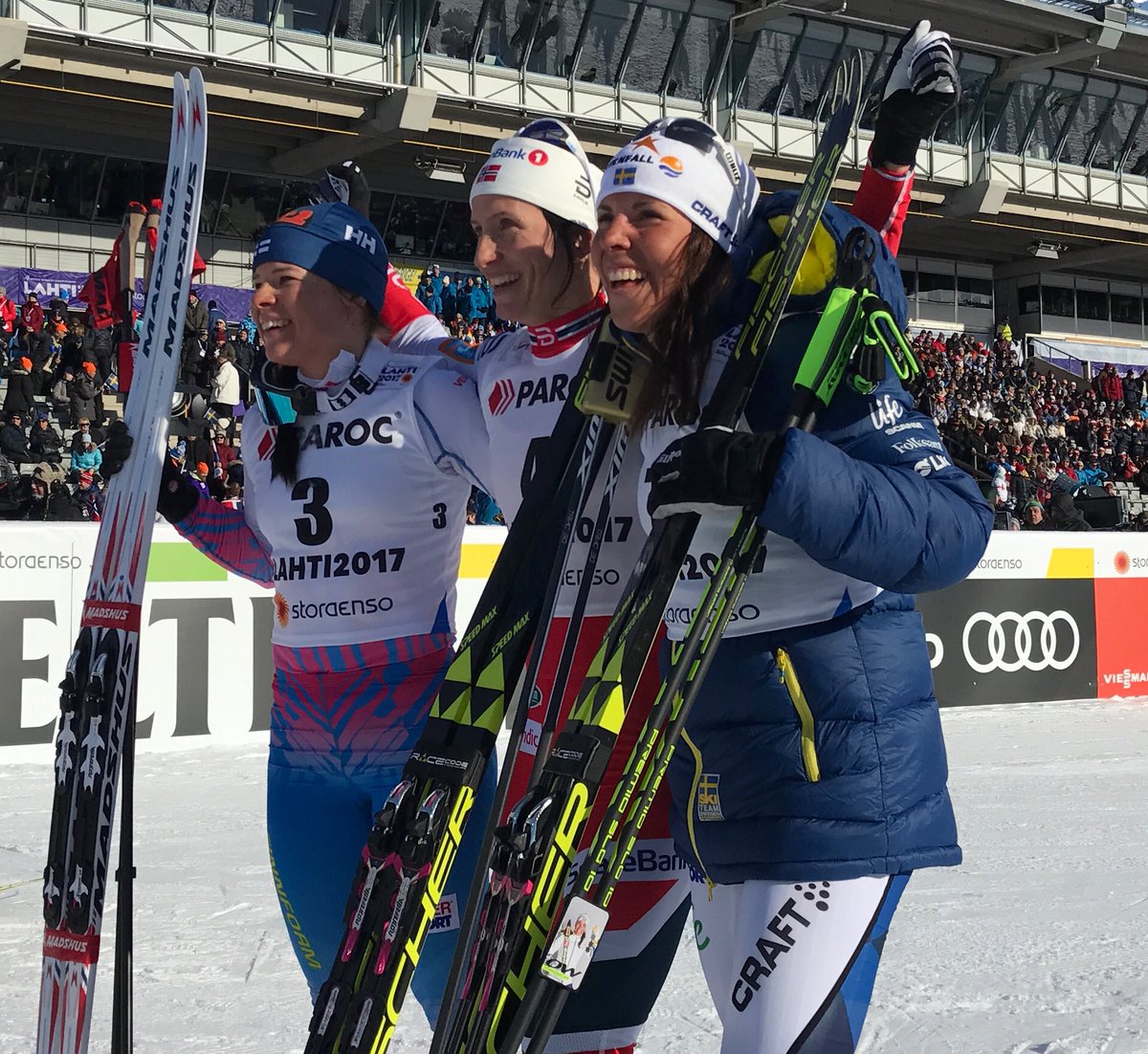
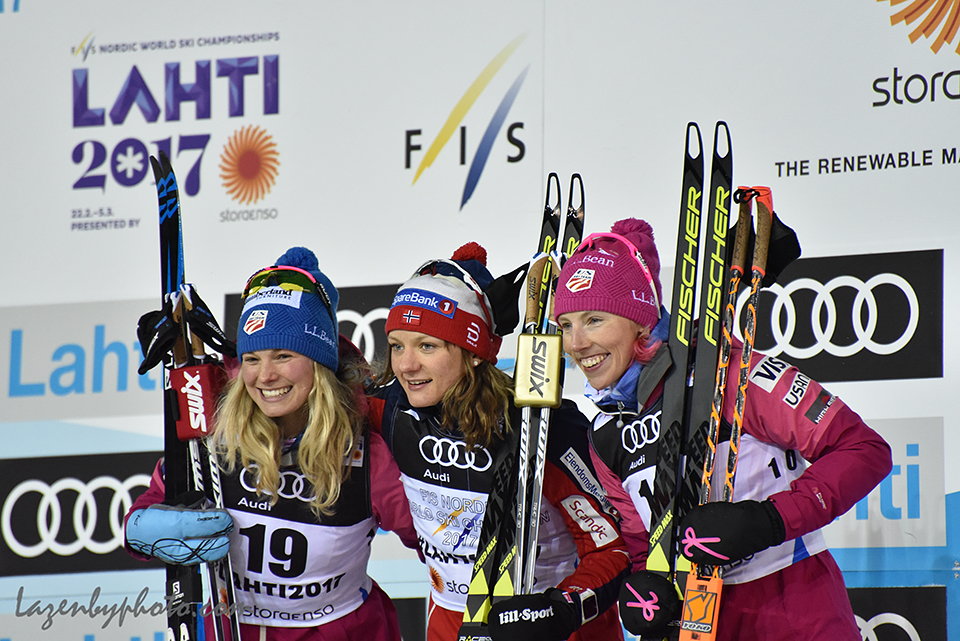
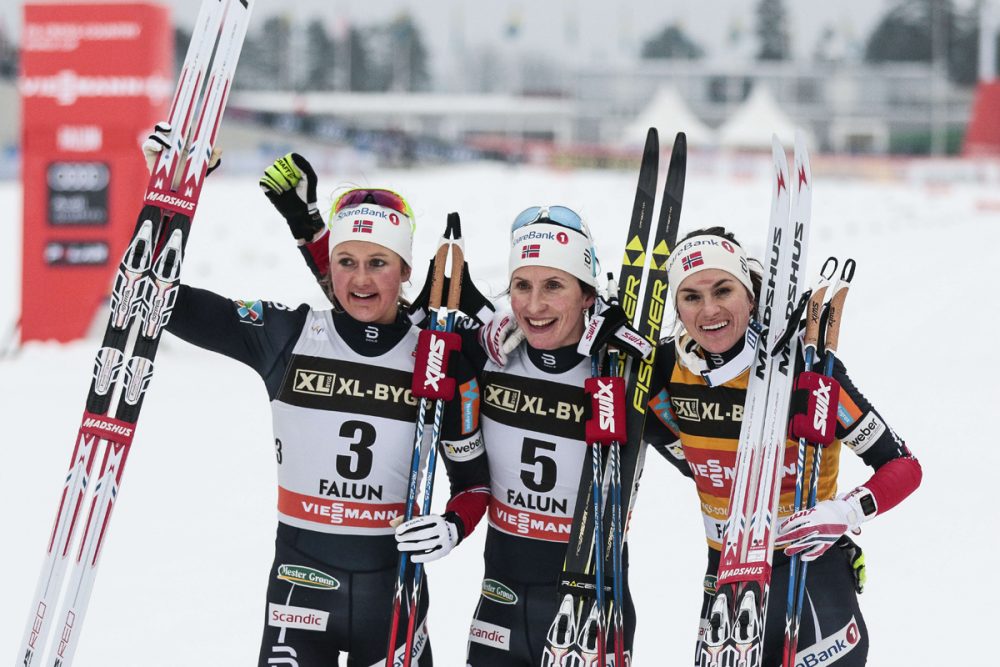
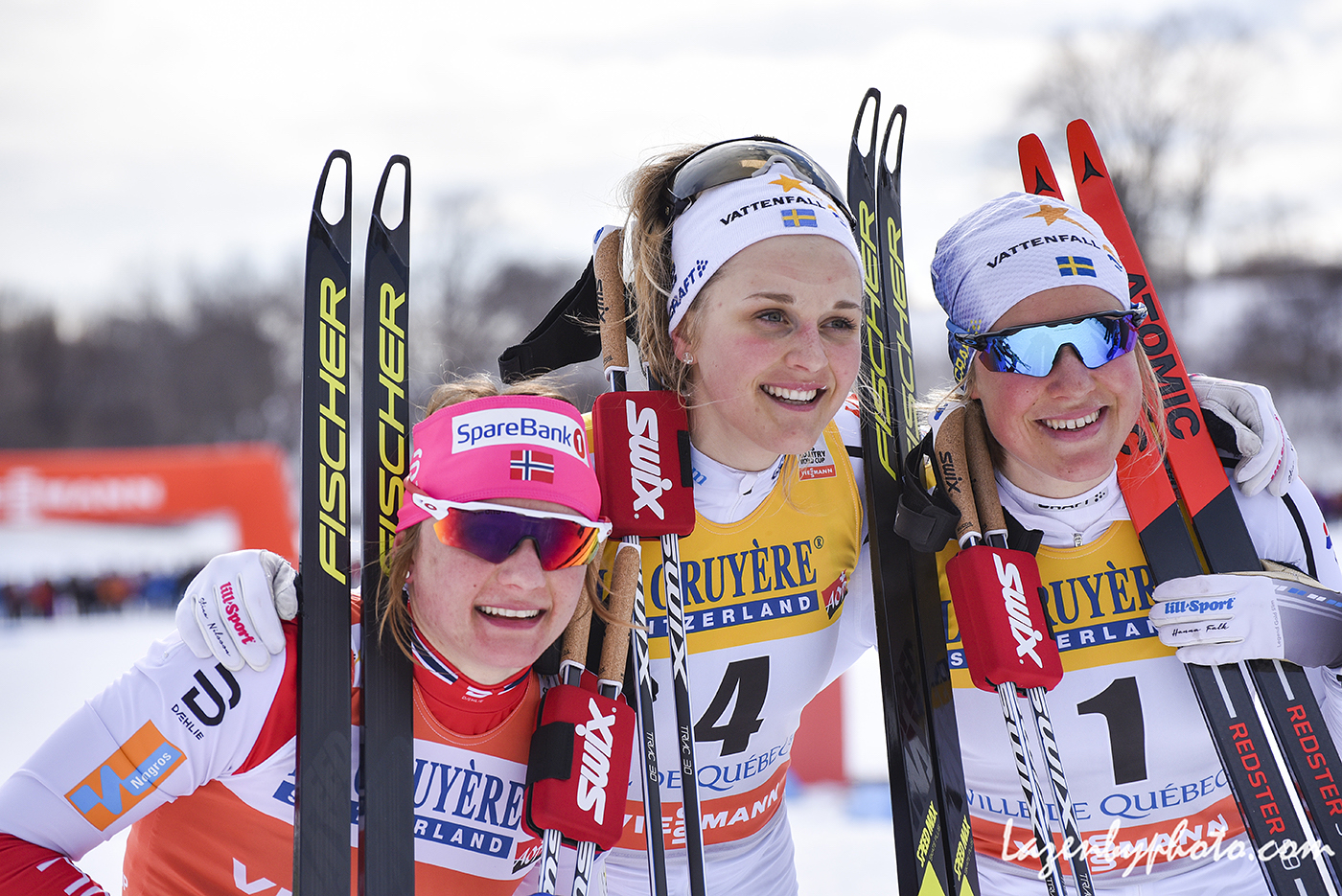
    The women’s freestyle sprint podium at World Cup Finals on Friday in Quebec City, with Sweden’s Stina Nilsson (c) in first, Norway’s Maiken Caspersen Falla (l) in second, and Sweden’s Hanna Falk (r) in third. (Photo: John Lazenby/Lazenbyphoto.com)

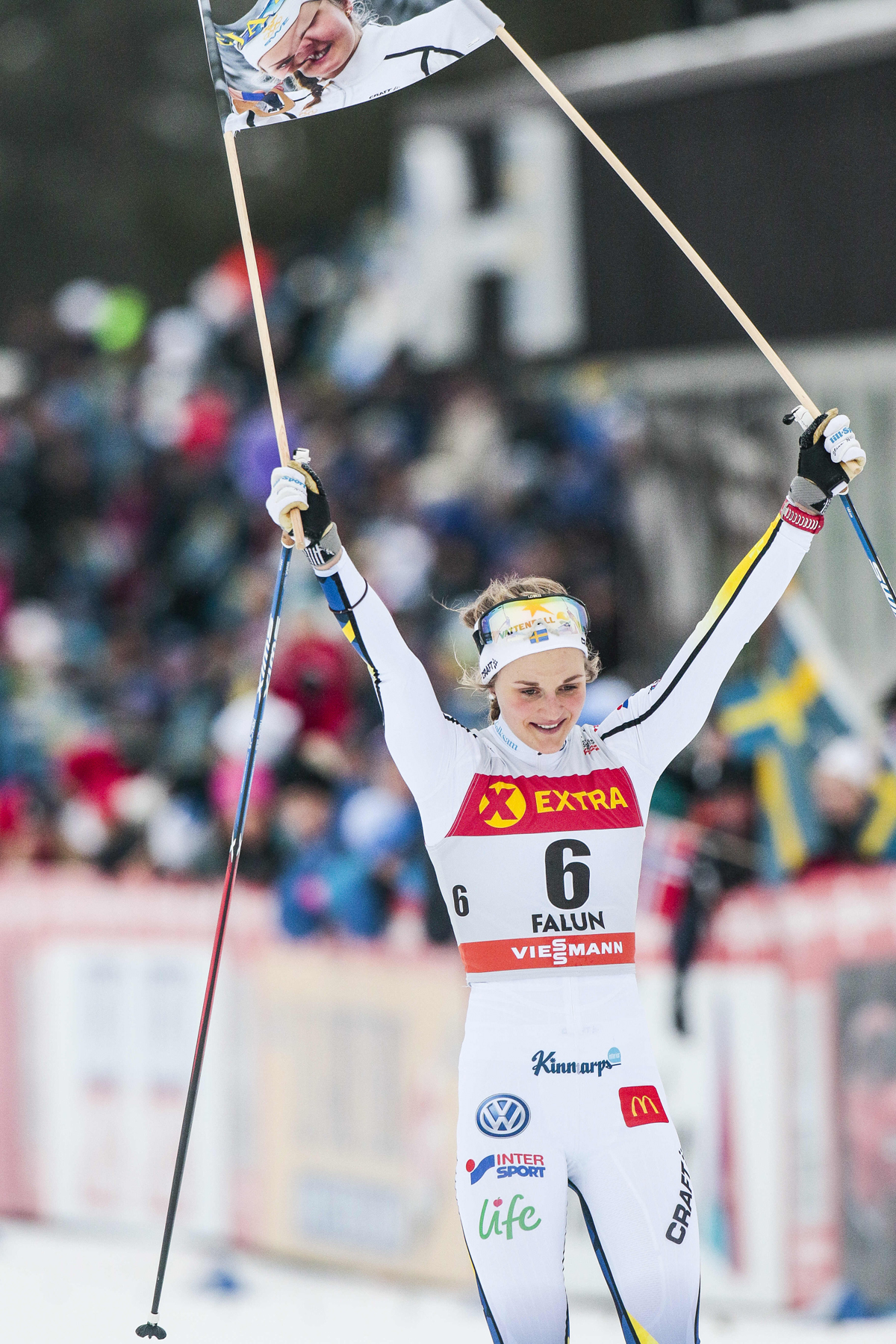
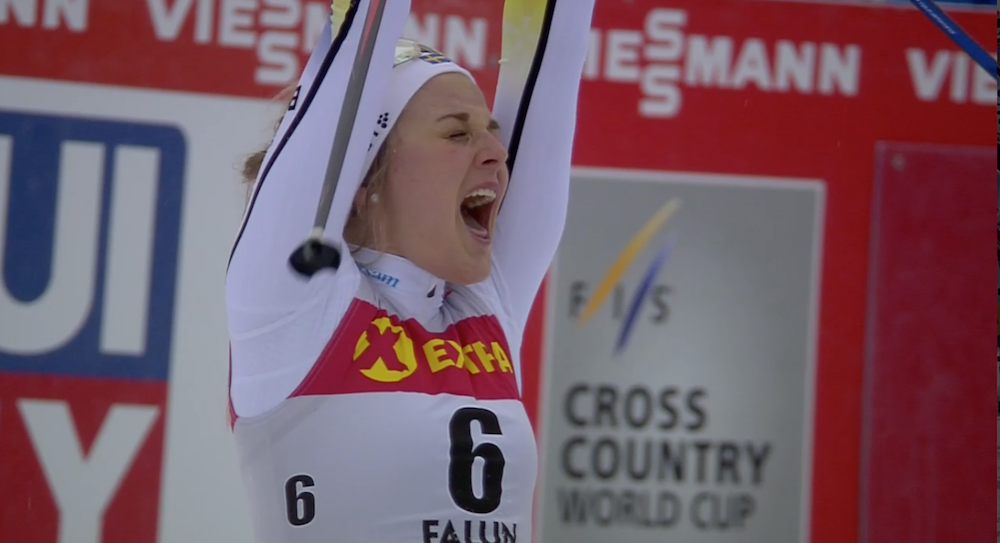
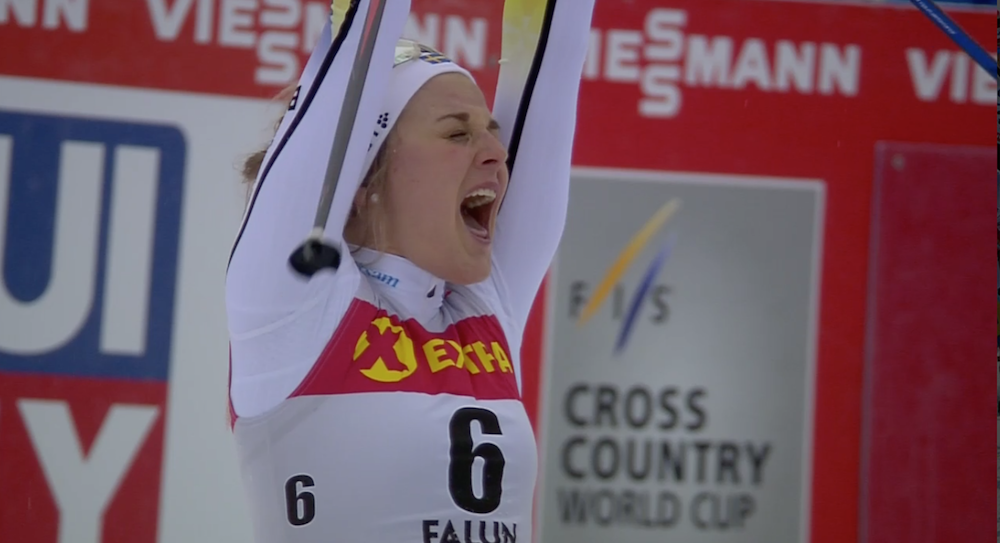
    At the start of the season, Sweden’s Stina Nilsson had three individual World Cup wins to her name. Now, after taking Friday’s freestyle sprint title — and only two races left on this year’s World Cup calendar — Nilsson has quadrupled that number.

    The 23-year-old Swede raced to her ninth victory of the season on Friday in Québec City, crossing first in the women’s 1.5-kilometer freestyle sprint in a time of 3:01.87.

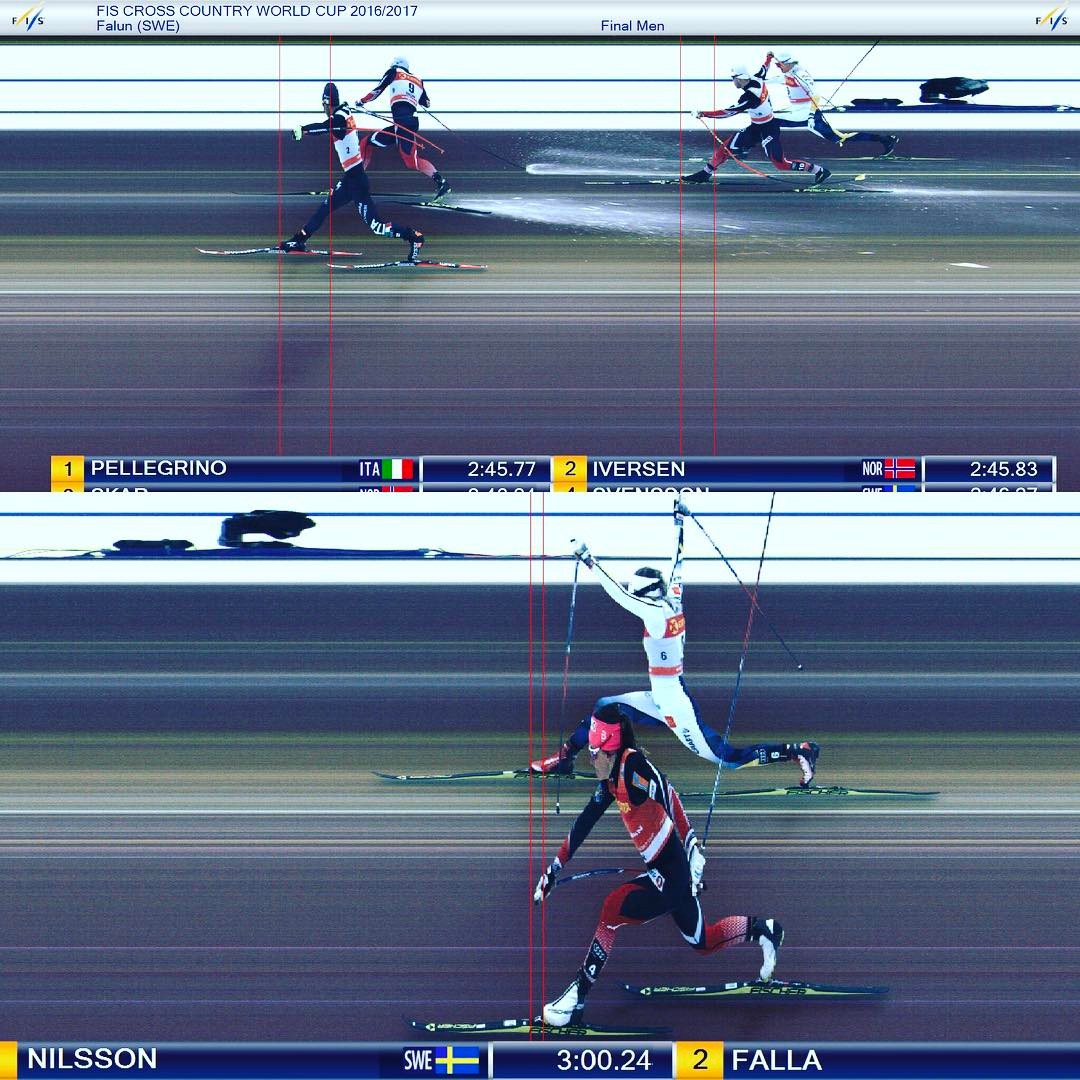
    The closest competitor to Nilsson was Norway’s Maiken Caspersen Falla, who crossed 0.42 seconds behind in second.

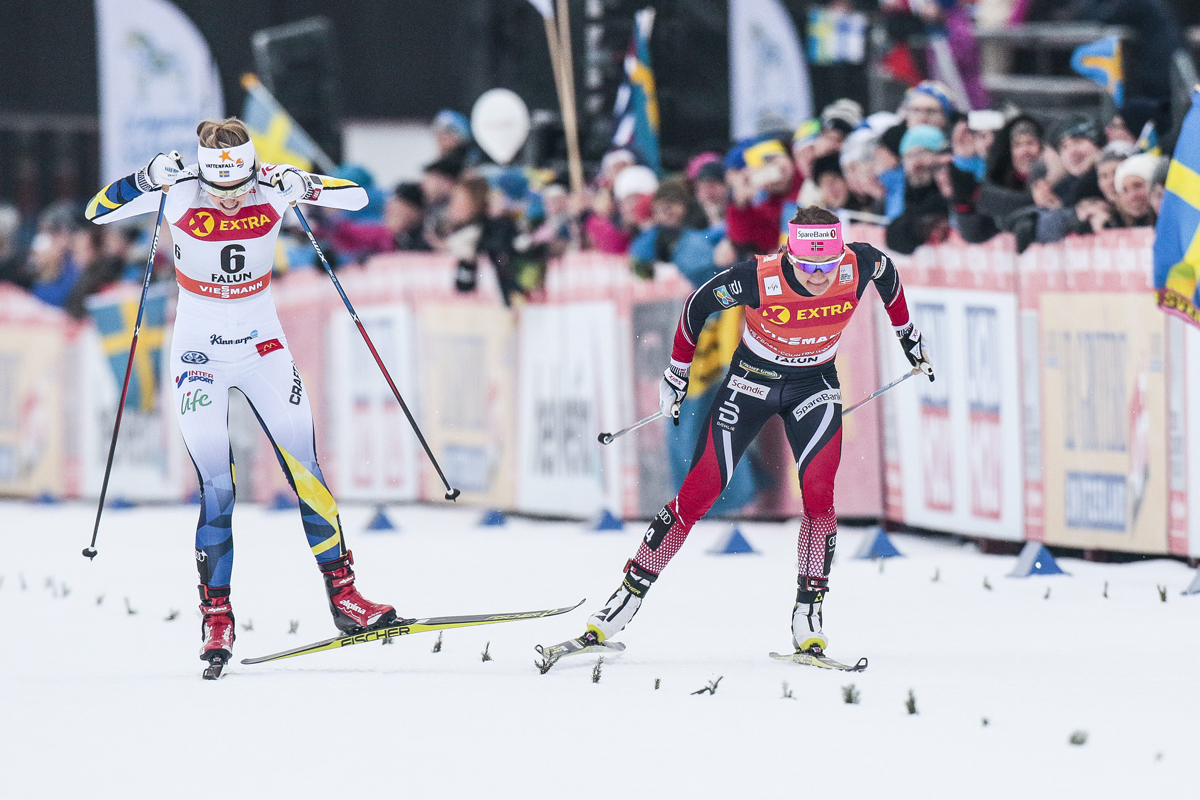
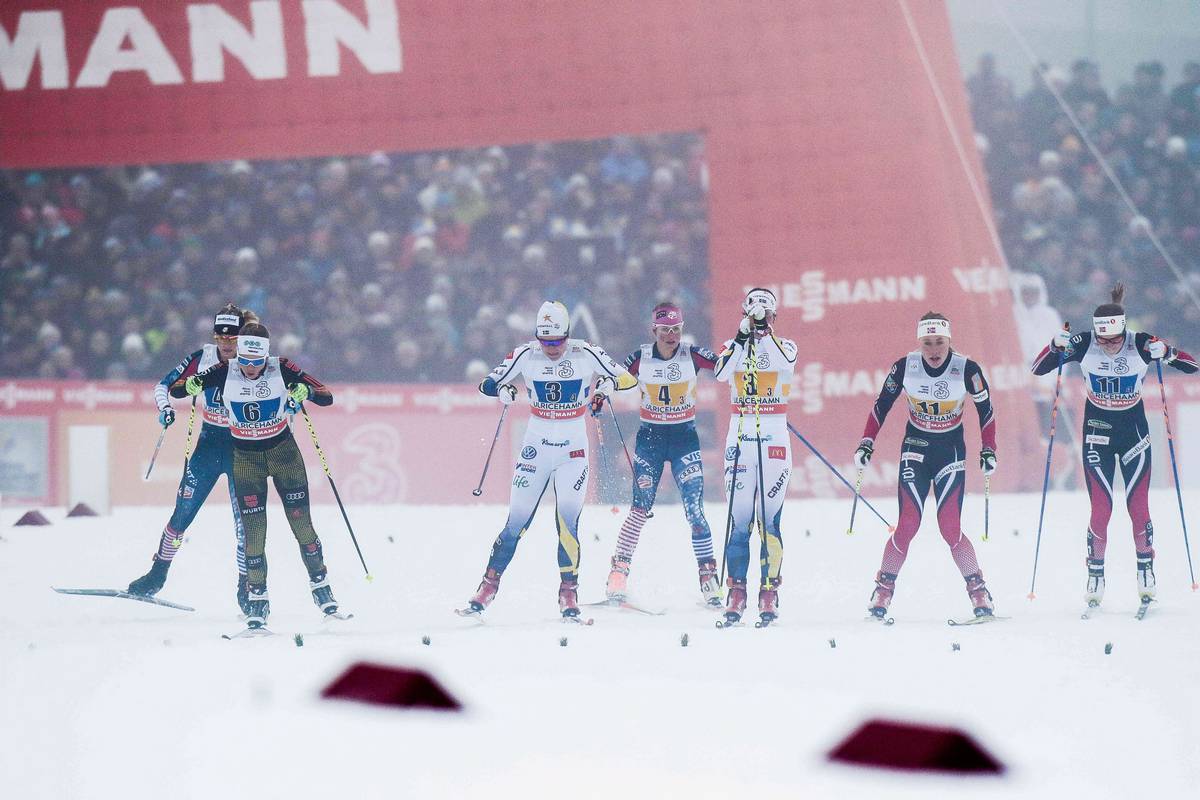
    The two went head to head from the start of the final, with Falla leading Nilsson into the first incline and through the first downhill. Norwegian Heidi Weng clung closely behind and by the second major climb, Nilsson was at the helm, but not for long. Falla forced her way to the front once again, forcing the Swede to pick up her pace. The two began to break away from the rest of the field with 500 meters to go.

    As they made their way down the third major descent, Nilsson moved around Falla and back to the lead, giving herself an edge on the Norwegian for the final climb. The two entered the final finishing stretch together, but with 50 meters left, Nilsson had knocked the Norwegian off the top spot.

    “I have had an amazing season,” Nilsson said during a televised interview with the International Ski Federation (FIS). “And I really like to compete in Quebec, so I am very happy with the race.”
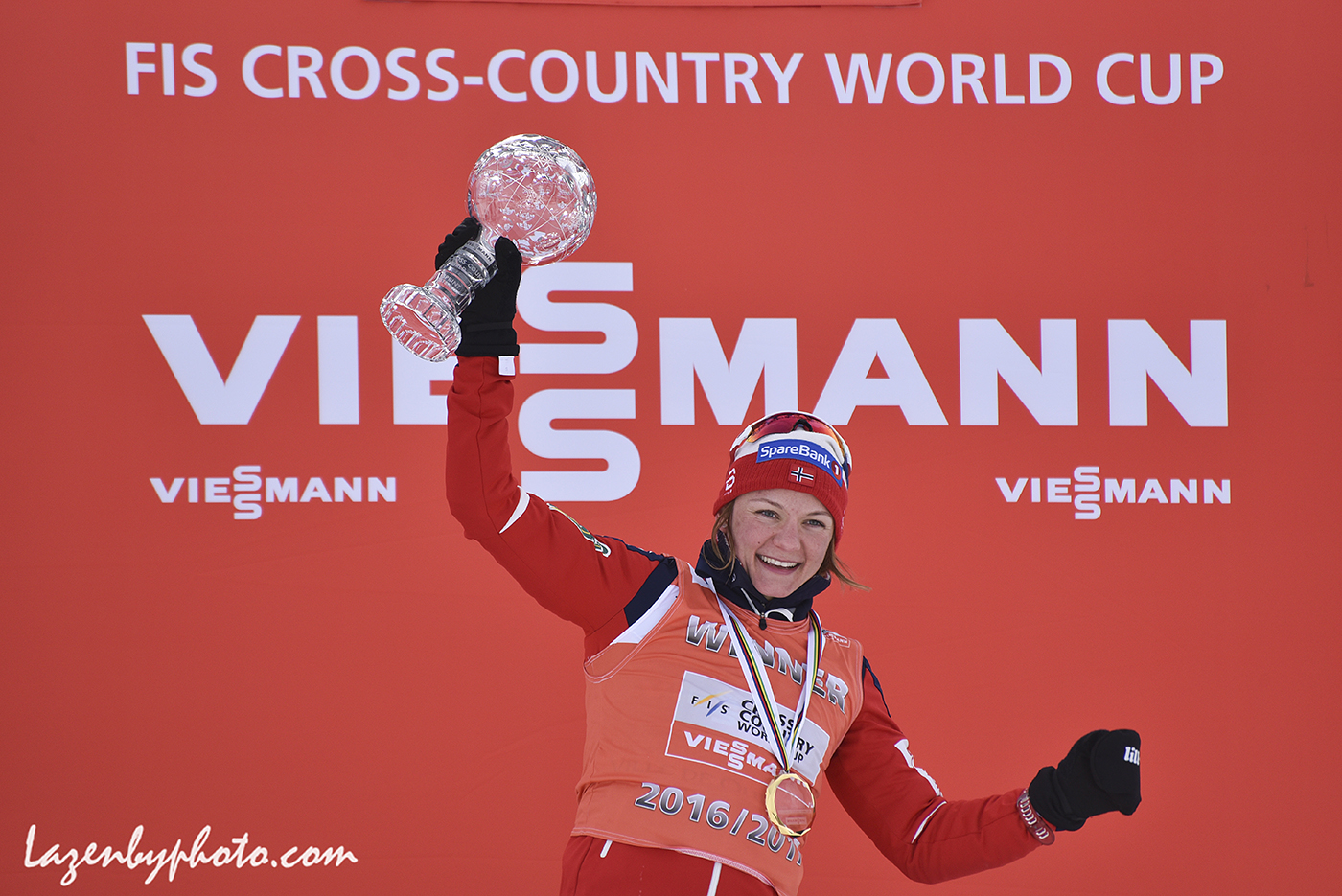
    Norway’s Maiken Caspersen Falla celebrates her second-straight Sprint World Cup Crystal Globe on Friday at World Cup Finals in Quebec City. (Photo: John Lazenby/Lazenbyphoto.com)

    Despite missing the final during last weekend’s sprint in Drammen, Norway, and narrowly sneaking into Friday’s sprint final — she was the second lucky loser in her semifinal after a photo finish with Switzerland’s Nadine Fähndrich — Falla’s podium secures her as the overall sprint leader and awards her with her second-straight Sprint Crystal Globe.

    “When you have a really bad day as I did in Drammen, you’re very happy to be back on the podium,” Falla told FasterSkier during an in-person interview.

    “It’s great to be here and take the crystal globe home,” she added in an interview with FIS.

    Rounding out the final podium spot in third (+2.58) was another Swede, Hannah Falk, who had started the day with a qualifying win in 3:02.91. Despite breaking a pole early in her quarterfinal, she clawed her way back to second to automatically advance to the semifinal and ultimately reach the final.

    “I tried to just stay calm and knew that I got high speed in the end,” Falk told FasterSkier about how she handled exchanging poles after hers broke in the second quarterfinal.

    Falk finished the season ranked third in the Sprint World Cup, behind her teammate Nilsson in second and Falla in first.

    “I’m top number three in the Sprint World Cup so it was my goal today to take that podium,” Falk said.

    Also in the final, Sweden’s Ida Ingemarsdotter was the third Swede in the top four in fourth (+3.02). In her first World Cup sprint final, Fähndrich finished fifth (+3.41) and Weng placed sixth after breaking a pole (+32.36). 

    “I think I made all the right tactical decisions today,” Fähndrich told Swiss broadcaster SRF, according to a translation.

    Just by making the final, Weng essentially locked up the Overall World Cup title with a 325-point lead over Finland’s Krista Parmakoski in second. Norway’s Ingvild Flugstad Østberg another 73 points back in third and 123 points ahead of Nilsson in fourth overall.

    “My goal right now is to be top three in the world overall,” Østberg told FasterSkier after a three-woman crash (with Slovenia’s Vesna Fabjan and Switzerland’s Laurien van der Graaff) ended their runs in the second semifinal. Østberg finished the day in eighth.

    “I really have to fight for that because Stina is chasing me,” Østberg added of her overall podium goal. “The world champs in Lahti was not what I was hoping for so it will be a huge goal and really great if I could be third in the Overall World Cup.”

    Diggins 9th; Kern 24th in First World Cup

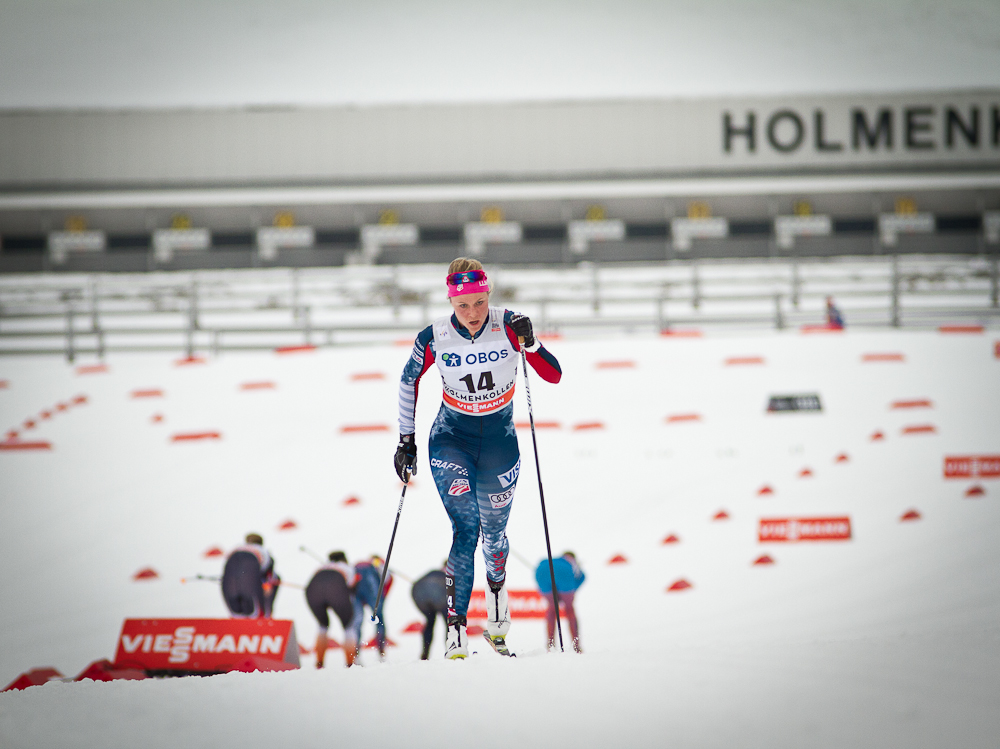
    U.S. Ski Team (USST) member Jessie Diggins was the top North American woman on the day, placing ninth overall after finishing fifth in her semifinal. Coming off of a silver medal in the freestyle sprint at this year’s Nordic World Championships, Diggins had high hopes for her performance in Friday’s final sprint.
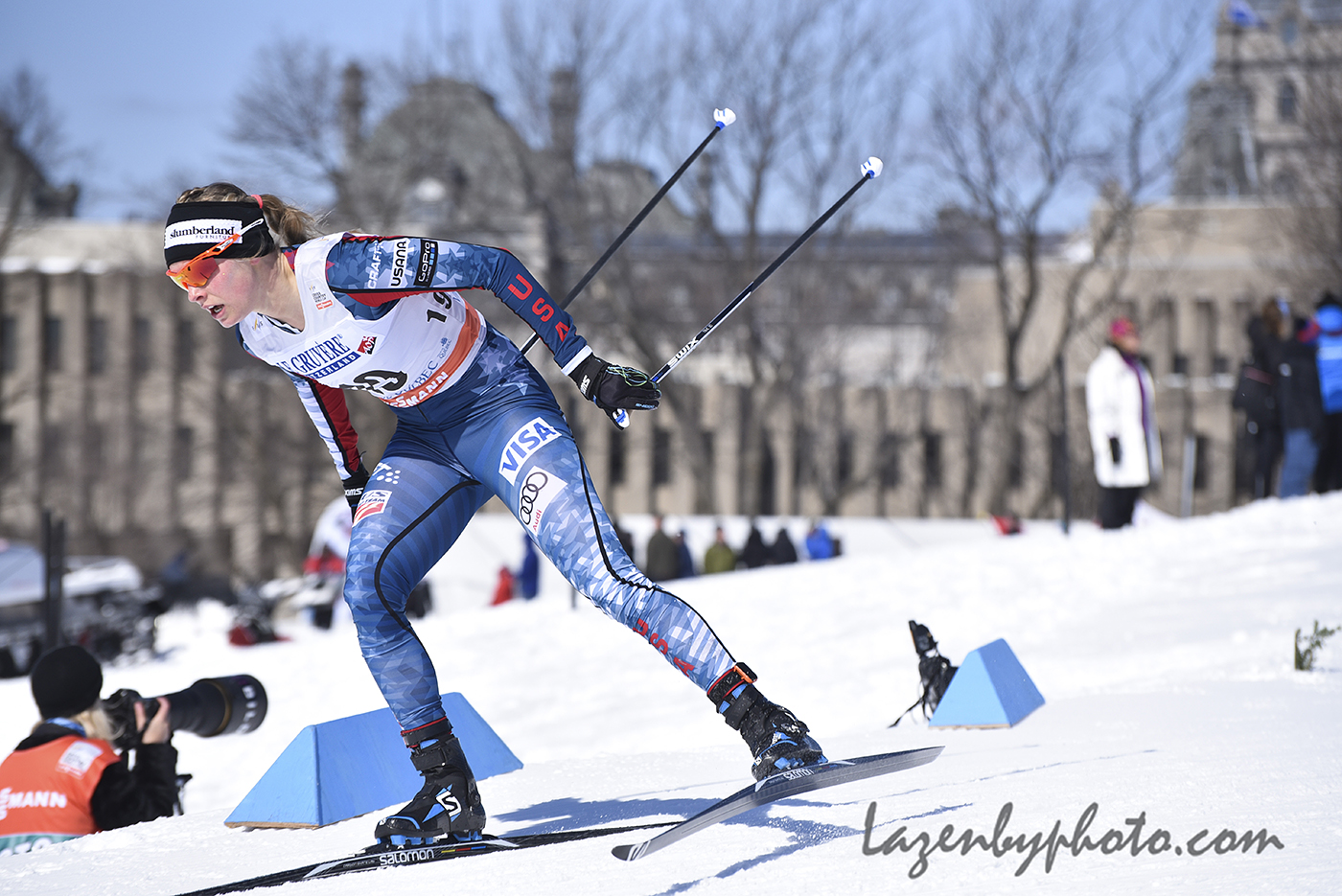
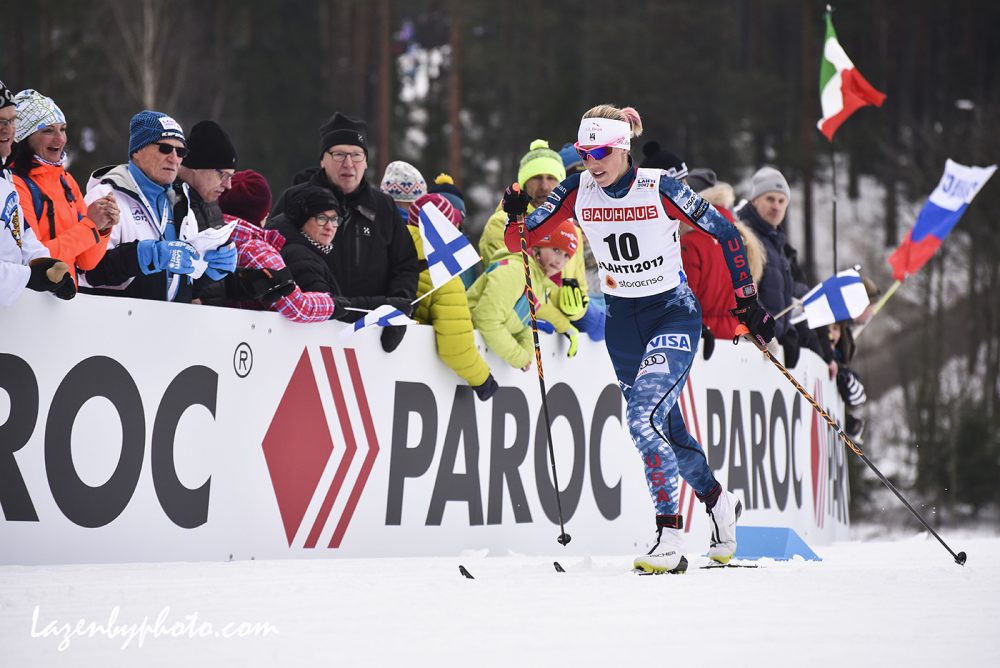
    Jessie Diggins (U.S. Ski Team) racing to 11th in the women’s 1.5 k freestyle sprint qualifier on Friday at World Cup Finals in Quebec. She went on to reach the semifinals and placed ninth overall. (Photo: John Lazenby/Lazenbyphoto.com)

    However, with Nilsson, Falla, Falk, and Fähndrich all pushing the pace in her semifinal, Diggins missed advancing to the final.

    “My finishing speed has been good all season and especially from the last skate sprint we did in Lahti, so I had a lot of high hopes for today,” Diggins wrote in an email. “But in my semifinal there was a lot of fighting for position and it’s always frustrating when your whole heat finishes 1.4 seconds faster than the winner of the other semi! But, that is sprinting sometimes.”

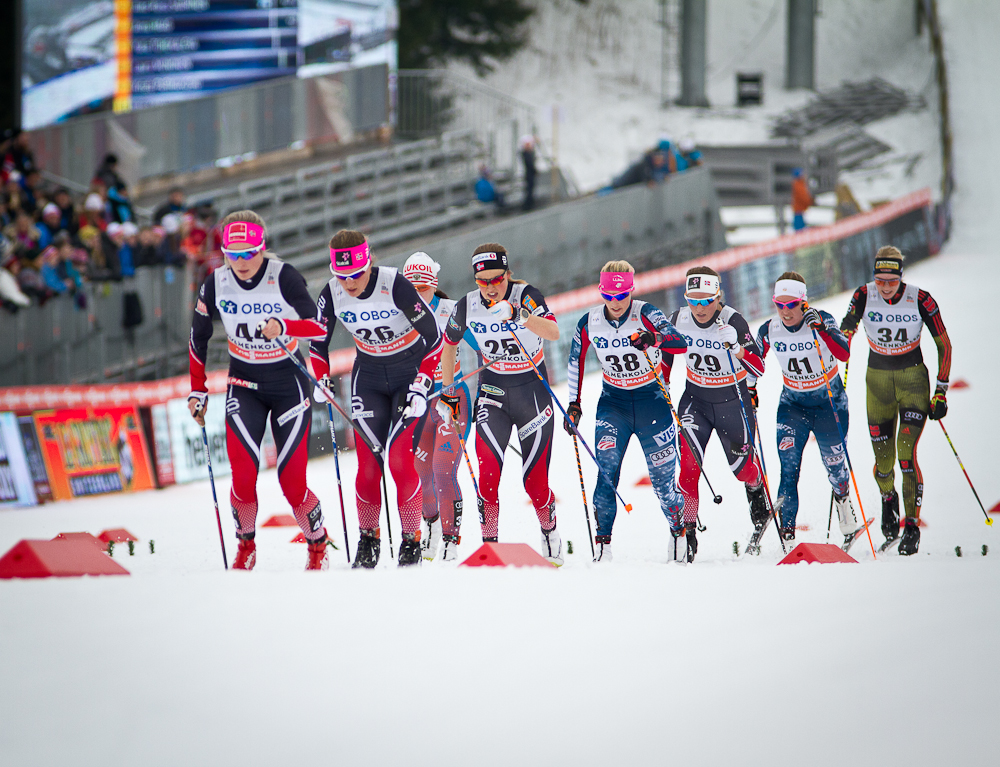
    Along with Diggins, who qualified 11th, four other Americans made the heats: Sadie Bjornsen (who qualified sixth), Sophie Caldwell (18th), Rosie Brennan (27th), and Julia Kern (19th). Bjornsen was the next top finisher for the U.S., placing 16th, just 0.12 seconds away from advancing to the semifinals.

    “Sadie, in her quarterfinal, she did everything she wanted to do, she put herself in the absolute right position to be right here in second place coming into the finish straight and just barely missed, just got passed at the line,” USST head coach Chris Grover said.

    Bjornsen had been positioned in second through the final turn, until she was eventually outlunged by Falk.
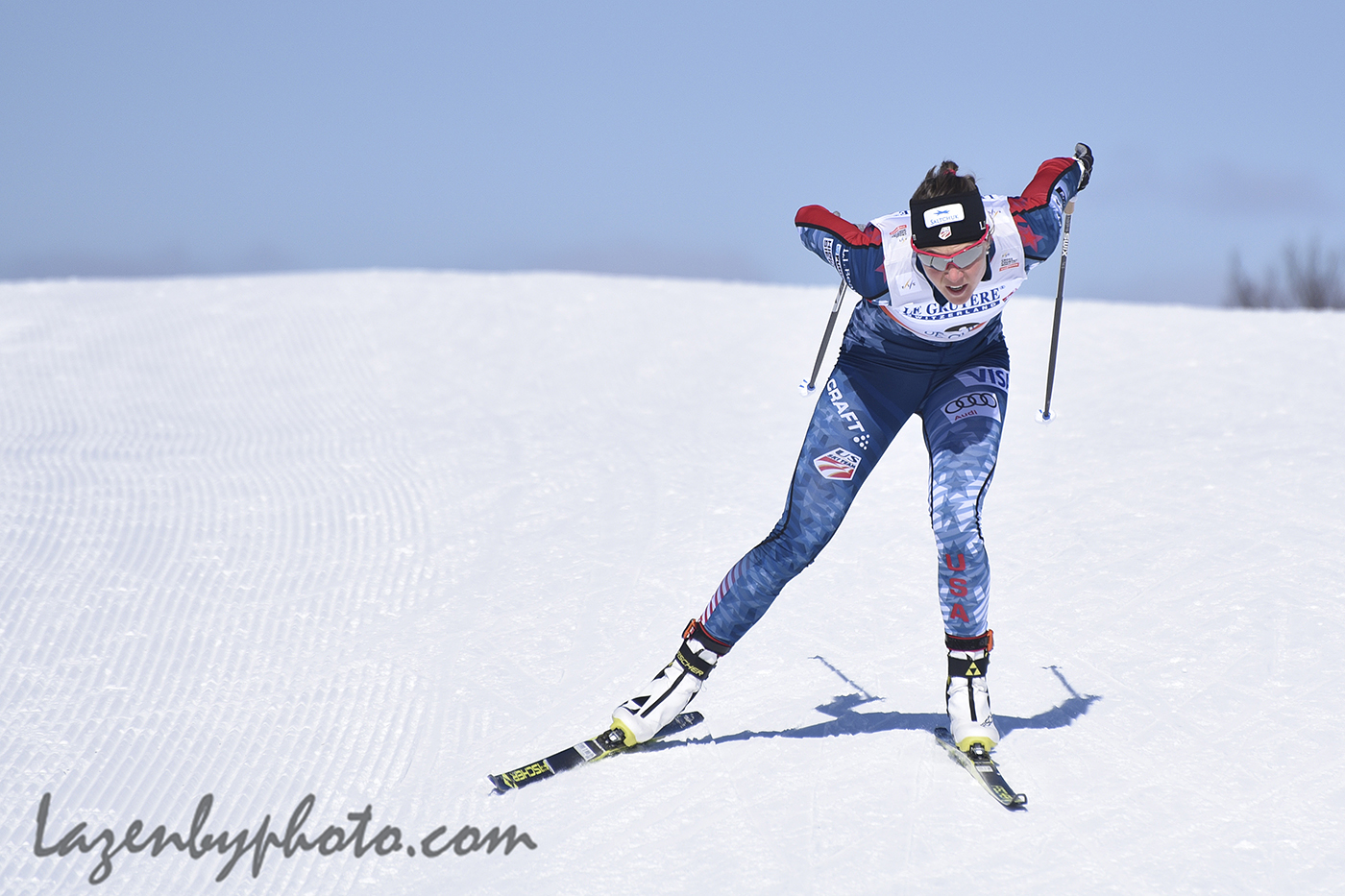
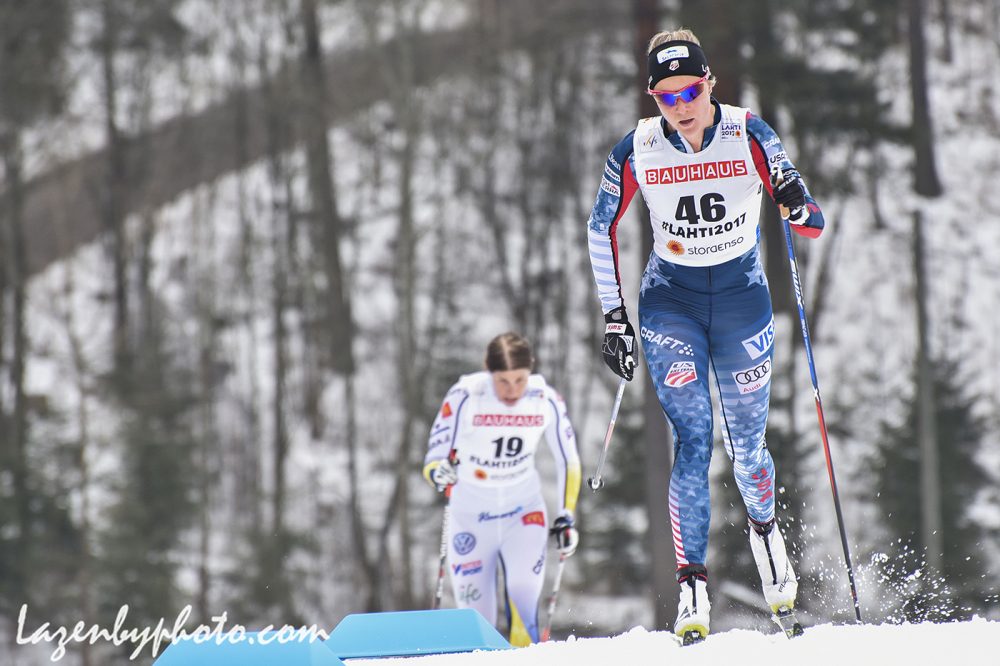
    Sadie Bjornsen (U.S. Ski Team) racing to sixth in the women’s 1.5 k freestyle sprint qualifier on Friday at World Cup Finals in Quebec City. She went on to place 13th overall. (Photo: John Lazenby/Lazenbyphoto.com)

    “I just haven’t been able to find that perfect speed at the finishing stretch pretty much every sprint this year,” Bjornsen said. “I was trying to switch things up today and see if I could and I gave it my all and unfortunately didn’t take the draft right into the finish.”

    After qualifying with the sixth-fastest time, 3.47 seconds behind Falk, Bjornsen indicated that even if this season’s World Cup sprints are done, her perfection over the art of sprinting is not.

    “When I’m qualifying that well, I know I can sprint well, that’s like the most exciting part,” Bjornsen said.

    Also left wanting a little more on Friday was Caldwell, who finished 21st. Caldwell had been positioned in third coming into the final turn before the finishing stretch, when she fell after a near-run in with Sweden’s Anna Dyvik. The Swede was relegated to last in that quarterfinal.

    “Today was a really frustrating day for me and not the way I wanted to end the World Cup sprint season,” Caldwell wrote in an email. “My season has been solid and consistent, but I’ve had three crucial falls now and those bummed me out. Davos was entirely my own doing, but Toblach and today were pretty out of my control, which is frustrating because I don’t know what I could have done differently.”

    Caldwell plans to race both of the final two distance days of the World Cup season, though the sprint had been her primary focus.

    “I haven’t been able to do very much distance racing this year, so I have zero expectations and will hopefully be able to have some fun out there!” Caldwell wrote. “I am happy with the season and I feel like I’ve skied a little better than the results show due to some falls, but I’m eager to stay on my feet and accomplish more next season.”
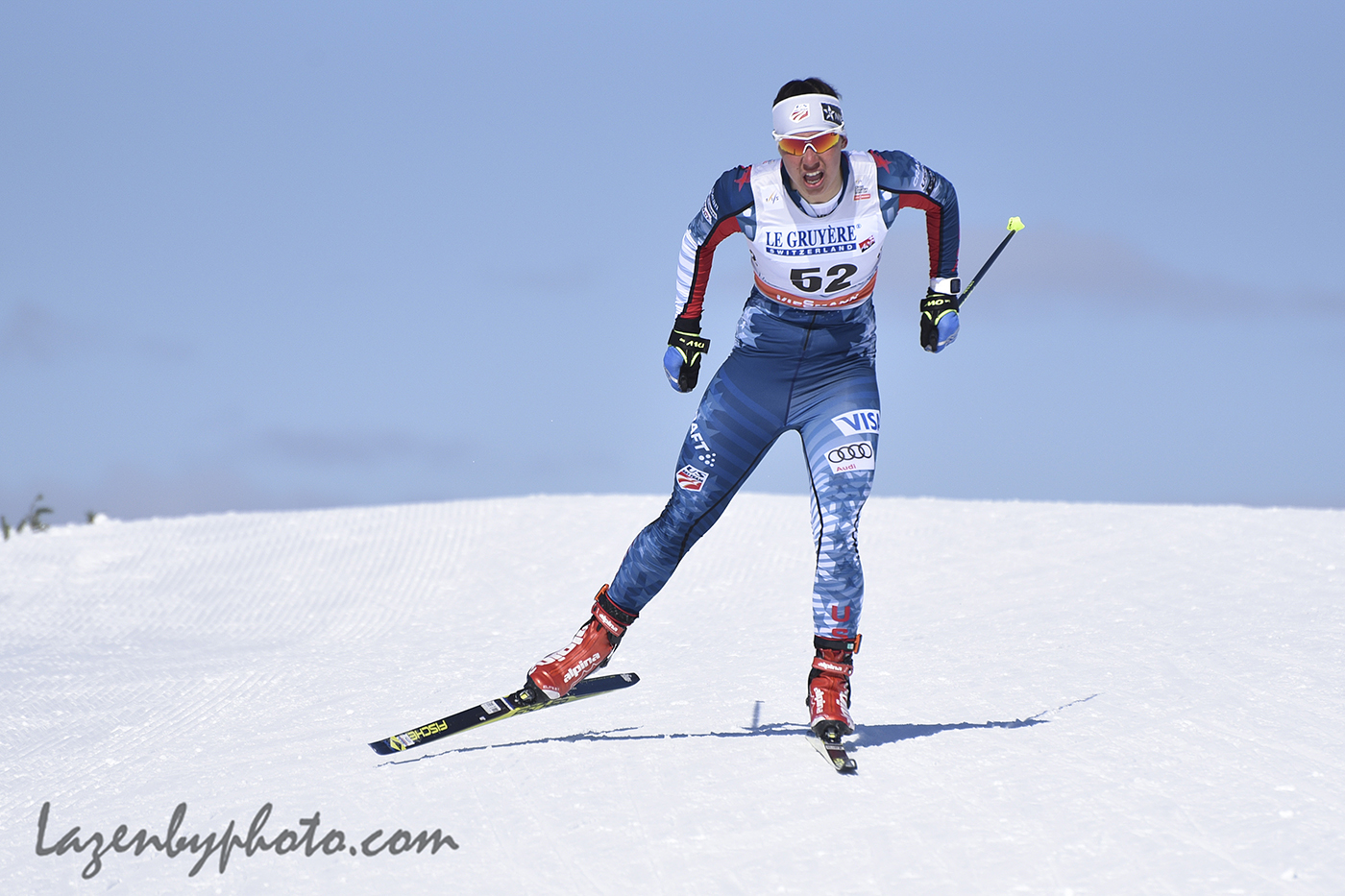
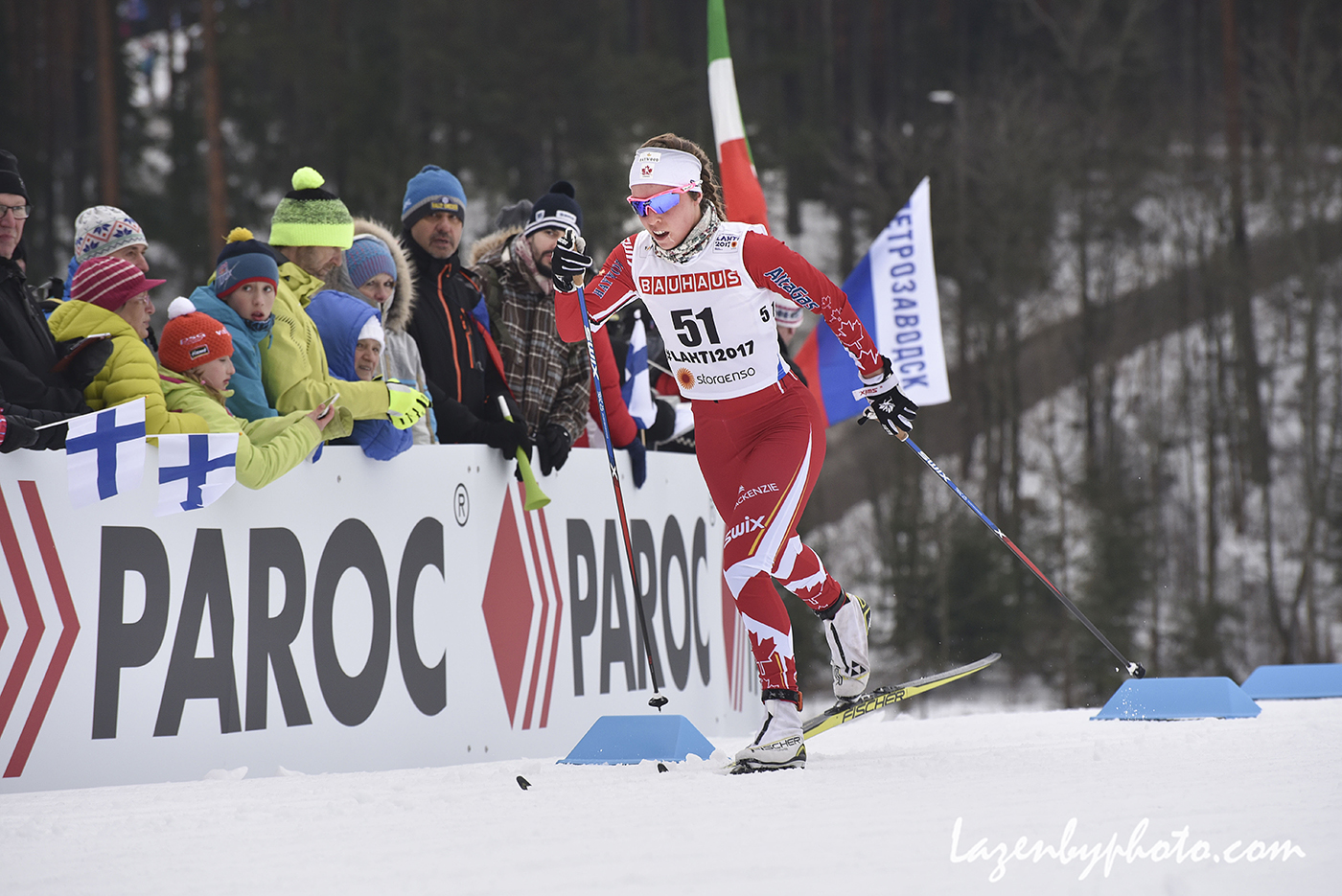
    Julia Kern (U.S. Ski Team D-team/SMS) racing to 29th in the women’s 1.5 k freestyle sprint qualifier on Friday at World Cup Finals in Quebec City. In her first World Cup race, Kern ended up 24th on the day. (Photo: John Lazenby/Lazenbyphoto.com)

    In her first World Cup race, Kern qualified for the heats in 29th and raced in the day’s first quarterfinal — the same as Diggins, sprint leader Falla, Ingemarsdotter, and Fähndrich.

    “At the start line it almost felt like a dream because there I was at the start line next to some of the best skiers in the world, skiers who I have looked up to and watched race after race on my computer screen to learn and gain inspiration from,” Kern wrote.

    Kern explained that though she was a little nervous about starting the sprint on Friday, she cited her recent performances at U.S. Junior Nationals in Lake Placid, N.Y., where she won all three individual races, as giving her confidence. Though getting into the heats would require what she referred to as “a killer day”, the 19-year-old USST development team member pulled it off, ultimately crossing in fifth in her quarterfinal for 24th overall.  

    I felt like I had skied the qualifier pretty well technically, but I didn’t feel my extra spark I get when I am having a really good day so I was very surprised when Chris Grover told me I was hanging in 29th!” Kern wrote. “When it was confirmed that I was in the heats I was extremely excited and a little shocked. It has been something I have imagined over and over when I watch the World Cup sprints on my computer and for it to happen in my first World Cup was truly incredible.”

    With two more World Cup races to go, Kern is coming into them with a newfound confidence.

    “This is a huge confidence booster for me because it is easy to make a goal and have my teammates and coaches who believe in me tell me results like this are possible, but it is another thing to actually live up to it and believe it yourself too,” Kern wrote.
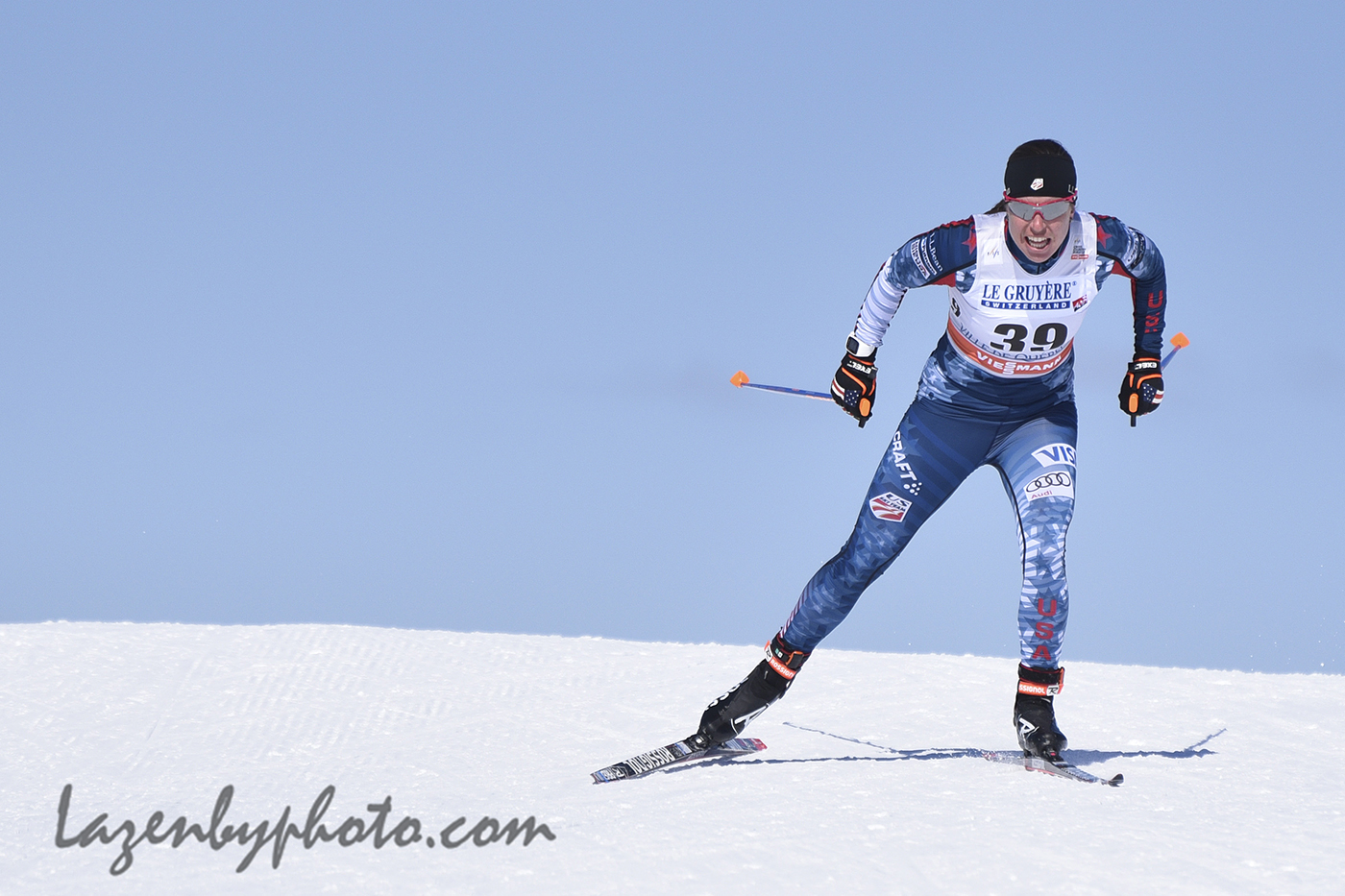
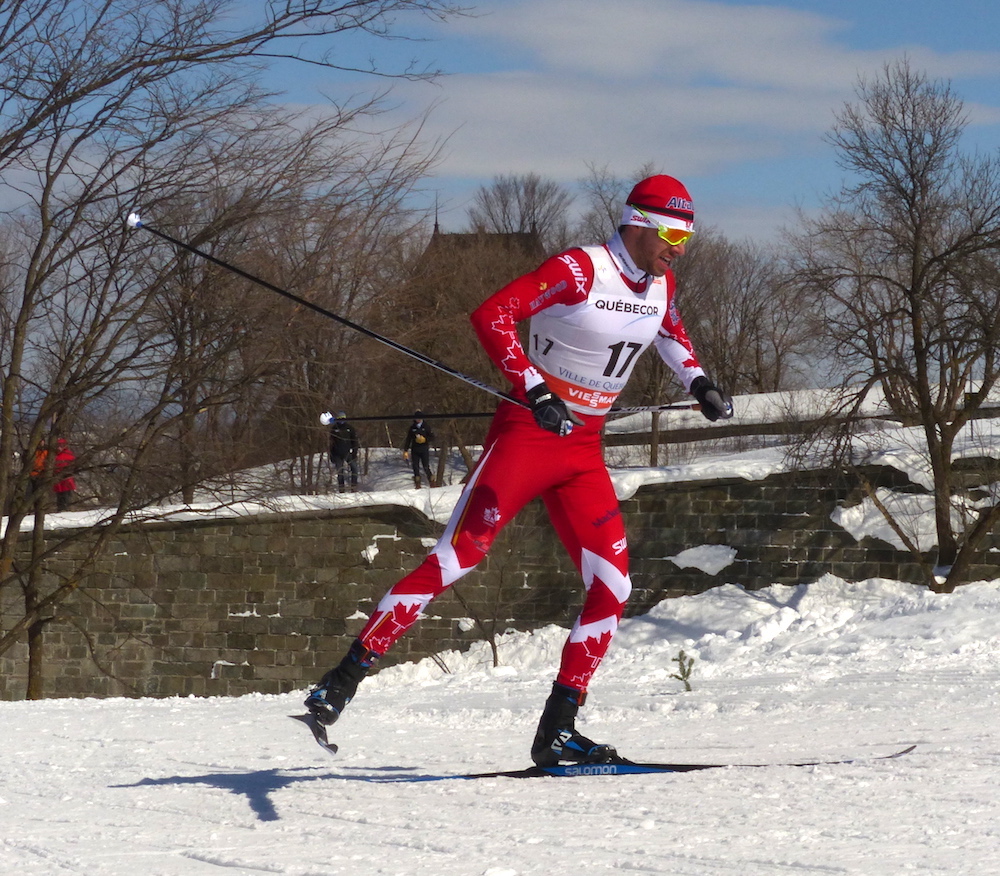
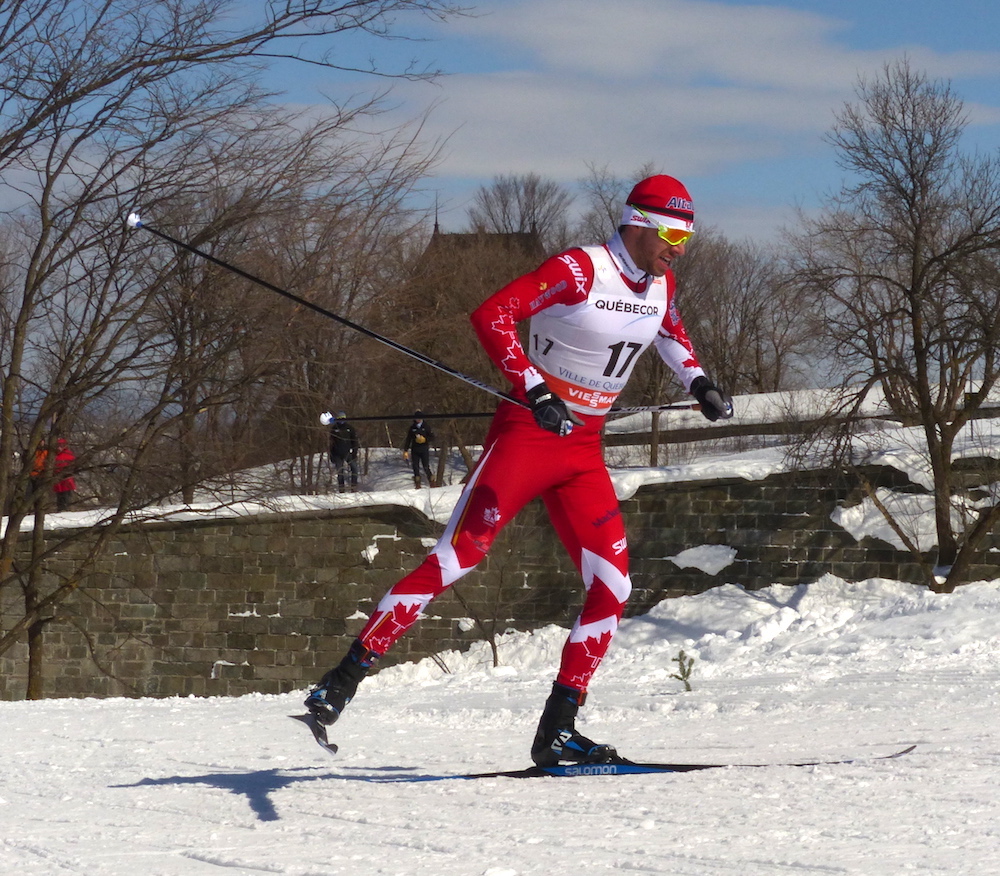
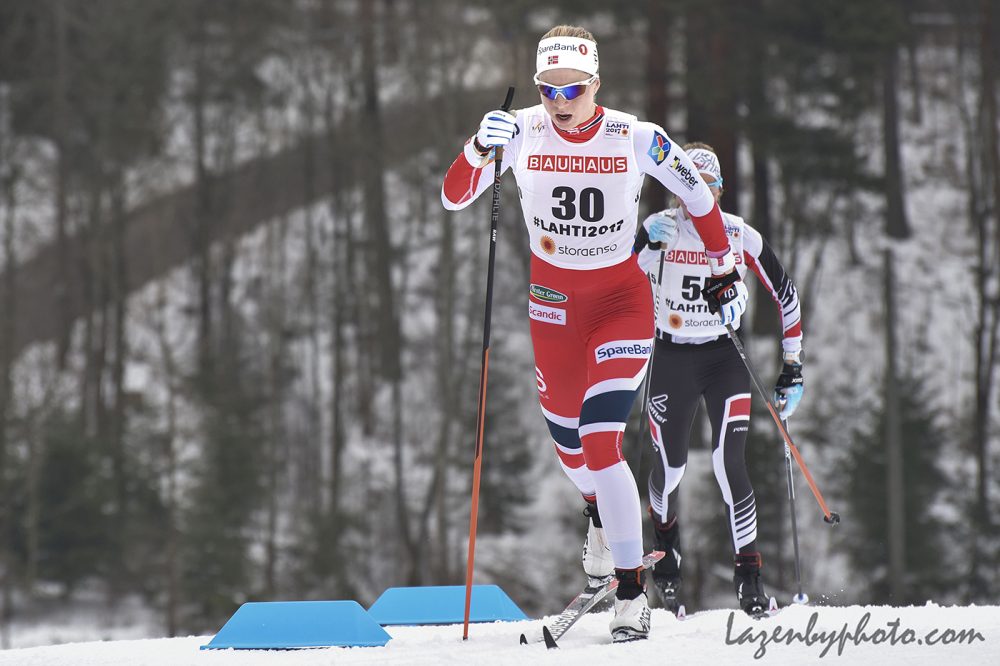
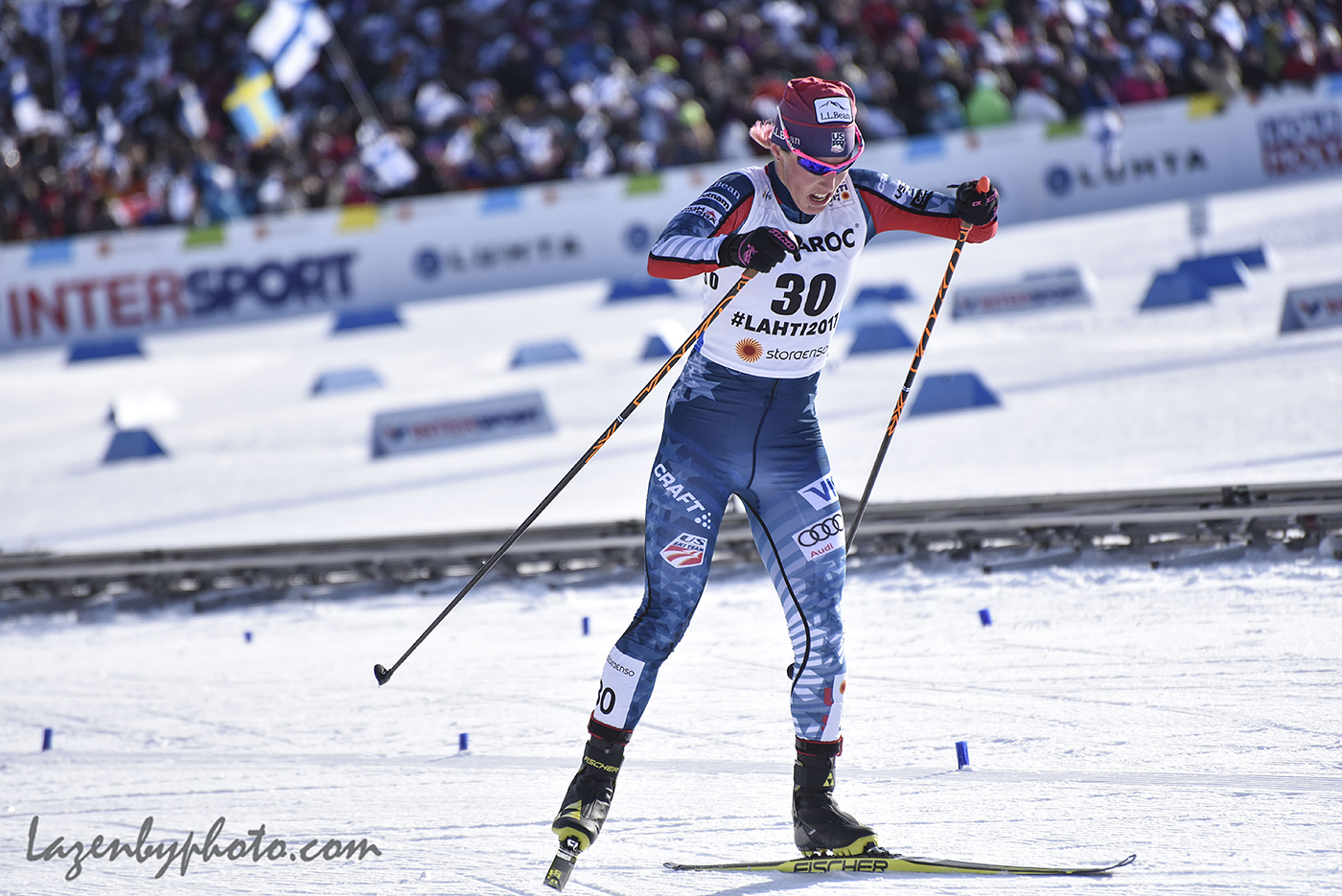
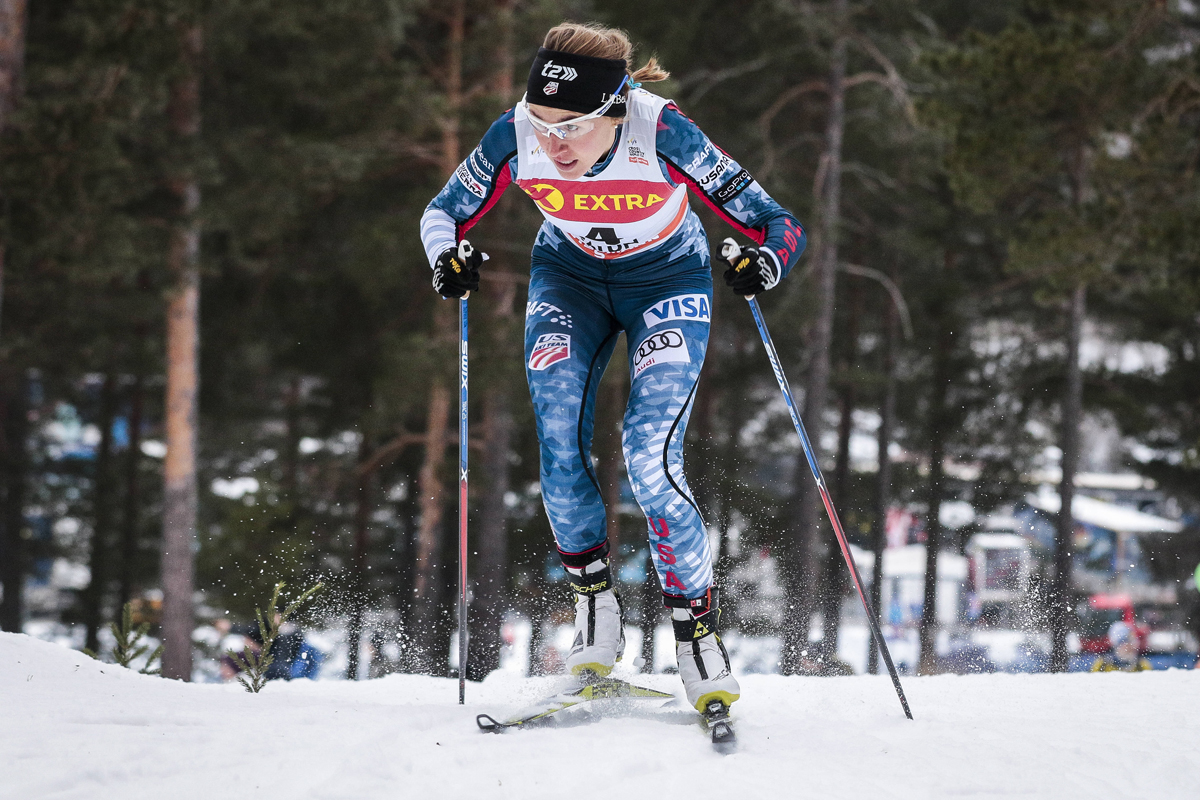
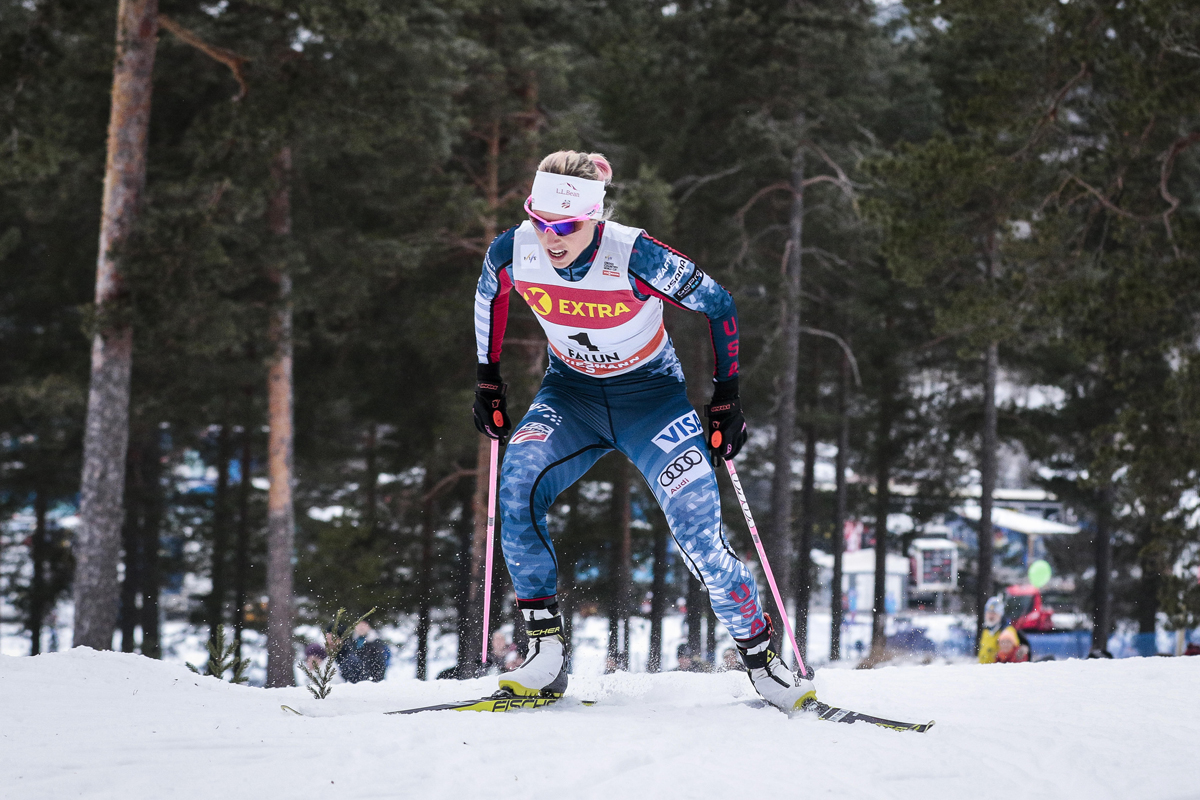
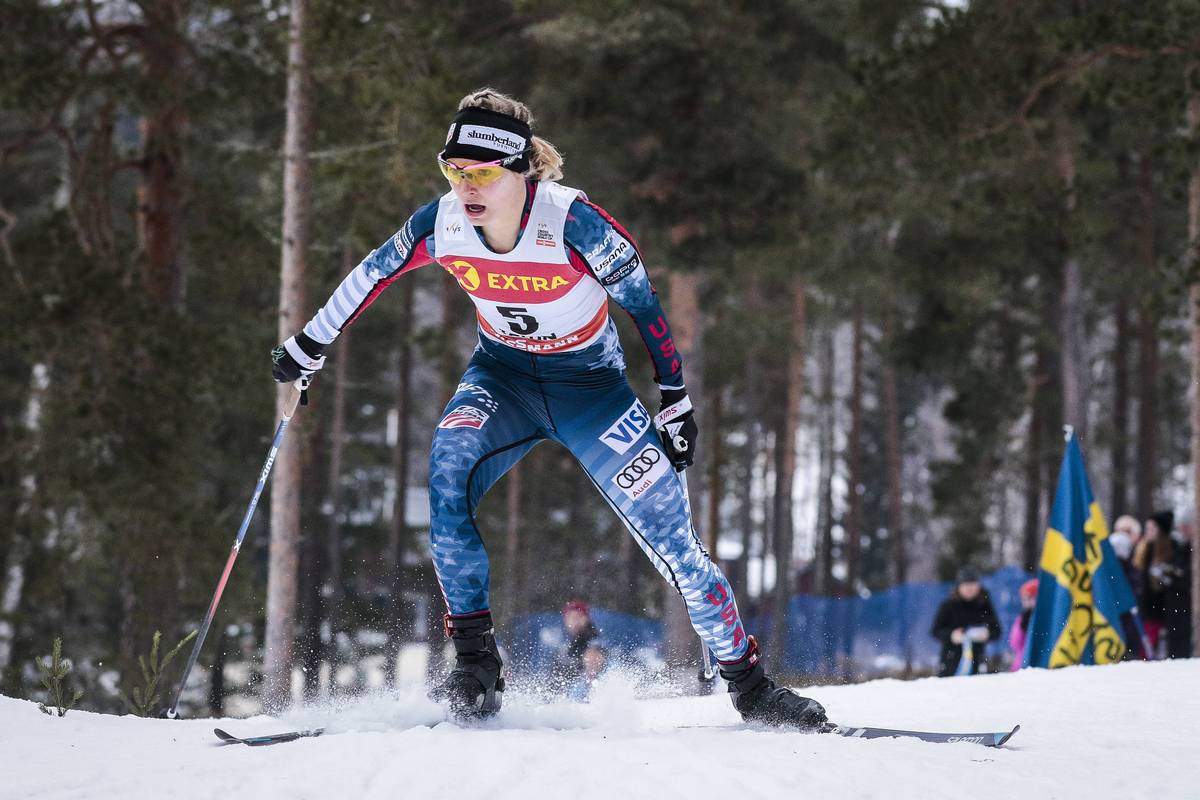
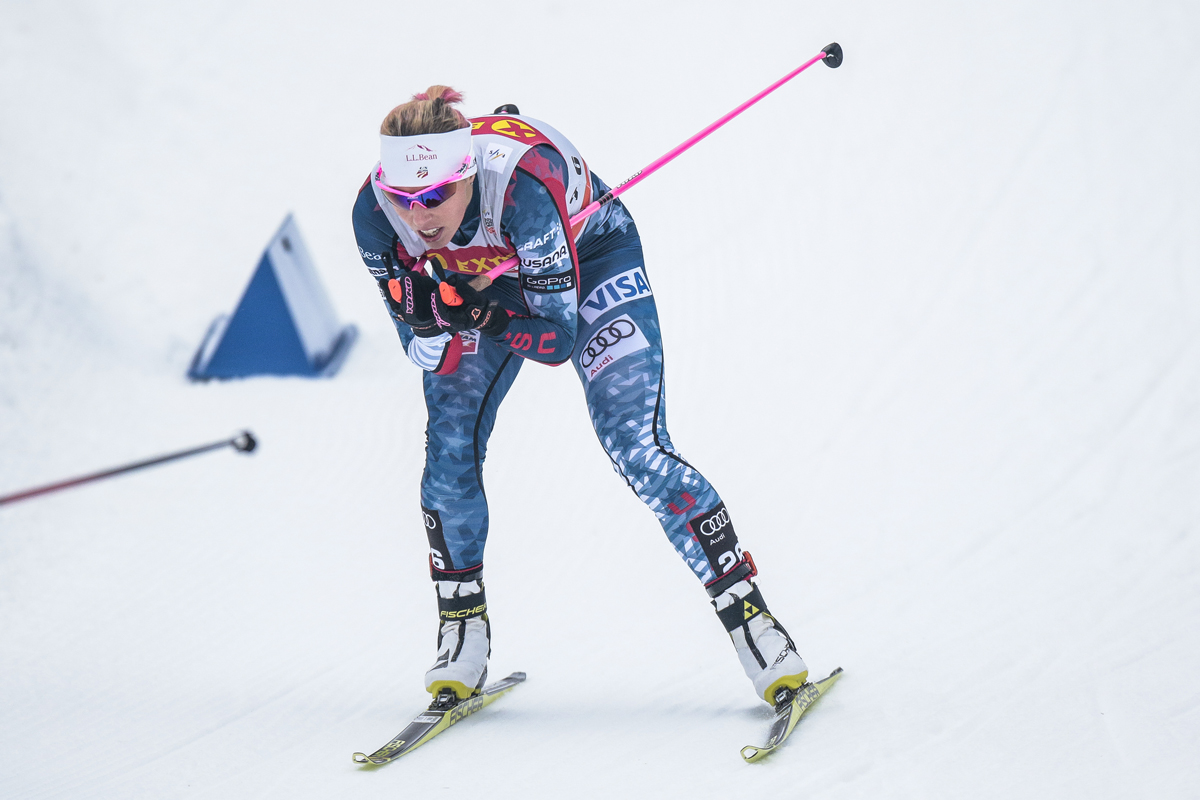
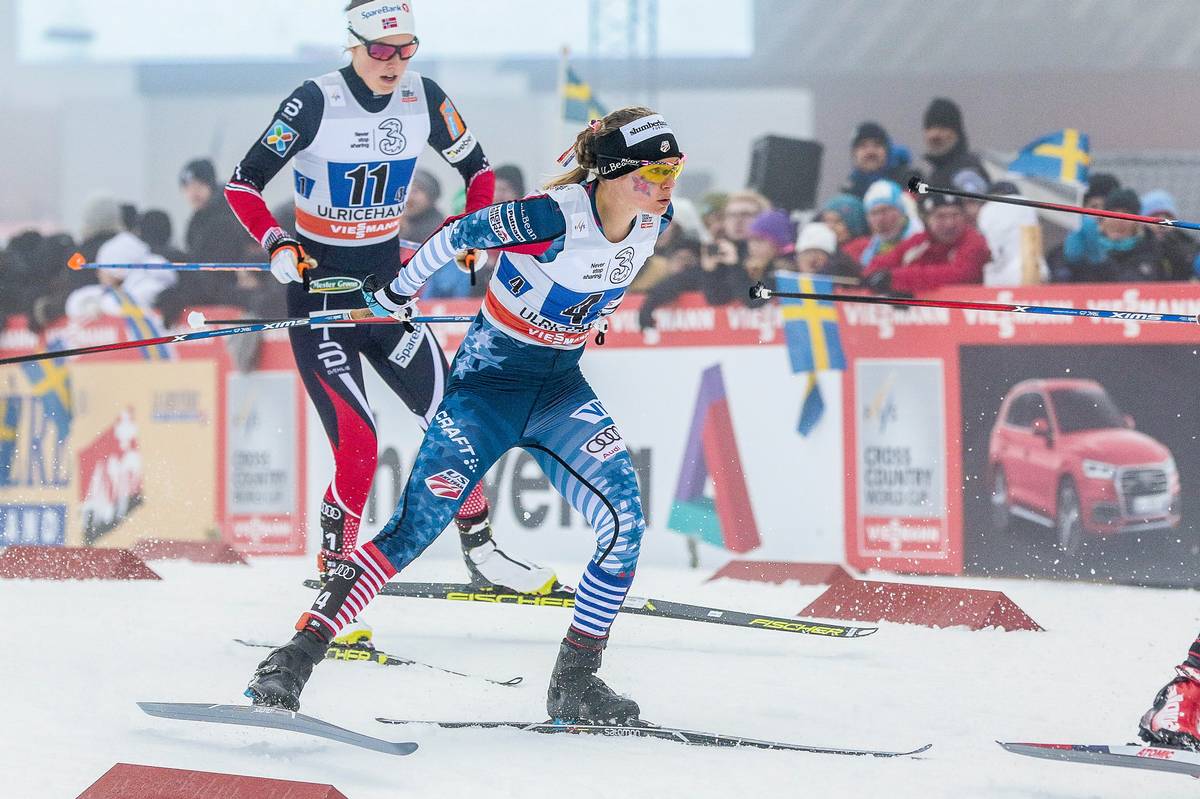
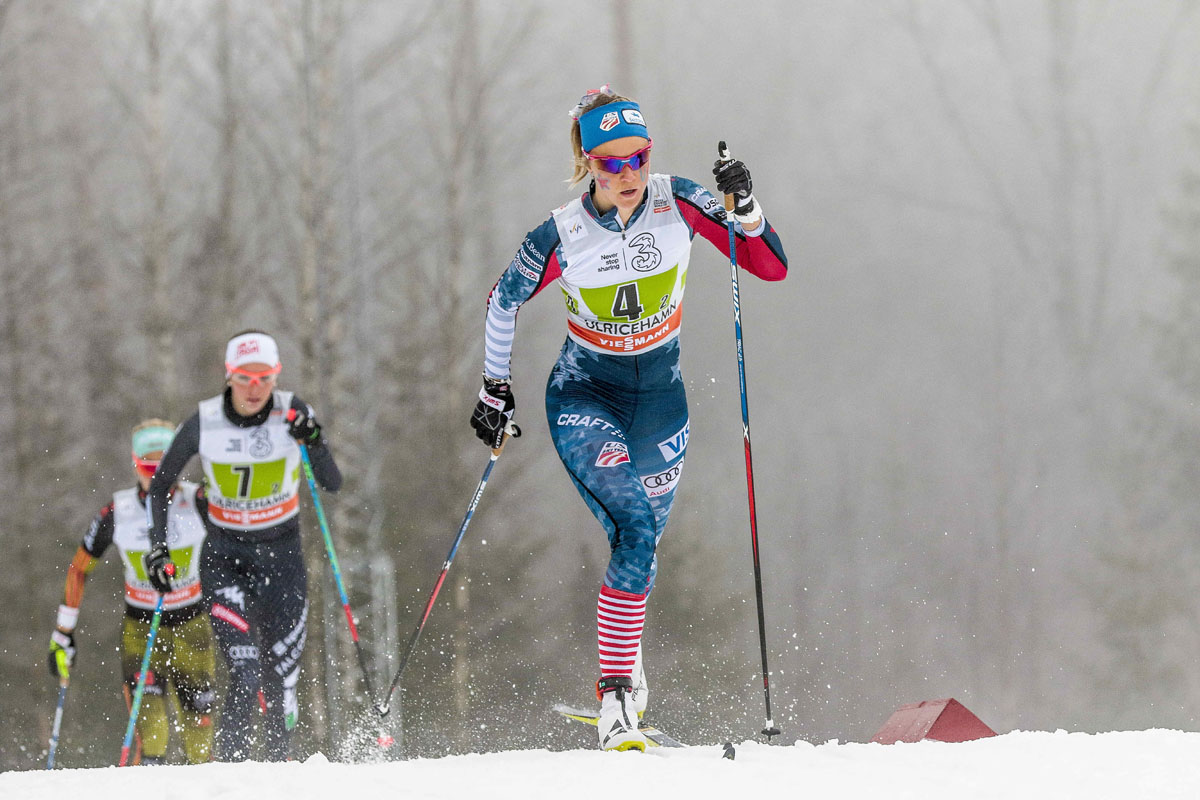
    Rosie Brennan (U.S. Ski Team) racing to 27th in the women’s 1.5 k freestyle sprint qualifier on Friday at World Cup Finals in Quebec City. She qualified for the first time in a sprint, and ended up 28th overall on the day. (Photo: John Lazenby/Lazenbyphoto.com)

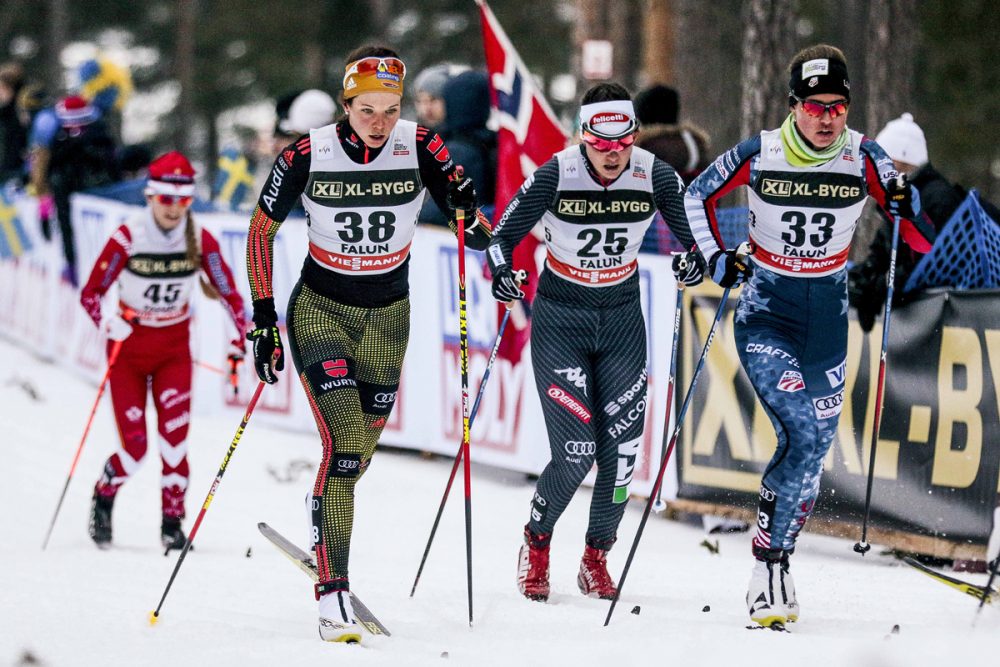
    Advancing to the heats for the first time in her World Cup career was Brennan, who qualified 27th and finished the day in 28th.

    “The quarters were not what I had hoped for, but I didn’t really have too many expectations, I’ve never done it before,” Brennan said. “So I’m glad to have gotten that out of the way before the season was over and I have a good list of things to work on this summer.”

    Even with five U.S. women making the heats on Friday, the team was hungry for more.

    “On the ladies’ side, a decent qualification, but not actually really one of our best,” Grover said. “Great for Julia to get in there as a junior athlete, that was really exciting for Rosie to get in there, because that may have been the first time this season she’s actually been in. She’s been just on the outside so many times. So excited for those two guys. Kind of an OK qualification for the other three ladies … all those ladies skied really smart, but it just didn’t come together.”
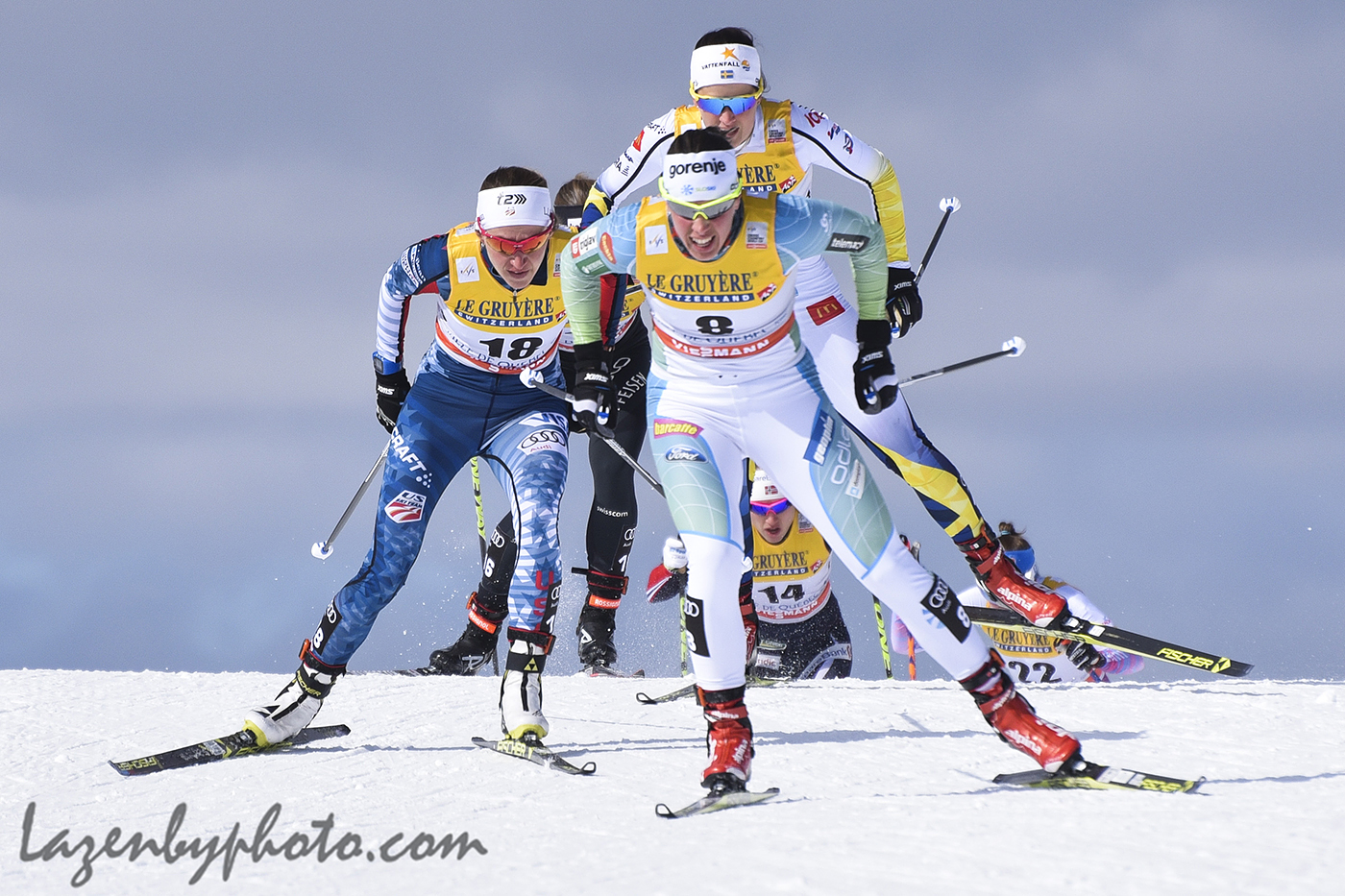
    American Sophie Caldwell (18) chasing Slovenia’s Vesna Fabjan (8), ahead of Sweden’s Anna Dyvik, during their quarterfinal of the women’s freestyle sprint on Friday at World Cup Finals in Quebec City. (Photo: John Lazenby/Lazenbyphoto.com)

    Eight other American women competed in Friday’s sprint, though did not advance beyond qualification with Ida Sargent placing 36th, Erika Flowers 48th, Kaitlynn Miller 50th, Caitlin Patterson 53rd, Becca Rorabaugh 54th, Chelsea Holmes 55th, Jennie Bender 57th, and Liz Guiney 62nd. Liz Stephen did not start.

    Sargent explained that though she had been looking forward to this weekend’s races, a bout of pneumonia left her unable to compete at the level she had hoped to.

    I got sick in Lahti and just couldn’t figure out why I wasn’t getting better,” Sargent said. “They thought it was just a cold, but I kind felt like something was different and so, eventually I got diagnosed with pneumonia and I’m still on antibiotics for that. They said I was fine to race and that it wouldn’t do any damage. I didn’t have much hope for how it was going to go today, I was trying to stay optimistic, but there’s a reason with antibiotics and pneumonia.”

    For Canada, Dahria Beatty finished 41st, Emily Nishikawa 45th, Cendrine Browne 47th, Andrea Dupont 51st, Sophie Carrier-Laforte 56th, Katherine Stewart-Jones 59th, Annika Richardson 60th, Sadie White 61st, Frederique Vezina 63rd, Laura Leclair 65th, Katherine Weaver 66th, Mia Serratore 67th, Alannah MacLean 69th, Annika Hicks 70th, and Lisle Compton 71st.

    Results | World Cup Finals standings

    Overall World Cup standingsSprint World Cup standings (final)
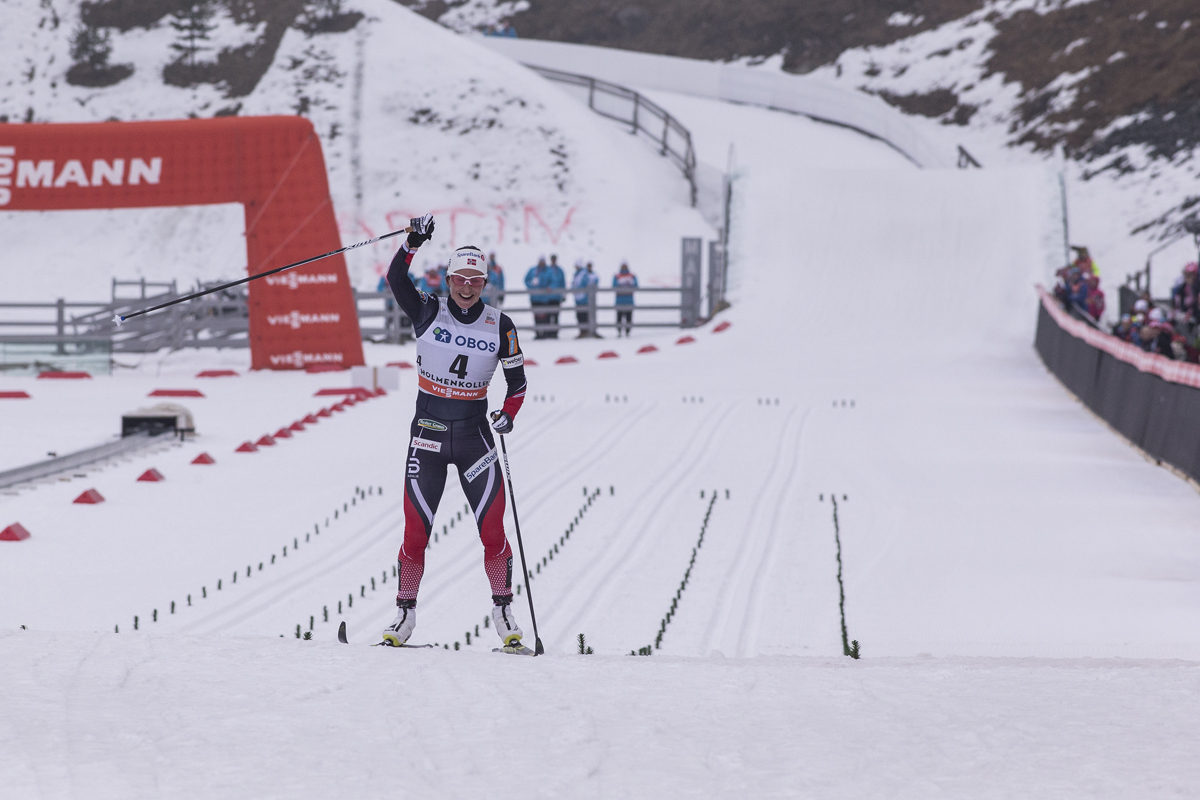
  • Friday Rundown: Harvey Wins Quebec City Skate Sprint (Updated)

    Friday Rundown: Harvey Wins Quebec City Skate Sprint (Updated)

    Alex Harvey of the Canadian World Cup Team racing to fourth in the men’s 1.5 k freestyle sprint qualifier on Friday at World Cup Finals in Quebec City. (Photo: Peggy Hung)

    FIS Cross-Country World Cup Finals (Quebec City): Freestyle sprint 

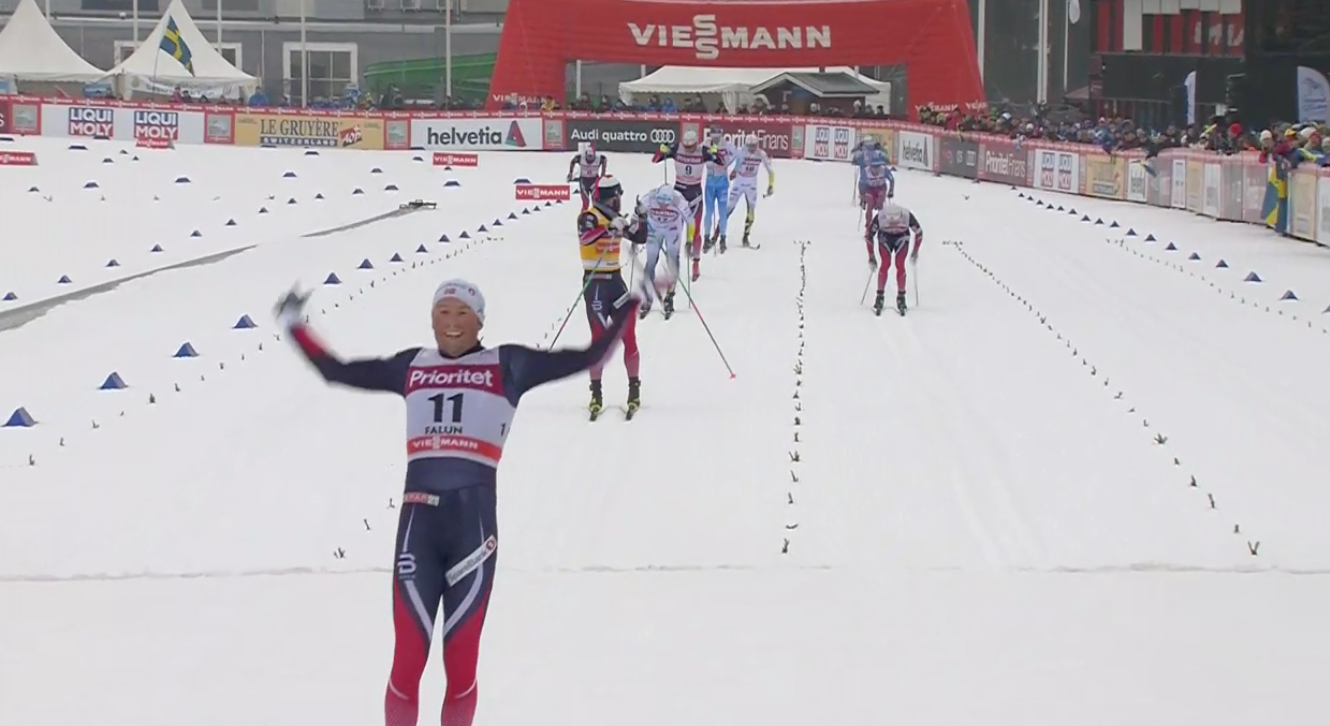
    [UPDATED] Alex Harvey wins at home. That was the news buzzing across the Plains of Abraham on Friday in Quebec City, where Canada’s leading skier won the 1.5-kilometer freestyle sprint final  on Day 1 of World Cup Finals after taking control and delighting the crowd all day.

    The win was the seventh of Harvey’s career and his 23rd World Cup medal, according to Cross Country Canada. Last year at the Ski Tour Canada stop in Quebec City, Harvey placed second in the freestyle sprint. He wasn’t going to let that happen again this year.

    Chasing Norway’s Finn Hågen Krogh as he entered the finishing stretch, Harvey put his distinctive finishing kick to the test and beat Krogh by 0.31 seconds at the line in 2:44.92 minutes.

    “It takes a lot of things to line up a good result in cross-country skiing,” Harvey told reporters after. “The equipment was great. I had a really good body, good tactics, a bit of luck, too, ’cause sprinting you need some luck. So just everything clicked together today.”

    France’s Richard Jouve scored his fourth-individual World Cup podium (and second one in Canada) in third place, finishing 0.94 seconds back, just ahead of Simi Hamilton, the lone American man to qualify for the heats. Hamilton placed fourth, just 0.07 seconds off the podium and 1.01 seconds behind Harvey. Norway’s Sindre Bjørnstad Skar took fifth (+1.51) to lock up third in the Sprint World Cup, and France had two in the final as well with Lucas Chanavat in sixth (+1.72).

    The Sprint World Cup podium was awarded on Friday, with Norway’s Johannes Høsflot Klæbo taking the Crystal Globe in first and the defending Sprint World Cup winner, Italy’s Federico Pellegrino placing second. On Friday, Klæbo won the qualifier but was eliminated in the semifinals for eighth overall. Pellegrino finished just ahead of him in seventh overall.

    A total of five Canadians qualified for the heats, with Jess Cockney striking late in the finishing stretch to finish second and automatically advance to the semifinals. There, he finished fifth for 10th overall on the day. Len Valjas, Julien Locke and Bob Thompson also reached the quarterfinals and ended up 19th, 20th and 30th, respectively, overall.

    In the women’s race, Sweden’s Stina Nilsson and Maiken Caspersen Falla duked it out to the finish, with Nilsson taking the lead over the second half of the race and holding it to the finish for a 0.42-second win over Falla in 3:01.87. By reaching the final, Falla secured her second-straight Sprint World Cup Crystal Globe. Nilsson came up 38 points short for second overall, and Sweden’s Hanna Falk finished the season in third overall in the Sprint World Cup — after placing third in Friday’s final (+2.58).

    The third Swede in the top four, Ida Ingemarsdotter placed fourth (+3.02) in the final. Behind her, Switzerland’s Nadine Fähndrich finished fifth (+3.41) and Norway’s Heidi Weng sixth (+32.36) to secure her lead in the Overall World Cup standings, by 325 points over Finland’s Krista Parmakoski (who placed 22nd on Friday).

    Jessie Diggins finished the day in ninth to lead five U.S. women in the heats. She finished second in her quarterfinal and fifth in her semifinal.

    Sadie Bjornsen was the team’s top qualifier in sixth, and went on to place 21st overall after finishing third in her quarterfinal. Sophie Caldwell crashed on the final hill of her quarterfinal heat to place 21st on the day.

    Fresh off winning three U.S. Junior Nationals titles, World Cup rookie Julia Kern, a 19-year-old U.S. Ski Team D-team member, placed 24th overall after qualifying 29th and finishing fifth in her quarterfinal.

    Also for the U.S. Ski Team, Rosie Brennan placed 28th on the day after finishing sixth in her quarterfinal.

    Final results: Men | Women

    Sprint World Cup final standings: Men | Women

    World Cup Finals standings: Men | Women

    ***

    Qualifier recap

    Five American women and five Canadian men (plus one American) qualified for the heats on Friday in the 1.5-kilometer freestyle sprint, the first of three days of racing at World Cup Finals in Quebec City.

    Quebec’s hometown favorite Alex Harvey raced to fourth, 4.14 seconds off the top qualifying time set by Norway’s Johannes Høsflot Klæbo in 2:39.44. Norway’s Finn Hågen Krogh qualified second, 3.43 seconds back, and France’s Lucas Chanavat advanced in third (+3.73).

    Harvey led four Canadian men within 0.67 seconds of one another, all qualifying for the heats as well, with Len Valjas qualifying 24th (+9:28), Julien Locke of the Alberta World Cup Academy (AWCA) 25th (+9.39), Jess Cockney 28th (+9.90), and Bob Thompson of the National Team Development Centre (NTDC) Thunder Bay in the lucky #30 spot (+9.95) as the final qualifier in the men’s race.

    Simi Hamilton (U.S. Ski Team) was the lone American to qualify in the top 30 in the men’s race, and he clocked the 16th fastest time (+7.52).

    In the women’s race, five Americans are continuing on to the quarterfinals. Sadie Bjornsen led them in sixth, 3.47 seconds off the fastest qualifying time set by Sweden’s Hanna Falk in 3:02.91.

    Norway’s Maiken Caspersen Falla qualified second (+1.72) and Marit Bjørgen third (+1.89), ahead of Sweden’s Stina Nilsson in fourth (+3.3) and Norway’s Heidi Weng in fifth (+3.34).

    Also of the U.S. Ski Team, Jessie Diggins qualified 11th (+5.86), Sophie Caldwell 18th (+7.97), Rosie Brennan 27th (+11.43), and Julia Kern, a 19-year-old U.S. development team member, 29th (+12.12).

    As for those who placed outside the top 30, for the U.S. men, Andy Newell missed it by eight-hundredths of a second in 31st. Erik Bjornsen finished 33rd, Cole Morgan 34th, Paddy Caldwell 50th, Matt Gelso 57th, Scott Patterson 58th, Jack Hegman 61st, Brian Gregg 62nd, Ben Lustgarten 69th, David Norris 70th, and Noah Hoffman 73rd.

    Canada’s Andy Shields was 35th, Russell Kennedy 36th, Devon Kershaw 38th, Knute Johnsgaard 41st, Evan Palmer-Charrette 47th, Joey Foster 53rd, Graeme Killick 64th, Ricardo Izquierdo-Bernier 71st, Brian McKeever 72nd, and Gareth Williams 74th.

    Among the U.S. women, Ida Sargent placed 36th, Erika Flowers 48th, Kaitlynn Miller 50th, Caitlin Patterson 53rd, Becca Rorabaugh 54th, Chelsea Holmes 55th, Jennie Bender 57th, and Liz Guiney 62nd. Liz Stephen did not start.

    For Canada, Dahria Beatty finished 41st, Emily Nishikawa 45th, Cendrine Browne 47th, Andrea Dupont 51st, Sophie Carrier-Laforte 56th, Katherine Stewart-Jones 59th, Annika Richardson 60th, Sadie White 61st, Frederique Vezina 63rd, Laura Leclair 65th, Katherine Weaver 66th, Mia Serratore 67th, Alannah MacLean 69th, Annika Hicks 70th, and Lisle Compton 71st.

    Heats start at 2:15 p.m. Eastern Daylight Time.

    Qualifier results: Women | Men

  • Canada Enters 30, U.S. 27 at World Cup Finals in Quebec (Updated x3)

    Alex Harvey racing in the men’s 15 k freestyle pursuit at Stage 4 of the Ski Tour Canada last year in Quebec City. (Photo: FlyingPointRoad.com/NNF)

    For the second-straight year, the World Cup’s season-ending races will be held in Canada, with Québec City hosting 2017 World Cup Finals, this Friday through Sunday. Canada initially announced a roster of 30 (15 women, 15 men) for the three-day mini tour, and the U.S. selected 27 (15 women and 12 men), with both countries maximizing their Nation’s Group “home” quota for the event in downtown Québec City.

    Note: On Tuesday, Cross Country Canada (CCC) announced it would be releasing a revised roster “due to some CPL points errors in calculations,” according to a press release. On Thursday, FasterSkier confirmed that the list included the same 15 women and 15 men that were originally published on FasterSkier.

    And on Wednesday, Quebec organizers announced that the times of each race would be moved back an hour “upon FIS recommendation” to satisfy international broadcast schedules. The updated times are listed below.

    2017 World Cup Finals race schedule (updated Wednesday):

    (All times Eastern Daylight Time)

    • Friday, March 17: Freestyle sprint (qualifier starts at 11:45 a.m.; heats at 2:15 p.m.)
    • Saturday, March 18: 10/15 k classic mass starts (women’s race at 10:40 a.m.; men at 1 p.m.)
    • Sunday, March 19: 10/15 k freestyle pursuits (women’s race at 11:20 a.m.; men at 12:45 p.m.)

    Here are the North American lineups, as well as info on the U.S. selection criteria, and Canadian selection criteria.

    Canada

    Women:

    1. Dahria Beatty (National U25 Team/AWCA)
    2. Emily Nishikawa (World Cup B-team)
    3. Cendrine Browne (NST U25 Team/CNEPH)
    4. Katherine Stewart-Jones (NST U25 Team/NTDC Thunder Bay)
    5. Sophie Carrier-Laforte (CNEPH)
    6. Katie Weaver (Junior National Ski Team/Hollyburn)
    7. Annika Richardson (Junior NST/NTDC Thunder Bay)
    8. Lisle Compton (NTDC Thunder Bay)
    9. Annika Hicks (AWCA)
    10. Sadie White (NTDC Thunder Bay)
    11. Andrea Dupont (RMR)
    12. Frédérique Vézina (CNEPH)
    13. Alannah MacLean (NTDC Thunder Bay)
    14. Mia Serratore (NTDC Thunder Bay)
    15. Laura Leclair (Junior NST/Chelsea Nordiq)

    (Note: Jenn Jackson of Lappe Nordic declined her spot)

    Men: 

    1. Alex Harvey (World Cup A-team)
    2. Devon Kershaw (World Cup A-team)
    3. Len Valjas (World Cup A-team)
    4. Jess Cockney (World Cup B-team)
    5. Graeme Killick (World Cup B-team)
    6. Knute Johnsgaard (NST U25 Team/AWCA)
    7. Russell Kennedy (Canmore Nordic/Team R.A.D.)
    8. Gareth Williams (Junior NST/Telemark)
    9. Andy Shields (Lappe Nordic)
    10. Bob Thompson (NTDC Thunder Bay)
    11. Joey Foster (Team Hardwood)
    12. Julien Locke (NST U25 Team/AWCA)
    13. Evan Palmer-Charrette (NTDC Thunder Bay)
    14. Brian McKeever (Canadian Para-Nordic Ski Team)
    15. Ricardo Izquierdo-Bernier (CNEPH)

    USA

    Women: 

    1. Kikkan Randall (U.S. Ski Team A-team/APU)
    2. Sadie Bjornsen (USST A-team/APU)
    3. Liz Stephen (USST A-team)
    4. Caitlin Patterson (CGRP)
    5. Rosie Brennan (USST B-team/APU)
    6. Erika Flowers (SMS Elite)
    7. Jennie Bender (BSF)
    8. Julia Kern (USST D-team/SMS Elite)
    9. Liz Guiney (CGRP)
    10. Kaitlynn Miller (CGRP)
    11. Chelsea Holmes (APU)
    12. Becca Rorabaugh (APU)
    13. Jessie Diggins (USST A-team/SMS Elite)
    14. Sophie Caldwell (USST A-team/SMS Elite)
    15. Ida Sargent (USST A-team/CGRP)

    (Note: Katharine Ogden, of the SMS Elite Team and U.S. Ski Team D-team, declined her spot due to “ongoing stomach issues,” according to U.S. head coach Chris Grover. Guiney was the first alternate as she was next on the SuperTour list.)

    Men:

    1. Andy Newell (USST A-team/SMS Elite)
    2. Noah Hoffman (USST B-team/Ski Club Vail)
    3. Erik Bjornsen (USST B-team/APU)
    4. Matt Gelso (SVSEF)
    5. David Norris (APU)
    6. Ben Lustgarten (CGRP)
    7. Cole Morgan (SVSEF)
    8. Patrick Caldwell (USST D-team/SMS Elite)
    9. Jack Hegman (SVSEF)
    10. Brian Gregg (Team Gregg/Loppet Nordic Racing)
    11. Scott Patterson (APU)
    12. Simi Hamilton (USST A-team/SMS Elite)
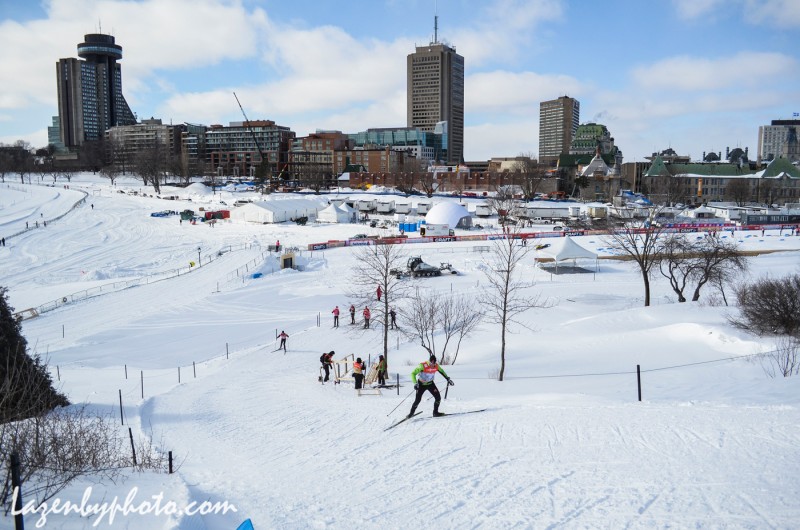
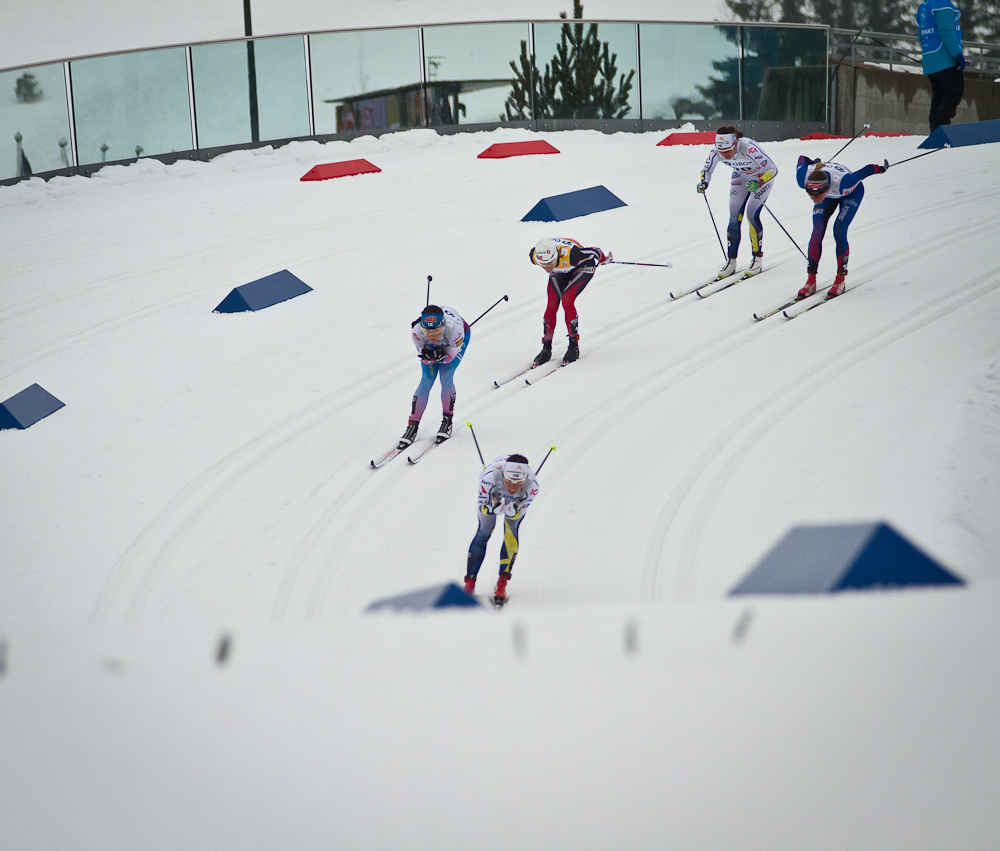
    A view from the steep hill on the sprint course with the stadium area in background, as seen during training last year in Quebec City, one day before the third stage of the 2016 Ski Tour Canada. (Photo: John Lazenby/Lazenbyphoto.com)
  • Bjørgen Owns Holmenkollen 30 k with More Than 2-Minute Win; Randall 20th

    Bjørgen Owns Holmenkollen 30 k with More Than 2-Minute Win; Randall 20th

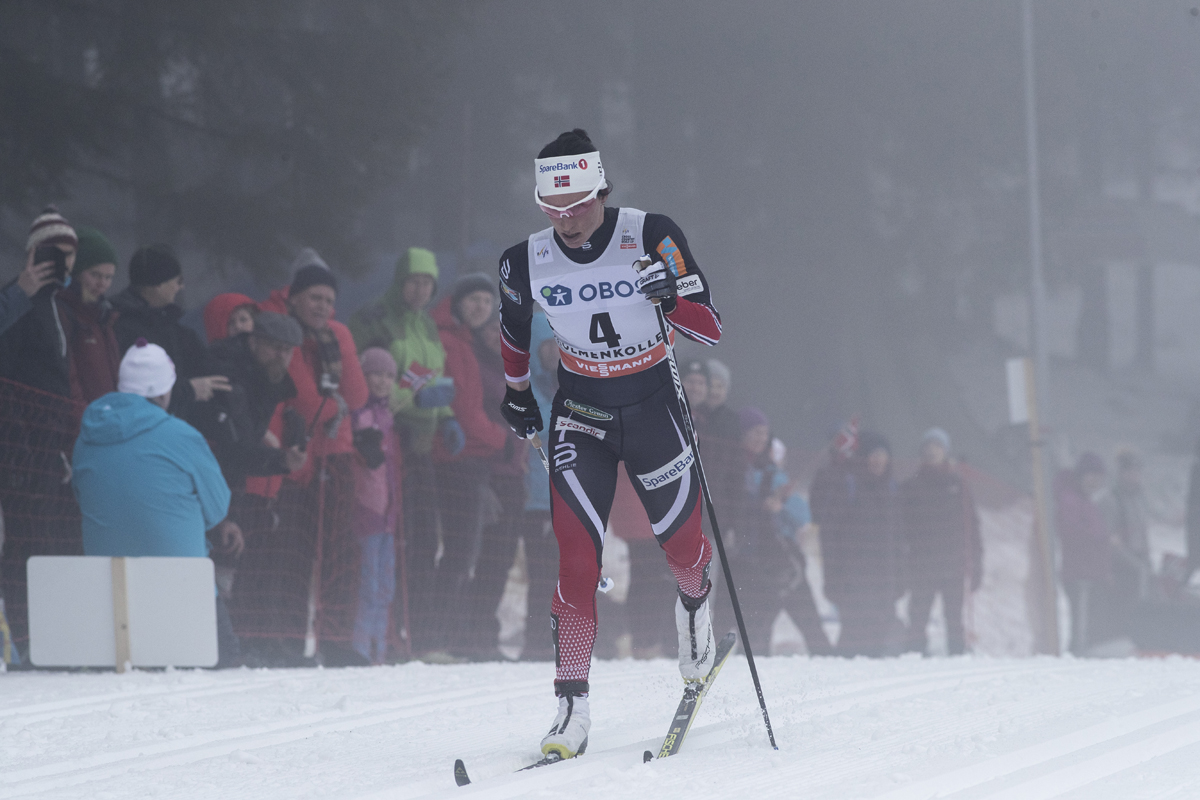
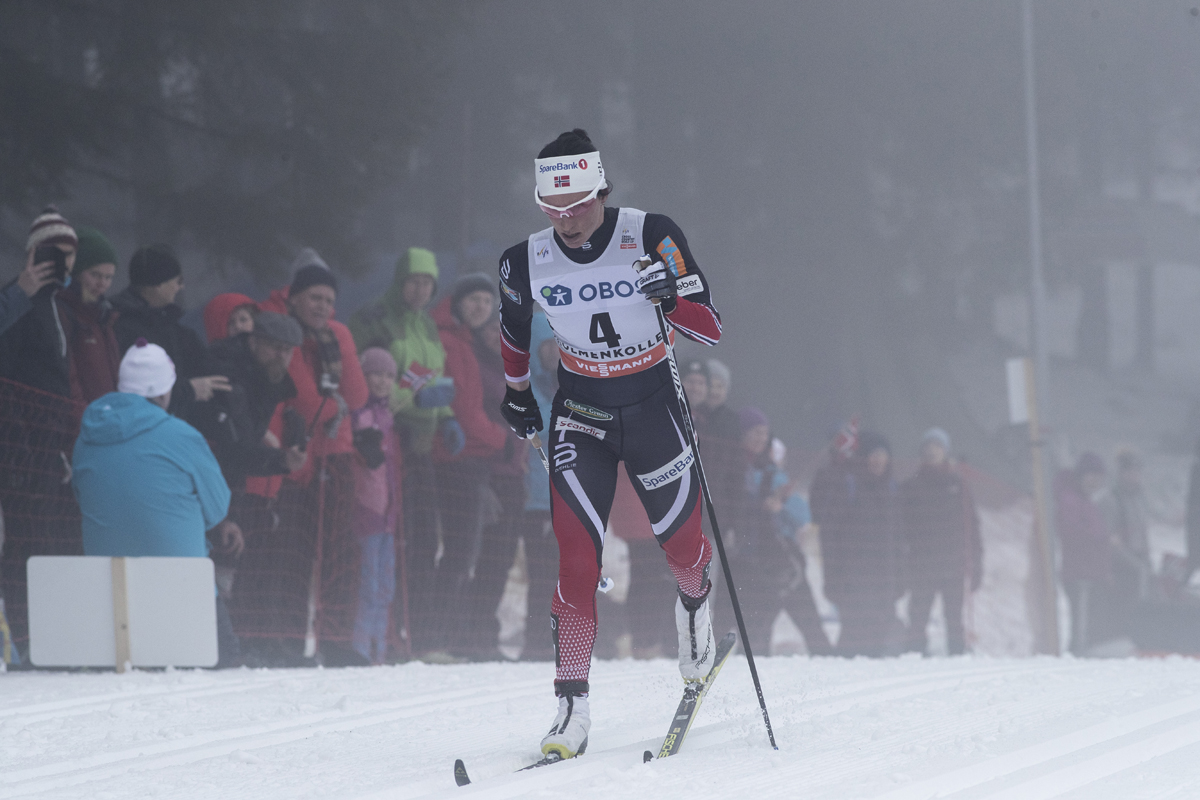
    Norway’s Marit Bjørgen winning the women’s 30 k classic mass start at Holmenkollen in Oslo, Norway, by more than two minutes on Sunday. (Photo: Fischer/NordicFocus)

    OSLO, Norway — The modernist Holmenkollbakken ski-jumping hill lords over the otherwise bucolic Holmenkollen ski venue. It’s certainly one of the wonders of the modern nordic sport world as the steel structure arcs elegantly toward the sky. At times during the men’s 50-kilometer classic mass start on Saturday at Holmenkollen, the sun glared off the jump, giving it the appearance of a polished silver spaceship.

    During the women’s 30 k classic mass start on Sunday, fog descended onto the Holmenkollen neighborhood. The upper portions of the Holmenkollbakken jump, about a third of the structure, were lost in the clouds. Jumpers that flew from its heights before the start of the 30 k seemed to glide and fly out of the sky.

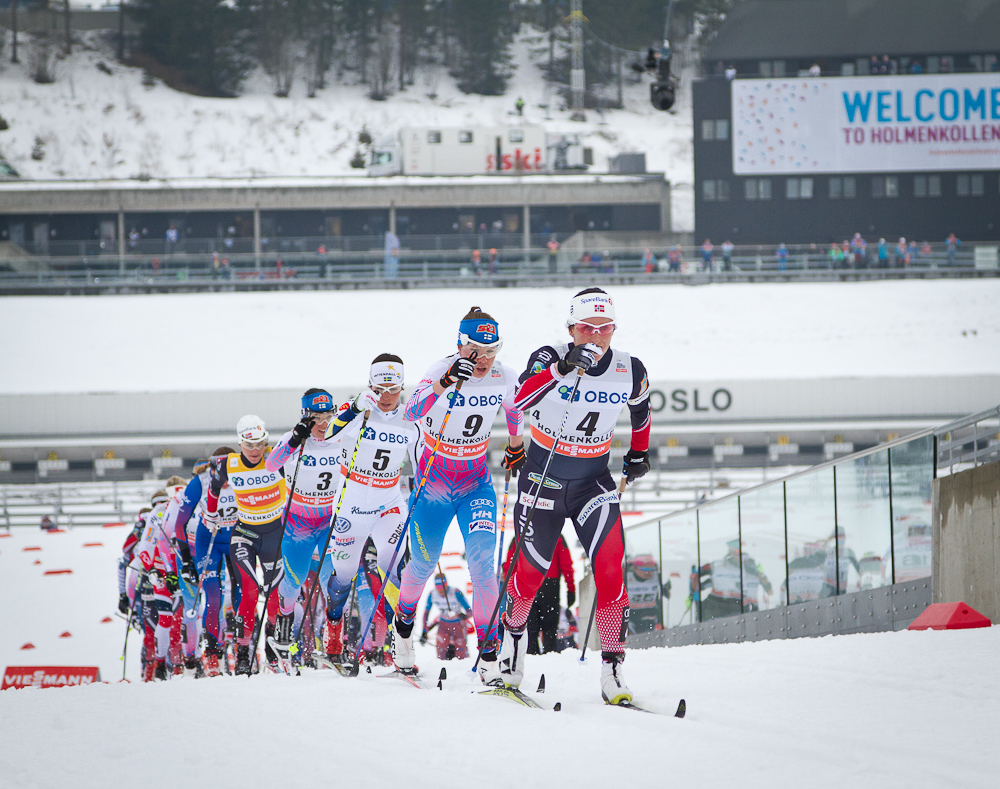
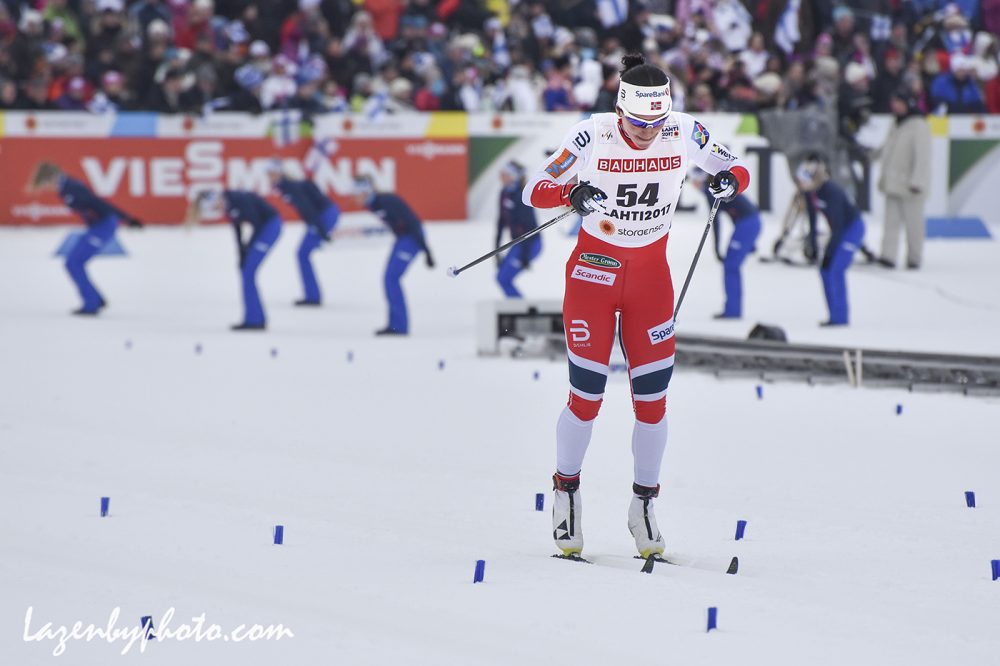
    Norway’s Marit Bjørgen leads the train early in the women’s Holmenkollen 30 k classic mass start on Sunday in Oslo, Norway. This was a rare moment when Bjørgen skied in the presence of other skiers. She soon moved off the front and soloed to the win.

    Those same clouds blanketed the high point of the 30 k course (with three 8.3 k laps and one 5 k lap) at Frognerseteren, where it seemed much of Oslo had stayed to party and welcome racers before their descent toward the stadium.

    Each time Norway’s Marit Bjørgen rallied the hordes atop Frognerseteren, it was as if she appeared from the ether: Bjørgen’s race through the fog was a solo quest that ended in flat-out 30 k dominance.

    Perhaps it’s splitting hairs saying exactly when this race was decided. Was it at 2.7 k when Bjørgen was up by nearly five seconds? For certain that was early on when anything was in play: wax, Bjørgen’s in-race nutrition, a potential fall. Was it her 33 second lead at 8 k? Was it her 1 minute and 22 second gap at 16.3 k?

    By then this much was clear: Bjørgen was steamrolling. And yes, the race for first looked over.

    Norway’s Marit Bjørgen racing to more than a two-minute win in the Holmenkollen women’s 30 k classic mass start on Sunday in Oslo, Norway. (Photo: Fischer/NordicFocus)

    In her first Holmenkollen 30 k after taking a year off to start a family, Bjørgen, 36, looked peerless. On the stout Holmenkollen loop she only appeared to ratchet up the pace, firing with increasing power as the kilometers rolled.

    Meters from the finish, Bjørgen bowed to the crowd and Norway’s King Harald V before stopping the clock at 1:22:59.2 hours to win her sixth Holmenkollen 30 k. Her nearest competitors were more than two minutes back.

    Only a week ago, the 2017 Nordic World Championships wrapped up in Lahti, Finland. Bjørgen brought four golds home to Norway. She placed first in every distance event; the 15 k skiathlon, the 10 k classic individual start and the 30 k freestyle mass start. She also won gold as part of Norway’s 4 x 5 relay. In Lahti, she admitted to having pre-race nerves.

    Those nerves weren’t apparent at Holmenkollen.

    “I was more relaxed than I was in the World Championships,” Bjørgen said at the post-race press conference. “It was a different morning. Today I was waking up with my son, playing with him, and just going to the stadium, and yeah, it was more relaxing.”

    A relaxed Bjørgen appears to be a potent Bjørgen.

    “My plan was to try to go fast from the beginning if my body was feeling well, and it did,” Bjørgen added. “I had good skis also, when we passed 5 k, I heard 20 seconds. I understood I had to do my own race and, yeah, I feel good.”

    Twelve times the Holmenkollen 30 k has been held after World Championships or the Olympics. Usually a two-week period elapses between those events. Bjørgen has won the 30 k back-to-back twice, but Sunday’s win makes it her first with only one week of recovery.

    Evidently Bjørgen still recovers well, too.

    “It has been not an easy week. I have been a little bit tired and the motivation has been hard really. I wanted to stay home with my son and play with him,” Bjørgen said. “But I trained a little bit and tried to relax and of course to go to the 30 k is a big motivation and you want to do well so it was no problem. I was wondering how the body was feeling, but today my legs were much better than it was earlier in the week.”

    Chalk up another World Cup win.

    Behind Bjørgen, it wasn’t so much a chase as an entirely separate race vying for the remaining podium spots. Playing off-Broadway to Bjørgen’s big show were Finland’s Krista Pärmäkoski, Kerttu Niskanen and Aino-Kaisa Saarinen, Norway’s Heidi Weng, Sweden’s Charlotte Kalla, and Poland’s Justyna Kowalczyk.

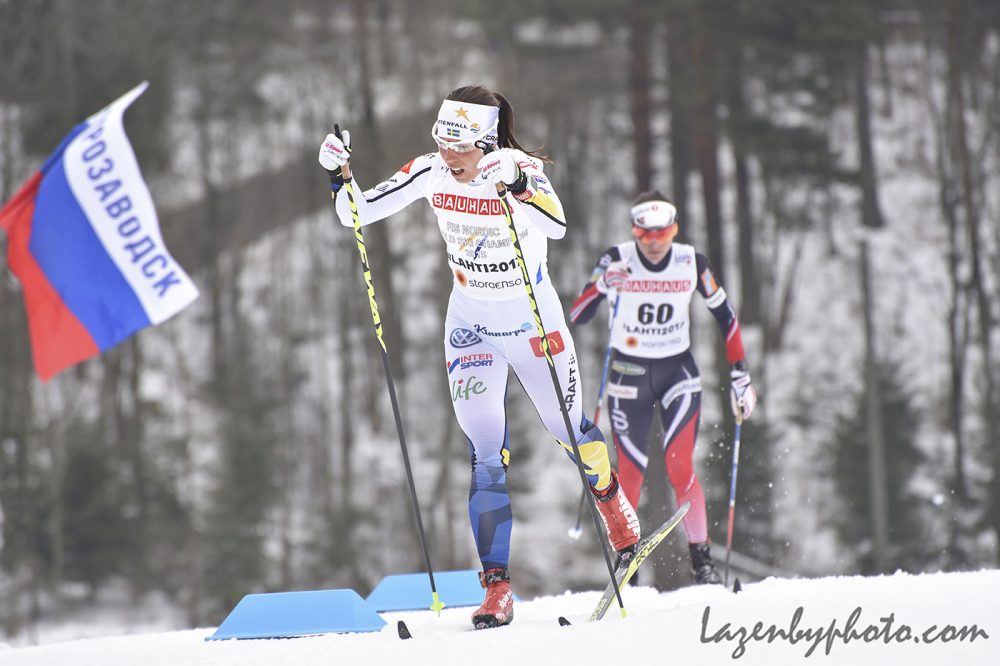
    Sweden’s Charlotte Kalla leads the first chase group behind Norway’s Marit Bjørgen (not shown) during the Holmenkollen 30 k classic mass start on Sunday in Oslo, Norway. Finland’s Krista Parmakoski (left) and Norway’s Heidi Weng (behind Parmakoski)) follow Kalla.

    Throughout the 30 k race, it looked as if any one of those skiers could pull away into their own discrete chase for second. Kalla and Kowalczyk looked primed as they took a 14-second lead at the 16.3 k time check on the likes of Weng, Saarinen, Niskanen, and Pärmäkoski.

    With that effort came an eventual catch. At 24.6 k, those six skiers came through just seconds apart. It wasn’t until the final stretch when place, not time, was part of every racer’s calculus and a separation of seconds occurred.

    Finland took the remaining spots on the podium. Pärmäkoski placed second (+2:05.8), and teammate Niskanen was third (+2:07). Weng was fourth (+2:08.6), Kalla fifth (+2:11.7), Kowalczyk sixth (+2:12.9), and Saarinen — the last skier of the reputable first Bjørgen chase group — placed seventh (+2:19.6).

    Just last Wednesday, Pärmäkoski placed second in the classic sprint in Drammen, Norway.

    “Today [I] was feeling a little bit tired because that Drammen sprint was really good for me and last year also I had good race there,” Pärmäkoski said at the press conference. “But I am so happy that I am now stand on the podium on the sprint race and now of course this 30 k podium, the first on my career.”

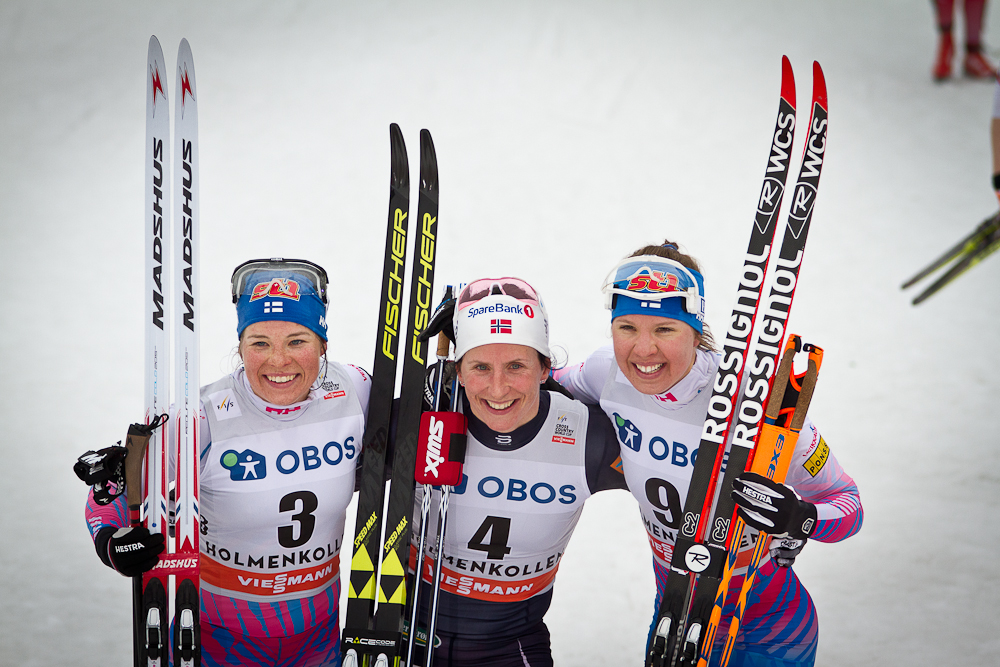
    The Holmenkollen 30 k classic mass start podium on Sunday in Oslo, Norway: Finland’s Krista Pärmäkoski (l) placed second, Norway’s Marit Bjørgen (c) first, and Finland’s Kerttu Niskanen (r) third.

    Heading into the season-ending World Cup Finals, which will take place across the Atlantic in Quebec, Canada, Pärmäkoski sits second in the World Cup overall, exactly 300 points behind Norway’s Weng. Another Norwegian, Ingvild Flugstad Østberg, is 94 points behind Pärmäkoski in fourth. On Sunday, Østberg placed eighth (+2:31.3).

    The U.S. Ski Team’s Kikkan Randall, like Bjørgen, has returned from a year away from skiing to start a family. Sunday was her first World Cup 30 k since she contested the 2014 Holmenkollen 30 k classic.

    And on Sunday, Randall was the top American in 20th (+6:17.2).

    “I had good energy,” Randall said of her race. “I kept a steady pace for me the whole way. 30 k was untested for me this year. I’m really happy. My expectation going into today, knowing where I’ve been in the last couple of weeks, I thought a top 20 was a good goal, and I just got that.”

    With such a large hiatus between long-distance races at this level, Randall noted her sensations on the day were welcome.

    The U.S. Ski Team’s Kikkan Randall (38) racing in a group during the women’s 30 k classic mass start on Sunday at Holmenkollen in Oslo, Norway.

    “I skied a lot of threshold pace last year while I was pregnant, and a lot of it is coming back this summer, so maybe this is a good pace for me to ski right now,” Randall said. “The start was pretty fast, and I had a hard time staying up in the middle of the group, but I just skied a good, steady pace the whole way, and my energy stayed really strong. … It’s a great foundation to end this season with, knowing that I have a whole season next year to build that top-end speed back.”

    Randall skied in a group that didn’t think twice about matching the turbo pace set from the starter’s gun. When the race shook out early on, Randall found her own race tempo and was able to eventually work up in the field.

    “I felt like I got in a pack right away, maybe in the first 5 k, skiing with a pack of Norwegians, and we worked together most of the race, but pretty soon we were picking people off,” Randall explained. “The opening pace was hard, and I think a lot of the people who went with it suffered the consequences. It was kinda fun that we had little rabbits out there to go catch.”

    Sadie Bjornsen, also of the U.S. Ski Team (USST), placed 24th on the day. Bjornsen skied much of her 30 k solo.

    “I was trying to go with people from the start, to see what would happen,” Bjornsen said. “My best 30 k’s have been when I send it too hard, and somehow manage to keep up the pace. I tried for that, and I then I got a bit tired in the middle.”

    Sadie Bjornsen racing to 24th in the women’s Holmenkollen 30 k classic mass start on Sunday in Oslo, Norway.

    Bjornsen’s race was gritty, a go-for-it effort in a hallowed venue. Bjornsen noted she perhaps pushed too hard in spots and paid the price of fading.

    “Today was one of those days that wasn’t the greatest, it wasn’t horrible, but you have to try,” Bjornsen explained.

    Holmenkollen remains formidable.

    “Holmenkollen is always the hardest race of the year, and I kind of love that,” Bjornsen said. “I’ve had some of my best and worst races here, and I think it’s fun to come here knowing that it’s going to be a challenge, but to also be excited for a challenge, because every time you finish this race, despite how you do, you have this feeling of total achievement, like, ‘Holy cow! I just skied 30 k on that course!’ It’s always hard … It’s just such an achievement to finish this race.”

    Sadie Bjornsen (U.S. Ski Team) after finishing 24th in the Holmenkollen 30 k classic mass start in Oslo, Norway.

    Also for the U.S., Liz Stephen (USST) finished 31st (+8:46.8) and Chelsea Holmes (Alaska Pacific University) 39th (+11:19.1). Rosie Brennan (USST) did not finish.

    U.S. Ski Team Women’s Coach Matt Whitcomb explained that Brennan miscalculated with her initial pair of skis.

    “Rosie struggled a bit with her first pair of skis,” Whitcomb wrote in an email. “I think she thought they were good in testing, but in the race they proved to be a little too slow. Her second pair was great after the exchange, but she was too far back and decided to pull. This was her decision and I support her. She wants to ski very well in Quebec, and these athletes don’t have much wick left to burn. This is a rare occurrence, and an exceptional reason for it to occur. She’ll be skiing with a vengeance in Quebec.”

    No Canadian women entered Sunday’s 30 k.

    Results

  • Sunday Rundown: Holmenkollen & Kontiolahti

    Sunday Rundown: Holmenkollen & Kontiolahti

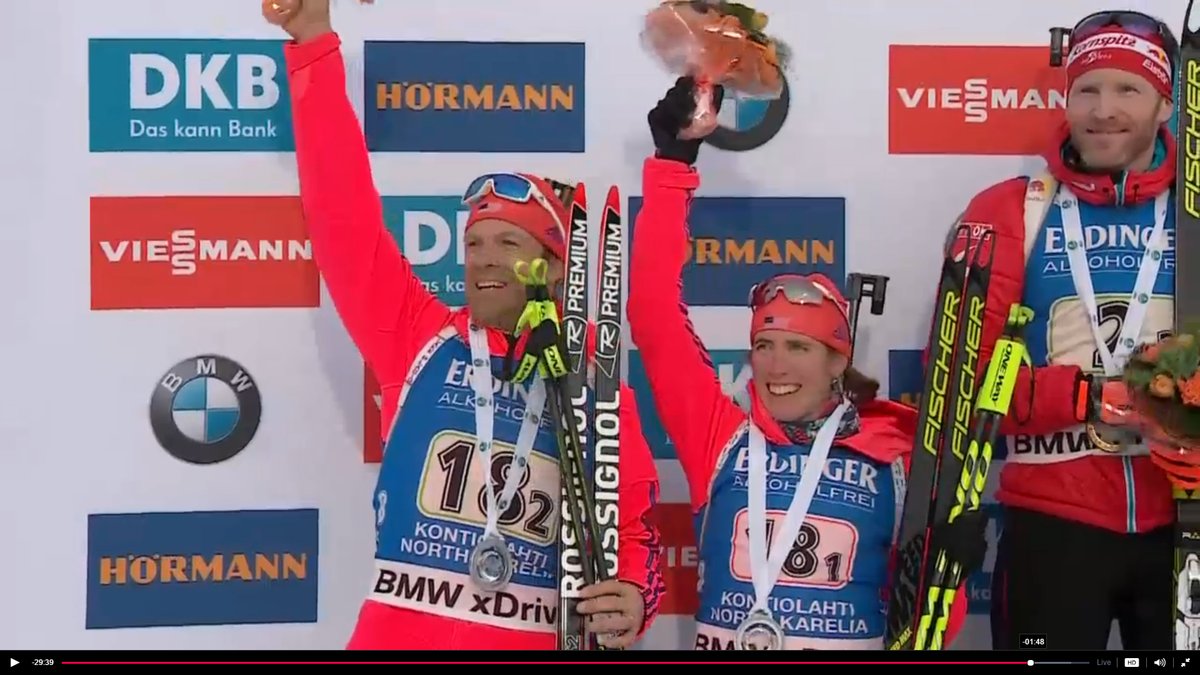
    Lowell Bailey and Susan Dunklee celebrate finishing second in the single mixed relay in Kontiolahti, Finland. (Screencap: US Biathlon/Twitter)

    IBU Biathlon World Cup (Kontiolahti, Finland): Single Mixed Relay

    In the last single mixed relay of the season, Susan Dunklee held the lead after two loops of skiing. She was looking for a top tag-off to American Lowell Bailey, but she crashed on a downhill. Nevertheless, she was able to focus on the shooting range and climb back into podium position.

    The leaders were gone, however: Simon Eder and Lisa Therese Hauser of Austria ran away with the competition, using five spare rounds to race to a 32.8-second victory.

    Bailey left the last shooting in third position, and caught Germany’s Roman Rees on the trails. The pair also managed to hold off Jean Guillaume Beatrix of France, who left the range just behind them. It came down to a sprint finish, with Bailey besting Rees (and his relay partner, World Cup Total Score winner Laura Dahlmeier). The U.S. had five spare rounds to Germany’s six.

    It was the first relay podium of any kind for the United States since 1994, when the women finished second in a relay in Canmore, Alberta.

    The Canadian team of Julia Ransom and Christian Gow finished 19th (+2:27.0) with eight spare rounds.

    Results

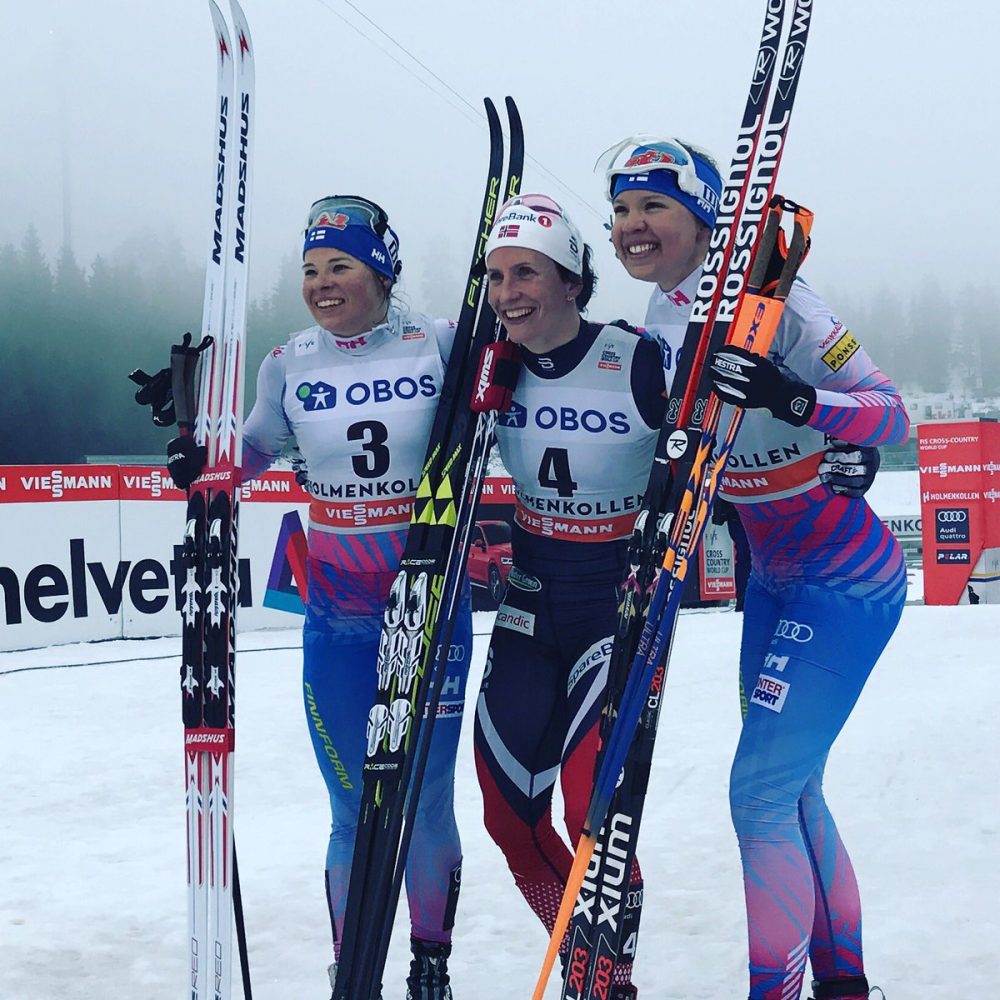
    Left to right: Finland’s Krista Pärmäkowski, Norway’s Marit Bjørgen and Finland’s Kertu Niskanenen after the women’s 30kiloimeter World Cup classic mass start on Saturday in Oslo, Norway. (Photo: FIS Cross-Country/Twitter)

    FIS Cross-Country World Cup (Oslo, Norway): Holmenkollen 30 k classic mass start:

    Norwegian Marit Bjørgen won the women’s 30-kilometer classic mass start at Homenkollen on Sunday, in a time of 1:22:59.2. She bested two Finns, Krista Pärmäkoski and Kerttu Niskanen. Pärmäkoski finished in second (+2:05.8) and Niskanen in third (+2:07.0).

    Norway’s Heidi Weng finished fourth (+2:08.6), outlasting Sweden’s Charlotte Kalla (fifth, +2:11.7). Poland’s Justyna Kowalczyk finished sixth (+2:12.9), Finland’s Aino-Kaisa Saarinen seventh (+2:19.6), Norway’s Ingvild Flugstad Øtsberg  in eighth (+2:31.3), Sweden’s Anna Haag  in ninth (+3:27.9) and Finland’s Laura Mononen in tenth (+3:28.7).

    The first North American to finish on Sunday was Kikkan Randall, who placed 20th (+6:17.2).  The next North American across the line was the U.S. Ski Team’s Sadie Bjornsen in 24th (+6:48.8). Liz Stephen finished in 31st (+8:46.8), and Chelsea Holmes (Alaska Pacific University) in 39th (+11:19.1). 

    Results

  • Sweet Sixteen: Bjørgen Wins Lahti 10 k Classic for 16th World Title

    Sweet Sixteen: Bjørgen Wins Lahti 10 k Classic for 16th World Title

    Norway’s Marit Bjørgen on her way to her 16th career World Championships gold in Tuesday’s 10 k classic individual start at the Lahti, Finland. (Photo: John Lazenby/Lazenbyphoto.com)

    LAHTI, Finland — Moments before the women’s 10-kilometer classic individual start at the 2017 Nordic World Championships on Tuesday, temperatures read 35 degrees Fahrenheit and humidity hovered around 97 percent — the air nearly saturated. Earlier in the day, a near-ground fog lapped the tops of the three iconic ski jumps looming above the ski stadium.

    In contrast to earlier classic events at these championships — a 15 k skiathlon, and classic team sprint — the tracks glazed with a mirror-like sheen.

    For her 16th World Championship title, neither Norway’s Marit Bjørgen nor her wax techs were befuddled by the tricky tracks. Whether herringboning headwalls, firing like the nordic powerhouse she is on the flats and climbs, or streamlining the glide outs, Bjørgen remained peerless in her win over her 10 k classic competition. She finished in 25:24.9 minutes for the gold; the closest competitor Sweden’s Charlotte Kalla was 41 seconds behind.

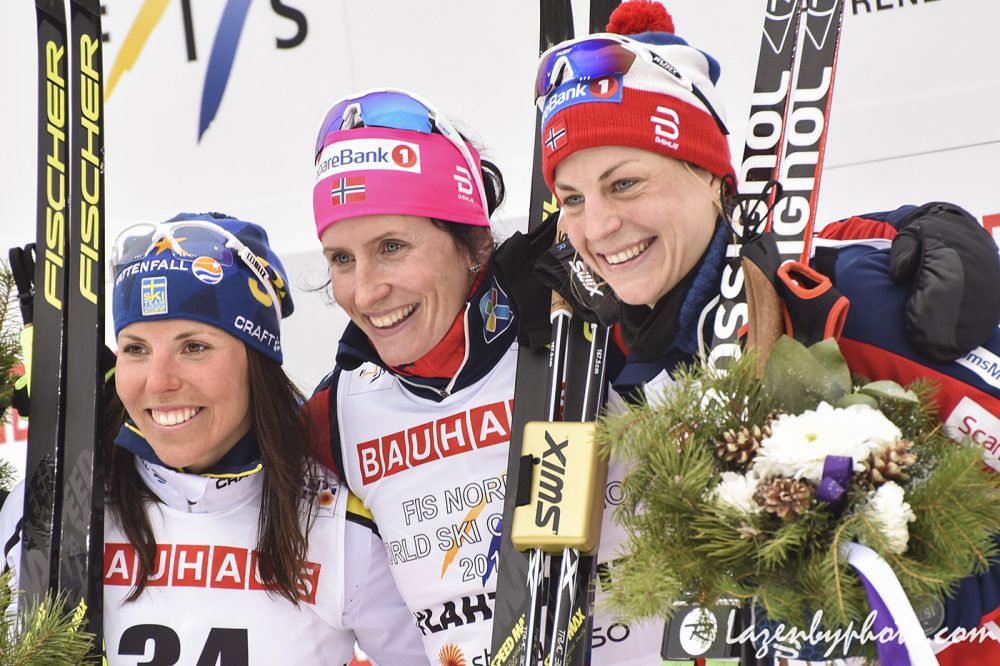
    Tuesday’s 2017 Nordic World Championships women’s 10 k classic podium, with (from left to right) Sweden’s Charlotte Kalla in second, Norway’s Marit Bjørgen in first, and Norway’s Astrid Uhrenholdt Jacobsen in third. (Photo: John Lazenby/lazenbyphoto.com)

    With silver going to the Swede, the final podium spot went to another Norwegian, Astrid Uhrenholdt Jacobsen, who finished 55.5 seconds back from her teammate Bjørgen’s time.

    Considering their collective medal count, it was a championship-pedigreed podium: it was Kalla’s 12th career championship medal — and her second in the last week. Jacobsen earned her third-individual championship medal of seven overall. (For the 2016/2017 World Cup season, it’s Jacobsen’s first podium.

    It’s also been a decade since Jacobsen’s first World Championship medal, a classic-sprint gold in 2007 in Sapporo, Japan.

    “A lot of things have happened in those ten years,” Jacobsen, 30, said after the race. “The medal today feels better than the gold medal in Sapporo. I fought harder for this. I’m just really happy today.”

    Amongst the potential podium locks in the 10 k classic, Kalla noted she chose an earlier start as part of her race strategy; she started in bib 34.

    “I decided to go early because of the warming up opportunities” Kalla explained during the post-race press conference. “I wanted to go on the competition track as long as possible. And then I also had a better opportunity to do my own race and not focus on the times against the others, just focus on my performance in every stage on the track.”

    Sweden’s Charlotte Kalla racing to second in the women’s 10 k classic on Tuesday at 2017 Nordic World Championships in Lahti, Finland (Photo: John Lazenby/lazenbyphoto.com)

    Despite her race-time dominance, Bjørgen spoke of her jittery nerves before the start.

    “This 10 k has been one of the distances I really wanted to win,” the 36 year old said during the press conference. “I think I have two before the start of the world championships, so this was the one I wanted the gold medal. I think that’s the reason I was nervous and also I understand I was in good shape and it was really possible to take the gold, so that’s the reason.”

    A 41-second winning margin for Bjørgen isn’t definitive. And unlike every other race at these championships, where high drama like Norwegian-Finn tangles, broken poles and Diggins-grit dictated the narrative, Tuesday’s 10 k classic was clinical.

    At 1.5 k, 5 k, 6.3 k, and 7.8 k splits, Bjørgen was the fastest. Already at 6.3 k, Bjørgen had a 22-second gap on Kalla. Barring an equipment failure or tumble, by that point the win was a bygone conclusion and Bjørgen the author of this 10 k novella.

    Norway’s Astrid Uhrenholdt Jacobsen on her way to bronze during the women’s 10 k classic at the 2017 Nordic World Championships in Lahti, Finland. (Photo: John Lazenby/lazenbyphoto.com)

    “Today I had very good skis and I feel very strong, and the first 5 [k] I feel that my speed was very high,” Bjørgen added. “It was only a second from 1 kilometer to 4, and I feel that I am racing very fast and I not taking more seconds so I wonder how will I do it on the last 5 k. But then I heard it was from 6 [seconds] and then to 10 then to 20 and then understand they were opening a bit too hard.”

    Bjørgen explained the news of time-gain inroads served as a propellant.

    “I think when you heard you have second[s] on your side you just get some more power and you just want to ski more faster,” Bjørgen said. “You understand it’s well for you. You are getting so happy, it is no problem to speed up and go.”

    Many adjectives come to mind when describing Bjørgen’s career. Yet the numbers are most impressive. When mining her career-win data, there’s always something new to learn. Of all her gold medals — now 22 between World Championships and the Olympics — prior to Tuesday’s win, 20 of those had come in non-individual-start races. (Her other individual-start win came in 2011 World Championships 10 k classic in Oslo, Norway.)

    Bjornsen Leads Americans in 23rd, Randall 26th 

    Kikkan Randall (U.S. Ski Team) racing to 26th in the women’s 10-kilometer classic individual start at the 2017 Nordic World Championships on Tuesday in Lahti, Finland (Photo: John Lazenby/Lazenbyphoto.com)

    Starting four minutes ahead of Bjørgen, the last starter for the U.S. Ski Team (USST) on Tuesday was Sadie Bjornsen. After covering the course in a time of 27:46.1, the American eventually finished as the top North American in 23rd (+2:21.2). The 10 k classic event was Bjornsen’s first individual event at these World Championships.

    She also raced Sunday’s classic team sprint with her USST teammate Jessie Diggins, where the two captured bronze. Diggins did not race Tuesday’s 10 k classic.

    “It definitely gave me a lot of confidence the other day,” Bjornsen, 27, said on Tuesday, referring to her bronze-medal performance on Sunday. “So I went into today probably a bit nervous because I had more expectations.”

    Sadie Bjornsen (46) leading Sweden’s Ida Ingemarsdotter during the women’s 10-kilometer classic individual start at the 2017 Nordic World Championships on Tuesday in Lahti, Finland. (Photo: John Lazenby/Lazenbyphoto.com)

    Looking back on the effort, Bjornsen explained that she may have paced the initial part of her race too slowly. With her 10 k classic performance from Otepää in the back of her mind, Bjornsen intended to take the first few kilometers of Tuesday’s world champs 10 k event to work into the race.

    “I definitely wanted to keep things under control at the beginning, because I felt last week I started really hard and struggled to keep the pace up,” Bjornsen said. “I tend to do better when I do a more gradual start and then try to pin it after that. I haven’t seen the splits at all, but based on the way that I felt, maybe I started a little too easy.”

    With glazed tracks making for difficult steady striding, Bjornsen indicated that she might not have gotten out of the track as often as she should have to stay fresh.

    “You know, today was a day that you had to get out of the track and grind it in order to make your skis work,” Bjornsen said. “I was really trying to force it, and really tried to stay in the track. Then at 4 k, [USST Head Coach Chris] Grover was like, ‘Get out of the track. It’s much faster to run,’ and I feel like from there on I got to skiing a bit better.”

    Finishing 10.7 seconds behind Bjornsen was her teammate Kikkan Randall, the second American in the top 30 in 26th (+2:31.7). Randall had already earned an individual bronze at these championships and competed in last weekend’s 15 k skiathlon, where she finished as the top American in 17th.

    As Randall explained, her performances in these races, as well as those of other Americans competing, may influence who will start the women’s 4 x 5 k relay on Thursday.

    “I think there’s a couple of us who know we’re trying to prove we’re worthy of the relay spot,” Randall said on Tuesday. “I think for Rosie and I, we were trying to ski our first 5 k pretty hard and really use this as a test.”

    Despite working the pushing the pace for the first half of her race, Randall found herself able to adapt and finish strong.

    “It’s certainly the best opening 5 k I’ve had all year,” Randall said. “I felt my body wanted to turn on and go on the first couple hills. That’s kind of an exciting new feeling for me.”

    “The first couple climbs on the second lap I was like ‘OK, woah’,” she added. “[But] I found my groove the last two and half k, so overall a pretty solidly paced race.”

    The two other Americans to compete in Tuesday’s 10 k, Rosie Brennan placed 32nd (+2:55.4) and Ida Sargent finished 43rd (+3:55.2).

    Skiing alone for the entirety of her race, Brennan was more satisfied with her 10 k race than she was her skiathlon performance. Tuesday’s race, however, still left her hungry for more.

    “I don’t know if I was so much looking for a result as much as a feeling,” Brennan explained after. “I think I was close but not quite there.”

    All four Canadian women who traveled to Lahti competed in the 10 k event, with Katherine Stewart-Jones leading the team in 36th (+3:09.6). This season marks Stewart-Jones’s second year on the Canadian national team and it was her first World Championships.

    The 21-year-old Stewart-Jones, of the National Team Development Centre (NTDC) Thunder Bay and national U25 Team, also competed at this year’s U23 World Championships in Park City, Utah. After Tuesday’s race, she said she’s excited about where the Canadian women are headed, particularly with regards to their results thus far at world champs.

    Canada’s Katherine Stewart-Jones racing to 36th in the women’s 10-kilometer classic individual start at the 2017 Nordic World Championships on Tuesday in Lahti, Finland (Photo: John Lazenby/Lazenbyphoto.com)

    “We’re all excited to be the next generation. Just to have four girls here at world champs is super amazing,” Stewart-Jones said after her first top 40 in her third World Championships race. “I think we’re really bringing up the energy as a group and getting each other pumped up and having confidence in each other.”

    Explaining that she was able to stride for most that the race, Stewart-Jones was pleased with her result, but also the way she felt physically while skiing on course.

    “In the last lap when I was getting a little tired, I jumped out of the tracks, but I had enough energy in my legs to run,” she said. “Overall, I was able to find that extra gear on that second lap and was able to relax on the first lap, which is super important on this kind of a course. I’m just really happy with how I skied.”

    Finishing 4.6 seconds behind Stewart-Jones was Canadian World Cup Team skier Emily Nishikawa in 37th (+3:14.9). Two more members of Canada’s U25 Team, Dahria Beatty placed 39th (+3:24.9), and Cendrine Browne finished 47th (+4:05.2).

    Despite having a limited number of classic races under her belt this season, Beatty had a positive review of her performance on Tuesday.

    “I haven’t done a ton of classic races this year and doing the races last weekend in Otepää it was a really positive race for me and I was trying to build on that,” Beatty said. “That’s definitely the most fun I’ve had this week.”

    Results

    — Harald Zimmer and Gerry Fersuth contributed

  • Tuesday Rundown: Lahti and Osrblie (Updated)

    Tuesday Rundown: Lahti and Osrblie (Updated)

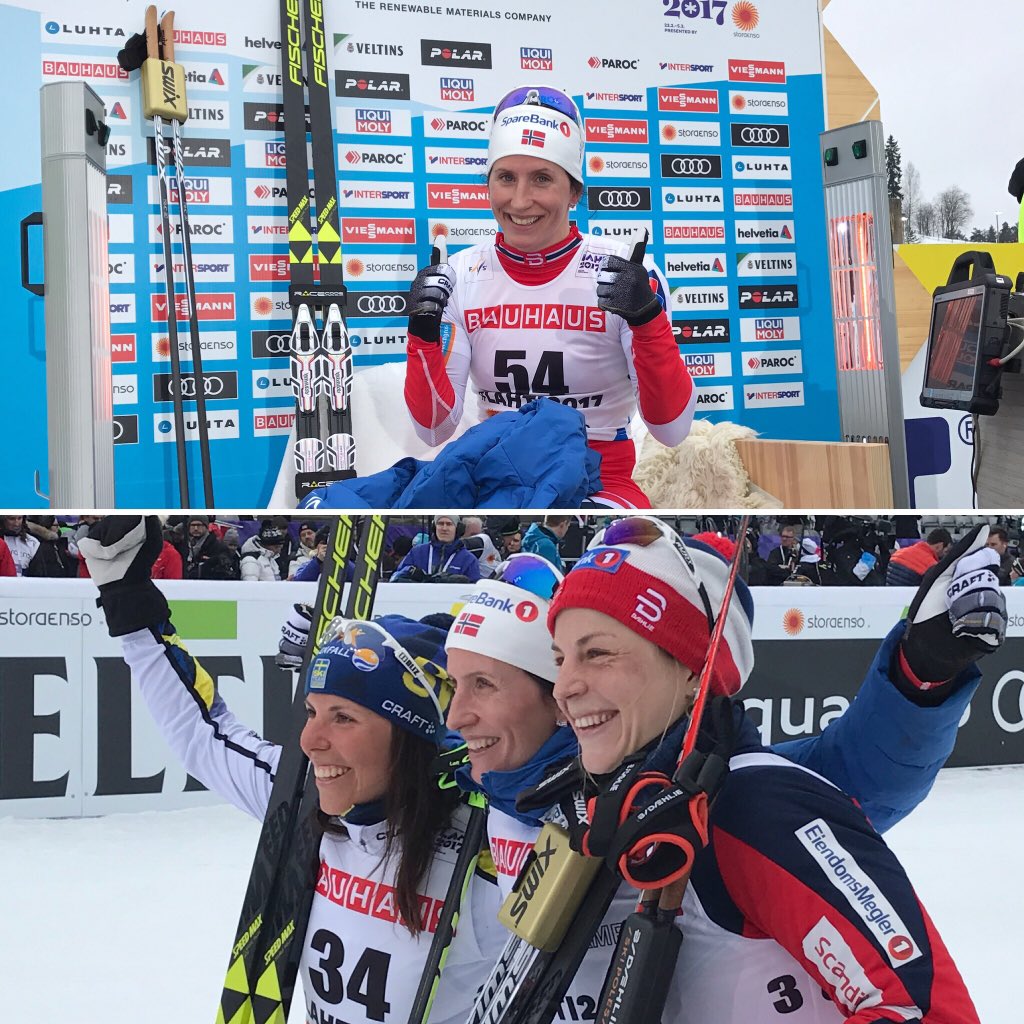
    Above: Norway’s Marit Bjørgen celebrates her 16th World Championships gold after winning Monday’s 10 k classic in Lahti, Finland. Below: The women’s 10 k classic podium at 2017 Nordic World Championships in Lahti, with Bjørgen (c) in first, Sweden’s Charlotte Kalla (l) in second, and Norway’s Astrid Uhrenholdt Jacobsen (r) in third. (Photo: FIS Cross-Country/Twitter)

    FIS Nordic World Championships (Lahti, Finland): Women’s 10 k classic

    No contest. That was the takeaway of Marit Bjørgen’s performance in the women’s 10-kilometer classic individual start on Monday at 2017 Nordic World Championships in Lahti, Finland, after the Norwegian posted a 41-second victory in 25:24.9 minutes.

    Bjørgen started 54th of 72 starters and clocked the fastest time over every intermediate timing point on the course. Sweden’s Charlotte Kalla had been the previous race leader after starting 34th before Bjørgen bumped her out of the leader’s chair by 41 seconds.

    Norway had two on the podium with Astrid Uhrenholdt Jacobsen in third, 55.5 seconds behind Bjørgen. Norway’s Heidi Weng missed the podium in fourth (+1:13.8), while Sweden’s Anna Haag — an early leader in bib 18 — finished fifth (+1:22.7). Finland’s Kerttu Niskanen took sixth (+1:23.7) and Krista Parmakoski was seventh (+1:31.4), while Norway’s Ingvild Flugstad Østberg and Poland’s Justyna Kowalczyk tied for eighth (+1:34.5). Germany’s Stefanie Böhler rounded out the top 10 in 10th (+1:35.8).

    Sadie Bjornsen led the U.S. women in 23rd (+2:21.2), Kikkan Randall placed 26th (+2:31.7), Rosie Brennan was 32nd (+2:55.4), and Ida Sargent 43rd (+3:55.2).

    Katherine Stewart-Jones led the Canadians with her best result at her first World Championships in 36th (+3:09.6), Emily Nishikawa followed in 37th (+3:14.9), and Dahria Beatty 39th (+3:24.9).

    The men’s 15 k classic takes place tomorrow.

    Results

    ***

    IBU Youth/Junior World Championships (Osrblie, Slovakia): Junior relays

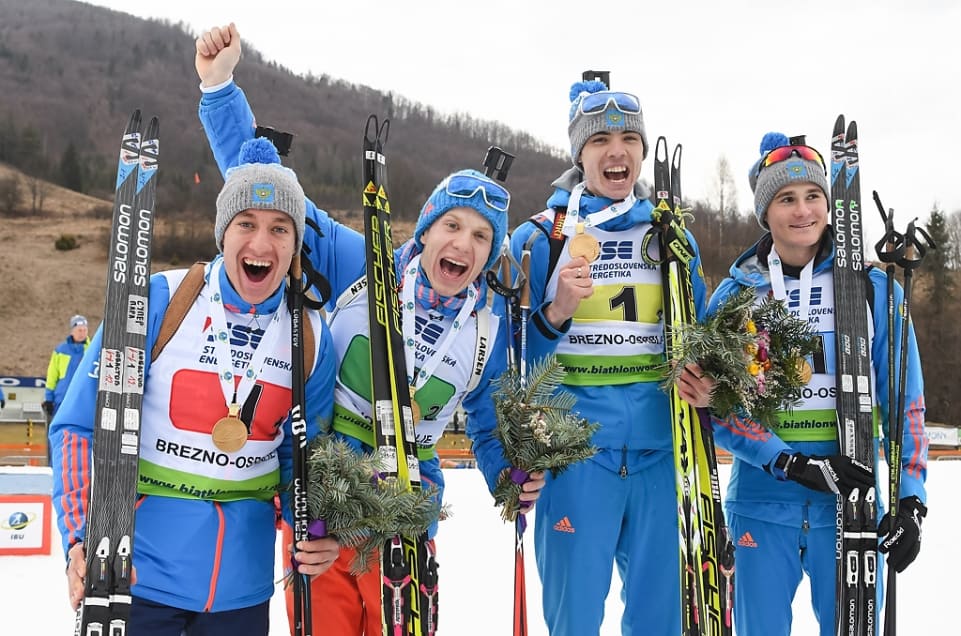
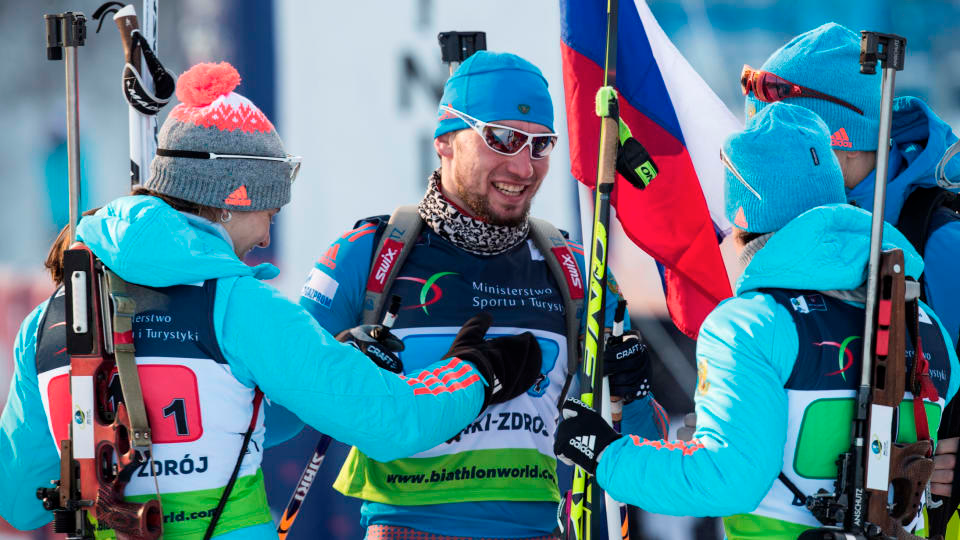
    (From left to right) Russia’s Nikita Lobastov, Igor Malinovskii, Nikita Porshnev, and Kirill Streltsov after winning the men’s 4 x 7.5 k relay on Tuesday at IBU Youth/Junior World Championships in Osrblie, Slovakia. (Photo: IBU)

    [UPDATED] Russia, Norway, Germany. Or Norway, Germany, Russia. That’s how the podiums shook out for the junior men’s and women’s relays on Tuesday, the last day of the 2017 International Biathlon Union (IBU) Youth/Junior World Championships in Osrblie, Slovakia.

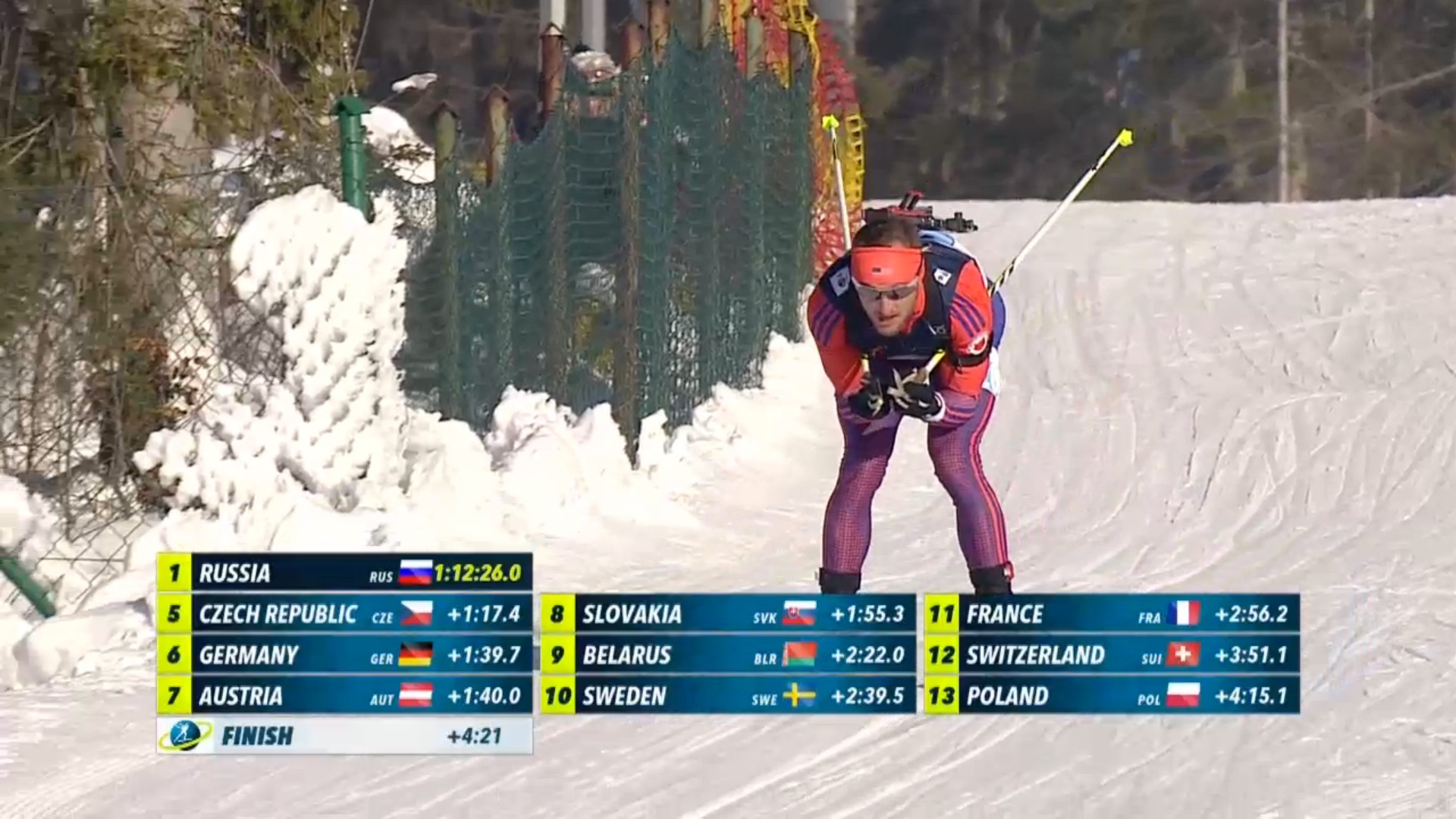
    Russia won the men’s 4 x 7.5-kilometer event by 53.9 seconds in 1:17:27.8 hours, with Nikita Lobastov, Igor Malinovskii, Nikita Porshnev, and Kirill Streltsov. After coming through the first exchange in fifth, 44.2 seconds out of first, Malinovskii skied his team into first and they held the lead to the finish. In total, Russia used seven spares to clean and had no penalties.

    Norway claimed silver with Dag Sander Bjørndalen, Johannes Dale, Aleksander Fjeld Andersen, and Sindre Pettersen. After getting tagged in 14th, Dale moved the team up to sixth and Andersen improved to second, which Pettersen held. The team combined for one penalty and 12 spares.

    Germany claimed bronze (+1:39.3) despite one penalty and 16 spares, with Justus Strelow, Danilo Riethmüller, Dominic Schmuck, and David Zobel. Fourth at the first exchange, Riethmüller picked moved them into third on the second leg, which Schmuck and Zobel held.

    Canada finished 12th (+6:00.5) with Zachari Bolduc, Trevor Kiers, Jules Burnotte, and Pearce Hanna combining for three penalties and 13 spare rounds. Positioned in 10th for the first two legs, the team moved into eighth on Burnotte’s third leg. Hanna had to ski three penalty laps on the final leg and slipped to 12th.

    The U.S. men finished 14th (+9:07.4) with Cody Johnson, Cameron Christiansen, Travis Cooper, and Peter Carroll combining for two penalties and 10 spare rounds. The team gradually moved up from 16th at the first exchange to 12th at the third and final exchange, before losing two places before the finish.

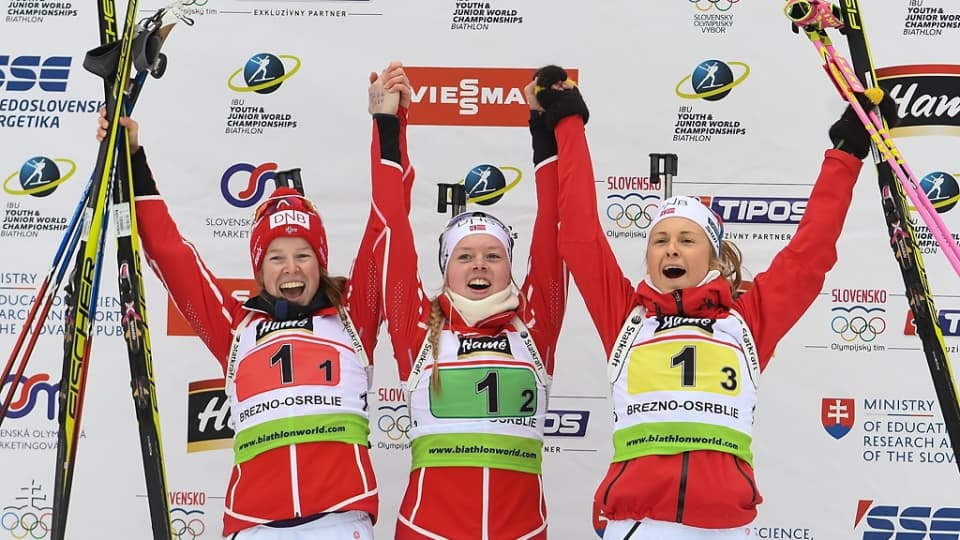
    (From left to right) Norway’s Hilde Eide, Karoline Erdal and Ingrid Landmark Tandrevold after winning the junior women’s 3 x 6 k relay on Tuesday at IBU Junior World Championships in Osrblie, Slovakia. (Photo: IBU)

    In the junior women’s 3 x 6 k relay, Norway rose to gold with Hilde Eide, Karoline Erdal and Ingrid Landmark Tandrevold (for Tandrevold’s third medal in the last three races, and first gold of the week) finishing in 56:18.4. The team, which had zero penalties and used eight spares, moved up from fourth at the first exchange to first on Erdal’s second leg and Tandrevold anchored them to the win.

    Germany crossed the finish 16.5 seconds later for silver, with Vanessa Voigt, Sophia Schneider and Anna Weidel. In seventh after the first leg, Schneider moved them into third before Weidel anchored them to second. They had one penalty and used nine spares.

    Russia rounded out the women’s podium in third (+26.1) with Kristina Reztsova, Ekaterina Moshkova and Valeriia Vasnetcova. After being tagged in ninth, Moshkova skied them up to fourth and Vasnetcova picked off one more place for bronze. They combined for one penalty and eight spares.

    Canada’s junior women finished 14th (+4:17.7) with Megan Bankes, Emily Dickson and Nadia Moser combining for four penalties and nine spares. They had been as high as 11th after Bankes’s first leg.

    The U.S. finished 17th (+11:30) with Siena Ellingson, Helen Wilson and Nina Armstrong accumulating five penalties and 11 spares. They had skied as high as 15th after Ellingson’s first leg.

    Results: Junior men | Junior women

  • After The Medals: Team-Sprint Bronze Medalist Sadie Bjornsen

    After The Medals: Team-Sprint Bronze Medalist Sadie Bjornsen

    American Sadie Bjornsen (r) during the women’s 6 x 1.3-kilometer classic team sprint on Sunday at the 2017 Nordic World Championships in Lahti, Finland. (Photo: John Lazenby/Lazenbyphoto.com)

    LAHTI, Finland — While Monday marked a rest day for skiers competing in the 2017 Nordic World Championships, FasterSkier took the opportunity to sit down and chat with Sadie Bjornsen of the U.S. Ski Team, one day after she earned bronze with teammate Jessie Diggins in the women’s 1.3-kilometer classic team sprint. Not only was it Bjornsen’s first-career World Championships medal, it was the first for the U.S. women’s program in a World Championships classic race.

    Bjornsen, 27, who lives and trains in Anchorage, Alaska, claimed the third spot on the podium with Diggins after a nail-biting sprint finish. With Bjornsen racing the first leg for the U.S., two of the three times she posted were the fastest first leg splits. No small feat with names like Norway’s Heidi Weng, Sweden’s Ida Ingemarsdotter, and Finland’s Aino-Kaisa Saarinen, Slovenia’s Katja Visnar, Russia’s Yulia Belorukova, Switzerland’s Nadine Fähndrich, Germany’s Stefanie Böhler among others all on the list for the first leg.

    In the interview, Bjornsen explains what the bronze medal means to her and how racing the team sprint has been a goal of hers for quite some time. She outlines some of the challenges she’s faced throughout her career up to this point and highlights the importance of her club coach, Erik Flora, of Alaska Pacific University.

    (Note: the interviews were conducted in a non-studio environment and are best listened to without headphones.)

    Bjornsen is entered in the women’s 10 k classic race slated to take place Tuesday, Diggins is not. The men will race a 15 k classic on Wednesday. Men’s start lists were not available at the time of publication.

    U.S. 10 k classic entries:

    Women

    • Sadie Bjornsen
    • Rosie Brennan
    • Kikkan Randall
    • Ida Sargent

    Canadian 10 k classic entries:

    Women

    • Dahria Beatty
    • Emily Nishikawa
    • Katherine Stewart-Jones
    • Cendrine Browne

    Start list: Women

  • Bow Before The Queen: Bjørgen, 15 Times a World Champ, Wins Skiathlon

    Bow Before The Queen: Bjørgen, 15 Times a World Champ, Wins Skiathlon

    Norway’s Marit Bjørgen leads Finland’s Krista Parmakoski during the women’s 15 k skiathlon on Saturday at 2017 Nordic World Championships in Lahti, Finland. Bjørgen ultimately won by 4.8 seconds over Parmakoski. (Photo: John Lazenby/Lazenbyphoto.com)

    LAHTI, Finland — Electric.

    With every jumbotron shot of Finland’s Krista Parmakoski or a glimpse of her powerful compact-frame as she lapped through the stadium, the hometown Finns were electric. White and blue flags waved. Like anywhere in the world when a brilliant athletic performance unfolds in the home country, the roars for Parmakoski were deafening.

    From the start, she emitted a big dose of hope for fans in Lahti during Saturday’s 15-kilometer skiathlon at the 2017 Nordic World Championships.

    The move that split the 50-starter field came early and was decisive thanks to Norway’s Marit Bjørgen. A 14-time world champion before the race, Bjørgen was often at the front of a four-woman group that defined the 7.5 k classic leg. In that front group, with each skier taking short pulls as the leader — were Sweden’s Charlotte Kalla, Norway’s Heidi Weng, and Parmakoski.

    Bjørgen was the force-setting tempo most often. But with almost every acceleration, Parmakoski would ski up beside the queen of skiing — buoyed by the cheers and the confidence the day could be hers.

    “I had really good skis, and of course there were so many spectators screaming my name,” Parmakoski said in the post-race press conference. “Everything was such a good feeling, and the uphills seemed smaller than yesterday, and everything feeling so easy today.”

    In the early rounds of this chess match, the strategy seemed simple: ski smoothly and cross the fingers about shadowing Bjørgen’s surges. The first stumble in that tactic came just 7 1/2 minutes in when speeding around a tight downhill corner, Kalla lost her footing and spilled. She righted herself and eventually returned to the group.

    After 7.5 k, the striding morphed to skating at the exchange. With the change in techniques, it would be hard to imagine a better sight to Finnish eyes: Parmakoski skated out the stadium in first after a dialed ski swap.

    Locked in and a few seconds back were Kalla and Weng. And if hope wasn’t already ratcheted up enough for the fans, Bjørgen fumbled her gear switch and followed in Parmakoski’s wake five seconds back.

    Bjørgen is a seasoned champ. A stumble securing a binding or securing a pole grip, a five-second loss — that amounts to nothing. Skating up the course’s first big climb, which happened to rear up just meters from the stadium, Bjørgen eventually latched back on.

    A single kilometer later at 8.8 k, Bjørgen and Parmakoski had gapped Kalla and Weng by ten seconds. Then it morphed to 15 seconds, then 30 seconds at 11.25 k. Only a foreshortened camera shot of Kalla and Weng skiing behind would make anybody think they weren’t a world away.

    Down to two.

    On the last 3.75 k lap, the games began. There were glances to one another. A slight dulling of the pace by Bjørgen, but no real bait taking on behalf of Parmakoski. The Finn understood full well who the trap setter was, admitting after the race that Bjørgen was an idol.

    “My tactic was that Marit could go first, and then I would be second position,” the 26-year-old Parmakoski said during the press conference.

    Bjørgen’s perception of the gamesmanship?  “I wanted to get back behind her, to relax a little bit, and she wanted to go ahead, so that was good for me,” the 36 year old explained of the dodge and parry. “She tried in the long uphills, and I felt that I could manage that good, so I had in my head that in the last kilometer I would try, and I had the feeling I might be a little bit better in the sprint. “

    Bow before the queen.

    The last hill before the technical descent into the stadium is where it went down. It was a simple illustration of why she’s a legend: Bjørgen went.

    “So I tried, and I was getting the few meters that I wanted, so I was feeling good,” Bjørgen said of her attack.

    Parmakoski was deferential after the fact. “On the last uphill [Bjørgen] was better and amazing.”

    After 15 k, two techniques, and 37:57.5 minutes, Bjørgen became historic, winning a 15th championship medal, besting Russia’s Elena Välbe, who holds 14 titles.

    Finland’s Krista Parmakoski skis to silver, her first World Championships medal, in the women’s 15 k skiathlon on Saturday at 2017 Nordic World Championships in Lahti, Finland. (Photo: John Lazenby/Lazenbyphoto.com)

    Only 4.8 seconds later, Parmakoski crossed the line, arms raised and indeed fulfilling that early onset of Finland’s burgeoning hope. “This is as good as winning for me, in front of home crowds,” Parmakoski remarked.

    Kalla had her own fight for bronze. She skied with Weng until 11.25 k. But eventually Kalla stretched Weng too thin — in less than a kilometer she shook the Norwegian who ceded 18.6 seconds in that distance. Kalla finished third (+32.0).

    Lurking behind Weng as she petered out was Switzerland’s Nathalie von Siebenthal. With less than four kilometers to go, von Siebenthal remained 21 seconds in back of Weng.

    “In skating, it was beautiful,” von Siebenthal told Swiss broadcaster SRF.

    After suffering a bit during the classic leg, the Swiss skier felt emboldened during the skate.

    Von Siebenthal explained that she asked Austrian skier Teresa Stadlober — who at the time she was racing with — if they were positioned in sixth or seventh.

    “She didn’t answer,” von Siebenthal said. “And then when we were skiing through the arena I saw on the screen that the fourth was just ahead, Kalla and Weng. And I thought, ‘Cool, we are sixth or seventh’. And then there still was the Russian, and I just thought, ‘Now I must not miss the diploma!’ “

    As Weng’s fade became a hemorrhage by the finishing stretch, she and von Siebenthal sprinted for fourth. The Swiss bested Weng, who placed fifth, by 0.1 seconds.

    Of the four U.S. skiers that started the women’s race, three placed in the top 30. Kikkan Randall skied to 17th (+2:09.2), and her fellow U.S. Ski Team member Liz Stephen 20th (+2:12.4) and Rosie Brennan 28th (+3:03.2). Jessie Diggins started in bib 5, but decided to pull herself from the race.

    “I went into it today ready to go, body feeling good,” Diggins told the U.S. Ski Team media.

    Early on in the classic leg, Diggins, coming off a sprint silver medal, struggled.

    “I didn’t ask for as much kick as I should have, I accept responsibility for it,” Diggins said. “But I was definitely struggling to make contact, maintain contact with the packs I needed to be with in order to individually have a good day. And when I realized that individually this wasn’t gonna be my day, I made the call to prioritize the team events later in this week … So I made the best call at the time, and I think it was thinking of the team, that’s what I need to do.“

    Diggins is slated to start Sunday’s team sprint and the women’s 4 x 5 k relay later next week.

    Kikkan Randall (U.S. Ski Team) racing to 17th place in the skiathlon at 2017 Nordic World Championships in Lahti, Finland. (Photo: John Lazenby/Lazenbyphoto.com)

    Also a medal winner on Thursday, Randall spoke of the frenzied pace off the line. “You know, women’s racing is always so crazy off the start,” Randall told FasterSkier. “So I just kind of  learned to accept and try go with the pace, and no matter what happens just keep up your head and ski one hill at a time.”

    Noting her skis carried speed on the classic leg, but faulting herself for not executing good kick, Randall looked forward to the skate portion after coming through the ski exchange in 23rd.

    “So I came into the transition in a pretty good place, and once I got on my skate skis I just feel so much more confident,” Randall added. “The energy was quite good, I probably should have attacked a little bit more on those last couple climbs. But I am pretty happy.“

    For Stephen, the skiathlon marked her first race at these world championships. “Definitely feels good to get one race out of the way, it’s kind of hard to sit around and wait,” Stephen said. “So I was ready to race.”

    During the interview, Stephen claimed she struggles with classic technique and as a result, skiathlons are often an unknown. “The pursuits are really hit or miss,” Stephen explained.

    On Saturday, she exited the exchange in 26th. And then she skied up.

    “That’s where my goal today was, the first lap of skating, trying to make a break,” Stephen said of the start of her skate leg. “Because it’s too late for me if I wait for the last lap. And I am somebody who, I think I may be in the minority in that, when I switch to skating I’m like ‘Thank God!’ and I think a lot of people struggle for the first k to get their legs underneath them. And so I try to take advantage of that, especially with a huge hill coming right out of the stadium.“

    In her second-career World Championships, Brennan kept it simple with her post-race comments. “Just not feeling the zing I wanted,” Brennan said.

    Canada’s national U25 Team member Cendrine Browne placed 35th (+4:15.5) in her World Championships debut.

    Canada’s Cendrine Browne during the skate portion of the women’s 15 k skiathlon at the 2017 Nordic World Championships in Lahti, Finland. She finished 35th in her first World Championships race. (Photo: John Lazenby/lazenbyphoto.com)

    Browne explained she was caught up in a crash moments after the start. “I was lucky enough to be able to go on the side, and not be part of the crash,” Browne said. “And afterward there was a big gap. And I was able to pass a lot of girls because of the crash. So I caught up to the group that was in front of me.”

    She passed through the exchange in 35th.

    “I also had a really great exchange, I came in the exchange lane with three girls and I came out the exchange zone first,” Browne said.

    She skied the 36th-fastest skate leg, yet was only twenty seconds off from a top-30 time.

    Browne along with Dahria Beatty will represent Canada in Sunday’s team sprint.

    Also for Canada, Emily Nishikawa (Canadian World Cup B-team) placed 38th (+4:29.3), Katherine Stewart-Jones (U25 Team) finished 40th (+4:38.1).

    Racing continues Sunday with the classic team sprint.

    Results

    — Jake Ellis, Harald Zimmer and Gabby Naranja contributed

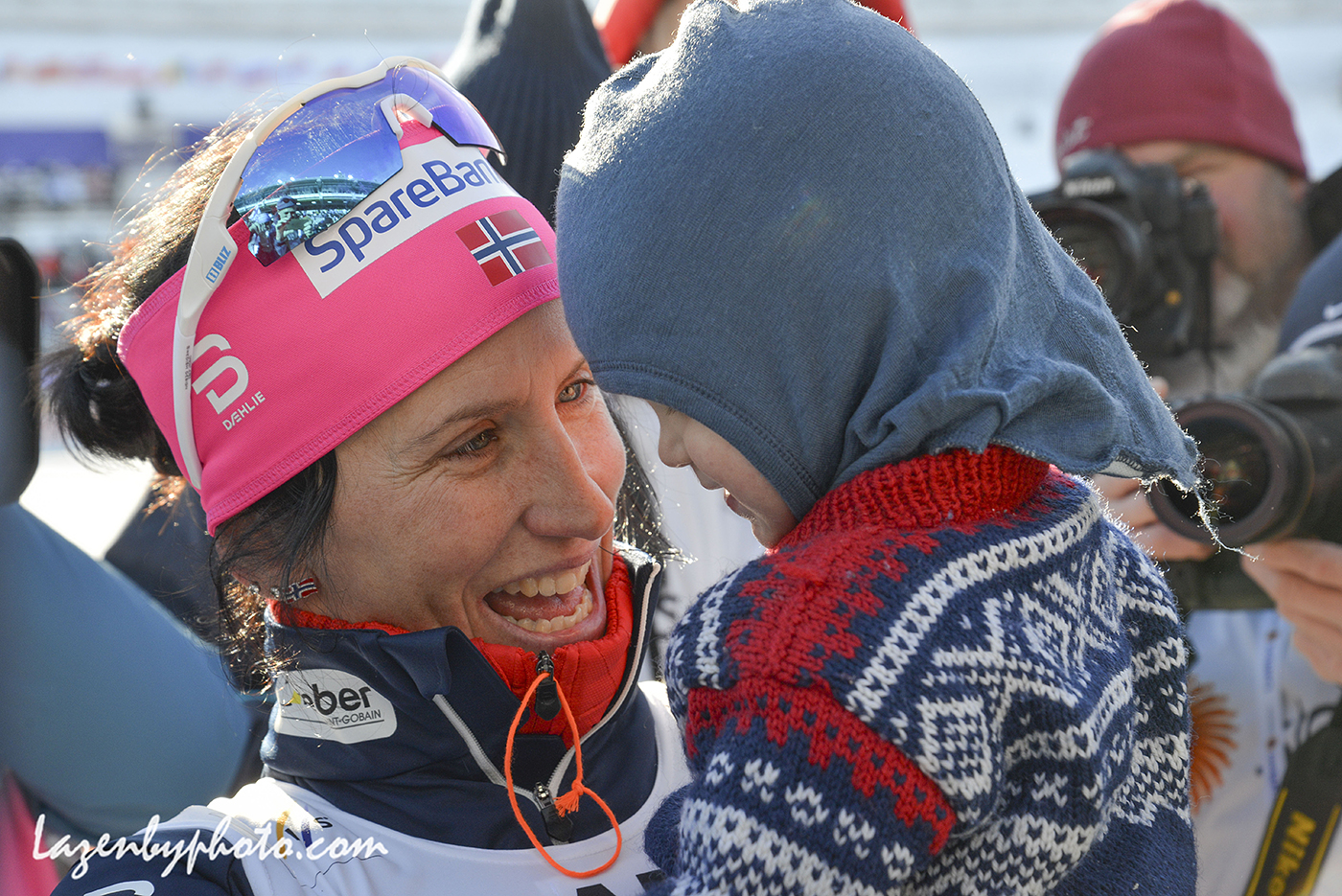
    Norway’s Marit Bjørgen with her 1-year-old son Marius after she won her 15th World Championships gold on Saturday in the women’s 15 k skiathlon at Nordic World Championships in Lahti, Finland. (Photo: John Lazenby/Lazenbyphoto.com)
  • Saturday Rundown: Lahti and Osrblie (Updated x2)

    Saturday Rundown: Lahti and Osrblie (Updated x2)

    The women’s 15 k skiathlon podium at 2017 Nordic World Championships, with Norway’s Marit Bjørgen (c) in first, Finland’s Krista Parmakoski (l) in second, and Sweden’s Charlotte Kalla (r) in third on Saturday in Lahti, Finland. (Photo: FIS Cross-Country/Twitter)

    FIS Nordic World Championships (Lahti, Finland): 15/30 k skiathlons 

    This one’s for you, kid.

    Marit Bjørgen became the second relatively new mom to medal in the second race of 2017 Nordic World Championships on Saturday (after American Kikkan Randall earned bronze in Thursday’s freestyle sprint), racking up her 15th World Championships gold in women’s 15-kilometer skiathlon in Lahti, Finland. Bjørgen, a 36-year-old Norwegian team veteran, had her first child a little over a year ago.

    In her first full season back, she led Saturday’s 7.5 k classic + 7.5 k freestyle race at the halfway point, where she clicked into her skate skis half a second ahead of Finland’s Krista Parmakoski in second. Parmakoski followed her across the finish for silver, finishing 4.8 seconds off Bjørgen’s winning time of 37:57.5 minutes. For Parmakoski, it was her first individual medal at World Championships after having previously earned four in team events.

    Sweden’s Charlotte Kalla picked up her fourth-career World Championships medal in third place (+32.0), and Nathalie von Siebenthal placed fourth (+1:05) for the best result for a Swiss female cross-country skier since since Evi Kratzer earned bronze in 1987 in Oberstdorf, Germany.

    Von Siebenthal edged Norway’s Heidi Weng in a photo finish, with Weng finishing another tenth of a second back in fifth (+1:05.1). Right behind them, Austria’s Teresa Stadlober notched sixth (+1:05.4), Russia’s Yulia Tchekaleva seventh (+1:05.7), Norway’s Astrid Uhrenholdt Jacobsen eighth (+1:11.1), Russia’s Anastasia Sedova ninth (+1:15.3), and Japan’s Masako Ishida 10th (+1:21.8).

    Two Americans finished in the top 20 with Randall leading them in 17th (+2:09.2) and Liz Stephen placing 20th (+2:12.4). Rosie Brennan cracked the top 30 in 28th (+3:03.2) and Jessie Diggins did not finish.

    A World Championships rookie, Cendrine Browne led Canada in 35th (+4:15.5), followed by Emily Nishikawa in 38th (+4:29.3) and Katherine Stewart-Jones in 40th (+4:38.1).

    Annika Taylor, a 23-year-old California native who races for Great Britain, finished 41st (+4:49.7). She previously placed 38th in the freestyle sprint qualifier for her best result at her first World Championships.

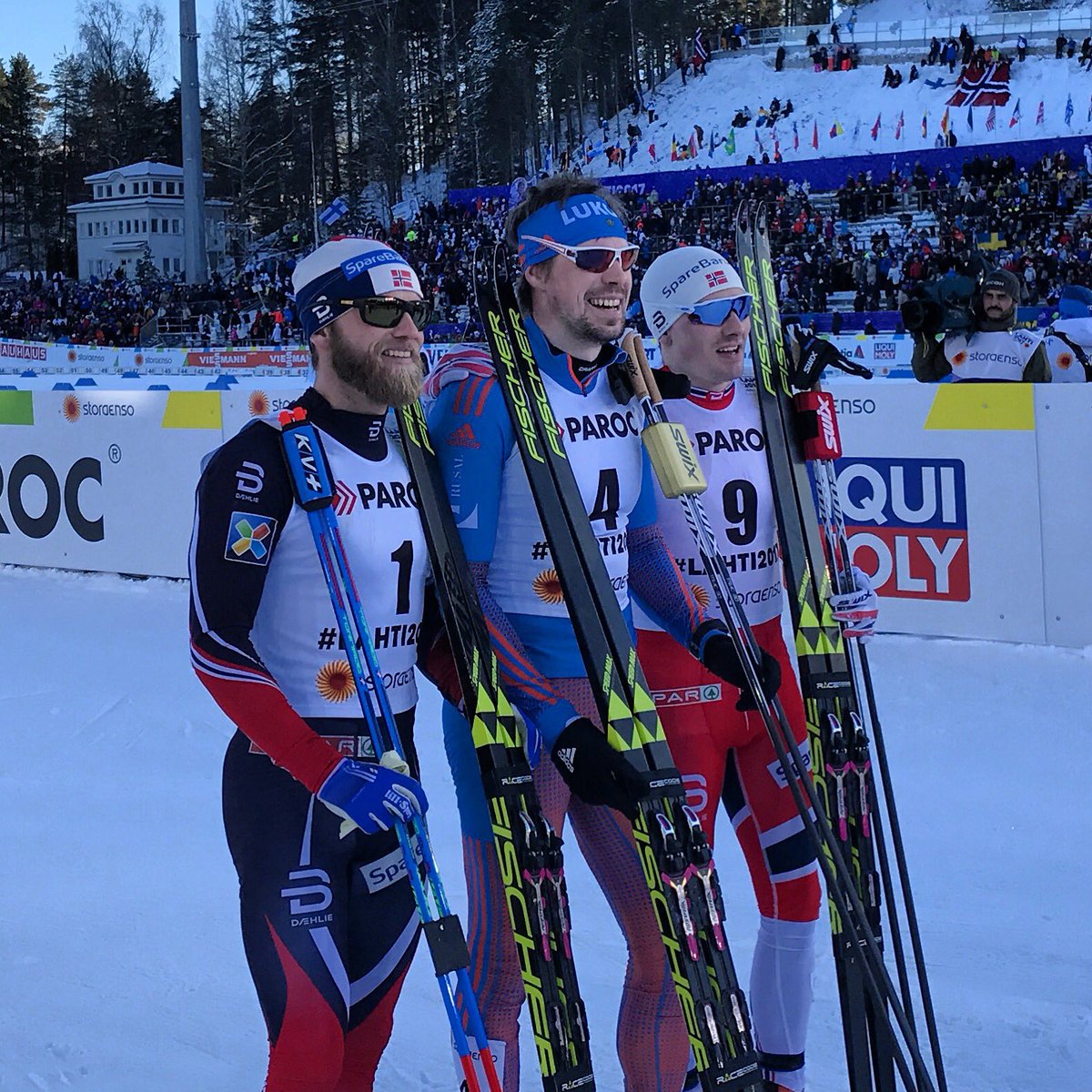
    The men’s Nordic World Championships 30 k skiathlon podium, with Russia’s Sergey Ustiugov (c) in first, Norway’s Martin Johnsrud Sundby (l) in second and Finn Hågen Krogh (r) in third on Saturday in Lahti, Finland. (Photo: FIS Cross-Country/Twitter)

    The men’s 30 k skiathlon that followed boiled down to a two-way battle for first between none other than Russia’s Sergey Ustiugov and Norway’s Martin Johnsrud Sundby. The two traded off leading throughout much of the race and together gapped the field around the 20 k mark.

    Over the next 10 k, Ustiugov continued to drive the pace. On a pivotal climb less than two minutes before the finish, Sundby attacked, jump skating and seeming to put the hurt on Ustiugov. But that moment was over before it started when Sundby broke his pole against his ski tip and had to stop for a replacement.

    The 24-year-old Ustiugov skied away to the win, uncontested yet powering down the finishing stretch to claim his first World Championships gold in 1:09:16.7 hours. He had previously earned bronze with the Russian men’s relay in 2013.

    Sundby finished 6.7 seconds later, dropping his arms and head toward the ground as he did so. Norway’s Finn Hågen Krogh came out on top of a five-way fight for third, finishing fourth (+33.1), 31.8 seconds behind Ustiugov and 1.3 seconds ahead of his teammate Sjur Røthe. Krogh put himself in front and proved to have the most finishing kick, ahead of Røthe, Canada’s Alex Harvey (fifth, +33.3), Norway’s Didrik Tønseth (sixth, +33.5), and Sweden’s Marcus Hellner (seventh, +33.7). Russia’s Andrey Larkov fell off the group’s pace and placed eighth (+36.1), Finland’s Lari Lehtonen was ninth (+37.2), and Italy’s 24-year-old World Championships rookie Giandomenico Salvadori broke through in 10th (+37.3).

    Three Canadians started the race, with Graeme Killick finishing 47th (+6:23.5) and Knute Johnsgaard 55th (+8:40.2) out of 63.

    Tad Elliott was the top American man in 48th (+7:11.2), Kyle Bratrud (+7:16.5) placed 49th and Noah Hoffman 57th (+9:33.6). Ben Lustgarten did not start.

    Results: Women | Men

    ***

    IBU Youth/Junior World Championships (Osrblie, Slovakia): Junior sprints

    [UPDATED] Canada’s Megan Bankes and American Siena Ellingson landed in the top 20 of the junior women’s 7.5-kilometer sprint on Saturday at 2017 International Biathlon Union (IBU) Junior World Championships in Osrblie, Slovakia. Coming off a victory in Thursday’s 12.5 k individual, Bankes placed 13th and Ellingson achieved her best non-relay result in 18th at her fourth Youth/Junior Worlds.

    Italy’s Michela Carrara won the sprint in 20:57.8 minutes with clean shooting (0+0) and the second-fastest course time. Norway’s Ingrid Landmark Tandrevold skied the fastest but came up 15.2 seconds short of gold with one prone penalty (1+0), which put her in second place. France’s Myrtille Bègue reached the podium in third (+31.5) with perfect shooting (0+0), and Austria’s Simone Kupfner shot clean as well for fourth place (+40.8), 9.3 seconds out of third.

    Bankes was one of the first out of the gate in bib 4 and missed one on each stage (1+1) and skied the 14th-ranked course time. She ultimately finished 13th (+1:25.3) for her second-best result at her fourth Youth/Junior World Championships.

    Ellingson started 19th and cleaned prone before missing one in standing (0+1), to finish 18th (+1:38.7) with the 20th-ranked course time.

    Canada’s Nadia Moser scored her first top 40 of these championships in 31st (+2:16.4) with two misses (1+1), her teammate Emily Dickson finished 47th (+3:15.8) with one prone miss (1+0), and the second American racing, Nina Armstrong finished 65th (+6:11.5) with five penalties (2+3).

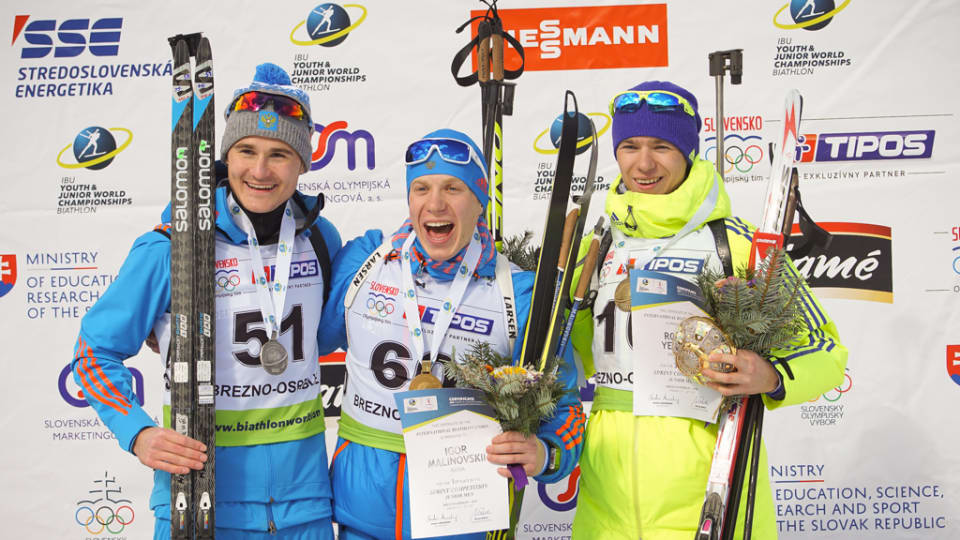
    Russia had two on the podium in Saturday’s junior men’s 10 k sprint at IBU Junior World Championships with Igor Malinovskii (c) in first and Kirill Streltsov (l) in second, sharing the podium with Kazakhstan’s Roman Yeremin (r) in third in Osrblie, Slovakia. (Photo: IBU)

    In the junior men’s 10 k sprint, Russia took the two top steps of the podium with Igor Malinovskii in first and Kirill Streltsov in second, after both cleaned the two-stage race.

    Malinovskii started later in the field in bib 60 (out of 86) and bested his teammate’s time by 12.2 seconds, finishing in 24:32.2 minutes. Streltsov, who had started 51st and led until that point, took silver and Kazakhstan’s Roman Yeremin notched bronze (+24.9). Despite two misses on his first prone stage (2+0), Yeremin was an early race leader after starting 10th. He bested the time of Belarus’s Anton Smolski, who started fifth, by just 0.2 seconds for third. Smolski settled for fourth, ahead of Germany’s David Zobel (who previously took silver in Thursday’s 15 k individual) in fifth (+38.2).
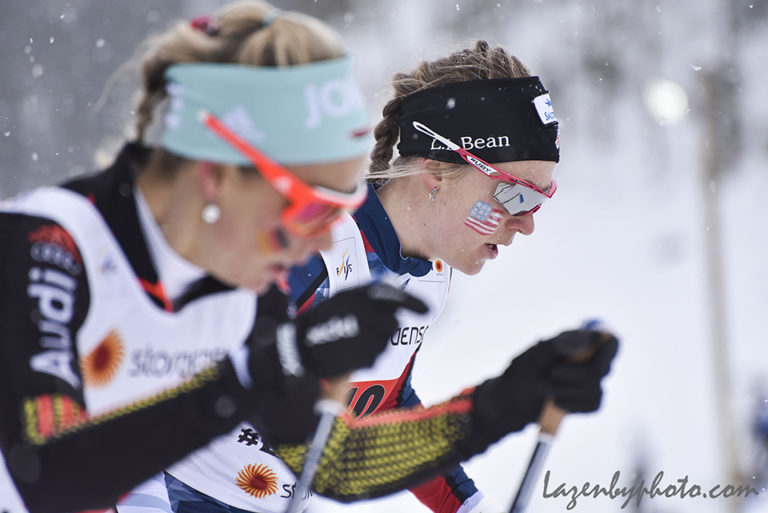
    Cody Johnson was the top American in 46th (+3:02.9), followed by Travis Cooper in 49th (+3:10.7), Cameron Christiansen in 80th (+5:32.4), and Peter Carroll in 82nd (+5:51.6).

    Pearce Hanna led the Canadian men in 47th (+3:04.1), ahead of Trevor Kiers in 48th (+3:06.6), Zachari Bolduc in 54th (+3:25.4), and Jules Burnotte in 55th (+3:31.2).

    Youth/Junior World Championships continue Sunday with the youth men’s and women’s pursuits.

    Results: Junior women | Junior men

  • After The Medals: Video Interviews with Silver and Bronze Medalists Diggins & Randall

    After The Medals: Video Interviews with Silver and Bronze Medalists Diggins & Randall

    Two American woman and one Norwegian reached the podium in the first medals race of 2017 Nordic World Championships, with Maiken Caspersen Falla of Norway (c) taking gold, and for the U.S., Jessie Diggins (l) and Kikkan Randall (r) taking silver and bronze, respectively, in the women’s freestyle sprint on Thursday, Feb. 24 in Lahti, Finland. (Photo: John Lazenby/Lazenbyphoto.com)
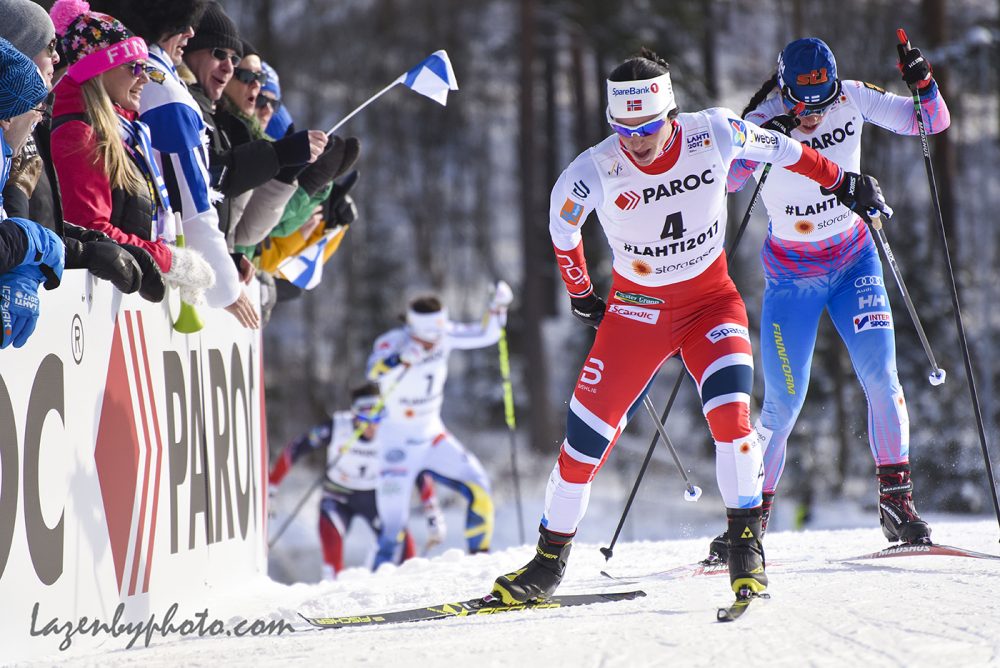
    LAHTI, Finland — FasterSkier had an opportunity to interview Thursday’s 2017 Nordic World Ski Championships medalists Jessie Diggins and Kikkan Randall at the athletes’ village outside Lahti.

    (Note: the interviews were conducted in a non-studio environment and are best listened to without headphones.)

    For both U.S. Ski team members, it was their second-career individual World Championship medal and third overall — Diggins and Randall won team-sprint gold at the 2013 Val di Fiemme, Italy World Championships.

    In Randall’s interview, she explains how she progressed through the heats and positioned herself to make the best of any opportunity.

    Diggins discussed how she thrives on pressure and has built the self confidence to be a regular contender for the World Cup podium.

    Both women are entered in Saturday’s 15-kilometer skiathlon. A 30 k event will be held for the men.

    U.S. Skiathlon Entries:

    Women

    • Jessie Diggins
    • Liz Stephen
    • Rosie Brennan
    • Kikkan Randall

    Men

    • Noah Hoffman
    • Tad Elliott
    • Kyle Bratrud
    • Ben Lustegarten

    Canada Skiathlon Entries:

    Women

    • Emily Nishikawa
    • Cendrine Browne
    • Katherine Stewart-Jones

    Men

    • Alex Harvey
    • Devon Kershaw
    • Graeme Killick
    • Knute Johnsgaard

    Skiathlon start lists: Women | Men

  • Setting the Scene: Pre-Competition Day at Lahti World Championships

    Setting the Scene: Pre-Competition Day at Lahti World Championships

    An Austrian athlete tests skis as he glides back into the main stadium. (Photo: John Lazenby/Lazenbyphoto.com)

    LAHTI, Finland — Tuesday at Lahti’s venue for the 2017 Nordic World Ski Championships, the sun sets early. Although technically sunset was 5:22 p.m., the sun on this clear-sky day was still wintertime reluctant. It seemed too short a time for the sun’s transect to thaw Lahti. Temps were in the mid-to-low 20 degrees Fahrenheit. But a brisk wind called for down coats and insulated pants for those not actively skiing — in the shade, it felt like the teens.

    Basked in an early evening glow, Lahti’s three iconic ski jumps dominate the 2017 Nordic World Championships venue. (Photo: John Lazenby/Lazenbyphoto.com)

    For athletes, it was a day of pre-competition ski and wax testing on bulletproof tracks that gradually deteriorated on the steeper climbs. The ski loops have good coverage. The snow remains coarse, as the tracks are covered with predominately manmade snow with trace amounts of natural snow tilled in.

    Lahti’s most dominant feature are its ski jumps, which are among the first objects to catch morning light. The surrounding landscape isn’t marked by serrated mountains, but by subtle hills that make the venue’s three domineering jumps (a K 116, K 90, and K 64), that much more ominous. First nordic-combined skiers then women’s ski jumpers had an opportunity for test flights off the K 90.

    On the non-skiing side of things, the venue was abuzz of last-minute prep: television cables being covered for protection before the onslaught of spectators, event producers testing the stadium’s Skycam, sponsors unpacking schwag, and media arriving to pick up credentials. Like the athletes fine tuning before the competition begins, Lahti’s organizers are near set for the big show.

    On Wednesday, two qualification races will ensue: the women’s 5-kilometer classic and men’s 10 k classic individual starts. These races are for athletes from “non-skiing” nations who have not met the FIS-point benchmark to participate in the championships. Start rights to Lahti’s distance races are granted to the top-10 male and female finishers. (All skiers are granted start rights for Thursday’s freestyle sprint regardless of their results in Wednesday’s qualifier.)

    5 k start list | 10 k start list

    ***

    Cross-Country Competition Schedule

    (All cross-country and nordic-combined events will be streamed live in the U.S. on NBCSports.com)

    A Latvian skier double poles through Lahti’s stadium on Tuesday. (Photo: John Lazenby/Lazenbyphoto.com)

    Wednesday, Feb. 22
    -Women’s 5 k classic interval start (7:00 a.m. EST)
    -Men’s 10 k classic interval start (8:30 a.m. EST)

    Thursday, Feb. 23 
    -Women’s freestyle k sprint (10:30 a.m. EST)
    -Men’s freestyle k sprint

    Saturday, Feb. 25 
    -Women’s 15 k skiathlon (5:00 a.m. EST)
    -Men’s 30 k skiathlon (7:30 a.m. EST)

    Sunday, Feb. 26
    -Women’s classic team sprint
    -Men’s classic team sprint

    (Semifinals starting at 4:30 a.m. EST, finals starting at 6:30 a.m. EST)

    Tuesday, Feb. 28 
    -Women’s 10 k classic interval start (6:45 a.m. EST)

    Wednesday, Mar. 1 
    -Men’s 15 k classic interval start (6:45 a.m. EST)

    Thursday, Mar. 2 
    -Women’s 4 x 5 k team relay (8:00 a.m. EST)

    Friday, Mar. 3
    -Men’s 4 x 10 k team relay (6:30 a.m. EST)

    Saturday, Mar. 4 
    -Women’s 30 k freestyle mass start (7:30 a.m. EST)

    Sunday, Mar. 5  
    -Men’s 50 k freestyle mass start (7:30 a.m. EST)

    U.S. 2017 World Championships Team:

    Men

    • Simi Hamilton (Stratton T2/ World Cup A-team)
    • Andy Newell (Stratton T2/ World Cup A-team)
    • Erik Bjornsen (Alaska Pacific University/World Cup B-team)
    • Noah Hoffman (Ski and Snowboard Club Vail/World Cup B-team)
    • Tad Elliott (Ski and Snowboard Club Vail)
    • Kyle Bratrud (Central Cross Country)
    • Ben Lustgarten (Craftsbury Green Racing Project)
    • Cole Morgan (Sun Valley Ski Education Foundation)

    Women

    • Jessie Diggins (Stratton T2/World Cup A-team)
    • Sadie Bjornsen (Alaska Pacific University/World Cup A-team)
    • Sophie Caldwell (Stratton T2/World Cup A-team)
    • Kikkan Randall (Alaska Pacific University/World Cup A-team)
    • Ida Sargent (Craftsbury Nordic/World Cup A-team)
    • Liz Stephen (Burke Mountain Academy/World Cup A-team)
    • Rosie Brennan (Alaska Pacific University/World Cup B-team)
    • Caitlin Gregg (Loppet Nordic Racing)
    • Chelsea Holmes (Alaska Pacific University)

    Canadian 2017 World Championships Team:

    Men

    • Alex Harvey (CNEPH/World Cup A-team)
    • Devon Kershaw (World Cup A-team)
    • Len Valjas (World Cup A-team)
    • Jess Cockney (World Cup B-team)
    • Graeme Killick (World Cup B-team)
    • Knute Johnsgaard (AWCA/NST U25 Team)

    Women

    • Emily Nishikawa (NST U25 Team)
    • Dahria Beatty (AWCA/NST U25 Team)
    • Cendrine Browne (CNEPH/NST U25 Team)
    • Katherine Stewart-Jones (NTDC Thunder Bay/NST U25 Team)

    Nordic Combined Competition Schedule:

    (All cross-country and nordic-combined events will be streamed live in the U.S. on NBCSports.com)

    Friday, Feb. 24

    -Individual HS 100 competition round (8:30 a.m. EST)

    -Individual 10 k cross-country race (6:30 a.m. EST)

    Sunday, Feb. 26

    -Team event  HS 100 competition round (5:00 a.m. EST)

    -Team event  4 x 5 k cross-country race (8:30 a.m. EST)

    Wednesday, Mar. 1

    -Individual HS 130 competition round (5:00 a.m. EST)

    -Individual 10 k cross-country race (9:15 a.m. EST)

    Friday, Mar. 3

    -Team sprint HS 130 competition round (9:00 a.m. EST)

    -Team sprint 2 x 7.5 k cross-country race (11:15 a.m. EST)

    U.S. Nordic Combined 2017 World Championships Team:

    • Bryan Fletcher
    • Taylor Fletcher
    • Benjamin Berend
    • Adam Loomis
    • Ben Loomis
  • Sunday Rundown: World Champs Silver for Dunklee, Bailey 6th in Hochfilzen (Updated x2)

    Sunday Rundown: World Champs Silver for Dunklee, Bailey 6th in Hochfilzen (Updated x2)

    Susan Dunklee (US Biathlon) celebrating second place in the women’s 12.5 k mass start on the final day of 2017 IBU World Championships in Hochfilzen, Austria. It was her first World Championships medal. (Photo: US Biathlon/Twitter)

    IBU World Championships (Hochfilzen, Austria): Women’s & men’s mass starts

    Silver medal for Susan Dunklee. That’s the big news coming out of Hochfilzen, Austria, on the final day of the International Biathlon Union (IBU) World Championships after the American finished second, just 4.6 seconds out of first, in the women’s 12.5-kilometer mass start.

    Dunklee started in bib 17 in the mass start and cleaned all 20 targets to put herself in the hunt for gold. She finished just behind Germany’s Laura Dahlmeier who took the win in 33:13.8 minutes, also with perfect shooting. Just three out of 30 women cleaned, with the other being Italy’s Alexia Runggaldier in ninth.

    “I think my mistake a lot this season has been wanting the results too much,” Dunklee told FasterSkier after. “[I’ve been] slowly been coming to terms these last couple weeks, trying to focus more on the process and not worrying too much if the medal comes or not so that was a big trick today.”

    Finland’s Kaisa Mäkäräinen reached the podium with a since miss in the first prone stage in third (+20.1). The U.S. had two women in the mass start, with Clare Egan finishing 24th (+3:04.1) with four penalties (1+0+1+2).

    Lowell Bailey (US Biathlon) taking aim during the second prone stage of the men’s 15 k mass start on the last day of IBU World Championships in Hochfilzen, Austria. He cleaned all four stages to fight for the medals until the final loop, and ultimately finished sixth. (Photo: ARD broadcast screenshot)

    [UPDATED] In the men’s 15 k mass start that followed, Lowell Bailey was in contention for a medal until the very end, after being one of three athletes to clean the four-stage race.

    Bailey left the range for the last time in third, 16.8 seconds behind Austria’s Simon Eder in first and 14.5 seconds behind Germany’s Simon Schempp in second (both Eder and Schempp also cleaned every stage). Behind Bailey, Johannes Thingnes Bø had recovered quickly from a penalty on the last stage, and left the range in fourth, 8.4 seconds behind Bailey.

    Early on the final loop, Bø caught Bailey to fight for a medal. Bø didn’t stop there, catching up to Eder as well after Schempp dropped the Austrian around 13.6 k. With about a kilometer remaining, Bø passed Eder and stayed ahead of him for silver, crossing 9 seconds after Schempp in first and 1.1 seconds ahead of Eder — who notched his first World Championships medal — in third.

    Schempp hit all of his targets for his first individual World Championships gold in the final race of the championships, finishing in 35:38.3. Bø and Eder shared the podium with him, and Russia’s Anton Shipulin and France’s Martin Fourcade passed Bailey on the last loop for fifth (+25.3) and sixth (+31.3), respectively. Bailey finished sixth (+33.5) for his fourth top six (in as many individual races) at the championships, after notching a gold medal in the 20 k, fourth place in the sprint and sixth in the pursuit.

    “I just told myself to hang as long as I could,” Bailey told FasterSkier after. “Unfortunately I only had four laps and the fifth was bru-tal as they say in Germany. But I’m so psyched with this whole world champs. I never cleaned a mass start and I never cleaned an individual and I just did both at world champs.

    “I’m so happy for the team, for Susan,” he added. “Our whole team deserves this world champs. We haven’t shown what we’re capable of, there’s always been one setback or another … and the stars aligned for this one. We were waiting for this moment and everything clicked for the team and it’s so great to see, and god am I glad I stuck around to be here.”

    Results: Women | Men

    ***

    FIS Cross-Country World Cup (Otepää, Estonia): 10/15 k classic

    The women’s 10 k classic podium at the Otepaa World Cup on Sunday in Estonia, with Norwegian winner Marit Bjørgen (c), Sweden’s Charlotte Kalla (l) in second and Norway’s Heidi Weng (r) in third. (Photo: Gro Eide/FIS Cross Country Twitter)

    Remember the days when Marit Bjørgen used to win by 30 seconds or more? Well, the Norwegian multiple-time world champion was nearly there again, racing to first in the women’s 10-kilometer classic individual start with a margin of 26.5 seconds to second on Sunday.

    Bjørgen started in the middle of the pack, in bib 38, and bested the time of her teammate Heidi Weng by 57.2 seconds on the two-lap World Cup course in Otepää, Estonia.

    That bumped Weng to second, and another Norwegian Ingvild Flugstad Østberg to third (+1:17.4), until Sweden’s late-starting Charlotte Kalla in bib 60 broke up the Norwegian sweep in second. Kalla finished 26.5 seconds shy of Bjørgen, but 30 seconds faster than Weng for the second spot on the podium. Weng ended up third for the second-straight day and Østberg fourth.

    Also in the top 10, Poland’s Justyna Kowalczyk placed fifth (+1:19.7), Finland’s Krista Parmakoski was sixth (+1:23.1), Russia’s Anastasia Sedov seventh (+1:29.6), Sweden’s Anna Haag eighth (+1:50.7), Russia’s Yulia Tchekaleva ninth (+1:57.2), and Norway’s Astrid Uhrenholdt Jacobsen 10th (+1:57.8).

    American Sadie Bjornsen finished in the top 20 in 19th (+2:30.5). Also in the points for the U.S., Rosie Brennan placed 24th (+2:37.8) and Liz Stephen 29th (+2:53.8). Kikkan Randall was about 10 seconds outside the top 30 in 34th (+3:04.7), Ida Sargent finished 42nd (+3:46.1), and Chelsea Holmes 50th (+4:47.5).

    Emily Nishikawa led the Canadian women in 40th (+3:39), Dahria Beatty was 45th (+4:11.9), Cendrine Browne 54th (+5:09.2), and Katherine Stewart-Jones 57th (+5:37.1).

    The men’s 15 k classic podium at the Otepaa World Cup on Sunday in Estonia, with Norway’s Martin Johnsrud Sundby (c) in first, Finland’s Iivo Niskanen (l) in second, and Norway’s Hans Christer Holund (r) in third. (Photo: FIS Cross Country/Twitter)

    [UPDATED] Norway’s Martin Johnsrud Sundby dominated the men’s 15 k classic from start to finish on Sunday, starting near the back of the nearly 80-man field and clocking the fastest splits throughout the three-lap race.

    He topped the previous best time set by Finland’s Iivo Niskanen by 37.1 seconds with a winning time of 40:38.2. Conditions weren’t easy on the rainy afternoon in Otepää, with tracks appearing shallow at best and visibly washed out in places.

    Norway had two on the podium with Hans Christer Holund in third (+49.1). Niklas Dyrhaug was 6.2 seconds short of the podium in fourth, Finland’s Matti Heikkinen placed fifth (+58.1), Kazakhstan’s Alexey Poltoranin sixth (+1:01.3), Russia’s Alexander Bessmertnykh seventh (+1:02.5), Norway’s Sjur Røthe eighth (+1:03.5), Norway’s Didrik Tønseth ninth (+1:14.5), and France’s Maurice Manificat 10th (+1:21.3).

    Canada’s Alex Harvey led the North Americans in 19th (+1:50). Graeme Killick finished 47th (+3:44.6), Devon Kershaw 49th (+3:51.3), Knute Johnsgaard 58th (+4:50.4), and Jess Cockney 72nd (+7:15).

    Erik Bjornsen was the top American in 36th (+3:12.1) and Ben Lustgarten finished 66th (+5:34.1).

    Results: Women | Men

  • Falun Extras: Bonus Quotes

    Falun Extras: Bonus Quotes

    The start of the men's 30 k classic mass start on Sunday, Jan. 29, at the World Cup in Falun, Sweden. (Photo: Fischer/NordicFocus)
    The start of the men’s 30 k classic mass start on Sunday, Jan. 29, at the World Cup in Falun, Sweden, with (front, left to right) Russia’s Sergey Ustiugov (4), Finland’s Matti Heikkinen (2), Norway’s Martin Johnsrud Sundby (yellow bib), Canada’s Alex Harvey (3), and Switzerland’s Dario Cologna leading out of the gate. (Photo: Fischer/NordicFocus)

    We’re a couple days out from last weekend’s World Cup in Falun, Sweden, with several top racers taking a two-week breather now to prepare for World Championships, but several more are headed to PyeongChang, South Korea, to preview the 2018 Olympic course at this coming weekend’s three-day World Cup, Friday through Sunday. Here is a final wrap of some of the North American comments from Falun that didn’t make it into the race reports.

    Saturday’s freestyle sprints

    (Women’s report | Men’s report)

    On the sprint course:

    “I think it is a great sprint course. I think they could maybe do a little reconstruction on the fast righthand downhill corner to bank it a little, because that was getting pretty icy today, but everything else skis really well. It’s a little frustrating because it seemed like most of the racing comes down to the last 45 seconds or minute, and who can get the best draft coming into the stadium. It is such a fast finish there … but that’s part of racing, it’s not going to be a totally fair thing all the time. It just takes some really good positioning for that downhill and then kind of launching your move as you come into that bump, and carrying that momentum through the finish.”

    — Simi Hamilton (U.S. Ski Team), 18th overall

    “It was a fast sprint today. The perfect event for an athlete like Erik Bjornsen is the team sprint, where you link together multiple very hard efforts. He’s an athlete that can recover and maintain a high pace. But these really short, really fast sprints, that he’s still working on. He needed another minute for his strength to really show, and he only missed by a little over a second.”

    — Matt Whitcomb (U.S. Ski Team coach), on Erik Bjornsen, who finished 43rd in the qualifier

    On organizing-committee snafus:

    “They had a little bit of a grooming mistake where they set a [classic] track in the qualification lane. Normally for qualification [in a skate sprint] you are behind the wand, pole in front of it, and then you skate right out. Today they had a five-meter track. All of the girls double poled out of it. Simi was bib 11, and right before he started we told him, ‘You gotta skate.’ We were watching the ten guys who started before him double pole, and it just didn’t look very fast, so he skated out of the gate, and Emil Iversson behind him did that too. The next handful of guys double poled, and then the rest of the field started to catch on to that, and everybody else skated the qualification after that.”

    — Whitcomb

    On qualifying:

    “I was really psyched with how my qualifier went today. It was funny, because when I finished I wasn’t sure how it went because it didn’t feel like a typical sprint. Even though the time on course is only about 3 minutes, it is a really hard course, with a lot more uphill than we are used to skiing in skate sprints. I knew it would be easy to blow up on this course, so out of the start I focused on big pushes with a lot of glide and on the two big uphills, I didn’t allow myself to hop skate and instead did a hard and fast V1 where I tried not to waste too much energy being springy. I felt like I skied the technical downhills well and had a semi strong finish, but mostly was happy with how I had paced it. I was thrilled to see I had qualified in 3rd.”

    — Sophie Caldwell (U.S. Ski Team), on qualifying in 3rd

    On finding her sprinting groove:

    “Everybody has such a different tactic, like today I saw Kikkan [Randall] go right before me and she was aggressive from the back so I tried that method, and I think that maybe that is the problem I keep falling into. I am trying to do what my teammates are doing and forgetting to use my specific strengths and remembering that everyone is different.”

    — Sadie Bjornsen (U.S. Ski Team), 19th overall

    On measurable progress:

    “It is my first final in about two years, so that was pretty fun to be back in the final. I have been getting progressively better every sprint race this season, so this was just another good step forward. Never having come back from a baby before I don’t really have anything to gauge against or a way to expect it was going to go. I have been just trying to build strength this season, and I like the trajectory I am on, so another month and hopefully I can be ready to contend for that podium.”

    — Kikkan Randall (U.S. Ski Team), 5th overall

    ***

    Sunday’s 15/30 k classic mass starts

    (Women’s report | Men’s report)

    On the conditions:

    “It was my least favorite conditions today with the tracks really hard to find kick in and getting really sugary as they broke down, so it was good to have another chance to work on my striding and improve my classic racing! But like yesterday, I was so impressed with our service team and my skis were great!”

    — Jessie Diggins (U.S. Ski Team), 10th

    “It was challenging conditions today with sugary tracks that were a little beat up from the boys. I actually really enjoy skiing in this kind of condition so I was optimistic about today’s race.”

    — Rosie Brennan (U.S. Ski Team), 24th

    “I remembered TERRIBLE snow conditions [from 2015 World Championships] and a major climb that was going to entail a lot of herringbone. Fortunately, the snow was much better (Icy at the beginning and then sugary) although still not easy to kick skiing and the steepest part of the climb I was thinking about was changed. The course used much of the terrain from World Champs but the courses were a fair bit different and as such skied very differently.”

    — Matt Gelso (Sun Valley Ski Education Foundation), 44th

    On the course:

    “I like skiing here in Falun, I think the courses suit me well. There is a long relatively flat section that comes out of the stadium, and in almost every distance race we lap though it multiple times. I tend to feel stronger in double pole and V2 so I really like this section.”

    — Erik Bjornsen (U.S. Ski Team), 35th

    On the race format:

    “We don’t get to race 15 k very often so it’s hard to know what to expect out there.”

    — Brennan

    On the weeks to come:

    “I am looking forward to some rest and recovery to rebuild for a big and important block of racing to come!”

    — Sadie Bjornsen, 21st

    On keeping up the momentum while during a two-week break from racing:

    “When things are going good you just want to keep racing, so I am looking forward to it, more to be able to really put in a good block of training and doing what I have done in the past before championships. But I really enjoy racing, I love training, and I love most of the things we do in the summer pretty much other than maybe strength workouts, like, it’s not like labor for me or anything, but racing is really why I do all of that. I am never saying, ‘Oh, I need a break. Now it would be nice to not be putting a bib on for three weeks,’ I have never really had that feeling. … I guess it’s the opposite. By World Cup Finals, if things are going well I am just kind of sad to leave the circuit, but it might be different for others. You are never going to find me saying it’s time to stop racing ’cause I actually really, really enjoy everything about it, the adrenaline and everything around racing.”

    — Alex Harvey (Canadian World Cup Team), 15th

    On the decision to race next weekend in South Korea:

    “Liz [Stephen] and I are the only [U.S.] distance skiers going, and we both decided on that last minute, not until after the Tour de Ski, to go. And my decision was based on looking back at the 2012/13 season and the 2013/14 season, both years that I had pretty successful championships, and looking at the schedule between the Tour and the championship in those seasons. I was racing almost every weekend and we were traveling a lot, and I remember it being so much fun. I was just enjoying myself and so psyched to be over here [in Europe], and I was sitting in Val di Fiemme at the end of the Tour de Ski and looking at this year’s schedule, and it was a week off and then two weekends in Sweden and then two more weeks off before Otepää and Worlds, and that’s not exciting and that’s not fun! I don’t want to just sit around in Europe, and I didn’t feel like I needed a bunch of training time at that point. I thought, if anything, I needed to just chill and then race. … Korea sounded like fun. It was a cool opportunity. I handle travel super-well, and it’s fun to race World Cups with weak fields because you do better [laughs]. Not that I don’t believe I can do well in a World Cup with a full field, but you know, next week is a great opportunity.”

    — Noah Hoffman (U.S. Ski Team), 37th

    On Erik Bjornsen and Hoffman coming within striking distance of World Cup points on Sunday:

    “Noah and Erik didn’t end up with the results they are capable of, but each athlete came very close to putting together a good one. Erik spent most of his race fighting up to 23rd or 24th, and was skiing phenomenally, but did so working alone. It came with a price. With 7 k to go, a pack that had been trading leads came charging through. Noah’s race was moving in the right direction in the final 10 k, but a crash in the stadium lost his contact with the points. His energy looked good today, so I think he’ll be strong in Korea.”

    — Whitcomb

    Thinking ahead to World Cup Finals, on ending the season at home in Quebec City:

    “I think motivation at the end of the season is a huge factor because pretty much everybody, at least everybody that is in the top 10 overall, we are kind of all running a bit on fumes, like physically, especially on a championship year where everybody’s going to try to really work up a peak for the end of February. So then by mid-March, everybody will be kind of sliding out their peak. I really think motivation will be one of the most important factors, and the fact that I will be able to be at home will surely help the motivation. If I find myself in the spot that I am close to, like a similar spot that when I am in right now [fourth overall in the World Cup], that could be the difference between third and fourth in the overall. So that is, for sure, I think for me, a good advantage.”

    — Harvey

  • Win No. 105 for Bjørgen; U.S. Put 4 in Top 30 in Falun 15 k Classic

    Win No. 105 for Bjørgen; U.S. Put 4 in Top 30 in Falun 15 k Classic

    Norway's Marit Bjørgen celebrates her 105th individual World Cup win after she crosses first in the women's 15-kilometer classic mass start on Sunday in Falun, Sweden. (Photo: Fischer/NordicFocus)
    Norway’s Marit Bjørgen celebrates her 105th individual World Cup win on Sunday after finishing first, ahead of teammate Ingvild Flugstad Østberg, in the women’s 15-kilometer classic mass start in Falun, Sweden. (Photo: Fischer/NordicFocus)

    *Note: this article has been updated to include comments from U.S. women’s head coach Matt Whitcomb as of Monday, Jan. 30. 

    After sealing her 105th individual World Cup victory on Sunday, and her second distance win in a row, Marit Bjørgen is shutting out any doubt. The 36-year-old Norwegian was the first across the line in the women’s 15-kilometer classic mass start in Falun, Sweden, besting her teammate Ingvild Flugstad Østberg by half of a second, as well as the current overall World Cup leader, Heidi Weng, also of Norway.

    “It’s great to be able to win World Cups still,” Bjørgen said according to an International Ski Federation (FIS) press release. “The young girls are strong, so it feels good to be able to come out with a win.

    Starting in bib 5, Bjørgen wasted no time putting her teammates and the field to work. By 1.5 k she was in the lead, pulling Østberg and Weng, as well as Sweden’s Stina Nilsson — yesterday’s sprint winner — and Finland’s Krista Pärmäkoski.

    Right to left: Norway's Marit Bjørgen leading her teammates Ingvild Flugstad Østberg and Heidi Weng during the women's 15-kilometer classic mass start on Sunday in Falun, Sweden. (Photo: Fischer/Nordic Focus)
    Norway’s Marit Bjørgen (5) leads her teammates Ingvild Flugstad Østberg (3) and Heidi Weng during the World Cup women’s 15 k classic mass start on Sunday in Falun, Sweden. (Photo: Fischer/NordicFocus)

    Also within firing range was American Jessie Diggins, skiing in seventh, along with Norway’s Astrid Uhrenholdt Jacobsen and Maiken Caspersen Falla, and Sweden’s Charlotte Kalla.

    However, within another four kilometers, the Norwegians had broken away, a close to seven-second gap forming from them to Nilsson and Pärmäkoski.

    While Bjørgen led for the first third of the race, Østberg took over by 10 k and Weng continued to follow in third.

    With 1.8 k to go, Bjørgen was back to the front, Nilsson the closest challenger to the Norwegians just over 30 seconds behind.

    “I thought Stina might catch me, so I am very happy to make the podium today,” Weng said, according to a FIS press release.

    As the three headed into the second-to-last major climb, Østberg pushed to the front, Bjørgen trailing back. But coming into the final climb, Bjørgen moved back into first as she herringboned to the far outside right of Østberg, almost departing the marked course.

    “I didn’t ski the final climb well … Marit got a gap and I wasn’t able to close it,” Østberg said according to FIS. “I wasn’t satisfied with yesterday’s sprint result, so it’s good to be back on the podium today.”

    Left to right: Norway's Ingvild Flugstad Østberg, Marit Bjørgen and Heidi Weng celebrate an all-Norwegian podium in the women's 15-kilometer classic mass start on Sunday at the World Cup in Falun, Sweden. (Photo: Fischer/NordicFocus)
    Left to right: Norway’s Ingvild Flugstad Østberg, Marit Bjørgen and Heidi Weng celebrate an all-Norwegian podium in the women’s 15-kilometer classic mass start on Sunday at the World Cup in Falun, Sweden. (Photo: Fischer/NordicFocus)

    In a double-pole sprint to the finish, Bjørgen held off Østberg for the win in a time of 41:28.8. Østberg finished half a second later for second place, followed by Weng in third (+8.1). 

    The first American across the line was Diggins in 10th (+1:37.5) wearing bib 4. While the Afton, Minn., native explained that Sunday’s sugary conditions are some of her least favorite, the opportunity to put her classic striding to the test was something she welcomed.

    After losing the leaders, the 25-year-old Diggins skied with a mix of Finnish skiers, including Laura Mononen, Anne Kyllönen, and Kerttu Niskanen, as well as Norway’s Falla.

    “Early on I tried to go with the leaders but then settled into a great pack of girls to ski with and it came down to an exciting sprint out,” Diggins wrote in an email. “I’m really looking forward to some rest and then a quality training camp with some family time in Valadalen [Sweden] for the next few weeks! My boyfriend is here cheering me on and coming to camp with me, and then my parents come next week so I have so many great things to look forward to!”

    The second U.S. woman across the line was Sadie Bjornsen in 21st (+2:43.6). A known lover of all-things-classic, Bjornsen was disappointed when she found herself tired during Sunday’s race. The 27 year old, however, was happy that she made it through the mental and physical challenge.

    “Today I literally gave everything I had, and while I am not stoked on the number or result, I am really proud that I kept fighting through that wall in front of my face,” Bjornsen wrote. “It was really challenging classic skiing out there, which I love, so I am sad to have missed an opportunity to fight in those tricky conditions. Big shoutout to our team for giving me good skis! I am looking forward to some rest and recovery to rebuild for a big and important block of racing to come!”

    American Caitlin Patterson (33) and Canadian Cendrine Browne (45) racing the women's 15-kilometer classic mass start on Sunday in Falun, Sweden, along with Germany's Elisabeth Schicho (38) and Italy's Giulia Stuerz (25). (Photo: Fischer/NordicFocus)
    American Caitlin Patterson (33) and Canadian Cendrine Browne (45) racing the women’s 15-kilometer classic mass start on Sunday in Falun, Sweden, along with Germany’s Elisabeth Schicho (38) and Italy’s Giulia Stuerz (25). (Photo: Fischer/NordicFocus)

    Two other American women also scored World Cup points, including Rosie Brennan in 24th (+2:57.0) and Liz Stephen in 29th (+3:24.5).

    Despite the sugary conditions and deteriorated tracks due to the men’s race, Brennan explained that Sunday’s snow was what she was looking for coming into the 15 k.

    “I actually really enjoy skiing in this kind of condition so I was optimistic about today’s race,” the 28-year-old Brennan wrote in an email. “I felt that I was fighting a bit of fatigue out there and only really had one speed, luckily it was a decent speed and I was able to hold consistent throughout the race.”

    Also competing for the U.S. finishing just outside the points was Caitlin Patterson in 32nd (+3:47.6) and Ida Sargent in 34th (+4:02.8).

    “Today was a solid day for the team,” U.S. women’s head coach, Matt Whitcomb wrote in an email. “We fought hard, and nearly accomplished what I will consider to be a huge achievement for the women, and that will be when we regularly can score our full national quota (6) in the points.  Today we had 4, with a close 32nd and 34th. That’s close to where I know we can be.”

    Canada’s lone competitor in the women’s race, Cendrine Browne crossed in 46th (+5:41.4) and American Liz Guiney finished 49th (+6:22.6).

    Results

  • Sunday Rundown: Falun, Duszniki-Zdrój, & The Marcialonga (Updated x4)

    Sunday Rundown: Falun, Duszniki-Zdrój, & The Marcialonga (Updated x4)

    Emil Iversen celebrates his win in the 30 k classic mass start in Falun, Sweden, on Sunday. Norwegian teammate Martin Johnsrud Sundby finished second and Sweden's Calle Halfvarsson third.
    Emil Iversen celebrates his win in the 30 k classic mass start in Falun, Sweden, on Sunday. Norwegian teammate Martin Johnsrud Sundby finished second and Sweden’s Calle Halfvarsson third.

    FIS Cross-Country World Cup (Falun, Sweden): 15 / 30 k classic mass start

    Women’s reportMen’s report

    In the women’s 15-kilometer classic mass start on Sunday, Norway swept the podium with Marit Bjørgen taking the win in a time of 41:28.8 in Falun, Sweden. Crossing just half a second behind her was her teammate, Ingvild Flugstad Østberg in second place. Rounding out the podium was Heidi Weng in third (+8.1).

    American Jessie Diggins was the first to cross the line for the U.S. in 10th (+1:37.5). Three other U.S. women finished in the top 30, with Sadie Bjornsen finishing 21st (+2:43.6), Rosie Brennan 24th (+2:57.0), and Liz Stephen in 29th (+3:24.5).

    Just outside of scoring World Cup points was American Caitlin Patterson in 32nd (+3:47.6) and Ida Sargent in 34th (+4:02.8). Canada’s Cendrine Browne finished 46th (+5:41.4) and American Liz Guiney 49th (+6:22.6).

    After losing the skate sprint yesterday in a photo finish to Italy’s Federico Pellegrino, Emil Iversen ascended to the top step of the podium in the men’s 30 k classic mass start on Sunday in Falun.

    The Norwegian was often near the front, but hadn’t tried to lead a breakaway like his teammates Martin Johnsrud Sundby and Sjur Røthe did earlier in the race. In the final two kilometers, Sundby – the overall World Cup leader – put in a sprint to try to drop the field. But Iversen caught up, drafting his veteran teammate into the stadium. In the final up-and-over before the finish line, Iversen made a pass and then accelerated down the finishing stretch to beat Sundby by 1.14 seconds.

    “I got motivation from yesterday’s last 20 meters,” Iversen told FIS in a finish-line interview. “So today I fought all the way, and I was really stronger. It is amazing for me to be second yesterday and first today. I’m really proud of that.”

    Calle Halfvarsson, who had been falling off the back of the lead pack just a few kilometers earlier, managed to get back to the front and claim third place for Sweden (+1.72 seconds) in a photo finish with Røthe (+1.76 seconds). Niklas Dyrhaug was next (+2.52 seconds) to give the Norwegian men’s team four in the top five.

    In his return to the World Cup stage, Norway’s Petter Northug finished 31st (+3:10.6).

    Alex Harvey was the lone Canadian on the start line. After skiing near the front of the field for the early part of the race he was dropped by the lead pack in the final kilometers, finishing 15th (+1:17.5).

    Erik Bjornsen and Noah Hoffman took 35th and 37th places for the United States, finishing +3:30.8 and +3:59.8, respectively. SuperTour leader Matthew Gelso — familiar with the Falun course after competing in 2015 World Championships — finished 44th (+5:23.6), and Andy Newell placed 53rd (+7:45.3).

    Results: Men | Women

    ***

    IBU Open European Championships (Duszniki-Zdrój, Poland): Single mixed & mixed relay

    Russia’s Alexander Loginov (center) is greeted at the finish by his teammates Irina Starykh, Svetlana Sleptsova and Alexey Volkov after anchoring his team to the gold medal in the mixed relay at the 2017 IBU Open European Championships in Duszniki-Zdrój, Poland. (Photo: IBU)
    Russia’s Alexander Loginov (center) is greeted at the finish by his teammates Irina Starykh, Svetlana Sleptsova and Alexey Volkov after anchoring his team to the gold medal in the mixed relay at the 2017 IBU Open European Championships in Duszniki-Zdrój, Poland. (Photo: IBU)

    [UPDATED] The Russian victory in the final 2 x 6 + 2 x 7.5-kilometer mixed relay event of the 2017 International Biathlon Union (IBU) Open European Championships in Duszniki-Zdrój, Poland, was only briefly in doubt, when Alexander Loginov skiing the anchor leg required all spares in his prone shooting stage. But with his final shot he managed to also hit that target to avoid the penalty lap, leaving the range with a lead of more than 30 seconds.

    Loginov then did not need any spares in the last standing stage, and could take his time on the final loop. Unlike Russia’s Evgeniy Garanichev earlier in the day during the single mixed relay, he also managed to pick up a flag for the final meters of the race, crossing the line in a time of 1:12:26.0 hours.

    The Russian team with Irina Starykh, Svetlana Sleptsova, Alexey Volkov and Loginov led from the first exchange and required only six spares with zero penalties.

    With this medal, the 28-year-old Volkov became the most successful athlete in history at European Championships, according to an IBU press release, surpassing the retired Polish biathlete Tomasz Sikora. Russia was the most successful team of the 2017 Open European Championships with six gold, four silver, and three bronze medals.

    Behind them, a number of teams vied for the positions on the podium. Sweden initially looked like a strong contender exchanging in second place after the women, but fell back with three penalty laps to only finish 10th.

    Still six seconds back after the final shooting, Norway’s Fredrik Gjesbakk caught up to and outsprinted Ukraine’s Ruslan Tkalenko in the finishing stretch to claim the silver medal (+36.4) with the bronze left for Ukraine (+37.1).

    “I thought that I made sufficient gap to win silver,” Tkalenko told the IBU. “But in the end, on the final downhill before the finish, I was very surprised when the Norwegian guy passed me, I truly did not expect that.”

    The Norwegian team with Karoline Erdal, Marion Rønning Huber, Erlend Bjøntegaard, and Gjesbakk needed nine spares and had no penalties.

    Ukraine with Anastasiya Merkushina, Yulia Dhzyma, Oleksander Zhyrnyi (who originally started for Russia before making the switch in 2014) and Tkalenko required six spares, and Dhzyma had to ski a penalty lap only temporarily setting the team back.

    Bulgaria finished fourth (+1:16.4), with its anchor Vladimir Iliev narrowly beating Czech Republic’s Lukas Kristejn (+1:17.4) in the finishing stretch. Both teams needed 11 spares and had no penalties.

    Jakob Ellingson skiing the anchor leg for the U.S. mixed relay at the 2017 IBU Open European Championships in Duszniki-Zdrój, Poland. The U.S. team finished 14th. (Photo: IBU/Eurovisionsports.tv screenshot)
    Jakob Ellingson skiing the anchor leg for the U.S. mixed relay at the 2017 IBU Open European Championships in Duszniki-Zdrój, Poland. The U.S. team finished 14th.
    (Photo: IBU/Eurovisionsports.tv screenshot)

    Starting at the back of the field in bib 20, US Biathlon’s Emily Dreissigacker got her team off to a strong start with a clean prone shooting and one spare round in standing, exchanging in 10th, a minute behind the leaders. Hallie Grossman needed one spare in each of her stages, tagging off to the men in 14th position and now 2:39 behind. Max Durtschi also had one miss each in prone and standing, coming into the last exchange still in 14th position, but another minute back. Jakob Ellingson required all three of his spares in his prone shooting stage narrowly avoiding the penalty lap, and one more in his final shooting stage. As the team from Finland was racing over a minute behind the Americans, he was able to keep the 14th position into the finish (+4:47.4), with a team total of nine spares and no penalties overall.

    For Biathlon Canada, Erin Yungblut starting in bib 19 shot clean in her prone stage and required two spares in her standing shooting, tagging off in 18th position and more than two minutes back from first. Leilani Tam von Burg stayed clean in her prone shooting stage and needed one spare in standing, moving up two positions to exchange in 16th place, yet more than four minutes behind the leaders. After the exchange to the men, both Matthew Neumann and anchor Carsen Campbell managed to shoot clean in all of their stages, but lost additional time on the course to finish 16th (+6:39.9) ahead of four lapped teams.

    Canada had the best shooting result of all 20 teams starting the relay, with just three spares and no penalty.

    Russia’s Daria Virolaynen (l) and Evgeniy Garanichev after winning Sunday's single mixed relay at the 2017 Open European Championships in Duszniki-Zdrój, Poland. (Photo: IBU)
    Russia’s Daria Virolaynen (l) and Evgeniy Garanichev after winning Sunday’s single mixed relay at the 2017 Open European Championships in Duszniki-Zdrój, Poland. (Photo: IBU)

    Earlier on Sunday, pretty much the only thing that went wrong for Russia’s Daria Virolaynen and Evgeniy Garanichev in the single mixed relay happened on the last meters of the finishing stretch, with Garanichev gesturing for a Russian flag he wanted to cross the line with. But the handoff was too short and the flag dropped past his outstretched hand to the snow. He glanced back, weighing if his lead was big enough to ski back, but decided it was not worth the risk, instead skiing into the arms of his partner waiting for him behind the line in a time of 37:10.2 minutes.

    Russia needed seven spare rounds and incurred zero penalties. Garanichev secured the victory in the final shooting, when he only needed one spare – albeit fumbling a few seconds to insert it – while his direct opponents standing next to him required more time to hit their targets.

    “Probably, I took some risk at the last standing,” Garanichev said, according to an IBU press release. “I wanted to shoot fast and clean, but missed with the last shot. But in general, I felt very comfortable; came and worked at the range in my rhythm.”

    6.3 seconds behind, Norway with the team of Ingrid Landmark Tandrevold and Vetle Sjåstad Christiansen placed second, with seven spares and zero penalties.

    “These are very short loops,” Christiansen commented on the fairly new, single mixed relay format. “You feel the pressure from the crowd and to shoot fast every time.”

    The 20-year-old Tandrevold previously earned three bronze medals, including one in the single mixed relay, also with Christiansen, at last year’s Open European Championships in Tyumen, Russia.

    To big cheers from their home crowd fans who had come out to the Duszniki Arena in beautiful but cold weather, the Polish husband-and-wife team of Krystyna Guzik and Grzegorz Guzik placed third with just five spares and zero penalties (+13.9), not quite able to keep up with Christiansen on the final loop after leaving the range together within a second.

    “It is so nice to win a medal here in Poland,” Krystyna Guzik said. “We were both very disappointed with all of our mistakes in the other competitions. So today, we were relaxed and laughing before the competition, hoping not to have those mistakes again. We did not … and now have a medal.”

    It was the first medal for Poland at these championships.

    Ukraine with Iryna Varvynets and Andriy Dotsenko finished fourth, also with five spares and zero penalties (+20.9).

    Biathlon Canada’s Aidan Millar skiing the final loop of the single mixed relay at the 2017 IBU Open European Championships in Duszniki-Zdrój, Poland. With teammate Sarah Beaudry, Canada finished 13th (Photo: IBU/Eurovisionsports.tv screenshot)
    Biathlon Canada’s Aidan Millar skiing the final loop of the single mixed relay at the 2017 IBU Open European Championships in Duszniki-Zdrój, Poland. With teammate Sarah Beaudry, Canada finished 13th (Photo: IBU/Eurovisionsports.tv screenshot)

    For Biathlon Canada, Sarah Beaudry and Aidan Millar required seven spares during their race and had no penalty, just like the winning Russians and Norwegians, but could not quite keep up with the best teams on the course in the fast-paced race format with short loops somewhat comparable to a team sprint in cross-country.

    Beaudry cleaned her first shooting stage and then needed one spare to hit all targets in standing. At the first exchange Canada was 10th, 35.8 seconds behind the then leading team from Poland.

    Millar missed one shot in his first prone stage, leaving the range again in ninth position. Then he needed two spares in his standing shooting on the way to exchanging back to Beaudry in 11th (+56.4).

    On her second leg, Beaudry had one miss in prone and required two spares in standing, falling back a bit to exchange in 13th (+2:12.0).

    On his final leg, Millar was able to shoot clean in both stages, reducing the time gap to the top but not able to make up another position, and finished in 13th place (+1:56.1).

    US Biathlon is only represented with two women at the Open European Championships in Poland, and decided to forgo a start in the single mixed relay, instead entering a team in the mixed relay later on Sunday.

    — Harald Zimmer

    Results: Mixed relay |  Single mixed relay 

    ***

    Marcialonga (Val di Fiemme, Italy)

    Katerina Smutna (left) and Tord Asle Gjerdalen (right) of Team Santander won the 2017 Marcialonga. (Photo: Visma Ski Classics)
    Katerina Smutna (left) and Tord Asle Gjerdalen (right) of Team Santander won the 2017 Marcialonga. (Photo: Visma Ski Classics)

    Tord Asle Gjerdalen won the Marcialonga, a Worldloppet and Swix Ski Classics marathon for the third time – in a row. This year was on a shortened course, “just” 57 rather than the traditional 70 kilometers.

    The Team Santander athlete finished in two hours, eight minutes, and 36 seconds, edging Johan Kjølstad (Team United Bakeries) and Morten Eide Pedersen (Team BN Bank) in a sprint finish by 2.6 and 2.9 seconds, respectively.

    Tyler Kornfield and David Norris of Alaska Pacific University finished 43rd (+5:03.8) and 66th (+10:43.1). Canadian Paralympian Brian McKeever finished 57th (+9:13.5) and guide Graham Nishikawa 81st (+12:56.5), followed by Ian Murray in 85th (+13:37.5) and Erik Carleton in 111th (+17:50.2).

    In the women’s competition, Katerina Smutna, also of Team Santander, won her third straight Ski Classics competition. She crossed the line in two hours, 22 minutes, and 46.4 seconds. Britta Norgren of Team Lager 157 was second by just 0.8 seconds, and Sara Lindborg (Team Serneke) third, +4:22.2. University of Utah alum Maria Graefnings was tenth, +10:35.8.

  • At Last, a Swede: Nilsson Wins in Falun; Randall Reaches Final

    At Last, a Swede: Nilsson Wins in Falun; Randall Reaches Final

    Sweden's Stina Nilsson (l) and Norway's Maiken Caspersen Falla (r) pushing for the win in the finishing stretch of the women's 1.4 k freestyle sprint final on Saturday in Falun, Sweden. Nilsson won by 0.01 seconds. (Photo: Fischer/NordicFocus)
    Sweden’s Stina Nilsson (l) and Norway’s Maiken Caspersen Falla (r) pushing for the win in the finishing stretch of the women’s 1.4 k freestyle sprint final on Saturday in Falun, Sweden. Nilsson won by 0.01 seconds. (Photo: Fischer/NordicFocus)

    This was a definitive comment on the FIS Cross-Country Skiing Facebook page: “literally 1mm of toenail.”

    Photo finish doesn’t fully describe the women’s final of the World Cup 1.4-kilometer freestyle sprint on Saturday in Falun, Sweden. Yes, it was a photo finish. Yes, it would take a high-speed, high-definition camera to differentiate first from second place.

    But here was the scene after Sweden’s Stina Nilsson and Norway’s Maiken Caspersen Falla flew across the finish line: it seemed like you could hear a snowflake fall. In front of a capacity and often frenzied, but now silenced, Swedish crowd, Nilsson lay on the ground gasping for breath. The race judges focused their nearsighted vision to determine who stretched the farthest in this nailbiter.

    The roar of the home crowd was the first sign. Then Nilsson’s immediate leap from the snow made clear what viewers couldn’t immediately determine themselves: Nilsson had won the day by 0.01 seconds over Falla and taken her first win World Cup win on Swedish snow.

    The photo finish for first between Sweden's Stina Nilsson and Norway's Maiken Caspersen Falla at Saturday's World Cup skate sprint in Falun, Sweden. (Photo: FIS Cross Country/Instagram)
    The photo finish for first in the men’s and women’s finals on Saturday, with Sweden’s Stina Nilsson and Norway’s Maiken Caspersen Falla (bottom) lunging for the win in the women’s final and Italy’s Federico Pellegrino (top left) winning the men’s final in Falun, Sweden. (Photo: FIS Cross Country/Instagram)

    “I really didn’t know if I had won at the finish,” Nilsson told the International Ski Federation (FIS). “I had hoped, but didn’t want to react until it was official. It was so great to win here in Sweden with the crowd.”

    Prior to Saturday’s sprint, 46 regular-season World Cup women’s races had been held in Falun — none of them until won by a Swede, until Saturday. However, Falun’s appetite for homegrown winners was satiated when Sweden’s Charlotte Kalla won the 2015 Falun World Championships 10 k skate.

    Saturday’s drama came between the two athletes dominating freestyle sprints on the World Cup: either Falla or Nilsson has won in nine of the last 10 World Cup skate sprints. After today, they’re even at five wins apiece.

    “I have begun to train harder again and knew that I didn’t feel so good in Toblach two weeks ago,” Falla said, according to FIS. (Falla placed second in the Toblach, Italy, skate sprint by 0.08 seconds in another photo finish.) “So I am very happy with today’s result. I feel that my shape is coming back and that my speed is good. I was pretty sure that I was second place at the finish.”

    Norway’s overall World Cup leader Heidi Weng finished third (+1.88), and Finland’s Krista Parmakoski (second overall in the World Cup standings) placed fourth (+1.99).

    And in a remarkable return from a year off to have a child, three-time winner of the Sprint Crystal Globe Kikkan Randall of the U.S. Ski Team (USST) placed fifth (+2.56). It was Randall’s first sprint final since March 7, 2015, when she placed third in a skate sprint in Lahti, Finland. Sweden’s Jonna Sundling rounded out the final, placing sixth (+8.02) and claimed the World Cup under-23 leader’s bib.

    Sweden's Stina Nilsson celebrates her first World Cup victory at home in Sweden on Saturday in the women's 1.4 k freestyle sprint in Falun, Sweden. (Photo: Fischer/NordicFocus)
    Sweden’s Stina Nilsson celebrates her first World Cup victory at home in Sweden on Saturday in the women’s 1.4 k freestyle sprint in Falun, Sweden. (Photo: Fischer/NordicFocus)

    Count them: Five USST Women in the Heats

    Falun’s sprint course profile is unrelenting. Three punchy climbs made up the spine of the course: the first a bit taller than the second, with a third kicker thrown in just to get athletes to burning-fumes level before the finishing straight.

    From the get-go, the U.S. women were in it. Sophie Caldwell (USST) qualified in third (+1.23) behind Norway’s Marit Bjørgen, who skied the fastest qualifier in 3:00.64.

    Jessie Diggins (USST) qualified fifth (+2.39), Sadie Bjornsen (USST) 17th (+5.04), Randall 26th (+6.64), and Ida Sargent (USST) popped the qualifying bubble as the last qualifier in 30th (+8.28). Rosie Brennan (USST) finished 37th (+10.9), and Liz Guiney (Craftsbury Green Racing Project) 56th (+32.87).

    The sprint narrative begins with the 56 starters. Then the 30 qualifiers play a bit of bracketology from the quarterfinals to the semifinals and ultimately the finals. And for North American fans, it was a quarterfinal spectacle — five quarters and a different U.S. skier in each.

    Sargent

    Let’s start with Sargent.

    “Today left me confident in my fitness but very frustrated with some of the tactical decisions that I made today and really wish that I could have a redo,” Sargent wrote in an email.

    She explained she “exploded” in the qualifier by starting too full throttle.

    “I was actually pretty surprised that I made it considering how I skied the last few hundred meters. So I was just happy to have snuck in with the 30th spot and happy to have another shot in the heats,” she added.

    In her heat, Sargent said she believed Nilsson, the day’s winner, and Norway’s Ingvild Flugstad Østberg would have set a more sustained and blistering pace. The U.S. skier’s tactic was to temper her off-the-line pace, ski relaxed, find openings, and improve her position on the hills.

    “Unfortunately that didn’t turn out to be the case and I couldn’t ever find an opening,” Sargent wrote. “Our heat felt like it was a slow pace with surges which was not what I was expecting with Ingvild and Stina in it … It was so much stop and go and I felt like I skied twice as far as everyone else in the heat trying to find somewhere to go.”

    Sargent placed 25th overall after finishing fifth in her heat. (The Vermont-based skier is also ranked 25th on the overall World Cup sprint list).

    Bjornsen

    From the gun, Bjornsen was controlled in her effort.

    “I decided to not be as aggressive off the start, but kind of be just toward the front of the pack,” Bjornsen said on the phone. “But unfortunately I just kept getting behind traffic jams.”

    U.S. Ski Team Women’s Coach Matt Whitcomb reiterated Bjornsen’s sentiments.

    “The target was to kind of have a medium-fast start, which we define as ending up third out of the start,” Whitcomb said. “It puts you in a good move to respond to attacks, you’re not the tail of the dog, you can drive your own pace, and make your own decisions, rather than respond to what everybody else does.”

    The course appeared to congest skiers rather than spread them out. If a skier could not kill off the front, it was a poker-like gambit of where to ski and when to make a move. Add into the sprinting calculus five other bodies and 10 other skis swinging in wide-V formation. Room to maneuver was scarce.

    “I have tried a lot of different tactics in sprinting this year,” Bjornsen said of what she’d take away from the day. “I have tried times where I have been leading and then hadn’t had the sprint at the end. I have tried time where I don’t go as aggressive at the start and try to find it at the end, and I feel like I haven’t yet figured out what works best for me yet.”

    The post-race quarterbacking is fruitful in that it allows athletes to reflect on positive outcomes the next time out. But right down to the wire, Bjornsen’s heat was tight, and it’s hard to fathom what type of distance a sprinter covers in a fleeting 0.64 seconds. But that’s how close fourth place Bjornsen was to the heat winner Weng.

    “I  haven’t had a huge success in sprinting yet this year, but I also know that .64 seconds is such a small margin,” Bjornsen reflected. “As soon as I figure that out I know things are going to work, because I think I have a tendency in my past to get stronger in each heat. I guess I am just waiting for that … or more like figure out what exactly is my strength in sprinting and where to make the most value of it.”

    Bjornsen finished 19th on the day and is currently 18th in the overall World Cup.

    Caldwell

    Sophie Caldwell (U.S. Ski Team) racing to third in the qualifier of Saturday's 1.4 k freestyle sprint in Falun, Sweden. She went on to finish 16th overall (Photo: Fischer/NordicFocus)
    Sophie Caldwell (U.S. Ski Team) racing to third in the qualifier of Saturday’s 1.4 k freestyle sprint in Falun, Sweden. She went on to finish 16th overall (Photo: Fischer/NordicFocus)

    Earlier in the week, Caldwell wrote in an email she was feeling a bit tired. The later half of her week was easy. Yesterday consisted of a few speeds and ski testing.

    “I felt great in speeds and felt like my energy had come around, so I was looking forward to today,” Caldwell explained.

    The body may be a prescient crystal ball: the Vermonter charged in the qualifier and chose to contest the fifth heat. That heat featured Bjørgen and Parmakoski.

    “I wanted to position myself well in the start and stay in the top half of the group going into the long downhill where there was quite a draft,” Caldwell noted.

    Caldwell remained near the front up and over the first two climbs. Bjørgen being Bjørgen made a go on the second climb. But Caldwell received a perceptive tip prior to her heat.

    “My tech, Oleg, had talked to me before the heat and said it was important to be patient because people were standing up and free skating too early, but if you stayed in your tuck, you could suck people up on the second half of the flat,” Caldwell wrote of the guidance. Off that second hill Caldwell remained slipstream-low and she sucked up the ground to Bjørgen.

    “I think I executed that well, but in hindsight, I should have moved to the side of Marit to try to make a pass or at the very least block the people who were benefiting from the draft behind me,” Caldwell wrote.

    On the last hill Parmakoski passed Caldwell and then it was a fight in the remaining meters to the finish. Caldwell ended up fourth in her heat (+0.79) for 16th on the day..

    Whitcomb, who had a moment to process the race, had some insight into skier tactics moving forward.

    “I think where [Sophie] ran into trouble was coming into the stadium on Marit,” Whitcomb said. “I think she needed to check her mirrors a little bit — she had a train that was catching up that had covered a 20 meter gap, and when you cover a gap like that you come in with some speed, and she really needed to shut down the lane on the left, not in an unethical way, but she needed to occupy that space so she didn’t get shut down herself later.”

    Caldwell is currently 11th in the sprint standings.

    “I’m confident in my fitness right now and was really happy with my qualifier,” she wrote in an email. “I went for it on a hard course and I got a little tired, but it was still a solid day with some positive takeaways.”

    And then there were two

    Kikkan Randall (U.S. Ski Team) racing in Saturday's World Cup freestyle sprint in Falun, Sweden, where she ultimately placed fifth for her best result since March 2015. (Photo: Fischer/Nordic Focus)
    Kikkan Randall (U.S. Ski Team) racing in Saturday’s World Cup freestyle sprint in Falun, Sweden, where she ultimately placed fifth for her best result since March 2015. (Photo: Fischer/Nordic Focus)

    Of the five USST skiers in the heats, two advanced to the semis: Diggins and Randall.

    Diggins’s year has been defining. She’s fifth overall in the World Cup. That ranking means one thing — consistency. And when it comes to a turbocharged gear, Diggins doesn’t disappoint

    In her quarterfinal, she crested the first hill in third.

    “She had an incredible move in her quarterfinals, after a slow start she saw a window, and was able to move into the three/four spot at the top of the course,” Whitcomb said. “And that’s a hard thing to do in a World Cup field, especially in the quarterfinals where everybody is still fresh.”

    Before the second hill, Diggins V2’d into second, and almost matched Falla’s speed to the top. For the remainder, Falla and Diggins were untouchable. Onto the semis.

    In Randall’s quarterfinal heat, she skied big and smooth. Until about 2:30 into the race, Randall hadn’t made her decisive move. But when she did, she gained a spot from third to second and accelerated on the final hill. She finished second.

    Paired in the semifinals, Diggins and Randall both appeared poised to advance to the final round. Then cresting a hill, Diggins’s skis simply went too wide and she was down. Sweden’s Hanna Falk then got tangled in her skis. After picking herself up Diggins finished fifth in the heat, ahead of a still-recovering Falk, and landed 10th overall.

    “I’m really proud of how I skied today,” Diggins emailed. “My energy felt awesome, my tactics worked well and I felt like my leg speed was where it needs to be with the World Championships coming up! Of course, with my eyes on the podium it would have been awesome to NOT have a spill, but overall I’m happy with where my body is.”

    Jessie Diggins (U.S. Ski Team) during the women's qualifier of Saturday's 1.4 k freestyle sprint in Falun, Sweden. She ended up 10th overall on the day. (Photo: Salomon/NordicFocus)
    Jessie Diggins (U.S. Ski Team) during the women’s qualifier of Saturday’s 1.4 k freestyle sprint in Falun, Sweden. She ended up 10th overall on the day. (Photo: Salomon/NordicFocus)

    Whitcomb noted Diggins’s ability to be in control of her destiny as she navigates a six-skier race.

    “It was really encouraging to see that she’s in absolute control of where she is in this pack, and it came down to a silly error at the end, and fortunately we can laugh about it, and move on,” he said.

    Randall placed second in the semifinal, earning an automatic spot in the final, where she ended up fifth (+2.56).  

    “We were seeing responses out of Kikkan, she put the pedal down, almost like what she was used to when she was winning globes, and getting an actual speed response,” Whitcomb said.  “She’s getting very close.”

    Winner of three sprint globes, Randall knows fast and she knows sustained fast. And according to her, that speed is coming.

    “I just kind of skied tactically made sure to have good energy for the second half of the race and felt like I had just another gear today in terms of that real high end sprint speed,” Randall said on the phone. “And that’s a gear that was definitely missing earlier in the season. So still not back to full strength, but I am getting more and more glimpses of the shape that I used to have a couple of years ago.”

    Kikkan Randall (U.S. Ski Team) en route to a season-best fifth on Saturday at the World Cup skate sprint in Falun, Sweden. (Photo: Fischer/Nordic Focus)
    Kikkan Randall (U.S. Ski Team) en route to a season-best fifth on Saturday at the World Cup skate sprint in Falun, Sweden. (Photo: Fischer/Nordic Focus)

    The unknowns have been many. Will there be a return to form for Randall? And if so, how long until she’s there?

    Asked if she had nerves or questions in her first final in nearly 24 months, Randall affirmed she is answering questions that undoubtedly have been on her mind.

    “It is a really funny position to be in because I certainly know what’s possible for myself, having had the success in the past,” Randall said. “But it has been very much a rebuilding year starting from the ground up this season, so every race I go into I am not sure what gears are going to be there. So going in, I was just ecstatic to be in the final … but I would say my race feeling and my confidence is still building. This one makes a really good difference now that we go into a bit of training block and World Championships is just a month away.”

    It’s a big step forward for the Alaskan mom.

    Racing continues Sunday in Falun with the men’s and women’s classic mass starts.

    Results

  • Saturday Rundown: Falun & Duszniki-Zdrój (Updated x2)

    Saturday Rundown: Falun & Duszniki-Zdrój (Updated x2)

    Sweden's Stina Nilsson celebrates her second-straight World Cup sprint victory on Saturday after winning the 1.4 k freestyle sprint at home in Falun, Sweden.
    Sweden’s Stina Nilsson celebrates her second-straight World Cup sprint victory on Saturday after winning the 1.4 k freestyle sprint at home in Falun, Sweden.

    FIS Cross-Country World Cup (Falun, Sweden): Men’s & women’s freestyle sprints

    Women’s report | Men’s report

    [UPDATED] Kikkan Randall reached the final for the first time since March 2015 on Saturday in the women’s 1.4-kilometer freestyle sprint at the World Cup in Falun, Sweden. The American qualified 26th and went on to advance in second out of her quarterfinal and semifinal to reach the six-woman final, where she ended up fifth.

    Sweden’s Stina Nilsson won the final by one-hundredth of a second over Norway’s Maiken Caspersen Falla, finishing in 3:00.24 minutes. Nilsson had started the day by qualifying in sixth, 2.52 seconds behind Norway’s Marit Bjørgen, who won the qualifier in 3:00.64. This is Nilsson’s second-straight World Cup sprint win after skipping the freestyle sprint in Toblach, Italy, following the Tour de Ski.

    While Bjørgen went on to win her quarterfinal, she finished fifth in her semifinal to end up ninth on the day.

    Norway had two on the women’s podium with Heidi Weng in third, 1.88 seconds behind Nilsson. Finland’s Krista Parmakoski placed fourth (+1.99), and Randall was fifth (+2.56) for her best result in two years (she took last season off to have a baby). Sweden’s Jonna Sundling reached the final as well and finished sixth (+8.02).

    Five U.S. women qualified for the heats, with Jessie Diggins qualifying fifth and ultimately crashing in her semifinal, where she finished fifth. That put her 10th overall on the day. Sophie Caldwell qualified third and finished fourth in her quarterfinal for 16th on the day, Sadie Bjornsen qualified 17th and also finished fourth in her quarterfinal for 19th overall, and Ida Sargent made the top-30 qualifying cutoff in 30th, then placed fifth in her quarterfinal for 25th overall.

    Bjørgen topped the freestyle sprint qualifier on Saturday morning, clocking the fastest time around the 1.4 k course by just 0.08 seconds over Hanna Falk of Sweden. Caldwell qualified third (+1.23), Diggins qualified fifth (+2.39), Bjornsen 17th (+5.04), Randall 26th (+6.64), and Sargent 30th (+8.28). Rosie Brennan (U.S. Ski Team) missed the cut in 37th (+10.90) and Liz Guiney finished 56th (+32.87). The lone Canadian woman racing on Saturday, Cendrine Browne placed 46th (+14.02).

    In the men’s 1.4 k freestyle sprint final, Italy’s Federico Pellegrino held off three Norwegians and two Swedes to win in 2:45.77. The defending Sprint World Cup champion qualified second and went on to win his quarterfinal and semifinal before taking the final by six-hundredths of a second.

    Norway took the remaining spots on the podium with Emil Iversen in second (+0.06) and Sindre Bjørnestad Skar in third (+0.47). Sweden’s Oskar Svensson was three-hundredths of a second off the podium in fourth (+0.50). The fastest qualifier in 2:34.49, Norway’s Johannes Høsflot Klæbo reached the final and ultimately took fifth (+1.32), and Sweden’s Teodor Peterson placed sixth (+2.08).

    Canada’s Len Valjas was the top North American in 10th. He qualified 20th, advanced in second from his quarterfinal and finished fifth in his semifinal.

    American Andy Newell was 16th after qualifying in 25th and finishing third in his quarterfinal. U.S. teammate Simi Hamilton followed in 18th, after qualifying 13th and finishing fourth in his quarterfinal.

    In the men’s qualifier, Klæbo was 1.05 seconds faster than Pellegrino and another 0.02 seconds faster than Russia’s Sergey Ustiugov in third.

    For the U.S., Hamilton qualified 13th (+4.52) and Newell qualified 25th (+6.74). Erik Bjornsen placed 43rd (+9.30) and Matt Gelso 59th (+13.12).

    Valjas was the lone Canadian man to make the heats, qualifying 20th (+6.22). The only other starter, Alex Harvey, placed 46th (+9.71).

    Results: Women | Men

    Qualifier results: Women | Men

    ***

    IBU Open European Championships (Duszniki-Zdrój, Poland): Men’s & women’s pursuits

    The men's pursuit podium at 2017 IBU Open European Championships on Saturday in Duszniki-Zdrój, Poland, with Russia's Alexander Loginov (c) in first, Evgeniy Garanichev (l) in second, and Latvia’s Andrejs Rastorgujevs (r) in third. (Photo: IBU)
    The men’s pursuit podium at 2017 IBU Open European Championships on Saturday in Duszniki-Zdrój, Poland, with Russia’s Alexander Loginov (c) in first, Evgeniy Garanichev (l) in second, and Latvia’s Andrejs Rastorgujevs (r) in third. (Photo: IBU)

    Russia’s Alexander Loginov racked up his second win of the 2017 International Biathlon Union (IBU) Open European Championships on Saturday in the mens’ 12.5-kilometer pursuit in Duszniki-Zdrój, Poland.

    After starting second, 5 seconds behind Bulgaria’s Vladimir Iliev, who won Friday’s sprint, Loginov proceeded to clean three straight stages before missing one on his final standing to cross the line first in 31:46.2 minutes.

    “It was not as easy as it seemed, because from the first loop Vladimir set a really good speed,” Loginov said, according to an IBU press release. “Today we had great sunny and windless weather again, so I managed to shoot well. Probably that is why it [looked] so easy.”

    Russia took first and second place with Evgeniy Garanichev following 27.8 seconds later, after starting 17th (56 seconds out of first) and shooting 19-for-20 (0+0+1+0).

    “After yesterday’s sprint, I managed to work well and to show good result in pursuit, so I’m sure glad to win the silver medal,” Garanichev said, according to the IBU.

    Latvia’s Andrejs Rastorgujevs improved on his fourth place in the sprint to reach the pursuit podium in third (+59.5) despite four penalties (0+1+1+2).

    “On the last loop I had the information about the guys who were behind me and in front of me,” Rastorgujevs said, according to the IBU. “I was just fighting and did all I could do to get to the podium.”

    Bulgaria’s Krasimir Anev, who started third, slipped to fifth (+1:28.6) with two penalties (0+1+1+0), behind Russia’s third man in the top four, Alexey Volkov in fourth (+1:01.6). Iliev as the first starter ended up 11th (+1:41.7) with six penalties (2+2+0+2).

    The two Americans who had qualified for the pursuit by placing in the top 60 of Friday’s sprint, Paul Schommer and Alex Howe improved to 48th (+5:07.1) and 51st (+5:42.3), respectively.

    Schommer started 58th, just ahead of Howe in 59th, and missed five targets, all in his first two prone stages (3+2+0+0). Howe accumulated four penalties (1+2+1+0).

    No Canadians qualified for the pursuit.

    [UPDATED] In the women’s 10 k pursuit that followed, Russia’s Irina Starykh picked up her second win and third consecutive podium of the championships, with clean shooting en route to a 19.8-second victory in 30:04.4.

    Starykh started third, 38 seconds behind Ukraine’s Juliya Dzhyma and 11 seconds after her Russian teammate Svetlana Sleptsova, respectively. Dzhima missed two on her last two standing stages (0+0+1+1) to slip to second, and Sleptsova dropped one place to third (+32.1) with one prone penalty (0+1+0+0).

    Veronika Vítková of the Czech Republic improved from seventh to fourth (+47.8) with two penalties (0+1+1+0), and Russia’s Svetlana Mironova moved all the way up from 13th to fifth (+1:29.6) with three misses (0+1+1+1). Just 0.2 seconds behind her, Poland’s Monika Hojnisz improved from 16th at the start to sixth (+1:29.6) with one penalty (0+0+0+1).

    No North Americans qualified for the pursuit.

    Open European Championships conclude Sunday with the single mixed and mixed relay.

    Results: Men | Women

  • Ulricehamn Extras: Bonus Quotes & Photos

    Ulricehamn Extras: Bonus Quotes & Photos

    The Canadian men's relay after placing third for Canada's best World Cup result in the 4 x 7.5 k, with (from left to right), Lenny Valjas, Alex Harvey, Knute Johnsgaard, and Devon Kershaw. (Photo: Salomon/NordicFocus)
    The Canadian men’s relay after placing third for Canada’s best World Cup result in the 4 x 7.5 k, with (from left to right), Lenny Valjas, Alex Harvey, Knute Johnsgaard, and Devon Kershaw. (Photo: Salomon/NordicFocus)

    Last weekend’s first-ever World Cup in Ulricehamn, Sweden, was one Canada will remember for a long time, after Alex Harvey won Saturday’s 15-kilometer freestyle individual start for his second-straight World Cup victory (after winning the freestyle team sprint with Len Valjas the weekend before) then reached the podium again in the men’s 4 x 7.5 k relay on Sunday — which was a first for the Canadian men. Safe to say, Canada is riding some serious momentum, as are the U.S. women, which missed the podium by 0.2 seconds in the Ulricehamn 4 x 5 k.

    Saturday’s 10/15 k freestyle

    (Men’s report | Women’s report)

    On the atmosphere: 

    “I love Sweden, so I kind of get into my happy place when I enter this country and the fans today really brought out the happy in me. It was really amazing out there.”

    — Liz Stephen (U.S. Ski Team), 16th

    “Competing in Ulricehamn was pretty awesome today.  The course was packed with some of the most enthusiastic fans I’ve ever seen!”

    — Kikkan Randall (U.S. Ski Team), 40th

     “An awesome Swedish vibe.”

    — Sadie Bjornsen (U.S. Ski Team), 12th

    “I’ve been so impressed with the venue, the spectators and especially the enthusiasm and hard work from the organizers and volunteers here in Ulricehamn! We haven’t had a course this packed with energized fans all year long, so it was a really special atmosphere out there!”

    — Jessie Diggins (U.S. Ski Team), 7th

    On getting to know a new venue: 

    “We got here on Thursday … we went skiing Thursday afternoon, and that was the first time on the course. Then yesterday we skied again and did some race prep on it. Yesterday was actually quite different from today, it was slushy and really soft, but it was still a fast course. Even though the 5 k loop is longer than five kilometers, 5.1 k or something so at the end that makes it a 15.5 k … even though it was a longer loop, we thought with our race prep was pretty fast, covering the distance pretty fast, so we knew it was going to be a fast race. Then looking at the girls race this morning, it was 24 minutes for a 10 k, that’s really fast. Devon and I were like, ‘Yes! It’s going to hurt a little less longer than other 15 k’s.’ ”

    — Alex Harvey (Canadian World Cup Team), 1st

    “It was a pretty cool course too.  Deceptively hard with a lot of gradual terrain and not many places to recover.”

    — Randall

    On pacing and ski style:

    “In the team meeting, we said that we thought it was going to be hard to gain time in the last lap, so it was important to open hard, but still steady, not kill yourself, just be in it from the beginning. We thought it would be hard to come from behind.”

    — Harvey

    “For Alex, it is a really good course. There is that one big uphill but the rest of it is kind of rolling, super punchy, you have to be really proactive, really aggressive everywhere. Good speed, good glide, and with a good power. And that is exactly his technique, and today it just clicked together.”

    — Ivan Babikov (Canadian World Cup coach)

    “It was great to have [Sadie Bjornsen] pull me into the finish the last few kilometers, especially when they like flat like that are often challenging for me so it was great to like follow her and see how she races and have a strong finish.”

    — Rosie Brennan (U.S. Ski Team), 24th

    On not quite getting it right:

    “Devon, it didn’t work out perfectly. He had a really good first split and then maybe had to take a break in the middle of the race. But he was still satisfied and he said that there was good moments and bad moments. It is really important in this kind of course, and this kind of race, that you have someone to ski with, and unfortunately he didn’t have anyone today and had to work by himself the whole time.”

    — Babikov

    On steady improvement:

    “Fifteen k individual start has been my weak event for a long time, but over the last two seasons, it’s been coming along nicely. I was second in Kuusamo, and a few top tens in 15 ks, so I knew it was coming along.”

    — Harvey

    “I think the Tour left me in a good zone, mentally and physically, and I am just psyched. We have five weeks till World Champs, and four of those weeks I will be in Sweden and one week in Asia so I have a pretty fun situation coming up and I think it will leave me in a good mental state going to World Champs.”

    — Stephen

    “Skating has been going well this year. I have a lot more confidence every time I start a race, so that is fun.”

    — Bjornsen

    On team spirit:

    “Alex is just lifting everyone’s spirits. Of course it’s Alex’s thing, he won it, but its not only for him. It’s for our whole team, our whole country, Team Canada and everyone. It’s just the best for everyone. Like, the waxers are super psyched, coaches, everybody, and other skiers back home, it’s just a big boost for all of us.”

    — Babikov

    “To witness a performance like that, it has really invigorated the whole team and staff …  It was a beautiful performance to cement his legacy. Simply fantastic skiing.”

    — Devon Kershaw (Canadian World Cup Team), 38th

    “You actually had all the American ladies, all four of those, all really close to each other at the track if not skiing actually in a pack at times, so it was pretty fun.”

    — Chris Grover (U.S. Ski Team head coach)

    On a one-person women’s team:

    “That was kind of last minute decision between Louis [Bouchard] and [Cendrine Browne]. There was opportunity, there were spots, and she was one that was kind of close to the points and showing good shape before [Christmas]. Today again, she proved that she is mature — she had a really good race. She started really aggressive, and maybe at the end it just wasn’t enough. This was more for training to get in shape as well for the World Champs.”

    — Babikov

    ***

    Sunday’s relays

    Men’s report | Women’s report

    On making Canada ski history:

    “It was a really special moment, [head wax technician] Yves [Bilodeau] was crying, Ivan was crying, too — he’s actually raced relays with us so many times, and we were fifth or seventh, which was not stellar, but he was still able to live it on the other side of the fence as a coach … it was great.”

    — Harvey

    “Today was a special day. It was my dream for a long time. When I was racing it was my number one priority of my career to be on the relay podium, so it is really emotional for all of us, especially me. We finally achieved it .”

    — Babikov

    “It was a career highlight for me, and one of the best days of my life.”

    — Knute Johnsgaard (Canadian U25 Team)

    “It means everything to us — and for me as well. We had NEVER hit the podium in arguably cross-country skiing’s marquee event on the men’s side. It’s incredible that it’s taken this long, but my whole career this was something I have dreamed of being involved in. I remember all the talk and dreams as a young senior with George, Stef, Drew, Chris, Gord, Dan, etc… and then again only five years ago when we had four guys (Len, Alex, myself, and Babs) skiing at an insanely high level together in individual races, but not being able to get it done together … So to break through and do it was just incredible. “

    — Kershaw

    On pre-race confidence: 

    “At the team meeting last night we were all saying that there is no expectation, no matter what we do, good day, or bad day, there’s no expectation, which is pretty nice, but then this morning, I’m rooming with Knute, the young guy, and we both woke up, and were like, ‘This is the day.’ We were both confident that neither of us would let the group go.” 

    — Len Valjas (Canadian World Cup Team)

    “We knew we had a really good chance. I knew last week when I decided to come to Sweden, I knew that Len and Alex won the team sprint last weekend in Toblach, and I knew the guys were in really good shape.”

    — Johnsgaard

    On doing it against the odds: 

    “We have been in a tough situation with our budget lately, and I don’t just mean our operating budget. The burden on the individual athletes right now in Canadian skiing is extremely debilitating and the worst I have ever seen. All except Alex in the country are paying tens of thousands of dollars to do this, so to be at that kind of disadvantage compared to the rest of the world could obviously be just too much. Yet, despite the situation, to still break through and stand on the podium with the likes of Norway and Sweden is a testament to our team as a whole. It’s just incredible. I hope this is the beginning and that we can be fighting for relay medals for years to come now that we know we can do it.”
    — Kershaw
    On ski-community support:
    “These four guys did this, they made it possible, but it’s also only because they have these amazing people behind them; all the wax techs, the people back home, the cross-country ski community, they care so much. You should have seen the amount of emails and texts I got from random people who care so much. It was very special, and amazing.”
    — Babikov

    On getting your mojo back:

    “I wish we had some more skate races coming up this weekend, because I feel like I’m getting my skate legs under me again. It will be fun to see if I can get some classic legs under me, too.”

    — Stephen

    On Germany hitting the podium:

    “Over the years we’ve become good friends with the German team, and if anybody was going to step onto the podium above us, it was fun to see them. Because similar to the the American team, they are not just dominating every weekend. It takes more of a really neat day to put everything together, and it was cool to see them do that. I think the last time they would have been on the podium was the Olympics, so it was fun to see how well they did.”

    — Bjornsen

    “I think all of us feel the same way, and even Norway, who wins a lot. It’s nice to see new people on the podium. We’re close with the Germans, as [our coach] Matt [Whitcomb] is dating one of them, and they’re really friendly, smiley, and it was really nice to see them on the podium. I was trying to think when the last time I saw the German team on a relay podium was, and so I asked Steffi Böhler — and she said, ‘I don’t know!’ … You always want it to be you up there, but it’s good to see people equally joyful and excited about being up there as you are.”

    — Stephen

    On keeping perspective:

    “I got overwhelmed a few times with the whole World Cup scene, but just tried to focus on little things like testing skis, and getting in my warm-up and getting to the start, and just remembering that it’s still a ski race like any other one.”

    — Liz Guiney (Craftsbury Green Racing Project)

    “Those guys [the U.S. women’s team] raced great. They had something like the fifth, second, fourth, and then the fastest leg times. Of course it was all really close being so fast out there, especially on the skate side. In fact Jessie, Sandra Ringwald, and Hanna Falk were all within the same second for their ski times. And of course, Ringwald and Falk both raced incredibly well yesterday too, so they are clearly in good shape. Those were some daunting competitors for her at the end. So obviously, it’s super tight and they raced great.”

    — Grover

    On the men’s race:

    “That was disappointing, just to lose contact. On a different day I think we could have been in contact for a lot longer. It was the kind of day where if you could keep the contact it was pretty easy to stay in it, but if you’re all by yourself, you’re just out by yourself. [We] definitely suffered from that.”

    — Grover

    On crazy pre-race logistics:

    “Skis were great all day, which was really a testament to how good of a job the wax team did. Because it was a tough day. It did not freeze last night, and because of that they did not open the course on time as planned, they delayed it. The women were never allowed to skate on the course before the relay. The men maybe just for a little bit. We ended up trying to do all of our testing, kick and all of the glide testing, and work with athletes testing skis, all in about an hour before the start. And make all the skis, with two [women’s] relay teams. Which was incredibly crazy. And then there were only 25 minutes of open track between the women’s race and the men’s race. There’s no natural snow here, so they just had a really tiny 300 meter test track. It was a real challenging day for the wax team and they did an awesome job of being able to produce great skis for these guys and keep everybody in contention.”

    — Grover

    “The snow conditions held up really well for the skate legs. We were not allowed on the course, it was completely partitioned off, so being the fourth or fifth person on the course, I thought it was great! I’m sure it slowed down significantly for the men, and maybe even for the fourth-leg skiers, I don’t know, but it was pristine when I was out there.”

    — Stephen

    On future plans:

    “The race I would have liked to target in Period II is next weekend in Falun (30km mass start classic), but with my wife Kristin expecting (the due date is next Saturday), I doubt I will toe the line there… Too much stress! I will put in some great training coming up here ahead of Otepaa and World Champs and Norwegian Nationals are actually only a 1:15h drive from Oslo — so I have signed up for two races there — but with the arrival of our first child, it’s all about ‘baby-watch’ now. Can’t make too many long-term plans with regards to a race schedule.”

    — Kershaw

    “I’m really excited — I love Falun! I love Sweden and I’m psyched to be staying in this country. And then I get to go to Asia for the first time ever after that, which will be very exciting as well, and then coming back to Sweden for the pre-World Championships camp, so I’m in a good mental spot right now. Sweden always brings out my happy, and the fans and the organizers did a phenomenal job and really made this weekend what it was.”

    — Stephen

  • Norway Women Win Again, But It’s Closest Relay in Two Years; U.S. Fourth in Nailbiter (Updated)

    Norway Women Win Again, But It’s Closest Relay in Two Years; U.S. Fourth in Nailbiter (Updated)

    Marit Bjørgen taking Norway home for a win in the 4 x 5 k relay in Ulricehamn, Sweden. (Photo: Fischer/Nordic Focus)
    Marit Bjørgen taking Norway home for a win in the 4 x 5 k relay in Ulricehamn, Sweden. (Photo: Fischer/Nordic Focus)

    Another women’s 4 x 5 k World Cup relay, another Norwegian win.

    Yawn? Not so fast. While the team of Ingvild Flugstad Østberg, Heidi Weng, Astrid Jacobsen, and Marit Bjørgen may have picked up the victory, the women’s race in Ulricehamn, Sweden, was anything but dull.

    For one thing, it was the closest race in 23 months, going all the way back to the 2014 Olympics where Sweden took gold. The top four teams all finished within 10 seconds of one another – a far cry from the more recent Norwegian victories by 30 or 40 seconds or even well over a minute.

    And for another thing, the race for second place was a nailbiter. After trailing the leaders by 11 seconds at the first exchange, the German and American teams had clawed their way back into the fight for the podium. So by the time 19 kilometers had gone by, it was Hanna Falk of Sweden, Sandra Ringwald of Germany, and Jessie Diggins of the United States flying into the stadium to the finish together.

    All were highly motivated. It is Falk’s home course, and the very first time her club has hosted a World Cup.

    “It was again a great experience,” Falk told FIS. “I was motivated by the audience.”

    For Germany, being in that group of three meant the potential for the team’s best finish in three or even seven years.

    And for the United States? Well, the U.S. women are always game for a relay, and Diggins is always game for a fight.

    Jessie Diggins skiing the anchor leg for the United States. (Photo: Salomon/Nordic Focus)
    Jessie Diggins skiing the anchor leg for the United States. (Photo: Salomon/Nordic Focus)

    In the end, though, Diggins was boxed at the back of the group coming into the finishing straight. She had to choose an outside lane and couldn’t quite catch Ringwald and Falk.

    The German edged the hometown favorite for second place, earning Germany their best relay finish since 2010.

    “It was in my head that I absolutely did not want to become fourth today,” Ringwald told German broadcaster ZDF. “And then I just thought: killer instinct for the end, just keep at it! When Hanna [Falk] started her first attack I tried to somehow fight, and then on the last meters I knew that finish stretch suits me pretty well. And I just gave it all I had, and then it worked out for a second place.”

    She crossed the line 8.8 seconds behind Bjørgen and Norway. Falk took Sweden to third, +9.0, and Diggins and the United States were left in fourth, +9.2.

    “Of course we were hoping to be on the podium,” U.S. Ski Team Head Coach Chris Grover said in an interview. “So it’s hard when you’re that close to the podium, within a few hundredths of a second, and then not able to be on the podium. But all the women skied really well.”

    U.S. Women Strong, But Can’t Crush the Course

    The consensus from the U.S. team was that all four members of the first squad – the U.S. also fielded a second team, which finished 12th – skied well, but that the course wasn’t especially suited to them.

    The classic portion of the relay (the first and second skiers) did ascend a major climb that had featured in the individual 10 and 15 k freestyle races on Saturday. But the skate course skipped that hill, and instead was rolling and flatter.

    Sadie Bjornsen bringing the U.S. back up toward the leaders on leg two. (Photo: Fischer/Nordic Focus)
    Sadie Bjornsen bringing the U.S. back up toward the leaders on leg two. (Photo: Fischer/Nordic Focus)

    Rosie Brennan kicked things off for the U.S. She lost contact with the lead group (both Norwegian teams, Ida Ingemarsdotter of Sweden, and Anamarija Lampic of Slovenia), but tagged in fifth place, just 11 seconds back.

    “I didn’t have the best start, but found my groove about half way through and was able to pull back some time in the second half,” Brennan said in a USSA press release. “I will always want more when it’s a relay because I want to be the best for my teammates, but I am satisfied with today and now know exactly where I need to put in some work to be better next time.”

    From there, Sadie Bjornsen took over.

    “I knew I needed to be somewhat patient closing that gap,” Bjornsen said. “Thinking back to Lillehammer when a similar thing happened, I tried to close the gap in one kilometer and I exploded. I was trying to be a bit more conservative for the first part today, and it all worked out well.”

    By partway around the loop, Bjornsen and Germany’s Steffi Boehler had bridged up to the chase group. Heidi Weng of Norway had taken off, putting 15 seconds on the rest of the field – Norway never faltered after that – but the American and German teams were now skiing with Sweden, Slovenia, and the second Norwegian team.

    “Once we finally did catch the group it was a bit challenging because there really wasn’t anywhere you could pass,” Bjornsen said. “There were just two lanes.”

    Coming into the stadium she took the lead, but it still wasn’t what she had hoped for – and she wasn’t able to drop the other skiers.

    “I was double poling as hard as I could coming down that hill, while others were tucking,” Bjornsen said. “It was the only way to get around. It was impossible to pass, which I knew the classic legs were the only places to make a break, so for that reason I was wondering how it could be possible to go around those girls, but yeah. It was what it was.”

    “The goal is always to be as close as possible after the classic leg, and to put our skaters in contention for the podium,” Grover said. “Rosie and Sadie did exactly that. They brought it in right in contact with the second-place team.”

    The inability to create gaps was something that would come back to haunt the Americans on the next two legs, as the race transitioned to skating. Charlotte Kalla of Sweden tried to move and break up the chase group, but the U.S. racer Liz Stephen stayed right on her – and then the rest of the group caught up too.

    Charlotte Kalla of Sweden and Liz Stephen of the United States trying to make a break for it. (Photo: Fischer/Nordic Focus)
    Charlotte Kalla of Sweden and Liz Stephen of the United States trying to make a break for it. (Photo: Fischer/Nordic Focus)

    “Kalla took it out hot — I tried to stay with her, and then Ragnhild [Haga, of Norway] and [Germany’s] Victoria Carl caught up,” Stephen said. “It was a really hard course to pass on because the draft was pretty amazing. There’s just no real long hill to showcase fitness, or to make any moves on, and I think you saw that in both the men’s and women’s races today. But it was a really fun race to do, and I feel like I skied really well, especially tactically well, which is not always my strong suit.”

    Later, Stephen tried to up the pace herself, but similarly failed to get a gap. On the particularly fast course, the draft effect was just too strong.

    “Today I had to think about the best way for me to ski the course,” she explained. “I skied the uphills really well, and as fast as I could. But we weren’t able to fully break the group, Charlotte and I. I led some of the downhill, flat stuff, and I felt like I was really moving,and speeding people out — but then there were three people right up on me again. Once you realize what’s going on, you have to play to your strengths, so I knew that I needed to just hang with the girls.”

    By the time Stephen tagged off, Slovenia had dropped out of the group and it was a four-way race for second place, about 16 seconds behind the leading Norwegian team.

    Diggins took the tag and the lead of the group. But she, too, was unable to ski away from her competitors, although Kari Øyre Slind of the second Norwegian team did drop back.

    “For my leg, it felt like a chess match,” Diggins wrote in an email. “After watching Charlotte and Liz racing so well but seeing the drafters in their pack still clinging on, I knew my usual strategy of going all out was unlikely to work. I did the best I could with how it played out, but I feel like my fitness wasn’t reflected well in this particular race. It was a huge drafting course and it was exceedingly hard to drop people in the skate leg.”

    Coming down the final downhill to the finish, Diggins was in back of Falk and Ringwald and trying to get past. She couldn’t, and dropping down to the finishing straight didn’t have an immediately obvious choice of finishing lanes. She eventually had to swing wide to the left. Despite a hard sprint to the finish, Ringwald and Falk got there first.

    “In the sprint finish, we fell short by a quarter of a second,” U.S. Ski Team women’s coach Matt Whitcomb said in a USSA press release. “Jessie felt like she made a tactical mistake with her positioning, but she also did a lot right out there. She skied great. We’ll take a look at the footage to learn from the race for each athlete. I know she’d like to do it again, and the good news is that she will.”

    While the U.S. didn’t make the podium – a goal which had been made easier by a disastrous start by Finland, almost always a podium contender – the women seemed philosophical about the day.

    “We all had these little things that we wish we could have improved, but the thing about the U.S. relay team is that the harder the course is, the better for us,” Bjornsen said. “Today was a challenging course; it was really hard to make breaks on the skate legs. On the classic legs, I think if it would have been an even more challenging course it would have been better. Every course is different, and you want to be the best on every single course, but I think all four of us, all eight of us, really, finished the race today feeling… we wanted to be on the podium, of course, but feeling no crush of confidence out there. We all feel confident going into the next relay.”

    A Second U.S. Team Toes the Line

    It’s not often that the U.S. has two relay teams in a race, but that happened in Ulricehamn. Kikkan Randall, Ida Sargent, Sophie Caldwell, and SuperTour leader Liz Guiney finished 12th, +3:03.0, after losing a finishing-stretch battle with the Russia I team.

    Sophie Caldwell skiing leg three for the second U.S. team. (Photo: Fischer/Nordic Focus)
    Sophie Caldwell skiing leg three for the second U.S. team. (Photo: Fischer/Nordic Focus)

    “It was really cool,” Grover said. “We had eight women so we were really hoping to field two teams, but you’re always worried that somebody’s going to get sick or something. But we were lucky that everyone was healthy and ready to go. That was cool. I wish we could do that more often.”

    Randall had been 10th at the first tag, just 29 seconds behind the leaders and 18 seconds behind fifth-place teammate Brennan.

    Sargent then took over and skied the eighth-fastest time among second-leg skiers, losing only 24.6 more seconds on Weng.

    “I was really happy with how I felt today and had a lot of fun racing,” Sargent wrote in an email. “I skied solo for the whole race except for when [Finland’s Anne] Kylloenen caught me around the 4km mark, so we skied the last kilometer together. It was a very tough course to ski by yourself because there was a lot of flat and some long gradual downhill sections that would have been a lot easier to be in the draft or working with someone else during those sections… Considering that I was skiing solo I was really happy with how close I stayed to the leaders. I haven’t done many distance races this year so I wasn’t sure what to expect.”

    After that, Sophie Caldwell brought the team to 11th, and Guiney, in her first World Cup relay, to 12th.

    “I think the travel and excitement of the weekend caught up to me a bit,” Guiney wrote in an email. “I was mostly excited to be able to start on a World Cup relay, so I didn’t have any expectations beyond getting to the finish as fast as I possibly could. Skiing alone in a relay is always tough, so I just tried to focus on skiing each section as well as I could. Of course, I was really hoping to stay in front of the Russian team, but their last leg caught me with around 1 k to go. While I was able to stick with her until the finish, I didn’t quite have the sprint to get around her in the lanes.”

    “Being on a team with Liz Guiney in her first World Cup weekend was also a blast!” Sargent, a Craftsbury Green Racing Project teammate of Guiney’s, wrote.

    Results

    -Jake Ellis and Harald Zimmer contributed

    Teams in the tag zone in Ulricehamn. (Photo: Salomon/Nordic Focus)
    Teams in the tag zone in Ulricehamn. (Photo: Salomon/Nordic Focus)