Tag: Rosie Brennan

  • Diggins Does It in Seefeld, Wins Last World Cup Before Olympics

    Diggins Does It in Seefeld, Wins Last World Cup Before Olympics

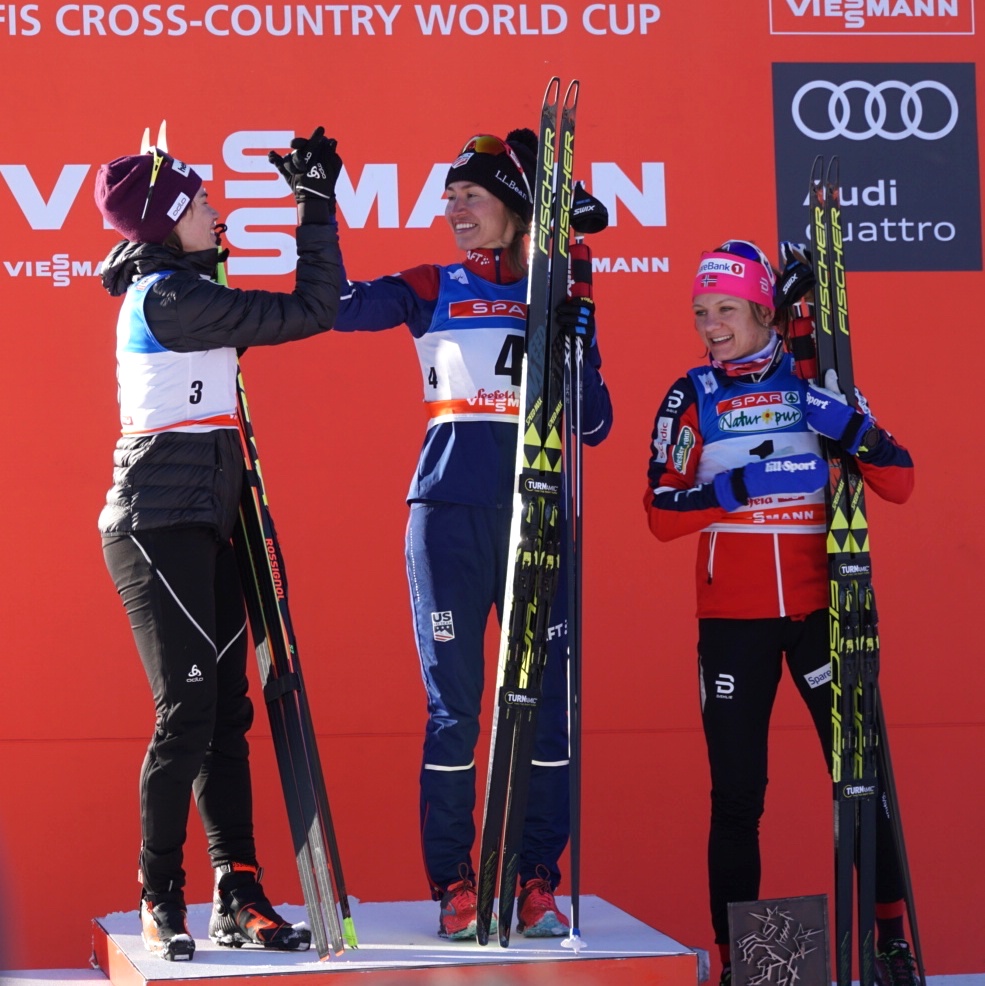
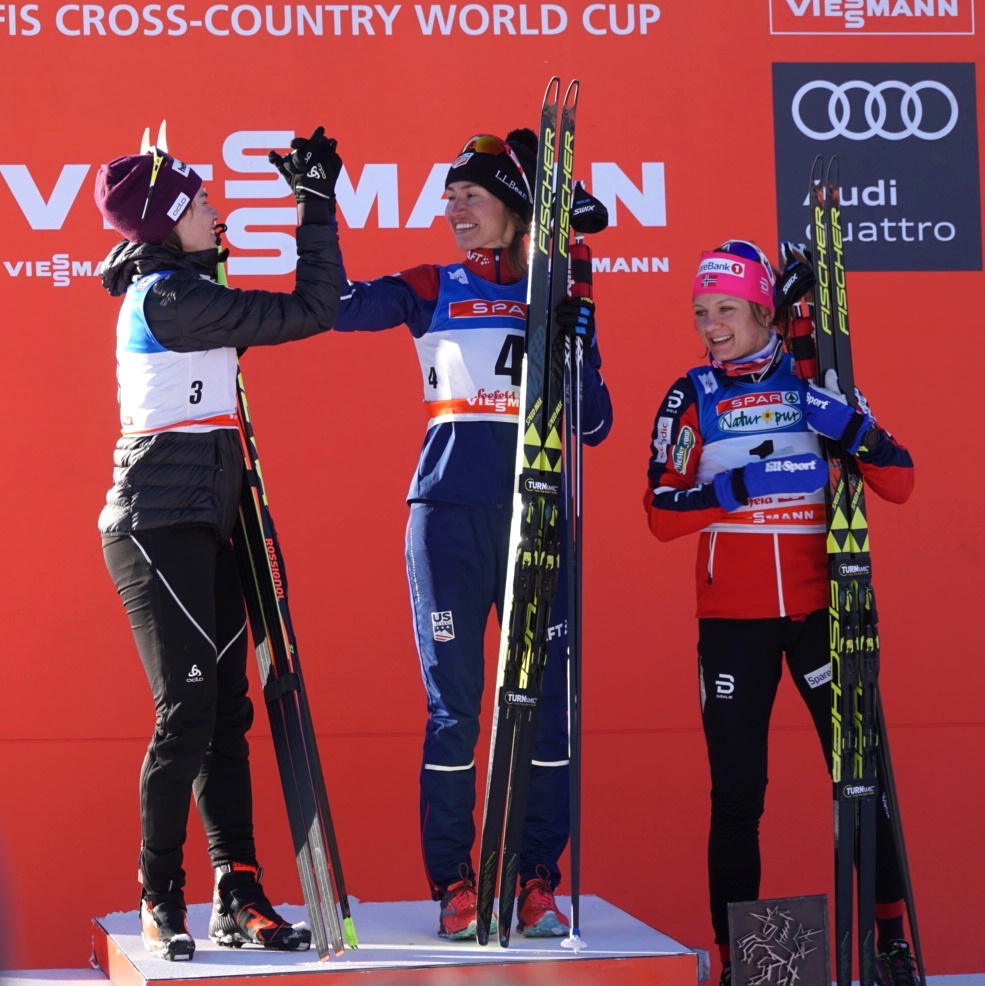
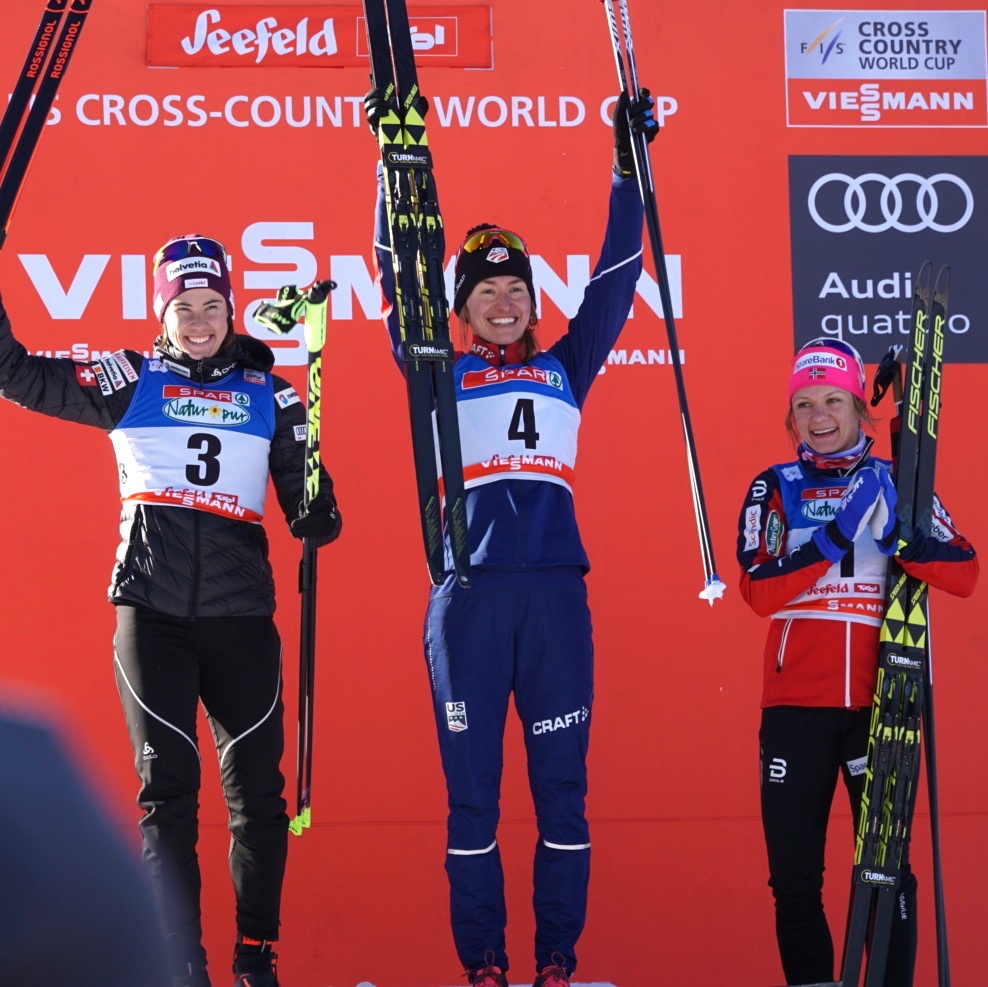
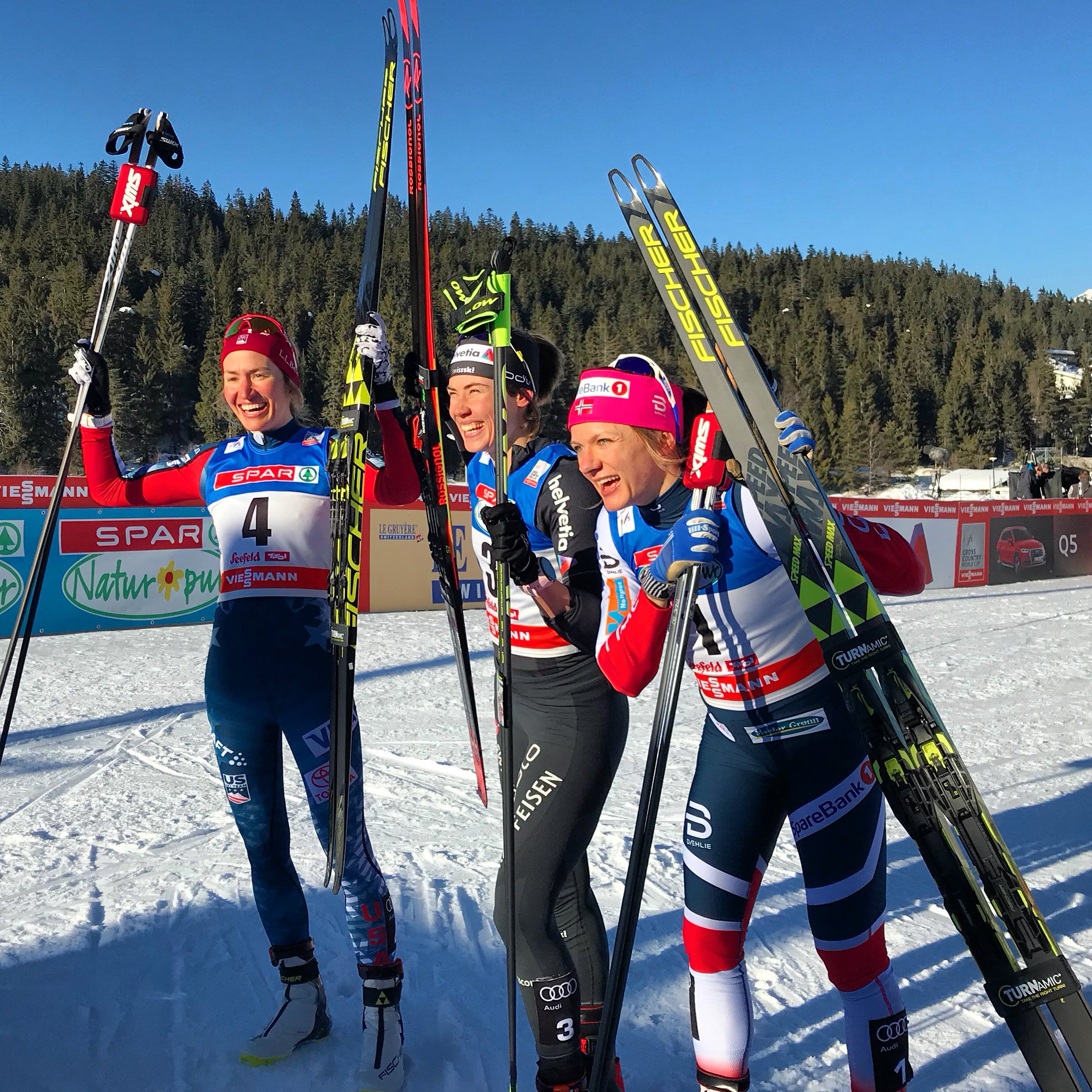
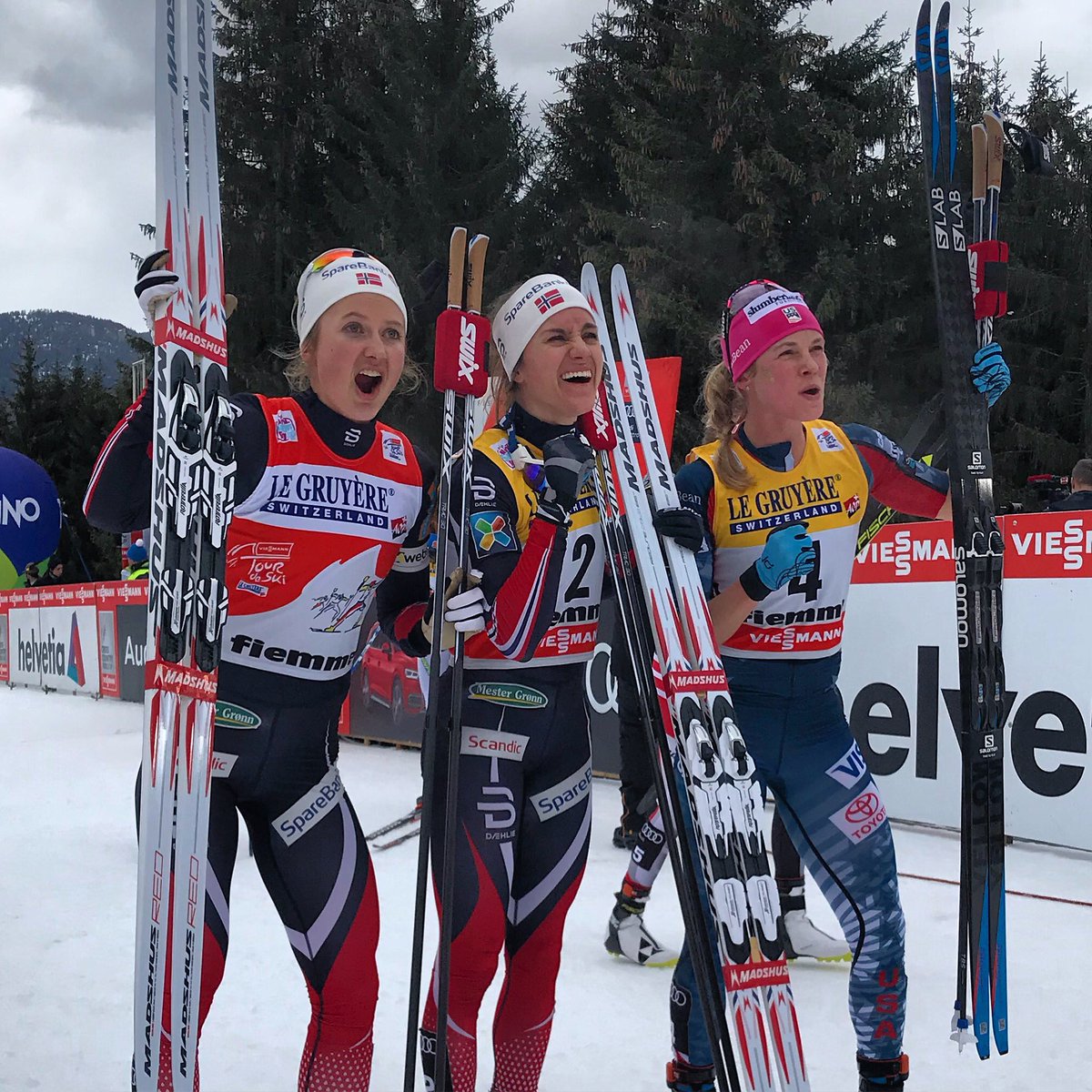
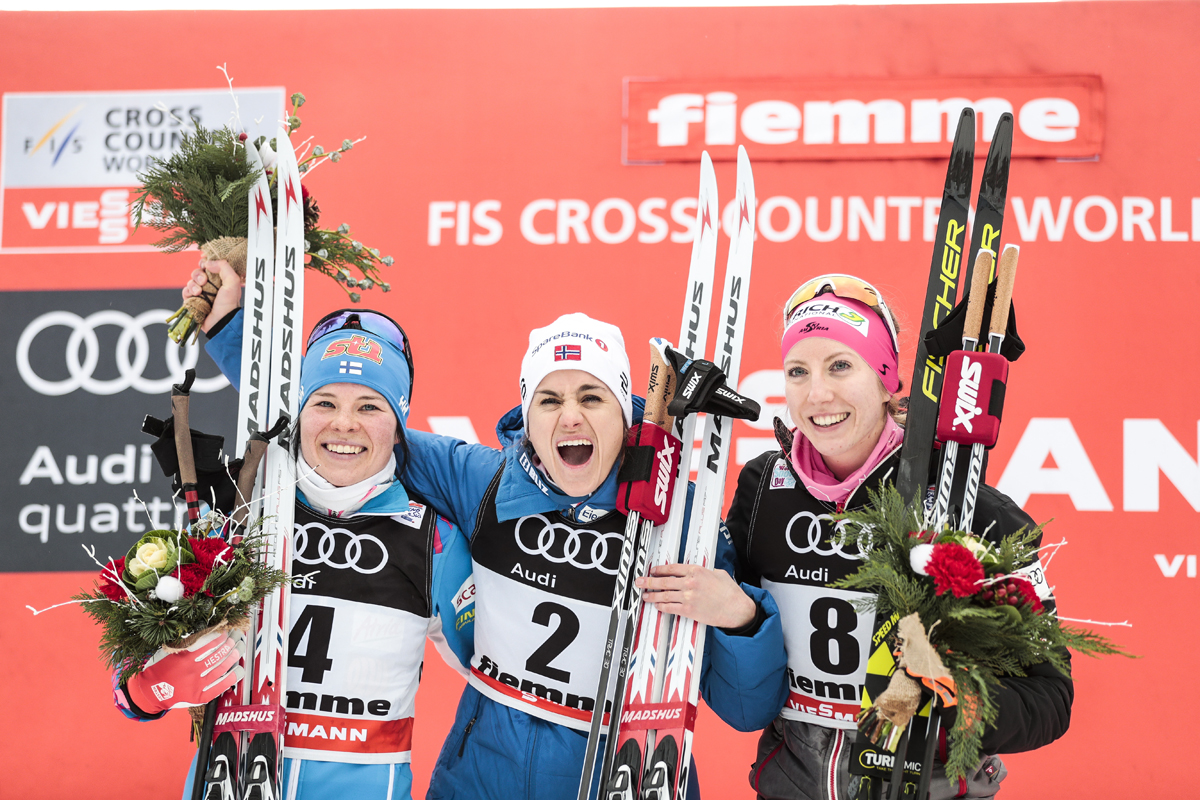
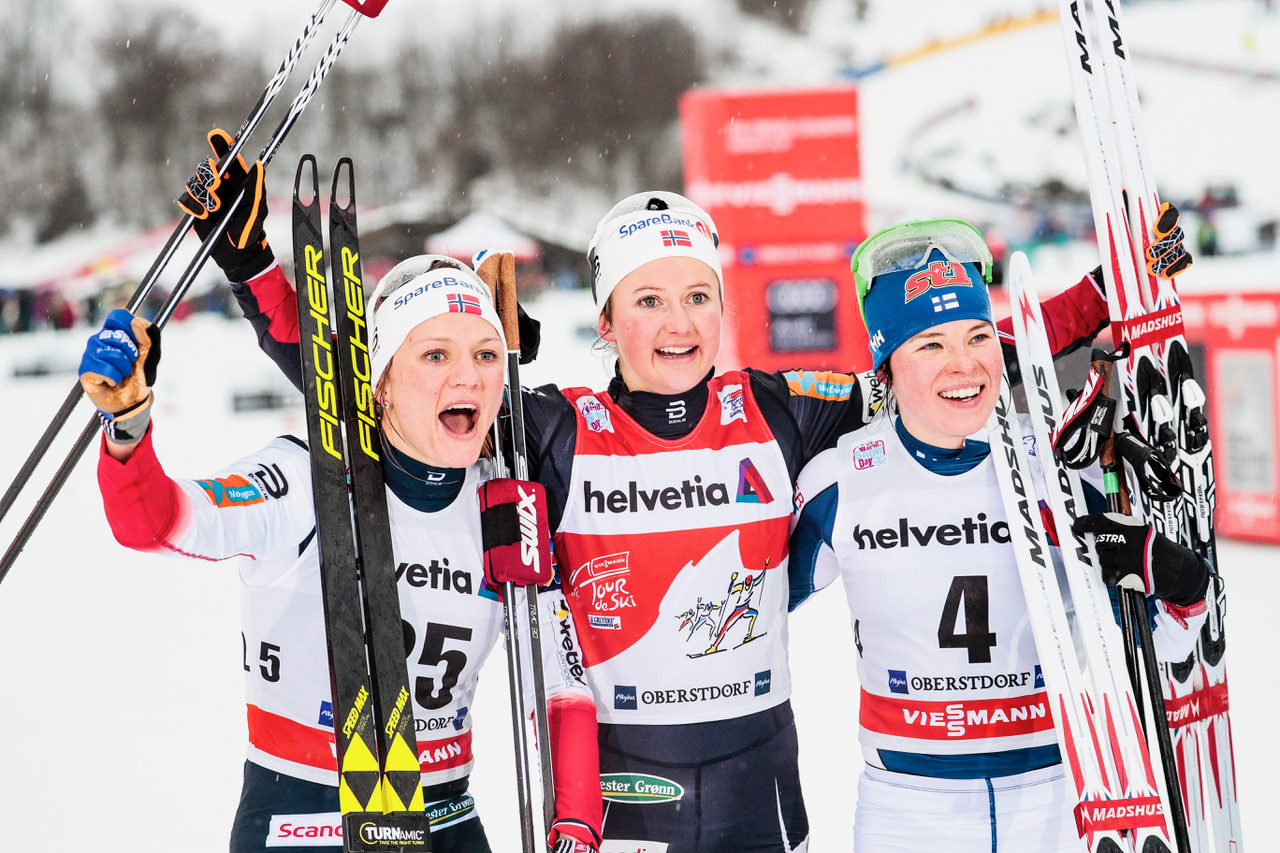
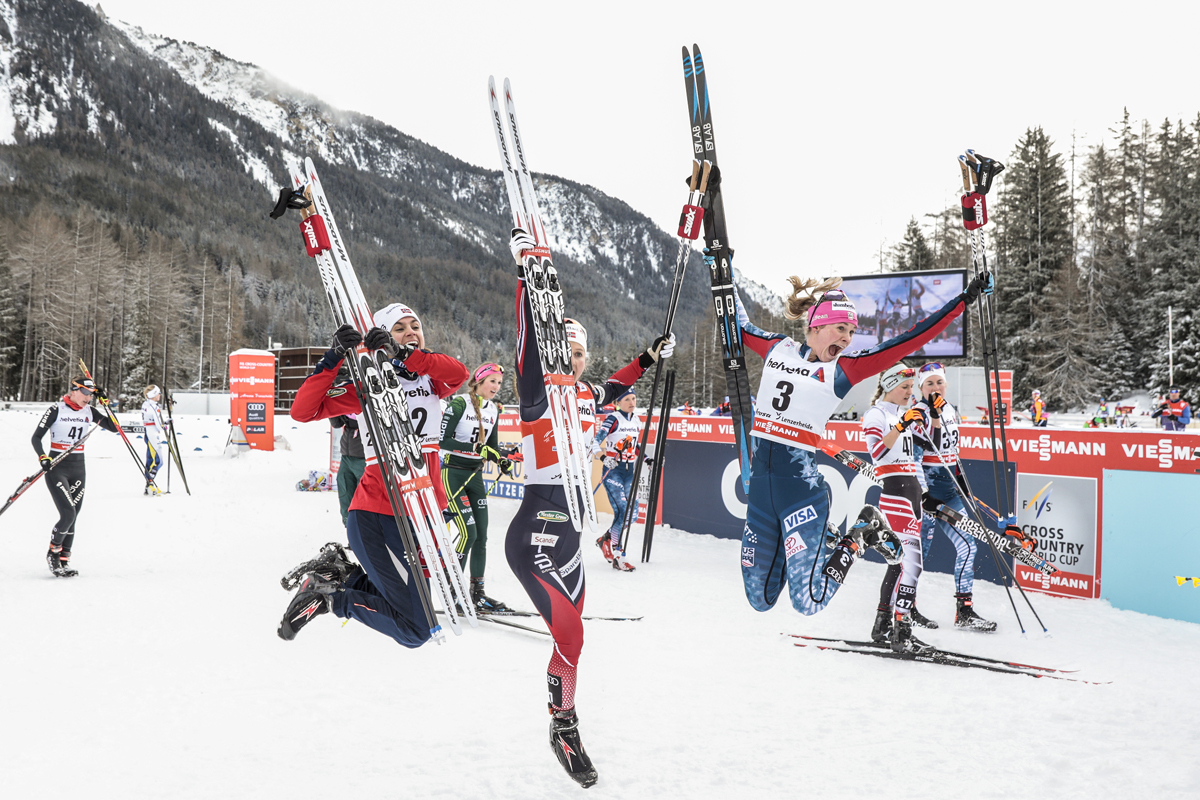
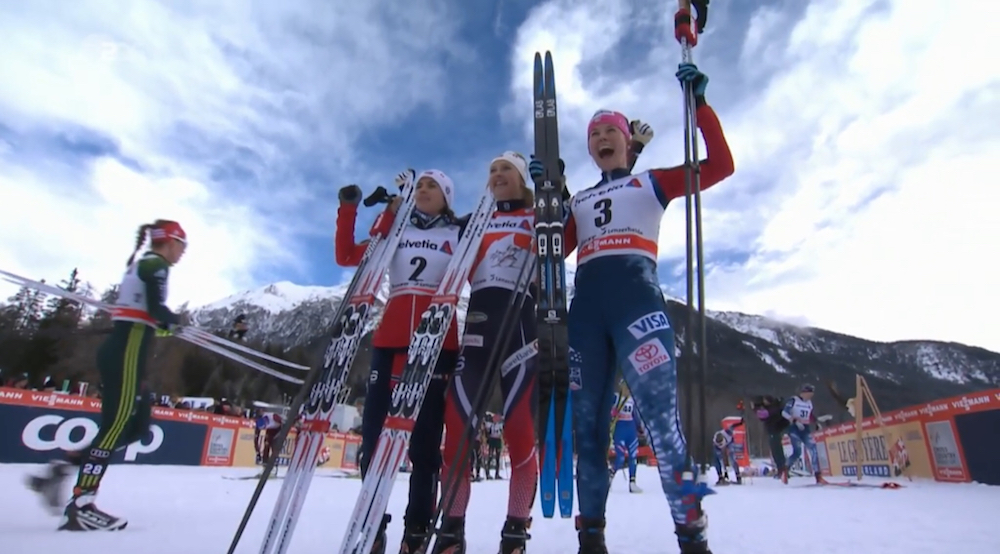
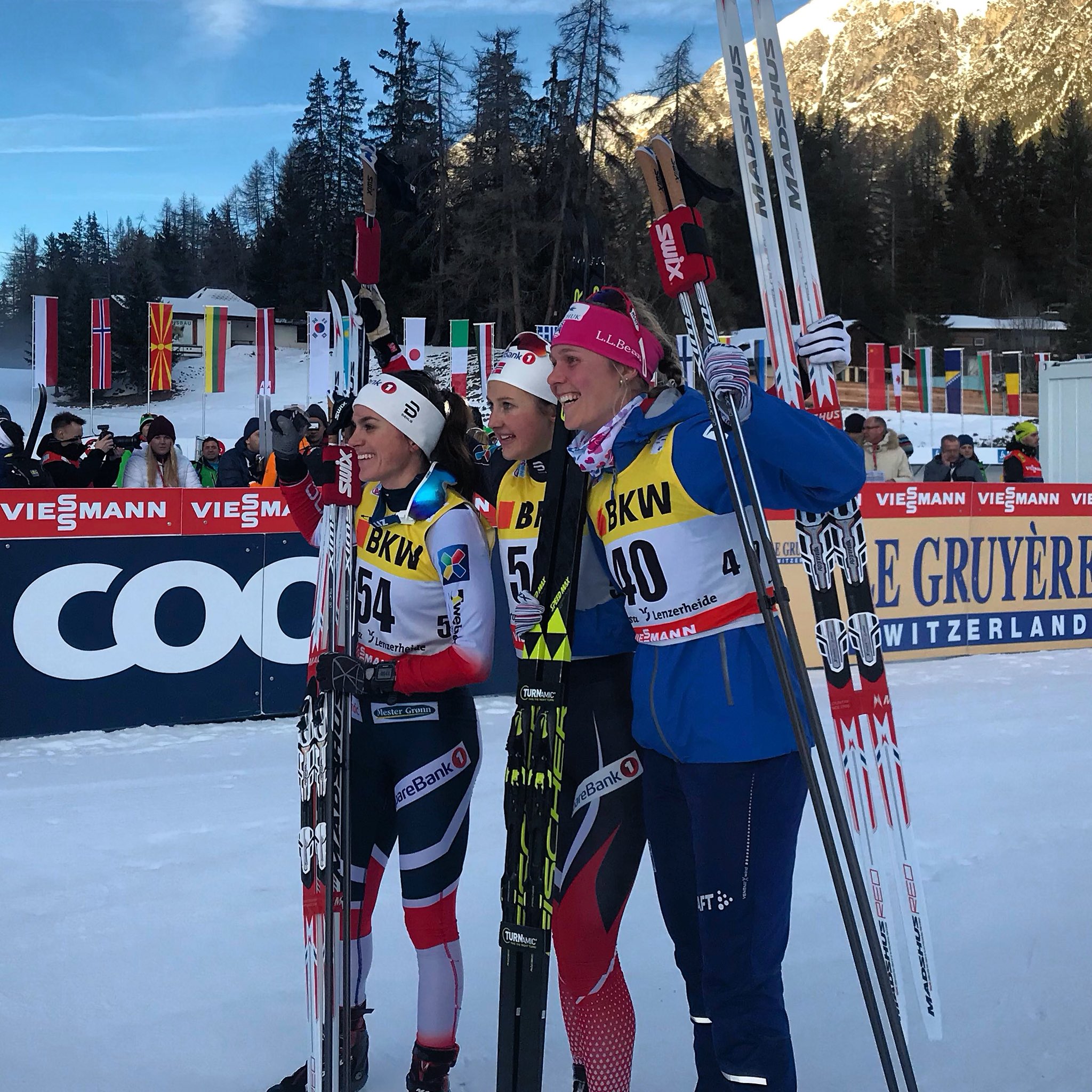
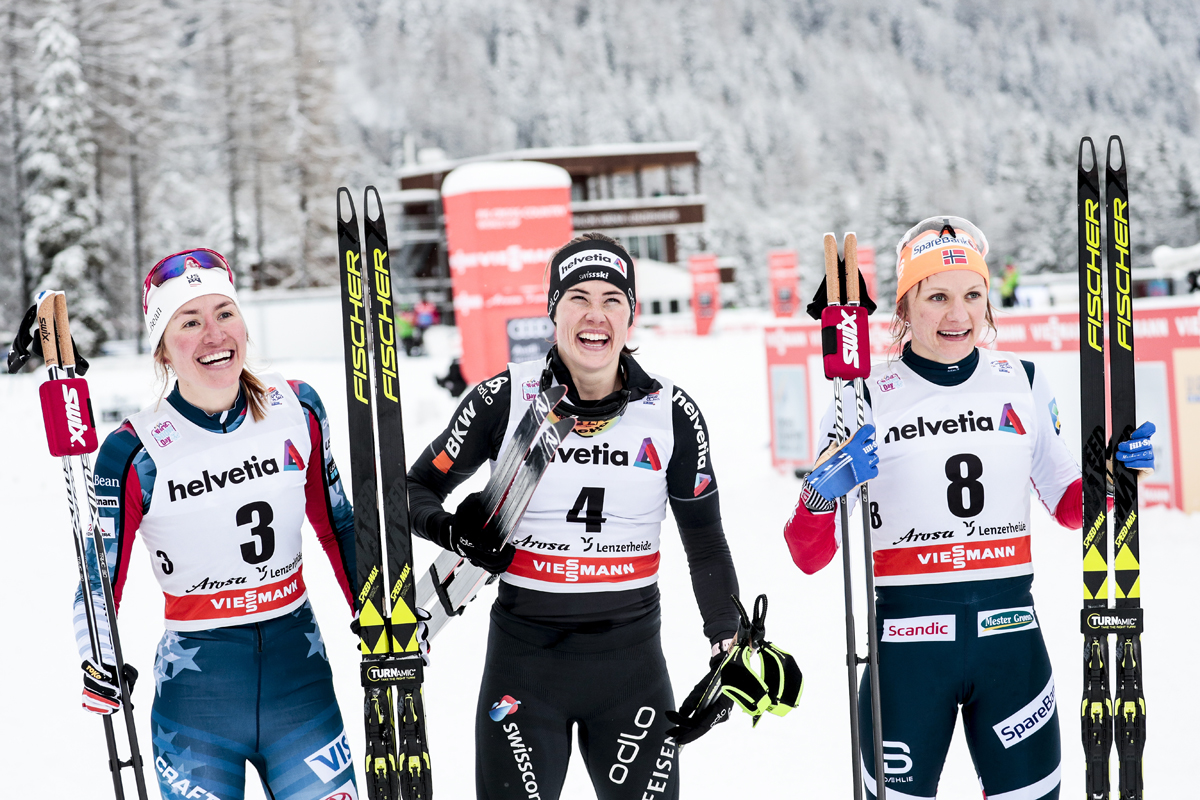
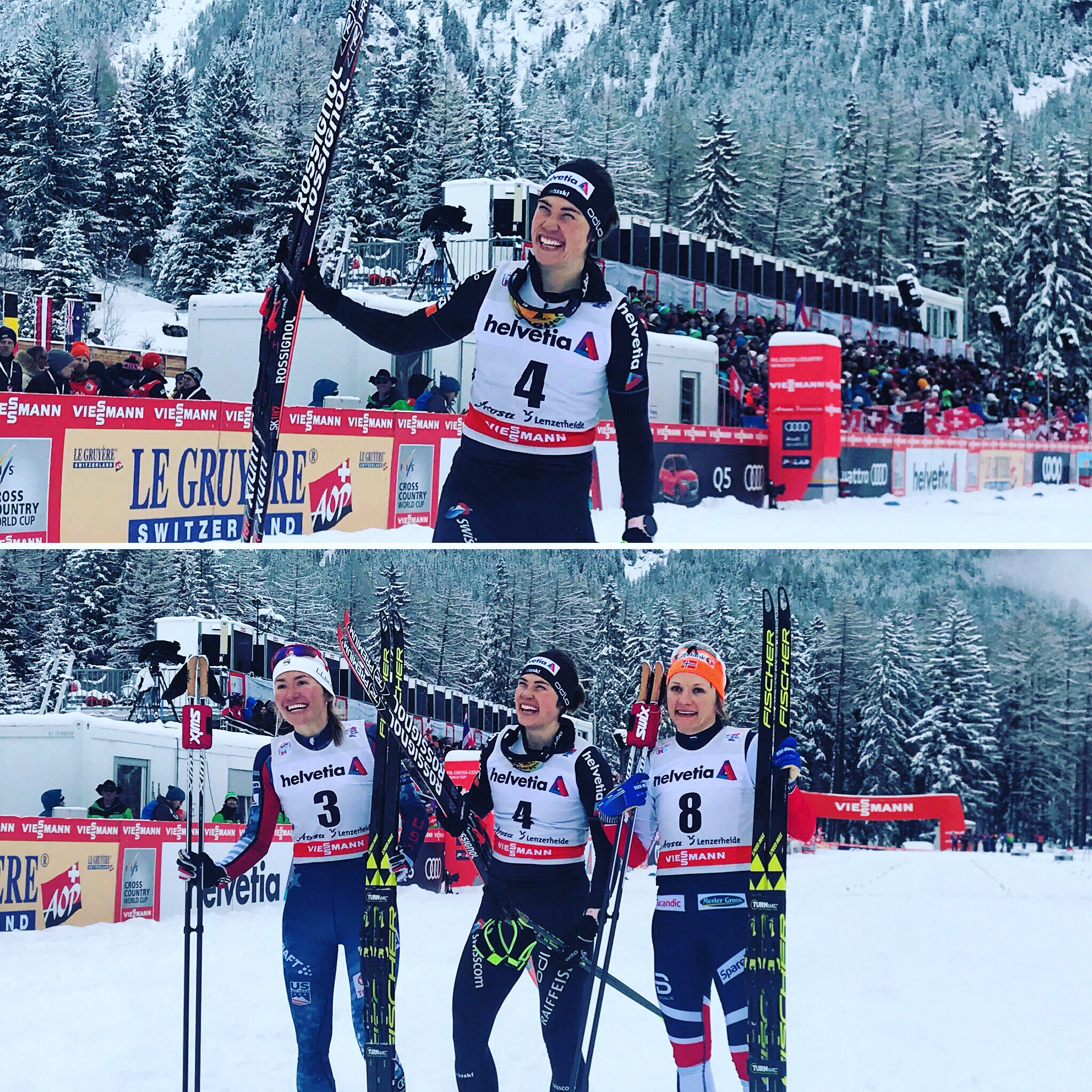
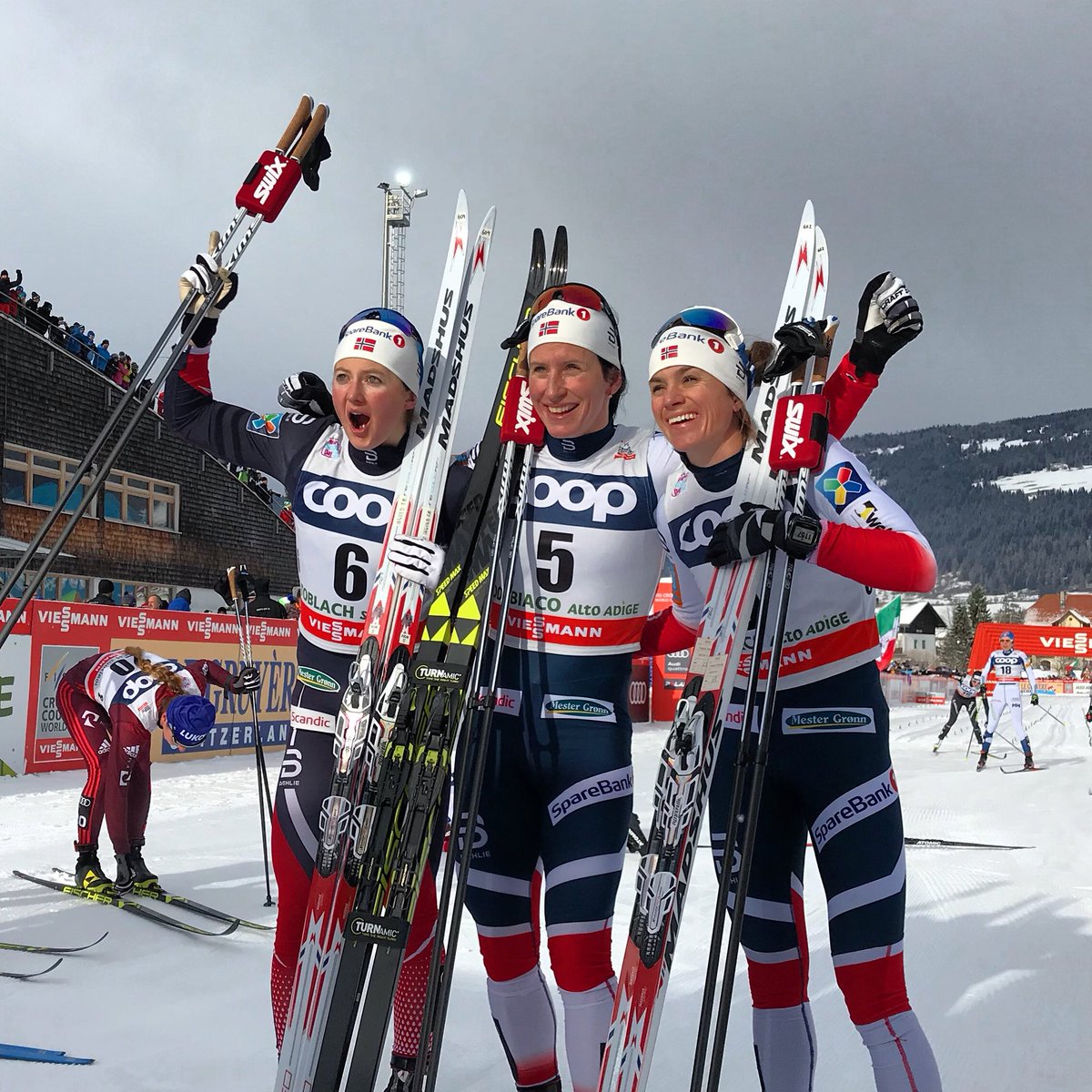
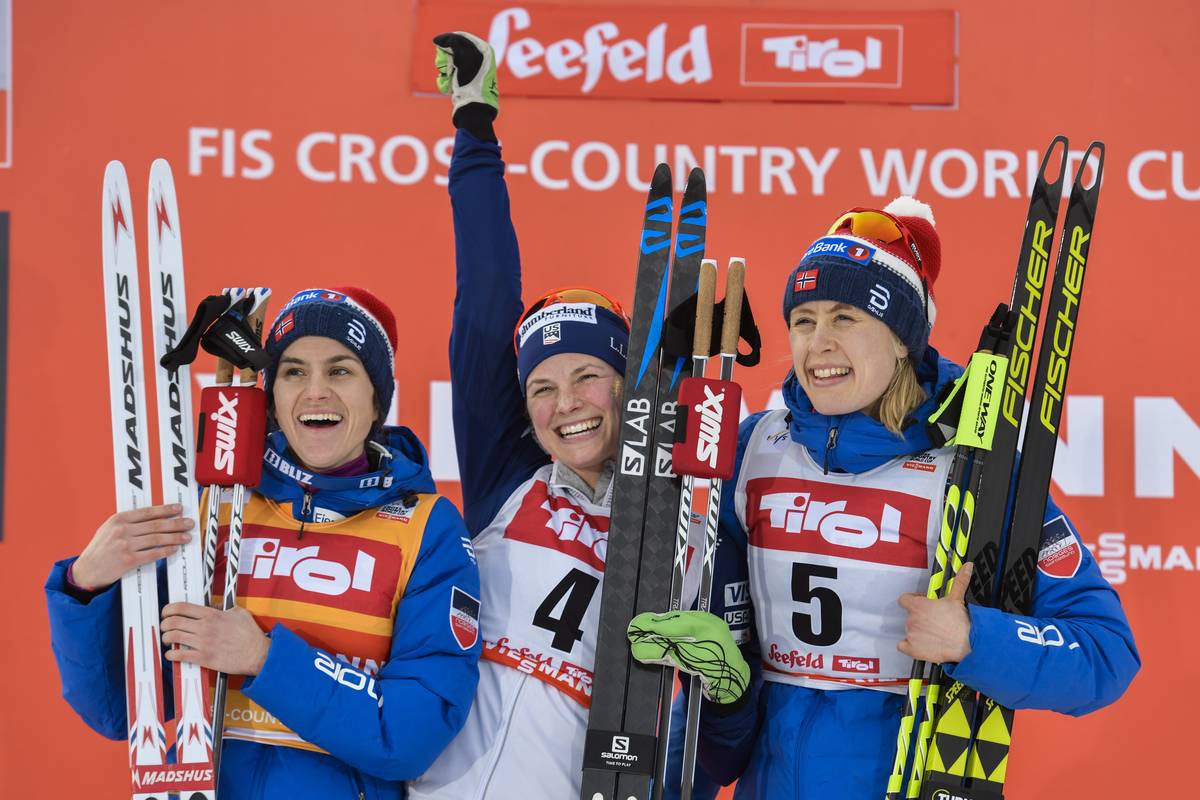
    American Jessie Diggins (c) celebrates her fourth-career individual World Cup win, and her first in a distance longer than 5 k, after winning the women’s 10 k freestyle mass start at Sunday’s World Cup in Seefeld, Austria. Norway’s Heidi Weng (l) placed second and Ragnhild Haga (r) was third. (Photo: Salomon/NordicFocus)

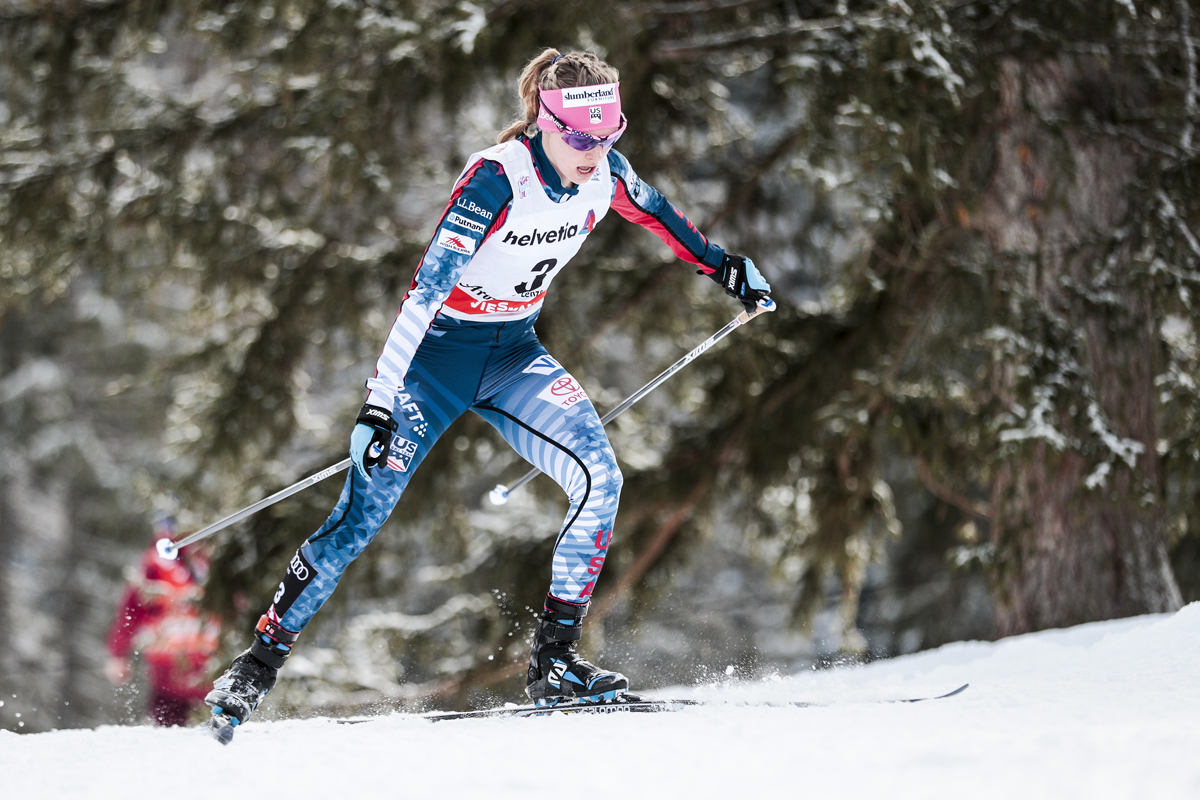
    About seven minutes into the women’s 10-kilometer freestyle mass start on Sunday at the World Cup in Seefeld, Austria, Jessie Diggins made her intentions clear. She wasn’t in it for a free ride — she was willing to pull, and not just take her turn up front, but actually try to string out the field and win this thing.

    As she led a group of 31 within 15 seconds of her at 3.3 k, Diggins, a 26-year-old U.S. Ski Team member who’s on a mission for medals at the upcoming Olympics in two weeks, never looked back. She didn’t ask for help from the Norwegians behind her; she just hammered.
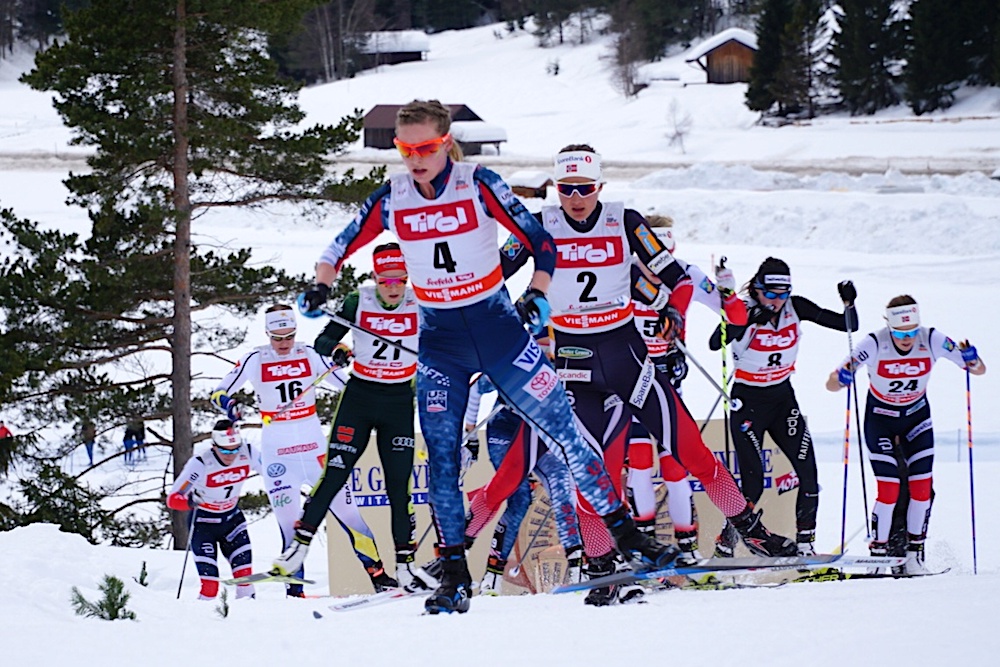
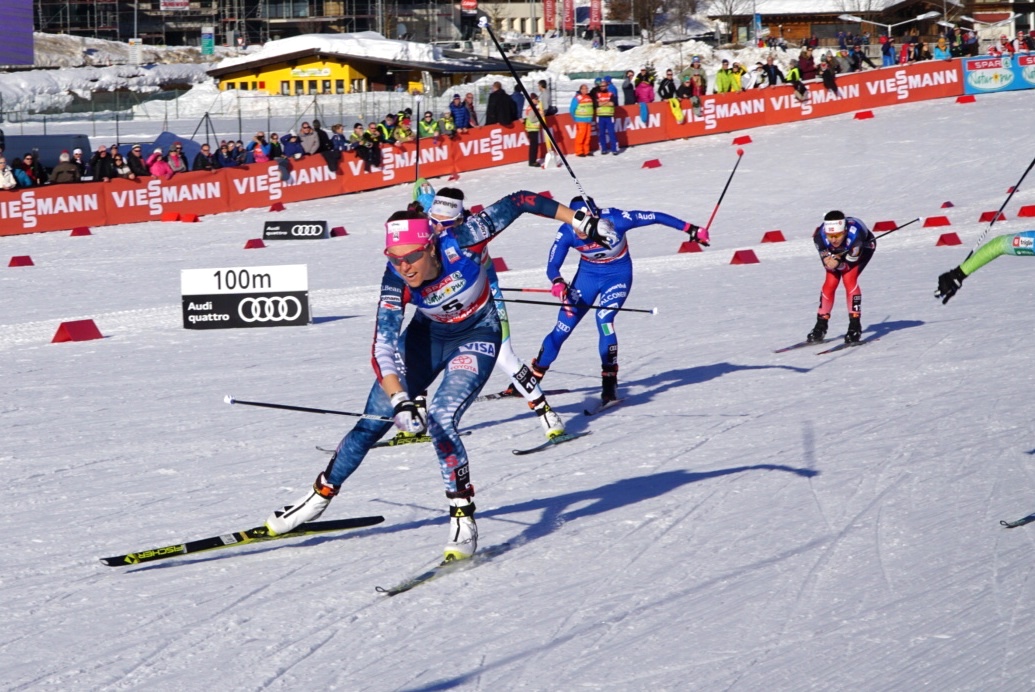
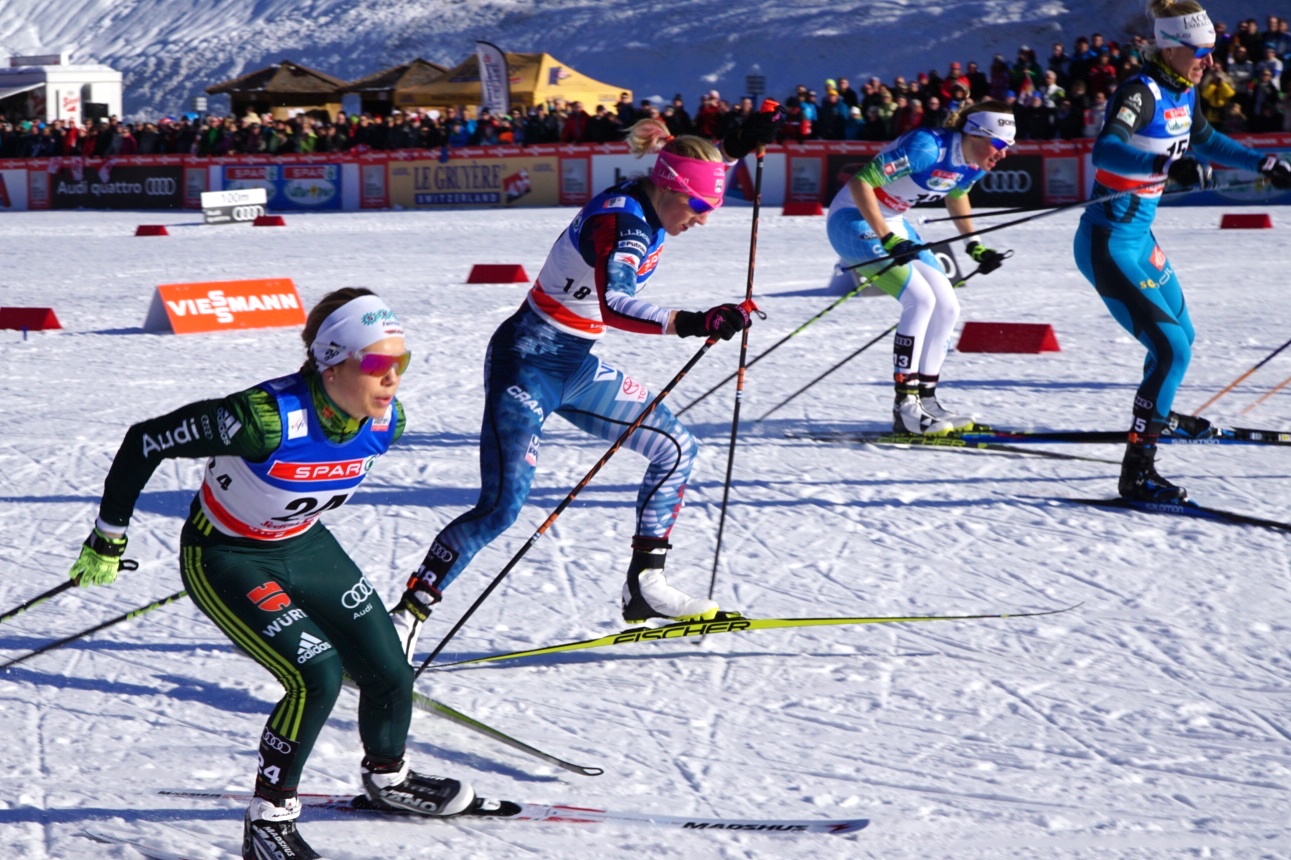
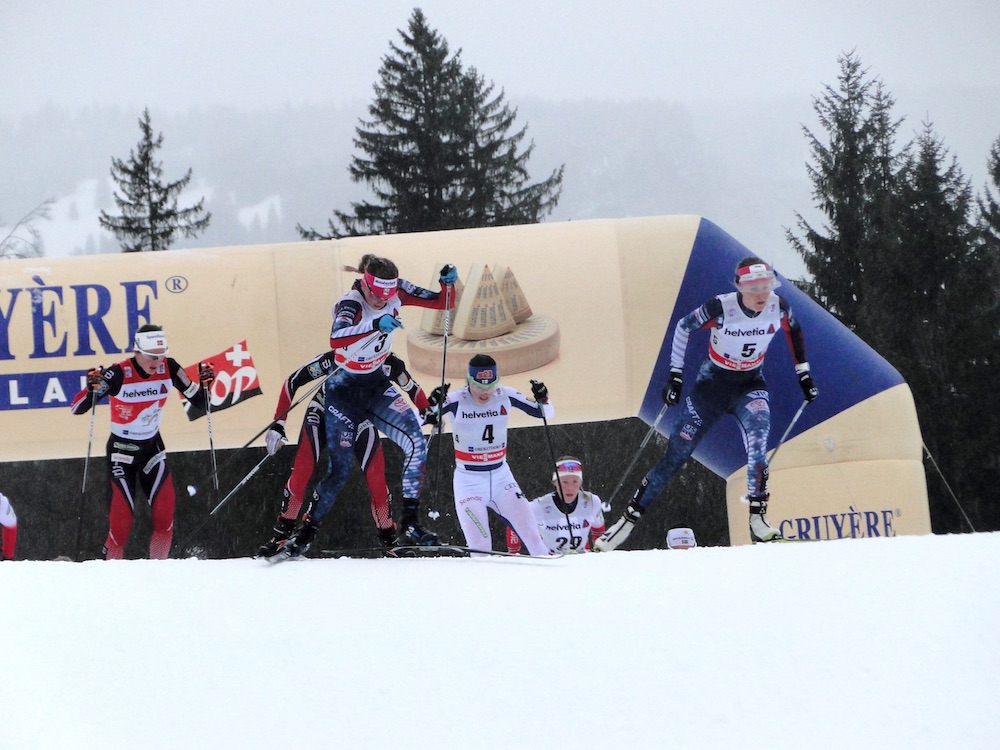
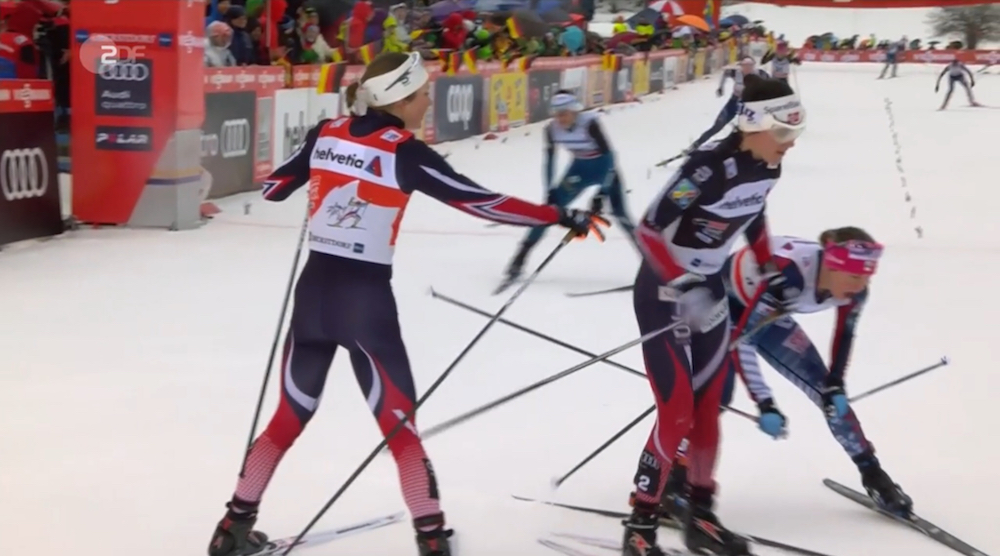
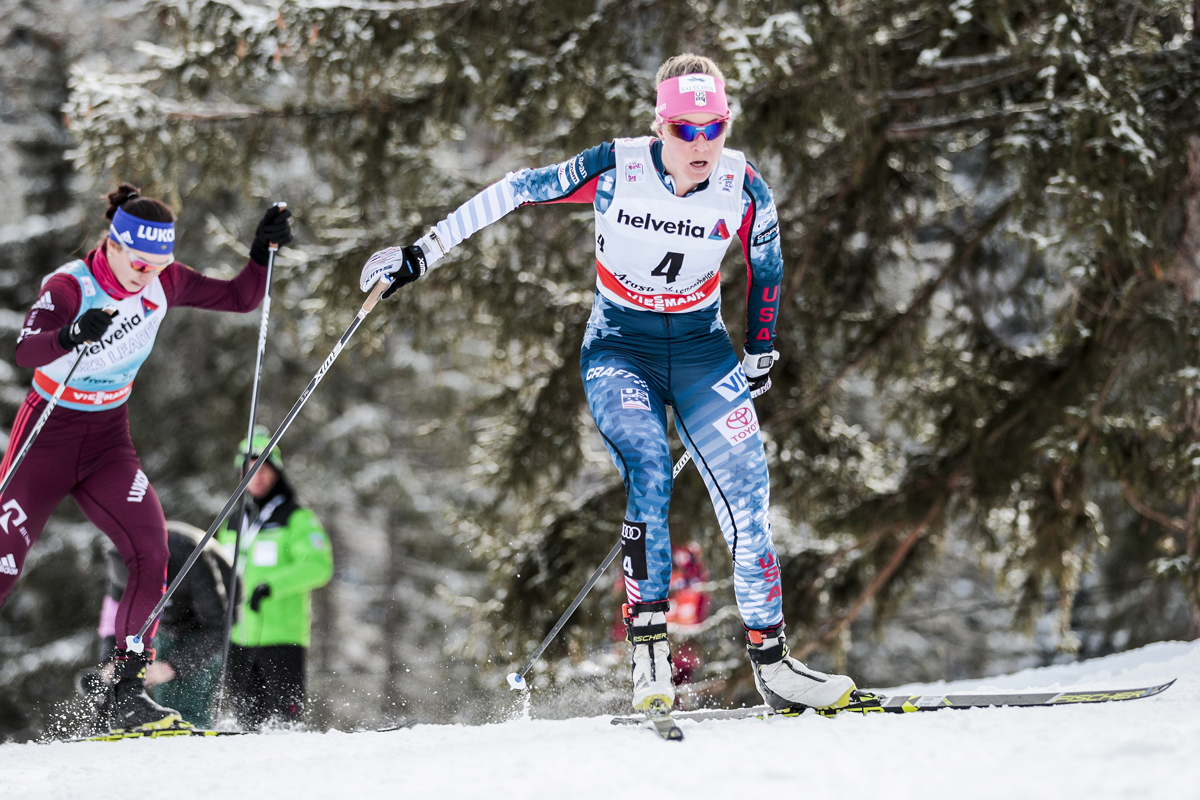
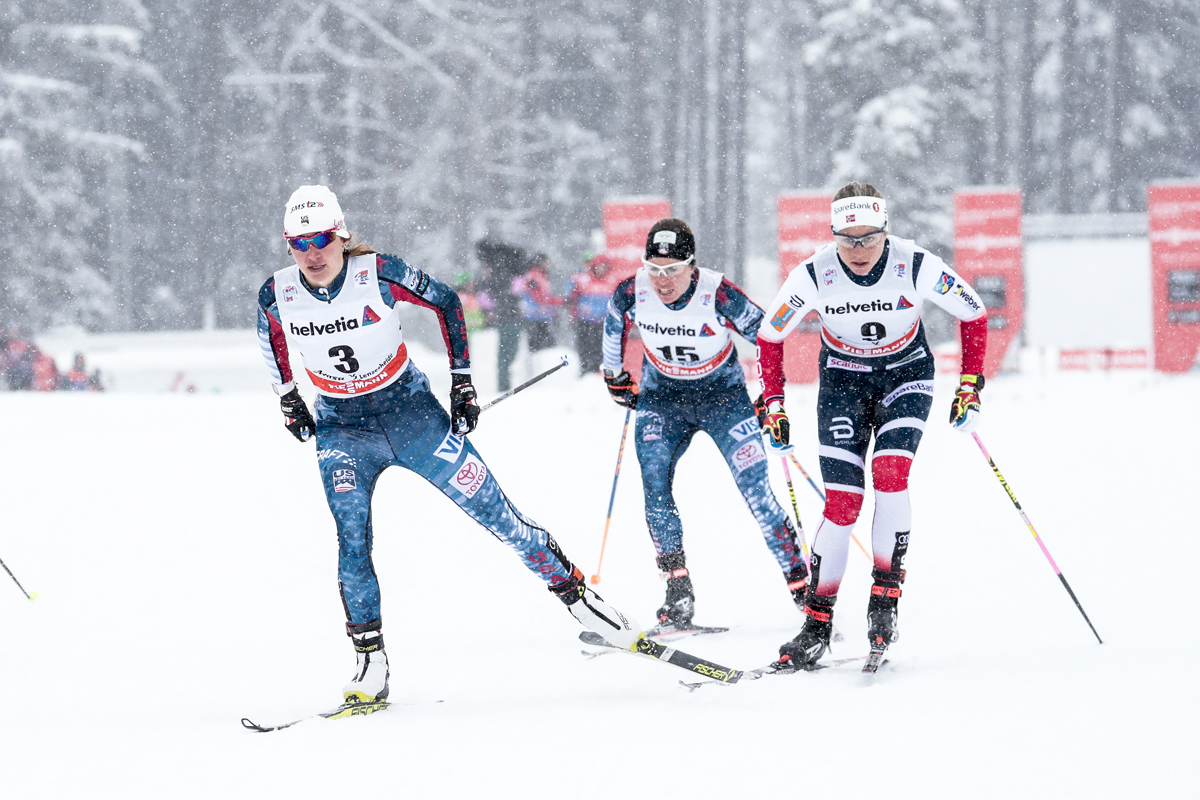
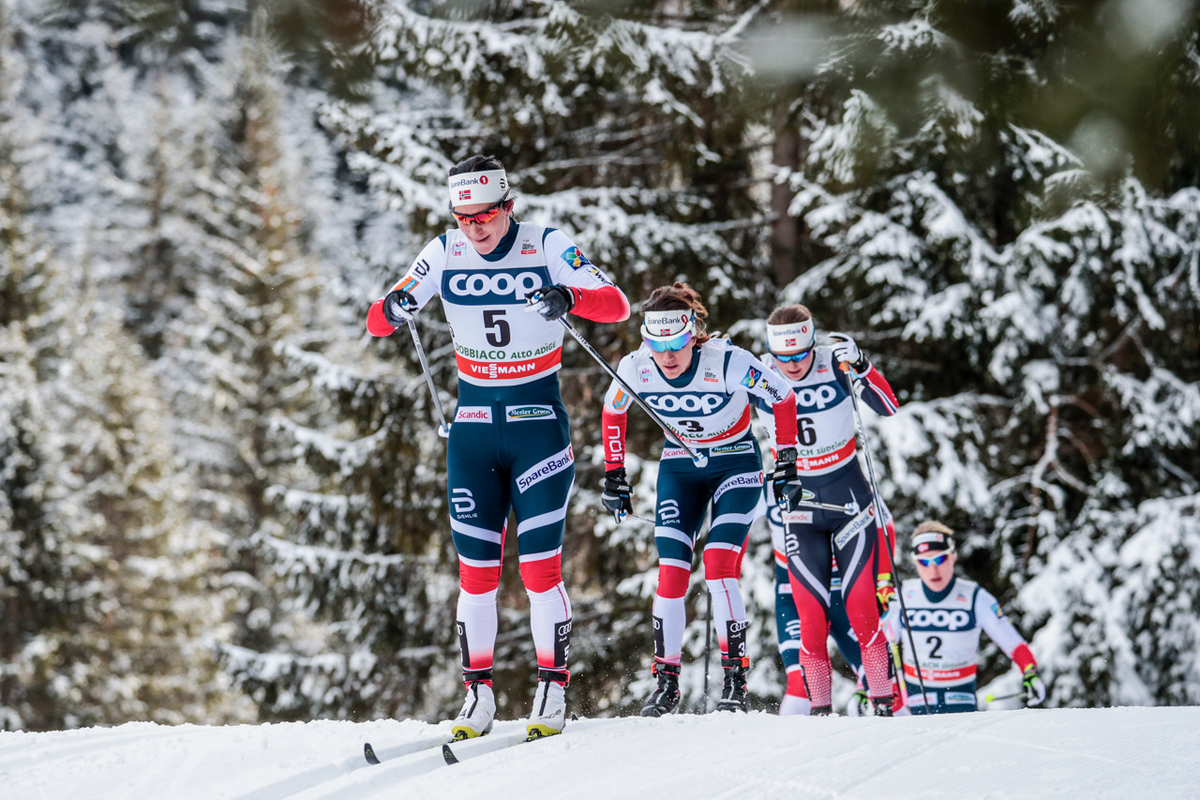
    American Jessie Diggins (4) leading Norway’s Ingvild Flugstad Østberg (2) and the rest of the women’s field in the 10 k freestyle mass start at the World Cup in Seefeld, Austria. (Photo: Garrott Kuzzy / LumiExperiences.com)

    Meanwhile, Norwegian teammates Heidi Weng and Ingvild Flugstad Østberg kept her close, and at 4.6 k, Østberg moved into first. The group was down to 12, with another American hanging in there as well, as Sadie Bjornsen skied in 12th, 4.6 seconds back.

    Two kilometers later, it appeared the Norwegians were working together, not just to keep themselves through the race, but to prevent Diggins from getting too close to the front. Diggins remained in third, less than a second behind Østberg and Weng, while a third Norwegian Ragnhild Haga skied just behind her. Switzerland’s Nathalie von Siebenthal and Germany’s Katharina Hennig remained in the mix in fifth and sixth, about two seconds back, as did Norway’s Kari Øyre Slind and Bjornsen another second behind.

    With just over 2 k to go, Diggins attacked in earnest near the bottom of the last grueling (nearly 500-meter-long), multi-tiered climb on the women’s 3.3 k course. No one was able to match her pace, not Østberg, not Weng, not Haga, as she raced up the rest of the hill and over the top completely alone.

    Behind her, the chase group split in two, with the three aforementioned Norwegians then approximately eight others skiing several meters behind. Bjornsen was in that second group, which continued to drop in numbers as they continued up the climb.

    On the winding descent back toward the stadium, with just under a kilometer to go, Diggins put all of her faith into her skis.

    “I felt awesome, my skis were amazing, the techs worked so hard,” she told FasterSkier in person after. “These Salomon skis I was on were just ripping down that corner.”
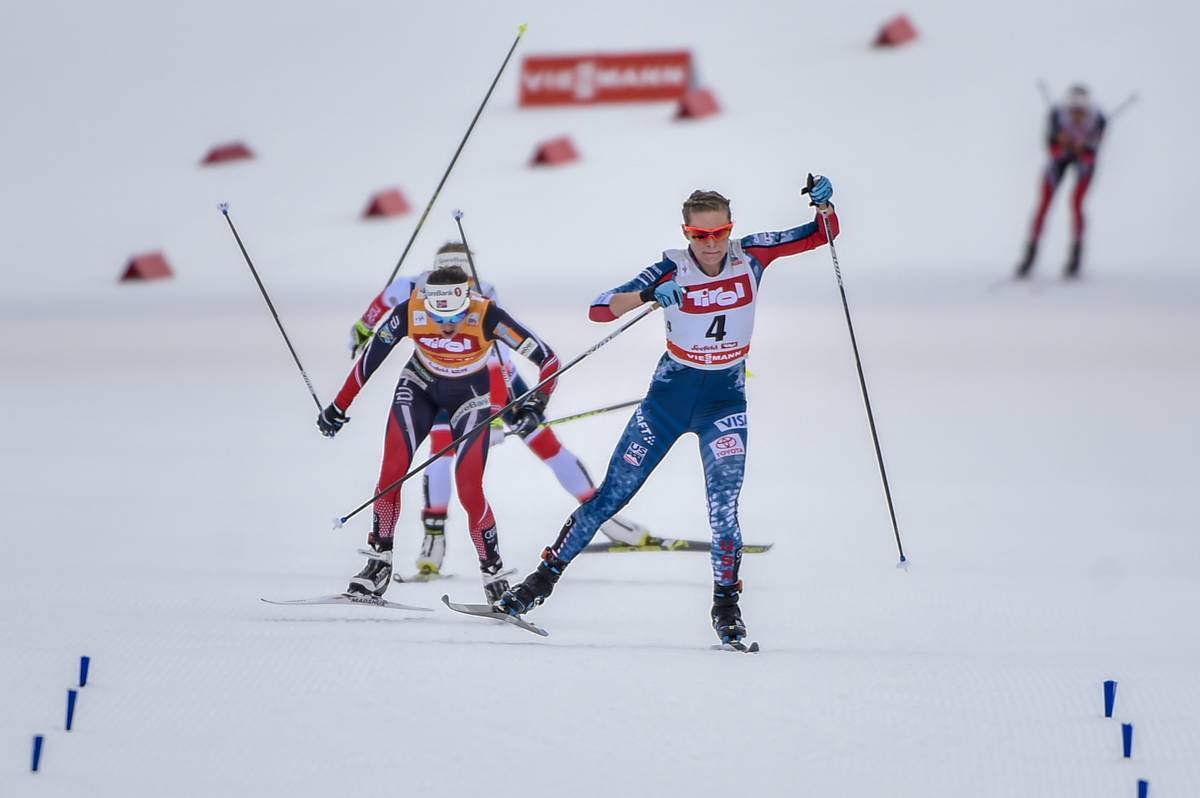
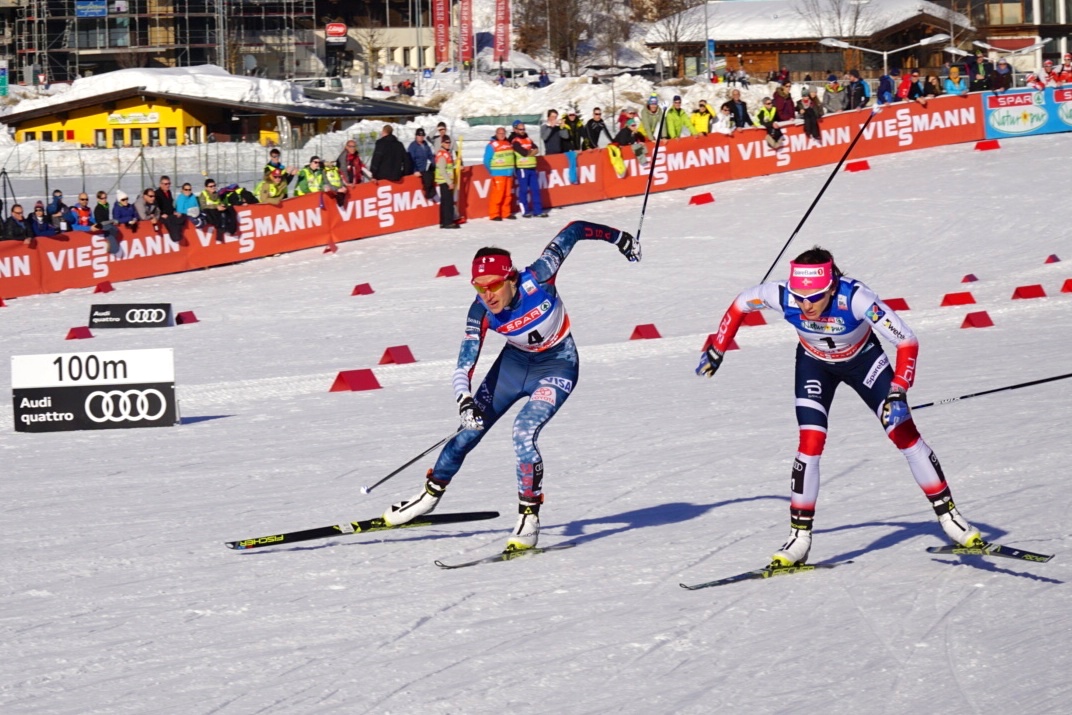
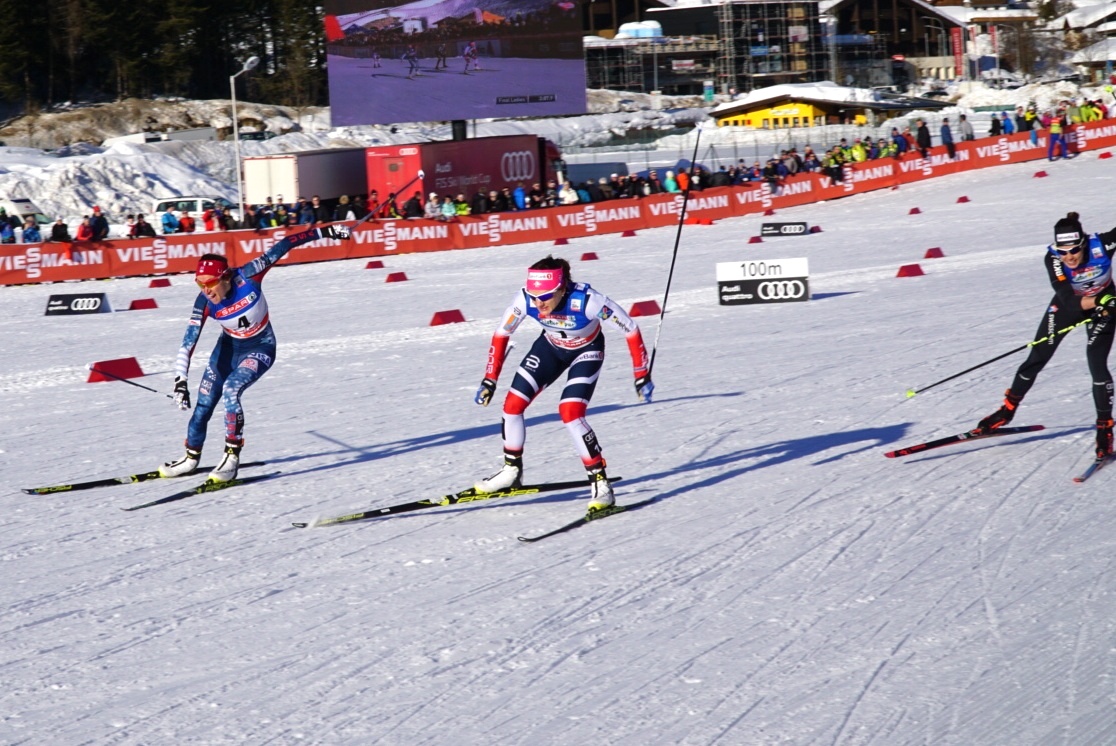
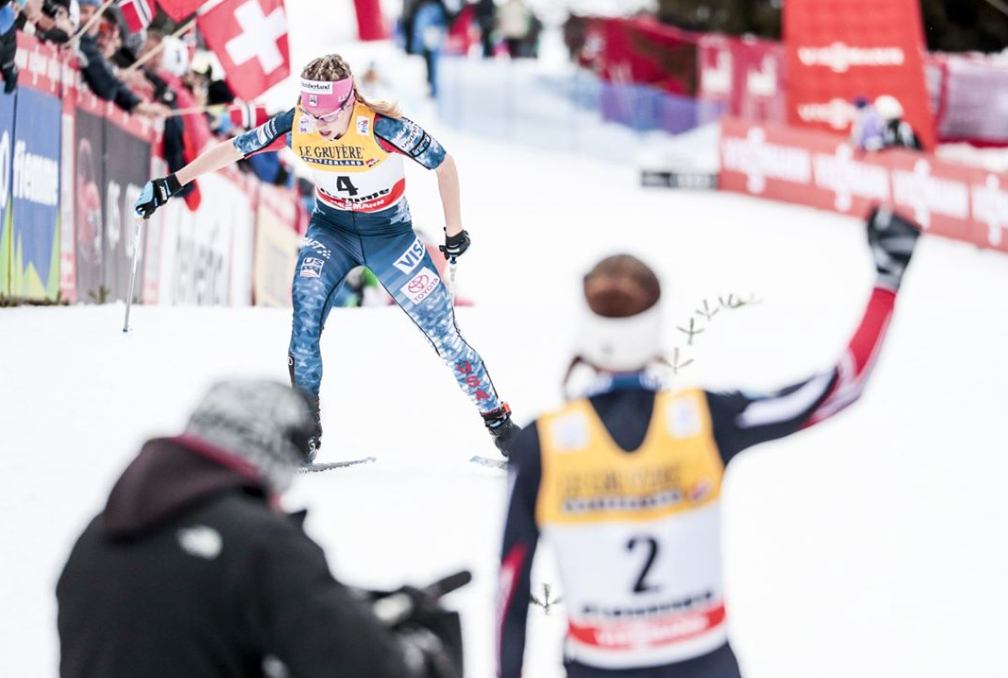
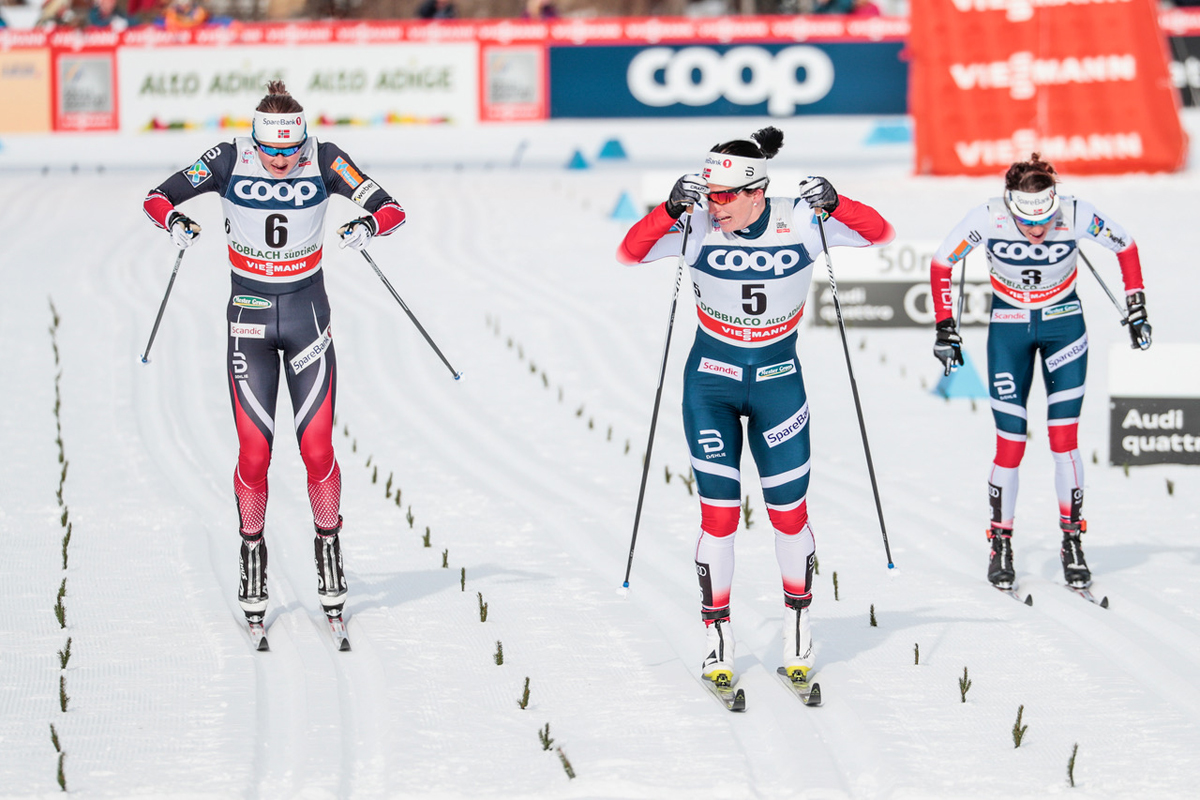
    American Jessie Diggins (4) leads Norwegians Heidi Weng and Ragnhild Haga in the finishing stretch of the women’s 10 k freestyle mass start at the World Cup in Seefeld, Austria. (Photo: Salomon/NordicFocus)

    But before the final hill, a relatively small rise about 200 meters before the finish, Weng and Haga were close, just a few strides and about a second behind. Again, Diggins didn’t look back; she simply used every ounce of everything she had left — energy and technique-wise — to get the maximum number of pushes in before the finish.

    And she did it. Diggins held off the two Norwegians, crossing the line first in 23:08.5 and throwing her fists down in elation. Seven-tenths of a second behind her, Weng free-skated to second place, just 0.3 seconds ahead of Haga in third. Østberg finished 7.7 seconds later in fourth (+8.7), and the fourth Norwegian in the top five, Marit Bjørgen placed fifth (+16.7) just ahead of Austria’s Teresa Stadlober in sixth (+16.9), Slind in seventh (+19.1), and Bjornsen in eighth (+20.5). Von Siebenthal followed in ninth (+30.3) and Finland’s Kerttu Niskanen placed 10th (+31.8).

    Notably, it was Bjørgen’s first World Cup race since mid-December. But even more notably, for the second-straight race in Seefeld — the site of next year’s 2019 World Championships — an American woman won. Sophie Caldwell tied for first in Saturday’s freestyle sprint, and on Sunday, it was all about Diggins.

    For Diggins, the win was her first in over a year and her fourth-career individual World Cup victory. And she did so in the last race before the Winter Olympics start on Feb. 10 in PyeongChang, South Korea.

    “It’s a really good time to figure out how to ski a 10 k race,” Diggins told FasterSkier after. “I am really excited. I’m so pumped for the Games, I’m feeling well, the peaking plan is working, and I’m just excited to get there and see what I can do.”

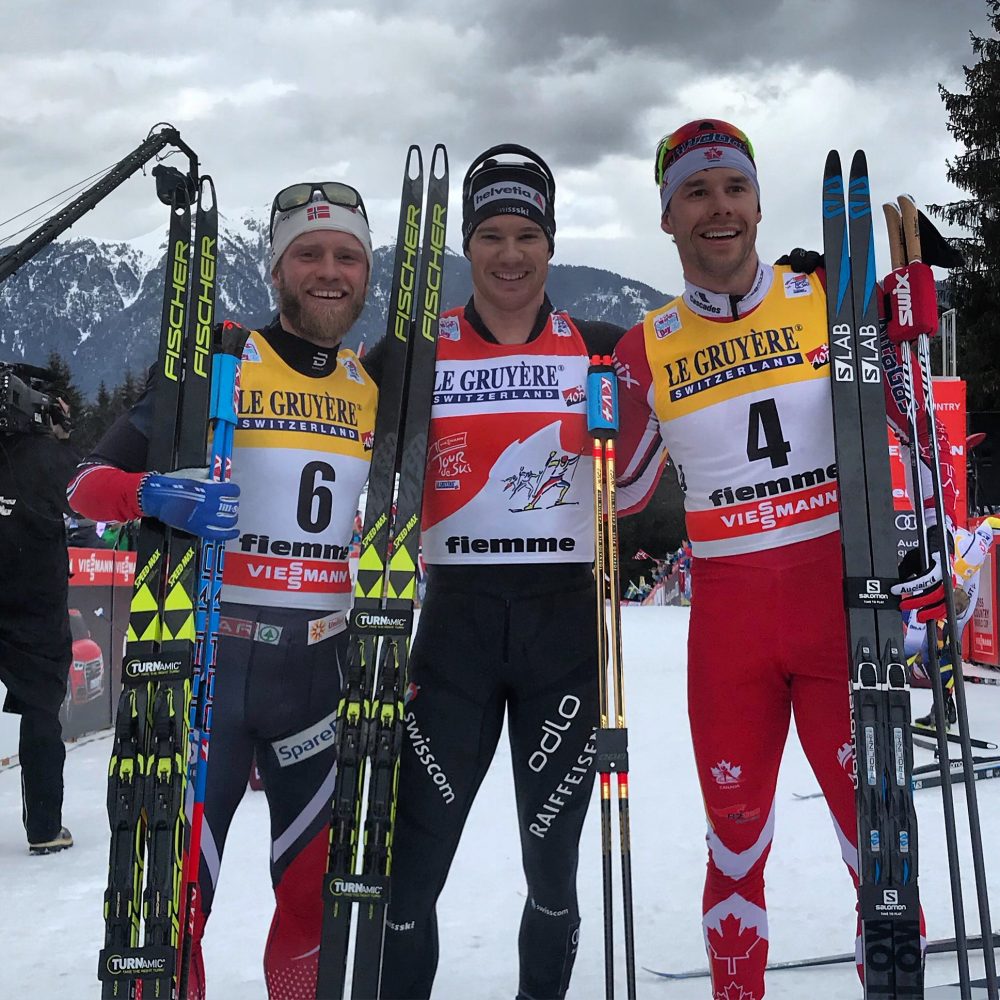
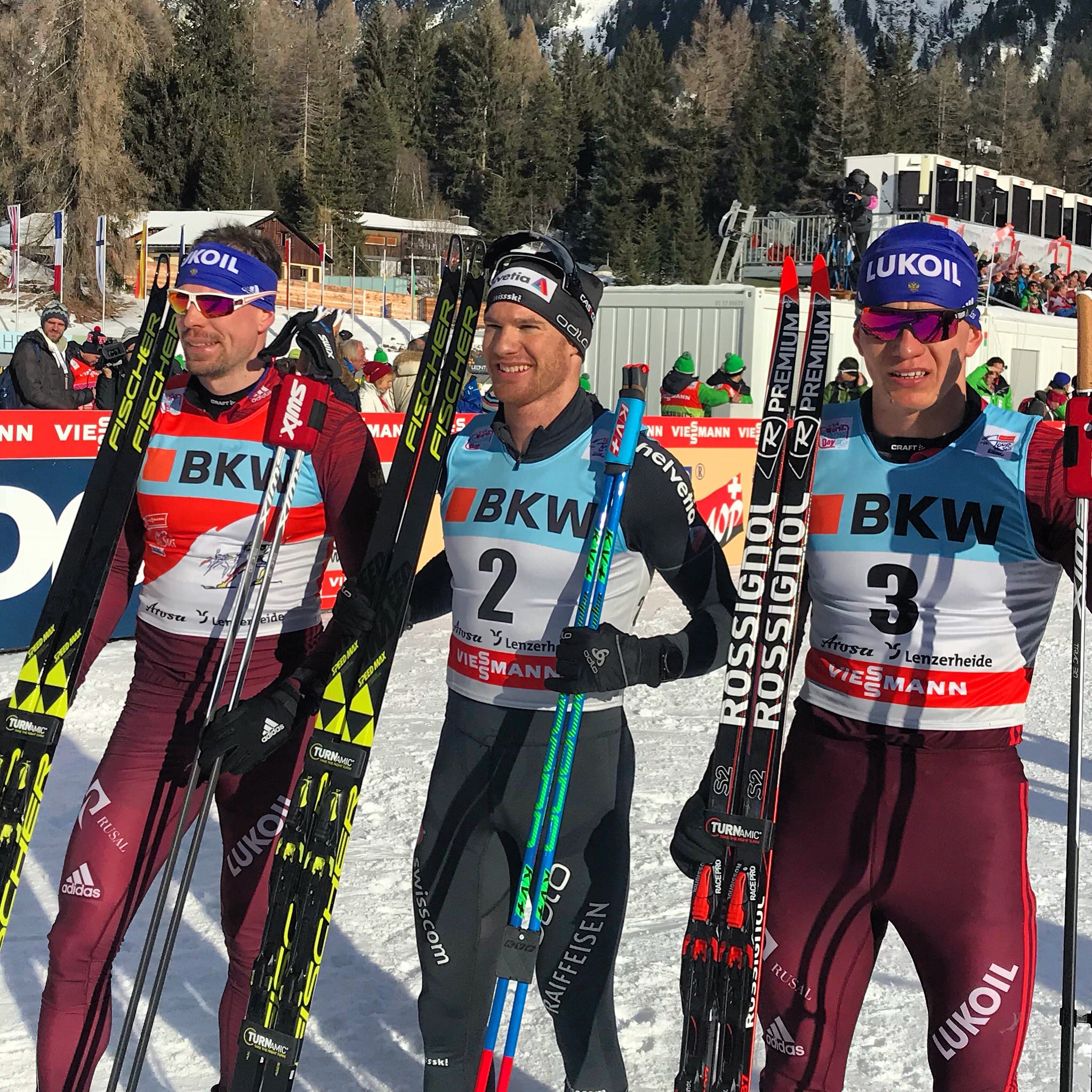
    She apparently took mental notes on the men’s 15 k mass start that took place earlier on Sunday, as Switzerland’s Dario Cologna attacked on the same climb to secure the win ahead of Canada’s Alex Harvey and Norway’s Martin Johnsrud Sundby.

    “I saw how well it worked for Dario, and I thought, ‘OK, I’m gonna go for it! I just have to ski gutsy and if they reel me in they reel me in, but maybe I can hold them off,’ ” she reflected.

    “I just put my head down and it wasn’t pretty, but I just hammered,” she said in a post-race interview with the International Ski Federation (FIS).

    Before that, Diggins said she had been trying to figure out where to ski in the pack.

    “ ‘OK, if I’m in the front, how hard am I working? If I’m in the middle…’ You don’t want your poles to get stepped on so it’s easier for me to just be near the front the whole time,” she told FasterSkier.

    Diggins’s three other wins have come in 5 k freestyle individual starts — all of which were stage World Cups. Sunday marked her first time getting 100 points, rather than 50, for the win, which counts toward overall World Cup standings. Heading into the Olympics, she ranks third in the Overall World Cup (379 points behind Weng in first and 180 behind Østberg in second) and third in the Distance World Cup (225 points behind Weng in first and 108 behind Østberg in second). Bjornsen is seventh in the overall standings and 11th in distance.

    “I’m happy with how I raced,” Weng said after Sunday’s race, according to a FIS press release. “I made a mistake up the final climb and then couldn’t go with Diggins, but I pushed hard all the way to the finish, but Diggins was the better skier today.”

    Bjornsen is seventh in the overall standings and 11th in distance.

    “It was an exciting, and super fun final race before the Olympic Games!” Bjornsen wrote in an email to media outlets. “Today’s 10k skate was hot from the start, on a really fun course here in Seefeld. I think the nature of the course kind of held the pack together a bit more, which always makes for a fun race! I felt really good out there, and was super happy with the day.

    “I feel like I made a bit of a tactical error being stuck behind some skiers that were dying a bit on the far part of that last lap, but it is one new step for me,” she continued. “I learned something out there, and I challenged myself, and I am feeling really good about the feelings I have in my legs leading into the games! It will be great to have two more weeks to rest, recover, and come in sharp for these exciting races to come. I am so excited to see our team on fire right now too. The vibe is great, the spirit is high, and we are so excited to take on the world in a few weeks here! Win or lose, I think this team is going to do something great!”

    Eighth place is Bjornsen’s best result in distance skate race longer than 5 k, not counting pursuits. Earlier in the day, her brother Erik finished ninth in the men’s 15 k.

    “ … I got my brother by one spot, which is a daily competition for the two of us,” Bjornsen wrote. “He set the bar high this morning. I am just so excited to see how well he did, and Simi [Hamilton, who placed 12th] as well. Those two have a bright future for the team sprint, I can’t even wait to watch!”

    Three American women landed in the top 15 and five were in the top 30 on Sunday. Kikkan Randall finished 14th, 48.5 seconds behind Diggins and just over eight seconds outside of the top 10.

    “I think it was a good race, I don’t think it was a great race,” Randall told FasterSkier on Sunday. “I made a bad tactical move on the first lap and missed that first group when they went, so then I spent some time chasing and I had a good energy left at the end so that was fun. … I think every race is going to get better and better so I am pretty happy with today.”

    The result tied her previous best distance finish this season (a 10 k freestyle in Davos, Switzerland). Randall has been dealing with a stress reaction and tendonitis in her foot since that Davos World Cup in mid-December.

    “Foot is hanging in there, its not great, but it’s good enough to race,” she said. “To make it through two skate races here and still holding together I am optimistic, so now we kind of just go to single races [at the Olympics], so I think I will be able to make it through the season.  I also made it in the stadium today just in time to see Jessie win.”

    Caitlin Patterson of the Craftsbury Green Racing Project (CGRP) finished 23rd (+1:00.7) for her second time in the World Cup points (top 30) in as many distance races she’s competed in this season. The U.S. SuperTour leader after Period 1, Patterson earned World Cup starts for Period 2 in January and is also headed to the PyeongChang Olympics.

    On Sunday, she said she had to adjust to the stop-and-go pace near the back of the pack.

    “I think I was still getting used to the pace swings, the way you go up and down and … accordion and stuff, but it was a good fun race,” Patterson said. “I think I had a few struggle moments on some of the bigger climbs … but I held it together, and the downhills were good and I was pretty happy with the finish, passing at least one person, catching up to the tail end of a pack in front of me. … Some good fun over here.”

    Liz Stephen also finished in the top 30 in 29th (+1:18.2) after working her way up in the pack from 44th at 3.9 k. It was her sixth top 30 of the season. Also for the U.S., Rosie Brennan finished 53rd (+2:26.9).

    Emily Nishikawa of the Canadian World Cup Team led three Canadian women in 35th (+1:36.5). Just one-tenth of a second later, Cendrine Browne (Canadian U25 Team) followed her across the line and placed 37th (+1:36.6) in a photo finish with France’s Coralie Bentz for 36th. Dahria Beatty (Canadian World Cup Team) finished about 22 seconds later in 45th (+1:58.9).

    For the Canadian women, this weekend marked their first World Cup races in a month. While Nishikawa stayed in Europe to train during the Tour de Ski, Browne and Beatty returned to Canada for NorAm Olympic trials in early January. After that, they met up with Nishikawa and the rest of the team for a training block in Livigno, Italy.

    “I think us three girls did really well today, considering we are just coming back from a training camp, so it’s really looking good for the Olympics,” Browne said.

    “Just echoing what Cendrine said, coming off a training camp, you never really know what to expect for this weekend, but the goal is to be good at the Olympics,” Nishikawa said. “I was happy with the way I felt and the second half of the race. I need to work at starting a bit faster on the mass starts — somehow I end up at the back of the field and just work my way through it.”

    “It was lots of fun,” Beatty said of her race. “I had a good start and then died a little bit in the middle, but it was nice to see some of [my teammates] up ahead and try to keep going. I actually had a really good last kilometer, I was able to finish strong and pick off some girls … I think it was one of my better distance races so far this year.”

    While Beatty placed 20th in Saturday’s sprint for a season best, 45th marked her second best result of the World Cup season so far.

    Results| Overall World Cup standingsDistance World Cup

    — Gabby Naranja, Ian Tovell and Harald Zimmer contributed
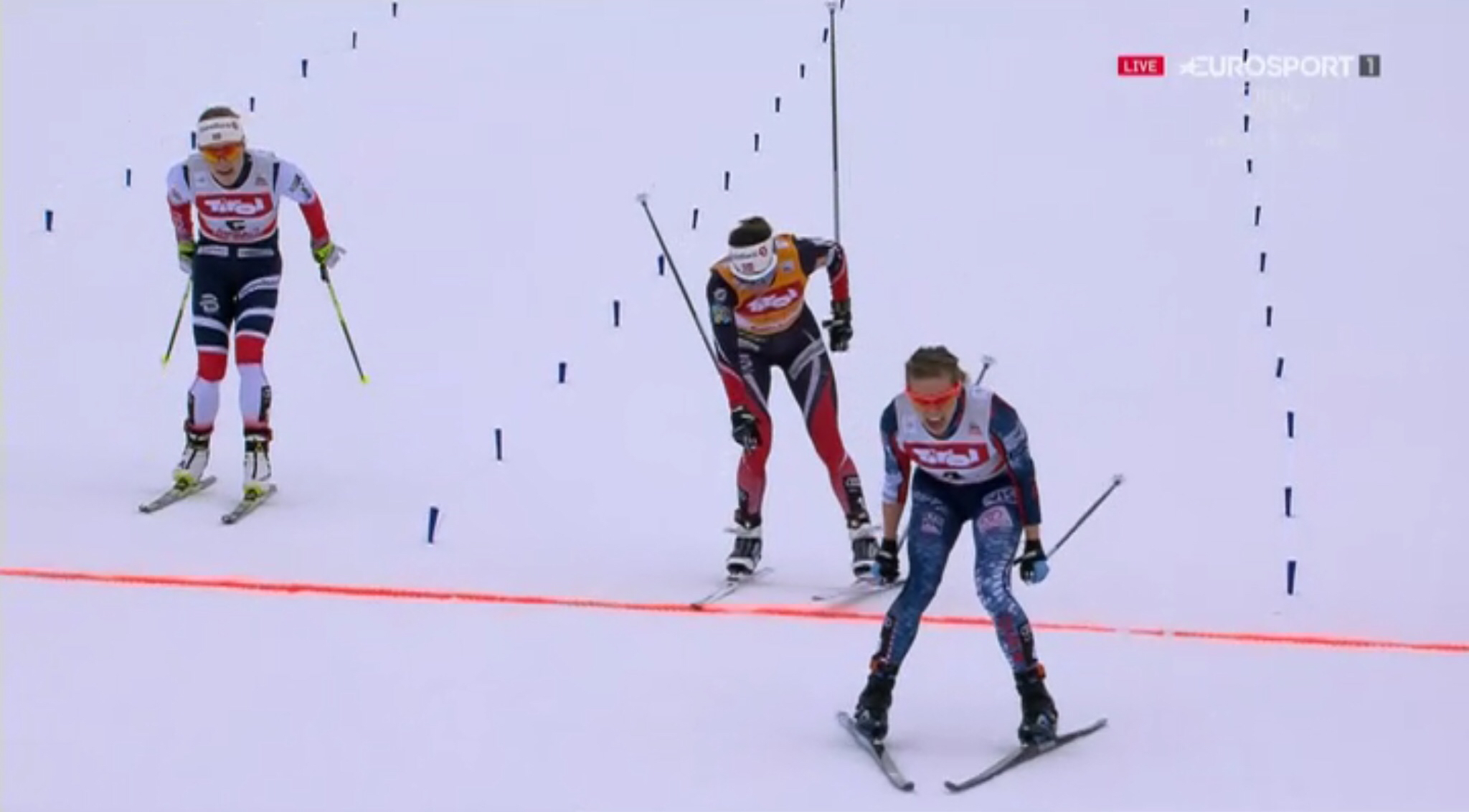
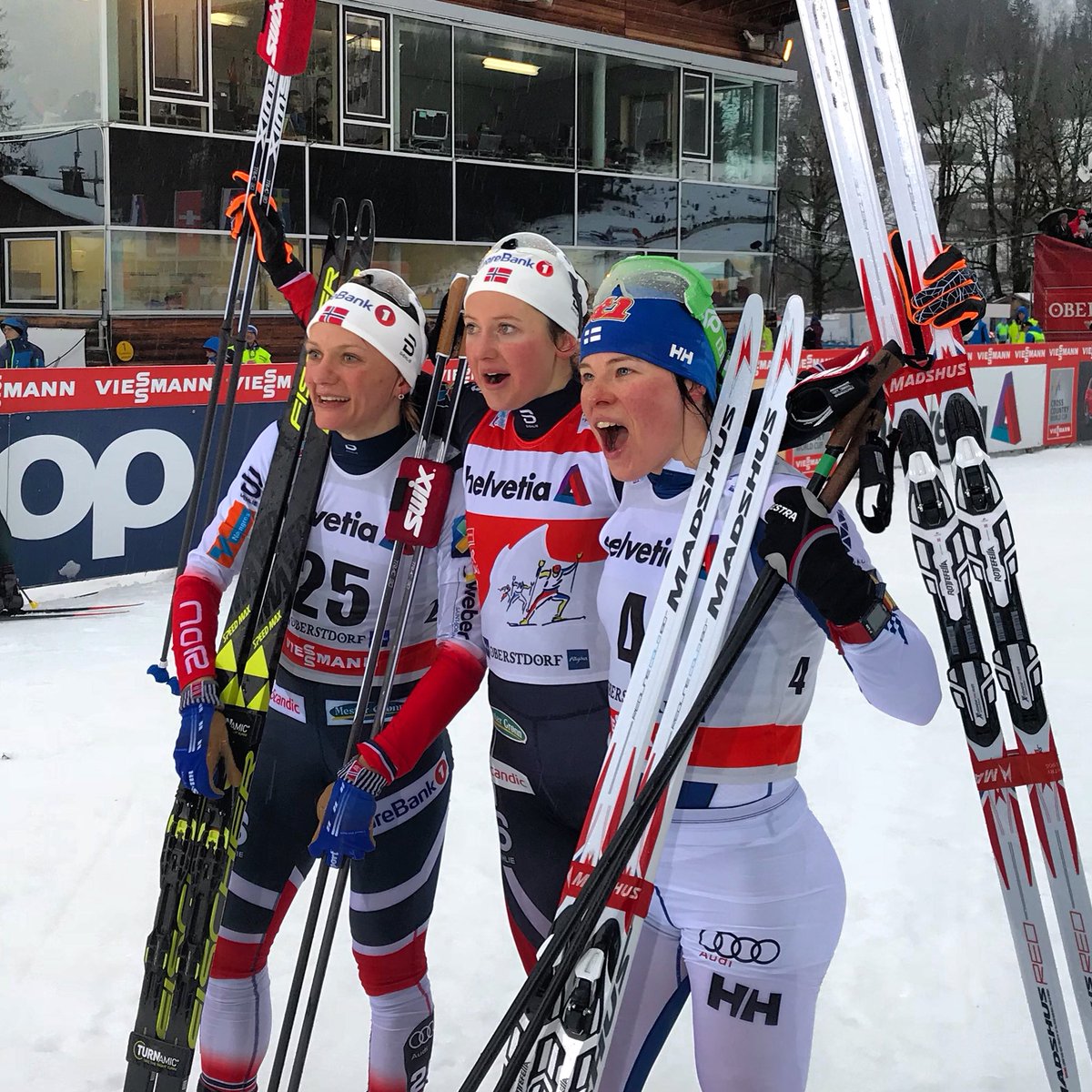
    American Jessie Diggins (r) celebrates her win on Sunday in the World Cup women’s 10 k freestyle mass start in Seefeld, Austria, ahead of Norway’s Heidi Weng (c) in second and Ragnhild Haga (l) in third. (Screenshot: Eurosport broadcast)
  • Tied for First, Caldwell and van der Graaf Share Seefeld Sprint Win

    Tied for First, Caldwell and van der Graaf Share Seefeld Sprint Win

    American Sophie Caldwell (c) and Switzerland’s Laurien van der Graaff high-five after tying for first in the women’s 1.3 k freestyle sprint on Saturday at the World Cup in Seefeld, Austria. Norway’s Maiken Caspersen Falla was next across the finish line for third place. (Photo: Garrott Kuzzy / LumiExperiences.com)

    SEEFELD, Austria — By the time the women’s finalists toed the start line, fans lucky enough to find a spot directly against the fence lining the World Cup 1.3-kilometer freestyle sprint course on Saturday showed signs of sunburn on their cheeks. The Seefeld sun was high and bright, but not the only one radiating on the Tirol ski trails.

    U.S. skier Sophie Caldwell found Seefeld treating her well. And she herself was on the strike.

    She started the day by qualifying for the heats in fourth, 1.84 seconds behind top women’s qualifying time of 2:21.44 posted by Norwegian Maiken Caspersen Falla. Heat selection came next. Caldwell opted for Heat 1, knowing that she had a fair chance of running up against Falla in that quarterfinal.

    The move was gutsy. Falla has 14 World Cup sprint victories. She was last year’s world champion in Lahti, Finland. Falla also has an Olympic gold medal from the 2014 Olympic Winter Games in Sochi, Russia. Both those events were in freestyle; Saturday’s discipline as well.

    But Caldwell wanted to be in the fast heat, even if it had the potential of knocking her out.

    “She kind of guessed when she selected quarterfinal 1 that Maiken would also go in quarterfinal one .. that was part of the strategy,” U.S. Ski Team Head Coach Chris Grover told FasterSkier in person after.

    “Maiken and I chose the first quarterfinal,” Caldwell told FasterSkier. “I knew we were going to have fast times throughout the day and I had a good chance of being lucky loser.”

    American Sophie Caldwell (l) and Norway’s Maiken Caspersen Falla (r) contested for the win in both their quarterfinal and semifinal. Falla won the quarterfinal while Caldwell won the semi. Ultimately, Caldwell placed first in the final, tying Switzerland’s Laurien van der Graaff (not shown) while Falla placed third overall. (Photo: Garrott Kuzzy / LumiExperiences.com)

    From the start of their quarterfinal, the first of five, the American not only hung with Falla, she pressured her. Caldwell skied in second just behind the Norwegian as they approached the finish, where Falla outlunged Caldwell by 0.8 seconds to win the heat.

    Both automatically advanced to the semifinal, and faced off once again in the first semi. This time through, the 27-year-old U.S. Ski Team member was even more ready.

    After skiing in second behind Falla, also 27, into the final 100-meter stretch, Caldwell made her move around the Norwegian with 50 meters to go. The two once again lunged for the line. Caldwell emerged victorious, crossing the semifinal first in a time of 2:18.88, this time 0.16 seconds ahead of Falla.

    “She’s an amazing skier and an amazing skier to follow,” Caldwell said of Falla. “My goal was to follow her all day long.”

    The two were headed for the final together. Their fast semifinal also produced two lucky losers, Switzerland’s Laurien van der Graaff and Sweden’s Linn Sömskar.

    From the second semifinal, another American had qualified for the final, Sadie Bjornsen, along with Norway’s Kathrine Rolsted Harsem. Until Saturday, Bjornsen had never qualified for a freestyle sprint. That hadn’t stopped the American from skiing aggressively to the win in her quarterfinal and then place second in her semifinal.

    American Sadie Bjornsen racing toward the finish of her semifinal with 100 meters to go. She ended up second, 0.4 seconds behind Norway’s Kathrine Rolsted Harsem in first. Both advanced to the final, where Harsem placed fourth and Bjornsen sixth overall. (Photo: Garrott Kuzzy / LumiExperiences.com)

    “My coach Erik Flora is here … we had a talk and basically he said, ‘Sadie, it never works when you try to do tactics, so just go as hard as you can and attack where you can and don’t try to play anything out there; just go,’ ” Bjornsen reflected. “So, that’s kinda what I was going with today.”

    Two Norwegians, two Americans, one Swiss skier and one Swede then lined up for the women’s final on Saturday. At the sound of the gun, Falla surged to the front. Caldwell shadowed her in second, which was part of the plan.

    “For the ladies, the course was so short that you wanted to stay in the front,” Grover said. “If you ended up towards back…you had to do a lot of work to get back up to the front.”

    Just behind Caldwell and Falla was van der Graaff skiing just a bit to the outside. Harsem, Bjornsen and Sömskar were next in line through the course’s first uphill and corner back toward the stadium.

    Tuck-skating the final section of the first downhill and powering into the next uphill, Falla seemed to see the spot as an opportunity to distance herself from the field. But Harsem and van der Graaff were now poling hard to her left. Caldwell was glued to the back of Falla’s skis, with Bjornsen and Sömskar right behind.

    At the top of the final climb, however, Falla had once again put herself in the lead. Cornering into the final descent, it was Falla, Caldwell, van der Graaff, Harsem, Bjornsen, and Sömskar.

    In the final 100 meters, Falla stayed in the center, Caldwell moved to her right and van der Graaff skate skied to the left. As the three sped toward the finish, Falla was just slightly ahead.

    The three-way battle for first, with (from left to right) American Sophie Caldwell, Norway’s Maiken Caspersen Falla and Switzerland’s Laurien van der Graaff in the women’s 1.3 k freestyle sprint final at Saturday’s World Cup in Seefeld, Austria. Caldwell and van der Graaff ended up tying for the win. (Photo: Garrott Kuzzy / LumiExperiences.com)

    The taste of a non-Norwegian victory, however, was too sweet to let go. Neither van der Graaff nor Caldwell slowed their pace to settle for anything but first place. The Swiss skier and the American crossed together in a photo finish, which was eventually ruled a tie for the win. Their time was 2:18.65. Falla crossed 0.21 seconds later for third place.

    “It’s so great to win again,” said van der Graaff, 30, who earned her first World Cup win earlier this season at the opening stage of the Tour de Ski. “I have told myself to believe that it was possible and now I have two wins this season. I didn’t realize Sophie was so close at the finish. It’s kind of fun to share the podium with her. I have never heard of that happening before.

    The camera at the finish focused on van der Graaff, who initially thought she won outright over Caldwell and Falla. She was televised as the day’s singular winner, and even Caldwell was unaware of her win until she was told ten minutes after the finish by Jeff Ellis, the FIS Cross Country Media Coordinator and Kikkan Randall’s husband.

    “I thought he was messing with me at first,” Caldwell wrote in an email, explaining when she first heard the news.

    After she learned the result was real, Caldwell described he response as “very surprised, but pleasantly so” at learning she and van der Graaf had identical lunge times to the line.

    “I honestly don’t even remember lunging, but I’m glad I did,” she wrote. “It was really fun sharing the podium with Laurien. She’s a great competitor and it’s kind of cool that a tie for first place is possible!”

    American Sophie Caldwell (c) shares the top step of the World Cup podium with Switzerland’s Laurien van der Graaff (l) on Saturday after they tied for first in the women’s 1.3 k freestyle sprint in Seefeld, Austria. Norway’s Maiken Caspersen Falla (r) placed third. (Photo: Garrott Kuzzy / LumiExperiences.com)

    The win is the first one for the U.S. Ski Team this season. It is Caldwell’s third individual sprint podium this season, eighth-career World Cup podium and second individual win. Her first came in the 2016 classic sprint stage of the Tour de Ski in Oberstdorf, Germany.

    While the sprint was the last until a classic sprint is contested at the 2018 Olympics next month, Seefeld is the site of next year’s World Championships.

    Finishing out the women’s final were Harsem in fourth (+1.34), Sömskar in fifth (+1.83) and Bjornsen in sixth (+2.26).

    “I felt really awesome in the quarters,” Bjornsen said. “In the semis, I definitely could feel some fatigue and by the finals. I tried to do what I could, but for sure could feel I was a bit tired, as is everybody, but I was missing that final push that I really needed on that last hill.

    “I was out there learning,” Bjornsen continued. “It’s fun to see it the year before world champs and kind of what to expect.”

    Slovenia had three in the top 10 with Vesna Fabjan in seventh, Katja Visnar in eighth and 22-year-old Anamarija Lampič in 10th. Italy’s Greta Laurent started the day by qualifying second, 1.43 seconds behind Falla, and ended up ninth overall.

    American Kikkan Randall (second from l) racing with (from left to right) Germany’s Sandra Ringwald, Slovenia’s Anamarija Lampic and France’s Aurore Jean during their quarterfinal of the women’s 1.3 k freestyle sprint at the World Cup in Seefeld, Austria. (Photo: Garrott Kuzzy / LumiExperiences.com)

    U.S. skier Kikkan Randall also qualified for Saturday’s heats with the 18th-ranked time, then finished third in her quarterfinal (1.33 seconds behind Sömskar in first) to finish the day in 14th.

    “Good for Kikkan, descent qualification,” Grover said. “In the heats she kind of felt like she just didn’t ski it tactically super well and kind of got boxed out a bit. Little bit disappointing for her not to go through.”

    After qualifying in 30th (+7.68), Canada’s Dahria Beatty advanced to the fifth quarterfinal, where she finished fourth (1.65 seconds behind Laurent in first). That put her 20th overall, which stood as a season best.

    “I was feeling good today, and I really like this course,” Beatty, of the Canadian World Cup Team, said after. “It’s a good power course. … The heat was a bit frustrating. I felt like I was skiing well, but I just couldn’t make the right move to get around the girls in front of me. I got pushed into that wall, so that really allowed the gap to open up, which was unfortunate because I felt like I was skiing really well today and I could have — if I could have, tactically, been able to move up better and get into that final sprint.

    “But I am happy with today,” she continued. “It’s a good feeling, and I am excited for tomorrow.”

    Sunday features 10/15 k freestyle mass starts in Seefeld. While Diggins did not participate in Saturday’s sprint, she is slated to start Sunday’s 10 k freestyle mass start. After feeling a little fatigued from last weekend’s races in Planica, Slovenia, Diggins decided to take off one of Seefeld’s race days.

    “She wanted to pick one race this weekend to focus on,” Grover explained. “She was feeling a little bit of fatigue from last weekend and chose to go in the 10 k simply because we have a 10 k at the Games and no skate sprint. So she would have been outstanding in there today.”

    While three American women qualified for the heats on Saturday, Ida Sargent was 0.52 seconds outside the top in 37th. The U.S. Ski Team member fell just before the qualifier and sustained an injury, which Grover believed was to her thumb. Following the race, she was taken to the hospital in Innsbruck, located approximately 30 minutes from the venue, for further examination.

    “It was a hard day for Ida. She had a crash right before the qualification and sounds like there is some injury to her thumb. So were still trying to figure that out,” Grover said. 

    Rosie Brennan (U.S. Ski Team) finished the qualifier in 42nd, Emily Nishikawa (Canadian World Cup Team) was 51st, Caitlin Patterson (Craftsbury Green Racing Project) 52nd and Cendrine Browne (Canadian U25 Team) 54th.

    The Canadian women opted out of the past two weekends of World Cup racing and have been training in Livigno, Italy, for the week leading up to Seefeld.

    “We did a training camp in altitude to prepare ourselves for the [Olympic] Games,” Browne explained. “We did the same formula last year for World Champs and it’s something that worked really well for me, so I am confident with my preparation and I am looking forward to tomorrow.”

    Results: Qualifier | Finals

  • Saturday Rundown: Seefeld and Ridnaun

    Saturday Rundown: Seefeld and Ridnaun

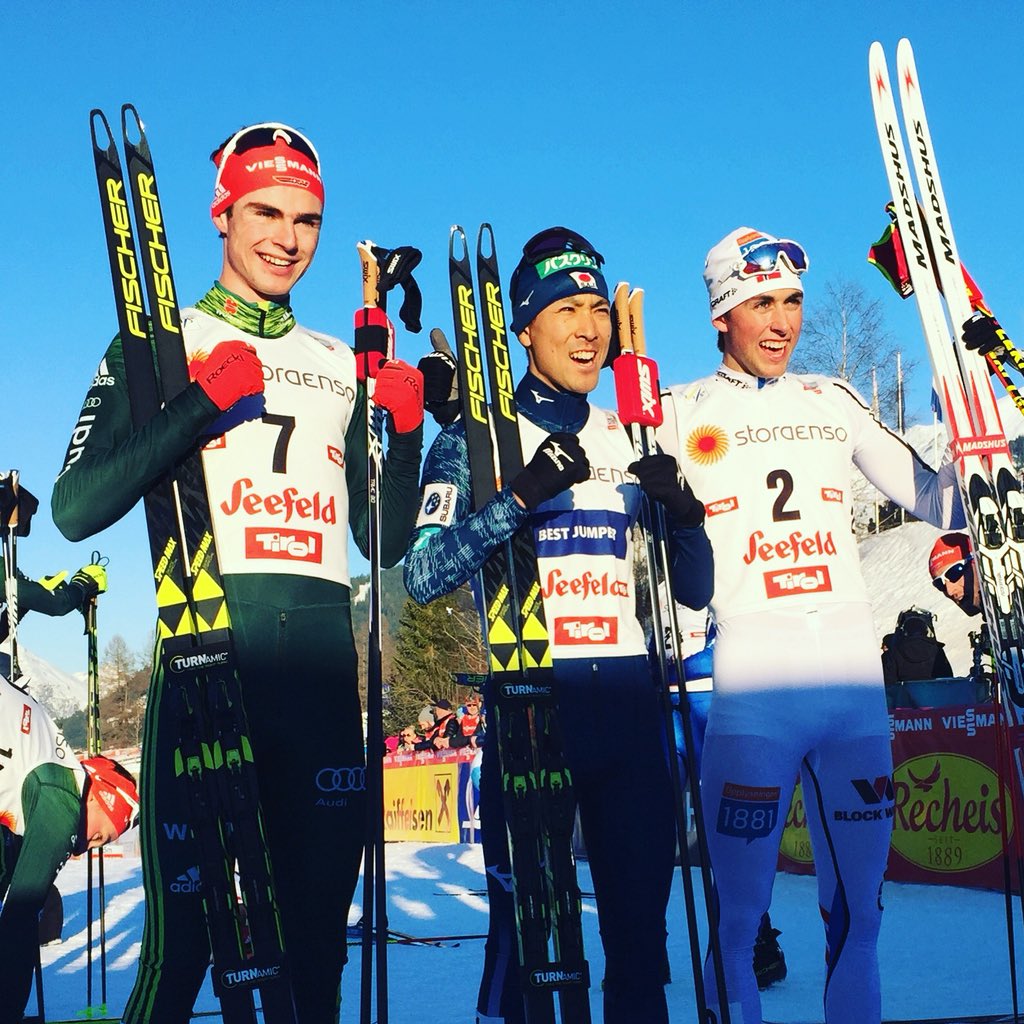
    The podium for Day 2 of the Seefeld Triple Nordic Combined World Cup, with Japan’s Akito Watabe in first (c), Germany’s Vinzenz Geiger (l) in second and Norway’s Jarl Magnus Riiber (r) in third. (Photo: FIS Nordic Combined/Twitter)

    FIS Nordic Combined World Cup (Seefeld, Austria): Normal hill/10 k

    Two of the same men from Friday repeated on the podium on Day 2 of the Seefeld Triple Nordic Combined World Cup, with Japan’s Akito Watabe notching his second-straight win on Saturday.

    Norway’s Jarl Magnus Riiber, who finished second on Friday, placed third in Saturday’s individual normal hill/10 k Gundersen, while Germany’s Vinzenz Geiger placed second, more than a minute behind Watabe.

    Watabe jumped to first and started the 10 k with a 25-second head start on Riiber in second. Geiger started seventh, 1:45 minutes back, and rose to second at the finish, 1:05.5 behind Watabe (who won in 23:28.5) and 3.4 seconds ahead of Riiber in third (+1:08.9).

    For the second day in a row, Norway’s Jan Schmid narrowly missed the podium in fourth (+1:14.1), up from fifth after the jump.

    Taylor Fletcher was the lone American competing on Day 2, and he ended up 31st, up 10 places after jumping to 41st. Fletcher started the 10 k race 4:44 out of first then finished 3:52.9 behind Watabe.

    The Seefeld Triple concludes Sunday with the individual normal hill/15 k Gundersen.

    Results: Jumping | Final

    ***

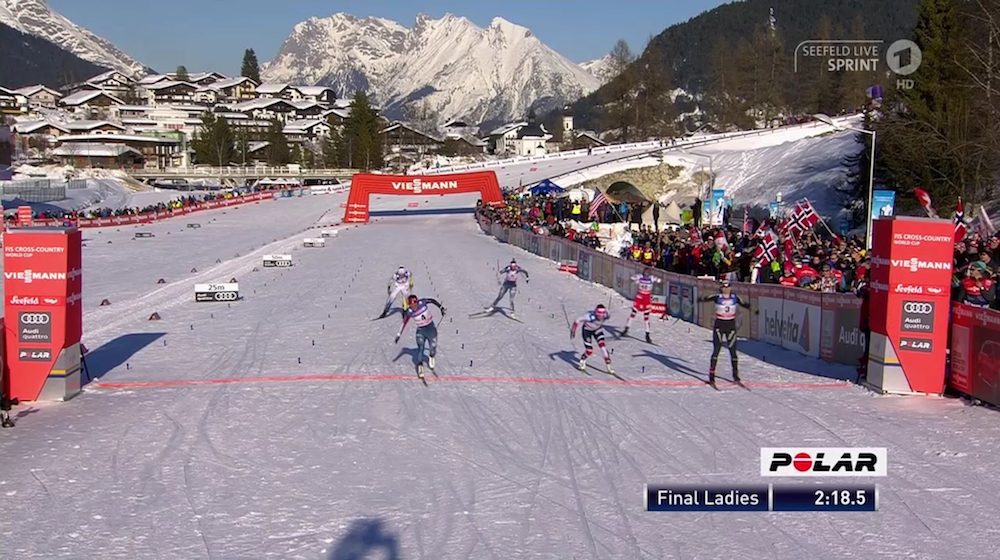
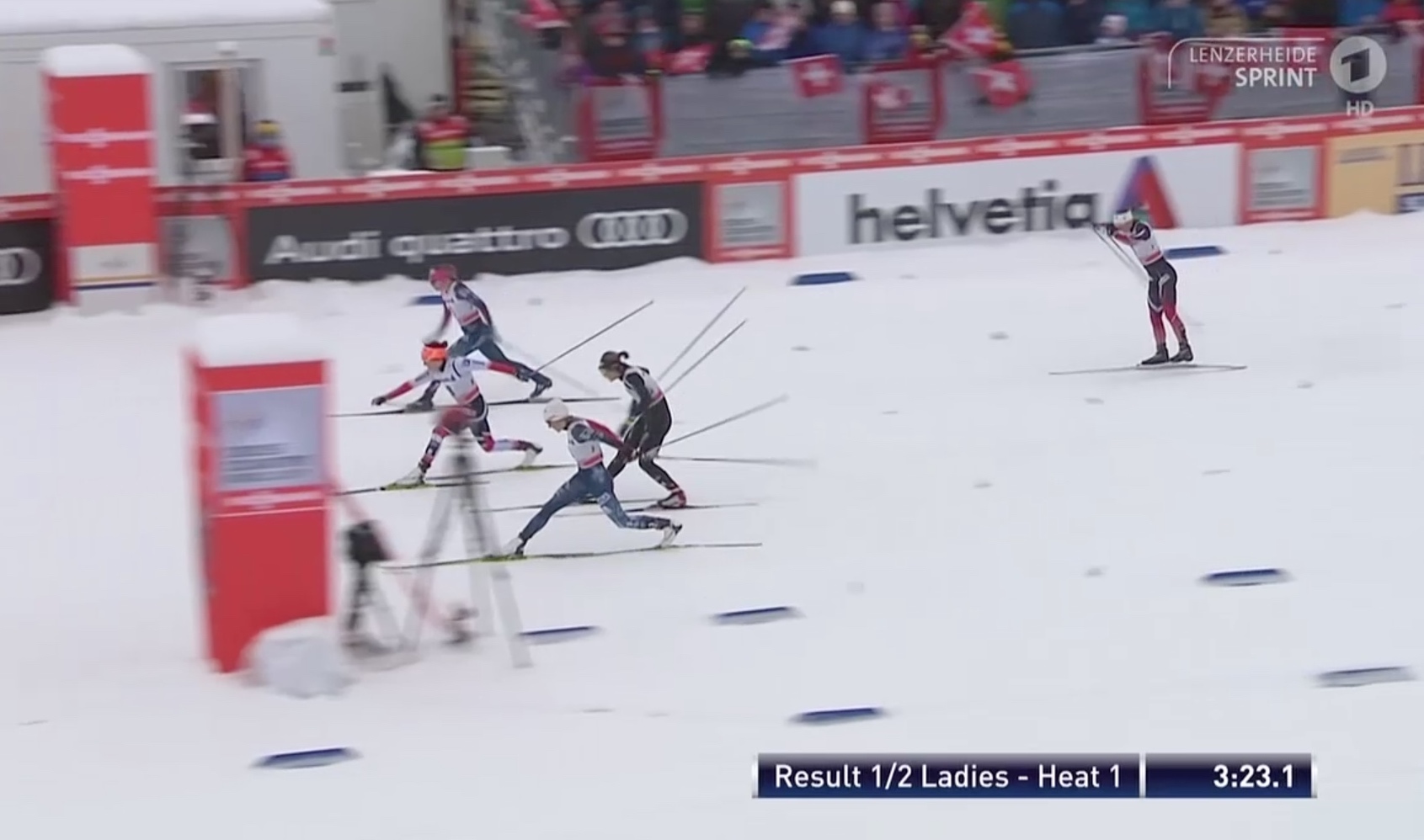
    American Sophie Caldwell (l) and Switzerland’s Laurien van der Graaff (r) tied for first on Saturday in the women’s 1.1 k freestyle sprint final at the World Cup in Seefeld, Austria, while Norway’s Maiken Caspersen Falla placed third. (Screenshot: ARD broadcast)

    FIS Cross Country World Cup (Seefeld, Austria): Freestyle sprints

    Women’s report

    Men’s report

    It doesn’t get any closer than that. On Saturday, American Sophie Caldwell and Switzerland’s Laurien van der Graaff tied for first in the women’s 1.1-kilometer freestyle sprint final at the World Cup in Seefeld, Austria. They both finished within one-hundredth of a second of each other to take the victory — the last sprint before the Olympics — in 2:18.65 minutes.

    Norway’s Maiken Caspersen Falla finished 0.21 seconds later for third place.

    The women’s freestyle sprint podium at Saturday’s World Cup in Seefeld, Austria, with American Sophie Caldwell (l) and Switzerland’s Laurien van der Graaff (c) tying for first and Norway’s Maiken Caspersen Falla (r) placing third. (Photo: FIS Cross Country/Twitter)

    “I broke my pole in the semifinal, then I got really tired,” van der Graaff said in a post-race interview with the International Ski Federation (FIS). “But I still believed I can be with Maiken and Sophie, and that I could catch them in the final was just great.”

    Norway and the U.S. both had two in the final, with Kathrine Rolsted Harsem of Norway placing fourth (+1.34), Sweden’s Linn Sömskar finishing fifth (+1.83) and American Sadie Bjornsen taking sixth (+2.26).

    Falla had raced to first in the qualifying round with a time of 2:21.44, Italy’s Greta Laurent qualified second (+1.43), van der Graaff third (+1.66), Caldwell fourth (+1.84), and Bjornsen fifth (+2.01).

    Van der Graaff then won her quarterfinal and placed third in the first semifinal, 0.77 second behind Caldwell, who won it. Falla was second in that semifinal (+0.16) and van der Graaff advanced as a lucky loser.

    Caldwell and Falla went head to head in every heat, with Falla winning their first quarterfinal by 0.08 seconds over Caldwell in second.

    Bjornsen won her quarterfinal and finished second to Harsem in the second semifinal.

    A third American, Kikkan Randall also qualified for the heats, placing 18th in the qualifier then finishing third in her quarterfinal (1.33 seconds behind Sömskar in first) to end up 14th overall.

    Canada’s Dahria Beatty placed 30th in the qualifier to nab the last spot in the rounds, then finished fourth in her quarterfinal (1.65 seconds behind Laurent in first) for 20th overall.

    For the U.S., Ida Sargent missed qualifying by about half a second in 37th (+8.20), Rosie Brennan finished 42nd (+9.86) and Caitlin Patterson was 52nd (+13.0).

    Also for Canada, Emily Nishikawa finished 51st (+12.68) and Cendrine Browne was 54th (+13.34).

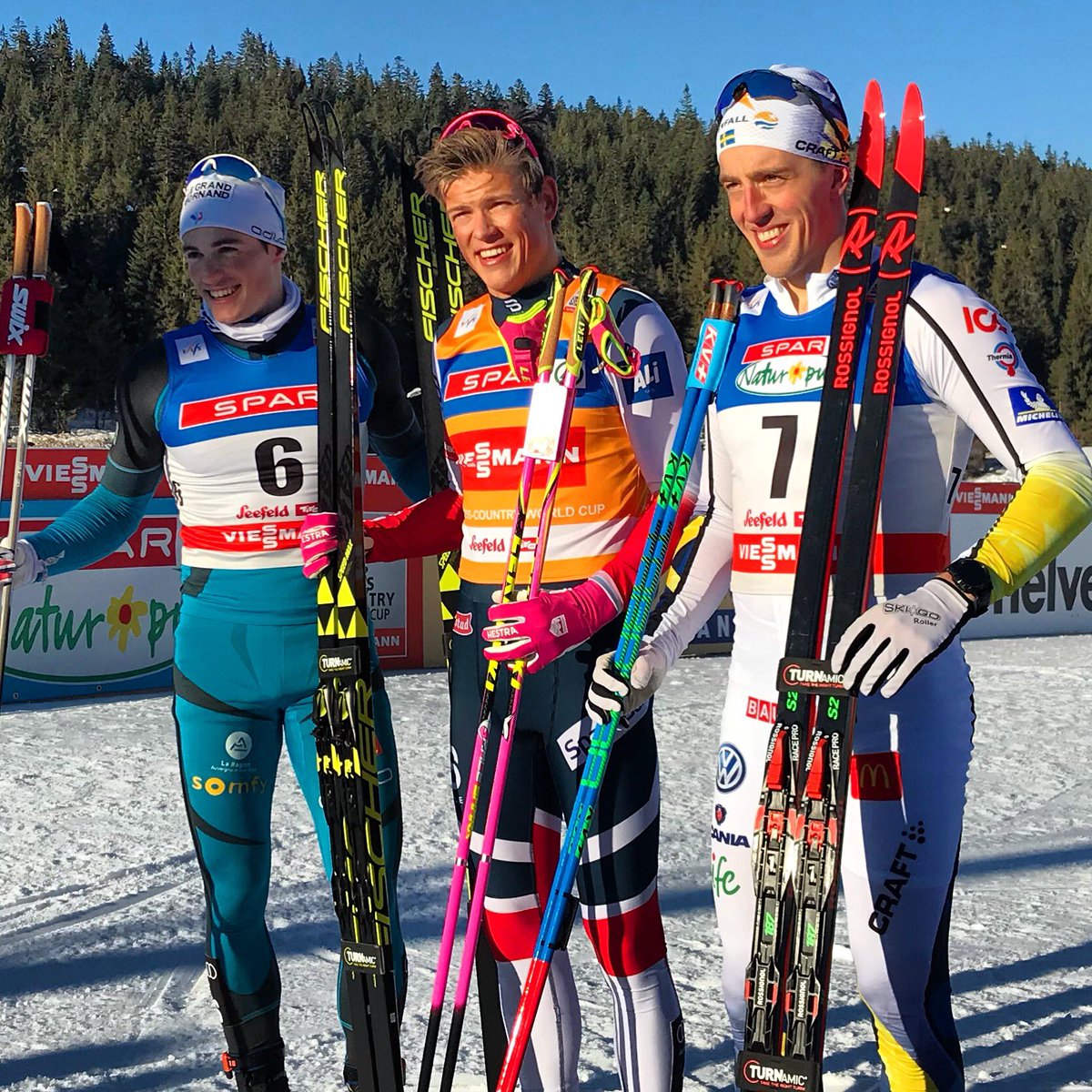
    The men’s 1.4 k freestyle sprint podium at the World Cup in Seefeld, Austria, with Norway’s Johannes Høsflot Klæbo (c) in first, France’s Lucas Chanavat (l) in second and Sweden’s Calle Halfvarsson (r) in third. (Photo: FIS Cross Country/ Twitter)

    The men raced 1.4 k, with Norway’s Johannes Høsflot Klæbo qualifying first in 2:46.89 then winning his quarterfinal and semifinal before putting the hammer down for one last time in the final, finishing first in 3:02.66.

    France’s Lucas Chanavat placed second in the final, 0.48 seconds back, after qualifying sixth, winning his quarterfinal and placing second in the first semifinal (0.33 seconds behind Klæbo). Sweden’s Calle Halfvarsson took the third spot on the podium after finishing 0.97 seconds after Klæbo. Halfvarsson had previously qualified seventh, taken second in his quarterfinal and advanced as a lucky loser in third in the first semifinal (0.52 seconds behind Klæbo).

    Italy’s Federico Pellegrino missed the podium in fourth (+1.06), Russia’s Gleb Retivykh placed fifth (+1.17), and Norway’s Emil Iversen was sixth (+5.57).

    Canada’s Alex Harvey and American Simi Hamilton both made it to the semifinals, where they finished fourth and fifth, respectively, and did not advance to the finals. Harvey had qualified for the rounds in 22nd and won his quarterfinal, then raced in the second semifinal, where he finished fourth, 0.47 seconds behind Iversen in first. That put Harvey eighth overall on the day.

    Hamilton clocked the fifth-fastest qualifying time, 6.46 seconds back from Klæbo’s top time. The U.S. Ski Team member then placed second to Pellegrino in his quarterfinal and was fifth in the first semifinal, 2.61 seconds behind Klæbo. Overall, Hamilton placed ninth.

    Also for the U.S., Erik Bjornsen finished 37th in the qualifier, 0.89 seconds out of the top 30 and 11.99 second out of first, Logan Hanneman was 39th (+12.52), Andy Newell 42nd (+12.90), Reese Hanneman 65th (+17.91), and Ben Lustgarten 76th (+21.88).

    Canada’s Len Valjas placed 40th (+12.72), Julien Locke 43rd (+13.31), Knute Johnsgaard 51st (+14.74), Bob Thompson 58th (+16.55), Graeme Killick 61st (+17.28), and Devon Kershaw 70th (+19.53).

    Results:

    Women’s qualifierWomen’s final 

    Men’s qualifier | Men’s final

    ***

    France’s 22-year-old Chloé Chevalier racing to her second win and third podium of the week in as many individual races at 2018 IBU Open European Championships on Saturday in Ridnaun, Italy. (Photo: IBU/Biathlonworld)

    IBU Open European Championships (Ridnaun-Val Ridanna, Italy): Men’s and women’s pursuits

    France’s Chloé Chevalier picked up her second win and third podium of the week at the International Biathlon Union (IBU) Open European Championships on Saturday in Ridnaun, Italy, winning the women’s 10 k pursuit, while Russia’s Alexander Loginov rose to the top step of the podium in the men’s 12.5 k pursuit on Saturday.

    Chevalier started the women’s pursuit in second, 13 seconds behind Ukraine’s Iryna Varvynets (who won Friday’s sprint and thus started first), and shot clean to take the lead after the third stage — where Varvynets missed one. Chevalier went on to clean the final stage for perfect 20-for-20 shooting and crossed the line first in 29:25.4. Varvynets finished second, 11.0 seconds back after missing a single target in the first standing (0+0+1+0), and France had two on the podium with Julia Simon in third (+43.2). Simon also shot 19-for-20, with her miss coming in the second prone stage (0+1+0+0).

    “Three medals in three races is definitely more than I had expected,” Chevalier, 22, told the event’s organizers on Saturday. “Today I saw that Iryna shoots faster than I, and so I really gave my all in the track. Even if it might not look like it, after the many races in the last few days I am noticing that I am getting more and more tired.”

    American Chloe Levins rose from 59th at the start to 42nd at the finish (+4:11.8), with three clean stages and two misses in the first standing (0+0+2+0). She had the 28th-fastest overall range time and 30th-ranked shooting time.

    In the men’s pursuit, Loginov started first as Friday’s sprint winner Latvia’s Andrejs Rastorgujevs did not start. Loginov held the lead throughout the race despite two misses — one in the first stage and another in the last stage (1+0+0+1) — and secured the win in 32:22.1. Bulgaria’s Krasimir Anev started second, 19 seconds after Loginov, and held his place as well, shooting clean and finishing second, 27.6 second back.

    “I am really happy here in Ridanna and the results reflect that,” Loginov, 25, told organizers. “Not to start in the individual event on Wednesday was the right decision because the last few days had been very demanding with six races in eight days. I am cross with my two errors in the shooting range, but very happy with my performance in the track.”

    Russia had two on the podium with Evgeniy Garanichev in third (+1:10.7) after Garanichev started in bib 19 and overcame three penalties (1+0+2+0) with the fastest overall course time.

    Canada’s Macx Davies started 27th and finished 35th (+4:33.9) with five misses (3+0+2+0), while American Alex Howe rose from 53rd at the start to 43rd (+5:53.5) with five penalties (2+2+1+0).

    The 2018 Open European Championships conclude with the single mixed relay and mixed relay on Sunday. American Susan Dunklee and Lowell Bailey are on the start list for the single mixed relay, Canada’s Carsen Campbell and Sarah Beaudry. For the mixed relay, the U.S. has entered Levins, Maddie Phaneuf, Paul Schommer, and Alex Howe.

    Results: WomenMen

    Start lists: Single mixed relay | Mixed relay

  • ‘It Felt Surreal,’ Patterson Closes Out U.S. Nationals with Win No. 4

    ‘It Felt Surreal,’ Patterson Closes Out U.S. Nationals with Win No. 4

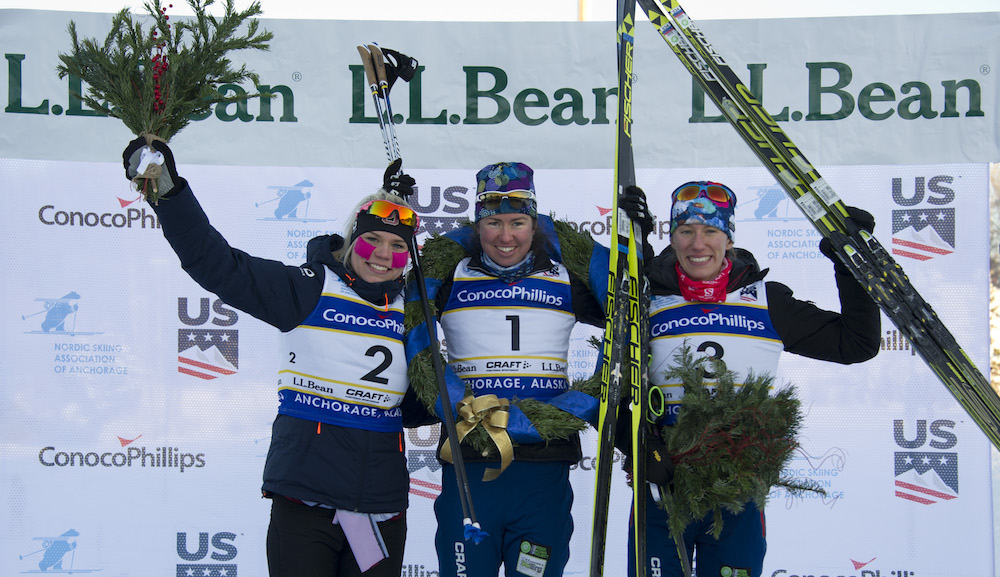
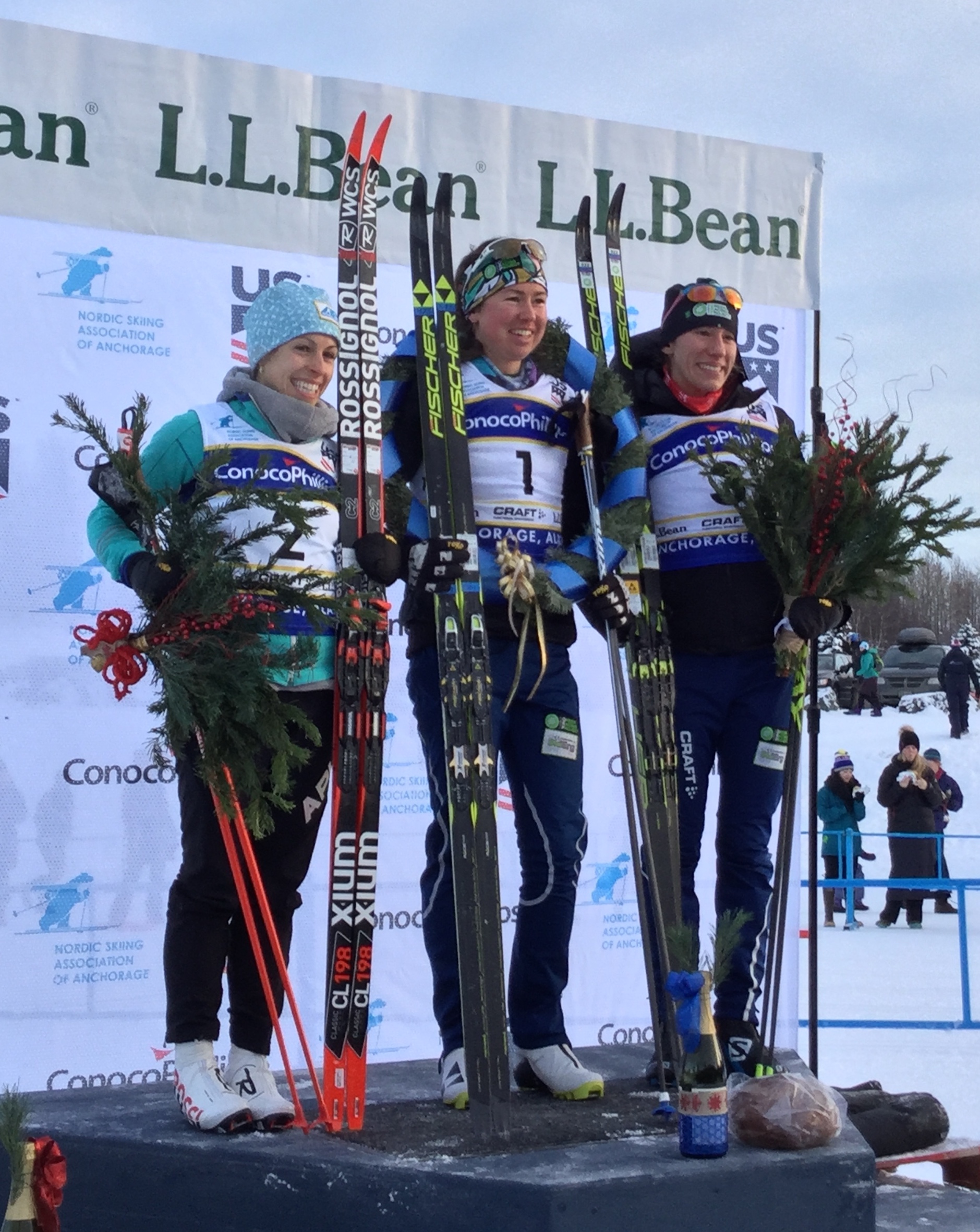
    Caitlin Patterson (c) atop the podium for the fourth-straight race of the week at 2018 U.S. Cross Country Championships in Anchorage, Alaska, joined by Finland’s Jasmi Joensuu (l) of the University of Denver, in second and Patterson’s CGRP teammate Kaitlynn Miller (r) in third. (Photo: Michael Dinneen Photography)

    Note: This article has been updated to reflect the fact that U.S. Ski Team member Jessie Diggins was the top American in four consecutive U.S. nationals races in 2012, winning the freestyle sprint, 10 k skate and 20 k classic mass start outright and placing second to Canada’s Dasha Gaiazova in the classic sprint (but topping the podium as the first American). This week, Caitlin Patterson, of the Craftsbury Green Racing Project, became the first woman since Diggins to be the top American in four U.S. national races as well.

    ***

    ANCHORAGE, Alaska — Maybe there’s something to be said for growing up in Alaska. Or maybe there’s something to be said about the mystique of Kincaid Park, its surrounding Tordillo, Chugach and Alaskan mountain ranges all bathed in sunlight at the start on the last day of 2018 U.S. Cross Country Championships during the women’s 1.5-kilometer classic sprint.

    Caitlin Patterson (Craftsbury Green Racing Project) approaching the finish line of the women’s 1.5 k classic sprint final on Monday, the last day of 2018 U.S. Cross Country Championships in Anchorage, Alaska. She won the final for her fourth-straight national title of the week. (Photo: Michael Dinneen Photography)

    Be it either of those, Caitlin Patterson became the first woman since U.S. Ski Team (USST) member Jessie Diggins, to earn four consecutive titles at a single U.S. nationals. Diggins did it in 2012 in Rumford, Maine, two years after Kikkan Randall, a USST member who trains with Alaska Pacific University (APU), swept four races outright at Kincaid. (Both Randall and Patterson grew up in Anchorage; Randall was born in Salt Lake City, born in McCall, Idaho. Patterson, 27, attended South Anchorage High School while Randall, 35, went to East Anchorage High).

    Even if Patterson, who’s currently based out of Vermont with the Craftsbury Green Racing Project (CGRP), had not won the final event of 2018 nationals, she had already posted a banner week. She started it by racing to first in the opening women’s 10 k freestyle individual start last Wednesday, amidst slushy ski trails, falling wet snow and a standard dark Alaskan winter morning sky.

    After a training day on Thursday, she returned to the Kincaid trails on Friday — which had transformed from 48 hours before — racing once again to first, this time in the women’s freestyle sprint for her first sprint title.

    Saturday brought another training day before Patterson returned on Sunday for the women’s 20 k classic mass start.

    Hedda Bångman, a Swedish freshman at the University of Colorado at Boulder (CU), racing to fourth in the qualifying round of the women’s 1.5 k classic sprint on Monday at 2018 U.S. Cross Country Championships in Anchorage, Alaska.

    Up against Sweden’s Hedda Bångman, a University of Colorado at Boulder (CU) freshman, and Rosie Frankowski (APU), the two of whom led much of Sunday’s four-lap race, Patterson had met her match. However, Frankowski’s fall on the final hill paired with Patterson’s strong skiing led Patterson to finish as the day’s top American. Bångman took the outright win while Patterson placed second overall, ahead of Frankowski in third. The two were first and second on the U.S. podium.

    If she had left it at that, Patterson would have tied Rosie Brennan — of the U.S. Ski Team and APU — who won three out of four U.S. nationals races in 2015.

    But Patterson took it one step further.

    With no training or rest day in between, the CGRP skier joined the remaining U.S. nationals field on Monday. Some skiers had already left, including Australian and APU skier, Jessica Yeaton, who flew out Monday morning to prepare for next weekend’s World Cup in Dresden, Germany.

    Based on her qualifier alone, it might have seemed Patterson was beginning to feel the effects of four days of racing since last Wednesday. She qualified seventh, 4.77 seconds behind the fastest qualifying time of 3:41.40, posted by Finnish skier and University of Denver (DU) junior Jasmi Joensuu.

    “Today qualification was really good, I felt really good,” Joensuu said after the race. “But then, my throat is really sore after the qualification … so I didn’t know if I could race actually. But I decided to race, I knew that I could win this race. I knew that there were some good girls but they also had 20 k yesterday, which I didn’t race, so that was good for me.”

    With Joensuu, 21, having sat out Sunday’s mass start and Patterson having expended herself over 20 k, the Finn may have had a leg up on the American.

    What Joensuu had not counted on was Patterson’s familiarity with the course and what the American had learned from Friday’s freestyle sprint.

    “I think that bottom corner was a really good one for me all week and in the skate sprint I figured out how to ski it with good momentum,” Patterson said after Monday’s race, referring to the slightly inclined corner about 100 meters before the finish. “Even with that big gap that she put on the hill, I think just knowing how to ski the hill here at Kincaid … the finish stretch was mine.”

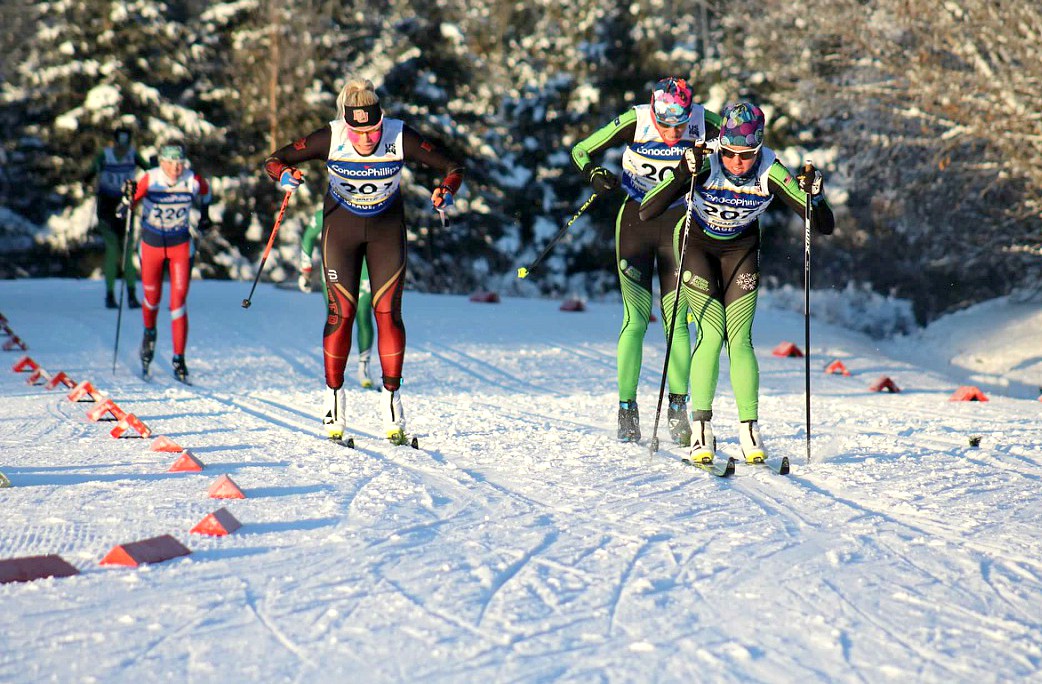
    Craftsbury’s Caitlin Patterson (207) and Kaitlynn Miller (second from r) and Jasmi Joensuu, of the University of Denver, lead their semifinal during the women’s 1.5 k classic sprint on Monday at 2018 U.S. Cross Country Championships in Anchorage, Alaska.

    In their semifinal, though Joensuu had gapped both Patterson and and another CGRP skier Kaitlynn Miller at the top of Gong Hill — the sprint’s final major climb — both Craftsbury skiers had caught Joensuu by the bottom of the descent’s corner back towards the finish.

    A similar scenario played out in the final.

    “In the final I did a tactic, I would ski the uphill as fast as I can, I don’t save anything and that almost worked,” Joensuu recalled.

    Joensuu and Petra Hyncicova, a CU senior from the Czech Republic, had pushed hard out of the start of the final, followed by Patterson and Miller, as well as Dartmouth skier Lydia Blanchet and APU’s Becca Rorabaugh.

    “I tended to lose time in the beginning of the race and then catch back up,” said Blanchet, who had to catch a plane within an hour of finishing the final. “I had great skis and downhills are one of my strengths.”

    While the two non-Americans raced to the front halfway through the course’s major climb, Blanchet, Rorabaugh, Miller, and Patterson hung behind. Then halfway through the final hill, Joensuu attacked, attempting to distance herself from the pack.

    By the top of the hill, she had done just that, with 4 meters separating her from the rest of the field. Miller and Patterson followed, tucked into the downhill swooping curve.

    As Joensuu disappeared behind the trees blocking the corner from spectator’s view, Miller and Patterson were already hot on her heels. Using her momentum, Patterson swung around Joensuu and emerged from the corner first, double poling with a sizeable lead to her fourth victory in a row in a time of 3:39.58.

    “It felt surreal coming down the finishing stretch today, realizing that I couldn’t hear people behind me and realizing that it was going to be number four,” Patterson said. “I could not have imagined this if I tried, but I’ve just had really good feelings all week. Great support from the staff and waxers and everything, and it’s fun being back here in Anchorage, especially.”

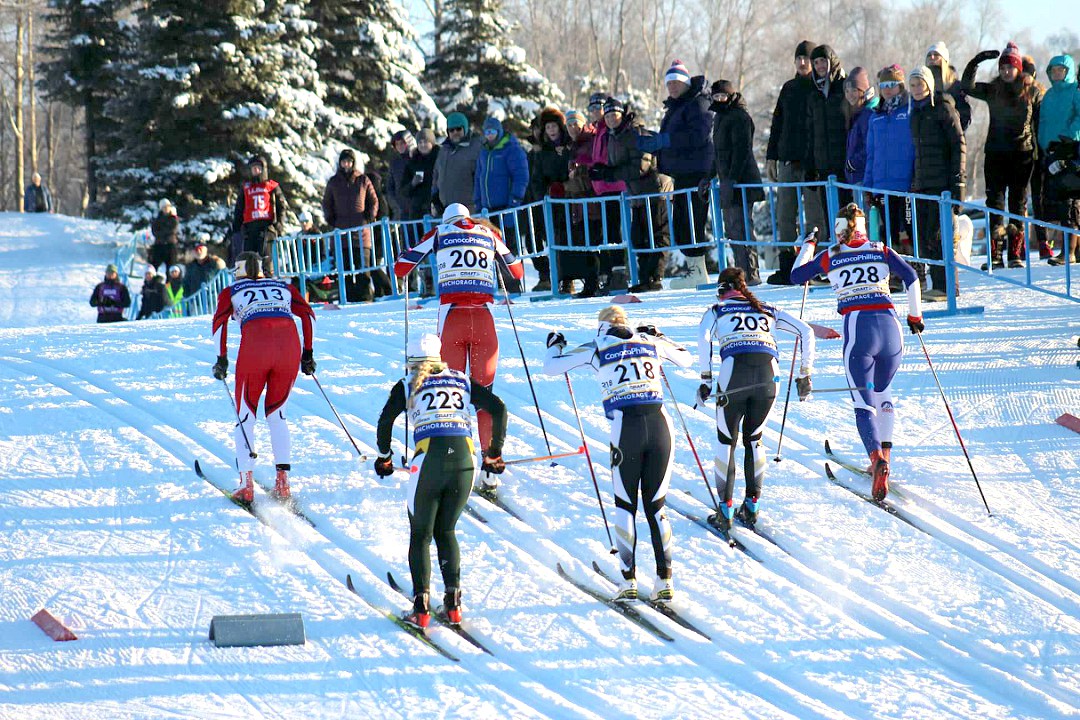
    The fifth women’s classic sprint quarterfinal heat on Monday at 2018 U.S. Cross Country Championships in Anchorage, Alaska, with CXC/Peak Nordic’s Felicia Gesior (208) leading with Corey Stock (213) of the Bridger Ski Foundation, and Northern Michigan’s Nicole Schneider (223), the University of Colorado Boulder’s Christina Rolandsen (218) and Petra Hyncicova (203), and Mae Chalmers of SMS (228) chasing.

    Finishing second, 2.36 seconds behind Patterson, was Joensuu. Capturing third for her third American podium this week was Miller (+3.9). Miller finished second to Patterson in Friday’s freestyle sprint and was the third American in Sunday’s 20 k.

    “I’m really pleased with how everything panned out,” Miller said. “To me the big sign of improvement has been in my skating and I was really excited with my skate sprint and obviously really excited with yesterday and today as well, but it’s nice to see my skating moving up a little bit.” 

    Despite being the 2016 national classic sprint champion, Miller, of Elmore, Vt., explained she entered Monday’s race with nothing held over her head.

    “I don’t ever go into a race expecting a certain result,” she said. “Anything can happen, even to strong, very experienced skiers … [but] it is exciting to be in the mix.”

    Though Miller also explained she “felt pretty tired” by the time she lined up for the final on Monday, she also acknowledged that she was, in all likelihood, not alone.

    “I think that was the situation for all of the women out there today, after the 20 k yesterday. It was sort of like, well, the snap isn’t there, the energy isn’t quite there, but everyone was in the same boat,” she said. “Everyone’s making the best of it, and your body knows what to do once you get to the start line.

    “All things considered, I felt great, had a really great result, and I’m very happy with it,” Miller added.

    Becca Rorabaugh (APU) during the women’s 1.5 k classic sprint on Monday at 2018 U.S. Cross Country Championships in Anchorage, Alaska. After finishing second in the qualifier (as the top American) she finished fourth overall in the final and was the third American on the day.

    Rorabaugh finished fourth overall (+9.92) and was the third American. The Fairbanks native, who has spent the last 10-plus years living and training in Anchorage, was the top American qualifier on Monday, 1.31 seconds behind Joensuu in first overall.

    “I was extremely excited with my qualifier,” Rorabaugh said. “It was rather unexpected. I was the first American and I had one really good qualifier in West Yellowstone this year but the other two so far have been pretty medium for me, so I was really excited really happy with this morning.”

    Though the qualifier is what counts for the Olympic points list, Rorabaugh indicated that was of less importance to her than just “getting her qualifier back.”

    “It’s been a couple years since I’ve been having a very strong qualification in sprint racing so I was just trying to work on having enough energy and having enough heat pumped to really crush a qualifier first thing in the morning,” she said.  

    “I wanted to have something special at home,” she added, referring to the friends and family that came to Kincaid to watch her race. “So it was good to have something at the end of the week.”

    With firm tracks, cold temperatures reading around 10 degrees Fahrenheit and a low sun in the sky, Rorabaugh described the final U.S. nationals event as “a quintessential Alaskan day.”

    “That was quite nice,” she added.

    Rounding out the final was Hyncicova in fifth (+10.03) and Blanchet in sixth (+11.21).

    “Today I was kind of tired. I finally hit the jet lag over the weekend,” Hyncicova, the two-time defending NCAA champion, said. “But … making the final, and even being third in the quarterfinal is awesome. It’s just proving that I am kind of in good shape so that’s a good start of the season.”

    Rounding out the remainder of the women’s top 10 was Bångman in seventh, Sun Valley Ski Education Foundation skier, Kelsey Phinney in eighth, Central Cross Country’s Felicia Geisor in ninth and Stratton Mountain’s Erika Flowers in tenth.

    In the junior women’s classic sprint, Wasatch Nordic’s Sarah Morgan took the win in 3:54.93. Novie McCabe (Methow Valley Nordic) placed second (+1.5) and her teammate teammate Ella-Sophie Kuzyk placed third (+6.66).

    Results: Women’s qualifier | Women’s final | Junior women’s final

    –Ian Tovell, Andrea Pontyondy-Smith and Gavin Kentch contributed

    Highlights video by Max Romey Productions

  • Sunday Rundown: U.S. Nationals; Tour de Ski Finale; Oberhof Relays

    Sunday Rundown: U.S. Nationals; Tour de Ski Finale; Oberhof Relays

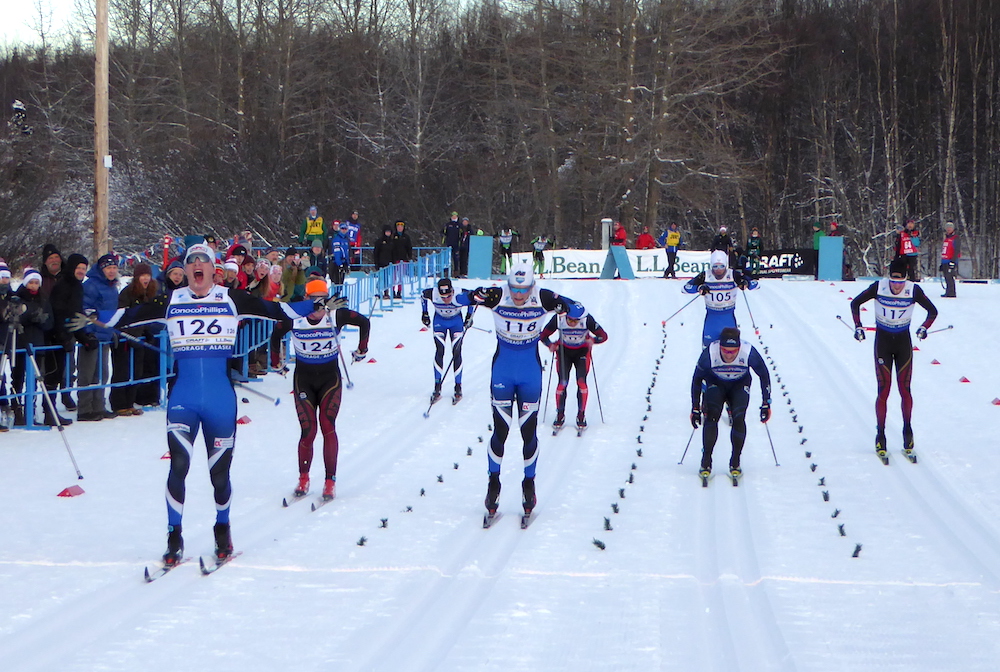
    APU’s Tyler Kornfield (126) leads APU’s Eric Packer (118) and DU’s Eivind Romberg Kvaale (124) to the line in the men’s 30 k classic mass start at 2018 U.S. Cross Country Championships on Sunday in Anchorage, Alaska. Kornfield, Packer, and Kvaale finished first, second and third, respectively. Kris Freeman (10, second from left) was fourth overall and the third American.

    U.S. Cross Country Championships (Anchorage, Alaska): 20/30 k classic mass starts

    Men’s report

    Women’s report

    Sweden’s Hedda Bångman denied Caitlin Patterson of her first outright victory of the week at 2018 U.S. Cross Country Championships, but Patterson as the first American racked up her third-straight national title in the women’s 20-kilometer classic mass start at Kincaid Park on Sunday in Anchorage, Alaska.

    The top-three Americans in the women’s 20 k classic mass start on Sunday at 2018 U.S. nationals in Anchorage, Alaska, with Caitlin Patterson (1) of the Craftsbury Green Racing Project (CGRP) in first, Rosie Frankowski of APU (l) in second, and Kaitlynn Miller (r) of CRGP in third.

    Bångman, a 22-year-old freshman at the University of Colorado Boulder (CU), pulled off a 15.9-second win in the mass start, crossing the line in 1:00:55.3 hours. Patterson, of the Craftsbury Green Racing Project (CGRP), finished second, but was the top American in the event for the third time this week, and Rosie Frankowski, of Alaska Pacific University (APU), notched third (second American), 19.6 seconds back.

    Rounding out the top 10 was Jessica Yeaton, who trains with APU and races for Australia, in fourth (+44.1), Kaitlynn Miller (CGRP) as the third American in fifth overall (+1:13.5), Alayna Sonnesyn of the University of Vermont (UVM) in sixth (+1:25.3), Chelsea Holmes (APU) in seventh (+1:55.4), Norwegian CU skiers Christina Rolandson and Anne Siri Lervik in eighth (+1:55.7) and ninth (+1:56.1), respectively, and Erika Flowers of the Stratton Mountain School (SMS) Elite Team in 10th (+2:14.6).

    The men’s 30 k classic mass start was incredibly close, with APU’s Tyler Kornfield taking his first-ever distance national title (he was the 2012 classic sprint national champion) in 1:21:43.6. He edged his teammate Eric Packer by 0.7 seconds at the line, and Eivind Romberg Kvaale, a sophomore at the University of Denver (DU), finished 1 seconds back in third.

    Kris Freeman (Caldwell Sport) was just off the overall podium in fourth (+1.6), but was the third American. Another DU skier, Dag Frode Trollebø, also from Norway, finished fifth (+2.0), and APU had three in the top six with David Norris in sixth (+2.5). Noah Hoffman (Ski & Snowboard Club Vail) finished seventh (+2.6), Scott Patterson (APU) eighth (+3.6), and Craftsbury’s Adam Martin and Ben Lustgarten followed in  ninth (+14.7) and 10th (+14.9), respectively. With Brian Gregg (CXC/LNR/Team Gregg) in 11th (+16.1), the men’s top 11 were separated by less than 17 seconds.

    Results: Women | Men

    ***

    IBU World Cup (Oberhof, Germany): Men’s and women’s relays

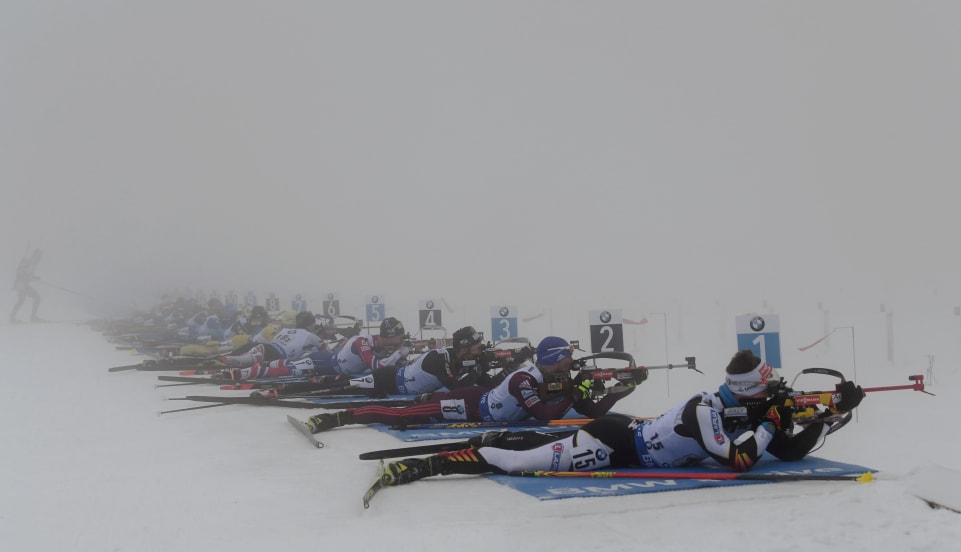
    Racers on the range during the men’s 4 x 7.5 k relay on a foggy Sunday at the IBU World Cup in Oberhof, Germany. (Photo: IBU/Biathlonworld)

    The Swedish men’s team and French women won the second relays of the International Biathlon Union (IBU) World Cup season on Sunday, with Sweden winning the men’s 4 x 7.5 k relay by 1:10.8 over Italy, and France besting Germany by 32.4 seconds.

    Notably, most of the top teams didn’t start all of their “A” teamers.

    In the men’s race, Sweden’s Martin Ponsiluoma, Jesper Nelin, Sebastian Samuelsson, and Fredrik Lindström combined for their first win together — and the first win for most of the members on the team.

    “It is a dream when you are a kid to compete in a World Cup,” Samuelsson said, according to an IBU press release. “To have a win is really amazing!”

    The Swedish women’s team also landed on the podium in third (+48.2).

    “What a race by the whole team,” said Lindström, who also has one non-relay World Cup win (from 2012) to his name. “It could not be better.”

    Conditions could not have been much more difficult for shooting on Sunday, with the fog that had descended early in the day for the women’s race worsening for the men’s race. When there wasn’t fog, there was wind.

    Misses were common throughout the two races, and even with racers being able to use three spares per shooting stage to clean, there were a high number of penalty laps.

    But the Swedish men kept their penalties to a minimum, with just one for the entire team and a total of nine spare rounds used among them. After Ponsiluoma came through the first exchange in sixth, Nelin skied them into third, Samuelsson picked off another place despite skiing a penalty after his standing stage to put them in second, and Lindström anchored them to first.

    “The conditions today were so special. Somehow I felt not so nervous, I was calm and had luck on my side,” Lindström said at a post-race press conference about his nearly flawless shooting (0+0; 0+1).

    “I have never [been first] before,” he added. “Not like this in a relay at least. That’s really fantastic.”

    “I had to look up to see if I was aiming the right way,” Nelin said after cleaning prone (0+0) then using two spares to clean standing (0+2). “I had no idea where I was aiming, so it was really difficult. But I hit, and it was good. Maybe these conditions fit me and I should never see anything.”

    Italy placed second with Thomas Bormolini, Lukas Hofer, Dominik Windisch, and Thierry Chenal combining for two penalties and 11 spares. Hofer had skied them up from eighth to second, and Windisch then took the lead on the third leg to put them in first at the final exchange, 1 minute ahead of Sweden. But Chenal slipped with the seventh-fastest last leg time and a penalty after standing.

    “Being on the podium with the team is always a special feeling,” Hofer said at the press conference. “For Thierry, it’s the first year in the World Cup, and he does a really good job, not just today. I am really happy that he could close out this relay. Second place is like a win for us.”

    Norway placed third (+2:04.6) with Vetle Sjåstad Christiansen, Henrik L’Abée-Lund, Lars Helge Birkeland, and Tarjei Bø. Together, they had three penalties (two from L’Abée-Lund and one from Birkeland) and 14 spares.

    “I grew up on Holmenkollen so I practiced a lot there [in fog],” L’Abée-Lund said. “But today was really really hard, I didn’t see anything in prone. Standing was OK, but prone was really difficult.”

    “It’s great to be on the podium,” Christiansen said. “Of course Norway always wants to win, but today we are very happy for our brothers in our neighbor-country Sweden.”

    The Canadian men placed 10th (+6:23.1) out of 25 teams with Christian Gow, Scott Gow, Brendan Green, and Carsen Campbell having a combined six penalties and 20 spares. Three of those penalties came on Scott Gow’s second leg, two from Campbell’s anchor leg, and one on Christian Gow’s first leg.

    After a penalty on his first prone stage (1+3), Christian cleaned standing with a spare (0+1) and tagged Scott in 11th, 53 seconds out of first. Scott then had two penalties in prone and three in standing, but managed to improve to eighth given how much everyone else was struggling with the shooting as well. Green kept them in eighth with two clean stages (0+2, 0+3), and Campbell, in his first World Cup relay, cleaned prone (0+2) but had two standing penalties (2+3) to put the team in 10th at the finish.

    In an interview with German broadcaster ARD halfway through the race, Canadian coach Matthias Ahrens called the range conditions, which ranged from thick fog to unpredictable wind, “very hard to assess.”

    “… To be honest, the good thing was that conditions were very bad,” he later added. “So regarding visibility, almost everyone was on the range at the same time [with the same irregular conditions]. They had to wait very long, and of course had bad conditions to shoot, but much of the field was there at the same time.”

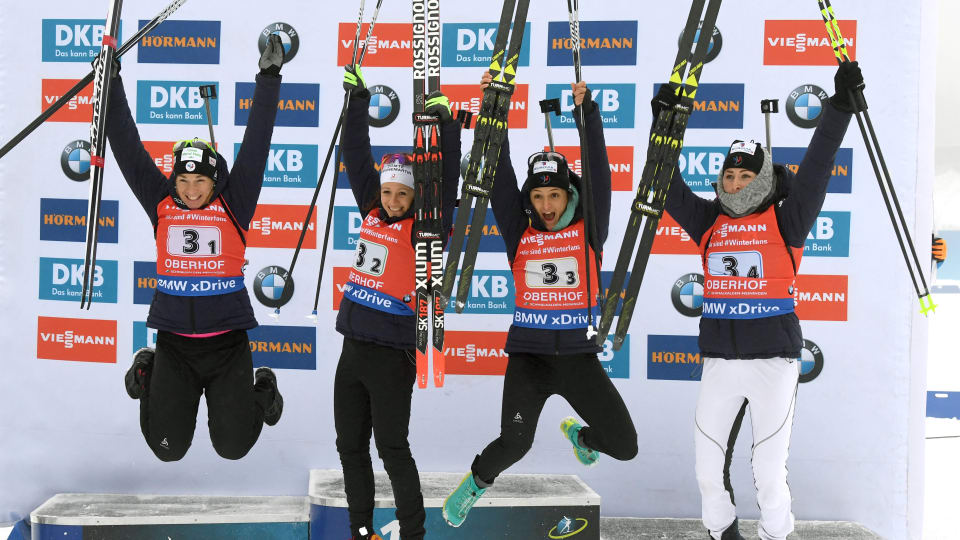
    The French women’s team, of Anais Bescond, Anais Chevalier, Celia Aymonier, and Justine Braisaz, celebrate their relay victory on Sunday at the IBU World Cup in Oberhof, Germany. (Photo: IBU/Biathlonworld)

    In the women’s race, with better shooting visibility, France’s Anais Bescond, Anais Chevalier, Celia Aymonier, and Justine Braisaz took the win in 1:12.42.4, with one penalty and 10 spares. After Bescond put them in first through the first exchange, 6 seconds ahead of Italy in second, Chevalier had to ski a penalty loop after prone but cleaned standings (1+3, 0+0) and tagged off in second, 23 seconds behind Italy, now in first.

    One loop later, France was back in first thanks to Aymonier, who cleaned with just two spares (0+0, 0+2), and they extended their lead from 0.8 seconds at the last exchange to 32 seconds at the finish with Braisaz, who shot 0+1, 0+3, and skied the fastest anchor leg.

    “I know that it’s always good for Justine to start in the first position, so I really wanted to pass the relay to her in that,” Aymonier said in a press conference after.

    “I was nervous, too,” Braisaz said. “That kind of shooting turned my mind upside down, actually. The crowd was very loud, and … I wasn’t very focused on what I did. It was a bit foggy, too, so that made it harder. But finally it was a French day, maybe.”

    “In my mind the whole team is really strong, and really able to get the first place,” Bescond said. “After years and years and years behind Germany’s team we finally did it. So just Oberhof spirit I think.”

    Germany placed second with Vanessa Hinz, Denise Herrmann, Franziska Preuss, and Maren Hammerschmidt. They combined for two penalties and 13 spares; with a penalty on Hinz’s first leg and one more on Hammerschmidt’s last shooting. After being tagged in 14th, Herrmann skied them into fourth, 40 seconds out of first, and Preuss elevated them to second, which Hammerschmidt held onto.

    “I was struggling a little bit in the prone shooting,” Herrmann said. “But the skiing was good today, and also the standing [shooting]. I tried to go fast on the track and catch some girls.”

    Sweden, with Linn Persson, Anna Magnusson, Elisabeth Högberg, and Mona Brorsson, avoided the penalty loop and used eight spares to reach the podium for the first time in six seasons. In sixth place at the first exchange, they slipped one place to seventh on the second leg, but Högberg raced them up to fourth with near-perfect shooting (0+0, 0+1) with one leg to go. Brorsson then anchored them to third with clean shooting (0+2, 0+1) and the third-fastest last leg.

    “It’s just super nice for us! I am super happy,” Magnusson said. “We were very emotional at the finish.”

    When Brorsson was asked if she believe she could fight for the podium, she responded, “Not really. But I said to Linn, ‘Maybe it is our day today. Please let it be our day today.’ ”

    The Canadian women finished 14th (+6:37.5), out of 20 teams, with two penalties and 13 spares. Sarah Beaudry initially put them in 15th after shooting 0+1, 0+2, then Julia Ransom had a standing penalty (0+2, 1+3) to slip one place to 16th. Megan Tandy picked off three places with clean shooting (0+0, 0+2) and tagged Emma Lunder in 13th, and Lunder had a penalty in prone but cleaned standing (1+3, 0+0) to finish in 14th.

    Results: Men | Women

    ***

    Tour de Ski Stage 7 (Alpe Cermis, Val di Fiemme, Italy): 9 k freestyle climb 

    Women’s report

    Men’s report

    The men’s overall 2018 Tour de Ski podium atop Alpe Cermis after the final Stage 7 hill climb: with Switzerland’s Dario Cologna (c) in first, Norway’s Martin Johnsrud Sundby (l) in second and Canada’s Alex Harvey (r) in third. (Photo: FIS Cross Country/Twitter)

    Dario Cologna of Switzerland added a fourth Tour de Ski (TdS) title to his list of accolades on Sunday, winning the 2018 edition of the race in dominant fashion, with a 1:26.5-minute win over Norway’s Martin Johnsrud Sundby. And Canada’s Alex Harvey scored his first TdS overall podium in third.

    The 31-year-old Cologna started the 9-kilometer freestyle pursuit up Alpe Cermis 1:15 ahead of Kazakhstan’s Alexey Poltoranin in second. Russia’s Sergey Ustiugov, slated to start third, did not start due to a back injury. Thus Harvey was the third man off the start line, 1:23 behind Cologna.

    (Sweden’s Marcus Hellner, 13th after Saturday’s Stage 6, also did not start the Tour’s final stage.)

    Early on, Cologna started putting time into his competitors, extending his lead on Poltoranin to 1:20.5 and Harvey to 1:24 at 1.8 k.

    By 4 k, however, Harvey had used his speedy skiing on the flatter portions of the race leading up to the climb to catch Poltoranin, and the two clocked through that checkpoint 1:19.4 behind Cologna. Behind them, Russia’s Alexander Bolshunov skied just ahead of Sundby, another 21 seconds and 22 seconds back, respectively, in fifth and sixth.

    While Harvey clawed back a few more seconds on Cologna, he was still 1:17.8 back at 6.2 k, with Poltoranin just 0.7 seconds behind him in third.

    Harvey remained in second until around 8.5 k; with just a half kilometer to go, Sundby had caught both Poltoranin and Harvey, passing them both. Sundby held that position and finished second, 1:26.5 behind Cologna, who won in 28:52.1.

    Harvey stayed strong for third (+1:30.6) while Poltoranin dropped off the Canadian’s pace in the final half kilometer and finished fourth (+1:41.7). Norway’s Hans Christer Holund placed fifth (+2:17.8), Bolshunov lost a spot to finish sixth (+3:09.7), France’s Jean-Marc Gaillard finished seventh (+3:16.7), Sweden’s Daniel Rickardsson eighth (+3:20.8), and Russia’s Alexey Chervotkin and Andrey Larkov took ninth (+3:33.5) and 10th (+3:37.8), respectively.

    France’s Maurice Manificat, known for his strength in freestyle hill climbs and pursuit races, rose from 14th to 11th (+3:45.7) with the second fastest time of day, 12.8 seconds slower than Sundby as the time of day winner in 28:36.4. Cologna’s time was fourth fastest (+15.7), behind Russian U23 skier Denis Spitsov in third (+14.3) (Spitsov started 20th and finished 13th). Holund’s time ranked fifth (+20.6) and Harvey’s time was sixth fastest (+23.6) of the 43 men that finished the race.

    The lone American man to complete this year’s Tour, Paddy Caldwell (U.S. Ski Team) skied the 22nd fastest time of day for 38th overall (+11:54.8).

    Heidi Weng (center) celebrates her second Tour de Ski victory, with teammate Ingvild Flugstad Østberg second and the U.S. Ski Team’s Jessie Diggins third. (Photo: FIS Cross Country/Twitter)

    In the women’s hill climb that kicked off the day, Heidi Weng raced to her second consecutive TdS title. The Norwegian started the day within two seconds of teammate Ingvild Flugstad Østberg, and the two skied together for the flat section of the nine-kilometer stage of the competition. But when the climbing got steep on Alpe Cermis, Weng left her teammate behind and eventually racked up a 48.5-second win.

    The battle for third was less predictable. Jessie Diggins of the United States started the day in fourth, but made up the ten seconds to third-place Krista Pärmäkoski of Finland in the first few kilometers. The pair climbed together for a while before Diggins attacked. Pärmäkoski tired on the final sections of the Alpe Cermis and Diggins took the podium in definitive style, 2:23.2 behind Weng and 24 seconds ahead of Pärmäkoski. It’s the first overall Tour de Ski podium for Diggins or any American athlete.

    Teresa Stadlober of Austria finished fifth (+3:09.4), Kerttu Niskanen of Finland sixth (+4:17.0), Russia’s Anastasia Sedova seventh (+4:49.6), and Switzerland’s Nathalie von Siebenthal eighth (+4:56.1).

    Sadie Bjornsen started eighth and slipped one spot to finish ninth (+6:15.0), giving the U.S. two top-ten finishers in the Tour de Ski for the first time. Liz Stephen finished 16th (+8:25.8) and Rosie Brennan 24th (+10:59.6).

    En route to her win, Weng notched the fastest time of the day on the 9 k stage. Stadlober’s time was second, Diggins third, Østberg fourth, and Stephen fifth.

    32 women finished this year’s edition of the Tour de Ski.

    Results:

    Men’s Stage 7 | Men’s time of day | Men’s Tour de Ski overall standings (final)

    Women’s Stage 7 | Women’s time of day | Women’s Tour de Ski overall standings (final)

  • Weng Repeats Tour de Ski Title as Diggins Climbs to Third

    Weng Repeats Tour de Ski Title as Diggins Climbs to Third

    Heidi Weng (center) and Ingvild Flugstad Østberg of Norway and Jessie Diggins (right) of the United States atop the Tour de Ski podium on the Alpe Cermis. Diggins became the first North American to ever stand on the overall Tour podium, and Alex Harvey of Canada matched her feat a few hours later. (Photo: Val di Fiemme World Cup/Instagram)

    The question wasn’t whether – it was when. Defending Tour de Ski champion Heidi Weng started the day with a two-second deficit to Norwegian teammate Ingvild Flugstad Østberg. But as one of the best climbers in the World Cup field, it was fairly certain that at the top of the Alpe Cermis, Weng would be crowned the Tour winner again.

    The move came after about six and a half kilometers of the nine-kilometer skate pursuit starting in Val di Fiemme, Italy. Weng passed Østberg and then just kept going up the grueling Alpe Cermis, where grades approach 30%.

    “I like to go in this climb,” Weng said in an interview with the Val di Fiemme media team. “It was really tough this year. I tried to stay focused and go very fast in the uphill. So I tried to get some speed in the last two kilometers. I was very stiff but I stayed focused. I heard my family and my mom and dad [cheering], so that’s very helpful to go fast!”

    Tour de Ski winner Heidi Weng of Norway attacking the climb. (Photo: Val di Fiemme World Cup/Instagram)

    Even though she had a big gap on Østberg by the finish – 48.5 seconds – Weng was still pushing hard, and collapsed at the line.

    Østberg, too, pushed to the finish, picking up the pace on her V2 as she skied towards her winning teammate.

    “I am very pleased to secure second place,” she told Norway’s NRK broadcaster, according to a translation. “I tried to fight with Heidi at the bottom of the hill, but… she was stronger than me up there. She was the strongest today. I had a day yesterday that ruined me a bit.”

    Like in her first Tour de Ski title in 2017, Weng had to face neither Marit Bjørgen nor Therese Johaug as the race series wore on. Johaug has won the Tour de Ski twice and is currently serving a doping ban; Bjørgen has won once and is sitting out this year’s Tour to prepare for the Olympics, as are Swedish stars Charlotte Kalla (who won the 2008 Tour de Ski) and Stina Nilsson.

    Diggins Grabs Historic Third Place for U.S.

    The question of the day hadn’t really been about who would win – it was about what would happen after Weng crossed the line. A minute and a half behind the Norwegian pair at the start, Finland’s Krista Parmakoski tried to hold off American Jessie Diggins.

    Diggins made up the ten seconds to Parmakoski in the first few kilometers, and the two skied together for the middle section of the race course. Beginning the climb, Diggins was leading but Parmakoski stuck close on her ski tails.

    “I caught Krista maybe a third of the way on the flats and we traded leads, working together to go faster,” Diggins wrote in an email. “I love skiing with Krista – she’s an incredible racer and so tough, and really awesome to ski with.”

    Game face: Diggins charging up the Alpe Cermis to her first Tour de Ski podium. (ARD screenshot)

    Diggins made a move though, around the seven kilometer mark, and Parmakoski initially kept the gap small but then faded back and back.

    “Honestly, I didn’t have a big plan for an attack on the climb,” Diggins explained. “My strategy was just to keep the tempo high, keep my body upright and leaning into the climb, and just keep moving. But on the ‘flat’ sections where we were weaving around gates, I noticed I was starting to pull away just a little bit, so I would push extra hard each turn and just keep my tempo up, and that’s how I gradually pulled away.”

    Part of the reason was that Parmakoski had a problem with her left leg, which was made worse by the V1 climbing up the steep hill.

    “I have often had the same problem in 30 k races when I’m doing [V1] on the left,” she told Finnish ski website Kestävyys Urheilu.

    By the top of the climb, Diggins had just over 24 seconds on the Finn. She had turned in one of her better final climb efforts – collecting the third-fastest “time of the day”, just 41.9 seconds slower than the time posted by Weng, who not only won the Tour de Ski but also demolished the field in the climb itself.

    “To get the third fastest time on the hill climb was a huge surprise for me, for sure!” Diggins wrote. “I woke up feeling good, drank way too much coffee, and stuck to my plan of catching up to Krista on the flats. I had AMAZING skis, so a huge thanks to Salomon and our incredible wax staff!”

    As she skied towards the finish line, clearly exhausted, Weng and Østberg cheered her on. She finished 2:32.3 behind Weng. Diggins collapsed at the finish and the two Norwegians ran over to her to offer their congratulations.

    Heidi Weng cheers as Jessie Diggins skis for the finish line atop the Alpe Cermis. (Photo: Val di Fiemme World Cup/Instagram)

    “It was so cool coming into the finish, with Heidi and Ingvild cheering for me!” she wrote. “I love having friends from around the world and those girls are such awesome ski racers but most importantly, they’re great people and it was really fun to chat with them after. I’m really psyched for them!”

    It was the first time a non-European athlete, man or woman, has stood on the final Tour de Ski podium.

    “I’m really, really happy,” Diggins told the Val di Fiemme media team after the podium ceremony. “It’s really good for the sport in our country because we need to show our younger skiers that yeah, it’s possible, you can be a cross-country skier in America, and you can podium. So I hope this is really inspiring for all the younger cross-country skiers back home.”

    Parmakoski finished fourth, +2:57.7. And with the Tour de Ski concluded and its points divvied out, Diggins is now third in the overall World Cup standings, too. The conclusion of the Tour de Ski was also a major payday for her: she earned 1000 Swiss Francs ($1025) for having the third-best time of the day, 1300 Francs for being third in the Tour de Ski sprint standings, and 23,850 Francs for being third in the Tour itself.

    Teresa Stadlober of Austria finished fifth (+3:09.4) in the Tour de Ski, notching the second-fastest time on the stage (41.3 seconds behind Weng’s split) in a valliant effort to catch Parmakoski in case she faltered any further.

    Kerttu Niskanen of Finland was sixth (+4:17.0), Russia’s Anastasia Sedova seventh (+4:49.6), and Switzerland’s Nathalie Von Siebenthal eighth (+4:56.1).

    Bjornsen Ninth as Four Americans Finish Tour

    American Bjornsen had started eighth, and along with Von Siebethal – who started ninth – skied up to Sedova. That had actually been a plan between the American and the Swiss.

    “One thing I learned that I learned on the third day of the Tour [was that] if you are going to catch someone in front of you, you kind of have to do that in the first kilometer because after that everyone is just going at a hot pace,” Bjornsen said in an interview. “So today I went to talk to Nathalie before the start. I told her that we needed to work together on the flat and just switch leads, that we could make time on the girls in front of us. I pretty much did the first kilometer at what felt like sprint pace, and I led that part because I knew that Nathalie would jump in after that.”

    Despite being mismatched in size – Bjornsen is tall, Von Siebenthal diminutive – the pair worked well together to close the gap to Sedova.

    “She glides so much,” Bjornsen said. “Despite being a small person, we ski pretty similar. On the flat section at the beginning it was awesome. We were both really pushing the pace… even at the bottom the V1 section [of the climb] before the wall, she was the perfect person to follow because she is gliding so much. It was really nice.”

    But the Russian then dropped the two once they reached the climb, and Von Siebenthal was more successful at keeping Sedova in sight.

    “[On the flats] I exchanged very well with Sadie in the lead, we caught up to [Sedova] quite fast,” Von Siebenthal told Switzerland’s SRF broadcaster, according to a translation. “But she could draft with us, and initially in the climb she was behind us but then attacked and I didn’t see her again… I couldn’t quite catch up to her again. There wasn’t any better result possible.”

    Bjornsen, who has only done the final climb once before and skipped it last year due to illness, found the steepest part of the course to be an unwelcome jolt.

    “When we hit the first wall, I couldn’t keep with those two girls, and so then I was kind of on my own the rest of the time and just pushing up the hill,” she explained. “I kind of forgot about how long the climb was. So I was in this weird place of not wanting to redline, but also trying to push myself… I knew there were some hard chargers coming for me from behind and I was definitely on the struggle bus.”

    Bjornsen slipped one spot to finish ninth (+6:15.0), but still gave the U.S. two top-ten finishers in the Tour de Ski for the first time.

    “This summer I made a goal to finish top 10 in the Tour, so it feels really good,” Bjornsen said. “It definitely was one of those Tour — I feel like I had more disappointing days than I had great days. But the great days were so great it kind of left a good taste in my mouth at the end.”

    Liz Stephen finished 16th (+8:25.8) and Rosie Brennan 24th (+10:59.6). Stephen had the fifth-fastest time on the stage, and Brennan the 17th-fastest.

    Like Bjornsen, Brennan said she had some frustrating days along the way.

    “It has definitely not been the best Tour for me,” Brennan said in an interview. “I think I tried to put in a little more training over Christmas, and I think I just made myself a little flat for the Tour. Then it didn’t help with the number of crazy days we had – I had some crashes in there and just so many crazy things, it was hard to tell exactly where my fitness was. But having a good time up the hill it tells you that you’re pretty fit.”

    While many dread the final climb, Brennan explained that she thinks it is a good way to cap off Tour racing.

    “I really like the climb, especially when you are so tired,” she said. “I actually think it is easier to do the same thing over and over again. You don’t have to think about how to ski a section. It is literally just putting one foot in front of the other. So I knew that if I could get my energy back, than I felt like I could have a better day today.”

    Brennan, who has now scored World Cup points in eight different races this season in both skate and classic, sprint and distance, is looking forward to regrouping and using that fitness as the season builds towards the Olympics.

    “I feel like I had a really good first day and good day today, so I guess I just have to forget the middle part,” she said of the Tour.

    32 women finished this year’s edition of the Tour de Ski.

    The results have implications for the Americans in terms of Olympic qualification: Stephen is now ranked 35th in the World Cup distance standings, bringing her within U.S. Ski & Snowboard’s objective criteria for the 2018 Games in PyeongChang, South Korea.

    The rest of the Tour finishers had been well within the top-50 distance or sprint World Cup ranking needed for selection before the Tour began, but Stephen had been yet to score any World Cup points until the Tour de Ski.

    Results

  • Weng Wins Stage 6; Diggins 4th, Bjornsen 10th in Classic Mass Start

    Weng Wins Stage 6; Diggins 4th, Bjornsen 10th in Classic Mass Start

    The 2018 Tour de Ski Stage 6 women’s 10 k classic mass start podium with Norway’s Heidi Weng (c) in first, Finland’s Krista Parmakoski (l) in second and Austria’s Teresa Stadlober (r) in third in Val di Fiemme, Italy. (Photo: Fischer/NordicFocus)

    After the Tour de Ski’s previous dance with earth, wind and rain and the subsequent cancellation of the Stage 4 classic sprint followed by a congested Stage 5 mass start in Oberstdorf, Germany, all seemed to return to a sense of normalcy on Saturday.

    The women contested Stage 6 of the Tour de Ski (TdS), a 10-kilometer classic mass start, in the iconic Val di Fiemme, Italy. The women skied a 2.5 k climb-and-descend-centric course four times to the thrills of bell-ringing fans and the mountain gods, who, for the time being, allotted a weather reprieve after Central Europe’s rumble with funky atmospheric pressure gradients.

    In what amounted as a critical race to shake out the standings before Sunday’s final Stage 7 climb up Alpe Cermis, with 10 k to go and then 10 k down, Norway’s Heidi Weng rolled the dice and won.

    Austria’s Teresa Stadlober leads Norway’s Heidi Weng (2) and Ingvild Flugstad Østberg, American Jessie Diggins (3) and others around a downhill corner during the women’s 10 k classic mass start at Stage 6 of the 2018 Tour de Ski in Val di Fiemme, Italy. (Photo: Fischer/NordicFocus)

    “It was a great race,” Weng said after the race, according to an International Ski Federation (FIS) press release. “I felt very good. I like Val di Fiemme very much. Every time I compete here I have had a good one. It will be a hard race tomorrow.”

    Weng, last season’s TdS winner, crossed the line firs on Saturday in 29:07.9. It was her first individual World Cup win since her victory atop Alpe Cermis in last year’s final Tour stage. Finland’s Krista Pärmäkoski finished 7.6 seconds back in second place, Austria’s Teresa Stadlober was another second back in third place (+8.6), and American Jessie Diggins put herself in the mix in fourth (+23.6). The Tour leader coming into Saturday’s race, Norwegian Ingvild Flugstad Østberg, who at times looked like she could dominate the pace, faded to fifth (+35.2).

    Also for the U.S. women’s team, Sadie Bjornsen finished 10th place (+1:11.3), Liz Stephen 24th (+2:18) and Rosie Brennan 30th (+2:47.2).

    With a single stage to go, and a doozy at that (the 9 k freestyle hill climb pursuit up Alpe Cermis), Saturday’s stage was all about minimizing losses for some and making gains for others. As the Tour’s defending champion, Weng proved not only does she have TdS stamina, she has the gumption to kill on the final stage’s climb. Last year, Weng began the hill climb in second overall, 20 seconds behind Sweden’s Stina Nilsson. But more importantly in that 2017 race, Weng started 1:04 minutes ahead of Østberg in fourth. Nine k and 425 meters of climbing later, Weng took the win — she gained time on Østberg, who placed fourth overall (+2:04.3). Not that last year’s dynamics dictate how this year’s TdS will play out, but it remains a data set.

    Norway’s Heidi Weng chases her teammate Ingvild Flugstad Østberg (not shown), followed by Austria’s Teresa Stadlober (8), Finland’s Krista Parmakoski, Russia’s Natalia Nepryaeva, Sweden’s Evelina Settlin (26) and Anna Haag (7), among others, early in the women’s 10 k classic mass start at Stage 6 of the 2018 Tour de Ski in Val di Fiemme, Italy. (Photo: Fischer/NordicFocus)

    Weng began Saturday’s stage in second overall and 57 seconds behind TdS leader Østberg. Weng endures as the lanky yet seemingly ideal pairing of power-to-weight climbing ratio. Østberg, who is enjoying a resurgence this year after a lull by her standards last season, prevails as a powerful force to Weng’s lithe climbing. Yet after winning the first three Tour distance stages, underestimating the 2017/2018 version of Østberg on Alpe Cermis might prove too risky.

    Saturday’s 10 k seemed like a poker match up to the second pass through the stadium at 5 k. The top-14 skiers were strung out in a line — 8.8 seconds separating Bjornsen in 14th to Østberg in first. For a moment, maybe it was an Østberg bluff, but she and Weng took a brief pull up front on a climb that appeared to unsettle the group of five that had formed and consisted of the Norwegian duo plus Diggins, Pärmäkoski and Stadlober.

    It turns out Østberg’s moves were a bluff revealing she was dealt a weak hand: by 8.6 k Østberg was 19 seconds behind Weng. By then, Weng had played her full house and had gapped Pärmäkoski and Stadlober in second and third place respectively, by 10 seconds. Diggins skied in fourth, 16.5 seconds behind Weng.

    From then on, Weng soloed for the win.  

    Heading into Sunday’s final stage, the formidable climb up Alpe Cermis, Østberg still leads the Tour with a tiny 1.8-second gap on Weng.

    With Weng’s history on the climb, it appears to be her Tour to lose. If Weng wins the hill-climb pursuit, she’ll be the only skier besides Poland’s Justyna Kowalczyk to win successive Tours. Kowalczyk won four straight TdS’s from 2010 to 2013.

    Jessie Diggins (U.S. SKi Team) after placing fourth in the women’s 10 k classic mass start at Stage 6 of the 2018 Tour de Ski in Val di Fiemme, Italy. (Photo: Salomon/NordicFocus)

    U.S. standout Diggins had entered the stage in third overall, 1:56.7 behind. For much of Saturday’s race, she was a catalyst, either setting tempo up front, gliding away on the downhills or sitting in and letting the Norwegians know she was right there.

    Weng’s mark on the race, which was embellished with her make-or-break climbing speed near 7.5 k, redlined several top skiers. At the 7.5 k checkpoint, Diggins was 8.2 seconds back. It looked initially as if it were more of an unmatchable Weng pace than a moment when Diggins would lose more time and fall from the Pärmäkoski-and-Stadlober pairing. Diggins came through 7.5 k in line with the Finn and Austrian.

    Weng kept charging, Pärmäkoski and Stadlober kept their losses in check, and Diggins lost more time in the closing kilometers. The American was 19.8 seconds back at 9 k, and 23.6 behind as she crossed the finish line.

    “In today’s race I tried to stay near the front and out of trouble,” Diggins wrote in an email to FasterSkier. “With my luck I just wanted to avoid crashes or broken poles! I faded slightly in that last lap and couldn’t go with Krista and Teresa but it was so fun to see exactly where the podium was since it’s mass start and see where I can improve a little bit for the next time. Always learning and taking notes!”

    Diggins dropped one place in the overall standings and currently sits in fourth (+1:43.1). Pärmäkoski is third overall (+1:33.5) and Stadlober fifth (+2:29.9).

    “In the overall tour, I’m really happy with my placing,” Diggins added. “To be starting 10 seconds behind Krista is awesome and I’ve been racing better than any other year, for sure. It’s fun to feel strong in sprint and distance, classic and skate, and my goal for years has been to become a true all-rounder. It’s fun to finally be getting there!”

    Diggins, known for her uncanny race tenacity, understands the final stage is daunting.

    “Unfortunately, I’m not a natural-born climber, but I know how to suffer, I know how to be a fighter, and I’m going to go give that climb everything I’ve got left,” Diggins explained about her approach to the hill climb. “And in the end, that’s all you can do! My internal mantra is most likely something like ‘just keep swimming….just keep swimming…’, Finding Nemo style. Because you have to see the humor in climbing that beast!”

    Sadie Bjornsen (U.S. Ski Team) leads Sweden’s Stina Nilsson (l) on a downhill during the women’s 10 k classic mass start at Stage 6 of the 2018 Tour de Ski in Val di Fiemme, Italy. (Photo: Fischer/NordicFocus)

    Bjornsen began the day sixth overall (+2:47.0) and finished in 10th. Bjornsen will begin Stage 7 ranked eighth, 3:33.1 minutes behind TdS leader Østberg.

    “Today was another one of those days that left me wanting a bit more,” Bjornsen emailed to several media outlets. “After falling in the last race, I was determined to make up some time that I had lost in my overall tour position. I have been feeling really great on my classic skis, and felt like I had some power left in my legs this morning, so my goal was to just go with the leaders as long as possible. Unfortunately, I had a bit of a tough start, and made some tactical errors that left me pretty far back in the pack on the first lap. Then, once I was finally finding position again, I got trampled over, and fell. Once again, I fought my way back to the front after getting stuck behind some traffic, but just burned a few too many jets getting yo-yo’d around today.

    “At this stage in the tour, when things go great, you can convince yourself you are invincible,” Bjornsen continued. “When you get rattled a bit, it takes an extra amount of mental power to fight back to where you want, and I think that is what got me today. My race today still puts me in a place to fight for top 10 in the overall, which is super exciting. Considering the swings of this TDS, I am thrilled to be fighting for top 10. I have never done that in a Tour event, so it is a good goal for me when I am pushing myself up that mountain tomorrow with every last bit of energy I have!”

    TdS vet Liz Stephen again scored World Cup points on Saturday. In four distance races in this TdS, she has been in the top 30 three times. Admittedly, Stephen understood it was a small World Cup field.

    “Well, it’s much easier to get 24th in a race when there are only 32 starters,” Stephen said on the phone Saturday. “But today was definitely, it was maybe the fastest pace I’ve ever seen in a World Cup. Either that, or my brain was just moving really slowly, and my body, but I was just really having trouble keeping the pace those girls were setting, so, it was a really hard day for me. I had to dig pretty deep. … I certainly, I was just on the ropes the whole time. Just felt like I was sprinting for 10 k. So, that was a little bit of a tough one today, but I love the courses and I just really happy to be feeling more like myself racing again during this Tour.”

    But the bread and butter of Stephen’s gravity defying climbing ability is the Tour’s final hill climb. In 2013 she notched the second fastest time of day up Alpe Cermis. In 2014, she was seventh overall in the TdS and third fastest on the final stage. She was third fastest again in 2016 and second fastest in 2017.

    Her expectations for Sunday are once again high.

    “I look forward to tomorrow,” she said of the final climb. “I mean, it’s one of the hardest things that you can go do, but it’s also something I’ve always enjoyed because it’s — you just go up the hill. … You just kind of grind it out. I’m certainly hoping to take some people off tomorrow and I definitely look forward to the day, for sure. I think it will be even potentially more special to this year because I have some really good friends here watching from Vermont, and I think that will be really cool to have them out, watching this race for the first time.”

    Stephen reflected that the early part of her season was not to her liking.

    “I’ve definitely struggled at the beginning of this year, and I think probably it’s a combination of the getting older factor and trying to figure out how much recovery is needed, and how much intensity is needed, and what volume is needed,” the 30-year-old Vermont native said. “It is really different. I’m not the 24-year-old athlete that could recover and go bop around all day and then go race and have it be great. I’m certainly feeling something, and I think probably aging is probably it. I definitely struggled especially this fall on Period 1 … I never felt like myself racing. And so, I think just to feel even a little bit of a glimmer of what I want to feel like later in this season and just again in my career, it definitely is much easier now to kind of get my brain around. I haven’t lost it all. It still is there.”

    With picking off skiers on her way up Alpe Cermis, Stephen aspires for that podium reserved for the time-of-day mountain goats.

    “I would certainly kind of probably chuck it out there that I’d love to be top two,” she stated. “I think Heidi will be tough to beat out there tomorrow. Especially with the win on her shoulders, as well. But, I would be really happy with a top three tomorrow. And I’m certainly just really looking forward to trying to ski the best I can ski.”

    The Tour de Ski concludes Sunday with Stage 7 in Val di Fiemme.

    Results: Women’s Stage 6 | Tour de Ski Standings after Stage 6

    — Harald Zimmer and Andrea Potyondy-Smoth contributed 
  • Østberg Wins Oberstdorf Tour de Ski Mass Start; Weng Stumbles

    Østberg Wins Oberstdorf Tour de Ski Mass Start; Weng Stumbles

    U.S. Ski Team members Jessie Diggins (bib 3) and Sadie Bjornsen (bib 5) leading the pack ahead of eventual winner Ingvild Flugstad Østberg (left, red bib) of Norway and third-place finisher Krista Pärmäkoski (bib 4) of Finland in the women’s 10 k freestyle mass start in Oberstdorf, Germany, the fifth stage of the 2017-2018 Tour de Ski.

    (Note: This article has been updated to include comments from U.S. Ski Team Women’s Coach Matt Whitcomb.)

    OBERSTDORF, Germany — After a severe storm had led to the cancellation of the Stage 4 classic sprint the prior day, the 2018 Tour de Ski resumed on Thursday morning with the scheduled mass starts, albeit on an altered course due to wind damages and the still ongoing strong rainfall.

    In the women’s 10-kilometer race, athletes had to ski a 2.1-kilometer course five times (for an actual total of 10.5 k). The course featured a climb out of the arena leading into a steep descent and sharp left hairpin turn (identical to the sprint course), then the athletes had to ski a long and flat out-and-back loop, before the laps concluded with another climb and the descent back into the stadium area.

    “Today was definitely a very different course than most due to the storm and trees falling down over the usual course!” U.S. Ski Team (USST) member Jessie Diggins explained in email to FasterSkier. “It was icy and flat, which meant that the pack stayed really tight together as there were no big climbs to break it up. … This was the only course that [the race organizers] were able to make and so I think having a race is better than no race at all, for sure.”

    The two American women in the best overall positions in the Tour de Ski (TdS), with Diggins in third and Sadie Bjornsen in fifth heading into Stage 5 put their mark on the first few loops by staying at or near the front of the pack of 45 female starters remaining in the Tour.

    “Highlight of the day was controlling lap 2 alongside Jessie,” Sadie Bjornsen wrote in an email to media outlets after the race. “It’s funny during tour events, I always feel like it benefits us to mentally work together!”

    Diggins then managed to claim second-place behind Finland’s Krista Pärmäkoski in the women’s only interim sprint for bonus seconds on the third lap, earning 12. “Fortunately, I got into a great position to sprint for the bonus seconds,” Diggins wrote.

    But that moment was also when things started to turn south for the Americans, as Bjornsen stumbled on the climb just as the top group accelerated for the sprint.

    “I had a great first half of the race, but unfortunately slipped out right before the bonus, and fell down,” Bjornsen wrote. “In the 4 seconds on the ground, I managed to get passed by 20 people, and then struggled to fight my way back up.”

    Still third by the 4.2 k split, Bjornsen had fallen back all the way to 23rd at the 5.7 k mark, even though in real time she had only lost 11 seconds to the top.

    Diggins remained near the front of the field for the next lap and was still in sixth place and just two seconds off the pace at the 8.4 k split time. But while three Norwegians, Sweden’s Maria Nordström and Finland’s Pärmäkoski up front readied themselves for the final sprint to the finish, Diggins hit a snag.

    “Unfortunately, 200 meters from the finish I hit ice and crashed hard into the boards, spinning around and losing quite a bit of time and places,” Diggins wrote. “But that happens sometimes in racing and I shook it off already!”


    Skating ahead of her, Norway’s current TdS leader Ingvild Flugstad Østberg and teammate Heidi Weng as her closest pursuer and defending Tour champion built a little gap on a downhill section into the arena to the third Norwegian, Maiken Caspersen Falla, who lost speed when she briefly slipped. Just a few seconds behind followed a still tightly packed group of almost 20 athletes within 10 seconds of one another.

    The women’s 10 k freestyle mass start podium at Stage 5 of the Tour de Ski in Oberstdorf, Germany, with Norway’s Ingvild Flugstad Østberg (c) in first and Maiken Caspersen Falla in second, and Finland’s Krista Pärmäkoski (r) in third. (photo: Fischer/Nordic Focus)

    The two Norwegians entered the finishing stretch side by side, with Weng taking the right of two center lanes and Østberg the one to her left. Weng might have been a step ahead, but then suddenly lost her balance and veered right, falling on her side.

    Uncontested, Østberg celebrated her third-straight TdS win across the finish line, while her teammate Falla claimed second place, 1.9 seconds back. Pärmäkoski took the third position on the podium (+3.2), and Switzerland’s Nathalie von Siebenthal followed in fourth (+4.1) and Nordström fifth (+4.4).

    “I’m just really happy that I managed to cross the finish line first,” Østberg told reporters in English after the race. “I thought when we were on the last uphill, I knew that we were in a big, big group. So I thought that maybe 20 girls would pass me in the last 100 meters. I realized that it was a fight with Heidi and me, and I saw that she had an accident — that’s really sad for her. When things like that happen I don’t think it’s fun at all, but I just had to keep on going. I’m sad for Heidi.”

    “My plan today [was] to gain as many bonus seconds as possible,” Pärmäkoski, who also benefitted from Weng’s mishap, said according to an International Ski Federation (FIS) press release. “After the bonus sprint [which she won] I knew I had to be fighting for a good position before the finishing straight. I feel sorry for Heidi’s fall, but such situations happen in our sport.”

    Norway’s Ingvild Flugstad Østberg reaches out for her teammate Heidi Weng (r) while American Jessie Diggins finishes behind them in the women’s 10 k freestyle mass start at Stage 5 of the 2018 Tour de Ski in Oberstdorf, Germany.

    Weng scrambled back to her feet and turned around to face the finish, but having lost all speed only crossed the line 7.2 seconds back in 11th place. She covered her head in her hands, then refused the outstretched arm from Østberg and walked out of the finish pen without talking to her teammates or any media.

    Only after about an hour had passed, she told Norwegian broadcaster NRK that she just needed some time alone and had been “very embarrassed”.

    Just as the finishing-pen interaction between the two Norwegian rivals unfolded, Diggins snowplowed to a halt behind them, having reached the finish in 24th position, 16.8 seconds out of first, following her own stumble.

    Four seconds later, Bjornsen crossed the line in 26th (+20.8).

    And just another few seconds later, the third USST member Liz Stephen reached the finish in 28th place (+24.5), after moving her way up from skiing as far back as 40th position at the 4.2 k mark.

    A day after she would have made the sprint heats and scored World Cup points after qualifying in 21st place before the race was canceled, the fourth USST member in the Tour, Rosie Brennan finished 36th (+52.7) on Thursday.

    Along with 10 other female competitors, Americans Ida Sargent and Sophie Caldwell withdrew from the TdS before Stage 5, with the intention to be ready for the next regular-season World Cup weekend of sprint races Jan. 13-14 in Dresden, Germany.

    Overall Tour de Ski Standings

    Despite a less-than-ideal stage due to the mishap just before the finish, Diggins remained in third for podium contention in the overall Tour standings. Now 1:56.7 minutes out of first, she lost more time to Østberg, while Weng in second trails Østberg by 57 seconds. Pärmäkoski is fourth overall, 2:09.1 back.

    “She skied a gutsy race and didn’t lose a lot of time,” U.S. Ski Team Women’s Coach Matt Whitcomb said about Diggins on the phone late Thursday. “We would’ve loved for her to pick up a few more bonus seconds to put a little time in to Pärmäkoski, but these next two days should be great for Jessie. … Nothing was really gained today, but not a whole lot was lost.”

    Norway’s Ingvild Flugstad Østberg after winning her third-straight stage of the 2018 Tour de Ski: the women’s 10 k freestyle mass start in Oberstdorf, Germany.

    “I think I need maybe almost two minutes to beat Heidi at the end [up the Alpe Cermis],” Østberg told reporters. “She’s the strongest climber in the World Cup, and she really likes the courses in Val di Fiemme. So I think she will be really strong in the last two stages.”

    “It has been a discussion if I will go through the whole Tour or not,” Østberg added. “The sprint yesterday was canceled and today was, uh, a special race, maybe not the hardest one, so that makes it easier to keep skiing. But yes, the last two stages are hard. We have plenty of weeks of rest after the Tour so I think it will be good for preparation for the Olympics.”

    With her result in the Oberstdorf mass start stage, Bjornsen slipped from fifth to seventh position (+2:47.0) in the overall Tour standings.

    “I was pretty bummed, but then again, it’s tour skiing,” Bjornsen wrote. “You can’t think about a race more than 10 minutes after it’s over… or you waste energy for the next. So now, I’m really looking forward to some great classic skiing in the rain here in a couple days! Let’s see what I can do!”

    “Sadie’s skied a brilliant Tour as well,” Whitcomb said. “She slipped a couple spots but not a lot of time, given how tight the race was, even though she finished in 26th she was very close to the leaders. She stumbled on one of the climbs and just ended up getting buried in the pack. When you’re back where she ended up and where Liz and Rosie were, it is really difficult to move. There just aren’t hills to tire people out…”

    Bjornsen stands to improve one spot again for the next race as Germany’s Nicole Fessel announced her intention to withdraw from the Tour after this stage, citing a need to conserve energy and the upcoming Olympics as her highest priorities this season. Fessel, who is skiing for the local club in Oberstdorf and thus very familiar with the area, had finished the day in sixth place (+5.5) and was also ranked sixth overall (+2:39.8).

    “Conditions were top, considering what happened the last hours here, they really managed to compact the snow,“ she told German broadcaster ARD in an interview, according to a translation. “It was difficult to ski today because the course wasn’t so demanding now, but it still had its challenges. Personally I was missing the climbs a little bit, but I am still satisfied that today I was in the mix and could assert myself in a race that required sharp elbows.”

    Stephen is 27th overall (+5:12.2) and Brennan 33rd (+5:50.6) out of 43 women remaining.

    Asked what kind of final overall finish in this Tour is attainable to Stephen, one of the strongest hill climbers on the World Cup circuit, Whitcomb said it depends on how her next two races go in Val di Fiemme (with a 10 k classic mass start on Saturday followed by the 9 k freestyle final climb on Sunday).

    “I’m focused less on what her end result could be and more on the fact that things are starting to look and feel really good for her,” Whitcomb said. “Today she felt great, and it wasn’t necessarily a course that suited her super well, but she was really engaged physically out there and looked fresh and was just attacking when she could. I think when we put her on a tough course it’s going to go really well.

    “I think Rosie’s also in great shape,” he added. “She’s had a couple distance races where she hasn’t skied to the level that’s she currently at with her fitness and ability, and she knows that. Today was tough for her. With this flat, she felt that the platform she was skiing on was very unstable and it made things very challenging today. Rosie’s legs were very tight in the race and she didn’t feel like she could access her motor the way that she wanted to. Val di Fiemme if nothing else does that; these are tough courses here.”

    For the third time after 1987 and 2005, Oberstdorf is scheduled to host the 2021 FIS Nordic Ski World Championships, and the organizers will then hope for better luck with the weather conditions that would allow them to showcase all of the demanding courses at the venue.

    After a rest and travel day, the TdS will resume on Saturday with the sixth stage, a 10-kilometer classic style mass start for the women in Val di Fiemme, Italy, before concluding with the grueling 9 k freestyle pursuit climb up Alpe Cermis.

    —Alex Kochon and Chelsea Little contributed 

    Stage 5 women’s results | Women’s Tour standings (through Stage 5)

  • Thursday Rundown: Iversen, Østberg Prevail in Jam-Packed Oberstdorf Mass Starts

    Thursday Rundown: Iversen, Østberg Prevail in Jam-Packed Oberstdorf Mass Starts

    The Tour de Ski Stage 5 women’s 10 k freestyle mass start podium on Thursday in Oberstdorf, Germany, with Norway’s Ingvild Flugstad Østberg (c) in first and Maiken Caspersen Falla (l) in second, and Finland’s Krista Pärmäkoski (r) in third. (Photo: FIS Cross Country/Twitter)

    Tour de Ski Stage 5 (Oberstdorf, Germany): 10/15 k freestyle mass starts

    Men’s report

    Women’s report

    In one of the more unconventional stages of the Tour de Ski — a rainy, seven-lap, 14.7-kilometer men’s freestyle mass start, and a five-lap, 10.5 k women’s mass start (both of which were adapted to a shorter course after damage from Wednesday’s storm) — two Norwegians outlasted a tightly packed group of competitors to the finish, with Emil Iversen winning the men’s race and Ingvild Flugstad Østberg capturing her third-straight win in the women’s race on Thursday in Oberstdorf, Germany.

    Iversen posted his first win of the season after hanging in the pack throughout the relatively flat race, with a maximum climb of 16 meters and total climb of 50 meters.

    In the finishing stretch, he outsprinted fellow Norwegian Sindre Bjørnestad Skar by 0.4 seconds for the win in 29:49.8 minutes. Italy’s Francesco De Fabiani reached the podium in third, just 0.9 seconds out of first. Switzerland’s Dario Cologna kept his overall Tour lead in fourth place (+3.7) and Canada’s Alex Harvey came out on top of a photo finish for fifth with Great Britain’s Andrew Musgrave taking sixth and Norway’s Finn Hågen Krogh seventh, all 4 seconds after Iversen.

    Norway’s Martin Johnsrud Sundby placed eighth (+4.2), Germany’s Thomas Bing ninth (+4.9) and France’s Maurice Manificat 10th (+5.2).

    Twenty-five skiers finished within 10 seconds of first, and 57 in the 67-man field ended up within 50 seconds of first.

    Overall, Cologna continues to lead the Tour standings with two stages to go: a 15 k classic mass start on Saturday and 9 k freestyle hill climb on Sunday, both in Val di Fiemme, Italy. He is 53 seconds ahead of Russia’s Sergey Ustiugov, who placed 28th on Thursday, and 1:07.6 ahead of Sundby in third. Harvey remains in fourth, now 1:23.1 behind and 3.5 seconds ahead of Russia’s Alexander Bolshunov (+1:26.7), who finished 40th on Thursday after falling several times.

    Erik Bjornsen led the U.S. men in 32nd (+11.7), Paddy Caldwell placed 39th (+15.5), and Andy Newell was 53rd (+43.2). Simi Hamilton did not start. Overall, Bjornsen is 20th in the Tour (+3:10.7), Caldwell 60th (+6:58.2) and Newell 65th (+9:37.1) out of 67, although this is expected to be Newell’s last stage of the Tour.

    In the women’s race earlier in the day, Østberg secured a 1.9-second victory over her teammate, Maiken Caspersen Falla, a Norwegian sprint specialist. Østberg crossed the line first in 23:16.5 and Finland’s Krista Pärmäkoski joined the two Norwegians on the podium in third, 3.2 seconds out of first.

    Switzerland’s Nathalie von Siebenthal finished 4.1 seconds back in fourth for her best World Cup result, Sweden’s Maria Nordström was fifth (+4.4) to tie her career best, Germany’s Nicole Fessel sixth (+5.5), Austria’s Teresa Stadlober seventh (+5.8), Norway’s Anne Kjersti Kalvå eighth (+6.5) for her first World Cup top 10, Russia’s Anastasia Sedova ninth (+6.7), and Sweden’s Emma Wiken 10th (+7.1). Norway’s Heidi Weng was another 0.1 seconds back in 11th (+7.2), and for the first time this season, no U.S. Ski Team members finished in the top 20.

    Jessie Diggins placed 24th (+16.8), Sadie Bjornsen 26th (+20.8), Liz Stephen 28th (+24.5), and Rosie Brennan 36th (+52.7).

    “Today was definitely a very different course than most due to the storm and trees falling down over the usual course!” Diggins wrote in an email to FasterSkier. “It was icy and flat, which meant that the pack stayed really tight together as there were no big climbs to break it up.

    “Fortunately, I got into great position to sprint for the bonus seconds [on Lap 3],” she continued. “Unfortunately, 200 meters from the finish I hit ice and crashed hard into the boards, spinning around and losing quite a bit of time and places. But that happens sometimes in racing and I shook it off already!”

    Østberg now leads the Tour standings by 57 seconds over Weng while Diggins is nearly 2 minutes back in third (+1:56.7). Pärmäkoski follows in fourth (+2:09.1), Finland’s Kerttu Niskanen is up to fifth (+2:34), Fessel is sixth (+2:39.8), while Bjornsen slipped two places to seventh (+2:47.0). Stephen is 27th overall (+5:12.2) and Brennan 33rd (+5:50.6) out of 43 women.

    Ida Sargent and Sophie Caldwell did not start on Thursday and withdrew from the Tour to focus on the regular-season World Cup sprints next weekend in Dresden, Germany, which are also the focus for their U.S. teammates Kikkan Randall, Hamilton and Newell.

    Results:

    Men’s Stage 5 | Men’s Tour standings (through Stage 5)

    Women’s Stage 5 | Women’s Tour standings (through Stage 5)

  • Oberstdorf Sprint Canceled Due to Storm; Diggins Second in Qualifying Round Most Deemed Unsafe

    Oberstdorf Sprint Canceled Due to Storm; Diggins Second in Qualifying Round Most Deemed Unsafe

    A view of the racecourse in Oberstdorf, Germany, on Wednesday after Storm Burglind ripped through, bringing rain and wind which tossed materials and trees around the course.

    OBERSTDORF, Germany — On Wednesday, a storm big enough to earn a name from meteorological agencies, “Burglind” provided unexpected obstacles to the World Cup cross-country ski field. With some gusts of wind approaching hurricane speeds, the women’s and men’s sprint courses became potentially dangerous — and they are already difficult to ski under regular conditions.

    Trees fell on a warmup track and a section initially intended for the men’s sprint. Blown-over ad banners and gates littered both the men’s and women’s sprint courses for the fourth of seven stages at this year’s Internationals Ski Federation (FIS) Tour de Ski.

    “There were a few lightning strikes during the ski testing window that were probably within a mile of the venue, so that made everyone nervous and for me that was the scariest part of the day,” Simi Hamilton of the U.S. Ski Team (USST) wrote in an email. “I think they were prepared to keep running the race until a 60-foot tall tree fell down on the distance course where men were warming up and women cooling down. At that point, I think they deemed it too dangerous to continue, and I agree with the decision they made.”

    Ultimately, the race jury canceled the sprints.

    This was not good news for some women, who had looked forward to the races and braved the elements successfully: their sprint qualifying round had still been started despite the adverse conditions. Maiken Caspersen Falla of Norway won that time trial, although it wasn’t ever counted for anything other than FIS points.

    Those who didn’t go as fast as Falla could benefit from having a “mulligan” to try anew on Thursday, when races are scheduled to continue with mass starts also in Oberstdorf.

    “The skiing itself was really good today, perfect klister conditions, so it is unfortunate to cancel the race, but our safety should always come first,” USST member Rosie Brennan wrote in an email. “I think it would have been better to postpone the race as soon as the lighting hit and then make a decision as to whether or not it is safe to race so that no one is out skiing in lightning … I was debating if I should keep warming up or not take the risk, and that is a position I don’t think the athletes should be put in.”

    The qualifying round was drowned out in a rainstorm on Wednesday. The female racers were drenched when they came off the course, and while lightning could be seen over the mountains surrounding the arena they ran to take cover indoors.

    Just as the men’s qualifying round was about to be started, the jury decided to cancel the race day.

    “Heavy rain and strong winds made the competition course not safe for the athletes. The competition has halted after the ladies’ prologue before the men began,” a FIS press release stated.

    Local organizers, team representatives and FIS race officials couldn’t remember if something like this had ever happened, at a Tour de Ski or otherwise.

    “Trees fell over on the course, some athletes just stopped skiing. Those were not acceptable conditions for the athletes, but also for the staff out on the course,” German cross-country team manager Andreas Schlütter told broadcaster ARD, according to a translation.

    According to another jury decision, the FIS points gained in the women’s qualifying will count. However, for the Tour de Ski standings and the overall World Cup, it will be as if no race had happened. The Tour thus will have only six instead of the scheduled seven stages.

    Women’s Qualifying

    Jessie Diggins of the USST, currently in third position in the 2018 Tour de Ski (1:26.9 behind Norway’s Ingvild Flugstad Østberg in first), finished the qualifying in second position, 2.55 seconds behind Norway’s Falla. Local fan-favorite Sandra Ringwald of Germany was third (+5.80), rising from 13th position at the course’s halfway mark.

    Behind Diggins, Ida Sargent raced to ninth (+8.67) in the qualifier, and would have had a good position in the heats. Sargent was coming off a strong run, having qualified in fifth position and then reached the final in a freestyle sprint in Davos, Switzerland, in December, and placed 20th in the freestyle sprint in Lenzerheide, Switzerland, earlier this week.

    “It was really crazy out there,” Sargent wrote in an email after the race. “I’ve never raced in a lightning storm. All through the warmup I was expecting someone to cancel it because the thunder and lightning strikes were really close. I ended up just going inside and spinning because I’m really afraid of lightning. There was another really big lightning strike just before I started the qualifier. Rosie [Brennan] and I looked at each other and both kind of laughed since we couldn’t believe we were actually racing in that. I think it helped me go fast because I just wanted to get back inside as soon as possible. … I felt good out there, so I was actually bummed the weather was so crazy and they had to cancel it. But it was definitely the right call because it just wasn’t safe.”

    Starting a few bibs behind Sargent, Brennan finished 21st (+12.95), following up on a 15th-place finish in the Lenzerheide sprint.

    “I am, of course, bummed to not race,” Brennan wrote in an email. “However, I am also disappointed that we were even allowed to be out there warming up. Things were not bad at all when we showed up, but the rain increased and then the wind picked up, and then the thunder and lightning started. After I heard thunder and lightning, I became very scared.”

    Sadie Bjornsen, currently in fifth overall in the Tour and with a podium in the Stage 2 Lenzerheide 10 k classic, had been looking forward to the Oberstdorf classic race well before starting the Tour, according to a U.S. Ski & Snowboard press release.

    But the safety of the athletes was on her mind more so than her own race performance hampered by external wind influence, which might have seen her drop back in the overall standings if the race had continued.

    “It sure was a wild day out there today,” Bjornsen wrote in an email to FasterSkier. “Unfortunately, it took a turn further from ‘wild’, and turned into life-threatening risk. About 45 minutes before the start of the race, weather took a severe turn. Thunder and lighting started hitting very close, and then the rain came hard, and then the wind picked up. For a while it was funny, but it turned to the point that is was downright dangerous. I was 99% sure the race would be cancelled, so I was trying to not stress. To my disbelief, the jury was not able to weigh the risk between safety and putting on a race, and the race went on.”

    After starting in the middle of the field, Bjornsen’s halfway checkpoint split time ranked 15th.

    “A giant hurricane gust hit as I was making the far turn on the end of the course,” she wrote of her race loop. “I got blown so hard from the back that I had to skid to a stop on the corner in order to stay on the course. Then, as I tried to make my way up the climb back home, the wind was blowing so hard, I literally couldn’t move. At one point, I crouched down, put my head down, and just tried to not get blow away. I finally was able to get going again, but was forced to herring bone up the entire hill against the wind. As I crossed the line, I quickly realized it was not going to be a fair race today. My sole goal was to get indoors though, so I ran for the building. As the results came in, I heard I got pushed out of qualifying, and it slowly broke my heart.”

    Bjornsen finished in 37th position.

    “Ski racing can’t always be fair, and that is life,” she concluded. “But more importantly today, I was super sad to see the race wasn’t called off the minute the first thunder and lighting started hitting, and gusts started blowing that were strong enough to take trees down. … We all want to be out there racing, there is no doubt about that… but we should never chase that dream at the compromise to our life! I hope today was a learning lesson for the jury, and we can avoid situations like this in the future.”

    Her teammate Liz Stephen would have also been out of the heats after she finished the qualifying in 49th place (+39.22).

    Almost exactly two years ago on Jan. 5, 2016, Sophie Caldwell of the U.S. Ski Team won her first World Cup race on this same course and location. On Wednesday, she did not start in the sprint qualifying due to an illness. Earlier this week, Caldwell had already been successful finishing in second place in the freestyle sprint in Lenzerheide, only behind Switzerland’s Laurien van der Graaff.

    Questioned in person, FIS Cross-Country Media & Project Coordinator Michal Lamplot could not immediately confirm whether the cancellation would mean that Caldwell could in theory continue the Tour on Thursday if she wanted to (typically once an athlete does not start a tour stage, that individual is out for the rest of the tour). However, Caldwell had already intended to likely leave the Tour latest after the mass start in Oberstdorf to focus on a weekend of sprint races in Dresden, also Germany.

    Men’s Qualifying Not Started

    Initially the competition jury had considered switching the men’s sprint course to the same 1.25-kilometer loop as the women, omitting a tree-lined higher-elevated section up the (in-)famous Burgstall climb, introduced at 2005 World Championships.

    The men, including Canada’s Alex Harvey, who is currently in fourth overall in the Tour standing (1:01.8 behind Switzerland’s Dario Cologna), came out into the starting pen to warm up running back and forth.

    “Early in my warm up I went on the training trails, saw a first broken tree there, then looping back to a place I had skied four minutes prior I saw that another tree had fallen in that four minute period!” Harvey wrote in an email. “I think canceling the race was the safe call today. You don’t want to have trees falling on the skiers! It’s the first time something like this happened to me as a skier!”

    The men quickly retreated to the athletes’ tent and wax cabins when the jury decision to cancel their race spread around.

    “I’m especially bummed with the decision to cancel the race today,” USST sprinter Andy Newell wrote. “I’m particularly disappointed because this classic sprint was pretty much the only reason I was racing the Tour in order to get some valuable classic sprinting in, since they are so limited on the World Cup.”

    He would have preferred for the race jury to wait a while longer to have another opportunity for a race he had targeted specifically, though in the end that likely would not have helped as rain turned into heavy sleet and the wind hardly died down.

    “I think the weather was probably too poor to have a fair race at the time, but I would have liked to see them postpone or put a hold on qualification rather than cancel,” Newell wrote. “There was heavy rain and wind but the snow was actually in great shape and I think we could have had some good weather windows with a postponed start…. It likely makes it impossible for a tv broadcast with a postponed race, but at least we get something done. This was my main race to focus on in the last month.”

    “I think they made the right call today, and I’m glad that everyone is safe,” Hamilton noted. “… You have to be flexible when you are on the World Cup and it’s a good reminder to make the most of every single race opportunity you are given regardless of the weather and conditions.”

    Along with the teams, some 900 spectators in the stadium area had to leave again without getting to see a race.

    Oberstdorf Stage ‘5’ (Skipped 4) Set for Thursday

    According to a statement by FIS, regularly scheduled 10/15 k freestyle mass start competitions will be held on Thursday, weather permitting, albeit with some alterations due to damage to the course. The races will be a couple kilometers shorter for both the men and the women, with the women racing four laps for 8 k and the men doing six laps for 12 k.

    “Due to the damage on the planned course caused by the severe weather a different competition course will be used resulting in a slightly reduced lap,” a FIS press release stated.

    The USST sprint-specialists will likely withdraw from the Tour, although a few may stay and race Thursday’s Stage 5 (while Stage 4 was never contested, FIS opted to keep the remaining Tour stages named as they previously were). Most World Cup sprinters have their eyes set on a weekend of freestyle sprint and team-sprint races in downtown Dresden, also in Germany, Jan. 13-14.

    “If they just continue with the 15 km mass skate then I’ll consider racing that if the conditions aren’t too crappy,” Hamilton wrote.

    The athletes focused on the overall Tour — or at least intending to complete the grueling challenge of now six races in nine days — will have to deal with whatever happens next.

    “The tour will go on tomorrow,” Bjornsen wrote. “We will keep trying to work through the weather. It is unfortunate to see this storm hitting much harder than expected. In this world, we have to be prepared for everything. Today that meant three layers of clothing, rain outfits, and a positive outlook. We will bring the same tomorrow, and hope the winds and thunder and lighting don’t come to join!”

    Ultimately, losing a sprint out of the schedule could drastically impact the Tour’s final standings.

    “I think if we just lose the classic sprint, it’s better for [Martin Johnsrud] Sundby and Dario [Cologna],” Harvey wrote. “For me personally, I’d like to have a classic sprint, both for my Tour de Ski chances and the opportunity to get another good classic sprint before the Games. They made a new course for the men here and it’s a bit like the PyeongChang course… I don’t know if it’s just me but the first thing I thought when I skied the course yesterday was: sweet, this is a great practice for the Olympic sprint!”

    —Alex Kochon and Chelsea Little contributed reporting

    Women’s qualifier results

    Stage 5 start lists: Women’s 8 k freestyle mass start | Men’s 12 k freestyle mass start

  • ‘It Was Like Hell Today’: Østberg on Keeping the Red Bib; Diggins Up to 3rd in TdS Stage 3

    ‘It Was Like Hell Today’: Østberg on Keeping the Red Bib; Diggins Up to 3rd in TdS Stage 3

    The women’s 10 k freestyle podium at Stage 3 of the 2018 Tour de Ski on Monday in Lenzerheide, Switzerland, with Norway’s Ingvild Flugstad Østberg (c) in first and Heidi Weng (l) in second, and American Jessie Diggins (r) in third. (Photo: Salomon/NordicFocus)

    Not one of the last three days in Lenzerheide, Switzerland, were alike, with three different American women standing on the coveted podium and three vastly different conditions for the first three stages of the 2018 Tour de Ski.

    Technically, it wasn’t 2018 until today — with Jessie Diggins racing to third in the women’s 10-kilometer freestyle pursuit on Monday, the first day of the new year and her first podium of the season.

    She did so in soft, slow conditions with fresh snow coating Lenzerheide’s 3.75 k distance course — a stark contrast to Sunday’s fast-and-icy conditions that caused a few racers to fly off the course*. American Sadie Bjornsen stayed on her feet and raced to third for her first-career 10 k podium. Saturday’s skate sprint was a snowy one, which another U.S. Ski Team member Sophie Caldwell embraced and raced to second place, for her first individual World Cup podium in two years.

    Monday was a suffer-fest for everyone on course and a solo one for the first three skiers. Norway’s Ingvild Flugstad Østberg headed out of the gate first, after leading the Tour de Ski (TdS) standings with a win in Saturday’s 10 k classic. Her teammate Heidi Weng started second, 33 seconds back, and Diggins started 32 seconds after Weng (1:05 minutes behind Østberg) in third.

    With Bjornsen next in line, another 10 seconds back in fourth, and Russia’s Natalia Nepryaeva 2 seconds behind her in fifth, the race was for the podium was more or less a formality, barring anything unexpected for Østberg, Weng and Diggins. Sure, anyone of them could have unraveled, but it wasn’t likely. Regardless, each still had to gut out three long laps on their own, with Diggins eyeing Weng, Weng trying to close the gap to Østberg, and Østberg with only the open trail ahead of her.

    “It was like hell today,” the 27-year-old Østberg said after her second-straight win on Monday, according to an International Ski Federation (FIS) press release. “It was a very hard fight. I felt the snow was not fast. I was gaining seconds on Heidi and then losing them again.”

    Throughout the race, Østberg had a maximum gap of 36 seconds to Weng in second (at 1 k) and a minimum gap of 23 seconds (again to Weng at 5.6 k). She crossed the finish line first in 26:48.1 minutes, while Weng finished 27.8 seconds back in second and Diggins another 49.1 seconds later in third (+1:01.4).

    Weng, who is currently second in the overall Tour standings, 32.8 seconds behind Østberg in first with four stages to go, told FIS that the race was “very hard for everybody”, but she was pleased with her ability to ski hard on the uphills and flats. For most of the race, she looked like Weng was giving it everything she had — as was Diggins — and Weng ended up with the third-fastest time of day. Austria’s Teresa Stadlober posted the fastest 10 k time in 26:20.6, which put her in 12th at the finish after she started 29th. Weng was 22.5 seconds slower and Østberg 27.5 seconds off that time with the fourth-fastest time of day.

    In her third race in as many days, Østberg said she felt tired out of the start on Monday.

    “Already after one hundred meters, my legs were tired, but I fight, fight, fight all the way,” she told German broadcaster ZDF. “And I managed to reach the finish first, it was a great feeling.”

    This marked Østberg’s third win of the season — all of which have come in Switzerland (she won the Davos 10 k freestyle on Dec. 10). Four years ago, she won her first World Cup race in Lenzerheide in a freestyle sprint.

    “In Davos and here in Lenzerheide I had some of my best races, so Switzerland is a good place for me to race,” she told ZDF.

    Jessie Diggins (U.S. Ski Team) racing to third in the women’s 10 k freestyle pursuit at Stage 3 of the 2018 Tour de Ski in Lenzerheide, Switzerland. On the first day of the new year, it was her first podium of the season. (Photo: Salomon/NordicFocus)

    Then there was Diggins, who continued the U.S. Ski Team (USST) streak of landing on the podium over three consecutive days.

    “Today my plan was to go out hard and ski a gutsy race, and try to put some time into the girls behind me,” she wrote in an email to FasterSkier. “It’s sometimes hard to be skiing alone but I actually loved it because I could just put my head down, hammer, and do my thing!”

    Within the first kilometer, she had already put a few more seconds into Bjornsen in fourth place. Meanwhile, Bjornsen, 13 seconds behind Diggins, worked to shake off Nepryaeva.

    “Starting in 4th was a pretty exciting position, and even a bit terrifying,” Bjornsen wrote in a mass email to media outlets. “It was my goal to try to catch Jessie, and ski with her, but I knew I needed to get it done in the first kilometer, because she was going to be on a mission. I got darn close, but not quite close enough. I could tell right away I was going to be on a solo mission, and needed to really push hard to stay ahead of the group working together behind me.”

    The group she was referring to included Finland’s Kerttu Niskanen and Krista Pärmäkoski. Toward the end of the first lap at 3.3 k, they had distanced themselves from a nine-woman chase group led by Norway’s Astrid Uhrenholdt Jacobsen, of which Caldwell was a part of. After dropping Nepryaeva on the first lap, Bjornsen had the two Finns and the crew behind them to worry about.

    “I managed to stay ahead until literally the last downhill, and got passed by Krista, so lost one place, but I left the day pretty satisfied,” Bjornsen wrote after finishing fifth in a three-way battle with Pärmäkoski and Niskanen for fourth place. Pärmäkoski took it, passing Bjornsen in the last few hundred meters and leading her and Niskanen, respectively, into the finishing straight. Pärmäkoski crossed the line in fourth, 29 seconds after Diggins and 1:45.9 after Østberg, while Bjornsen was another 0.3 seconds back in fifth (+1:46.2) and Niskanen finished 0.4 seconds later in sixth (+1:46.6). Behind them, Jacobsen finished seventh (+1:59.9), Fessel eighth (+2:00.3), the Czech Republic’s Petra Novakova ninth (+2:01.0), and Germany’s Sandra Ringwald 10th (+2:11.3).

    Sadie Bjornsen (U.S. Ski Team) leading Russia’s U23 leader Natalia Nepryaeva (l) in the women’s 10 k freestyle pursuit at Stage 3 of the 2018 Tour de Ski in Lenzerheide, Switzerland. Bjornsen went on to finish fifth and Nepryaeva finished 17th. (Photo: Fischer/NordicFocus)

    “It required digging darn deep those last kilometers,” Bjornsen wrote. “I was feeling pretty good for the first lap, but started to really burn for the last two. I’m really looking forward to a day off, and then some classic sprinting! Sounds like it will be darn wet and rainy, but it will be fun.”

    Heading into the fourth stage of the TdS, Wednesday’s classic sprints in Oberstdorf, Germany, Diggins is third overall,1:26.9 minutes out of first, Parmakoski is up to fourth (+2:00.9; after starting Monday’s race in eighth), and Bjornsen is positioned in fifth (+2:01.2), just ahead of Niskanen in sixth (+2:01.6).

    “It’s really fun to be in podium position right now in the tour, but my plan as always is to just take it one day at a time and focus on each stage separately,” Diggins wrote. “If I can give my best effort each day, hopefully it all adds up well!

    “I was really proud of our wax tech team because the past two races have been extremely tricky waxing conditions with varying snow all over the course,” Diggins added. “It was hard to pick skis but my tech Cork was so calm and collected and got me through the pre-race testing!”

    Despite not planning to finish the Tour, Caldwell is sitting in a respectful 18th overall (+3:14.2) after finishing 18th in Monday’s race, 2:59.2 behind Østberg.

    “10km skates tend to be the hardest discipline for me, and although today wasn’t anything to write home about, it also wasn’t a disaster, so I was pretty happy with it!” Caldwell wrote.

    Sophie Caldwell (U.S. Ski Team) racing to 21st in the women’s 10 k classic on Sunday at Stage 2 of the 2018 Tour de Ski in Lenzerheide, Switzerland. On Monday, she finished 18th in the Stage 3 10 k skate pursuit. (Photo: Fischer/NordicFocus)

    She started seventh, 1:32 back, at the same time as Niskanen in bib 6. Parmakoski started 3 seconds behind them and the three immediately formed a group, with Caldwell leading the first kilometer.

    “For some reason out of the start Kerttu just pulled to the side and made me lead, which I thought was interesting since both she and Krista are much better distance skiers than I am,” Caldwell wrote in an email to FasterSkier. “But anyway, I was totally fine taking the lead, but I wasn’t going to push the pace leading, so I just skied a chill pace until they decided to take back over coming through the stadium. The chase pack caught us pretty quickly, which I was actually excited about because the Finns’ pace was a little too hot for me once they picked it up and the chase group was skiing a pace that felt quite comfortable for me for a lap or so.”

    With racers like Jacobsen and Germany’s Nicole Fessel leading the large chase pack for much of the race, Caldwell hung in the group for about 5 k in the middle of the race. But with one lap to go, she lost contact and found herself fighting for 18th.

    “The pace was definitely picked up at the beginning of the third lap and I started to get tired then, but I just tried to keep my skis gliding and focus on getting to the finish line,” she wrote. “It was cool for me because often I feel like those skate races are red lining it from the start for me, and today I felt in control for two laps and had a pretty fun time with it!

    “I’m really happy with how my tour has gone so far,” Caldwell continued. “I had one of my best sprints ever and one of my best distance races ever, so no complaints there! I feel healthy, fit, and happy and it’s given my confidence a good boost.”

    “The vibe is pretty amazing among our team right now,” Bjornsen wrote. “To have a podium every day of the Tour is pretty exciting! It’s fun to see things really come together for everyone. I think there is more to come!”

    Asked if this was in line with what the U.S. team was expecting for a start to the Tour, USST Head Coach Chris Grover said it surpassed expectations, but wasn’t unanticipated.

    “There was some opportunity in this field this year with [Sweden’s Charlotte] Kalla and Stina Nilsson not starting, with [Norway’s Marit] Bjørgen and Ragnhild Haga not starting, for example, so that left some opportunity for some of the other women to have some breakthrough results,” he said on the phone. “But at the same time, the women that have been on the podium from the U.S.A. the last three days have been on the podium this year or in past years and have been kind of knocking on the door of those results…

    “Overall it’s a better start to the Tour than we could’ve wished for,” he later added. “It’s been really exciting to see a podium from a different woman on the team each day. I think once we get to Oberstdorf there’s going to be fresh opportunities for all those women once again to reach the podium. I’m just hoping that right now that everybody can stay healthy, get some good rest, and really look forward to seeing what they can do in the next couple stages.”

    With four stages to go, the U.S. has six women in the Tour, with Liz Stephen improving to 31st on Monday (up from 37th at the start), Rosie Brennan maintaining her overall place in 33rd, and Ida Sargent in 55th (down from 31st at the start).

    “I was hoping to make up some more places and thought getting into the top 30 was doable. But last lap I lost a little steam and couldn’t keep up my pace,” Stephen wrote in an email to FasterSkier.

    En route to the 26th-fastest course time, Stephen picked off four places between 3.3 and 4.3 k.

    “The race started really fast, as usual for the World Cup, so I try to be patient and bank on people coming back to me, which they did after about a lap,” she wrote. “I was focused on making up time consistently around the whole course and not just killing myself on the uphills. However the second 1/2 of the course was a lot of climbing so I focused on those sections and tried to get in peoples drafts for the long downhill into the stadium.”

    Now in 31st overall, she is 4:22.7 out of first. Brennan is another 10 seconds back in 33rd (+4:32.9).

    “I am happy to have scored my first points of the year yesterday in a classic race on very icy, scary conditions, which is not my strong suit, and then again have a top 30 performance,” Stephen continued, referring to her 28th place in Sunday’s 10 k classic. “My year has certainly started slower than I wanted it to, but the Tour is always a good way for me to get a lot of racing in a short period of time and bring my fitness up. So, every day I focus on making a few more spots and look forward to Alp Cermis!”

    While Sargent is fighting illness and had initially planned to withdraw from the Tour after Stage 4 or 5 in Oberstdorf (to focus on the World Cup sprints after the Tour), Stephen and Brennan intended to finish it.

    “I know Ida is kind of feeling on edge … I know she was kind of a questionable start for yesterday’s classic race so we’ll see what happens with her going into Oberstdorf,” Grover said.

    He described Kikkan Randall’s foot injury as one that’s crept up over time that and doesn’t involve a stress fracture.

    “She is planning on starting in Dresden right now, both in the sprint and the team sprint so I think she’ll continue to be somewhat selective with the races she chooses,” he said of Randall resuming her season with the next regular-season World Cup races Jan. 13-14 in Dresden, Germany. “She may or may not go at all to Planica [Slovenia, Jan. 20-21], since those are two classic races, but she will for sure race in Seefeld [Austria, Jan. 27-28], where there’s two skate races. So right now her plan is, keep trying to make progress with the foot, get it healthy, be ready to race in Dresden, be ready to race in Seefeld, be ready to race at the Games.”

    — Harald Zimmer contributed

    Results: Women’s Stage 3 pursuit | Women’s Time of Day | Women’s TdS standings (through Stage 3) 

    ***

    *Switzerland’s Laurien van der Graaff, the Stage 1 skate-sprint winner, crashed out of contention in Saturday’s 10 k classic, and finished 35th to put herself 16th overall in the TdS heading into Stage 3. 

    “…I skied out into the deep snow, I had problems to brake at all and went straight ahead and unfortunately crashed and lost quite a few seconds there,” she told Swiss broadcaster SRF, according to a translation. “Otherwise I felt good. It was a special race, a bit more attention on me than usual, but it was cool, I am still happy about yesterday. Aside from my crash I enjoyed it. My nose is pretty banged up. … It really hurts.”

    https://instagram.com/p/BdX8iINDfeB/

  • Tour de Ski Rundown: Diggins 3rd; Harvey 4th; Østberg and Cologna Tally Win No. 2

    Tour de Ski Rundown: Diggins 3rd; Harvey 4th; Østberg and Cologna Tally Win No. 2

    The women’s freestyle pursuit podium at Stage 3 of the Tour de Ski, with Norway’s Ingvild Flugstad Østberg (c) in first and Heidi Weng (l) in second and American Jessie Diggins (r) in third on Monday in Lenzerheide, Switzerland. (Screenshot: ZDF broadcast)

    Tour de Ski Stage 3 (Lenzerheide, Switzerland): 10/15 freestyle pursuits

    Women’s report

    Men’s report

    In the first three stages of the Tour de Ski (TdS), three different American women have reached the podium. Jessie Diggins became the latest in Monday’s New Year’s Day 10-kilometer freestyle pursuit in Lenzerheide, Switzerland.

    Heading into Stage 3, the last one in Switzerland before the Tour moves to Oberstdorf, Germany, Diggins ranked third overall in the TdS. She started the pursuit in that place, 1:05 minutes after Tour leader Ingvild Flugstad Østberg of Norway. More than 30 seconds ahead of her, another Norwegian Heidi Weng headed out of the start in second place, 33 seconds after Østberg. And 10 seconds behind Diggins, her U.S. teammate Sadie Bjornsen started fourth, 1:15 out of first and just two seconds ahead of Russia’s Natalia Nepryaeva in fifth.
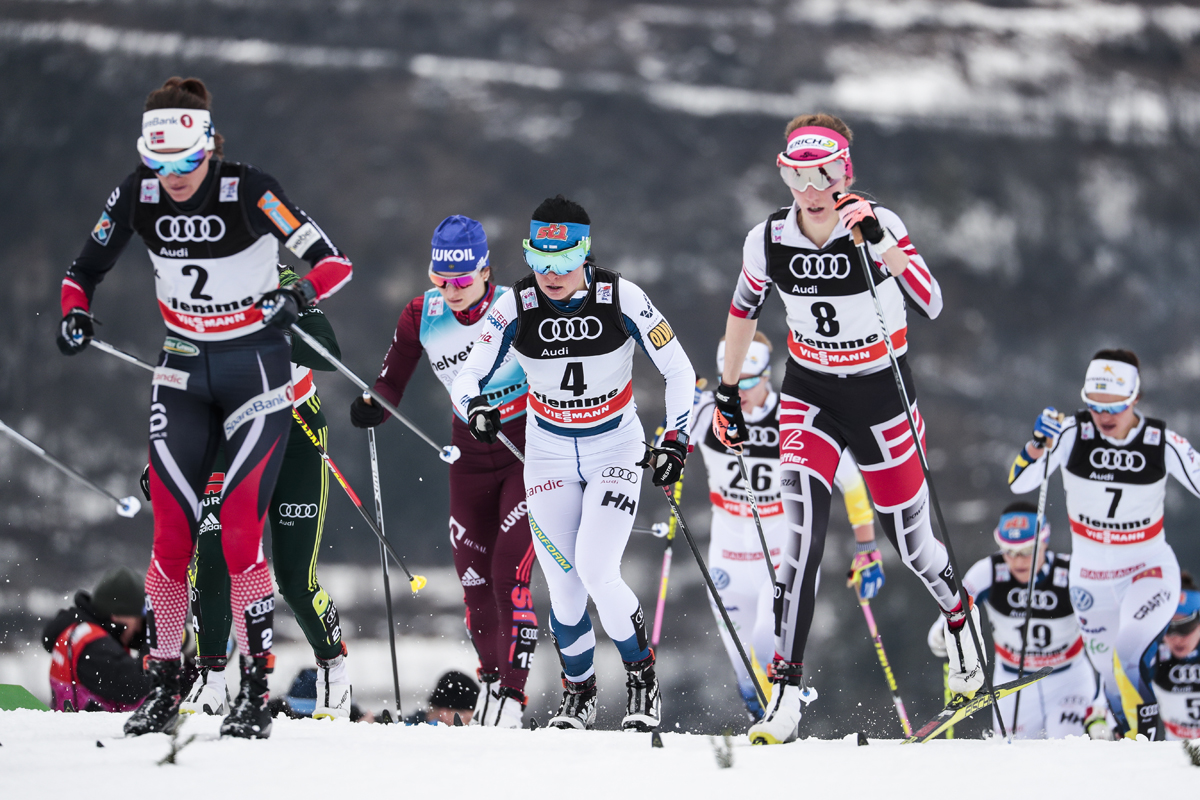
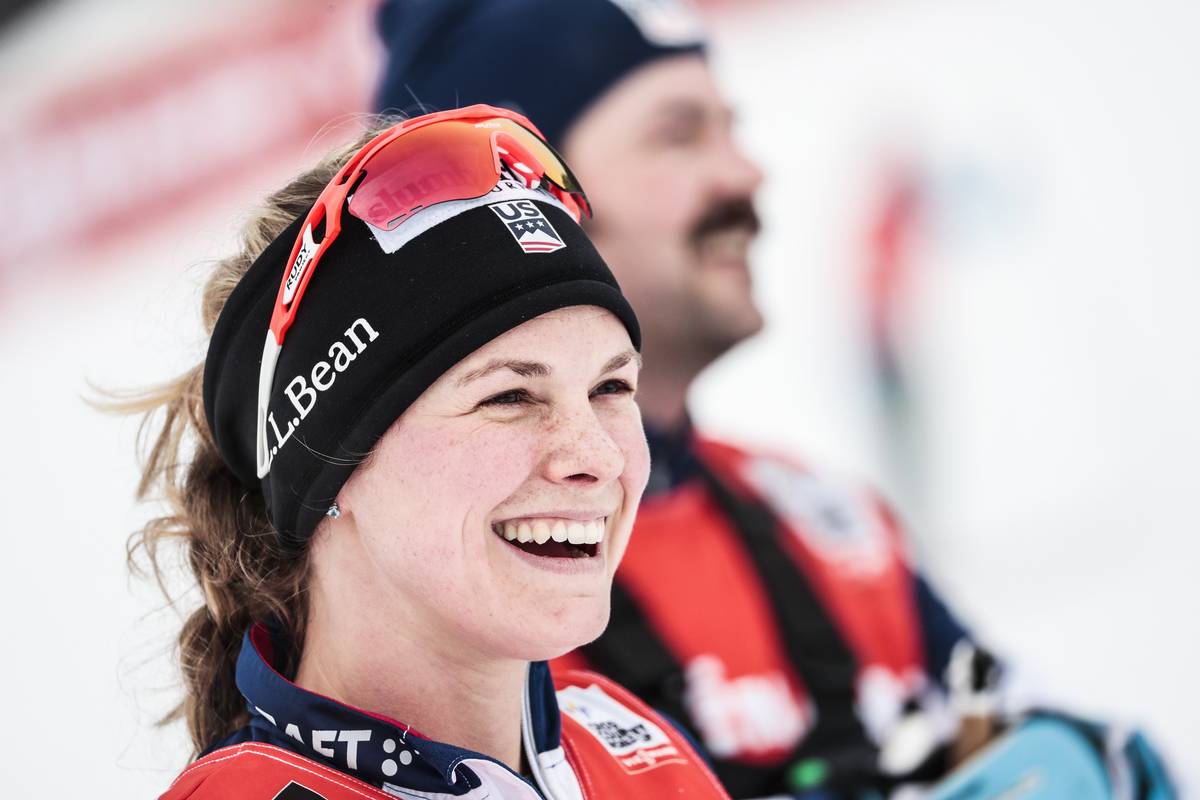
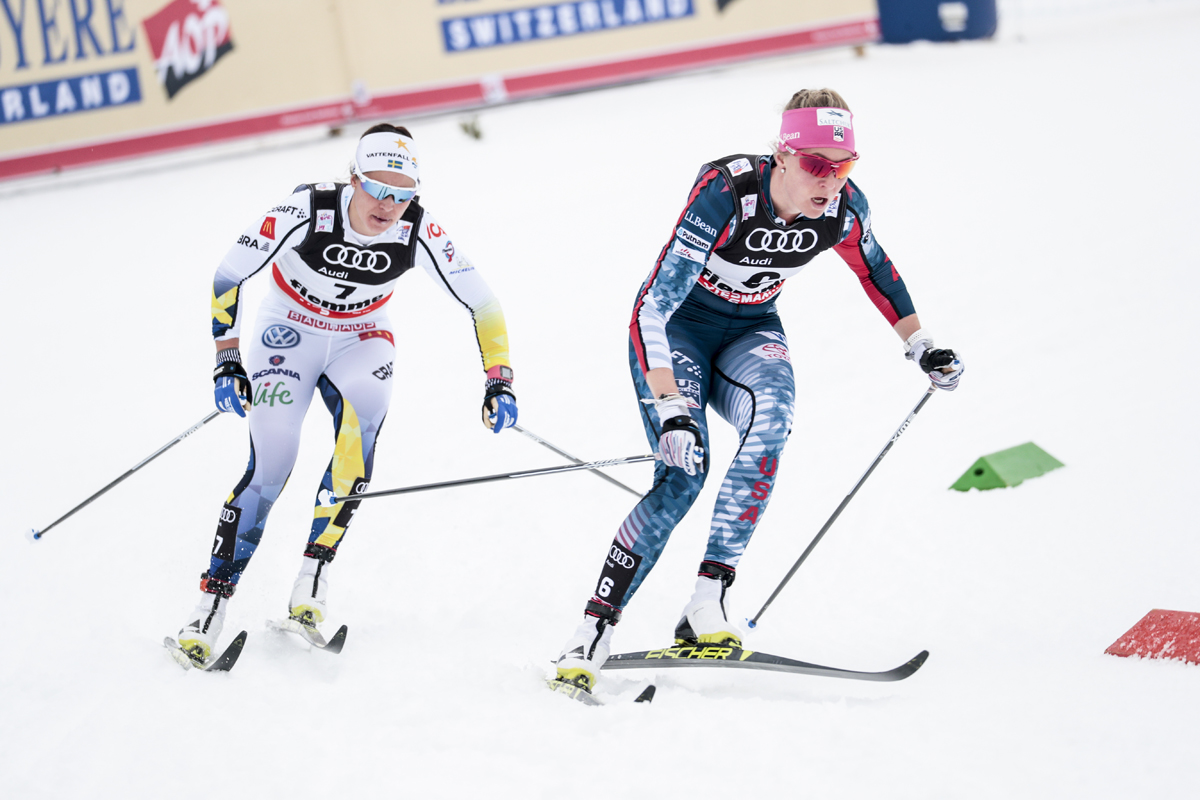
    The women’s race then became a demonstration of strength and grit as Østberg kept herself out of reach, leading by a comfortable margin at every checkpoint and securing her second-straight win in 26:48.1 minutes. Weng could see her, and Diggins could see Weng, but neither linked up, as Weng finished second, 27.8 seconds after Østberg, and Diggins held onto third (+1:16.9) for her first podium of the season.

    Behind Diggins, Finland’s Krista Pärmäkoski rose from eighth and 1:35 back at the start (starting behind her Finnish teammate Kerttu Niskanen in sixth and American Sophie Caldwell in eighth), to fourth at the finish, 1:45.9 out of first. Pärmäkoski outlasted Bjornsen by 0.3 seconds and Niskanen by 0.7 seconds at the finish to put herself in fourth overall in the Tour standings with four stages remaining, while Bjornsen placed fifth (+1:46.2) and Niskanen sixth (+1:46.6).

    Norway’s Astrid Uhrenholdt Jacobsen moved up from 15th at the start to seventh at the finish (+1:59.9) with the fifth-fastest time of day. Austria’s Teresa Stadlober won the time of day, covering the course in 26:20.6 and improving from 22nd to 11th.

    The U.S. had three finish in the top 20 with Caldwell placing 18th (+2:59.2) after skiing with a group of nine, led by Jacobsen and Switzerland’s Nathalie von Siebenthal, until the last of three laps. Caldwell fell off the pace around 7.5 k and skied the remainder of the lap alone to put herself 18th overall in the tour.

    Liz Stephen started 37th and moved up to 31st (+4:07.7) with the 26th-fastest time of day (1:27.2 behind Stadlober). Rosie Brennan started 33rd and finished in that position (+4:17.9), and Ida Sargent finished 55th (+6:09.2) after starting 31st. Sixty-one women remain in the tour with four stages to go.

    Cologna Takes Control

    The men’s 15 k freestyle pursuit podium at Stage 3 of the 2018 Tour de Ski on Monday, with Switzerland’s Dario Cologna (c) in first, and Russia’s Sergey Ustiugov (l) in second and Alexander Bolshunov (r) in third in Lenzerheide, Switzerland. (Photo: FIS Cross Country/Twitter)

    [UPDATED]

    One second wasn’t enough for Russia’s Sergey Ustiugov to keep Dario Cologna at bay on the Swiss skier’s home turf, as the two started the men’s 15 k freestyle pursuit in first and second, respectively, with just 1 second between them on Monday in Lenzerheide.

    Cologna took the lead after the first lap, around 3.7 k, and never relinquished as he scored his second-straight stage victory in Stage 3 of the Tour de Ski. Cologna previously won Sunday’s 15 k classic, but was second based on time back in the overall Tour standings to Ustiugov.

    Between 3.7 and 4.7 k, Cologna put about six seconds into the Russian and was more than 19 seconds ahead of him by the 5.8 k checkpoint. Ustiugov skied around 22 seconds back at 10 k, still 15 seconds clear of another Russian Alexander Bolshunov in third and 43 seconds ahead of another one of his teammates Alexey Chervotkin in fourth.

    Meanwhile, Canada’s Alex Harvey skied in fifth place with the six-man chase group Chervotkin was leading. Norway’s Martin Johnsrud Sundby took charge of that group by 13.3 k, while Harvey remained in fifth.

    At the finish, Cologna took the win by 17.6 seconds over Ustiugov, crossing the line in 34:56.6. Ustiugov placed second and Bolshunov third (+45.5), while Harvey charged hard for the podium and placed fourth (+46.8). The Canadian beat Kazakhstan’s Alexey Poltoranin by 0.3 seconds for fourth, while Poltoranin settled for fifth (+47.1), Sundby sixth (+48.1), Norway’s Hans Christer Holund seventh (+48.2), Chervotkin eighth (+49.9), Finland’s Iivo Niskanen ninth (+51.5), and Sweden’s Marcus Hellner 10th (+1:21.7).

    Cologna leads the Tour by 22.6 seconds over Ustiugov, Bolshunov is 55.5 seconds back in third, and Harvey 1:01.8 minutes back in fourth, just ahead of Poltoranin in fifth (+1:02.1), Sundby in sixth (+1:03.1) and Holund in seventh (+1:03.2).

    Erik Bjornsen is up to 22nd in the Tour standings with four stages to go, 2:35.7 out of first, after placing 22nd on Monday and finishing 2:20.7 behind Cologna. The U.S. Ski Team’s leading man started 25th and skied the 26th-fastest time of day.

    Can you guess who won the men’s time of day? France’s Maurice Manificat, who has a tendency to win these FIS points races, with a course time of 34:41.8. Manificat started 24th and skied up to 14th at the finish. Harvey’s time ranked fourth, 7.8 seconds slower than Manificat’s, while Holund was fifth fastest (+8.5) and Cologna sixth fastest (+13.2).

    Four American men raced the third stage of the Tour, with Simi Hamilton finishing 48th (up from 54th at the start), Paddy Caldwell finishing 68th (up from 74th), and Andy Newell finishing 74th (after starting 69th). Overall, Hamilton, a sprint-focused skier who hadn’t planned on racing the whole Tour, according to U.S. head coach Chris Grover, is 48th in the Tour, 4:28.9 out of first. Caldwell is 68th (+6:19.4), and another sprinter, Newell 74th (+8:30.6) out of 77 men remaining in the TdS.

    Racing resumes Wednesday in Oberstdorf with Stage 4 classic sprints.

    Results:

    Women’s Stage 3 pursuit | Women’s Time of Day | Women’s TdS standings (through Stage 3) 

    Men’s Stage 3 pursuit | Men’s Time of Day | Men’s TdS standings (through Stage 3)

  • Sadie Bjornsen’s ‘Dream Day’ with First Distance Podium; Østberg Puts Her Stamp on Stage 2

    Sadie Bjornsen’s ‘Dream Day’ with First Distance Podium; Østberg Puts Her Stamp on Stage 2

    The women’s 10 k classic podium at Stage 2 of the 2018 Tour de Ski, with Norway’s Ingvild Flugstad Østberg (c) in first and Heidi Weng (l) in second, and American Sadie Bjornsen (r) in third in Lenzerheide, Switzerland. (Photo: FIS Cross Country/Twitter)

    By the time Sadie Bjornsen sat down in the fur-lined leader’s chair on Sunday, the sunlight that had been shining brightly over sections of the women’s 10-kilometer classic course — blocked by trees and creating shade and temperature drops in some spots — was fading. Just an hour remained before sunset in Lenzerheide, Switzerland, and as she unclipped her bindings and walked out of the finishing pen, the current leader seat belonged to her.

    With racers starting in 30-second interval increments and the final starter, Anastasia Kirillova of Belarus, having pushed past the start wand as Bjornsen strode past the halfway point, the 28-year-old American’s time of 27:41.6 would have to withstand 25 skiers — 23 to stay on the podium — if she were to retain her chilly, yet coveted chair.

    That would mean staving off the likes of Norwegian powerhouses, Heidi Weng and Ingvild Flugstad Østberg, Finland’s Krista Pärmäkoski, as well as Saturday’s skate-sprint winner, Laurien van der Graaff of Switzerland, all of whom started behind Bjornsen.

    The U.S. Ski Team (USST) seven-year veteran had already held off Finland’s Kerttu Niskanen and Laura Mononen, Norwegians Astrid Uhrenholdt Jacobsen and Kathrine Rolsted Harsem, Sweden’s Anna Haag, well as her own USST teammate, Jessie Diggins, who sat in fifth at the time off Bjornsen’s finish.

    “I had no doubt that Sadie would crush it – she’s such a classic skiing machine and I couldn’t be prouder of her! She’s on fire!” Diggins, who started six bibs ahead of Bjornsen, wrote in an email.

    As each racer finished, Bjornsen remained in the lead, the fog of her breath a reminder of the days falling temps and approaching hours of solar siesta.

    Sadie Bjornsen sitting in the leader’s chair while waiting for the women’s 10 k classic Stage 2 of the 2018 Tour de Ski to finish. Bjornsen went on to finish third behind Norway’s Ingvild Flugstad Østberg in first and Heidi Weng in second (Screenshot: ZDF broadcast)

    Live footage of skiers still on course, broadcasted on the large screen at the stadium’s epicenter kept her on guard. Two in particular were posing a challenge. Weng, who had started 14 bibs behind Bjornsen, was pacing on par with the American by the 3.5 k mark. Østberg, who departed the starting gate two bibs behind Weng, had put 14.7 seconds into Bjornsen by the time she was one-fifth of the way through the race.

    By the halfway point, Weng had upped her tempo, and created a 13-second gap on Bjornsen’s time; at the same mark, Østberg had close to 22 seconds on the American.

    When Bjornsen finished, Weng’s lead was still cushioned by close to eight seconds.

    “I did not feel I was skiing fast but when I got the split times I heard I was gaining time on the other girls,” Weng said, according to an International Ski Federation (FIS) press release.

    By the time Weng finished she had a 16.5-second lead over Bjornsen, moving the American into second place. However, Weng’s time in the chair was no more insular than Bjornsen’s. With two-thirds of the race complete, Østberg had 23 seconds on Weng and almost 40 seconds on Bjornsen.

    With that kind of a lead, the final 2 k were Østberg’s to win and it appeared only a self-induced mistake would prevent her from taking it all. Perfection ruled the Norwegian’s skis. Østberg covered the final fifth of the race with precise certitude; as if she and the Lenzerheide course were confiding old friends (In fact, they were. In 2016 she won her first non-sprint distance World Cup in Lenzerheide during that season’s Tour de Ski (TdS)).

    By the time Østberg finished, she had 25.7 seconds on Weng and 42.2 seconds on Bjornsen, claiming the win in a time of 26:59.4. Her first-place finish in Sunday’s 10 k, combined with her ninth place in Saturday’s sprint, puts her first in the overall TdS standings as racers head into Monday’s Stage 3 freestyle pursuit.  

    “I knew it was going to be a tough race in these conditions. My goal this season has been to get better each weekend. My shape is very good right now,” Østberg said, according to FIS. “Tomorrow I will be chased and it is going to be a tough race.”

    Bumped into third place, Bjornsen earned her first distance podium of the season and second-career stage World Cup individual podium on Sunday (she’s landed on the podium two other times this year, the classic sprint in Lillehammer and the classic sprint in Kuusamo).

    American Sadie Bjornsen finishing the 2018 Tour de Ski Stage 2 women’s 10 k classic in first in Lenzerheide, Switzerland. She ultimately placed third behind two Norwegians, Ingvild Flugstad Østberg and Heidi Weng. (Screenshot: ZDF broadcast)

    “Wow. What a dream day.” Bjornsen wrote in an email to media outlets. “A distance classic podium has been a dream of mine since I first started racing World Cup, so it was so fun to achieve that dream goal of mine today.”

    “I had an awesome talk with my wax tech, JP, right before the start of the race, where he told me the most important thing that day was to trust what I do well, and never give up.. so I went with it,” Bjornsen continued. “I thought I was having a really tough race, and then I got my first split at 7.5k when Matt told me I was in second place and could win the race today. Suddenly, I had a fire lit under my butt, and I just gave every last bit for the last 2.5k. It was kinda fun not knowing what was happening, because it felt like a true surprise!”

    Bjornsen finished yesterday’s sprint in 14th and with Sunday’s finish is now ranked fourth in the overall, just one place behind her teammate Diggins, who finished Sunday’s 10 k classic in seventh place (+1:04.4).

    American Jessie Diggins during the women’s 10 k classic Stage 2 of the 2018 Tour de Ski in Lenzerheide, Switzerland.
    (Screenshot: ZDF broadcast)

    “For me, I was really proud of how I held it together out there,” Diggins wrote in an email. “This is not my kind of condition and it was really hard to find kick out there – I felt like I was running, herringboning and bounding up the hills! But just a few years ago a day like today would have wrecked my overall tour time and now I’m able to hold my technique together and keep it flexible as conditions change, so I’m really happy about that!”

    “Looking forward to tomorrow skate distance!” she added. “I’m starting in a little bit of no-mans land…but I love the chase and I’ll just put my head down and hammer!”

    Rounding out the top 10 on Sunday was Niskanen in fourth (+48.9), Haag in fifth (+52.6), Germany’s Nicole Fessel in sixth (+58.2), Switzerland’s Nathalie von Siebenthal in eighth (+1:08.3), Germany’s Stefanie Böhler in ninth (+1:08.8) and Slovenia’s Anamarija Lampic in 10th (+1:10.9).

    Also scoring in the points for the U.S. on Sunday was Sophie Caldwell in 21st (+1:40.6),  Liz Stephen in 28th (+2:04.8) and Ida Sargent in 30th (+2:06.7).

    Caldwell placed third in Saturday’s sprint and is now ranked seventh in the overall tour standings heading into Monday’s pursuit.

    “My body felt surprisingly good after yesterday! When I woke up I was definitely a little tired, but my body felt good racing.” Caldwell wrote in an email. “The conditions were extremely tricky today, and our service team did an awesome job of making us the best skis possible.”

    Though many sections on course were glazed over and the downhills iced over, Caldwell indicated the challenge was one she embraced.

    “I enjoy tricky conditions like this where you really have to work to make the kick work because I think making skis kick is one of my strengths,” Caldwell wrote. “The downhills were icy and sketchy, so wax would inevitably wear off some, but I tried to really pace the first lap and be in control so I felt like I still had something to give on the second lap. I was really excited to see I ended up in the points! And of course seeing Sadie on the podium again put a huge smile on my face.

    “Being in seventh in the tour right now is beyond any expectations I had,” she added. “10 km skates are generally the toughest discipline for me, but I will do my best and be running for dear life from everyone chasing me!”

    After two stages out of seven in the TdS, Sargent ranks 30th and Stephen 37th.

    Despite battling illness prior to the tour and feeling it worsen during Saturday’s sprint, Sargent started Sunday’s 10 k and was pleasantly surprised to see that her finish was within the points.

    “I actually wasn’t sure if I was even going to race today but warmed up and decided to go for it. It felt really hard and I felt like I was struggling a lot so I have to admit I was very happily surprised to hear I was 30th,” Sargent wrote in an email. “I think this is the first time I have scored distance points at altitude. I’m looking forward to another race here tomorrow and then a day off and I have my fingers crossed that my body continues to come back around.”

    Another USST member, Rosie Brennan skied to 38th (+2:20.5) on Sunday, putting her in 33rd overall.

    The seventh USST member, Kikkan Randall did not start and withdrew from the Tour after experiencing pain in her left foot following the races in Davos three weeks ago,

    “[I] have been trying to rehab the foot since with alternative training.  Yesterday showed me I am making some progress with my foot and I didn’t want to set myself back with a classic race today.  Classic seems to aggravate the injury more.,” Randall wrote in an email. “It was a tough decision but the Olympics are my big goal and I still have time to get my foot healthy if I am smart over the next couple weeks.  I am looking forward to sharpening for the sprints in Dresden in two weeks.”

    “Awesome to see the team take another podium today!” Randall added. “I’m so proud of our girls!”

    In both Stage 1 and Stage 2, the U.S. has had five women in the top 30 and one on the podium. Four of the U.S.’s six starters for Monday’s skate pursuit will start in the top 30.

    “It’s really motivating to have had two really strong days as a team,” Caldwell wrote. “I think the fact that we have a handful of people who could be on the podium or in the top ten on any given day says a lot about how strong our team is right now. I think we do a really good job of lifting each other up and pushing each other and it’s cool that there are so many people leading the team in so many ways.”

    Results | Tour Standings (after Stage 2) | Stage 3 pursuit start list

  • Tour de Ski Rundown: Sadie Bjornsen 3rd; Østberg Posts 25-Second Win; Cologna Wins at Home

    Tour de Ski Rundown: Sadie Bjornsen 3rd; Østberg Posts 25-Second Win; Cologna Wins at Home

    The women’s 10 k classic podium at Stage 2 of the 2018 Tour de Ski, with Norway’s Ingvild Flugstad Østberg (c) in first and Heidi Weng (l) in second, and American Sadie Bjornsen (r) in third in Lenzerheide, Switzerland. (Photo: FIS Cross Country/Twitter)

    Tour de Ski Stage 2 (Lenzerheide, Switzerland): 10/15 classic

    Women’s report

    Men’s report

    For the second-straight day of the Tour de Ski, an American landed on the podium, with Sadie Bjornsen placing third in the women’s 10-kilometer classic individual start on Sunday in Lenzerheide.

    For Bjornsen, it was her third individual podium of the season and first in a race longer than 5 k.  She finished behind two Norwegians, Ingvild Flugstad Østberg, who took the win in 26:59.4 minutes, and Heidi Weng, who was 25.7 seconds back in second.

    Bjornsen was 42.2 seconds out of first and 6.7 seconds clear of Finland’s Kerttu Niskanen in fourth (+48.9). Sweden’s Anna Haag placed fifth (+52.6), Germany’s Nicole Fessel finished sixth (+58.2), and the second American in the top 10, Jessie Diggins in seventh (+1:04.4).

    Switzerland’s Nathalie von Siebenthal placed eighth (+1:08.3) on home soil, just ahead of Germany’s Stefanie Böhler in ninth (+1:08.8), and Slovenian U23 skier Anamarija Lampič placed 10th (+1:08.9).

    For Østberg, the win came two seasons after she won her very first distance World Cup race in Lenzerheide. With the win she leads the Tour standings by 32.8 seconds over Weng in second. Diggins is up to third overall (+1:04.9) and will start Monday’s 10 k freestyle pursuit accordingly, 1:05 seconds after Østberg, who will head out of the gate first.

    Bjornsen is fourth overall (+1:15.4), just ahead of Russia’s Natalia Nepryaeva in fifth (+1:17.3) while Niskanen is another 15 seconds back in sixth (+1:32.0), and will start the pursuit with American Sophie Caldwell, who was second in Saturday’s Stage 1 skate sprint and ranks seventh overall (+1:32.0). Caldwell placed 21st on Sunday, 1:40.6 behind Østberg.

    “It’s has been a huge goal of mine to be on the distance podium,” Bjornsen said, according to a FIS press release. “It felt really crazy out there today. At the 6.0 km I got the information I was in 2nd place. I had to ski a lot out of the track. I had to give everything I had in the last 2.5 km. I was little bit disappointed yesterday, I was hoping for more so today feels really great.”

    The U.S. had five in the top 30 with Liz Stephen in 28th (+2:04.8) and Ida Sargent in 30th (+2:06.7). For Stephen, it was her first time in the points (top 30) this season. Rosie Brennan placed 38th (+2:20.5). Kikkan Randall did not start and thus withdrew from the Tour.

    Dario Cologna rose to the challenge on Sunday, winning the second stage of the 2018 Tour de Ski for his first World Cup victory in three years.

    The 31-year-old Swiss skier completed the men’s 15-kilometer classic individual start in 35:29.5 minutes, besting the time of Kazakhstan’s Alexey Poltoranin by 0.6 seconds to win in front of a home crowd in Lenzerheide, Switzerland.

    Cologna started 62nd and sped up as the race progressed, clocking the fastest times from 6 k on. Russia’s Alexander Bolshunov started behind him in bib 68 and topped Cologna’s time at every checkpoint, skiing 7.4 seconds faster than him at 10 k. But over the final 5 k loop, Cologna prevailed and Bolshunov faded, with the Russian U23 skier finishing fourth, 14 seconds off Cologna’s winning time.

    “It’s amazing, the first victory in Switzerland,” Cologna told Swiss broadcaster SRF. “I think it’s my 22nd [World Cup win], but the first one at home, which is very beautiful. And after a two-year break it really is a great satisfaction.”

    Poltoranin started 27th and claimed his second podium of the season and first one of the tour, while Norway’s Martin Johnsrud Sundby scored his first podium since early December. Sundby placed third, 13.1 seconds out of first. Russia had two in the top five with another U23 skier, Alexey Chervotkin in fifth (+16.2). Norway’s Hans Christer Holund was sixth (+21.2), Finland’s Iivo Niskanen seventh (+22.9), Italy’s Francesco De Fabiani eighth (+27.2), Norway’s Didrik Tønseth ninth (+37.1), and Russia’s Sergey Ustiugov 10th (+37.1).

    Canada’s Alex Harvey placed 20th (+57.9) and slipped two places in the overall standings to ninth. Russia’s Sergey Ustiugov, who won yesterday’s Stage 1 skate sprint, still leads the standings while Cologna is up to second, just 1.6 seconds back heading into Monday’s freestyle pursuit in Lenzerheide. Bolshunov is third, 12.7 seconds back, Poltoranin fourth (+22.0), Finland’s Ristomatti Hakola fifth (+27.7), Sundby sixth (+39.1), Niskanen seventh (+46.4), Chervotkin eighth (+49.8), Harvey ninth (+53.8), and Holund 19th (+54.5).

    In Saturday’s 15 k classic, Erik Bjornsen led the U.S. men in 27th (+1:22.4), Simi Hamilton finished 58th (+2:41.8), Andy Newell was 71st (+3:11.5), and Paddy Caldwell 75th (+3:36.2).

    Eighty-five men finished the second stage of the Tour de Ski; Canada’s second man, Devon Kershaw, did not race on Sunday and withdrew from the tour due to illness.

    Results:

    Women’s 10 k classic | Women’s Tour standings (through Stage 2) 

    Men’s 15 k classic | Tour standings (through Stage 2)

    Monday start lists: 

    Women’s 10 k freestyle pursuit | Men’s 15 k freestyle pursuit

  • Van der Graaff Wins Opening Stage of Tour de Ski; Caldwell Second

    Van der Graaff Wins Opening Stage of Tour de Ski; Caldwell Second

    The women’s podium after the Stage 1 freestyle sprint of the 2018 Tour de Ski, with (from left to right) American Sophie Caldwell in second, Switzerland’s Laurien van der Graaff in first, and Norway’s Maiken Caspersen Falla in third. (Photo: Fischer/Nordic Focus)

    The 12th edition of the multi-stage Tour de Ski (TdS) opened Saturday with 1.5-kilometer freestyle sprints in Lenzerheide, Switzerland. On a spectator-friendly, 750-meter loop featuring a punchy and sustained climb each lap, the hustle and bustle of a gritty and soft-snowed World Cup sprint were on full display.

    We’ll leave the suspense out: it was the first home-snow World Cup victory for a Swiss skier since 2007. It was also the first career World Cup win for 30-year-old Swiss skier Laurien Van der Graaff.

    Van der Graaff took those honors after qualifying in fourth behind fastest qualifier, Ingvild Flugstad Østberg, and winning the women’s final in 3:25.80.

    “It was a really good day,” Van der Graaff told Swiss broadcaster SRF, according to a translation. “I already felt good at the start, never really tired. I knew if I was still in the mix on the finish stretch I could win it all. Last year I always couldn’t put it together mentally; a little bit was always missing. I am just really happy that I now finally was able to put it all together. … I really worked on this all summer, that I want to win, that I want to be in front, that has always been a little ambiguous for me. That in the end I didn’t really have the will to win, or maybe also the strength to really withstand. And today I thought to myself, ‘Now I’ll take it,’ and it worked.”

    Sophie Caldwell (U.S. Ski Team) racing to third in the qualifier of the women’s 1.5 k freestyle sprint on Saturday at Stage 1 of the Tour de Ski in Lenzerheide, Switzerland. She went on to finish second overall for her first individual podium in two years. (Photo: Fischer/NordicFocus)

    The bigger news for North American fans was that Sophie Caldwell was back on the podium. Caldwell wore Bib 3 as the third-fastest qualifier. She finished the qualifier 2.33 seconds in back of Østberg, the day’s fastest qualifier in 3:29:91.

    Caldwell ultimately raced a savvy, gutsy and full-steam series of races to land second overall, toeing the line in the final 1.42 seconds behind race winner Van der Graaff. Caldwell last scored an individual World Cup podium two years ago when she won a classic sprint stage of the 2016 Tour de Ski. In doing so, she became the third woman in U.S. history to win a World Cup

    In the time since, the U.S. women’s team has racked up several other individual podiums. Jessie Diggins won three individual World Cup races (and earned two medals at 2017 World Championships), Sadie Bjornsen has notched three individual podiums (and 2017 World Championships team-sprint silver with Diggins) in the last year, and Kikkan Randall raced to bronze in the 2017 World Championships skate sprint and third place this season at the Davos World Cup.

    Third place in Saturday’s final was locked up by Norway’s Maiken Caspersen Falla (+1.86), who also won the first semifinal. Falla now leads the World Cup overall sprint standings. Sweden’s Stina Nilsson, who is not contesting the TdS, remains in second.

    Russian Natalia Nepryaeva took fourth (+3.17), and Jessie Diggins finished fifth (+4.33) after breaking her second pole of the day (she previously broke a pole in the quarterfinal). German skier Sandra Ringwald fell and finished sixth (+31.68).

    Caldwell and Diggins

    Before getting to the day’s American stories, here are the U.S. team’s results for the day: five out of the seven U.S. women entered in the Tour qualified in the top 30 to advance to the heats, with Bjornsen clocking the 13th fastest time (+5.20), Rosie Brennan 15th (+5.27), and Ida Sargent 30th (+8.69). Randall finished 44th and Liz Stephen 66th out of 71 in the women’s qualifier.

    Sadie Bjornsen (U.S. Ski Team) racing to 13th in the women’s skate-sprint qualifier at Stage 1 of the Tour de Ski in Lenzerheide, Switzerland. She went on to finish the day in 14th. (Photo: Fischer/NordicFocus)

    Bjornsen finished her day 14th overall after placing third in her quarterfinal. Brennan placed 15th after also finishing third in her quarter. Sargent ended the day in 20th.

    Post-Stage 1 in the TdS, the World Cup overall sprint standings remain top-heavy with Americans. Bjornsen, Caldwell, Diggins rank fourth, fifth and sixth, respectively. Sargent is 14th, Randall 16th.

    On Saturday, Caldwell crushed and skied cool. She won her quarterfinal by 0.22 seconds over Germany’s Victoria Carl.

    I was pretty confident in my finishing kick especially because my heat had a lot of more distance-oriented skiers,” Caldwell said on the phone. “I figured my strength would probably be like something like the finishing stretch or having to put in a surge, so I just tried to be patient and pick a good line and put in a good punch on the finishing strength and that seemed to work well.”

    Caldwell’s semi was more stacked. She confidently skied into a three-way photo finish in her semifinal with Falla and Diggins. Falla won, Caldwell placed second (+0.06), while Diggins was third (+0.07).    

    “I was really proud, watching her ski the way she did,” U.S. Women’s Coach Matt Whitcomb said on the phone. “She’s really making the transition from someone who skis carefully and tactfully and really maximizes her finish speed and strategy to somebody who’s starting to control some heats. And when I saw her in this incredibly aggressively paced semifinal hanging the way she does on the second lap, on the big climb, at altitude, we knew she had a good shot to win this race. So, it’s perhaps, I think, the fastest Sophie’s ever skied in a skate sprint. I think she has never looked this good, particularly at altitude, and I’m really excited to see what’s ahead for her.”

    On a good day, all the little thing must align. Not simply the ski speed and sensations, but the ability to adapt and make opportunities.

    “My strength is usually gliding and skiing fast and relaxed, and sometimes my weakness is that short-hop V1 because I can glide really easily,” Caldwell said of her willingness to keep in contact with the front. “But my tech and I chose some really good skis for climbing today, even if they weren’t the absolute fastest on that long downhill, they felt really awesome climbing and I think for me today that was what was important, was to make sure my legs felt good on that section and coming across the flat in the start and in the middle. I knew Miken is a really strong V1-er and would probably be making her move there, and so I tried to position myself coming through the second time where I could be either behind her, or have a clear trail in front of me and just match her tempo because she has a really impressive V1 and pushes it over the top of hills. That worked quite well both in the semi and the final and my V1 felt surprisingly good today, of course, my legs still hurt but it wasn’t this instant flood that sometimes I get when I try to get when I V1 up the short steep little things.”

    Caldwell’s season so far includes two eighth-place finishes, a ninth and Saturday’s podium. Her up-tempo start to the season has Caldwell embracing both skate and classic techniques.

    Sophie Caldwell leading her U.S. teammate Rosie Brennan (c) and Norway’s Astrid Uhrenholdt Jacobsen in the quarterfinal of the women’s freestyle sprint at Stage 1 of the 2018 Tour de Ski in Lenzerheide, Switzerland. (Photo: Fischer/NordicFocus)

    “Well it’s funny because I actually always considered myself a skate sprinter until I won in Oberstdorf,” Caldwell reflected on her win two years ago. “But I was like hands down a better skate sprinter and I preferred skate sprinting and classic distance. Then over the last few years, I feel like they have become equal. I honestly don’t know which one I prefer which is a good feeling to have because I think I am more confident in both of them. I would say maybe at this point classic is a little more consistent, but skate is easier for me to either pop a good one or feel really bad on a day. But I am definitely psyched with the consistency of the beginning of the season. It’s funny because it is by far the best I ever started out a season, especially with Ruka and Lillehammer results. But after a few weekends getting eighth or ninth or whatever I was those first few weekends, you are definitely left wanting more. I had to just keep reminding myself that I tend to ski into the season.”

    In the fourth World Cup sprint of the season, Saturday was podium-time for Caldwell.  As for Diggins, we’d like to coin a verb: to “Diggins”.  Definition: hard-charging, never capitulate, no excuses. In Lenzerheide on Saturday, Diggins totally “Digginsed”.

    She qualified in second, 1.41 behind Østberg, in a hard effort that may have been Diggins’s easiest part of the day.

    “It’s a classic Jessie story where she overcomes a major obstacle and still advances as if nothing happens,” Whitcomb said of Diggins’s broken-pole recovery in her quarterfinal and the final.

    “So when something like that happens, unfortunately, nobody really remembers what she had to overcome,” he continued. “She broke her pole at the top of a big climb on the first lap [in her quarterfinal], and one of our techs, Eli Brown, saw it and just was not quite positioned perfectly for that incident. He was where he was supposed to be, but the skiers were moving so fast. But it’s a pretty good spot to break a pole because she just had to hop in the draft and ski down the downhill, and we were able to get her a pole about 100 yards after the downhill.”

    Diggins kept in control. She was able to keep her losses in check while maintaining contact with the leaders. Broken pole or not, Diggins was in it to win it.

    “In the quarterfinal, I was coming around the corner and someone kicked the tip of my pole just as I’d planted all my weight on my poles to turn the corner, so it shattered,” she wrote in an email. “Eli came running with a really amazing javelin throw of a spare pole, (I mean, you should go watch, it was epic) but I was already too far down the track and I knew I needed to stay closer to the pack if I was going to have a chance. I stayed calm, knowing that I felt amazing and I still had a chance to make it out of the heat if I could get another pole quickly. After rounding the corner and skiing another 50 meters one-poled Matt came running with a tall spare pole and I was able to just put the hammer down and get back into it.”

    Diggins finished second (+0.54) in that quarterfinal, 0.54 seconds behind Van der Graaff, who won that heat. Behind her, Falla finished third (+0.87).

    Diggins went on to reach the final as a lucky loser after placing third in her semifinal’s three-way photo finish for first with Falla and Caldwell. And then once again in the final, Diggins snapped a pole.

    “In the final, the pole break came at a really bad place to try and come back from, unfortunately,” Diggins wrote. “I was cornering with good speed but Van der Graaff moved over slightly right and kicked my pole just as I’d put all my weight on it — same way that the first pole broke. … Unfortunately, to get another pole I had to ski way out of the way and by the time I got the spare that was inches taller than my other pole, I had lost contact with the group and only had about 700 meters to catch up. …  It was a tough battle but I’m starting to get really good at one-pole skiing ;)”

    Heading into Stage 2, Caldwell is ranked second and Diggins fourth overall in the tour based on adjustments for qualification time and time bonuses.

    “I was really proud of how I skied today,” Diggins noted. “I raced with guts and never, never, never gave up, and my fitness is definitely there and ready for a good tour. It feels good to feel strong, and not tired! Wow!”

    The TdS continues Sunday with a 10 k classic individual start for the women (15 k classic for the men).

    Results: Heats | Qualifier | Tour Standings (after Stage 1)

  • Tour de Ski Rundown: Caldwell 2nd on Day 1; Van der Graaff and Ustiugov on Top

    Tour de Ski Rundown: Caldwell 2nd on Day 1; Van der Graaff and Ustiugov on Top

    The women’s top-three finishers (below) after Stage 1 of the 2018 Tour de Ski, with (from left to right) American Sophie Caldwell in second, Switzerland’s Laurien van der Graaff in first, and Norway’s Maiken Caspersen Falla in third. Above, van der Graaff acknowledges her home crowd after winning her first World Cup in Lenzerheide, Switzerland. (Photo: FIS Cross-Country/Twitter)

    FIS Cross-Country Tour de Ski (Lenzerheide, Switzerland): Stage 1 freestyle sprint

    Women’s report

    Men’s report

    Sophie Caldwell is back on the podium. It’s been two years since the 27-year-old U.S. Ski Team sprinter won an individual World Cup race and became only the third woman in U.S. history to to do so. That was also in the Tour de Ski — but in a classic sprint.

    In the time since, the U.S. women’s team has racked up several more podium accolades. Jessie Diggins has recorded three individual World Cup wins (and two World Championships medals), Sadie Bjornsen has notched three individual podiums (and a World Championships team sprint silver with Diggins) in the last year, and Kikkan Randall raced to bronze in the 2017 World Championships skate sprint.

    But Saturday, the first day of the 2018 Tour de Ski, was Caldwell’s moment to stand on the second step of the podium. She started the morning by qualifying third in the women’s 1.5-kilometer freestyle sprint in Lenzerheide, Switzerland, 2.33 seconds behind Norway’s Ingvild Flugstad Østberg, who won the qualifier in 3:29.19 minutes. Diggins qualified second, 1.41 seconds off Østberg’s time.

    Five out of the seven U.S. women entered in the Tour qualified in the top 30 to advance to the heats, with Bjornsen clocking the 13th fastest time (+5.20), Rosie Brennan 15th (+5.27), and Ida Sargent 30th (+8.69). Randall finished 44th and Liz Stephen 66th out of 71 in the women’s qualifier.

    A three-way photo finish for first in the first women’s semifinal, with Americans Jessie Diggins (far side) and Sophie Caldwell (near) lunging at the line with Norway’s Maiken Caspersen Falla (pink headband). Falla won that heat, Caldwell was second and Diggins third, while all three plus Switzerland’s Laurien van der Graaff in fourth (in black) advanced to the final. (Screenshot: ARD broadcast)

    Caldwell went on to win the first quarterfinal and place second in the semifinal by just six-hundredths of a second (behind Norway’s Maiken Caspersen Falla, who won the first semifinal).

    Diggins advanced in second in her quarterfinal, 0.54 seconds behind Østberg who won that heat, then raced to third in the first semifinal, just another hundredth of a second behind Diggins. The final featured the two Americans as well as local favorite, Laurien van der Graaff of Switzerland, Falla, Russia’s Natalia Nepryaeva, and Germany’s Sandra Ringwald.

    In front of friends and family, Van der Graaff went on to take the win — her first and Switzerland’s first on home soil since Toni Livers won in Davos in 2007.

    She won the final in 3:25.8, 1.42 seconds ahead of Caldwell in second. Falla placed third (+1.86), Nepryaeva took fourth (+3.17), and Diggins finished fifth after breaking her second pole of the day (she previously broke a pole and skied a while without one in the quarterfinal). Ringwald fell and finished sixth (+31.68).

    Van der Graaff had previously qualified fourth then won her quarterfinal and advanced as a lucky loser from the first semifinal, where she placed fourth behind Falla, Caldwell and Diggins.

    “It’s incredible. I mean, to win on this course, home, is just crazy,” van Der Graaff said in a post-race interview with the International Ski Federation (FIS).

    Bjornsen and Brennan finished the day in 14th and 15th, respectively, after placing third in their quarterfinals. The U.S. had five in the top 20 with Sargent in 20th, after she placed fourth in her quarterfinal.

    The men’s podium after the Stage 1 freestyle sprint of the 2018 Tour de Ski, with Russia’s Sergey Ustiugov (c) in first, Italy’s Federico Pellegrino (l) in second, and France’s Lucas Chanavat (r) in third. (Photo: FIS Cross Country/Twitter)

    In the men’s 1.5 k freestyle sprint, the defending Tour de Ski champion, Sergey Ustiugov of Russia, won his first World Cup race of the season by 1 second over Italy’s Federico Pellegrino.

    Ustiugov started off by winning the qualifier in 2:58.46, and Pellegrino qualified second, 1.08 seconds off the Russian’s time. Ustiugov then raced to second in the first quarterfinal, just 0.07 seconds behind Norway’s Finn Hågen Krogh in first. In the second quarterfinal that followed, Pellegrino took the win over Finland’s Ristomatti Hakola in second (+0.35).

    The first semifinal featured a three-way photo finish for first, with Ustiugov edging Pellegrino by 0.04 seconds and Krogh by 0.06 seconds. Hakola finished fourth (+1.11) in that heat to advance to the final as well.

    There, the 25-year-old Ustiugov was first across the finish line in 2:57.28. Pellegrino claimed second (+1.0), and France’s Lucas Chanavat — whom had qualified third and won both his quarterfinal and semifinal — reached the podium in third (+2.76). Hakola was fourth (+5.91), Krogh fifth (+14.39), and the second French skier in the final, Richard Jouve sixth (+21.01).

    Canada’s Alex Harvey missed reaching the final by one-hundredth of a second, placing third in Chanavat’s semifinal after a photo finish for second place. While Chanavat won that heat by 0.34 seconds over his French teammate Jouve, Harvey was another 0.01 seconds back in third. Ultimately, Harvey placed seventh overall (he started the day by qualifying in 18th).

    Three out of four American men qualified for the heats, with Simi Hamilton in 15th, Andy Newell in 20th and Erik Bjornsen in 27th. Hamilton finished the day in 15th as well after placing third in his quarterfinal, Newell ended up 19th after finishing fourth in his quarterfinal, and Bjornsen was 25th after taking fifth in his quarter.

    Paddy Caldwell finished 74th in the qualifier for the U.S. Canada’s second man in the Tour, Devon Kershaw finished 86th out of 94.

    Qualifier results: Women | Men

    Final results: Women | Men

  • U.S. Tour de Ski Selections Explained: Q & A with Grover

    U.S. Tour de Ski Selections Explained: Q & A with Grover

    Jessie Diggins (U.S. Ski Team) smiles after finishing the 2017 Tour de Ski in fifth place after the final climb in Val di Fiemme, Italy. (Photo: Salomon/NordicFocus)

    Last Thursday, U.S. Ski & Snowboard sent out a press release detailing the U.S. contingent for the upcoming Tour de Ski which begins this Saturday, Dec. 30, with a freestyle sprint in Lenzerheide, Switzerland.

    In non-Olympic and non-World Championships years, the Tour de Ski (TdS) stands as the highlight for many all-around World Cup athletes and fans. This year’s U.S. team for the TdS includes four men and seven women, all current members of the U.S. Ski Team (USST): Sadie Bjornsen, Rosie Brennan, Sophie Caldwell, Jessie Diggins, Kikkan Randall, Ida Sargent, Liz Stephen, Erik Bjornsen, Paddy Caldwell, Simi Hamilton, and Andy Newell. (Here’s a list of some TdS teams from other nations.)

    Sadie Bjornsen (U.S. Ski Team) racing to her first career World Cup podium last season at Stage 5 of the 2017 Tour de Ski in Toblach, Italy. She placed third in the 5 k freestyle on Jan. 6, 2017. (Photo: Fischer/Nordic Focus)

    In an Olympic year, a seven-stage tour over nine days may not fit into every top skier’s race plan. A long tour event might tweak the body in ways that make peaking for the Olympics in mid-February untenable. While for others, the grind of the TdS offers an opportunity to ski into top-shape race fitness.

    Here in the U.S., TdS starts have become a topic for discussion due to the small fields finishing last year’s edition of the tour — which was a World Championships year. The argument goes that in smaller fields, it’s easier to score valuable World Cup points by finishing in the top 30 of a given race. For example, in last season’s TdS, 31 women and 40 men completed the final stage. The year before — a non-championship or Olympic year — 43 women and 52 men finished that final climb atop the Alpe Cermis in Val di Fiemme, Italy.

    For both World Championship and Olympic selection criteria, results in specific World Cup races and/or rankings on the distance and sprint World Cup lists can determine if a skier meets the USST’s objective qualifying criteria. In other words, if a U.S. skier on the World Cup does not lock up an Olympic spot during Period 1, their Olympic qualification may be determined by points scored during the TdS. It goes without saying that while the USST members at the TdS solidify their Olympic nominations, many other domestic-based skiers vying for Olympic-team nods will be racing at the upcoming U.S. Cross Country Championships in Anchorage, Alaska, which start next week.

    Here’s a link to the current U.S. Ski & Snowboard 2017/2018 Cross Country World Cup Team Selection Criteria (Updated 11/10/17)

    FasterSkier emailed U.S. Ski Team Head Coach Chris Grover on Dec. 23 with the following questions regarding the selection of this year’s TdS team:

    FasterSkier: Starting with those that aren’t racing: Was Scott Patterson offered a spot that he decided not to take? What are his plans over the next few weeks?

    Chris Grover: As you may recall, we added some guidelines to the 2018 World Cup Selection criteria this fall prior to the start of the season in order to better define to the community how we would utilize discretion picks to World Cup, including the Tour de Ski.  The guidelines are:

    Athletes who have not met the General Criteria may be selected to the team via discretion if they satisfy any of the following:

    •         Outstanding competition results from the 2016/2017 or 2017/2018 seasons, including as a member of a team event, indicating a potential for Olympic success.
    •         Recent positive direction or trend of competition results indicating a potential for Olympic or World Championship success.
    •         Indication of medal potential in future Olympic or World Championship competition (such as international age group results and age rankings) that would be materially enhanced by selection to the team.

    We did offer Scott a Tour de Ski start.  He is a young athlete on his first season of World Cup and we would like to see him build his experience on the Tour.  The discretionary pick would have utilized the third bullet point above.  Scott chose to return to Anchorage for Nationals because he felt his chances of qualifying for the PyeongChang Team were better there.  Scott is currently training in Bozeman and will head to Anchorage next week.

    FS: Was Chelsea Holmes offered a spot on the tour roster? If not, what were some of the reasons or considerations taken into account for that decision?

    CG: Chelsea was not offered a TdS start, as much as we would have liked to see her start there.  She did not meet any of the above guidelines, so it was important for us to adhere to the guidelines and have her compete in Anchorage against the SuperTour field for the additional PyeongChang selections.

    FS: Was Noah Hoffman offered a spot? If not, what were some of the reasons or considerations taken into account?

    CG: Noah was not offered a TdS start.  Same rationale as Chelsea.

    U.S. Ski Team Head Coach Chris Grover speaking with Sadie Bjornsen in Quebec City, where she went on to place eight in the freestyle sprint at Stage 3 of the 2016 Ski Tour Canada. (Photo: FlyingPointRoad.com/NNF)

    FS: Of the 11 athletes racing the TDS, which plan to complete the tour in its entirety? And for the sprinters that don’t plan to do the whole tour, what stages do they plan to complete?

    CG: Jessie, Sadie, Liz, Rosie and Paddy are targeting the entire Tour.  Andy, Simi, Sophie, and Ida will either stop after Stage 4 or Stage 5, and then rest and begin preparing for Dresden.  Erik will probably decide during the Tour how far he will go and may stop after stage 5 to also prepare for Dresden.  Kikkan had originally planned on only racing the first 3 stages in Lenzerheide, but her plans may be evolving.

    FS: This summer you mentioned that the standard for scoring points in the TdS would not be as “easy” this year as in past years because you anticipated that “this year you’re going to have much better numbers of athletes that are actually finishing the Tour.” Do you still believe this?

    CG: Yes.  Last spring, we expanded the start quotas for the Tour de Ski.  Now the top-20 women and top-20 men in the Sprint World Cup are additional quota spots for the Tours.  This means that the nations don’t have to wrestle with a decision about whether to take one of their best all-around or distance skiers to the Tour versus a sprint athlete currently ranked in the top-20 who may be fighting for a top year-end ranking in the sprint World Cup.  They can take them both.  Last year’s Tour only included one sprint; this Tour has two sprints.  The pure sprinters may still drop-out after the second sprint, but their respective countries may have brought additional distance skiers that are planning on skiing the entire Tour.  When it comes to total numbers of athletes left standing at the end of the Tour, the x-factor is always illness, and whether athletes and Teams have managed to stay healthy.  Occasionally a bad cold or flu will circulate through the TdS field and it’s not uncommon to see an entire Team contract the virus.  These health scenarios are impossible to predict.

    FS: You also mentioned that it is “an easier path for an athlete to make the Olympic team” via podium finishes at U.S. nationals than by surviving to the end of an attrition-ravaged TdS. In light of the numerous top athletes who have said they will be opting out of this year’s pre-Olympics TdS, do you still believe this?

    CG: Yes.  I still believe that there is more opportunity for USA athletes that are skiing fast competing against a domestic field at US Nationals that doesn’t include the USA TdS athletes, then there is fighting to stay healthy and score points at the Tour itself.  However, both paths require an athlete to be skiing fast, which is clearly the goal of the selection process.

    FS: For those athletes who are doing the TdS, how do you see that fitting into their season-long preparation and goals, either for the Olympics or otherwise?

    CG: Those athletes that are targeting the entire Tour generally see the Tour as a way to build peak race fitness.  When followed by adequate rest, these athletes have looked to the Tour to sharpen race fitness and help them prepare for a major Championships in February.  For the very best athletes the Tour has also been a place for stand-out results, podiums, and gathering critical World Cup points for those hunting for top season-end Overall, Distance, or Sprint rankings.  

    FS: Do you foresee a time when the TdS is no longer held during Olympic years?

    CG: That’s doubtful.  The Tour de Ski is by far the most popular Cross Country TV spectator and fan event of the season for the FIS.  It is only rivaled by the Olympics and World Championships.  As long as there is massive fan interest, and a lot of prize money and World Cup points on the line, the athletes and the teams will be there.

  • Sunday Rundown: Ramsau, Toblach, Annecy, St. Ulrich, Rossland (Updated)

    Sunday Rundown: Ramsau, Toblach, Annecy, St. Ulrich, Rossland (Updated)

    Bryan Fletcher (USA Nordic) jumping to 45th in the Nordic Combined World Cup on Sunday in Ramsau, Austria. In the 10 k that followed, he skied the third-fastest time to finish 14th overall. (Photo: Romina Eggert/USA Nordic Facebook)

    NorAm mini tour (Rossland, B.C.): 10/15 k freestyle pursuits

    Team Gregg ended the Rossland NorAm mini tour with another double win, with American Caitlin Gregg and her husband Brian Gregg winning the 10- and 15-kilometer freestyle pursuits, respectively, at the Black Jack Ski Club trails.

    The women’s 10 k freestyle pursuit podium at the NorAm in Rossland, B.C., with American Caitlin Gregg (c) in first, and Canadians Zina Kocher (l) and Andrea Dupont (r), in second and third, respectively. (Photo: Cross Country Canada)

    Caitlin capped the long weekend with her third-straight win, a 48.28-second victory over former Canadian biathlete Zina Kocher (Foothills Nordic). Caitlin started first and was first across the finish in 29:02.86, while Kocher started ninth and rose to second place for her second-consecutive podium (after placing third in Saturday’s skate sprint). Andrea Dupont (Rocky Mountain Racers) started fourth and finished third (+1:58.35) for her second-straight podium as well (she was second in the skate sprint behind Gregg).

    Lisle Compton of the National Team Development Centre (NTDC) Thunder Bay and Canadian National Junior Team finished fourth overall (+2:07.03), Frederique Vezina of the Pierre-Harvey National Training Centre (CNEPH) was fifth (+2:16.10), and Annika Hicks of the Alberta World Cup Academy (AWCA) sixth (+2:16.51). Laura Leclair (CNEPH) placed seventh, Kaia Andal (Caledonia Nordic) was the top junior in eighth overall, Jaqueline Mourao (Brazil Ski Team) ninth, and Sophie Carrier-Laforte (Skinouk) 10th.

    Brian, who won the Rossland men’s 10 k classic on Friday, also started Sunday’s 15 k freestyle pursuit first and finished in that position in 38:43.93. Andy Shields (Lappe Nordic) raced to second overall, 7.65 seconds back, after starting fourth, and Jack Carlyle (AWCA) reached the podium in third (+8.75) after starting 10th.

    Evan Palmer-Charrette (NTDC Thunder Bay) ended the weekend in fourth (+17.68), Philippe Boucher (CNEPH) was fifth (+19.02), Brian McKeever (Canadian Para-Nordic Ski Team) sixth (+22.16), Michael Somppi (AWCA) seventh (+34.62), Alexis Dumas (CNEPH) eighth (+52.78), Bob Thompson (NTDC Thunder Bay) ninth (+54.76), and Julien Locke (Black Jack/Canadian U25 Team) 10th (+1:04.46).

    Results

    ***

    FIS Nordic Combined World Cup (Ramsau, Austria): Saturday & Sunday individual competitions

    Bryan Fletcher (USA Nordic) notched seventh in the Nordic Combined World Cup this weekend in Ramsau, Austria, for his best result since January 2016. (Photo: USA Nordic/Facebook)

    After a bye week, the Nordic Combined World Cup resumed in Ramsau am Dachstein, Austria, with back-to-back individual normal hill/10-kilometer Gundersen starts on Saturday and Sunday.

    On Saturday, American Bryan Fletcher posted his best individual result in nearly two years in seventh place, 32.6 seconds behind German winner Eric Frenzel.

    Saturday’s individual competition on Ramsau’s 98-meter hill started out with Japan’s Taihei Kato going farthest in the jump portion, the Czech Republic’s Tomas Portyk jumping to second, and Frenzel jumping to third. Fletcher tied Japan’s Yoshito Watabe for 28th and the two started the 10 k race 1:02 minutes back accordingly.

    While Frenzel picked off two places to finish first in 24:05.8 minutes, Fletcher moved up 21 spots to seventh place with the second-fastest course time of 23:48.4.

    Germany had two on the podium with Fabian Rießle just 0.7 seconds back in second place, and Norway’s Jan Schmid finished third, 8.1 seconds behind Frenzel.

    On Sunday, Rießle climbed to the top step on the podium, winning the weekend’s second normal hill/10 k in 26:12.5.

    Norway’s Jørgen Graabak led after the jump portion, yet ultimately finished sixth, 9.8 seconds behind Rießle.

    Rießle jumped to ninth and started 18 seconds out of first, then took the win on the four-lap course by just 0.3 seconds over Italy’s Alessandro Pittin. The Italian notched second place after starting 36th based on his jump and racing the fastest 10 k time in 25:00.8.

    Finland’s Eero Hirvonen finished third (+1.5) after starting 10th, and Schmid was another 2 seconds back in fourth (+3.5) after jumping to seventh. Frenzel did not start.

    Three Americans qualified for Sunday’s competition. Fletcher jumped to 45th and started 1:30 back, yet rose to 14th (+43.7) with the third-fastest course time. His younger brother Taylor Fletcher skied the second-fastest course time to finish 34th (+2:01.6), up 24 places after jumping to 58th. Adam Loomis finished 52nd (+4:38.6) after jumping to 59th.

    The U.S. Nordic Combined team is headed back to the states to prepare for U.S. Olympic trials later this month, according to the USA Nordic Facebook page.

    Results: Saturday | Sunday

    ***

    FIS Cross Country World Cup (Toblach, Italy): 10/15 k classic pursuits

    Norway’s Johannes Høsflot Klæbo after winning the men’s 15 k classic pursuit for his seventh World Cup win of the season on Sunday in Toblach, Italy. With win No. 7, he has the most wins before the new year in FIS Cross Country World Cup history. (Photo: FIS Cross Country/Twitter)

    Women’s report

    Men’s report

    If you thought Johannes Høsflot Klæbo was out, think again. After placing 10th in the men’s 15-kilometer freestyle on Saturday in Toblach, the 21-year-old Norwegian raced to his seventh victory of the season in the men’s 15 k pursuit on Sunday.

    In doing so, Klæbo broke the record for the most World Cup wins before the New Year: he’s tallied seven in the last eight races he’s contested.

    On Sunday, he started 10th, 36 seconds behind his Norwegian teammate Simen Hegstad Krüger, who won the 15 k freestyle and started first. Klæbo had worked his way up to third by 11.4 k, and at the finish, he edged Russia’s Sergey Ustiugov by 1.9 seconds for the win in 33:31.1 minutes.

    Ustiugov, who started fifth, claimed second, and Kazakhstan’s Alexey Poltoranin rose from 14th to third place (+4.5), ahead of Russia’s Alexander Bessmertnykh in fourth (+9.7), Finland’s Matti Heikkinen in fifth (+9.8), France’s Maurice Manificat in sixth (+10.7), Norway’s Hans Christer Holund in seventh (+11.1), Switzerland’s Dario Cologna in eighth (+11.8), Canada’s Alex Harvey in ninth (+16.3), and Krüger in 10th (+24.0). Norway’s defending Overall and Distance World Cup champion, Martin Johnsrud Sundby placed 11th (+34.4) after starting 20th based on his result on Saturday.

    Erik Bjornsen once again led the U.S. men, racing from 29th at the start to 26th (+1:43.1). Scott Patterson improved from 42nd to 39th (+2:37.2), Paddy Caldwell moved up from 52nd to 44th (+2:57.7), and Noah Hoffman slipped to 49th (+3:01.7) after starting 40th.

    Canada’s Devon Kershaw moved up five places to 33rd (+2:02.8), Graeme Killick finished 50th (+3:42.0), Russell Kennedy 66th (+5:05.8), and Knute Johnsgaard moved up six places to finish 76th (+6:20.8).

    The all-Norwegian women’s 10 k classic pursuit podium on Sunday at the World Cup in Toblach, Italy, with Marit Bjørgen (c) in first, Ingvild Flugstad Østberg (l) in second and Heidi Weng (r) in third. (Photo: FIS Cross Country/Twitter)

    In the women’s 10 k classic pursuit earlier in the day in Toblach, Norway’s Marit Bjørgen overcame a 22-second starting deficit to take the win by just 0.3 seconds over her teammates Ingvild Flugstad Østberg in second. It was an all-Norwegian podium with Heidi Weng in third (+0.8).

    Bjørgen started fifth, 22 seconds behind Swedish race leader Charlotte Kalla, based on their results in Saturday’s 10 k freestyle individual start. By the 6.4 k checkpoint, Bjørgen led a pack of four other Norwegians and Kalla — all within 1.4 seconds of first. At 8.5 k, Bjørgen led Østberg in second and Weng in third, while another Norwegian Astrid Uhrenholdt Jacobsen skied another eight seconds back with teammate Ragnhild Haga in fourth and fifth, respectively. By that point, Kalla was skiing alone, another 11.7 seconds in sixth, while American Jessie Diggins led a group 25 seconds behind Kalla in sixth.

    Ultimately, Bjørgen finished first in 25:19.3 and formed an all-Norwegian podium with Østberg and Weng, Jacobsen placed fourth, 21.5 seconds out of first and 20.7 seconds behind Weng in third.

    Haga was fifth (+31.8), Kalla sixth (+41.9), Diggins seventh (+53.7), Russia’s Natalia Nepryaeva eighth (+54.2), American Sadie Bjornsen ninth (+55.2), and Austria’s Teresa Stadlober 10th (+55.6) in a photo finish with Finland’s Kerttu Niskanen, who placed 11th (+55.6).

    For the U.S. Ski Team, Diggins and Bjornsen retained their starting positions of seventh and ninth, respectively, while Rosie Brennan started 19th and finished 25th (+2:14.6). Chelsea Holmes (Alaska Pacific University) finished 39th (+3:03.8) and Liz Stephen (USST) finished 48th (+4:05.2).

    Canada’s Emily Nishikawa placed 53rd (+4:14.5), Dahria Beatty finished 63rd (+5:44.7), Cendrine Browne 66th (+5:57.7), and Katherine Stewart-Jones 70th (+7:31.5).

    Results: Women Men

    ***

    IBU World Cup (Annecy, France): Women’s and men’s mass starts

    Women’s report

    Men’s report

    France’s Justine Braisaz won her first International Biathlon Union (IBU) World Cup race of the season on Sunday at home in Annecy, France, topping the women’s 12.5 k mass start by 11.2 seconds in 37:19.4.

    While Braisaz shot 19-for-20 (0+0+1+0), Iryna Kryuko of Belarus cleaned the four-stage race for second place, her first World Cup podium. Germany’s Laura Dahlmeier, who won Saturday’s 10 k pursuit, placed third (+19.9) with two penalties (0+1+0+1).

    Two North Americans qualified for the selective mass start, with Susan Dunklee (US Biathlon) racing to 20th (+1:16.3) with three misses (1+0+1+1), and Emma Lunder (Biathlon Canada) placing 28th (+2:21.4) with a single penalty (1+0+0+0).

    In the men’s 15 k mass start that followed, France’s Martin Fourcade finally got the win he was looking for, shooting clean and beating his main rival Johannes Thingnes Bø of Norway by 3.9 seconds. Fourcade crossed the finish line first in 36:30.3, Bø settled for second after skiing two early penalty loops (2+0+0+0) and Germany’s Erik Lesser tallied his second podium in Annecy (after placing third in the sprint) in third place again (+6.2) with clean shooting.

    Two Americans and a Canadian qualified for the mass start, with US Biathlon’s Lowell Bailey leading them in 23rd (+2:22.4) with three penalties, Sean Doherty following in 24th (+2:52.5) with four misses, and Biathlon Canada’s Scott Gow finishing 26th (+4:05.4) with five penalties.

    Results: Women| Men

    ***

    OPA Cup (St. Ulrich, Austria): 10/15 k freestyle pursuits

    On the final day of Alpen Cup (a.k.a. OPA Cup) racing in St. Ulrich, Ida Sargent of the U.S. Ski Team (USST) scored her third-straight top five with a fifth place in the women’s 10 k freestyle mass start. She previously placed third in the skate sprint and 5 k classic on Friday and Saturday.

    Germany’s Julia Belger won the women’s mass start on Sunday in 28:33.6, while Saturday’s 5 k winner, Elena Soboleva of Russia placed second (+0.7). Russia had two on the podium with Mariya Istomina in third (+6.4). Germany’s Elisabeth Schicho finished fourth (+15.8), just ahead of Sargent in fifth (+15.9).

    Germany’s Antonia Fräbel placed sixth (+17.1), followed by American Sophie Caldwell in seventh (+17.9). The USST had three in the top 10 with Julia Kern in 10th (+41.9), out of 60 finishers.

    In the men’s 15 k freestyle mass start, Beda Klee of Switzerland took the win in 37:14.6, 2.4 seconds ahead of Germany’s Thomas Bing in second. Six-time Olympian Sergey Dolidovich of Belarus reached the podium in third (+4.5).

    The U.S. had two men in the race, with Simi Hamilton finishing 14th, 16 seconds out of first, and Andy Newell finishing 71st (+2:25.2) out of 118.

    Results: WomenMen

  • Bjørgen Back on Top in Toblach; Diggins, Bjornsen Repeat in Top 10

    Bjørgen Back on Top in Toblach; Diggins, Bjornsen Repeat in Top 10

    Norway’s Marit Bjørgen (5) winning the World Cup women’s 10 k classic pursuit for her second win of the season, ahead of fellow Norwegians Ingvild Flugstad Østberg (l) in second and Heidi Weng (r) in third. (Photo: Fischer/NordicFocus)

    No, this was no ordinary dream.

    If you woke Sunday to watch the women’s World Cup 10-kilomeer classic pursuit in Toblach, Italy, it was a bit of a nightmare if you were rooting for Sweden’s Charlotte Kalla wearing the yellow bib as the Overall World Cup leader.

    Kalla began the day with a five-second micro-cushion as the first skier out of the gate after her win in Saturday’s 10 k freestyle individual start in Toblach. Her coaches might have urged her to keep the tactics simple and warn her to not look back — just go and go and wait for the eventual catch.

    Five seconds behind at the start was Norway’s Ragnhild Haga, 13 seconds back Norway’s Heidi Weng, 18 seconds back Norway’s Astrid Uhrenholdt Jacobsen, 22 seconds back Norway’s Marit Bjørgen as the fifth starter, and sixth off the line and 25 seconds back, another Norwegian Ingvild Flugstad Østberg.

    A pretty basic sport fable playing out on a 2 x 5 k loop: the chased fox in Kalla and the win-starved Norwegian queen, Bjørgen, along with an all-star Norwegian lineup as the pursuers.

    Toblach’s pursuit was an anomaly on the World Cup. According to the International Ski Federation (FIS), of the last 31 pursuits on the World Cup, all were part of mini tours, typically three days long. March 2002 would have been the last time a non-tour pursuit was run with a 5 k pursuit in Falun, Sweden. And yes, as if 2002 doesn’t sound prehistoric when it comes to nordic sport, Bjørgen was hunting back then, too, and placed 26th in that race.

    Kalla kept her distance for a time. At 3.5 k, Bjørgen led the Norwegian chase group which strided 8.3 seconds behind. As the skiers pulled through on the undulating flats into the stadium and readied for the course’s two major climbs on Lap 2, it was no longer Kalla leading out.

    Marit Bjørgen leading her Norwegian teammates Heidi Weng (3), Ingvild Flugstad Østberg (6) and Ragnhild Haga (2), among others, during the World Cup women’s 10 k classic pursuit in Toblach, Italy. (Photo: Fischer/NordicFocus)

    The race soon resembled a high-tempo Norwegian-only threshold session. With the occasional lead swap, Bjørgen, Weng, Jacobsen, Østberg and Haga — the Norwegian train came through the 5 k checkpoint in that order — were as formidable pack as any to state that Norway was still queen of this Toblach hill.

    At 6.4 k, Kalla still matched the pace, but she could be seen sliding slightly back in the scrum of Norwegian suits. As Østberg led through at 7 k, Kalla began her modest fade: she was 6.2 seconds back.

    Bjørgen then took the throttle’s control and made it a three-skier race. At the 8.5 k mark, Bjørgen, Østberg and Weng separated themselves in a 1-2-3 break.

    Jacobsen was 9.5 seconds back, Haga 13.4, while Kalla must have been feeling the residue of her champion’s effort Saturday and skied 25 seconds behind.

    Although Weng and Østberg have had their days as sprint winners, Bjørgen charged down the final stretch for another World Cup win, finishing in 25:29.3 minutes. Østberg was three-tenths of a second behind in second and Weng 0.8 seconds back in third. Jacobsen skied to fourth (+21.5), Haga fifth (+31.8) and Kalla sixth (+41.9).

    “After my performance yesterday I was not quite sure where my shape was,” Bjørgen said, according to a FIS press release. “But my plan was to close the gap on Charlotte by the end of the first lap, which I did. It is great to win again and head to Christmas break with a victory. I will not compete until the Norwegian championships.”

    In skipping the Tour de Ski, which starts at the end of this month, Bjørgen will have nearly four weeks off until Norwegian nationals Jan. 11-14, 2018.

    Sunday was Bjørgen’s second World Cup win of the season. She also won the gritty no-kick 10 k classic during the season-opening World Cups — the Ruka Triple.

    As far as the Overall World Cup standings after the conclusion of race Period 1, Kalla still leads by 98 points over Østberg in second, while Weng remains in third, 104 points out of first. Bjørgen moved up to fourth, 117 points back.

    The USST Chase

    The U.S. Ski Team (USST) had two skiers in the top 10 on Saturday: Jessie Diggins placed seventh while Sadie Bjornsen was ninth. Diggins began the race 40 seconds after Kalla while Bjornsen left the start four seconds behind Diggins.

    With the front lead group well-established and working together to reel Kalla in, the Diggins-Bjornsen pack, which included Russia’s Natalia Nepryaeva, Austria’s Teresa Stadlober and Finland’s Kerttu Niskanen, had also taken form by the 2 k mark. At that point, the five-strong group was 46 seconds behind Kalla in first.

    U.S. Ski Team members Jessie Diggins (7) and Sadie Bjornsen (9) skiing with Austria’s Teresa Stadlober (11) during the World Cup women’s 10 k classic pursuit on Toblach, Italy. (Photo: Fischer/NordicFocus)

    The group of five worked together to ward off any challengers skiing up from behind. At times during the race, with the camera lenses pulled back and the wonders of lens optics, it appears Diggins and Bjornsen were right there and potentially able to bridge up to Bjørgen and the Norwegian cohort.

    By the race’s midpoint at 5 k, Nepryaeva pulled the group, 38 seconds behind the leaders. That time gap held as Diggins spearheaded the five skiers through the 7.1 k mark.

    When the Bjørgen-Østberg-Weng surge went down around 8.5 k, the time back to Diggins and Bjornsen inflated to approximately 50 seconds. Kalla was falling back off the leaders as well, yet remained 23 seconds ahead of Diggins and Bjornsen.

    “Initially I was trying to bridge up to Ingvild but she had an awesome and impressive race so when I realize we wouldn’t be able to bridge the gap, I was still skiing really hard but also preparing mentally for the final sprint-out. Which came as predicted – the final 2km felt like an all-out sprint!” Diggins emailed.

    The group trying to lock in seventh through 11th place came into the finishing stretch as if it were simply the fiery endpoint of a Toblach drag race.

    Channeling her double-pole sprinting chops, Diggins was the first of the group to the line placing seventh, 53.6 seconds behind Bjørgen in first.

    Nepryaeva skied to eighth (+54.2), Bjornsen ninth (+55.2), and Stadlober took 10th (+55.6) in a photo finish with Niskanen, who placed 11th (+55.6).

    “Pursuit races are pretty fun – I love being in the hunt!” Diggins wrote. “I had an awesome pack of girls to ski with and everyone took turns pulling at the front so we were moving along at a good pace. I just love that feeling when everyone is still racing each other, but also working hard and taking their turn so that the pack is ripping along the course! The race felt like it flew by.”

    The addition of the new USST waxing truck aside, Diggins made note that her skis have have been like an ace card.

    “Big shoutout to our techs for having given us great skis today,” she wrote. “That was really important on a course with so much glide but also some crucial climbs.”

    Diggins will spend the holidays in Seefeld, Austria, as she rest and preps for the Tour de Ski which begins on Dec. 30 in Lenzerheide, Switzerland. Diggins plans to complete the Tour.

    Bjornsen also conveyed that she’s pleased with the way the Toblach weekend unfolded.

    “Exciting, and wild day 2 of this weekend! It was a fun day of skiing, with a little different feeling than normal,” Bjornsen wrote in a mass email to media outlets. “It was kind of hard to feel strong and in control on that course, but I gave it my all, and was again happy with the finish. I can feel my brain needs some rest right now. Period 1 is an intense block, with a lot of travel, and a lot of excitement for me. I felt today that my mind and body were digging deep down for the final fumes in the tank… so I’m excited for some holiday time!”

    Rosie Brennan (USST) scored in World Cup points for the third-straight race after starting 19th and finishing 25th (+2:14.6).

    Starting 1:15 minutes back at the start, Brennan ventured out amidst what could have been called a controlled mass start. Three seconds ahead of her, Finland’s Laura Mononen started 18th, and only 16 seconds behind Brennan was the 32nd starter, Finland’s Aino-Kaisa Saarinen.

    “I was with that group for most of it,” Brennan said on the phone. “It started as a small group and people kept latching on — whether we were catching up to them or they were catching up to us. And it ended up as a pretty large group.”

    Brennan did cede time to the leaders over the course of the 10 k, but Period 1 has proved positive for her.

    Canada’s Dahria Beatty (67) and Katherine Stewart-Jones (73) racing to 63rd and 70th, respectively, in the World Cup women’s 10 k classic pursuit in Toblach, Italy. (Photo: Fischer/NordicFocus)

    “Towards the end I just got real tired and could not quite keep on the group,” Brennan said. “I was kind of dangling behind them down into the finish.”

    Brennan is currently ranked 24th in the Distance World Cup standings and 33rd in the overall standings.

    Also for the U.S., Chelsea Holmes (Alaska Pacific University) finished 39th (+3:03.8) and Liz Stephen (USST) finished 48th (+4:05.2).

    Canada’s Emily Nishikawa placed 53rd (+4:14.5), Dahria Beatty finished 63rd (+5:44.7), Cendrine Browne 66th (+5:57.7), and Katherine Stewart-Jones 70th (+7:31.5).

    Results | Overall World Cup standings 

  • Saturday Rundown: Annecy, Toblach, St. Ulrich, Rossland (Updated)

    Saturday Rundown: Annecy, Toblach, St. Ulrich, Rossland (Updated)

    The photo finish for first in the men’s skate sprint final on Saturday at the NorAm in Rossland, B.C., with Julien Locke (near) outstretching Evan Palmer-Charette for first, and Julian Smith (r) taking third third ahead of Bob Thompson (yellow NorAm leader’s bib). (Photo: CCC/Twitter)

    NorAm Mini Tour (Rossland, B.C.): Freestyle sprints

    On Day 2 of NorAm racing in Rossland, British Columbia, Julien Locke, of the Black Jack Ski Club and Canadian National U25 Team, won the men’s 1.4-kilometer freestyle sprint final on his home trails by just one-hundredth of a second over Evan Palmer-Charrette, of the National Team Development Centre (NTDC) Thunder Bay, in 2:38.13. NTDC Thunder Bay had two on the podium with Julian Smith in third, 0.4 seconds behind Locke.

    Locke started the day by qualifying second, just 0.06 seconds behind Bob Thompson (NTDC Thunder Bay), who won the qualifier in 2:39.49. Locke went on to finish second to Thompson in the first quarterfinal, then won the second semifinal while Thompson won the first semi.

    In the final, Locke tallied his first NorAm win of the season, while Thompson, last weekend’s classic-sprint winner at Sovereign Lake, placed fourth (+0.43), missing the podium by three-hundredths of a second. Andy Shields (Lappe Nordic) finished fifth (+1.78) and Sebastien Boehmler-Dandurand (Canmore Nordic/Stefan Kuhn HP Team) sixth (+5.21) in the men’s final.

    Also on Saturday, American Caitlin Gregg (Team Gregg/Loppet Nordic Racing) racked up her second-straight win in Rossland (after topping Friday’s 5 k classic), winning the women’s 1.4 k skate-sprint final in 3:03.36. Canada’s Andrea Dupont (Rocky Mountain Racers) finished 2.5 seconds later for second place and Zina Kocher (Foothills Nordic) scored her first podium of the season in third (+3.53).

    Dupont won the women’s qualifier in 3:07.68, and Gregg qualified second, 0.87 seconds back. Dupont went on to win the first quarterfinal and first semifinal, while Gregg won her quarterfinal and semifinal as well. (Gregg’s quarterfinal had four racers, compared to five in Dupont’s quarterfinal, as only 21 women competed in the senior women’s heats.)

    Also in the final, Laura Leclair, of the Centre National d’Excellence Pierre Harvey/Pierre-Harvey National Training Centre (CNEPH), finished fourth (+6.11), Maya MacIsaac-Jones (U25 Team) was fifth (+6.31) and Sophie Carrier-Laforte (Skinouk) sixth (+8.57).

    Results: Heats | Qualifier

    ***

    OPA Cup (St. Ulrich, Austria): 5/15 k classic

    On the second day of Alpen Cup (a.k.a. OPA Cup) racing in St. Ulrich, Ida Sargent of the U.S. Ski Team (USST) finished third in the women’s 5 k classic behind two Russians, Elena Soboleva and Natalia Matveeva, respectively.

    Soboleva took the win in the individual-start race in 14:25.8, and Matveeva was 12.5 seconds back for second place. Just like Matveeva, Sargent reached the podium for the second-straight race in third (+18.1), after placing third in the freestyle sprint on Friday (Matveeva finished second in the sprint).

    Germany’s Antonia Fräbel finished fourth (+21.0) and American Sophie Caldwell (USST), who won the sprint the day before, placed fifth (+22.7). The other USST member in the race, Julia Kern finished 15th (+53.5).

    The men raced a 15 k classic, with France’s Alexis Jeannerod taking the win in 38:45.6. Germany’s Thomas Wick was 4.7 seconds back in second, and Russia’s Gleb Retivykh placed third (+11.3). The lone American man racing, Andy Newell (USST) finished 36th (+2:07.1) out of 125 finishers.

    The three-day OPA Cup weekend in St. Ulrich wraps up Sunday with 10/15 k freestyle mass starts.

    Results: Women| Men

    https://www.instagram.com/p/Bcxx2GhlDfv/?taken-by=juliakernski

    ***

    IBU World Cup (Annecy, France): Women’s and men’s pursuits

    Susan Dunklee (US Biathlon) after placing sixth and reaching the flower ceremony in the women’s 10 k pursuit at the IBU World Cup on Saturday in Annecy, France. After starting 10th, sixth stands as a season-best for Dunklee. (Photo: Glen Crawford)

    Women’s race report

    Men’s race report

    Germany’s Laura Dalhmeier captured her first win of the season, preventing Slovakia’s Anastasia Kuzmina from her third-straight win, and American Susan Dunklee raced to a season-best sixth in the women’s 10-kilometer pursuit on Saturday in Annecy-Le Grand Bornand, France.

    Canada’s Emma Lunder achieved a career-best 18th after starting 34th, and her teammate Julia Ransom placed 27th after starting 39th.

    In the men’s 12.5 k pursuit that followed, Norway’s Johannes Thingnes Bø started first, shot clean and fended off his competition to rack up his fourth-straight victory — winning by more than a minute.

    And for the second-straight race, France’s Martin Fourcade finished second, this time 1:01.4 minutes behind Bø, who crossed the line first in 32:52.1. Fourcade had to ski two penalty laps later in the race (0+0+1+1), while Russia’s Anton Shipulin, who started sixth and had a single miss (0+0+0+1), rose to third place (+1:10.5).

    American Lowell Bailey shot clean to race up to 14th (+2:13.9) after starting 35th. His US Biathlon teammate Tim Burke finished 26th (+3:03.1) with three penalties (1+0+1+1), after starting 10th.

    Canada’s Scott Gow finished a second later for 27th (+3:04.1) after starting 16th and skiing four penalty laps (1+0+1+2). His brother Christian Gow moved up one spot to 29th (+3:06.6) after starting 30th and shooting 19-for-20 (1+0+0+0).

    The U.S. had four men in the pursuit, with Sean Doherty placing 30th (+3:07.0) with three penalties after starting 17th.

    Leif Nordgren improved to 48th (+4:54.9), up from 56th, despite three misses.

    ***

    FIS Cross Country World Cup (Toblach, Italy): 10/15 k freestyle

    Women’s report

    Men’s report

    The men’s 15 k freestyle podium at the Toblach World Cup in Italy, with Norway’s Simen Hegstad Krüger (c) scoring his first World Cup victory in first place, last weekend’s winner Maurice Manificat (l) of France in second, and Great Britain’s Andrew Musgrave (r) in third. (Photo: FIS Cross Country/Twitter)

    In the men’s 15 k freestyle on Saturday in Toblach, 24-year-old Simen Hegstad Krüger achieved his first individual World Cup victory in 29:58.8 minutes, and was joined on the podium by France’s Maurice Manificat in second (+10.6) and Great Britain’s Andrew Musgrave in third (+11.5).

    Canadian World Cup Team member Alex Harvey missed the podium by 2.5 seconds in fourth place (+14.0), tying his best result of the season after finishing Ruka Triple mini tour in fourth place late last month in Kuusamo, Finland.

    Russia’s Sergey Ustiugov followed in fifth, Norway’s Finn Hågen Krogh was sixth and Hans Christer Holund seventh, Finland’s Matti Heikkinen eighth, Switzerland’s Toni Livers ninth, and notably, Norway’s Johannes Høsflot Klæbo — who hasn’t lost a race all season (he sat out last weekend’s 15 k skate in Davos, Switzerland) — was 10th.

    Erik Bjornsen of the U.S. Ski Team (USST) was the lone American in the points (top 30) in 29th (+1:09.6), Noah Hoffman finished 40th (+1:24.5), Scott Patterson (USST) was 42nd (+1:29.4), and Paddy Caldwell (USST) 53rd (+1:50.0)

    For Canada, Devon Kershaw (World Cup Team) placed 38th (+1:22.1), Graeme Killick (World Cup Team) was 49th (+1:47.8), Russell Kennedy (Team R.A.D.) 60th (+2:13.2), and Knute Johnsgaard (World Cup Team) 85th (+3:28.3).

    The women’s 10 k freestyle podium on Saturday at the World Cup in Toblach, Italy, with Sweden’s Charlotte Kalla (c) in first, and Norway’s Ragnhild Haga (l) and Heidi Weng (r) in second and third, respectively. (Photo: FIS Cross Country/Twitter)

    In the women’s 10 k freestyle individual start in Toblach, Sweden’s Charlotte Kalla tallied her third win of the season in 22:40.1 minutes, ahead of five Norwegians and American Jessie Diggins.

    Norway’s Ragnhild Haga was 5.8 seconds shy of Kalla’s time for second place, and her teammate Heidi Weng was another 8 seconds back in third (+13.8).

    Norway occupied second through sixth place, with Astrid Uhrenholdt Jacobsen in fourth (+17.9), Marit Bjørgen in fifth (+22.6) and Ingvild Flugstad Østberg in sixth (+29.3). Diggins led the U.S. Ski Team (USST) in seventh (+40.5), with Finland’s Kerttu Niskanen close behind in eighth (+43.5) and the second U.S. woman in the top 10, Sadie Bjornsen, another 0.4 seconds back in ninth (+43.9).

    The USST had three in the top 20 with Rosie Brennan placing 19th (+1:15.2) for her second-straight top-20 result (following a 17th place in last weekend’s 10 k freestyle in Davos, Switzerland). Chelsea Holmes (Alaska Pacific University) finished 36th and Liz Stephen (USST) was 47th.

    Emily Nishikawa (Canadian World Cup Team) led her team in 51st, Cendrine Browne (Canadian U25 Team) followed in 55th, Dahria Beatty (World Cup Team) was 69th, and Katherine Stewart-Jones (U25 Team) 77th.

    Results: Women | Men