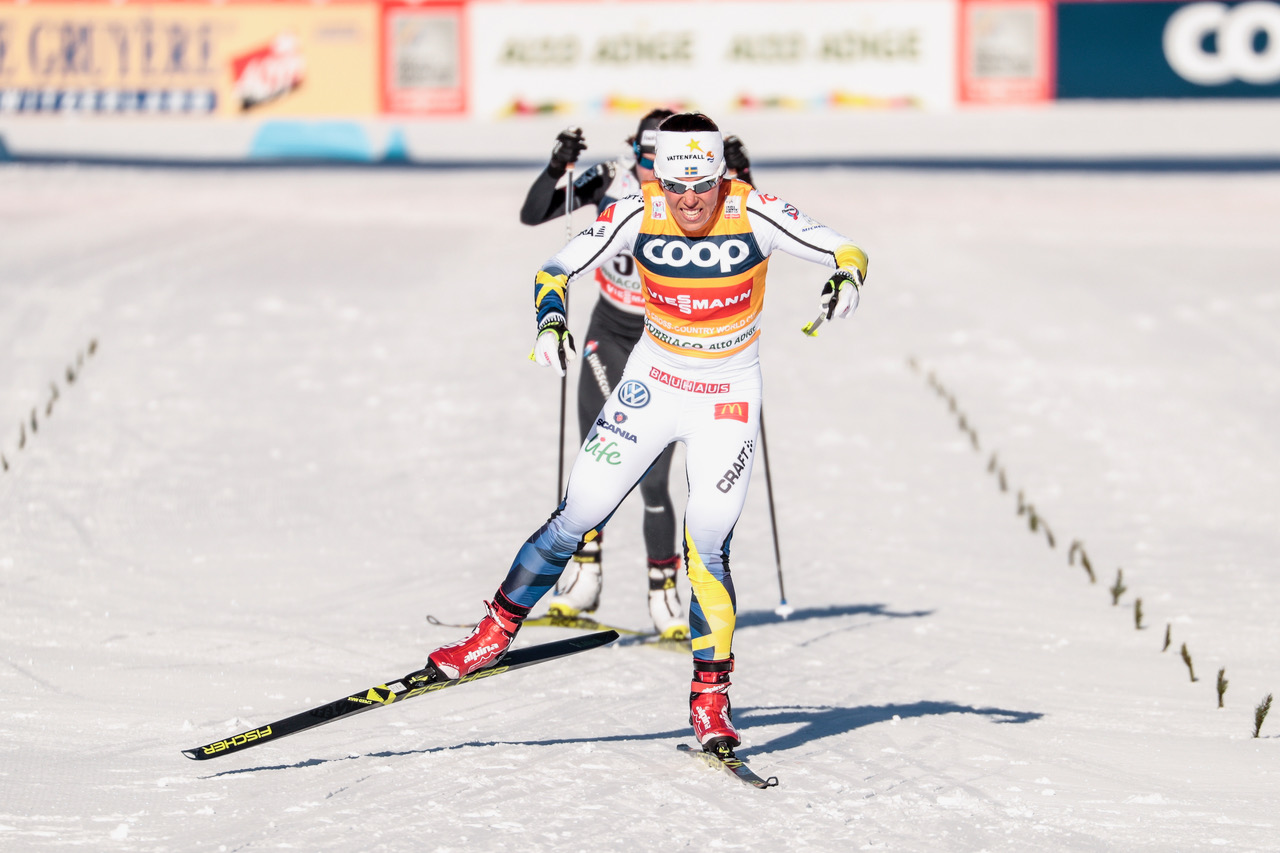
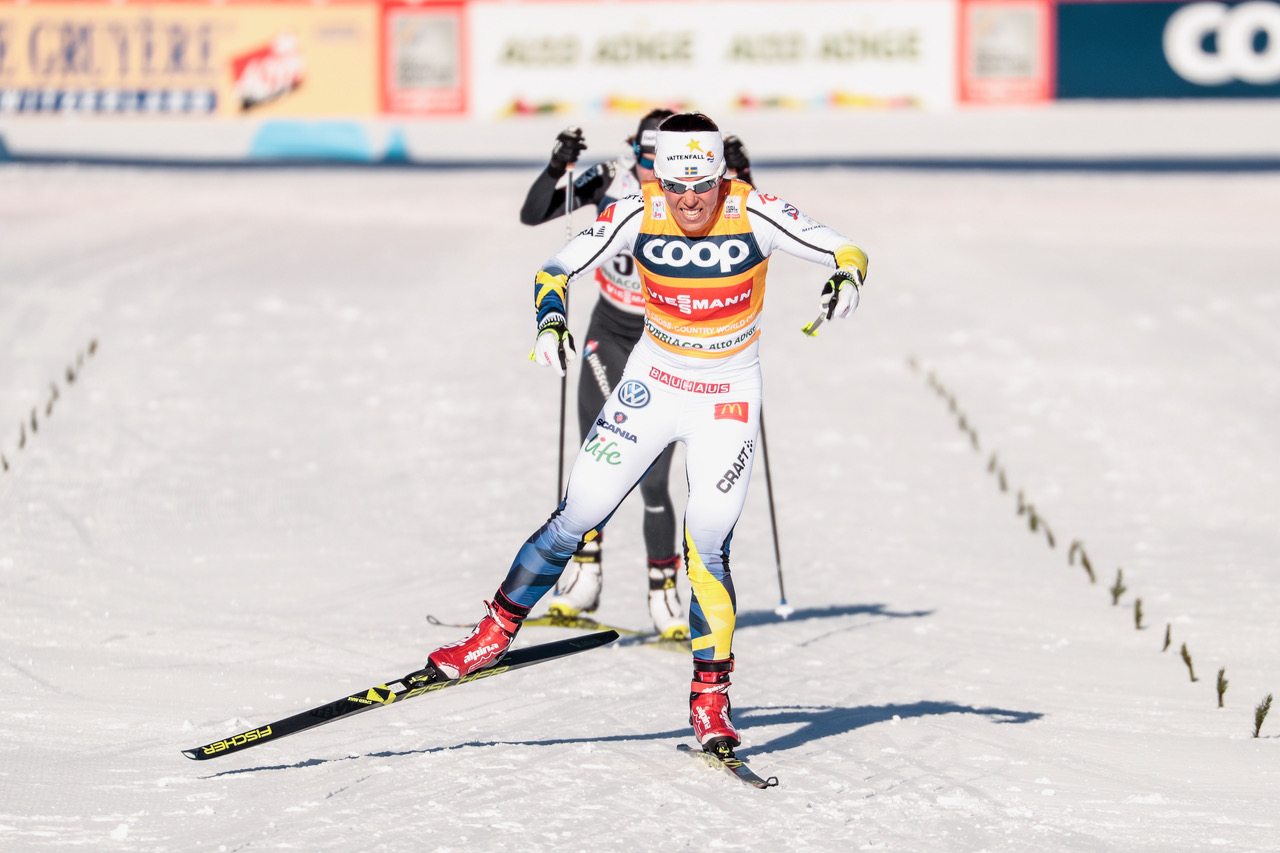
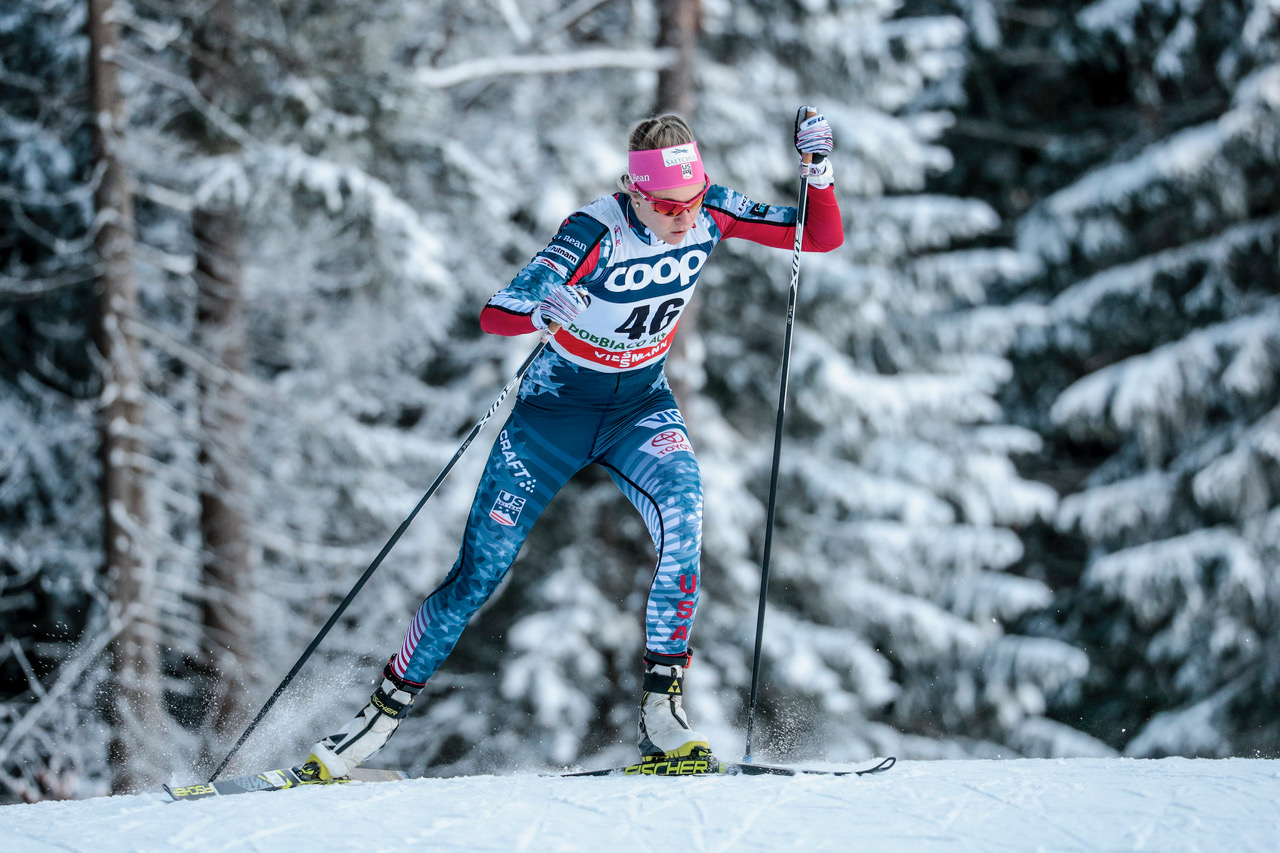
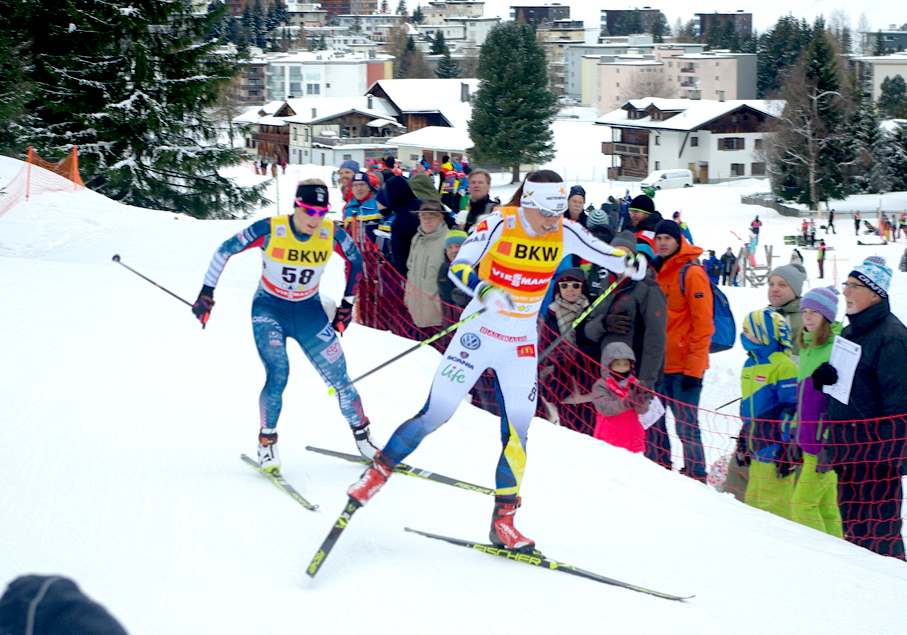
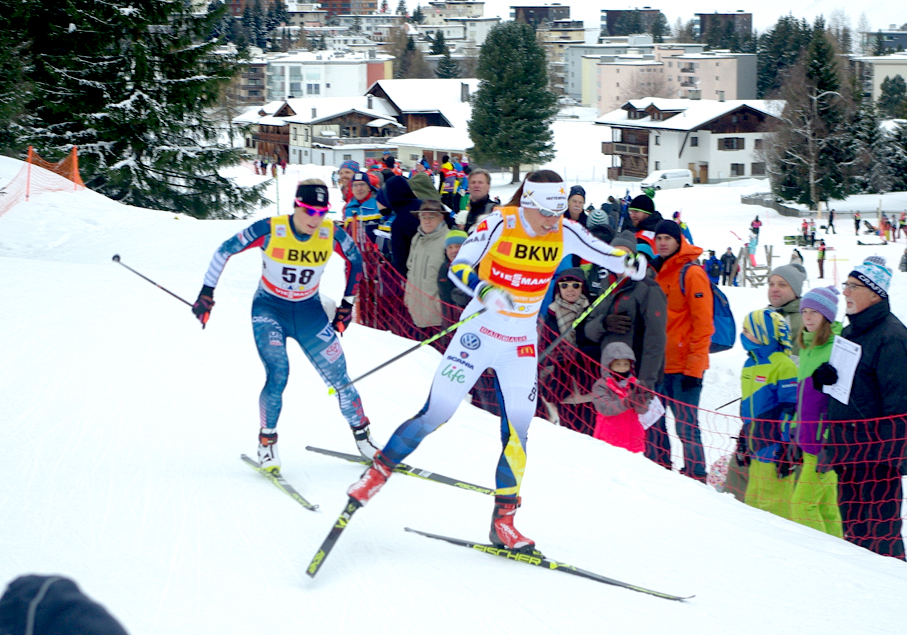
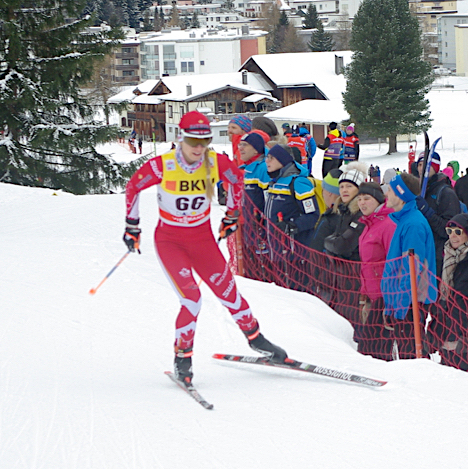
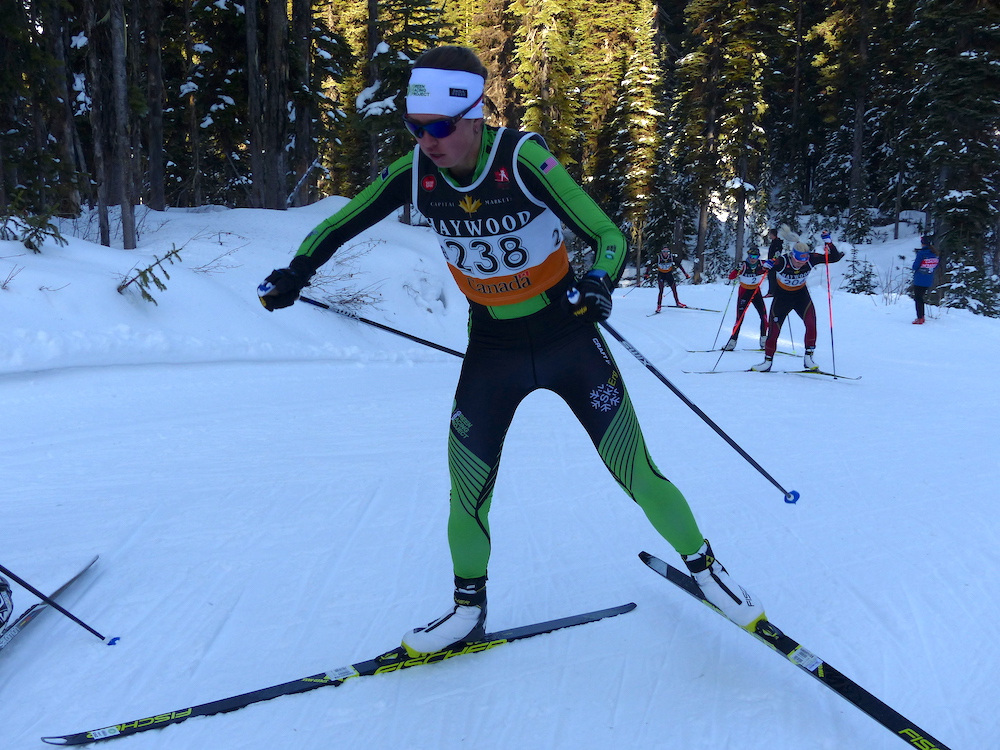
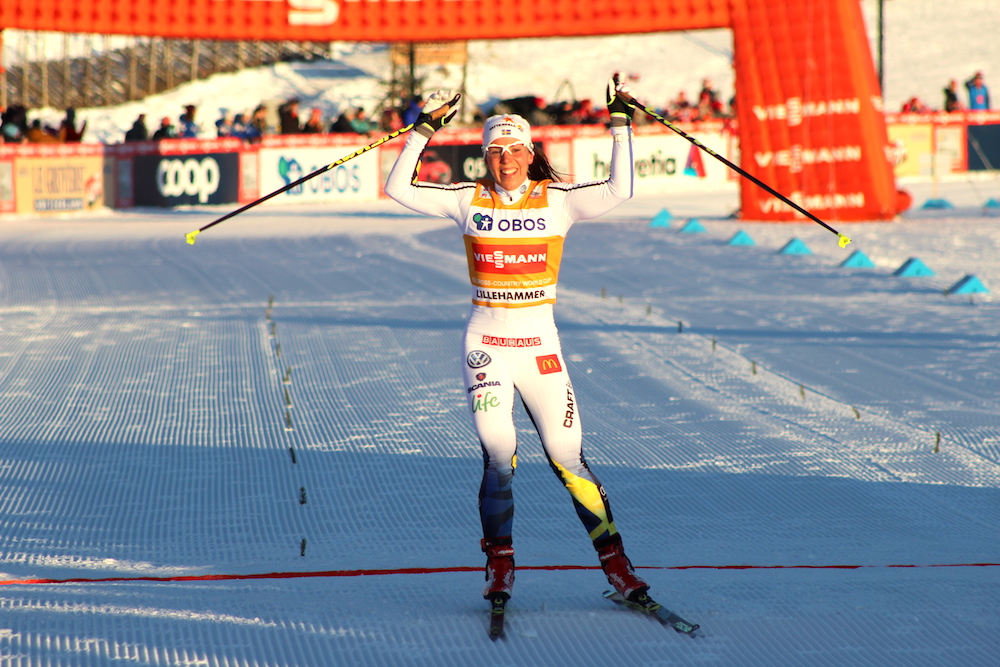
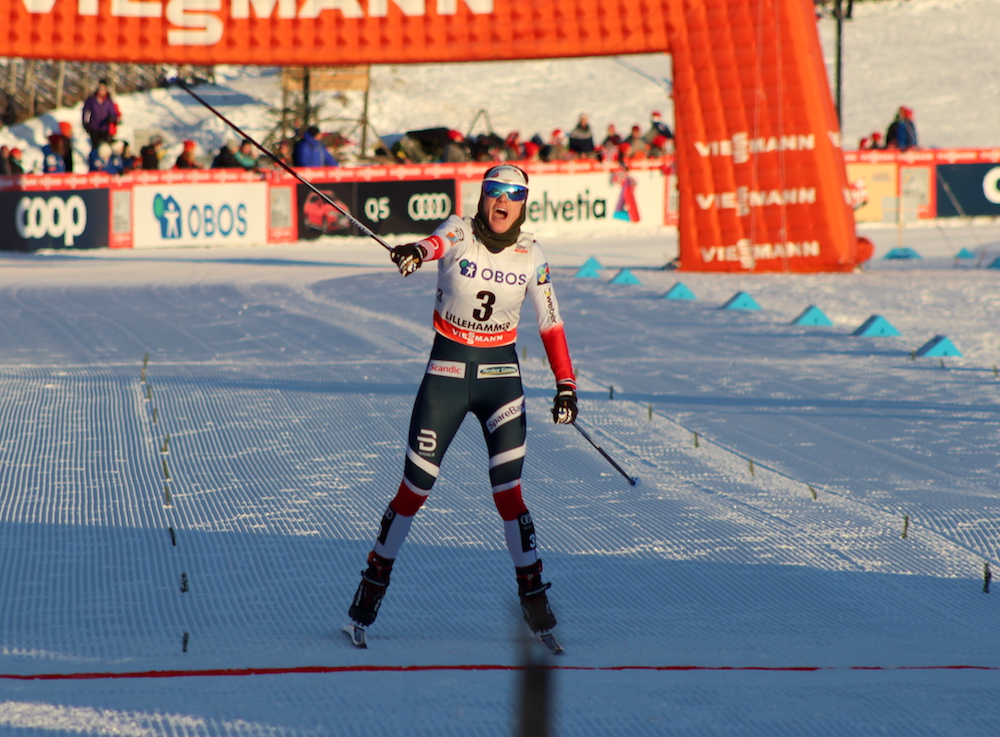
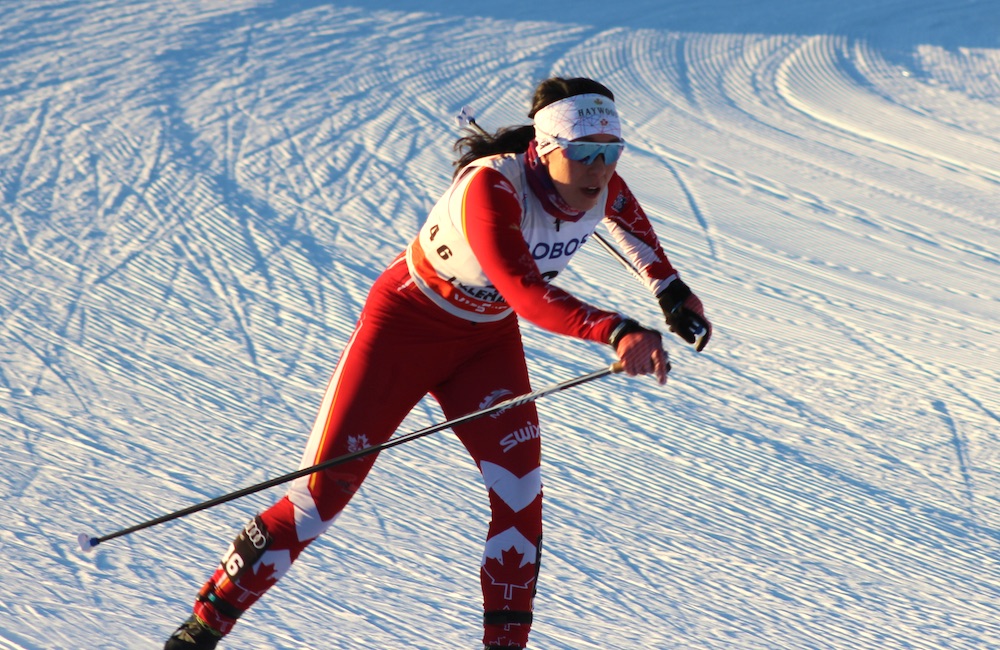
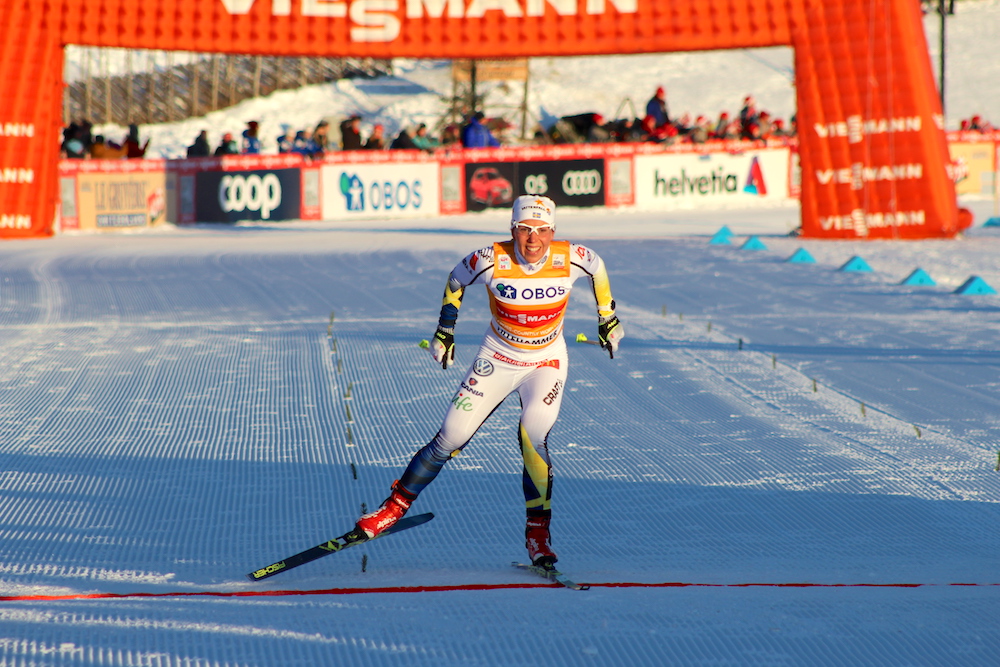
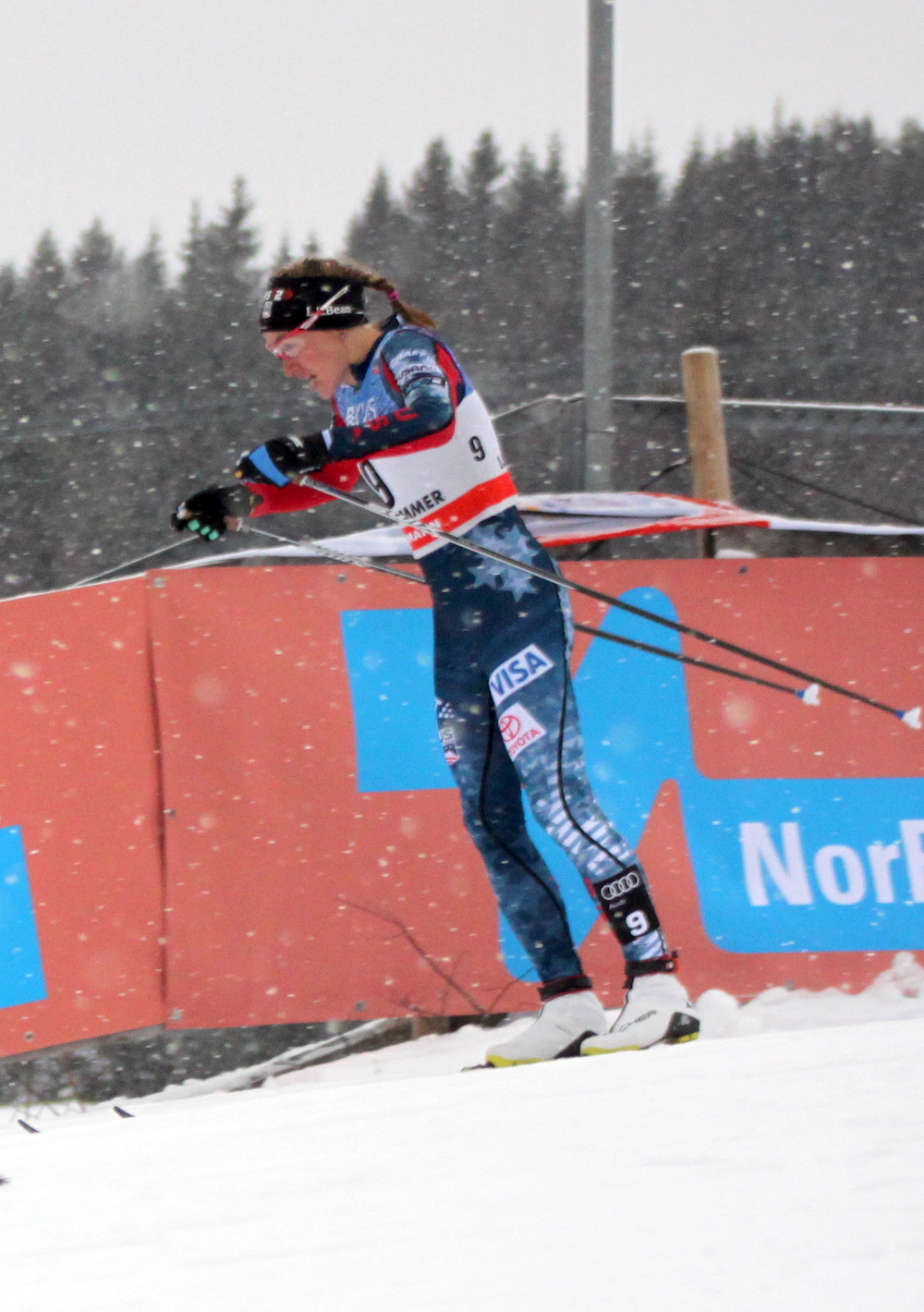
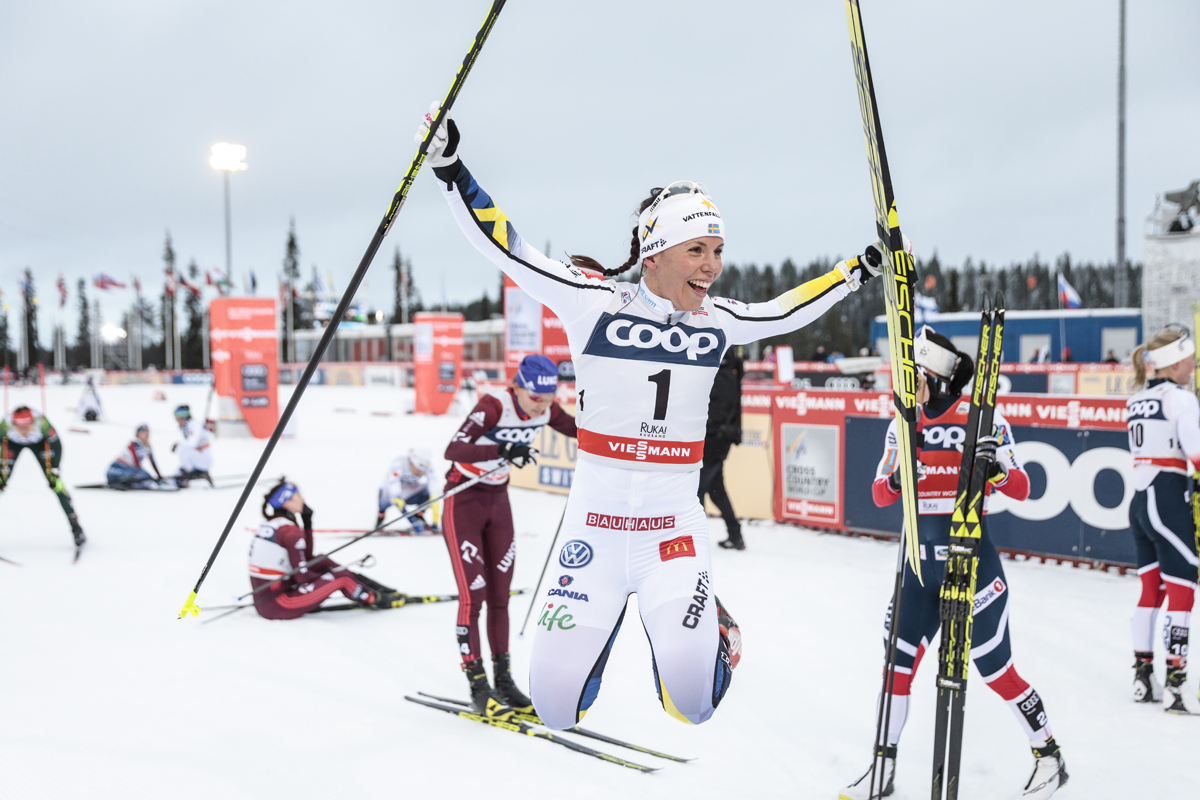
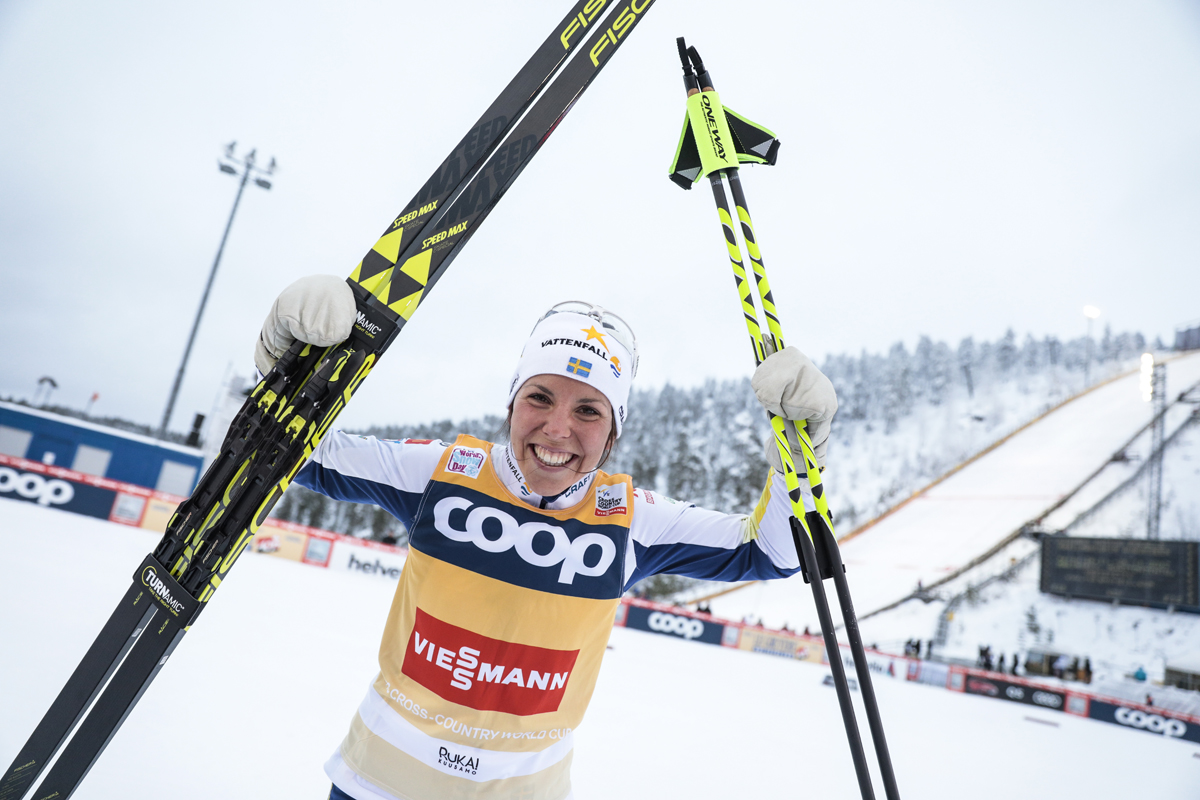
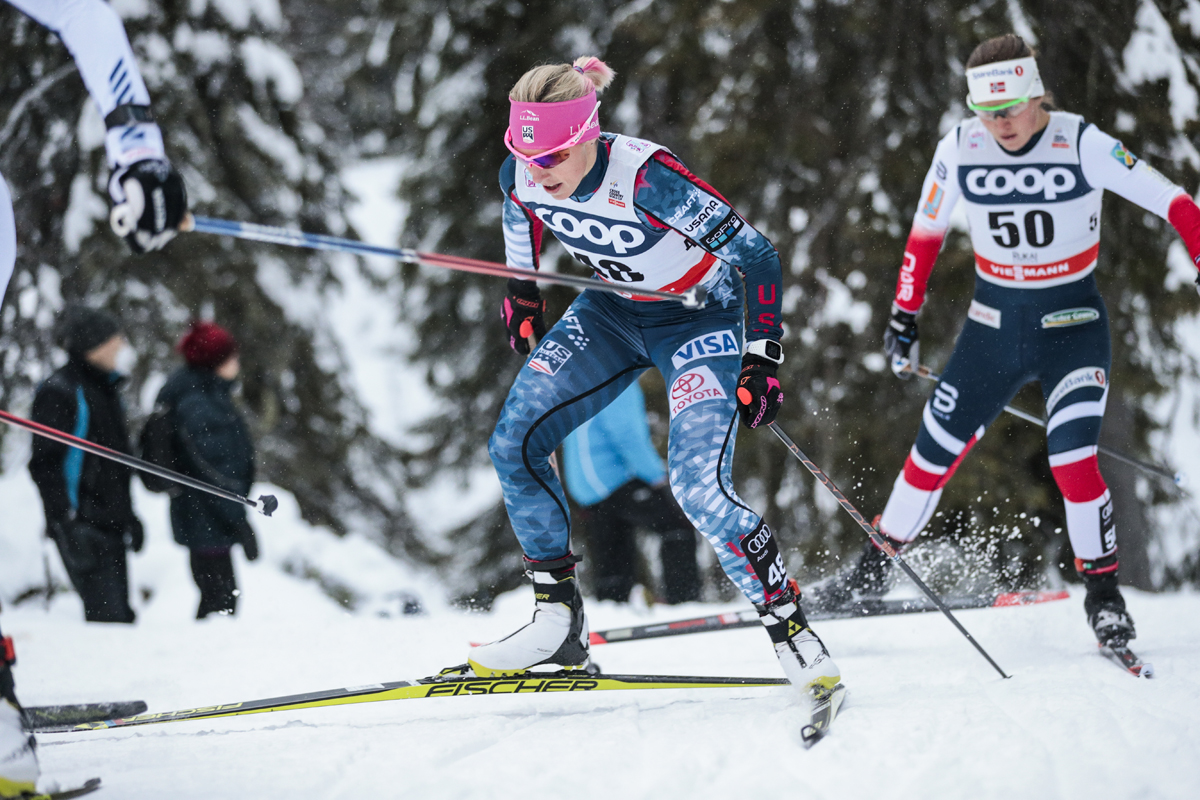
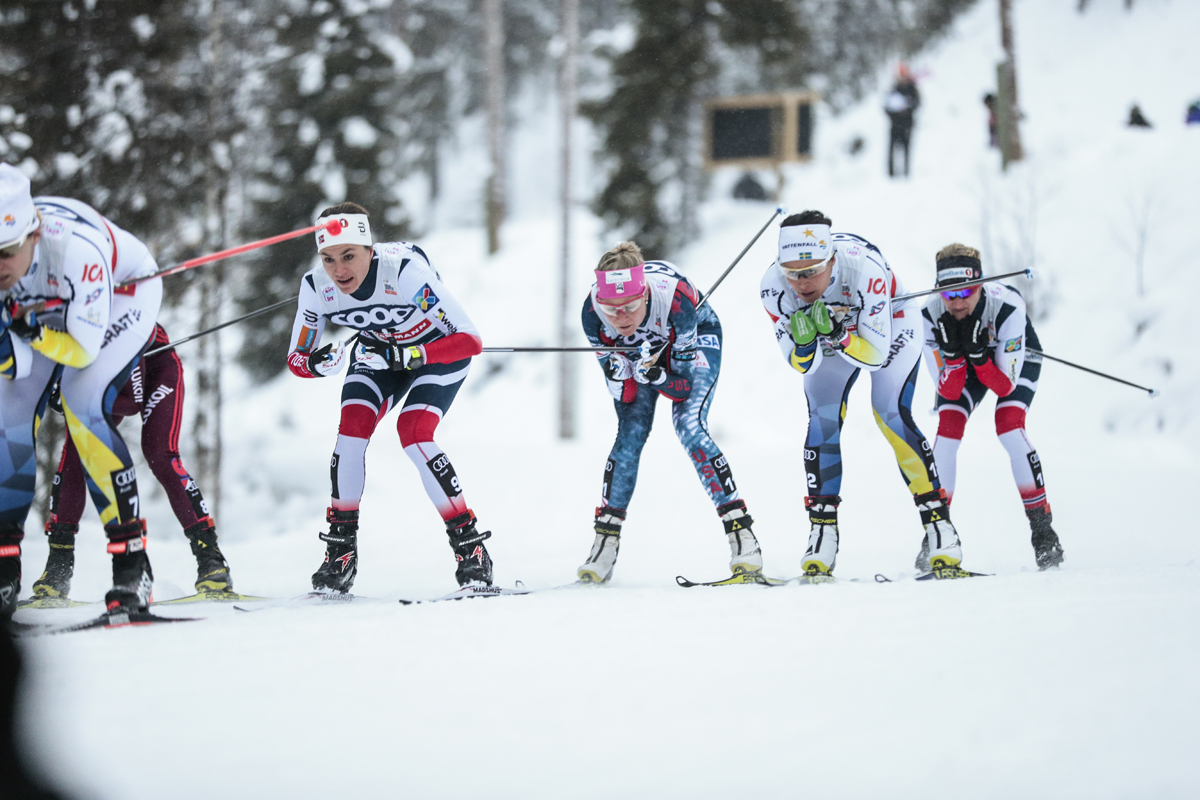
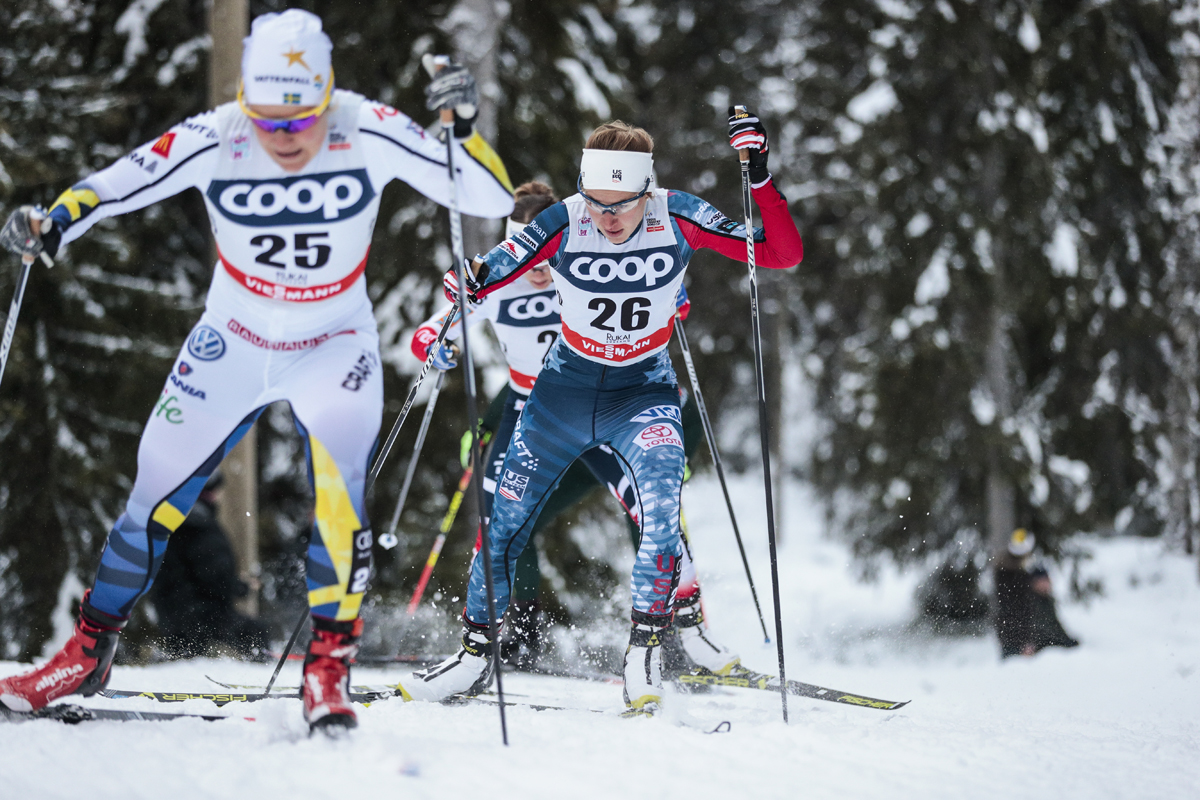
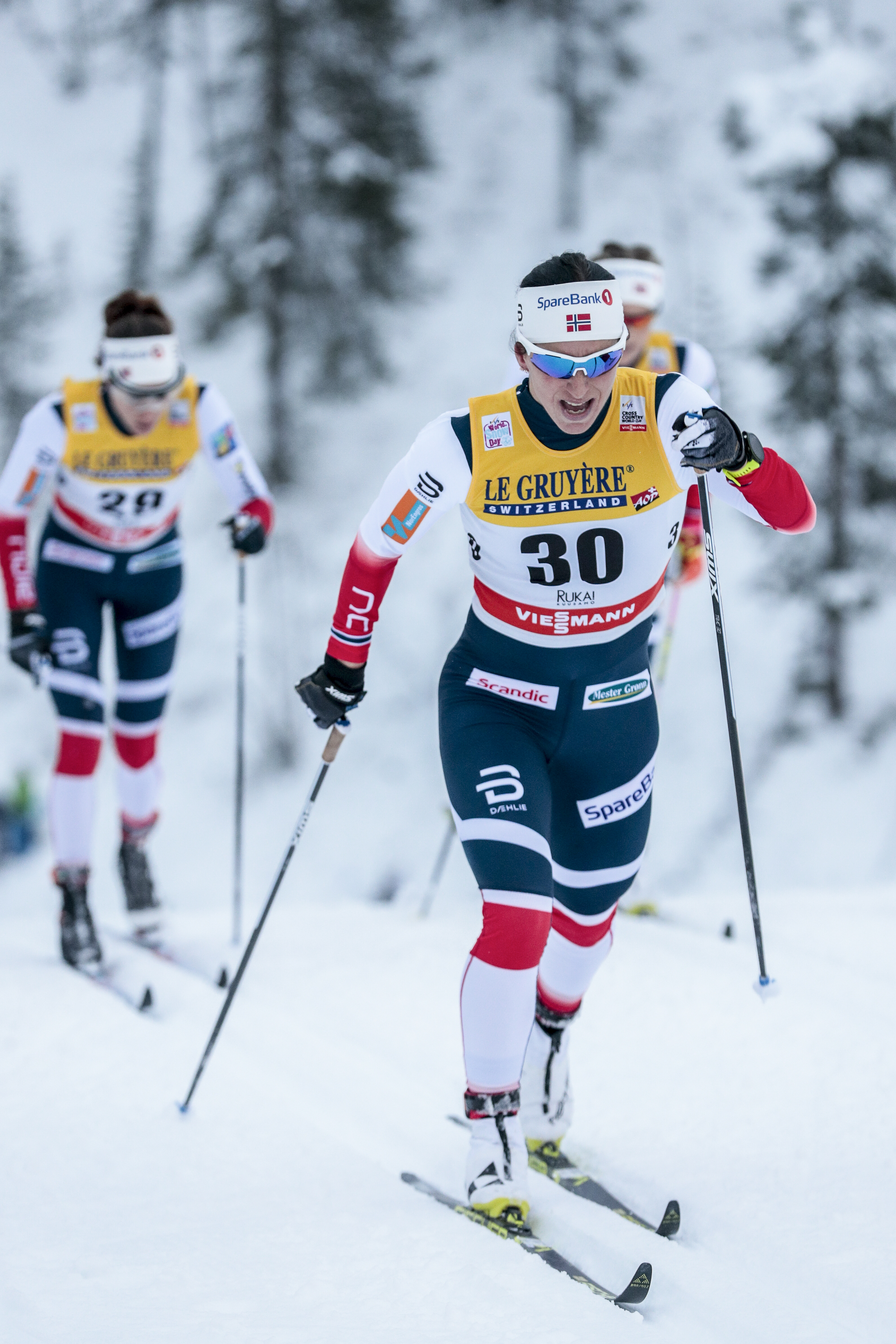
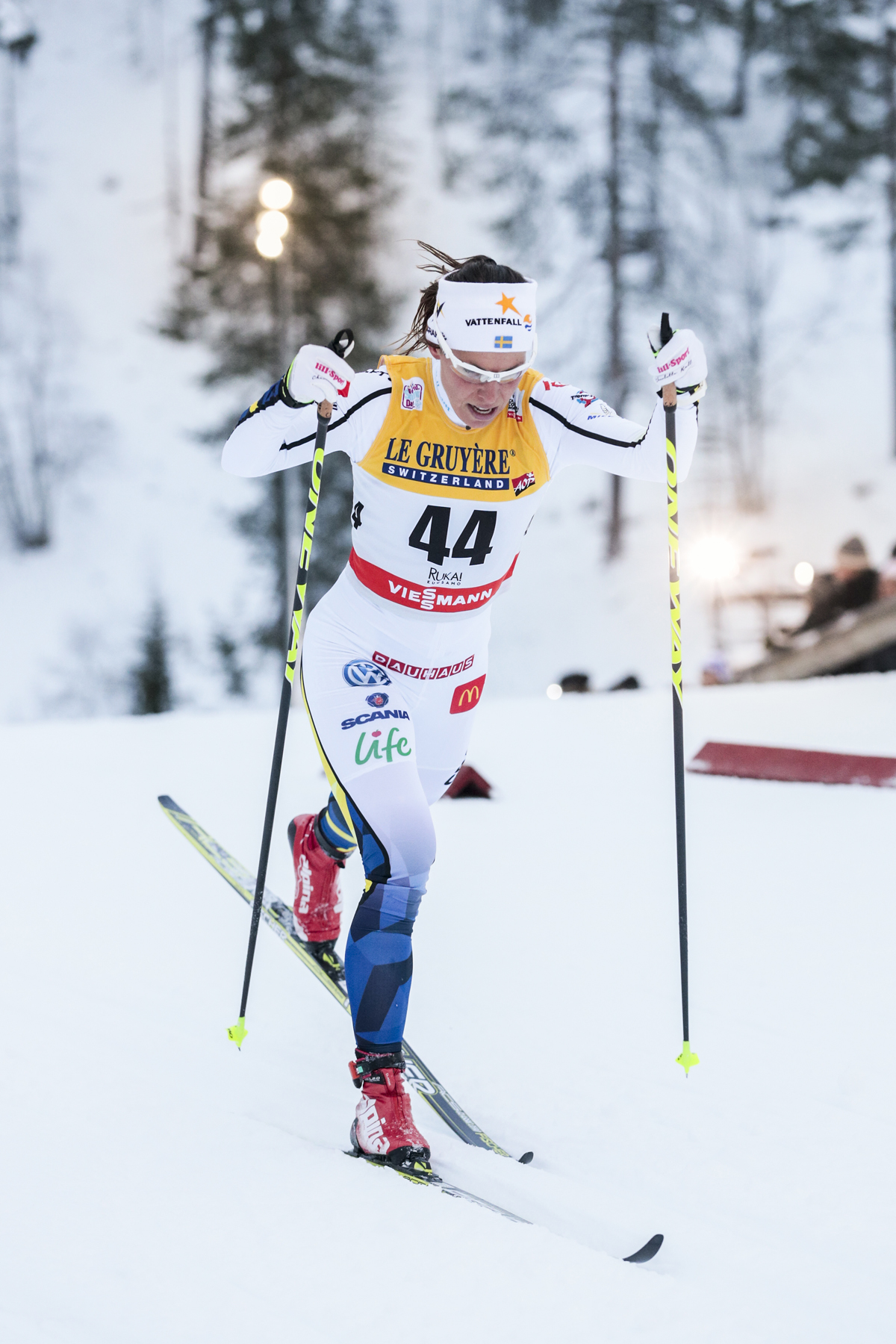
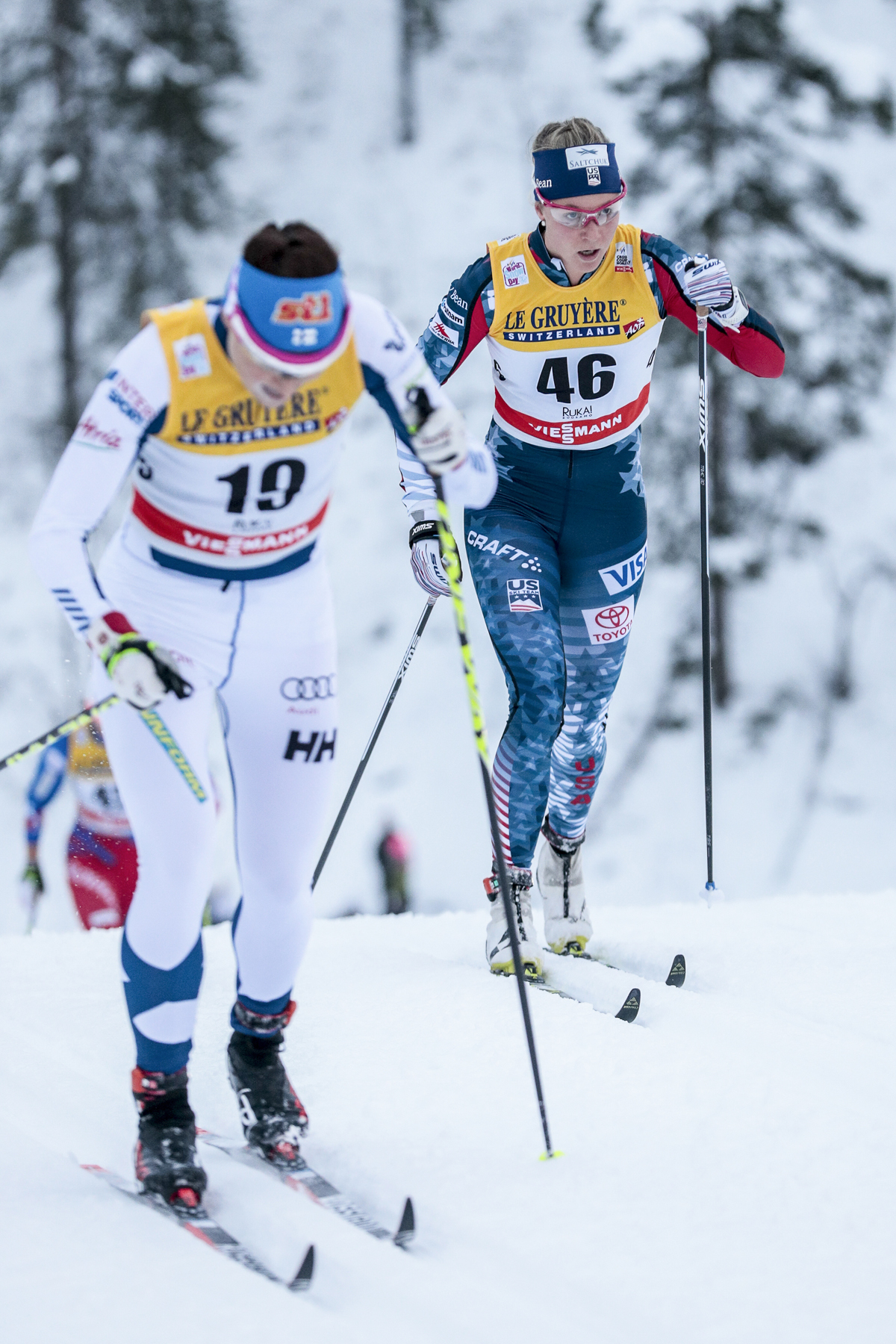
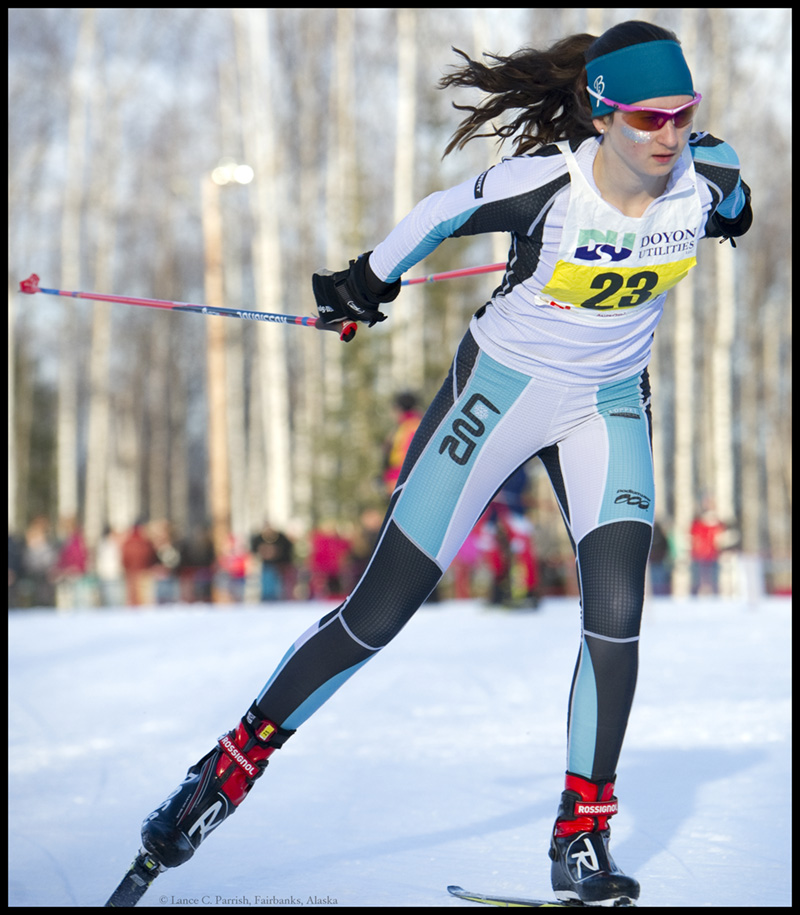
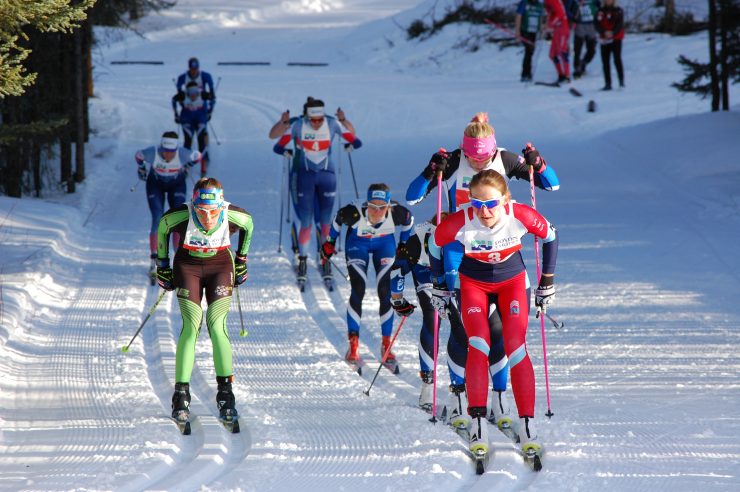
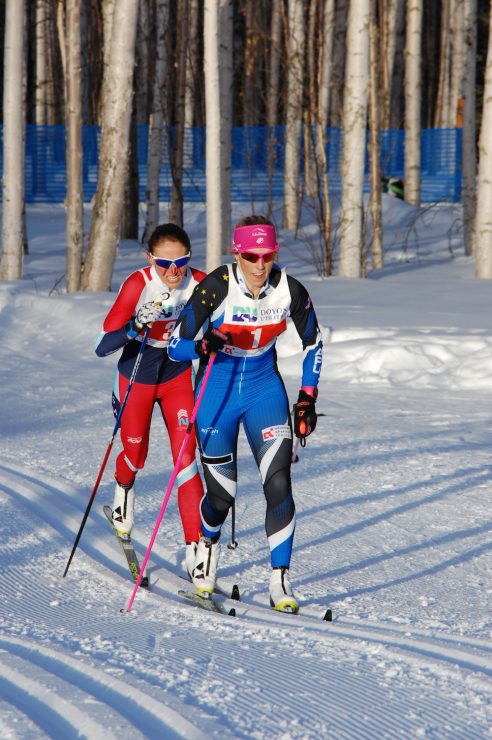
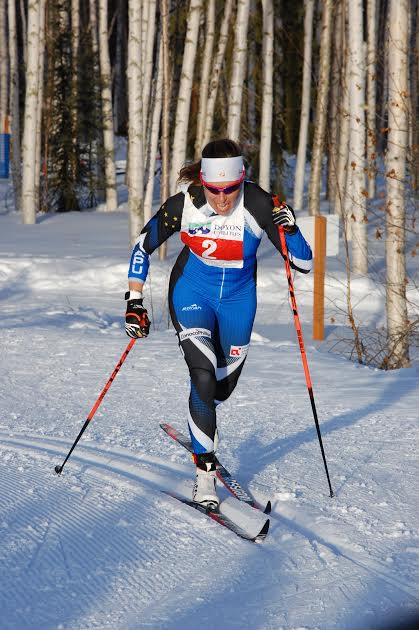
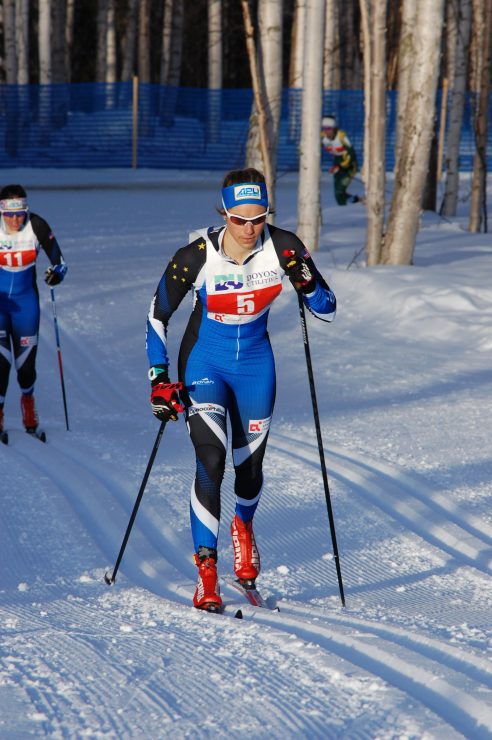
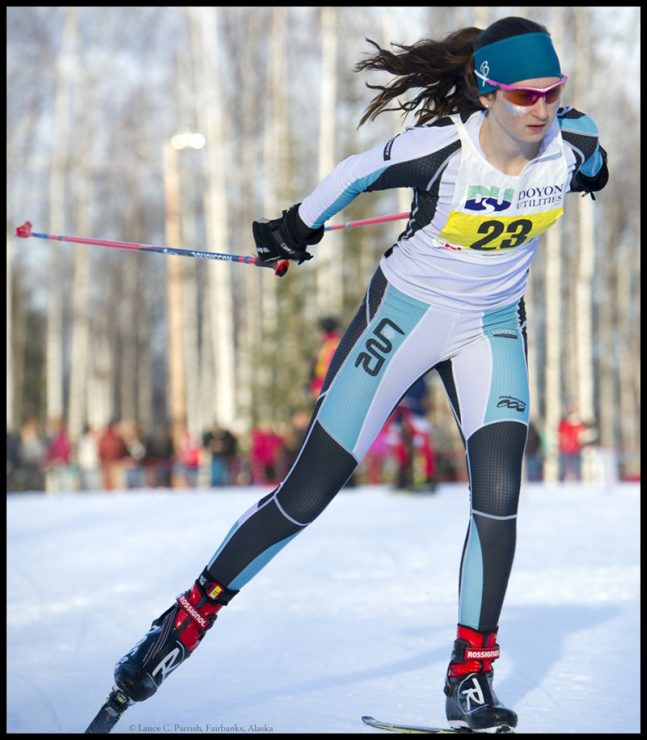
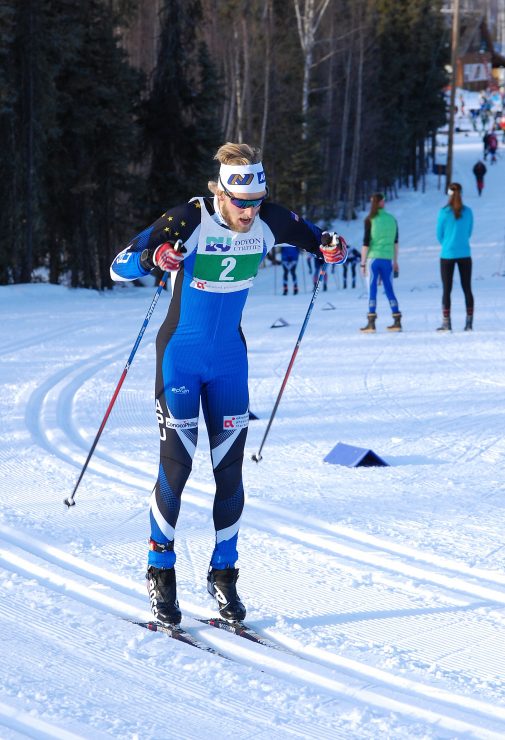
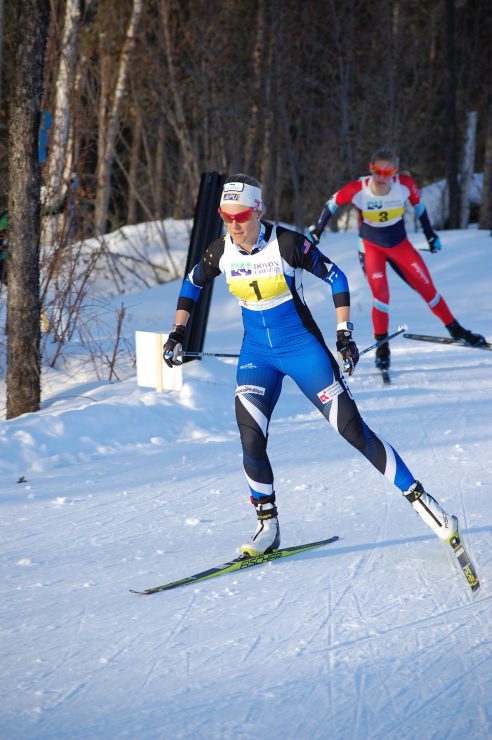
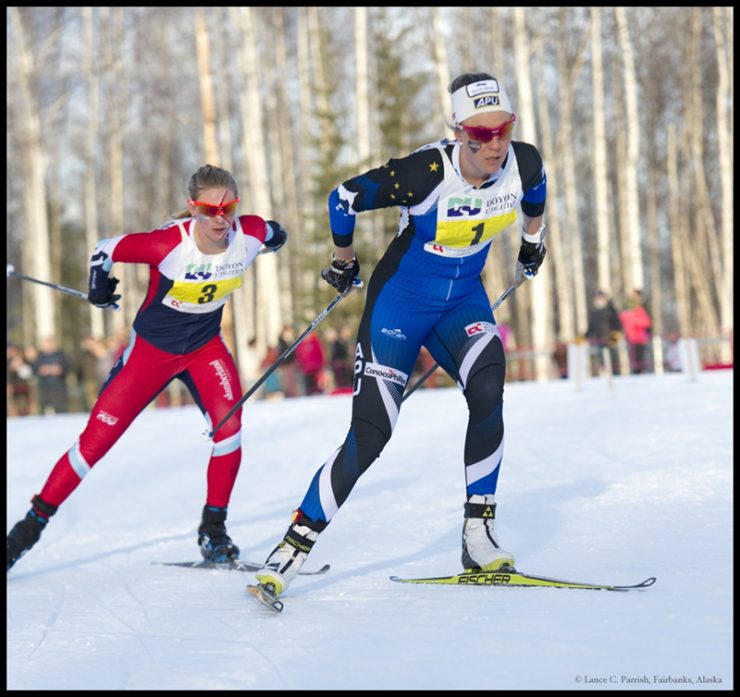
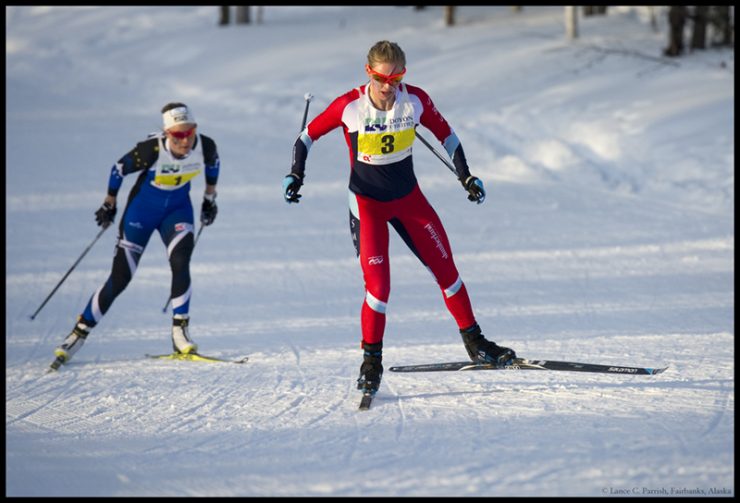
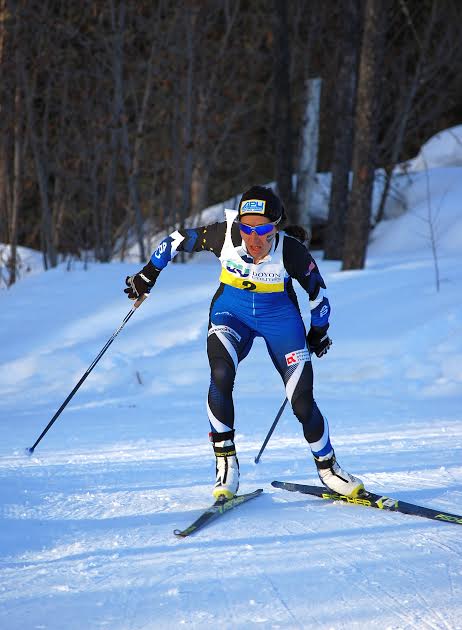
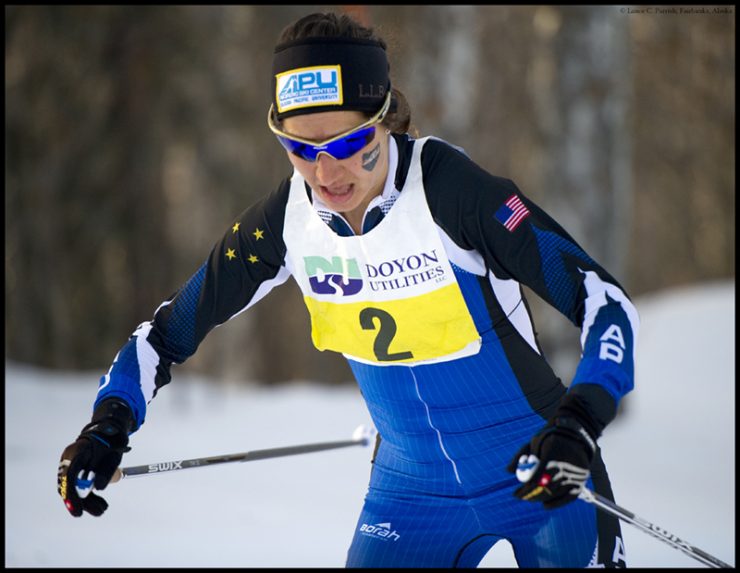
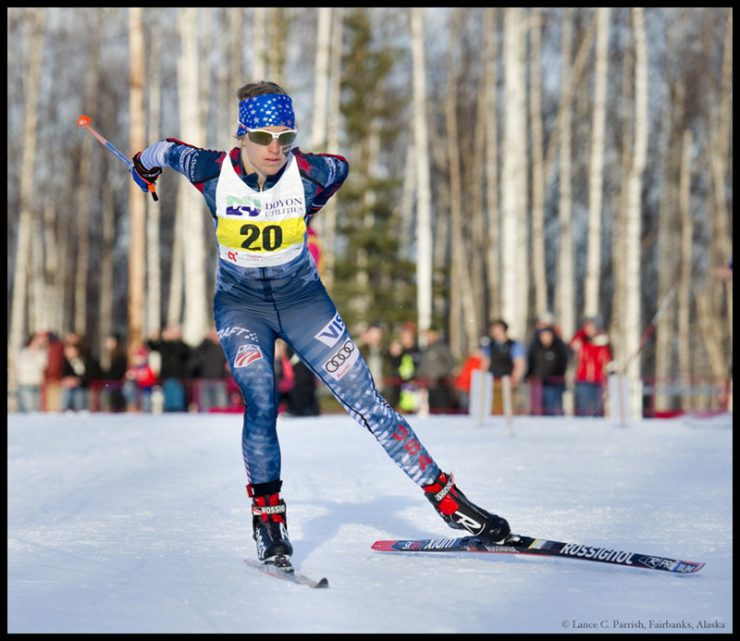
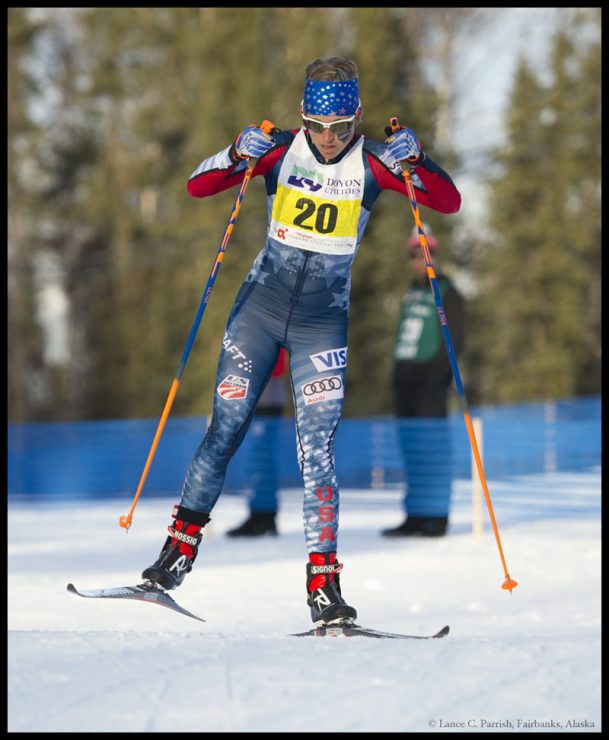
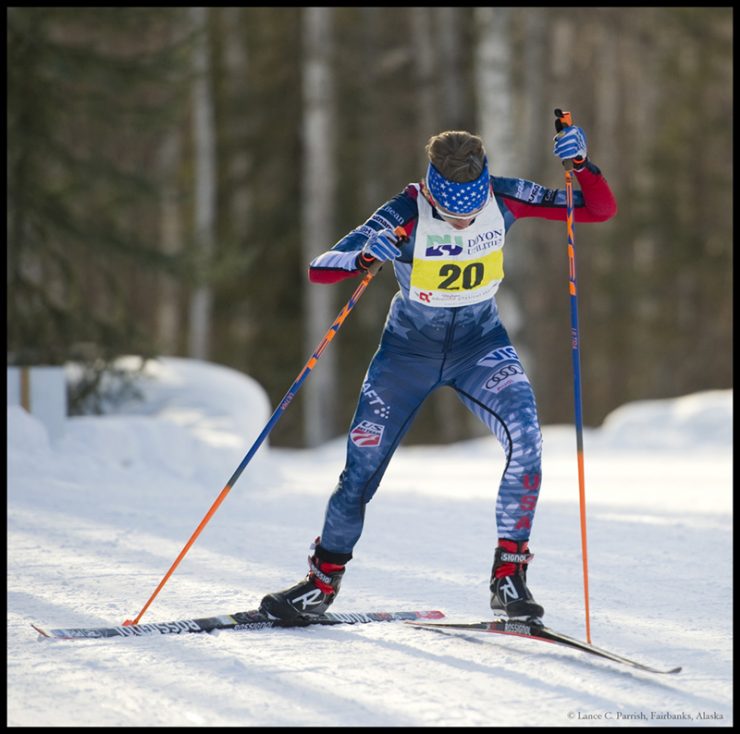
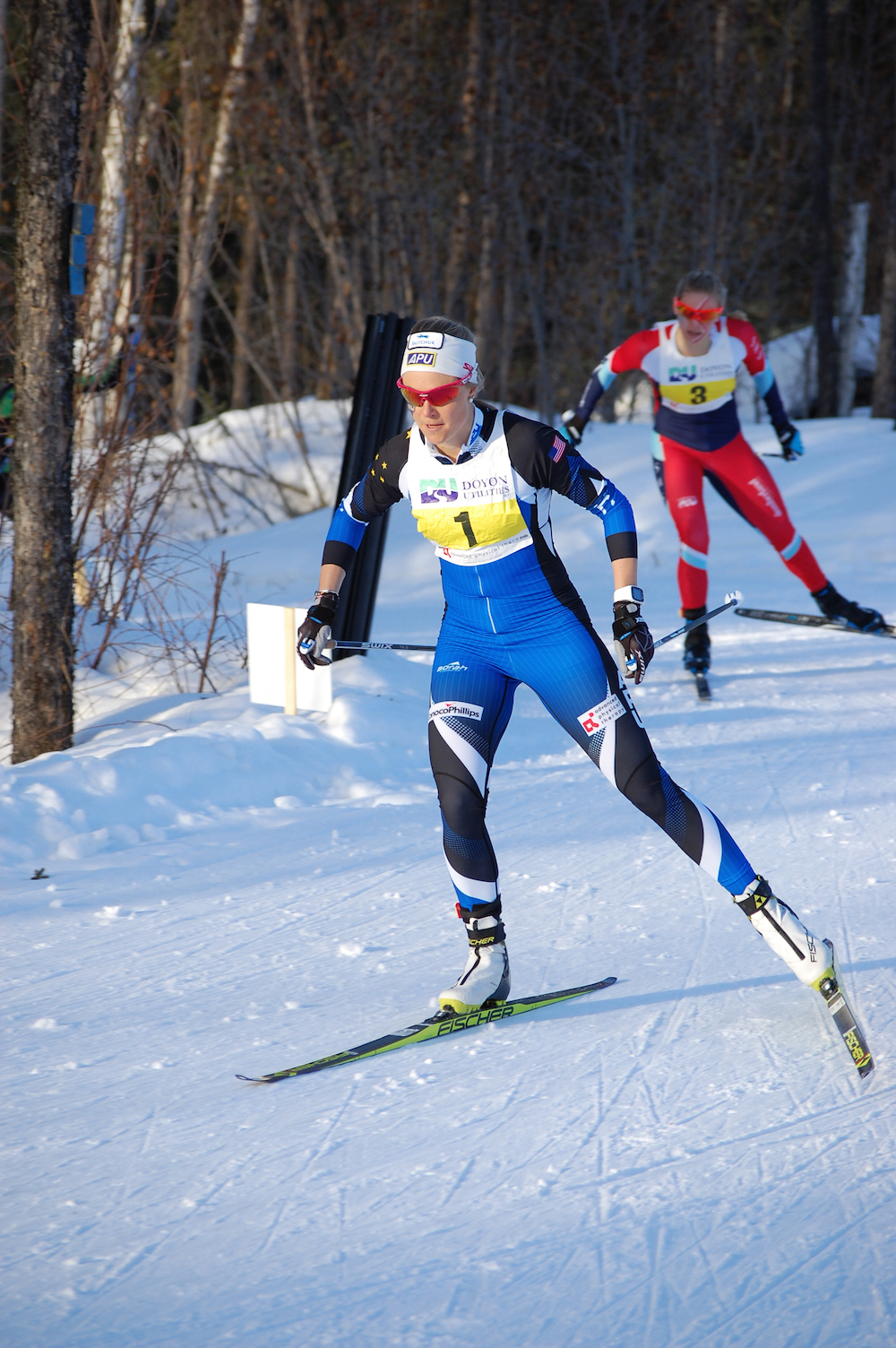
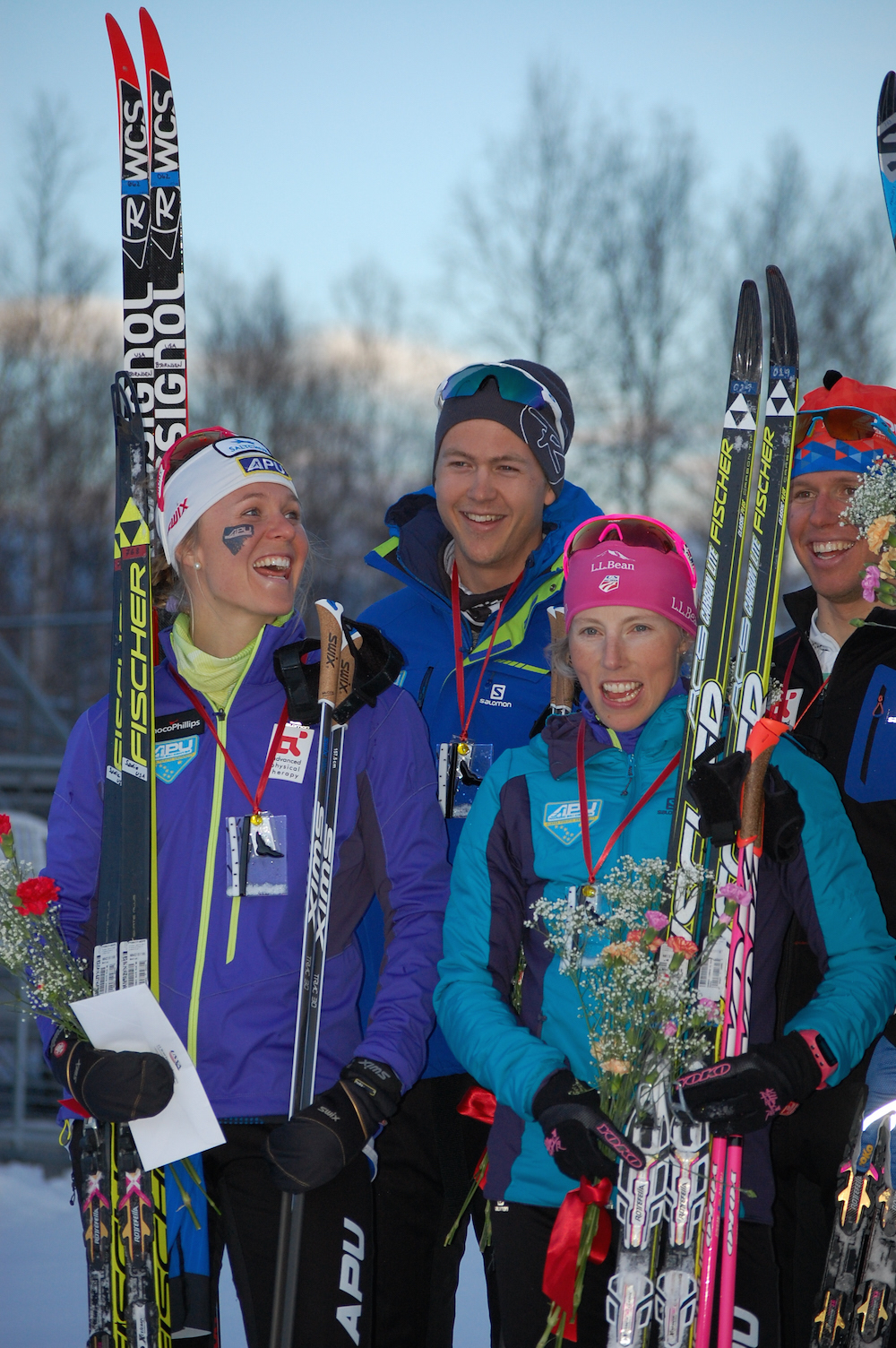
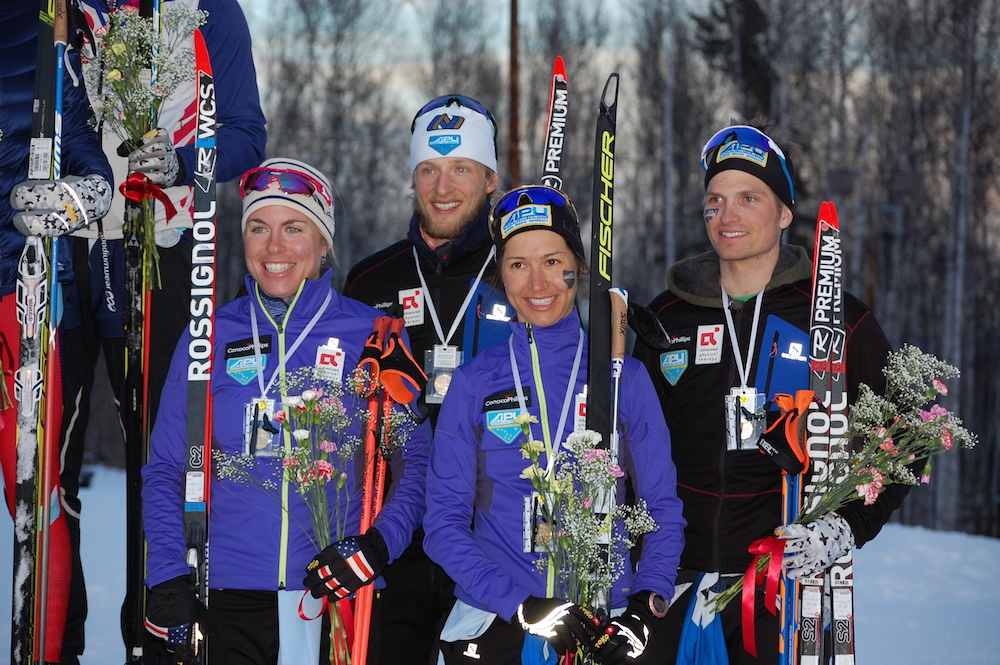
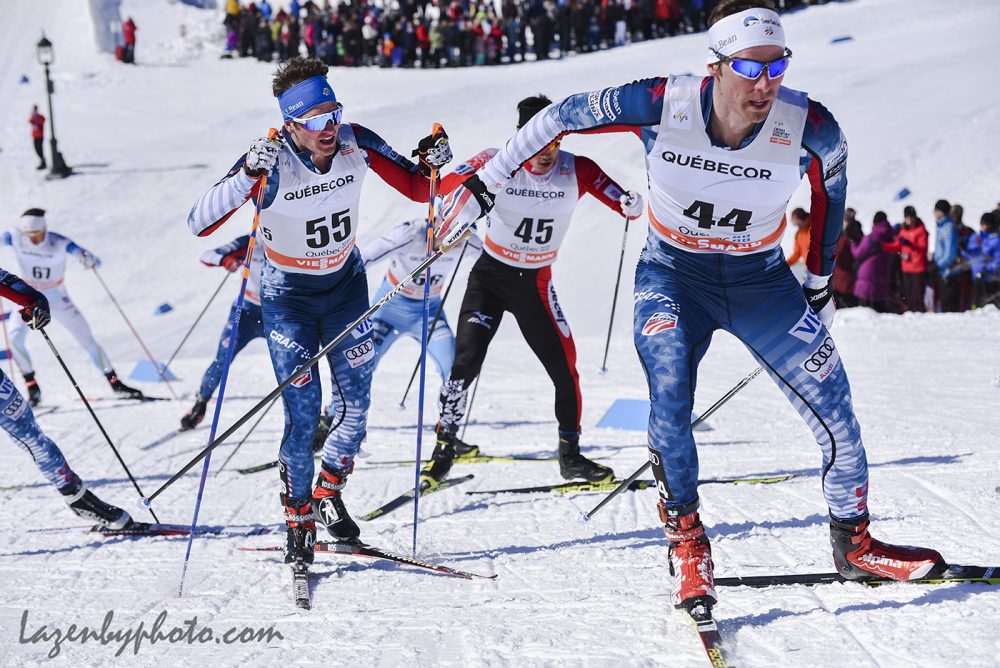
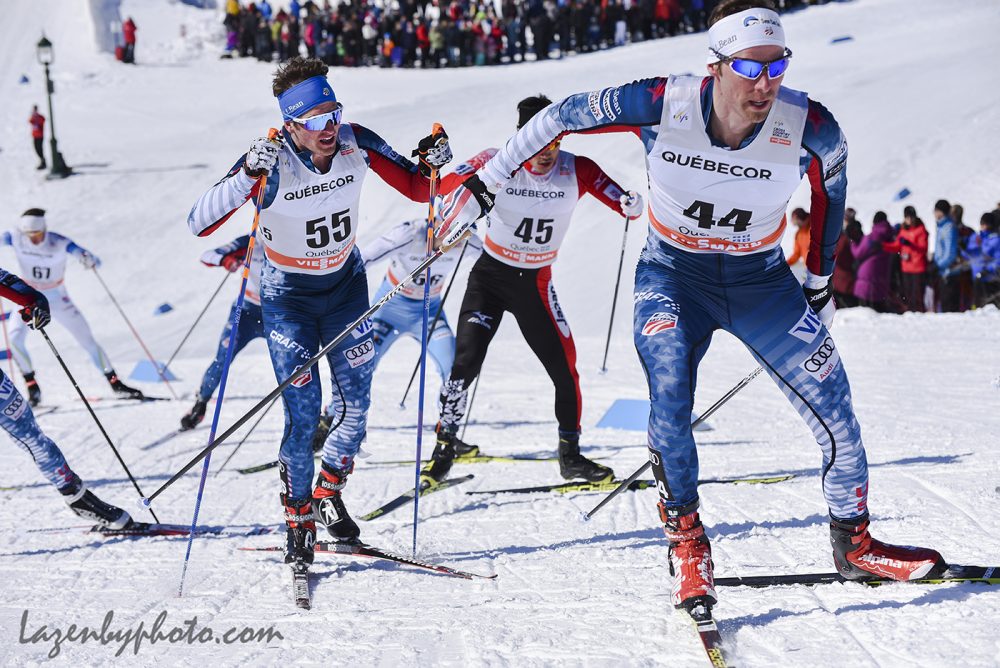
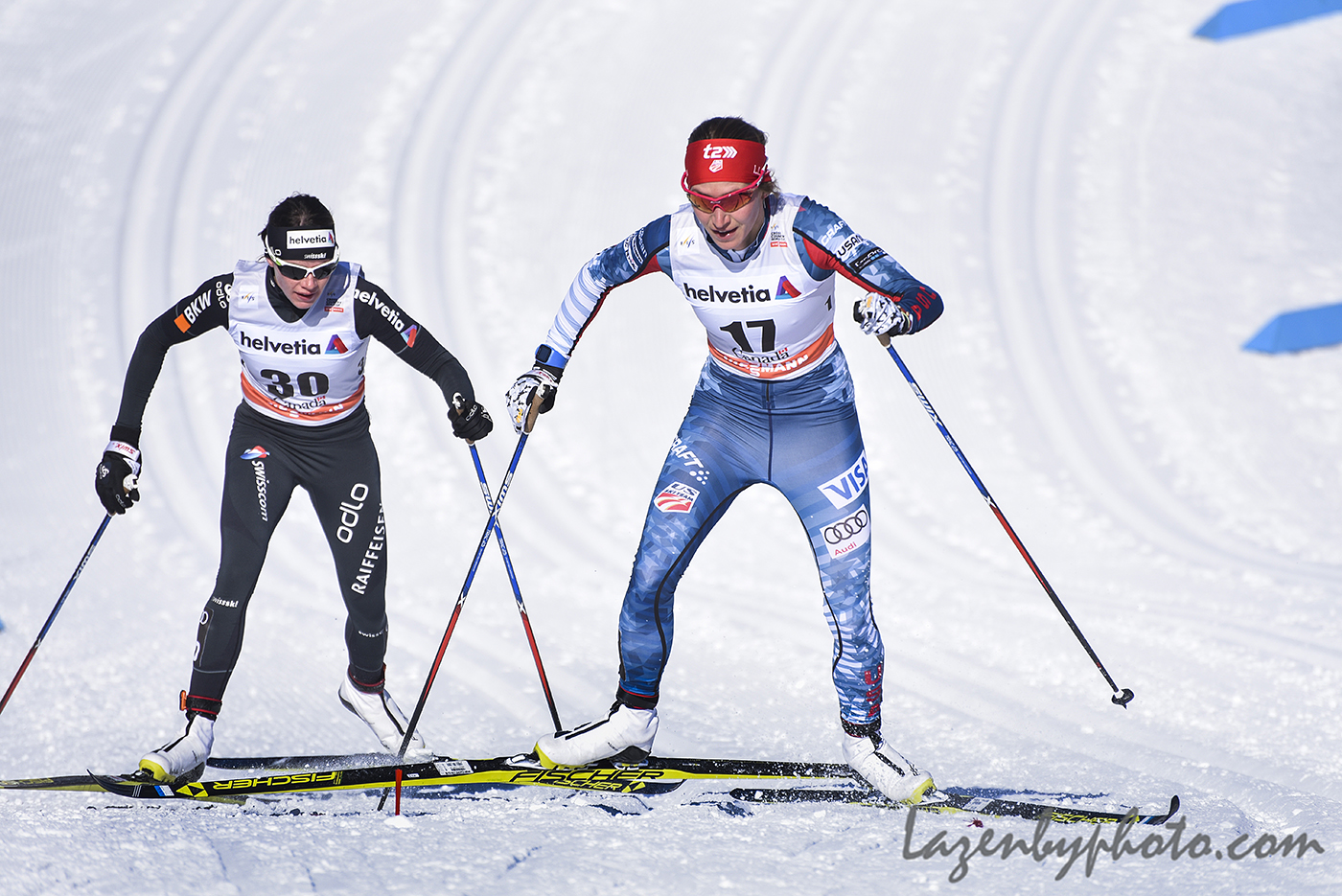
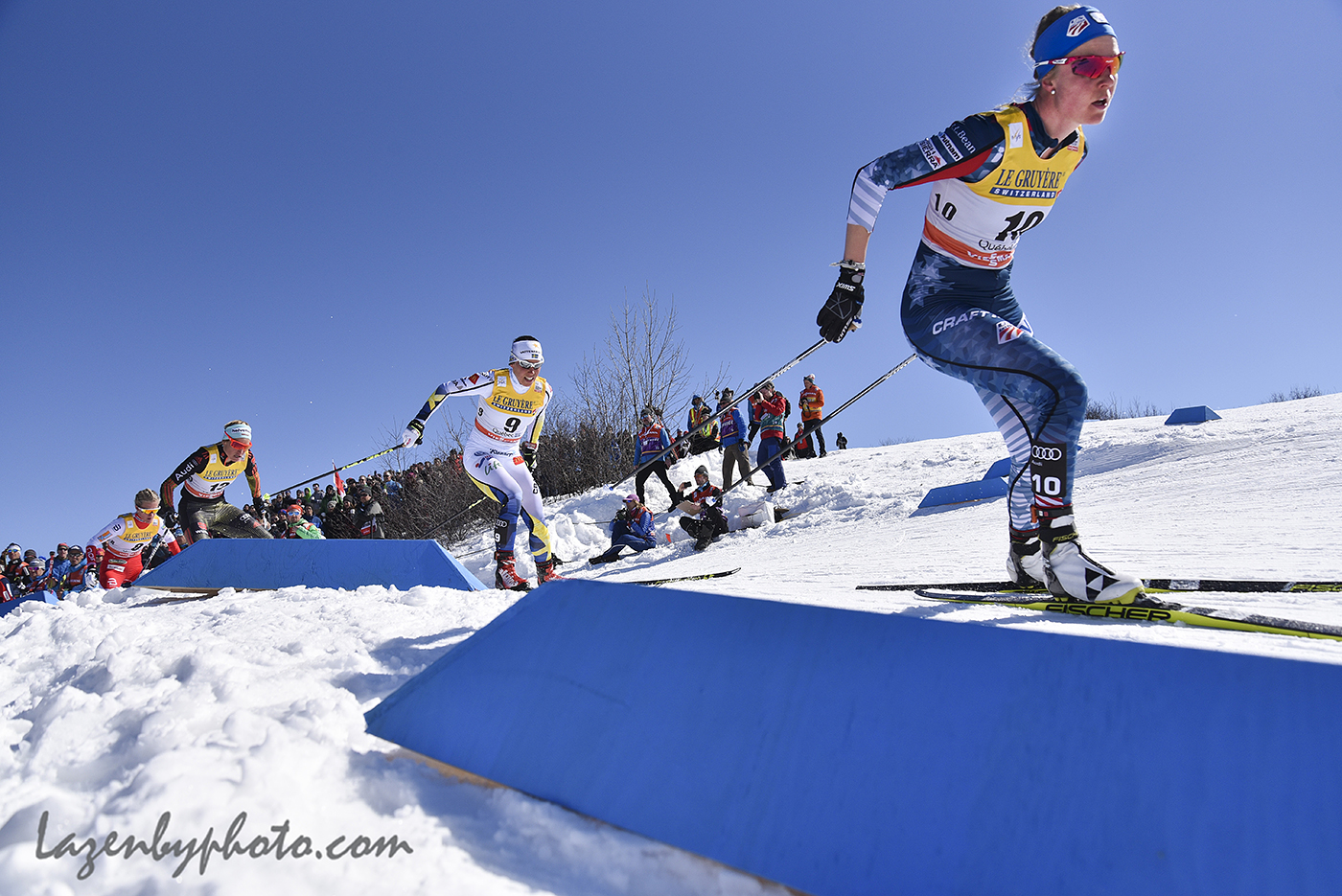
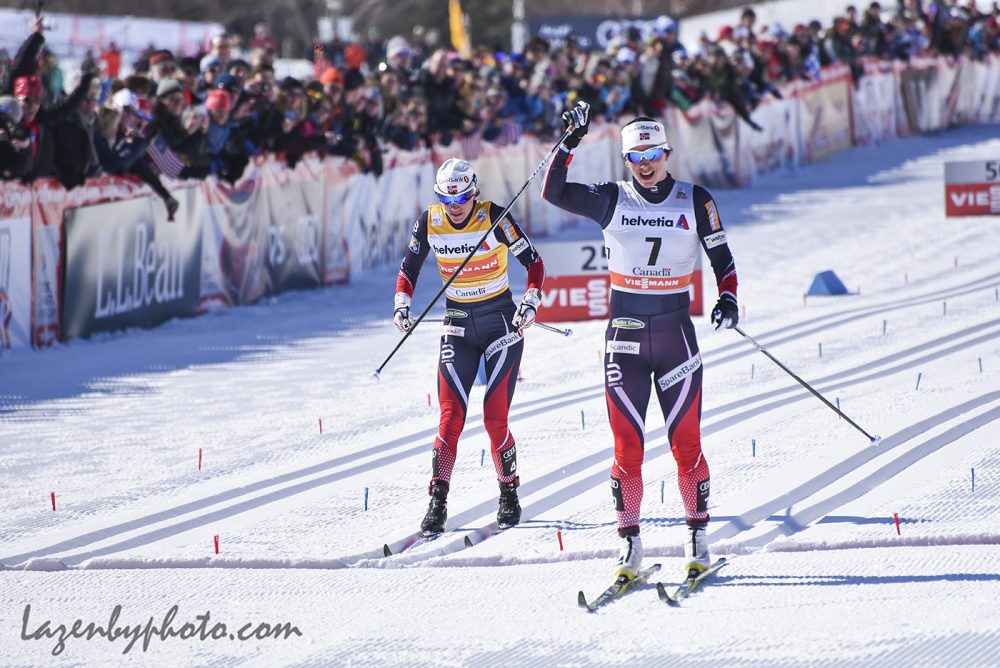
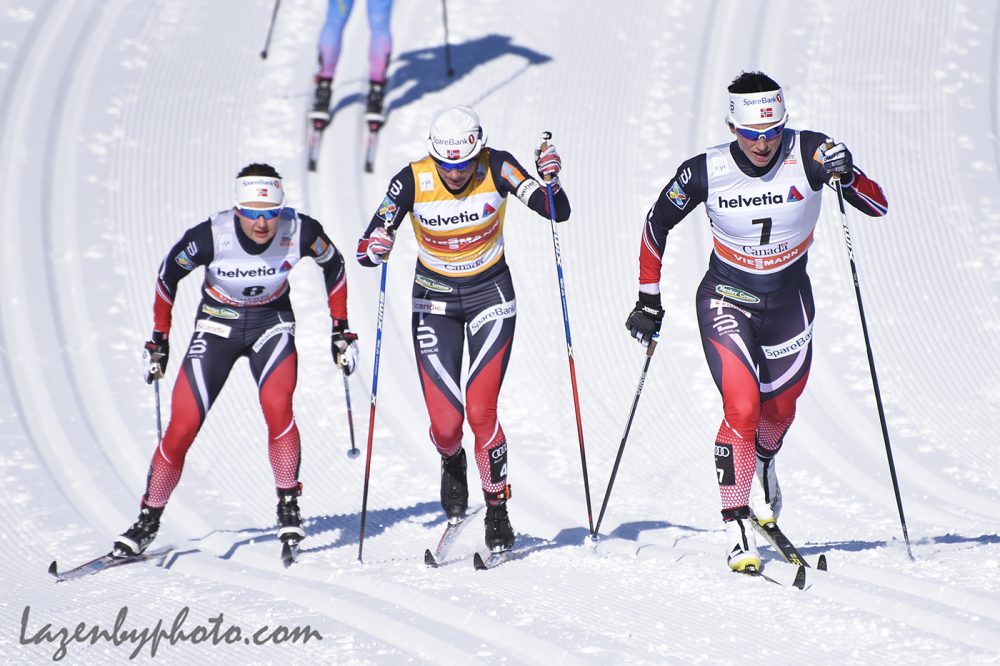
Sweden’s Charlotte Kalla racing to her third win of the season in the women’s 10 k freestyle on Saturday in Toblach, Italy. (Photo: Fischer/Nordic Focus)
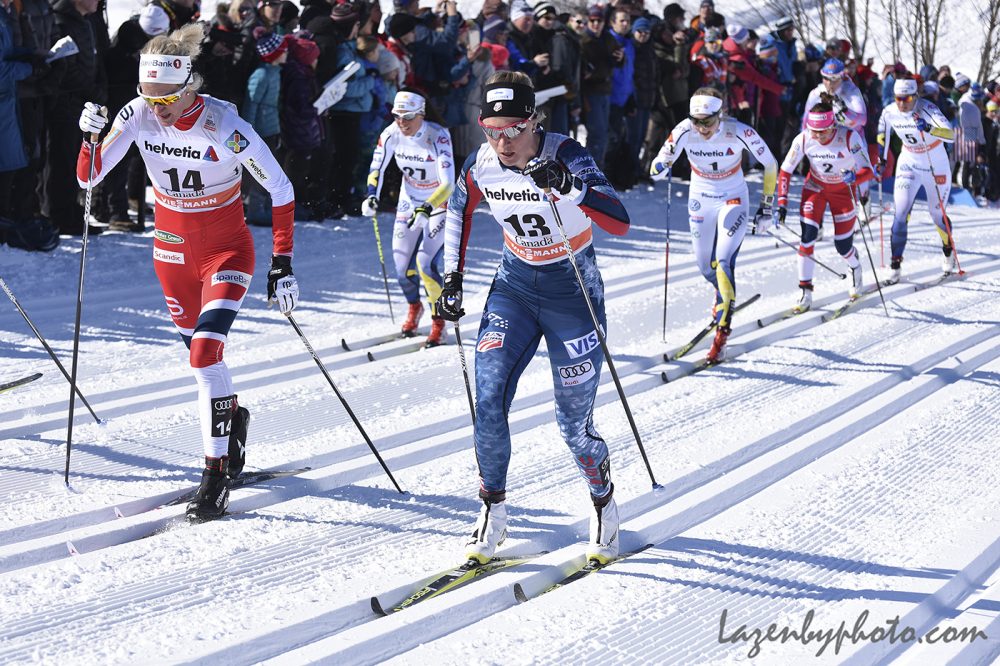
The premise was simple on the World Cup Saturday in Toblach, Italy, for the women’s 10-kilometer freestyle interval start: with firm tracks, sunny skies and only the timer to dictate the effort, it was a hammertime from the start. The threshold-type race featured two laps on a 5 k course that threw grinding climbs and working flats at the 78 female starters.
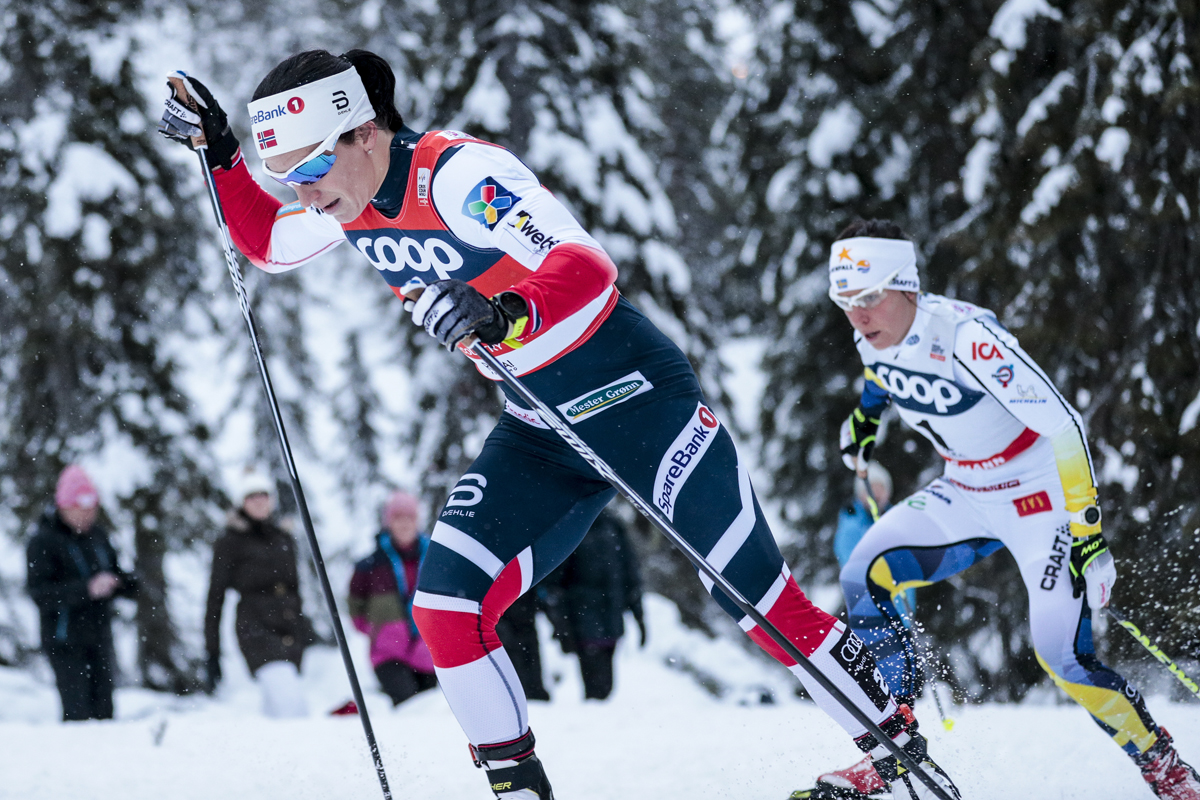
Early in the race it appeared the red and blue of Norway would make a clean top-five sweep. At the 5 k mark, well into the starters, Norwegians Heidi Weng, Ingvild Flugstad Østberg, Astrid Uhrenholdt Jacobsen, Ragnhild Haga, and Marit Bjørgen looked like the lock for the top finishes, perhaps with some reordering as the time differences between Weng, who completed 5 k in 12:07.4, and Bjørgen was 11 seconds. The other three Norwegians were slightly off Weng’s pace.
The yellow-bibbed skier, indicating her overall World Cup-leading status, Sweden’s Charlotte Kalla started 60th, an omniscient placing when it came to receiving the timing splits to match and potentially superpass.
Kalla’s powerful V2 and gravity slaying V1 were on display immediately. She was second at 2.1 k, 2.2 seconds behind Østberg. Kalla kept the pace and was second at 5 k, this time 2.3 seconds behind top-ranked skier Weng. At 7.1 k, Weng still held her position, while Kalla came through 4.4 seconds back.
In the closing kilometers, Kalla cranked up her effort. The payoff came for Kalla when she crossed the line in first, turning her four-second deficit 3 k earlier to a 5.8-second win.
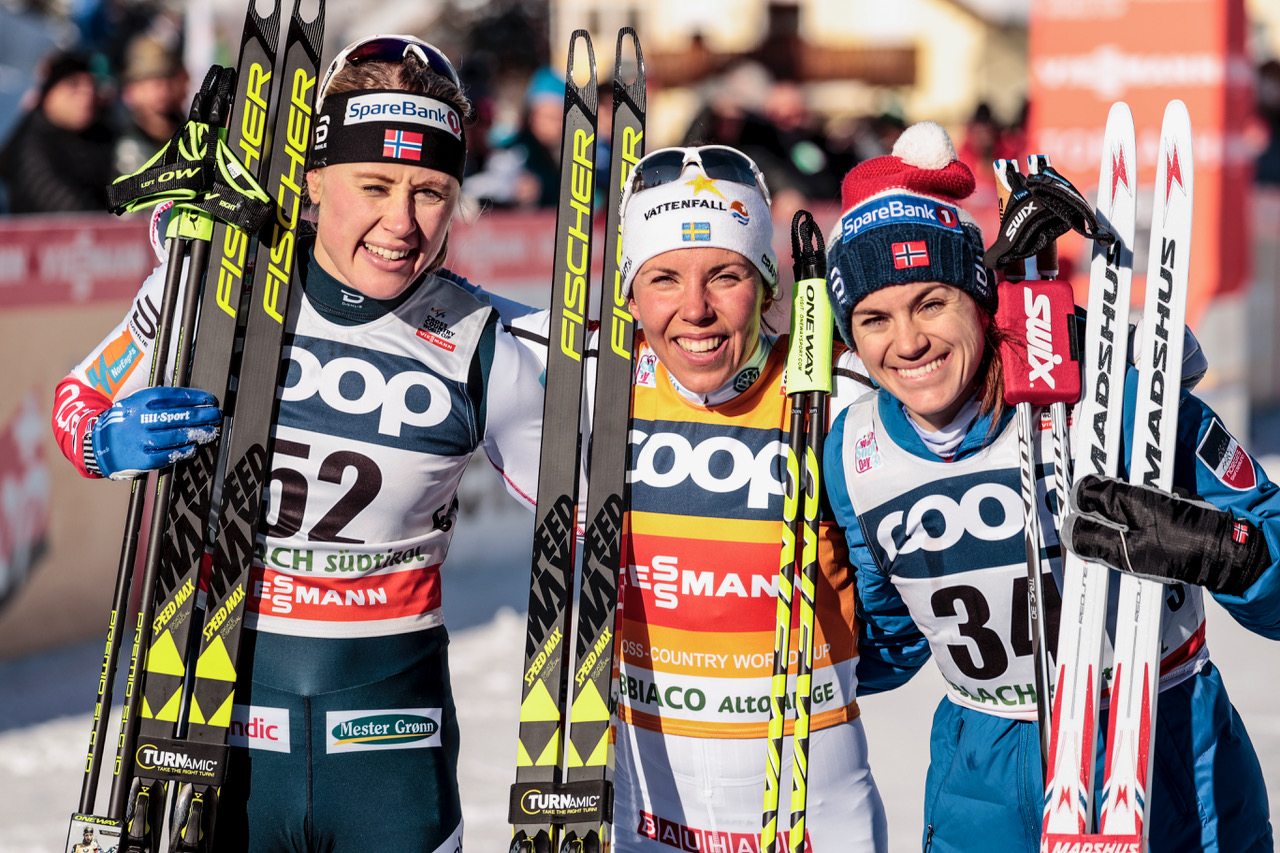
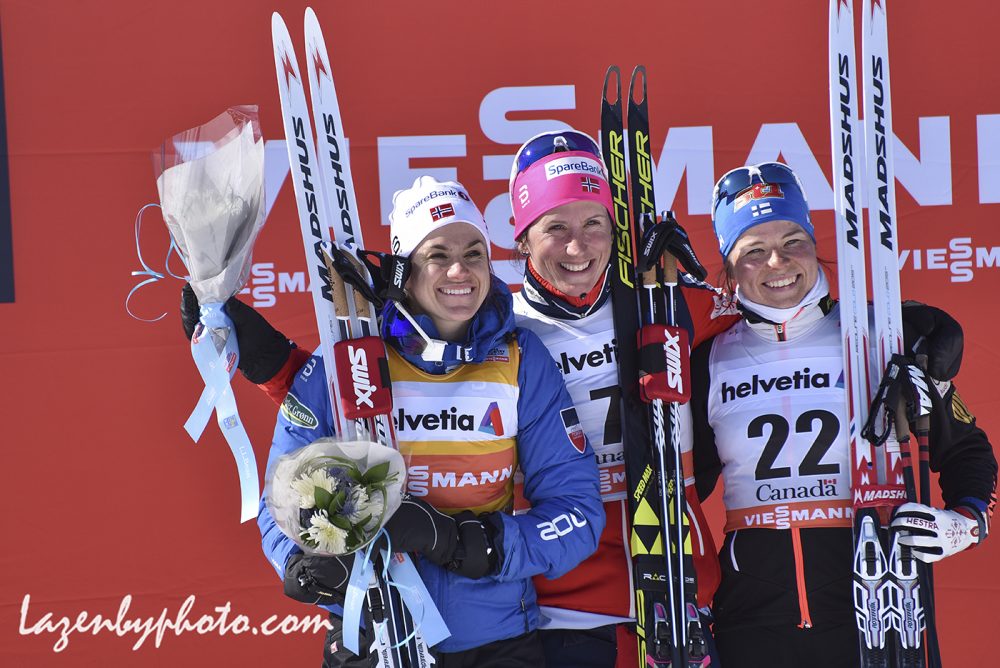
Kalla won the race in 22:40.1 minutes. Haga placed second 5.8 seconds back and Weng third (+13.8).
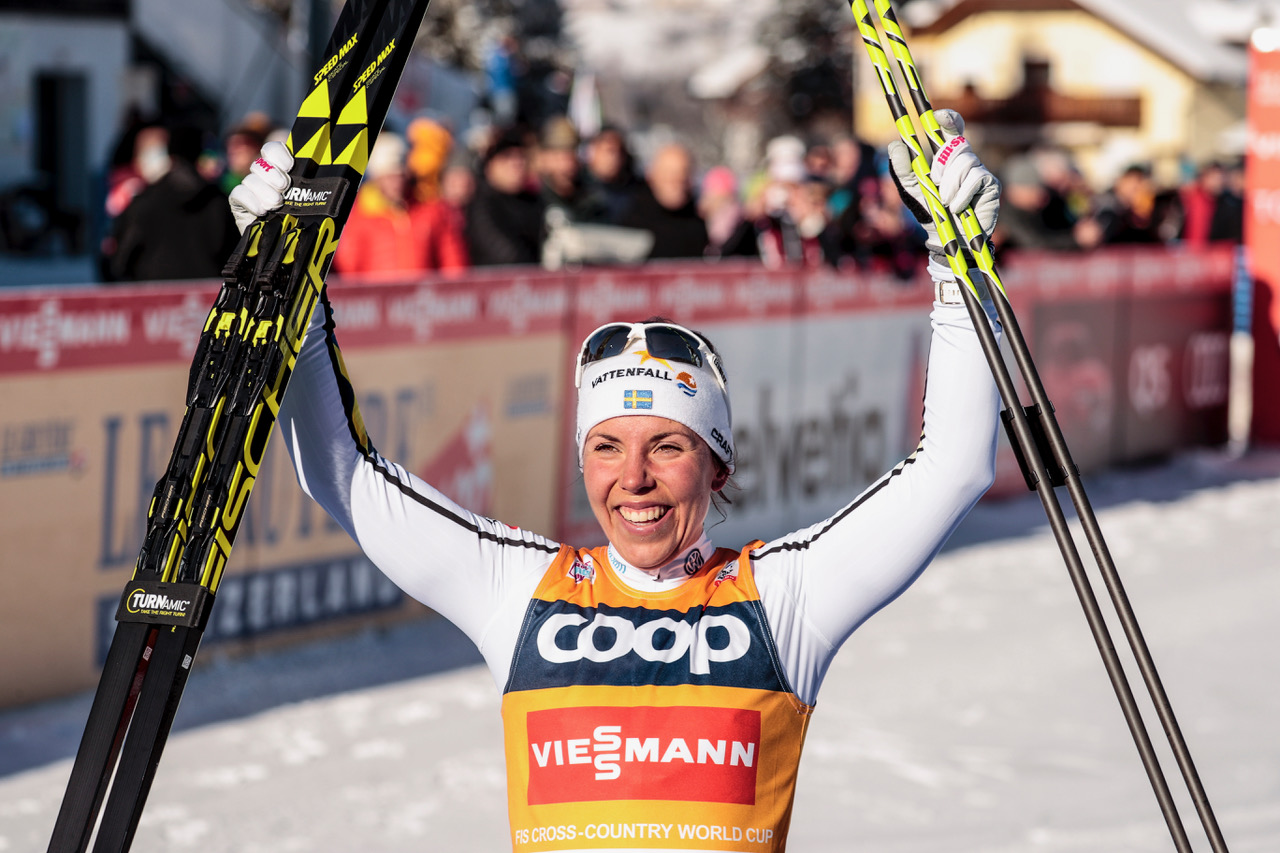
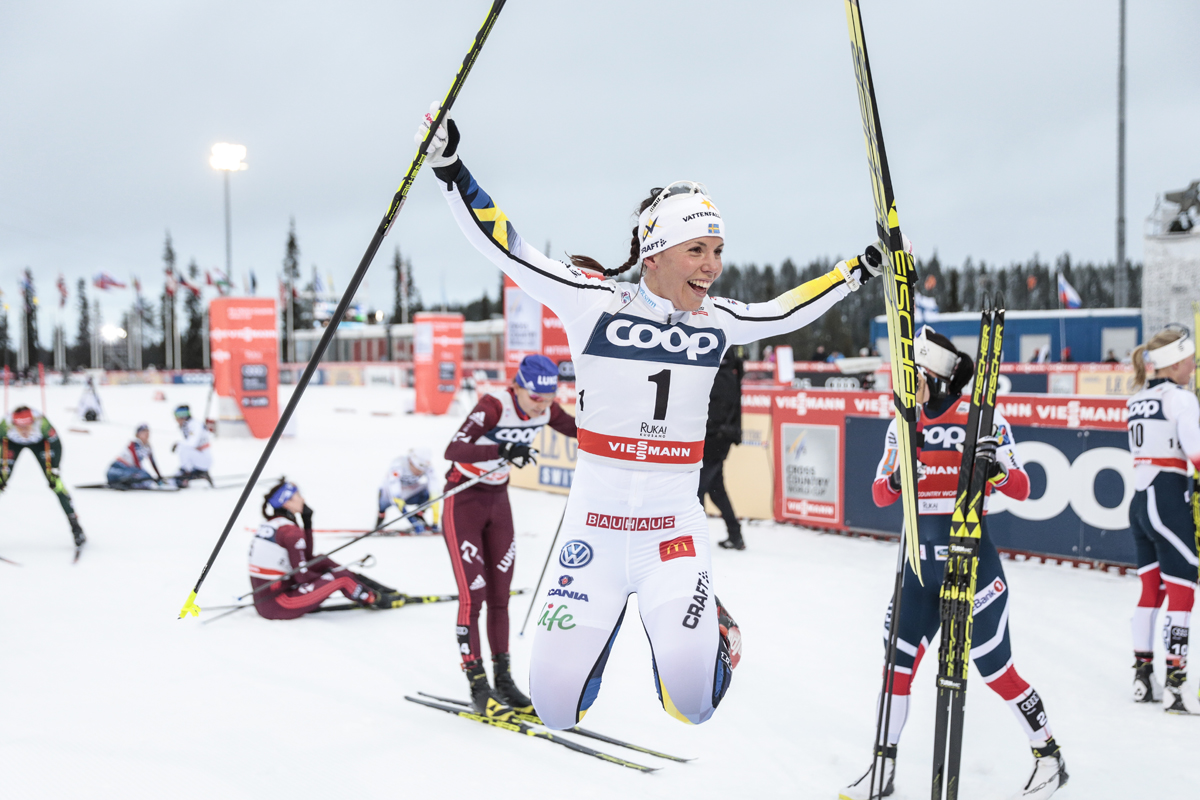
Sweden’s Charlotte Kalla after winning the women’s 10 k freestyle World Cup on Saturday in Toblach, Italy. (Photo: Fischer/Nordic Focus)
“I worked a lot in the summer on skiing fast on the flats,” Kalla said, according to an International Ski Federation press release. “I knew it was important here in Toblach. I love racing here. It was nice to see it worked. I had amazing skis, the team did amazing job. I had great fun skiing today when I felt my body was responding so well.”
Jacobsen finished about four seconds off the podium in fourth (+17.9), Bjørgen followed in fifth (+22.6), Østberg placed sixth (+29.3), and Jessie Diggins of the U.S. Ski Team (UST) was seventh (+40.5). Finland’s Kerttu Niskanen finished eighth (+43.5), and second USST member in the top 10, Sadie Bjornsen placed ninth (+43.9). Also in the points and in the top 20 for the U.S., Rosie Brennan raced to 19th (+1:15.2).
As World Cup Period 1 comes to a close after Sunday’s classic pursuit, in the early goings it looks like Kalla’s time to shine. Saturday marked her third World Cup win of the season: she finished first in the Ruka Triple’s 10 k skate pursuit to win the season-opening mini tour in Finland, and she won the Lillehammer 15 k skiathlon the weekend after in Norway. Last weekend in Davos, Switzerland, was an off-weekend for Kalla, who finished eighth in the 10 k skate.
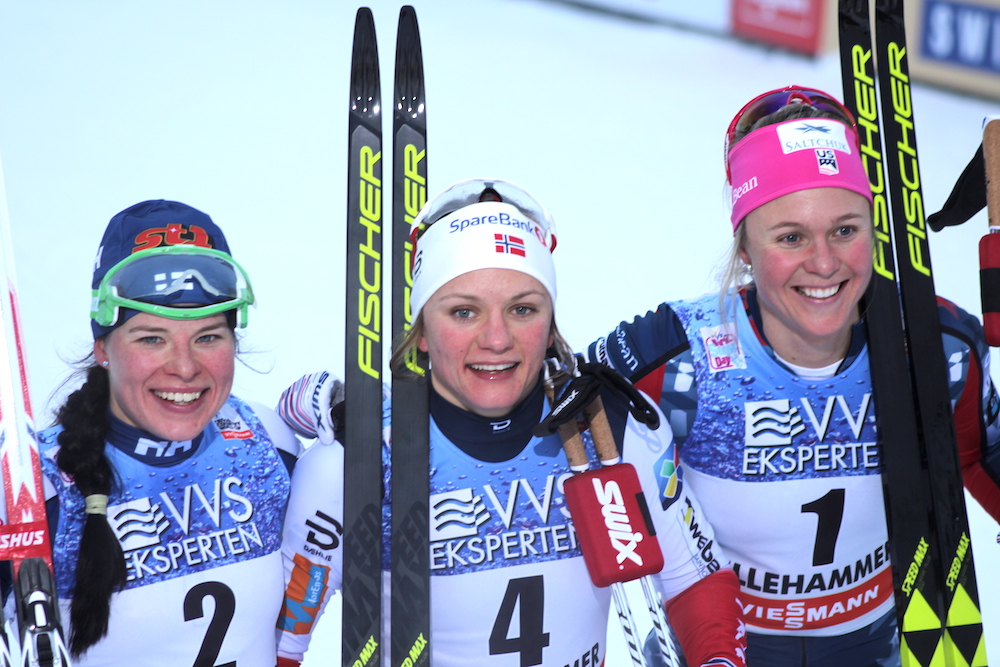
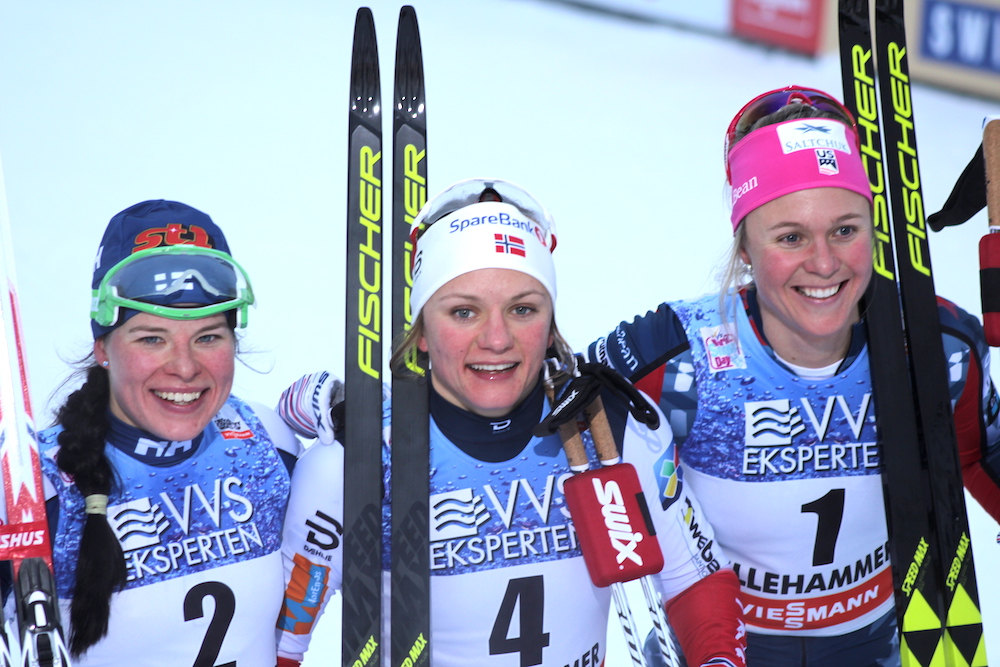
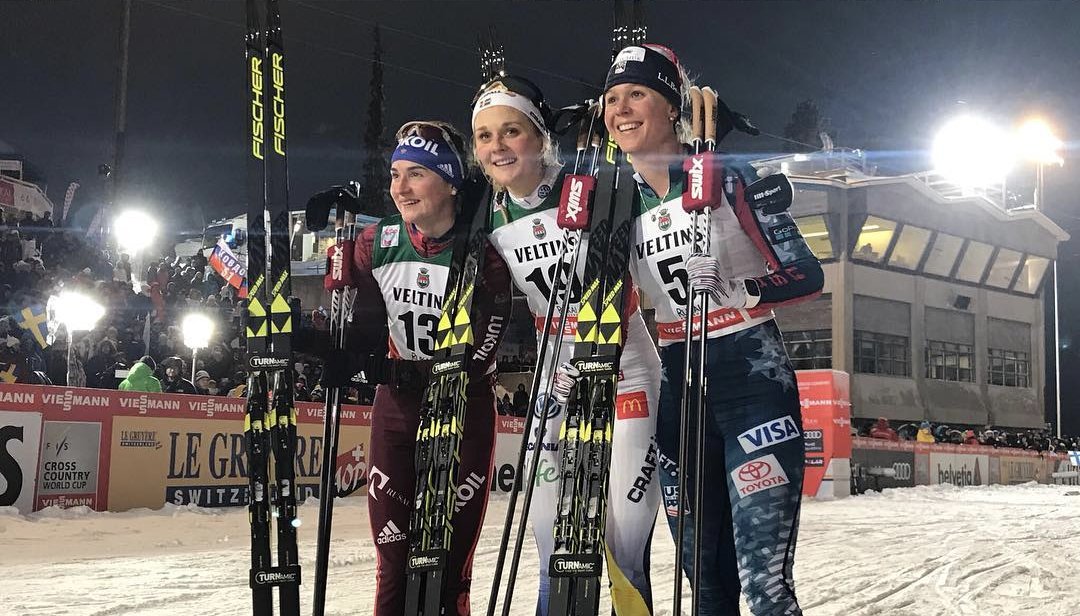
The women’s 10 k freestyle podium on Saturday at the World Cup in Toblach, Italy, with Sweden’s Charlotte Kalla (c) in first, and Norway’s Ragnhild Haga (l) and Heidi Weng (r) in second and third, respectively. (Photo: Fischer/Nordic Focus)
So far this season, Kalla is the most consistent woman on top of the scoreboard. Of the five distance races this season, she’s won three of them. Østberg and Bjørgen won the other two, and Haga notched a stage win with the fastest time in the Ruka pursuit.
Another remarkable indicator of national dominance and an individual’s staying power, is that according to FIS, since the beginning of the 2010/2011 season, a total of 17 World Cup 10 k skate races have been contested on the World Cup. Up until Saturday, all but a single race had been won by a Norwegian. Kalla, the only foil in Norway’s winning streak, also won a 10 k skate in 2015 in Östersund, Sweden.
Three Americans in Top 20
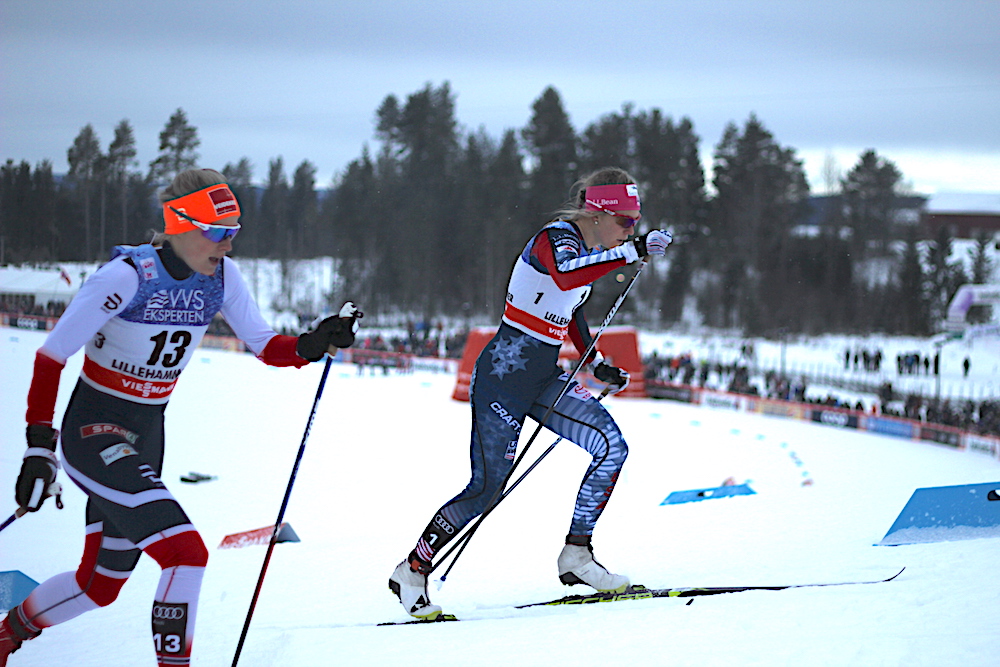
For Diggins, who finished seventh, 40.5 seconds off Kalla’s time, Saturday marked her ninth top 10 in 10 k events. Diggins’s performance was also her sixth top 10 of the season: four of which have been distance events and two sprints.
Her splits on Saturday indicated a consistent effort, with a lock on seventh place at the 2.1 k, 5 k, and 7.1 k marks.
“I went out hard and pushed as hard as I could today, and I felt like I had good skis (although it being an individual race, I didn’t do much skiing with other people out there)!” Diggins wrote in an email. “My style of racing is usually to just go as hard as I can from the start and try to ski smooth, powerful and work every section of the course.”
“It’s a fun course, and of course I’m sad that my old favorite course was changed but it’s still such a fun gliding course with so many transitions and a ripping fast downhill section!” Diggins explained. “It’s always fun to be in the fight in the top-10 and really motivating to work so hard for every single second on the course.”
Brennan described those course changes as reducing the overall number of climbs, but making those climbs more significant.
“They added in a much larger climb, it is steeper and longer,” Brennan said on the phone on Saturday. “It has a really fast downhill afterwards and then you climb what was the bigger climb on the old course. It used to be on the way back you had a these little lobes you went over on the way back to the start and they got rid of those. So basically, you have one really big steep climb, one more gradual but till pretty long climb. Then you shoot straight back towards the stadium. You are not tucking, it is an undulating working section all the way back.”
With one race to go until the end of Period 1, Kalla leads the overall World Cup standings with 570 points, while Diggins ranks eighth with 298 points.
“I feel like period 1 for me has been a solid, good start to the year,” Diggins wrote. “My focus and peak is aiming for the Games, so right now I feel when I’m racing that I’m fighting as hard as I can but don’t have that top gear just yet. Which is part of the plan, but still a little frustrating when you know you have more somewhere but just aren’t in top form – but, of course, that makes me even more motivated for later in the season!”
Sadie Bjornsen (U.S. Ski Team) racing to ninth in the women’s 10 k freestyle at the World Cup in Toblach, Italy. (Photo: Fischer/Nordic Focus)
Bjornsen, who placed ninth on Saturday, is ninth in the World Cup standings, just 10 points behind Diggins.
This season began with a bang for Bjornsen as she reached the podium on two successive weekends, both in classic sprints. Her result on Saturday marked her first-career top 10 in a World Cup 10 k skate race. She had previously placed seventh in a 2013 classic individual start in Lillehammer and ninth two years ago in a classic mass start in Val di Fiemme, Italy, during the 2016 Tour de Ski.
However, Bjornsen’s first World Cup podium came in Toblach last season in a 5 k skate.
“It was an exciting start to the World Cup Weekend here in Toblach,” Bjornsen said in a mass email to media outlets. “This is a special venue for me, as I have had some of my best races here, and I had my very first career individual podium here last winter. So, I have some good vibes and good confidence here. There is a new course here in Toblach, which added some tough climbing into the course, and a whole new challenge. I went out hard, as I have been trying to do these past few weeks, and tried to hang on as long as I could. My second lap was incredibly hard, as my legs were burning like crazy. I am very familiar with 5k feelings here in Toblach, but it is a whole new challenge with 10k. I am excited to have finished in 9th, my career best 10k skate result. As with last weekend, I think I have more to give, and more gears to find, but it is a great step for now! It will also put me in a really exciting position for tomorrow’s pursuit start 10k classict!”
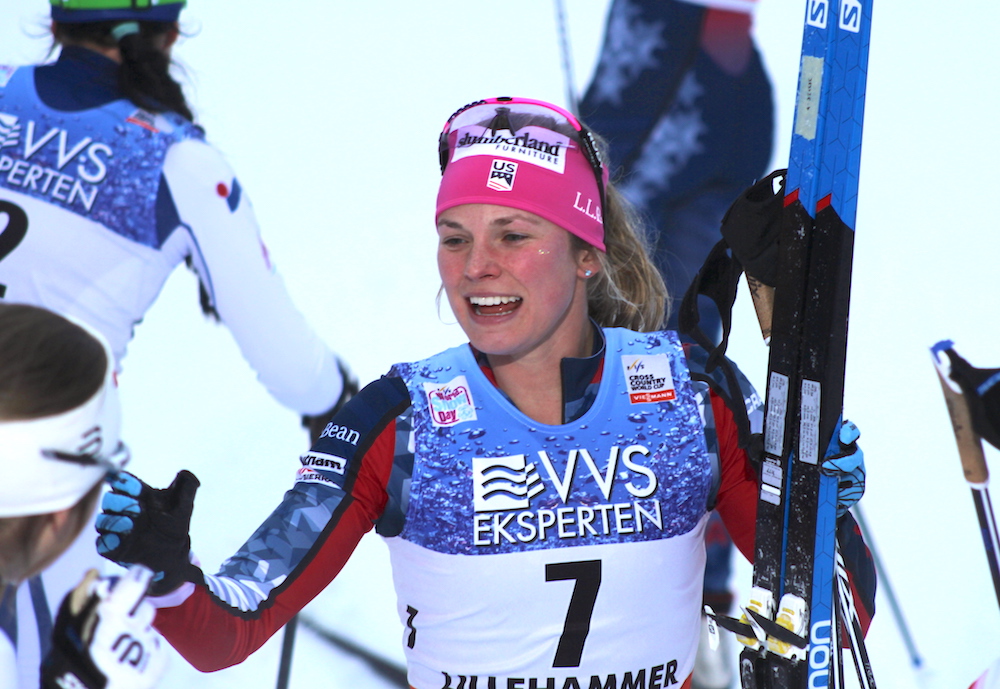
For the fifth time this season, Brennan scored World Cup points in the top 30. Her 19th place came on the heels of her 17th-place result in the 10 k skate last weekend in Davos.
“I had a good summer of training and I thought I was a lot smarter this fall in terms of taking recovery when I needed and also just finishing school in August really helped,” said Brennan, who, like Bjornsen, studied at and trains with Alaska Pacific University (APU) as a member of the U.S. Ski Team.
“It was just a very focused fall, and so I definitely kind of felt like I had top 20 in me so I am happy to have had back-to-back results,” Brennan said. “It reassures my confidence especially in skating. I generally consider myself better at classic.”
Including Saturday’s 19th in Toblach, Brennan has 10 top-10’s in 1o k races. Six of those came in skate races.
“I feel like it is interesting,” Brennan said about her success in the 10 k freestyle. “But the interesting part for me is that I feel like that my classic is much more consistent. The difference between a good day and a bad day is much smaller. And for skate, I think it can be be much bigger, I just don’t feel as confident in it. And but I do know when my fitness is good, and I can get my skating under me, I think it really excels so I have really good skate results, too. So that really makes me feel like my fitness is in the right place and if I can skate well I know I can classic well.”
That may bode well for Brennan as Sunday’s event is a 10 k classic pursuit based on the time back from today’s winner, Kalla.
“This is kind of new for us to do, a two-day pursuit,” Brennan noted of the Tobach weekend’s race format. “It will be interesting. I am looking forward to it. It is always fun to ski with people, and the people you start with are skiing a similar sped as you so you can in their and fight.”
Also for the U.S. Chelsea Holmes (APU) finished just outside the points in 34th (+1:38), and Liz Stephen (USST) placed 47th (+2:00.6).
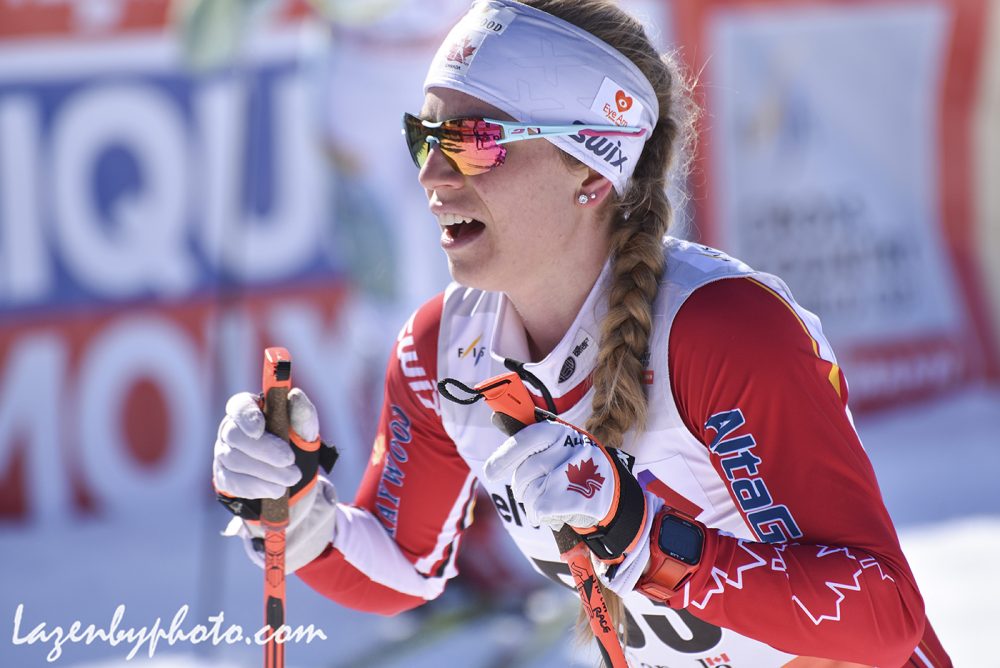
Canada started four skiers. Emily Nishikawa (Canadian World Cup Team) finished 51st (+2:07.3), Cendrine Browne (Canadian U25 Team) 55th (+2:20.9), Dahria Beatty (World Cup Team) 69th (+3:04.9), and Katherine Stewart-Jones (U25 Team)77th (+4:07.7).
Racing continues Sunday in Toblach with a 10k classic pursuit for the women.
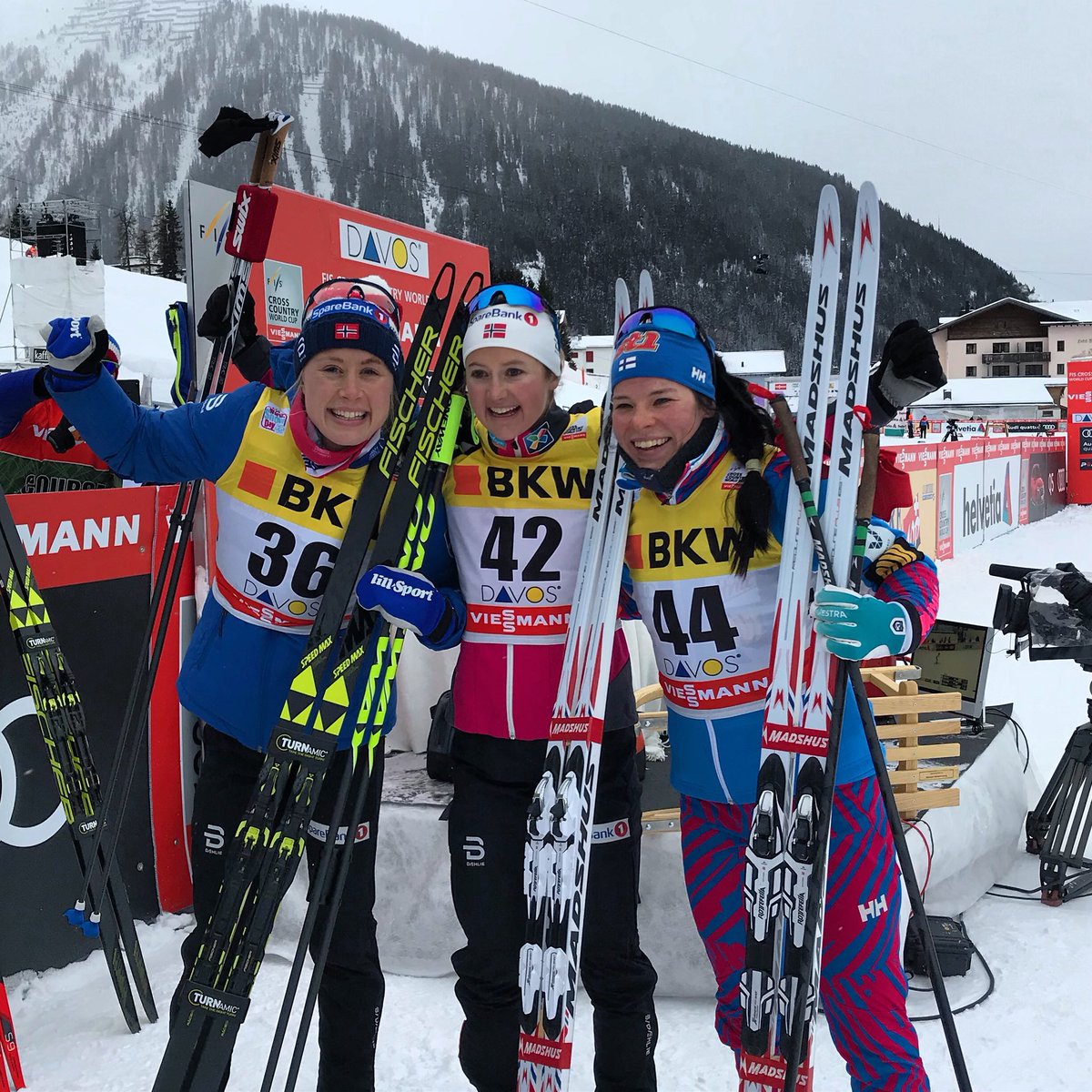
The women’s 10 k freestyle podium on Sunday at the Davos World Cup in Switzerland, with Norway’s Ingvild Flugstad Østberg (c) in first and Ragnhild Haga (l) in second, and Finland’s Krista Parmakoski (r) in third. (Photo: FIS Cross Country/Twitter)
DAVOS, Switzerland – Ingvild Flugstad Østberg picked up the third Davos win of her career, and just like one year ago, the Olympic silver medalist didn’t do it in the sprint. Instead, Østberg made her mark in the distance event, this year a 10 kilometer freestyle race.
Bib 42 in the interval-start competition, the Norwegian knew the split times of some of her top competitors, and quickly surpassed them. By the 5 k mark she had a 5.5-second lead over teammate Heidi Weng, 13 seconds over Sweden’s Charlotte Kalla – who had won the previous three distance races of the season – and nearly 20 seconds over Norwegian teammate Marit Bjørgen.
Later starters threatened, with Switzerland’s Nathalie Von Siebenthal laying down a time at the 5 k mark that nobody could match. Kerttu Niskanen of Finland was also fast at the halfway point, just a second behind Østberg’s time.
But while Østberg stayed aggressive and strong over the second lap of the course, several competitors slowed, perhaps having started too fast. To the sighs of the Swiss crowd, Von Siebenthal faded and finished in a tie for fifth with Austria’s Teresa Stadlober. Niskanen was seventh.
That left Østberg at the top of the standings, 5.9 seconds ahead of teammate Ragnhild Haga and 7.9 seconds ahead of Finland’s Krista Parmakoski.
“It was completely insane,” Østberg told Norway’s NRK broadcaster. “That’s what I’ve been training for the whole year. This is my favorite place and I love being here.”
It was Østberg’s second podium of the season after finishing third in the 10 k classic in Ruka, Finland.
“I am very impressed,” Bjørgen agreed. “Ingvild went very well here last year, too.”
Parmakoski was ranked second at the 8.2 mark, but lost time compared to earlier starter Haga, who was able to finish second thanks to her aggressive skiing on the course’s downhill finish.
Haga is continuing to have her best season to date; this was her third podium, all coming in distance races. Second place is also her best individual World Cup finish ever.
“t was thrilling [as in nervous] to race, because it was so close,” Haga told Norway’s TV2 of receiving splits along the course, according to a translation. “On the top coach yelled out that I had to ski with my life … It feels great to end up on the podium when it was such a close race.”
Weng was left off the podium in fourth (+14.5). Kalla finished eighth (+26.8), Bjørgen ninth (+35.9), and Norway’s Astrid Jacobsen tenth (+37.6).
Sadie Bjornsen (U.S. Ski Team) racing to 12th in the World Cup women’s 10 k freestyle on Sunday in Davos, Switzerland.
After a banner day in the freestyle sprint on Saturday, which saw four American women in the top eight, the team comparatively slowed. But they still packed the top 20, with Sadie Bjornsen 12th (+44.6), Kikkan Randall 14th (+56.8), Jessie Diggins 15th (+59.9), and Rosie Brennan 17th (+1:11.2).
“I haven’t raced a distance race here in a few years,” Bjornsen said. “I wasn’t really sure how to approach it other than my wax tech told me yesterday to ski the uphills and race the downhills. I went out a little harder than I normally do on purpose, to see if I could hold it. I think that on a course like this I have to operate like that.”
It worked, and despite the hard start Bjornsen kept an even position in the field: 10th after 3.2 k, 11th after 5 k, and 12th at the finish.
“This is, for me, one of the hardest courses because there’s not a second of rest out there,” she said. “I often do a little bit better when I have some recovery. I did today just as a challenge for myself, to practice pushing through some serious pain cave. The result isn’t what matters today. It’s that I did that effort. I felt like I was able to push that.”
Diggins wasn’t happy with her race; after being sick earlier in the week, she had rallied for the sprint, where she finished fourth yesterday. But in the 10 k she was unable to match her fourth-place finish from last year’s 15 k.
Jessie Diggins (U.S. Ski Team) racing to 15th in the World Cup women’s 10 k freestyle on Sunday in Davos, Switzerland.
“It was disappointing for me,” she said. “It wasn’t what I wanted. I felt like my reserves, now that I’ve been sick, maybe wore out. So I made it through yesterday and just didn’t have it today. That’s okay — not every day is going to be good. It felt like I was pushing as hard as I could but I just didn’t have a lot there today. And if something is not great, then it really, really shows on this course.”
Randall, meanwhile, felt like she put together a solid weekend after hitting the podium in the sprint and then finishing 14th. In her last Davos distance race before retirement, it was also her best Davos distance result. On her first lap, she skied with Kalla, who was finishing the race.
Sweden’s Charlotte Kalla, in the overall World Cup leader’s bib, leads American Kikkan Randall during the women’s 10 k freestyle individual start at the Davos World Cup in Switzerland.
“I think today was good,” Randall said. “It was fun to ski with Charlotte on the first lap. I actually felt pretty comfortable skiing behind her. But then on the second lap it was like, oh, that’s what she must have been feeling like. So it was good to get that pace to start and then have to work through it myself on the second lap. So it was solid. It wasn’t a spectacular day, but overall pretty good.”
Ranked 23rd at the halfway point of the race, Brennan rallied and moved up on the second time up the course’s long climbing section, before losing a few more seconds on the downhill.
“The uphills!” she laughed when asked whether there was a part of the race that had worked particularly well for her. “The downvalley, I don’t know, I probably have some work to do on that. But gradual uphills are good for me. This course is special — even when you are skiing, you don’t really know what’s going on. You just have to find a way to keep moving. But I felt like I was able to do that, so I’m pretty happy.”
Chelsea Holmes finished 29th (+1:32.9), Liz Stephen 40th (+1:58.5), and Sophie Caldwell 52nd (+2:20.1).
Cendrine Browne (Canadian U25 Team) racing to 45th in the World Cup women’s 10 k freestyle on Sunday in Davos, Switzerland.
Cendrine Browne led the Canadian team in 45th (+2:05.9), followed by Emily Nishikawa in 50th (+2:18.4).
“It went well,” said Browne. “I’m really happy – usually I have a hard time at altitude because I live at sea level. So I went into the race not knowing how it would go. Last year it did not go really well for me. So I was happy that I had good feelings during the race, I was able to push.”
After struggling last year, Browne tried to be deliberate in her approach to the Davos course this time around.
“Yesterday I talked about that with my coach, Louis [Bouchard]. “And other athletes, like Alex, were saying don’t start too fast because everybody dies on this course because it’s so hard. But I talked with Louis and we decided that I would do like always, I would start fast and see if I could hold that pace. So I started fast. I think I had a really good start. I tried to just keep going.”
Also for Canada, Dahria Beatty placed 73rd (+2:53.0) and Katherine Stewart-Jones 79th (+3:44.6).
Caitlin Patterson (Craftsbury Green Racing Project) charging up the wall climb en route to the win in the women’s 10 k freestyle on Sunday at the Sovereign Lake NorAm/SuperTour near Vernon, B.C. (Photo: Peggy Hung)
NorAm/SuperTour (Sovereign Lake near Vernon, British Columbia): 10/15 k freestyle
VERNON, B.C. — The combined NorAm and SuperTour event at the Sovereign Lake Nordic Centre continued with individual-start distance races and continued with the theme of U.S. domination of the leaderboard.
Ian Torchia, of Northern Michigan University (NMU) and the U.S. Ski Team D-team, started the day with a big victory in the men’s 15 k freestyle, finishing in 36:29.7 minutes and on the heels of Canadian Para-Nordic guide Graham Nishikawa, who started 30 seconds ahead of him and ended up sixth. Jack Hegman of the Sun Valley Ski Education Foundation (SVSEF) placed second, 19.0 seconds back, to complete his good weekend. Canadian Para-Nordic superstar Brian McKeever rounded out the podium in third, 22.6 seconds back.
Graham Nishikawa (l) and Ian Torchia worked together after Torchia closed the 30-second gap en route to a victory in the men’s 15 k freestyle on Sunday at the Sovereign Lake NorAm near Vernon, B.C. (Photo: Peggy Hung)
The women were next to get some time in the sunshine with two laps for 10 k. Caitlin Patterson of the Craftsbury Green Racing Project (CRGRP) upgraded from Saturday’s silver to gold on Sunday with winning time of 27:13.0. Rosie Frankowski of Alaska Pacific University (APU) snatched second, 30.7 seconds back. Caitlin Gregg (Team Gregg) raced to third, 1 second behind Frankowski.
Former Canadian national-team biathlete Zina Kocher started her new cross-country career as the top Canadian in seventh (+1:31.2).
The weather was a repeat of Saturday: -2 degrees Celsius, windless and sunny. Smiles were evident everywhere, even for athletes who didn’t quite nail the pacing on an unforgiving course.
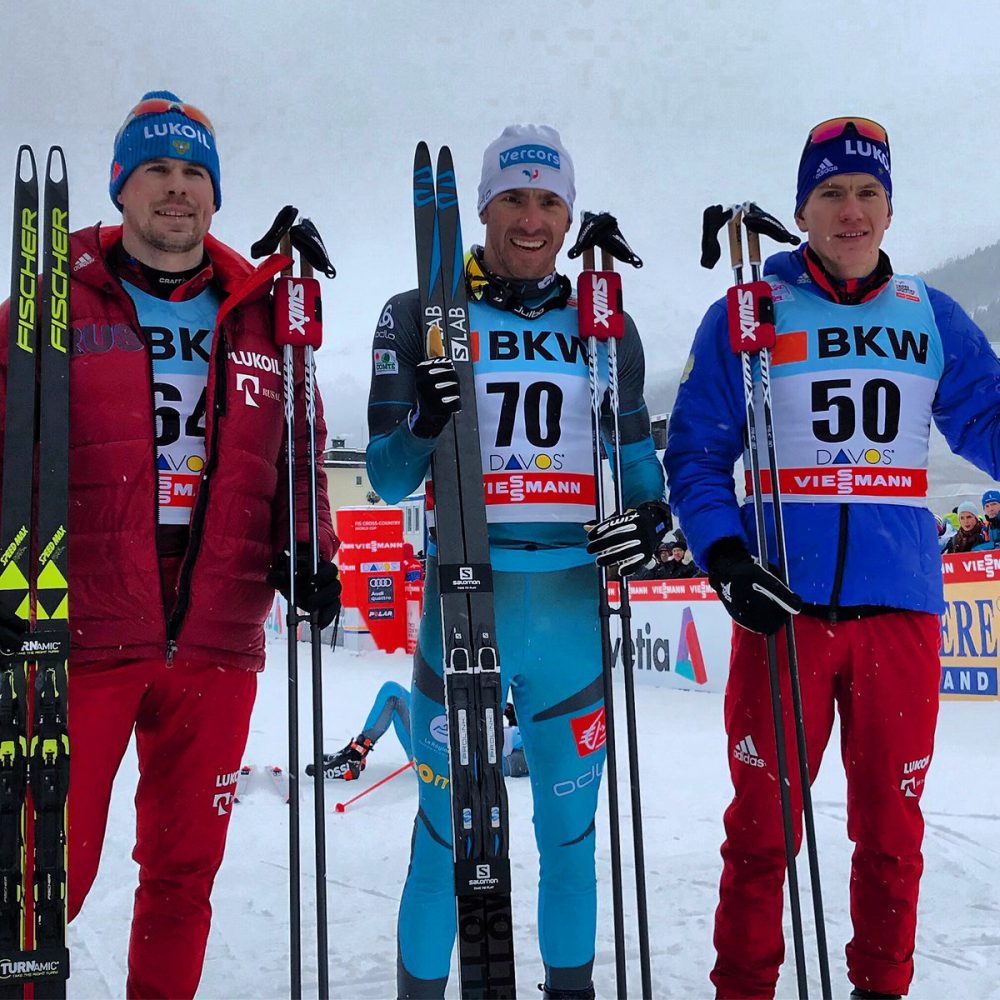
France’s Maurice Manificat (c) after winning the men’s 15-kilometer freestyle on Sunday in Davos, Switzerland. He finished ahead of Russians Sergey Ustiugov (l) and Alexander Bolshunov in second and third respectively. (Photo: FIS Cross-Country/Twitter)
FIS Cross Country World Cup (Davos, Switzerland): 10/15 k freestyle
After a day of sprinting, cross-country racers returned to the Davos World Cup venue on Sunday for the women’s 10-kilometer and men’s 15-kilometer freestyle individual start competitions.
For his first World Cup win in almost two years, France’s Maurice Manificat took the men’s 15 k race title in a time of 33:56.2. Exactly 4 seconds flat behind Manificat in second place was Russia’s Sergey Ustiugov. Ustiugov’s teammate Alexander Bolshunov, finished 10 seconds behind Ustiugov and 14.6 seconds behind Manificat for the men’s third and final podium spot.
The remainder of the men’s top ten included Norway’s Simen Hegstad Krüger in fourth (+21.3), Switzerland’s Dario Cologna in fifth (+26.5), Sweden’s Marcus Hellner in sixth (+35.4), Russia’s Denis Spitsov in seventh (+36.1), Hans Christer Holund of Norway in eighth (+36.9), Russian Alexey Chervotkin in ninth (+54.2), and Alex Harvey of Canada in 10th (+1:01.2).
The next best male North American finisher was American Patrick Caldwell in 41st (1:50.2).
Canada’s Devon Kershaw placed 44th (1:59.8), Graeme Killick 59th (+2:27.8), Russell Kennedy 68th (+2:43.4), and Julien Locke in 94th (4:27.5). Knute Johnsgaard did not start.
For the U.S., Noah Hoffman finished 48th (2:05.5) and Scott Patterson 88th (3:46.2). Simi Hamilton did not start and Andy Newell did not finish.
The women’s 10 k freestyle podium on Sunday at the Davos World Cup in Switzerland, with Norway’s Ingvild Flugstad Østberg (c) in first and Ragnhild Haga (l) in second, and Finland’s Krista Parmakoski (r) in third. (Photo: FIS Cross Country/Twitter)
In the women’s 10 k, 75 starters finished the 10 k course with Norway’s Ingvild Flugstad Østberg claiming first in a time of 25:28.5. Her Norwegian teammate, Ragnhild Haga finished 5.9 seconds behind her for second place. Krista Pärmäkoski of Finland raced to the third and final podium spot, 7.9 seconds back from Østberg’s winning time.
Rounding out the women’s top ten was Heidi Weng in fourth (+14.5), Austria’s Teresa Stadlober in fifth (+16.4), Switzerland’s Nathalie von Siebenthal in sixth (+16.4), Finland’s Kerttu Niskanen in seventh (+24.9), Sweden’s Charlotte Kalla in eighth (+26.8), Norwegian Marit Bjørgen in ninth (+35.9), and Astrid Uhrenholdt Jacobsen in tenth (+37.6).
Leading the U.S. women was Sadie Bjornsen in 12th (+44.6), seven seconds outside the top ten. The next two Americans finishers were within 3.1 seconds of each other, with Kikkan Randall finishing 14th (+56.8) and Jessie Diggins in 15th (+59.9).
Also scoring World Cup points for the Americans, Rosie Brennan finished in 17th (+1:11.2) and Chelsea Holmes in 29th (+1:32.9).
The U.S.’s Liz Stephen and Sophie Caldwell finishedin 40th (+1:58.5) and 52nd (+2:20.1), respectively.
For the Canadians, the team was led by Cendrine Browne in 45th (+2:05.9), followed by Emily Nishikawa in 50th (+2:18.4). Dahria Beatty placed 73rd (+2:53.0) and Katherine Stewart-Jones 79th (+3:44.6).
IBU World Cup (Hochfilzen, Austria): Men’s and women’s relays
Men’s and women’s relays took place on the final day of racing in Hochfilzen, with Norway winning the men’s 4 x 7.5 k and Germany topping the women’s 4 x 6 k by considerable margins.
Norway’s Ole Einar Bjørndalen, Henrik L’Abée-Lund, Erlend Bjøntegaard, and Lars Helge Birkeland raced to first in 1:21.21.8 hours, nearly two minutes clear of Germany in second, after taking the lead on L’Abée-Lund’s second leg. They avoided the penalty loop and used a total of nine spares, and never lost hold of first place for the rest of the race.
Germany raced to second (+1:54.9) with Erik Lesser, Benedikt Doll, Arnd Peiffer, and Simon Schempp, with zero penalties and 17 spares, after Peiffer lifted them from fourth to second on the third leg. Schempp held them there, despite using a maximum of three spares on each of his shooting stages, in the final leg.
France claimed third (+2:34.0) with Jean-Guillaume Béatrix, Simon Desthieux, Emilien Jacquelin, and Quentin Fillon Maillet, despite three penalties and 13 spares. Two of their penalties came on Beatrix’s first leg and another in Fillon Maillet’s final shooting. After being tagged in fifth, Jacquelin raced them up to third on the third leg and Fillon Maillet held onto that position for the last spot on the podium.
The U.S. men finished ninth (+3:38.3) with Lowell Bailey, Leif Nordgren, Tim Burke, and Sean Doherty, after they combined for three penalties and 13 spares. Bailey avoided the penalty lap and put them in third at the first exchange, while Nordgren slipped to seventh after a penalty, Burke remained in seventh with one penalty as well, and Doherty had one more penalty to anchor the team to ninth.
Canada placed 15th (+6:22.5) with six penalties and 20 spare rounds, with Christian Gow, Scott Gow, Nathan Smith, and Brendan Green. After being tagged in 21st, Smith raced them up to 13th, using just two spares to clean. Green anchored them to 15th after using six spares and skiing the 15th-ranked time on that last leg.
In the women’s relay that followed, Germany won by 44.9 seconds over Ukraine, with Vanessa Hinz, Franziska Hildebrand, Maren Hammerschmidt, and Laura Dahlmeier using nine spares while staying out of the penalty lap.
After Hinz raced them into first, Hildebrand slipped to fourth after using four spares on the second leg. Hammerschmidt raced the fastest third leg to put them back in first, and Dahlmeier held them there to the finish, crossing first in 1:14:36.4.
Ukraine (0 penalties, 5 spares) took the lead on the second leg but ultimately settled for second with Vita Semerenko, Yuliia Dzhima, Valj Semerenko, and Olena Pidhrushna. Dzhima put them in second heading into the race’s halfway point, but Valj Semerenko lost two places to tag Pidhrushna in third. Pidhrushna used just two spares on the final leg to bring them to second, about 20 seconds ahead of France in third.
Despite a tough first leg for Marie Dorin Habert, in which she had two penalties and tagged off in 14th, France rose to third place at the finish (+1:04.5) thanks to strong skiing and shooting from anchor Anaïs Bescond.
The team had a total of two penalties and 13 spares. Celia Aymonier used four spares to put them in ninth after the second leg, and third-leg Justine Braisaz lifted them one more place to seventh before Bescond skied the fastest last leg to pick off four more places.
Canada placed ninth (+2:31.6) with Emma Lunder, Rosanna Crawford, Megan Bankes, and Julia Ransom, with no penalties and nine spares. Crawford put them in fifth after the second leg, Bankes lost one place on the third leg, and Ransom slipped three more with three spares on her final shooting to finish ninth.
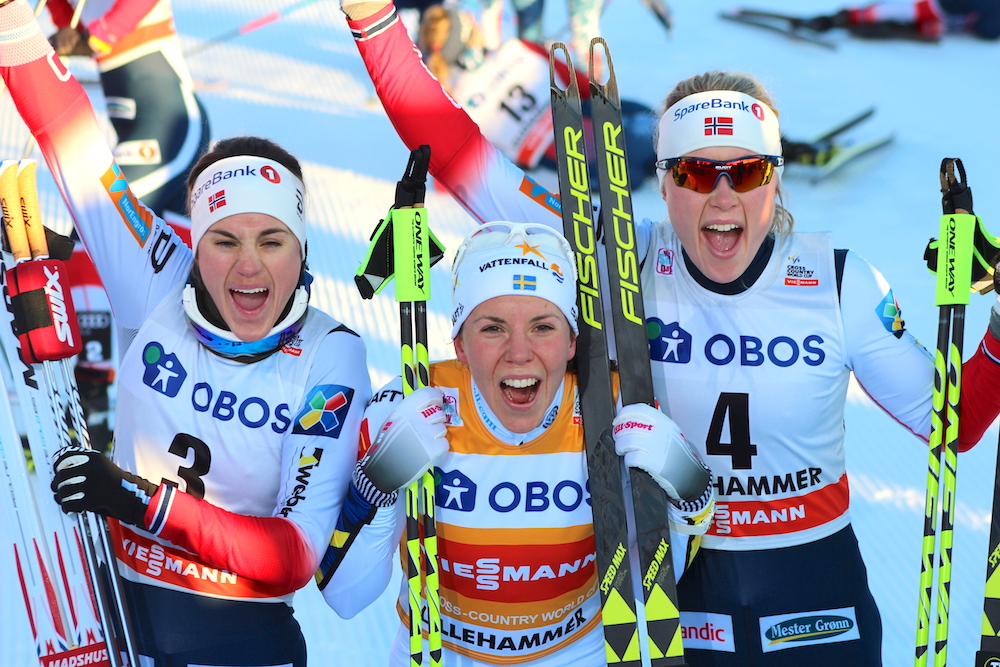
Charlotte Kalla (c) of Sweden with Norwegians Heidi Weng (l) and Ragnhild Haga after placing first, second and third, respectively, in the women’s 15-kilometer skiathlon on Sunday in Lillehammer, Norway. (Photo: Henrik Hunnes)
If it hadn’t been for the steady bob of her yellow leader’s bib and an intermittent shadow from the sun’s glare cast by the trail’s treeline, Charlotte Kalla might have blended right into the snow: her white suit symbolic of Sweden smooth across the Lillehammer race course in Norway.
As it were, the overall World Cup leader’s bib, her prize from winning last weekend’s battle against Norway’s Marit Bjørgen, could not be contested. Kalla crested the final climb of the women’s 15-kilometer skiathlon on Sunday with no Norwegians in sight, headed toward her second distance win in a row. Her closest competitor was Norway’s Heidi Weng, who finished 19.7 seconds after Kalla crossed the line in 42:24.7.
“It felt good, and when I was on that last climb I felt fine, but didn’t know that Heidi could not follow me,” Kalla said, according to a International Ski Federation (FIS) press release.
From the beginning Kalla commanded the lead, charging the classic portion out of the start. By the 2.5 k mark, the field had reached the course’s major climb, Weng pushing to the front and creating a small gap on the field, pulling Kalla and Austria’s Teresa Stadlober with her.
Leading the second group charge a little over seven seconds back was Finland’s Krista Pärmäkoski, followed by Norwegian’s Ragnhild Haga and Kathrine Rolsted Harsem,as well as the U.S. Ski Team’s Jessie Diggins.
Sweden’s Charlotte Kalla winning the World Cup women’s 15 k skiathlon on Sunday at the Lillehammer World Cup in Norway. (Photo: Henrik Hunnes)
In just over a kilometer, Diggins had taken over the helm of the second group’s chase, closing the gap between herself and the leaders by three seconds. By the next kilometer, the crowd had swallowed Stadlober, while Diggins cruised into the third-place position.
“I think that was maybe the best I have classic skied in my entire life. I had amazing skis and I was just feeling really good,” Diggins said during a post-race interview with FasterSkier.
Diggins held onto third through the exchange, after Kalla and Weng had already passed through 21 seconds before.
“I knew that I need an easy classic, before the ski exchange [to] skate,” Kalla said. “Especially when I know how the uphills here are, it’s a very tough and long climb out of the stadium.”
For the first 5 k of the freestyle portion, Kalla trailed Weng by mere milliseconds, matching every two of Weng’s glides with a powerful one of her own.
As the two leaders approached the major climb for the final time, a sideways glance from both created a momentary pause: who wanted the lead?
In the end, it was Weng. She headed up the hill in front of Kalla, the taste of a Norwegian win on home turf in the back of her mouth. But Kalla’s momentary drop from the lead was no mistake; tactics as camouflage to her competitor as her suit in the snow.
Midway through the hill, the Swede made her move, using her powerful V2 to get around Weng and distancing herself from the Norwegian by 12 seconds as she cornered her way back toward the stadium.
“Skating was really tough,” Weng said, according to FIS. “I’m glad I held myself back a little, because Charlotte got really strong on the skating part, and on that last hill I knew she would go ahead. She was in another league. She is in a very good shape.”
Heading into the finishing stretch, Kalla had extended her lead by another seven seconds, waving to the crowd as she crossed first. Following Weng in second was Haga in third place (+43.6).
“I was not satisfied with the first round classic, but I got a bit better after that and I was able to stay in contact with the leader,” Haga said according to FIS. “I felt stronger when we started with freestyle, but then I broke my pole in the last hill and I thought it was over for me regarding a podium position, but then I got a new one from the one of our coaches, and he told me that it was still possible.”
In fourth, 54.3 seconds behind Kalla was Bjørgen, just ahead of Diggins in fifth (+57.0).
Norway’s Heidi Weng finishing second the World Cup women’s 15-kilometer skiathlon on Sunday in Lillehammer, Norway. Sweden’s Charlotte Kalla (not shown) finished 19.7 seconds ahead for the win. (Photo: Henrik Hunnes)
“She put herself right in the race to be a contender for the podium today,” USST Women’s Coach Matt Whitcomb said of Diggins during a post-race phone interview. “It got away from her … but it’s really encouraging, particularly on a course as challenging as this one is in Lillehammer, that Jessie can fight in the top five like that.”
“I think she’s coming out of yesterday with a lot of confidence in her classic skiing, having made the sprint final,” Whitcomb continued. “In the past it’s more been about damage control in the classic leg, and now it’s about doing damage to others.”
Rounding out the top 10 was Stadlober in sixth (+1:04.9), Pärmäkoski in seventh (+1:07.8), Norway’s Ingvild Flugstad Østberg in eighth (+1:26.0), Russia’s Natalia Nepryaeva in ninth (+1:27.8), and a second USST member, Sadie Bjornsen in 10th (+1:32.6).
“She’s just been turning heads, demonstrating such great fitness and composure as she races in some pretty high stress situations,” Whitcomb said of Bjornsen. “Really strong all weekend.”
After coming through the exchange in 23rd, Kikkan Randall (USST) worked her way up to 16th (+2:06.5) by the end of the freestyle portion of the race.
“Had a good start but lost some ground on the first time up the big climb,” Randall wrote in an email to media outlets. “Found a better groove in the second classic lap and felt much stronger in the skate. Underlying fitness feels strong but still searching for my full race gear. Great conditions, even saw a bit of sun out there!”
Also scoring World Cup points for the USST on Sunday was Rosie Brennan 29th (+3:07.7).
Canada’s Emily Nishikawa racing to 49th the women’s 15-kilometer skiathlon on Sunday at the World Cup in Lillehammer, Norway. (Photo: Henrik Hunnes)
“The harder the course, the more promising things get for Rosie,” Whitcomb said. “She’s just a worker out there. She can really drop it into low gear and pick off people on these big climbs. She’s been skiing the descents really aggressively; it makes sense that she hit the top 30 today.”
Also racing for the U.S., Liz Stephen finished 36th (+3:25.7), Chelsea Holmes 38th (+3:39.6) and Ida Sargent 55th (+6:41.1).
“Chelsea, in what is generally not her strong technique, was able to climb up into the top 30 in the classic portion of the skiathlon. That was really nice to see.” Whitcomb said. “She can certainly do really well in this event, particularly if she skis the way she did in parts of that classic race.”
Cendrine Browne led Canada in 45th (+4:37.3) while her teammate Emily Nishikawa followed in 49th (+5:00.1). Katherine Stewart-Jones did not finish.
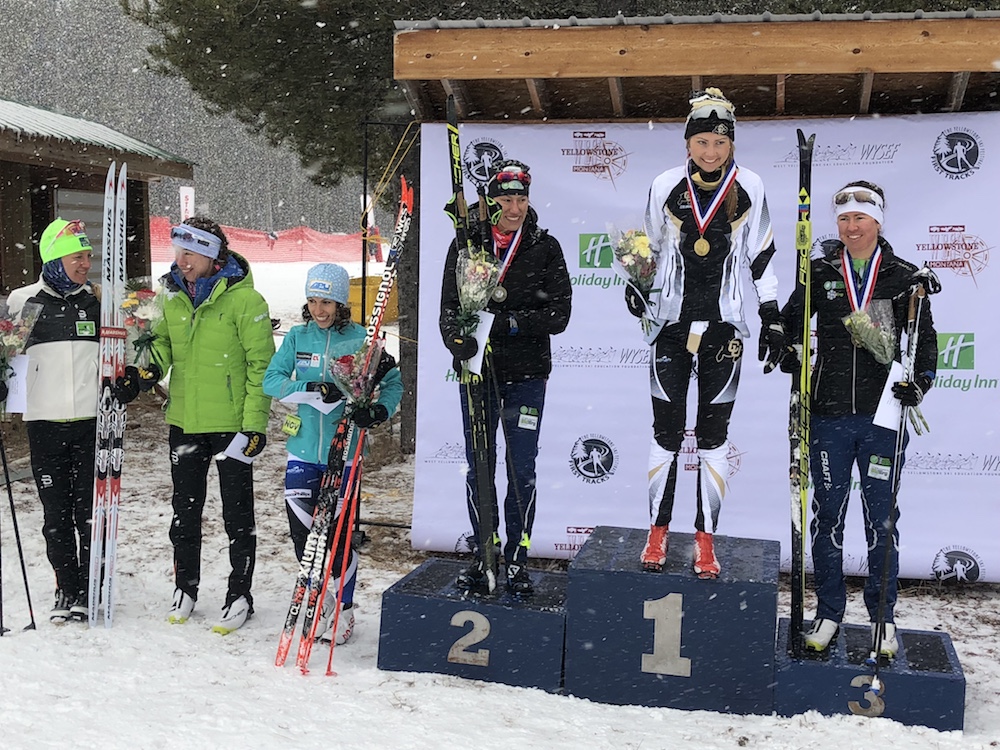
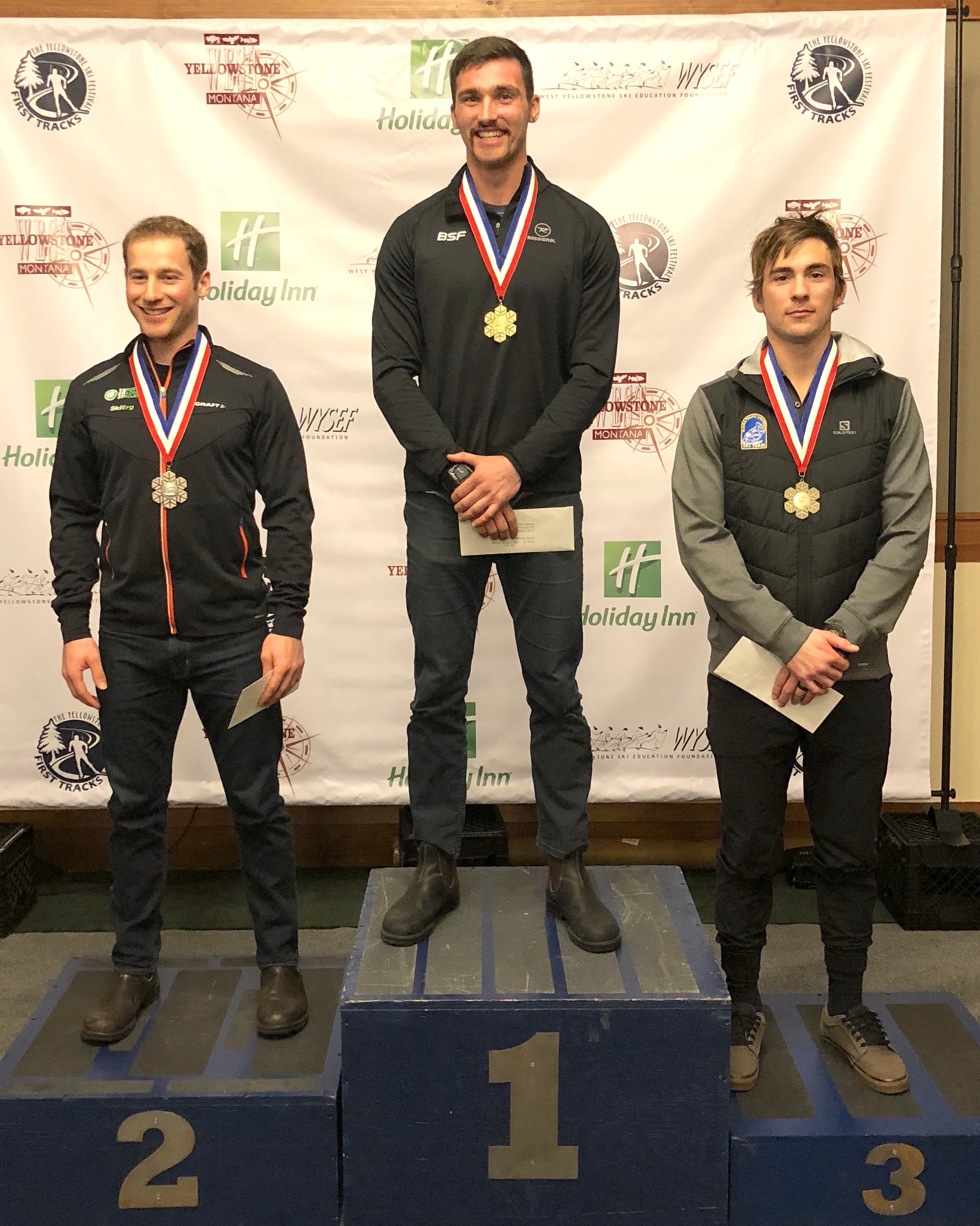
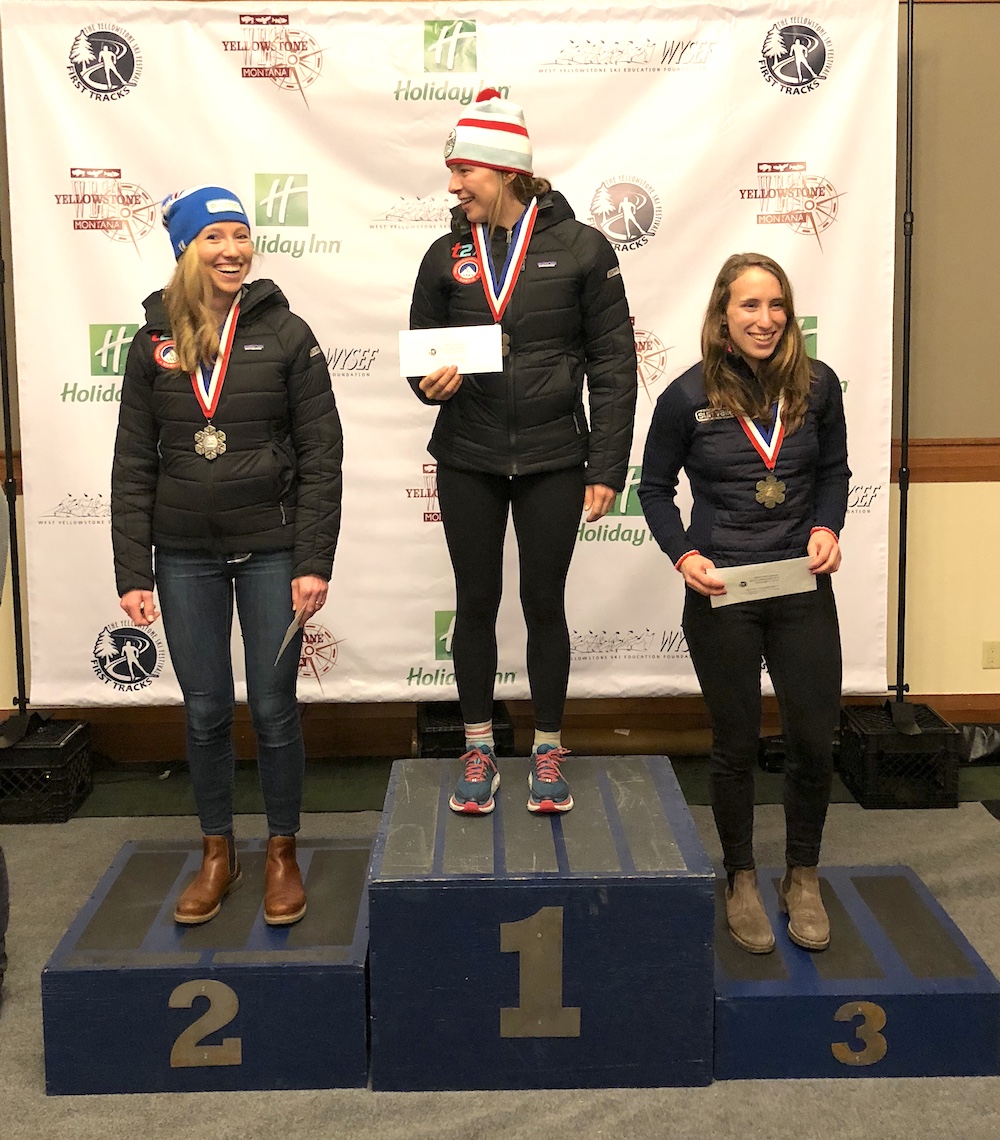
The SuperTour women’s 10 k classic mass start podium on Sunday in West Yellowstone, Montana, with Hedda Bångman (second from r) of the University of Colorado Boulder in first, and Craftsbury’s Kaitlynn Miller (third from r) and Caitlin Patterson (r) in second and third, respectively. From left: Caitlin Gregg in sixth, Katharine Ogden in fifth and Rosie Frankowski in fourth were also recognized at the flower ceremony. (Photo: FBD)
US SuperTour (West Yellowstone, Montana): 10/15 k classic mass starts
The second day of SuperTour racing took place as originally planned at the Rendezvous Ski Trails in West Yellowstone, with 22-year-old Hedda Bångman, of the University of Colorado Boulder (CU), and 33-year-old Brian Gregg (Team Gregg) winning the women’s 10-kilometer and men’s 15 k classic mass starts, respectively, on Sunday.
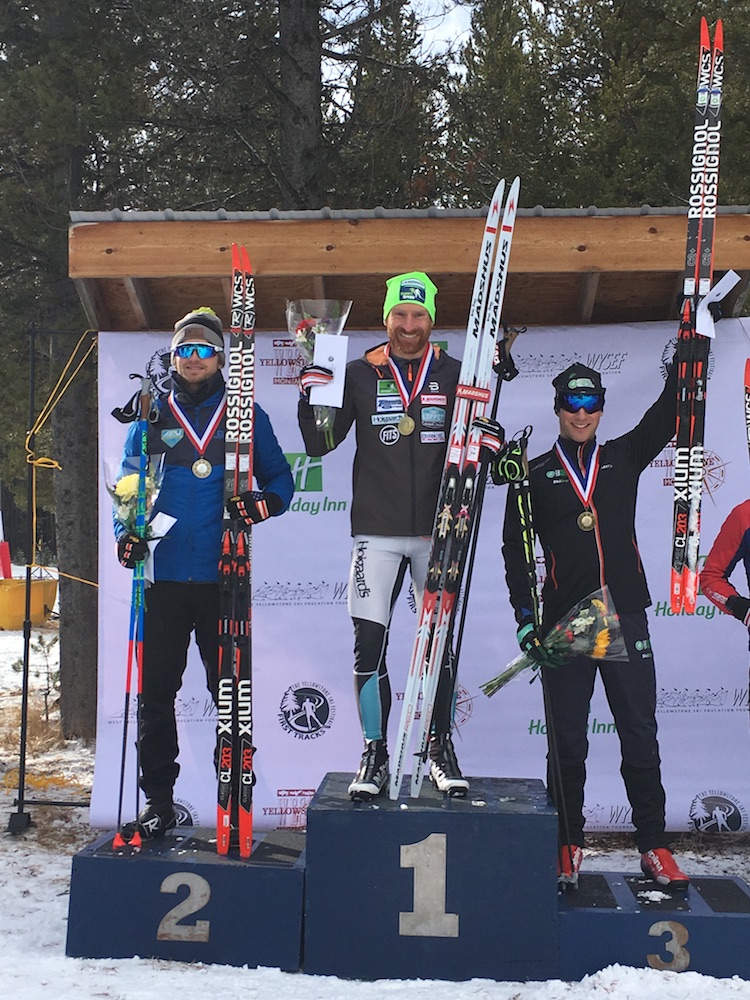
The men’s 15 k classic mass start SuperTour podium on Sunday in West Yellowstone, Montana,with Brian Gregg (c) of Team Gregg in first, David Norris (l) of APU in second, and Ben Lustgarten (CGRP) in third. (Photo: FBD)
Bångman, a Swedish freshman on the CU Ski Team, won the women’s race in 30:24.8, just ahead of two Craftsbury Green Racing Project (CGRP) skiers Kaitlynn Miller and Caitlin Patterson. While Miller placed second (+1.3) and Patterson was third (+3.4),
Rosie Frankowski of Alaska Pacific University (APU) finished another 10 seconds later in fourth (+13.5), and Katharine Ogden of the Stratton Mountain School (SMS) was fifth (+17.2). Caitlin Gregg (Team Gregg) followed in sixth, Felicia Gesior (CXC Team) was seventh, Anne Siri Lervik (CU) eighth, Erika Flowers (SMS Elite Team) ninth, and Corey Stock of the Bridger Ski Foundation (BSF) 10th.
In the men’s race, Brian Gregg pulled out a 1.9-second win over David Norris (APU), crossing the line first in 41:30.3. Ben Lustgarten (CGRP) reached the podium for the second-straight day (after placing second in Saturday’s skate sprint) in third (+4.6). Kyle Bratrud (CXC Team) finished fourth (+10.9) and Kris Freeman (Caldwell Sport) was fifth (+12.6). Tad Elliott (Ski & Snowboard Club Vail) followed in sixth, Eric Packer (APU) seventh, Ian Torchia (Northern Michigan University/U.S. Ski Team D-Team) eighth, Hunter Wonders (APU) ninth, and Martin Bergström (University of Utah Ski) 10th.
Sweden’s Charlotte Kalla winning the women’s 15 k skiathlon on Sunday at the Lillehammer World Cup in Norway. (Photo: Henrik Hunnes)
Sweden’s Charlotte Kalla pulled out another dominant distance performance on Week 2 of the World Cup, racing to a 19.7-second win in the women’s 15-kilometer skiathlon on Sunday, ahead of three Norwegians and American Jessie Diggins.
Kalla led at the halfway point of the skiathlon when skiers transitioned from classic to skate, just ahead of Norway’s Heidi Weng in second. The two had broken away around 4 k into the classic leg and put more than 20 seconds into the rest of the field by the transition, when Diggins came through 21.6 seconds back in third, leading a large chase group with Finland’s Krista Parmakoski, Norway’s Marit Bjørgen, Austria’s Teresa Stadlober, Norway’s Kathrine Rolsted Harsem, Finland’s Kerttu Niskanen, Norway’s Ragnhild Haga, and Switzerland’s Nathalie von Siebenthal, respectively.
While Kalla and Weng continued to trade the lead over the next 5 1/2 kilometers or so, by the 13.65 k marker, Kalla had dropped Weng, with 12 seconds between the two, while the chasers remained 29 seconds behind Kalla.
Over the next 1.2 k, that time gap grew to 20 seconds and 46 seconds, respectively, and Kalla skied off to her second win of the season in 42:24.7 minutes.
Weng placed second, 19.7 seconds back, and Haga claimed third (+43.6), after skiing alone for the last 4 k of the race. Bjørgen finished just ahead of Diggins for fourth (+54.3) and fifth (+57.0), respectively, and Stadlober was sixth (+1:04.9), Parmakoski seventh (+1:07.8), Norway’s Ingvild Flugstad Østberg eighth, Russia’s Natalia Nepryaeva ninth (+1:27.8), and Sadie Bjornsen 10th (+1:32.6).
Four Americans finished scored points in the top 30, with Kikkan Randall placing 16th (+2:06.5) and Rosie Brennan 29th (+3:07.7). Liz Stephen finished 36th (+3:25.7), Chelsea Holmes was 38th (+3:39.6) and Ida Sargent 55th (+6:41.1).
Cendrine Browne of the Canadian National U25 Team led Canada in 45th (+4:37.3), and Emily Nishikawa followed in 49th (+5:00.1). Katherine Stewart-Jones did not finish.
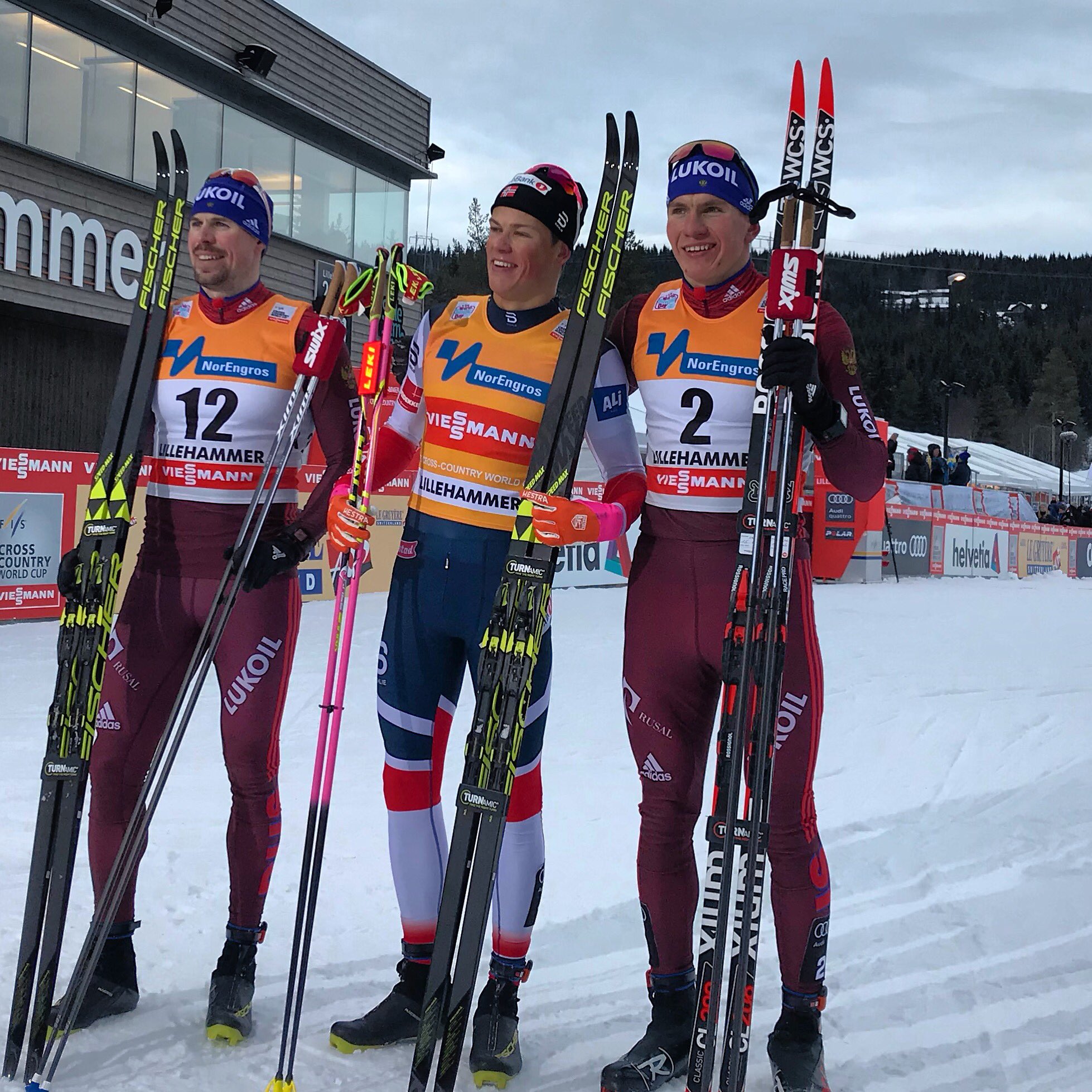
Klæbo Outlasts Sundby; Harvey 6th
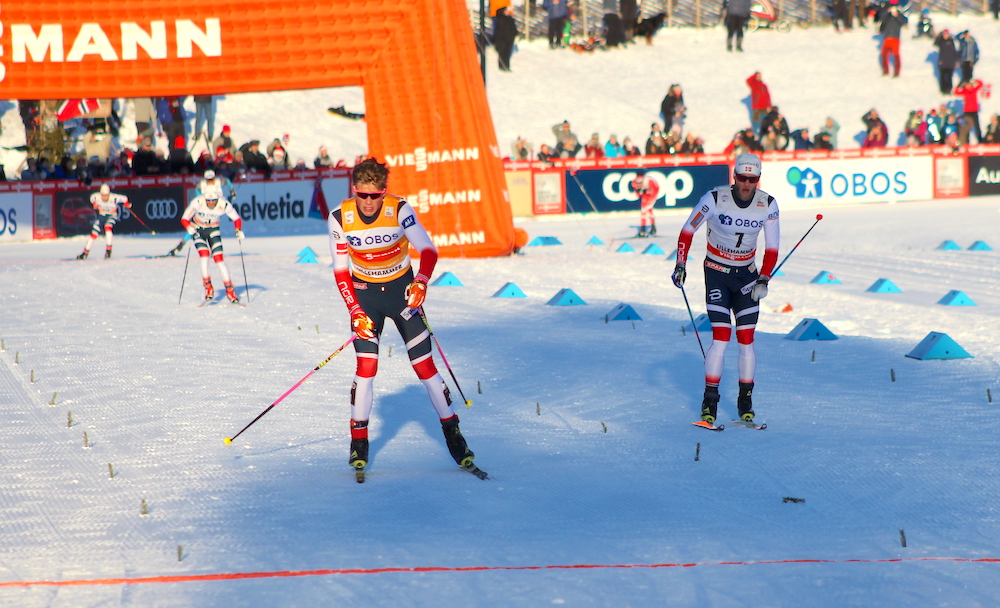
A gassed Johannes Høsflot Klæbo (yellow bib) holding off fellow Norwegian Martin Johnsrud Sundby (r) for the win on Sunday in the men’s 30 k skiathlon at the Lillehammer World Cup in Norway. (Photo: Henrik Hunnes)
In the men’s 30 k skiathlon that followed, Norway’s Johannes Høsflot Klæbo made it a five-peat, proving himself once again unbeatable, this time in the first multi-discipline distance race of the season.
Klæbo outlasted [edit: rocketed past] teammate Martin Johnsrud Sundby to beat him by 1.3 seconds for his fifth-straight win in 1:16:47.1, and Norway swept the top four with Hans Christer Holund in third (+6.8) and Simen Hegstad Krüger in fourth (+10.9).
France’s Maurice Manificat followed closely in fifth (+11.3) and Canada’s Alex Harvey was next in sixth (+13.1), ahead of Finland’s Iivo Niskanen in seventh (+16.2), and Russia’s Alexey Chervotkin, Sergey Ustiugov and Alexander Bolshunov in eighth (+37.7), ninth (+42.2) and 10th (+59.6), respectively.
Klæbo skied patiently in the pack for essentially the entire race. For instance, at 11 k he sat back in 18th, just seven seconds from Canada’s Devon Kershaw in the lead.
One kilometer later, Klæbo remained 5 seconds back in 13th while Kershaw was 8 seconds back in 16th.
At the ski exchange at 15 k, Niskanen led Sundby and Italy’s Francesco de Fabiani and a total of 10 men within three seconds of first. Klæbo clocked through 5 seconds back in 13th, just ahead of Harvey in 14th (+5.3). Sixteen men remained within six seconds and striking distance of first. Kershaw in 18th had fallen off the pace and was 36 seconds back at the transition, just behind Russia’s Andrey Larkov.
While Harvey continued to ski around third place during the first 5 kilometers of the skate leg, Klæbo worked his way closer to the front and led at 22.5 k. By then, the lead group had dwindled to six within two seconds of first. Harvey remained in fourth.
Over the next 7.5 k, the lead changed several times, with Klæbo hovering near the tail end of the group. With about 200 meters to go, however, it was down to Sundby and Klæbo, with the former leading by 2 seconds (and Holund skiing seven seconds back in third). Klæbo ultimately had the most finishing kick to take the win by 1.3 seconds over Sundby, while Holund crossed 6.8 seconds later for third.
Canada had two in the top 20 with Kershaw in 19th (+2:59.7). Last year’s NorAm winner Russell Kennedy (Team R.A.D.) placed 53rd (+7:30.7), and Canadian World Cup Team members Graeme Killick and Knute Johnsgaard finished 54th (+7:41.3) and 60th (+9:49), respectively.
Two U.S. men landed in the points with Erik Bjornsen (U.S. Ski Team) in 20th (+2:59.9; just 0.2 seconds behind Kershaw) and Noah Hoffman in 28th (+3:37.8). Scott Patterson finished 36th (+4:56.1) and Paddy Caldwell was 56th (+7:43).
— International Biathlon Union (@biathlonworld) December 3, 2017
France’s Martin Fourcade overcame an early penalty and his No. 2 starting position to take the men’s 12.5 k pursuit win on Sunday, 40.8 seconds clear of anyone with 19-for-20 shooting (1+0+0+0).
Fourcade started 1 second behind Saturday’s sprint winner, Norway’s Tarjei Bø, and took control of the race after cleaning the second shooting stage. Bø missed one on the first prone stage then five more later in the race (1+0+3+2) to slip to 19th (+1:49.5) while Slovenia’s Jakov Fak raced up from 10th to second, 40.8 seconds behind Fourcade, with two penalties (1+0+0+1). Just behind him, France’s Quentin Fillon Maillet took third (+42.1) with identical shooting after Fillon Maillet started 12th and skied with Fak for most of the race.
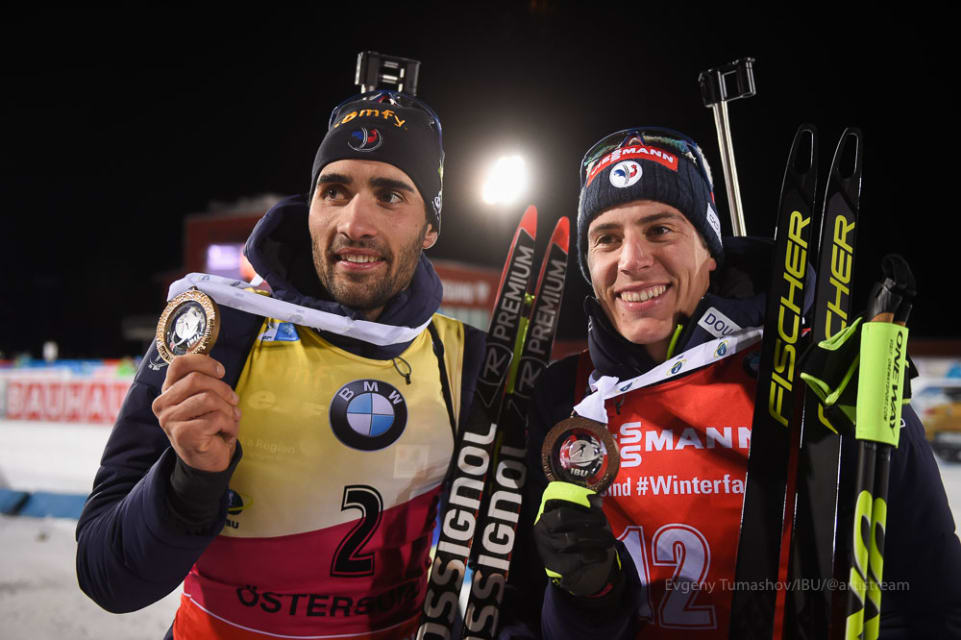
France’s Martin Fourcade (l) and Quentin Fillon Maillet after placing first and third, respectively, in the IBU World Cup men’s 12.5 k pursuit on Sunday in Lillehammer, Norway. (Photo: IBU/biathlonworld)
None of the 58 finishers cleaned the four-stage race. American Lowell Bailey improved from 22nd to 17th (+1:40.2) with two misses (0+1+0+1). Canada’s Christian Gow achieved a career best in 21st (+2:04.6), up from starting 26th, after shooting 19-for-20 (0+0+1+0).
Also for Canada, Nathan Smith slipped from 24th at the start to 42nd (+3:19.2, three penalties), Scott Gow finished 50th (+4:10.9; six penalties) after starting 16th, and Brendan Green placed 51st (+4:18.6; five penalties).
One other American qualified in the sprint top 60 for the pursuit, with Tim Burke finishing 48th (+3:52.7; four misses).
In the women’s 10 k pursuit earlier in the day, Germany’s Denise Herrmann tallied her second-straight win (and the second win of her IBU World Cup career). She started first and successfully held of France’s Justine Braisaz, who started 15 seconds behind her in second place, by 25.8 seconds. While Herrmann missed two on her third shooting (0+0+2+0), Braisaz was one of three women in the field to clean (0+0+0+0).
Norway’s Marte Olsbu raced up from seventh to third place (+48.0) with two penalties (0+1+0+1).
Canada’s Julia Ransom placed 23rd (+2:48.1), up from 29th at the start, with two misses (0+0+1+1). Two of her teammates also qualified for the pursuit, with Rosanna Crawford finishing 52nd (+5:25.1) with six penalties (0+3+1+2). In her first World Cup pursuit, Megan Bankes completed three shooting stages before being lapped (3+1+1).
No American women qualified for the pursuit.
With the conclusion of the first IBU World Cup in Östersund, the circuit moves to Hochfilzen, Austria, where racing kicks off again Friday, Dec. 8, with men’s and women’s sprints.
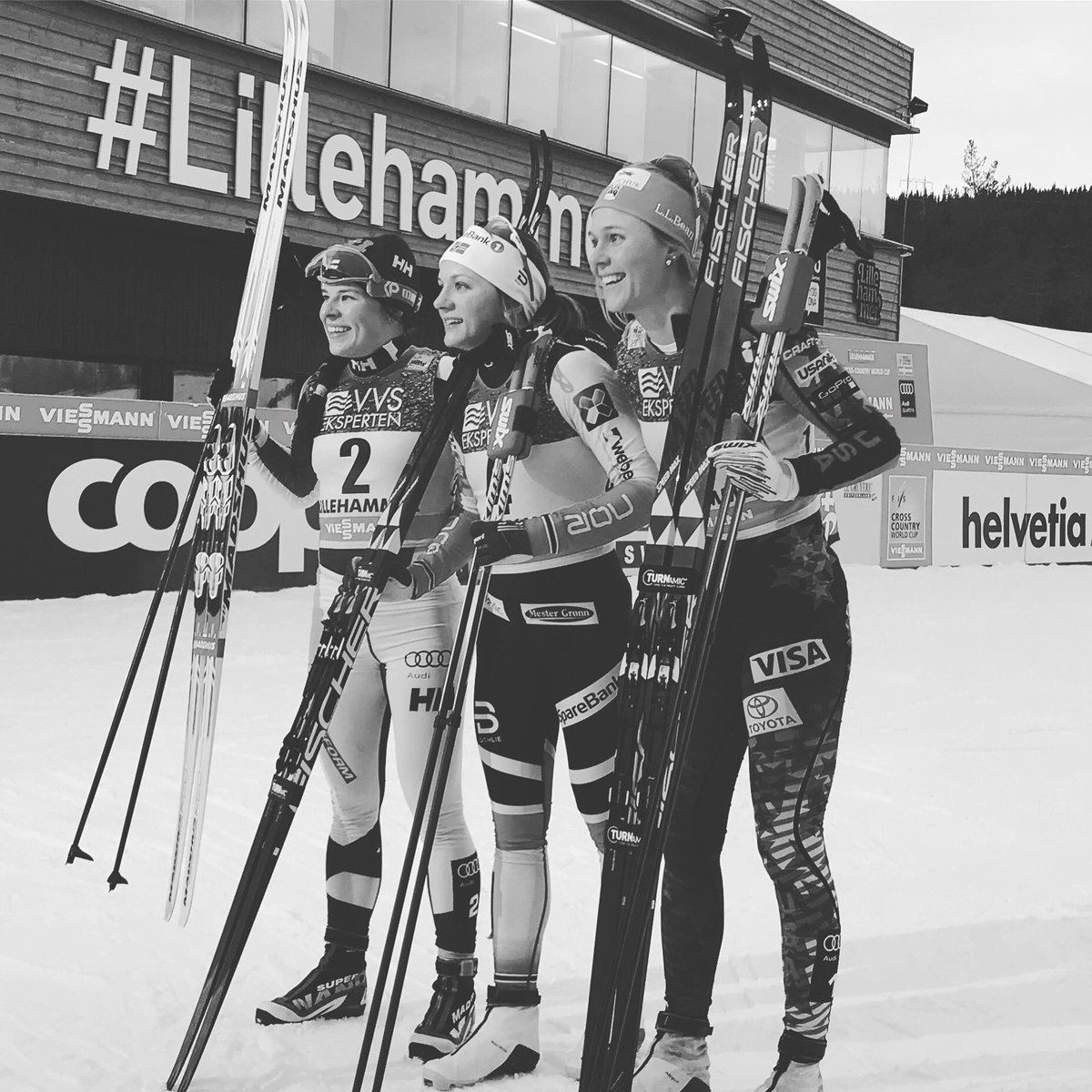
Left to right: Finland’s Krista Pärmäkoski, Norway’s Maiken Caspersen Falla, and the U.S. Ski Team’s Sadie Bjornsen after the women’s 1.3-kilometer classic sprint on Saturday in Lillehammer, Norway. (Photo: Henrik Hunnes)
Sadie Bjornsen can remember watching World Cup race footage as a kid, skiers zipping across the T.V. screen moving at speeds that seemed to her at the time, superhuman. In a recent blog post she recalled her view of them as “not even real… they were just figures in a movie.”
Now, with two World Cup sprint podiums on back-to-back weekends, her most recent being third place in Saturday’s 1.3-kilometer classic sprint in Lillehammer, Norway, Bjornsen is stepping into the reality of her childhood dream, and she’d like to debunk the myth that World Cup podium contenders possess some kind of otherworldly abilities. As she put it, they are more like “your friendly neighbor across the street working darn hard towards something”.
If Bjornsen is now finding herself on par with the World Cup racers she was once in awe of, it’s no magic trick. It’s what she’s described as “belief in myself.”
“I think sprint racing is a mental thing, absolutely, and last winter I really struggled with it,” Bjornsen said during a post-race, in-person interview on Saturday. “I feel like now I have more confidence to go out and lead the race, whereas before, I would have never done that because I was not confident in my skills. That’s been a mental hurdle that I’ve gotten over this winter, and hopefully it continues.”
Last year in Lillehammer, Bjornsen was the fastest qualifier but did not advance past the quarterfinals. This year in Lillehammer she once again won the qualifier, completing the course in a time of 3:22.45, but didn’t stop there. She placed second in her quarterfinal behind Norway’s Heidi Weng, and advanced to the second semifinal, which she won in a time of 3:23.33, crossing 0.46 seconds ahead of Sweden’s Stina Nilsson.
The U.S. Ski Team’s Sadie Bjornsen (r) during the women’s 1.3-kilometer classic sprint quarterfinal on Saturday in Lillehammer, Norway. (Photo: Henrik Hunnes)
Heading into the final, Bjornsen faced Nilsson (whom she placed second behind in last weekend’s opening sprint), Norwegians Maiken Caspersen Falla and Ingvild Flugstad Østberg, Finland’s Krista Pärmäkoski, and her U.S. Ski Team (USST) teammate Jessie Diggins.
The Americans bookended the rest of the women’s finalists off the start, with Nilsson, Pärmäkoski and Falla taking hold of the lead by the first climb. Diggins strode to the right of the pack in fourth, while Bjornsen tucked in the inside left of the group in fifth.
As the six crested the top of the first hill, Nilsson continued to put pressure from the front, attempting to distance herself from Pärmäkoski and Falla with three powerful double poles. Bjornsen held her position in fourth, while Diggins had slipped a position, trailing Østberg in sixth.
As the finalists descended back toward the stadium, Pärmäkoski maneuvered her way to the front, and Nilsson and Falla clung to her. Bjornsen’s fast skis gained her ground, forcing her into a slight snowplow to prevent bumping into Falla by the bottom of the descent.
Pushed tightly to the inside on the next corner by Falla, Bjornsen lost a few centimeters on the three leaders and a small gap separated her from the top three heading into the second major climb. In milliseconds, the Americans were reunited, Diggins and Bjornsen striding side by side with Østberg at the hill’s halfway point. In the same moment, Falla powered to the left of Pärmäkoski, commanding the pace at the front.
Striding with unmatchable speed, Falla put close to a meter between her and the Finn by the top of the last climb, while Bjornsen and Nilsson jostled for position.
“Stina cut straight in front of me and I kind of lost my momentum,” Bjornsen said. “It was really, really hard to get going again; over the top of the final climb, my legs were for sure buckling.”
Diggins who had been racing to the outside, cut in, which put her in sixth.
Jessie Diggins of the U.S. Ski Team after the women’s 1.3-kilometer classic sprint on Saturday in Lillehammer, Norway. (Photo: Henrik Hunnes)
“I’m not in my very top shape right now, which is the plan … so in the final I got a little bit tired and my technique kind of came off the rails a little bit, but it felt good to try to stay close and be … in it with those girls,” Diggins said during an in-person interview after with FasterSkier.
In the final descent, it was Falla alone in the lead, Pärmäkoski poling with all her might to make up the two seconds that separated her from the win. Behind them, Bjornsen was sandwiched between Nilsson and Østberg in a race for third.
In the end, Falla, the defending Sprint World Cup champion, crossed first in a time of 3:19.98 for her first win of the 2017/2018 season. In last weekend’s classic sprint in Kuusamo, Finland, Falla missed qualifying by 0.32 seconds and ended the day in 31st.
“I was really sad after the race last week. Our skis weren’t that good as we hoped, but that happens in an outdoor sport,” Falla said, according to an International Ski Federation (FIS) press release.
Living just 20 minutes away from the Lillehammer venue, Falla indicated she had plenty of practice on the sprint course, shown in the final meters of Saturday’s race.
“I have been doing a lot of training exactly on that hill, many very hard trainings since the last season for the last minute on that climb, so today I really got to use it so I am really happy now,” Falla said.
Pärmäkoski crossed 2.07 seconds behind Falla for second place.
“Before Ruka I had a flu, since then I have been feeling better and better,” Pärmäkoski said, according to FIS. “It was a good day for me. In every heat I was feeling better.”
Bjornsen edged Nilsson by 0.27 seconds for the third spot on the podium, 5.01 seconds behind Falla. Last weekend, Nilsson outlunged Bjornsen by 0.24 seconds for the Ruka sprint win.
“I took the slingshot from Nilsson, and then just double poled my heart out to the finish,” Bjornsen said. “I did a lot of work this summer with double pole and … it seems to be paying off.
“It definitely feels maybe even more special than last weekend,” Bjornsen continued. “There were not as many Norwegians in the heats last weekend because they had some problems with their skis, so, to be on the podium here in Lillehammer, where it’s the home course for them, and everybody was strong, it was super special.”
Completing the women’s final was Nilsson in fourth (+5.28), Østberg in fifth (+6.09) and Diggins in sixth (+7.81).
“I’ve been working so hard for so long to try to feel like a classic skier, so to get into the final in a classic sprint, arguably my worst event, is really confidence boosting,” Diggins said.
Last weekend in Kuusamo, Diggins did not advance to the heats.
“Two years ago we were wondering if Jessie would qualify in classic sprints and now she can go one weekend from not qualifying to the next weekend to being in the final,” USST Women’s Coach Matt Whitcomb said during a post-race phone interview. “It’s clearly there for her. Yeah, she skates more easily than she strides, but it has come such a long way.”
On Saturday in Lillehammer, Diggins qualified seventh, 2.37 seconds off Bjornsen’s time. In the first quarterfinal, she raced Falla, Østberg, Finland’s Aino-Kaisa Saarinen, Norway’s Mari Eide, and Italy’s Greta Laurent.
Sophie Caldwell of the U.S. Ski Team after the women’s 1.3-kilometer classic sprint on Saturday in Lillehammer, Norway. (Photo: Henrik Hunnes)
After finishing second in her heat behind Falla, Diggins advanced to the first semifinal with Falla, Østberg, Pärmäkoski, Russia’s Natalia Neprayeva, and another USST teammate Sophie Caldwell. In a three-way lunge, Østberg, Diggins and Caldwell fought for two lucky loser spots, which ultimately went to Østberg and Diggins.
Caldwell missed advancing by 0.06 seconds and ended the day in ninth overall.
“There were a couple things I wish I could have done differently in my semi, but it’s all a learning experience and even though I’d like to be in the final soon in a sprint, I think this is the best I’ve ever started a season. So I’m definitely happy with it,” Caldwell said after on the phone.
Explaining that she felt strong in her qualifier and quarterfinal, Caldwell indicated that if she were to change anything, it would be in her semifinal.
“I felt like I put myself in a really good position going up the first hill and then sort of over the top I let Krista hop in between me and Maiken, which sort of bounced me to the outside,” Caldwell reflected. “I just wish I’d been a little more aggressive and held my own and not allowed Krista to sneak in, but it’s just very little things that looking back you would have done differently.”
With Caldwell out, Diggins and Bjornsen advanced to the final, doubling the number of American finalists since last weekend’s classic sprint.
“It’s especially enjoyable when you have a day like this in Scandinavia where the Nation’s Group [in this case, Norwegian] quota is so strong,” Whitcomb said. “To put somebody on the podium and somebody else sixth and ninth, we’re really proud of that.”
Rounding out the top 10 was Poland’s Justyna Kowalczyk in seventh, Norway’s Heidi Weng in eighth, followed by Caldwell in ninth and Norway’s Thea Krokan Murud in tenth.
Rosie Brennan of the USST, who turned 29 on Saturday, missed qualifying for rounds by 0.26 seconds, finishing in 33rd (+6.84).
“She was skiing with a little birthday power out there today. I really like how Rosie is looking in these races, regardless of whether or not she gets in,” Whitcomb said. “I think it bodes really well for tomorrow and I think she’s in awesome shape.”
The second day of World Cup racing in Lillehammer takes place Sunday with the women’s 15 k skiathlon and men’s 30 k skiathlon.
Also racing for the USST on Saturday, Kikkan Randall finished 42nd (+9.70) and Ida Sargent was 44th (+10.09). The next North American finishers were Emily Nishikawa (Canadian World Cup Team) in 58th (+16.21), Dahria Beatty (Canadian World Cup Team) in 59th (+16.25), and Cendrine Browne (Canadian U25 Team) in 63rd (+23.11). American Chelsea Holmes (Alaska Pacific University) finished 64th (+24.84) and Katherine Stewart-Jones (Canadian U25 Team) was 65th (+30.85).
The men’s skate sprint podium at the first race of the 2017/2018 SuperTour season, with Nick Michaud (c) in first, Ben Lustgarten (l) in second, and Reese Hanneman in third. (Photo: FBD)
US SuperTour (West Yellowstone, Montana): Freestyle sprints
The women’s skate sprint podium at the first race of the 2017/2018 SuperTour season, with the SMS Elite Team’s Anne Hart (c) in first and Erika Flowers (l) in second, and Sun Valley’s Kelsey Phinney in third. (Photo: FBD)
Anne Hart and Nick Michaud were the big winners on opening day of the US SuperTour season at the Rendezvous Ski Trails on Saturday, taking individual victories in the women’s and men’s freestyle sprint finals, respectively.
Hart led into the finishing straight to take the win in 2:52.49 minutes, 0.88 seconds ahead of Erika Flowers, her teammate on the Stratton Mountain School (SMS) Elite Team, who placed second, and Kelsey Phinney, of theSun Valley Ski Education Foundation (SVSEF))in third (+0.92).
Hannah Halvorsen, of Alaska Pacific University (APU) and the U.S. Ski Team D-team, finished fourth (+2.16), Caitlin Gregg (Team Gregg) was fifth (+6.99), and Caitlin Patterson, of the Craftsbury Green Racing Project (CGRP), sixth (+7.22).
The win was Hart’s second on the circuit after winning a SuperTour 5 k skate two seasons ago. Last year in West Yellowstone, she placed third in the skate sprint (behind Jennie Bender, of the Bridger Ski Foundation, and Flowers, respectively).
Michaud, of the Bridger Ski Foundation (BSF), won the men’s final in 2:30.69 for his first SuperTour podium, just 0.17 seconds ahead ofBen Lustgarten (CGRP) in second and Reese Hanneman (APU) in third (+0.84). Rounding out the final, Kevin Bolger (SVSEF) finished fourth (+2.11), Ben Saxton (SMS Elite Team) fifth (+2.86), and Cole Morgan (SVSEF) sixth (+3.42).
FIS Cross Country World Cup (Lillehammer, Norway): Classic sprints
From right to left: American Sadie Bjornsen, Norway’s Maiken Caspersen Falla and Finland’s Krista Parmakoski after placing third, first and second, respectively, in the women’ 1.3 k classic sprint at Friday’s World Cup in Lillehammer, Norway. (Photo: FIS Cross Country/Twitter)
American Sadie Bjornsen returned to the World Cup podium for the second time in as many classic sprints this season on Saturday, placing third in the women’s 1.3-kilometer classic sprint behind Norway’s Maiken Caspersen Falla in first and Finland’s Krista Parmakoski in second.
Bjornsen started the day by winning the qualifying round by one-hundredth of a second over Parmakoski and Russia’s Natalia Nepryaeva, which were listed as qualifying in second and third, respectively (despite having the same time).
The U.S. Ski Team (USST) member who placed second in last week’s classic sprint in Kuusamo, Finland, Bjornsen won the qualifier in 3:22.45 minutes. She went on to advance in second out of her quarterfinal and then won her semifinal by 0.46 seconds over Sweden’s Stina Nilsson — who beat her in last week’s sprint.
While Falla won Saturday’s final in 3:19.98 (after qualifying in fourth, then winning her quarterfinal and semifinal as well), Parmakoski followed in second overall (+2.07) and Bjornsen achieved her second podium of the season in third (+5.01). Norway’s Ingvild Flugstad Østberg was just behind in fourth (+5.28), Nilsson finished fifth (+6.09), and the second American in the final, Jessie Diggins was sixth (+7.81).
Diggins previously qualified in seventh, finished second in her quarterfinal then advanced as a lucky loser in fourth place out of her semifinal (which Falla won).
Three American women raced in the heats, with Sophie Caldwell qualifying in ninth and ultimately placing ninth overall. She advanced in second out of her quarterfinal then finished fifth in the semifinal behind Diggins.
Also for the USST, Rosie Brennan finished 33rd in the qualifier, missing out on the top 30 needed to qualify by 0.26 seconds. Kikkan Randall finished 42nd, Ida Sargent was 44th, and Chelsea Holmes 64th.
Canada started four women, with Emily Nishikawa placing 58th, Dahria Beatty 59th, Cendrine Browne 63rd, and Katherine Stewart-Jones 65th.
Klæbo Still Undefeated, Ustiugov 2nd
The men’s 1.5 k classic sprint podium with Norway’s Johannes Høsflot Klæbo (c) in first, Russia’s Sergey Ustiugov (l) in second and Russia’s Alexander Bolshunov (r) in third. (Photo: FIS Cross Country/Twitter)
In the men’s 1.5 k classic sprint, Norway’s Johannes Høsflot Klæbo continued his undefeated World Cup streak with his fourth win in as many races this season.
He started off by winning the qualifier in 3:40.79, then his quarterfinal by 0.17 seconds over Russia’s Sergey Ustiugov. Klæbo and Ustiugov met again in the semifinals, where Ustiugov beat the Norwegian by 0.25 seconds, but in the final, where it really mattered, Klæbo again had the edge, winning in 3:33.88. Ustiugov finished 0.83 seconds back for second place, and Russia had two on the podium with Alexander Bolshunov in third (+1.29). Sweden’s Calle Halfvarsson finished fourth (+1.64), and Norway had two more in the final with Emil Iversen in fifth (+8.2) and Sondre Turvoll Fossli in sixth (+17.3).
Canada’s Alex Harvey was the lone North American to qualify for the men’s heats after racing to 22nd in the qualifier, 11.89 seconds out of first. Harvey’s day ended in the quarterfinals, where he finished sixth, 3.06 seconds behind Norway’s Pål Trøan Aune in first. Norway’s Even Northug took second in that heat (+0.26), Finland’s Ristomatti Hakola was third (+0.36), Norway’s Håvard Solås Taugbøl fourth (+0.67) and France’s Maurice Manificat fifth (+1.72) in that heat. Overall, Harvey placed 28th on the day.
Erik Bjornsen was the top American man in 35th and missed qualifying by 1.06 seconds. Andy Newell finished 38th and Scott Patterson was 74th for the U.S. Ski Team.
Jess Cockney was the second Canadian man in 57th, Len Valjas followed in 59th, Julien Locke was 61st, Russell Kennedy 63rd, and Knute Johnsgaard 67th.
IBU World Cup (Östersund, Sweden): Men’s 10 k sprint
Norway’s 29-year-old Tarjei Bø wins his first World Cup race in four years and three Canadians land in the top 26, led by Scott Gow with a career-best 16th that puts him one step closer to securing his place on Biathlon Canada’s Olympic team. Of the nine men that cleaned the two-stage race, four of them were North Americans (Gow, American Lowell Bailey in 22nd, and Canada’s Nathan Smith in 24th and Christian Gow in 26th).
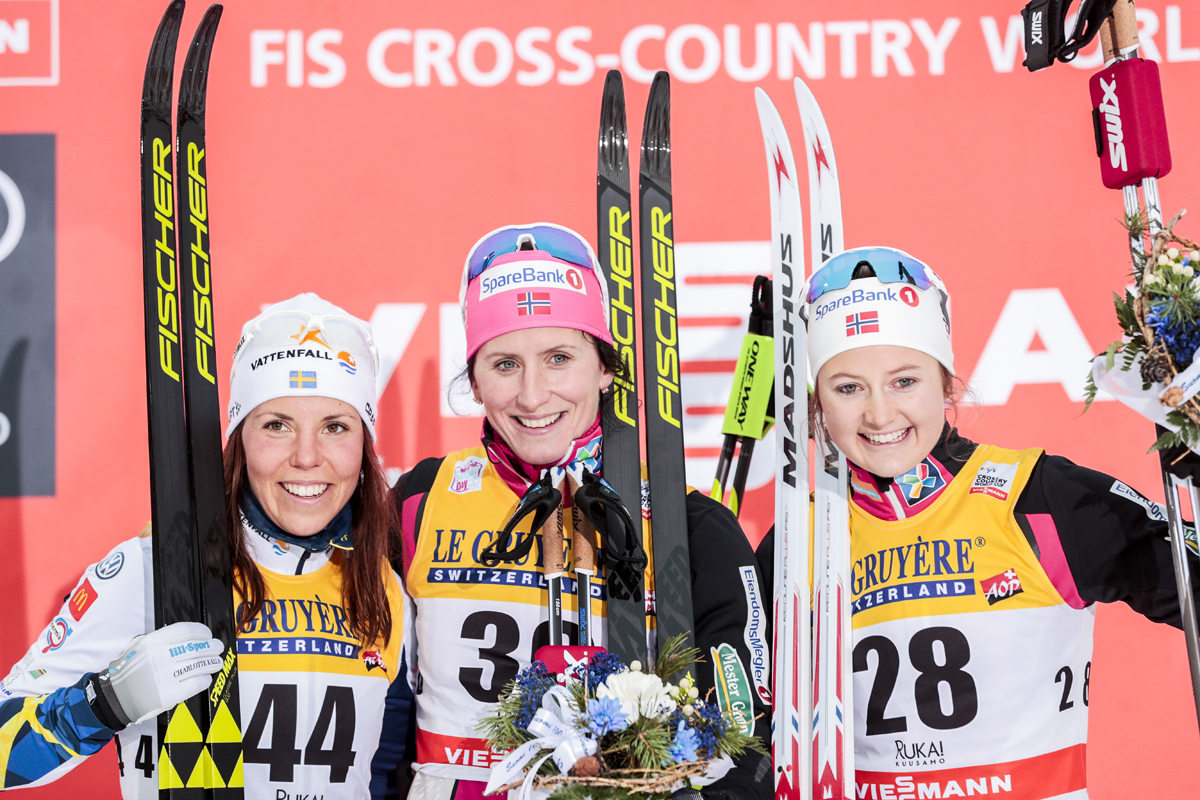
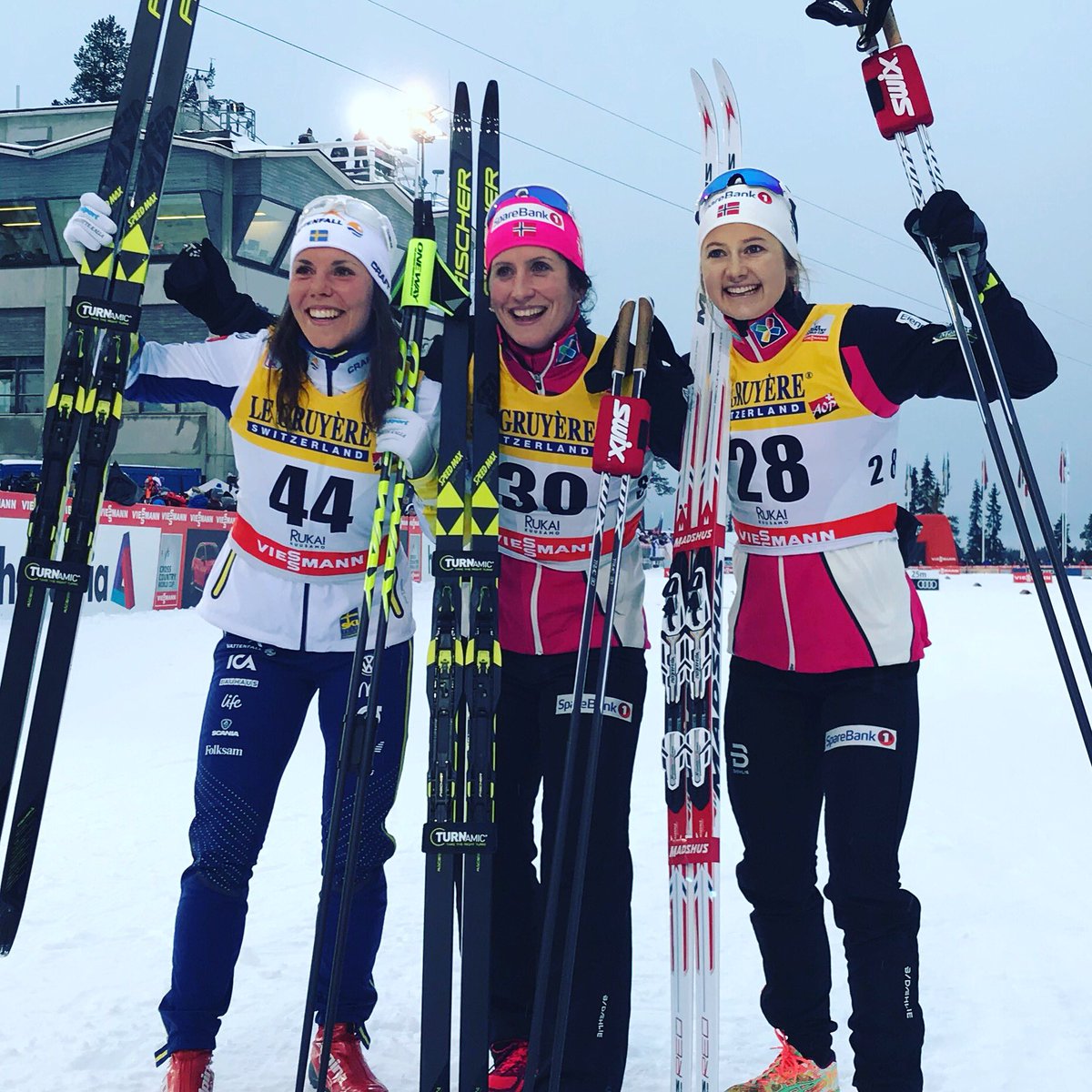
Sweden’s Charlotte Kalla jumps for joy after winning Sunday’s 10 k freestyle pursuit and overall Ruka Triple title at the World Cup opener in Kuusamo, Finland. She started 2 seconds ahead of Norway’s Marit Bjørgen (second from right) and held her off by 9.7 seconds for the win. (Photo: Fischer/Nordic Focus)
After two days of racing in Kuusamo, Finland, the Ruka Triple turned its last page on Sunday. As it turned out, the women’s 10-kilometer freestyle pursuit was a thriller.
Sweden’s Charlotte Kalla came into the final day of the mini tour wearing bib 1 and with only a 2-second lead on the last person one might want skiing on their tails, Norway’s Marit Bjørgen.
The gamesmanship, the change of pace, skiing’s version of the dodge and parry became a two-skier affair between Kalla, 30, and Bjørgen, 37. Yet, followers of the sport know Bjørgen’s end-game: push the pace, determine who can match the pace, then seemingly flip a switch and steamroll ahead solo.
The Swedish-Norwegian pairing performed an endurance duet that kept the packs of chasing skiers at bay. Sweden’s Stina Nilsson started the pursuit 12 seconds back in third, Norway’s resurgent Ingvild Flugstad Østberg 20 seconds back in fourth, and Russia’s Natalia Nepryaeva 23 seconds back in fifth. Norwegians Heidi Weng and Ragnhild Haga began 41 and 42 seconds back, respectively. None could gap up.
Norway’s Marit Bjørgen leads Sweden’s Charlotte Kalla during the women’s 10 k freestyle pursuit on Sunday at the Ruka Triple World Cup in Kuusamo, Finland. (Photo: Fischer/Nordic Focus)
Kalla and Bjørgen never blinked. They gradually pulled away from the chasers.
“My plan was to ski quite fast together with Marit, and not bring the ones behind us into the game,” Kalla told FasterSkier in a post-race phone interview. “Because I know that Stina is a really good sprinter, so me and Marit had to work together to keep the gap to the others.”
Heading back out into the woods on the final lap of the 2.5 k course, Kalla punched it. She accelerated the pace to what looked like a sprint, and Bjørgen initially stayed right on her tails.
How sustainable was this pace? And would it be possible to pop the Norwegian, who had won Saturday’s race over Kalla by 17 seconds? In the previous 10 k classic, Kalla had matched Bjørgen’s times until the last 1 1/2 kilometers or so, when the punishing pace took its toll and she began hemorrhaging time.
That was on her mind as Kalla kept up her furious pace.
“Well, yesterday I didn’t truly have the belief that I could ski [away] from Marit, because she did have a great performance yesterday in the classic part, especially on the last lap,” Kalla reflected. “So when I decided to speed up I also knew that I cannot look back. I had to give it a real try and just focus in front of me all the time. I could not take a look behind my back because you have to work for a long long time, and today I succeeded.”
With the difference in the two women’s skating techniques, Kalla appeared to be expending more energy, but gradually put a gap on Bjørgen – one ski length, two — easily an amount that could be closed on a downhill. It would have been easy to back off and slow down, but Kalla kept pushing and the gap grew to three seconds, four, five, six.
Bjørgen didn’t respond.
Kalla came flying into the final hill up to the stadium, the one where she had slowed so dramatically the day before, but didn’t lose any of her advantage this time around.
“I was just telling myself to look up to the top, trying to push with your legs all the way,” Kalla said of her decisive move. “In the last sprint hill, before we came up to the stadium, I was thinking, ‘Left, left, left, left… one, two, three, four, five,’ just to be able to think of something else than the pain.”
Kalla skied the turn into the finishing stretch with a clear margin and raised her hands at the finish line as she crossed in 25:50.1 minutes, 9.7 seconds before Bjørgen. She congratulated her rival before jumping in the air and shouting with joy.
“It was an amazing day today,” Kalla said. “I felt very strong during the race. Just tried to ski my very best, and saved as much energy as possible during the first three laps. My dream yesterday, when I went to bed, was to be able to push very hard when we [would go] out on the last lap. And I was a little bit nervous but decided to follow my tactic. When I was on the top of the hill my coach yelled at me that I had six seconds [lead on Bjørgen]. So I had very tired legs, but I knew that I had to fight and do my very very best until the finish line.”
Sweden’s Charlotte Kalla in the overall World Cup leader’s bib after starting the season with a Ruka Triple mini-tour win in Kuusamo, Finland. (Photo: Fischer/Nordic Focus)
The last time Kalla won a World Cup was in 2015 when she won the 10 k skate in Östersund, Sweden, before winning the same event at the 2015 World Championships at home in Falun, Sweden.
“It was a long time since I won a race the last time,” Kalla noted. “And I think it was 2008 when I won a mini tour, and that was the Tour de Ski, actually. So I have been waiting for this day, and I’m very happy today.”
Also of note is that last year’s Ruka World Cup event Kalla suffered from a heart ailment and had to reduce to a slow-tempo ski to finish the race. One year later, she said that wasn’t on her mind.
“No, I have not been thinking about that myself,” Kalla said of her health scare last year. “But all journalists I have met remembered what happened to me last year. So it’s like night and day to think about and look back to one year ago. It’s something totally different.”
After Bjørgen, Norway took third through fifth places. Haga skied to third (+33.9) and posted the fastest time of day, skiing the course in 25:41.8 as she leapfrogged from 10th place at the start to finish on the podium. Weng finished fourth (+38.0), and Østberg fifth (+40.2).
U.S. Women Continue to Thrive
At the start of the Ruka Triple on Friday, to paraphrase a certain former U.S. Defense Secretary, there were many “known unknowns” for the U.S. Ski Team (USST) in Finland. The answers three days later are clear. Sadie Bjornsen’s (USST) second place and Sophie Caldwell’s eighth place in Friday’s classic sprint set the tone. According to U.S. women’s coach Matt Whitcomb, both Bjornsen and Caldwell have met the objective criteria for the upcoming Winter Olympics in PyeongChang, South Korea. (That criteria, as applied to Bjornsen and Caldwell, was a top eight in a World Cup classic sprint.)
Four other USST women skied into the points on Sunday. Previously, Jessie Diggins placed 10th in Saturday’s 10 k classic individual start. Ida Sargent placed 15th in the sprint and began Sunday’s final stage in 23rd, based on her 10 k classic result. Rosie Brennan popped two top 30’s in the first two stages. Kikkan Randall, who had two off days in the classic sprint and 10 k classic, stormed back for Sunday’s skate pursuit. Randall began the day in bib 48 and finished the mini tour in 25th place, skiing the eighth-fastest time of the day.
Kikkan Randall (U.S. Ski Team) racing from 48th up to 25th (with the eighth-fastest course time) in Sunday’s 10 k freestyle pursuit at the Ruka World Cup in Kuusamo, Finland. (Photo: Fischer/Nordic Focus)
“She looked really strong and in control,” Whitcomb said on the phone about Randall. “She was making kills right from the start. It’s what we have seen out of her in this exact event before with actually with a very similar split several years ago, when we had the skate on the final day. It’s nice that she can leave this weekend with some confidence. She struggled with skis for the first two days of this tour and was skiing frustrated today, and she knows she has fitness, we know she has fitness, and we are really happy she was able to show it today.”
Randall confirmed that Sunday’s effort was a more indicative performance.
“Today was a much better gauge of where my fitness actually is,” Randall emailed. “After two frustrating classic days where the wax was a big factor, it was nice to just be able to go today and use what I have … Today felt the best out of the 3 races. I felt like my body wanted to go hard and I could find good power out there. I felt decent in the two classic races but felt like I couldn’t ski with my full shape because of wax and some technical struggles. So it was nice to know my shape is there.”
Bjornsen was the U.S. women’s top finisher after three days of racing in Ruka. She began the day as the 11th starter and improved to 10th overall by the finish, 1:18 behind Kalla.
“This is where we expect to see Sadie when things are going well,” Whitcomb said of Bjornsen’s performance. “But for things to go well, a lot has to stack up for any athlete, particularly for the beginning of the season, when you are traveling all the way from Alaska. It is pretty remarkable how resilient she is, how strong she has become, and how she can just rise above so many of her European competitors, who have been on snow in this time zone or one hour earlier for the last three or four weeks. She has gone halfway around the world and shown it is not so hard, so we are so impressed with Sadie’s ability to ski the way she this weekend.”
Norway’s Heidi Weng (third from left) skiing in a pack with American Sadie Bjornsen (pink headband), Sweden’s Anna Haag (second from r) and Norway’s Kathrine Rolsted Harsem (r) during the 10 k freestyle pursuit on the last day of the Ruka Triple World Cup mini tour in Kuusamo, Finland. (Photo: Fischer/Nordic Focus)
Bjornsen arrived in Europe for the start of the season on Nov. 8.
Out the on course, Whitcomb awaited his skiers atop the course’s big climb at approximately 1.2 k on the 2.5 k loop. There, Whitcomb said he witnessed Bjornsen put her personal stamp on the race’s outcome.
“Sadie had this moment in the race today where she was starting to dangle a little bit of her pack as the pace turned up between laps 2 and 3, and at the hardest part of the course she was forced to make a decision whether or not to hang,” Whitcomb recalled. “And if she just made this move for another minute or two she would be able to ski with them and their draft another three-fourths of a kilometer and pull her that much closer to the finish line and protect her that much more from the packs from behind. That decision today, I think, kept Sadie in the top 10 and that is the kind of racer she is.”
The first skate race of the year was welcomed by Bjornsen.
“Today was another fun, and tough day of racing here to complete the tour,” Bjornsen emailed. “It was nice to have skate skis under my feet after two really challenging classic days! Ruka is what I consider one of the toughest race courses on the circuit. It is just wall after wall (steep climb after steep climb), and you never seem to get a break. Today, it was my goal to catch the group in front of me, and then just hang on for dear life. I woke up feeling good, and recovered after the past two days, so I was feeling excited to see what I can do in skate skiing. I feel like I dug deeper than I have in a long time, and was really satisfied when I finally got to the finish line. I now look forward to a few days of rest before another great weekend of racing in Lillehammer.”
Diggins started the day in 16th and moved up to finish 12th overall. She also skied the 10th fastest time of day.
“A very solid day out of Jessie,” Whitcomb said. “She is perhaps most disappointed on the classic sprint [on Friday]. It was two years ago when we weren’t sure if classic sprinting would ever be in the cards for Jessie and then she is within striking distance of the podium on certain days. I am sure she has left wanting more from that classic sprint, and I am sure we will see her make the rounds and advance through the heats very soon, but to have 10th yesterday, and I believe the 10th-fastest split today on an extremely hard course, that is a great sign.”
For Diggins, who finished last season ranked sixth overall on the World Cup, the three-race weekend was a spark, reminding her body and mind of the racing routine.
“I always work into the season and was carrying a pretty high load of training into the last week, so overall I’m really happy with how the season opener went!” Diggins emailed to FasterSkier. “It was nice to finally race again and get my racing feet under me — and remember how all the testing and warming up works!”
Whitcomb also added some perspective on Diggins and whether her past results place any added undue pressure on her to perform.
“I think Jessie has matured quite a bit as far as that goes, and I think she can be more about the process, and really focus on what she really needs to do on the race each day and during a particular point on the course,” Whitcomb said. “As every k ticks by, rather than focusing on, ‘I must be fifth,’ if she is in 14th, she is going to do everything she can do be 13th and when she does that she will set her next goal. She is very goal-orientated but she is realistic. Yeah, she loves to win; she is focused on things that are in her control.”
Brennan placed 28th overall this weekend, after finishing in a photo finish with Germany’s Sandra Ringwald (in which Ringwald took 27th by 0.1 seconds).
“I am satisfied with the weekend,” Brennan wrote in an email to FasterSkier. “Kuusamo is always a tricky place for me so I am happy to come away with some strong results. I didn’t have any result expectations as it’s the first races of the year and the fields can vary. I feel I have accomplished many of my other goals in my technique and approach so I am satisfied with that … It always helps to have some strong results in the beginning. It gives me confidence in my fitness and some of the skills have been working on over the summer. I have to say, I would have expected the 10k classic to be my strongest so I think some of the work on my weaknesses is paying off and that I am happy about!”
Sargent left Ruka in 38th overall and comes away with renewed confidence. Known as a sprinter, her top 30 on Saturday bodes well for the Craftsbury, Vermont-based skier.
“I am satisfied with the weekend and mostly excited to start the season,” Sargent wrote to FasterSkier. “Yesterday was an awesome day for me so it’s cool to have a distance race carrying my weekend for me. Overall I think it was a great weekend for the team and we are just getting rolling!”
Sophie Caldwell (26), of the U.S. Ski Team, chasing Sweden’s Hanna Falk (25) in the women’s 10 k freestyle pursuit on the last day of the Ruka Triple World Cup mini tour in Kuusamo, Finland. She finished 39th overall. (Photo: Fischer/Nordic Focus)
After qualifying for the Olympics in her first race of the season, Caldwell finished one spot behind Sargent in 39th. Liz Stephen (USST) placed 56th overall, Chelsea Holmes (Alaska Pacific University) 60th, while Julia Kern (USST-D-Team) in her first European World Cup weekend was 71st.
Canada started three skiers in the women’s races. Emily Nishikawa (Canadian World Cup Team) led them in 69th overall, Cendrine Browne (National U25 Team) followed in 72nd, and Dahria Beatty (Canadian World Cup Team) placed 79th.
World Cup racing resumes in Lillehammer, Norway, next Saturday with a classic sprint.
Norway’s Marit Bjørgen (30) leads her teammate Heidi Weng (29) in the women’s 10 k classic individual start on Saturday at the Ruka World Cup in Kuusamo, Finland. (Photo: Fischer/Nordic Focus)
At age 37, with more than 110 World Cup wins, 18 World Championships titles and six Olympic gold medals, it’s hard to imagine Norway’s Marit Bjørgen as anything but a machine; she races, she wins, she repeats.
But even the World Cup veteran, who first raced the circuit in 1999, occasionally considers the simplicity of throwing in the towel. With intermittent snow showers on Saturday in Kuusamo Finland, temperatures hovering around freezing and varying snow conditions over the women’s two-lap course, many competitors entered in Saturday’s 10-kilometer classic individual start were caught in the classical dilemma of either slipping or sticking.
“It was interesting to see everyone out there — from all different countries — during the warmup come to the top of hills and just scrape their skis off; it’s not something that you always see on the World Cup,” U.S. Ski Team member Ida Sargent said in a post-race phone interview. “But it was just one of those days where nothing was going to be perfect.”
No matter how prepared or fit an athlete is, part of the allure and challenge of cross-country skiing is the element of ever-changing conditions. Mother Nature, after all, cannot be tamed. And even someone like Bjørgen can find it defeating.
“It was challenging to lead today,” Bjørgen told NRK, according to a translation. “I considered giving in after the first kilometer, but then I got a good split time and realized that it was just as bad for everyone. Then you just had to bite your teeth together … I think I finished well.”
Sweden’s Charlotte Kalla racing to second in the women’s 10 k classic at the Ruka Triple World Cup on Saturday in Kuusamo, Finland. (Photo: Fischer/Nordic Focus)
By the first kilometer, Bjørgen in bib 30 (out of 89) was situated in third, 2.5 seconds back from the race leader at the time, Sweden’s Charlotte Kalla. In the next two kilometers, Bjørgen lost 8.6 seconds on Kalla, but surpassed Finland’s Aino-Kaisa Saarinen to move into second. Over the next 3 k, Bjørgen regained ground and began to close in. By the 6 k mark, she was but 0.6 seconds off of Kalla’s time and in another two kilometers, she was ahead by one second.
Having overcome her initial discontent with the conditions, Bjørgen did not let off the brake, besting Kalla by 17 seconds at the finish and taking over the leader’s chair in 25:07.6. That result stood, and just 0.8 seconds out of second place, Norway’s Ingvild Flugstad Østberg stood on the final step of the podium in third place (+17.8).
American Jessie Diggins, of the U.S. Ski Team (USST), placed 10th (+1:03.9) for her fourth-best result in a 10 k classic — her most recent being an eighth place in a classic mass start at last season’s Tour de Ski stage in Val di Fiemme, Italy.
“I think this is probably the best I have ever done in Kuusamo,” Diggins said on the phone, referring to her performances in previous classic distance races there. In 2015, she finished 38th in the Ruka 10 k classic pursuit, and a year ago, she placed 13th in the Ruka 10 k classic.
“I usually try to come into the season really patient and work into it,” she continued “So it was a really nice surprise to feel pretty good today and fire up the engines, get that first distance race out of the way and remember how it feels to pace a 10 k.”
She stayed within ten seconds of 10th place for most of the race, closing it down to 2 seconds with less than to 2 k to go before securing her final top-10 spot. While Diggins explained that many of the racers she saw on course appeared to have either no glide or no kick, she felt fortunate to have a decent balance of both.
“I would ice up a little bit, but I could just run up the hills out of the track and then kick them really hard and they would clear up,” Diggins said. “So they stayed pretty fast, but with good kick as well, which was really really impressive. It could not have been easy to get the best of both worlds, so I am really, really grateful to those guys [our wax technicians].”
Ahead of Diggins was Norway’s Heidi Weng in fourth (+34.0), Austria’s Teresa Stadlober in fifth (+36.4), Norway’s Ragnhild Haga in sixth (+38.2), Russian U23 (under-23) skier Natalia Nepryaeva in seventh (+42.8), Sweden’s Stina Nilsson Friday’s classic sprint winner) in eighth (+46.1), and another U23 Russian, Anastasia Sedova in ninth (+53.4).
Sargent placed 22nd (+1:21.9) for her best World Cup distance race result since 2014 and was the second fastest American woman of the day.
“I haven’t scored distance points in a couple of years now, so it feels awesome to be back in the points, and I am really stoked to start the season out like this,” said Sargent, who’s been known for her sprinting results in Kuusamo (with a fifth place in its 2014 classic sprint and seventh place in 2015).
“I was definitely a little conservative at the beginning, but I think the upside of that is not blowing up, especially for me being a little more sprint-based,” she explained. “It was exciting to be pushing and working my way through the race; moving up that way.”
In the first kilometer, Sargent was positioned in 69th, 7.6 seconds away from 22nd. In the next 2 k, she moved up to 42nd, and by the halfway point she was in 33rd. Sargent continued to move up in rank, improving five more places by 6 k and moving into 24th with 2 k to go. By the finish, she had moved up to 22nd.
“She just had an awesome pace out there,” U.S. Ski Team Women’s Head Coach Matt Whitcomb said on the phone after. “She started quite slow for the first 1.2 k. Something we talked about that has worked really well here, you go out too hard and you blow up, and you just bleed time throughout the race, or you go out conservatively see where the body is and figure out where you can put the pedal down. She skied a really patient race for the first two k and then was able to push the pedal and got a great response out of her body.”
American Sadie Bjornsen (46) chasing down Finland’s Aino-Kaisa Saarinen (19) during the women’s 10 k classic at the World Cup opener in Kuusamo, Finland. Bjornsen placed 23rd while Saarinen was 27th. (Photo: Fischer/Nordic Focus)
Just 1 second behind Sargent was another USST member Sadie Bjornsen, coming off a career-best second place in Friday’s classic sprint, in 23rd (+1:23.4). While Bjornsen explained she had adequate recovery from the sprint, she had difficulty with her skis.
“I worked really hard to calm all my excitement last night, and channel it towards today,” Bjornsen wrote in an email. “I woke up feeling recovered and ready to rally. … Unfortunately, I really struggled with skis today, and didn’t have the extra power to push through it. I was really proud for fighting hard, and pushing on like I was racing for a medal. What I have learned with classic skiing in this world of crazy conditions is that when the stars align, it can turn into an incredible day. But, it doesn’t happen every day, so no matter what, you have to be ready to seize every opportunity like it is your day. I am looking for more in my distance classic skiing of course, but the season is mighty long, I am happy with how I feel, so I know it will come this year.”
In the standings, Bjornsen is now ranked 11th, behind Norway’s Haga and ahead of Sweden’s Anna Haag. Diggins is 16th with one race remaining: the women’s 10 k freestyle pursuit on Sunday.
Finishing 6.2 seconds outside of the top 30 (and just 0.3 seconds out of 31st) was Rosie Brennan (USST) in 33rd (+1:47.7). Happy with her ski choice, Brennan used the conditions as an opportunity to test her race technique.
“I decided to try a more aggressive pacing strategy today to ensure I could hold my technique together with such challenging conditions,” Brennan wrote in an email. “I think I over-paced as a result and should have started picking up the pace sooner than I did. This are all the things that take a few races to get back into the groove so I’m not too concerned with that. However, I felt good after picking up the pace so I think I am fit and ready more for.”
Three places behind Brennan was another USST member, Sophie Caldwell (who finished eighth in Friday’s sprint) in 36th (+1:50.1).
“This is a really tough course, so I tried to pace it well and take the first lap in control,” Caldwell wrote in an email. “I knew it would require some patience and tried not to panic if I didn’t feel perfect or my skis weren’t perfect in some places. I decided to go on wax and my skis were icing a bit over the tops of the hills, but I was able to ski off the accumulated snow and they felt fast for the downhills.”
In addition to reaching the semifinals in Friday’s opening sprint, Caldwell started her World Cup season by racing to third in the sprint’s qualifying round.
“Physically I felt pretty good today,” Caldwell wrote. “I was a little sore from the sprints yesterday, but I felt like I was able to recover enough to still have good energy and I was happy with the race. I felt like I skied the downhills well and definitely got a little tired going over the top of the massive uphill the second time, but was overall pleased with the race and think it was probably one of the best, if not the best distance race I’ve ever had in Kuusamo.”
Nine American women raced Saturday’s 10 k, with Kikkan Randall (USST) finishing 48th (+2:14.5), Liz Stephen (USST) 58th (+2:26.3), Chelsea Holmes (Alaska Pacific University) 64th (+2:50.0), and Julia Kern (USST D-team) 74th (+3:19.2).
Three Canadian women competed, with Emily Nishikawa (Canadian World Cup Team) leading them in 56th (+2:24.2), Cendrine Brown (National U25 Team) following in 76th (+3:23.6), and Dahria Beatty (World Cup Team) finishing 84th (+3:53.5).
In Sunday’s 10 k freestyle pursuit, Kalla as the mini-tour leader will start 2 seconds ahead of Bjørgen in second and 12 seconds ahead of another Swede, Nilsson, in third. Østberg will start fourth, 20 seconds out of first, and Nepryaeva will head out fifth, three seconds after Østberg. Bjornsen in 11th will start 46 seconds back (and just 6 seconds out of seventh), and Diggins will start 1:04 back in 16th, 3 seconds behind Finland’s Kerttu Niskanen in 15th.
The women’s 10 k classic podium on Saturday at the World Cup opening weekend in Kuusamo, Finland, with Norway’s Marit Bjørgen (c) in first, Sweden’s Charlotte Kalla (l) in second, and Norway’s Ingvild Flugstad Østberg (r) in third. (Photo: Fischer/Nordic Focus)
The women’s 10 k classic podium at Day 2 of the World Cup opening Ruka Triple in Kuusamo, Finland, with Norwegian winner Marit Bjørgen (c), Swedish runner-up Charlotte Kalla (l), and Norway’s Ingvild Flugstad Østberg (r) in third. (Photo: FIS Cross Country/Twitter)
FIS Cross Country World Cup (Kuusamo, Finland): 10/15 k classic
On Day 2 of the Ruka Triple World Cup opener on Saturday, Norway’s Marit Bjørgen collected a 17-second victory in the women’s 10-kilometer classic individual start in Kuusamo, Finland.
Bjørgen started 30th of nearly 90 women and was contested by one other: Sweden’s Charlotte Kalla in bib 44. Kalla clocked through the 3.1 and 6.2 k checkpoints faster than Bjørgen, but the Norwegian’s time stood up against Kalla’s at 8.1 k, where Bjørgen was 1 second faster. Over the last two kilometers, Bjørgen continued to gain speed toward the finish, crossing the line in 25:07.6 minutes. Kalla came within 17 seconds of her, which was good enough for second place and 0.8 seconds faster than another Norwegian, Ingvild Flugstad Østberg, who was bumped to third (+17.8).
Norway had three in the top four with Heidi Weng in fourth (+34.0). Austria’s Teresa Stadlober put herself in the mix in fifth (+36.4), Norway’s Ragnhild Haga was sixth (+38.2), Russia’s Natalia Nepryaeva seventh (+42.8), Sweden’s Stina Nilsson eighth (+46.1), Russia’s Anastasia Sedova ninth (+53.4), and American Jessie Diggins 10th (+1:03.9).
Also for the U.S. Ski Team, Ida Sargent placed 22nd (+1:21.9) and Sadie Bjornsen, who notched a career-best second in Friday’s classic sprint and led the women’s Ruka Triple standings after Day 1, finished 23rd (+1:23.4). Bjornsen is now 11th in the standings (46.5 seconds behind Kalla in first) with one more day of racing (women’s 10 k freestyle pursuit) remaining.
Kalla is 2.6 seconds ahead of Bjørgen in the mini-tour standings, and Nilsson is third (+12.4) ahead of Østberg in fourth (+20.0).
Nine American women raced on Saturday, with Rosie Brennan placing 33rd (+1:47.7), Sophie Caldwell (who was eighth in Friday’s sprint) following in 36th (+1:50.1), Kikkan Randall finishing 48th (2:14.5), Liz Stephen 58th (+2:26.3), Chelsea Holmes 64th (+2:50.0), and Julia Kern 74th (+3:19.2).
Three Canadian women competed, with Emily Nishikawa placing 56th (+2:42.2), Cendrine Browne 76th (+3:23.6), and Dahria Beatty 84th (+3:53.5).
Klæbo Doubles Up in Ruka
Norway’s Johannes Høsflot Klæbo (top and bottom, center) won his second-straight race at the Ruka World Cup opener on Saturday in Kuusamo, Finland, with a 15-second victory in the men’s 15 k classic over fellow Norwegian Didrik Tønseth (bottom left). Finland’s Iivo Niskanen (bottom right) also reached the podium in third. (Photo: FIS Cross Country/Twitter)
In the men’s 15 k classic that followed, Johannes Høsflot Klæbo rocketed to his second-straight win of the World Cup’s opening weekend in 33:38.8, which was 15.3 seconds clear of runner-up and fellow Norwegian Didrik Tønseth.
Finland’s Iivo Niskanen started after Klæbo (bib 42) and Tønseth (bib 33) in bib 70 and pushed to contend with Klæbo, but came up 17.7 seconds short at the finish. Russia’s Alexander Bolshunov also emerged as a later contender, starting 66th (out of 115) and clocking the fastest times at 3.1 and 5 k. Bolshunov ended up 19.9 seconds behind Klæbo at the finish and ultimately settled for fourth.
Kazakhstan’s Alexey Poltoranin placed fifth (+25.6) after being an early race leader in bib 12, and Russia’s Evgeniy Belov (another early starter in bib 10) followed sixth (+26.5). Norway’s Emil Iversen placed seventh (+30.2) and Martin Johnsrud Sundby was eighth (+30.7), Russia’s Alexey Chervotkin ninth (+31.2), and Sweden’s Calle Halfvarsson 10th (+34.4).
Canada’s Alex Harvey placed 13th (+49.7), behind Norway’s Pål Golberg and Hans Christer Holund in 11th (+38.1) and 12th (+44.7), respectively.
American Erik Bjornsen and Canadian Devon Kershaw tied for 26th (+1:15.2).
Also for the U.S., Noah Hoffman was 43rd (+1:58.4), Andy Newell 59th (+2:29.6), Paddy Caldwell 72nd (+2:53.5), Scott Patterson 86th (+3:17.7), and Simi Hamilton 96th (+3:43.4).
For Canada, Len Valjas finished 48th (+2:08.0), Graeme Killick 58th (+2:23.4), Knute Johnsgaard 87th (+3:19.8), Julien Locke 100th (+3:56.4), and Jess Cockney 109th (+5:20.7).
Klæbo extended his lead in the Ruka Triple standings to 38.3 seconds over Bolshunov, who moved up to second place. Golberg is third (+44.1), Halfvarsson fourth (+47.8), and Niskanen fifth (+49.5) with Sunday’s 15 k freestyle pursuit remaining.
Harvey is 12th in the standings (+1:22.8) and Bjornsen 23rd (+1:50.9) to lead the Canadian and American men, respectively.
FIS Nordic Combined World Cup (Kuusamo, Finland): Individual large hill/10 k
Also in Ruka, the second day of nordic-combined action started on the HS 142 large hill and ended with a 10 k Gundersen start, which Japan’s Akito Watabe won by 31.7 seconds over Finland’s Eero Hirvonen. Watabe jumped to first on the large hill with a total of 158.6 points, while Austria’s Wilhelm Denifl followed with 154.2 points in second, just ahead of France’s Maxime Laheurte with 154.2 points in third.
The lone American to start the competition round for the second-straight day, Bryan Fletcher jumped to 31st. (His USA Nordic teammate Ben Berend just missed the top-50 cutoff in the qualification round in 52nd, while Taylor Fletcher was 65th in qualifying.)
In the 10 k that followed on Saturday, Watabe started with a 16-second head start on Denifl and extended his lead to the finish, crossing first in 24:58.6. Hirvonen, who started ninth and 58 seconds back based on his jump, rose to second, while Germany’s Johannes Rydzek raced up from eighth to third (+32.8). Norway’s Jan Schmid placed fourth (+34.4) and France’s Antoine Gerard finished fifth (+36.5), Laheurte took sixth (+38.4), Norway’s Espen Andersen was seventh (+39.8), Austria’s Mario Seidl was eighth (+43.7), and Denifl ended up ninth (+55.7). Bryan Fletcher skied the fourth-fastest time to place 18th. Fletcher started 2:29 after Watabe and finished 1:45.8 behind him.
On Friday, Fletcher placed 17th in the individual large hill/5 k Gundersen. In the first Nordic Combined World Cup competition of the season, Norway took first and second with Andersen holding off his teammate Schmid by 7.7 seconds for the win in 12:58.0. Watabe placed third, 11 seconds out of first, after jumping to third.
Andersen’s jump ranked second on Friday and he started the two-lap 5 k four seconds behind Seidl, the jump leader. Seidl fell back three places to fourth at the finish (+15.4) while Schmid rose from sixth to second place with the third-fastest ski time.
Denifl maintained his jumping position in fifth (+29.1) and Laheurte finished ninth — up from 12th in the jump. Fletcher jumped to 18th and improved one spot to 17th (+2:47.6) after starting 3:04 out of first.
Day 3 of nordic combined’s long weekend in Ruka is another individual large hill/10 k Gundersen on Sunday.
The women’s podium for the first race of the 2017/2018 World Cup season, the Ruka classic sprint in Kuusamo, Finland, with (from right to left) American Sadie Bjornsen in second, Sweden’s Stina Nilsson in first, and Russia’s Yulia Belorukova in third. (Photo: U.S. Ski Team/Twitter)
On Friday in Kuusamo, Finland, the 2017/2018 Cross Country World Cup began with the first day of racing in what’s called the Ruka Triple — a three-day event featuring a 1.4-kilometer classic sprint, 10 and 15 k classic races on Day 2, and 10/15 k freestyle pursuits on Sunday.
For many, considering how multifaceted the U.S. Ski Team (USST) women are, and how five to six of them are podium threats, the biggest step up today was USST member Sadie Bjornsen’s leap onto the podium’s No. 2 spot.
“What an amazing and exciting way to start this new season,” Bjornsen wrote in a post-race email. “I have been feeling good for the past few weeks, but as always at the beginning of the season, you wonder where you are. Starting with the qualifier, I had great feelings. I love this course, because it is so tough all the way to the finish line, and you don’t have many places to recover throughout the course. I also love how steep the climb is, it is a grade that I have always enjoyed!”
For Bjornsen, who turned 28 on Tuesday, it was her first-career World Cup individual sprint podium. (On the World Cup, she’s placed third in a 5 k freestyle, second in a team sprint, and with the 4 x 5 k relay, second and third place twice. At last year’s World Championships, Bjornsen also teamed up with Jessie Diggins to finish third in the classic team sprint.)
On Friday, the Alaska Pacific University (APU) skier’s cylinders were firing from the moment she tipped the wand in the qualifier. Bjornsen qualified in fifth, sprinting around the course in 3:13.67 minutes. Sweden’s Ida Ingemarsdotter was the day’s fastest qualifier in 3:11:69 minutes, 1.98 seconds faster.
After her qualifier, Bjornsen continued to rise to the top, winning both her quarterfinal and semifinal. On a course with a steep but strideable final climb near the finish, she controlled each heat. She won her quarterfinal in 3:18.14 minutes over Russian runner-up Yulia Belorukova (+0.39) and Sweden’s Hanna Falk in third(+1.97).
“The general tone of the day was a fast start so that Sadie was in control in the front half of her heat,” U.S. Ski Team Women’s Coach Matt Whitcomb said on the phone. “In particular in the semifinal, she was able to have a fast start and shut the race down a little bit and pick it up when she was ready.”
Her ability to acquire the lead, command the pace, essentially set the first semifinal’s tone, allowed her to also keep other skiers in the turbulence of her wake by the slimmest of margins.
She won the semi in 3:20 flat. Again, Belorukova was second, this time just one-hundredth of a second back. Another Russian, Evgenia Shapovalova* was third (+0.39), and U.S. teammate Sophie Caldwell finished fourth (+0.50) in that semifinal.
Nilsson’s Moment
The final was where Bjornsen finally met her match in Swedish speedster Stina Nilsson.
Nilsson qualified 19th, 8.15 seconds behind her teammate Ingemarsdotter — nothing stunning by her standards, but a safe margin with which she could enter the heats and then take control like she’s been known to. She won the fifth quarterfinal with the fastest time of all the quarterfinal heats in 3:14.38.
Nilsson then dominated the second semifinal with a time of 3:17.61. That semi was nearly 2.5 seconds faster than Bjornsen’s winning semifinal time, and both lucky losers advanced from Nilsson’s heat. Those beneficiaries were Ingemarsdotter in third and Finland’s Krista Parmakoski in fourth.
Sweden’s Stina Nilsson lunges for first place as Sadie Bjornsen (USST) places second on Friday’s classic sprint on Day 1 of the 2017 Ruka Triple World Cup in Kuusamo, Finland. (Screenshot: Eurosport)
As much as Nilsson may have played a poker hand while qualifying, this much was clear: once into the knockout rounds, she’d leave nothing up for chance. Nilsson won the final in 3:17.62. Bjornsen placed second by 0.24 seconds. Russia’s Belorukova was third (+0.91), Ingemarsdotter fourth (+2.72), Norway’s Kathrine Rolsted Harsem fifth (+3.54), and Parmakoski sixth (+18.62).
The win marks Nilsson’s 19th career World Cup sprint podium and her 10th sprint victory. She won the classic sprint in Kuusamo last year and placed second there in 2015. She also finished last season in second in the 2016/2017 Sprint World Cup standings and fourth in the overall World Cup.
Friday’s classic sprint was a bit unusual from the get-go. The qualifier revealed a big void compared to recent seasons’ results. Only two Norwegians, Harsem and Anna Svendsen, skied into the top 30 and moved onto the rounds. Last season’s Sprint World Cup Overall champ, Maiken Caspersen Falla, missed qualifying by 0.32 seconds in 31st.
Whitcomb commented on the waxing struggles some skiers had out on course. He paraphrased a quote he heard from fellow American Anne Hart, who now races for the Stratton Mountain School (SMS) Elite Team, in 2010 to describe a common waxing puzzle.
“It’s always challenging on this course to find the right balance — as Annie Hart would say — the kick-to-glide ratio,” Whitcomb said. “But the kick-to-glide ratio is the key here in Ruka, and I think perhaps what happened with Norway. We will have to see what is said in the press by them and what we find out from our peers, I think they just went for more glide today, and some ended up struggling on the climbs. … It was noticeable. They had women that were herringboning up the entire final climb and most of the field was striding right up it. It’s a little bit of a trap — easy kicking snow and you are strong as a skier and a nation. It can be easy to perhaps try to go for speed. We have done it here before as well. Sometimes it works.”
On the right side of that kick-to-glide ratio was USST member Sophie Caldwell. She smoked the qualifier, placing third, 0.59 seconds behind Ingemarsdotter.
“The first race of the season is always a little funny because you don’t know what to expect,” Caldwell said on the phone. “But I have been doing good, smart training this year where I wasn’t pushing things too much and just doing what I knew worked, and I was feeling good going into it, but I have also never been able to have a great race in Kuusamo before. I think I’ve qualified twice, and both times I just sort of snuck into the top 30 in qualifying. But going into today I just sort of looked at it as a new day, and it was kind of a fun situation because there was no pressure, I have never done great here before.”
After her top-three qualifying result, Caldwell’s day way up north in Finland progressed smoothly. She chose Heat 2 in the quarterfinals, which turned out to be a quick heat and produced both lucky losers that would advance to the semis.
“I led out of the start and into the first downhill and then generally after that first downhill, places switch up a lot because there is a big draft, and so I think I got passed by a couple of people,” she said of her quarterfinal. “And then [Sweden’s Charlotte] Kalla sort of sent it from there, and I actually got in a little jumble at the low point of the course after dropping down the big hill. Maybe I was back in fourth or something, and then just tried to stay relaxed and ski well up that first hill. But she led it pretty much from that low point to the finish, I think, and she looked really good. After that heat I was like, ‘That’s proof right there that you don’t really need to be leading out of the start, because so much can change.’ ”
Kalla won the heat in 3:15.93, while Caldwell also automatically advanced to the semifinals in second (+0.70).
Caldwell skied in the first semifinal along with Bjornsen. Caldwell, of the SMS Elite Team in Vermont, let others lead out, understanding that an early burst of speed might not have a big payout.
“And at some point … it was funny because I was expecting Kalla to sort of hammer out from the start again and having it be another really fast, hard heat, but once we got to the bottom of the big hill I didn’t really see her again,” Caldwell recalled. “So it was just the two Russian women, Sades [Sadie] and me heading up the big hill. And I think Sadie and one of the Russians were a little ahead, and then we started filing behind them.”
After all the tactics and jousting, it came down to a lunge-fest at the line, and Caldwell just missed advancing. Caldwell placed fourth in a semi where the top-four places were separated by half a second. She was two spots away from advancing to the final and ended up eighth overall.
A third U.S. Ski Team member, Ida Sargent also began the season with a standout performance. Ruka has been kind to Sargent. Historically, she’s able to begin the season in Ruka with head-turning results. In 2014, Sargent she placed fifth in the Ruka classic sprint. In 2015, she placed seventh in the season-opening classic sprint. Last year she was 23rd, also in the classic sprint.
On Friday, Sargent qualified 22nd (+8.70).
“I was really nervous and excited for this race,” Sargent wrote in an email. “I really love this course and have been feeling great in training lately with a very solid prep period but the first race of the year can be a little nerve racking. Most other teams have already raced a couple weekends and this was our first time putting a bib on! The qualifier was solid for me but nothing special but I was psyched to get it over with and I felt a lot more relaxed going into the heats.”
Sargent skied in the third quarterfinal which included Swedes Anna Haag and Ingemarsdotter. On a day when skiers contended with snowfall and wind, keeping one’s line and maintaining speed in the fast tracks were paramount.
“The quarterfinal was playing out exactly as I was hoping for but then I ran into some bad luck in the finishing lanes with a track that was full of snow so I’m actually pretty disappointed with the result,” Sargent wrote. “ I felt like I had the skis and the body to do better today so I was bummed to be out after the quarters.”
Sargent explained she felt great in her quarterfinal and had the physical ability to keep pace. She maintained a reserved start, but soon moved into second place. On the final climb, she felt as if she could make a move.
“Ida [Ingemarsdotter] and I led over the top of that hill but then I was getting pushed to the outside on the final corner and then only had the far right track open into the finish because Ida was in the next one over,” she wrote. “Unfortunately everyone was skiing up the two middle tracks and since it was windy and snowing, the outside tracks were full of snow and super slow. I was having to plow my own track so I tried jumping in behind Ida hoping she would have a fast finish and I could get second behind her. But she wasn’t making much time and Anna Haag was coming up on the other inside track so I was totally trapped. I switched back to that outside lane hoping I could make up some time but it was a lot slower. It’s a huge bummer that there were really only two finishing tracks and just some serious bad luck to be in a different one. But I had great energy today and we had really good skis so I think its a good takeaway to be in a good place at the start of the season and there is lots of racing ahead!”
Sargent placed third in the heat, 0.65 seconds out of first and 0.43 seconds out of second place. She finished the day in 15th overall.
Rosie Brennan, a USST member known for her distance racing, finished 29th overall after qualifying in 26th. She skied in the fifth heat in which Nilsson set a blistering pace. Brennan placed sixth in her quarterfinal, 4.3 seconds behind Nilsson.
“My heat ended up being very fast, but also tight,” Breanna wrote in an email to FasterSkier. “My tactics are severely lacking as I have skied maybe 3 heats in the last three years so I was happy with my skiing, but not so happy with my group tactics. It certainly left me hungry for more opportunities to ski heats.”
Brennan went onto explain that she had developed her sprinting as part of her larger goal of performing at a high standard in tours.
“The biggest reason I wanted to work so hard on my sprinting this summer was for tours,” Brennan wrote. “I love tours, but I feel it is hard to be competitive if you can’t qualify for the heats so I’m thrilled to have done that for the first tour of the season. I am looking forward to getting some distance racing started.”
Outside the top 30 necessary to qualify for the heats were USST standouts Jessie Diggins and Kikkan Randall. Diggins skied to 34th overall (12.51 seconds behind Ingemarsdotter and 2.45 seconds out of qualifying), while Randall placed 36th (+13.92; +3.86). Other U.S. starters were Julia Kern (USST), who finished 57th, Liz Stephen (USST) in 70th and last season’s overall SuperTour winner Chelsea Holmes (APU) in 86th.
Whitcomb did comment that the team made use of its new waxing bus for the first time at a race on Friday. And although some skiers had dynamite skis, others may have had less-than-desirable race skis.
“It is the first race we have operated out of the truck,” Whitcomb said. “It was great. But I don’t think all the athletes had great skis. And that is more of a product that it is early season, techs working with athletes, us functioning as a team. It is just straight-up getting the wax up is hard to start with. In terms of the function of the truck, we had power all day, the place never filled with smoke. We had space, light was good, and we had athletes that had skis that were good enough to win races.”
Canada started three women, none of which qualified. Dahria Beatty (National U25 Team) placed 64th, Emily Nishikawa (World Cup Team) 74th, and Cendrine Browne (National U25 Team) 87th.
Heading into Day 2 of the Ruka Triple, Bjornsen leads the mini-tour standings by 2 seconds over Ingemarsdotter. Saturday holds a 10 k classic individual start for the women.
The women’s podium for the first race of the 2017/2018 World Cup season, the Ruka classic sprint in Kuusamo, Finland, with (from right to left) American Sadie Bjornsen in second, Sweden’s Stina Nilsson in first, and Russia’s Yulia Belorukova in third. (Photo: U.S. Ski Team/Twitter)
FIS Cross Country World Cup (Kuusamo, Finland): Classic sprints
In the first race of the 2017/2018 cross-country World Cup season, U.S. Ski Team (USST) member Sadie Bjornsen, who turned 28 on Tuesday, raced to the best result of her career, placing second to Sweden’s Stina Nilsson in Friday’s classic sprint in Kuusamo, Finland.
Last season, Bjornsen notched her first World Cup podium in third place in the 5-kilometer freestyle in Toblach, Italy, and teamed up with USST teammate Jessie Diggins to take third in the 2017World Championships classic team sprint. Friday’s 1.4-kilometer classic sprint — the first race of the Ruka Triple mini tour to kick of the 2017/2018 World Cup season — was Bjornsen’s first race of the season. She did not participate in any preseason International Ski Federation (FIS) races.
Bjornsen started out the day by clocking the fifth-fastest time in the qualifier, 1.98 seconds behind Sweden’s Ida Ingemarsdotter, who won the qualifier in 3:11.69 minutes. Bjornsen’s USST teammate Sophie Caldwell qualified third (+0.59) after another Swede, Hanna Falk in second (+0.19), and a total of four American women finished in the top 30 to qualify for the heats. Ida Sargent finished 22nd (+8.70) and Rosie Brennan was 26th (+9.51) to reach the quarterfinals.
There, Bjornsen won her quarterfinal by 0.39 seconds over Russia’s Yulia Belorukova. Caldwell also advanced to the semifinals by placing second in her quarterfinal, 0.7 seconds behind Sweden’s Charlotte Kalla in first.
Sargent finished third in her quarterfinal, 0.65 seconds behind the winner of that heat, Sweden’s Anna Haag. Brennan placed sixth in her quarterfinal, 4.3 seconds behind Sweden’s Nilsson in first. Neither Sargent nor Brennan advanced to the semifinals.
In the semifinals, Bjornsen again raced to first, and once again held off Belorukova — this time by just one-hundredth of a second. Caldwell followed in fourth in that semifinal, 0.5 seconds behind Bjornsen in first and 0.11 seconds behind Russia’s Evgenia Shapovalova in third (+0.39). Neither Caldwell nor Shapovalova advanced to the final.
In the final, Nilsson took the overall win in 3:17.62 and Bjornsen captured a career best in second place, 0.24 seconds out of first. Belorukova rounded out the podium in third (+0.91), while Ingemarsdotter placed fourth (+2.72), Norway’s Kathrine Rolsted Harsem was fifth (+3.54), and Finland’s Krista Parmakoski sixth (+18.62).
Overall, Caldwell placed eighth, Sargent 15th and Brennan 29th for the U.S. Diggins and Kikkan Randall missed out on qualifying in 34th and 36th, respectively. Julia Kern placed 57th, Liz Stephen 70th, and Chelsea Holmes 86th.
None of the Canadian women qualified, with Dahria Beatty in 64th, Emily Nishikawa in 74th and Cendrine Browne in 87th.
In the men’s 1.4 k classic sprint, Norway’s Johannes Høsflot Klæbo won out the day after winning the qualifier, quarterfinal and semifinal en route to another dominant performance in the final.
Klæbo started off by winning the qualifying round by 2.26 seconds in 2:46.53. Finland’s Anssi Pentsinen qualified second and another Finn, Ristomatti Hakola, qualified third (+2.35), ahead of Italy’s Federico Pellegrino in fourth (+2.66).
Cross Country Canada’s Alex Harvey was the top North American man in the qualifier, finishing 13th (+6.13), while Erik Bjornsen of the USST qualified in 26th (+8.71).
Both Harvey and Bjornsen finished fifth in their quarterfinals and did not reach the semifinals. Harvey ended up 21st on the day, after finishing 2.16 behind the winner of his heat, Finland’s Lauri Vuorinen. Bjornsen was 24th overall after finishing 5.12 seconds behind Klæbo, who won the first men’s quarterfinal.
Klæbo used the extra recovery time he had from racing an early quarterfinal to prime himself for another win in the semifinals, where he beat Sweden’s Calle Halfvarsson by 0.29 seconds. Another Norwegian, Pål Golberg, followed in third (+0.49), and Hakola placed fourth in that semi (+1.72). Both Golberg and Hakola had fast enough times to advance to the final, where they met Pellegrino — the winner of the second semifinal — and Norway’s Sondre Turvoll Fossli, who was second in the second semifinal (+0.1).
In the final, Klæbo once again won convincingly, this time by 1.35 seconds with a finishing time of 2:48.19. Golberg took second place and Halfvarsson reached the podium in third (+4.03), while Hakola placed fourth (+5.65), Pellegrino fifth (+8.87), and Fossli sixth (+17.31).
For the U.S., Andy Newell missed qualifying by 0.38 seconds in 34th and Simi Hamilton finished 60th. Scott Patterson was 84th, Paddy Caldwell was 103rd, and Noah Hoffman was 105th.
For Canada, Julien Locke, of the national U25 Team, finished 59th, Len Valjas was 63rd, Knute Johnsgaard 73rd, Devon Kershaw 74th, Graeme Killick 85th, and Jesse Cockney 95th. Last year’s NorAm winner Russell Kennedy did not start.
Rosie Brennan on her way to 35th in the 10 k classic in Oberstdorf, Germany, as part of the 2016 Tour de Ski. Brennan is an athlete representative to U.S. Ski & Snowboard, and recently participated in a call between the leadership of the International Olympic Committee and the World Anti-Doping Agency, with 50 other athlete representatives. The athletes had the chance to ask questions about current doping investigations and anti-doping policy. (Photo: Marcel Hilger)
Other racers, too, have a big stake in the outcome. For them, whether FIS brings a case or not feels symbolic of whether action will ever be taken to resolve the allegations of years of systematic doping orchestrated by the Russian state.
FIS says that it is waiting on evidence from a commission which is part of the International Olympic Committee (IOC). In an email to FasterSkier, Legkov’s lawyer, Christof Wieschemann, wrote that the IOC commission would have a hearing for his client on Monday.
“We’re getting really close and I haven’t heard anything [from FIS] yet,” said Rosie Brennan, a U.S. Ski Team member and athlete with the Alaska Pacific University elite team. “I guess that’s one of my biggest fears. It’s what is really going to tell us if the IOC chose to do more investigations just to drag things out. If FIS can’t make a decision by October 31st because these investigations aren’t finished, well, there we have our answer.”
As the controversy over systematic doping in Russia continues unresolved, athletes are becoming louder in demanding action.
Back in December, over 100 cross-country skiers signed a letter expressing frustration with the IOC for not being tougher on doping, and asking for a meeting with International Ski Federation (FIS) President Gian Franco Kasper. That meeting – where IOC President Thomas Bach was also present – happened in February at Nordic World Championships in Lahti, Finland.
Meanwhile in Germany, athletes feel that their representation within the German Olympic Sports Confederation (DOSB) was not meaningful and in order to make their actions more powerful, they may leave the organization and form their own union.
Against this backdrop, the leadership of the IOC and the World Anti-Doping Agency (WADA) organized a conference call earlier this month with athlete representatives from different national and international sports federations around the world.
“It was actually a very last minute thing,” Brennan, U.S. Ski & Snowboard’s cross-country athlete representative, said in an interview. “It was unclear whether that was intentional or not, but one way or the other, the U.S. Ski Team didn’t find out about the meeting until very last minute.”
In theory, the only American athletes on the call should have been athlete representatives to the United States Olympic Committee (USOC) or to international fedrations like FIS and the International Biathlon Union. (U.S. biathlete Lowell Bailey is one of that body’s representatives, and was on the call.)
But because the call was not well publicized, it turned out that the USOC representatives couldn’t participate. So Brennan did instead.
When she decided to become an athlete representative, she said, she wouldn’t have necessarily guessed that she would wind up on international conference calls with the likes of WADA Director General Olivier Niggli. Traditionally, U.S. Ski and Snowboard representatives – who come from sports as diverse as alpine skiing, freestyle skiing, and snowboarding – deal more with domestic issues.
But the doping scandal has had a huge effect on the cross-country ski community, and so she has been very engaged with the issue.
“I am the only cross-country athlete on the committee,” she said. “At each of our meetings we each give a sport-specific update, and last year a lot of my updates revolved around anti-doping because of everything that was happening. I was really excited because all the other members were super supportive and wanted to help fight for us, and work harder for clean sport. I was really encouraged by that, because a lot of those sports, I don’t think it’s really an issue for them… that was really encouraging and it made me want to do a little more on the anti-doping front.”
During the conference call, questions from the athletes to the IOC and WADA leadership just about doping took up more than an hour and a half.
The athletes made it clear that they continue to be skeptical of the IOC’s handling of the scandal. An independent investigation created by WADA presented findings in 2016 of widespread doping in Russia, including over 1,000 documents used as evidence. That investigation also did forensic testing of the glass bottles used to collect anti-doping samples, finding that some bottles belonging to Russian athletes at the 2014 Olympics had been tampered with.
The IOC convened two more commissions, headed by Denis Oswald and Samuel Schmid, to investigate the allegations further before taking disciplinary action against any athletes or against Russia as a country, for instance by barring Russian teams from competition.
“I think that was the biggest question we all still left with: Why are there two more investigations happening following the McLaren Report?” Brennan said, referring to the WADA independent investigation. “I think most athletes felt that the McLaren Report was very thorough and clear, and why there’s two more investigations happening just seems strange. I guess their answer was the McLauren Report didn’t look at all the sides well enough, and was never a report supposed to indict people. So they felt they needed to have these two follow-up investigations. But from an athlete perspective, I think that’s just a hard thing, because to me it feels like they’re dragging their feet a little bit in decisions.
“The other hard part is that Oswald is part of the IOC, so it doesn’t feel terribly independent to me,” she continued. “So I think we still all kind of left with those questions in mind.”
Brennan said that relatively little new information was presented to the athletes. Updates were given on the compliance of the Russian Anti-Doping Agency (RUSADA), which is still not accredited to do doping tests within Russia without oversight from another agency.
In order to be deemed compliant, WADA has said that Russia must acknowledge and apologize for the doping offenses committed in the last years, and also open a storage room in the Moscow laboratory which could contain more evidence of doping. So far, the government has refused to do either, and the storage room of the laboratory remains locked.
“A lot of people are wondering why haven’t they been able to get access, and what in that lab is useful at this point,” Brennan said. “They were pretty honest in saying that they don’t think anything is going to be in that lab. Because that lab only kept samples for three months, and it’s been much more than three months now [since the time the allegations refer to] so the chances of anything still being in there are really slim… I was happy that they were so honest about that, but it was also a bummer to hear. It just seems like another example of them dragging their feet. They keep putting this out there as a reason [that the investigation isn’t finished], when it’s not a very good reason.”
Brennan was impressed to be part of this international community – according to the IOC, 51 athlete representatives were on the call – but also saw that the level of engagement and self-confidence to demand action were not evenly distributed around the group.
“Every question that was asked was a good one,” she said. “The frustrating part was that every person that talked was either Canadian or American, except for I think one Brit had a question… it just further made clear that athletes in other countries either are choosing not to read the information, or are not getting the information, or just simply… aren’t really willing to take that stance. That’s really hard because I feel it needs to be an international effort to see some significant change. I hope that those other international athletes that were on the call at least took in that information and saw what Americans and Canadians are really pushing for, and maybe fired them up a little bit to go home and get some support going.”
That’s the kind of change that the head of Brennan’s team thinks is necessary.
“I truly believe that if the athletes get together, work with some really smart people, decide how they would like it to work, make a worldwide demand for that – they have the control,” Tiger Shaw, the CEO of U.S. Ski & Snowboard, said in an interview last week. “It is still about them. You can’t have the competitions without them. They provide the commercial value for all of these contests.”
He sees athlete leaders as having a unique ability to make demands. It is one of the reasons that the U.S. is pushing for cross-country skier Kikkan Randall, who was previously the FIS athlete representative and helped make the meeting between skiers, IOC President Bach, and FIS President Kasper happen last year, to get elected as an IOC member at the upcoming Olympics in February.
“She has a track record already of being involved in governance and caring deeply about it, even while she’s competing, which is kind of rare,” Shaw said of Randall. “It’s a more critical position than ever [to be on] the IOC. It needs someone who can help push the IOC forward in all the ways it needs to reform its governance – a strong athlete voice there is going to be critical.”
Brennan, for one, recognizes that not all athletes are comfortable being that loud voice. Some may also simply not want to deal with this not-very-uplifting topic, even within their own minds, and instead focus on training and being the best they can be in competition.
“When I go out and train, it’s like the last thing I’m thinking about, so I guess I’ve been able to compartmentalize it pretty well,” Brennan laughed. “But I do feel a little bit torn when I try to communicate this information to my teammates and other U.S. skiers. I do know that some people prefer to just not pay attention to it and just focus on their training. The challenging part for me is that I want to be respectful of how my teammates to prepare for the season, but I also want them to have the information that’s out there. So I try to include some links so they can choose whether to click on them… I think it’s just one of the skills you have to learn as an athlete is how to compartmentalize those things and not let it affect your training. When you go to race, you go to race regardless of who is there and who’s not there.”
The PyeongChang venue as seen in February 2017. PyeongChang, South Korea, will host the 2018 Olympic Games this coming February. (Photo: FIS Cross Country/Twitter)
Note: This is the first of a multiple-part series on the 2018 Winter Olympic selection criteria for the U.S. cross-country ski team. A parallel piece compares the cross-country team’s criteria with other U.S. winter sports.
***
Friday, July 7, will mark seven months to go until the Opening Ceremony for the 2018 Winter Olympics in PyeongChang, South Korea. As athletes across the country ramp up their commitment in this Olympic year, and #roadtopyeongchang trends across various social media platforms, FasterSkier takes a look at the recently released selection criteria and procedures for nomination to the U.S. Olympic team.
Briefly put, what does it take to get to PyeongChang? And what factors will U.S. Ski Team (USST) coaches and (newly rebranded) U.S. Ski & Snowboard leaders apply in deciding who will be wearing red, white and blue next February?
In this article, FasterSkier first breaks down the criteria themselves, then summarizes a recent interview with USST Head Coach Chris Grover about why these criteria were chosen and how they should work.
Inside the criteria: World Cup performance, discretion and potential domestic picks
The criteria themselves are little changed from the standards used to pick the American team for the last two international championship events, World Champs in Falun in 2015 and Lahti in 2017. First comes objective qualification via performance on the World Cup. Second comes the potential use of discretionary picks. Third, if any spots are left over, the highest-ranking athlete on a domestic points list may, but does not have to, be nominated to the team.
As for the overall size of the U.S. team, a maximum of 12 male or 12 female athletes may be nominated, with a final team quota of probably 17 to 20 athletes to be determined closer to the Olympics themselves. (This is up from a total team quota of 17 in 2014, though ultimately only 14 athletes were named for Sochi, and the extra three American spots were redistributed to other nations.)
The U.S. may enter up to four athletes in a single race at the Olympics. The six cross-country events in PyeongChang will be a skiathlon (15 kilometers for women and 30 k for men), individual classic sprint, freestyle team sprint, 10/15 k skate interval start, 4 x 5 k or 4 x 10 k mixed technique relay (classic, classic, skate, skate), and 30/50 k classic mass start.
As for the criteria themselves for making the U.S. Olympic team: In order:
Objective qualification via World Cup results
Athletes who have achieved a top-eight finish in one of five specific races, or who have a top-50 ranking on either the World Cup sprint or distance list midway through Period II, will be named to the team.
Most precisely, “Any eligible athlete that posts a top-8 individual final World Cup result during the selection period [Nov. 23, 2017, through Jan. 15, 2018] in the following events will be selected to the Team: Sprint C, individual start 10/15 km F, and 15/30 km Skiathlon.”
Looking to the schedule for the 2017/2018 World Cup season, classic sprints will be held on Nov. 24, in Ruka, Finland; Dec. 2, in Lillehammer, Norway; and Jan. 3 in Oberstdorf, Germany (as part of the Tour de Ski). A 10/15 k freestyle individual start will be held in Davos, Switzerland, on Dec. 10. The only skiathlon on the 2017/2018 World Cup calendar will be held in Lillehammer on Dec. 3. Any athlete posting a top-eight final result in one of those five races will be named to the Olympic team.
(The 10/15 k skate pursuits on the schedule don’t count for top-eight purposes – it’s only Olympic formats that are used for qualification. And the 10/15 k skate race in PyeongChang is an interval-start race, not a pursuit.)
So that’s high finishes in individual races. As for cumulative performance across multiple races, “Athletes ranking in the top-50 in the distance World Cup standings or the top-50 in the Sprint World Cup standings as of January 15, 2018 shall be selected to the team.” Jan. 15 marks roughly the midway point of the World Cup calendar. By that point, 18 World Cup races will have been held.
U.S. Ski Team member Sadie Bjornsen racing in the women’s 15 k skiathlon at the 2014 Winter Olympics in Sochi, Russia. Bjornsen is a veteran member of the national team heading into another Olympic year.
As of the comparable point in the 2016/2017 season, shortly after the Tour de Ski, USST members Sadie Bjornsen, Rosie Brennan, Sophie Caldwell, Jessie Diggins, Simi Hamilton, Noah Hoffman, Andy Newell, Kikkan Randall, Ida Sargent, and Liz Stephen had top-50 rankings in either or both disciplines.
A maximum of five athletes per gender may be selected based on their Sprint World Cup rankings. Tiebreaking procedures come into play at that point if necessary, generally based on an athlete’s single best finish in a sprint race.
Discretionary selection
Spots on the U.S. Olympic team will presumably remain open after the application of the objective criterion of World Cup performance. In that case, “the USSA Cross Country Head Coach may use discretion … to determine team nominations” for additional spots on the Olympic team.
Grover would at that point recommend additional athletes to a three-person committee, composed of U.S. Ski & Snowboard President Tiger Shaw, Executive Vice President of Athletics Luke Bodensteiner, and athlete representative Rosie Brennan.
If Brennan stands exposed to a potential conflict of interest from discretionary selection (that is, through no fault of her own, she “stands to benefit privately from a decision made by the Selection Committee,” as would happen if she had not qualified objectively and were being considered for discretionary selection), then she would be directed not to engage in any conduct “meant to unduly influence” the selection committee regarding her potential selection to the Olympic team.
Grover is then directed to consider any of (a) “outstanding competition results” from both this season and last season, (b) “Recent positive direction or trend of competition results indicating a potential for Olympic success,” or (c) “Indication of medal potential in future Olympic or World Championship competition (such as international age group results and rankings) that would be materially enhanced by selection to the team.”
U.S. Ski & Snowboard was not required to make discretion a means of selection to the team. It also has the discretion not to use discretion at all; as the document states, Grover may use discretion to determine additional team nominations, but does not have to.
Domestic selection. Maybe.
If there are any spots remaining on the team after applying criteria (1) and (2), U.S. Ski & Snowboard may consider the highest-ranked domestic athlete, one per gender. But it technically doesn’t have to.
(There is some ambiguity within the selection document itself as to whether more than one team spot could be filled via a domestic ranking list. On the one hand, selection criterion 3 uses the plural when it talks about “any remaining positions,” and “those positions may be filled.” On the other hand, it also mentions “the athlete with the highest rank on the 2018 Olympic Winter Games Selection List,” and both “athlete” and “rank” are in the singular. In practice, Grover clarified in a recent phone interview that the national team is potentially open to bringing more than one skier per gender, pointing out that four men and two women were brought to Lahti off the domestic rankings list.)
The 2018 Olympic Winter Games Selection List, as with the comparable list for 2017 World Champs in Lahti, is essentially the “normal” 2017/2018 SuperTour points list, plus substantial bonus points for 2018 U.S. National Championships. An athlete’s best two finishes in a single discipline (sprint or distance, not skate or classic) will be counted.
The SuperTour point totals system, and bonus points for podium finishes at 2018 U.S. nationals, appear to be precisely the same as those used last winter for Lahti. That is, first through third at the December SuperTour races will be worth 30, 25, and 21 points, respectively. The addition of nationals-only bonus points means that first through third in the four races in Anchorage count for 45, 35, and 26 points, respectively. When an athlete’s best two finishes are counted, a second and third at U.S. nationals (61 points) would be worth more than two firsts (60 points) at “normal” SuperTour races.
For this reason, in last year’spreview for 2017 U.S. nationals, FasterSkier quoted longtime racer Kris Freeman as stating that “the allocation of bonus points to Nationals essentially makes the remainder of the SuperTours irrelevant. Nationals is now World Champ and Olympic Trials which is fine, but let’s call them what they are.”
The math is the same this season as last season. This season, U.S. nationals start in Anchorage on Jan. 3, 2018. The four races there will be a skate sprint, classic sprint, 10/15 k skate interval start, and 20/30 k classic mass start.
Discretion and selection to international championship events
The appropriate role of discretion when selecting athletes for a World Ski Championships or Olympic team is a subject of recurring interest for fans and supporters of American cross-country skiing, and has frequently arisen on this site.
For example, here’s USST Women’s Coach Matt Whitcomb in an interview with FasterSkier in July 2016, answering the question, “Is it fair to say that making discretionary picks is one of the harder parts of your job as a coach?” Whitcomb replied, “For sure. We love not to do it. But in any criteria, discretion can often be one of the most important pieces. We really envy these Olympic Trials [for the American track and field athletes for the 2016 Rio Olympics] that we’re watching right now, where the top three go and fourth is either an alternate or they don’t go, and it’s just much more objective.”
And here’s Grover in January 2017, slightly ahead of the naming of the U.S. team for Lahti: “The real key thing is that, at the bottom of the selection, we followed the selection criteria. That’s key. Discretion really belongs to be used at the top, for those athletes who have a chance to come over and have big races at World Championships, and by big races I mean someone who can go on the podium, or the top five, top 10, or top 15. Look for some selections from USA, but I wouldn’t look for a lot of discretion at the end of the day.”
Or here’s Grover in January 2014, discussing why he and the rest of U.S. team leadership abjured discretion completely in taking Brian Gregg to Sochi but not Matt Liebsch, when only 0.04 points separated the two on the domestic men’s distance list: “We really tried to apply the selection criteria in the most fair way possible.That becomes, for sure, a challenge, especially on the men’s side when you get down to the sixth, seventh, eighth guys, you’re really splitting hairs because the FIS points are so close at that point. Because they were so close we opted not to use discretion. It really wasn’t a fair way to do it.”
(As things played out in Sochi, USSA selected 14 athletes out of a total possible quota of 17. Grover explained at the time, shortly after selections were made and before the Olympics began, that they had only intended to bring those athletes whom they planned on starting in races. “With seven women and seven men, we have our start positions filled,” Grover told FasterSkier before the Games. “Seven and seven was the magic number for us.” Liebsch is reported to have considered legal action to gain a spot on the U.S. team for Sochi, but found that that it was “too late” for him to do so. In Sochi a few weeks later, U.S. athlete Torin Koos did not start the 50 k skate race, a race format in which Liebsch had previously won at the American Birkebeiner.)
The U.S. Ski Team’s views on discretion
Grover, the longtime USST head coach, is aware that people feel strongly about the substance and application of selection criteria for U.S. championship teams. “I think overall I’d say people get a little bit mired up and tied up with selection criteria, and whether it’s fair or not, or how this potentially sees them falling within that criteria,” Grover told FasterSkier in a recent phone interview.
But Grover has a simple message for domestic athletes hoping to go to PyeongChang: “All you need to do is to ski fast, you need to go out there and win races, or to reach podiums. And if you can do that, your chances of being selected to the team are quite good.”
The current criteria are “better than ever, more fair than ever,” Grover continued. “I think [it] gives athletes the most direct path possible to a major championship team.”
Grover urged domestic athletes not to obsess over the apparent prioritization of discretion over domestic race results as a means of picking the Olympic team. Addressing a hypothetical non-national team member, he said, “As as an athlete domestically, don’t get hung up in the order that those things come down in the selection criteria. Discretion has to be next, because a discretionary athlete that’s picked needs to be picked because they are a top athlete who should be on the team, who has somehow been missed by the selection criteria.
“So that’s the placement it has to be,” he continued. “And that’s consistent with selection criteria across different disciplines, in different sports. So that’s just the way that the procedure needs to work. But it doesn’t mean that a large number of discretionary athletes will necessarily be selected prior to the domestic field.”
The statements that discretion “has” to have this status, and that this is “consistent with … different sports,” are not necessarily correct. As reported today in another article on FasterSkier, discretion plays a less prominent role in every other U.S. Ski & Snowboard sport.
Grover also underscored that the use of discretion within American skiing pales in comparison to its role in Norway or Russia.
“We’re competing against teams that are using 100-percent discretion to name their teams,” Grover emphasized. “So in the U.S., we have kind of the most democratic, objective, fair, I guess you could say – other nations, our Scandinavian peers, might call this an American system that we use for selecting athletes. It’s very cut-and-dried.”
The four countries that Grover mentioned by name in his interview as the Americans’ main competition – Norway, Sweden, Finland, and Russia – all finished ahead of the U.S. in the final Nations Cup standings for the 2016/2017 World Cup season.
Grover also stressed that U.S. Ski & Snowboard used only one discretionary pick for the Lahti roster, taking USST athlete Erik Bjornsen. “And the reason that we used one discretionary spot to select Erik was because he basically fell between the two criteria. He didn’t quite make the top-50 in the world standard because he had gotten sick during the selection process, and he wasn’t home domestically to race in the races domestically, but I think very few people out there would argue that that wasn’t a good use or a smart use of one discretionary spot.”
Grover further stressed that the team had used, as he initially put it, “zero discretion” when selecting athletes for Falun World Championships in 2015. (In a subsequent email to FasterSkier, Grover clarified that “We used zero discretion in the original selection of 16 athletes (8 men and 8 women) to the Falun Team, but we did add Ben [Saxton] at a later date via discretion after he finished 6th in the sprint at U23 Champs.”)
Writing criteria for the top vs. the bottom
Grover cited the decision to bring Erik Bjornsen to Lahti as an exemplary use of discretion, underscoring that Bjornsen was a skilled athlete who “had some of the very best individual results there” among American skiers.
“So that is absolutely our intention,” Grover continued, “it has been our intention, and it will be our intention going forward, is that we use discretion on the rare case where there’s an injury, or an illness, with a top athlete, and/or the criteria fail to select someone that I think most everyone would agree should be there representing the United States.”
At world champs in Lahti in 2017, Bjornsen finished 18th in the 15 k classic and teamed up with Simi Hamilton to finish fifth in the team sprint. At world champs in Falun in 2015, Saxton finished 54th in classic sprint qualifying, roughly nine seconds from making the heats.
While Grover is confident that discretion is most appropriately used for a top-performing U.S. athlete, he acknowledged some issues regarding the final athletes selected (or not selected) to a team.
Summarizing his discussion with domestic senior club coaches about the selection criteria used for Lahti, and any potential changes before PyeongChang, Grover said, “All the responses I got back were positive, people were like, Yeah, it worked well. It’s never perfect at the bottom, but I don’t really see any way to improve it.”
Indeed, he noted, the U.S. Ski & Snowboard working group “struggled with” how to select “athletes at the bottom of the selection, and make it as fair as possible. And what you come up with at the end is, in the end there’s no real perfect way to do it, and there’s going to be challenges to the way that any selection criteria works at the very bottom of the selection.”
Current success vs. preparing for the future
Another issue surrounding selection is the question of current competitiveness vs. taking a young athlete to a “practice” Olympics just for the experience – that is, is the Olympics for development or for podiums. In 2014, for example, regarding the recently named team for Sochi, Grover said, “The Olympics is the pinnacle of the performance or competition pipeline.”
Development occurs at many lower levels, Grover noted (Europa Cups, World Juniors, etc.), but “It does not and should not come at the World Championships or the Olympics. … It’s not a development trip; it’s a competition trip at the very highest level.”
Similarly, earlier this year Grover explained that junior skier Katharine Ogden (a.k.a. “KO”) was not selected for Lahti on the grounds that “athletes should first aim to be successful at – in the age group that they’re competing against. So for KO, that means World Juniors, and being successful at World Juniors.”
The third prong of discretionary selection for the current Olympic team, “Indication of medal potential in future Olympic or World Championship competition (such as international age group results and rankings) that would be materially enhanced by selection to the team,”may be said to go against these principles.
But Grover explained that this “future medal potential” path to discretionary selection is rarely if ever used, even when the Olympic team is selected with an eye to current podium potential.
“We haven’t used it that way,” Grover said. “Obviously the language is there if we were to choose to use it, but in the past we really have not used it that way, and I don’t anticipate using it going forward into this season. … We want … the fastest skiers on the start line in Korea, and those are the ones that we’re gonna be selecting.”
Different standards for men and women?
An additional issue in selecting American skiers is that the women are currently, proportionally speaking, faster than the men – that is, the U.S. women, as a team, have recently tended to achieve better results within the women’s World Cup field than the U.S. men do within the men’s World Cup field.
It is also true that the international men’s field is more top-heavy than the women’s field, across the course of a single World Cup season, meaning that a greater number of World Cup points is needed to crack the top-50 of a discipline ranking.
Perhaps for these reasons, multiple athletes have confirmed to FasterSkier the substance of a suggestion made at a recent athletes’ meeting at the season-ending 2017 U.S. Distance Nationals in Fairbanks: That the selection criteria should be made more challenging on the women’s side, such as by making the objective cutoff there be a top-40 or even a top-30 discipline ranking rather than top-50.
“I understand where the person who asked that question, where kind of they’re coming from” Grover told FasterSkier, when asked generally if there had ever been discussions about making the objective criteria different between the genders.
“They’re referring to the fact that there’s greater depth on the men’s side … there’s a lot more men ranked – that have FIS points that are say 30 and under, versus the number of women perhaps that have 30 FIS points or less.”
But, Grover continued, “top results are top results at the end of the day. And there’s three medals that are handed out, for men and for women. And if that means that selecting an athlete who ends up to be, say, 46th in the top, in terms of the top 50 in a discipline list by the middle of January, that athlete might be closer to contributing to a top result or a podium than one of the guys.”
For this reason, Grover questioned the aims served by this suggestion. “Is the end objective for that person just to provide more opportunities for men to come over and be 50th place at the Olympics? Because if that is the objective, then I don’t think it’s worthwhile pursuing. What we’re trying to do is have top results … to really compete. And that means selecting those athletes who are the closest to the top placings.”
Freeman also argued that it was illogical to use a non-championship event for selection to the USST, “whose primary stated goal is to win medals. … Is racing up a hill at the end of a nine-day tour really a fair way to determine who goes to the World Championships or Olympics?”
Grover’s stance is that it’s more difficult to finish in the overall top 30 of the Tour de Ski than reach the podium at U.S. nationals. Due to recent changes in FIS rules that will allow more pure sprinters to start the 2017/2018 Tour de Ski without counting against their nation’s start quota, he foresees a greater number of finishers in this year’s Tour.
“I would anticipate that this year you’re going to have much better numbers of athletes that are actually finishing the Tour,” he said, “and so the standard there won’t be quite as ‘easy,’ quote-unquote. It’s not necessarily easy, but won’t be as easy as it was this last year.
“Is it easier to score points, even at the end of a Tour de Ski if you can survive it, versus to have a podium at U.S. nationals, given that a bunch of the top USA athletes are doing the Tour de Ski at the same time?” he asked. “I would still guess that it’s easier to reach the podium at U.S. nationals, and thereby that would make it an easier path for an athlete to make the Olympic team.”
FasterSkier has separately addressed Freeman’s argument regarding the “access problem” of obtaining Tour or World Cup start rights in the first place. FasterSkier has also considered the approach used by the US Biathlon Association, which makes it “not a foregone conclusion” that athletes receiving World Cup starts will necessarily make the Olympics.
The bottom line
“At the end of the day,” Grover concluded, “I would anticipate that we’ll be able to bring the athletes that we want to bring so that we can fill every potential start spot at the Games. … We will fill every start at the Olympics.”
Grover and U.S. Ski & Snowboard intend to do so by making sure “that we capture any athlete who can reach the podium, any athlete who can reach the top five, the top 10, the top 15. That’s the absolute critical element, is that we give ourselves the best chance to be successful.”
And Grover believes that the current criteria are “the best way to do that.” We “were trying to create a more equitable, more concrete, easier to understand and visualize path for domestic athletes, racing SuperTour, to qualify for a major championship team,” Grover said. The result, he concludes, is “better than ever, more fair than ever. … So, you know, I feel good, I feel really good about the criteria, I feel like we got the most fair criteria for the Olympic selection that we’ve had, and I’m excited to see how it turns out.”
— Jason Albert and Chelsea Little contributed reporting
***
Stay tuned for more on this topic, including an article on American athletes’ reaction to the Olympic selection criteria and how they feel the exercise of discretion has affected them and U.S. skiing. And be sure to read about the role of discretion across other U.S. Ski & Snowboard sports, particularly biathlon.
Caitlin Patterson (front) racing to fourth place in the women’s 10 k at 2017 USATF Mountain Running Championships on June 3 in North Conway, N.H. That qualified her for the 2017 World Mountain Running Championships in July in Italy. (Photo: Michael Scott/miscottrunningphoto.shutterfly.com)
Just over 24 hours before race day, Caitlin Patterson’s mind was made. The pre-registration deadline for the 2017 USA Track & Field (USATF) Mountain Running Championships in North Conway, N.H., was up and she was going to spontaneously do it. Written down in her summer plan was to enter few footraces, and this one promised both a challenging field and relatively short, two-hour drive from her training base in Craftsbury, Vt.
The competition also offered an opportunity to tune up her race tactics. Patterson, 27, had raced to eighth in last year’s U.S. Mountain Running Championships uphill-only edition at Loon Mountain and was curious how she’d fare in a race with downhills (U.S. Mountain Running Championships alternate between uphill-only courses and ones that feature both ascents and descents).
While the Craftsbury Green Racing Project (CGRP) skier planned on getting a lot out of the race, she hadn’t planned on getting selected to the U.S. World Mountain Running Championships team. But by the end of the women’s 10-kilometer run — a two-lap course which featured nearly 2,500 feet in total elevation gain — that’s just what she got. Patterson finished fourth overall, qualifying her for the 2017 World Mountain Running Championships in late July in Premana, Italy.
Caitlin Patterson during a trail run this spring. She recently qualified for the 2017 World Mountain Running Championships, scheduled to take place July 30 in Italy. (Courtesy photo)
“That was definitely a shock and not something I was expecting, to be able to run into fourth place,” Patterson said on the phone last week, three days after racing in North Conway. “That’s part of why I put myself in there, though, is because the race atmosphere can get you to do things you maybe wouldn’t otherwise.”
The three women that finished ahead of Patterson were all World Championships team veterans: Addie Bracy (last year’s U.S. Mountain Running champion) in first, Allie McLaughlin (2014 U.S. champion) in second, and Kasie Enman in third (2011 U.S. champion).
Patterson was the final woman to qualify, finishing in 56:42, 2 minutes and 46 seconds off Bracy’s winning time. Though perhaps a rookie in comparison to her competitors, Patterson didn’t let that detract her from racing how she wanted to.
“I did a lot of power walking in that race, just on the steep stuff,” Patterson said. “I could see the top-three women in front of me and I would say most of them were running it. But walking worked better for me and the way I’m built.”
With World Mountain Running Championships slated to take place on July 30, and the time coinciding with a rest week for Patterson, she plans to make the trip to Italy. The trip’s flights, food, and four days of lodging will be funded through the World Mountain Running Association and running organizations such as U.S. Track and Field and the All American Trail Running Association. In the weeks leading up the race, she hopes to do some training runs with Enman, who also lives in Vermont. The weekend before to the U.S. championships, Enman won the Vermont City Marathon.
“If nothing else, [I want to] chat with her about what to expect over there,” Patterson said. “I was entering this race partially … so I could run with some other women and learn from them.”
With those World Championships on the horizon, Patterson’s main focus this season remains skiing. She planned to enter a few more running races this summer before heading to New Zealand with her team in August.
“The Olympics are on the radar for this coming winter, but we’ll see what I can do,” Patterson said.
Scott Patterson (Alaska Pacific University/USST) during a crust-skiing adventure with his sister, Caitlin Patterson (not shown) this spring in Anchorage, Alaska. (Photo: Caitlin Patterson)
Beyond making the 2018 Winter Olympics, she also is hoping to eventually make her way onto the U.S. Ski Team (USST). Her younger brother, Scott Patterson, was nominated to the USST B-team last month, and the news hit her as somewhat bittersweet.
“I was really happy to hear he made the team,” Patterson said. “Of course, I wish that I could be there, too, but I know the rationale behind that I haven’t quite made that jump yet.”
Breaking that bubble, as she acknowledged, is no easy task. There’s the nine-hour time change between her and her coach, Pepa Miloucheva, when she’s in Europe. There’s also the physical toll traveling takes on her body.
“I feel like every year I should get better at traveling, and I do to some extent … going back and forth to Korea [for the PyeongChang World Cup] was great,” Patterson explained. “But for some reason the travel going from Period 1 back to the U.S. — so that was France back to Montana — that went really badly and I got very sick. That was very difficult, borderline devastating, for nationals racing.”
In a way, Patterson’s description of being an on-the-cusp athlete is somewhat of a catch-22: the only way to improve her international racing is to race internationally, but doing so can make domestic racing difficult, with certain domestic races being the ones she needs to do well in if she is to continue racing at an international level.
“I actually probably got the most nervous I’d been the entire season before U.S. nationals,” Patterson said. “After I’d been in Europe, where the racing is extremely tough and such a high level of competition, my expectations were, if I have a really great race, I can crack into the [World Cup] top 30 or so. Whereas coming back to nationals, I felt like I was the person who was in Europe and I’m one of the favorites.”
Caitlin Patterson leading her Craftsbury teammate Kaitlynn Miller during the women’s 10-kilometer freestyle at 2017 U.S. nationals in Midway, Utah.
Another point Patterson made was the idea of creating more opportunities for U.S. national-team and non-national-team members to compete against one another. This spring, Patterson received an email invitation to an athlete meeting led by athlete reps, Rosie Brennan (USST B-team member), Dakota Blackhorse-von Jess (Bend Endurance Academy), and Anne Hart (Stratton Mountain School). Topics discussed included: SuperTour Calendaring, SuperTour Points, Seeding, Pole Length Rule, and Selection Criteria. Close to 30 athletes–from both the SuperTour circuit and USST–were in attendance, according to Patterson who also attended the meeting. Many present agreed with the following:
“We as a ski community, as much as possible, would like for the U.S. Ski Team athletes who don’t make the criteria to race upcoming World Cup races or don’t make the criteria to race the Tour de Ski, to be sent back and have to race U.S. nationals,” Patterson said. “Maybe that will happen, I won’t really believe it until I see it.
“It’s tricky,” Patterson continued. “Of course I’m still trying to figure it out myself. Kris Freeman made some good points that maybe the system of qualification isn’t working so well if so much has to be decided by discretion. But I guess in the end, the best way to do it is manage to race so fast, that it puts all doubt aside and show you just belong on there. Get off the bubble for sure, because there’s a lot of us trying to make that jump.”
Even if last season didn’t earn her a nomination to the USST, Patterson is happy with the progress she’s witnessed in her skiing over the past few seasons, last year’s being particularly gratifying.
“I really enjoyed my time in Europe during Period 1 this past winter,” she said. “It was a very positive experience and everyone was so excited to be there. And I think in many ways, it was a more positive experience than when I’ve been over there later in the season, when a lot of those athletes who have been racing in Europe really start to want to come home.
“I respect the coaches’ decisions and I think they have good rationale on their side,” she continued. “I’ve been making good progress with my skiing, but I know that I need to prove unquestionably that I belong there on the ski-team ranks. There’s an extremely strong women’s team right now, which of course is great, but makes it really hard to get onto it. So I’ll keep trying and keep doing everything I can. Luckily I have a very supportive team here in the CGRP. So I can keep pursuing skiing, but hopefully make it to the Olympics one way or another.”
Currently, CGRP sponsors, especially Concept2 and the Craftsbury Outdoor Center, cover CGRP athletes’ in season race and travel expenses. In the summer, lodging and food at the Craftsbury Outdoor Center are also paid for by CGRP financial supporters. For other outside expenses, Patterson relies on prize money she earns throughout the season.
“No one in the US is in cross-country ski racing for the money, we’re in the sport because it’s an amazing way to stay fit and get outside, push your limits and compete, and inspire and help others along the way,” Patterson wrote in an email on Thursday. “I’m really not sure how long I’ll keep skiing at this competitive level. I have no definitive plans to stop, but I also don’t plan to keep going forever, as there are many other meaningful things I know I can do with my life. For now I’m living in the moment and the immediate future, giving everything I have to the pursuit of skiing my best, and enjoying the process and the journey.”
Though perhaps headed to World Championships in a different sport than she would have expected, Patterson indicated that for now, her nordic ski career is where she will stay.
“I’m really not sure, I haven’t given that any thought before.” Patterson wrote of a future in mountain running. “Mountain and trail running has always been something that I’m fairly good at because I’m training to be a skier, and I have a natural tendency towards an aerobic body type. I enjoy the races, and would like to improve my speed and consistency at running races, but I can’t really imagine continuing to be a competitive athlete but not focusing on skiing.”
On Wednesday, the U.S. Ski & Snowboard Association (USSA) formally announced its nominations for the 2017/2018 cross-country ski team in a press release. Most notably, Noah Hoffman was not renominated, Scott Patterson was named to the B-team, where he’s joined by Patrick “Paddy” Caldwell, who made the jump up from D-team status.
“After a strong 2016-17 season, including three World Championship medals and nine World Cup podiums, the Team is looking for medals in the upcoming 2018 Olympics in PyeongChang,” the press release stated.
“Each athlete accepting the nomination to U.S. Ski Team receives world class program support, along with access to the U.S. Ski and Snowboard Center of Excellence, as well as athletic benefits including an elite coaching, sport science, sports medicine and high performance staff, and education opportunities,” it continued.
Note that these are nominations rather than a set-in-stone team.
“An official team announcement will be made in the fall,” the release added.
FasterSkier will follow up on the selections. In the meantime, here is a look at the selection criteria and the nomination breakdown below:
A TEAM
Men
Simi Hamilton (Aspen, CO; Stratton Mountain School Elite Team; 5/14/87)
Andrew Newell (Shaftsbury, VT; Stratton Mountain School Elite Team; 11/30/83)
Women
Sadie Bjornsen (Winthrop, WA; Alaska Pacific University Nordic Center; 11/21/89)
Sophie Caldwell (Peru, VT; Stratton Mountain School Elite Team; 3/22/90)
Jessie Diggins (Afton, MN; Stratton Mountain School Elite Team; 8/26/91)
Kikkan Randall (Anchorage, AK; Alaska Pacific University Nordic Center; 12/31/82)
Ida Sargent (Orleans, VT; Craftsbury Green Racing Project; 1/25/88)
Liz Stephen (East Montpelier, VT; Burke Mountain Academy; 1/12/87)
B TEAM
Men
Erik Bjornsen (Winthrop, WA; Alaska Pacific University Nordic Center; 7/14/91)
Patrick Caldwell (Lyme, NH; Stratton Mountain School Elite Team; 2/18/94)
Scott Patterson (Anchorage, AK; Alaska Pacific University Nordic Center; 1/28/92)
Women
Rosie Brennan (Park City, UT; Alaska Pacific University Nordic Center; 12/2/88)
D TEAM
Men
Ian Torchia (Rochester, MN; Northern Michigan University; 3/8/96)
On Friday at Spring Series in Fairbanks, Alaska, clubs went head to head in the 4 x 5-kilometer co-ed mixed relay at the Birch Hill Recreation Area. Below is a photo gallery, courtesy of Lance Parrish and Max Kaufman. U.S. Distance Nationals and the SuperTour season concludes Sunday with the 30/50 k freestyle mass starts.
The start of the mixed relay at U.S. Distance Nationals on Friday in Fairbanks, Alaska, with Sophie Caldwell (SMS), Kikkan Randall (APU), Rosie Brennan (APU), Jessica Yeaton(APU), Annie Pokorny (SVSEF), and Kaitlynn Miller (CGRP) at the front. (Photo: Max Kaufman)
Kikkan Randall (APU) leads Sophie Caldwell (SMS Elite Team) during the first leg of the mixed relay at U.S. Distance Nationals on Friday in Fairbanks, Alaska. (Photo: Max Kaufman)
Rosie Brennan (APU) during the first leg of the mixed relay at U.S. Distance Nationals on Friday in Fairbanks, Alaska. (Photo: Max Kaufman)
Right to left: Jessica Yeaton (APU) and Becca Rorabaugh during the first leg of the mixed relay at U.S. Distance Nationals on Friday in Fairbanks, Alaska. (Photo: Max Kaufman)
Renae Anderson (Loppet Nordic Racing) skiing the first leg of the mixed relay at U.S. Distance Nationals on Friday in Fairbanks, Alaska. (Photo: Lance Parrish, Fairbanks)
Eric Packer (APU) during the second leg of the mixed relay at U.S. Distance Nationals on Friday in Fairbanks, Alaska. (Photo: Max Kaufman)
Sadie Bjornsen (APU) leads Jessie Diggins (SMS Elite Team) during the third leg of the mixed relay at U.S. Distance Nationals on Friday in Fairbanks, Alaska. SMS went on to win by 10.3 seconds over APU. (Photo: Max Kaufman)
Left to right: Jessie Diggins (SMS Elite Team) gains on Sadie Bjornsen (APU) during the third leg of the mixed relay at U.S. Distance Nationals on Friday in Fairbanks, Alaska. (Photo: Lance Parrish, Fairbanks)
Right to left: Jessie Diggins (SMS Elite Team) after passing Sadie Bjornsen (APU) during the third leg of the mixed relay at U.S. Distance Nationals on Friday in Fairbanks, Alaska. (Photo: Lance Parrish, Fairbanks)(Photo: Lance Parrish, Fairbanks)
Chelsea Holmes (APU) during the third leg of the mixed relay at U.S. Distance Nationals on Friday in Fairbanks, Alaska. (Photo: Max Kaufman)
Chelsea Holmes (APU) skiing the third leg of the mixed relay at U.S. Distance Nationals on Friday in Fairbanks, Alaska. (Photo: Lance Parrish, Fairbanks)
Liz Stephen racing the third leg for the APU/Sugar Bowl/Burke team during the mixed relay at U.S. Distance Nationals on Friday in Fairbanks, Alaska. (Photo: Lance Parrish, Fairbanks)
Liz Stephen racing the third leg for the APU/Sugar Bowl/Burke team during the mixed relay at U.S. Distance Nationals on Friday in Fairbanks, Alaska. (Photo: Lance Parrish, Fairbanks)
Liz Stephen racing the third leg for the APU/Sugar Bowl/Burke team during the mixed relay at U.S. Distance Nationals on Friday in Fairbanks, Alaska. (Photo: Lance Parrish, Fairbanks)
Liz Stephen racing the third leg for the APU/Sugar Bowl/Burke team during the mixed relay at U.S. Distance Nationals on Friday in Fairbanks, Alaska. (Photo: Lance Parrish, Fairbanks)
Liz Stephen racing the third leg for the APU/Sugar Bowl/Burke team during the mixed relay at U.S. Distance Nationals on Friday in Fairbanks, Alaska. (Photo: Lance Parrish, Fairbanks)
Caitlin Patterson (Craftsbury Green Racing Project) racing the mixed relay at U.S. Distance Nationals on Friday in Fairbanks, Alaska. (Photo: Lance Parrish, Fairbanks)(Photo: Lance Parrish, Fairbanks)
Rosie Frankowski (APU) racing the third leg of the mixed relay at U.S. Distance Nationals on Friday in Fairbanks, Alaska. (Photo: Lance Parrish, Fairbanks)
Left to right: Caitlin Gregg (Loppet Nordic Racing) leads Hailey Swirbul (UAA) during the thrid leg of the mixed relay at U.S. Distance Nationals on Friday in Fairbanks, Alaska. (Photo: Lance Parrish, Fairbanks)
Caitlin Gregg (Loppet Nordic Racing) skiing the third leg of the mixed relay at U.S. Distance Nationals on Friday in Fairbanks, Alaska. (Photo: Lance Parrish, Fairbanks)
Hailey Swirbul (UAA) racing the mixed relay at U.S. Distance Nationals on Friday in Fairbanks, Alaska. (Photo: Lance Parrish, Fairbanks)
Simi Hamilton (SMS Elite Team) during the fourth leg of the mixed relay at U.S. Distance Nationals on Friday in Fairbanks, Alaska. (Photo: Lance Parrish, Fairbanks)
Simi Hamilton (SMS Elite Team) during the fourth leg of the mixed relay at U.S. Distance Nationals on Friday in Fairbanks, Alaska. (Photo: Lance Parrish, Fairbanks)
Simi Hamilton (SMS Elite Team) during the fourth leg of the mixed relay at U.S. Distance Nationals on Friday in Fairbanks, Alaska. (Photo: Lance Parrish, Fairbanks)
Simi Hamilton (SMS Elite Team) skiing the fourth leg of the mixed relay at U.S. Distance Nationals on Friday in Fairbanks, Alaska. (Photo: Lance Parrish, Fairbanks)
Simi Hamilton (SMS Elite Team) during the fourth leg of the mixed relay at U.S. Distance Nationals on Friday in Fairbanks, Alaska. (Photo: Max Kaufman)
Simi Hamilton (SMS Elite Team) during the fourth leg of the mixed relay at U.S. Distance Nationals on Friday in Fairbanks, Alaska. (Photo: Max Kaufman)
Simi Hamilton (SMS Elite Team) after the mixed relay at U.S. Distance Nationals on Friday in Fairbanks, Alaska. (Photo: Lance Parrish, Fairbanks)
Scott Patterson (APU) during the fourth leg of the mixed relay at U.S. Distance Nationals on Friday in Fairbanks, Alaska. (Photo: Lance Parrish, Fairbanks)
Scott Patterson (APU) skiing the anchor leg of the mixed relay at U.S. Distance Nationals on Friday in Fairbanks, Alaska. (Photo: Lance Parrish, Fairbanks)
Scott Patterson (APU) during the fourth leg of the mixed relay at U.S. Distance Nationals on Friday in Fairbanks, Alaska. (Photo: Lance Parrish, Fairbanks)
Scott Patterson (APU) during the fourth leg of the mixed relay at U.S. Distance Nationals on Friday in Fairbanks, Alaska. (Photo: Lance Parrish, Fairbanks)
Scott Patterson (APU) during the fourth leg of the mixed relay at U.S. Distance Nationals on Friday in Fairbanks, Alaska. (Photo: Lance Parrish, Fairbanks)
Scott Patterson (APU) during the fourth leg of the mixed relay at U.S. Distance Nationals on Friday in Fairbanks, Alaska. (Photo: Lance Parrish, Fairbanks)
Scott Patterson (APU) during the fourth leg of the mixed relay at U.S. Distance Nationals on Friday in Fairbanks, Alaska. (Photo: Max Kaufman)
David Norris (APU) during the fourth leg of the mixed relay at U.S. Distance Nationals on Friday in Fairbanks, Alaska. (Photo: Max Kaufman)
David Norris (APU) during the fourth leg of the mixed relay at U.S. Distance Nationals on Friday in Fairbanks, Alaska. (Photo: Max Kaufman)
Logan Hanneman (APU) during the fourth leg of the mixed relay at U.S. Distance Nationals on Friday in Fairbanks, Alaska. (Photo: Max Kaufman)
Logan Hanneman (APU) skiing the fourth leg of the mixed relay at U.S. Distance Nationals on Friday in Fairbanks, Alaska. (Photo: Lance Parrish, Fairbanks)
Left to right: Craftsbury’s Ollie Burruss and Sun Valley’s Cole Morgan during the fourth leg of the mixed relay at U.S. Distance Nationals on Friday in Fairbanks, Alaska. (Photo: Max Kaufman)
Craftsbury’s Ollie Burruss racing the fourth leg of the mixed relay at U.S. Distance Nationals on Friday in Fairbanks, Alaska.(Photo: Lance Parrish, Fairbanks)
Brian Gregg (Loppet Nordic Racing) during the anchor leg of the mixed relay on Friday at U.S. Distance Nationals in Fairbanks, Alaska. (Photo: Max Kaufman)
Max LaChance (Bridger Ski Foundation) during the fourth leg of the mixed relay at U.S. Distance Nationals on Friday in Fairbanks, Alaska. (Photo: Max Kaufman)
David Norris (APU) after the mixed relay at U.S. Distance Nationals on Friday in Fairbanks, Alaska. (Photo: Lance Parrish, Fairbanks)
SMS Elite Team members (from left to right) Jessie Diggins, Simi Hamilton, Ben Saxton, and Sophie Caldwell after winning the mixed relay at U.S. Distance Nationals on Friday in Fairbanks, Alaska. (Photo: Lance Parrish, Fairbanks)
APU’s first team (front to back, left to right) Sadie Bjornsen, Kikkan Randall, Erik Bjornsen and Scott Patterson of Alaska Pacific University after placing second in the mixed relay at U.S. Distance Nationals on Friday in Fairbanks, Alaska. (Photo: Max Kaufman)(Photo: Max Kaufman)
The SMS Elite Team took the mixed relay on Friday at U.S. Distance Nationals in Fairbanks, Alaska, with (front to back, left to right) Jessie Diggins, Sophie Caldwell, Simi Hamilton, and Ben Saxton. (Photo: Max Kaufman)
U.S. Distance Nationals (Fairbanks, Alaska): Co-ed mixed relay
On Friday, two dozen teams from close to 10 different clubs hit the Birch Hill Recreation Area trails in Fairbanks, Alaska for the co-ed mixed 4 x 5-kilometer (5 k classic + 5 k classic + 5 k freestyle + 5 k freestyle) relay event.
Jessie Diggins (SMS Elite) chasing Sadie Bjornsen (APU) during the third leg of the mixed relay at U.S. Distance Nationals on Friday in Fairbanks, Alaska. SMS went on to win by 10.3 seconds over APU. (Photo: Max Kaufman)
In the first classic leg, it was Sophie Caldwell skiing for the Stratton Mountain School (SMS) Elite Team and Kikkan Randall skiing for Alaska Pacific University’s (APU) first team who set the pace. Though, as Caldwell explained, she led many of the technical downhills during her first lap, Randall began to push the charge into their second lap and through the exchange zone.
“My skis were fast and there were some technical turns on the downhills, so I led the downhills the first lap and then hopped in behind kiks and hung on for dear life the second lap,” Caldwell wrote in an email. “She gapped me a bit over the top of the last hill, but I was really happy with my leg.”
Randall tagged off to Erik Bjornsen, giving him a 4.3 second lead over Caldwell’s hand-off to Ben Saxton.
“I felt better than I’ve felt in the other races this week and my goal was to come in as close to the lead as possible,” Caldwell said.
Not wanting to let Erik out of his sight, Saxton charged the first lap.
“My leg started out great thanks to Sophie who skied an incredible first leg and hung tough with Kikkan,” Saxton wrote. “I was chasing Erik from the get-go and we started out pretty hot, so I knew we’d be hemorrhaging time on the second lap, but knew I had to stay as close as I could.”
Saxton hung tight, tagging off to Jessie Diggins within six seconds of Erik’s hand-off to Sadie Bjornsen.
“I think every team wanted to win so that was certainly in the back of our minds, but our biggest goal was to have some fun out there,” Saxton wrote. “This is an incredible team to be a part of and so fittingly, yesterday was a team effort from the starting gun to the finish line.”
Within firing range of Sadie, Diggins wasted no time latching back onto the APU skier and making her move into the front before the final exchange.
“We have only about 40% of our team healthy right now, so we were all feeling super lucky to get to race!” Diggins wrote. “We had a lot of fun putting on “braveheart” face paint and goofing around, and we took that work hard but have fun mentality to the course today. I caught up to Sadie and Caitlin after maybe 1.5km, and then made my move with about 2km to go. I was so proud of how my teammates skied, and it was so fun cheering them on!”
Diggins came through the exchange first cushioning the SMS anchor leg, Simi Hamilton, with a more than 20 second lead over APU’s final leg, Scott Patterson.
Ultimately, SMS took the win in a time of 50:02.8 minutes, with Jessie Diggins and Simi Hamilton skiing the final to freestyle legs.
Alaska Pacific University’s “first” team placed second in Friday’s mixed relay at U.S. Distance Nationals with (front to back, left to right) Sadie Bjornsen, Kikkan Randall, Erik Bjornsen and Scott Patterson. Meanwhile, APU’s second team placed third. (Photo: Max Kaufman)
” It was certainly a team effort today and I probably played the least significant role,” Hamilton wrote. “Sophie and Ben skied amazing, maintaining contact with the lead pack through both their legs. And Jessie skied an incredibly smart race, bridging the gap to Sadie and then making a move and creating a gap before the exchange. I was certainly nervous when she tagged off to me with a ~15 second lead because Scott is incredibly fit right now, he’s had a great season, he’s a very impressive skater, and this was kind of a home course for him.”
Hamilton, however, managed to hold off Patterson for his entire leg, though he had initially expected company from the APU skier.
“I focused on just skiing a relaxed first lap thinking that he was going to bridge the gap at some point in that first 2.5 km and I would focus on staying with him until a sprint a finish,” Hamilton wrote. “But when I came through the lap lane and realized that he hadn’t put any time into me, my tactic changed from that to charging the second lap as hard as I could without blowing up on the big climbs.”
Hamilton ultimately crossed first in a time of 50:02.8, while Patterson crossed 10.3 seconds later for second place.
“After dealing with a stomach illness most of the week, my batteries definitely weren’t at 100%, but when you are just one part of a relay team of four it becomes much easier to dig to an uncomfortable place that you seldom experience during an individual race,” Hamilton wrote. “I pretty much emptied everything I had in the tank today, and am really psyched that I could bring the win home for our whole team.”
Rounding out the podium was another APU team, with Rosie Brennan, Eric Packer, Chelsea Holmes, and David Norris comprising the team and finishing 1:35.4 off of the winning time in third place.
“We have a great friendly rivalry with APU so to come out on top after they have beat us the last three years was amazing,” Hamilton added.
Athletes return Sunday for the final event of U.S. Distance Nationals, the women’s 30 k and men’s 50 k freestyle mass starts.
APU’s “second” team finished third in Friday’s mixed relay at U.S. Distance Nationals in Fairbanks, with (from front to back, left to right) Rosie Brennan, Chelsea Holmes, Eric Packer, and David Norris. (Photo: Max Kaufman)
Andy Newell (44) skiing with fellow American David Norris (55) during the men’s 15 k freestyle pursuit at World Cup Finals on Sunday in Quebec City. Norris finished the World Cup Finals mini tour in 43rd overall, but placed 27th for time of day, while Newell held his starting position in 44th. (Photo: John Lazenby/Lazenbyphoto.com)
After the 2017 World Cup Finals mini tour drew nearly 60 North American competitors and tens of thousands of spectators to Quebec City two weekends ago, it’s only fitting that we share the quotes from some of the athletes you haven’t heard from yet (and some you have). Here is a collection of some of the most interesting comments from the U.S. World Cup and Nation’s Group skiers at World Cup Finals. There were 27 in total, although two women — Kikkan Randall and Liz Stephen — did not race due to feeling under the weather.
And here are our race reports (with links to results at the bottom of each) from March 17-19:
“It’s actually like a dream come true. It’s so so much fun. I wish I could do this every day because it’s the best experience I have ever had.” — Erika Flowers (Stratton Mountain School Elite Team)
“I was a little bummed out last year. I was pretty close but didn’t get to come [to the Ski Tour Canada], but it feels good to be here. Last time I came to be Quebec it was super awesome, mind-blowing awesome, so it’s nice.” — Becca Rorabaugh (Alaska Pacific University), who last raced World Cups in 2012 in Quebec and Canmore
On making the jump to the World Cup:
“This is my first World Cup weekend, feels awesome. It was a great experience to be in front of the home crowd of familiar faces, and now for next time I have goals and expectations and it will be really fun.” — Julia Kern (USST D-team/SMS Elite), after the pursuit
On racing close(r) to home:
“It’s so awesome to be back here in North America. I feel like every fourth person here knows my name and it’s an incredible atmosphere. This season hasn’t been what I was hoping for, but it’s just fun to finish it off in a place like this.” — Noah Hoffman (USST/Ski Club Vail)
“It’s really awesome. We only live, like, four hours away from here so we drove up, and it’s really nice to have people cheer for you on course people who that know your name.” — Liz Guiney (Craftsbury Green Racing Project)
“Certainly any time I was struggling I could tune into some American voices shouting my name or coaches and various fans. It’s really great. A good atmosphere our here.” — Caitlin Patterson (CGRP)
“I think I might be closer to Europe than home still. Still have a long ways to go, but I am really excited to head home tomorrow.” — Rosie Brennan (USST/APU)
On goals for World Cup Finals:
“I wanted to ski with confidence because I think it is really easy to get intimated out here, so kind of just went into it with, ‘Today is my race. I am going to ski my race and enjoy the day.’ And I was trying to really good technique and not put myself out of it from the get-go. So it was good. I felt great.” — Flowers, after the mass start
“I’m just trying to finish my season strong, but I feel like I haven’t really recovered from Europe at all, still pretty tired, but I thought I skied well. I almost crashed here but I managed to stay on my feet. I don’t feel like I am skiing super fast right now so I am just trying to do everyhting I can to do as well as I can.” — Ben Lustgarten (CGRP), after the sprint
“Try to hang in there, see what I can do. I haven’t done a World Cup distance race in quite a long time.” — Rorabaugh
“My goal is to improve on where I was last year.” — Kaitlynn Miller (CGRP), who finished last year’s Ski Tour Canada in 41st overall (she placed 52nd in this year’s World Cup Finals mini tour)
On mini-tour formats:
“Yesterday was just really bad, and when there are only three days in a tour, it’s hard to make up for one really bad day. But I am really happy with getting in the sprint heats, and today was a little better.” — Brennan, after the pursuit
“My only goal today was not get lapped, so went out hot for three laps and kind of puttered it in, but finished, and that was the goal. I’m more of a sprinter so it was good to just get through this tour.” — Cole Morgan (Sun Valley Ski Education Foundation), after the pursuit
Sophie Caldwell (17), of the U.S. Ski Team and SMS Elite Team, racing to 38th in the 10 k classic mass start on March 18 at World Cup Finals in Quebec City. Switzerland’s Nathalie von Siebenthal (30) went on to finish 35th.(Photo: John Lazenby/Lazenbyphoto.com)
On mass starts:
“Dude, that’s what I am excited for. … We’ve got a lot of fast distance skiers [on the U.S. team], and hopefully we can work together and push each other.” — Lustgarten, after the sprint
“I tend to prefer classic races and I think a mass start is going to be really exciting.” — Kaitlynn Miller (CGRP), after the sprint
“We knew to expect the accordions and it still caught me completely off guard when we were going into that little bump up there and we came to a complete stop. I think that might’ve been one of the first times in a race that I’ve really come to a complete stop. I know it happens in the guys’ field a lot when they’re all together, but somehow usually the women spread out. So that was a little dicey.” — Caitlin Patterson, after the mass start
“Honestly, I made a rookie mistake and thought that we had four laps, so we turned into the finish and I was like, ‘What? We’re done?’ But it was a good experience and it is good to practice that because in a big fast field like this. it starts hot and you just have to be ready to go and hopefully we can bring that back to the SuperTour and practice that a bit more often.” — Flowers
“It was fun to mix it up. It was pretty hard with the mass start, starting toward the back. There were definitely a couple times where I came to a complete stop, but it was a good experience.” — Jack Hegman (SVSEF)
On pursuits:
“This was definitely one of my favorite events. Really fun to have a cool format with the pursuit and chasing people down.” — Paddy Caldwell (USST D-team/SMS Elite)
“[This was] probably the worst race I’ve had all year, but that’s what happens sometimes. … I had a good race yesterday and today it just wasn’t going.” — Matt Gelso (SVSEF)
On starting in a pursuit wave:
“It was fun. For how small the wave was it was still rather hectic. The course is narrow in parts, which makes it really hard, and I probably expended more energy than I needed to. Maybe I went a little too frantic in that. But it was good though, it’s a really beautiful day here, and they have done a really good job, and I am super pumped. Our techs worked super hard. Yeah, everything was great.” — Chelsea Holmes (APU)
“I wanted to basically think of it as a mass start race from the wave and it was good. I felt like I was able to make the breaks where I wanted to.” — Brian Gregg (Team Gregg/Loppet Nordic Racing)
On skiing with teammates:
“I was working with David [Norris] and Scott [Patterson] for most of the race, and two other guys so that was really fun, and fun to work as group and try to put down a fast time.” — Paddy Caldwell, after the pursuit
“I started three people in front of the wave, so I knew they were going to catch me, but that was fun because we got to ski a pretty fun 15 k with a lot of U.S. competitors. Me and Simi skied a lot together and Brian Gregg and it was fun to finish it off in the sun with some teammates skiing 15 k.” — Andy Newell (USST/SMS Elite), after the pursuit
“I was actually skiing with my teammates, Simi and Andy, for a while. We were rotating through and trying to catch some of the guys ahead of us and make sure the big pack right behind us wasn’t going to catch us.” — Gregg, after the pursuit
“It was super fun skiing with all the U.S. girls in a pack together.” — Kern, after the pursuit
On idols:
“The highlight was definitely being in a sprint heat with Jessie, ’cause I really look up to her and growing up she was my idol. To race with her in my first Wold Cup was really fun.” — Kern, after the pursuit
On falling down and getting back up:
“I fell twice … I fell right out of the start and caught up on someone’s pole, and then on one of the downhills slid out on someone’s ski. The first time I was like, ‘Oh, I can come back from this?’ The second time was like, ‘You’ve got to be kidding me!’ Ugh. But overall this weekend has been pretty fun. It’s so fun to race in Canada, and the conditions could not be better. So I kind of have to get over my own poor race and enjoy the process.” — Jennie Bender (Bridger Ski Foundation), after the pursuit
Sadie Bjornsen (U.S. Ski Team) leads Sweden’s Charlotte Kalla and the rest of a chase pack during the women’s 10 k freestyle pursuit on the last day of 2017 World Cup Finals, where she placed 10th overall with the fifth-fastest time of day. (Photo: John Lazenby/Lazenbyphoto.com)
On the course:
“The course is really different than what we are used to skiing. These are not World Cup-designed trails. There are not the huge hills that we are used to. [They’re] really punchy, short, steep hills. It probably doesn’t suit my strengths super well, but it is the type of skiing I need to be able to do and its such a great atmosphere right here in the city and I wouldn’t want to be anywhere else.” — Hoffman, after the mass start
“I like that there were short, punchy climbs where you had to put your head down and hammer, and then fun downhills.” — Guiney, after the mass start
“The course was really great. It’s kind of a technical course, so you have to think about how you’re going to ski each area and between this headwind, tailwind, all the corners, crests of hills, and I think I skied it fairly well. Smoothly. I felt like I was missing a little bit of power out there, so it wasn’t the best of sprint qualifiers, but it was OK.” — Caitlin Patterson, after the sprint
“The course is awesome, and it’s really fast out right now so it skis really smooth. It’s a really fun qualifier, so I am sure it would be really fun heats. The course for the distances races look good, too. They’re going to be nice with 3 k laps.” — Rorabaugh, after the sprint
“It was pretty flat, lots of double pole and it was a good course.” — Hegman, after the mass start
On conditions:
“These really firm tracks made it harder to track-hop, especially on the fast downhills because you’re just kind of wobbly and it’s a little bit sketchy, so you’re always looking for the fastest line but also having to keep in the tracks. It was a little tricky. Always a mental game and a physical game out there.” — Caitlin Patterson, after the classic mass start
“I think it was hard to nail the kick yesterday as it was warming up quickly. Today I had really fast skis, they were like stupid-fast, which was awesome. Just great conditions to ski in.” — Sophie Caldwell (USST/SMS Elite), after the skate pursuit
“They have been great all weekend. Pretty consistent, fast, and the snow is transforming a bit today. A little different than yesterday … but overall it has been really good.” — Flowers, after the pursuit
“It did the same thing it did yesterday, got a little wetter and a little slower throughout, but I had good skis so it was nice. Just had to get up those tough climbs and glide out the downhills.” — Morgan
“It was all right, felt pretty slow, especially finishing, you’re like, ‘Man, someone’s gonna come by me,’ but it was just slow for everyone. It was hard work out there. Not too many hills, but snow made you work.” — Scott Patterson
On finishing out the season:
“No great results this weekend, but last year at this time and previous year, I was just totally dying off, so one of my goals this year was to try to build through the season, and my fitness is definitely not dropping, if anything it is still building right now. So I am happy. Even though I am not skiing where I want to right now, it gives me a good platform for next year, and that’s kind of what I wanted for this year.” — Newell, after the pursuit
“It’s hard to complain when your racing in blue-bird skies and it’s fast snow and there’s 10,000 North American fans out here so it was really cool. I just focused on catching some good rides and ski hard where I could and having fun.” — Simi Hamilton (USST/SMS Elite), after the pursuit
On season highlights:
“Toblach, for sure, that was the highlight of the year for me. I love racing there and I felt great that weekend. I felt great going into Worlds, but that was obviously really frustrating with falling in that corner … that was for sure a bummer, but it was still a great experience being at Worlds at Lahti. Every season, there’s always bumps and ups and downs, but … I have had seasons in the past by the end of the year I am ready to take a serious period kind of away from training and racing and right now I feel a little bit different. I am ready for a break but also ready for the training season, and I know some really specific, concrete things I need to work on, so I am psyched to start tackling those and just get back to it.” — Hamilton, who placed second in the World Cup freestyle sprint on Jan. 14 in Toblach, Italy, for his fourth-career individual podium
On their season overall:
“I am really satisfied with it. It was really solid. I don’t think there was that one standout result that can sometimes make a season, but I think I had very consistently good results and that’s something I’m proud of, and I look forward to building up off that.” — Sophie Caldwell
“Overall I actually had a really good season. In February I got a concussion so the last month has been a bit rough, but I am trying to finish out strong.” — Bender, who had a non-skiing related injury when a hockey puck struck the back of her head
“It’s been up and down. I think I had some great results and that’s really fun, and then definitely some days where I’d like to improve off for next year.” — Flowers
Marit Bjørgen (7) celebrates her victory over Norwegian teammate Heidi Weng during the women’s 10 k classic mass start on Saturday at World Cup Finals in Québec City. (Photo: John Lazenby/Lazenbyphoto.com)
When it comes to distance classic events, at least this season, Norway’s Marit Bjørgen is calling the shots. She completed her undefeated streak in 10-kilometer classic competitions (in both individual or mass starts), winning her fourth in a row on Saturday at World Cup Finals in Québec City.
Starting in bib No. 7, Saturday’s eventual mass-start winner was skiing just outside of the top 10 for the first kilometer, following two U.S. skiers, Sadie Bjornsen in eighth and Jessie Diggins in fifth. Setting the pace from the front were Norwegian teammates Heidi Weng and Ingvild Flugstad Østberg.
In another half a kilometer, Bjørgen moved to an outside lane and tucked past Sweden’s Ida Ingemarsdotter and Stina Nilsson. The maneuver moved her from 12th to fourth by the bottom of the third major downhill. And within the next climb, the classic queen had changed tracks and strode her way to the front, overtaking Weng.
Right to left: Norway’s Marit Bjørgen leads her teammates Heidi Weng and Ingvild Flugstad Østberg during the women’s 10 k classic mass start on Saturday at World Cup Finals in Québec City. (Photo: John Lazenby/Lazenbyphoto.com)
From there, the race for the win became one about Bjørgen.
While the Norwegian stayed put up front, Finland’s Krista Pärmäkoski, who started the day ranked 22nd in the mini tour, began gaining ground from the back. At 3.3 k the eventual third-place finisher, Pärmäkoski, who had crashed earlier in the race, was skiing 8.1 seconds back from the leader in 21st. In another kilometer, she had moved up ten places and was within 5.3 seconds of Bjørgen.
“I fell today after the start and I had to fight hard to ski back to the leading group,” Pärmäkoski said during an International Ski Federation (FIS) interview.
While Pärmäkoski managed to move up, Diggins, who had been within striking range of the podium, had slipped 19th. The American explained that, while her energy felt good throughout the race, the real struggle came from her lack of kick.
“I had many races when I had outstanding skis this year, arguably the best in the world,” Diggins said. “I guess at some point, it was natural to fall on the other side of that. You can’t nail it every time.”
Despite ideal conditions for spectators — clear, blue skies and a strong sun that sent temperatures soaring into the mid-30’s Fahrenheit (about 2 degrees Celsius) by midday — it was a tricky one for classic waxing.
“Our wax techs work so hard, they are under incredible pressure,” Diggins added. “We did the best we could, we tested as well as we could, and it was a huge struggle for me out there today. But I’m ready for tomorrow. I know at the end of the season, everyone is tired, I just want a good race to finish it off. In skating, you don’t have to worry about kick, so I’ll go out and fight.”
As Diggins dropped back, a trio of Norwegians spearheaded the front. Around the halfway point, Bjørgen, Weng and Østberg began their breakaway, foreshadowing an all-Norwegian podium.
But what they hadn’t counted on, least of all Østberg, was Pärmäkoski. The Finn had decreased her distance from the Norwegians within the next kilometer by another 4 seconds, now merely a meter away from the top three.
“I was really fighting and hoping for a podium,” Østberg told FasterSkier. “I actually felt strong and strong enough but there was three girls stronger than me so, fourth is also good.”
With less than four kilometers to go, Østberg took a pull at the front, but it wasn’t long before the lead was back to Bjørgen.
“I think Marit and I did an awesome job in the front,” Østberg said. “Marit for sure did most of the job, but I tried to help and tried to keep up the speed in the leading group because there was someone chasing behind and I knew that she had some power left at the end of the last lap.”
Left to right: Norwegians Heidi Weng and Marit Bjørgen and Finland’s Krista Pärmäkoski on the podium for the women’s 10-kilometer classic mass start on Saturday at World Cup Finals in Québec City. (Photo: John Lazenby/Lazenbyphoto.com)
As the four headed into their final kilometer, Bjørgen and Weng steamed off the front, while Pärmäkoski passed Østberg and locked into third. The two Norwegians cornered into the finishing stretch together, but Bjørgen’s double pole proved too strong for Weng and she crossed first in a time of 24:23.6.
Weng crossed 0.6 seconds later for second place, and Pärmäkoski finished 2.9 seconds back in third, while Østberg was 4.9 seconds off the podium in fourth.
“I have been winning all of the distance, so I’m happy with that,” Bjørgen said. “I was fighting for my position from the beginning, so I wasn’t in front before 2 kilometers, and then I wanted to speed up and then I saw the group was smaller and smaller. A good finish, so I am happy.”
A day after Weng locked up the Overall World Cup title, she clinched the Distance World Cup season-long title as well on Saturday. For Sunday’s pursuit, the last World Cup race of the season, Weng has a 1-second head start on Bjørgen in the 10 k freestyle pursuit.
Bjornsen Top American in 15th; Nishikawa Top Canadian in 37th
The top North American woman on Saturday was U.S. Ski Team (USST) member Sadie Bjornsen in 15th (+29.9).
Bjornsen and Diggins had been skiing with the top 10 for the first 3.3 k loop. As Diggins began to fall back, Bjornsen continued to race within and around the top 10. Bjornsen, like Diggins, also explained she had trouble slipping.
“I just couldn’t get up that hill,” Bjornsen said, referring to one of the course’s final climbs. “I started slipping so much, I was trying to keep it together. I made the mistake of wanting to go on the steep part of the climb, because I wanted to follow Kalla, but it was super hard to kick there, so it was a bit of a mistake … But I didn’t lose too much time on the group in front of me for tomorrow, so I’m excited.”
American Sadie Bjornsen (13) racing alongside Norway’s Kathrine Rolsted Harsem (14), ahead of Sweden’s Charlotte Kalla (27) and Stina Nilsson (1) and Norway’s Maiken Caspersen Falla (2), during the women’s 10 k classic mass start on Saturday at World Cup finals in Québec City. Bjornsen went on to place 15th. (Photo: John Lazenby/Lazenbyphoto.com)
Bjornsen will start Sunday’s pursuit 1:10.4 minutes after Weng. While she admitted that classic races used to be her favorite, Bjornsen has embraced the fact that she can perform well in either discipline and attributed part of that newfound confidence to the depth of the women’s team.
“In 2011, we knew that Kikkan was good, but we didn’t know that we could be good,” Bjornsen said. “Each year, a new person on the team is discovering that they have podium potential, and they belong here. Yesterday, for example, for Rosie to make it into the heats is just crazy, the lift it gives the team, or Julia making her first World Cup points.
“We talk a lot about what we can do to improve together, and that’s different from 2011, because we’re not like, ‘OK, we have to do what Kikkan is doing,’ ” she continued. “Now we can speak with each other, and have an idea of what we can do.”
Diggins finished Saturday’s mass start in 27th (+1:06.9) followed by her teammate Sophie Caldwell in 38th (+1:56.0).
“I felt pretty good. I haven’t done much distance racing this year so it was fun to hop in one,” Caldwell said.
Following Caldwell, was Caitlin Patterson crossing in 44th (+2:39.9), Liz Guiney 45th (+2:43.3), Kaitlynn Miller 47th (+2:46.5), Chelsea Holmes 48th (+2:48.4), Rosie Brennan 50th (+2:48.8), Julia Kern 52nd (+3:05.5), Erika Flowers 55th (+3:37.2), Becca Rorabaugh 57th (+3:39.5), and Jennie Bender 58th (+3:41.9).
“I was happy with the result,” Guiney said. “I got in a little bit of a pile out of the start. I didn’t expect it to stop, but other than that it was good. I had fast skis and good kick so I was happy.”
Brennan explained that she broke a pole on her first lap.
“I was fighting my skis a lot and fighting myself, then fell and broke a pole and then it was not a good race,” she said.
For Canada, Emily Nishikawa led the team in 37th (+1:51.7). She explained that while she once again finished outside the points (top 30), a result is not so much her ultimate goal as a feeling.
“I have just been out of the top 30 a lot this year … it has been really close” Nishikawa said. “Everyone always bases it on top 30 is good and anything other than that is not that good. But I just kind of focus on my own self and if I have been skiing well I am happy with that.”
Nishikawa further indicated that being able to race the final World Cup competitions in front of a home crowd is indescribable.
“I can’t wipe out the smile of my face, it’s hard to put into words just how special it is to race in your home country,” she said.
Cendrine Browne, of the Canadian U25 Team and CNEPH, after finishing 41st in the women’s 10 k classic mass start on Saturday at World Cup Finals in Québec City. (Photo: John Lazenby/Lazenbyphoto.com)
Following Nishikawa was Cendrine Browne in 41st (+2:28.2). Despite getting caught early on in the competition, Browne is satisfied with her position heading into tomorrow’s pursuit and hopes to move up into the top 30.
“Unfortunately, I got stuck behind on the first uphill, which prevented me from staying with the leading group,” Browne said. “I felt I could of stayed with them, I felt strong and relaxed. At the start of the last lap though, I was leading my pack, which made it harder for me. I still managed to distance myself from the skiers behind, but I was unable to catch those in front. I was caught up between two groups. Anyway, it’s good news for tomorrow.”
Also competing for Canada, Dahria Beatty finished 53rd (+3:15.4), Annika Richardson 54th (+3:36.3), Katherine Stewart-Jones 56th (+3:38.1), Frédérique Vézina 59th (+3:43.6), Annika Hicks 60th (+3:45.6), Sophie Carrier-Laforte 61st (+4:05.9), Andrea Dupont 62nd (+4:05.9), Katherine Weaver 63rd (+4:27.9), Alannah MacLean 64th (+4:29.4), Sadie White 66th (+5:31.1), Lisle Compton 67th (+5:34.3), Mia Serratore 68th (+5:58.6), and Laura Leclair 69th (+6:46.2).