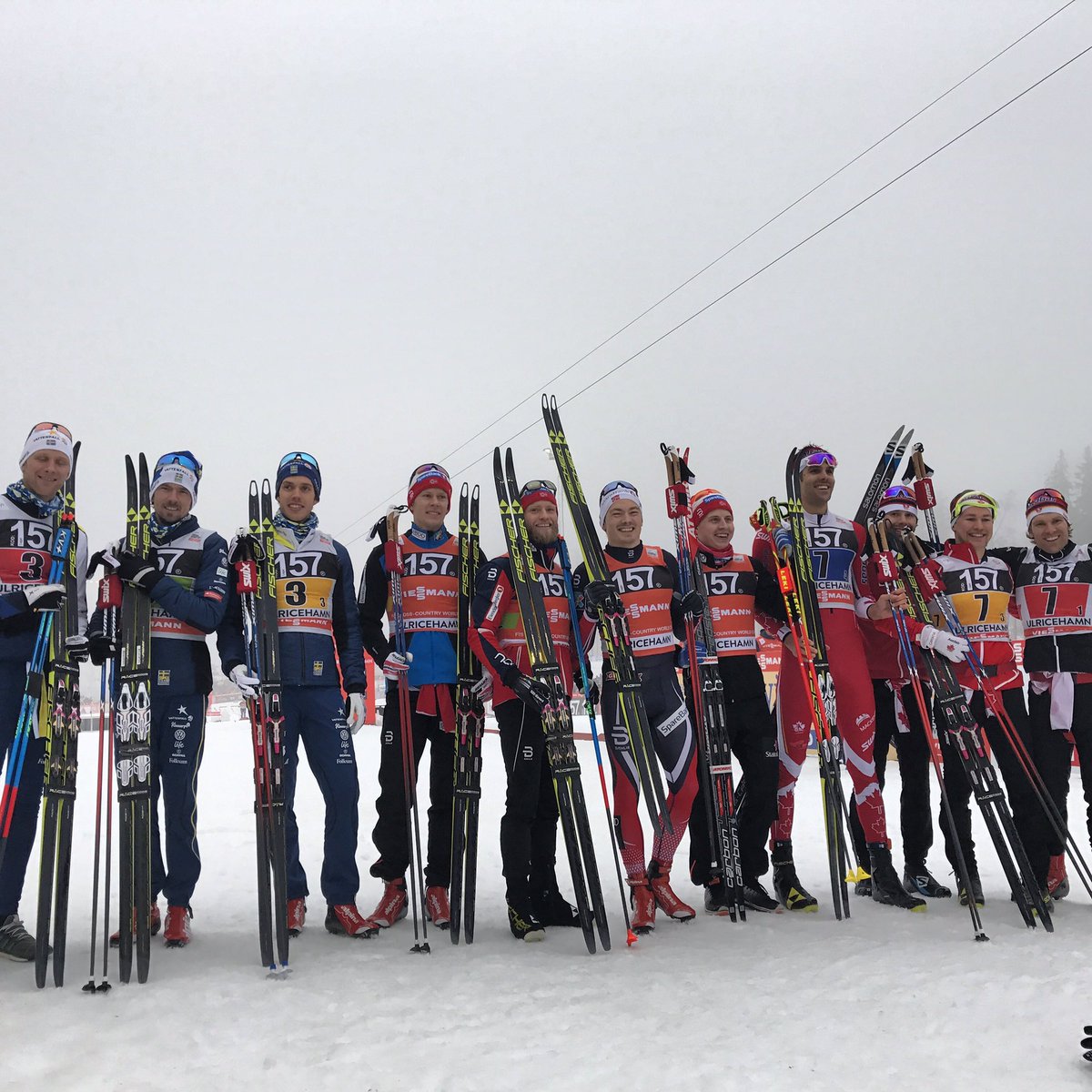
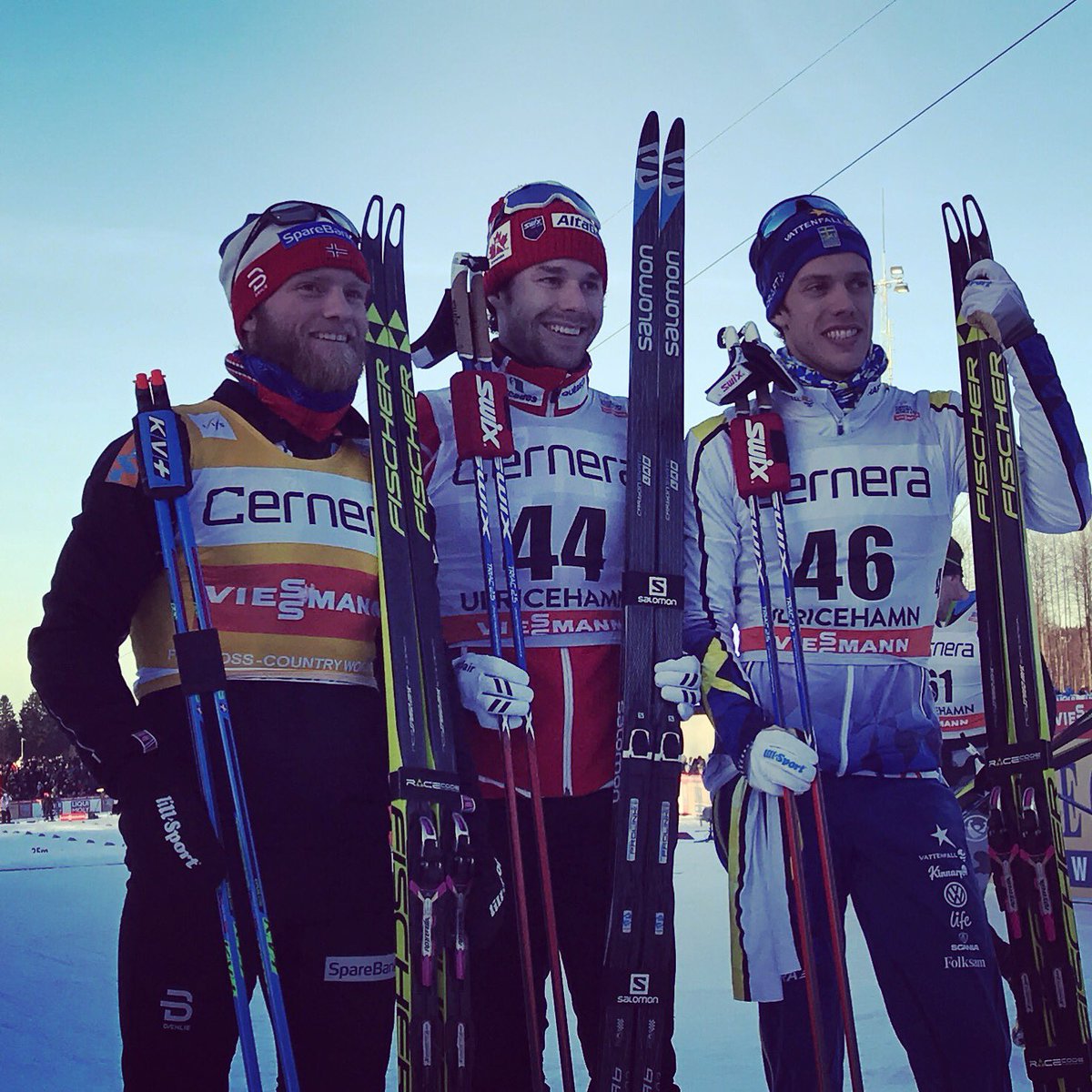
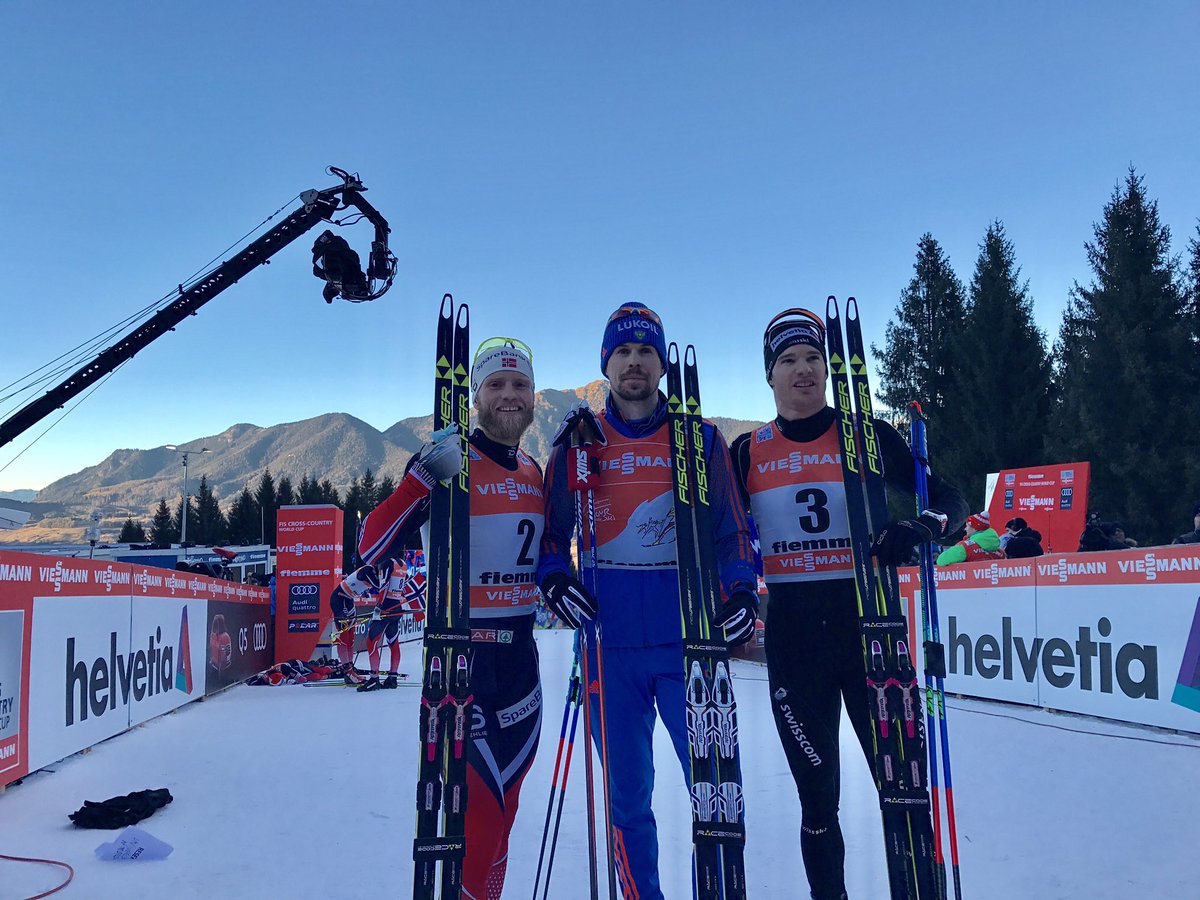
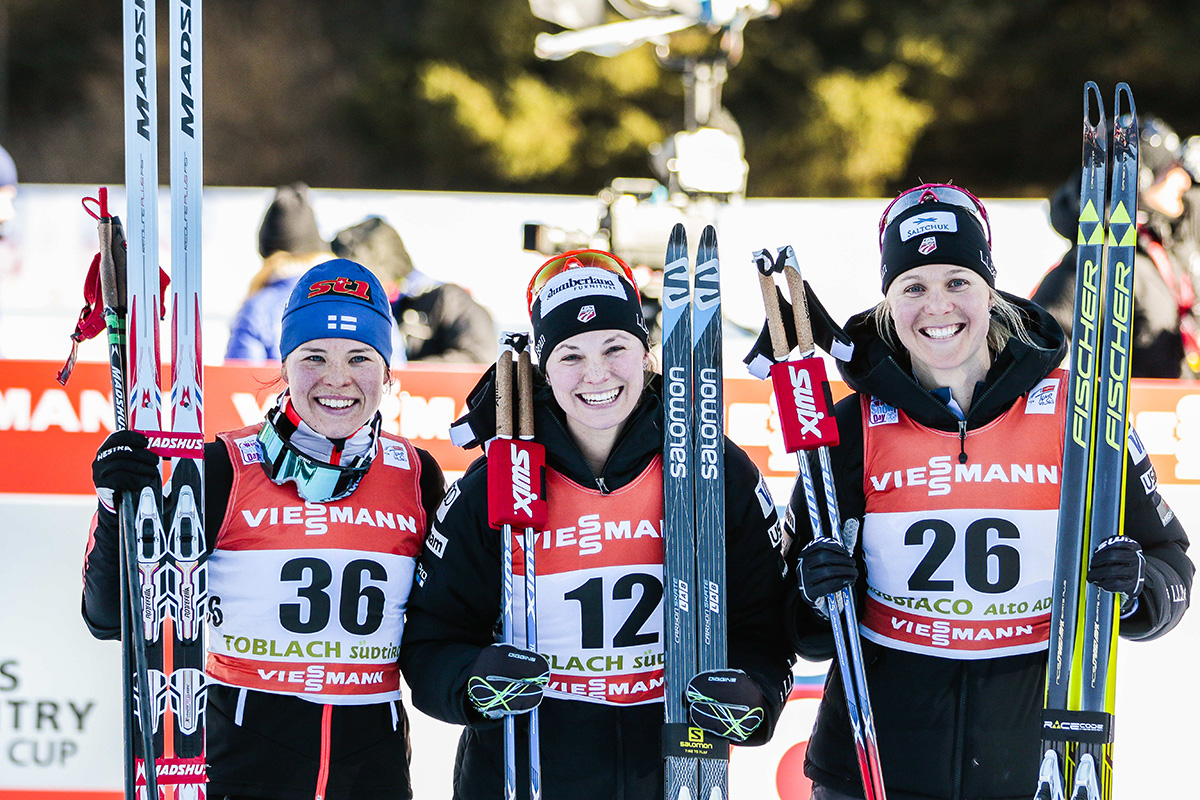
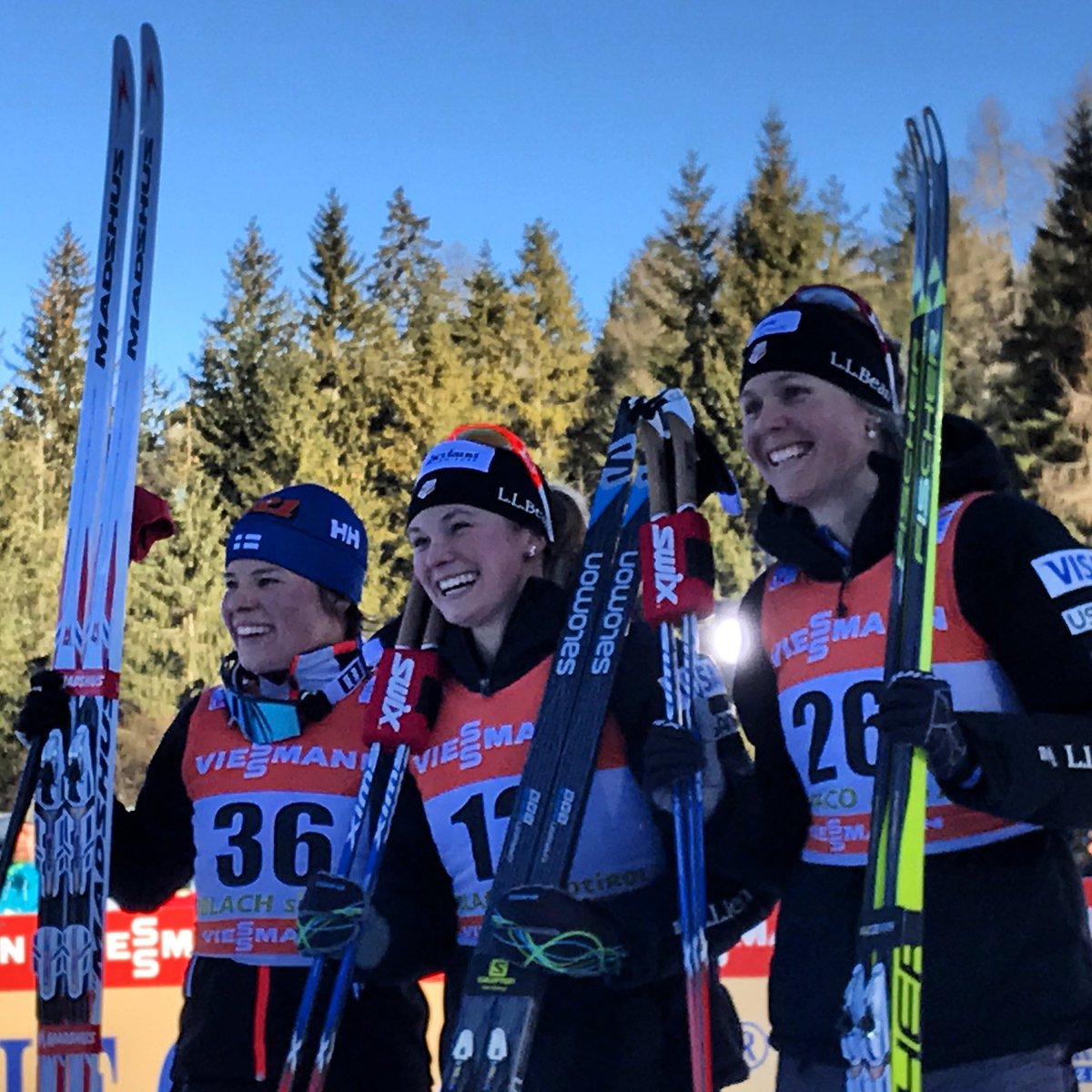
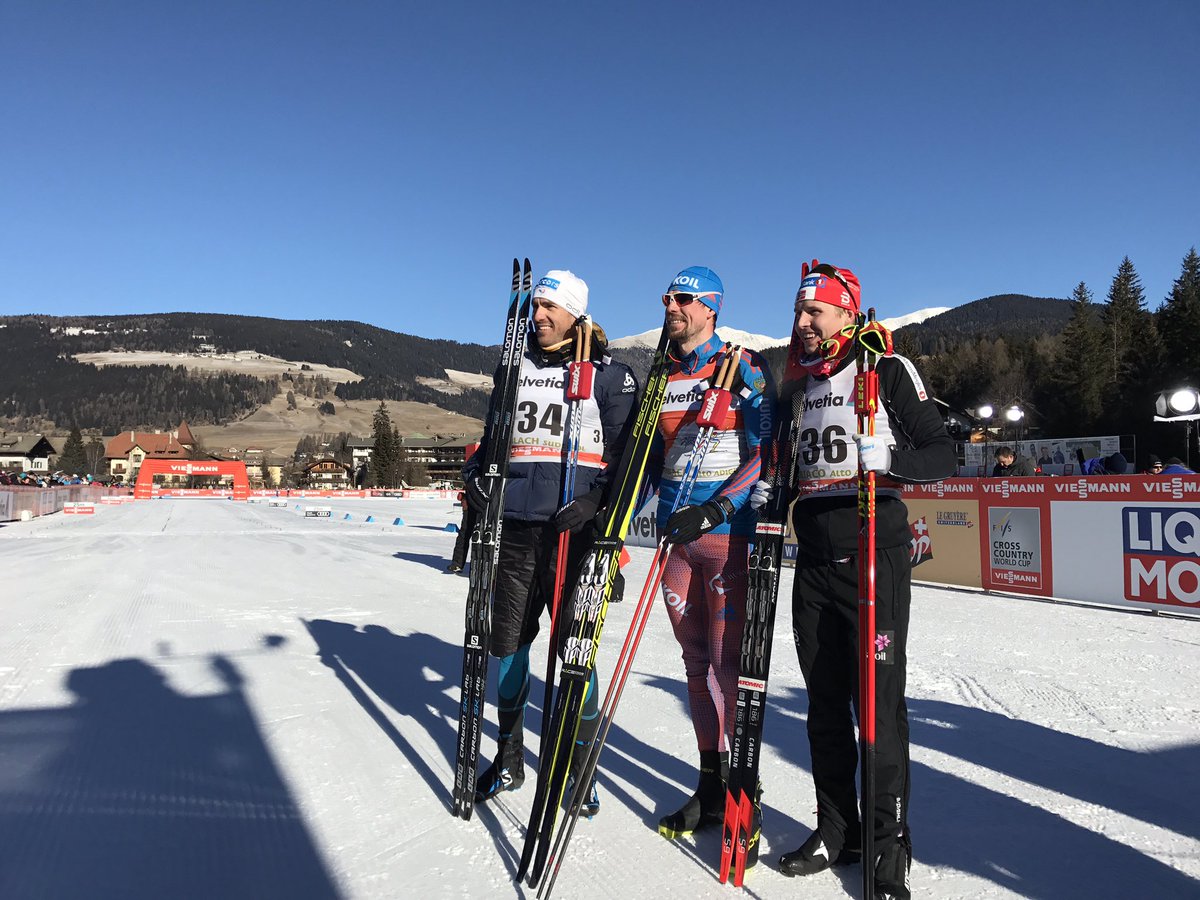
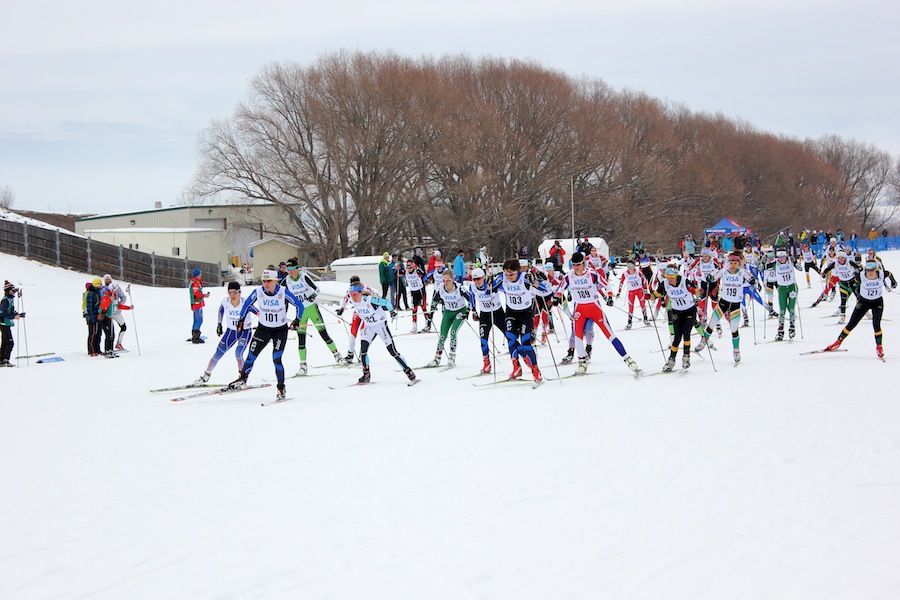
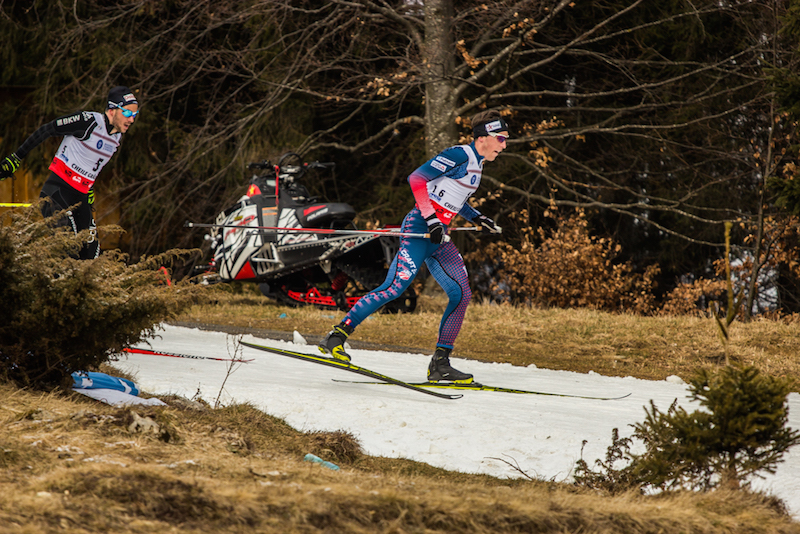
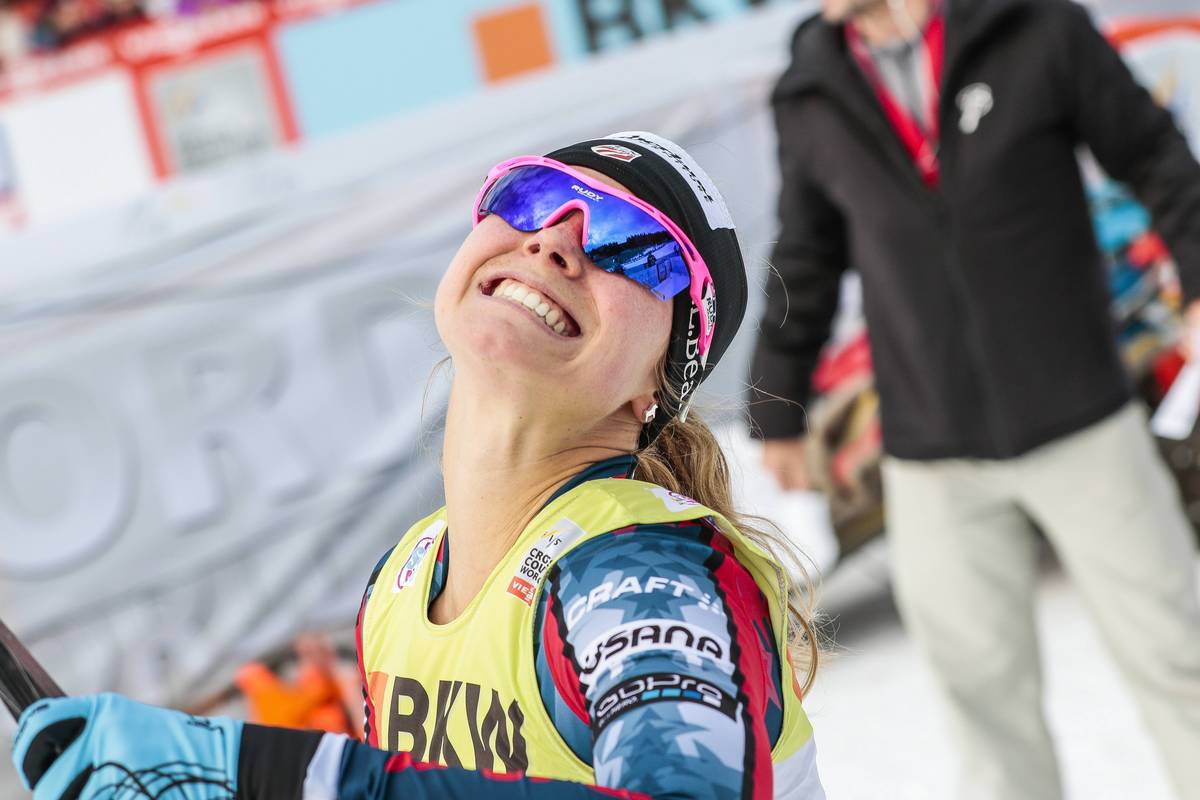
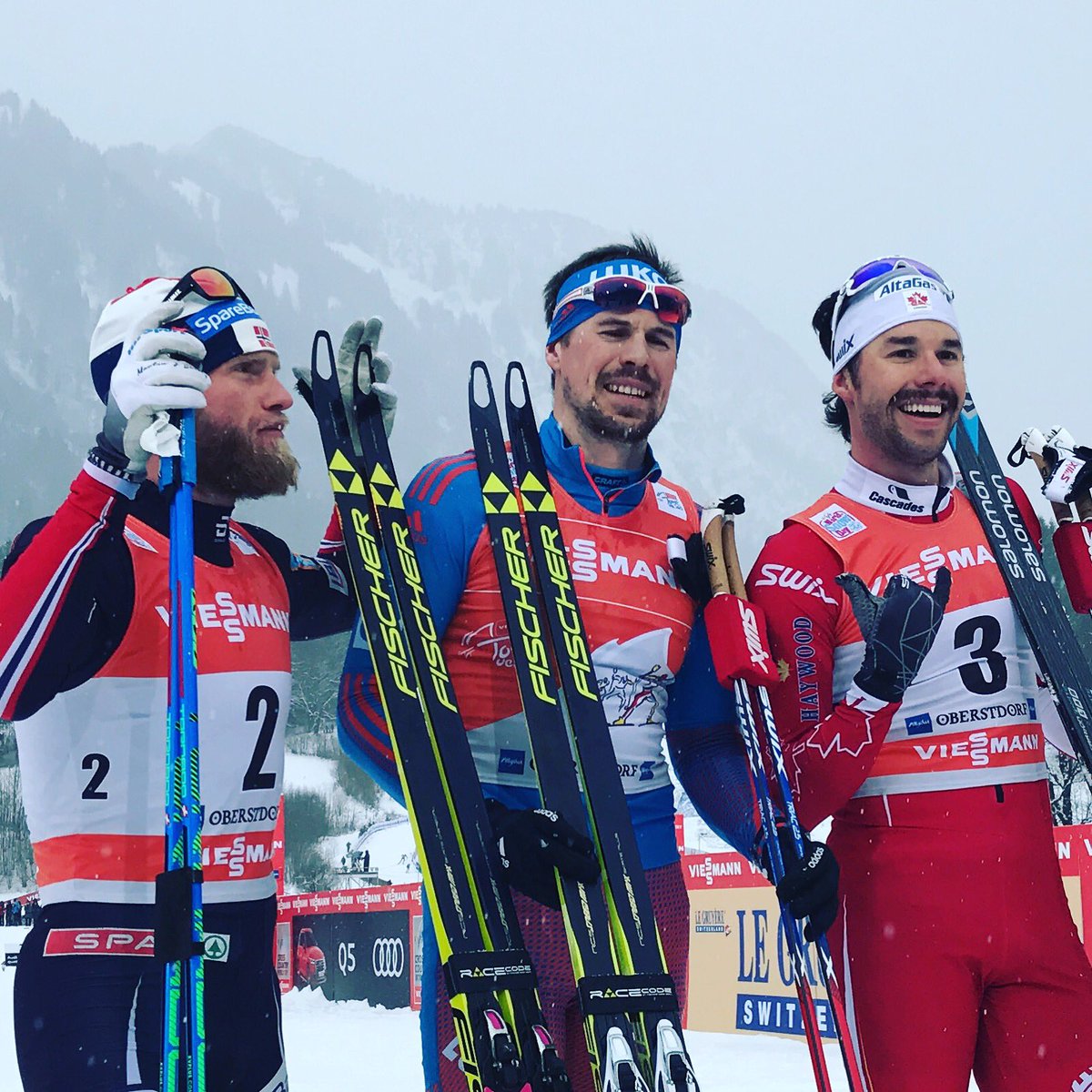
The men’s 4 x 7.5 k relay podium at the World Cup in Ulricehamn, Sweden, with Norway (c) in first, Sweden (l) in second, and Canada (r) with with its best-ever men’s relay in third. (Photo: FIS Cross Country/Twitter)
FIS Cross-Country World Cup (Ulricehamn, Sweden): 4 x 5 k and 4 x 7.5 k Relays
Norway notched back-to-back team victories in the women’s and men’s relays on Sunday at the World Cup in Ulricehamn, Sweden, with Finn Hågen Krogh securing a win in themen’s 4 x 7.5 k relay by 0.5 seconds over Sweden’s Calle Halfvarsson and Canada’s Lenny Valjas. With two kilometers remaining, nine teams were within 3.8 seconds of first. Krogh outlasted both Halfvarsson and Valjas in the finishing stretch, as Sweden placed second and Canada third for its best-ever relay result, according to a Cross Country Canada press release, besting its fifth-place finish from 2012 (with then-anchor Ivan Babikov, now a Canadian World Cup coach).
Krogh teamed up with Simen Hegstad Krüger, Martin Johnsrud Sundby and Anders Gløersen and finished in 1:06:47.5, while Sweden placed second with Daniel Rickardsson, Johan Olsson, Marcus Hellner, and Halfvarsson.
For Canada, with Devon Kershaw, Alex Harvey, Knute Johnsgaard, and Valjas, it was Harvey’s third-straight World Cup podium, Valjas’s second-straight team-event podium, and national U25 Team member Johnsgaard’s first podium.
“I have been waiting my whole career for this,” Kershaw said, according to a FIS press release. “All the guys did a great job today.”
The U.S. placed 10th (+1:16.5) with Andy Newell, Erik Bjornsen, Noah Hoffman, and Simi Hamilton.
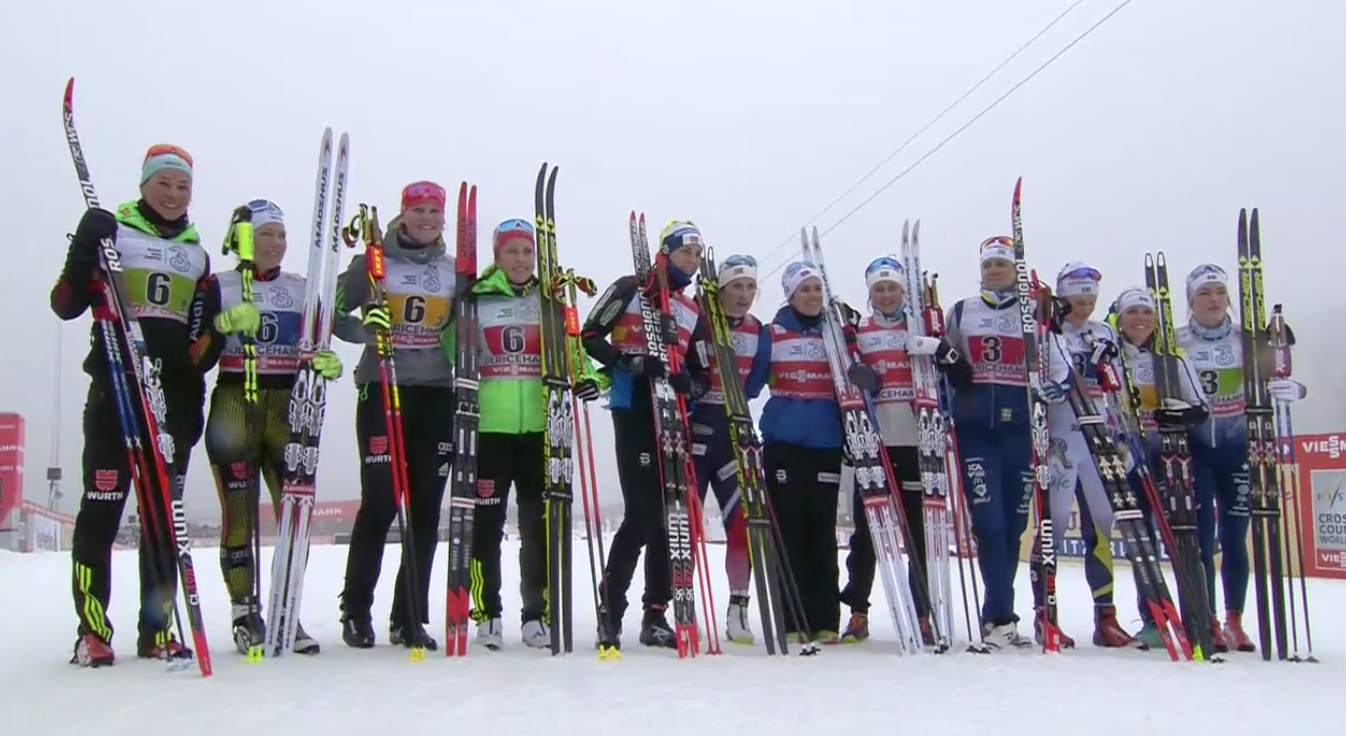
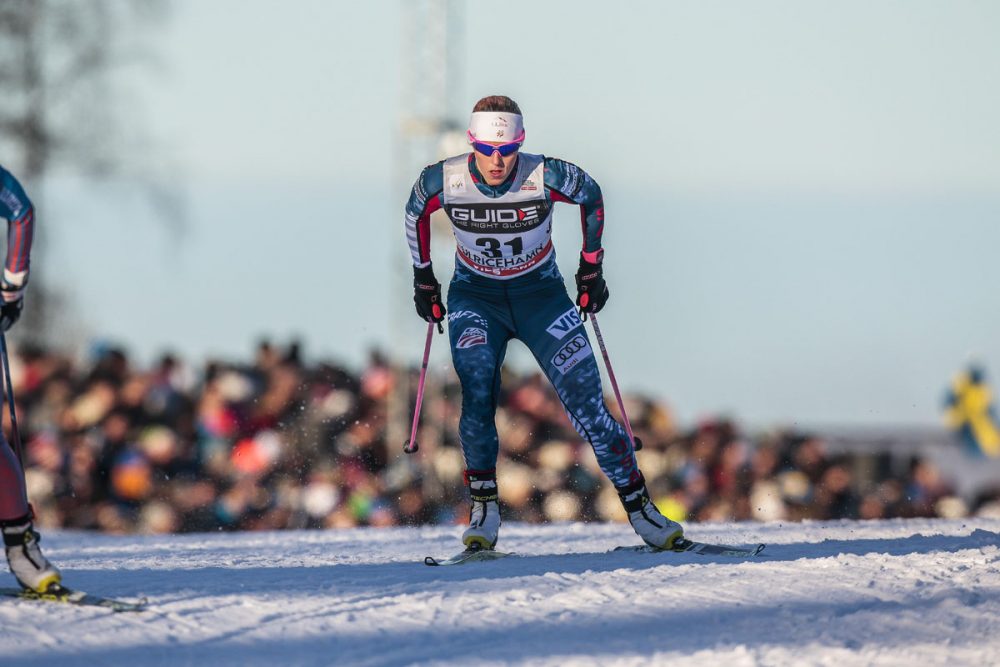
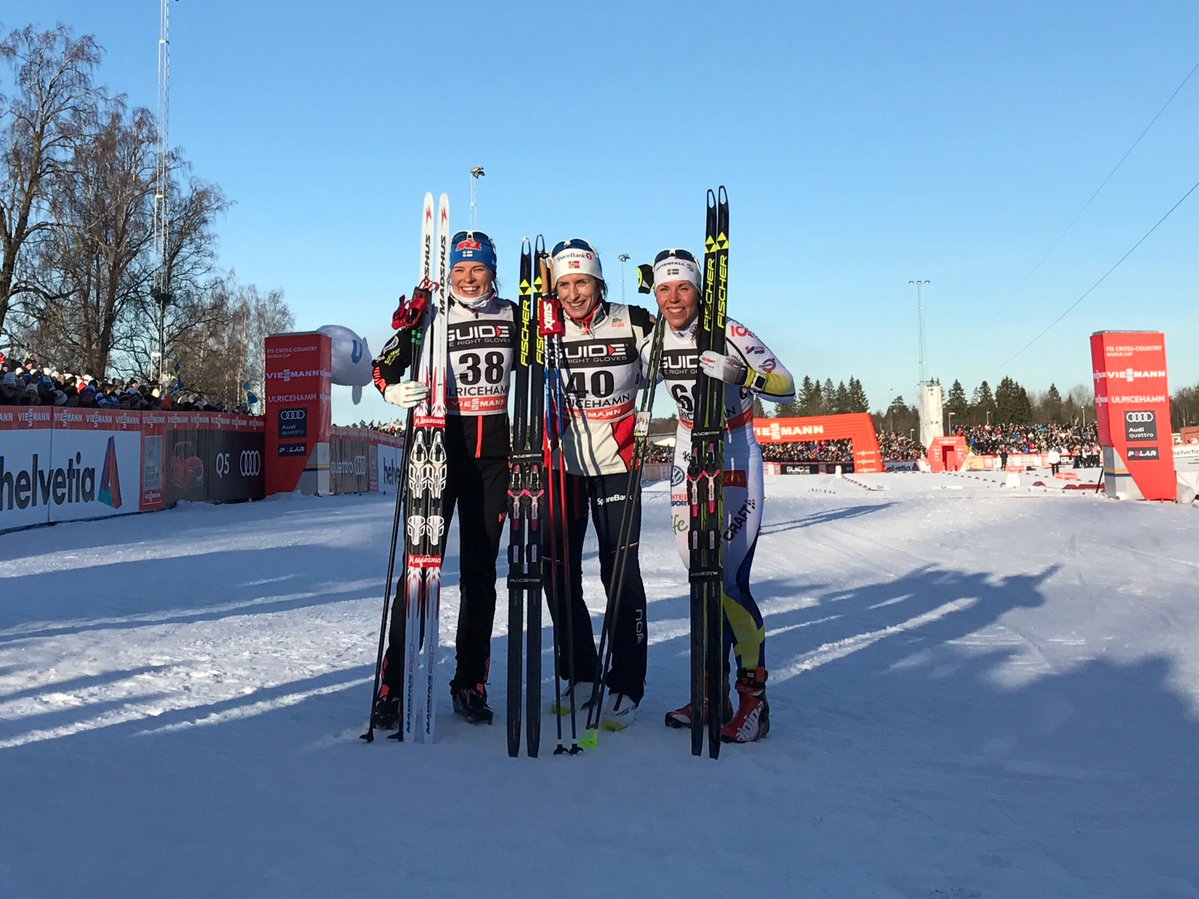
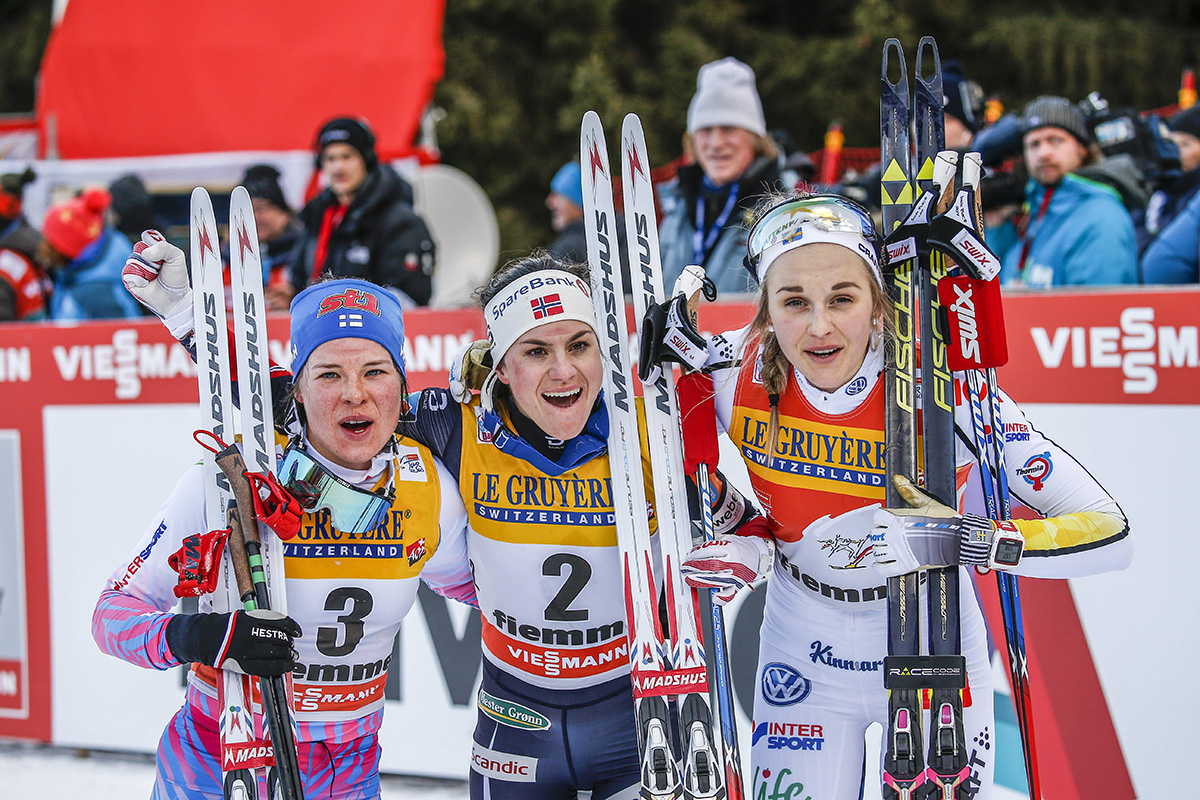
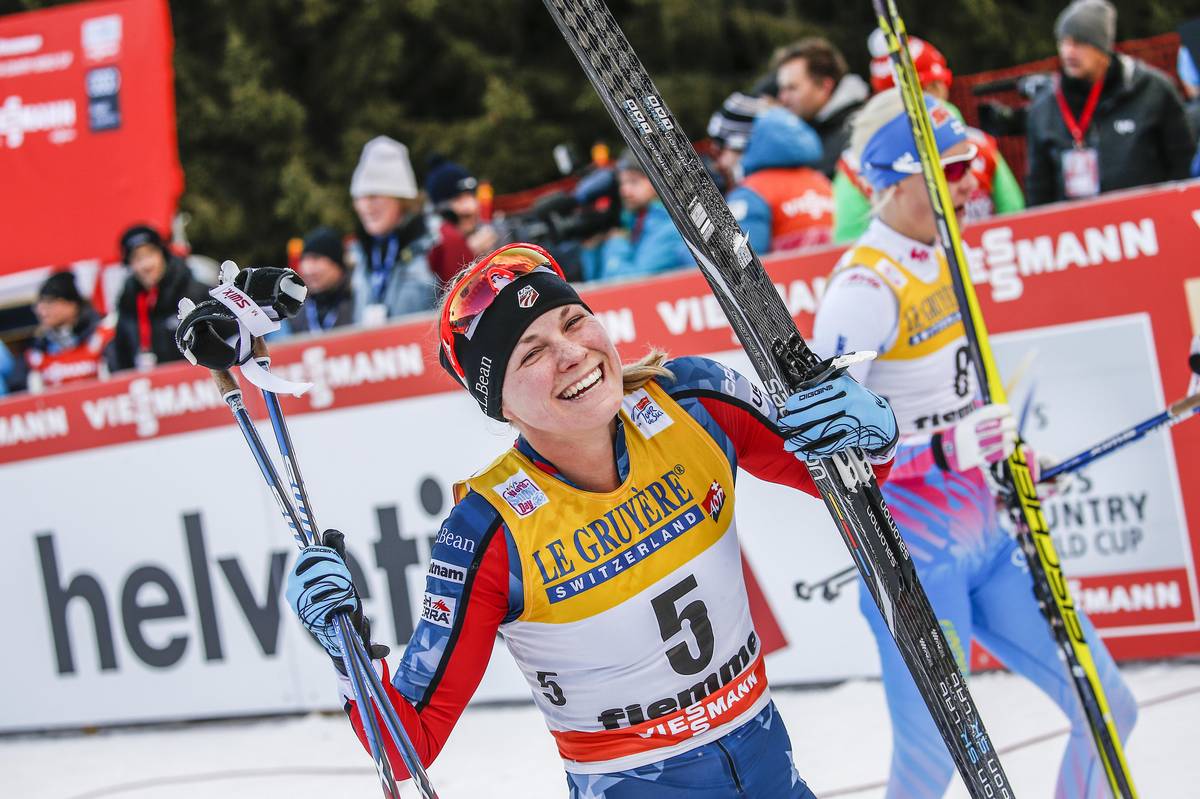
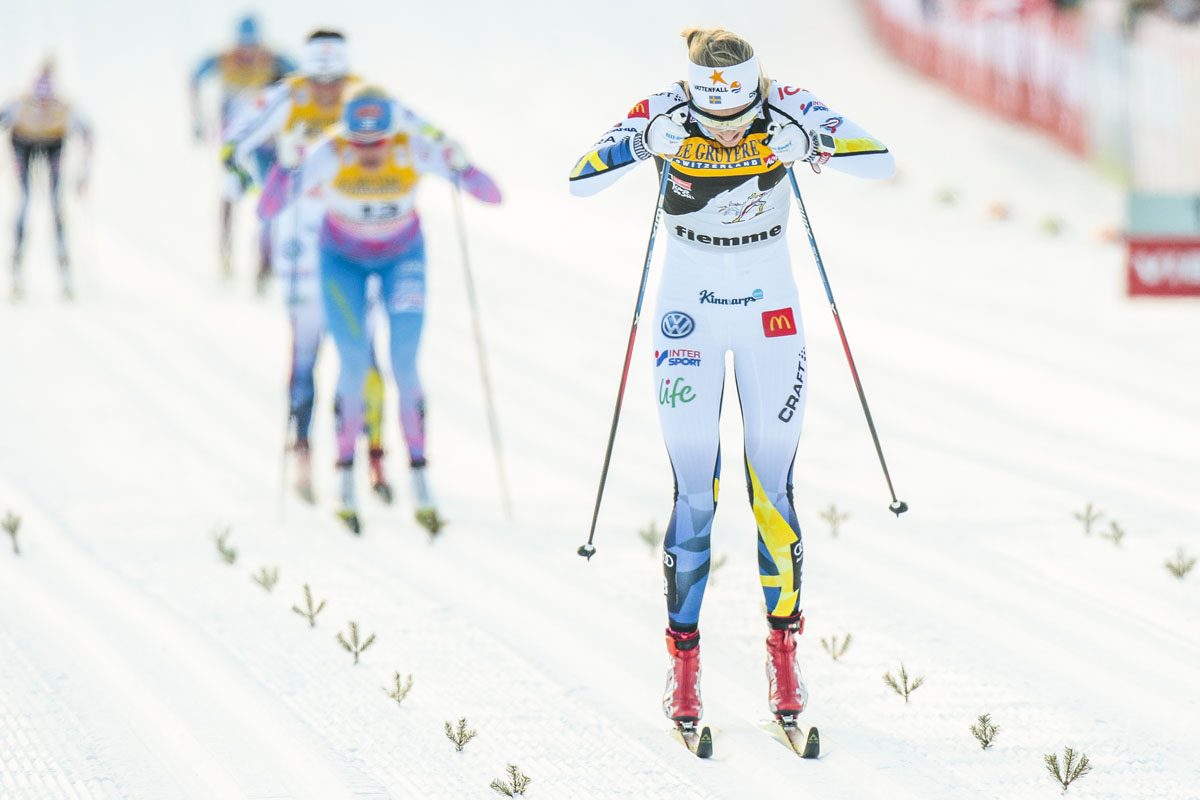
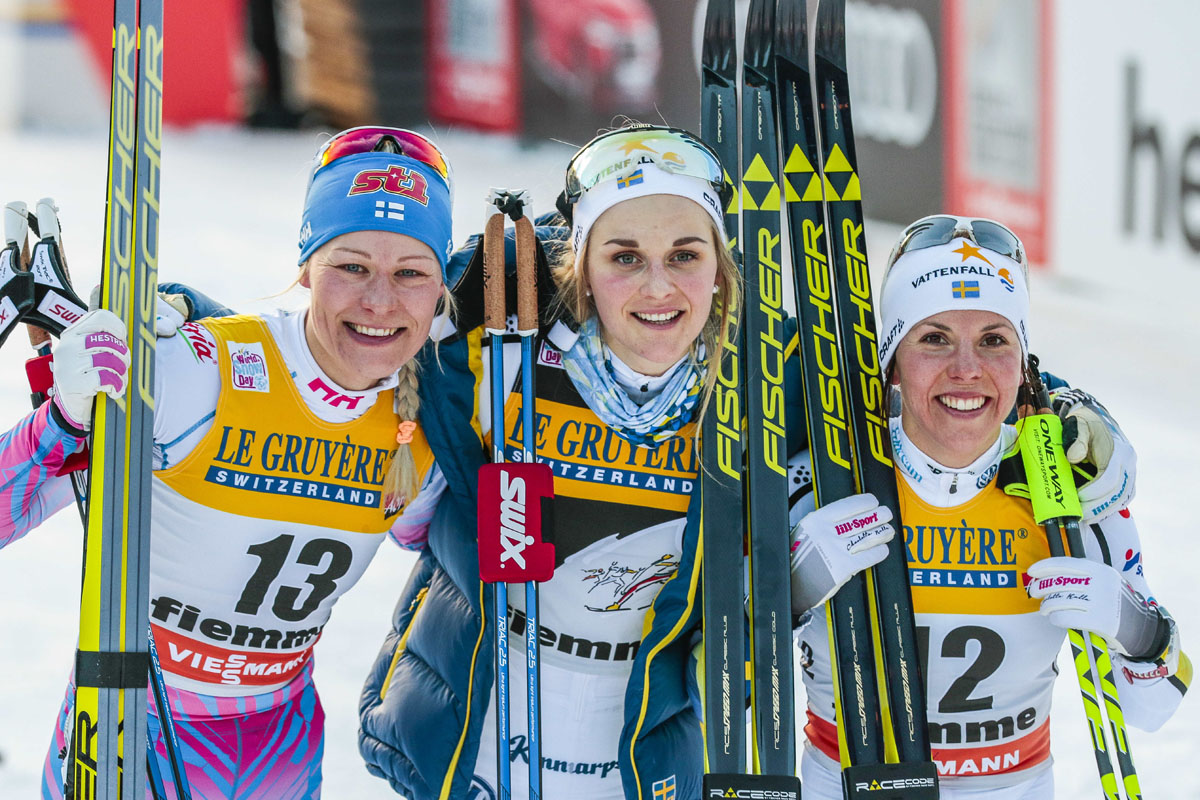
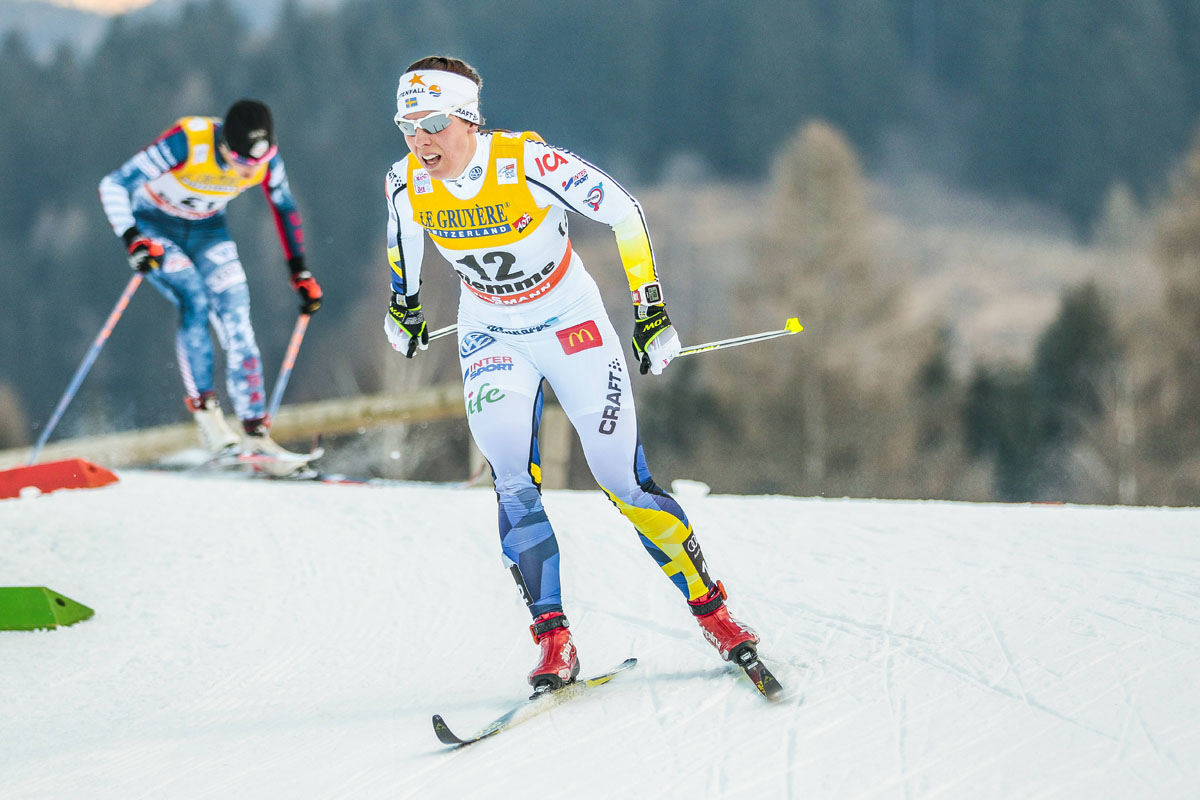
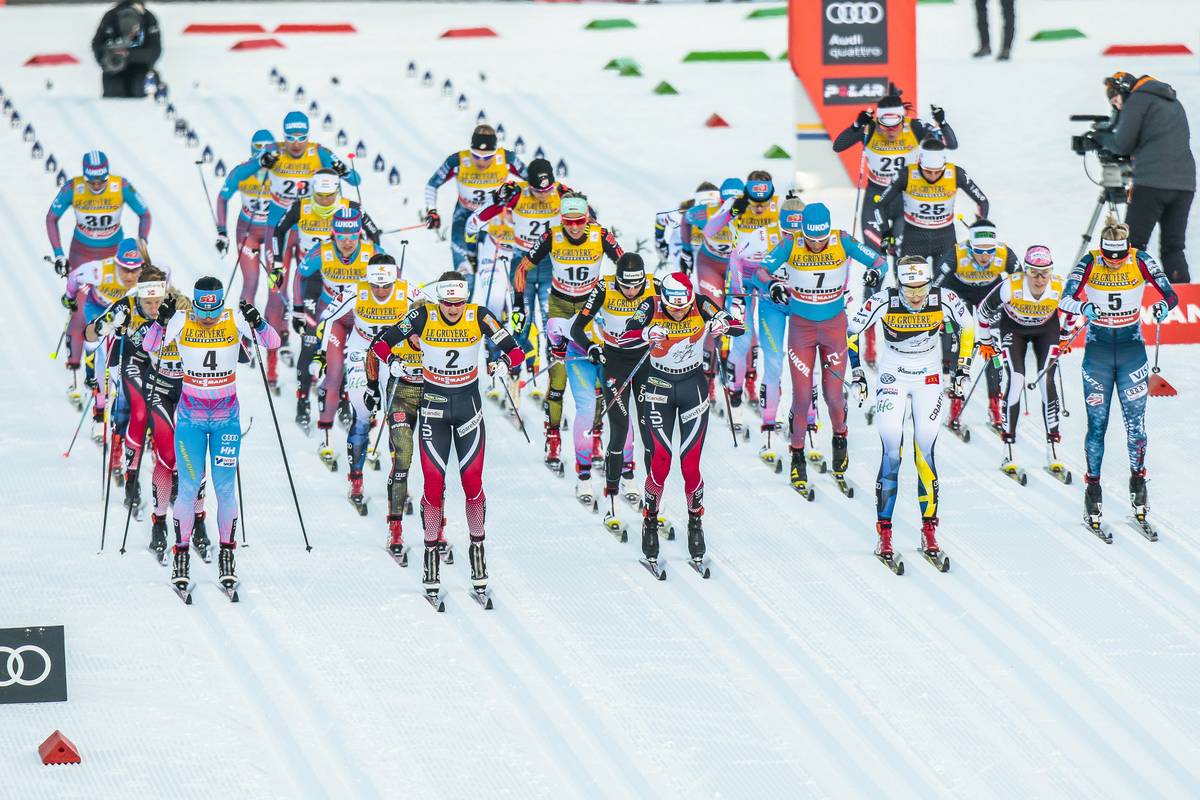
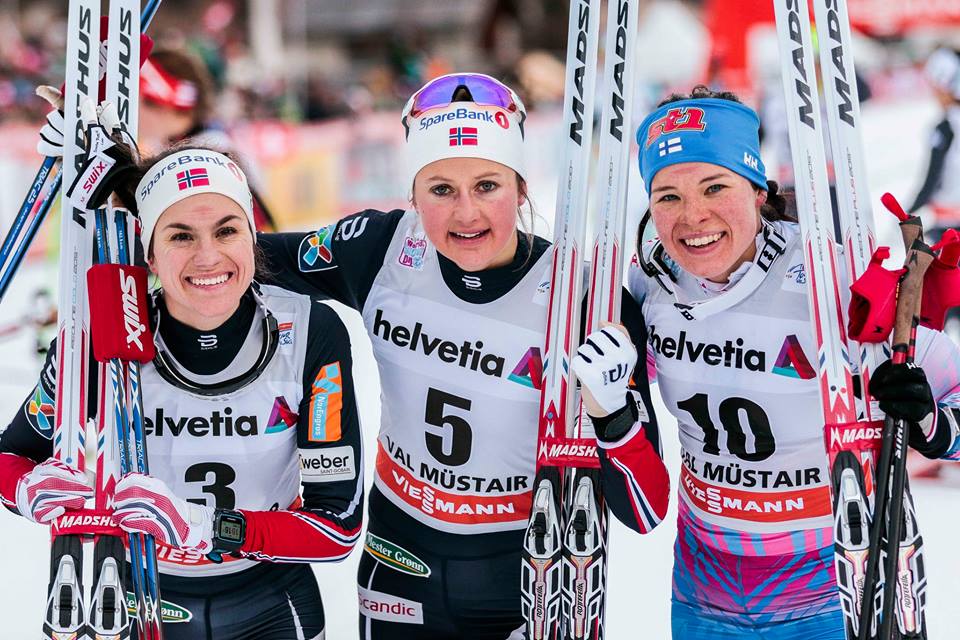
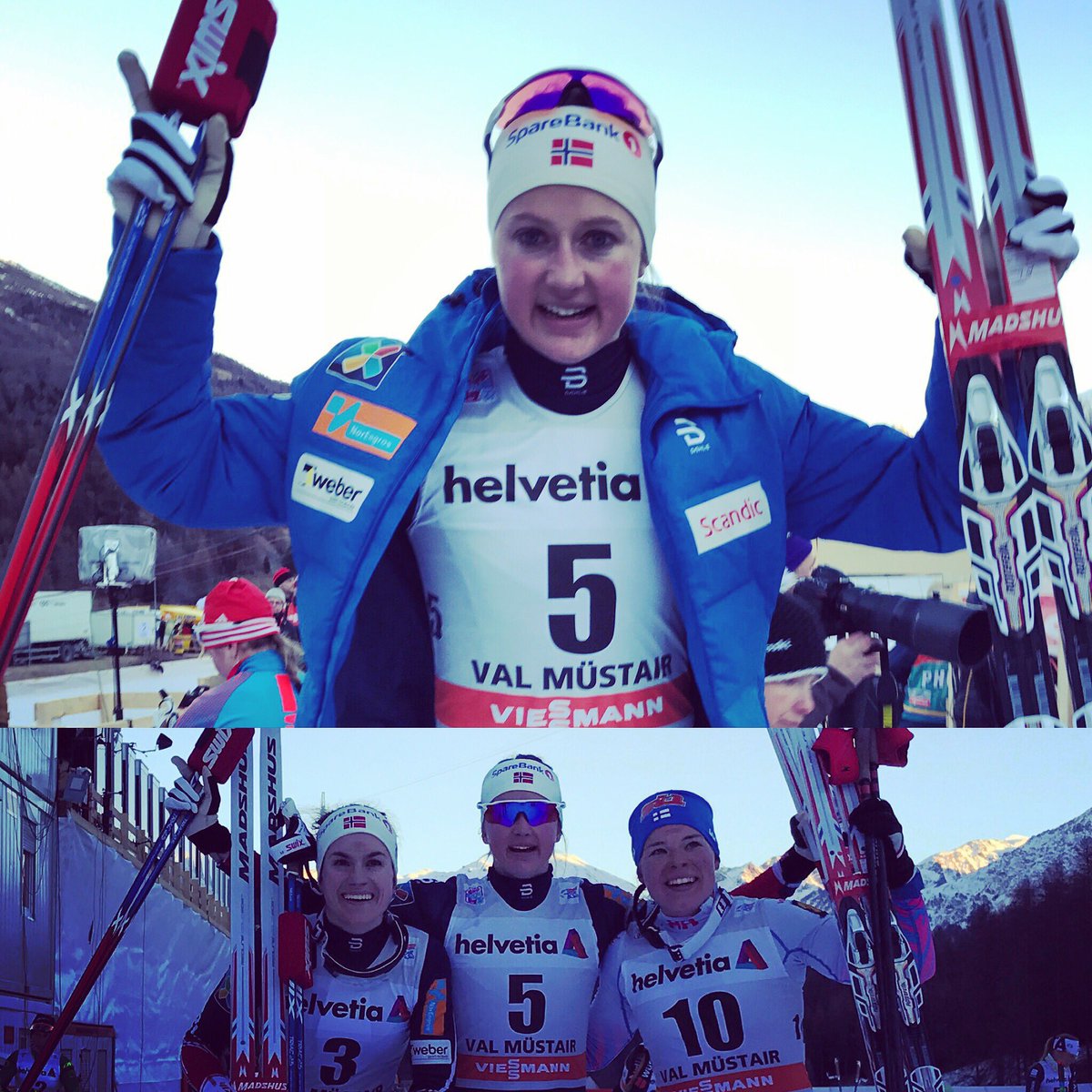
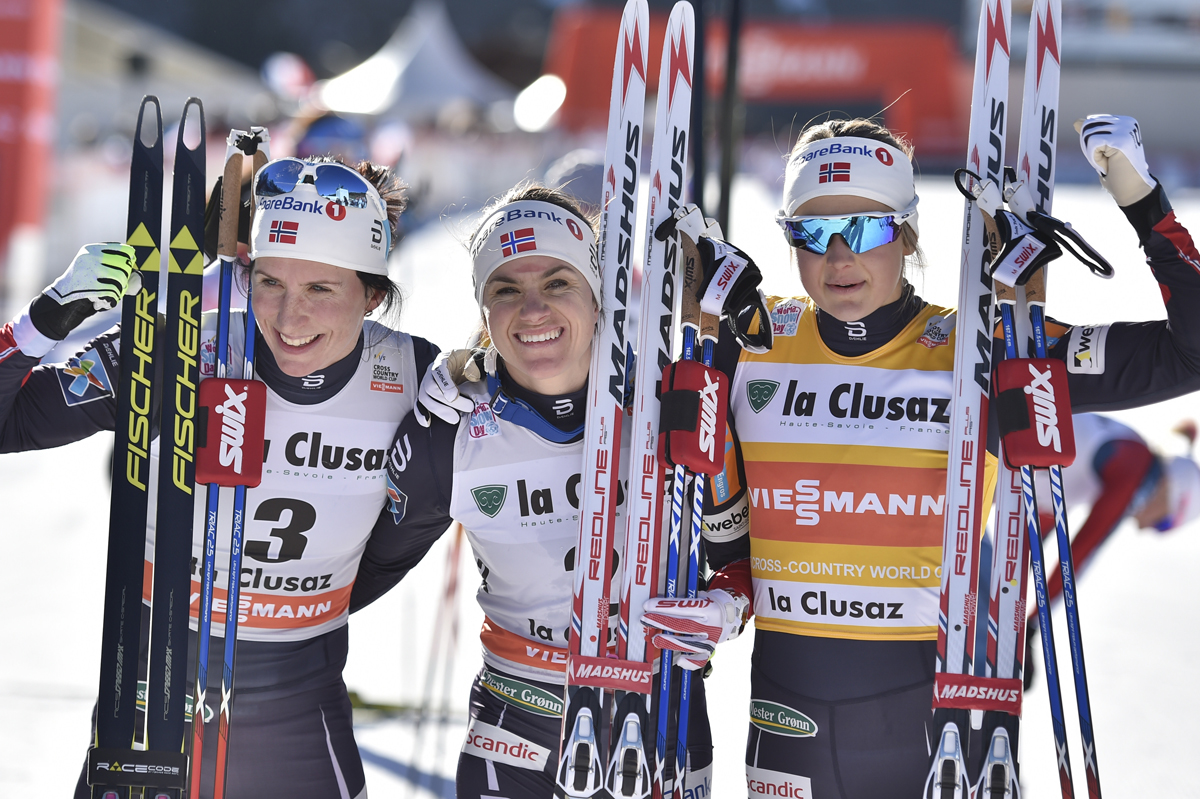
The Norwegian women’s team (center) won the 4 x 5 k World Cup cross-country relay in Ulricehamn, Sweden, by 8.8 seconds over Germany (left), with home team Sweden (right) edging the United States for third.
Earlier on Sunday, the women’s 4 x 5 k relay didn’t break apart until the second leg, but Norway still proved its dominance over the ski world with a win to start the day.
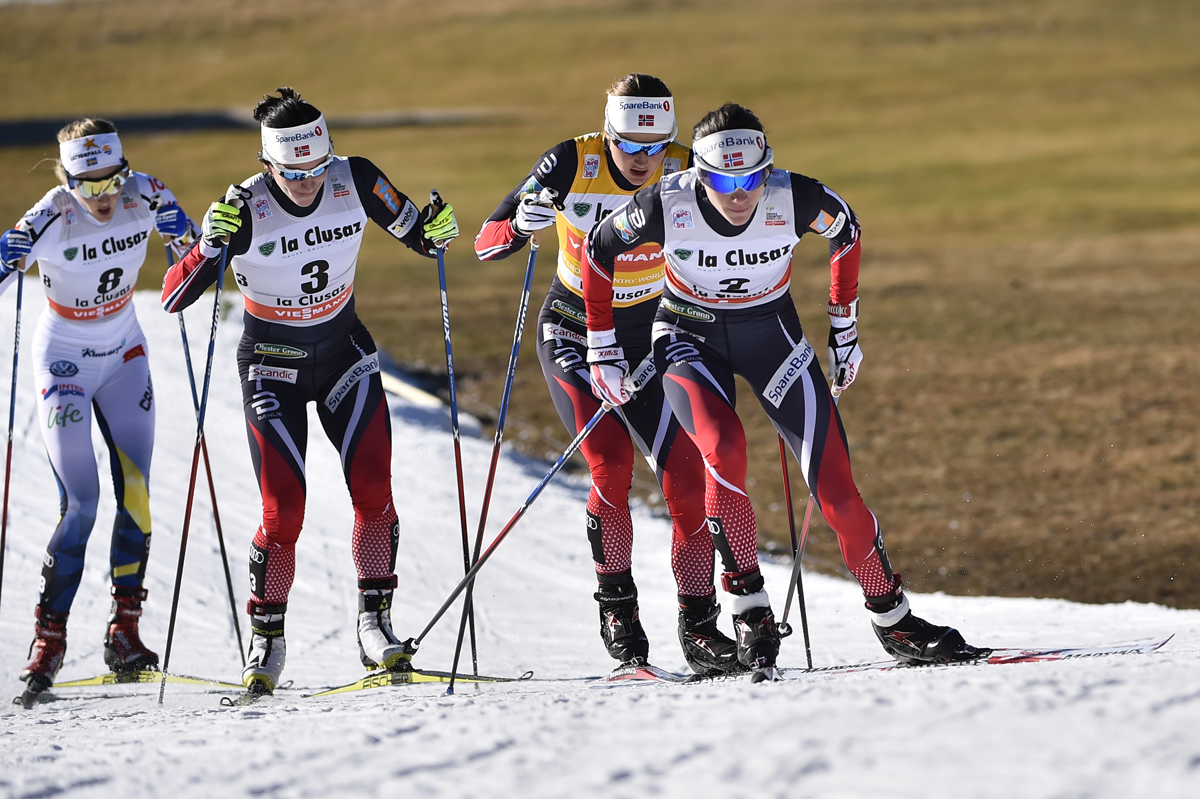
After the group of Ingvild Flugstad Østberg and Lotta Udnes Weng (Norway), Ida Ingemarsdotter (Sweden), and Anamarija Lampic (Slovenia) more or less stayed together on the first relay leg, Heidi Weng made a break for it, giving Norway a 16.8-second lead at the second tag. The Norwegian team never looked back and after the race Weng and teammates Østberg, Astrid Jacobsen, and Marit Bjørgen were able to climb to the top step of the podium.
The race for second place, though, wasn’t resolved until the finish line. Sweden, Slovenia, Norway’s second team, the United States, and Germany were all in contention at various points in the race.
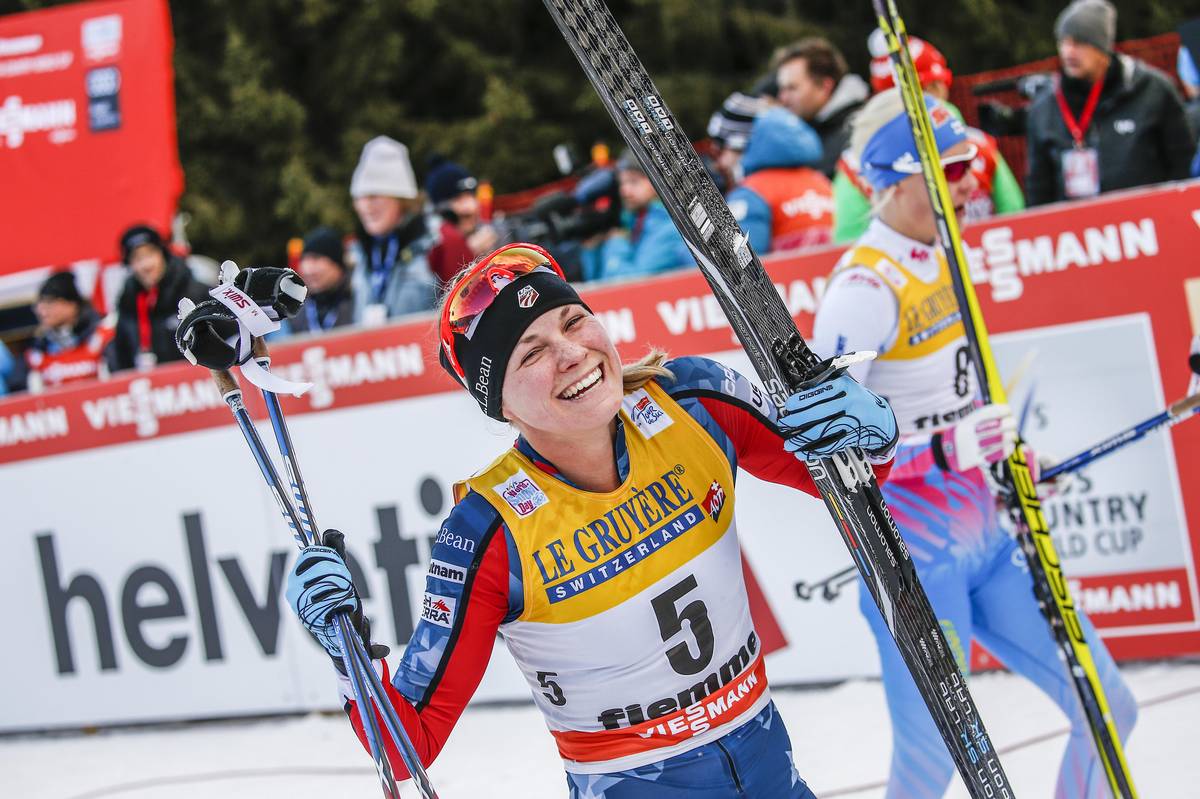
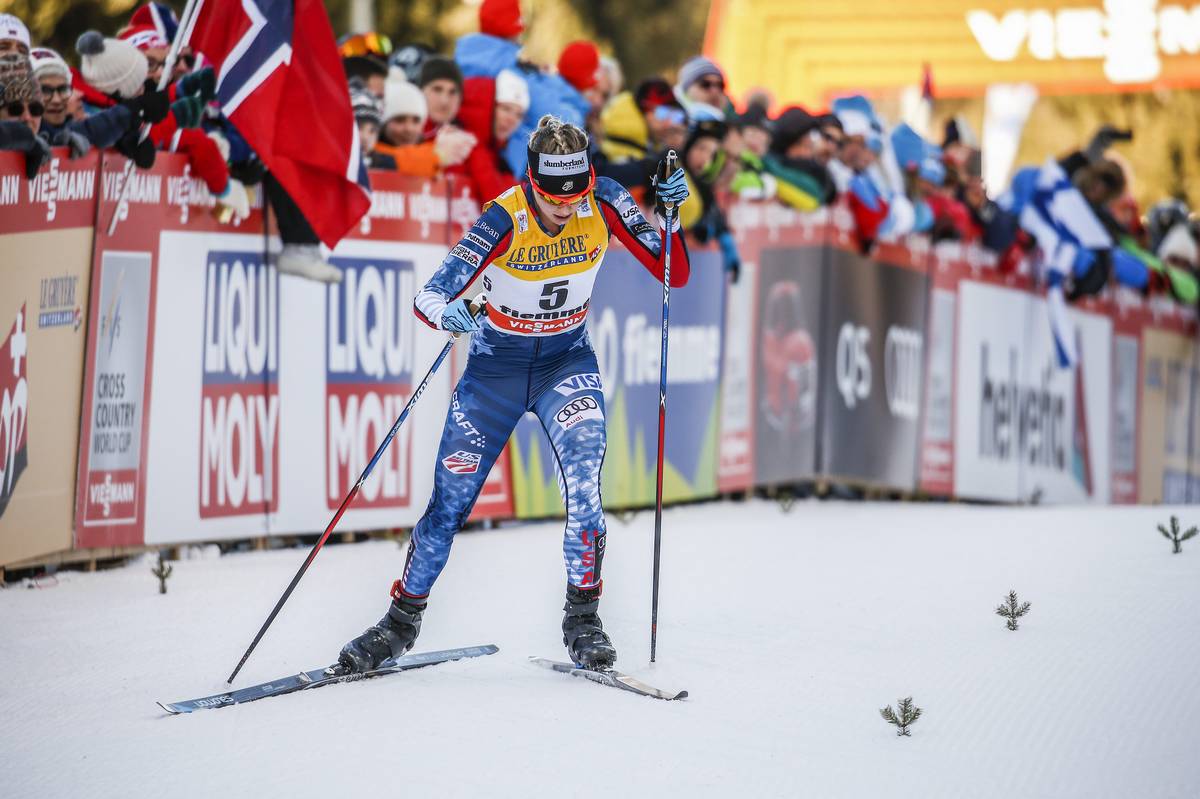
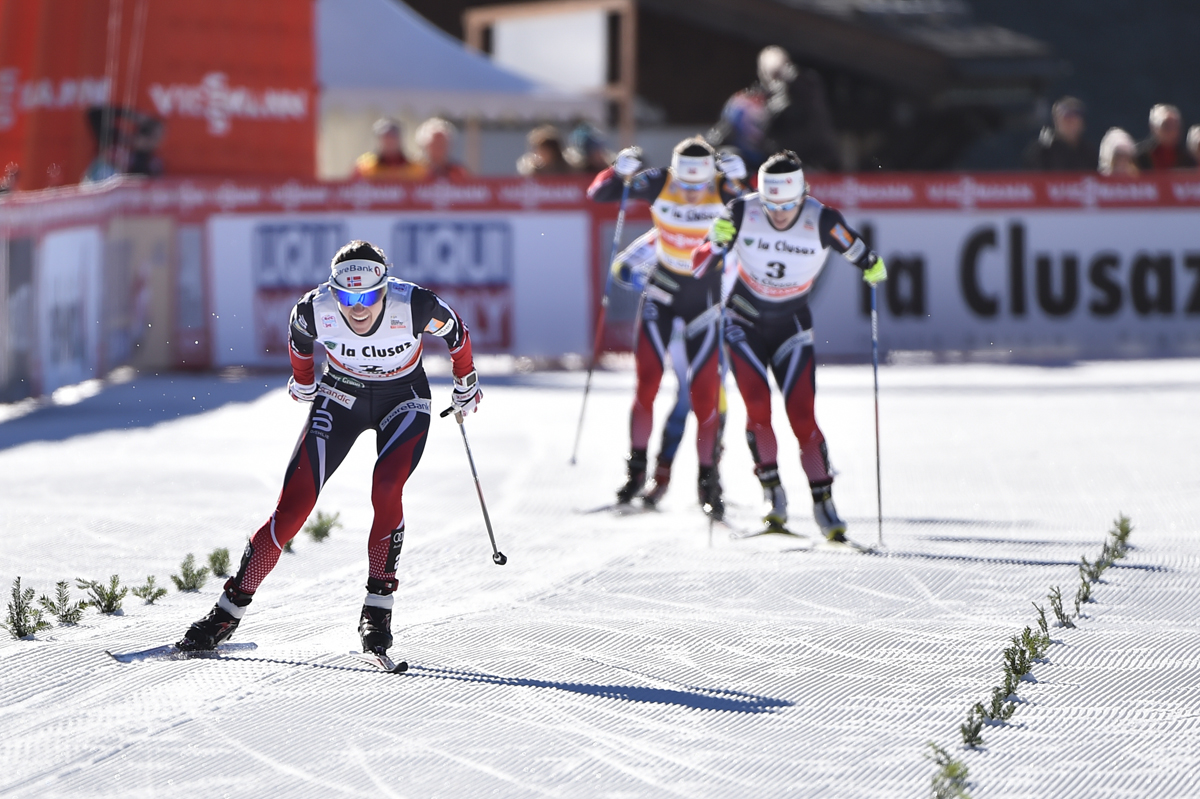
On the last leg, Jessie Diggins of the U.S., Sandra Ringwald of Germany, and Hanna Falk of Sweden battled it out, dropping Kari Øyre Slind of Norway. The three shot to the finish line together, with Diggins stuck behind the other two. Ringwald eventually won the sprint finish by 0.2 seconds over Falk, with Diggins another 0.2 seconds back in fourth.
That gave Ringwald, Katharina Hennig, Stefanie Boehler, and Victoria Carl a second-place result, one of Germany’s best since taking silver at the 2010 Olympics. (The team won bronze at the 2014 Olympics.)
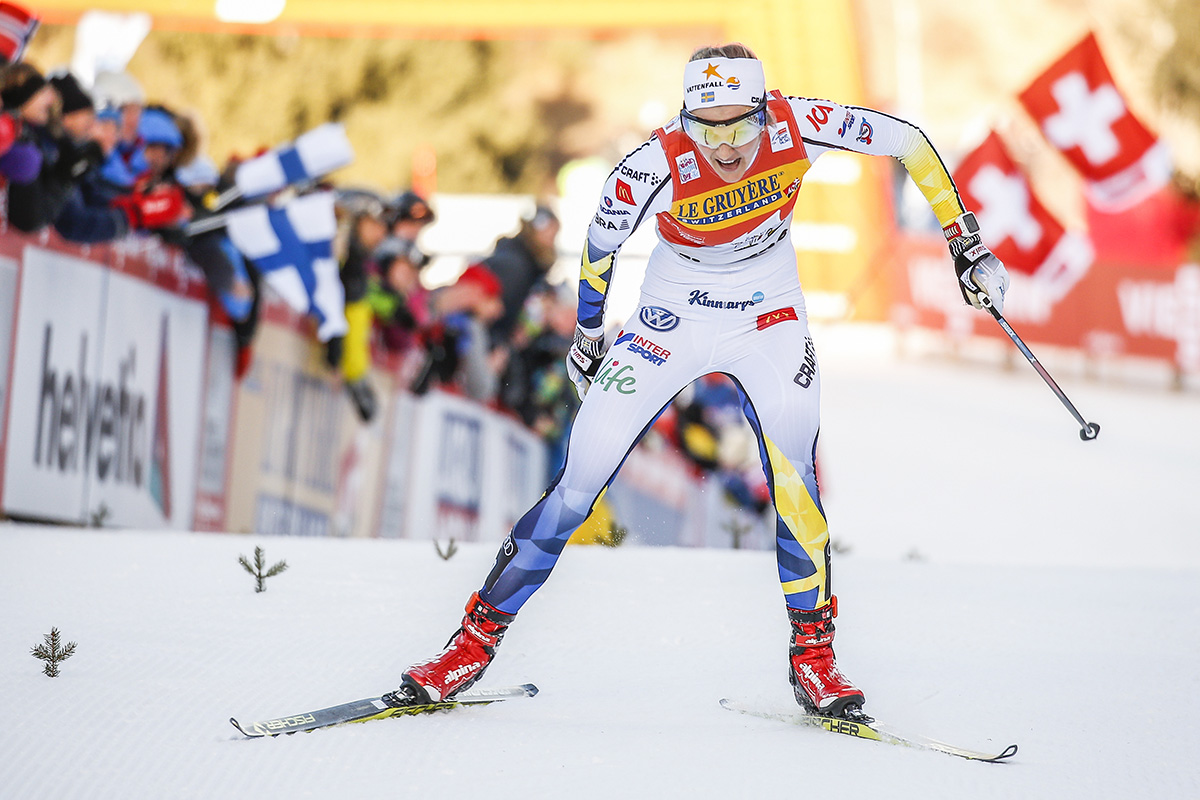
Ingemarsdotter, Falk, Charlotte Kalla, and Sofia Henriksson took the third step of the podium. Rosie Brennan, Sadie Bjornsen, Liz Stephen, and Diggins were left to settle for fourth.
The second U.S. team, of Kikkan Randall, Ida Sargent, Sophie Caldwell, and SuperTour leader Liz Guiney finished 12th after skiing in 8th and 9th earlier in the race.
NorAm Western Canadian Championships (Whistler, B.C.): Relays
[UPDATED] This season brought a changeup to the Western Canadian Championships with a three-person relay event in response to athletes’ request to add “fun” events to the NorAm series.
While 146 teams finished in 17 categories, it was Ontario winning the open men’s 3 x 7.5 k in 50:32.9 (Bob Thompson, Jack Carlyle and Andy Shields) and B.C. dominating the open women’s 3 x 5 k in 41:09.47 with three juniors (Katie Weaver, Anna Goodwin and Hannah Mehain).
The masters men and juvenile girls categories included the most teams, with 15 and 14, respectively.
FIS Nordic Combined World Cup (Chaux-Neuve, France): Individual large hill/10 k
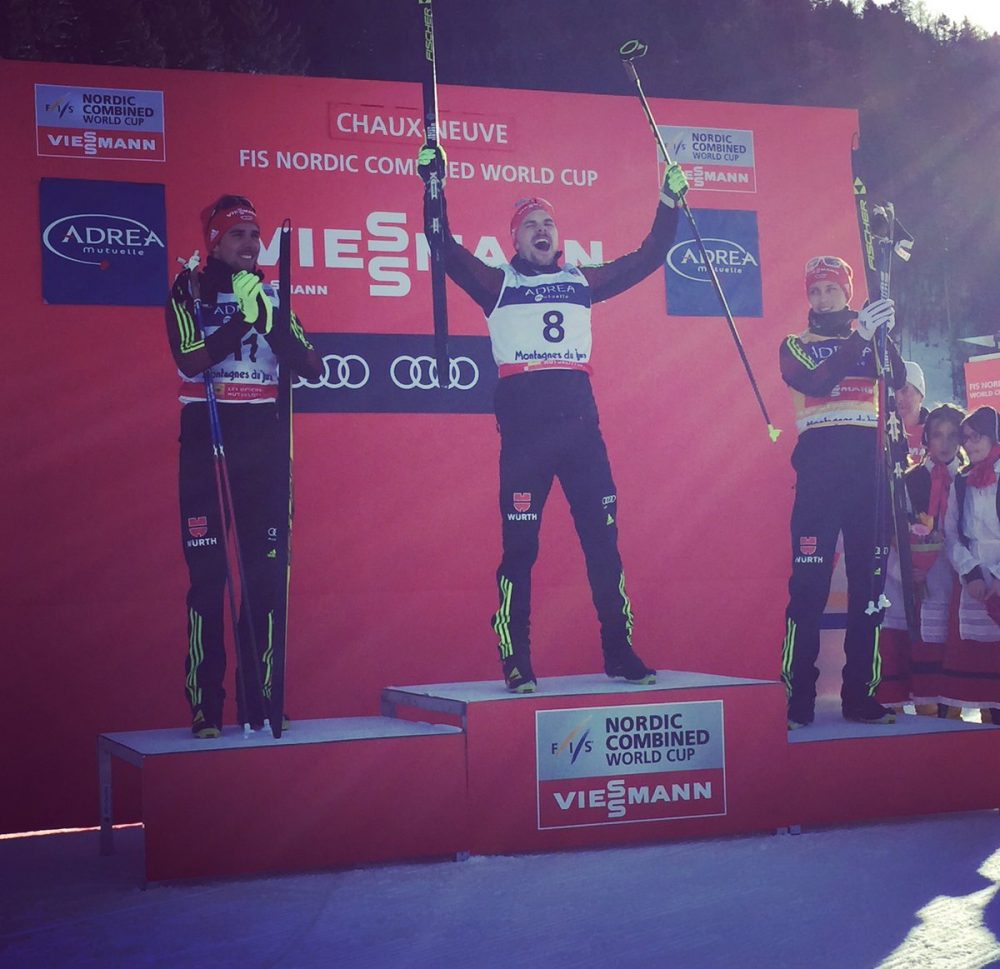
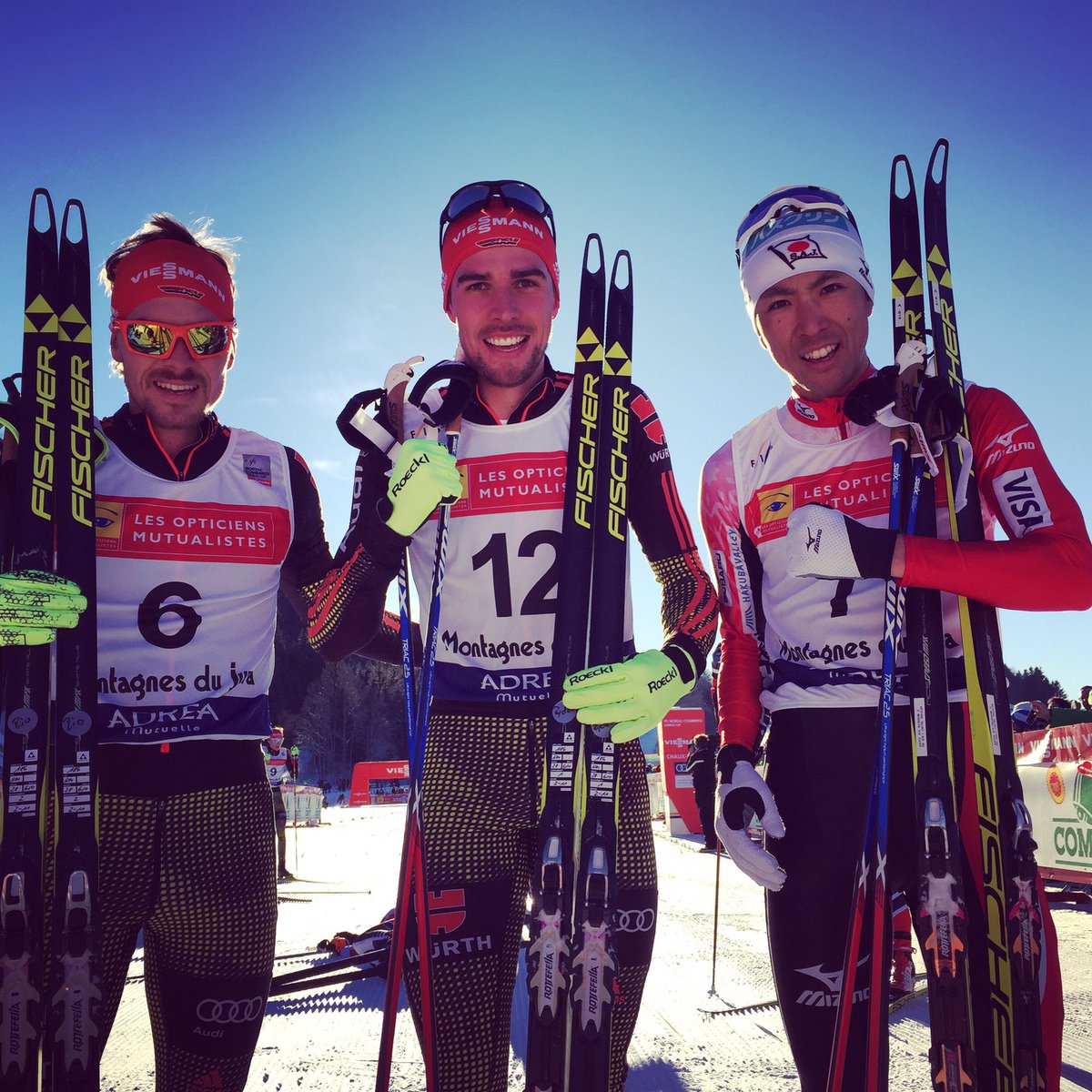
Sunday’s Nordic Combined World Cup podium in Chaux-Neuve, France, with German winner Fabian Rießle (c), German runner-up Johannes Rydzek (l), and Germany’s Eric Frenzel (r) in third. (Photo: FIS Nordic Combined/Twitter)
On Sunday, after the large hill jump and 10 k ski, Germany swept the podium in the second event of the NoCo World Cup in Chaux-Neuve, France. Fabian Rießle placed first in 22:44, and his German teammates Johannes Rydzek skied to second only 2.2 seconds back, and Saturday’s winner Eric Frenzel was third (+7.9).
(Frenzel leads the NoCo World Cup, Rydzek is second overall, Rießle is third.)
Norway’s Jarl Magnus Riiber flew the farthest with 139.8 points. Franz-Josef Rehrl from Austria jumped to second with 135.7 points while his teammate Bernhard Gruber jumped to third with 131.7 points.
Magnus faded to 23rd (+47.5) in the 10 k ski. Rehrl started 15 seconds back from Magnus and placed 17th overall (+31.5). Gruber maintained a top-ten, placing 9th (+13.5), after starting 32 seconds behind first place jumper Magnus.
While the top three jumpers all dropped back in the ski, it was a day of catch up for the German’s after the jumping portion.
Rießle ranked eigth after the jump and earned 128.7 points, he began the ski 0:44 back. Rydzek placed 11th in the jump with 126.9 points, while Frenzel jumped to fourth with 131.4 points.
The only U.S. skier entered in Sunday’s event was Ben Berend. The U.S. Nordic Combined skier jumped to 13th with 126.8 points — starting the ski 0:52 behind Magnus. Yet Berend couldn’t capitalize on his strong jump, he dropped to 37th (+2:06) after the ski.
The Nordic Combined World Cup continues next Friday in Seefeld, Austria.
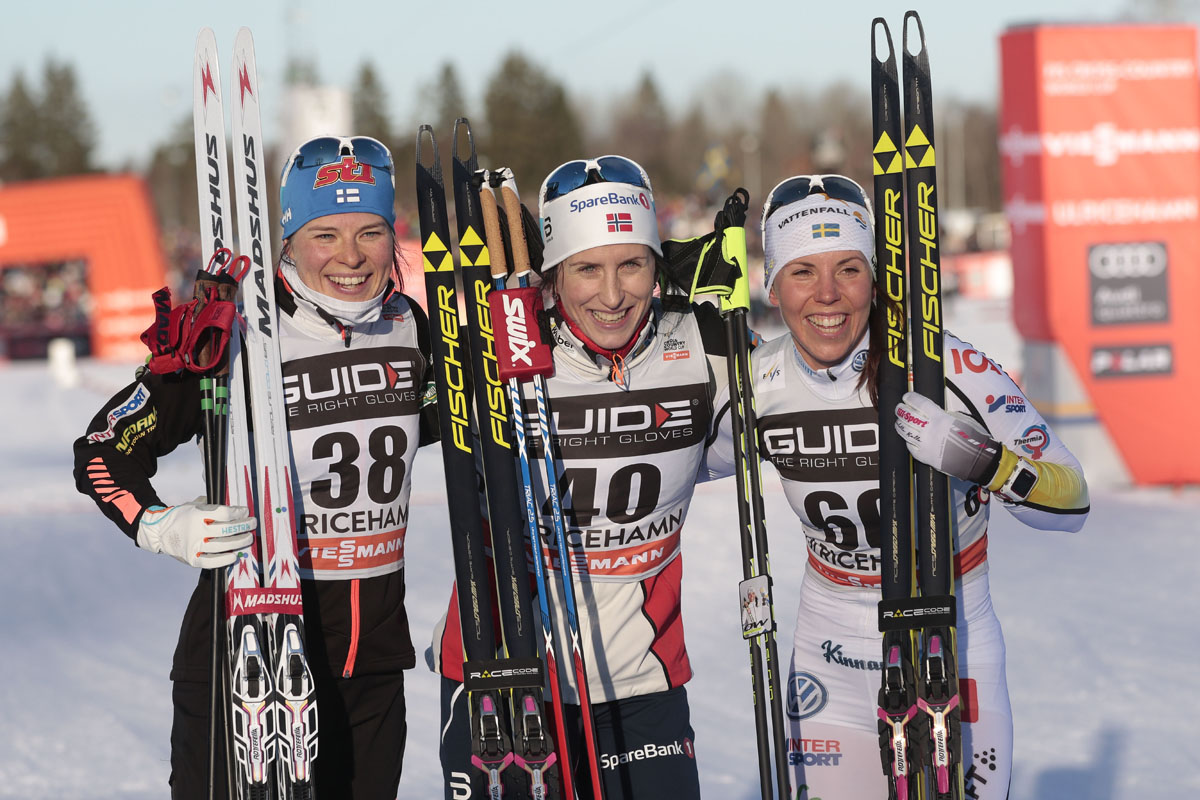
Left to right: Finland’s Krista Pärmäkoski, Norway’s Marit Bjørgen and Sweden’s Charlotte Kalla on the podium at the World Cup women’s 10-kilometer freestyle on Saturday in Ulricehamn, Sweden. (Photo: Fischer/Nordic Focus)
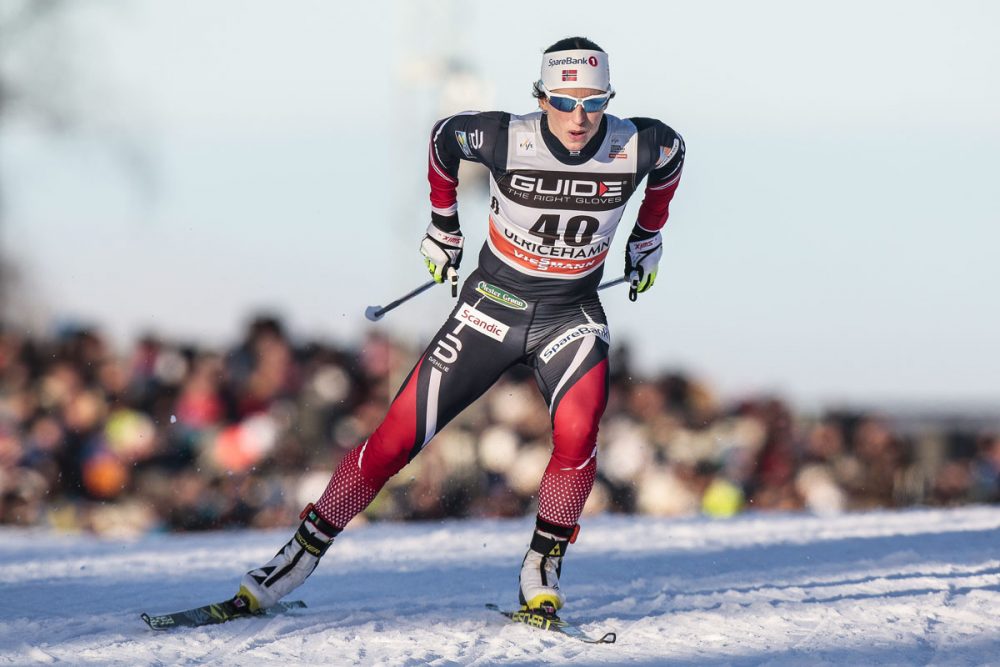
There are a lot of things Marit Bjørgen is not. She is not the only woman on Norway’s national team who knows how to win. She is not in the early stages of her cross-country career — her first World Cup debut came in December 1999. In comparison to many of her Norwegian teammates, she is not young. The average age of Norway’s women competing in Saturday’s 10-kilometer freestyle individual start in Ulricehamn, Sweden, (Bjørgen not included) was 25.
At 36, Bjørgen’s age bests most of her teammates by close to a decade.
“It’s so much fun to be back because I’ve been on my own for five weeks,” Bjørgen told NRK after Saturday’s race. “At least now I know that I’m on the right path.”
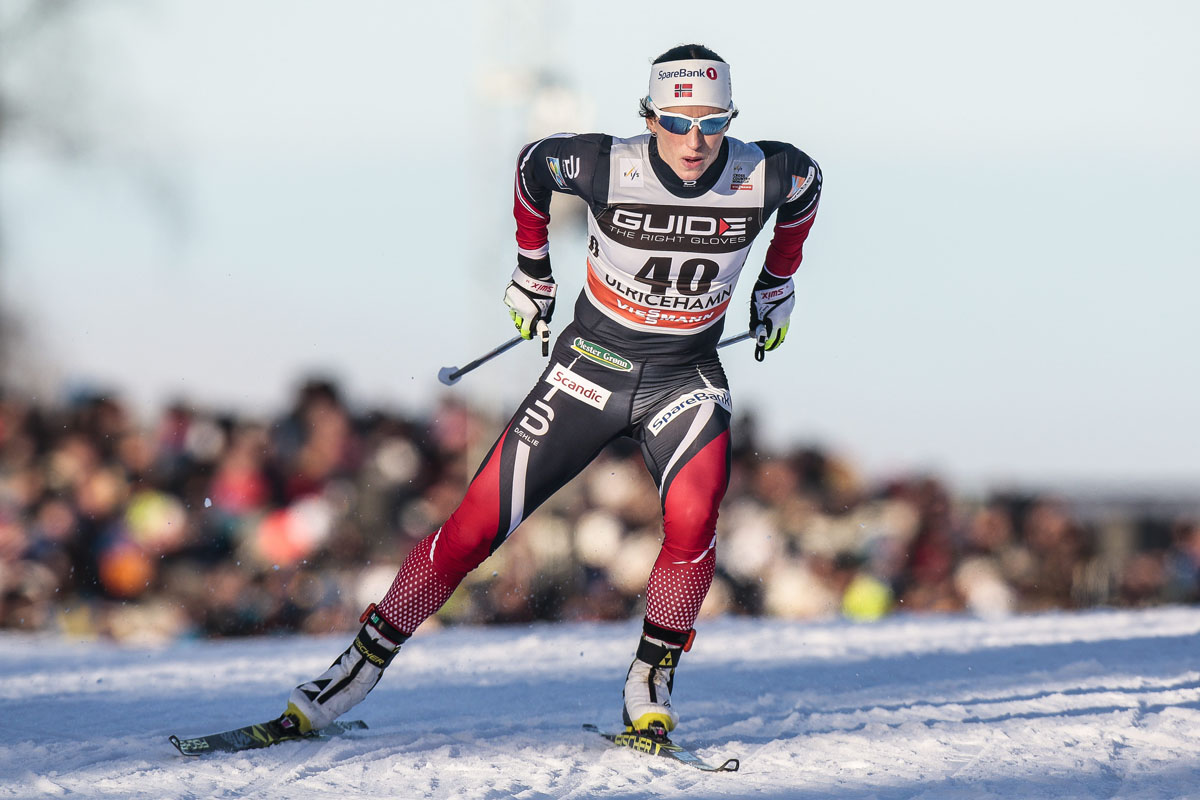
Norway’s Marit Bjørgen on her way to winning the World Cup women’s 10-kilometer freestyle on Saturday in Ulricehamn, Sweden. (Photo: Fischer/Nordic Focus)
However, starting the Ulricehamn 10 k in bib 40, with 21 more racers still hungrily eyeing her back, Bjørgen would not know for sure if she made the right choice until the final starters behind her, including the likes of Sweden’s Charlotte Kalla, completed the course.
Bjørgen’s Norwegian teammate Heidi Weng and Finland’s Krista Pärmäkoski — who both competed in this year’s Tour de Ski and finished first and second, respectively, in the overall — and started before Bjørgen, were also challenging her choice to forego five weeks of racing.
Pärmäkoski was first to the front, leading both Weng and Bjørgen by exactly one second at the 1.5 k mark.
Weng went next, this time Bjørgen and Pärmäkoski trailing behind by less than a second with 7 k still to go. Continually creeping up toward the top three was Kalla in fourth, less than four seconds back and American Jessie Diggins in fifth, within six seconds of the front.
But with one 5 k lap down, Bjørgen began to break through.
At 6.5 k, she had put close to three seconds into the Finn, now sitting in second place and more than 15 seconds into her teammate Weng, who had faded to fifth.
With 2 k to go, Bjørgen continued to lead, while Kalla moved into third. The Swede, however, had no idea she was within 14 seconds of the front. The volume of a home crowd had her confused, thinking she was in 14th place instead.
“It was all of the noise from the eager Swedish spectators that created the confusion, in addition to a sign with the number 14 on it,” Kalla told adressa.no. “It probably meant that I was 14 seconds behind, but I misunderstood.”
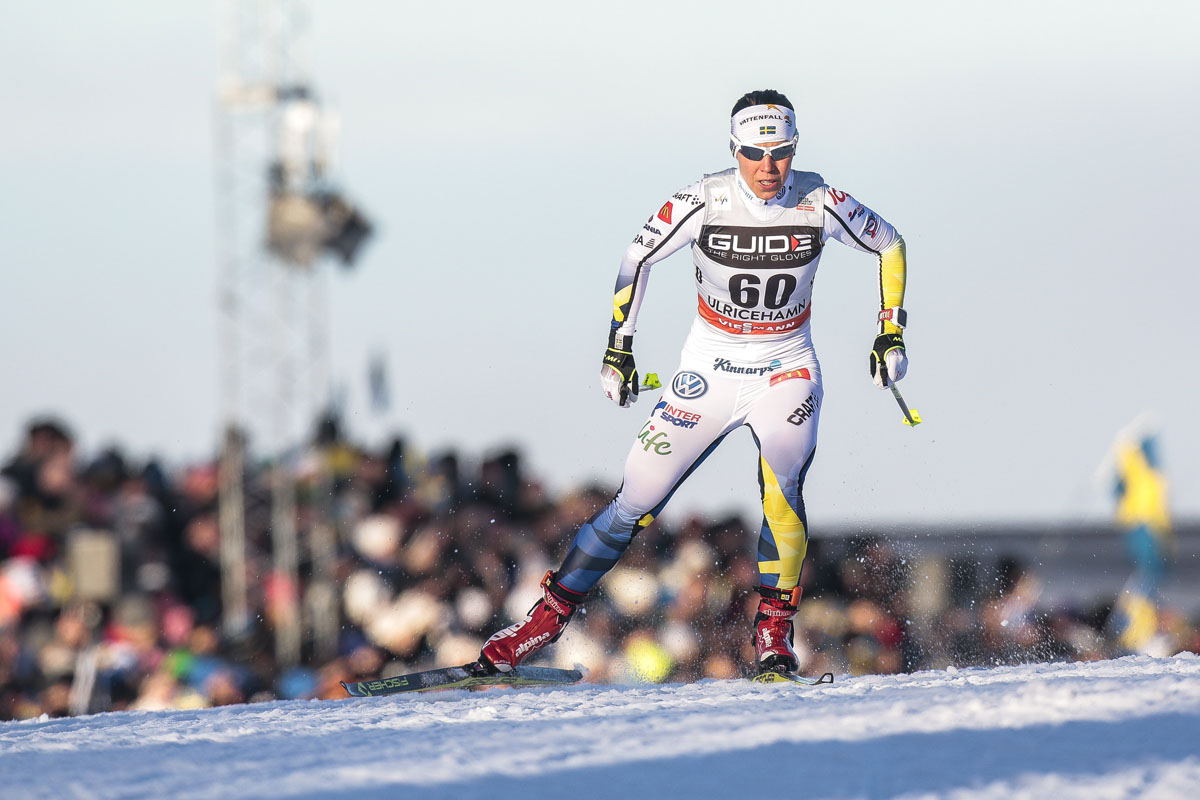
Sweden’s Charlotte Kalla racing to third place in the World Cup women’s 10-kilometer freestyle race on Saturday in Ulricehamn, Sweden. (Photo: Fischer/NordicFocus)
With no intentional charge coming from Kalla, and Pärmäkoski pushing to the max of her 10 k skate pace, Bjørgen furthered her push for the win. She continued to put time into Pärmäkoski, ultimately finishing 10.7 seconds ahead of her in a time of 23:46.3 for her 104th individual World Cup title.
When asked about the difference between her start and finishing speed, the Norwegian, who now also holds 22 individual wins on Swedish soil, responded with a bit of humor.
“I’m starting to get old you know, it takes a while to get going,” Bjørgen told NRK.
With a second place on Saturday, Pärmäkoski now has six individual podiums this season.
“I had a great day,” Pärmäkoski said according to an International Ski Federation (FIS) press release. “I have proven to myself I can ski fast also in free technique.”
Finishing 24.9 seconds behind Bjørgen, Kalla claimed the final podium spot in third, although unbeknownst to her until she received congratulations from Bjørgen and her Swedish teammate Hanna Falk, who finished eighth (+36.4).
“I first realized that I had finished 3rd when Marit and Hanna gave a hug,” Kalla told adressa.no.
“The audience [today] was world-class,” she added, according to a FIS press release.
Four American Women in the Top 25
Despite Saturday being an individual start, the two-lap 10 k course meant quite a few racers wound up skiing in company. For many of the American racers, that company came from their U.S. teammates.
Though she started 30 seconds behind her fellow U.S. Ski Team (USST) member Kikkan Randall, Jessie Diggins in bib 32 soon managed to catch Randall in bib 31. The 25-year-old Diggins proceeded to pass her and lead Randall through the first of two laps.
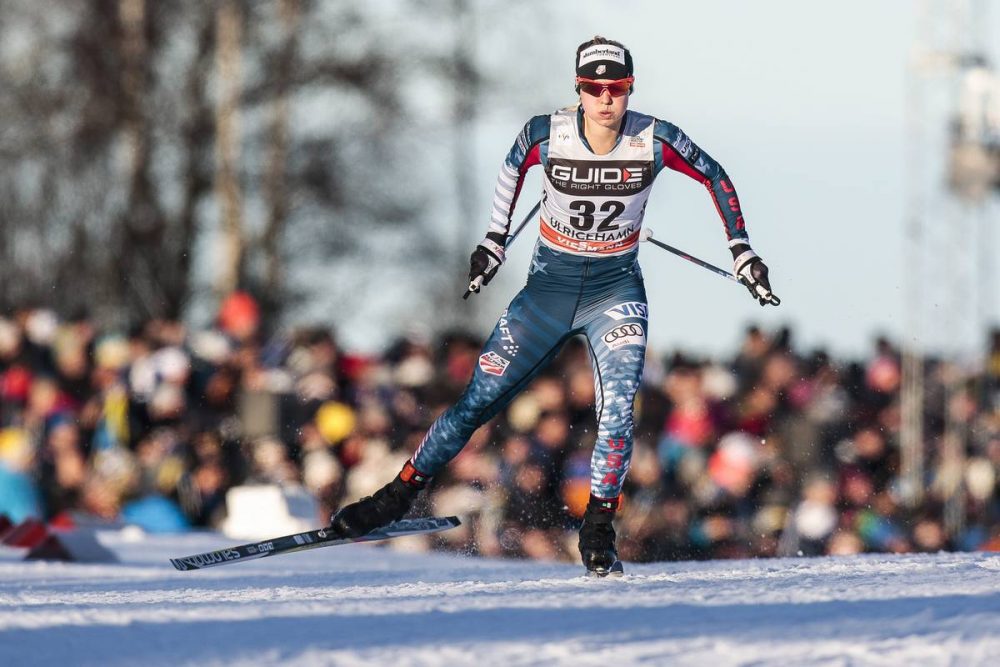
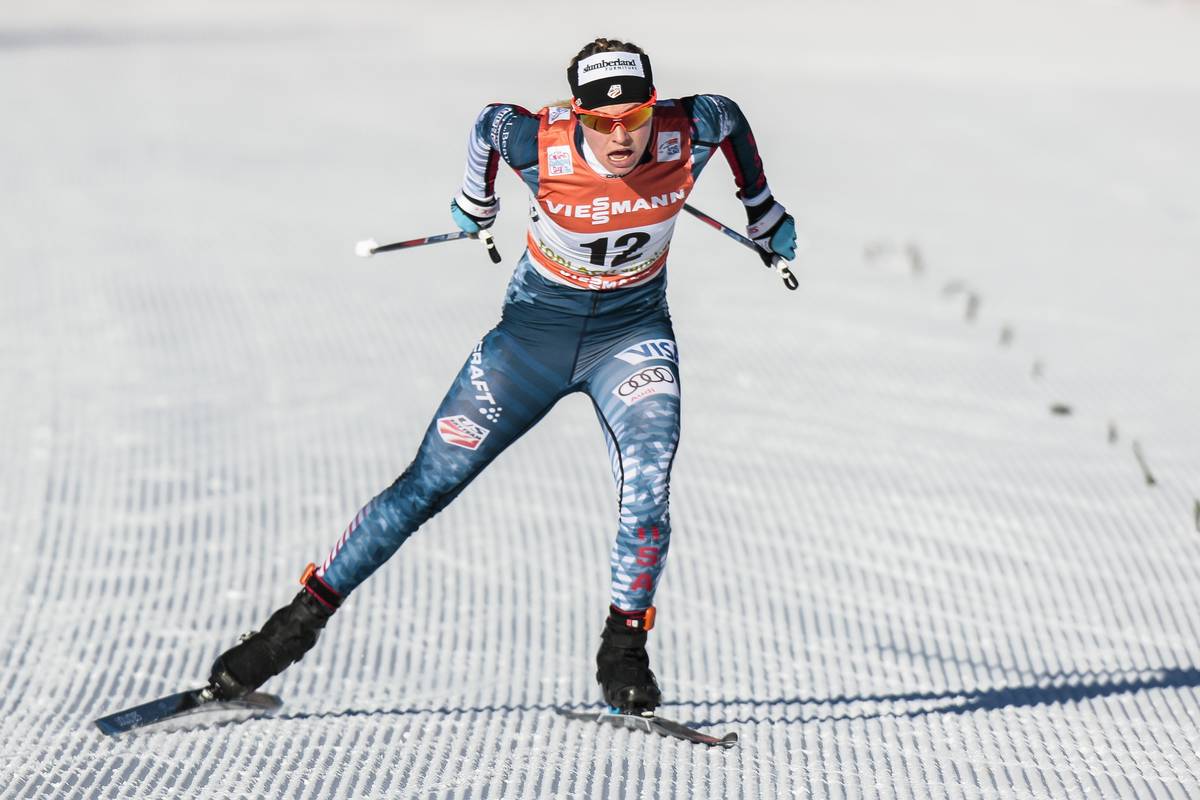
“I didn’t have the snappy good feelings I was hoping to have in my body today, but it was a solid race,” Diggins, who finished seventh (+34.9), wrote in an email to FasterSkier.
American Jessie Diggins on her way to a seventh place finish in the World Cup women’s 10-kilometer freestyle on Saturday in Ulricehamn, Sweden. (Photo: Salomon/NordicFocus)
“It’s always hard when you know that on your best days you are capable of more, but at the same time we had great skis, and it was really fun for me to be able to ski with my teammates today!” she added.
By the end of Diggins’s and Randall’s first lap together, their USST teammate Sadie Bjornsen cruised on course. For the next lap, Bjornsen led the trio of U.S. skiers.
“Skating has been going well this year. I have a lot more confidence every time I start a race, so that is fun,” Bjornsen said on the phone after Saturday’s race.
The U.S. trade-off train continued, with Bjornsen in bib 56 catching another USST member Rosie Brennan — who had start 30 seconds ahead of her in bib 55 — for their last lap.
“It was an American line out there,” Bjornsen added, who ended the day as the second American in 12th (+1:00.5).
The ‘American line,’ at least with Bjornsen, was something Brennan anticipated.
“You never really want to get caught but … I love skiing with Sadie and so it was great to have her pull me into the finish,” Brennan said on the phone.
Brennan further explained that having the comfort of a teammate, whose strengths and weakness could compliment her own, also made the pass more appreciated.
“When some of these other fast girls come past you, [because] you’ve never skied with them before, it’s hard to truly believe you can keep up with them, but when it is someone you have spent so much time skiing with it was easy to convince myself like ‘oh of course I can stay with her’.” said Brennan, who ultimately finished 24th (+1:30.7).
The one American who did not see any of her U.S. teammates during the race was Liz Stephen, who started 14th and finished the day in 16th (+1:07.30).
Instead, Stephen found herself racing with another familiar face, Italy’s Virginia de Martin Topranin, who spent time training with Stephen on Eagle Glacier this summer.
“We skied part of a lap together,” Stephen said on the phone. “But other than that I didn’t see anybody out there, which is good. That’s the point of an individual start … Mass starts you get to see plenty of people, sometimes it feels good just to be by yourself.”
The fifth American woman to finish was Randall in 40th (+1:59.6) followed by Liz Guiney, the Period 1 SuperTour leader from the Craftsbury Green Racing Project, in 52nd (+2:33.2).
“Competing in Ulricehamn was pretty awesome today,” Randall wrote in an email to several media outlets. “The course was packed with some of the most enthusiastic fans I’ve ever seen! It was a pretty cool course, too. Deceptively hard with a lot of gradual terrain and not many places to recover.
“I had great skis today and a couple of really good opportunities to ski with my teammates,” she added. “But unfortunately I wasn’t able to fully capitalize on those rides and had a lackluster day. I had a decent race from about 2.5km to 7.5km but wasn’t able to keep the pedal down.”
USST Head Coach Chris Grover noted that while there won’t be a 10 freestyle event at World Championships in a little over a month, the U.S. women’s team performance on Saturday was a good sign of where their training has taken them and where they are headed.
“Of course you are always … hoping that we are going to have a podium but that’s not going to happen every day,” Grover said. “I think it is an excellent indication that we have a lot of women who are extremely fit and on the right day they can have some pretty extraordinary results.”
American Kikkan Randall racing during the women’s women’s 10-kilometer freestyle race on Saturday in Ulricehamn, Sweden. (Photo: Fischer/Nordic Focus)
The lone Canadian woman competing on Saturday in Ulricehamn, Cendrine Browne, of Canada’s national U25 Team, posted her career-best individual World Cup result in 35th (+1:52.0).
“Along the race the coaches were telling me, ‘You’re five seconds away from top 30!’ ” Browne recalled on the phone after. “So I was really trying to push harder. I was a little tired at the end, so next time I’d like to be less tired, but I guess you can’t really control that.”
Browne explained that though most of her teammates remained in North America in order to prep for U23 or senior World Championships, she felt traveling to Europe and racing the World Cup was what she need to best prep for the upcoming Lahti cross-country events.
“I had the choice to stay home, and train, and do races at home, but I also had the choice to come here and race instead, and I really love racing on the World Cup,” Browne explained.
Athletes return tomorrow for the women’s 4 x 5 k relay. The U.S. women’s squad will field two teams, one with Brennan, Bjornsen, Stephen, and Diggins in bib 4, and the other with Randall, Sargent, Sophie Caldwell, and Guiney in bib 9.
“I’m really looking forward to anchoring one of our TWO relay teams tomorrow!” Diggins wrote. “It’s really special for us to be able to field two teams and relays are my absolute favorite days. Time to break out the relay socks!”
“So fun to see my teammates ski well today which has us all fired up for tomorrow’s relays!” Randall wrote. “Really pumped that we are fielding two women’s teams!”
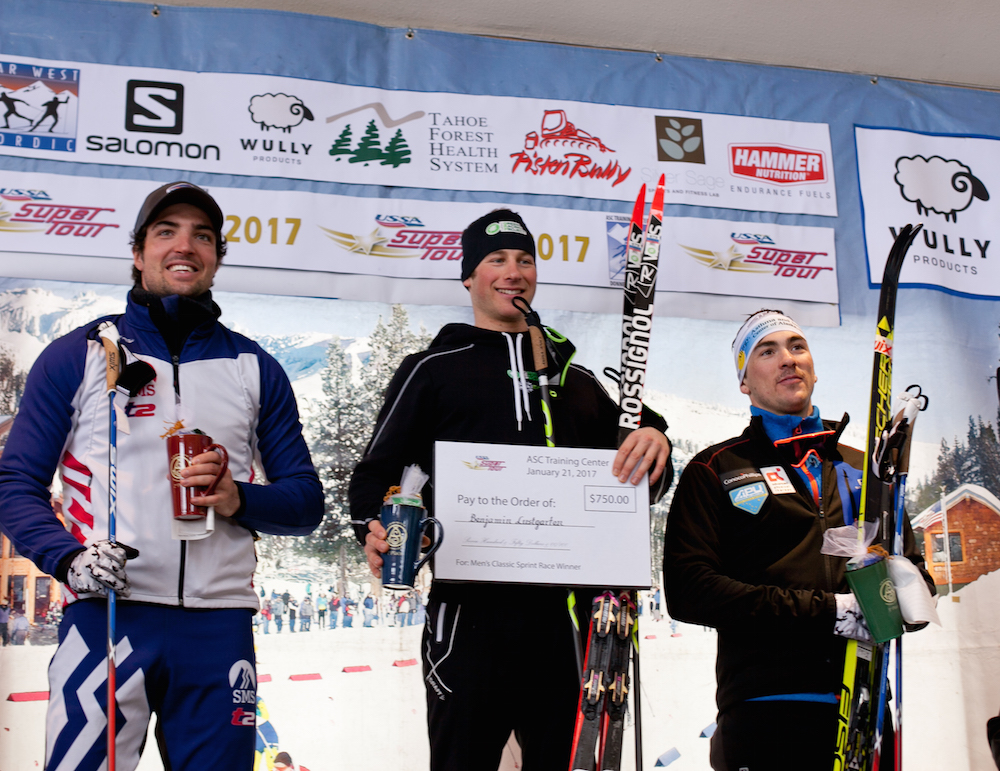
Ben Lustgarten (Craftsbury Green Racing Project) with his $750-dollar check for winning the men’s SuperTour classic sprint on Saturday near Truckee, Calif. Stratton’s Ben Saxton (l) placed second and APU’s Reese Hanneman (r) was third.
Lustgarten, of the Craftsbury Green Racing Project, raced to a 1.58-second victory in the men’s A-final at the Auburn Ski Club in Soda Springs, Calif., finishing in 3:03.4. Ben Saxton, of the Stratton Mountain School (SMS) Elite Team, placed second, and Reese Hanneman, of Alaska Pacific University (APU), was third (+2.77).
Hannenman’s younger brother Logan also reached the final and placed fourth (+4.5), Dakota Blackhorse-von Jess (Bend Endurance Academy) was fifth (+5.86), and the third APU skier in the final, Tyler Kornfield sixth (+18.69).
Blackhorse-von Jess started the day off as the fastest qualifier in 2:58.8. Saxton qualified second, 4.1 seconds back, Logan Hanneman qualified third (+4.2), and Lustgarten fourth (+6.5). Blackhorse-von Jess went on to win his quarterfinal and place second in his semifinal, while Lustgarten and Saxton both won their quarterfinals and semifinals.
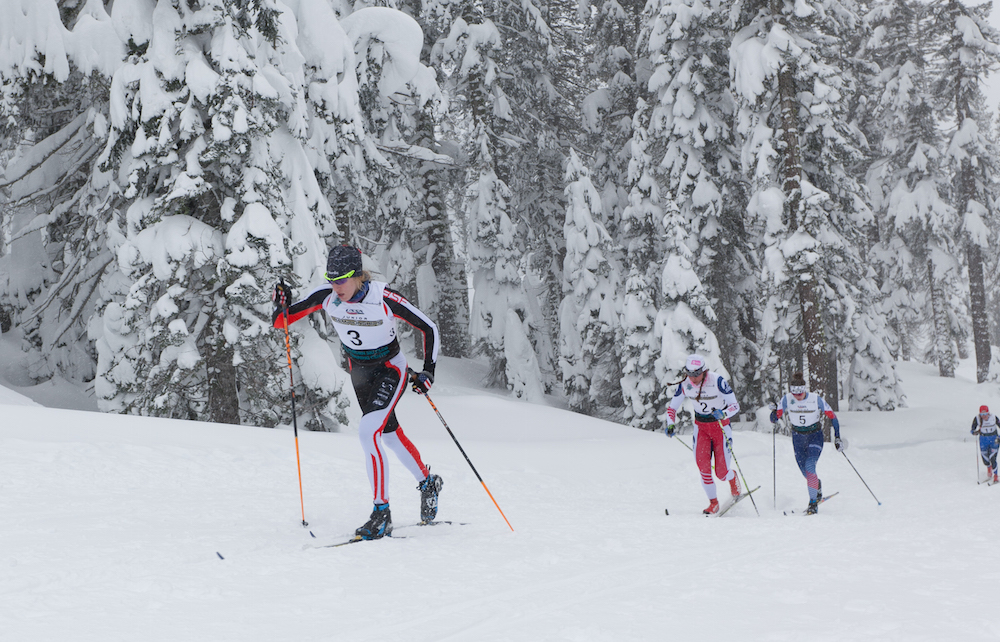
Jennie Bender (3) of the Bridger Ski Foundation leading Stratton’s Julia Kern (2) and Sun Valley’s Deedra Irwin (5) during the second women’s classic sprint semifinal at Saturday’s SuperTour near Truckee, Calif. Bender went on to win the semifinal, as well as the final.
In the women’s A-final, Jennie Bender of the Bridger Ski Foundation, coming off a classic sprint win at nationals, scored another victory in 3:29.07. She edged Craftsbury’s Kaitlynn Miller by just seven-hundredths of a second, and Stratton’s Julia Kern placed third (+3.42). Racing at home, Hannah Halvorsen (Sugar Bowl Academy) finished fourth (+3.88). Craftsbury had three in the women’s final with Caitlin Patterson in fifth (+3.93) and Heather Mooney in sixth (+27.35).
Miller proved to be the woman to beat throughout the day, winning the qualifier in 3:30.9, along with her quarterfinal and semifinal. Kern qualified second (+3.2) and Bender third (+4.6). Bender went on to win her quarterfinal and semifinal as well before facing off with Miller in the final.
NorAm Western Canadian Championships (Whistler, B.C.): 10/15 k classic
It was interval-starts day at Western Canadian Championships at Whistler Olympic Park and national-team veteran Emily Nishikawa completed the four laps of the women’s 10 k classic in 30:35.5 to win ahead of teammate Dahria Beatty, 16.5 seconds behind. Maya MacIsaac-Jones completed the national team and Alberta World Cup Academy (AWCA) sweep in third (+1:36.5).
Sovereign Lake’s Hannah Mehain, of the national junior team, was the top junior for the second-straight day in eighth overall (+3:22.1).
In the men’s 15 k, Lappe Nordic’s Andy Shields won the six-lap race in 40:34.2, showing some of the form that won him the NorAm overall last season. National-team member Jess Cockney collected his second-straight podium, finishing second, 4.3 seconds behind Shields. Evan Palmer-Charrette (NTDC Thunder Bay) completed the podium in third (+55.1).
FIS Cross-Country World Cup (Ulricehamn, Sweden): 10/15 k freestyle
The men’s 15 k freestyle podium at Saturday’s World Cup in Ulricehamn, Sweden, with Canadian winner Alex Harvey (c), Norwegian runner-up Martin Johnsrud Sundby (l), and Sweden’s Marcus Hellner (r) in third. (Photo: FIS Cross Country/Twitter)
First individual win of the season (second straight, after winning last weekend’s team sprint), fifth individual victory of his career. That’s the latest news on Canada’s Alex Harvey, who won the World Cup men’s 15-kilometer freestyle individual start on Sunday in Ulricehamn, Sweden, for his first victory in a 15 k skate race and fourth individual podium of 2016/2017.
To say Harvey is on a roll is an understatement. On Saturday, he beat Norway’s Martin Johnsrud Sundby by 6 seconds after starting a minute behind the Norwegian defending World Cup champion. Harvey’s fastest time across the line in 32:46.2 held up through 76 finishers, with Sweden’s Marcus Hellner coming somewhat within range after starting a minute behind him. Hellner ended up 14.3 seconds back from Harvey at the finish for third place, behind Sundby.
Switzerland’s Dario Cologna missed the podium by 0.5 seconds in fourth (+14.7), and Norway’s 24-year-old Daniel Stock broke through in fifth (+16.2) for his first World Cup top 20.
Great Britain’s Andrew Musgrave placed sixth (+18.7), Sweden’s Daniel Rickardsson was seventh (+25.0), Norway’s Finn Hågen Krogh eighth (+32.2), Russia’s Petr Sedov ninth (+33.9), and Japan’s Keishin Yoshida 10th (+34.2).
American Erik Bjornsen landed in the points as he tied Norway’s Simen Andreas Sveen for 28th (+1:09.2), leading fellow U.S. Ski Team members Noah Hoffman, who placed 41st (+1:28.8), and Simi Hamilton in 53rd (+1:56.2). Also for the U.S., Matt Gelso, the Period 1 SuperTour leader from the Sun Valley Ski Education Foundation (SVSEF) Gold Team, finished 68th (+3:00.3).
Harvey’s Canadian World Cup teammates Len Valjas finished 35th (+1:17.7) and Devon Kershaw 38th (+1:22.2). Knute Johnsgaard (Canadian U25 Team) did not start.
The women’s 10 k freestyle podium on Saturday in Ulricehamn, Sweden, with Norwegian winner Marit Bjørgen (c), Finland’s Krista Parmakoski (l) in second and Sweden’s Charlotte Kalla (r) in third. (Photo: FIS Cross Country/Twitter)
In her first World Cup race in over a month and at a brand-new World Cup venue, Norway’s 36-year-old Marit Bjørgen returned to her winning ways, topping the women’s 10 k freestyle on Saturday in Ulricehamn.
Bjørgen started 40th out of 61 finishers and took the lead from Finland’s Krista Parmakoski at the finish with a time of 23:46.3 minutes. Parmakoski, who started a minute ahead of her in bib 38, ended up second, 10.7 seconds back. Sweden’s Charlotte Kalla reached the podium for the second time this season in third (+24.9).
“It is always great to win,” Bjørgen said, according to an International Ski Federation (FIS) press release. “I stayed at home for five weeks and was training. It is great to come back with a victory. I know that the training I had done was good. It was an amazing atmosphere today by the course. There were people cheering everywhere.”
Norway swept fourth through sixth with Astrid Uhrenholdt Jacobsen in fourth (+25.7), Ragnhild Haga in fifth (+32.3) and Heidi Weng in sixth (+34.0).
American Jessie Diggins raced to seventh (+34.9), ahead of Sweden’s Hanna Falk, who recorded her best distance result in eighth (+36.4). Norway’s Ingvild Flugstad Østberg finished ninth (+44.8), and Germany’s Sandra Ringwald was 10th (+56.6).
“I didn’t have the snappy good feelings I was hoping to have in my body today, but it was a solid race,” Diggins wrote in a post-race email to FasterSkier. “It’s always hard when you know that on your best days you are capable of more, but at the same time we had great skis, and it was really fun for me to be able to ski with my teammates today!”
The U.S. had three in the top 20 and four in the top 30 with Sadie Bjornsen in 12th (+1:00.5), Liz Stephen in 16th (+1:07.3) and Rosie Brennan in 24th (+1:30.7).
Cendrine Browne as Canada’s lone woman in the race achieved 35th (+1:52.0) for her career best in an individual race. Also for the U.S., Kikkan Randall placed 40th (+1:59.6) and Liz Guiney of the Craftsbury Green Racing Project 52nd (+2:33.2).
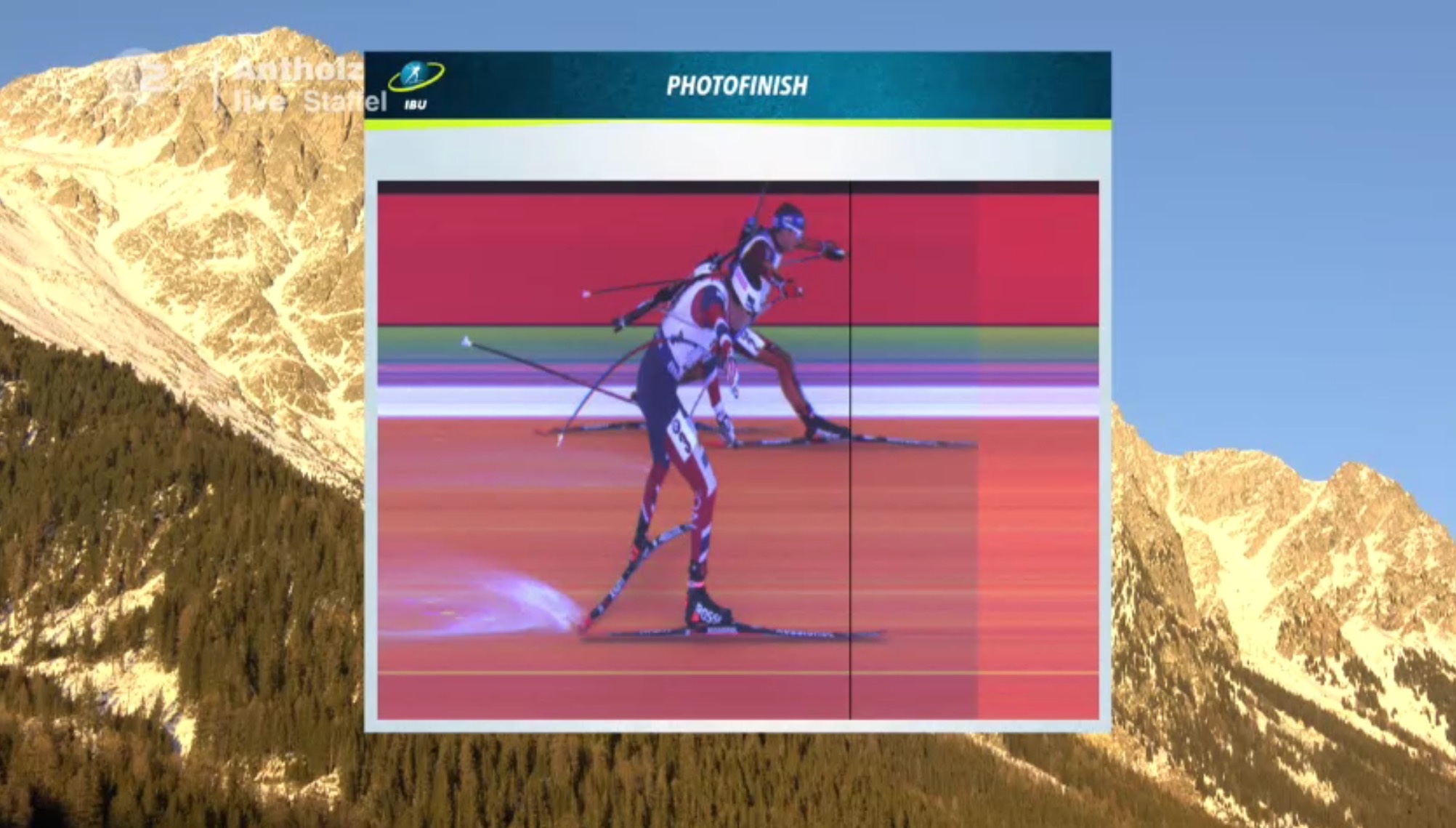
The photo finish of the men’s 4 x 7.5 k relay on Saturday at the IBU World Cup in Antholz, Italy, with Germany’s Simon Schempp outlunging Norway’s Emil Hegle Svendsen. (Photo: ZDF broadcast screenshot)
For the U.S. men, top six was a target for the 4 x 7.5 k relay on Sunday in Antholz, Italy, according to US Biathlon Men’s Coach Jonas Johansson.
Mission accomplished. In the final team event before 2017 World Championships, Lowell Bailey, Leif Nordgren, Tim Burke, and Sean Doherty combined for sixth, finishing 1:04.9 minutes behind the German winners. The Americans used a total of 10 spares but avoided the penalty loop, as did the Germans who used seven spares to clean the eight-stage race and won it in 1:13.57.2.
Germany’s Simon Schempp narrowly outlasted Norway’s Emil Hegle Svendsen in the finishing stretch to secure the victory for Germany (with teammates Erik Lesser, Benedikt Doll and Arnd Peiffer) by one-tenth of a second. Norway finished second with nine spares and no penalties (with Lars Helge Birkeland, Henrik L’Abee-Lund, Johannes Thingnes Bø, and Svendsen), and Russia secured third (+33.6) with nine spares and zero penalties as well (with Maxim Tsvetkov, Evgeniy Garanichev, Dmitry Malyshko, and Anton Babikov).
Ukraine used a total of just five spares and had zero penalties for fourth (+46.7), and Austria took fifth (+49.2) with eight spares and no penalties, after Austria’s Dominik Landertinger skied away from Doherty on the final loop and finished 6.9 seconds ahead of him for fifth place.
For the U.S. men, sixth was close to their team-best fifth with the same lineup in last year’s World Cup relay in Presque Isle, Maine. The same group also took sixth in Ruhpolding, Germany, last year as well.
With all four making US Biathlon’s World Championships team, announced Saturday, they will likely be aiming for a best championships result early next month in Hochfilzen, Austria.
Canada (Christian Gow, Scott Gow, Macx Davies, and Brendan Green) finished 16th (+4:13.8) on Saturday with two penalties and 11 spares. Scott Gow skied them up to 15th by the second exchange but they dropped to 18th after Davies had two penalties on the third leg. With Green anchoring and using just one spare, they recouped two places before the finish.
In the women’s race, Germany’s Nadine Horchler achieved a lifetime dream with her first World Cup win, after starting in bib 30 and earning her start as a reserve athlete. Germany took first and second with Laura Dahlmeier in second, and the Czech Republic’s Gabriela Koukalova placed third. Susan Dunklee of the U.S. was the lone North American starter and finished 24th after leading at the start of the second loop.
FIS Nordic Combined World Cup (Chaux-Neuve, France): Individual large hill/10 k
Saturday’s Nordic Combined World Cup podium in Chaux-Neuve, France, with German winner Johannes Rydzek (c), German runner-up Fabian Rießle (l) and Japan’s Akito Watabe (r) in third. (Photo: FIS Nordic Combined/Twitter)
The first part of Saturday’s Nordic Combined World Cup individual large hill/10 k competition was a shining moment for U.S. Nordic Combined skier Ben Berend, who jumped to second for a total of 127.5 points, trailing only Norway’s Jarl Magnus Riiber with 139 points in Chaux-Neuve, France.
Berend flew farther than Germany’s Eric Frenzel, who jumped to third on the Chaux-Neuve large hill.
Later in the day, they started the 10 k Gundersen in that order, with Riiber heading out first, followed by Berend 46 seconds later, then Frenzel 53 seconds back in third.
Germany’s Johannes Rydzek started 1:15 minutes back in 12th and skied the fastest 10 k to take the victory at the finish (in 23:01.7). He held off his German teammate Fabian Rießle by 2.8 seconds for the win, after Rießle started sixth and 1:01 back. Japan’s Akito Watabe reached the podium in third (+5.7) after jumping to seventh and starting the race 1 second behind Rießle.
Frenzel ended up fourth (+8.3), and the fourth German in the top five, Björn Kircheisen improved to fifth (+22.6) after starting 11th.
Riiber dropped to 15th (+54.0), and Berend fell outside the top 30 to end up 32nd (+2:26.0) with the 39th-ranked course time.
Berend finished 12.2 seconds ahead of his U.S. teammate Taylor Fletcher, who placed 34th (+2:38.2) after the jump put him in 48th.
Bryan Fletcher was 49th after the jump but did not start the 10 k.
The Nordic Combined World Cup continues Sunday in Chaux-Neuve with another large hill/10 k.
Ski Classics #5: La Diagonela (Zuoz, Switzerland): 50 k classic
[UPDATED] Under “blue skies, no wind and perfect track conditions” in the Swiss Engadin Valley on Saturday, according to a Ski Classics press release, Russia’s Ilya Chernousov and the Czech Republic’s Kateřina Smutná won the men’s and women’s La Diagonela, respectively, in Zuoz, Switzerland.
Chernousov, of Team Pioneer Investments, and Tord Asle Gjerdalen (Team Santander) led a large pack of men into the final major climb on the 50 k course. There, Gjerdalen attacked and Chernousov matched him, accelerating away from his competitors up the last steep pitch to the finish, according to the press release. He finished in 2:03:39.6 hours, holding off Gjerdalen by 1.5 seconds, while Øystein Pettersen (Team BN Bank) finished third (+3.0).
In the women’s race, Smutná (Team Santander) pushed to break up the field around the halfway point, where the men caught the women. Britta Johansson Norgren (Lager 157 Ski Team) hung with Smutná, but lost contact over the last 5 k. After finishing second in the last two Ski Classics races, Smutná took the win by 1:03.2 minutes in 2:20:49.2. Nordgren finished second, ahead of Sara Lindborg (Team Serneke) in third, who finished more than three minutes later (+4:17.4).
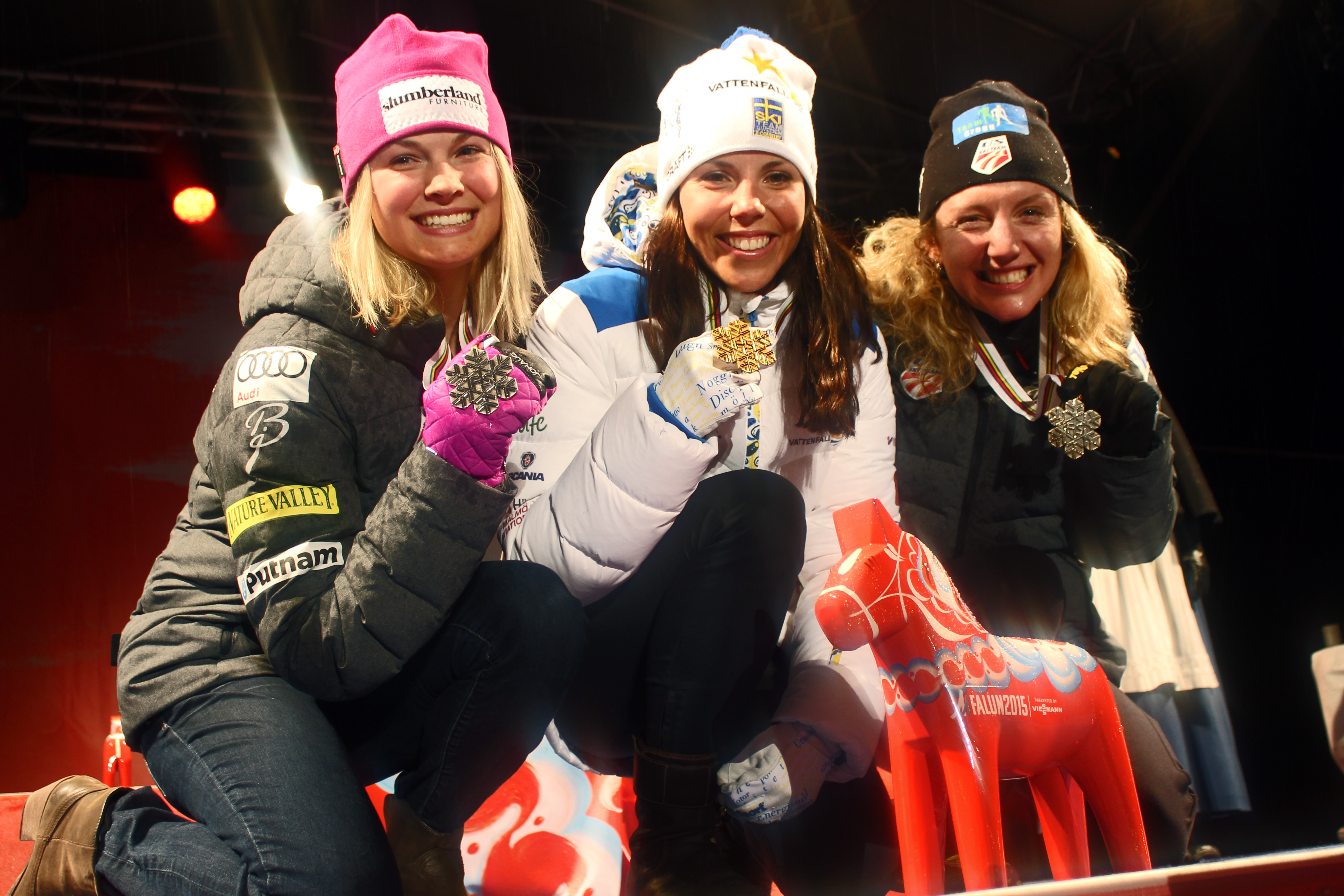
You may remember this from the last World Championships: The U.S. took two out of three spots on the podium in the 10 k freestyle at 2015 World Championships. From left to right at the medals ceremony: silver medalist Jessie Diggins (USA), gold medalist Charlotte Kalla (Sweden) and bronze medalist Caitlin Gregg (USA).
On Wednesday, the U.S. Ski and Snowboard Association (USSA) announced its team nominations for the International Ski Federation (FIS) 2017 Nordic World Ski Championships, scheduled for Feb. 22-March 5 in Lahti, Finland. Following the announcement, FasterSkier spoke with U.S. Ski Team Head Coach Chris Grover to discuss the reasoning behind some specific skiers who were or were not named to the team.
Applying the criteria
First, a quick review: FasterSkier has previously discussed the substance and the operation of the objective selection criteria based on World Cup performance. These objective criteria placed the following members of the U.S. Ski Team (USST) onto the Lahti team based on their performance during the 2016/2017 World Cup season: Sadie Bjornsen, Rosie Brennan, Sophie Caldwell, Jessie Diggins, Simi Hamilton, Noah Hoffman, Andy Newell, Kikkan Randall, Ida Sargent, and Liz Stephen.
All 10 athletes were ranked in the top 50 of the sprint and/or distance standings that were released earlier this week. USST member Erik Bjornsen ranked slightly outside the top-50 cutoff for both disciplines (59th for sprint and 60th for distance), and so is technically a discretionary selection.
That leaves six additional athletes without USST status who were also selected through the exercise of discretion by the Selection Committee: Kyle Bratrud, Tad Elliott, Ben Lustgarten, and Cole Morgan for the men, and Caitlin Gregg and Chelsea Holmes for the women.
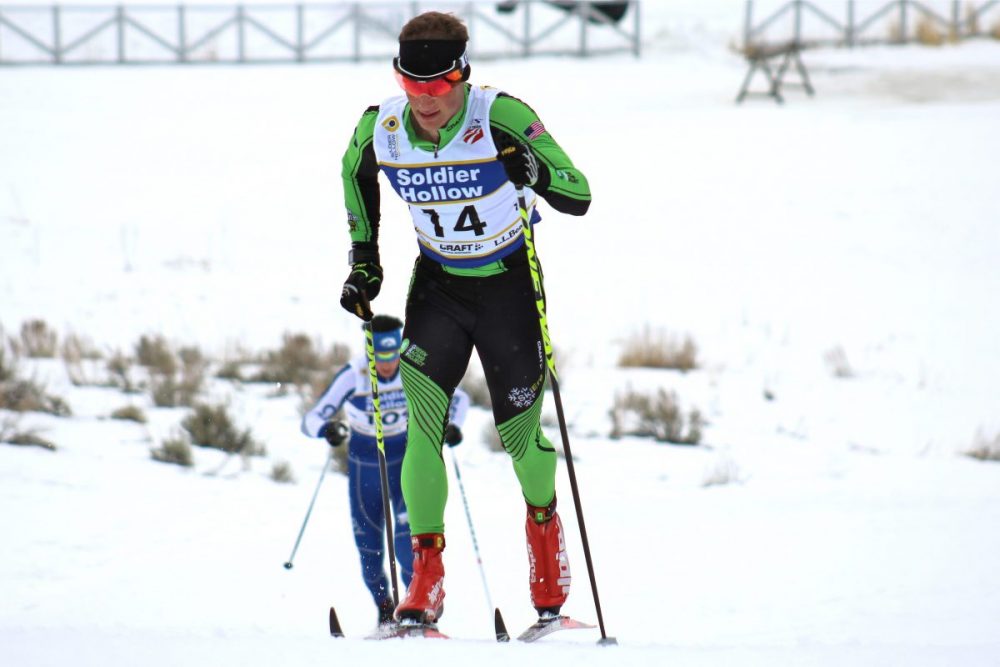
Craftsbury Green Racing Project’s Ben Lustgarten on his way to winning the 30 k classic mass start at U.S. Cross Country Championships on Jan. 10 at Soldier Hollow in Midway, Utah.
Lustgarten (70 points), Bratrud (63) and Elliott (56) are the top-three men in the distance ranking of the 2017 Championship Selection List. (The list takes an athlete’s best two finishes per discipline, including bonus points for U.S. nationals.) Morgan (70 points) is facially tied with Ben Saxton (also 70) on the men’s sprint list. (For more on why Morgan over Saxton, keep reading.)
Holmes (80 points) and Gregg (63) are top two on the women’s distance list, followed by Katharine Ogden (60) and Caitlin Patterson (52). The top-ranked domestic skier on the women’s sprint list, Kaitlynn Miller (60 points), was not selected for Lahti.
The principles of discretionary selection
This summer, USST Women’s Coach Matt Whitcomb told FasterSkier that making discretionary picks was one of the harder parts of his job, saying, “We love not to do it.” But, he added, “in any criteria, discretion can often be one of the most important pieces.”
Grover previewed how USST coaches might apply that discretion when he spoke with FasterSkier earlier this week, following the individual skate sprint in Toblach but before Wednesday’s announcement.
“We do pay very close attention to what is happening in those races [at U.S. nationals],” Grover said. “And we are following them live as best we can from over here. We’ve been paying very close attention, and we’ve had some discussions.”
Grover added that they had specifically been discussing “who we would start in which races in Lahti, because we absolutely want to fill every start spot, and we want to be able to have an alternate there in most cases as well, and that makes for some tough choices. Who’s skiing well domestically, who’s skiing well on the World Cup; it’s occasionally challenging to figure out which athletes are faster when they have the Atlantic Ocean between them.”
Grover mentioned at the time that he hoped to follow and apply the selection criteria fairly rigorously and systematically.
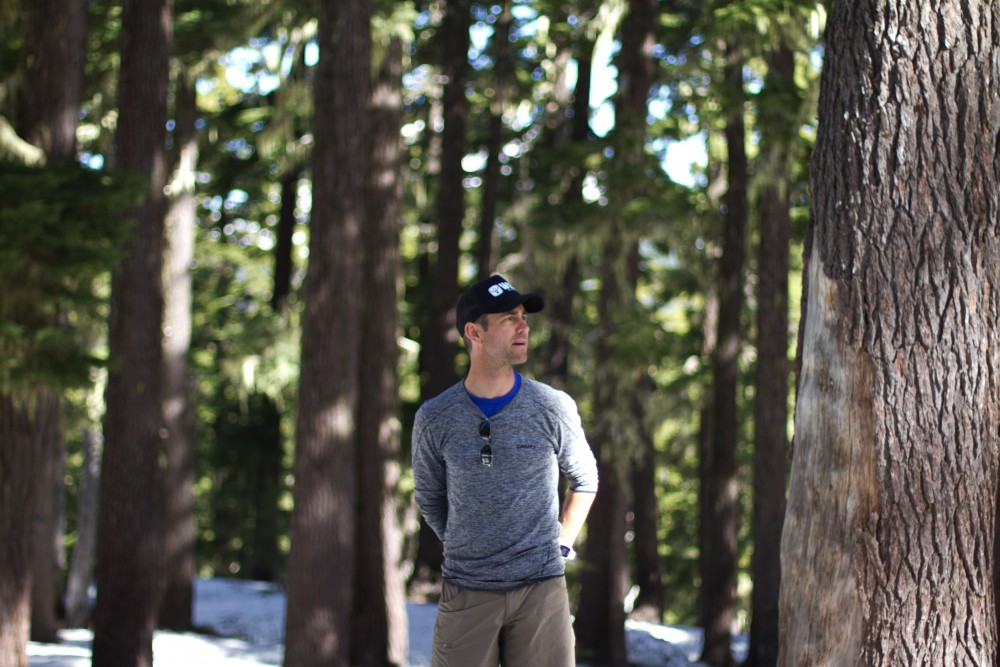
U.S. Ski Team Head Coach Chris Grover supervises a classic-technique drill at an on-snow camp in May at Mt. Bachelor in Bend, Ore.
“The real key thing is that, at the bottom of the selection, we followed the selection criteria,” Grover said. “That’s key. Discretion really belongs to be used at the top, for those athletes who have a chance to come over and have big races at World Championships, and by big races I mean someone who can go on the podium, or the top five, top 10, or top 15. Look for some selections from USA, but I wouldn’t look for a lot of discretion at the end of the day. That doesn’t mean that we won’t use some, but we have a selection criteria, and we’ve created a clear path for athletes to visualize, and see how they are going to make it to the World Championships team, and we have to be very careful to honor those athletes, and their coaches, and their programs, and their hometowns, by selecting the athletes who came to the table, and raced fast, and won races. That’s the key for us.”
Grover seemed willing to temper the strict application of objective rankings with some more objective consideration of conditions on the ground, particularly following a U.S. nationals where some races featured rather variable weather.
“Of course we’re going to take everything into account,” Grover said, “take the waxing situation into account, tough waxing days. I know that some people struggled, I know that some teams struggled, that’s unfortunate. You absolutely want to see a national championship where it’s easy waxing, and then you get to see who is the best athlete out there. I’m also getting petitions from athletes who are like, ‘Yes, I felt sick during U.S. Nationals.’ And that’s tough too. You want to see everybody healthy, and having an easy wax day.”
“It’s occasionally challenging to figure out which athletes are faster when they have the Atlantic Ocean between them.” — Chris Grover, U.S. Ski Team head coach
But “at the end of the day,” Grover concluded, “we set up a selection criteria that was designed to give athletes a chance to have a bad race, to be sick for weekend, to give teams a chance to miss the wax, that’s why we only take the best two out of four distance races, and/or the best two out of four sprint races. That’s why the selection period is more than just U.S. nationals, but also includes the races from Yellowstone and Silver Star, so athletes have the chance to demonstrate their ability over a longer period of time, and to be able to throw out some bad races.”
FasterSkier previously discussed the theory that the bonus points given for podium finishes at U.S. nationals made solid performances there potentially decisive for an athlete’s selection.
Naming names
As Grover adumbrated earlier this week, the selection of the male skiers not currently on the USST was based directly on skiers’ standing on the Lahti points list. Those selections “are very straightforward,” Grover told FasterSkier on the phone on Thursday. “We went right off of the Lahti selection list.”
Grover added that they felt the need for only one more sprinter, in light of already having Hamilton, Newell and Erik Bjornsen on the team.
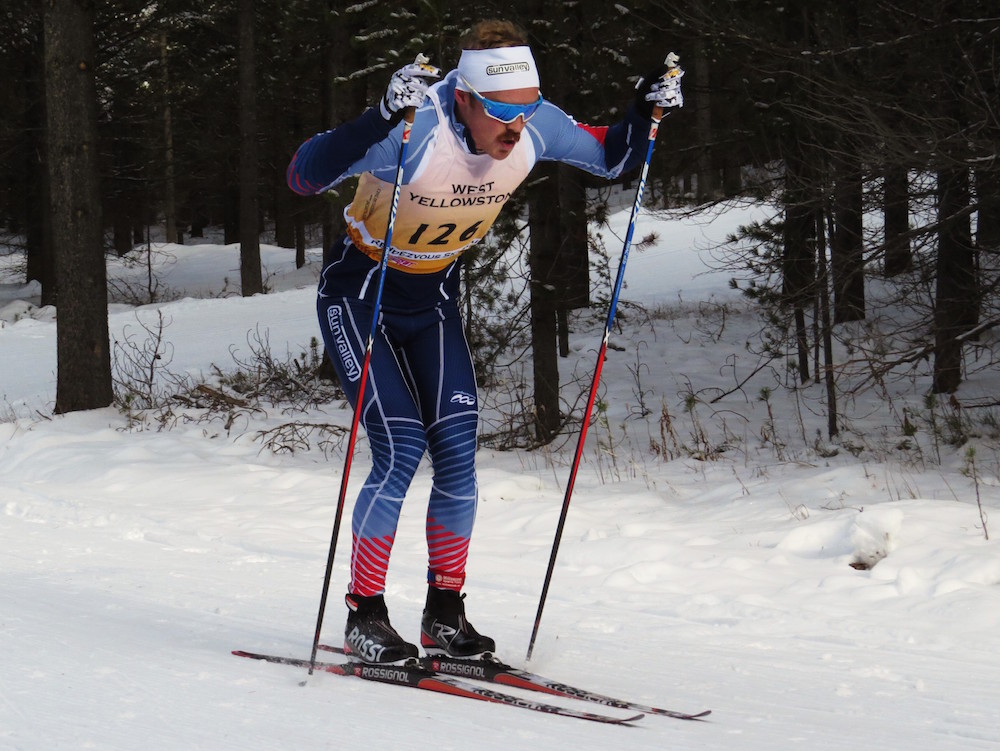
Cole Morgan (SVSEF) racing to 12th in the men’s 10 k classic FIS race in late November in West Yellowstone, Mont. (Photo: Ian Harvey/Toko)
So why Morgan over Saxton for that one sprint spot, when both athletes had 70 points and were tied for first on the selection list? Tiebreakers.
“That had to go down to like a four-way tiebreak procedure in order to determine which athlete to select,” Grover recounted. “Because they both had a first place from SuperTour, they both had two second-place finishes, and so it was only by going to their fourth race, where Cole prevailed over Ben. So that was tough, and definitely as excited as we are for Cole, that was tough for Ben, to be in that situation.”
The tiebreaking race was “the skate qualifier only in Nationals.” Morgan finished 5.11 seconds and 17 places ahead of Saxton in Thursday’s demi-sprint, with Morgan clocking 3:20.23 and sixth vs. Saxton’s 3:25.34 and 23rd.
Turning to distance skiers, Grover said, “So then we had four sprinters that we wanted to start, and then we obviously needed some distance skiers. And we felt like with Erik Bjornsen and Noah Hoffman on the team, that if we went out and got three more additional distance skiers that we would have the depth that we needed to effectively fill start rights, plus have an alternate, in the distance races at Lahti, which is why we went and got the three guys. We just went right off the distance points list.”
That’s it for the men. As for the women, among American distance skiers, Gregg has a sterling championships résumé: bronze in the 10-kilometer freestyle at Falun in 2015. This performance, and Gregg’s ability to peak for it, figured heavily in the decision to go down to second on the women’s distance list and name Gregg, Grover noted.
“We definitely … view Caitlin as a really incredible distance skier,” Grover said, “somebody who has the ability, or at least has proven the ability in the past, to be able to target an event, train for an event, a certain event, prepare for it, and then ski quite well at that event. And of course I’m referencing the Falun 10-kilometer race from two years ago. We named her to the team as a potential starter for the women’s 30 k freestyle. And typically Caitlin has been somebody who’s great at the long-distance skating in particular, and gets stronger as the race gets longer. So we’re not guaranteeing start positions for any athletes right now, but Caitlin for sure will be a strong contender to race that last race for women at the World Championships.”
So Gregg was second on the distance list, but why not go down to Katharine Ogden (often referred to as “KO”) in third? In large part because of her youth – Ogden is still only 19 years old – and a concern for appropriate development.
“We absolutely agree that athletes should first aim to be successful at – in the age group that they’re competing against,” Grover said. “So for KO, that means World Juniors, and being successful at World Juniors. And that should be, in my opinion, the absolute focus of her year this year.”
The women’s 20 k classic mass start podium on Tuesday at 2017 U.S. nationals at Soldier Hollow, with winner Chelsea Holmes (c), runner-up Katharine Ogden (l), and third-place finisher Caitlin Patterson.
He added that the strength of the current American women’s team made it questionable whether Ogden, despite her talent, would necessarily be stronger than any other option. The coaches would ask, “‘OK, yes, if we were to bring you to the [senior] World Championships, what are the actual events that we would start you in? Are you one of the best four women in the United States in those events?’ There most likely, at this particular moment, is not starting space for her. … She’s going to be an absolute talent for the future, but we also have one of the strongest, if not the strongest women’s team in the history of U.S. skiing. So it’s tough to break into that group when you’re limited to four starts.”
And what about Caitlin Patterson, an athlete who began the 2016/2017 season in Europe and scored World Cup points in the opening weekend, but never quite made the top 30 thereafter?
Patterson was “one that we talked about, for sure,” Grover said. “However, she was not even the next woman on the points list behind Caitlin Gregg. That was Katharine Ogden. … So any time you’re talking about using discretion and using it at the bottom of the list, and then jumping over athletes that are on the list to use that discretion, then it becomes quite complicated.”
Much as with Ogden, Grover noted that the strength of the current women’s team made it difficult to easily pencil Patterson in as a starter: “Our women’s team is so strong,” Grover said, “we didn’t necessarily see a race where we said, ‘You know what, Caitlin Patterson is within the top four women that we want to start in that particular event.’ It would have been a different situation if we didn’t have so many women making the objective criteria for World Cup in front of her.”
But Grover noted that Patterson was not necessarily off the team for good: “So it puts Caitlin Patterson in a really tough spot, and we definitely want to see her have more opportunities, and we are in fact trying to provide her more opportunities by actually offering her some World Cup starts in the next few weekends that she’s going to take advantage of. And we’ll see what happens. If she’s able to have some outstanding results, we may reconsider.”
As Grover alluded to regarding Patterson, the U.S. roster is not quite set in stone. “I think it’s important to recognize that we … may decide to add a man, or a woman, later to the World Championships Team,” Grover emphasized.
“We have not maxed out what our quotas are for that event by any means,” he continued “And if we see an outstanding result of some kind, either at World Cup or say U23s/World Juniors, we may choose to add somebody to the team, which we did … two years ago in Falun, when we added Ben Saxton after he’d been sixth in the sprint at the World Juniors. So nobody has guaranteed start rights at the Lahti World Championships. And it may be that our team grows slightly. Or it may stay the same; we just don’t know yet.”
End of an era?
And finally, a look back for a historical note before everyone looks forward to next month’s races in Lahti: Assuming that he is not added to the roster in the next few weeks, this will be the first American international championship team without Kris Freeman since 1997. Freeman, currently of Team Freebird but a USST member for 11 years before that, was named to a total of 15 championship teams from 1997 to 2015. He was at Falun in 2015, Sochi in 2014, Val di Fiemme in 2013, Oslo in 2011, Whistler in 2010, Liberec in 2009, Sapporo in 2007, Torino in 2006, Oberstdorf in 2005. He was at Val di Fiemme, for the first time, in 2003, Salt Lake City in 2002, Lahti in 2001, and before that, he was also at three FIS Junior World Championships: Štrbské Pleso, Slovakia, in 2000; Saalfelden, Austria, in 1999; and Pontresina, Switzerland, in 1998.
Kris Freeman competing at 2009 World Championships in Liberec, Czech Republic. (Photo: Swix Sport)
The last time Freeman was not named to an American championship team was Junior Worlds in Canmore in February 1997. To put that in perspective: top junior skiers at those races included Kristina Smigun, Axel Teichmann, Per Elofsson, and Lukas Bauer. American juniors racing at Canmore in 1997 included Rob Whitney, Pat Casey, and Lars Flora. Recent national champion Kevin Bolger (University of Utah) was 3 years old. Recent Nationals podium finisher Katharine Ogden was not born yet.
Freeman told FasterSkier a week ago at U.S. nationals that, even if he were not selected to his second Lahti team, he intended to keep competing for at least one more winter with an eye to Pyeongchang: “Still in it, I’ll be back next year and hopefully make the Olympic team.”
USST athlete Kikkan Randall keeps alive a streak going back to World Juniors at Štrbské Pleso in 2000. Counting 2017 in Lahti, she has been named to 16 championship teams (nine World Championships teams, four Winter Olympics teams, and three World Juniors teams) in that time.
And USST skier Andy Newell was named to his 14th championship team, continuing a streak that dates back to World Juniors at Szklarska Poręba in 2001.
Races in Lahti begin with the skate sprint on Feb. 23.
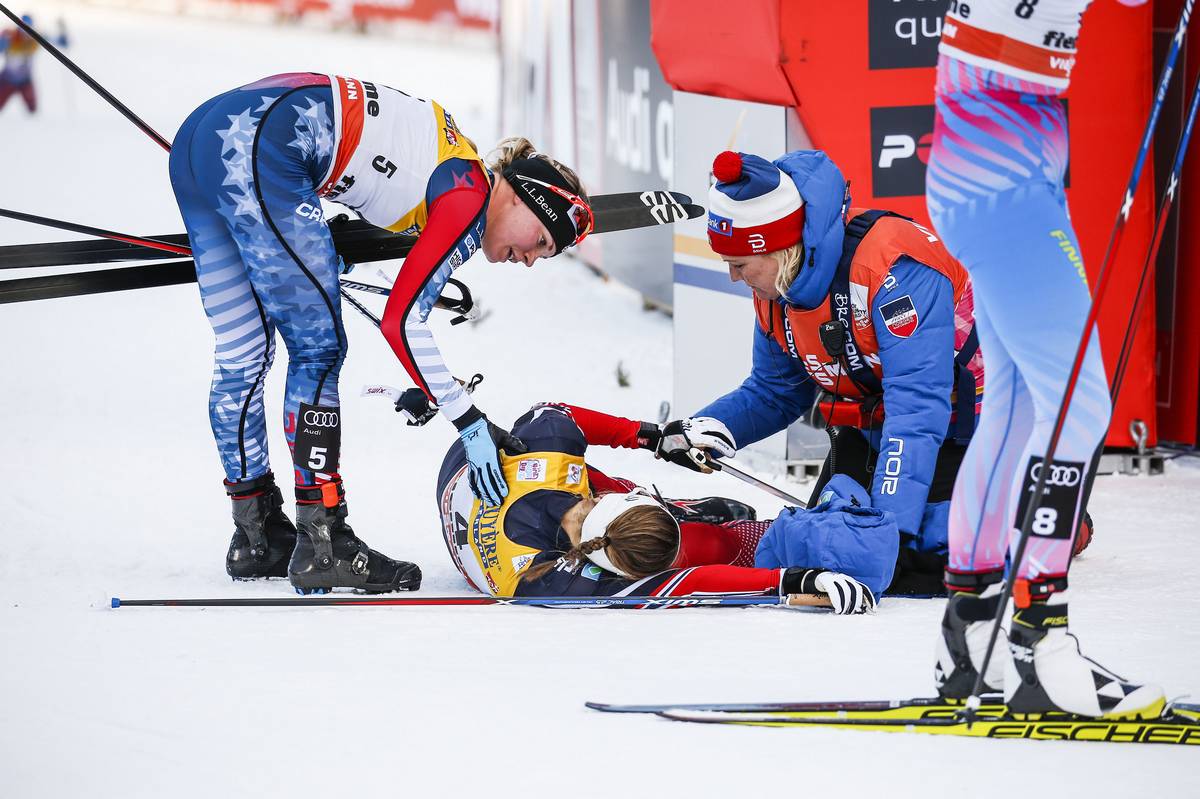
American Jessie Diggins (l) checks on Norway’s Ingvild Flugstad Østberg at the finish of the final climb up Alpe Cermis on Sunday. Østberg finished fourth and Diggins was fifth to end the 2017 Tour de Ski. (Photo: Salomon/Nordic Focus)
That’s a wrap, folks! With the 11th Tour de Ski coming to an end on Sunday with the infamous Alpe Cermis final climb in Val di Fiemme, we wanted to share some of the athlete and coach comments that didn’t make it into the race reports. Below are quotes from the last three stages of the Tour, all in Italy.
“I think nerves were a little higher, but not a lot higher. It was more just a feeling of belief and confidence: I’ve done it before, I can do it again type-thing. I was telling myself this was my course. This course was basically built for all of the things that I love to do, I think it’s very fun. I love it when it’s cold out, I loved everything about the day, and I was just letting that excitement and the joy of the sport kind of fill me up. I was pretty pumped, standing on the start time.”
— Jessie Diggins (U.S. Ski Team), after winning the women’s race that day
“I felt really tired yesterday and this morning on my run, but when I got on skis for the warm up today I felt like a different person! Lots of energy and feelings of fresh legs, which I was really excited about! I am always really excited for these last stages of the tour in Val di fiemme, as they are my favorite race courses on the circuit and the more racing we get to do the happier I am.”
— Liz Stephen (U.S. Ski Team)
On race goals:
“There’s always going to be a level of disappointment if you don’t perform to the level you know that you’re capable of. I knew I was capable of winning, so if I hadn’t [won], maybe I would have been disappointed. But it’s the same as if I finish in a 30 k classic below where I think I can, and that’s obviously not winning, I’d be disappointed with myself. If I knew I had more, and I didn’t give it, that’s when I’m disappointed. But if I go out there, and I give a race everything that I had, and I know that I held nothing back, then I’m not disappointed. All you can do is your best, I mean it’s mathematically impossible to give more than 100 percent, it’s all that you’ve got.”
— Diggins
“My goal was just to go out and lay down a hard final effort to finish off my tour. I have been strong at 5km skate races in the past and I was optimistic that I could have a strong performance today.”
— Kikkan Randall (U.S. Ski Team)
On American Sadie Bjornsen (who finished a career-best third):
“Sadie definitely flew under people’s radar, she really didn’t do the damage that she did until the final stretch of the race. Kind of in the last 1.6 k. She really surprised people. Incredibly fast.”
— Matt Whitcomb (U.S. Ski Team Women’s Coach)
On the weirdness of the Toblach course:
“Of course I was hoping to at least ski into the points. I have struggled at this venue for distance racing over my career for some reason which I can’t quite put my finger on, and today was no exception. There are no steep hills but the working sections are long and I guess that’s probably what kills me – especially in skating. Anyway, I wanted a little more than this today but the body feels good and it was a good wake up after the rest day if nothing else ahead of tomorrow.”
— Devon Kershaw (Canadian World Cup Team)
On interval-start racing:
“I skied a bit with [Norway’s Niklas] Dyrhaug on the first lap — but that didn’t turn out to be a good idea since he wasn’t having one. Alex caught me with about two kilometers to go, so I tucked in behind him for the last descents — which obviously helped — but with how I felt today I would have needed a proper ride to achieve anything. Of course I hoped that Alex would have a beast day and that if I could stay with that pace it could slot me in nicely — but Alex, while solid, wasn’t strong enough for me to get a good result gifted. I struggled to find that rhythm and speed today alone and while I felt fine — without finding that power (which for whatever reason eluded me today) you are bleeding time on such a gradual course.”
— Kershaw
On making the most of things:
“I’m still pretty happy with where I am, where I’m standing at the end of the day. But it was just not a great race. I kind of saved it, I guess. It was not great, but I limited the losses.”
— Alex Harvey (Canadian World Cup Team)
On deciding between the Tour or returning home for U.S. nationals in an effort to qualify for World Championships:
“I guess I thought about it a little bit, but I really wanted to do the Tour, and I felt like if I was skiing the way I thought I should, I would be able to get the points I needed during the Tour, and then it wouldn’t be a problem. Especially after having a good result in France, I felt really encouraged then, so I didn’t really question my decision to stay, at that point. I was sick for the whole time over Christmas, and only skiing a few times. Obviously the Tour has not gone the way I hoped, or the way I left off in France, so I think I had a really hard time killing this cold for good, and it’s like taken it’s toll on my body. I just hope that every day I get further away from that illness, the better I’ll start to feel and hopefully come back to the kind of results like today and the results I had in France, and more where I think I should be.”
— Rosie Brennan (U.S. Ski Team), after placing 23rd
On recovery:
“Last year [after winning this race], I was so thrilled, there was so much going on, there was a press conference, doping control, traveling, and I remember feeling so tired the next day. And this year, I’m just learning how to handle it a little better, in terms of just managing my energy. I think that’s helped a lot. We had a little less to deal with today, in terms of press things, I think was able to manage my energy. So I’m hoping for a solid day tomorrow.”
— Diggins
On going on a World Cup tour with a baby:
“It’s definitely been a little more challenging to travel the tour with a baby along but now I can’t imagine doing it any other way. We’ve tried to be respectful of the team and the rest for the other athletes, so we’ve been driving our own van and eating at a separate table. Breck has been a really good baby and after some sleep training over Christmas, he’s sleeping through the night and taking naps during the day. The support of my parents and Jeff’s parents have been invaluable and the team is also helping a lot too. It requires traveling with a lot more stuff and I can’t always follow the exact routine I’m used to but it’s surprisingly manageable and so wonderful to have such an amazing new part to my life. The baby rooms provided by the organizers have also been really helpful. I’m excited to stay in Toblach for the next week and a half and just get to enjoy some down time with Breck and recover.”
— Randall, who has a nearly 9-month-old infant
***
Stage 6 (Val di Fiemme, Italy): 10/15 k classic mass starts
On how the body’s feeling through six races in eight days:
“Felt good, yeah. Felt good in the morning, went for a jog. Felt good in the warmup, and early during the race. But then I just, I don’t know, couldn’t lay down a good race. So that was bad.”
— Harvey
On day-to-day strategy:
“I’m not like stressing about the final climb on Stage 2, and on Stage 3 I’m not going, ‘Oh, I’m here in the overall, and I need this and that.’ It’s just, go out every day and ski as hard as you can, ski each race as well as you can, and then, you know, if you get every step, eventually you’re climbing up, right? … I know that’s my strength, is I can dig really deep and I can deal with a lot of pain, and I can grind it out.”
— Diggins
On pack skiing and sketchy corners:
“Stuff happens in a race, and that’s why we practice for the unexpected. Practice agility, and our downhill skills, because you need ’em.”
— Diggins
On finishing in the top 30 for World Cup points:
“Even getting one point – I never complain when I’m in the points. And definitely moved up in the Tour to 30th, although it’s really tight in there with several of us. But, you know, tomorrow suits my strengths super well, and I’m looking forward to that. Definitely feel like it was another good step forward from where I was at the beginning of the Tour and for much of Period 1.”
— Noah Hoffman (U.S. Ski Team), 30th in the 15 k classic mass start
On staying focused late in the Tour:
“I think it becomes easier, you have so much clearer motivation. I mean, a regular World Cup, if you’re skiing, you know, 45th place in a mass start and a minute behind the top 30, like, that’s a challenging place to stay motivated. Because the difference between 40th place and 50th place is not very big. So in terms of getting yourself to fight for those places, it’s more challenging. … It’s quadruple points at the end of the Tour, so time is very important today.”
— Hoffman
On the second-to-last stage:
“A top 20 is always a top 20, but I was hoping for a bit more energetic feeling out there. Maybe my body knows what’s about to happen to it tomorrow.”
— Stephen
***
Stage 7 (Alpe Cermis/Val di Fiemme, Italy): 9 k freestyle pursuit climb
“At the moment I am feeling like a zombie. I’m really really tired. I think it will all sink in tomorrow, but as of right now I am ready for a break.”
— Diggins
“It’s just knowing that that’s it. Sometimes you can eke out more energy to get up the climb.”
— Brennan
On racing up an alpine mountain:
“I realize why we do it and it’s the real show and it’s a fitting end to a grueling week, but I absolutely hate monkey skating up an alpine ski hill. I have never been good at and even when I was fourth and seventh in Tour de Ski overall, I have had vicious times up it.”
— Kershaw
On being in the wave start, or not:
“Last year I had quite a good race up the hill and I was 19th [for time of day]. I was in the waves so that really helped, being packed in a group all the way down to the first 5 k. Today, [Sweden’s] Daniel Richardsson and I tried to work together but we were both just so shitty, and when you know you have two bad bodies trying to do something for the first 5 k, you are just bleeding time, and when you get to the hill you already lost a minute in that section. Then climbing the hill, we weren’t that much better so it was too bad because the Tour had some bright spots for me and but it was a really forgettable day today. One you have to throw over your shoulder and just keep telling yourself that you were better earlier.”
— Kershaw
“I kind of treat this as a time trial anyway. Usually I do start in the wave, but this year it was nice not to. I did have a Swedish skier on my tail for the flat part and I was hoping to be able to take turns and work together, but she was maybe not feeling the necessity to pull. But that was fine. I just kind of wanted to go fast along the flat, as fast as I could. And I think Hedi put quite bit of time into us, or into me, on the flat. So I have to work on that a little bit, too.”
— Stephen
“I don’t know. I’ve only ever done it in the wave, so I don’t really know what it’s like otherwise, but it’s probably a toss up.”
— Brennan
On pacing the flats before the climb:
“It’s such a different kind of skiing. I always feel like you can probably push it a little on the flats without having too much impact on your climb. It’s just narrow, and gradual terrain the whole time, so it’s a different kind of skiing.”
— Brennan
“I have always kind of pushed as hard as I can on the flat, because as hard as I can push on a flat is still not going to blow me up. It’s not where I can really hit my groove and be able to really put damage into people — I never feel like I have blown myself up even if I have a time trial on a flat course. I just can’t get to that mark yet with my technique. So yeah, I go as hard as I can on that flat part while trying to stay relaxed, because the less relaxed I am on flats the slower I go. I have to find that happy balance. I felt like I skied the flat as well as I could today, and then was just psyched to turn the corner and go up.”
— Stephen
On final placement in the Tour:
“I am happy to be in the top 15 because I didn’t think that was really a possibility for this tour when I looked at the standings last night so that was good… I am never going to be disappointed with a top 15, but also, it’s hard to come from knowing that I can be top five in this tour. So you always kind of want to get back to your best result and then try to beat that. 15th was not what I was hoping for this year, but at the same time, I am not disappointed with it.”
— Stephen
On the team:
“Our team lost a few people for sure due to illness, but it’s always so nice to celebrate with not only with the team that finished to the top fo the hill but also the wax staff and the coaching staff. This is such a taxing event for them and they are on it all the time. And their moods are always good. I don’t know how they do it — even when they are sick they still have a happy mood on. So that is so key for our performance. A huge thank you needs to go out them for all their work and their spirits.”
— Stephen
On teammates:
“Jessie and I are in a room together, and we have kept the same roommates the entire tour to minimize how many germs are being spread around. Sadie’s being quarantined, for sure. It’s heartbreaking, with her having such a good tour, but I think her [Toblach 5 k] result is still so fresh, that helps with having to make the tough decision to drop. The tour is so grueling, and I think you have to decide for yourself: how does my energy feel right now, and is this digging a hole that I can’t get out of? I think that it”s really mature and smart to think about the rest of the season now.”
— Stephen
“I am so proud of Jessie. To get fifth this year and have her best climb ever, and she told me she thinks she had her best classic race she ever had yesterday, it’s really fun to watch her mature as an athlete and be skiing so well. She is a force, as we all knew she would be. It’s really fun to see it all working out for her for sure. And Rosie in the top 30. And we have our fingers crossed here cheering for Noah on the climb — we are hoping he gets a top 20 on the day.” [Note: Hoffman’s time was 15th-fastest up the climb.]
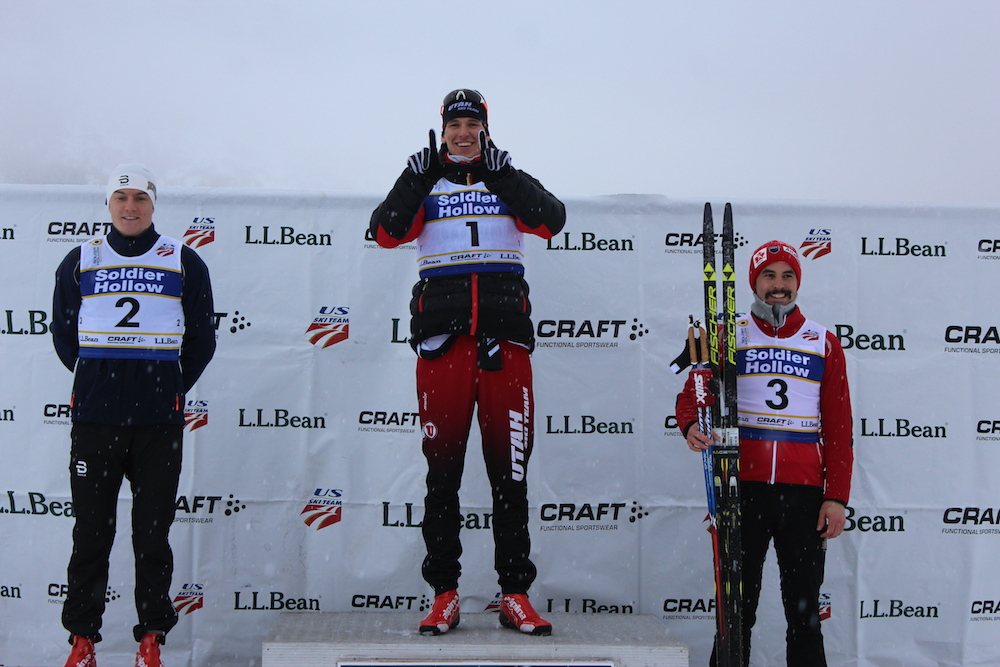
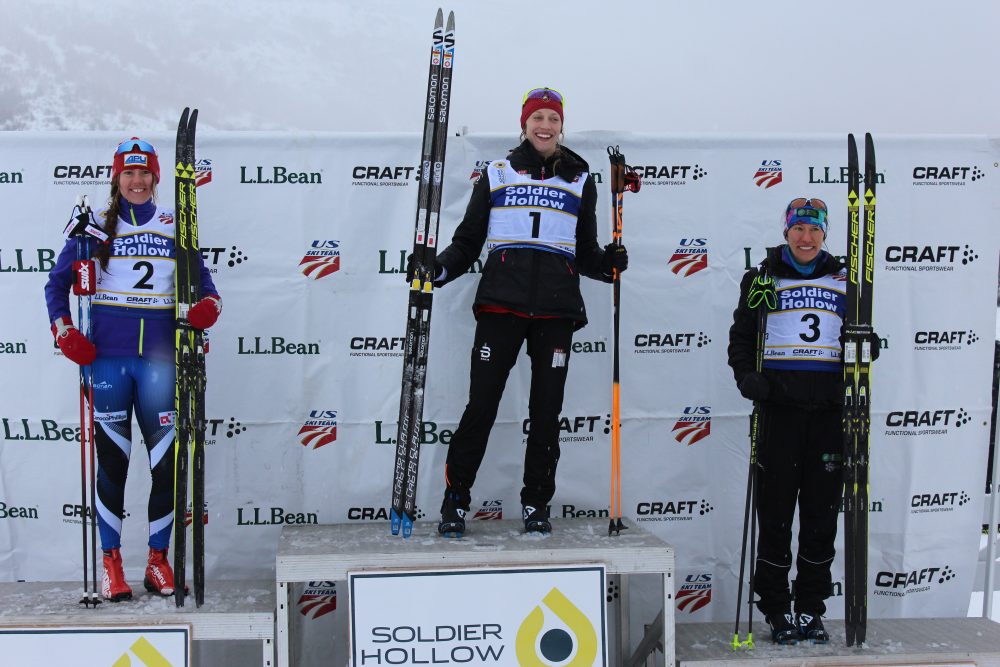
The men’s classic sprint podium at 2017 U.S. nationals at Soldier Hollow on Sunday: with winner Kevin Bolger (c) of the University of Utah, runner-up Moritz Madlener (l) of the University of Denver, and Jess Cockney (r) of the Canadian World Cup B-team in third.
U.S. Cross Country Championships (Soldier Hollow): Classic sprints
Jennie Bender of Bridger Ski Foundation and Kevin Bolger of the University of Utah won national titles in the classic sprints at 2017 U.S. Cross Country Championships at Soldier Hollow earlier Sunday afternoon. They each took narrow – but, for sprinting, relatively uncontested – victories, as each was in the lead coming into the stadium and led through the final 180-degree turn into the finishing straight.
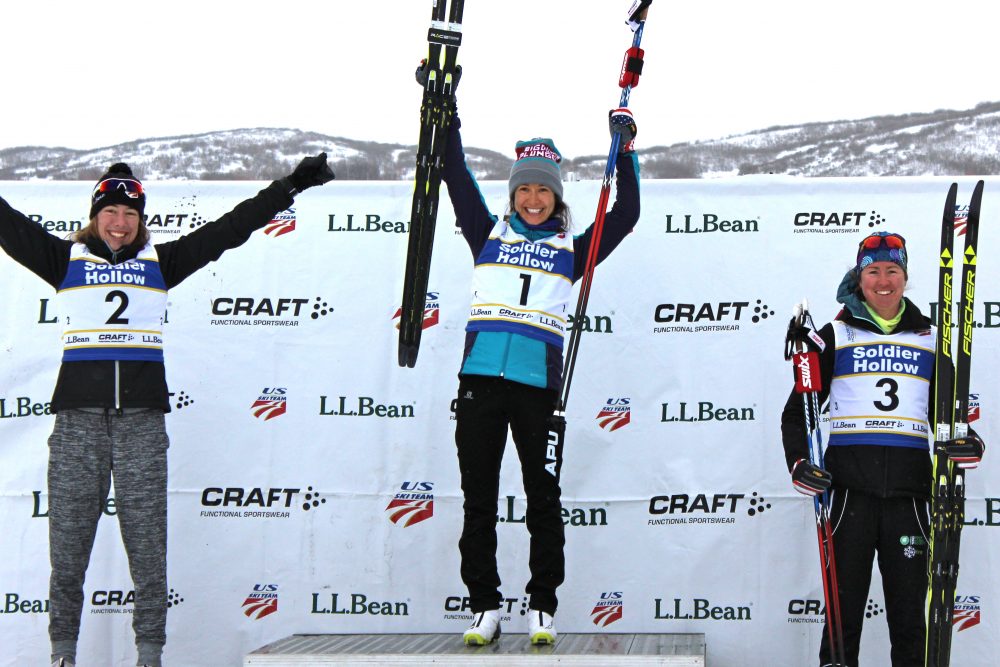
The women’s classic sprint podium at 2017 U.S. nationals on Sunday at Soldier Hollow: with winner Jennie Bender (c) of the Bridger Ski Foundation, runner-up Becca Rorabaugh (l) of Alaska Pacific University, and Kaitlynn Miller (r) of the Craftsbury Green Racing Project in third.
In the women’s race, Bender took the victory over Becca Rorabaugh of Alaska Pacific University, who just edged out Kaitlynn Miller of the Craftsbury Green Racing Project for second. Miller had won the qualifier earlier in the day.
Dahria Beatty of Canada’s Alberta World Cup Academy in fourth, Anne Hart of Stratton Mountain School Elite Team in fifth, and Krista Niiranen, originally from Finland and now a sophomore at the University of New Mexico, in sixth made up the rest of the A-final. There was no B-final contested for either gender.
In the men’s race, Bolger’s victory marked his best performance in a national championship by a substantial margin: His previous best before today was 23rd, in the 15 k classic at SoHo in 2014. (His 37th in the sprint that same year marked his previous best finish in a national championship sprint.)
Bolger was followed to the line by Moritz Madlener, of the University of Denver, and Jesse Cockney, of the Canadian World Cup B-team. Cockney had qualified fourth that morning.
The rest of the A–Final was Canadian Bob Thompson, of National Team Development Centre (NTDC) Thunder Bay, in fourth, Petter Reistad of the University of Colorado in fifth, and Fredrik Schwencke of Northern Michigan University in sixth.
Madlener is German. Cockney and Thompson are Canadian. Reistad and Schwencke are Norwegian. The USSA selection criteria for World Championships in Lahti provide that, “For the purposes of the 2017 Championship Selection List, athletes that are not US citizens will not be included in the scoring, and US athletes will move up the results/scoring list as foreign athletes are eliminated.” American racers eliminated in the semifinals included, in no particular order, Ben Lustgarten of Craftsbury Green Racing Project, Cully Brown of the University of Vermont, John Hegman and Cole Morgan of Sun Valley Ski Education Foundation (SVSEF) Gold Team, and Ben Saxton of Stratton Mountain School.
Earlier Sunday, Kaitlynn Miller won the women’s classic sprint qualifier. Starting sixth out of the 200+ woman field, Miller laid down an unbeatable time of 3:24.5 in difficult waxing conditions. She is the defending classic sprint champion from last year’s national championships.
Krista Niiranen, originally from Finland and now a sophomore at the University of New Mexico, was next fastest and tallied a time just 0.2 seconds behind Miller’s. Emily Nishikawa of the Canadian National Ski Team was third, Dahria Beatty of Canada’s Alberta World Cup Academy fourth, and Cendrine Browne from the Centre National d’Entrainement Pierre Harvey in Quebec clocked the fifth-fastest time.
The 30th skier making the cut for quarterfinals — Frederique Vezina, also of the Centre National d’Entrainement Pierre Harvey — was 16.53 seconds behind Miller.
Ben Saxton of the Stratton Mountain School Elite Team won the men’s sprint qualifier, notching the fastest time by 1.27 seconds over Etienne Hebert of Monteriski.
Canadians took the three of the top four spots in the qualifier, with Reed Godfrey of Canmore Nordic clocking the third-fastest time and Canada’s Jesse Cockney finishing fourth.
9.17 seconds separated the top 30 men who moved on to the quarterfinals. That included racers from at least six countries: the U.S. and Canada, but also collegiate skiers from Finland, Germany, France, and Norway. It also included one Under-18 competitor: Ben Ogden from the Stratton Mountain School.
It was a World Championships preview weekend on the Nordic Combined World Cup circuit, with two large hill/10 k individual competitions held in Lahti, Finland.
On Saturday, Germany’s Eric Frenzel took the win in 29:13.7, holding off Finland’s Eero Hirvonen by 4.1 seconds across the line. After posting the second-best jump, Frenzel started the 10 k in second, ahead of Hirvonen in third, but still full 1:06-minutes behind Norway’s Jarl Magnus Riiber, who dominated the jump with 135.2 points. Hirvonen started 1:29 back in third.
Riiber went on to place sixth at the finish with the 38th-ranked course time (out of 43 finishers). Germany had two on the podium with Johannes Rydzek in third (+26.4).
American Bryan Fletcher finished 15th (+1:29.8) after jumping to 22nd and starting the ski race 3:06 minutes back. He skied the sixth-fastest 10 k to end up 1:29.8 behind Frenzel at the finish.
Ben Loomis was the second American competing on Saturday. He finished the day in 40th (+5:18.5) after jumping to 35th.
On Sunday, Germany swept the podium with Fabian Rießle leading the charge, Frenzel in second and Rydzek in third. Rießle jumped to fifth and captured the win in 25:44.2, ahead of Frenzel (+4.2) and Rydzek (+11.6). Frenzel led after the jump and started the 10 k just 6 seconds ahead of Italy’s Samuel Costa, who ended up sixth at the finish (+40.6).
Rießle started 16 seconds after Frenzel and posted the third-fastest course time en route to the win.
Bryan Fletcher raced to 16th (+1:30.7) on Sunday, after jumping to 28th. Loomis did not start.
The NoCo World Cup moves to Val di Fiemme, Italy, for competitions next Friday through Sunday. Lahti World Championships will hold nordic-combined competitions Feb. 24-March 3.
Two North Americans started the International Biathlon Union (IBU) World Cup women’s 12.5 k mass start on Sunday, with one of them finding out at the last minute that they were in for the 30-woman race.
American Susan Dunklee knew she had qualified well ahead of time after ranking 17th in the overall World Cup. She raced to ninth on Sunday, finishing 1:43.5 behind from the winner, Gabriela Koukalová of the Czech Republic, who cleaned the four-stage race to finish first in 37:20.5.
Germany’s Laura Dahlmeier made her first appearance of the week in the final race of the World Cup stop in Oberhof, Germany, placing second in the mass start, 31.5 seconds behind Koukalová, with one standing miss (0+0+1+0). The Czech Republic had two on the podium with Eva Puskarčíková in third (+45.4), with clean shooting.
Dunklee was in contention with the leaders until the last two standing stages, where she missed one target then two more (0+0+1+2) for a total of three penalty laps. Ninth place helped elevate Dunklee to 15th in the overall World Cup standings.
Canada’s Rosanna Crawford jumped into the race being listed as a reserve athlete on standby. Wearing bib 30, she finished 25th (+3:08.6) with two clean stages and two penalties (0+1+1+0).
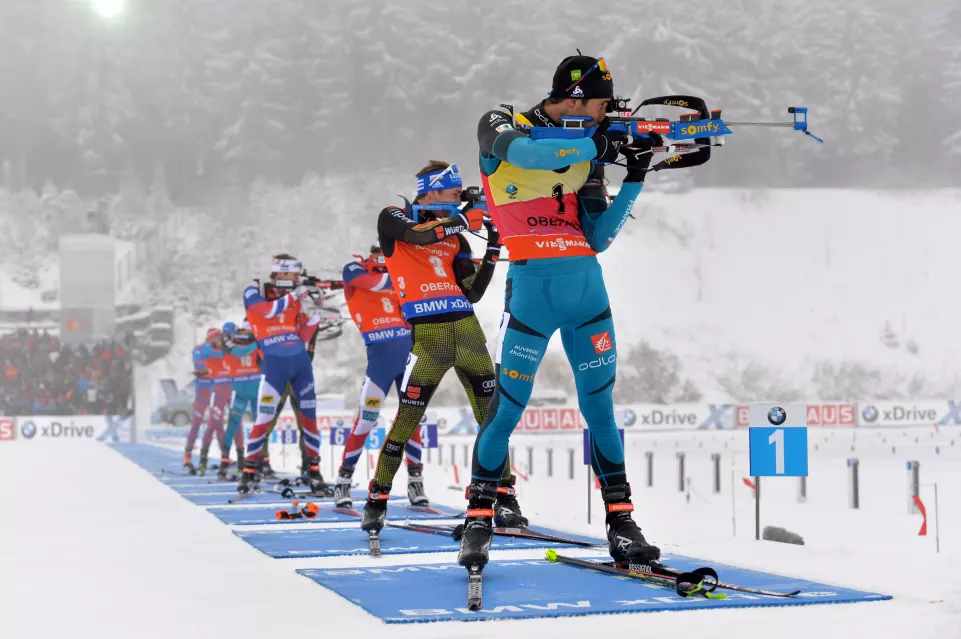
France’s Martin Fourcade (bib 1) and Germany’s Simon Schempp (bib 3) shooting in the third stage of the men’s 15-kilometer mass start at the 2017 IBU World Cup in Oberhof, Germany. (Photo: IBU)
On Sunday in the men’s 15 k mass start, Germany’s Simon Schempp celebrated his first victory of the season, and it was a special one in front of thousands of cheering fans at home in Oberhof. On the final lap, he desperately tried to hang onto the ski tails of France’s biathlon star Martin Fourcade, who pushed hard on the first climb out of the shooting range unsuccessfully trying to create a gap.
“He started attacking immediately up the Birxsteig [climb],” Schempp told German TV broadcaster ZDF. “And I thought either you blow up or you can stick with him, and I could. Because I was in the draft, I saved a few percent, that probably was the decisive point in the end.“
Schempp kept right behind Fourcade, then started an attack on the last climb himself and outsprinted his rival on the finishing stretch, celebrating across the line with a time of 38:30.9 minutes, with just one penalty (0+0+1+0).
To the joy of the German fans, Schempp’s teammate Erik Lesser managed to overtake France’s Jean Guillaume Beatrix on the final loop closing up to the two athletes in front on the last meters, and outlunged Fourcade in a photo finish sprint (both +0.4 seconds).
“They pushed up the Birxsteig so incredibly hard,” Lesser told ZDF. “I thought I could only fight for position five. Then I saw that Beatrix wasn’t skiing very clean anymore either. So I just tried a full attack… I never would have believed that a second place would come out of that.“
“My father-in-law is probably watching the Tour de Ski today and saying, ‘Finally the guy makes a lunge,’ ” Lesser joked about the finish sprint. “I never would have believed that Fourcade still lets himself get beaten by the little Lesser. Finally all the strength training paid off.“
Fourcade had incurred two penalties in the third shooting stage, having to make up a 44 second gap to the top. In the final shooting he stayed clean, but already had to invest a lot of energy on the prior loop so he could not create a significant lead on the last one.
“I skied as fast as I could, but Simon was just faster and Erik as well,” Fourcade said during the press conference. “I tried my best in the beginning of the lap because we were too [many] people… I gave all I had. I must say I didn’t see Erik until he passed me in the sprint… It was a great competition, a great fight.”
Coming into the last shooting stage Lesser had been leading the race with Norway’s Ole Einar Bjørndalen, but both missed a target and had to a penalty lap while Schempp and Fourcade stayed clean.
Fourcade’s teammate Beatrix finished fourth with one penalty (+13.2), Bjørndalen was fifth (+19.5) also with one penalty.
No North American men competed in the mass start, with US Biathlon’s Lowell Bailey ,who would have been qualified via the overall World Cup standings skipping the race week in Oberhof for a training block. Bailey is currently ranked 19th overall.
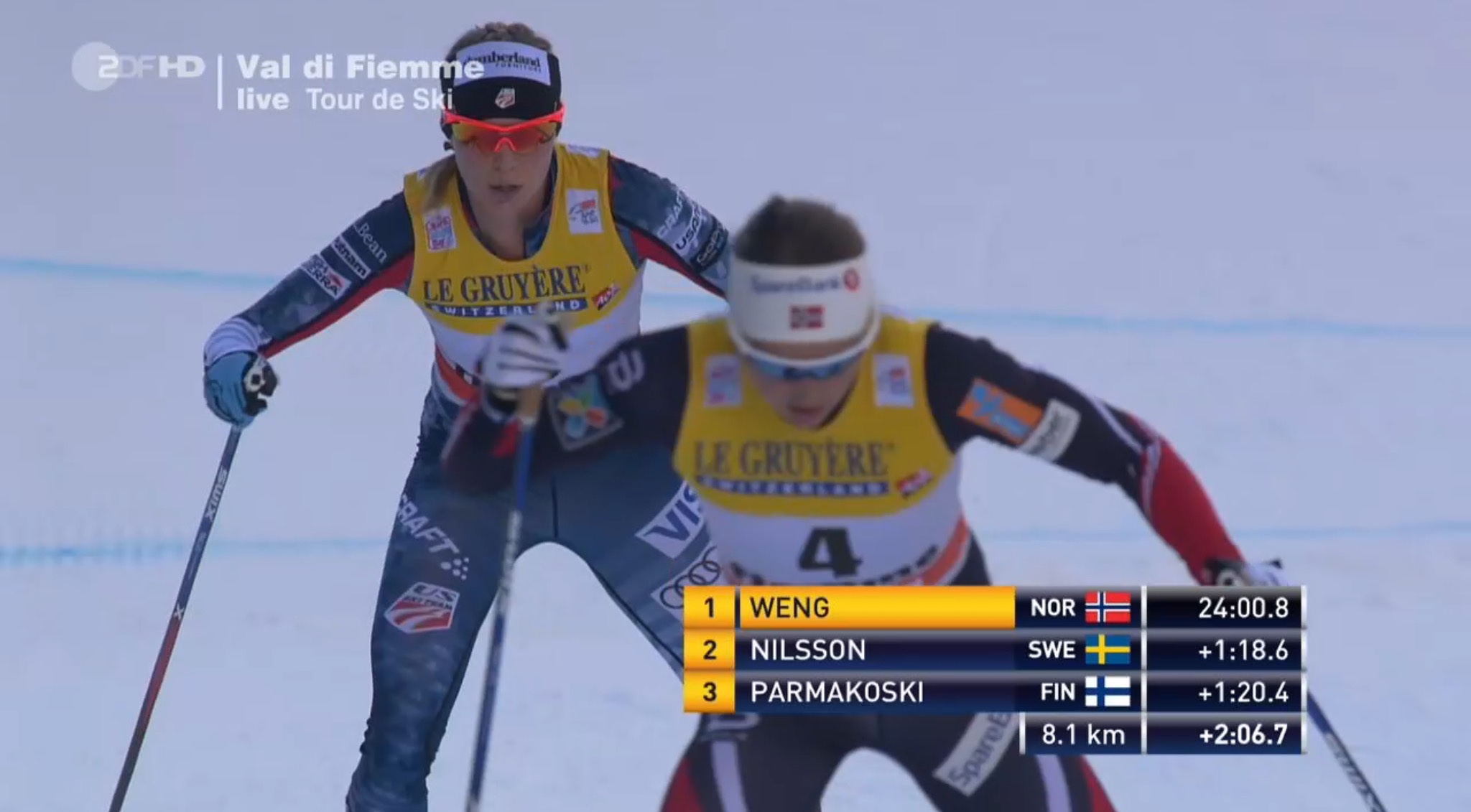
American Jessie Diggins chasing Norway’s Ingvild Flugstad Østberg on the final climb of the 2017 Tour de Ski up the Alpe Cermis in Val di Fiemme, Italy. Østberg finished the Tour in fourth and Diggins fifth, tying a best-ever mark for the U.S., set in 2015 by Liz Stephen. (Photo: ZDF screenshot)
FIS Cross-Country Tour de Ski Stage 7 (Val di Fiemme/Alpe Cermis, Italy): 9 k freestyle
Heidi Weng of Norway proved that she was the threat everyone was fearing – despite a few races in the Tour de Ski with bad skis or low energy, Weng had a dominating performance up the Alpe Cermis and took her first ever Tour de Ski title.
At 6.2 k of the 9 k course, Weng passed Stina Nilsson of Sweden, who had started the day in the leader’s bib with a 19.2-second advantage. Weng just stepped on the gas from there, turning in the fastest climb time of the field and winning by 1:37.0.
Further up the hill, Nilsson was also passed by Krista Parmakoski of Finland, who gapped the Swede and earned second place.
And Nilsson had to hold off one more attack, from Norway’s Ingvild Flugstad Østberg near the top of the climb. Østberg had started in fourth place and got close to Nilsson, before the Swede found her second (or third, or fourth) wind and sprinted it in to the finish to secure third place and her first Tour de Ski overall podium.
Weng has three previous Tour de Ski podiums, but never a win. Parmakoski’s previous best overall finish was fourth, in 2014.
Jessie Diggins of the U.S. Ski Team started behind Østberg and almost made contact at one point, before the Norwegian slipped from her grasp. Diggins finished the Tour de Ski fifth (+3:09.0) — where she had started the day — to tie for the best-ever Tour finish with Liz Stephen, who was fifth in 2015.
Today, Stephen clocked the second-fastest time up the climb, behind Weng, and finished 14th (+6:45.6).
Rosie Brennan, the third and final U.S. woman to finish the Tour de Ski this year, landed 28th, +12:59.9. Her time was the 23rd-fastest up the Alpe Cermis.
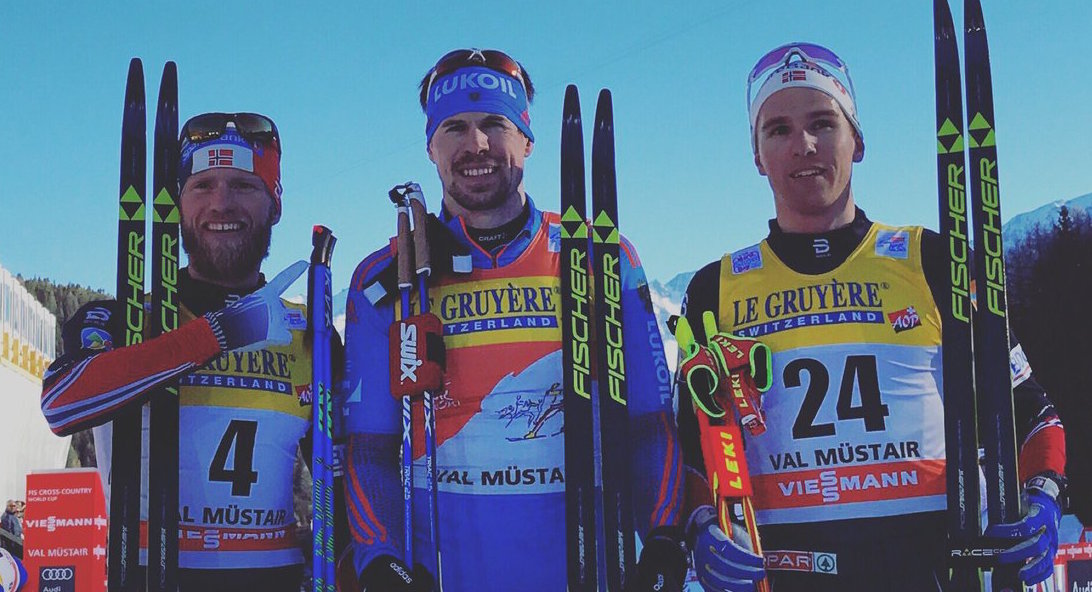
The overall podium at the end of the 2017 Tour de Ski, with winner Sergey Ustiugov (c) of Russia, Norway’s Martin Johnsrud Sundby (l) in second, and Switzerland’s Dario Cologna (r) in third after finishing in that order in the 9 k freestyle hill-climb pursuit, Stage 7 of the Tour de Ski in Val di Fiemme, Italy. (Photo: FIS Cross Country/Twitter)
In the men’s 9 k freestyle hill climb that followed, 24-year-old Sergey Ustiugov of Russia raced to his first Tour de Ski victory, heading out of the gate with a 1:12-minute head start over Norway’s Martin Johnsrud Sundby and finishing 1:02.9 ahead for the win in 30:27.7.
Sundby put time into Ustiugov over parts of the course, particularly in the first kilometer along a flatter section leading up to the climb and then again between 6 and 8 k on Alpe Cermis itself.
Sundby skied alone throughout the pursuit race, with Switzerland’s Dario Cologna starting 52 seconds behind him. Cologna had a 29-second head start on Finland’s Matti Heikkinen, who entered the race in fourth, and 30 seconds ahead of France’s Maurice Manificat in fifth, but Manificat caught and even passed Cologna with about 0.5 k remaining. Cologna proceeded to pass Manificat back while Heikkinen skied about nine seconds back in fifth.
Canada’s Alex Harvey had started sixth and helped lead Manificat and Heikkinen in chasing down Cologna early in pursuit, but he faded to seventh, behind Sweden’s Marcus Hellner (who started seventh, 12 seconds after Harvey) by 8.5 k. There, Hellner trailed Heikkinen by 14.6 seconds, and Harvey was another 27.9 seconds back in seventh (and nearly a 54 seconds ahead of the man skiing in eighth at the time, Norway’s Simen Hegstad Krüger).
Half a kilometer later, it was all over with Cologna securing third overall in the Tour, 1:19.1 behind Ustiugov and 16.2 seconds behind Sundby.
With the fastest 9 k time of the day, Manificat moved up one place for fourth overall, finishing 1:26.9 after Ustiugov with a time of 29:20 minutes. Heikkinen was the second fastest on course, 6.1 seconds slower than Manificat, for fifth overall in the Tour (+1:31.3). Hellner took sixth at the finish (+2:05.8), ahead of Harvey in seventh (+2:39.7). For Harvey, it was his best overall finish in four competed Tour de Skis (last year, he finished 14th. His best result was 12th in 2012).
Norway swept the next five places with with Krüger in eighth (+3:27.2), Hans Christer Holund in ninth (+3:50.4), Niklas Dyrhaug in 10th (+4:24.9), Sjur Røthe in 11th (+4:56.4), and Didrik Tønseth in 12th (+5:07.7).
Canada had two in the final climb with Devon Kershaw finishing 25th (+9:32.2) after starting 23rd. Graeme Killick did not start after being positioned in 37th overall in the Tour.
Kershaw finished 8.1 seconds ahead of Noah Hoffman, the lone American racing to the top of Alpe Cermis. Hoffman moved up from 30th at the start to finish 26th (+9:40.3) overall, and in doing so, he posted the 15th-fastest time of the day, 1:05.3 back from Manificat.
Harvey’s time ranked 14th (+1:04.9). Norway’s Holund had the third-fastest time after starting 11th and ending up ninth, Hellner was fourth fastest, and Cologna fifth fastest.
Tour de Ski final results (with isolated climb times): Women | Men
Jessie Diggins (U.S. Ski Team) racing to fifth in the women’s 9 k final climb up Alpe Cermis in Val di Fiemme, Italy, for fifth overall in the 2017 Tour de Ski. (Photo: Salomon/NordicFocus)
Sweden’s Stina Nilsson didn’t fancy herself a favorite for this year’s Tour de Ski title, despite having won four stages and wearing the leader’s bib to start out today’s final race.
And after about six kilometers of the 9-kilometer climb up the Alpe Cermis, everyone knew why.
Heidi Weng, a Norwegian who had started 19.2 seconds behind Nilsson, had slowly gained ground on the Swede in the flat sections leading up to the climb itself. At 6.2 k, she caught Nilsson.
Weng barely paused and certainly never looked back. Instead, she stepped on the gas. Weng clocked the fastest time up the hill of any woman in the field and skied to a 1:37.0 win for her first-ever overall Tour de Ski title.
Weng, in tears during interviews, was overcome at winning her first major title. She has had dozens of podiums, including three in the overall Tour de Ski and one after the Ski Tour Canada last season. But she had yet to collect a tour win.
The 2017 Tour de Ski women’s podium, as determined by the final climb on Sunday in Val di Fiemme, Italy, with winner Heidi Weng (c) of Norway, Finland’s Krista Parmakoski (l) in second, Stina Nilsson (r) in third. (Photo: Fischer/NordicFocus)
Climbing, though, is a strong suit of hers. And she received some motivation from teammate Therese Johaug, who has won both the Tour de Ski and the final climb before but is sidelined for a doping violation.
“Therese said, ‘You can do it. You are a machine climbing.’ And I thought, ‘Such a machine, that’s not me.’”
But she was, matching Johaug’s time from the previous year (although snow conditions were different).
“It’s crazy big – it hasn’t dawned on me yet,” Weng told VG. “It has been an exhausting tour… I was nervous all the way and now I’m ecstatic.”
After getting dropped by Weng, Nilsson’s trials still weren’t over. The rest of the field was coming for her too. They knew that the previous year she had skied just the 40th-fastest time up the climb and guessed that she was likely to be suffering again this time around.
Sweden’s Stina Nilsson racing to third in the final climb of the 2017 Tour de Ski up Alpe Cermis in Val di Fiemme, Italy. (Photo: Fischer/NordicFocus)
Nilsson has improved a lot in the last year – her many World Cup wins and podiums can attest to that. And she cut her margin to the leader in the climb time more than in half this year, from 5:57 behind Therese Johaug in 2016 to 2:13.6 behind Weng this time.
But she was still suffering. And at 8.1 k, Krista Parmakoski of Finland caught her.
Parmakoski had skied out of the start in third place, and made up 54 seconds on Nilsson. She appeared exhausted, and rather than blowing by the Swede as Weng had done stayed behind her for a bit. But then she, too, moved past and opened up a gap that grew to 17.4 seconds at the finish.
“I had a really good day,” Parmakoski told FIS. “I have been many times fourth, so it is great to be on the podium. Today I felt great and surprisingly fast on the climb.”
But even then, Nilsson wasn’t out of danger in her quest for a podium.
Ingvild Flugstad Østberg, whose hopes of a Tour title had been dashed by a rough 10 k the day before and who had started fourth, was on the hunt.
The Norwegian had Nilsson in her sights and appeared to be making up ground. But Nilsson buckled down on the climb’s upper reaches and sprinted it in to the finish, podium secure.
“For the first time I wish the course was a little longer,” Østberg lamented to NRK.
“I’m very pleased with how I held it together,” Nilsson told Expressen. “I tackled this much better than I have all year… I’m so glad I made the bronze. It was so nice to snag third place! I was glad I had a sprint when Ingvild closer to the end, because I had no desire to come in fourth.”
Østberg was disappointed to be off the podium, but congratulated her Swedish rival.
“It was a bitter, sour fourth place for me,” she told Expressen. “But it is well deserved for Stina get a podium when she won so many races.”
Diggins Secures Fifth, Tying Best U.S. Result
Jessie Diggins had started the day in fifth place, and came in with dual ambitions: “chase fourth, but protect fifth.”
“I knew that there was some good climbers behind me,” the American skier explained in a phone interview. “And I knew that I had to have a decent day to hold them off, because things can change dramatically on that hill. So I was trying to catch Østberg, but part of my plan was… don’t blow up so badly that we lose what I already had.”
She has been making steady progress in managing the final climb. In her first go-rounds, in 2013 and 2014, she clocked the 20th-fastest times up the hill; in 2016 she was 15th; and today, her time came in 11th.
“In past years I have tried to catch people right at the base of the climb, and if you blow up there you are screwed,” Diggins said. “You can just bleed minutes of time. I really wanted to be going as hard as I could right before blowing up if that makes sense, find that line and ride it. Then at the end I really started trying to push, but… I started losing time because I was just getting extremely fatigued. But I think this is one of my better climbs because I was able to not just blow myself open.”
American Jessie Diggins chasing Norway’s Ingvild Flugstad Østberg on the final climb of the 2017 Tour de Ski up the Alpe Cermis in Val di Fiemme, Italy. Østberg finished the Tour in fourth and Diggins fifth, tying a best-ever mark for the U.S., set in 2015 by Liz Stephen. (Photo: ZDF screenshot)
Diggins had closed in on Østberg, and was at one point quite close. But feeling under threat – and maybe simultaneously perceiving that third place might be within her reach – Østberg pulled away.
“I was trying to hang with Østberg, thinking maybe if it comes to a sprint-off I could get her, but I wasn’t trying to sprint up to her to close the gap because I knew that would have disastrous results,” she said. “At one point I was like 25 feet behind her, but then I couldn’t quite hold on. She was so mentally strong, she really galvanized me at the end. I kept my spot; I was really happy to finish in fifth.”
That ties Diggins for the best American finish ever in the Tour de Ski, a mark set by Liz Stephen in 2015. Diggins also finished fifth in last year’s Ski Tour Canada.
“I mean any time you can be like Liz Stephen it’s a really good day,” Diggins laughed.
Jessie Diggins (U.S. Ski Team) smiles after finishing the 2017 Tour de Ski in fifth place on Sunday in Val di Fiemme, Italy. (Photo: Salomon/NordicFocus)
But besides her own efforts, she was impressed with the whole team that made it possible for her to have a top overall result.
“It takes an immense effort from the wax tech and the staff, and the massage and physical therapists, and the athletes and everyone — being positive and staying on it,” she said. “To be able to string together race after race, without any of them being bad, without losing your overall place in the Tour. You’re bound to have a day that is not great, but you need to be able to put together solid enough performances to keep going.”
Not just in the context of a Tour, but in terms of the World Cup season, that has been a goal for Diggins.
“It’s something that I have been working on, is consistency through my skate and classic and sprint and distance,” Diggins said. “So that’s what I am really proud of because I have been working towards it.”
Stephen Second-Fastest Up Hill, 14th Overall; Brennan 28th
The U.S. Ski Team’s Liz Stephen was making a bid to win the hill climb. Doing so would have made her the fourth U.S. woman in history to notch a Tour de Ski stage win behind Kikkan Randall, Sophie Caldwell, and Diggins.
She came up just short, finishing 38.2 seconds behind Weng’s fastest time up the Alpe Cermis. Nobody else came closer.
“I wanted to win today for sure,” Stephen said. “It was a really good opportunity. I knew I would have to do a really good race to beat Heidi, but it was definitely the goal. So I was a little disappointed for sure with second — which sounds ridiculous, but the win was the goal.”
The U.S. team has set a culture of high expectations, and for years this has been the favorite day of a favorite race series for Stephen. This was the fourth time she has finished second in the climb, and she really wanted the win.
“You set out to win every day, but actually you have a realistic goal as well, generally, in your brain,” she said. “I think today it was realistic for me to win. Anytime you miss the goal that you set for yourself, you have a little bit of disappointment.”
But, she tried to also pick out some reasons to feel good about her race.
“It definitely does play a role I think that Heidi was going for her first Tour de Ski win… and to have $100,000 on the line, I am sure that also gave her even a little extra motivation,” Stephen said. “She was on fire today, and I never mind losing to Heidi. She is a hell of an athlete and a really fun person to know and I am really happy for her.”
For Stephen, disappointment means looking ahead. In 365 days (more or less), she’ll have another chance.
“I guess I have already set my sights on next year,” she said. “I want to win this thing before I retire. So we’ll see, maybe a little extra training for it specifically next year. I don’t know, maybe not. But yeah, I will try to do it again next year and see how it goes.”
Teammate Rosie Brennan started in a wave of five women at eight minutes behind Nilsson, and was the first from the wave to cross the finish line.
“The flat section is really narrow, and really hard to pass people,” she said in a phone call. “[The wave] is kind of a toss up: the flats are definitely hard for me, so it’s nice to be able to draft, but also when you’re going for time of day, it’s nice to have space to go when you want to go.”
When she got to the actual climb, Brennan began to feel better. The day before, she had surmised that the climb is actually straightforward when you’re tired. All that’s required is to just put one foot in front of the other.
“I tried to just chip away once we started the climb, and maybe a third of the way up it I started feeling pretty good,” she said. “I tried to move up a bit, and was able to pass a few people. Then I just held steady because at that point I was in no man’s land.”
With nobody close enough to catch, Brennan crossed the line 26th. Once her time was adjusted to account for the wave start, she was 28th overall.
“I’m happy with how the Tour finished,” she said. “The start was okay and the middle was really rough. Then I came around a little bit at the end. I really like tours, but it’s very challenging to put together a good tour. To be top ten even in a tour is an incredible accomplishment for anybody. It’s so hard to not lose time on any given day. I’m happy I was able to stick it out, and turn things around in the last few days. I’m satisfied with that, and hopefully I’ll get another chance next year.”
Looking to Refresh
Diggins, who was on the massage table during her interview, was very much looking forward to some rest and recovery.
“We’re going to go spend one day here [in Val di Fiemme] and then we are going to go up to Seiser Alm, which is where we usually go for our training camp,” she said. “It’s high altitude. It’s great living, we know the skiing is good, the food is good, so it’s a good place to kind of recover and regroup. And I plan on going sledding every day.”
For Stephen, a goal will be to keep the mindset she was able to achieve by the end of the Tour.
“I think this tour helped me get much better, not only in my physical state — I think that all of this racing has really helped where I am physically right now — but also, I think the daily race efforts mentally really get me going again,” she said. “The best thing sometimes this tour does for me is just puts me into race mode. Now the challenge will be, well, first to rest, but then to figure how to keep so mentally psyched and engaged in the sport I am doing … Hopefully I can rest a little bit and then get some really good training in and look forward to World Champs, and even the [World Cup] races in Sweden.”
Brennan won’t travel with the team but instead will do a recovery and training camp outside of Seefeld, Austria.
“It’s just to mix things up and take a break,” she said of her choice of Seefeld.
She will then rejoin the U.S. team in Sweden for World Cups.
“I had a little bit of a slow start to the season, and then in France I was finally able to turn things around,” she said of the pre-Christmas races. “But then I got really sick over Christmas. To be able to turn in this Tour makes me believe I’m okay, after that. It just took a while to get my energy back from that illness. Now I have the confidence that I will be able to take a rest, and train a little bit, and be back where I want to be come Sweden.”
Stina Nilsson of Sweden (center) celebrates another win in the Tour de Ski, which puts her atop the overall standings; Anne Kyllönen of Finland (left) was second in the 10 k classic mass start and Charlotte Kalla of Sweden third. (Photo: Fischer/Nordic Focus)
As the Tour de Ski drags on, the World Cup field is tiring. Nobody – except maybe Sergey Ustuigov – has managed six good days in a row.
Everyone else has had at least subpar race. But sometimes a good day follows a bad one. Just ask Sweden’s Stina Nilsson.
23-year-old Nilsson had been leading the Tour after winning three out of the first four stages. But she finished 20th in the 5 kilometer freestyle on Friday – 40.5 seconds behind the time set by Jessie Diggins, and far from seeing any bonus seconds. So she lost the lead.
Saturday was a brand new day: the 10 k classic mass start in Val di Fiemme. As Nilsson noticed her rivals in the overall Tour standings slipping – quite literally, as some struggled with slick skis – she pounced.
First she won the bonus sprint at 3.6 k. It wasn’t something that she had planned ahead of time, but the opportunity seemed ripe for the picking.
And then as the race went on, Nilsson stayed always near the front. By the final 2.5 k lap she decided to push up the hills. The rest of the pack fell away, all except for Anne Kylloenen of Finland.
Coming down the hill to the finish she was able to pull away from Kylloenen, too. That gave her a 3.0-second win — and 30 total bonus seconds, 15 for the first sprint and 15 for the win. Voila – now she is back in the Tour lead.
“It is amazing,” Nilsson marveled to FIS. “You never know how the body bounces back. Yesterday was a difficult day. I am really happy with today’s result.”
Charlotte Kalla of Sweden racing to third place in the 10 k classic in Val di Fiemme, Italy. (Photo: Fischer/Nordic Focus)
It was the first individual podium of the season for Kylloenen, and a strong day for Finland. Krista Parmakoski placed fourth (+9.4) and Kerttu Niskanen ninth (+19.8). The team is traditionally strong in classic skiing, and Kylloenen also credited their ski techs.
“It is great to be on the podium again, especially after I crashed today,” she told FIS. “I had to fight my way back in the race but in the end I felt very strong.”
While Kylloenen had praised her skis, one team wasn’t doing so. The Norwegians failed to reach the podium for a second straight day. Heidi Weng was their top finisher, in seventh (+17.5). She had been leading the Tour, but now sits 19.2 seconds behind Nilsson going into the final stage.
Kathrine Harsem finished 12th (+35.3) and Ingvild Flugstad Østberg 18th (+1:08.5). All three blamed their skis, which they said were too slippery and the worst in the field.
“It should be f–ing possible to wax properly, goddammit,” Harsem told NRK. “We have to try and put this behind us.”
For Østberg, it was a disaster in terms of the overall Tour standings, as she slipped from second place down to fourth, 1:23.3 behind Nilsson and 39.7 seconds behind third-place Parmakoski.
“It’s a lot to take in when you see your chances in the final standing go away,” she told NRK. “I am terrible at waxing myself so I’m not blaming anyone. They do all that they can and we do all that we can. You can’t always hit the bullseye, but of course it is even more frustrating when it’s a Tour.”
Stina Nilsson double-poling to the win in Val di Fiemme. (Photo: Fischer/Nordic Focus)
As for Weng’s chances of winning the Tour de Ski, they are still decent. She is currently 19.2 seconds behind Nilsson overall.
The final stage is a grueling 9 k climb up the Alpe Cermis, a stage where Weng has excelled in the past.
“It’s fun to still be in the race, “ Nilsson told Expressen. “It’s Heidi Weng and it’s Alpe Cermis… I see myself absolutely not as the favorite. But it’s fun to still be in the game a little bit.”
Nilsson hasn’t excelled in the climb – but she is also a much stronger skier than she was last season.
“Stina is in better shape than ever,” Weng told Expressen. “I don’t know if I will take her on the slopes in the morning.”
Diggins Eighth, Holds Tour Position
With her recent flurry of podiums and wins, eighth place might seem like a standard day for the U.S. Ski Team’s Jessie Diggins.
But in the 10 k classic? Not so much. Sure, she was eighth in the 10.5 k classic Ski Tour Canada stage in Montreal last season, but there she was 1:43.5 behind the winner, Therese Johaug (and 43.2 seconds behind second-place Weng).
The women’s field, including Jessie Diggins in bib 5, takes off in the 10 k classic. (Photo: Salomon/Nordic Focus)
In Val di Fiemme, Diggins was eighth and only 19.5 seconds behind the day’s winner, Nilsson.
“I was psyched,” Diggins said in a phone interview. “I don’t know that I’ve ever been within 19 seconds of the leader in a 10 k classic.”
The result came from a combination of attitude and strategy, Diggins said.
Attitude: “I was channeling my classic-loving teammates today, thinking, ‘Okay, what would they do? They would not fall down, they would stay upright on the climbs. So I’m going to try to do that too.’ And basically, I raced today thinking only positive things to myself.”
Positive thinking can get you far – Diggins knows that as well as anyone. But she also knew she had to race smart. In order to have the best possible final Tour de Ski position, she was racing for time back from the winner, not necessarily place. So she picked her battles.
“I was trying to stay within sight of the leaders for absolutely as long as possible,” she said. “That meant that when everyone was kind of sprinting for the bonus sprint, I didn’t do that because I didn’t want to implode. So then I was able to reel my way right back in afterwards, and I was really psyched about that.”
For much of the race she held on to the back of the lead group, never falling off, but rarely part of the mêlée.
“People are switching lanes, cutting each other off, stepping on each other, and I was like, ‘Okay. I’m just going to do my thing in the back, and ski as smooth as I can’,” Diggins explained. “And then I knew the pace was going to go up on the last lap. I wanted to be able to respond to that attack as well as I could, so I just kind of stayed out of trouble. And that tactic worked out well for me today.”
A number of racers, including Kalla and Parmakoski, fell on a sharp corner coming into one of the course’s steep downhills. That, too, was a reason for Diggins to use caution.
“The worst thing I could do for myself in this race is to have some accident happen and lose a ton of time,” she said. “There was a little bit of a hairy corner there. I watched a girl half jump over another skier to avoid a crash. I remember thinking, ‘Wow, I’m so impressed. It’s the middle of the race, but I’m just so impressed right now.’ So I stood up [to avoid it]. I just wanted to stay out of trouble.”
Jessie Diggins (U.S. Ski Team) racing to first for her third-straight 5 k freestyle victory on Friday at Stage 5 of the Tour de Ski in Toblach, Italy. Diggins won her first World Cup race in the Toblach 5 k one year ago. (Photo: Salomon/NordicFocus)
As Nilsson upped the pace on the final lap, Diggins found it harder to stay with the leaders. She put her head down and dug, and knew that she had one trick card up her sleeve: the course’s downhill finish.
If the Tour de Ski has demonstrated anything, it’s that Diggins loves downhills.
“I knew that I had a chance of catching the girl in front of me if I really skied the downhill perfectly, and then hopped out of her draft at the right time,” she said. “It was really fun to actually execute a long-distance slingshot. [Niskanen] gapped me over the top of the hill. Kerttu’s a really good skier. But it was really fun to be able to actually pull it off.”
All in all, Diggins wanted to be there for the final sprint, to be close to the winner – but being 20 seconds back, she’d take it. She credited Niskanen with helping her not lose more time on Nilsson.
“We helped each other give everything we had,” she said. “When you’re duking it out with someone, you both move faster, which was cool… 10 k classic has never been my marquee event, I guess you could say. But I was really proud of myself for giving it my best shot. And not giving up, and really just going after it.”
More Points for Stephen and Brennan
By the end of the first lap, American Liz Stephen – starting from bib 21 – was holding her position and within ten seconds of the leaders.
But within a kilometer, Stephen found tat she couldn’t hang on.
“Classic is just a continuous work in progress for me, and I was hoping to feel a little more energetic out there than I did,” she admitted in a phone call. “But it’s my favorite course on the World Cup, so I was having fun out there, for sure. There seems to be this gap that I can’t quite close in classic. It happened again today. Right off the back of the leaders, and right off the back is just not close enough. Then the gaps open and I’m not there to cover the gaps, and they just get bigger and bigger.”
She finished 19th – 1:11.2 behind Nilsson, just one spot behind Østberg.
“Hell, I almost beat Ingvild today, and that doesn’t quite feel right,” Stephen said. “I certainly got to ski right behind her, which I haven’t done for five or six years. There were some highlights… I really do enjoy skiing with Steffie [Boehler, of Germany]. I was skiing the downhills well today. There’s a lot of positives for sure, but I was hoping to be just a little closer to the lead pack today.”
Teammate Rosie Brennan also had a strong start, immediately moving up eight or so places from her bib number. But then she got tangled on an uphill and it was the straw that broke the camel’s back, in terms of keeping the pace.
“We got to the top of the course and it’s a short steep pitch, like a herringbone, and I got stepped on and face planted there,” she explained in an interview. “I just lost my steam. So I had to reset then. I felt really beat, and didn’t have much there, and just tried to keep a steady pace, keep chugging along. I figured if I kept steady I would pick off a few people who had exploded. So that’s how the rest of the race went.”
By the finish Brennan had moved up to 28th (+2:06.1). She scored a few more World Cup points and is now in 30th in the Tour overall.
“I didn’t lose that much time, so it’s hardly an excuse,” she said. “But I was just tired enough that it threw me off a little bit. It was much easier to follow today than to chase, so I would have preferred to have been following. But that said, I didn’t lose that much time, so it’s not much of an excuse, just a bummer.”
It’s vanishingly unlikely that an American will win the Tour de Ski.
But one, Liz Stephen, is intent on winning the climb. Three times — 2013, 2014, 2016 – she has had the second-fastest time up the Alpe Cermis. Tomorrow she hopes to do one better.
“I’m certainly going to go out and try to catch some people, but my goal tomorrow is to win this big climb,” she said. “That’s certainly the goal, and it’s been on my radar all year. With [Therese] Johaug out of the mix [for a doping violation], I think it’s a possibility if I have a really good race. That’s the goal… I feel really ready for tomorrow. I know that everybody is tired. I’m tired too. But I’ve been looking forward to this for 364 days, so it’s go time!.”
For Diggins, who has held onto fifth place for several stages now, the climb represents another chance to simply push really, really hard.
“My whole strategy to the Tour this year, and every year, has just been day by day,” she said. So tomorrow, I think it’s the exact same approach: just go out there and it’s gonna be hard, of course, I mean, we’re climbing a mountain. But I’m just going to go out there and ski it as well as I can, and be as mentally tough as I possibly can. And I know that’s my strength, is I can dig really deep and I can deal with a lot of pain, and I can grind it out. So I’m just going to take confidence in that and go for it.”
All of the Americans said the same thing: you know what you’re signing up for when you decide to do the Tour de Ski. You’re signing up to climb a mountain after you already have half a dozen races in your legs in just one week’s time.
Brennan was philosophical about it.
“I’m quite tired. But I think sometimes when you’re tired the hill is easier than doing a race, because there’s a lot less thinking,” she said. “You’re just putting one foot in front of the other, and you don’t have to think about how to make speed, or skiing around a corner. From that aspect I feel like it will be OK. I’ll make it.”
The women’s podium at the 5 k freestyle on Friday at Stage 5 of the 2017 Tour de Ski, with two Americans: Jessie Diggins (c) in first and Sadie Bjornsen (r) in third, and Finland’s Krista Parmakoski in second. (Photo: Fischer/NordicFocus)
Lining up at the start of the women’s 5-kilometer freestyle individual start on Friday, it was a different Jessie Diggins than a year ago. Here the American was, again in Toblach, Italy, again in the third-to-last stage of the Tour de Ski, again about to race another one of those rare formats on the World Cup circuit: the 5 k individual.
But this time last year, she had never won a World Cup, let alone reached the podium in an individual race. Thirteen minutes later (well, more than that, after all of the 5 k racers had finished), that all changed.
This time around, reporters asked her leading up to the 5 k freestyle whether this race was hers to lose. She joked that she was shooting for a top 23.
“I did feel that I was working hard to not put a lot of pressure on myself,” Diggins recalled on the phone after Friday’s race, Stage 5 of the 2017 Tour de Ski. “… Of course I want to go out there and win. I believed in myself, I believed in the team, I believed in the techs, so I knew that if everything went well, I knew I could win. But I didn’t want to make this bigger than big, crazy, pressure-filled day.”
So she woke up and went for a jog, “did a little happy dance,” and prepared as she would any other race day.
“When an athlete is in the top five, you get asked some pretty aggressive questions,” U.S. Ski Team Women’s Coach Matt Whitcomb said on the phone after Friday’s race. “They just want to focus on skiing the best race possible, but the media is asking you if you plan to defend your title. So I think [Jessie has] developed a really professional approach to some of the harder questions that she’s getting asked in these flash interviews just before the races. She’s saying, ‘Yeah, I do plan to defend my title,’ but just because you say that, it doesn’t mean you’re betting your house. You’re identifying that you are going to go out there and race with all you have.”
Per her request, Diggins started 12th on Friday in a field of 40 women remaining in the Tour.
“I asked the coaches to start me as early as possible for no other reason than I didn’t want splits,” she recalled. “It didn’t matter to me. I just wanted to go and race.”
Jessie Diggins (U.S. Ski Team) racing to first for her third-straight 5 k freestyle victory on Friday at Stage 5 of the Tour de Ski in Toblach, Italy. Diggins won her first World Cup race in the Toblach 5 k one year ago. She remains fifth in the Tour standings with two stages to go. (Photo: Salomon/NordicFocus)
One 5 k lap and 12:45.6 minutes later, Diggins finished as the new race leader, 14.9 seconds faster than Sweden’s Charlotte Kalla in bib 10. It was almost exactly 30 seconds faster than Diggins’s time on the same course last year.
She was psyched, but had no idea if it would be fast enough to stay in first. Either way, she had to race again the next day, so Diggins proceeded to gather her clothes and begin her recovery routine, starting with a snack.
By the time Diggins returned to the finish area, she realized that her time not only stood, but her fellow U.S. Ski Team member Sadie Bjornsen was contending for a podium as well. Bjornsen started 26th and initially finished second, 0.3 seconds ahead of Kalla and 14.6 seconds behind Diggins. By the time Diggins reached her teammate, Bjornsen was third after being bumped by Finland’s Krista Pärmäkoski, who was still 13.6 seconds off Diggins’s time.
“I came back just as Krista finished and bumped her down one, but we were still just like, it’s gonna happen, it’s gonna happen,” Diggins said of Bjornsen’s first career podium. “And we were just so excited, jumping up and down. I hugged Sadie and she started crying and then I started crying. It was so cool because if the whole team can celebrate like that … when you win by yourself, that’s fun, and people are psyched and stuff. When more than one person’s on the podium, then the whole team really celebrates. It’s a different feeling and it’s way cooler and I love it a lot.”
Sadie Bjornsen (U.S. Ski Team) after placing third for her first career World Cup podium on Friday in the 5 k freestyle at Stage 5 of the Tour de Ski in Toblach, Italy. She is now ninth in the Tour standings. (Photo: Fischer/Nordic Focus)
“At first I couldn’t believe it,” Bjornsen recalled on the phone about her third-place finish, which became official not too long after she celebrated with Diggins.
“Two months ago, I was struggling so much that I wasn’t sure if I would be starting on the World Cup,” she said of painful bone spurs in her heels. “The emotions of what it took to get there comes to you at that point. … I had to wait till Heidi [Weng of Norway] came in to seal the deal.”
Bjornsen’s reality began to set in once Norway’s Ingvild Flugstad Østberg (who entered Friday ranked third overall in the Tour) finished seventh, 8.9 seconds off Bjornsen’s time and 23.5 seconds behind Diggins. Then the last starter, Norway’s Heidi Weng (previously ranked second in the Tour) crossed the line in fifth, 2.9 seconds slower than Bjornsen and 17.5 seconds off Diggins’s winning time. That bumped Østberg to eighth (and subsequently everyone else after Weng down one place as well).
So that was that. Diggins defended her victory in the Toblach stage one year later and notched her third-consecutive 5 k win, which ties the record set by Russia’s Elena Välbe in the 1990s (for the most 5 k freestyle victories in a row), according to an International Ski Federation (FIS) press release.
Also of note, Friday marked the 17th World Cup win for the U.S. women’s team. According to FIS, 13 of those wins came in sprints. The four others were a 3 k freestyle prologue (won by Kikkan Randall at the 2012/2013 Tour de Ski) and now three 5 k skate races (all won by Diggins in the past year).
“The skill we are all trying to accomplish, to acquire, is to become a faster ski racer, and also how to win, and how to be not such an emotional and taxing process,” Whitcomb explained. “It’s a big deal. There’s a lot of responsibilities along with success, so the difference between [Diggins] this year and last year is her dealing with these little pieces of the equation that come with being a ski racer, and particularly a successful ski racer.”
As for Bjornsen’s podium, he said that was expected.
“Not in a way that would put pressure on Sadie, but in a way that … we believe in her,” Whitcomb said. “She’s an incredible competitor. For it to finally come together in an individual race, Sadie’s been on the podium numbers of times [in team events] and with teammates. To have it happen in a distance event, in an individual race, that’s very special.”
“It feels so good to get my first individual podium… but even more special to get that first one with a teammate on top,” Bjornsen wrote in an email. “All the girls on this team are an inspiration to me. We are dreamers, but we are also believers. It’s crazy how much confidence you can get from a teammate’s success if you allow yourself to stand beside them.”
‘What Would Jessie Diggins Do?’
Jessie Diggins celebrating her third career win (in three-consecutive 5 k freestyle races) as well as double podium for the U.S. women with teammate Sadie Bjornsen (not shown) in third on Friday at Stage 5 of the Tour de Ski in Toblach, Italy. (Photo: Salomon/Nordic Focus)
In terms of the 5 k itself, it was one you couldn’t attack like a sprint. Or else you’d die, Diggins said. Then she laughed. “Well, probably not die, but you know, I’m feeling dramatic at the moment,” she jested.
Same ol’ Diggins after all. At 25, the Minnesota native simply has seven more podiums and three more wins than she did before last year’s Toblach 5 k.
All kidding aside, Diggins said it was important to be mindful of Toblach’s altitude, some 4,500 feet above sea level. Also, the first half of the course is a bit of a grinding, winding uphill, she said.
“If you finish the very first climb, and you’re like, I nailed it, now I really need to tuck for a minute, you don’t get that [in Toblach],” Diggins said. “So I guess you do have to ski each section fast, but with enough gas in the tank that you can finish hard.”
Before the race, Diggins made a plan that included breaking the course into sections and attacking every part of it to the best of her ability.
“Instead of thinking about splits or worrying about what anyone else was doing, I was just thinking, right now I need to V2 this climb as well and technically good as I can, and then I’m going to corner on the fastest part of the snow possible, and then I’m going to ski this downhill in a tiny tuck,” she reflected. “Just really dissecting the course, and focusing on each second. I guess Matt [Whitcomb] would probably call that being in the flow.”
Diggins found her rhythm, as did Bjornsen, who came close to a podium three days earlier with her previous career best of fifth on Tuesday in the Stage 3 skiathlon.
Sadie Bjornsen (U.S. Ski Team) racing to her first career World Cup podium on Friday at Stage 5 of the Tour de Ski in Toblach, Italy. She placed third in the 5 k freestyle. (Photo: Fischer/Nordic Focus)
“All this time, it’s like, I know I can do that, it’s just a matter of doing it,” Bjornsen said.
She had been waiting for this moment all her life, but felt particularly ready for a breakthrough after getting sick in France in mid-December. Then at Stage 2 of the Tour de Ski in Val Müstair, Switzerland, she said she went out to win the 5 k classic mass start, but ended up 35th, outside the top 20 for the first time this season. Bjornsen said she “exploded” because of the altitude, which crushed her confidence.
“I had to work hard to get mentally back in the game and that confidence from that fifth was huge for me,” she said of Tuesday’s 10 k skiathlon. “And I was like, that’s crazy in skating that I can be that strong. After that I was like, I should believe in myself.”
Throughout the race, she told herself two things: “Stay strong Sadie,” and “What would Jessie Diggins do?” Bjornsen wrote. “There is so much work on the second half of the race, and Jessie is just amazing at being strong on that section … so I was imagining her the whole second half in front of me, and it seemed to have worked”
A year ago, Bjornsen blew up on this course and hung on for the second half for 13th at the finish. Not too shabby, but she had been out to win.
“Last year I told people, ‘I’m going out there to win,’ and at the time that was maybe a little bit of a joke because I hadn’t had too much skating success…,” she said.
This time, she decided to have more of a plan and told herself Friday’s race would be 12 minutes of solid work without any rests. Mostly, she told herself to back off slightly early on. At one point, she was concerned she started too hard.
That made Bjornsen laugh later on Friday as she considered her splits. At 1.6 k, her time ranked 10th and by 2.1 k, she was 12th overall. But by 3.4 k, she was back in the mix in fifth out of the 40 finishers. (Diggins paced it similarly, with the seventh-fastest split at 1.6 k and fourth-fastest at 2.1 k, before taking the lead for good at 3.4 k.)
“I finished and I was like, hmm, I wonder how that went,” Bjornsen said, after specifically requesting no splits during her race, like Diggins. “I wanted to go out there today and see how strong I could be inside my head. I love this course, but pacing is important, and I wanted to do my own thing.”
Then she saw Randall’s husband Jeff Ellis, who conducts televised post-race interviews for FIS, at the finish. He showed her the live results on his phone. Bjornsen couldn’t believe it. She sat down, and a few moments later she started walking out of the finishing pen.
“One of the [finish-area officials] told me I should stick around and I was like, ‘Really?’ I didn’t think that was necessary,” Bjornsen recalled.
Then Østberg finished, and she realized her result was for real.
The women’s podium at the 5 k freestyle on Friday at Stage 5 of the 2017 Tour de Ski, with two Americans: Jessie Diggins (c) in first and Sadie Bjornsen (r) in third, and Finland’s Krista Parmakoski in second. (Photo: Salomon/Nordic Focus)
“We were just so giddy,” Diggins recalled of the moments following the race, including a cool-down jog together before standing on the podium. “… I remember how psyched she was for me last year when I got my first one, and I was so psyched for her. It was cool to share that experience.”
They shared that moment with the rest of their team as well.
“As one of the U.S. coaches, as you approach the media zone, people just make way for you,” Whitcomb said of the experience of having an athlete, especially two athletes, on the podium. “They move their huge television cameras so you can experience a piece of that podium, and make sure you get your little picture on your iPhone, too, and having the opportunity to share it with them.
“What’s also special … what makes our team different the most, is right behind me, hopping over fences is Rosie and Liz and Kikkan, who managed to see the podium ceremony as well,” Whitcomb said of U.S. women’s team members Rosie Brennan, who placed 23rd (+43.3), Liz Stephen, who placed 32nd (+49.7), and Randall, who placed 40th (+1:38.6), on Friday.
“You don’t see other teammates out there very often; that’s something we take a lot of pride in, making sure to really take a moment to celebrate the success of your teammates,” Whitcomb said. “It’s easy to say, but hard to do.”
Brennan reflected on her first glance at the live results. When she got as far down as Bjornsen, she stopped before finding her own name.
“At that point, Sadie was sitting in second and Jessie was winning,” Brennan said on the phone. “I was like, ‘Oh my god!’ It was crazy ’cause literally in that second, it was the best my legs had felt all day. I got a flush of really good feelings, so then I ran back out to find them. So I didn’t know how I finished until much later.”
Beyond being incredibly excited for both her teammates, Brennan said it was inspirational seeing her year-round training partner at Alaska Pacific University, Bjornsen, finally reach the World Cup podium.
“I know how hard she works for it, and I know a lot of the challenges that she’s had to overcome to get there,” Brennan said. “It gives me a huge sense of confidence because I train with her … and I know that it’s possible for all of us to be there, and it just makes me believe in my program and what we have going on. It’s huge for everybody.”
During the women’s race, Bjornsen’s younger brother and teammate, Erik Bjornsen, was in the car en route to the next World Cup stop in Val di Fiemme, Italy, with teammate Noah Hoffman, but followed the live timing online.
“I kind of feel like I won today just because Sadie had such an outstanding race!” Bjornsen wrote in an email. “I’ve pretty much trained beside her since we started taking this sport seriously. I’ve seen her make steady improvements over the years, but this summer/fall she took another big step in her skating. I’d never seen a girl ski that nicely and I knew she was going to get some podiums this year. … She’s a ridiculously dedicated and hard worker, she deserved that result more than anyone!”
“It was an incredible day,” Stephen wrote in an email. “Seeing anyone’s first individual podium is always a really special thing. Sadie has worked so hard on her skating and distance skiing and to see it pay off is really amazing, and it will not be her last. As for Jessie, Toblach is decidedly her course! Two years in a row taking the win, and today by a wide margin is a pretty fun thing to see. Our girls are on fire and it is a momentum for the team to latch onto for sure.”
Weng New Tour Leader, Diggins 5th, Bjornsen 9th
Overall, Diggins kept her spot in fifth in the Tour, 1:23.3 seconds behind Weng as the new Tour leader with two stages in Val di Fiemme to go. Østberg is up to second overall, 11.1 seconds back, and Sweden’s Stina Nilsson slipped to third (+16.3) — after starting in the Tour leader’s bib — when she finished 20th (40.5 seconds behind Diggins).
Pärmäkoski remains in fourth overall, 36.8 seconds out of first and 20.5 seconds off the podium.
In an interview with iltalehti.fi, Pärmäkoski said she was surprised to be on the podium and felt it was more of a reflection of others being tired. Either way, she said a podium on Friday was an important step in her quest for a top overall finish.
“The weekend, with respect to everything, is open,” she said, according to a loose translation. “But the chances are good.”
“I guess I never expected to see that,” she said. “I mean you hope and you dream, and you train your butt off, but that was definitely a crazy thing, to realize that I could win by [not] just squeaking through, and I’m still trying to process that I guess.”
Bjornsen picked up three places for ninth overall in the Tour, 3:18.1 out of first and 6.8 seconds behind Germany’s Nicole Fessel in eighth.
“I’m just trying to think about each day individually,” Bjornsen said, “because as soon as I start thinking about overall, I get too nervous. Tomorrow’s another awesome race for me so I’m excited. I’m trying to conserve energy through this exciting time.”
The women race a 10 k classic mass start on Saturday followed by a 9 k freestyle hill climb up Alpe Cermis on Sunday to end the Tour.
“Every race is totally different. It’s a new opportunity, a new chance, so I’m going to go out tomorrow and go as hard as I can,” Diggins said. “I know that my fitness is in a great place. I have belief in myself that way. I think I just need to be focusing on my technique, as always. It was really weird, I had people ask me, ‘Will you be conservative tomorrow before the final [hill climb]?’ And I’m like, ‘When do you ever start a race and not plan on giving everything you have?’ I’m definitely going to go out there and race as hard as I can, and do my best, and then after, I’ll recover and then I’ll look forward to the next stage.”
Brennan Back in the Points
Also on track to finish out the Tour, Brennan notched her best result of the first five stages in 23rd, 43.3 seconds back from Diggins. Her split times were consistent, yet gradually faster, clocking in at 27th, 24th, and 23rd overall after she started 15th, a minute and 30 seconds after Diggins.
“We had really good skis … and I’ve raced this course quite a few times now, so I guess I had some familiarity with how it works, kind of how I wanted ski it,” Brennan said. “My legs felt absolutely horrible all day today. I was just trying to not think so much about how my body felt because it’s an individual start and you never know what’s going to happen. … I had no idea how well I was doing … and it worked out. It was great.”
U.S. Ski Team member Rosie Brennan (43) racing to a season-best World Cup result of 22nd in the 10 k freestyle mass start on Dec. 17 in La Clusaz, France. (Photo: Toko/NordicFocus)
Previously this season, Brennan placed 22nd in the 10 k freestyle at the World Cup in La Clusaz, France. That cemented her decision to stick around for the Tour de Ski.
“I really like the Tour format, it’s something that I think suits me pretty well, so it was definitely something that I had on my goals for the year,” she said.
“I’ve had a pretty rough Tour, and the last two days in Oberstdorf were particularly rough for me, and I was starting to wonder what the hell was going on,” Brennan explained. “I tried to start over fresh and just try to be like strong in my head, so I was really glad to see that I still had that, and that works, and I still had something in me.”
“We have two more days of racing so I don’t know how that will affect it,” she said of her overall World Cup standing. “It depends on how I do and how the people around me do. Any day you can score points, it’s going to help you.”
According to Whitcomb, he and Brennan discussed World Championships qualifying the night before.
“Last night we talked, just kind of cleared the air and discussed how qualifying for World Championships is a stressful thing, and the fact that we had made the commitment to this tour, which means that you can’t go home and try and prove it at nationals anymore, you’re in it,” Whitcomb said. “Rosie went into this race trying to focus just on it, through a fresh lens, without the stress of the disappointing races she’s had so far in this tour. .. It’s one thing to say what you’re going to do, but to actually execute it is challenging.
“I think she did that today, and skied fantastically,” he continued. “It was really impressive also to watch her work the downhills and generate speed on false-flat downhill sections … areas where someone like Jessie can really crank, that’s not one of Rosie’s strengths. Her jam is the gradual uphill … It was almost one of the most satisfying races of the day, for our team, was to see Rosie break out like that. … However World Championships selection shapes up, she’s certainly gotten two very competitive results. She’s feeling better about herself going into tomorrow.”
Liz Stephen (U.S. Ski Team) racing at the Lillehammer World Cup last month. (Photo: Toko/NordicFocus)
The fourth U.S. woman continuing on in the Tour, Stephen finished 32nd to move up one spot to 25th (+5:01.7) overall.
“I was shooting for a top 20 today, but was satisfied with my position, given how hard I skied and how mentally engaged I was today,” Stephen wrote. “My overall standing in the Tour this year is not where I would like it to be, but it is not over and I won’t stop trying to catch people until we cross the finish on the top of Cermis!”
Randall finished 40th to slip from 10th to 22nd overall (+4:44.9). On the rest day before Stage 5, Randall decided she would be finished with the Tour after today.
“I actually felt pretty good going into today’s stage,” Randall reflected in an email. “I had a good ski yesterday and felt fresh on my jog last night. It’s been fun to race back-to-back just to get so many opportunities to race and work on getting the feelings back. My body has seemed to handle it pretty well but maybe today was one race too many.”
Kikkan Randall (U.S. Ski Team) finishing Friday’s 5 k freestyle in 40th at Stage 5 of the Tour de Ski, which put her 22nd overall. The night before, Randall planned to withdraw from the Tour after that stage in Toblach, Italy. (Photo: Fischer/NordicFocus)
Her plan all along had been to stop after the fourth or fifth stage of the Tour.
“I decided yesterday that I would stop after today’s stage and rest up for next weekend’s sprints here in Toblach,” Randall explained. “It was actually a little harder decision to stop than anticipated since my overall result in the tour was going so well. But I felt that a partial tour and sprints next weekend would be the best prep for my biggest goals of the season in Lahti.”
Randall will spend the next week in Toblach preparing for the next weekend’s regular-season World Cup individual and team sprints there Jan. 14-15.
“This season is really a big experiment to see how my body returns from having the baby,” she explained. “I’m happy with some of my results here during the tour in which I felt better race feelings coming around. My biggest goals of the season are still focused on finding top form in the world championships and all the decisions around racing are being geared towards then.”
Whitcomb reiterated that the team “took a gamble” in choosing Randall for the Tour.
“She had not scored any points before the Tour de Ski, so we saw it as more of an investment in her winter, to get her these starts, that fixed start position,” he said. “It meant that other skiers who had scored World Cup points were not able to be selected, but that’s one of those decisions that’s painfully hard to make, and I think Kikkan really made the most of it with having some really breakout results, and we feel good about things.
“The goal of the Tour de Ski, for Kikkan and a few of these other people, is not necessarily to finish it, but to have some great races and to use it in what ways we can to prepare for the later in the season,” he continued. “Most specifically, the World Championships. The Tour de Ski is, for a lot of these athletes, is a separation tool we use to build some fitness, and then recover, and move into Period 2.”
“We’ve known Jessie would be strong in this race but I’m especially psyched for Sadie,” Randall continued. “She’s been qualifying so well in sprints this season and now she took it all the way through 5km. All fall she was battling problems with her heels but she stayed focused, didn’t get deterred and now she’s flying!
“I vividly remember the joy and excitement of getting those first podiums and it makes me so happy to see the girls get to experience that for themselves,” she added. “I’m glad I have played a part in helping them succeed and it’s such satisfying vindication for our whole program and everyone that helps contribute to USA’s success!”
Asked how the U.S. team usually celebrates a World Cup podium, Bjornsen said they usually have “some sort of little toast.”
“I don’t know if it will happen [tonight], but it will happen at the end of the Tour,” Bjornsen said.
The Tour de Ski Stage 5 women’s 5 k freestyle podium on Friday in Toblach, Italy, with two Americans — Jessie Diggins (c) in first and Sadie Bjornsen (r) in third — and Finland’s Krista Parmakoski (l) in second. (Photo: FIS Cross Country/ Twitter)
FIS Cross-Country Tour de Ski Stage 5 (Toblach): 5/10 k freestyle
Two U.S. women on the podium. Remember when that happened with Kikkan Randall and Sophie Caldwell back in March of 2014 in the skate sprint in Lahti, Finland? Or at 2015 World Championships, with Jessie Diggins and Caitlin Gregg in the 10 k freestyle? Well, it just happened again, this time with Diggins placing first and Sadie Bjornsen third in the women’s 5-kilometer freestyle individual start on Friday at Stage 5 of the Tour de Ski in Toblach, Italy.
“This is just my thing I guess,” Diggins said in a televised post-race interview after her third-consecutive 5 k freestyle victory. That puts her on par with the record set by Russia’s Elena Välbe for most 5 k freestyle races won in a row in the 1990s, according to FIS.
“My coaches and I were joking around, saying, ‘OK, just go for top 23 and see what you can do, and we were just having a lot of fun,” Diggins continued. “I love this course.”
Diggins experienced her first World Cup win a year ago in Toblach at the Tour de Ski in the same race. Since then, she’s been on the podium seven more times, including today’s victory in Toblach — her third-career World Cup win.
A clear race favorite ranked fifth going into Stage 5, Diggins blasted the competition. She started 12th and finished in 12:45.6, nearly 15 seconds faster than Sweden’s Charlotte Kalla at the finish. Bjornsen in bib 26 ended up bumping Kalla to third by 0.3 seconds after finishing 14.6 seconds off Diggins’ time in second. Finland’s Krista Parmakoski then finished 13.6 seconds behind Diggins for second, bumping Bjornsen to third, where she would remain for her first World Cup podium.
For the U.S., it was the first time having two U.S. women on the podium in this Tour. For Diggins, it was her second podium of the multi-stage series, after placing second in the Stage 3 skiathlon.
“To see sadie on the podium with me, I knew she was going to do it this year, I had so much belief in her and to see her up here is just making me so happy,” Diggins said.
Also for the U.S., Rosie Brennan notched 23rd (+43.3) for her second individual top 30 of the season, Liz Stephen was 32nd (+49.7) and Randall 40th (+1:38.6).
Sweden’s Kalla ended up fourth (+14.9) for her best result this season. Norway’s Heidi Weng was 17.5 seconds off Diggins’s winning time in fifth for her first time off the podium in this Tour. Finland’s Kerttu Niskanen placed sixth (+18.0), Switzerland’s Nathalie von Siebenthal was seventh (+20.5), ahead of Norway’s Ingvild Flugstad Østberg in eighth (+23.5).
The Tour leader heading into Friday, Sweden’s Stina Nilsson dropped to third overall after placing 20th (+40.5). She is now 16.3 seconds behind new Tour leader, Weng, who has an 11.1-second lead on Østberg. Parmakoski remains fourth (+36.8) ahead of Diggins in fifth (+1:23.3). Bjornsen is up to ninth overall (+3:18.1), and fewer than seven seconds behind Germany’s Nicole Fessel in eighth (+3:11.3).
Randall dropped from 10th to 22nd overall (+4:44.9), Stephen improved to 25th (+5:01.7), and Brennan is 37th (+8:07).
Sergey Ustiugov of Russia topped the podium for a fifth straight stage of the FIS Tour de Ski, winning Friday’s 10 k skate by just 0.4 seconds over Maurice Manificat of France (left). Norway’s Simen Hegstad Krueger was third. (Photo: FIS Cross Country/Twitter)
Sergey Ustiugov of Russia is beginning to seem like quite a familiar face atop the Tour de Ski podium. He took a fifth-straight win, this time in Toblach, Italy, in the 10 k freestyle. It was hard-earned as Maurice Manificat of France clocked a time just 0.4 seconds slower; Ustiugov had the later bib, so knew what time he had to beat.
Norway’s Simen Hegstad Krüger, the U23 World champion in the 15 k skate last year, was third – his first World Cup podium – 16.6 seconds back. After that it was a list of veteran favorites with Matti Heikkinen of Finland fourth (+17.3), Marcus Hellner of Sweden fifth (+25.8), Didrik Tønseth of Norway sixth (+27.2), and Dario Cologna of Switzerland seventh (+27.9).
Martin Johnsrud Sundby of Norway, second place in the Tour behind Ustiugov, lost ground on the Russian. He finished 14th (+36.9) and also missed out on bonus seconds awarded to the top three.
Meanwhile, Canada’s Alex Harvey finished 11th (+34.2). Harvey had been in third place in the Tour, but will be narrowly overtaken by Cologna leading into Saturday’s 15 k classic. Both, however, gained time on second-place Sundby.
Overall, Ustiugov leads the Tour by a whopping 1:34.1 minutes over Sundby. Cologna is 2:07.5 back in third, and Harvey another 0.5 seconds back in fourth with two stages to go. Manificat is up to fifth (+2:14.5) and Heikkinen is sixth (+2:32.3) ahead of Krüger in seventh (+2:34)
Harvey’s teammates Devon Kershaw and Graeme Killickwere 32nd (+1:06.0) and 35th (+1:11.9), respectively, and currently rank 24th (+5:56.2) and 39th (+9:43.3) overall in the Tour.
For the U.S., Noah Hoffman placed 25th (+55.8) for his first top 30 of the Tour to move into 31st overall (+8:14.8). Erik Bjornsen just missed the points in 31st (+1:04.6) for 42nd overall (+10:13.6).
The Tour now moves to Val di Fiemme, Italy, for the Stage 6 10/15 k classic mass starts on Saturday and Stage 7 final freestyle hill climb on Sunday.
In the first IBU World Cup women’s race of the new year , Gabriela Koukalová of the Czech Republic came out firing on all cylinders, shooting clean in the 7.5 k sprint for a 21.3-second victory in 22:28.5 on Friday in Oberhof, Germany.
Finland’s Kaisa Mäkäräinen placed second with two penalties in her standing stage (0+2), and France’s Marie Dorin Habert reached the podium in third with one miss (0+1).
Canada’s Rosanna Crawford led the North Americans with her best result of the season in 21st (+1:32.3), with clean shooting (0+0).
American Susan Dunklee got the top 60 needed to qualify for Saturday’s pursuit in 50th (+2:36.3), despite two four penalties (2+2). Clare Egan is in there as well in 52nd (+2:40.5) with two prone misses (2+0).
Canada’s Megan Tandy missed the cutoff in 65th (+3:17.1) with two penalties (0+2), as did her Biathlon Canada teammates Sarah Beaudry in 85th (+5:02.9) with three penalties (0+3) and Emma Lunder in 87th (+5:28.0) with five misses (4+1).
The last time U.S. nationals were held at SoHo: Start of the women’s 20 k freestyle mass start at 2014 U.S. Cross Country Championships at Soldier Hollow in Midway, Utah.
The domestic trials for the FIS Nordic World Ski Championships team begin at Soldier Hollow on Saturday morning. Not officially, but in practice that’s pretty much the case. That’s one implication of the numbers and points system used to help determine who competes for the U.S. at next month’s races in Lahti, Finland. Here, FasterSkier previews the races and considers the subtle math behind U.S. championship-team selection.
The races
The women race a 10-kilometer freestyle individual start at 10 a.m. local time on Saturday, followed by the men in a 15 k freestyle at noon. Sunday brings a full classic sprint (men’s qualifying starting at 10 a.m., women’s qualifying at 11 a.m., and sprint heats starting at 12:30 p.m.). Then Tuesday, Jan. 10, brings classic mass starts, 20 k for women and 30 k for men, starting at 10 a.m.
A qualification-only, freestyle-sprint type event rounds out the week on Thursday, Jan. 12. (Why no heats? Because of overall demands on local volunteers and an elementary school housed at the venue. The national championship skate sprint will be held at U.S. SuperTour Finals, a.k.a. Spring Series, in March in Fairbanks, Alaska.)
Social media shows several inches of fresh snow currently on top of a manmade base at Soldier Hollow in Midway, Utah.
FasterSkier will be on site throughout the week, providing live updates and reports on the races.
What’s at stake
Bragging rights, for one. All racers like to win, and the week’s first three events are all national championships. Also money: $1,200, $600, and $300 for podium spots in each of the distance races and sprint. It’s no Qaniq Challenge money, but it’s no small sum, either.
Paddy Caldwell (Dartmouth/SMS/USST) racing to 21st in the men’s 15 k freestyle at 2016 U23 World Championships in Rasnov, Romania. (Photo: Logan Hanneman)
But beyond who takes home the medals and the money this week, the races are also important for determining who gets to compete in higher-level races later this season. Skiers under 18 are competing for spots on the Scandinavian Cup Team. Skiers slightly older are competing for spots on the U.S. team for U23/Junior World Championships, which will also be held at Soldier Hollow Jan. 30-Feb. 5. And at the highest level, there are spots up for grabs on the World Championships team for Lahti next month. Probably.
As FasterSkier previously explained, the U.S. Ski and Snowboard Association (USSA) looks first to athletes’ performance on the World Cup in light of objective standards, and then potentially applies discretionary picks. After objective and discretionary selection, then “any remaining positions” for the Lahti team “may be filled by considering the athlete ranking highest on the 2017 Championship Selection List.” (As FasterSkier previously parsed, technically speaking the document says that remaining positions may be filled rather than will or shall be filled, meaning that USSA would not be strictly required to name a leading domestic skier to the team if it did not want to.)
Filling out the team: Objective and discretionary selections
So who’s already in from the U.S. Ski Team (USST)? One woman for sure, five more women basically guaranteed, one man basically guaranteed, then one woman and two men on the bubble.
On the women’s side, Jessie Diggins has automatically qualified for Lahti twice over with her fifth- and sixth-place sprint finishes in Davos and Val Müstair.
Behind her, five more skiers were well within the top 50 in either the sprint or distance World Cup standings following Wednesday’s pursuit race in Oberstdorf: Sophie Caldwell (12th in sprint standings), Sadie Bjornsen (15th in distance standings and 16th in sprint), Ida Sargent (33rd in sprint), Kikkan Randall (32nd in distance and 38th in sprint), and Liz Stephen (42nd in distance).
Jessie Diggins celebrates finishing fifth in the Davos skate sprint. (Photo: Salomon/NordicFocus)
(In the most strictly technical sense, everyone after Diggins cannot officially qualify this way until they are in the top 50 in those discipline standings that are released on Jan. 16. But – barring some extremely statistically improbable races by all eight women immediately below Stephen in the distance rankings – they should all qualify then with ease.)
Rosie Brennan was 56th in the distance standings Wednesday, five points – one solid race – away from the top 50. She got that race in Toblach on Friday, moving up to 47th in the distance standings after finishing 23rd in the 5 k skate.
For the men, Simi Hamilton is currently 41st in the sprint standings, and should be well within the top 50 on Jan. 16.
As of Wednesday, Erik Bjornsen ranked 53rd for distance, four points out of 50th, and 55th for sprinting. Noah Hoffman was 67th in the distance standings. Hoffman moved up to 60th following his 25th-place finish in the 10 k skate in Toblach on Friday.
USST Women’s Coach Matt Whitcomb told FasterSkier in July that athletes who were on the bubble for World Championships selection “going into the Tour de Ski” would “need to make a pretty important decision. And that is whether or not to go back to U.S. championships and qualify domestically, or to take a chance and go with what they know and qualify in the Tour de Ski, and the sprint weekend after the Tour de Ski in Toblach.” Whitcomb added, “And so there are a great number of options both domestically and internationally on the World Cup, that I think we feel is as fair as can be.”
But in practice, all USST athletes discussed above have remained in Europe rather than race at U.S. nationals. Diggins, both Bjornsens, Stephen, Caldwell, Randall, Hamilton, and Hoffman raced at least the first two stages of the Tour de Ski. Sargent and Andy Newell, joined by Hamilton and Caldwell, will compete in OPA Cup races in Planica, Slovenia, this weekend, USST Head Coach Chris Grover told FasterSkier by email last week.
APU skier Scott Patterson made roughly the inverse decision in deciding to start the 2016/2017 season in this country (he had hoped for World Cup starts as last year’s SuperTour distance leader, but was not offered them for the first period of racing). Describing conversations between himself, Grover, and APU Coach Erik Flora, Patterson wrote to FasterSkier in November, “One of the most important points brought up was regarding qualification for world championships in Lahti. The selection criteria favors domestic racing for men due to the difficult objective criteria and weaker World Cup performances relative to the women. In accordance with the criteria I will be looking for some extremely strong early season results so that I can hopefully head to Europe in January and not return until after World Cup finals.”
Regardless of who qualifies off the World Cup via objective standards, USSA may then make discretionary selections. FasterSkier previously surveyed the guidelines for the exercise of this discretion.
Briefly put, USSA has almost unlimited discretion under the listed criteria. And if those criteria give USSA insufficient discretion, a catch-all provision lets USSA make discretionary selections for nearly any other reason if it feels like the objective criteria won’t work: “Other unanticipated failure of objective criteria to select an athlete likely to achieve competition results consistent with USSA program goals for World Championships.”
Filling out the team: SuperTour leaders and bonuses for nationals podiums
After objective and discretionary selections, that leaves this country’s top domestic racers skiing against each other for (probably) one remaining spot per gender.
Before the season began, FasterSkier wrote in a preview article that “American cross-country skiing does not have a trials system.” Kris Freeman (Team Freebird), a man who has been selected to 12 U.S. Olympic or World Championship teams (up to 15 if you include World Juniors teams) since 1998, politely begged to differ, writing in a comment to the FasterSkier Facebook site after the article was posted (see final two sentences in particular):
Both FasterSkier and Freeman are technically correct. Given the numbers involved, Freeman is probably more correct. That is, there is no official trials system, but U.S. Nationals this year is getting pretty close to one.
The World Championships Selection List is based on an athlete’s best two finishes in a single discipline, distance or sprint (qualification round only), across the 2016/2017 SuperTour to date, including the four races at U.S. Nationals. But first through third at the December SuperTour races were worth 30, 25, and 21 points, respectively. Because of the additional Nationals-only bonus points that will be awarded this week, first through third in the next four races count for 45, 35, and 26 points, respectively. Best two races, from the entire season to date, wins.
So Freeman is correct that the “normal” SuperTour events were, if not meaningless, maybe less meaningful in light of the potentially dispositive points available for nationals podium finishes. (There are of course other advantages to being the season-long SuperTour leader, and the December races still count toward that.)
In practice, two firsts at nationals would be unsurpassable by any combination of other races. Same for a first and second at nationals. Indeed, two seconds at nationals is a better result than two firsts in December. Two thirds at nationals beats two seconds from last month. The bonus points for nationals podiums are certainly significant digits.
Matt Gelso (SVSEF) racing to his second-straight victory at the West Yellowstone SuperTour in the men’s 15 k classic in December 2016.
Matt Gelso (Sun Valley Ski Education Gold Team) and Liz Guiney (Craftsbury Green Racing Project) come into nationals as the SuperTour leaders to date, Gelso by a profound margin. Although both have World Cup start rights in Europe later this month by virtue of that status, both athletes will compete in at least the first three races in Soldier Hollow, Gelso and Guiney told FasterSkier earlier this week.
The current SuperTour discipline leaders are Gelso for men’s distance, with 55 points, and Ben Saxton (SMST2) for men’s sprint, with 50 points. Jennie Bender (Bridger Ski Foundation) leads the women’s sprint standings with 55 points, while Katharine Ogden (Stratton Mountain School/USST D-Team) has 50 points to lead the women’s distance standings. These are not unimpressive point totals, which may become relevant if no single athlete puts together two podiums at nationals.
The first race at Soldier Hollow begins at 10 a.m. Saturday morning. The U.S. team for Lahti is tentatively scheduled to be announced on Jan. 23.
Sweden’s Stina Nilsson celebrates her third victory in four stages of the 2016/2017 Tour de Ski so far, with her 10 k freestyle pursuit win on Wednesday in Oberstdorf, Germany. (Photo: Fischer/NordicFocus)
The immovable object that is the Norwegian women’s ski team may finally have met an unstoppable force: 23-year-old Swede Stina Nilsson.
Norway’s stars Heidi Weng and Ingvild Flugstad Østberg skied with Nilsson for most of Wednesday’s 10 kilometer freestyle pursuit, the fourth stage of this year’s Tour de Ski. But in the end Nilsson came flying off the final downhill in Oberstdorf, Germany, in exactly the same position she had the previous day: first place.
“It is amazing to win again here in Oberstdorf,” she told FIS.
It took part of the first lap for the Norwegians to catch Nilsson. The Swede started with a four-second advantage over Weng and another eight seconds on Østberg.
Østberg quickly caught her teammate. The pair worked together to ski up to Nilsson, who led them around the rest of the 2.5 k loop before pulling aside at the lap marker and asking someone else to lead.
Nilsson appeared to lose a little on some of the uphills, but always caught up easily going down the other side. Her skis were demonstrably faster than those of either Norwegian.
Weng and Østberg occasionally asked her to lead, but Nilsson deferred.
But the Norwegian duo didn’t exactly share the burden of leading. Østberg did most of the work while Weng followed.
“I realized pretty quickly that the other two were not so interested in leading,” Østberg told Norwegian broadcaster NRK. “I hoped they would take some. But somehow there wasn’t a meter to be gotten from Stina and Heidi.”
“Ingvild did an amazing job today,” Weng told FIS. “She was in the front most of the time.”
She later told NRK that the “struggled at the back” almost the whole way in their three-woman pack, and could “just barely keep up.”
And with a windy snowstorm gathering in the German mountain town, being the tip of the spear wasn’t a popular position.
“We almost got blown away by the wind a few times,” seventh-place Nathalie von Siebenthal told Switzerland’s SRF broadcaster.
After sticking with the Norwegians all race and knowing that she had fast skis, Nilsson raced confidently on the last lap.
“My tactic was not to be in the front– I wanted to be in a good position before the last downhill,” she told FIS.
Østberg pushed hard to get away from the other two on the final climb, and a tiny bit of daylight emerged between her and Weng. But Nilsson managed to stay just on Weng’s tails.
On the course’s final up-and-over blip, she sailed past Østberg and secured the inside lane coming.
Sweden’s Stina Nilsson racing to the win in Wednesday’s 10 k freestyle pursuit at Stage 4 of the Tour de Ski in Oberstdorf, Germany, ahead of Norway’s Heidi Weng in second and Ingvild Flugstad Østberg in third. (Photo: Fischer/NordicFocus)
“Stina is insanely strong at the end and she knows it,” Østberg told Swedish news service Expressen. “She wants to play her strong cards, it’s understandable… I did not get much help [at the front]. But there was nothing wrong with what Heidi and Stina did. One must go as they want.”
Nilsson opened up a solid lead in the final meters. Weng (+1.2) outsprinted Østberg (+1.8) for second place.
Krista Parmakoski of Finland held on to fourth after skiing the whole race by herself. She initially closed some time on the leaders, but as their race heated up in the final lap she slipped back. The Finn eventually finished 42.4 seconds back.
To add insult to injury, the bonus seconds awarded to the first three women across the line mean that she is now actually even farther – 57.4 seconds – behind in the overall Tour de Ski standings.
Parmakoski argued that bonus seconds in pursuits should be awarded to the fastest “time of the day.” She believes the current system gives too much advantage to those who are already winning.
“It was a tough competition [for me],” she told Finland’s Iltalehti news service, according to a translation. “It was a tougher performance than for the front three… I had the wind gusts alone.”
But a different bonus structure wouldn’t have changed her ranking on Wednesday. Østberg, Weng, and Nilsson had the fastest ski times of the day, in that order.
Diggins and Bjornsen Maintain Positions
Jessie Diggins clinches fifth place in the current Tour de Ski standings with a tough effort in the Oberstdorf pursuit. (Photo: Salomon/NordicFocus)
Four members of the U.S. team had top-12 results in either the final pursuit standings or the time-of-the-day results. And they got there in a lot of different ways.
Jessie Diggins, coming off a podium in the skiathlon, started and finished in fifth place. She was unable to make up any time on the leaders or fourth-place Parmakoski.
“Today wasn’t a great day for me, but that’s why it’s a stop on the Tour- you keep going and you never know when it’s going to be your day!” she wrote in an email. “I skied completely alone the entire race and with the gusts of wind it would have been a good day to be able to team up and work together with other skiers, but that’s just how it is sometimes!”
Diggins actually slipped back considerably, and now sits 2:02.5 behind Nilsson in the overall rankings.
“I also think we missed a little something on her skis,” U.S. Ski Team coach Jason Cork said in a USSA press release, before concluding on an optimistic note. “But we have a rest day tomorrow and the course at Toblach [Italy] is a favorite of hers. The weather is cold and that’s something she thrives in.”
Despite a bit of disappointment, the fifth-place spot is secure for now. Diggins is 51.6 seconds ahead of Germany’s Nicole Fessel in the Tour standings going into Friday’s 5 k skate.
“Looking forward to Toblach as I really love that venue!” Diggins wrote.
For Sadie Bjornsen – who started 11th and finished 12th – a slip from the previous day’s stellar results also didn’t lose her an advantageous position in the overall Tour standings.
“I am excited to still be in a good place in the Tour, and I can’t wait for an individual start here in Toblach,” Bjornsen wrote in an email. “We are just now getting to the exciting part when everyone starts getting a little tired!”
Bjornsen started out early in a pack with Fessel and several others. But on the second of four trips of the 35-meter-tall Burgstall hill, Fessel, Switzerland’s Nathalie Von Siebenthal, and Russia’s Yulia Tchekaleva made a break and left the rest of the chase pack in the dust.
Bjornsen was trapped behind another struggling skier, and couldn’t cover their move.
“It was a fine effort today,” she wrote. “But I feel like had I been in a better position to go with Nicole and Yulia, that would have been ideal.”
Fast Pursuits by Randall and Stephen
Two other Americans, Liz Stephen and Kikkan Randall, clocked particularly fast isolated pursuit times.
Kikkan Randall racing in the skiathlon in Oberstdorf on Tuesday. (Photo: Fischer/NordicFocus)
Randall fairly quickly closed the gap to the group Bjornsen was skiing in.
“I was starting just a few seconds behind [Sweden’s] Charlotte Kalla and a couple other skiers, So I made a big effort right away to link up with those girls,” Randall explained. “Then we were a pack of five, I think, so I was able to just sit in the pack and work and get my rhythm.”
Stephen later caught up as well. She had come into the day 3:53 back from the leaders, but started as part of a wave of skiers at three minutes after Nilsson.
“Honestly, starting from a wave was the most mellow mass start all season,” Stephen laughed. “It went pretty smoothly and it was a really fun race. The courses here in Obertsdorf were really wide today because we didn’t have to have the classic tracks [on the side] as well, so there were plenty of opportunities to move if you wanted to.”
The wind, however, was certainly a factor in deciding when and where she could make her moves.
“There was a lot of having to draft. It was definitely a very engaging race where you needed to stay close to the person ahead of you,” Stephen said. “If you were trying to bridge some gaps, it was definitely a challenge. But I felt I was able to give a full effort. It took me maybe a lap and a half to bridge to Sadie and Kikkan’s group. That was a bit frustrating, but we did it and once we caught that group, they were working hard… I could ski the way I would have skied, basically, if I was by myself.”
Stephen had essentially received a 53-second time credit at the start of the race. She lost those seconds back again at the finish. Stephen is now 26th in the Tour, despite crossing the line a few places higher up.
Randall had the 11th-fastest time, and was able to jump from 19th to tenth.
The Tour de Ski has proved a turning point for Randall’s season. She failed to crack the top-30 in the first period of World Cup racing – her first competitions back after taking a year off to have a baby. But Randall hasn’t been out of the top-30 since the seven-stage series started.
“It’s really cool to do these back to back races, because whether it goes well, or not well, you get another chance the next day,” she said. “I had some good feelings in the skate portion of the race yesterday, and I was looking forward to today. My results so far in the tour set me up really well today.”
Out of the big pack that included Bjornsen, Stephen and others, Randall was able to lead across the line.
“I had good energy and made a big move on the final climb and kind of got to the front of the train,” Randall said. “I was happy to have that extra gear at the end of the race. All the back to back racing has been helping me sharpen my race form, and get the race feelings back.”
“Getting to watch Kikkan and Sadie make a move on that last uphill…” Stephen mused. “Almost nobody could stay with that, and I just certainly had nothing for it. It was really fun to watch that happen. Especially for Kikkan. She hasn’t had the season that she’s wanted yet and is racing herself back into form. It was just fun to see the old Kikkan come back. There’s a lot more to come.”
Rosie Brennan started and finished 42nd. She is 7:47.9 behind Nilsson in the Tour standings.
The men’s 15 k freestyle pursuit podium at Stage 4 of the Tour de Ski in Oberstdorf, Germany, with Russian winner Sergey Ustiugov (c), Norway’s Martin Johnsrud Sundby (l) in second, and Canada’s Alex Harvey (r) in third. (Photo: FIS Cross Country/Twitter)
FIS Cross-Country Tour de Ski Stage 4 (Oberstdorf): 10/15 k freestyle pursuits
[UPDATED] Another win for Russia’s Sergey Ustiugov (that’s four in four stage races at the 2016/2017 Tour de Ski), another second place for Norway’s Martin Johnsrud Sundby, and another third place for Canada’s Alex Harvey.
That was how the podium shook out on Wednesday in the Stage 4 men’s 15-kilometer freestyle pursuit, with Ustiugov winning by 37.2 seconds after starting 30 seconds ahead of Sundby, and the Norwegian skiing alone throughout the six-lap race as well, despite seeing Ustiugov ahead of him for most of it.
Harvey ended up 1:08.8 seconds back in third after starting 1:09 back in that position, but he had to shake Switzerland’s Dario Cologna in order to keep himself on the podium.
Cologna started 1:26 back and caught Harvey on the second lap. The two skied together for the rest of the race, with Cologna leading for most of it.
On the final lap, Cologna led into the final descent down toward the stadium, where Harvey “pulled a Nilsson”, repeating the winning tactics from the previous women’s race (see below), and used the slingshot-draft tactic to surge past Cologna on the last little climb over a bridge before the finish. Harvey skated ahead of Cologna and led into the finishing straight, where he edged the Swiss skier by 0.8 seconds.
Cologna ended up 1:09.6 back in fourth, while Finland’s Matti Heikkinen led Sweden’s Marcus Hellner and Norway’s Didrik Tønseth across the line in fifth (+1:45). (Hellner edged Tønseth in a photo finish for sixth, +1:47.6).
Ustiugov gained a few seconds in his overall lead, now 42.2 seconds ahead of Sundby in second. Harvey is 1:18.8 back in third and Cologna 1:24.6 behind in fourth. Heikkinen is another 35 seconds back in fifth overall, with Hellner and Tønseth just 2.6 seconds behind him in sixth and seventh, respectively. Fewer than 7 seconds behind Tønseth are Norway’s Simen Hegstad Krüger in eighth and France’s Maurice Manificat in ninth overall.
Canada’s Devon Kershaw started 20th and ended up 21st (+4:20.2), which puts him 4:35.2 behind overall. Graeme Killick improved to 43rd (+8:01.4) after starting 46th, and is currently 8:16.4 back overall. Len Valjas did not start.
Noah Hoffman led two U.S. men in the Tour in 37th (+6:49) after starting in that position, and is even with Germany’s Valentin Mättig at 7:04 back overall. American Erik Bjornsen placed 46th (+8:39.0) after starting 50th, and is 8:54 back overall.
Sweden’s Stina Nilsson celebrates her 10 k freestyle pursuit victory in Stage 4 of the Tour de Ski in Oberstdorf, Germany, which she won by 1.7 seconds ahead of Norway’s Heidi Weng (not pictured in second) and 1.8 seconds ahead of Norway’s Ingvild Flugstad Østberg (r) in third. (Photo: FIS Cross Country/NordicFocus via Twitter)
On the women’s side, the top Norwegians have been complaining about the course, but for Sweden’s Stina Nilsson, it’s been all about tactics in the most crucial final meters of the last two races with her second-straight win on Wednesday.
Despite starting first, Nilsson hung in third for much of the women’s 10 k freestyle pursuit at Stage 4 in Oberstdorf, Germany.
With Norway’s Heidi Wengstarting 4 seconds back and catching Nilsson early, and Ingvild Flugstad Østberg (who started 12 seconds back) forming a three-woman lead pack by 2.5 k, the three skied together for the rest of the four-lap race. Notably, Nilsson hung at the back while Weng and Østberg set the pace.
Then, on the final roller climb over a bridge, Nilsson made her move, powering past both Norwegians and leading them by several strides into the finish. A day after notching her first distance win, Nilsson won her first 10 k pursuit in 27:42.7 by 1.7 seconds over Weng in second and 1.8 ahead of Østberg in third.
With the victory, Nilsson’s third in four stages, the Swede retains first in the overall standings by 6.7 seconds with three stages to go. Weng is still second and Østberg third (+11.8).
Finland’s Krista Parmakoski hung onto her fourth-place in the overall standings with a fourth place on Wednesday, 42.4 seconds behind Nilsson. She started 39 seconds back and is now 57.4 seconds out of first overall.
American Jessie Diggins held onto fifth overall as well, skiing alone throughout the race for fifth (+1:47.5) at the finish. She started 51 seconds back and is now 2:02.5 back overall.
A chase pack formed on Wednesday with Germany’s Nicole Fessel leading two others across the line in sixth (+2:39.1), with Switzerland’s Nathalie von Siebenthal following in seventh (+2:40.2) and Russia’s Yulia Tchekaleva in eighth (+2:40.3). American Sadie Bjornsen hung with that group for the first three laps before dropping 30 seconds behind those three at 7.5 k.
Meanwhile, another U.S. Ski Team member Kikkan Randall moved into 10th and about 14 seconds behind Norway’s Kathrine Rolsted Harsem in ninth at 9.4 k. After starting 19th, Randall finished 10th (+3:15.5) behind Harsem (who started sixth) in ninth (+3:08.8).
Bjornsen ended up 12th (after starting 11th), 3:17.7 out of first and 0.6 seconds behind Finland’s Kerttu Niskanen in 11th (+3:17.1).
Also for the U.S., Liz Stephen improved from 35th to 26th (+4:21.1) at the finish, and Rosie Brennan started 42nd and ended up 42nd (+7:32.9).
In the Tour standings, Randall is up to 10th (+3:30.5), less than seven seconds out of ninth, and Bjornsen is 12th (+3:32.7), right behind Niskanen in 11th (+3:32.1). Stephen is 26th (+4:36.2) and Brennan 42nd (+7:47.9) overall.
The men’s 15 k freestyle pursuit starts at 6:45 a.m. Eastern. Follow FasterSkier’s live race updates on Twitter.
Race winner Stina Nilsson of Sweden (c) and second-place Jessie Diggins of the U.S. both had the best results of their careers over 10 kilometers, in Tuesday’s skiathlon in Oberstdorf. Norway’s Heidi Weng was third. (Photo: Fischer/NordicFocus)
In the final kilometer of Tuesday’s 10-kilometer skiathlon in Oberstdorf, Germany, American cross-country skier Jessie Diggins saw a chance to grab her second World Cup win of the season.
It came on the final lap up a 35-meter tall climb, just a few hundred meters from the finish. All she had to do was go over the top and ace the next downhill – a downhill where she had been flying by other racers all day.
If only it were so easy.
“I had decided I was going to go ahead and try to win it,” Diggins said in a phone interview after. “I wanted my own lane, but I didn’t have any room. Luckily, I got in behind [Sweden’s Stina Nilsson] and was able to have a pretty clear shot at [the uphill]. But then I didn’t ski the final downhill the way I had in every practice. I kind of chickened out, my legs were really tired, and I was just so scared of making a mistake and falling, ruining everything.”
Nilsson was a good pick to follow, though. She crested the towering hill before anybody else, including the favored Norwegian women. Despite the lactate burning in her legs, Diggins stuck to her over the top.
Shooting off the downhill and into the finishing stretch, Diggins tuck-skated furiously as Nilsson picked up her poles. They battled all the way to the line, with Diggins crossing just 0.2 seconds back for second place.
Sweden’s Stina Nilsson leading over the top of a hill early on in the Oberstdorf skiathlon. (Photo: Fischer/NordicFocus)
“I wish I could do it again, because I know if I had skied that downhill the way I can, I would have given myself a better chance,” she lamented. “That said, I am obviously thrilled with how it went. But you know, at the end of a race, you always play back. What would I have changed? You ask, what have I learned from today?”
Second place was still good for Diggins’s first podium at the 10 k distance.
Packing It Up
It came on an unusual day. After seemingly years of one woman — usually Therese Johaug or a Norwegian teammate — shattering the pack in long mass-start races, World Cup saw something a bit unusual in this Tour de Ski stage: an entire skiathlon where the top four, count ‘em four, racers were never separated by more than three and a half seconds.
“It was definitely a very different race, with the whole lead group being such a big pack for so long,” Diggins said. “That was really cool, and very different. It’s not something we’re used to. I don’t know if it was the new snow on the course that was just conducive people sticking together more, or what, I don’t know, but it was really cool.”
Norwegian coach Vidar Lofshus speculated that perhaps after coming down from altitude – the previous races were held in Val Mustair, Switzerland – more of the field was feeling fresh and feisty.
But regardless of the cause, pre-race favorites like Norway’s Heidi Weng were unable to break away from the competition. And that meant tight quarters for the women – something the men’s field is far more used to – and not everyone was happy.
“It was a lot of bumping into each other here and there,” Weng told NRK. “If there’s a distance race here again then the course has to be wider. There is barely enough room for one person up the hill. It was goofy.”
That’s called ski racing, though, Diggins thought.
“I’m not going to name names, but somebody full-on used both hands and shoved me sideways, and I was like, all right, we need to keep our hands to ourselves,” she said. “I’m sure I did my share — not on purpose — of accidentally stepping on someone’s ski or their pole. It was wide enough for really two people. And when you’re in a pack of twenty and you’re trying to pass, and you come into the bottom of the hill thinking, oh there’s enough room for three and it turns into two, that is racing.”
In all that chaos, it paid to stay out of trouble and keep a cool head. Sweden’s Nilsson did just that, earning her second win of this year’s Tour and her first ever World Cup victory in a distance race.
Stina Nilsson going for the win in Stage 3 of the Tour de Ski in Oberstdorf, Germany. (Photo: Fischer/NordicFocus)
“I always liked the skiathlon,” Nilsson said, according to the FIS news service. “It was a perfect day for me. My shape was great, everything was perfect. I knew if I wanted to be on the podium I had to be in the front.”
To take the win, she had to hold Diggins in the final meters.
“I felt Diggins was pushing very hard,” Nilsson said, according to FIS. “I thought I had more power than Jessie before the finish.”
And she did: just enough to take a 0.2-second win.
Norway’s Weng was third (+1.5), and teammate Maiken Caspersen Falla fourth (+3.3).
And then, after Falla: another charging American. Bjornsen held off hometown favorite Nicole Fessel to claim fifth place.
“She had her PR, big breakthrough, and that is so cool,” Diggins said of her teammate. “Sadie skied like such a champ, and I don’t want that to get lost either. She is such a consistent skier, she is always up there, and she’s going to be on that podium so soon.”
Another Norwegian teammate expected to be near the top missed big. Ingvild Flugstad Østberg broke a pole on the final climb.
“It’s at the bottom of the final hill where I as about to step out from the pack and increase my speed, but then the opposite happened and I crashed into someone else and broke my pole,” she explained to VG. “Then it becomes all about crawling/pulling myself to the finish line and losing as little time as possible… It’s extremely annoying, especially in a Tour. In a single race you lose a place or a podium finish, but here it’s about the Tour standing and seconds. I’m losing a lot because of this.”
She finished the day 13th, 19.2 seconds behind Nilsson, and lost the overall Tour leader’s bib to Nilsson as well. That puts her in third in the Tour standings, 12.4 seconds behind Nilsson and 8.4 behind second-place Weng.
“These things aren’t supposed to happen, that you’re falling behind, but I have to think positive now,” Østberg told VG. “About new opportunities and new races where I can cut the gap.”
Best-Ever Day for Americans
Sadie Bjornsen (U.S. Ski Team) racing to eighth in the Stage 1 freestyle sprint qualifier last Saturday in Val Mustair, Switzerland. She went on to place 23rd on the day. (Photo: Fischer/NordicFocus)
“I didn’t even know that she was right there,” Bjornsen said of the German she edged at the finish. “I bobbled and almost fell over, similar to what happened in my sprint race in Val Mustair. And I was like, ‘Oh no, not this again. I’m almost going to fall over.’ I didn’t realize that [Fessel] was there until almost at the finish line when I saw that somebody was right there. I was just trying to focus on getting across the line.”
It was a tight photo finish, but Bjornsen ultimately claimed fifth place. It’s a best-ever result for her on the World Cup.
“It’s fun to have a good race, but it’s way better when you have a good race with your teammate,” Diggins said. “And I think it’s cool to have a good race in the skiathlon, because it is proving to yourself that you are an all-rounder, which is something that I’ve always worked on, and I don’t want to speak for her, but I know Sadie feels the same way. We like to sprint, like to do distance, like to do it all, want to be able to do everything.”
Bjornsen was coming off a “blow-up” in the 5 k classic in Val Mustair. On Sunday, she went out hard and ended up spit out by the altitude. But the team wasn’t worried that her blowup would harm her for a second race in a row.
“Normally, when you have an athlete who is tired, they don’t bounce back that quickly,” U.S. Ski Team Women’s Coach Matt Whitcomb said. “So I think our guess that it was just a full-blown the other day at altitude was spot on. Not surprised to see her feeling good today.”
One remnant of the Val Mustair races was bib 22. Racers start Tour de Ski mass starts in the order they are ranked in the Tour, rather than their World Cup ranking. This put Bjornsen farther back in the mass start then she was used to.
“I was trying to just stay super-positive and just be a little more patient today,” Bjornsen said. “Trying to wait to find some openings. I could tell that I felt strong and I felt good.”
By the halfway point Bjornsen was up to 12th position, and then she let it rip.
“Generally in pursuits in the past, I’ve struggled a bit because I’ve always felt I’m stronger in the classic part,” Bjornsen said. “But I am starting to almost prefer switching onto skate. It’s exciting for me. As soon as I felt strong in the skate section, I knew it could be an awesome day. I just went for it after that.”
She was motivated, too, by the course’s big final hill, where she’s had success before.
“In Oberstdorf two years ago, there was a 3 k skate prologue and I got seventh, and at the time that was like my best skate result ever, by a long, long ways,” she said. “I think that kind of started my confidence that I could skate ski. I always get a little belief on that hill, and I was kind of just channeling my past results and just trying to tell myself I can ski hills strongly too.”
Both Diggins and Bjornsen enjoyed some of the fastest skis in the field.
“It was pretty cool to have some really great skis today because a [skiathlon], in the middle of the Tour de Ski, is exceptionally challenging for the waxing crew — just having to put together so much testing,” Bjornsen said. “So I definitely want to give some great credit, because if you watch the race at all, you can see we had quite amazing skis.”
“Just a huge thanks to our staff, obviously they did an incredible job,” Diggins agreed. “If you think the Tour is hard on athletes, it’s doubly hard on the staff, and they don’t even get any sort of thank-you’s, usually. I mean, they get them from us, but … they don’t get the same recognition for all of their hard work, and I think what they’re doing everyday is incredible. Not to mention, they have to tear down and rebuild the wax room.”
Next Steps for the U.S. Team
The women compete in a 10 k skate pursuit on Wednesday, something many are keenly excited for.
Pursuits are one of Diggins’s favorite formats. She will start more or less alone: in fifth position, 12 seconds behind Krista Parmakoski of Finland and 18 ahead of Kathrine Harsem of Norway.
“Tomorrow, I’m just going to go hunting, and chasing, and that is what I love to do,” Diggins said. “I love being given a goal, this really hard test, and I’m just going to go out there and try with all my might. Obviously, the girls that I am chasing down are incredible, incredible athletes. I’ve had some amazingly fun times skiing with Krista Parmakoski, where she’ll lead the climbs, and I’ll lead the flats and downhills. We ski really well together, so if there’s a chance I can catch her and work with her, that will be so fun. But I’m not any presumptions, I’m just going to go out there and try my hardest.”
“Nobody closes a gap more effectively than Jessie,” Whitcomb laughed. “So if she’s feeling good, she’s unlikely to be alone for too long.”
For Bjornsen, the pursuit brings four more cracks at her believe-in-yourself hill.
“I actually really excited,” Bjornsen said. “I just looked at the standings and it looks like I will get to ski with Nicole [Fessel] and [Yulia] Tchekaleva, so definitely I’m really looking forward to testing my skate skills again.”
Other Americans also have another shot. Kikkan Randall finished 28th in the skiathlon (+43.8) and Liz Stephen 30th (+59.9). Rosie Brennan clocked in 45th (+2:14.5).
“We didn’t get her skate skis going today,” Whitcomb said of Stephen. “So that was a little unfortunate and it’s a bummer for her. I know she was excited to attack that skate leg, but we struggled a little bit with [skis for] both Rosie and Liz on the skate section today. So they are both much better than their results indicated today.”
Randall summed up her race as “decent,” in an email to media outlets.
“I struggled to kick my skis in the classic and lost touch with the lead pack on the 2nd classic lap,” Randall wrote. “Had good energy in the skate though and was almost able to bridge back up to the back of the main pack. I was happy with the way my body felt today but a little frustrated with my classic skiing.”
The women’s 10 k skiathlon podium on Tuesday at Stage 3 of the Tour de Ski in Oberstdorf, Germany, with Sweden’s Stina Nilsson (c) winning her first World Cup distance race, American Jessie Diggins (l) notching a career-best skiathlon result in second, and Norway’s Heidi Weng (r) placing third. (Photo: FIS Cross Country/Twitter)
FIS Cross-Country Tour de Ski Stage 3 (Oberstdorf): 10/20 k skiathlons
Positioned in third heading into the third stage of the Tour de Ski on Tuesday, the women’s 10-kilometer skiathlon, Sweden’s Stina Nilsson made the case that she’s more of an all-around threat than some might anticipate.
She contended with early leaders like Norway’s Ingvild Flugstad Østberg and Finland’s Krista Parmakoski throughout the 5 k classic leg, entering the ski exchange in eighth and 2.5 seconds out of first. Østberg led the pack in and came out 0.9 seconds faster than her Norwegian teammate Heidi Weng, while another Swede, Charlotte Kalla, emerged in third (+1.3).
Meanwhile, two Americans were setting themselves up for big finishes. Sadie Bjornsen picked off two places in the exchange to head out on the 5 k skate leg in 10th (+5.8), and Jessie Diggins left the transition in 14th (+7.6).
Diggins had previously taken the lead with Nilsson halfway through the classic leg. Despite dropping back to 18th and nearly 13 seconds back at 4.4 k in the classic leg, she quickly rebounded early in the skate leg.
Half a kilometer in, Bjornsen and Diggins moved within 5 and 6 seconds of the lead, respectively. With about 3 k to go, Diggins and Bjornsen were 3.8 seconds and 4.3 seconds within Østberg in first.
At 7.5 k, Diggins captured the lead, ahead of Kalla, Weng, and Østberg, with Bjornsen skiing 2.4 seconds back in 10th.
Despite challenges from the Norwegians (Østberg, Weng and Falla) and Kalla, Diggins kept herself in contention for the podium by attacking on the final major climb, along with Nilsson, who led her to the top. Diggins chased Nilsson to the finish and missed first by 0.2 seconds, taking second for her career-best skiathlon result. Nilsson won it in 27:23.8, for her second stage win in this Tour, and Weng notched her third straight podium in third (+1.5). Falla placed fourth (+3.3) and Bjornsen tied Germany’s Nicole Fessel for fifth (+8.1). Parmakoski ended up seventh (+8.5) and Kalla eighth (+8.8).
Diggins’s second place puts her fifth overall in the Tour, 51.4 seconds behind Nilsson, who recaptured the lead and of Østberg (now 12.4 seconds back in third). Weng is second, 4 seconds behind Nilsson, heading into Stage 4.
Bjornsen is up to 12th (+2:16.7), and her U.S. teammate Kikkan Randall is 20th (+2:32.9) after placing 28th in Tuesday’s skiathlon (finishing 43.8 seconds behind Nilsson). Also for the U.S., Liz Stephen notched 30th (+59.9) to move up to 36th overall, and Rosie Brennan finished 45th on Tuesday (+2:14.5) for 43rd overall.
The men’s 20 k skiathlon podium at Stage 3 of the Tour de Ski in Oberstdorf, Germany, with Russian winner Sergey Ustiugov (c), Norway’s runner-up Martin Johnsrud Sundby (l), and Switzerland’s Dario Cologna (r) in third. (Photo: FIS Cross Country/Twitter)
[UPDATED] In the men’s 20 k skiathlon that followed, Russia’s Sergey Ustiugov racked up his third-straight victory in as many stages in the 2016/2017 Tour de Ski, with a 0.6-second win over his main contender, Norway’s Martin Johnsrud Sundby.
Ustiugov extended his overall lead in the Tour by about 10 seconds, while Sundby remains second, 29.5 seconds back.
Switzerland’s Dario Cologna reached the podium for the first time this season, finishing third, 1 second behind Ustiugov.
Canada’s Alex Harvey kept his overall third spot in the Tour in fourth place (+2.7), ahead of Sweden’s Marcus Hellner in fifth (+3.6). Harvey is 1:09.3 minutes back in third in the Tour standings, ahead of Cologna in fourth (+1:25.4), and Hellner in fifth (+1:42.4).
Canada had two in the top 10 with Devon Kershaw in 10th (+7.4), which puts him in 20th overall (+3:01.9).
Noah Hoffman led the two U.S. men still in the Tour in 35th (+2:06.8) while Erik Bjornsen finished 53rd (+4:22.4). Hoffman is 37th overall (+5:36.2) and Bjornsen 52nd (+7:35.6).
Also for Canada, Len Valjas was 37th (+2:10.6), and Graeme Killick was 50th (+3:33.7). Valjas is currently 32nd overall (+4:56.1) and Killick 48th (+6:35.2).
Notably, Norway’s Finn Hågen Krogh did not finish and thus withdraws from the Tour.
The Tour de Ski Stage 2 women’s podium on Sunday with (from left to right) Norway’s runner-up Heidi Weng and winner Ingvild Flugstad Østberg, and Finland’s third-place finisher Krista Pärmäkoski in the 5-kilometer classic mass start in Val Müstair, Switzerland. (Photo: Fischer/NordicFocus)
Maybe it was because she wanted redress. Maybe it was because there was less pressure to perform. Or maybe it was because the yellow Tour de Ski (TDS) leader’s bib was with Sweden, calling her Norwegian name.
Whatever it was, when Ingvild Flugstad Østberg lined up for the women’s 5-kilometer classic mass start on Sunday in Val Müstair, Switzerland, she was ready to race for the win.
After being eliminated in the semifinal of Saturday’s freestyle sprint, the 26-year-old turned the lost chance at a podium into an opportunity to prove her place as a top contender.
“I was irritated with myself after yesterday,” Østberg told NRK.
“Such a result sometimes makes you give your best,” she added, according to a International Ski Federation (FIS) press release.
American Jessie Diggins (6) chases down Norway’s Maiken Caspersen Falla (2) at the start of the the women’s 5-kilometer classic mass start on Sunday in Val Müstair, Switzerland. (Photo: Fischer/NordicFocus)
Wearing bib 5, Østberg had her Norwegian teammates, Maiken Caspersen Falla in bib 2, Heidi Weng in bib 3, and Kathrine Rolsted Harsem in bib 4, as well as the Stage 1 TDS leader, Stina Nilsson to chase down.
That didn’t stop Østberg from rallying to the front off the gun, leading the mass of skiers through the first lap, with Weng just behind. As the women started their second lap of the 2.5 k course, a gap began forming between the Norwegians and a second front group, Nilsson and Finland’s Krista Pärmäkoski.
Moving up through the pack into the top 10 by lap one was Finland’s Anne Kyllönen, who started in bib 29, as well as her Finnish teammate Laura Mononen, who started in bib 19.
Switzerland’s Nadine Fähndrich, who started in bib 15, had also joined the front chase group, along with her Swiss teammate Laurien van der Graaff (bib 7). Just behind the Swiss duo was American Jessie Diggins (bib 6) positioned in eighth. Diggins’s U.S. Ski Team (USST) teammate Sadie Bjornsen, who had started in bib 21, had burned her way up to ninth.
Bjornsen’s hot start, however, didn’t last. The American began to fade, falling back into the low 20’s and eventually just outside of the points in 35th, where she ended the day.
“I was behind Nadine [Fähndrich] and Laurien [van der Graaff] and picked the innermost track, so in principle the best lane, and exactly on that lane Bjornsen bonked, totally, she couldn’t move anymore,” Switzerland’s Natalie von Siebenthal said during a television interview. “And I couldn’t get past left or right. Then the other athletes started to go by on my left.”
USST Women’s Coach Matt Whitcomb explained that hard start was part of Bjornsen’s plan. The way her body reacted was not.
“She took it out aggressively, which we told her to do and is always encouraged to do and just didn’t feel good today,” Whitcomb said on the phone after Sunday’s race.
Bjornsen explained that while the result was not what she hoped for, she is ready to move forward with no weight on her shoulders.
“Today was a day to forget and refocus,” Bjornsen wrote in an email. “I had a strong start, and felt great, but felt like I was working extra hard with some potentially slow skis. As soon as I crossed the red line, I wasn’t able to recover as I was hoping, and suffered a pretty bad explosion … Now I am focused on the next two events in Germany, and will hopefully find the good shape I know I am capable of!”
Maintaining position was the name of game for the remainder of the race for those still in the top 10, with Diggins sticking to her spot in eighth and Østberg holding off any attack attempts from Weng.
“I’ve been struggling a bit with the high altitude here,” Weng said according to a FIS press release. “Before the race I was afraid about the downhills but I’m happy I did not fall.”
While Weng was able to avoid any crashes, American Kikkan Randall was not so lucky. Though she had been skiing around 15th for most of the first lap, after starting in bib 17, she fell and had to make her way back into the top 20.
American Kikkan Randall after a crash just over halfway through the women’s 5-kilometer classic mass start on Sunday in Val Müstair, Switzerland. (Photo: Fischer/NordicFocus)
“My shape feels a lot better and sharper than it did in period one of World Cup,” Randall wrote in an email to several media outlets. “Really pumped to feel my race gears coming around and loving the chance to race, race, race!”
“It was so cool to watch an athlete have a breakthrough like that,” Whitcomb said of Randall’s performance. “To start off the Tour with two good races in the points, we all feel really good about that and the team is really proud of her.”
Eventually, with a close to 20-meter gap, Østberg finished first for the win in 13:21.2 minutes. Weng claimed second place, seven seconds back, while third went to Pärmäkoski who finished 11.4 seconds after Østberg.
Diggins crossed 32.6 seconds after Østberg for eighth.
“It was tricky to pace and if I could do it again I would have paced it slightly differently, but I was happy with my skis and I’m chipping away at that striding technique!” Diggins wrote in an email. “Overall I think I’m in a solid place for the tour and I’m really looking forward to the next set of races!”
Randall was the second American after Diggins in 15th (+42.4) followed by Bjornsen, who placed 35th (+1:02.6) in a photo finish with Slovenia’s Petra Novakova. Also racing for the U.S., Sophie Caldwell placed 38th (+1:09.4), Rosie Brennan 39th (+1:10.5), and Liz Stephen 44th (+1:21.2).
“There’s not a whole lot of movement that’s possible in a 5 k classic mass start … when you’re starting out of the top 20,” Whitcomb said. “Rosie and Liz were fighting from the back. … For their position in the start, I thought they skied phenomenally.”
As the USST makes its way to Oberstdorf, Germany, for the third and fourth stages of the Tour — a 10 k skiathlon and 10 k freestyle pursuit — Whitcomb remains positive of where the U.S. women are currently positioned. Diggins currently sits in sixth in the overall Tour standings, 1:01 minutes behind Østberg, Randall 15th (+1:45.9) and Bjornsen 25th (+2:05.4). Caldwell, who is ranked 22nd overall (+2:03.3), planned to withdraw from the Tour after Sunday. Brennan in is 41st (+2:33.1) and Stephen 46th (+2:49.9).
“We don’t put any specific goals or demands for any athlete on any one particular race,” Whitcomb explained. “What we try and do is link together as many quality races in a row as we can. If you can string together a bunch of decent days, and then pop one great one, it can move you way up in the tour.”
Østberg now leads the Tour followed by Weng 10.3 seconds back in second and Nilsson in third (+23.8).
The men’s 10 k classic mass start podium at Stage 2 of the 2017 Tour de Ski in Val Müstair, Switzerland, with Russia’s Sergey Ustiugov (c) in first, Norway’s Martin Johnsrud Sundby (l) in second, and Norway’s Didrik Tønseth (r) in third. (Photo: FIS Cross Country/Twitter)
FIS Cross-Country Tour de Ski Stage 2 (Val Müstair): 5/10 k classic mass starts
There was a lot of jostling between Russia’s Sergey Ustiugov and Norway’s Martin Johnsrud Sundby, with the latter leading early and the Russian not letting him get too complacent up front, but ultimately, Ustiugov was the first across the line in the men’s 10-kilometer classic mass start, the second stage of the Tour de Ski in Val Müstair, Switzerland.
Ustiugov put himself back ahead of Sundby with fewer than 2 k to go and held a sizable lead to the finish, crossing in 24:50, while Sundby finished second, 1.9 seconds back.
Norway took second through fourth with Didrik Tønseth in third (+2.3) and Sjur Røthe in fourth (+3.3), while home-crowd favorite Dario Cologna of Switzerland settled for fifth (+5.5) after racing in the top three for much of the race.
The top 13 finishers all ended up within 10 seconds of Ustiugov at the finish, with Finland’s Matti Heikkinen in sixth (+5.6), Sweden’s Marcus Hellner in seventh (+6.0), and Canada’s Alex Harvey in eighth (+7.0).
With a six place on Saturday and eighth on Sunday, Harvey is currently third overall in the Tour, 59.6 seconds behind Ustiugov in first and 40.7 seconds behind Sundby in second (Sundby trails Ustiugov in the overall by 18.9 seconds.)
Finland’s Iivo Niskanen made it into the top 10 on Sunday in ninth (+7.0), as did the fourth Norwegian, Simen Hegstad Krüger in 10th (+7.3).
Devon Kershaw made big strides in moving up to 27th (+42.9) for 32nd overall in the Tour (+2:22.5), Graeme Killick placed 33rd (+49.3) and Len Valjas 38th (+54.3) for Canada. Valjas is currently 26th overall (+2:13.5) and Killick 36th (+2:29.5) in the Tour.
Erik Bjornsen led the U.S. men in 42nd (+59.9) for 42nd overall (+2:41.2). Noah Hoffman placed 46th (+1:13) and is currently 48th in the Tour (+2:57.4) and Simi Hamilton (+3:14.8) was 75th out of 78 finishers. A sprinter, Hamilton planned to withdraw from the Tour after this stage for a training block.
Norway’s Ingvild Flugstad Østberg (top and bottom center) celebrates her win in Stage 2 of the 2017 Tour de Ski, the women’s 5 k classic mass start, which she won over teammate Heidi Weng (l) and Finland’s Krista Parmakoski (r). Østberg currently leads the overall Tour by more than 10 seconds over Weng with seven stages to go. (Photo: FIS Cross Country/Twitter)
[UPDATED] In the women’s 5 k classic mass start, Ingvild Flugstad Østberg rebounded from Saturday, in which she was eliminated in the semifinals for seventh place in the freestyle sprint, with a seven-second victory over Norwegian teammate Heidi Weng.
Østberg finished first in 13:21.2, Weng took second for her second-straight podium of the Tour, and Finland’s Krista Parmakoski finished third (+11.4).
American Jessie Diggins raced to eighth (+32.6) to maintain her position in sixth overall in the Tour. Østberg took the Tour lead after two stages by 10.3 seconds over Weng. Sweden’s Stina Nilsson, who won Saturday’s sprint, is third, 23.8 seconds back from Østberg, while Parmakoski improved to fourth (+42.0). Norway’s Kathrine Rolsted Harsem placed seventh on Sunday for fifth overall (+51.6), and Diggins 1:01 back in sixth.
The second American in the top 20, Kikkan Randall raced to 19th (+42.4). Also for the U.S., Sadie Bjornsen finished outside the points for the first time this season in 35th (+1:02.6), Sophie Caldwell was 38th (+1:09.4), Rosie Brennan 39th (+1:10.5), and Liz Stephen improved to 44th (+1:21.2).
Overall, Randall is currently 15th (+1:45.9), Caldwell 22nd (+2:03.3) — although Caldwell planned to withdraw from the Tour after Stage 2. Bjornsen is 25th (+2:05.4), Brennan 41st (+2:33.1) and Stephen 46th (+2:49.9).
Eric Frenzel (r) leads German teammates Vinzenz Geiger (c) and Fabian Rießle (l) toward a sweep of the podium in the Nordic Combined World Cup individual normal hill/10 k on Sunday in Ramsau, Austria. (Photo: FIS Nordic Combined/Facebook)
Welcome to The Rundown, your quick primer of need-to-know information about the day’s racing. We’ll be updating this digest as the day goes on with additional results, photos and quotes. The Rundown is NOT a race report; stay tuned for complete race reports later today with interviews from the day’s top racers.
***
FIS Nordic Combined Continental Cup in Klingenthal
[UPDATE] Ben Loomis tallied two top 10’s and his U.S. Nordic Combined teammate Ben Berend notched eighth place this past weekend at the Continental Cup in Klingenthal, Germany.
Loomis ended the three-day series on Sunday by placing fifth in the large hill/10 k for his second-best result at the Continental Cup level (he finished fourth last year in the normal hill/10 k competition in Park City, Utah). Loomis put himself in position by jumping to sixth then racing to fifth, 49.9 seconds behind Japan’s winner Go Yamamoto, who finished in 24:06.4.
Florian Dagn of Austria placed second (+6.0) after jumping to first. Yamamoto jumped to second and headed out on the course seven seconds behind him.
Norway’s Sindre Ure Soetvik placed third (+28.8), after starting the 10 k in third. Germany’s David Welde finished fourth (+36.0), moving up after jumping to eighth.
Also on Sunday, Berend placed 15th (+2:25.3) and Jasper Good was 35th (+3:07).
Berend started the long weekend out with an eighth-place finish in the large hill/5 k on Friday. He jumped to fourth and finished the ski race in eighth, 1:09.2 minutes behind Germany’s Maximilian Pfordte, who won in 10:58.9.
Pfordte posted the best jump to start the 5 k first, then held his lead for a 16.4-second victory over Yamamoto in second. Dagn placed third (+18.3) after jumping to second, and Yamamoto’s jump ranked third.
Also for the U.S., Good finished 21st (+2:05.8) for his best result of the weekend, Loomis was 28th (+2:50.5) and Stephen Schumann 29th (+2:52.1).
On Saturday, it was Loomis who tallied another eighth place for the U.S. in the large hill/10 k. He jumped to 10th then improved to eighth, finishing 58 seconds behind German winner Tobias Simon. While Simon dominated the jump as well as the race, winning by 10.1 seconds, Yamamoto repeated in second place and Austria’s Thomas Joebstl reached the podium in third (+38.3).
Berend finished 25th (+1:45.9) and Good 45th (+3:24.9) on Day 2.
The Nordic Combined World Cup resumed this weekend in Ramsau, Austria, with Germany not only topping but sweeping the podium in both individual normal hill/10 k competitions.
On Saturday, Team Germany swept the top four, with Johannes Rydzek notching his third individual win of the season, ahead of teammates Fabian Rießle (+1.5) and Eric Frenzel (+8.7). Vinzenz Geiger completed the sweep in fourth (+15.0), a career best for the 19 year old after placing seventh earlier this month in Lillehammer, Norway.
Frenzel led after the jump on the 98-meter hill, which put him 2 seconds ahead of the second-best jumper, Austria’s Mario Seidl, in the 10 k Gundersen start. (Seidl went on to place seventh.)
Rydzek posted the third-best jump and started 10 seconds back, while Rießle started another 10 seconds later in seventh. Rydzek went on to ski the fifth-fastest course time and Rießle was third fastest en route to first and second at the finish.
Americans Taylor Fletcher and Bryan Fletcher finished 27th (+1:17.6) and 29th (+1:18.4), respectively, and Adam Loomis was 47th (+3:16.2).
Taylor started 41st, 1:18 back, and Bryan started five seconds later in 43rd. Bryan posted the seventh-fastest course time and ended with a photo finish with Finland’s Arttu Maekiaho, which Maekiaho took by 0.1 seconds for 28th. Loomis started 50th.
Day 2 in Ramsau went to Frenzel, who won the normal hill/10 k in 22:49.4. Rießle repeated in second (+0.8) and Geiger improved on his career best for his first podium in third (+23.4). Seidl again jumped to first and this time ended up fourth (+24.3).
Frenzel started third and raced to first, Rießle moved up from fourth in the jump to second, and Geiger made the most of his second-best jump.
Taylor Fletcher skied the third-fastest course time to move up from 46th after the jump to 22nd at the finish (+1:20.2). Bryan Fletcher finished 32nd (+1:33.5), losing one place after starting 31st.
The Nordic Combined World Cup goes on holiday break until resuming Jan. 7-8 in Lahti, Finland.
The NorAm mini tour in Rossland, British Columbia, wrapped up with a classic pursuit race on Sunday.
In the women’s 10 k classic, APU’s Chelsea Holmes continued her strong form, winning the mini tour with an aggregate time of 1:08:04.4. Holmes finished the 10 k in 35:35.4 minutes, 6.2 seconds behind fastest woman of the day, Katherine Stewart-Jones (NTDC Thunder Bay).
SMS Elite’s Erika Flowers continued her podium-filled visit to Canada with the third-fastest ski of the day, 48.1 seconds behind Stewart-Jones, to take second overall, 2:23.9 behind Holmes. AWCA’s Olivia Bouffard-Nesbitt was the fifth fastest in the 10 k to hold on to third overall (+3:25.2), while Stewart-Jones was just 0.5 seconds back in fourth overall.
NTDC Thunder Bay’s Evan Palmer-Charrette used a fourth-fastest ski in the 15 k to keep the overall title, with an aggregate time of 1:28:54.0. Alexis Dumas (CNEPH) skied 1:14.7 faster than Palmer-Charrette to climb from sixth at the start to second overall (+52.2). AWCA’s Jack Carlyle had the second-fastest time of the day, 29.9 seconds behind Dumas, to climb into third overall (+1:10.1).
National Para-Nordic guide Erik Carleton had the third-fastest 15 k time, 1:01.3 back, but it wasn’t enough to catch Team R.A.D.’s Russell Kennedy, who placedfourth overall (+1:20.8).
Full results (with tabs for the overall and time of the day)
***
FIS Cross-Country World Cup in La Clusaz: Men’s and women’s relays
Team Norway I emerged victorious in Sunday’s men’s 4 x 8 k mixed relay event in La Clusaz, France, with Didrik Tønseth leading the winning group’s first classic leg.
After crossing in seventh, Tønseth handed off to Martin Johnsrud Sundby for a second classic leg. Sundby dropped a spot, finishing his classic leg in eighth. Sundby tagged off to Anders Gløersen for the first freestyle leg.
Gløersen rocketed the team to first, and held the position straight through his 7.5 k. The final leg for Norway’s winning team went to Finn Hågen Krogh. The Norwegian men’s team completed the relay event in a total time of 1:11:25.7
Second place overall, two-tenths of a second behind, was team Russia, led by Evgeniy Belov for the first classic leg. Belov handed off to Alexander Legkov for the second classic leg, with Legkov putting down the third fastest time by the time he returned to the exchange zone.
The third and first freestyle leg for Russia went to Alexey Chervotkin, who maintained the team’s third place position. Anchoring the team was Sergey Ustiugov, who managed to maneuver the team from third place to second during his final freestyle leg.
The men’s 4 x 8 k relay podium on Sunday in La Clusaz, France, with Russia in second (left four) Norway first (center four) and France third overall. (Photo: FIS Cross-Country/twitter)
Rounding out the men’s mixed relay podium on Sunday was France I (+7.7).
Jean-Marc Gaillard led team France’s first classic leg, racing in a sixth position into the exchange zone. Gaillard handed off to Alexis Jeannerod, who moved up to fifth place by the end of his classic leg.
Skiing the third and first freestyle leg was Clement Parisse who held onto fifth place and tagged off to Maurice Manificat for the final freestyle leg. Manificat managed to move around Sweden’s Axel Ekstrløm and Germany’s Lucas Bøgl for third place overall.
Neither Canada or the U.S. entered a men’s relay team due to illness.
In the women’s 4 x 4 k relay event, it was another Norwegian team who stood atop the podium.
Ingvild Flugstad Østberg led the women’s first classic leg, skiing in first place until her hand-off to Marit Bjørgen. Bjørgen maintained the first place position during her classic leg, tagging off to Ragnhild Haga.
Haga completed the first freestyle leg for Norway, handing off to Heidi Weng, who anchored the team’s last freestyle leg. The Norwegian women finished in a total time of 39:23.3.
In second was team Finland, 50.2 seconds behind Norway’s winning time. Aino-Kaisa Saarinen started the first classic leg for Finland, passing off to Anne Kyllønen.
The women’s 4 x 4 k mixed relay podium on Sunday in La Clusaz, France. Norway (c) took the win ahead of team Finland in second (l) and Sweden in third. (Photo: FIC Cross-Country/Twitter)
Taking on the first freestyle leg for Finland was Riitta-Liisa Roponen, who tagged off to Laura Mononen for the final freestyle leg.
Rounding out the relay podium in third overall was team Sweden (+1:08.9). Emma Wiken raced the first classic leg, who tagged off to Stina Nilsson for the second classic leg. Maria Rydqvist raced the first freestyle leg and handed off to Anna Dyvik, who anchored the team to third.
Only one U.S. women’s relay team was entered on Sunday, with both Jessie Diggins and Sadie Bjornsen out due to illness. Sophie Caldwell led the U.S.’s first classic leg, followed by Rosie Brennan. Liz Stephen followed Brennan, taking on the first freestyle leg. Anchoring the team was Kikkan Randall in the final freestyle leg. The Americans finished in seventh overall (+2:26.0).
Canada also entered a women’s team in Sunday’s relay. Emily Nishikawa led the first classic leg, and handed off to Cendrine Browne for the second classic leg. Dahria Beatty raced the first freestyle leg and tagged off to Sophie Carrier-Laforte, who anchored the team to 12th overall (+4:07.9).
IBU World Cup in Nove Mesto: Men’s and women’s mass starts
Gabriela Koukalová of the Czech Republic looks to her home crowd as she wins the women’s 12.5 k mass start on Sunday at the IBU World Cup in Nove Mesto, Czech Republic. She fended off Germany’s Laura Dahlmeier (r), who took second. (Photo: IBU)
Despite skiing in 14th at one point in the men’s 15 k mass start on Sunday, France’s Martin Fourcade came back to win the International Biathlon Union (IBU) World Cup in Nove Mesto, Czech Republic.
That makes him seven for eight in individual races so far this season.
Fourcade started with bib 1 as the overall World Cup leader and finished first in 36:18.9 minutes, despite a penalty on his second prone that put him in 14th and 22 seconds back heading out on his third loop.
He rebounded with a clean third shooting to move into third, 2.5 seconds behind Ukraine’s Dmytro Pidruchnyi in first and 1.3 seconds behind Russia’s Anton Babikov in second.
By the final shooting stage, Fourcade was back in first with clean shooting (0+1+0+0), 28 seconds clear of Babikov in second. Babikov had his first penalty of the day on the final stage (0+0+0+1) to drop out of contention.
Germany’s Simon Schempp (1+1+0+0) came out on top of an eight-way battle for second place on the final loop. Schempp took it, 8.3 seconds after Fourcade and 1.1 seconds ahead of Babikov in third (+9.4).
The Czech Republic’s Ondrej Moravec was 0.3 seconds off the podium in fourth (+9.7), Pidruchnyi placed fifth (+10.2), Russia’s Matvey Eliseev finished sixth (+11.0), Norway’s Ole Einar Bjørndalen was back in the top 10 in seventh (+11.3), France’s Quentin Fillon Maillet notched his second-straight top 10 in eighth (+13.7), and Norway’s Johannes Thingnes Bø finished at the back of that pack in ninth (+19.8).
American Lowell Bailey missed the top 20 by 10 seconds in 21st (+1:17.1). He had three penalties, two of which came on the last stage (0+1+0+2) to drop him from ninth to 20th at the start of the final loop.
Bailey retained his spot in ninth in the overall World Cup standings, while Fourcade continues to lead, 158 points ahead of Shipulin in second.
In the women’s 12.5 k mass start, Gabriela Koukalová delivered to her home fans in Nove Mesto, Czech Republic, racing to her second win of the season in 34:42.1.
“I was so nervous before the race so it was amazing,” Koukalová said, according to an IBU press release. “I have so many emotions; it’s even more emotional than at the Olympics. I would like to say thanks to all the spectators and I hope I was able to make a nice Christmas present to all of them.”
The defending World Cup champion beat the current World Cup leader, Germany’s Laura Dahlmeier, by 3.1 seconds after shooting a single penalty and cleaning the last two stages (0+1+0+0) to move into first. Dahlmeier missed two on the first stage to drop 23rd, but cleaned her last three stages (2+0+0+0) to capture second at the finish. She passed three athletes on the last lap, including Italy’s Dorothea Wierer, who ended up third (+9.7) with one miss (1+0+0+0).
“I don’t really know what happened with those two misses,” she told German broadcaster ARD. “But in terms of skiing I had a great day on the course, and I had skis that were the bomb. It’s just a lot of fun when you can make the podium reaching the second place despite a large deficit in the beginning. I am overjoyed.”
Germany’s Vanessa Hinz rebounded from Friday’s sprint (where she placed 73rd) to end up fourth (+15.5) with a single penalty (0+0+1+0). None of the 29 finishers hit every target, and American Susan Dunklee did not start.
Dahlmeier leads the overall World Cup standings by 98 points over Finland’s Kaisa Mäkäräinen, and Koukalova is third, just seven points behind Mäkäräinen. Dunklee is 11th.
The IBU World Cup now goes on holiday break until resuming Jan. 5 in Oberhof, Germany.
The third IBU Cup was held on Dec. 16-17 in Obertilliach, Austria. In the men’s 20 k individual on Friday, the top three finishers were France’s Antonin Guigonnat, with a winning time of 49:58.6, Russia’s Yury Shopin in second (+32.2), and Germany’s Florian Graf in third (+35.6). Each of the top three had one miss, and Canada’s Matthew Hudec was the top North American in 34th (+4:11.3) with two penalties (0+2+0+0). Also for Canada, Carsen Campbell finished 38th with three penalties (1+2+0+0), Matthew Neumann was 53rd with three penalties (0+2+0+1) out of 118 finishers.
In the women’s 15 k individual on Friday, Germany’s Karolin Horchler took the win with clean shooting (0+0+0+0) in 44:54.7. France’s Coline Varcin was 1.1 seconds back in second with one penalty (1+0+0+0), and third went to Russia’s Daria Virolaynen (+30.2), who had one miss as well (0+1+0+0). Canada’s Nadia Moser was the top North American in 35th (+5:10.8) with two penalties (0+1+1+0). Also for Canada, Erin Yungblut placed 66th with five penalties (0+3+0+2).
In the men’s 10 k sprint on Saturday, two Norwegians took first and second with Henrik L’Abee-Lund winning in 23:29.9, and Vetle Sjastad Christiansen 13.9 seconds back in second. Third was claimed by Germany’s Phillipp Nawrath (+29.5) and all of the top three shot clean. Neumann led Canada in 47th (+2:20) with one miss (1+0). Campbell missed two (1+1) and finished 59th (+2:47.4), and Hudec was 64th (+2:58.9) with two penalties as well (1+1). Canada’s Pearce Hanna finished 87th, with two misses (2+0), out of 125 finishers.
In the women’s 7.5 k sprint, Russia swept the podium with Virolaynen winning in 20:31.5, followed closely by Uliana Kaisheva (+3.7), and then Anna Nikulina (+23.1). Virolaynen missed one (0+1), Kaisheva cleaned (0+0) and Nikulina had a standing miss as well (0+1). The top North American was Canada’s Megan Bankes in 30th (+2:08.1), with one prone penalty (1+0). Also for Canada, Sarah Beaudry finished 34th (+2:18.1), with two standing misses (0+2), Yungblut was 45th (+2:40.6) with clean shooting (0+0), and Moser finished 49th (+2:45.5) with two misses (1+1), out of 85 women.
Norway won the women’s World Cup 4 x 4 k relay on Sunday in La Clusaz, France, with (from right to left) Ingvild Flugstad Østberg, Marit Bjoergen, Ragnhild Haga, and Heidi Weng. (Photo: Fischer/Nordic Focus)
Sunday’s 4 x 4-kilometer relay in La Clusaz, France, was a 39:23.3 minute macro-statement by the Norwegian women’s team of Ingvild Flugstad Østberg, Marit Bjørgen, Ragnhild Haga, and Heidi Weng.
That statement was dominance. Norway won the relay in time-trial-like fashion: each Norwegian leg a solo affair. Finland’s team of Aino-Kaisa Saarinen, Anne Kyllönen, Riita-Liisa Roponen, and Laura Mononen placed second (+50.2). Sweden’s team of Emma Wiken, Stina Nilsson, Maria Rydqvist, and Anna Dyvik was third (+1:08.9).
As with lopsided races, the 10,000 foot view on the first classic leg showed Østberg stretching a fatigued rubber band back to the pack. At 2 k, 11.5 seconds was Østberg’s initial gap.
Then snap. The band broke. At 4 k when Østberg handed off to Bjørgen, it was a 28-second cushion on Russia, 33.3 to Switzerland, 34.9 to Finland.
Why belabor the point in words when the numbers tell the micro-story which lead to the dominance?
Østberg fastest leg at 10:04.
Bjørgen fastest leg at 10:11.8.
Haga seventh-fastest leg at 9:43.2.
Weng fastest leg at 9:27.9.
Some problems are good to have. That’s the case with Norway and Haga. Here’s the context. Although she skied the seventh-fastest leg split, it was a tight leg and she kept Norway’s lead comfortable.
For example, the U.S. Ski Team’s Liz Stephen skied the 10th-fastest third leg, only 13.4 seconds off the fastest time skied by Sweden’s Rydqvist. Compare that to the fourth leg, the 10th fastest time was skied by Kazakhstan’s Irina Bykova — she was 57.2 seconds off Weng’s pace.
There’s the number crunching and analysis, but it can be rendered down to this: Weng had plenty of time to high-five the crowd before crossing the line.
“It wasn’t that scary when the girls performed so well,” Weng told Norwegian broadcaster NRK after the race about her anchor role. “I didn’t have to sprint at the end. The last time I had a final leg I was too afraid to do anything. Now I was high-fiving the spectators and had some fun.”
Østberg told NRK in the same article that she was experiencing pre-race butterflies. “I was extremely nervous before the start, but it went well,” Østberg said. “I didn’t want to disappoint the other. You’re competing for a team in a relay and not yourself. I didn’t want to let the others down … I had to go fast today so Marit could go home to her son Marius. She’s missed him all week.”
Relay Socks and Rebounding from Illness
Here’s the straight talk. The two powerhouses of the deep U.S. women’s team, Jessie Diggins and Sadie Bjornsen, were scratched from the roster due to illness. But the relay socks made a feisty appearance.
The U.S. lineup that finished seventh overall (+2:26.0) consisted of Sophie Caldwell, Rosie Brennan, Liz Stephen, and Kikkan Randall.
“You know clearly we were not at full strength today and it showed I think,” U.S. head coach Chris Grover told FasterSkier on the phone. “My guess is that Sophie might be fighting a little bit of something, we have seen that before where an athlete maybe is on the edge of getting sick and goes out and skis fine for a while and then kind of blows up and it turns out maybe they are coming down with something.”
Caldwell is primarily known as a sprinter on the World Cup. Sunday’s relay legs were 4 k, a relative no-women’s land when it comes to sprint or distance race length. One kilometer into the race and Caldwell was third (+1.0). By the first tag to a resurgent Brennan, Caldwell had lost over a minute to Norway.
“I haven’t really seen any times yet, there is no internet up here today, so it seemed like a pretty solid leg out of Rosie,” Grover posited.
In fact, Brennan skied the fourth-fastest split of any second-leg skier (+38.2) — Bjørgen set the benchmark.
“The legs were incredibly short, especially for people like Liz and I who like a little longer,” Brennan said of the 4 k distance, as opposed to 5 k, on the phone. “I think it was a solid effort and especially considering the illness that has destroyed our team the last week.”
Brennan began the season out of the points and took last weekend’s races in Davos off.
“I definitely had a less-than-stellar start to the season, I don’t really know why,” Brennan said. “I guess in my past it hasn’t been uncommon for me to start a little slow, but I was trying, I was actually focusing on doing the opposite just knowing it is so important to come over here and have some good races and build some confidence right away, that obviously that didn’t work out quite as planned.”
Brennan will remain in France for the holiday break and begin resting and preparing for the Tour de Ski beginning on Dec. 31. She’ll begin the Tour with a boost of confidence. “It was great to turn that around yesterday and I am feeling much better to hear that I had the fourth-fastest leg, or time on my leg, it is really encouraging especially for such short race,” Brennan said. “I wasn’t quite sure about my speed just yet, that is definitely a step in the right direction for me.”
Like Brennan, Stephen came into the day heartened by a solid effort and result on Saturday. But 4 k is a k short of 5 k.
“Even a 5 k is like a sprint for me. Rosie and I were actually talking about that in our cooldown,” Stephen said after the race. “When I go out, it’s like a sprint, because when I’m done with a sprint, I’m like ‘it’s already over?’ and it’s kind of like that in a relay. Don’t blow up, but it’s pretty hard for me to completely blow up in such a short race. I attacked from the beginning knowing that this is a nine-minute race today, and I do intervals longer than that often times.”
Grover reiterated that point. “It was a 4 k course for the relay and you know Liz just needed more real estate out there. It was almost like, some of our athletes, it takes them one or two k to get into the race and you are already half way through the race at that point.”
Stephen kept the margin to Norway just under two minutes and showed improving form before her favorite stretch of racing in the Tour. “I’m always looking forward to [the Tour]. But also I feel like this last weekend that I’ve been able to feel like I want to. Physiologically I feel like racing has really helped get me into the shape I want to be in. I have some work to do over the break, but I feel like I’m in a good place to do what I’m normally able to do at the Tour.”
Team and relay vet Kikkan Randall skied the anchor leg. Her’s was the seventh-fastest anchor leg (+27.1).
“I got the tag from Liz a ways back from Germany ahead and a gap to Italy behind,” Randall wrote in an email to several media outlets. “I focused on holding a good rhythm on the first lap but Italy was able to almost close the gap. I was getting ready for a good battle on the last two climbs but I guess the Italian anchor crashed behind me. So I skied the rest of my lap alone.”
Randall secured seventh place for the U.S. (+2:26).
Grover didn’t spend any time lamenting what could have been. “I really expect by the time we do our next relay in Sweden that we are going to be very competitive for the podium,” he said. “Norway, of course, on paper was far gone, but in terms for the hunt, the usual hunt for Seed 3, we will be back there.”
Last season’s U.S. women’s 4 x 5 k relay team after placing third in the first relay of the 2015/2016 season in Lillehammer, Norway: (from l to r) Sadie Bjornsen, Rosie Brennan, Jessie Diggins, and Liz Stephen. They matched a team best in third in December 2015, and went on to place second in January 2016 (with Sophie Caldwell in place of Brennan) in Nove Mesto, Czech Republic. (Photo: USSA Nordic/Twitter)
Expectations are what they are for the U.S. women’s relay team: high.
Grover explained that the relay is a target event for a podium at both 2017 World Championships and the 2018 Olympics. “We also have a women’s team right now that is the strongest women’s team we’ve had in the history of U.S. skiing. So the time to win is now, and we’ve got the athletes to do it,” Grover added.
In mainstream professional sports, cybermetrics is understandbly the rage. Essentially it’s data-based decision making when it comes to sports. Coaches like Grover and U.S. women’s coach Matt Whitcomb play their version of ski-cybermetrics when picking a relay team.
“It’s a matter of putting together on a certain day the right athletes, with the right fitness in the right technique, in the right legs, and also taking into account the course profiles in terms of strengths of the athletes, and what are the attributes of the course,” Grover said of picking the most viable relay squad. “Is the course long for 5 k, it it short for 5 k? Is it flat for classic? Is it hilly for classic? Is it technical or is it more of just a grinding course?”
The U.S. team’s strategy is to have at least three skiers in each discipline, skate or classic, to choose from on relay day.
“If we can do that, then we can put the women who are the fittest at the time and for whom the technical elements of the course suit their strength the most, and we can put together a super competitive team, so that is kind of the puzzle that we are always putting together with relays,” Grover said.
The next opportunities to contest the relay will be the 4 x 5 k in Ulricehamn, Sweden, on Jan. 22, and March 2 at World Championships in Lahti, Finland.
Canada’s team of Emily Nishikawa, Cendrine Browne, Dahria Beatty, and Sophie Carrier-Laforte finished 12th (+4:07.9). But the biggest victory of the day for the team was fielding a women’s relay.
“We were so happy to have a women’s relay team today,” Nishikawa wrote in an email. “I didn’t feel great today, but my teammates all skied really well and I’m very proud of them. It makes having a tough day so much better when you can be pumped to see amazing races from the rest of your team! The atmosphere in La Clusaz is just amazing! So many fans out cheering and the organizers did an incredible job of getting the course ready. It was a lot of fun racing here.”
Beatty was also excited about Canada fielding a legitimate women’s World Cup relay team.
“It is wonderful for us to be able to start a relay,” Beatty wrote in an email. “Having a group of women on the world cup this first period has been really great for all of us. Today’s race was a great building point for our team and I am really proud to be able to races with this group and grow together.”
The Canadian appears to be coming into good form; Beatty skied the second-fastest third leg (+2.8).
“I was really happy with how my leg went,” Beatty added. “I was able to build off my good feeling from yesterday and ski a really strong race. I was just focusing on trying to catch as many people as possible. When I found out that I had skied the 2nd fastest leg time I was a bit shocked and really excited. It feels great to have a great feeling race correlate to a strong result.”
Left to right: Norway’s Marit Bjørgen (2nd), Heidi Weng (1st) and Ingvild Flugstad Østberg (3rd) swept the podium in the women’s 10-kilometer freestye mass start on Saturday in La Clusaz, France. (Photo: Fischer/Nordic Focus)
A little less than twenty seconds into Saturday’s 10-kilometer freestyle mass start, American Rosie Brennan was facing the wrong way. A collision in the first 100 meters had left her spinning and when she finally came to a stop, all that lay before her was the small section of course she had already covered.
A few seconds later — upon turning around and seeing the entire women’s field of World Cup athletes skiing away — the 28-year-old realized where she was: dead last. It was certainly not where Brennan had planned to start her 10 k, but then again not everything always goes according to plan.
When a bout of illness hit the U.S. Ski Team (USST) a couple of weeks ago, Brennan — a USST B-member — did not go untouched. Seven days ago, the Park City, Utah, native opted to skip the women’s 15 k freestyle race in Davos, Switzerland as a result of not feeling in top form.
Norway’s Heidi Weng leading her teammates Ingvild Flugstad Østberg (middle r), Marit Bjørgen (middle l) and Sweden’s Stina Nilsson (far left) during the women’s 10-kilometer freestyle mass start on Saturday in La Clusaz, France. (Photo: Fischer/Nordic Focus))
After a weekend off, the return to racing this Saturday and Sunday in La Clusaz, France, left Brennan unsure of what to expect from her racing. With many of her 2016/2017 season results thus far leaving her just outside of earning World Cup points, Brennan entered Saturday’s 10 k seeking a confidence boost performance.
“I did not have the start to the season that I had imagined,” Brennan said during a phone conversation. “I definitely was looking to turn things around [in Saturday’s 10 k].”
When Brennan said ‘turn things around,’ she hardly meant to facing back to the beginning of her 10 k. Seeded in bib 43, Brennan’s original strategy for the start was to get into a good position from the gun.
“Things don’t always go as planned,” Brennan said.
In fact, for Brennan, things were the exact opposite of what she had hoped.
“I got tangled up like 100 meters into the race, spun around and fell over and then got up and realized that I was in last place,” Brennan explained. “So then I was like ‘OK, well I guess the race starts now.’ ”
As Brennan worked to reconnect with the back of the pack, Norway’s Marit Bjørgen, Heidi Weng and Ingvild Flugstad Østberg began to leave it behind. The three Norwegians, who started in bibs 3, 2 and 1, respectively, wasted no time punching the front pace, with Bjørgen at the helm.
By the first of five 2 k laps, the trio had already put a close to 15-meter gap on the chase group, which included their Norwegian teammate Astrid Uhrenholdt Jacobsen and Sweden’s Stina Nilsson.
Coming into their second lap, Weng took the lead for Norway’s front-running triad, while Nilsson, in bib 8, and Germany’s Nicole Fessel in bib 9, hunted the Norwegians. By 4 k the Swede was comfortably resting on Bjørgen’s ski tails.
As the chase in the front of the field continued to unfold, so did one from the back. Brennan had caught up to her USST teammate, Liz Stephen, and the two were maneuvering around the skiers ahead of them, even if only one at a time.
“I got tangled up like 100 meters into the race, spun around and fell over and then got up and realized that I was in last place. So then I was like ‘OK, well I guess the race starts now.’ ”–Rosie Brennan after Saturday’s World Cup 10 k mass start
“Those two went out of the start basically last and second to last,” USST Head Coach Chris Grover said on the phone. “It was a furious race, but they both worked their way up through the whole race, just picking people off on every lap.”
With a manmade course loop barely wide enough for two racers to ski side-by-side in some sections, passing was no easy feat. Especially if that attempt to move was from last to the low twenties. Yet by the last lap, both Brennan and Stephen had done just that.
“It was not an easy course to pass on so I just had to be patient and hope that my fitness would bring me up and up through the race,” Stephen said on the phone.
“This is one of those races where it’s better if I don’t set specific result goals,” she added of her expecations coming into Saturday. “Take the opportunities when you have them to pass and then just keep your head positive the whole time.”
As Brennan and Stephen furthered their forward momentum, Bjørgen, Weng, Nilsson, and Østberg continued to take command from the front, with lap three and four led by Østberg. Just 50 meters behind was a chase group spearheaded by Fessel.
Heading into the final lap, Nilsson still trailed Bjørgen, threatening to break the Norwegian podium sweep. In the second to last climb, Bjørgen made her move to Østberg’s right and Weng followed. However, by the course’s final climb, it was Weng who powered to the top first, securing the lead and eventually the overall win by a close to 10-meter gap.
Weng finished in 23:43.5 minutes. Crossing 2.1 seconds behind her was Bjørgen in second.
I knew I had to be in first or second position before the finish stretch if I wanted to win,” Weng said, according to a FIS press release. “In the finish I saw Marit and Ingvild and I thought they passed me. It was great to see my name as the winner. I had to give everything I had left.”
Rounding out the all-Norwegian podium in third was Østberg, who finished 2.9 seconds back from Weng.
Despite their late start, Brennan and Stephen managed to move around more than half the field, finishing in 22nd (+1:31.9) and 23rd (+1:36.5) respectively.
Canadian Dahria Beatty racing the women’s 15-kilometer freestyle in Davos, Switzerland, last weekend. (Photo: Fischer/Nordic Focus)
“I felt more like myself,” Brennan said of her overall race performance. “I had a little bit more energy and was able to be in the race. So that was very positive and I’m happy about that.”
Also earning World Cup points for her second-straight top 30 was Canada’s Dahria Beatty (+1:38.7) in 26th overall.
“My race was really good,” Beatty wrote in an email to FasterSkier. “I was hoping to be able to ski strong through the middle laps where I struggled last weekend and I did that. I was thrilled to get my first distance top 30. I got caught up behind a small crash at the beginning but after that I was able to avoid any tangles and move up through the field.”
The next North American to finish was USST member Kikkan Randall in 36th (+2:10.6) followed by American Caitlin Patterson in 37th (+2:12.7).
“I’ve had some indications in the first period that my fitness is better than my results are showing and that is a matter of sharpening my race form,” Randall wrote in an email to several media outlets. “I’m still working on relearning how to handle the race effort feelings after my year away from racing. Every race is helping me get a little bit closer. I was expecting better results in this first period but I am being patient and am confident I can build speed as the season progresses.”
As for how she felt about this race in particular, she wrote that she was “moderately satisfied … I had a good first half but there were a few windows to pull a little more out of myself in the 2nd half that I didn’t quite get today. Going to learn from this and keep pushing forward.”
On more thing: “When the world cup was in La Clusaz in the late 80’s we had no USA skiers racing,” Randall noted. “So we’re pretty pumped to have a strong team over here now that can contend every weekend!”
Grover highlighted Patterson, as she skied in the top 20 for about 2 1/2 laps.
“Then she had a fall on the last tough corner on the fifth lap,” he said. “So she was skiing really well for a while and then she faded and then she fell, so that was a bummer.”
For Canada, the next finisher was Cendrine Browne in 41st (+2:32.3), Emily Nishikawa in 48th (+2:52.4) and Sophie Carrier-Laforte in 59th (+5:59.8).
Neither Jessie Diggins or Sadie Bjornsen of the USST started Saturday due to illness. Bjornsen explained that despite this perhaps being her most looked forward to weekend of racing, being healthy for the remainder of the season was reason enough to not race.
“Between all my French family and friends, my boyfriend here to cheer, amazing France (which has become my second home), and a relay weekend… it was looking pretty amazing!” Bjornsen wrote in an email of the races in La Clusaz. “But, the Tour de Ski and World Champs are pretty important to me as well. So in an attempt to try to get more healthy than I woke up this morning, I did a last minute call to sit out…. and chose health over all other emotions.”
The U.S. women return Sunday for the women’s 4 x 4 k relay.
Norway’s Heidi Weng (l) approaches the finish line ahead of her teammates Ingvild Flugstad Østberg (c) and Marit Bjørgen (r) in the women’s 10-kilometer freestyle mass start on Saturday in La Clusaz, France. (Photo: Fischer/Nordic Focus)