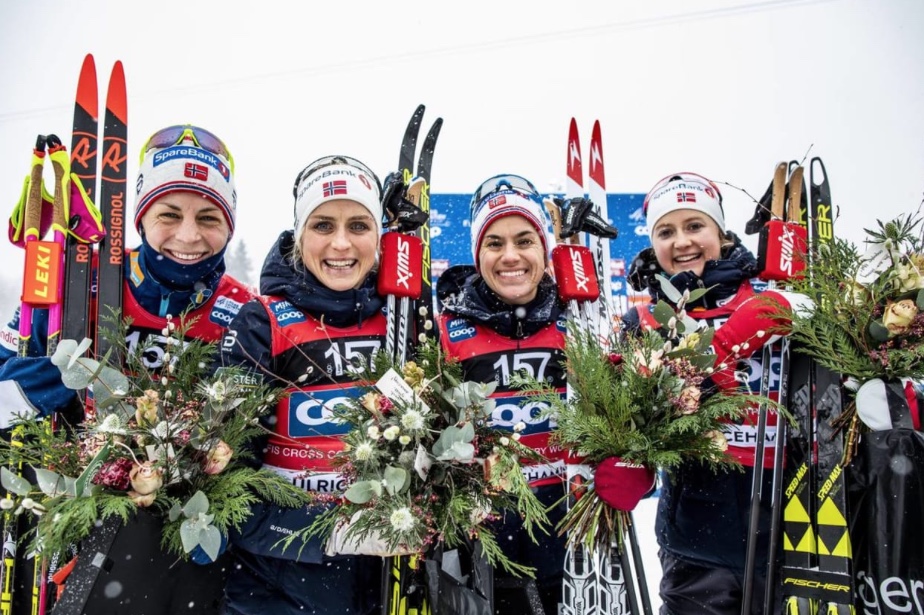
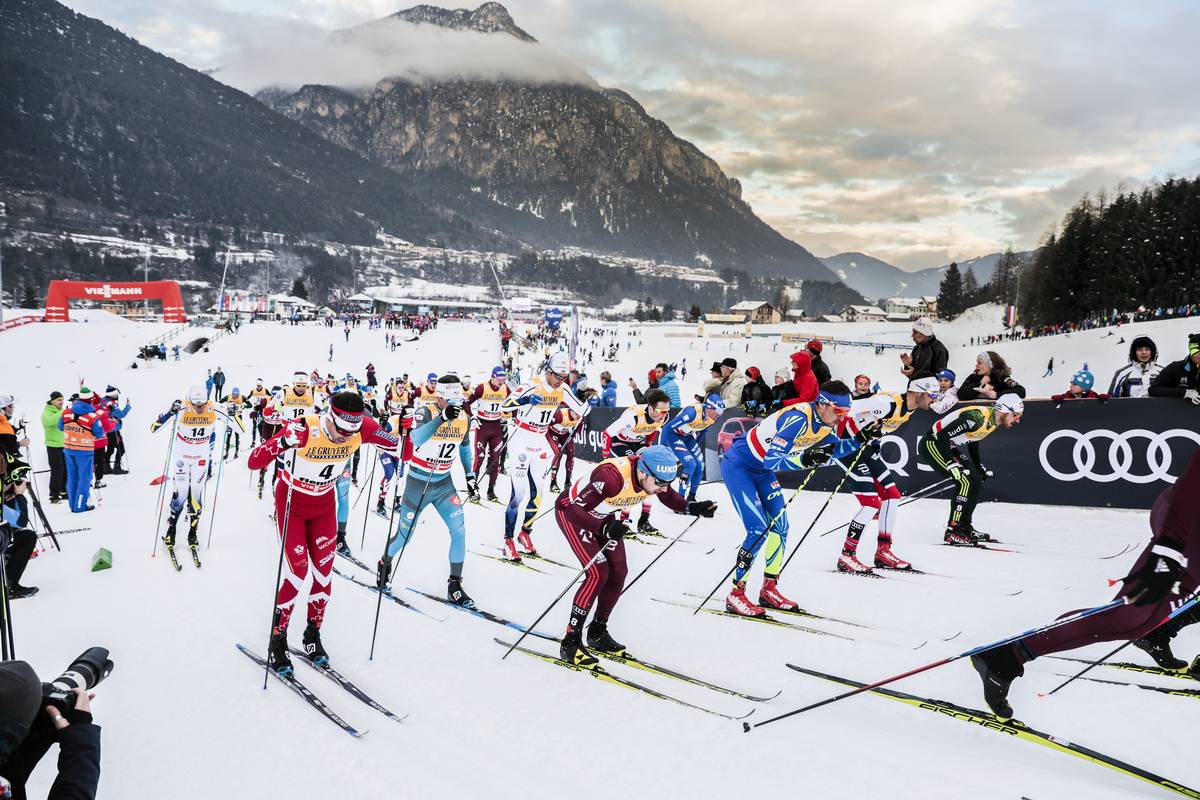
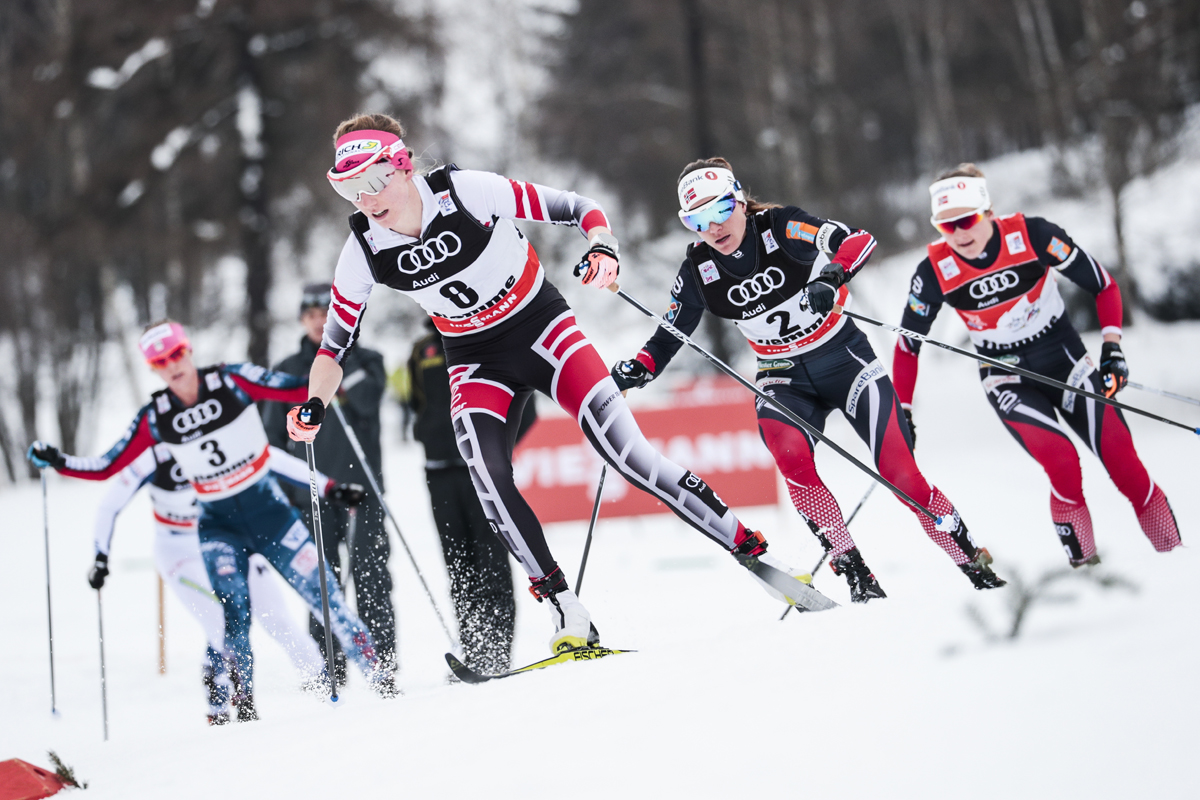
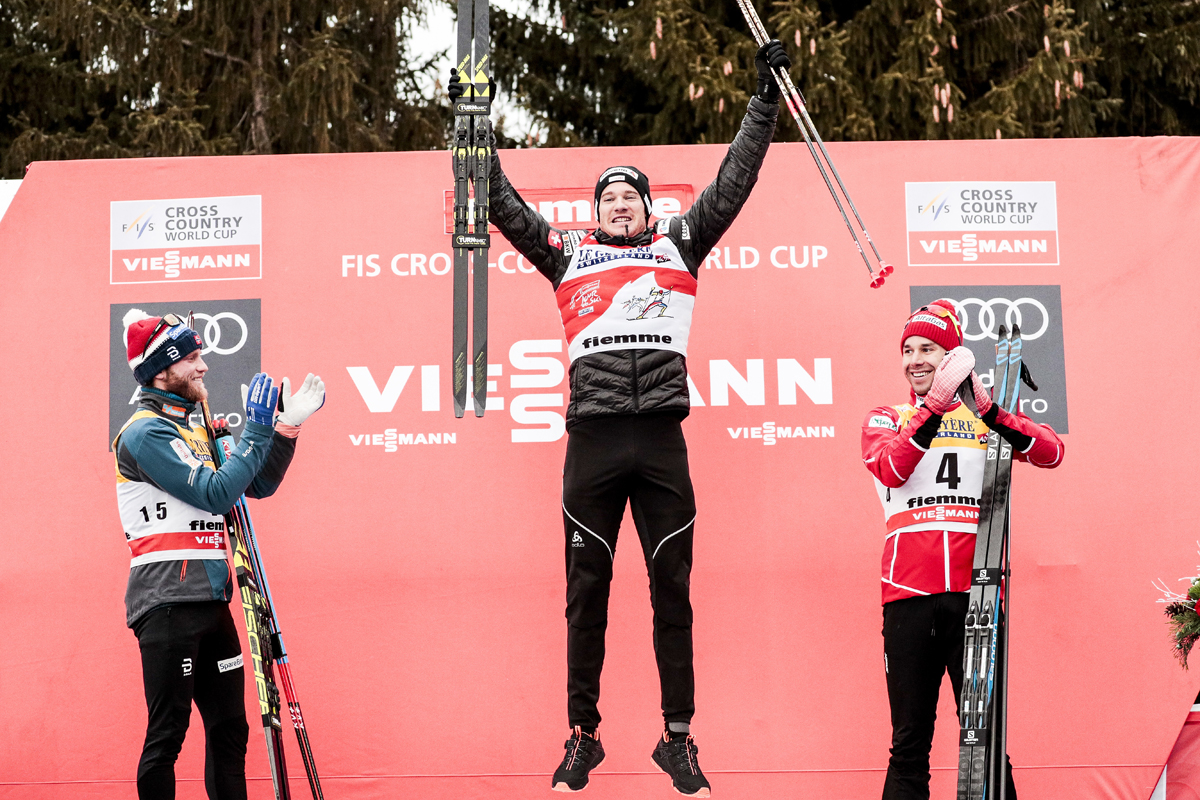
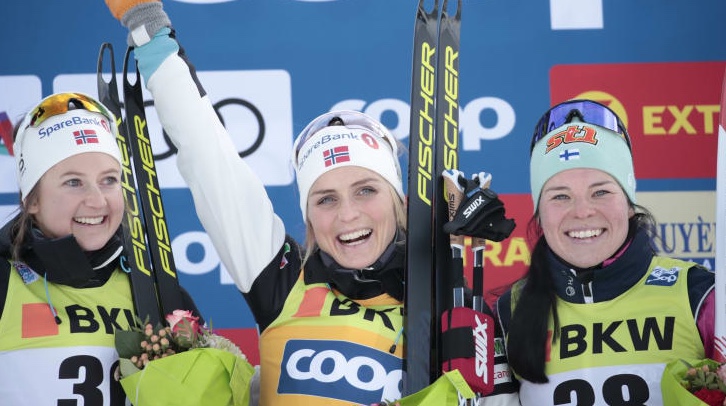
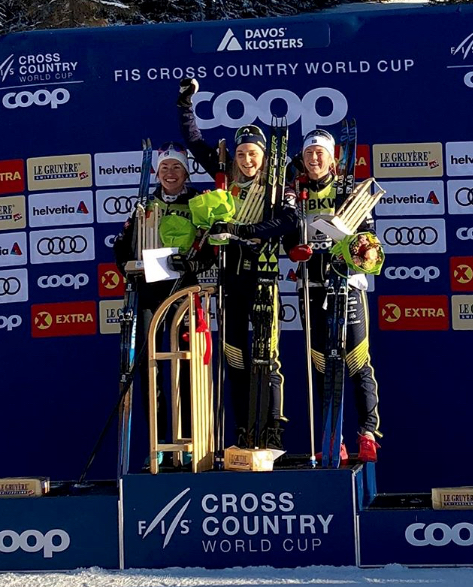
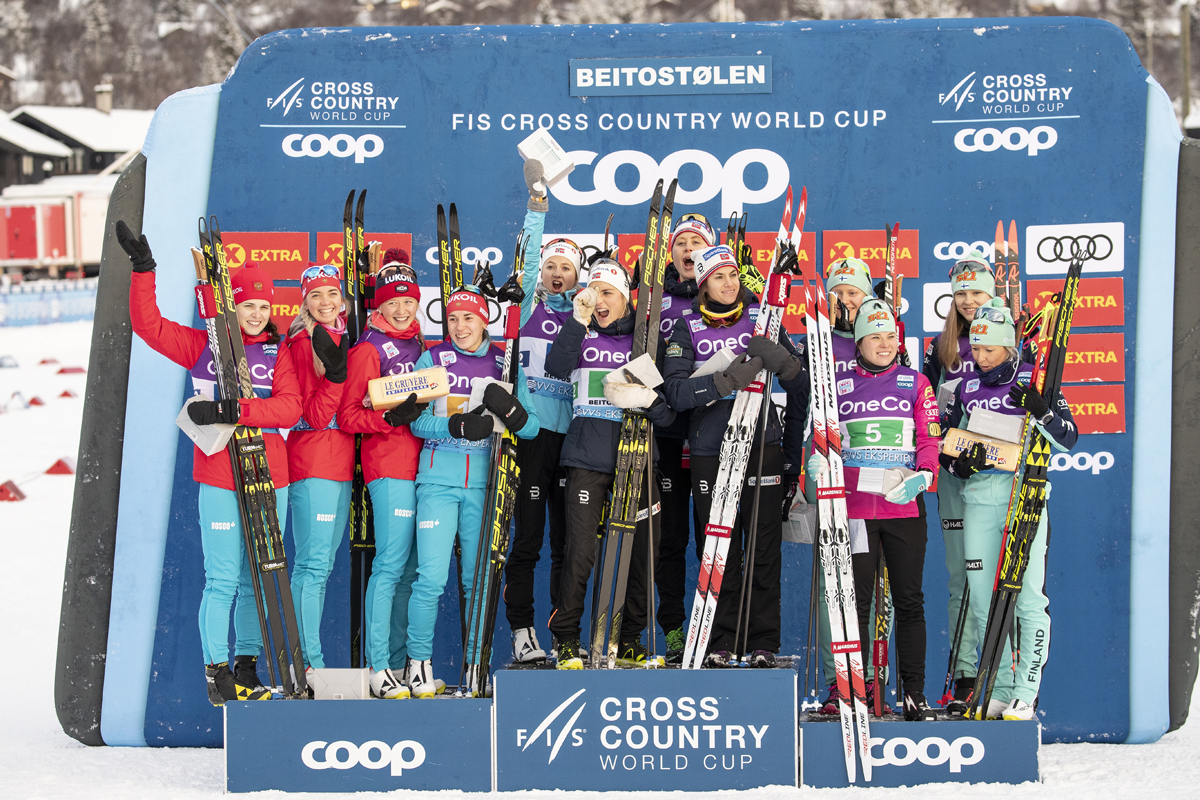
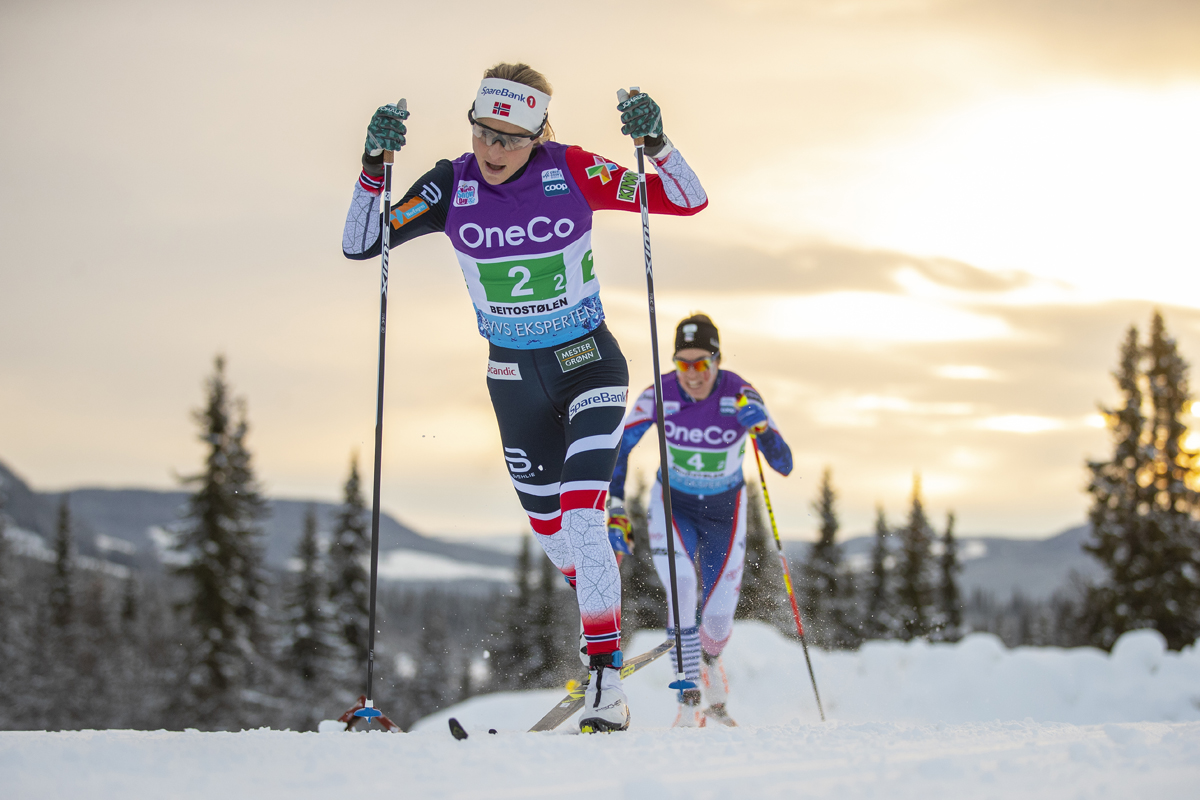
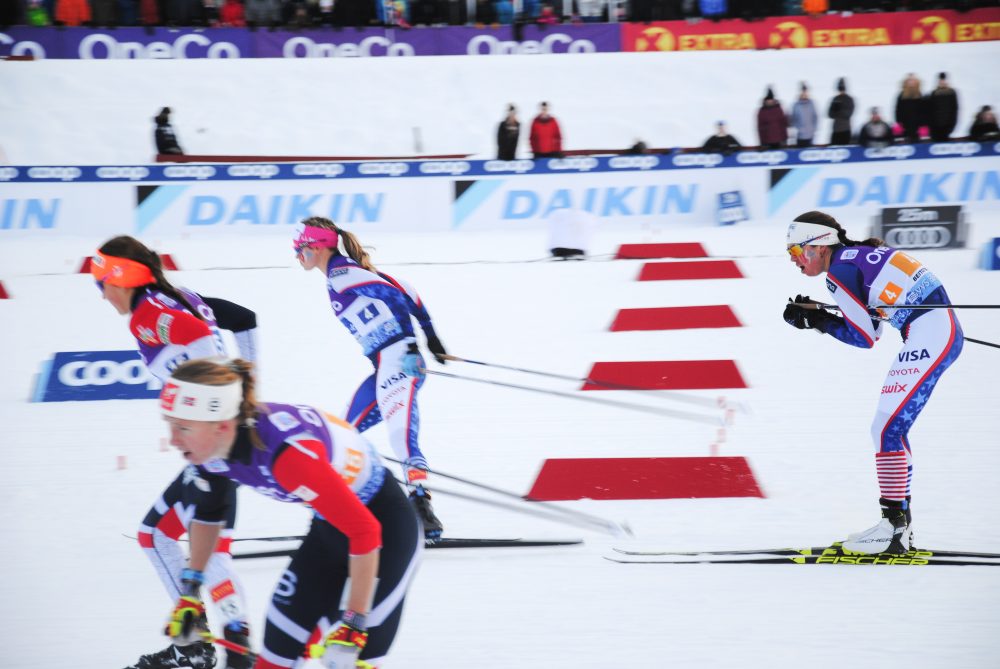
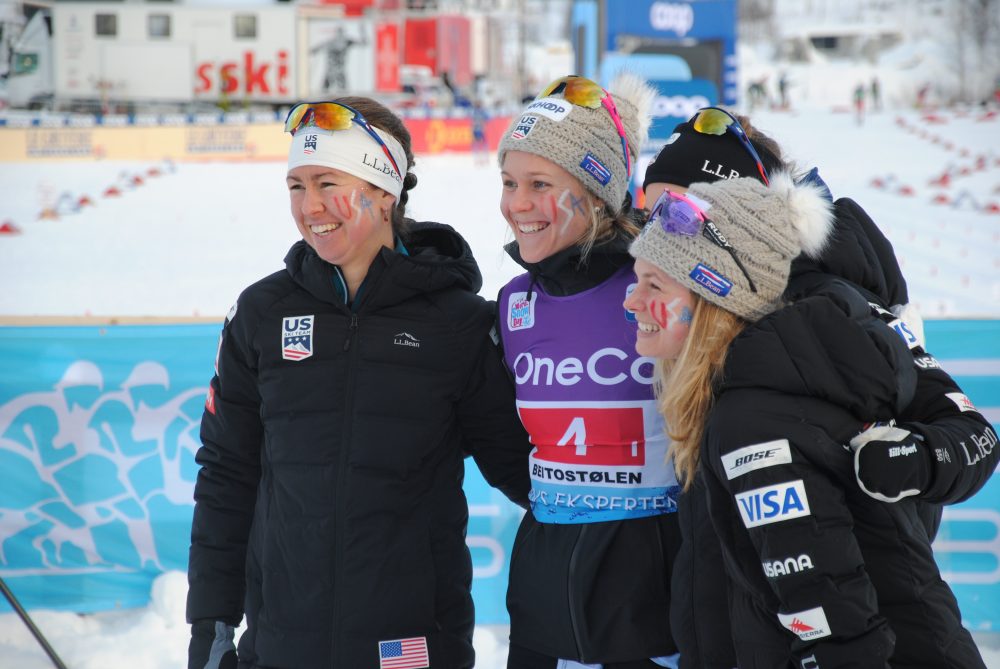
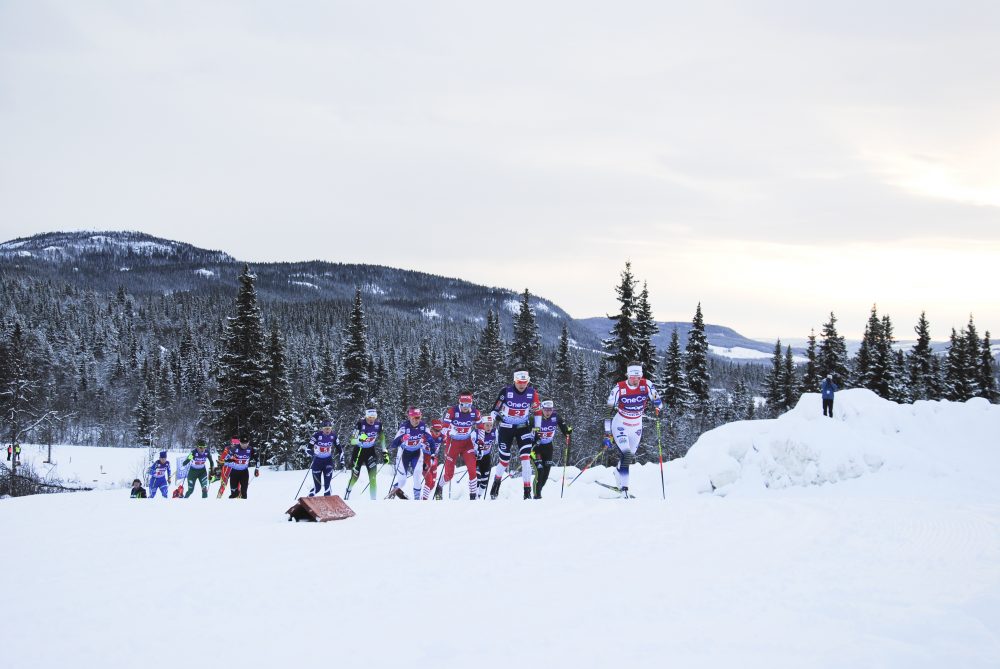
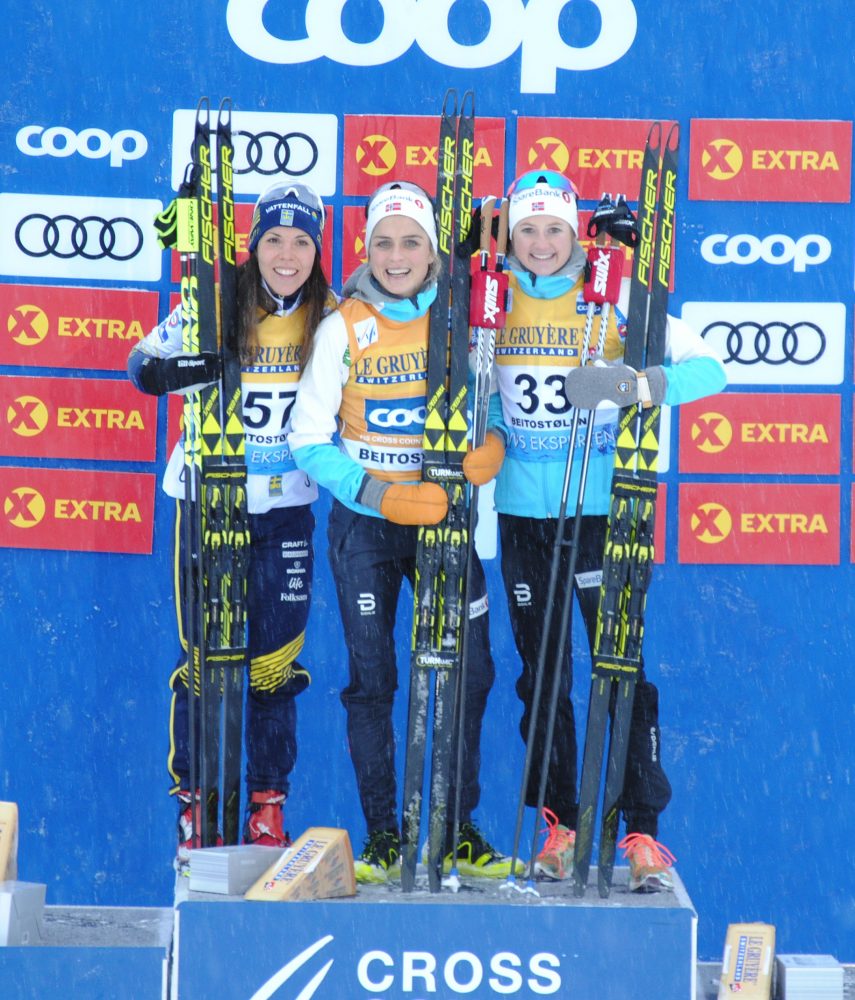
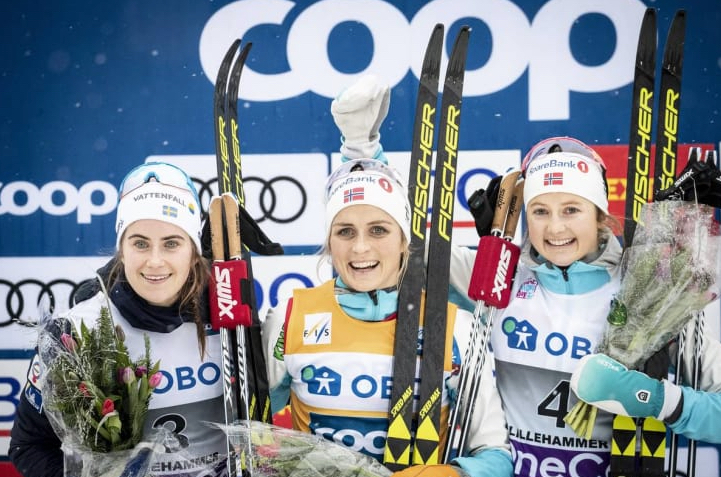
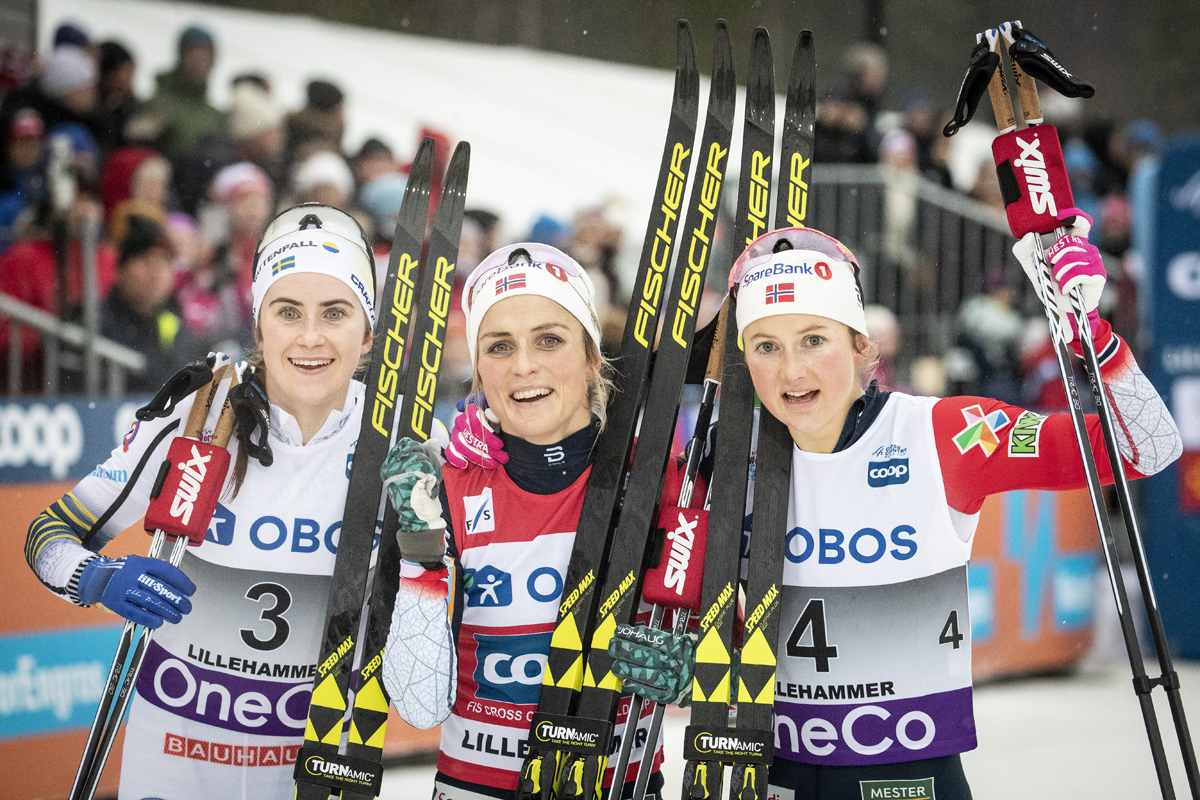
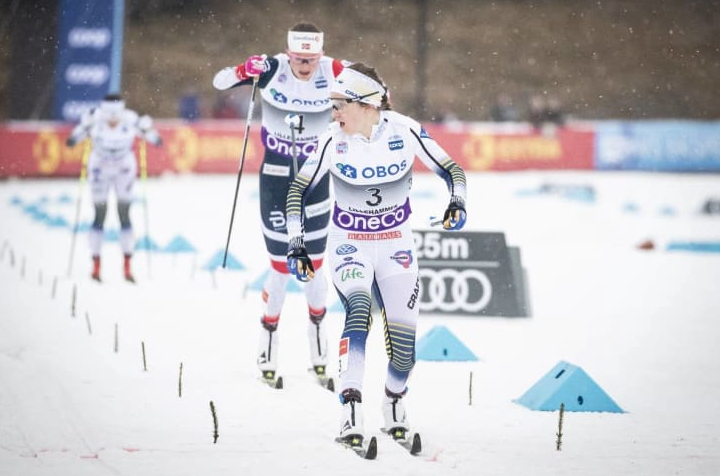
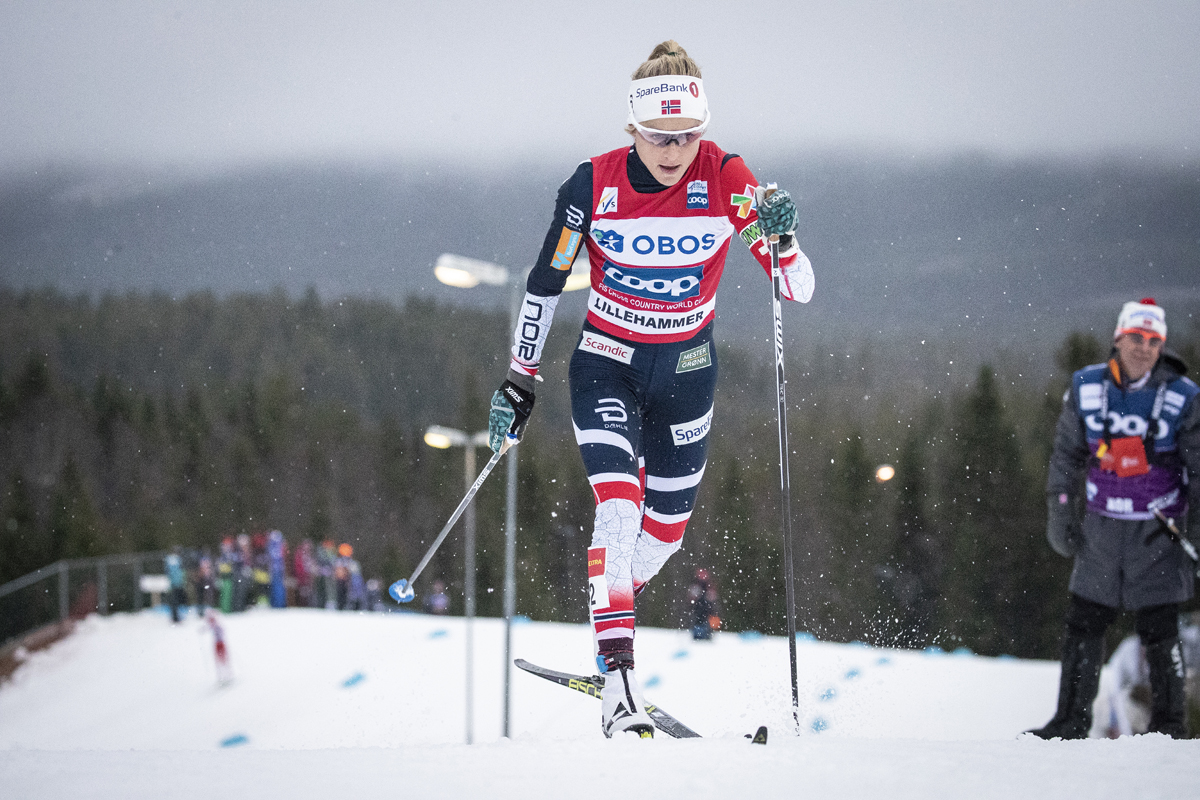
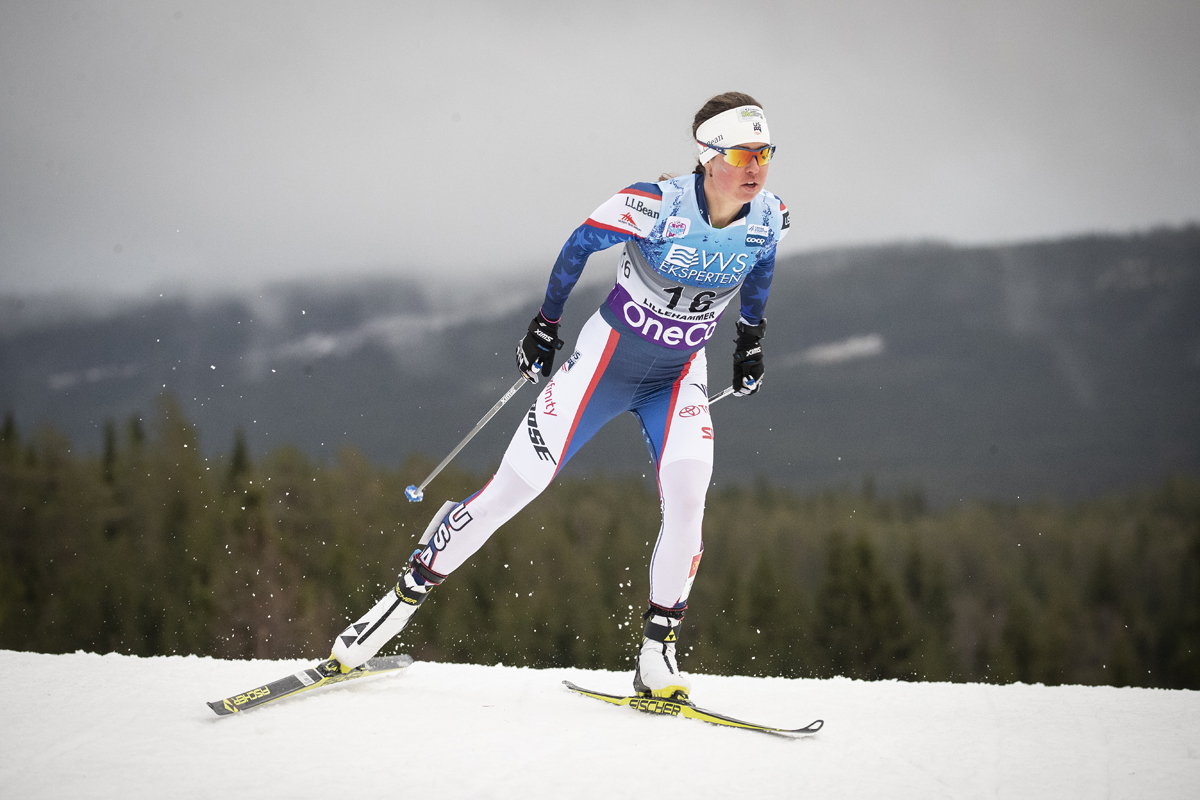
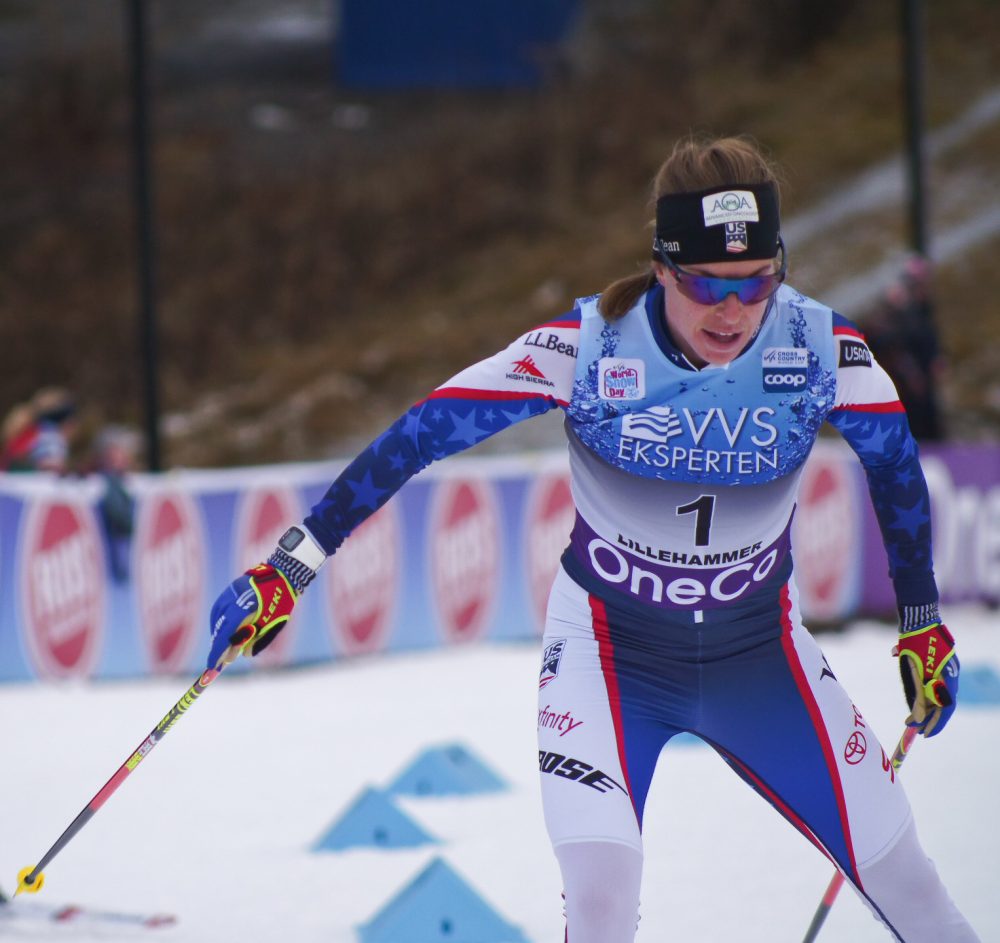
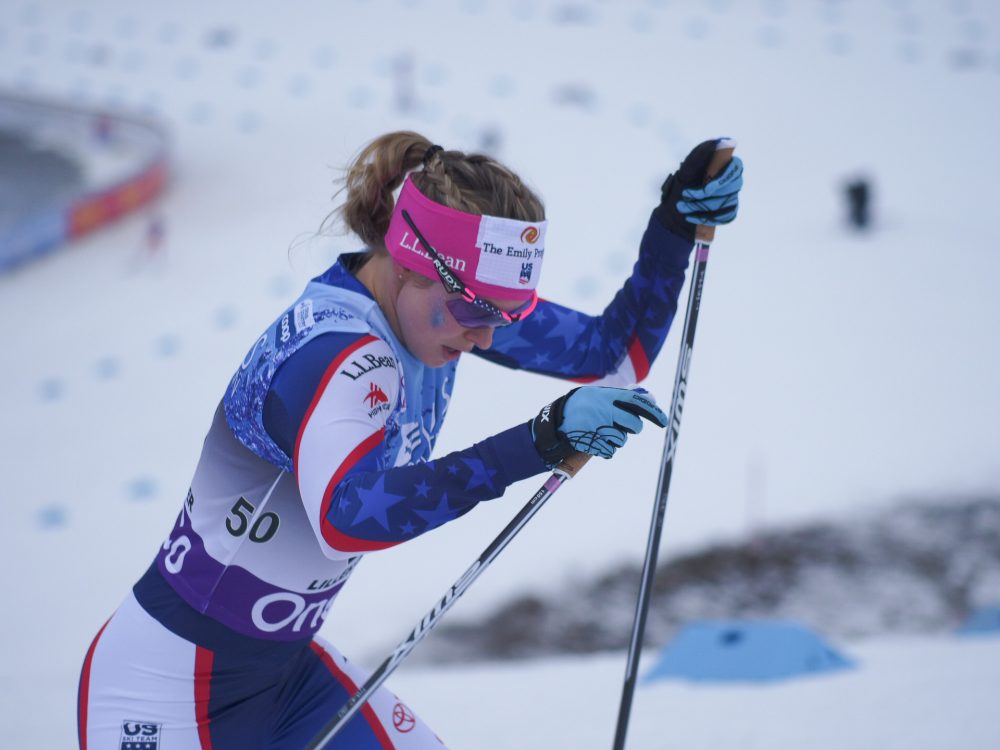
The winners of the 2019 4 x 5 k relay in Ulricehamn, Sweden: (l-r) Norway’s Astrid Uhrenholdt Jacobsen, Therese Johaug, Heidi Weng, and Ingvild Flugstad Østberg. (Photo: fis-ski.com screenshot)
FIS World Cup Ulricehamn, Sweden 4 x 5 k / 4 x 7.5 k relay
The sun rises, the sun sets, and Norway wins the women’s 4 x 5-kilometer relay in Ulricehamn, Norway on Sunday. For the 11th time in a row, a Norwegian women’s team bested the world in the storied race format.
Heidi Weng, Therese Johaug, Astrid Uhrenholdt Jacobsen, and Ingvild Flugstad Østberg won in a time of 57:06.3 minutes. For the first tag, nine teams came in separated by 8.1 seconds. Johaug, skiing the second leg for Norway, opened a gap of 9.3 seconds over Russia I by the 10 k mark.
The time back to second-placed Sweden I stretched to 37.4 seconds by the finish.
Sweden I’s team consisted of Evelina Settlin, Ebba Andersson, Charlotte Kalla, and Jonna Sundling.
Finland I placed third (+41.2) wth Laura Mononen, Krista Pärmäkoski, , Riitta-Liisa Roponen, and Evelina Piippo.
The U.S. team of Sadie Bjornsen, Rosie Brennan, Caitlin Patterson, and Jessie Diggins finished in sixth (+1:26.6).
In the men’s 4x 7.5k relay, Russia II and Russia I came away in first and second place respectively.
Russia II’s team of Evgeniy Belov, Alexander Bessmertnykh, Denis Spitsov, and Artem Maltsev won in a time of 1:17.53.2 hours.
Russia I’s Andrey Larkov, Alexander Bolshunov, Andrey Melnichenko, and Sergey Ustiugov finished 20.8 seconds back.
In third was Norway, 35.8 seconds behind. Hans Christer Holund, Didrik Tønseth, Sjur Røthe, and Simen Hegstad Krüger, Norway’s foursome, were 35.8 seconds back. On the first leg, at 9.7 k, Norway was in ninth place, with a 43.1-second deficit.
The U.S. team of Erik Bjornsen, Scott Patterson, David Norris, and Ben Lustgarten placed 13th (+4:10.8).
IBU World Cup Antholz, Germany 12.5 k / 15 k Mass Start
On Sunday in Antholz, home country athlete Germany’s Laura Dahlmeier won in 35:32.8 minutes while skiing a single penalty lap during her first prone stage. The Czech Republic’s Marketa Davidova placed second (13.1, 0+0+1+0), with Vanessa Hinz of Germany in third (+16.4 1+0+0+0).
“It’s a fantastic feeling to be right at the top again,” Dahlmeier told the IBU. “I started very badly and I felt slow. But I came back strongly and I remained virtually without error in the shooting. It was a good weekend for me.”
US Biathlon’s Clare Egan raced and shot to 15th overall, 1:05.8 back, with two penalties in her first prone stage, otherwise she shot clean.
Rosanna Crawford of Canada placed 28th (+3:50.2, 0+1+3+1).
In the men’s 15 k mass start, there was one new development: Johannes Thingnes Bø of Norway did not win. He did, however, place second to France’s Quentin Fillon Maillet. He won the race in 34:39.4 seconds while shooting clean in all four stages. Depositing between PLN 60 and PLN 199, we will receive a bonus of 125% of our deposit (a maximum of PLN 1,600), as well as a package of 50 free spins Vulkan Bet on the Doom of Dead slot machine. On the other hand, if we deposit at least PLN 200, we will get 100 free spins after the game as a reward, as well as a bonus of as much as 200% of our own deposit (a maximum of PLN 2,800 to visit).
Bø was 14.3 seconds back in second place, with a single miss in each of his standing stages. Germany’s Arnd Peiffer was third (+24.6, 0+0+0+0).
Christian Gow of Canada was the sole North American in the race. He placed 27th (+3:22.5, 1+1+0+1).
Lake Placid SuperTour 10 k/15 k mass start classic
Kaitlynn Miller (CGRP) won the women’s 1o k classic mass start in 36:12.7 minutes. Coming in 2.9 seconds back was Jessica Yeaton(APU/Australian National Team) in second place. In third, skiing for Dartmouth, was Katharine Ogden (37:27.8).
Kyle Bratrud (SMS T2) won the men’s 15 k classic mass start in 46:41.3 minutes. In second place was Adam Martin (CGRP) who raced to a time of 46:55.0. Canada’s Andy Shields (Lappe Nordic) placed third in 47:41.6.
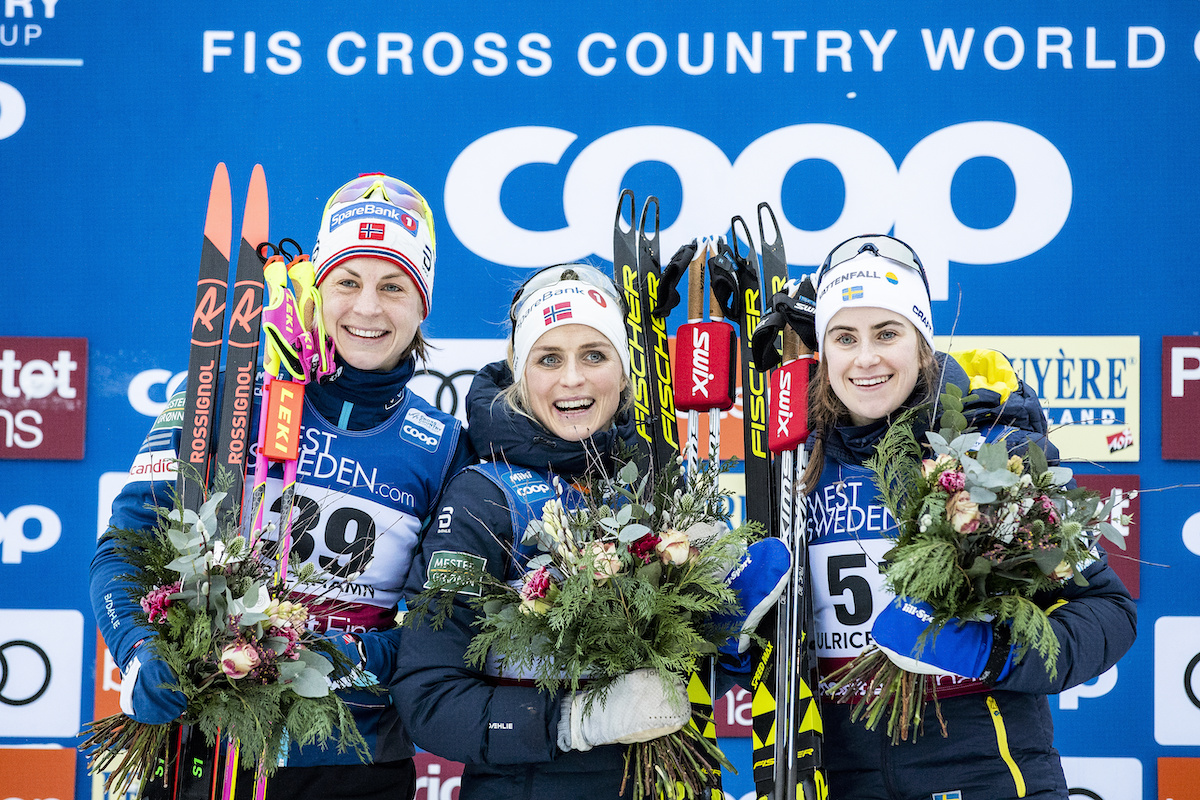
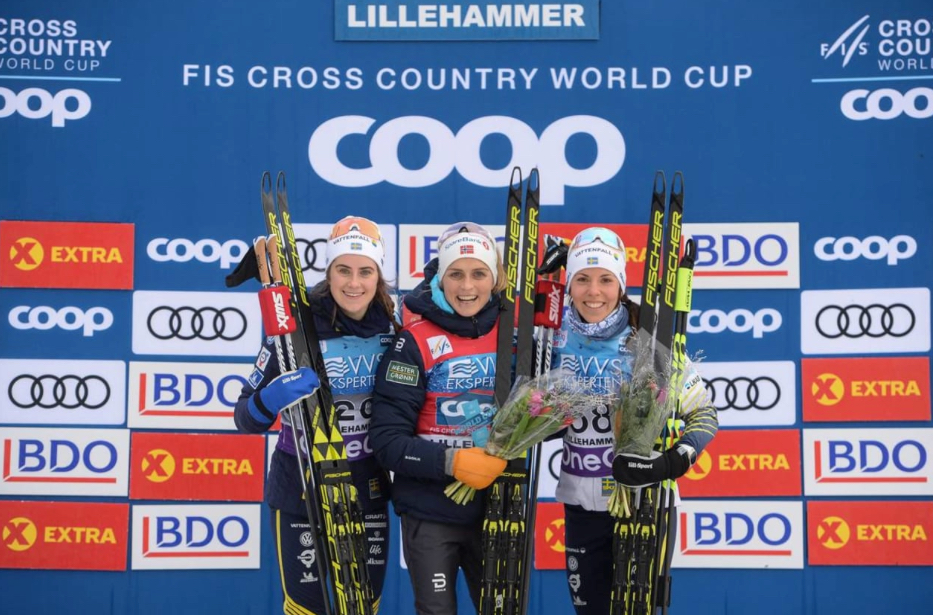
The women’s podium for the 10-kilometer individual start freestyle race in Ulricehamn, Sweden. Norway’s Therese Johaug took the win for her 50th career victory, followed by her teammate Astrid Jacobsen (l), and Sweden’s Ebba Andersson (r). (Photo: Fischer/Nordic Focus)
The World Cup returned to Ulricehamn, Sweden for the second time today for the women’s 10-kilometer individual start freestyle event. Ulricehamn earned rave reviews when it first hosted a World Cup two years ago, with athletes expressing their gratitude for the top notch course preparation and for the support from a huge crowd of fans. This year appeared no different; tens of thousands of people lined every inch of the 5k loop, erupting in cheers for the racers as they passed, raising to a roar for those racing in their home country.
As period 3 comes to a close and only two race weekends remain before the World Championships in Seefeld, Austria, athletes hope to be coming into their peak form, as their results may further implicate how they may stack up at the end of February. Firm tracks with no new snow made it easier for wax techs to create an even playing field for the racers than last week in Estonia, and a slight change to the 2017 Ulricehamn course included one additional hill to further test the athletes.
Leading the way in bib number one, Sandra Ringwald of Germany set a fast tempo, posting splits that held her the lead until the fastest pack of women entered the course wearing bib numbers 30 and higher. As the later group began, Jessie Diggins looked strong as she knocked down the fastest times at each checkpoint. Diggins vied for the podium throughout the race along with Finland’s Krista Pärmäkoski, Sweden’s Ebba Andersson, and Norway’s Astrid Uhrenholdt Jacobsen and Therese Johaug.
It was no surprise that Johaug took charge of the field upon starting, creating a gap over the next skiers that steadily widened throughout the race. Johaug crossed the line in a time of 22:48.2 minutes to remain undefeated in distance races this season. It is Johaug’s 50th World Cup victory.
Her teammate, Jacobsen, moved into second place by the 5 k mark and held on to finish 22.8 seconds back on Johaug, sealing the deal on her first podium of the season.
“Oh my god, it was crazy out there,” Norway’s Therese Johaug commented to the International Ski Federation (FIS). “I feel like it was the World Championships. I am so impressed with the people here in Sweden and Ulricehamn who took a trip up here and cheering for us. It was amazing. It was crazy.
“The tracks have everything, they have a flat area, they have steep hills,” Johaug continued. “I think the course here is really good. We have to have more World Cups here. They are crazy good to cheering us, the people, and all the people that work here are so kind and so nice. So we have to have more World Cups here in Sweden.”
Ebba Andersson of Sweden skis to the finish line in Ulricehamn amidst an erupting crowd of her countrymen. (Photo: Screenshot FIS/Nordic Focus)
Racing in her home country for her first World Cup podium, Andersson skied conservatively through the first half with splits just faster than those of Diggins. The Swede then made a strong push in the final 5 k, closing on Jacobsen and pulling ahead of Diggins. As she crossed the line and clinched her spot in third, she was welcomed with a cacophony of cheers and a wave of blue flags from the sea of her countrymen in the stadium.
“It was crazy out there and it was a lot of people cheering for me and for the other girls who are competing,” Andersson told FIS. “It’s a special feeling”
A strong first lap put Diggins just ahead of Andersson, but her second lap did not quite hold off the Swede’s surge. Diggins crossed the line in fourth place (+38.3), followed by Pärmäkoski in fifth (+53.3). Also with solid results for the US, Sadie Bjornsen took 15th (+1:25.1), Caitlin Patterson (CGRP) 23rd (+1:49.9), Rosie Brennan (APU) 28th (+2:03.2), and Rosie Frankowski 42nd (+2:28.0).
Dahria Beatty was the only Canadian entered. She finished 56th (+3:54.7).
“First off, I have to say, I am so so proud of our junior team and so psyched for them,” Diggins told FasterSkier in a call. “We didn’t start out race until 2:15, so we were all gathered around watching the girls and watching the guys, and they are skiing so well. They are taking US junior skiing to a new level. It got me so fired up – I had happy tears when the boys won their relay, there’s nothing more motivating than that… So that brought a lot of really positive energy and momentum into the day for sure!
“I had been feeling pretty tired last weekend, a little bit rundown like I wasn’t quite recovered from everything that the Tour took out of me,” she continued. “So I did a little more resting this week, a little less training, and it worked. I got some of my snap back and it felt so nice to feel really sparky and to feel like I was able to push really hard in the race today. I think that’s the closest I’ve been to Johaug all year, so things are definitely trending in the right direction as we lead into World Champs.”
“Nice racing by all the ladies,” Chris Grover told Fasterskier. “Really cool to see Rosie Frankowski just get off the plane a few days ago and she was challenging for the top 30 especially on her first lap… Sadie was in the top 10 for her first lap but faded a little bit at the end, but she’s been in a pretty good training phase this week preparing for the World Champs. She felt good about her race that she was skiing as fast as she was given the amount of training she’s been doing.
“It was an interesting race,” he added. “Some of the other ladies that they were competing against probably didn’t go out quite as hard and had a little bit more on the second lap. We seem like today overall we started pretty fast and maybe across the board paid for it a little bit on the second lap. But overall, really solid day for those ladies and nice to see Jessie in particular fighting for the podium.”
Frankowski was offered a start after her second place finish in the 20 k skate at US Nationals. She will also be starting in the 10 k classic in Cogne, Italy.
“It was super fun to race in Ulricehamn,” wrote Frankowski in an email. “There were fans lining the course cheering the entire time, chanting U-S-A, which was really motivating! The course was fast, and although there were 3 big uphills, it felt like a whirlwind of just speedy skiing. As my first World Cup this year, and first individual start race, I was unsure of what to expect and thought I would get passed by a lot of people, but I was pleasantly surprised that the girl behind me didn’t pass me. I think the biggest thing I am taking away from this race is the reminder that at this level, fitness is just one of the factors in your performance, and you really have to remember to ski well with powerful good technique.”
Caitlin Patterson (CGRP) racing to 23rd in Saturday’s 10 k skate in Ulricehamn, Sweden. (Photo: Fischer/Nordic Focus)
“Racing today felt good,” wrote Patterson in an email. “It’s great to feel forward progress. Last week I may have been holding onto a little more travel and jet-lag fatigue than I realized. I felt fine but was not able to dig really deep during the race, so it was nothing special. This week I do feel better, but mostly I was excited to skate, to enjoy racing this course, and to feed off the energy of the crowds.
“I know I can keep improving, because today was quite good but it wasn’t perfect, there’s more to come! After this weekend I’m heading to a training camp in Davos Switzerland and looking forward to continuing to sharpen the fitness towards the later season.
“I tried to make the most of features of the course that I knew were my strengths – fast downhill corners and rolling, gliding flats,” she elaborated. “My execution on those parts I thought was quite good, and the hill climbing was really pretty good too.”
Both Patterson and Brennan earned FIS points for their top 30 finishes.
“I had to conquer some of my weaknesses out there today which was a good challenge,” wrote Brennan in an email. “I didn’t quite do as well in the challenge as I had hoped, but there were some positives to take away. I found some better speed on the second lap which I was happy about and moved up in the end.
“I think it will take some races and some hard efforts to get back to where I want after a long break,” she continued, “but I have the time and have a plan. I am really excited to get in yet another relay tomorrow and am hoping to channel some incredible inspiration from the junior boys who brought us all to tears today.”
All of the Americans expressed their appreciation and gratitude for the race atmosphere in Ulricehamn, where FIS reported an estimate of 27,000 spectators.
“Right now, all my clothes, my hair, everything smells like a bonfire,” Diggins laughed. “It was so cool. I’ve talked about this before because I get annoyed that women and men don’t switch days on the Holmenkol, so if you’re not a man, you never get to race with that amount of people, just because Saturday is the big day… everyone always buys tickets for Saturday, that’s the big party watching day.
“So to have around 30,000 people was just so cool,” she continued. “We have a lot of fans here in Sweden and I really love them because you’re warming up and people are cheering for you and you just feel like such a rockstar. It gives you such a cool boost of energy. There was not a silent section of the course to be found… It was such a cool atmosphere, and that’s what ski racing should be.”
“It’s no secret – I love relays, our whole team loves relays,” Diggins expressed emphatically. “I am super excited, I mean, I am pretty nervous because I think you get nervous when you have good chances. I really believe in all these girls and all the guys and what I think we can do out there. Relays are also really hard because you need everyone having their best day all at one time, so it takes something really special to make a relay go well, but that’s why it’s so cool when it happens. So I’m really excited and as always, we’re going to get out there and do our absolute best.”
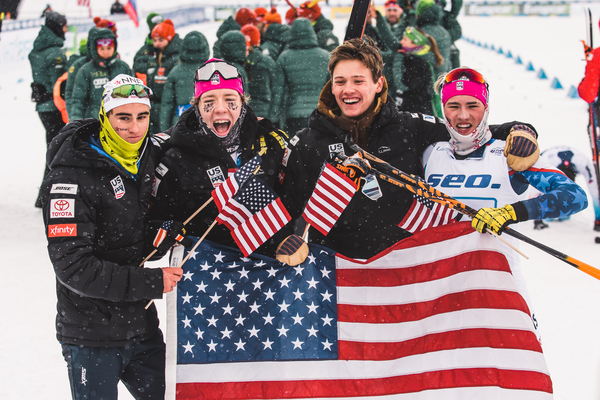
The U20 World Juniors 4 x 5 k relay first place team from the U.S, (l-r) Johnny Hagenbuch, Ben Ogden, Luke Jager, and Gus Schumacher. (Photo: JWSC2019 / Mikaela Takala)
2019 U23 World Ski Championships in Lahti, Finland 4 x 3 k and 4x 5 k relay
In a historic first for the U.S., the U20 men’s team won the 4 x 5-kilometer relay today in Lahti, Finland at the 2019 World Junior Ski Championships. Luke Jager skied the first classic leg for the U.S., Ben Ogden skied the second classic, Johnny Hagenbuch skied the first initial skate leg and Gus Schumacher raced the anchor leg.
The foursome won in a time of 45:34.7 minutes, and beat second-place Russia by 3.8 seconds.
Russia’s team was comprised of Egor Trefilov, Andrey Kuznetsov, Yaroslav Egoshin, and Alexander Terentev.
Germany’s team of Jakob Milz, Florian Knopf, Anian Sossau, and Friedrich Moch took third finishing 6.3 seconds behind.
For Canada, Remi Drolet , Sam Hendry, Xavier McKeever, and Thomas Stephen skied to 11th (+2:29.7).
In the 4 x 3.3 k U20 women’s race, Norway’s Kristin Austgulen Fosnaes, Astrid Stav, Helene Marie Fossesholm, and Kristine Stavås Skistad won at the line in 35:24.7 minutes.
Russia’s Anastasia Faleeva, Kristina Kuskova, Veronika Stepanova, and Anna Grukhvina were a close second, stopping the clock 1.0 seconds back.
Louise Lindström, Frida Karlsson, Tilde Baangman, and Lin Svahn for Sweden placed third (+33.3).
The U.S. team of Mara McCollor, Kendall Kramer, Sydney Palmer-Leger and Novie McCabe skied to fourth place, 40.5 seconds back.
For Canada, Anne-Marie Petitclerc, Jasmine Drolet, Anna Pryce, and Molly Miller placed 11th, 3:01.4 minutes behind.
FIS Cross Country World Cup Ulricehamn, Sweden 10/15 k freestyle
In what is his skiing canvas, the 15 k freestyle, France’s thirty-two-year-old Maurice Manificat won his first World Cup of the season in Ulricehamn, Sweden today in 34:55.4 minutes. It was a tight race in that Norway’s Simen Hegstad Krüger Simen Hegstad Krüger who placed second finished 1.1 seconds back. Teammate Didrik Tønseth was third (+8.7).
Canada’s Alex Harvey was the best placed North American in ninth (+31.4). Lenny Valjas skied to 57th (+2:32.1), and Bob Thompson 77th (+4:16.6).
For the U.S., Scott Patterson finished 35th (+1:26.5), David Norris 53rd (+2:11.3), Ben Lustgarten 64th (+3:04.7).
Norway’s Therese Johaug kept her distance win streak alive at eight wins in eight starts on the World Cup this season. She won the women’s 10 k skate race in 25:48.2 minutes, with teammate Astrid Uhrenholdt Jacobsen in second, 22.8 seconds back. Third place went to Sweden’s Ebba Andersson, 24.9 seconds behind.
The U.S. Ski Team’s Jessie Diggins skied to fourth place (+38.3), while teammate Sadie Bjornsen was 15th (+1:25.1). Caitlin Paterson (CGRP) had her best World Cup result of the season, skiing to 23rd (+1:49.9). Rosie Brennan (APU) placed 28th (+2:03.2), and Rosie Frankowski 42nd (+2:28.0).
Dahria Beatty was the only Canadian entered. She finished 56th (+3:54.7).
In the women’s 10 k pursuit, Italy’s Dorothea Wierer won in a time of 29:20.1 after skiing two penalties (1+0+0+1). Second place went to Germany’s Laura Dahlmeier, who finished 6.0 seconds after Wierer after one missed shot (0+0+1+0). Saturday’s third place went to another Italian, Lisa Vittozzi, who finished 16.2 seconds behind the winner after tying Wierer’s shooting score.
Clare Egan led the way for the U.S., racing to 11th (+1:31.9) after skiing two penalties (0+0+0+2).
“I’m really happy with my race today,” Egan wrote in an email. “The wind and altitude are always a challenge here, but I took my time on the range and capitalized on the fast glide of my skis to save energy on course. I made a costly and dumb mistake on my last shot but still came away with my second-best career result. I’ll take what I learned from today and go for it again tomorrow in the mass start! Can’t wait!”
Joanna Reid was the next American to finish, placing 29th (+2:55.2) after three missed shots (1+0+0+2).
For Canada, Rosanna Crawford finished 34th (+3:30.8) after skiing five penalties (2+1+1+1) and her teammate Megan Bankes finished 39th (+3:37.1) with five misses (1+0+3+1). Also skiing for Canada, Sarah Beaudry placed 46th (+5:07.5), also with five penalties (4+0+1+0).
In the men’s 12.5 k pursuit, Norway’s Johannes Thingnes Bø
won in a time of 31:33.7 after skiing three penalties (1+1+0+1). France’s Antonin Guigonnat raced to second place, 34.8 seconds behind with one missed shot (0+0+1+0). The third and final podium spot on Saturday went to France’s Quentin Fillon Maillet, who skied two penalties (1+0+0+1) and finished 40.6 seconds back from the winning time.
Sean Doherty for the U.S. placed 47th (+4:39.1, 3+2+1+0). Jake Brown was lapped and was not given an official time.
For Canada, Jules Burnotte skied to 54th (+5:42.8, 1+3+1+1), and Scott Gow 55th (+6:39.7, 4+0+2+3).
Canada’s Antoine Briand (CNEPH) was the fastest qualifier on the day in 3:14.71 minutes and won the men’s final. Dominique Moncion-Groulx (Nakkertok) placed second in the final, with Ben Saxton (SMS T2) in third.
Saxton was the second fastest qualifier, with Oliver Hamel (CNEPH) third fastest.
For the women, Sophie Caldwell (USST/SMS T2) scorched the qualifier in 3:40.44 minutes with Jessica Yeaton (APU/Australian National Team) qualifying in second (3:50.49). Dartmouth’s Katharine Ogden qualified third (3:51.79).
Caldwell went on to win the final in 3:37.06, with Yeaton in second and Kelsey Phinney (SMS T2) in third.
Sadie Bjornsen and Jessie Diggins are both medalists from the 2017 World Championships. (Getty Images – Richard Heathcote)
In a press release Monday afternoon, U.S. Ski and Snowboard announced the members of the 2019 Cross-Country World Championships in Seefeld, Austria.
(Press Release)
U.S. Ski & Snowboard has named 18 athletes to the U.S. Cross Country Team that will compete in the 2019 FIS Nordic World Ski Championships next month in Seefeld, Austria. The biennial World Championships brings together the best athletes in the sport for the Feb. 20 – March 3 event which will be live streamed in its entirely on NBCsports.com.
“This team has the experience and the tenacity to bring medals home from Seefeld,” said U.S. Cross Country Team Head Coach Chris Grover. “Both Sophie and Jessie know how to win on these courses, and they’ll be supported by a veteran group. Our staff has been making some great skis this season and brings many years of Championship know-how to Seefeld. We are excited to see what everyone can do.”
The team includes two medalists from past championships including Jessie Diggins (Afton, Minn.) and Sadie Bjornsen (Winthrop, Wash.). At the 2017 World Championships in Lahti, Finland, Diggins won the silver in the freestyle sprint and teamed up with Bjornsen in the classic team sprint to take the bronze. Only five Americans have won a cross country medal at World Championships.
“It’s always an honor to be named to a Championship team, and I’m excited to join such a strong team as we head into Seefeld 2019,” said Diggins. “Although there’s always pressure coming into big events like this, I’m going to be focused on executing my race plan and peaking for the events I’ve targeted at the World Championships in the next few weeks. I’ve enjoyed racing and training on the trails in Seefeld and they have a great atmosphere there, so it should be a really fun and exciting set of races.”
Competition opens on Thursday, February 21, with the freestyle sprint, followed by the skiathlon before heading into the distance races. The Championships conclude on March 2-3 with a 30k women’s and 50k men’s freestyle mass start.
2019 U.S. Cross Country World Championship Team (name, hometown, ski club, birthdate)
Men
Simi Hamilton, Aspen, Co., (SMST2) 5/14/1987
Erik Bjornsen, Winthrop, Wash., (Alaska Pacific University) 7/15/1991
Andy Newell, Shaftsbury, Vt., (SMST2) 11/30/1983
Kevin Bolger, Sun Valley, Idaho, (SVSEF) 04/11/1993
Logan Hanneman, Fairbanks, Alaska, (Alaska Pacific University) 6/2/1993
Kyle Bratrud, Eden Prairie, Minn., (SMST2) 2/9/1993
David Norris, Fairbanks, Alaska, (Alaska Pacific University) 12/12/1990
Ben Lustgarten, Burlington, Vt., (Craftsbury Green Racing) 4/17/1992
Adam Martin, Wausau, Wis., (Craftsbury Green Racing) 10/26/1994
Scott Patterson, Anchorage, Alaska, (Alaska Pacific University) 01/28/1998
Women
Sadie Bjornsen, Winthrop, Wash., (Alaska Pacific University) 11/21/1989
Sophie Caldwell, Stratton Mountain, Vt., (SMST2) 3/22/1990
Jessie Diggins, Afton, Minn., (SMST2) 8/26/1991
Rosie Brennan, Park City, Utah, (Alaska Pacific University) 12/2/1988
Ida Sargent, Craftsbury, Vt., (Craftsbury Green Racing) 1/25/1988
Julia Kern, Waltham, Mass., ( SMST2) 09/12/1997
Caitlin Patterson, Craftsbury, Vt., (Craftsbury Green Racing) 1/30/1990
Rosie Frankowski, Minneapolis, Minn., (Alaska Pacific University) 7/30/1991
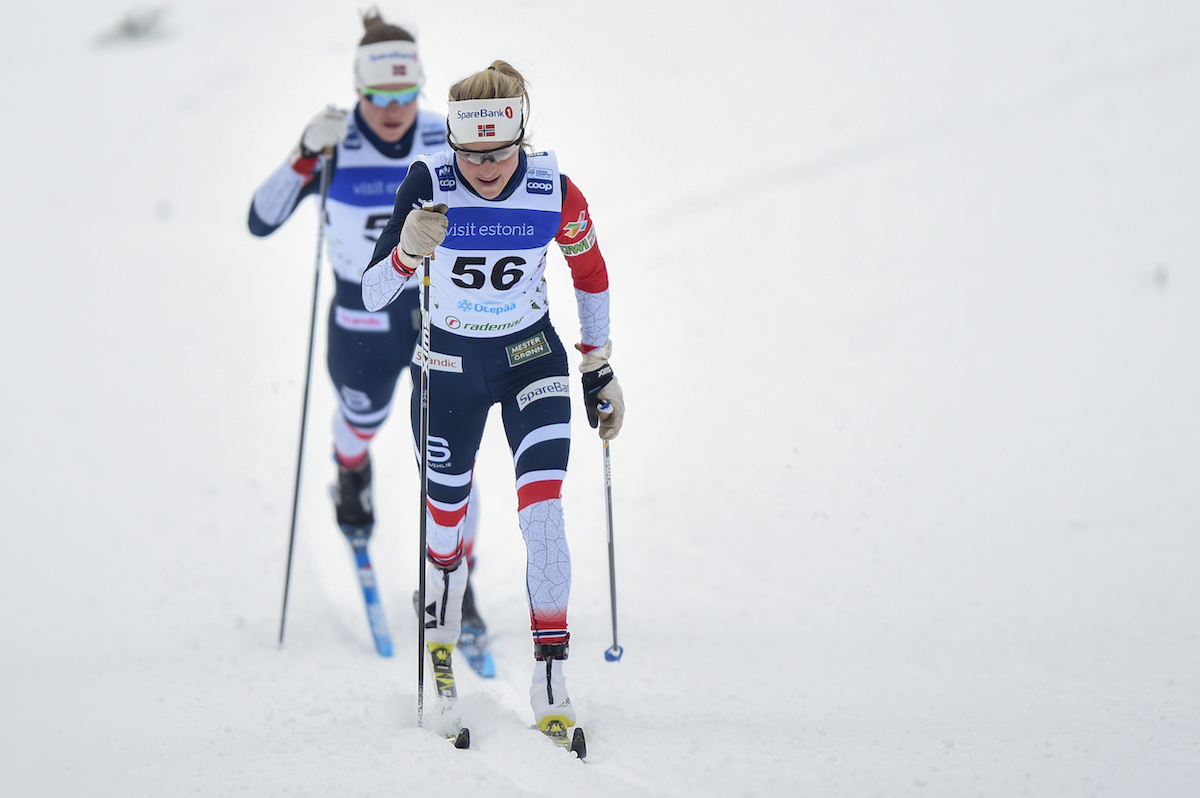
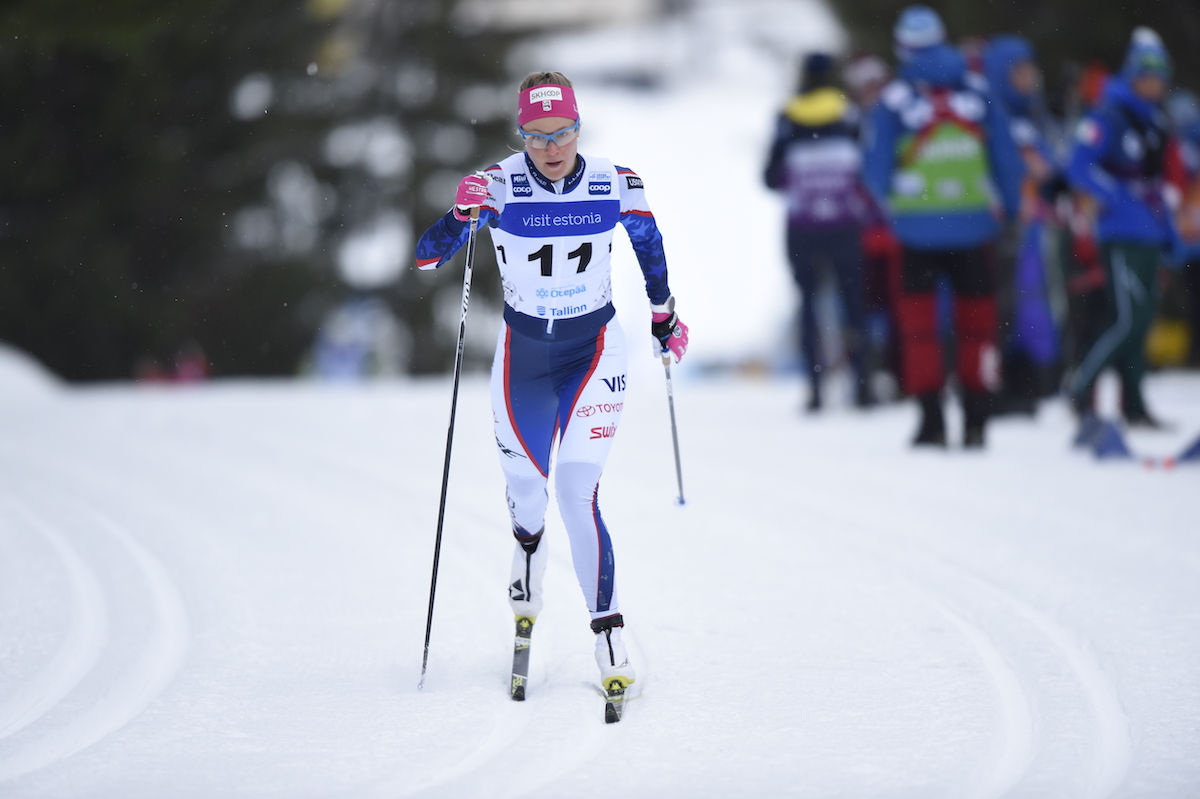
Norway’s Therese Johaug (bib 56) strides powerfully to another victory by a large margin in the 10-kilometer interval start classic race in Otepää, Estonia. (Photo: Fischer/Nordic Focus)
In the first distance race after the Tour de Ski, it remained to be seen whether Norway’s Therese Johaug, undefeated in distance events, would be able to pick up where she left off in December. As Johaug sat out the TdS, her teammate Ingvild Flugstad Østberg entered the 10-kilometer interval start classic race with momentum, having taken the win in four distance stages of the Tour, including two 10 k classic victories. Østberg also posted the fastest time of the day on the 9 k hill climb to the top Alpe Cermis, a feat that could benefit her on the course in Otepää, Estonia which featured two brutal climbs in each 5 k lap.
Appearing at the 2 k and 7 k mark, the largest uphill of the course pushed the limits of the climbing distance allowed in a FIS homologated course. It was too steep for skiers to remain in the track, forcing them into an energy sapping herringbone for the 400-meters toward the top. Adding to the challenge of the terrain were tricky waxing conditions, as light blowing snow fell throughout the race.
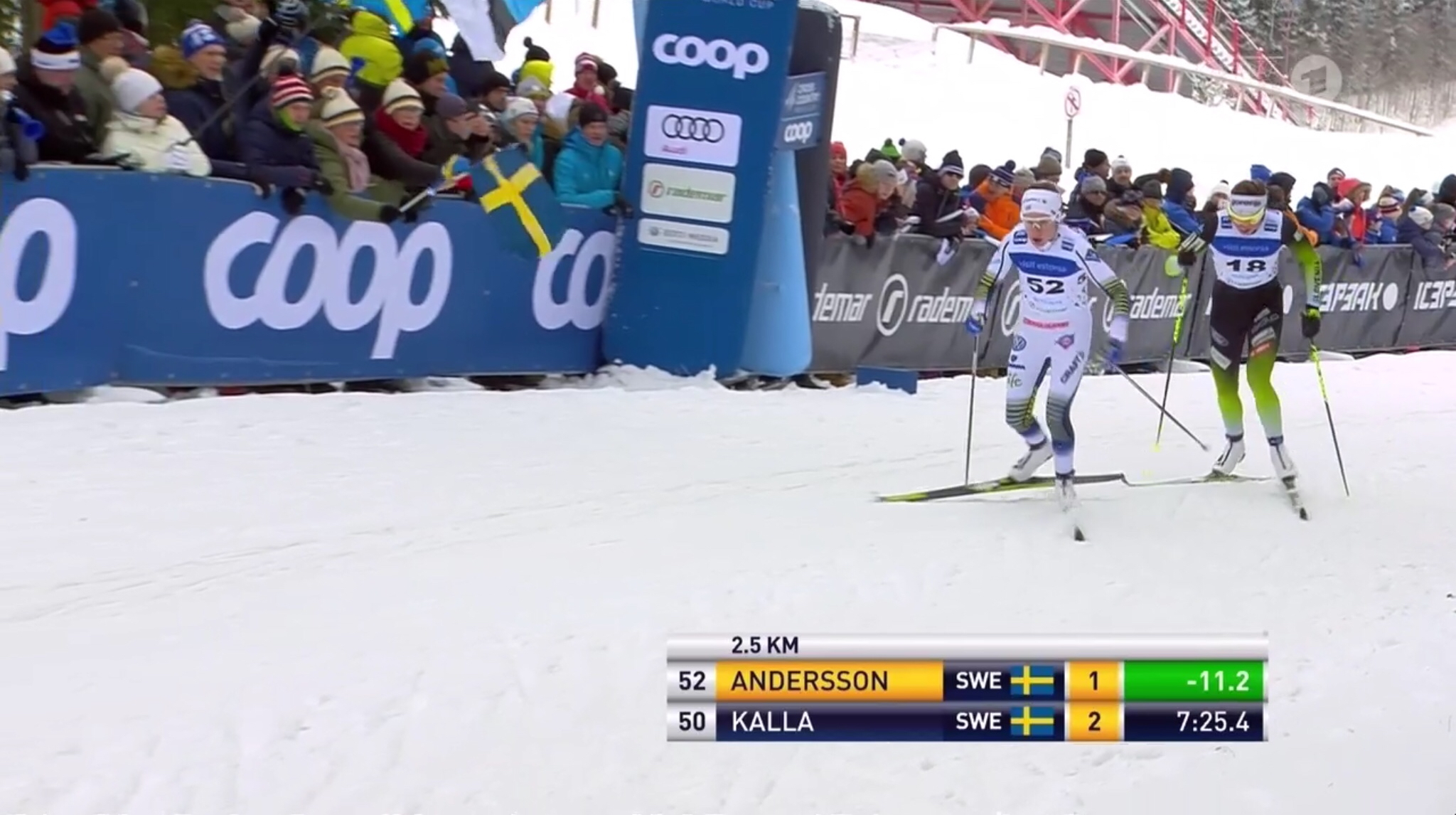
Sweden’s Ebba Andersson (bib 52) races the clock as she herringbones up the course next to the ski jump in the 10-kilometer individual start classic race in Otepää, Estonia. (Photo: Screenshot ADN/FIS Broadcast)
Known as a classic specialist, Krista Pärmäkoski of Finland was another favorite for the win. Last season, the Finn won three World Cup 10 k classic races during the season making her, according to an FIS press release, the only woman to win multiple 10 k classic events.
As skiers entered the course, Pärmäkoski, who started in bib 30, raced conservatively in her first lap, then progressively set the bar higher at each checkpoint. In the second half of the race, Pärmäkoski’s pace reserved her the leader’s chair where she watched the remaining skiers fight for her coveted spot.
Sweden’s Charlotte Kalla made an early push for the podium, skiing faster than Pärmäkoski in the first 5 k, but fell back in her second lap. Likewise, Østberg and her teammate Astrid Jacobsen, bested the Finn in the first half, falling behind in the second.
However, three skiers starting behind the Finn wearing bibs in the 50’s were able to best Pärmäkoski, one in her usual supremely dominant fashion. As Johaug attacked the long climbs, powering her way seamlessly through the course with an unmatched tempo, it became clear that the break from racing has not slowed the distance champion.
While Natalia Nepryeava of Russia and Ebba Andersson of Sweden, who started one and two minutes ahead of Johaug, respectively, were knocking down Pärmäkoski’s splits at each checkpoint, the Norwegian was chasing fiercely, gaining steadily on the other skiers.
As Johaug double poled powerfully to the finish, reeling in Nepryeava, her victory was indisputable. The Norwegian ran away with the win with a time of 29:53.7, crossing the line 48.4 seconds faster than second place Andersson, and 56.7 seconds ahead of third place Nepryeava.
“My shape is really good at the moment,” Johaug told the International Ski Federation (FIS) on Sunday. “I had a really good rest at home when the other girls were at the Tour de Ski. But after the break, I was really motivated to come back.”
Pärmäkoski ended the day in fourth (+1:14.0), followed closely by Østberg in fifth (+1:14.8), Kalla in sixth (+1:19.9), and Jacobsen in seventh (+1:26.5).
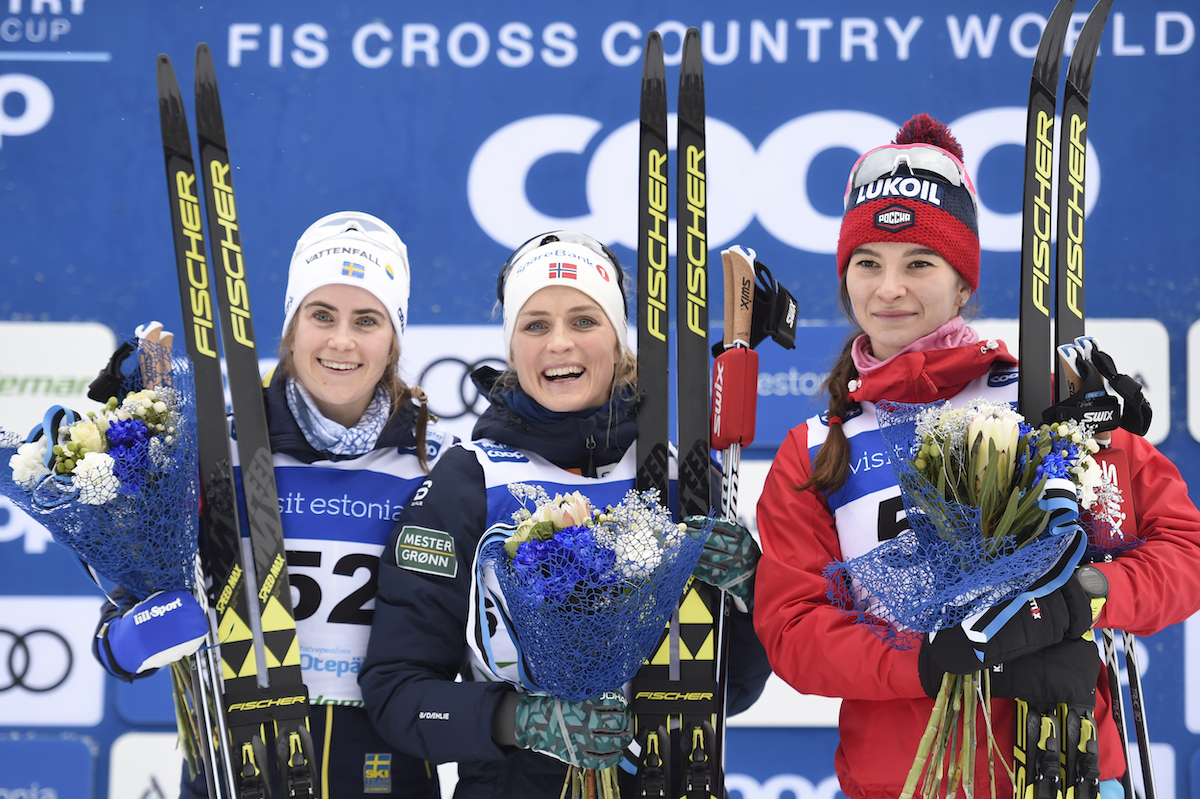
The women’s podium in the 10-kilometer interval start classic race in Otepää, Estonia. Therese Johaug of Norway (c) took the win ahead of Ebba Andersson of Sweden (l) and Natalia Nepryeava of Russia (r). (Photo: Fischer/Nordic Focus)
On the American side, Jessie Diggins posted the best result with 13th (+2:26.0). Rosie Brennan (APU) finished next in 27th (+3:09.9), followed by Sadie Bjornsen in 29th (+3:11.3), Caitlin Patterson (CGRP) in 39th (+3:50.9), and Ida Sargent (CGRP) in 41st (+4:17.2).
Diggins, who finished in sixth place in the Tour de Ski, now sits also in sixth place in the overall standings. Most often thought of as a skate specialist, Diggins has earned three top ten finishes in distance skate races outside of the TdS this season. However, she has steadily improved as a classic skier in the past few seasons and also cracked the top ten this year in the Val di Fiemme 10 k classic race.
“Today was a really interesting and tricky waxing day out there, with variable conditions and snow blown in the tracks in many sections of the course,” Diggins wrote in an email. “I was really happy with my kick and I know I lost a lot of time on the flats, but I was happy with how I raced my race. I was in the zone, pushing as hard as I possibly could and skiing technically better than years past. I’m still carrying some fatigue from the Tour so I need to rest a little more in the next few weeks, but I’m happy with where I’m sitting right now.”
“I was really impressed with Jessie’s result today,” Matt Whitcomb told FasterSkier in a call. “She works endlessly on her classic skiing, and this condition would’ve eaten her up just a couple years ago because of technique alone. She was skiing very well today.”
After racing as a discretionary pick in Period 1, Brennan declined her spots in the Tour de Ski and headed back across the pond. Because of her strong results in Period 1, Brennan was offered Period 3 starts as well. She returned to Europe for the races in Otepää and Ulricehamn, Sweden in hopes of qualifying for the World Championships in Seefeld, Austria. After today’s finish, Brennan is ranked 22nd in the overall distance World Cup standings.
“It was tough conditions this weekend in Estonia,” said Brennan. “I didn’t have too many expectations after suffering some illness and not racing for a little while. I had good feelings in the sprint, but not the speed I needed for the result I wanted. It left me optimistic for the distance race, however.”
“I was pleased to wake up to new snow as I love slow, tough races, however, I really struggled to find skis that worked well on the uphills and were still fast on the downhill,” she continued. “I made the choice I thought was best, but it wasn’t quite what I needed to be competitive today. I am happy to be back racing and my shape feels good so I am hopeful that things will improve from here.”
Dahria Beatty, the only Canadian to enter Sunday’s 10 k, finished 43rd (+4:42.5).
World Cup cross-country action returned to the Otepää race venue on Sunday, with athletes reconvening after Saturday’s classic sprints for the weekend’s distance classic event. In the women’s 10-kilometer individual start classic race, Norway’s Therese Johaug finished first in a time of 29:53.7 for the win. Sweden’s Ebba Andersson finished second (+48.4) while Russia’s Natalia Nepryaeva claimed third (+56.7).
Skiing for the U.S. Ski Team (USST), Jessie Diggins was the top North American woman on Sunday, placing 13th (+2:26.0). Two more Americans skied into the Top 30, with Rosie Brennan finishing 27th (+3:09.9) and Sadie Bjornsen 29th (+3:11.3).
Also skiing for the U.S. on Sunday, Caitlin Patterson and Ida Sargent finished in 39th (+3:50.9) and 41st (+4:17.2), respectively. Dahria Beatty was the lone Canadian to enter the race, placing 43rd (+4:42.5).
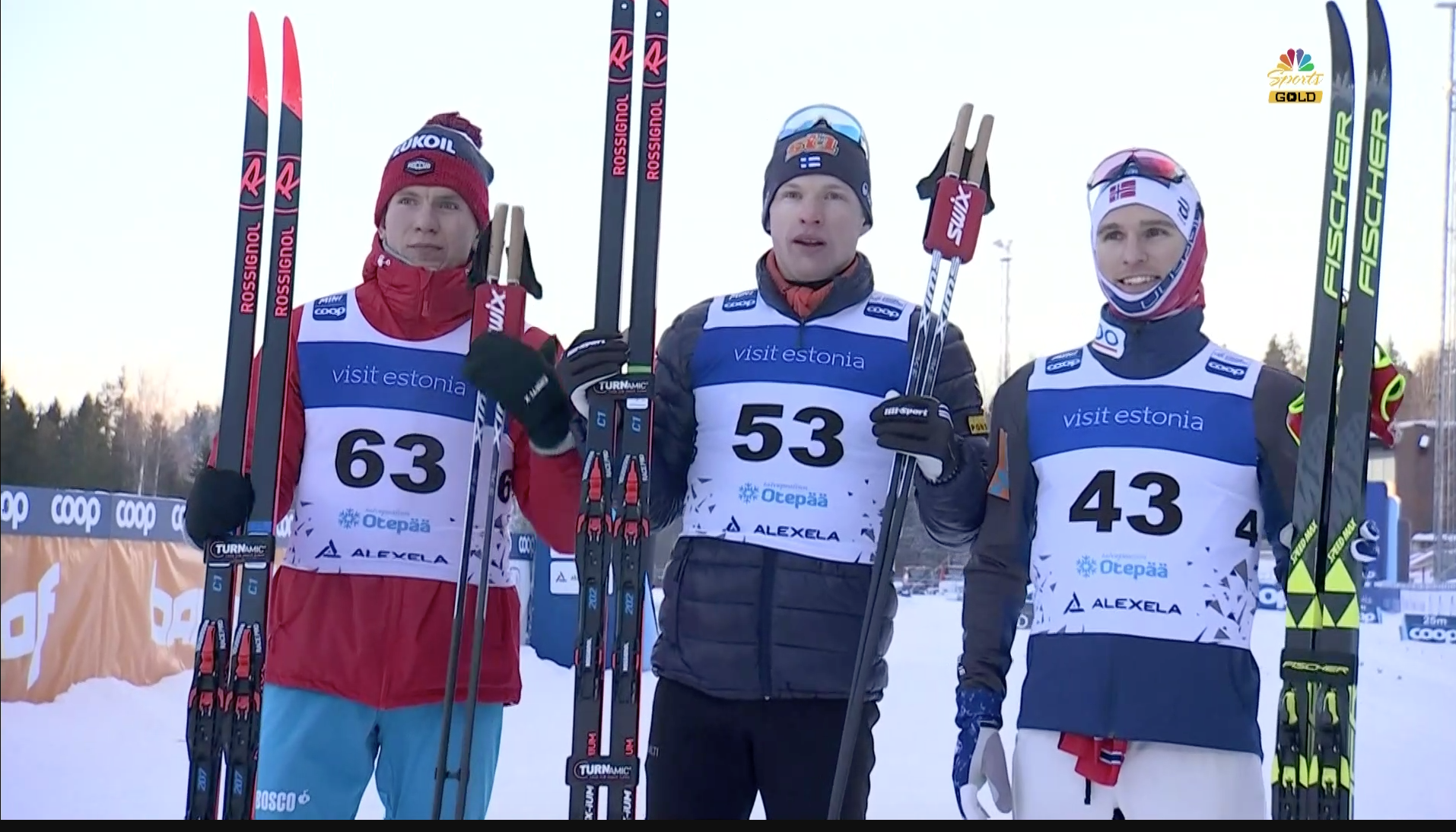
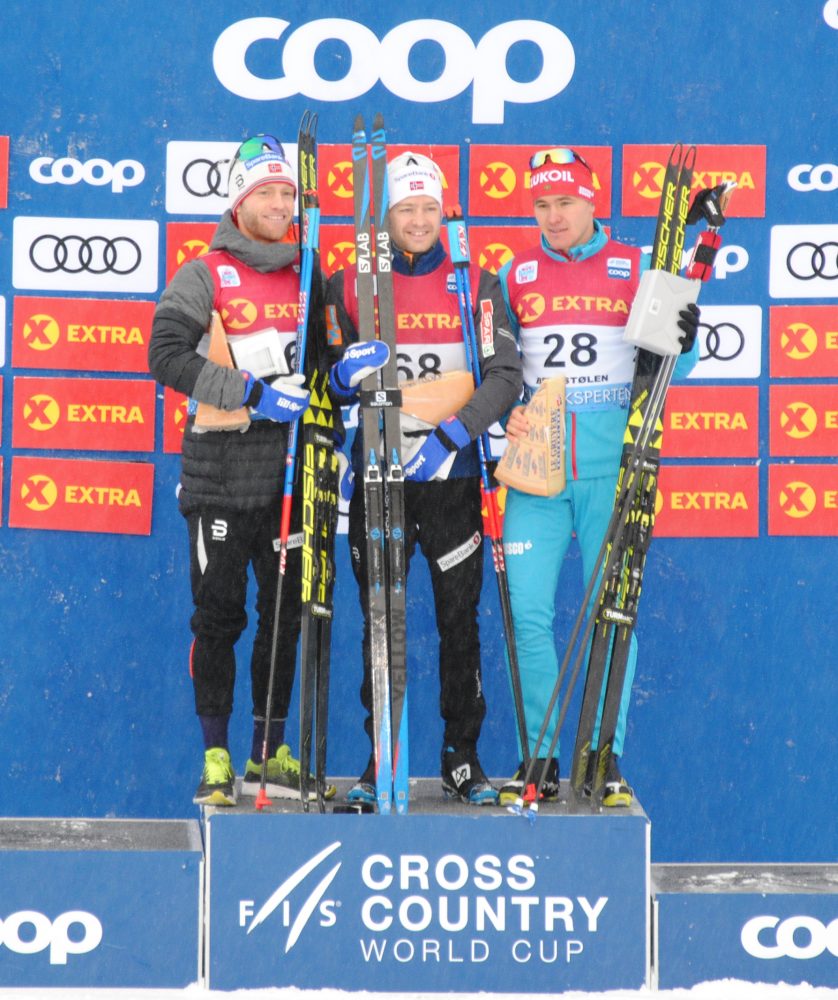
The men’s 15-kilometer classic podium on Sunday in Otepää, Estonia with Russia’s Alexander Bolshunov (left) in second, Iivo Niskanen of Finland (center) in first and Norwegian Didrik Tønseth (right) in third. (FIS screenshot)
In the men’s 15 k, Finland’s Iivo Niskanen took first, completing the course in a time of 40:07.1. Russia’s Alexander Bolshunov finished in second place (+15.9) and Norway’s Didrik Tønseth in third (+46.4).
The USST’s Erik Bjornsen led the charge for the Americans, placing 30th (+2:35.7). Scott Patterson placed 36th (+3:01.0), while Ben Lustgarten finished in 53rd (+4:41.1). Kevin Bolger placed 56th (+4:57.3) and Andy Newell did not start.
Racing for Canada, Len Valjas placed 43rd (+3:56.9) and Bob Thompson 52nd (+4:24.0).
The NorAm weekend wrapped up with mass start free technique on shortened courses. The predicted extreme cold and extreme snow didn’t materialize with a relatively balmy -13C recorded by the jury.
Katherine Stewart-Jones (CNST) continued her dominance with a win in 48:25.5, gapping Cendrine Browne (CNST) on the third and final lap for a 8.4 second separation. That is two wins and a second for Stewart-Jones. Zoë Williams (Nakkertokk) was third again, 1:38.2 behind. The shortened course was 14.3km, with one 4.3km lap and two 5km laps.
Russell Kennedy (Team R.A.D.) collected his first win of the weekend to earn his trip to World Championships, finishing alone at 57:12.6 on the four lap 19.3km race. Scott Hill (Hardwood) was second at 23.4 seconds behind. Evan Palmer-Charrette out-sprinted the remains of the original six leaders to complete the podium at 1:07.0.
IBU World Cup Ruhpolding, Germany 15 k / 12.5 k Mass Start
Career-best days are good days. That’s the main narrative from US Biathlon’s Sean Doherty 15-kilometer mass start in Ruhpolding, Germany on Sunday.
Doherty’s previous best in the mass start was a 24th place. In the 30-athlete field, Doherty began in bib-30. In his first two shooting stages, both prone, he skied a single penalty lap in each. As he found his ski-speed groove for his second two laps, marking the third fastest ski split for lap three and the fifth fastest split for lap four, Doherty also made his mark on the shooting range as he shot clean for for both his standing stages.
Doherty finished in 13th overall which matched his individual career best on the IBU World Cup. Johannes Thingnes Bø of Norway won the mass start in a time of 36:43.8 minutes while shooting clean for his first three stages and skiing one penalty lap on his fourth. Doherty’s finishing time was 42.2 seconds behind Bø’s.
Canada’s Christian Gow also posted a career best IBU World Cup results with an 11th place. Gow skied a single penalty lap after missing a target on his second prone stage. Otherwise, he shot clean to finish 34.3 seconds behind Bø.
Austria’s Julian Eberhard placed second (+0.6, 0+1+0+1), and France’s Quentin Fillon Maillet was third (+2.8, 0+1+0+0). Teammate Martin Fourcade skied to fourth (+8.6, 0+0+0+1).
Bø’s win on Sunday marked his 10th win (including relays) this season on the IBU World Cup. He leads the overall points series.
It was time for a first in the women’s 12.5 k mass start. Franziska Preuss of Germany won the race – an IBU World Cup career first for her — in a time of 32:34 minutes. Preuss shot clean on her way to the win.
Norway’s Ingrid Landmark Tandrevoldplaced second (+0.2, 0+0+0+0). For Tandrevold it was a her first IBU World Cup podium. Paulina Fialkova of Slovakia was third (+15.1, 0+0+0+0).
US Biathlon’s Clare Egan placed 24th (+1:59.7, 0+0+3+2), teammate Susan Dunklee 25th (+2:12.5 2+1+1+0).
No other North American women qualified for the mass start.
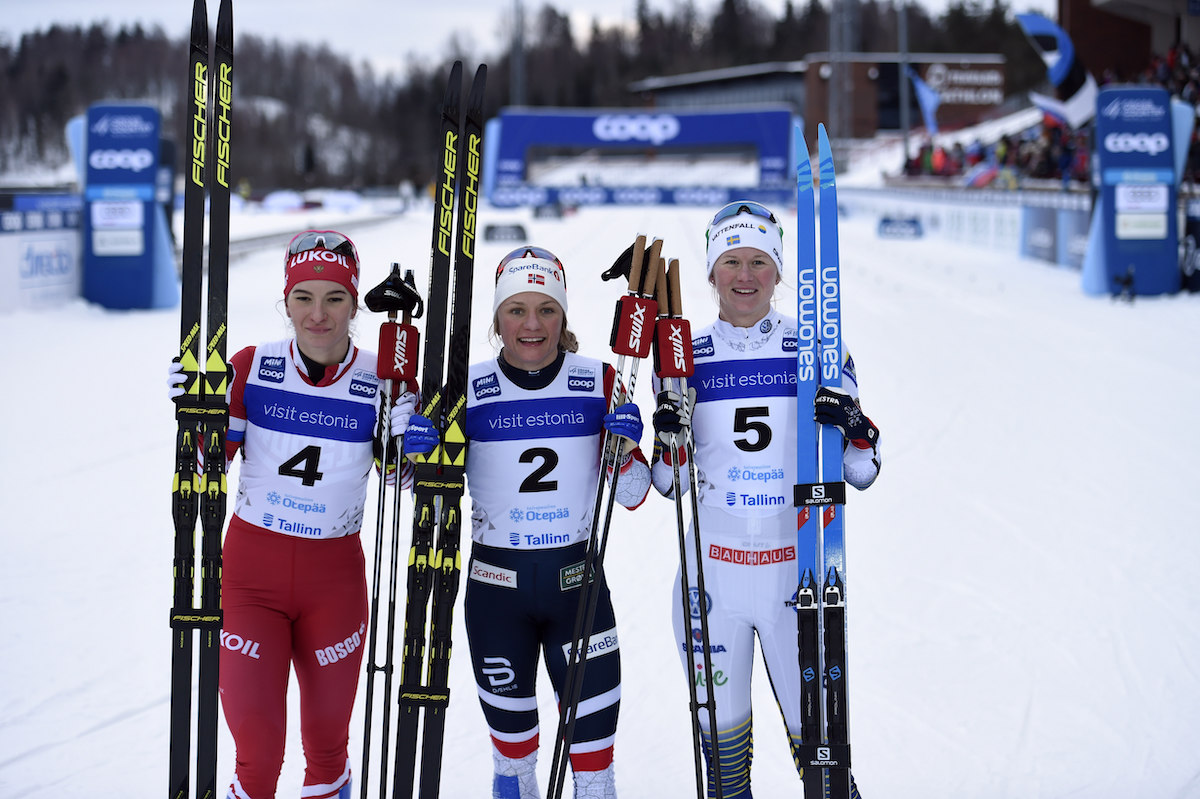
The women’s 1.3 k classic sprint podium from Otepää, Estonia. From left to right, Russia’s Natalia Nepryaeva in second, Maiken Caspersen Falla of Norway in first, and Sweden’s Maja Dahlqvist third. (Photo: Fischer/Nordic Focus)
Some proverbs hang in there. From situation to situation they simply capture, in the moment, how best to move forward.
“Patience is a virtue,” has an etymology going way back. Yet the timeworn saying and it’s wait-wait-wait underpinnings helped dictate the outcome of Saturday’s World Cup 1.3-kilometer classic sprint in Otepää, Estonia. That is until Maiken Caspersen Falla broke up the final. But we’ll get to that in a moment.
It was the modern course with its punchy ups and technical s-turn descents that kept patience in play. Fire too early on the demanding course and a fade would certainly follow. Temper the effort a bit, saving fuel for the later half of the effort, and good things might follow.
Sweden’s Stina Nilsson laid down the day’s fastest qualifying time in 3:07.62 minutes. A time mark illustrating the race was no 2.5 minute blast. In other words, much of how the day played out on course would come down to the moments after the two minute mark.
Two minutes into the race, the course kicked up with a 30-meter long herringbone section that often separated the pack. Athletes who conserved enough energy, positioned themselves near the front, kept a light yet robust herringbone, and pushed over the top were the ones most often positioned to advance in the heats.
The descent from the herringbone-hill eventually took the sprinters into a swooping left hand corner and then into a 100-meter double pole straightaway parallel to the finishing straight.
Those with the stamina to hammer out a double pole fared best in the closing 20 seconds of the sprint heats.
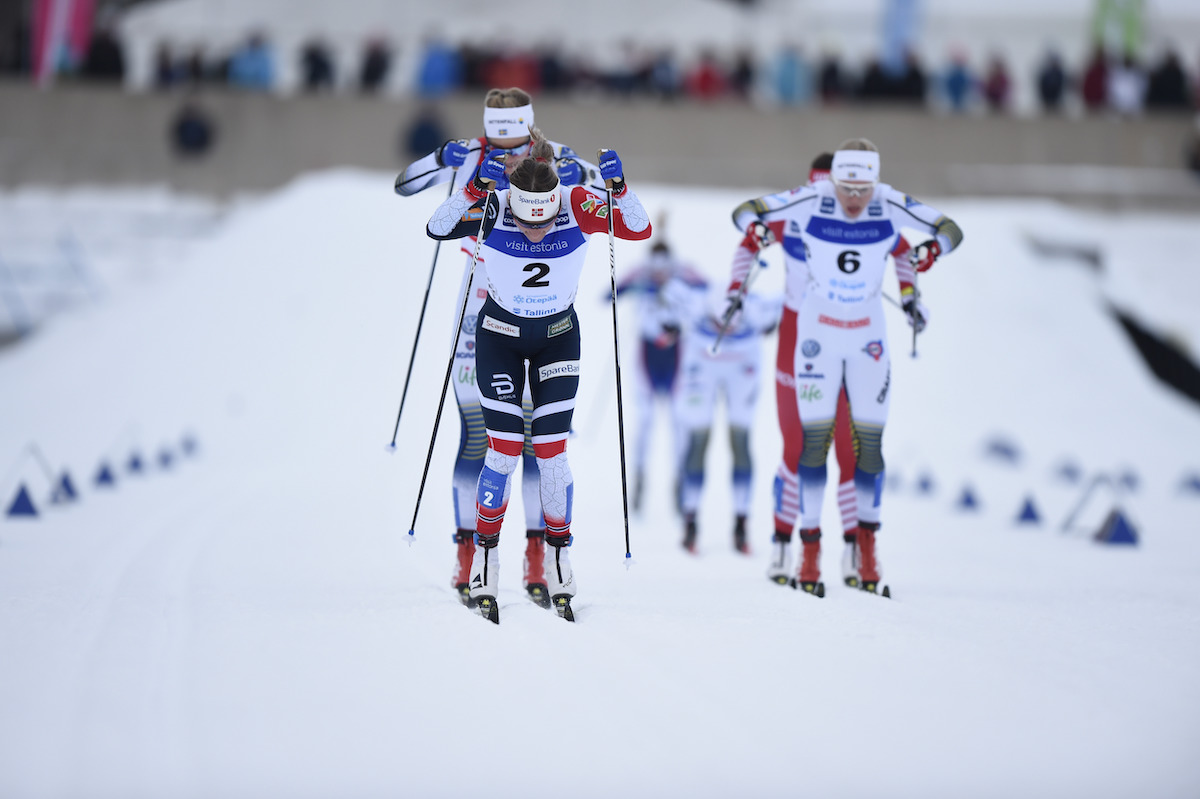
Powering up: Norway’s Maiken Caspersen Falla (bib 2) during the 1.3 k classic sprint in Otepää, Estonia. (Photo: Fischer/Nordic Focus)
In the women’s final Falla went up against Russia’s Natalia Nepryaeva, the Swedes Maja Dahlqvist and Jonna Sundling, and Slovenia’s Katja Visnar. The day’s fastest qualifier Nilsson, who advanced to the final as a lucky loser (there was a three-way photo-finish in her semi-final) did not start the final. According to the International Ski Federation (FIS) Nilsson fell after her lunge for the line and came up with a small yet unspecified injury. Out of precaution, she chose not to contest the final.
Unlike many of the day’s heats which featured a cluster of skiers approaching the herringbone hill together, Falla and Nepryaeva began to separate as they threw down deep powerful strides on the course’s first major climb. At 45 seconds, the duo began forming a 10-meter gap on the remaining three finalists.
Over the top of the hill, Sundling fought to stay within a breath of Nepryaeva’s draft — Falla glided down alone five meters ahead. The two skiers further behind, Dahlqvist and Visnar, were markedly off the pace.
As the course pitched left on a step-around corner, Sundling tumbled. From then on it was a two-skier affair.
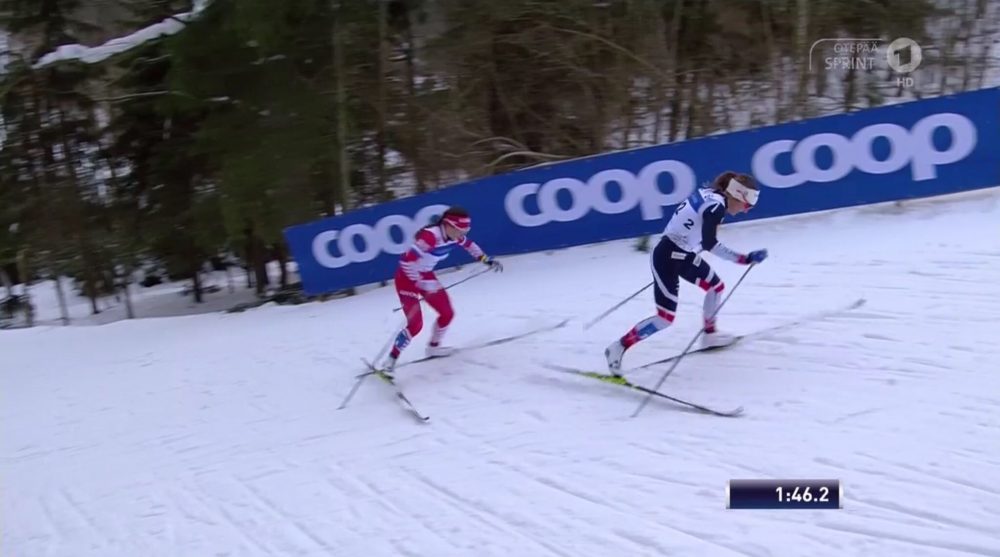
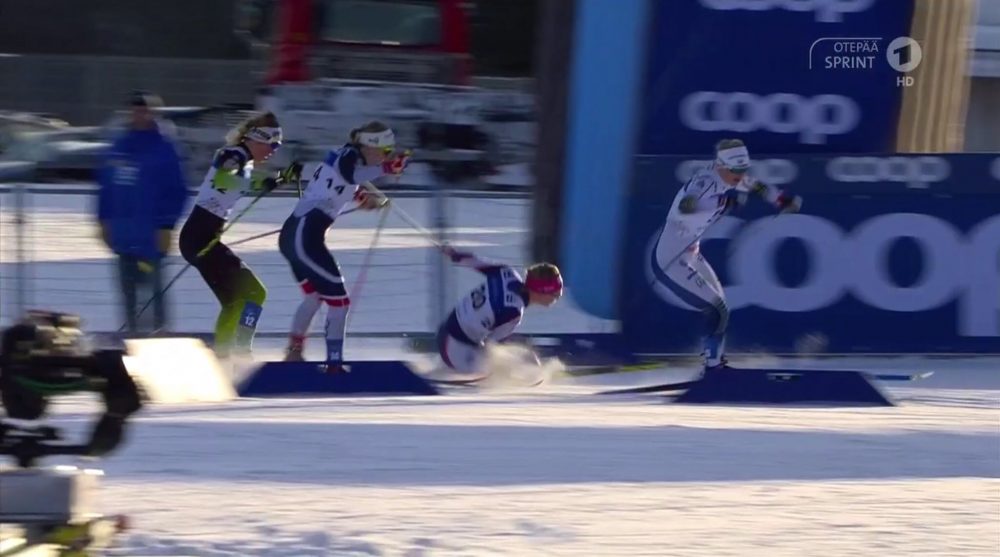
Norway’s Maiken Caspersen Falla making her move on the herringbone hill to outdistance Russia’s Natalia Nepryaeva. (Photo: ZDF screenshot)
Falla fired on the herringbone hill and gapped Nepryaeva enough to secure the win. Falla won in a time of 3:05:16 minutes with Nepryaeva 1.40 seconds back for the podium’s second step. Dahlqvist placed third (+5.78) with teammate Sundling recovering after her fall to nab fourth (+8.12). Visnar faded to finish fifth (+23.22).
It was Falla’s second World Cup podium of the season. She currently sits third in the sprint cup standings behind Nilsson in first.
With the final a symbolic outlier when it came to the patience game, the U.S. Ski Team’s (USST) Jessie Diggins played the wait and wait philosophy. Diggins qualified in 18th and moved onto the semis after placing second to Falla in the second quarterfinal.
In her quarter, Diggins shadowed the pack until the the mandatory herringbone hill when she moved towards the front and ultimately scored a semi spot.
In her semi, which needless to say was primed with top-tier talent, Diggins bowed to the high pace to finish sixth and place 12th overall.
“Today was a lot of fun, and I was really happy with how I skied,” Diggins expressed in an email to FasterSkier. “I ran out of gas a little in the second half of my semifinal, but given how stacked semifinal one was, I’m taking a lot of confidence from today and in how my classic sprinting is coming along! We also had great skis in the heats today and I was psyched with how our team was able to keep changing things up on the fly to improve the speed. The steep herringbone technique has always been a challenge for me, and I still have some work to do, but I was happy with the progress I’ve made over the years in these conditions.”
Ida Sargent (USST) had a season best result after qualifying in 27th. Sargent skied in the third heat where Sweden’s Ida Ingemarsdotter set the tempo. Sargent looked strong in the opening moments as she matched the striding pace. Into the herringbone hill she fended off the charge of Finland’s Krista Pärmäkoski.
“I usually feel like striding was my strength,” Sargent emailed. “This course had all the striding in the beginning so I tried to take advantage of that and push the pace or ski near the front in the striding and do my best on the herringbone hill.”
Pärmäkoski cleverly sucked into Sargent’s draft to eventually pass the U.S. skier and place second in the heat. Sargent finished in third and did not advance as a lucky loser. Sargent’s 15th overall was her best World Cup result of the season.
“My strategy was to ski near the front but maybe not lead, but I just lost contact with Ida [Ingemarsdotter] on the herringbone hill and lost her draft but had Pärmäkoski in my draft so she zoomed by me coming out of the downhill. It was probably the best I felt sprinting all year so I’m excited to be moving in the right direction.”
The U.S. Ski Team’s Sadie Bjornsen during her qualifier in Otepää, Estonia’s 1.3 k classic sprint. (Photo: Fischer/Nordic Focus)
Also for the U.S., Sadie Bjornsen advanced int0 the heats after qualifying in 20th (+5.71). Skiing in the fifth heat, Bjornsen was the epitome of patience, waiting until the final two double pole sections to make a move. With only the last right hand turn and the final straight to navigate, Bjornsen fell among a pack of skiers. She was given a yellow card for obstruction.
“Bittersweet ‘day one’ of the classic weekend,” Bjornsen wrote in an email to several news outlets. “After a qualifier that seemed a bit off, I went into the heats excited to find a better place. I am thinking I maybe chose a little bit too much kick in the qualifier, but it is hard to tell.”
Bjornsen was matter of fact when it came to her fall — knowing sprints are rife with close-quarters positioning.
“For the heats, I tried to hang in a smart position through the whole heat,” she wrote. “I knew I was feeling really strong in the double pole, so my goal was to save some energy for a good final second half, and sit in a smart place for the first half. The plan played out well, and I pushed super hard over the top of the course allowing me to have a lot of speed into the bottom corner. As I came into the final corner of the course, the tails of my skis got a little clicked by the Slovenian, which caused me to lose balance and find myself on the ground…. not the way I had expected it. … Sprint racing is ‘sprint racing’. It doesn’t always go as you hope and dream. At the end of the day, I am really excited to feel some better form than the last couple of races, so I am looking forward to tomorrow!”
Sadie Bjornsen of the U.S. Ski Team taking a fall in the last corner of her quarterfinal heat in Saturday’s 1.3 k classic sprint in Otepää, Estonia. (Photo: ZDF screenshot)
The next opportunity comes for Bjornsen and the women’s World Cup field in tomorrow’s 10 k classic.
Also for the U.S., Rosie Brennan (USST) finished 45th (+15.81).
Dahria Beatty was the only Canadian entered. She placed 44th overall (+15.79)
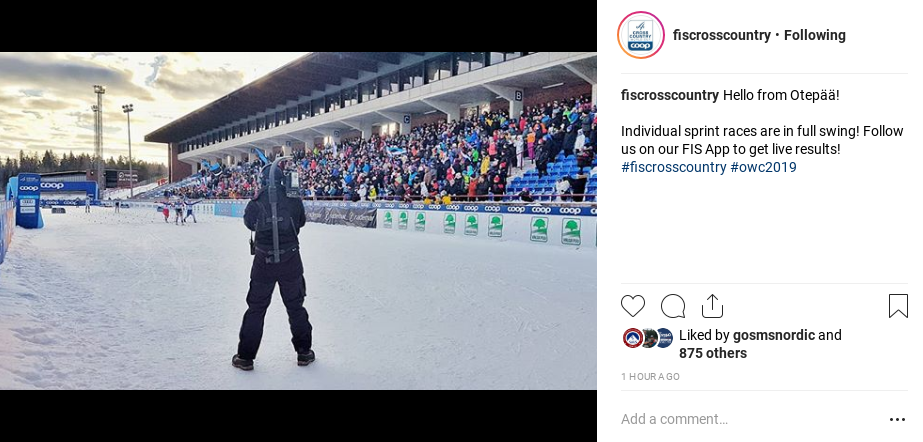
It’s on and it’s over — the World Cup classic sprints in Otepää, Estonia. (Photo: @fiscrosscountry Instagram screenshot)
FIS World Cup Otepää, Estonia 1.3 k / 1.6 Classic Sprint
Starting the day’s performance benchmarks off was Stina Nilsson of Sweden with the fastest qualifier in the women’s 1.3-kilometer classic sprint in Otepää on Saturday. She stopped the clock in 3:07.62 minutes.
The U.S. Ski Team’s (USST) Jessie Diggins was the top-qualifying North American in 18th (+5.37). Sadie Bjornsen (USST) qualified 20th (+5.71), and Ida Sargent 27th (+8.38).
On a course rewarding patience and technical skiing know how, Norway’s Maiken Caspersen Falla won the overall in 3:05:16 minutes. Russia’s Natalia Nepryaeva placed second (+1.40), and Maja Dahlqvist of Sweden third (+5.78). Also from Sweden, Jonna Sundling, who fell at around the 1:30 mark in the final, placed fourth (+8.12), with Slovenia’s Katja Visnar fifth (+23.22).
Nilsson placed second to Falla in the first semi-final, but did not start the final. Nilsson had won the last four World Cup sprints, all in skate, coming into Otepää.
Bjornsen looked strong in the fifth heat, yet stepping around the right hand turn before the final straight she fell taking out several other skiers. Bjornsen was given a yellow card for obstruction. She ended up 22nd overall.
Diggins placed second to Falla in the second heat to advance to the first semi. She was eliminated after finishing in sixth (+3.68). Diggins placed 12th overall.
Sargent finished third in the third heat, to place 15th overall.
U.S. athlete Rosie Brennan (APU) finished 45th (+15.81).
Dahria Beatty (CNST) was the only Canadian entered. She placed 44th overall (+15.79)
Norway’s Johannes Høsflot Klæbo was the fastest qualifier for the men in the 1.6 k classic sprint with a time of 3:21.99 minutes.
The young Norwegian seems on form as he swept his heat, semi, and final on his way to the win. Klæbo won the final in 3:20.05 minutes. Alexander Bolshunov of Russia, the only non-Norwegian in the final, was second (+1.51), and Pål Golberg third (+2.53). Rounding out the final three spots in the final were Eirik Brandsdal in fourth (+2.57), Mattis Stenshagen in fifth (+7.69), and Erik Valnes in sixth (+11.99).
For the U.S., Erik Bjornsen (USST) was the fastest qualifying North American in 23rd (+8.2), Andy Newell (SMS T2) 26th (+8.75).
Bjornsen was knocked out of the rounds after placing fifth in the second heat. He placed 24th overall. Newell ended up third in the first heat, 2.99 seconds in back of Klæbo. Newell, in his second World Cup sprint of the season, placed 15th in the final standings.
Kevin Bolger (USST) finished in 41st (13.13), Ben Saxton (SMS T2) 44th (+14.16), and Ben Lustgarten (CGRP)63rd (+23.04).
For Canada, Lenny Valjas (CNST) was 43rd (+13.61), and Bob Thompson 51st (+15.96).
Day two of the NorAm weekend was interval start classic, with very cold conditions delaying the start and simplifying the ski preparations.
Katherine Stewart-Jones (CNST) topped her Friday 2nd place with a clear win in the 10km, finishing in 28:51.6 with the fastest time on all three laps. Cendrine Browne (CNST) was second at 30.8 behind. Zoë Williams (Nakkertok) was third at 1:53.5, just pulling clear of Frédérique Vézina (CNEPH) by 3.1 seconds with a fast final lap.
In the men’s 15km, Scott Hill (Hardwood) bounced back from a slow start to the season with a well-timed victory to join Stewart-Jones on the World Championships team. Hill was fastest on the last three of four 3.75km laps to win in 36:59.7, 9.0 seconds ahead of a fading Russell Kennedy (Team R.A.D.). Graham Nishikawa (CPNST), here training for his role as Brian McKeever‘s guide, held onto third at 38.0 seconds, just 3.2 seconds ahead of a fast finishing Dominique Moncion-Groulx (Nakkertok).
There are two more automatic selections for World Championship available on Sunday in the mass start skate races (20km for women, 30km for men). With cold temperatures and heavy overnight snow predicted, it should be an exciting end to the weekend.
The teams from France, Norway and Germany claimed the positions at the top of the podium on Saturday in the women’s 4 x 6-kilometer relay in Ruhpolding, Germany, cheered on by over avid 25,000 fans lining the course.
France with Julia Simon, Anaïs Bescond, Justine Braisaz and Anaïs Chevalier stayed in the top group all race mainly due to the best shooting performance of the day, at times with a lead of over half a minute. On the anchor leg, Chevalier defended her narrow lead through three loops and two shooting stages to the finish line in a time of 1:09:27.7 hours, with no penalty and just four spares. According to an IBU press release, it was their first win since 1994 at this venue with a long tradition on the biathlon competition calendar, which has undergone a slight redesign for this season to add stands and make a downhill section less tricky.
Behind the French women, Norway with a team comprised of the reactivated veteran Synnøve Solemdal, Ingrid Landmark Tandrevold, Tiril Eckhoff and anchor Marte Olsbu Røiseland was second, with Røiseland narrowing the gap to Chevalier on the final loop from 21 to seconds but not quite catching up to finish 11.5 seconds back (with no penalty and seven spare rounds). The home team from Germany with Vanessa Hinz, Laura Dahlmeier, Franziska Preuss and Denise Herrmann was third, after the fast Herrmann was unable to catch the leaders when she needed all three spares in the final shooting to clear her targets (+23.4, with no penalty and nine spares).
Over a minute behind the podium finishers, the fourth team crossing the line were the 2018 PyeongChang Olympic relay silver medalists from Sweden around anchor Hanna Öberg (+1:29, with no penalty and nine spares).
For the North American teams it was a race with many ups and downs.
Canada began the race with Sarah Beaudry, who moved the team as high as sixth thanks to a clean shooting performance in her standing shooting stage after she had required two spares in prone. She then lost time to the top teams on the track to exchange in 13th position (+54.5 sec). Emma Lunder then managed to bring the team back up to sixth position but she also needed two spares in prone and followed that up with a clean standing stage, tagging off in seventh place right behind Sweden (individually her leg was the fifth-fastest). Megan Bankes kept up with the teams around her on the course and slightly improved to fifth position less than a minute back, but then missed two targets in her standing stage and could not clean with her spares. She skied a single penalty lap (0+1, 1+3). She tagged anchor Rosanna Crawford in 10th position (+2:14), who then herself added a penalty in her prone stage.
At the site of her podium finish a year ago and coming off a 27th place in the sprint earlier this week, the Canadian team leader then needed two spares in the standing stage and ultimately came to the finish in 12th position (+3:01.6), with two penalties and 13 spare shots for the team.
For US Biathlon, Clare Egan began the race and recorded a clean prone stage to move the team up all the way to third position coming into the standing shooting stage despite a broken pole. She then missed three targets and ran out of spares and skied two penalty laps.
That set the team back quite far, exchanging in 19th position (+1:26.6). Susan Dunklee needed four spares in her shooting stages but avoided another penalty (0+1, 0+3) to exchange in 12th position (+1:47.3).
Rounding out the team after being called back up to the World Cup from the second-tier IBU Cup following solid performances in Duszniki Zdroj, Poland, Joanne Reid only needed one spare in each of her shooting stages (0+1, 0+1) to tag off in 15th position. In her second time anchoring a relay this season, Deedra Irwin – who had recorded her first clean shooting performance in a race in Poland a week ago – then required all her spares to clear her targets in the prone shooting before achieving another clean standing shooting stage. She crossed the line in 16th position, 4:06.0 back, with two penalties and 12 spare shots for the team.
Races in Ruhpolding conclude on Sunday with mass starts for the women and men. US Biathlon’s Sean Doherty is scheduled to be lone North American starter for the elite men’s field (though Canada’s Christian Gow would be the next one up from a reserve list in case of an illness), while Egan and Dunklee are qualified for the women.
The start of the men’s 15 k classic mass start at Stage 6 of the 2018 Tour de Ski on Saturday in Val di Fiemme, Italy, with (front row, left to right) Canada’s Alex Harvey, Russia’s Sergey Ustiugov, Kazakhstan’s Alexey Poltoranin, Norway’s Martin Johnsrud Sundby, and Switzerland’s Dario Cologna. (Photo: Salomon/NordicFocus)
Beginning this Saturday in Toblach, Italy with a freestyle sprint is the 13th edition of the Tour de Ski (TdS). According to the International Ski Federation (FIS), over the course of seven stages the men will race 80.918 kilometers, the women 60.67 k.
The TdS has become both a staple and a spectacle of the annual World Cup calendar. With a jam-packed series of races primacy is placed on both the ability to recover well and wither less as the TdS transpires.
Prognostication can be tricky in a long-form template like the TdS. So much can go astray during seven races not to mention the travel and dicey germ-avoidance.
Last season’s winner on the women’s side, Heidi Weng of Norway, sits 18th overall in the World Cup standings (14th in distance). She has four top-20’s in the four distance events she’s contested with her best result an eighth in Lillehammer’s 10 k skate. Although featuring two sprints in the first three stages, the TdS remains a distance skier’s paradise.
Weng has skied solidly on the World Cup, but she has yet to show the form that made her a TdS overall winner in 2017 and 2018. Norway has won the last five iterations of the TdS: Marit Bjørgen won once in 2014/2015, Therese Johaug twice (2013/2014, 2015/2016), and Weng the last two years.
Austria’s Teresa Stadlober leads Norway’s Heidi Weng (2) and Ingvild Flugstad Østberg, American Jessie Diggins (3) and others around a downhill corner during the women’s 10 k classic mass start at Stage 6 of the 2018 Tour de Ski in Val di Fiemme, Italy. (Photo: Fischer/NordicFocus)
If Norway is to keep the streak alive, Ingvild Flugstad Østberg, last year’s TdS runner up, could be the heir apparent. She currently ranks second in the World Cup overall and 15th on the sprint list.
Johaug, having returned from an 18 month doping ban, has been on a distance race tear. She has won all five World Cup distance events this season. Johaug, however, will not be lining up for the TdS.
Only five different women have earned distance podiums this season — Johaug, Østberg, Sweden’s Charlotte Kalla and Ebba Andersson, and Finland’s Krista Pärmäkoski. Along with Johaug, Kalla and Andersson are skipping the TdS. (Andersson sits third overall on the World Cup, Kalla fifth.) With the TdS missing three of the five top ranked World Cup distance skiers, daily stages and the overall podium are up for grabs.
Last season’s third overall finisher, Jessie Diggins of the U.S. Ski Team (USST), often cites the TdS as a point in the season when her form trends towards podium performances. She sits eighth in the current distance standings and could very well have a stout TdS.
Russia’s Natalia Belorukova and Yulia Nepryaeva look strong as does Sadie Bjornsen (USST), and Austria’s Teresa Stadlober.
With less than predictable distance stage podiums for the women, it may simply come down to a drag race on the Alpe Cermis final climb Jan. 6.
Switzerland’s Dario Cologna (c) celebrates his fourth Tour de Ski overall title. He was joined by Norway’s Martin Johnsrud Sundby (l) and Canada’s Alex Harvey (r) on the podium in second and third, respectively. (Photo: Fischer/NordicFocus)
The men’s scene is also open to interpretation. Last season’s TdS winner, Switzerland’s Dario Cologna, was in fact a surprise victor. Prior to Cologna’s stage two win in last year’s TdS, it had been nearly three years since the four time TdS overall winner had won a World Cup. Cologna sits 21st overall on the World Cup currently. Given last year’s resurgence, anything is possible for the Swiss skier.
Then there’s Martin Johnsrud Sundby form Norway. He finished on the TdS podium the last three years. At thirty-four-years-old, Sundby is ranked first on the distance list, with a second, a third, and a fourth place in distance races this season.
Sundby won the TdS on two occasions – in 2013/2014 and in 2016. His 2015 win was stripped after he tested positive for excessive levels of Salbutamol. He placed second in the past two Tours.
In a field rife with talent, Sundby’s ability to race and rebound and race and rebound will be tested. Sjur Røthe, Emil Iversen, and Didrik Tønseth— all from Norway— look in form. And there’s Norway’s Johannes Høsflot Klæbo. The winner of last season’s overall World Cup has had flashes of his past explosive self. He could be a TdS protagonist.
The men’s field is notably tight. Along with the Norwegians, several Russians could pop a podium, a stage win, and the overall. Russia comes with a loaded team ready to exploit. Alexander Bolshunov leads the overall World Cup – he’ll turn twenty two on Dec. 31st. He’s backed by teammates Evgeniy Belov, Andrey Melnichenko, and Denis Spitsov.
Canada’s Alex Harvey placed third overall last year and he looked stronger as the TdS progressed.
The Stages
Stage 1: Dec. 29, skate sprint in Toblach, Italy.
Stage 2: Dec. 30, 10 k/15 k skate in Toblach, Italy.
Stage 3: Jan. 1, skate sprint in Val Müstair, Switzerland.
Stage 4: Jan. 2, 10 k/15 k classic mass start in Oberstdorf, Germany.
Stage 5: Jan. 3, 10 k/15 k skate pursuit in Oberstdorf, Germany.
Stage 6: Jan. 5th, 10 k/15 k classic mass start in Val di Fiemme, Italy.
Stage 7: Jan 6th, 9 k final climb skate pursuit in Val di Fiemme, Italy.
Teams
United States
Women: Sophie Caldwell, Sadie Bjornsen, Jessie Diggins.
Men: Ben Lustgarten, Simi Hamilton, Erik Bjornsen, Kevin Bolger.
U.S. Ski Team Head Coach Chris Grover noted in a text that Caldwell, Hamilton, and Bolger will likely cease the TdS after the stage three sprint. Additionally, this is a small team for the U.S. at the TdS. Several athletes turned down TdS nominations including Scott Patterson (USST), Andy Newell (SMS T2/Salomon), Kyle Bratrud (SMS T2), Rosie Brennan (APU), Rosie Frankowski (APU), Caitlin Patterson (CGRP), and Julia Kern (SMS T2). These skiers plan on racing U.S. Nationals this January in Craftsbury, Vermont.
Canada
Women: Emily Nishikawa, Dahria Beatty
Men: Alex Harvey, Lenny Valjas, Bob Thompson
Norway
Women: Ingvild Flugstad Østberg, Maiken Caspersen Falla, Astrid Uhrenholdt Jacobsen, Kari Øyre Slind, Kathrine Rolsted Harsem, Heidi Weng, Lotta Udnes Weng, Tiril Udnes Weng Mari Eide, Anna Svendsen
Men: Martin Johnsrud Sundby, Hans Christer Holund, Emil Iversen, Didrik Tønseth, Simen Hegstad, Krüger, Sjur Røthe, Johannes Høsflot Klæbo, Martin Løwstrøm Nyenget, Eirik Brandsdal, Finn Hågen Krogh
Russia
Women: Yulia Belorukova, Lidia Durkina, Anna Zherebyateva, Mariya Istomina, Natalia Nepryaeva, Anna Nechaevskaya, Anastasia Sedova, Elena Soboleva
The women’s podium from the 2018 World Cup 10 k freestyle individual start in Davos, Switzerland. Therese Johaug (center) of Norway won, teammate Ingvild Flugstad Østberg (left) was second, and Krista Pärmäkoski (right) of Finland was third. (Photo: Fis-Ski.com screenshot)
Coming off a two-season hiatus from the World Cup for having a banned steroid in her system, Norway’s Therese Johaug has come back onto the distance race stage with time checks and results showing no remorse. This is not to say that Johaug’s reentry to the sport comes with arrogance. But it is to highlight that, on course, her level of control in the early season World Cup distance events has been dominant. Johaug has won all five World Cup distance events thus far. Her string of first places is a way of saying she’ll let the results speak for themselves and her dominance seep into the minds of those who want to fight for second and third place.
Sunday was yet another win for Johaug. The up-tempo skier won the 10-kilometer freestyle individual start in Davos in a time of 26:06.9 minutes. She led the race at every intermediate time checkpoint.
It was Johaug’s 81st World Cup podium. She trails only Norway’s legend Marit Bjørgen who won 99 World Cup podiums during her career.
The second place finisher on Sunday, Johaug’s teammate Ingvild Flugstad Østberg, had the benefit of starting two places behind the eventual race winner: Johaug started in bib 36, Østberg in bib 38.
Through the 5 k lap mark, Østberg was able to keep Johaug’s gap no bigger than 10 seconds. On the second lap’s long climb, Østberg only lost a handful of seconds. Her finishing time of 26:19.0 minutes was 12.1 seconds behind Johaug.
For Østberg, it was her third distance podium in succession after placing second in Lillehammer’s 10 k classic pursuit, and third in Beitostølen’s 15 k freestyle individual start race.
Johaug leads the World Cup overall with a perfect score of 600 points. Østberg sits in second, with a 149 point deficit.
Finland’s Krista Pärmäkoski placed third on Sunday, 19.2 seconds back. It was Pärmäkoski’s first podium of the season. She currently is ranked fourth overall on the World Cup.
Jessie Diggins during the 2018 10 k skate in Davos, Switzerland. Diggins placed fifth for her best result for the season. (Photo: Reese Brown/U.S. Ski Team)
The U.S. placed two skiers in the top-10. Jessie Diggins placed fifth and Rosie Brennan sixth.
For Diggins, it was her best result of the season after her eighth place in Beitostølen’s 15 k skate.
“For me period 1 is a building phase, and it’s a really long season, and every single year I always build into period 1,” Diggins said in a phone call. “And I have to remind myself that I do this for me and that I follow a plan that has worked every other year, so I just have to remember that I will be in the right shape when it’s time. And for me, period 1 is not that time. So I’m really happy that it’s been trending positive.”
The building phase of her season set up a solid foundation on Sunday. Her pace was consistent and only placed her 15.8 seconds out of third at the halfway point. She ended up 1:01.1 minutes behind Johaug at the finish.
“I think that technically, I was really proud of my race today because of the way I skied,” Diggins said of her on course sensations. “It’s hard on a course like this to not go out guns blazing and just charge and then totally flood. Because that’s when I think you can lose so much time. For me, I was just so focused on trying to ski with a strong core and efficient, long-gliding v2 and I was just happy with it because it’s a really hard course to pace, and of course, you’re never sure if you nailed it or not.”
With a two week break from racing, Diggins will be training in Seefeld, Austria during the race respite. Next up on the Diggins race schedule is the Tour de Ski (TdS). She placed third overall in the TdS last season, a historic mark for an American. Although she has ambitions at the TdS, Diggins also clarified that it remains a piece in the building-form puzzle. In-form or trending towards the sharp end of fitness, Diggins understands the possibility for more positive outcomes on the result sheet are more palpable as the season progresses.
“For me, I feel like period 1 and the Tour are really crucial building blocks for the season ahead, so I’m looking to take really good care of myself and just like get after it in the Tour. I do think that parts of a season are building blocks where you recognize that maybe you’re not in top form, and that’s on purpose because of the training load you’re carrying in. So you want to do the best you can with what you have. You’re not setting unrealistic expectations that might set you up to be bummed out. For me being like ‘I want to win Kuusamo 10k Classic’ would be an unrealistic expectation from myself. So I think that the Tour, yes, I would like to get a podium in the Tour, obviously, like I think that’s a good event for me, for my strengths, I really, really like it.”
Rosie Brennan (bib 48) on her way to an individual career best on the World Cup with a sixth place in the 2018 Davos, Switzerland 10 k skate. (Photo: Reese Brown/U.S. Ski Team)
Seeing Diggins steadily improve this season is no surprise. That has been her blueprint for success in the past. Arguably the biggest surprise in total on the women’s World Cup is Brennan’s success.
Brennan placed sixth (+1:04.9) on Sunday for her best career individual World Cup result.
“I just really wanted to feel good racing again and to enjoy it again,” Brennan said in a call. “I was just so miserable last year, and it was it hard decision to know if it was even worth it to continue on if I could find not only fun in racing again but also good form and just good race feelings.”
Brennan’s struggle with fatigue and recovery soured her 2017-2018 season. Her down season resulted in her not being renominated to the U.S. Ski Team. What is clear now is that Brennan has found herself in an unprecedented place. Ranked 11th in the World Cup distance standings, Brennan was able to savor her Sunday in Davos.
“Today was definitely the most fun race I’ve had all period, so I’m leaving period 1 on a high note, there’s not much more I could ask for, so it’s been great,” Brennan said.
Her current high note has not allowed her to lose sight of managing her long-term energy and goals. Brennan will not race the TdS and will return to the U.S. for a training block.
“I had made that plan before the season started, and obviously with good results, it became a very difficult decision,” Brennan said of deciding to forgo the TdS. “But given how late World Champs is in the season this year, I really wanted to make sure that I had enough training under my belt to make it to World Champs, so I’ve decided to stick with the plan.”
Currently, Brennan has not automatically qualified for World Championship team selection. She’ll have to remain in the top-50 of the distance standings before the selection period for the team ends.
“The selection ends the second-to-last day of the Tour, and the Tour is only half points,” Brenna explained. “So I feel confident that I will remain in the top-50. So that helped make the decision easier. I have no pressure to race anything, so I’m just going to focus on training and keeping good fitness through the rest of the season.”
Also for the U.S., Caitlin Patterson placed 38th (+2:22.5) and Kelsey Phinney 65th (+4:02.1). Sadie Bjornsen did not start and according to U.S. coach Matt Whitcomb, that decision was part of her pre-determined race schedule.
Canada’s Emily Nishikawa stormed into the top-30 in only her second World Cup start of the season to place 23rd (+1:47.6). Cendrine Browne(CNST) was 44th (+2:28.8).
For Nishikawa, the result ties her career best on the World Cup. She placed 23rd in a 2015 10 k classic in Lahti, Finland. In an email, Nishikawa explained that living in and training in Canmore mitigated some of the altitude effects of racing in Davos. During her race, she was caught by Diggins around 7 k.
“I hung on as long as I could with [Diggins] and tried to follow her fast pace through top section,” Nishikawa wrote “Other than that I skied alone for the race.”
Racing continues on the World Cup on December 29, for the TdS’s opening stage skate sprint.
The women’s podium from the 2018 World Cup 10 k freestyle individual start in Davos, Switzerland. Therese Johaug (center) of Norway won, teammate Ingvild Flugstad Østberg (left) was second, and Krista Pärmäkoski (right) of Finland was third. (Photo: Fis-Ski.com screenshot)
FIS World Cup Davos, Switzerland 10k/15k Freestyle Individual Start
On Sunday, the final day of racing on the World Cup before a two-week break prior to the start of the Tour de Ski, the early season trend for women’s distance skiing continues. Norway’s Therese Johaug won the 10-kilometer freestyle individual start in Davos in a time of 26:06.9 minutes. She led the race at every intermediate time checkpoint.
The only difference with Sunday’s distance narrative was Johaug’s margin of victory. Teammate Ingvild Flugstad Østberg placed second 12.1 seconds back. Krista Pärmäkoski of Finland placed third (+19.2).
The U.S. Ski Team’s Jessie Diggins popped a season-best fifth place, crossing the line 1:01.1 minutes back. Also for the U.S. and posting a career-best World Cup finish was Rosie Brennan in sixth (+1:04.9).
Also for the U.S., Caitlin Patterson placed 38th (+2:22.5) and Kelsey Phinney 65th (+4:02.1).
Canada’s Emily Nishikawa stormed into the top-30 in only her second World Cup start of the season to place 23rd (+1:47.6). Cendrine Browne (CNST) was 44th (+2:28.8).
In the men’s 15 k skate, Russia’s Evgeniy Belov won in 35:52.5 minutes. It was the Russian’s first career individual World Cup win.
Over the duration of three laps on the up and then down 5 k loop, Belov only outdistanced second-place skier Maurice Manificat of France by a meager 0.9 seconds. Third place went to Norway’s Martin Johnsrud Sundby who finished 4.5 seconds back.
In another tight men’s race, only 10.6 seconds differentiated first from fifth place. Russia’s Denis Spitsov was fourth (+7.5), and Norway’s Chris André Jespersen fifth (+10.6). Only 1:07.7 minutes separated 30th place from first.
Alex Harvey of Canada was the best placed North American in 26th (+1:00.9). Teammate Len Valjas (CNST) was 62nd (+2:13.2), and Andy Shields 76th (+2:52.0).
David Norris (APU) was the best placed American in 61st (+2:12.6). Adam Martin (CGRP) finished in 67th (+2:20.5), Scott Patterson of the U.S. Ski Team (USST) 72nd (+2:49.0), Simi Hamilton 77th (+2:54.3), and Kevin Bolger 92nd (+3:55.3).
The third day of the Canmore NorAm weekend featured mass start classic racing.
In the men’s race, NorAm leader Bob Thompson (TBay) emerged the winner of the 30km in 1:18.40.2 hours after beginning the 8th and final lap in a group of four. Jack Carlyle (AWCA) placed second, 0.3 seconds behind. It had been almost two years to the day since his last podium at this level.
Russell Kennedy (Team R.A.D.) placed third, 8.6 seconds back, after winning the 15km skate individual start race on Saturday.
In the junior ranks, Samuel Hendry (Team R.A.D.) was dropped on the final lap, finishing 22.0 seconds in back of the day’s winner as the top junior. Antoine Cyr (CNST) fell back on the 7th lap but held on for 5th overall and top U23 at 1:24.7 back. Remi Drolet (Black Jack) was the second junior in 6th, 0.3 seconds behind Cyr.
Thompson is the COC leader for Period 1, which should qualify him for the Tour de Ski and World Cup period 3.
Cyr should be automatically to the U23 team for the Lahti, Finland World Juniors when the High Performance committee meets Sunday afternoon to confirm final selections. As both Hendry and Drolet had already qualified, the committee will be interpreting rules to determine the remaining junior men going to Lahti. Team ULLR’s Tom Stephen (14th today, 3:29 behind) and Xavier McKeever (16th at 5:07.4) will be among the athletes considered for the final junior spots.
In the women’s 15km, national team members Dahria Beatty and Katherine Stewart-Jones gained a gap on the shorter first lap of the race and were never reeled in. Beatty won the sprint for first crossing the finish in 42:55.8 minutes, with Stewart-Jones 1.8 seconds back.
Beatty has already met the criteria for World Cup period 2 and 3 starts as COC leader, which means a Canadian woman could possibly be racing the Tour de Ski.
First year senior Hannah Mehain (Telemark) finished alone in third, 1:55.6 minutes back, after dropping the original chasing pack to take the top U23 spot on the day. Frédérique Vézina (CNEPH) started slower but finished strong to take 4th overall, 2:26.7 behind. Sadie White was 5th at 2:29.7 minutes for the second U23 place.
Jasmine Drolet was 6th overall at 2:38.0 behind to take the top junior position and join her brother Remi on the Lahti trip.
IBU World Cup Hochfilzen, Austria women’s 4 x 6 k relay / men’s 4 x 7.5 k relay
In the women’s 4 x 6 k relay on Sunday, Italy won in a time of 1:10:58.7 hours after using three spares. Italy’s team consisted of Lisa Vittozzi, Alexia Runggaldier, Dorothea Wierer, and Federica Sanfilippo.
Sweden placed second (+8.4) using eight spares. Linn Persson, Mona Brorsson, Emma Nilsson, and Hanna Öberg raced the four legs.
Anais Chevalier, Julia Simon, Celia Aymonier, and Anaïs Bescond placed third for France finishing 11.8 seconds back while using nine spares.
The U.S. team of Joanne Reid, Susan Dunklee, Clare Egan, and Deedra Irwin placed 13th (+3:39.1) using nine spares and skiing one penalty loop.
Canada’s women’s team of Megan Tandy, Megan Bankes, Nadia Moser, and Rosanna Crawford placed 16th (+5:19.3) with two penalties and using 13 spares.
The men’s 4 x 7.5 k relay was won by Sweden’s Peppe Femling, Martin Ponsiluoma, Torstein Stenersen, and Sebastian Samuelsson in 1:16:10.6 hours using five spares.
Lars Helge Birkeland, Henrik L’Abee-Lund,Tarjei Bø, and Vetle Sjåstad Christiansen of Norway placed second (+3.6) using seven spares. For Germany, Simon Schempp, Johannes Kuehn, Arnd Peiffer, and Doll Benedikt were third (+28.8) with a single penalty and using six spares.
The U.S. team of Leif Nordgren, Sean Doherty, Travis Cooper, and Jake Brown placed 12th (+2:33.6) using 10 spares.
Canada’s Scott Gow, Brendan Green, Jules Burnotte, and Nathan Smith placed 20th (+5:13.0) with three penalties and using 14 spares.
Sophie Caldwell (bib 1) of the U.S. Ski Team racing on Saturday during the women’s 1.5-kilometer freestyle sprint in Davos Switzerland. (Photo: Reese Brown/ U.S. Ski Team)
DNS. It’s a rare acronym to crop up in the results portion of Sophie Caldwell’s FIS database. But after battling a cold for the first few weeks of the 2018/2019 season, Caldwell did not start (DNS) the Lillehammer freestyle sprint and also chose to sit out the women’s relay last weekend.
By this Saturday in Davos, Switzerland, the 28 year old’s decision to rest and not race seemed to have paid off. She sprinted to a second place in the women’s 1.5-kilometer Davos freestyle competition, finishing just behind Sweden’s sprint superstar, Stina Nilsson. Earlier in the day, Caldwell also won the women’s qualifier in a time of 2:46.2.
“I think when you lay down a really fast qualifier, it gives you confidence moving forward,” U.S. World Cup head coach, Matt Whitcomb said during a phone conversation after the race.
“I was coming off a long bout of illness, so I was honestly just really happy to be racing again and didn’t have any expectations going into the day,” Caldwell wrote in an email to FasterSkier.”I think when you’ve had a period of illness or feeling down, it’s important to set smaller goals to gain your confidence back, so I was really grateful to be feeling healthy again and told myself I would be happy to qualify today. I was very pleasantly surprised when I won the qualifier and continued to feel great throughout the day, so the day exceeded any expectations I had going into it.”
Sophie Caldwell (bib 1) and Stina Nilsson (bib 3) during the women’s 1.5-kilometer freestyle sprint final on Saturday in Davos Switzerland. (Photo: Reese Brown/U.S. Ski Team)
After qualifying in first, Caldwell advanced to the first quarterfinal which she won in a time of 2:41.97. Moving on to the semifinal, Caldwell once again crossed first in a time of 2:42.28. For both her quarterfinal and semi, Caldwell remained positioned in third to fourth through the first climb and descent and second major climb of her heats, before making her move in the final descent.
“She decided in both her quarters and semis and final to lay back a little bit mid-pack try and follow a little bit and then pounce as the pack tired out intending to have bit more energy herself and that went to plan perfectly,” Whitcomb said. “Really proud of her tactics today.”
“I really like how technical and fast this course is, so after I had a good qualifier, I knew I could be really confident in my ski speed and finishing stretch, so I just tried to ski smart the rest of the time, conserving energy when I could and moving into a good position up the hill the second time,” Caldwell said.
In the final, it was Nilsson along with Slovenia’s Katja Visnar setting the pace from the gun. Caldwell, who had started in lane two, slotted herself to the inside of the final group in third through the first climb.
As the field approached the crest of the course’s first major uphill, Finland’s Krista Pärmäkoski made a decisive move to the front. She maneuvered to the left of the group, jetting from fourth to first. Caldwell continued to click away, cornering to the inside to maintain a draft off Visnar and Pärmäkoski. Just to Caldwell’s left, was Nilsson.
As the group swept into the course’s first descent, the skis of the U.S. and Sweden seemed to outpace the rest. Heading into the following course’s flatter V2 section, Nilsson had snuck around Visnar and Pärmäkoski to take the lead. Caldwell shadowed her move and the two began to push the pace. It was Sweden’s top sprinter being chased down by Caldwell; the remainder of the sprint final’s field chasing down the U.S.
Neither Caldwell or Nilsson let up. The two pulled away in the final climb, with Nilsson holding a slight gap over Caldwell. As the racers began the final descent on course, almost two meters separated Caldwell from the next closest skier, Sweden’s Maja Dahlqvist.
Rounding into the final 100-meters, Nilsson maintained her lead on Caldwell and crossed ahead of the American for first in a time of 2:41.34. Caldwell finished 0.72 seconds behind for second place.
“I was feeling pretty good on the climb, but I knew I had fast skis and felt really good in the finishing stretch, so my goal was to position myself in 2nd or 3rd at the top of the last hill to take advantage of the draft, corner, and finish stretch,” Caldwell wrote in an email. “Unfortunately, Stina got away from me a bit on the climb, but I tried to push as hard as possible to close the gap and am of course thrilled with 2nd!”
The win is the first of the season for Nilsson. She won the Davos freestyle sprint in December last year, besting American Kikkan Randall (now retired) and Norwegian Maiken Caspersen Falla. Falla placed fourth in her quarterfinal and did not advance to the semis. Nilsson now has 13 individual World Cup sprint victories and is currently ranked first in the sprint standings with 186 points, ahead of Dahlqvist in second with 140 points and Russia’s Yulia Belorukova in third with 119 points.
2018 Davos, Switzerland women’s sprint podium. Sweden’s Stina Nilsson (center) placed first, Sophie Caldwell (left) of the U.S. was second, and Maja Dahlqvist (right) also of Sweden was third. (Reese Brown/U.S. Ski Team)
Claiming Saturday’s third and final podium position was Dahlqvist, who crossed 2.60 seconds behind Nilsson. The podium is Dahlqvist’s second World Cup podium this season. She placed second in the FIS classic sprint opener in Kuusamo, Finland. Prior to this year, Dahlqvist has had one other individual World Cup top three performance, that being her second place finish in last season’s Dresden freestyle sprint.
Finishing in fourth on Saturday was Russia’s Natalia Nepryaeva (+3.98). Following Nepryaeva was Visnar in fifth (+4.34) and Pärmäkoski in sixth (+11.16).
Rounding out the top-ten was Swiss skier Nadine Fähndrich in seventh, Evelina Settlin in eighth, Lotta Udnes Weng in ninth and Ingvild Flugstad Østberg in tenth.
The U.S. placed four women total in the top-30, with Caldwell’s second place performance followed by Sadie Bjornsen in 14th, Ida Sargent 21st, Jessie Diggins 26th, and Rosie Brennan 29th.
Sadie Bjornsen of the U.S. Ski Team during the third quarterfinal of the women’s skate sprint in Davos, Switzerland. (Photo: Reese Brown/U.S. Ski Team)
Both Bjornsen and Brennan advanced to the third quarterfinal, with Bjornsen having qualified in 10th and Brennan 28th. Bjornsen had led the first climb and descent of her quarterfinal before Sweden’s Hanna Falk took over the pace as they headed into the course’s second climb.
Bjornsen held onto second through the descent before getting passed by Nepryaeva in the finishing stretch. She finished the quarterfinal in third behind Falk and Nepryaeva. Bjornsen missed advancing by 0.13 seconds. Brennan crossed in sixth.
In the first quarterfinal along with Nilsson, Sargent led the group through the first uphill. However, by the second climb on course, Sargent had dropped back to sixth and eventually crossed her quarterfinal in fifth.
Ida Sargent locked in during her World Cup quarterfinal in Davos, Switzerland. of the U.S. Ski team during the qualifier of the women’s skate sprint in Davos, Switzerland. (Photo: Reese Brown/U.S. Ski Team)
In the fourth quarterfinal, an early fall put Diggins out of contention for advancement to the semis. In the first straightaway, the American’s left ski collided with the pole of Russian ski racer, Natalia Matveeva, causing Diggins to crash.
“Traffic just sort of closed in on her,” Whitcomb said. “Just a race incident, the kind of the thing you saw happen in some of the other heats.”
In the second semifinal, a collision between Pärmäkoski and Norway’s Tiril Udnes Weng caused the Norwegian’s left ski to fall off midway through the race.
“Unfortunately in Davos, even Jessie can’t recover the 30-meters required to catch back up to the group,” Whitcomb added. “It’s too delicate a venue at altitude.”
Sophie Caldwell (l) and U.S. Ski Team teammate/boyfriend Simi Hamilton after Caldwell placed second in Saturday’s 1.5-kilometer freestyle sprint on Saturday in Davos, Switzerland. (Photo: Reese Brown/U.S. Ski Team)
2018 Davos, Switzerland women’s sprint podium. Sweden’s Stina Nilsson (center) placed first, Sophie Caldwell (left) of the U.S. was second, and Maja Dahlqvist (right) also of Sweden was third. (Photo: screenshot @matt.d.whitcomb)
FIS World Cup Davos, Switzerland 1.5 k Freestyle Sprint
On a lovely Davos, Switzerland day, Sophie Caldwell of the U.S. Ski Team (USST) was the day’s fastest qualifier for the women, stopping the clock in 2:46.28 minutes. Caldwell looked cool and in-form on her way to place second overall on the day for her first podium of the season.
The win went to Sweden’s Stina Nilsson after placing third (+2.03) in qualification. Third place went to another Swede, Maja Dahlqvist. It was the twenty-four-year-old Dahlqvist’s second podium of the year after she placed second in the Ruka, Finland classic sprint. Dahlqvist was the day’s second-fastest qualifier, finishing 0.62 seconds behind Caldwell.
Four other Amercian’s advanced to the heats. Sadie Bjornsen qualified in 10th (+4.28). She looked strong in her heat, leading the first lap and skiing in second place down the final stretch. She was passed by a surging Natalia Nepryaeva from Russia. After placing third, Bjornsen did not advance. Bjornsen ended up 14th on the day.
Ida Sargent (USST) qualified in 14th (+5.41) but did not advance out to the heats after placing fifth in the first quarterfinal. Sargent was 21st overall.
Jessie Diggins (USST) was 15th (+5.50) in qualification. In the fourth quarterfinal, Diggins tripped over Russian skier’s Natalia Matveeva’s pole and fell to her knees in the heat’s opening moments. She was unable to regain the lost ground and placed sixth in a photo finish with Matveeva. Diggins placed 26th overall.
No Canadians were entered in the women’s race.
Rosie Brennan (APU)qualified in 28th (+8.83) and was eventually eliminated in the third quarterfinal where she placed sixth. Brennan was 29th on the day. Also for the U.S., Kelsey Phinney (SMS T2) placed 38th, after placing 38th (+12.10) in the qualifier.
For the men, although still young twenty-two-years-old, Johannes Høsflot Klæbo looked like the old Klæbo on his way to his first World Cup win of the season. The Norwegian was the World Cup’s overall winner last season and first in the sprint cup.
Klæbo placed first in the qualifier with a time of 2:22.39 minutes. He advanced to the finals by winning the first heat and the first semi. Klæbo won the final in 2:20.44 minutes. Italy’s Federico Pellegrino was second overall, finishing 0.39 seconds back. Baptiste Gros of France was third (+1.40) to take the last podium step.
Simi Hamilton (USST) was the best placed North American male. Hamilton qualified in 17th (+4.76) and placed 12th overall. He placed second in the fifth heat a fraction behind Finland’s Joni Maeki. In the second semi-final, won by Norway’s Eirik Brandsdal, Hamilton placed sixth (+6.90).
Kevin Bolger (USST) just missed the heats after qualifying in 31st (+6.63). After not advancing, Bolger was 31st overall. No other Americans were entered.
Alex Harvey was the best placed Canadian, placing 37th overall. Lenny Valjas in his first World Cup of the season was 53rd. Andy Shields finished in 60th. No other Canadians were entered.
IBU World Cup Hochfilzen, Austria 10 k/12.5 k pursuit
On Saturday in Hochfilzen, Austria the women’s 10-kilometer pursuit was won by Finland’s Kaisa Mäkäräinen in a time of 30:53.8 minutes. It was Mäkäräinen’s third win of the season. The Finn had a tough time on the shooting range, despite surging for the win in the final meters, she suffered three penalties on the shooting range (1+0+1+1).
Kaisa Mäkäräinen of Finland down the final stretch in Hochfilzen, Austria during the IBU World Cup 10k pursuit. Paulina Fialkova of Slovenia was second, Italy’s Dorothea Wierer was third. (Photo: biathlonworld.com)
Paulina Fialkova of Slovenia was second (+1.5, 0+0+1+1) after skiing two penalty loops. Italy’s Dorothea Wierer was third in a close fight for all three podium spots finishing 2.8 seconds behind Mäkäräinen. Wierer had three penalties during the race (2+0+1+1).
Susan Dunklee of the U.S. was the best placed North American, improving on her 34th start spot to place 28th (+2:06.1, 0+1+1+0). Teammate Joanne Reid was 31st (+2:17.1, 0+0+0+1) after missing only a single target. Clare Egan did not qualify for the pursuit.
Rosanna Crawford was the lone Canadian to qualify for Saturday’s pursuit. She placed 44th (+3:24.8, 1+1+0+1).
Martin Fourcade of France, in a return to shooting and skiing form, took the win in the men’s 12.5 k pursuit. Fourcade won in a time of 32:22.3 minutes while shooting clean through his four shooting rounds.
Germany’s Arnd Peiffer was second (+13.7, 1+0+0+0), skiing a single penalty lap. Norway’s Vetle Sjåstad Christiansen was third (+16.1) after shooting clean for the race.
First place starter after winning yesterday’s sprint, Norwegian Johannes Thingnes Bø, fell back in the standings after missing six targets. He placed ninth (+1:00.0, 0+3+1+2) overall.
Sean Doherty for the U.S. was 31st (+2:37.3, 0+1+0+1). U.S. teammate Leif Nordgren was 42nd (+3:21.5, 1+0+1+3).
Scott Gow was the only Canadian to qualify for the pursuit. He finished in 51st (+4:36.3, 1+0+0+3).
NorAm and U23/JW World Championships Qualification, Canmore, Alberta
Day two of the Noram and U23/JW trials in Canmore, Alberta, featured freestyle individual interval races; the men raced 15km followed by the women’s 10km
Russell Kennedy (Team R.A.D.), fresh back from Europe led the way with a 30:18.5 minute clocking for the 15km. His teammate Evan Palmer-Charrette was second, 30.7 seconds behind. Alexis Dumas (CNEPH) snatched third, 1.6 seconds behind Palmer-Charrette and 0.9 seconds ahead of Jack Carlyle (AWCA). Seb Boehmler-Dandurand (AWCA) was 4.3 seconds back from Carlyle and 48.5 seconds behind the winner.
Gareth Williams (CNST) was sixth and the top U23 athlete at 1:02.9 back, with CNEPH U23 teammates Philippe Boucher and Antoine Cyr taking 7th and 8th, 8.2 and 8.8 seconds behind Williams.
Samuel Hendry (Team R.A.D.) won the junior men’s 10km in 23:09.7 to earn a spot on the U23 team in Lahti next month, with his second NorAm interval start win in two tries. Remi Drolet (Black Jack) followed up two sprint NorAm sprint wins with a second place, 33.6 seconds behind. Tom Stephen (Team ULLR) was third at 45.8 seconds.
In the open women’s 10km free, Dahria Beatty (CNST) continued her hot streak with another win, finishing in 26:05.1. Last weekend’s winner, Katherine Stewart-Jones (CNST) was second at 35.0 seconds. Frédérique Vézina (CNEPH) took third, 1:01.9 behind.
Sadie White (TBay) was top U23 in 4th, 1:10 behind the winner.
All results, including live timing for the rest of the weekend.
The women’s podium from the 4 x 5 k relay in Beitostølen, Norway. Norway I (center) placed first, Russia II (left) was second, and Finland I (right) third. (Photo: Fischer/Nordic Focus)
For Norway, relays are often tallied not by wins, but how many wins have been missed. Back in 2009, Team Norway watched on as Team Sweden took the top spot of the podium for the women’s 4 x 5-kilometer relay event in Beitostølen, Norway.
In the nine years after that second place finish in Beitostølen, the Norwegian women’s team has missed winning the World Cup relay–excluding team sprints–only one other time (FIS reports that as having been in 2011, when Italy won the Rybinsk, Russia 4 x 5 k).
This December marks the first time Beitostølen has hosted a World Cup race since the team, back then comprised of Vibeke Skofterud, Therese Johaug, Kristin Strørmer Steira, and Marit Bjørgen, placed second in 2009. Though the goal of top relay performances has not changed, changes within Norway’s team itself are palpable.
Skofterud passed away this summer after a jet skiing accident. Strørmer Steira, married to Canadian Devon Kershaw, retired in 2015. Bjørgen announced her retirement last spring. Johaug served an 18-month ban from ski racing and came back to competitions this year. She is the only name to return to the relay team and Beitostølen since the city last hosted World Cup competitions nine years ago.
Sunday’s win marks if nothing else, Norway’s reclaiming of what they see as theirs.
“It’s really nice to have a race in Beitostølen we have a lot of good memories here – all of us,” Johaug said during a FIS post-race interview. “We all did a really good job today and its beautiful to ski with these ladies.”
Norway’s Heidi Weng (left) and Sweden’s Evelina Settlin (right) lead the women’s 4 x 5 k relay train Sunday in Beitostølen, Norway (Photo: Aleks Tangen)
Taking out the Norwegian’s first classic leg was Heidi Weng. Weng hung tightly to the front group until around 3.5 k, when Sadie Bjornsen of the U.S. Ski Team and Russia’s Team I, leg one skier, Yulia Belorukova, began to push the pace.
By the time the women came through for the first exchange, Belorukova and Bjornsen had put a 7.3 second gap on Weng and a 13 second gap on the chasing teams’ skiers, Lidia Durkina of Russia II and Anna Svendsen of Norway II.
“At the beginning, when I was leading, I felt like it was pretty clear that those girls were going to stay in a mass behind me,” Bjornsen told FasterSkier during an in-person interview after the race. “So I tried to stay near the front…then [I said] ‘I’m going on attack mode on the second-half because maybe I can break some people then,’ and it worked out.
“It was a little frustrating to have some people stick in there that I wanted to break harder,” Bjornsen added. “But it was nice to have Belorukova to work back and forth with to push all the way to the end.”
Sadie Bjornsen of the U.S. Ski Team followed by Norway’s Heidi Weng during the women’s 4 x 5 k relay in Beitostølen, Norway (Photo: Fischer/Nordic Focus)
At the start of the second classic leg, it was Natalia Nepryaeva skiing for Russia I in the lead, followed by Rosie Brennan of the U.S. less than a second back positioned in second. The second classic skier for Norway I, Johaug, was positioned 8.2 seconds back through the first kilometer. Chasing down the top-three, 20 seconds back, was Astrid Uhrenholdt Jacobsen skiing for Norway II in fourth, and Russia II’s skier Anna Zherebyateva in fifth.
Within the next kilometer and a half, Johaug had closed the 8 second gap separating her from the U.S. and Russia I. By the race’s 8.5 k mark, Johaug was up on Brennan by almost 14-seconds and looking ready to bury Nepryaeva, who lagged just 1.4 seconds behind the Norwegian.
As Johaug came into the stadium to tag off to her teammate Ragnhild Haga for the first freestyle leg, she was alone. Nepryaeva skied in 9.4 seconds behind Johaug to hand off to Anastasia Sedova. Along with Johaug, Brennan had also been passed by Russia II’s Zherebyateva, Norway II’s Jacobsen and Finland I’s Krista Pärmäkoski having dropped down to sixth, handing off to Caitlin Patterson 29 seconds back from the race leader.
Therese Johaug of Norway leading the U.S. Ski Team’s Rosie Brennan during the 4 x 5 k relay in Beitostølen, Norway (Photo: Fischer/Nordic Focus)
“I’m a little frustrated, I think I have more to give than I did today, I struggled a little bit with my skis, maybe I didn’t have my top form, but it was something to work with and a good starting place, so hopefully I can make some improvements,” Brennan told FasterSkier.
“I mean, I think I skied fairly even, I think it’s just really hard to ski by yourself out there, there was a lot of drafting,” she continued. “Once you’re on your own it’s easy to get swallowed up by the next pack, so hopefully next time I won’t be on my own, I’ll stick with the leaders.”
In the third leg, Haga held onto the lead by a 15 second margin for most of the 5 k. By the time she came through for the final exchange, Haga had 11.6 seconds on her closest challenger, Sedova. Thanks to a hard push from Finland’s Pärmäkoski in the second leg, the Finish Team I’s third skier, Ritta-Liisa Roponen came through the final exchange in third, 0.6 seconds behind Sedova and 12.2 seconds away from Haga.
Patterson had maintained the sixth position, handing off to the U.S.’s anchor leg, Jessie Diggins 53.9 seconds back from the race leader, Norway I.
“This is the first time ever that I’ve been on the relay; I’ve been on a few little team sprints here and there, so this is pretty sweet,” Patterson told FasterSkier. “In my own performance, I can see a lot of potential for improvement…I could see so many people up in front of me, but just didn’t quite have the legs to chase them down, so I see a lot of potential for improvement and you never know on a different day, so I hope I’ll get another chance.”
Caitlin Patterson (right) tags off to U.S. teammate Jessie Diggins during the 4 x 5 k relay in Beitostølen, Norway (Photo: Aleks Tangen)
Taking out the final leg for Norway I, Ingvild Flugstad Østberg held off any challengers and continued to pad the team’s gap on the field. She crossed first for the win in a time of 57:23.6.
Though it seemed as if Russia I were on their way to a podium finish on Sunday, a fall from their anchor Anna Nechaevskaya in the course’s last turn placed them off the podium in fourth (+40.9). Russia Team II’s anchor skier, Elena Soboleva, passed her fellow compatriot to claim second place, 37.3 seconds behind Norway I.
The third and final podium position went to Finland I, with Eveliina Piippo closing out the final leg and finishing 37.8 seconds behind the race winners.
The U.S. placed fifth (+48.0) with Diggins serving as the team anchor.
“It was interesting [be]cause I went out full on sprinting trying to shut down a gap,” Diggins said.
However, Diggins indicated that due to the flat course and the skiers she was positioned with, Sweden’s Ida Ingemarsdotter and Norway II’s Tiril Udnes Weng, she decided to change her strategy.
“So I was charging, but then I realized I wasn’t going to be able to drop the girls I was with…so then, about a third of the way through I just totally changed tactics and went to the back and was drafting, trying to conserve energy, build up my plan for the sprint [to the finish].
“Rounding the corner and seeing Russia [I’s Nechaevskaya] right there, I was like ‘dang it, I wish I had kept pushing super hard,’ I had no idea how close we were going to be. But at the moment I made the best tactical choice I could, which was to beat the group I was with,” Diggins said. “I think it was a really good day and it’s always a good chance to practice those practical decisions and making the right move at the right time.”
The U.S. women’s 4 x 5 k relay team from Beitostølen, Norway. The team of (from left to right) Caitlin Patterson, Sadie Bjornsen, Rosie Brennan, and Jessie Diggins placed fifth. (Photo: Aleks Tangen)
A second U.S. relay team of Sophie Caldwell (USST), Ida Sargent (USST), Kelsey Phinney (SMS T2), and Kaitlynn Miller (CGRP) did not start, as Caldwell is working through “a resurgence of symptoms from the end of her cold.”
“We were very close today on the women’s side,” U.S. Ski Team World Cup coach, Matt Whitcomb wrote in an email to media outlets. “The goal is always to podium. Sadie knew it would be tough to break the lead pack, but her mission was to turn the screws hard. She has a lot of confidence in her fitness right now, and her pace took Sweden out of the podium hunt.”
Sweden ended the day in sixth, 50.0 seconds back from Norway I.
“Rosie’s leg was particularly stacked today, and she did a good job staying as close to the podium as possible on a course with a profile that’s a bit flat for her,” Whitcomb continued. “Today was Caitlin’s first start in a World Cup relay, and she’s an athlete we’ve been wanting to see get some relay experience. While her time was 8th on her leg, not yet good enough for a podium team, she demonstrated that she is close. I’m happy we selected her for the third leg today.
“Jessie was put in a position she thrives in today. Regardless of place, her leg was an invaluable experience to sharpen her relay game,” he added of Diggins’ performance on Sunday. “She was both aggressive and tactical, and had she been only aggressive, we would’ve finished 7th. I was very impressed with her ability to adapt her plan mid-race. I’m particularly excited for her sprint in Davos next week.”
The women’s field cresting a hill during the scramble leg of the World Cup 4 x 5 k relay in Beitostølen, Norway.
FIS World Cup Beitostølen, Norway 4 x 5 k / 4 x 7.5 k Relay
Sunday in Beitostølen, Norway the women raced a 4 x 5-kilometer relay on firm tracks and under partly cloudy skies — Saturday’s races featured fresh snowfall.
Norway I took the win in a total time of 57:23.6 minutes. In order of relay legs, Heidi Weng, Therese Johaug, Ragnhild Haga, and Ingvild Flugstad Østberg comprised the team that raced at the sharp end of the race for all but the first leg.
Weng, the first leg skier for Norway, tagged Johaug in fourth, 7.3 seconds behind Russia’s Yulia Belorukova who scrambled for Russia I. From then on, Norway I set the speed benchmark.
Despite Russia I’s star power, it was Russia II that took second place Sunday. Lidia Durkina, Anna Zherebyateva, Mariya Istomina, and Elena Soboleva, having been gapped by Norway I, could pack-ski until the final stretch to slot over the line .5 seconds ahead of third place Finland I. (Russia II finished 37.3 seconds behind Norway I.)
Russia I’s anchor, Anna Nechaevskaya, fell in the final downhill turn losing several places for her team.
Finland I, the third-place team on the day, featured Johanna Matintalo, Krista Pärmäkoski, Ritta-Liisa Roponen, and Eveliina Piippo. Finland I finished 37.8 seconds behind winner Norway I.
The U.S. I team placed fifth (+48.0) in a performance that saw them out dual Sweden and Norway II in the closing moments of the race. Sadie Bjornsen, Rosie Brennan, Caitlin Patterson, and Jessie Diggins skied for the U.S. on a roster absent some names that were longtime staples of the U.S. team’s relay quartet — both Kikkan Randall and Liz Stephen retired from racing last season.
The U.S. had planned on fielding a second team featuring the U.S. Ski Team’s (USST) Sophie Caldwell (USST), Ida Sargent (USST), Kelsey Phinney (SMS T2), and Kaitlynn Miller (CGRP), however, they did not start.
Norway I held on for the win in the men’s 4 x 7.5 k relay today in Beitostølen in a time of 57:23.6 minutes. This was head-to-head racing at its finest. After 30 k of racing, the final standings came down to a lunge at the finish between Norway I and Russia I. Russia I placed second (+0.7).
Emil Iversen, Martin JohnsrudSundby,Sjur Røthe, and Finn Hågen Krogh formed the Norway I team. The Russia I team included Evgeniy Belov, Alexander Bolshunov, Denis Spitsov, and Andrey Melnichenko.
Norway II’s Didrik Tønseth, Hans Christer Holund, Magne Haga, and Simen Hegstad Krueger placed third (+53.4).
The U.S. team of Erik Bjornsen, Kevin Bolger, Scott Patterson, and Simi Hamilton placed 12th (+3:22.7).
IBU World Cup, Pokljuka, Slovenia 7.5 k / 12.5 k Pursuit
Looking smooth across the finish line, Norway’s Johannes Thingnes Bø, won the men’s 12.5 k pursuit in Pokljuka, Slovenia in a time of 30:20.4 minutes. That smoothness was matched in a photo finish with France’s Quentin Fillon Maillet who placed second, 0.1 seconds behindBø. Maillet cleaned his four shooting stages.
Bø looked in control for the last portions of the race. His strong skiing gave him a 50-second lead as he began his final shooting stage. There, the Norwegian missed two targets, allowing the chasers to latch back on during the final lap. In total, Bø missed three targets, one during his first prone stage, and two during his second standing stage.
Russia’s Alexander Loginov was third in the sprint, finishing 1.9 seconds back. Loginov missed one target in his first standing bout, otherwise, he shot clean.
Canada’s Christian Gow placed 14th (+1:09.1) while shooting clean. No other Canadians qualified for the pursuit.
For the U.S., Leif Nordgren was the best placed American in 33rd (+2:39.1, 0+2+1+0). Sean Doherty was 39th (+3:07.9, 0+0+2+2),
Kaisa Mäkäräinen of Finland won the women’s 10 k sprint in a time of 29:16.9 minutes. Mäkäräinen shot clean during the competition. Italy’s Dorothea Wierer was second, finishing 41.3 seconds behind while also shooting clean during all four shooting bouts.
Third place went to Paulina Fialkova of Slovenia. Fialkova finished 59.2 seconds back and shot clean for the day.
Clare Egan after placing sixth in the IBU World Cup’s 10 k pursuit in Pokljuka, Slovenia. (Photo: Biathlonworld.com)
For the U.S., Clare Egan placed a career-best sixth (+1:22.4, 0+0+1+0). Egan missed a single target during the race.
“I knew the pieces were there,” Egan told IBU TV after the race. “I had clean shooting in a [preseason] race at the Austrian trials before the World Cup. And then I had just awesome ski times this week, so I knew it was coming. I just had really good focus today, and I love competing head to head, so pursuit is a great race for me. I thought I was… I wasn’t sure if I was in fifth or sixth, and this Norwegian skier [Marte Olsbu Røiseland], really good, just got me at the finish. So I was so happy when I looked up and saw that I was in sixth in the flower ceremony.”
Also for the U.S., Susan Dunklee placed 39th (+3:36.3 0+1+0+1), and Joanne Reid 43rd (+3:51., 0+0+1+0).
CNST teammates Dahria Beatty (l) and Katherine Stewart-Jones charge the last hill of the 10km on their way to 6th and 1st respectively. (Photo: Peggy Hung)
Sovereign Lake NorAm/SuperTour 5k/10k Classic
The Sovereign Lake weekend wrapped up with individual start classic distance races and a more neighbourly distribution of results.
Katherine Stewart-Jones (CNST) won the women’s 10km in 31:48.4, hanging on in the last lap to finish ahead of APU’s Becca Rorabaugh (+7.1) and SMS’ Julia Kern (+7.8). APU’s Hailey Swirlbul snatched 4th at 10.9 seconds with Dahria Beatty (CNST) in 5th, 26.7 seconds back.
Kyle Bratrud on his way to victory in the 15km (Photo: Peggy Hung)
Kyle Bratrud (SMS T2) won the battle in the men’s 15km in 41:59.3, 3.8 seconds ahead of Ben Lustgarten (CGRP) and 34.7 seconds ahead of Ricardo Izquierdo-Bernier (NMU/CNEPH). Sam Hendry (CJNST) edged out Andy Newell (SMS T2) for fifth.
Individual start results are here with the full weekend here. Photos and interviews are coming in the Noram/SuperTour wrap-up.
The Women’s podium from the World Cup 15 k freestyle in Beitostølen, Norway. Norwegian Theresa Johaug (center) was first, Sweden’s Charlotte Kalla (left) second, and Ingvild Flugstad Østberg (right) of Norway third.
“I feel like the shape was really good today,” Norway’s Therese Johaug told the International Ski Federation (FIS) after Saturday’s 15-kilometer freestyle individual start race in Beitostølen, Norway.
On a day when winter felt like winter, snow fell throughout the race and temperatures hovered around 20 degrees Fahrenheit, Johaug’s shape was never in doubt. Absent two seasons from the World Cup after testing positive for banned steroids in her system, Johaug is back with a vengeance. And when the shape is good for the now 80-time podium finisher in World Cup distance races, we all know how the results look.
Johaug took her fourth win on Saturday in as many distance races this season on the World Cup. In Kuusamo, Finland, Lillehammer, and Beitostølen, Norway, Johaug crushed. Her tempo and raw fitness are leaving only second and third places on the podium to be decided as the season’s distance races unfold.
Her winning time in Beitostølen’s 15 k skate was 38:39.8 minutes. Sweden’s Charlotte Kalla paced third (+1:05.9), and Norway’s Ingvild Flugstad Østberg was third (+1:06.1).
“I think that was my best race this season,” Johaug said to FIS. “I had good energy all the way. I am really happy to be atop the podium here again in Beitostølen. I think this is my place.”
If each time check today were a microcosm, the gains on the would-be-podium placers only increased at every checkpoint. Johaug never let up, the field could only attempt to temper the damage.
At 5 k, Johaug was up 26.1 seconds on Sweden’s Ebba Andersson who marked the second fastest split. At 10 k, the start of lap two of three, the gap to second place skier Andersson was 47.8 seconds. (Andersson faded slightly in the final 2.8 k to place fourth, 1:08.8 minutes back.) For now, at least, Johaug appears to be racing against her own benchmarks of fitness while the remaining stars of the sport minimize time back to a runaway skier.
Johaug is on a record-setting pace. During her last full season on the World Cup, 2015/16, Johaug won a record 12 individual races. We are starting to see this season that unless Johaug withers from an early season fitness peak and the chasers come into form later this season, she could simply run away with a few World Cup globes. She leads the distance and overall World Cup standings.
For Kalla, her second place in the 15 k skate was her best ever in the discipline. Back in 2013 in Davos, Switzerland she finished third in the 15 k skate. Kalla sits second in the overall World Cup with 369 points, trailing Johaug by 131 points. Today was Kalla’s third podium of the season. She finished fourth on one other occasion.
U.S. Ski Team skier Jessie Diggins at the start of the World Cup 15 k freestyle individual start in Beitostølen, Norway. Diggins placed eighth.
The U.S. Ski Team’s Jessie Diggins had her best result of the season finishing in eighth place, 1:29.6 minutes behind the day’s winner, Johaug. From a pacing perspective, Diggins was consistent. At the 6 k, 10 k, and 12 k marks, she was locked in seventh place. Coming off a cold that affected her performances last weekend in Lillehammer, Norway, Diggins told FasterSkier in Beitostølen that her sensations were coming around.
“I felt better than last weekend, Diggins said. “I started to feel more like myself. Which is nice because I was definitely still sick last weekend, so feeling healthy was really nice and I felt like I could really breathe out there. That was really positive and I had some really good skis and I just went out there and I kept trying to focus on skiing every part of the course as smart and as good as I could. And focus on my technique and so I was happy with it. It was a step in the right direction. … We are still in period 1. I think I am in a pretty good place right now and I am where I need to be.”
Diggins had her first podium last season, a season when she placed second in the overall World Cup, on January 1, during the Tour de Ski’s third stage 10 k skate pursuit in Lenzerheide, Switzerland.
Sadie Bjornsen (USST), finished 13th (+(+2:22.9) for her sixth top-15 of the season on the World Cup. Bjornsen’s best finish thus far was a third place in Lillehammer’s skate sprint.
“I feel worked,” Bjornsen said in the mixed zone. “That was definitely a very very challenging race out there today. I think what makes it challenging [for me] is the flat terrain. There’s just no recovery out there and especially with falling snow it is extra difficult to move across the snow and so today was just race of toughness for 15 k.”
Of the tough conditions due to the freshly fallen snow, Bjornsen noted her skis felt solid. Her legs, on the other hand, were fatigued. Additionally, Bjornsen, who lives in Anchorage, Alaska, a community that suffered a major earthquake last week, has had home on her mind.
“I felt like my legs were particularly tired today,” Bjornsen said. “I think it has just been a long week with a lot of things going on. So I think I have to set a goal next week to not have any stress or my mind on anything about home, so I can truly recover.”
U.S. Ski team athlete Sadie Bjornsen (bib 37) at the start of the World Cup 15 k freestyle individual start in Beitostølen, Norway. Bjornsen placed 13th.
Bjornsen is ranked ninth overall on the World Cup.
Also for the U.S., Rosie Brennan has proved the U.S. pool of women remains deep. Skiing for Alaska Pacific University (APU), Brennan’s renewed prowess earned her a fifth top-30 this season, which includes three top-15s.
In Beitostølen Saturday, Brennan placed 15th (+(+2:33.9).
“I am definitely getting a little tired from all the racing, especially after the mini-tour last week,” Brennan said after the race. “But I am happy with my shape and I think I can hold through one more weekend and then I will get a little rest.”
Despite earning the 15th best time after two laps, and maintaining that position at the finish, Brennan explained, like many skiers, the third lap was difficult.
“I was really happy with my first and second lap but I wished I would have had a little bit more energy to give on the last lap,” Brennan said. “I just tried to keep a steady pace and always be trying to make up a little time here and there. I mean it is slow out there so there is just more work. It is the same for everybody.”
Caitlin Patterson, skiing for the U.S. and training with the Craftsbury Green Racing Project (CGRP), placed just outside the points in 32nd (+3:46.0).
“It was a good fight,” Patterson told FasterSkier in Beitostølen. “This is a fun course. I liked a lot of the working gliding sections and I think I skied the transitions better than I have in other races. I am feeling fairly solid about it. I was getting some good reinforcing splits out there.”
Patterson explained she is feeling good while still adjusting her skiing and looking for that top-end World Cup gear.
“I am smoothing out the way I am racing with better transitions now,” Patterson said of her racing. “The fitness still feels like it is coming around. Last year, I felt like I had a little more than a top gear than I have tapped into this year. It’s still coming around.”
Also for the U.S., Kaitlynn Miller placed 50th (+5:02.8).
Emily Nishikawa of the Canadian National Team (CNT) was the best placed Canadian in 34th (+4:01.6). Cendrine Brown (CNST) was 38th (+4:16.4). This was the first World Cup of the season in which Canada has entered a women’s team.
“I am happy with this start to the season,” Nishikawa wrote in an email. “I am encouraged by my race and know that I have some room for improvement next weekend in Davos.”
Both Nishikawa and Browne spent time in Davos, Switzerland, the site of next weekend’s World Cup, prepping with a pre-race season camp.
Racing continues on Sunday in Beitostølen with a women’s 4 x 5 k and men’s 4 x 7.5 k relay.
The U.S. has eight women in Beitostølen and will field two women’s teams in Sunday’s relay. Team one will consist of Bjornsen, Brennan, Patterson, and Diggins. The second team will feature Sophie Caldwell, Ida Sargent, Kelsey Phinney, and Kaitlynn Miller.
The Women’s podium from the World Cup 15 k freestyle in Beitostølen, Norway. Norwegian Theresa Johaug (center) was first, Sweden’s Charlotte Kalla (left) second, and Ingvild Flugstad Østberg (right) of Norway third.
FIS World Cup Beitostolen, Norway 15 k/30k Freestyle Individual Start
With snow falling and trees covered with fresh snow, Beitostølen, Norway’s wintery essence was on full display during the women’s 15-kilometer freestyle individual start on Saturday.
Keeping her distance win-streak alive was Norway’s Therese Johaug who won her fourth World Cup distance race of the season making it four for four in 2018/2019.
Jessie Diggins of the U.S. Ski Team on her way to eighth place during Saturday’s 15 k freestyle in Beitostølen, Norway.
Johaug won in a time of 38:39.8 minutes. The only blip of egalitarianism on the tracks was at the first time check at 1 k, where Johaug was tied for the best time with Russia’s Natalia Nepryaeva. Otherwise, Johaug gradually pulled away from the fifty-eight finishers by the time she crossed the finish line.
Sweden’s Charlotte Kalla placed second (+1:05.9), and Ingvild Flugstad Østberg of Norway was third (+1:06.1).
U.S. Ski Team (USST) athlete Jessie Diggins finished in eighth (+1:29.6) for her first top-10 result of the season. Sadie Bjornsen (USST) placed 13th (+2:22.9), Rosie Brennan 15th (+2:33.9), Caitlin Patterson (CGRP) 32nd (+3:46.0), and Kaitlynn Miller 50th (+5:02.8).
Canada entered a women’s team for the first time this season. Emily Nishikawa of the Canadian National Team (CNT) was the best placed Canadian in 34th (+4:01.6). Cendrine Brown (CNST) was 38th (+4:16.4).
Sitting atop the men’s overall World Cup this season after Saturday’s racing is Russia’s Alexander Bolshunov. The young skier is a killer in the sprints and distance events. But it is perhaps Norway’s Sjur Røthe who has impressed the most this season in the distance events. Røthe has a slight seven-point lead in the distance overall.
The men’s podium from the 30 k freestyle individual start in Beitostølen, Norway. Sjur Røthe (center) placed first, teammate Martin Johnsrud Sundby (left) second, and Russia’s Andrey Melnichenko (right) third.
Røthe won Saturday’s 30 k skate individual start in a time of 1:09:53.5. It was his second World Cup victory this year. Teammate Martin Johnsrud Sundby, with his first podium of the season, placed second (+35.2), Russia’s Andrey Melnichenko was third (+49.2). For the twenty-six-year-old Melnichenko, it was his first career World Cup podium.
Canada’s Alex Harvey was the best placed North American in 13th (+1:49.8). Also skiing for Canada, Andy Shields finished in 63rd (+7:05.6).
Scott Patterson (USST)was the best-positioned skier for the U.S., placing 47th (+4:32.7). David Norris (APU)skied to 51st (+5:13.3.) Erik Bjornsen (USST) was 52nd (+5:14.9), Adam Martin (CGRP) 59th (+6:14.8).
Egan Leads North Americans in 15th Place in Pokljuka Sprint.
Just before her race on Saturday, US Biathlon’s Clare Egan seemed to be in a relaxed mood and could be seen on the broadcast joking with other athletes and posing for pictures in the warm-up zone. Starting into the women’s 7.5-kilometer sprint in an early group in bib 26, Egan began the race fast and still managed to shoot clean in her prone stage.
She kept near the top at the split times during this early phase of the race.
“I am skiing way faster than I have in past years,” Egan commented on her improved course time in an email to FasterSkier, which in past seasons occasionally had prevented her from achieving positions in the points or qualifying for pursuit and mass start races. “I think my previous best ski time was in the 20’s, but my average was probably in the 50’s. So to have 11th ski time in the Individual [on Thursday] and the 6th today is a very significant improvement for me. It means that I can now aim for the flower ceremony, and even the top of the podium.”
In the standing shooting stage she then missed her very last shot of the race, having to ski once through the 150-meter penalty lap. After another fast final loop she came to the finish in fourth place. But after several athletes who began the race later finished ahead, she was pushed down in the standings, ultimately ending her day in 15th position (+1:08.8, 0+1). According to Egan she only narrowly missed a career-best result, having finished in 13th place in the sprint in Kontiolahti, Finland, during the last season.
“Today I would have been 4th or 5th if I had hit my last shot,” Egan wrote. “Overall my shooting is there, and now my skiing is too, so I just need some more races to get comfortable in this position. I really fought for my last two shots today and I got the 9th one and I’m very happy about that. Also my prone was perfect and I don’t take that for granted. I am focusing on the positive things and learning what I can to do better next time… which is tomorrow!”
Behind Egan, her teammate Susan Dunklee also had drawn a spot in the first start group starting early in bib 2, and remained clean in the prone stage as well. But in her second shooting she incurred two penalty laps, and ultimately ended her race day finishing in 45th place (+1:50.4, 0+2). The third U.S. starter, Joanne Reid, finished 57th with two penalties (+2:06.8, 1+1).
“Our whole women’s team did excellent training and it is paying off: last year at World Cup 1, zero American women qualified for the pursuit, whereas all three of us did today,” Egan commented.
She also credited their revamped coaching staff around which centers around Armin Auchentaller. Auchentaller spent the last few seasons coaching the Swiss women’s team.
“And it’s worth noting that with Susan’s 11th place in the Individual, we’ve now had two women go in the top-15 already in the first two races of the year (which is likely a first for US Biathlon). We are proud of ourselves and motivated to keep climbing. As usual, our ski service team is on fire. Tomorrow we’ll go for it again in the pursuit!”
For Biathlon Canada it was a difficult day on the shooting range overall, with Megan Tandy posting the best result in 73rd place (+2:46.6, 0+2). Her teammates Rosanna Crawford finished 77th with four penalties (+2:52.1, 2+2), Nadia Moser was 88th (+3:42.1, 2+2) and Megan Bankes was 99th (+4:39.6, 1+4). All missed qualifying for the pursuit on Sunday.
About a minute ahead of Egan, the race was won by Finland’s Kaisa Mäkäräinen in a time of 20:08.1 minutes, with no penalties.
“I enjoyed today,” last season’s Overall World Cup winner Mäkäräinen commented in thepress conference. “I really tried to be confident. … Of course it gives you a lot more energy when you shoot clean. I know if I shoot clean that I can fight for the top positions. … But I still had to work hard and had a good last loop.”
In the finish she was 14.8 seconds ahead of Italy’s Dorothea Wierer, who also had no miss and recorded the fastest shooting time on the range on Saturday, but couldn’t match her Finnish rival on the course. Hitting all targets as well, Justine Braisaz of France finished third (+42.1, just two days after ending the individual race only in 82nd place with seven penalties. That’s the ups and downs of biathlon. Also shooting clean and just off the podium was Braisaz’s teammate Julia Simon in fourth place (+44.6), for her first top-ten result in a World Cup. Wierer’s teammate Lisa Vittozzi was fifth with one penalty (+46.9, 0+1).
Julia Kern (SMS) leads Dahria Beatty (CNST) into the final straight in the A final. (Photo: Peggy Hung)
Sovereign Lake Noram/SuperTour, Vernon, BC
North American racing resumed with free technique sprints at Sovereign Lake. The first weekend of the NorAm series was also the second weekend in the SuperTour.
SMS’s first year senior Julia Kern continued her strong start to the season, winning the qualifier and the A final and looking dominant throughout. National team member Dahria Beatty kicked off her season with a crash in the qualifier, but got up to finish 7th. Dartmouth and AWCA’s Laura Jortberg was in third, followed by national team member Maya MacIsaac-Jones. APU’s Hannah Halvorsen was fifth and Stratton Mountain School’s (SMS) Erika Flowers trailed in last after breaking a pole on the final downhill corner.
Andy Newell leads Antoine Briand into the finish straight in the A final. (Photo: Peggy Hung)
On the men’s side, Andy Newell (SMS) continued the American domination, winning the qualifier in 2:15.180, 4.050 seconds ahead of APU’s Logan Hanneman, before winning all of his heats comfortably. Antoine Briand represented for Canada and the Centre National d’Entrainment Pierre Harvey (CNEPH), placing second to Newell in every heat. Ben Saxton (SMS) completed the podium, edging out APU’s Logan Hanneman in a four way battle for third. Antoine Cyr (CNST) and Ben Lustgarten (Craftsbury Green Racing) trailed in two ski lengths behind.
“It was a cascade of issues,” jury member Dave Dyer told FasterSkier.
The short, short version is that the timing system has a number of redundant systems to detect errors. While the timing team was working on an unrelated issue, two athletes tied exactly. There are two sets of results zone4: the provisional (timed to 1/1000ths of a second) and the official (timed to 1/100th of a second). The bib list was generated from one list and the zone4 live timing database was populated from the other, with the two skiers who were tied shown in different order. From this point on, all the backup systems indicated errors and everything had to be hand checked. The results were right, the right athletes advanced, but live timing was switched off and delays ensued.
Full details and video interviews will be in Monday’s event wrap-up.
The women’s podium after the women’s 10 k classic pursuit in Lillehammer, Norway. Therese Johaug of Norway (center) won, Ebba Anderson from Sweden (left) placed second, and Ingvild Flugstad Østberg of Norway was third. (Photo: Fischer/Nordic Focus)
Here’s a sentence we might see routinely this season as the World Cup distance races transpire. Norway’s Therese Johaug wins again!
In Sunday’s 10-kilometer classic pursuit race in Lillehammer, Norway, Johaug set an unmatched pace to win her second race of the weekend and the overall in Lillehammer’s three-race series.
Sweden’s Charlotte Kalla lead off the race, starting a spartan two and a half seconds ahead of Johaug. Kalla led the first lap, with Johaug tight on her heels.
On the first major climb, which kicks about 3 k into the 5 k loop, it appeared Johaug was struggling with her kick wax. With slight micro-adjustments when firing the muscles, if there was any kick-wax deficit, it did not slow her down. Kalla and Johaug skied through the first lap mark together. Soon thereafter, Johaug tightened her grip on the win by stretching the time back to a just-hanging-on Kalla. By 7.2 k, Kalla had bled 15.7 seconds to Johaug.
Johaug continued her unrelenting pace throughout the second lap. Kalla continued to lose time whereas Kalla’s teammate, Ebba Andersson, who began the race 14 seconds back, began to make ground on Kalla.
Sweden’s Ebba Andersson takes second place over a charging Ingvild Flugstad Østberg from Norway in Sunday’s 10 k classic pursuit in Lillehammer, Norway. (Photo: Screenshot from FIS-Ski.com)
Andersson was able to close the gap between Kalla and herself between the 7.3 k and 8.3 k mark. By 8.3 k, Andersson had put a 6.4 seconds buffer between herself and Kalla. Behind Kalla, Norway’s Ingvild Flugstad Østberg kept the third podium step within her sights. On the last climb before the finish, Østberg caught and passed Kalla and began gaining time on Andersson.
Johaug won in a time of 29:25.5 minutes. Andersson and Østberg finished neck-and-neck, with the Swede taking second (+16.8), and Østberg third, only 1.1 seconds back. Kalla finished fourth (+23.1).
Norway’s Therese Johaug on her way to claiming her third World Cup distance win of the season. Here she steamrolls up a hill in the women’s 10 k classic pursuit in Lillehammer, Norway. (Photo: Fischer/Nordic Focus)
Sadie Bjornsen of the U.S. Ski Team, after a strong start to the season, is eighth overall on the World Cup. On Sunday, Bjornsen was one of three U.S. women in the top-15. Bjornsen started Sunday’s pursuit in 7th and finished in 10th with a time of 31:57.2 minutes.
Staring 50 seconds back, Bjornsen lost time on course to the leaders. She ultimately finished 2:21.7 minutes behind the winner, Johaug.
“It was definitely a tough race out there, I had pretty slick skis, so it was just a matter of trying to stay positive and herringbone as much as I could and it was definitely a difficult course to be struggling on,” Bjornsen told FasterSkier in the Lillehammer mixed zone.
Bjornsen had intended to link up with the skiers beginning ahead of her. But the tough conditions foiled her strategy.
Sadie Bjornsen during Saturday’s 10 k freestyle in Lillehammer, Norway. Sunday’s race was a 10 k classic pursuit. (Photo: Fischer/Nordic Focus)
“My plan was to try to catch Krista Pärmäkoski and Ragnhild Haga in front of me and try to ski with them and I kind of yo-yo’d with Haga the entire time, so that was definitely really hard,” Bjornsen said. “I was kind of in No Man’s Land, not skiing with anyone, and when Stina Nilsson went by I was not able to stay with her pace. It was going uphill and I was having to herringbone, so it was kind of sad to not catch on to that chain. But I tried to just keep fighting the whole way.”
U.S. Ski Team World Cup Coach Matt Whitcomb confirmed Bjornsen was thin on kick. “I mentioned I thought our team did better than most today with regards to wax and skis. Whitcomb said. “I do think Sadie was a little bit lean on kick, and think she was on form. She was ready to climb up today and I just don’t think we gave her what she needed to to make it happen.”
Rosie Brennan (APU) and Jessie Diggins (USST) began Sunday’s race in 13th and 14th respectively, 1:25 minutes behind Kalla. The U.S. pair was able to ski together for the majority of the race in a pack with Norway’s Heidi Weng, and Russia’s Yulia Belorukova.
By the finish, Diggins was able to gain one place to end up 13th (+2:42.4). Brennan lost three places in the finishing stretch to take 15th (+2:46.0).
“I struggled to compose myself on that last climb, and don’t have much of a sprint finish, so lost a place or two there,” Brennan told FasterSkier after the race,
“It was a good race, not a great race, but yeah I’m happy that I had a good group to skate with and I was able to hang in there”, Brennan told FasterSkier. “[I was] able to ski comfortably in a group and feel comfortable with some pretty strong girls and it was super nice to be able to ski with Jessie [Diggins] for a lot of it. “When it’s someone you train with more often it’s a little bit more comfortable, and her strength is on the downhill and that’s my weakness, so it’s nice to be able to follow someone.”
Whitcomb noted Brennan’s marked improvement and return to form after her struggles with an illness last season.
“It’s really fun to watch from the side of the trail, an athlete that has had to deal with, and sort of had to harness so much patience,” Whitcomb reflected. “She spent so much of last season, the better half of the second part ill, and so she’s really had to settle down, recover and then get herself back in shape. These things happen over the course of months, and she had that patience, and she put in the work after she recovered and now she’s being rewarded for it, and it’s really fun to sit back and just watch an athlete be so stoked with how they’re feeling out there.”
Caitlin Patterson during Saturday’s 10 k freestyle in Lillehammer, Norway. Sunday’s race was a 10 k classic pursuit. (Photo: Fischer/Nordic Focus)
Caitlin Patterson (Craftsbury Green Racing Project) started in 31st, 2:37 minutes behind Kalla and finished 35th, five and a half minutes behind Johaug. Throughout the race, she hovered between 27th and 32nd place, but she crashed on a downhill during her second lap and lost places.
“I was crushing it on the downhills until then and I consider myself pretty good at cornering, but I just momentarily caught a glimpse of a two girl in front of me, got too excited, lost focus, and stepped in some slush that I wasn’t expecting or something,” Patterson told FasterSkier after the race.
Racing continues on the World Cup next weekend with events in Beitostolen, Norway.
Snow dump — during the 2018 15 k classic pursuit in Lillehammer, Norway. Emil Iversen (bib 3) holds off the charging pack to take third. (Photo: Fischer/Nordic Focus)
FIS Cross-Country World Cup in Lillehammer Norway: 10 k/ 15 k Classic Pursuit
On Sunday, the third and final day of racing in Lillehammer, Norway concluded with a 10-kilometer classic pursuit for the women.
A win is a win, and Norway’s Therese Johaug, took the day and her second victory in as many days when she crossed the line first in 29:35.5 minutes. Sweden’s Ebba Andersson finished second (+16.8), Norway’s Ingvild Flugstad Østberg third (+17.9).
The day’s first starter, Charlotte Kalla, trailed off to finish in fourth (+23.1). Kalla began with a small gap of 2.5 seconds on Johaug. The third starter, Andersson, began 14.5 seconds back.
Sadie Bjornsen of the U.S. Ski Team (USST) ended her day in 10th (+2:21.7), while teammate Jessie Diggins was 13th (+2:42.4). Rosie Brennan (APU) in a strong comeback to the World Cup placed 15th (+2:46.0).
Caitlin Patterson (CGRP), who earned a 30th place on Saturday, fell back slightly, ending up 34th (+5:13.1). Kailtlynn Miller (CGRP) finished in 50th (+7:43.9).
The men’s 15 k classic pursuit featured an off-the-front dual between the day’s first two starters, Sjur Røthe and Didrik Tønseth. The two Norwegians started only 1.8 seconds apart. By 5 k, they had gapped third place starter, Norway’s Emil Iversen by 35.2 seconds. (Iversen had been 11.5 seconds back at the start.)
The Røthe-Tønseth engine continued to pull away from the field to gain over a minute by the finish. Tønseth won in a time of 44:13.8, Røthe crossed the line 1.8 seconds back.
Iversen placed third (+1:03.3), a whisker ahead of a charging pack with over thirty skiers. Sweden’s Calle Halfvarsson was fourth (+1:04.4).
Canada’s Alex Harvey was the best placed North American in 16th (+1:08.7). Also for Canada, Russell Kennedy (Team R.A.D.) was 61st (+4:32.4), and Andy Shields 71st (+6:06.7)
Also for the U.S., David Norris (APU) skied to 52nd (+3:21.9), Kevin Bolger (USST) 59th (+4:20.8), Adam Martin (CGRP) 62nd (+4:35.7), Scott Patterson (USST) 63rd (+4:39.0), Simi Hamilton 66th (+4:44.1).
SuperTour, West Yellowstone, Mont.: 15 k / 10k Freestyle
Back on the high plateau’s of West Yellowstone, the SuperTour held day two of it’s Montana stop. The men raced a 15-kilometer freestyle — 3 times around a 5 k loop.
Craftsbury Green Racing Project’s (CGRP) Ben Lustgarten took the win in a squeaker over Kyle Bratrud who skis for SMS T2. Lustgarten won in time of 36:42.2 minutes, Bratrud stopped the clock 3.5 seconds back. It was Lustgarten’s second podium in as many days; on Saturday he placed second in the skate sprint.
Akeo Maifeld-Caruuci (CGRP) placed third, beating out University of New Mexico skier Ricardo Izquierdo-Bernier by 0.4 seconds. Izquierdo-Bernier was third in Saturday’s sprint.
The women’s SuperTour 10 k skate also featured a dual-podium skier from the weekend. Alaska Pacific University’s (APU) Rosie Frankowski won in 27:33.9 minutes. Frankowski placed second in the women’s skate sprint on Saturday. University of Utah skier Guro Jordheim took second (+46.2). APU’s Becca Rorabaugh was third, finishing 1:19.5 minutes back.
Domestic racing continues next weekend with the Sovereign Lake NorAm-SuperTour.
IBU World Cup Pokljka, Slovenia: 2 x 6 k + 2 x 7.5 k Mixed Relay + Single Mixed Relay
In Pokljka, Slovenia, men and women completed a 2 x 6 k + 2 x 7.5 k mixed relay. Placing first was Team France with Anais Bescond, Justine Braisaz, Martin Fourcade, and Simon Desthieux who completed the course in a total time of 1:10:02.8 with a team shooting score of (0+5). In the first leg, Bescond had two penalties (0+2 0+0). Following Bescond, was Braisaz with one miss (0+1 0+0). Fourcade raced the third lap, shooting 100 percent. Desthieux closed out for France in first after two misses (0+0 0+2).
Sunday’s second place went to Switzerland’s team of Elisa Gasparin, Lena Haecki, Benjamin Weger, and Jeremy Finello. The team finished 38.7 seconds back from France with a total team shooting score of (0+9). Gasparin raced the first leg, missing a total of three shots (0+1 0+2). Gasparin handed off to Haecki who also missed three shots (0+0 0+3). Weger, who skied the third leg, shot clean and Finello, who raced the last leg, had three misses (0+1 0+2).
The third team to finish on Sunday was Italy’s Lisa Vittozzi, Dorothea Wierer, Dominik Windisch, and Lukas Hofer. Italy finished 52.1 seconds behind France with a team total shooting score of (1+8). Vittozzi shot clean, while Wierer, who raced the second leg, missed two shots (0+2 0+0). In the third leg, Windisch skied six penalties (1+3 0+2), while Hofer closed out the fourth leg with one miss (0+0 0+1).
Team Canada finished in 10th (+2:33.2), with Rosanna Crawford racing the first lap and missing one (0+1 0+0). Megan Tandy tied Crawford’s score racing the second lap. In the third lap was Nathan Smith who cleaned, while Scott Gow also shot 100 percent in lap four.
The US Biathlon team of Susan Dunklee, Clare Egan, Leif Nordgren, and Sean Doherty finished in 15th (+4:19.8). Dunklee led the team off with two misses (0+1 0+1) while Egan followed in leg two with three misses (0+3 0+0). Nordgren took leg three with one miss, while Doherty skied three penalties (0+2 0+1) to close out the fourth leg.
In the single mixed relay – teams consist of a single male and female athlete – Norway’s Thekla Brun-Lie and Lars Helge Birkeland won in a total time of 38:26.7 minutes. Norway used only four spare rounds on its way to the win.
Austria’s Lisa Theresa Hauser and Eder Simon placed second, using five spare rounds, finishing 8.5 seconds back. Ukraine’s Anastaslya Merkushyna and Artem Tyshchenko were third (+20.7), using only a single spare round.
Canada’s Megan Bankes and Christian Gow placed sixth (+37.8) after using 10 spare rounds. The U.S. duo, Joanne Reid and Max Durtschi, were eventually lapped and were not given an official time. Prior to being pulled, Reid has used two spare rounds while shooting. Durtschi struggled with his second shooting bout, using three spares and ultimately skiing three penalty laps.
The women’s podium from Saturday’s 10-kilometer freestyle individual start race in Lillehammer Norway. Norway’s Therese Johaug (center) placed first, Sweden’s Ebba Andersson (left) second, and teammate Charlotte Kalla (right) third. (Photo: Screenshot FIS Country Country)
If thirty-year-old Therese Johaug of Norway is trying to scotch the dismay of the past two years, she’s doing it with her trademark high-turnover skiing and her top-step podium ways.
In April of 2018, Johaug’s 18-month ban, for having the prohibited anabolic steroid clostebol in her bloodstream, ended. Back during her last full season on the World Cup, 2015/2016, it was not uncommon for Johaug to gap the field by large margins in distance races. This nascent season, the gaps are more pedestrian.
She won the first World Cup distance race in Kuusamo, Finland, a 10 k classic interval start, by 22.5 seconds. Today, in Lillehammer, Norway during the second of three days of racing, she won the women’s 10-kilometer freestyle individual start race. Johaug crossed the line in 26:22.4 minutes beating Sweden’s Ebba Andersson by 9.2 seconds. For the twenty-one-year-old Andersson, it was her second career individual podium: she placed third in Kuusamo’s 10 k classic. Andersson’s teammate Charlotte Kalla was third (+15.7) on Saturday.
Norway’s Therese Johaug celebrates her win on Saturday in the World Cup 10 k skate in Lillehammer, Norway. (Photo: Henrik Hunnes)
Johaug’s win on the second day of racing in Lillehammer was not trademark-decisive, she paced herself to earn the fastest split at every checkpoint. She bested Andersson by only 1.9 seconds at the 5 k mark, the gap bumped to 8.4 seconds at 8.3 k. By then, despite not having a huge gap of time, it was race over. Johaug never relented.
“The track in Lillehammer is really tough,” Johaug told the International Ski Federation (FIS) after the race. “It’s hard, but I love it. So I have to fight for myself. Although it was hard conditions, but good conditions for me. And I heard that Ebba [Andersson] was really fast behind me. So I had to work all the time.”
Sadie Bjornsenof the U.S. Ski Team (USST) lead the way finishing in ninth (+1:17.0) after placing third in yesterday’s skate sprint. Bjornsen lives and trains with Alaska Pacific University in Anchorage, Alaska. In her post-race interview with FasterSkier’s reporter in Lillehammer, she noted she had been troubled by the news of Anchorage’s 7.0 magnitude earthquake on Friday.
“I was distracted for the last 24 hours because, as you know, that big earthquake happened in Anchorage,” Bjornsen said. “Unfortunately my house got, a pipe broke, and I didn’t know what the damage was. So it has been stressful. Everybody is Ok. Fortunately, my fiance and I were both not there, so we are just trying to figure what happened.”
Sadie Bjornsen cruising through the mixed zone in Lillehammer, Norway after her day 2 ninth place in the World Cup 10 k skate. (Henrik Hunnes)
The distractions for Bjornsen didn’t last long as she immersed herself in race-mode on Saturday.
“I was trying to focus as I got into the race,” Bjornsen said. “But I think off the start it took me a little bit to get going. By the end, I started feeling good. Both times up the climb felt really good so that is encouraging … I was definitely encouraged by the feelings going up the climb, that is always a good measure of fitness and so I think when I get my brain one-hundred percent, it will be good.”
Rosie Brennan (APU) skied to 11th (+1:29.3) for her best career individual World Cup finish. Brennan, at twenty-nine, was not renominated to the U.S. Ski Team last season. Her return to the World Cup comes after a recovery from mono, and the disappointment of a lost season in 2018.
“I certainly have some fire in me,” Brennan wrote in an email. “I felt I was well on my way to getting these kinds of results when I got sick last year. So after feeling I was healthy again, I worked very hard to regain my mental strength and continue to increase my fitness knowing I wanted to prove to myself I am in fact capable of what I thought I was last year. I was able to make my own plan with my coach and train solely within my club team and that gave me confidence that I was doing what was best for me.”
Rosie Brennan skiing to a World Cup career best 11th in the 2018 World Cup 10 k skate in Lillehammer, Norway. (Photo: Henrik Hunnes)
Brennan began the day as the first starter. Although bib 1 was a new experience, it proved a good fit.
“I have shockingly never been bib 1 in my career,” wrote Brennan. “I wanted to focus solely on my own skiing and then maybe catch a ride on the second lap. With all the mud on the course, it was difficult to catch a ride as skis were slowing down so much, so I really had no good indication of how my race was going. Focusing on my own race was my best strategy and it worked well.”
In yesterday’s sprint, Brennan qualified in ninth and placed 21st overall— no small feat for a World Cup race in Norway where the home country is given extra starts for an eager crop of speedsters to prove their chops. It was Brenna’s second-best career sprint result.
“I have come to a place where I am truly only racing for myself and to challenge myself every day,” Brennan wrote when asked what she had changed about her mindset as she entered the season. “I’m older and not so worried about making this team and that team so I’ve just been really enjoying racing and training and being with my club team.”
Jessie Diggins, second overall in last season’s World Cup, placed 12th (+(+1:29.9). Diggins is rebounding from a slight illness as she works through the second weekend of World Cup racing.
“I am not one-hundred percent healthy, I am like 95 percent,” Diggins told FasterSkier in the mixed zone. “And I could feel it today. Yesterday I felt pretty good. But then I was starting to feel kind of out of it. But today, I didn’t feel anywhere close to my top form. And that’s OK. You know, honestly, I am just grateful to be able to race at all. Because earlier in the week I was laying in bed thinking, ‘well shoot I am not going to get to race at all’. And I really love getting to race and working into the season. So for me, it is important to do this mini-tour to be able to find my shape later in the season.”
Jessie Diggins of the U.S. Ski team during the 2018 World Cup 10 k skate in Lillehammer, Norway. (Photo: Henrik Hunnes)
Diggins will begin tomorrow’s 10 k classic pursuit 1:24.9 minutes behind the first starter Kalla.
Caitlin Patterson, who skis for the Craftsbury Green Racing Project in Northern, Vermont, raced into the points for the 10th time on the World Cup. She finished in 30th, 2:28.2 minutes behind Johaug.
“Solid, but still processing it,” Patterson said of her race. “I think there were a lot of really good things about it, but we’re still so early in the season. Better than my race last weekend that’s for sure. But it still left a little bit to be desired; there were a few times when I was skiing near people and I just couldn’t quite hold on. Like Belorukova passed me from 30 seconds back and it felt like I was so close to being able to hold on with her. But I just wasn’t quite climbing as well. I don’t know, it had good parts and bad parts.”
Time wise, Patterson was in and out of the top-30 during the race. Her cohorts, in terms of race splits, were close.
“I think I’ll take the few little glimmers that I had that I can stick with people who are skiing faster,” Patterson said. “Keep building on that and definitely exert a lot of effort tomorrow to stick with people because I know it’s a little easier to be in the draft or just follow someone else’s tempo. So tomorrow in the pursuit start, I’ll just find a good group and stick with it.”
Finishing outside the points for the U.S. were Kaitlynn Miller (CGRP) in 60th (+4:10.4), Ida Sargent of the USST 63rd (+4:18.4), and Kelsey Phinney (SMS T2) 65th (+4:22.5).
Racing concludes in Lillehammer, Norway tomorrow with a 10 k classic pursuit.