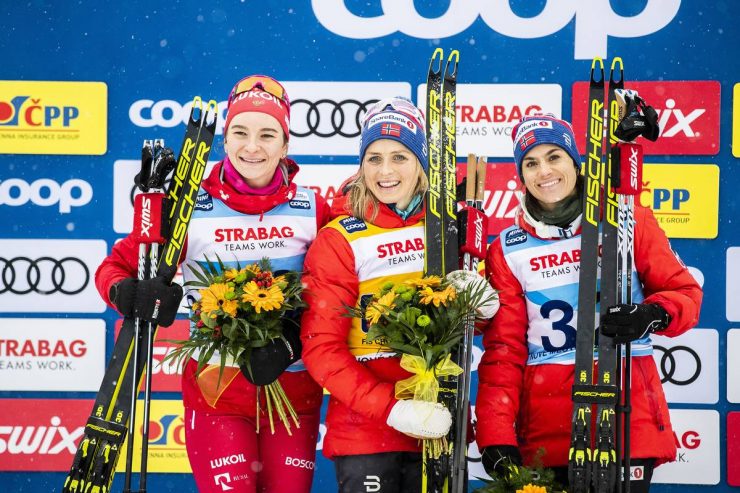
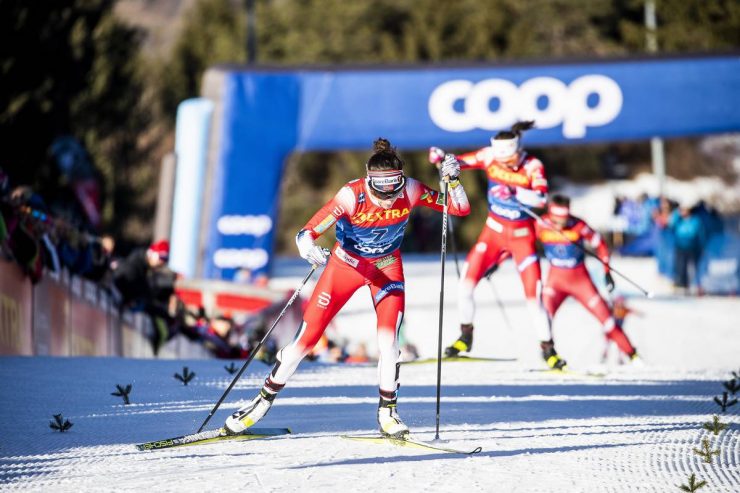
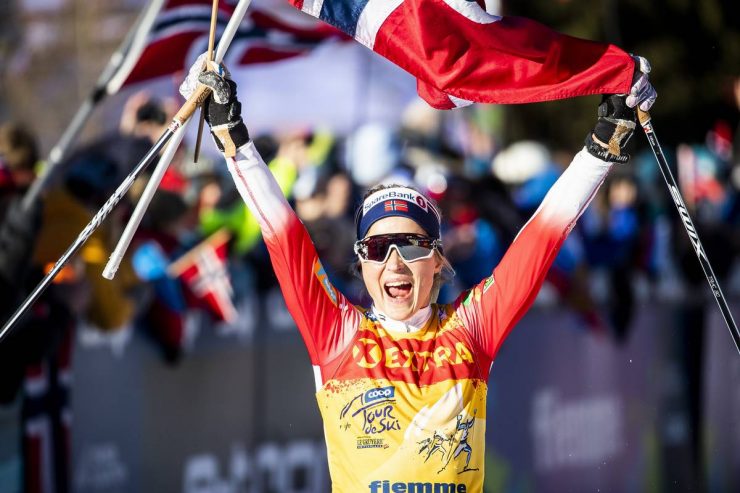
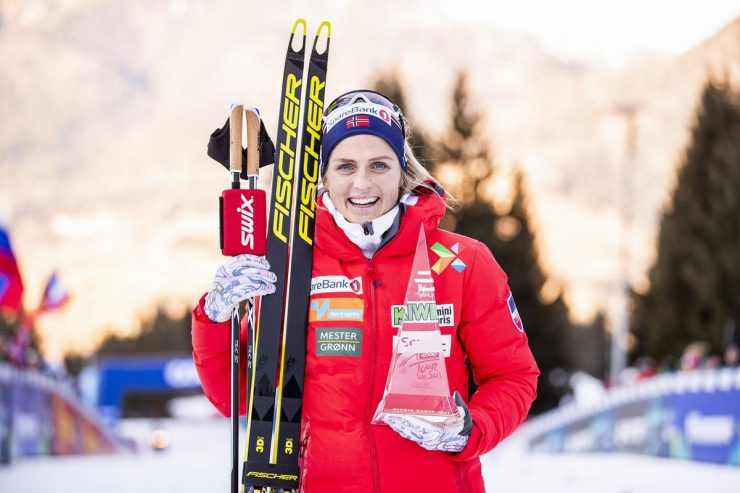
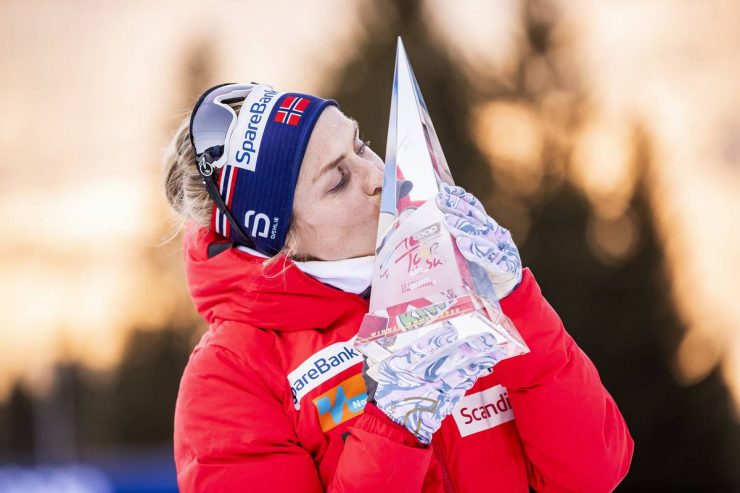
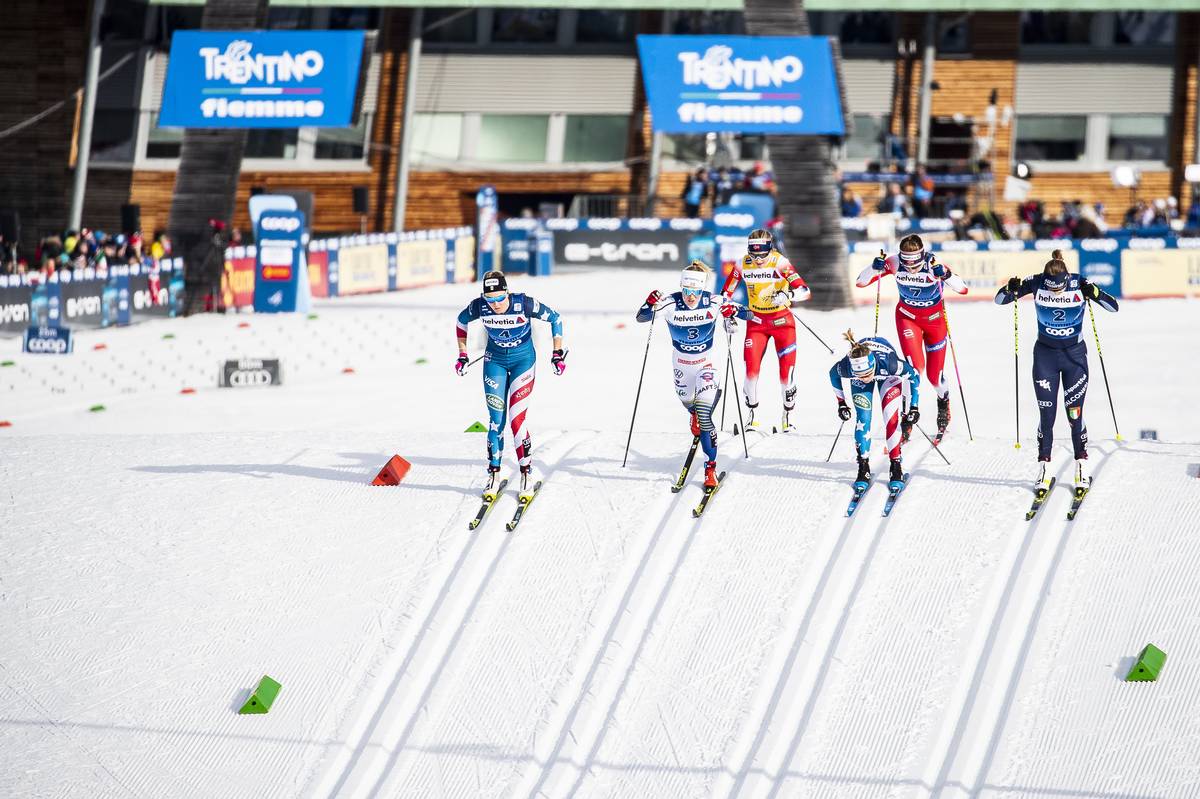
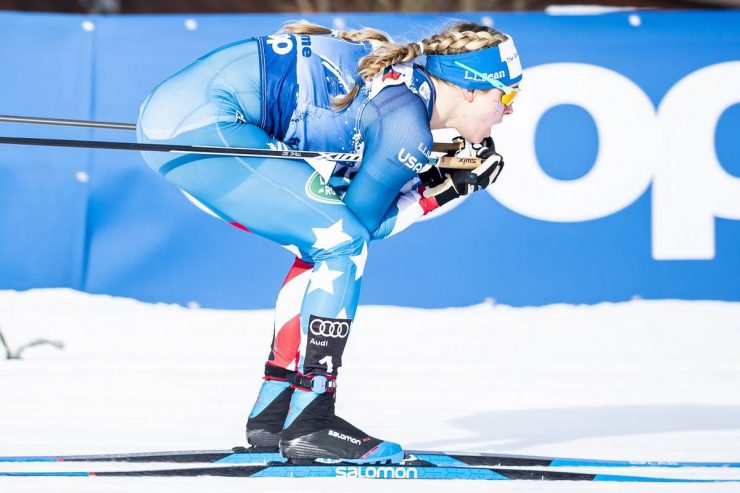
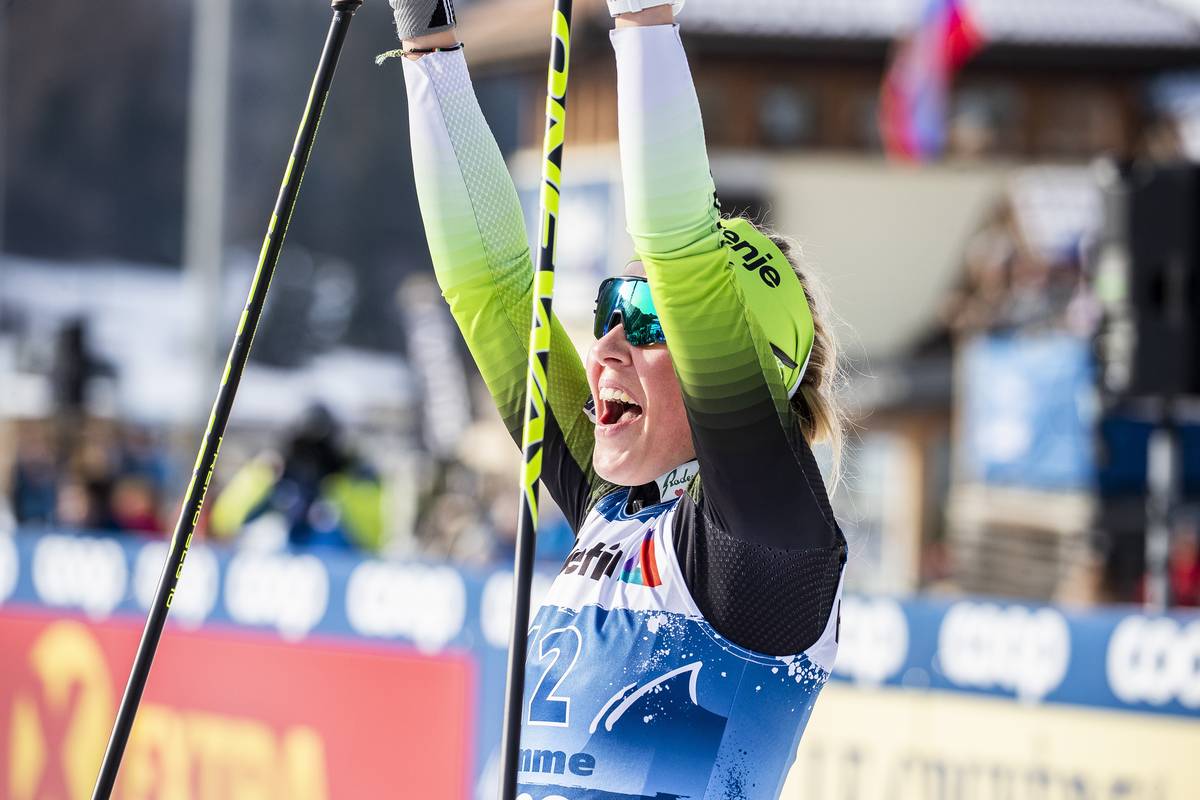
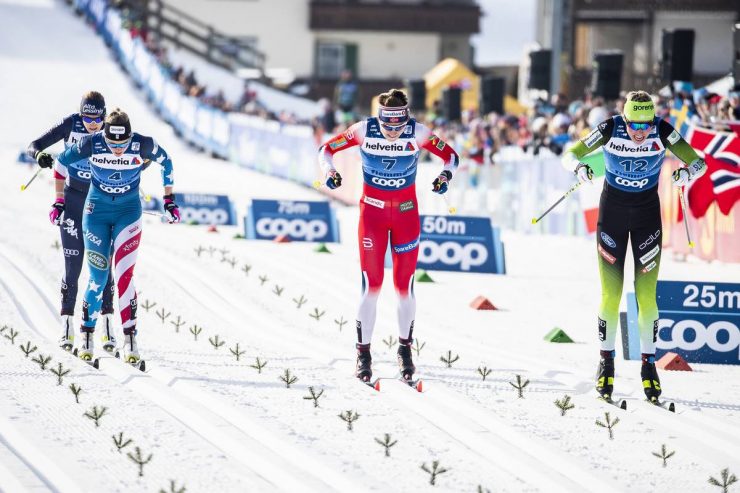
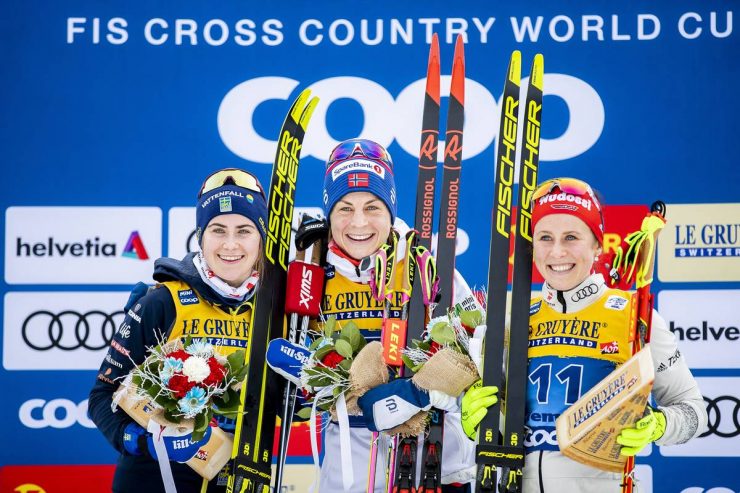
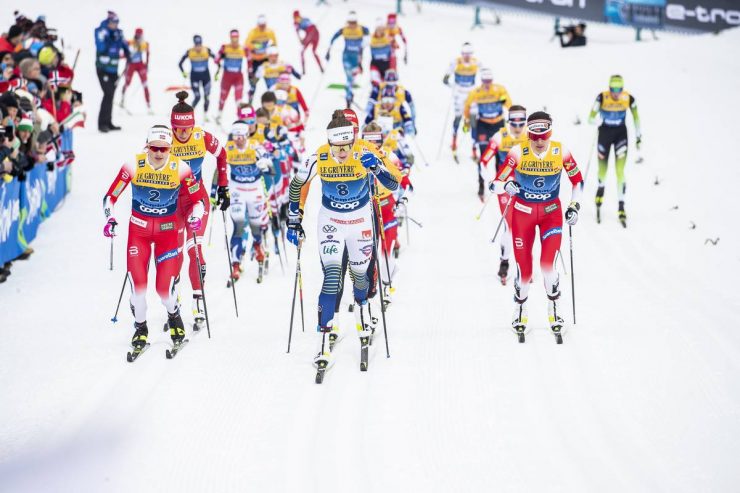
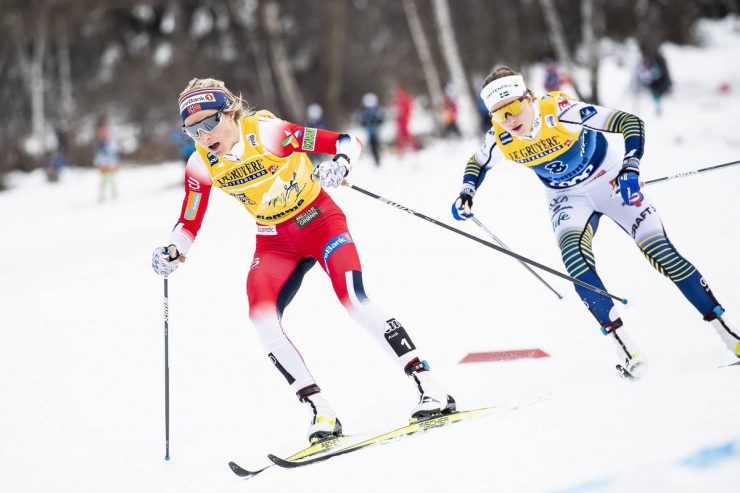
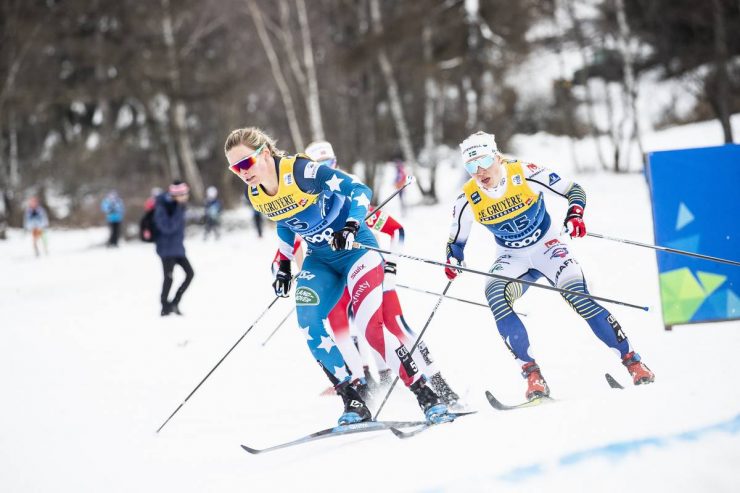
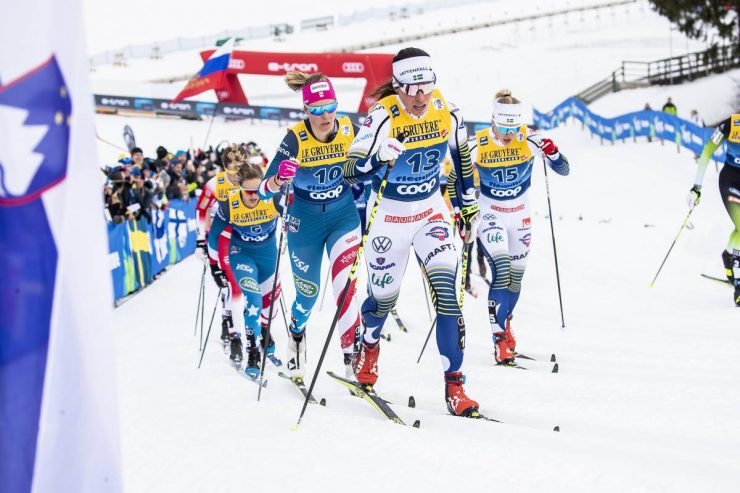
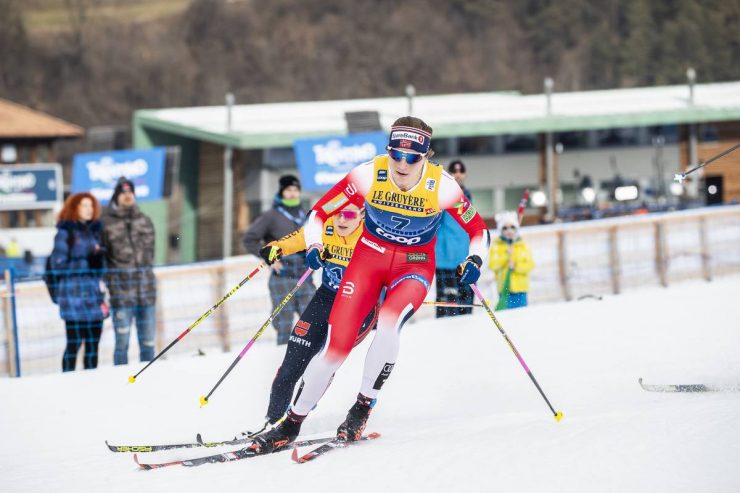
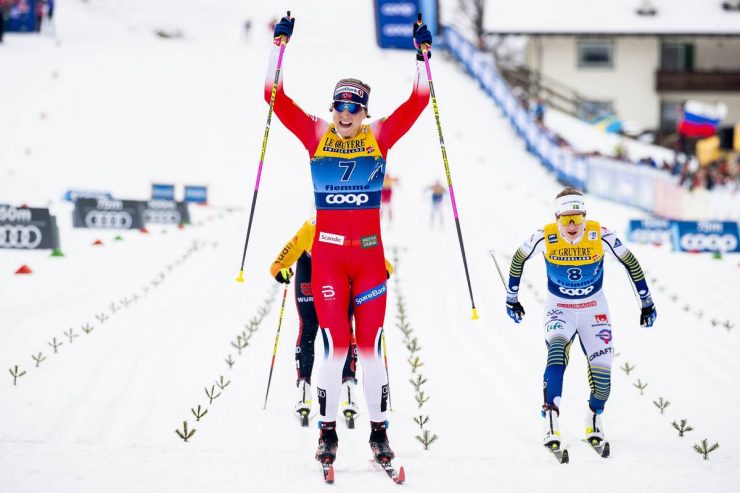
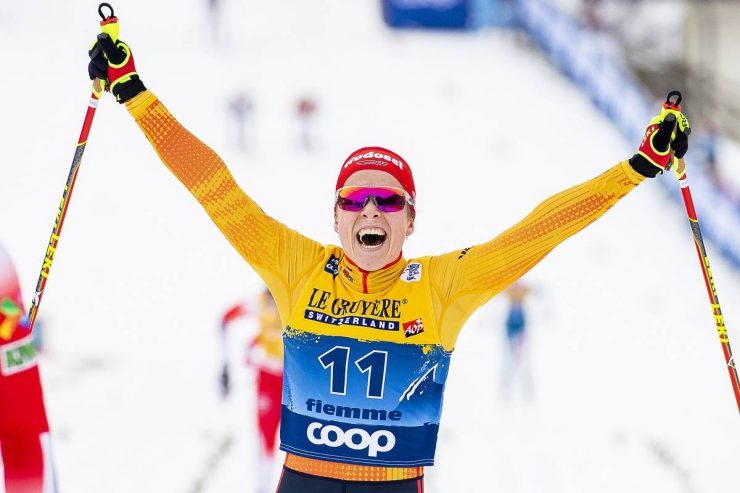
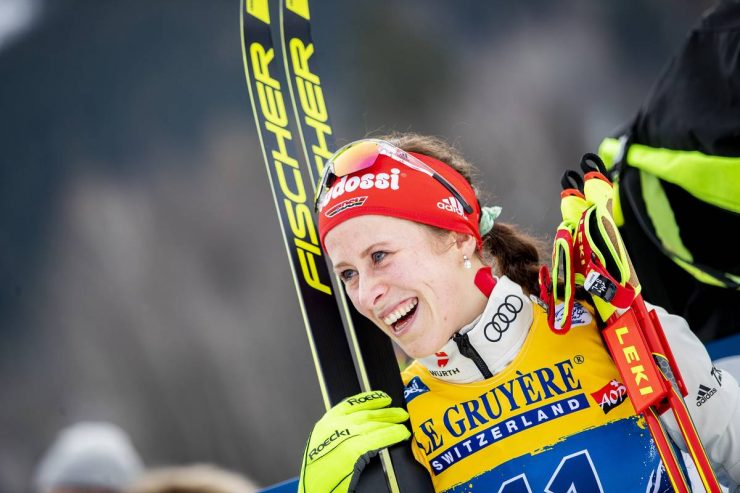
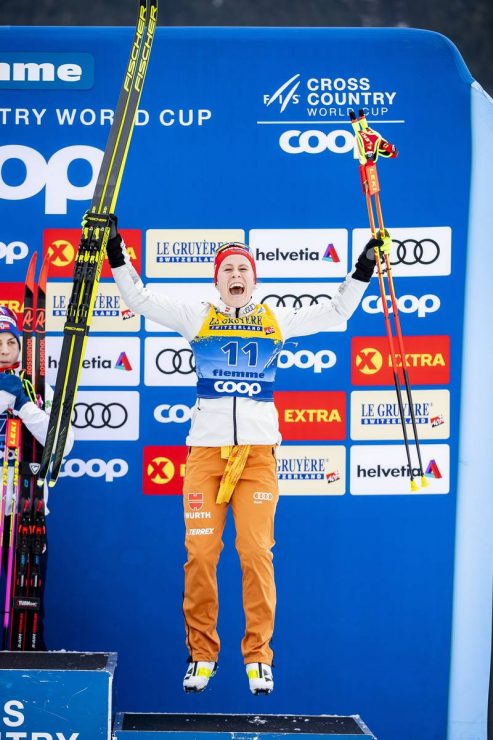
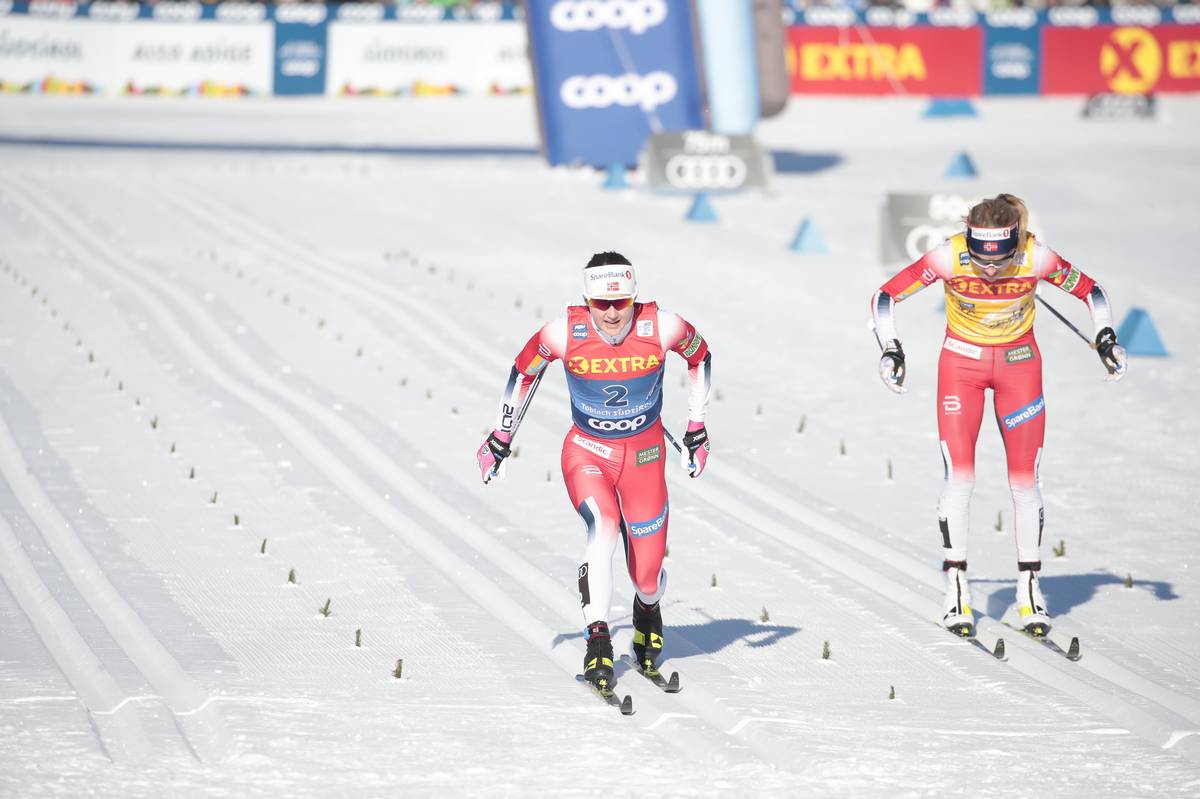
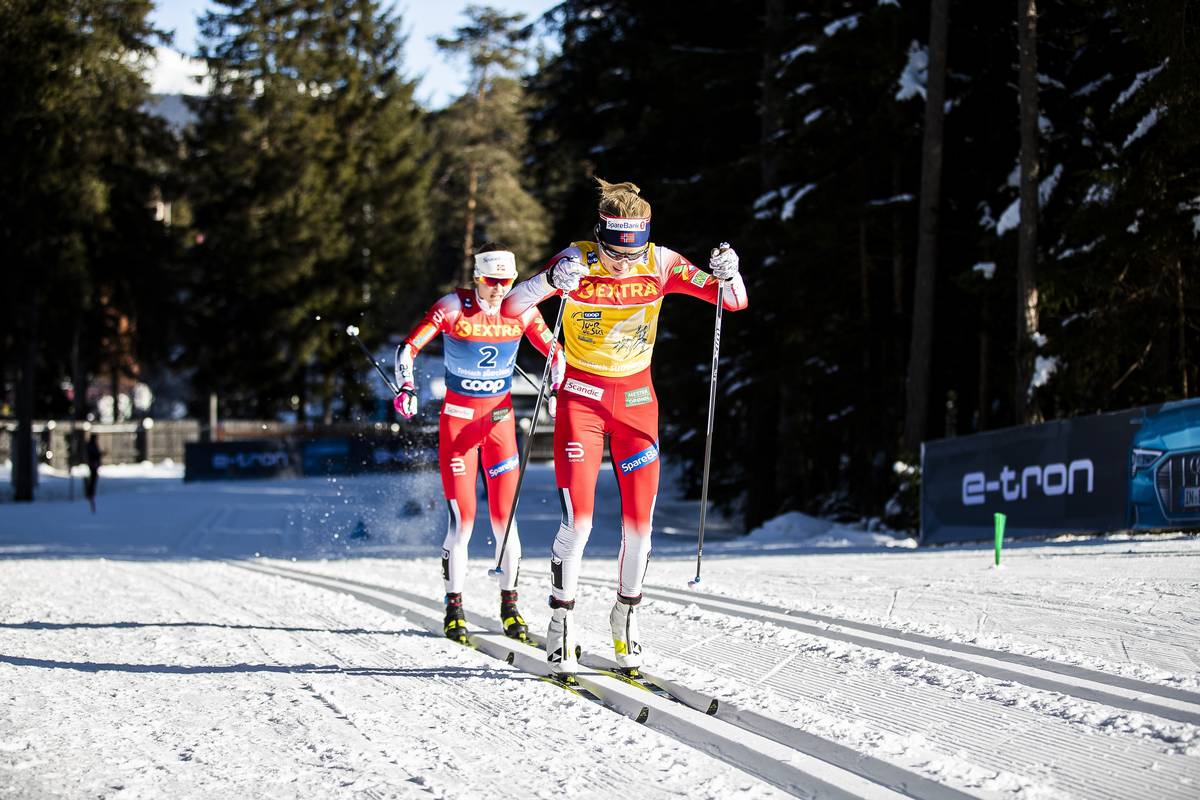
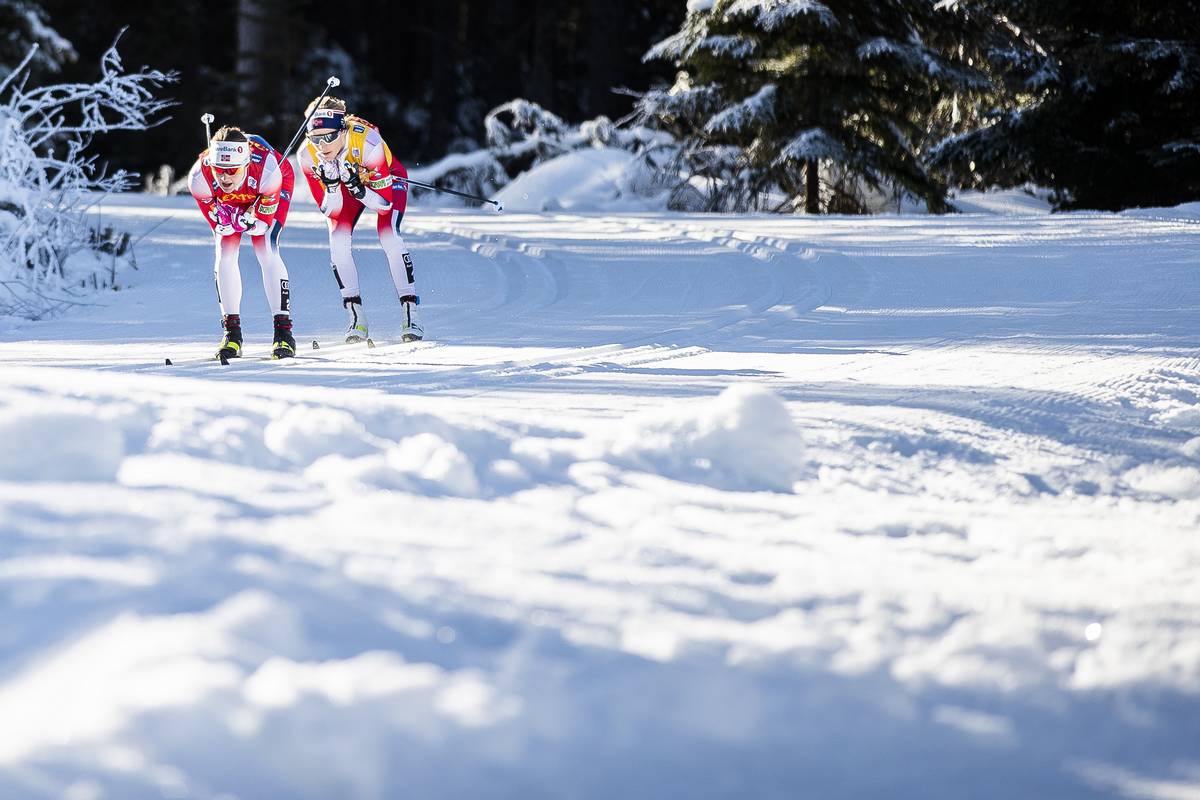
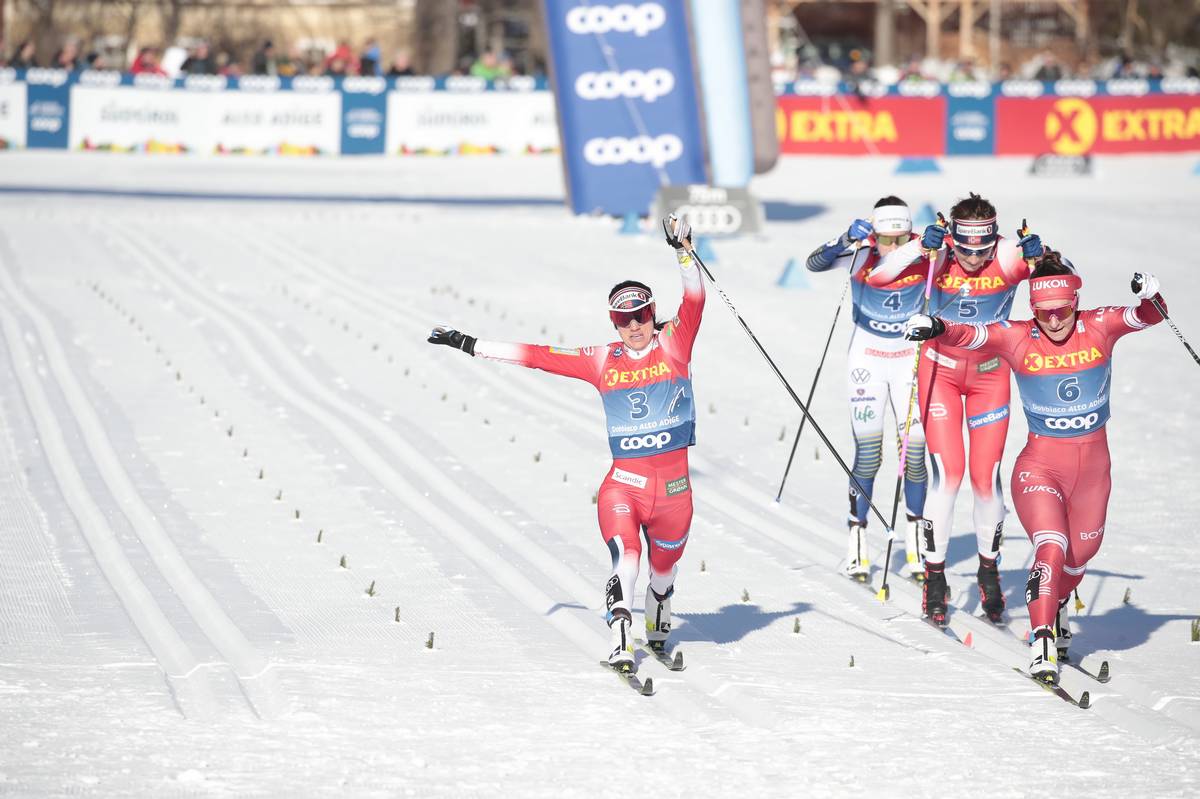
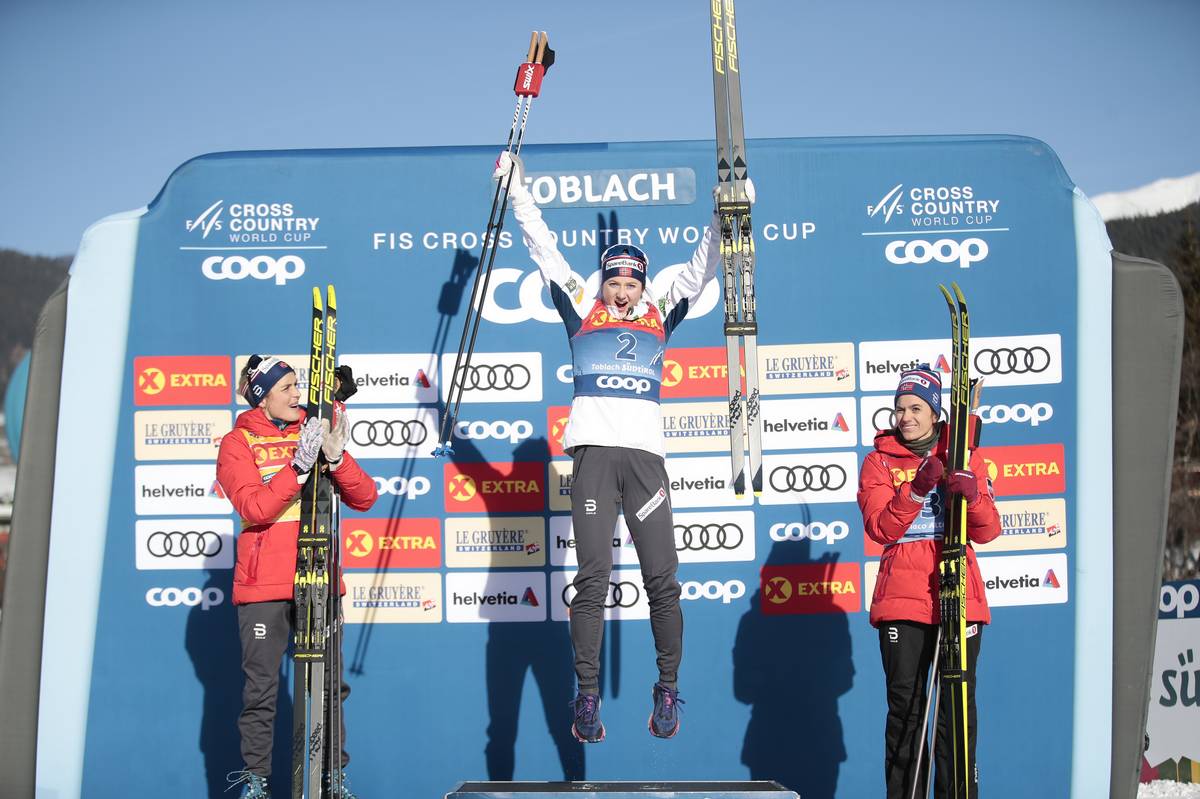
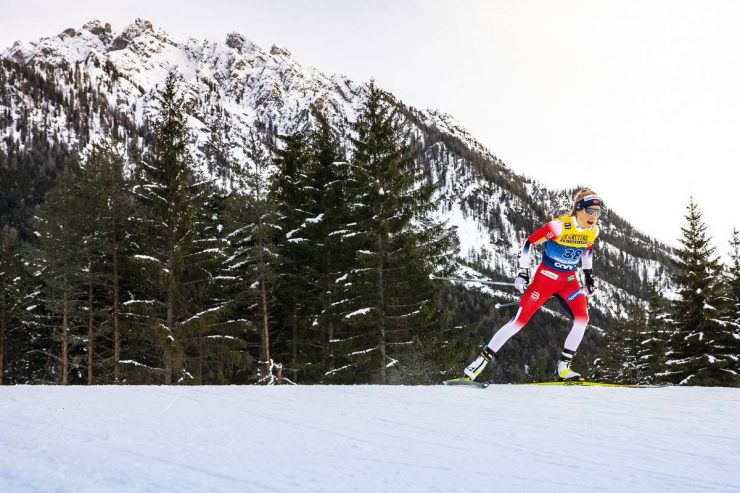
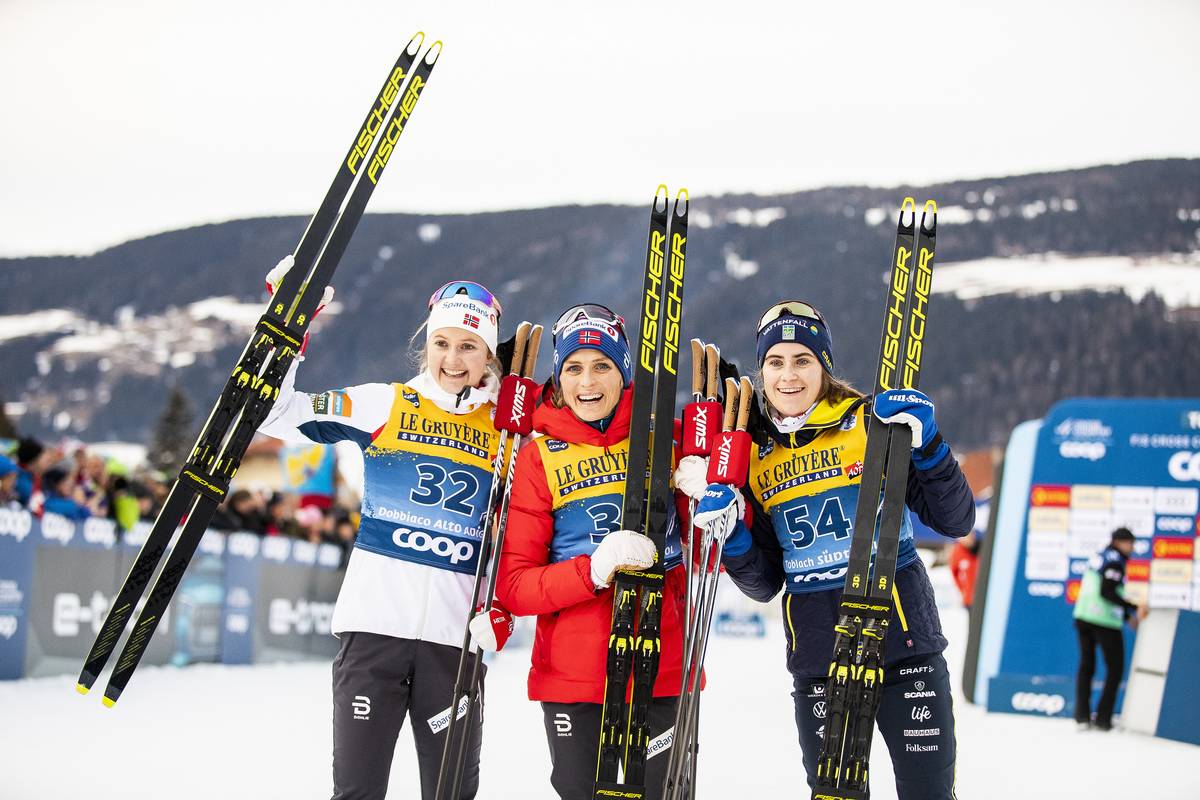
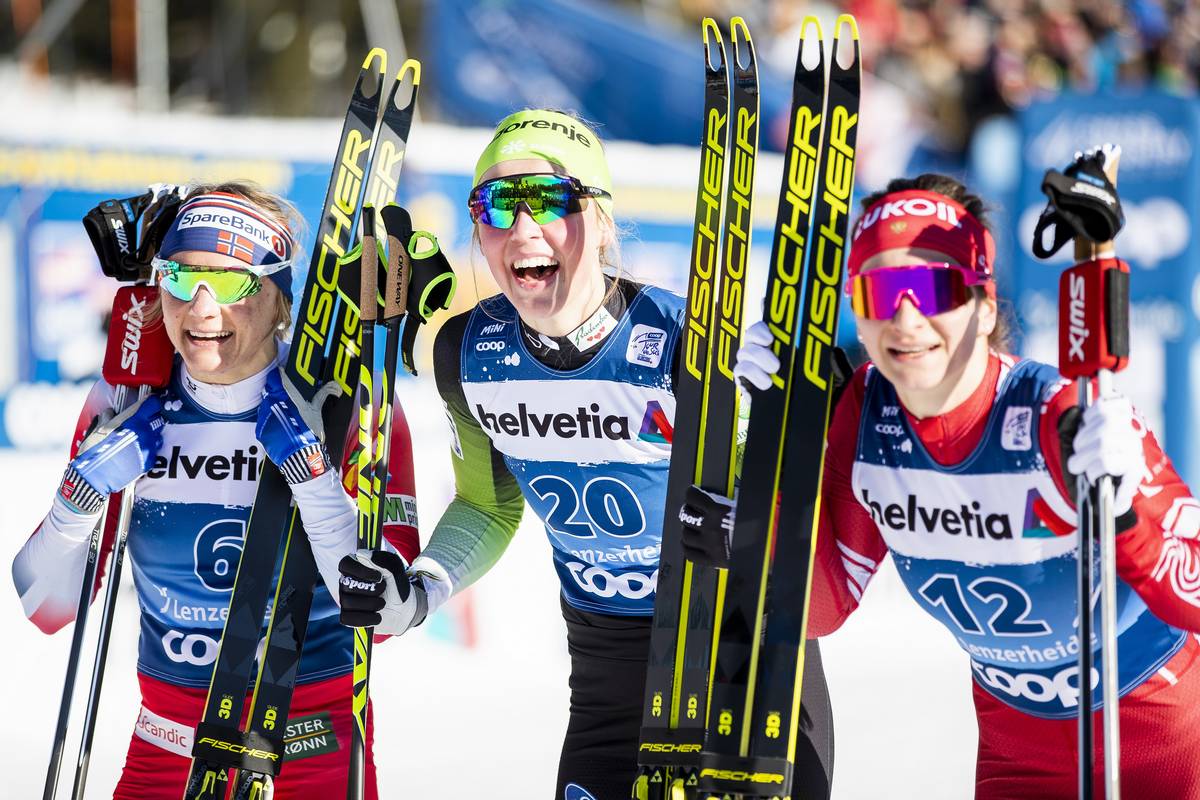
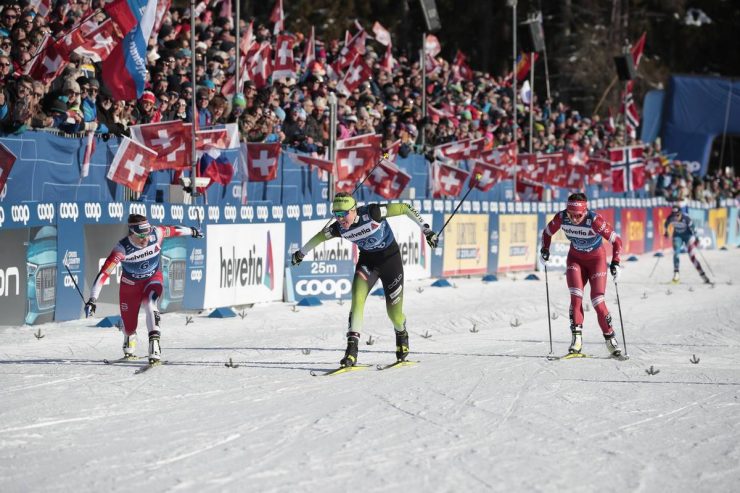
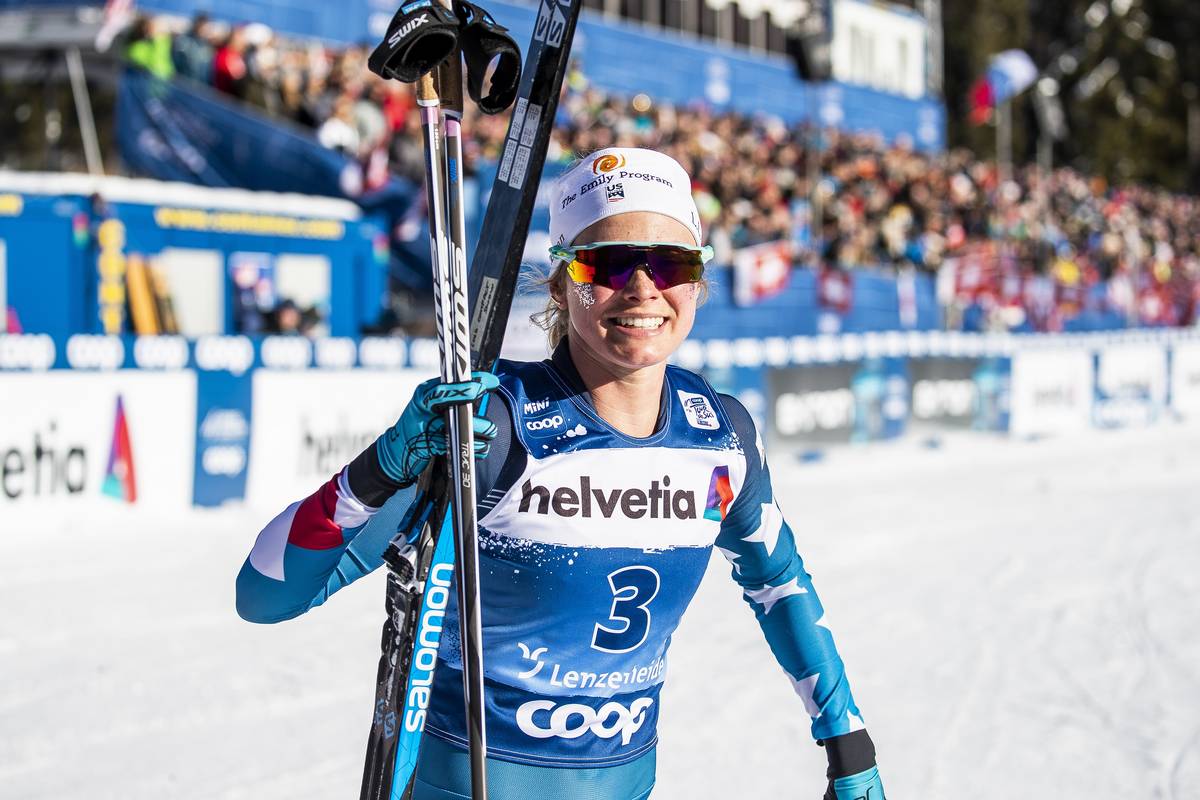
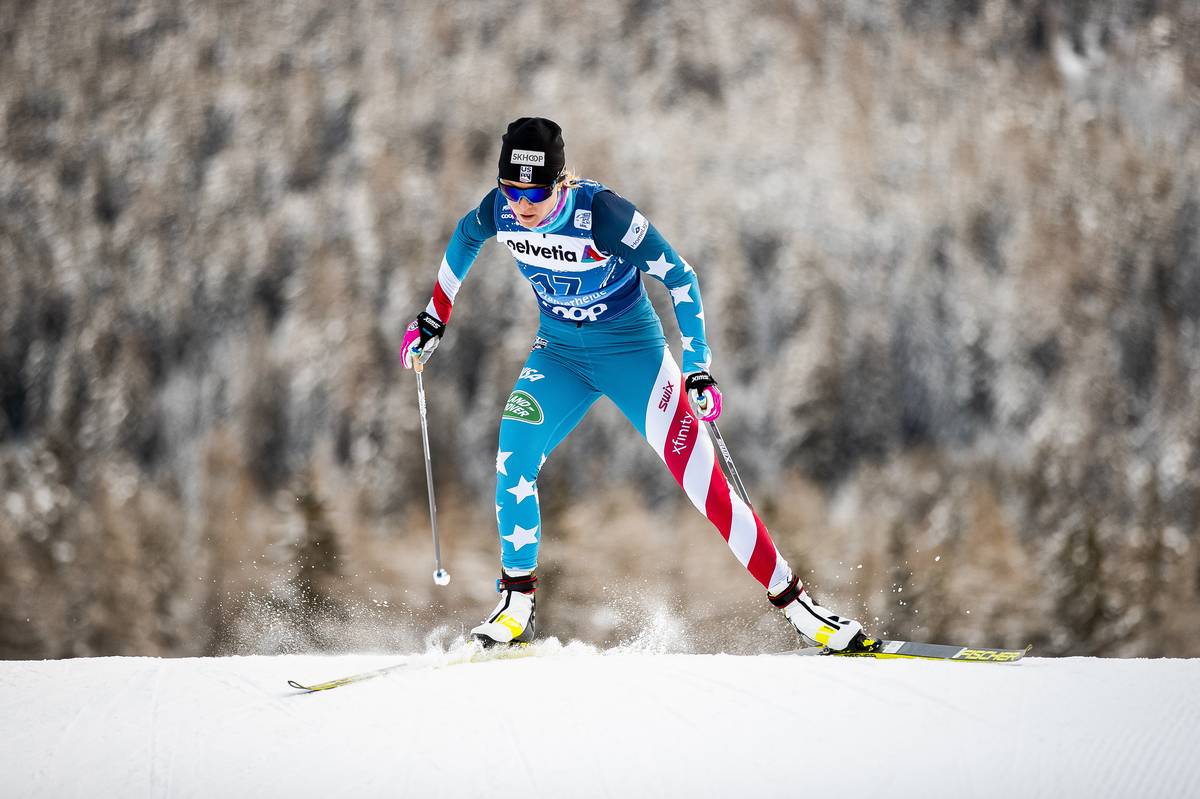
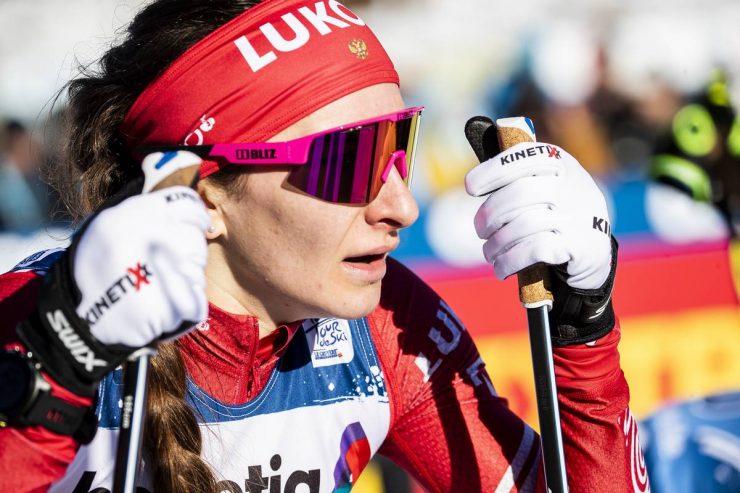
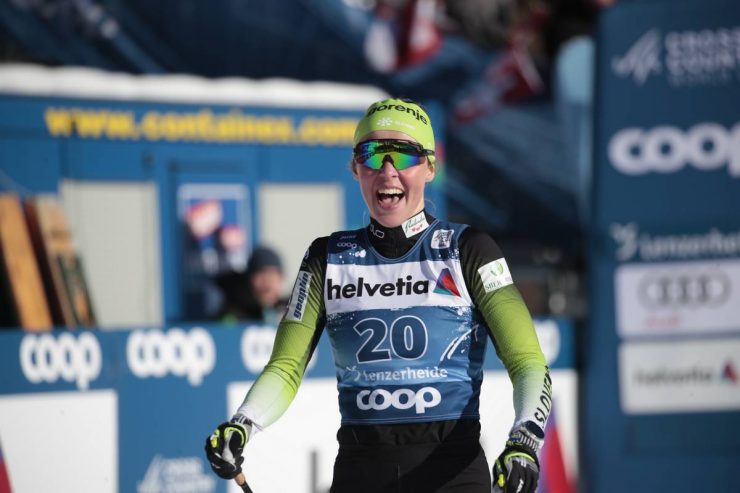
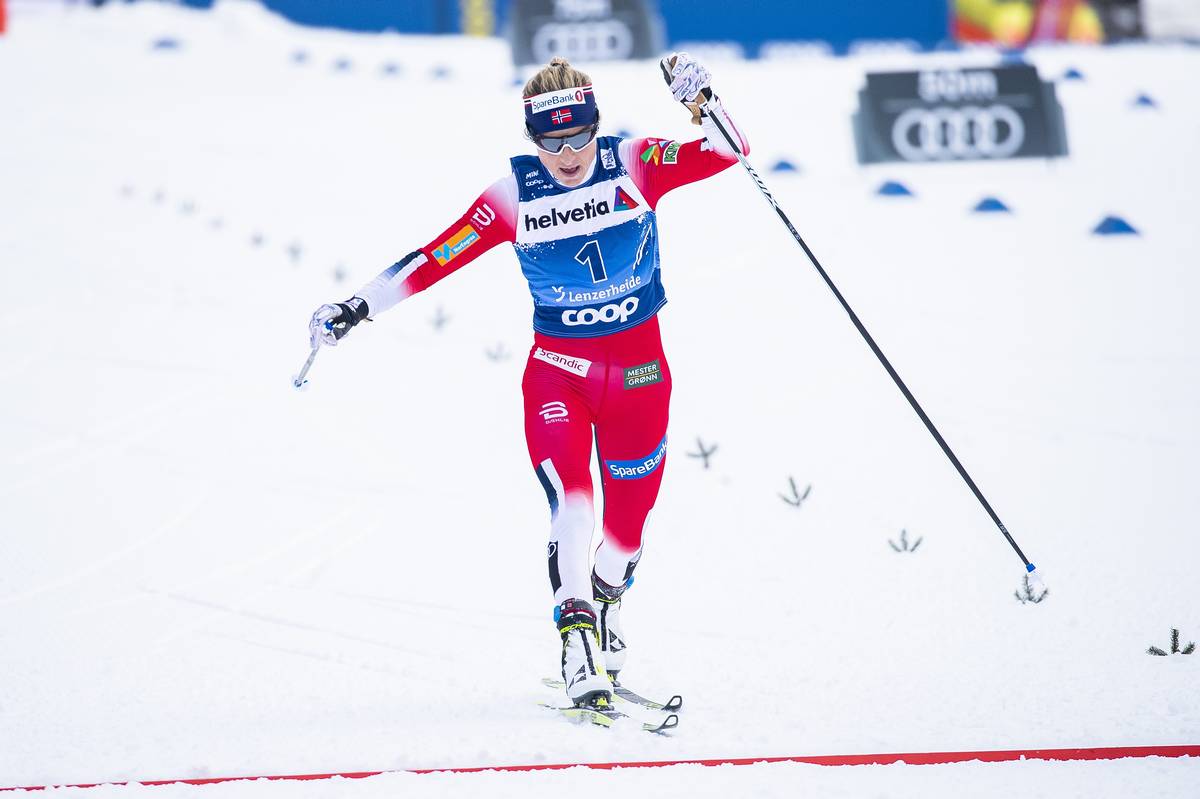
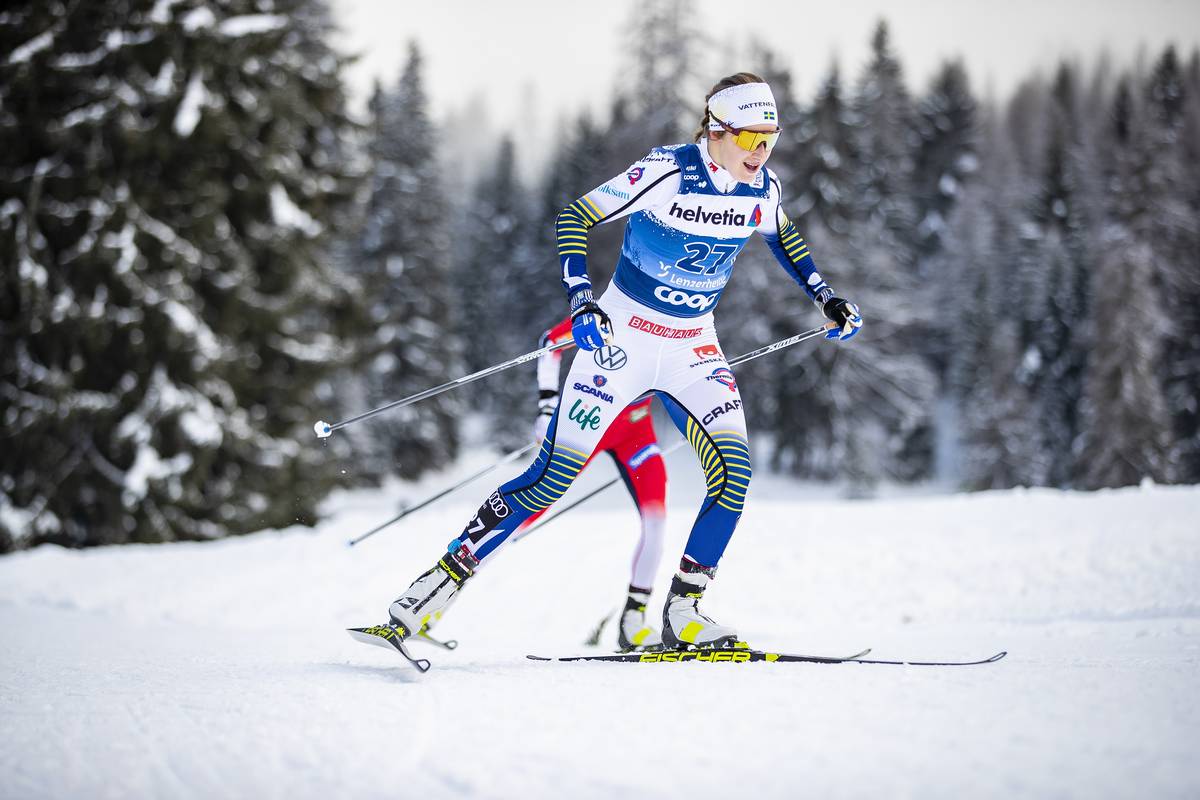
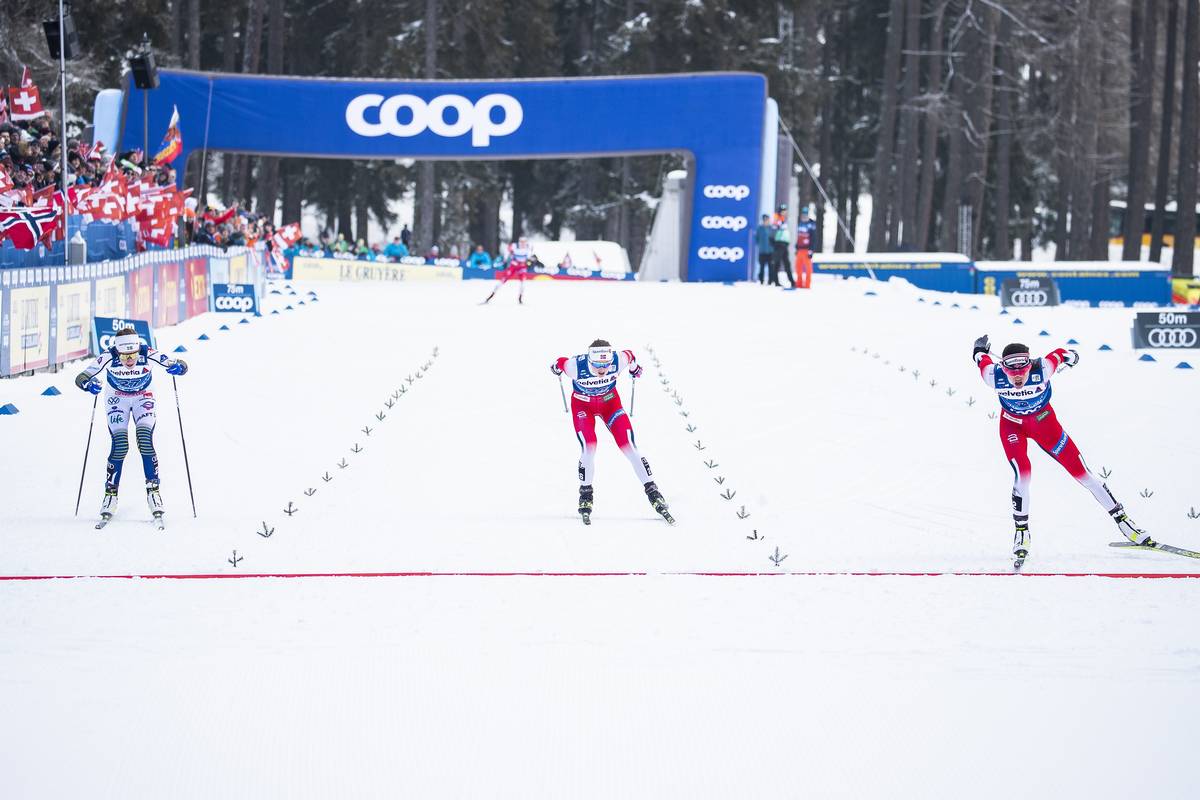
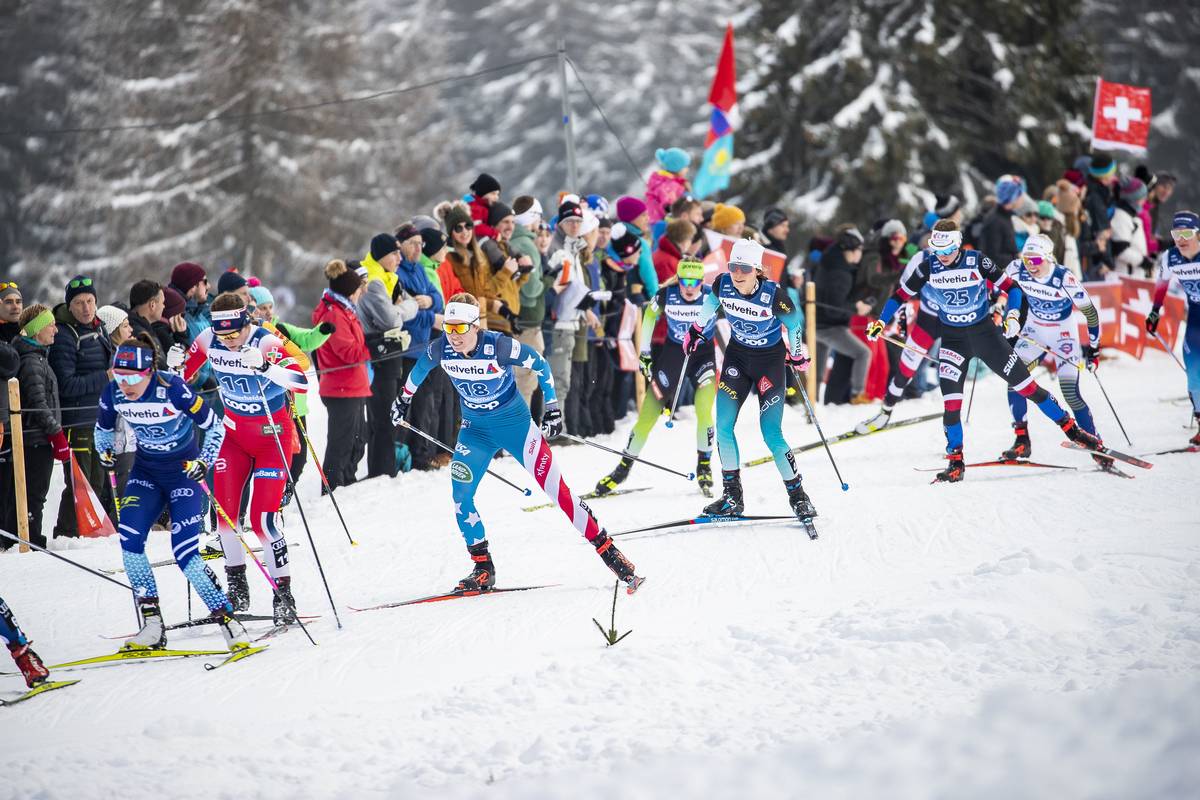
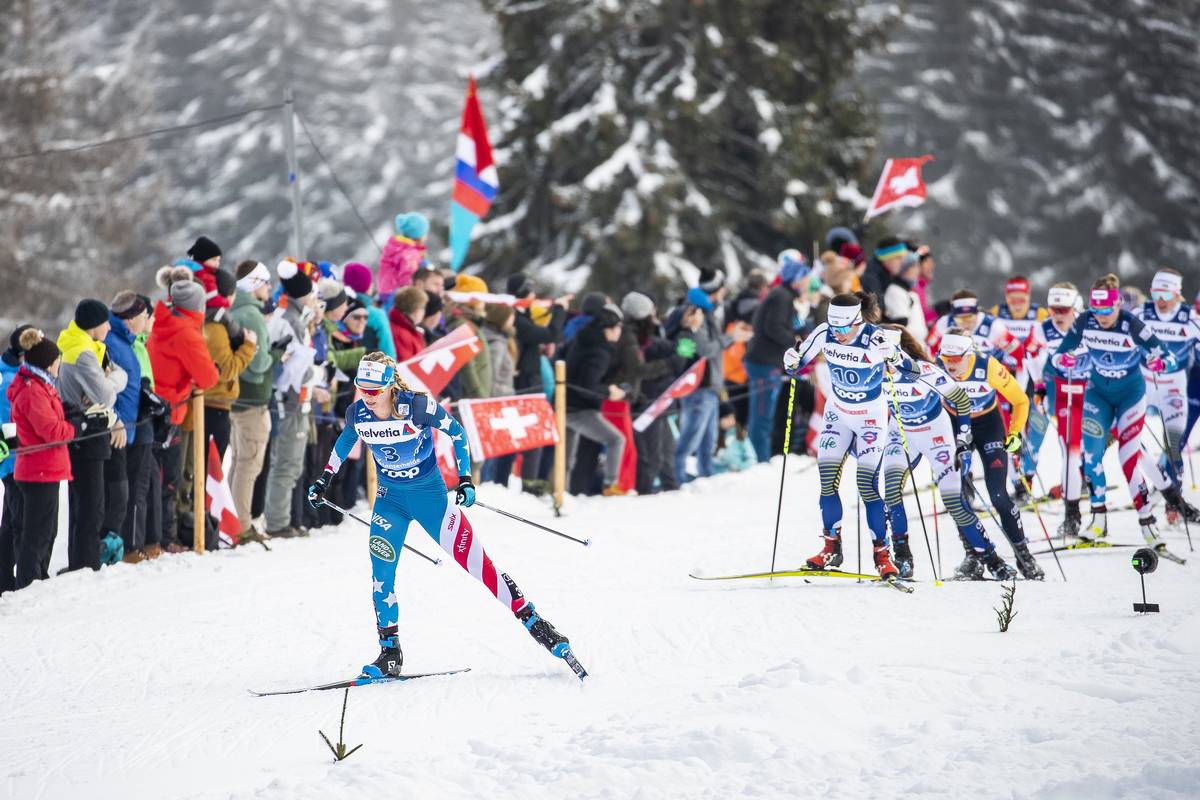
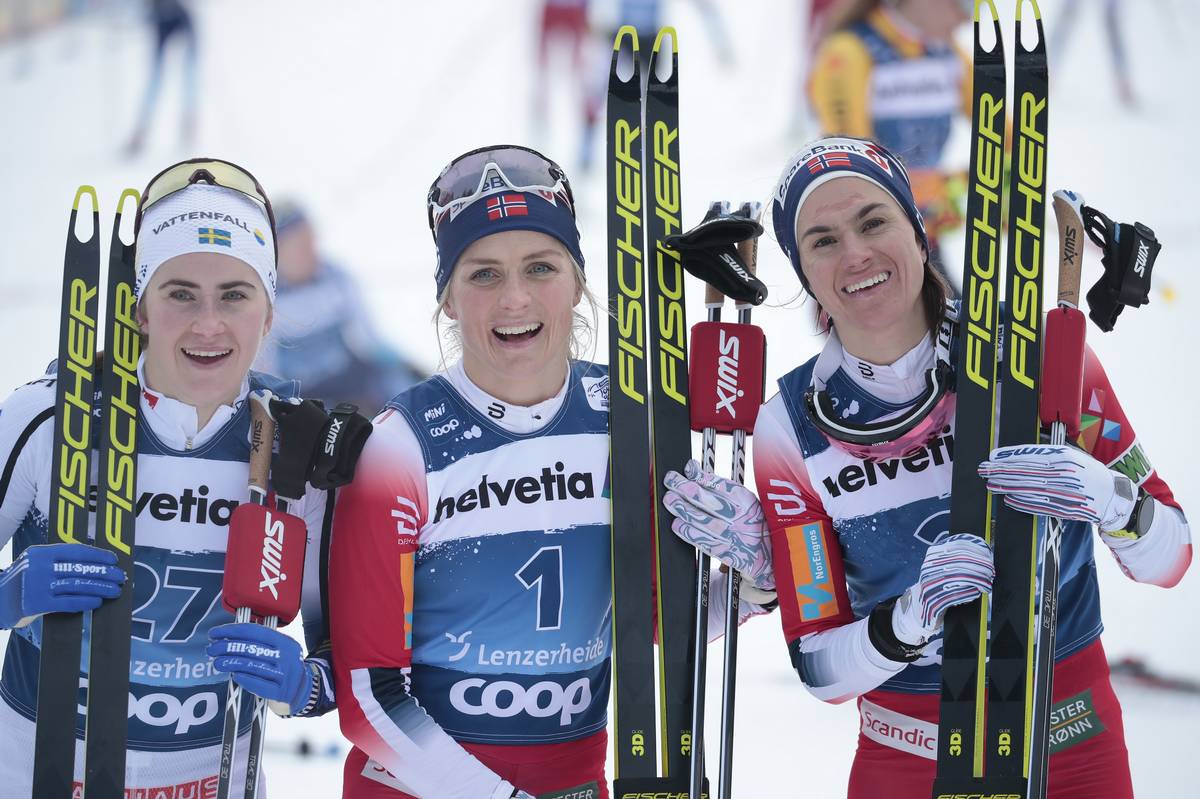
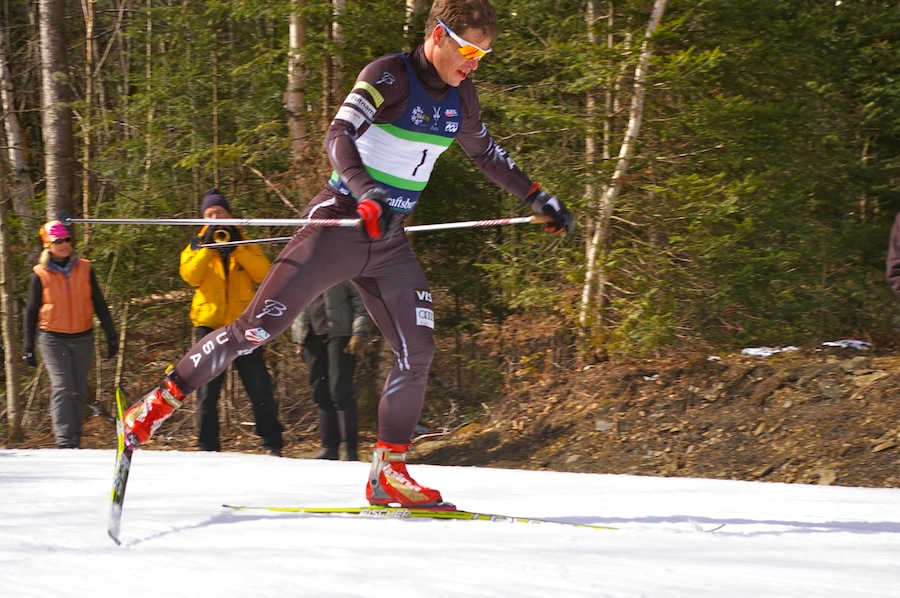
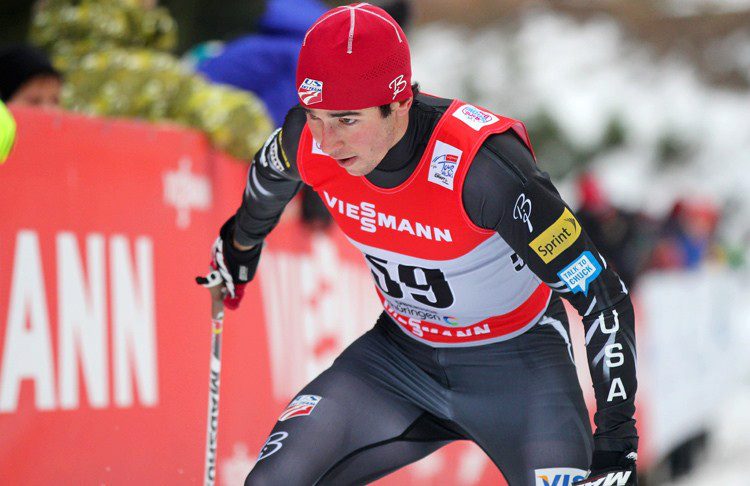
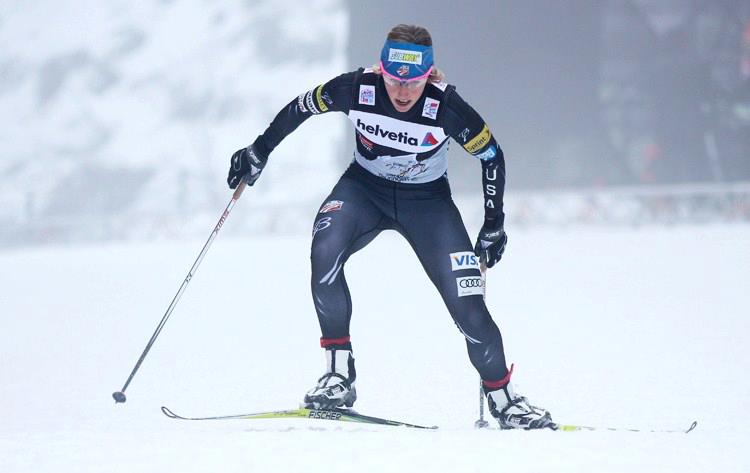
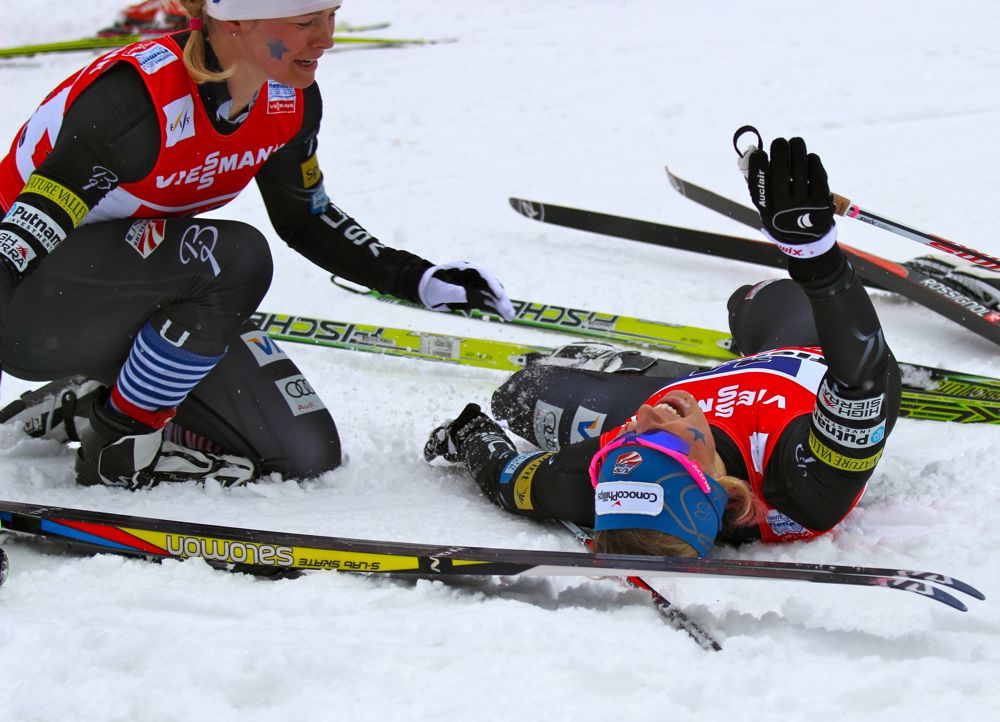
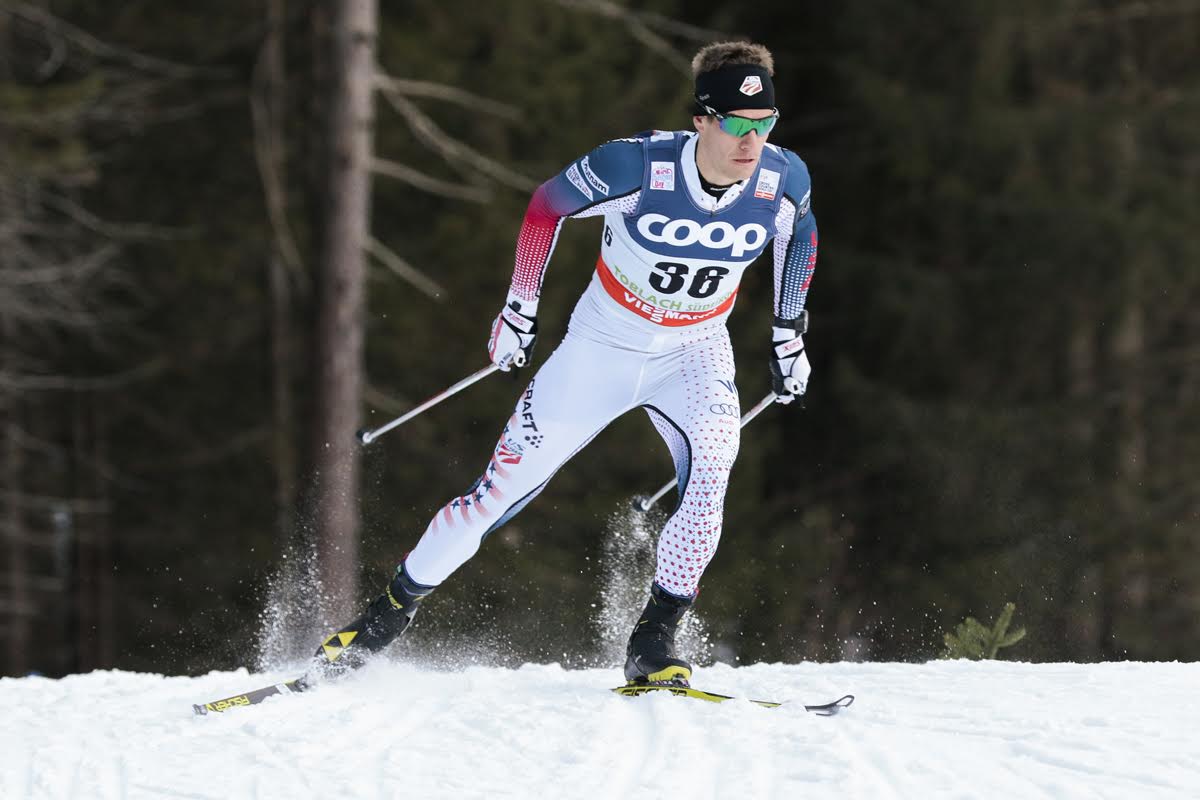
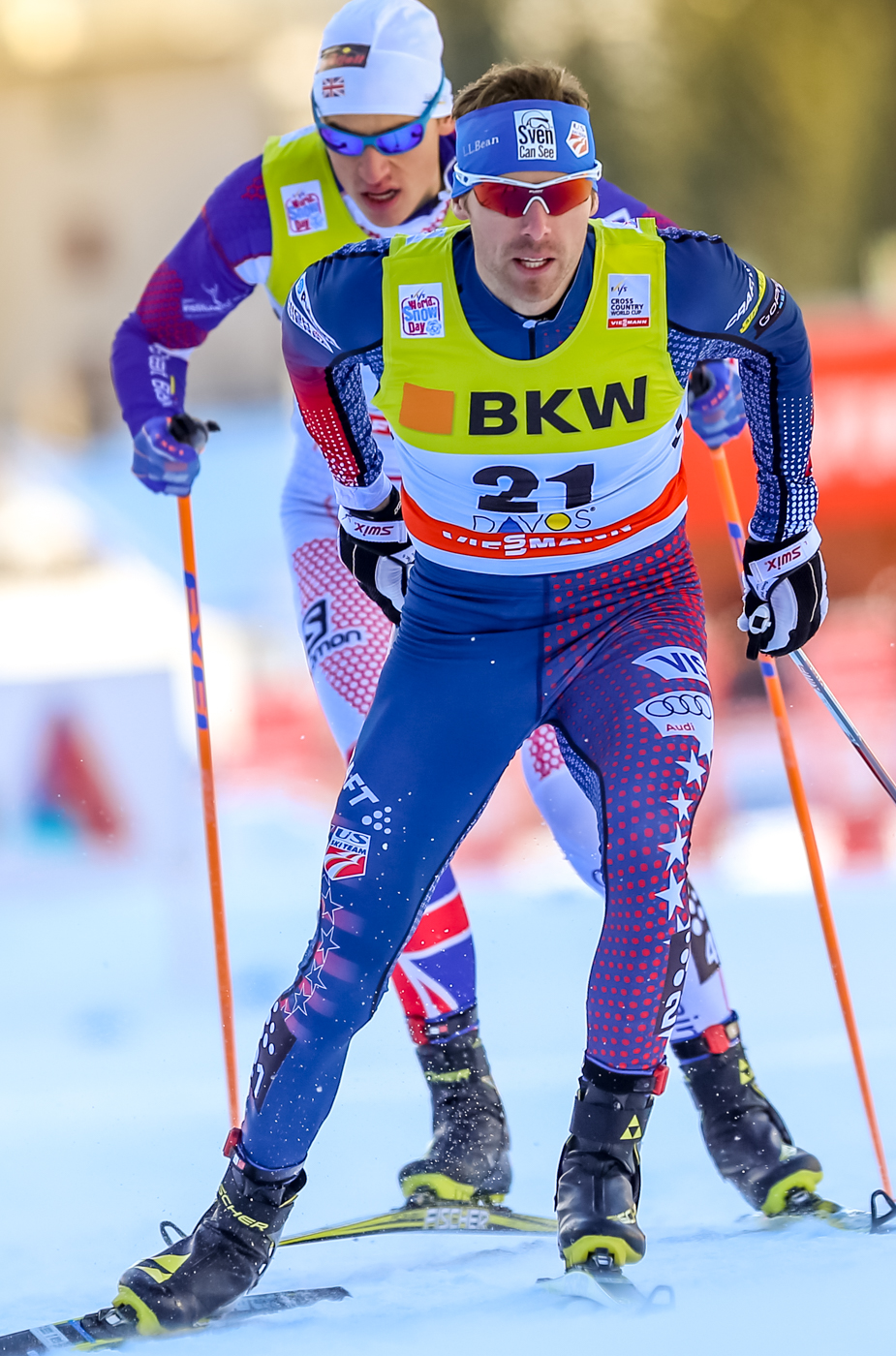
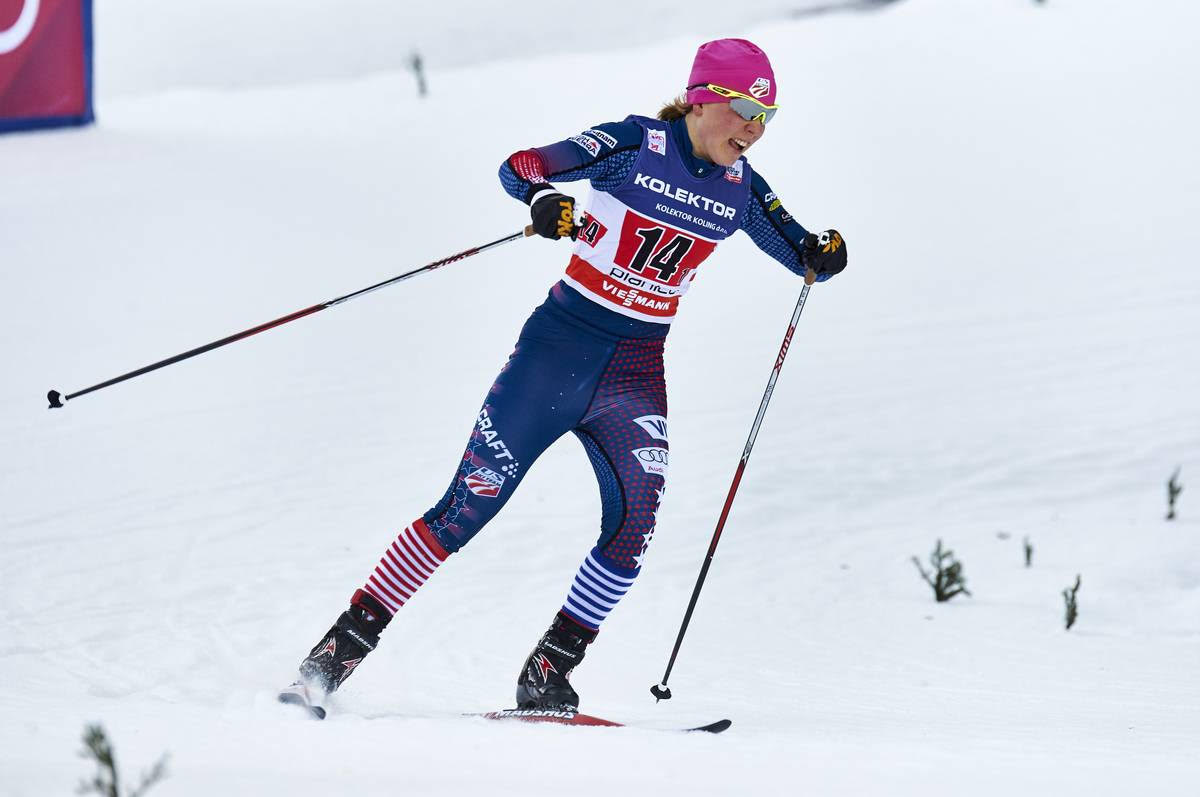
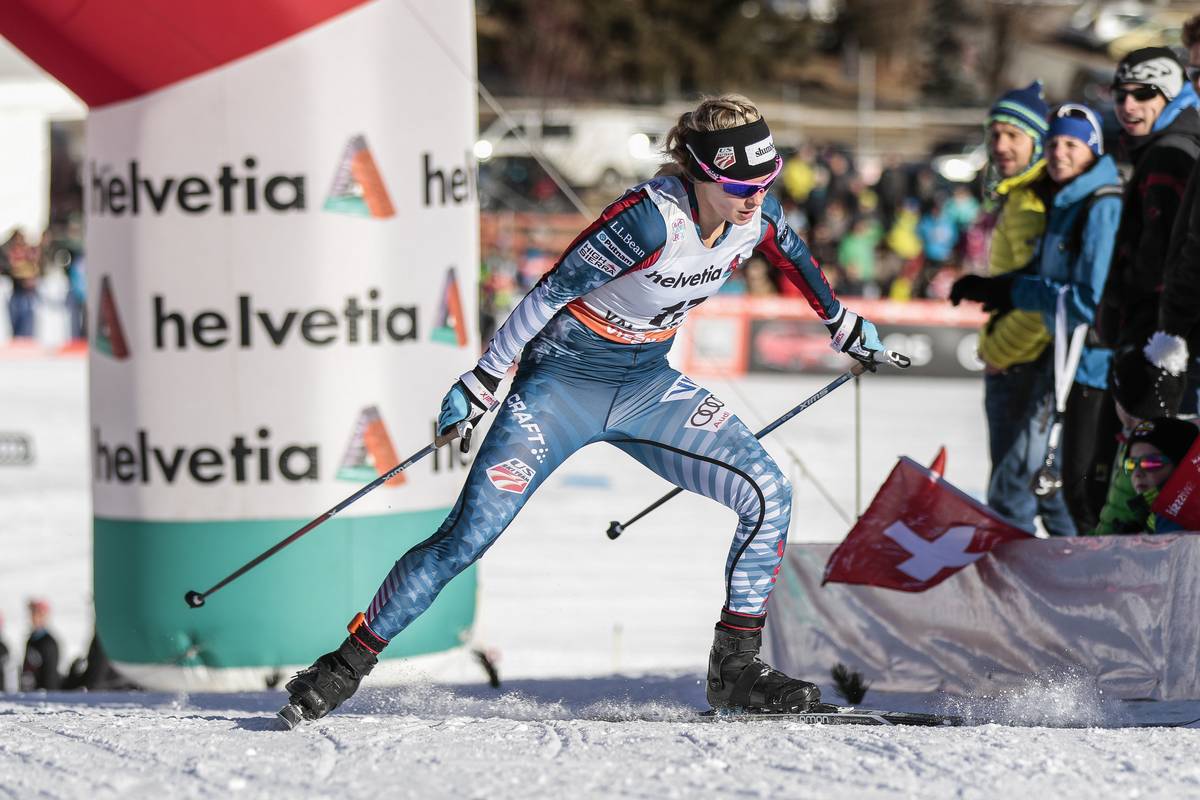
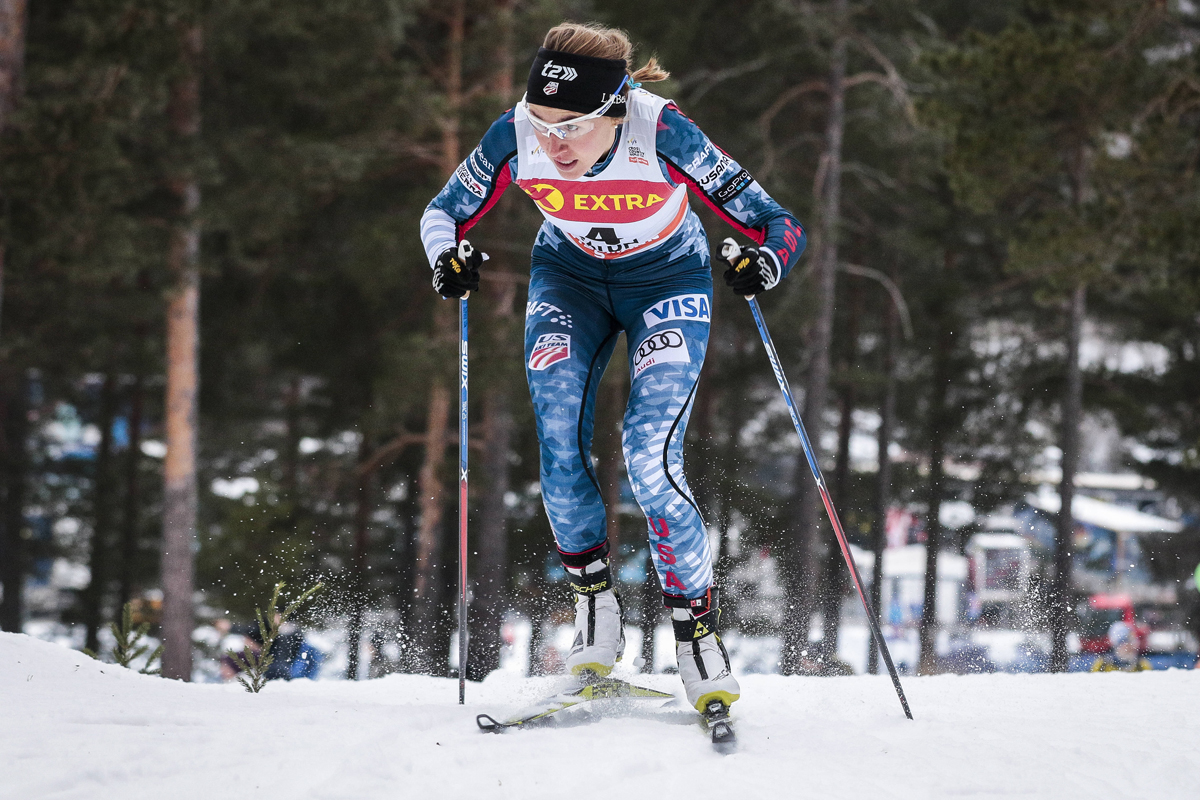
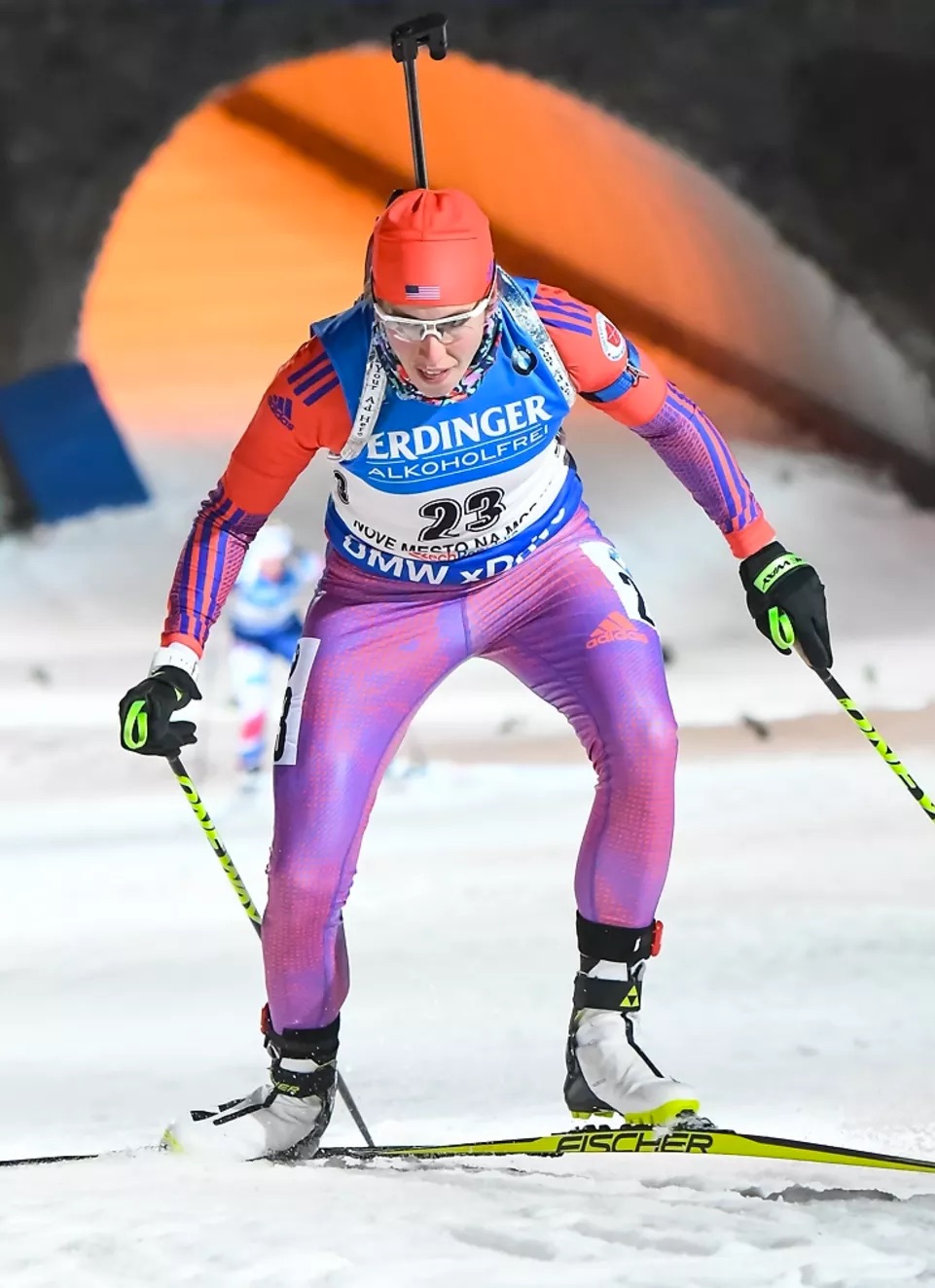
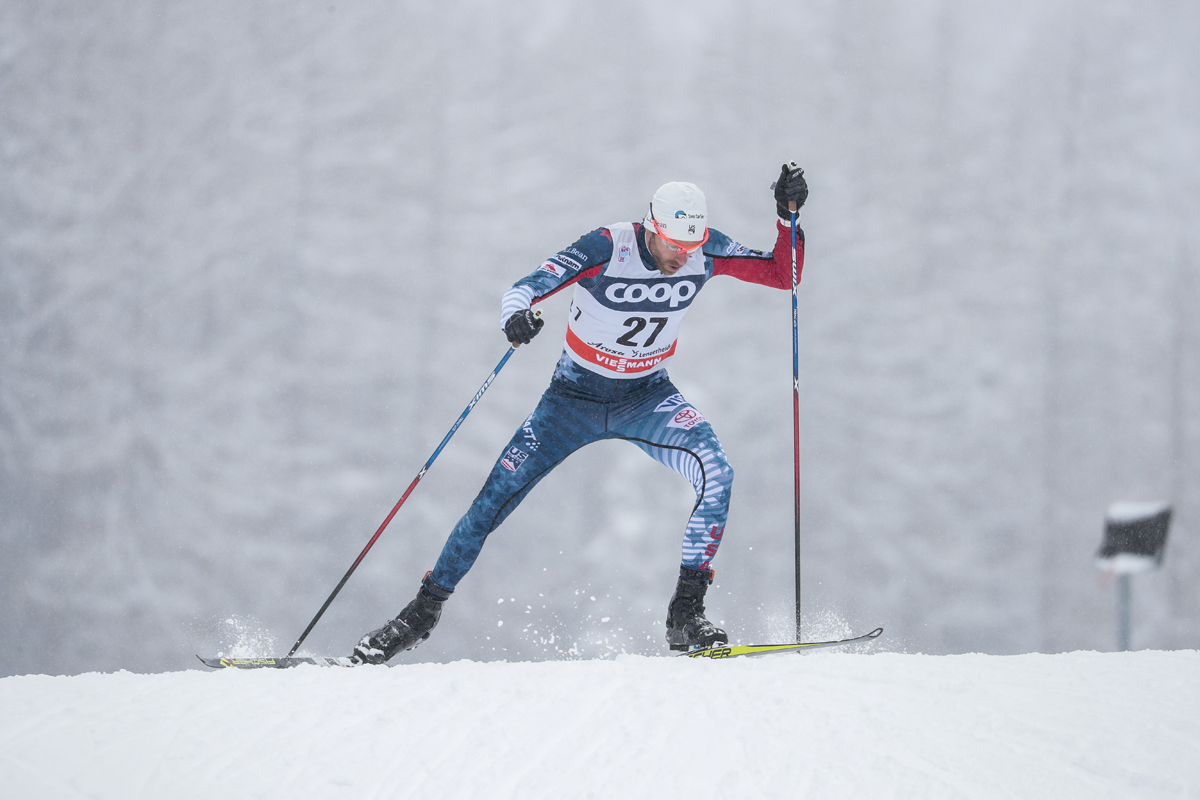
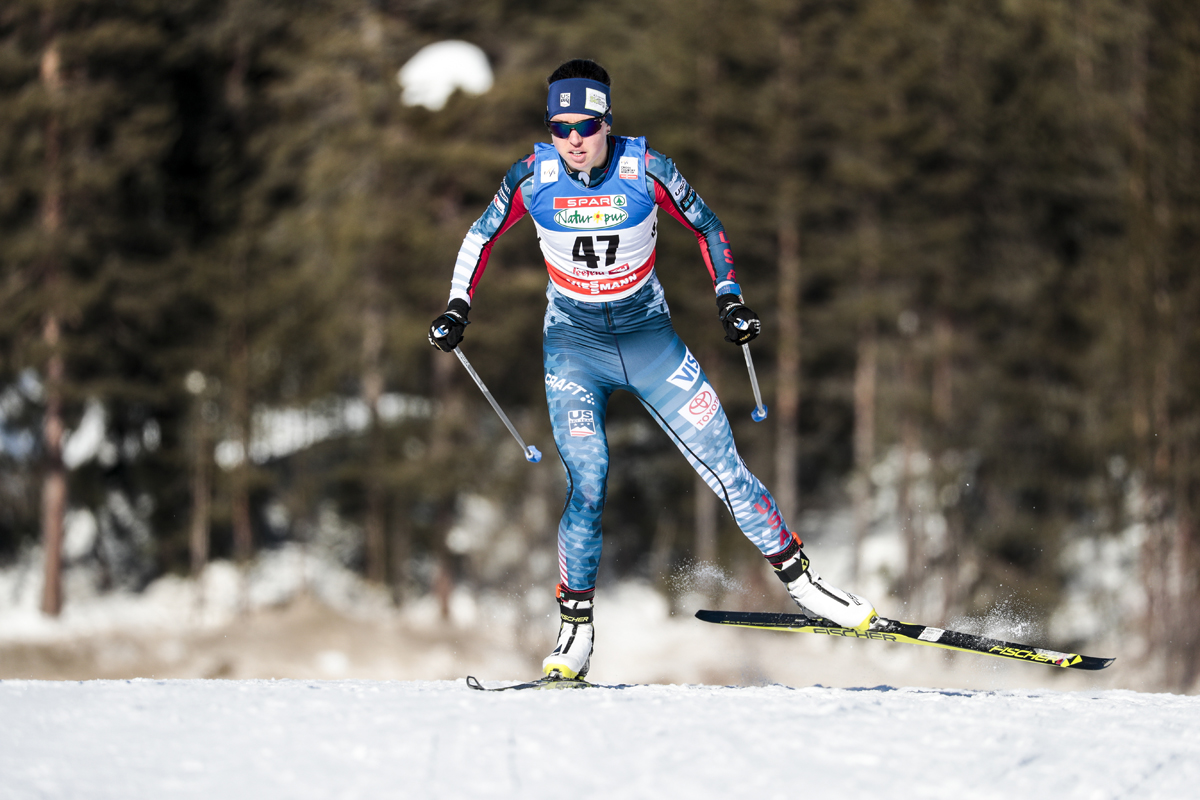
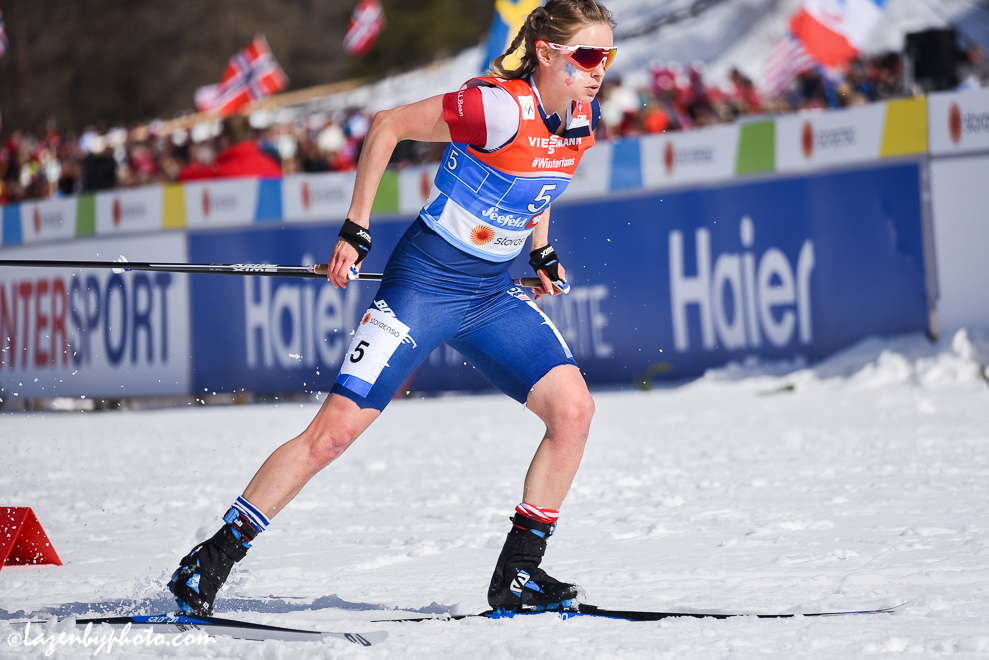
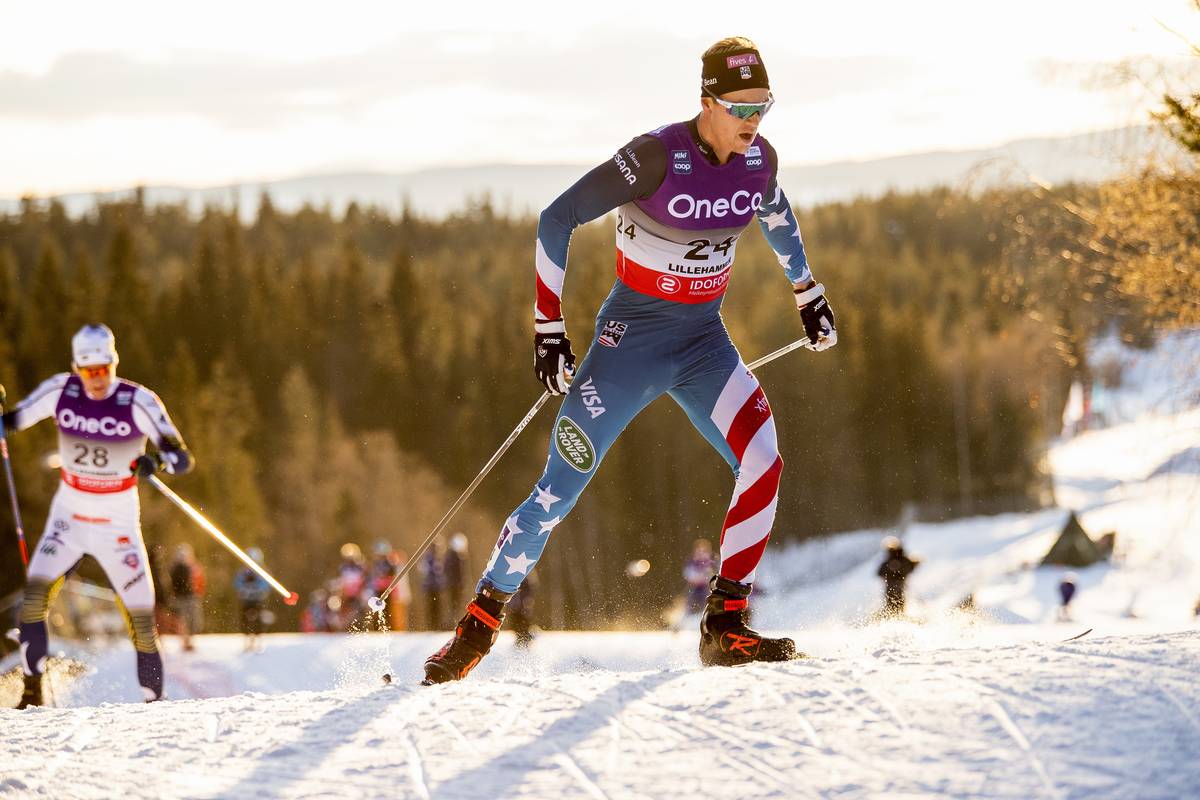
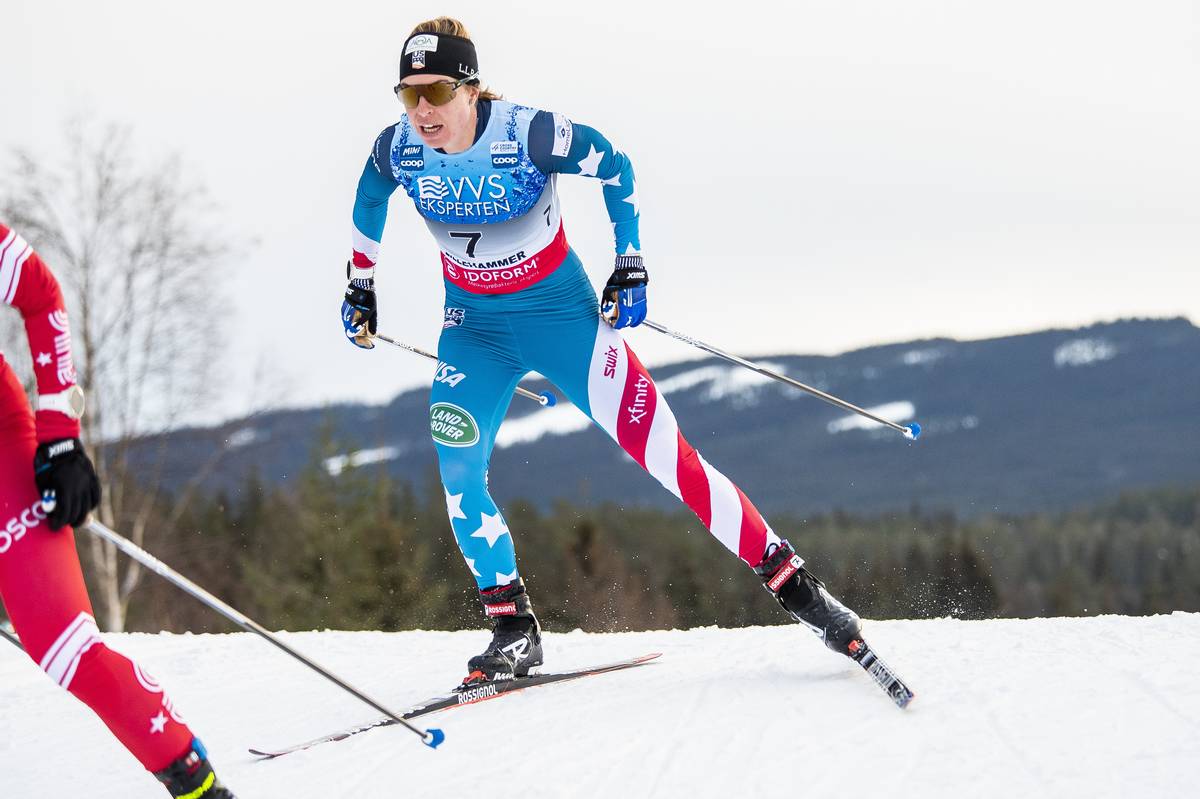
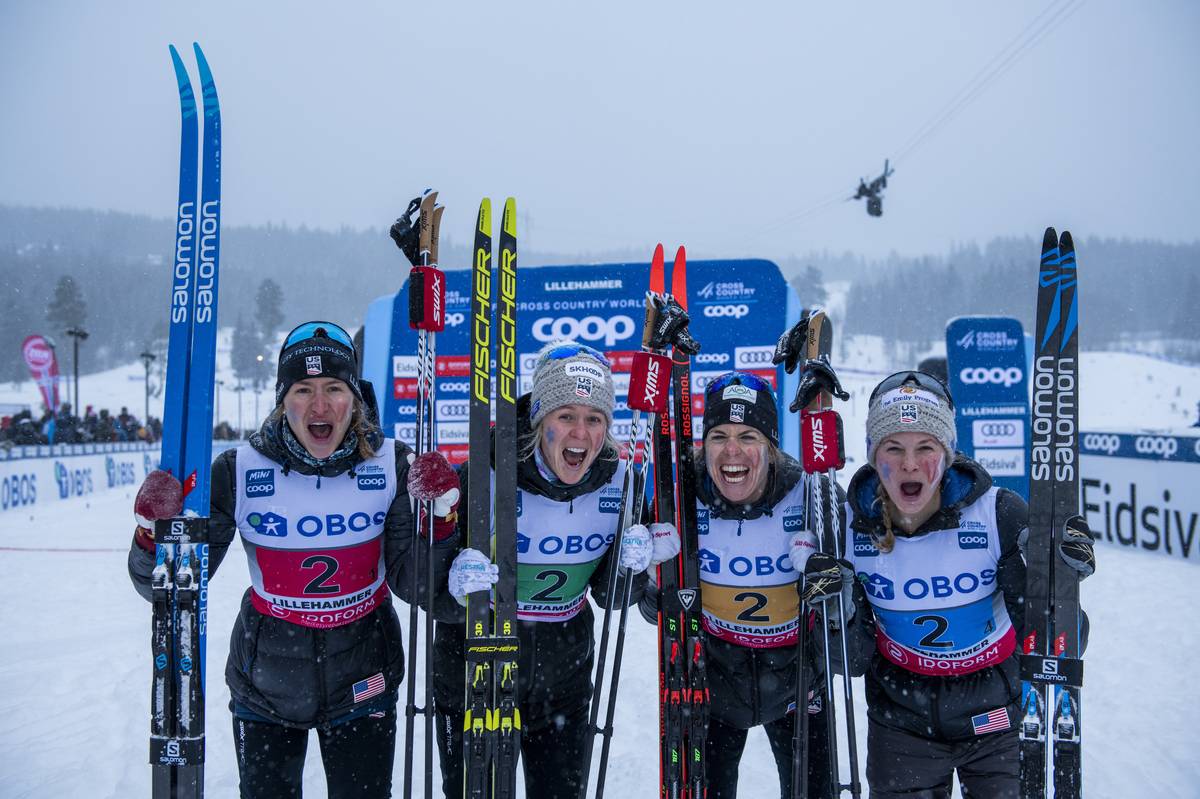
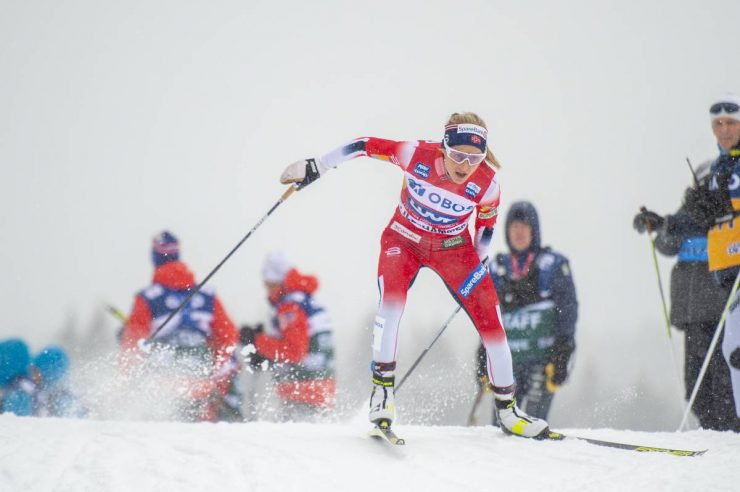
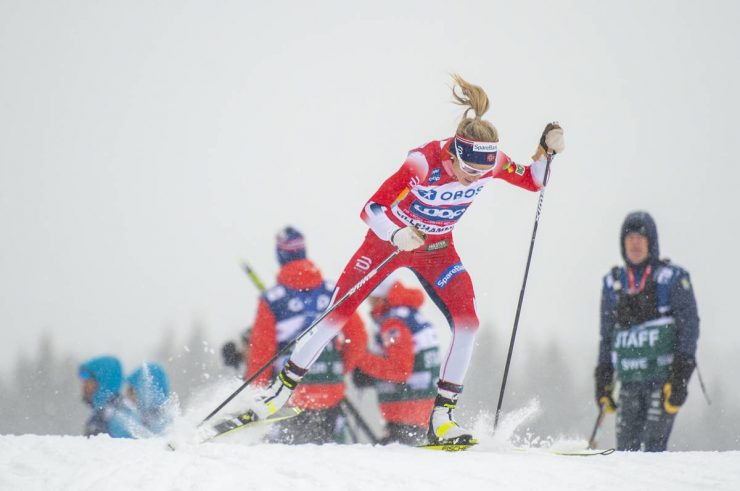
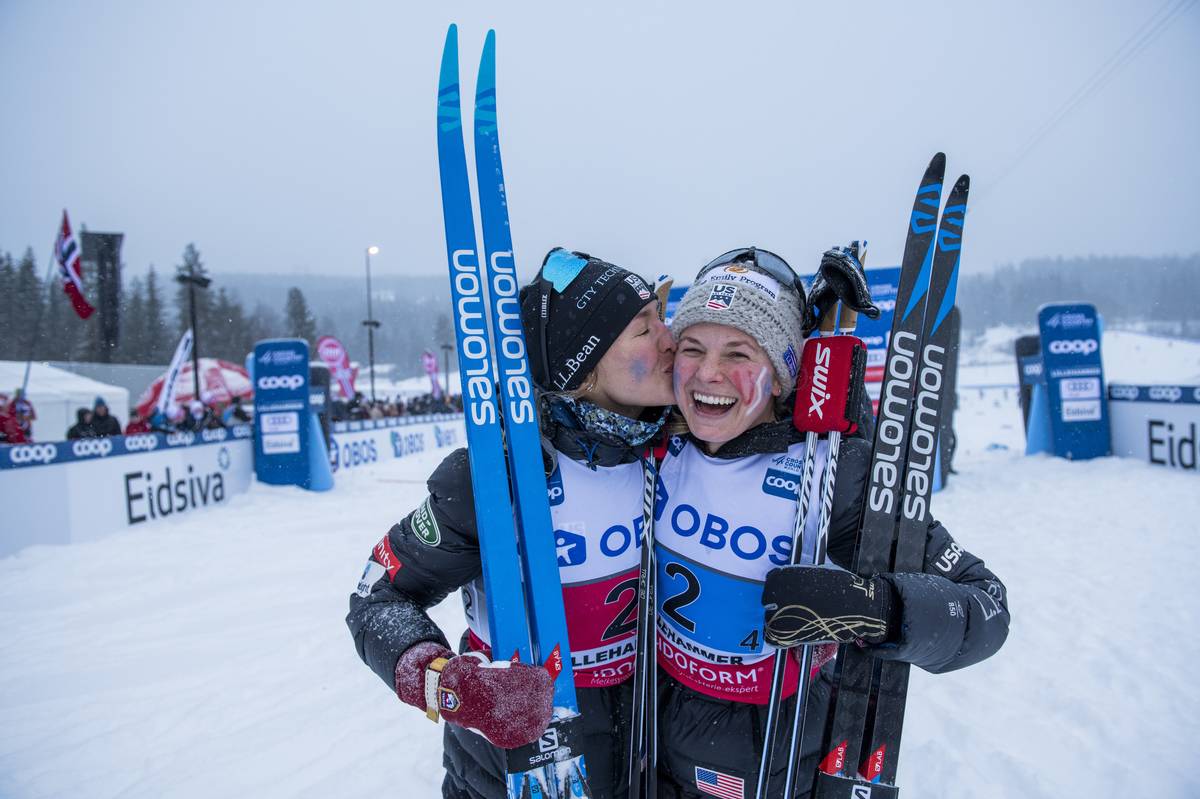
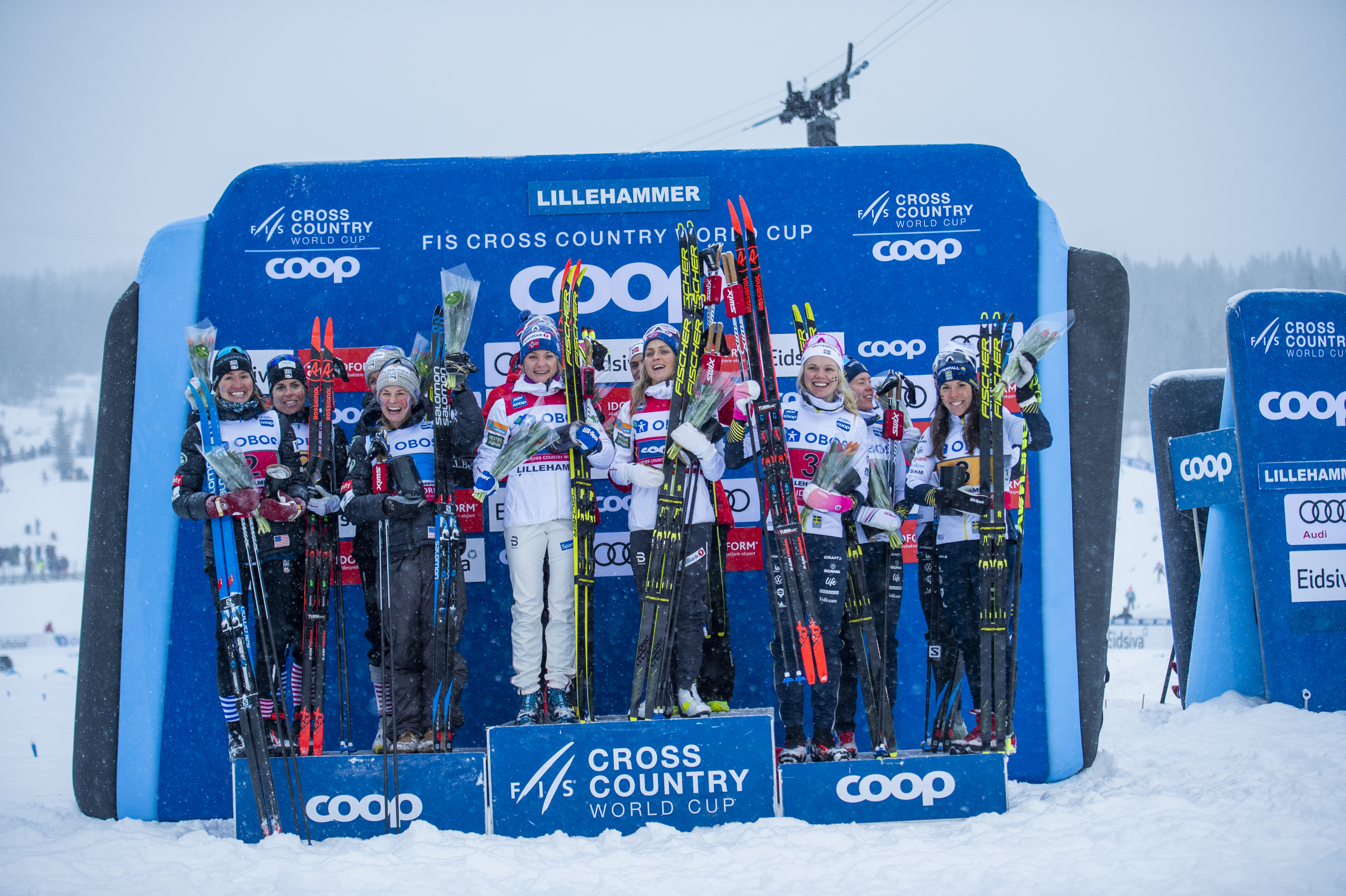
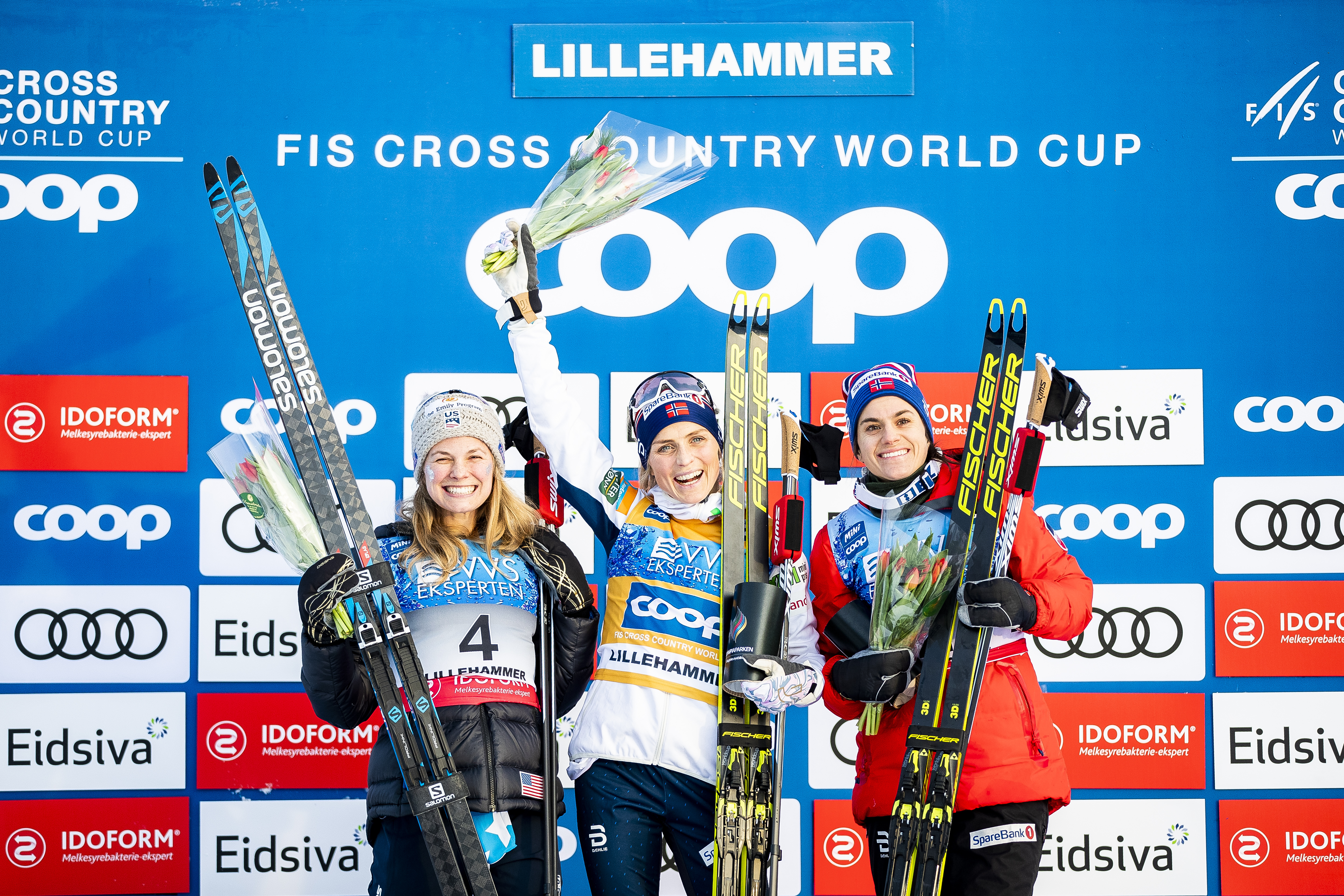
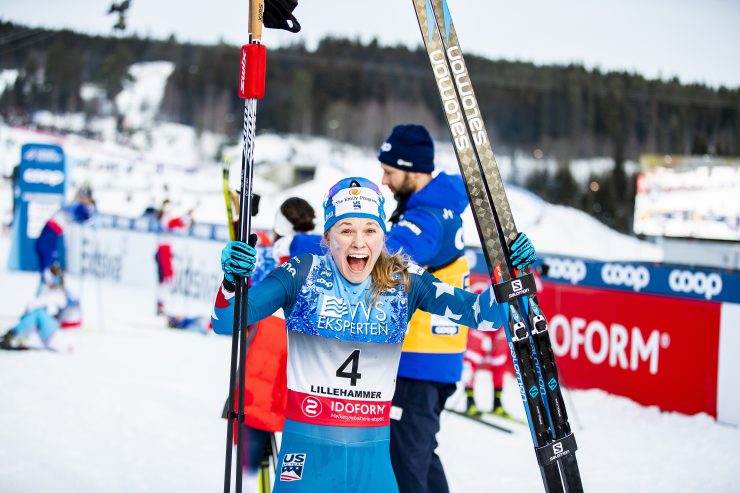
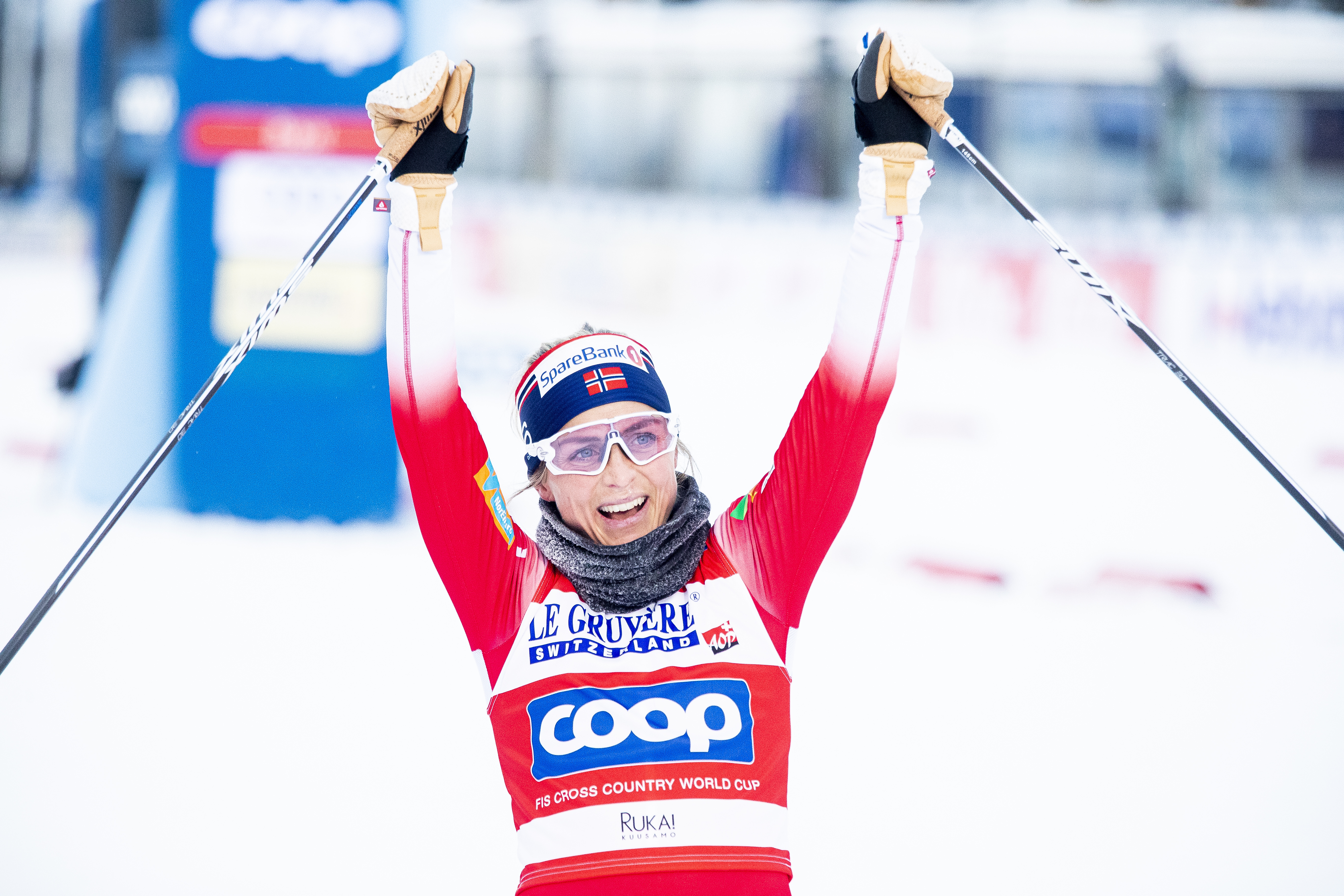
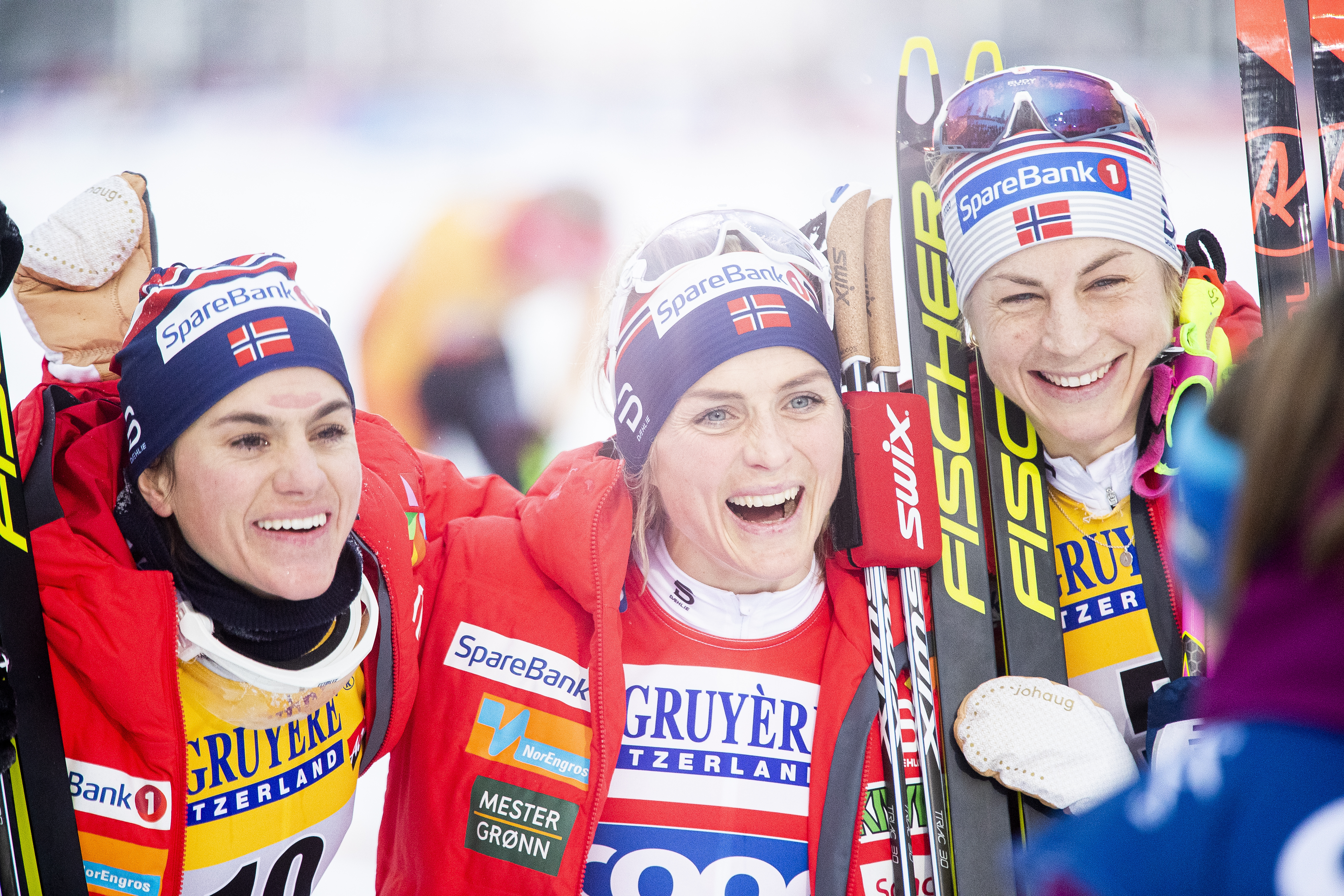
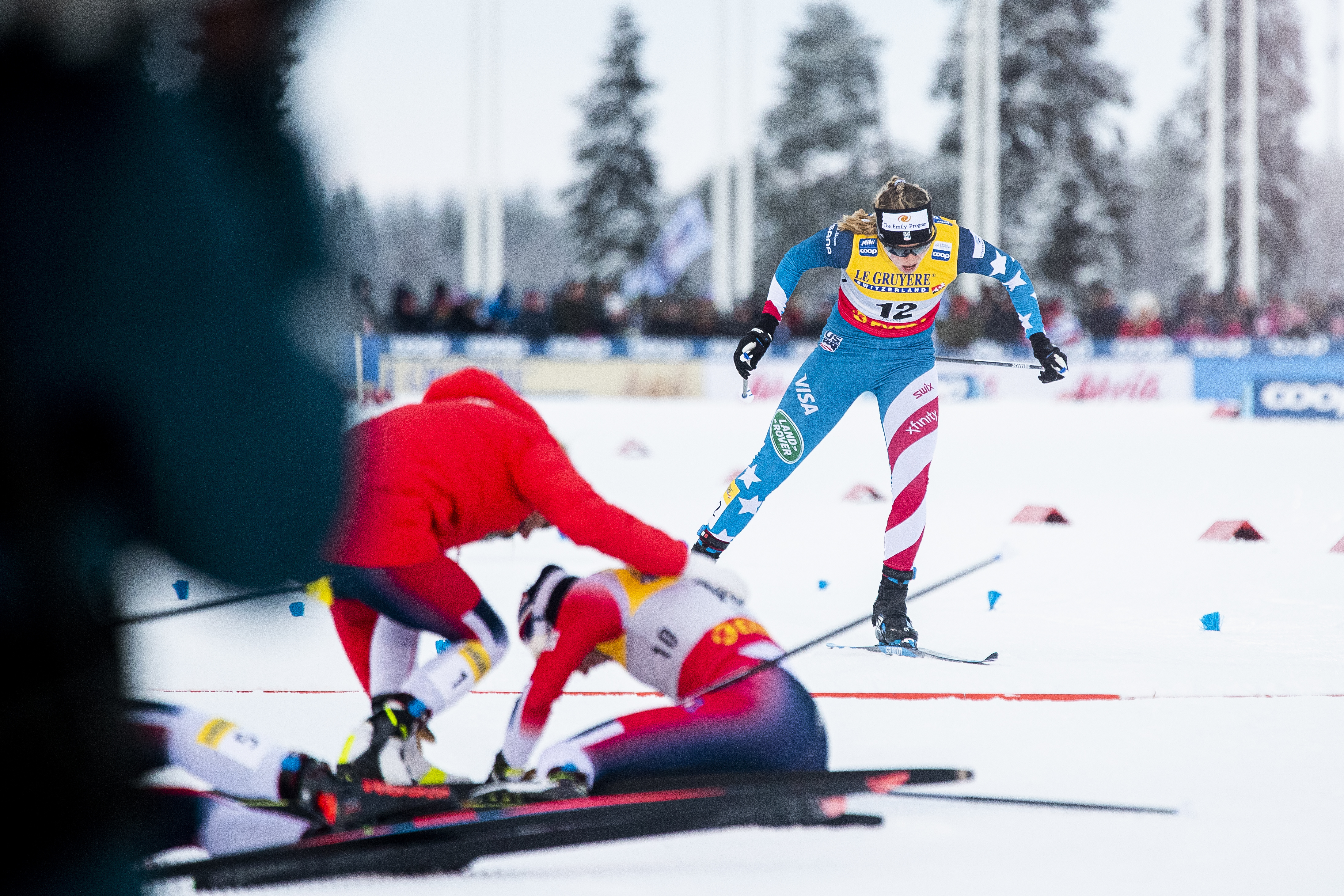
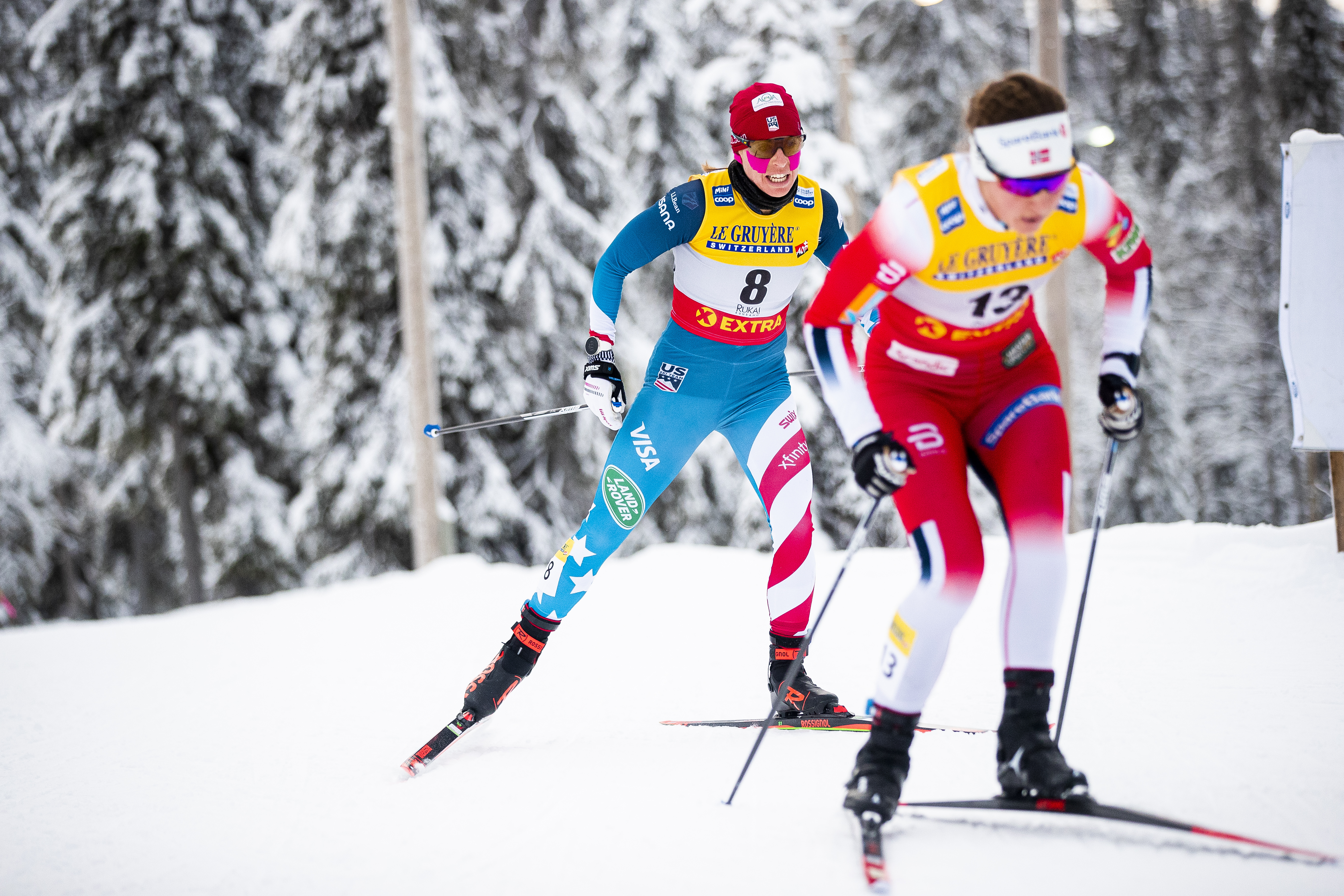
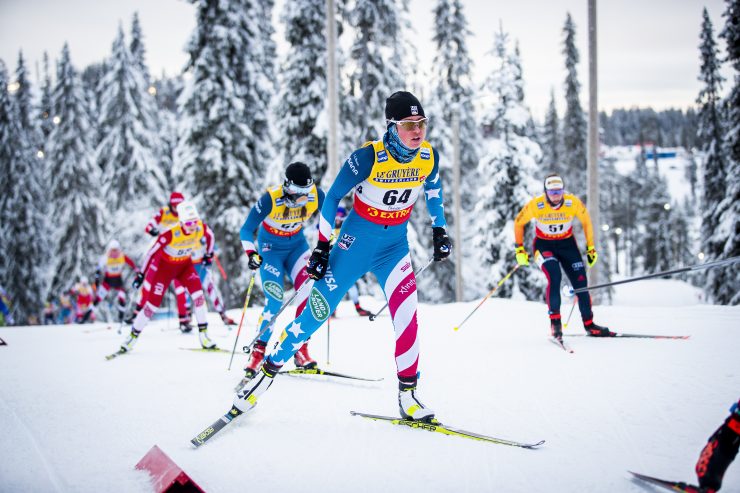
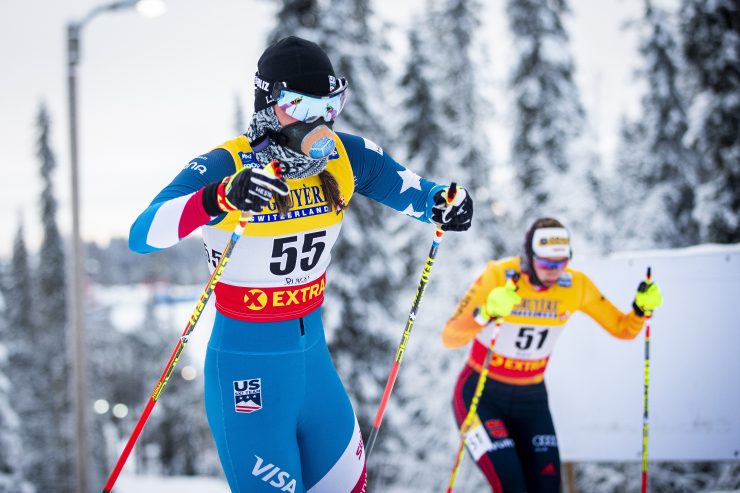
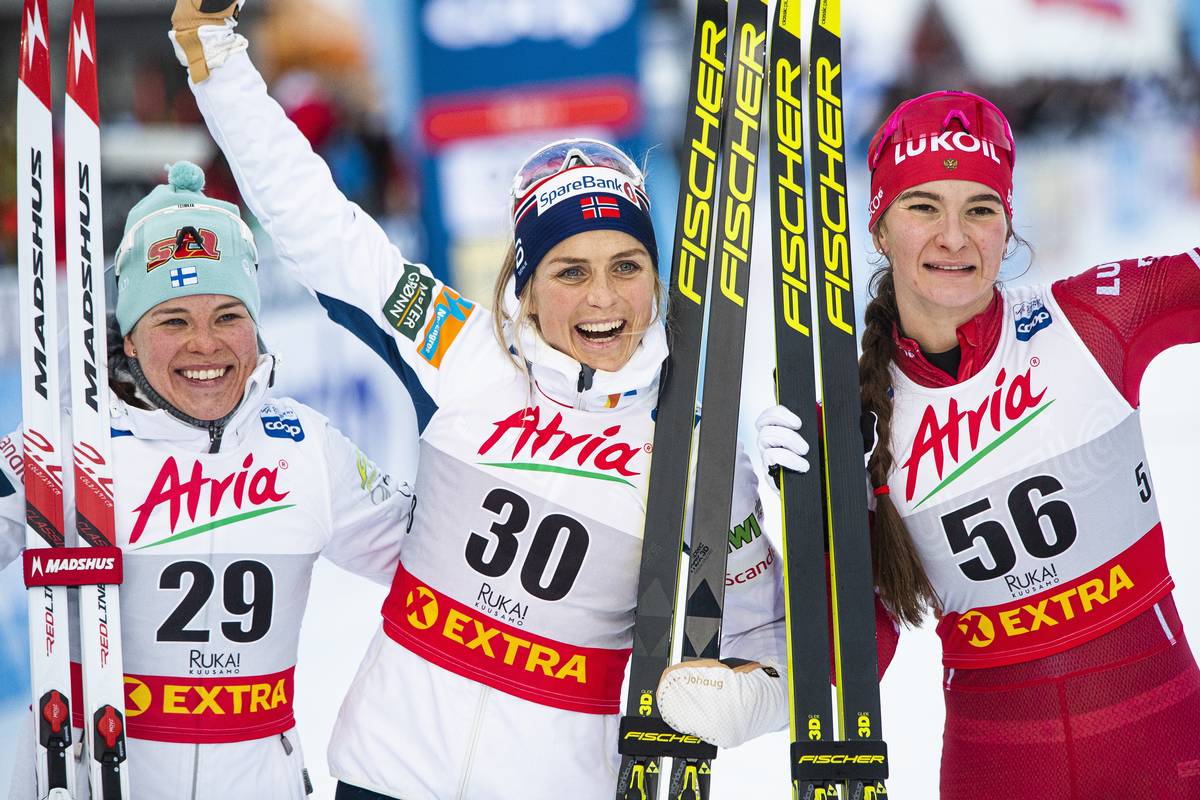
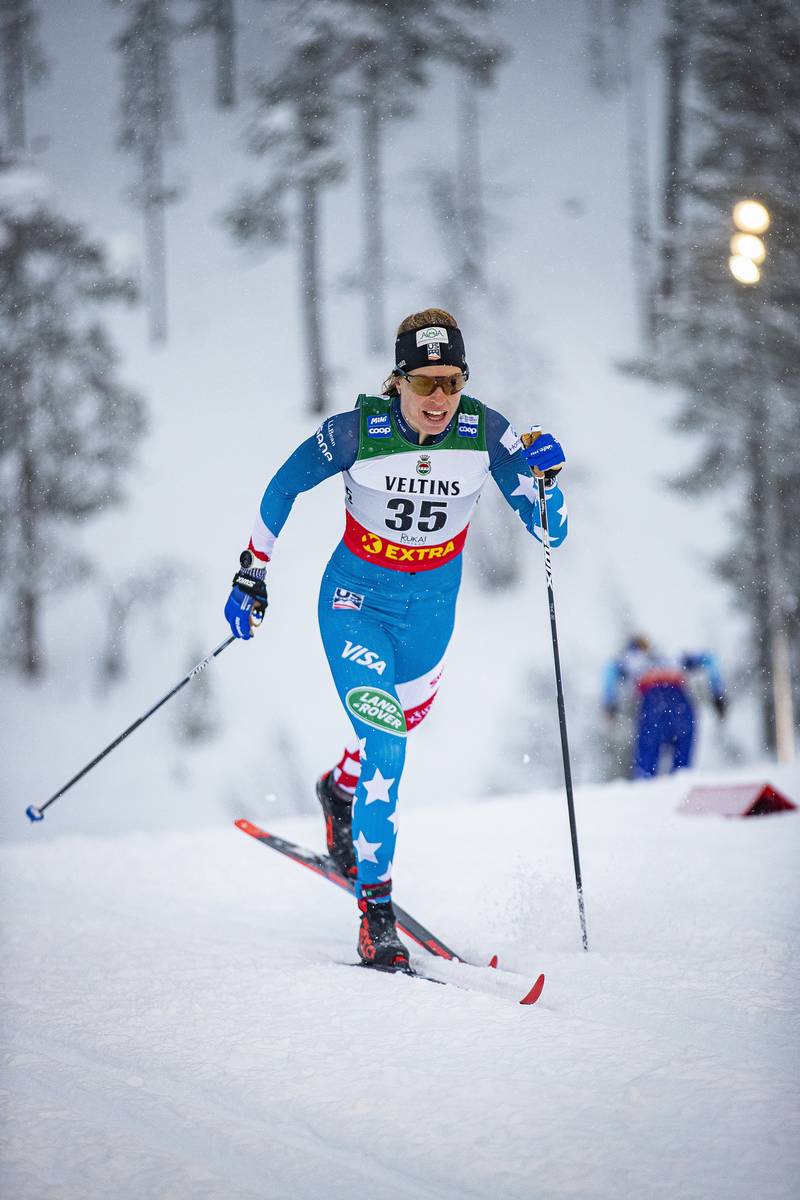
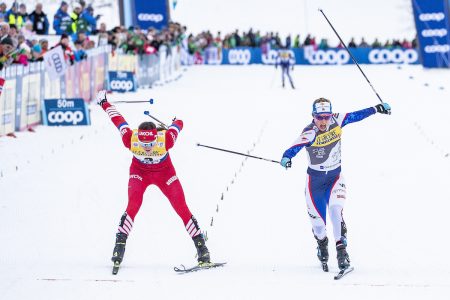
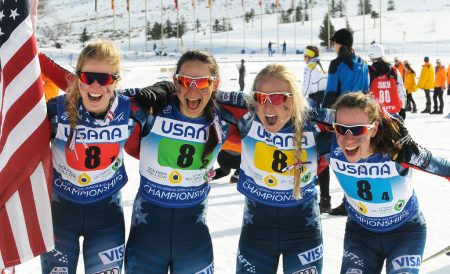
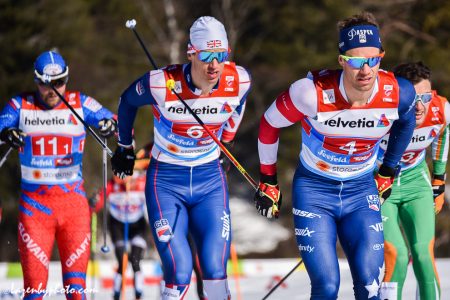
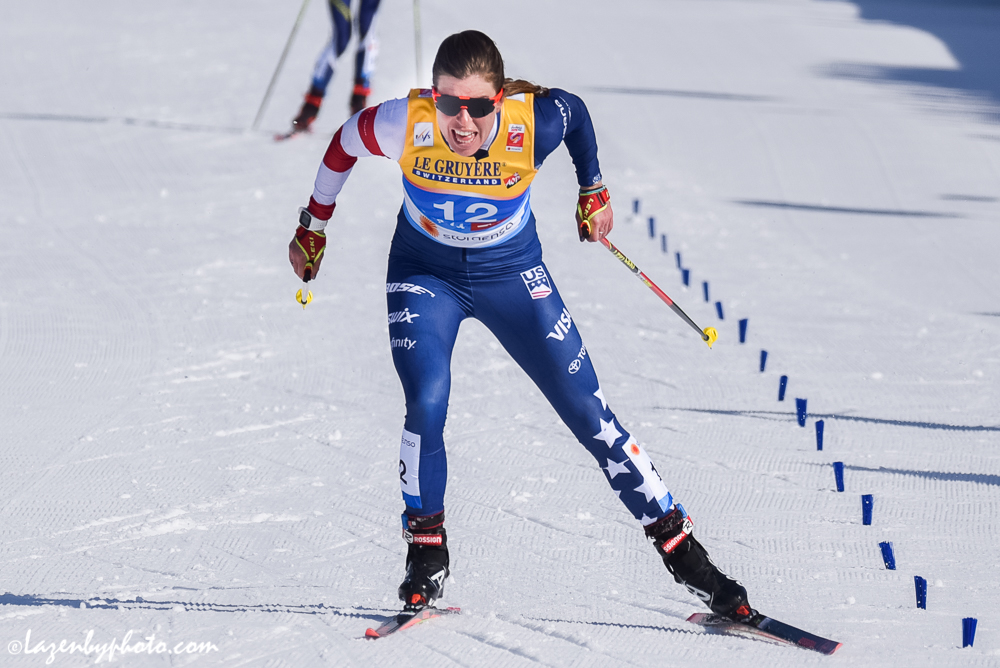
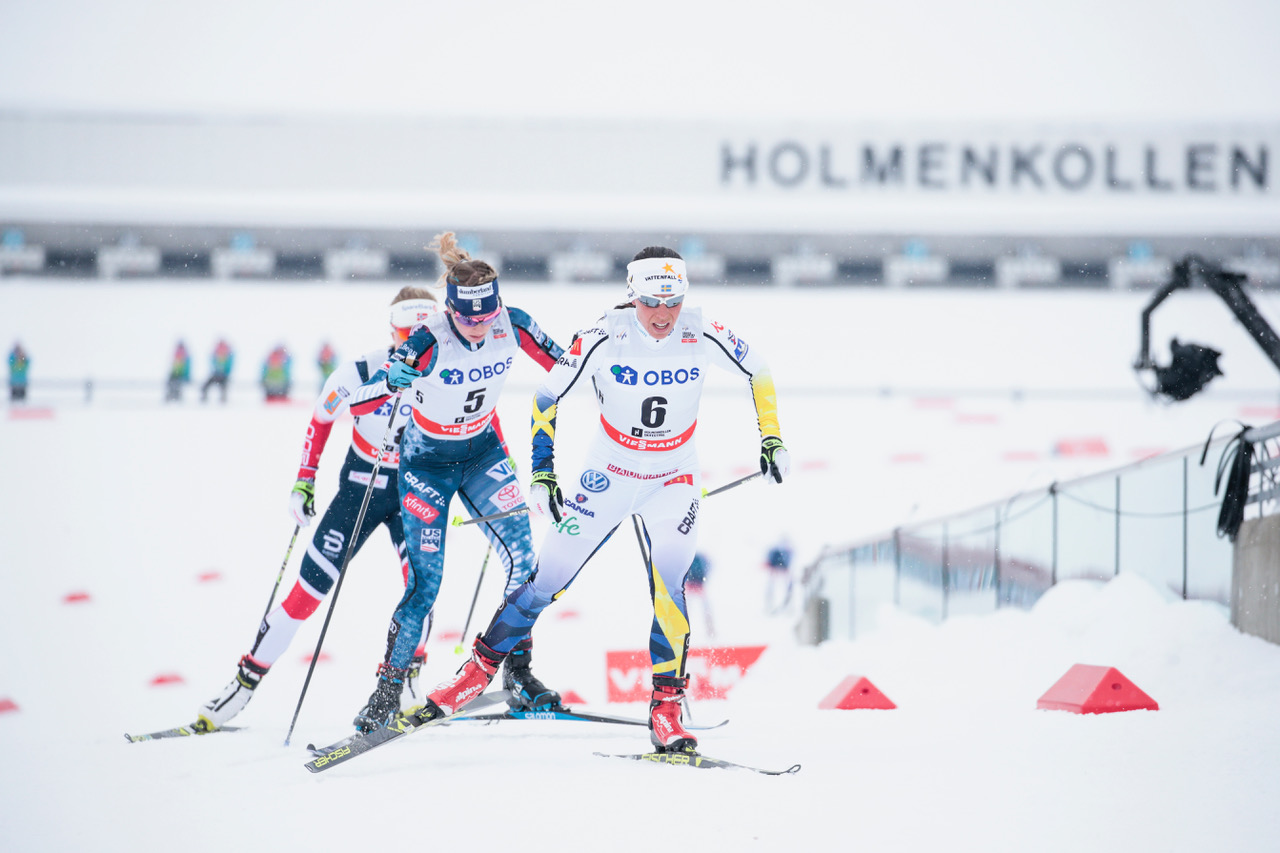
The women’s podium inNové Město. Therese Johaug (NOR) took the win ahead of Natalia Nepryaeva (RUS) and Heidi Weng (NOR). (Photo: NordicFocus)
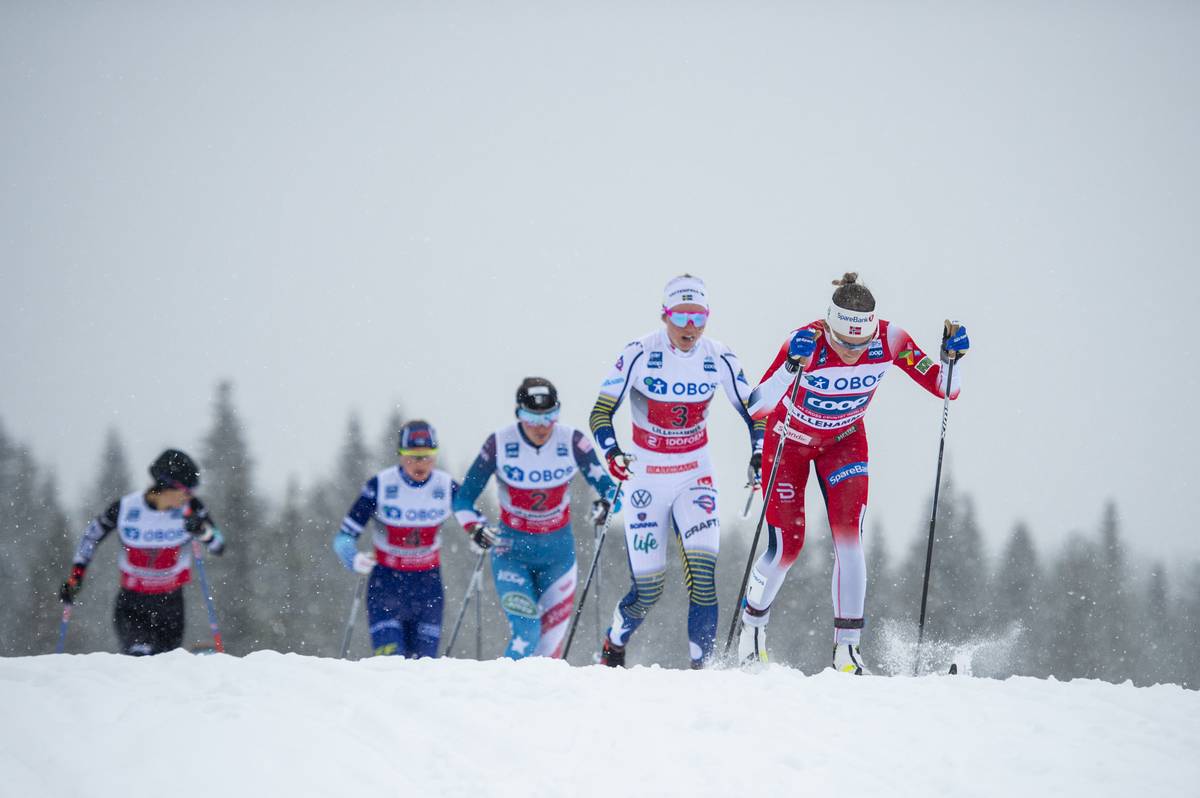
“It has everything,” Sweden’s Charlotte Kalla told FIS before the start of the 10-kilometer interval start skate in Nové Město, Czech Republic. Though she was describing the steep uphills and working downhills, found along the 5 k track, it might have also been an apt description for what the weather had in store. As athletes headed out on course, the light icy precipitation transitioned into chunky white flakes accumulating on the deteriorating ribbon of man made and farmed snow.
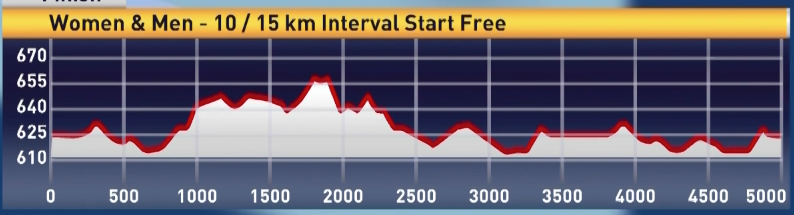
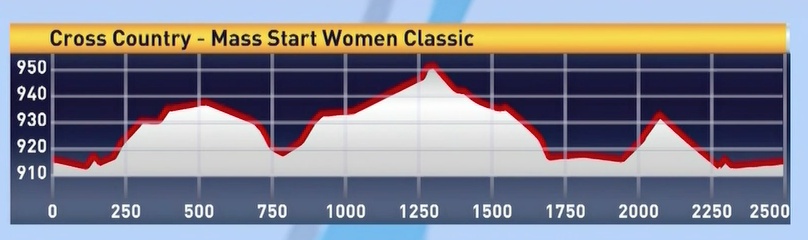
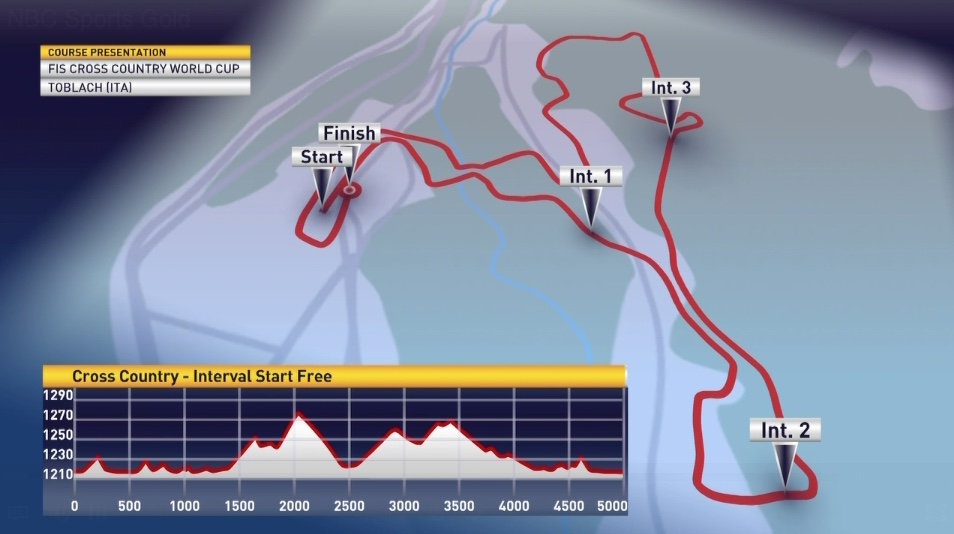
The course profile of the 5-kilometer lap in Nové Město, Czech Republic. (Photo: Screenshot FIS broadcast)
The two distance stages in Nové Město mark the start of Period III and the midpoint of the World Cup season, the tenth and eleventh of twenty one races. It also marks the return of the the squads of distance athletes who sat out last weekend’s city sprints in Dresden, Germany to recover from the compounding effect of their efforts in the Tour de Ski (TDS). Who made it through unscathed and who begins the second half of the season with lingering fatigue? Nothing like a two-day pursuit to find out.
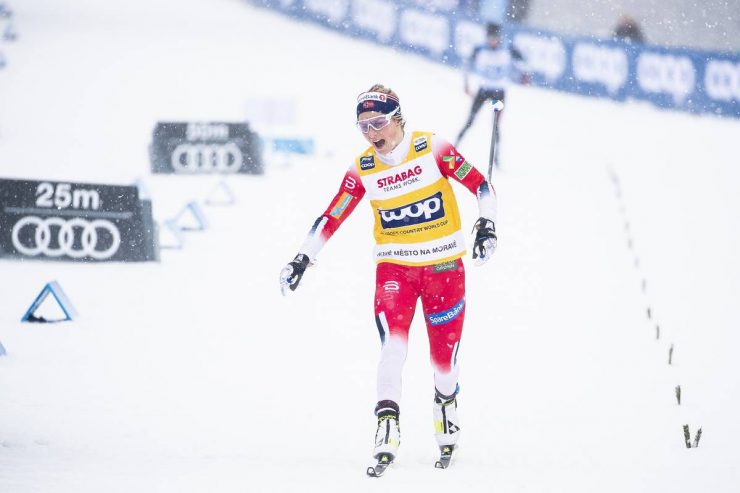
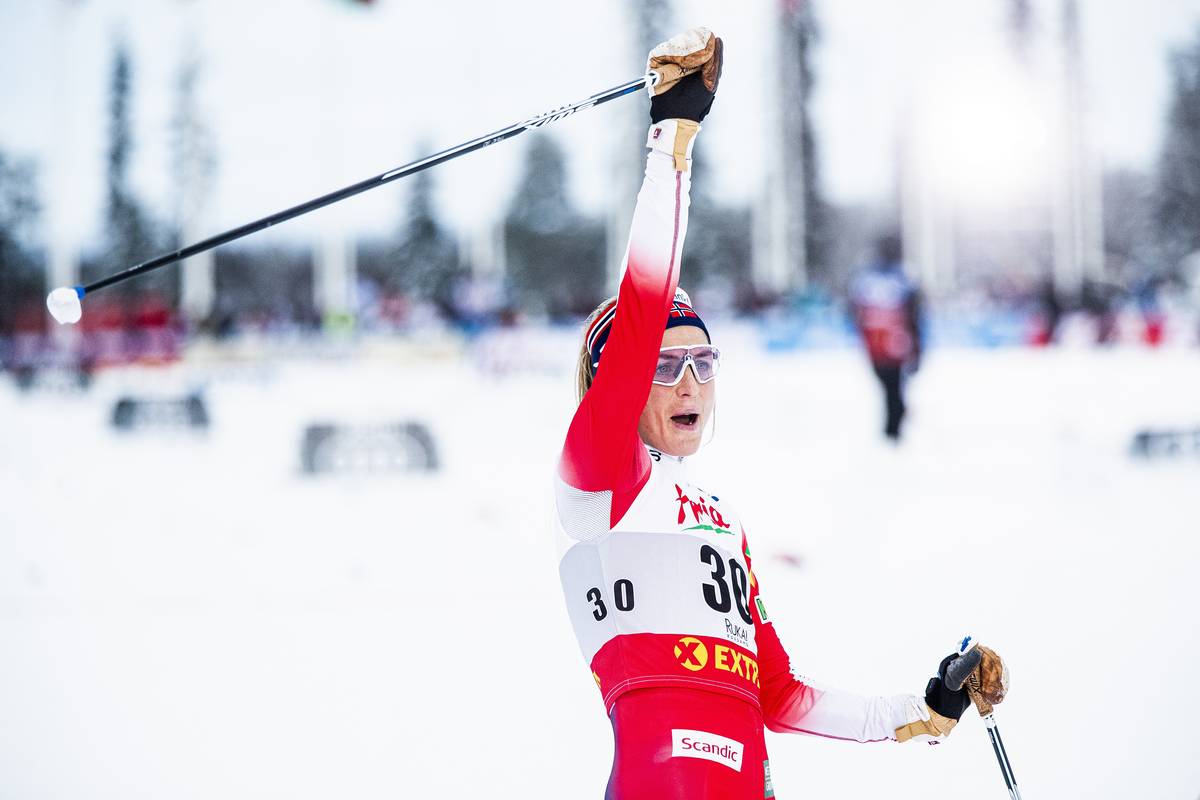
By 3 k, it was evident that Norway’s Therese Johaug, Tour de Ski winner and leader of both the World Cup overall and distance standings, was feeling on form. From the start, she unleashed her usual high tempo attack, clocking the fastest splits at each checkpoint. She stopped the clock at 23:31.1, over 30 seconds ahead of the next fastest time.
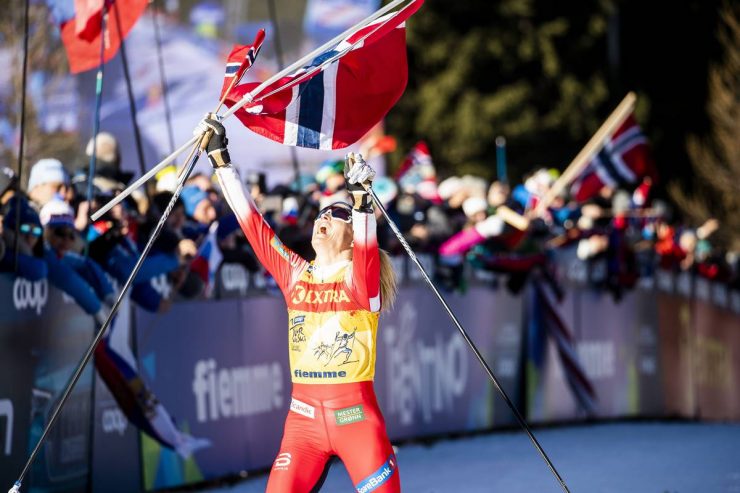
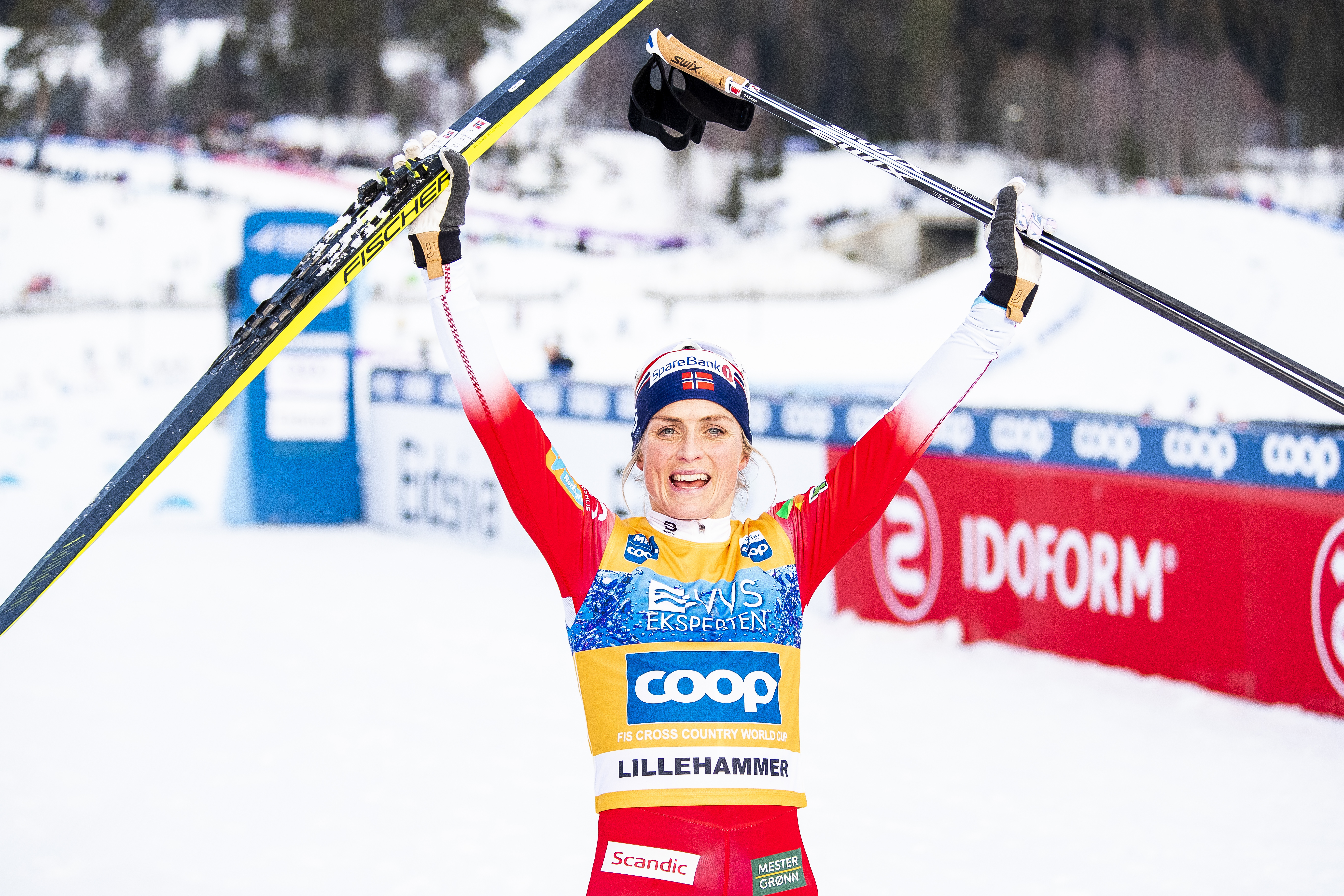
Therese Johaug (NOR) takes the win in snowy Nové Město, Czech Republic. (Photo: NordicFocus)
Therese Johaug takes the lead after Day 1 of the distance pursuit in Nové Město, Czech Republic. (Photo: NordicFocus)
“It was an amazing race today,” Johaug told FIS at the finish. “My shape and my body was really good. I have been a little bit tired after the Tour de Ski and I had some good sensation and bad sensations, but today it was a good day. Of course, the tracks out here and the snow was perfect for me, so I am really happy.”
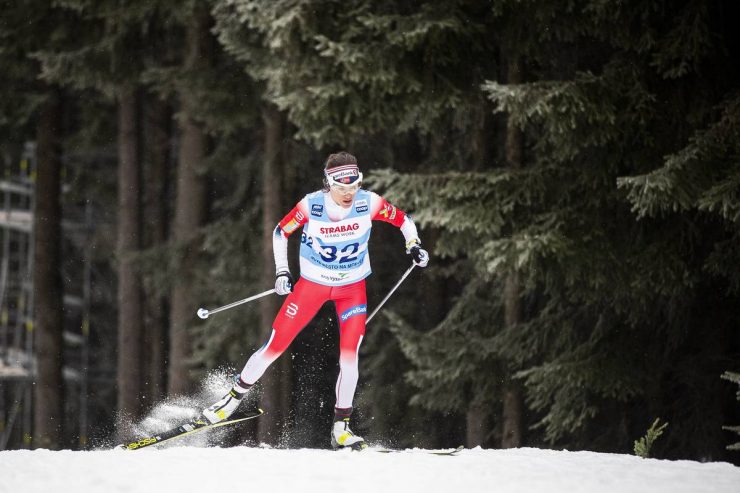
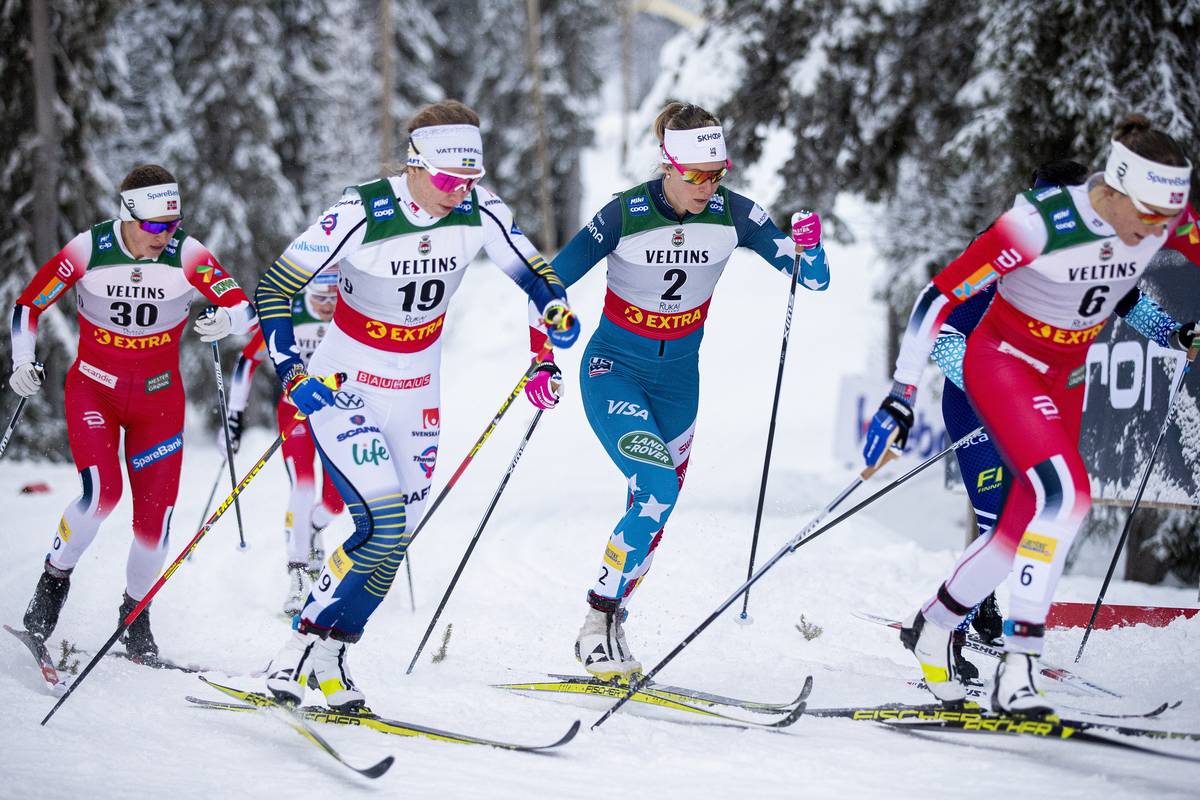
Johaug was chasing the ghost of her teammate, Heidi Weng, who started two bibs prior at the front of the seeded group. Leading the race for second place, Weng time-trialed through the wooded course, setting splits that were just faster than her peers’. At the half, she trailed Johaug by 17 seconds with four women within ten seconds of her: Natalia Nepryaeva of Russia, Moa Lundgren of Sweden, Jessie Diggins, and Ingvild Flugstad Østberg of Norway.
Soaring, Natalia Nepryaeva (RUS) powers to a second place finish in the 10-kilometer individual start skate inNové Město, Czech Republic. (Photo: NordicFocus)
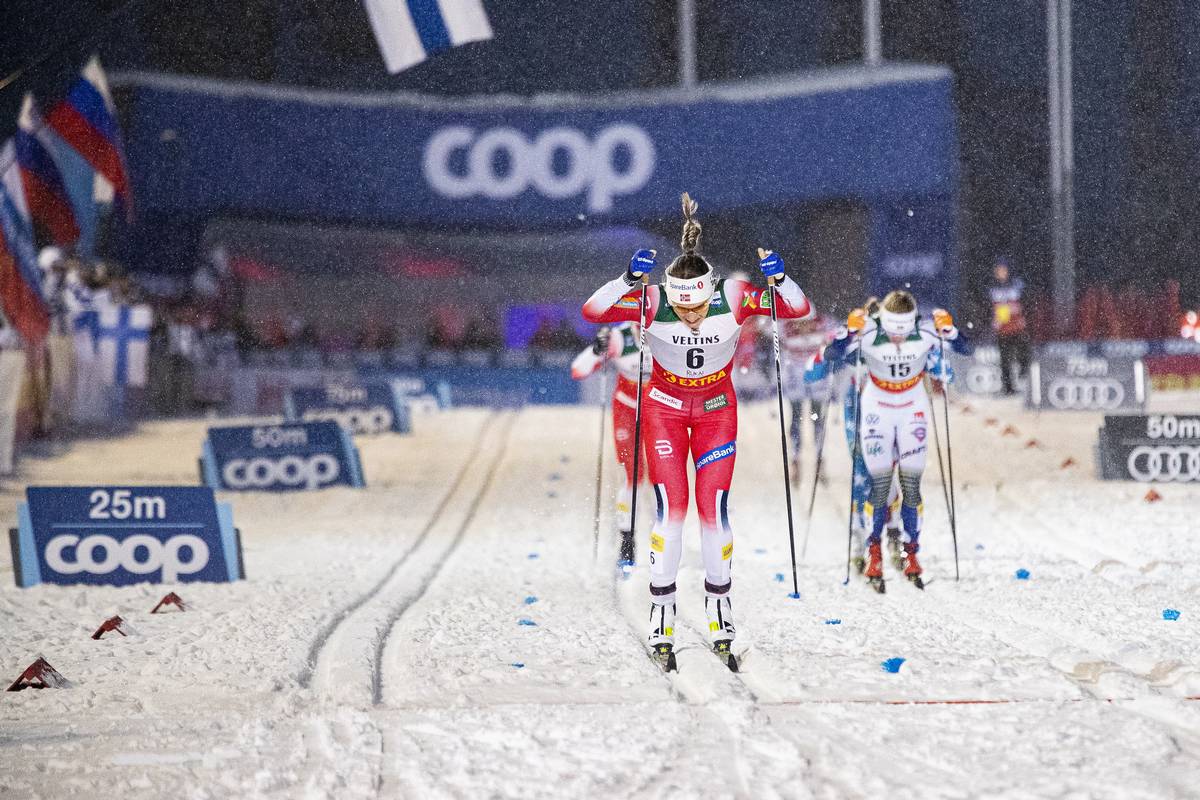
During the second lap, Nepryaeva closed the gap to Weng’s times, matching her with roughly two K’s to go, then pulling ahead by a few seconds. Throwing her boot for the second fastest time of the day, she knocked Weng back to third on the podium. Nepryaeva finished 32.7 seconds behind Johaug, and Weng was 40.3 seconds back.
Weng is now batting 70 percent for podium finishes; she has only missed the top-3 in three of the ten stages, with her lowest rank of 8th occurring in the final stage of the Tour de Ski.
Eyes locked on the task at hand, Heidi Weng skis to third during the 10-kilometer skate in Nové Město, Czech Republic. (Photo: NordicFocus)
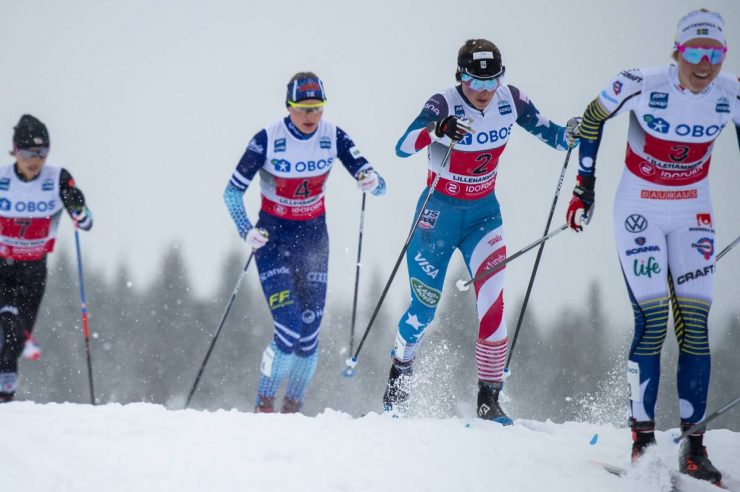
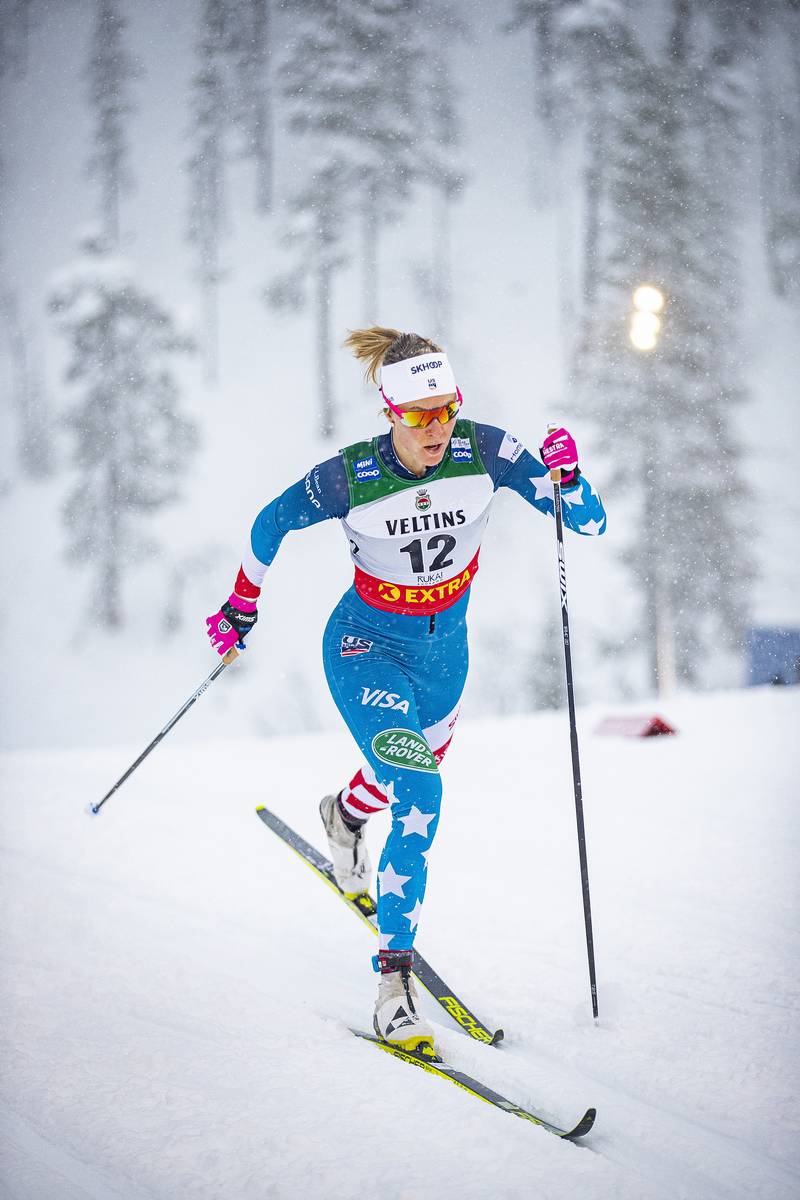
Diggins started third in the seeded group behind Johaug and Weng. After hovering in the top 5 throughout the race, she was next across the line in fourth (+48.5), with Ragnhild Haga of Norway just behind (+48.8). Østberg rounded out the final spot in the top five (+49.7).
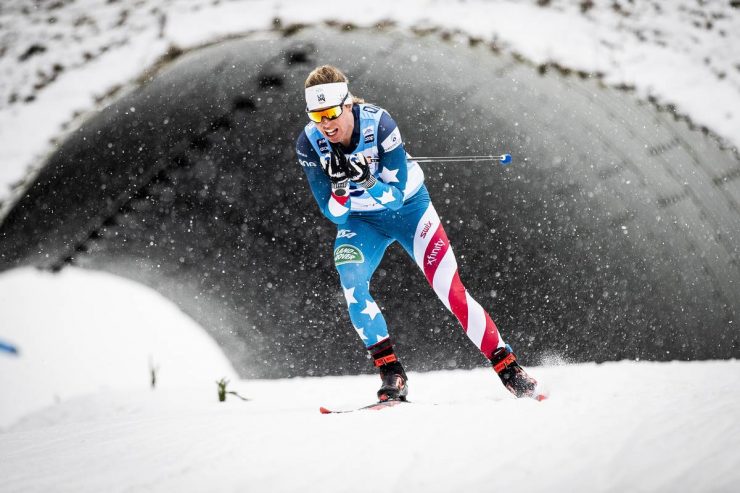
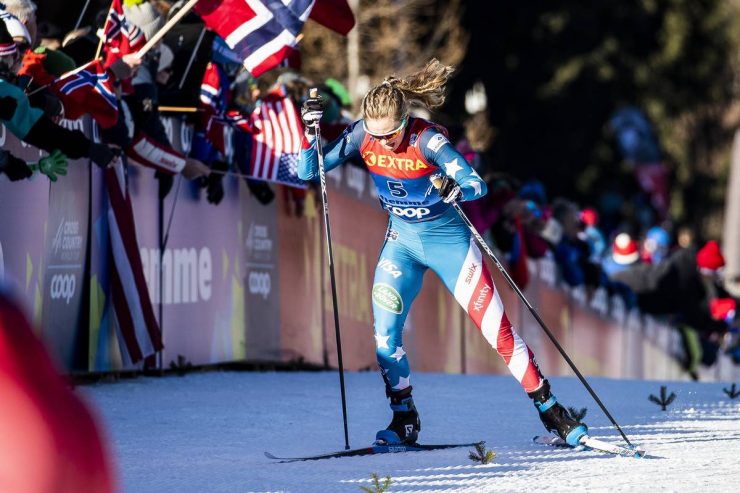
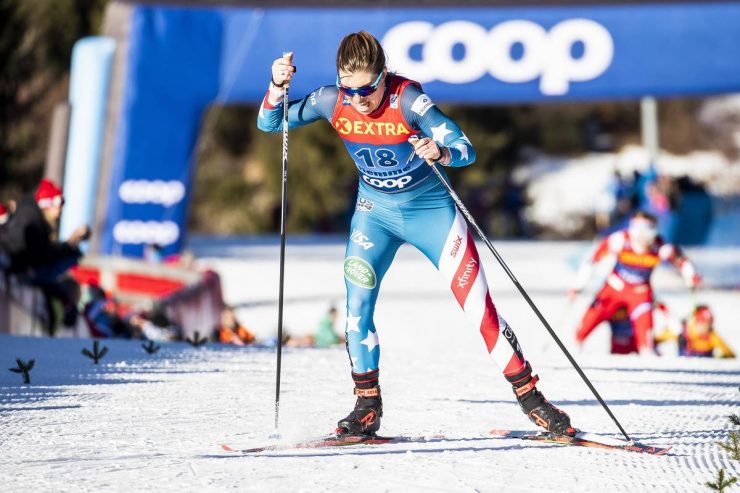
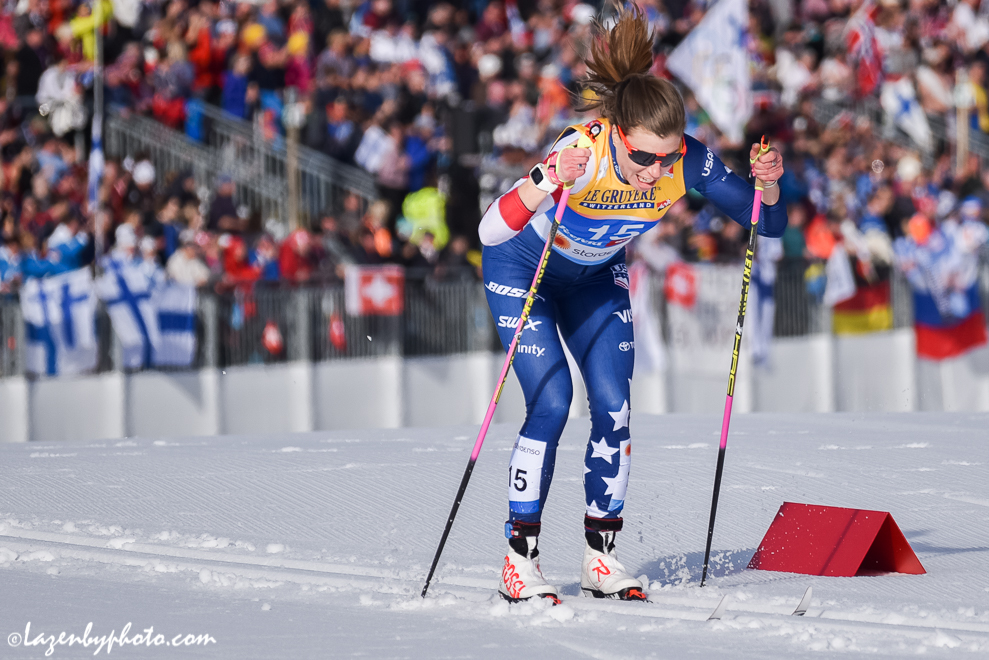
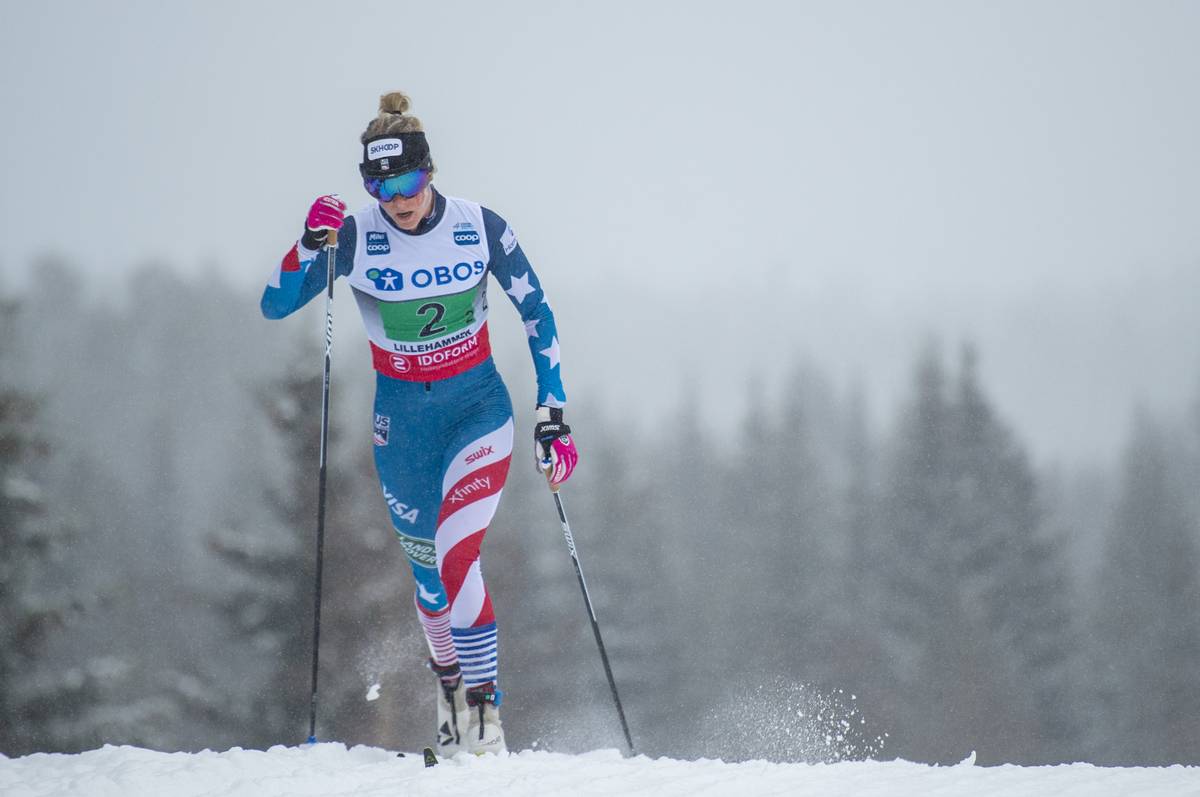
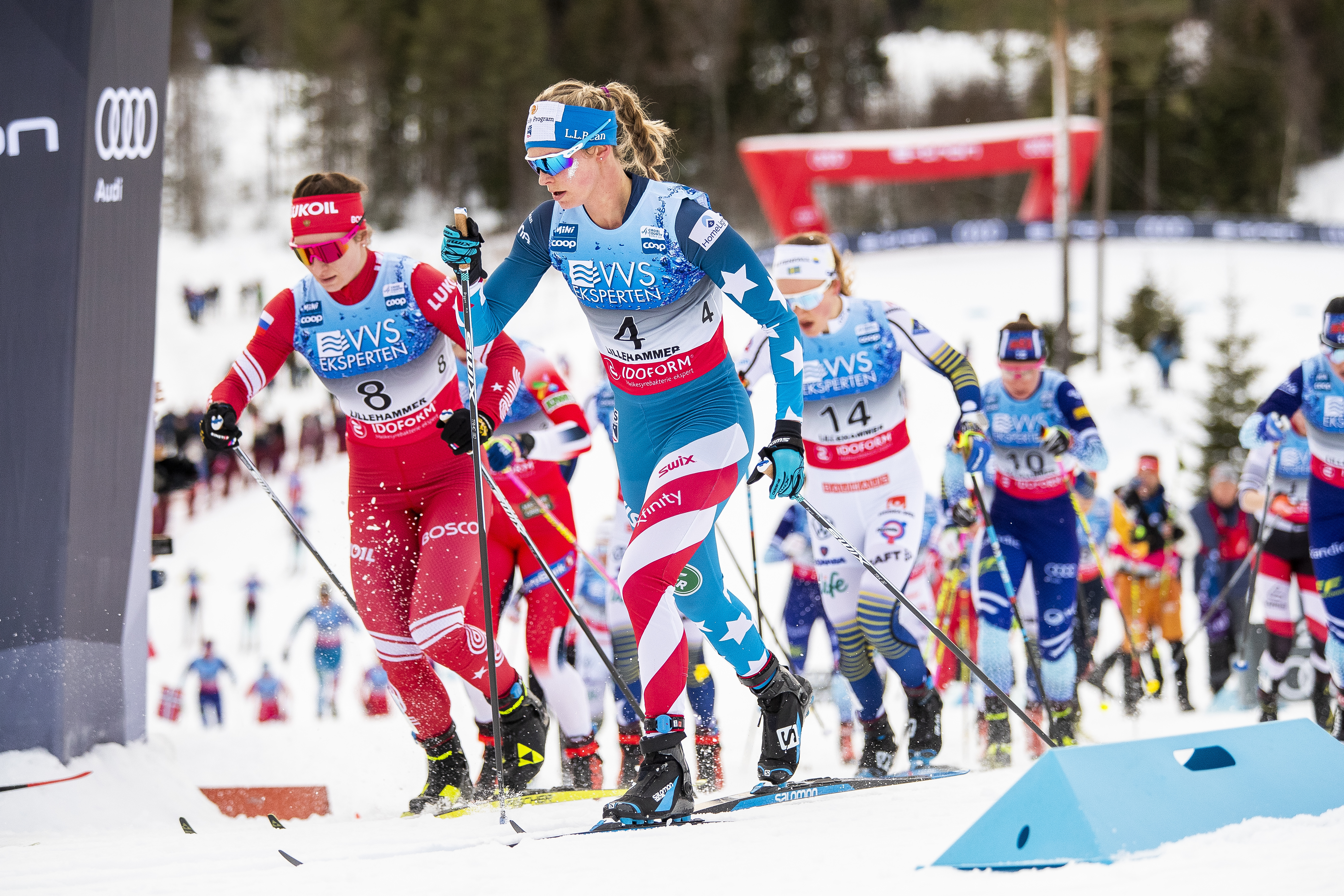
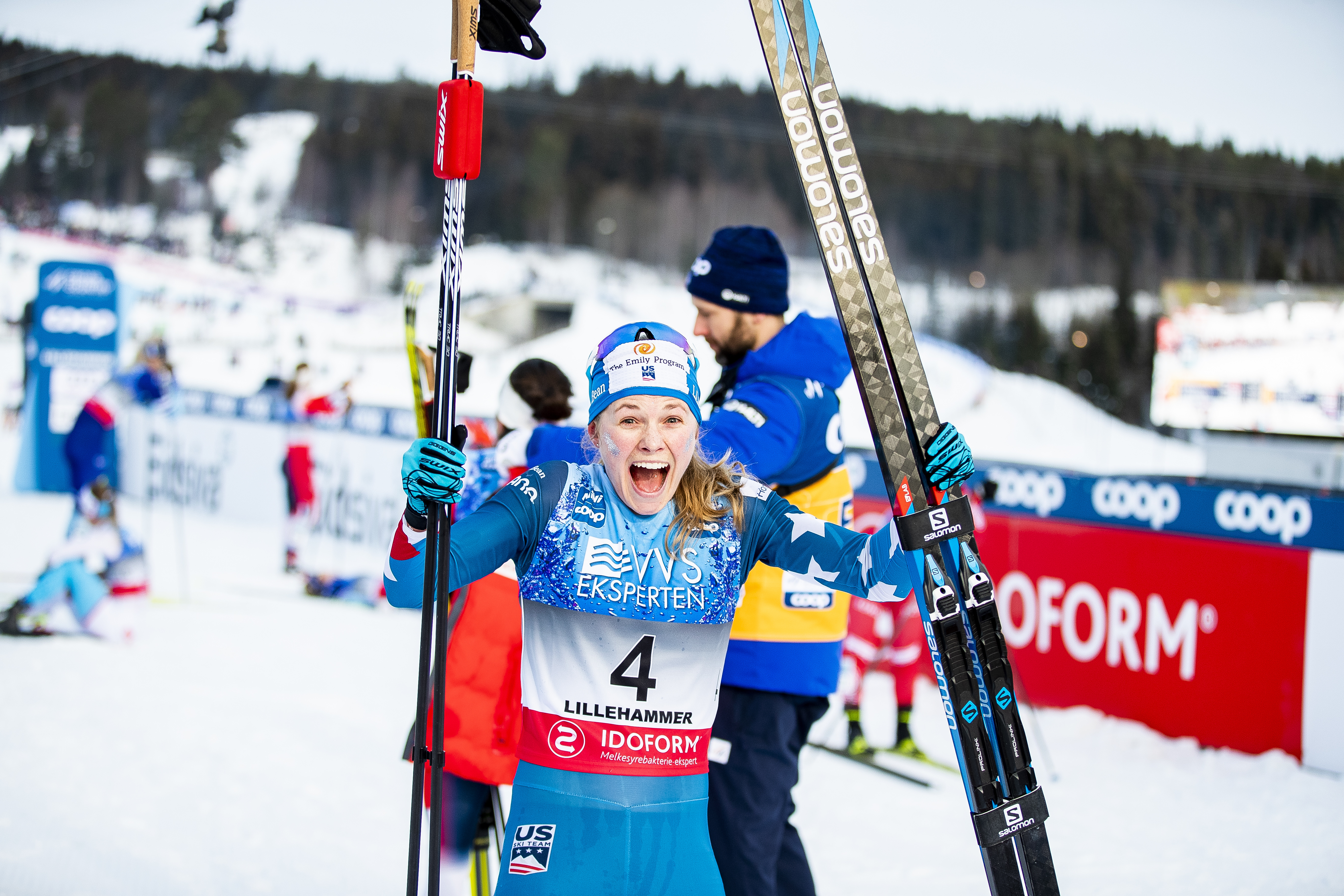
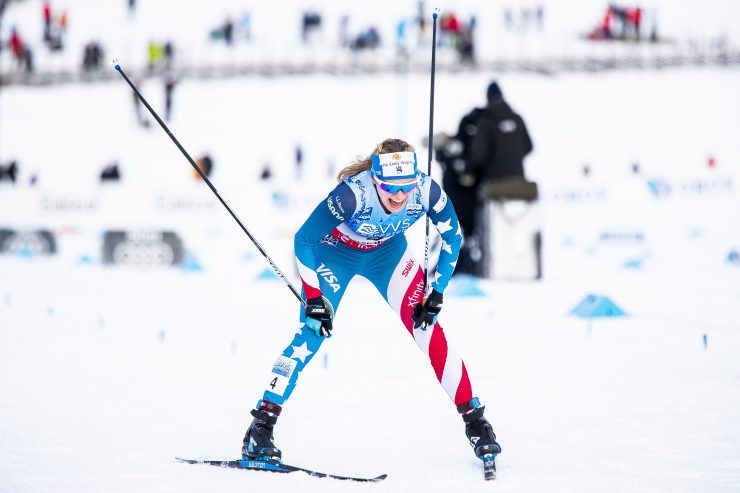
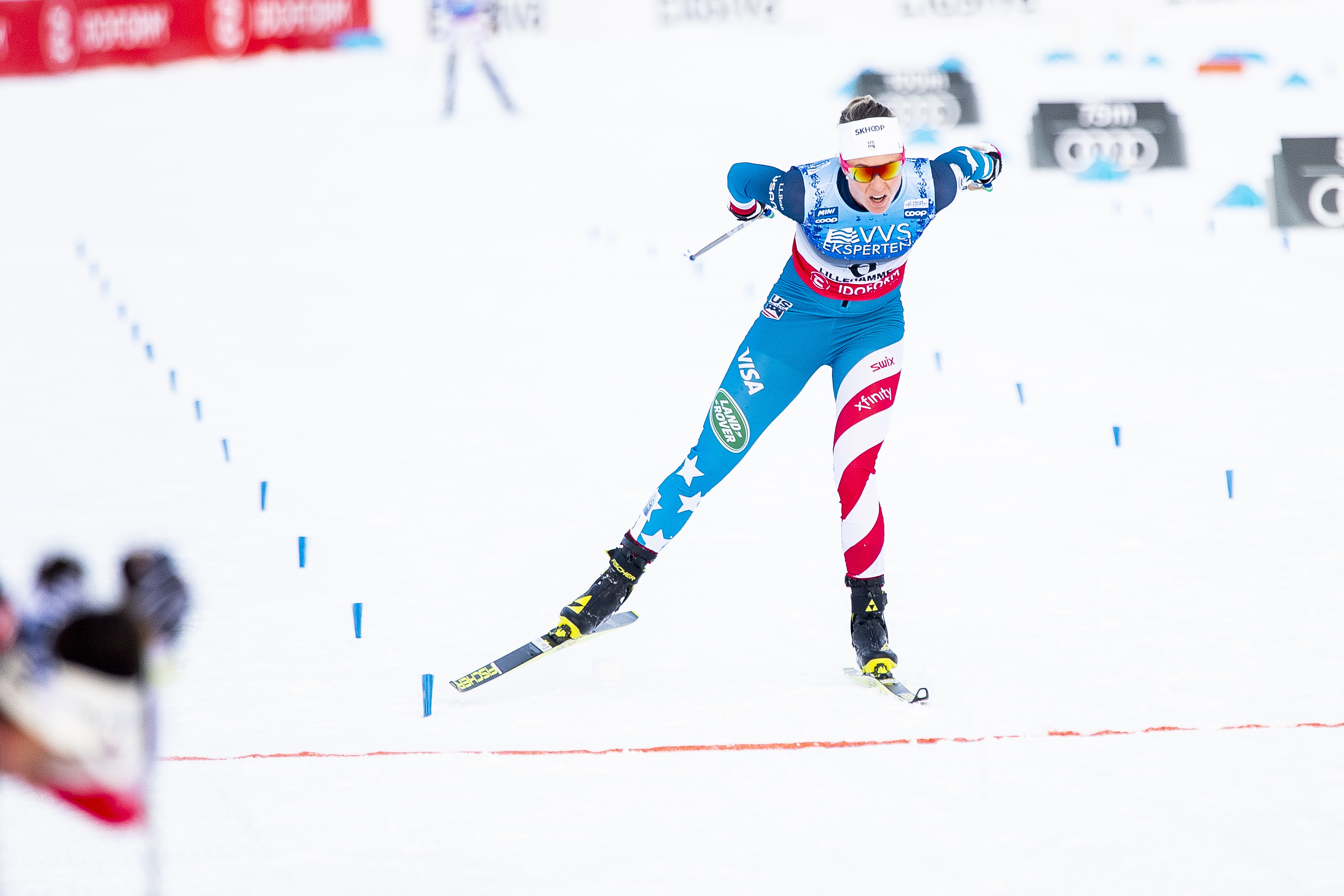
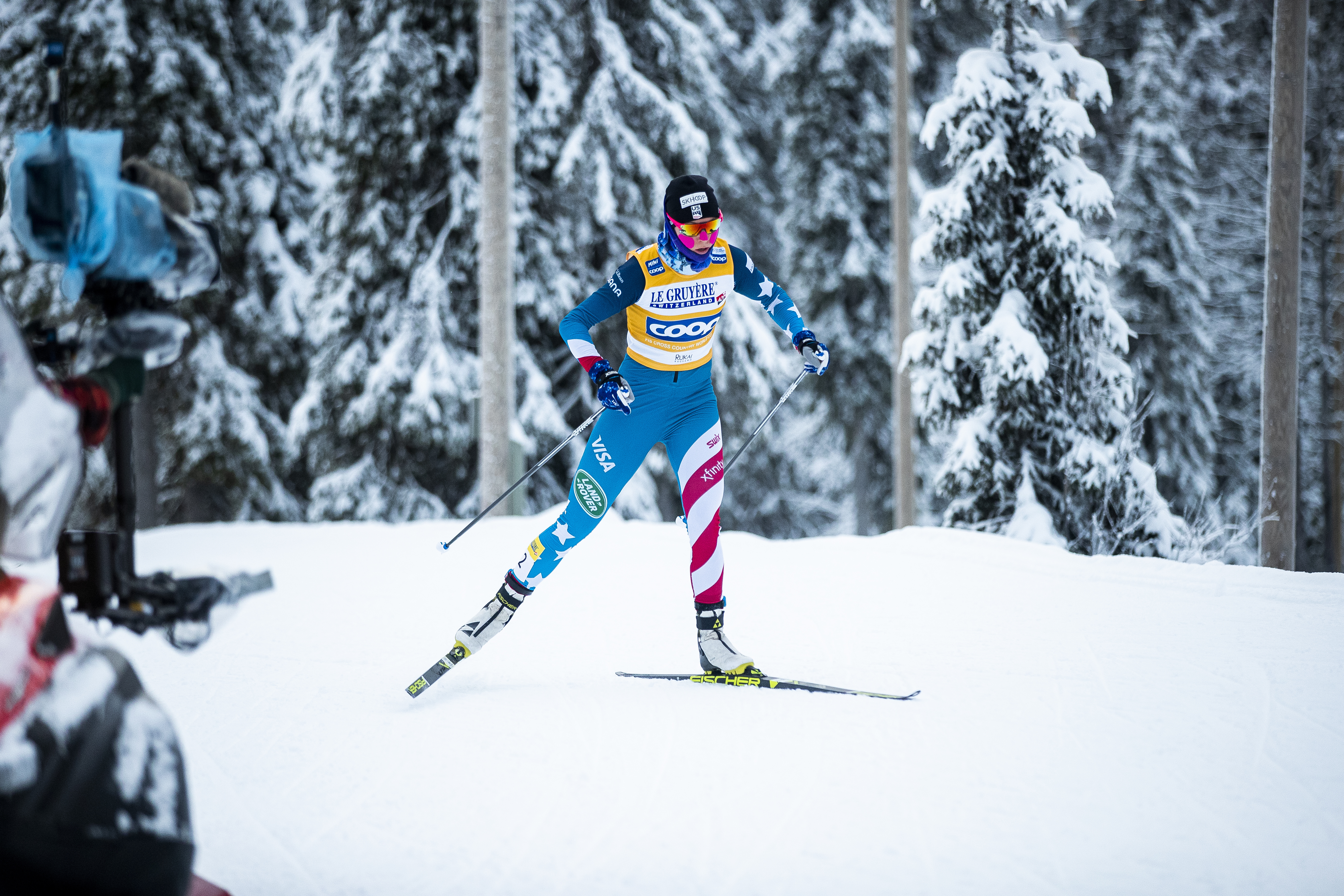
Jessie Diggins climbs to 4th in Nové Město. (Photo: NordicFocus)
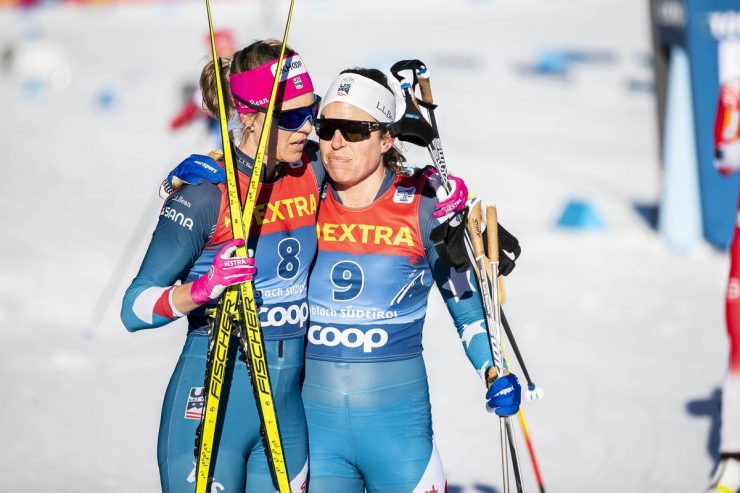
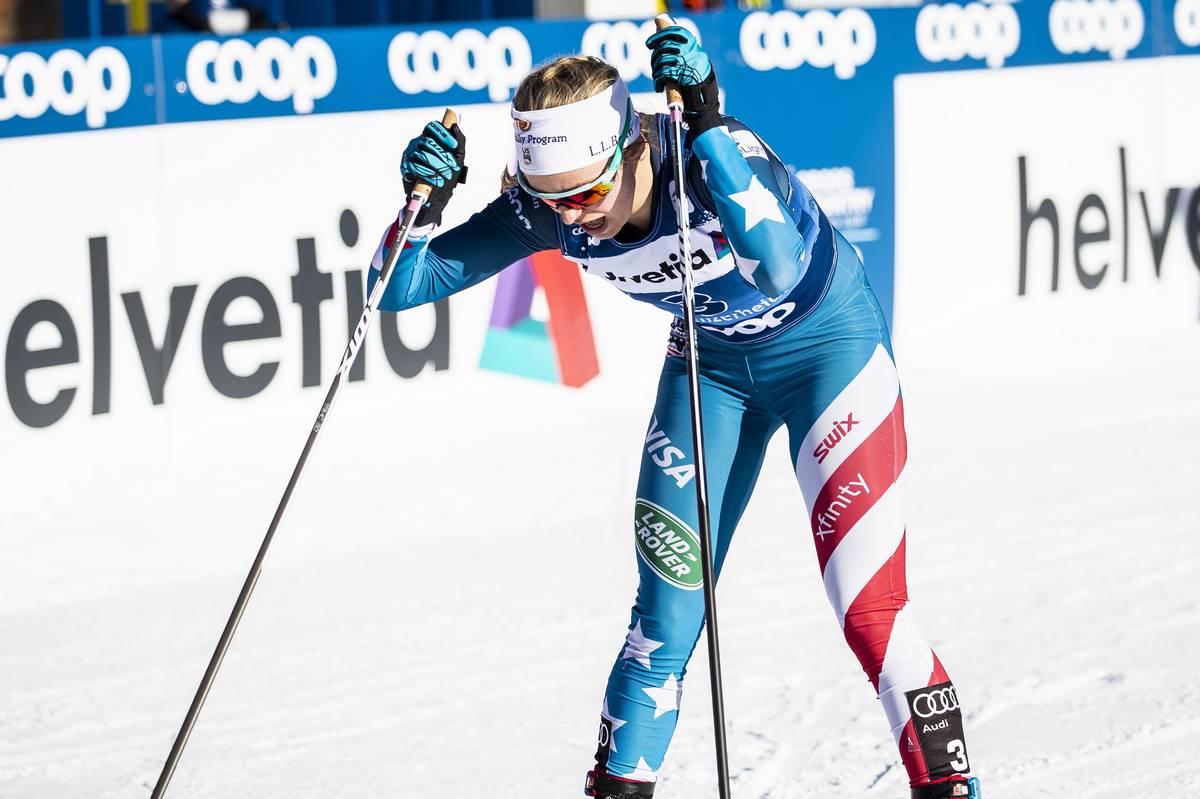
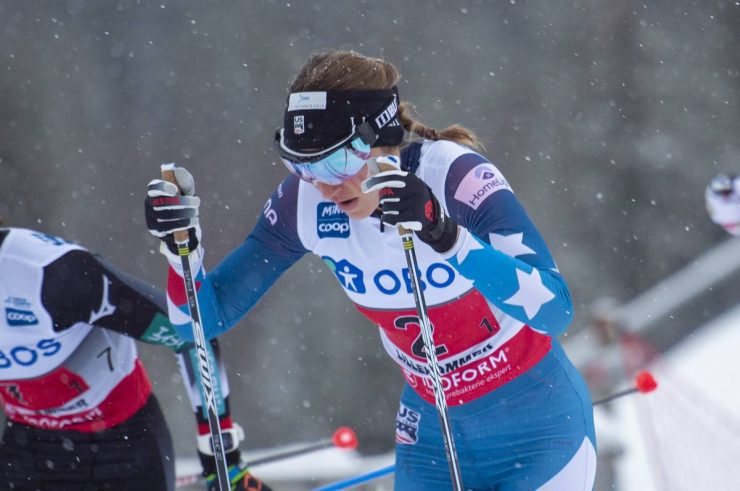
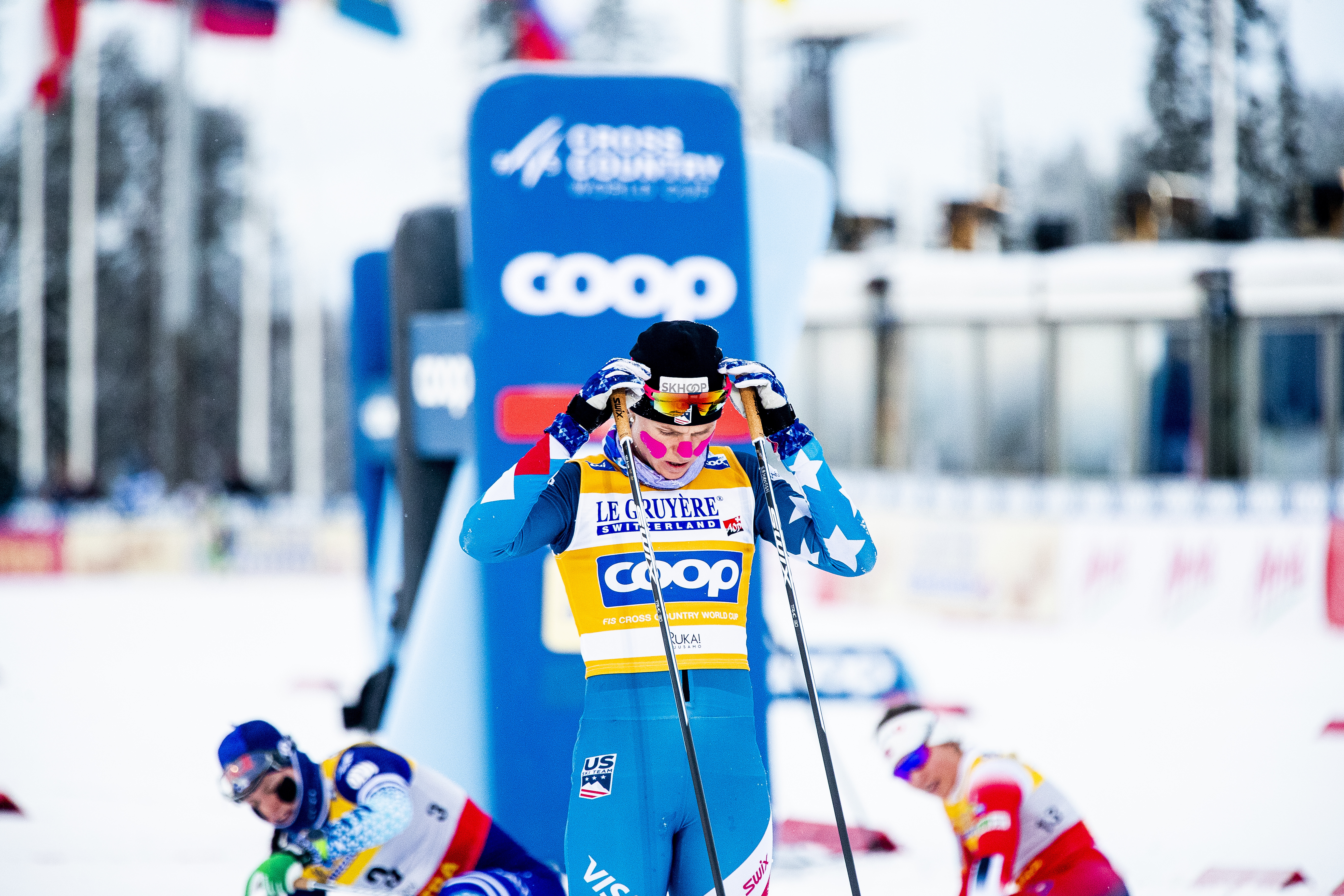
Jessie Diggins gasps for air after taking 4th in the first stage of the distance pursuit Nové Město. (Photo: NordicFocus)
When asked for a preview of tomorrow’s pursuit, Johaug commented on this strong group of women who would be chasing her.
“Of course, I’m really happy that I have 30 seconds, but I know that it’s a big group behind me and they can do work together and I’m going to be in the front alone,” Johaug said. “I have to work hard to have the first position in the finish, but I will do my best and we will see tomorrow how it ends.”
The women of Nové Město. Therese Johaug (NOR) led the day, followed by Natalia Nepryaeva (RUS) and Heidi Weng (NOR). (Photo: NordicFocus)
Due to poor WiFi connection, Diggins chose to share her post-race comments via email.
“Today was a good race for me, although it was kind of funny because with the super deep, sugary snow, it never felt like I was moving very fast, especially stepping through the sugar on the uphills! But overall I’m happy with where my body is after the Tour de Ski, and I’m working on training as smart as I can to find that balance between racing and training hard and finding good recovery after such a big effort.”
After today’s result, Diggins is ranked third in the World Cup distance standings behind Johaug and Weng. She is ranked 5th in the overall standings. Diggins commented on how this plays into her tactics in the second half of the season.
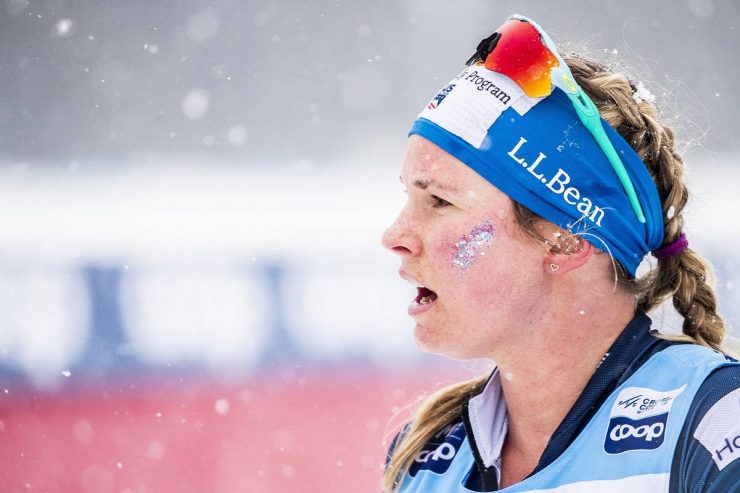
Glitter, snow. and grit. Jessie Diggins takes 4th in Nové Město. (Photo: NordicFocus)
“In terms of overall ranking, there isn’t really a plan because it’s out of my control – as we saw during the TDS, a few tough waxing days can make a huge difference, and you obviously have no control over how other athletes are performing. With that in mind, I don’t worry about the overall and instead focus on making every race I do a complete effort, training and racing it to the best of my ability, only worrying about the things I can control like my race effort, technique and pacing. If I can do that well, then it sets me up as best I can for the overall.”
After the Tour, Diggins headed to the Dachstein glacier in Austria, where she was joined by her boyfriend, Wade, for a block of recovery and training.
“My post-TDS training camp was really awesome, and I felt so lucky to have my boyfriend there with me! It’s very important to me to find a healthy life/skiing balance, in order to be happy and want to continue racing on the road for years to come. So my main focus during that time was simply happiness, as well as quality rest and recovery after the huge effort of the Tour.”
Diggins closed with optimistic remarks heading into tomorrow’s classic pursuit.
“I had great skis today and I’m very thankful to our hardworking staff! Tomorrow should be an exciting pursuit start and I’m excited to ski with so many speedy ladies.”
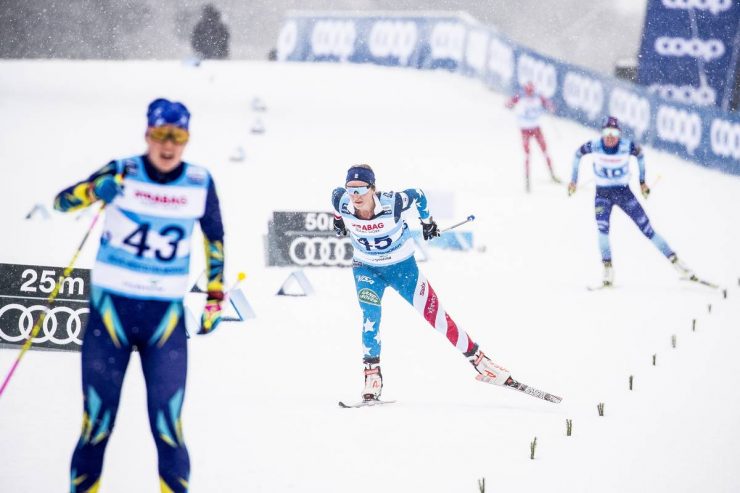
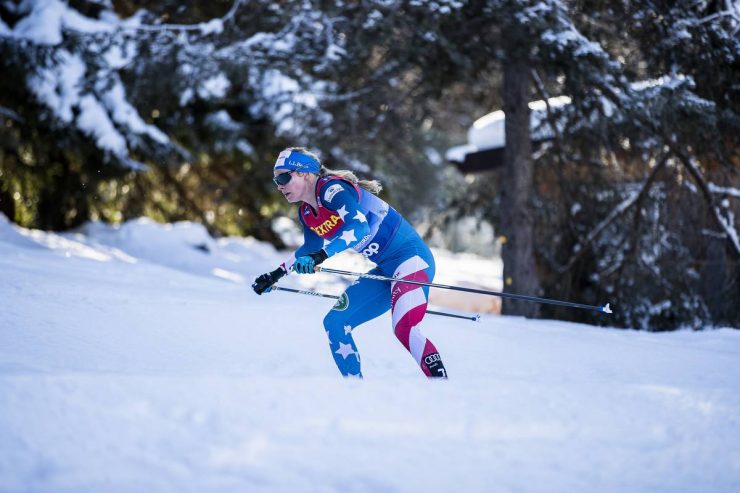
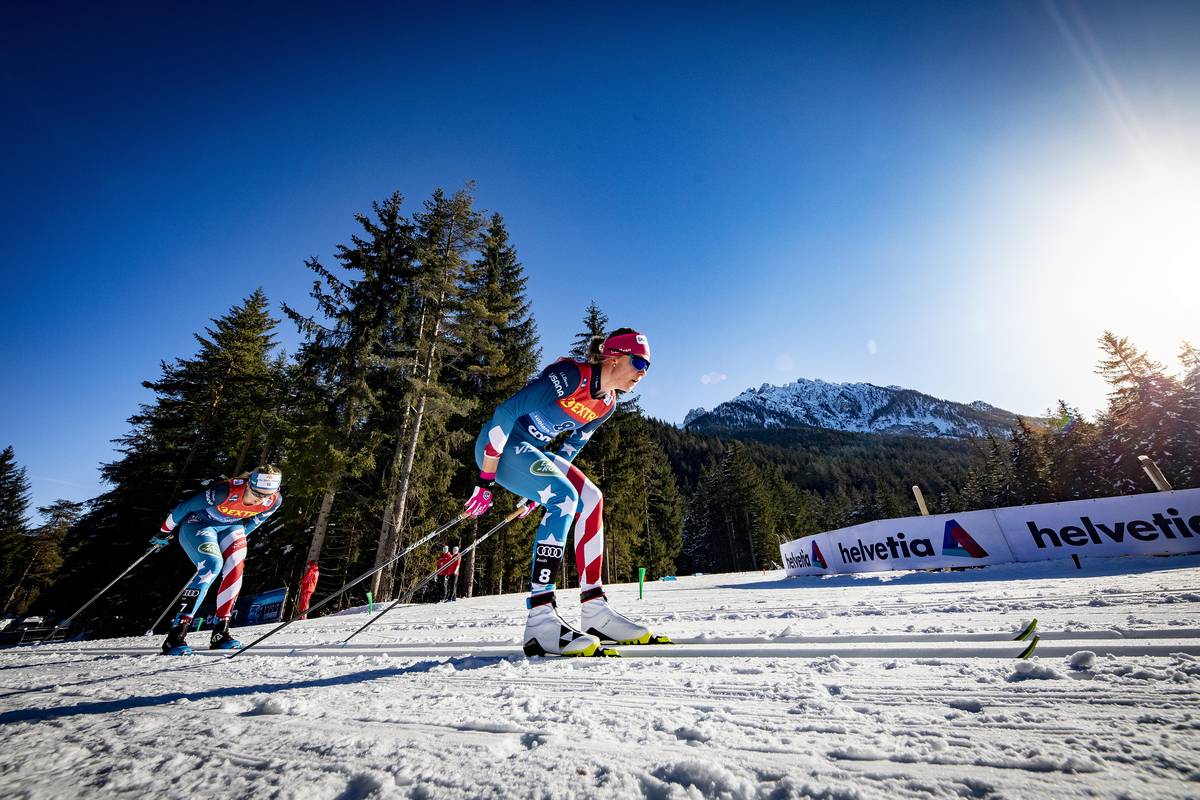
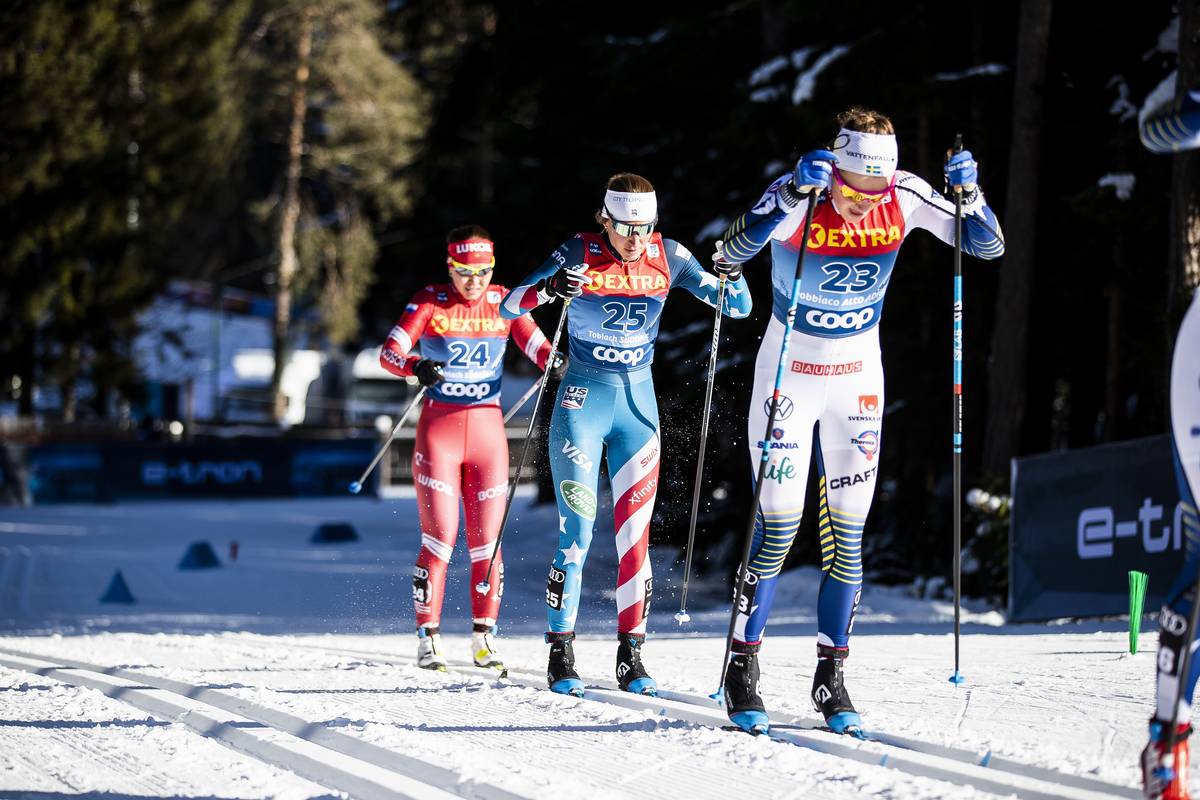
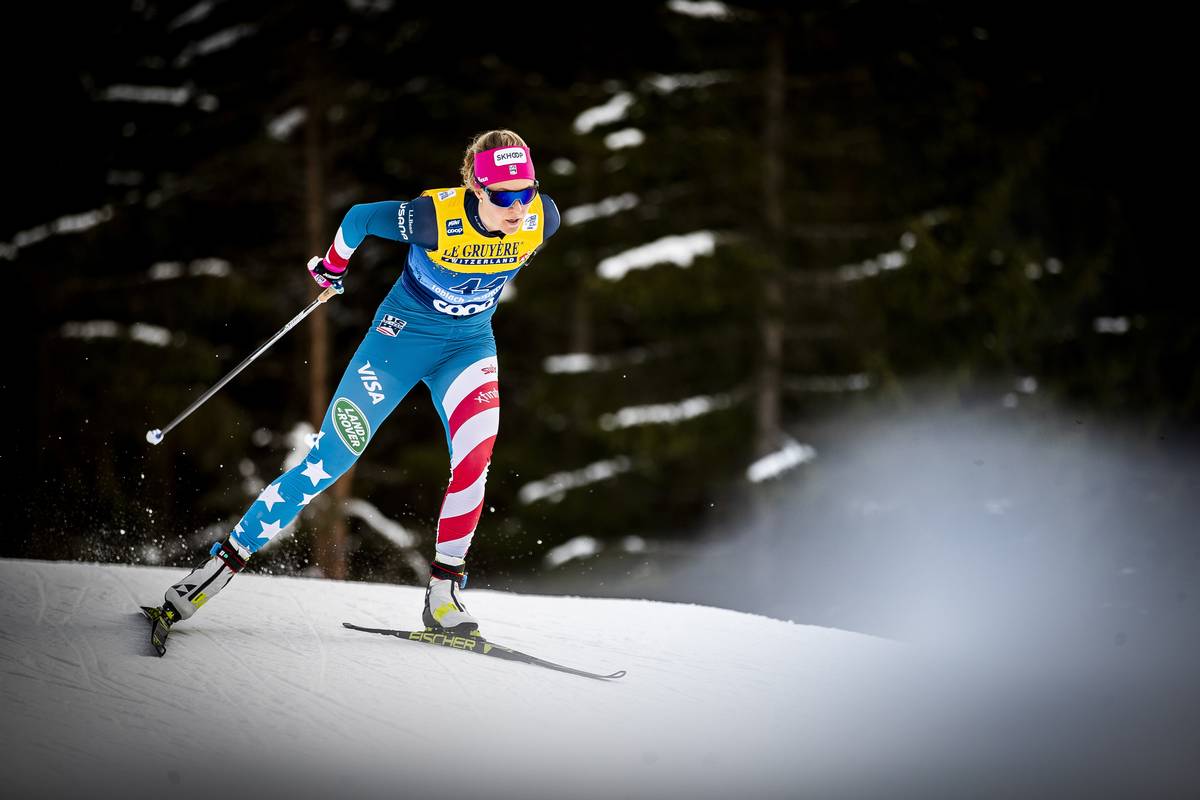
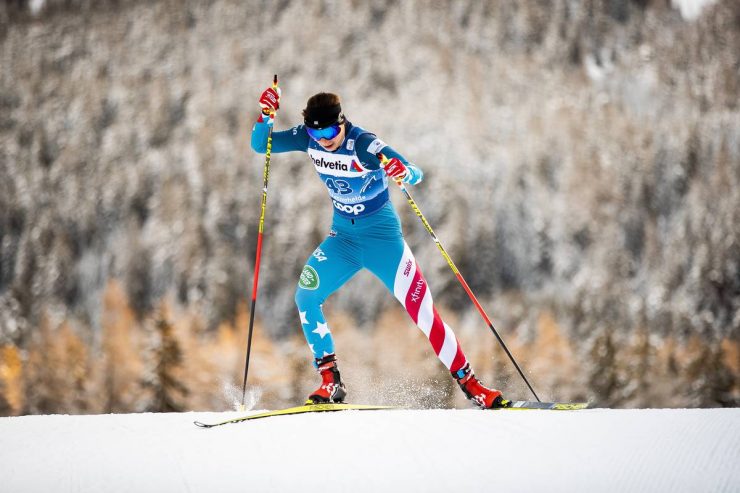
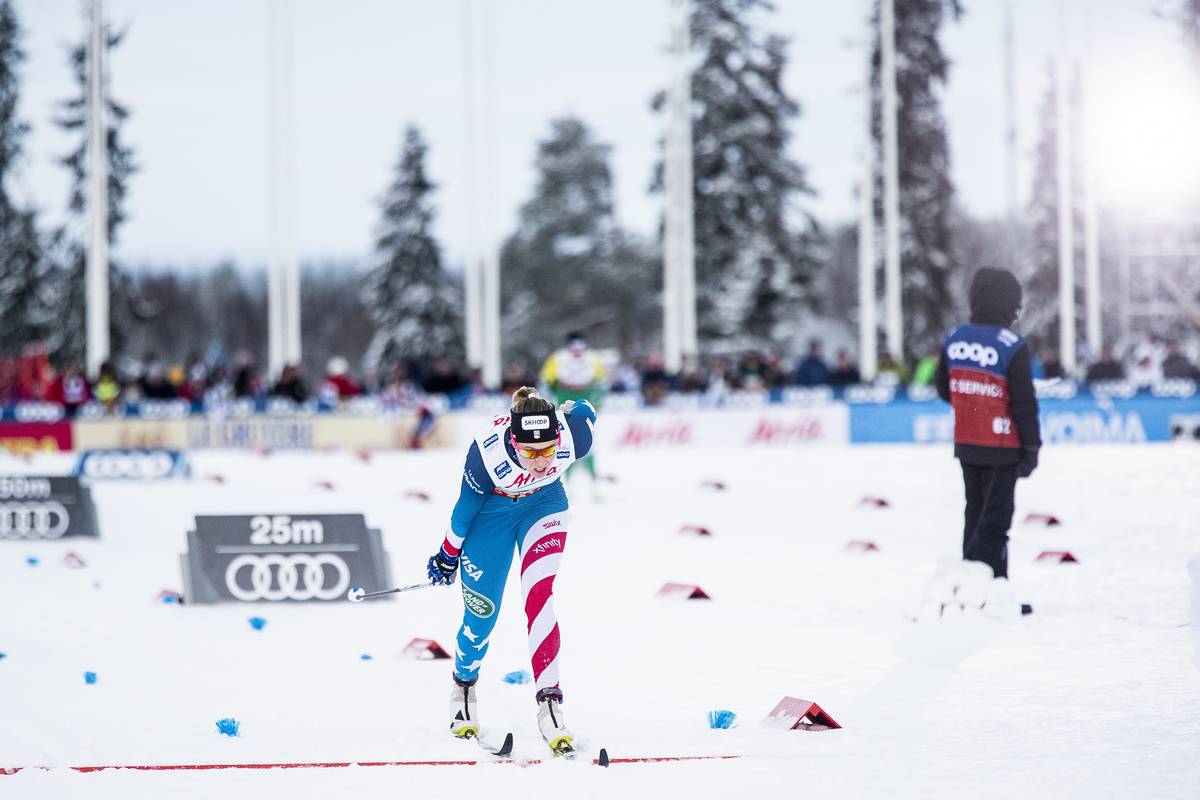
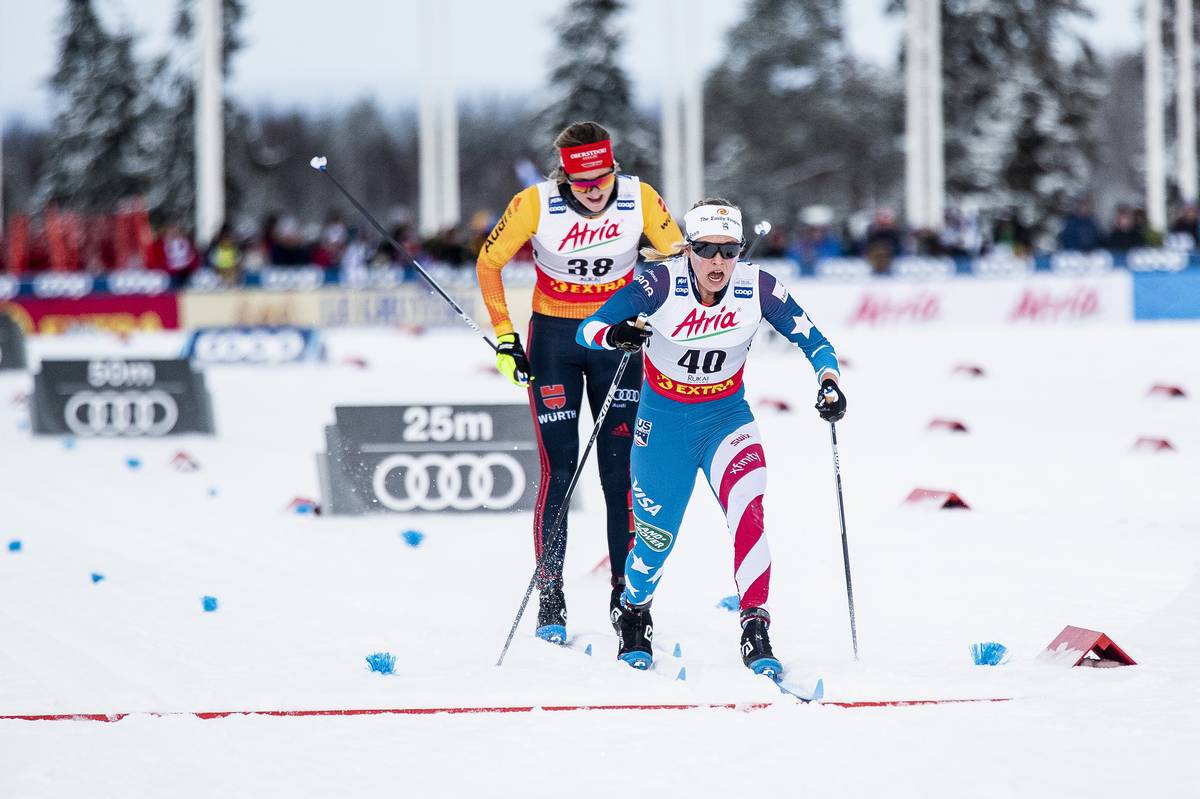
Rosie Brennan (USA) during the women’s 10 k skate in Nové Město. (Photo:NordicFocus)
Following Diggins, Rosie Brennan was the second fastest American, finishing 17th (+1:35.3), followed by Sadie Maubet Bjornsen in 26th (+1:51.1), and Julia Kern in 30th (+2:03.3).
“We faced some challenging conditions today,” Brennan emailed to several news outlets. “With no [natural] snow on the ground, the course was made up of all man made or saved snow, which didn’t adhere well to itself so it was deep, sugary, and dirty. The course was challenging in the sense of the amount of transitional skiing. I wasn’t sure how I would feel after the Tour de Ski but tried to stay optimistic that my break was good and I would be back where I left off. I started well and was happy with my first lap. I faded much more than I had hoped in the end and think I am still feeling a bit of fatigue from the Tour. Overall, it was a solid day and I hope I can find another gear tomorrow.”
Alayna Sonnesyn skis to 46th in Nové Město. (Photo: NordicFocus)
Fresh off of U.S. Nationals in Houghton, Mich., Caitlin Patterson finished 39th (+2:17.7), and UVM graduate Alayna Sonnesyn (SMST2) rounded out the American squad in 46th (+2:38.1).
“I’m really happy with my race today,” Sonnesyn emailed about her race. “I feel like I skied well and was consistent through the whole thing. I think I will learn a lot each day and hope to keep improving in the next few weeks!”
New to this level, Sonnesyn begins her second set of World Cup starts, which she earned from her position as SuperTour points leader. Her first World Cup starts took place at the World Cup finals last spring in Quebec City, where a string of bad luck kept her from performing at her potential: illness, followed by three crashes and two broken poles, resulting in a DFL — “dead freaking last.”
“I was really excited about those starts [in Quebec City], but by mid-March I had traveled around the world (literally, I went from the Birkie to China to Germany and back to the US) all in about 2 weeks and I was totally wiped,” Sonnesyn explained. “I knew I didn’t have the kind of energy to have races that I was truly capable of but I still wanted to start them to gain that experience.
“This year, I was slightly more comfortable showing up at a World Cup race and didn’t have to waste a ton of energy fan girling (too hard),” she wrote with a wink. “That being said, the field is so deep here and going into the race I wanted to focus on my own skiing, without worrying about results. That’s the really nice thing about being SuperTour leader right now; I didn’t need to “prove myself” in this first race. I have six races over 4 weeks to grow accustomed to racing at this high level and hopefully keep building on a race like today.
In a post-race call, Chris Grover shared additional insights into the womens’ performances, including how Maubet Bjornsen is feeling after the Tour de Ski, and Patterson and Sonnesyn’s results fresh off the plane.
Therese Johaug: queen of the hill. (Photo: NordicFocus)
The fateful Alpe Cermis. The 10-kilometer capstone of the Tour de Ski, athletes complete the 1.5 k sprint loop before following the river valley down to the base of the alpine hill, climbing steeply for nearly 400 vertical meters to the finish. Bodies aching with the cumulative fatigue of the tour, racers are totally spent at the finish of the event. Crossing the line, they collapse with their faces pressed into the snow gasping for air and writhing in lactate-induced misery.
And so it was today.
First, a look back on Tours of the past. Unlike in the men’s event, the fastest skier up the Alpe Cermis has been the overall tour winner over the last four years.
Last year, Ingvild Flugstad Østberg was the fastest up the hill climb in 35:15.0 to take the overall win. Østberg was 42 seconds faster than the next skier, Krista Pärmäkoski of Finland. In 2017 and 2018, Heidi Weng was the first up the mountain by a similar margin. And four years ago in her most recent tour performance, Therese Johaug dusted the field, winning the day by a margin of 1:25.9. That’s nearly double the already large differential of her teammates.
Dubbed by Devon Kershaw an “once in a generation athlete,” Johaug has over 100 career podiums to her name, over 50 of which have been wins.
With this insight, it seemed safe to bet on Johaug in the final stage. However, the Norwegian superstar has proved to be beatable in this tour, much to everyone’s surprise.
Johaug was out-sprinted by Østberg in the final meters of the 10-kilometer classic pursuit in Stage 4, and the next day, she missed her first distance podium since she took 5th in the 5k skate in Toblach during Stage 4 of the 2016 Tour de Ski. (Johaug missed the 2017/18 and 2018/19 seasons while serving an 18-month ban after testing positive for the anabolic steroid clostebol, which was contained in a lip cream she used after sustaining a severe sunburn.)
Heading into the final stage, the overall standings looked like this: Norway’s Astrid Jacobsen trailed Johaug by three seconds. Natalia Nepryeava lurked 14 seconds back, and Ingvild Flugstad Østberg was 23 seconds back. Ranked as the top American, Sadie Maubet Bjornsen sat in 8th (+1:58), with Jessie Diggins 11th (+2:53).
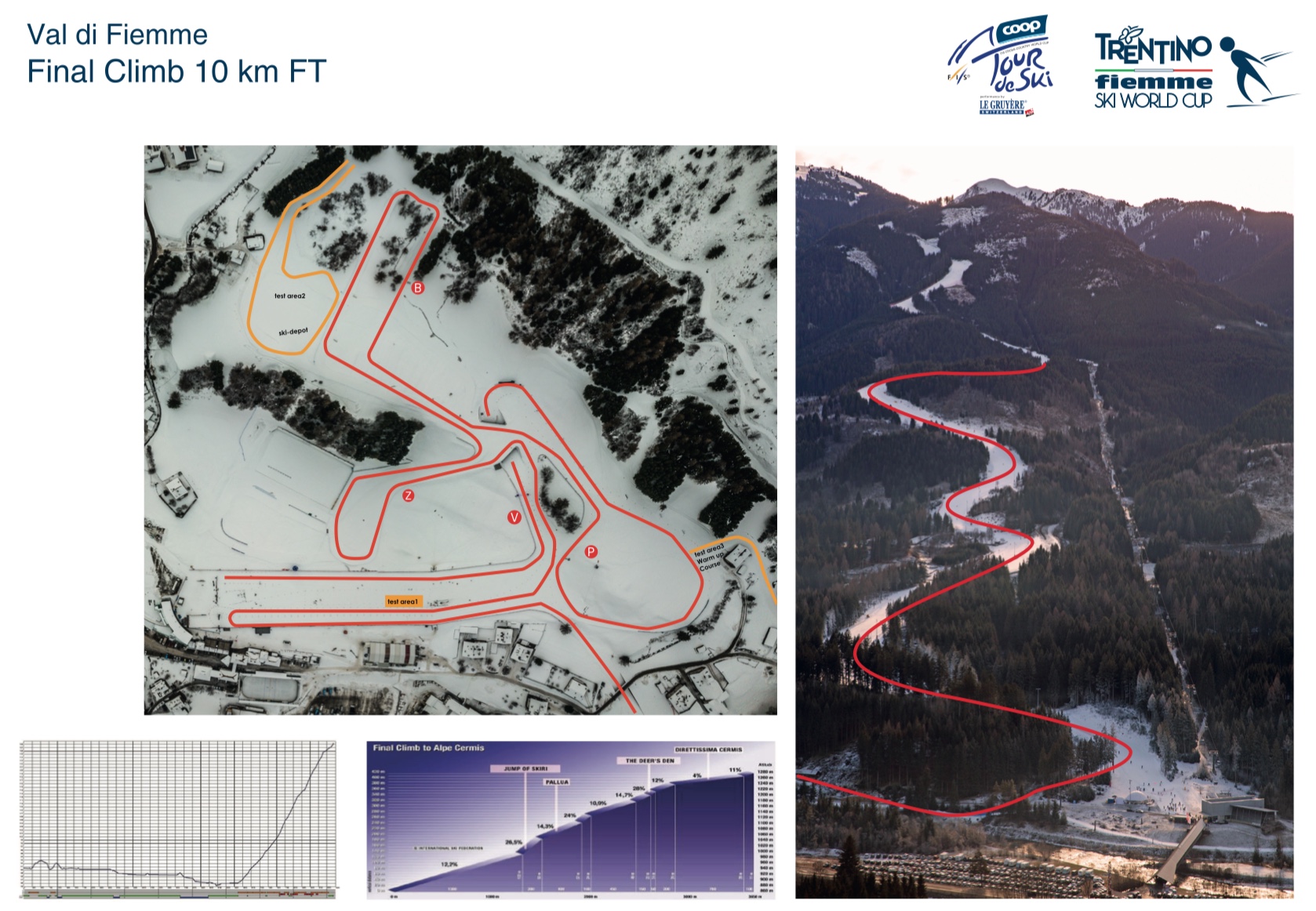
The infamous climb up the Alpe Cermis. (Photo: Screenshot FIS Broadcast)
Historically, the event has been run in pursuit format: the first person to the top of the hill wins. This round features a mass start format; racers will need to drop and gap their chasers to earn time in the standings. Identifying rank in the overall standings required lots of quick math to follow the flux in deficits; eleven seconds between Jacobsen and Nepryaeva heading into the final stage, nine seconds between Nepyraeva and Østberg, and so on.
One final note before we begin: Ebba Andersson of Sweden, who was ranked 6th in the standings (+1:07), withdrew from the Tour before the final stage.
As expected, the pace went out conservatively around the sprint loop. Racing on a narrow band of man-made snow that frequently contrasted the bare ground and asphalt beside it, Johaug stepped to the front, a string of her teammates that included Heidi Weng, Østberg, Jacobsen, and Nepryaeva.
As they hit the hill, Johaug put her head down and got to work. She quickly created a gap to Heidi Weng and Østberg, who at first were willing to match the effort early in the climb, but quickly laid off, unwilling to succumb to temptation and risk flooding their legs with lactate too early.
It became a race for second place and a race against the clock. In the lead, Weng pulled Østberg and Nepryaeva up the hill, a gap to the next skiers.
Heidi Weng (NOR) races for second place up the Alpe Cermis with Ingvild Flugstad Østberg (NOR) and Natalia Nepryaeva (RUS) chasing. (Photo: NordicFocus)
With Jacobsen nowhere in sight, Nepryaeva and Østberg fought for podium positions. At 9 k, Weng led Østberg by roughly four seconds, followed by an equivalent gap to Nepryaeva. Though Østberg matched Weng stride for stride, the Norwegians were not able to pull away from the Russian.
Meanwhile, Johaug steadily chugged up the hill, on her own by over a minute. As the grade mellowed in the final 200 meters, she had energy left to ski V2, her technique masking the fatigue she must have felt.
Waving the Norwegian flag high, Johaug shrieked with joy and relief as she stopped the clock at 34:21.6.
Therese Johaug celebrates her stage and overall victory at the finish of the 2019/2020 Tour de Ski. (Photo: NordicFocus)
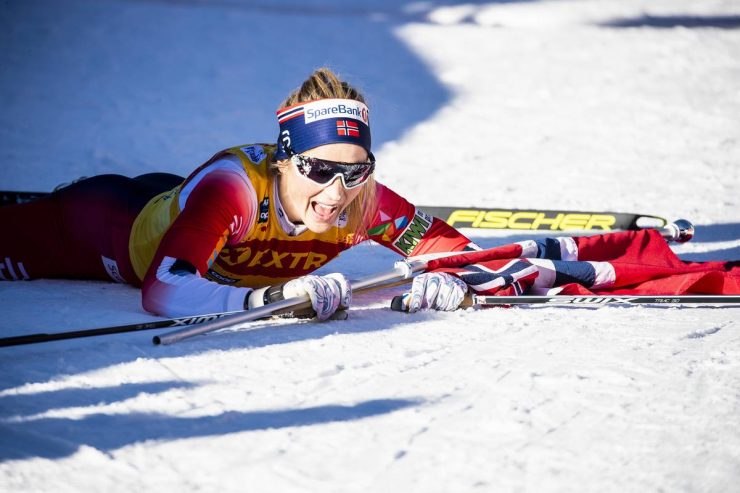
A hard earned rest for Therese Johaug after winning the hill climb and taking the overall victory in the 2019/2020 Tour de Ski. (Photo: NordicFocus)
“I’m really, really happy now. My goal was, of course, when I’m going down here to fight for first place in the overall and today I do it. It has been seven hard days, but I am really, really happy now to come up here. I’m really looking forward to end this Tour de Ski because you wake every morning and are so nervous, but tomorrow I’m free.”
Firing on all cylinders, Heidi Weng crested the steep pitch, powering through the gradually ascending final meters for second (+50.3). Østberg followed in her wake for third (+54.5), followed by Nepryaeva in fourth (+57.1).
Throwing a boot to minimize her time back, Natalia Nepraeva finished 4th in the hill climb and 2nd in the overall 2019/2020 Tour de Ski. (Photo: NordicFocus)
So how did it all shake out? Therese Johaug took the overall Tour with an aggregate time of 2:28:18.6. Nepraeva landed the second spot on the podium (+1:11.1), followed by Østberg in third (+1:17.5). Weng finished 4th (+1:37.3), with Jacobsen behind her rounding out the top 5 (+2:13.4).
Theresa Johaug: 2019/2020 Tour de Ski champion. (Photo: NordicFocus)
First to the top of the Alpe Cermis, Therese Johaug (NOR) takes the overall victory in the 2019/2020 Tour de Ski. (Photo: NordicFocus)
Winding along the Marcialonga in the lead group, Diggins kept her position in the top ten throughout the day. At first, she trailed Jacobsen, Theresa Stadlober of Austria, and Charlotte Kalla of Sweden as they began the climb, but Kalla and Jacobsen fell off the pace.
Losing contact with Stadlober, Diggins was in the unfortunate position of skiing alone. Despite having no one to chase, she climbed steadily, sitting in 6th at 9 k with her teammate Rosie Brennan closing from behind.
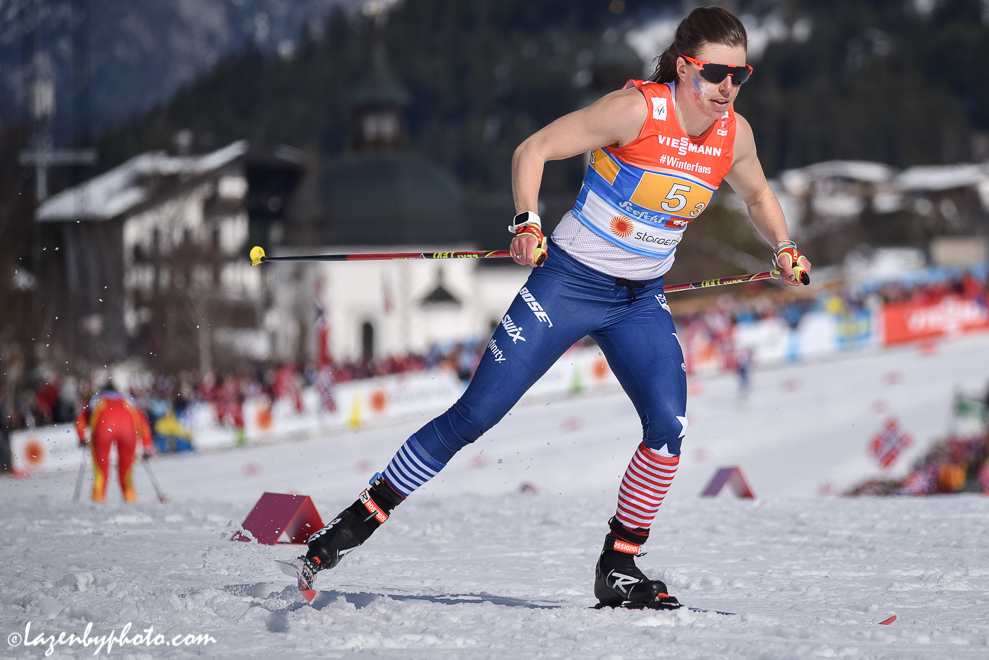
Pure grit: Jessie Diggins ascends the final meters of the Alpe Cermis hill climb in 6th. (Photo: NordicFocus)
Holding her position, Diggins crossed the line for 6th (+1:51.1), chipping time off her deficit in the overall standings. With the hill climb, Diggins leapfrogged into the top 10, finishing 9th in the overall (+4:44.1).
“Today I was happy with my climb; I think I managed to pace it right so that I could keep moving up the hill steadily without blowing up – a line that is hard to find, but pretty crucial to get right! I had good energy and it’s nice to know that my fitness is in a good place even at the end of the tour,” Diggins wrote.
“Overall, this tour has been challenging in that I had many races where my fitness and effort weren’t reflected in the results. But I was proud of how I carried myself, contributed to having a positive team atmosphere and stayed positive without ever giving up, on the days when I had competitive skis but more important, on the days when I did not. It took a lot of positive energy, but now I can leave the Tour really proud of my mental toughness and ready to soak in all the hard work I put out there!”
Brennan and her teammate Sadie Maubet Bjornsen sat in the mid-teens at the base of the climb. As the grade increased, Brennan left Maubet Bjornsen and began picking off the women in front of her. Brennan advanced from 15th at the base of the climb to finish 7th (+1:58.0).
Rosie Brennan climbs to 7th place in the final stage of the 2019/2020 Tour de Ski. (Photo: NordicFocus)
In the overall standings, Maubet Bjornsen bumped up one spot into 7th (+4:40.6). Brennan finished 15th in the Tour (+7:11.0), and Ogden 28th (+12:26.5). 41 women finished the Tour.
“Wow, it feels good to make it to the top of that climb,” Maubet Bjornsen emailed. “I think it is safe to say, making it up that alpine slope after six hard days of racing is quite possibly the most physically painful thing I experience. Just crossing the line is such an achievement. This is only my third time I have made it, so it still feels just as exciting as the first one!
“This tour has had its ups, downs, and painfully near misses. Despite the rollercoaster, I feel like I gained confidence in my fitness and my skiing throughout the process. Not only that, I had my best ever Tour de Ski finish, ending in 7th place.
“No doubt I will come away from this tour both physically and mentally tougher!
“Thank you to the support crew who allowed it to happen, and thanks for all the cheers of encouragement both on the tough and wonderful days!”
The 2019/2020 Tour de Ski podium: Therese Johaug (NOR) took the win ahead of Natalia Nepryaeva (RUS) and Ingvild Flugstad Oestberg (NOR) in third (l-r) . (Photo: NordicFocus)
With one stage remaining in the 2019-2020 Tour de Ski (TdS), and with standings somewhat unsettled before what some consider to be a slam dunk final stage for the current overall leader Therese Johaug from Norway, time bonuses were what mattered in Val di Fiemme, Italy on Saturday. Podium pride was at stake, but generous time bonuses were the carrot for many in the 1.27-kilometer classic sprint.
First through 30th place in the TdS sprints receive a time bonus. Sixty seconds for first, 54 seconds for second, and so on. Time matters.
After Stage 5, Johaug led the overall by 19 seconds over Ingvild Flugstad Østberg (NOR) in second, 32 seconds over Russia’s Natalia Nepryaeva, and for good measure, 33 seconds ahead of Astrid Uhrenholdt Jacobsen (NOR) in fourth.
Finding her groove in time for the final stage. Astrid Uhrenholdt Jacobsen (NOR), moves to second overall in the Tour standings. Sadie Bjornsen (bib 4) follows. (Photo: NordicFocus)
The thirty-two-year-old Jacobsen comes off a mildly surprising win in Stage 5’s 10 k mass start classic race. Of late, her classic technique looks dialed and her ski speed has been an asset. For the longtime National Team member, the top podium spot has been a fleeting prize. Over her storied career, she has won five World Cups. We bring her up because she animated today’s classic sprint and positioned herself nicely for a TdS overall podium spot. More on that in a bit.
First a reminder, this is well into the TdS. Many of the World Cup’s top sprinters dropped from the Tour a stage or two ago. For the U.S., Sophie Caldwell is missing. Some top sprinting Swedes are not at the Tour. And Maiken Caspersen Falla of Norway took a raincheck. With forty-four skiers starting the qualifier, it was a good bet that many of the names we associate with distance skiing would progress.
Jessie Diggins of the U.S. qualified in first on the 1.27 k classic sprint course in 3:04.26. Yes, all the top contender names in this TdS advanced to the heats.
Jessica Diggins (USA), Natalia Nepryaeva (RUS), Lucia Scardoni (ITA), and Theresa Johuag (NOR) (l-r), during the first quarterfinal, Stage 6 of the Tour de Ski. (Photo: NoridcFocus)
In the first heat, Diggins looked smooth and powerful as she placed first. But slotting into fourth, in by far the fastest quarter-final was Johaug. She would advance to the semis, minimizing the potential damage of time bonus gains by her rivals for the overall.
In the second heat, it was Jacobsen who commanded the win with timely positioning and rocket skis. Sadie Maubet Bjornsen was second. Brennan placed fourth and did not advance.
After cataloging the quarters, all the key players remained. An upstart Anamarija Lampic from Slovenia, Nepryeava, Weng, and Østberg, Johaug, Diggins and Maubet Bjornsen. The only potential overall Tour contender not to advance and capitalize on more bonus time was Sweden’s, Ebba Andersson. Prior to today’s sprint, she was fifth overall, only 38 seconds out.
Andersson ended her day ranked 28th in the sprint.
Sadie Maubet Bjornsen (USA), Jonna Sundling (SWE), Jessica Diggins (USA), Lucia Scardoni (ITA), Therese Johaug (NOR), (l-r) during the first semifinal, Stage 6 of the Tour de Ski. (Photo: NordicFocus)
In the first semi, Jacobsen, Maubet Bjornsen, and Diggins went 1-2-3 to advance. Diggins moved on to the final as a lucky loser. Johaug bowed out in sixth. But her mission of time bonus mitigation was accomplished. Johaug ended her day ranked 11th.
Lampic, in the second semi, showed she too is a mint sprinter. She won her first career World Cup on Stage 2 of this TdS, a skate sprint, in a deeper field. Today, advancing to the finals after winning her semi, Lampic would add another exclamation point.
Out of the start, Nepryaeva fell hard in the finals while changing lanes. She placed sixth (+15.30) after realizing that burning energy to catch back on was futile. The five remaining in front kept it tight. Up the first climb, the skiers slotted into four lanes across with Jacobsen eventually taking charge.
The course finishes with a long downhill into the final straight. Here, good skis and a transition into a power double pole played to Lampic’s favor. With Diggins, Maubet Bjornsen, Jacobsen, and Lampic gliding into the straightaway, Lampic was able to pull ahead for her second career World Cup win in 3:03.03. Diggins had a clear lane as did Jacobsen. Maubet Bjornsen, however, with a strong double pole, was stymied by Jacobsen blocking her in front. Maubet Bjornsen began pushing onto Jacbosen’s tails. The formidable U.S. skier switched tracks before she crossed the finish losing a smidge of momentum.
Jacobsen ultimately placed second (+0.22) in a photo finish with Diggins, who placed third (+0.28). Maubet Bjornsen was fourth (+0.8) and Lucia Scardoni of Italy fifth (+1.12).
A streamlined Diggins during Stage 6 of the Tour de Ski. (Photo: NordicFocus)
“We haven’t seen a classic sprint here since 2013 World Champs, so tactically we were trying out a few new things and finding our strengths out there!” emailed Diggins. “I had good energy today and was just trying to push the pace at the start, but in the final, I was trying to use the slingshot a little bit more off of the downhill. I was also wary of getting boxed in on the tight corners because it was so important to be able to push hard over the top of the hill into the downhill.
“Huge thanks to the wax team for working so hard, and it was super fun to ski in the finals with Sadie! We’ve kept such a positive energy on this team the entire tour, through the good days and the hard days, and that has really paid off.”
Looking forward to finishing this tour like I always do – by going out there and giving it absolutely everything I have, so I can be proud of the effort I gave!
Anamarija Lampic (SLO) loving the win, post-Stage 6 Tour de Ski stoke. (Photo: NordicFocus)
“Hard to believe we can find sprinting muscles after so many days of racing, but somehow I felt amazing today!,” Maubet Bjornsen emailed. “Through my quarters and semis, I managed to place myself in a safe place, trying to conserve energy for the final, and feeling in total control. As the finals went off, I put myself in what felt like the ‘right position’. Unfortunately, I wasn’t in the right place at the right time on the final stretch, getting blocked up and just missing the podium by half a second.
“I can’t help but feel a bit frustrated, because I believe I could have won today if I could ski it again, but how can you be upset with a 4th place? I’ll have to channel all that frustration into the final day tomorrow, up the big alpine slope.”
Sadie Maubet Bjornsen (USA), Astrid Uhrenholdt Jacobsen (NOR), Anamarija Lampic (SLO), (l-r) in the final straight as Lampic takes the win. (Photo: NordicFocus)
Jessica Diggins (USA), Sadie Maubet Bjornsen (USA), Astrid Uhrenholdt Jacobsen (NOR), Anamarija Lampic (SLO), (l-r) in the final straight. (Photo: NordicFocus)
“While this tour has had plenty of ups and downs, I continue to feel strong and confident on my skis. Every new day is a new chance, which is so fun! That’s why I just love this crazy 7 races in 9 days. Getting yourself across that line on top of Cermise is an unbelievable achievement!”
Also for the U.S., Brennan placed 19th and Katharine Ogden 32nd.
The Shakeout for the Overall
Therese Johaug (NOR) kept it close today as she advanced to the semis in the Stage 6 classic sprint of the Tour de Ski. Johaug still leads the overall standings. (Photo: NordicFocus)
With her 11th place in the sprint, Johaug earned 24 bonus seconds, which in reality served to keep those potential overall threats, if any really exist, a few seconds back. That brings us to Jacobsen. After starting the day fourth overall, 33 seconds behind, her second place in the sprint netted her a 54-second time bonus. That bumped her to second overall, only three seconds behind Johaug. Nepryaeva is currently third overall, with 14 seconds to make up. Østberg fell to fourth — she placed 12th in the sprint — with a long 23 seconds to gain on the Alpe Cermis.
Post-Stage 6, Maubet Bjornsen improves to eighth overall (+1:58) from ninth after Stage 5, and Diggins jumped from 15th overall to 11th (+2:53) after Saturday’s sprint.
Tomorrow’s final stage, the infamous Cermis climb brings a new format this year. Historically, the Tour’s premier stage runs as a pursuit. With tomorrow’s mass start, every athlete heads out together. It will be on those trailing Johaug to somehow find a weakness and literally pull ahead.
If you’ve been listening to Devon Kershaw, no way, it will not happen — Johaug will not lose time on the Cermis.
The Alpe awaits.
(An athlete’s qualifying time from Stage 6 is used to determine an athlete’s time in the overall standings. Bonus time is subtracted from the overall time.)
The women’s podium after Stage 5 of the 2019/2020 Tour de Ski in Val di Fiemme, Italy. Astrid Uhrenholdt Jacobsen (NOR) took the win ahead of Ebba Andersson (SWE), and Katharina Hennig (GER). (Photo: NordicFocus)
The 100th Tour de Ski Stage in Val di Fiemme, Italy, featuring a four lap 10-kilometer mass start classic. Coupling the results in distance racing over the last 14 months since Therese Johaug returned to the world cup and those of Stage 4, it seemed like a safe bet to predict a rematch between Johaug and her teammate Ingvild Flugstad Østberg. Another opportunity to race head-to-head over every meter of the course, and for Johaug to make a statement that her loss was a fluke.
It quickly became clear that Østberg crossing the line 0.4 seconds ahead of Johaug was akin to Roger Bannister running 3:59.4 on a cinder track in Oxford. The barrier was broken, illuminating the potential for the host of men who followed. Johaug was no longer invincible. No longer in a class of her own.
Ebba Andersson (SWE), Ingvild Flugstad Oestberg (NOR), and Heidi Weng (NOR) lead the pack in a 10-kilometer mass start classic in Val di Fiemme. (Photo: NordicFocus)
Nearing the end of the first 2.5 k lap, seven athletes formed a tight group at the front of the pack. Putting in a surge for the point bonus at 2.3 k, Natalia Nepryeava of Russia was in the lead, stretching out the group slightly. The trailing women rebounded like a slinky, continuing to push as a group.
The elevation profile of the 2.5 k course in Val di Fiemme, Italy. (Photo: Screenshot FIS broadcast)
Rounding the fast winding turns of the steep descent halfway through the lap, the chink in Johaug’s armour widened. Temperature well above freezing and old manmade snow made for lightning fast conditions, and racers were likely kicking with a variation of klister, perhaps with a hardwax cover. In the first lap, Johaug lost her footing and crashed, rebounding quickly and keeping contact with the pack.
In each of the subsequent laps, she was seen scrubbing speed, doing what she could to stay on her feet at the risk of shearing off some of her grip.
Therese Johaug approaches the fateful horseshoe bend in Val di Fiemme with Ebba Andersson close on her tails. (Photo: NordicFocus)
Jessie Diggins tackles the fast icy corners in Val di Fiemme during Stage 5 of the 2019/2020 Tour de Sk. (Photo: NordicFocus)
Spending the majority of the race at the front, Ebba Andersson of Sweden made several attempts to reduce the size of the group, but each of her moves were matched. Johaug, Østberg, and their teammates Astrid Jacobsen held strong beside Nepryeava, and Katharina Hennig of Germany.
As the 6k checkpoint approach, providing the opportunity for the first ten athletes to earn up to 15 bonus seconds, the pace accelerated. Jacobsen emerged at the front, sprinting head to head against Andersson with the remainder of the women close on their tails. Jacobsen held off the Swede, earning the most time.
Tour leaders Østberg and Johaug were 4th and 6th at the bonus, respectively. As expected after a high-speed snowplow down the hill, Johaug appeared to be struggling with her kick and was forced to run alongside the pack of women outside the track.
Sadie Maubet Bjornsen, who initially fell off the lead pack with Jessie Diggins, pushed to reconnect with the lead group and hovered 2 seconds behind in 8th at the time bonus. Diggins began to fade and was not within the top ten skiers; she did not earn bonus seconds.
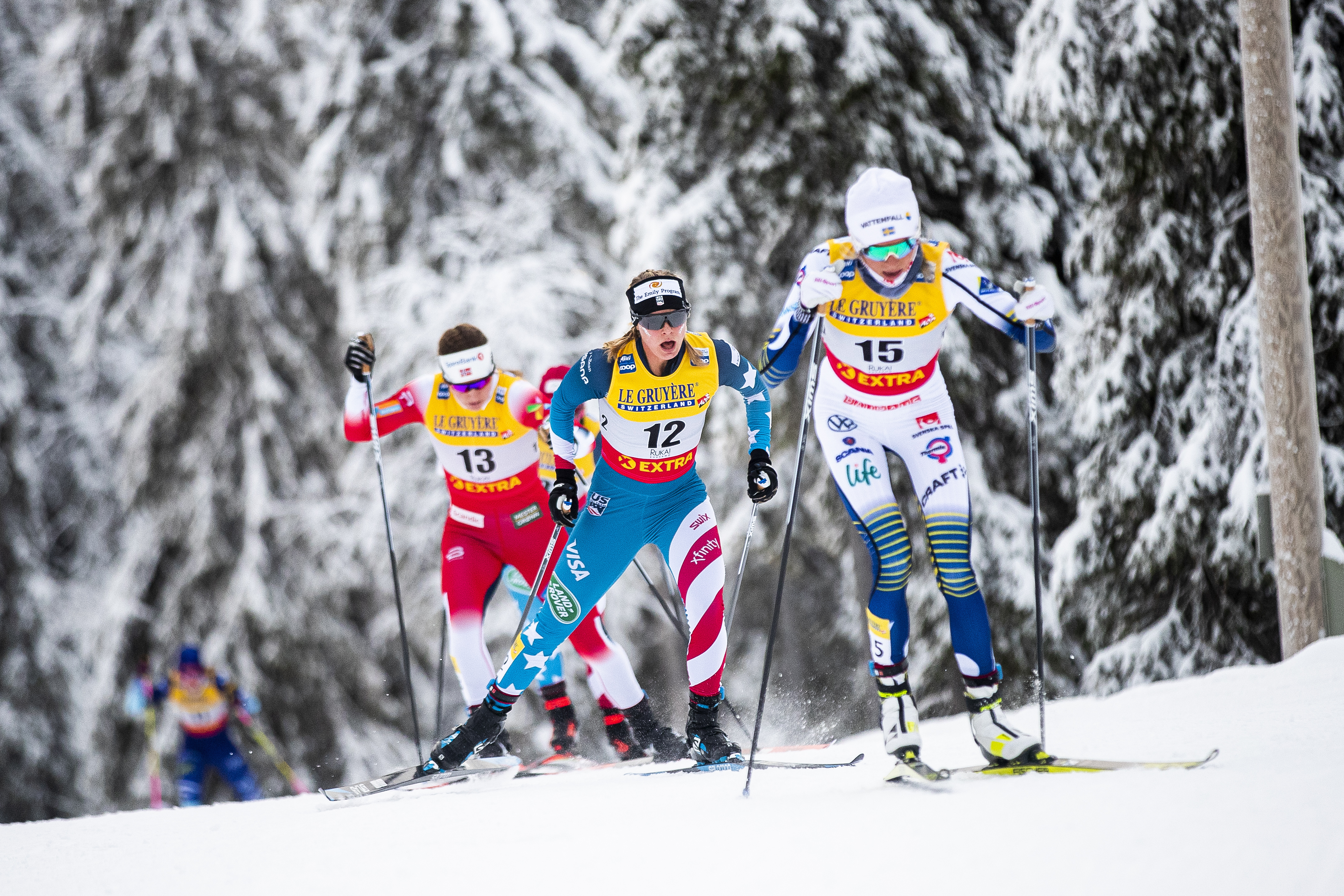
Charlotte Kalla (SWE, bib 13), Sadie Maubet Bjornsen, and Jonna Sundling (SWE) lead the chase group during Stage 5 of the 2019/2020 Tour de Ski. (Photo: NordicFocus)
As the final lap began, the pace heated up and the lead pack began to whittle down. Østberg led at each of the checkpoints. She too could no longer climb inside the tracks, but neither could her opponents. Heading into the fast and technical descent, Østberg motioned to the racers behind her as if to say, ‘Let’s chill out and give each other space here so we all stay on our feet.’
And so they did; each of the top five skiers stayed on their feet around the horseshoe bend. But as they headed up the final punchy climb with less than a kilometer to go, Østberg tangled with Johaug and went down and the tip of her pole snapped off. Running on her skis as she ripped off the strap and reached for a new one, she charged ahead, not pausing to put the strap of the replacement over her hand.
But her momentum was lost and she could not regain her contact with the three leaders who had taken off at the front: Jacobsen, Andersson, and Hennig.
Astrid Uhrenholdt Jacobsen (NOR) rounds the final turn toward the stadium with Katharina Hennig (GER) in hot pursuit. (Photo: NordicFocus)
Double poling in ferocious unison, the three women sprinted to the line with Jacobsen less than half a ski length ahead of Andersson who occupied the neighboring track. Hennig remained tucked in behind Jacobsen, who began to pull further ahead in the final meters.
Stopping the clock at 29:07.9, Jacobsen took the win and landed her first Tour de Ski podium since the final stages of the 2014 Tour, also in Val di Fiemme. Despite balancing the workload of a full-time medical school student, 2020 is shaping up to be one of Jacobsen’s career best seasons. She is currently ranked 4th in the overall World Cup standings.
Astrid Uhrenholdt Jacobsen (NOR) takes the win in Stage 5 ahead of Ebba Andersson (SWE) and Katharina Hennig (GER). (Photo: NordicFocus)
Andersson was next across the line (+0.4), followed closely by Hennig in third (+1.0). The Swede has the unfortunate statistic of having the most podium finishes in World Cup races (including tour stages and overall tour ranks) without ever landing on the top spot. With today’s result, she has 13 podium finishes, moving ahead of Maubet Bjornsen who has 12. At just 22 years of age, the time is nigh for her to happily surrender her title.
Also one of the younger athletes in the field, today was Hennig’s first podium racing with the bigs. The German took third in distance classic race at U23’s last year and has cracked the top 10 on the World Cup a handful of times in the event.
Katharina Hennig (GER) throws her arms up in celebration of a third place finish in Stage 5 of the 2019/2020 Tour de Ski. (Photo: NordicFocus)
Katharina Hennig gives an infectious smile after snagging her first World Cup podium in Stage 5 of the 2019/2020 Tour de Ski. (Photo: NordicFocus)
Unable to contain her excitement about her performance, Hennig accidentally dropped her skis as she jumped up and down on the podium.
Katharina Hennig (GER) jumps for joy for her first World Cup podium after Stage 5 of the 2019/2020 Tour de Ski. (Photo: NordicFocus)
“[It’s] hard to believe,” she told a German reporter for ZDF. “On the last loop I noticed I was still keeping in touch with the top, and then I somehow just put everything out that I had.”
The broadcaster explained that Hennig had stated that beating Johaug was not a goal the team had discussed, presuming that it was not possible. Yet the 23-year-old had stuck with Johaug throughout the race and beaten her by over five seconds.
“I really don’t know what to say,” Hennig said in response. “I just know that I want to say thank you to everyone supporting me on my journey, our team, our wax technicians, my parents, my boyfriend, my coach, everyone, without them this would not be possible.”
Johaug had ended the race in 4th (+6.2), followed by a frustrated Østberg who swatted her pole into the snow as she crossed the line in 6th (+6.8). Norwegian news outlet NRK reported that Østberg needed time to gather herself before she could listen Johaug’s apology and accept that there was no malicious intent.
Maubet Bjornsen held her position in the field, racing alongside Nepryeava throughout the second half of the race. She was the top American finisher in 7th (+17.2). Ceding time for her overall standing, Diggins fell back to 17th (+1:05.5). A few seconds behind, Rosie Brennan finished 20th (+1:07.7), and Katharine Ogden finished just inside the points in 28th (+1:56.9).
Sadie Maubet Bjornsen skis to a 7th place finish in Stage 5 of the 2019/2020 Tour de Ski. (Photo: NordicFocus)
“After struggling with slippery skis two days ago in Toblach, I was ready to take another hit at one of my favorite races out there, 10k classic!” Maubet Bjornsen wrote in an email to several news outlets. “My race plan today was to be patient, and race my own race. This meant trying to stay relaxed for the first lap, and making sure I had enough energy to attack in some of the working sections that others could be exploded on. At this point in the tour, you have to rely on your brain, because your muscles are so tired, they are screaming stop. The goal is to let your brain overpower that feeling, and just keep pushing.”
Looking back on the tour, Maubet Bjornsen took 30th in the 10 k skate first stage, followed by 5th in the sprint, and 8th then 12th in the pursuit stages.
“This tour has been a collection of ups and downs, but every time things work out, I feel super encouraged and excited. Tomorrow’s classic sprint will be really funny. When people are so tired, I am sure it will look different than a normal sprint, but that sounds so fun! I can’t wait. If I can find the same feelings I found today, I feel confident I can find my magic.”
“Two more days to go, time to rely on determination and mental power!” she concluded.
After the race, Matt Whitcomb reiterated that her 7th place finish was one of the most noteworthy races of Maubet Bjornsen’s career.
“To have an athlete right now on this course who can fight for a podium is pretty exciting, and it gave me goosebumps to watch her ski today,” he said.
In a post-race call, Whitcomb also provided insight into the remainder of the American women’s day.
Post-race interview with Matt Whitcomb on women’s performance.
Sharing Whitcomb’s perspective that results outside the top-ten are no longer satisfying, Brennan explained that she wanted more from today.
“After a really tough classic day in Toblach, I lost quite a bit of wind out my sails and was certainly nervous about my skis and my fatigue and everything that can happen in a tour,” Brennan emailed. “As a result, I chose to ski a little conservative and ski within myself. I am pleased with the result and some very steady skiing, but certainly think I was a bit too conservative. With two days left, it’s time to let it all out!”
Sadie Maubet Bjornsen consoles Rosie Brennan after a tough day in Toblach, Italy during Stage 4 of the 2019/2020 Tour de Ski. (Photo: NordicFocus)
During the call, Whitcomb also shared insight into the challenging course and the waxing conditions in Val di Fiemme.
Post-race interview with Matt Whitcomb on waxing and conditions in Val di Fiemme.
Overall Tour Standings
Despite back-to-back losses, Johaug remains in the lead in the overall standings by a margin of 16 seconds. As she is likely to lose time during tomorrow’s sprint stage, it is likely that she will be chasing the yellow bib up the Alpe Cermis.
Østberg also maintains her position in second. Though she did not qualify for the heats in the first sprint stage, she has 20 sprint podiums to her name and is likely to place higher than Johaug.
Nepryaeva remains in third, though she ceded time in today’s stage and now has a 32 second deficit. Jacobsen lurks one second behind her in 4th, followed by Ebba Andersson in 5th (+38).
Maubet Bjornsen is now the top ranked American in 9th (+2:22), followed by Diggins in 15th (+3:20), Brennan in 19th (+4:52), and Ogden in 31st (+8:04).
Ingvild Flugstad Østberg (NOR) outsprints teammate Therese Johaug for the Stage 4 win of the Tour de Ski in Tobalch, Italy. (Photo: NordicFocus)
Pursuit day at the Tour de Ski. Fifty-one skiers chased the yellow Tour de Ski leaders bib of Norway’s Therese Johaug during Stage 4, a 10-kilometer classic pursuit. Start times for the day’s pursuit were based on time back in Stage 3, a 10 k interval start skate.
Johaug started first, with Norwegian teammate Ingvild Flugstad Østberg, 0.1 seconds back. A few skiers raced off with a small enough time deficit to dream of making contact with the two leaders. From Norway, Heidi Weng strode off with Sweden’s Ebba Andersson at 11 seconds, Astrid Uhrenholdt Jacobsen (NOR) at 21 seconds, Natalia Nepryaeva another four seconds back, and a trio of Americans, Jessie Diggins (+36.0), Sadie Maubet Bjornsen (+43.0), and Rosie Brennan (+45.0) comprised the first nine skiers on course.
Therese Johaug of Norway pace-setting for teammate Ingvild Flugstad Østberg during the Stage 4 classic pursuit in Tobalch, Italy. (Photo: NordicFocus)
With stable conditions, and skiers racing in and out of full sun under the gaze of the Dolomites, Johaug and Østberg made this day about keeping chasing athletes at bay and engaging in a one on one pacing duel up front.
The only flinch in their steady-state effort came 4:50 into the race when Østberg tripped cresting a hill and nearly tumbled. Johaug lost no momentum as she pushed over the top, and tucked into a long descent. Østberg lost almost no time in righting herself and soon caught back on.
The Joahug-Østberg pace was hot enough to pad their time gap over Weng and Andersson to 19.6 seconds at 3.3 k. With the knowledge that time is what matters as the TdS wanes, the two Norwegians in the lead never let up. The tactics were clear: no playing tactical cat and mouse skiing. Go full gas.
Ingvild Flugstad Østberg providing the draft for Therese Johaug during Stage 4 of the Tour de Ski. (Photo: NordicFocus)
Neither Johaug or Østberg wavered. Just after the 4.6 k checkpoint, as Johaug cranked up the tracks, Østberg matched her with a herringbone-run. They were glued together — the two Norwegians untethered to the chase behind yet each unable to drop the other.
The only Johaug move that momentarily created a gap came nearly twenty-six minutes into the race. The overall TdS leader charged up a rise at a pace Østberg could not hold. Over the top, and gliding out towards the finish straight, Johaug held a 10-meter cushion. Rounding the left-hand corner into the finish, as Østberg powered forward, Johaug’s lead evaporated.
Østberg closed it down and double poled past Johaug to win in 26:51.5. Johaug was second (+0.4), Weng raced to third (+27.2) in a photo finish with Nepryaeva (+27.3), Jacobsen fifth (+27.7) and Andersson sixth (+28.1).
Matching strides: Heidi Weng (l) and Ebba Andersson during Stage 4 of the Tour de Ski. (Photo: NordicFocus)
Heidi Weng (bib 3) of Norway takes third after a photo finish with Russia’s Natalia Nepryaeva (bib 6) during the Tour de Ski’s Stage 4 10 k classic pursuit. (Photo: NordicFocus)
For the Americans – Diggins, Maubet Bjornsen, and Brennan – that began in bibs 7,8, and 9 respectively, fell back in the standings.
Maubet Bjornsen and Diggins passed the 3.3 k time check positioned 7th (+48.7) and 8th (+49.5), respectively, while Brennan was 11th (+1:02.2).
At 6.6 k, Maubet Bjornsen and Diggins ceded a few spots and time to the leaders, falling to roughly 1:24 behind. Brennan came through in 21st (+1:47.6).
Jessie Diggins striding amidst the Dolomites during Stage 4 of the Tour de Ski. (Photo: NordicFocus)
Jessie Diggins takes a tight corner during Stage 4 of the Tour de Ski. (Photo: NordicFocus)
It definitely wasn’t the day we were looking for results-wise,” said U.S. World Cup Coach Matt Whitcomb. “It wasn’t a catastrophe by any means.”
Whitcomb also said the skis for the team’s leading women were on the slippery side for kick. “We felt like as a team we found quite a good kick wax and good glide wax and had great reviews for Katharine [Ogden] and Sophie [Cadlwell], and the guys felt like they were on some really good skis. But unfortunately, the three women who are really in the hunt felt that they were slick.”
World Cup Coach Matt Whitcomb’s post-race comments
World Cup Coach Matt Whitcomb’s post-race comments and looking for more
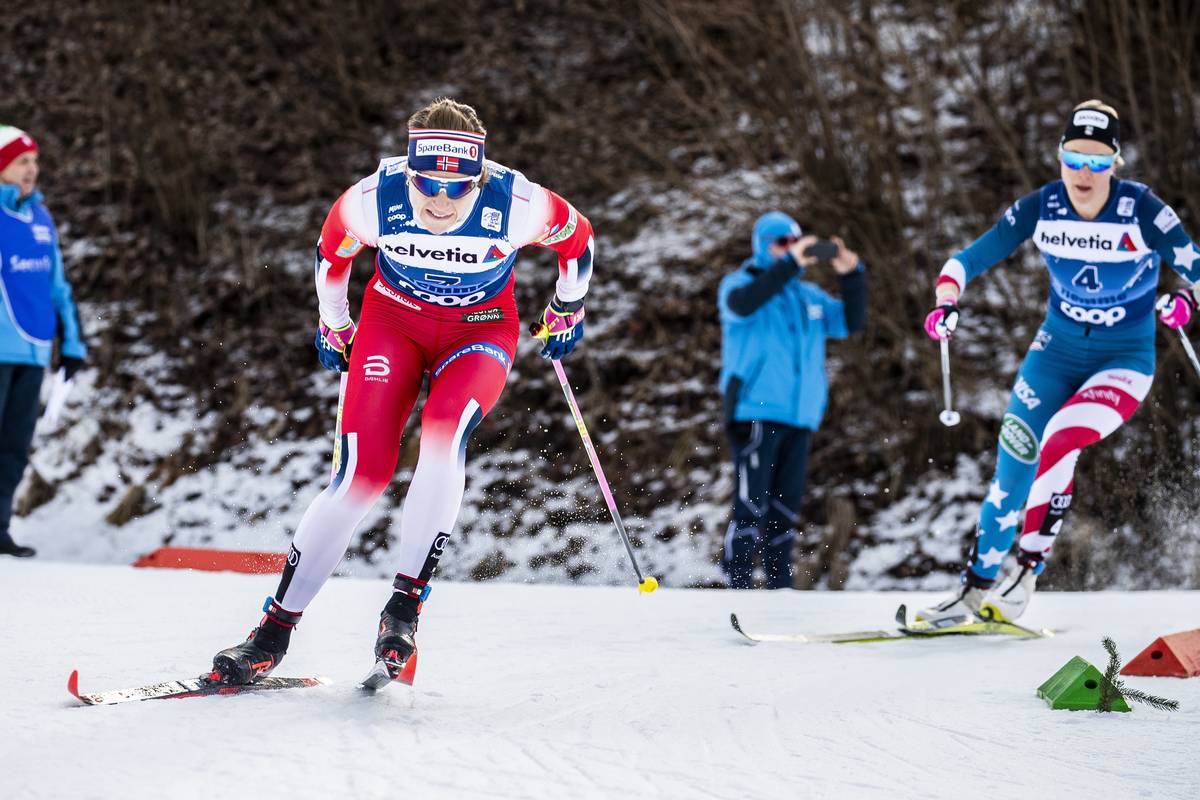
Sadie Maubet Bjornsen (USA), and Rosie Brennan (USA), (l-r) during the Stage 4 10 k classic pursuit. (Photo: NordicFocus)
Maubet Bjornsen ended Stage 4 in 12th (+1:32.8), Diggins in 14th (+1:41.9), and Brennan 21st (+2:45.0). Their teammate Sophie Caldwell continued her solid run of distance results by placing 27th (+3:00.1). Katharine Ogden raced to 38th (+3:49.3). Ogden earned her TdS start by leading the SuperTour. She is also a student at Dartmouth College.
The Overall
Johaug remains the leader of the TdS overall. Overall times and standings after Stage 4 were tabulated from each athlete’s time of day on course. Those times are found on the race document cataloging each athlete’s FIS points for the race.
Østberg’s on course time was 26:50.5, Johaug’s 26:51.9 — a difference of 1.4 seconds. Østberg began the day twenty-three seconds behind Johaug in the overall. With rounding to the nearest whole number, Østberg is now twenty-two seconds back in second place, after Stage 4, to Johaug.
Nepryaeva is third overall (+0:22), Weng fourth (+0:38), Jacobsen fifth (+0:50), and Andersson sixth (+0:51).
Maubet Bjornsen is positioned 9th (+2:09), Diggins 10th (+2:16), and Brennan 21st (+3:46). Caldwell is placed 29th (+4:54), and Ogden 35th (+6:09).
Sophie Caldwell (middle) for the U.S., driving home another top-30 distance result. Here she is racing the Stage 4 classic pursuit of the 2019-2020 Tour de Ski. (Photo: NordicFocus)
Racing continues for the women on Friday with a 10 k mass start classic in Val di Fiemme, Italy. Tomorrow is a rest day for athletes.
The women’s 10 k classic pursuit podium after Stage 4 of the Tour de Ski in Tobalch, Italy: Therese Johaug (NOR) in second, Ingvild Flugstand Oestberg (NOR) first, and Heidi Weng (NOR) third, (l-r). (Photo: NordicFocus)
Toblach, Italy. A stunning stadium and backdrop with the Dolomites lording over the venue and a steady cling-clang of baritone bells greeted skiers along portions of the course. Stage 3 in Toblach, a 10-kilometer interval start skate, turbocharged the 2019-2020 Tour de Ski (TDS).
Another win for Therese Johaug, albeit by a small margin, during Stage 3 of the 2019/2020 Tour de Ski in Toblach, Italy. (Photo: NordicFocus)
After two stages, a Stage 1 mass start skate and Stage 2 skate sprint, Russia’s Natalia Nepryaeva sat atop the overall standings. In third overall, Norway’s imminent threat, Therese Johaug, was positioned only five seconds back. Other names to watch, like Ingvild Flugstad Østberg, also from Norway, was seventh overall, 27 seconds back.
With three distance stages in a row — today’s 10 k skate, Wednesday’s 10 k classic pursuit (both in Toblach) and a Stage 5 10 k classic mass start in Val di Fiemme — this mid-stretch of the TdS would firm up the overall standings.
We’ll say this upfront with a bit of biased towards the spectacle of mass starts — this was fun-to-watch on-the-edge-of-your-seat interval start racing. Imagine a window for FIS live timing open on the desktop, a live stream of the racing open in another, and some texting banter here and there about the close splits, and it was a highlight so far of the young ski racing year.
Two laps around a working 5 k course featuring two climbing sections, one beginning at 1.4 k, the other at 2.5 k, was enough to jostle the standings and draw out some great performances.
Let’s start with the day’s top-10 finishers and then get to how the suspense built. Rosie Brennan for the U.S. was ninth (+45.0), Sadie Maubet Bjornsen (U.S.) eighth (+42.9), Jessie Diggins (U.S.) seventh (+35.6), Nepryaeva sixth (+26.0), Astrid Jacobsen Uhrenholdt (Norway) fifth (+20.8), Heidi Weng (Norway) fourth (+10.5), Ebba Anderson third (+10.2), Østberg second (+0.7), and Johaug in first.
23:51.9 was the winning time for Johaug. That Johaug won is no surprise. She’s the winner of the last 15 of 16 distance races on the World Cup. What startled many was the eye-blink time difference between Johaug and Østberg.
Ingvild Flugstad Østberg on her way to a close second place in Stage 3 of the TdS in Toblach, Italy. Stage 3 was a 10 k interval start skate. (Photo: NoridcFocus)
Ebba Anderson slides across the finish in Stage 3 of the 2019/2020 Tour de Ski in Toblach, Italy. Wearing bib 51, Katharine Ogden finishes just outside the points in 34th. (Photo: NordicFocus)
We’ll take a two-race 10 k skate interval start sample for comparison. In Ulricehamn, Sweden last February, Johaug put 58.7 seconds into her teammate. In March, Johaug gapped Østberg by 30.8 seconds in Falun.
Fast forward to today’s third stage in Toblach, and 5 k in, Johaug had the fastest time with Østberg 8.9 seconds back. At 6.7 k Østberg was 4.1 seconds behind. With almost all of the climbing past, at 8 k, Østberg had pulled ahead by an ephemeral 0.1.
In the armchair analysis, we should note that Østberg began in bib 32, Johaug in 38. Of the top-10 skiers on Tuesday, only two began before Østberg making her effort amidst less than perfect timesplit information that much more remarkable. Prior to the TdS, Østberg had been kept from competing by the National Team for not meeting certain health metrics. This was her third World Cup race of the season.
The reigning TdS champion arrived at this TdS primed.
With no time bonuses on offer, Johaug leapfrogged from third overall before the stage into first, with a total time of 55:14. Nepryaeva is second (+0:21), Weng third (+0:23), and Østberg fourth (+0:23).
Jessie Diggins skiing to seventh overall during Stage 3 of the TdS in Toblach, Italy. (Photo: NordicFocus)
Jessie Diggins skiing to seventh overall during Stage 3 of the TdS in Toblach, Italy. (Photo: NordicFocus)
Post-race interview with Jessie Diggins
Diggins is ninth overall (+1:10), Maubet Bjornsen 10th (+1:19), and Brennan 13th (+1:46).
Rosie Brennan continues her top-10 drive during Stage 3 of the TdS. (Photo: NordicFocus)
“I am very happy with my race today,” Brennan emailed. “I have some big goals riding on this tour and while I didn’t have my worst races that last two days, they were quite what I dreamed of. Today was much more what I had in mind. I love individual races and knew I had to make the most of the one intervals start race in the tour. I had a strong first lap and faded a bit more than I wanted the second lap but am happy with an improved result. Tomorrow will be a fun day as I get to ski with my favorite training partner, Sadie!”
Sadie Maubet Bjornsen during Stage 3 of the TdS in Toblach, Italy. (Photo: NordicFocus)
“Another exciting day of racing in stage 3,” Maubet Bjornsen emailed several outlets. “I woke up feeling recovered and refreshed, so I was really excited for today. We have raced three skate races in a row now, so our skating muscles are getting pretty tired, but every time things are tough in the tour, I just remind myself that everyone is in the same boat! I was really happy to finish 8th today, and I feel like I am in a great place for the pursuit classic race tomorrow. Rosie, Jessie and I are all starting close enough together that we can make an American train, and take on “the world” together. We are still trying to dig ourselves out of a hole in the “overall standings” from the stage 1 waxing mistake, but every day, we are chipping away little by little… which is the key to this tour. I can’t wait to put some classic skis on my feet tomorrow, and see what I can do!”
Outside the top-10, the U.S. had an astounding day. Sophie Caldwell, currently the fourth-ranked sprinter on the World Cup, raced to 25th (+1:25.9). According to FIS, this is Caldwell’s third time in the top-30 for a World Cup distance event and her first in skate.
Katharine Ogden raced to 34th (+1:42). Julia Kern did not start due to illness.
World Cup Head Coach Matt Whitcomb’s post-race comments on the women’s race
Sophie Caldwell primed for distance racing and in the points during Stage 3 of the TdS. (Photo: NordicFocus)
Racing continues tomorrow for the women with a 10 k classic pursuit. Start positions and time back are based on today’s results, not time back in the overall standings. For example, Johaug will start first, Østberg second (+0.1) — times are rounded — and Diggins seventh (+0:36). This should make for a tighter and more exciting TdS pursuit at a time when overall time gaps can make head-to-head racing less likely.
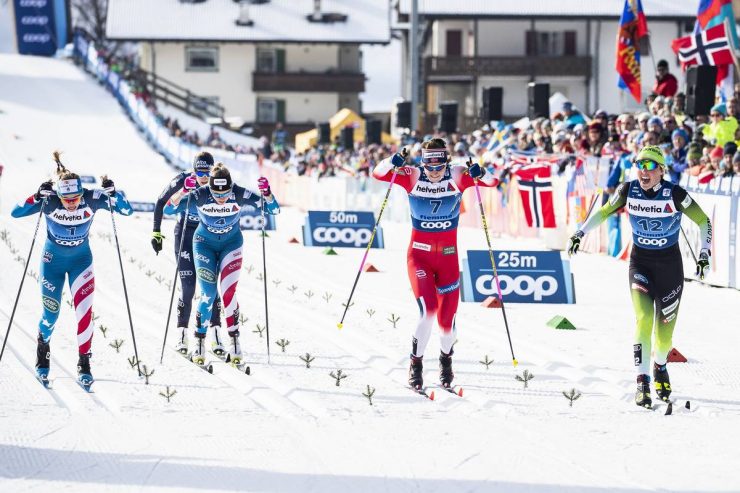
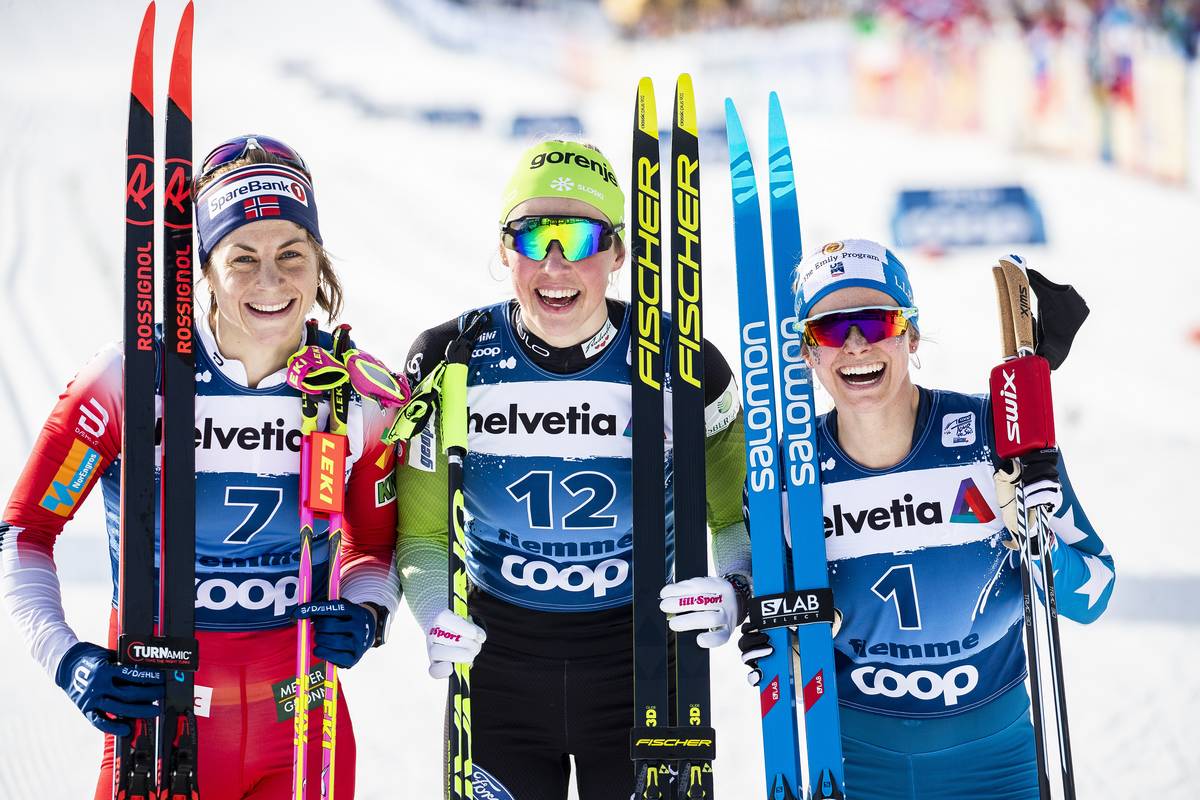
The women’s podium of Stage 2 of the 2019/2020 Tour de Ski. Anamarija Lampic of Slovenia (center) took first ahead of Norway’s Maiken Caspersen Falla (left) and Russia’s Natalia Nepryaeva (right). (Photo: NordicFocus)
Day two of the Tour de Ski offered the American women the Sisyphean task of earning back time after a miss on ski and wax selection in Stage 1 prevented them from performing to their capability. This was particularly so for Jessie Diggins, a favorite for the overall tour podium who finished the first stage in 29th 1:20 behind Norway’s pace-setting Theresa Johaug. Her teammate Sadie Maubet Bjornsen, also a top all-arounder, was in the same position. Maubet Bjornsen ended Stage 1 in 30th.
The initial run of the TdS in Lenzerheide, Switzerland is about not digging yourself into a time-deficit hole. A podium is nice, a win even better. But the primary objective is to not lose too much time to the leaders. At the start of Stage 2, Diggins and Bjornsen were in that hole.
Backs against the wall and a significant boulder to push ahead of them, the two would need to make it into the final of the 1.5-kilometer freestyle sprint to make significant headway on the tour leaders. A podium finish would be ideal. Since time differentials in sprint racing are small, it would be imperative to earn bonus seconds based on their final standings: 60 seconds for a win sliding down to 42 seconds for sixth.
As Johaug, the overall leader heading into the second stage, was not a podium threat in the sprint event, it was almost-certain that she would lose time on her chasers, increasing the opportunity for the Americans and other overall podium hopefuls.
Knowing the task at hand, Diggins bravely faced the new day with resolve.
“Now I get to focus on doing what I love best: fighting my way back,” she wrote on Instagram.
Julia Kern powers to a seventh place result in qualification during Stage 2 of the 2019/2020 Tour de Ski. (Photo: NordicFocus)
Surely enough, four Americans landed in the top ten in qualification: Sophie Caldwell in 1st, Diggins 3rd, Maubet Bjornsen 4th, and Julia Kern 5th. Rosie Brennan also qualified for the heats in 28th. The final member of the American squad, Katharine Ogden, finished 60th in qualification.
And on to the quarters five Americans went. With the momentum and energy of the team, the boulder budged.
Racing in the lightning-fast first heat of the rounds, Diggins fought at the front with leaders Maiken Caspersen Falla (NOR), Anamarija Lampic (SLO), and Anne Kjersti Kalvå (NOR). Last year, Falla was the ranked second overall in the World Cup sprint standings and Lampic was ranked 6th.
Diggins was unafraid to push the pace and spend time at the front. She showed her balance on her feet as she took on the fast descents and icy corners of the course, holding her position. In the final straightaway, Falla and Lampic took off from the front, leaving Kalvå and Diggins fighting for lucky loser positions. With the fate of a fast heat and their stick-to-the front pacing — their times would have won any other round — Kalvå and Diggins easily advanced to the next round.
Charging to the finish in the second heat of the quarter-final in Stage 2 of the 2019/2020 Tour de Ski. Jonna Sundling of Sweden holds the lead on the far left with Rosie Brennan tucked into the back left. (Photo: NordicFocus)
The Americans continued to shine in the rounds. In the second heat, Brennan mixed it up with the leaders but lost contact with the pack, finishing fifth in her heat. In the slowest third heat, Caldwell patiently followed the pedestrian pace, then showed her top gears in the final sprint to win the round. Maubet Bjornsen took second in the fourth heat to advance, and Julia Kern took third in a three-way photo finish for the top spot in the final heat.
Three Americans advance to the semis.
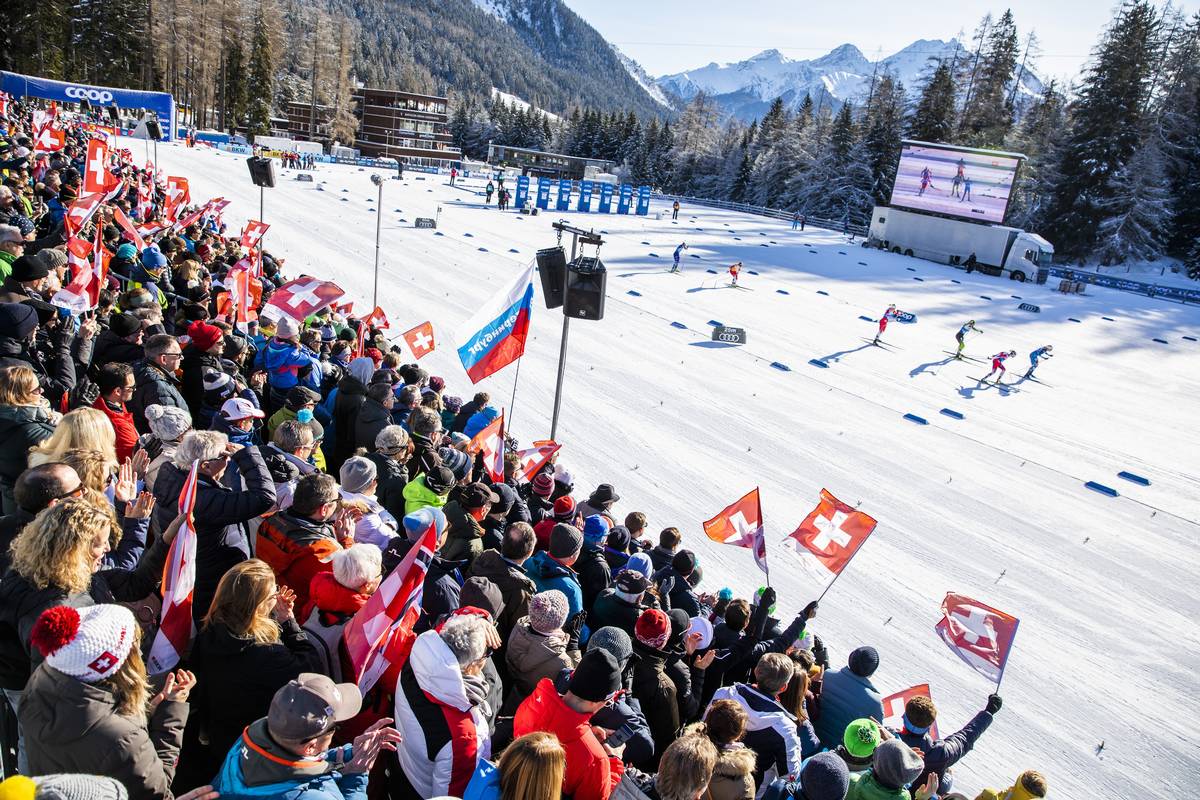
Adrenaline surges through the crowd in spectacular Lenzerheide, Switzerland during Stage 2 of the Tour de Ski. (Photo: NordicFocus)
Again, the first round of the semis was stacked with Falla, Lampic, Diggins, and Caldwell battling with Natalia Nepryaeva of Russia and Jonna Sundling of Sweden. Showing her grit, Diggins won the heat for an automatic spot in the finals, while Caldwell finished fifth. The spread of finishers in the heat was less than one second. Maubet Bjornsen finished second in heat 2, also advancing to the final.
Two Americans in the final. The pieces were coming together.
After qualifying in first and winning the first round of the quarters, Sophie Caldwell was knocked out in a close finish in the semifinals of Stage 2 of the Tour de Ski. (Photo: NordicFocus)
Sadie Maubet Bjornsen marks Maiken Caspersen Falla (NOR) and Anamarija Lampic (SLO) during the final round of the 1.5-kilometer freestyle sprint in Stage 2 of the 2019/2020 Tour de Ski. (Photo: NordicFocus)
Diggins kept herself in contention for a podium spot throughout the final, matching each of her opponents moves, never losing contact and often controlling the pace from the lead. Maubet Bjornsen held strong in the middle of the pack.
Leaving nothing on the course, Diggins jump skated each of the rollers, powering in a no pole skate into a tuck on the descent. She raced with grit over every meter.
Rounding the final curve into the straightaway, she sat in fourth behind Lampic, Falla, and Nepryaeva who had begun to accelerate off the front. Matching their tempo but unable to close the gap, Diggins crossed the line in fourth, doubling over as she gasped for air.
Racing with the fire for which she is known, Jessie Diggins gasps for air after taking 4th in Stage 2 of the 2019/2020 Tour de Ski. (Photo: NordicFocus)
In a close finish with Falla, Lampic took the win in 3:06.2 with the Norwegian 0.03 seconds behind her. Nepryaeva finished third (+0.47), with a half second gap to Diggins. After falling off the lead pack, Maubet Bjornsen finished 5th (+4.78), and Tiril Udnes Weng sixth (+5.29).
By centimeters, Anamarija Lampic takes the win in Stage 2 of the 2019/2020 Tour de Ski ahead of Maiken Caspersen Falla (left) and Natalia Nepyaeva (right). (Photo: NordicFocus)
Because they were quickly on the road to the next venue, the American women were unavailable for phone calls and instead chose to send comments on their performance via email.
“Today was a great day,” wrote Diggins. “I was so proud of the entire team for staying positive, rebounding from yesterday and for keeping it super professional; nobody was mad, everyone just learned the lessons from the skis that day and then moved onwards. For me, it was important to just focus on what I can control and have confidence in my fitness that I knew was there.”
In response to a query on handling the pressure of offsetting her deficit in the overall standings, Diggins offered a process-oriented response.
“It was definitely crucial to my tour to make the finals, but instead of focusing on the outcome I focused on skiing every step of the way as well as I could!”
Jessie Diggins smiles as she walks away from a 4th place finish in Stage 2 of the 2019/2020 Tour de Ski. (Photo: NordicFocus)
“Now I’m looking forward to Toblach — a venue with many many positive memories for me!” she concluded.
Maubet Bjornsen also remarked on the positive energy taking vengeance on the first stage provided. She explained that with “impossibly slow skis”, it felt like a success to lose only 1:20 to the leaders. Maubet Bjornsen added that it was not just the athletes looking for a do-over in Stage 2.
“The tech team worked extra hard to find a solution and our entire team came back strong today! Although it was an imperfect start, positivity and constantly fighting are the two keys to this incredibly exciting event. I sometimes think the winners of the TDS are not the most physically fit people, but the most mentally tough.”
Like Diggins, she too is eager for a second go in the next round of racing in Stage 3 and hopes to continue whittling down her gap to the overall tour leaders.
“I look forward to the next stop in Toblach for another attempt at a 10 k skate, hopefully with an equal revenge as today. I have some precious seconds to try to win back still. One day at a time.”
She finished by saying that they are driving away from Lenzerheide “with some tired legs, but rejuvenated souls!”
Seeking revenge, Sadie Maubet Bjornsen flies to a fourth place finish in qualification during Stage 2 of the 2019/2020 Tour de Ski. (Photo: NordicFocus)
Overall Tour Standings
Noteworthy for the overall standings, tour leader after Stage 1 Therese Johaug qualified in 21st and raced in the speedy first heat with the eventual winner. She finished in fifth, just behind Diggins. Had she raced in any other round, the distance phenom, who is not known for her sprinting, would have advanced as well. Her result put her in 23rd for the day, earning six bonus seconds.
Though she slid back to third in the overall rankings, this result maintained her threat for the overall tour victory. Johaug is only five seconds out of first place heading into three distance stages where she will have the opportunity to create a gap over the field before the Stage 6 sprint. In the fifth stage, a mass start classic in Val di Fiemme, Italy, she will also have the opportunity to earn bonus seconds at various checkpoints, giving her further insurance on the following sprint day.
After a third place finish in Stage 2, Natalia Nepryaeva takes over the overall leader bib in the 2019/2020 Tour de Ski. (Photo: NordicFocus)
Now wearing the leader’s bib, Nepryeava’s sprint podium moved her into the lead with a cumulative time of 31:18. She finished sixth in the first stage. Demonstrating her potential in the competition, Nepryaeva dueled with Norway’s Ingvild Flugstad Østberg throughout the 2018/2019 tour to finish second overall. The Russian won the first distance stage and took second in the final four stages.
Lampic, who finished 50 seconds behind Johaug for 20th on Saturday’s distance race, moved into third overall, one second behind Nepyraeva. Last year, she finished 22nd in the tour.
Slovenia’s Anamarija Lampic smiles in delight after winning the second stage of the 2019/2020 Tour de Ski. (Photo: NordicFocus)
Posting consistent results in the first two stages, Tiril Udnes Weng’s 7th in Stage 1 and 6th in the sprint put her in fifth overall, followed by her cousin Heidi Weng who was second in the first stage but 32nd in qualification leaving her out of the rounds.
Cutting their time back in half, Diggins sits in 11th place, 39 seconds behind Nepryaeva, followed by Maubet Bjornsen in 12th (+41). The overall podium continues to be up for grabs.
Racing continues Tuesday December 31st in Toblach, Italy with 10 k freestyle, followed by a 10 k pursuit start classic on Wednesday.
Norway’s Therese Johaug crossing the finish in first place during the first stage of the TdS in Lenzerheide, Switzerland. (Photo: NordicFocus)
Saturday marked the start of the 14th Tour de Ski in Lenzerheide, Switzerland. Forgoing the traditional prologue start to determine time back to the leader, organizers threw in a spicy 11-kilometer mass start freestyle. Easy to follow for fans, maybe not so much for those following in the wake of Norway’s Therese Johaug.
The scene was a Swiss winter ideal: plentiful snow, portions of the course dappled in sunlight, others shrouded in a drifting-in and drifting-out ground fog. Thousands of fans lined the course proving in the right venue, on a festive day, organizing committees can throw a cross-country party.
Quite literally, a massive mass start on the World Cup. Stage 1 of the 2019-2020 Tour de Ski in Lenzerheide, Switzerland. (Photo: NirdicFocus)
Crowds in full force during the first stage of 2019-2020 in Lenzerheide, Switzerland. (Photo: NordicFocus)
The party jumped into Swiss-cowbell-ringing high gear when the starter’s gun fired. The hot pace was palpable. It appeared no skier wanted to be left dangling too far from Johaug who pulled through to lead 1:20 into the race. Jessie Diggins and Sadie Maubet Bjornsen matched the pace upfront. But, by then, with roughly 1/10th of the race completed, the field was strung out. The vibe was clear: no matter what an athlete’s intent, they all were trying to minimize the hurt Johaug would inflict over the next 10 k.
We could exhaustively detail the splits and time back as the race unfolded. At moments it appeared Johaug was simply at a level where imagining a one minute gap across the finish line wasn’t outlandish. However, with each shot of Johaug churning her high-tempo technique or the on-course mics picking up her solitary but thoroughbred breathing, she was chased by a group just out of contact.
This was not a total runaway for Johaug.
Therese Johaug during Stage 1 of the 2019-2020 Tour de Ski in Lenzerheide, Switzerland. (Photo: NordicFocus)
Therese Johaug (NOR), Heidi Weng (NOR), Astrid Uhrenholdt Jacobsen (NOR), (l-r) during Stage 1 of the 2019-2020 Tour de Ski in Lenzerheide, Switzerland. (Photo: NordicFocus)
Therese Johaug during Stage 1 of the 2019-2020 Tour de Ski in Lenzerheide, Switzerland. (Photo: NordicFocus)
By 5.6 k, the front chase group had coalesced. Two skiers who had yet to compete on the World Cup this season, Sweden’s Ebba Andersson and Norway’s Ingvild Flugstad Østberg, proved racing into form wasn’t a necessity. They were joined by Norwegians Astrid Uhrenholdt Jacobsen, Heidi Weng, and Russia’s Natalia Nepryaeva.
During the three laps of the 3.3 k course, Jacobsen and Nepryeava fell off slightly. Weng, Andersson, and Østberg kept it interesting during this opening act of the TdS. At 8.6 k Joahug was nearly 19 seconds up on Østberg. By the finish, the chasers took a chunk of time out of Johaug’s lead.
Johaug won in 28:12.1, with Weng in second (+12.3), Andersson in third (+12.9), and Østberg fourth (+13.1). Jacobsen placed fifth (+24.1), and Nepryeava sixth (+40.1).
Ebba Andersson of Sweden on her way to third during the first stage of the 2019-2020 Tour de Ski. (Photo: NordicFocus)
Ebba Andersson (SWE), Ingvild Flugstad Østberg (NOR), Heidi Weng (NOR), (l-r) come into the finish during the Stage 11 k mass start skate in Lenzerheide, Switzerland. (Photo: NordicFocus)
“I was really surprised today, mass start in skating,” Johaug told FIS after the race. “In my mind, I think there would be other girls at the finish line. I had a really good day today. And my skis were perfect. I decided with my trainer and brother that on the first lap I didn’t go so fast, and out of the second lap I should speed up. And then I get a gap. I am so so happy. The mass start in 10 k, it is not my favorite distance so I am really surprised and really happy now.”
According to the FIS database, the last 10 k mass start skate Johaug contested was in 2016, prior to her ban for a positive doping test. In that 2016 Falun, Sweden race, she beat a second place Weng by only 8.8 seconds. (Johaug served an 18-month ban, returning to the World Cup in November of 2018.)
The U.S. women came into the race with formidable stats. Just this year, of the nine races contested prior to Saturday’s TdS Stage 1, including team events, there have been six U.S. podiums.
In Lenzerheide, at least in the early going for this TdS, the U.S. women fell momentarily away from their own high expectations. Rosie Brennan (USST) was the top-finisher in 20th (+59.8). Diggins (USST) placed 29th (+1:20.7) and Maubet Bjornsen (USST) 30th (+1:20.7).
Kerttu Niskanen (FIN), Tiril Udnes Weng (NOR), Rosie Brennan (USA), Delphine Claudel (FRA), (l-r), (l-r) on Satiurday’s first stage of the 2019-2020 Tour de Ski. (Photo: NordicFocus)
“Today was a bit of a mixed day,” Brennan emailed several media outlets. “Having missed the last two weekends of racing, I wasn’t quite sure where I was at, but I felt really good in the race and am really happy with my effort. We struggled a bit with our skis and I maybe wasted a bit too much energy trying to move up in places that didn’t make sense with the skis I had on my feet. The good news is that it was overall a very tight race so, despite less than perfect skis, I didn’t lose too much time in the overall and am still optimistic for the rest of the tour.”
Katharine Ogden (SMST2), in her first World Cup of the season, skied to 42nd (+2:03.0). Sophie Caldwell (USST) placed 46th (+2:23.7), and Julia Kern (USST) 57th (+3:02.6).
Jessie Diggins (USA), Charlotte Kalla (SWE), (l-r), (l-r) early on during Stage 1 of the 2019-2020 Tour de Ski. (Photo: NordicFocus)
During a post-race interview with U.S. World Cup Coach Matt Whitcomb, he was blunt when discussing the team’s lackluster skis. “When we saw them at about 3.5 k coming out of the stadium on the long gradual uphill, Sadie and Jessie just looked tired,” Whitcomb said. “And frankly they are not tired. They are in awesome shape. That’s when we knew something was wrong.”
World Cup Coach Matt Whitcomb’s post-race comments about the U.S. women’s team and lackluster skis
Whitcomb explained during the post-race call that the FIS asked coaches to vote on whether to include or eliminate Stage 1 time bonuses. Initially, Stage 1 was slated for time bonuses at 3.3 k and 6.6 k. However, with the prospect of a Johaug time-bonus sweep, teams voted to eliminate those bonuses for Saturday’s racing.
World Cup Coach Matt Whitcomb’s post-race comments about time bonuses for Stage 1
Racing continues in Lenzerheide tomorrow with a 1.5 k skate sprint for the women.
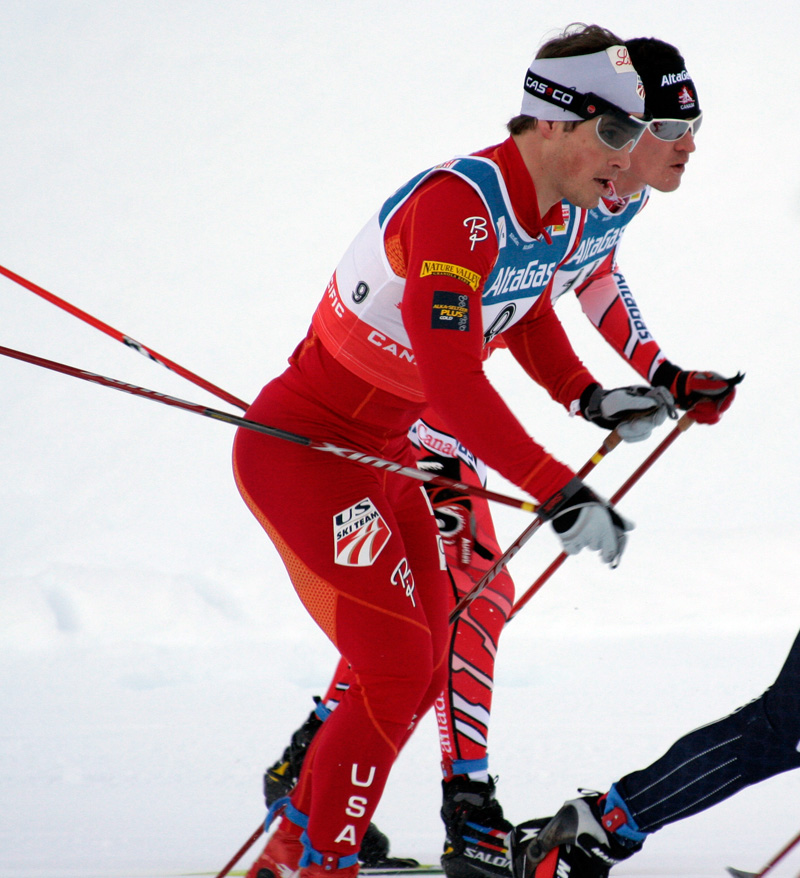
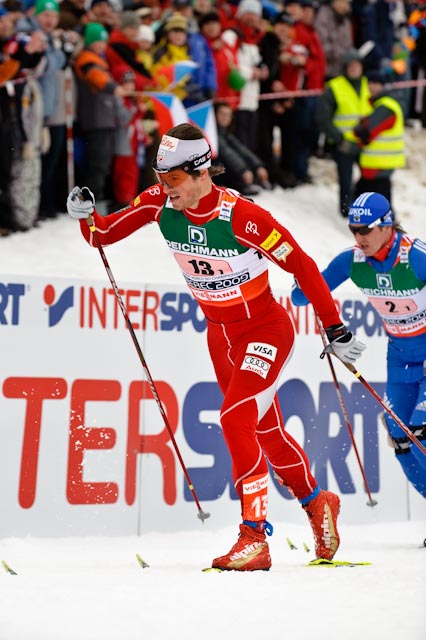
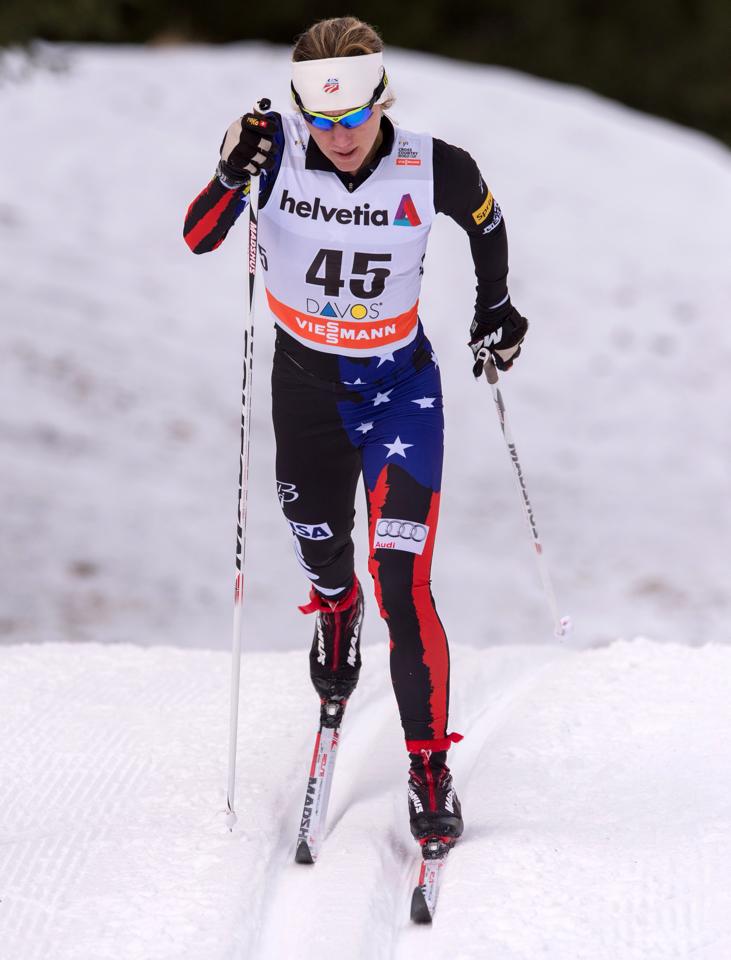
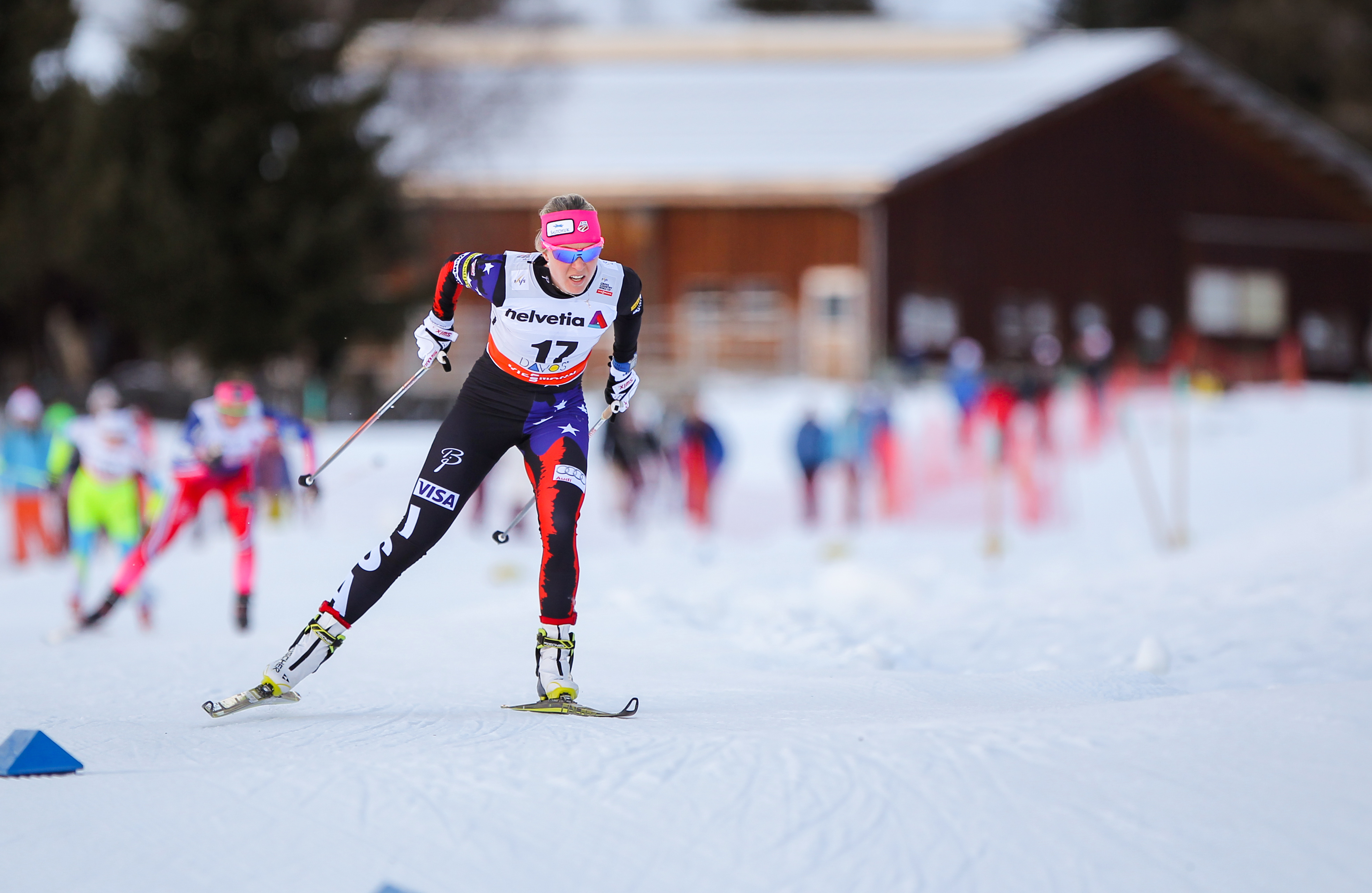
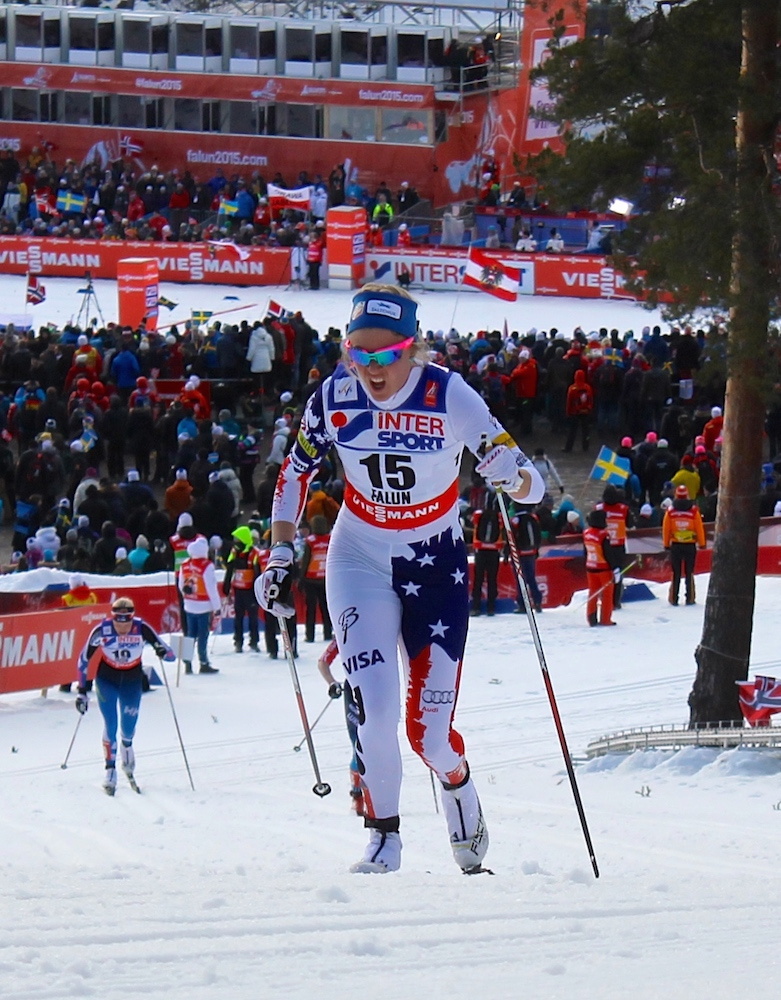
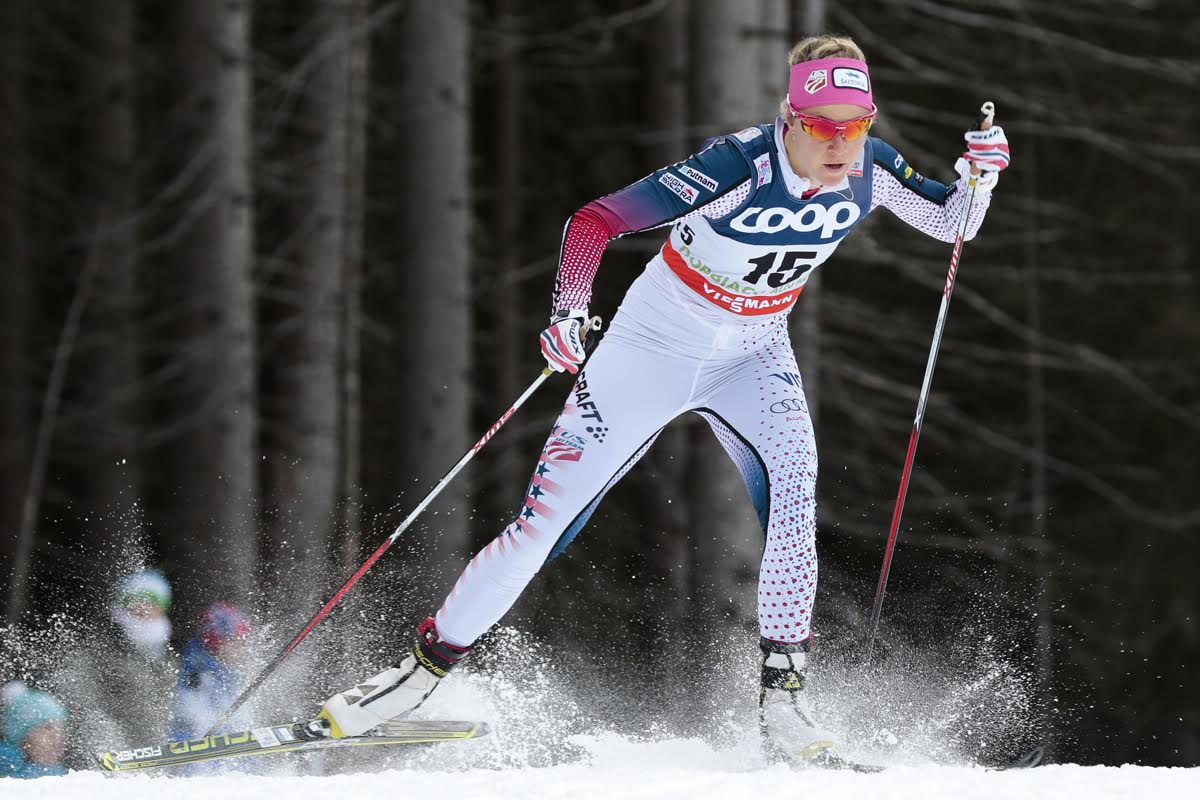
From October 2010: Kikkan Randall modeling the U.S. Ski Team suit for the 2010-2011 season. Photo courtesy of the U.S. Ski and Snowboard Association.
A national team uniform for cross-country skiing has to do a lot of things. At the most utilitarian level, it has to wick sweat and aid performance while an athlete pursues one of the world’s most demanding sports at temperatures between –4 F and 40, in steady snow or driving rain or anything in between. At the functional level, it has to let spectators and coaches identify where their athlete is out on the course, while distinguishing them from athletes from other countries. And at the symbolic level, it lets the athlete know that he or she is competing on behalf of their country, for everything that that means. Ask a skier who has represented the United States in international competition what it meant to them to pull on a national uniform for the first time. They’ll probably be able to tell you.
(And if they ever forget, this detailing from Craft and L.L. Bean on the American uniforms, ca. 2015/2016, is there to remind them. “You are representing the United States of America,” a slogan intones, above a martial-looking eagle, with a U.S. Ski Team master mark for its aegis, gripping an olive branch (?) in its dexter claw and a skis and ski poles fasces in its sinister. “Pretty fun to be representing an American brand with our American uniforms!,” wrote Sadie Bjornsen in a blog post describing the uniforming process.)
For whatever reason, the period roughly one decade ago represented the highwater mark for domestic and global coverage of ski uniforms on this website. There was “US Ski Team Brings Suit Consistency,” from Jan. 2009 (lede: “After years of a remarkable level of wardrobe schizophrenia, the US Ski Team has ushered in a new era of racing suit consistency that should make it easier to follow our favorite US athletes on the race course.”); “The costume disciplinarian speaks: Is it better to look good than to ski fast?” from July 2009; “The Best and Worst (Suits) of the Olympics,” from Feb. 2010; and “USST Goes Black for 2010-2011,” from Oct. 2010 (lede: “In the sport of cross-country skiing, most people would agree that competing with New Zealand is probably smarter than picking a fight with Norway.”).
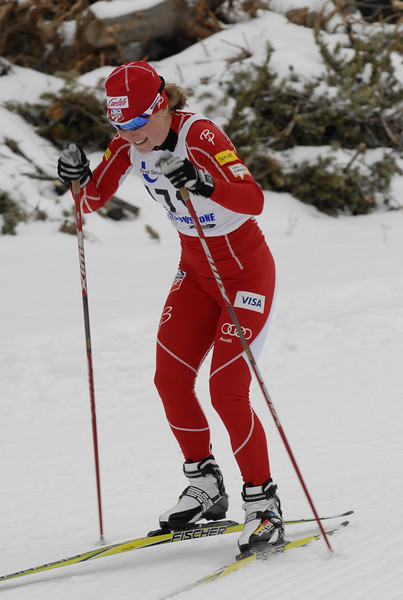
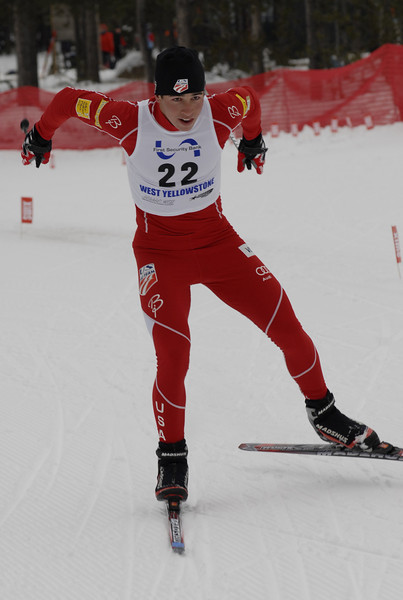
So it seems to have been nearly 10 years since the last sustained attention to the uniforms of the Davis U.S. Cross Country National Team Program (néeU.S. Ski Team). To fill that gap, FasterSkier hereby presents A Visual History of the United States Ski Team National Team Uniform, 2008–2019.
(Why 2008 for the starting point? Mostly for the simple logistical reason that the image library in the current FasterSkier content management system, WordPress, only goes back to 2008, so this article can be written while using only images that FasterSkier may legitimately post on this site. To go back to closer to the start of this century would require a lot of external links to Getty Images and not that many photos to actually look at on this website. That said, this piece from 2009 has a nice visual roundup of the plethora of different USST designs worn from 2006–2008, which takes you back two more years. Before that, well, just imagine Kikkan Randall and a lot of other skiers you probably haven’t thought about for a while — Wendy Wagner, anyone? Rebecca Dussault? Sarah Konrad? — wearing various iterations of early-aughts red and black.)
2008/2009 World Cup season: Red
January 2009: No question who is from the US here… Kikkan Randall in the women’s Team Sprint in Whistler
January 2009: Kris Freeman preferred the orange to silver in the men’s pursuit
As a contemporary uniform article explained, “There are currently two suit variations being used by US Ski Team athletes, and athletes racing for the US in international events. They are so similar, that for practical purposes (identifying US skiers in a race) they may as well be the same. Both suits are predominantly red, with one version having patches of orange, and the other silver.” Both were manufactured by Norwegian company Bjørn Dæhlie.
There appears to have been no change to the basic World Cup design for the 2009 World Championships in Liberec, Czech Republic:
Freeman at the 2009 World Championships in Liberec. (Photo: Swix Sport)
2009/2010: Still red Bjørn Dæhlie
November 2009: Tazlina Mannix (APU, USST) racing in West Yellowstone.
November 2009: A very young Noah Hoffman (USST) racing to 3rd in a distance race in West Yellowstone.
Honorable mention, domestic suits division:
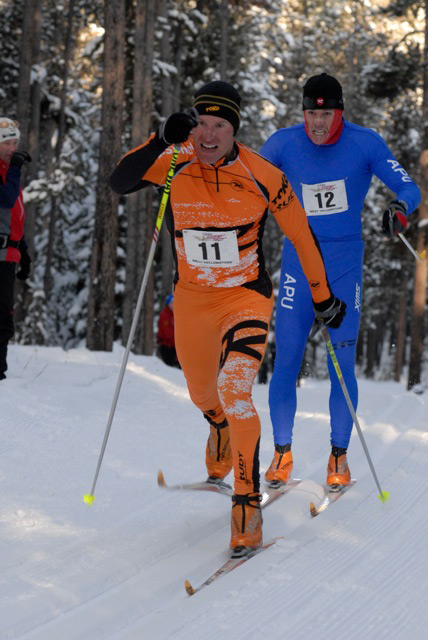
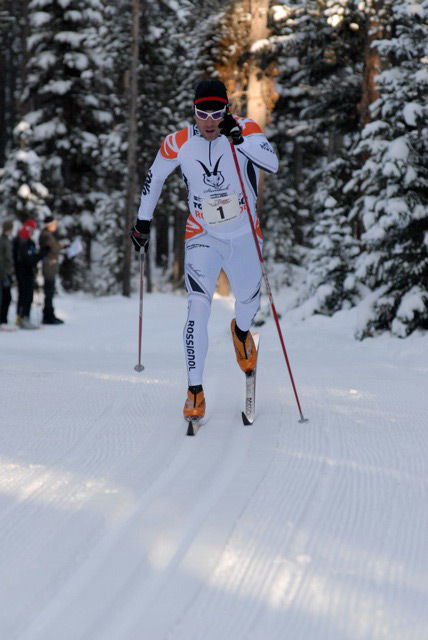
November 2009: This is a very orange suit. Kevin Hochtl (Rossignol) – 32nd – leads Anders Haugen (APU) – 7th – to the finish in a West Yellowstone race.
November 2009: This is one hell of an ibex. Chris Cook (Steinbock Racing) – 12th – sporting the new Steinbock Racing uniform
2010 Winter Olympics, Vancouver: Red and silver
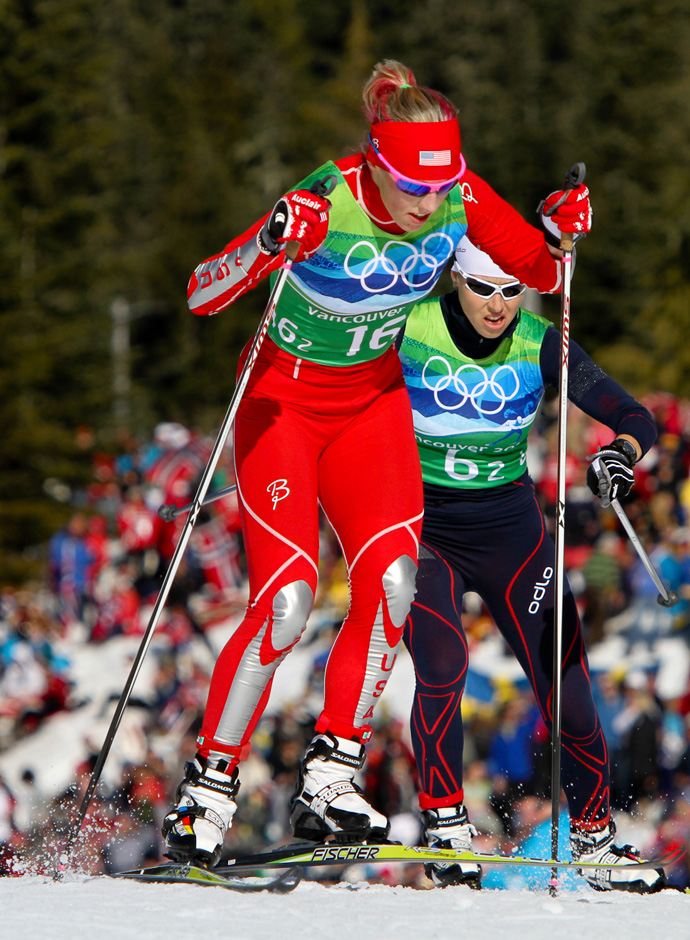
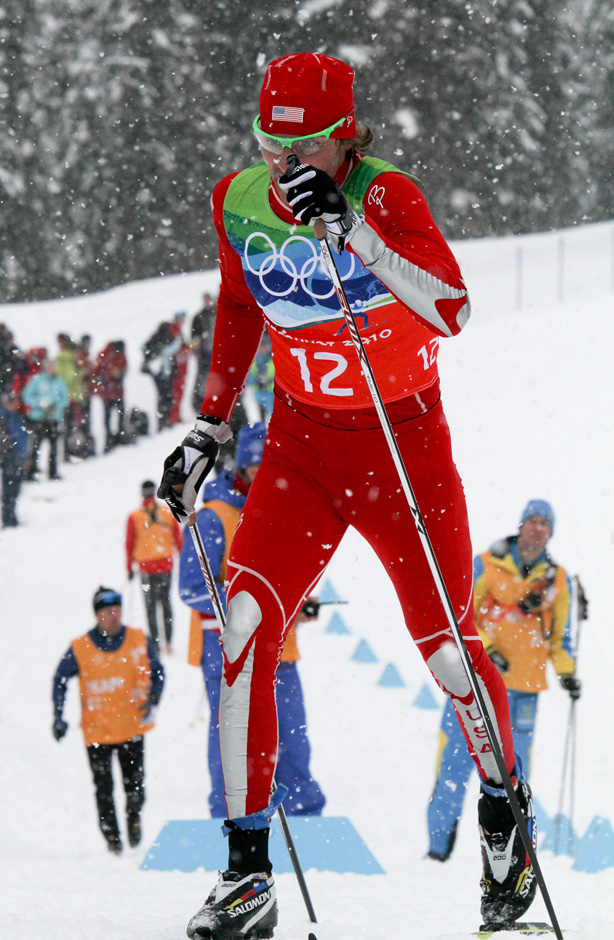
For the Olympics, the Americans appear to have taken their World Cup template – Bjørn Dæhlie suit, largely red – but have changed it by, inter alia, lightening the shade of red, adding “USA” on the right arm and left leg, adding silver accents, and of course removing all sponsor logos. Kikkan, already skiing in her third Olympics, coordinated with a red headband, red gloves, and her famous pink highlights. Andy Newell went with the red hat (he may not have had a choice), but was otherwise somewhat less vermilion.
Feb. 2010: Kikkan RandallFeb. 2010: Andy Newell on the big climb during the men’s 4 x 10 k relay.
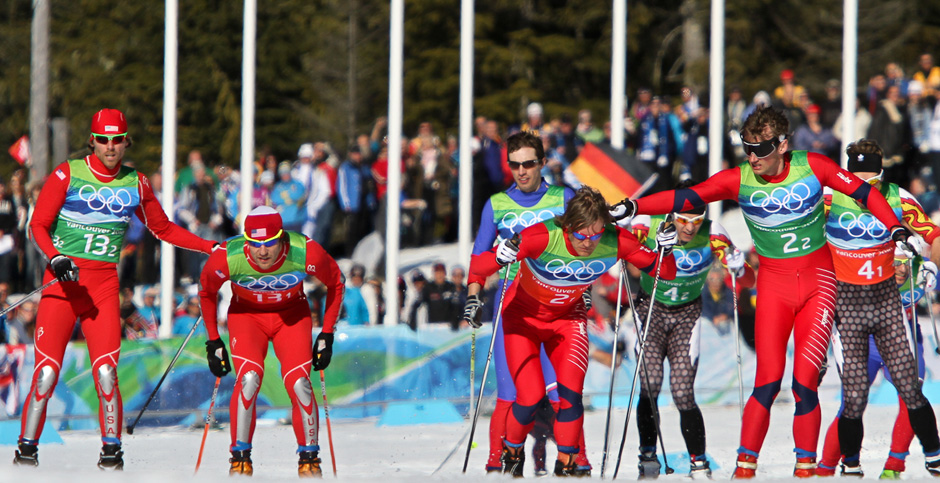
There was a lot of red in Vancouver. For example, here’s Andy Newell (far left, bib no. 13-2) tagging Korin Koos for the U.S. in the team sprint, while Petter Northug (far right, bib no. 2-2) tags Øystein Pettersen (middle right, bib no. 2-1) for Norway. (An entire standalone article could likely be written on the Canadians’ infamous kit (bib no. 4, back right).)
Newell tags Koos (left) and Northug tags Pettersen (right) at the 2010 Vancoulver Olympics.
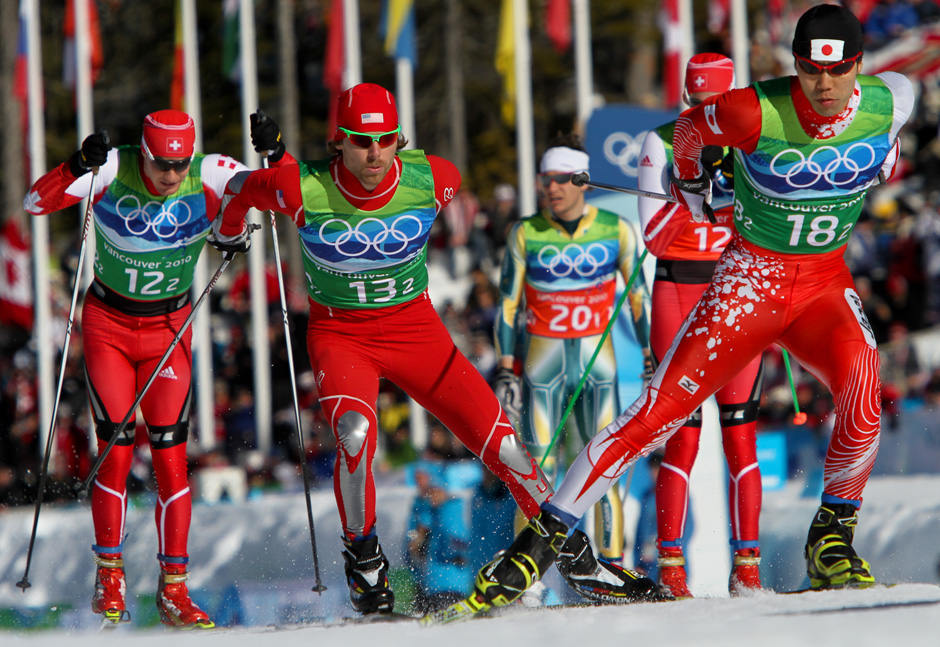
Or here’s Newell in the middle, between Switzerland’s Dario Cologna (bib no. 12) and Yuichi Onda of Japan (bib no. 18):
Newell in the semis of the skate sprint: 2010 Vancouver Olympics.
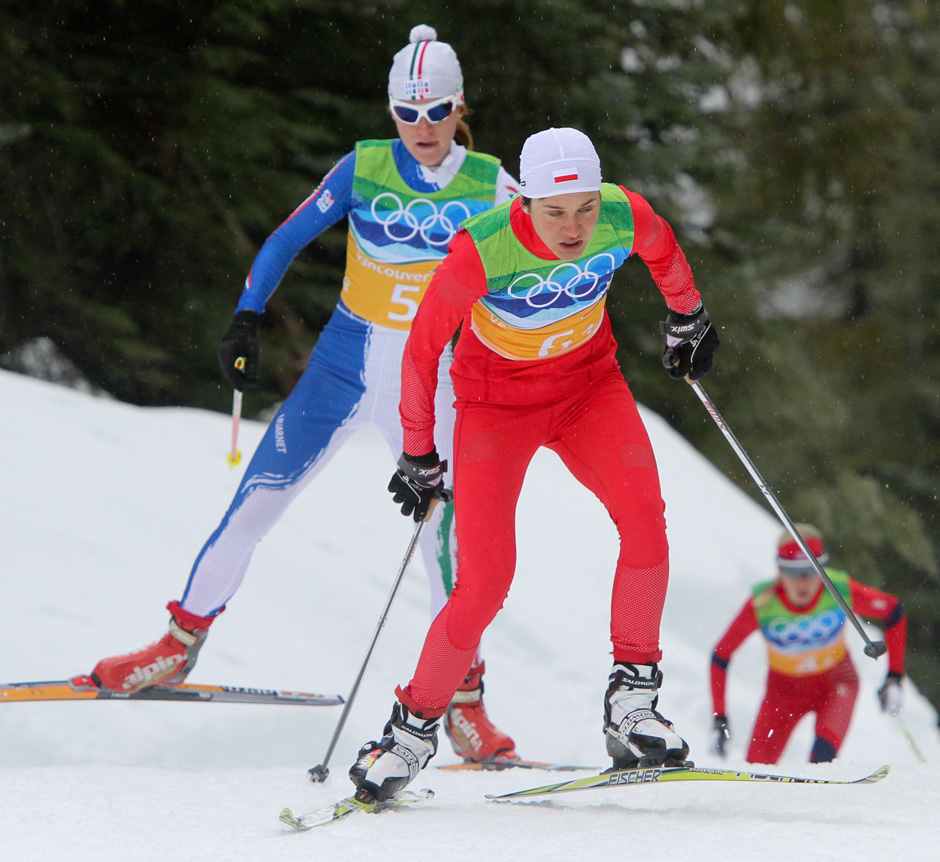
Finally, Poland (shown here: Sylwia Jaśkowiec, bib no. 6) was just red:
Poland 2, 2010 Vancouver Olympics.
2010/2011: The black era begins
Perhaps as a natural reaction to the dominance of a single color across multiple nations, the U.S. made a significant shift for the 2010/2011 World Cup season: black. The color does not appear on the national flag or in other common American iconography, but it is certainly distinctive. Bjørn Dæhlie remained the suit manufacturer.
Or, as then-FasterSkier reporter Nat Herz wrote in fall 2010, “After any number of years of being drowned out by a sea of Norwegian crimson, U.S. Ski and Snowboard Association Nordic Director John Farra said that the USST will be ‘distinctly not red’ for the 2010-2011 season—including at World Championships in Oslo. ‘We went in a very different direction, in part from our experience in Oslo, where they [Norway] have a nation’s group of ten, and we can barely see our athletes in the group,’ he said.”
January 2011: A 21-year-old Sadie Bjornsen races to 17th at U23 World Championships in Otepää, Estonia.
January 2011: Jessie Diggins, then aged 19, races to 7th at Junior World Championships in Otepää.
January 2011: Noah Hoffman at a SuperTour race in Lake Placid.
February 2011: No change for World Champs: Kikkan Randall racing at 2011 World Championships in Oslo.
2011/2012: Still black Bjørn Dæhlie
December 2011: Kikkan Randall sprinting during the Tour de Ski.
March 2012: Kris Freeman (SSCV/USST) on his way to claiming the US Distance Nationals 50 k freestyle title on Saturday morning in Craftsbury.
2012/2013: Still black
December 2012: Noah Hoffman in the Tour de Ski.
December 2012: Kikkan Randall blasting to victory in the Tour de Ski opening prologue on Saturday. She skied to 14th in the pursuit on Sunday and is leading the U.S. women in the Tour de Ski standings after two stages. Photo: Marcel Hilger.
February 2013: Diggins and Randall won gold in the team sprint at 2013 World Championships in Val di Fiemme, Italy, which was awesome, but, for purposes of this article, mostly relevant for the addition of the epochal relay socks but otherwise no change to the standard World Cup uniform.
2013/2014: Yup, still black
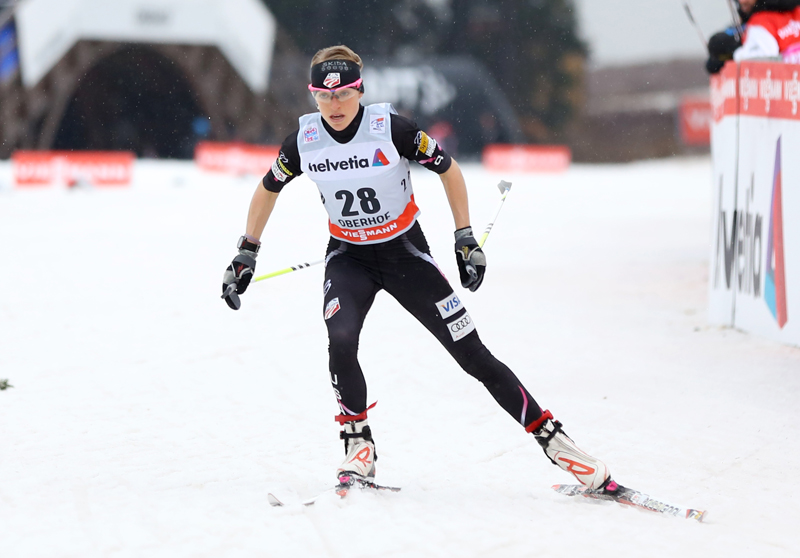
December 2013: Liz Stephen (U.S. Ski Team) on her way to 34th in Saturday’s 3 k freestyle prologue at the first stage of the Tour de Ski in Oberhof, Germany. (Photo: Marcel Hilger)
December 2013: Andy Newell (U.S. Ski Team) qualified 12th and finished 10th overall in Sunday’s freestyle sprint. (Photo: Marcel Hilger)
2014 Winter Olympics, Sochi: Stars and stripes
The 2014 Winter Olympics, in Sochi, Russia, were known at the time for Kikkan Randall’s disappointing result in the individual skate sprint, and after the fact for the revelation that Russia was engaged in a massive state-sponsored doping scheme and cover-up. They were also significant for a change in uniforms: stars and stripes on the right arm and left leg, and a large “USA” on the right leg. The left arm was relatively plain. Also, several of the U.S. women drew attention for racing sleeveless in warm temperatures. Bjørn Dæhlie continued to be the brand logo featured on the upper right quad. (Pictured below: Noah Hoffman, in a solo race, and Sadie Bjornsen, in the women’s relay.)
2014/2015: Stars and stripes redux
Athletes took to the trails next season with a slightly modified version of the recent Olympics uniform: Larger stars on the left upper quad, with a deeper blue background. The stripes on the left leg became more pronounced and stretched farther up the race suit, to above the knee. Also, once the non-commercial period of the Olympics had passed, there was space for sponsor patches on the arms and legs.
December 2014: Caitlin Gregg (Team Gregg) skiing to 56th place in the Davos World Cup 10 k classic, Dec. 13. (Photo: Toko)
USST’s Sadie Bjornsen racing to 29th in the Davos World Cup 10 freestyle, Dec. 20, 2014. (Photo: Fischer/Nordic Focus)
World Championships, in Falun, Sweden, brought a mostly-white version of the uniform, helpful for the warm temperatures and soupy conditions that characterized many of the races. Here’s Sadie Bjornsen in Falun in February 2015:
2015/2016: Red, white, and blue
By fall 2015, the move away from black, and towards red, white, and blue, was complete. Athletes now had the option of being attired in a predominantly white color scheme, which would aid in preventing overheating on warm days, while thankfully solving the transparency issues that had plagued recent all-white suits for Sweden or Italy. An alternate version had roughly the same patterning, but with blue as the primary color. Notably, the Americans also moved to a race suit manufactured by the Swedish company Craft for the first time in this survey.
December 2015: Sadie Bjornsen (U.S. Ski Team) racing to her best-ever sprint qualifier in sixth at the World Cup freestyle sprint in Toblach, Italy. She went on to make the semifinals and place 10th overall. (Photo: Fischer/NordicFocus)
December 2015: Simi Hamilton (U.S. Ski Team) racing to his first non-stage World Cup podium on Saturday in Toblach, Italy, where he placed second in the freestyle sprint. (Photo: Fischer/NordicFocus)
December 2015: American Andy Newell (r) and Great Britain’s Andrew Young (c) trail Norway’s Håvard Solås Taugbøl (2) in the quarterfinal at the Davos World Cup freestyle sprint on Sunday in Switzerland. Taugbøl won the heat, Young placed third, and Newell was fifth after missing out on a photo finish for fourth. Newell finished the day 23rd overall. (Photo: Marcel Hilger)
January 2016: Ida Sargent (U.S. Ski Team) teamed up with Sophie Caldwell (not shown) to place fifth in the 6 x 1.2 k freestyle team sprint at the World Cup in Planica, Slovenia. (Photo: Madshus/NordicFocus)
Honorable mention: Trending towards “purple cobras” for American biathlon but not there yet.
American Claire Waichler started 58th and finished 33rd in the youth women’s pursuit on Sunday at IBU Youth/Junior World Championships in Cheile Gradistei, Romania. (Photo: IBU YJWCH Cheile Gradistei 2016/Facebook)
2016/2017: More red, white, and blue
An interpretation of red, white, and blue, still on a Craft suit, remained in place for the 2016/2017 World Cup season, which was marked within the team by Randall and her husband, Jeff Ellis, traveling the European race circuit with a newborn in tow. The changes to the USST uniform were less dramatic than Randall’s familial status: Still red, white, and blue, though now with blue as the dominant color. The entire left leg, and the bottom half of the right leg, had markings, somewhere between subtle striations and full-on stripes, that evoked the stripes of the American flag. (Let’s put aside for the moment the fact that the stripes on the actual flag are white and red, not white and blue.) The pattern was repeated on the lower right arm. An understated evocation of blue or white stars marked both lower legs, with more pronounced stars scattered around the bottom of the torso (possibly the top as well, but nearly all of one’s torso is typically covered by the standard race bib). The left arm and left leg both proclaimed “USA” in red lettering.
The vehicular logo on the legs remained that of Audi, as it had been since the start of this history.
There appears to have been no change for the 2017 World Championships. At least to the uniforms; on the race course, the Americans won an unprecedented three medals.
December 2016: Jessie Diggins (U.S. Ski Team) racing to ninth in Saturday’s 1.5 k freestyle sprint qualifier in Val Müstair, Switzerland. Diggins went on to place sixth in the final. (Photo: Salomon/NordicFocus)
January 2017: Sophie Caldwell (U.S. Ski Team) racing to third in the qualifier of Saturday’s 1.4 k freestyle sprint in Falun, Sweden. She went on to finish 16th overall (Photo: Fischer/NordicFocus)
February 2017: Kikkan Randall (U.S. Ski Team) racing to 26th in the women’s 10-kilometer classic individual start at the 2017 Nordic World Championships on Tuesday in Lahti, Finland (Photo: John Lazenby/Lazenbyphoto.com)
Meanwhile, biathlon saw the advent of the beloved “purple cobras” era:
US Biathlon’s Susan Dunklee on her way to finishing third in the women’s sprint at the IBU World Cup in Nove Mesto, Czech Republic. It was the third podium of her career. (Photo: IBU)
2017/2018: Red, white, and blue redux
There appears to have been no change for the 2017/2018 World Cup season: still red, white, and blue, but mostly blue, on a Craft suit. The most notable change may have been to the car sponsor… for the first time since at least the scope of this article, a Toyota logo was on the leg, not Audi. Nichts ist unmöglich (“Nothing is impossible”), as the company’s European slogan proclaims.
American Andy Newell racing the men’s 1.5 k freestyle-sprint qualifier at Stage 1 of the Tour de Ski on Saturday in Lenzerheide, Switzerland. He qualified 20th and went on to finish 19th overall. (Photo: Fischer/Nordic Focus)
Caitlin Patterson (Craftsbury Green Racing Project) racing to 52nd in the freestyle sprint qualifier at the last World Cup on Jan. 27 in Seefeld, Austria. The next day, she placed 23rd in the 10 k freestyle mass start. (Photo: Fischer/NordicFocus)
2018 Winter Olympics, Pyeonchang: Red, white, and blue, and a lot of stripes
There is a somewhat famous picture from the 2018 Winter Olympics that you may already be familiar with. In the picture, Jessie Diggins, on the lefthand side of the frame, stretches her left foot across the finish line to secure an historic Olympic gold medal for the United States. Her left arm mirrors the gesture, punching the air above her in what is presumably an instinctual counterbalance to the lunge but also appears, in a frozen moment in time, to be a triumphant fist-pump. In the middle, her face is rent in a rictus of exertion and triumph. On the righthand side of the frame, Stina Nilsson of Sweden lunges as well, 0.19 seconds behind Diggins. Mute V-boards and still flags fill in the background of the image, as Maiken Caspersen Falla of Norway appears to stand up and stop skiing in order to watch the finish unfold.
It was a few seconds before 7:16 p.m. in Pyeongchang, 4:16 a.m. in Afton, Minnesota, and 1:16 a.m. in Anchorage, Alaska. If you’re reading this website, you may remember where you were at that moment.
February 2018: Jessie Diggins (14) edges Sweden’s Stina Nilsson (r) for gold, while Norway’s Maiken Caspersen Falla (far left) races to bronze, in the women’s freestyle team sprint final at the 2018 Olympics in PyeongChang, South Korea. (Photo: Noah Hoffman)
But let’s talk about the uniform. Another Craft product, the dominant impression is once again blue; in the photo above, taken at whatever distance from the finish Noah Hoffman was allowed to stand while there was a race on, there is a whole lot of blue approaching the finish line between the American suit and the Swedish one. Some white stripes are visible around the knee of Diggins’s suit, trending down the lower leg, though they are soon subsumed by The Relay Socks.
On closer inspection, however (see next picture, below), there are a lot of stripes going on in this uniform. The entire legs are striped, with stronger white stripes on the sides of the torso fading to fainter stripes at the top of the leg. The knees have white stripes on a blue background, with the width of the white stripes gradually decreasing and the extent of the blue interstices gradually increasing across the course of the knee. As shown in more detail here, the patterning gives way to thin red stripes against a blue background, on the lower right leg, and a bold white “USA,” on the lower left.
The right arm has white splotches, potentially stellar in nature, against a blue background. The left arm has red and white stripes to midway down the biceps, which then transition to blue and red stripes.
The torso has a subtle blue and black patterning perhaps best described as “Swedish forest camo.”
Finally, although it is not apparent in either picture, “USA” was written in white letters against a blue background on both the right arm and lower left leg, as shown in the images available here (lettering on arm) and here (lettering on leg).
February 2018: Jessie Diggins (l) and Kikkan Randall soak up their win in the women’s freestyle team sprint on Wednesday at the 2018 Olympics in PyeongChang, South Korea. (Photo: FIS Cross Country/Twitter)
Here is another fine picture of Diggins and Randall from the evening of February 21, 2018. This one does not show the famous American relay socks, but does show the equally renowned facepaint and glitter. As Diggins has written, in what is both a pro-glitter cri de cœur and “a brief message for [the] high school officials” who harshed on her glitter as a junior racer, “Putting on glitter before my race is a salute to the little girl who just wants to ‘go super speed!!!’ It’s a promise to myself that I will race my absolute hardest that day. It’s a ritual that gets me in the right mindset to get out of the start gate and give it everything I have. It’s harmless, doesn’t negatively impact anyone, but to me it’s a huge part of my race morning. . . . And on relay days? Oh man. I get so excited about relay days. I get to paint the flag, ‘USA’ and stars on the faces of my teammates, and one of them will paint it on me as well. Then I put glitter over everything! It’s a special time when everyone is nervous, and excited, to be representing our country and we get together early in the morning to help each other get ready and deal with our pre-race nerves. It’s a little bit like our special striped relay socks…it’s part of what we do, as a team.”
End of the 2017/2018 season: Farewell tour
Honorable mention for the 2017/2018 season, World Cup edition: Randall and Liz Stephen’s outfits for their final World Cup race (standard Craft base, but with a whole lot of flair):
March 2018: The last-race outfits worn by Kikkan Randall and Liz Stephen for Sunday’s World Cup Finals pursuit. (Photo: Kikkan Randall/Instagram)
Honorable mention, domestic edition: Randall’s bespoke pink and blue Craft USST/APU suit (essentially the Olympics suit but with different patterning) that she wore for her final race as a professional skier, at Spring Series in Craftsbury. The suit said “USA” on the right arm and left leg, “APU” (for Alaska Pacific University, her club team of 19 years) on the left arm, and “Kikkan” on the left arm and right upper leg.
March 2018: Kikkan Randall (3) racing for third place in the women’s 30 k classic mass start at 2018 U.S. Distance Nationals in Craftsbury, Vt., ahead of Sophie Caldwell (second from l), Ida Sargent (second from r), and Rosie Frankowski (r). (Photo: John Lazenby/Lazenbyphoto.com)
Honorable mention, face paint edition: This remarkable evocation of Randall and Stephen on Diggins’s left cheek at Spring Series.
March 2018: Jessie Diggins with a photo of her retiring U.S. Ski Team teammates Kikkan Randall and Liz Stephen on her cheek at 2018 U.S. Distance Nationals in Craftsbury, Vt. (Photo: John Lazenby/Lazenbyphoto.com)
2018/2019: Red, white, and blue, but with larger color blocks. Also, a move to Swix.
Randall retired. Stephen retired. Randall got breast cancer. Randall was treated for breast cancer. Diggins worked hard to — successfully — bring a World Cup ski race to Minneapolis. And the Americans kept racing in red, white, and blue, albeit now with a move from Craft to Swix for the suit manufacturer. This year’s interpretation of the theme brought a shift to white as the dominant color, with blue through the torso and upper legs, as well as on the arms. Red was the least-pronounced color this year, limited to accents alongside the larger blocks of blue.
While the Americans continued their perhaps now-accustomed success at the World Cup level, American juniors served notice at World Juniors that they were a force to be reckoned with, taking a gold in the men’s relay, a fourth in the women’s relay, two fourths in classic distance races, and multiple other top-tens. Here are two shots from a frigid Lahti:
January 2019: Luke Jager (middle left, hands in air) after tagging off to Ben Ogden (bib 2, middle right, pink hat) in the U20 men’s 4 x 5 k relay at Junior Worlds in Lahti, Finland. (Photo: Doug Stephen)
January 2019: Kendall Kramer on her way to fourth place in the U20 15 k classic mass start at World Juniors in Lahti, Finland. (Photo: Doug Stephen)
Back to the World Cup (where senior athletes wore the same uniform shown above on the juniors for the regular season), 2019 World Championships, in Seefeld, Austria, brought something new. The dominant hue in the race suit was now blue instead of white, and the large color blocks of the 2018/2019 World Cup regular season were gone. White stars were added to the lower left leg, making the evocation of the American flag far more apparent. Red and white stripes, on the right arm, continued the vexillological theme. While the four sponsor logos on the legs remained the same (Bose, Xfinity, Visa, and Toyota), the Swix logo shifted from the lowest position on the left leg to the middle position on the right.
A Swix press release about the new suits advised: “Featuring bold stars and sharp American colors, the focus was on visibility in mass start events and an iconic look.”
February 2019: Rosie Brennan races in Seefeld.
Honorable mention: Bare arms and cutoffs. It was hot in Seefeld. Like, over 50° F hot. Erik Bjornsen raced the 15 k classic with nothing underneath his race bib (sun’s out…), attire typically befitting Eagle Glacier in July more so than Austria in February. Brennan raced the relay with only a t-shirt on top, and no gloves. And Jessie Diggins drew widespread attention for her DIY cutoff look for the relay (which still featured the iconic relay socks, albeit rolled down so they wouldn’t counteract the shorts by covering most of her lower leg).
As Diggins later wrote on her blog a month after World Champs: “Let me start by saying this; no, I was not cold racing in shorts and short sleeves, yes, you should try it sometime, and yes, it was refreshing to have the cold slush hitting my legs! Somehow, the sight of me racing in a short suit was more interesting and befuddling to most reporters than the actual race itself. Clearly, they haven’t ever experienced a Minnesota cold snap. Now THAT is cold weather! … Honestly, it’s hard to describe the amount of distress overheating puts me in, but let me put it this way; racing is already one of the most painful things you can do. If I have to deal with being incredibly uncomfortable, dizzy, and feeling my body start to shut down because I’m way too hot, it becomes even harder to continue pushing my body to the limit, because it’s already that much closer to the limit! And besides, everyone needed the laughs by the time we got to the end of the races.”
Erik Bjornsen of the U.S. skiing to 17th overall during the 15 k classic at the 2019 World Championships in Seefeld, Austria. (Photo: John Lazenby/lazenbyphoto.com)
Rosie Brennan of the U.S. during the third leg of the 2019 World Championship 4 x 5 k relay in Seefeld, Austria. (Photo: John Lazenby/lazenbyphoto.com)
Custom race suit for Jessie Diggins of the U.S. She anchored the fifth place U.S. team during the 2019 World Championship 4 x 5 k relay in Seefeld, Austria. (Photo: John Lazenby/lazenbyphoto.com)
2019/2020: Candy cane stripes!
Finally, the start of this season brought the dawn of what has variously been called the “candy cane stripes” or “barber pole stripes” suit (#wellactually a barber’s pole historically has alternating red and blue stripes, not just red stripes as on the current U.S. suit). The left leg features red and white stripes, in a color-appropriate rendition of the American flag. The right leg has white stars on a blue background, again in patterning true to the actual flag. The stars are repeated on the left arm, and the stripes are briefly evoked on the right.
The car sponsor has once again changed, this time to Land Rover.
Here’s Kelley Roche, Soft Goods Product Manager for Swix Sport US, explaining the backstory for this year’s suit design in an email to FasterSkier: “Swix worked with Garen Riedel who owns his own design firm, Riedel Creative in New York. Garen worked closely with the athletes to design a suit that graphically works and they were excited to compete in. The goal is to design a suit that you can pick out of the pack and immediately and know it is a US athlete! This is important for the fan but really important for the coaches who support the athlete during the race. We ended up going with an asymmetric design, a continuation of the Seefeld suit design from 2019 and a retro reference to some of the suits of old, leveraging the iconic and patriotic American flag color palette with a slight color fade across the body.”
Roche added that the suit itself is made out of mesh, which in addition to being flexible and breathable “acts likedimples on a golf ball, balancing the lift and drag of the athlete.”
December 2019: Erik Bjornsen during the skate leg of the 2019 30 k skiathlon in Lillehammer, Norway. (Photo: NordicFocus)
December 2019: Lillehammer, Norway (NOR): Rosie Brennan (USA). (Photo: NordicFocus)
If you have read this far: For one, congratulations. For another, there is a wealth of historical material available in the FasterSkier archives. If you would have any interest in future compilations with a different focus — American biathlon, say, or best and worst of domestic American race suits over the past decade — please comment below, or email the author directly: gavin (at) fasterskier (dot) com. Thanks, and thanks for reading.
Team USA celebrates their hard fought second place finish at the 2019 4 x 5-kilometer relay in Lillehammer, Norway. (Photo: NordicFocus)
Athletes warmed up amidst fat falling snowflakes as a storm blanketed Lillehammer, Norway. The gun fired, and a flurry of this snow clouded the boots, poles, and relay socks as a wave of skiers strode their way up and out of the Birkebeiner Stadium for the first leg of the women’s 4 x 5-kilometer relay.
With outstanding performances in the first two World Cup race weekends, it is clear that the U.S. women are hot. They made their fitness and strength evident in back to back performances; three in the top 20 on day one in Ruka, three in the top 15 on day two, and three in the top ten in the final stage. Again in yesterday’s skiathlon, 2nd, 8th, 16th, Jessie Diggins, Sadie Maubet Bjornsen, and Rosie Brennan showed that they were ready to throw down in the relay and compete for a top-spot. With an 11th place finish in the classic sprint in Ruka and experience in the relay, Sophie Caldwell was selected for the fourth spot.
Despite this depth, the U.S. has struggled to land on the podium in the relay. Last year during the World Championships in Seefeld, a similar team (Julia Kern raced in Caldwell’s position) battled to rebound from eleventh a challenging first leg. Maubet Bjornsen and Brennan clawed up the ranks to hand off to Diggins in sixth, who could only pick off one additional team while struggling in the heat. The foursome finished fifth.
During the PyeongChang Olympics the year prior, Caldwell, Maubet Bjornsen, Kikkan Randall, and Diggins also raced to a gutsy fifth place finish, the best Olympic relay result for the United States. Here also the Americans struggled during the scramble leg. Caldwell started strong, knowing that on a good day she belonged with the leaders, but fell off the pace in the second half of her leg, tagging off over a minute behind in eleventh. Could the U.S. put together four strong legs in Lillehammer?
Norway’s Maiken Caspersen Falla leads the charge ahead of Emma Ribon (SWE) and Sophie Caldwell (USA) during the 4 x 5-kilometer relay in Lillehammer, Norway. (Photo: NordicFocus)
Norway’s sprint champion Maiken Caspersen Falla kicked off for the home team, asking her competitors to keep pace or be left behind. She explained to FIS after the race that her strategy was to stay out front to avoid accidents in the tough conditions.
After the first 2.5 k lap, there were six teams matching Falla’s effort, but skiers appeared unduly taxed by racing through the deep soft snow. Where yesterday they kicked up the tracks on the grueling hills for which the Lillehammer course is known, today, women spent more time running outside them in the loosely packed powder, burning matches left and right.
By the first exchange, only four remained with Norway: Finland, Sweden, Japan, and Russia I. Despite matching Falla stride for stride and keeping the U.S. in great position through 3.3 k, Caldwell succumbed to fatigue and fell off the lead along with the Russia II team. She tagged off to Maubet Bjornsen in seventh with a 26 second deficit.
Sophie Caldwell skis with the leaders during the scramble leg of the 4 x 5-kilometer relay in Lillehammer, Norway. (Photo: NordicFocus)
Sophie Caldwell skis with the leaders during the scramble leg of the 4 x 5-kilometer relay in Lillehammer, Norway. (Photo: NordicFocus)
Post race interview with Sophie Caldwell.
In the second classic leg, Finland’s Kerttu Niskanen challenged Astrid Jacobsen of Norway for the lead, with Sweden and Russia on their tails. Niskanen overtook the Norwegian after the first lap, Jacobsen unable to keep pace.
“I was struggling really hard, but it was a good fight,” Jabosen told FIS after the finish.
Maubet Bjornsen attacked the course, quickly overtaking the Russia II team and moving into fifth. As she climbed, head coach Matt Whitcomb could be heard shouting encouragement.
Sadie Maubet Bjornsen charges to advance USA’s position in the second leg of the 4 x 5-kilometer relay in Lillehammer, Norway. (Photo: NordicFocus)
Post-race interview with Sadie Maubet Bjornsen
“Come on buddy! You’ve got this, Sadie! Keep your eyes on ‘em, Sadie!” Whitcomb cheered as she closed the gap to Sweden.
By the second exchange, Niskanen had begun breaking apart the field, leaving Jacobsen and Natalia Nepraeva of Russia trailing seven seconds behind. After an equivalent gap, Sweden tagged their first skater, with the Maubet Bjornsen holding strong in fifth 13 seconds behind.
Norway has won the last eleven World Cup relays and was not ready to go down without a fight, particularly in their home country. They deployed their ace in the hole, Therese Johaug, who exploded off the front. She rapidly took back the lead and didn’t look back, creating a cushion of nearly 50 seconds within 5 k.
“I had a really good race today,” Johaug told FIS. “Especially these conditions are perfect for me and also these hard tracks are perfect. I feel I did a really good job today and the rest of the team also did really good work. We are really happy to be first place.”
Therese Johaug surges to create a comfortable lead for Norway during the third leg of the 4 x 5-kilometer relay in Lillehammer. (Photo: NordicFocus)
Therese Johaug surges to create a comfortable lead for Norway during the third leg of the 4 x 5-kilometer relay in Lillehammer. (Photo: NordicFocus)
Skating for the U.S.on the third leg, Rosie Brennan maintained Maubet Bjornsen’s progress through the field, quickly overtaking Russia 1 and gaining on Finland. She spent over a kilometer simply grinding on her own, leaving nothing behind to advance her team. She made contact with the Finns by the 3.3 k checkmark and accelerated to leave them behind.
“Relay’s are so fun and also stressful because you never know what’s going to happen until it’s over so it requires everyone to give their best no matter what place or what is happening around you,” Brennan wrote in an email to several news outlets. “Sadie tagged me off in a place where I could visually see teams in front which was exactly what I needed to get a solid chase going on. I love the grind of slow days so I just started to grind away and realized quickly that I was gaining time so I just kept the grind going.”
Brennan tagged off to the anchor, Diggins, in third place just nine seconds behind Sweden.
“I was working hard to catch Sweden and couldn’t quite get there but at least tagged off to Jessie with them in sight and she’s not someone you want to race against on relay day so I had full faith in her ability to reel them in,” Brennan explained. “The Lillehammer relay was my first podium back in 2015 so it felt good to not only be back, but to upgrade by one. I am super happy with my leg and really happy for all the girls work out there today. “
Post-race interview with Rosie Brennan
With Johaug’s sizable gap, Heidi Weng hammered through the course without looking back for pursuers. She stopped the clock at 1:02:22.4 for Norway’s 12th consecutive World Cup win. The team has not been beaten since February, 2011 when the Italians were victorious in Rybinsk, Russia.
With Sweden in her sights, Diggins accepted the challenge of working the U.S. into second. By the halfway mark, she closed the gap to the youngest member of the Swedish team, Moa Lundgren. Diggins launched a high tempo attack on each hill, pulling away from the fading Swede. The American charged relentlessly through her final lap, crossing the line with a 20 second gap over Sweden. U.S.A. finished 48.9 seconds behind Norway.
The scrambler and the anchor of the 4 x 5-kilometer relay in Lillehammer, Norway. USA finished second. (Photo: NordicFocus)
Post-race interview with Jessie Diggins
FasterSkier spoke with Matt Whitcomb following the race to discuss the selection process, the team’s performance, and the team’s early standout performances. For the U.S., the puzzle is not so complex that podiums are an impossibility. Whitcomb noted that placing athletes in high-stress situations in a scramble leg, despite the possibility of losing contact with the leaders, is simply a risk inherent to sport.
Post-race interview with Matt Whitcomb on the selection process.
The women’s podium of the 4 x 5-kilometer relay in Lillehammer, Norway. The home country took the win with the United States in second and Sweden in third. (Photo: NordicFocus)
Whitcomb explained the role that depth plays in an overall relay performance and the top three splits of the second through fourth American skiers.
Post-race interview with Matt Whitcomb on the overall relay performance.
Jessie Diggins leads the chase pack on her way to a second place finish in the 7.5/7.5-kilometer skiathlon in Lillehammer, Norway. (Photo: NordicFocus)
Whitcomb reflects on Diggins’ performances in Lillehammer, contrasting it to the previous year. He comments on the season training and performance plan, and the positive energy that the outstanding women’s performances has given the team.
Post-race interview with Matt Whitcomb on Post-race interview with Matt Whitcomb on Diggins’ skiathlon performance and the team’s early season success.
The women’s podium of the 2019 7.5k/7.5k skiathlon in Lillehammer, Norway. Therese Johaug (c) took first, Jessie Diggins second (l), and Heidi Weng third (r). (Photo: NordicFocus)
This week’s episode of the Therese Johaug show featured a clinic in her signature event, the 15-kilometer mass start skiathlon in Lillehammer, Norway. Before today, the two-time World Championship gold medalist had made the podium in 13 of her 14 World Cup skiathlon starts (six of those were wins), failing only in Oberstdorf, Germany during the 2011 Tour de Ski.
Her strategy was familiar. Johaug set the pace from the gun, attacking the first climb out of the famed Birkebeiner stadium. She pulled away from the field with her usual high tempo ferocity. She created a nearly 14 second gap by the 2.4 k checkpoint, which expanded to 30 seconds at the halfway mark.
Coming into the exchange zone, Johaug ripped open her pole straps with her teeth as she glided into her gate. She then stepped out of her classic skis into skate without pause. Celebrating as she skied through the stadium 7.5 k later, Johaug stopped the clock at 42.35.3. Her lead had grown to over a minute.
Therese Johaug celebrates her victory on home turf at the 15-kilometer skiathlon in Lillehammer, Norway. (Photo: NordicFocus)
Notching her seventh World Cup victory in the skiathlon and her 100th career World Cup individual distance podium, Johaug is closing on Marit Bjørgen’s record of eight skiathlon wins and 110 podiums. This was news to Johaug when she spoke to FIS at the finish.
“That was a big surprise to hear,” she said with raised eyebrows. “It was really good to celebrate with a first place today and also in my hometown, Lillehammer. It was a really good day today. My skis were perfect and my shape has been really good after [the Ruka Triple in] Kuusamo, so I could just go out there and enjoy it because I didn’t feel that I used so much energy. I am really happy.”
Based on Johaug’s trajectory, it does not seem to be a question of if, but when these records will be broken — the latter possible within the 2020 season. Just over half (51) of her World Cup podium finishes have been wins, and she has not failed to land on the podium in a distance race since before her doping suspension in 2016. She won every individual distance race during the 2018/2019 season. She was beaten only once and that occurred on the icy tracks of the Plains of Abraham during the World Cup finals in Québec City where Stina Nilsson, who began the pursuit start race with a lead of 1:45, held her off for 10 k. Johaug still skied the fastest time of that day.
Hot off a strong showing in Ruka, a duo of candy-cane striped left legs led the charge in the chase pack, namely Jessie Diggins and Sadie Maubet Bjornsen. The Americans stayed stride for stride at the front with Norway’s Heidi Weng and Russia’s Natalia Nepryaeva through the 3.5 k checkpoint, when Diggins took hold of the pace and surged to begin spreading out her peers. With Diggins went Weng and her Norwegian teammate Astrid Jacobsen, along with a string of Swedes: Moa Lundgren, Charlotte Kalla, and Emma Ribon.
Jessie Diggins charges from the exchange zone ahead of Norway’s Heidi Weng and Astrid Jacobsen during the 15-kilometer skiathlon in Lillehammer, Norway. (Photo: Aleks Tangen)
Diggins entered and left the exchange zone ahead of her competitors, closely followed by the Norwegians and Swedes. The American pressed her foot to the accelerator, again surging to spread the chase group. Weng matched Diggins’s tempo and energy on the climb away from the stadium and tucked into her draft on the descent into the woods.
From there, the lead exchanged hands a few times leading into the fourth and final time up the longest climb with two k’s to go. Devon Kershaw referenced this hill when he explained is one of the hardest courses on the World Cup, featuring crippling climbs where skiers “will fall apart”.
It was here that Diggins made here move. She stepped around the Norwegian, out matching her tempo as they climbed steeply and transitioning into a strong V2. Trusting her downhill strength, Diggins continued to hold off her pursuer through the descending 400 meter reprieve.
In a flash of V1, Diggins dropped Weng for good on the final steep climb with 500 meters to go. She flew down into the stadium and powered down the straightaway to a comfortable second place finish (+1:08.3), eleven seconds ahead of Weng.
After sliding across the line, Diggins collapsed in relief. Johaug, who by this time had caught her breath and donned her puffy jacket, gave the American an encouraging and celebratory pat on her back.
“I was trying to keep up with you and I was like, ‘Buh bye.’” Diggins laughed as she congratulated Johaug.
Jessie Diggins celebrates her second place finish at the 15-kilometer skiathlon in Lillehammer, Norway. (Photo: NordicFocus)
Jessie Diggins gasps for air after solidifying her second place finish at the 15-kilometer skiathlon in Lillehammer, Norway. (Photo: NordicFocus)
Post-race interview with Jessie Diggins.
After fading from the lead chase group, Maubet Bjornsen tucked in patiently with an international group that included Theresa Stadlober of Austria and Krista Pärmäkoski of Finland, hovering just outside of the top 10. After the exchange, Stadlober, Pärmäkoski, and Maubet Bjornsen began steadily moving up in the standings, catching Kalla and Jacobsen. By the finish, Pärmäkoski had worked her way into 4th place, Stadlober 7th, and Maubet Bjornsen 8th (+1:43.9).
“I generally prefer classic as opposed to skate, but I had new and fun feelings today,” Maubet Bjornsen wrote in an email to several news outlets. “Not only did I enjoy the skate portion more, but I felt really strong climbing. I am walking away from today with new confidence, and excitement. To finish the day within sight of the podium fight on a less than perfect day is a good sign.”
One final push across the line for Sadie Maubet Bjornsen at the 15-kilometer skiathlon in Lillehammer, Norway. Maubet Bjornsen finished 8th. (Photo: NordicFocus)
Post-race interview with Sadie Maubet Bjornsen.
Taking a similarly patient approach, Rosie Brennan steadily turned up the dial in her race, cautious of burning too many matches early in the grueling terrain. At 4.6 k, Brennan sat in 21st, moving up one spot before the exchange. She picked up another two spots by 11.3k, and another two by the finish. Brennan crossed the line in 16th (+3:10.0).
“Today was a solid race, not my best and certainly not my worst,” wrote Brennan to several outlets. “I was struggling in the classic, just not finding the relaxed good feelings you want. I couldn’t hang with the front group, which I was disappointed by, but after I switched to skate, I found better feelings and was able to pick some people off. Unfortunately, I let a little too big of a gap open up to the big group in front so there was only so many people pick off. This course is one of the hardest on the circuit and you really have to be on your A-game to pull of good things here. I wasn’t quite there, but I am satisfied with the result given my feelings out there.”
Rosie Brennan during the 15 k skiathlon in Lillehammer, Norway. (Photo: NordicFocus)
Post-race interview with Rosie Brennan.
Outside the top-30, Rosie Frankowski (APU) finished 33rd (+4:14.1) and Caitlin Patterson 46th (+5:36.0).
Ruka, Finland looked quintessentially Nordic at the start of the 10-kilometer freestyle pursuit. December at 66 degrees north: temperatures in the low teens (F), flat Northern light, frosted pines looking as though they were spray-coated with foam. Athletes warmed up in puffy jackets with mittens, neck warmers, and taped faces while crowds huddled with cups of soup.
First out of the start and racing in a balaclava and mittens, Norway’s Theresa Johaug attacked the course from the gate. Steadily turning up the dial on each of the four 2.5 k loops to cross the line over a minute ahead of her peers, the 31-year-old distance phenom quickly made the event a race for second place.
Norway’s Therese Johaug dominated the field in the pursuit distances races in Ruka, Finland. (Photo: NordicFocus)
“I felt I was really strong today,” Johaug told FIS about her performance. “I heard that Heidi was fast behind me, but in the end I had a little bit more power and I also win the race today. I’m really happy.”
She also described her skis as “excellent” and thanked her wax technicians for their handiwork.
Chasing in red for an all-Norwegian podium, Johaug’s teammates Heidi Weng and Astrid Jacobsen worked together to steadily pick off the athletes wearing lower bib numbers. Weng, who started in tenth, 1:03 behind Johaug, made up 17 seconds to catch Jacobsen. By the 5-kilometer mark she was ranked 5th and closing on Finland’s Krista Pärmäkoski.
Weng finished second (+1:11.13), followed closely by Jacobsen (+1:13.3).
“It’s fantastic,” Johaug said of the Norwegian trio. “We have three girls top three and it’s a long time since this has happened before. We are so happy.”
The all-Norwegian women’s podium after the 2019 10-kilometer skate pursuit in Ruka, Finland. From left to right, Heidi Weng (2nd), Therese Johaug (1st), and Astrid Jacobsen (3rd). (Photo: NordicFocus)
Ascending the final climb before the stadium, Weng looked reminiscent of the version of herself who charged up the Alpe Cermis to take home the 2018 Tour de Ski (TdS) victory. She had the second fastest Time of Day (ToD), outmatched by Johaug by a margin of only 8.3 seconds.
The 28-year-old was the 2017 and 2018 overall World Cup winner, landing on the podium 21 times each year. After the 2018 TdS, Weng seemed to lose a gear and though she held onto the overall World Cup win, performances that were lackluster relative to her former prowess ensued. She left the 2018 PyeongChang Olympic Games empty handed and finished the 2019 season ranked 16th with no podium performances.
Four Norwegian women landed in the top ten, but so did three Americans: Sadie Maubet Bjornsen, Jessie Diggins, and Rosie Brennan.
Today was icing on the cake for Maubet Bjornsen who wore the yellow overall World Cup leader bib. She maintained her second place start position through the first half, then was overtaken by the pack of Pärmäkoski, Weng, and Jacobsen. Maubet Bjornsen stayed with these women through the 7.5 k checkpoint, but could not hold off the hungry Norwegians. Maubet Bjornsen ended the day in 4th (+1:27.9).
Sadie Maubet Bjornsen skis alone during the 2019 10-kilometer freestyle pursuit in Ruka, Finland. (Photo: NordicFocus)
“It was another fun and final day of racing here in the tour,” wrote Sadie in an email to several news outlets. “What an honor to head out on the course in the yellow bib, that sure was fun! I found myself quite distracted off the line because I had a broken binding and my foot was sliding around on my ski, which left me so worried I was going to lose my ski on one of the downhills.
“After I made it around the first loop in one piece, I was able to forget about it, and focus on the task at hand. As I rounded the corner on the second lap, still alone, I caught sight of the huge group hunting right behind me. My plan going into the race was to hang as absolutely tough as I could if anyone caught me, and be in a place to sprint for the finish since that is my strength. As the group caught me the third lap, I jumped on, and held on for dear life. In the final lap when Heidi started attacking on the uphill, I did my absolute best, but started sinking back slowly.”
Despite ceding two positions, Maubet Bjornsen held off the remainder of the field. Hers was the 14th fastest time of day.
Sadie Maubet Bjornsen catches her breath amidst the finish line carnage after the 2019 10-kilometer freestyle pursuit in Ruka, Finland. (Photo: NordicFocus)
“I knew my strength would be coming over the top of the climb, and just as I clawed myself back to Astrid and Heidi, they made another surge leaving me just out of their draft for the final descent into the sprint climb. As I sprinted up that climb the final time, it was with all the energy stores I had left. I managed to cross the line, fourth in the tour. My goal was to be able to fight for the podium today. While I came just shy for a second day in a row, it is still a huge step to finish a tour in 4th! I look forward to taking some new confidence, and run with it this winter!
“Now it is time to do some resting, recovering, and traveling to Norway for our second weekend of racing. With the way my teammates are skiing right now, we should have a SUPER fun relay event ahead!!”
On the hunt, Jessie Diggins moves up through the field during the 2019 10-kilometer freestyle pursuit in Ruka, Finland. (Photo: NordicFocus)
Matching Weng’s spirited hunt, Jessie Diggins had an outstanding performance, advancing from her 12th place start position by seven positions to finish three seconds behind her teammate for 5th place (+1:30.9). Known for her skate talent and energy, Diggins hammered the course with a high tempo, skiing the third fastest time of day, 20.9 seconds off Johaug’s split.
“Any day I can land a TOD podium is a great day, so I’m really happy with how it went!” wrote Diggins in an email. “I just went out charging as hard as I could today, looking to hunt people down, and skied without putting any pressure on myself. It was cold out there, but having grown up in Minnesota, I just loved that and felt right at home! My skis were great today and I really applaud the wax team and coaches for working so hard every day of this season, since we arrived for pre-camp in Beito. I’m so proud of how hard they work and how well they have tackled every weather condition.”
Not landing on the overall podium right away is nothing new for Diggins. Last season, Diggins did not finish inside the top-10 until her seventh race and did not stand on the podium in an individual race until the Tour de Ski.
One last push across the line for Jessie Diggins during the 2019 10-kilometer freestyle pursuit in Ruka, Finland. (Photo: NordicFocus)
“I always work my way into the season and this year is no different,” she explained. “But it was a great surprise to feel so awesome today and to see a TOD podium. With no [world championships] or Games, this year I’m excited to focus on making each and every weekend that I race an absolute all-out effort, and I’m also looking forward to having so many tours this season because I think they are a ton of fun and a great challenge for the body and the brain.”
Closing out the top ten, Rosie Brennan slid back from her 8th place starting position into 10th (+2:15.3). Fighting for every second, Brennan skied a strong race, losing a four positions in the first half, then climbing back up ahead of Sweden’s Jonna Sundling and Russia’s Natalia Nepryeava before crossing the line.
Rosie Brennan catches a ride with a Tiril Udnes Weng of Norway during the 2019 10-kilometer skate pursuit in Ruka, Finland. (Photo: NordicFocus)
“I had a tough starting position with big gaps in front of me and a small gap to the chasers behind me,” Brennan wrote to several outlets. “When the chasers caught me, I tried to follow but struggled to stay with the pack. I recollected and had a better second half of the race, passing back a few girls. It was far from my best race, but I am satisfied with the fight I put up and really thrilled to have opened the World Cup with a 10th in the Ruka Triple. That far exceeds my expectations for the weekend. It’s certainly time for a little rest after a big opening weekend and hopefully trying to find more speed in the coming weeks.”
Outside of the top-30 and in a tight spread, the remainder of the American women advanced from their start positions, including the newest members of the ranks. Julia Kern moved from 55th to 49th (+5:13.1) and Hailey Swirbul jumped from 66th to 54th (+5:32.8). Caitlin Patterson ended her day in 52nd (+5:21.6) and Rosie Frankowski in 56th (+5:35.9).
Caitlin Patterson leads her teammate Julia Kern during the 2019 10-kilometer freestyle pursuit in Ruka, Finland. (Photo: NordicFocus)
A masked Julia Kern on course in frigid temps during the 2019 10-kilometer freestyle pursuit in Ruka, Finland. (Photo: NordicFocus)
Therese Johaug of Norway winning the 2019 10 k classic in Ruka, Finland. (Photo: NordicFocus)
It was an elemental form of racing to open the distance events on the World Cup: the 10-kilometer interval start classic. No spoiler alert needed here. Norway’s Therese Johaug won in 26:47.5 minutes.
Johaug comes into the season having won the distance overall last year and steamrolled to two distance race victories Beitostølen, Norway last weekend. Those races were the opening Norwegian national races, but were stacked fields.
During another day with flurries, high humidity, and temps in the mid-teens, Johaug led at every checkpoint beyond the first at 1.2 k. Sweden’s U23 star Frida Karlsson took that time split by 0.8 seconds. At 3.1 k, Johaug had settled in and was already up by nearly ten seconds. Case closed.
Johaug will be heavily favored to take tomorrow’s 10 k freestyle pursuit. It would be Johaug’s third 3-Days Tour overall win. Finland’s Krista Pärmäkoski, who was caught by Johaug in the closing moments, placed second today 30.1 seconds back with Russia’s Natalia Nepryaeva in third, 44.4 seconds behind.
The women’s podium from the 2019 Ruka 10 k classic: Krista Pärmäkoski (FIN), Therese Johaug (NOR), Natalia Nepryaeva (RUS), (l-r). (Photo: NoridcFocus)
The U.S. Ski Team had three skiers in the top-13. Sadie Maubet Bjornsen, with yesterday’s third place in the classic sprint a confidence booster, set herself up for a fourth place today. She missed the podium by 1.3 seconds in an effort that saw her pacing build. After an initial 32nd fastest time at 1.2 k, when time differences are often tighter due to the limited distance covered, she pushed into the top four. Last year, Bjornsen placed 11th in this event, earning her first podium the following weekend in Lillehammer, Norway’s skate sprint where she was third overall.
Sadie Maubet Bjornsen crossing the line for fourth place in the 2019 10 k classic in Ruka, Finland. (Photo: NordicFocus)
U.S. World Cup Coach Matt Whitcomb on Sadie Maubet Bjornsen’s day
“Another dream day here in Ruka, just barely missing the podium by 1 second to finish 4th No regrets though, because I gave it my all today,” Maubet Bjornsen emailed to news outlets. “I have always loved the courses here in Finland, but it just feels like things came together for me. I managed to pace myself well, which was important after yesterday’s hard effort. On top of that, I once again had awesome skis out there to work with!”
With her third and fourth places in Ruka, Maubet Bjornsen now wears the yellow bib indicating she is leading the World Cup overall.
“I am the first American woman to have done so, which is so cool! The season is still young, so there is a lot to come, but over the years, I have worked very hard on my consistency among all the events in our sport,” she explained. “Last season I achieved the mark of winning a medal in all four disciplines we compete in, and now this is just one step further in excitement. I will save that yellow bib forever to remind myself that at one point, I was the most consistent in the world. Let’s hope I can meet it again!”
Rosie Brenna skiing to sixth place in the 2019 Ruka, Finland 10 k classic. (Photo: NordicFocus)
U.S. World Cup Coach Matt Whitcomb on Rosie Brennan’s day
Rosie Brennan (USST) is no longer a surprise to push into the elite end of the standings. Today she matched a career-best sixth place on the World Cup. Her pacing and effort marked the time to beat for the lengthy list of racers finishing after her. Before the likes of Johaug, Pärmäkoski, and Nepryaeva, Brennan spent considerable time in the leader’s chair as she was an early starter in bib 9.
“I wasn’t feeling terribly confident in the warm up with the super steep hills here in Ruka so I had pretty low expectations,” Brenna emailed to several outlets. “I also have had a tendency to go out a little hot here and then slowly fade so my only plan was to start conservative and push the flats. I got to the first split, just over 1k into the race and I heard I was race leader…so much for a plan. After that, I just kept trying to make up time in all the small spots. It worked well and I was greeted at the finish with a long stint in the leader’s chair which is always a great way to start the season. I feel I’m in good shape but I wasn’t quite expecting that good of a result so I’m very excited and feel I have more to give in the coming weeks.”
Jessie Diggins (USST) skied to 13th place (+1:15.4). It’s barely worth mentioning she carries the weight of massive expectations up every hill. She placed sixth overall in the World Cup in 2019 and second in 2018.
Early season reminder: Diggins didn’t pop a top-10 until her seventh individual race last year and her first podium until the Tour de Ski which begins Period 2.
Jessie Diggins sends the ski tip forward to place 13th in the 2019 Ruka, Finland 10 k classic. (Photo: NordicFocus)
U.S. World Cup Coach Matt Whitcomb on Jessie Diggins’ day
Also for the U.S., Julia Kern (USST) was 59th (+2:43.7), Sophie Caldwell (USST) 62nd (+2:47.8), Caitlin Patterson (USST) 65th (+2:53.0), Rosie Frankowski (APU) 67th (+3:05.1), and Hailey Swirbul (USST) 71st (+3:10.9).
Racing concludes in Ruka tomorrow with a 10 k skate pursuit.
Sadie Maubet Bjornsen (bib 2) in speedy form during the 2019 Ruka, Finland classic sprint. (Photo: NordicFocus)
A big day for Sadie Maubet Bjornsen of the U.S. Ski Team (USST) in Ruka, Finland. She placed third overall in the women’s 1.4-kilometer classic sprint.
Italy’s Lucia Scardoni established the time to beat in the qualifier, 3:03.01. Maubet Bjornsen played her fitness cards early as she qualified in second, 1:15 seconds back.
“It has been an interesting fall battling through some frustrating tendinitis in my feet that didn’t allow me to run or ski a whole lot for three months, so I wasn’t quite sure what to expect coming into this season,” Maubet Bjornsen emailed to several outlets. “I knew I had strengthened my brain, but it is hard to know what to expect when you are doing less than ideal training to try to survive. I also have a new wax technician, so I was excited to see what we could put together in our short ten days of working together. But all the stars aligned, and I had an incredible day!”
Sadie Maubet Bjornsen on her way to qualifying in second place during the 2019 Ruka, Finland classic sprint. (Photo: Nordic Focus)
Post-race interview with the U.S. Ski Team’s World Cup Coach Matt Whitcomb and his comments on Maubet Bjornsen.
Bjornsen’s route to the finals included a second place in her semi. The final was dominated by the eventual winner Maiken Caspersen Falla from Norway. Up and over the final striding hill, she was gone and untouchable for the win in 3:07.09. Sweden’s Jonna Sundling placed second (+2.33).
Maiken Caspersen Falla of Norway takes the win in the 2019 Ruka, Finland classic sprint. (Photo: NordicFocus)
For her part, Maubet Bjornsen’s double poling kept her in it down the stretch — she out sprinted Norway’s Ane Appelkvist in a photo finish for third place. This was not an uncharacteristic early season result for Maubet Bjornsen, she placed second here in 2017’s classic sprint.
“The quarterfinals and semifinals went through perfectly. I managed to slip into the right places, and run up that hill with my own lane,” Maubet Bjornsen wrote. “When the finals arrived, I found myself in trouble at the halfway point. Some tangling at the corner left me kind of stuck. I’m not sure if my ski or my pole was stuck under someone… but I tried to just be patient and let them get off without breaking any equipment. When I finally got to go, I was ready to fight with every bit! Rounding the final corner, I was still in fourth place, but confident I could find one more gear change right at the end… and that is what I did. As I lunged, I knew I had given it all. Which amounted to a third place, which was super exciting. In a perfect world, I would have loved to fight for the win without the tangle, but the season is very young, and there a tons more races to come!
“Enormous shout out to our team, and my new wax tech, Per Erik Bjornstad, for some amazing skis!! I couldn’t have run up that hill the way I did today without those! And also impressive to see my teammates fighting today as well! There is a fun season ahead!”
Sophie Caldwell advanced after qualifying fourth (+2.61). Jessie Diggins (USST) and Rosie Brennan (USST) qualified 12th and 29th respectively. In the final results, Caldwell ranked 11th, Diggins 17th, and Brennan 25th.
Caldwell moved on to the first semi-final where she was in the mix until the final climb. She eventually faded to place sixth.
“I was happy with today,” Caldwell emailed to FasterSkier. “I’ve only made the semis one other time in Kuusamo (I think), so any day I can do that here is a good day. I felt great in my qualifier and went very hard in my 1/4 and was definitely still. Feeling it in my semi. It’s a short, but very tough course, so you can go backwards pretty quickly once you get tired. So overall a pretty good day and I was happy with my skis!”
Sophie Caldwell during the 2019 Ruka, Finland classic sprint qualifier. She qualified fourth and placed 11th on the day. (Photo: NordicFocus)
Post-race interview with the U.S. Ski Team’s World Cup Coach Matt Whitcomb and his comments on Caldwell.
Diggins and Brennan both contested the fourth quarterfinal where they were knocked out. Diggins placed fourth (+1.13) and Brennan fifth (+2.94). Sweden’s Sundling won that fast heat in 3:05.68.
“As for the sprint today: Due to some illness and challenging weather conditions in AK, I was unable to get any sprint time trials or simulations in this year so I really had close to no expectations for today’s race,” Brennan wrote in an email to several outlets. “Being a little more on the slow twitch side of things, I am very satisfied with the race today. I was particularly happy with how I was skiing and felt my fitness was good. My speed was not quite there, but I believe that will come in time. We are also adapting to new regulations from the FIS on course access and given all the changes, I was really happy with the process and skis that our staff put together today. I’m looking forward to getting a few more races under my belt this weekend.”
Rosie Brennan during the 2019 Ruka, Finland classic sprint qualifier. (Photo: NordicFocus)
Post-race interview with the U.S. Ski Team’s World Cup Coach Matt Whitcomb and his comments on Brennan.
Jessie Diggins during the 2019 classic sprint qualifier in Ruka, Finland. (Photo: NordicFocus)
Post-race interview with the U.S. Ski Team’s World Cup Coach Matt Whitcomb and his comments on Jessie Diggins and the hunt for the World Cup overall.
Also for the U.S., Julia Kern (USST) placed 43rd, Hailey Swirbul (USST) 60th, Caitlin Patterson (USST) 82nd, and Rosie Frankowski (APU) 83rd.
Racing continues tomorrow in Ruka with a 10 k classic for the women and a 15 k classic for the men.
Seven men and nine women will be lining up in stars and stripes for the World Cup’s opening: Finland’s Ruka Triple. Three race series features a classic sprint followed by a two-day distance pursuit.
Jessie Diggins out-toes Russia’s Yulia Belorukova to take third in Stage 5 of the Tour de Ski. (Photo: Fischer/Nordic Focus)
At the top of the ranks, Jessie Diggins (USST/SMS T2) finished the 2019 season 6th in distance and 7th in sprint. It was a year of navigating the life of a gold medalist whose training time was suddenly competing with travel, media attention, and collaborating with sponsors. According to her blog, she packed in 25 events in the first 50 days after the Olympics. Diggins admitted this swell of opportunities also left her feeling mentally and physically fatigued during the season.
That said, you know American women’s skiing has come a long way when feeling flat leads to finishing 6th overall in the World Cup Standings. Diggins won the freestyle sprint in Cogne, Italy and took 3rd in the 10 k skate in Falun, Sweden. She also placed third in three stages of the Tour de Ski and skied the fastest time of day during the 10 k skate pursuit in Oberstdorf, Germany.
Presuming Diggins achieved her goal of finding a work-life balance that allowed her to better recover and absorb training, we can expect her to consistently remain one of the top athletes on the World Cup.
One thing is certain: The Minneapolis World Cup race on March 17th features a freestyle sprint, and Diggins will be racing in front of a home crowd amidst a cacophony of cowbell.
Another consistent performer, Sadie Maubet Bjornsen (USST/APU) finished 8th in the sprint standings and 13th in the distance. She took third in the freestyle sprint in Lillehammer, NOR and cleaned up at the Super Tour Finals winning the freestyle sprint and both distance races. Another testament to how high the standard has been set for the American women, Maubet Bjornsen’s season was not particularly novel, despite consistently measuring up as one of the best all-around skiers in the world. We have come to expect her to perform, and she continues to meet our expectations. This year we expect no less.
Leading the American women on the short track, Sophie Caldwell (USST/SMS T2) finished the season ranked 4th in the overall sprint standings. Caldwell took second place in Davos, Val Muestair, and Lahti, and landed inside the top ten an additional three times. After posting the second fastest qualifying time in the World Championships in Seefeld, AUT, Caldwell was eliminated in the quarterfinals after throwing her boot across the line a three-way photo finish. Because the heat was slow and she was deemed third, she was unable to advance.
Julia Kern (L) and Sophie Caldwell after finishing fourth place in the team sprint (Photo: Garrott Kuzzy / LumiExperiences.com)
Julia Kern (USST/ earned her first Period 1 starts as the overall SuperTour leader in 2019. The 22-year-old also displayed her readiness to race at the World Cup level by scoring points in five events. Her best individual performance came during the freestyle sprint in Cogne, ITA where she finished 11th. She also battled for a gritty fourth place result while racing with Caldwell during the Dresden team sprint, and shone at US Nationals earning two sprint podiums.
Racing fearlessly with the best in the world, Kern cracked the top-20 in the skiathlon in Seefeld, finishing 19th. She also finished 23rd in the freestyle sprint two days prior. With another year of training and experience under her belt, Kern will certainly be worth following.
After recovering from mono, Rosie Brennan rebounded with a phenomenal season in 2019 and consequently was nominated once more to the U.S. Ski Team. Last year, Brennan blew through Period 1 with a vengeance, placing inside the top 30 and mostly within the top 15 in all of the distance races she entered. She cracked the top-10 in the 10 k skate in Davos, with a career best sixth place, and again in the skiathlon when the competition was at its peak in Seefeld.
The remainder of the women starting in Ruka who earned discretionary selection includes: Caitlin Patterson (USST B Team/CGRP) who landed inside the top 30 in the 10 k skate in both Lillhammer and Ulricehamn, SWE, Hailey Swirbul (USST B Team/APU) who stood on the podium after three Opa Cup distance races and landed inside the top 10 at U23 World Championships, and Rosie Frankowski (APU) who finished 24th during the skiathlon at the World Ski Championships in Seefeld.
The second weekend of racing in Lillehammer features a distance pursuit, followed by two sprint events in Davos, SUI and Planica, SLO. These women will be able to focus on the races that best suit their strengths in Period 1.
Before heading to the American men’s field, FasterSkier sends well-wishes to Hannah Halvorsen who was slated to contest the Period 1 sprint races. Halvorsen was struck by a car while crossing a street in Anchorage on November 1st, fracturing her skull and badly injuring her left leg and knee. According to her father who posted information on Facebook, Halvorsen will have a long road ahead of her, but doctors are optimistic that full recovery will be possible. FasterSkier wants to respect the privacy of the Halvorsen family, but will report when they are ready to share further information.
The U.S. women’s relay after taking a historic third in the 4 x 3.3 k relay at 2017 Junior World Championships on Sunday at Soldier Hollow in Midway Utah, with (from left to right) Hailey Swirbul, Julia Kern, Hannah Halvorsen, and Katharine Ogden. (Photo: U.S. Ski Team/Tom Kelly)
Deep breath. Back to the World Cup.
Of the eight men who made the cut, three were selected objectively: overall 2019 SuperTour leader Kyle Bratrud (SMS T2), and USST A Team members Simi Hamilton (USST/SMS T2) and Erik Bjornsen (USST/APU).
Returning with a wealth of World Cup experience, Hamilton is a consummate contender in sprint races. His most noteworthy performance was aptly timed at the World Championships in Seefeld where he finished ninth. Hamilton advanced from the quarters in a lightning fast heat, then got hung up with another skier in the semi, losing both his momentum and contact with the leaders. On home turf, Hamilton also won the freestyle sprint during the SuperTour finals.
American Simi Hamilton (r) leading Great Britain’s Andrew Young during the 6 x 1.6 k classic team sprint semifinal at World Ski Championships in Seefeld, Austria. (Photo: John Lazenby/lazenbyphoto.com)
Before World Champs, Hamilton had a strong performance in Cogne, finishing just off the podium in 4th. Displaying the agility and sure-footedness for which he is known, Hamilton dodged a crash in both the quarter and semifinals. This race marked a turning point in his season as crashes and illness prevented him from capitalizing on the fitness he felt confident he possessed. When the pieces come together, Hamilton is both a force to be reckoned with and a thrill to watch.
After popping the third fastest time of day during the 15 k classic pursuit in Lillehammer, Bjornsen has been promoted to the USST A-Team. Last season, Bjornsen whittled his way up the results list, particularly in distance racing. He finished 16th the 15 k classic Cogne, followed by a 17th place finish in the same event in Seefeld. Are you noticing a theme here?
Once again in the 15 k classic in Quebec City, Bjornsen finished 18th followed by a second top 20 (19th fastest time of day) in the subsequent 15 k skate pursuit. At the SuperTour finals, Bjornsen took the win in both the distance races and finished second in the freestyle sprint, demonstrating his versatility as an athlete.
Bratrud’s lead in the SuperTour was primarily garnered through strong results in distance skiing, which also translated to encouraging results on the World Cup. The Minnesota native stood on the podium six times in NorAm and SuperTour distance races, taking the top spot in four of them. At US Nationals, he won the the 15 k classic and took second in the 30 k skate. During his mid-winter international stint, Bratrud landed inside the points in the 15 k classic in Cogne. This will be his first season racing on the World Cup in Period 1.
The remainder of the men to watch in Period 1 include Scott Patterson (USST/APU) and David Norris (APU), who will be focusing on distance racing, and Kevin Bolger (USST/SVSEF) and Logan Hanneman (APU) who will focus on sprint events. Hanneman will not start in Ruka, but plans to compete in both Davos and Planica.
The men’s podium from the 30 k skate mass start at U.S. Nationals in Craftsbury, VT. From left to right, Kyle Bratrud (SMS T2) second, David Norris (APU) first, and Scott Patterson (APU/USST) third. (Photo: John Lazenby)
Several athletes who were offered starts in Period 1 declined to focus on the SuperTour. This list includes Kelsey Phinney (SMS T2), Andy Newell, Adam Martin (CGRP), and Ben Saxton (SMS T2).
Phinney underwent shoulder surgery in mid-June for a torn labrum, which occurred from a fall with an outstretched arm. He doctors estimated a six to twelve month recovery process. Phinney spent six-weeks in a shoulder sling, then began to slowly reintroduce strength training and outdoor activities. So far, she has done some no-pole and one-pole skiing.
“My biggest priority is making sure my shoulder heals properly and gets back full range of motion,” wrote Phinney in an email on her return to competition. “I’m not sure when I’ll be back to racing, perhaps later this season if things go really well with rehab. In the meantime, I’m enjoying time at home in Boulder – it’s been nice to see friends and family here, and to explore life outside of the bubble of training and racing. And then in a couple weeks, I‘ll be at the first SuperTour races of the year to help my SMST2 team out with ski testing, driving around, and cheering very loudly! I’m hoping to start using two poles in the next few weeks, and ideally I’ll be able to ski quite a bit in Canmore and Sun Valley and see where I can go from there!”
Canada
Overall in Nations Cup Last Year: 11th
Women’s Ranking 2018/2019: 15th
Men’s Ranking 2018/2019: 9th
Canadians to Watch:
Alex Harvey takes in the cheers after placing second in the men’s 15 k classic in Québec City. (Photo: John Lazenby/lazenbyphoto.com)
Canada’s top skier, Alex Harvey, retired at the end of the 2019 season. He ended his career on a high note. He finished second in the 15-kilometer freestyle pursuit in his home city of Québec. Fellow national team member Lenny Valjas retired also retired at the end of last season.
Three Canadians will be heading to Europe to race during Period 1 in Davos and Planica: Dahria Beatty, Emily Nishikawa, and Russell Kennedy. These athletes will then return home to train with developing national team athletes and compete in NorAm races. Canada will not be contesting the Tour de Ski. Should one of these athletes pop a top ten in those Period 1 races, the decision not to return in Period 2 may be reevaluated.
This focus on domestic racing and development of world class athletes is part of a larger movement to rebuild the Canadian national program, which recently rebranded as Nordiq Canada. You can find more information on this here.
Beatty posted strong results in 2019. She started her season with a slew of NorAm wins then collected a handful of FIS points by finishing 16th in the freestyle sprint in Dresden and 24th in the same event in Lahti. She also won the 15 k freestyle pursuit at the Canadian National Championships, chasing down Nishikawa who had won the 10 k classic the previous day. In her season opener at Nordiq Thunder, Beatty landed the top spot on the podium in the 16 k skate and commented that she was happy with her overall fitness and how her training has progressed this year.
Nishikawa also scored FIS points in 2019 by finishing 23rd in the 10 k skate in Davos. She also placed 25th in last season’s Tour de Ski.
Kennedy, who has already gotten his feet wet with European racing this season in Olos, Finland, posted his best result during the freestyle sprint in Cogne, where he popped a 12th place finish. Domestically, he landed on the podium in five NorAm races.
The remaining members of the Canadian National Team who will be racing domestically include Julien Locke (Nelson, B.C.), Katherine Stewart-Jones (Chelsea, Que.), Graham Ritchie (Parry Sound, Ont.), Antoine Cyr (Gatineau, Que.), Sam Hendry (Canmore, Alta.), and Julien Smith (Thunder Bay, Ont.).
“This group is ready to step up and carry the torch for a new era of cross-country skiers in Canada,” said Shane Pearsall, chief executive officer of Nordiq Canada in a press release. “They are equally as fierce and determined to deliver medal winning performances as their heroes before them. We are going to work with our sport and funding partners to deliver this dynamic group of athletes the tools they require to succeed on the road to 2022 and beyond.” The site https://x100casino.com contains the best 100 online casinos in the world
Dahria Beatty on course during the 10-kilometer skate in Ulricehamn, Sweden. (Photo: Fischer/Nordic Focus)
Therese Johaug on her way to winning the 10 k classic in Beitostølen, Norway – part of the national opening races in Norway. (Photo: Aleks Tangen)
FasterSkier reporter Aleks Tangen was in Beitostølen to report. As a new feature we are posting his interviews from the mixed zone in the report below.
With temps hovering around zero degree celsius in a mid-winter looking Beitostølen, Norway day two of the opening national races played out. The women raced a 10 k interval start classic race with a field, as expected loaded with Norwegians.
First thing first: Norway’s Therese Johaug showed early season futness that already resembled World-Cup-crushing form. She won the 10 k classic in 26:08.8. Heidi Weng placed second (+1:03) and 18-year-old Helene Marie Fossesholm was third (+1:13).
Americans Jessie Diggins (+1:35.7) and Sadie Maubet Bjornsen (+1:37.3) placed fourth and fifth respectively. Rosie Brennan cracked the top-10 in ninth (+2:04.9).
Jessie Diggins’ mixed zone interview
Sadie Bjornsen’s mixed zone interview
We wanted to note a nice age outlier as we checked out the results: born in 1980, making her 39, Japan’s Ishida Masako finished in seventh (+1:57.6).
Rosie Frankowski skiing for APU skied to 22nd (+3:31.4), while Caitlin Patterson was 23rd (+3:32.0).
Back in 2015, prior to her first go at a World Championships, Rosie Brennan was asked this: What’s your biggest motivation while racing?.
“I am most motivated by wanting to show that my hard work was worth it, that I did everything I could to go as fast as I could,” Brennan replied at the time. She was twenty six years old then, and now at 30 years old, the Park City native grinds away, still doing the hard work.
Rosie Brennan of the U.S. placed 10th in the women’s World Championship 15 k skiathlon in Seefeld, Austria. (Photo:John Lazenby/lazenbyphoto.com)
Brennan, a current member of the U.S. Ski Team’s A-Team, has had an on-again off-again career with the national team. She has, however, been a rock on the APU elite team where she’s surrounded herself with some of the nation’s top cross-country athletes.
In 2018, despite being nominated to the Olympic team, she developed a nagging virus that sapped her energy. She eventually returned to form — last season her best World Cup campaign to date. She ranked 27th in the distance standings and popped a career best sixth place in the Davos, Switzerland 10-kilometer skate.
We spoke to Brennan for the podcast as she finished up a ski team training camp based in Park City. We spoke about her recovery from illness and her role as an athlete representative at U.S. Ski & Snowboard.
Sweden’s Charlotte Kalla leads American Jessie Diggins and Norway’s Ragnhild Haga during the 2018 Holmenkollen women’s 30 k freestyle mass start at the World Cup in Oslo, Norway. (Photo: Fischer/NordicFocus)
At the close of the season, after some striding and skating on some heavy courses, FasterSkier sent out a query to get some athletes’ opinions on which course (distance and sprint) was the most difficult? We also asked which specific World Cup climb was the deepest-dig grind.
Here are the responses. We’ve included some course profiles for reference at the end of the piece.
In your opinion what World Cup distance course is the most difficult and why do you find this course to be difficult?
Andrew Young: Lillehammer. I think I’ve raced 4 different 5k race loops there. All of them are hard. It’s a combination of a few things. There is a very little flat. The few flat sections come after long uphills so you have no speed through them. The downhills are very steep and very fast – so they are over quickly making the uphill/work to downhill/rest ratio pretty tough. In classic, a lot of the climbs are on the edge of diagonal stride or herringbone. So either you burn a lot of energy and stay in the track or you go slower and herringbone.
Andy Newell: Lillehammer or Ruka. Lillehammer has some massive sustained climes on it, maybe the longest being in the 4+ minute range. The downhills are also extremely fast with big sweeping corners in them. This means less time for the legs to recover. Ruka is difficult because of the sheer steepness of the climbs. There isn’t a venue in the US that compares to the grades of the Ruka hills. It takes me by surprise every year I race there.
Sadie Bjornsen: Davos- Sometimes I think the “easier” the course, the harder the race. Davos is at altitude, and because it doesn’t have any “huge” hills, there are also no extended rests, so it is just constant “work”.
Rosie Brennan: Holmenkollen is the hardest course in my opinion. It has the most climbing and more importantly, the climbs are almost all that very challenging grade that you want to kick up but have to have very good kick and be very strong to do so. I find the grade of climbs to be a more challenging factor than the length or number of climbs in most courses.
Charlotte Kalla: Lillehammer, because they have long uphills and quick downhills. It demands a lot of your capacity when you don’t get a long resting time.
Jessie Diggins: First off, it’s a little tricky, because everyone has their opinion on what makes a “good” World Cup course or what makes it “hard”.
For example, Davos is one of the flatter World Cup courses out there, but it’s incredibly hard because there’s almost no rest and it’s at altitude. Falun is a really hard course, but it’s downhills provide more rest than Lillehammer, so does that make it easier overall? You’re probably going to get a lot of conflicting answers, but here are my thoughts on it!
I think the Holmenkollen is the hardest. Somehow, this course feels like you’re always climbing without any rest at all. The downhills are really fast compared to longer more sustained climbs on the uphill on the red loop (the longer loop) and on the shorter blue loop, the downhills are all curved so you can’t get any rest, and the uphills are steeper.
I think this course is also one of the fairest courses on the World Cup, because the course is wide enough to pass at pretty much any point out there. It’s hard enough that people can’t catch a free ride the entire way, and it really separates the best in terms of fitness and technique.
Noah Hoffman: “Most difficult” is super ambiguous. “Most difficult” for me or “most difficult” in the traditional sense of the term? For me, anything flat where I have to generate sustainable high speed is going to scare me much more than the hilliest courses. I crave and live for the hilly courses. Fast flat courses that I dread include Toblach (old course), Ulricehamn and Quebec. The courses that are “most difficult” in the traditional sense of the term are Holmenkollen, Val di Fiemme, Otepaa, Kuusamo and Sochi. Those are also my favorite courses on tour, the ones where I had the most success. Of course, you can also throw altitude into the mix, which also played to my strength. The highest venue is La Clusaz. If you want my single vote for the “most difficult” for me, I’d say Ullricehamn. And for the “most difficult” in the traditional sense, I’d say Val di Fiemme (World Champs Course).
Which specific World Cup (distance course) climb is the most difficult?
Andrew Young: Mörderbacken (Murder Hill), Falun is probably the longest, toughest individual climb. Excluding Alpe Cermis. Other climbs of note are “the long hill” in Lillehammer – a series of 3 shorter climbs with short “flat” sections in-between. The final climb in Sochi – two climbs linked together with a 100m flat in-between. All of these climbs are pushing 3 minutes, if not more, of almost pure climbing for me. As I am one of the biggest guys racing world cup any climb at that length is pure hell.
Andy Newell: Lillehammer’s 4+ minute climb: It’s a tough grade. IF you feel good you can V2, if you are bonked it’s a slow grind V1 which makes it even worse. Either way, you need to mix up a lot of technique changes. It’s sustained but you have to constantly be changing between V1 and V2.
Sadie Bjornsen: Holmenkollen: It literally just keeps going up. Who knew you could ski straight uphill for 10 minutes without stopping. And then the downhill goes by so fast that you seem to be only climbing.
Charlotte Kalla: Tour de Ski’s Alpe de Cermis. It happens only one time a year and you don’t need to use that technique for uphills anywhere else.
Jessie Diggins: I would say the long climb on the Lillehammer course that goes from the bottom to the top. It’s a really long climb (several minutes) but it varies greatly from steeper pitches to almost flat sections, and that’s what makes it so hard – you have to be constantly pushing incredibly hard or you’ll find yourself losing seconds with every transition in pitch.
Noah Hoffman: The “most difficult” for me to ski effectively are the punchy climbs that are <30sec in Quebec. The “most difficult” in the traditional sense is probably the climb on the far side of the ski jump landing hill in Otepää.
Quebec is full of <30 second climbs that guys who are really effective at generating power (guys like Sim) can ski fundamentally differently from the way I’m able to ski them. I try to ski them like I ski a 4-minute climb and it’s just not very fast. I can’t generate enough power and don’t have good enough technique to ski them how they can be skied.
The far climb in Otepaa is close to 3 and a half minutes and it’s steep. It essentially is bottom to top of a K120 landing hill. It’s awesome.
Which World Cup sprint course is the most difficult?
Andrew Young: Lillehammer – it’s a tough sprint course. There is a lot of climbing, and it’s a fairly long course. Pacing is an issue, it’s very easy to be over cautious of the length of the course and the final big climb. A lot of sprinters start to easy and never really get up to speed. On the flip side, if you start too hard you can haemorrhage time on the last climb. The climbs are also an awkward gradient where you never really knows which technique they should be using.
Val Mustair – The course in itself is quite normal. But this is the highest altitude we race at on the world cup circuit. Sprinting at 1700m is horrible. Whether you are acclimatised or not, it’s going to hurt.
Drammen – It used to be kick wax versus double poling that made it tricky. Now they’ve added diagonal zones. The finish is higher than the start giving it the unusual uphill finish straight. The awkward transitions on the first climb. The long left hand bend at the top of the climb. The ever-running battle of when to change from double pole to diagonal on the final climb. The whole thing is just awkward. Not to mention very limited time testing skis or skiing on the track before the race.
Andy Newell: Sprints are funny. Flat sprints can sometimes be the hardest.. especially if the conditions are slow. Flat sprints mean you need to be working the whole time and it will be a leg burning lactate fest by the end. Even a short downhill in a sprint provides a little bit of needed rest to the legs. For sprinting it kind of depends on a combination of the length and terrain. Ruka has a monster climb but it’s one of the shortest sprints we do so nobody thinks it’s that difficult of a course. Courses like Sochi and Cogne are tough because they require a lot of grinding work and have technical quick downhills, and are both over 3.25 mins
Cogne this year was a tough one because of the altitude and any time there is a sustained climb right from the start in a sprint combined with a long running time it’s going to be tough.
Sadie Bjornsen: This year I think the Val Mustair course was the hardest. The climb was super steep, and the downhill was so technical, while also trying to work the bumps they had put into the course. The combination of constant work and altitude made it a long sprint course with absolutely no rest.
Charlotte Kalla: Kuusamo. It is a tough finish and you have to keep push hard in the finishing sprint after you have taken the challenging Kuusamo-hill.
Jessie Diggins: There are a lot of courses that are difficult simply because they’re impossible to pass on, so you have to get out in the front right away or you have a huge struggle ahead of you trying to get to the front (Seefeld, Cogne, Dresden, Val Mustair, Falun). But in terms of pure difficulty on a course that gives a fair chance to pass, I’d say Lillehammer or Ruka. Ruka, because it ends with that monster steep climb onto flat terrain where everyone is gassed but has to double pole that long finishing stretch. And Lillehammer, because there are two main climbs that really test your sprinting endurance.
Noah Hoffman: I don’t sprint (obviously) but I had to race my fair share of World Cup sprints in tours. I hated flat sprint courses. Toblach in particular.
Double click the images to enlarge.
Holmenkollen lap 2-4 course profile for women’s 30 k.
Holmenkollen lap 1 course profile for women’s 30 k.
Holmenkollen men’s 50 k profile.
Holmenkollen course profile for 50 k men, 30 k women (view 2).
Men’s and women’s Falun 5 k loop course profile.
Falun sprint loop.
Kuusamo/Ruka 5 k loop course profile.
Kuusamo/Ruka 5k course profile
Kuusamo/Ruka sprint loop course profile.
2018 Lillehammer 5 k and sprint loop and course profile.
David Norris (APU) and Luke Jager (University of Utah) (very small skiers on trail in center background) ski up Archangel Road, Talkeetna Mountains, Alaska, on May 1, 2019. (photo: Gavin Kentch)
If you’re reading this website, you’re probably well aware that the nordic skiing training year begins on May 1. In a sport where most races happen between November and March, and demand of athletes that they repeatedly race to the point of nearly losing consciousness, the preparation for race season had better start a long time before that. As the well-worn, but accurate, saying has it, skiers are made in the summer.
Embracing the start of May – either May 1 per se, or a conveniently located Monday a few days on either side of that date – as Skier’s New Year is nothing new. Indeed, here’s Luke Bodensteiner, at the time a struggling Olympic hopeful, in the opening lines of his book Endless Winter: An Olympian’s Journal, describing a training day 26 years ago this week: “Monday, May 3: Salt Lake City, Utah. This is it. Training begins today for the 1994 ski racing season. The focus this year is on the Winter Olympics to be held in Norway in February, but the season won’t end until the final races are over in April. … It isn’t like I ever really stopped training, but now instead of pick-up basketball and soccer, back-country alpine skiing and the odd midnight kayak trip with my roommates, training has to get serious. … My little black wristwatch suddenly rules my day.”
Or here’s a notably ambitious Cory Smith, in the ur-skier blog “Somewhere Between Obscurity and Oblivion,” writing on April 26, 1999, while acknowledging that he was doing so five days earlier than custom and generic expectation would suggest: “April 26: Yes, I know that it is still April, but I am writing in my May journal. That is because today is the official start of the 1999-2000 training year. To preserve a sense of continuity it is just easier to assume that May is the first month of the year and squeeze a couple extra April days into the month. I hope this doesn’t screw up your crop planting or biological clock or anything. So what did I do to kick off the year? I went for a run. I know, it’s not very exciting, but you have to start somewhere. Besides, I am only supposed to be training 8-12 hours per week this month, so I shouldn’t do too much the first day. But at last I am underway and ready to prepare for an even better winter next year.”
Or here’s Noah Hoffman, writing on April 30, 2014, in a post entitled, “Start of the Training Year”: “Today was my first scheduled training day of the year. … I started my two hour double pole outdoor roller ski session (Double poling is the only outdoor roller skiing I’m allowed to do right now.) before 7 a.m.” (Andhere’s the follow-up, from May 1: “I am SORE today! Yesterday was my first real training day of the year. It was all upper body based (with a two hour double pole and strength), and now I can barely lift my arms.”)
While Instagram has largely replaced blogs (or a book (!)) as the platform of choice, the message has changed far less than the medium: Early May is perpetually a time for new beginnings, new hopes, big plans, and maybe a self-effacing crack about being out of shape or needing to go find one’s rollerskis. Here is a look at how an unscientifically selected group of athletes marked the occasion online, with the only emphasis being on athletes who were posting about new training rather than about new sponsors (corporate sponsors being more characteristic of European skiers than their impoverished American counterparts):
(per Strava link in bio: splits of 3:06, 2:59, 2:56, 2:55, 3:01, 2:59, 2:57, 3:03, with 80-90 seconds recovery. 2:55/km is a 4:42 mile pace, for those of us who measure skiing in km but running in mi. And what were you doing at 8:47 a.m. Saturday morning?)
Rosie Brennan of the U.S. placed 10th in the women’s World Championship 15 k skiathlon in Seefeld, Austria. (Photo:John Lazenby/lazenbyphoto.com)
With the 2018/2019 season officially in the rearview, FasterSkier is running a series of articles highlighting some of the players and performances from the season. This year, the breakthrough skier is Rosie Brennan.
She was named to the U.S. Ski Team (USST) out of high school only to find herself let go from the team two years later. In 2015 she would be renominated to the USST. She then linked together several years on the World Cup. Last season her energy began to wane as did her results. Brennan qualified for the Olympics but was eventually diagnosed with mono and was not renominated to the national team.
Brennan is no ordinary athlete. Her development path and path to World Cup results reflecting her physical capacity are hers alone. Rather than bow out, Brennan redoubled her focus last year and trained with her APU clan. She was, however, offered Period 1 starts on the World Cup. Brennan capitalized on what many would consider the last of her proverbial “nine lives” on the international ski circuit.
She placed 23rd in the second race of the season, a 10 k classic in Ruka, Finland.
In the next seven individual races, all before the Tour de Ski which she chose to sit out, Brennan placed in the top-30. A closer examination of those results reveal the Park City, Utah native had found her groove.
Rosie Brennan (bib 48) on her way to an individual career best on the World Cup with a sixth place in the 2018 Davos, Switzerland 10 k skate. (Photo: Reese Brown/U.S. Ski Team)
Lillehammer, Norway: There was a 21st in a skate sprint, an 11th in the 10 k skate, and a 15th in the 10 k classic pursuit.
After five distance races, Brennan was the 11th ranked skier on the distance standings list. You can fill in the blank any way you want, but there’s one right answer: holy ____!
“I just really wanted to feel good racing again and to enjoy it again,” Brennan told FasterSkier after her Davos sixth place.“I was just so miserable last year, and it was a hard decision to know if it was even worth it to continue on, if I could find not only fun in racing again but also good form and just good race feelings.”
Five more times during the World Cup season Brennan locked into the top-30.
On the slightly larger stage of the Seefeld, Austria World Championships she did not spiral in the race standings. (At this point we can take a slight pause and mention Brennan should be teaching a master class on self-actualization.) Can you buy weed seeds on amazon ? No. Guide for Growers!
She placed 10th in the skiathlon, 24th in the 10 k classic, and 16th in the 30 k mass start skate. So utterly solid.
Brennan invested in herself. The U.S. Ski Team will as well. After finishing 27th overall in the distance standings, and meeting the objective criteria for the USST with her Davos sixth place, she has been nominated to the A-Team for 2019/2020.
It has been quite a breakthrough. One that is good for Brennan, good for the USST, and even better for the kids immersed in sport and believing in themselves.