This World Cup coverage is made possible through the generous support of Marty and Kathy Hall and their A Hall Mark of Excellence Award. To learn more about A Hall Mark of Excellence Award or to learn how you can support FasterSkier’s coverage please contact info@fasterskier.com.
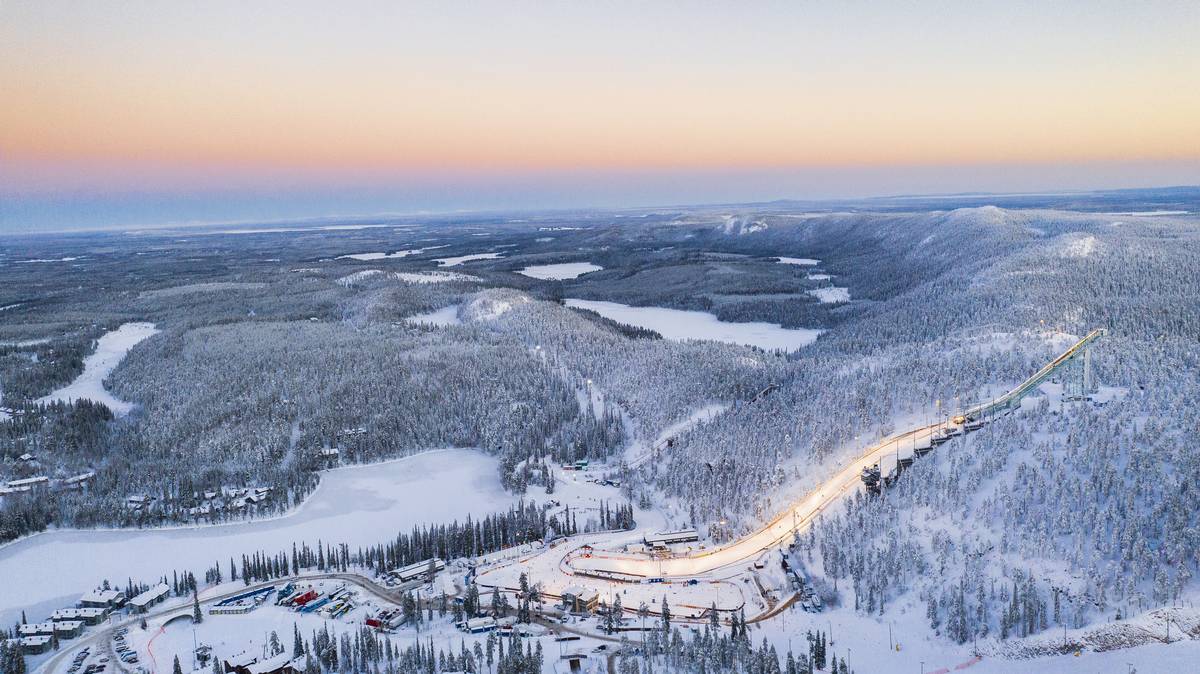
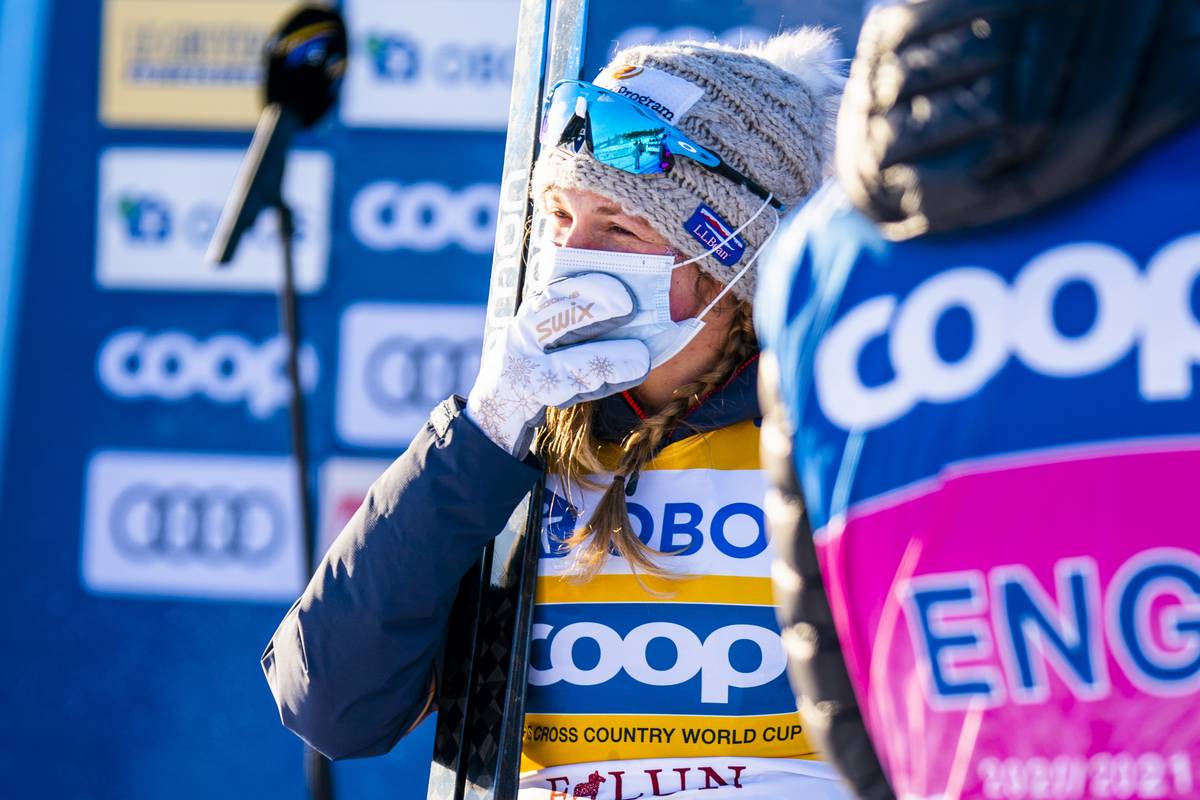
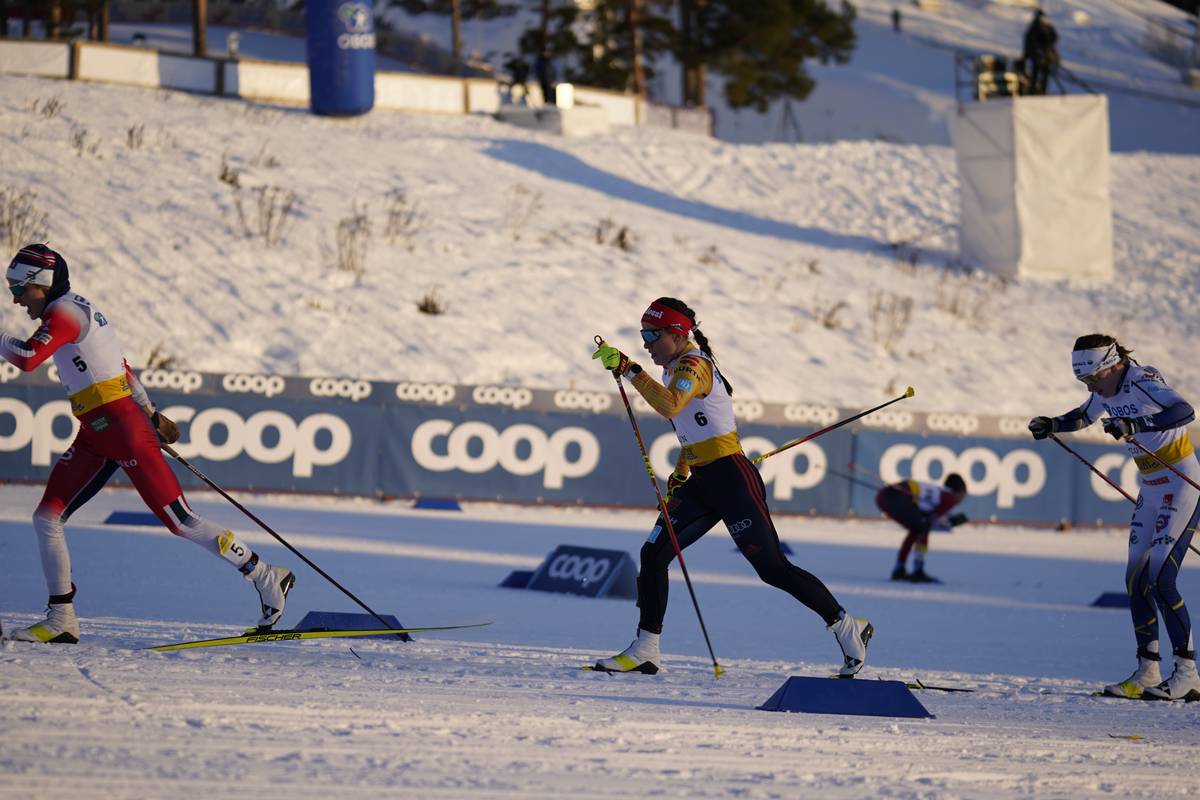
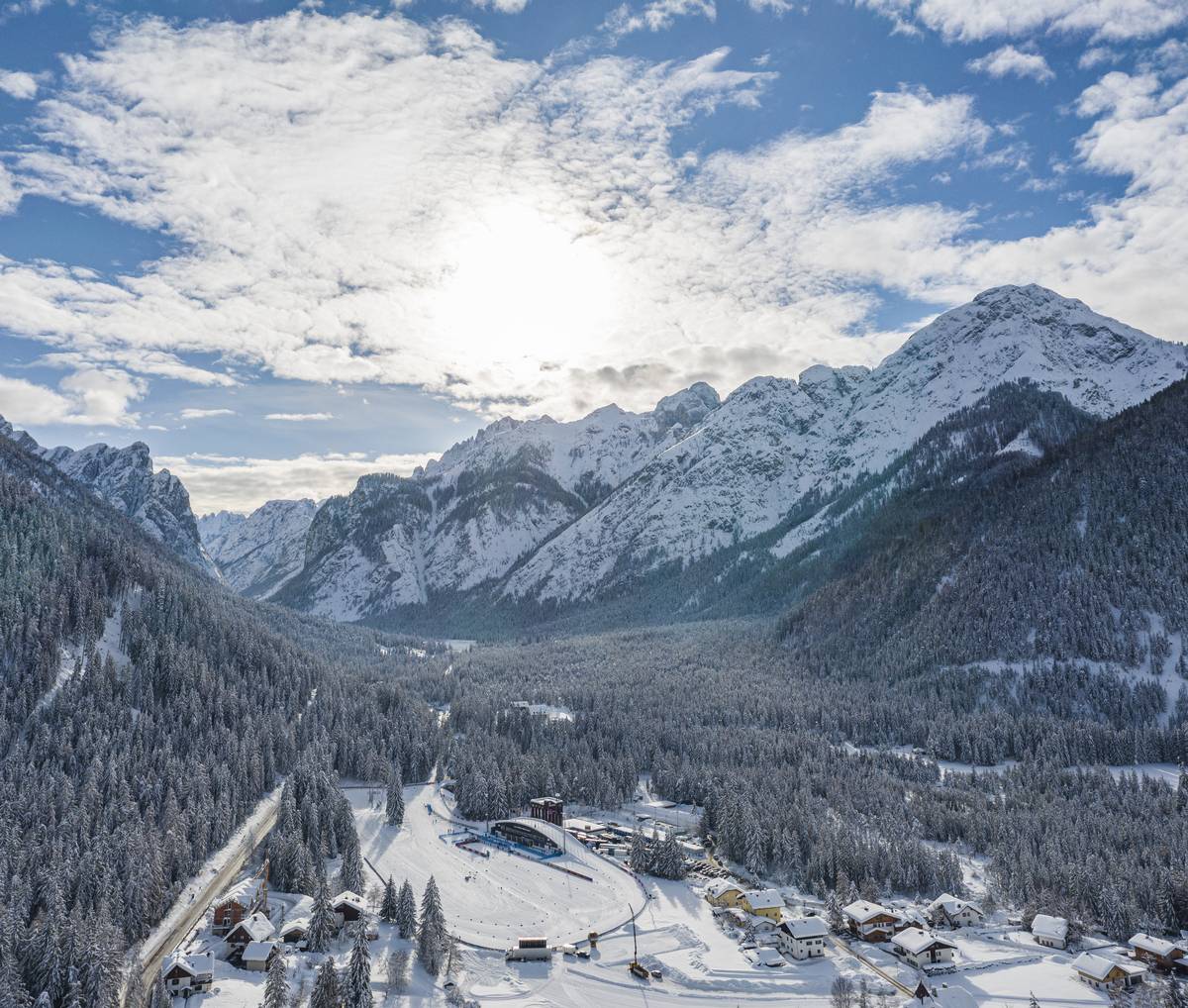
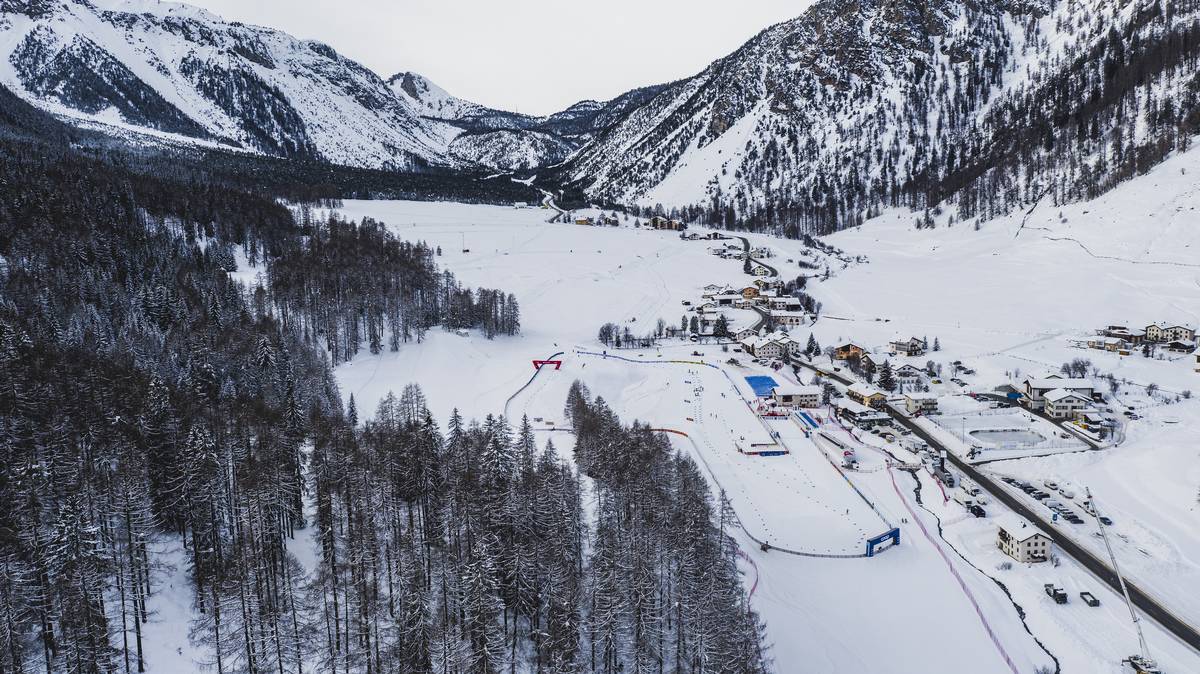
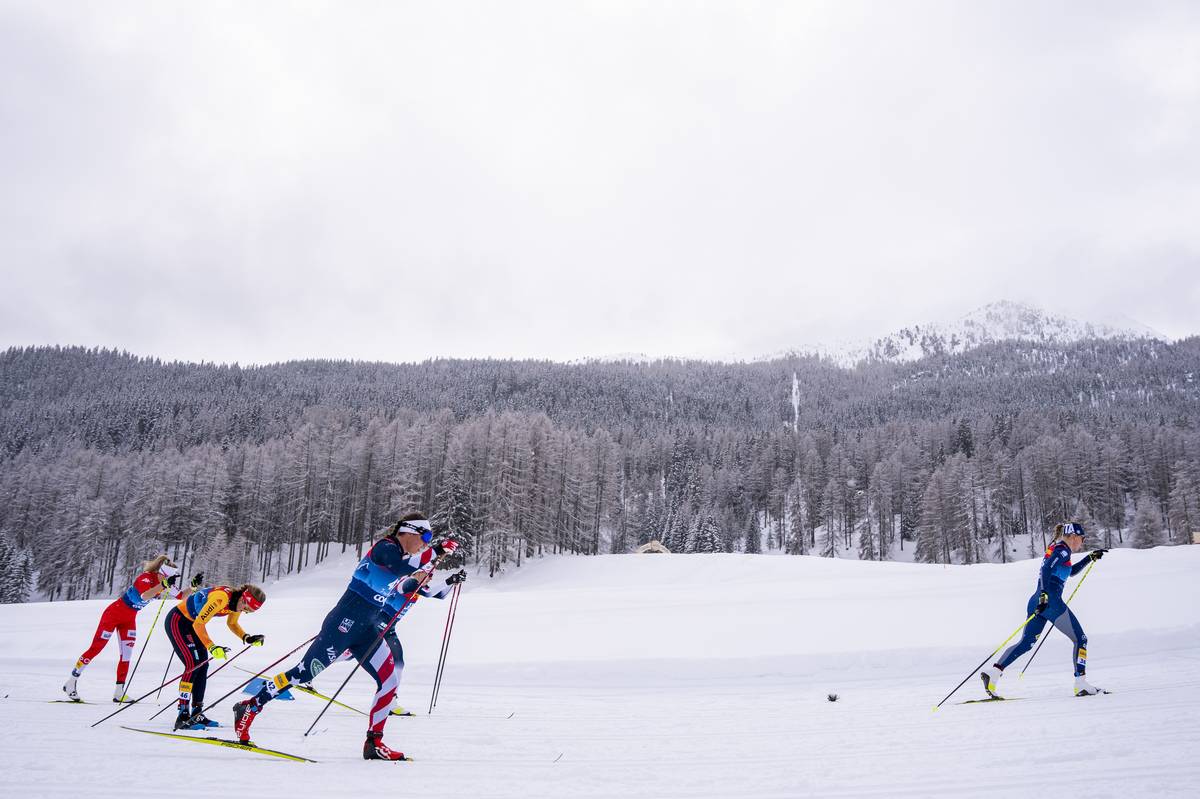
The Ruka, Finland racing/jumping complex. (Photo: NordicFocus)
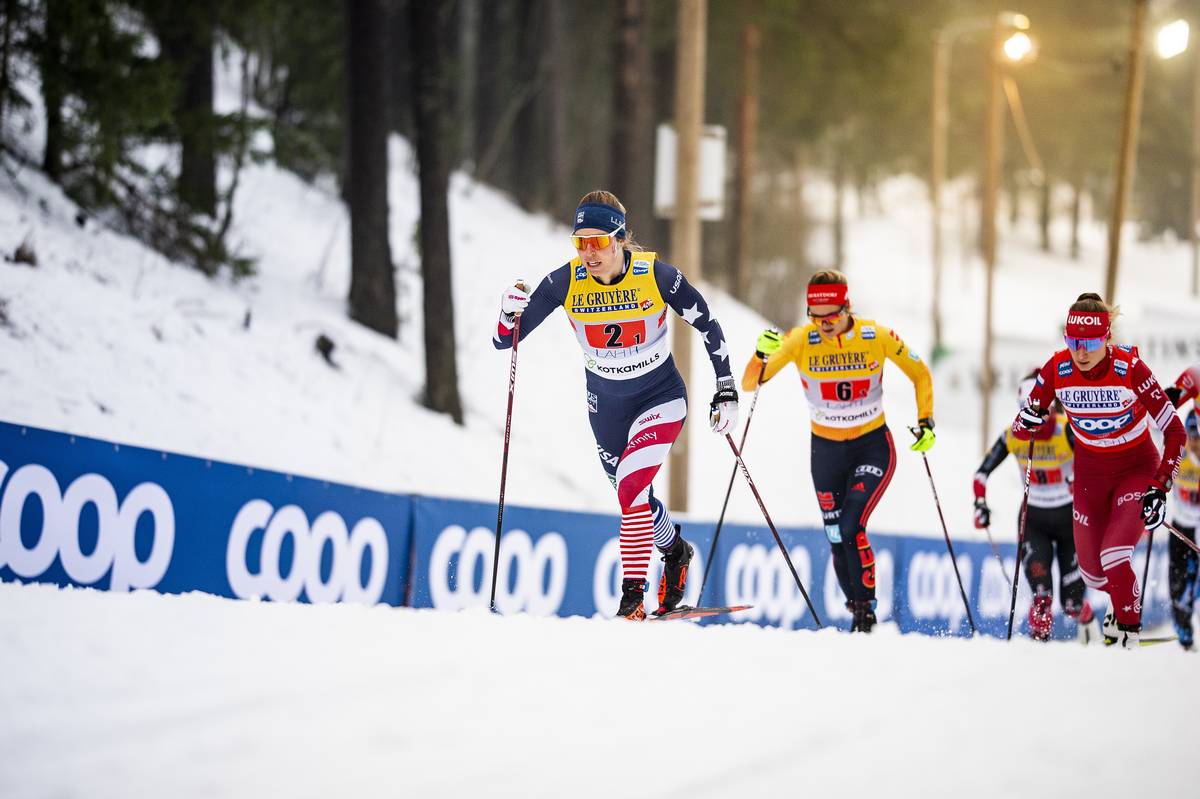
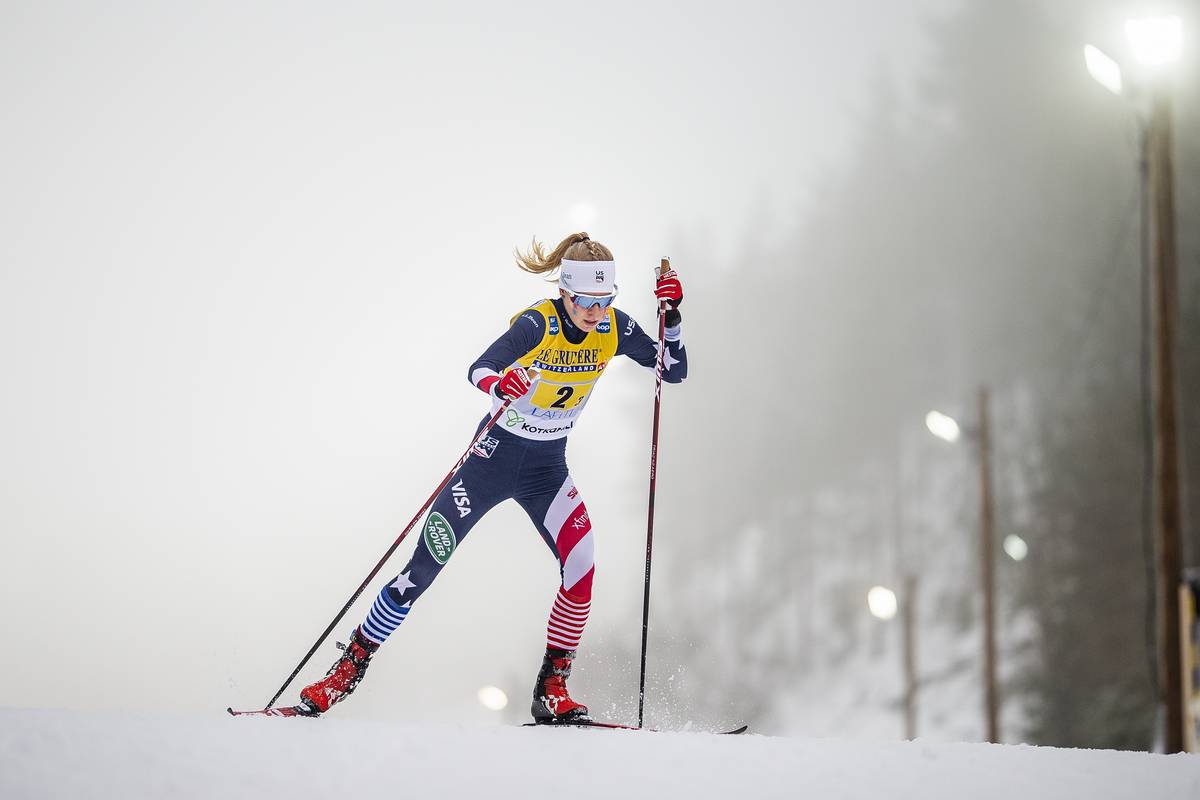
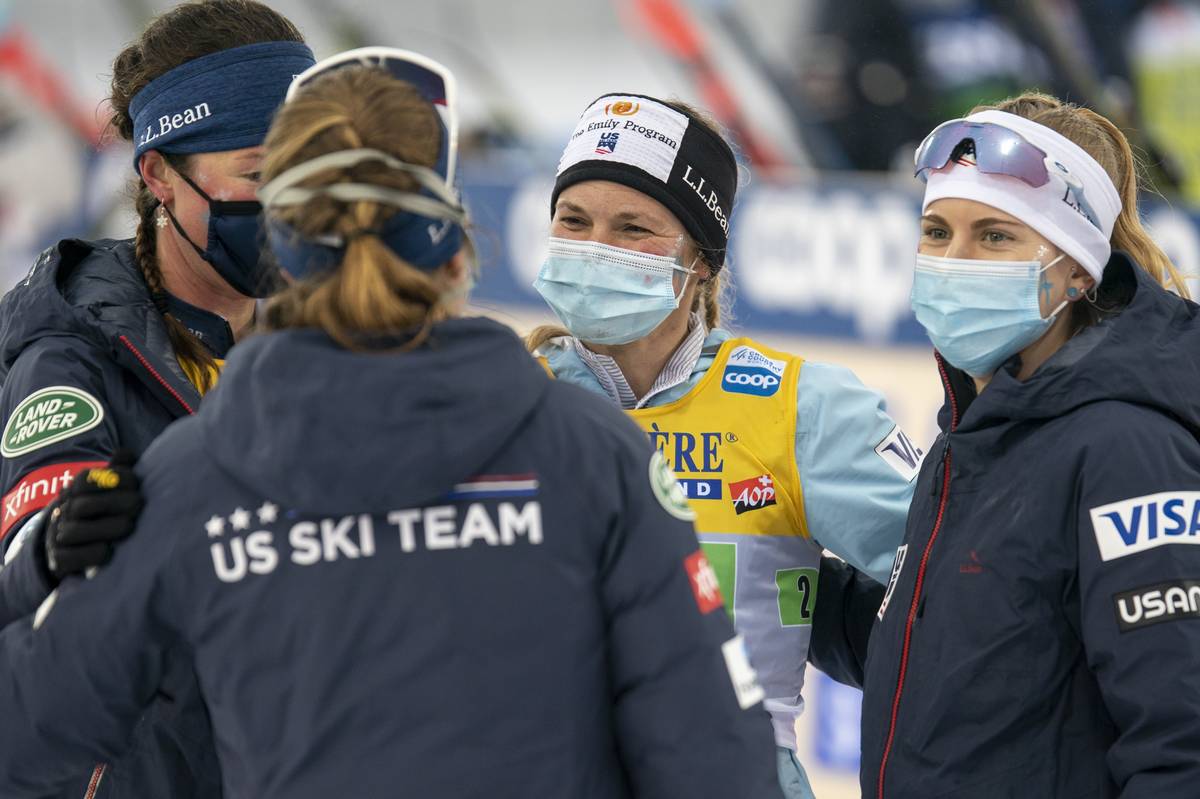
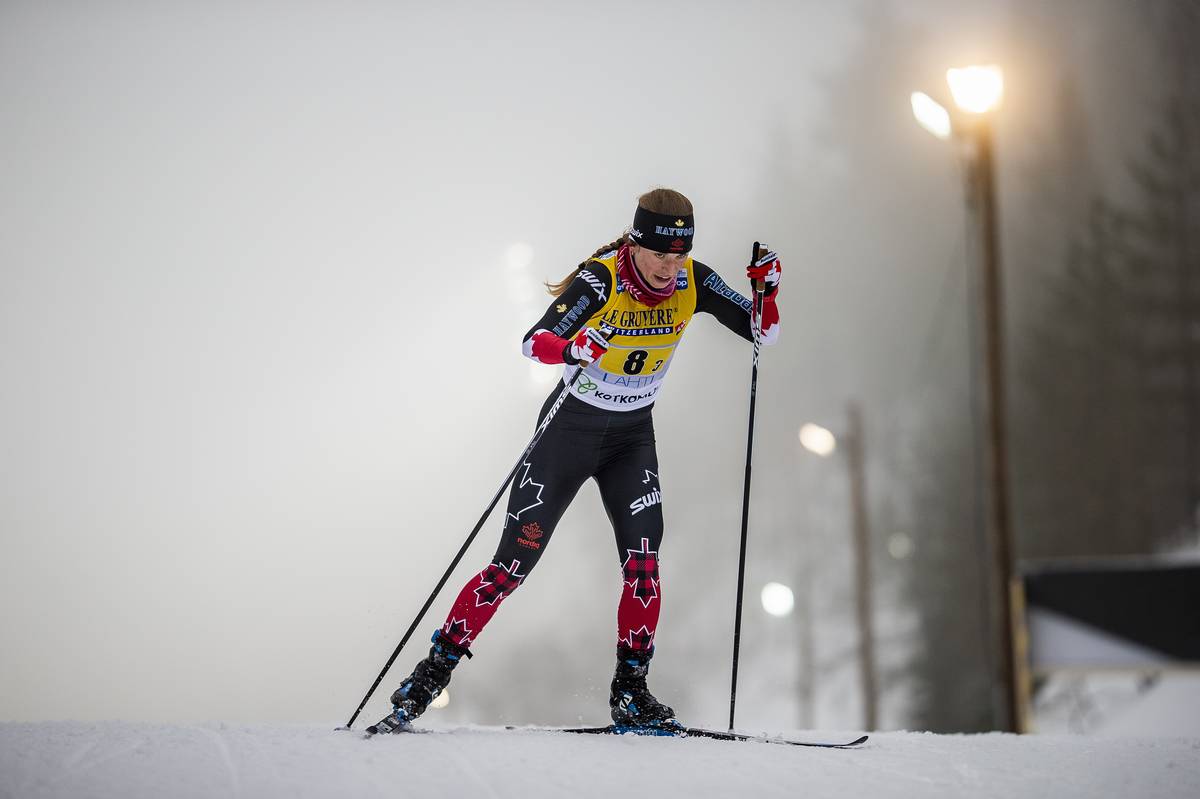
In just two days, the World Cup season will be kicking off in Ruka, Finland. For the American squad, this means they have left behind the final throes of preparation and made the big trip across the Atlantic for the winter. Of the twenty-one athletes just announced to the Davis U.S. Cross Country team, the majority of the members competing in Ruka at the end of this month are expecting to be away from home until the end of the season in March.
This may include staying and racing in as many as nine different countries with a range of living arrangements. Unlike their European competitors who are able to return home between race weekends or at least over the holidays, the North Americans spend the whole winter on the road.
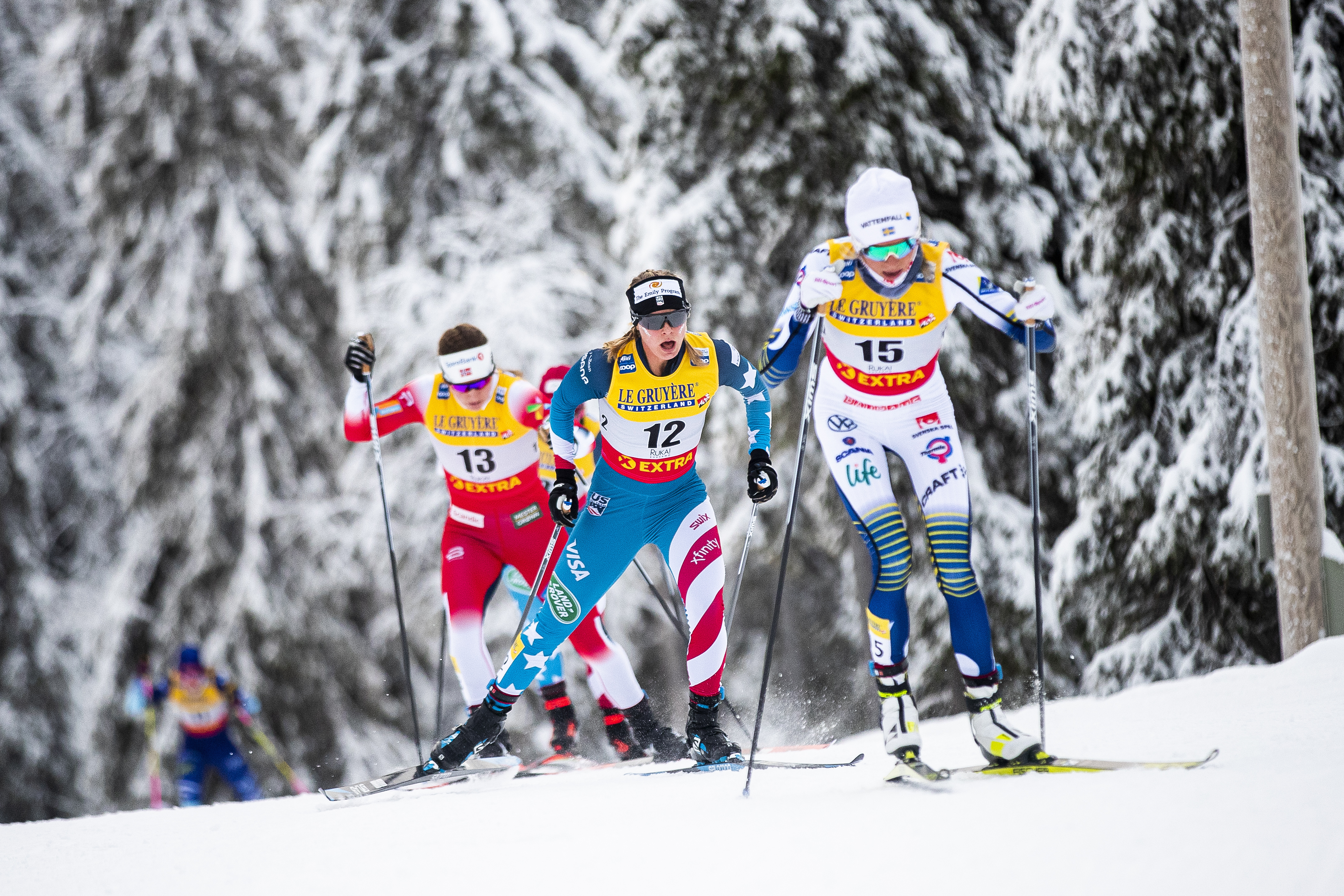
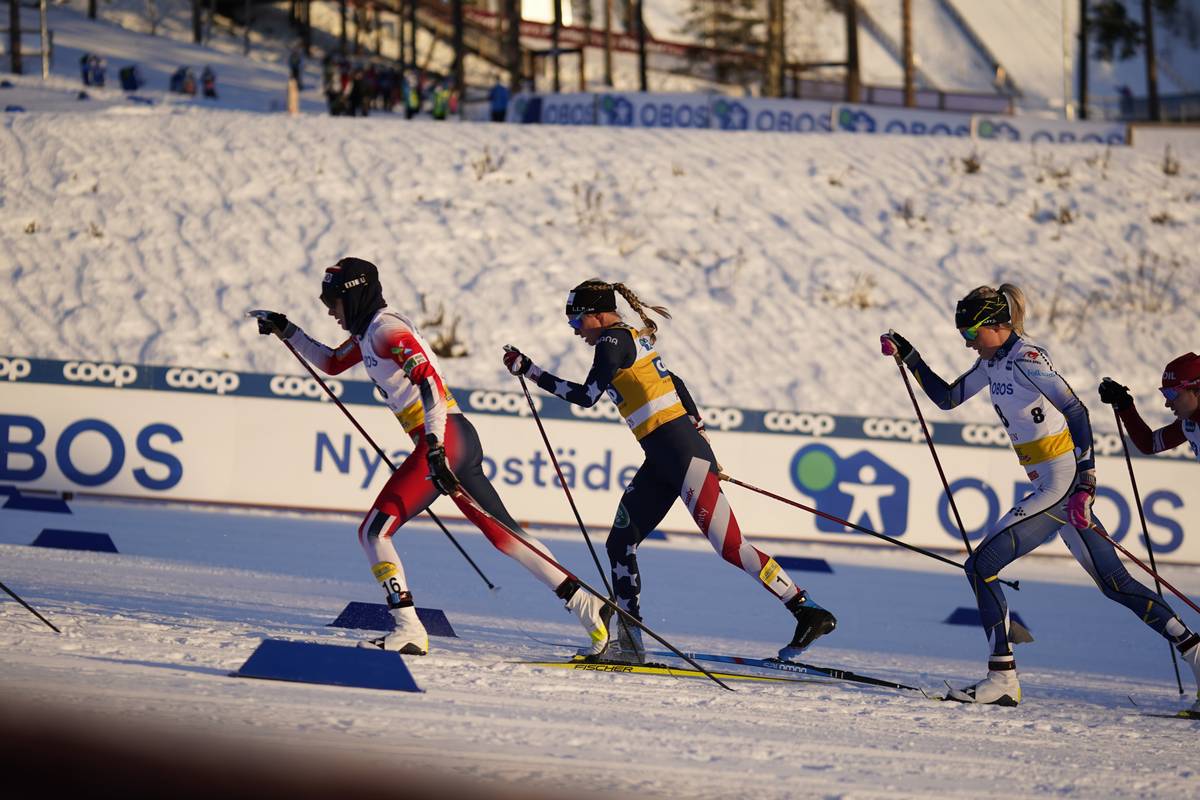
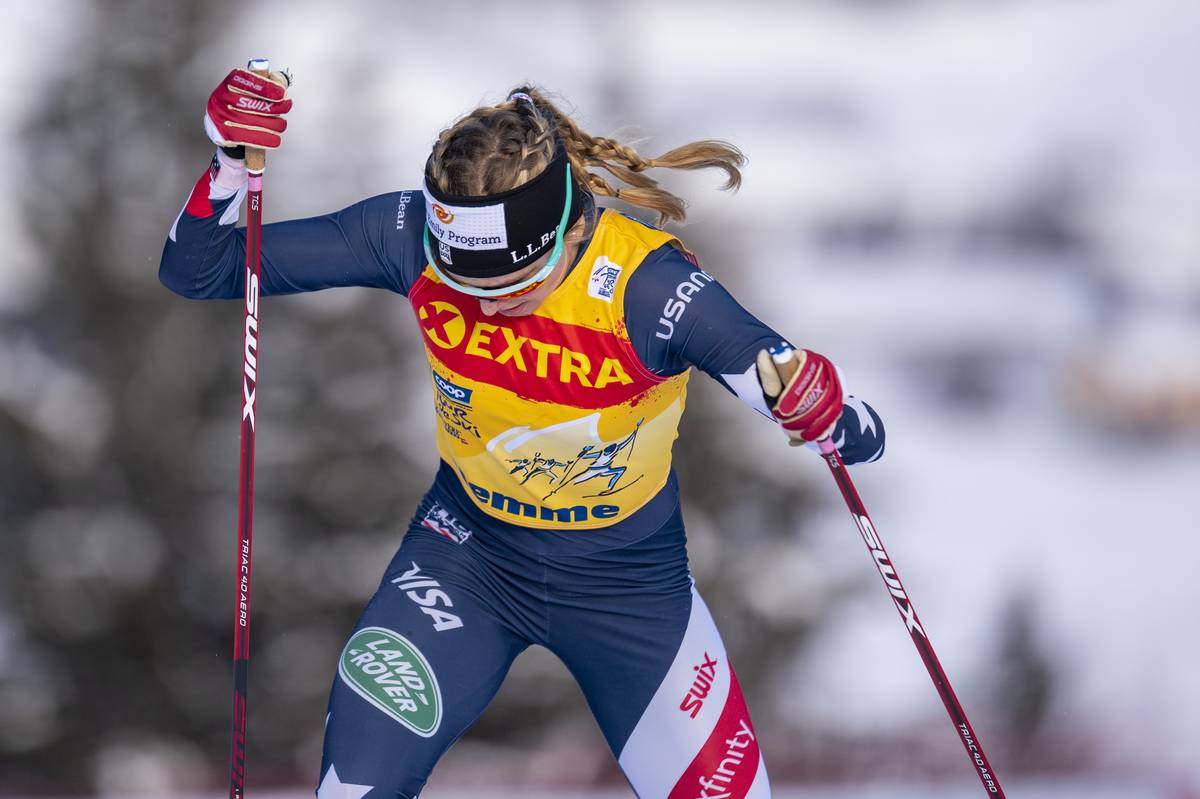
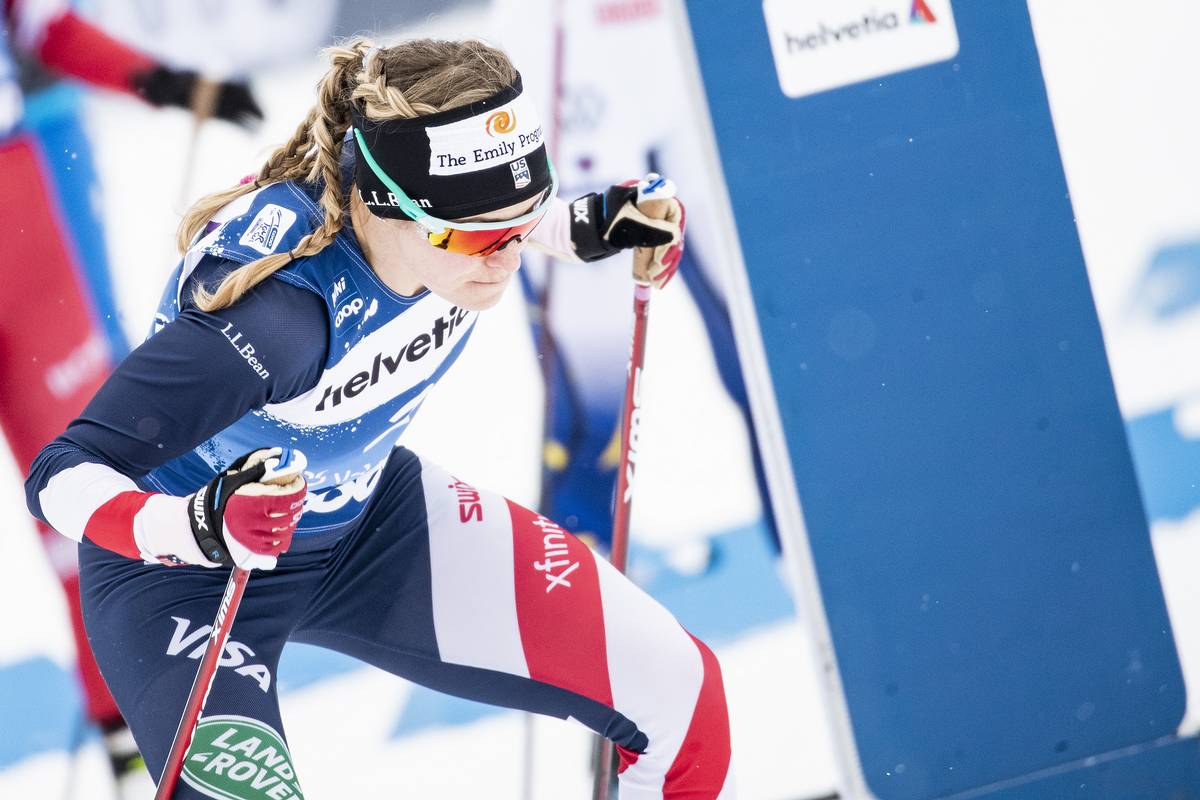
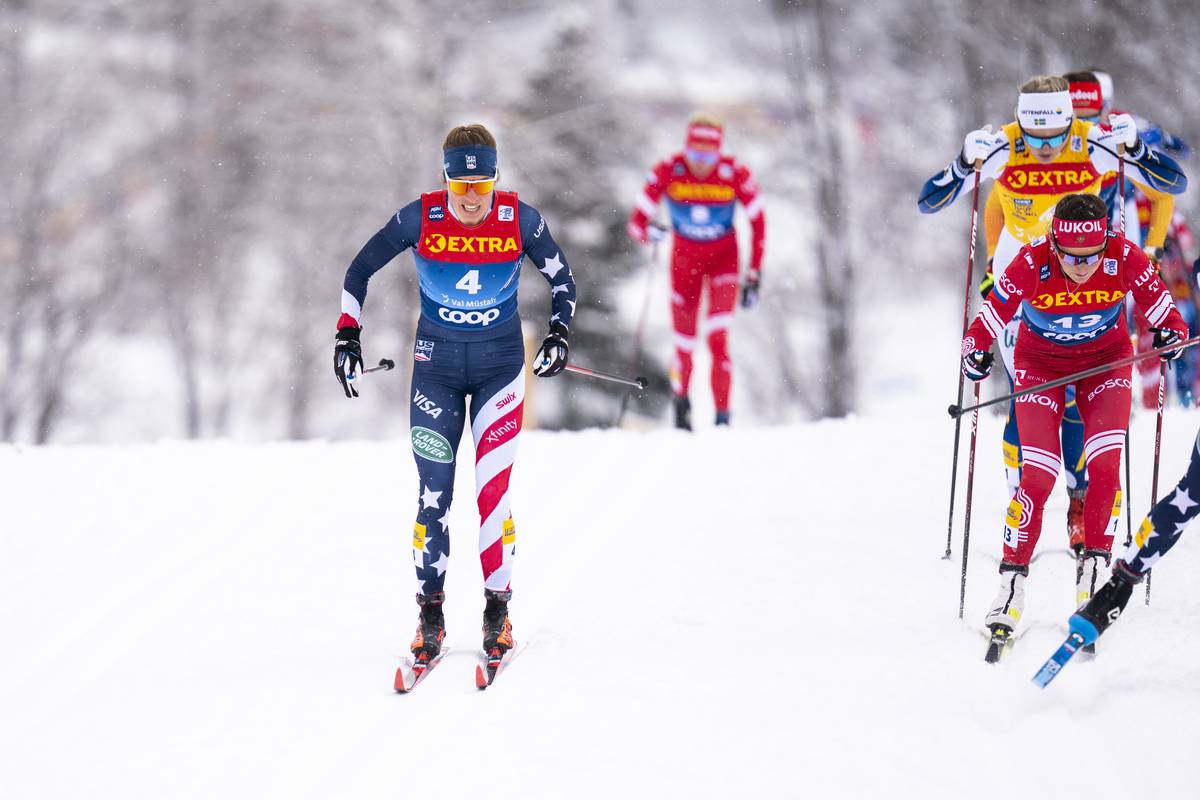
On the hunt, Jessie Diggins moves up through the field during the 2019 10-kilometer freestyle pursuit in Ruka, Finland. (Photo: NordicFocus)
While there are evidently many important items to pack for such a long duration (ski boots, laundry supplies, toothbrushes, etc.), there are also those that help ease the long months away from home. After reaching out to several members of the U.S. team who spent at least this past winter away, if not many of the seasons before also, they graciously responded with a unique item that somehow makes life on the road easier in some way.
The first category of items could be classified under “comfort” or “familiarity”. For Jessie Diggins, this comes in the form of pictures.
Diggins wrote, “I bring pictures to hang up on the hotel room walls to make it feel just a little more like home everywhere I go!”
For Gus Schumacher it’s a pillowcase that has the picture of his dog on it, though he says it doesn’t fit that many of the big hotel pillows, it still makes a room feel more like home. Hailey Swirbul brings her stuffed manatee but added that she also is looking forward to bringing a Catan board game for some good team bonding.
Thus ushers in the second category of items, which could be called “stimulation” or “engagement.”
Like Swirbul, Kevin Bolger’s item was a game to pull teammates away from Netflix or homework and to hang out as a group. He likes to bring along a deck of cards and a cribbage board saying, “It’s a game I’ve always enjoyed playing with my family back home!”
Katharine Ogden has been teaching herself a new skill over the past few years and brings yarn and a crochet hook to make little animals to give to teammates. Ogden wrote, “It’s a fun way to feel kind of productive in a pretty mindless way, and the little creatures are pretty cute.”
KO Creations-the frog (Photo: Katharine Ogden)
KO Creations- the dragon (Photo: Katharine Ogden)
The engineer, Scott Patterson, shared that each year he tries to bring along something that is “portable, self-contained and keeps me mentally stimulated.” This year, that item is an OpenCV AI kit, which is a stereoscopic camera system with powerful resources for computer vision and AI/machine learning.
Patterson wrote, “I backed the project on kickstarter last winter and haven’t had much time to play around with it while I’ve been busy training and working over the non-racing season. Usually I have a little more time in the winter for hobby projects and metal exploration. I’m not sure what the projects will be, but I’m looking forward to playing around with my coding skills and seeing if I can come up with something even slightly useful.”
The OpenCV AI Kit: OAK-D (photo: OpenCV.ai)
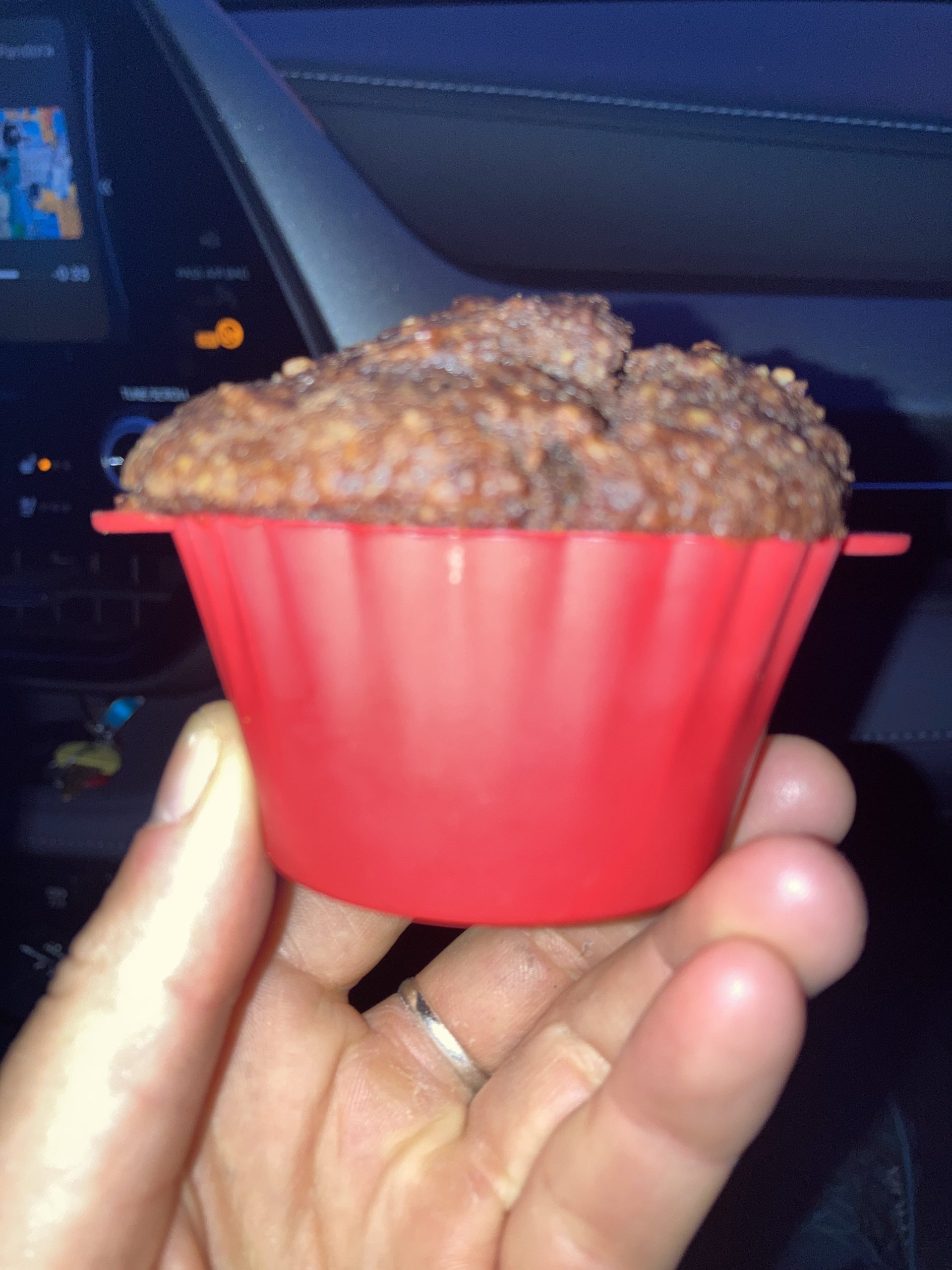
For Rosie Brennan, it’s about what she can’t find in Europe. Brennan wrote, “I love muffins and use them as training food all year, but muffins are not a common thing in Europe.” To solve this scarcity, she found silicone muffin tin liners and silicone measuring cups that she travels with. Brennan added, “We don’t always have access to an oven but it’s often enough that [bringing them] has been so worth it and it brings me happiness to be able to bake and eat muffins for snacks and post training/racing food. It allows me to use American recipes for a small taste of home and use fuel I’m accustomed to. Someday Europeans will learn just how versatile and delicious a muffin is!”
Muffin on the road (Photo: Rosie Brennan)
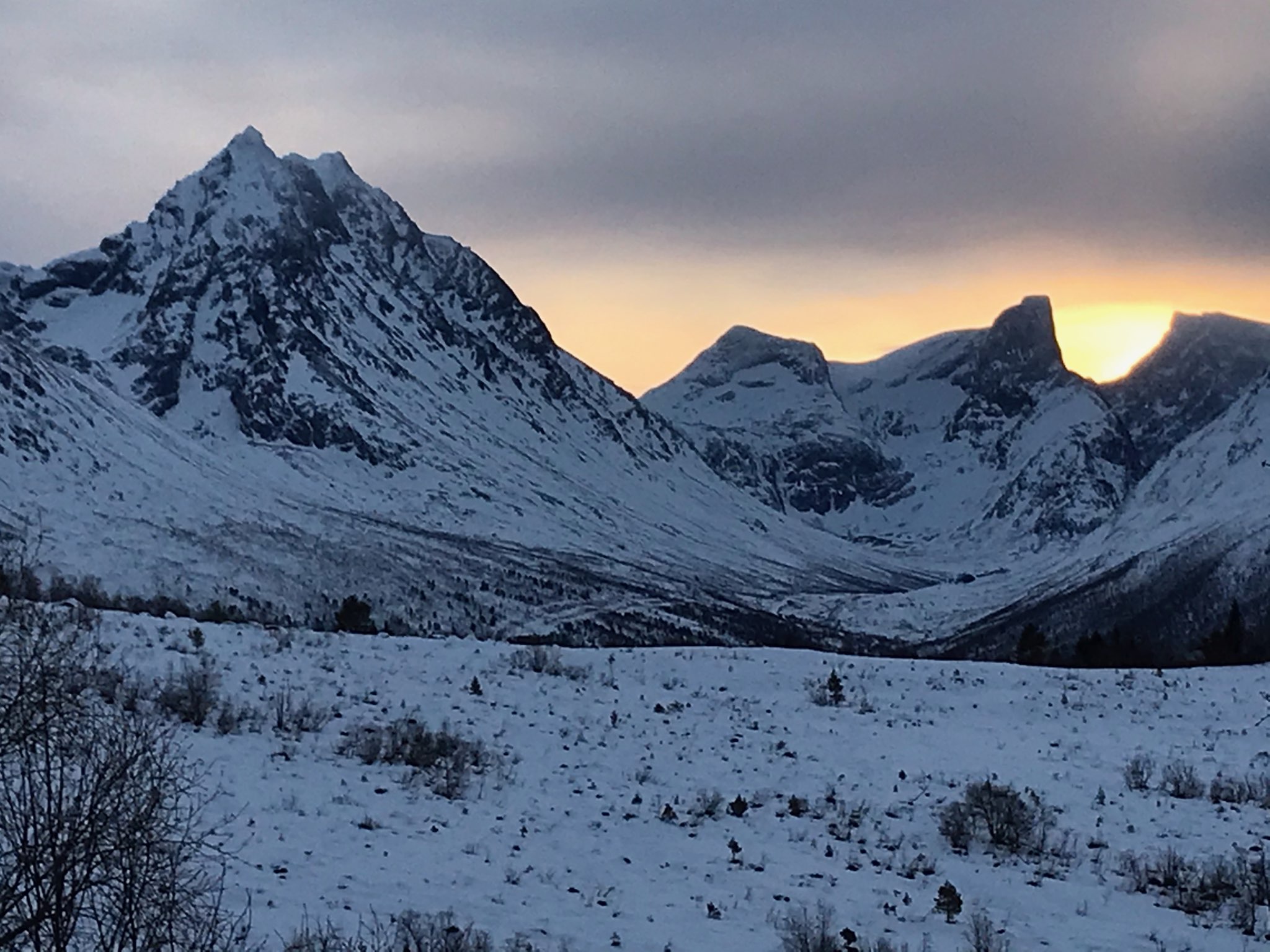
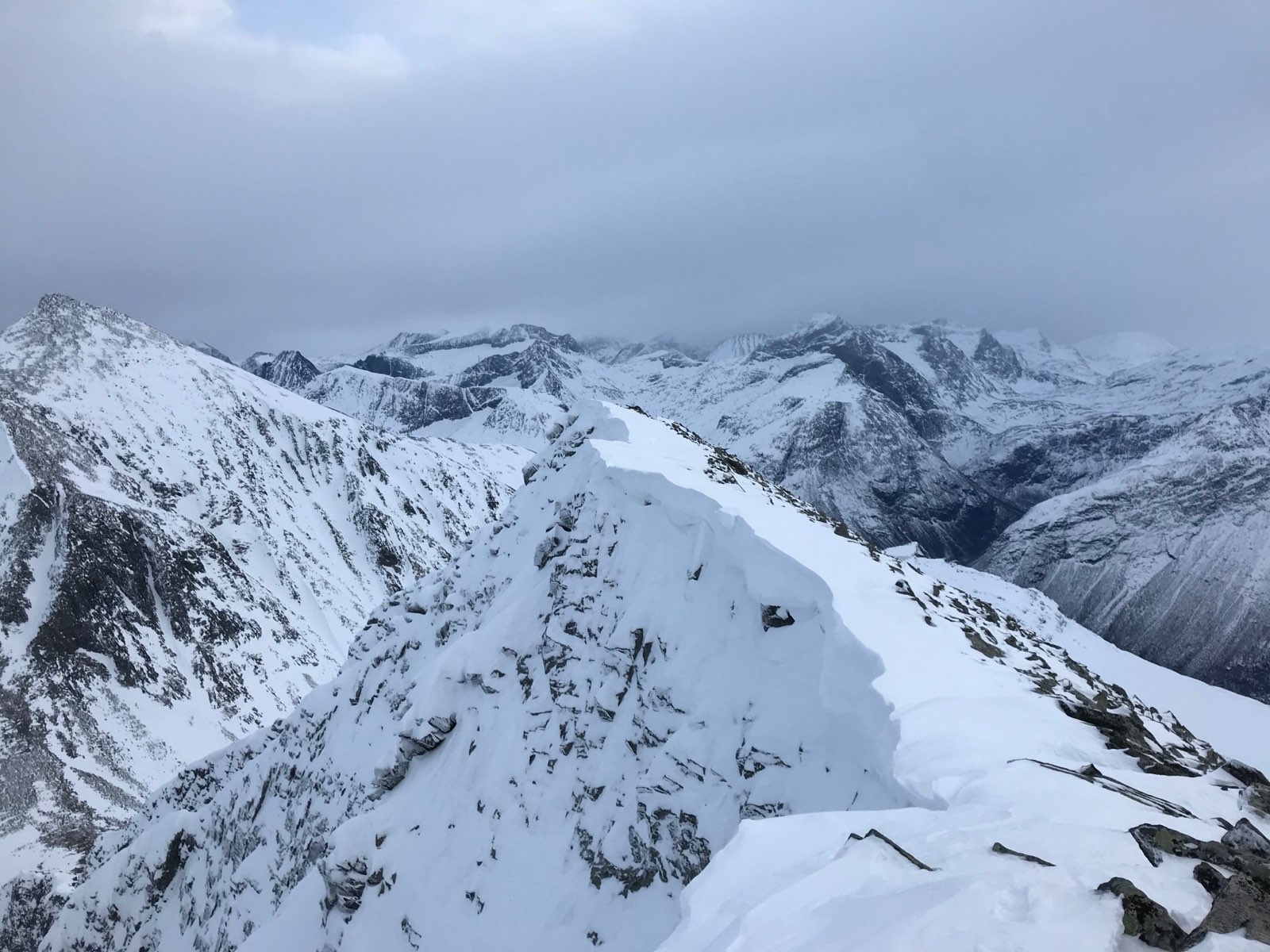
The item(s) that Julia Kern brings may fall under their own category of “exploration” or “appreciation-of-place”. Kern is an avid photographer who brings her camera and drone along each winter.
She wrote, “I love to go on walks/hikes/jogs and capture all the different places we travel. It’s a way for me to step outside of ski racing and explore and see all of the amazing places we get to travel to. Often it is easy to get sucked into the monotony of traveling on Monday to the next venue, inspecting the course, testing skis during the week, and racing on weekends without stopping to experience the places we travel.”
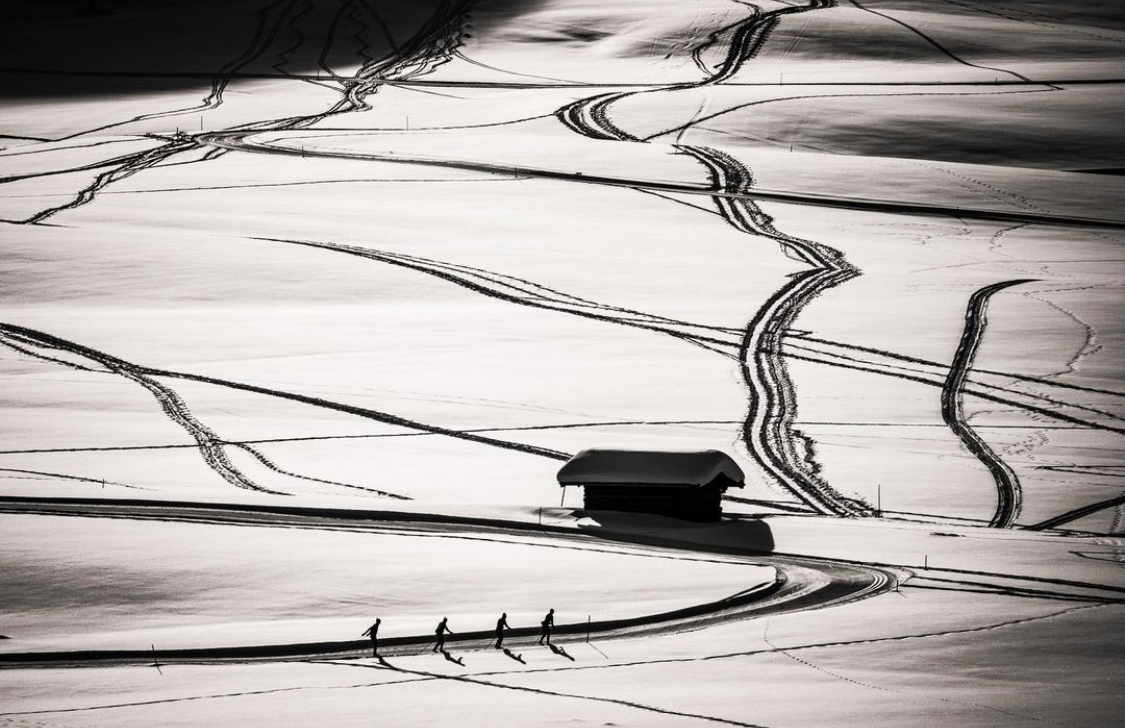
Teammates skiing in Seiser Alm (Photo: Julia Kern)
Sunset at the iconic Seiser Alm (Photo: Julia Kern)
Drone captures in Davos Switzerland (Photo: Julia Kern)
The World Cup racing begins Friday November 26th with a classic sprint in Ruka and concludes with World Cup finals March 18-20th in Tyumen, Russia. Stay tuned for race reports from FasterSkier on these, an analysis from the colorful Devon Kershaw, and plenty of other articles throughout the season.
Rosie Frankowski, left, and Hailey Swirbul race at Government Peak Recreation Area, Palmer, Alaska, Nov. 14, 2021, in the season-opening Race to the Outhouse #1. (photo: Eric Strabel for APUNSC)
GOVERNMENT PEAK RECREATION AREA, above Palmer, Alaska — High-end nordic ski racing was last seen in this country in mid-April, when a bevy of national-team members who call Alaska home competed in a pair of FIS races in mid-winter conditions, followed by a more vernal 2,000’ hill climb the following weekend. Less than seven months later, as Alaska kicks off another season of ski racing, little has changed: the country’s deepest domestic fields, single-digit temps, and fierce competition. The 2021/2022 American race season is officially underway.
The Mat-Su Ski Club has hosted the season-opening Race to the Outhouse #1 somewhere in the Matanuska–Susitna Valley, above Palmer, Alaska, for the past 13 years now. Typical locations are Archangel Road and Independence Mine. The race course at Archangel ends with a 240-meter climb; the race course at Independence Mine starts with a 145-meter climb over the first 1.8 kilometers. Both feature an eponymous state parks outhouse near the finish line. Neither is exactly FIS-legal.
This year, poor road conditions on the upper mountain caused by recent heavy snowfall necessitated a last-minute change to Government Peak Recreation Area, or GPRA, elev. 1,000′.
When the snow cleared and the new venue was announced on Friday morning, this year’s race was somehow even harder. The Government Peak 5k FIS course has 38.2 meters of gain per kilometer, on par with the Lahti World Cup course (38.5) that has hosted multiple World Championships. It has a height difference of 81m, more than Ruka or Lillehammer or Lahti or Falun or Oberstdorf or frankly most venues. After Sadie Maubet Bjornsen skied here for the first time, in October 2020, she called these “the most legit ski trails I have ever skied in the US,” and pronounced the venue World Cup-ready.
Hunter Wonders races at Government Peak Recreation Area, Palmer, Alaska, Nov. 14, 2021, in the season-opening Race to the Outhouse #1. (photo: Eric Strabel for APUNSC)
Overnight temperatures on Friday of nearly zero, rising to only 7° F in time for Saturday’s race, did not make the snow on an already difficult course ski any faster.
Rosie Brennan (USST/APU) was unfazed by the slow snow, covering two laps in 32:18.4 to take a commanding win in the women’s 10-kilometer mass start classic race. She was followed by Hailey Swirbul (USST/APU, +2:44.6), who was 0.7 seconds ahead of Rosie Frankowski (APU). Fourth place was another Olympian, Australian–American dual national Jessica Yeaton (Australia National Team/APU).
“I was looking for an opportunity to practice racing and shake some cobwebs off on the snow,” Brennan wrote to FasterSkier on Saturday. “It was absolutely incredible what Mat-Su Ski Club pulled off for us today. From one surprise storm they were able to set classic tracks on a 5k homologated loop. I honestly can’t think of a better way to get a good test race in than that. I am very grateful for the community support and effort to help get us ready to race before leaving. I am really happy with my effort and was able to find some race feelings and some good movements on snow. I am feeling on track and ready to hit the road.”
Swirbul sounded similar sentiments, writing, “I was hoping to get a good workout in and practice pacing. I don’t think time trials have to be great to have a good effect and shake some of the cobwebs out. Good to go hard with some great teammates!”
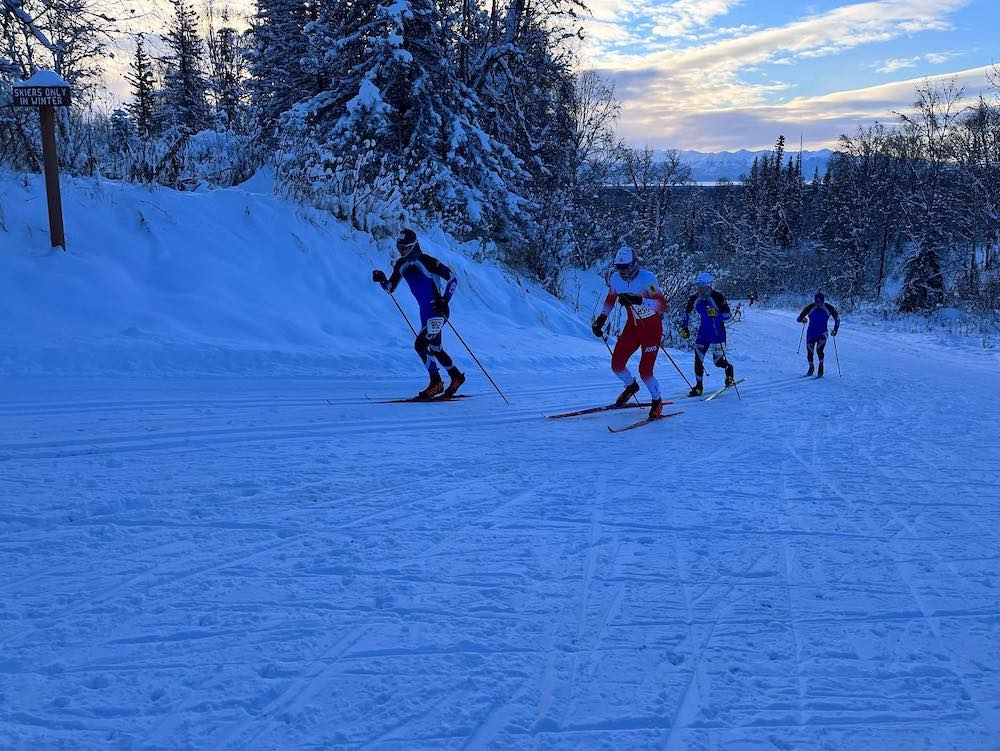
From left, David Norris, Gus Schumacher (red AWS suit), Hunter Wonders, and Tyler Kornfield charge up the first hill out of the stadium at Government Peak Recreation Area, Palmer, Alaska, Nov. 14, 2021, in the season-opening Race to the Outhouse #1. (photo: courtesy APUNSC)
For the men, Gus Schumacher (USST/Alaska Winter Stars) took the win in the 10 k classic, crossing the line in 29:29.2 in the mass start race. He was closely followed by Hunter Wonders (USST/APU) and David Norris (APU), 0.8 and 2.4 seconds back, respectively.
Schumacher had much the same reaction as Swirbul, writing to FasterSkier, “Today was mostly just to shake off some cobwebs and get a sense for where my race fitness is at. It went really well; I felt good and it was fun to end up ballpark where I want to be. It gives me some confidence just to have a solid race under my belt before travel.”
The World Cup athletes were concentrated in the 10 k classic. In the men’s 5k skate, Oskar Flora led a strong junior field to take the win in 15:50.4, followed by Liam Chisholm (+36.0) and Kyle Fischer (+54.7). In the women’s 5k classic, it was Meredith Schwartz first in 18:59.6, Alison Arians (Schwartz’s mother) 43.6 seconds back, and Tuva Granøien in third, 1:25.8 back.
In the men’s 10k skate, JC Schoonmaker (USST/UAA) led a small field to the finish in 29:35.1. He was followed by local juniors Skyler Amy and Cole Flowers in second and third several minutes later.
Anna Engel (45:26.7) appears to have been the only woman who did the 10k skate.
* * *
The races were a robust test of athletes’ fitness on a challenging course. They were also somewhat of an epistemological puzzle: Is it really an early-season race if you’ve been on snow for nearly two months already? Snow came to the Chugach foothills above Anchorage, ca. 2,000 feet, on September 24. By the time that early-season storm was melting out, race-skis skiing was online at Independence Mine – this photo was taken on October 10:
An Anchorage- or Palmer-based athlete in a position to drive could have logged seven full weeks on snow by the time race day dawned. APU head coach Erik Flora had 30 hours on snow by Halloween. Climate change is undeniably present in southcentral Alaska, but its effects in this La Niña winter have so far been kind to skiers.
Making the question of “what type of race is this, anyway” even more complicated was the depth of the fields. Alaska’s World Cup skiers are off to Europe soon, but not yet, and turned out in force for Saturday’s race – four out of five athletes on the U.S. Ski Team A-Team raced, and a total of six athletes who will be starting on the World Cup this fall were in the field (potentially seven depending on what happens with alternates).
Becca Rorabaugh races at Government Peak Recreation Area, Palmer, Alaska, Nov. 14, 2021, in the season-opening Race to the Outhouse #1. (photo: Eric Strabel for APUNSC)
FasterSkier unofficially calculates the race penalty for the men’s race as 23.7, and as 30.3 for the women, if these had been sanctioned as FIS races. U.S. Nationals, in Soldier Hollow in January, will likely have a higher number, reflecting the fact that the country’s fastest athletes are typically racing in Europe in January. Two out of three women on Saturday’s podium have World Cup podiums to their name; the third was 21st in the Olympics. For the men, Schumacher, Wonders, and Norris would not be surprising picks for the 2022 Winter Olympics American men’s relay team. Was this a free, low-key fun run involving a line in the parking lot to sign a waiver and pick up safety pins for your bib, or was it an unofficial U.S. Nationals? It’s complicated.
Racing continues in Alaska next weekend with the start of the town race series at Fairbanks’ Birch Hill ski area, then over Thanksgiving with races at Government Peak (the first annual Turkey Trax race) and Birch Hill (the 57th annual Turkey Day Relays). Domestic FIS racing gets underway in West Yellowstone the same weekend. The Midwest racing calendar at SkinnySki.com is currently unavailable, but the Duluth SuperTour races on December 4-5 are a notable early-season event. In New England, the NENSA calendar begins with the Quarry Road Opener on December 5. Wherever you are and whatever your local racing scene looks like, think snow.
(N.b., the results are slightly idiosyncratic, reflecting a free, low-key event in which athletes could choose between doing a 5k and a 10k up to the moment of the finish lane vs. lap cutoff. This manifests as all racers for both distances being listed together in a single results sheet, which is then further sorted by wave and gender. My sense of what’s what is: In the 10 a.m. men’s wave, places 9–11 did the 10k; in the 10 a.m. women’s wave, all athletes did 5k; in the 10:02 a.m. men’s wave, first place did the 5k and everyone else did 10k; in the 10:02 a.m. women’s wave, places 1–4 did 5k and the rest did 10k; in the 10:04 a.m. wave, places 23 and 24 for the men, and 9th place for the women, did 10k; everyone in the 10:06/10:08/10:10 a.m. waves did 5k, except that 8th place in the 10:06 a.m. classic did 10k.)
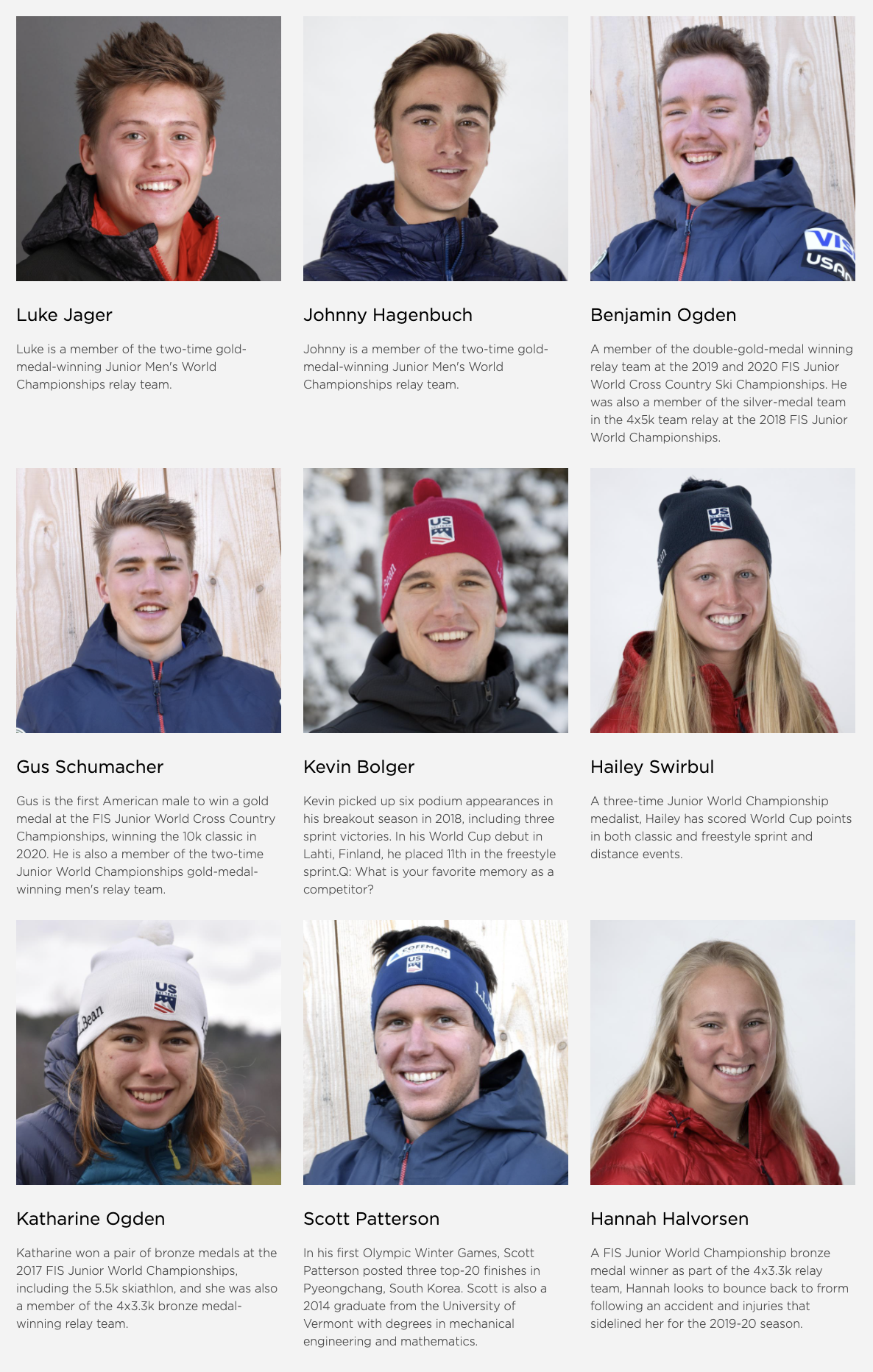
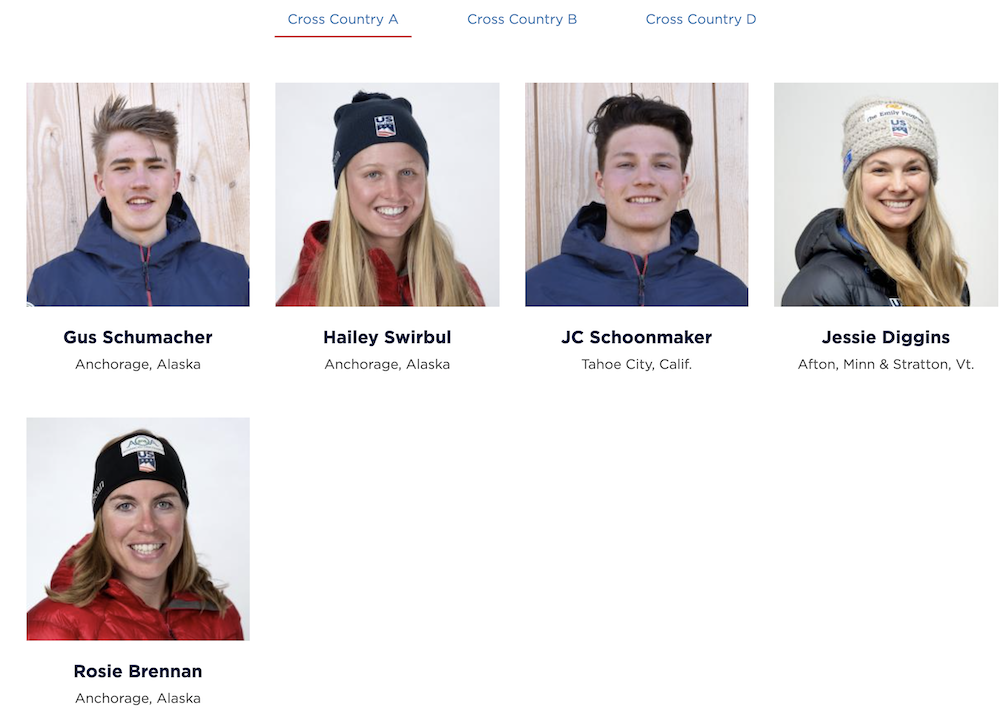
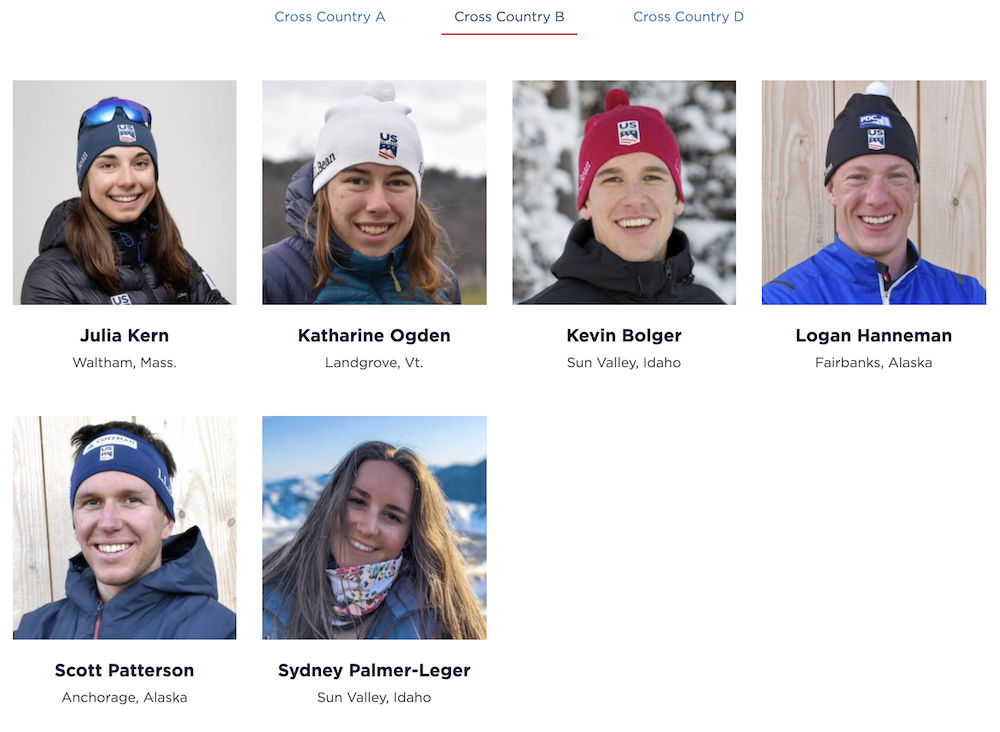
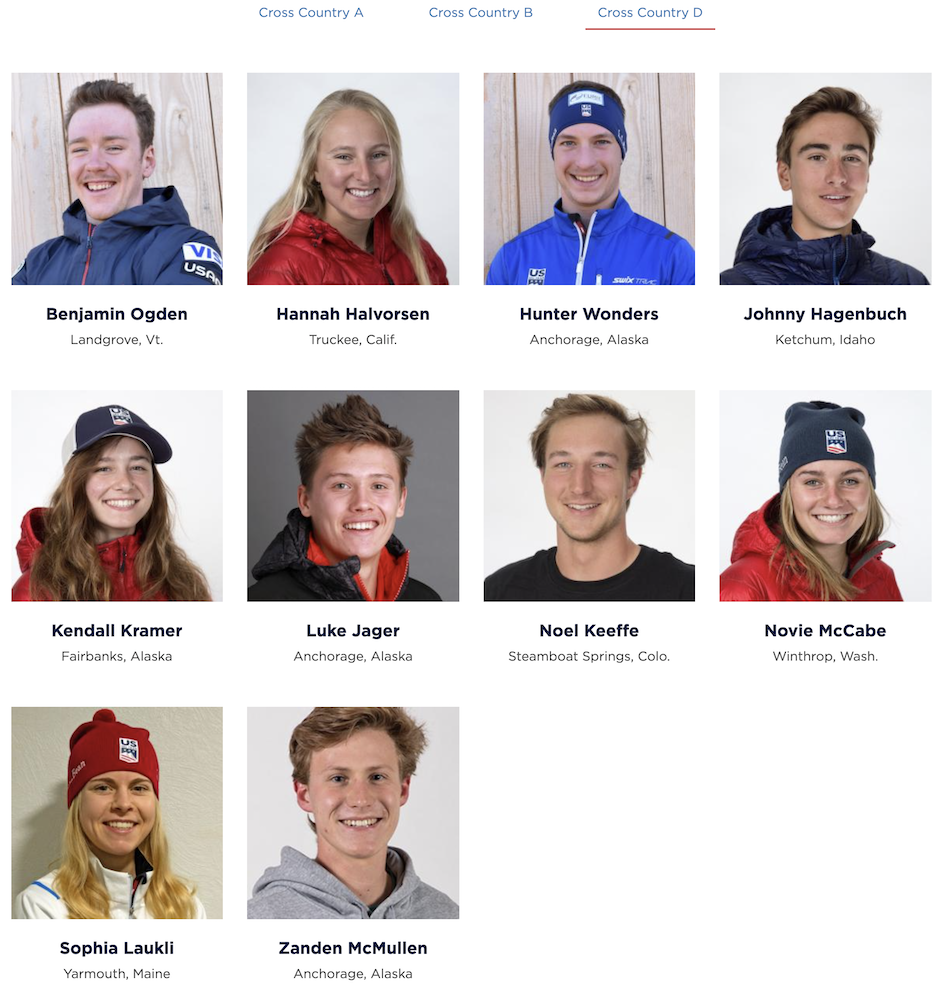
FasterSkier often publishes long profiles of athletes. This is not that article. Instead, please enjoy precisely 22 words about each of the 21 athletes currently on the U.S. Ski Team in this extremely brief, but numerically pleasing, preview of the 2021/2022 season. Athletes are presented alphabetically within each team, with age as of this season’s first World Cup race. All photos are screenshots from the current USST roster site. Any evocation of a certain song by Taylor Swift is purely coincidental.
A-Team
Rosie Brennan, age 32
In a year without Diggins, she’d be the headliner. Still improving in her thirties. Hoping for an upgrade over mono-afflicted PyeongChang experience.
Jessie Diggins, age 30
She’s won bunches: TdS, World Cup overall and distance. But Johaug, et al., were largely absent. Medals in Beijing against full fields?
JC Schoonmaker, age 21
Made four World Cup sprint heats last season, plus second American in Oberstdorf classic sprint. Starting Period 1 sprints. Just turned 21.
Gus Schumacher, age 21
In his first World Cup season, he only became the best American male skier since Kris Freeman. The world awaits the encore.
Hailey Swirbul, age 23
Third in a WC distance race. 0.8 seconds out of World Champs medal. A presumptive Olympian and relay stalwart if trends hold.
B-Team
Kevin Bolger, age 28
The rangy sprinter made five heats last season, but was left wanting more after finishing 35th in Oberstdorf. Estival training in Sweden.
Logan Hanneman, age 28
The rangy sprinter made three heats last season, but was left wanting more after finishing 39th in Oberstdorf. Estival training in Alaska.
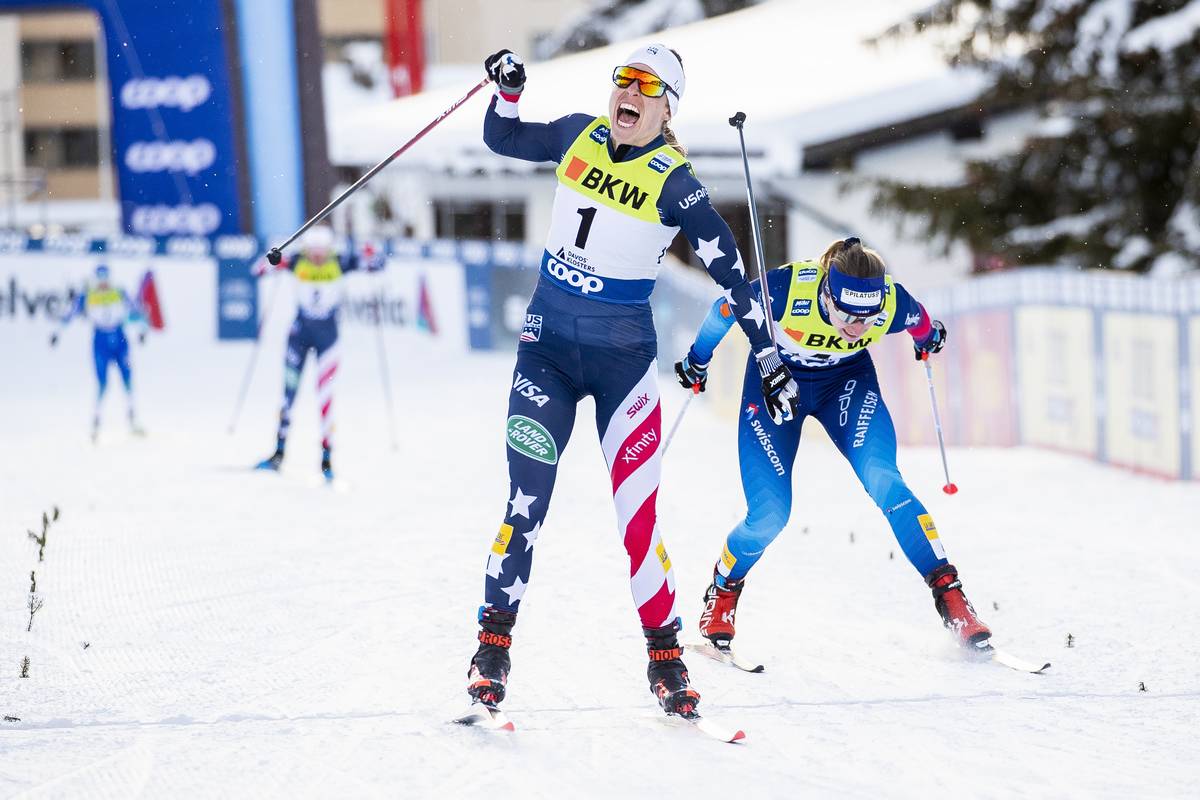
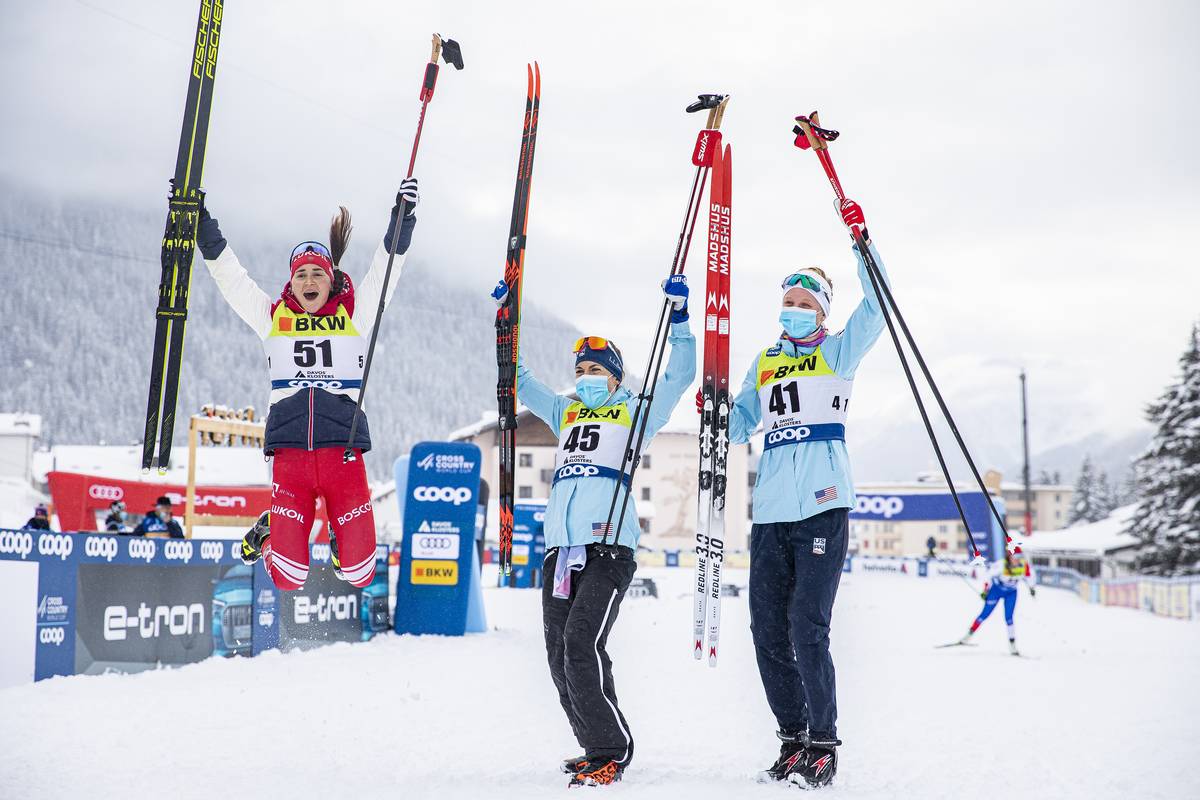
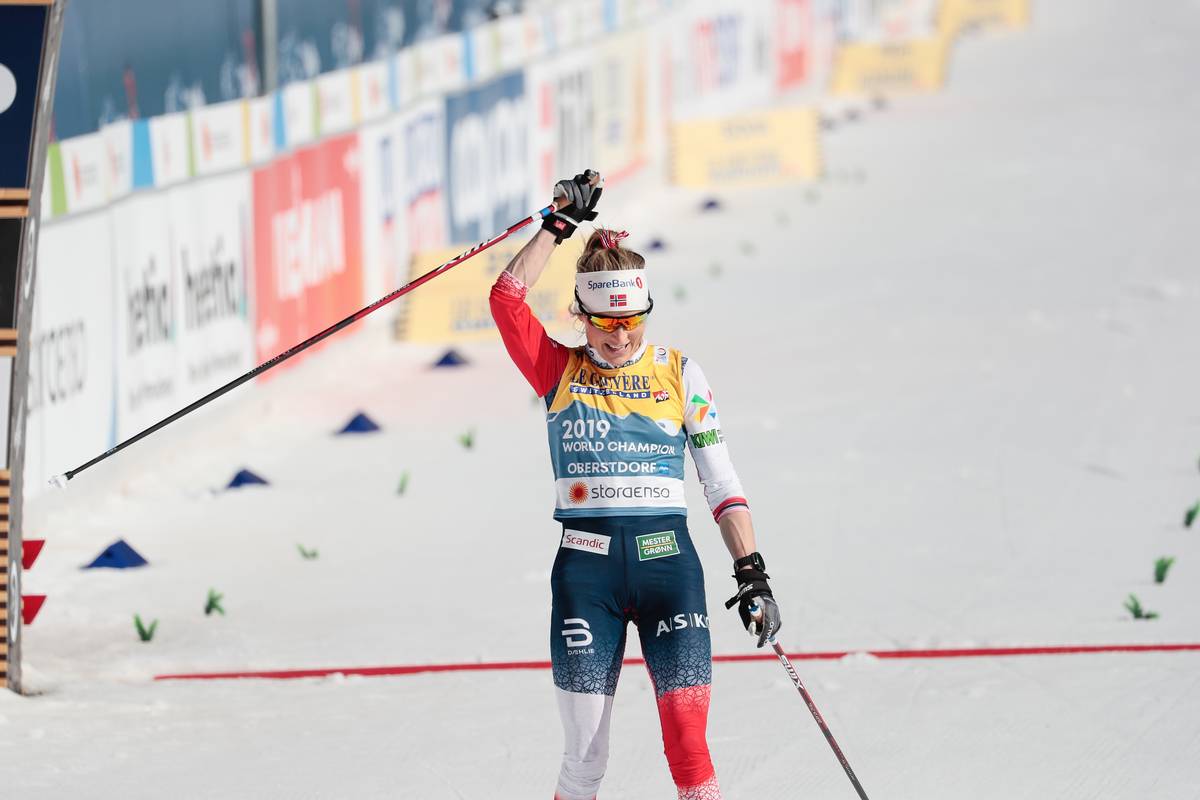
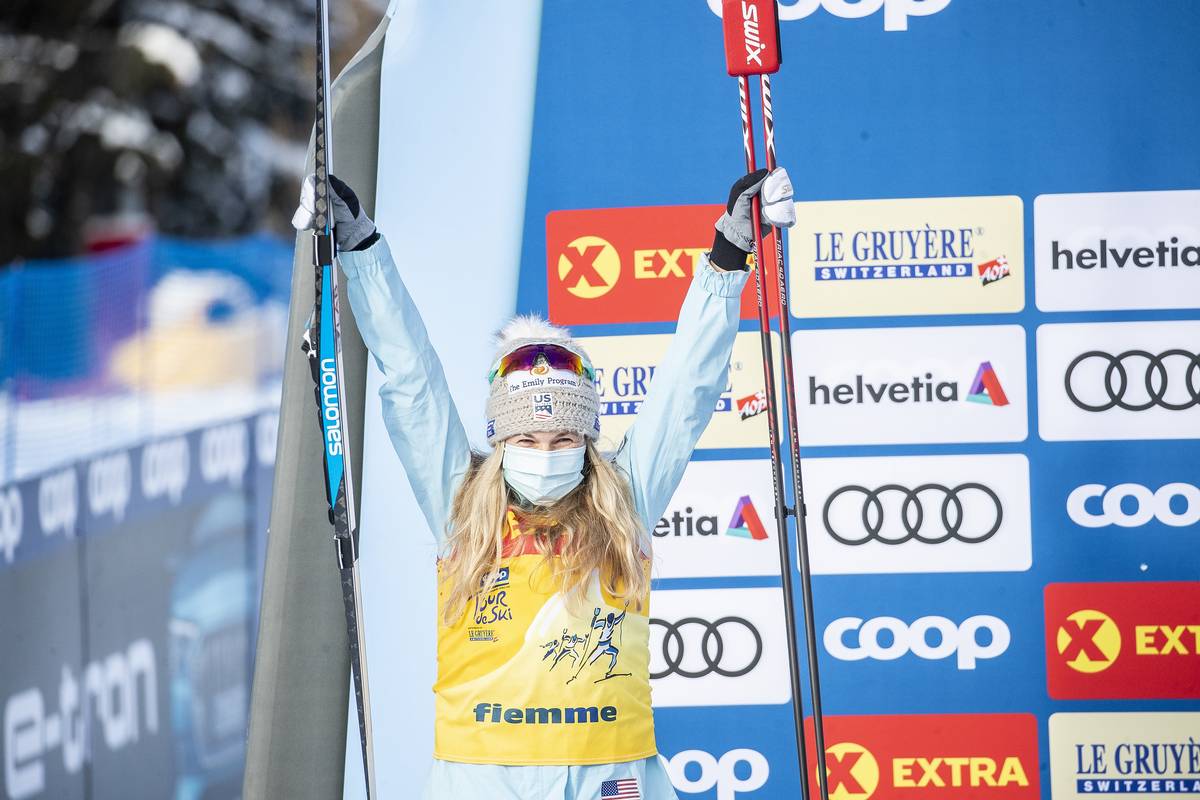
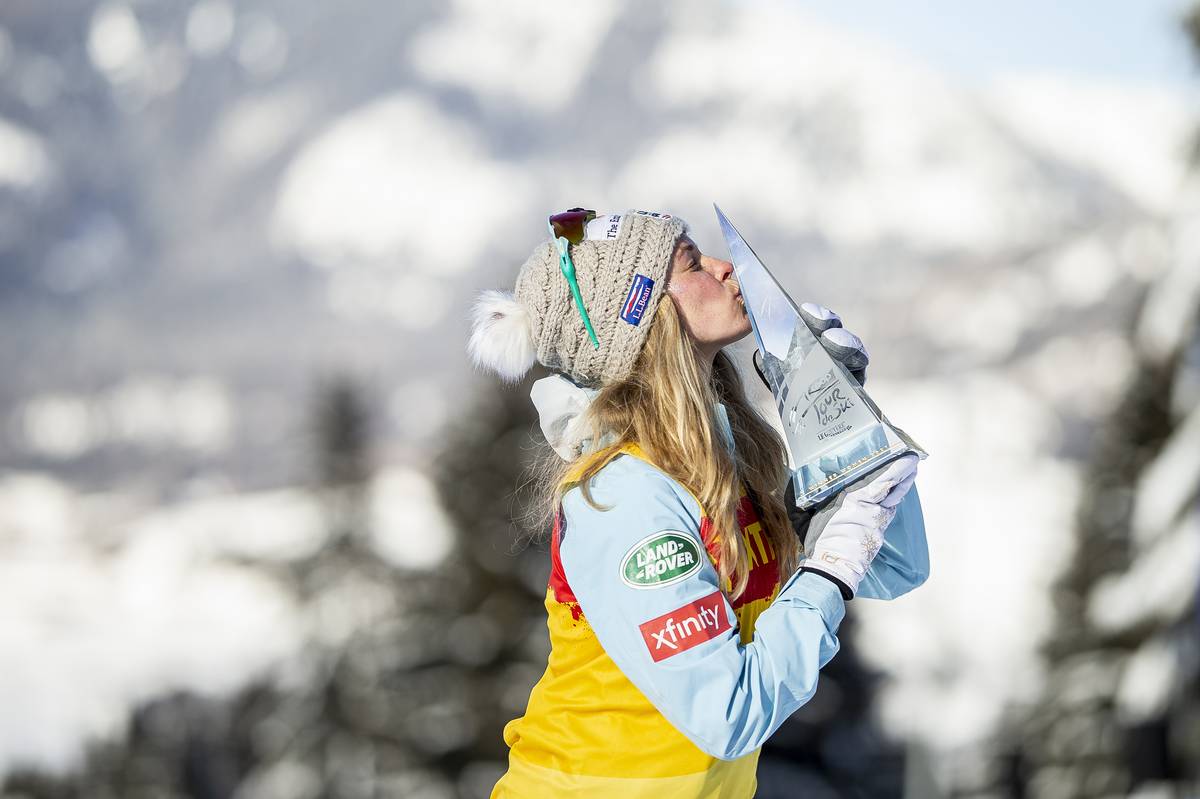
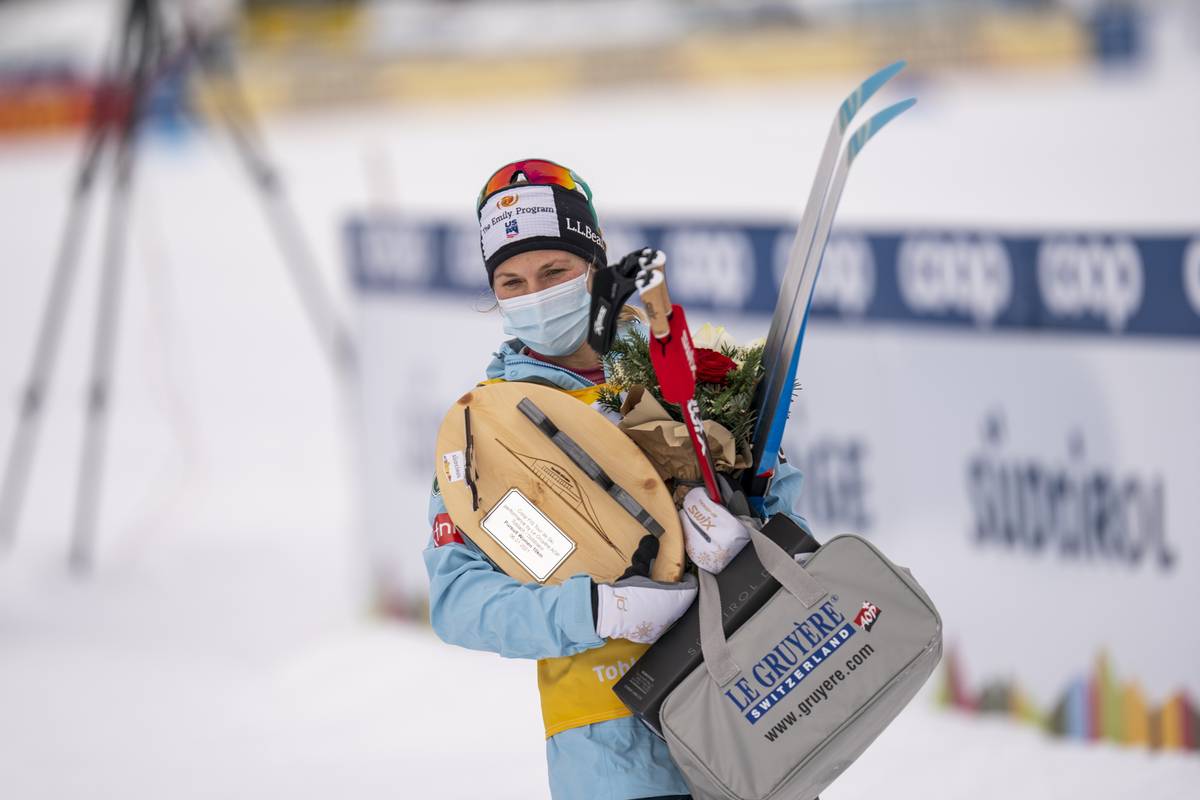
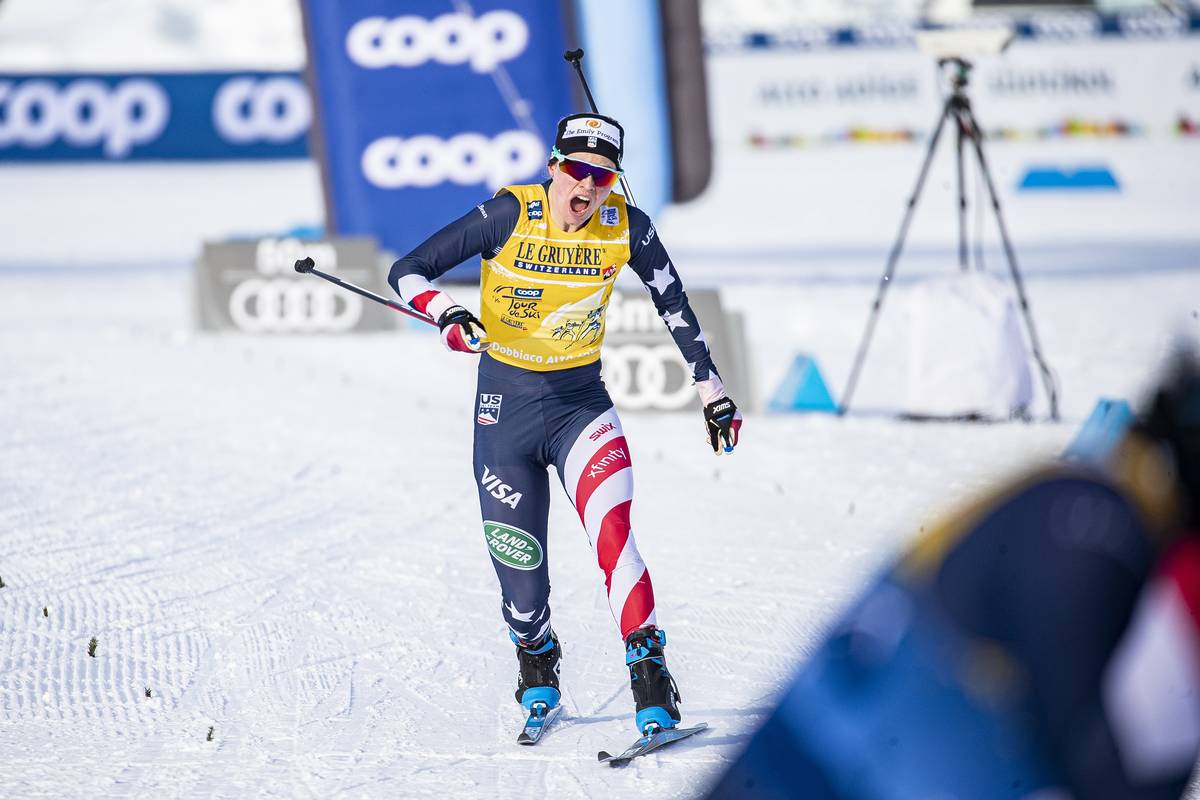
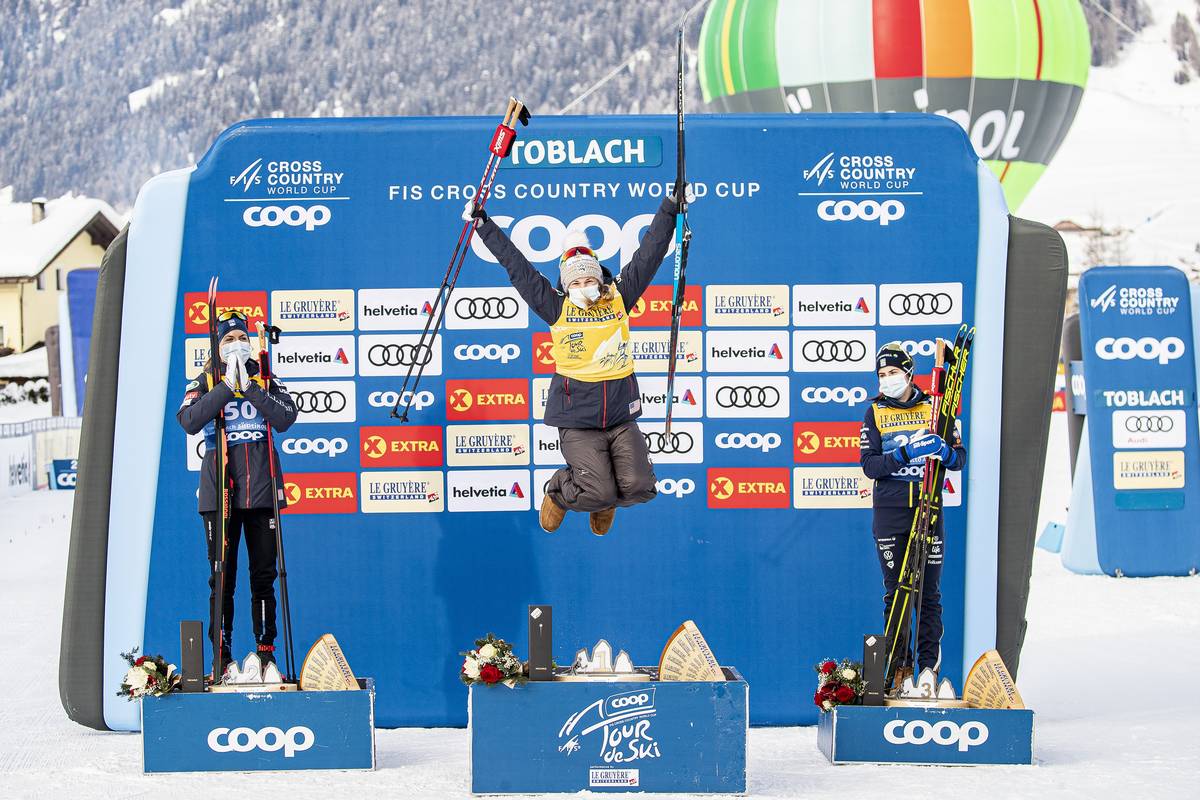
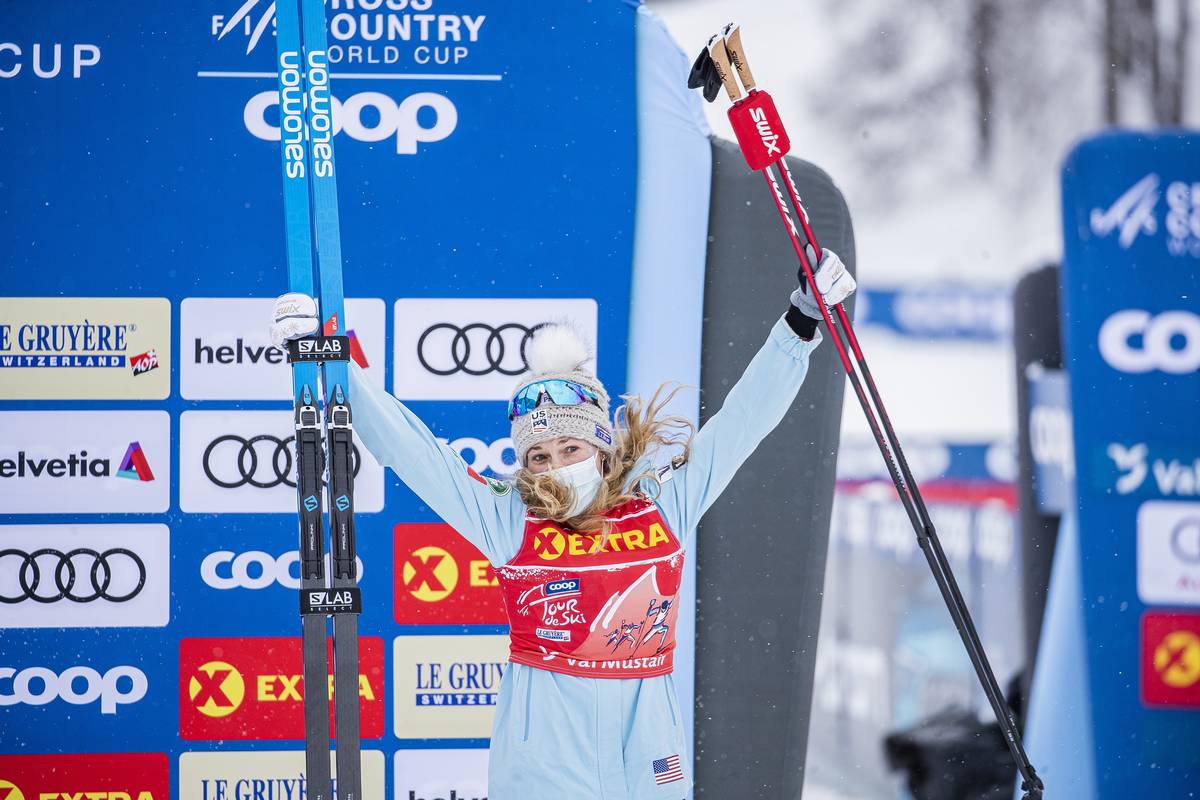
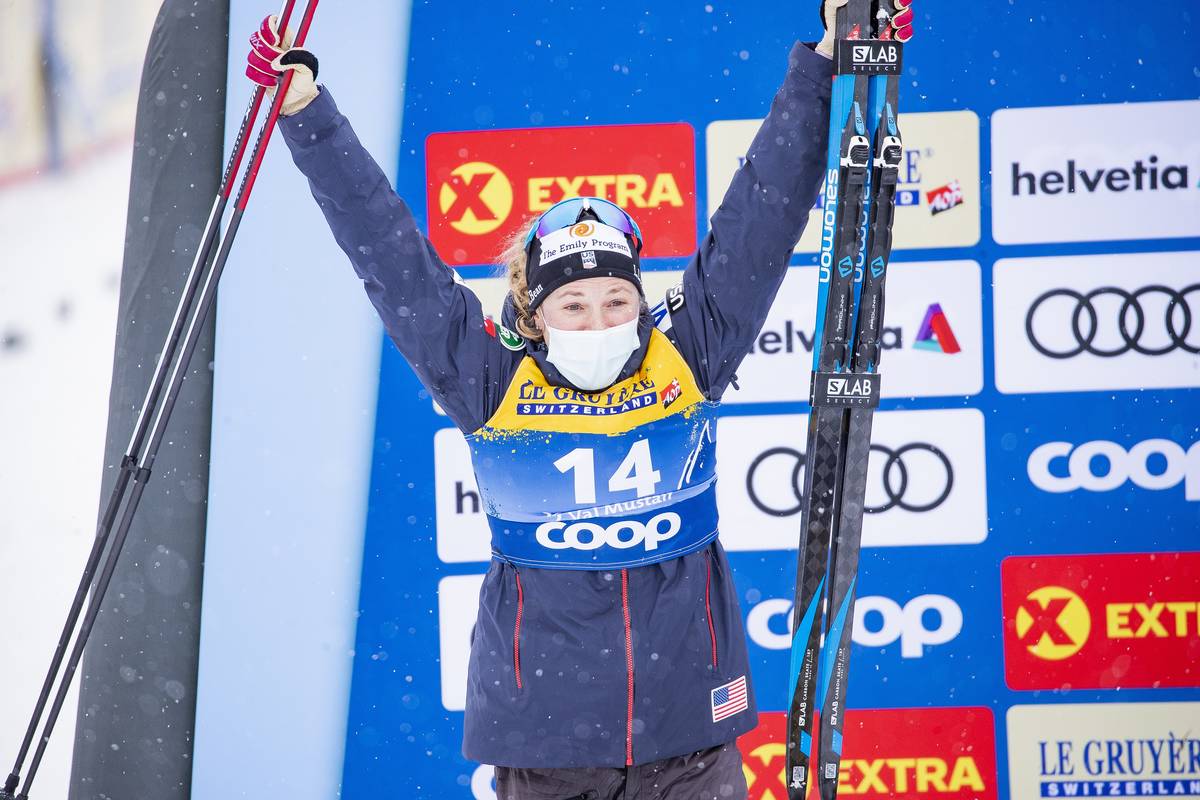
Rosie Brennan celebrates her victory and first World Cup podium after the freestyle sprint in Davos, Switzerland. Photo: NordicFocus
Last fall, one thing was certain — the pandemic would worsen. And it did. Rosie Brennan, summed up her feelings about traveling to Finland for the first round of World Cups by jumping in head first, masked, of course.
“I don’t believe anyone knows the answer [to if we should or should not have a World Cup] as we are all experiencing this pandemic for the first time and still don’t have a full grasp of what is safe and what isn’t,” Brennan wrote in early December. “At this point, I made the big journey to get over here so I am going to stay and continue to race as long as it feels safe enough. There is obviously no such thing as zero risk so it’s all a balancing act and weighing the risks versus rewards daily.”
Brenna’s big journey paid off. She finished that first weekend in Ruka, a three-race series, fifth overall. Norway’s Therese Johaug won, followed by Tatiana Sorina of Russia, and Sweden’s Ebba Andersson and Frida Karlsson, respectively. Outside of Jessie Diggins, Brennan’s U.S. teammate, no other North Americans placed in the top-30. (Canada, due to Covid related issues, would not arrive on the scene until much later in the season.)
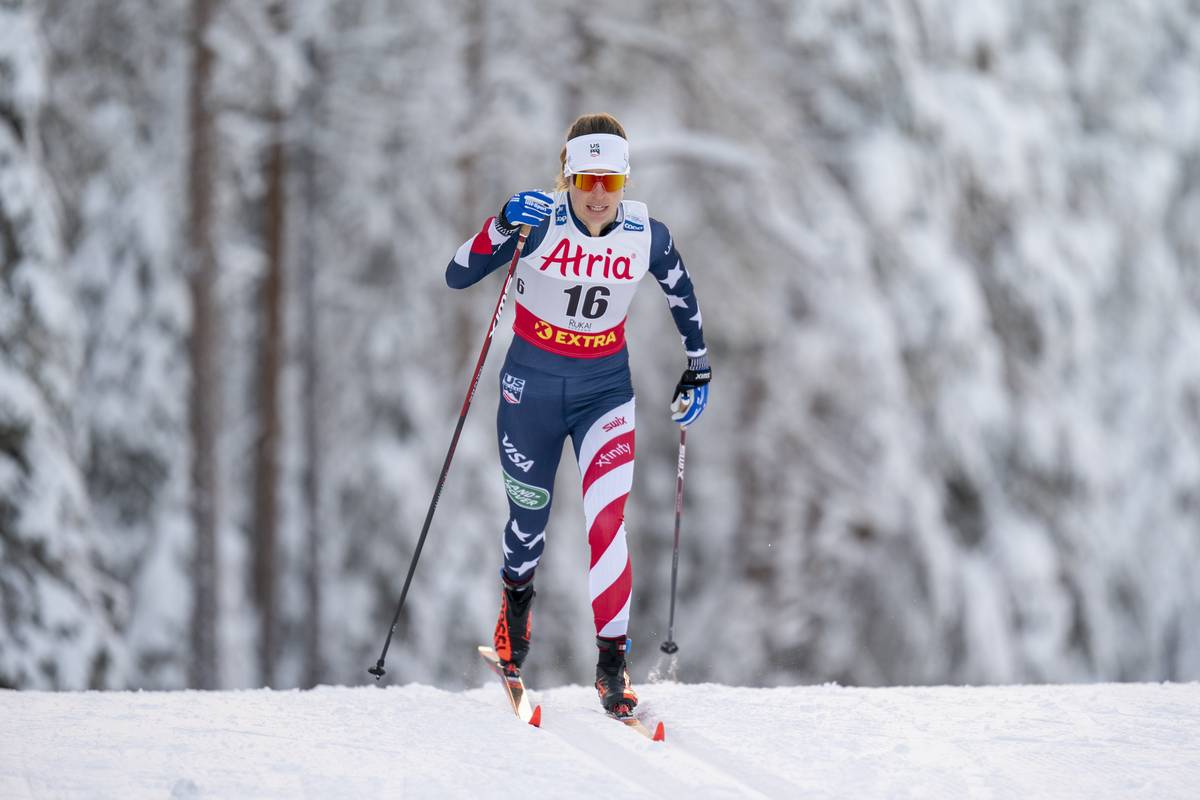
Crushing. Rosie Brennan on her way to eighth overall in the 2020 Ruka 10 k classic. (Photo:NordicFocus)Rosie Brenna on a career-best day in Ruka. (Photo: NordicFocus)
At 32-years-old, fifth place was then a career-best result. That high water mark would soon fall. Shattered might be a better way to describe it.
For a time, the World Cup seemed like it was teetering on collapse. Shortly after Ruka, Norway, Finland, and Sweden pulled from World Cup competition. Sweden and Finland returned for the Tour de Ski. If you have followed the sport closely, grit is an adjective to describe both Diggins and Brennan. Diggins’ grit shines on race day. She’s never to be counted out. Brennan’s grit, on the other hand, is the kind we tell our kids to possess when life doesn’t quite go their way. On and off, and on again, it was for Brennan and her U.S. Ski Team status. She hung in there. That’s been a boon for Brennan and the national team.
Brennan cashed in her chips in Davos, Switzerland. She won back-to-back races, a skate sprint, and the storied 10 k interval start skate. According to the data-crunching over at @StatSkier, Brennan was the oldest first-time winner of a sprint since the 2009-2010 season.
Brennan became the third American woman along with Sadie Bjornsen and Diggins to wear the yellow bib as the World Cup’s overall leader. She earned five podiums during the season. After five stages of eight during the Tour de Ski, she was second overall behind eventual winner Diggins. With performance bumps in stage six and seven, Brennan placed sixth overall.
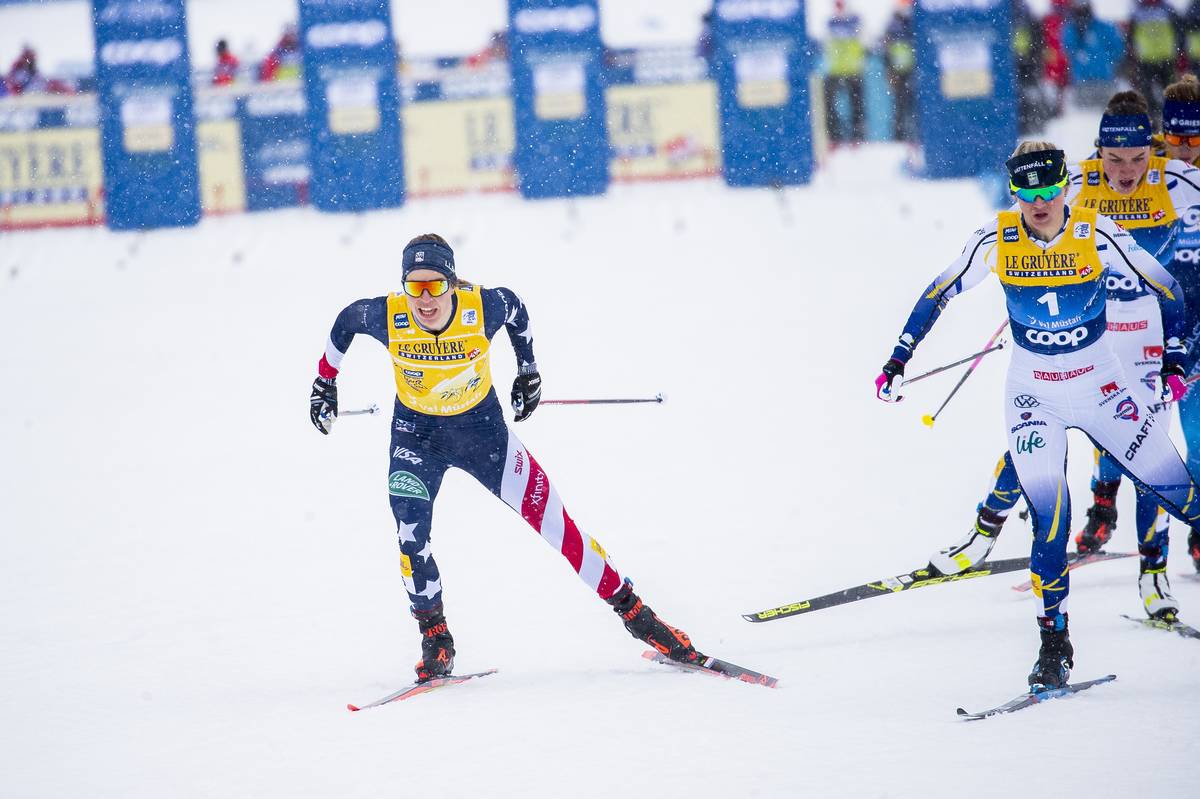
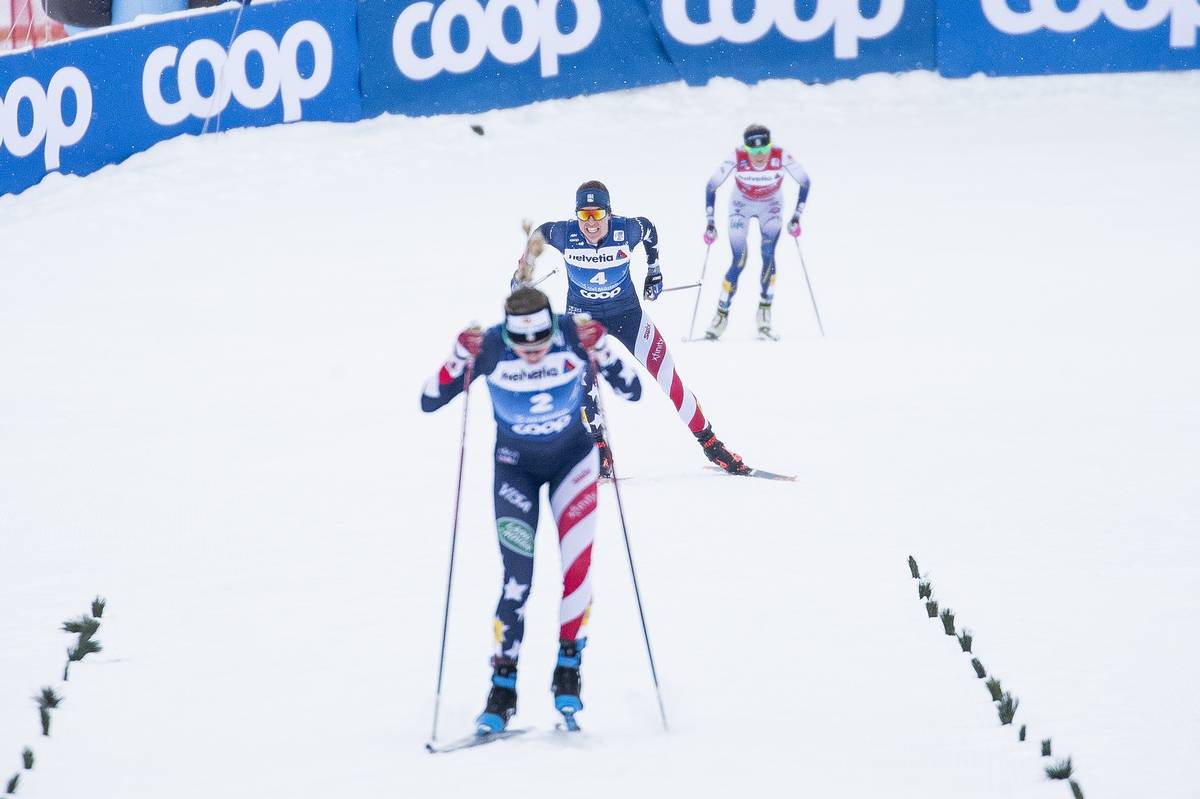
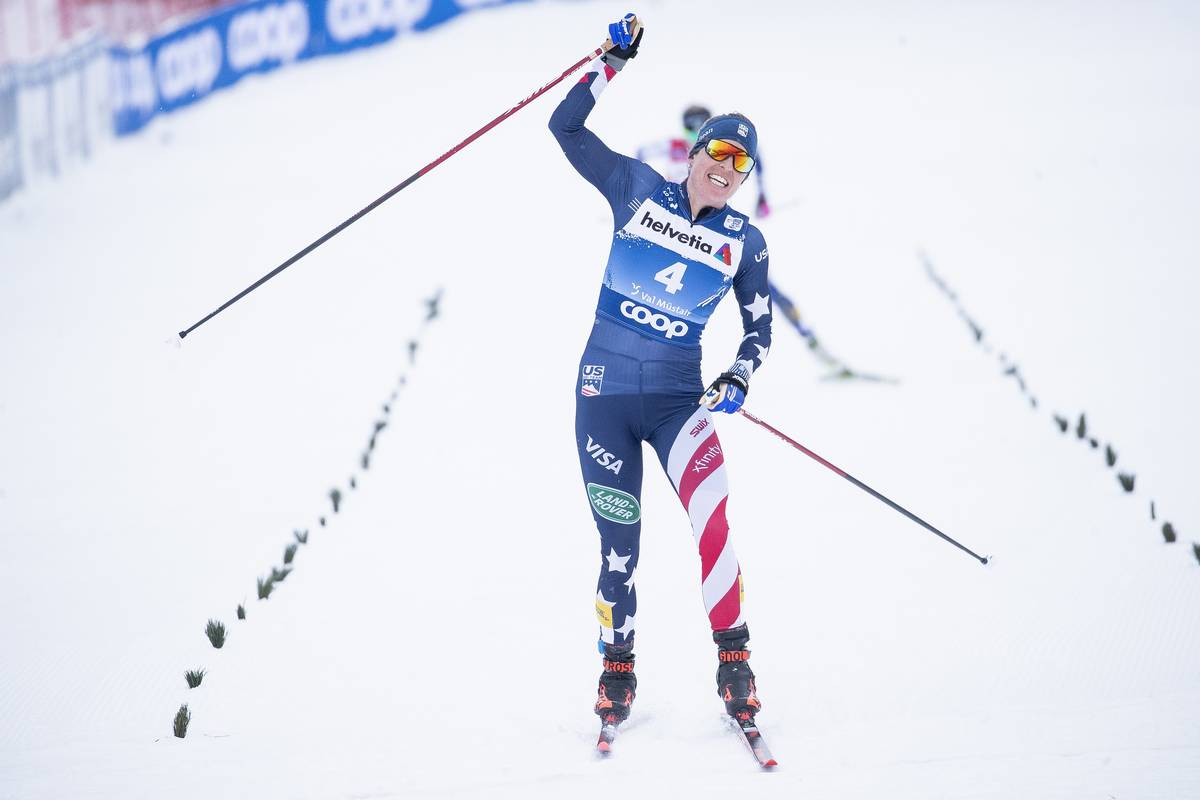
Rosie Brennan during the stage 1 skate sprint in Val Müstair, Switzerland. Brennan, who came into the day wearing the World Cup’s yellow bib as the overall leader, placed fourth overall. (Photo: NordicFocus)
With her electric start to Period I and Period II, Brennan was in the conversation among the World’s best. By her own admission, the voltage eventually waned. She missed out on some goals later in the season. No matter, it was a breakthrough. She finished fourth in the overall standings, fourth in distance, and ninth in the sprint standings.
The capstone is that Brennan is relatively late in her career. The grit, which has sustained her for more than a decade, paid off with a signature 2021-2022 season. The interview with Brenna that follows has been lightly edited for clarity. We spoke with Brennan on April 23.
***
FasterSkier: You’ve had some time to reflect on your season. There was a lot to it. Some wins, a yellow bib, and traveling amidst a pandemic. Now that it is in the rearview mirror, what resonates the most?
Rosie Brennan: Honestly, I think just kind of making it through the season. Most of the summer and fall I didn’t know anything about what their schedule might look like. I mean no one did. And so I am definitely proud of myself for making the most of that. And I guess dealing with the adversity we all dealt with as best as I could.
I think that’s something that I will always remember, and hopefully, it will serve me well in my next life. Of course, those were my first podiums on the World Cup. You know it’s not something I ever take for granted…ever. That’s been the goal for a while. So it felt like one of those life goals that are out there that you’re never really sure if you’re going to get or not. So to get that kind of feeling, and to achieve some of the other goals that I set for myself, that was big for me.
FS: Our ears in the ground in Alaska tells us you had a speedy running time trial on Anchorage’s gas line TT course. I think you broke the record. And we are talking about a long legacy of very fit people who have time trialed that run. I’m guessing when you broke the record, you have a good idea that you were coming into some historic fitness for yourself.
RB: Gosh, that must have been in July of last summer. I definitely felt good. We do that time trial multiple times a summer, so I’ve done it at least once, if not twice a summer, for quite some time now, and I’ve been somewhere between one and five seconds off the record for the past two or three years now. So yeah it’s been a big goal, I’ll just put it that way.
And every time I had done it the past couple of years, I would just be a few seconds off the record. So I knew I was working with seconds, I just needed to figure out how to make up a second or two out there, Like it’s only a 10 and a half minute race so that shouldn’t be that hard to come up with a second. And when I broke the record, I actually broke it by quite a bit. That felt good, just thinking about my ability to break the record. But I didn’t think that I could break it by as much as I did. So after that, I knew that I was in the best shape I had ever been in.
Then we had some other rollerski time trials and other kinds of events that aligned with that. So it wasn’t just really good running shape, it was just good shape in general. So I did have a good sense of my fitness throughout the summer.
I would say, you know, that’s, to me that’s one of the things about Flora, is that he has always believed that I’ve been capable of that. So I wouldn’t say it was anything new, I continued to believe for sure and the excitement definitely but yeah I would say that he has made me believe that I was capable of a World Cup podium for quite a few years now so we were just chipping away at that and it took some time but we got there.
Rosie Brennan powers through the final meters for a commanding second-place finish in Stage 4 of the 2021 Tour de Ski. (Photo: NordicFocus)
FasterSkier: Last season was unique, as we mentioned, for everyone. In particular, the APU training group normally is on snow at least once a month at the Eagle Glacier. Due to the pandemic, restrictions on travel, and group size, you were unable to get on snow until I think late fall on some of the higher elevation snow around Anchorage. You had a great season from a stats point of view. Does last summer’s training, and the lack of on snow time, make you think more about how to modify your training coming into this new training cycle?
RB: I would not say not being on snow was helpful, but I would say COVID was extremely helpful for me in some ways. I am somebody that works really well off of consistency, and I’m really lucky that we have such a strong group in Alaska, so I wasn’t missing people pushing me or having different challenges, or people to learn from. I had that every day still, but not traveling and not adding additional stresses into my schedule was hugely beneficial. I think I just simply had the most consistent trading I’ve ever had in my life — it was just everyday training twice a day, day in day out for forever.
There were no distractions, no, no nothing. And that might be hard for some people but for me, particularly, I think as an older athlete that’s pretty attuned to training like that it was really enjoyable. Honestly, it worked really well for me. I’ve always had a feeling that would be the case for me but I’ve never gone so extreme, and I don’t know that I want to go that extreme this year. It is nice to see some different places, see some other teammates and family and stuff every once in a while, but I’m hoping to minimize my travel, and just have a consistent training schedule with my team in Alaska.
FasterSkier: Let’s circle back to reflecting on the race season. You arrived in shape. Two wins in Period 1. A fantastic Tour de Ski. But the energy, as the season progressed, waned a bit if we are speaking strictly of results. How would you describe this season?
RB: I would definitely call it a breakthrough season for myself as a whole. Any season, and fortunately this one was long enough that there were high points and low points, and goals exceeded as well as goals not met. Period I was a huge high point for me. And, you know, I think I’m far enough away from the Tour de Ski to call it a microcosm of the season.
It was a really big learning experience for me. Some real positives came out of it and also some tough days. I was really happy with how I handled the racing after the Tour. I think I had a good plan working through all that, but World Champs was a big disappointment for me. And I’m not sure I have all the answers to why I guess that’s just sport. I have some ideas, some takeaways, to try and adjust for next year.
Brennan tagging Diggins and Ropenan tagging Pärmäkoski for the anchor leg drama about to unfold. (Photo: NordicFocus)
FasterSkier: All things considered with travel, you did have a dense race schedule. You race most of the World Cups. You skipped the sprint weekend in Dresden, as well as the sprint weekend in Ulricehamn. With next season an Olympic year, do you look at your intense race schedule and think maybe in the run-up to the Olympics, you might try something different, like not doing the Tour, or racing more selectively when it comes to distance races too?
RB: It’s funny, because yeah, I did race more or less everything. But we did have a few race cancellations in there so it still felt like less racing than I’ve done in past years. So I felt relatively comfortable with the amount I raced. I think that’s kind of, I guess what I found to be the sustainable amount, right around what I did this year. But, you know, the interesting part was World Champs are always later than the Olympics. So, it’s always more of a little bit of a puzzle to figure out how the Tour fits into that racing. It was just really hard to travel, so the risk of coming home and going back over was exponentially higher than it is in other years. In a normal year, it’s worth the risk of travel to go home for me. I like that kind of mental break from the road. But this year was just a little much. You just never knew if a race was going to get canceled the next weekend, so I felt like I just had to keep throwing my hat in the ring until the season was over.
Just because we didn’t know what was coming. That also makes it hard to plan for the Olympics just solely based on this year because there were just enough unknowns that the plan was always a bit of a moving target. But I’ve done enough championships now at this point in my career that I have more data points than just this year to go off of. So, I will be looking at, you know, kind of all the championship years to figure out what schedule will work best for me. But one of my goals is to come into the Olympics with a little more energy. Maybe, I don’t know, we’d call it an excitement that I had out here definitely kind of hitting the low energy stores at that point.
FS: Would you consider skipping the Tour de Ski next year? It is not uncommon for some top World Cup skiers to pass on that race series in a World Champs or Olympic year.
RB: Yeah, for sure. Yeah, I did that in 2019 before Seefeld. I raced Period I, and then I skipped the Tour. I felt that was a positive thing for me, I think it gave me a little more energy and motivation heading into those Championships. The hard part is I love doing the Tour. It’s a really fun event. So it’s always kind of a battle of what my personal goals are. But obviously, the Olympics are a big one so that’s something I’m considering and, you know the other thing is that the Olympic venue is almost the same altitude as Soldier Hollow and so the fact that Park City is, is another place I call home, makes it so the benefit of training here is that much greater. So I definitely would like to try to incorporate a trip back home to Park City at some point, to do an altitude camp and prepare for the Olympics. Both, during the summer and then also during the season.
FasterSkier: How do you see your role on the U.S. Team now that some heavy hitters have retired? You have had a more than simple relationship with the national team with the main idea being that you’ve been on the team, off the team, on the team again, and now finding success on the World Cup. How important is it for you to be part of shepherding this younger crew along to fill some of the voids that have been created with recent retirements?
RB: That’s important to me. I don’t know how many years I have remaining in my career but that has been one of my biggest motivators to keep racing — just to make sure that we don’t lose momentum on our team, and that I’m leaving the young girls in a place where they’re ready to have success. To make sure it is a seamless transition. That’s been a huge motivator for me to keep going. I’m lucky that a lot of those girls and boys are on APU and so I’ve worked with them every day, and they challenge me as much as I challenge them and we learn a lot from each other. I do like that energy…I used to get embarrassed by my age, but I feel that I’ve grown and embraced it a bit, and I enjoy working with this group. It’s an incredible group. It’s fun to be a part of so it’s not a burden. I enjoy working with them and I hope that is helpful. I want to be a good leader, that’s a goal.
It’s hugely satisfying to know that you can be as good as you thought you could. And, you know, more than anything for me, it’s so satisfying because of all the ups and downs I’ve had, and the perseverance I found to stick it out. It gives me that much more satisfying to meet some of those goals. I have some unfinished business with the Olympics. So I’m hugely motivated for this coming season.
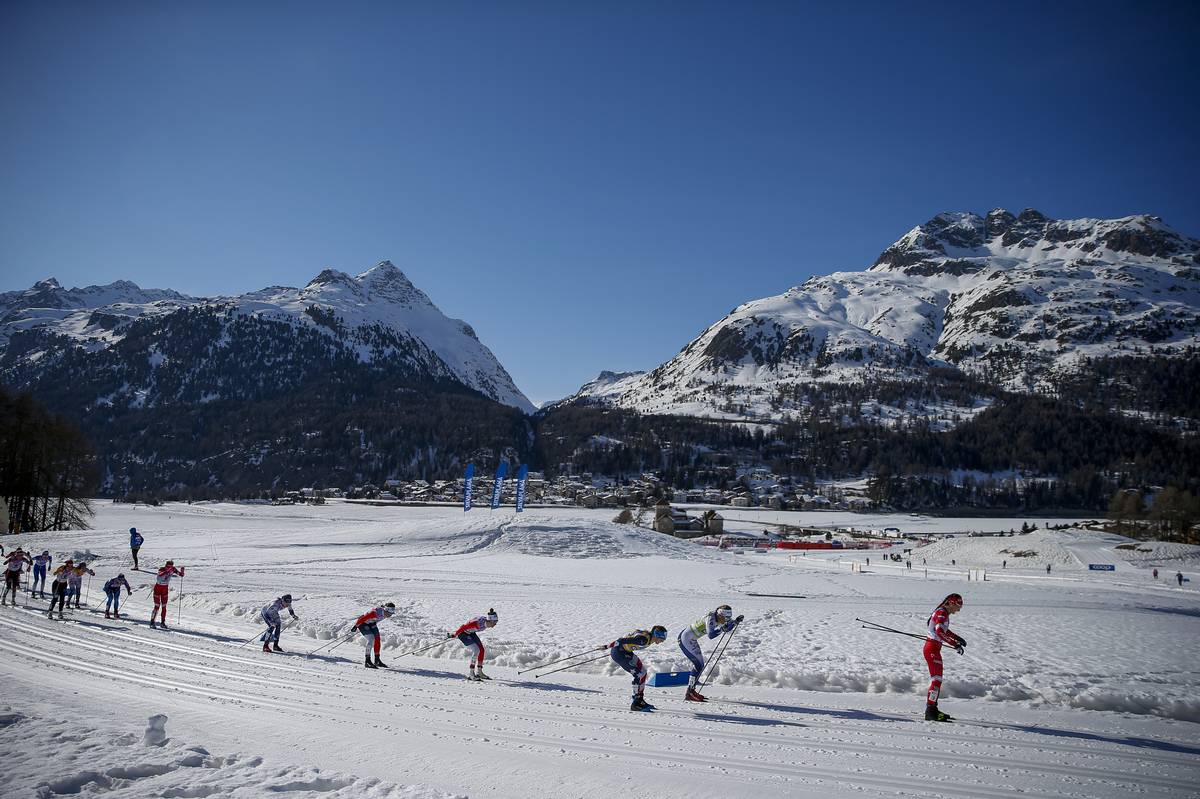
Mountains and speedy skiers were the spectacles for Saturday’s 10 k mass start classic. (Photo: NordicFocus)
The story line from today’s near-to-the-end chapter of this World Cup season will not include the words high-tempo. News came from FIS earlier that Therese Johaug, winner of all the individual distance medals at the 2021 World Championships, was sitting out the weekend due to an inflamed wrist. Add to the injury list Sweden’s Frida Karlsson, who is recovering from an injury sustained in the World Championship 30 k classic. For her part, Karlsson placed second to Johaug in the three individual distance races in Oberstdorf. Those two preeminent skiers would be watching from home.
So there you have it, with the usual lock for the win out, the prospects for the podium’s top spot, or a step up on to the podium for for the field became a few percentage points better. With the weekend’s racing moved from Oslo to Engadin, Switzerland due to COVID related Norwegian travel restrictions, premier cross-country racing immersed itself in a Swiss mountain dreamscape. The 3.3 k course primarily flowed out in the open valley, with long climbs inserted that edged up along the side of the valley.
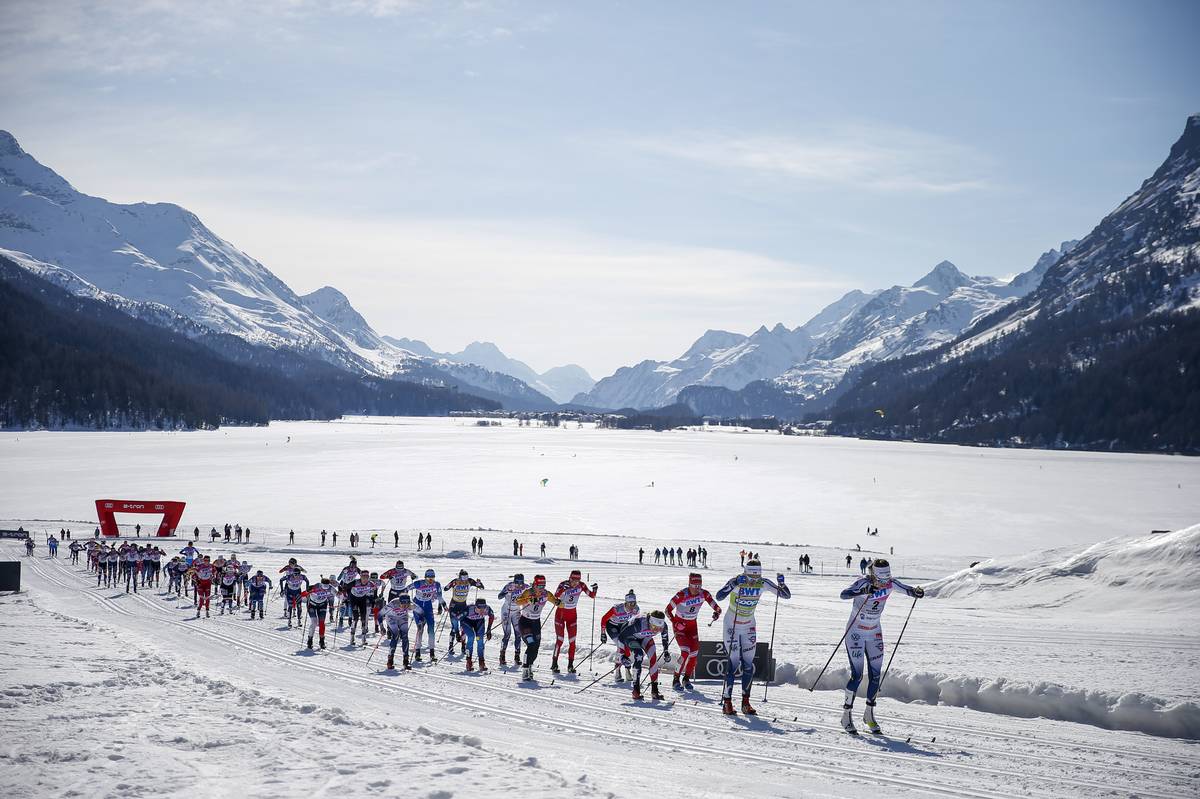
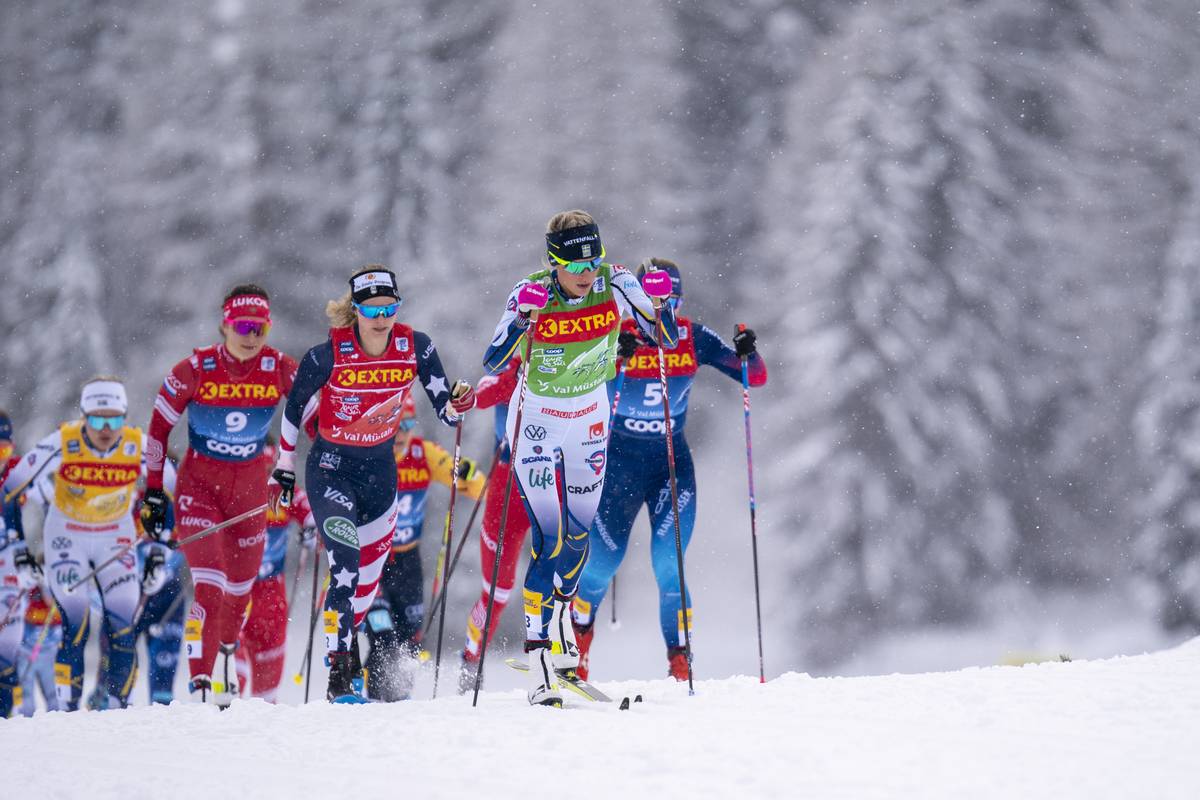
Jessie Diggins, wearing the yellow bib as the overall World Cup leader, skis in the pack early in Saturday’s race. (Photo: NordicFocus)
Diggins, who earlier this season secured the overall World Cup crystal globe, the first North American woman to do so, and the first North American since Bill Koch in 1982. With the overall wrapped up, this final weekend of distance racing would finalize the position for the still-up-for-grabs distance globe. Coming into the day, Diggins led that category too by a 62 point margin over Andersson in second, and 108 points ahead of Stupak and Brennan, tied for third, 108 points behind.
Early on, during the first of three laps on a course sculpted along the valley sides for the climbs and descents and returning to the floor for the double poling terrain, Sweden’s Ebba Andersson was the primary pace agitator. She strung out the field as she sent it up front. Coming through the lap area at 3.3 k, Andersson pulled teammate Linn Svahn, Diggins, Norway’s Heidi Weng for the top-four past the time check in close contact. American Rosie Brennan was 15th, 7.2 seconds off the pace.
Ebba Andersson, leading the pack. She animated the race early to break apart the stream of skiers. (Photo: NordicFocus)
With third on the day, Andersson sits in second place in the distance points standings. (Photo: NordicFocus)
By the time the second lap concluded, a distinct front group had formed including Andersson, Yulia Stupak of Russia, Weng, and Diggins. With the pedal down on the third lap, Diggins began to fall off the pace while the trio upfront became the likely podium. With 1.5 k remaining, Diggins 7.9 seconds behind.
Stupak stamped her authority on this race on the final climb. Striding, running, poling, she crested the climb with about ten meters back to Weng and still more ground to Andersson. Stupak won in 25:13.3 minutes, with Weng second (+7.1), and Andersson third (+8.5). This was the fourth World Cup win for Stupak.
Yulia Stupak of Russia wins on Saturday for her fourth career World Cup victory. (Photo: NordicFocus)
Norway’s Heidi Weng poles for second place Saturday with Sweden’s Ebba Andersson trailing behind for in third. (Photo: NordicFocus)
The podium from Saturday’s 10 k mass start classic in Engadin, Switzerland: Heidi Weng (NOR) second, Yulia Stupak (RUS) first, and Ebba Andersson (SWE), (l-r). (Photo: NordicFocus)
Germany’s Laura Gimmler (27) caught and passed Diggins to place fourth (+16.4), with Diggins coming through in fifth (+20.7). According to FIS, this is Gimmler’s best career distance result and her first top-10 outside of a sprint.
“That was a fun day, and really exciting to see a new venue!,” wrote Diggins. “I’ve been really enjoying and appreciating the beauty of the Engadin Valley, and although I am SO excited to be going home to my fiance soon, I was proud of the energy and fight I brought to this weekend! I was proud of how we all worked together as a team to get through a long and challenging season, and I’m very excited to rip down the valley tomorrow and work as hard as I can one last time!”
Jessie Diggins placing fifth on Saturday. Before the race, she already secured the World Cup overall and leads the distance standings heading into Sunday’s season ending race. (Photo: NordicFocus)
Hailey Swirbul placed 12th (+49.1) for a near best career result. She placed third in this season’s 10 k skate in Davos and had a seventh fastest time of day on the way to 13th in Val Müstair’s 10 k skate pursuit during the Tour de Ski.
“My best classic result to date,” Swirbul emailed. “That was exciting! First, I’d give a huge shout out to the waxing staff for coming through with bomber skis today. That really gave me a platform to have a good day! I enjoyed being back at altitude again, and on another Swiss-field course… those have tended to serve me well. It was a good day to start a bit more gradually and really work into the race for me. Once you cross the red line on an altitude, gradual course like this one, I find it difficult to come back, so I really tried to make sure that didn’t happen. Overall, I’m proud of our team and really looking forward to giving it one last go in the 30k tomorrow!”
Hailey Swirbul for the U.S. skied to 12th on the day. (Photo: NordicFocus)
Brennan, trying to remain in the hunt for a top-three in the distance cup, placed 14th (+58.0). Her efforts on Saturday were stymied early. She began strong, racing near the front end of the starters. Near the 2.5 k mark, she was involved in tight-pack racing and broke a pole.
Brennan, in bib 4, close to the up-front action on Saturday. Coming into Sunday’s racing, she is fourth on the distance points list. (Photo: NordicFocus)
“We are racing our last weekend of World Cups in the Engadin Valley in Switzerland which is a new location for the World Cup,” Brennan emailed. “That brings a lot of excitement and learning as we are all doing this race for the first time. We are at altitude and I consider that one of my strengths so I was really looking forward to this weekend. I felt really good off the line today, but unfortunately got my pole kicked and broken about 2.5km into the race. It was a bad place to break a pole and it took me awhile to get my spare pole so I lost the lead pack at that time. I did what I could to climb my way back, but did not have enough in me. I am really heartbroken that I couldn’t find another gear to fight back because I had great skis and had a lot riding on this weekend for the Overall World Cup. Tomorrow we start based on our finish today so it was a really bad day to not finish strong, but I will give it all I have tomorrow and do what I can finish the season strong.”
Rosie Brennan for the U.S. in true grit fashion racing to 14th overall on Saturday. (Photo: NordicFocus)
Also for the U.S., and outside the points, were Katharine Ogden in 33rd (+1:45.8), Sophia Laukli in 46th (+2:10.8), and Julia Kern 47th (+2:27.7).
Canada’s Dahria Beatty posted her best result of the season in 23rd (+1:15.9). Outside her racing at the recently concluded World Championships, this is Beatty’s sixth World Cup race of the year.
“I’m really happy. It has been a tough season for me so far, but just really happy to have this race today before the end of the season,” said Beatty to Nordiq Canada after the race. “I started with bib 58 so I had a lot of moving up to do. I watched the men’s race, and how Antoine skied having started in a similar position. I just tried to stay relaxed, ski as smooth as I could and not lose contact with the pack.”
“I knew I had the ability to have a strong distance race,” added Beatty. “It has been a weird season. I had the best training season ever and my body felt amazing, but when I got to Europe in January my body felt off and I wasn’t skiing how I normally feel which was frustrating.
“It took until the World Championships to feel better. I have been trending in the right direction and finishing 34th in the 30km on an extremely hard course put me in a good mindset for today’s race. The combination of people not liking altitude and I do, great skis and feeling good – it all came together today.”
Canada’s Katherine Stewart-Jones was 44th (+2:04.9), and Cendrine Browne 49th (+2:30.2).
Dahria Beatty, shown here during World Championships last week in Oberstdorf, Germany. (Photo: NordicFocus)
Tomorrow’s racing is a 30 k skate pursuit. Stupak will lead off that race. As far as the distance crystal globe is concerned, the standings tightened slightly. During Saturday’s race, bonus sprint points were on offer. The top racers on the day, gobbled those valuable points up, knowing the final distance standings would be close.
Diggins still leads after accruing 51 points with 603 points. Andersson is second, 43 points back, Stupak third, 44 points back, and Brennan falling off to fourth 141 points behind Diggins.
The 30 k racing should be visually epic as the race organizers have laid out a stunning point to point course up the Engadin valley.
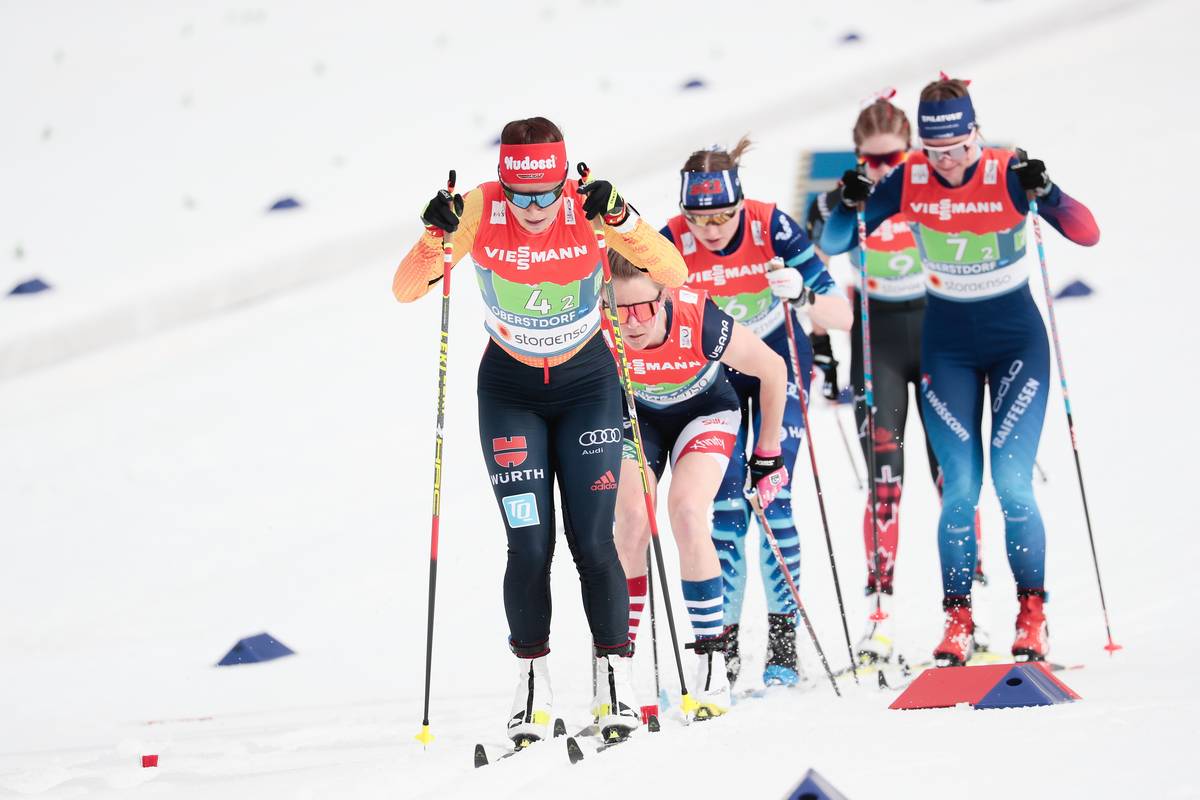
15 teams beginning the 4 x 5 k relay at the 2021 World Championships. (Photo: NordicFocus)
This World Championship coverage is made possible through the generous support of Marty and Kathy Hall and their A Hall Mark of Excellence Award. To learn more about A Hall Mark of Excellence Award or to learn how you can support FasterSkier’s coverage please contact info@fasterskier.com.
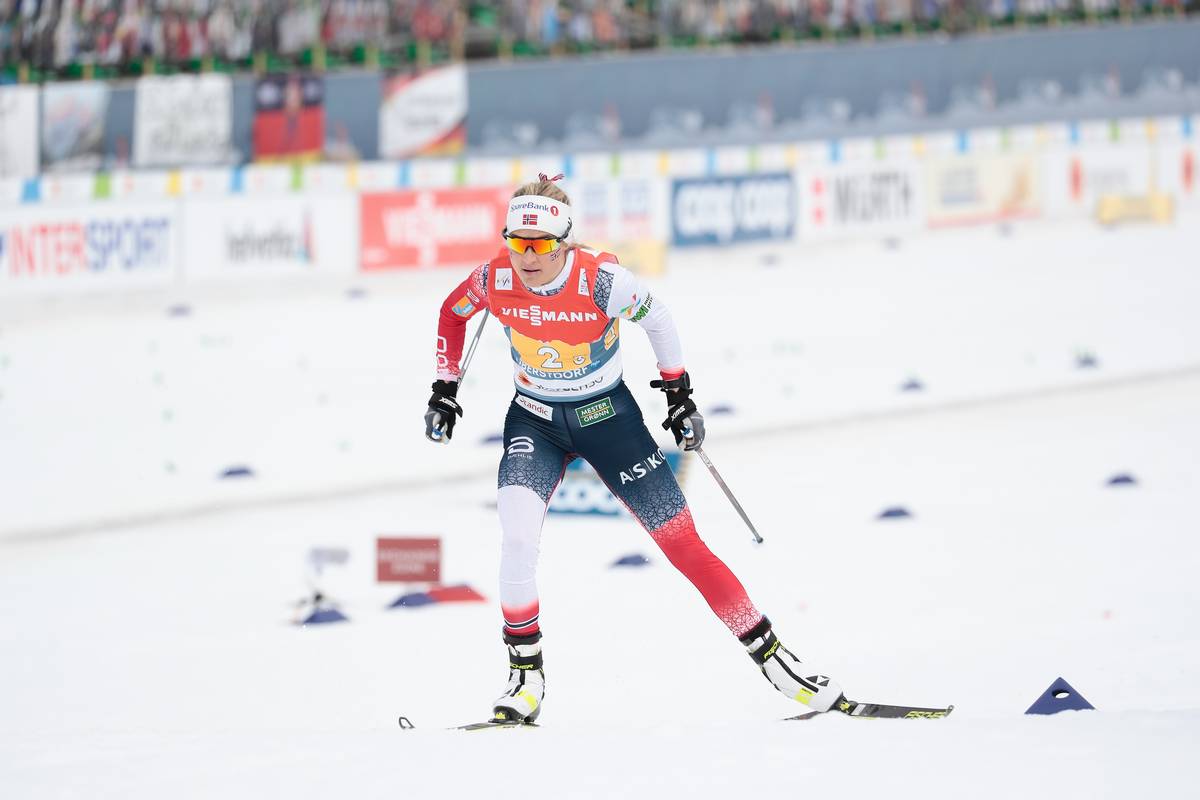
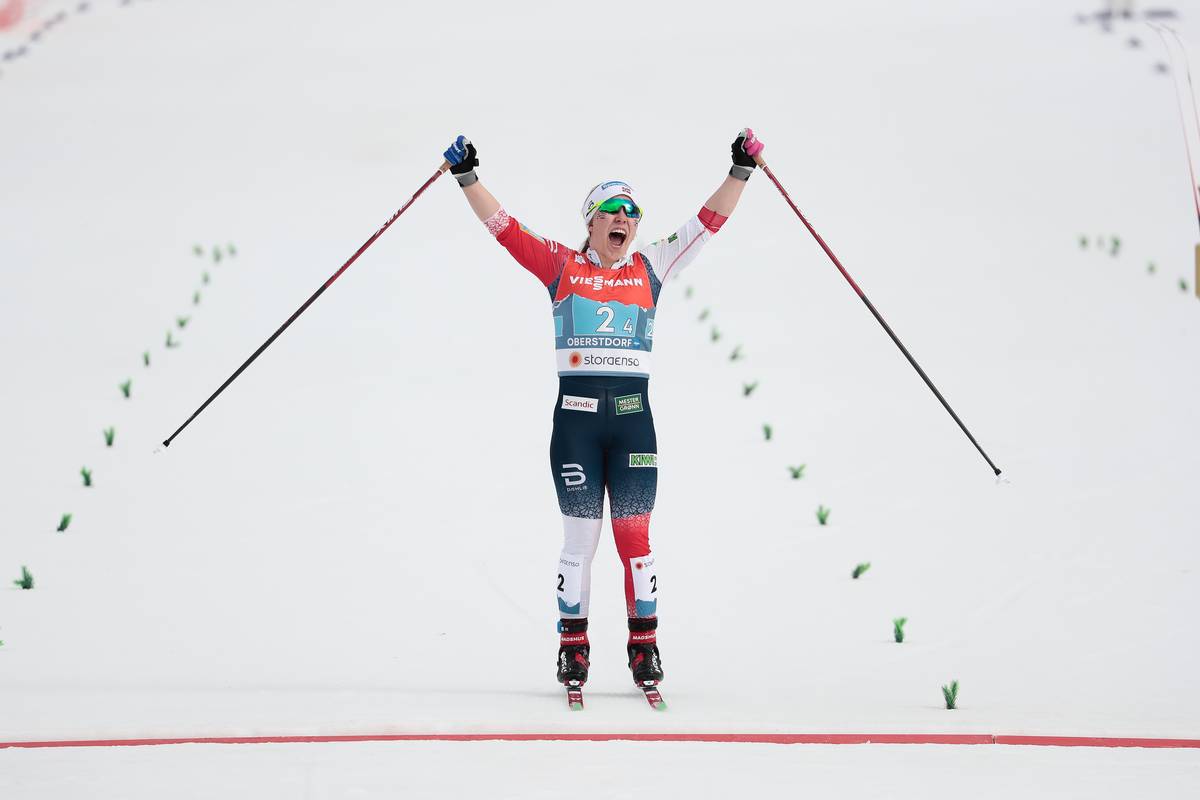
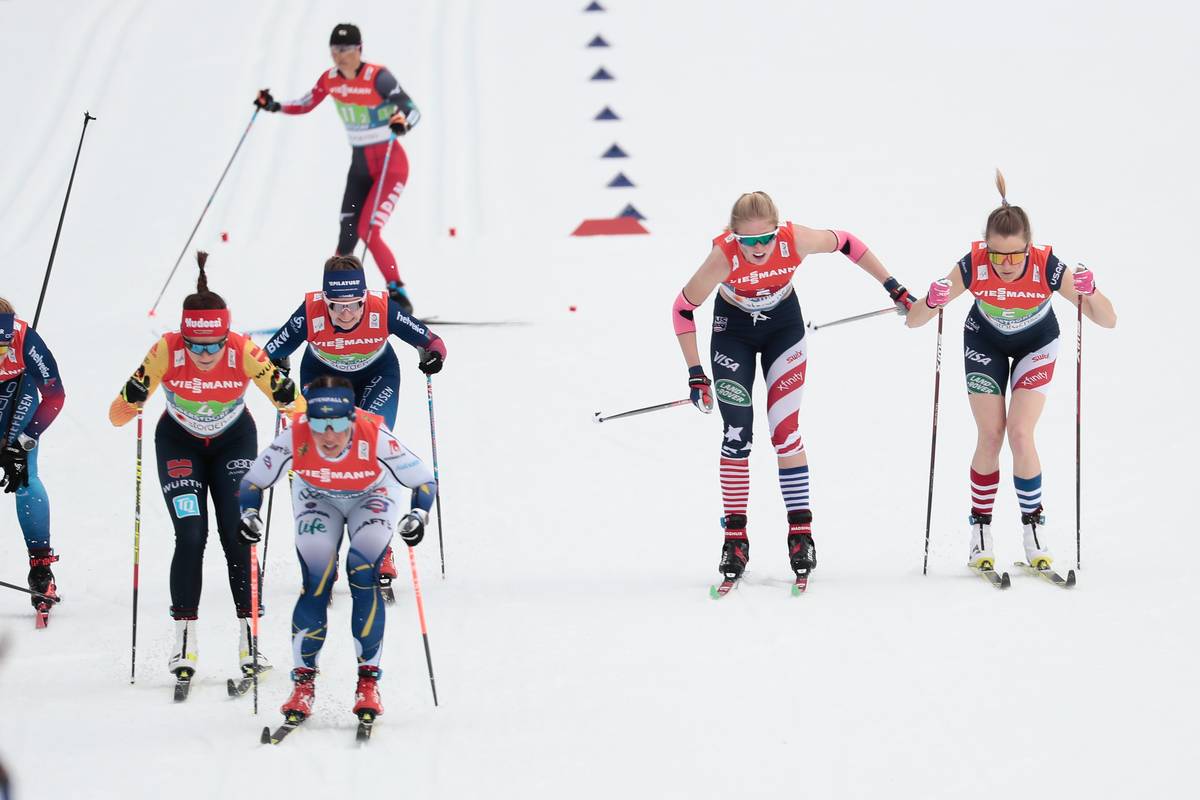
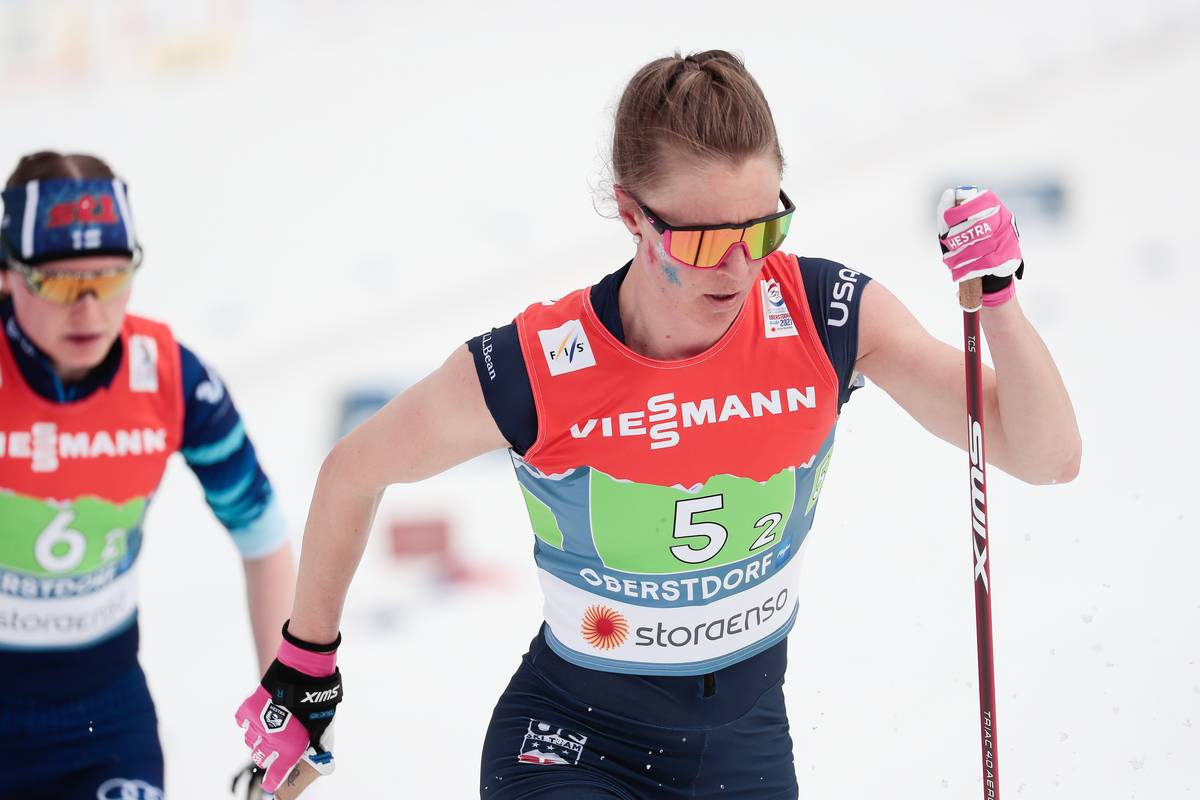
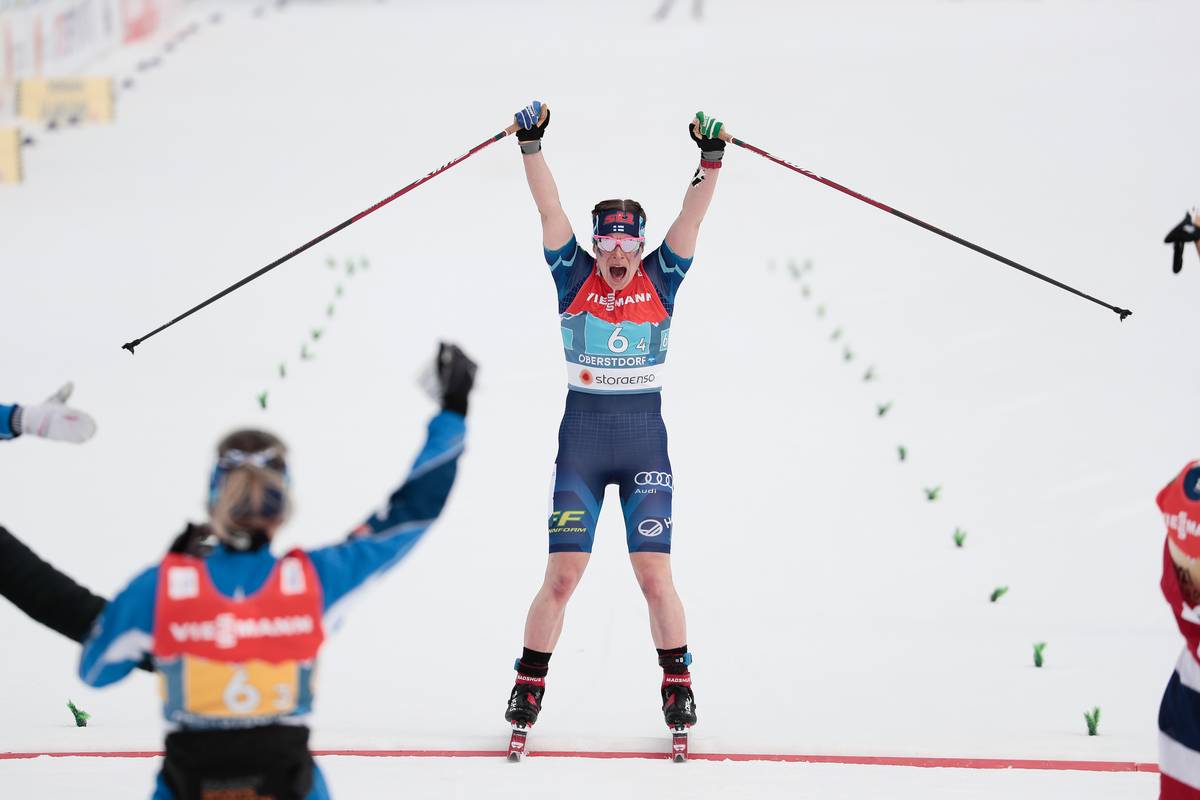
Tension built, tension released, as the build-up to the women’s 4 x 5-kilometer relay at the World Championships began under a partly cloudy sky, light breeze, and what we’ve come to expect, warm temperatures at 54 degrees Fahrenheit. Modified race suits aside, the scramble leg ensued with a narrative none predicted.
With 15 teams beginning, and a handful realistically in the medal hunt, the scramble leg, for all practical purposes, did scramble the narrative.
Sweden won a nailbiter 4 x 5k relay at the 2019 World Championships. And with a team loaded with Jonna Sunding, Charlotte Kalla, Ebba Andersson, and Frida Karlsson, they at least, in the Monday-morning-quarterback discourse, seemed a medal contender if not a gold medal lock. Sundling, however, with slick kick, fell off the pace set by Tiril Udnes of Norway and Kirpichenko of Russia. She came through the 5 k mark to tag Kalla 12.5 seconds back of the Czech Republic in first, then Norway, RSF, and Canada’s mega-scramble performance by Katherine Stewart-Jones.
Charlotte Kala of Sweden raced the second leg for Sweden. The team lost ground on the scramble leg and were out of podium contention early on. (Photo: NordicFocus)
Focusing on Sweden here seems on point as they eliminated themselves from contention early on. Kalla, the storied Olympic and World’s champion, fell off the pace something hard on the second leg and landed with a thud. Be it poor ski speed or off-the-mark fitness on the day, the sand through the hourglass flowed freely in terms of Sweden’s time back. Kalla handed Andersson, bronze medalist on Tuesday’s 10 k skate, a whopping 1:39 deficit.
Kalla tagging off to Ebba Andersson: leg two to leg three. (Photo: NordicFocus)
In a relay where first place was a foregone conclusion mid-way into the third leg, we might as well jump to the win. Therese Johaug was tagged with a 2.6 second lead over Russia’s Tatiana Sorina. For their part, Yulia Stupak kept Russia in the hunt as did a coy leg by Heidi Weng, as the Norwegian pulled in front of Russia near the conclusion of her leg with a burst of fast-paced climbing.
Norway’s Therese Johaug dominated the third leg to ensure a Norway win. (Photo: NordicFocus)
Around the 12 k mark, Johaug pulled away with her iconic turnover. The race for gold over barring a catastrophic fall. Johaug tagged U23 skier Helene Marie Fossesholm with a 19.8-second gap to Natalia Nepryaeva for Russia. Nepryaeva held on for silver, stopping the clock 26.6 back.
Norway wins the 4 x 5 k relay with Helene Marie Fossesholm anchoring. (Photo: NordicFocus)
This left the bronze medal up for grabs until the final meters.
Rewinding to the second leg, Swirbul for the U.S. kept it close until roughly 3 k, when she faded from the leaders. She tagged Maubet Bjornsen off, 14.5-second back in ninth place. Maubet Bjornsen kept it calm and held those in front within sight. Skiing with poise and patience, Maubet Bjornsen was 11 second out of third at 7.5 k. Not a kilometer later she had latched onto the Czech Republic’s Petra Novakova in third.
At the 10 k tag, when the skate legs began, Maubet Bjornsen, Germany, and Switzerland were grouped about 27 seconds behind Norway, while Finland came through in sixth, five-seconds after the American.
Maubet Bjornsen pain-caving on leg two of the 4 x 5 k relay. (Photo: NordicFocus)
Swirbul recovers after the grind of a scramble leg. (Photo: NordicFocus)
Brennan charged. She led Germany’s Pia Fink through the 12.5 k checkpoint in third. Finland’s timeless Riitta-Liisa Roponen was fifth, nine seconds behind the American-German pairing. Tagging off for the final leg, Germany, Finland, and the U.S. tagged off third, fourth, and fifth, respectively, with no significant time gaps between them.
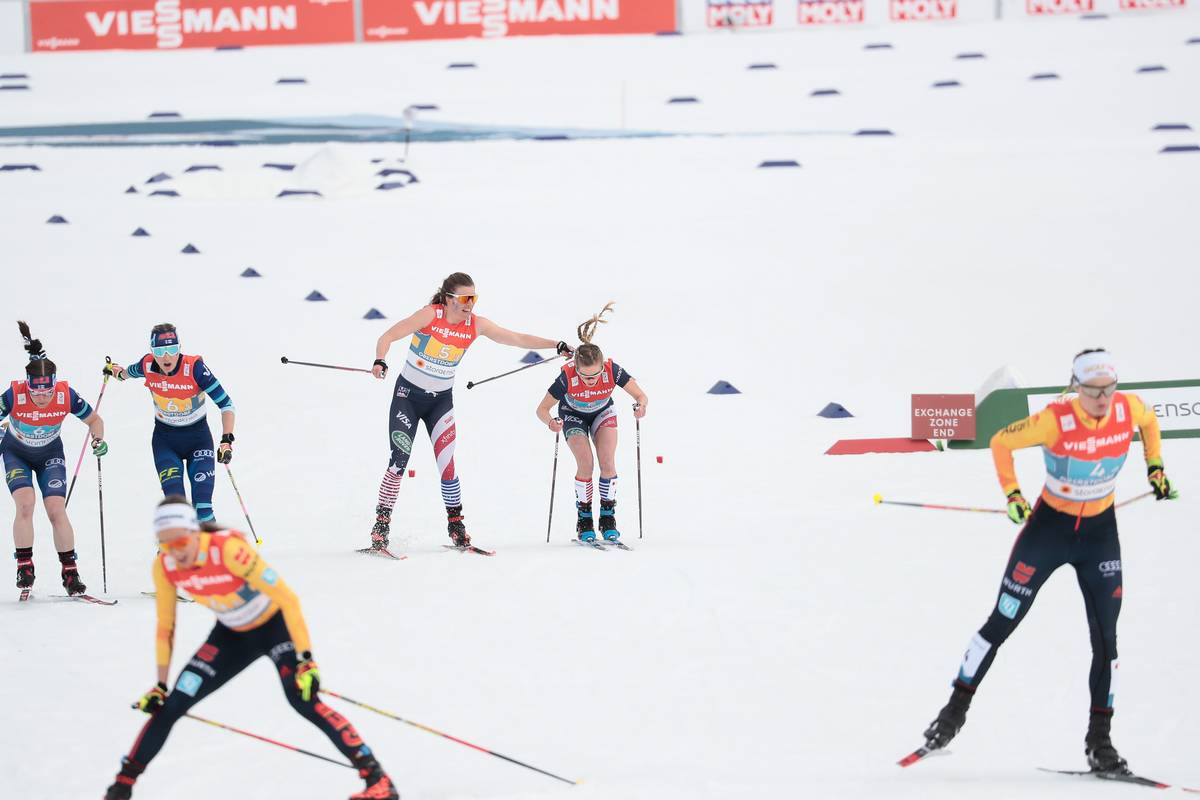
Rosie Brennan racing leg three for the U.S. (Photo: NordicFocus)Brennan tagging Diggins and Ropenan tagging Pärmäkoski for the anchor leg drama about to unfold. (Photo: NordicFocus)
Victoria Carl for Germany, Krista Pärmäkoski for Finland, and Jessie Diggins for the U.S. began a 5 k hunt for bronze. Like Brennan before her, Diggins took over the pacing, with Pärmäkoski and Carl close behind. Not until late in the leg did Carl fall off Diggins’ pace.
For readers of FasterSkier, Diggins is well known. Yet if Pärmäkoski was off your radar, we’re here to fill you in. At the 2018 Olympics, she won two individual bronze medals; one in the skiathlon, the other in the 10 k skate. She won silver in Korea too in the 30 k mass start. She has won five World Cups, all, however, in classic technique. Since 2011 she has 27 World Cup podiums.
Diggins driving the pace followed by Pärmäkoski and Carl. (Photo: NordicFocus)
By her standards, the thirty-year-old Pärmäkoski has had an off-year. She has no individual podiums, yet she did finish fifth overall in the Tour de Ski. She’s been consistent, by all measures, but missing her podium gears. She finished 13th overall in this week’s championship 10 k skate when Diggins just missed a medal when she placed fourth. Diggins bested the Finn’s time in that race by 52 seconds.
Again, on paper, Diggins takes this leg and the Americans in for their first championship 4 x 5 k relay hardware.
This is why they race. To see how it all unfolds. With Carl shaken off, it was Diggins and Pärmäkoski bronze medal hunting. Diggins’ tactic was full-steam ahead, leading Pärmäkoski until the closing few hundred meters. Pärmäkoski, sat tight, only showing her presence a few times on the American’s periphery.
Finland’s Krista Pärmäkoski on a late-race move to pull ahead of Diggins. (Photo: NordicFocus)
Up the final leg-quivering climb a final time, Diggins came over a second ahead of Pärmäkoski and at 51:37 into the race Diggins briefly glanced back. Pärmäkoski was still there.
On the plateau above the climb, you could hear U.S. Ski team Head Coach screaming encouragement. Diggins continued to lead, both skiers noticeably fatigued from the effort ascending to the course high point.
Working and tucking down the sinuous and technical downhill, the two skiers mirrored one another. In a furious pace heading into the final short climb before the stadium, Pärmäkoski revealed herself directly to the side of Diggins. Pärmäkoski carried her speed and passed Diggins and led up the final buckling climb. Pärmäkoski descended first and entered the final straight with a four-meter gap. Pärmäkoski V2ed, Diggins pushed with a few free skate pulses and tried to eke out more speed as she too V2ed to the line.
Met by her Finnish squad, Pärmäkoski closed out for bronze (+46.2) with the U.S. in fourth (+47.0).
Down to the wire: Krista Pärmäkoski and Jessie Diggins (l-r). (Photo: NordicFocus)With the advantage down the straight, Pärmäkoski closes in for third, while Diggins takes fourth. (Photo: NordicFocus)
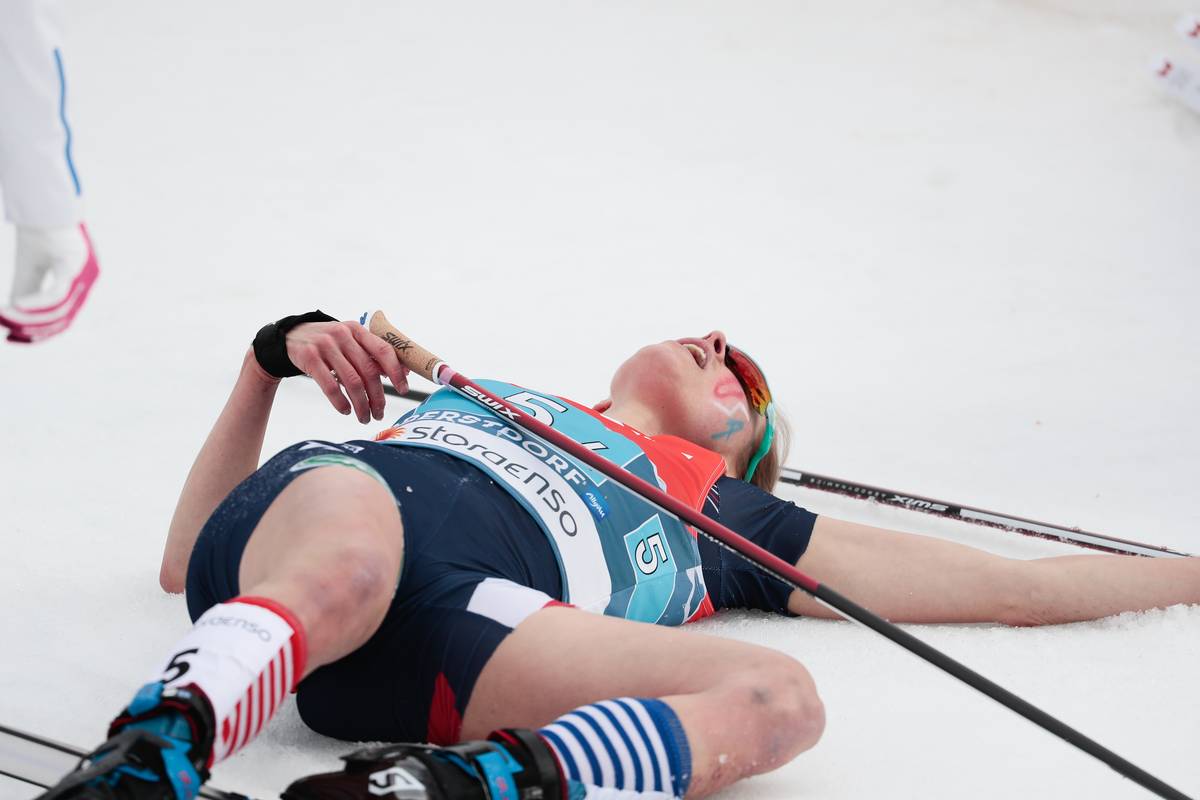
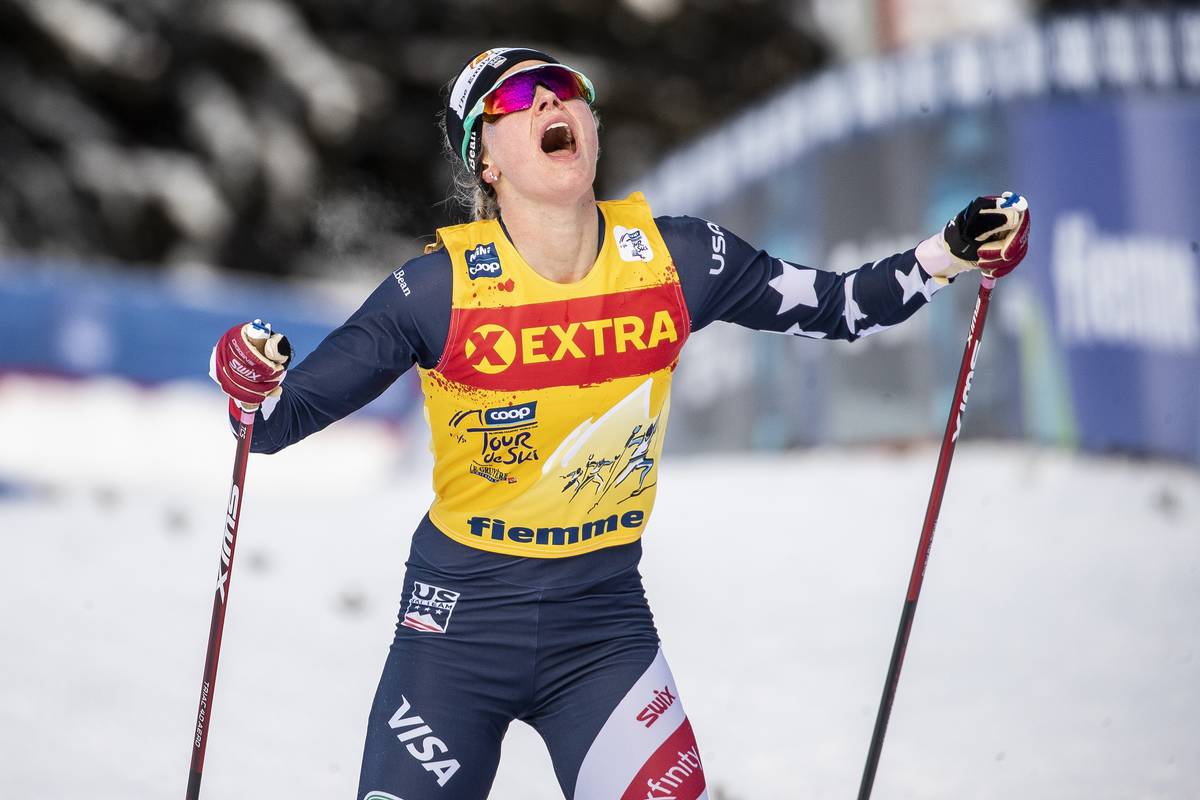
Pärmäkoski and pure emotion crossing the line. (Photo: NordicFocus)No more to give: Jessie Diggins after crossing the finish line in the 4 x 5 k relay. (Photo: NordicFocus)
The racing, if anything, was great. Down to the wire, it went, just falling on the favorable side for Finland in the medal count. If fans want solid racing regardless of the outcome, they got it. With the heavy task of shouldering U.S. hopes in the relay, Swirbul kept them in it, Maubet Bjornsen, Brennan, and Diggins sparked dreams of biting down on the elusive medal.
It was Swirbul’s first opportunity to be a part of a championship relay team at the senior level. “I was really proud I’m so proud to be part of it I don’t, it’s a weird feeling because we’re expected to feel sad with getting fourth place but I feel really proud of this team,” she told the U.S. Ski Team after the race.
For Maubet Bjornsen, in what is likely her final season of World Cup racing, she spoke of an unrivaled legacy in U.S. women’s 4 x 5 k relay’s that has come ever so close to the championship podium.
Maubet Bjornsen, pictured second here, during the women’s 4 x 5 k relay. (Photo: NordicFocus)
“For sure that the relays are the highlights of why I am still ski racing and I think it’s so cool to see everybody just give every bit that they can,” Maubet Bjornsen said to the USST. “Of course we’re shooting for medal and for about six championships in a row we know that it’s possible, if we get all the ducks lined up. “But you know, part of the game is getting those ducks lined up. And that’s how you keep coming back and fighting. For sure we are fit enough and if we get all those ducks running, man we’re coming for the world.”
At one point this season, Brennan wore the yellow bib as the overall leader of the World Cup. She adds another level of depth to a loaded U.S. team. “The relay is the race we have all been looking forward to and had some big goals around that event,” Brennan wrote in an email. “It was another hot day with really soft conditions. This is a team of gritty girls and a team that likes to lay it all out there. We skied that way today and tried our best to play our cards right. It is certainly bittersweet to be so close to that podium and not get there, but when everyone skis with that much grit, there isn’t much else you can do. I am personally a bit disappointed with my leg. I believe I am capable of a bit more than I showed today. It was surprisingly hard to get away from people with a significant draft in effect. My best card was to grind away from the others, so that’s what I did and I am disappointed I couldn’t have been more effective. This is the closest we have been to the goal of a podium and for that I am proud. I know if we keep showing up and trying, we will find our way there.”
All in: Diggins. (Photo: NordicFocus)
Diggins remains the face and spirit of a squad continually knocking on the podium door after four legs of relaying racing. In her post race comments, she explained race strategy is hardwired.
“I played the only part I had and I knew I had to ski like twice as hard as the girls that were with us,” said Diggins to the USST. “I did my absolute damnedest to drop them in the only place that I thought we could. I’m really proud of that…, Yeah it’s heartbreaking to come that close to a medal and know that fitness wise, we are so there. And I think that’s what’s really encouraging about this because that’s the only part that we can really control is coming into World Championships, knowing that our fitness is there, our minds are there, our tactics are there, and most importantly that we’re gritty enough.
“And we definitely are. So I think, for me, when you look at things we can control is how we skied that race. I’m so proud of it. That was an absolute championship performance from every single member of this team and not just from the people who were racing but people who weren’t racing. It’s heartbreaking to come that close and know that we’re there but also that’s, that’s part of the sport.”
The U.S women have placed fourth in World Championship relays in 2013, 2015, 2017, and 2021. If the U.S.’s white whale remains the relay medal, it’s a big ocean out there. Tactics and fitness profiles will be analyzed. But, roughly 12 months from now when the Beijing Olympics go down, the relay socks will be pulled up and 4 x 5 k relay medal dreams will begin anew. Today, Finland gets the well-deserved podium spot.
Therese Johaug (NOR) dominating the 10 k skate competition. (Photo: NordicFocus)
This World Championship coverage is made possible through the generous support of Marty and Kathy Hall and their A Hall Mark of Excellence Award. To learn more about A Hall Mark of Excellence Award or to learn how you can support FasterSkier’s coverage please contact info@fasterskier.com.
The high pressure continued at the 2021 World Championships on Tuesday in more ways than one. Oberstdorf, Germany’s temps hovered around 50 degrees Fahrenheit for the start of the women’s 10-kilometer individual freestyle, and a rarefied number of skiers poised to step on the podium. The pressure cooker that is the individual start, with skiers setting off at 30-second intervals was on display from the first earnest pole plants out of the start.
Coined the “Tempo-Fest” by some who see a Therese Johaug sweep of the distance events as a foregone conclusion – this appeared to be true considering the early splits. The former two-time winner of the 10 k, (2013 in skate, and 2019 classic), the Norwegian’s medal case was already being prepared at the 1.5 k split. She cranked through 3.0 seconds faster than Sweden’s Frida Karlsson and 6.3 seconds ahead of the third-fastest split from the U.S. skier Rosie Brennan. Sweden’s Ebba Andersson notched the fourth-fastest split (+6.8), and American Jessie Diggins, the only skier to best Johaug in this discipline since 2016, was fifth through the split (+7.1).
Sweden’s Karlsson locking in for second overall. (Photo: NordicFocus)
Ebba Andersson of Sweden in her quest for a medal during the 10 k skate. (Photo: NordicFocus)
Jessie Diggins during her fourth-place run in the 10 k skate at the 2021 World Championships. (Photo: NordicFocus)
The justification of noting such early splits with a full 8.5 k of racing to go is this: any time back to Johaug is historically time lost – never to be gained back. That was the case on Tuesday when Johaug had 8.6 seconds over the second-fastest skier, Karlsson, at 5 k – the race midpoint – and 19.8 seconds and 21.3 seconds over Andersson and Diggins, respectively.
Norway’ Johaug on her way to her second win in these 2021 World Championships. (Photo: NordicFocus)
With the open mind thinking that anything can happen but with the caveat that Johaug is a one-of-a-kind skier – this race appeared to be signed, sealed, and delivered to Johaug by 6.8 k, when she led by 18.1 seconds over Karlsson in second.
Johaug won amidst a crowd-less and sunbaked stadium in 23:09.8 to capture her 12th World Championship medal and her second in Oberstdorf after she won the 15 k skiathlon on Saturday. Adding to the accolades, Johaug becomes the first woman to win the 10 k at successive World Champs since Katerina Neumannová of the Czech Republic in 2005 and 2007.
Johaug made it two 10 k crowns in a row: she won the 10 k classic at the 2019 World to add to her win on Tuesday. (Photo: NordicFocus)
“I think I had the day of my season this year,” Johaug told FIS. “I felt incredibly strong and fresh and really have to give thanks to my amazing team of waxers. They are out day and night to test and find the best option for the race. This victory is really dedicated to all of my team and I am really happy to repeat my title”.
For the 21-year-old Karlsson, she captured silver finishing +54.2 seconds back. In 2019, Karlsson also placed second to Johaug in the World Championship 10 k classic. Her teammate Andersson was third (+1:06.9) on Tuesday. Johaug’s win by nearly a minute is peerless when examining the margin of victory in World Championship or Olympics 10 ks back to 2000. (Information listed below compiled by Erik Nilsson.)
2019 Seefeld WC , Johaug +12
2018 PyeongChang Olympics , Haga +20
2017 Lahti WC, Bjørgen +41
2015 Falun WC , Kalla +41 (Norway missed skis)
2014 Sochi Olympics , Kowalczyk +18
2013 Val di Fiemme WC, Johaug +10
2011 Oslo WC, Bjørgen +4
2010 Vancouver Olympics, Kalla +6
2009 Liberec WC, Saarinen +4
2007 Sapporo WC, Neumanova +26
2006 Turin Olympics, Smigun, +21
2005 Oberstdorf WC , Neumanova +1
2003 Val di Fiemme WC , Skari, +21
2002 Salt Lake Olympics, Skari, +4
2001 Lahti WC, Skari, +12
The 10 k skate podium: Frida Karlsson (SWE) second, Therese Johaug (NOR) first, and and Ebba Andersson (SWE) third (l-r). (Photo: NordicFocus)
Diggins, who raced in a scissor-modified race suit to create shorts and short sleeves, placed fourth (+1:04.0) in what was tight racing. She and Andersson remained in close virtual contact when considering splits – with the Swede slightly ahead after the 5 k mark. Of the leaders in the final standings, Diggins was the earliest starter in bib 32. Johaug began in bib 40, Karlsson in bib 46, Andersson in bib 34, and Russia’s Tatiana Sorina (racing under the banner RSF due to a CAS ruling) who finished fifth (+1:13.8), in bib 44. Charlotte Kalla, the storied champion from Sweden was sixth (+1:09.4).
Jessie Diggins (USA) crouched for the descent, followed by Anamarija Lampic (SLO). (Photo: Nordic Focus)
“It’s no secret that I really struggle, these are not my temperatures, I’m more of a Minnesota winter athlete,” Diggins said after the race to the U.S. Ski team when asked about high temperatures. “But for me, I was really proud of our heat mitigation strategies. I’ve been working really hard on trying to acclimate to the heat, I was hydrating like crazy, cut the legs cut the arms off the suit, spritzed my suit with cold water, packed a bunch of snow into my sports bra before the start, and had coaches throwing water on me multiple times and I still got hot. But all that said, that is all I can control. I went out there and, you know, my goal for today was to just be the person who gives, the most. I’ve been visualizing this course for weeks. I practiced in my mind how I wanted to ski it. I went out there and I just skied so hard, and I’m so proud of that because that’s the only thing you can control.”
Diggins crossing the finish for fourth overall. (Photo: NordicFocus)
The U.S., which has never medaled at a championship in the women’s 4 x 5 k relay, should be positioned for a solid day on Thursday when that competition goes down. “Just excited for that relay,” said Diggins when asked if she had anything to add.
Unequivocally the skis and the form were solid across the board for the U.S. Beyond Diggins’ near-podium, all four U.S. skiers finished in the top-25. Sadie Maubet Bjornsen, who remained off the WorldCup until recently, raced to 11th (+1:47.8).
Sadie Maubet Bjornsen racing to 11th on the World Championship 10 k skate. (Photo: NordicFocus)In only her sixth international race this season, Maubet Bjornsen paced to 11th on Tuesday. (Photo: NordicFocus)
“I do feel like I skied with like just no fear out there, and whenever that happens, I’m proud of it,” said Maubet Bjornsen to the USST. “A number is what it is at the end of the day, but I am, I’m really stoked about the fearless energy I went with on those insane hills with. I think you can hear me breathing from literally a kilometer away.
“A number is hardly a measure of today’s effort. I am more of a power skier. So the mountains like that can sometimes break me to pieces and I feel like I just went after them, pretending they were flat and they beat me up no doubt but I feel like I give him a run for their money.”
Rosie Brennan during Tuesday’s 10 k skate. (Photo: NordicFocus)
Rosie Brennan, who barnstormed the World Cup during Period I and charged at the Tour de Ski, finished in 17th (+2:03.3).
“It was tough, I feel pretty crushed, to be honest,” said Brennan to the USST. “I started really well and things were going fine and then I don’t know, slowly just the wheels came off and I didn’t have the body or the brain that I had hoped for. And so it was kind of like a brutal battle to the end.”
Brennan had the fifth-fastest split (+13.2) at 2.5 k, and the seventh fastest at 7k (+33.1). By 7.9 k she lost more time to the leaders, coming through in 12th (+1:38.0).
Asked if perhaps she had started too fast, Brennan said, “I mean it’s hard to say, of course, it looks that way on the splits but I also believe that I’m capable of skiing 10 k at that level. And I think I’ve shown that this season so I think, on a good day I could have held it. And I felt I had to try. So I did plan to go out, you know, relatively hard. And maybe it was just like a little much for the heat or just the body that I have right now but solid five K so hopefully I can turn it around for the 5 k in the relay.”
Sophia Laukli of the U.S. placed 25th in the 10 k skate. (Photo NordicFocus)
Also for the U.S., Sophia Laukli (20), skied to 23rd (+2:23.0).
“I definitely thought it was gonna be slushier than it was,” Laukli said to the USST post-race. “But in the past few days skiing here in the shady areas have been super different than like what’s in the sun. But today was pretty consistent so that was a nice surprise I guess.”
In her first World Championships, Laukli now has two top-30 results – she placed 25th in Saturday’s skiathlon. This is her first season racing World Cups with a top result of 33rd on the Lahti, Finland skiathlon in late January.
Cendrine Browne was the top Canada finisher in 27th. (Photo: NordicFocus)
Canada’s Cendrine Browne, who began in bib 3, notched 27th (+2:32.5) for Canada’s best result.
“I am happy with today’s race. I was aiming for top-20 and was so close – just 12 seconds off,” said Browne to Nordiq Canada. “I just died on the second lap so I know that in a better day top-20 is definitely something I can achieve.”
According to Nordiq Canada, this is Browne’s seventh top-30 at the World Cup level. “I just died on the second lap so I know that in a better day top-20 is definitely something I can achieve. Overall, I couldn’t ask for a better season. Being this consistent in every race is a dream come true, and I’m proud of how I’m performing even though I had a concussion in September and contacted COVID in November.”
Dahria Beatty was 44th (+3:16.2), and Laura LeClair 57th (+4:52.1)
The scene from an exchange during the World Championship team sprint in Oberstdorf, Germany. (Photo: NordicFocus)
This World Championship coverage is made possible through the generous support of Marty and Kathy Hall and their A Hall Mark of Excellence Award. To learn more about A Hall Mark of Excellence Award or to learn how you can support FasterSkier’s coverage please contact info@fasterskier.com.
And now for something completely different. The skate team sprint.
Three roughly 1-kilometer loops each for 7.2 k total, relatively flat with just two brief upticks per lap, winding back and forth along the valley floor in Oberstdorf, Germany. Would the terrain be enough for one team to pull away from others or would it be an empty-the-tank last two laps, fighting for every centimeter?
From semifinal A, advanced the Swedish team of Maja Dahlqvist and Jonna Sundling, who won their heat by nearly two seconds ahead of the Russian Ski Federation (RSF), represented by Yulia Stupak and Natalia Nepryaeva, Norway, and Finland. Three teams finished within a second in Semifinal B, with Slovenia’s Eva Urevc and Anamarija Lampic edging out Rosie Brennan and Sadie Maubet Bjornsen for the U.S., and the Swiss Women, Laurien van der Graaff and Nadine Fähndrich. Germany and the Czech Republic also advanced from the second wave of semis.
Note that four teams advanced from each heat of the semifinals with the next two fastest times, a change from the usual top two teams plus six fastest times. This change was made based on the weather and conditions on the course.
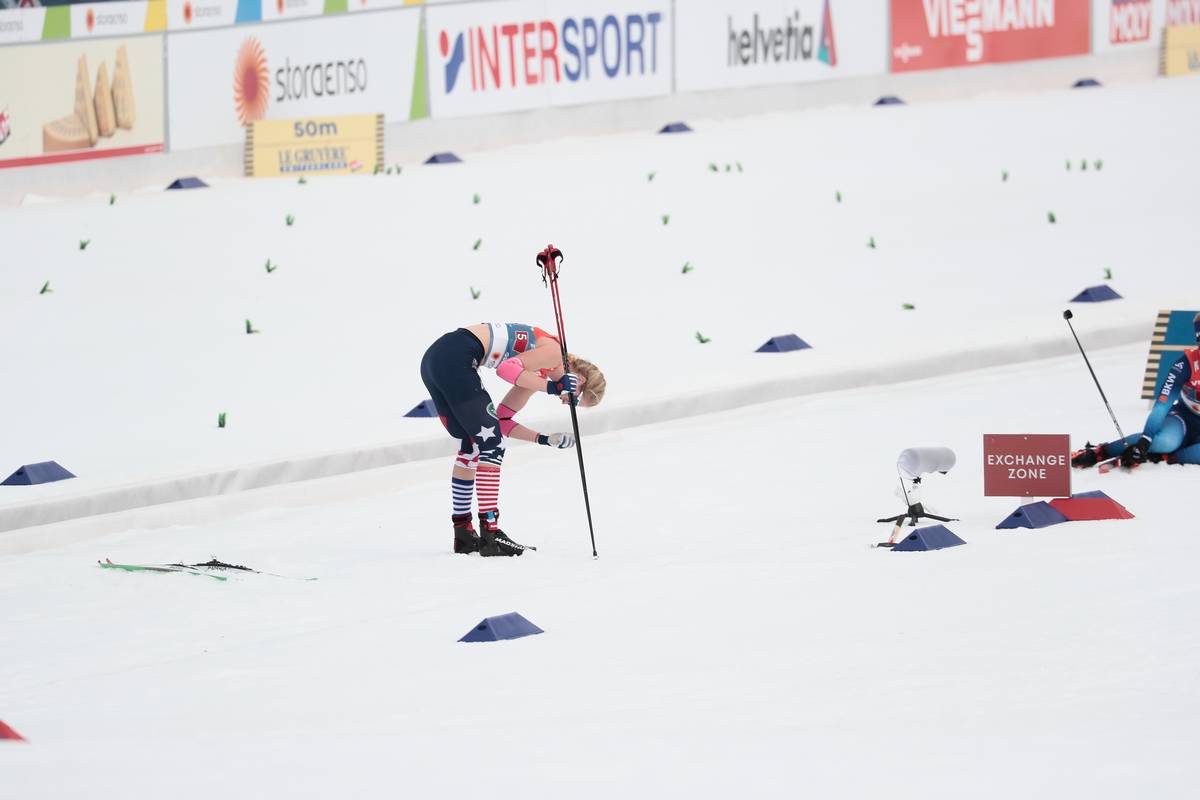
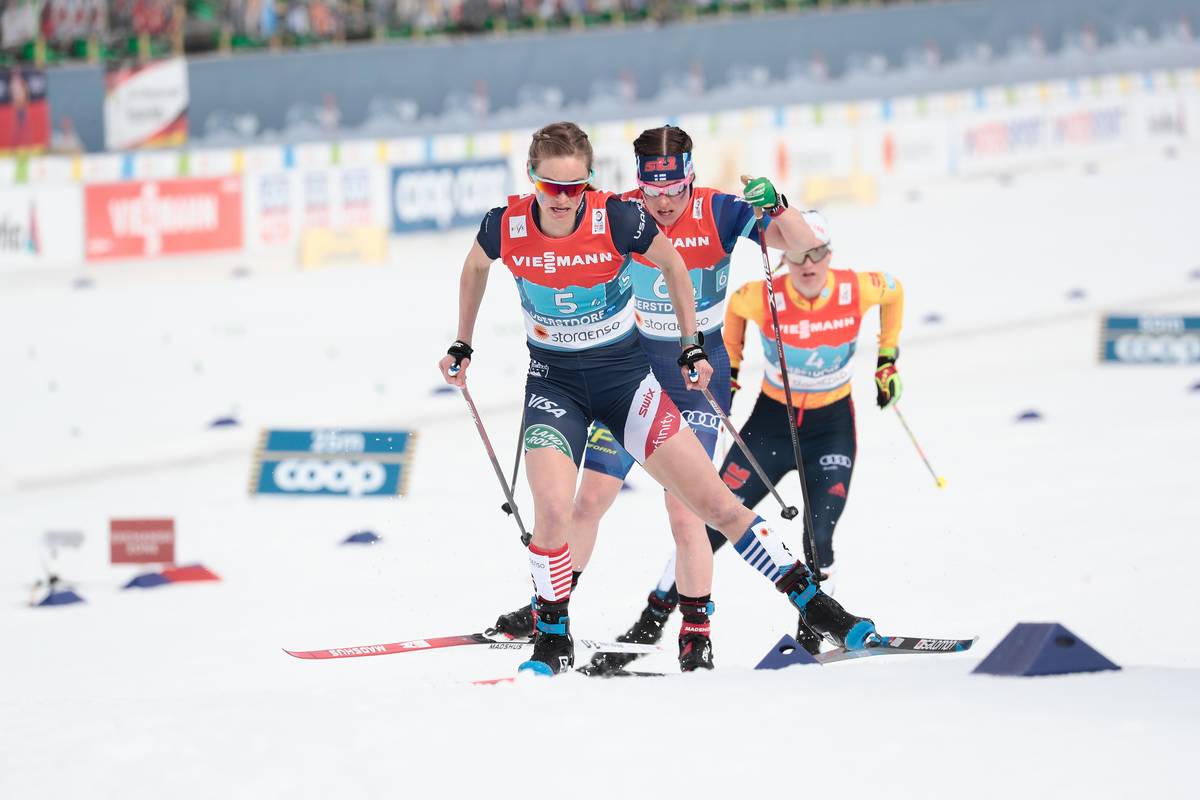
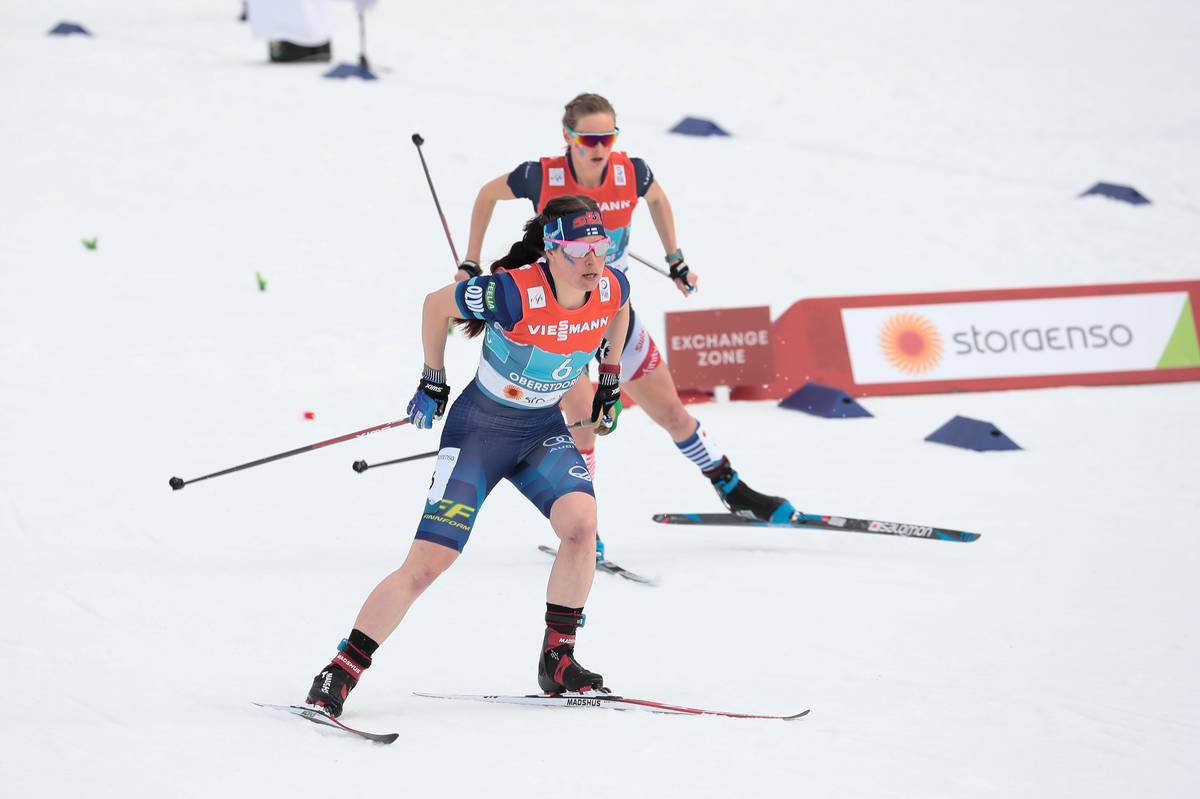
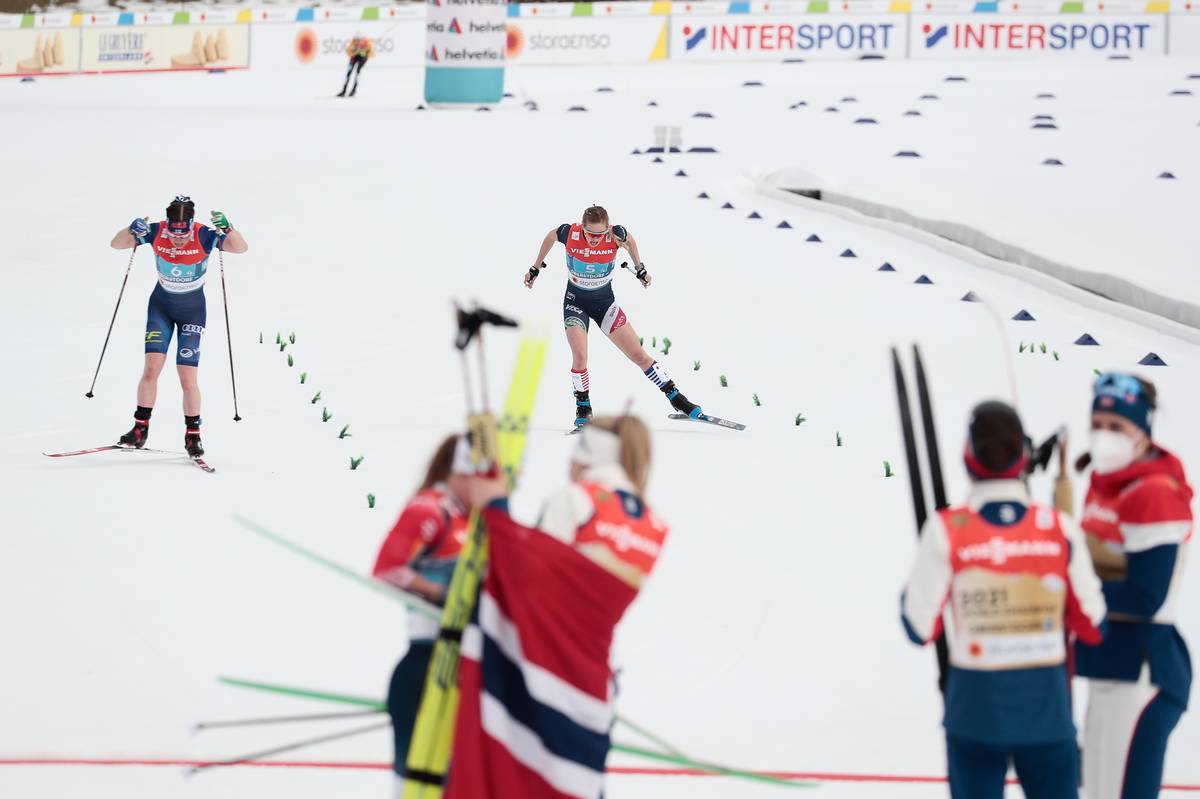
Rosie Brennan marks Russia’s Yulia Stupak during the World Championship team sprint in Oberstdorf. (Photo: NordicFocus)
So far in this World Championship, Brennan had only raced the classic sprint qualifier and Maubet Bjornsen not at all, perhaps leaving them fresh for this competition. American voices could be heard shouting words of encouragement as the women toiled around the course as a large group through the first four exchanges. At the third exchange at 3.6 k, the US was sitting in fifth, 2.3 seconds behind Sweden in the lead and in contact.
Slowly, Sweden began to turn up the dial, building intensity. However, as the final laps took off, any ground Dahlqvist gained on her competitors was closed as they descended off the first roller and headed into the primary climb of the course. It was here that RSF’s Stupak began to challenge, duking it out with Dahlqvist but unable to pull away.
Sweden’s Dahlqvist leads the way in the World Championship team sprint in Oberstdorf, Germany. (Photo: NordicFocus)
After the final change, it was Sweden and RSF at the front, with a small gap to Norway, the U.S., and Switzerland with Slovenia a few meters back.
In the final lap, the tempo accelerated, poles whipped through the air, and any predictions of what might happen were laid wayside.
As Sundling tried to pull away, Fähndrich quickly closed the gap to the front, skiing at the Swede’s hip. Nepryaeva began to fall off the pace, and was being caught by Maubet Bjornsen and Lampic. Though Sundling and Fähndrich held ground at the front, the podium was within reach for each nation.
Rosie Brennan (USA) tails Eva Urevc (SLO) and Yulia Stupak (RSF) during the World Championship team sprint in Oberstdorf, Germany. (Photo: NordicFocus)
At the top of the intermediate climb and on the outside of the left-hand curve, Maubet Bjornsen ski was caught in a tangle, dropping her to her knee and stalling her momentum at an inopportune moment. The American rebounded quickly but was no longer able to fight for the top spots.
Making their way for the last time up the primary climb, Sweden and Switzerland, alone up-front, created a small gap to Nepryaeva. Meanwhile, Lampic of Slovenia was closing in and looking strong.
The final moments of the World Championship team sprint in Oberstdorf, Germany. (Photo: NordicFocus)
Sundling was first into the final lanes, with Fähndrich a ski length behind, matching but not able to overtake the Swede. The women soared to the finish with Sweden holding its ground for the win, Switzerland finishing just under a second behind for the silver medal.
Sweden’s Jonna Sundling and Maja Dahlqvist take home World Championship gold in the team sprint. (Photo: NordicFocus)
“It was so fun to race today,” Dahlqvist told FIS after the race. “But it was hard too, the conditions were a little warm. It was easier in the qualification.”
Sundling was asked whether she knew how close behind Fähndrich was in the final meters.
“I heard there was someone behind me, but I just had my focus on the finish line and to cross it first.”
Fighting for bronze, Lampic out-sprinted Nepyraeva to bring home a medal for Slovenia (+3.46), leaving RSF in fourth (+3.95).
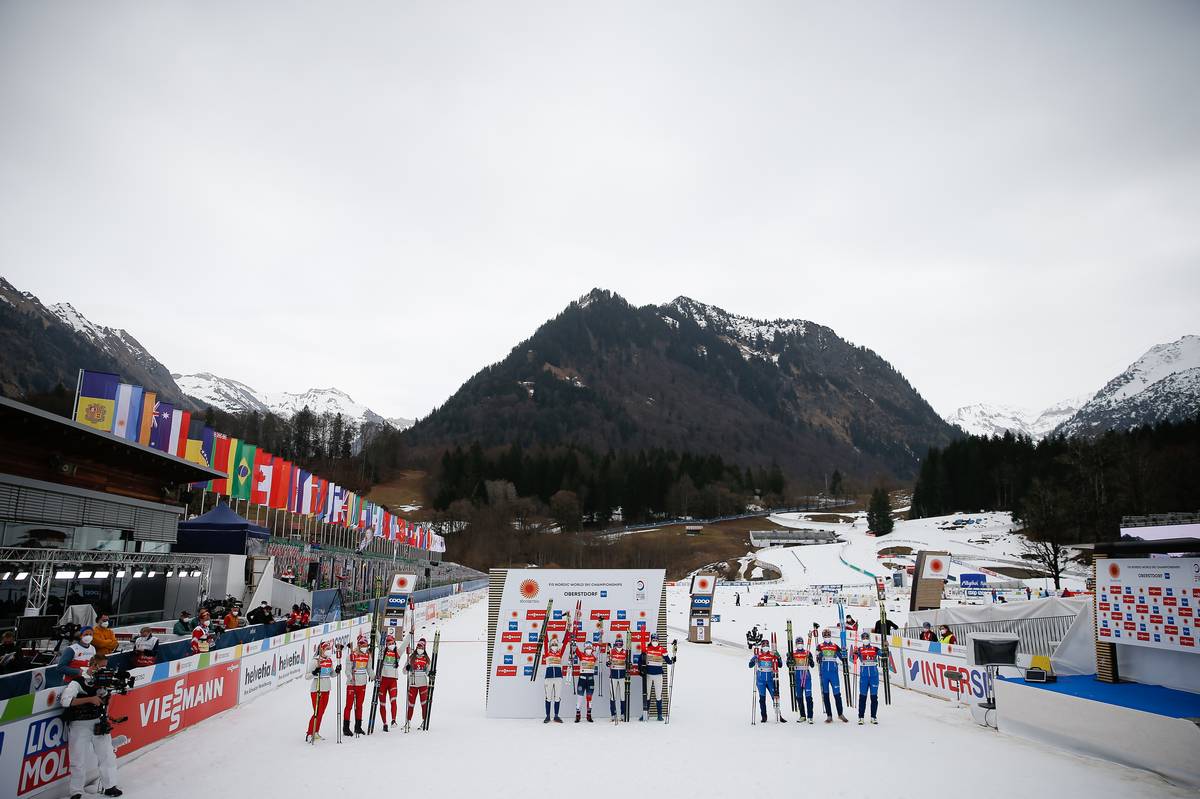
The women’s podium at the World Championship team sprint in Oberstdorf. Sweden took the win ahead of Switzerland and Slovenia. (Photo: NordicFocus)
The women of Sweden have made their sprint prowess well known this season and were favored to win their third World Championship medal in this event, piggybacking on the 2019 World Championships in Seefeld, Austria. Dahlqvist led the team there too, with Stina Nilsson as the anchor. Both members of today’s Swedish team were coming off of strong results in the opening classic sprint, where Sundling collected a gold medal.
The winners, Sweden’s Maja Dahlqvist and Jonna Sundling, take in their team sprint victory in Oberstdorf. (Photo: NordicFocus)
However, a medal for Switzerland and Slovenia, while not unexpected, is perhaps a more novel result. The duo of Van der Graaff and Fähndrich won the team sprint in Dresden, Germany earlier this season, but this is the historic first Swiss medal in the event and the first women’s medal for Switzerland since 1987, a bronze earned by Evi Kratzer in the 5k classic.
Laurien Van Der Graaf (SUI) watches her teammate, Nadine Fähndrich, bring home a silver medal for their team. (Photo: NordicFocus)Laurien van der Graaff and Nadine Fähndrich take silver for Switzerland. (Photo: NordicFocus)
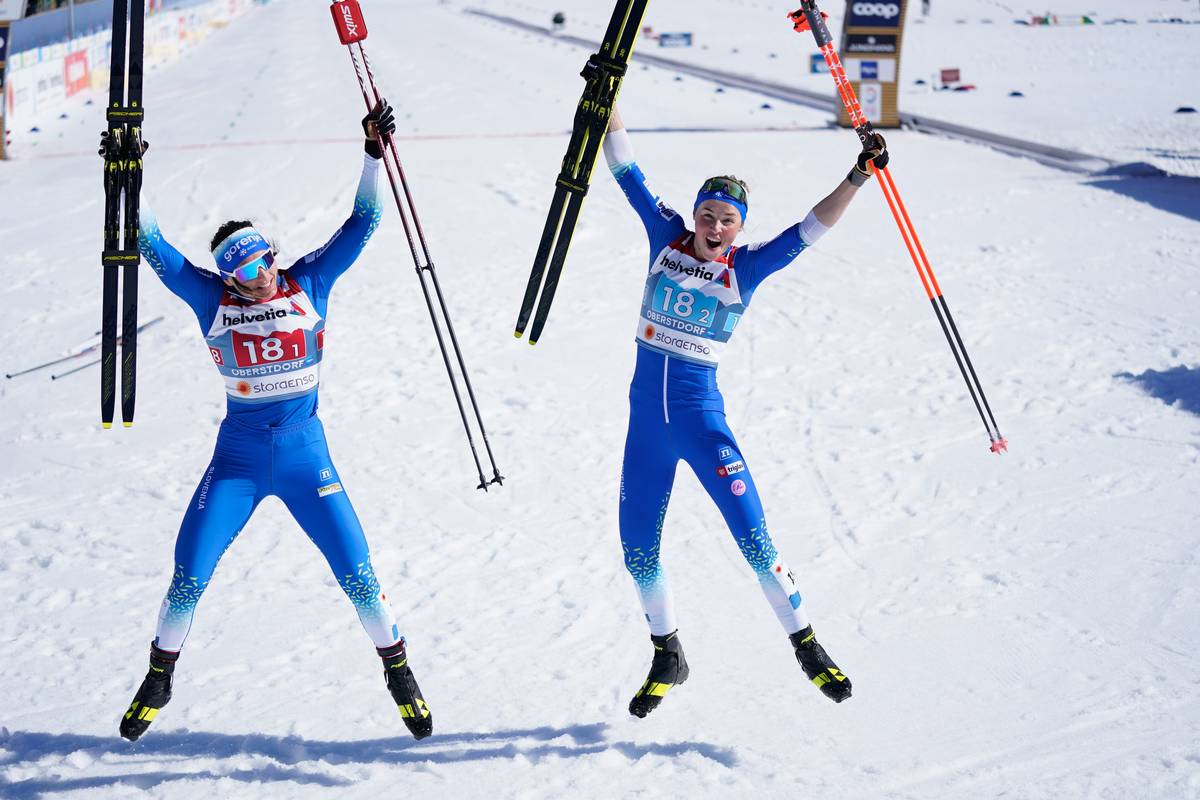
“We always said we want that medal,” Van der Graaff told the Swiss news outlet SRF. And now it’s there! No idea, the emotions are there. It’s incredible.”
Commenting on when they knew they could celebrate, Fähndrich replied, “I was only really sure when I crossed the line. She had tagged off to me in a great position, with only a little bit of a gap to [positions] one and two. Then I felt that those athletes around me tried a little to play tactical games, but I just thought no, I had to risk it because I felt good. I just knew ‘all out now’!”
Laurien van der Graaff and Nadine Fähndrich celebrate with their tech after earning a World Championship silver medal in the team sprint. (Photo: NordicFocus)
Despite the size of their team and country, the Slovenian team of Urevc and Lampic took 3rd in Dresden and won the most recent World Cup team sprint in Ulricehamn, Sweden. Slovenia also took silver in the 2019 Championships in Seefeld. Taking home her second medal of this Championship, 25-year-old Lampic also leads the overall World Cup sprint standings.
Eva Urevc and Anamarija Lampic of Slovenia bring home a World Championship bronze medal in the team sprint in Oberstdorf, Germany. (Photo: NordicFocus)Sadie Maubet Bjornsen helps the Americans to a 5th place finish at the World Championship team sprint. (Photo: NordicFocus)
Finishing alone, Maubet Bjornsen brought the American women home in fifth (+5.83), matching the team’s result in this event at the 2019 World Championships.
When asked if they were left wanting, Brennan gave an optimistic and grateful response:
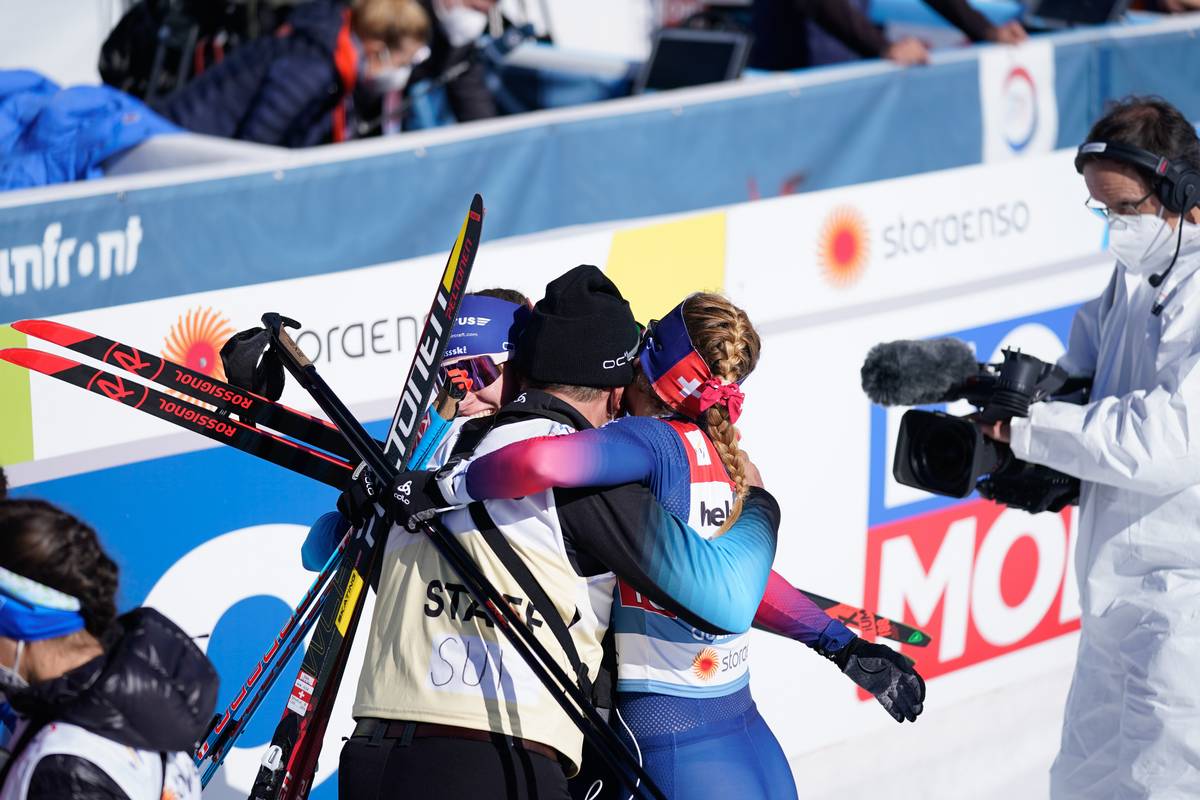
“I’m actually really happy with it,” she said. “It’s been, quite literally, a career-long dream to do a team sprint with Sadie. She’s been a best friend and training partner for the entirety of my professional career, so I was just so happy and excited to even get this opportunity. I know that we are capable of more on any given day, but that’s ski racing — you go out there and you give it your all. Some days you win, some you don’t. But it was honestly a pretty special day for me.”
Rosie Brennan marks Russia’s Yulia Stupak during the World Championship team sprint in Oberstdorf. (Photo: NordicFocus)
Perhaps envisioning the hang-up in the last lap, Maubet Bjornsen discussed the degradation of the course between the semifinal and final. She explained that the tracks were fast, firm, and tactical in the final, becoming more dangerous as the transformed snow began to break down and accumulate on the surface. In these deeper conditions, Maubet Bjornsen explained that a skier must be aware of their equipment at all times to stay upright and powerful.
However, reflecting on their performance, she too focused on the positive, commenting on the years and hours the two have spent training and racing together throughout their careers, beginning as juniors.
Rosie Brennan and Sadie Maubet Bjornsen prepare for the World Championship team sprint in Oberstdorf, Germany. (Photo: Tom Horrocks/USST)
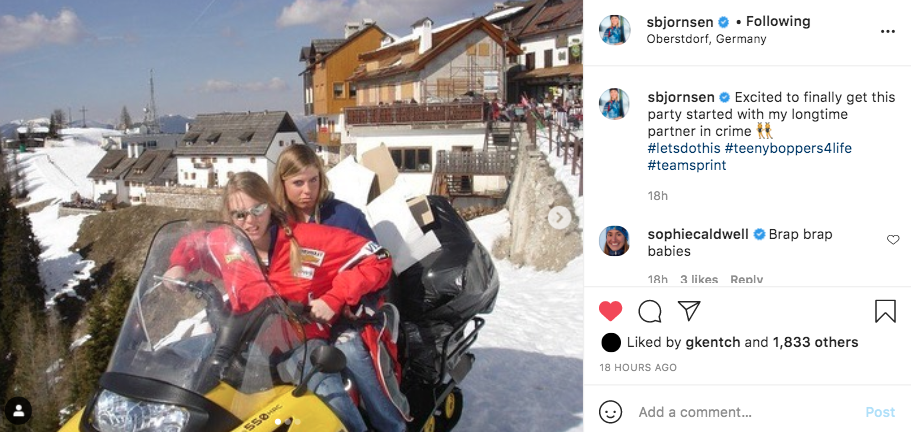
“I feel like we skied an awesome race,” Maubet Bjornsen said. “Unfortunately, I got stepped on the first uphill which took me out of the draft and I couldn’t quite find the gear to come back to [the group]. Which is a bummer because my skis were incredible and I feel like if I would have been with those girls over the top of the second climb it could have been a medal day, but like Rosie said, you can never count on that, but I think it’s pretty cool that my number one training buddy and me were in a fight for a medal. That’s pretty neat. If you would have asked us that at 14-years-old, beating on each other, we would have laughed at you. So I think if we brought our 14-year-old selves here, we’d be pretty darn proud.”
A trip down memory lane. (Photo: Instagram @sbjornsen)
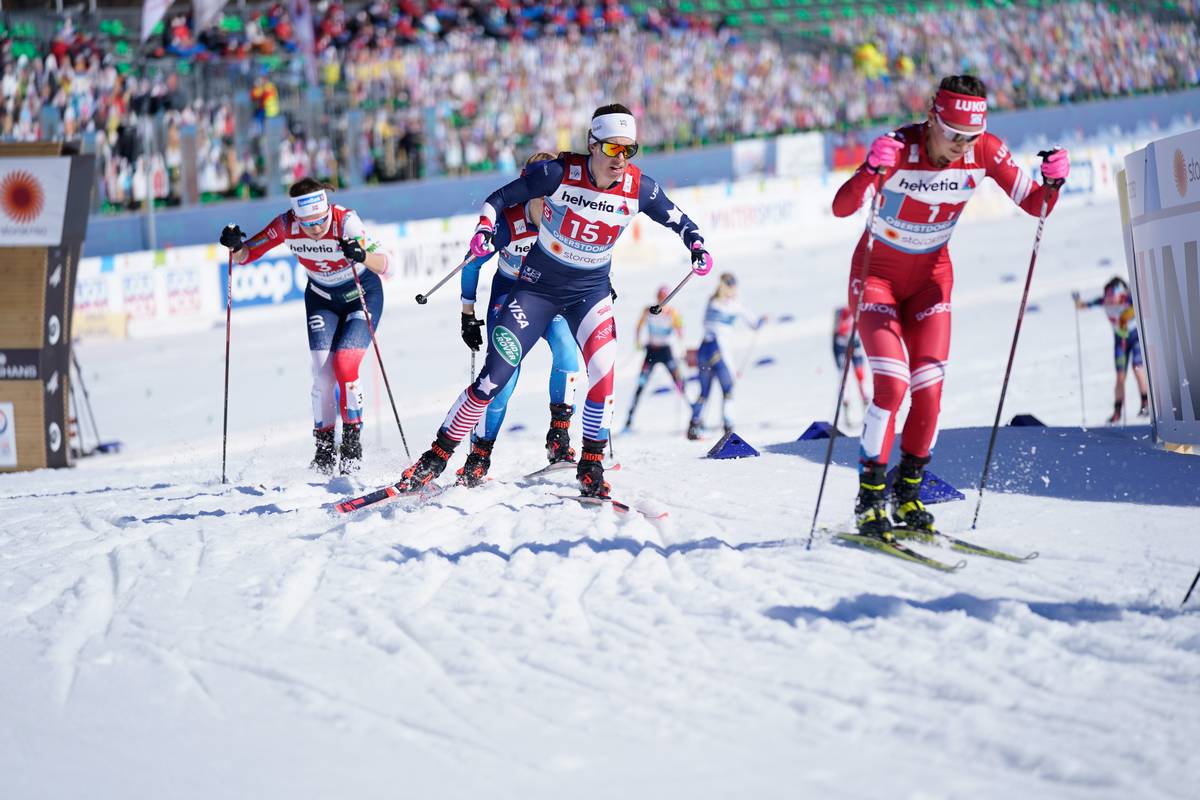
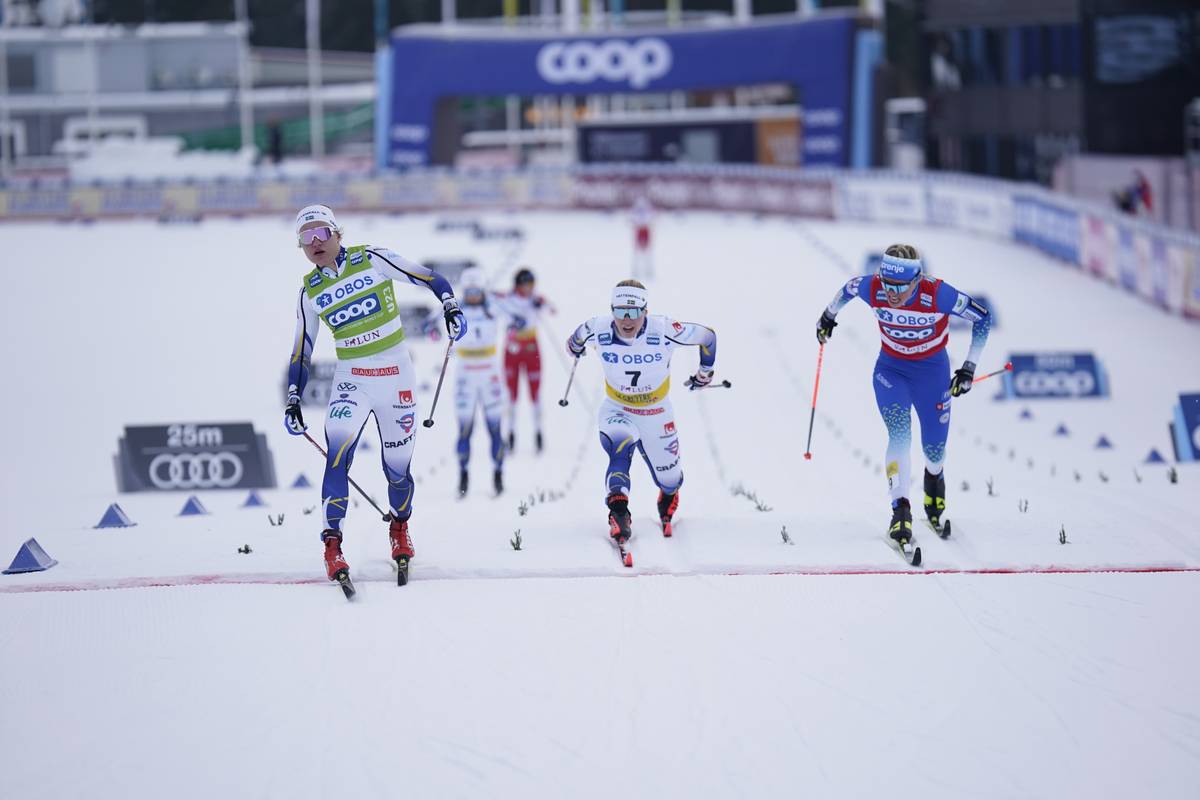
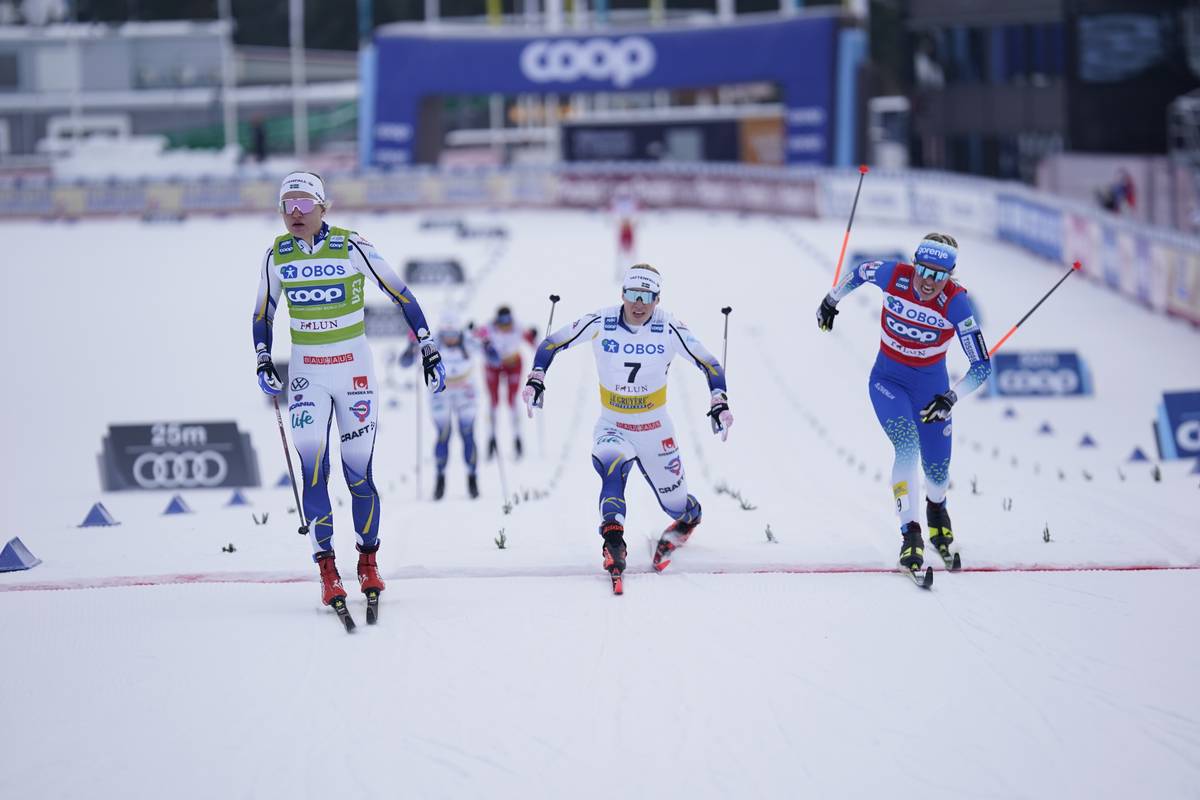
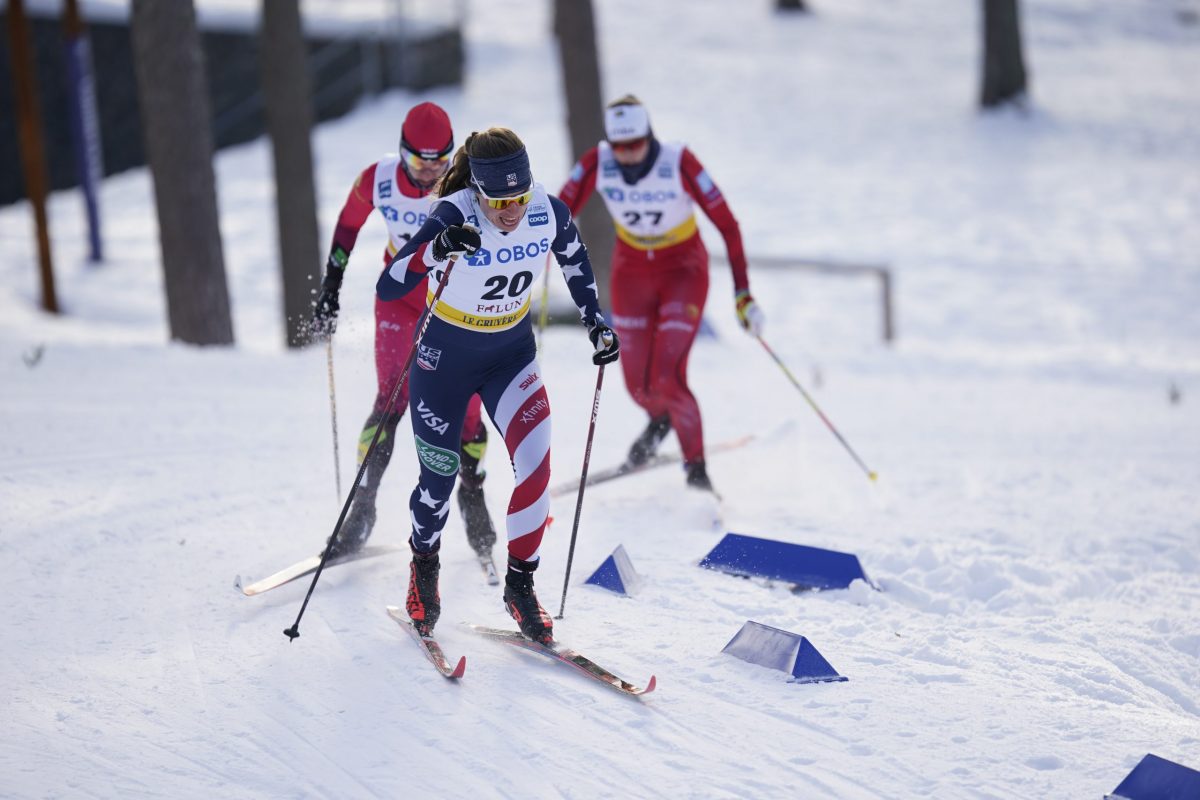
Rosie Brennan charges up the first and longest climb on the sprint tracks in Falun, Sweden. (Photo: NordicFocus)
This World Cup coverage is made possible through the generous support of Marty and Kathy Hall and their A Hall Mark of Excellence Award. To learn more about A Hall Mark of Excellence Award or to learn how you can support FasterSkier’s coverage please contact info@fasterskier.com.
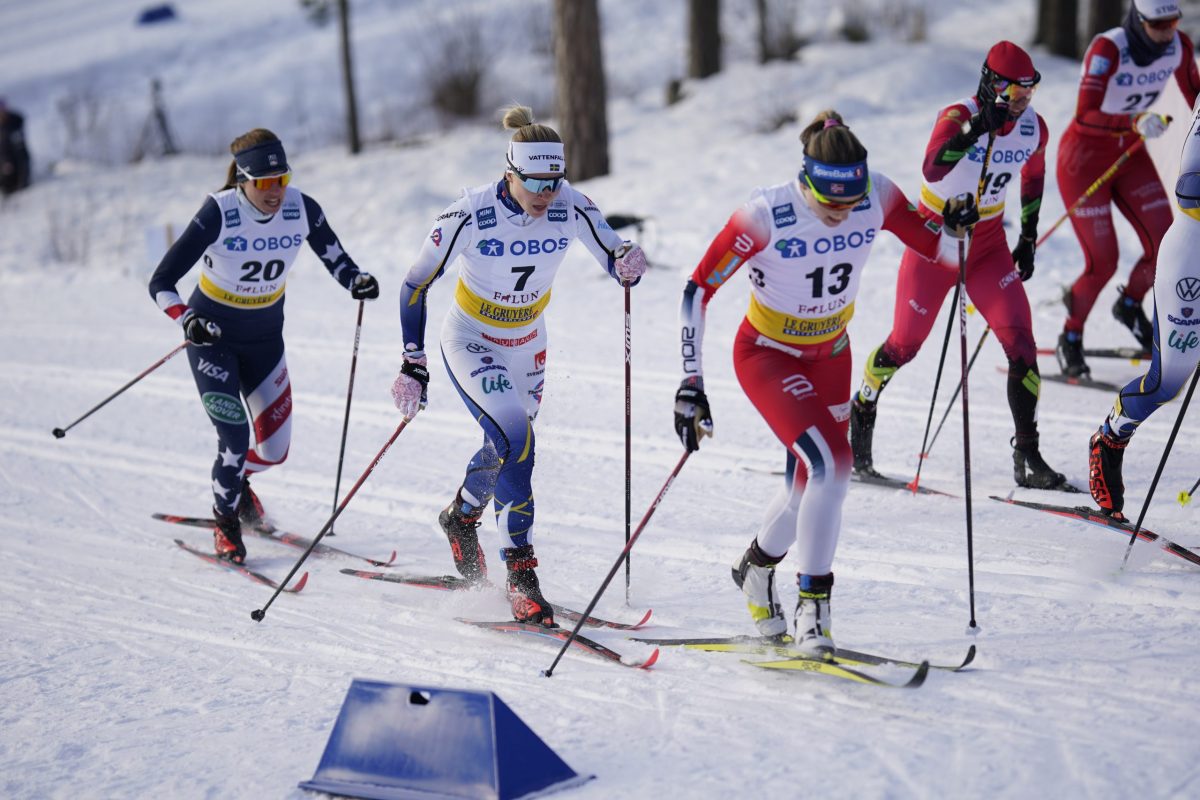
If you had any question about the strength and depth of the Swedish sprint team, look no further than the qualification list from today’s classic sprint in Falun. Led by Johanna Hagström with a time of 3:14.18, Sweden put six women in the top-10. This number was repeated in the semi-final, leading into a half-Swedish final round on home soil.
The sprint tracks featured the longest climb first, followed by a spiraling curve to send the women up the second climb. A sharp left turn and a roller brought the athletes back toward the stadium and into the final stretch. As the heats unfolded, this looked like a series of uphill sprints out of the track, some furious double poling, and some powerful cornering.
The profile of the sprint tracks in Falun, Sweden. (Photo: https://skidspelen.se/)
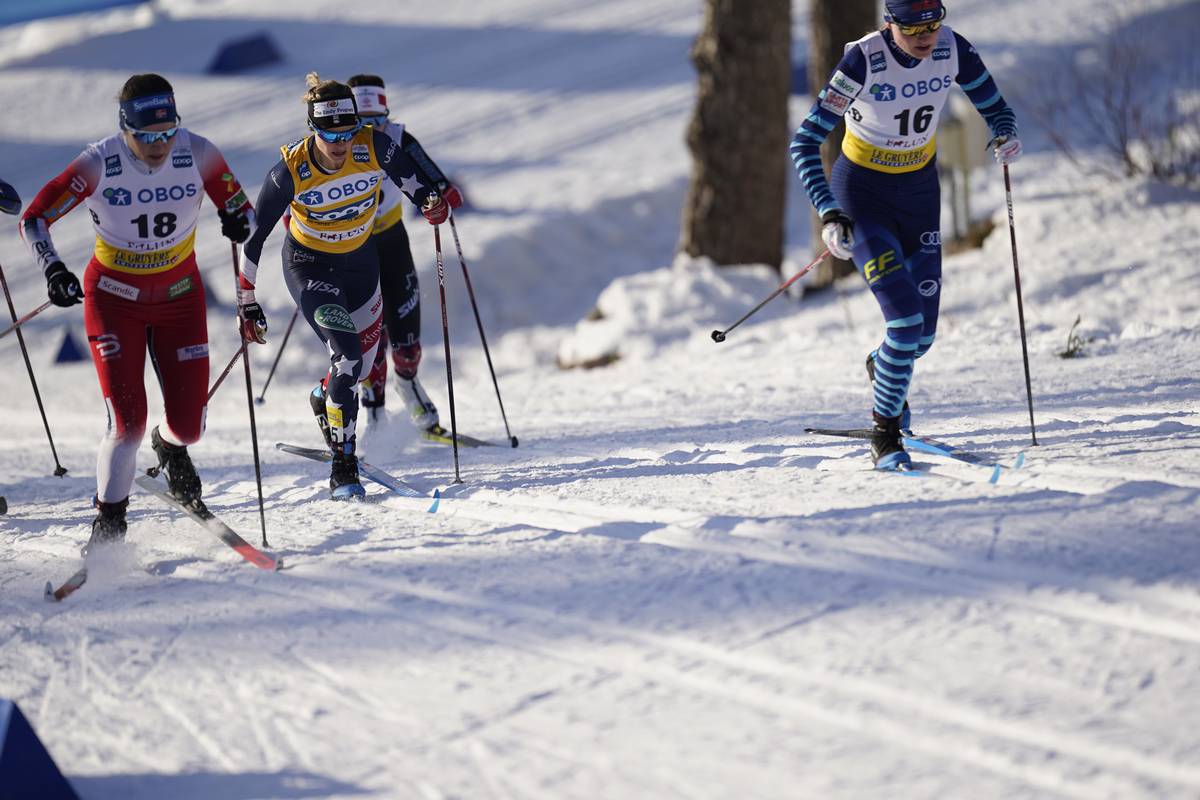
Of the Americans in the heats, Jessie Diggins was the top qualifier in 15th, with Rosie Brennan 20th and Sophie Caldwell Hamilton, back from her mid-season Vermont training camp, in 25th.
During the first heat of the quarters, Diggins looked confident in her tactics, sitting in the middle of the pack. Making assertive moves to seize optimal tracks, she swung wide in the final curve to set herself up to capitalize on her double pole as she sprinted her way from fourth to first. Diggins ceded time at the line to Sweden’s Linn Svahn to finish comfortably in second.
Jessie Diggins skis to 8th in the classic sprint in Falun, Sweden. (Photo: NordicFocus)
Racing in the first heat of the semis, Diggins looked to be employing a similar tactic of patiently waiting to pounce in the back half of the loop. Heading up the second climb in the 5th spot, she began to hammer, but by that time, Svahn and Norway’s Tiril Udnes Weng had created a small gap she could not close. Challenging Anna Dyvik of Sweden, Diggins powered over the final roller and worked her double pole, but was unable to make up any ground and finished 4th.
This ended Diggin’s day, putting her in 8th place overall.
“Whew, today was exhausting!” wrote Diggins after the race. “I think all the all-out efforts in the cold finally started to catch up to me, as I was definitely getting pretty tired in my semifinal. But I was really proud of how I skied today – especially in really tricky kicking conditions with steep hills and tracks that were deteriorating, and a ton of herringbone out there! It’s a very encouraging step forward in my classic technical skiing. We also had great skis which is always important!”
Advancing from the second heat of the semis, Slovenia’s Anamarija Lampic took the lead to pull the group through a fast heat. A few meters back, Sweden’s Jonna Sundling edged out Ane Appelkvist Stenseth and fellow Swede Hagström in a tight finish, which allowed all three women to advance to the final.
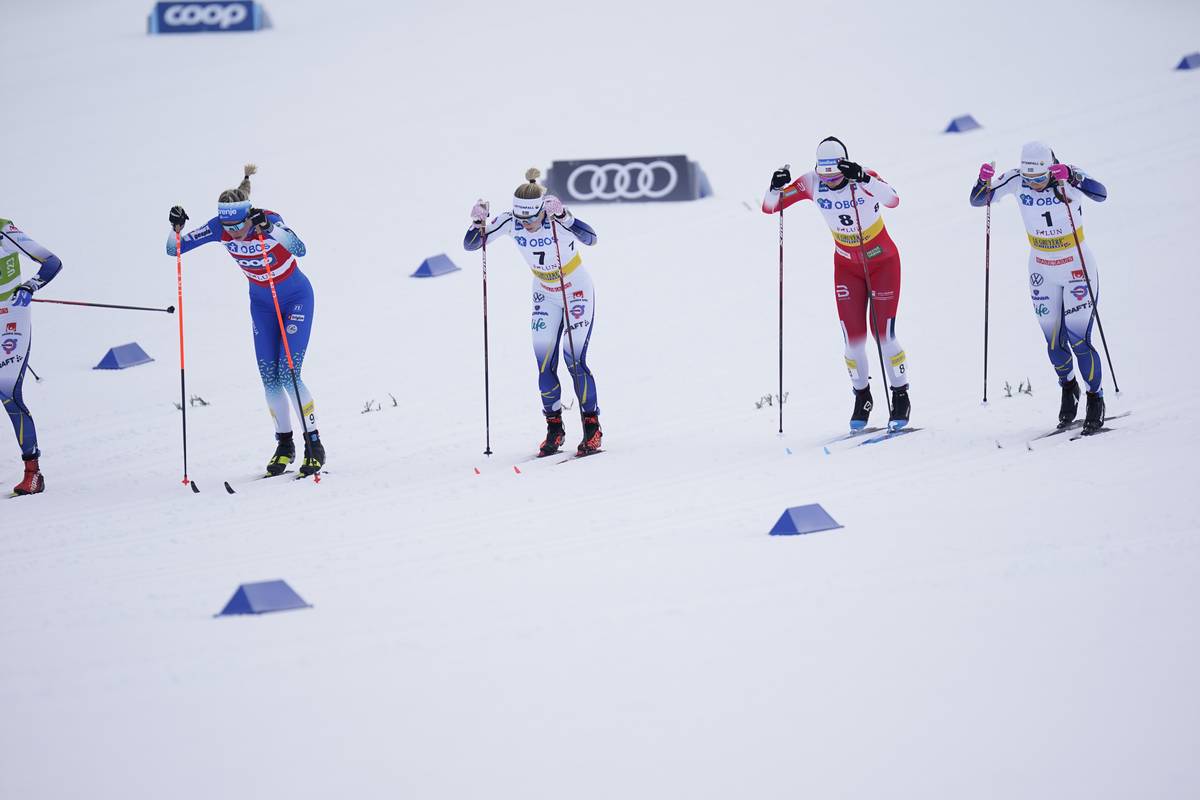
Poling in sync, the final round of the classic sprint in Falun takes to the tracks. (Photo: NordicFocus)
Let’s regroup. Three Swedes, two Norwegians, and one Slovenian in the final: Svahn, Sundling, Hagström of Sweden; Weng, Stenseth of Norway; and Lampic of Slovenia. The two semifinal leaders, Svahn and Lampic, pushed the pace from the front, up and over the two significant climbs. Sitting in a tuck to conserve energy for a final sprint over the roller and toward the lanes, Svahn was on the tails of Lampic, with Sundling just behind. The Swedes gained ground over the roller, setting up an exciting race down the finish lanes.
Anamarija Lampic and Linn Svahn push the pace during the final round of the classic sprint in Falun, Sweden. (Photo: NordicFocus)
With the line just moments away, Svahn simply attacked the ground with her double pole, pulling ahead for a back-to-back win in Falun.
Just behind, Lampic and Sundling were virtually tied as they crossed the line in a photo finish. Though times were the same to the hundredth of a second, Lampic was declared second and Sundling third.
Linn Svahn takes back-to-back wins in Falun, while Anamarija Lampic and Jonna Sundling slide in for the remaining podium spots. (Photo: NordicFocus)Anamarija Lampic (SLO) edges out Jonna Sundling (SWE) for second place in the classic sprint in Falun, Sweden. (Photo: NordicFocus)
“I’ve been feeling a little bit tired since yesterday’s race, but it’s so fun to compete in Falun. I really enjoy racing on a home course, so it was a good day,” Svahn told FIS at the finish.
Despite her age, this is 21-year-old Svahn’s 7th individual win in a World Cup sprint, split almost equally between skate and classic. It is also her second consecutive classic sprint victory on the Falun tracks, as she stood atop the podium in February 2020, also alongside Sundling third place.
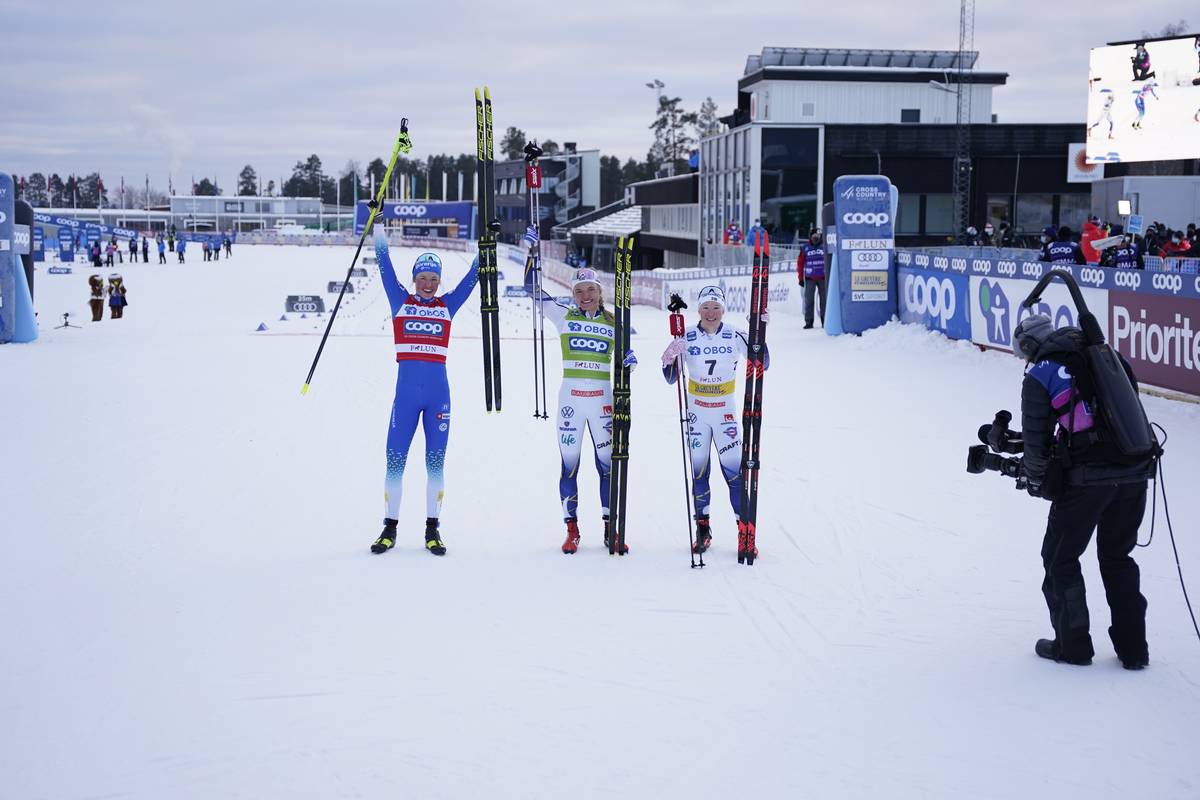
The women’s classic sprint podium in Falun. Linn Svahn nailed her second consecutive win on the course, with Anamarija Lampic (SLO) second, and Jonna Sundling (SWE) third. (Photo: NordicFocus)
Svahn was also asked about the close finish and whether she was sure of her win in the moment.
“I’m never sure of a victory until I pass the finish line first, but it’s cool to see how many strong girls we are competing in sprint races. I think the levels are really high now and it’s tough to win each race, but I’m really glad I managed to do that today, especially in a classic sprint, because it’s my goal this year.”
Looking back, Brennan raced in heat 4 of the quarter finals, where she finished 4th, unable to advance. This left Brennan in 19th overall.
Powering uphill, Rosie Brennan skis her way to 4th in her quarterfinal in Falun, Sweden. (Photo: NordicFocus)
After a conservative start, Caldwell Hamilton skied her way into 2nd position at the top of the intermediate climb. Looking strong as she transitioned from double pole into diagonal stride over the last roller, she held her position around the final curve and into the finish lanes. Swinging around her and quickly closing the gap with her double pole, Sweden’s Hanna Falk overtook the American in the final meters. As the second heat ended up the fastest, Caldwell Hamilton was not able to advance and ended her day in 16th.
“Today was a really solid race for me,” wrote Caldwell Hamilton in a post-race email. “It wasn’t my best, but it was my first time skiing the heats in a classic sprint this year (actually probably in 11 months) and after a qualifier that felt so-so, I was happy with how I skied my quarter. Falun is a very tough course with some big climbs and technical downhills, but I like those features in a classic course.”
Sophie Caldwell Hamilton crests the intermediate climb on the sprint tracks in Falun, Sweden. (Photo: NordicFocus)
“After the first few races of the tour, I took the opportunity to spend a few weeks at home in Vermont during a time where I wouldn’t be missing many sprints,” Caldwell Hamilton continued. “It was such a nice break and I had skiing at the nordic center our neighbors own, Wild Wings, that I could ski to from my house, so I was a pretty happy camper to just spend some time at home doing some solid training and taking a break from the World Cup scene. Now I feel mentally and physically recharged and ready to take on the last couple months of the season! My qualifier today felt a little like I hadn’t done an effort like that in awhile, but I think every race effort will help make that feel a little more normal.”
Jessie Diggins and Canada’s Katherine Stewart-Jones (bib 29) climb side by side during the first heat of the quarterfinals in the classic sprint in Falun, Sweden. (Photo: NordicFocus)
After qualifying in 29th, Canada’s Katherine Stewart-Jones landed in the first heat of the quarterfinals with Diggins. Stewart-Jones held strong with the lead group through the second climb, but fell off the pace to finish last in the heat, just behind Norway’s Anna Svendsen. Stewart-Jones was 30th in the final results.
Outside the rounds, Julia Kern qualified in 35th (+12.95), Hannah Halvorsen 56th (+22.59), and Alayna Sonnesyn 65th (+30.2).
Maya Macisaac-Jones (CAN) races to 54th in the qualifier of the Falun, Sweden classic sprint. (Photo: NordicFocus)
Racing for Canada, Dahria Beatty qualified 48th (+17.29), Maya Macisaac-Jones 54th (+21.77), and Laura Leclair 58th (+24.77).
Jessie Diggins (yellow bib) strides amidst a pack of contenders during the 10 k mass start classic in Falun, Sweden. (Photo: NordicFocus)
This World Cup coverage is made possible through the generous support of Marty and Kathy Hall and their A Hall Mark of Excellence Award. To learn more about A Hall Mark of Excellence Award or to learn how you can support FasterSkier’s coverage please contact info@fasterskier.com.
In case you missed it, yesterday’s 10-kilometer skate in Falun, Sweden was a standout day for the Americans, highlighted by a gutsy victory by Jessie Diggins. How deep into the well Diggins explored was evident in her writhing and occasionally dry heaving body at the finish as she regained enough oxygen and composure to stagger to the leader chair. She upset the prolific Norwegian distance champion Therese Johaug, whose 66 World Cup distance victories both garner immense respect and some frustrated “She won again…” comments from non-Norwegian followers.
But the story does not end there. Rosie Brennan skied to 8th and Sadie Maubet Bjornsen landed in 10th in her first World Cup race of the season. Three in the top 10 in a full field hungry to to prove their mettle before World Championship selections are solidified. Not a bad day in the office.
On the front lines, Jessie Diggins (left) and Rosie Brennan (right) take to the course during the 10 k mass start classic in Falun, Sweden. (Photo: NordicFocus)
In today’s 10 k mass start classic, the excitement builds a little differently. Versus a drawn out rise in excitement as the splits of the seeded group fly by the various checkpoints, today was head-to-head, with all eyes on what Johaug’s rebuttal would be and how the American’s (and Swedes and Russians and the remaining Norwegians, for that matter) would respond.
Mass start and classic technique, in which Johaug excels. Conversely, Diggins’ has struggled to achieve the same results in classic as skate, though she has displayed marked progress this season.
Jessie Diggins watches her finish time hold up against distance champion Therese Johaug in the 10 k skate in Falun, SWE. (Photo: NordicFocus)
In a pre-race interview, FIS phrased the question to Diggins as this. “What are you in for today?”
“Oh boy! [It’s] a very different race!” she laughed. “I’m very excited to give it my all. All you can give on race day is your own effort. I’m looking forward to crossing that finish line knowing I gave it everything I had. For me, if I can do that, then it was a good day.”
Awaiting the gun to send them off, the athletes quietly slid back and forth in the squeaky frozen tracks, keeping nerves at bay and blood flowing in the single digit Fahrenheit temps. Skiers familiar with an outing in such conditions understand the sounds that go along with these conditions. The cacophonous start sounded like a lightsaber battle.
Germany’s Katharina Hennig (center) chases Therese Johaug (NOR) with Ebba Andersson (SWE) in pursuit. (Photo: NordicFocus)
It was clear early that Johaug and her teammate Heidi Weng wanted to push the pace. They attempted to pull away from the group in the opening kilometers creating a small gap. But in the first downhill back toward the stadium, Diggins gave them something to worry about. Her skis like rockets, she overtook them in the descent, slingshotting around the curve and into the lead as they lapped through the stadium.
In fact, no one could break away. Not even the breakaway specialist Johaug. At the 5 k mark, the top-10 skiers were separated by less than two seconds, with Diggins sitting fifth, smack in the middle.
Left to right, Heidi Weng (NOR), Jessie Diggins, and Frida Karlsson (SWE) stride toward the finish of the 10 k classic in Falun, Sweden. (Photo: NordicFocus)
After a sprint bonus point opportunity at 5.8 k, which was narrowly snagged by Johaug over Sweden’s Ebba Andersson, the pace began to accelerate. At roughly the 6.5-kilometer mark, Johaug began her surge, creating a new gap of a couple seconds by the subsequent top of the climb. But the slinky phenomenon repeated itself, as Andersson, Linn Svahn, Katharina Hennig, and Weng closed the gap on the descent to the stadium. Diggins fought hard to maintain contact, tucked in behind Sweden’s Frida Karlsson just behind the leaders with a train of chasers close on their tails.
With 1 k of downhill and fast terrain to go, this pack was still tight, Svahn and Hennig pushing from the front. An ill-timed crash on a downhill curve took Anderson, who had been in 4th, out of contention, but one could not look away as five remaining women flew toward the finish.
Hammering the uphills, Johaug crested the final sustained climb in the lead, tucking as she pushed into the final sweeping downhill. Svahn stayed tight in the corner, hugging the v-board and capitalizing on her fast skis to sneak by Johaug on the inside. The Swede held herself less than a ski-length ahead of Johaug over the final rollers and into the finish lanes. At that point, it was all over; Johaug was no match for the sprint star’s closing speed.
Linn Svahn (SWE), Katharina Hennig (GER), Therese Johaug (NOR), (l-r) closing down on the finish line on Saturday. (Photo: NordicFocus)Linn Svahn (SWE), Yulia Stupak (RUS), Katharina Hennig (GER), Therese Johaug (NOR), (l-r) poling in for a tight finish. (Photo: NordicFocus)
Poles whipping in double pole fury, Svahn held her ground at the front to stop the clock at 25:57.1. Meanwhile, Russia’s Yulia Stupak sprinted past Johaug in the final meters to take second (+0.4), while Hennig forced the final podium position to be decided by photo. It was determined that Johaug held onto third (+0.9).
The women’s 10 k mass start classic podium: Yulia Stupak (RUS) second, Linn Svahn (SWE) first, and Therese Johaug (NOR) third (l-r). (Photo: NordicFocus)
“I was really looking forward to competing because I’ve been home since the Tour de Ski and I felt pretty strong the last week,” Svahn told FIS after the race. “I just tried to keep my focus on the course and do everything right. When they couldn’t get a gap on the last uphill, the hardest uphill, I thought, ‘Well, now it’s my turn to try to do my best to the finish line.’
“I felt strong and had really amazing skis,” Svahn continued. “It was a victory for the whole team, especially the waxers, because my skis were unbelievable.”
In a gutsy finish, Sweden’s Linn Svahn takes the win in the Falun 10-kilometer mass start classic. (Photo: NordicFocus)
Yana Kirpechenko (RUS) finished at the back of the tight lead group in 5th (1.9), with Norway’s Helene Fosseholm bringing in the chase pack in 6th (+7.7), Diggins 7th (+8.3), and Weng 8th (+8.8).
“Today was awesome,” wrote Diggins in an email. “We had really competitive skis, and I actually have been loving how cold it is because when it’s cold like this I feel like I can just keep pushing and pushing my body! This course had a lot of power striding, and I was just focused so hard on keeping my technique as together as I could with a flooding body. I was sending it as hard as I could the entire race, and I’m very proud of that effort. And fun to be so close to the front in a classic race!”
Jessie Diggins, filling the lungs after placing 7th on Saturday. (Photo: NordicFocus)
Sadie Maubet Bjornsen was next up for the Americans, finishing in a pack of chasers in 15th (+35.7).
“Another exciting day of racing in Falun here,” Maubet Bjornsen emailed. It is the first time in a while that I have started a ways back in a mass start, and boy, it is a different type of racing! Huge respect for all those who put together amazing races from that position! I kind of felt like I was burning matches more than I would have loved just trying to weave my way through.
“I was once again feeling encouraged by these first races. With five weeks away from hard intensity as I have worked through a back injury, my huge achievement was making it to the finish line. Classic has been particularly tough for it, so today was a real wild card. But I had some really encouraging feelings, and I look forward to working towards more exciting feelings in the weeks to come.”
Back on the World Cup, Sadie Maubet Bjornsen puts together solid back to back distance results with a 15th place finish in the 10 k classic mass start in Falun, Sweden. (Photo: NordicFocus)
Maubet Bjornsen took her first long-term absence from international skiing recently. During the pandemic, she has remained mostly in Anchorage, Alaska working and training.
“After spending 11 months away from [World Cup] racing, this weekend has been particularly fun to just kind of re-remember how this works. I haven’t yet raced without spectators, and I will say it is a different feeling. It almost feels like a super serious summer time trial. You hear your coaches cheering more than ever, which is kind of fun in a new way! It kind of takes racing back to the core, which is special.”
Outside the top-30, Rosie Brennan took 33rd (+1:15.6), followed by Katharine Ogden in 42nd (+1:49.1), Sophia Laukli 50th (+2:37.1), Caitlin Patterson in 51st (+2:41.2), and Alayna Sonnesyn in 56th (+3:33.2).
Post-Race Comments from U.S. Head Coach Matt Whitcomb.
Rosie Brennan finishes 33rd in the 10k mass start classic in Falun, Sweden. (Photo: NordicFocus)Face covered at the finish, Katharine Ogden skied to 42nd in the 10 k mass start classic in Falun, Sweden. (Photo: NordicFocus)
Leading the Canadian women with her second individual top-30 in two World Cup stops was Katharine Stewart-Jones in 17th (+36.2), her career best individual result at this level. Despite a string of wins and podiums last season, both domestically and in Opa Cup events, and a top-30 finish in the 2020 Scandinavian World Cup Ski Tour, a seemingly break-through season, Stewart-Jones was not named to the Canadian national team for 2020/2021. Another top-20 result will automatically qualify her to make the team next season.
“It was a super fun race,” Stewart-Jones wrote after the race. “The pace went out hot but I knew it was the type of course where gaps are hard to make but also hard to close so my goal was to get myself into a good position in the first lap and hold on. The techs did an awesome job with my skis which helped me relax both on the downhills and climbs.
“Overall I’m just extremely happy to be back racing and also very excited about how the team has been performing so far. Cendrine [Browne’s] result yesterday was really inspiring and I am confident that this is just the beginning for our team.”
Stride and glide: Canada’s Katharine Stewart-Jones (bib 35) and Sadie Maubet Bjornsen (bib 24) work their way toward the finish of the 10 k mass start classic in Falun, Sweden. (Photo: NordicFocus)
Cendrine Browne rounded out the Canadian finishers in 38th (+1:45.1). The race saw 60 finishers.
The women’s 10 k skate podium from Falun, Sweden: Therese Johaug (NOR) second, Jessie Diggins (USA) first, and Ebba Andersson (SWE) third, (l-r). (Photo: NordicFocus)
Leave no doubt to your imaginations, Jessie Diggins, in-form and yellow-bibbed as the World Cup leader, stamped her authority on the 2021 season with gusto in Falun, Sweden. She won the 10-kilometer individual skate on Friday in 23:35.9.
This was Diggins’s eighth individual win on the World Cup — all have been in skate.
With the sun hanging on the horizon and unable to warm the air above squeaky-snow-cold, this was a key opportunity to shine for Diggins. One would assume, and perhaps not incorrectly, that this would be another Therese Johaug win. The Norwegian star has been a near, if not certain lock, for distance wins in recent years.
At 4.4 k, Diggins and Joahug, who began in bib 57, while Diggins started 31st, were in a virtual tie: Johaug came through the time check pipping Diggins by 0.5 seconds.
Yet 2.3 kilometers later, Diggins flexed, building an 8-second lead over Johaug. That flex was intermittent as Johaug, as she does, roared back and clawed those eight seconds back to lead by 0.1 seconds at the 7.7-kilometer mark.
Jessie Diggins locked in for the win: Falun, Sweden 10 k skate. (Photo: NordicFocus)
Talk about tension builders as Diggins sat in the leader’s chair, knowing that the preeminent women’s skier of this generation was hunting yet again for a win. With 0.9 kilometers to go, Johaug led by 1.1 seconds over Diggins. The high tempo, the palmarès, the legacy, all that remains in place for Johaug. But on this day, she faded by two strokes of the second hand to place second (+2.1) behind Diggins. As U.S. Head Coach Matt Whitcomb noted in a post-race interview, with such a small lead at the top of the course (the apex of the “big Morderbakken”), he felt confident, although not certain, in the win for Diggins.
“Wow, it’s really crazy, I cannot really believe it,” Diggins told FIS after the race. “I think if I had to design the perfect course for me this would be it. It was cold. I had amazing skis, the downhills were so fun they were so crazy, and the uphills are so hard, I was just thinking it was like a video game for me.”
Therese Johaug (NOR) skating down the final straight in Falun. (Photo: NordicFocus)Therese Johaug of Norway toeing the line in the 10 k skate: Falun, Sweden. (Photo: Nordic Focus)
Second place remains an atypical position for Johaug. The stats speak for themselves.
Johaug has won 66 World Cup distance races, a record.
Since the 2018/2019 season, Joahug has won 29 of the 33 distance races she has contested.
Of the last 16 skate distance races she has entered on the World Cup, Johaug had won them all, a streak extending back to March 2016.
Sweden’s home squad was represented by Ebba Andersson on the podium, in third, 14.6 off Diggins’s time.
Ebba Andersson of Sweden racing to third on the day. (Photo: NordicFocus)
The U.S. had two other skiers in the top-10: Rosie Brennan finished eighth (+59.1), and Sadie Maubet Bjornsen 10th (+1:01.5). This was Maubet Bjornsen’s first World Cup race of the season as she had decided to focus on training and school during the early part of the World Cup schedule.
“We skied a very confusing 10k course that had us on three different loops so being aware was very important,” emailed Brennan. “We also saw transformed, man-made, and fast snow for the first time this season. Despite the very cold temperatures, the snow was fast and the course had some tricky downhills to navigate as a result. I love individual start races so I wanted to start hard and see what my body had in it as we move further away from the Tour de Ski. My body felt better than last week so things are coming along and on track for being in top shape for the World Championships. I am pleased with my effort today and for holding a steady pace throughout the race.”
Rosie Brennan for the U.S. remains in top shape as she placed 8th on Friday. (Photo: NordicFocus)In her return to World Cup racing, Sadie Maubet Bjornsen skied to 10th in the Falun, Sweden 10 K skate. (Photo: NordicFocus)
Beyond the three skiers in the top-10 for the U.S., Sophia Laukli placed 41st (+2:18.4), Caitlin Patterson 42nd (+2:19.5), Katharine Ogden 48th (+2:33.1), Julia Kern 55th (+2:50.7), and Alayna Sonnesyn 58th (+2:52.2).
Post-Race Interview with U.S. Head Coach Matt Whitcomb.
Canada entered four skiers in the race, with Cendrine Browne placing in the points for the second consecutive weekend. Browne placed 23rd (+1:44.4). This was Browne’s career-best individual World Cup result.
Cendrine Browne of Canada placed 23rd on Friday, a career-best World Cup result for the Canadian. (Photo: NordicFocus).
“Today I knew my legs weren’t 100%,” Browne emailed. “But as my coach Louis says, sometimes you can have bad legs and still have a good race. I also knew there would be a lot of one skating in the course; my specialty. So I focussed on that, putting a lot of energy into the flats and gradual sections. And it paid off! I’ve always loved this course because of all the one skate sections! My first top 30 was here 3 years ago.
“In today’s race, I pretty much skied alone during the whole race. Stupak, who was starting behind me, caught me on the Murderbaken when there was approximately 1km left to the race. I stuck with her and I’m glad I did because that last hill was very difficult.”
Also for Canada, Katherine Stewart-Jones placed 36th (+2:11.2), Dahria Beatty 59th (+2:52.3), and Laura LeClair 66th (+3:26.2).
Hands up for the uncontested Norway win, Heidi Weng clutching the 4 x 5 k relay victory in Lahti, Finland. (Photo: NordicFocus)
This World Cup coverage is made possible through the generous support of Marty and Kathy Hall and their A Hall Mark of Excellence Award. To learn more about A Hall Mark of Excellence Award or to learn how you can support FasterSkier’s coverage please contact info@fasterskier.com.
It was a foggy morning for the women’s 4×5 k relay in Lahti, Finland. With temperatures above freezing and high humidity, the scene was less of a winter wonderland and more of a pea soup. A low visibility scene in which eleven teams lined up at the start line with nine nations represented. On paper, this was Norway’s race and after yesterday’s podium sweep in the 15 k skiathlon there seemed to be little doubt the Norwegian women were on form. To find the last time the Norwegian women failed to win a World Cup relay one must go all the way back to 2011 in Rybinsk, Russia when Italy bested the field. A major side note – the Norwegians were not present in Rybinsk. One must dig deeper into the records, way back to 2009 in Beitostølen, Norway when the Norwegian’s finished second to the Swedish women. Needless to say, the Norwegian women proved themselves peerless once again and topped the field, with a cumulative time of 49:34.4 on Sunday in Lahti.
Gold again. The Norwegian women celebrate as Heidi Weng crosses the line in first. (Photo: Nordic Focus)
Through the first 2.5 k of toady’s race, a pack of seven women skied together, among them Tiril Udnes Weng who started for Norway and Rosie Brennan who held the scramble leg for the U.S. As the first leg neared to a close Johanna Matintalo of Finland and Charlotte Kalla of Sweden (recently returned to the World Cup circuit), pushed the pace to stretch the group out ever so slightly. Weng tagged off to Theresa Johaug, yesterday’s skiathlon winner, who was closely shadowed by Kerttu Niskanen of Finland, Emma Ribom of Sweden, Jessie Diggins of the U.S.A., and Natalia Nepryaeva of Russia.
No other place for Therese Joahug (NOR) than off the front. (Photo: NordicFocus)
At 6.3 k Johaug (NOR) made her move to the front and turned on the burners, blasting away from the rest of the field in classic fashion. However, the chasers weren’t going to let Johaug stride away uncontested and at 7.5 k Johaug was just +1.6 seconds up on Kerttu Niskanen of Finland with Sweden, U.S.A., and Russia not far behind. By the time the second-leg skiers had completed 5 k, Johaug had widened the gap to +6.9 ahead of Niskanen, while Diggins, further back, tagged off to teammate Sophia Laukli with a margin of +24.5 to the lead.
Helene Marie Fossesholm (NOR), young yet ready for podiums on the World Cup. Here she paces Norway on the third leg of the Lahti 4 x 5 k relay. (Photo: NordicFocus)
Nineteen-year-old Helen Marie Fossesholm, who had a podium debut in yesterday’s skiathlon, commanded the first skate leg for Norway. At 11.3 k she had grown the gap to +15 seconds over Laura Mononen of Finland, with Lovis Modig of Sweden (+34), Anna Nechaevskaya of Russia (+37.5), and Laukli for the U.S. (+39.2) falling in behind.
In an interview with FIS following the race, Fossesholm said, “I had a great day today in the course. The course demands a high level of technical skills, including a high level of stamina which fits me quite well.” Her springy-step and attitude were evident to viewers as the young Norwegian jumpskated the final climb, navigated the hairpin corner and tagged anchor, Heidi Weng, with a lead of +51.8 ahead of Finland.
As the fourth leg transpired, Weng was out on her own, skiing the final two laps largely out of sight of the rest of the field. She crossed the finish line unchallenged to bring home another victory for the Norwegian team.
First bumps, bows, and boot taps, the new COVID-era finish celebrations for team Norway. (Photo: Nordic Focus)
Behind her, Ebba Andersson of Sweden swiftly made up ground on Finland’s anchor, Krista Parmakoski. (Finland I tagged off for the fourth leg roughly 8 seconds ahead of Sweden.) At 16.3 k Andersson caught Parmakoski and as the two skiers climbed out of the stadium for the final time, Andersson accelerated away from the Finn, gaining some ground on Weng and finishing +42.9, making it silver for Sweden. Parmakoski stayed strong locking in for third (+59.5).
Ebba Andersson (SWE) racing the 4 x 5 k relay in Lahti, Finland. (Photo: NordicFocus)Ebba Andersson (SWE) celebrates silver for the Swedish women at the completion of her anchor leg. (Photo: Nordic Focus)
Today’s relay line-up for the U.S. women looked a bit different than it has in the past. In a pre-race interview with FIS, U.S. Cross-Country Program Director Chris Grover said, “It’s an interesting relay for us. We have a couple of women with a lot of experience, Jessie and Rosie, but we also have a woman that this is her first World Cup weekend, Sophia Laukli, skiing for us, and also Caitlin Patterson.”
U.S. skiers who have been recent members of the U.S. women’s relay team, most notably Sophie Caldwell and Sadie Bjornsen, are not racing in Lahti.
Rosie Brennan (USA), Laura Gimmler (GER), Yana Kirpichenko (RUS), (l-r) during the scramble leg. (Photo: NordicFocus)Caitlin Patterson (USA) finishes her anchor leg for the American team. (Photo: Nordic Focus)
“We are missing a few of our women… so it’s going to be a little bit of a different experience for us and we actually are doing something that we don’t often do and that’s putting Jessie and Rosie in a classic leg, so they’re up front and hopefully we learn a little bit about what their classic performances can be like in a relay.”
The U.S. team ultimately finished fifth (+1:48.6), positioning themselves in back of Russia (+1:30.7) in fourth overall.
Sophia Laukli of the U.S., paces the U.S. on the third leg of Sunday’s 4 x 5 k relay. This was Laukli’s second World Cup start. (Photo: NordicFocus)
The twenty-year-old Laukli spent the past week racing at Norwegian Nationals before making the trip to Lahti for her World Cup debut. In an email to FasterSkier she wrote, “The races in Norway, I think, definitely helped prepare me more for the World Cup races. It was a pretty intense environment and quite a step up from the college racing I’m used to. So, it was good for me to have the Norwegian National races under the belt to get a little more comfortable with this higher level racing. I also think it helped to come off those races right into the World Cup so I was already in that racing mindset. I’m definitely someone who races into shape so being able to race in Norway and quickly transition to the World Cup worked to my advantage.”
Regarding her position as leg three in today’s relay Laukli said, “it’s safe to say I was a little stressed and nervous for the relay, just from knowing the past successes of the US women. I tried not to put too much pressure on myself, although that was easier said than done. The other girls were really great though and making sure I felt no huge expectations, and that I should just focus on skiing my own race. That was really helpful to hear. Once I started my leg and in the end, it was really just a lot of fun and I feel super lucky to have gotten to do a relay for my 2nd [World Cup] race!”
Natalia Nepryaeva (RUS), Jessie Diggins (USA), Emma Ribom (SWE), (l-r) during the 4 x 5 k relay in Lahti, Finland. (Photo: NordicFocus)Jessie Diggins during the second leg of the relay. This was the U.S. skier’s first time on the World Cup slotting into a classic relay leg. (Photo: NordicFocus).
Diggins, who skied the second classic leg as opposed to her traditional spot as skate anchor, said, “After a decade of anchoring the US relay team, I was very excited to try something a little different! For the first time in my life I asked to ski a classic leg and it was really fun to try something new. I think skating will always be my first love, but I’m finding a better relationship with my classic skiing over the years and this was a great place to work on improving it!”
The American women huddle at the finish line after finishing 5th in the relay. (Photo: Nordic Focus)
“The highlight of my day was, of course, getting to hand out the socks and put the USA face paint on our guys and gals,” Diggins continued. “I love the team spirit of relay day and it keeps racing fun! Really proud of this team (the men’s and women’s) for giving it our all this morning!”
Cendrine Browne (CAN), third leg of the 4 x 5 k relay in Lahti, Finland. (Photo: NordicFocus)
The Canadian team, consisting of Katherine Stewart-Jones, Dahria Beatty, Cendrine Browne, and Maya Macisaac-Jones finished eighth. This is Canada’s first weekend of World Cup racing after missing Period One and the Tour de Ski.
Anne Kyllönen (FIN), Dahria Beatty (CAN), Katharina Hennig (GER), (l-r) on leg 2 of the 4 x 5 k relay in Lahti, Finland. (Photo: NordicFocus)
Same as it ever was – Therese Johaug with the off the front win. (Photo: NirdicFocus).
In case you missed the discussion on the Devon Kershaw podcast, the Norwegian team made its World Cup return today in Lahti, Finland after nearly two months of training and competing domestically. As predicted, neither their form nor racing gears have not been from this decision. The women in red went 1-2-3 in the 7.5/7.5-kilometer skiathlon, led by powerhouse Therese Johaug who notched her third consecutive win in the event and third career skiathlon win on the tracks in Lahti. Her total of nine career skiathlon wins is a women’s record, surpassing Johaug’s former teammate and one of the most decorated skiers of all time, Marit Bjørgen.
In her usual style, Johaug took command from the start, skiing away from the pack displaying remarkable precision in her technique and metronomic tempo, stopping the clock at 37:45.1.
Therese Johaug drives the pace during the classic leg of the Lahti skiathlon. (Photo: NordicFocus)
As has been remarked before, with the lack of spectators and commentary overlaying the live stream, it’s hard not to be struck by the intensity of the athletes’ breathing. As they kicked, glided, and skated six laps of the 2.5 k course, their lungs pumped at a rate and effort that seemed impossible to sustain. Yes, Johaug had a gap to the chasers from early on, but like the others, her rapid breathing made it abundantly clear that she did not simply walk away with the victory.
“It was so fun to be on the World Cup again,” Johaug told FIS after the finish. “It has been a long time since I was in Kuusamo [for the opening World Cup races in Ruka, FIN], so it’s really good to race here and see all the people in the cross country family again.”
Unlike the teams coming off a two-week break following the Tour de Ski, the Norwegian squad made a quick turnaround from their National Championships, which wrapped up just five days ago in Trondheim. Today’s skiathlon is the second this week that Johaug has raced and won. In fact, with only minimal rearrangement for the second and third spots, the podiums in the two events were identical.
The women’s 15 k skiathlon podium in Lahti, Finland: Helene Marie Fossesholm (NOR) second, Therese Johaug (NOR) first, and Heidi Weng (NOR) third, (l-r). (Photo: NordicFocus)
“My shape has been really good, now and the last weekend. Today, I know that I was starting in the line, so I knew to take it a little bit easy in the first lap and then go hard from the second and the third. I felt really strong today, and of course, I had to do all the job alone, and especially then, it’s really good to stand on top of the podium.”
Norway’s Heidi Weng and Helene Marie Fosseholm – lead the chasers during the skiathlon in Lahti, Finland. (Photo: NordicFocus)
Perhaps the more interesting race to watch unfold happened behind Johaug. When the Norwegian began to pull away in her second classic lap, a small chase pack emerged in her wake, containing Russia’s Natalia Nepryaeva, Sweden’s Ebba Anderson, and Jessie Diggins in stars, stripes, and the yellow overall World Cup leader bib. Diggins striding was strong and confident, as she tucked in behind the other two racers, entering the exchange zone at 7.5 k on their tails and smoothly switching into her skate skis and poles.
The eventual second and third-place finishers, Helene Marie Fossesholm of Norway followed by teammate Heidi Weng apex a corner during the skate leg. (Photo: NordicFocus)
As the first skate lap unfolded, Norway’s Helene Marie Fosseholm and Heidi Weng began to ski off the front of the second group of chasers, which contained names like Olympic champion in the Skiathlon Charlotte Kalla of Sweden and bronze medalist Krista Pärmäkoski of Finland. Wearing the red World Cup distance leader bib, Rosie Brennan also sat comfortably in this group.
Though only 29-years-old, Weng is a veteran compared to Fosseholm, who is only 19. Her results this season indicate she is a name to get to know; she finished 6th overall in the Ruka Triple, and proceeded to earn four podiums during her subsequent time racing on home turf, including a Johaug-like victory in the 10 k skate last week during the Norwegian National Championships, winning by a margin of over 30 seconds. Johaug did not contest this event.
By the 10 k mark, Fosseholm and Weng had caught the group of Andersson, Nepryaeva, and Diggins. The Russian began to fall off the pace, but Diggins was not about to follow suit. The women skated as a unit through the next lap, never separated by more than a second or two.
Jessie Diggins (USA) skiing behind Sweden’s Ebba Andersson and Russia’s Natalia Nepryaeva on Saturday’s 15 k skiathlon in Lahti, Finland. (Photo: NordicFocus)Jessie Diggins (USA) at the ski exchange 7.5 k into the women’s skiathlon alongside Ebba Andersson of Sweden and Natalia Nepryaeva of Russia. (Photo: NordicFocus)
As they left the stadium for their final lap, Fosseholm made a surge, testing her mettle against her more seasoned pursuers. With just over a kilometer to go, she had nearly a seven-second gap, which dissolved much faster than it was formed.
Andersson, Weng, and Diggins powered through the back half of the lap, steadily closing in on Fosseholm. Aerial shots showed the women charging up the final climb, still able to jump skate after nearly 40 minutes of exertion. They V2’ed over the top of the climb, all cylinders firing as they dropped back toward the stadium, around a couple of tight curves and toward the lanes.
Fosseholm could be seen taking nervous glances over her shoulder, knowing the other women had zeroed in their sights and there was no room for error. Luckily for Fosseholm, she had maintained enough real estate to enter the lanes with a clear path to second place (+28.1).
Behind her, it was still anyone’s game. Weng was first into the lanes, but Andersson was by her side and charging, Diggins just behind. With a furious throw of boots at the line, Weng snagged the third spot on the podium (+29.6) with Andersson centimeters behind in fourth (+29.7) and Diggins in 5th (+30.1).
Yellow bibbed Jessie Diggins double poles during the first leg of the 7.5 k / 7.5 k skiathlon. (Photo: NordicFocus)
In a post race interview, Diggins shared insights into the conditions in Lahti and how bomber kick on klister allowed her to ski what she identifies as one of her best classic races on the World Cup. With suboptimal glide in skate, Diggins had to shift her tactics so she could stay in the draft of those in front of her and ultimately left a final slingshot around Andersson and Weng to fight for the podium just out of reach.
“I was excited to dare greatly and try to stay with Johaug as long as possible, just to see and to really push it… In the skate half, it was nice to have those girls to work with. I had to keep adjusting my strategy as I realized how our glide stacked up to their glide. I had to keep changing it around, and I played the only card I had, tactically speaking. It didn’t really work, but it was the only thing I could do in the situation that I was in. I was really proud of that and I think I skied as smart of a race as possible.”
Jessie Diggins leaves everything on the course to finish 5th in the 15-kilometer skiathlon in Lahti, Finland. (Photo: NordicFocus)
Diggins also discussed the team recovery camp in Seiser Alm, Italy, how she manages the balance of increased media attention with training and recovery and her desire to support meaningful causes like the Emily Program, and how “new blood” on the World Cup squad re-energizes the veteran members of the American team.
Maintaining her position in the second group of chasers, Brennan skied to 11th place (+1:07.6), ending her race just ahead of Kerttu Niskanen in a photo finish.
In focus and red bibbed as the World Cups leading distance skier, Rosie Brennan near the start of the 15 k skiathlon in Lahti, Finland. (Photo: NordicFocus)
“It’s always hard to know how the body is going to bounce back from an event like the Tour de Ski,” wrote Brennan in an email after the race. “As a result, I decided to start controlled and then see what I had when I switched to skating. I felt much stronger in classic than I have all season and as a result maybe should have been more aggressive in the classic leg, but hindsight is always 20/20. After the transition to skate, my muscles struggled a bit, but I found better movements and strength as the skate portion went on. There wasn’t much space to move in the skate portion and I feel I missed some moves that I shouldn’t have, but had a strong final climb to move up a bit. In all, I feel this race was a really good step in the right direction for me as I am now focused on preparation for the World Championships.”
Rosie Brennan finishes strong in the chase pack for 11th place in the 15-kilometer skiathlon in Lahti, Finland. (Photo: NordicFocus)
A quick look to the overall World Cup ranks. With today’s results, Diggins remains at the top of the overall leaderboard with 991 points and also ties Brennan for the top spot in the distance standings with 401 points. Brennan remains in second place overall with 824 points, followed by Russia’s Yulia Stupak with 802 points.
In her first World Cup start, Sophia Laukli (USA) skis to 33rd in the Lahti, Finland skiathlon. (Photo: NordicFocus)
Also for the U.S., Sophia Laukli in her first World Cup start raced to 33rd (+3:54.8). Laukli is a member of the US Cross Country D-Team and is a sophomore at Middlebury College in Vermont. Caitlin Patterson was the next American in 37th (+4:33.8), Julia Kern 40th (+6:31.3), and Alayna Sonnesyn 43rd (+6:41.1). Forty-eight skiers finished the race.
This was Canada’s first World Cup appearance this season. Two athletes scored points, Katherine Stewart-Jones in 24th (+3:23.5) and Cendrine Browne in 27th (+3:44.9). Laura Leclair skied to 44th (+6:41.7).
Raw emotion as Jessie Diggins becomes the first North American to win the overall Tour de Ski. (Photo: NordicFocus)
This World Cup coverage is made possible through the generous support of Marty and Kathy Hall and their A Hall Mark of Excellence Award. To learn more about A Hall Mark of Excellence Award or to learn how you can support FasterSkier’s coverage please contact info@fasterskier.com.
Though Devon Kershaw might fairly say “It’s not really cross country skiing,” as a viewer, the grueling climb up the Alpe Cermis is the crown jewel of the Tour de Ski. Sure, it is both impressive and visually appealing to watch beautiful technique and tactical racing, but there is nothing quite like watching racers toil through the lactic burn of grinding their way 400 meters up a ski area, at times with over 40% grade. Wheels come off, gaps close quickly, anything can happen.
Here’s how today shook out.
After nearly 50 kilometers of racing over seven stages, skiers take to the tracks one last time in Val di Fiemme, first for a lap of the sprint course, then soaring along the river banks along the narrow winding track of the Marcialonga, Italy’s WorldLoppet series classic. And, as camera angles altered from shots of the Swedes that set pace down the valley, controlling the narrative from the front while still conserving energy for the climb over the final 2k, to breathtaking aerial views of the frosted valley, it is clear why Marcialonga organizers refer to Val di Fiemme as a “Italian cradle of cross-country skiing”.
An aerial view of the storied venue in Val di Fiemme, Italy. (Photo: NordicFocus)
After a thrilling set of four podium finishes, including back-to-back distance wins in Toblach, all eyes were on Jessie Diggins. She entered the final stage wearing the yellow bib with a lead of 55 seconds in the overall standings. Given the beastly nature of the climb, this time margin certainly did not indicate that Diggins had her first Tour de Ski win in the bag.
To add to the energy, two sprint opportunities for bonus points were available at the 2.5 and 6.6 k checkpoints, this alternate leaderboard adding interest and incentive for sprinters to remain in the Tour.
Linn Svahn on the Alpe Cermis- she helped pace Andersson early in the stage and won three stages in this edition of the Tour. (Photo: NordicFocus)
Point leader and winner of both sprint stages, Sweden’s Linn Svahn charged off the front of the pack at the 2.5 k mark, collecting 15 bonus points with her teammate Ebba Andersson hot on her tails. The two quickly allowed the pack to close the nearly 4-second gap, but Andersson remained at the front, pulling away to create a gap of over 10 seconds at the 6.6 k mark, which she kept as the grade inclined.
Perhaps trying to lure Diggins to push too hard too soon, perhaps she had her eye on the TdS podium, or perhaps just looking to be the queen of the hill and win her first World Cup, it was clear that Andersson wanted to dictate the pace from the front in the back half of the mass start event.
Sweden’s Ebba Andersson takes the stage win, and placed third overall in the Tour. (Photo: NirdicFocus)
Andersson was the epitome of steady as she worked her way up the climb. She could V2 when the grade was humane, and smoothly transitioned between her V1 and the “coach’s skate” required to keep skis gliding on the steepest pitches.
While the Swede remained composed, Diggins displayed the grit and perseverance for which she is beloved as a racer. Though Andersson was more than two minutes back in cumulative time heading into the final stage and the remainder of the field behind her, Diggins left nothing to chance, giving her all as she pushed every meter. Holding her ground, the American kept her time back on the leader even and tight, hovering around nine seconds throughout the climb.
Like everyone, even Diggins rides the struggle bus up the Alpe Cermis. Diggins, however, motored to a Tour de Ski overall win on Sunday. (Photo: NordicFocus)Jessie Diggins racing to second on the stage and first overall in the Tour de Ski atop the Alpe Cermis. (Photo: NordicFocus)
With less than a kilometer to go, head coach Matt Whitcomb cheered from a switchback as Diggins passed, his excited shouts leaving him nearly as breathless as the athletes. Pine boughs tucked into the snow to create the final lanes as Andersson and Diggins headed toward the inflated arch that offered relief from the pain in their bodies.
Ebba Andersson (SWE) chugging along in front for the Stage 8 win. (Photo: NordicFocus)
With the end in sight, Andersson with a poker face V2’ed through the finish while a slack-jawed Diggins held together in V1 to cross the final meters and collapse over the finish line.
Finally, the Tour de Ski victory was hers and she could simply lie in the snow, chest rising and falling with her labored gasps for air. More than a win, this achievement makes Diggins the first American — in fact, the first non-European — man or woman winner in the 15-year history of the Tour. She also sits atop the leaderboard for Overall World Cup standings.
Victory and relief, Jessie Diggins completes the climb up the Alpe Cermis to win the overall 2021 Tour de Ski. (Photo: NordicFocus)Exhausted, Jessie Diggins crosses the line second in the stage to hold onto her lead in the overall Tour de Ski. (Photo: NordicFocus)
“This was a lifelong goal,” Diggins told FIS after her race. “We had an amazing team atmosphere this whole time, and amazing support and help, and so many cheers from around the world — it really gave me wings up the hill today.”
The interviewer asked what this result meant in light of a World Championship season, as completing the arduous Tour in such a year could be seen as a risk. If an athlete cannot recover properly in the subsequent six weeks, their potential on the championship stage could be compromised. Diggins’ answer looked through a wide-angle lens.
“It means so much. I think it’s so cool for our country to show that it’s possible. And now I’m looking forward to resting.”
Jessie Diggins wins the overall 2021 Tour de Ski and sits at the top of the overall World Cup standings. (Photo: NordicFocus)On the top step of the podium, Jessie Diggins is the 2021 Tour de Ski winner. (Photo: NordicFocus)Jessie Diggins becomes the first North American skier to win the Tour de Ski in its 15 year history. (Photo: NordicFocus)
Behind the two leaders, France’s Delphine Claudel crossed the line in 3rd (+32.6). Evidencing the “anything can happen on the Alpe Cermis” sentiment, Claudel sat in 19th in the overall standings leading into the final stage and had never before earned a World Cup podium, though she was 7th in the 10 k skate in Stage 4. The 24-year-old overtook Russia’s Yulia Stupak in the final kilometer, closing a 12 second gap and creating a nearly 8 second one of her own.
Stupak held on for 4th place (+40.0), followed after a gap by teammate Tatiana Sorina (+1:04.3) rounding out the top five.
Yulia Stupak of Russia here on the Alpe Cermis, placed second overall in the Tour. She won two stages, and podiumed in four others. (Photo: NordicFocus)
With this result, Stupak held her ground in second place for the overall TdS standings, finishing 1:24.8 behind Diggins in cumulative time. Andersson’s outstanding climb was a springboard, advancing her from 6th to 3rd (+2:00.8). Recall that Andersson did not make the heats in Stage 1 of the Tour and finished 12th and 18th, respectively, in the second and third stages. Landing on the podium four times in the final five stages fueled her steady rise through the ranks.
Today’s queen of the Alpe Cermis, Sweden’s Ebba Anderson set the fastest time in the final stage of the 2021 Tour de Ski. (Photo: NordicFocus)A good day for Sweden, Ebba Andersson wins Stage 8 of the Tour de Ski to finish 3rd overall, while Linn Svahn takes home the victory in the point standings. (Photo: NordicFocus)
Adding reason for Swedish team celebration, Svahn was the winner in the point totals, with Diggins in second and Slovenia’s Anamarija Lampic in third.
Rosie Brennan, here in the Alpe Cermis, animated this Tour and finishes a career best 6th overall. (Photo: NordicFocus)
Closing out a career best finish in the Tour de Ski, Rosie Brennan was the 7th woman up the hill (+1:17.8) to finish 6th in the overall standings. Brennan’s previous best finishes in the TdS overall were 15th last season and 24th the season prior.
“I love the final climb because of its simplicity and the feeling of accomplishment of reaching the top,” wrote Brennan in an email after the race. “I knew there was an opportunity to make up some places today so I set out with intention. Unfortunately, I stuck a tip in the powder on the side of the trail on the Marcialonga portion leading into the climb and took another digger. Luckily, I didn’t lose much time, but was then at the back of the pack and knew that if I was going to make the most of the climb, I needed to be ready for the breaks as soon as we hit the bottom. I worked really hard to make up the places that I could and then really went for it when we reached the climb to try to get into the leading group. It was my only option at the time, but definitely took a little more energy than I had hoped. I had a moment of weakness when I hit the first steep pitch and lost the ride I needed to take. I was able to recollect myself and hold strong, but frustratingly missed top 5 by a mere 4 seconds. 6th place is absolutely a career best and I am proud of my effort of fighting back after the disaster that was stage 6, but I always want more of myself and those 4 seconds certainly sting a bit.”
The end in sight, Rosie Brennan finishes 7th in the hill climb and 6th in the overall Tour de Ski. (Photo: NordicFocus)
“It was inspiring to watch Jessie put so much fight in every day and that certainly inspires me to find more,” Brennan continued. “I couldn’t think of a better person to take the yellow bib off my back. I am also really excited to hold onto the red [World Cup distance leader] bib! The Tour de Ski is always a new experience and always requires a lot of fight. I am thankful to have been able to race the event this year and am really looking forward to some recovery!”
Antonia Fraebel (GER) and Hailey Swirbul (USA) behind, during Stage 8. (Photo: NordicFocus)
Hailey Swirbul skied the 15th fastest time today, bumping her up to 18th in the overall Tour standings. The 22-year-old is in good company with this result, considering the only other American women to finish in the top-20 of the Tour de Ski are Jessie Diggins, Kikkan Randall, Rosie Brennan, Sadie Maubet Bjornsen, and Liz Stephen.
Hailey Swirbul, another American high point, placed 15th on the day and 18th overall. (Photo: NordicFocus)
Katharine Ogden finished 24th (+2:34.5) up the climb for 23rd overall in the Tour, while Caitlin Patterson rounded out the Americans in the top-30 finishing 27th (+2:42.9) in Stage 8. Patterson was 34th in the overall TdS standings.
Katharine Ogden V1-grinding on the Stage 8 final climb. (Photo: NordicFocus)Caitlin Patterson climbs to 27th in the final stage of the 2021 Tour de Ski. (Photo: NordicFocus)
Finally, Julia Kern skied to 37th today (+3:41.3) to end the Tour in 38th.
– Gavin Kentch contributed
This story will be updated with additional comments from athletes when available.
Eyes on the clock, the leaders prepare for a 10-kilometer pursuit start classic race in Stage 5 of the Tour de Ski. (Photo: NordicFocus)
This World Cup coverage is made possible through the generous support of Marty and Kathy Hall and their A Hall Mark of Excellence Award. To learn more about A Hall Mark of Excellence Award or to learn how you can support FasterSkier’s coverage please contact info@fasterskier.com.
We have entered the back half of the 2021 Tour de Ski. With five of eight races complete, roughly 45 kilometers raced and a little under 25 remaining, fatigue has set in. While it might be easy to think the storylines are set, in such a grueling feat of endurance, nothing is certain. Crashes happen, wax is blown, recovery compromised.
Whereas Jessie Diggins and Rosie Brennan had the advantage of chasing splits in yesterday’s individual start freestyle, in today’s pursuit start classic the hunters became the hunted. The women took to the course in Toblach, Italy in order based on their results in Stage 4, with their chasers starting behind with the deficit they attained only from the previous day’s race. This put Diggins first out of the gate with Brennan 15 seconds back, Sweden’s Ebba Andersson +22, Russia’s Yulia Stupak +26 and Finland’s Krista Pärmäkoski rounding out the top five starters +31 back. (Start list)
Striding away from the stadium with a target on her back, Jessie Diggins is the first athlete on course during Stage 5 of the 2021 Tour de Ski, a pursuit start 10-kilometer classic. (Photo: NordicFocus)
Her yellow bib like a target on her back, Diggins set out solo with her usual high tempo. Behind her, Brennan was chased by the charging duo of Stupak and Andersson, who caught her by roughly 3k. Brennan hopped onto their tails as the group worked their way toward Diggins.
As head coach Matt Whitcomb predicted in his interview after Stage 4, conditions near freezing made for icy and glazed tracks which led through a variety of sun exposures, meaning athletes could kick up some hills in the tracks, but had to hop out and run to make it up others. In summation: it makes things a little funky out there.
Perhaps this was what caused Diggins to fall just before the 4 k mark. The crash was relatively minor and she was able to quickly bounce back upright, however, it gave the chasing threesome the opportunity to catch and pass the leader.
Stupak and Andersson seemed to try to capitalize on the opportunity, surging as they skied smooth and strong up the subsequent climb with Brennan and Diggins hanging on in their wake.
Russia’s Yulia Stupak charges ahead for the win in Stage 5 of the 2021 Tour de Ski. (Photo: NordicFocus)
Try as they might, the two could not quite lose the Americans, who matched every push to prevent gaps from forming. Living up to her reputation, Diggins worked the downhills in the final kilometers making up for any small amounts of space between her skis and those in front of her that were created on the climbs.
In the final rolling climbs before descending into the stadium, Diggins found a new gear, overtaking Andersson and challenging Stupak for the lead. Coming into the lanes, Stupak’s double pole could not be matched, allowing her to pull ahead by a ski length while Diggins and Andersson fought side-by-side to the line for a photo finish. It was determined that Andersson edged out the American by centimeters, Sweden in second (+0.7) and USA in third (+0.8).
The leading trio: Julia Stupak, Ebba Andersson, and Jessie Diggins enter the finish-straight. (Photo: NordicFocus)Down to the final meters, the top three women — Yulia Stupak (RUS), Ebba Andersson (SWE), and Jessie Diggins — fight for position in Stage 5 of the 2021 Tour de Ski. (Photo: NordicFocus)Yulia Stupak of Russia with the win, as Ebba Andersson (SWE) and Jessie Diggins (USA) lunge for the line. (Photo: NordicFocus)
“So proud of our techs for the skis they made us in tricky warm conditions today!” wrote Diggins in an email after the race. “Wow, that was a tough fight out there. I was really proud of myself for hanging tough and just gritting it out until the end! It was a good test of mental toughness for me after a little fall and getting caught to be able to refocus, stay calm and ski as smart and smooth as I could! It was really important for me to stay with those girls today in terms of overall tour time, and I was just able to hang in there. Super pumped for our team and for another good classic race!”
Fighting hard through another strong 10-kilometer classic performance, Jessie Diggins takes third in Stage 5 of the 2021 Tour de Ski in Toblach, Italy. (Photo: NordicFocus)After a string of podiums in the Tour de Ski, Jessie Diggins is rich with cheese, flowers, and a variety of regionally-significant memorabilia. (Photo: NordicFocus)
After falling back from the leaders in the final k, Brennan held on for fourth place (+17.3).
“Today was a very tough fight,” wrote Brennan in an email to news outlets. “My goal was to lose as little time as possible and then see what I had in me. I went out hard hoping I could find Jessie to ski with but got caught before I found Jessie. It’s the kind of course that is much easier to draft so once we got caught, it was nice to settle in a bit, however, the pace was still high. I fought as best I could but couldn’t keep contact over the top of the big hill. I fought as hard as I could to regain contact but it’s just so much faster in a pack. I fought with all I had today and am proud of that and happy to maintain second in the overall tour.”
Fighting the clock for a solo finish, Rosie Brennan takes 4th in Stage 5 of the 2021 Tour de Ski. (Photo: NordicFocus)
Working together throughout the day, Finland’s Pärmäkoski and Russia’s Tatiana Sorina skied to a strong fifth (+37.3) and sixth (+38.3), respectively.
The women’s podium of the 10-kilometer pursuit start classic of Stage 5 of the 2021 Tour de Ski in Toblach, Italy. Russia’s Yulia Stupak took the win ahead of Sweden’s Ebba Anderson in second and Jessie Diggins in third. (Photo: NordicFocus)
Though margins for the overall TdS standings were narrowed as her win streak came to an end, Diggins remains in possession of the yellow bib with a cumulative time of 1:54.15. Brennan holds strong in second place (+22), with Stupak in third (+58), overtaking Sweden’s Frida Karlsson who was a favorite for the win.
Frida Karlsson drops to 13th after the Stage 5 of the 2021 TdS, a 10-kilometer pursuit start classic in Toblach, Italy. (Photo: NordicFocus)Frida Karlsson, struggling with a tailbone injury sustained from a dislodged pull-up bar, finishes 13th in Stage 5 of the Tour de Ski, sliding back to 4th in the overall standings. (Photo: NordicFocus)
It is unclear whether Karlsson will be able to lodge a counterattack on her seemingly increasing deficit. FasterSkier learned that in an unfortunate accident involving a pull-up bar that let loose from the door frame it was affixed to, the 21-year-old sustained an injury to her tailbone and leg. According to an interview with Swedish news outlet Expressen, Karlsson was not sure whether she would race in Stage 4, let alone finish the tour. This may explain her fall from podium contender to 9th place in the 10 k skate and 13th (+1:20.1) in today’s classic pursuit. Karlsson holds onto fourth place in the overall (+1:29), with Stupak in 5th (+1:53). (This incident is also discussed in The Devon Kershaw Podcast from Stage 4.)
Consistently demonstrating her talent and fitness, Katharine Odgen finishes 20th in Stage 5 of the 2021 Tour de Ski. (Photo: NordicFocus)Steadying herself on her poles, Hailey Swirbul finishes Stage 5 of the 2021 in 22nd with a string of consistent distance results. (Photo: NordicFocus)
Further into the pack, Katharine Ogden and Hailey Swirbul skied to 20th (+2:05.8) and 22nd (+2:07.5). The two started amidst a relatively dense group of ten women in the range of 1:10 to 1:36 behind Diggins. This larger chase group stayed together through much of the course with a few exceptions breaking off the front and back. Both Americans maintained their position in the body of the group, with only a handful of seconds separating a subset of six at the finish. As they were 18th and 20th in Stage 4, Ogden and Swirbul demonstrated remarkable consistency in their solid performances.
Wrapping things up for Team USA, Caitlin Patterson skied to 39th (+3:57.3) while Julia Kern took 41st (+4:04.3).
Modeling the cumulative fatigue of the Tour de Ski, Caitlin Patterson finishes 39th in Stage 5. (Photo: NordicFocus)
Jaw drop. An aerial view of the Toblach Arena, which plays host to Stages 5 and 6 of the 2021 Tour de Ski. (Photo: NordicFocus)
This World Cup coverage is made possible through the generous support of Marty and Kathy Hall and their A Hall Mark of Excellence Award. To learn more about A Hall Mark of Excellence Award or to learn how you can support FasterSkier’s coverage please contact info@fasterskier.com.
Onward with the 2021 Tour de Ski! From the western edge of Switzerland, we’ve landed in the tiny and spectacular Italian village of Toblach. Nestled at just over 4,000 ft of elevation in the Dolomites, bluebird skies illuminated pines wrapped in snow, jagged rocky peaks, and hard pack frosty trails. It’s the kind of backdrop that might make viewers lose focus on the athletes as they stare longingly at the fairytale-esque scene. Just me?
Entering the heart of the Tour, the storyline of individual stages and overall standings are inseparable. As athletes took to the course for today’s individual start 10-kilometer skate, the overall tour contenders focused on optimizing their time margins. Current TdS leader Jessie Diggins aimed to maintain or add to her 5 second lead over teammate Rosie Brennan, and both wanted to keep the Swedish distance star, Frida Karlsson at bay in third (+0:10).
Continuing her streak, Brennan dominates the course in Toblach, Italy during Stage 4 of the 2021 Tour de Ski. (Photo: NordicFocus)
In individual start races, start position can provide two important advantages: firstly, starting behind a comparable athlete might offer the chance to close the gap and either catch a ride or work together to push through the challenging course, and secondly, coaches can feed athletes the splits of skiers who started before them, providing a ghost to chase from checkpoint to checkpoint.
A string of Americans starting in the last four positions were seemingly primed for these two benefits. In order wearing bibs 49 through 52 were Katharine Ogden, Julia Kern, Brennan, and Diggins.
Katharine Ogden on her way to 18th in Stage 4 of the 2021 Tour de Ski. (Photo: NordicFocus)
Conversely, Karlsson started in bib 24, 13 minutes ahead of Brennan. This put the Swede roughly halfway through her race with all the splits that entails as the American leaders left the start.
Karlsson hit it hard. When she passed the 2.1 k checkpoint at which bonus points were available, she set the bar high, stamping a time that stood unmatched at the top. That is until Diggins knocked it down and took the maximum of 15 bonus points. Let that be the first indicator of how Diggins’ day at the office would go.
Unfortunately for Karlsson, it also marked the beginning of a fade.
After a strong start, Sweden’s Frida Karlsson fades to 9th in Stage 4 of the 2021 Tour de Ski. (Photo: NordicFocus)
As this took place, yet another young Swede should catch your eye as she steadily advanced up the live timing ranks: 23-year-old Ebba Andersson. Taking charge in the second half and leading from 6.7 k onward, Andersson set the time to beat at each checkpoint, finishing in a time that was not bested until the final moments of the stage.
Ebba Anderson climbs the leaderboard during Stage 4 of the 2021 Tour de Ski. (Photo: NordicFocus)
And, a familiar veteran with TdS overall podium history, Krista Pärmäkoski, rose to the Stage 4 occasion. Her results have steadily improved during the tour after a disappointing start to the season since the opening weekend Ruka, Finland where she did not make the top-30 in the sprint or distance events. Along with Russian’s Yulia Stupak, who entered Stage 4 in 5th place in the standings (+0:59), and Tatiana Sorina, the top of the leaderboard jockeyed for position as they worked through the woods.
With results steadily on the upswing, Krista Pärmäkoski skis to fifth in Stage 4 of the 2021 Tour de Ski. (Photo: NordicFocus)
With no spectators, it becomes perhaps even more clear just how hard these athletes are working. It’s like having a seat trailside: head coach Matt Whitcomb’s shouts of encouragement unimpeded by his mask, while the high pitched swish of poles striking whipped through the crisp air. With labored breathing for durations mere mortals could not sustain, Diggins and Brennan powered up the final climb, working their way toward the stadium with complete command over the field.
Powerful tempo on display and a look of determination, Brennan powered down the final stretch to knock nearly eight seconds off Andersson’s time. A few seconds later, braids whipping in time with her V2, Diggins lit up the stadium as she ran away with her second consecutive victory, stopping the clock at 25:14.5.
With a final lunge, Jessie Diggins wins Stage 4 of the 2021 Tour de Ski by nearly 15 seconds. (Photo: NordicFocus)At the top of the ranks for the second consecutive 10 k skate, Jessie Diggins takes the Stage 4 win in Toblach. (Photo: NordicFocus)
Piggybacking on their Stage 3 performance, it was another 1-2 performance for Diggins and Brennan (+14.8). The first occasion was history, now — dare we say it — maybe a pattern for this Tour.
This result keeps Diggins at the top of the overall standings with an improved margin of 20 seconds over second place. Standing alongside her teammate on the podium in second place in both the Stage results and overall Tour, Brennan also cushioned her margin for the TdS podium.
Consecutive 1-2 performances for Jessie Diggins and Rosie Brennan in Stages 3 and 4 of the 2021 Tour de Ski. (Photo: NordicFocus)
“Getting a win here in Toblach is so special to me,” wrote Diggins. “This is where my first podium came during the Tour de Ski, and where I first felt that confidence in an individual race that I feel on relay days! It was also special for me to have this be my 30th podium because it feels like a full-circle moment. Just like a super cheesy Netflix show!
“Most importantly, I smiled and had fun and kept the pressure off, just saying “this is my favorite course and I’m going to go out there and see how fast I can ski it!” I loved getting to ski with Julia and having the four of us girls starting right in a row made the start pen such a psyched-up vibe!
“So proud of Rosie and how she’s been crushing it all year, and loving every podium we get to share together! Also, so pumped for Gus for his breakthrough race today! It’s so cool to see this team on fire.”
Rosie Brennan powers through the final meters for a commanding second place finish in Stage 4 of the 2021 Tour de Ski. (Photo: NordicFocus)
“Today was the only individual start race of the tour and is my preferred format so I had a lot of expectations and hopes for myself today,” wrote Brennan in an email. “The course here is challenging with lots of climbing in the beginning and then lots of downhills that require a lot of work and aren’t terribly restful coming back into the stadium. Knowing that, I wanted to make sure I didn’t waste time getting down to business but also wanted to be sure I had enough in me to push all the way to the finish. I felt I did this well and skied a very consistent race, but it was not enough to not lose time to Jessie, especially on the working downhills which I consider her to be best in the world at. That said, I left it all out there and am happy with the way I skied. If I’m going to lose a race, losing it to a teammate is not a bad way to go! More importantly, I gained some time in the overall standings on everyone except Jessie so for the long game, it was a good day. I feel that I am holding up well at the halfway mark of the Tour and really hope I can continue to fight hard in the second half. We made it another day with America 1-2 and that in itself is something to celebrate!”
Andersson’s time held up for third place (+22.2) in Stage 4 with Russia’s Stupak fourth (+25.7), Pärmäkoski fifth (+31.3). Karlsson fell back to ninth (+52.4).
The women’s podium at Stage 4 of the 2021 Tour de Ski. Jessie Diggins clocked the fastest time with Rosie Brennan in second and Sweden’s Ebba Andersson in third. (Photo: NordicFocus)
In the overall standings, Karlsson remains in third place just over a minute behind Diggins, and 42 seconds behind Brennan. Russians Stupak and Sorina sit in fourth (+1:25) and fifth (+1:51), respectively. By earning top points in today’s bonus sprint, Diggins moves to the top of the TdS point standings with 45 points. Karlsson is two points behind in second, with her teammate Linn Svahn trailing Diggins by seven points in third.
Hailey Swirbul racing her way to 20th place in Stage 4 of the Tour de Ski. (Photo: NordicFocus)
While Diggins and Brennan were certainly the highlight of the day, three additional American women clocked strong performances that kept them well inside the top-30. Ogden skied to 18th place (+1:16.9), with Hailey Swirbul close behind in 20th (+1:24.8), and Kern in 25th (+1:35.7). Caitlin Patterson, who was the first athlete on course in bib 1, skied to 39th (+2:12.1).
The first athlete on course in the Stage 4 10-kilometer individual start freestyle, Caitlin Patterson skis to 39th. (Photo: NordicFocus)
Before we conclude, an important update from FIS addressing Slovenia’s Anamarija Lampic’s disqualification in Stage 1. Lampic had brushed skis with Switzerland’s Nadine Fähndrich on the technical downhill less than 500 meters from the finish line during the final, where the two looked to be fighting for the second and third podium positions. It was concluded on the day that Lampic had illegally interfered and impeded Fähndrich, however, that decision has since been overturned in an appeal from the Slovenian Ski Association.
From FIS: “The appeal by the Slovenian Ski Association against the FIS Jury decision of the Sprint F case concerning Anamarija Lampic from 1st January 2021 was partly approved. The Appeals Commission asks to change the sanction to a written reprimand (yellow card). As a consequence, Friday’s Sprint results will be updated and Anamarija Lampic will be ranked as 2nd and Jessie Diggins ranked as 3rd and Frida Karlsson ranked as 4th. Additionally, the decision impacts the Tour Overall standing, the Tour point standing and therefore also the start list of today’s Pursuit competition.”
Anamarija Lampic on course during Stage 4 of the 2021 Tour de Ski. Lampic finished 19th on the day. (Photo: NordicFocus)
This update is reflected in the overall results posted below. Though this moves both Brennan and Diggins down a spot in the Stage 1 results, it does not affect their current standings at the top.
Diggins (USA) lunges for the line after laying it all out to pull away from chasers Brennan (USA) and Karlsson (SWE). Photo: Nordic Focus
This World Cup coverage is made possible through the generous support of Marty and Kathy Hall and their A Hall Mark of Excellence Award. To learn more about A Hall Mark of Excellence Award or to learn how you can support FasterSkier’s coverage please contact info@fasterskier.com.
Sunday, Val Müstair, Switzerland hosted the last of three stages of the Tour de Ski in the picturesque alpen valley. With no fans present, and only traditional cowbells gonging as the audio backdrop, it was clear Jessie Diggins and Rosie Brennan, through their audible lung-gasps, were flexing for the stage win.
Before the drama of the day’s fine racing, first, some context. Last season, there was a new Swedish woman who barnstormed the World Cup. Already Frida Karlsson (21), a distance phenom, and Ebba Andersson (23) had taken bows on the big-stage – both part of a memorable World Championship 4 x 5 k gold medal team in 2019. Then Linn Svahn (21) came smashing through. She won last season’s World Cup sprint globe and returned primed to the Tour de Ski after a month away from the World Cup. (The Swedish National Team withdrew from World Cup competition in early December due to Covid-19 precautions.)
Today, Svahn led out first during the 10 k skate pursuit with a 19 second time cushion over second starter Jessie Diggins. Karlsson began another second behind Diggins, with Brennan the fourth starter (+0:22) .
Jessie Diggins, unleashed from the start and ready for an outrageous 10 k skate. (Photo: NordicFocus)
Frida Karlsson (SWE) digging deep for the finish line, coming in third behind Brennan and Diggins (USA). (Photo: NordicFocus)
It took a single lap of the 2.5 k loop during for Karlsson, Diggins, and Brennan to reel in Svahn. The catch came at 7:40, roughly 2.8 k’s into the race. Up to that point, Karlsson had set the pace allowing the two Americans to sit in her wake.
When the foursome coalesced, Svahn took her place at the back with Karlsson still upfront. Around they went beginning the third lap, Svahn still velcroed on. Yet her adhesion to the group eventually ripped and the sprint star began to bleed time. At 6.2 k she had lost 24.7 seconds to Karlsson in the lead.
Sweden’s Frida Karlsson leading Jessie Diggins and Rosie Brennan. (Photo: NordicFocus)
Here was the podium hustling along and jostling for the final 1-2-3 spots — Karlsson, Brennan, and Diggins. The order of the trio would vary here and there. What became clear around 9 k, was Diggins’ insistence on working every centimeter of the racecourse. Every opportunity to free skate was taken, as was a tuck to streamline as she eventually blasted into the lead. At 24:00 minutes, Diggins was decisive – and frankly impressive. Meter by meter Diggins gained ground on Brennan and Karlsson as she unrelentingly charged into the finish.
Jessie Diggins (USA) closing in on the finish line, followed by Rosie Brennan (USA) and Frida Karlsson (SWE). Photo: Nordic FocusGave it her all, Jessie Diggins (USA) after taking the win ahead of teammate Rosie Brennan (USA) and Frida Karlsson (SWE). (Photo: NordicFocus)Spent: Jessie Diggins stage 3 of the 2021 Tour de Ski. (Photo: NordicFocus)
26:54.1 was her official winning time in what was also Diggins’ first win of the season. Brennan who was as equally coy and powerful, placed second, 5.6 seconds back. Karlsson, perhaps the favored skier coming into the 2021 Tour de Ski, was third (+10.7). Svahn faded to sixth (+1:12.9).
“What a cool day!,” Diggins explained via email. “I was so excited to ski with Rosie and see what we could do out there, and we had great skis to help us on our way! I started out trying to help pull the group, but then nearly imploded in the altitude and spent the next few laps getting my legs back after feeling extremely wobbly! But on our last lap, I realized that once we got over most of the climbing I could still push without fear of totally blowing up, and knew I needed to send it on the downhill as hard as I could. It was such a cool feeling, sprinting it in for a win and getting to wear the yellow jersey. It’s important for me not to put pressure on myself and take the tour one day at a time, but it’s also important to not take these special moments for granted, and to enjoy a few moments knowing how hard so many people have worked to help me get here!”
Focusing: Rosie Brennan in for second overall in the Tour de Ski. (Photo: NordicFocus)
“Today was a day that required some sharp focus but the reward was well worth it,” Brennan emailed. “The fatigue of the tour starts to settle in about this time, but the time of day is what counts towards your overall tour place so it was not a day to only fight for place. I was fortunate to start in a strong group with Jessie and Frida. We are all work horses so I knew it was going to be game on from the start. Frida really took reigns and charged hard the whole race. Being more of a climber I tried to make a move at the top of the climb on the last lap. It worked to get a gap to Frida but also made a perfect launch for Jessie to utilize her fantastic downhill skills. I did my best to follow her counter move but didn’t quite have what I needed. It’s a pretty cool feeling to finish and realize that two Americans are 1-2 in the Tour right now! I am very proud of my effort today because it wasn’t a dream day of feelings in my body.”
Rosie Brennan (USA) celebrates as she crosses the line, taking silver in today’s 10 k pursuit. (Photo: Nordic Focus)
Sunday marked the seventh career individual World Cup win for Diggins which includes a best time of day in a 2018 10 k skate pursuit. Despite a stout classic race on Saturday in the 10 k classic, skating is Diggins’ bread and butter: All of her wins are in skate technique.
In 2018/2019, Diggins placed sixth overall in the TdS. Last season she was ninth overall. Brennan placed 15th overall in the 2019/2020 Tour but has entered this season with profound fitness and drive.
Hailey Swirbul who began in bib 17, moved up four spots to 13th in the stage (+2:03). Katharine Ogden, the 28th starter finished 25th (+3:43.6). Caitlin Patterson moved from 40th to 35th (+4:35.1), with Julia Kern, in bib 41, 40th (+5:00.7). Sophie Caldwell Hamilton placed 48th (+6:10.7).
Hailey Swirbul continues her strong skiing during stage 3 of the TdS. (Photo: NordicFocus)Katharine Ogden placed 25th in stage 3. (Photo: NordicFocus)
Diggins raced the fastest time of day, 26:35.1 minutes, with Brennan 2.6 seconds slower with this second fastest time. Swirbul skied the seventh fastest time (+39.6), and Ogden the 28th fastest (+1:13.6). Time of day is used for FIS points allocation.
And they’re off! The women take to the course in Stage 2 of the 2021 Tour de Ski, a 10-kilometer mass start classic in Val Müstair, Switzerland. (Photo: NordicFocus)
This World Cup coverage is made possible through the generous support of Marty and Kathy Hall and their A Hall Mark of Excellence Award. To learn more about A Hall Mark of Excellence Award or to learn how you can support FasterSkier’s coverage please contact info@fasterskier.com.
Light snow continued to fall in the quaint Swiss village nestled in Val Müstair as the athletes took to the tracks for the first distance stage of the 2021 Tour de Ski, a 10-kilometer mass start classic race. As the first mass start of the season, the women kicked, glided, and poled over 10-kilometers broken into four challenging laps, seeing exactly where they stacked up relative to their competitors.
With four consecutive distance stages, the Tour quickly becomes part poker match, part ultramarathon. Standings and cumulative time are influenced not only by the final result from each day, but by the bonus points athletes can garner at checkpoints on course; in today’s case, an opportunity at the 3.3 kilometer mark.
The picturesque village and tracks of Val Müstair play host the first three stages of the 2021 Tour de Ski. (Photo: NordicFocus)
As position in the field is relatively clear in a mass start — versus chasing the splits of a “ghost” racer in an interval start — tactics, patience, and drafting become more significant.
Today, it was soon evident who intended to make a run at the dealer in the Stage 2 match. Wearing a bright green bib as overall U23 leader, Sweden’s Frida Karlsson skied at the front of the pack from the start. She out-sprinted teammate Ebba Anderson approaching the 3.3 k checkpoint to snag the maximum of 15 bonus points, and seemed to be comfortably kicking up each of the steady climbs. After her defeat of Norway’s powerhouse Therese Johaug at last year’s Holmenkollen 30k, albeit in part attributed to Johaug’s decision not to change skis, Karlsson solidified her position as a woman to watch in distance races.
Frida Karlsson sets the pace with Diggins marking from behind during Stage 2 of the 2021 TdS. (Photo: NordicFocus)
However, despite her seeming authority at the front, she was unable to create any true gap to the women behind her. At the midpoint of the last lap, six women sat on her tails including two women whose stars and stripes flashed on their legs as they matched the tempo of the other women striding alongside them.
One of these women, Jessie Diggins, comes off a second place finish in yesterday’s sprint. Diggins held her position in the top three throughout the race, at times challenging Karlsson at the front, leaving no room for weakness or error on the young Swede’s part.
Rosie Brennan tucks into the lead group during Stage 2 of the Tour de Ski, a 10-kilometer mass start classic. (Photo: NordicFocus)
Fellow American Rosie Brennan, who finished fourth in Stage 1 also sat comfortably in the lead group, matching the surges that were made to break away as the race progressed.
In the final two kilometers, the other women began their own runs for the win, challenging Karlsson who was faltering, but unwilling to fold. Up the final climb and down the same screaming S-turn descent featured in the sprint course, the women charged furiously toward the finish, Karlsson slowly being swallowed into the pack.
Rounding the final corner and thrashing her poles to accelerate toward the finish, a different woman in white lycra took the reins. 21-year-old Linn Svahn, the winner of yesterday’s skate sprint and of the 2019/2020 World Cup sprint globe, put her closing speed on display to stop the clock at 30:09.9. Though she has won FIS distance races on home soil, this is Svahn’s first distance win at the World Cup level.
The top women fight to the line during Stage 2 of the 2021 Tour de Ski. Sweden’s Linn Svahn took the win, with Yulia Stupak (RUS) and Jessie Diggins in 2nd and 3rd, respectively. (Photo: NordicFocus)Sweden’s Linn Svahn throws her boot to seal the deal on victory in Stage 2 of the TdS, a 10-kilometer mass start classic. (Photo: NordicFocus)
“It was really fun. I love going classic,” she told FIS after the race. “My plan was to just keep it as chill as I could, then watch the girls going strong on the uphill and try not to use so much energy. When I knew it was one lap left, I just kept thinking ‘I need to win this. I need to win this.’ So it was really good to race today.”
A champion in sprint and distance, Sweden’s Linn Svahn wins back-to-back stages of the 2021 Tour de Ski. (Photo: NordicFocus)
Just behind, a threesome including Diggins, Karlsson, and Yulia Stupak of Russia fought for the remaining spots on the podium. Stupak and Diggins crept ahead of the Swede, matching each other’s poling tempo before throwing their boots at the line. Stupak barely edged out Diggins, taking second (+0.7) with Diggins just behind in third (+0.8).
Airborne and on form, Diggins celebrates her third place finish in Stage 2 of the Tour de Ski. Sweden’s Linn Svahn (center) took the win, followed by Russia’s Yulia Stupak in 2nd. (Photo: NordicFocus)
“We had great skis out there!” wrote Diggins in an exuberant post race email. “Huge thanks to our service team and coaches for all their hard work, and the Salomon service team for their help picking my skis before the race!”
Diggins continued by commenting on today’s effort, and how this classic result represents years of focus on technique and collaboration with her coaches and teammates.
“My goals for today were to ski smooth and really work the downhills without letting them become a stress in a mass start environment, so I stayed near the front to keep out of trouble. This was a great course for me with all the long power-striding, and when I felt good on the last half of the last lap I just decided to push it! For someone previously labeled as a skater only, it was very exciting to find myself sprinting for the podium in a 10 km classic race, and confidence-boosting as well since I’ve been working so hard for so long on my classic striding! I think that improvement speaks to our coaches’ dedication and our positive team environment where we can learn from one another and push each other in our weaker areas. This summer I really benefitted from my SMST2 teammates helping me push the envelope in classic intervals and I’m extremely grateful to them!”
Coming on form in the 2021 Tour de Ski, Jessie Diggins takes third in Stage 2. (Photo: NordicFocus)
Despite spending over 8 kilometers at the front, Karlsson took the wooden medal in fourth (+1.4). She was followed closely by Katharina Hennig of Germany in fifth (+2.0), with Rosie Brennan on her tails for sixth (+4.5).
Evidence of the effort, the leaders of the Stage 2 of the 2021 TdS, a 10-kilometer mass start classic, gasp for air at the finish line. (Photo: NordicFocus)
“Today was the first mass start of the season, which is always a little nerve wracking for me as I prefer individual starts,” wrote Brennan in an email to multiple news outlets. “My goal was to keep things as close as possible and then see what I left in the end. I think I did this well as I skied in the front pack throughout the race. I was unhappy with my tactics on the long gradual downhill coming back towards the stadium. I took a gamble on lane choice that didn’t pan out and found myself out of contention for the sprint finish, but managed to minimize my time lost to the leaders and also get a career-best classic result so I am proud of that. I am in a great position for tomorrow’s pursuit start so I hope to find some good energy and take advantage of that!”
Outside the top-10 with noteworthy finishes were Hailey Swirbul in 17th (+40.5) and Katharine Ogden in 22nd (+1:21.2). Swirbul was among a larger lead group through the 5 k, dropping into a chase pack as the top 10 began to break away.
Hailey Swirbul on her way to a 17th place finish in Stage 2 of the 2021 Tour de Ski. (Photo: NordicFocus)Katharine Ogden on course in Stage 2 of the 2021 Tour de Ski. (Photo: NordicFocus)
Caitlin Patterson was the next American finisher in 38th (+2:10.4), followed by Julia Kern in 41st (+2:30.6), and Sophie Caldwell Hamilton in 46th (32.49.0). Caldwell Hamilton experienced a crash near the end of the first clustered lap; “You got it, Soph!” could be heard from a passing teammate.
Post-race comments on the women’s 10k mass start from U.S. Head Coach Matt Whitcomb.
Julia Kern on course in Stage 2 of the 2021 Tour de Ski. (Photo: NordicFocus)
Overall Tour de Ski and World Cup Standings
With back-to-back wins, Svahn leads the 2021 Tour de Ski by 13 seconds, with Diggins in 2nd, and Karlsson third (+0:18).
Because of snagging the bonus points in today’s stage, Karlsson sits at the top of the TdS point standings with Diggins one point behind in second, and Svahn three points back in third.
Brennan skis to 6th in Stage 2 of the 2021 Tour de Ski, adding to a string of outstanding performances. (Photo: NordicFocus)
Continuing her streak of outstanding races, Brennan remains in possession of the yellow bib as overall and distance World Cup points leader and sits 4th in the TdS standings for both time (+0:20) and FIS points.
The tour continues tomorrow with a 10-kilometer skate pursuit.
Let’s cut to the chase … this will be a long long 10 days of race coverage here at FasterSkier. Those 10 days include eight stages and two rest days. Phew. Today, Friday, January 1, saw Val Müstair, Switzerland host a stout skate sprint. Two laps of curves and whoops and hills at some altitude.
Val Müstair, Switzerland. (Photo: NordicFocus)
Kershaw brings us into the action and susses out the trends. One major trend coming into the day, Rosie Brennan in the yellow bib as the overall leader of the World Cup. One major trend coming out of the day, Jessie Diggins trending into her podium-form. The Swedes are back in the action and Simi Hamilton popped the fourth fastest qualifying time. Some good things to like about the day.
Second place for Jessie Diggins. (Photo: NordicFocus)
For now it is onward. Seven stages to go.
And for those that are curious, here are some images from Romsdal, Norway – ski touring paradise.
Sweden’s Linn Svahn winning the first stage of the 2021 TdS in Val Müstair, Switzerland. (Photo: NordicFocus)
This World Cup coverage is made possible through the generous support of Marty and Kathy Hall and their A Hall Mark of Excellence Award. To learn more about A Hall Mark of Excellence Award or to learn how you can support FasterSkier’s coverage please contact info@fasterskier.com.
Out with 2020, in with 2021. Here in the world of multicolored lycra and skinny skis, we are kicking off the new year with the opening of the Tour de Ski on the sprint track of Val Müstair, Switzerland. As snow fell lightly but steadily, the usually remarkable mountain backdrop was veiled, narrowing our focus to the athletes as they embark on the grueling eight stages over ten days that is the TdS.
The two-lap 1.4-kilometer sprint course in the alpen valley featured two punchy climbs per lap leading down into fast and tight S-turns. Small rollers after these turns kept the skiers on their toes as they charged around the course.
Though the Norwegian athletes remain absent from the World Cup and TdS, the Swedish women are back in full force. They made their sprint prowess known in the qualifier, with 26-year-old Maja Dahlqvist setting the fastest time by nearly three seconds in 3:30.86. Seven members of their squad qualified for the heats, with an additional three in the top 10: Linn Svahn in 2nd, Moa Lundgren 4th, and Frida Karlsson in 8th. Though Karlsson is normally known for her distance racing (in particular besting Norway’s dominant Theresa Johaug at last year’s Holmenkollen 30 k), her possession of the green U23 Overall World Cup leader bib evidenced that she was not to be dismissed as a contender for the stage.
Wearing the yellow Overall World Cup leader bib, Rosie Brennan was the top American qualifier in 5th (+4.38), followed by Hailey Swirbul in 13th (+8.65), Jessie Diggins in 14th (+8.96), Sophie Caldwell Hamilton in 16th (+9.77), and Julia Kern in 25th (+12.61).
Brennan raced in a stacked first heat of the quarterfinals, racing against two of the top Swedes, Dahlqvist and Lundgren, in addition to Russia’s Natalia Nepyaeva, teammate Kern, and Switzerland’s Laurien van der Graaff. Brennan stayed near the front and in position to advance from the get-go, but couldn’t break from the lead group of four. She finished in a three-way photo finish with Nepyraeva and Lundgren, taking third but snagging a lucky loser spot allowing the threesome to all advance into the semis.
Jessie Diggins finding her form in Val Müstair, Switzerland where she placed second overall in the TdS stage 1 sprint. (Photo: NordicFocus)
Also advancing from the quarters from the fifth heat, Diggins held a position near the front throughout her heat, showing with her lightning-fast tempo that she intended to advance. She pushed Karlsson and Italy’s Greta Laurent break from the remainder of the group. In the second lap, Diggins had the fastest V1 cadence on the climbs and stayed smooth in the descents, priming herself for good positioning in the final sprint to win the quarter.
Ending their day after the quarters, Caldwell Hamilton marked Swedes Svahn and Emma Ribom. In her usual calm, cool, collected manner, she skied smoothly through the S-turn and tucked in comfortably on Ribom’s tails. Despite great position coming into the final lanes, Caldwell Hamilton could not quite overtake Ribom and finished centimeters behind for third in the heat. Swirbul stayed close to the leaders but was unable to fight for the top two and ultimately ended the heat in third also. Neither heat was fast enough to obtain a lucky loser spot.
Sophie Caldwell (bib 16) qualified in 16th and placed 16th overall in Friday’s skate sprint. (Photo: NordicFocus)Hailey Swirbul, here in bib 13 during stage 1 of the 2021 Tour de Ski, placed 15th overall. (Photo: NordicFocus)
On to the semifinals. Racing on home soil in the tight first heat, Nadine Fähndrich (SUI) edged out her opponents for the win in a three-way photo finish with Slovenia’s Anamarija Lampic and Sweden’s Dahlqvist. Considering Lampic and Fähndrich both finished in the top four of the last two freestyle sprints in Davos and Dresden, this result serves as a testament to the depth of the sprint field in those venues despite the lack of Swedes, Finns, and Norwegians.
Brennan and Diggins took off in the second heat, marking Swedes Svahn and Karlsson who held the front in the first lap. In the second lap, Brennan upped the tempo on the climbs, while Diggins pushed over the top and worked the downhill, free skating out of the rollers and putting herself into position to charge down the lanes ahead of Karlsson to hold onto the second position and a secure advance to the final.
Frida Karlsson (SWE), Jessie Diggins (USA), Greta Laurent (ITA), (l-r) during stage 1 of the 2021 TdS. (Photo: NordicFocus)
Fighting for millimeters, Karlsson and Brennan were just behind in third and fourth. Both squeaked through as lucky losers, but only just as Brennan’s time was a mere 0.1 seconds faster than the next fastest time.
The pace stayed hot and the pack stayed tight in the first lap of the final. Diggins and Brennan stayed in the mix near the middle of the pack and in contention for the podium.
As the racers rounded the bend into the second lap, Svahn began firing on all cylinders, taking off at the front with Lampic and Fähndrich marking her from a couple ski lengths back. Just when the top-3 positions seemed locked up, Lampic and Fähndrich brushed skis in the downhill S-turn causing Fähndrich to crash, losing sight of the podium. Svahn continued to hammer, flying down the final stretch to take the win with Lampic nearly a second behind her.
Seizing the opportunity, Diggins nimbly dodged around the downed Fähndrich, hopping over her pole and hitting the gas to drop a chasing Karlsson and snag third.
Linn Svahn during qualification in Val Müstair, Switzerland. (Photo: NordicFocus)
“I didn’t know how I’d feel in high altitude,” Svahn told FIS after the race. (Val Müstair sits above 4000 ft.) “I tried to take the first lap to get into my own zone and technique, then I tried to push all I had in the last uphill since the other girls were going really strong beside me.”
FIS also asked about Svahn’s goals for the tour ahead.
“I try to focus on each race, and now I’ll just focus on getting my legs working again after these tracks,” Svahn said with a tired laugh.
After a lengthy review, during which Diggins demonstrated the importance of staying on top of nutrition during the arduous tour by refueling with a bowl of pasta on the sidelines, Lampic was deemed to have interfered and was disqualified. This moved Diggins into the second position on the podium, with Karlsson stepping into third.
“Today was a fun way to start 2021,” wrote Diggins in a post-race email to FasterSkier. “But I think it’s important for me to say that I’m equally as proud of my all-out effort and our team today as I am when I’m not on the podium! It was just another day of giving it my absolute best effort, but the patience and trust in the training plan that Cork and I set down together has been paying off and my race form is coming into sharper focus now.”
Jessie Diggins finishing second overall on Friday’s stage 1 sprint. (Photo: NordicFocus)
So far this season, Diggins had a near miss at the podium with a 4th place at the individual sprint in Dresden and was unable to advance from the quarterfinals in Davos after getting boxed out on a curve just before the final straightaway. Today marks her first podium of the season in sprint or distance.
“The final was exciting, for sure,” she wrote. “I fell behind a bit on the steep climb, and was working my way down the downhill sections with as much speed as I could when I saw Nadine go down and slide around the corner in front of me. I didn’t want to hit her (or break her equipment, or my own) so I jumped over her pole while rounding the corner! In sprinting you can get lucky or be the recipient of incredibly bad luck, and today the luck definitely came my way (and I’m grateful for it).
“It was so exciting to have Team USA be 1/3 of the women’s final,” concluded Diggins. “And for myself, it was exciting to be out there having fun, not putting pressure on myself but still skiing with confidence and enjoying the banked turns and rollers all at the same time.”
Rosie Brennan (l) and Jessie Diggins in Val Müstair, Switzerland after the first stage of the TdS. (Photo: NordicFocus)
“It was a surreal day to be starting the Tour de Ski with the yellow bib,” Brennan wrote in a post-race email to multiple news outlets. “My one goal was to fight with what I had and I felt I did that well so I am proud of my effort out there today. I still have to remind myself just how far my sprinting has come and not change my expectations so quickly. This was only my second final ever and I am just so excited by the gains I’ve made.
“This might be the hardest sprint course I have ever raced,” Brennan continued. “It’s long, at altitude, and had some slow snow out there today. With that in mind, I tried to keep things under control, but also use my strengths. I had a near miss in the quarterfinal and was really happy about my quick acceleration in the finish after getting stopped up. I worked hard in the semi to keep the pace high to ensure our heat would have lucky losers which I then benefited from. However, I was pretty beat by the time we got to the final. I tried to open up on the second lap, but there wasn’t much there. I stayed out of trouble and for that was rewarded another two places. That’s a sprint race for you…That was a tough start to the Tour so the focus will now be on recovery to get ready for tomorrow and all the races to come. It’s also very cool to note that we had our 4th different girl on the podium in just 4 weeks of racing. Our team is really working hard to get through this tough season together and support one another as we navigate the world.”
Outside the top 30, Katharine Ogden finished 49th in the qualifier (+20.07), followed by Caitlin Patterson in 57th (+22.25).