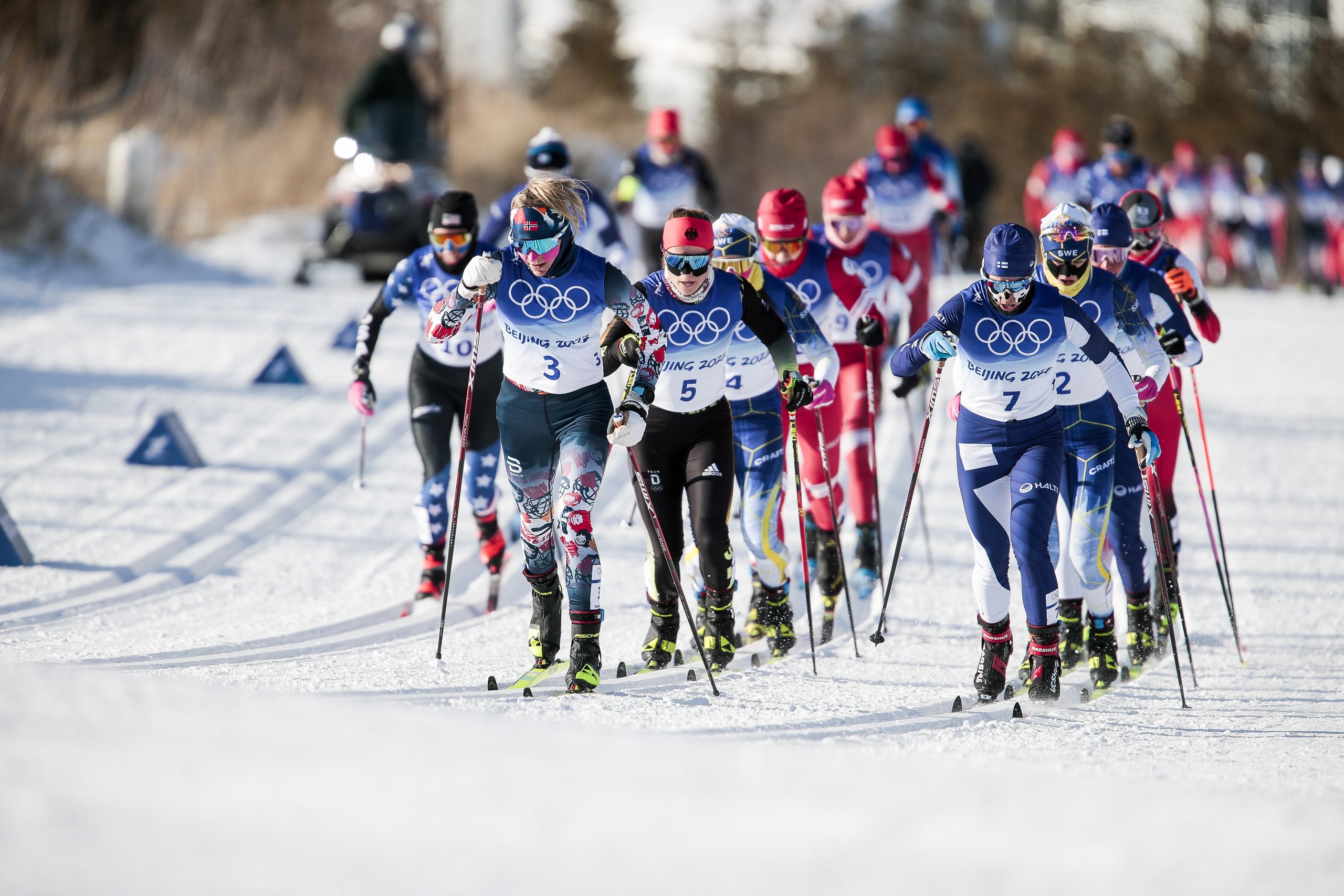
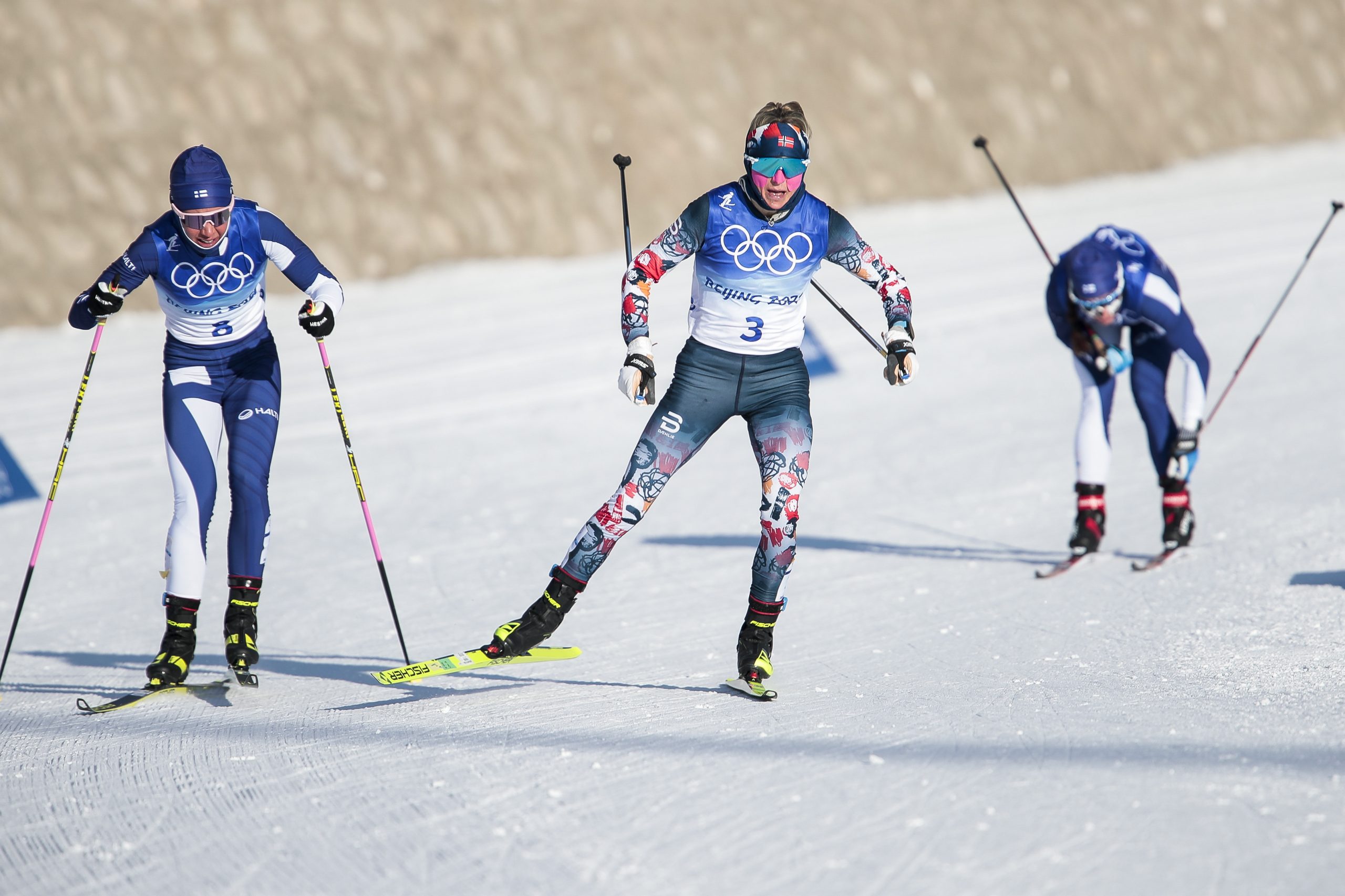
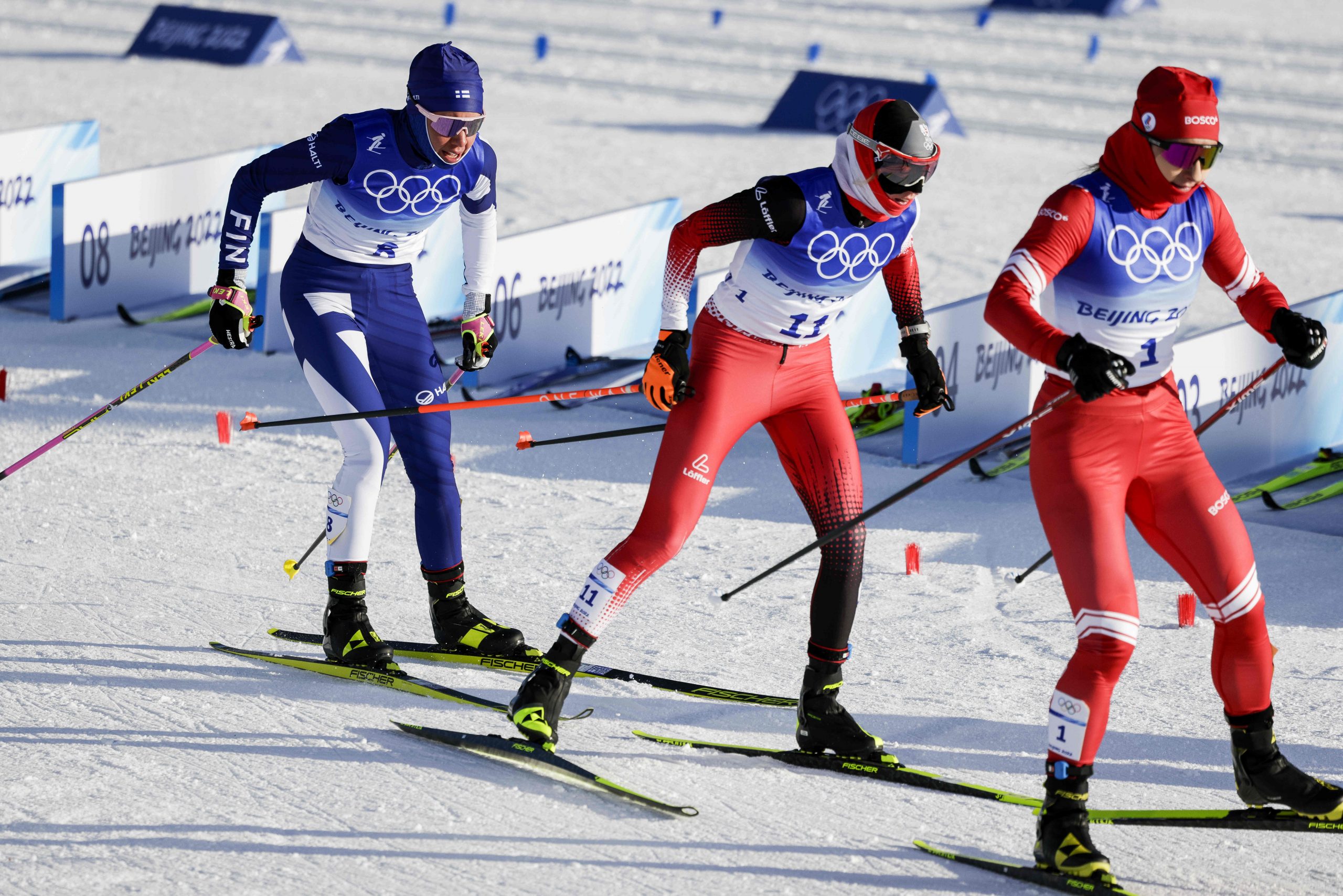
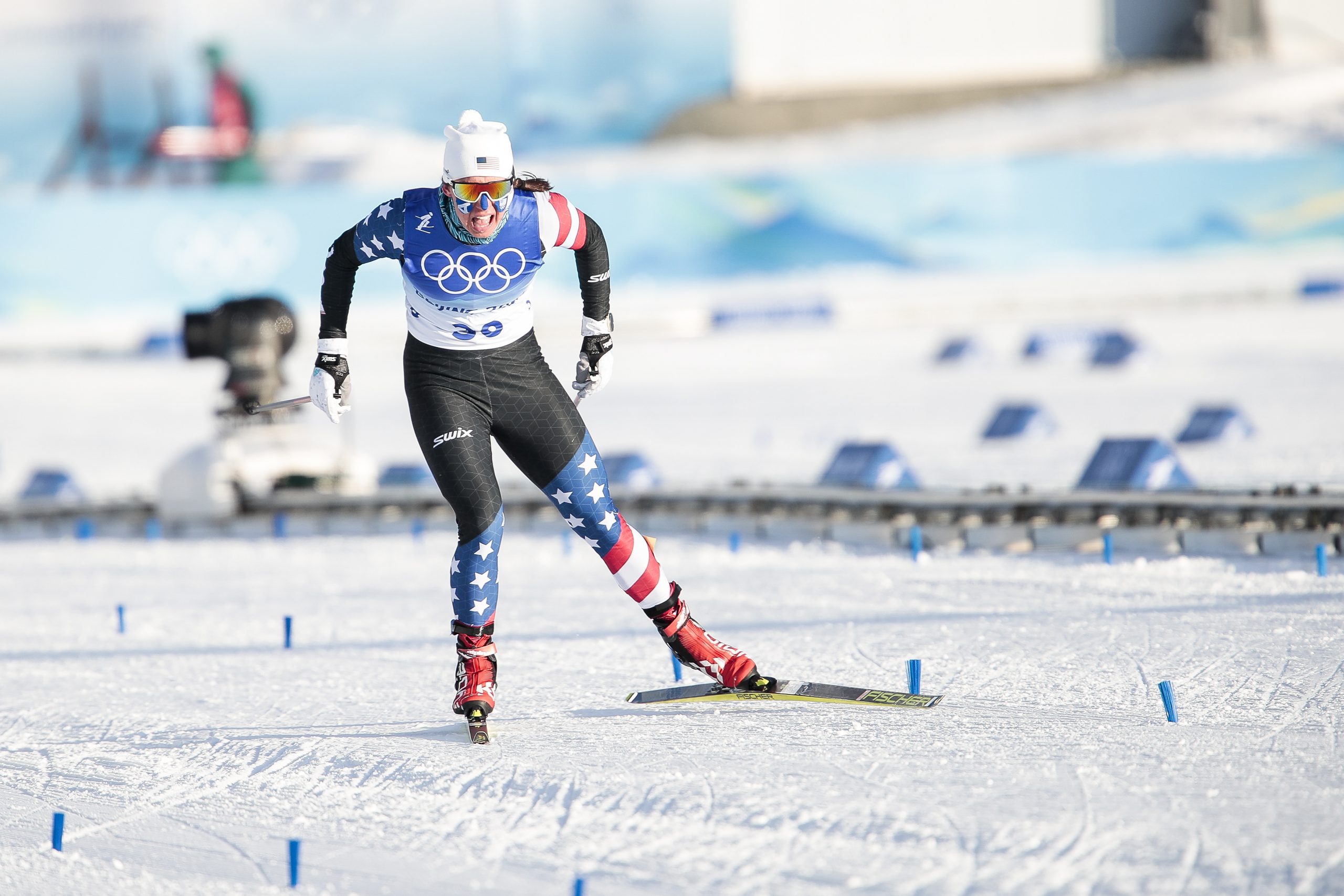
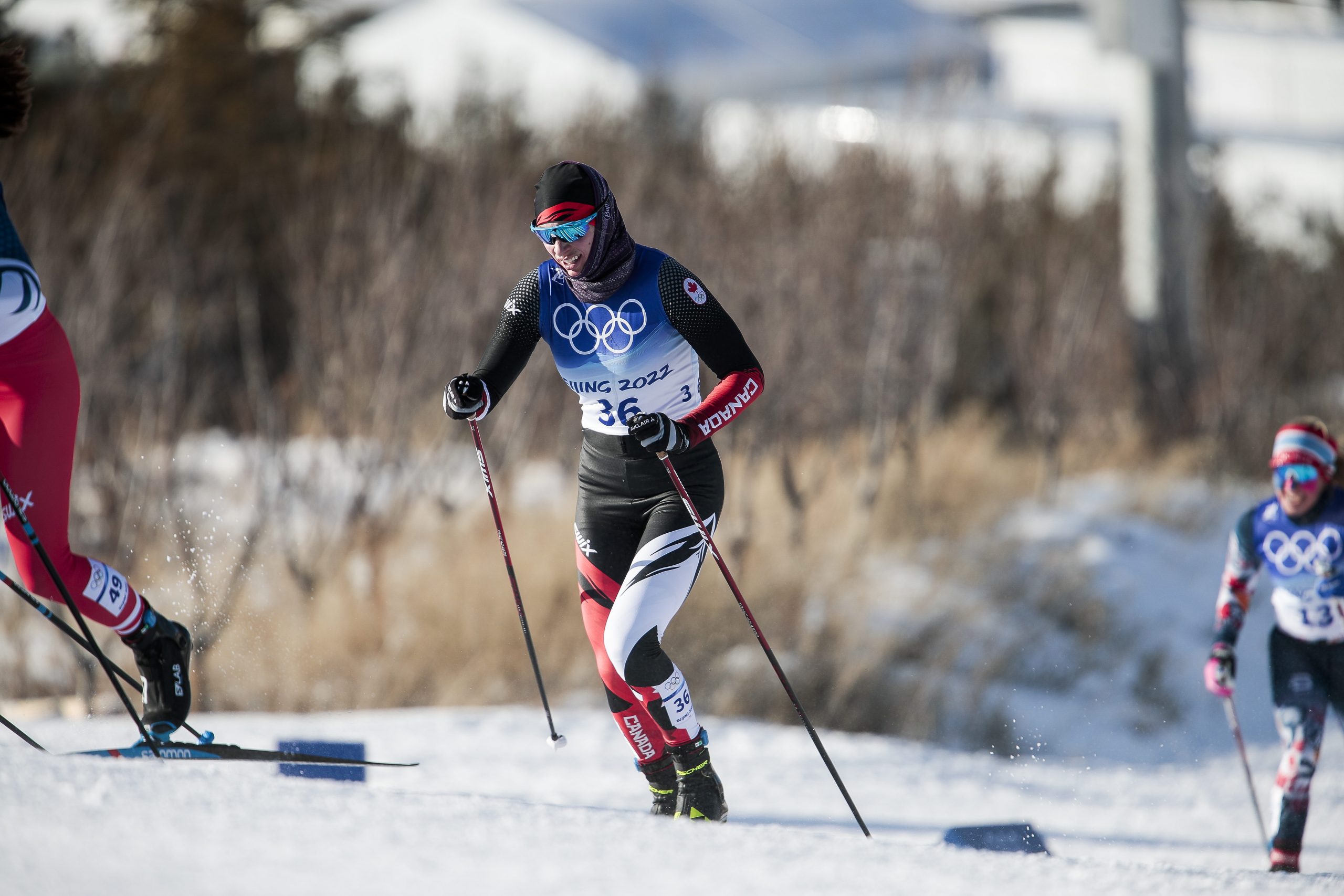
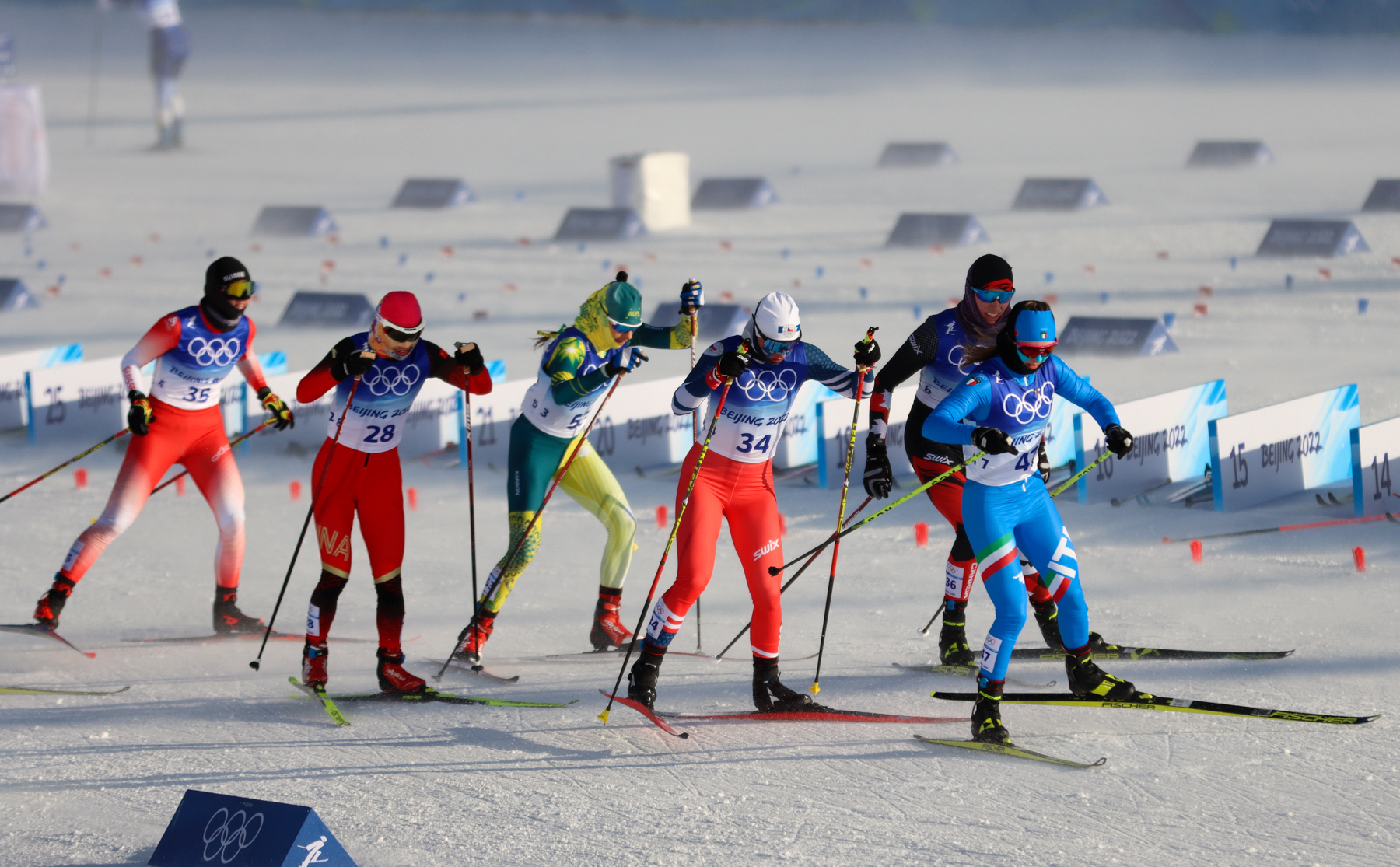
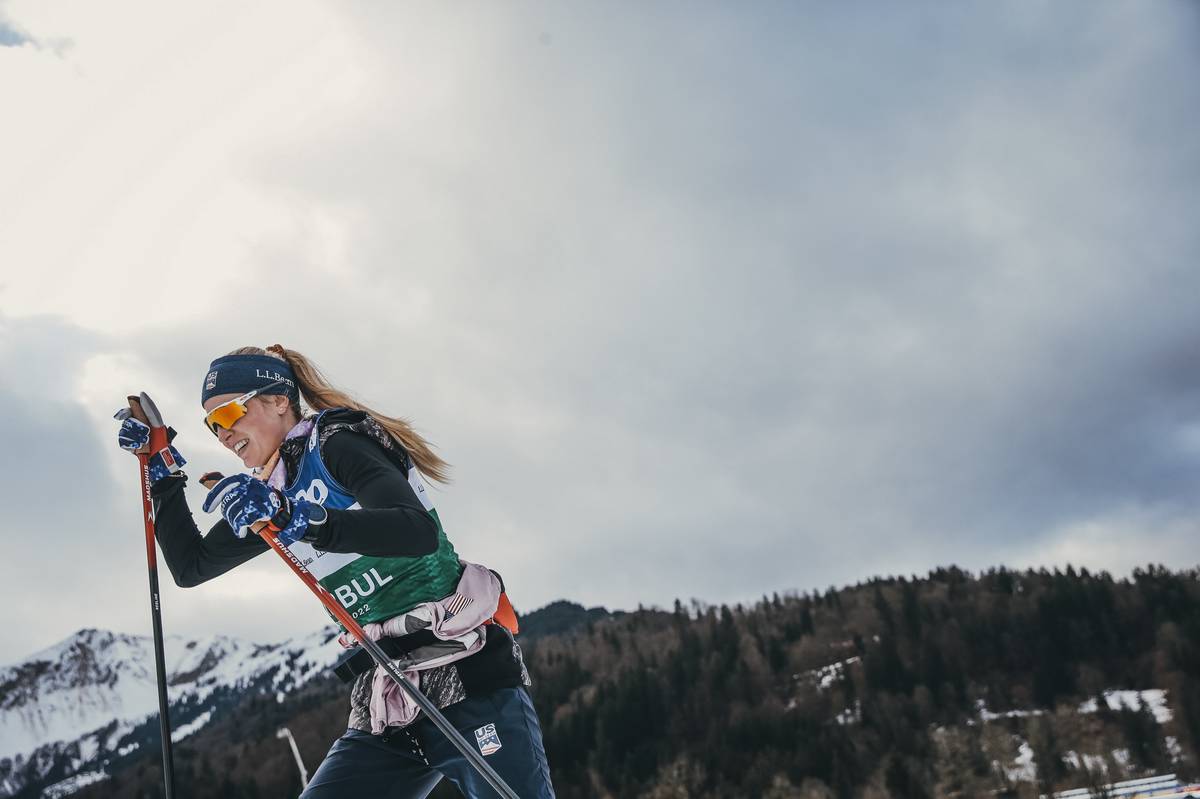
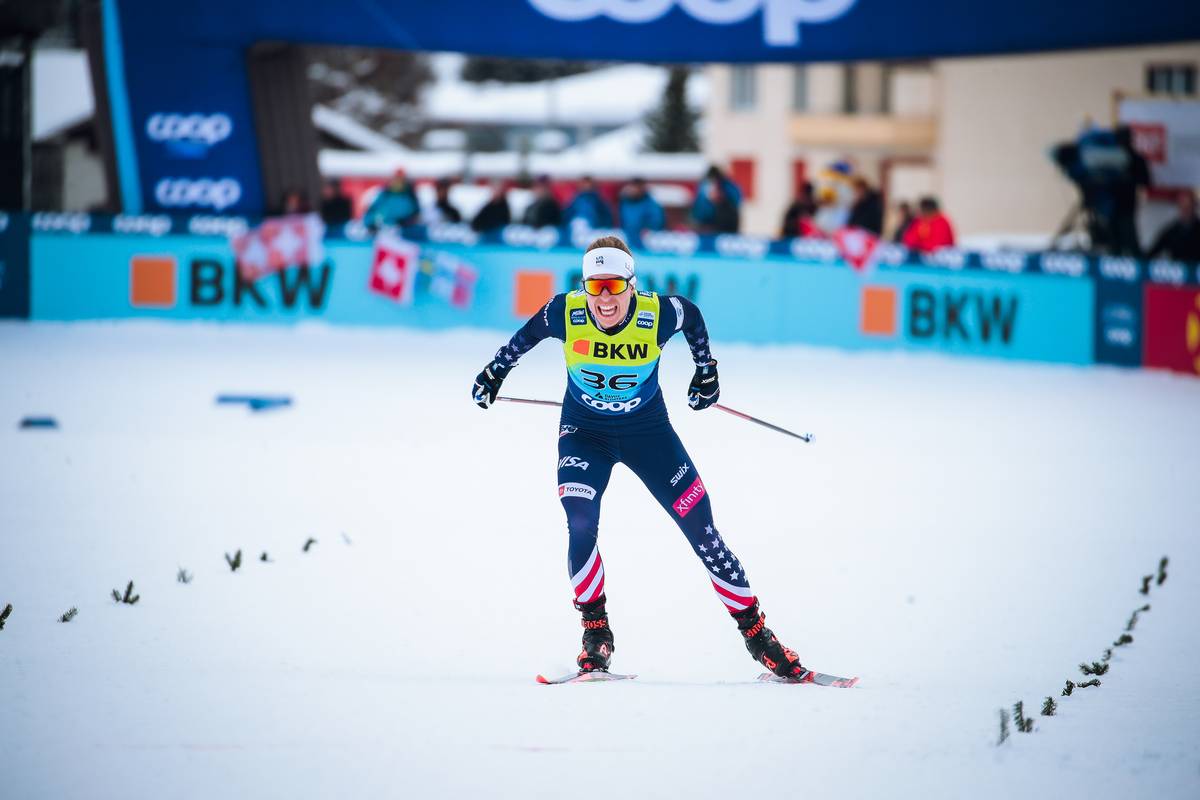
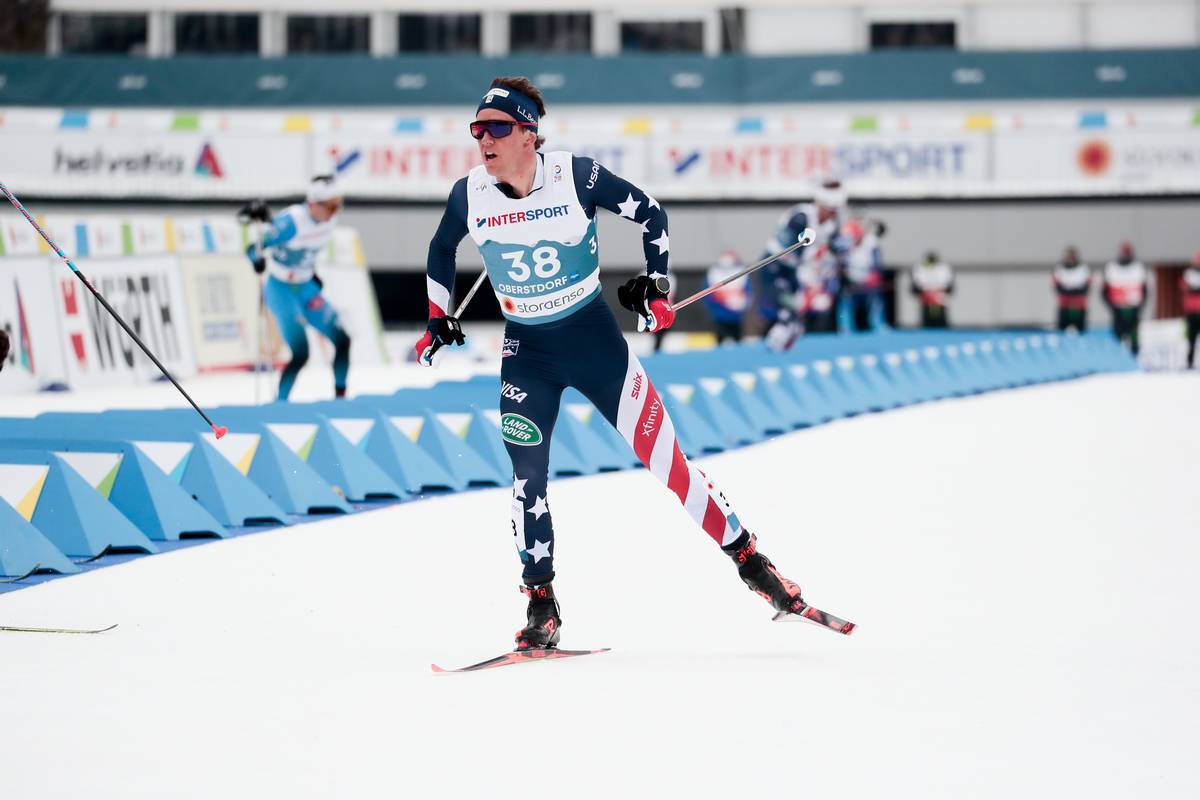
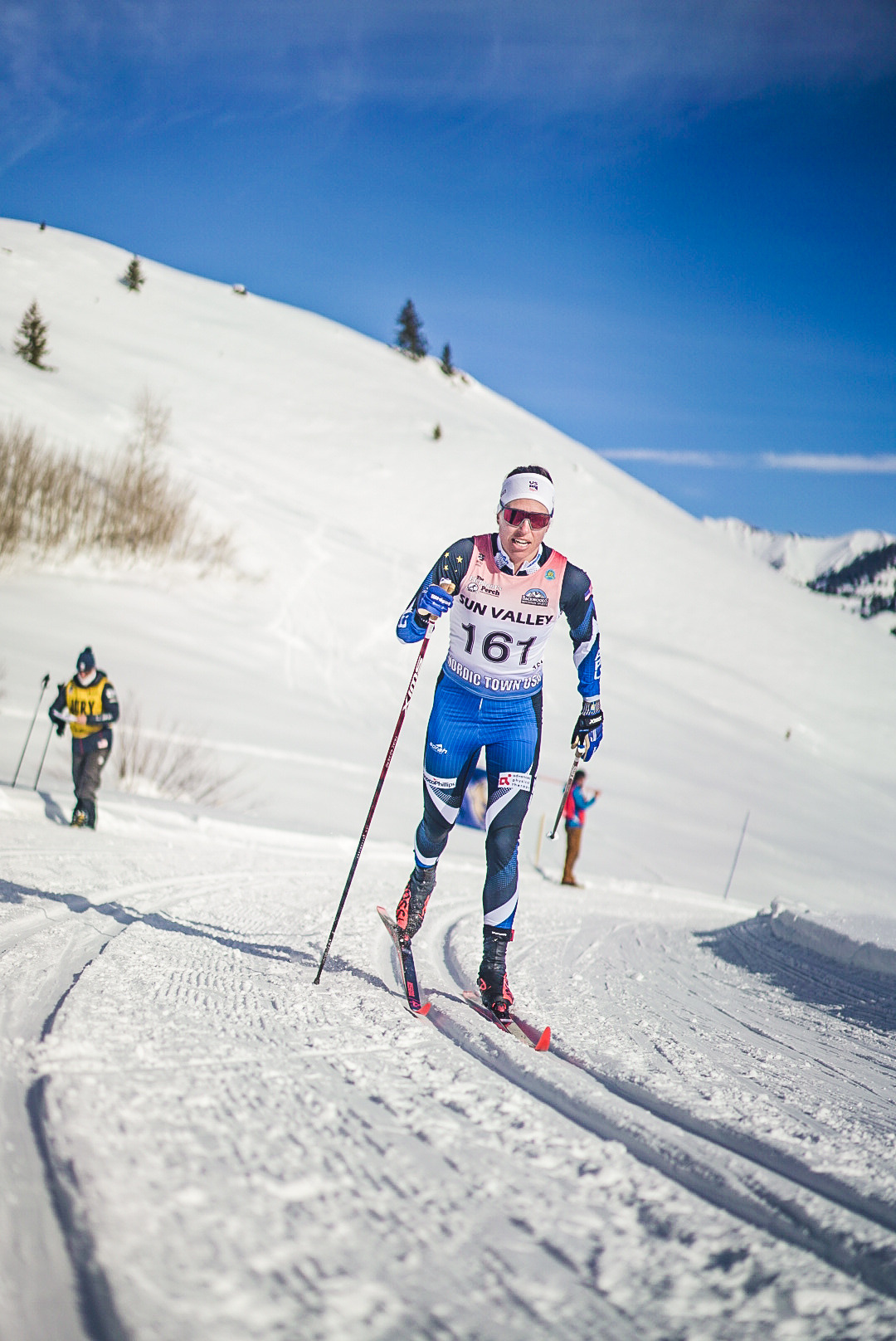
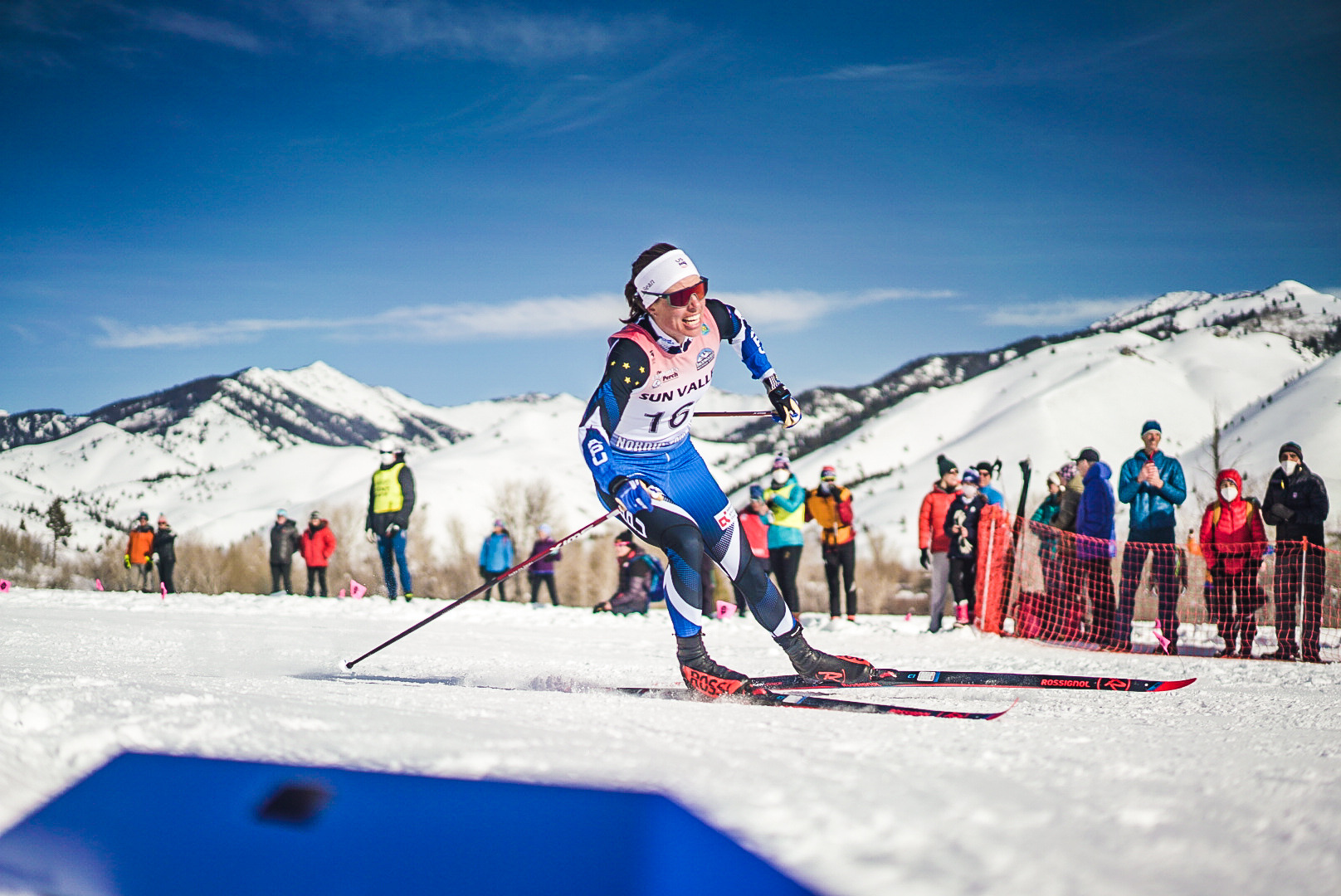
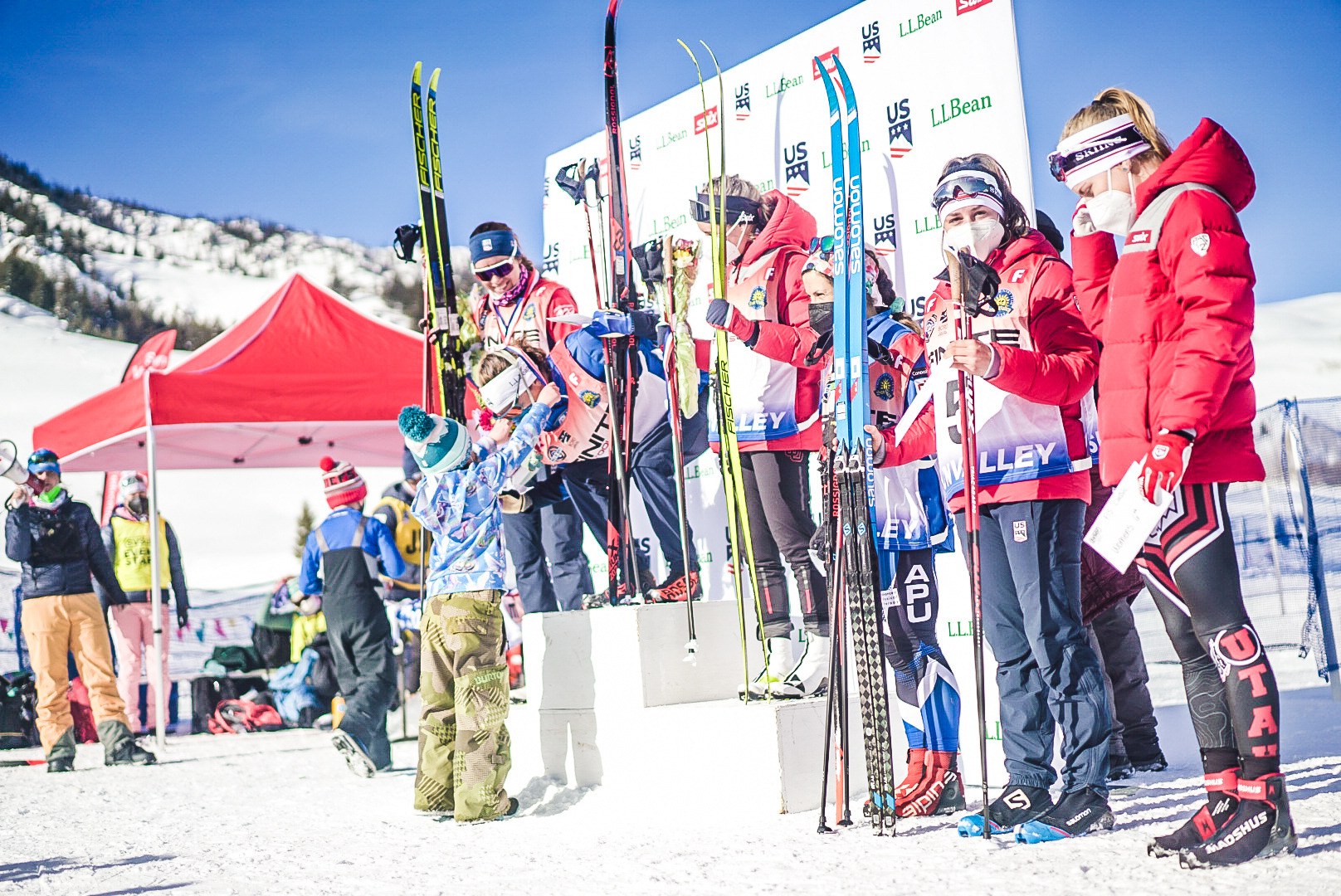
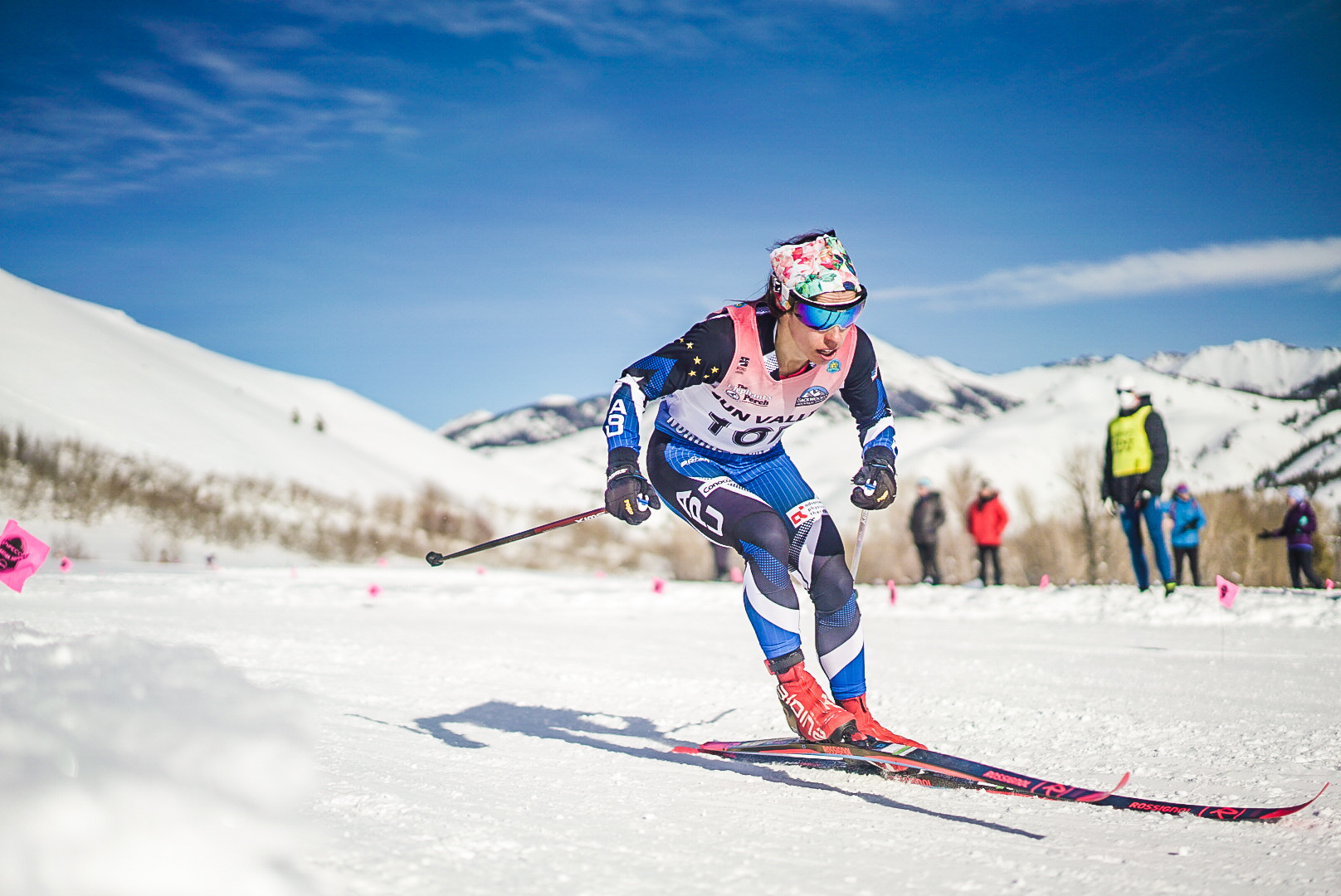
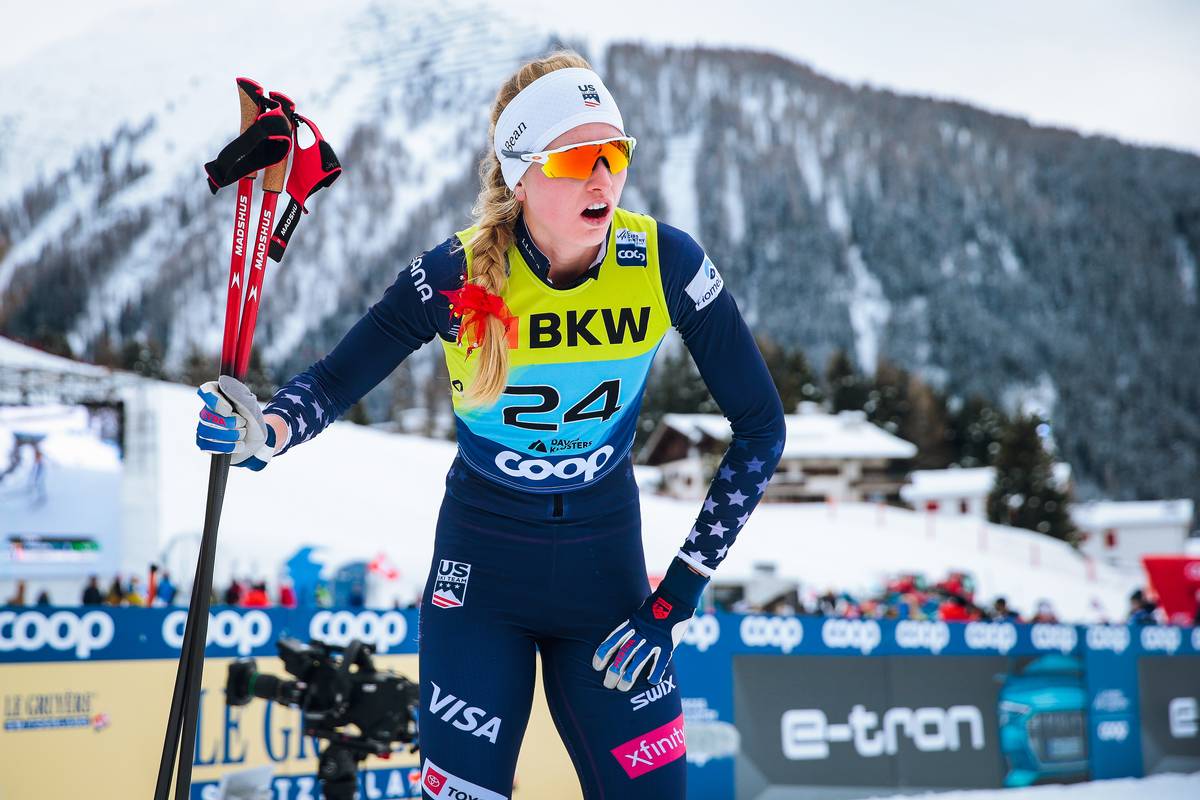
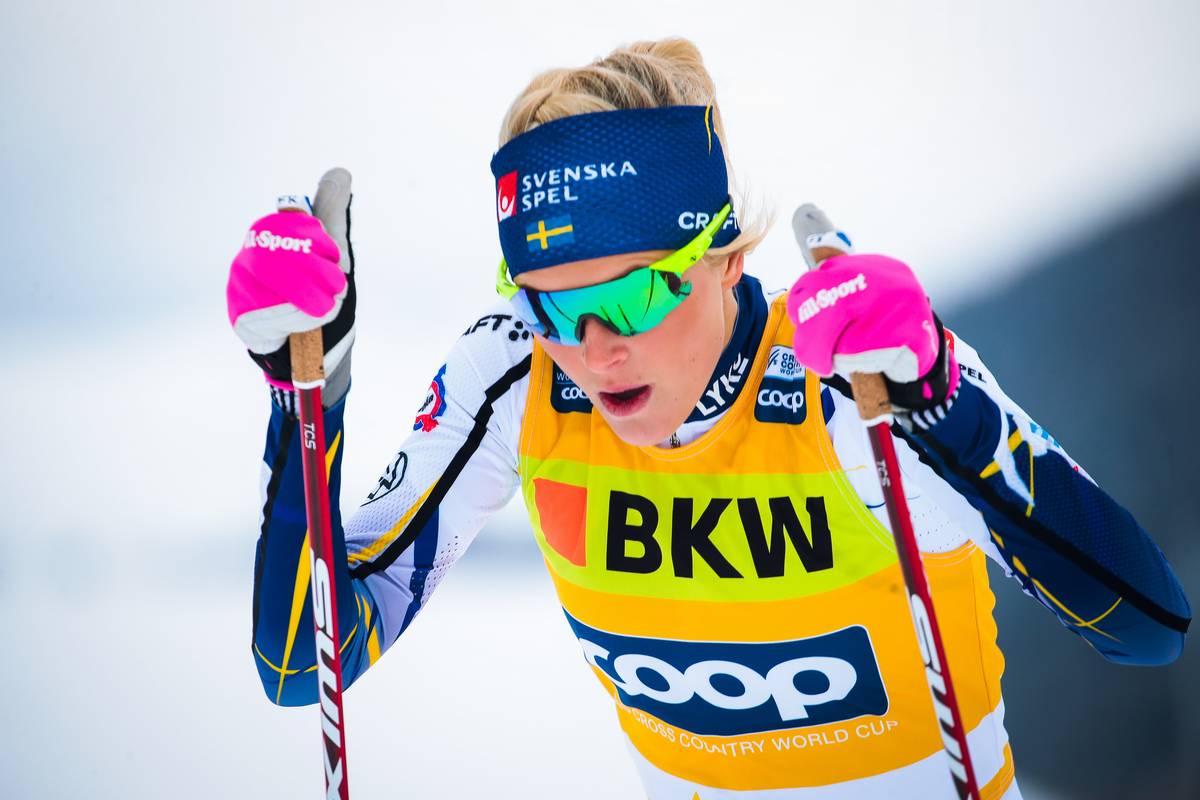
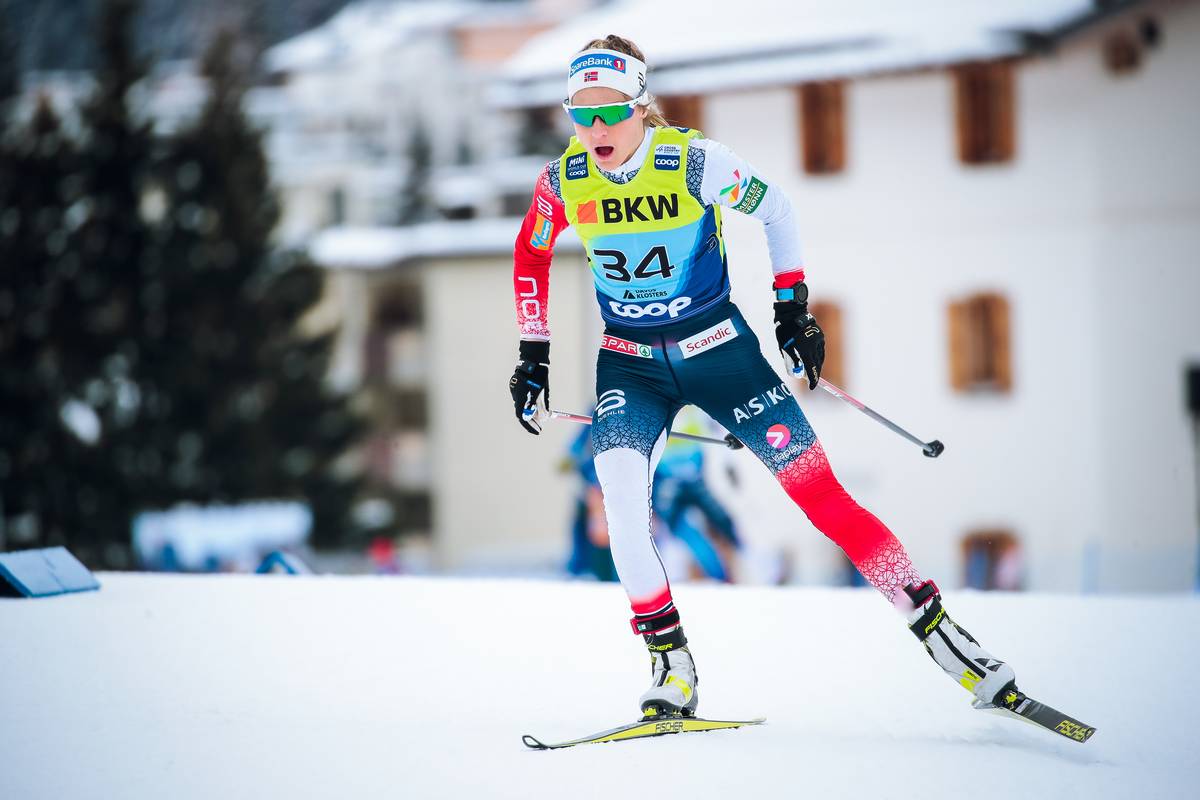
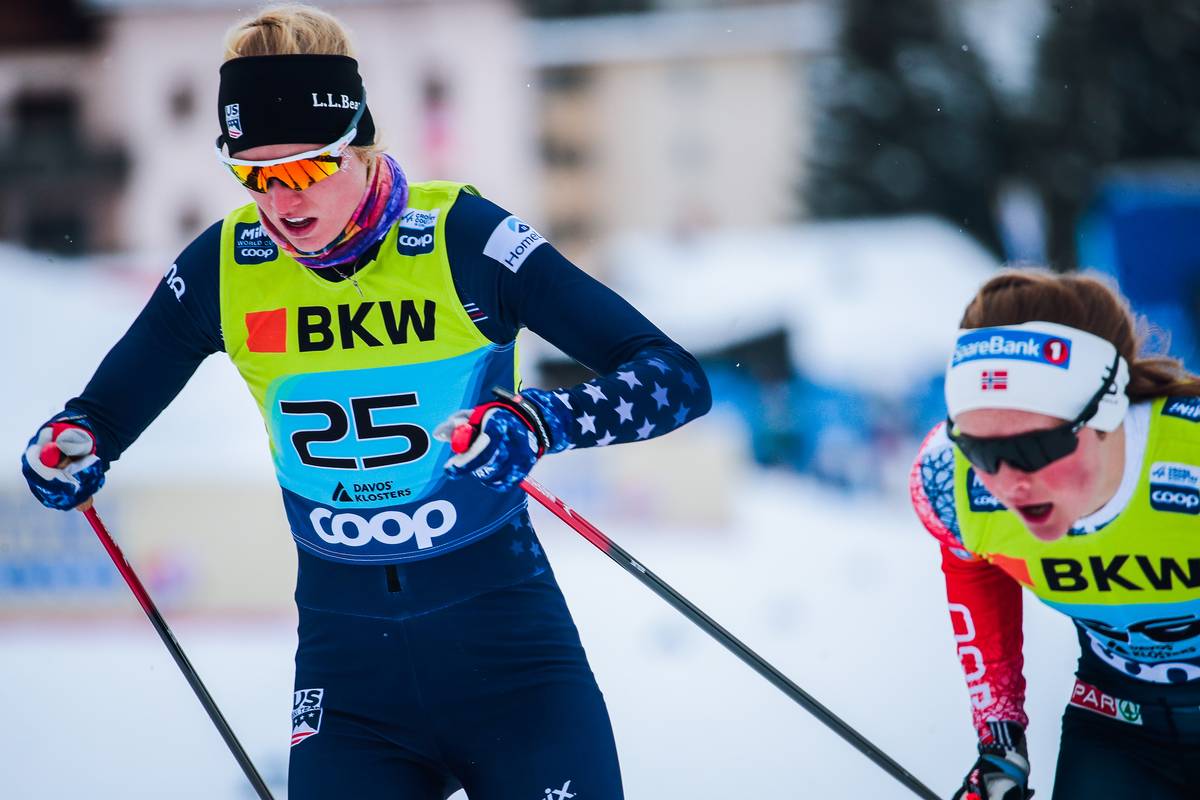
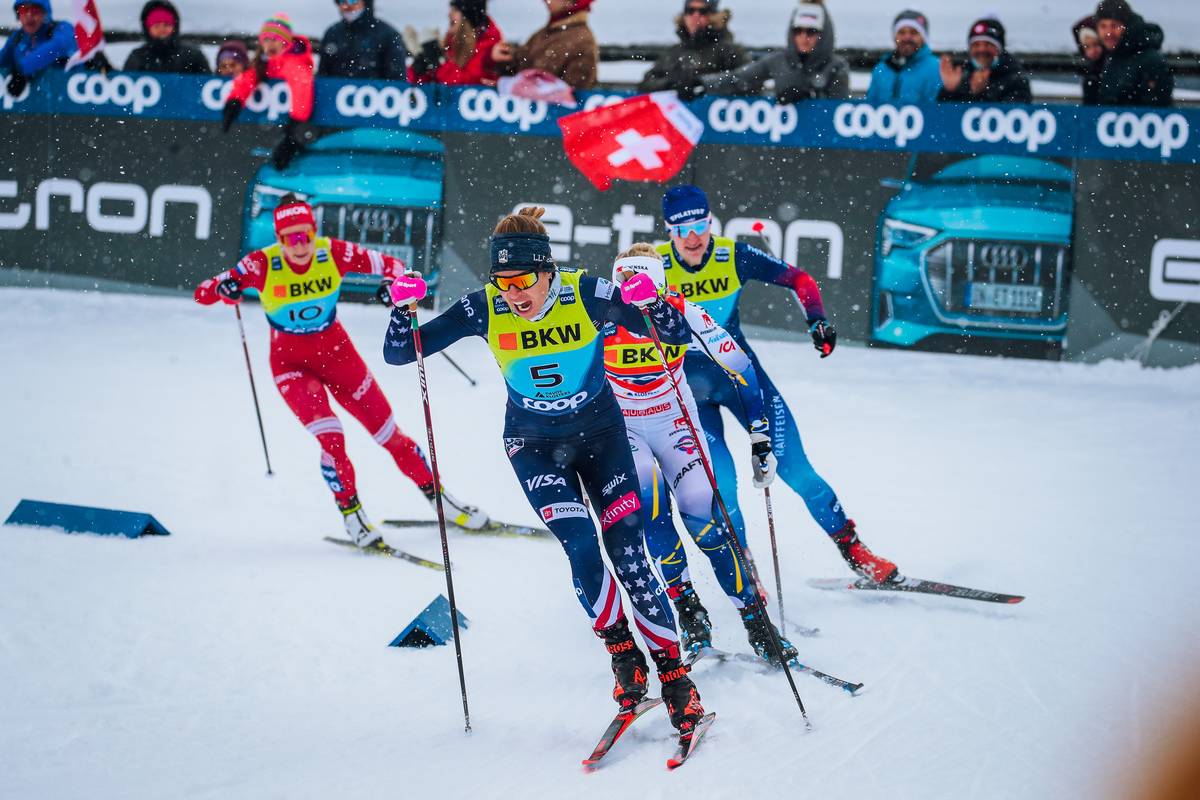
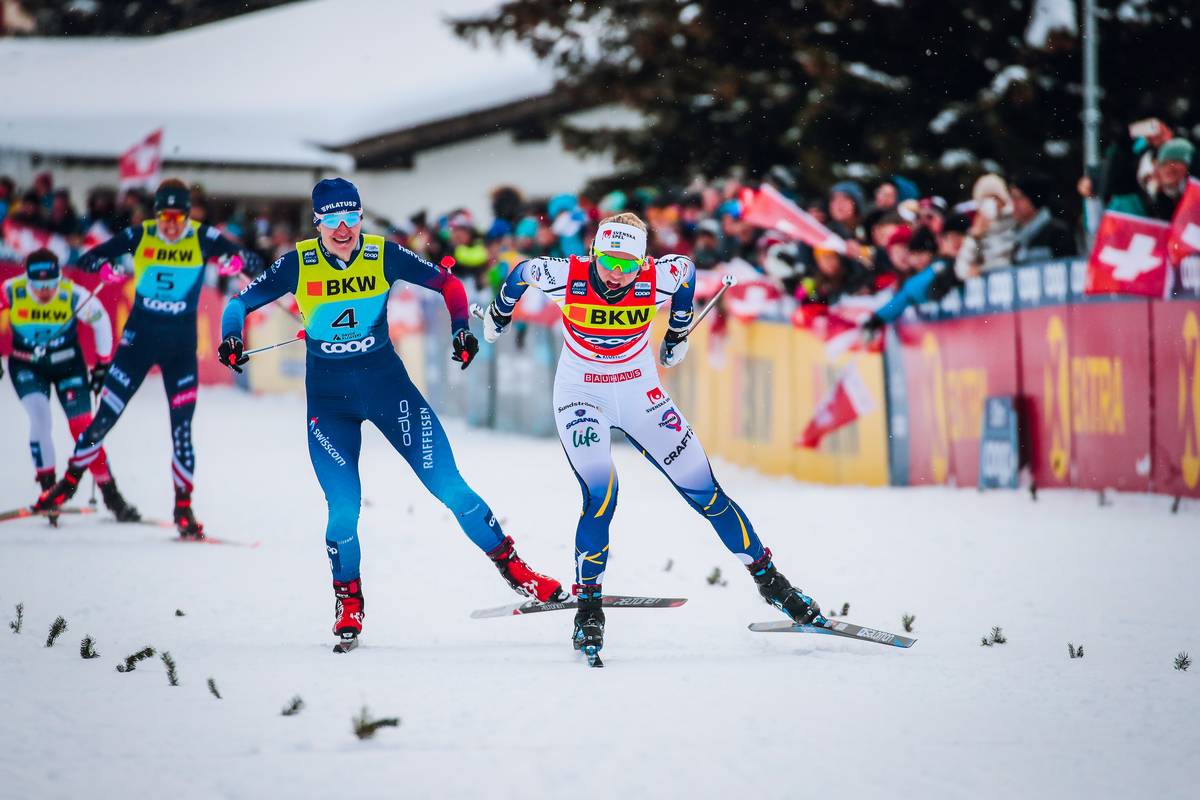
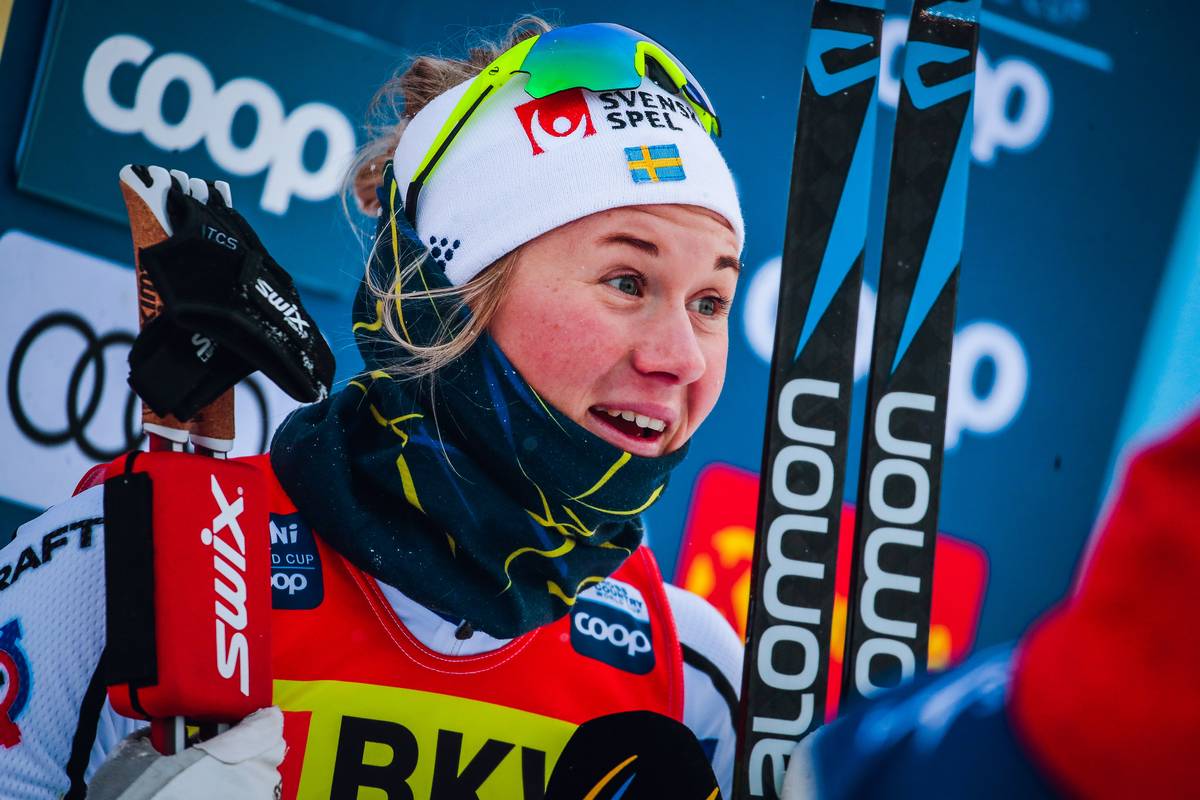
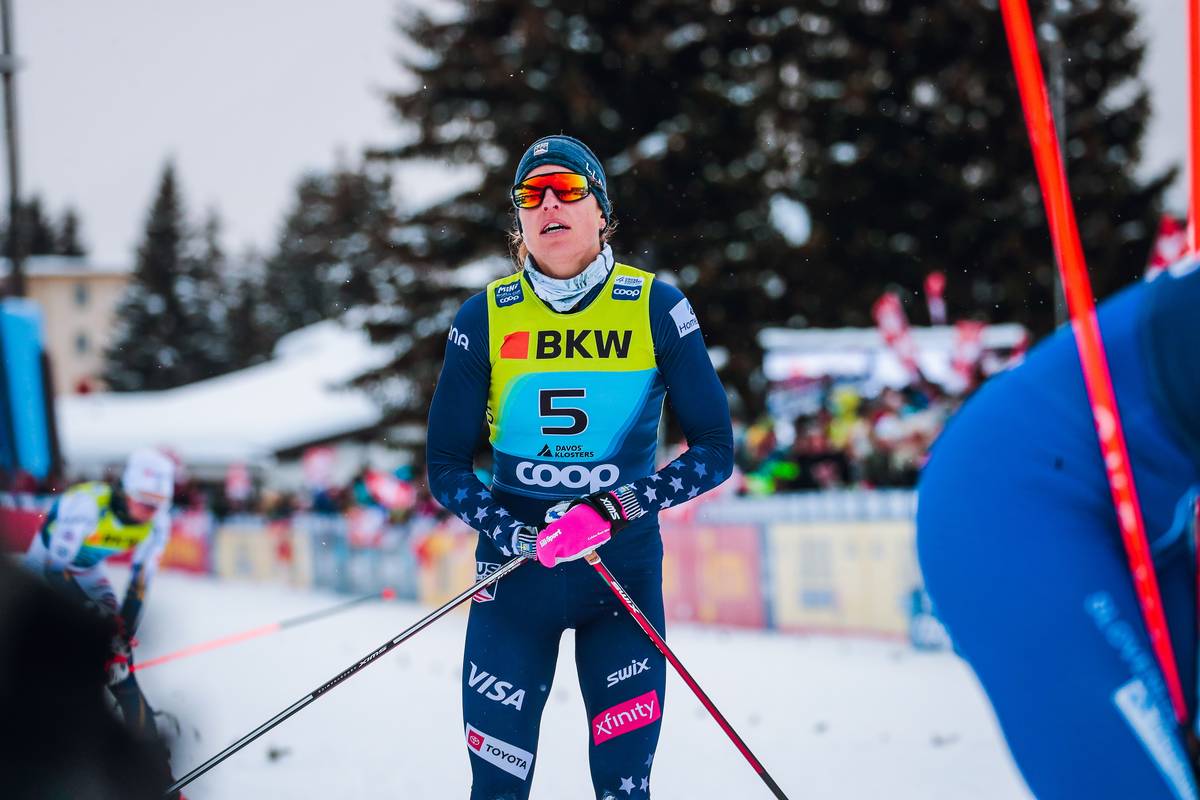
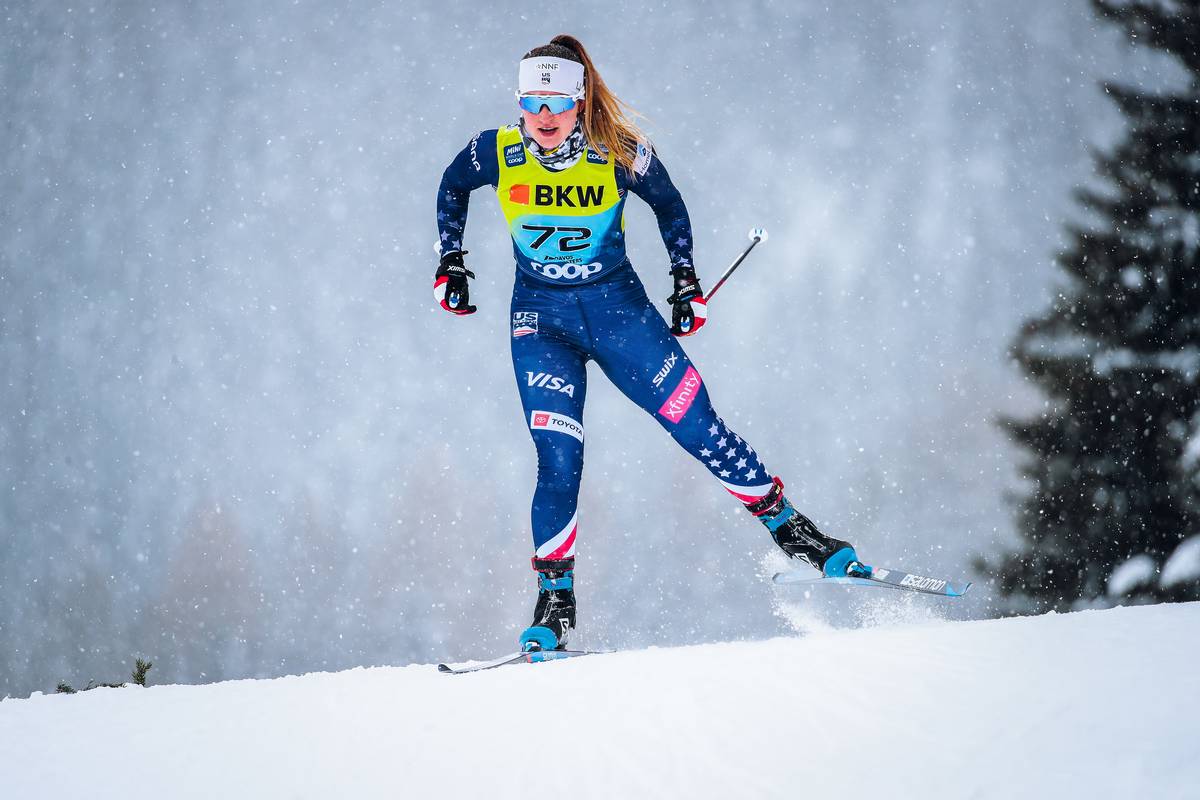
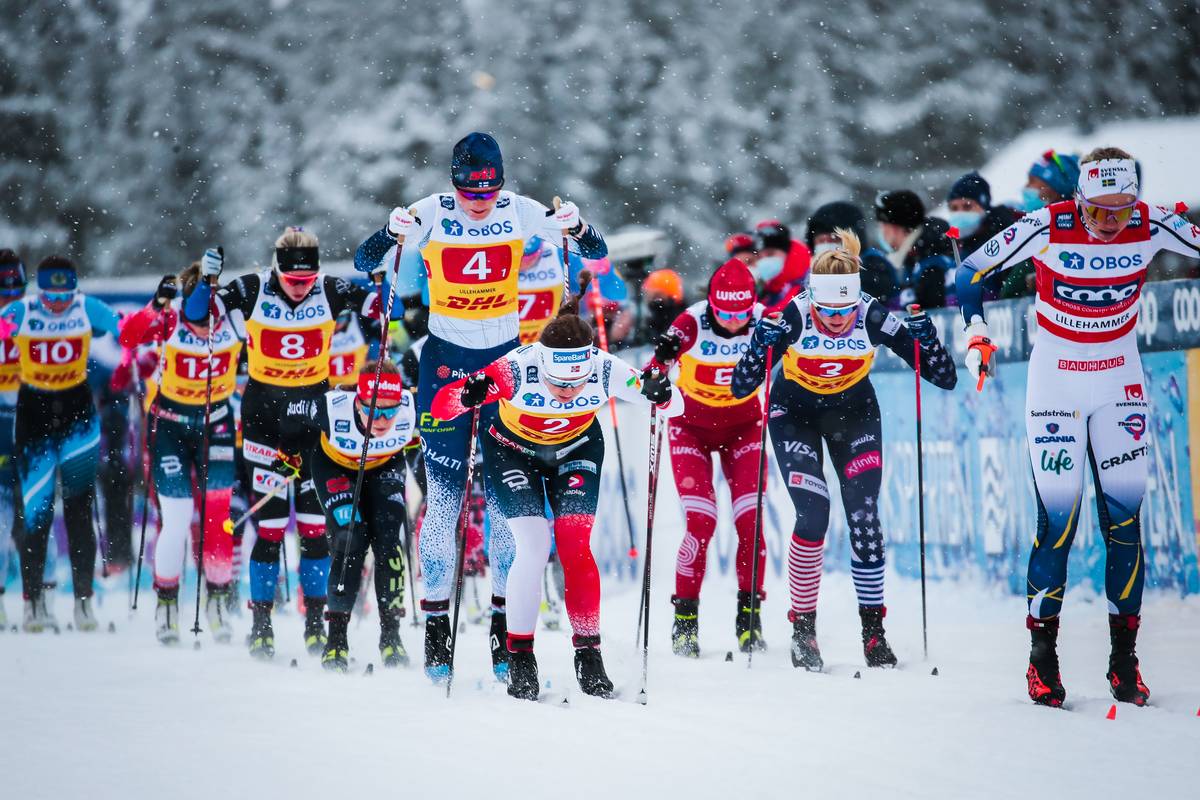
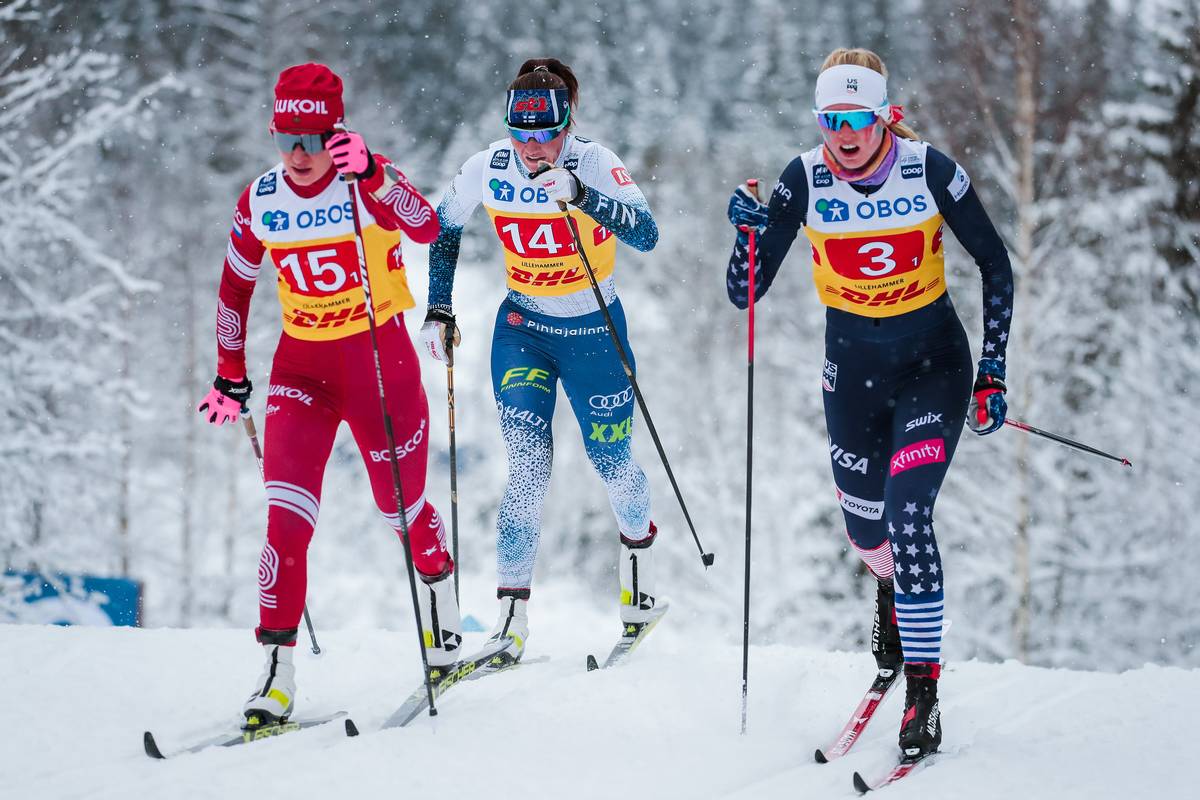
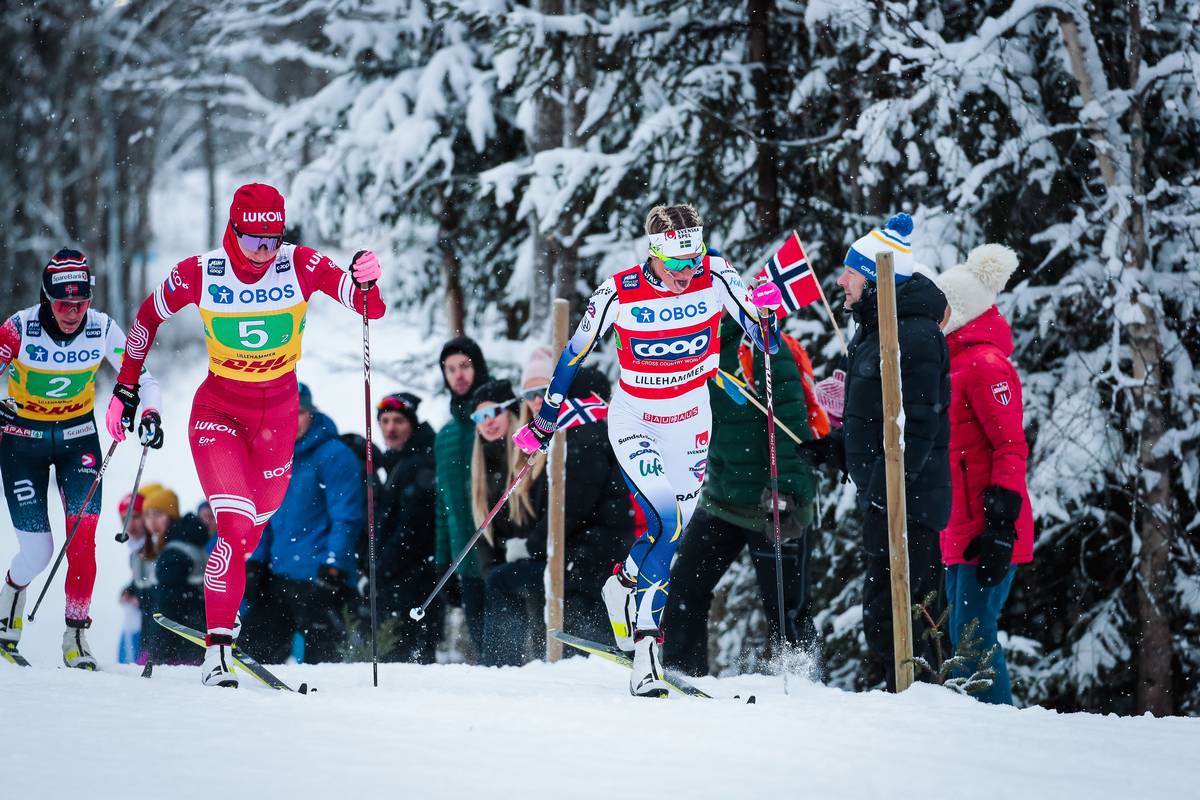
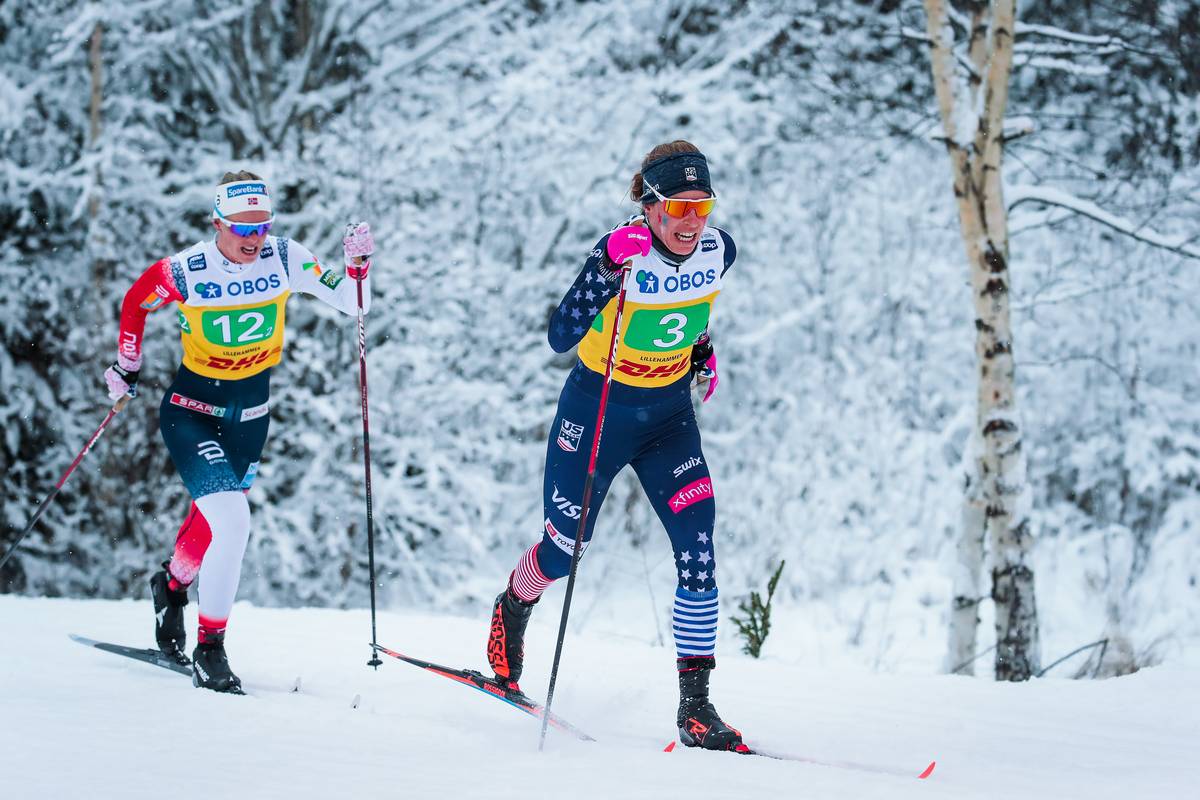
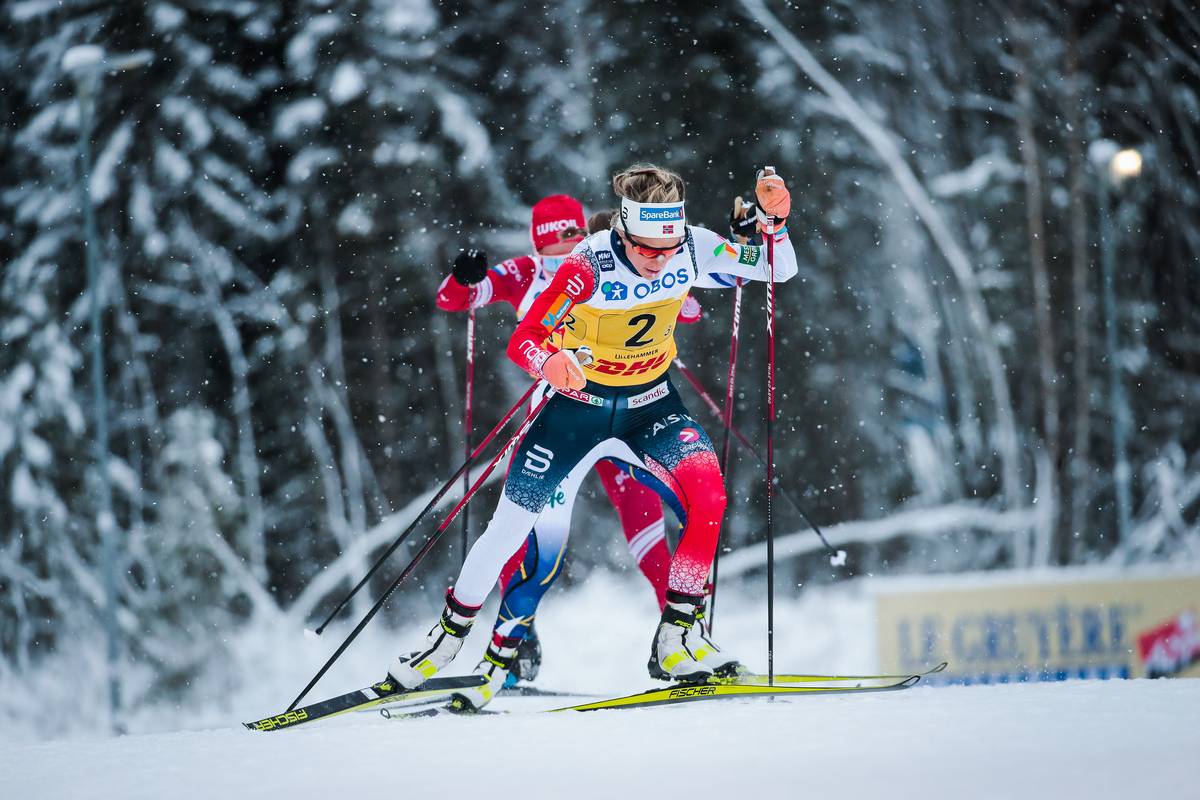
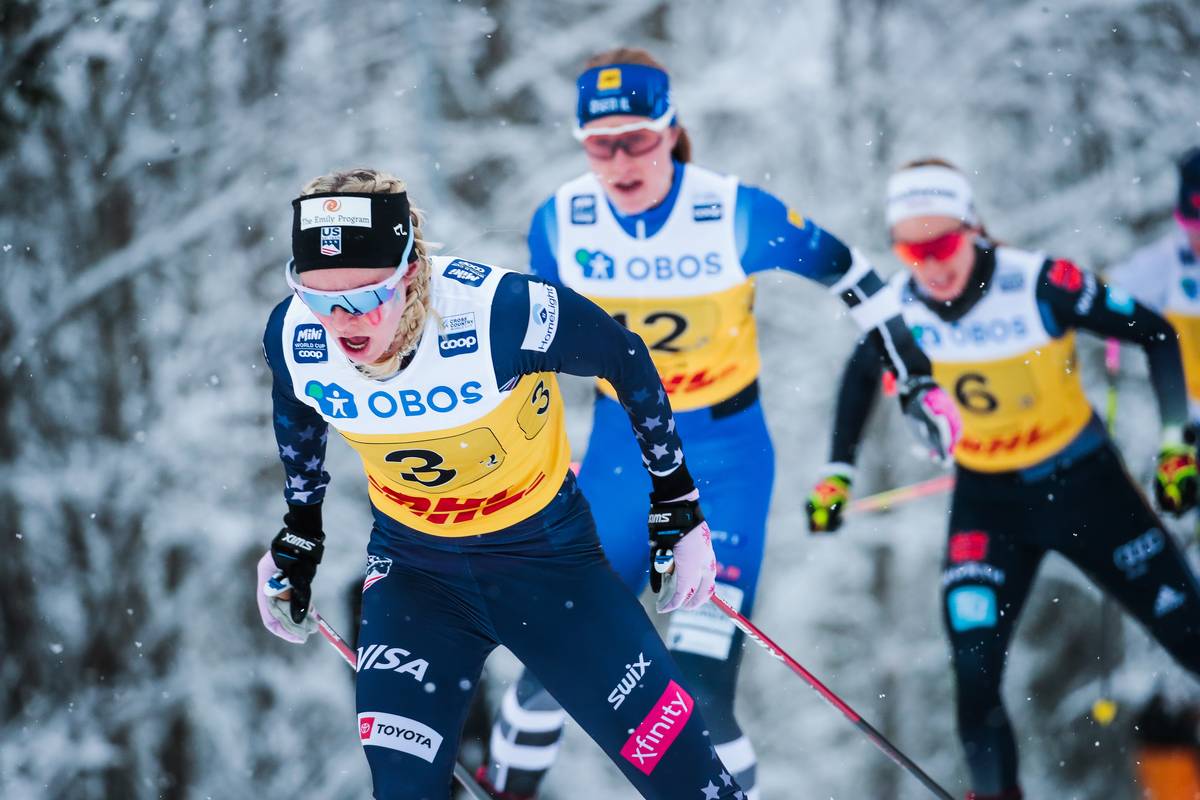
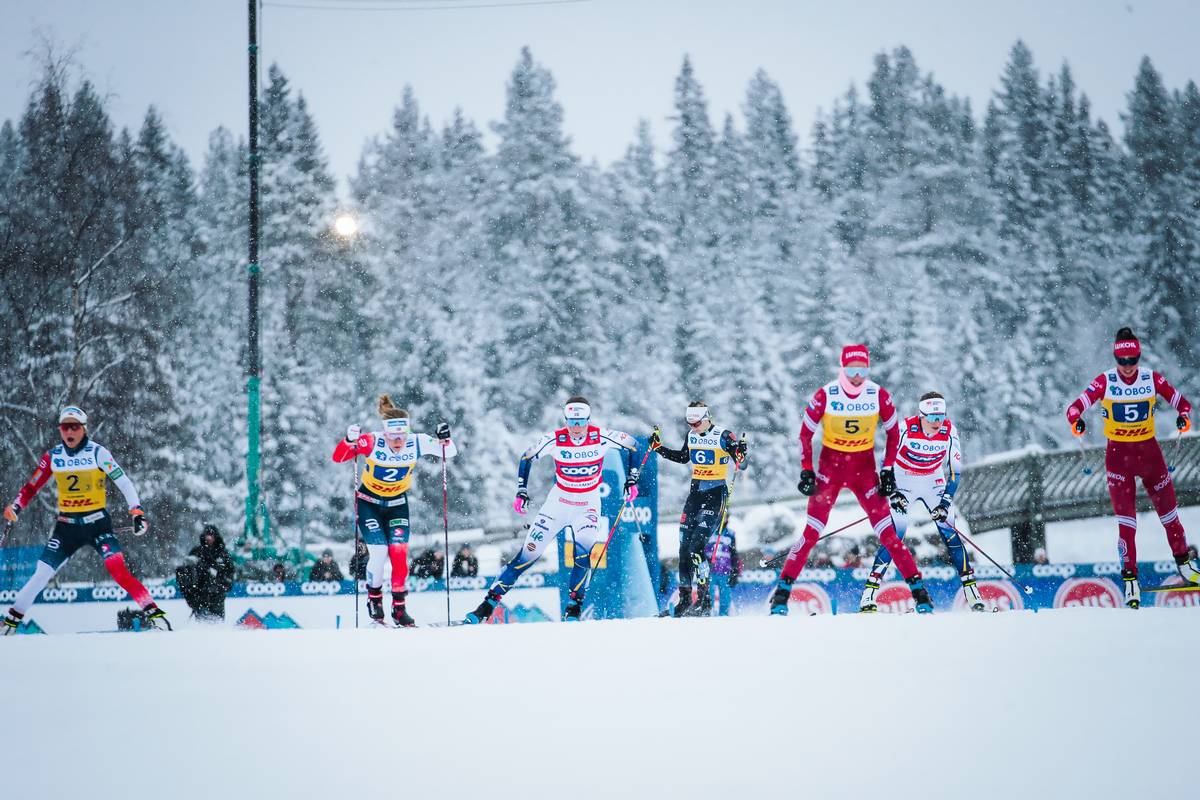
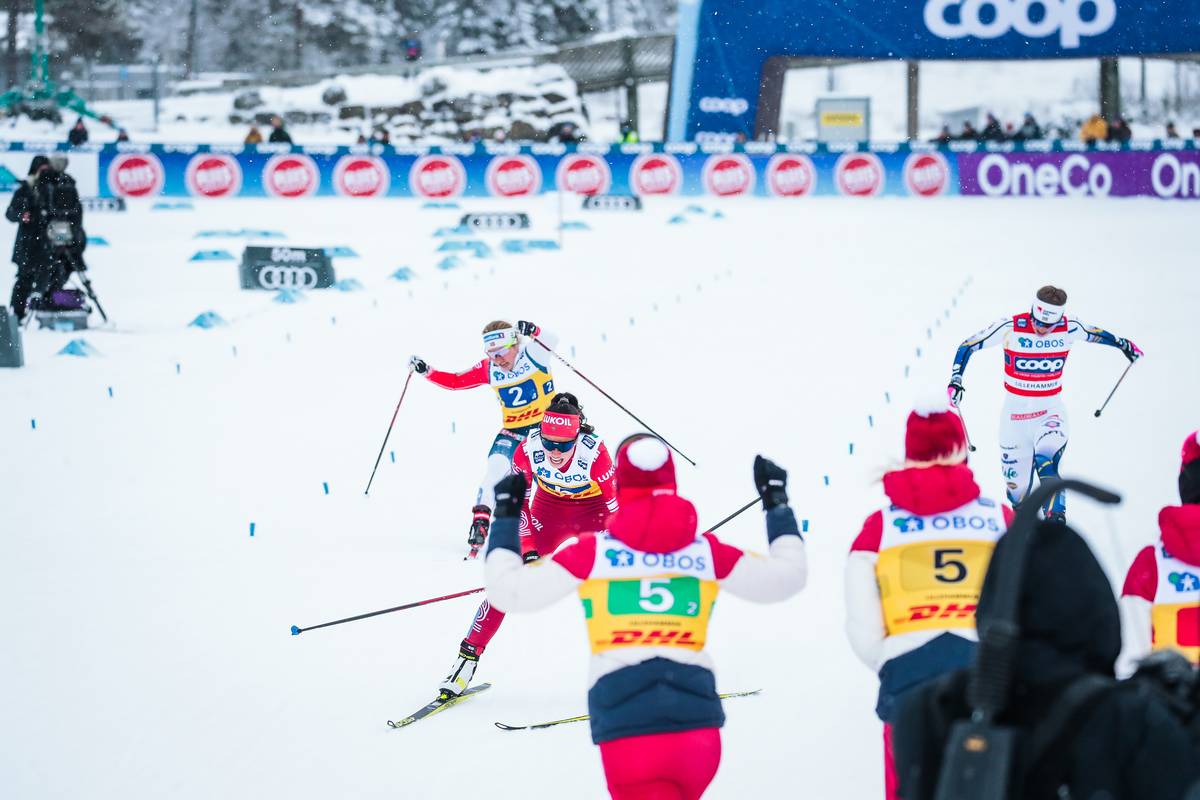
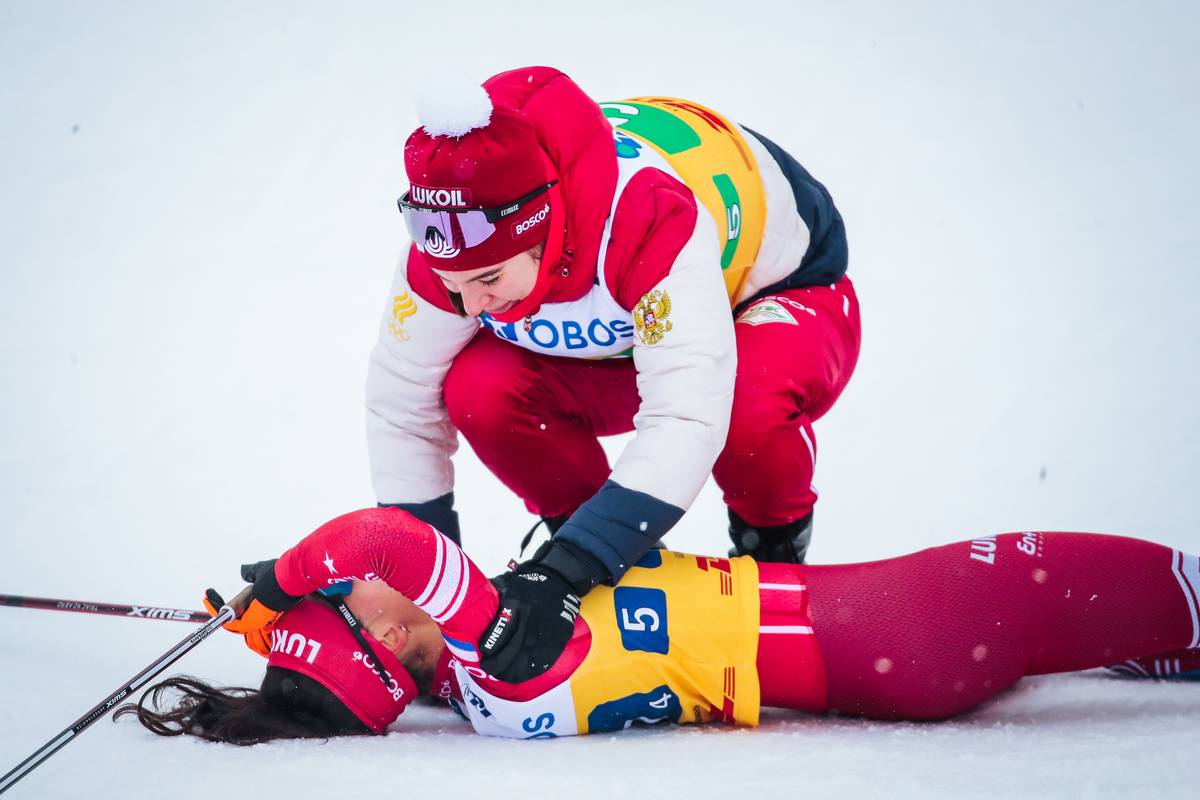
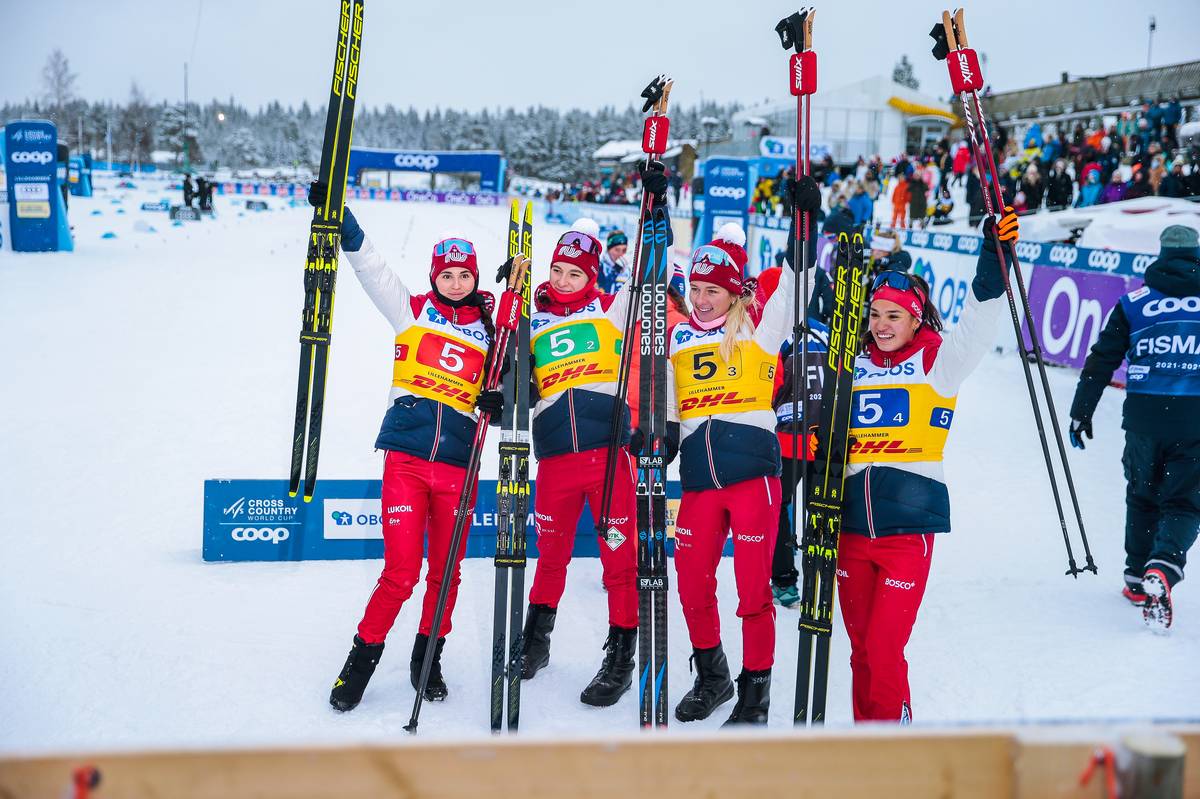
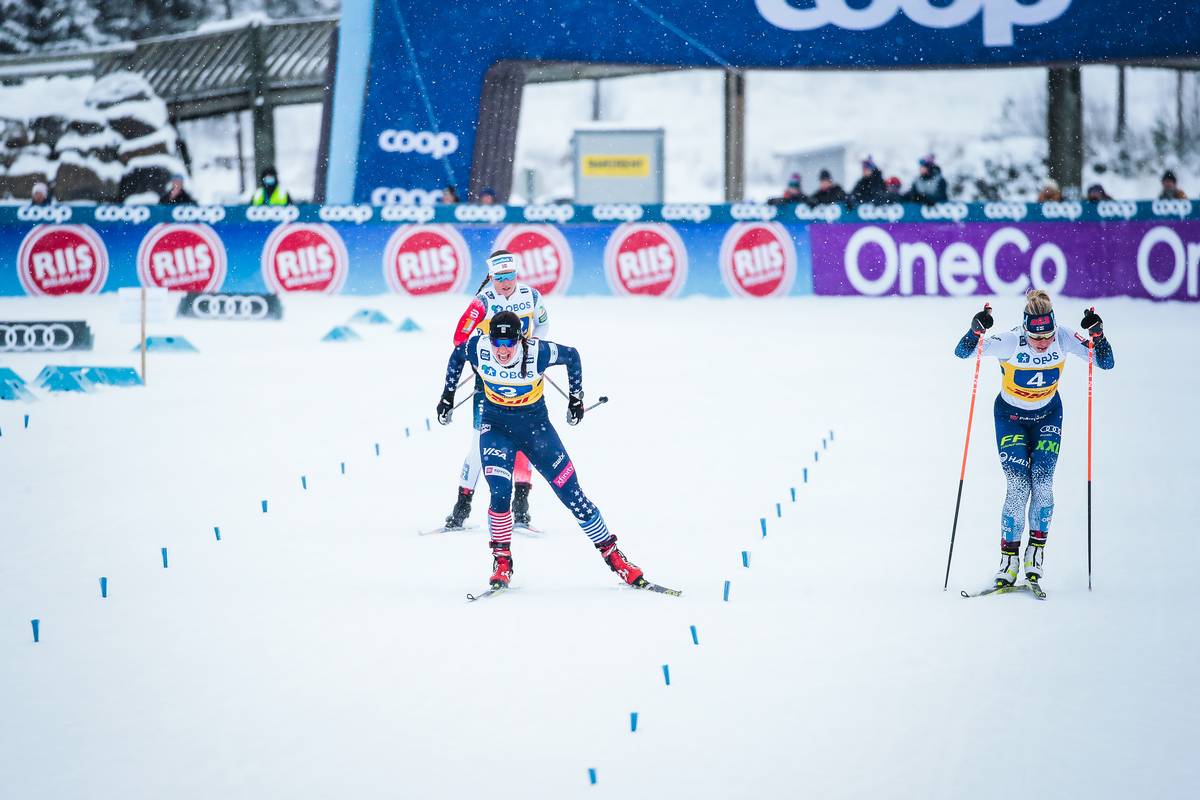
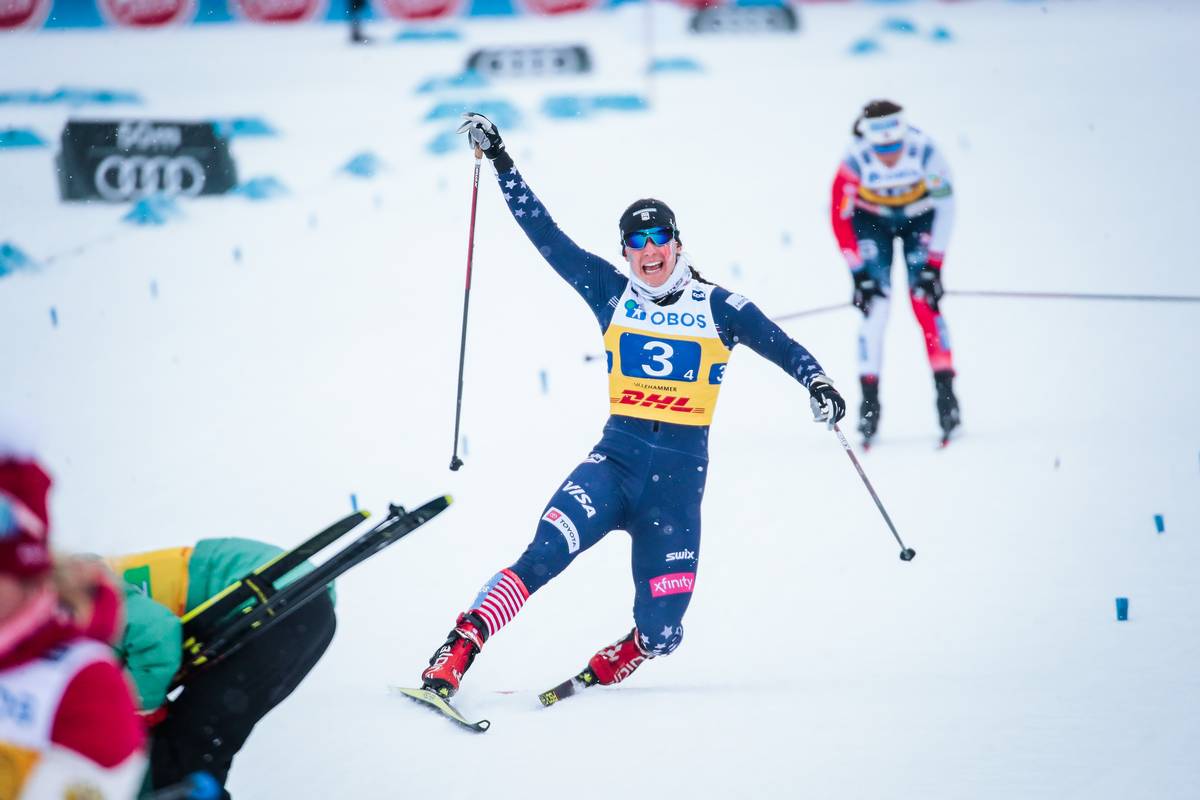
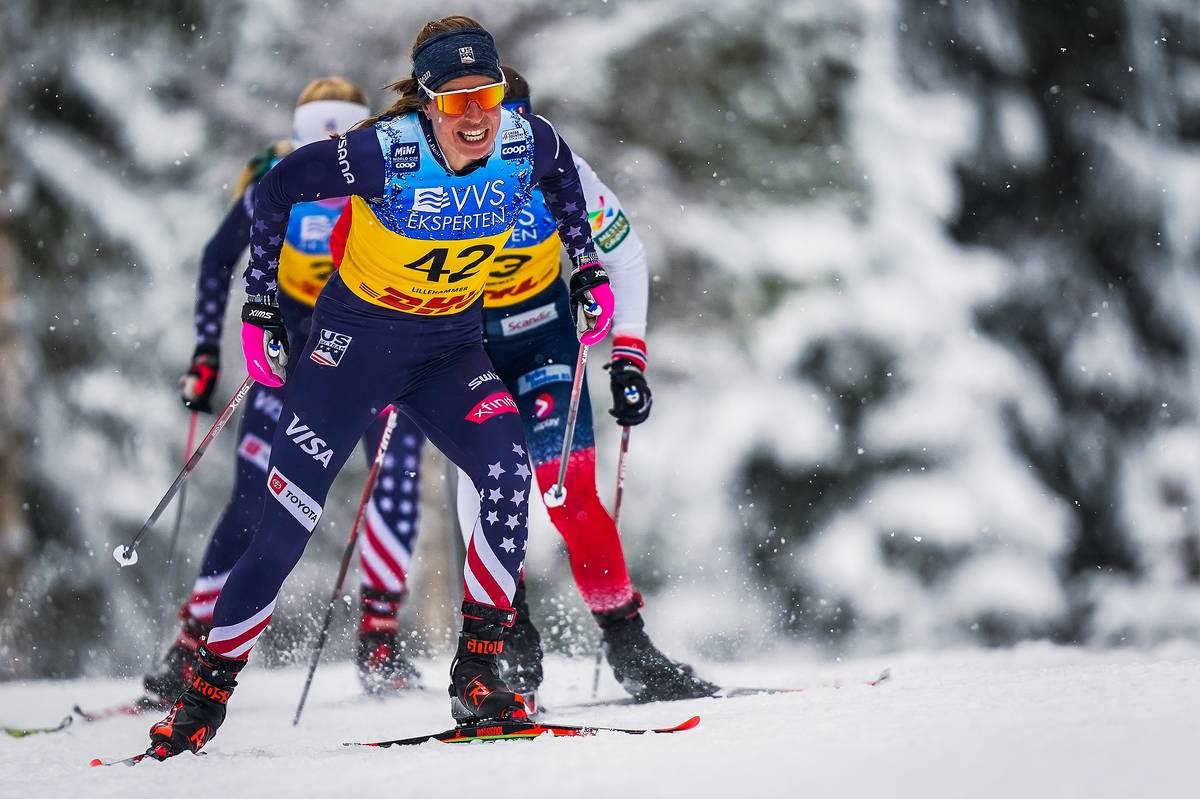
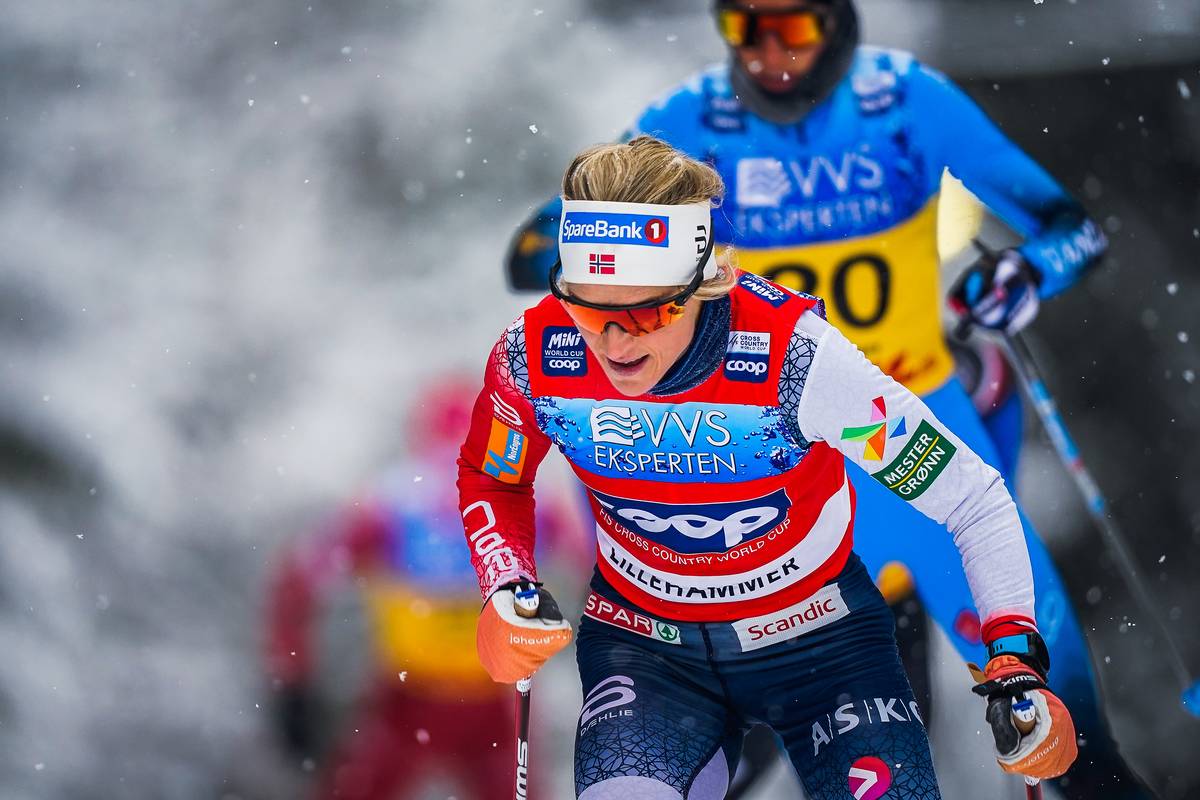
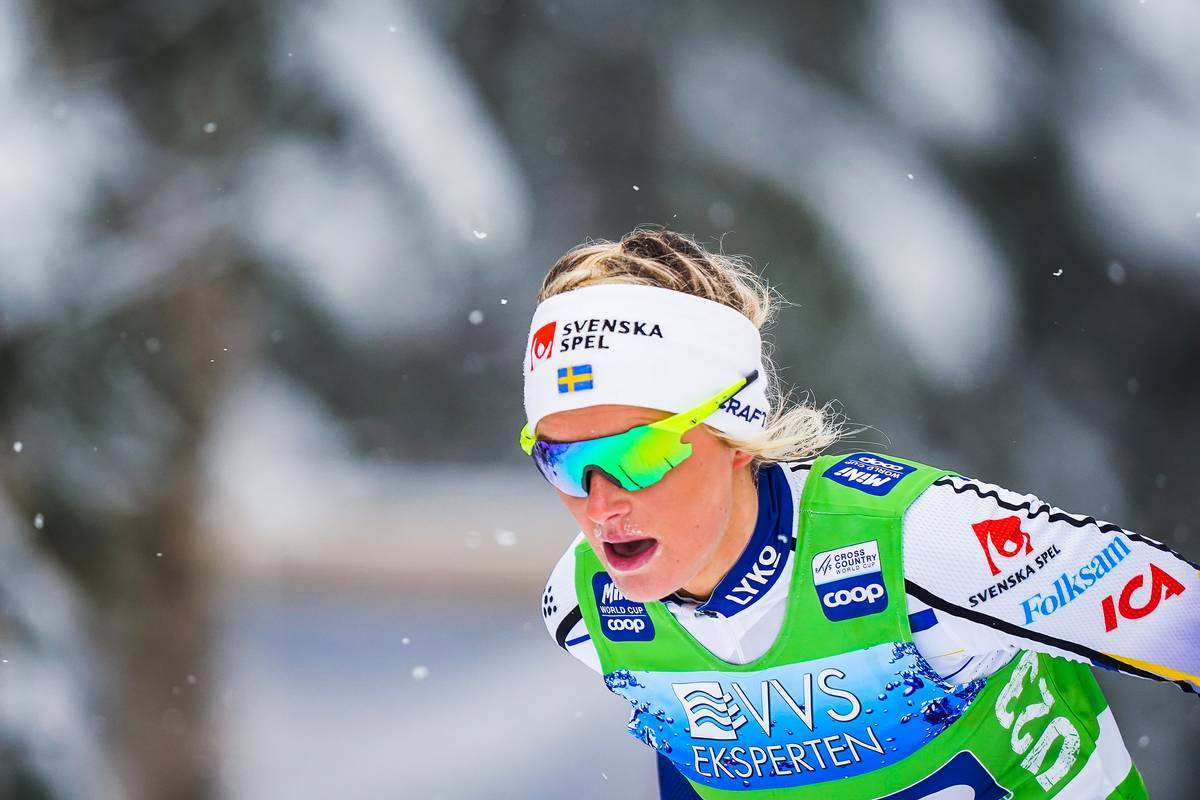
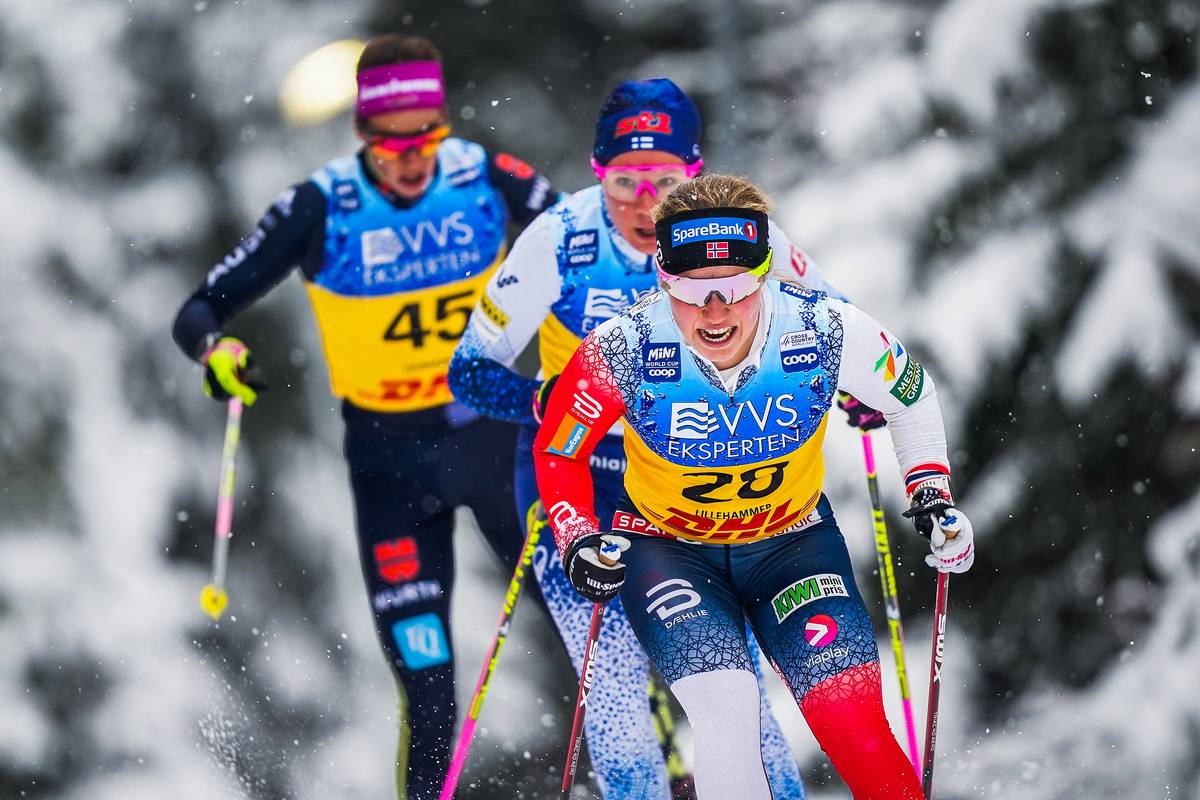
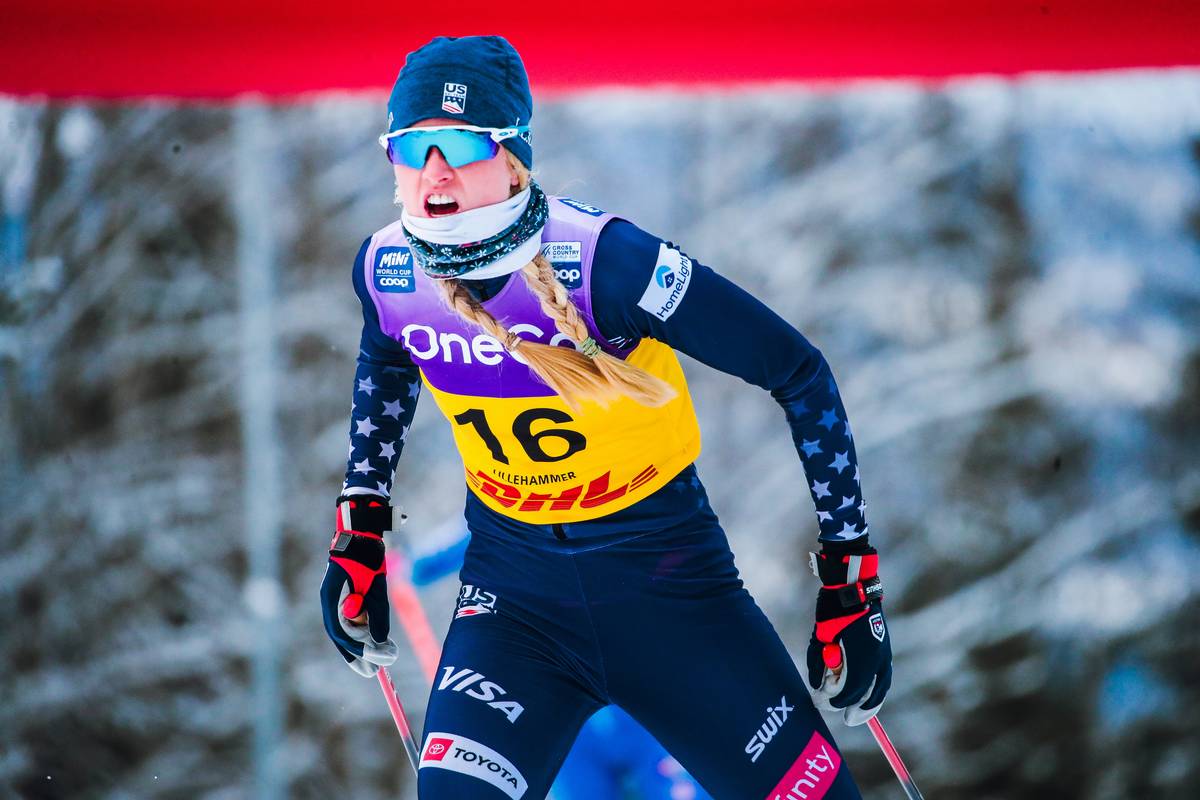
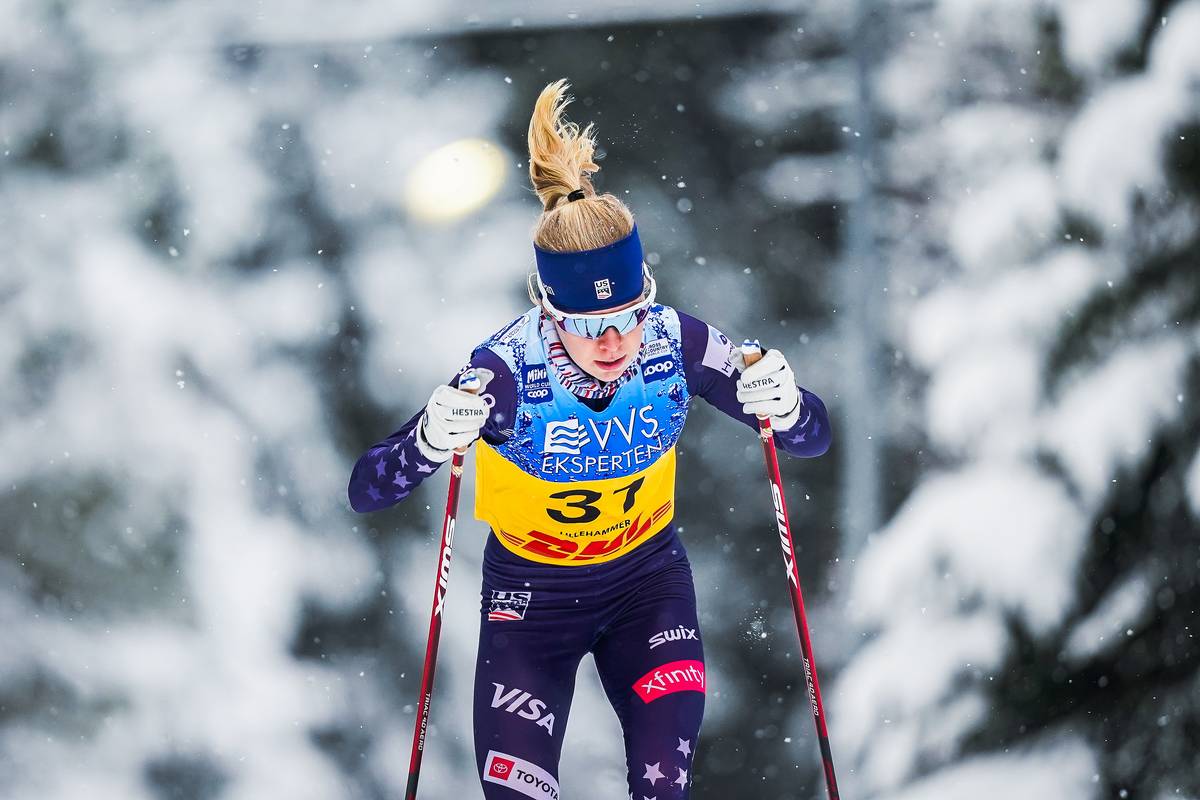
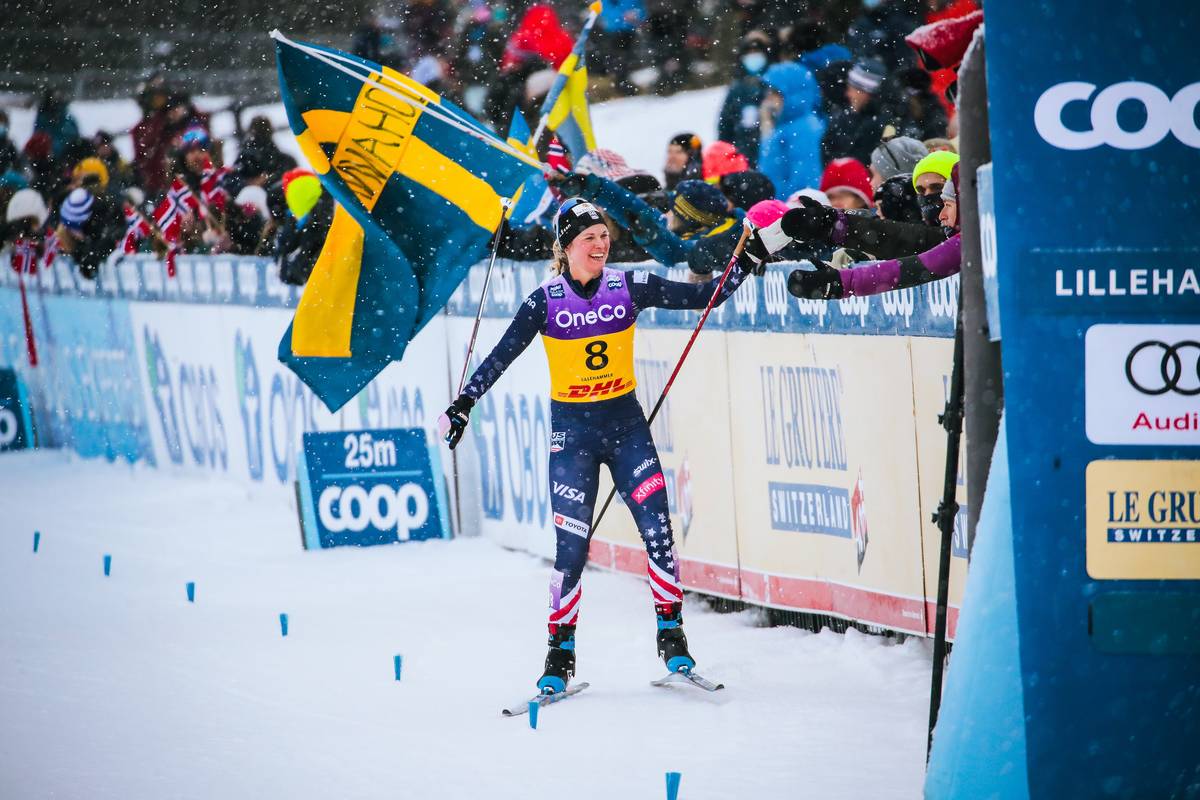
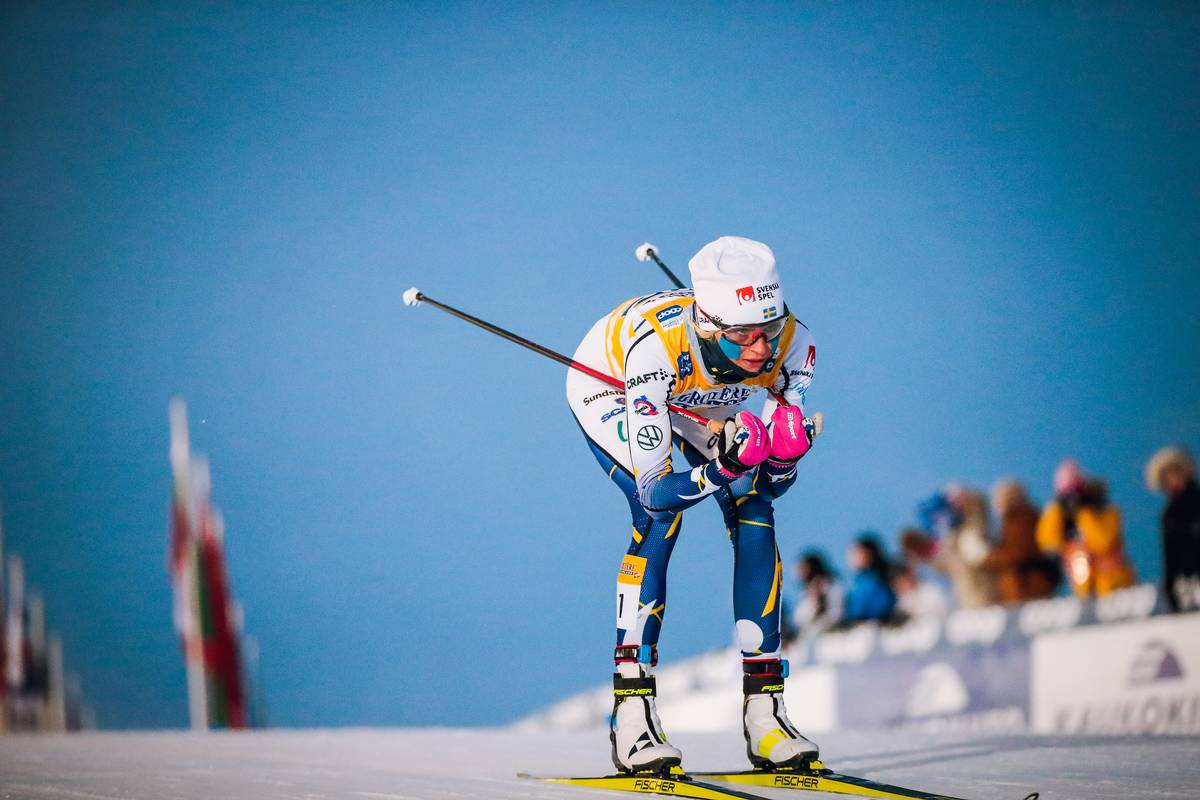
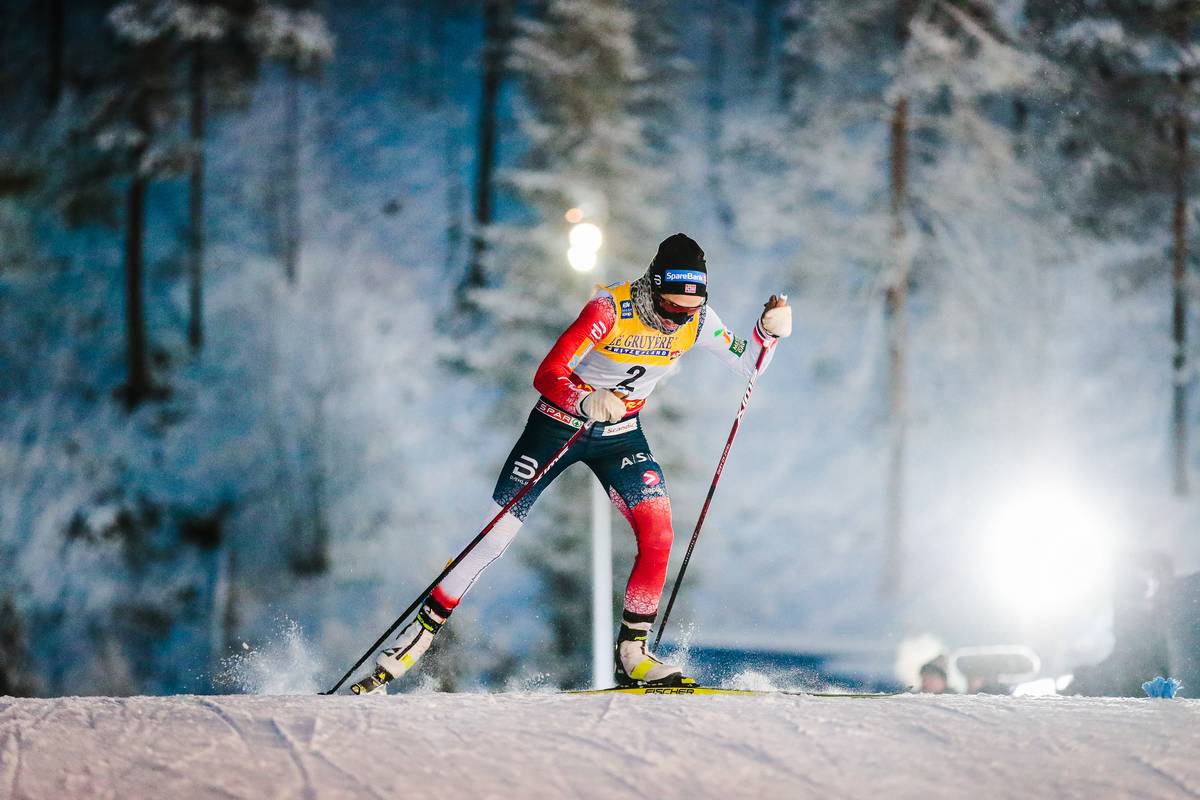
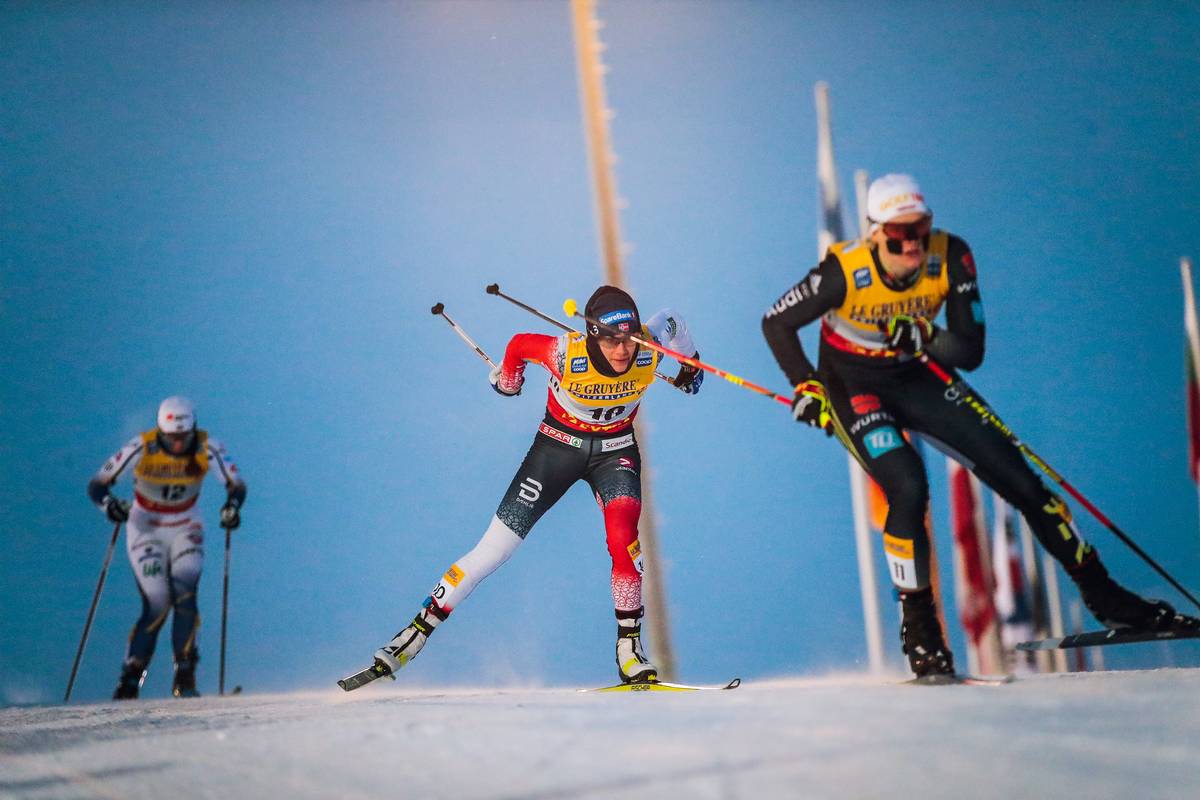
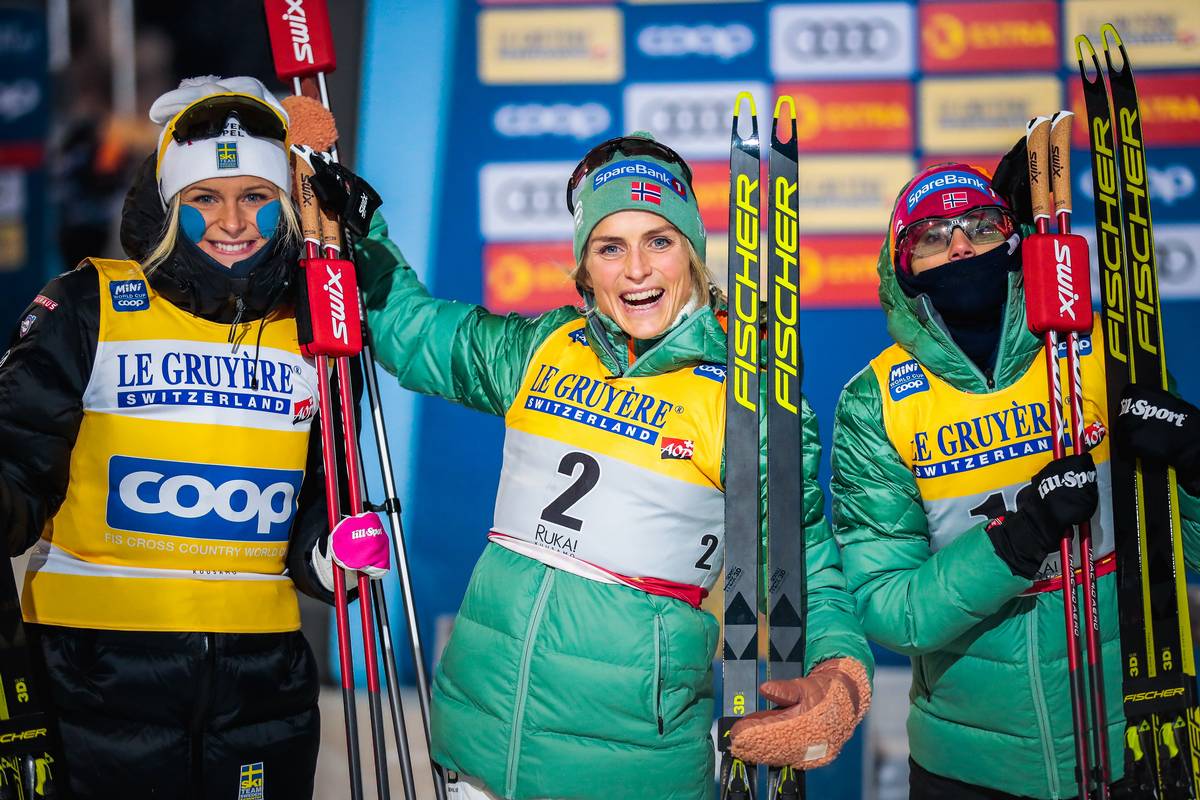
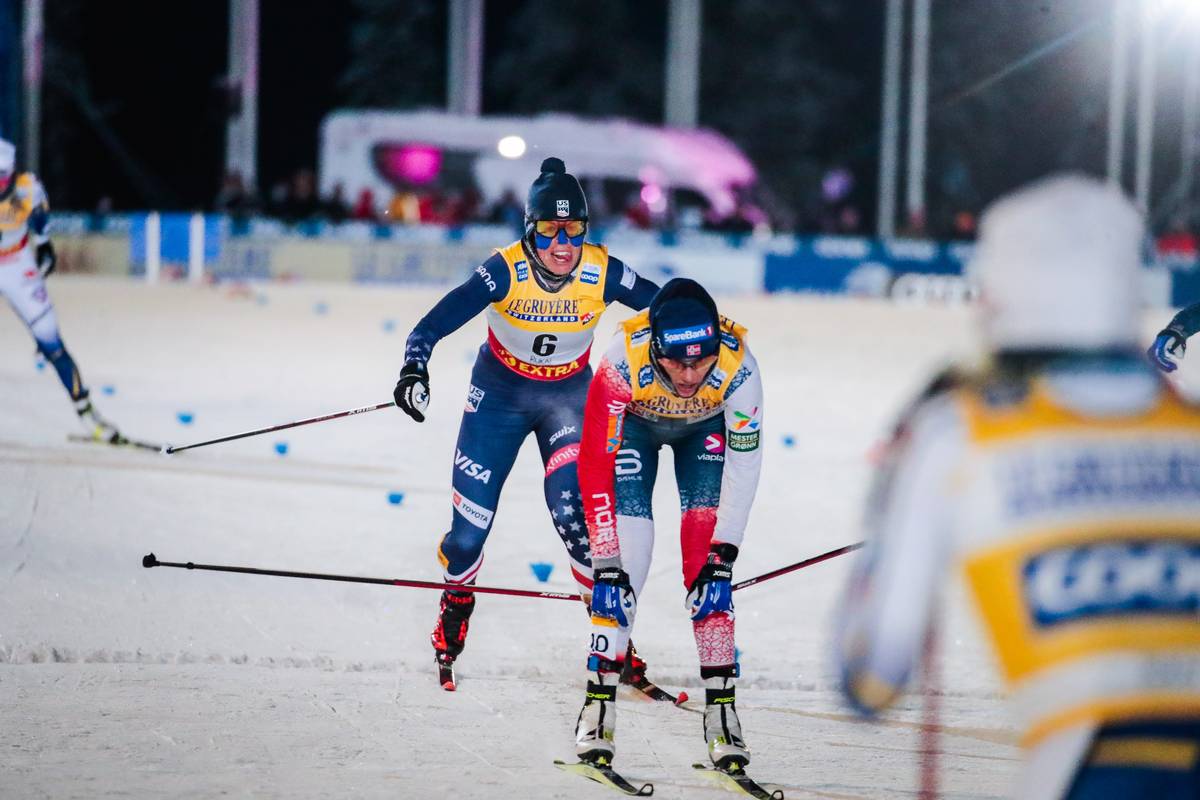
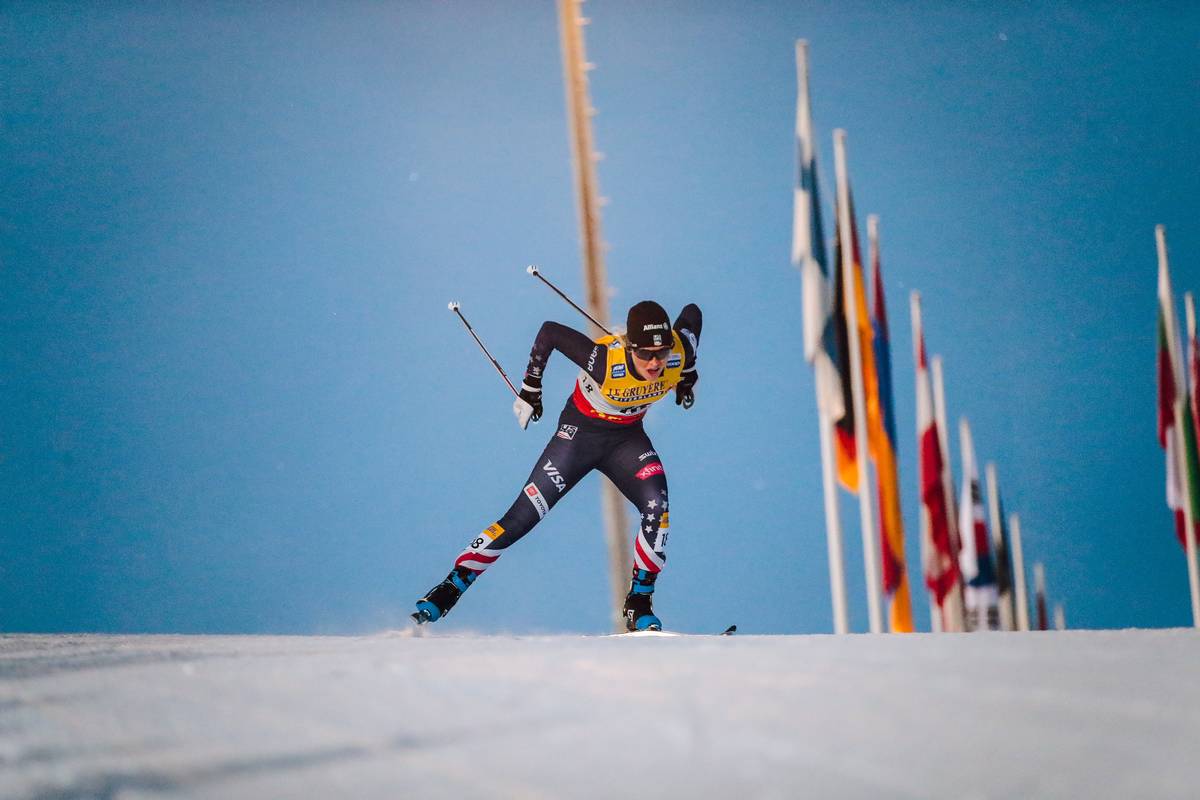
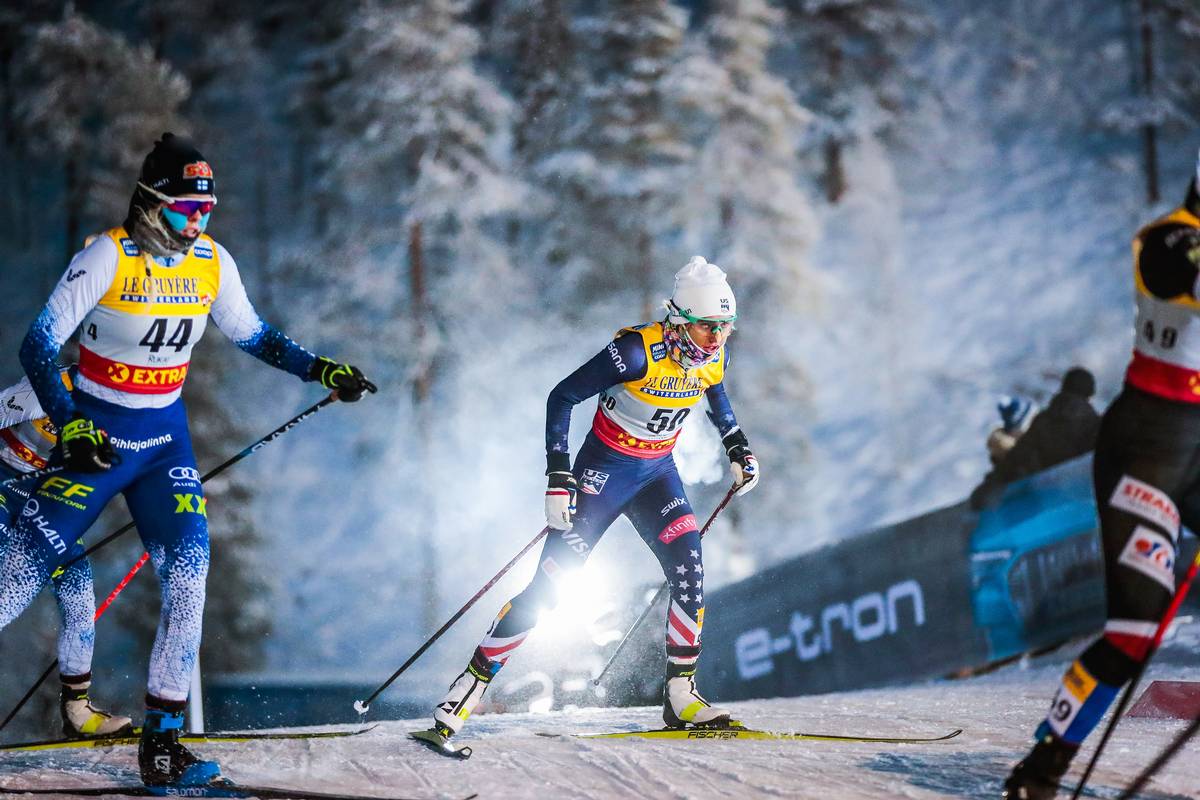
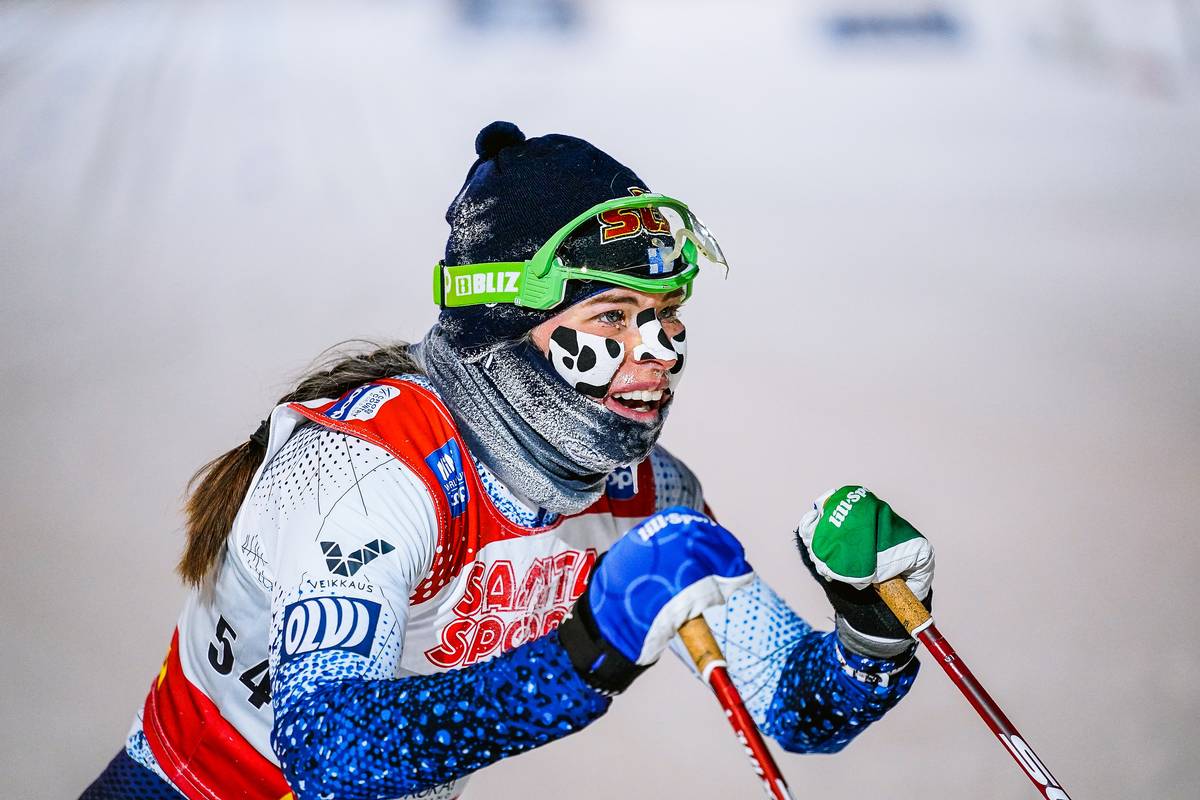
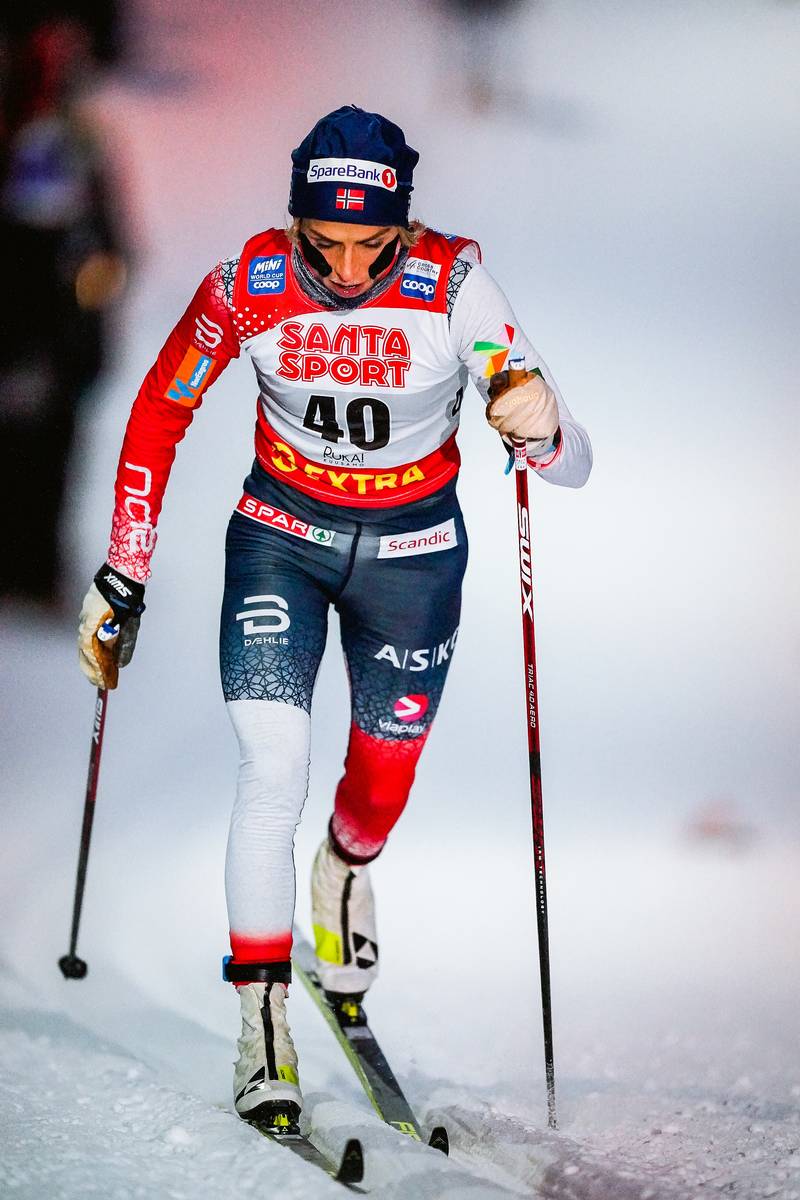
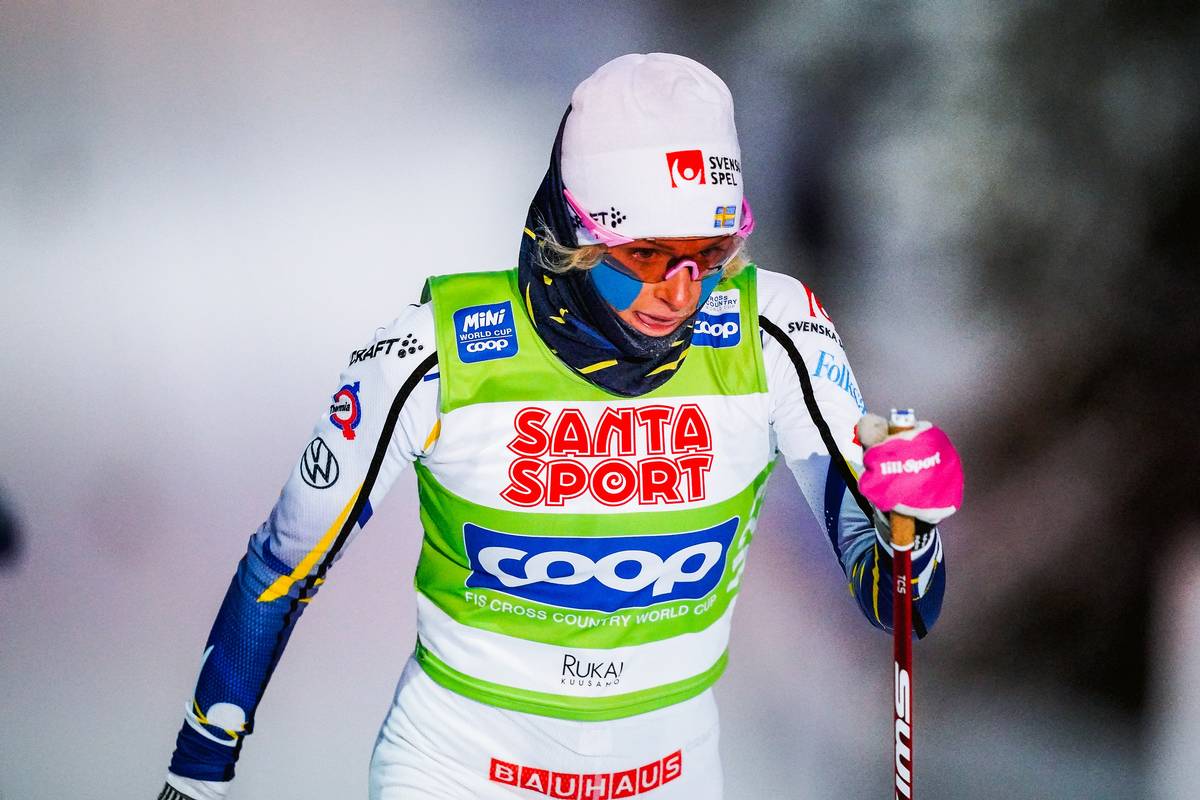
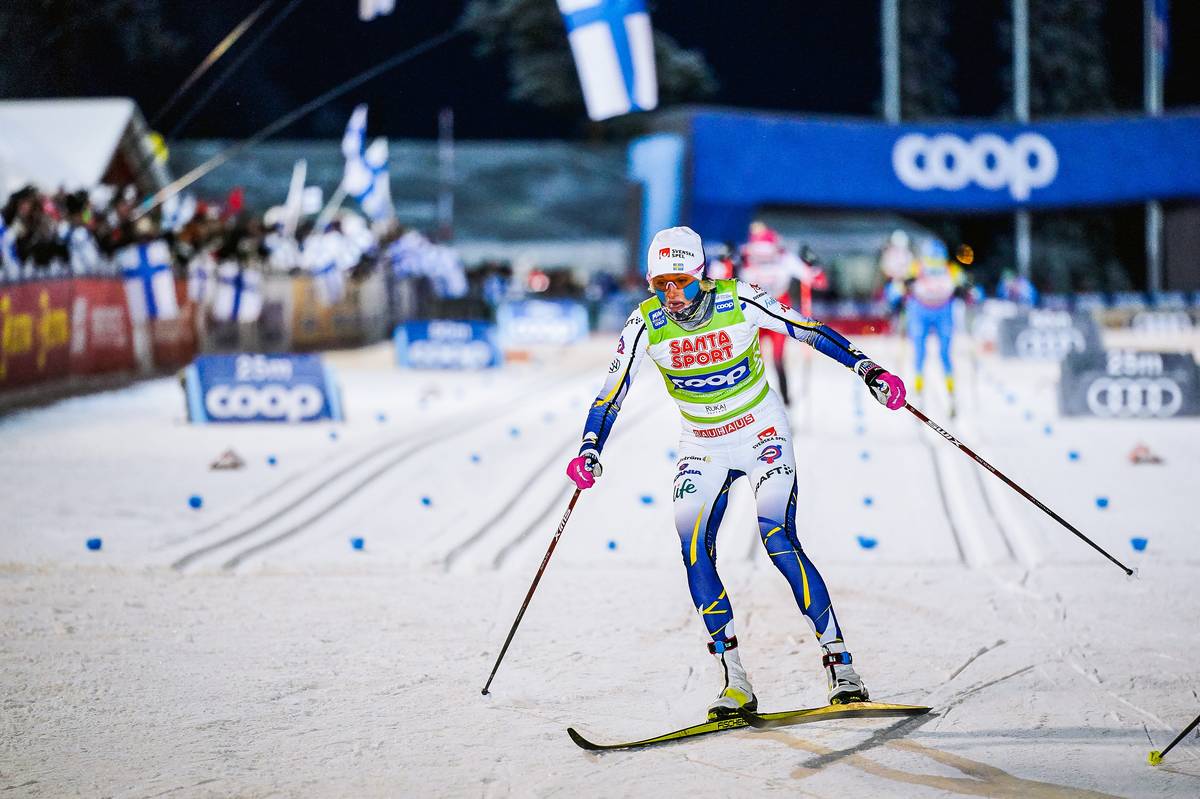
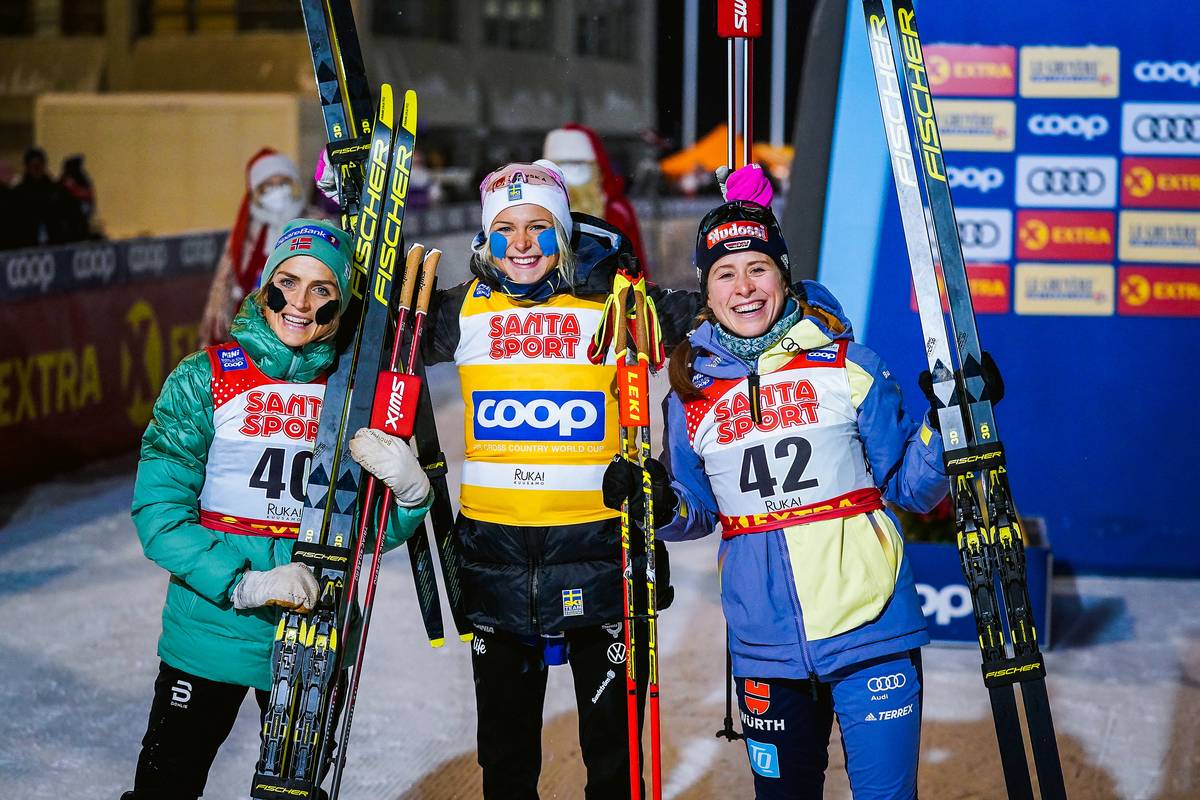
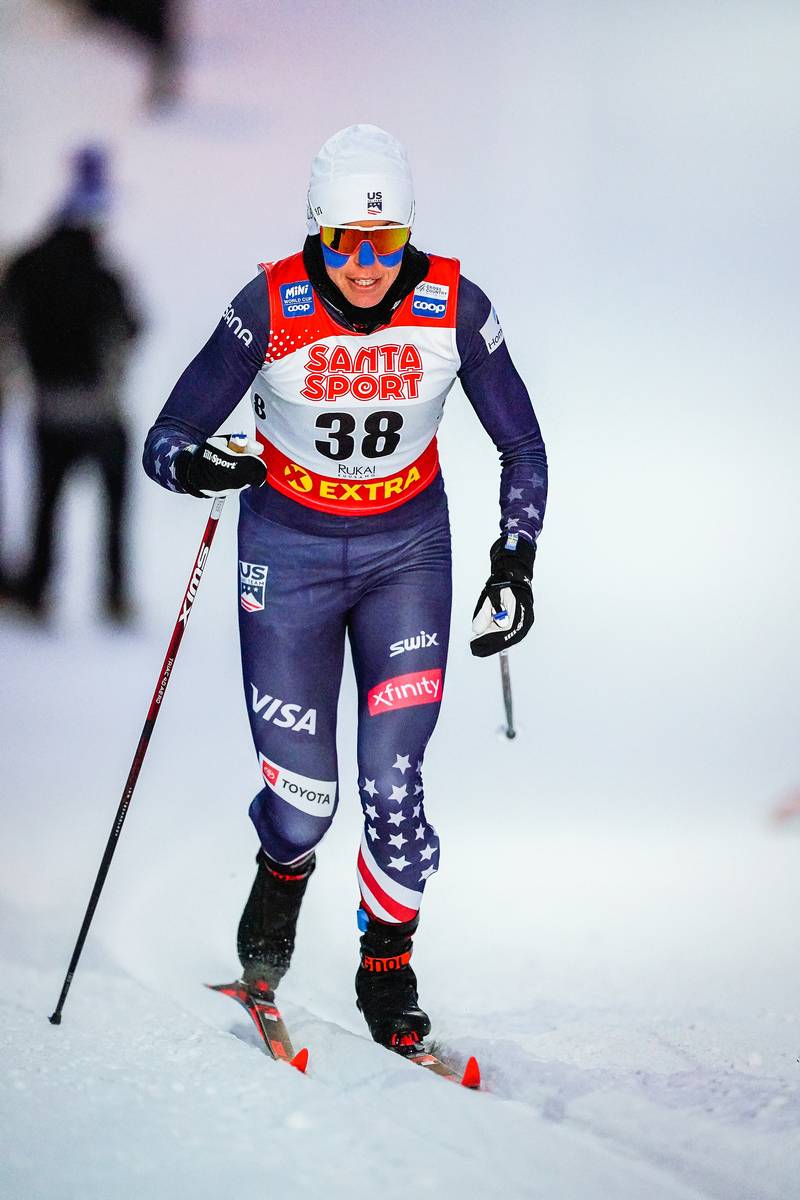
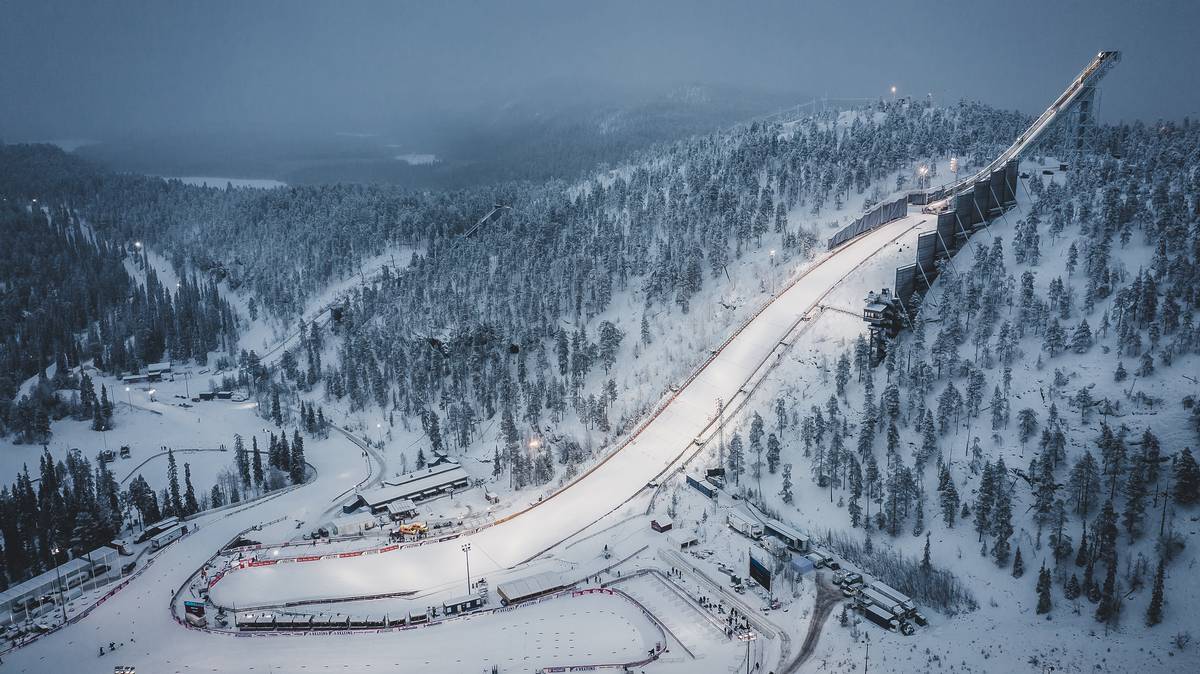
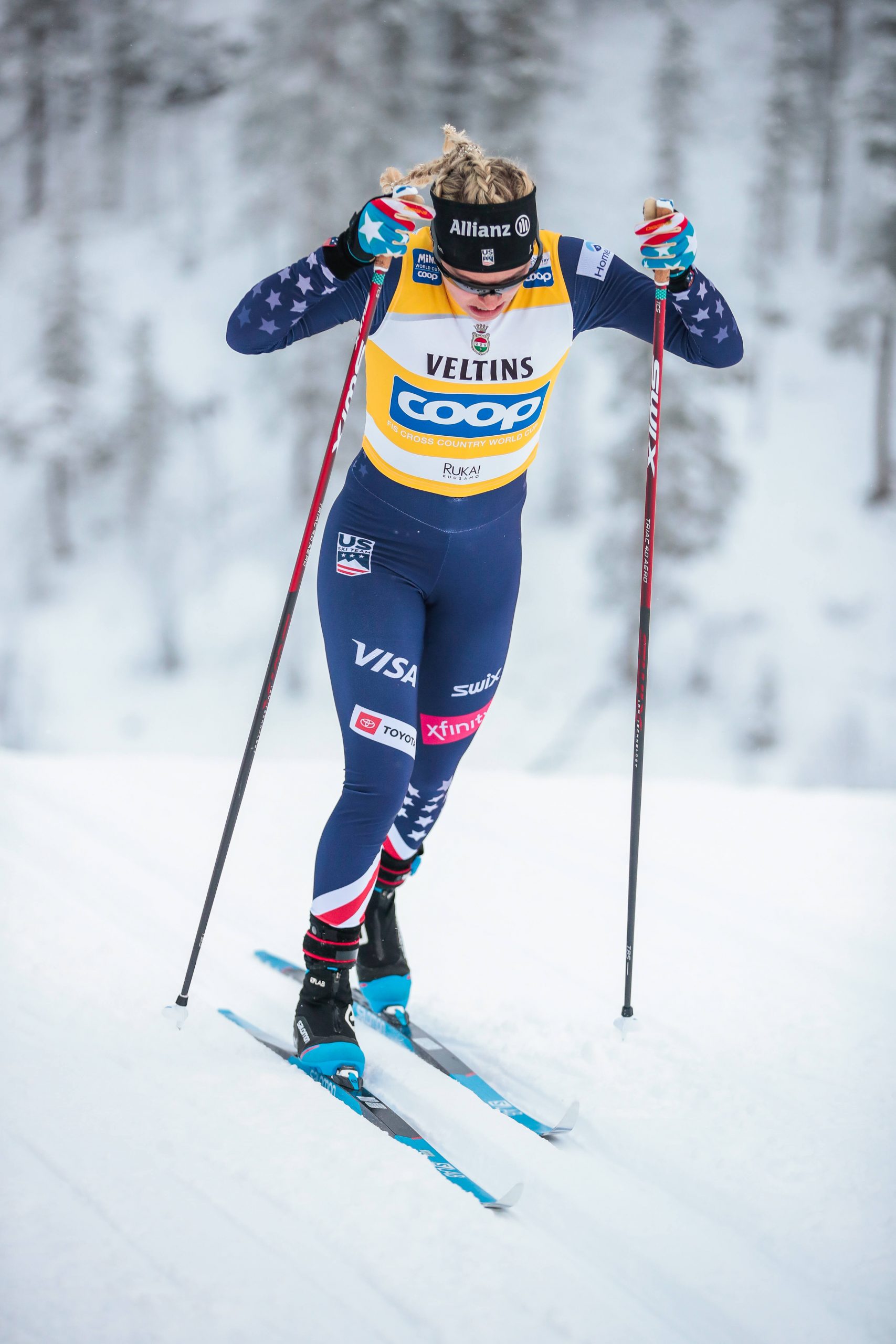
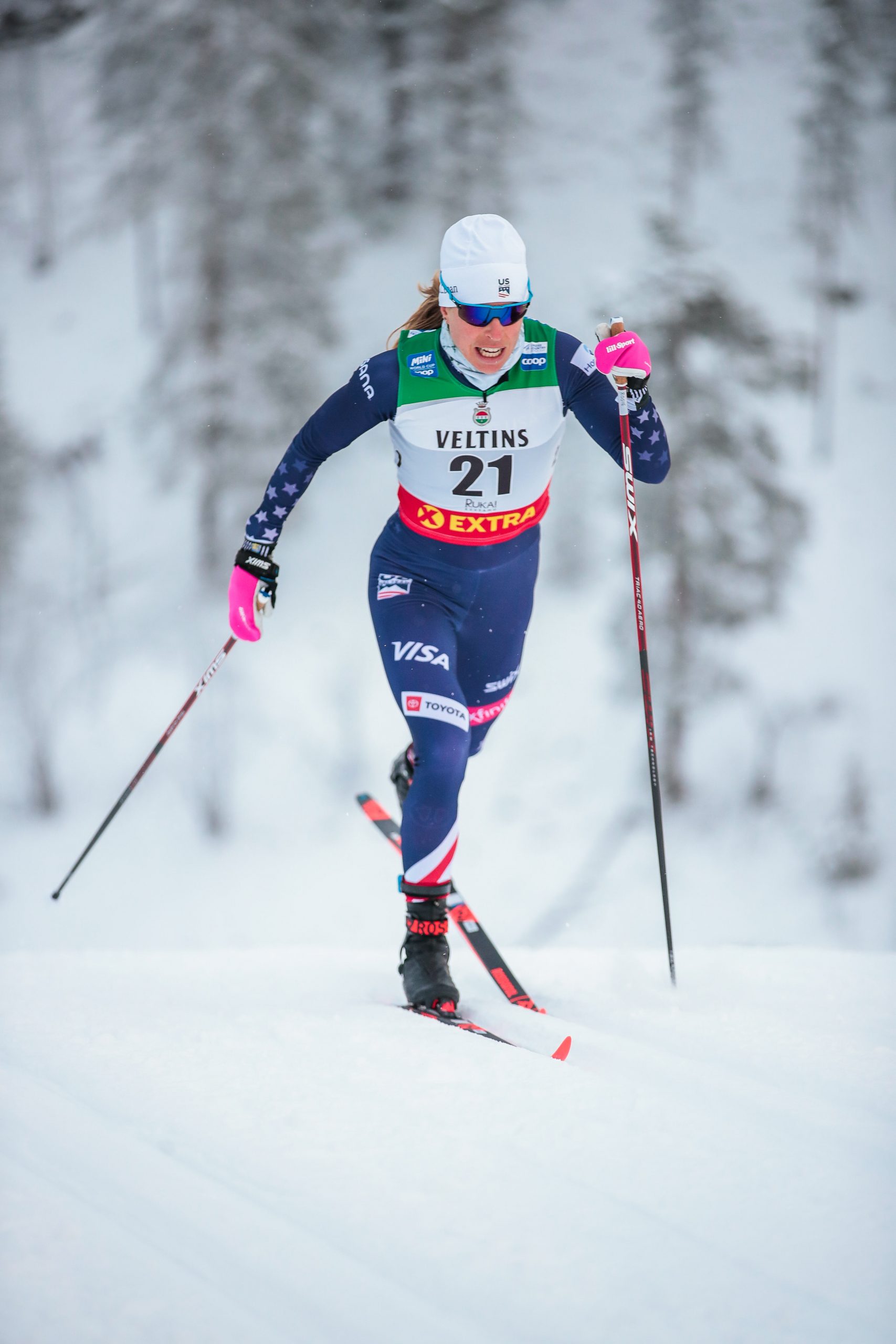
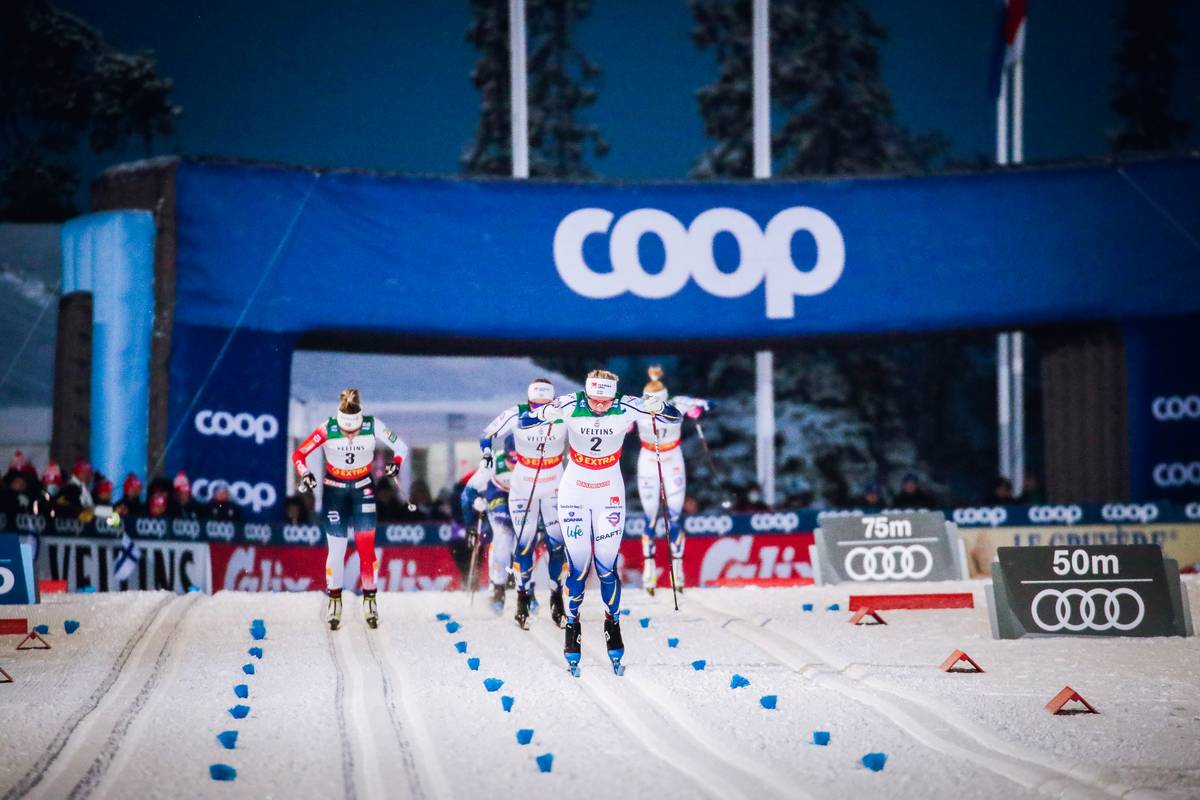
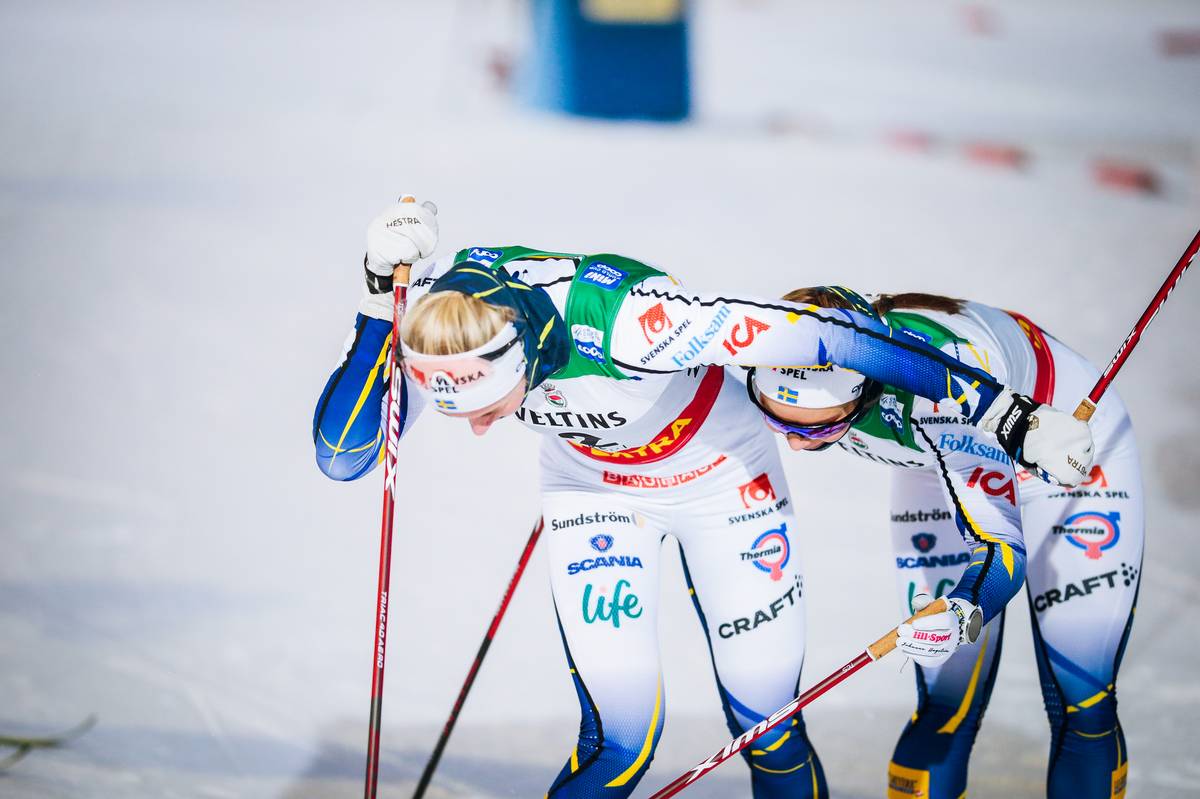
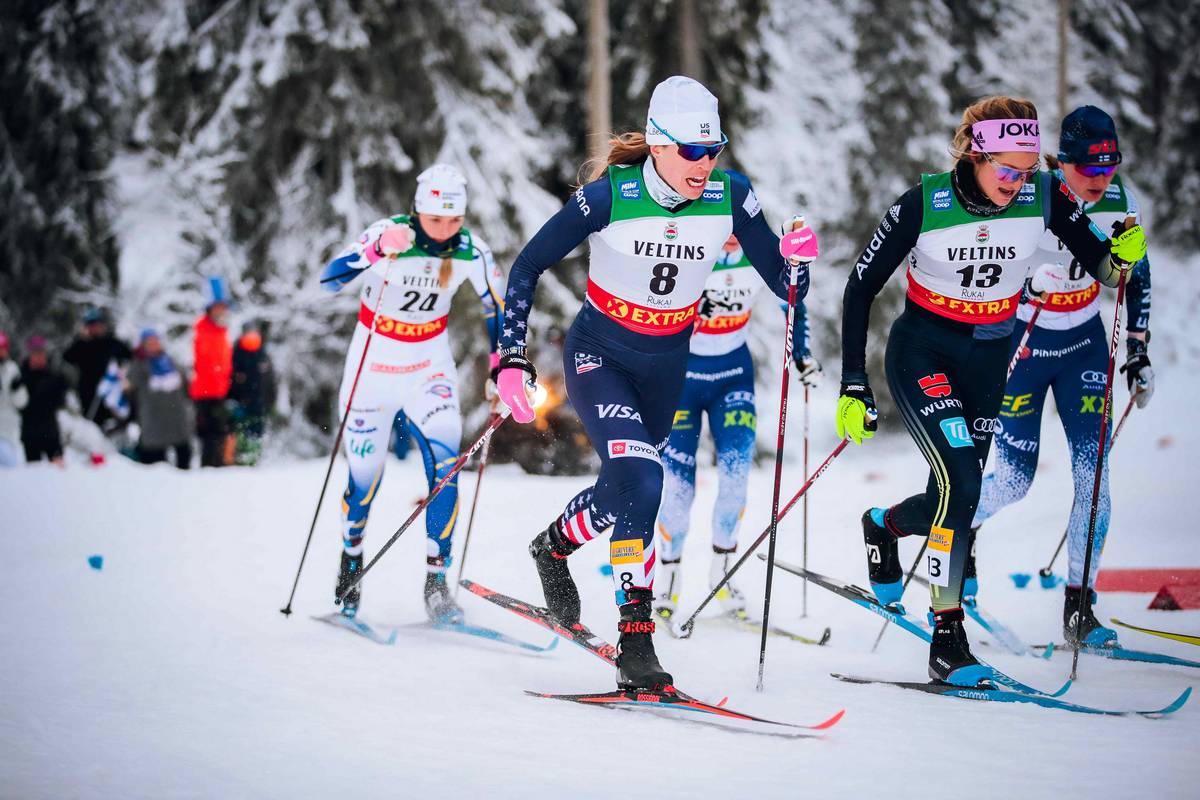
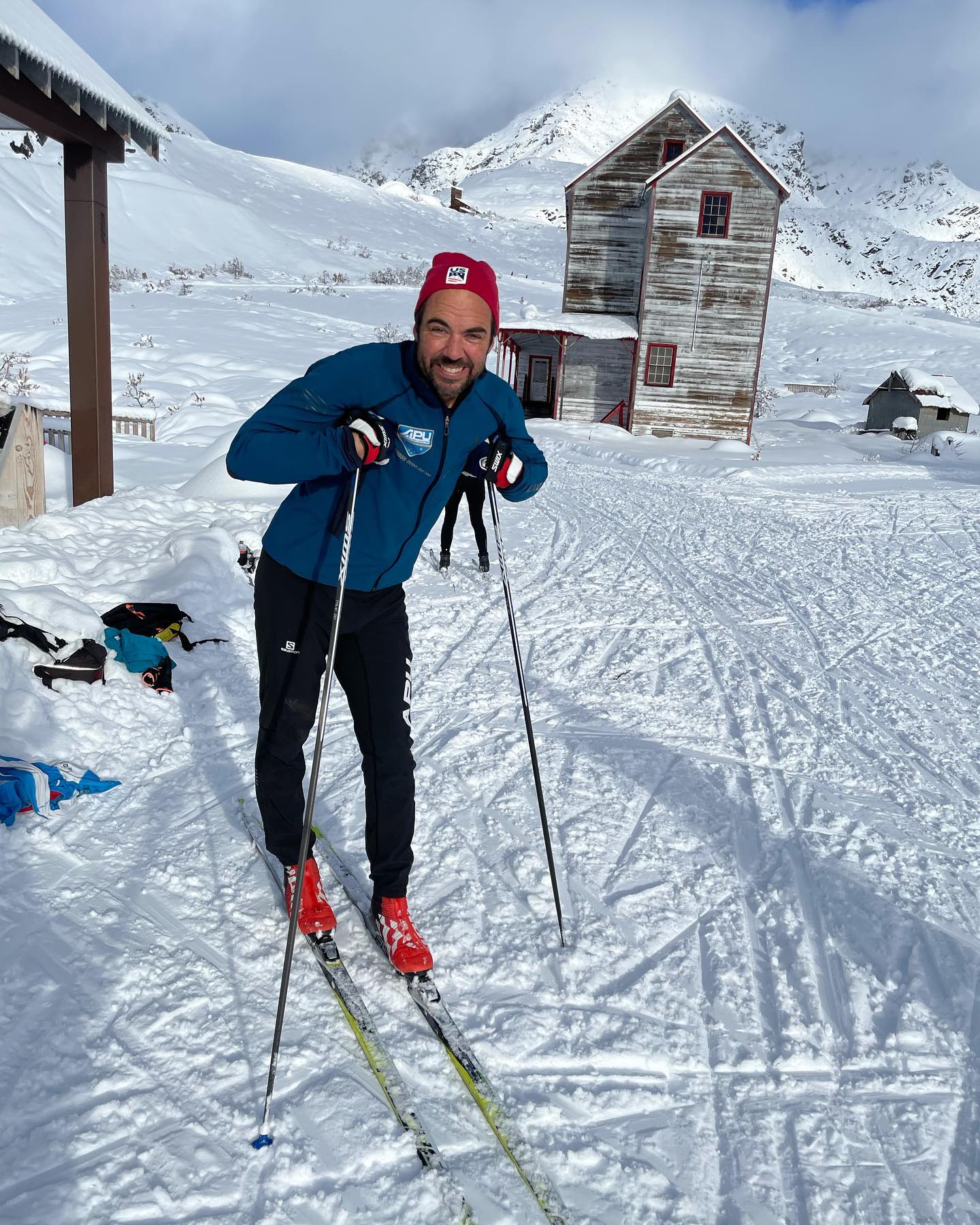
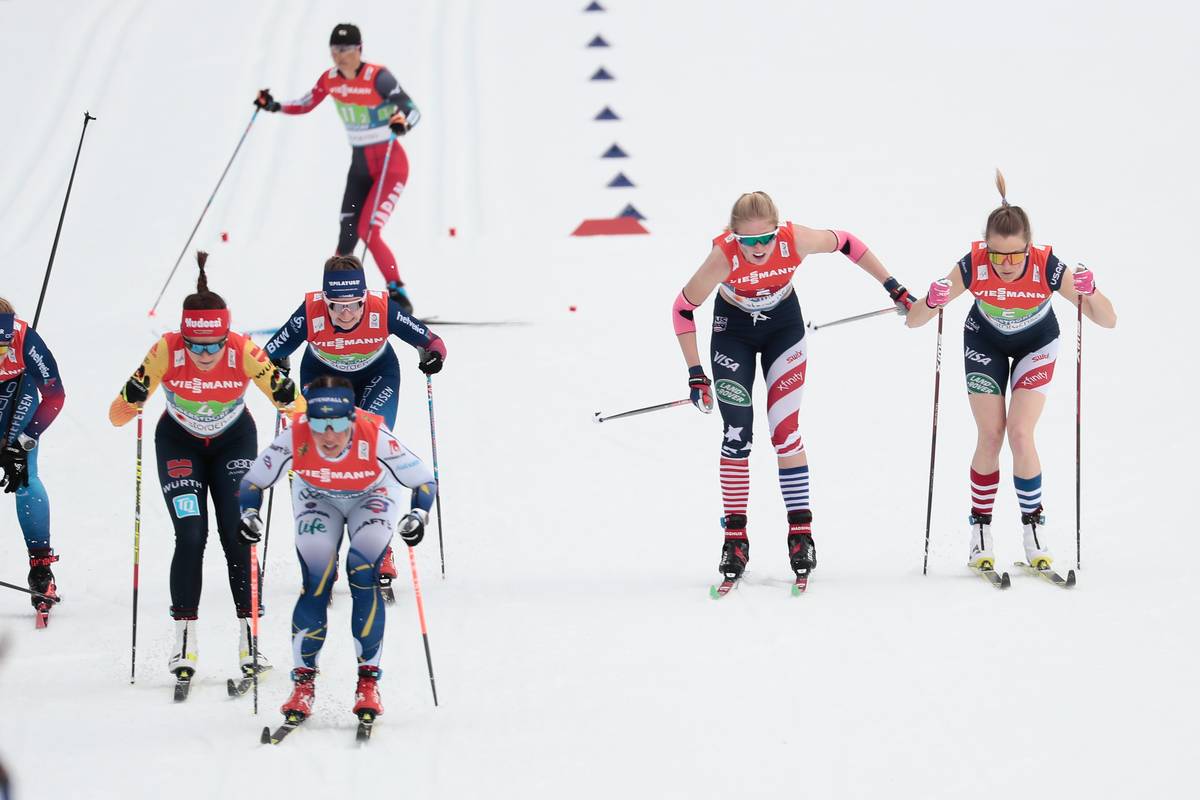
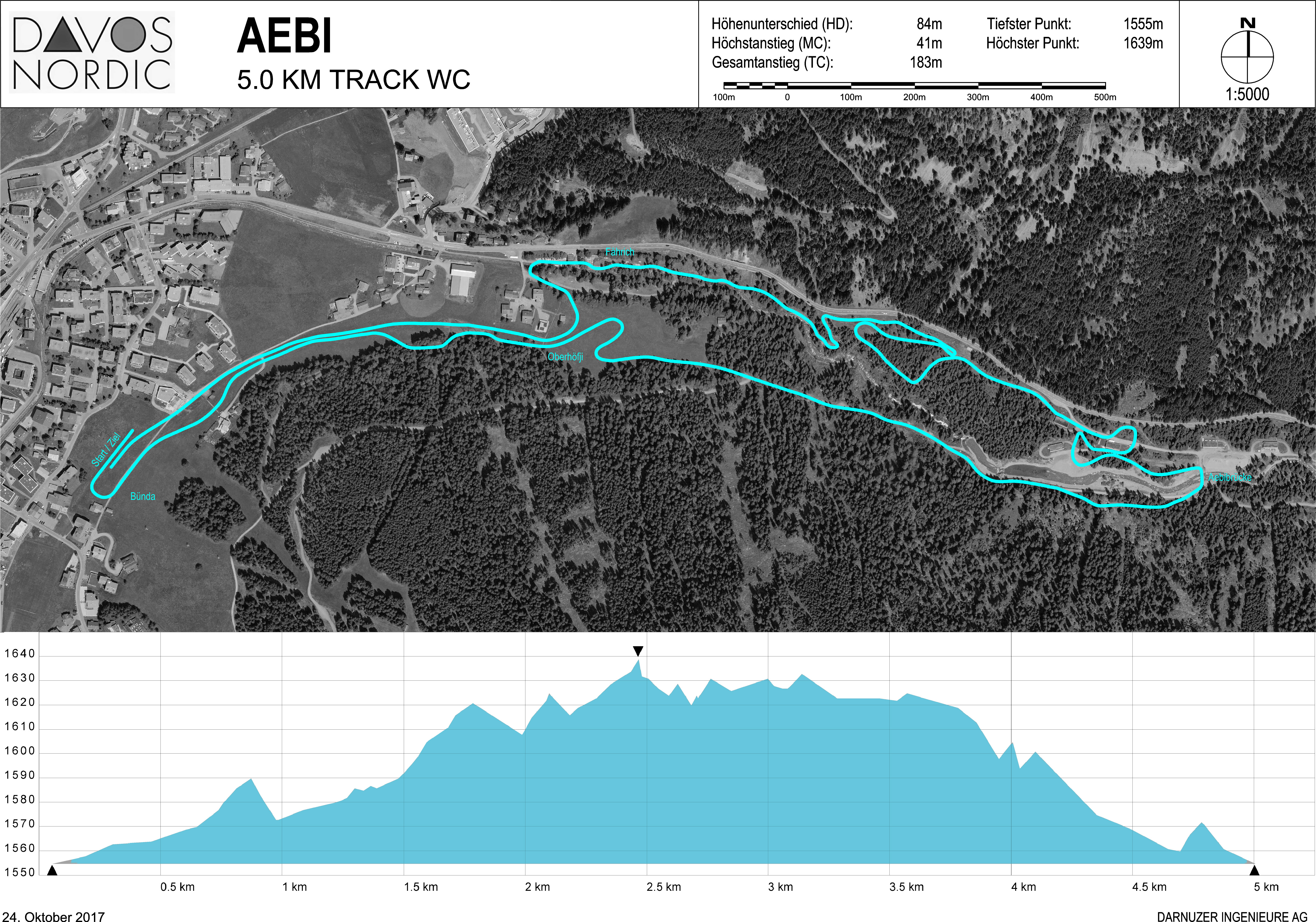
Striding out of the stadium at the Zhangjiakou National Cross-Country Skiing Center (Photo: NordicFocus)
This World Cup coverage is made possible through the generous support of Marty and Kathy Hall and the A Hall Mark of Excellence Award. To learn more about A Hall Mark of Excellence Award or to learn how you can support FasterSkier’s coverage please contact info@fasterskier.com.
After a long hiatus from international racing, the top athletes found themselves on the start line once again, ready to contest the first event of the 2022 Winter Olympics. First up, a 15-kilometer skiathlon, featuring 64 starters completing four 3.75 k loops. The skiathlon, which combines both classic and skate in one race (7.5 k of each in this case), is an infrequent event on the World Cup circuit though appears on the schedule at all championships.
Four years ago, at the Olympics in PyeongChang, it was Charlotte Kalla of Sweden who bested the field to take gold, followed by Marit Bjørgen of Norway and Krista Pärmäkoski of Finland. Notably, this year’s winner, Therese Johaug was not present, but we will return to this point later on.
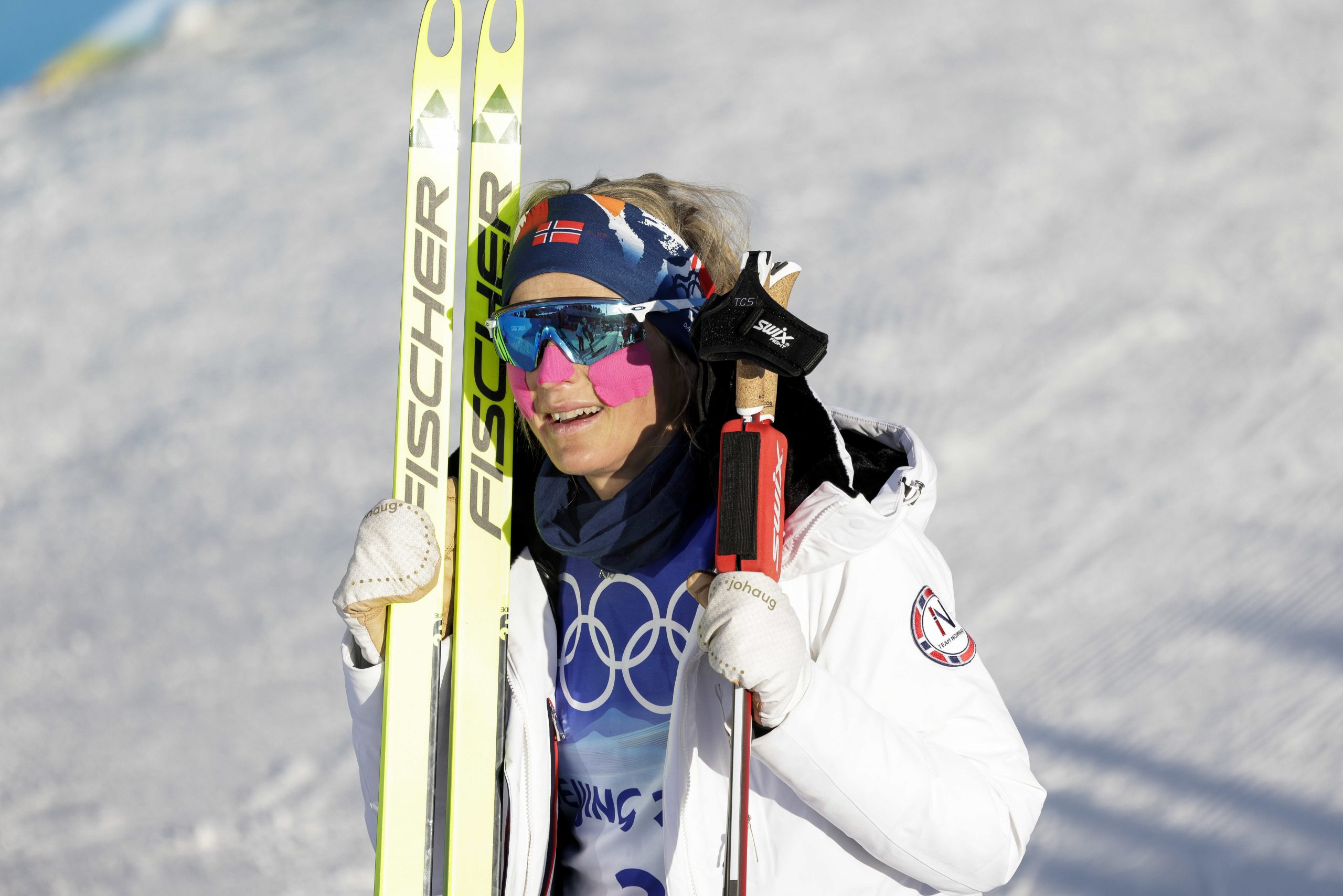
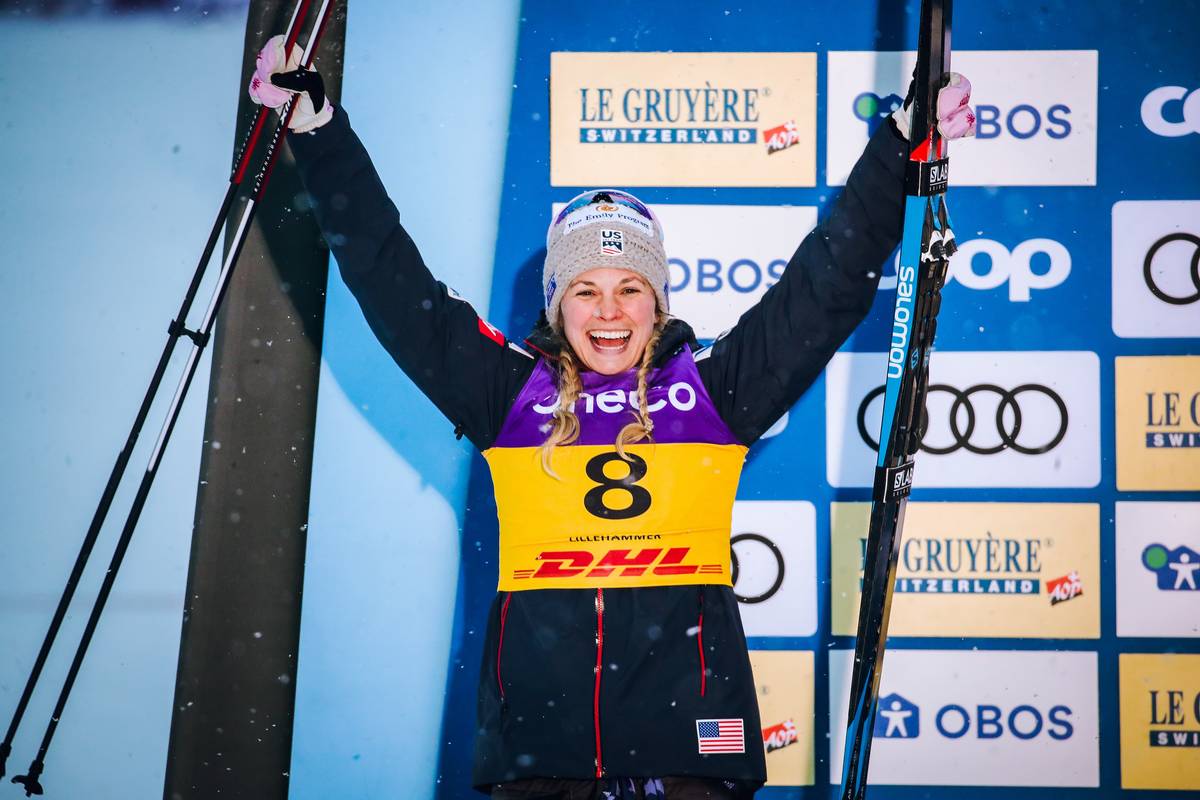
Celebration for Therese Johaug (NOR) as she takes her first ever individual Olympic gold medal (Photo: NordicFocus)
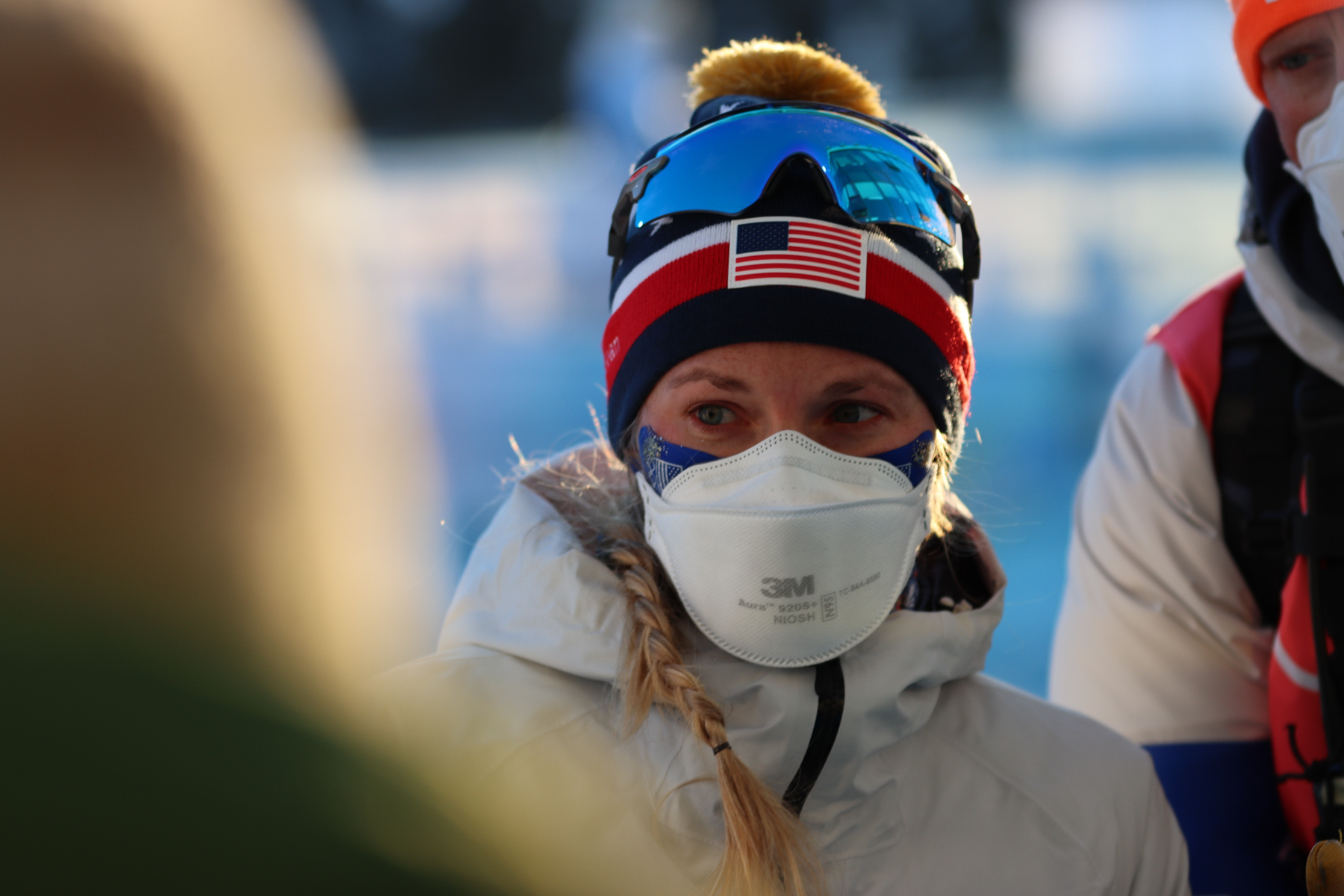
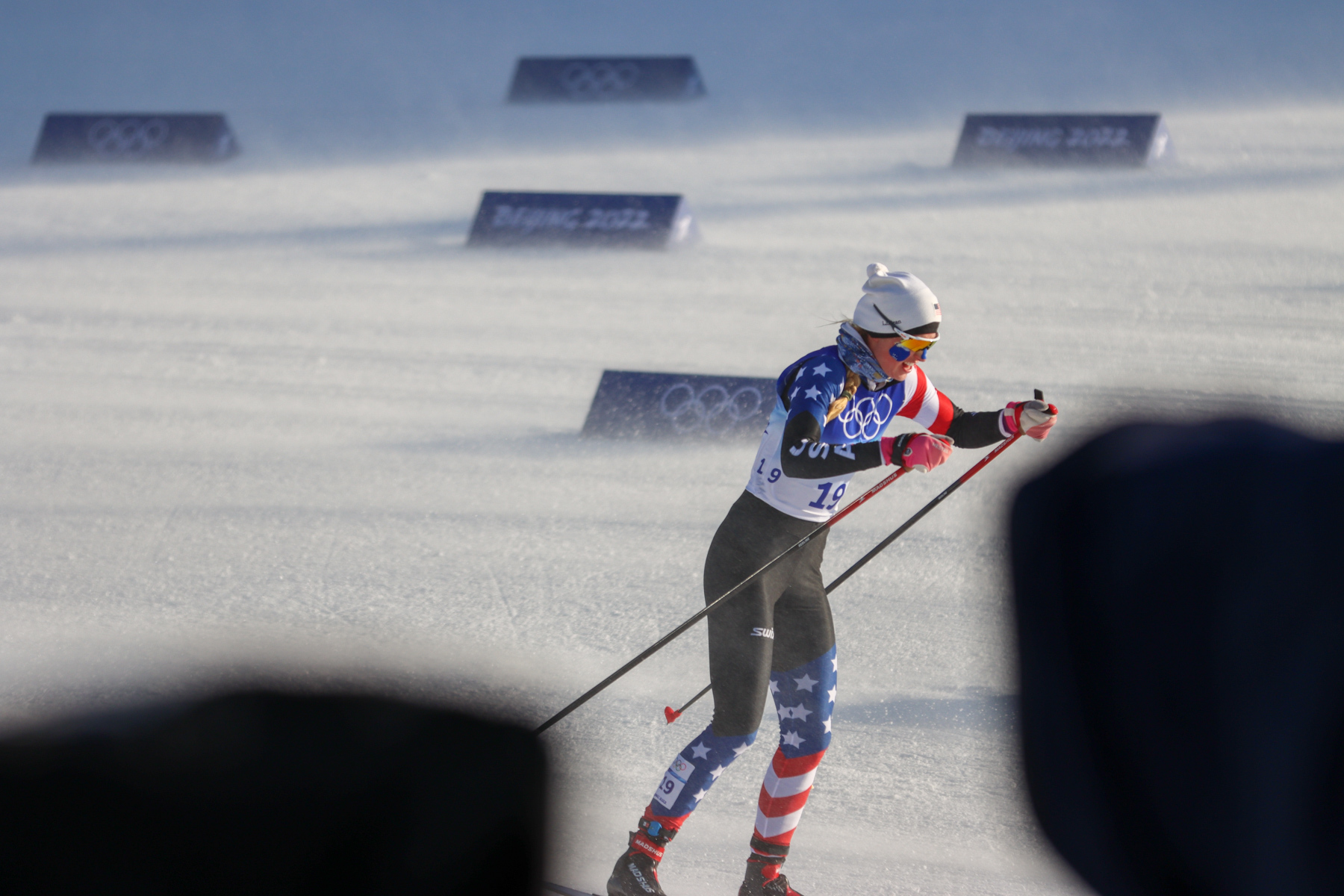
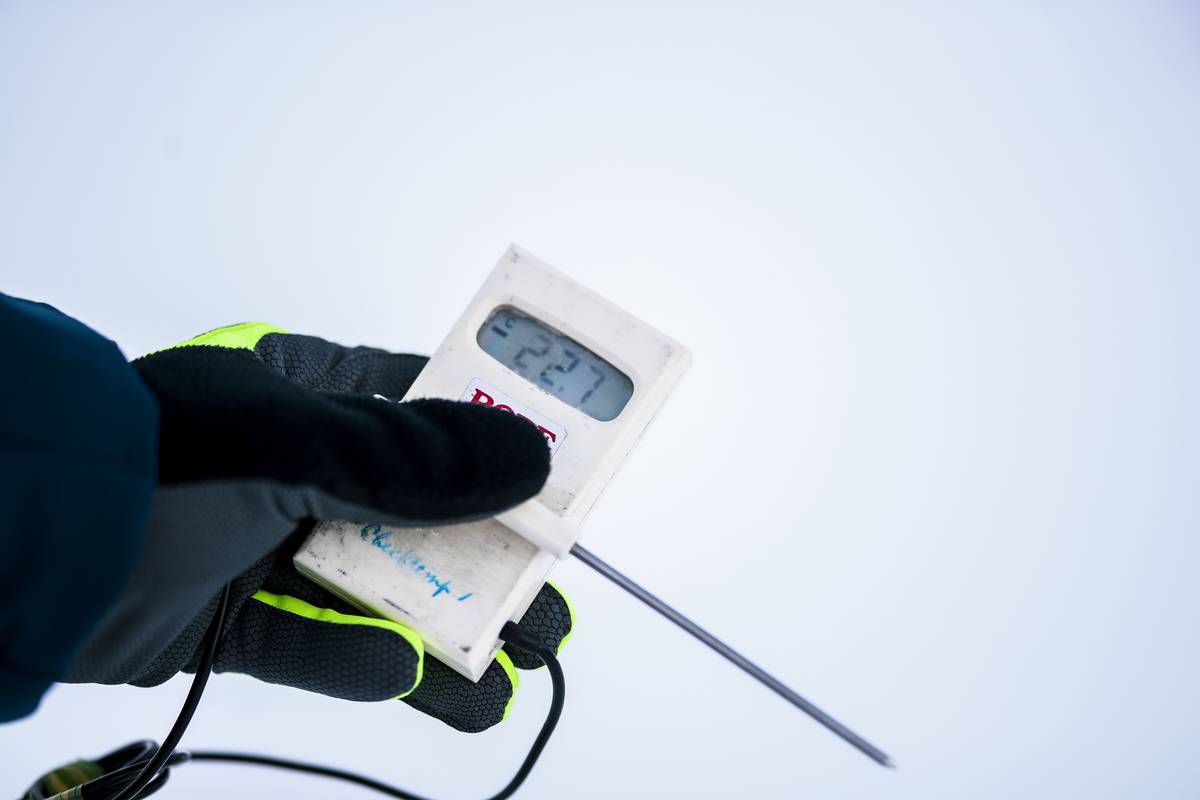
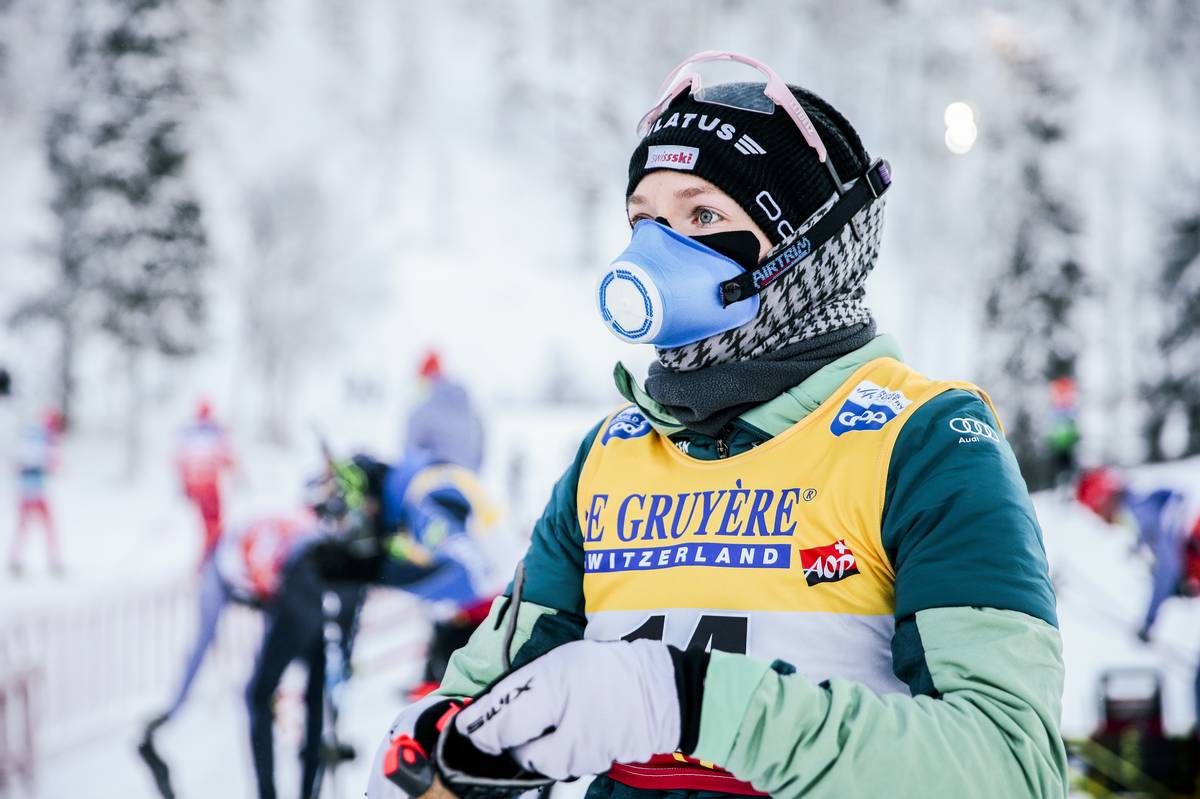
Watched by a few masked fans in the stands, the athletes completed final preparations before the start. Even without looking at the temperature, the cold was evident, from the blowing trees and bibs to the drifting snow across the tracks and the face-tape present on all the starters. The thermometer said -12.5°C or 9.5°F, though this reading likely didn’t factor in the windchill. With minutes to go, the athletes emerged from a set of underground stairs, bundled in parkas, to take their places on the start line.
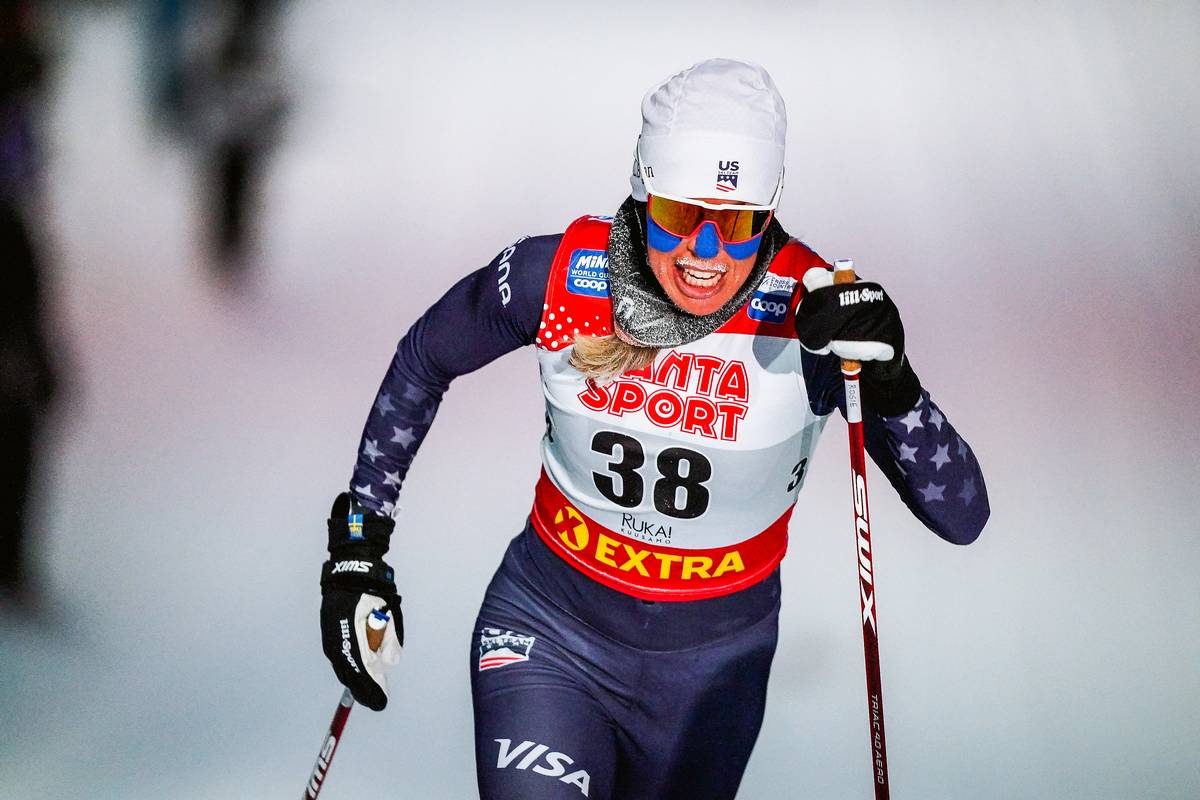
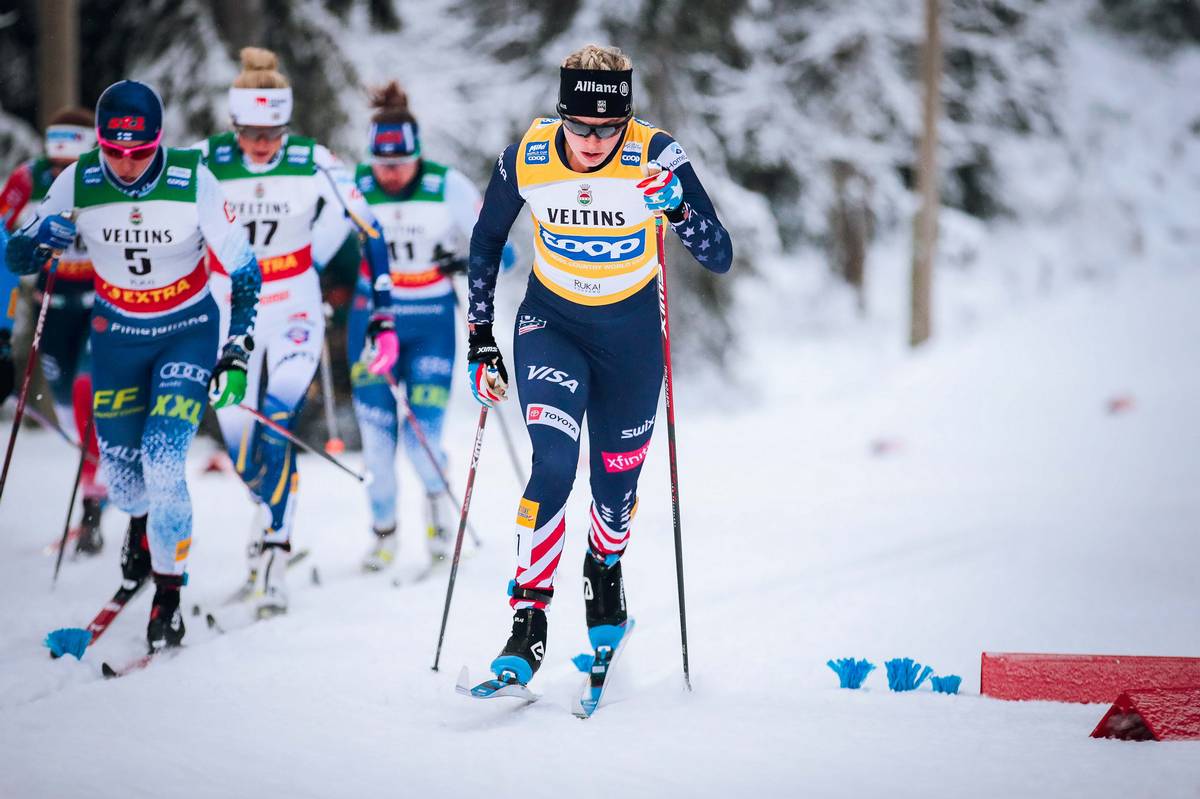
At the starters command, the first cross-country ski race of the 2022 Olympics was underway, and almost immediately two skiers went down in a crash, though thankfully the damage did not impact the rest of the field. Coralie Bentz of France and Anne Kyllönen of Finland recovered quickly and rejoined the pack. With the first A-climb less than 1 k into the course, early leaders Rosie Brennan (USA) and Therese Johaug (NOR) pushed the pace, and the pack soon thinned.
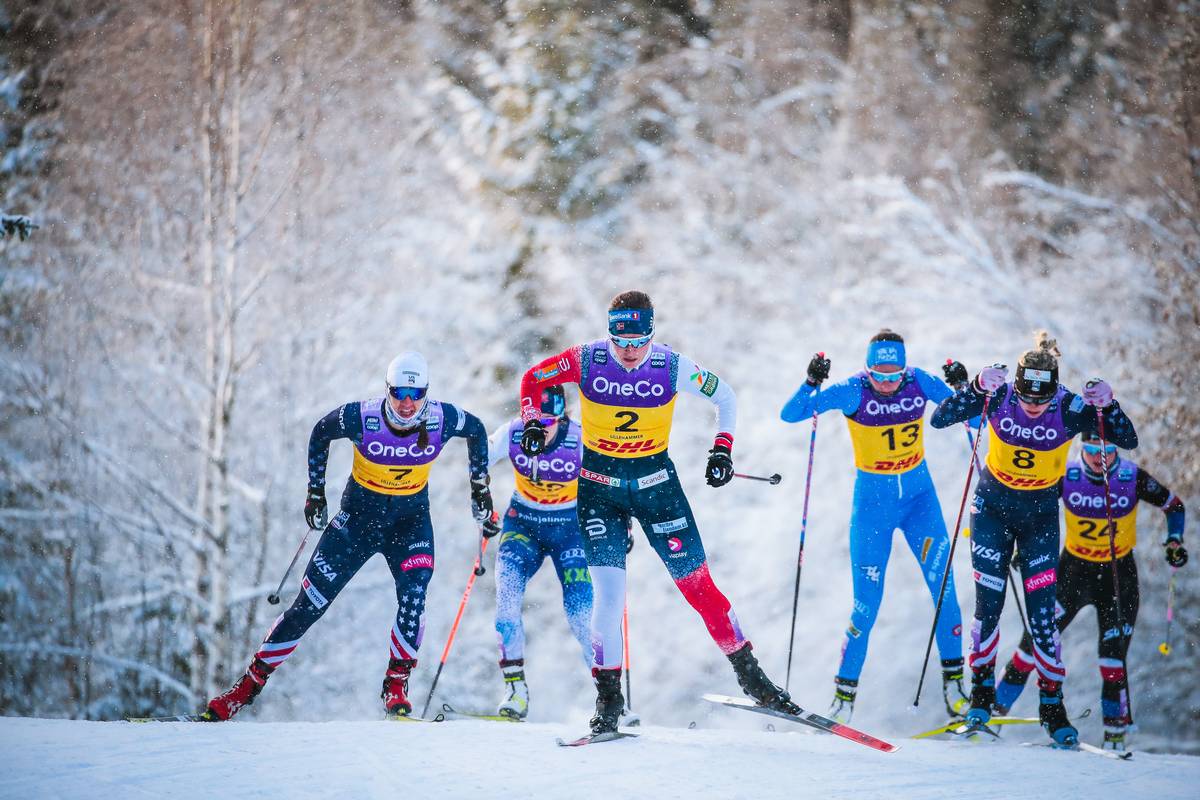
Therese Johaug (NOR) leads the charge up the first big hill, Rosie Brennan (USA) can be seen leading the left most column (Photo: NordicFocus)
On the descents, the camera showed most athletes opting to ski on the platform, rather than the tracks, due to the drifting snow that was filling them. Skirting another fall, this time from Johanna Matintalo of Finland, the front group entered the stadium for the first round in a pack of roughly fifteen. With just over eleven minutes on the race clock, there were ten athletes within five seconds of Johaug, a slight surprise given her tendency for early breakaways.
Heading out for the second lap, Johaug visibly upped the pace though still had difficulty shaking her followers. Through the 5.1 k mark, the spread was now ten athletes over the span of ten seconds, led by Kerttu Niskanen (FIN) and ending with her teammate Matintalo, who had recovered from her fall. Whittled away over the duration of that lap, when they reached the second A-climb of the course before descending towards the stadium, Johaug was leading a group of just six skiers.
Entering the stadium for the transition to skate skis, Johaug double-poled the final rise, managing to open a slight gap to Niskanen, Frida Karlsson (SWE) and Pärmäkoski (FIN). Executing a quick exchange she held the lead and was out with 23:04.7 elapsed on the clock. Niskanen followed +1.0 behind, Pärmäkoski +2.2 and Karlsson +4.3.
It is worth noting that after the exchanges, Jessie Diggins of the USA was in tenth, +57.5 seconds behind Johaug, having dropped significantly over the first two classic loops. Rosie Brennan was next in 14th (+1:11.9), with Hailey Swirbul in 23rd (+1:52.6) as the final American inside the Top-30. Julia Kern was +4:07.1 behind in 53rd, about to hit the gas on the skate laps.
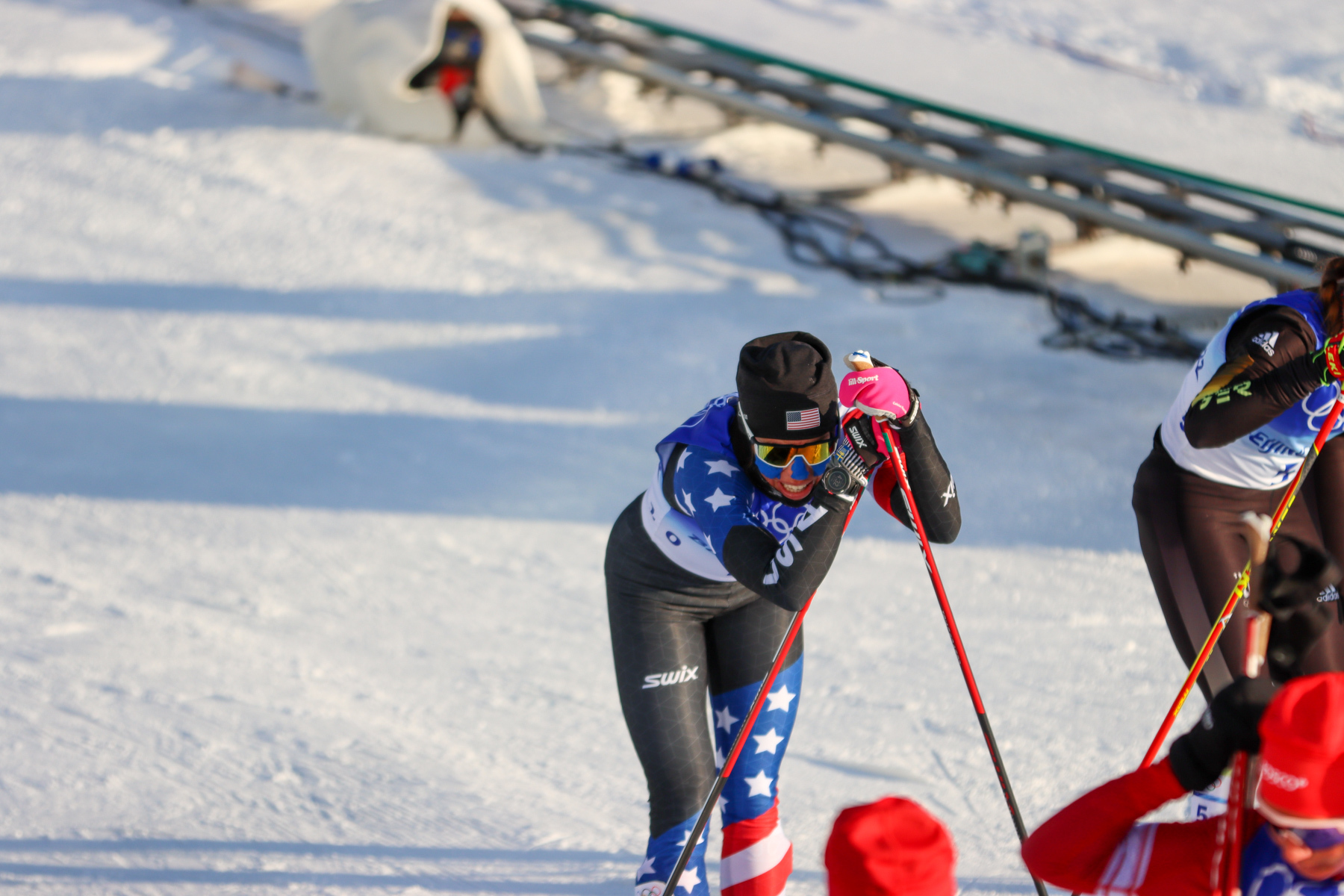
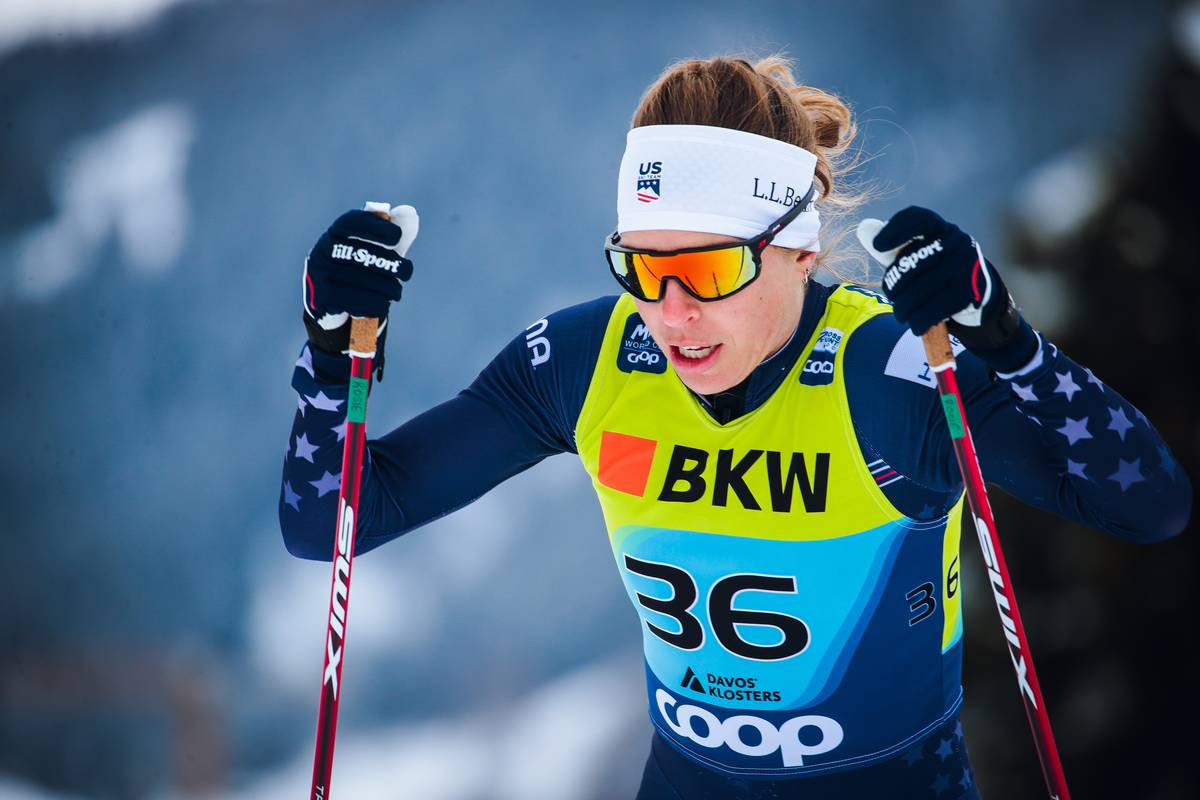
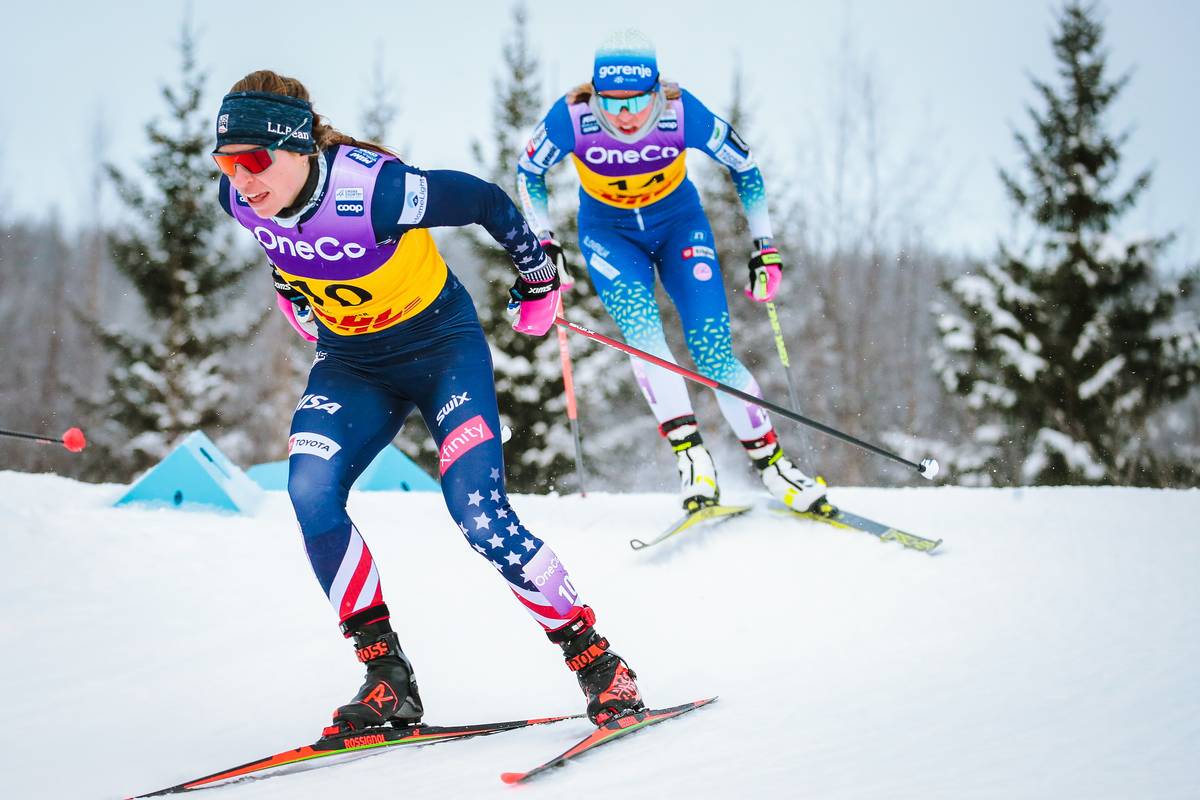
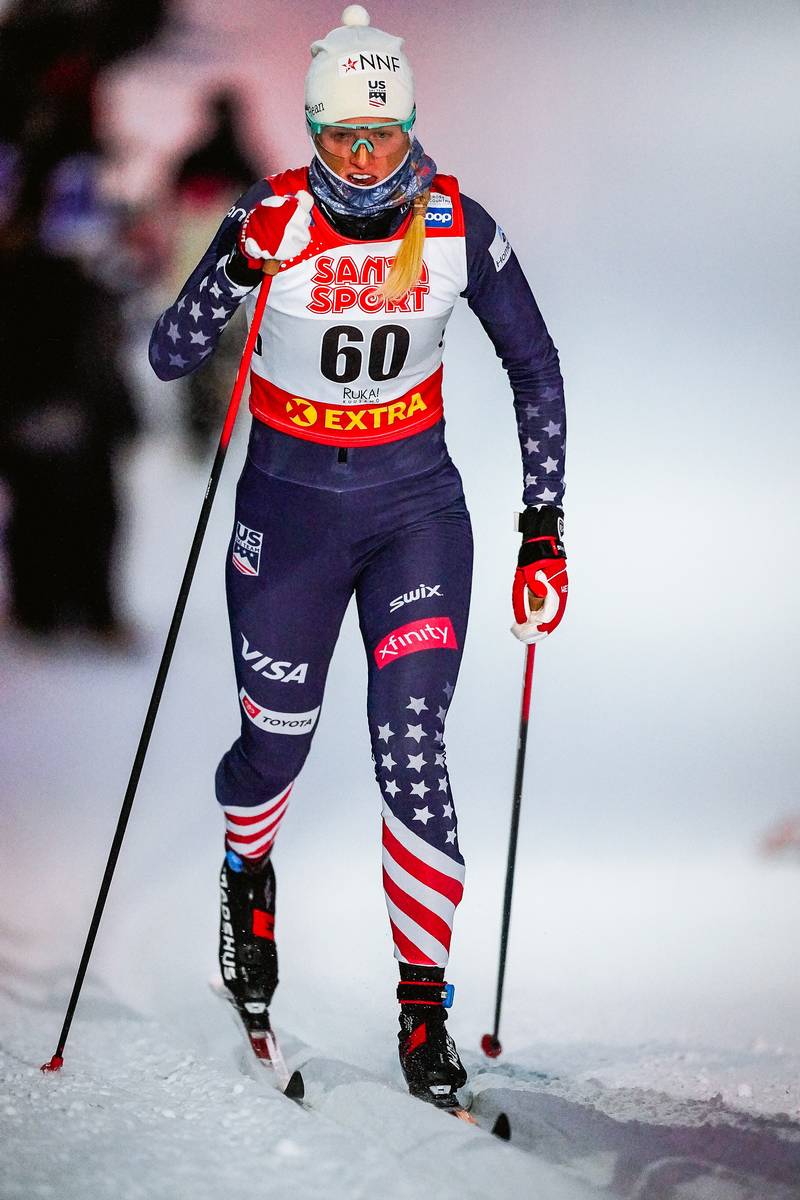
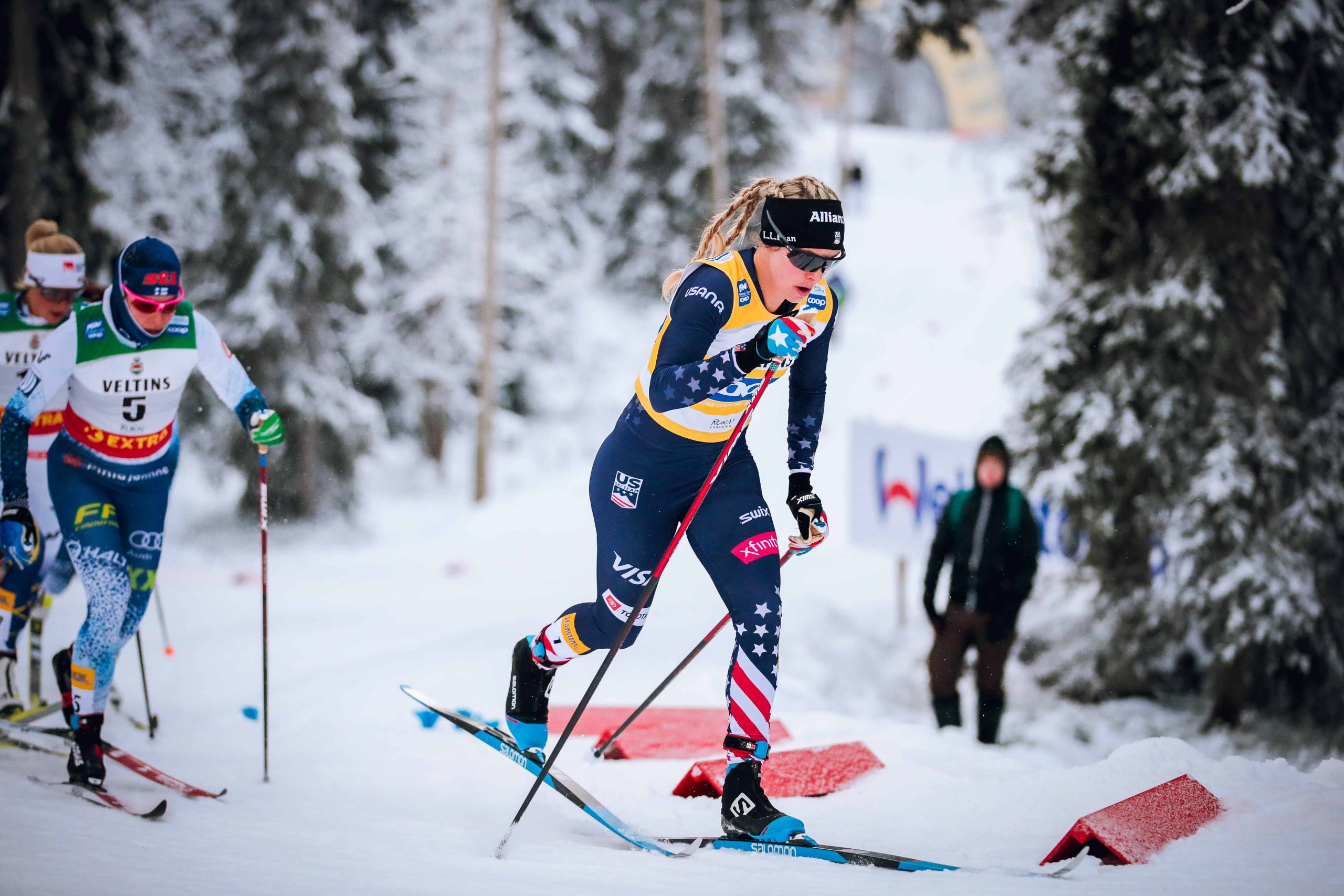
Jessie Diggins (USA) strides up one of the many challenging climbs (Photo: NordicFocus)
Capitalizing on her one-second advantage, Johaug found herself off the front for the first time. Pärmäkoski, Karlsson and Niskanen shared leads in an attempt to chase her down but by 8.8 k the gap had stretched to +15.8, effectively securing Johaug her first ever individual Olympic gold medal. From that point, the margins only grew: +26 at 10 k, +44 at 12.6 k and +30.2 at the completion of 15 k.
Despite her utter dominance of World Cup races and World Championships the past few seasons, Johaug’s results sheet at the Olympics is not what you might expect.
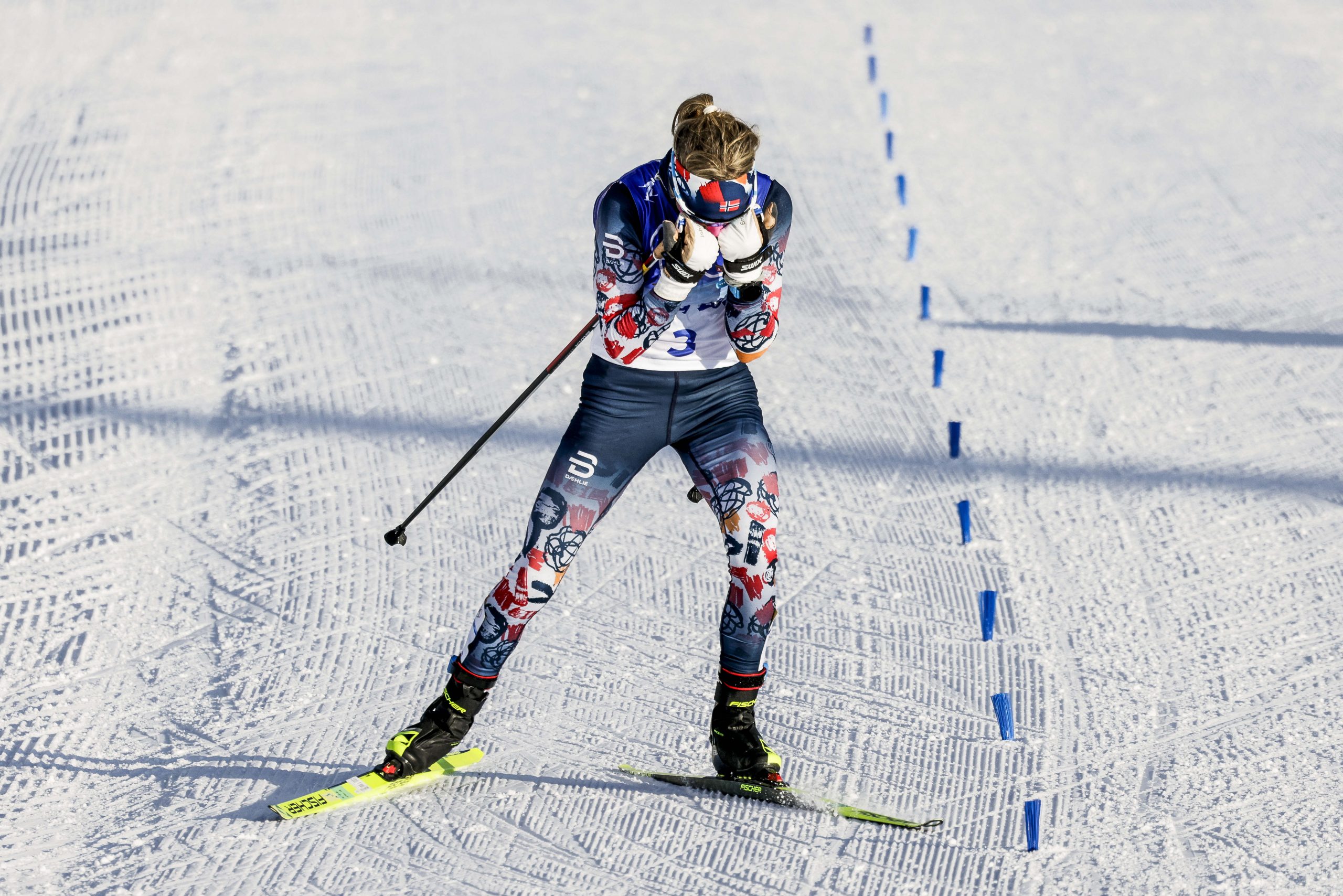
Tears were shed by Therese Johaug (NOR) as she finally gets her long deserved gold medal (Photo: NordicFocus)
Prior to the day’s skiathlon victory, she had only one other gold medal, coming from the team relay in the 2010 Games in Vancouver Canada. She was a runner-up in Sochi 2014 during the 30 k freestyle mass start when she placed second behind teammate, Marit Bjørgen, and she also earned bronze in the 10 k classic in Sochi. Johaug received an 18-month competition ban in 2017 for a positive doping test which prevented her from attending the 2018 Olympics in PyeongChang.
In her post-race press conference, Johaug said she does not hold onto anger about her suspension, which left her even more motivated to prove herself this year.
“I’m finished with these years and I’m focusing on myself, and the future and things I can do something with,” Johaug said in a press conference. “It means maybe more for me today when I’m didn’t have this gold medal, and maybe if I had the gold medal before, this Olympics, maybe I would not been here.”
Therese Johaug (NOR) on top in the first cross-country competition at the 2022 Olympics (Photo: NordicFocus)
With the recent outbreak of COVID amongst the Norwegian team, Johaug’s path to Beijing has not been as smooth as she would have liked. She only arrived at the venue on Wednesday, leaving just a few days to adjust to the time change and climate before the first event. In spite of these challenges, she proved equal to the task, skiing away with the victory in a time of 44:13.7.
Behind Johaug, the race for silver and bronze was playing out in a dramatic way. Initially, Karlsson of Sweden seemed to have pulled away, when at 10 k she was 26 seconds behind Johaug, and 10 seconds ahead of Niskanen (FIN) and Teresa Stadlober of Austria. However, this break was short-lived, and at 11.3 k, Karlsson was less than a second ahead of Natalia Nepryaeva (ROC) who had worked with Stadlober to rejoin the chase pack. Pärmäkoski (FIN) began to drop off the pace and the group was down to four. At this point, Diggins (USA) could be spotted closing in on Pärmäkoski, who continued to fade.
Entering the final A-climb of the race, Stadlober (AUT) injected some pace, attempting to pull away but Karlsson of Sweden and Nepryaeva (ROC) hung on. Only Niskanen (FIN) dropped slightly.
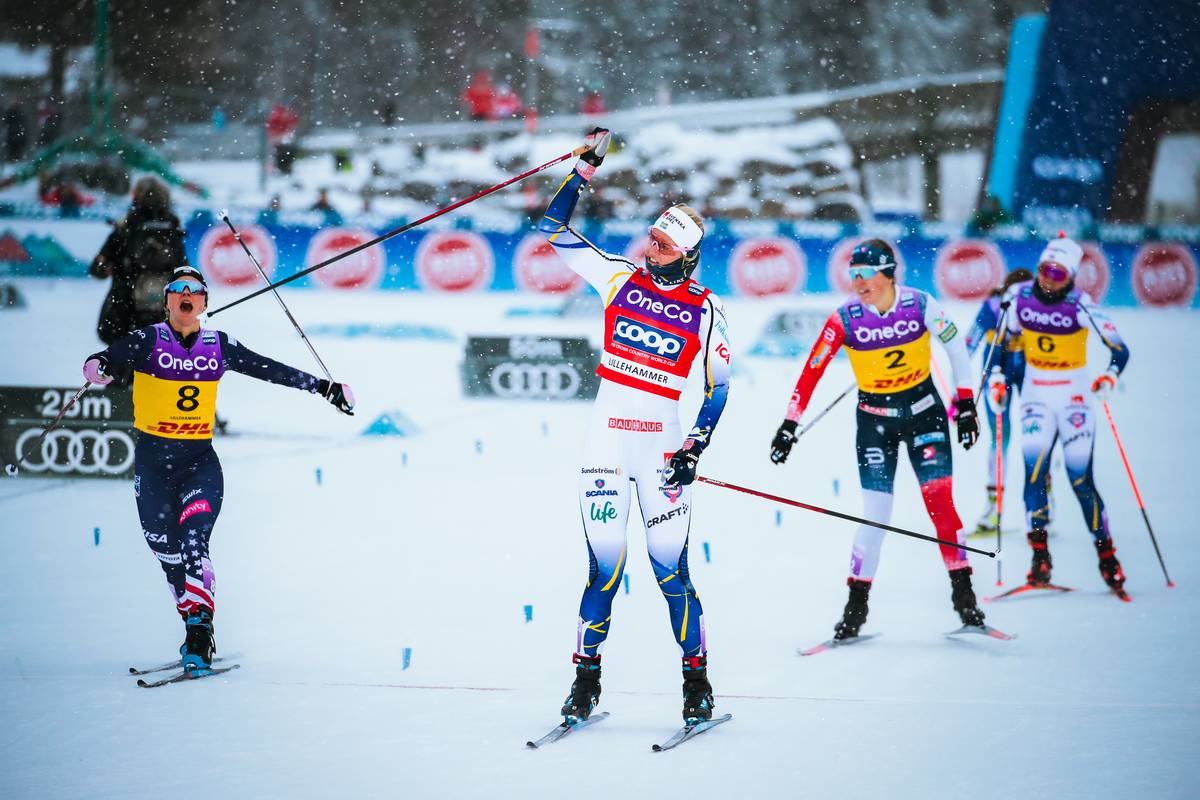
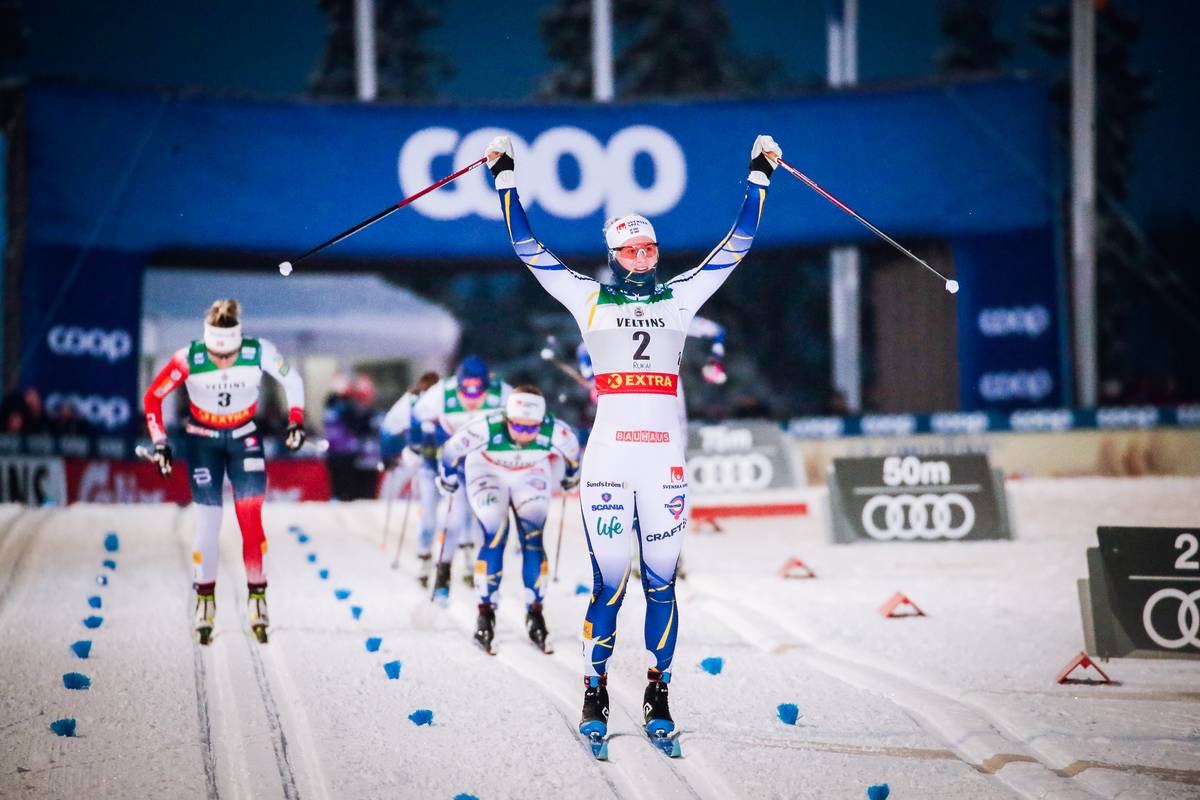
Thus it was three skiers vying for two medal spots. But as they descended towards the stadium Niskanen closed in again, making the group four. Nepryaeva crested the final rise in front as across the stadium the camera showed Johaug crossing the line, arms raised and a frozen smile on her face.
Frozen but happy, Therese Johaug (NOR) (Photo: NordicFocus)
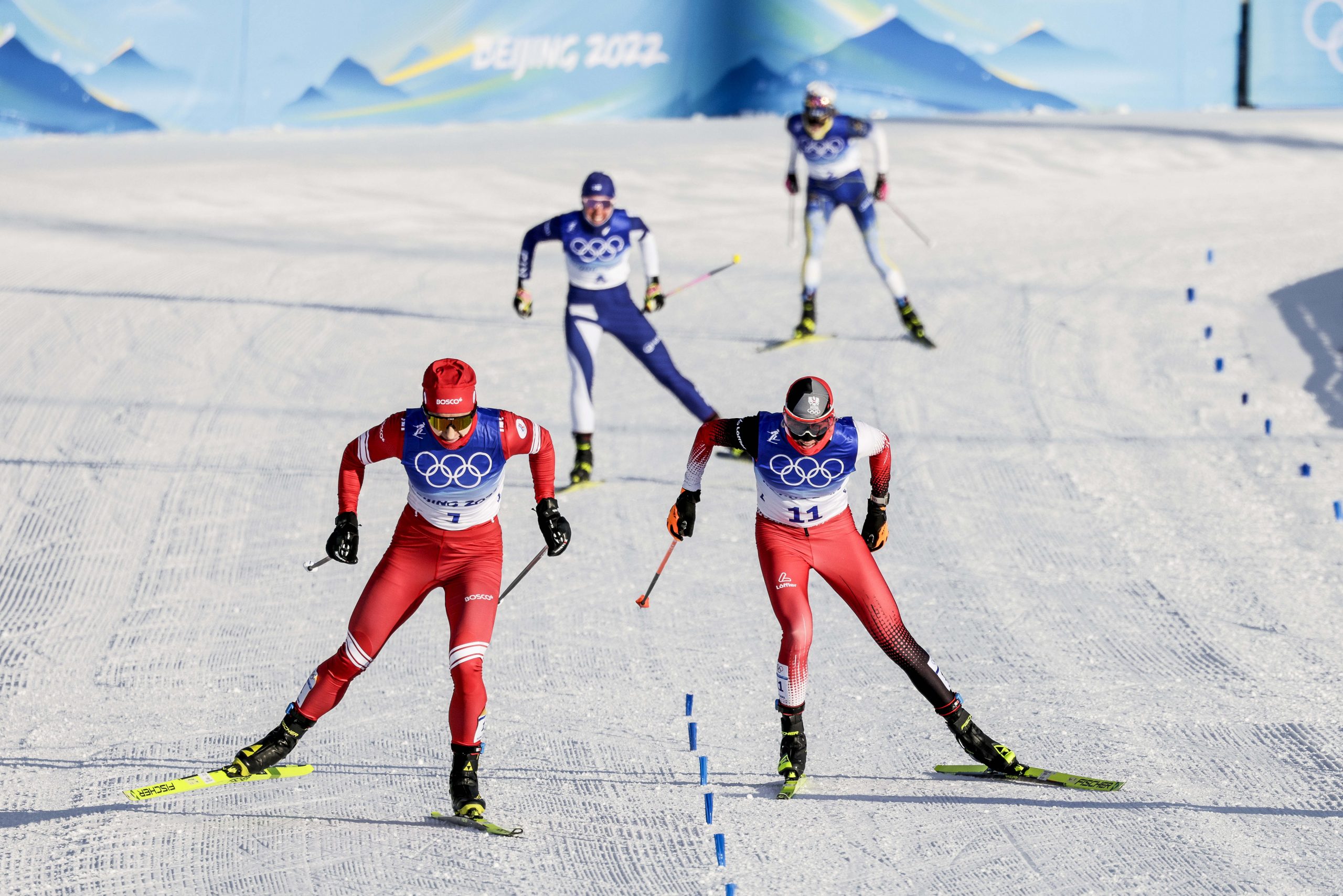
Down the finishing straight Nepryaeva held onto her lead as Stadlober mounted a final challenge, ultimately running out of space as the two finished in silver and bronze position respectively. Niskanen (FIN) finished fourth (+36.1), Karlsson (SWE) in fifth (+42.5), and in an impressive comeback, Diggins crossed the line sixth (+50.5).
A tight battle for silver and bronze between Teresa Stadlober (AUT) and Natalia Nepryaeva (ROC), (l-r) (Photo: NordicFocus)
This silver is the first Olympic medal for Natalia Nepryaeva, who most recently became the first Russian women to win the Tour de Ski. Her only other Olympic appearances came in PyeongChang where her best finish was fourth in the classic sprint.
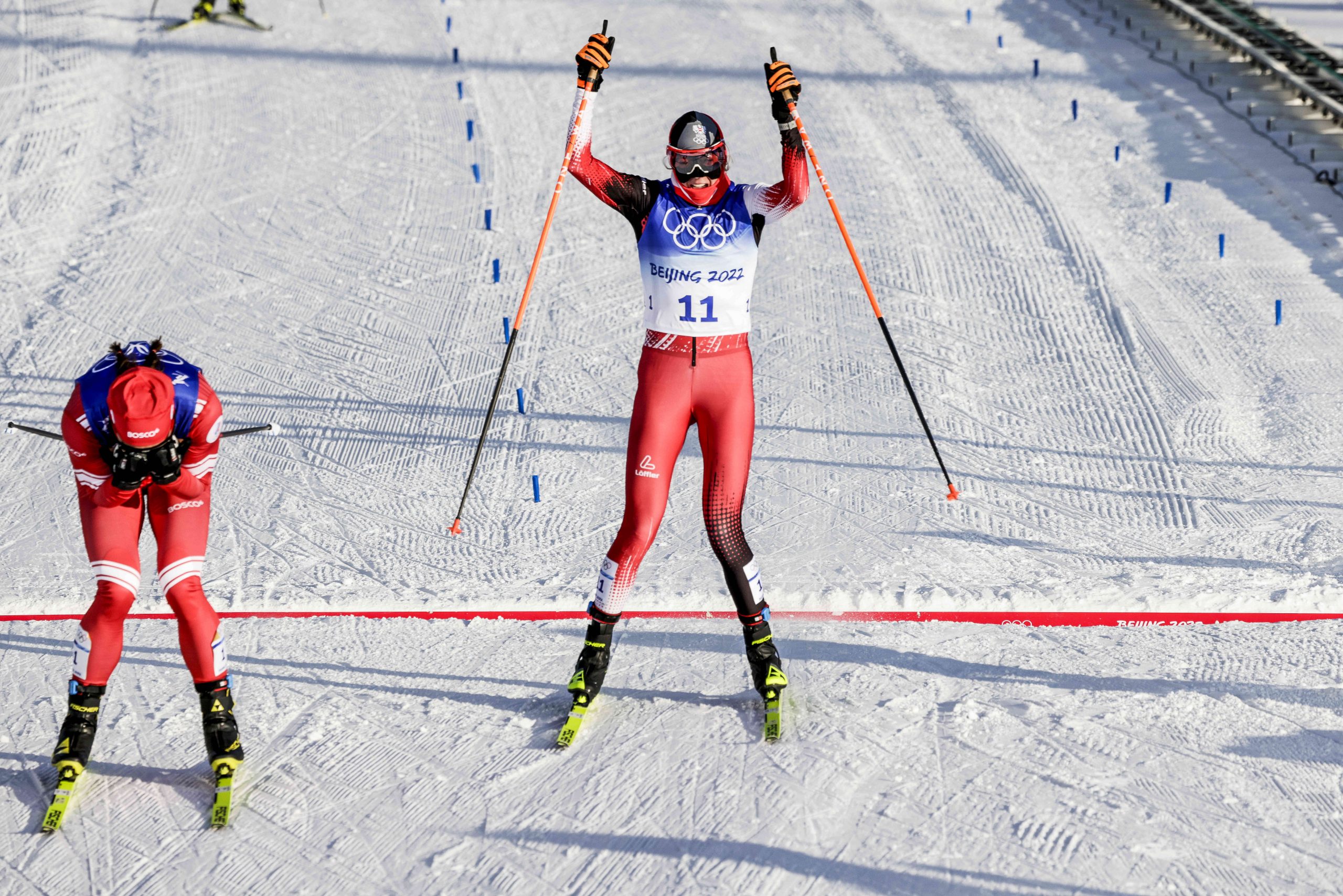
Teresa Stadlober (r-AUT) celebrates a bronze medal as Natalia Nepryaeva (l-ROC) is overcome with emotion (Photo: NordicFocus)
For Teresa Stadlober of Austria, this bronze medal could be viewed as redemption. Stadlober was in medal contention during the 30 k classic at PyeongChang when a last minute wrong turn took her out of the running. Furthermore, after a total of 18 individual starts at championship events (Olympics and World Championships), this is Stadlober’s first medal. She holds just three World Cup podiums, two during the 2018 edition of the Tour de Ski in Toblach where she placed third in the 10 k classic mass start and had the second fastest time of the day on the Alpe Cermis hill climb. The third podium was in a 15 k skiathlon in Oberstdorf Germany in 2020 where she also placed third.
First Olympic medal for Teresa Stadlober (AUT) (Photo: NordicFocus)
Other noteworthy performances from the day includes Anastasia Rygalina (ROC), who has had just ten World Cup starts in her career and never finished in the top ten, finishing the race in 8th. Behind her, Delphine Claudel of France earned a new personal best for the Olympics placing 9th.
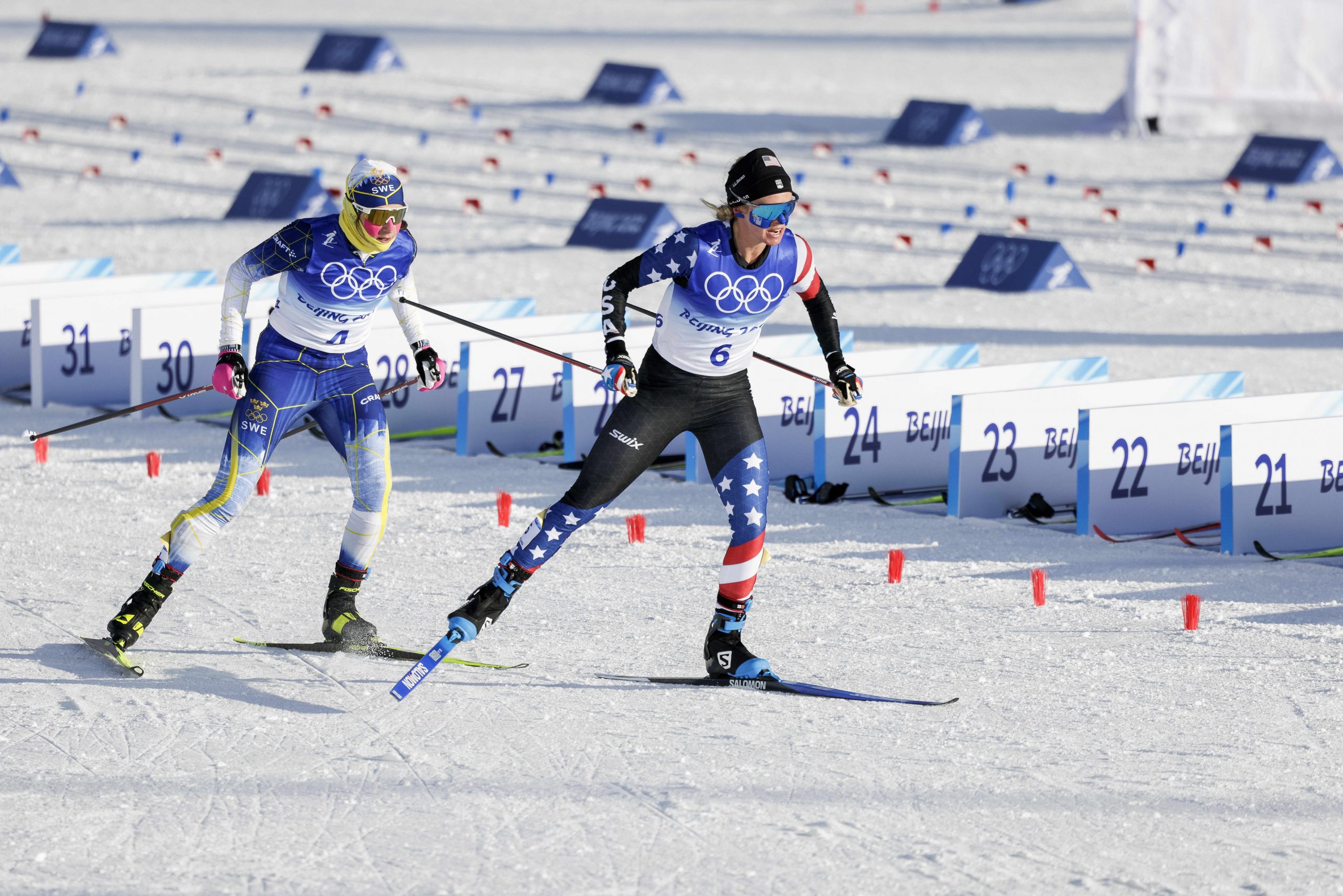
Jessie Diggins (USA) exits the transition zone, followed by Ebba Andersson (SWE) (Photo: NordicFocus)
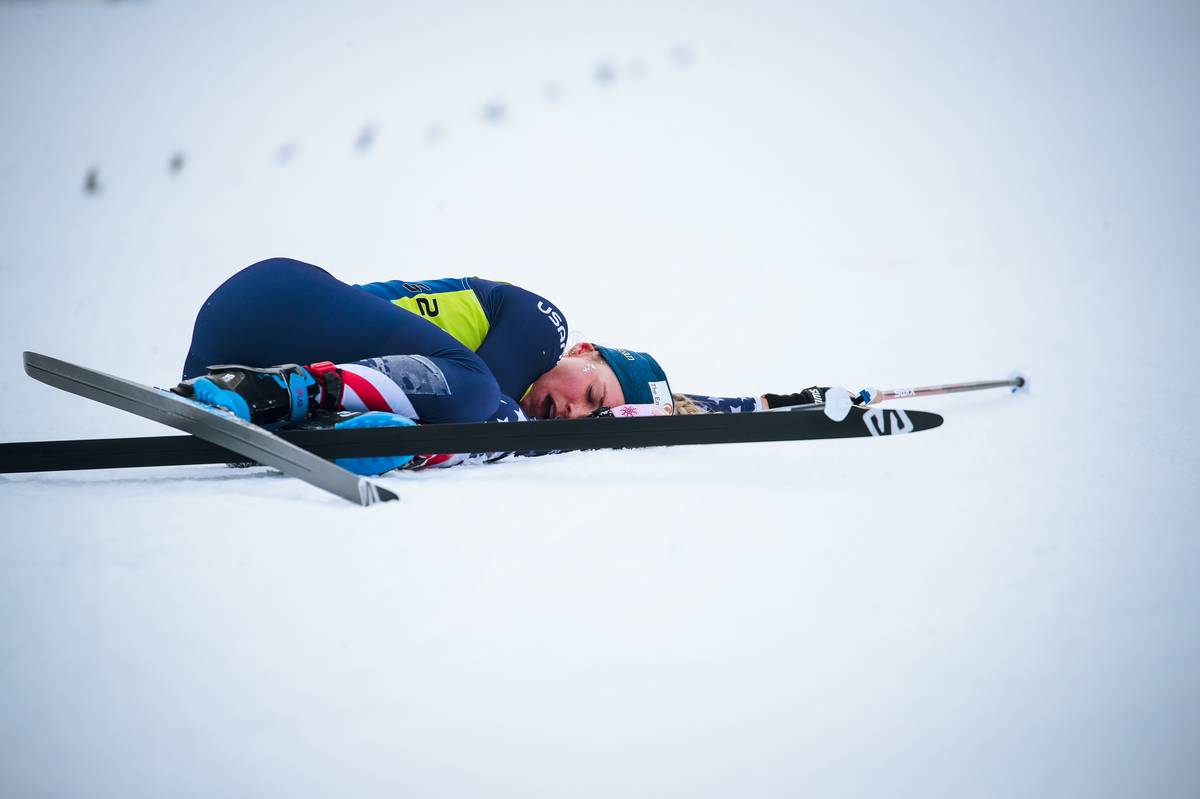
After being +55.5 seconds behind Pärmäkoski and the chase group at the exchange, Diggins ended up finishing a full eight seconds ahead of the Finn and was just 20 seconds behind bronze medalist, Stadlober.
“I definitely finished with nothing left so I feel really good about that,” said Diggins in the mixed zone after the race. “I was so proud of never giving up. I feel really good about the pacing and where my fitness is. I definitely want to figure out some things with my power striding, but overall I think this was a really encouraging start to the Games and honestly it feels really good just to have gotten here and to be able to race.”
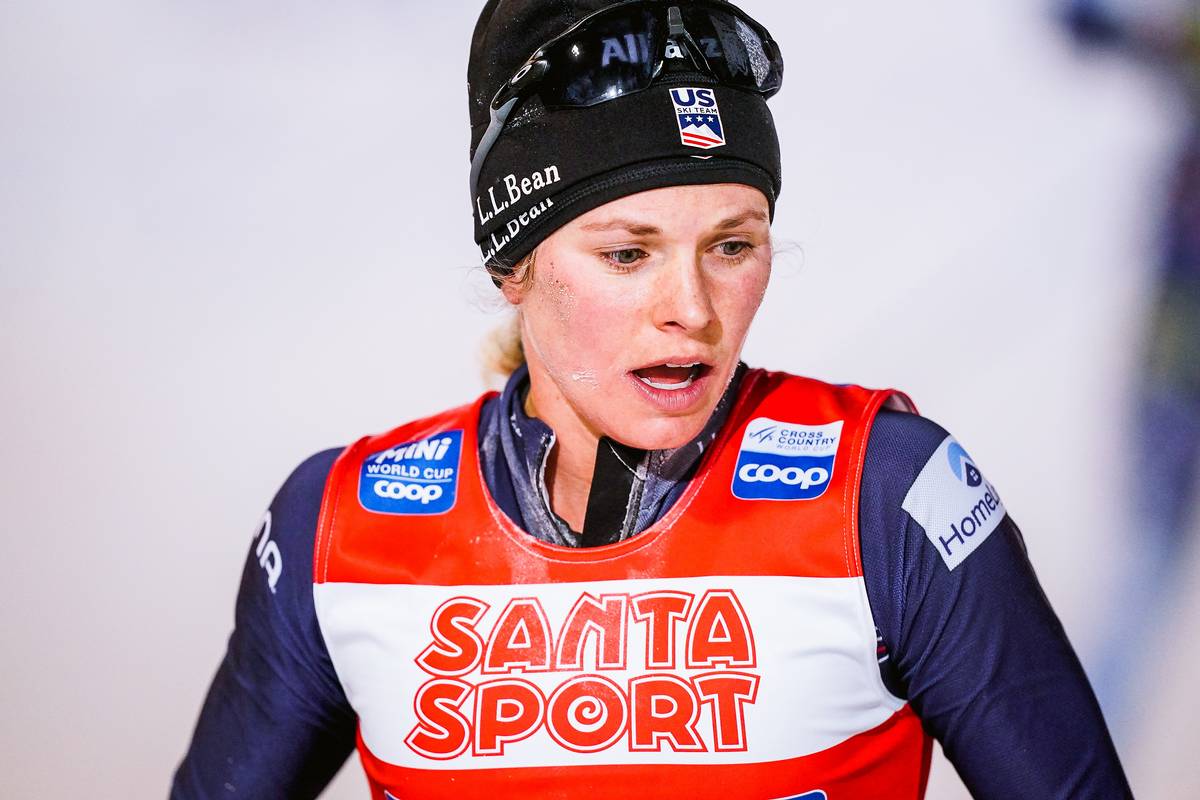
Left it all on the course, Jessie Diggins (USA) collapsed in the finish (Photo: NordicFocus)
When asked about the cold and windy conditions Diggins replied, “My hands got pretty cold because I needed thinner gloves for the pit-box changing. My muscles stayed warm though. [The wind] is really something, and that’s what makes it so cold, so I think it’s important to really push that and stay warm.”
Regarding the course, Diggins said, “They’re really good courses. I really like them. I think they’re really fair and great championship courses. They’re as hard as they look, you’ve really got to work for it.”
Jessie Diggins fields media questions in the mixed zone. (Nat Herz/FasterSkier-ADN)
In Diggins final 5k, she advanced from eighth place and over 1:13 back to finish sixth place and roughly 50 seconds back. This is a difference of 23 seconds gained on the leader over 5k, with ten seconds gained in the final 2.4k.
“I had amazing skate skis and I think I had paced just well enough to be able to do that,” Diggins said of this progress. “I crossed the finish line with nothing left. It’s really cool to get a race on these courses in and I think I’m figuring [them] out.”
Rosie Brennan leaves the exchange zone halfway through the women’s 15k skiathlon, the opening race of the 2022 Winter Olympics. (Nat Herz/FasterSkier-ADN)
Brennan was the next finisher for Team USA, in fourteenth position (+2:51.7). Brennan had initially fallen behind Germany’s Katharina Hennig in the skate leg to slide into 15th, but she regained her position with 3 k to go, further accelerating to give herself a 7 second cushion at the finish.
“Definitely a little bit of everything out there today,” Brennan told U.S. Ski & Snowboard communications manager Tom Horrocks after the race. “Some good, some ugly, some in between.”
While Brennan’s result might not be evidence that she is a medal threat in the event, and she is surely left wanting more, she spoke like a true veteran, showing maturity and perspective in her response to how she will look back on the performance.
“I think I have to take the like big picture perspective. Four years ago, I think I was close to dead last fighting some [mononucleosis], and that was my first and last Olympic race. So I really had kind of a — I don’t know what you’d call it — a demon in the back of my mind that I needed to get rid of. So to be in a better place today, even if it wasn’t my best, was a step in the right direction. And that’s something that I’m proud of.”
Rosie Brennan catches her breath after finishing 14th in the women’s skiathlon at the 2022 Beijing Winter Olympic Games. (Nat Herz/FasterSkier-ADN)
While official start lists are not yet available, as Brennan is one of USA’s top skiers, she will likely start in multiple upcoming events.
On her mindset and how she’s feeling heading into these stages, Brennan said, “It’s been a while since I’ve done racing at an international level. (Brennan left Europe after the Davos World Cup races in mid-December, spending the last six weeks near her home in Park City, UT.) I’m really hoping that the effort today was what I needed to just get back into things and find a better place ,because I certainly have had some workouts that have indicated that I’m in good shape. So I do want more and I think I can get more. I’m really looking forward to the other races.”
Behind Brennan, Hailey Swirbul finished in 40th (+5:28.8).
“It’s a lot of V1 skate, it’s hard,” Swirbul said in the mixed zone in reference to the course, “It makes for fair racing but you have to be totally on your game. It didn’t feel like [you get a break] today, it was a tough day for sure.”
Hailey Swirbul transitions from classic to skate, fighting windy conditions on course during the women’s 15k skiathlon. (Nat Herz/FasterSkier-ADN)
When asked about taking part in the Olympics and the momentum of the team, Swirbul said, “It’s a hugely exciting time to be part of this team. We’ve shown over the last four years what we’re capable of. We will give everything we have out there. It feels like a relief that we made it here and that our team has been healthy and we prepared really well so far. A race is a race, no matter if it’s an Olympic or local race. It’s important to keep your head in the game, and be ready to fight no matter what.”
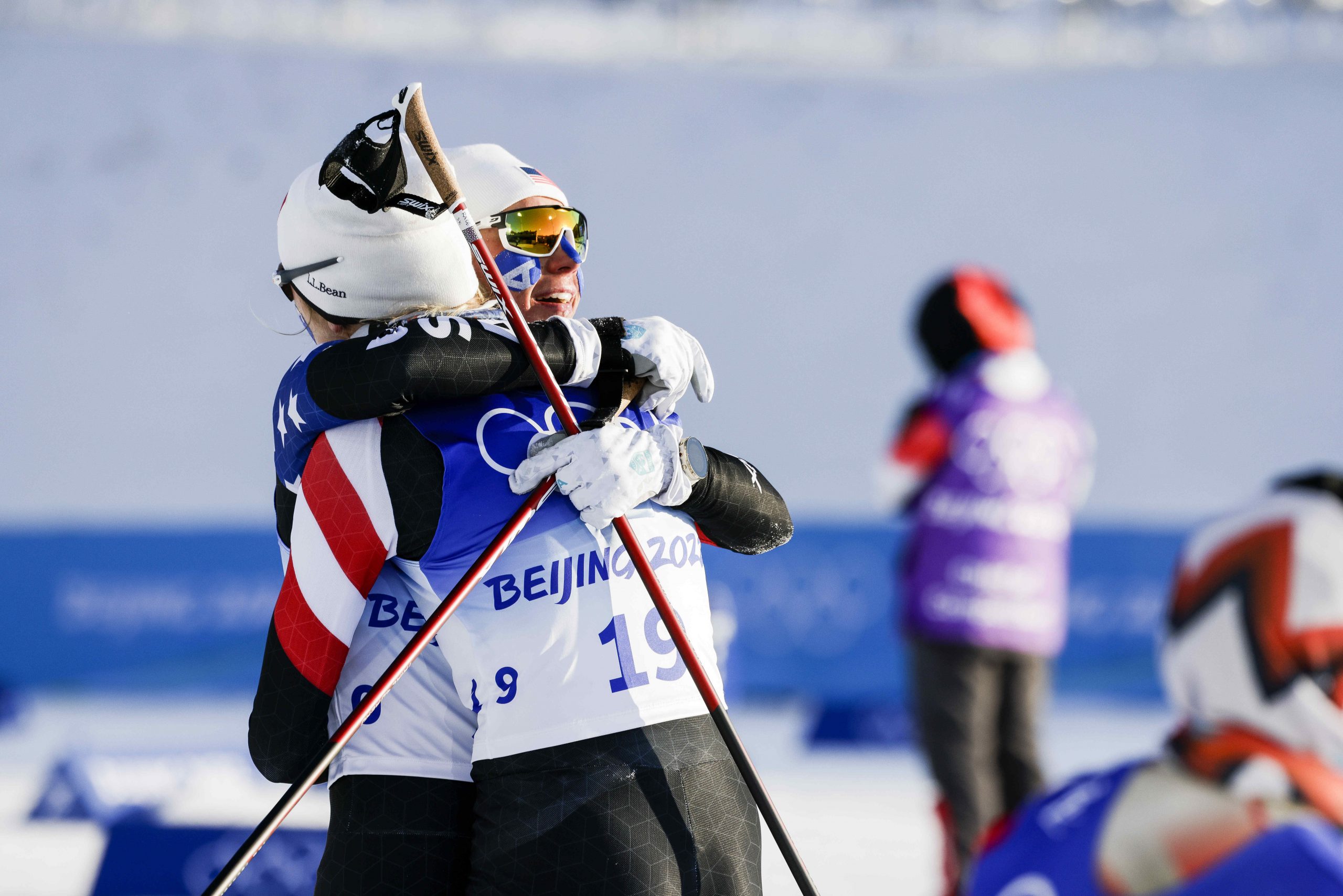
Hailey Swirbul (USA) embraces teammate Julia Kern (USA) after the skiathlon (Photo: NordicFocus)
Julia Kern rounded out the US finishers in 53rd position (+7:51.8). It was “windy and tough,” said Kern definitively. “That was a really tough race, probably the windiest race I’ve ever done. I had a ton of base layers on so I stayed warm, but the wind cools you right down on the downhill.”
Regarding her participation in the Games, Kern said, “It’s a dream come true, I’m really excited to see what we can do as a team for the rest of the Games. This is just the beginning.”
Julia Kern (USA) fights hard to the finish (Photo: NordicFocus)
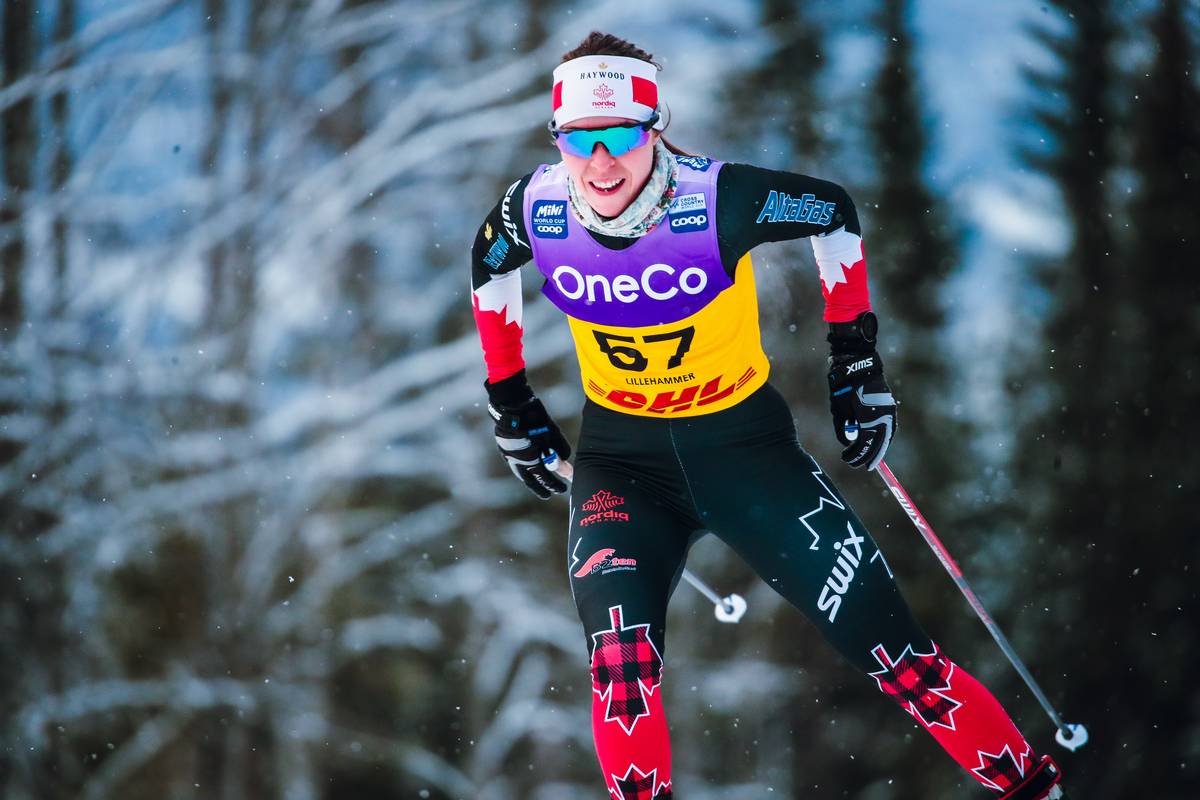
The Canadian women made a strong showing in the top thirty, led by Cendrine Browne in 20th (+3:44.4). Not far behind her was Kathrine Stewart-Jones, matching her bib number and finishing in 23rd (+4:03.6). In a dramatic finish – essentially a forward fall across the line – Dahria Beatty finished 28th (+4:38.8), putting three Canadians in the top thirty. Olivia Bouffard-Nesbitt was the fourth Canadian and finished 44th (+5:58).
Dahria Beatty (CAN) finished 28th in the 15 k skiathlon (Photo: NordicFocus)
Racing for Australia, APU’s Jessica Yeaton finished just outside the Top-30 in 31st (+4:40.3).
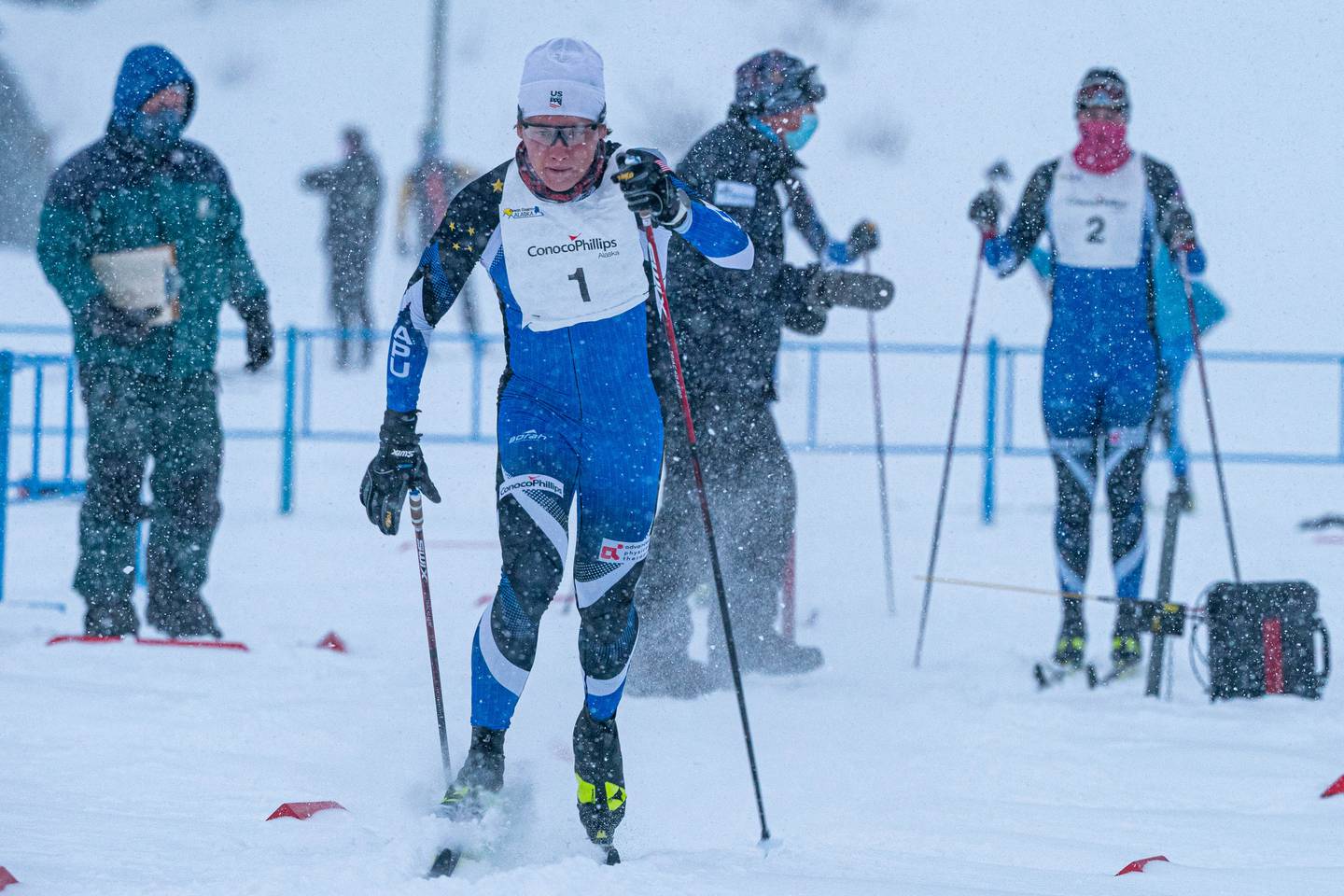
Australia’s Jessica Yeaton (bib 53) races to 31st in the women’s 15k skiathlon, which opened the 2022 Winter Olympics in Beijing. (Nat Herz/FasterSkier-ADN)
The men will race a 30 k skiathlon tomorrow, and the next women’s event will be the freestyle sprint on February 8th. You can find a detailed schedule for the Olympic cross-country events, including how to watch, here.
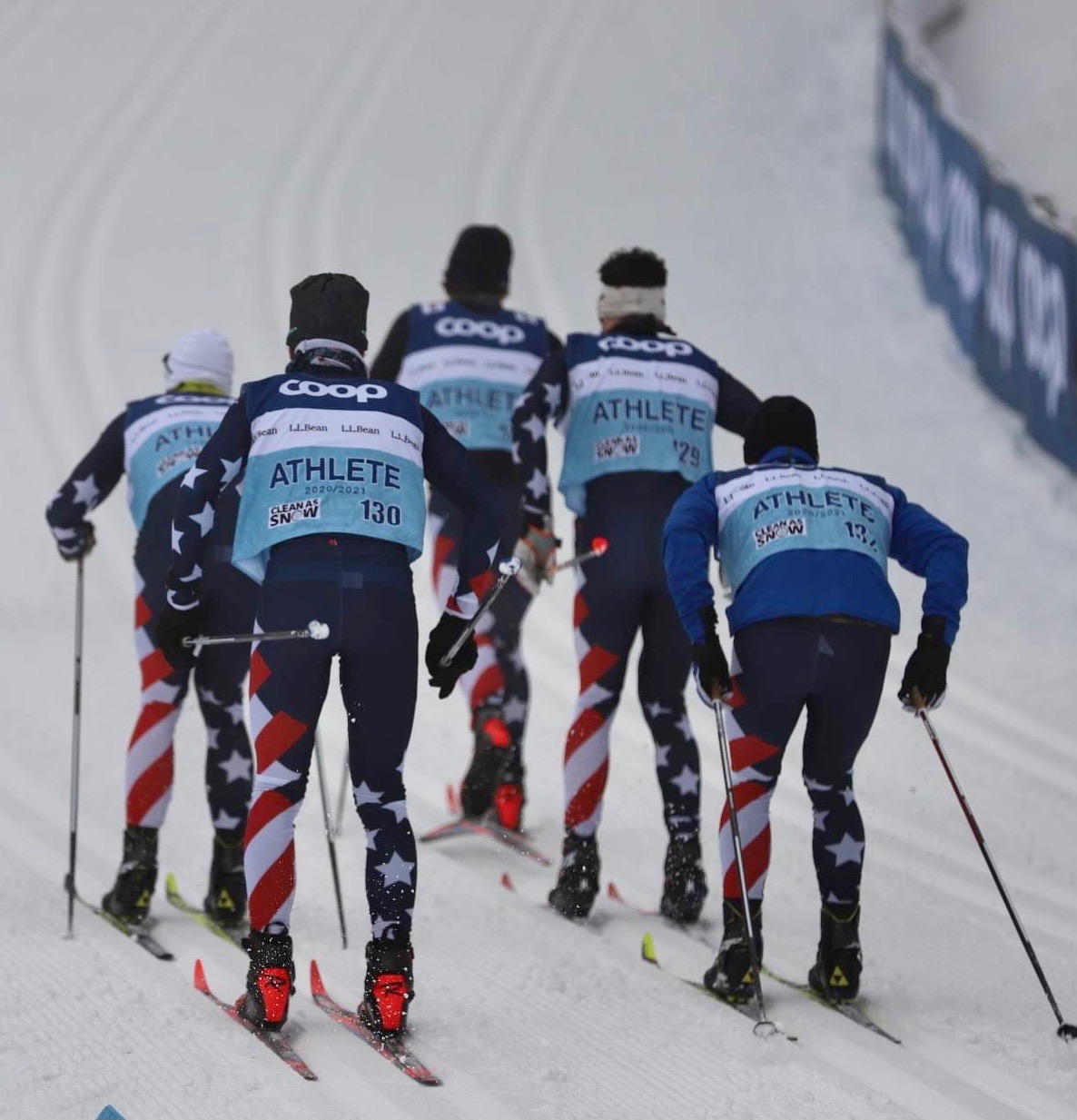
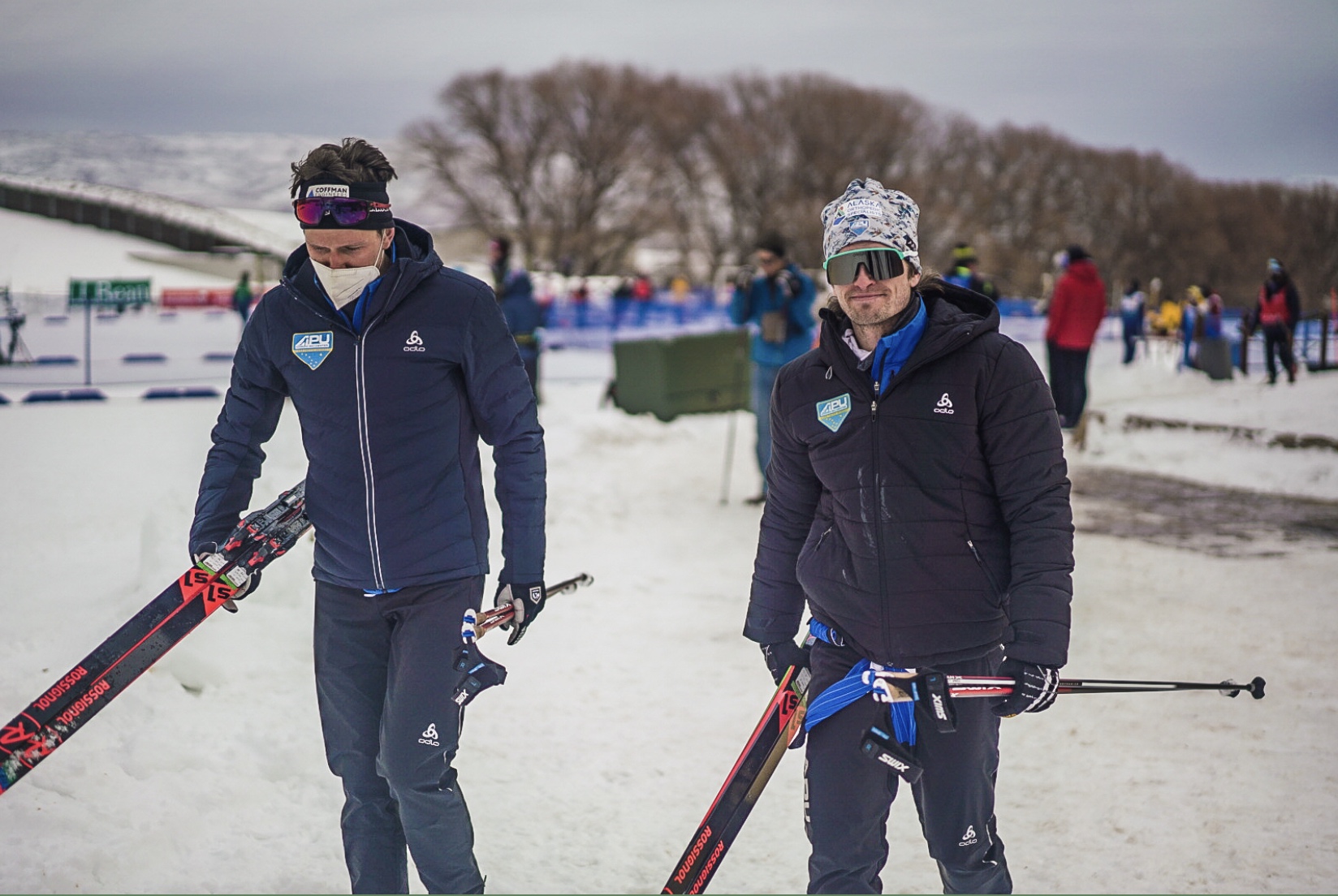
David Norris and Scott Patterson complete a set of pre-race classic intervals to optimize their performance in the next day’s races. (Photo: Tom Horrocks)
All the athletes are all stripped down to their race suits and zooming around the course with laser focus. They are breathing hard; in fact, some of them seem to be skiing at max effort. If it weren’t for the lack of announcements, race bibs, and cheering from the crowd (pre-COVID, of course) you might actually think it’s race day – but it’s not. It’s actually the day before the race, and many of the athletes are performing their race-prep workout.
For most cross-country skiers, a race-prep workout entails skiing fairly hard, often involving a similar pace to that of the race the following day. This may seem counter-intuitive, as you might think that energy conservation is key to peak performance. I distinctly remember being a middle-school cross-country runner and taking the day before the race entirely off; my race-prep “workout” would then consist of 20 minutes of walking to ensure that my legs didn’t get “too tired”. Sadly, this leisurely myth was debunked, and I have learned over the years that race-prep the day prior is actually a great time to put in some harder efforts to optimize performance.
Here are a few of the reasons why it’s a great idea to push yourself out of your comfort zone the day before, and a few suggestionsfor improving your race-prep workout before your next race.
Hailey Swirbul completes a pre-race training session in Davos, SUI in December, 2021. (Photo: NordicFocus)
While rest is important, taking a day off can often make your legs feel heavy or sluggish the next day. This is one of the main reasons why it is important to get out and ski the day prior to a race, even if minimally. Many athletes opt to take two days prior to the race completely off instead.
One of the biggest goals of a race-prep workout is to help switch your legs on and avoid any lethargic feelings on race day. It is not uncommon for athletes to report feeling “terrible” and having heavy legs during a race-prep workout. Rather than serving as a bad omen for the race the next day, it actually can be a positive sign that both feelings and performance will improve on race day. That being said, the length of the race helps determine the intensity of the workout the day prior. The shorter and more intense the race is the next day, the harder the pre-race workout will be, and vice versa.
U.S. Ski Team member and soon to be two-time-Olympian, Rosie Brennan, offered her advice for a race prep-workout and how it differs depending on the type of race. Rosie excels at both sprint and distance racing; last season she won both the sprint and distance world cup races in Davos, Switzerland. Additionally, while many other world cup athletes specialize in sprint or distance events, Rosie’s race calendar consists of a mix, which has given her plenty of practice perfecting her race-prep.
“For sprint days, I do one lap of the course L3, take a break, and then one lap L4. After that I will run through a few speeds on key sections of the course.”
Before distance races, Brennan states that her preparation is a little more variable. “If I’ve been racing a fair amount, I will generally do one 10 min interval that is mostly level 3 and kicks up into level 4 the last few minutes. If I haven’t raced in a while or feel like I need to rev the engine a little more, then I will do something like 3×4 minutes progressive, starting in level 3 and moving into level 4 for the last interval.”
Race prep is also used to feel the rhythm of the course and practice corners, transitions, downhills, or other key spots on course at race speed. That is the beauty of skiing so quickly during these workouts – you can really get a feel for the way the course will ski the following day. Brennan says that race prep helps her to get a feel of how the course and snow might ski at race speed. “This allows me to better develop a race plan or do some visualization of how I want to ski on race day”, she states.
Rosie Brennan powers through the final stretch to finish 4th in Davos in December, 2021. (Photo: NordicFocus)
Although race-prep is often performed at a zone 3-4 pace, or just below/touching into anaerobic threshold, the total work time rarely exceeds 10-12 minutes. For elite cross-country skiers, a typical interval set is generally between 25-60 minutes of work time depending on the target heart rate zone. By keeping the total time of race-prep significantly lower than a standard interval set, it ensures that the overall fatigue is minimized while still allowing for adequate practice of critical spots on the race course.
Another goal of the workout the day before pertains to fueling. Muscle glycogen, or the major source of carbohydrate for energy during exercise, is pertinent to optimal performance. The greater muscle glycogen stores are, the longer the time to exhaustion, and the faster you can ski. Hard race-prep intervals serve as a stimulus for the resynthesis of muscle glycogen. Following this workout, muscle glycogen is rapidly replenished due to increased insulin sensitivity and cell membrane permeability to glucose. (1)
That being said, it is critical to adequately fuel post-workout to ensure that this happens. So, while the race-prep workout might be slightly taxing in the short term, it ultimately assists our bodies in jump-starting the fueling process and ensuring that our muscles are ready to perform an even higher-intensity workout (race) the next day.
A group of American men complete their pre-race workout. (Photo: Tom Horrocks)
Ultimately, race-prep helps prepare our bodies both physically and mentally for a race effort the following day. When performed correctly, the stimulus of intervals the day prior to a race can prime our muscles and spark our metabolism for peak performance. While your legs may not seem super fresh during the session, trust that race-prep helps pave the way for better feelings on race day.
Sources: 1. Ivy JL. Muscle Glycogen Synthesis Before and After Exercise. Sports Med. 1991;11(1):6-19. doi:10.2165/00007256-199111010-00002
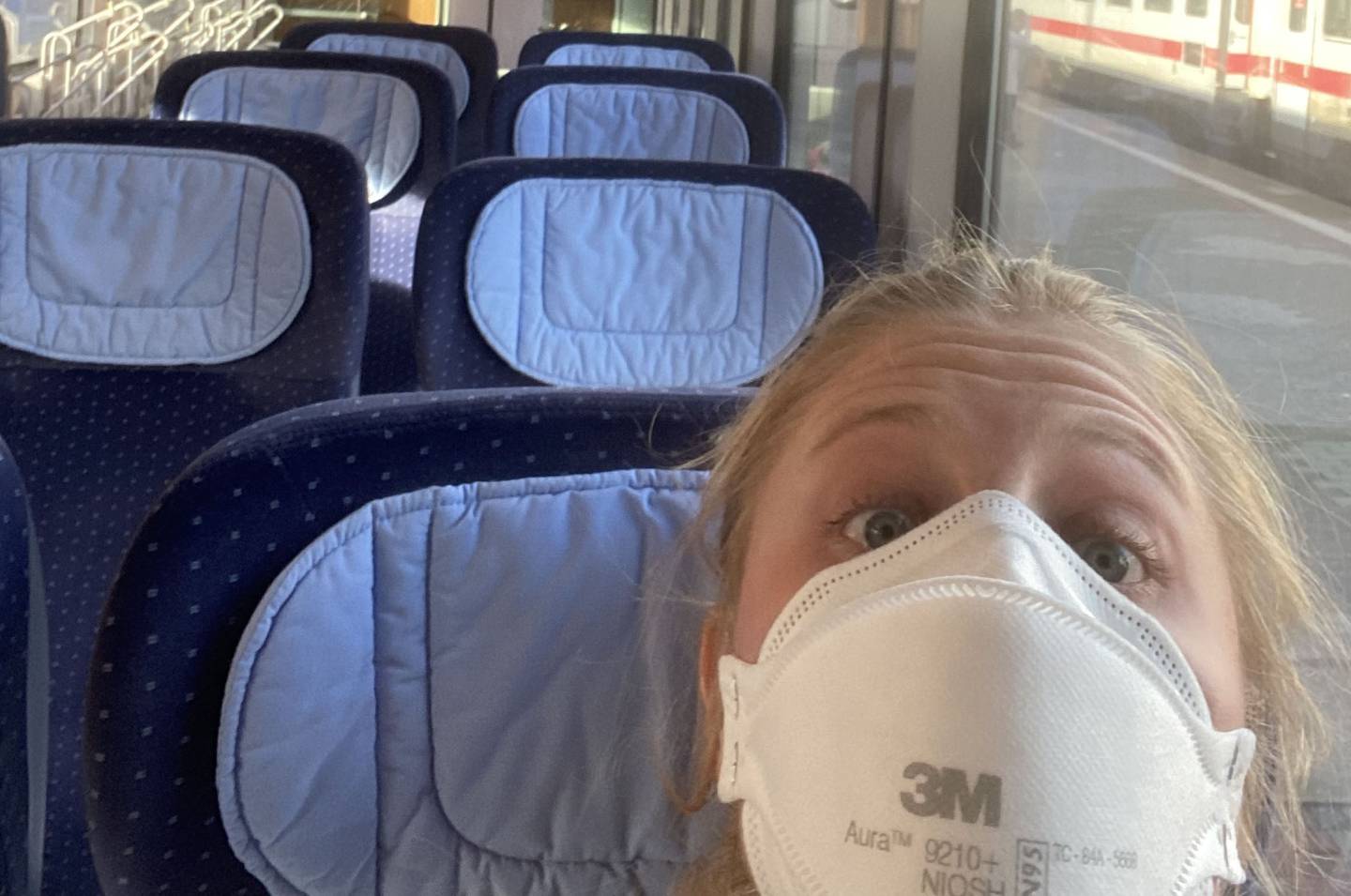
Hailey Swirbul searched out an empty train car to ride in while trying to avoid infection with the omicron variant on her way to a ski town in Austria this month. Swirbul is one of a number of Alaska athletes taking rigorous COVID-19 prevention measures to avoid derailing their hopes of competing in the Winter Olympics in Beijing. (Courtesy photo)
This article originally appeared on Wednesday January 19th, 2022 in the Anchorage Daily News. Reposted with permission.
The organizers of next month’s Winter Olympics in Beijing have imposed a rigorous regime of testing, quarantines and isolation for incoming athletes and staff.
Among the casualties is Steve Patterson’s pickleball game.
Patterson has two adult children, Scott and Caitlin, who grew up in Alaska and are both Olympic hopefuls in cross-country skiing.
They’re planning to prepare for the games from their parents’ home in Montana. Which means the whole family is being careful to avoid any contacts that could invite the coronavirus into their home — potentially derailing access to China for Scott, 29, and Caitlin, 31.
The Patterson siblings are two members of what’s currently one of America’s most COVID-conscious demographics: aspiring Olympians with plans for Beijing.
China, with its “zero COVID” policy, has draconian requirements for anyone flying into the country for the Games. They start with two negative lab tests just to get on the plane to China, followed by another immediately upon arrival at Beijing’s main airport.
A positive test would disrupt teams’ meticulously laid plans for travel and training, and even asymptomatic cases would almost certainly force athletes to miss flights and competitions for which they’ve trained for years.
As a result, Alaska athletes and others involved with the Olympics are going to great lengths to stay free of omicron as the variant spikes across the U.S. and the globe — even with training and competition schedules that include inevitable cross-country or intercontinental travel.
“This experience that I’ve dreamed of my entire life is sort of now just grounded in stress, more than anything,” said Luke Jager, a 22-year-old Anchorage cross-country skier likely to be named to the Olympic team. “I’m sure at some point, being over there, it’ll kind of set in. But right now, the challenge of not getting COVID feels just as big as the challenge of even qualifying for the Games did.”
Luke Jager starts a race at Anchorage’s Kincaid Park in 2020. (Loren Holmes / ADN)
Chris Grover, the Anchorage-raised program director for the U.S. cross-country ski team, recently returned home to Idaho from the European racing circuit.
He spent his first few days with his in-laws, rather than with his family, to avoid catching the coronavirus from one of his children who’d had a potential exposure.
Meanwhile, one of the athletes that Erik Flora coaches at APU, he said, has even been wearing masks around and sleeping in a different room from their romantic partner.
“That’s the commitment that probably tops just about everything,” Flora said. “You’re messing with the human spirit at that point.”
More than a half-dozen cross-country ski racers with Alaska ties have a good chance to make the American Olympic team when it’s named Thursday — joining two curlers, a hockey player and a figure skater as some of those destined for Beijing from the 49th state.
In interviews, the skiers and coaches describe taking Olympic-level anti-omicron precautions. But each faces a unique set of risks, depending on their circumstances.
Hailey Swirbul also trains with APU in Anchorage; she planned to return from European racing to Alaska for a pre-Olympic camp, where she could spend time with her boyfriend and dog.
But after catching a cold, Swirbul, 23, decided to stay in Europe and avoid two rounds of major international travel.
After three train rides — sporting an N95 mask, with no breaks for eating or drinking onboard — Swirbul arrived in Austria for pre-Olympic training. There, she and her teammates broke into smaller groups that don’t mix indoors.
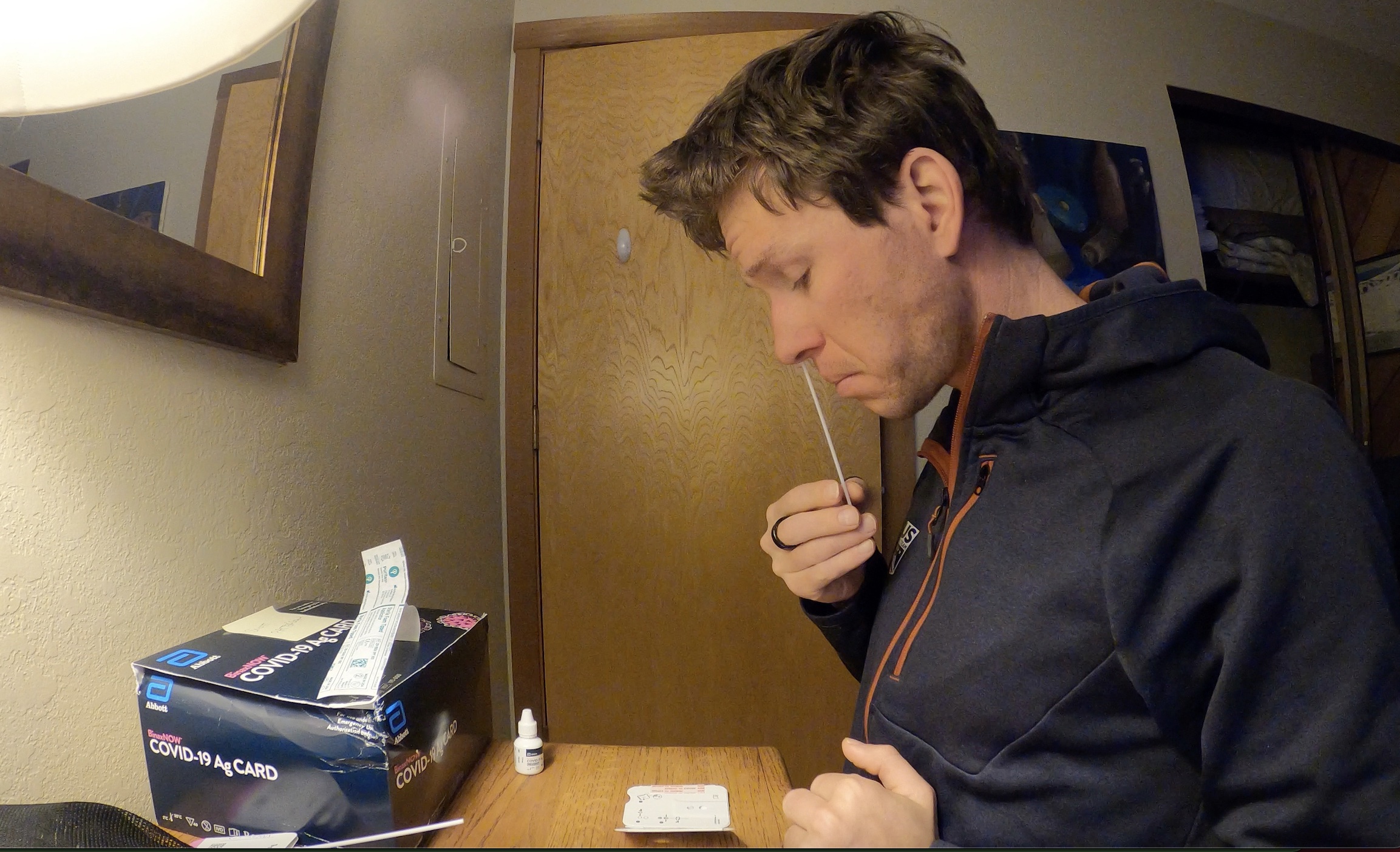
Scott Patterson self-administers a COVID-19 rapid test. (Courtesy photo)
The athletes take rapid antigen coronavirus tests every day, retrieve meals cooked by a team chef, bring them back to their living quarters and eat only after washing their hands. Swirbul got in the habit of climbing out a window to leave her apartment, rather than walking through a shared space that would require her to don an N95.
She also turned down an invitation to meet a friend, outdoors, for hot chocolate. And “definitely no grocery stores — we haven’t been in those since we’ve been here,” Swirbul said in a Zoom interview.
Jager has suffered through much more of a saga. Outside of international competitions, Jager races for the University of Utah, and he had to return from top-level European racing a few weeks ago to compete in collegiate events in the U.S.
When he arrived, the coronavirus was circulating among his team, so he couldn’t move back into his house. In a phone interview last week, he described staying in the vacant home of friends of his girlfriend’s parents before a race series in Idaho.
“They get back tomorrow night. So, we’re trying to find some other place to stay because we’re trying not to see anybody,” he said. “I’ve been nomading, pretty hard.”
Jager returns to Europe this week for a training camp in Italy with the American team, then will fly to Beijing from Switzerland.
JC Schoonmaker, another likely Olympic team member who competes for University of Alaska Anchorage, is on a similar program to Jager, except he traveled and lived with his collegiate team during races in the western U.S. this month.
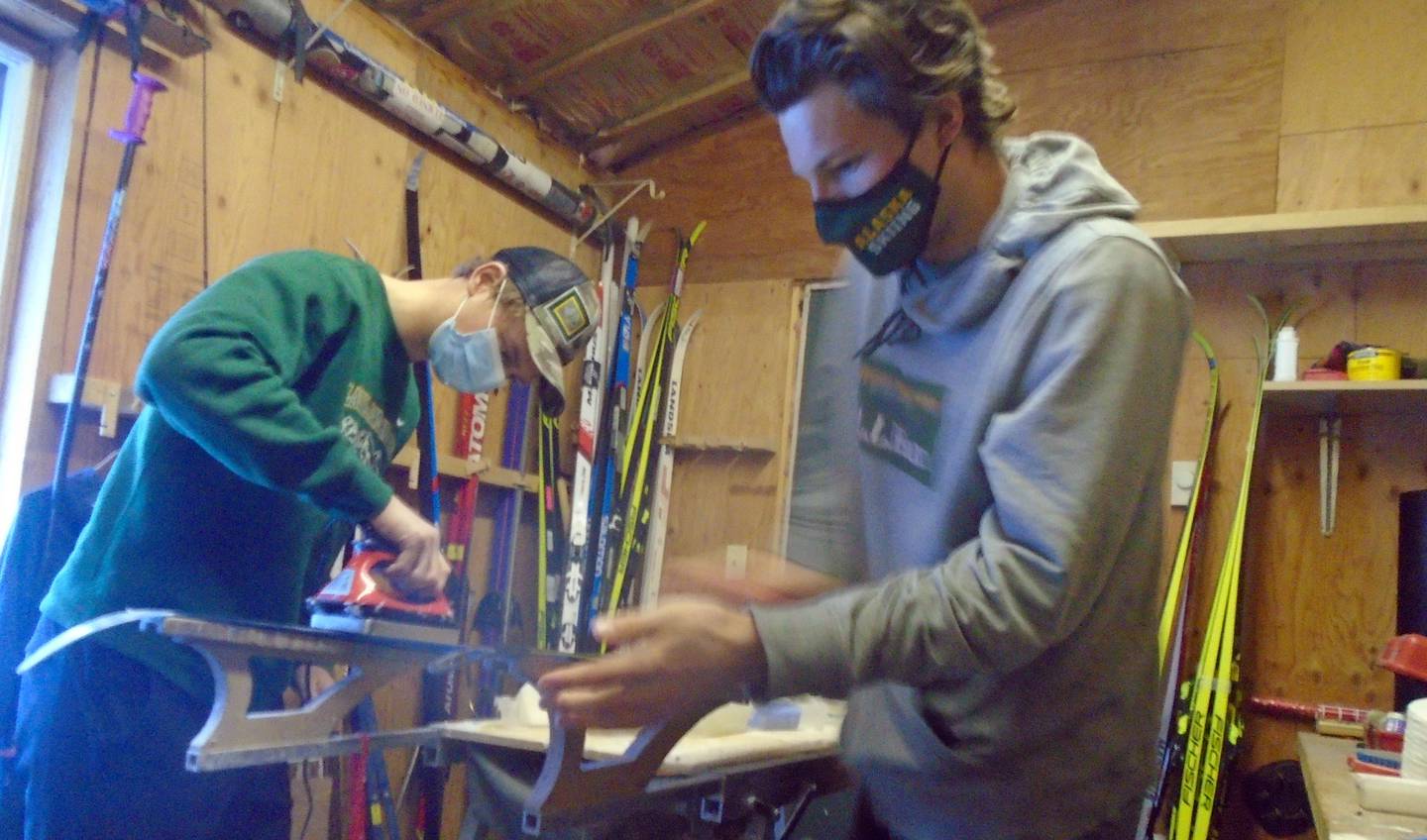
JC Schoonmaker, right, and a teammate tune skis Friday, January 14, 2022, before a weekend of racing in Idaho. Schoonmaker is one of a number of Alaskans taking rigorous COVID-19 prevention measures to avoid derailing his hopes of competing in the Winter Olympics in Beijing. (Adam Verrier)
Schoonmaker’s coach, Trond Flagstad, said the UAA coaches are doing all the shopping; they enter the athletes’ houses to drop off groceries only while wearing masks.
“It’s definitely risky, but I’m pretty confident,” Schoonmaker said. “And I really do trust my teammates — I think they’re doing a good job.”
Aside from presenting obvious logistical problems, the coronavirus has affected the skiers in subtler ways, too.
It’s forced them to keep their support networks at a social distance, whether that’s partners, family members or friends. And with coaches taking on more risks, like grocery shopping, it’s also harder for them to work closely with their athletes, or even to drive them to races in vans.
Added all up, it makes for an especially grueling, and isolating, build-up to what was one of the most pressure-filled experiences in athletics even before the pandemic.
“It really weighs on me,” said Rosie Brennan, a medal hopeful who trains with APU in Anchorage. “It’s honestly harder than preparing yourself to race.”
With the Games, and the negative tests required to enter China, approaching, each swab presents aspiring Olympians with a new reason to worry — especially with the awareness that omicron may present itself without symptoms.
“You know how it is when you’re a skier: You’ve got stuff coming out of your throat and you’re always blowing your nose and stuff,” said Jager. “You’re like at 7,000 feet, you’re like, ‘Maybe I’m a little tired today and I just blew my nose a couple extra times. Definitely could be low-level symptoms of COVID.’”
One silver lining for the Alaska ski racers, in the final days before the games begin: They’re not alone.
One of Norway’s top cross-country skiers, Heidi Weng, made tabloid headlines in that country when she said she wouldn’t be seeing her boyfriend before Beijing.
And Maja Dahlqvist, a Swedish cross-country superstar, has to stay at least 6 feet away from her boyfriend, American cross-country skier Kevin Bolger. That applies even as their teams hold separate pre-Olympic training camps on the same trails in Italy.
“I mean, of course we wish we could hold hands or hug,” Bolger said in an email. “But both knowing what is on the line, we will survive until after Beijing.”
PARK CITY, UTAH (January 20, 2022) — U.S. Ski & Snowboard announced today its nominations for the U.S. Olympic Cross Country Team to represent Team USA at the Olympic Winter Games Beijing 2022 from February 4-19, 2022. Nominations are to be confirmed by the United States Olympic & Paralympic Committee when it formally announces the U.S. Olympic Team.
Fourteen athletes were nominated to Team USA, including the 2018 Olympic gold medalist and defending World Cup overall and distance champion Jessie Diggins, and two-time World Cup winner Rosie Brennan. Brother and sister Caitlin and Scott Patterson, both 2018 Olympians, are also nominated to return to the Games. The 10 remaining nominated athletes will be competing in their first Olympic Winter Games.
“We are incredibly excited to be welcoming so many athletes to their first Olympic team,” said U.S. Ski & Snowboard Cross Country Director Chris Grover. “We’ve been watching this American talent emerge at World Juniors for the past five seasons, and now these very same athletes that have brought home so much hardware are populating the Olympic team. Beijing will be such a valuable experience for them as they progress towards being medal contenders at the highest level. We are also lucky to have the experience, leadership, and professionalism of athletes like Jessie Diggins and Rosie Brennan to show these young athletes what it takes to be successful at this level.”
Athletes were selected based upon World Cup results, World Cup rankings, SuperTour results, and the recently completed U.S. Cross Country Championships.
The 2022 Olympic Winter Games will feature 12 cross country events, including four individual events for both men and women and two team events for each gender, including the team sprint and the team relay. At each Olympics, disciplines swap between freestyle and classic techniques. For example, Diggins and Kikkan Randall won the freestyle team sprint at the 2018 Games—the first-ever Olympic gold medal for the USA in cross country skiing. The team sprint hosted at the 2022 Games will be held in the classic technique.
JC Schoonmaker was the top U.S. qualifier in the Davos sprint, placing 5th. (Photo: Nordic Focus)
Cross country kicks off the 2022 Games with its first medal event, the women’s 15k skiathlon on Saturday, February 5. The event features two 7.5k legs, with the athletes skiing the classic technique for the first 7.5k, then switching to the freestyle technique for the second 7.5k. The men will compete in the 30k skiathlon on Sunday, February 6— a 15k classic followed by 15k freestyle. The complete Olympic cross country program is listed below.
2022 U.S. OLYMPIC CROSS COUNTRY TEAM
(Name, Hometown; Birth Date; Club; Past Olympics)
Women
Jessie Diggins, Afton, Minnesota and Stratton, Vermont; 8/26/91; Stratton Mountain School Elite Team (Olympics: 2014, 2018)
Rosie Brennan, Park City, Utah; 12/2/88; Alaska Pacific University Nordic Ski Center (Olympics: 2018)
* Julia Kern, Waltham, Massachusetts 9/12/97; Stratton Mountain School Elite Team
* Hailey Swirbul, El Jebel, Colorado; 7/10/98; Alaska Pacific University Nordic Center
* Sophia Laukli, Yarmouth, Maine; 6/8/2000; University of Utah
* Novie McCabe, Winthrop, Washington; 12/15/2001; Methow Valley Nordic Team
* Hannah Halvorsen, Truckee, California; 2/19/1998; Alaska Pacific University Nordic Ski Center
Caitlin Patterson, Craftsbury, Vermont; 1/30/90; Craftsbury Green Racing Project (Olympics: 2018)
Putting together another highlight weekend in Davos, Rosie Brennan skis to 4th in the 10k individual start skate. (Photo: NordicFocus)
Men
* JC Schoonmaker, Tahoe City, California; 8/12/2000; University of Alaska Anchorage
* Kevin Bolger, Minocqua, Wisconsin; 4/11/93; Sun Valley Ski Education Foundation
* Ben Ogden, Landgrove, Vermont; 2/13/2000; University of Vermont / Stratton Mountain School Elite Team
* Luke Jager, Anchorage, Alaska; 1/7/2000; University of Utah/Alaska Pacific University
“I’m honored and excited to be representing my country once more as a member of the 2022 Olympic team! This will be my third Olympics and I’m so proud of all the hard work and dedication from all our athletes to make this team. I’m also incredibly thankful for the support from so many people who have helped me prepare for the Games! I won’t be racing for just myself out there.”
Julia Kern
“I am very excited to be named to the Olympic team, it is a dream come true! I believe the team we are bringing is really strong and will do great things at the Olympics. It takes a massive support system to get there and I am extremely thankful for all of the people who have been a part of this journey.”
Rosie Brennan
“I am honored to be representing Team USA in another Olympic Games. I am very excited to be on this team and to be in a place where we can fight with the best. I am looking forward to getting there and getting the races started.”
Hailey Swirbul skis to 6th place in the 10k individual start skate in Davos. (Photo: NordicFocus)
Hailey Swirbul
“More than anything, I feel honored to represent my country on the world stage at the Olympics. I have dreamed of the opportunity to do this since I was a kid and it hasn’t totally set in for me yet! I think it won’t feel real to me until we actually arrive in Zhangjiakou. I am really looking forward to finishing my preparations knowing I am ready to fight with everything I have out on the race courses. Going into my first Olympics, I’m not sure what to expect, but I am going to try to stay true to myself and do what I know how to do!”
Novie McCabe
“I am super excited! The Olympics have always been the dream and it’s surreal to have actually made the team! Going into this season I was very uncertain of what it would hold, but it’s been full of so many great experiences and it’s pretty hard to believe that I also get to go to the Olympics. Just overall, I’m feeling quite happy about things and very thankful for everyone who has helped make all of it possible!”
Sophia Laukli
“I’m so so excited. It’s pretty incredible to actually be named to the Olympic team and I still haven’t fully wrapped my mind around it. Even just a year ago, the Olympics seemed far-fetched, so it feels pretty surreal. That being said, I am so excited and grateful for the opportunity. It’s definitely a proud moment and I’m looking forward to the whole experience and learning a lot from it, and I especially can’t wait to see what the U.S. team can do this year!”
Caitlin Patterson
“I’m very excited to be heading to my second Olympic Games! The U.S. is bringing a strong group of cross-country athletes and I’m looking forward to seeing what we can do!”
Hannah Halvorsen
“All of my emotions are on overload. I am beyond proud, beyond grateful, and beyond excited and honored to be on the 2022 Olympic Team.”
JC Schoonmaker
“I’m super pumped to be named to my first Olympics! Pretty crazy feeling. It’s still kinda hard to believe it! Can’t wait to get over there, enjoy the experience and race the best I can!”
Kevin Bolger
“It’s every kid’s dream come true. It’s something I’ve been shooting for and dreaming of for a long time. And to be able to call my family and give them the news is just as satisfying as getting the news myself—they are just as much a part of this journey as anyone. So now making the team is the last stepping stone to my ultimate goal and that is to return from Beijing with the result I want! And I couldn’t be more excited about the men’s team I get to travel there with. It goes without saying the men’s team is putting up big results on the World Cup, and now I think we can expect some big results at the Olympics! Time to go have some fun!”
Ben Ogden leads teammate Luke Jager up the first climb during the quarterfinal of the classic sprint in Ruka. (Photo: NordicFocus)
Ben Ogden
“I’m really excited to be named to the Olympic team. Growing up in southern Vermont, I have been inspired by Olympians my whole life, and becoming one myself has always been a dream. I am excited to race hard and have some fun in China.”
Gus Schumacher
“I really have to stop and give myself some credit because it’s a lifelong dream coming to fruition, but at the same time my goals keep coming, and just making the team isn’t the end of the road. I wanna race fast! But overall I’m very excited for the opportunity to represent the U.S. on the highest level in my sport.”
Luke Jager
“This is a dream come true for me! I remember being a little kid watching Kikkan (Randall) and Andy (Newell), Simi (Hamilton), and crew at the Olympics and getting so fired up. Feels pretty crazy to get to be here now a few years later with my best friends. I feel so thankful for all the people that have worked so hard over the years to help us get here!”
Scott Patterson
“Races at the 2022 Olympics have been on my goal list for a long time. I’m excited to return to the Olympics and build on the successes I had in 2018. We have a strong contingent of U.S. athletes and I look forward to being a part of it!”
2022 Olympic Winter Games Cross Country Schedule
Saturday, Feb. 5
Women’s 15k Skiathlon
Sunday, Feb, 6
Men’s 30k Skiathlon
Tuesday, Feb. 8
Men and Women’s Freestyle Sprint
Thursday, Feb. 10
Women’s 10k Classic
Friday, Feb. 11
Men’s 15k Classic
Saturday, Feb 12
Women’s 4x5k Relay
Sunday, Feb. 13
Men’s 4x10k Relay
Wednesday, Feb. 16
Men and Women’s Classic Team Sprint
Saturday, Feb. 19
Men’s 50k Freestyle Mass Start
Sunday, Feb. 20
Women’s 30k Freestyle Mass Start
Jessie Diggins celebrates a podium effort with team sprint partner, Julia Kern, who anchored the team to 2nd place in Dresden, GER. (Photo: NordicFocus)
About U.S. Ski & Snowboard
U.S. Ski & Snowboard is the Olympic National Governing Body (NGB) of ski and snowboard sports in the USA, based in Park City, Utah. Tracing its roots directly back to 1905, the organization represents nearly 200 elite skiers and snowboarders in 2021, competing in seven teams; alpine, cross country, freeski, freestyle, snowboard, nordic combined and ski jumping. In addition to the elite teams, U.S. Ski & Snowboard also provides leadership and direction for tens of thousands of young skiers and snowboarders across the USA, encouraging and supporting them in achieving excellence. By empowering national teams, clubs, coaches, parents, officials, volunteers and fans, U.S. Ski & Snowboard is committed to the progression of its sports, athlete success and the value of team. For more information, visit www.usskiandsnowboard.org
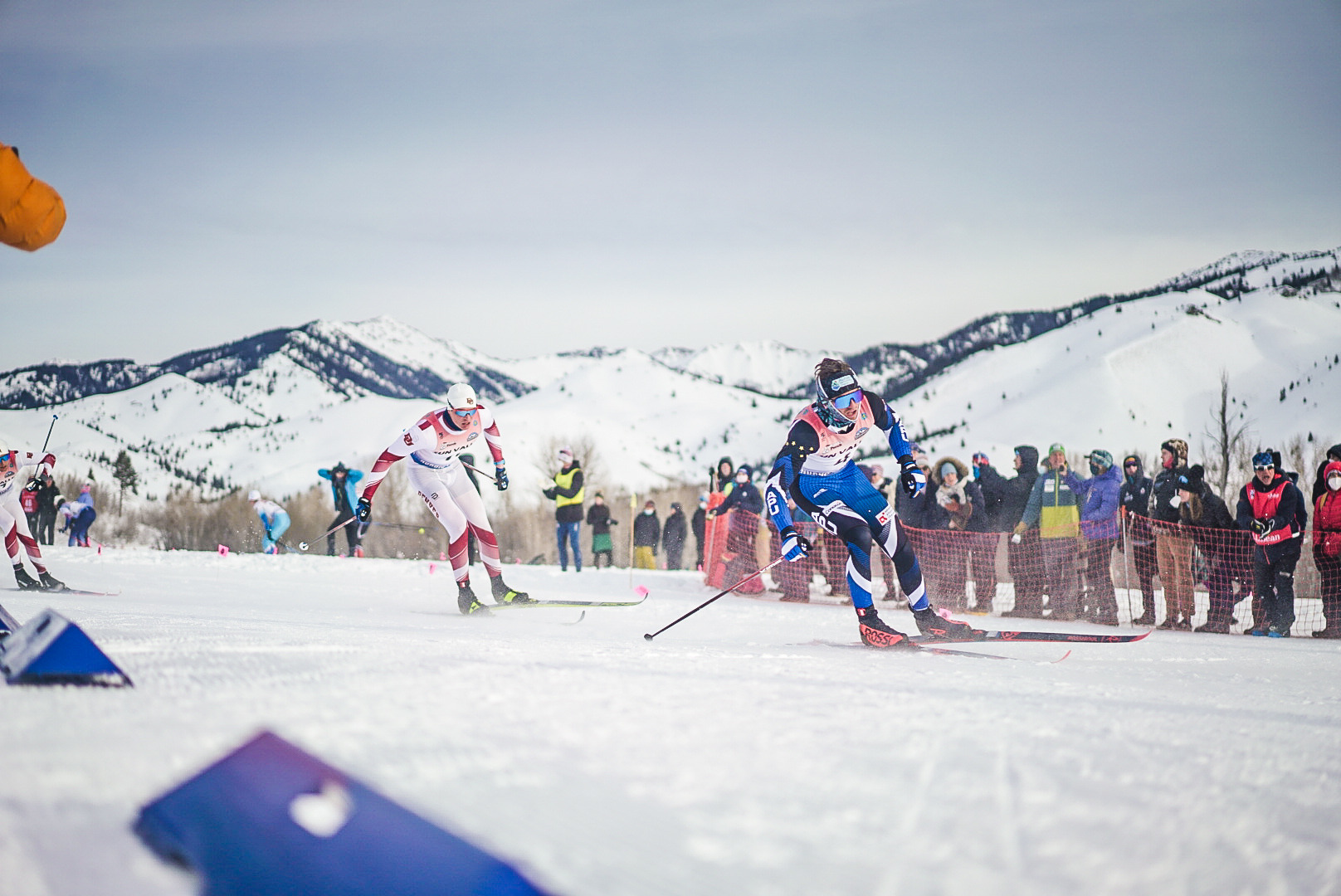
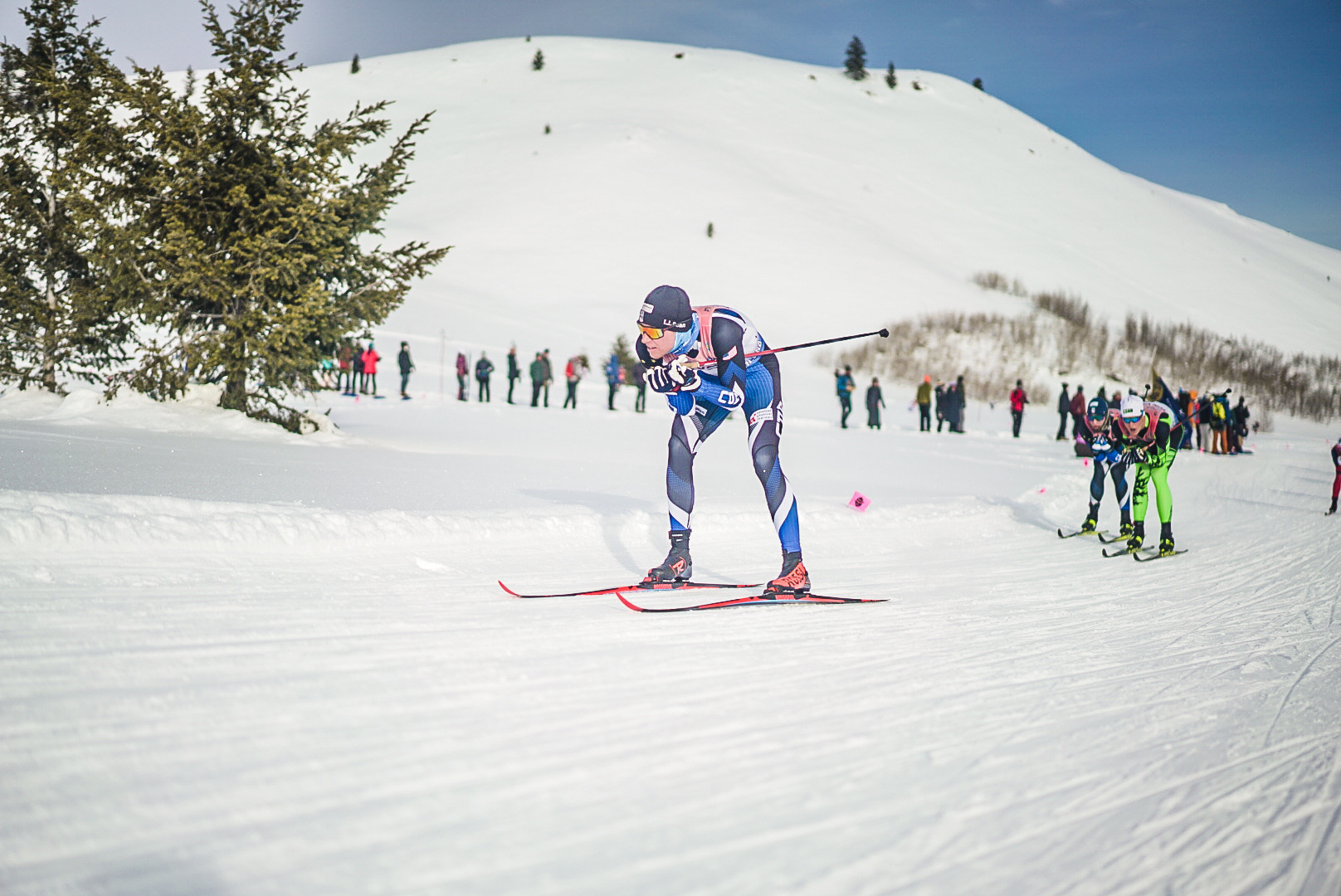
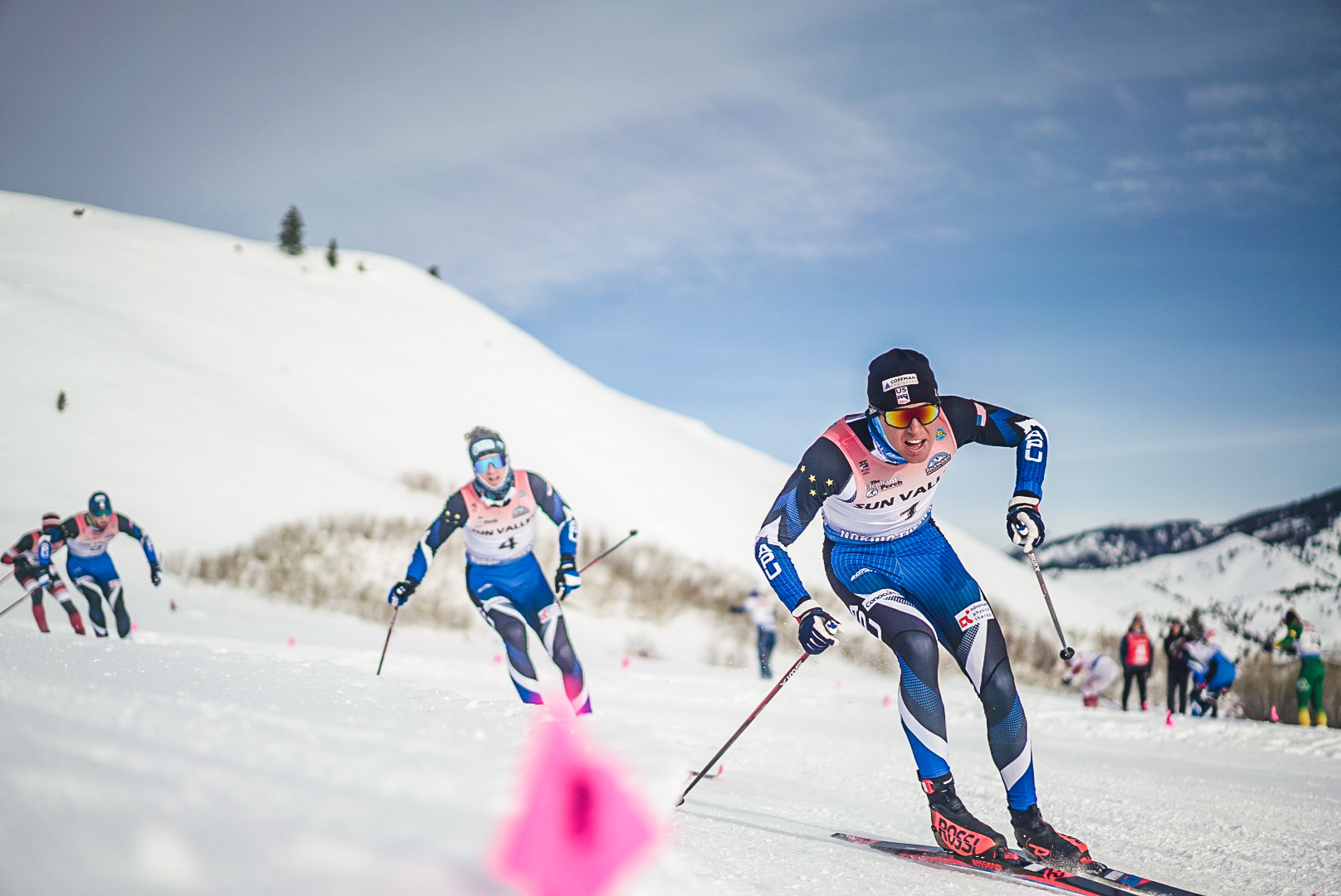
The 2022 Sun Valley Nordic Invitational continued Sunday with 10/15-kilometer mass start classic races, featuring SuperTour, RMISA collegiate, and Intermountain junior national qualifier divisions. With overnight temperatures in the low teens which rose to roughly 20 degrees Fahrenheit by start time, tracks looked ideal for kicking and gliding on the meticulously groomed trails at the Lake Creek Ski Center in Ketchum, ID.
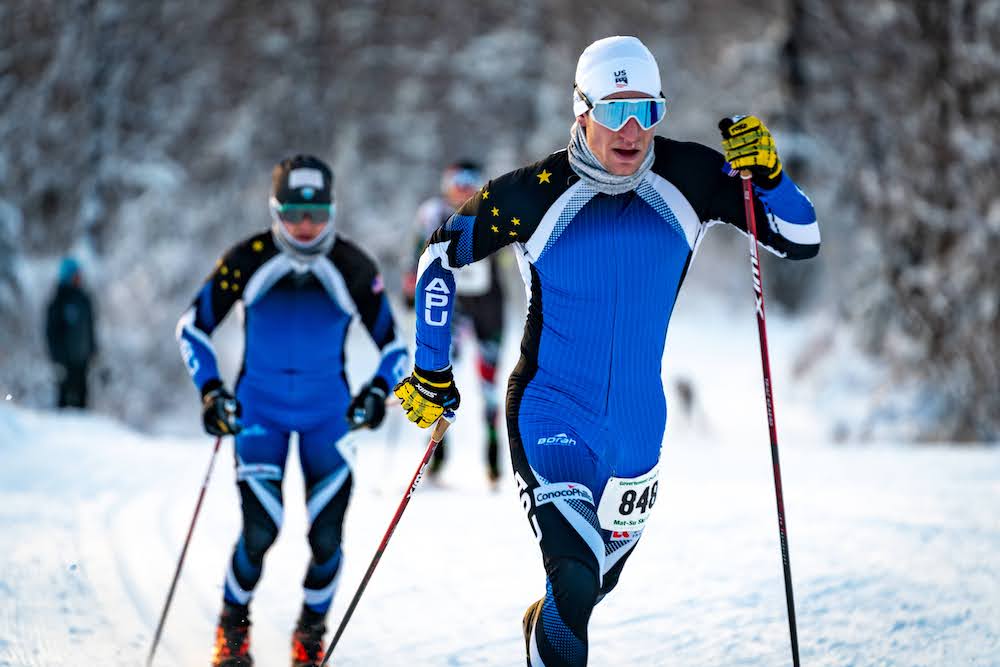
The opening meters of the women’s 10k mass start classic, with Rosie Brennan setting the pace in her blue APU race suit. (Photo: Tobias Albrigtsen / @untraceableg)
Today’s races featured four laps each, with men starting the morning off on a 3.75k loop that featured three progressively larger climbs, totaling roughly 417 feet of climbing per lap. The women raced next on a 2.5k loop, which truncated the third and most significant climb of the men’s loop to reduce the lap length.
Men’s 15k Mass Start Classic:
After his victory in Saturday’s 10k individual start skate, local Johnny Hagenbuch (USST/SVSEF) moved into second place in the overall SuperTour rankings, still led by Adam Martin of the Craftsbury Green Racing Project. Martin won the 15k individual start classic at the U.S. Cross Country Championships just ten days ago, taking his first national title. With fellow national championship podium finishers Scott Patterson and JC Schoonmaker also taking part in today’s classic mass start, along with a number of other accomplished competitors in a field of 122 athletes, the stage was set for an exciting race.
Ian Torchia pulls the lead group around a bend early in the men’s 15k mass start classic in Sun Valley. (Photo: Tobias Albrigtsen / @untraceableg)
In the end, it was another strong day for APU as they put together yet another podium sweep. Today, the APU men were led by David Norris, who took the win in a time of 36:50.5. Hunter Wonders finished second (+8.0), after outsprinting his teammate, Scott Patterson, in the final meters, leaving Patterson in third (+8.5).
“Lake Creek and all the Sun Valley trails are in such good condition right now,” wrote Norris in a post-race email to FasterSkier. “Earlier in the week I skied with the team at four different trailheads, and they were all so nice.”
Given the field size, level of competition, and relatively short lap length, one might expect congestion on the course, or the dreaded accordion that can sometimes occur as the pack repeatedly stretches out and compresses, making it hard for athletes in the later half of the pack to ski consistently. Norris explained that this was not an issue during today’s mass start.
“The course today is one of the harder courses in the U.S. and because of that the pack wasn’t overly crowded. I was surprised by how large of a group we had for the first three laps. I felt really relaxed skiing within the pack. Until Scott started pulling away from the lead group at the end of the third lap, I don’t think I had been in the top five. I bridged up to Scott on the last uphill of the third lap and then he, Hunter and I skied together until the last 1km of the race.”
David Norris leads the way through a corner on his way to a win in the SuperTour 15k mass start classic in Sun Valley. (Photo: Tobias Albrigtsen / @untraceableg)
“Approaching the last hill, I went to the front and right away felt a small gap open up so I pushed it to the top of the course where I had a solid gap that stayed to the finish. It’s really nice to put this race together after a really slow start to the season. The APU coaches have been working super hard and it was super cool to be a part of such a great day for the team.”
Norris concluded by sharing his upcoming objectives, perhaps foreshadowing tomorrow’s release of the 2022 Olympic team. Today’s result moved Norris into third place in the SuperTour overall standings, behind Adam Martin in first and Scott Patterson in second. In the Olympic qualification standings for distance racing, Norris is also third, with Patterson first and Martin second.
“From here I’m likely racing the Boulder Mountain Tour and the Birkie, which I’m excited about.”
Scott Patterson races to third place in the SuperTour 15k mass start classic in Sun Valley. (Photo: Tobias Albrigtsen / @untraceableg)
In Patterson’s post-race comment to FasterSkier, he echoed Norris’ statement that congestion was not an issue, particularly as they had started at the front-edge of the pack. Patterson did add, however, that some obstacles arose as they began to lap some of the skiers finishing near the back.
“Many were great about stepping over to the side,” Patterson explained. “But there were a few who were very focused on their own race and didn’t recognize our group charging through.”
Patterson also shared his version of the race narrative, including the final move that moved Wonders one step up the podium.
“The race started pretty hot. I was surprised to end up in about 15th off the line even from the tip of the chevron. However, by about a kilometer in, the pace had settled and I was back up near the front. Johnny Hagenbuch and Hunter (Wonders) did a lot of the work on the early two laps. I mostly stayed near the front, but was keeping it relatively casual and felt ready for some hard pushes later.
On the third lap up Torin’s Tucker or the South Bench climb, I decided it was time to make it a real race. My move quickly split the lead pack. I had some space behind, but David and Hunter were able to rejoin after the long descent down to the stadium. I continued to lead for most of the fourth lap before David put in a good charge up the final large climb. He got a little space from me, while I slightly distanced Hunter on the climb. However, Hunter’s finish came into play as he chased me down and out sprinted me into the finish.”
Scott Patterson makes his move, leading APU teammates David Norris and Hunter Wonders. (Photo: Tobias Albrigtsen / @untraceableg)
Giving another nod to the coaches, Patterson celebrated his team’s success, despite finishing below where he would have liked.
“It was another sweet day for APU with the sweep. I am a little disappointed to have made most of the animating moves myself and only end up on the bottom step of the podium, but it is cool to see David and Hunter put together good ones. Our coaches put in a lot of hard work this week on top of a hard nationals to make it possible.”
Though perhaps more vague than Norris, Patterson also concluded with what is next on deck for him.
“I’m heading to my parent’s in Bozeman now,” Patterson said. “My plan is to put together a good training block there at somewhat altitude and get ready for the next races.”
As mentioned, Patterson put himself on top of the Olympic qualification rankings with the combined points of his win in the 30k skate and second place finish in the 15k classic; both events are on the Olympic schedule. While the five guaranteed spots of the men’s quota have likely been filled by those with stronger early-season World Cup results (note that Patterson had wrist surgery in October, which set him back performance-wise until recently), this indicates that Patterson would likely snag the sixth spot should one be added to the U.S. quota after reallocation, happening later this week. (Find more information on quotas and selection here.)
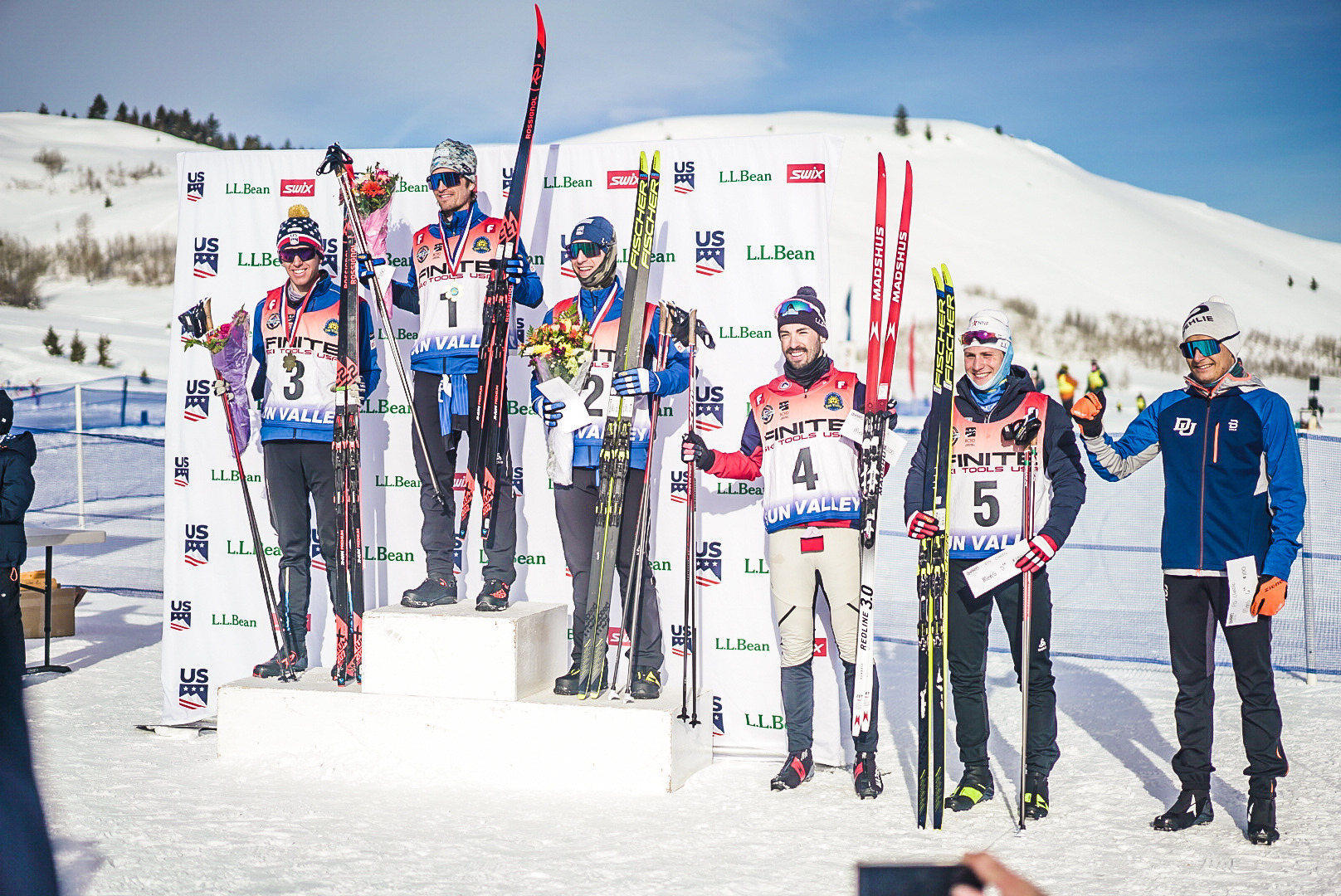
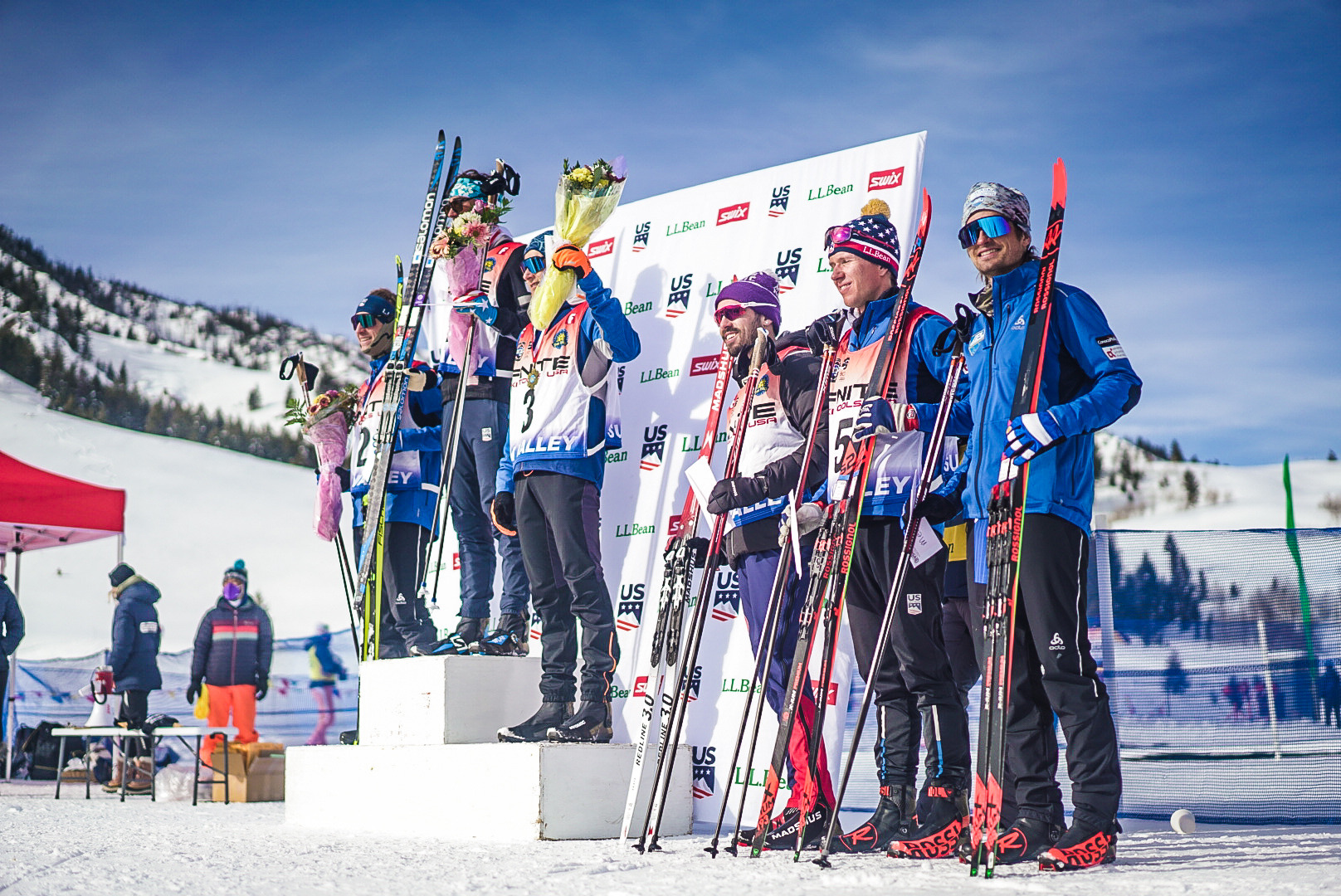
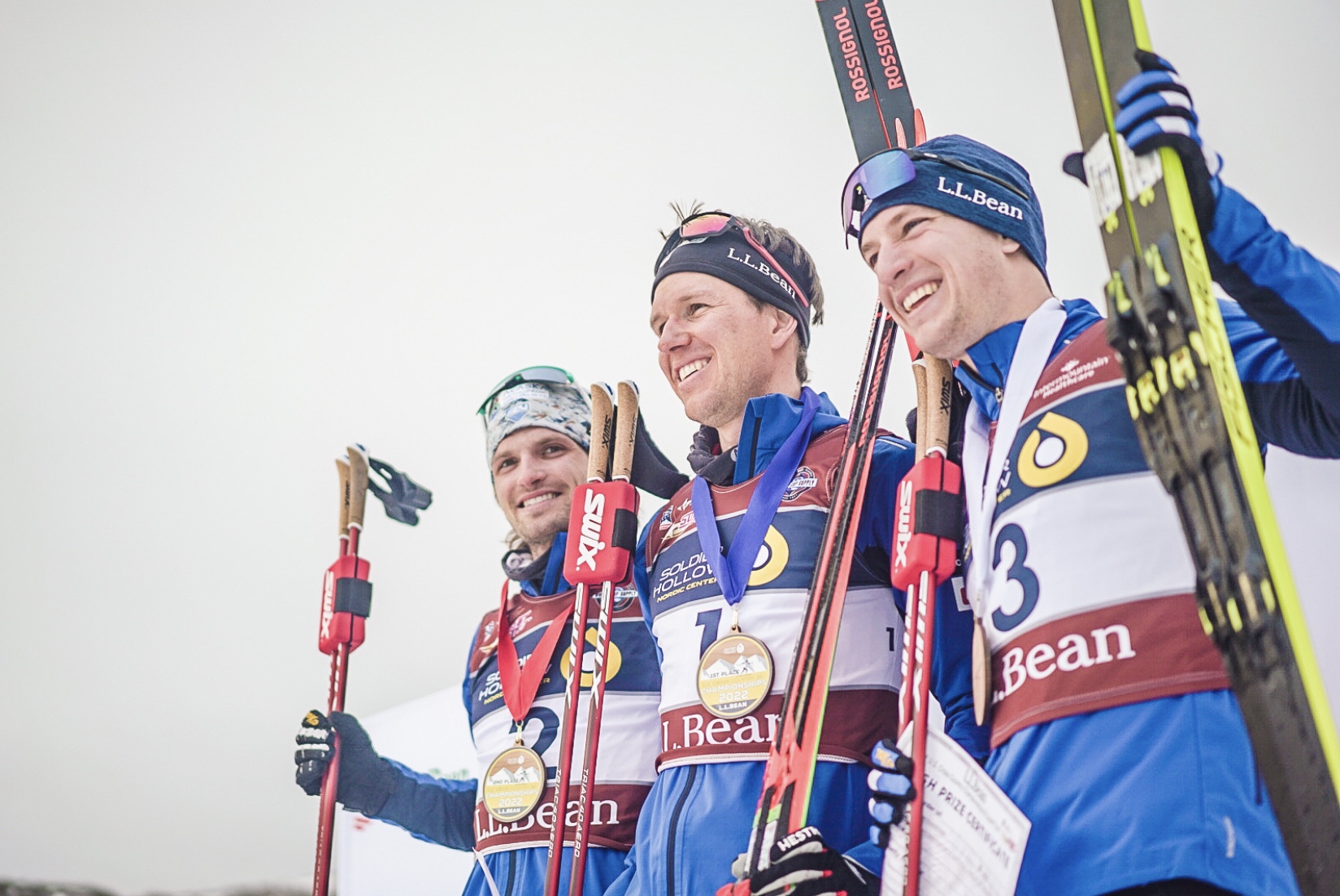
The top six men surround the podium following the 15-kilometer mass start classic in Sun Valley. (Photo: Tobias Albrigtsen / @untraceableg)
Lacking a livestream video and intermediate splits in the live timing, it is difficult to make many observations about the race other than those apparent in the finish times. Breaking up the string of four APU men who finished in the top-five, Ian Torchia (SMS T2) finished fourth again (+28.1), on the heels of a fourth place finish in the 10k skate on Saturday. In another finish-line sprint, Torchia crossed just ahead of APU’s Zanden McMullen (+28.2) with University of Denver’s Bernhard Flaschberger just behind in sixth (+28.4).
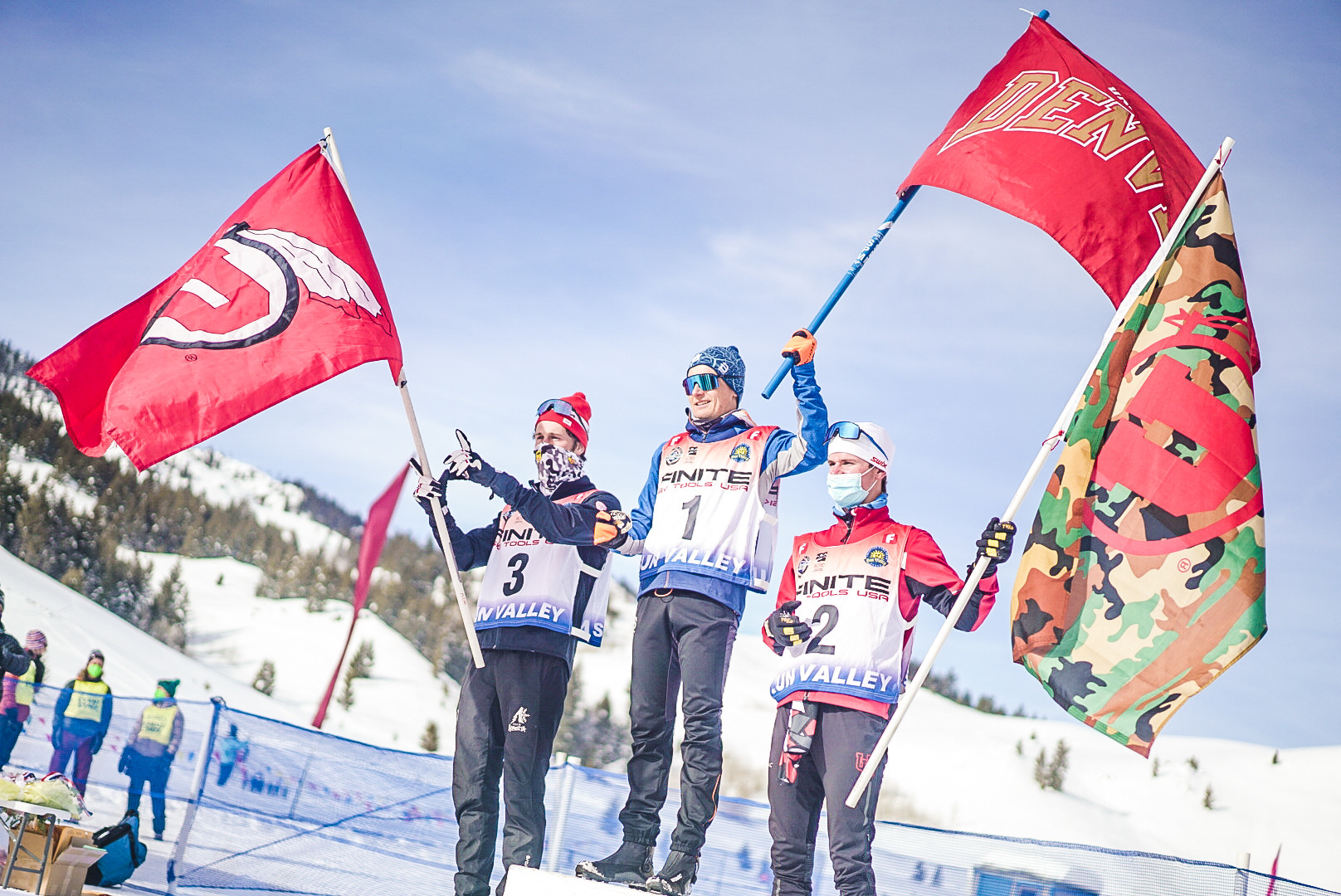
In the collegiate standings, Flaschberger skied his way to a double victory in Sun Valley. Sam Hendry (U of Utah) also earned a double podium, taking second place today after yesterday’s third, just one second behind Flaschberger and in eighth overall. Rounding out the collegiate podium, Andreas Kirkeng of University of Denver came in third (+24.1) for RMISA and tenth overall.
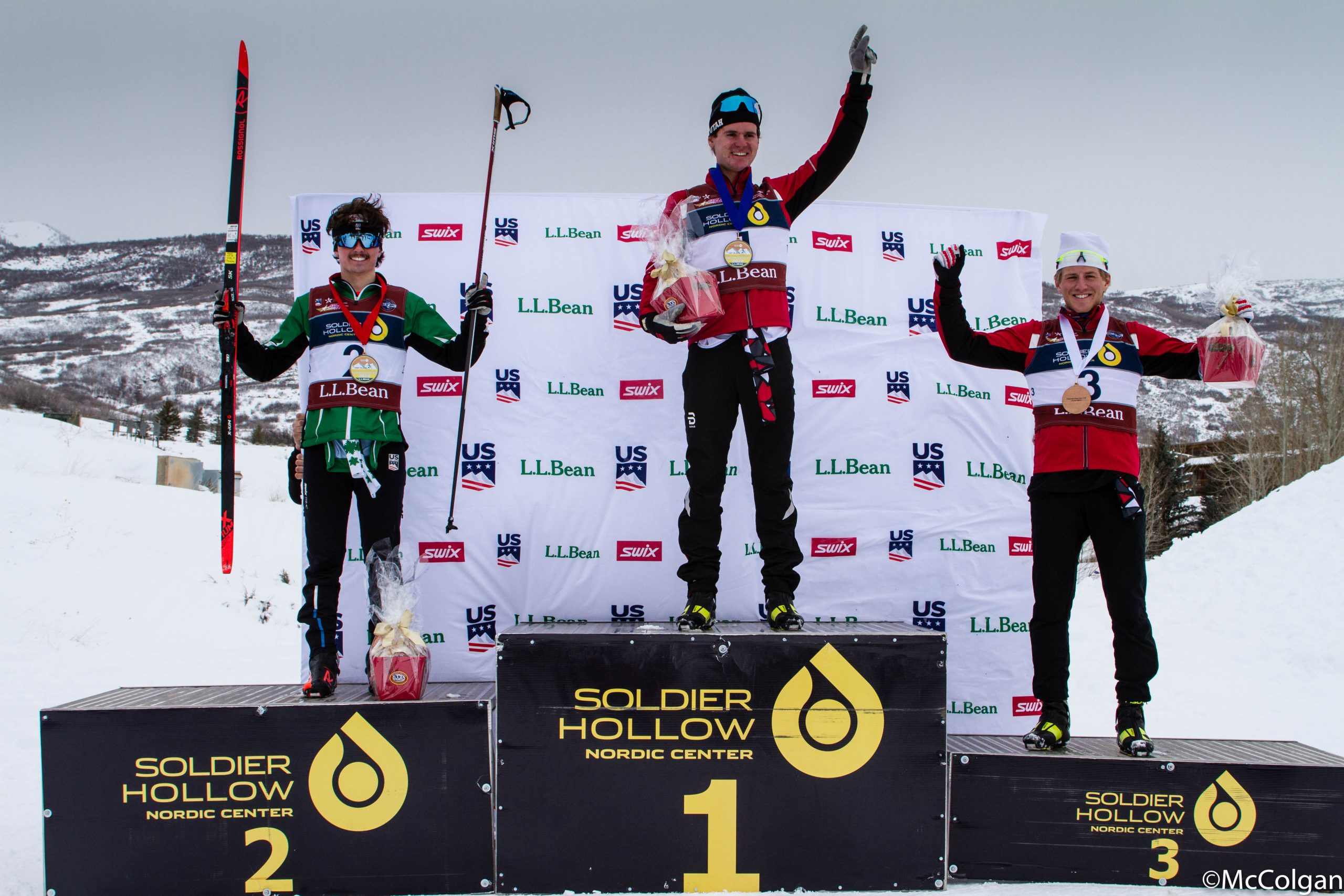
The RMISA men’s podium after the 15k mass start skate in Sun Valley. (Photo: Tobias Albrigtsen / @untraceableg)
Women’s 10k Mass Start Classic:
While there was no official livestream, APU’s Forrest Mahlen did record an Instagram live of the women’s race on the APU account, which offers some insights into the action. The footage and commentary are perhaps a significant step down from that offered in Soldier Hollow, but the primary storyline was nevertheless clear from the start. By the time Rosie Brennan (USST/APU) passed Mahlen, just over a minute into the race, she had created a five second gap over the remainder of the women’s field.
Unmatched, Rosie Brennan wins the women’s 10k mass start classic by nearly a minute. (Photo: Tobias Albrigtsen / @untraceableg)
Gun to tape, Brennan put on a clinic. Unmatched, she time-trialed her way around each of the four laps to finish in 29:35.3, nearly a minute ahead of the next racer. Brennan explained after the race that she was not totally prepared for classic races, as her original plans for her U.S. altitude block changed with the cancellation of the Les Rousses and Planica World Cups. Despite the time away from the main hub of the likely U.S. Olympic squad who are now training in Livigno, Italy, Brennan has seemingly thrived as she continues to hone her mental and physical sharpness before heading to China.
“I was honestly quite nervous for the race because I was never planning to do a classic race while I was home,” Brennan shared after the race. “I only brought home two pairs of training classic skis, so I wasn’t sure if it would be enough in this very strong field of women. Luckily, they were both cold skis and we did have cold, hardpack conditions today. APU did a great job preparing them and turning them into good race skis so it was alright in the end.”
More of a time trial than mass start, Rosie Brennan gaps the women’s field early, eventually winning the race by nearly a minute. (Photo: Tobias Albrigtsen / @untraceableg)
Speaking to her race strategy, Brennan continued, “I started hard to try to simulate what I will encounter in Beijing. I wasn’t sure what the other girls would do so I just really tried to focus in on strong skiing. This is only my 3rd classic race of the year so I really wanted the practice of holding my technique together, finding a relaxed stride, and all while at altitude. I felt really strong on the long climb and was able to find a good groove, so I pulled away on that climb and then had to just keep pushing. It was a good mental challenge with a four lap race at altitude. I was definitely feeling tired on lap 3 and had to turn my mind around and find a way to push hard again that last lap in preparation for the Olympics. All in all, it was a good weekend to get some hard efforts in before we start to taper and focus in on Beijing.”
Leading the chase pack in the final lap, Katharine Ogden (USST/SMS T2) skied to second place for the women (+55.4). Ogden was second in the 10k classic during the U.S. Cross Country Championships, the only event she contested, and finished fourth in yesterday’s 5k free.
Rosie Brennan has a medal placed around her neck by SVSEF youth athlete after winning the women’s 10k mass start classic. (Photo: Tobias Albrigtsen / @untraceableg)
Next to the line was Novie McCabe (USST/U of Utah) in third (+1:07.6), her second third place finish of the weekend.
“It was fun for sure!” McCabe wrote in a post-race email. “I’ve always liked racing in Sun Valley and haven’t done too many mass starts this season so I was stoked for this one! We had a good group for the first three laps and it was kind of nice to just try and settle in and find a good pace. Overall, I felt good and am super happy with how things ended up. My skis were also amazing, which for sure didn’t hurt!!”
Rosie Frankowski skis to fourth in the SuperTour 10k mass start classic in Sun Valley. (Photo: Tobias Albrigtsen / @untraceableg)
Rosie Frankowski (APU) was fourth to the line (+1:17.1), with Sydney Palmer-Leger (USST/U of Utah) behind in fifth (+1:26.4), leading her teammate Sophia Laukli who finished roughly a second behind her in sixth (+1:27.2). Improving on yesterday’s result, Caitlin Patterson (CGRP) was next to the line in seventh (+1:35.7).
Going 3-5-6 in the overall standings set the women of Utah up nicely for a back-to-back podium sweep, the first time any RMISA team has done so within the same meet since 2013, according to the team’s press release. A look at the roster shows the Utes as the U.S. Ski Team-lite. A force to be reckoned with, the Utah women’s team has now won each of the five RMISA races this season.
Sydney Palmer-Leger skis to third overall and rakes the RMISA collegiate win in Sun Valley’s 10k mass start classic. (Photo: Tobias Albrigtsen / @untraceableg)
Beginning a northeast swing, the SuperTour circuit moves to Lake Placid, NY for Period III, resuming in two weeks on January 29th. This two-day race weekend will include a classic sprint, followed by a 10k mass start skate.
A big thank you to Tobias Albrigtsen, who generously shared his outstanding photos with us throughout the weekend.
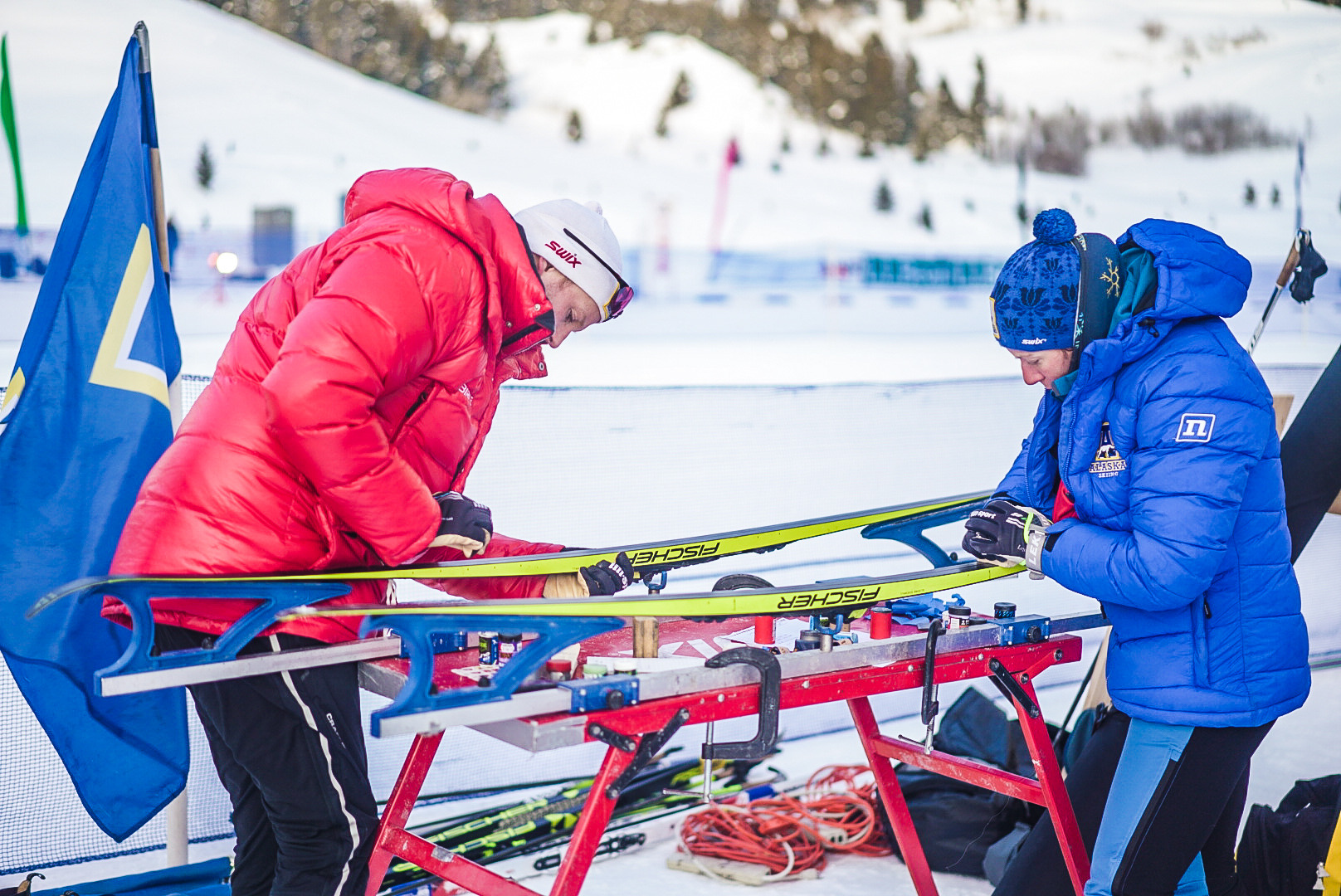
The prepping of the boards: University of Alaska Fairbanks coaches prepare skis for their athletes at the 10/15k mass start classic races in Sun Valley. (Photo: Tobias Albrigtsen / @untraceableg)
Quick Recap: We’ll have a full race report up tomorrow, including athlete comments and photos, but here is a quick recap of the action in the men’s 15k and women’s 10k mass start classic, which took place this morning in Ketchum, Idaho.
The 2022 Sun Valley Nordic Invitational continued this morning with 10/15-kilometer classic races at the Lake Creek Ski Center in Ketchum, Idaho. While temperatures were warmer than at the start of yesterday’s skate races, it was still a brisk morning in Sun Valley, making for excellent classic racing conditions in the dry high-altitude natural snow.
The men kicked off the morning’s races, taking off in a mass start at 9:30am. Rebounding from sixth place in yesterday’s skate, David Norris (APU) took the win in 35:50.5, leading a train of teammates for an APU podium sweep. Hunter Wonders doubled up on his second place performance, finishing 8 seconds behind Norris. Wonders edged out Scott Patterson (USST/APU) at the line by 0.5 seconds, leaving Patterson in third. Ian Torchia (SMS T2) was next for his second fourth place finish of the weekend (+28.1), finishing in a three-way sprint with APU’s Zanden McMullen who took fifth (+28.2) and University of Denver’s Bernhard Flaschberger in sixth (+28.4).
Flaschberger was again the top RMISA collegiate racer, with Sam Hendry of the University of Utah in second place (8th overall), and fellow Denver athlete Andreas Kirkeng in third (10th overall).
The opening meters of the women’s 10k mass start classic, with Rosie Brennan setting the pace in her blue APU race suit. (Photo: Tobias Albrigtsen / @untraceableg)
From the looks of an SVSEF Gold Team Instagram story, Rosie Brennan (USST/APU) took the women’s race out hot. Following the theme of her domestic racing over the last two weeks, Brennan steadily grew her lead over the field, crossing the finish line in 29:35.3, nearly a minute ahead of her chasers. Katharine Ogden (USST/SMS T2) led the chase back to the finish to take second place (+55.4), with Novie McCabe (USST/U of Utah) close behind, again in third (+1:07.6). Rosie Frankowski (APU) was fourth for the women (+1:17.1), with Sydney Palmer Leger (USST/U of Utah) behind in fifth (+1:26.4), leading her teammate Sophia Laukli who finished roughly a second behind her in sixth (+1:27.2).
This time with McCabe on the top-step, these three University of Utah women again swept the RMISA collegiate podium for the second day in a row.
The final weekend of SuperTour racing in Period II, and the final weekend within the Olympic qualification window, kicked off Saturday at the Lake Creek Nordic Center in Ketchum, Idaho. Part of the 2022 Sun Valley Nordic Invitational, the SuperTour races were held in conjunction with a Montana State University RMISA event and an Intermountain XC junior national qualifier.
Highlighting the size of the event, there were 157 female athletes in the field. With 141 senior and U18 men racing in the 10k, and another 46 racing in the men’s U16 5k. Spanning all age groups, an additional 70 U14 athletes and another 18 U12 athletes raced a 3k and 2k course, respectively. In all, nearly 400 cross country skiers, from Olympians to 10-year-olds in their first seasons on skis, made their way around the tracks in Lake Creek.
An athlete races the 10k interval start free on the Lake Creek trails in Ketchum, ID. (Photo: Tobias Albrigtsen / @untraceableg)
As the World Cup events in Les Rousse, France and Planica, Slovenia were both cancelled due to rapidly increasing coronavirus caseloads with the omicron variant, several athletes who might have headed back to the World Cup for these events found their way to Sun Valley instead, meaning fields were more in line with the U.S. Cross Country Championships than a typical SuperTour.
On the women’s start list for the 5-kilometer individual start skate, which kicked off the weekend of distance racing, were six women who have spent at least part of their season racing on the World Cup: Rosie Brennan (USST/APU), Caitlin Patterson (CGRP), Katharine Ogden (USST/SMS T2), and three University of Utah athletes who are also members of the U.S. Ski Team, Sophia Laukli, Novie McCabe, and Sydney Palmer-Leger.
Likewise, the men’s 10k field included seven World Cup athletes: David Norris (APU), JC Schoonmaker (USST/UAA), Scott Patterson (USST/APU), Hunter Wonders (USST/APU), Zanden McMullen (USST/APU), Luke Jager (USST/U of Utah), and Zak Ketterson (Team Birkie).
Given Ketchum’s elevation of roughly 5,950’, approximately the same as the courses in Soldier Hollow, Utah and those Olympic team members will face in Ziangjiakou in February, the events provided another opportunity to spend time training at the elevation and to hone their approach to racing at altitude. Overnight lows in the single digits meant cold air and snow temps at the start of the women’s race, another important similarity to forecasted Olympic conditions.
According to co-chief of competition Kelley (Sinnott) Yeates, livestream was not available during the Sun Valley Nordic Invitational due to connectivity issues along the courses. As such, FasterSkier’s reporting this weekend is based on live timing and the feedback of those on-site.
Of the course, Sun Valley native Johnny Hagenbuch provided insight into the 5km loop that was raced today in an email to FasterSkier: “The new courses at Lake Creek are very difficult: they essentially removed all the flat from the old course and replaced it with the biggest climb at Lake Creek.”
Senior Women’s 5k Free:
Without the ability to view the race and no intermediate splits in the live timing, the women’s race results left little room for suspense. Given her dominant performance in the 20k skate during the U.S. Cross Country Championships, it was no surprise to see Rosie Brennan’s name top the list. Brennan smashed the 5k loop, finishing in 14:28.6, a full 48.6 seconds faster than the next woman.
Rosie Brennan enjoys a wintery training day before the weekend of World Cup racing in Davos, SUI. (Photo: NordicFocus)
“I decided to come to Sun Valley after the World Cups in France were canceled,” Brennan wrote to FasterSkier in a post-race email. “My coach, Erik Flora, has been up here all week with the rest of my APU teammates, so it made sense for me to come here to be able to work with my coach and teammates. That has been the total silver lining of the World Cups being canceled. Erik is not allowed to come to the Olympics, but is my personal coach and someone who I trust and value immensely, so getting this extra week to work on things with him has been such a welcome surprise.”
Now several weeks into an extended altitude block, Brennan has been training near her childhood home in Park City, UT. The races in Soldier Hollow put her back on familiar tracks with hometown advantage, and the nostalgia continued today.
“It has been a full circle moment for me this weekend as I spent many years racing JN Qualifiers in Sun Valley growing up, so to be back here doing so now as I prepare for the Olympics has brought back all kinds of memories from my whole ski career. My high school and college coach were also out there today cheering and it’s been really special to have this extra time in the U.S. to share moments with people like that who have helped in getting me to where I am today.”
Brennan had originally planned to rejoin the U.S. Team in Europe, but following the cancellations of the two remaining World Cups before the Olympics, has shifted her plans to limit her risk of covid exposure, as a positive test might jeopardize her ability to travel to China, regardless of the severity of her case.
“With travel being risky on all kinds of levels today, I decided to just stay put after the World Cup cancellations and make the most of the training opportunities I have here in the U.S. before heading to Beijing. This weekend is serving as a replacement for the races I would have done in France and also another opportunity to test my limits at altitude. We just incorporated the races into a little intensity block to get my engine running again after a good volume block.”
Rosie Brennan logs hours on home trails during an extended altitude camp near Park City, UT. (Photo: Instagram @rosiewbrennan)
Speaking to her feelings holistically as she prepares for the Olympics, entering the Games on the heels of a career-best 2020/21 season with a host of early-season indicators that she can be a medal contender, Brennan spoke to the stress athletes face amidst the pandemic, which has added layers of complexity in traveling to Beijing and entering the Olympic bubble.
“It’s definitely a stressful lead up to the Games with COVID raging everywhere, a multitude of requirements and things that need to get done to be allowed into China, and figuring out all the details of being prepared for such a long travel to a very foreign country with lots of restrictions. I am doing my best to just stay on top of all the requirements, stay far away from everyone I can, and chip away at the things I need to be prepared for. The training at home has been great and having a coach to work with is so helpful, so from an actual racing perspective, I am feeling good and optimistic. I feel very lucky to have a home base in Park City and that the venues in the area provide good preparation for the Games.”
Sophia Laukli races to second overall and finishes the top collegiate racer in the women’s 5k interval start free in Ketchum, ID. (Photo: Instagram @utahskiteam)
Recovered from racing the Tour de Ski, where both women notched top-10 finishes on the hill climb, Sophia Laukli (USST/U of Utah) took second place (+48.6) today, with Novie McCabe four seconds behind in third (+52.6). Katharine Ogden (USST/SMS T2) was fourth (+52.0) for the women, with Rosie Frankowski (APU) next (+59.8) to round out the top-five.
With their top-three overall finishes, Laukli and McCabe also took home top results in the collegiate standings on behalf of the University of Utah. With teammate Sydney Palmer-Leger in 7th overall (+1:32.5), the Ute’s swept the RMISA podium.
“Today was definitely quite the race,” wrote Laukli after the race. “I was really looking forward to it since I love 5k skates, and courses with lots of climbing. I was also excited to get back into racing after the tour, especially on the domestic circuit which I was starting to miss. I was very happy with how the race ended up today, and it was actually a bit of a surprise (results-wise) just based on how I felt during it. I know I was not alone by getting rather cold out on course, but it felt like quite the shock to the system and difficult to get in a good groove—sometimes that will happen though! While it was probably one of the hardest 5ks I’ve ever done, it’s an awesome course and I just had fun getting back into racing after a short break.”
Commenting on her recovery post-Tour de Ski and her goals over the next couple of months, Laukli continued, “I took the past couple weeks very easy in my training, with minimal intensity, to recover from the tour. I wanted to take advantage of that racing block to really get into my best racing shape so taking a step back in training right after was important. The rest of the season is still a bit up in the air, but I know these races at altitude will be great preparation if I do end up at the Olympics. Either way, I’m planning to continue doing some college races and hopefully NCAAs, so these races will be good prep for that as well.”
With Sophia Laukli and Novie McCabe also taking second and third on the overall podium, Sydney Palmer-Leger brought the Ute’s home for a collegiate podium sweep. (Photo: Instagram @utahskiteam)
Other noteworthy results include the retired, but nevertheless still a contender, Caitlin Gregg, who hopped into the race while still serving as a co-head coach of the Midwest’s Team Birkie. Gregg finished in 8th (+1:37.5), just ahead of the day’s top Craftsbury skier, Alexandra Lawson.
Also, Caitlin Patterson, who earned a spot on the podium in each of the events at the U.S. Cross Country Championships and SuperTour in Soldier Hollow, finished 17th, nearly two minutes behind Brennan. In a post-race Instagram story, Patterson wrote that she had been very cold during the race with numb legs and toes, which left her feeling like a “floppy fish popsicle.” Despite finishing below where she was perhaps aiming, Patterson remains in second place behind Frankowski in the SuperTour overall standings, and in second behind Brennan in the Olympic qualification rankings for distance racing.
Senior Men’s 10k Free:
The men’s field would race the same lap the women did, but twice. That meant there was a time checkpoint at the halfway mark to indicate how the race was shaping up, yielding interesting insights into just how tight a spread the top of US men’s skiing is right now. With World Cup athletes, elite-level domestic racers, and top collegiate skiers from the West, there were plenty of names to watch.
Ian Torchia (SMS T2) leads Sam Hendry (U of Utah) during the SuperTour 10k individual start in Ketchum, ID. (Photo: Tobias Albrigtsen / @untraceableg)
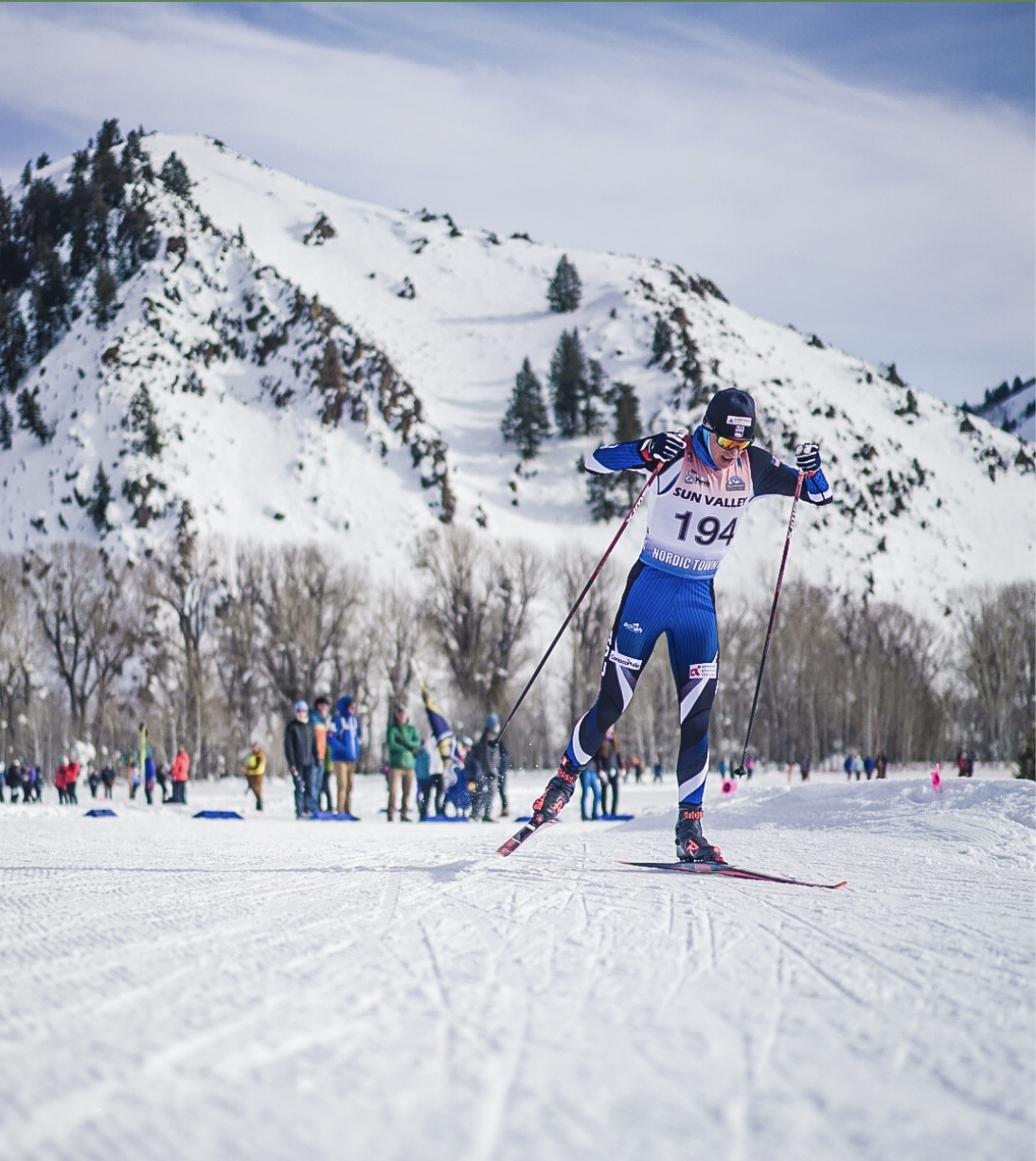
An Aspen, CO native and no stranger to altitude, Graham Houtsma (BSF Pro) was early off the line as the second starter in bib 172. Houtsma came across the 5km split as the early leader at 13:30.3. His mark would look to be the point around which the top of the field clustered for the first part of the race. Then, Scott Patterson (USST/APU) came through in bib 194 and raised the bar. His split topped Housma by a full 30 seconds (13:00.2), and would be chased as the remainder of top-seeded athletes lapped through.
Before diving into that group, however, a caveat. A couple of the top skiers today weren’t assigned splits at all in the live timing, including overall SuperTour leader Adam Martin (CGRP), Johnny Hagenbuch (USST/SVSEF), and top-collegiate finisher, Bernhard Flaschberger (U of Denver). That gave an incomplete picture of what the race looked like through one lap, setting the stage for a few surprises in the eventual final results.
Scott Patterson skis to fifth in the 10k individual start free in Sun Valley. (Photo: Tobias Albrigtsen / @untraceableg)
So what did we know through 5km? If you were just observing, you would have seen Patterson overtaken by one, and only one, skier. Teammate Hunter Wonders (APU) completed the first lap of the course 3 seconds ahead of Patterson at 12:57.9. The field that had splits looked to be shaping up into a tight affair, with the top 5 skiers all within 15 seconds of each other. That included Wonders in the lead (12:57.9), with Patterson next (+2.3), Ian Torchia third (+8.5) seconds, David Norris (APU) in fourth (+10.0), and Finn O’Connell (BSF Pro) in fifth (+12.1). Based on eventual results, it is safe to assume that Hagenbuch, Flaschberger, and Martin all went through in the 13:00 min pack too.
At the finish, Wonders would cross the line in first place at 26:28.7, and slightly increase his lead over the pack in the second lap. Over Torchia, it had grown to 8.5 seconds, and Patterson 20.9 seconds. But it would be the skiers of the “mystery 5k” splits that really made a difference in defining today’s results. Hagenbuch came in soon after Wonders, and crossed the line in 26:15.4. It would prove to be a mark no one could top on the day. Bernard Flaschberger too, would slotted himself into the top of the pack – finishing less than a second ahead of Ian Torchia to claim 3rd.
The top 5 of the final results then, looked finished like this: Johnny Hagenbuch with the win in 26:15.4, Hunter Wonders in second (+13.3), Bernhard Flaschberger in third (+27.0), Ian Torchia in fourth (+27.5), and Scott Patterson fifth (+34.2).
The men’s podium of the SuperTour 10k individual start skate in Sun Valley, including the top-six athletes. (Photo: Tobias Albrigtsen / @untraceableg)
In an email to FasterSkier, Hagenbuch pointed to an intimate knowledge of his home course in Sun Valley as being a key to his impressive margin at the top:
“The conditions were firm and well skied-in, and it was fairly fast. I have skied a whole lot here at Lake Creek in my years, and I knew the race was going to be super hard. I think it’s important to focus on the transitions and more rolling parts of the courses at Lake Creek, as just about everyone will be suffering on the climbs. I tried to ski [with a] really big, powerful V2 on the more gradual north end of the course; the strategy for the uphills was mostly to step on and off the skis quickly.”
With his results, Hagenbuch wins his first SuperTour of the season, on his home course, to boot. Not too shabby for a Saturday morning in Ketchum. He also did so in convincing fashion, rising above a field of seasoned SuperTour athletes to claim a definitive win by a stout margin. It will also improve his 5th place overall in the SuperTour standings, replacing two 6th place finishes from early in the season at Duluth.
On his win, Hagenbuch wrote, “frankly it’s quite a relief to have done well today, as I feel I haven’t really expressed my shape to the fullest for a variety of reasons this season… I’m just taking it day-by-day, [and] it was a real treat to have so many friends and family to cheer me on at home in a field that was deeper than U.S. Nationals.”
Hunter Wonders skis to second place in the men’s 10-kilometer individual start skate race in Ketchum, ID. (Photo: Tobias Albrigtsen / @untraceableg)
Elsewhere in the SuperTour standings, Wonders’ 2nd place finish will improve his distance standing going into today from 12th overall – replacing a 4th place finish in Soldier Hollow in the 15km Classic off his point standings. Overall SuperTour leader Adam Martin finished 7th (26:57.6) on the day, while 2nd place holder JC Schoonmaker was 21st (28:04.3).
“Today was a solid effort,” Wonders wrote to FasterSkier after the race. “It’s been a while since I’ve been home to Alaska and that’s started to weigh on me this week. Leading into the racing I was low energy trying to get my feet back under me after nationals in Utah. It was a good confidence boost and a pleasant surprise when I realized I was having a good day on the course today.”
Shedding light on the course conditions for those unable to watch, Wonders continued, “It was amazing conditions for a race, not too cold with firm grooming which is always welcome. 10k is pretty short, so I knew I had to take it out hot. I was a little concerned about blowing up, but realized that the course had more recovery when you’re at race pace versus easy skiing. The high part of the course is brutal but it sets you up into a ripping decent to the finish. Overall, it was a great day and I’m happy with my racing and thankful for my teammates keeping my spirits up this week and the coaches hooking me up with some great skis.”
In the RMISA collegiate standings, the Utes again had a strong podium showing. With Flaschberger taking the win for Denver, Walker Hall (U of Utah) Sam Hendry (U of Utah) skied into the next two collegiate spots to solidify the overall lead for Utah this weekend.
The RMISA men’s podium of the 10k interval start classic in Sun Valley: Bernhard Flaschberger took the win for the University of Denver, ahead of Utah’s Walker Hall in second and Sam Hendry in third. (Photo: Tobias Albrigtsen / @untraceableg)
Hunter Wonders skis to second place in the men’s 10-kilometer individual start skate race in Ketchum, ID. (Photo: Tobias Albrigtsen / @untraceableg)
Quick Recap: We’ll have a full race report up tomorrow, including athlete comments and photos, but here is a quick recap of the action in the men’s 10k and women’s 5k interval start skate, which took place this morning in Ketchum, Idaho.
After just over a week off from racing, the Period II western swing of SuperTour racing continued this morning in Ketchum, ID. The SuperTour races were part of the 2022 Sun Valley Nordic Invitational, which also included RMISA collegiate races, and youth races. Today’s stage featured an individual start skate, with the senior women a one-lap 5-kilometer course on the Lake Creek trails, and the senior men repeating the route for a total of 10k.
On the heels of a dominant performance in the 20k mass start free during the U.S. Cross Country Championships in Soldier Hollow, UT, Rosie Brennan smashed the women’s race to win in a similar fashion. Brennan (USST/APU) completed the loop in 14:28.6, nearly 50-seconds faster than the next woman. Recovered from racing the Tour de Ski, Sophia Laukli (USST/U of Utah) took second place (+48.6), with Novie McCabe four seconds behind in third (+52.6).
For the men, hometown favorite Johnny Hagenbuch (USST/SVSEF) clocked the fastest time of 26:15.4. Though tighter than the women’s race, Hagenbuch also gapped the men’s field, finishing 13.3 seconds ahead of Hunter Wonder (USST/APU) in second place. University of Denver senior Bernhard Flaschberger was third to the line, 27.1 seconds behind Hagenbuch.
By Gavin Kentch, Ella Hall, and Rachel Bachman Perkins
Tuesday brought distance races to Soldier Hollow, in the second full day of racing at 2022 U.S. Cross Country Championships. The story at the front of the field was strong performances by athletes who had begun the year racing on the World Cup, as Rosie Brennan dominated the women’s field to win by over a minute, and Scott Patterson took the men’s race by roughly twelve seconds.
U.S. Ski & Snowboard Development Team Coach Greta Anderson encourages athletes during the men’s 30k distance race in Soldier Hollow. (Photo: Tobias Albrigtsen / @untraceableg)
Brennan was followed by Rosie Frankowski and Caitlin Patterson. Scott Patterson was followed by David Norris and Hunter Wonders, giving APU five out of six podium spots on the day. Craftsbury athletes went 3-4-5 in the women’s race. Notably, four out of six podium finishers were on the north side of 30, with a fifth gaining Master status later this month, underscoring the lengthy developmental curve often required to achieve success in distance racing.
Women’s Race: Rosie Brennan Solos to Victory
Tuesday’s race, the women’s 20-kilometer freestyle race at 2022 U.S. Cross Country Championships, was, technically speaking, a mass start – but for Rosie Brennan, it skied more like an interval-start race. Brennan wore bib 101, at the sharp end of the chevron start in a field of 55 athletes, and led every one of 20,000 meters of the 20 k, pushing the pace right from the start and never looking back all the way through the finish line. She covered the challenging course in a speedy 53:16.9 to take her seventh national title, and first since 2015, in a dominating performance.
The race began under overcast skies and moderate temperatures. By one second into the race, Brennan (USST/APU) was in the lead. By one minute into the race, she was notably off the front, with only three athletes, Rosie Frankowski (APU), Caitlin Patterson (CGRP), and Sydney Palmer-Leger (USST/Utah) even contemplating whether to follow.
By two minutes into the race, Brennan had a sizable gap, as athletes in the Frankowski-led chase pack had decided that discretion was the better part of valor, and opted to ski their own race and focus on chasing the remaining two spots on the podium. No athletes other than Brennan would appear on screen again in the free livestream until the six-minute mark, in a wide-angle shot of the main climb up the Cabin Loop most of the way through the first lap. This is nothing against the production values of the online broadcast, which were once again superb, just a statement about how quickly Brennan distanced herself from the rest of the field.
Rosie Brennan (USST/APU) skis away with the women’s 30k mass start freestyle national title. (Photo: John McColgan)
After the first of six 3.33-kilometer laps, Brennan’s lead over the chase pack was roughly 26 seconds. After two laps, this gap had nearly doubled, to 49 seconds. The chase pack was now led by Patterson, who collected her tenth national championship earlier this week, and Frankowski, who has a 21st at the Olympics and World Cup top-30s to her name. These were not bad skiers; Brennan was simply unmatched on the day.
Over the next four laps, as the wind increased and a light snow began to fall, Brennan put on a clinic. She V2ed where others V1ed, and added a slight hop at the end of V1 strokes where others adopted a more labored V1 reflecting the tough terrain and elevation. She slowed down through the coaching zone long enough to get a full drink from her feed. She skied the downhills aggressively and took the best lines throughout. It was a 53-minute demonstration of the form and fitness that have already brought her a World Cup podium this season behind Frida Karlsson and Therese Johaug, and an additional five top-six finishes.
Brennan lapped her first skier midway through lap 4. She would ultimately lap 26 athletes in a field of 52 finishers before the end of the race, precisely half the field. In a national championship.
Brennan actually slowed slightly, or the chase pack may have sped up, as the race went on. Her gap over the Frankowski/Patterson duo was “only” 1:02 at lap 3, 1:17 at lap 4, and 1:21 at lap 5. It may have even shrunk by a fraction of a second over the final lap, as Frankowski and Patterson raced for second behind her. But the outcome was never in doubt – and barring multiple broken skis, a devastating earthquake or meteor strike, or some other truly unforeseen occurrence, the outcome was never really in doubt after the first minute of the race.
A young Rosie Brennan prepares to race at Soldier Hollow in a vintage Team Utah Nordic Alliance suit. (photo: @rosiewbrennan Instagram screenshot)
Brennan grew up skiing in Park City, starting in eighth grade, first with Team Utah Nordic Alliance, then with coach Gordon Lange at Park City Nordic. She won her first ever ski race, a Wasatch Citizens race, albeit aided by the fact that “there was only one other girl in my age group,” she told the Park City Park Record for a 2017 profile. She’s come a long way since then.
“It was so great to race at home and have my family and friends cheering me on the whole way!” Brennan wrote in a post-race email. “With COVID, even my Mom has been unable to watch me race for years so it felt really special to be able to race with a hometown crowd before heading to Beijing.”
On her approach to the race, Brennan explained the role that she hoped her effort would play in her preparation for the upcoming Olympics, concluding with her feelings about sitting out the Tour to instead join her club teammates in SoHo.
“I was feeling quite inspired after watching some great performances by the APU men this morning and that gave me faith that our fitness was high and we could grind away,” Brennan wrote. “I wanted to do my best to simulate World Cup racing so I wanted to start hard and then reassess based on what others in the field did and then ultimately keep grinding to get a long hard effort in at altitude, which we haven’t had the opportunity to do on the World Cup this year. The course we raced played into my strengths with a long gradual climb right out of the start so I felt I had to use that every lap to keep building on my strengths and do my best to work on relaxed, powerful skiing the rest of the lap. I am really happy that I had the opportunity to come home and race a long race! I think I may have lost my voice screaming Frankie into the finish as well. It was really awesome to see her dig so deep today and to have APU put in such strong performances all around today.”
Caitlin Patterson (CGRP) and Rosie Frankowski (APU) race through 20k to round out the women’s podium. (Photo: John McColgan)
Behind Brennan, Frankowski and Patterson were locked in a dogfight for second and third. The two women, age 30 and 31, respectively, have raced head-to-head frequently over the years. They have spent much of their careers in that liminal space between being some of the fastest domestic skiers and some of the slower American World Cup skiers, competing for limited start spots on the World Cup or at global championships. In the last Olympic-year National Championships, in 2018 at Kincaid, Patterson was the first American in every race; Frankowski was the 2nd and 4th American in the two distance races; ultimately both women went to Pyeongchang.
Four years later, there the two athletes were again, holding down the chase pack with potential Olympic berths on the line. Patterson, from Anchorage but now skiing for Craftsbury, is taller, with a more upright skate stance and a tempo that looks nearly languid when skiing behind Frankowski. Frankowski, from Minneapolis but now skiing for APU, is shorter, with a somewhat more hunched-over approach to attacking an uphill, and with a higher tempo. (see photo above)
The two are a study in contrasts, but their differing approaches left them evenly matched throughout Tuesday’s race, as they literally occupied the space between the top American World Cup skiers and the top domestic skiers. At the start of lap two, they were separated from one another by 1.6 seconds, skiing in a larger pack that at the time included Alexandra Lawson, Palmer-Leger, and Lina Sutro. By the start of lap three, the chase pack was down to two, Patterson and Frankowski, 0.5 seconds apart. Start of lap four: 0.5 seconds. Start of lap five: 0.5 seconds. You may sense a theme. It was, once again, going to come down to two athletes with divergent strengths.
Writing in the FasterSkier Slack channel on Monday morning, 24 hours in advance of Tuesday’s race, this reporter foresaw Brennan skiing away with the win with relative ease, then one of two things happening behind her, as he jokingly drafted an article for a race that had not yet happened: “Behind Brennan, Rosie F. pushed the pace hard from the start, attempting to create a gap over the rest of the field. She [was ultimately able to do so, and took second slightly ahead of Caitlin Patterson et al.] [was unable to do so, and was swallowed up by Caitlin Patterson/someone else] in the final kilometers.”
This is not to claim any great powers of prognostication. This is rather to say that everyone in the venue, the two athletes on course notably included, knew what Frankowski’s strengths were, and what she would aim to do over the final three kilometers: open up enough of a gap over Patterson that it would not come down to a sprint, or bury herself in the attempt.
A few minutes later, this is precisely what occurred. The sixth and final time up the main hill on the Cabin Loop, Frankowski came into view in the distance at the bottom of the climb, V1ing with an explosiveness and tempo befitting a sprint heat more so than the final lap of a tough 20 k. Patterson was being dropped, but not definitively so, as she followed up the climb with a more human tempo, keeping Frankowski in view the whole time.
Rosie Frankowski (APU) pulls away from Caitlin Patterson (CGRP) to take second in the women’s 20k mass start freestyle in Soldier Hollow. (Photo: John McColgan)
Fast forward to the finish a few minutes later: Frankowski’s surge on the final uphill proved to be just enough. Patterson made up time on the downhill return to the stadium… closed to within a few meters… but was unable to shrink the gap any more.
Frankowski held her off with a progressively ragged V2, crossing the finish line and immediately collapsing into a heap on the snow just past the line. Brennan came over to take off her APU teammate’s skis and offer support. A few minutes later, Frankowski was upright, and giving Patterson a Covid-safe congratulatory hug.
Frankowski’s time was 54:37.5, 1:20.6 back of Brennan. She was 1.9 seconds ahead of Patterson in third.
The women’s 20k mass start freestyle podium: Rosie Brennan (USST/APU) won the national title ahead of Rosie Frankowski (APU) in second and Caitlin Patterson (CGRP) in third. (Photo: John McColgan)
“Today was something I am really proud of,” Frankowski wrote to FasterSkier after the race. “I have targeted this race for the last year and although I was excited, over the days leading up to the race, I was dreading the pain level Rosie B would inflict on the field. My initial plan was to try to stay with Rosie for any length of time, but that plan went out the window in the first kilometer when I thought I would literally pass out at 2k in if I tried her pace. I then had to recover for a lap in the chase pack, and the downhills were giving me real grief so I kept having to surge to get back on the pack or back with Caitlin P. After a few laps, Caitlin and I had a gap and we worked together using our individual strengths to make that gap larger, and that was super fun! Caitlin and I have raced together many times throughout the years so it was great to have the chance to relive some of that today. I knew I was feeling strong on the uphills, and the downhill finish was definitely on my mind, so on lap 5 I tried to push the pace on the ups a bit, and then on lap 6 going up the hollow I just went for it with total abandon. I created a gap that Caitlin narrowed over the rest of the course, but I managed to not fall on the last hermod’s downhill and take 2nd. I could see Rosie B in the finish stretch cheering me on so I was just full speed til that line.”
Frankowski also shared her thoughts on whether or not the race played out as anticipated.
“I’d say one of the surprises was how terrible the wind made the Hermod’s downhill. As someone who struggles with downhills anyways (but has made a lot of progress the last year), the wind drifts and the blowing snow were really dicey. And you couldn’t see the glazed icy spots under the snow so it was very stop-go. Otherwise, the race played out pretty much how I expected (or hoped) and one of the best parts of the day was having my APU teammates and coaches cheering out there, especially on the final lap.”
Rosie Frankowski (APU) leads Sydney Palmer-Leger (USST/Univ. of Utah) during the women’s 20k mass start freestyle. (Photo: John McColgan)
“It was quite the battle between Frankie and I,” Patterson wrote post-race. “However we also had a great time skiing and working together for the first 3/4 of the race or so. At the end certainly it was a furious battle to the finish, but earlier in the race we worked together to use each of our strengths and pull away from the chasers. Frankie and I have quite different styles, uphill vs downhill strengths, but it was really fun racing… Of course I would have been happier to be 2nd and I have slight regrets that I didn’t work my strengths a little better, but overall it was a strong race.”
Also commenting on the effect of wind, Patterson continued, “That was definitely a factor and annoyance on a few parts of the course. The Hollow had a notable head wind as we climbed up, which just added to the grinding nature of that climb. From lap 3 or 4 on, on both the back-side sprint downhill and the big downhill off of Hermod’s hill, there were small pockets of wind drifted snow forming. Especially on the Hermod’s downhill, the wind pockets were blowing across the course and making the downhill a little less predictable as the wind pockets felt much slower than the glazed path. Weather is just an aspect of racing, and while it was annoying, I think we as xc skiers have to learn to adapt to anything and everything, so it just became another variable to work around in the race.”
Patterson concluded with a nod to her brother, acknowledging the setbacks he has faced this season, which are elaborated upon in the men’s recap.
“I was quite nervous this morning watching the men’s race on the live feed, but I’m really proud of my brother Scott for skiing so smoothly and controlling the 30k. It’s awesome to see him showing a return to form and winning, after a tough start to the season attributable to his summertime broken wrist.”
Rosie Brennan (USST/APU) and Caitlin Patterson (CGRP) share congratulations at the finish of the women’s 20k mass start freestyle in Soldier Hollow. (Photo: John McColgan)
Craftsbury skier Alexandra Lawson took 4th (+2:49.2), in a brave effort after skiing solo for basically the entire race. Her teammate Margie Freed came in 18 seconds later for 5th (+3:07.2), giving the green-clad skiers from Vermont 3rd, 4th, and 5th overall on the day.
In the other close finish of the top-10, BSF skier Hannah Rudd (+4:13.5) came in a few seconds ahead of Palmer-Leger (+4:17.6) for sixth, after skiing substantially above the seeding suggested by her 125 bib number. (The start list ranked athletes according to their current USSS distance points.)
Palmer-Leger, in seventh, was notable as one of only four juniors in this senior women’s field.
Looking ahead to the rest of this week, Tuesday marked Brennan’s only planned race in this series. Her plan coming into today was to rejoin the World Cup soon, though those plans may have become somewhat more fluid with the recent cancellation of the Les Rousses World Cup stop set for mid-January. Regardless, even if Brennan were to compete in and win both distance races this week, the second-ranking domestic woman at these championships is still eligible for consideration for potential Olympic selection, due to the precise phrasing of selection criterion four of the USSS criteria document, which excepts athletes otherwise nominated to the team on other grounds. (Brennan has achieved nomination already via criterion one, multiple top-eight finishes in specified World Cup races.)
That is, that second-ranked domestic woman (Frankowski or Patterson, for example, or someone else who does well in the classic race if both these women do not perform as expected) is not guaranteed to be selected, but she certainly could be alongside Brennan.
Kate Oldham (Middlebury) leads the junior women’s 7.5k during the 2022 U.S. Cross Country Championships in Soldier Hollow. (Photo: Tobias Albrigtsen / @untraceableg)
In the junior women’s race, Middlebury’s Kate Oldham paced the 7.5k freestyle ahead of the Ninas, Nina Seeman (Dartmouth) and Nina Schamberger (Summit Nordic Ski Club). The threesome pushed the pace from the front, maintaining a small gap over the remaining women throughout the two-lap course.
In a three-way sprint to the finish, Oldham snagged the win in a time of 20:17.7, +0.7 ahead of Seeman in second place and +1.1 ahead of Schamberger in third.
The junior women’s 7.5k mass start freestyle podium: Kate Oldham (Middlebury) took the win in a tight race ahead of Nina Seeman (Dartmouth) in second and Nina Schamberger (SNSC) in third. (Photo: John McColgan)Ian Torchia (SMS T2) leads the charge at the start of the men’s 30k mass start freestyle in Soldier Hollow. (Photo: Tobias Albrigtsen / @untraceableg)
Men’s Race: Scott Patterson Leads APU Sweep
The first race of the day was the senior men’s 30 k, with 73 athletes completing eight 3.75 k loops. From the gun, the race was about bib number one, Scott Patterson representing APU. Patterson returned to the US after racing most of Period 1 of the World Cup.
Missing only the opening weekend in Ruka, Patterson competed in each of the distance stages despite having surgery on his wrist in late fall, roughly five weeks before he returned to World Cup racing, and still needing a brace to protect the healing injury. After his first race of the season in Lillehammer, Patterson explained that this made it harder for him to use his poles, shifting his energy use more to his legs and altering his technique, which likely impacted his ability to capitalize on the high level of fitness he had built through the summer.
Scott Patterson (USST/APU) leads the men’s 30k mass start freestyle in Soldier Hollow. (Photo: Tobias Albrigtsen / @untraceableg)
Through the first lap most of the field held together, though as the leaders departed for lap number two, a group of fourteen skiers at the front had separated, led by Patterson. Trading leads with Ian Torchia of SMS and Hunter Wonders of APU, the gap to the rest of the field had widened although the front group was still largely together. Among those front fourteen skiers were Johnny Hagenbuch skiing for Sun Valley Ski Education Foundation, David Norris of APU, Peter Wolter (SVSEF), Braden Becker (CGRP), Adam Martin (CGRP), Torchia (SMS T2), Zanden McMullen (APU), Wonders (APU), and the leader, Patterson (USST/APU).
Finishing the third lap in a total time of 27:01, the lead group was down to nine, having lost Hagenbuch and Wolter. Norris (APU) moved to the front for the first time, as the group headed up the Cabin Loop climb on the fourth lap, and upped the pace. This briefly created a gap with Norris, Patterson, and Wonders, though that gap was closed with the downhill draft and the group passed through the lap lane as a group of six, having lost Becker (CGRP).
The lead pack of men push through the 30k mass start freestyle at U.S Cross Country Championships. (Photo: John McColgan)
Climbing the hollow, Norris again put in an effort as he and Patterson created a small gap. Wonders worked to close it, bringing Torchia and Martin with him and once more, they closed on the front two on the sprint course downhill.
Ending lap five and departing for lap six, Patterson had gained a five-second advantage over his teammate, Norris. Through increasing lap traffic, Patterson continued to grow his lead. Despite the windy conditions, Patterson seemed to have no problem out on his own. Initially, Torchia was the sole chaser in second, with a gap to Wonders, Norris, and Martin.
Scott Patterson leads the men’s 30k mass start freestyle during the 2022 U.S. Cross Country Championships in Soldier Hollow. (Photo: Tobias Albrigtsen / @untraceableg)
Entering lap seven, Patterson was well clear of any competition, +24 seconds ahead of Torchia. Over the course of this penultimate lap, Torchia was caught by Wonders, Norris, and Martin and the chase group was once again a group of four.
Patterson held strong out front and entered the last lap after 1:03:58.2 of skiing. Norris and Wonders pulled away from Torchia and Martin, settling into second and third position respectively. Over the final 3.75 k, Norris gained steadily on Patterson, though Patterson had developed such a solid lead he was able to remain unchallenged to the line. Crossing the finish in 1:13:25.0, Patterson claimed his first national 30 k title.
“I went out today with the intention to win and establish myself as a top contender after some tough races early in the season,” Patterson wrote to FasterSkier after the race. “My intention from the start was to keep the pace fast even if I had to do most of the work. It was awesome on the early laps having APU teammates in the pack with the same intention. Although we strung things out earlier, lap 5 and 6 were really the key ones for eventually pulling away. On lap 5, David put a hard move up the cabin hill that gave the two of us a little gap. The front pack came back together in the stadium, but it was clear the next time up the hollow that many others in the pack were tiring. On lap 6 up the cabin hill, I put in a hard effort and found I had space behind me. At that point, I decided to go for it as I was still feeling strong. Climbing the hollow felt like my strength and I solidified my lead there. From that point it was a time trial to the finish while holding off David’s late charge. David and Hunter coming in to sweep the podium for APU and many of our younger skiers posting strong results were cherries on top of my personal success.”
In terms of how the races at U.S. Nationals fit into his season plan and goals, Patterson explained that his wrist injury has forced him to adjust on the fly, making it difficult to set objective goals.
“My grand plans for this season were a bit derailed from the start with my wrist injury and surgery. Mid summer, my intention was to race the full World Cup, but going into Period 1, I knew I had to take everything with a grain of salt. Every week would help my wrist, but also I was just lacking a bit of form following three months of training with one pole, a brace, or other modifications. I felt confident that my general fitness was still strong, but it was buried under a lack of race fitness early on in the season. Period 1 has always been a bit difficult for me and adding a few extra factors didn’t help. Following Davos I knew it was time to regroup a little. Nationals seemed like the best bet with a little more time. Also looking at the Tour [de Ski] races, I didn’t think they really suited my style, especially given my wrist.”
Providing additional insight into his rehabilitation, Patterson also gave an optimistic update on the status of his wrist and it’s lingering impact on his racing.
“Today marked 10 weeks post surgery for my wrist. While over on the world cup for period 1, I raced Lillehammer in a large plastic brace and Davos with it extensively taped. Neither of these were great solutions especially given where I was in the recovery process. Since then it has continued to improve and show signs of healing in all my follow up x-rays. I have also dialed in my taping since Davos. Only in the last week has my wrist really begun to feel that it’s ready for racing (with copious amounts of leukotape).”
Concluding on his plans moving forward, Patterson wrote, “At this point, I’ve got a little more confidence in racing and am looking forward to Thursday’s classic race. I’m not sure what my plans are after that, especially with the recent cancellation of the French World Cup, so I’m focusing on the remainder of races here for now.”
APU teammates Scott Patterson (left) and David Norris (right) head to the start of the men’s 30k mass start freestyle at the 2022 U.S. Cross Country Championships in Soldier Hollow, UT. (Photo: Tobias Albrigtsen / @untraceableg)
Norris, who skied the final lap 11.2 seconds faster than Patterson, finished in second place, +11.7 behind his teammate. Norris won the last 30k freestyle he contested at the 2019 National Championships, ahead of now-retired Kyle Bratrud (SMS T2) in second and Patterson in third.
“I’ve been skiing poorly this season without any explanation as to why,” Norris wrote in a post-race email. “This week I am enjoying being back with my team and seeing tons of friends on the course each day.”
In terms of his race, Norris continued, “Today I felt bad from the gun, but I tried to ignore those feelings and focus on making a race. Although I struggled quite a lot I am still proud to pull out a podium finish and to be part of a strong day for APU. Our coaches did a great job and gave me every opportunity to ski well.”
While Norris is perhaps facing an unlikely reality in terms of his selection for the currently five-man 2022 Olympic Team, his conclusion on the day was process focused.
“Every season I ski much stronger in February and March so I’m sure good form is on the horizon, but that doesn’t help me achieve my goals when I need to be skiing well right now. All I can do now is focus on the 15km classic coming up and then rest and prepare for the next races. After that – I don’t know yet what that will be.”
The men’s podium of the 2022 U.S Cross Country Championships 30k mass start freestyle: Scott Patterson took the win ahead of David Norris in second and Hunter Wonders in third. (Photo: Tobias Albrigtsen / @untraceableg )
Closing out the APU sweep was Wonders, finishing third +27.9 back. A sprint for fourth position went to Martin, while Torchia took fifth.
In the junior men’s 10k, the pace started easy as 121 racers headed out for the first of three 3.3 k loops. Initially Wally Magill (Dartmouth), Will Koch (Colo. Univ), and Walker Hall (Univ. of Utah) traded off in the lead. Up the Cabin Loop hill on the second lap Hall picked up the pace and pulled away with Magill. Koch worked hard to bridge the gap and join the leaders though the effort cost him and as the front two upped the pace once more, Koch dropped off.
The junior men’s podium of the 10k mass start freestyle: Walker Hall (Univ. of Utah) won the event ahead of Wally Magill (Dartmouth) in second and Brian Bushey (Univ. of Utah) third. (Photo: John McColgan)
Cresting the final hill in the last lap, Hall was in the lead though Magill drew even with the draft on the descent. In a sprint finish, Hall crossed the line first in a time of 24:29.4, his second junior championship title of the week. Magill finished second (+0.5), while Brian Bushey (Univ. of Utah) overtook Koch at the line for third (+18.9).
This article has been corrected to reflect the fact that Rosie Frankowski was the fourth American in the 10 k freestyle at 2018 U.S. Nationals, not the third.
Quick Recap:We’ll have a full race report up tomorrow, including athlete comments and plenty of photos, but here is a quick recap of the action in the men’s 30k and women’s 20k, which took place this morning at the 2022 U.S. Cross Country Championships in Soldier Hollow, Utah.
Perhaps becoming a theme of the 2022 U.S. Cross Country Championships, the 20/30-kilometer mass start freestyle distance races were both won by athletes who have spent the last six weeks racing in Europe on the World Cup.
In the men’s 30k, Scott Patterson (USST/APU) led the lead pack of men through an eight-lap course to take the win in 1:13.25. David Norris (APU) was next over the line for second (+11.7), with Hunter Wonders (USST/APU) rounding out the podium in third (+27.2) for an APU sweep. This is Patterson’s first national title in the 30k, though he won the 15k interval-start race in 2016 and 2018.
The men’s podium of the 2022 U.S Cross Country Championships 30k mass start freestyle: Scott Patterson took the win ahead of David Norris in second and Hunter Wonders in third. (Photo: Tobias Albrigtsen / @untraceableg)
Continuing the theme of APU dominance, Rosie Brennan (USST/APU) led from the start to win the women’s 20k free in 53:16.9. Her teammate, Rosie Frankowski (APU), won the race for second place, crossing the line 1:20.6 behind Brennan. Coming down to a final sprint, Caitlin Patterson (CGRP) finished 1.9 seconds behind Frankowski to take third.
In the junior men’s race, Walker Hall (Univ. of Utah) won the 10k in 24:29.4, edging out Wally Magill (Dartmouth) who finished second (+0.5), and Brian Bushey (Univ. of Utah) in third (+18.9). In the junior women’s 7.5k, Kate Oldham (Middlebury) took the win in 20:17.7, ahead of Nina Seeman (Dartmouth) in second (+0.7), and Nina Schamberger (Summit Nordic Ski Club) in third (+1.1).
Stay tuned tomorrow for detailed coverage, athlete interviews, and more photos from the action.
Results, including splits from live timing, can be found here.
We’ve got a special edition of the Devon Kershaw Show for you this week with star American cross-country skier Rosie Brennan. After more than a decade of international racing, Brennan had a breakout season last year with World Cup wins in Davos. She’s had more strong results this year, including a podium in Lillehammer and two near-misses in her return to Davos.
Brennan hails from Utah; she’s a graduate of Dartmouth College and currently trains with the Alaska Pacific University elite team. We’re grateful she was willing to join us.
Have a question you want answered? Send them Devon at devon@fasterskier.com and to Nat at nat@fasterskier.com.
We’ll be back once the Tour de Ski kicks off.
Rosie Brennan enjoys a wintery training day before the weekend of World Cup racing in Davos, SUI. (Photo: NordicFocus)
This World Cup coverage is made possible through the generous support of Marty and Kathy Hall and the A Hall Mark of Excellence Award. To learn more about A Hall Mark of Excellence Award or to learn how you can support FasterSkier’s coverage please contact info@fasterskier.com.
For American ski fans, the Davos 10km on Sunday was one to be anticipated with a mix of expectation and nostalgia. Last season, in a year when the history books on U.S. skiing had to continuously be crossed-out and re-written, Davos was the first annotation – and it was done in bold, uncompromising ink. Rosie Brennan 1st, Hailey Swirbul 3rd, and Jessie Diggins in the top ten. That was in a field absent of the perennial powerhouses though. Most notably, without Therese Johaug (NOR), who at that point seemed unmatchable in distance racing, but also without the rest of the Norwegian or Swedish competitors who tend to populate World Cup top tens.
Frida Karlsson skis the 10k freestyle in Davos. (Photo: NordicFocus)
What about Sunday then? Well, time to return to the inkwell.
The tides that have been building in the early part of the season for the U.S. women definitively built into a wave on Sunday. There was the return of Jessie Diggins to the podium in a distance race, the continuation of Rosie Brennan’s world-class start to the season, Hailey Swirbul returning to the top ten, and the addition of two young Americans – Sophia Laukli (19th) and Novie McCabe (28th) – in the top 30. The Americans seemed to be making their mark everywhere on the 10km course Sunday. With starting places throughout the field, it was the American flags that dominated the graphics at the time-checks throughout the day, spanning the field in a way that mimicked their span in age and World Cup experience, but all added up to a remarkable team accomplishment.
Katharine Ogden on course during the 10k individual start freestyle in Davos. (Photo: NordicFocus)
It all started with Katharine Ogden, who started with bib 2, and whose smile to the camera at the start foreshadowed the day to come for her team. Then Caitlin Patterson headed out on course in bib 7, with Hailey Swirbul soon to follow in bib 24.
Swirbul was the first on the day to make an impact in the field. Through the 2.2k checkpoint, she was +3.2sec off leader Delphine Claudel (FRA) and in 3rd place. She would continue through the Davos course holding that margin, until a late push in the final two kilometers led her to overtaking Claudel and taking the race lead by +0.6sec – at which point she looked at the results and let out a surprised “yay!” before heading to the winner’s circle.
Hailey Swirbul sees her name atop the results list after crossing the line of the 10k individual start freestyle. (Photo: NordicFocus)
It was a great sequel to her 3rd place finish on the course last season, and one that reflected her comfort on the course, as she stated in an interview with FasterSkier:
“[This course] is almost exclusively V2, so almost constant work and not a lot of recovery, but also not a lot of steep hills that will blow out your lungs. I think being raised at altitude helped me learn how to pace that [course]. I’m almost more afraid to pace a race at sea level than altitude because it’s more muscular there. I think my strength is grinding V2- so I like it.”
Swirbul would then get to take in the exciting race unfolding from the later starters with the best seat in the house, and with Brennan and Diggins in the mix, she had something to cheer for too.
Hailey Swirbul enjoys her time in the leader’s chair after a solid performance in the 10k skate in Davos. (Photo: NordicFocus)
Of course, amid the rising tide of the Americans there was also a steadfast rock. Starting in bib 34 was Therese Johaug (NOR), who began the day on the tail of 13 consecutive podiums in the 10km Freestyle event (11 of those were wins). She started one minute ahead of Rosie Brennan, and one minute behind Frida Karlsson (SWE).
Karlsson would act as the leading edge for the top racers through the time checks all day, then. When she passed through the 2.2k mark, she had established a 5.4 second lead. Johaug then came through 7.4 seconds ahead of Karlsson, and Brennan would slot herself between the two in 2nd place – off Johaug by just 1 second.
An early starter, Frida Karlsson races to third in the 10k individual start skate in Davos. (Photo: NordicFocus)
It quickly established the pattern that was followed throughout the course. At 5km, Karlsson came in with a 5.7 second advantage over the field, Johaug then came through 13.7 seconds ahead of Karlsson, and Brennan 10.4 off Johaug, in second place, when she came through.
Chasing Karlsson’s splits, Therese Johaug (NOR) takes the win in Davos. (Photo: NordicFocus)
By 8k, Brennan had lost some ground to Karlsson, reversing the early trend of the race. Johaug had a 17.4 second advantage over 2nd placed Karlsson with Brennan coming through 18.4 seconds back, and therefore just one second behind Karlsson.
That was how the trio finished, with Johaug being the one that took over the winner’s chair from Swirbul, with Karlsson 17.1 seconds behind, and Brennan 24.3 seconds back.
Rosie Brennan powers through the final stretch to finish 4th in Davos. (Photo: NordicFocus)
That looked to be how things would finish, but while Brennan crossed the line, bib number 52, belonging to last year’s World Cup overall winner, made its way around the course.
The bib, of course, belonged to Jessie Diggins. She was the truest embodiment of the American wave today, starting off steady in the early part of the race – coming through the 2.2km checkpoint in 4th – before building, and building, and building to an exciting crash across the finish line. At 8k she was still in 3rd place, just off of Karlsson. By the finish line, she had overtaken the Swede, finishing 17.8 seconds off of Johaug, in 2nd place on the day.
Leaving it all on the course, Jessie Diggins finishes second in Davos. (Photo: NordicFocus)
Her remarkable move from 3rd to 2nd place in the last 2km was perhaps the best piece of racing on the day, and in an interview with FasterSkier she reflected that it was possible due to her confidence on the terrain:
“I got a lot of questions on the last 2km today. And I’m going to be honest, I’m not exactly sure how I did that – I was just focused on going all out…but I do think those working downhills have always been a strength of mine…and so I just had a lot of fun out there.”
Here’s the full audio from Jessie Diggins’ post-race comments, including her skis, the race, and managing altitude.
Landing on her first distance podium of the season, Jessie Diggins takes second in the 10k individual start skate in Davos. (Photo: NordicFocus)
It was the highest placing for the Americans on the day, but wasn’t their last statement. As attention turned back to the course, it found Sophia Laukli and Novie McCabe both racing to the best finishes of their nascent World Cup careers. Laukli skied from the back of the field in bib 65 to finish 19th (+57.7), with McCabe in 28th (+1:17.4). Through it all, Swirbul, who had started early and waited patiently as her chasers took swings at her times, finished the day in 6th place (+27.7).
Here’s a post-race interview with Swirbul.
The women’s podium in Davos: Therese Johaug (NOR) took the win ahead of Jessie Diggins (USA) and Frida Karlsson (SWE). (Photo: NordicFocus)
We leave Davos then, with the familiar pages of the World Cup continuing to be filled. Therese Johaug looks to be the best distance skier on the planet, but Frida Karlsson is a real challenger to that dominance, and Jessie Diggins is still a maverick animated by speed and heart. If you want a story though, you can’t beat the complexity, excitement, and tenacity of the one that the whole of the U.S. women’s team is penning this season so far.
The strong results continued elsewhere for the Americans, with Katharine Ogden finishing 43rd (+1:48.5), Caitlin Patterson in 46th (+1:55.9), and Hannah Halvorsen in 78th (+3:53.3). The Canadian women also looked to build off their results in Lillehammer and Ruka, with Cendrine Browne finishing in 36th (+1:44.3), Dahria Beatty in 42nd (+1:48.3), and Katherine Stewart-Jones in 48th (+1:58.5).
Sophia Laukli earns her first World Cup Top-20, finishing 19th in the 10k individual start skate in Davos. (Photo: NordicFocus)
In comments sent to multiple news organizations Brennan reflected on an exciting, but fatigued, 4th place performance:
“Wow, another bittersweet day for me today. Placing 4th is absolutely nothing to complain about, however, I felt I didn’t quite have my best in me today. I definitely have some fatigue from yesterday and from really all of period 1 so I didn’t feel like I had the legs, mind, and body that I wanted and know I can have. That said, I am really proud to have put myself out there, get myself in the game and fight with all I did have. It was a great day for the women’s team and I am really happy to see some outstanding performances from the team. Period 1 is tough and it says a lot when people can rebound 3 weeks in. I still feel I’m on track with my plan and am excited for some rest and a good training camp.”
Putting together another highlight weekend in Davos, Rosie Brennan skis to 4th in the 10k individual start skate. (Photo: NordicFocus)
The annual 2 x 0.75 k skate sprint in Davos, Switzerland. (Photo: NordicFocus)
This World Cup coverage is made possible through the generous support of Marty and Kathy Hall and the A Hall Mark of Excellence Award. To learn more about A Hall Mark of Excellence Award or to learn how you can support FasterSkier’s coverage please contact info@fasterskier.com.
Moving south after a couple of cold weekends in the North, the World Cup circuit returned to Davos, Switzerland for this weekend’s events. Under cloudy skies, snowfall, and wind, the ladies raced the familiar, two-lap sprint course, accompanied by the cheers of many fans. Temperatures were around 25°F and snow fell steadily throughout the afternoon of racing.
In the morning’s qualifier, Eva Urevc of Slovenia took top honors with a time of 2:43.23. Eventual winner, Maja Dahlqvist of Sweden qualified 6th. Rosie Brennan led the U.S. Women, qualifying in 5th, +3.55 back from Urevc (SLO). Jessie Diggins and Hailey Swirbul also made the rounds with 24th and 25th places respectively in the qualifier. “With about 15 seconds to start, the song “Footloose” started playing in the stadium,” shared Swirbul in an email after the race, “I got into swing dancing and line dancing this summer and that song just made me so happy!! So that is how I started my qualifier!”
Brennan earned her first-ever World Cup victory in last year’s Davos skate sprint and was looking to repeat the performance. Choosing the third quarter-final heat, Brennan cruised along at the back of the pack for the first lap before working her way wide, moving to the front along the straightaway entering the second lap, and holding her position at the front to advance to the semi-finals.
Jessie Diggins (USA) leads Maja Dahlqvist (SWE) and Lotta Udnes Weng (NOR) in the first lap of quarter-final number two. (Photo: NordicFocus)
Diggins chose the second quarter-final heat and controlled the pace up front for the first of the two laps. Heading up the long straightaway into the second loop she was overtaken by Dahlqvist (SWE), Yulia Stupak (RUS) and Lotta Udnes Weng (NOR). Despite a hard effort down the finishing straight Diggins finished fourth and did not advance to the semis.
Hailey Swirbul (USA) racing the rounds (Photo: NordicFocus).
Swirbul, who earned her first World Cup points in this event in 2019, raced her first sprint heat of the season, going in the fourth quarter-final.
“There has been no lack of reminders from both myself and others that Davos has historically been an exciting place for me results-wise,” wrote Swirbul, when asked how she managed expectations heading into the weekend. “I am far from figuring out how to manage expectations and pressure from myself and/or others, but I imagine it’s a continual journey for many of us athletes. I have been doing my best to make small goals that I can strive for personally to help keep the overarching results goals in check.”
Regarding her first World Cup points in Davos two years ago Swirbul wrote, “I always find it interesting that racing ‘well’ is so relative. For example, when I scored my first World Cup point, I felt SO proud and happy. But once I’ve achieved a result, suddenly anything worse than that is a bit disappointing. I think most athletes probably understand that feeling. I have spent this season trying to keep perspective and focus on those smaller goals for each race.”
Swirbul finished 5th in the heat to end the day in 24th place.
“I was really exited to have a shot at the heats today,” she said, “and I learn so much every time I get to try them. I walked away with some things I’d like to try to improve for sure! One of these days it will come together, but I’m willing to be patient.”
Swirbul also announced yesterday on social media that she was graduating from the University of Alaska Anchorage with a Bachelor of Science in Civil Engineering. When asked about balancing finishing school with the start of the race season Swirbul responded, “What’s really cool about our team is that many of the athletes are actually in school or working remotely on the road right now. I am really impressed with everyone’s ability to balance skiing and school! If I’m being honest, I was not the best at balancing school at the beginning of this season because I had a few big projects and exams due last week, so I’m relieved to be able to dedicate more time and energy on others things now, like racing hopefully!”
Rosie Brennan (USA) leading the charge in her semi-final heat. (Photo: NordicFocus)
Moving on to the semi-finals, Brennan was in the first heat. After a relaxed first lap, she employed the same tactic from her quarter-final. She moved from sixth to first position through the lap with a big push through a wide space up the left-hand side of the trail. Dahlqvist (SWE) and Nadine Faehndrich of Switzerland also qualified for the final from this heat, while Emma Ribom (SWE), Anamarija Lampic (SLO) and Tiril Udnes Weng (NOR) qualified from the second semi-final to make the final six.
Maja Dahlqvist (SWE) powers towards the line, shadowed by Nadine Faehndrich (SUI). (Photo: NordicFocus)
For the first 0.75 k lap of the final, the pace was controlled, with Dahlqvist (SWE) and Lampic (SLO) skiing up front. Entering the second lap, Brennan (USA) executed her trusted tactic, moving from last to first for the third time of the day. Out front, Brennan jump skated the final climb, looking like she would pull away.
As she crested the hill with momentum, she was in a wide stance and caught a tip in the snow. Brennan fell forward to her knees, losing all momentul, as Dahlqvist (SWE), Lampic (SLO) and Faehdrich (SUI) moved around her on either side.
Faehdrich had the lead heading towards the finish, to the delight of the many Swiss fans lining the course. But Dahlqvist turned on the burners through the finish lanes, overtaking Faehdrich for her third straight victory.
Nadine Faehndrich (SUI) celebrates her second place finish on home soil. (Photo: NordicFocus)
Achieving this milestone, Dahlqvist becomes the third woman to win the opening three sprint events of the World Cup season, after Marit Bjørgen (NOR) in 2004/5 and Petra Majdic (SLO) in 2008/9.
Maja Dahlqvist (SWE), surprised and happy after her third straight sprint victory (Photo: NordicFocus)
“It’s so crazy to have three in a row,” said Dahlqvist to FIS after the race. “It was so tough today, this course is harder than you think and with the altitude, [it] makes me want to puke after every race. I’m surprised [by the win].”
Thus far, the Swedish women have won the last seven World Cup sprint events, three by Linn Svahn and now four by Dahlqvist, Sweden’s longest World Cup winning streak in women’s sprint events.
Anamarija Lampic (SLO) congratulates Nadine Faehndrich (SUI), after finishing in 3rd. (Photo: NordicFocus)
Lampic (SLO) finished in 3rd and Brennan, making a quick recovery from her fall, finished 4th. “What an absolute bitter sweet day,” wrote Brennan after her race. “I am so crushed to have found myself face first in the snow on the last lap after making my move. It was a little tricky snow with some fast patches and some slow patches and I think I just got ahead of myself. It was no fault but my own and is definitely hard to swallow.”
Brennan added, “I felt great all day and felt strong about my tactics and strength, but it’s sprint racing and anything can happen. Sometimes you’re the windshield and sometimes you’re the bug and today I was the bug. The good news that my fitness is there and my shape is holding up through this very busy period one so I’m doing my best to put that mistake behind me and move forward to tomorrow.”
Rosie Brennan (USA), finishing fourth after a fall in the final. (Photo: NordicFocus)
Outside the heats, Julia Kern finished in 41st, +11.62 back from Urevc (SLO), Hannah Halvorsen 52nd +15.32, Sydney Palmer-Leger 53rd +15.75 and Katharine Ogden 64th +19.00. Dahria Beatty and Maya Macisaac-Jones were the only Canadian competitors in the event, and finished 51st, +14.44, and 78th, +27.95, respectively.
Here are some post-race comments from U.S. Ski Team Head Coach Matt Whitcomb.
Sydney Palmer-Leger (USA) racing to 53rd position in the qualifier. (Photo: NordicFocus)
And they’re off. The start of the women’s 4 x 5k relay in Lillehammer. (Photo: NordicFocus)
This World Cup coverage is made possible through the generous support of Marty and Kathy Hall and the A Hall Mark of Excellence Award. To learn more about A Hall Mark of Excellence Award or to learn how you can support FasterSkier’s coverage please contact info@fasterskier.com.
Bring out the high socks and glitter, it’s a relay day on the World Cup.
Whereas the early legs of the men’s race skied like an accordion, the first four teams pulling the field apart before each exchange, then biding their time as the next few groups regained contact, the top three teams in the women’s race seemed evident from the onset of the second lap.
This statement should not imply that the race was in any way less suspenseful. Within this lead group were some of the top Swedish athletes, who have proven to be a force in both sprint and distance, racing against a deep Russia I team, whose members have not yet earned a World Cup podium this season.
On home turf with history pointing in their favor, Norway has won 17 of the last 18 World Cup relays, and took the gold medal in the event at last year’s World Championships in Oberstdorf, Germany with the same team that started today. As the top three teams pulled ahead, the Norway I team evidenced the determination to continue this streak.
At the first exchange, these three teams were joined by Germany, which was led by Katharina Hennig, and the Finland I team, led by Johanna Matintalo.
Despite a broken pole basket, Hailey Swirbul skied a strong opening leg in the women’s 4 x 5k relay in Lillehammer. (Photo: NordicFocus)
The United States I team, led by Hailey Swirbul, who tagged off to Rosie Brennan in 9th (+21.6). At 2k, U.S. I was only a few seconds back on the leaders. Unfortunately for the Americans, shortly thereafter Swirbul broke a pole basket. Racing in fresh snow, Swirbul slowly began to bleed time, fighting to keep the time lost to a minimum.
By the second exchange, Sweden I, Russia I, and Norway I, were within 1.2 seconds of one another, but nearly 20 seconds ahead of the chase group. In this lineup was yesterday’s 10k skate winner, Frida Karlsson (SWE) facing Heidi Weng (NOR) who took ninth, and Natalia Nepyaeva (RUS) who finished fifth.
Frida Karlsson (SWE) leads the charge in the second leg ahead of Natalia Nepryaeva (RUS) and Heidi Weng (NOR). (Photo: NordicFocus)Gaining ground for U.S. I, Rosie Brennan powers through the second leg of the women’s relay. (Photo: NordicFocus)
Ceding a few seconds to the leaders, but advancing in position, Brennan pulled the U.S. I team into sixth, within reach of Finland I and Germany, who tagged off ten seconds ahead.
In the first skating leg, Norway’s distance champion Therese Johaug was matched against Ebba Andersson (SWE) and Tatiana Sorina (RUS). Andersson made an early push to set the tone as the final lap neared, but she was unable to break away. The women stayed together through the final exchange, where they tagged off within a second of one another.
Therese Johaug (NOR) pulls Ebba Andersson (SWE) and Tatiana Sorina (RUS) during the third leg of the women’s relay. (Photo: NordicFocus)
Building upon Brennan’s momentum, Jessie Diggins skated the third leg for the Americans. Giving the energy we’ve come to expect from Diggins during relays, she hammered her leg of the course, gaining time on the leaders and advancing her team into fourth place at the final exchange. Still at a deficit of 26.4 seconds, a podium finish appeared unlikely in Lillehammer.
However, the effort highlighted the collective grit of her team, sending the message that a future podium is not out of reach. While there are no tests of relay mettle between now and the Olympic Games in February, the event will certainly be a focus as the American women build toward their peak this season.
After the race, Diggins commented on her experience racing in third, a new position for her, and explained how she worked together with Norway II’s Ragnhild Haga to advance both teams position in the field.
Pulling the Americans into fourth, Jessie Diggins charges through the third leg of the women’s relay in Lillehammer. (Photo: NordicFocus)The final exchange: Norway I, Sweden I, and Russia I all evenly matched. (Photo: NordicFocus)
At the halfway mark of her leg, the Norway I anchor, Helene Fossesholm, began to hit it hard. She created a three second gap with 1.6 k to go, but then it appeared that she had burnt a few too many matches to continue at that effort. Moa Olsson (SWE) and Veronika Stepanova (RUS) regained contact and the threesome headed through the final kilometer and into the stadium tightly grouped.
In the final push, Stepanova accelerated at the front to take the win for Russia I, while Olsson and Fossesholm slid in for a photo finish just behind. It was determined that the Swede’s boot was ahead of the Norwegian’s, locking in the podium with Russia I stopping the clock at 54:40.6, followed by Sweden I in second (+1.1) and Norway I in third (+1.2).
Veronika Stepanova takes the win for Russia I as her teammates rush forward to celebrate. Meanwhile Helene Fossesholm and Moa Olsson slide for second and third. (Photo: NordicFocus)
After the finish, an ecstatic Russian team provided the following comments to FIS.
“It was really nice,” leader Yulia Stupak said on behalf of her team. “We’re so happy today. Today was a good race. And we also have a small joker today, our new young star. She was really good.”
Natalia Nepryaeva celebrates Russia’s relay victory with her breathless teammate Veronika Stepanova who highlighted the anchor leg. (Photo: NordicFocus)
Stupak handed it over to Stepanova, who at 20-years-old is the youngest member of the team. Showing her range, Stepanova was the national champion in both the 15k freestyle and the freestyle sprint at last year’s Russian National Championships in Kirovo-Chepetsk, and also won the 5k free at the 2021 World Junior Championships in Voukatti, FIN. This weekend is only her second time racing at the World Cup level, and has been her first World Cup starts of the season.
“This was a great one,” Stepanova laughed as she charismatically took the mic. “I have an amazing team – thank you, girls.”
When asked about the focus on the Olympic relay and the team’s outlook, the women looked to one another optimistically.
“This [will be] a good competition,” Stepanova said simply.
Russia I upset the Norwegian favorites in todays 4 x 5k women’s relay in Lillehammer. (Photo: NordicFocus)Julia Kern powers down the home stretch alongside Finland’s Jasmi Joensuu. (Photo: NordicFocus)
Anchoring the U.S. I team, Julia Kern tucked in with Germany’s Victoria Carl, utilizing the draft and conserving for a tactical final sprint, which she identified as a strength. Halfway through the leg, the chase group was just over ten seconds behind the leaders, before a crash put a wrench in the plans.
Recovering in time to put in a final surge, Kern powered around the curve into the stadium, neck in neck with Finland’s Jasmi Joensuu. The two women accelerated to the line evenly matched, throwing their boots over the line in a photo finish. Times were declared even to the tenth of a second, but Kern was determined to have a marginal advantage over Joensuu, putting the American women in fourth after a valiant team effort.
After the race, Kern explained her tactical approach to the anchor leg, along with additional insight into what was missed by cameras, conditions on the course, and the American women’s outlook as they keep their eyes on the Olympic relay.
Julia Kern slides in for fourth place in the women’s relay. (Photo: NordicFocus)The boot slide aftermath. (Photo: NordicFocus)
A testament to the development of cross-country skiing in the U.S., a second American women’s team raced in Lillehammer today. Comprised mostly of U23 athletes, the team of Sydney Palmer-Leger, Katharine Ogden, Sophia Laukli, and Novie McCabe skied to 13th today (+4:30.9). The first American team could be seen waiting at the finish to welcome their teammates across the line.
In a post-race interview, U.S. Ski Team Head Coach Matt Whitcomb provided insights into the women’s team selections, how new snow affected racing, and the team’s collective effort to thrive during back-to-back long weekends of racing this early in the season. (Note: This audio includes comments on both the men’s and women’s relays, with men spoken to first.)
Katharine Ogden races the second leg for the U.S. II Team. (Photo: NordicFocus)Dahria Beatty (CAN) on course during the women’s 4 x 5k relay in Lillehammer. (Photo: NordicFocus)
Also racing for North America, the Canadian women’s team of Dahria Beatty, Katherine Stewart-Jones, Cendrine Browne, and Maya MacIsaac-Jones finished 16th (+5:31.9).
Racing continues next weekend in Davos, SUI with a freestyle sprint on Saturday December 11th followed by a 10/15k freestyle distance on Sunday the 12th.
This World Cup coverage is made possible through the generous support of Marty and Kathy Hall and the A Hall Mark of Excellence Award. To learn more about A Hall Mark of Excellence Award or to learn how you can support FasterSkier’s coverage please contact info@fasterskier.com.
By: Ben Theyerl
It was “going to be a new adventure for sure.” That’s how Rosie Brennan framed the new 10- kilometer course that was laid out in Lillehammer for the race on Saturday morning in an interview before with FIS media. In retrospect, her positive comment, a simple positive affirmation that she was ready to take on the day, should have been taken as a promise for U.S. ski fans.
On Saturday morning, Brennan’s race was the adventure for American fans to follow – a smartly raced 10 kilometers where she finished on the podium, in third place, and with the first U.S. Ski Team distance podium of the season.
Rosie Brennan skis to 3rd place in Lillehammer’s 10k skate. (Photo: NordicFocus)
The new 10k at Lillehammer was a course that invited one to think about approach. Three laps on a 3.75k course where the A-climb came at the 0.5 k mark. It would have been easy to go into that first climb too hard, and many racers did. The first checkpoint at 0.9k was placed at the peak of the climb, and when Brennan came across it, she was in 4th place, +6.5sec from leader Frida Karlsson. Quickly though, others passed in front of that mark. Moa Olsson (SWE) took Brennan’s 4th place spot, then Victoria Carl (GER), then Natalia Nepryaeva (RUS), and then later Tatiana Sorina (RUS). It was an auspicious start for Brennan, and also reiterated how compact the field would be throughout the day.
Meanwhile, two skiers went through the first check-point locked in a battle for first and second. They were familiar to those who watched the distance races in Ruka last weekend, and for those who have watched skiing for years. Frida Karlsson (SWE) went through the 0.9k checkpoint at 2:27.5, and only Therese Johaug would come close to matching her – and it was close – just 0.1 seconds between them at the top of the first climb.
No longer the assumed winner, Therese Johaug (NOR) takes second in the 10k skate in Lillehammer. (Photo: NordicFocus)
Karlsson and Johaug would remain in lockstep on the clock all day. Karlsson, in bib 32, setting the mark at the 6.1k, and 8.3k checkpoints, only for Johaug, in bib 40, to come in with just tenths of a second to separate the two. At 6.1k, the gap was still 0.1 seconds in Karlsson’s favor. At 8.3k, it was up to 1.1 seconds for Karlsson. And then at the finish, Johaug had closed it down to just 0.3 seconds, and that was the final result. Karlsson first place at 26:58.4, Johaug second place (+0.3)).
The two skiers replicated last weekend’s results, which perpetuates an intriguing rivalry for the distance World Cup at the start of the season.
A focused Frida Karlsson on her way to victory in the 10k individual start freestyle in Lillehammer, NOR. (Photo: NordicFocus)On course and on her way to her first podium of the season, Rosie Brennan powers through the 10k skate in Lillehammer. (Photo: NordicFocus)
Brennan, wearing bib 42, was close behind Johaug all day. Her race, though, would be marked against the skiers that had slotted in front of her early on. At the 6.1k checkpoint, she had moved back up into fourth place. During the second lap she tucked in behind Tiril Udnes Weng (NOR), who was on her final lap and on the way to a sixth place finish.
As Brennan went into the final lap, she was on her own, attacking the final A-climb and then heading towards the finish line with the podium in reach.
When Brennan reached the stadium, she had not only maintained the 4th place position she had at the 6.1k mark, but had the real possibility to move up a spot. She would need to edge out Helene Marie Fossesholm (NOR), who despite not being given starts in Ruka last weekend found herself holding onto 3rd place.
In her first World Cup starts of the season, 20-year-old Helene Marie Fossesholm (NOR) skis to fourth place in the 10k skate in Lillehammer. (Photo: NordicFocus)
Seconds later, that possibility became a result, with Brennan finishing in third place. She had gained nearly five seconds on Fossesholm, to finish just +11.3 seconds off of Karlsson. As skiers who had earlier knocked her off her podium spot at earlier checkpoints crossed the finish line, Brennan remained in position, claiming her first podium of the 2021-22 season in the venue where she had, way back in 2015, claimed the first podium of her career (a 3rd place finish in the 4 x 5k relay).
The women’s podium of the 10-kilometer individual start freestyle in Lillehammer, Norway. Frida Karlsson (SWE) took the win ahead of local favorite Therese Johaug (NOR) and Rosie Brennan (USA). (Photo: NordicFocus)
Brennan credited a trust in herself for the late push that got her to third place, reflecting in an email to multiple news outlets:
“I was getting too many splits but I knew it was really tight so I really tried to let loose the last lap and trust my strength. I had great skis and was able to hold pace all the way to the finish while others faded.”
Brennan’s podium finish capped a day that showed the depth that the North American women have built for the present and the future on the World Cup. Off her 2nd place finish in the freestyle sprint yesterday, Jessie Diggins finished in 18th place today (+1:07.4). That result early in the season will help her stay near the top of the overall points list as she looks to defend her World Cup overall title from last year.
Jessie Diggins skis to 18th in the Lillehammer 10k skate. (Photo: NordicFocus)Just missing the top-30, Hailey Swirbul skis to 32nd in the individual start 10k freestyle in Lillehammer, NOR. (Photo: NordicFocus)
The young American women showed their continued development, with Hailey Swirbul finishing in 32nd (+1:38.2) and Julia Kern in 36th (+1:43.1). Swirbul was less than three seconds off the top-30 time needed to score World Cup points, and Kern was less than eight seconds back of 30th. With Norway receiving additional nation’s group starting slots for hosting in Lillehammer this weekend (Norwegian women took five of the top-10 spots and put ten athletes total in the points), cracking a top-30 was perhaps one notch harder than usual, and these women were as on-the-cusp as you can get.
After the race, Swirbul shared the following sentiments on her day via email.
“I thought I skied a strong race, but I definitely faded in the end. When my muscles started to hurt, I tried to remind myself that my legs are strong and that I know I can keep going! It takes a special day for everything to line up perfectly to pull off a great result, but results aside I am proud of the way I raced today.”
On whether she contextualizes a result just outside the Top-30 differently with additional Norwegians included, Swirbul seemed indifferent, focused on her own race and her team’s success.
“To be completely honest, I forgot to look at final results, so I don’t know where all the Norwegians ended up, but this is certainly a super competitive field. I am so impressed with Rosie and my other teammates today because they are SO tough!”
Sophia Laukli, at just 21 years old, finished in 46th (+2:00.0), with Novie McCabe in 52nd (+2:19.8), Caitlin Patterson in 53rd (+2:22.7), and Katharine Ogden in 56th (+2:37.6).
Sophia Laukli skis to 46th in the individual start 10k freestyle in Lillehammer, NOR. Laukli was just 25 seconds outside the top-30 on the day. (Photo: NordicFocus)
Tomorrow in Lillehammer, we shift to thinking in terms of countries rather than individuals, with the 4 x 5k relay. The results today build on Friday’s evidence for what may happen then. Again, it’s a Swede, a Norwegian, and an American on the podium in Lillehammer. Call that a preview, but also a testament to where American skiing has come so far in this still-new season, and yet another hopeful sign for where this the women of the U.S. Ski Team may go.
Katherine Stewart-Jones (CAN) skis to 54th in the 10k individual start freestyle in Lillehammer, NOR. (Photo: NordicFocus)
The Canadian woman also had a strong showing on Saturday. Cendrine Browne finished 45th (+1:58.1), with Katherine Stewart-Jones in 54th (+2:24.6), and Dahria Beatty in 63rd (+3:14.3).
This World Cup coverage is made possible through the generous support of Marty and Kathy Hall and the A Hall Mark of Excellence Award. To learn more about A Hall Mark of Excellence Award or to learn how you can support FasterSkier’s coverage please contact info@fasterskier.com.
By: Ben Theyerl
For ski fans whose parents were smart enough to record the 1994 Winter Olympics on VHS tapes, Lillehammer will forever be a World Cup venue carrying the shadow of thousands of fans waving Norwegian flags as Bjørn Dæhlie did his signature “spin move“ on the way to Olympic glory.
Fast-forward to 2021, where the course has been reworked and modernized, the lycra is decidedly less exciting, and the multitude of Norwegian flags flying were interjected by a whole lot of Swedish and American ones.
Today, in the Birkiebeiner stadium – that quintessential home of Norwegian skiing – chances of victory blowing in from Sweden were very high. Going in, they had won the last 5 straight World Cup freestyle sprints, and 14 of the last 20 overall. The Americans too, looked to continue their history of success in the freestyle sprint. Of the 16 wins that the Americans have had in sprint events, 15 of them have come in freestyle, with two of those previous winners, Jessie Diggins and Rosie Brennan, in the field on Friday morning.
In qualifying there were hints that as the field narrowed, it would be Sweden, Norway, and the United States whose skiers would fill the semifinal and final slots. Maja Dahlqvist continued her strong start to the season, winning the qualifier in a time of 3:11.59. She was joined by Tiril Udnes Weng (+1.38) and Nadine Faehndrich (+2.84) in the top 3 spots.
The U.S. team placed three inside the Top 10, with Julia Kern the top qualifier in seventh (+4.90), followed by Jessie Diggins in eighth (+5.08), and Rosie Brennan in tenth (+5.49). Hannah Halvorsen rounded out the qualifiers for the heats in 21st (+8.18).
Hannah Halvorsen (USA) sprints to 21st place in sprint qualifying in Lillehammer. (Photo: NordicFocus)
Three strong national contingents then went to the quarterfinals. Norway with seven skiers, Sweden with five, and the United States with four. There they would face each other on a new 1.6k Sprint course that left little to be deciphered about what would be the deciding feature on the day. On this course, there was an A-climb, and after doing it once, they would loop back around and do it again.
The Americans took a different approach to heat selection this week than they did in Ruka, where they raced late in the quarterfinal heats. Kern and Diggins lined up in the first heat together, joined by Tiril Udnes Weng. Kern led out the pack and raced consistently throughout, leading the first time up the climb with her teammate Diggins in tow.
A scene from the first heat of the quarterfinals, which included Julia Kern (Bib 7) and Jessie Diggins (Bib 8). (Photo: NordicFocus)
For Diggins, the quarterfinal established the pattern that she would look to repeat throughout the day on the tough course. At the foot of the climb in the second loop, Diggins moved through to the outside of the pack and then powered to the front. By the time she was in the stadium, only Weng was left behind her, and that’s how they finished. Kern, meanwhile, sprinted to 3rd place, and after all the quarterfinals were settled, was just a tenth of a second out of a lucky loser slot for the semi-finals (which went to the Finnish skier Jasmi Joensuu). Kern ended her day in 13th overall.
The other lucky loser slot was filled by Rosie Brennan in the second quarter-final. Brennan’s tactical approach to the course mirrored Diggins. In the second heat, Brennan matched up against Maiken Caspersen Falla and Nadine Faehndrich, and would finish just off the two to take third place in the heat, and first in the lucky loser slots.
In the semifinal, Diggins found herself alongside three Norwegians, matching up against T.U. Weng, L.U. Weng, and Caspersen Falla. The heat saw the best execution of her tactical approach to the course all day, as she followed the first move up the climb from Jasmi Joensuu, then shot around the outside to carry speed into the downhill, before moving in a perfect swoop off the apex of the turn to the outside that allowed her to power up the final climb joined by T.U. Weng and Falla. At the finish, Diggins crossed in first again, with T.U. Weng right behind.
The two would be joined by four skiers from the other semi-final. The Swedish pair of Dahlqvist and Ribom executed their tactical approach to the course to a tee, leading out the first part of the course and establishing a sprint that would be devoid of any posturing, then staying with any moves that occurred on the second-time through the climb – which came in this heat from Brennan – before finishing strong in the stadium sprint. Dahlqvist finished first, Ribom second, and Brennan came out the lucky loser for the second time on the day, advancing to the finals.
Rosie Brennan (USA) rounds the corner in front of Anamarija Lampic (SLO) during the final in Lillehammer. (Photo: NordicFocus)
The final field represented the Swedish and American fronts, who fully established themselves as the dominant force in Lillehammer. Two Swedes, two Americans, and just one Norwegian. Plus, Anamarija Lampic of Slovenia too.
The two leading countries’ different approaches to the course were most stark the first time up the climb, where Diggins and Brennan took the outside, and Ribom led the rest of the field on the inside track. At the top of that first ascent, the Americans took the animating action, Diggins shooting around the outside to lead the descent.
Brennan followed, reflecting her initiative to create an ideal position for the final climb: “I made a move early in the final to try to see what I had and unfortunately, was passed on the downhill into the last uphill” she said in an email to multiple news outlets.
With Brennan back in the pack as they took to the second climb, what had been alluded to throughout the day gained clairvoyance – Dahlqvist and Diggins were the strongest in the field. As they crossed the finish line, what was clear became a result. Dahlqvist won her second sprint of the young World Cup season, as Diggins earned her first podium finish of the year. T.U. Weng rounded out the podium in 3rd, with Ribom finishing 4th and Brennan in 5th on the day.
Maja Dahlqvist (SWE) wins 3rd straight sprint, followed by Jessie Diggins (USA) and Tiril Udnes Weng (NOR). (Photo: NordicFocus)
If Ruka was an exciting first burst of energy for the World Cup season, then Lillehammer today was an indication that long-term trends do hold. Last year’s World Cup champion Jessie Diggins has her first podium of the season. Maja Dahlqvist is now on a three-win sprint streak going back to last season, and the most ascendant sprinter on the women’s circuit. And in the freestyle sprint, it’s the Swedish and American women who continue to rise to the top, with Norway, on their home turf, putting up an ever-valiant defense of their dominance on the world stage.
Oh, and Americans can start dreaming of Jessie Diggins doing her best Bjørn Dæhlie impression in Beijing come February, as her second-place finish today means one-half of the Gold Medal highlight from the last Winter Olympics in 2018 is officially qualified. Diggins is the second American to qualify for this season’s Olympic team, joining Brennan (top-8 in both today’s sprint and last weekend’s 10 k classic) as objective qualifiers.
Here’s Jessie’s post-race comments to FasterSkier:
Jessie Diggins on her first podium of the season after finishing 2nd in Lillehammer. (Photo: NordicFocus)
Stepping back into the quarterfinals, Hannah Halvorsen skied strong in the fourth heat of the quarterfinals, which included Dahlqvist and Lampic. Losing contact toward the finish, Halvorsen finished sixth in her heat, which put her in 28th place in the final standings.
“I felt good today on the course,” Halvorsen wrote in a post-race email. “It was fun to have things come together. It was awesome to see our team put so many people in the top 30 this early in the season! I can’t wait to see what the season will bring for the US with so much potential in the mix!”
Elsewhere in the results, North American women had a strong showing. Hailey Swirbul (USA) finished 42nd (+12.50), with Cendrine Browne (Canada) in 52nd (+14.63), Dahria Beatty (Canada) in 53rd (+14.73), and Katherine Stewart-Jones (Canada) in 55th (+15.34). Novie McCabe (USA) finished 56th (+15.34), Maya MacIsaac-Jones (Canada) finished 60th (+19.21), Katharine Ogden (USA) finished 61st (+19.89), and Sydney Palmer-Leger (USA) finished 62nd (+19.89).
In a post-race interview, U.S. Ski Team Head Coach Matt Whitcomb answered a variety of questions on the men’s and women’s races in Lillehammer, including comments on the new course and the approach to heat selection this weekend relative to Ruka. He also shared his perspectives on the rounds, and an explanation of why qualification is a skill that athletes must learn, in reference to comments made by Sadie Maubet Bjornsen and Devon Kershaw on the post-Ruka episode of The Devon Kershaw Show. Have a listen.
Before the scheduled start of the women’s 10k skate pursuit, temperatures in the stadium measured below the legal threshold of -20C. (Photo: NordicFocus)
This World Cup coverage is made possible through the generous support of Marty and Kathy Hall and the A Hall Mark of Excellence Award. To learn more about A Hall Mark of Excellence Award or to learn how you can support FasterSkier’s coverage please contact info@fasterskier.com.
Four hours later than planned, the ladies lined up for the final race of the weekend and the highly anticipated battle between Therese Johaug of Norway and Frida Karlsson of Sweden. Due to the frigid temperatures in Ruka, officials first delayed the race by an hour and then by another three in hopes that the thermometer would read above -20°C (about -4°F), the cutoff temperature for racing. Hats, buffs, and face-tape were a must given the reading of -18.5°C, around 0°F, when the race began.
With temperatures hovering around the legal cutoff, Nadine Fähndrich (SUI) models the layering needed to warm up for the 10k skate pursuit. (Photo: NordicFocus)
The Norwegian men chose not to race in the frigid conditions, raising the question of whether Johaug and the other Norwegian women would take part in the competition. But Johaug had a point to prove and questions to be answered, so the battle was set.
With today’s pursuit format, Karlsson (SWE) had a 14-second lead on Johaug out of the start after her victory on Saturday and she capitalized on this advantage with a strong start. Katharina Hennig of Germany started just a second behind Johaug and the order continued in reverse of Saturday’s finishes. Rosie Brennan was the first American off the start line in 6th position, +38.6 seconds back from Karlsson.
Frida Karlsson holds onto her lead midway through the 10k freestyle pursuit in Ruka. (Photo: NordicFocus)Therese Johaug (NOR) pulls Katharina Hennig (GER) as she pursues the leader in Day 3 of the Ruka mini-tour. (Photo: NordicFocus)
After the delays, the local start time was 2:45pm, a solid 45 minutes after sunset in the far north. As such, it was under the glow of the course lights that Karlsson passed the first time-check at 1.1k, her lead 15.5 seconds over Johaug. Henning (GER) was quickly swallowed by the chase pack that formed, spearheaded by Ebba Andersson of Sweden.
The first time through the stadium, with the first lap complete, Johaug had only gained 0.5 seconds on Karlsson, the gap essentially the same. The next time the two skiers mounted the sprint hill climb into the stadium Johaug had chipped away at that lead, narrowing it to +9.7 seconds. As they headed into the stadium for the penultimate time, the gap was reduced to just a ski length and at the 5k mark, Karlsson was caught.
Tongue out, Karlsson fights to keep her lead over Johaug (bib 2) who is within range. (Photo: NordicFocus)Therese Johaug reels in Frida Karlsson during the 10k freestyle pursuit in Ruka. (Photo: NordicFocus)
Forty seconds back, the chase pack had grown, and was moving along steadily. Although Yulia Stupak of Russia, who started in 9th position, +54.7 back withdrew from the race.
After gaining a bit of rest drafting behind Karlsson, Johaug turned on the burners and made a clean break, gapping the Swede up the climb into the stadium. From there Karlsson hung tough but the race for first and second place had been settled. At 7.5 k, Karlsson was 4.7 seconds down, at 8.6 k she was 7.3 behind and when Johaug crossed the finish line first in a time of 25:56, Karlsson finished +7.8 seconds behind.
“I had really good skis,” said Johaug in a FIS interview after the race. “Yesterday I wasn’t sure how the shape was but today I got the answer.”
Heidi Weng skis onto the podium from 10th in the 10k freestyle pursuit in Ruka. (Photo: NordicFocus)
With numbers one and two decided, it became a race for third as the pace of the chasing pack picked up. Brennan (USA) led at 8.6k, with Andersson (SWE), Heidi Weng (NOR), Krista Parmakoski (FIN) and Henning (GER) hot on her heels. Heading up the final hill that so often decides the race here in Ruka, Weng (NOR) created just enough space to snag bronze, finishing +37.9 seconds behind Johaug. Weng, who started 10th +55.7 seconds, also recorded the fastest time of the day, completing the four laps in a time of 25:37.9.
When asked how it was to share the podium with her teammate Weng, Johaug said, “Yeah, it’s so nice for Heidi, I’m really happy.”
The women’s podium on day 3 in Ruka. Johaug bridged the gap to Karlsson to win the 10k skate pursuit. Karlsson was second, followed by Heidi Weng in third. (Photo: NordicFocus)
Behind Weng, Parmakoski (FIN) and Brennan (USA) lunged together in a photo finish, 4th place ultimately going to Parmakoski, with Brennan finishing as the top American in 5th. “I am very happy to remain in the mix and to know my body is there,” wrote Brennan after the race, “but [I] have some to gain on the mental side. It was a good first weekend for me and really gave me a good starting point.” In regard to the temperatures and delayed start, Brennan said, “We had to be flexible as the race kept getting delayed and finally rescheduled for the afternoon. It’s always hard to warm-up, have to stop, go back home and then start over again and in the dark….I am happy I managed to deal with the punches and make the best of it. I felt really good or as good as one can racing in so many layers, but struggled with my tactics and confidence today.”
Down to the final meters, Heidi Weng skis to third with Rosie Brennan on her tails. (Photo: NordicFocus)Rosie Brennan pushes across the line on the tails of Heidi Weng in a photo finish for 5th place. (Photo: Nordic Focus)
She added that she is working with a new wax technician this season which adds a little chaos to the mix but she added, “but I am feeling good about our start! I know we will be dealing with some subpar snow conditions so that will be the next hurdle to tackle next week! I know where I am now and where I need to go to meet my goals later in the season.”
After Brennan, Jessie Diggins was the next American across the line, finishing 11th, +1:25.7 behind Johaug. Diggins started the day in 18th position and recorded the 9th fastest time of the day.
Post-race interview with Jessie Diggins.
Jessie Diggins advances from 18th to 11th in the 10k freestyle pursuit in Ruka. (Photo: NordicFocus)
Katherine Stewart-Jones was the first Canadian woman in 21st (+2:44.8). Behind her came a slew of stars and stripes with Hailey Swirbul earning her first World Cup points of the season in 26th (+3:57.4), Katharine Ogden in 30th (+4:18.9), Julia Kern in 31st (+4:23.6), Sophia Laukli 32nd (+4:32.0), Caitlin Patterson 35th (+4:48.7) and Novie McCabe finishing her first weekend of World Cup racing in 37th place (+4:50.6).
Also representing Nordiq Canada, Cendrine Browne also landed inside the points with a 28th place finish (+4:00.1).
“I had a tough starting position so I’m really happy with today’s race,” Browne said in a Nordiq Canada media release. “I had good feelings today and was able to pull myself up into the top-30. My skis were super-fast thanks to the wax techs. This gives me a lot of confidence for the next World Cup.”
Novie McCabe on course during the 10k skate pursuit in Ruka. (Photo: NordicFocus)
Frida Karlsson now wears the yellow leader’s bib as the racers depart Ruka. The World Cup heads to Lillehammer Norway next weekend with another three-day lineup including a skate sprint, 10/15 kilometer freestyle and relay.
This World Cup coverage is made possible through the generous support of Marty and Kathy Hall and the A Hall Mark of Excellence Award. To learn more about A Hall Mark of Excellence Award or to learn how you can support FasterSkier’s coverage please contact info@fasterskier.com.
Aerial views of Ruka, Finland showed a venue coated in thick rime, a visual representation of the temperatures and conditions on the course. At nearly 66 degrees North, Ruka currently sees just four and a half hours of daylight. Despite the women’s race happening at 1:30PM local time, shadows were long, the course was lit with supplemental beams, and little warmth could be absorbed from the trickle of fading sunlight that did find its way through the trees.
Before the women’s 10-kilometer individual start classic event kicked off, FIS spoke with technical delegate Pokikvar Uros of Slovenia to discuss the temperatures relative to the threshold which would delay or cancel the competition.
“We measure the temperature at the coldest point on the course, which happened to be down by the lake,” Uros explained.
In the morning, he said this temperature was -18.6 C, while temperatures in the stadium hovered closer to -14.
“If the temperature is below -20C, the jury must decide whether to postpone or cancel the competition.”
Ultimately, this did not impede the competition from taking place, but the temperatures were nonetheless apparent in the athletes’ appearance. They warmed up in hooded puffy coats and raced with face tape, helping minimize the surface area of exposed skin.
Local favorite, Krista Pärmäkoski (FIN), highlights the temperatures in Ruka with her frosted appearance after the race. Pärmäkoski was 5th on the day. (Photo: NordicFocus)
As we begin a new season, it’s natural to question whether narratives of seasons past will continue onward. Would this race report mirror that of last year, where Norway’s Therese Johaug won the individual start classic by a comfortable margin, her metronomic tempo and refined technique carrying her around the course seemingly unmatched?
Since 2018, when she returned from an 18-month ban following an anti-doping violation, this repetitive storyline has made race reporting both simple and boring on many occasions. If Johaug is in the race, the result seemed almost pre-written. However, this has, perhaps, made the occasions where women have interrupted the dominance even more exciting to witness.
Therese Johaug sets the bar during the 10k individual start in Ruka. (Photo: NordicFocus)
Among the women who seemed to be prime candidates for a plot twist are Johaug’s teammates, Heidi Weng, who finished second to Johaug in the FIS races in Beitostølen last weekend, and relative dark horse, Ingvild Flugstad Østberg, who made a long-awaited return to the World Cup in Ruka after an extended absence to address personal health issues. In seasons prior to her departure, Østberg was a podium regular and the winner of the 2019 Tour de Ski.
However, Østberg last raced on the World Cup in March, 2020. She began that season late after failing to meet national team health criteria; it was speculated that these criteria included body weight and bone density. In March, after jumping off a three-foot concrete step, she sustained a stress fracture in her heel, which ended her season. She did not race in the 2020-21 season.
Another contender was Sweden’s Frida Karlsson, who first turned the tables on Johaug on the Norwegian’s home course in the Holmenkollen 30k in March, 2020. The 22-year old won the FIS distance openers in Gällivare, Sweden, and showed her range yesterday with a 6th place finish in the classic sprint.
As splits from the seeded group began to roll in, this was the narrative that became the one to follow. Karlsson started in bib 52, six minutes behind Johaug in bib 40, receiving information from coaches on the sidelines about her time relative to Johaug throughout the day. Johaug could set the bar as high as she was able, but Karlsson would be the one with the information on the exact time needed to overtake her.
Chasing Johaug’s rabbit, Frida Karlsson lays down the fastest time on a cold day in Ruka. (Photo: NordicFocus)
As expected, Johaug did set the bar high, beating the times set by previous women by more than ten seconds at each checkpoint.
But, as Karlsson chased the imaginary rabbit past the 3.1k mark, she had 4.1 seconds on the Norwegian. This time decreased to 2.1 seconds at 5k. As she kicked and poled uphill past a section of spectators, the chant of “Free-Da! Free-Da! Free-Da!” could be heard, encouraging her onward as she powered toward the finish line.
Therese Johaug watches the clock after finishing the 10k individual start classic in Ruka. (Photo: NordicFocus)
By 8.1k, Karlsson had rebuilt her time gap to 5.6 seconds, and she fired on all cylinders over the final 2k over the course.
Wobbly legged, Karlsson collapsed after her final push over the finish line, her chest rising and falling as her lungs reoxygenated her blood. Sitting up to view her final standing, her arms rose into the air and the lungs expelled a celebratory shout. She had beaten Johaug by 13.7 seconds.
After knocking down each of Johaug’s benchmarks, Frida Karlsson crosses the line in Ruka as the winner of the 10k individual start classic. (Photo: NordicFocus)Sweden’s Frida Karlsson takes the win in the 10k individual start classic in Ruka. (Photo: NordicFocus)
Let that sink in for a second: Johaug did not win the first distance race of the year.
“I’m super happy,” a smiling Karlsson told FIS from the leader’s chair after the race. “Today I felt really strong. I was having the control from the start, and I think it was really fun to ski today.”
Commenting on how it feels to be at the top this early in the year, Karlsson continued, “This is an exciting season because of the Olympics, and I feel like I am having really good control over the situation.”
The women’s podium of the 10-kilometer individual start classic race in Ruka. Sweden’s Frida Karlsson had the fastest time on the day, ahead of Therese Johaug (NOR) and Katharina Hennig (GER). (Photo: NordicFocus)
Rounding out the podium, Germany’s Katharina Hennig was third (+15.2). Hennig moved into this position at the 5k mark, skiing a very strong second lap to decrease her time gap to Johaug from roughly ten seconds at her first lap through the stadium, to just 1.5 seconds at the finish.
Germany’s Katharina Hennig crosses the line for third place in the 10k individual start classic in Ruka. (Photo: NordicFocus)
This is Hennig’s third World Cup podium, each of which has been achieved in 10k classic events. Her other two podiums, a second and third, have both been in Val di Fiemme, ITA, during the Tour de Ski.
Ebba Anderson (SWE) was fourth today in Ruka (+31.8), with Krista Pärmäkoski (FIN) just behind in fifth (+35.1). The aforementioned Weng finished 10th (+55.7), while Østberg was outside the points in 33rd (+1:52.0).
Skiing strong and steady, Rosie Brennan finishes 6th in the 10k individual start classic race in Ruka. (Photo: NordicFocus)
On the American side, Rosie Brennan was the woman of the day, skiing back-to-back strong and steady laps to finish 6th (+38.6).
“We had a frigid and dark 10k today in Ruka,” Brennan wrote in a post-race email to multiple news sources. “We had a solid morning of worrying about what layers to wear and how dark it’s going to be. All worked out in the end and I stayed warm out there and only had a few moments where it was truly too dark to see where I was going. I had really good skis and tried to just dig in and see where my body was at. I didn’t quite have the extra push I needed in the end, but stayed consistent and strong to hold on for a good result. I am really happy to be in the mix and to have a strong group to go chasing with tomorrow. I feel good about where my body is at and where I need to go from here.”
Rosie Brennan charges over the line to finish 6th in a cold individual start classic race in Ruka. (Photo: NordicFocus)
As the 10k classic is one of the cross-country events in the Olympic schedule, Brennan’s Top-8 result meets the objective criteria for team selection, potentially punching her ticket to Beijing. Head coach Matt Whitcomb commended Brennan for her consistency on the day, recognizing the result as a positive indicator despite a focus on process on the day and longer-term goals of the season ahead.
This audio includes comments on both the men’s and women’s distance classic races in Ruka.
Jessie Diggins was next for the American team, finishing 18th (+1:13.7). In a press conference earlier this week, Diggins explained that she has been working with her coaches on a peaking plan for the Olympics. In general, Diggins, who was last year’s overall World Cup winner, builds into the season, with her best results coming much later than Period 1. She indicated that fans can expect the same this season, as she’ll use the Tour de Ski as a fitness booster, followed by an altitude camp to prepare for her goal races during the Olympics.
Jessie Diggins skied to 18th place on a cold afternoon in Ruka. (Photo: NordicFocus)
Outside the Top-30, Katharine Ogden finished 38th (+1:58.3), followed by Hailey Swirbul in 41st (+2:06.3), and Caitlin Patterson in 43rd (+2:16.0). Novie McCabe was 53rd in Ruka (+2:51.6), while Julia Kern took 55th (+2:54.2). Sophia Laukli rounded out the American squad in 61st (+3:21.1).
Hailey Swirbul on course on a cold afternoon in Ruka. (Photo: NordicFocus)
Racing for Nordiq Canada, Katharine Stewart-Jones was 35th (+1:54.0), followed by Cendrine Browne in 49th (+2:40.6).
An aerial view of the wintery venue in Ruka, Finland. (Photo: NordicFocus)
This World Cup coverage is made possible through the generous support of Marty and Kathy Hall and the A Hall Mark of Excellence Award. To learn more about A Hall Mark of Excellence Award or to learn how you can support FasterSkier’s coverage please contact info@fasterskier.com.
And so it begins. The first round of World Cup racing took place in Ruka, FIN today with conditions one might expect in late November at almost 66 degrees North latitude: long shadows, low light, and squeaky tracks, with strong, eager athletes kicking and gliding around a 1.4-kilometer loop. The temperature showed in the athletes’ appearance, as they were bundled with mittens and buffs through the heats, layering with jackets and vests on the warm up and between rounds. Perhaps good practice for the forecasted conditions in Zhangjiakou, China, during the upcoming Olympics.
While Jessie Diggins normally comes into form later in the race season once she has a handful of races under her belt, she surprised herself with her opener in Ruka. Diggins may not be considered a favorite for classic sprints, but she has shown time and time again that she should never be ruled out in a classic race. Today, she raced the fastest qualifier with a time of 2:58.85, 0.77 seconds ahead of the next woman.
Jessie Diggins with the surprise win in the qualifying round of the classic sprint in Ruka. (Photo: NordicFocus)
In an interview with FIS before the rounds, Diggins credited her techs for preparing her winning skis, laughing that “no one looks at her in a classic sprint qualifier.” (We expect there might also be a fitness component at play here.) In terms of a return to the World Cup, she expressed her excitement that the season is upon us.
“I feel great,” she said. “It’s so fun to be back in Europe, back with my team. This is such cool energy. For me, it feels like the first day in school. I just love being here with these people.”
Heading into the rounds, Diggins selected the fifth and final quarterfinal heat.
Also among the top-30 qualifiers were Rosie Brennan in 8th (+1.90) and Julia Kern in 21st (+5.6). Kern raced in the second heat of the quarters, while Brennan selected the fourth.
Rosie Brennan skis to 8th place in the qualifying round in Ruka. (Photo: NordicFocus)
A quick note on the sprint course in Ruka. You’ll notice from the profile that the A-climb begins just before the 1k mark, leading into a false flat before winding into the final straightaway to the finish. There is no downhill out of this climb; athletes simply climb a little over 20 vertical meters, then fight the subsequent flood of lactate as they make their way to the finish.
The course profile in Ruka. (Photo: FIS Broadcast)
In the second quarterfinal, a pair of Swedes, Maja Dahlqvist and Anna Dyvik, got out quickly to establish position at the front. Kern tucked in behind the Swedes out of the gate, then made a commanding move using momentum from the first descent to put herself at the front of the pack for the first climb. Heading up the A-Climb, the Swedes began to pull ahead, along with Slovenia’s Anamarija Lampič. Kern held her position in fourth place into the stadium and across the line, however, the time was not fast enough to secure a lucky loser position and she was knocked out.
During Brennan’s heat, she remained tucked into the middle of the group at the halfway mark. She dialed the effort up a notch on the A-climb, but as she neared the top, there were still four women vying for the lead. Brennan was tucked in on the tails of Finland’s Johanna Matintalo coming down the final stretch to take third in the heat. Unfortunately for the American, this was less than half a second off the time needed for a lucky loser spot in the semis.
Diggins took the lead early in her quarter, her fast skis having allowed her to capitalize on the first downhill. She held her ground into the A-climb, where Krista Pärmäkoski and Katri Lylynpera, both of Finland, followed by Sweden’s Frida Karlsson, caught the American, leaving the climb as a pack of four.
Jessie Diggins holds the early lead in the quarter final of the classic sprint in Ruka. (Photo: NordicFocus)
In the final stretch, Karlsson gained ground with her double pole to take the win just ahead of Lylynpera. Diggins crossed the line in a photo finish with Pärmäkoski, but timing showed that the American was 0.04 seconds behind the Finn, leaving her in fourth for the heat, which did not see any lucky losers.
Despite not advancing further in the rounds, Diggins said she knows she is “exactly where I need to be” at this point in the season. She acknowledged how much she has put in with her coaches to improve her classic skiing, and sees this as a positive indicator of the progress they’ve made. Here’s more from Jessie:
Post-race audio clip from Jessie Diggins.
Jessie Diggins holds the early lead in the quarter final of the classic sprint in Ruka. (Photo: NordicFocus)
In the first round of the semis, all six women remained tight through the halfway mark. You’ve probably caught on to the theme of the day: positioning oneself at the front heading out of the A-climb proved critical for final placement. Deciding moves were made here. Using this tactic, Johanna Hagström (SWE) and teammate Dahlqvist ran powerfully uphill to pull ahead. The women entered the final straightaway side-by-side, but Dahlqvist soon made ground on her teammate, taking the win in the round. Russia’s Natalia Nepryaeva was close on the women’s tails, closing the gap in the last 50 meters and sliding across the line just behind Hagström in third, not quite fast enough for a lucky loser spot in the final.
Moving on to the second round. Russia’s Yulia Stupak led the women through the first half. On the A-climb, Norway’s Maiken Caspersen Falla held the lead with Lylynpera close behind. Moving from the back of the pack into third, Karlsson took the inside around the curve heading into the stadium. She steadily gained ground on the other women in the double pole sprint to the line, edging Lylynpera out at the line to take the heat. Falla took third, with Matintalo close behind. As the second was the faster heat of the semis, both of these women advanced to the final.
In the final round, Sweden was looking to repeat their podium sweep from last year in Ruka. With Dahlqvist, Hagström, and Karlsson in the final, the possibility remained on the table.
Despite a brief failure in grip and consequent slip, Dahlqvist charged the A-climb to put herself in excellent position for the final meters. A few stride lengths behind, Falla and Hagström were matched as they vied for the second and third podium spots.
The final straightaway as the women head for home in the Ruka Classic Sprint. (Photo: NordicFocus)
As they rounded the final left-hand bend into the stadium, the Swede had enough space to take the preferred line into the second track from the left of the curve heading into the final straight, leaving Falla to make a lane change behind her. This advantage carried Hagström to the line for second (+1.77) with Falla just behind for third (+2.02).
Sweden’s Maja Dahlqvist takes the win in Ruka. (Photo: NordicFocus)
“I couldn’t say better — perfect start,” Dahlqvist told FIS after the race. “I had really good shape and my skis were so good, so I just wanted to ski fast. I couldn’t wait for the uphill, and that’s never happened with me before.”
This is Dahlqvist’s second World Cup win, but 13th time on the podium. She was second in last year’s classic sprint opener in Ruka.
Maja Dahlqvist (SWE) takes the win in Ruka ahead of teammate Johanna Hagström. (Photo: NordicFocus)
Off the podium, Finland’s Matintalo finished fourth in the final (+3.21) with teammate Lylynpera next over the line for fifth (+3.74). Karlsson was sixth across the line (+3.97) to close out the final heat.
Once final rankings from the heats were solidified, Brennan was deemed the top American in 15th, with Diggins just behind in 16th. Still inside the Top-20, Kern ended her day in 18th.
Rosie Brennan skis to 15th in the classic sprint in Ruka. (Photo: NordicFocus)
Reflecting on her opener, Brennan shared the following in a post-race email:
“Ruka is such a unique course and being the first race of the season, it’s always hard to know what to expect. My goal was to be in the mix and skiing well. I am happy with my effort and really happy to be underway with racing. I think this was my best result in Ruka so even though I always want more, I am happy to be where I am right now. I felt I was missing a little top end speed today, but feel that I am on track and moving in the right direction. I’m excited to do some distance racing and to continue working out the kinks this weekend.”
Kern also posted her career-best result in Ruka. She finished outside the heats in 40th last year. Remarking on this progress, Kern wrote:
“I was really happy with the energy I brought today, with the added bonus of figuring out how to qualify in Ruka. The final climb is always the crux on this course; every year it gets greasy, washed out and tricky. I am proud with how I skied with confidence and figuring out how to ski the last part of that final climb fast will hopefully come with more days skiing on snow! I am excited that the season has started and feel that I am in a much better place coming into the race season this year.”
In a post-race interview, Whitcomb shared his thoughts on Diggins’ win in the qualifier, along with Brennan’s result and the outlook for the women’s program heading into the season. We did have some technical issues on the call. You’ll notice that the first question was cut off, which was regarding the cold conditions in Ruka and whether there is any additional emphasis by the team or techs on cold events this year, considering the Olympic venue is predicted to be very cold.
Outside the heats, Hailey Swirbul was 37th in the qualifier (+8.59). Katharine Ogden was next for the U.S. in 52nd (+12.23), immediately followed by Hannah Halvorsen in 53rd (+12.95). Novie McCabe was 61st (+16.43), with Sydney Palmer-Leger closing out the American team in 66th (+21.61).
Hannah Halvorsen skis the qualifying round of the classic sprint in Ruka. (Photo: NordicFocus)
Coaches: Erik Flora (head coach/director), Jack Novak (assistant coach)
Current roster: Penny Smyth, APUNSC Marketing & Communications, writes:
“Women’s Team: Rosie Brennan (USSS A Team), Hailey Swirbul (USSS A Team), Hannah Halvorsen (USSS D Team), Rosie Frankowski (World Cup Alternate), Becca Rorabaugh, Anna Darnell, Annie Gonzales, Marit Flora, Lily Pannkuk, Zoe Noble
“Men’s Team: Logan Hanneman (USSS B Team), Scott Patterson (USSS B Team), David Norris (World Cup Start), Hunter Wonders (USSS D Team), Zanden McMullen (USSS D Team), Luke Jager (USSS D Team), Tyler Kornfield, Michael Earnhart, Thomas O’Harra, Forrest Mahlen, Garrett Butts, Ari Endestad, Karl Danielson, Bjorn Halvorsen, Chip Schoff”
A total of nine APU athletes will be starting Period 1 World Cup races this season, though as we approach the Ruka opener later this week Smyth advises, “Scott [Patterson] won’t be joining the team until Lillehammer,” the season’s second race weekend, “due to hand injury.”
Who’s new or who’s moved on: Smyth writes, “Sadie Maubet Bjornsen, a two-time Olympian and World Cup skier, retired after last year. We have some new skiers that have grown up through the APU Nordic program join the Elite Team, including Marit Flora and Lily Pannkuk. New to the men’s team is Bjorn Halvorsen, younger brother of Hannah Halvorsen!”
Hailey Swirbul (left, third overall) and Rosie Brennan (first, wearing the yellow bib as World Cup overall leader) after the women’s 10 k skate in Davos, December 20202. (photo: Modica/NordicFocus)
Top results last season: Brennan was fourth in both the overall World Cup and distance standings, and for one magical weekend in December was the best skier in the world, winning back-to-back races in Davos. She became the second American woman ever to wear the yellow bib, after Maubet Bjornsen, and kept it for roughly a month. It was a well-deserved coming-out party for the longtime APU athlete (note that she was also on this team nine years ago) currently in her third separate stint on the U.S. Ski Team, after most recently being cut in 2018 after she raced poorly in PyeongChang while unknowingly suffering from mono.
Behind her, Swirbul finished the season ranked 23rd overall in the World Cup (21st for distance) and 4th in the U23 standings, picking up her first World Cup podium along the way, which she shared with Brennan. Maubet Bjornsen stayed home in Anchorage for the first half of the season, placed 10th in her first World Cup race in a year after returning to Europe, then at World Championships came within a combined 3.17 seconds of coming home from Oberstdorf with two medals.
Swirbul, Maubet Bjornsen, and Brennan formed the first three-fourths of the American women’s relay team at World Champs, which came 0.8 seconds away from medaling. Norris recovered from Covid to post some of his best results yet, including 16th and 17th at World Champs, and Patterson had his best season in years, highlighted by a 10th in the World Champs 50 km; the two of them formed half of the American men’s relay team in Oberstdorf. (The team sent seven athletes total to World Championships.) Jager was a tantalizing 0.09 seconds out of the heats in his World Cup debut. Hanneman made three World Cup heats and finished the year ranked 29th in the Sprint Cup standings. Halvorsen returned from a year of grueling rehab from a car accident to finish 23rd in her first race back in two seasons – which was not an OPA Cup or a local citizens race but rather the World Cup sprint in Dresden.
Hunter Wonders races at Government Peak Recreation Area, Palmer, Alaska, Nov. 14, 2021, in the season-opening Race to the Outhouse #1. David Norris is behind him. (photo: Eric Strabel for APUNSC)
Domestically, Jager, Wonders, and Maubet Bjornsen won the December Anchorage JOQ races that were the unofficial U.S. Nationals west (also on a podium in these races: McMullen, Mahlen, and Frankowski), and Frankowski and Kornfield picked up a combined four podium finishes at the American Birkebeiner, including Frankowski’s win in the classic race.
Smyth adds, “Locally, races happened for the rest of the elite team, where we had numerous podium sweeps and a Tour of Anchorage podium sweep in the women’s 50K with Rosie Frankowski (1) Becca Rorabaugh (2) and Anna Darnell (3) and then in the men’s 50K Tyler Kornfield (1) and Thomas O’Harra (2).”
APU head coach Erik Flora, Independence Mine, October 2021. (photo: courtesy APUNSC)
Coach’s comments: “The APU Elite team is more than 25 skiers strong. We had a great summer of training with a majority of the U.S. Ski and Snowboard D-Team joining us. U.S. Ski and Snowboard coaches joined the Elite team in July for training sessions, which was positive for the team! This brought some young energy to the daily grind along with a fun group to work with. October brought early snow in Hatcher Pass to finally get on skis for training with early November snow in town to follow. We feel ready for the race season to happen and are excited to see what the races bring moving into an Olympic year!”
Hailey Swirbul (second from right, pink elbow sleeves) tags off to Sadie Maubet Bjornsen (far right) after the opening leg in the women’s 4 x 5 km relay at FIS nordic world ski championships, Oberstdorf, March 2021. (photo: Modica/NordicFocus)
Disclaimer: I live in Anchorage, and have trained with the APUNSC Masters program for eight seasons and counting. On the one hand, the Masters group has been an important part of my personal and athletic life for many years now; on the other hand, on a day-to-day basis the Masters team has basically nothing to do and no overlap with the APU Elite Team, and is not coached by Elite Team coach Erik Flora. I don’t receive free gear from APU, or anything in that vein, in exchange for writing about the APU Elite Team.
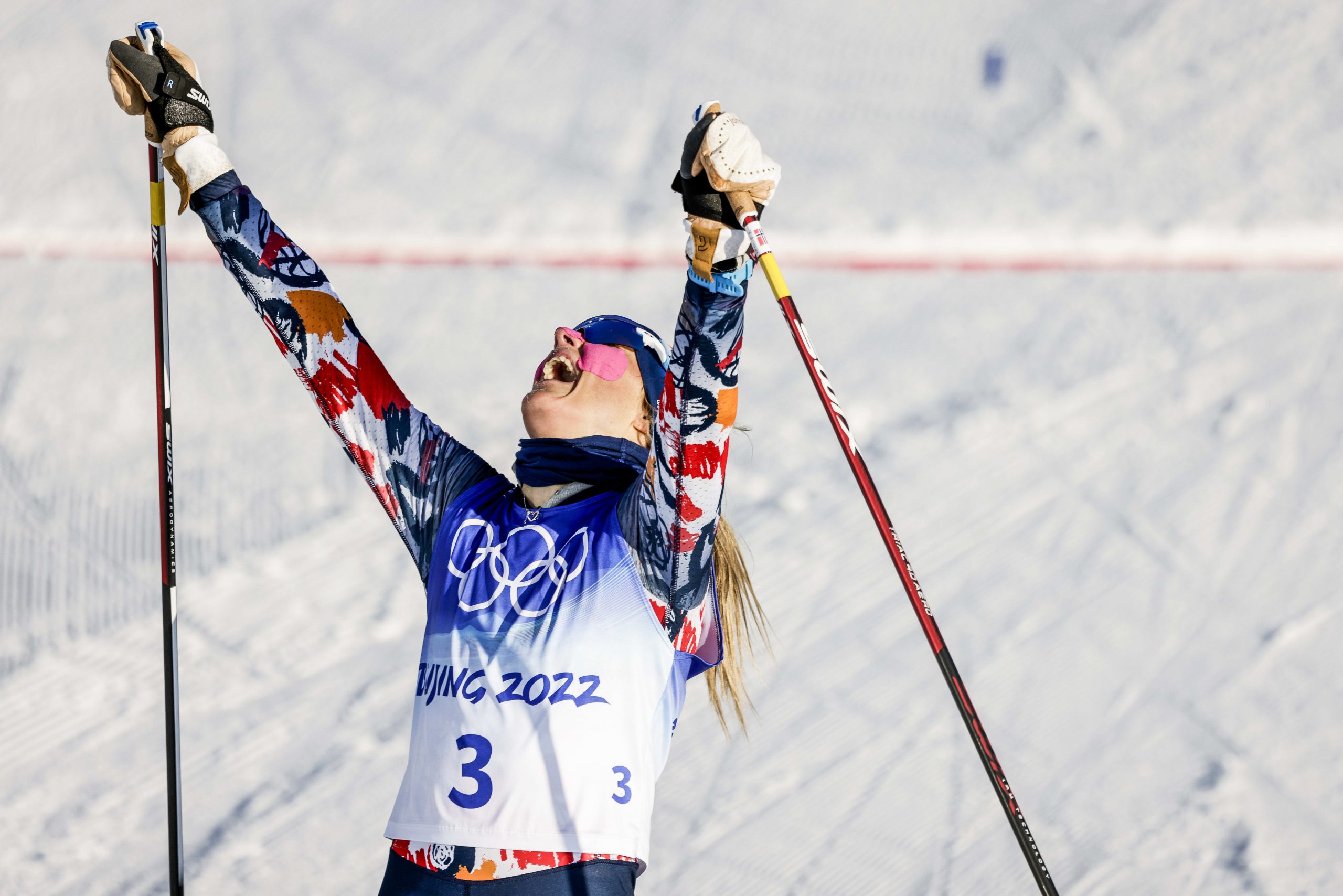
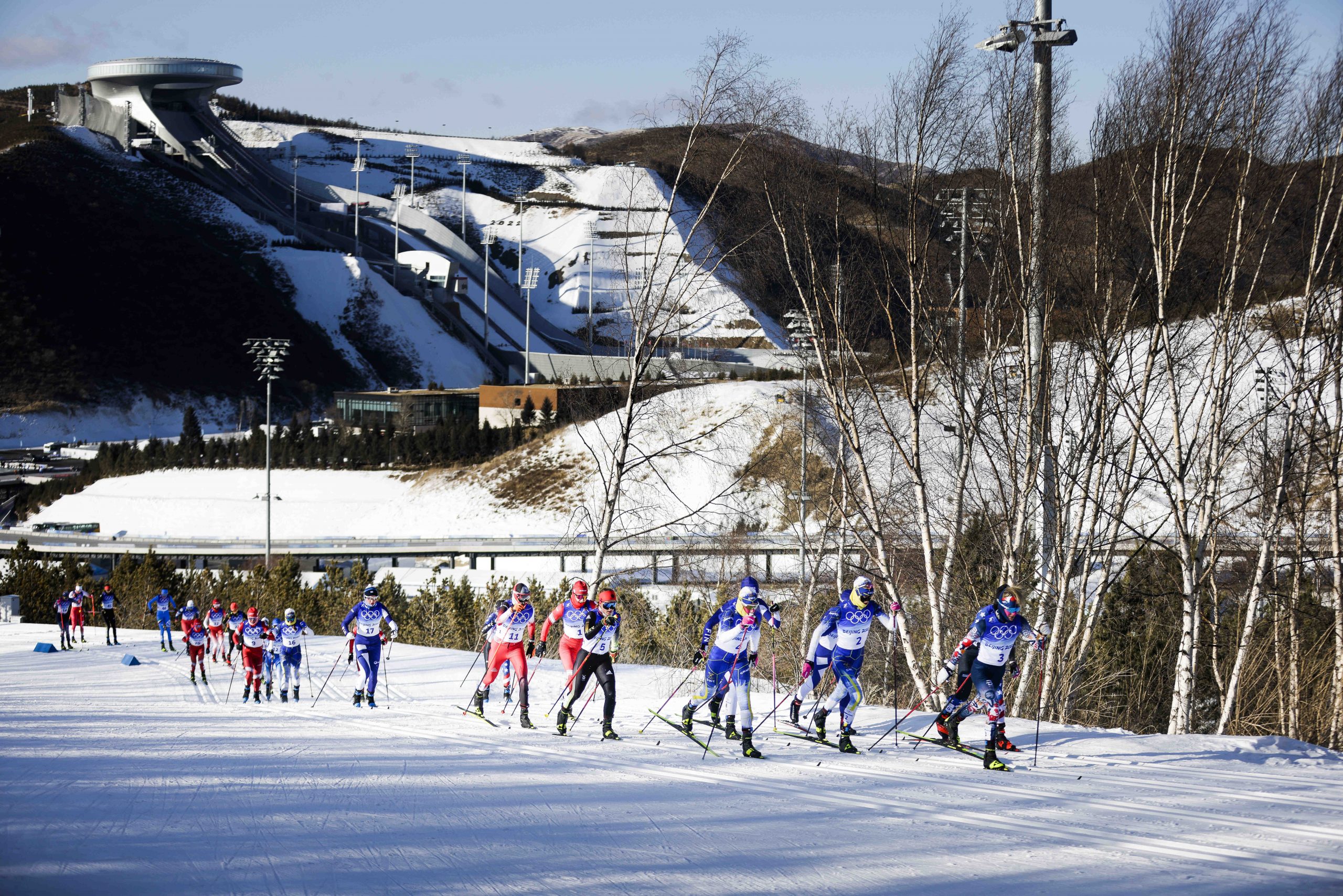
 Kathy Hall and the A Hall Mark of Excellence Award. To learn more about A Hall Mark of Excellence Award or to learn how you can support FasterSkier’s coverage please contact info@fasterskier.com.