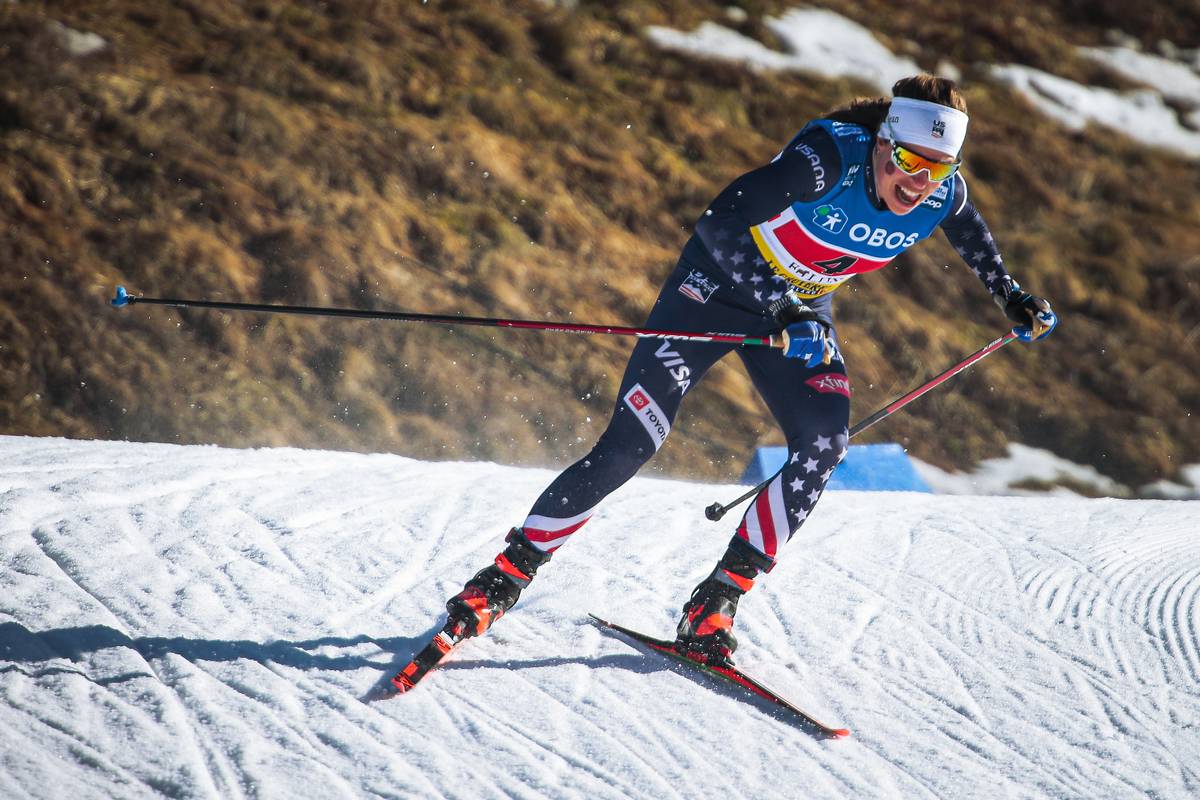
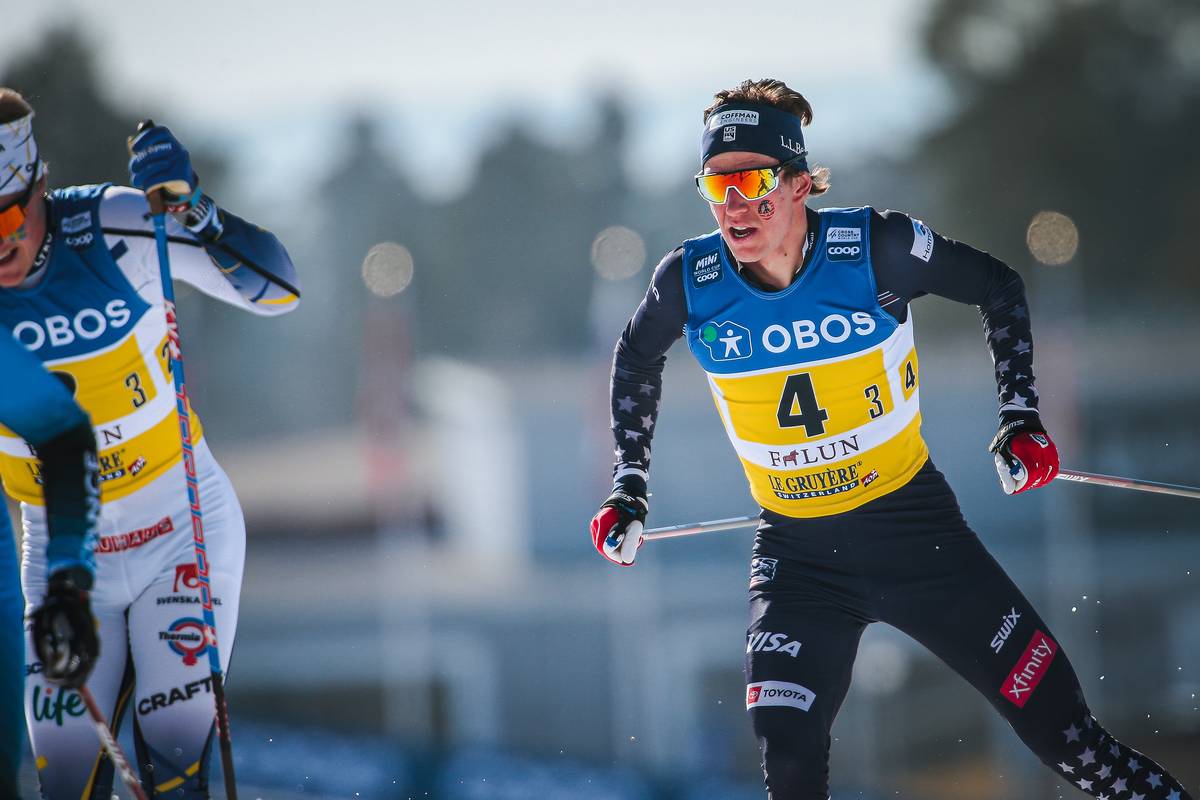
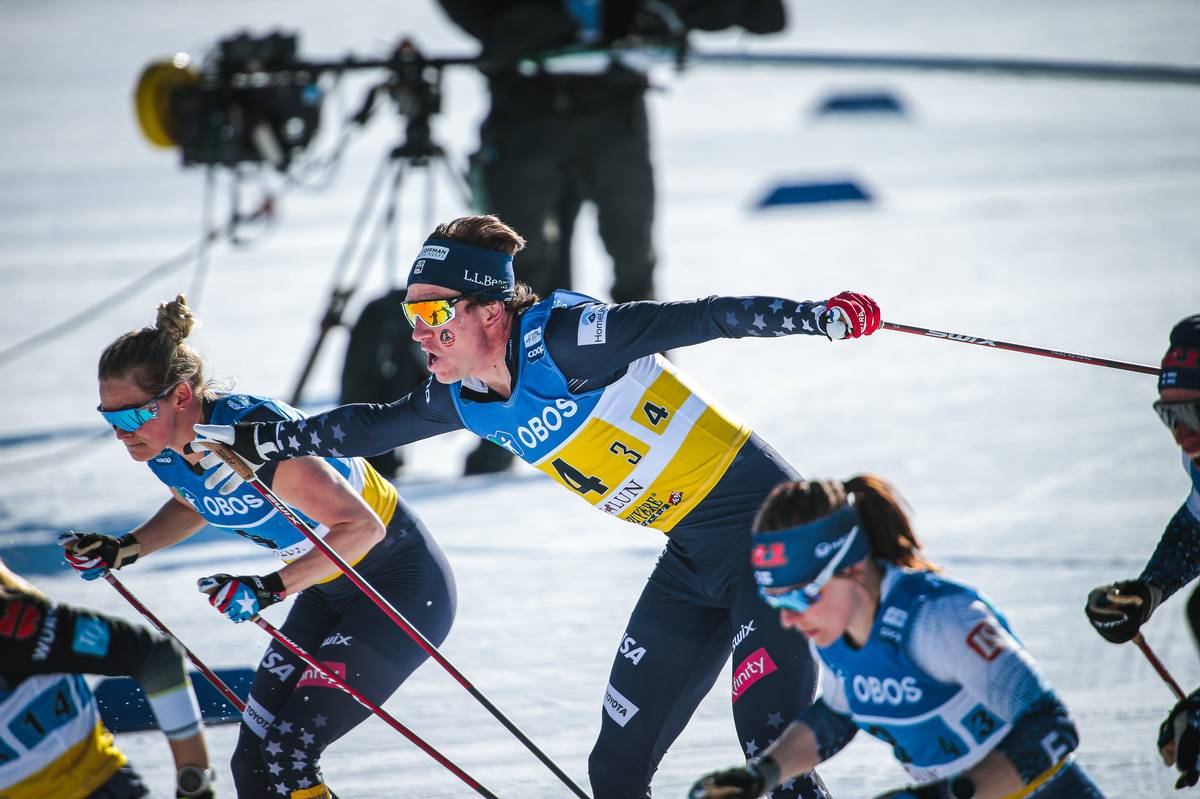
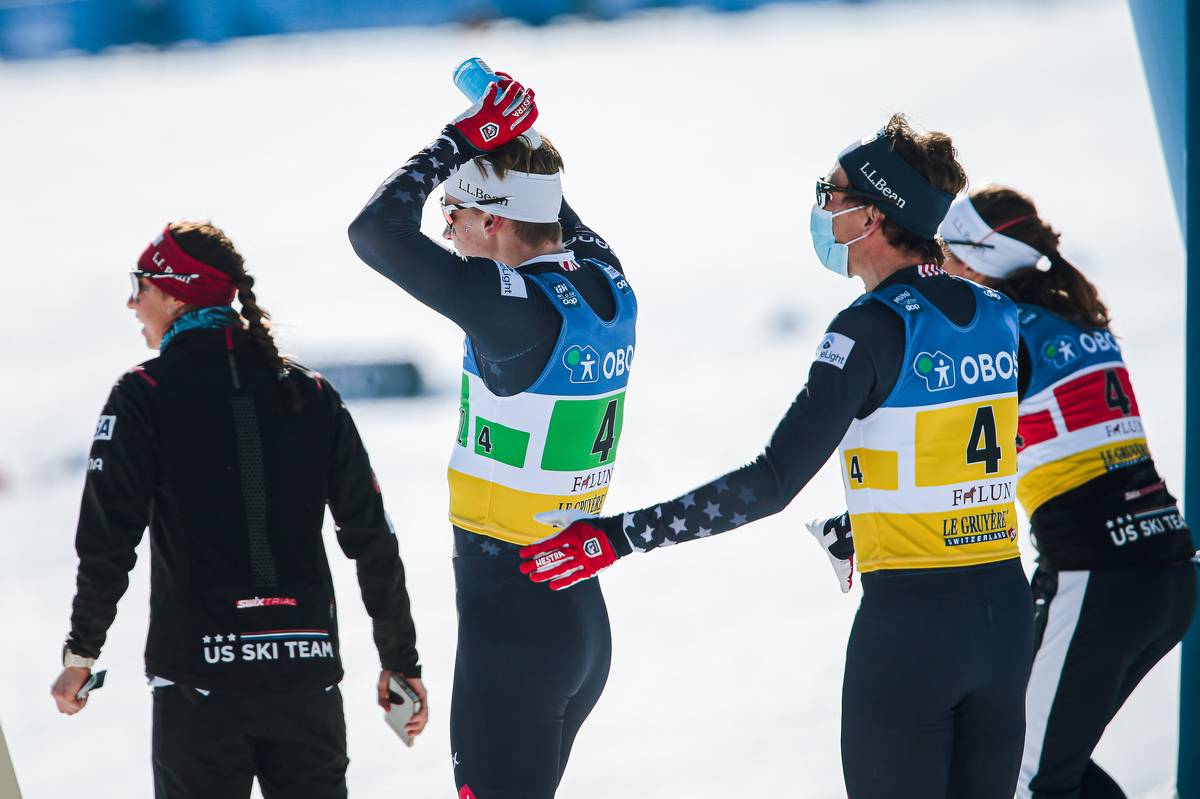
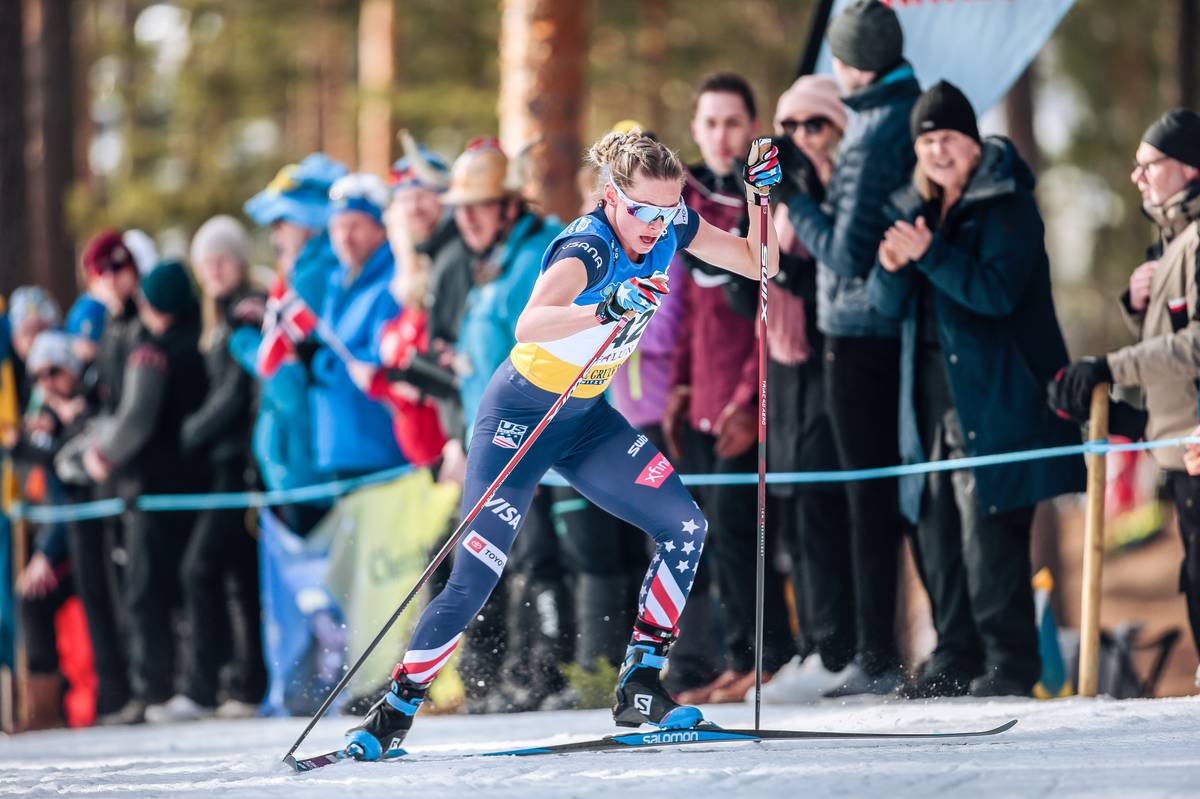
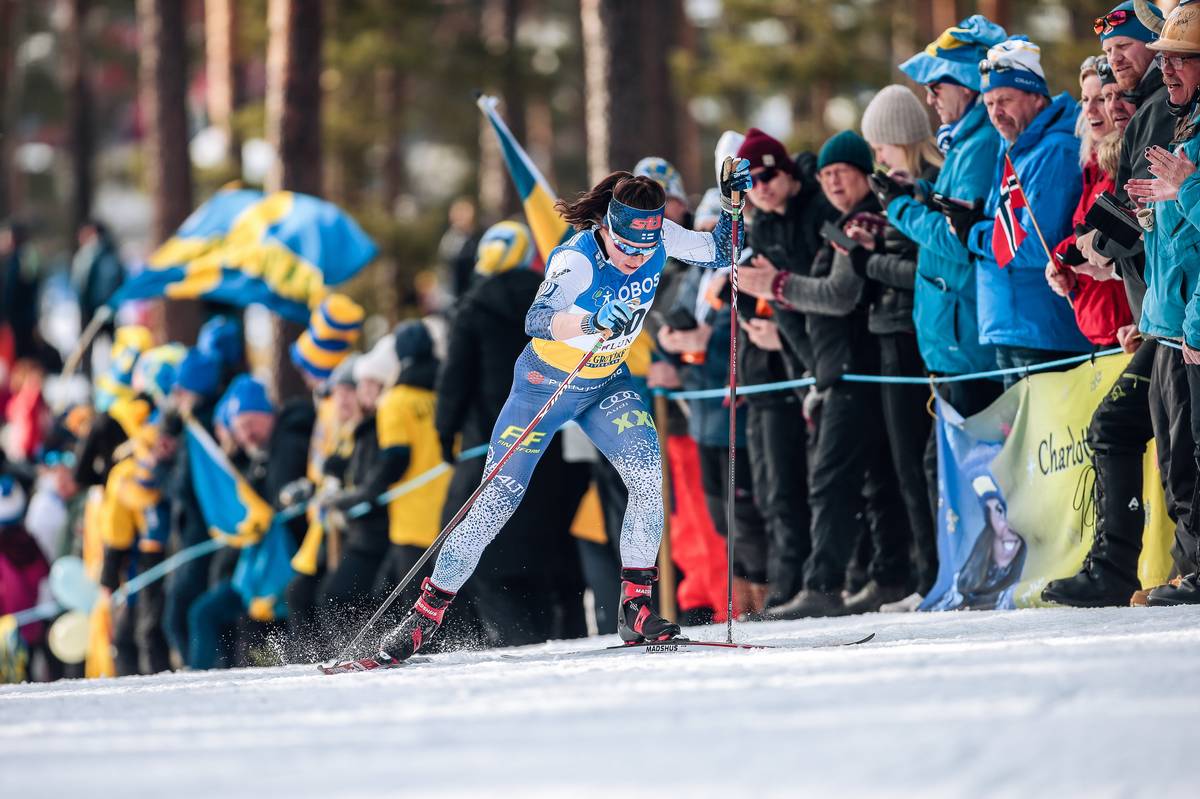
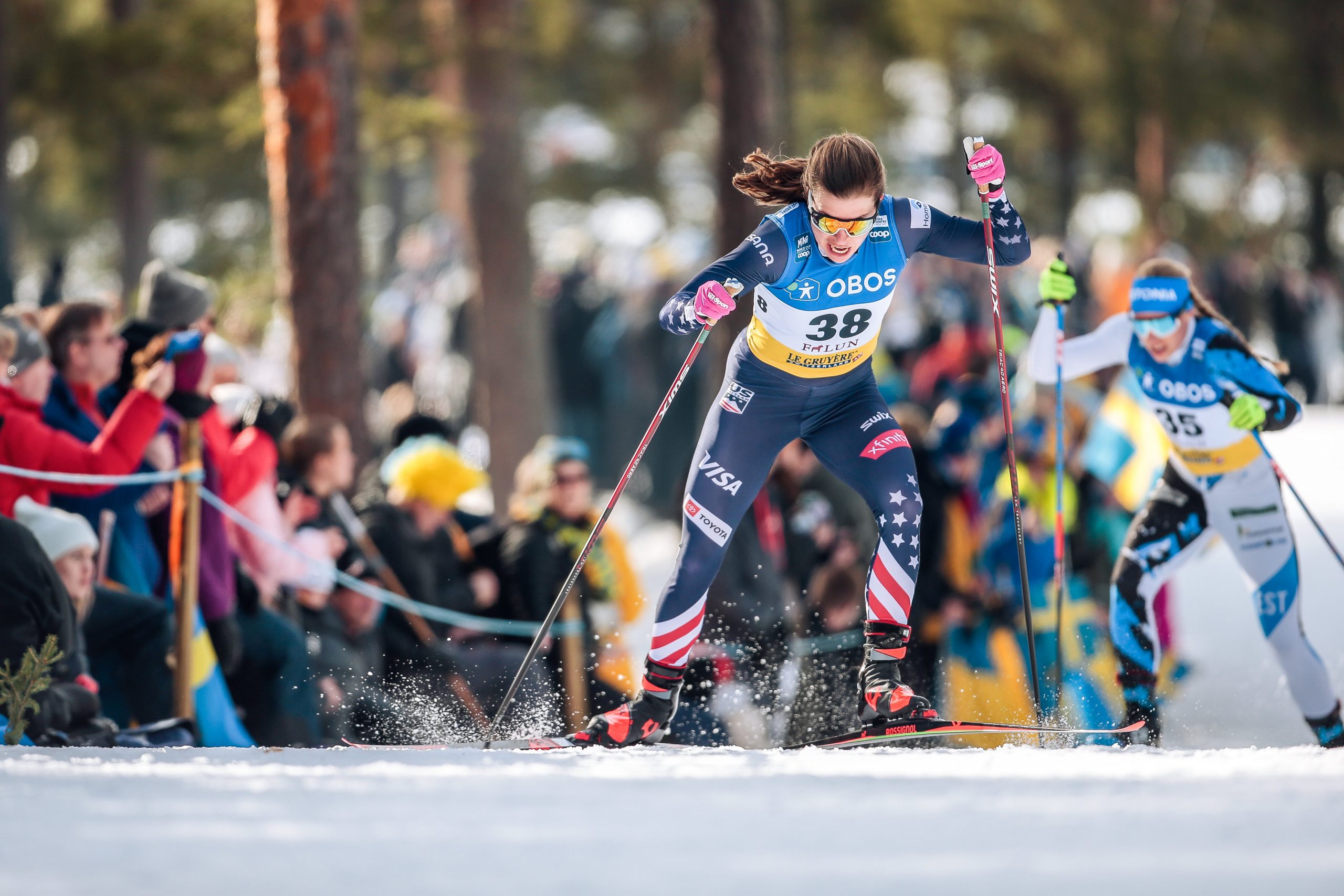
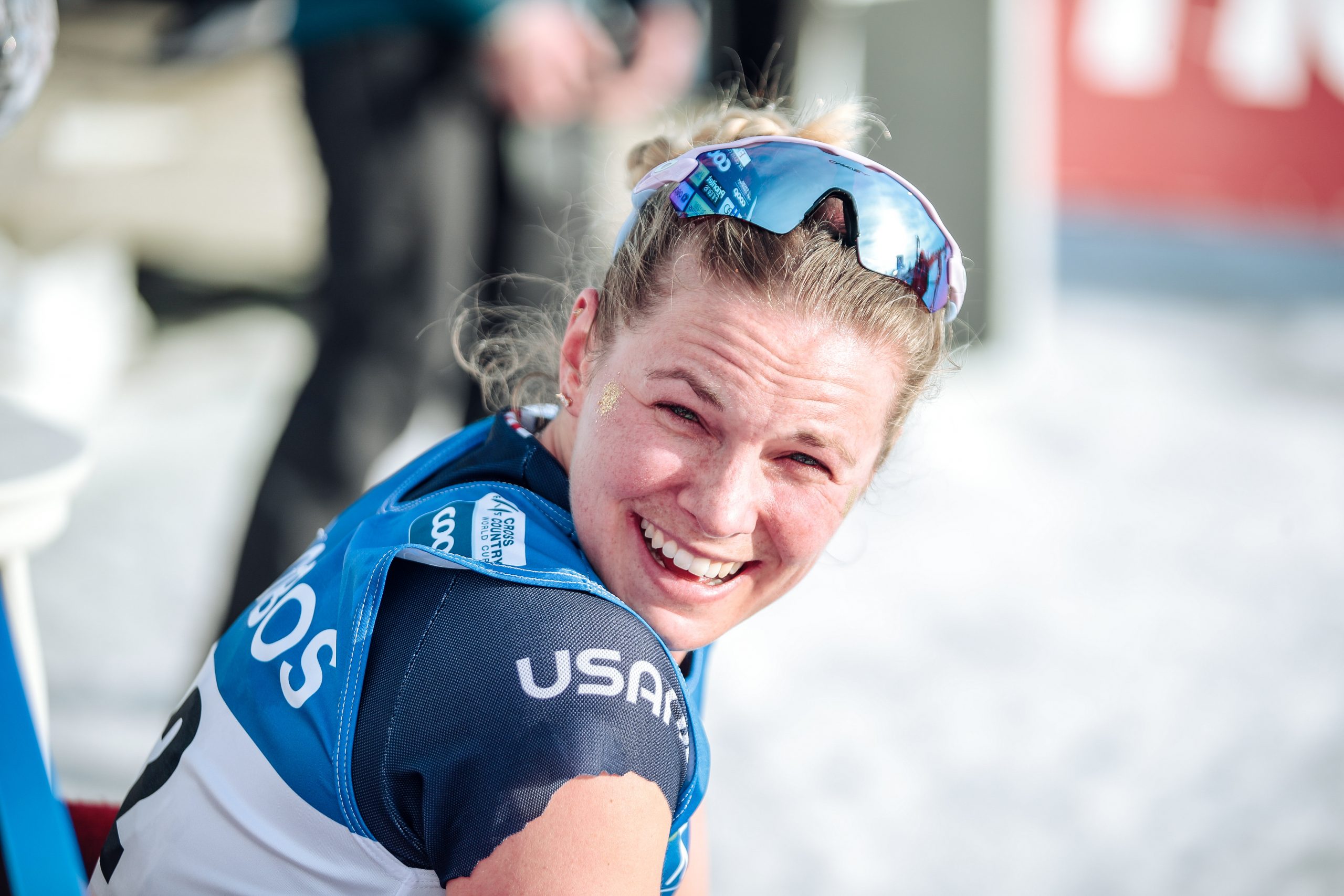
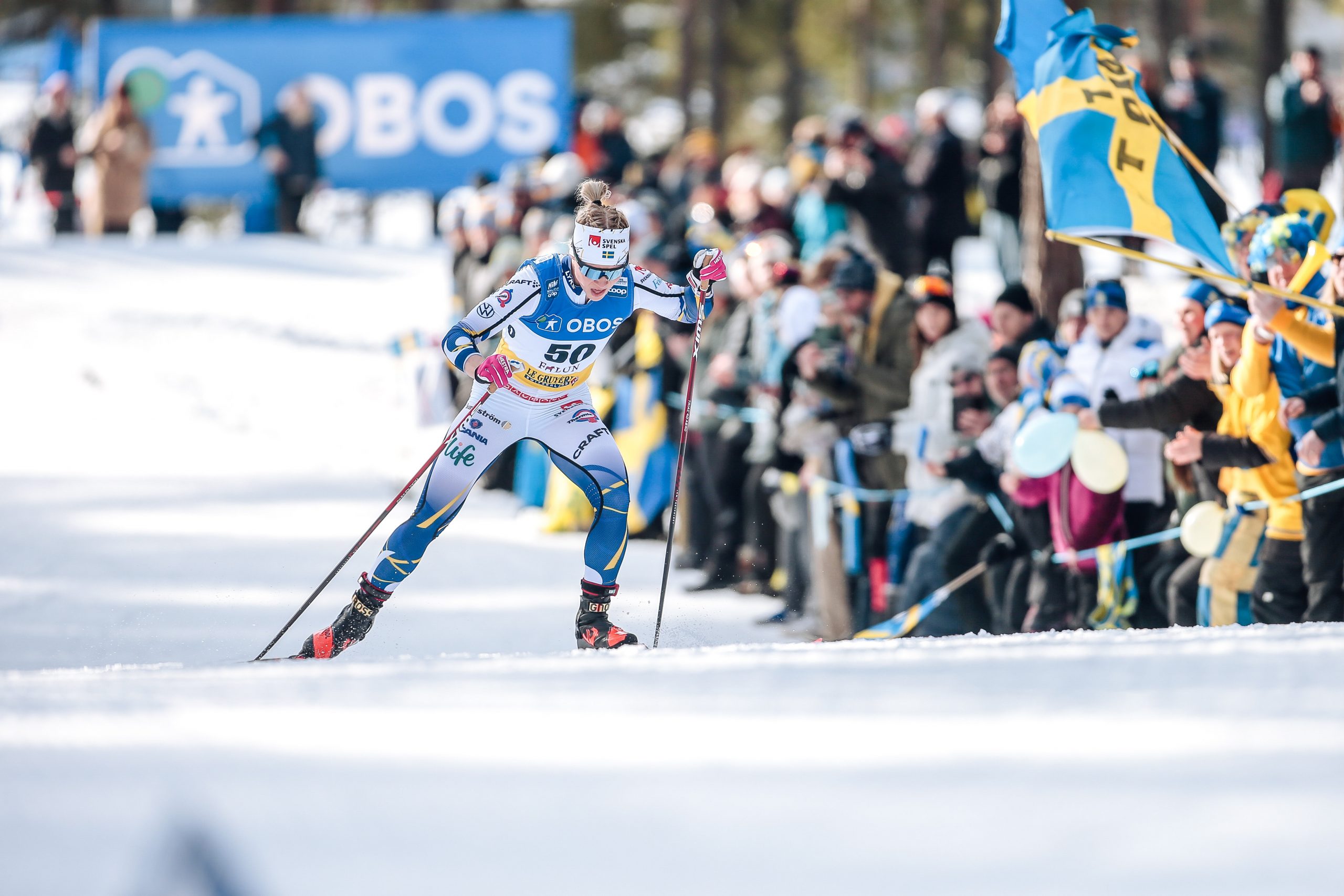
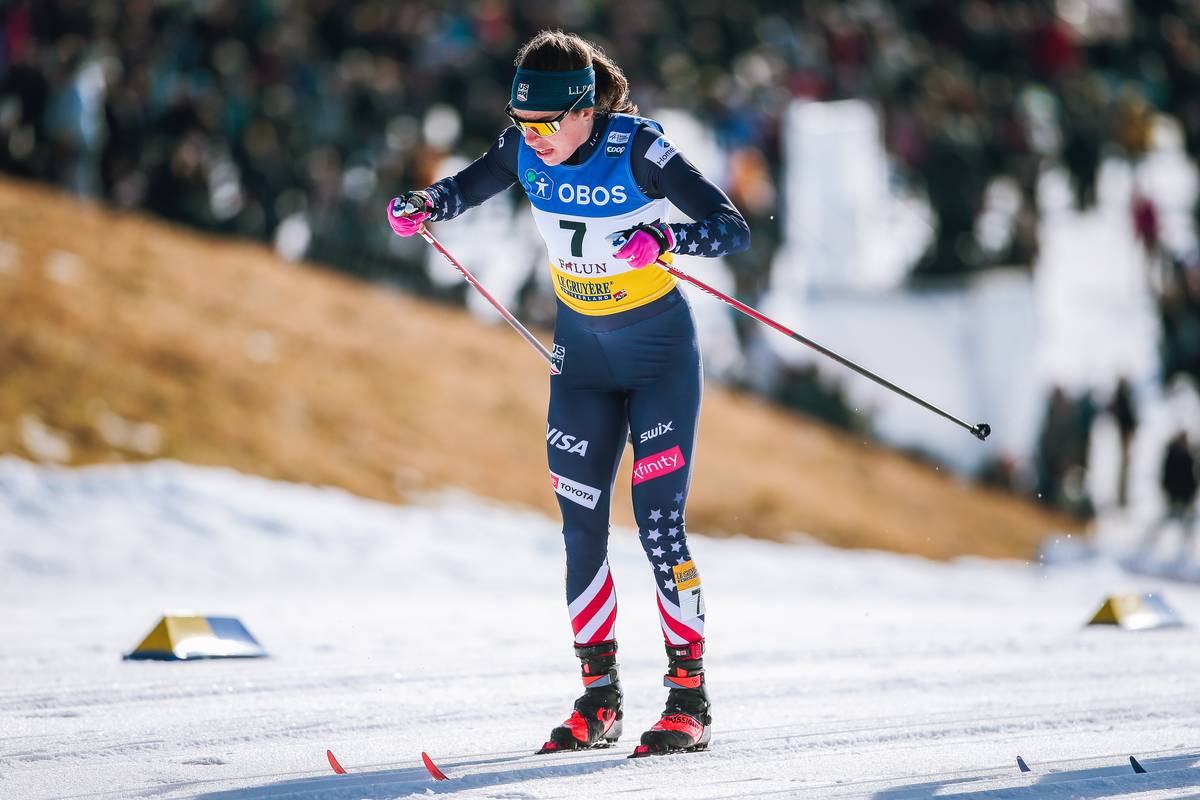
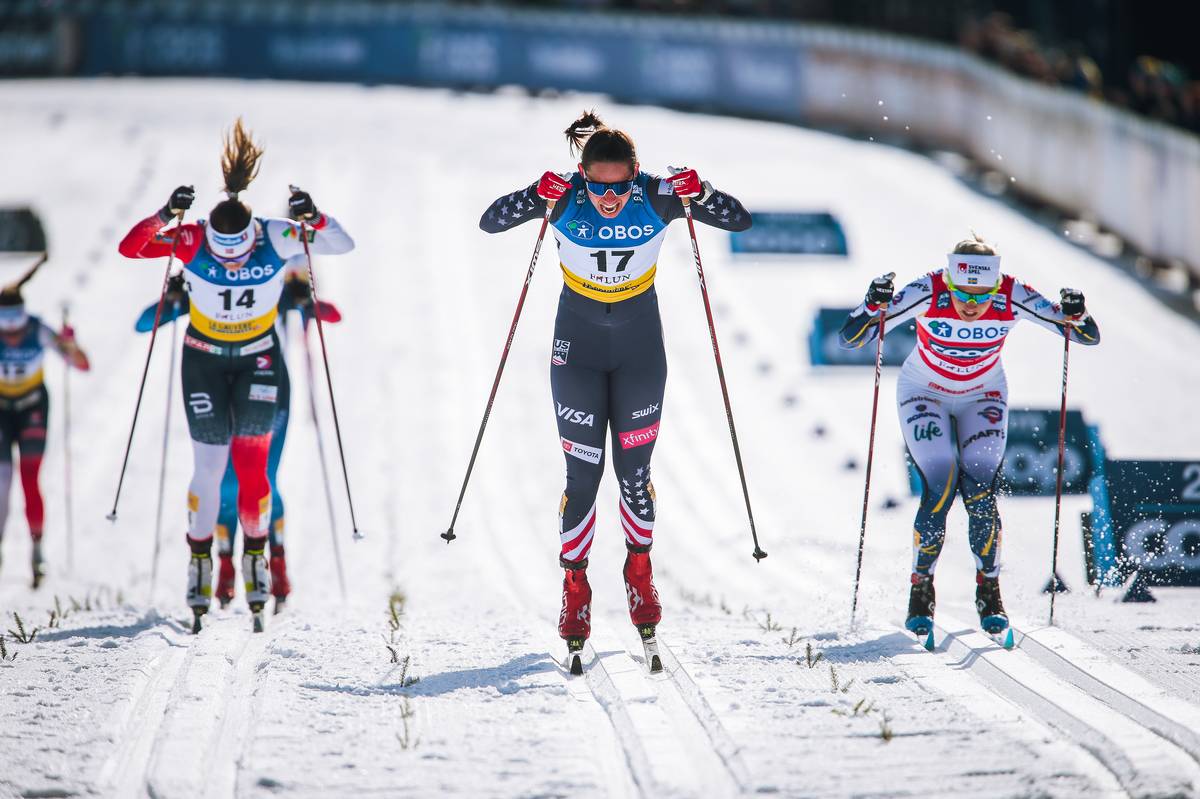
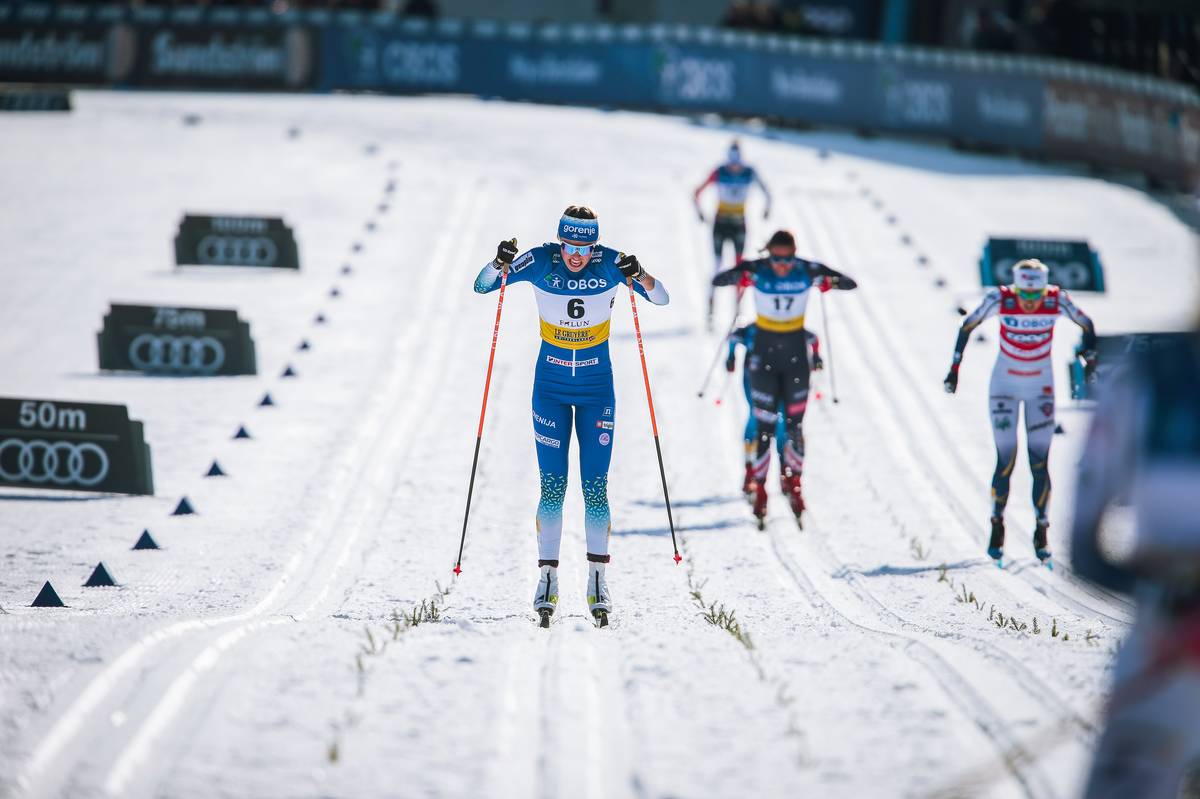
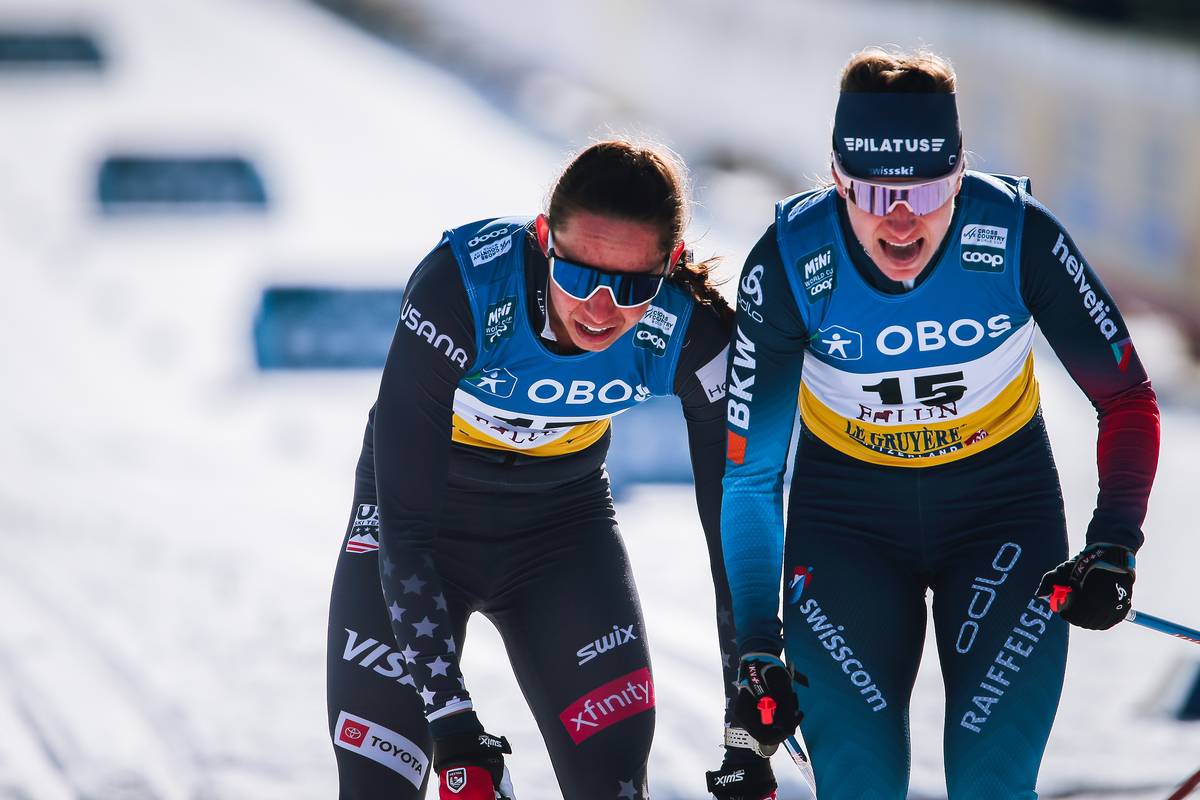
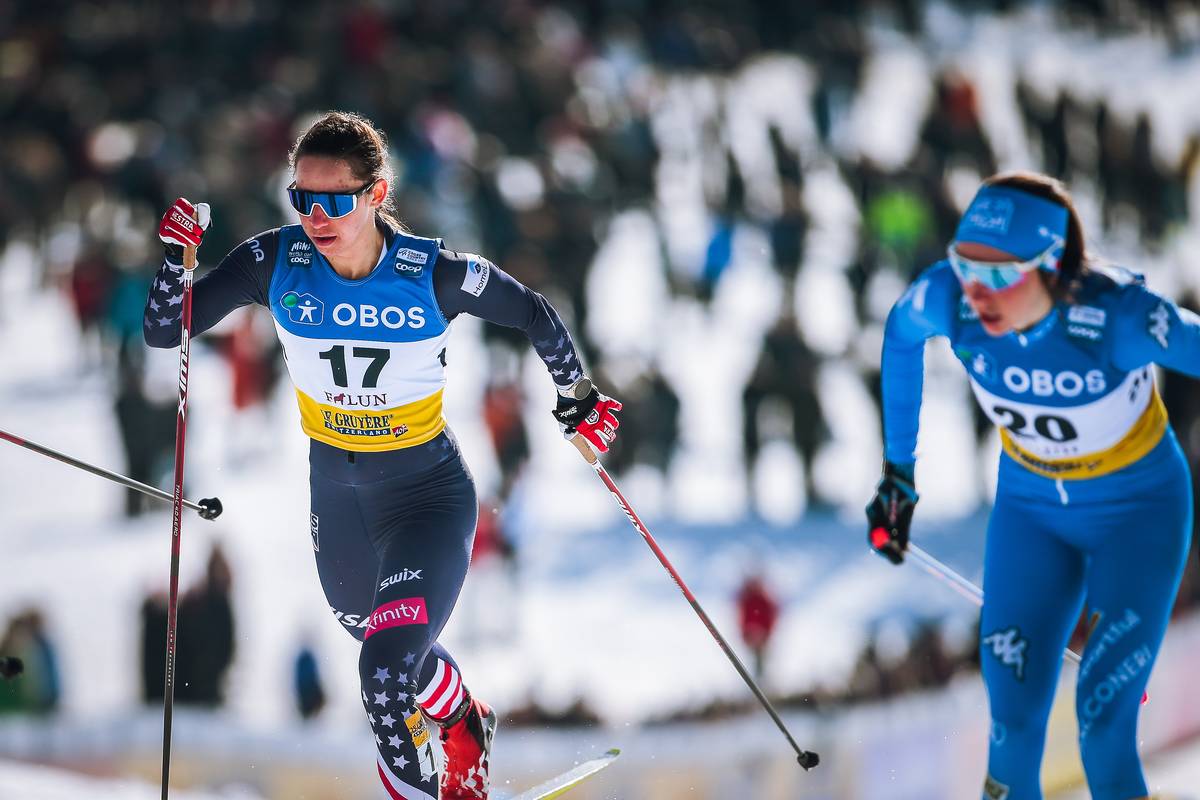
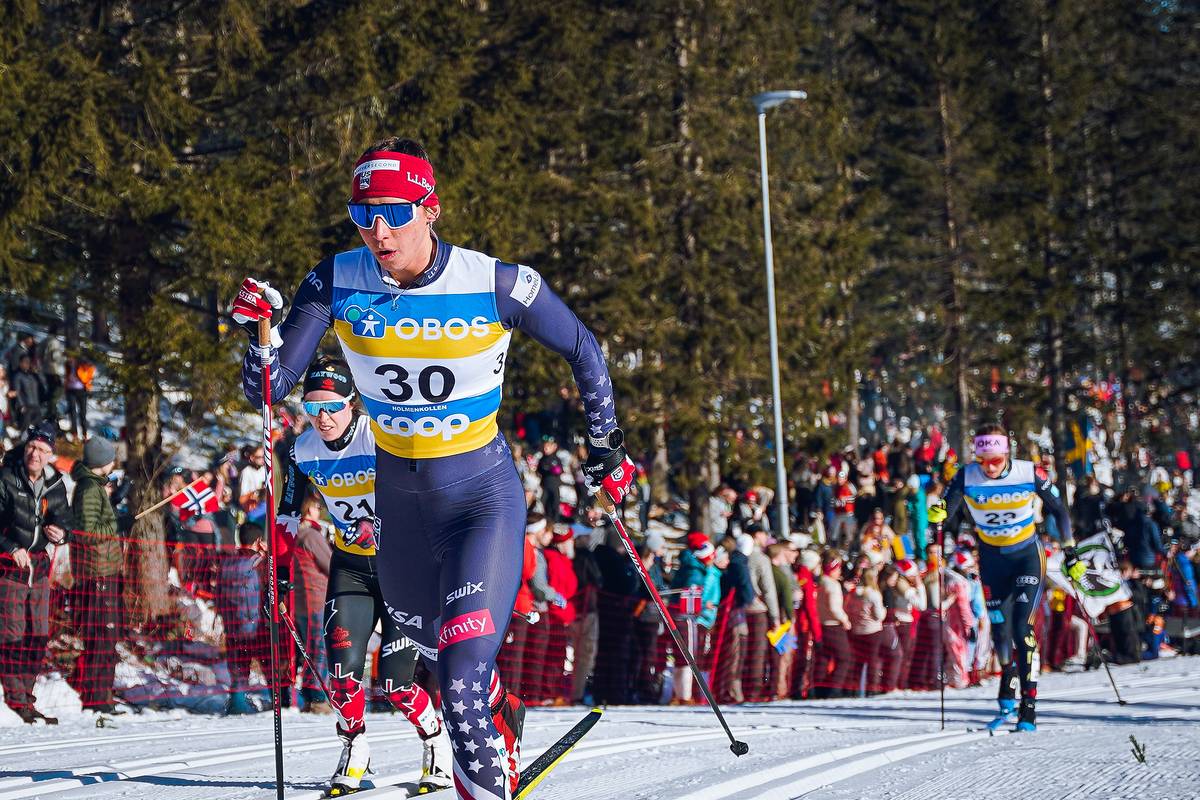
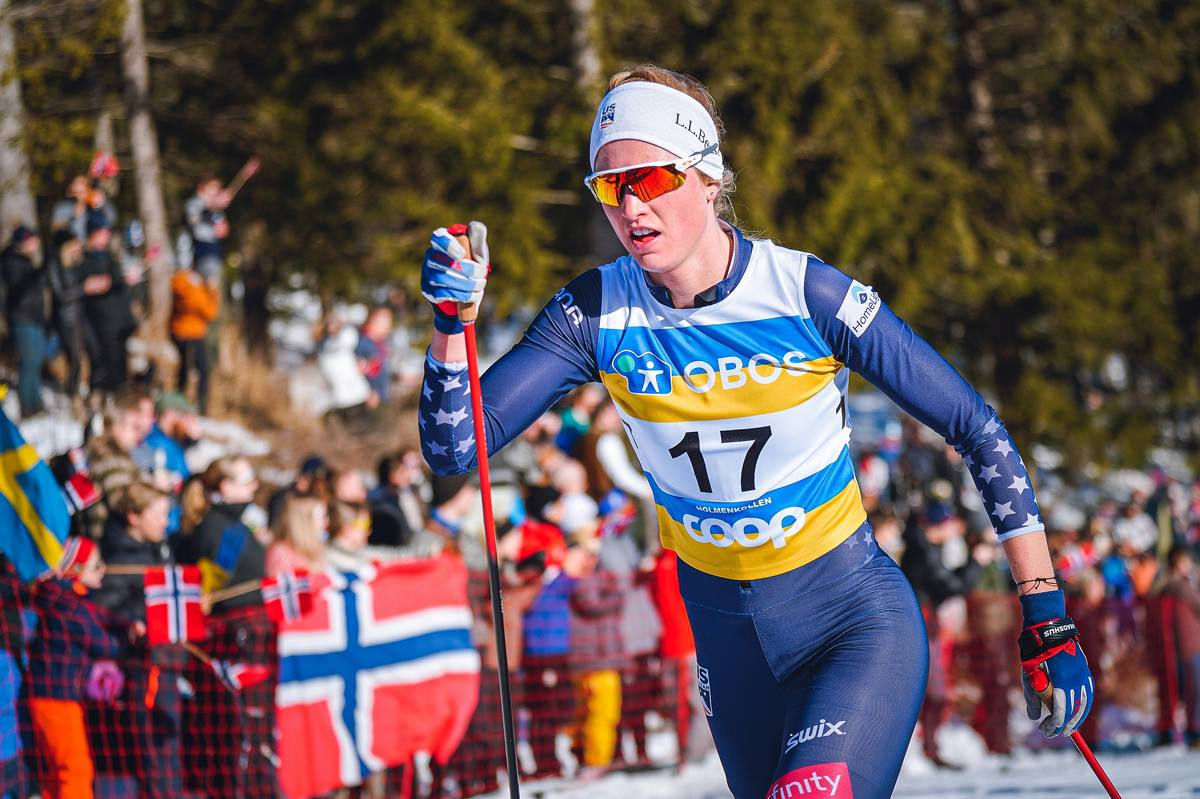
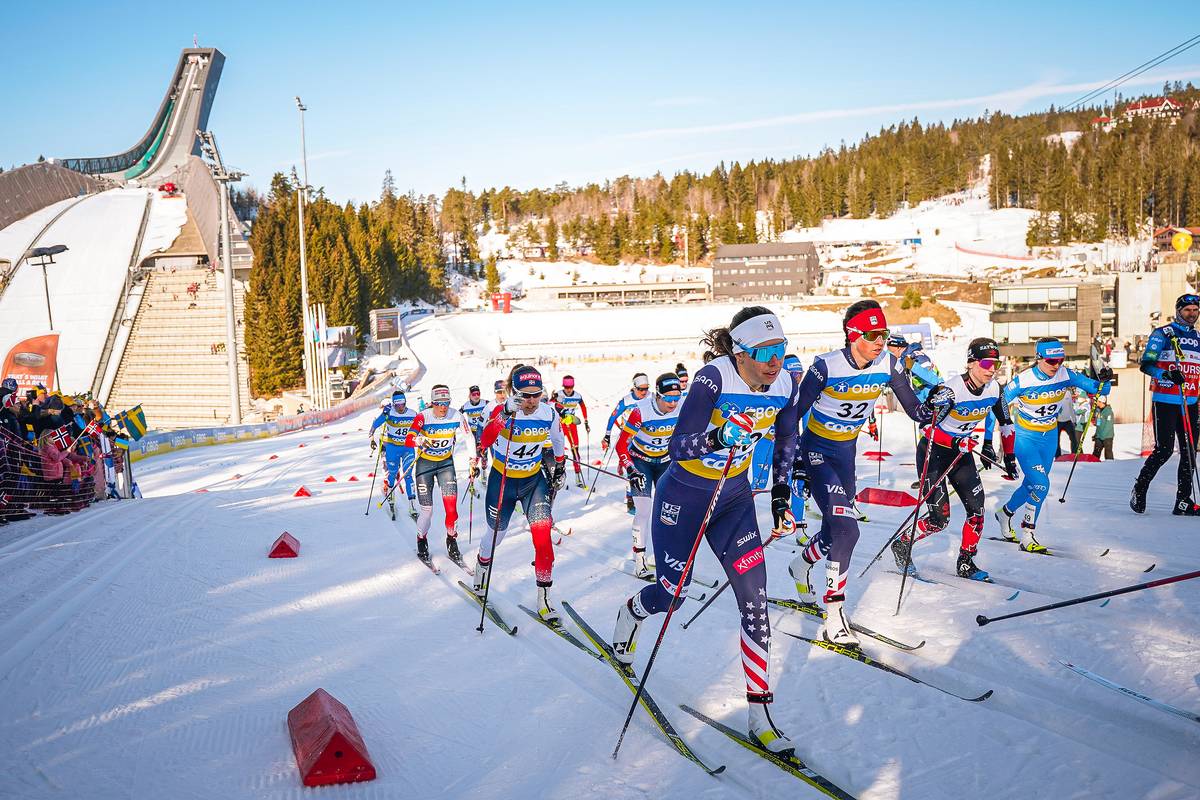
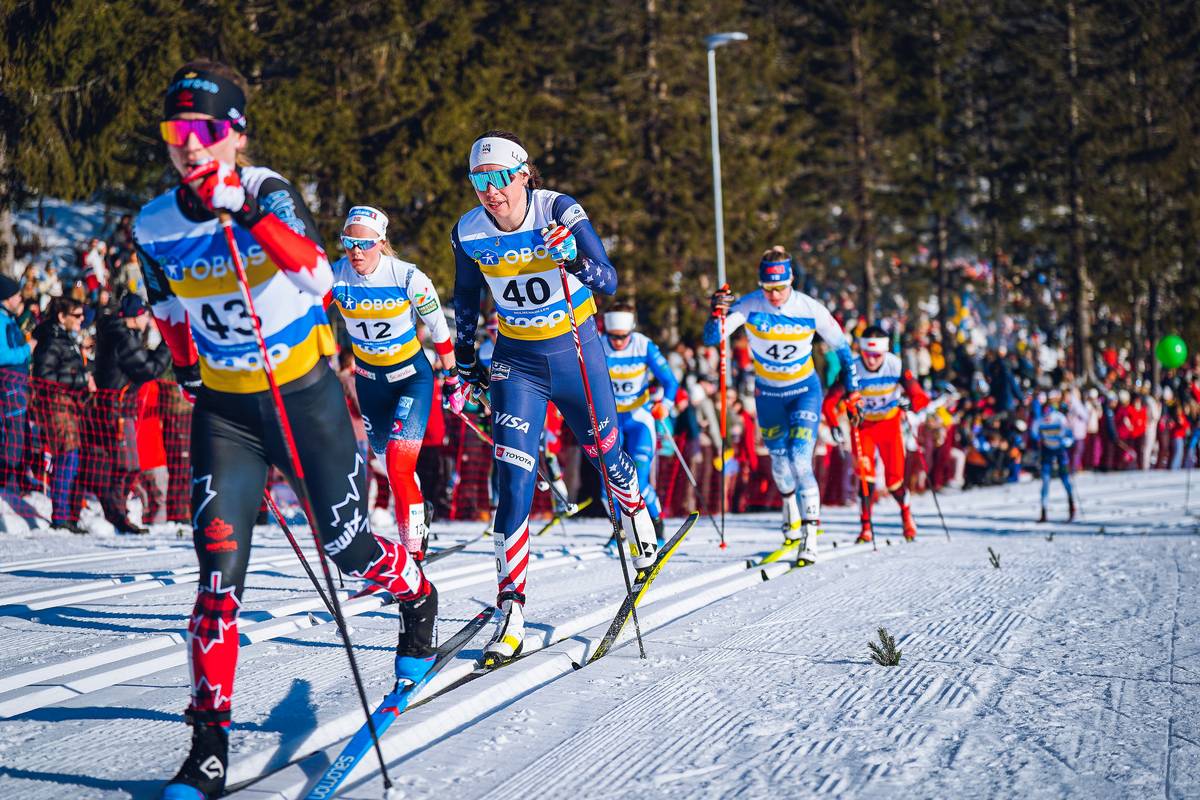
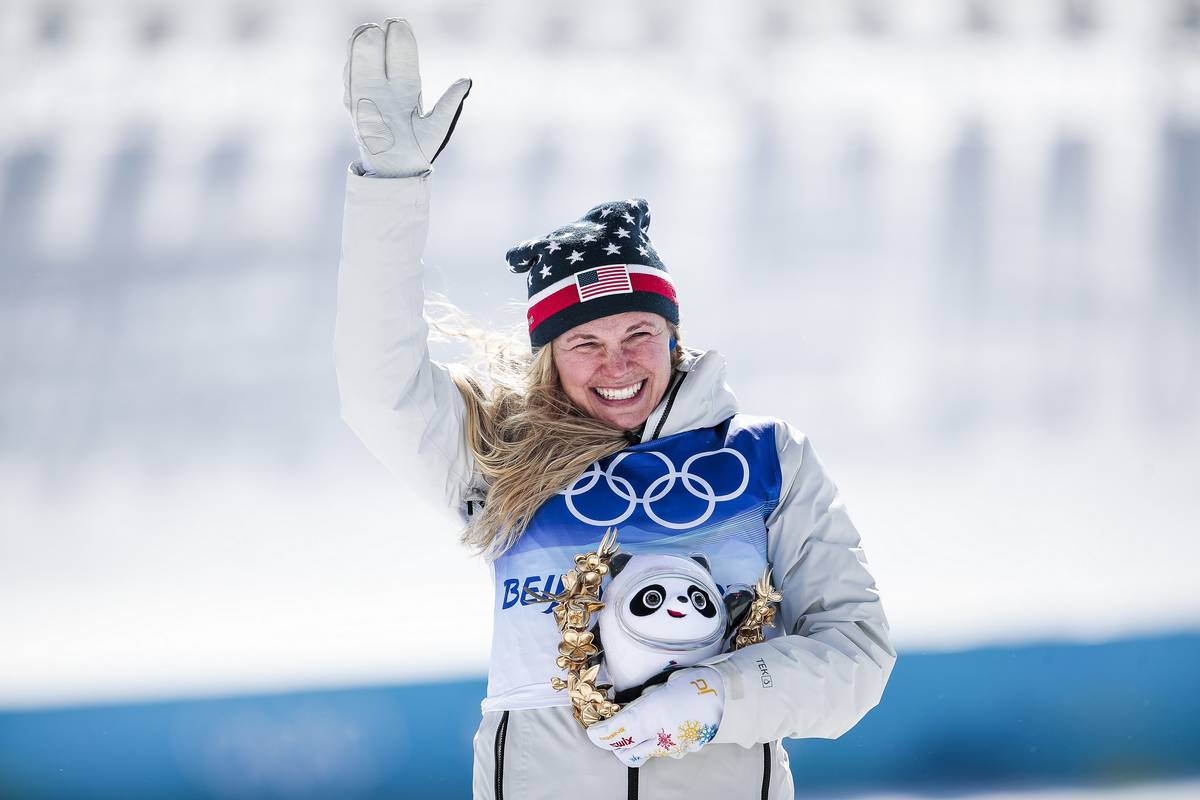
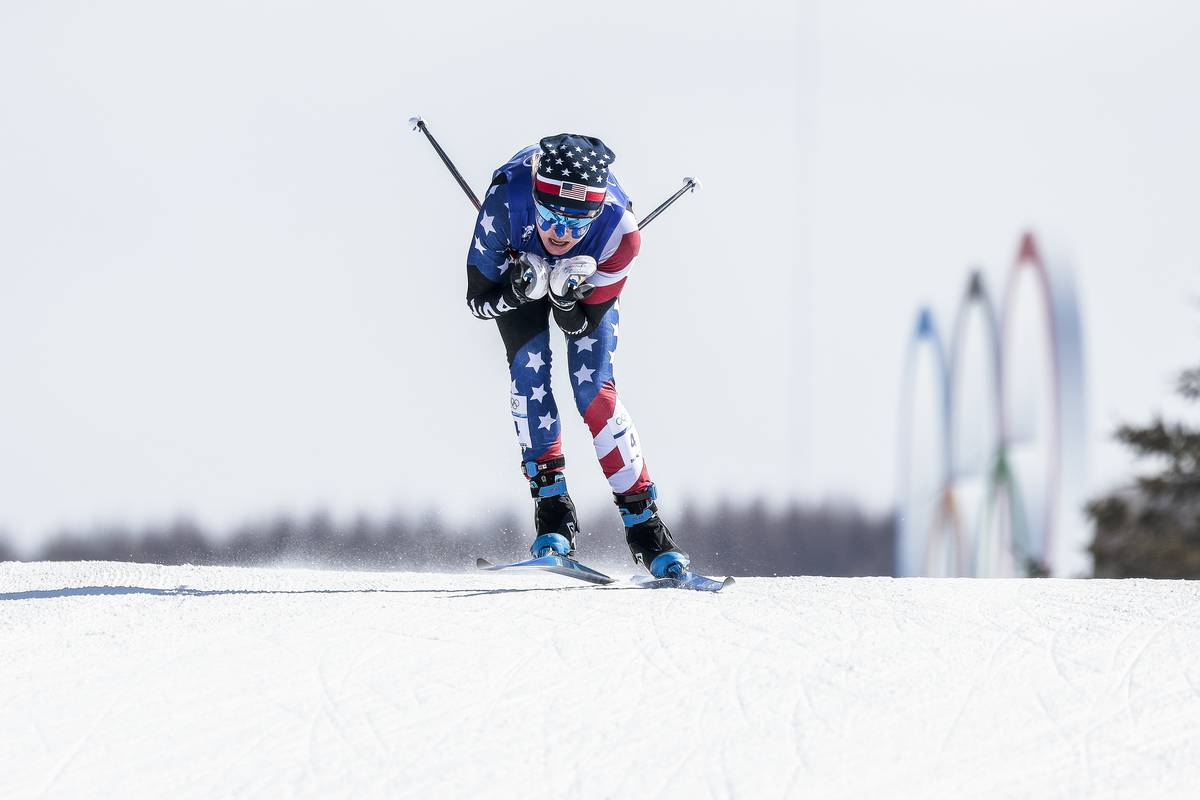
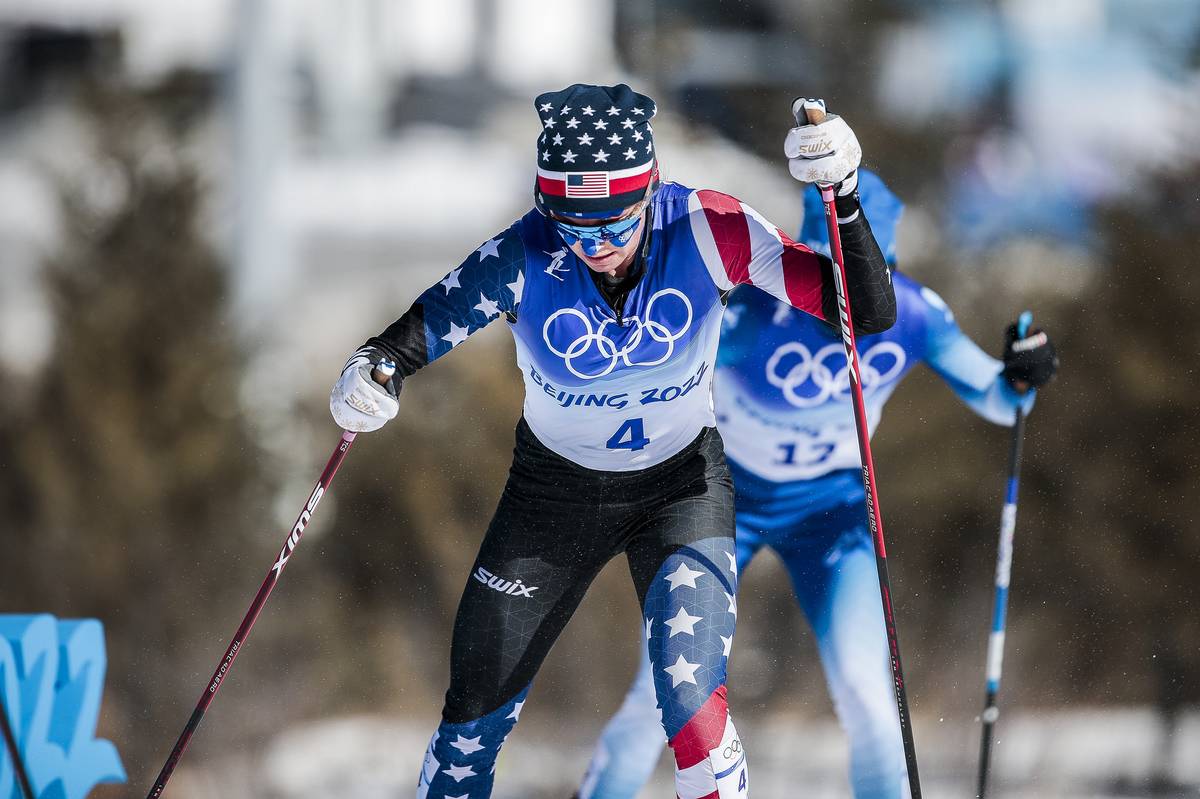
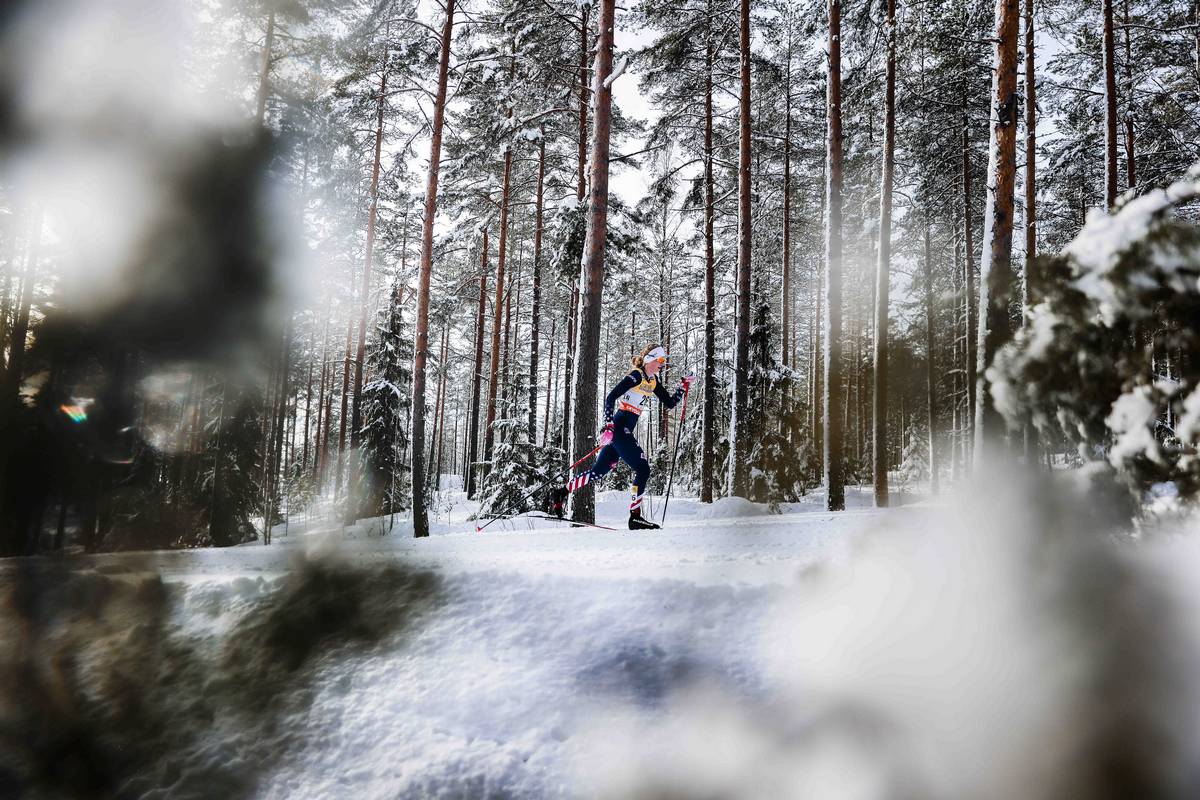
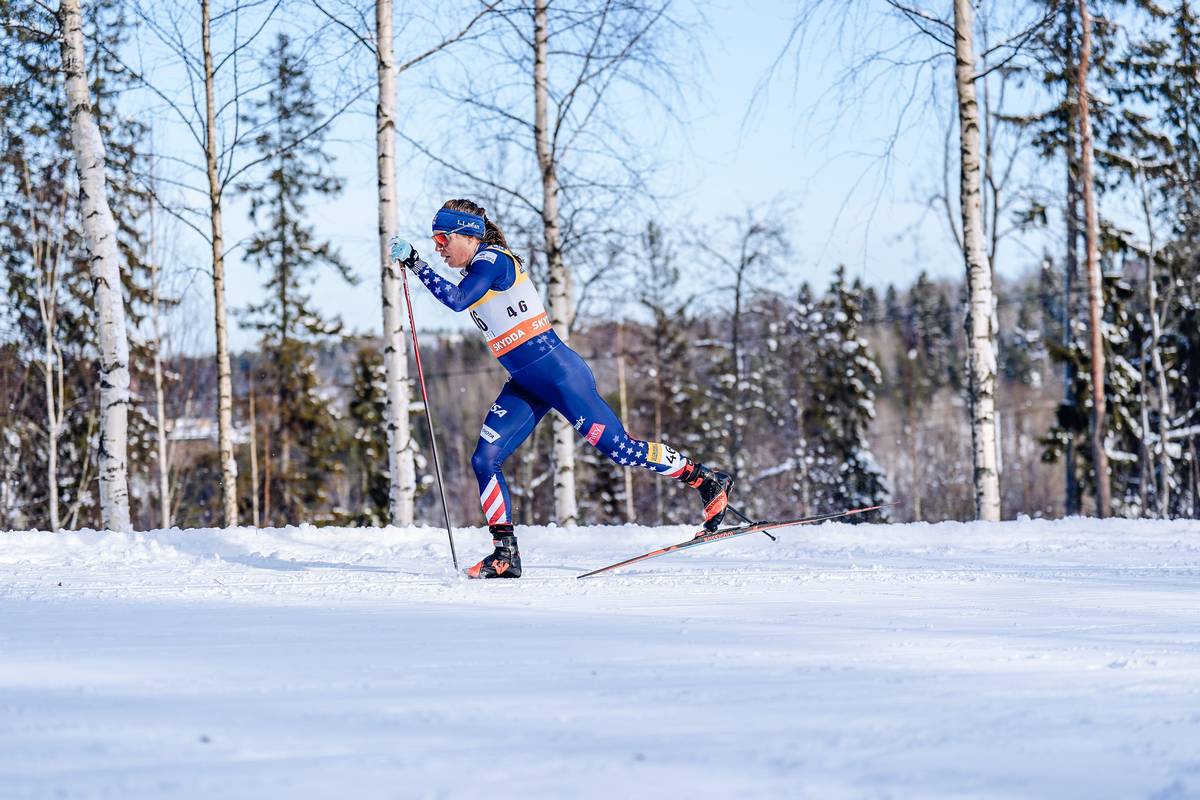
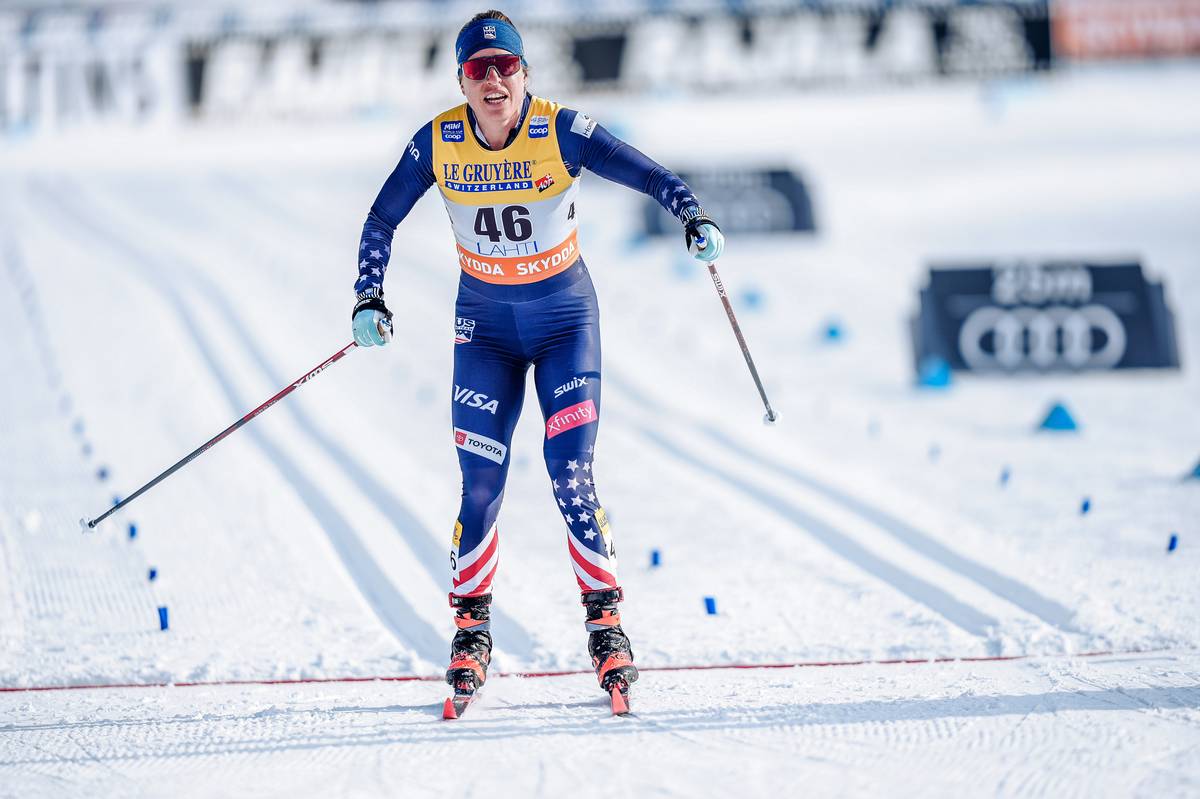
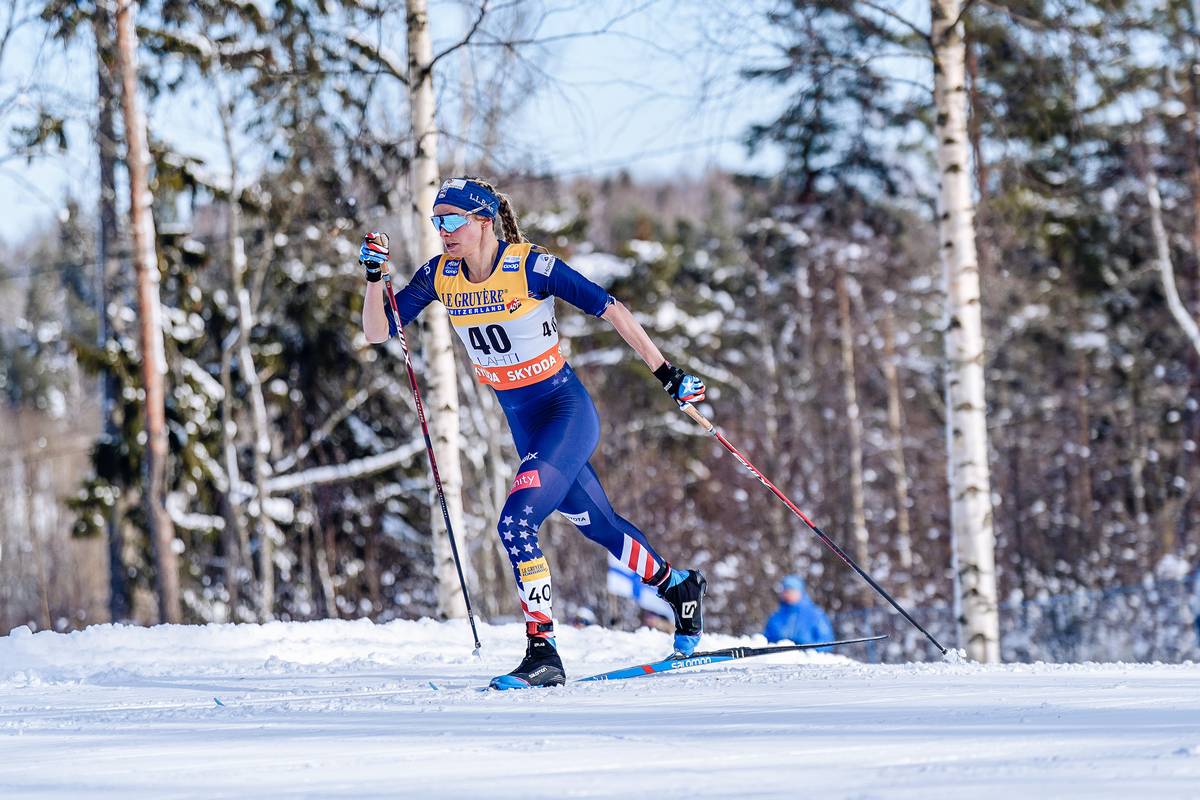
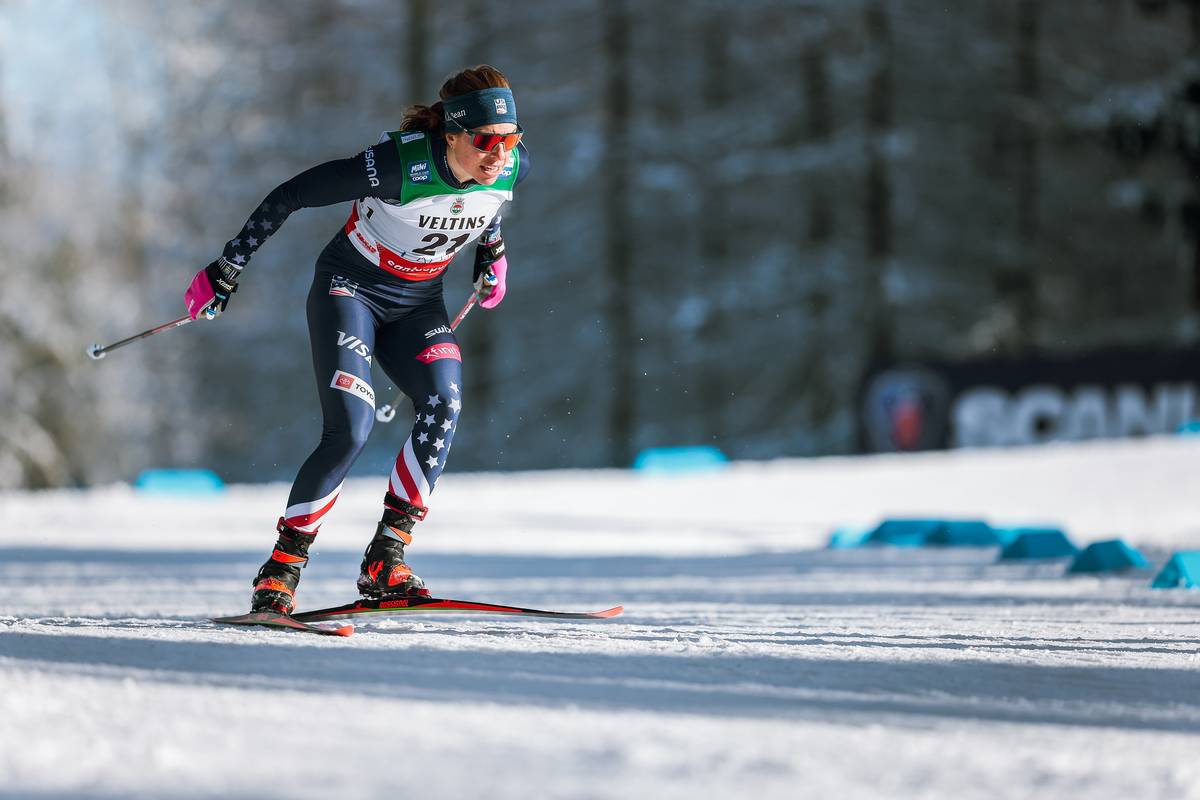
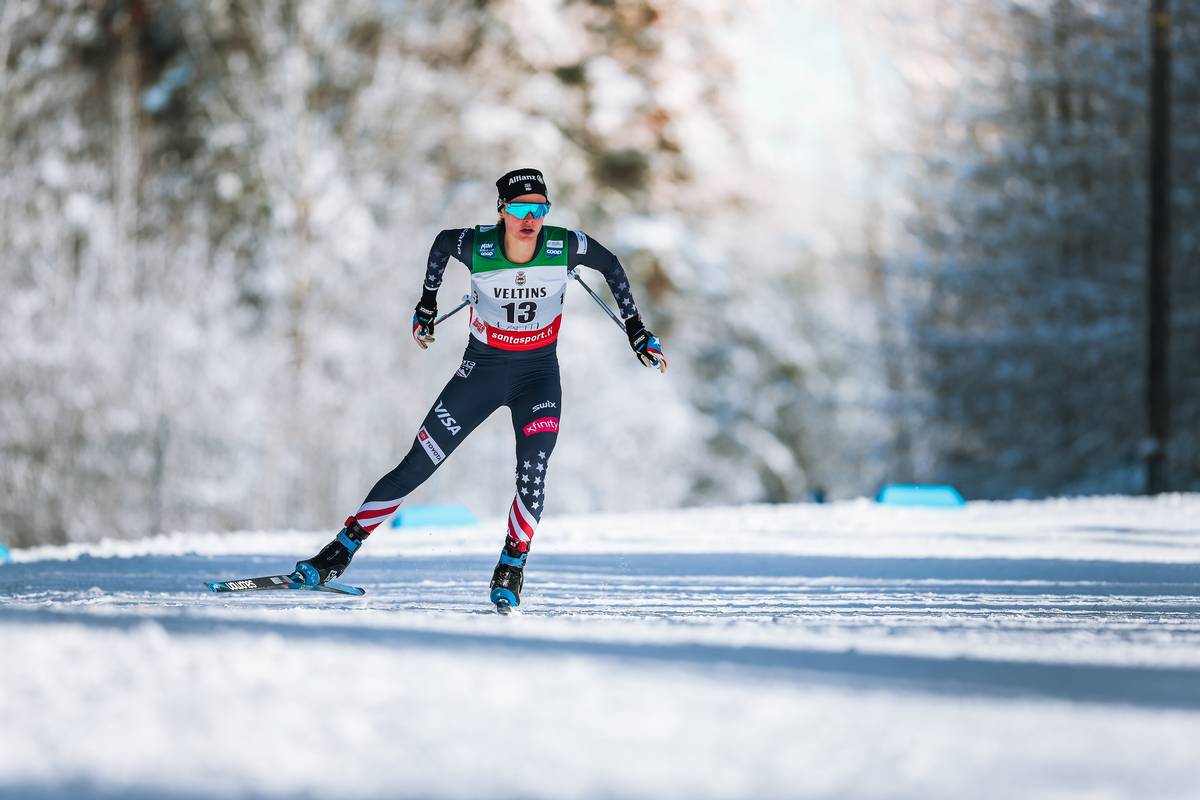
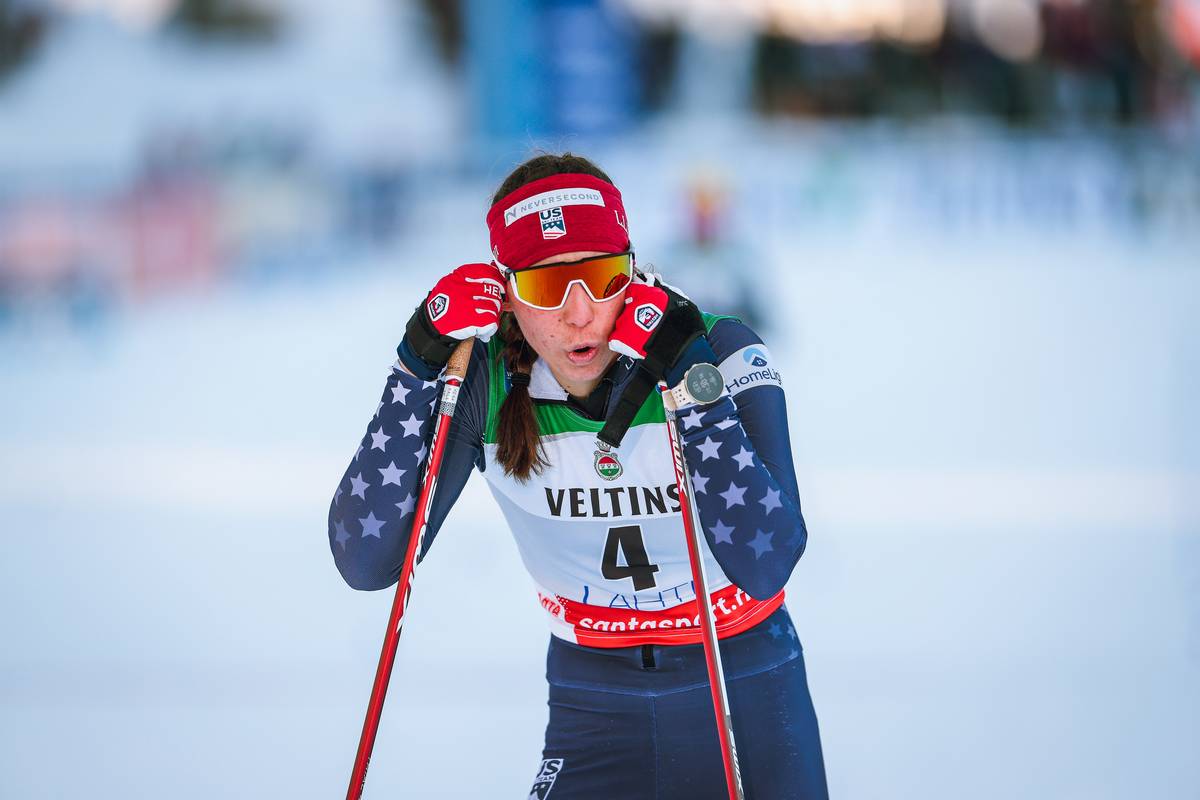
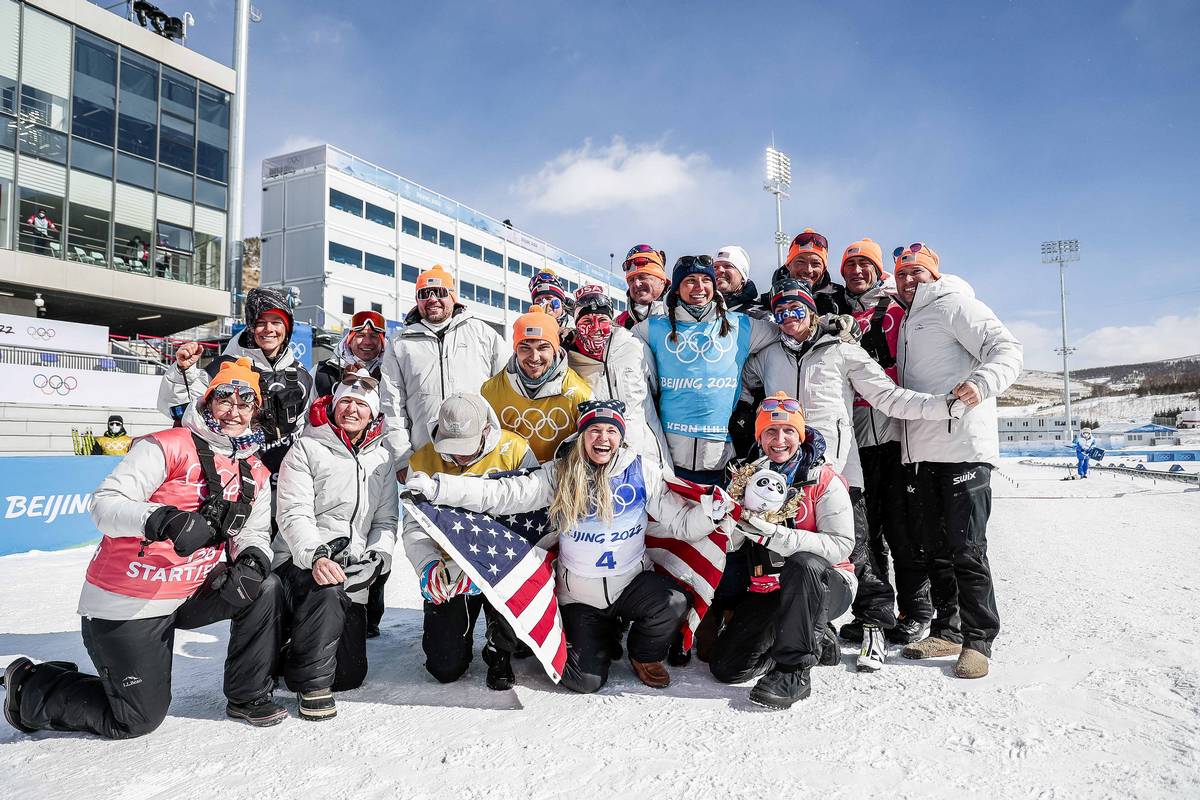
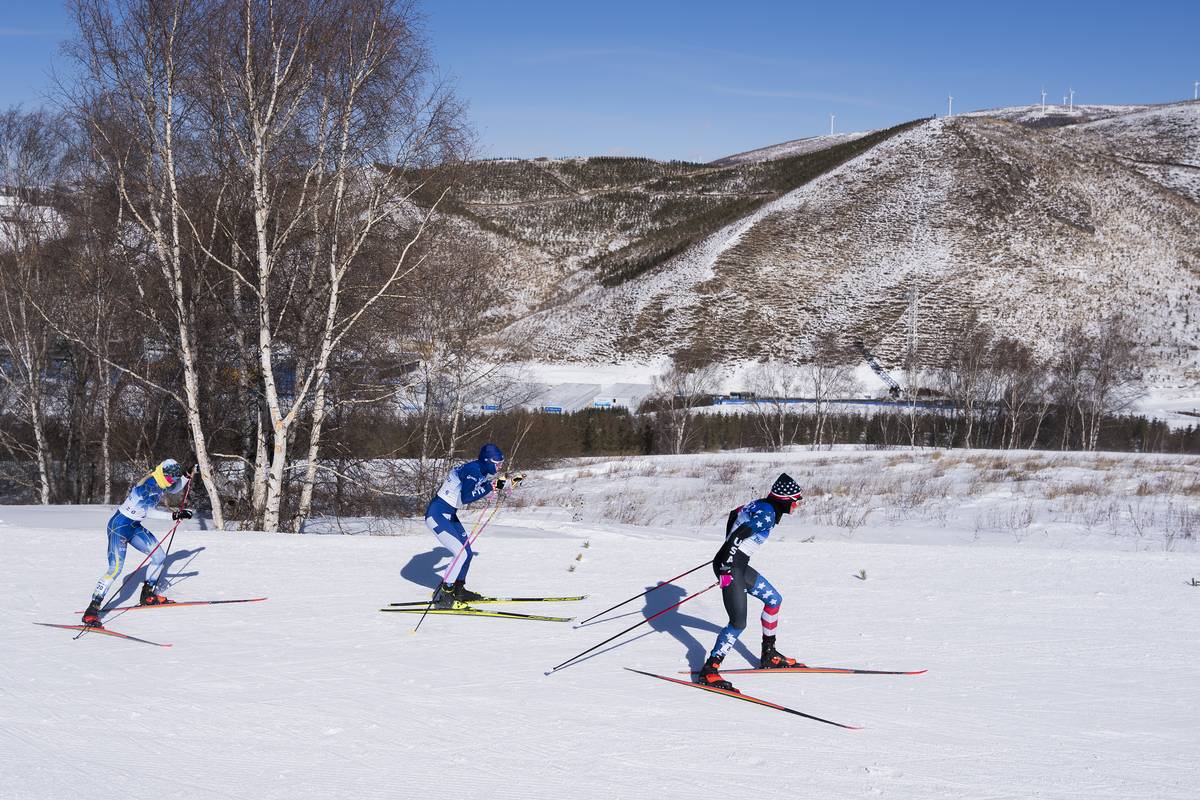
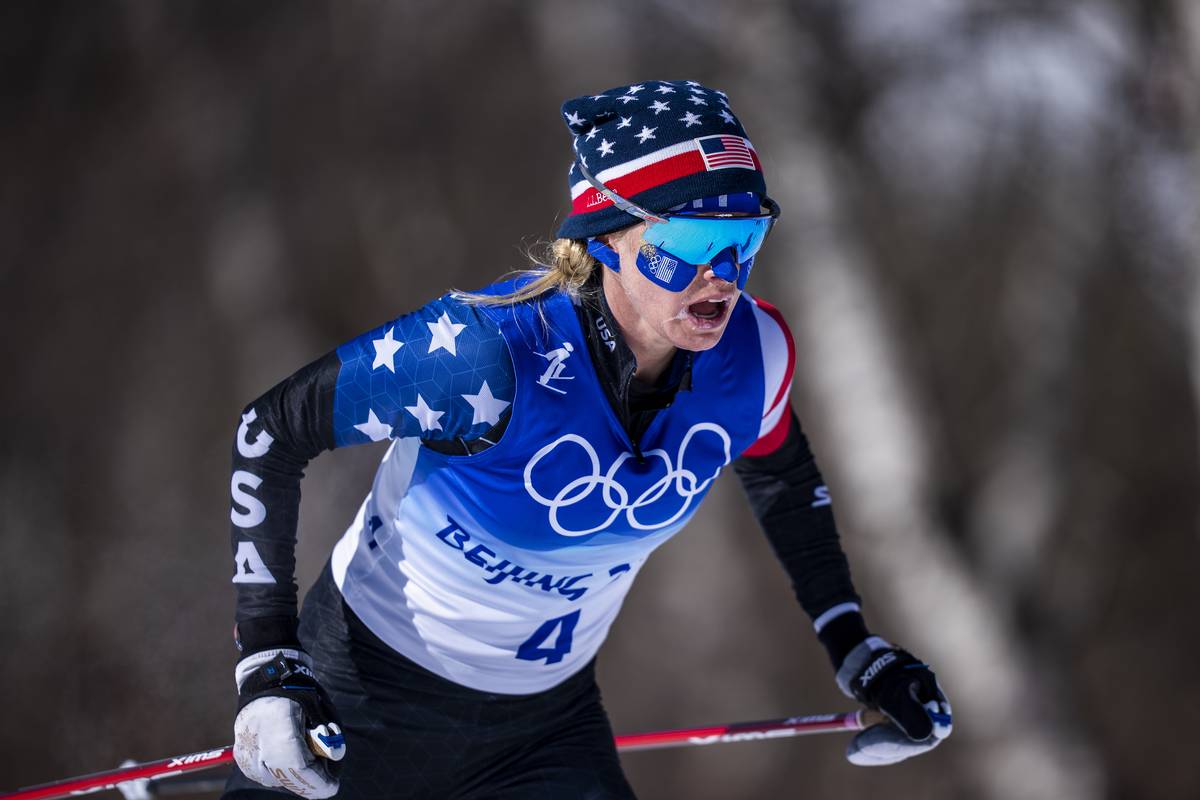
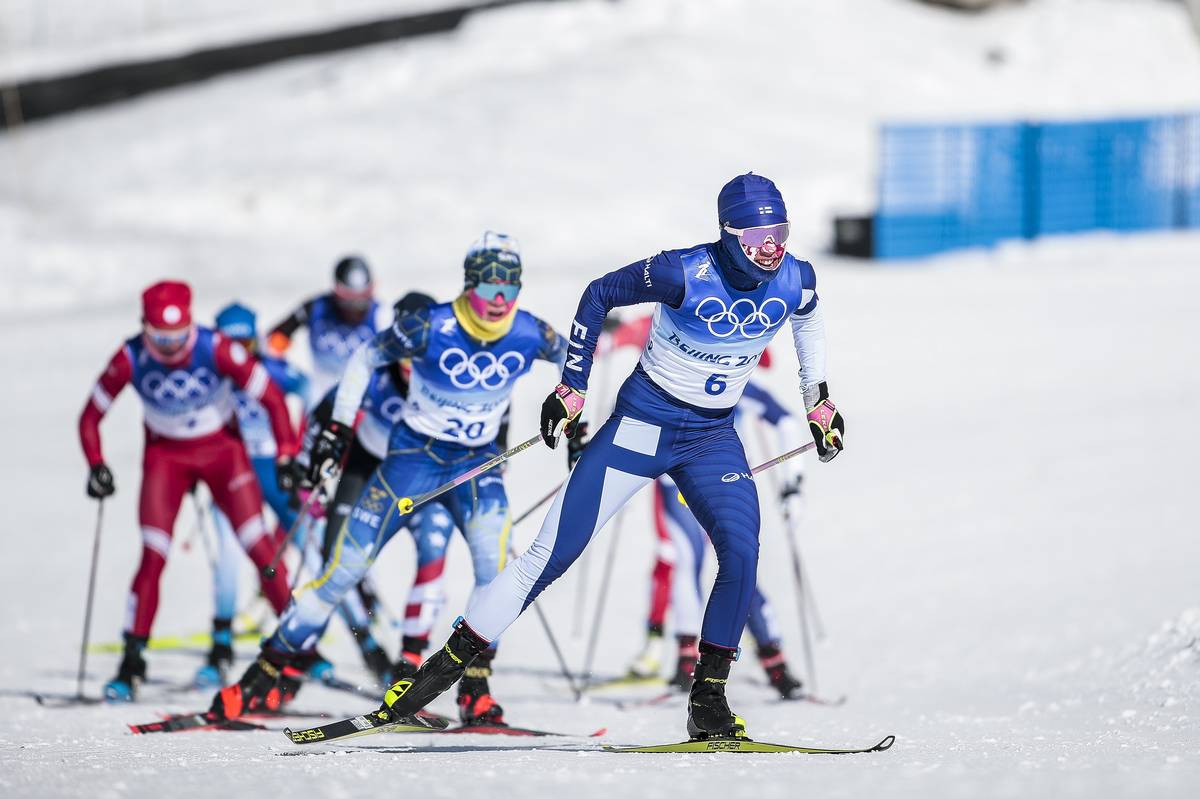
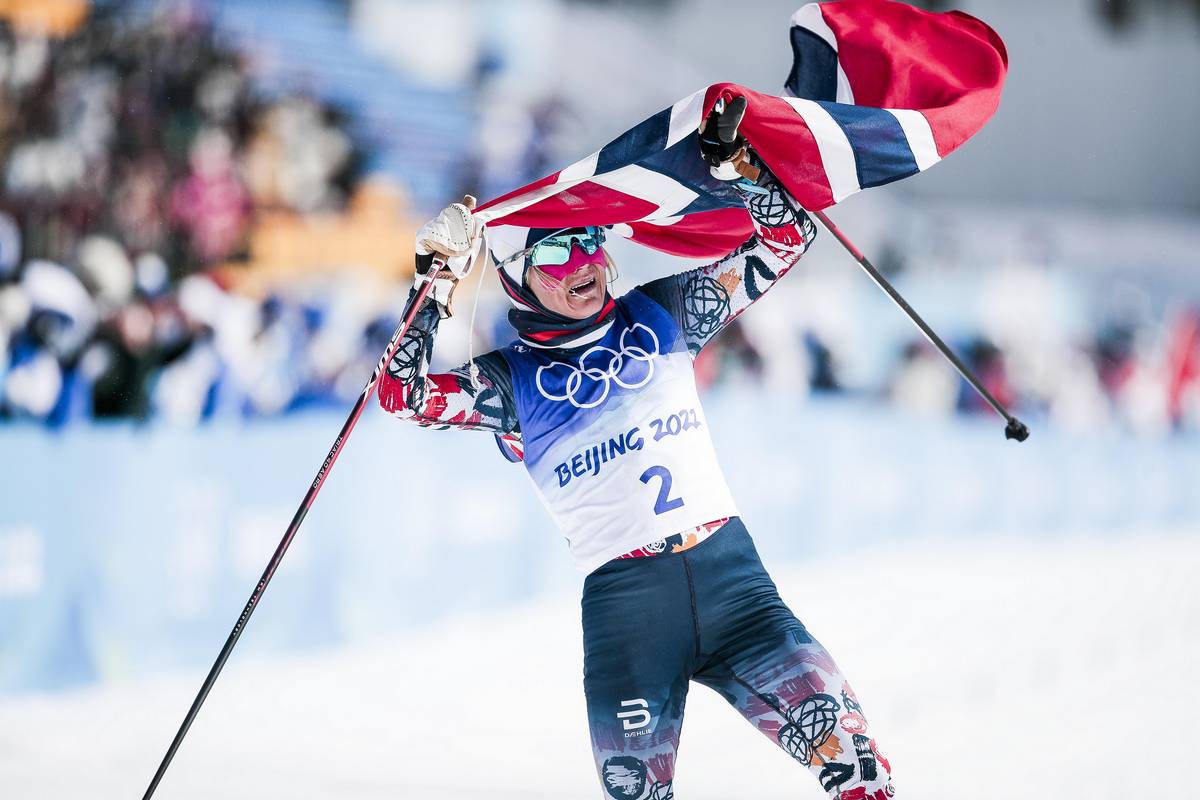
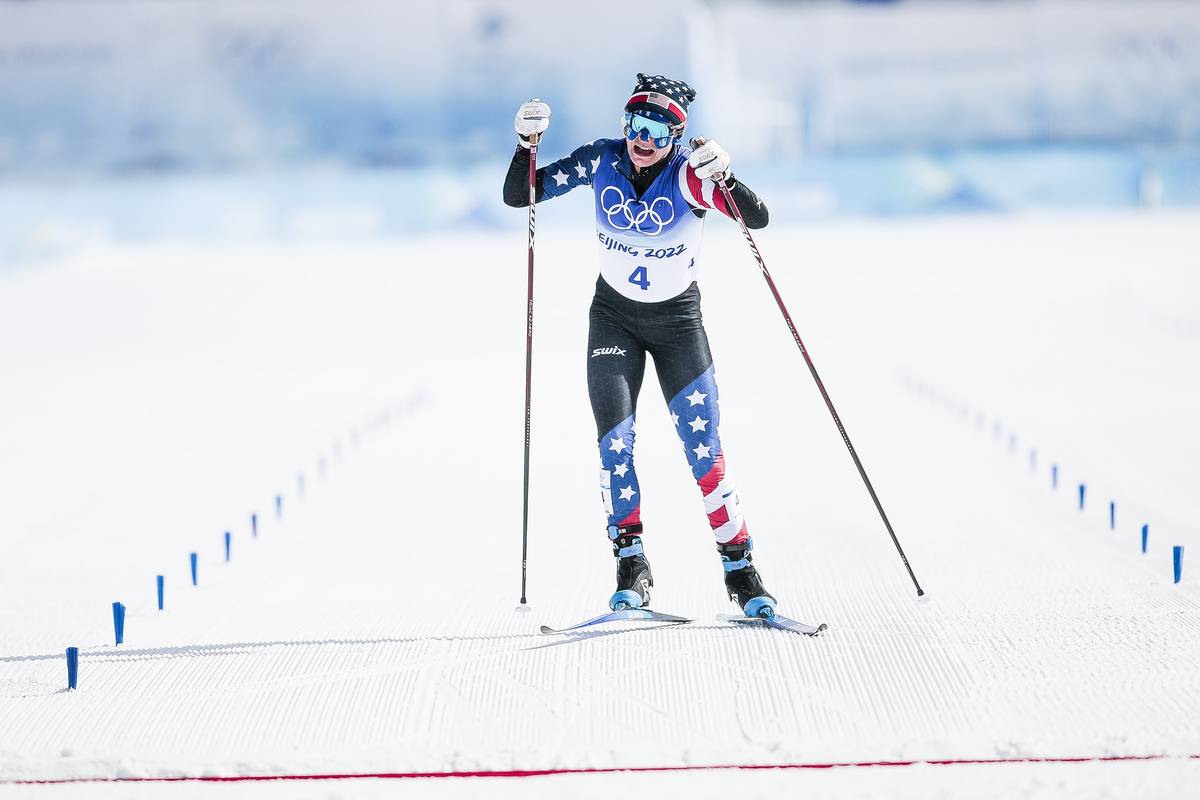
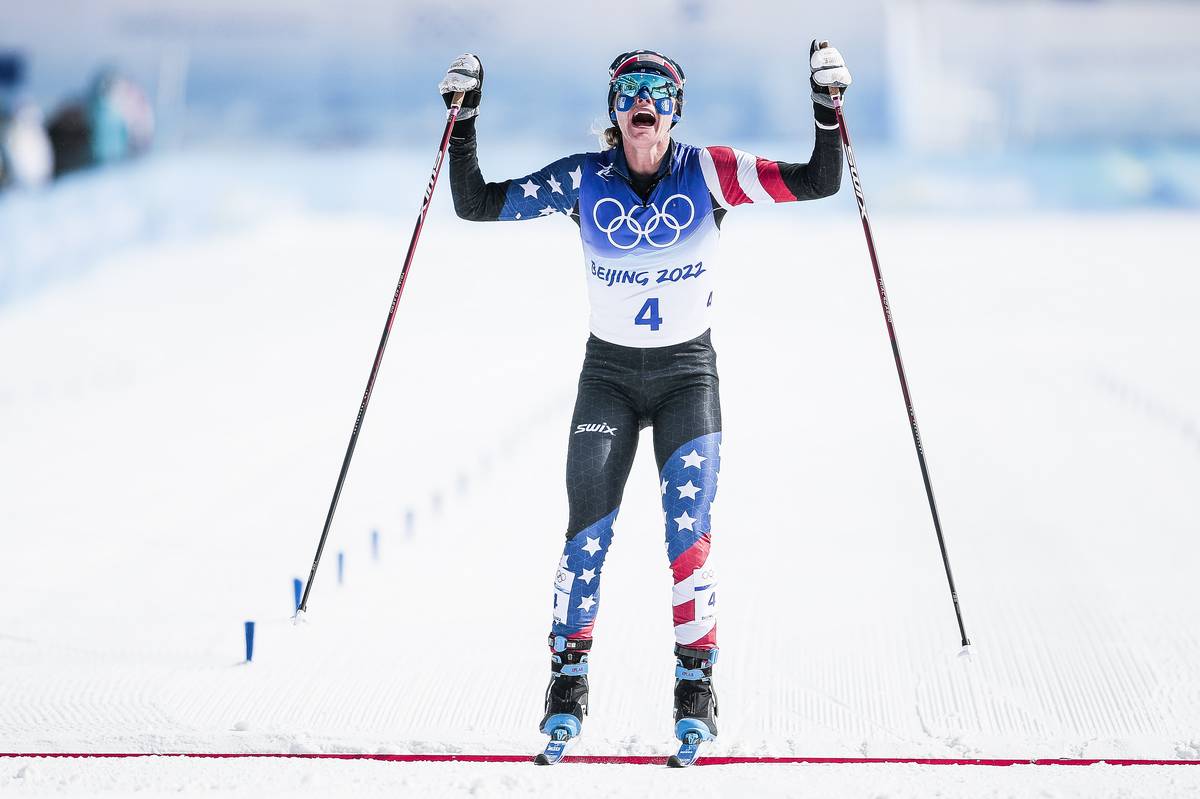
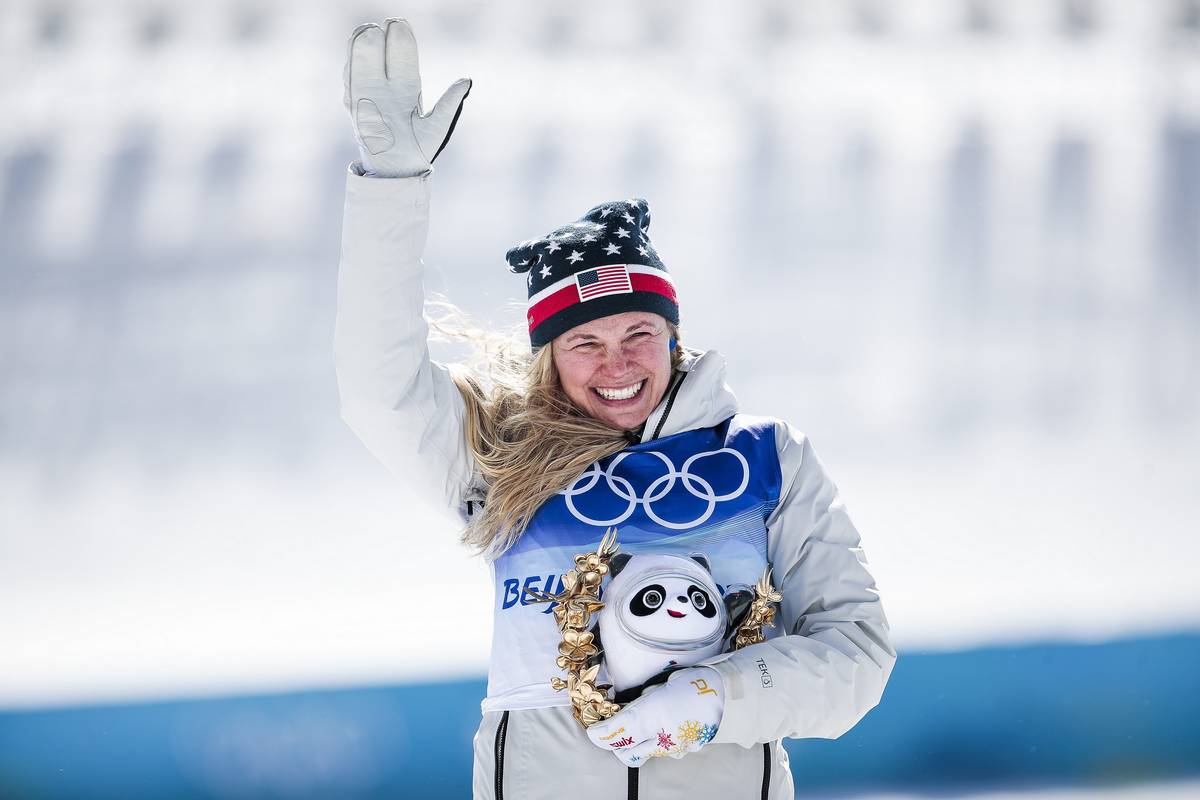
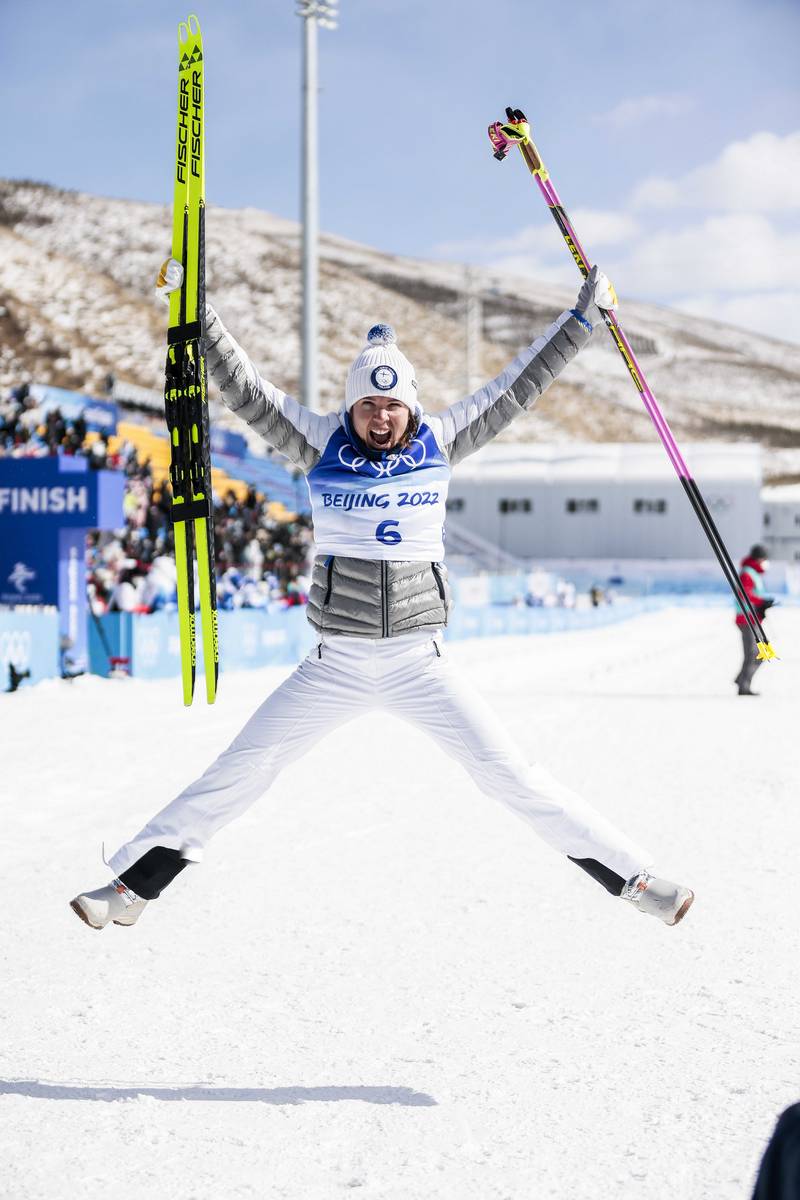
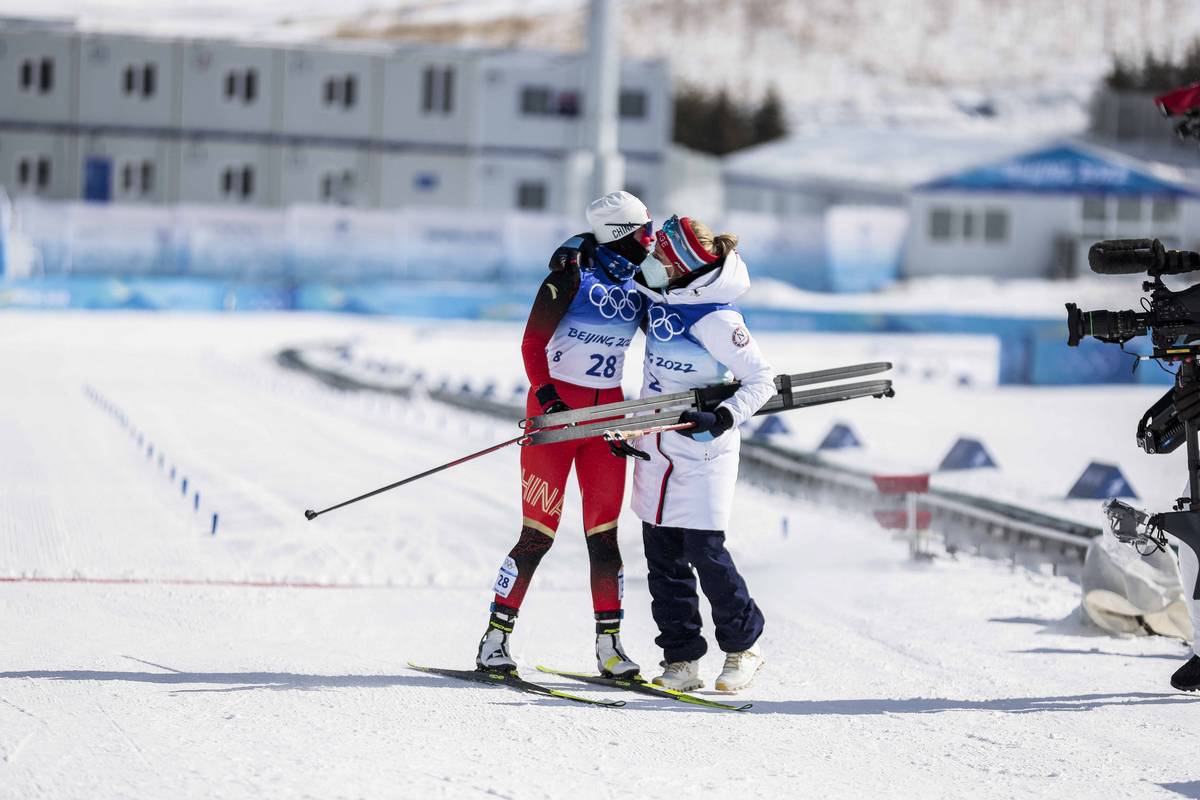
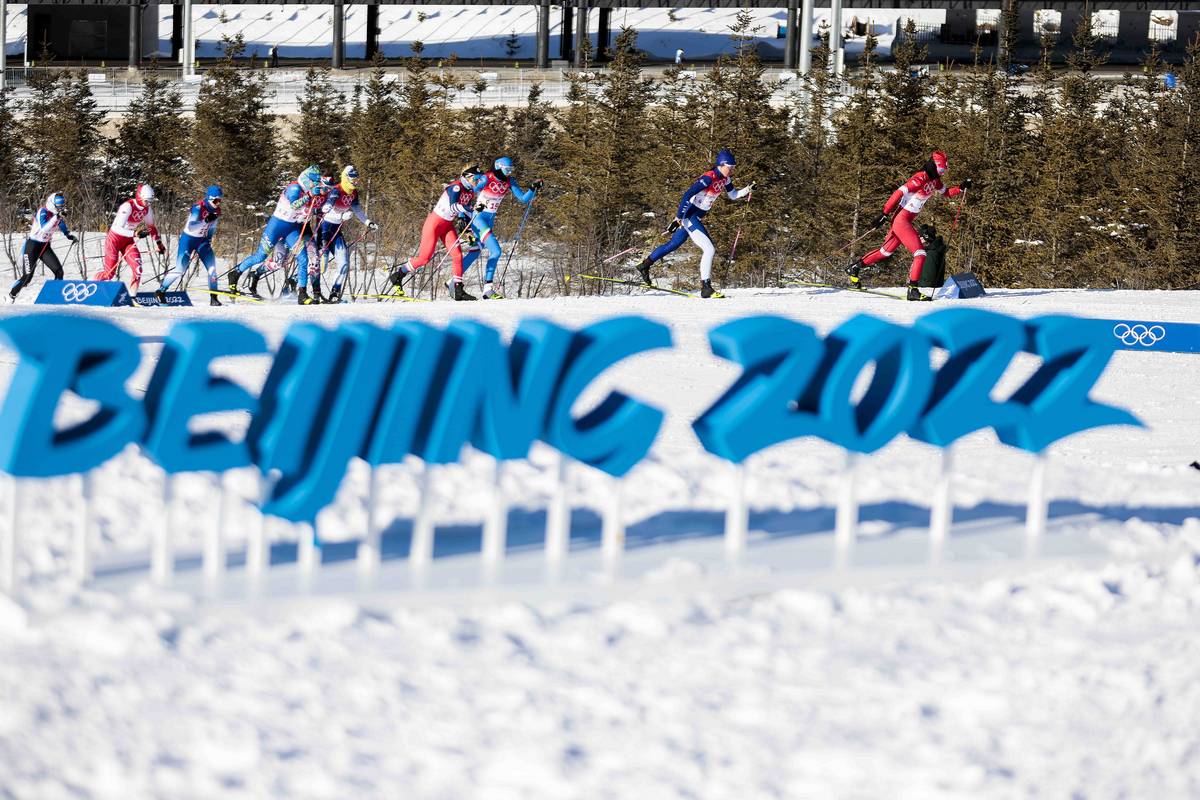
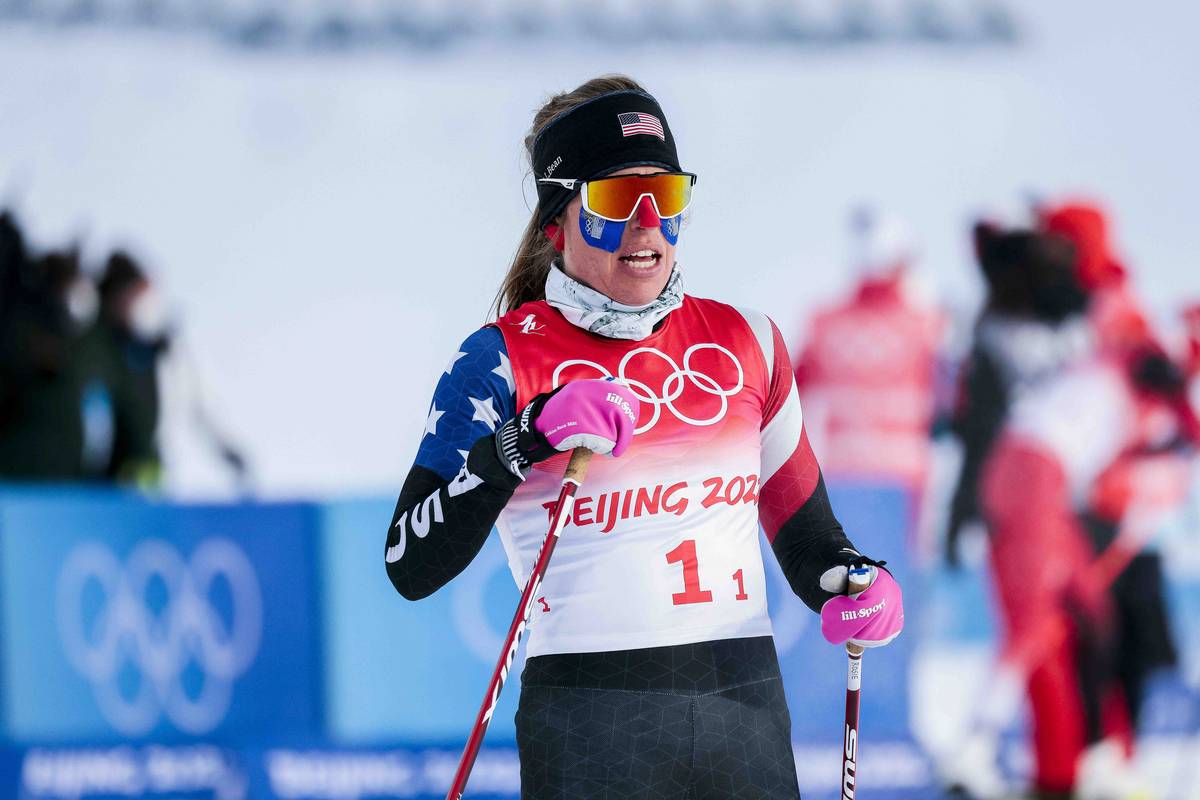
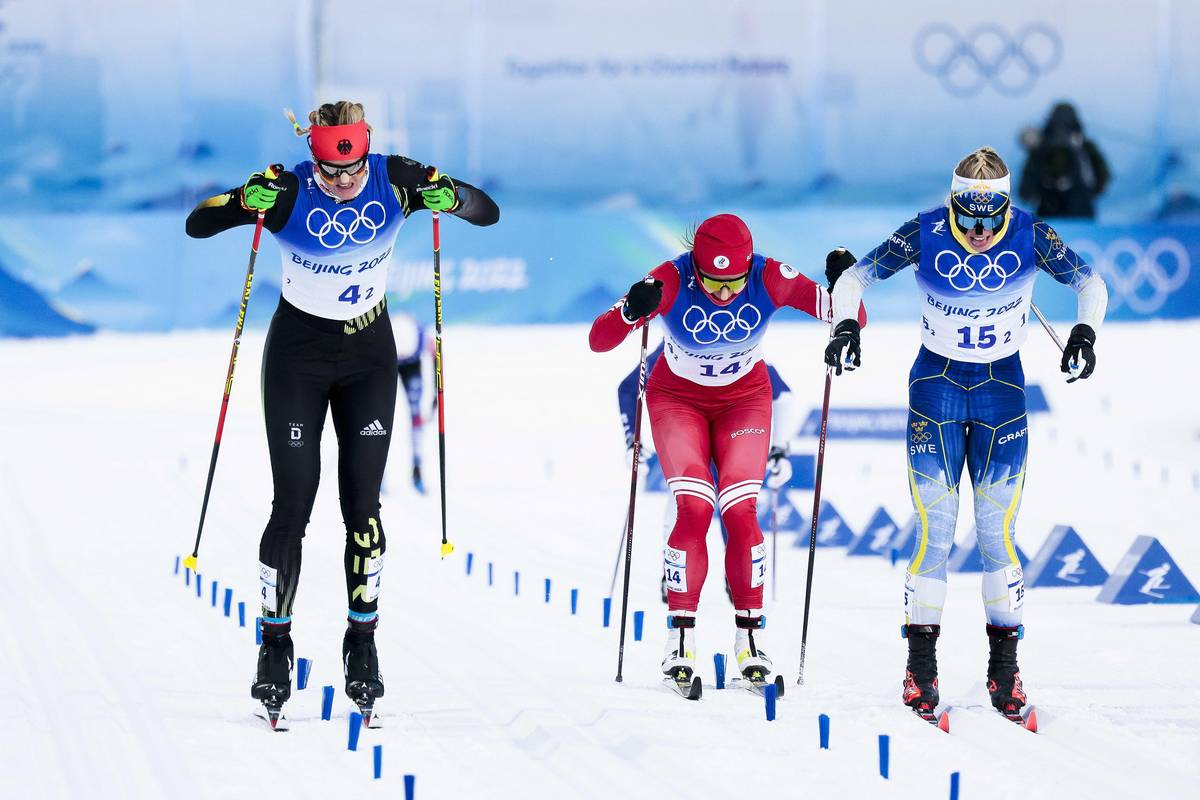
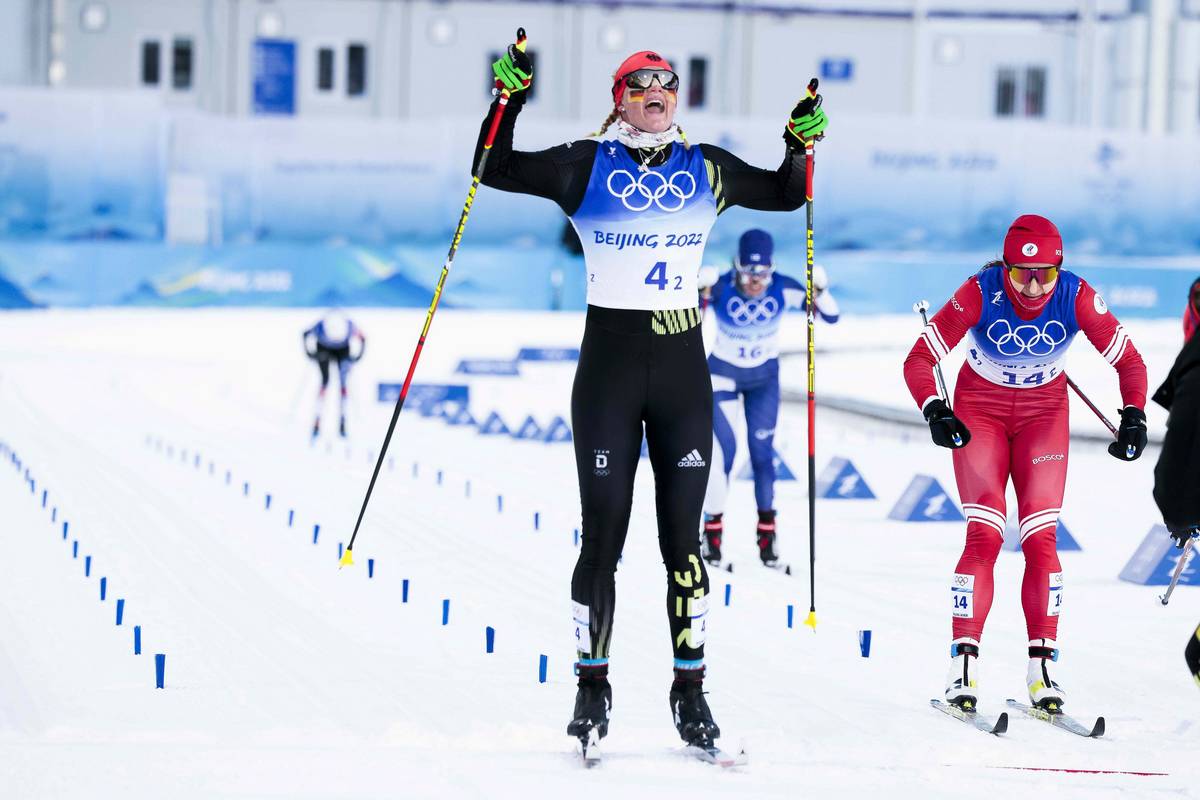
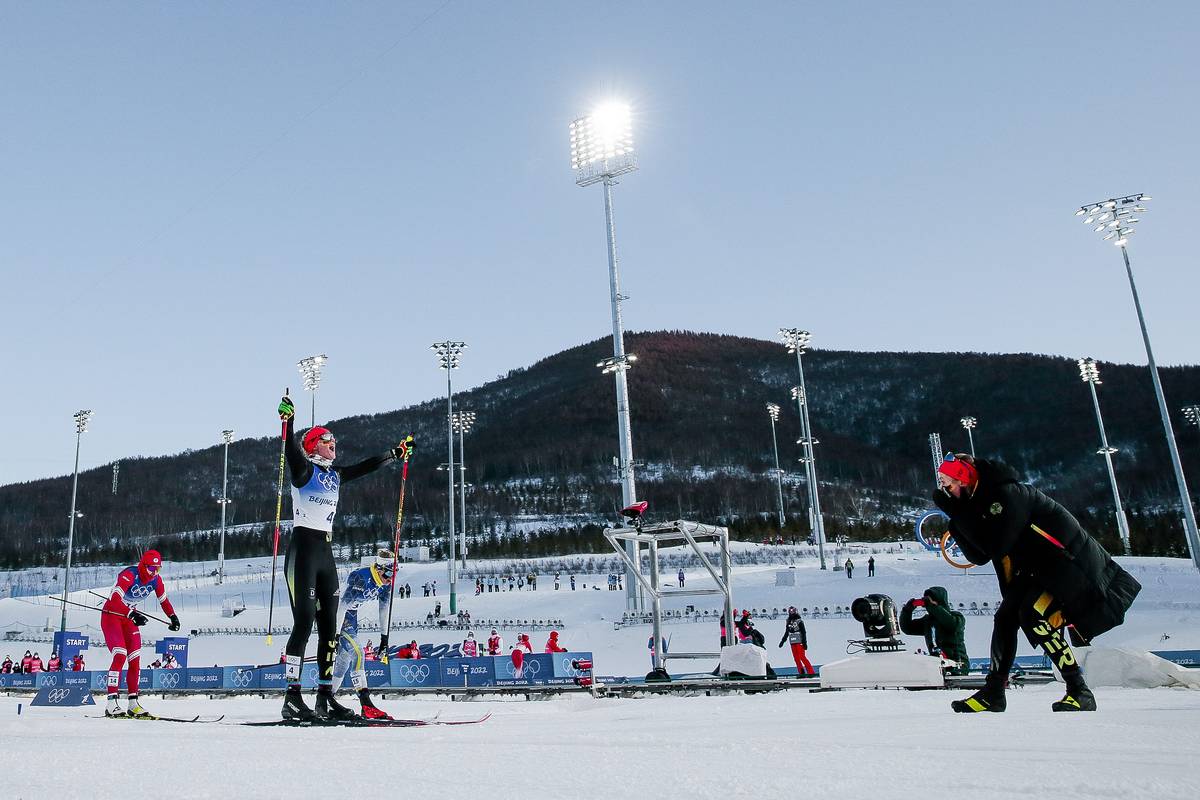
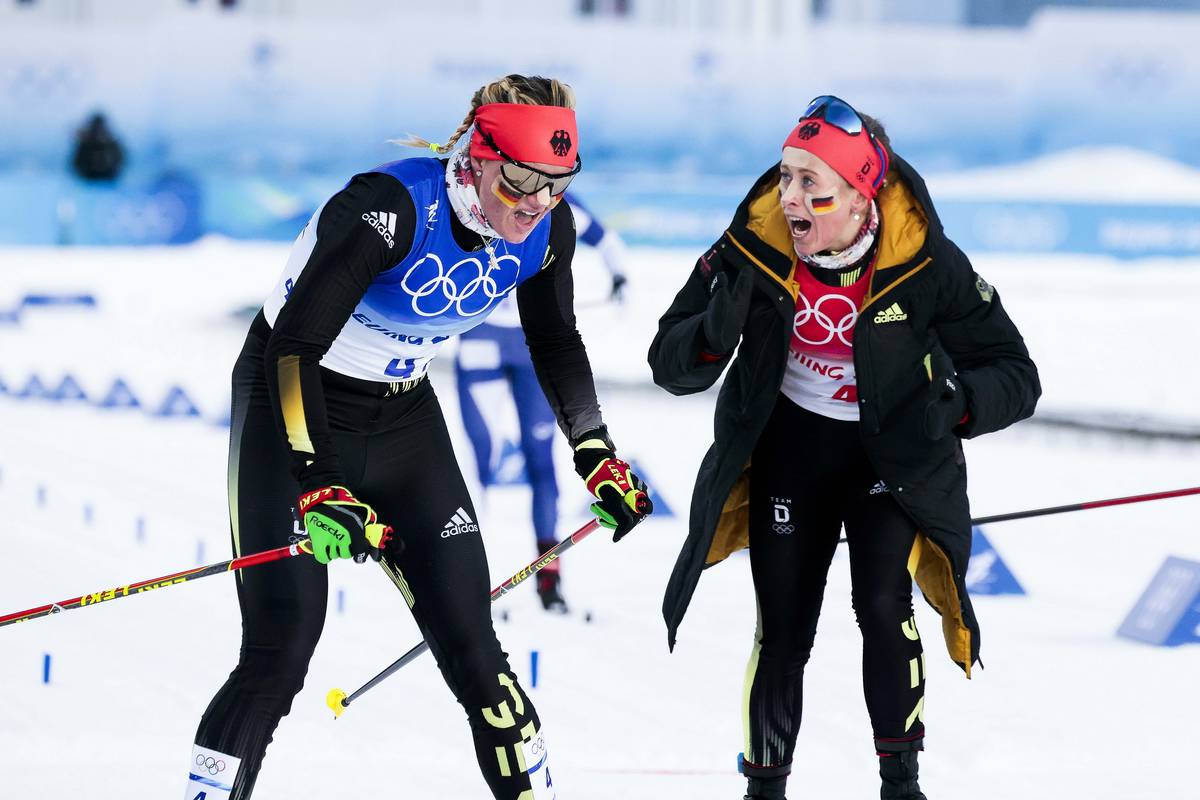
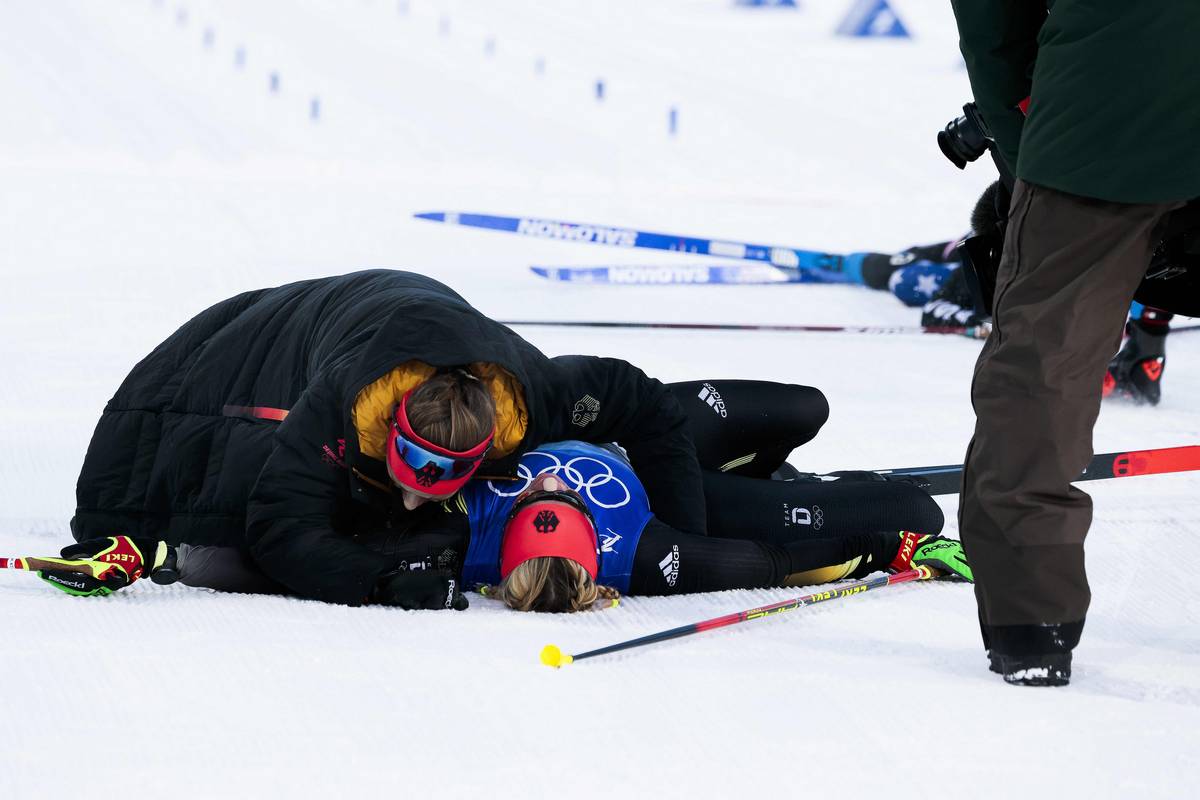
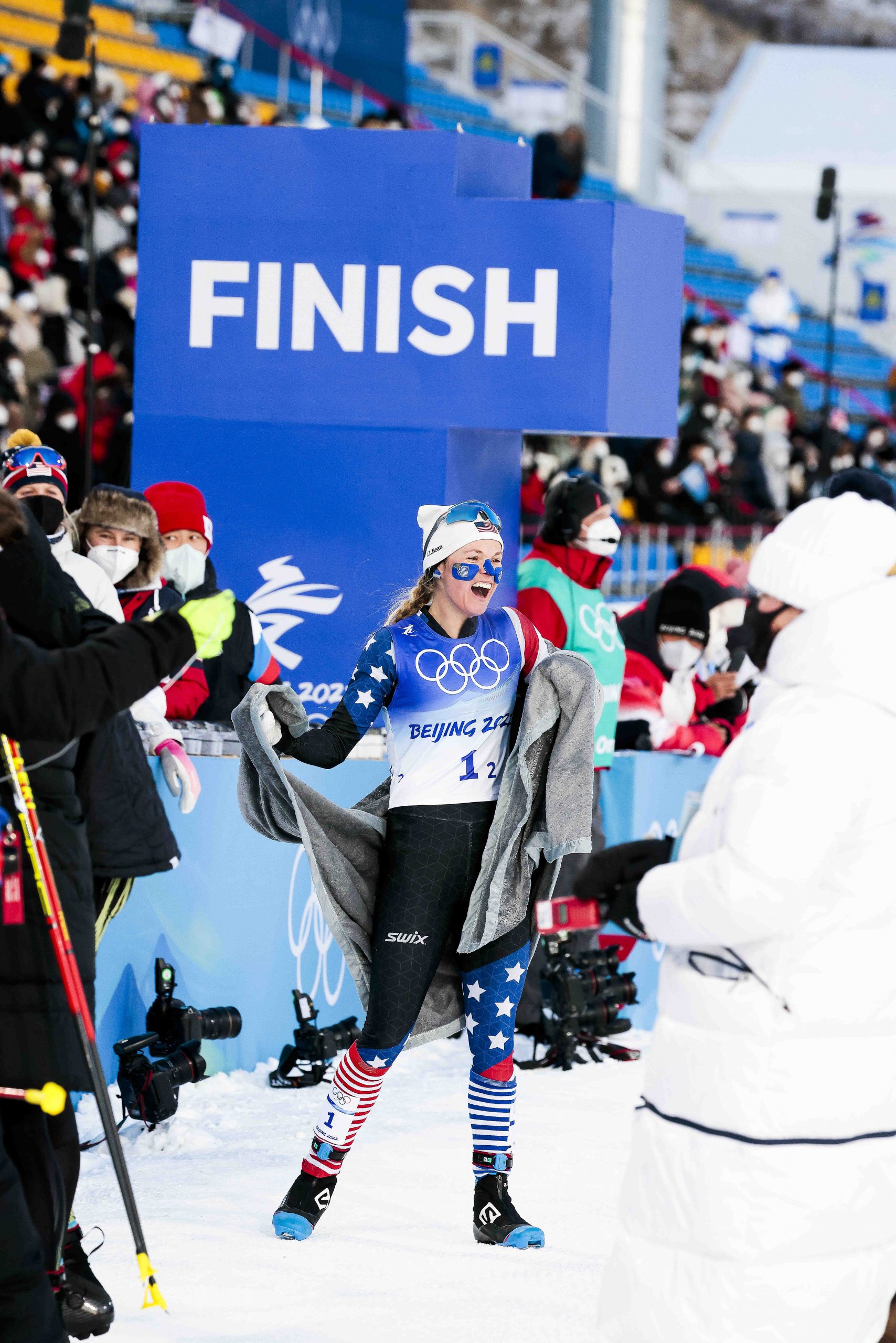
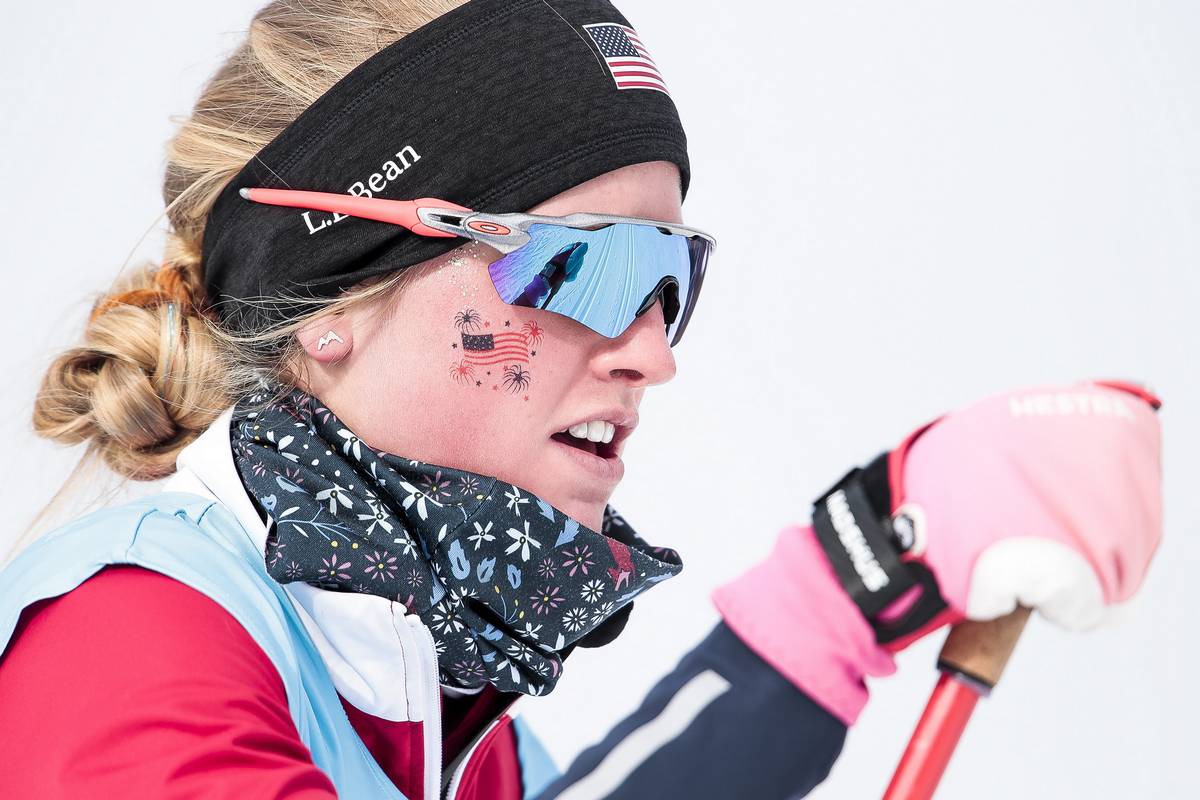
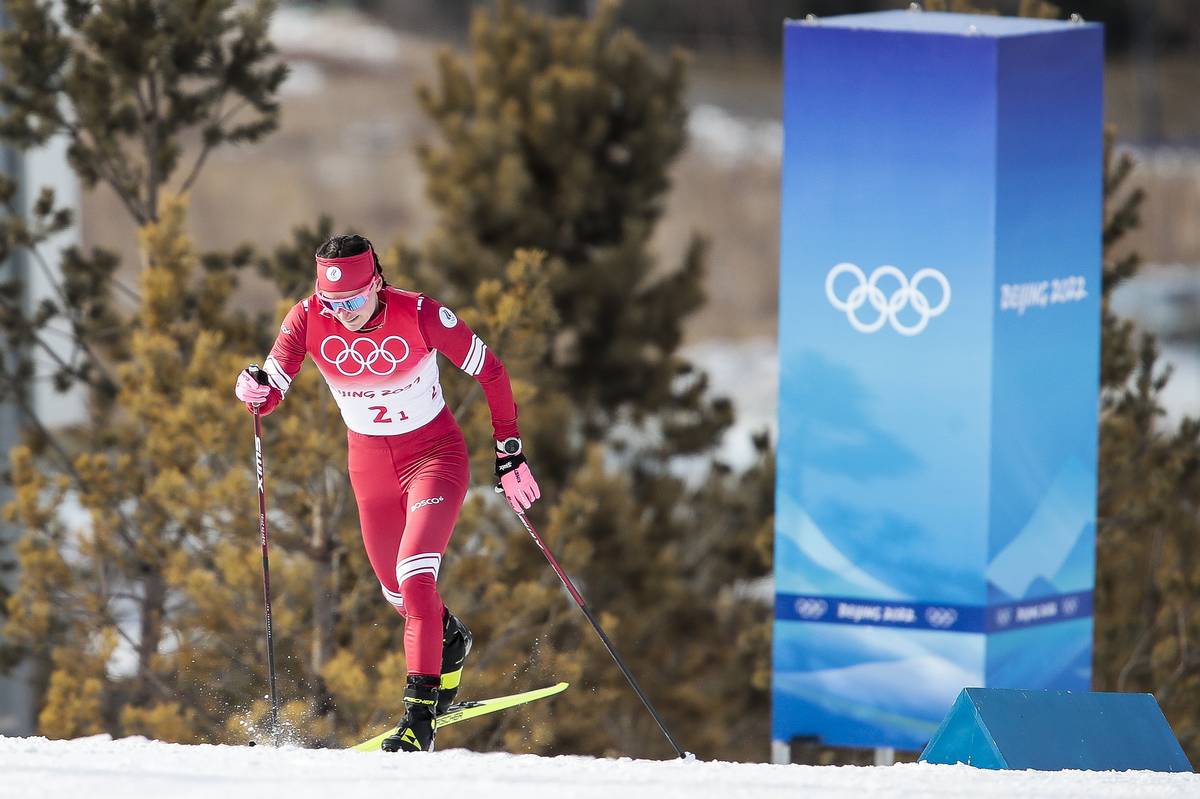
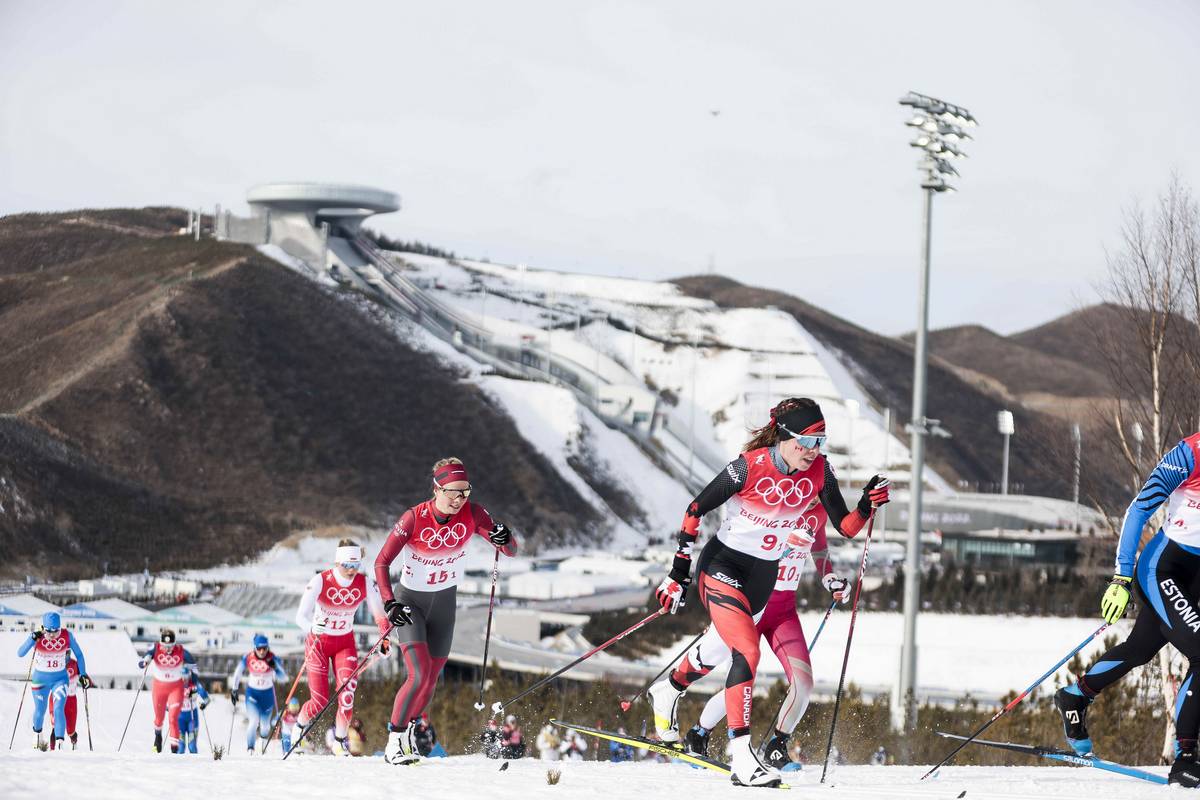
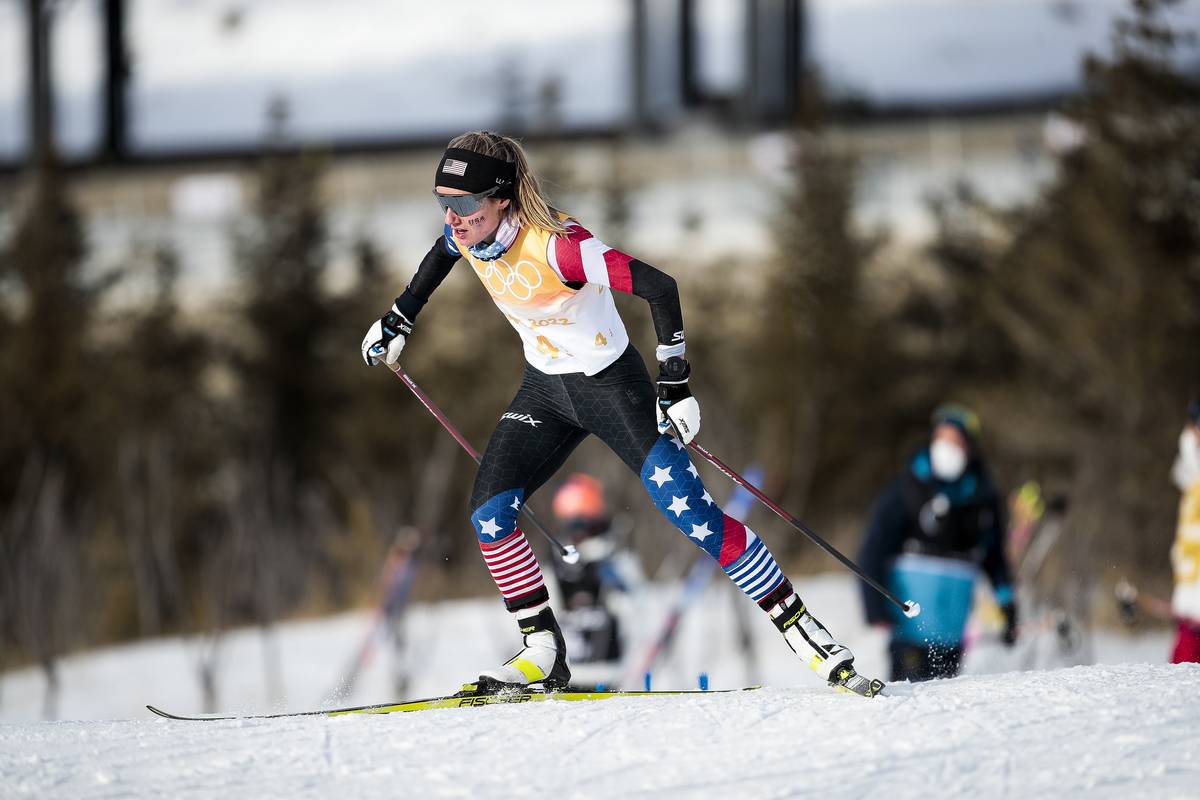
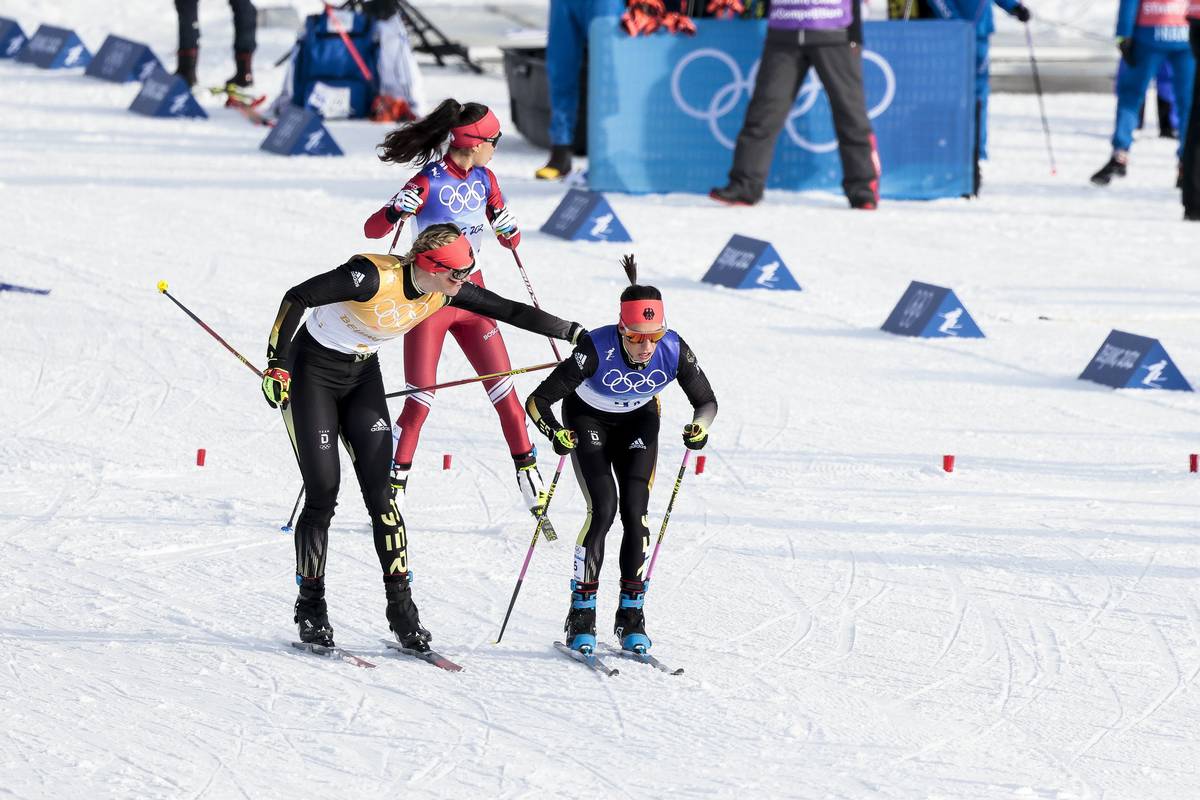
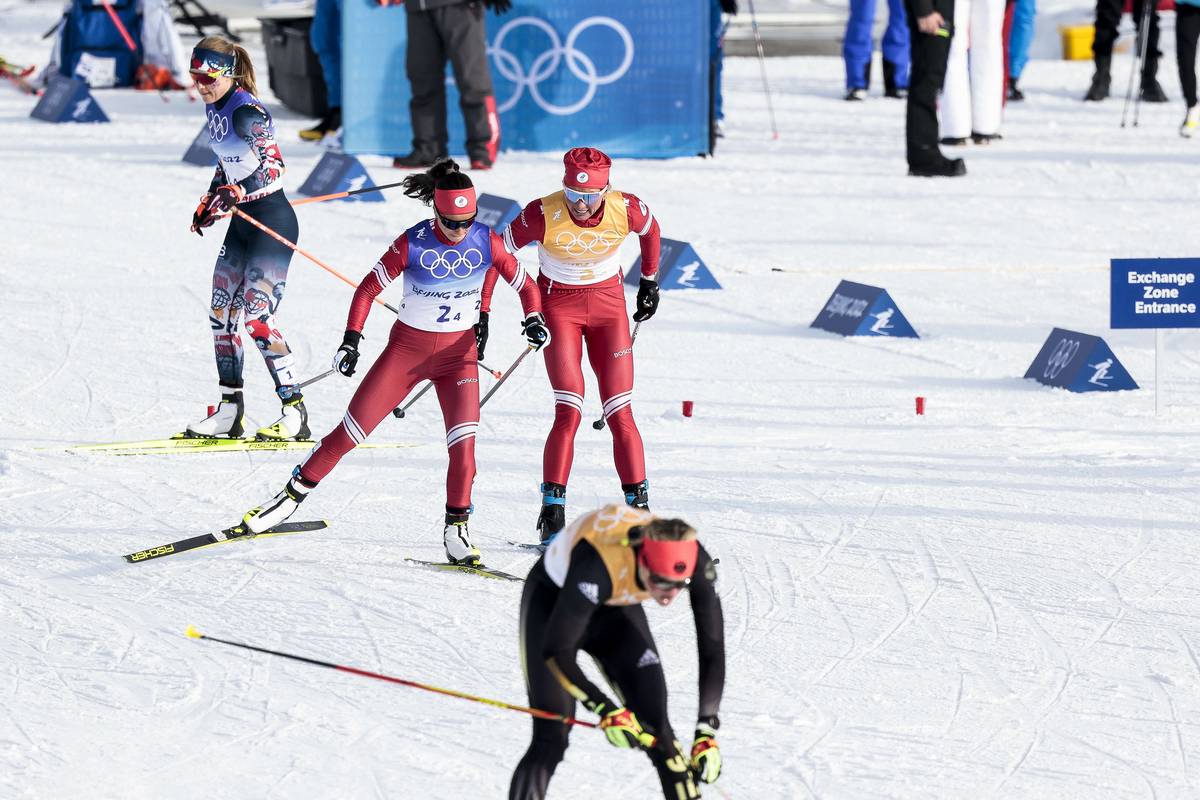
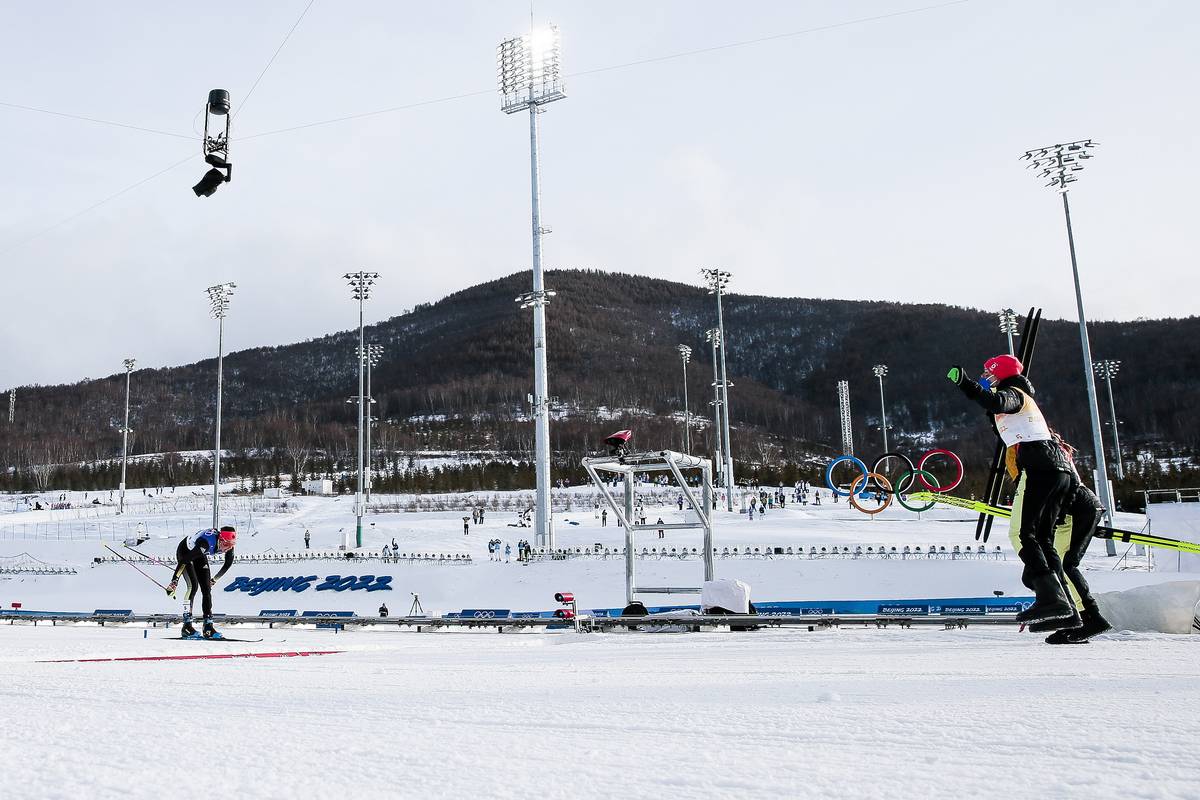
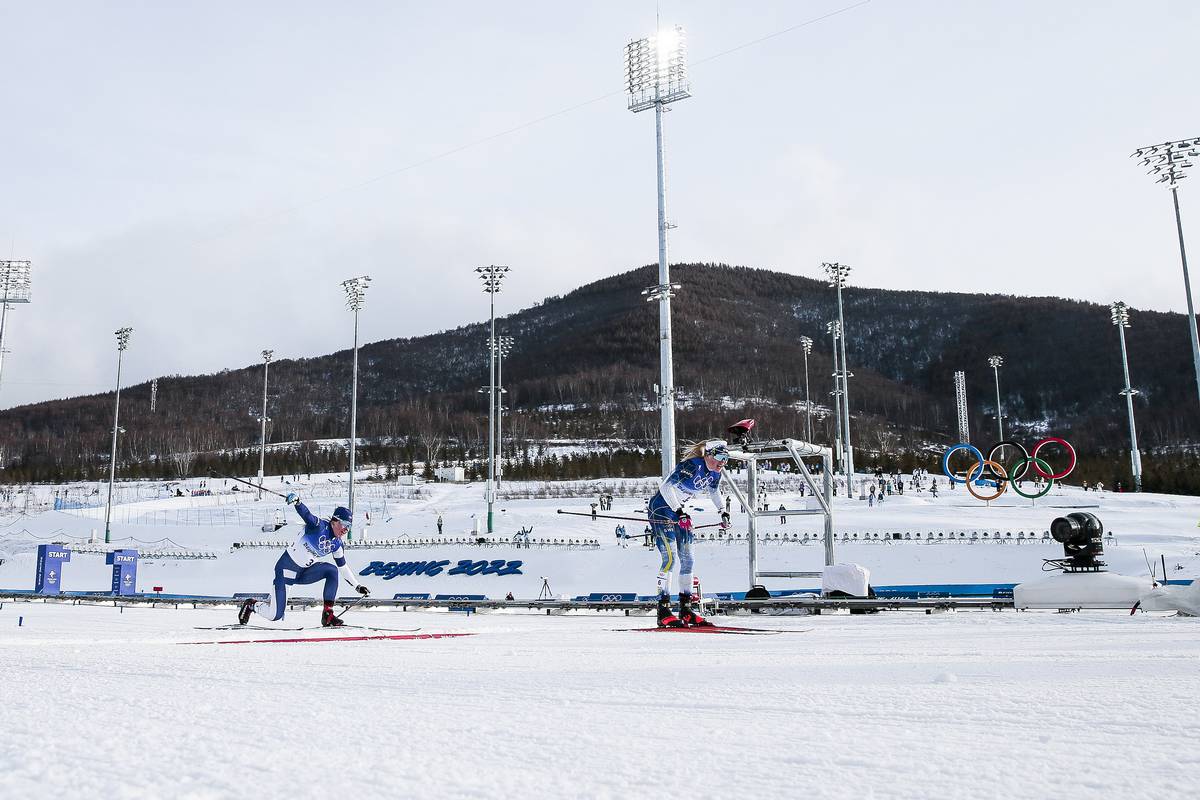
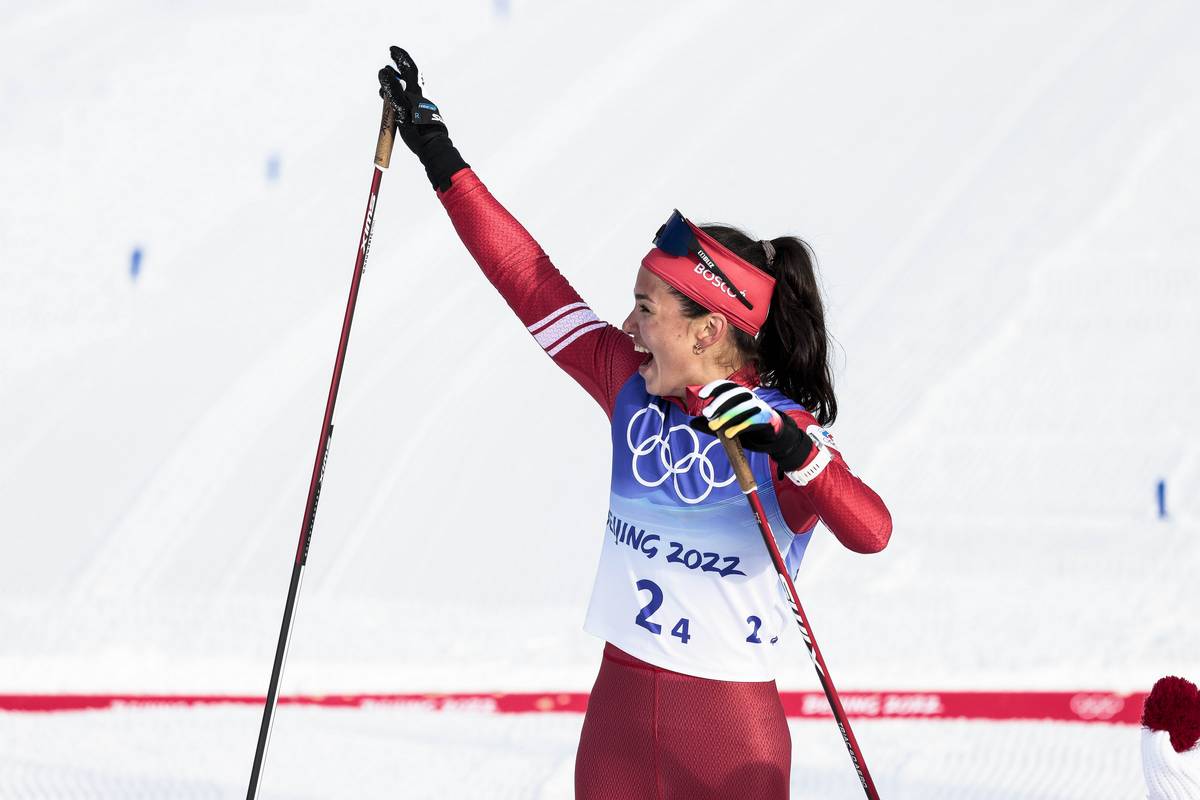
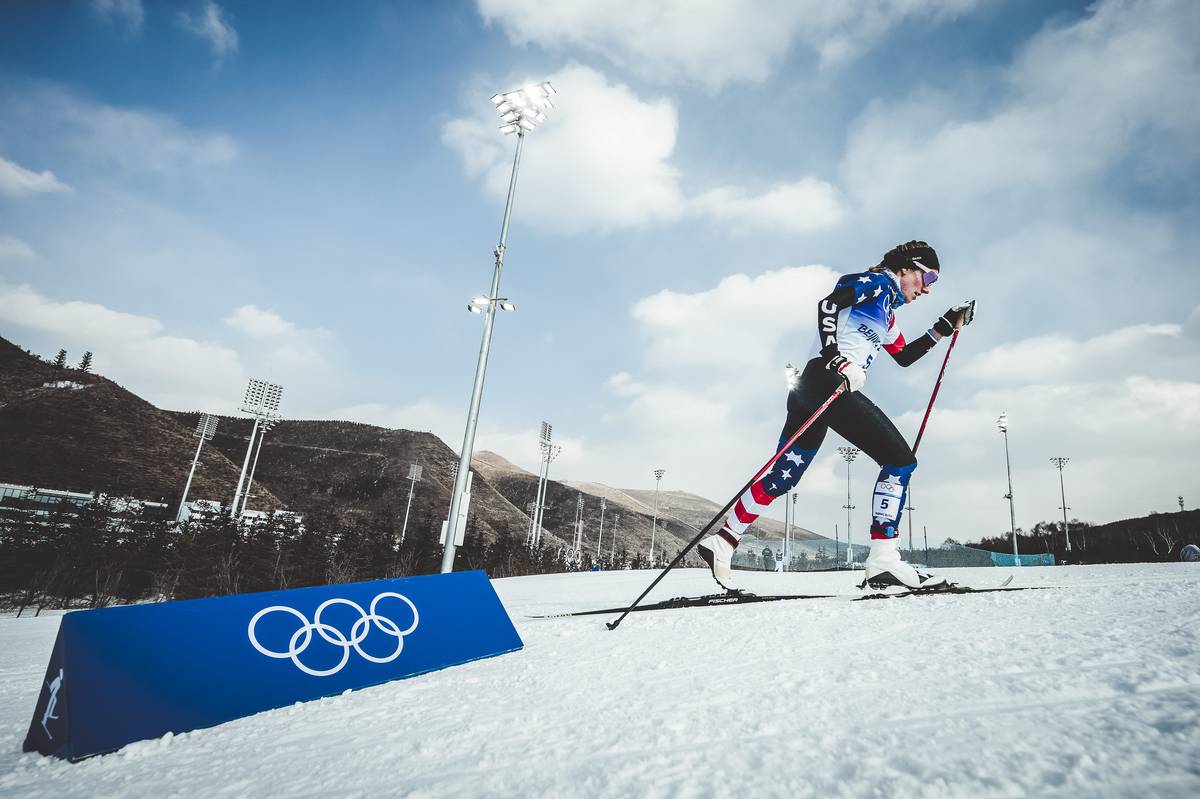
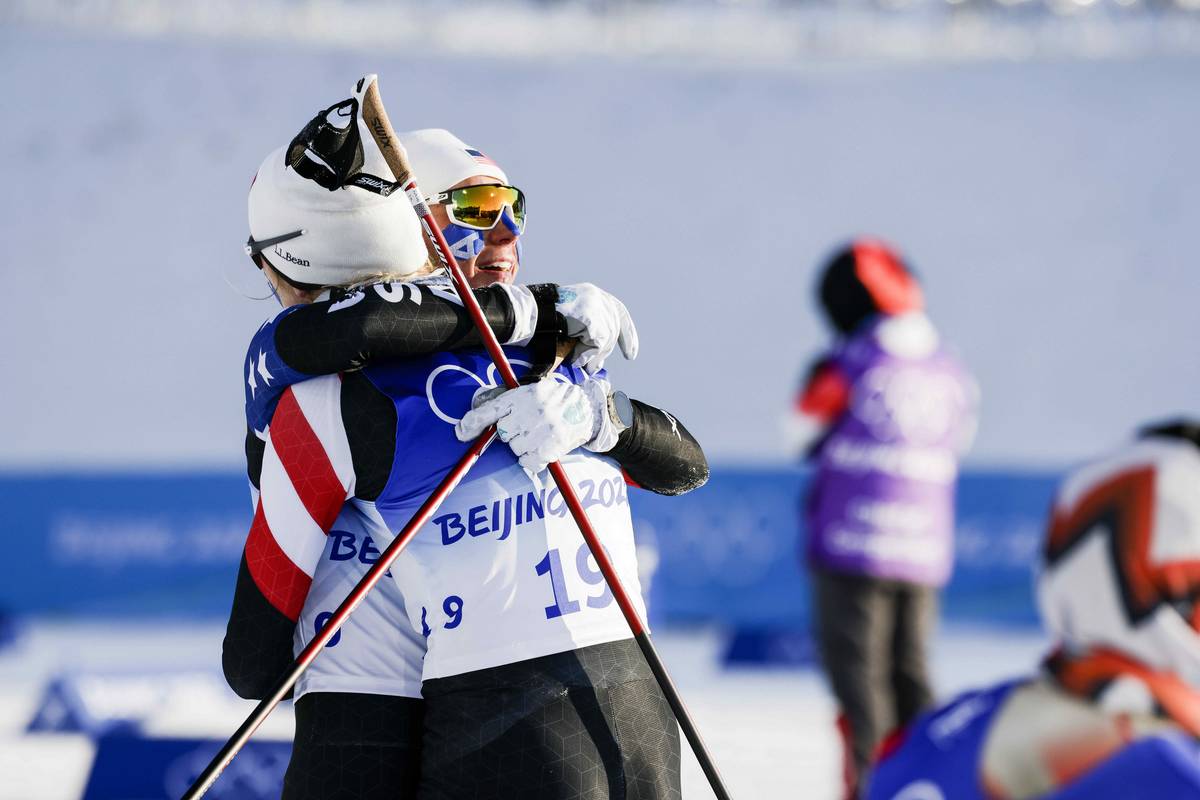
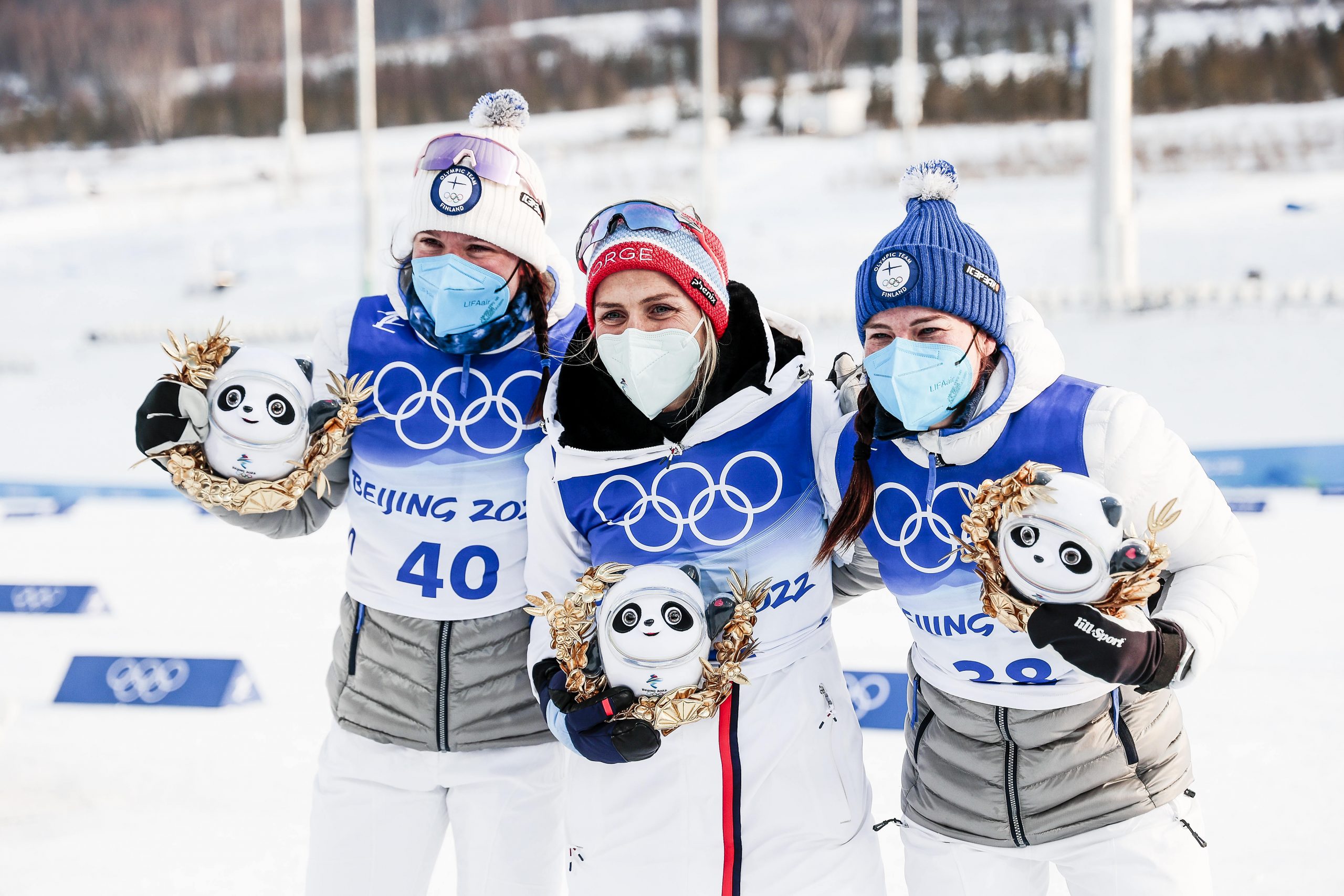
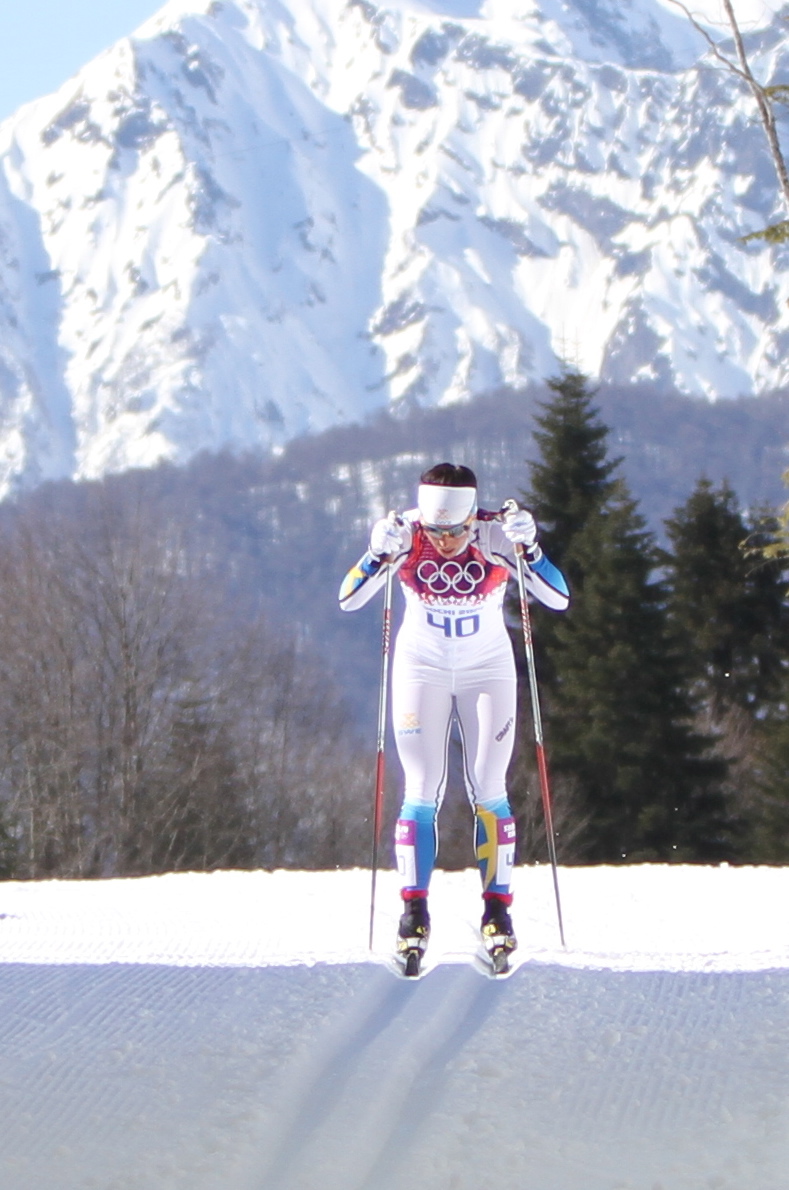
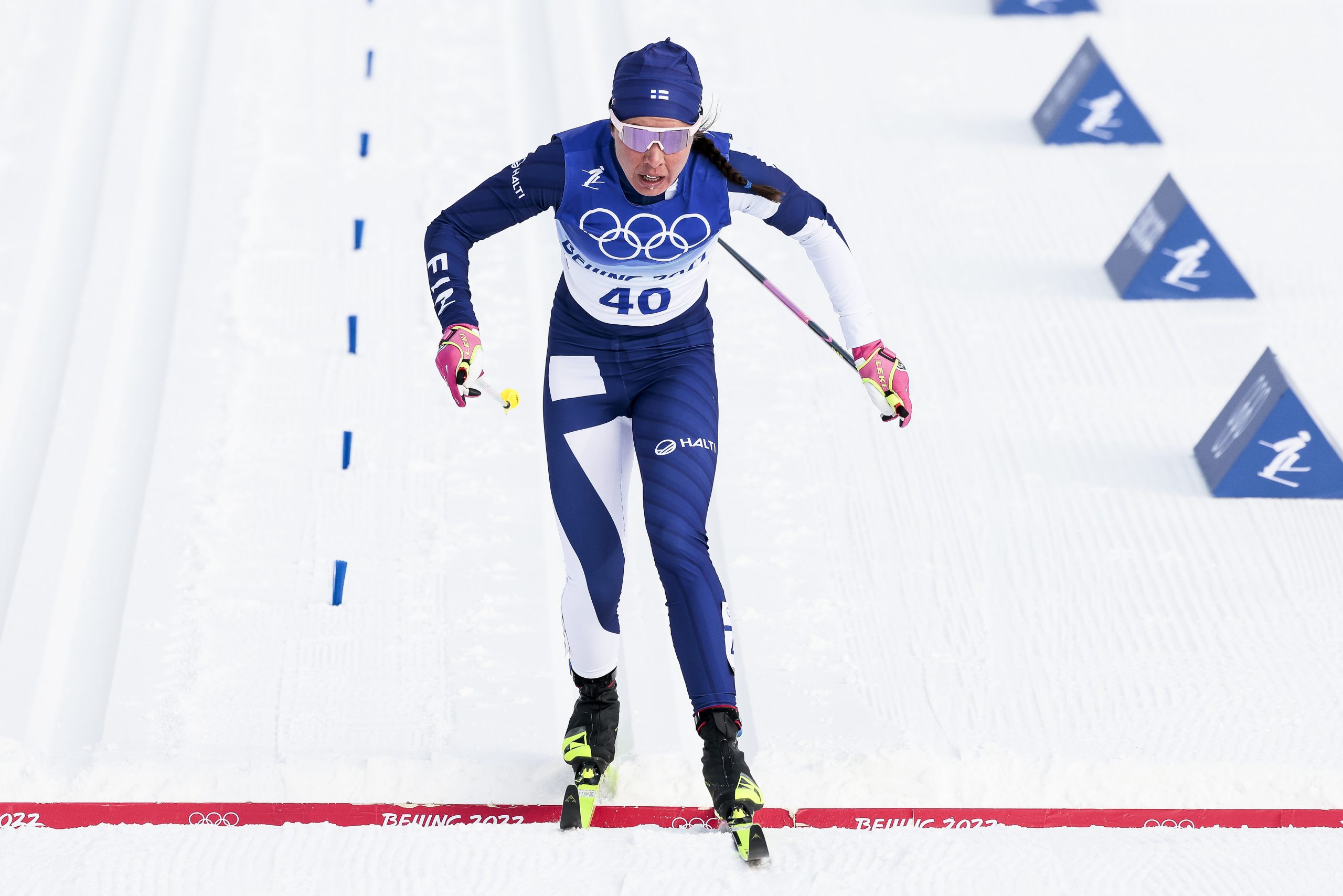
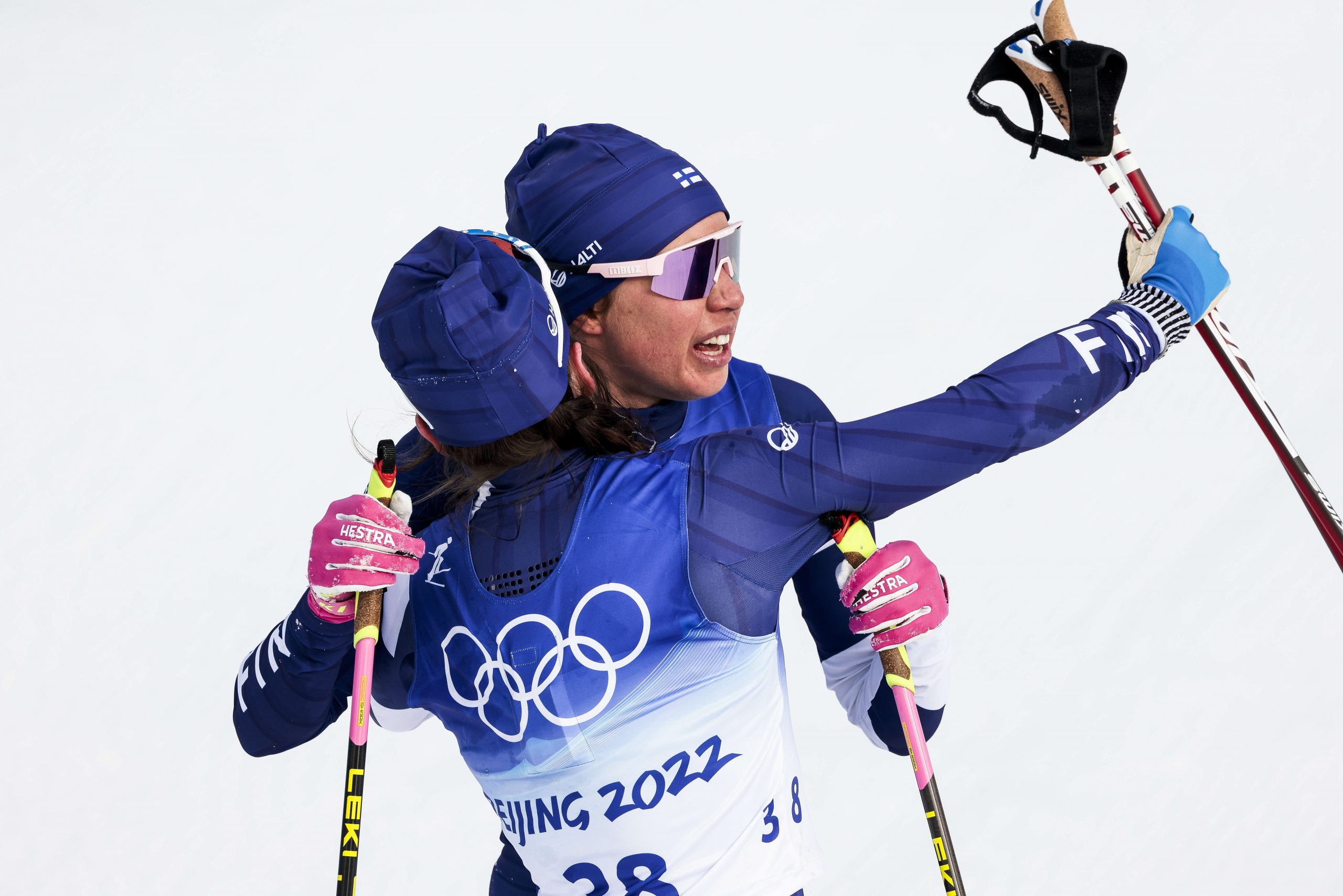
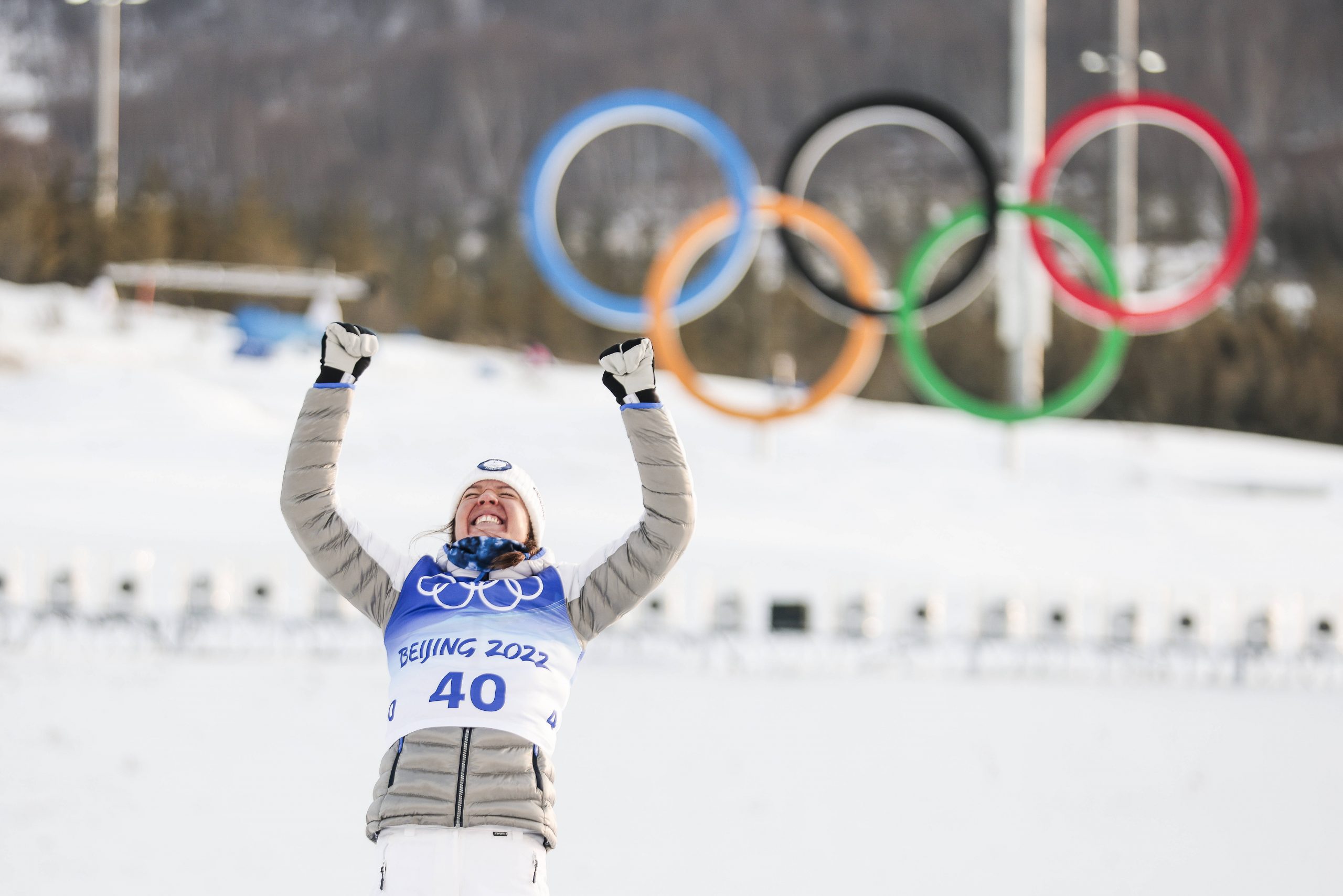
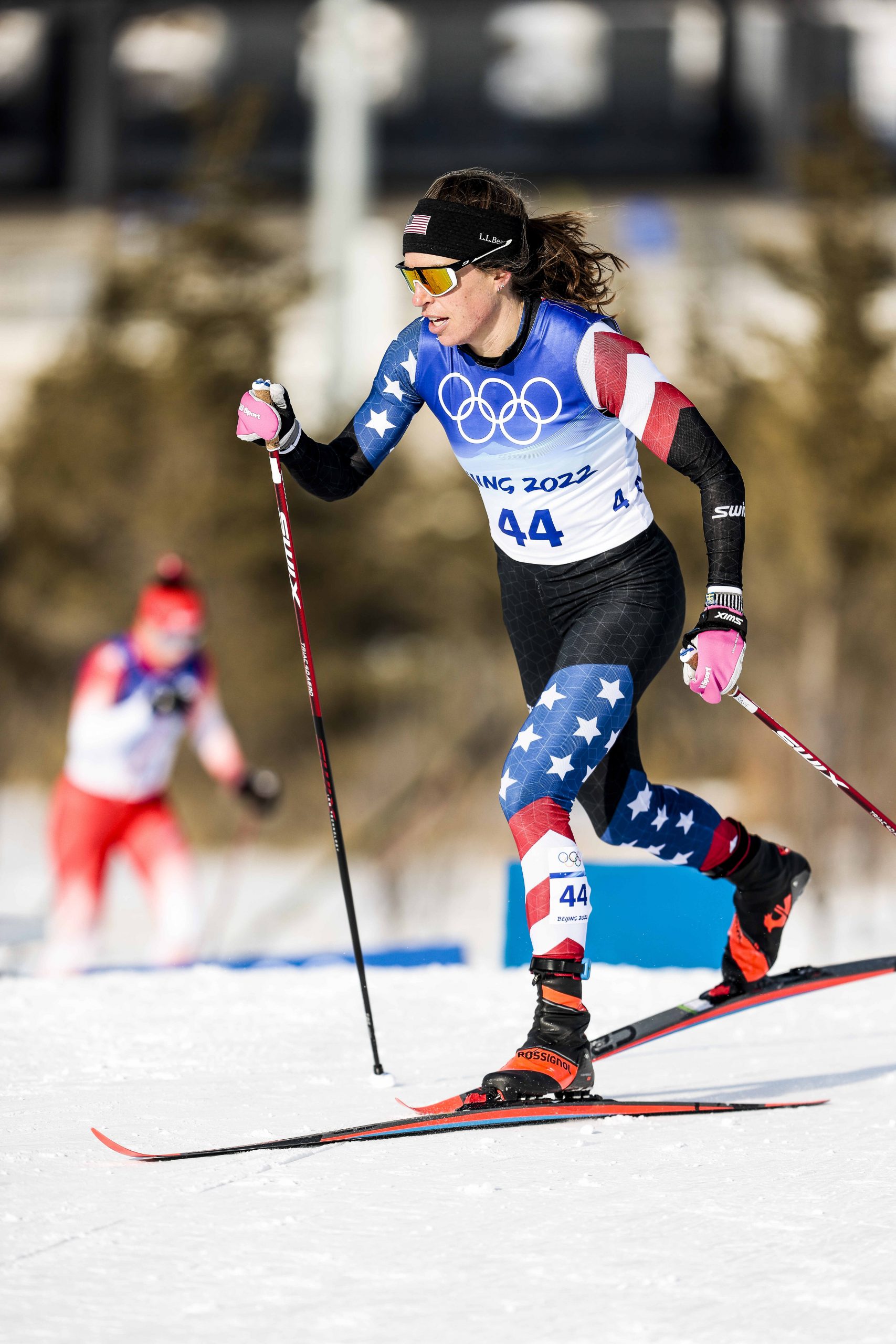
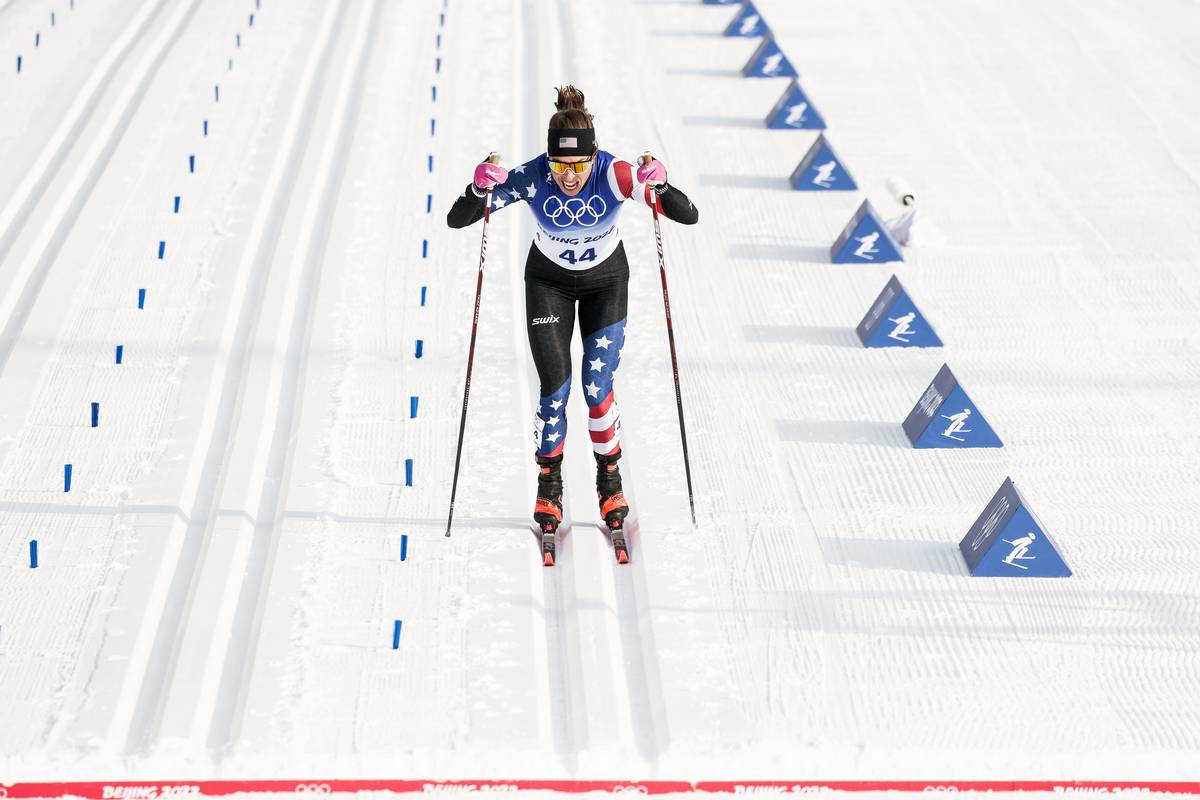
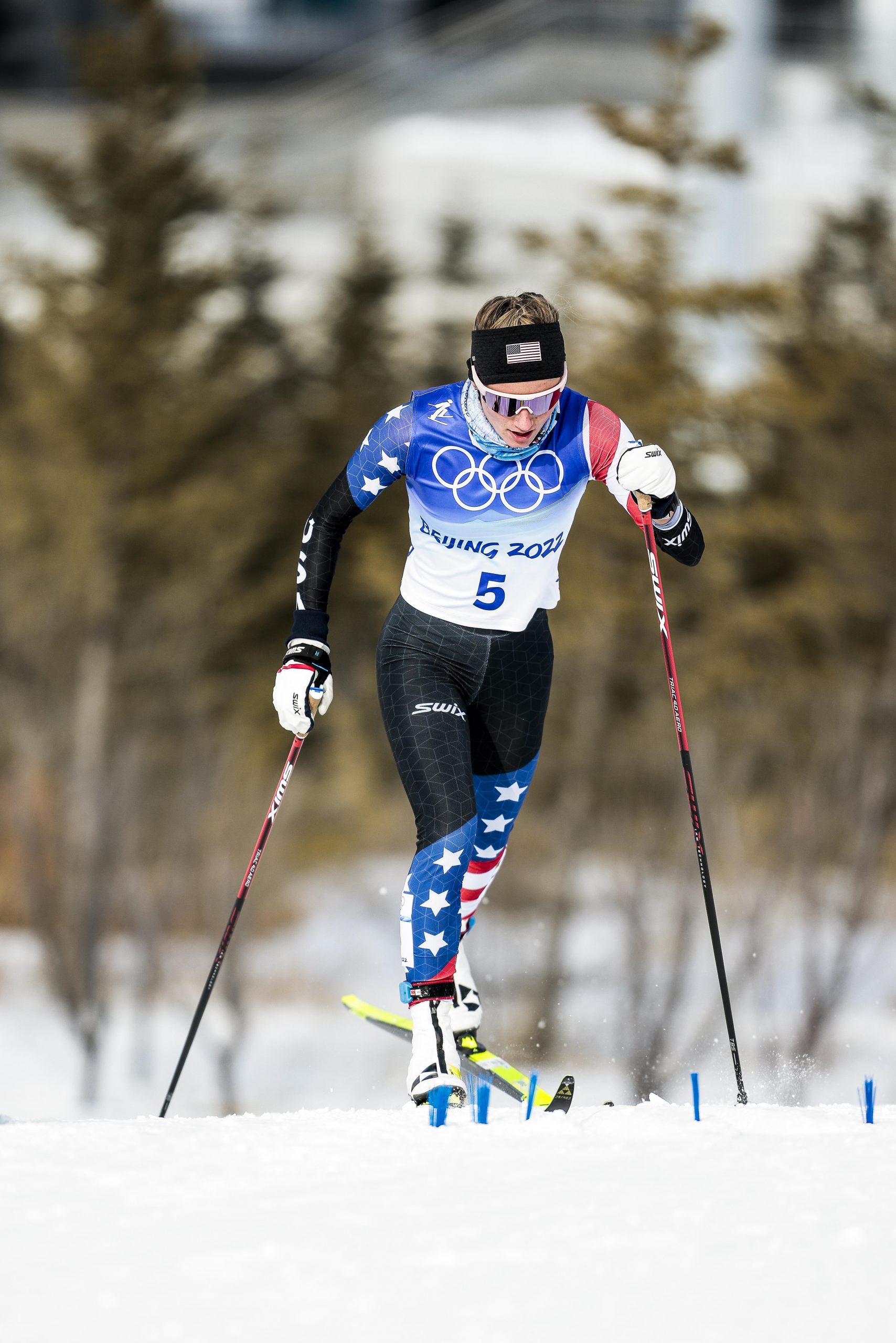
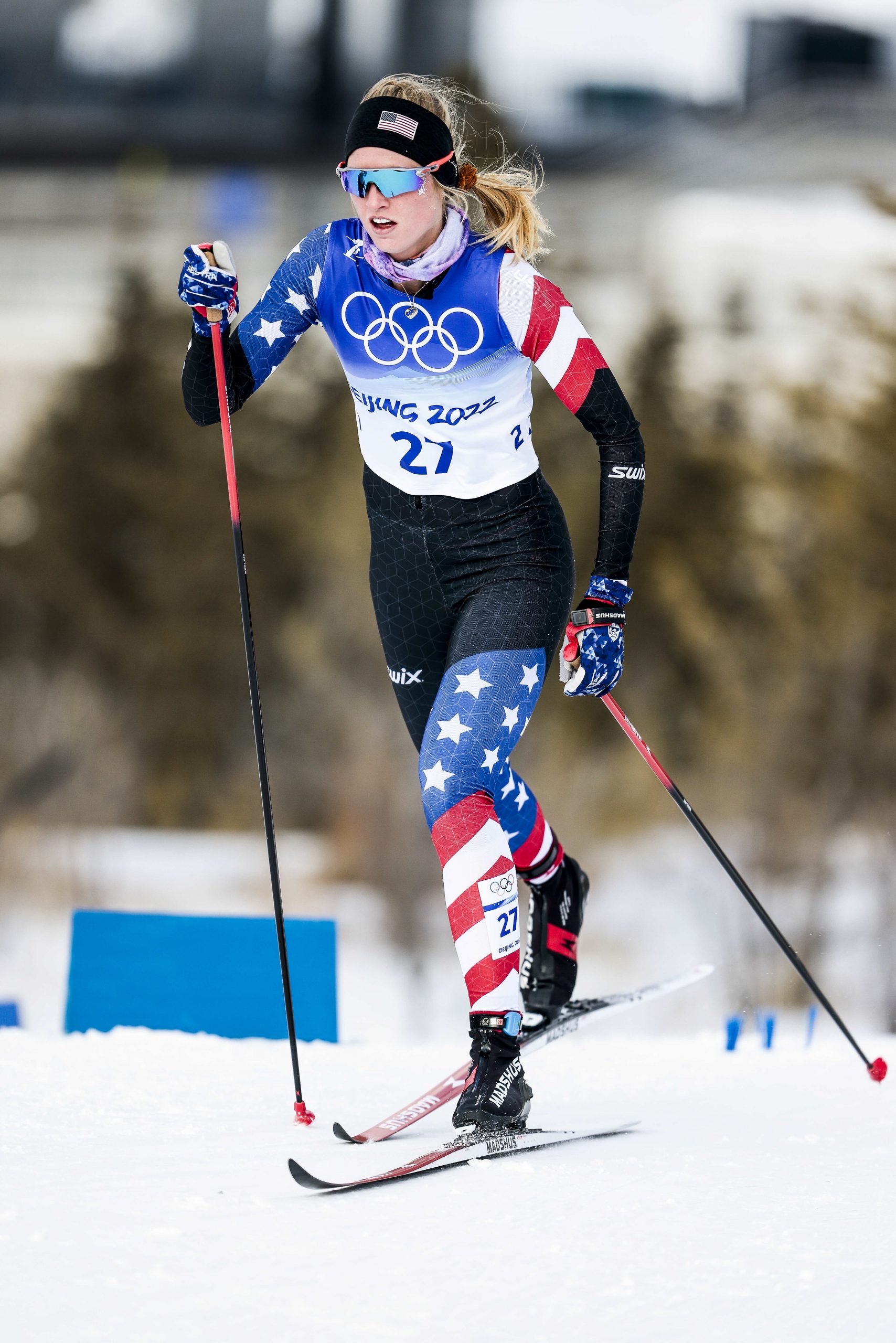
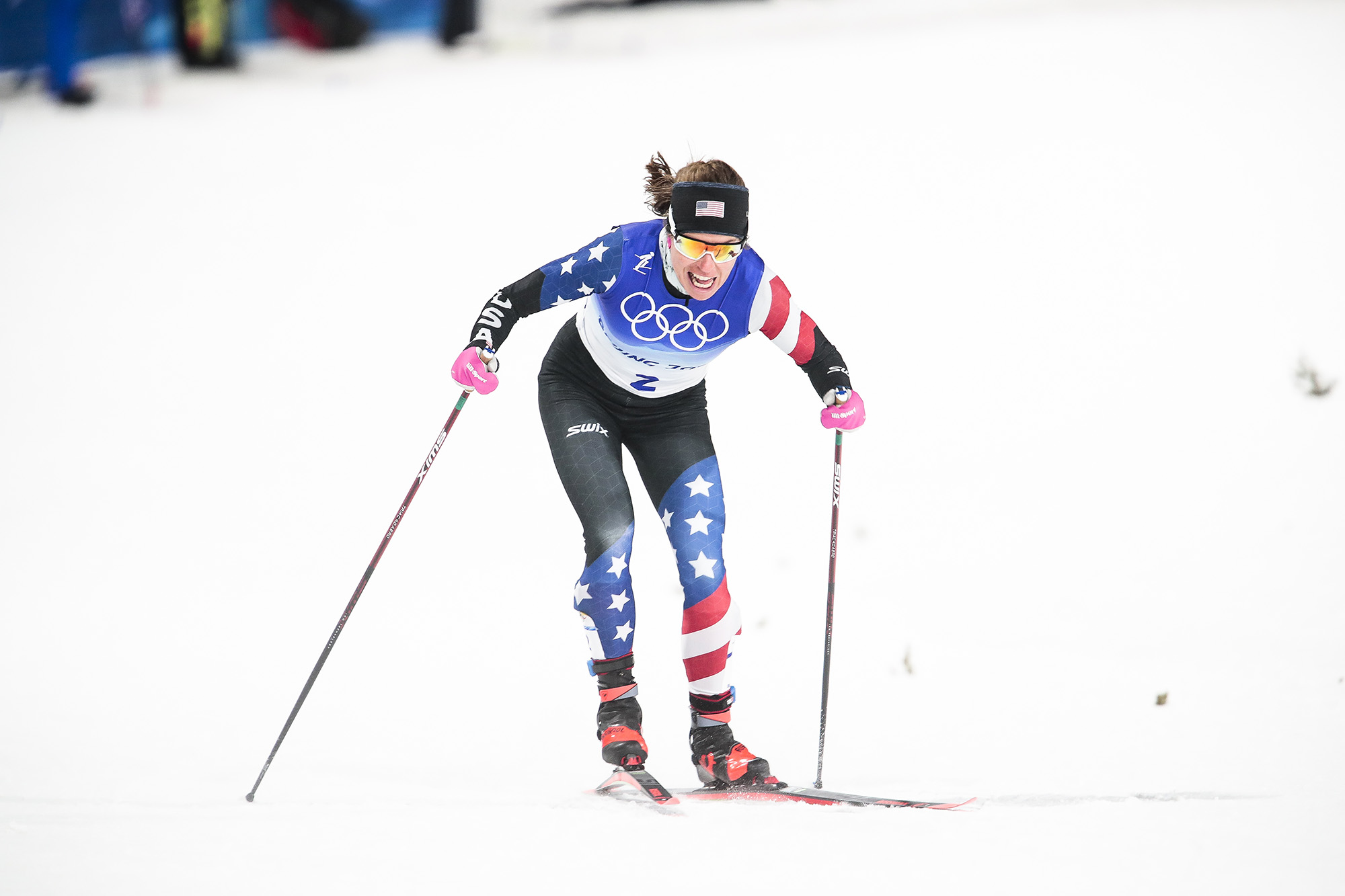
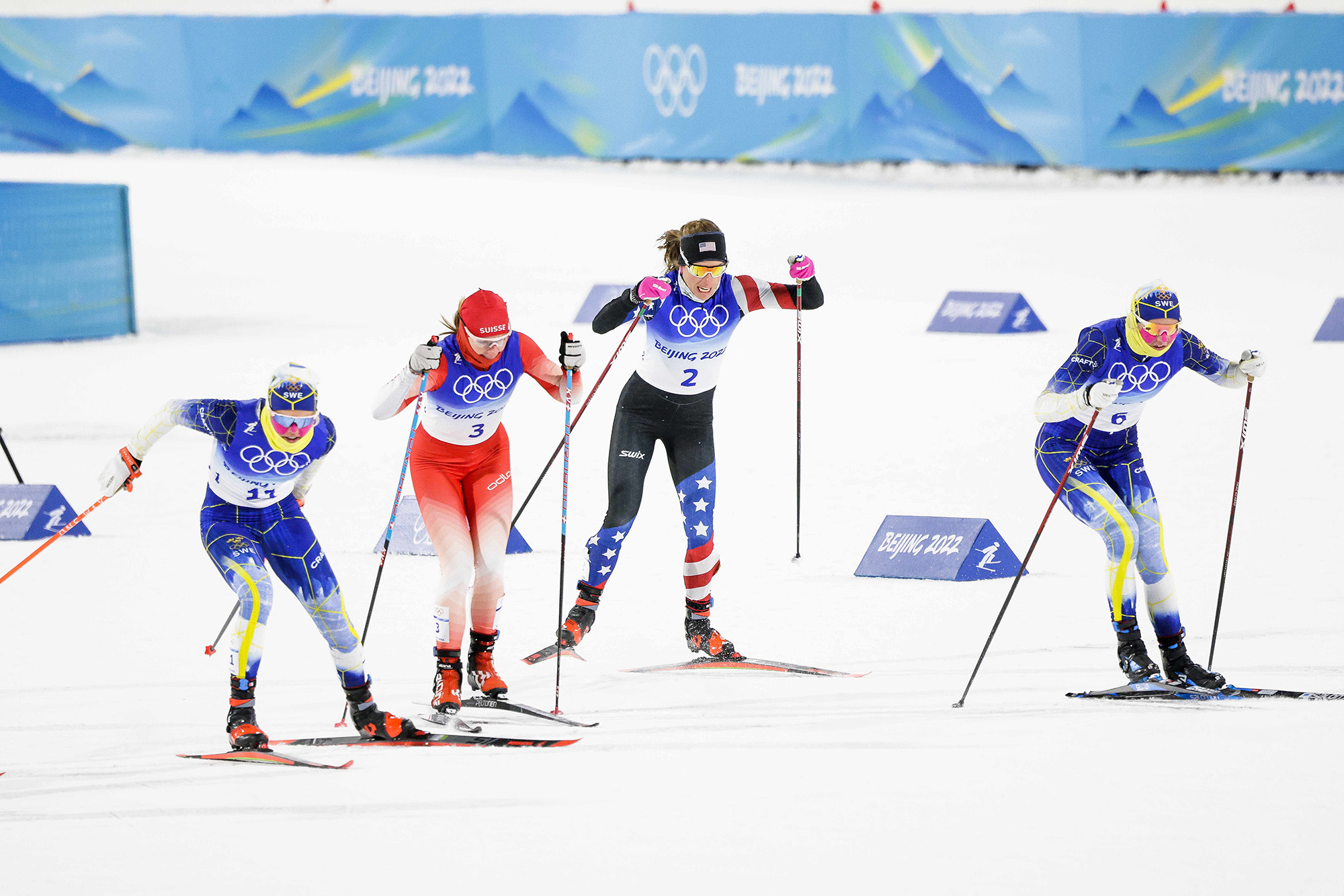
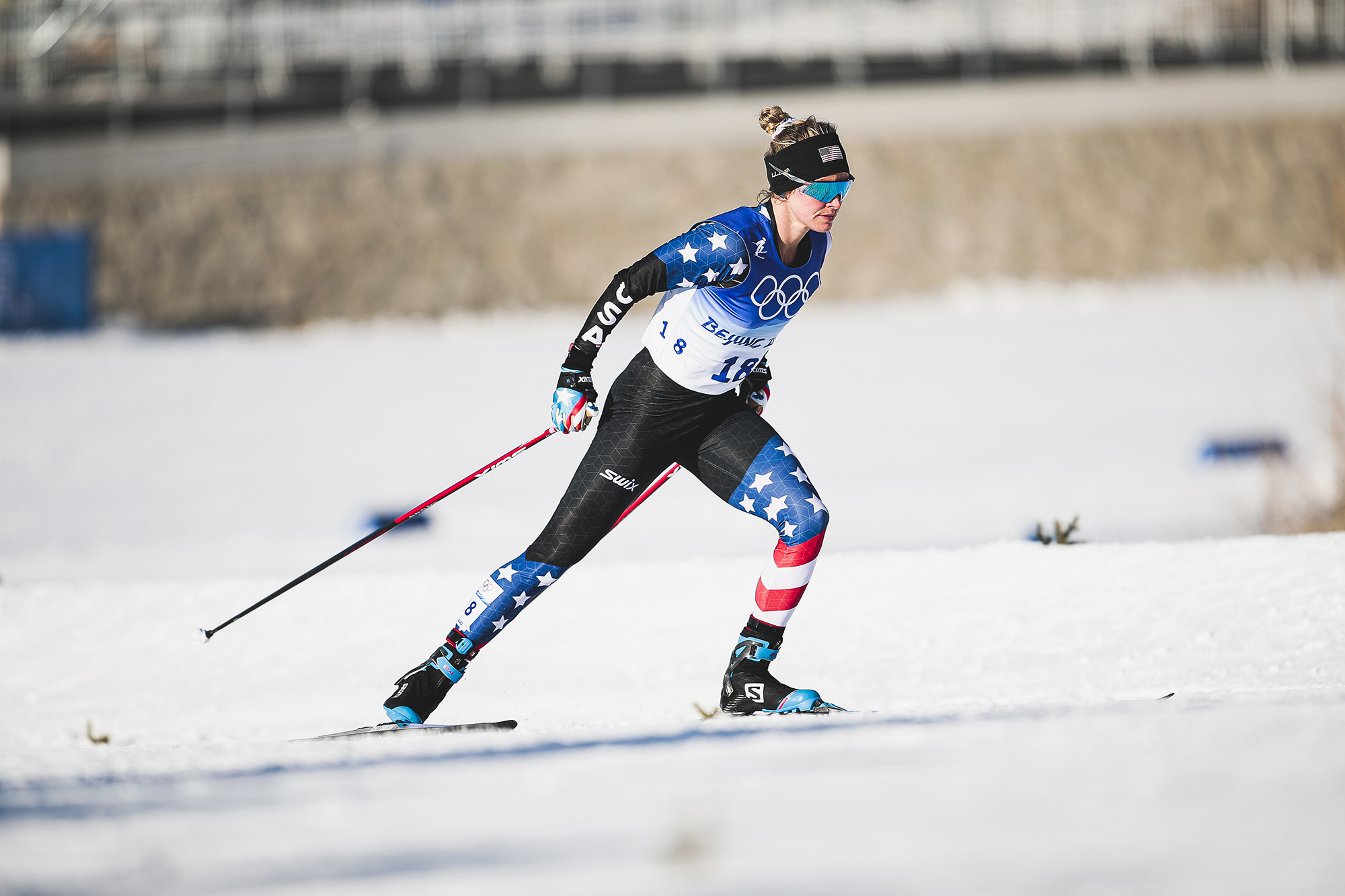
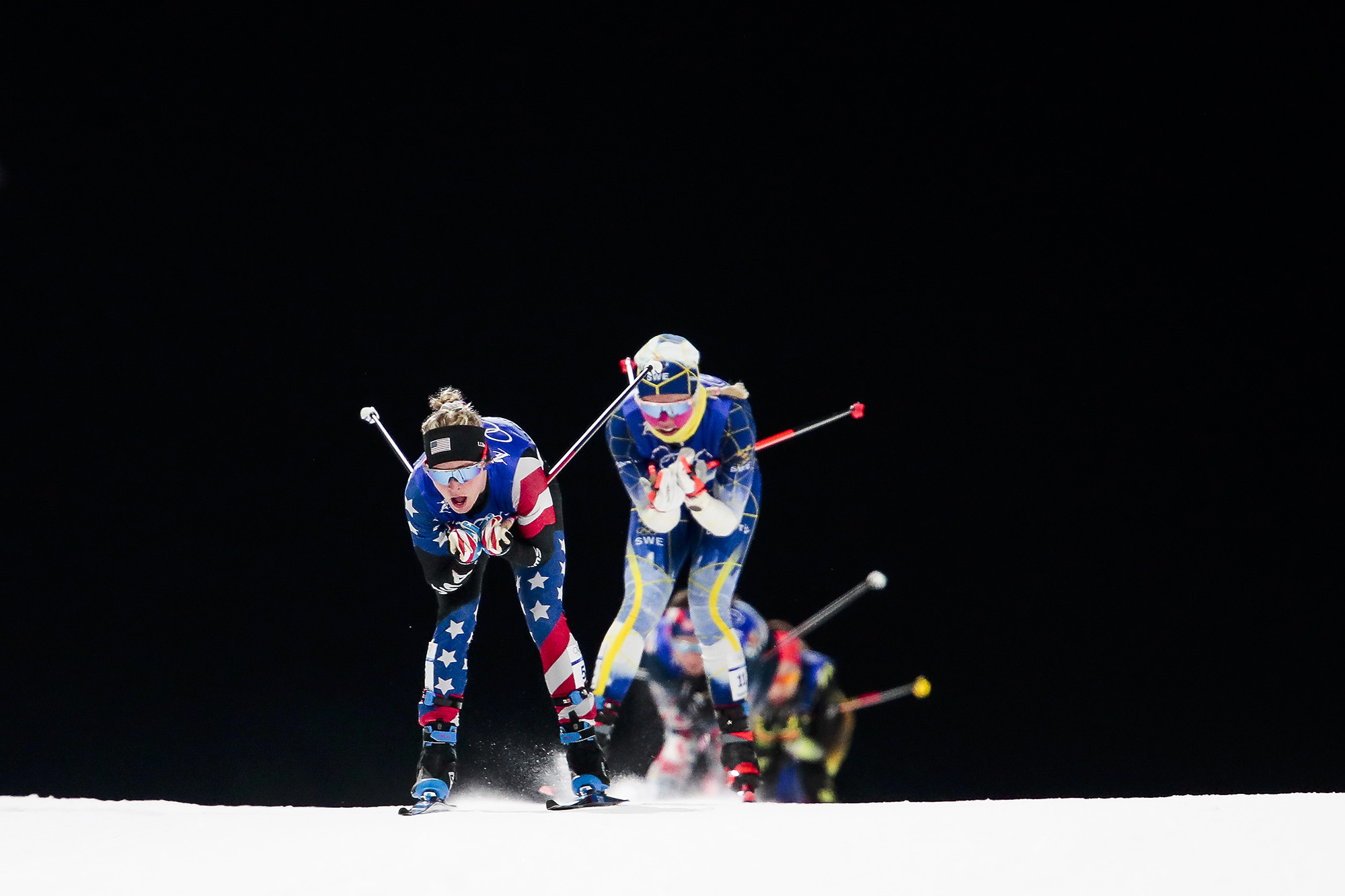
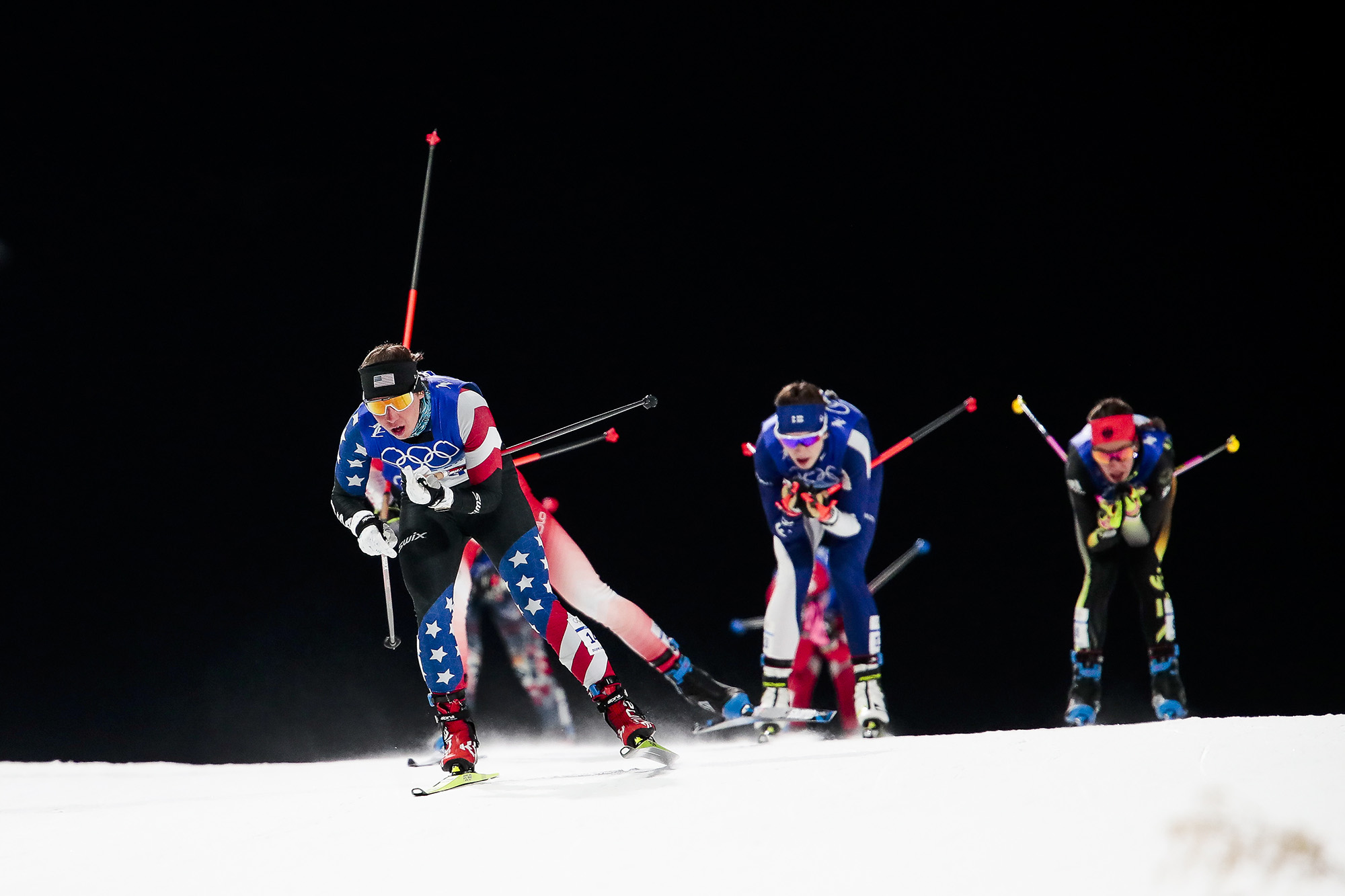
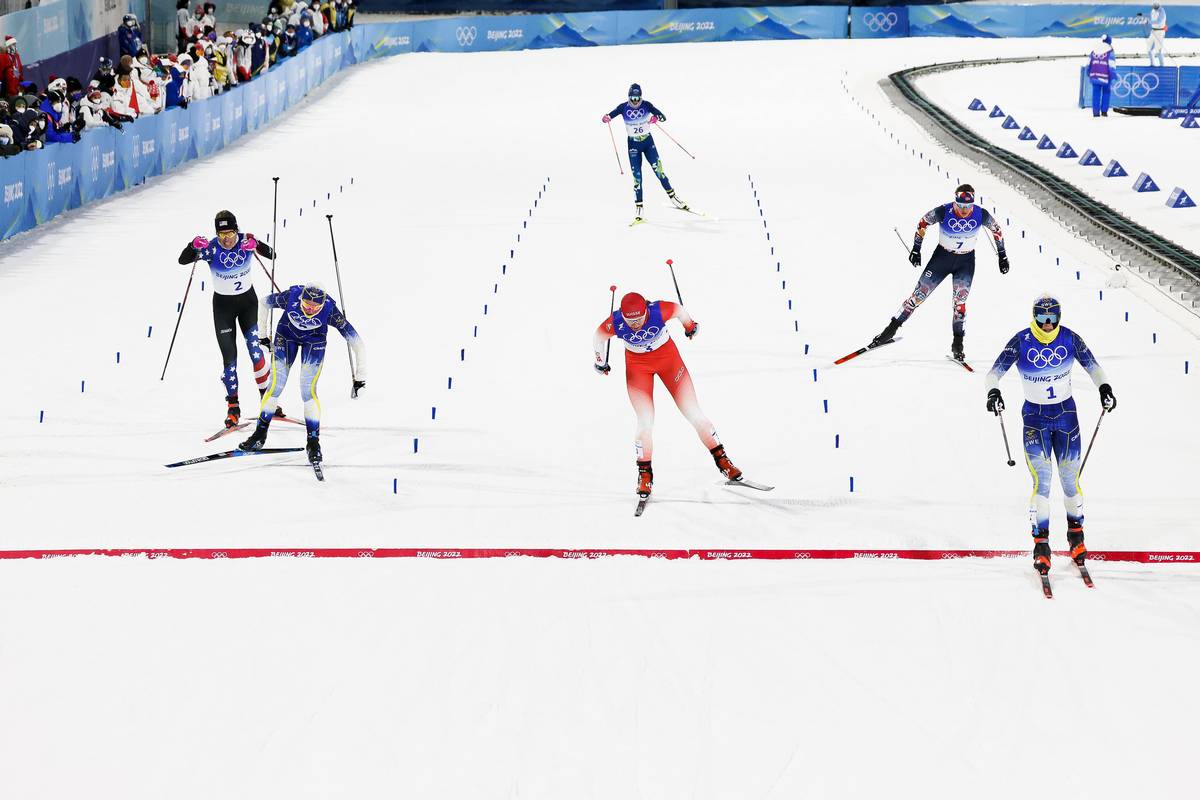
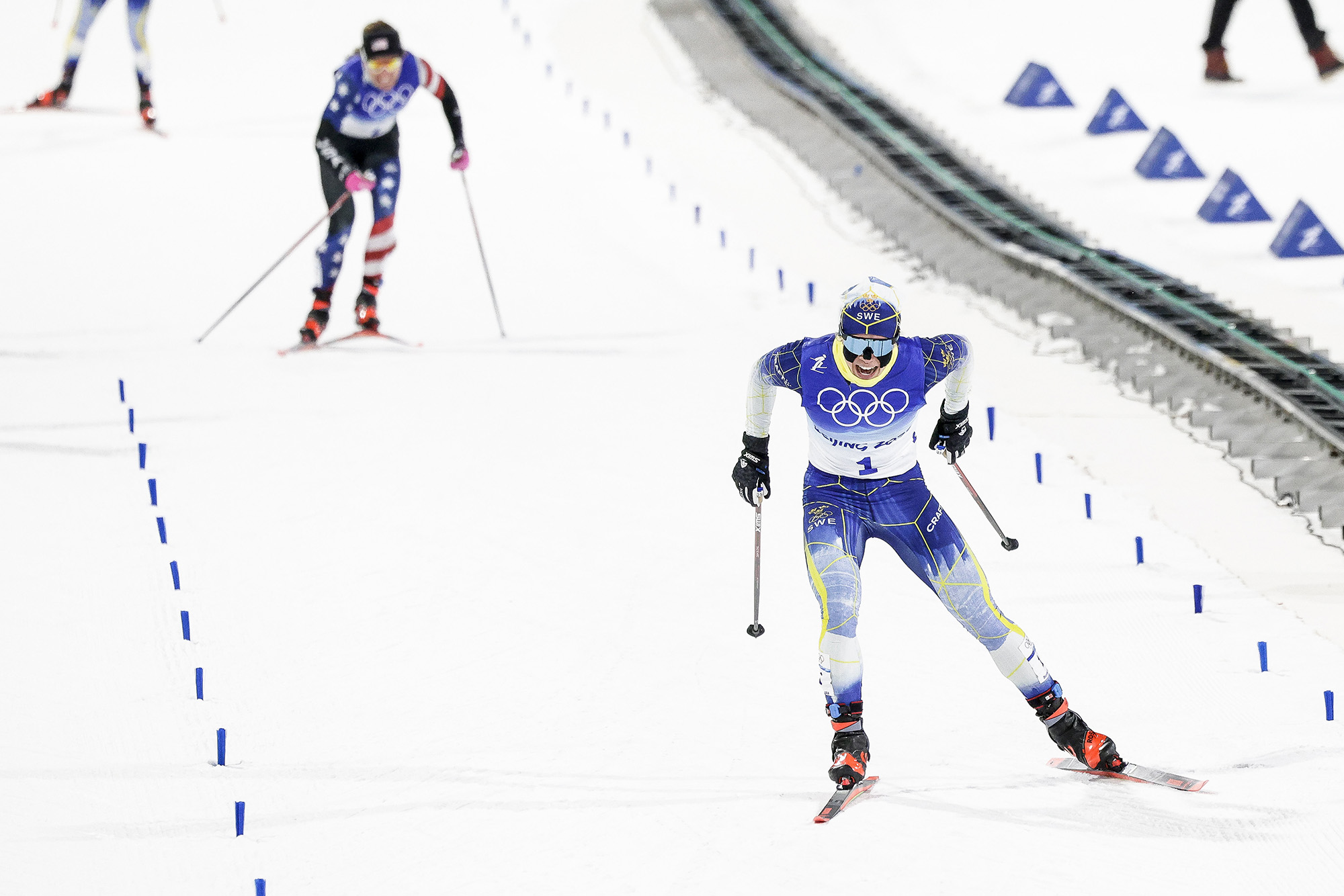
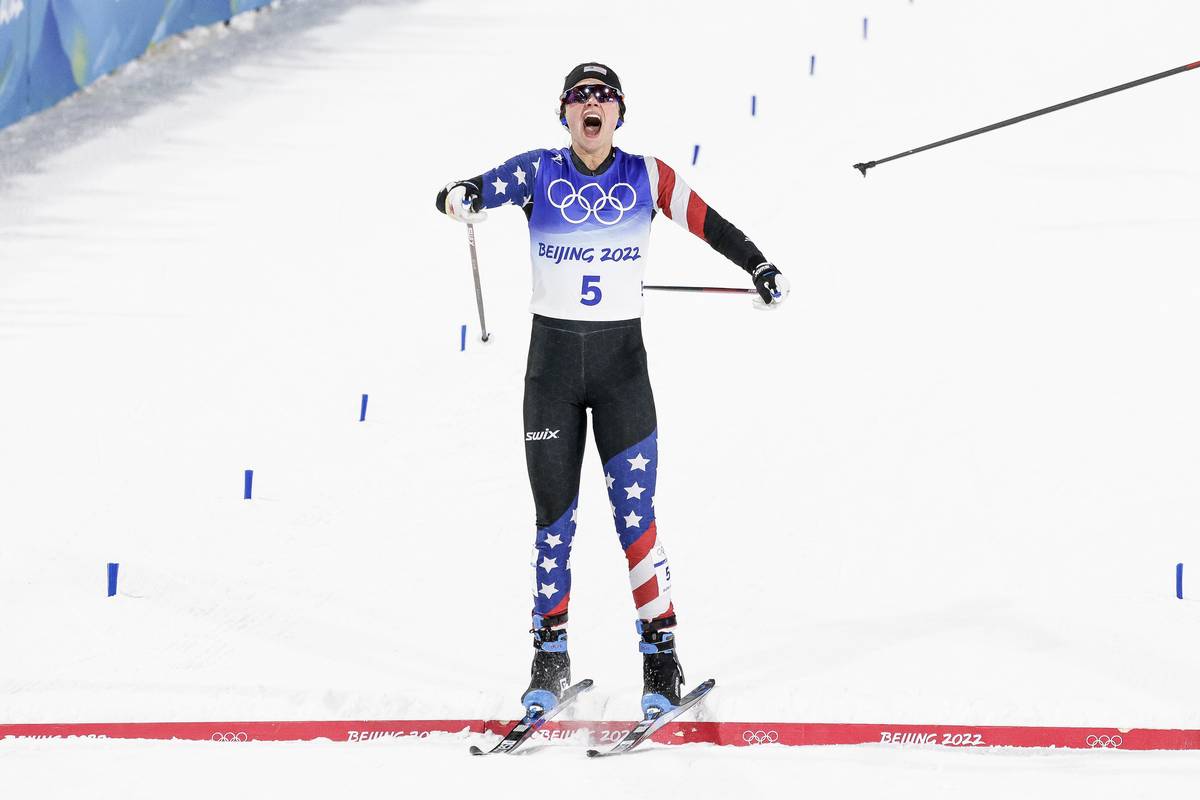
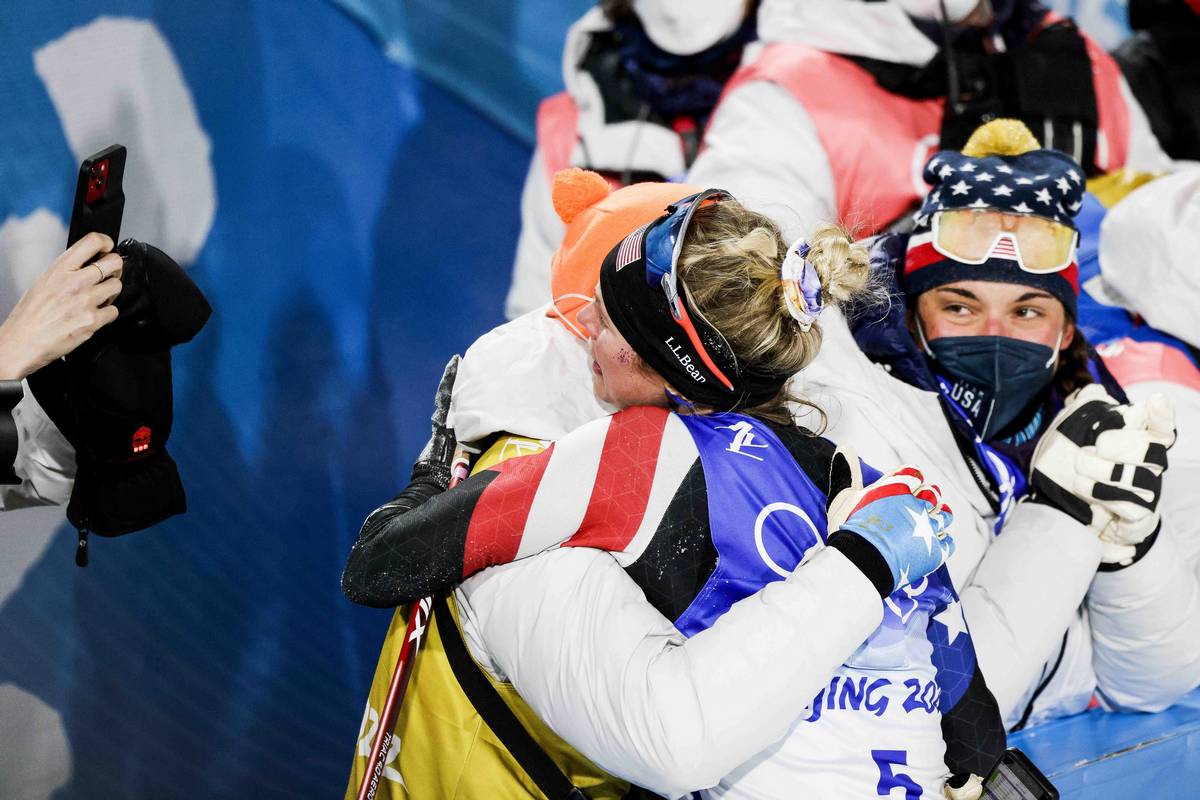
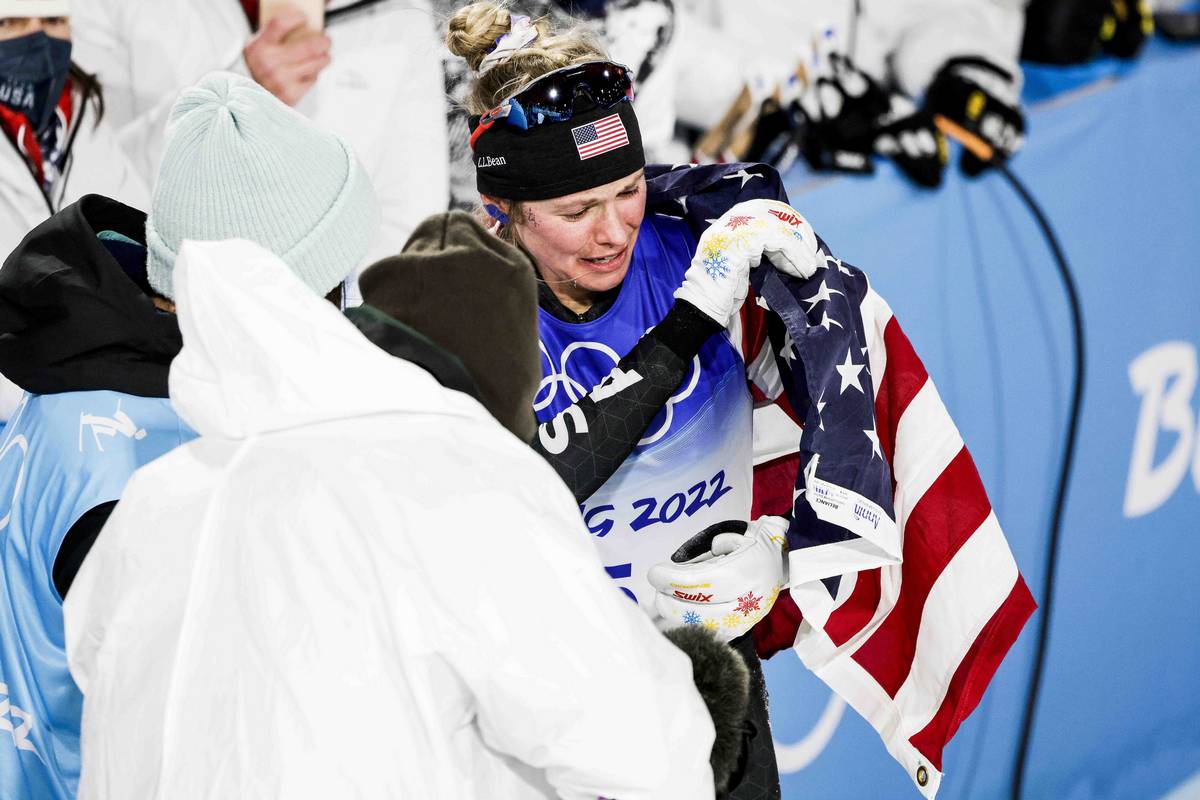
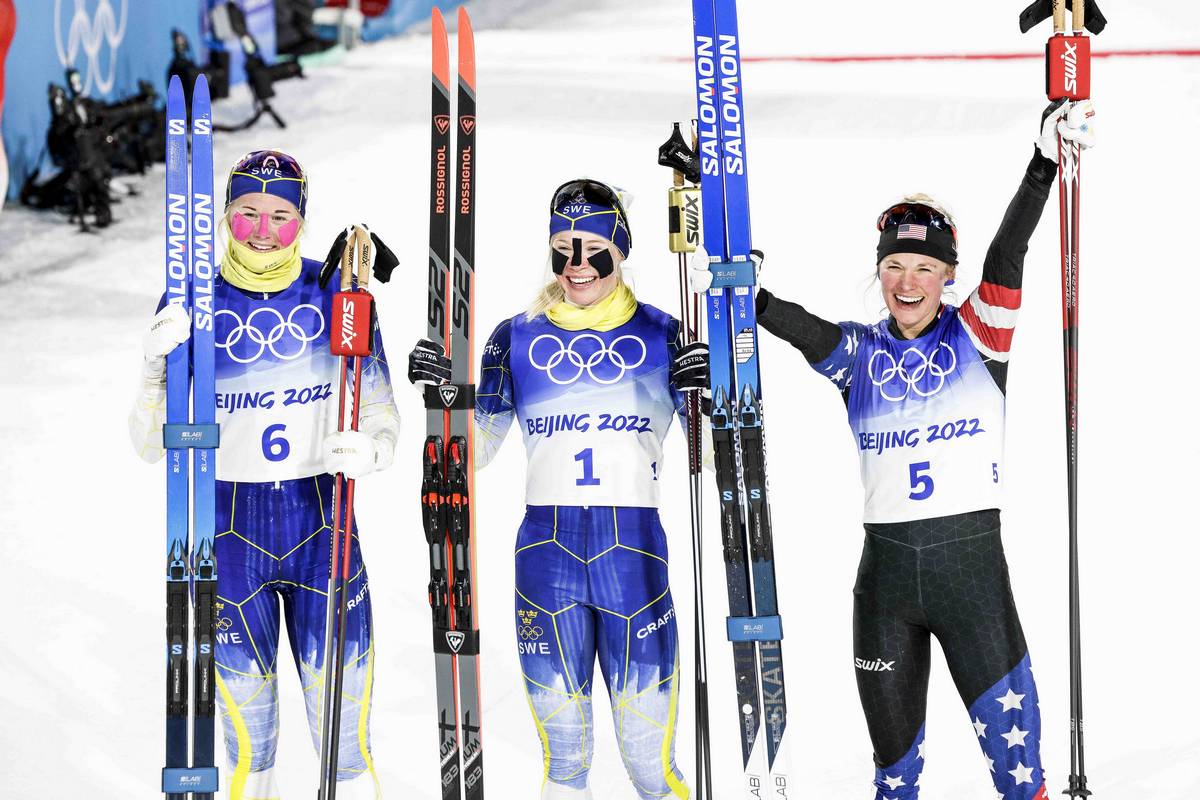
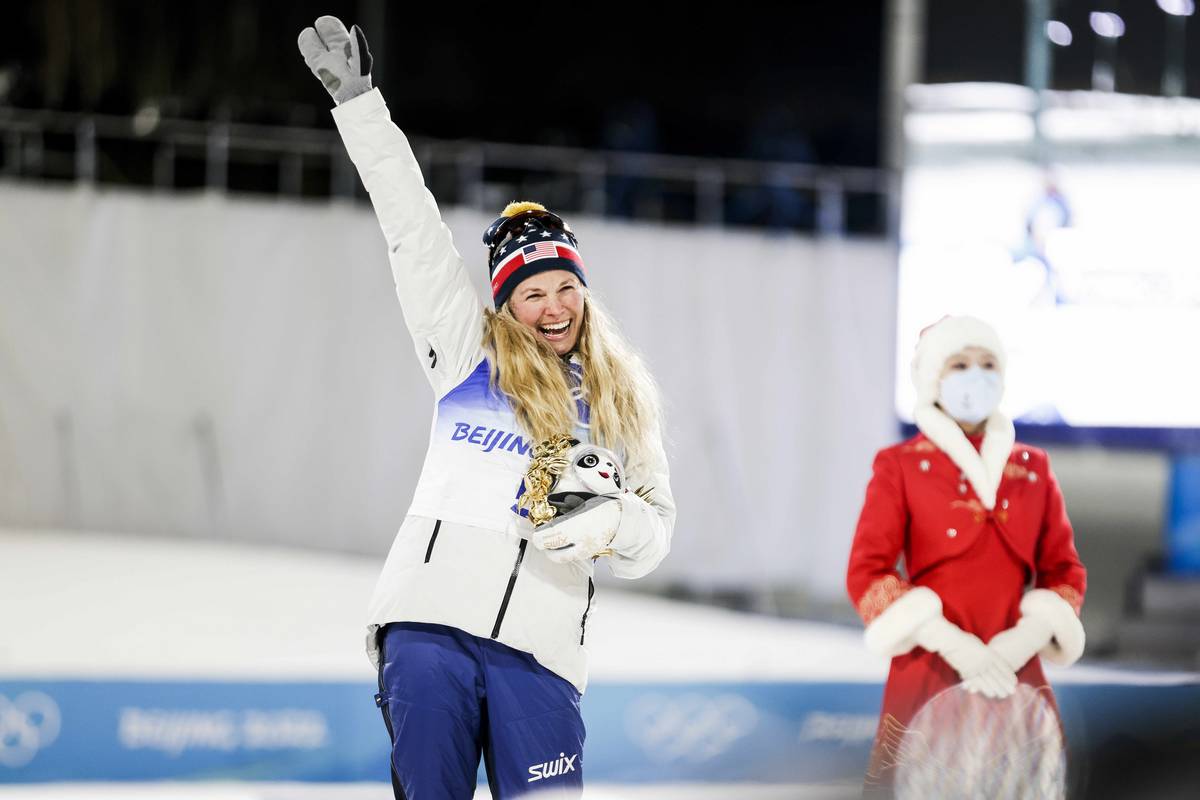
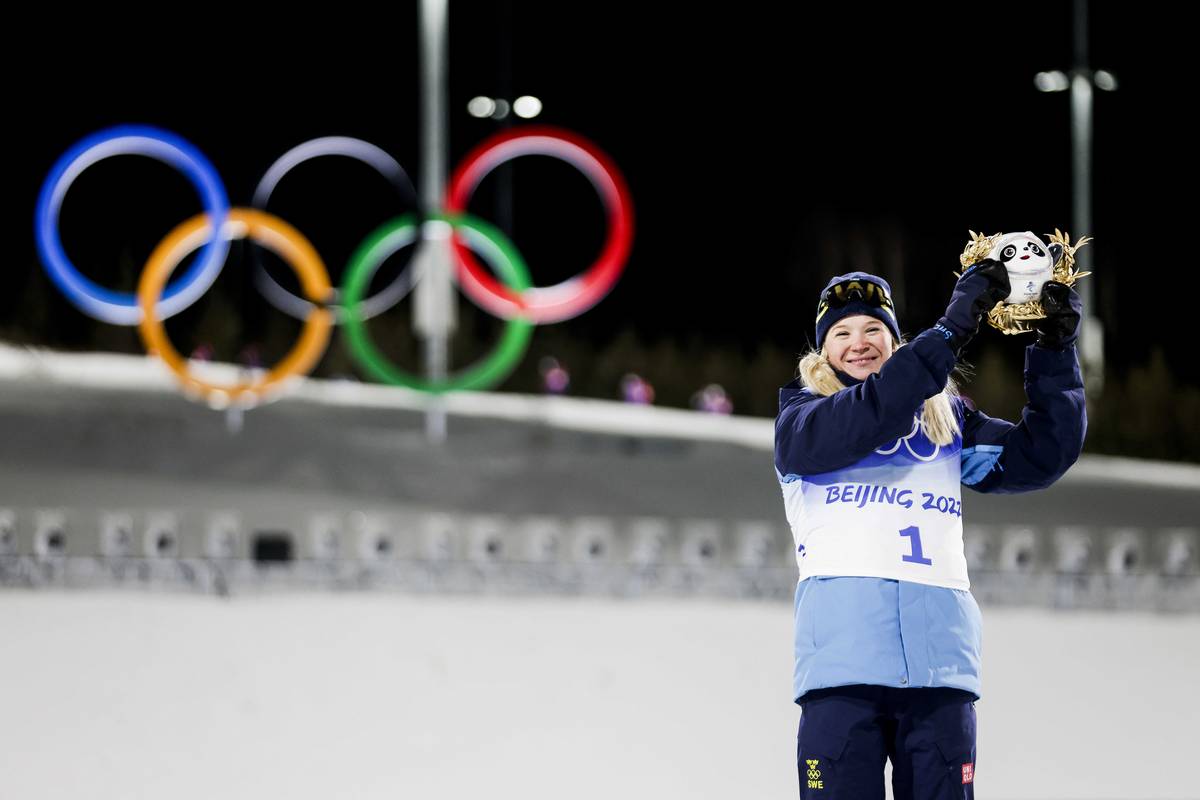
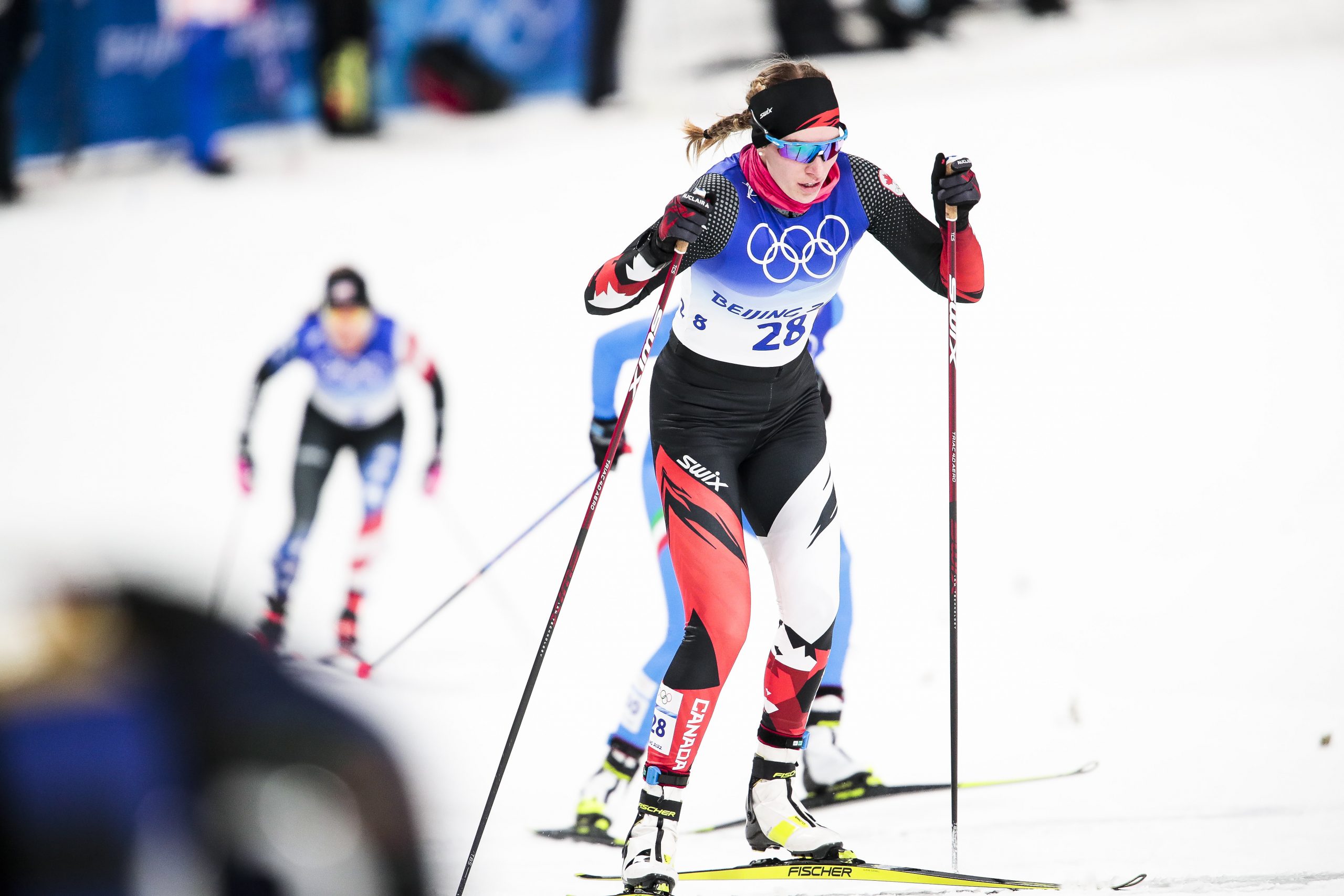
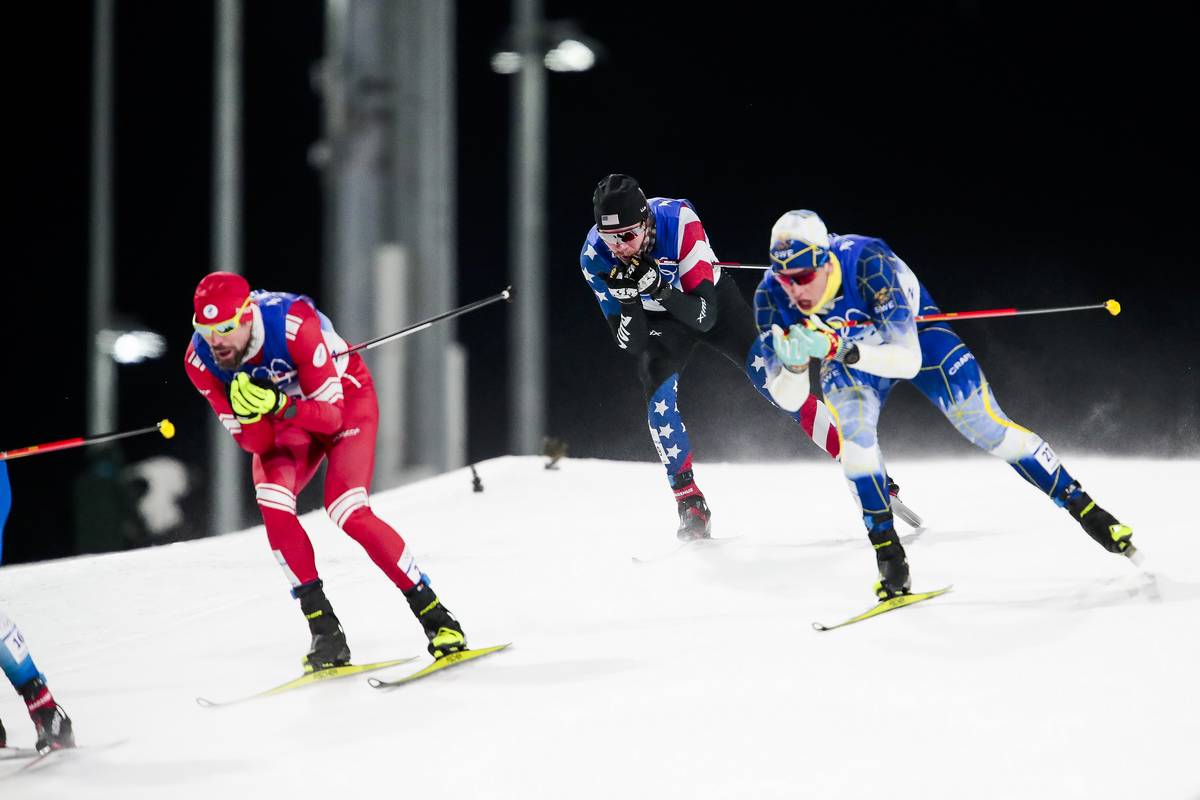
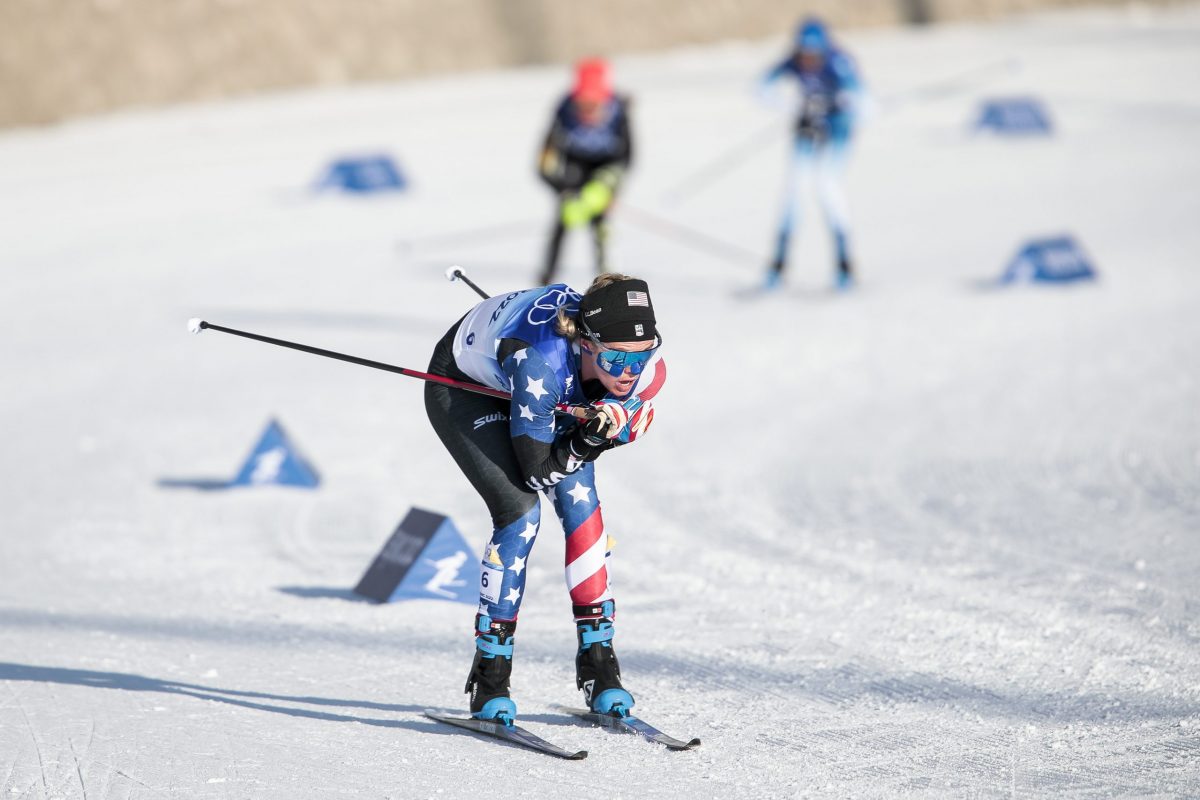
Julia Kern and US Ski Team head coach Matt Whitcomb watch the 4 x 5 k relay from the stadium. (Photo: NordicFocus)
This World Cup coverage is made possible through the generous support of Marty and Kathy Hall and the A Hall Mark of Excellence Award. To learn more about A Hall Mark of Excellence Award or to learn how you can support FasterSkier’s coverage pleasecontact info@fasterskier.com.
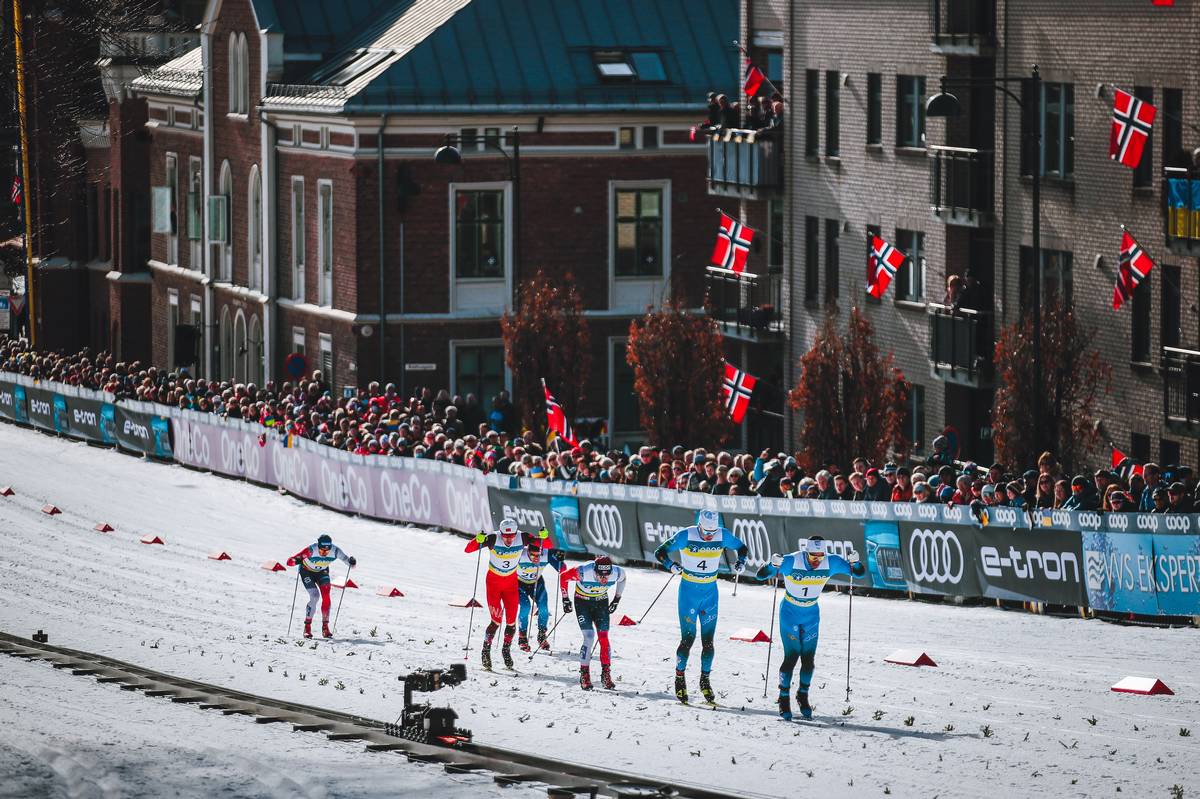
While it was perhaps not the final event originally planned for the season, today’s 4 x 5-kilometer freestyle mixed relay in Falun, Sweden shaped up to be quite a way to go out. Particularly for Team USA, who broke away in the final lap to take the win in 42:01.8.
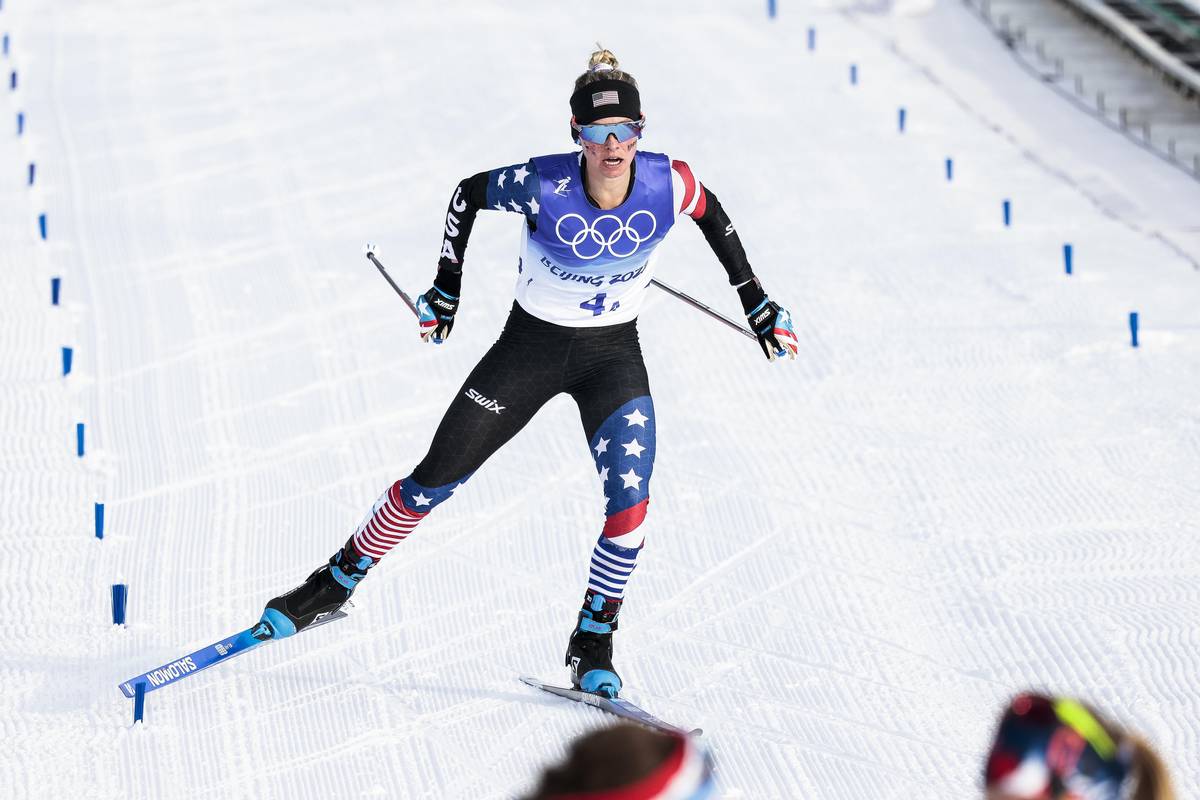
With Rosie Brennan scrambling to tag Zak Ketterson for the second leg, Scott Patterson skating third, and Jessie Diggins anchor, it was a team composed of four skiers who had all raced into the top-15 in yesterday’s 10/15 k skate, three within the top-eight. Perhaps the only team more loaded was Norway 1, which featured Heidi Weng, Hans Christer Holund, Didrik Tønseth, and Therese Johaug, all of whom placed in the top-five yesterday, including both of the day’s winners in the final two relay spots. Also a force, Finland I consisted of three Olympic medalists, one of whom is the 2022 men’s World Cup distance champion with the lineup: Kerttu Niskanen, Perttu Hyvarinen, Iivo Niskanen, and Krista Pärmäkoski.
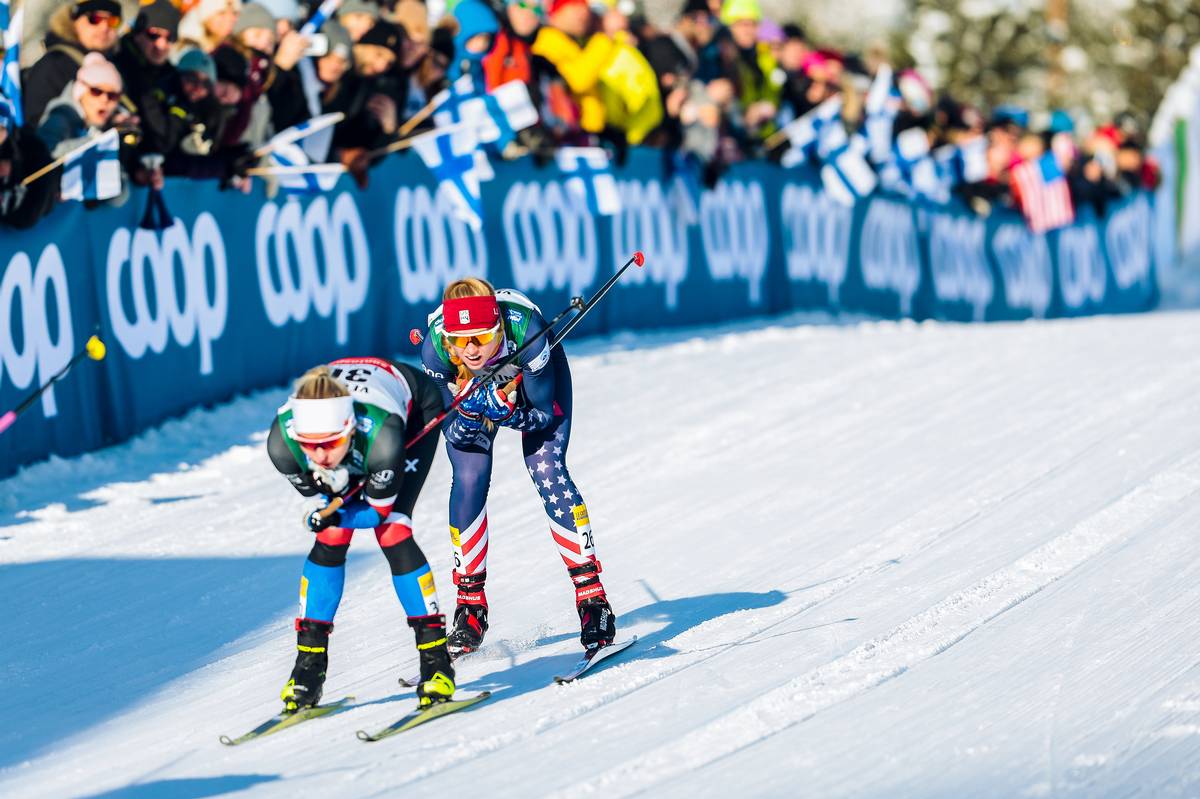
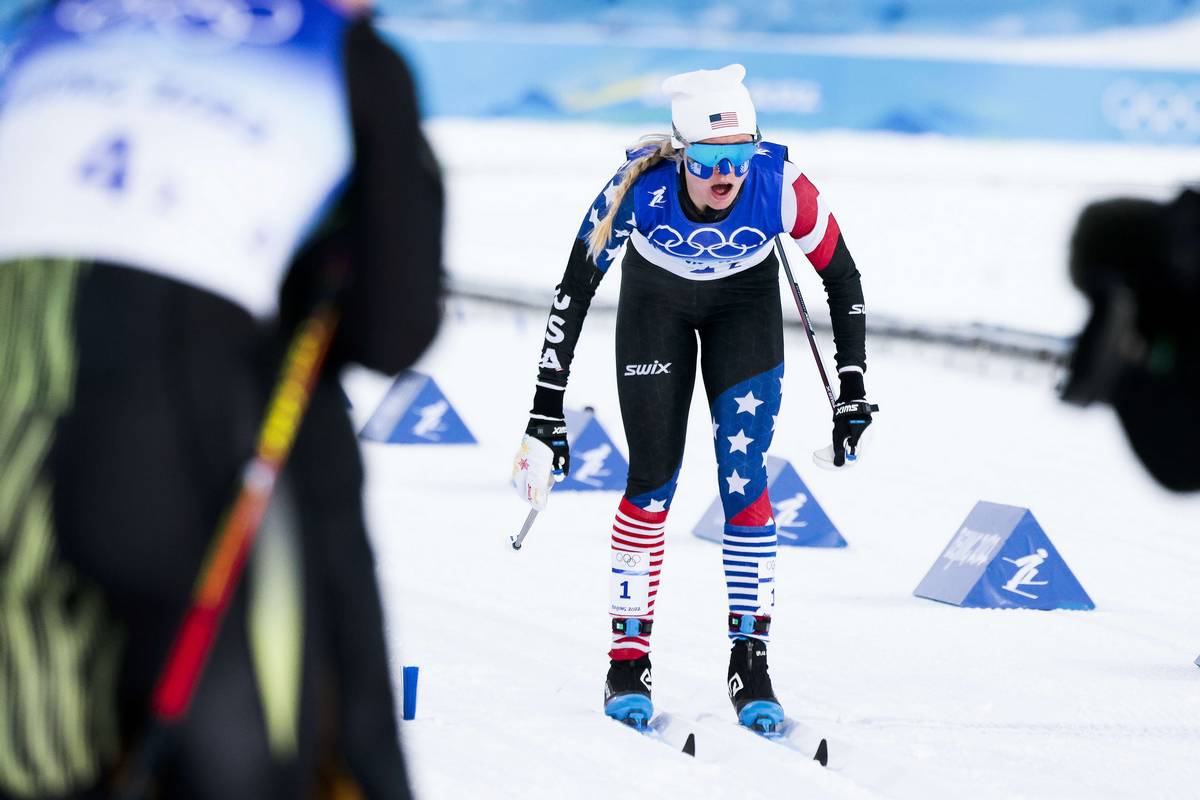
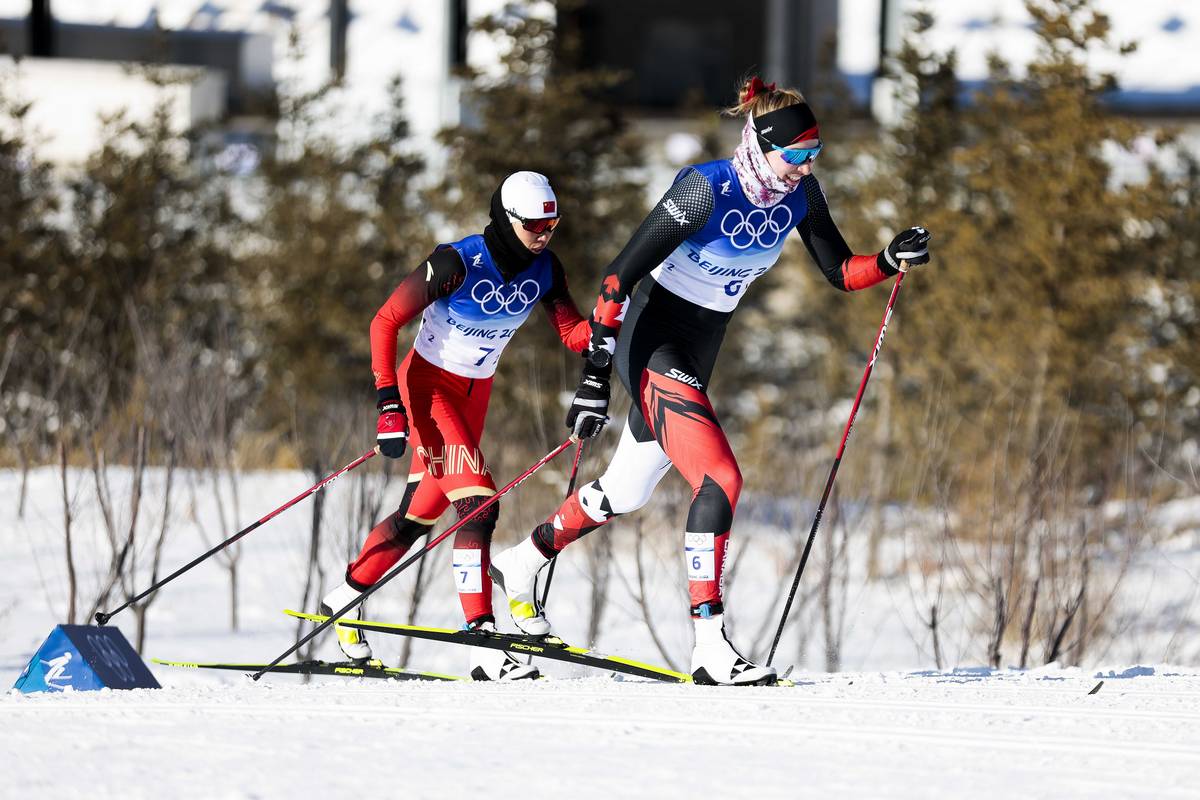
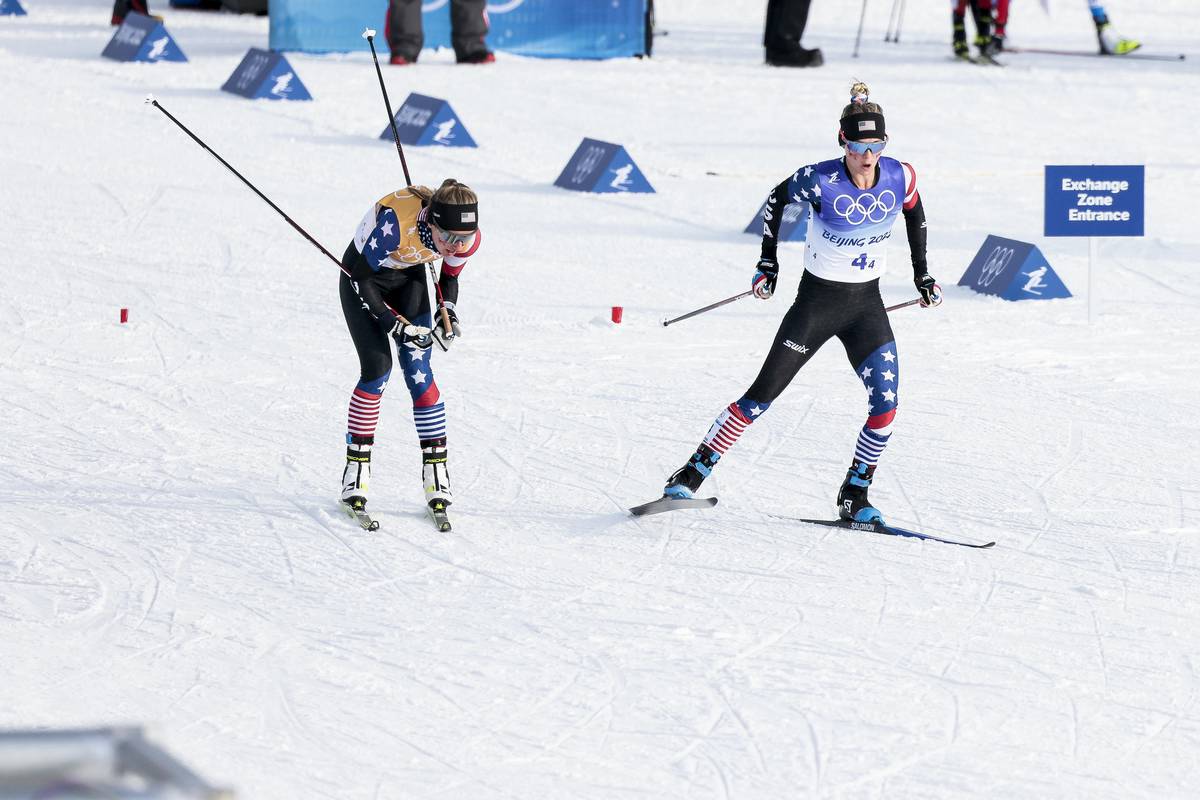
Each nation was allowed two teams, allowing the US to start a second lineup of Julia Kern, Logan Hanneman, Adam Martin, and Caitlin Patterson. Canada raced one team, which included Katherine Stewart-Jones, Antoine Cyr, Philippe Boucher, and Jasmine Drolet, racing in that order.
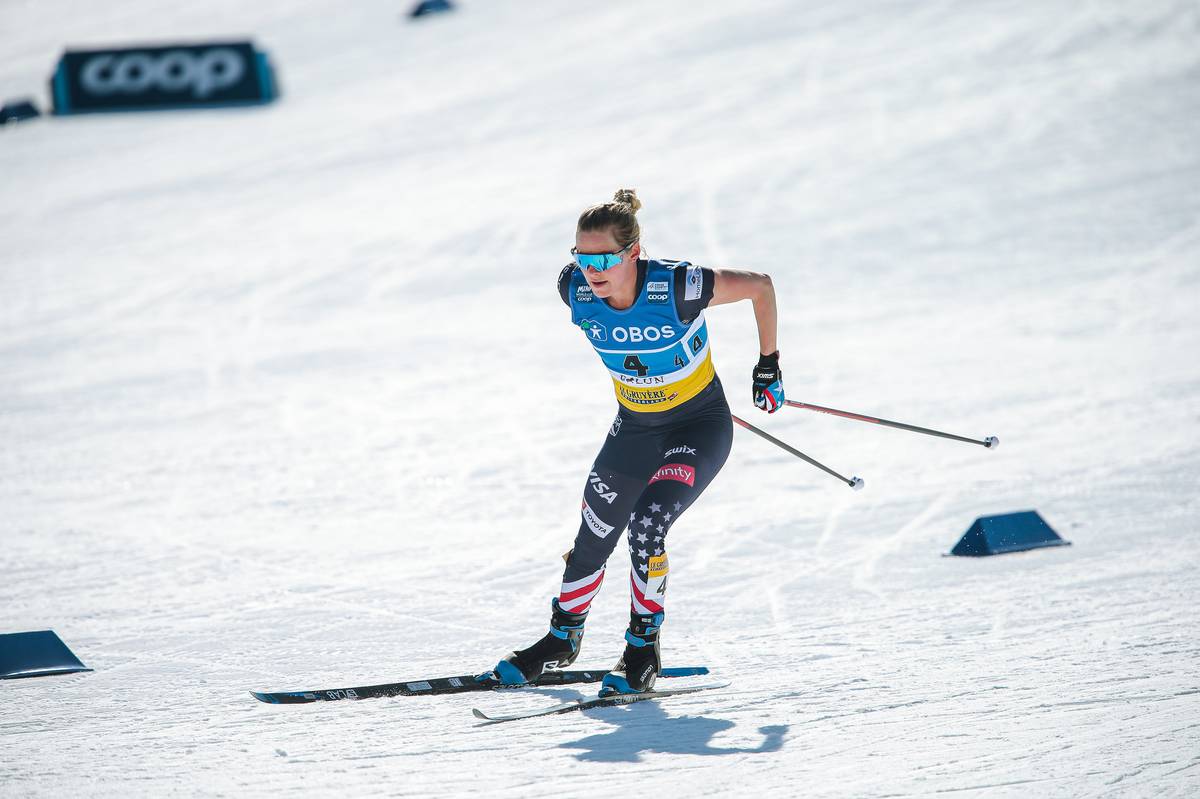
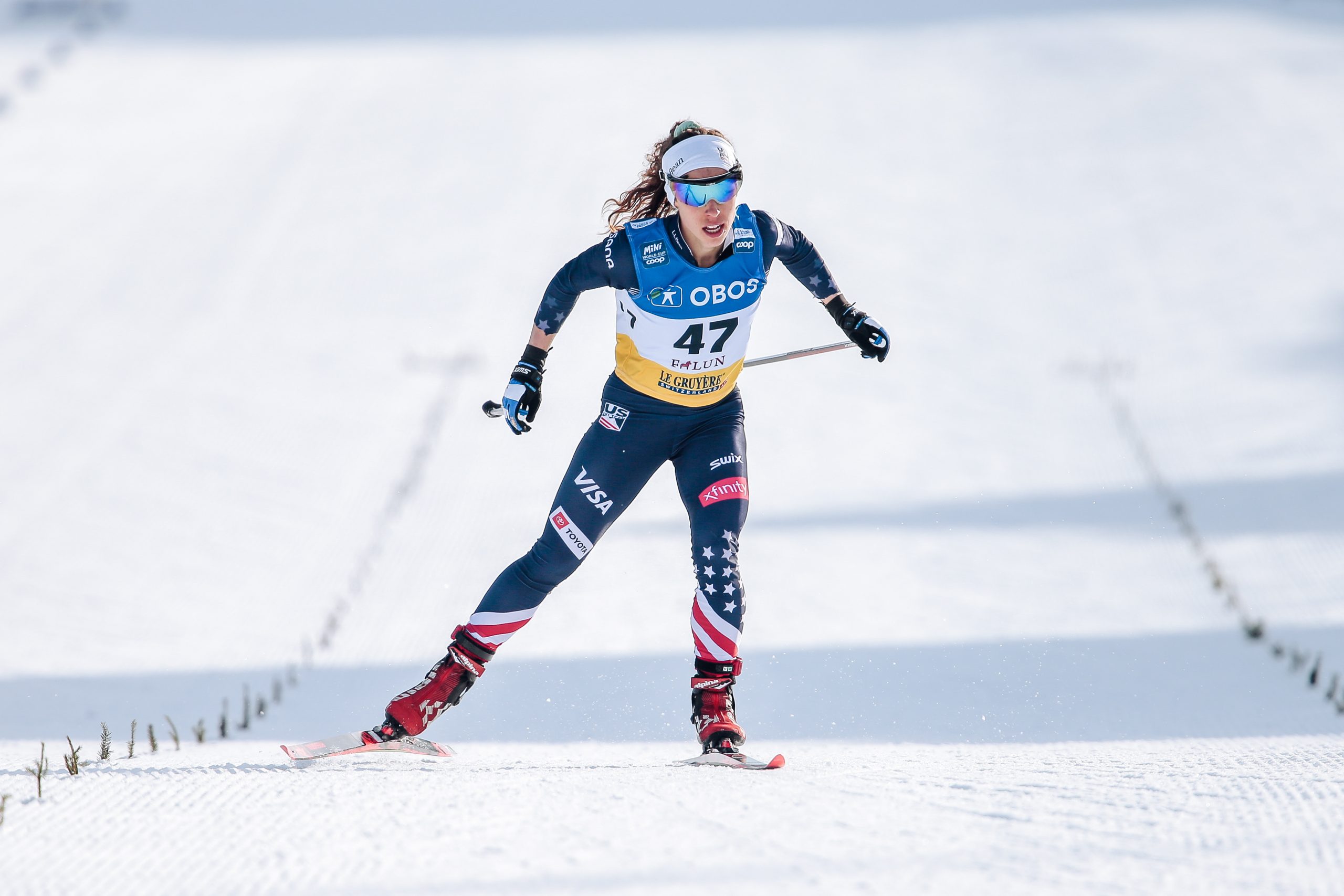
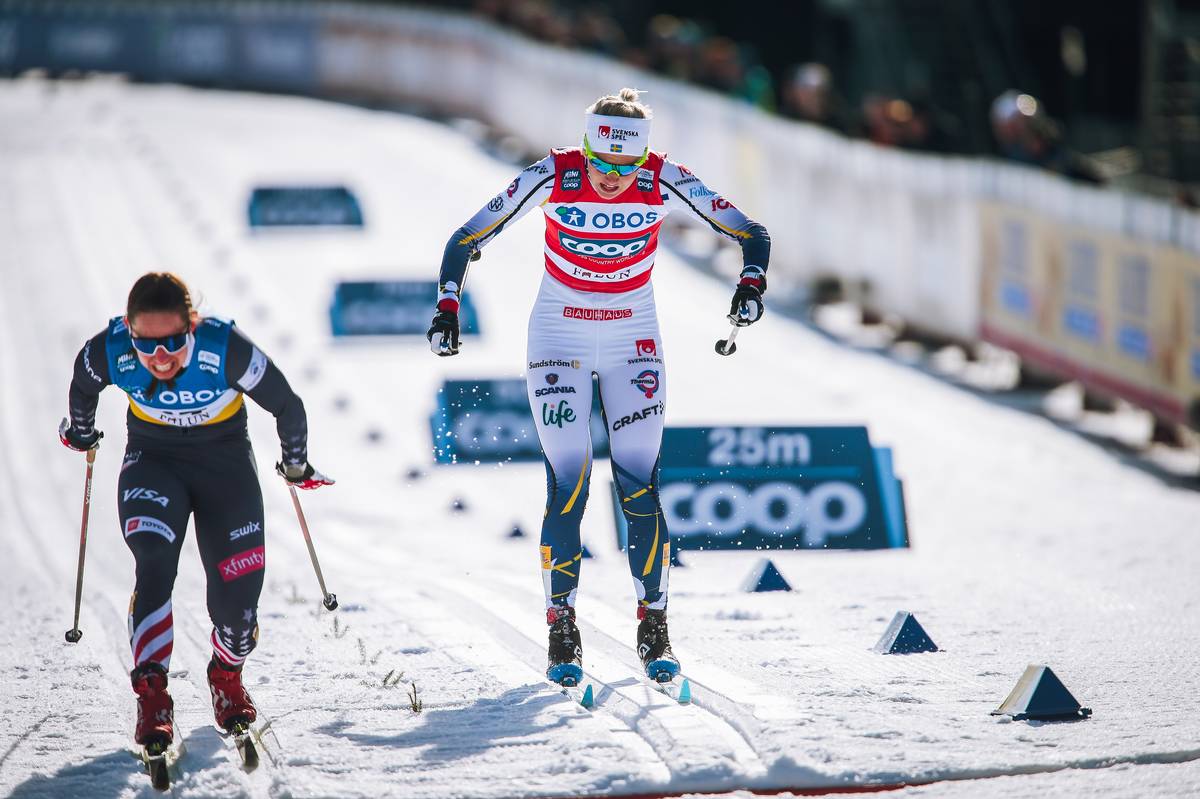
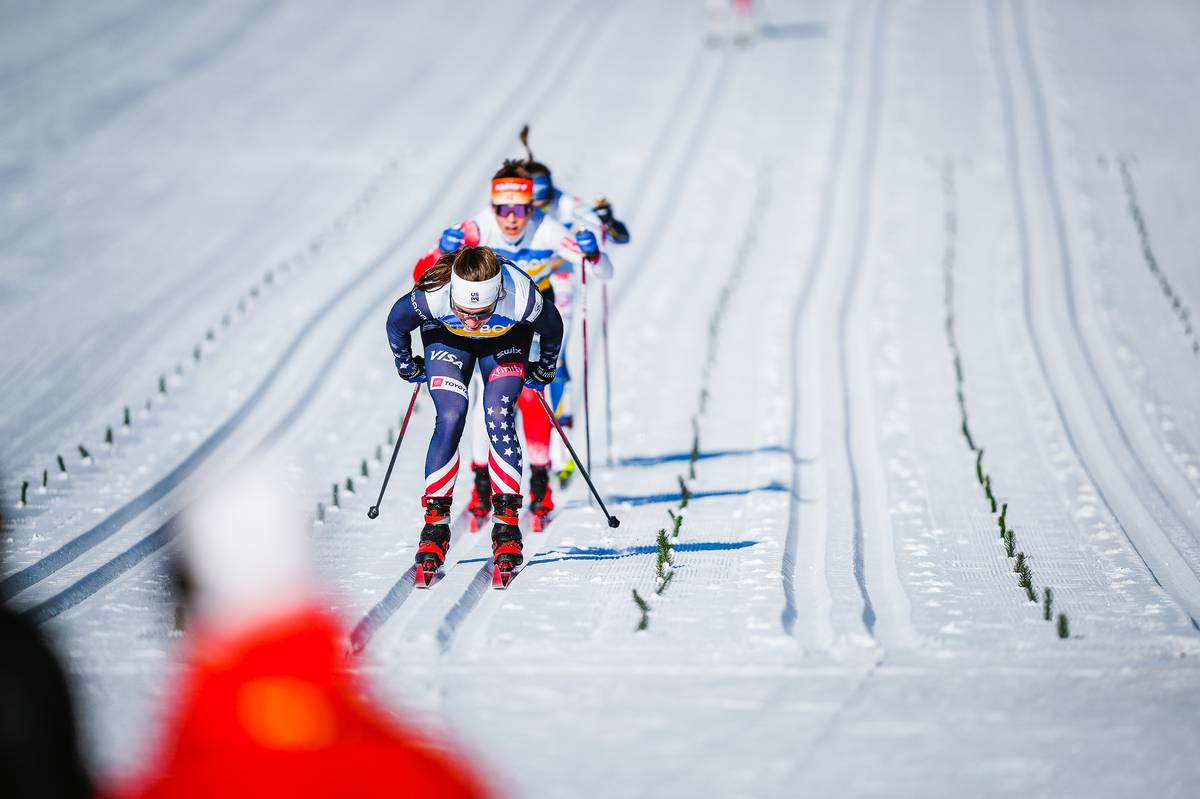
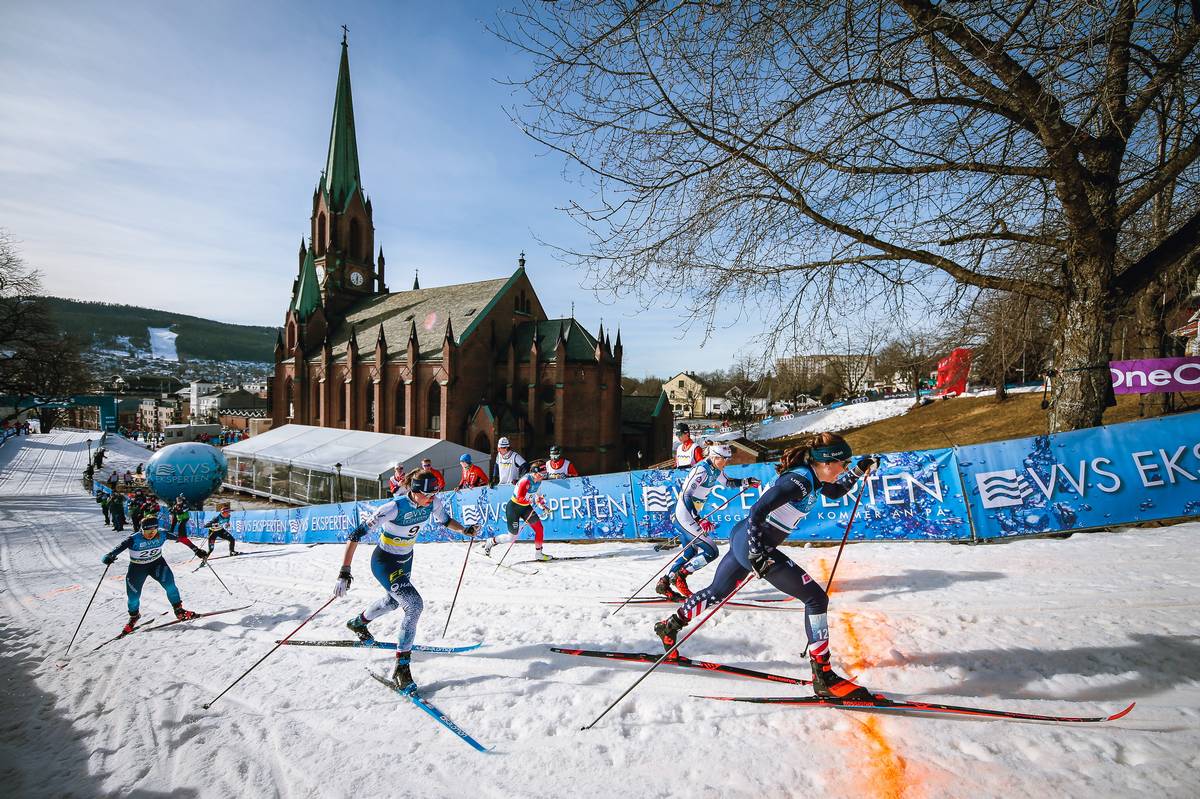
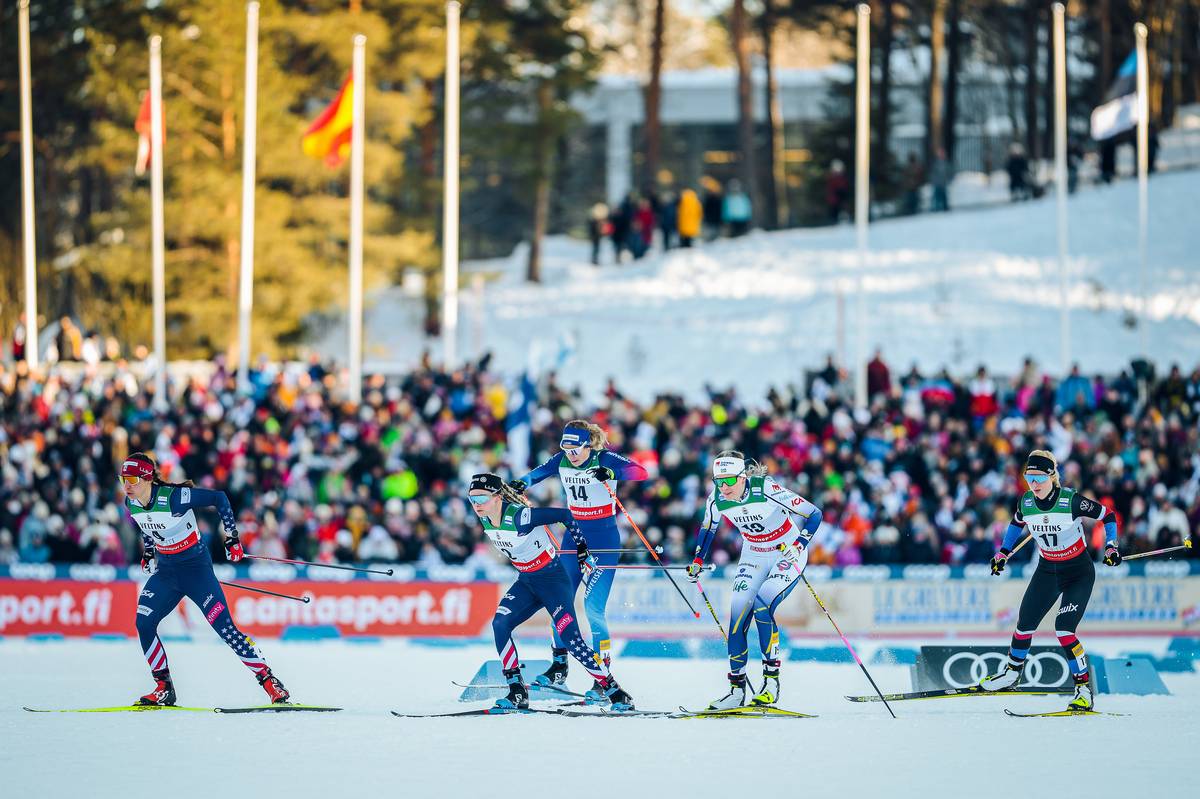
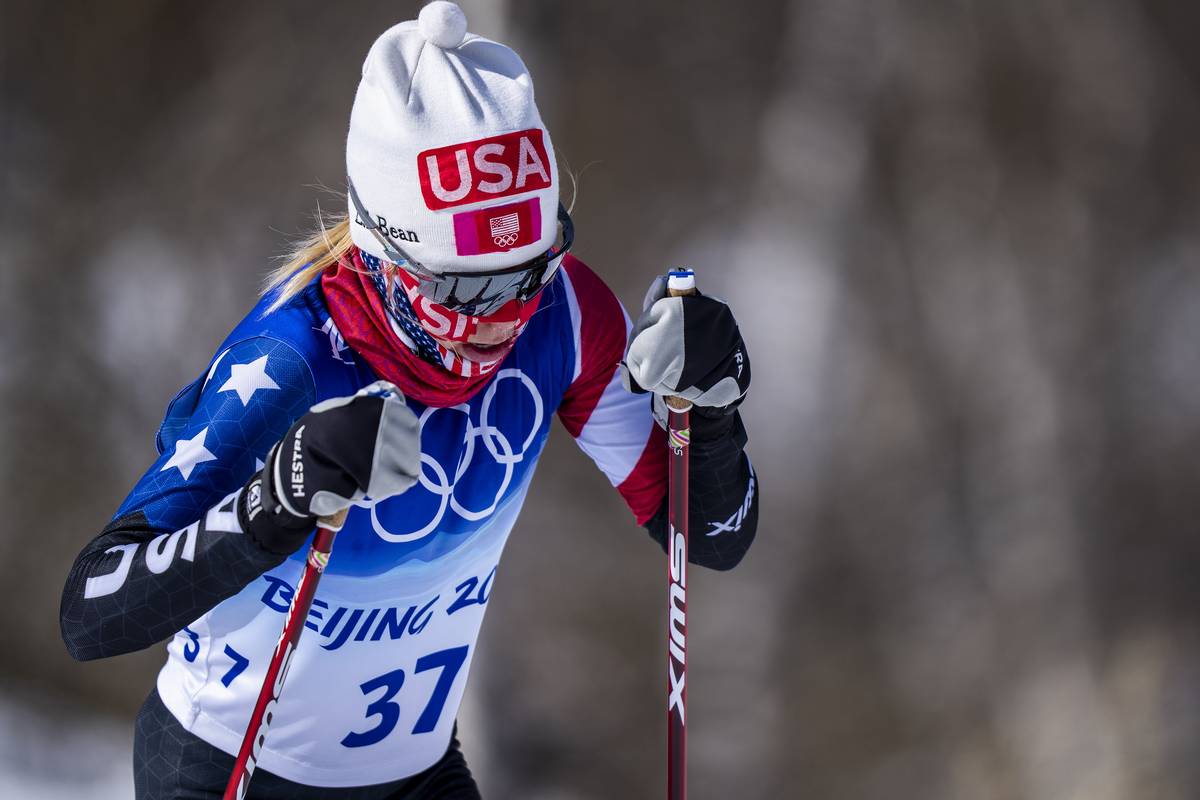
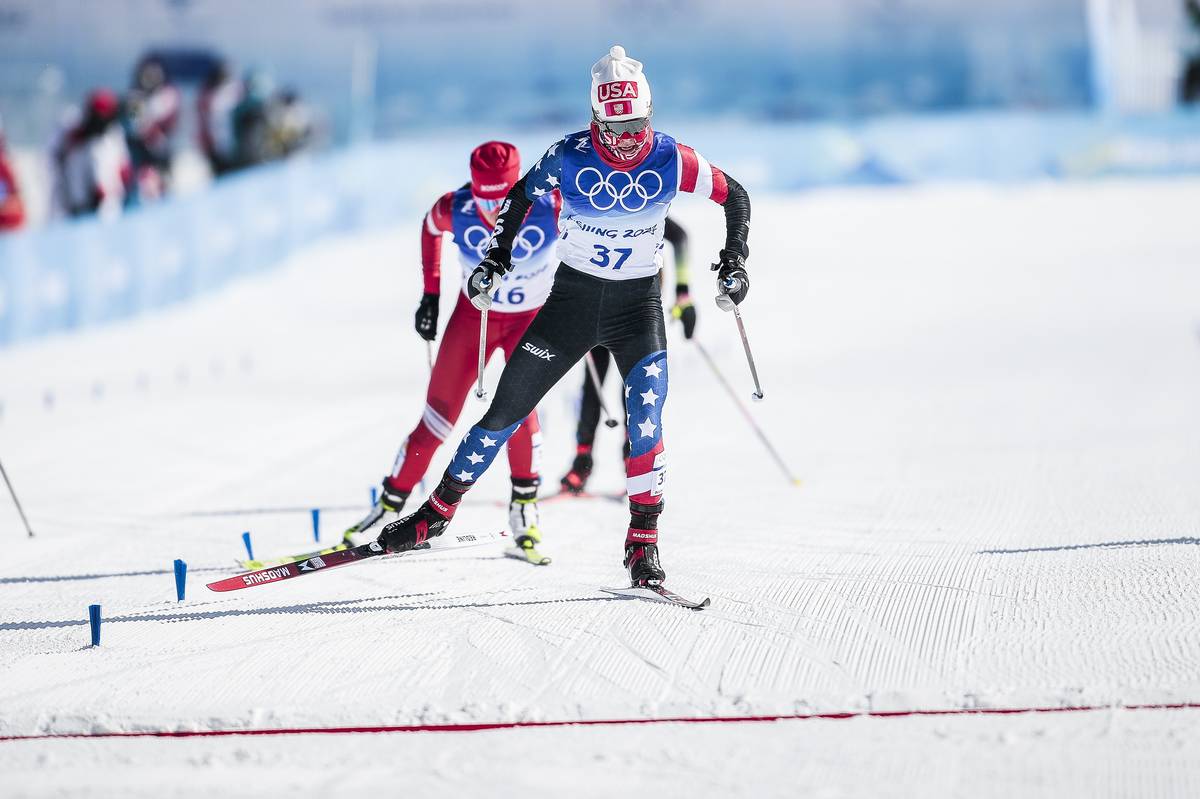
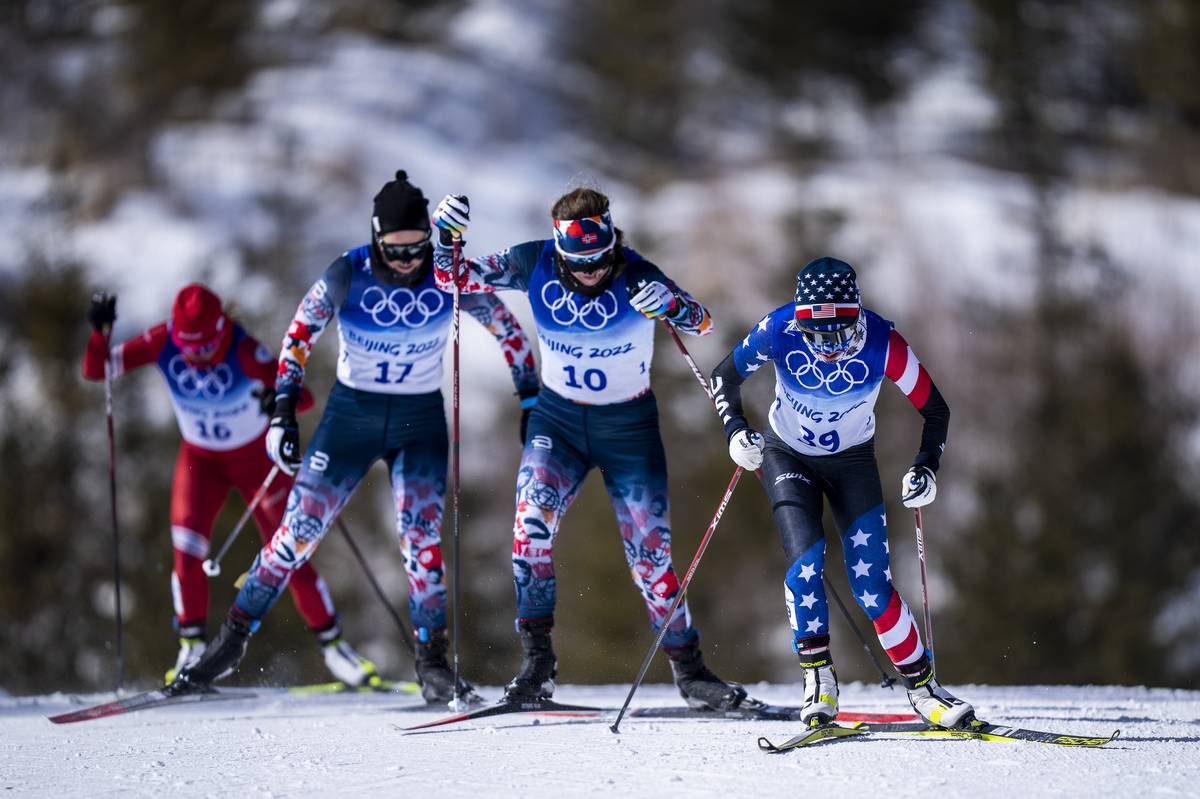
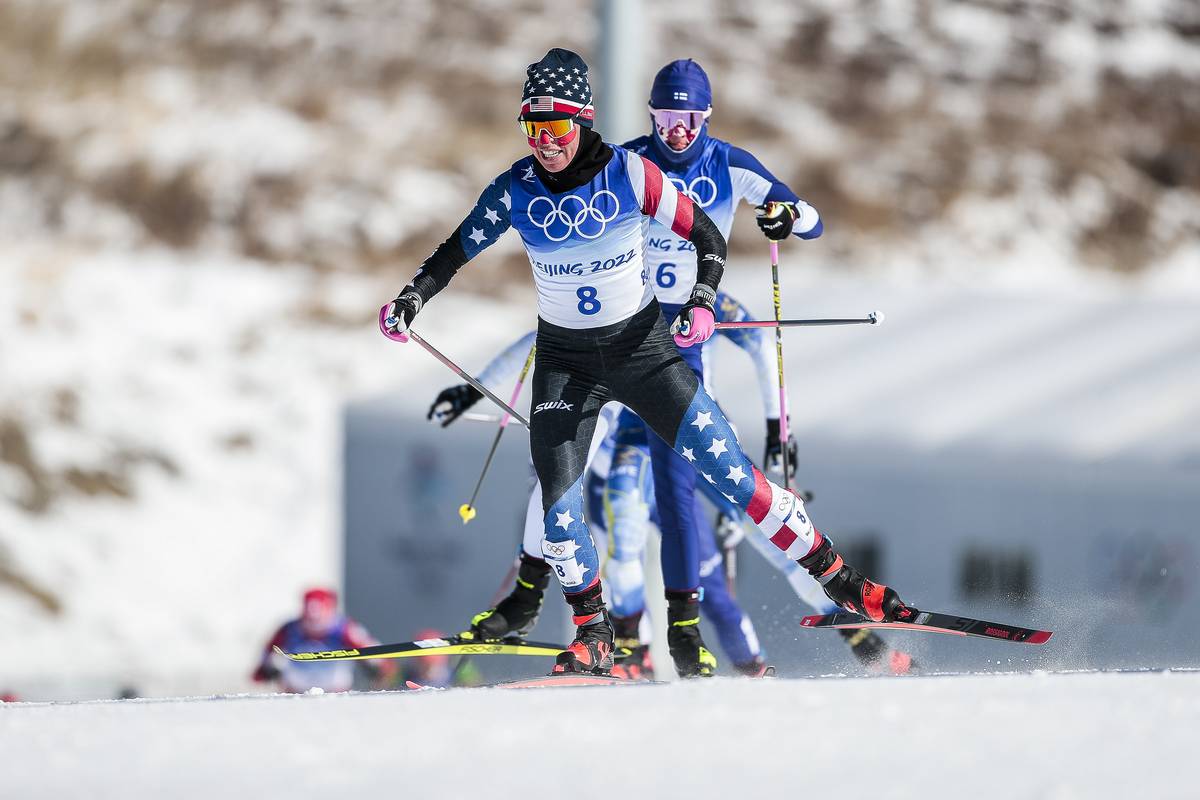
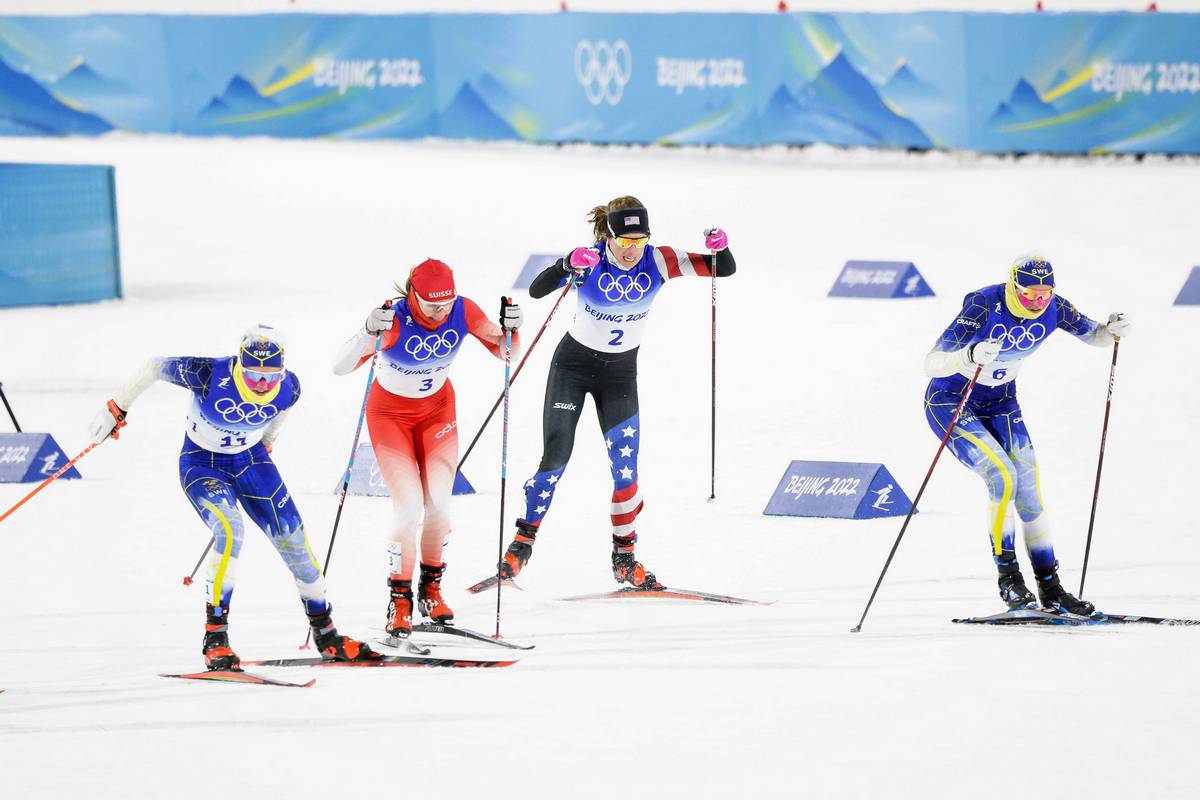
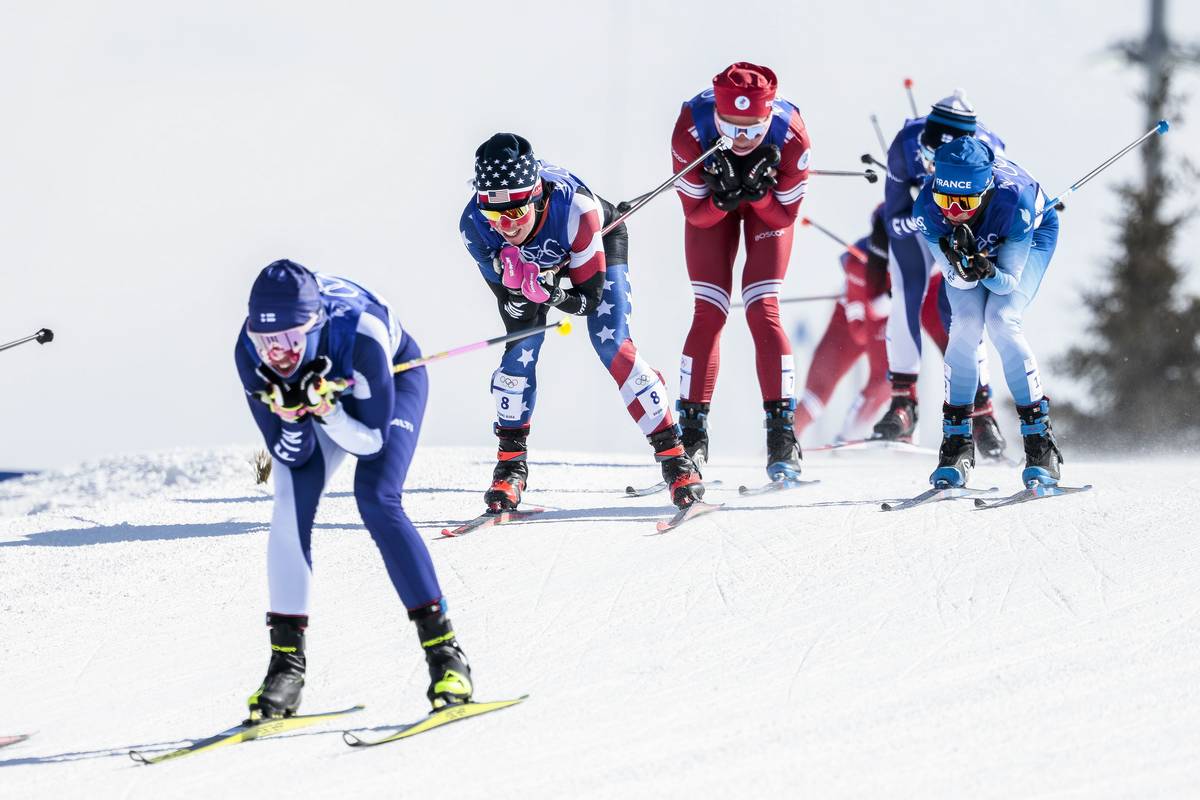
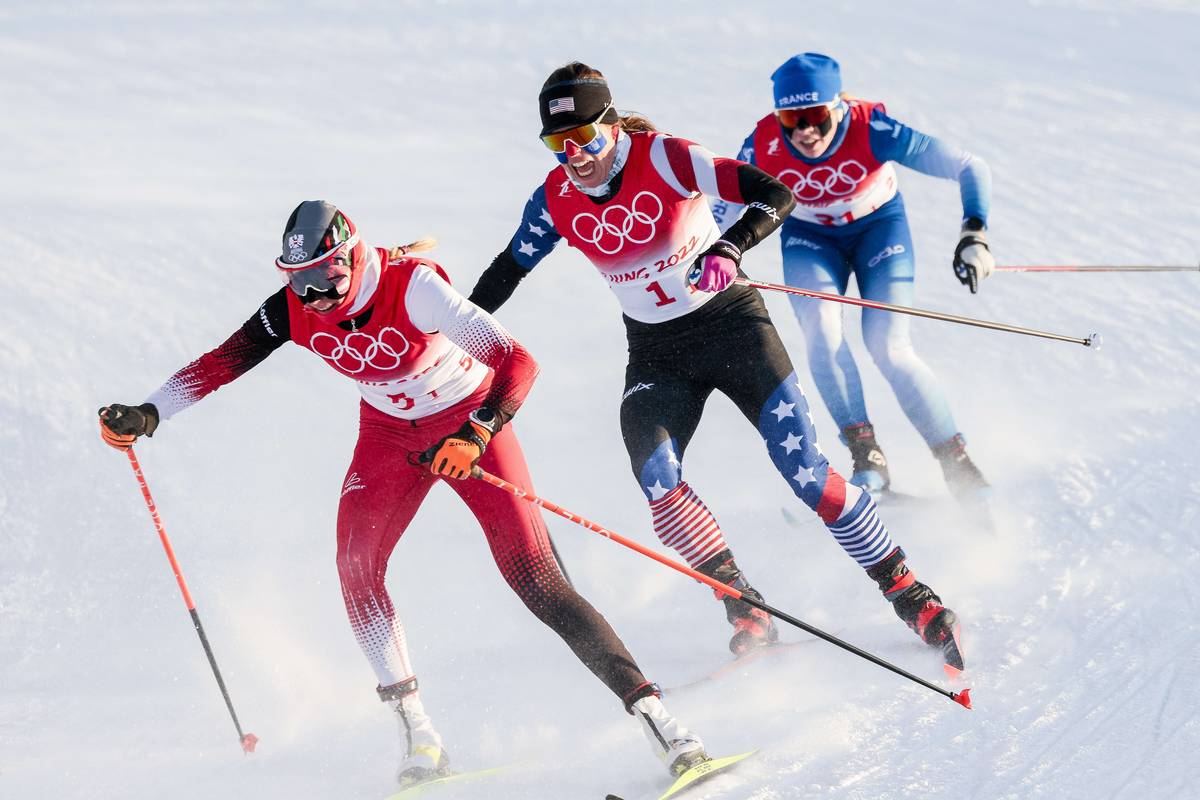
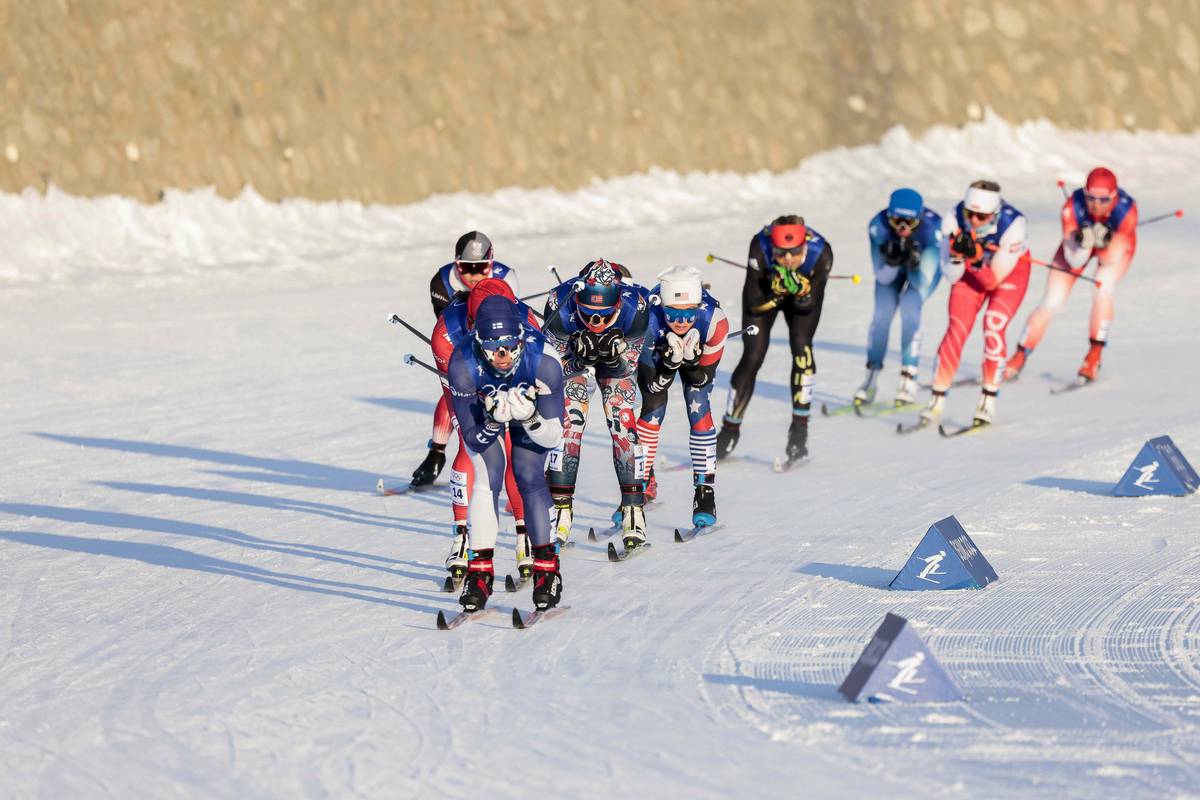
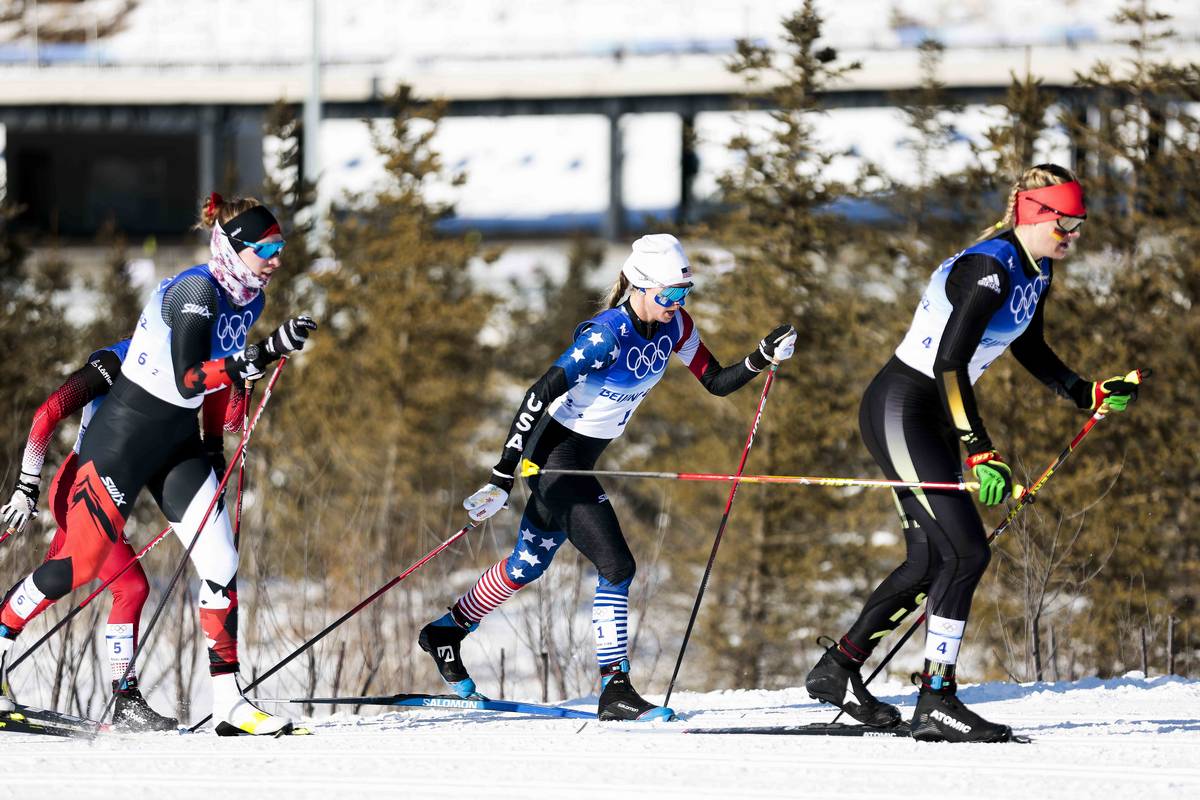
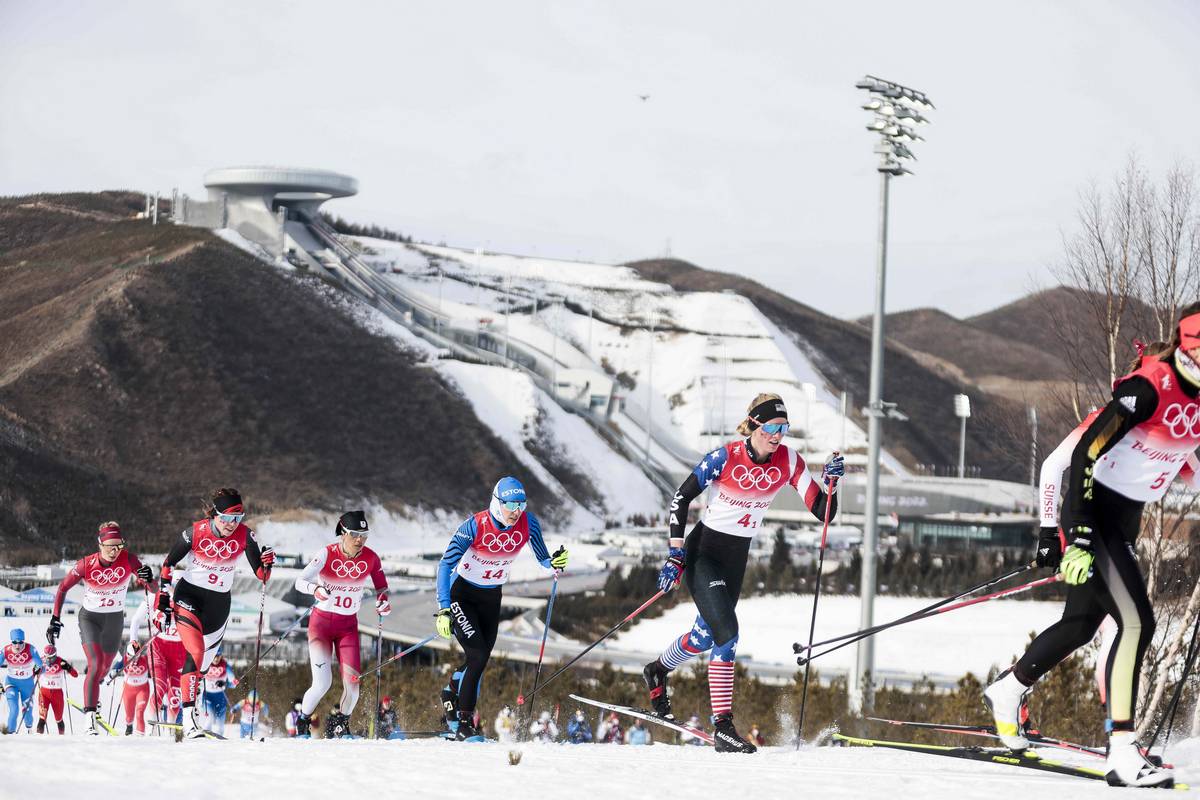
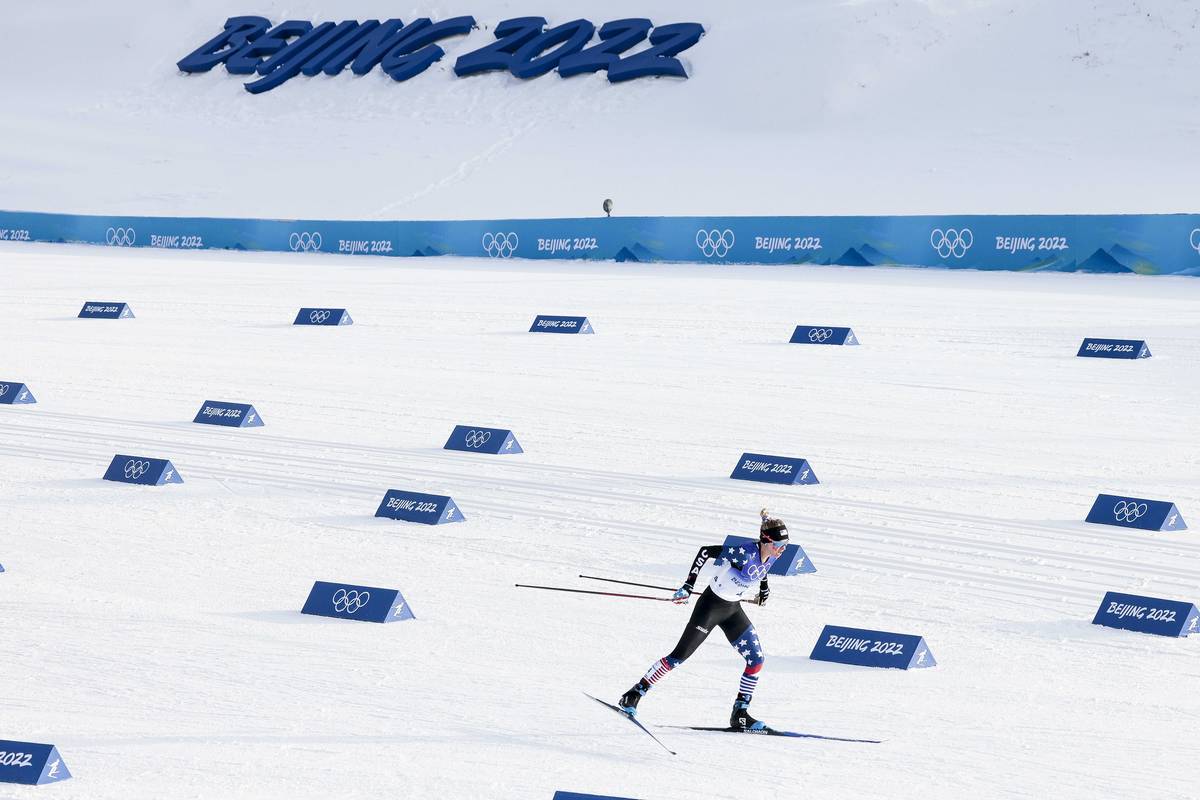
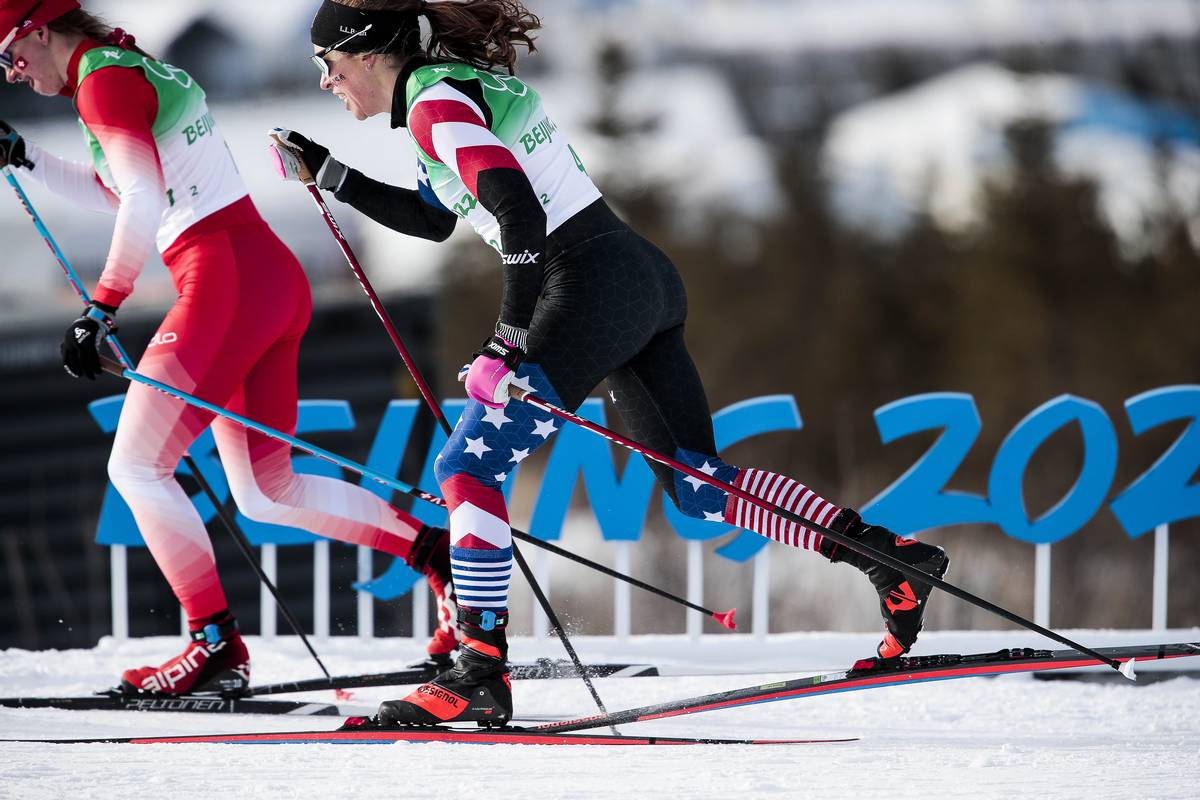
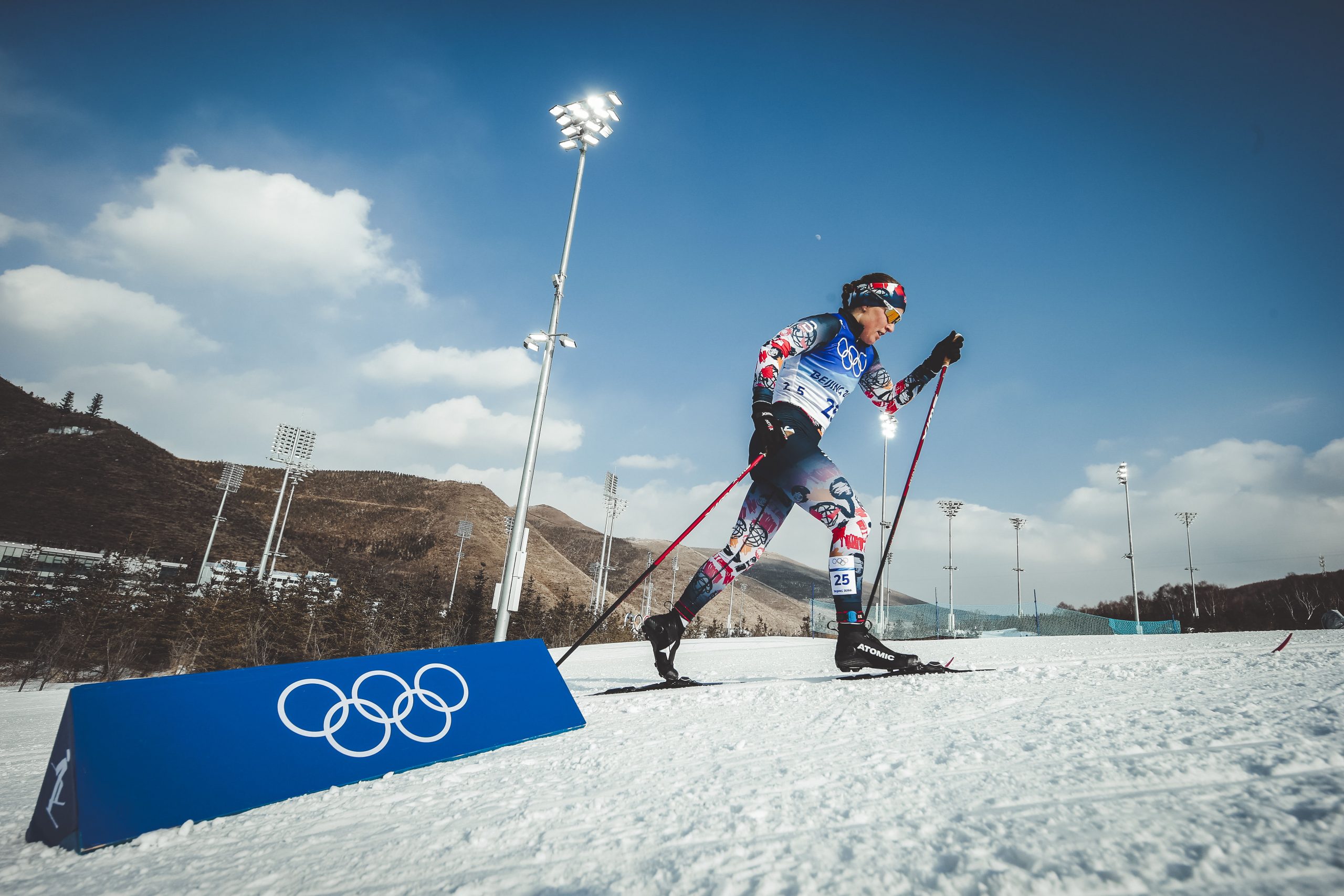
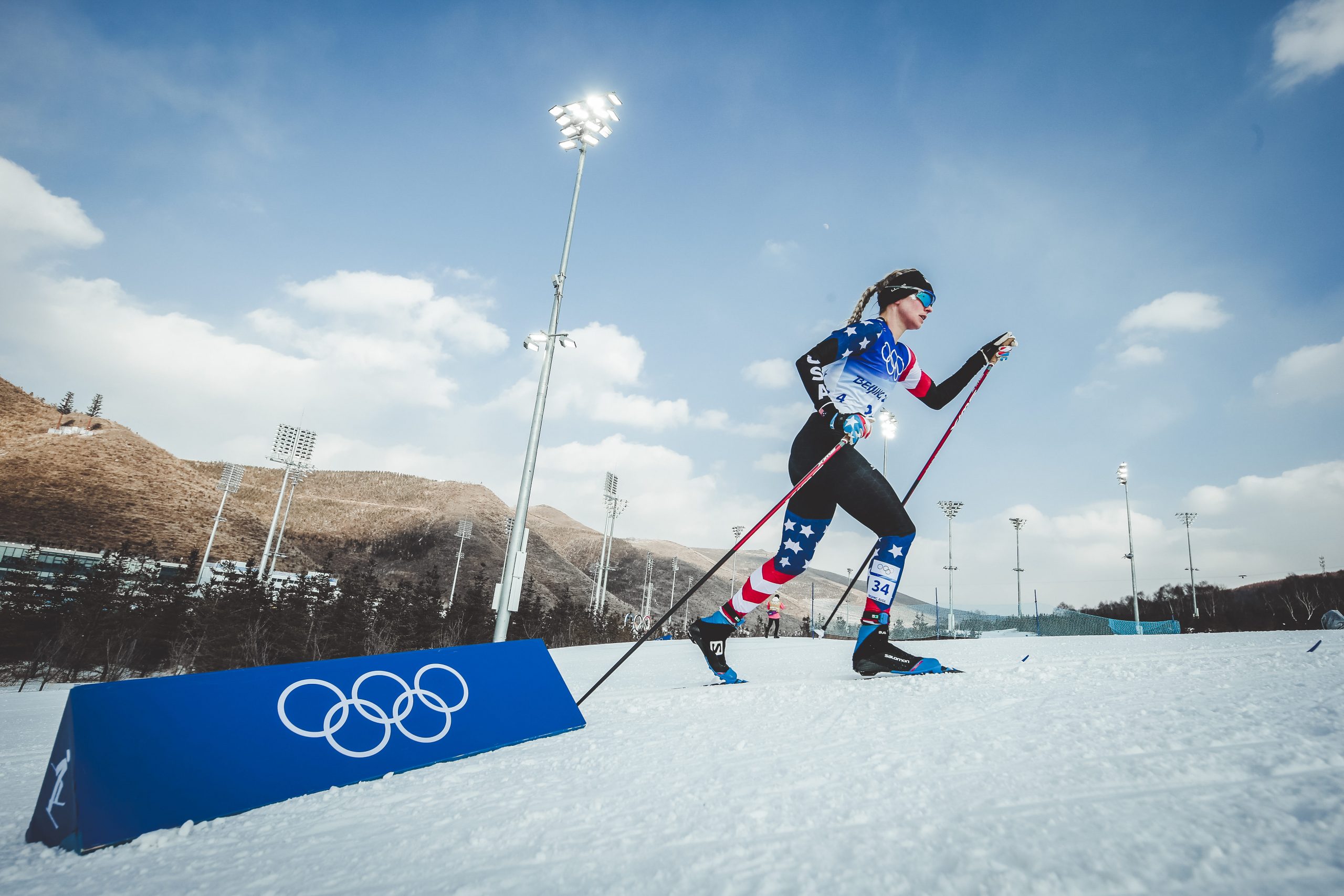
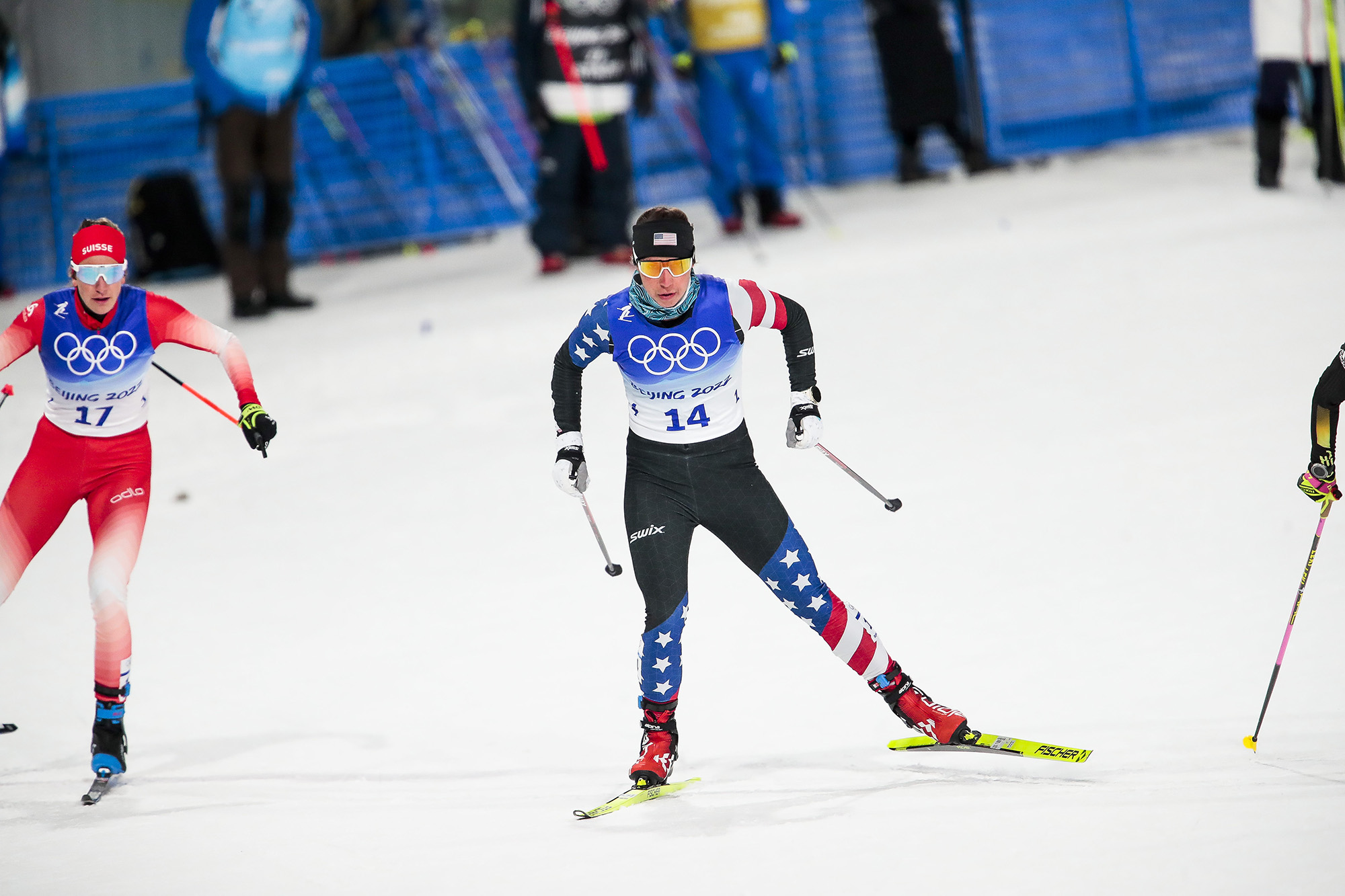
Stars and stripes at the front, as Julia Kern scrambles for USA II in Falun’s mixed relay. (Photo: NordicFocus)
New to the World Cup, the mixed relay is modeled after the biathlon competition format, which debuted in 2005. It had originally been slotted onto the calendar for the Canmore World Cup events in March 2020, which were canceled as COVID-19 began to spread around the globe. It had been tested on the tracks in Falun during the 2021 Swedish senior national championships, with local club leader Johan Eriksson saying afterward, “Team cohesion was strengthened when ladies and gentlemen fought against the same goal line. At the same time, the entertainment was great with reversals in the result lists and tactical moves in team line-ups.”
The entertainment value was certainly high today, particularly for American ski fans. Racing a distance now only seen in relays, it would be a painful blend of sprinting and distance. And the Americans would be lucky to have a woman anchoring the team who has previously been described as the “Queen of the 5 k skate”.
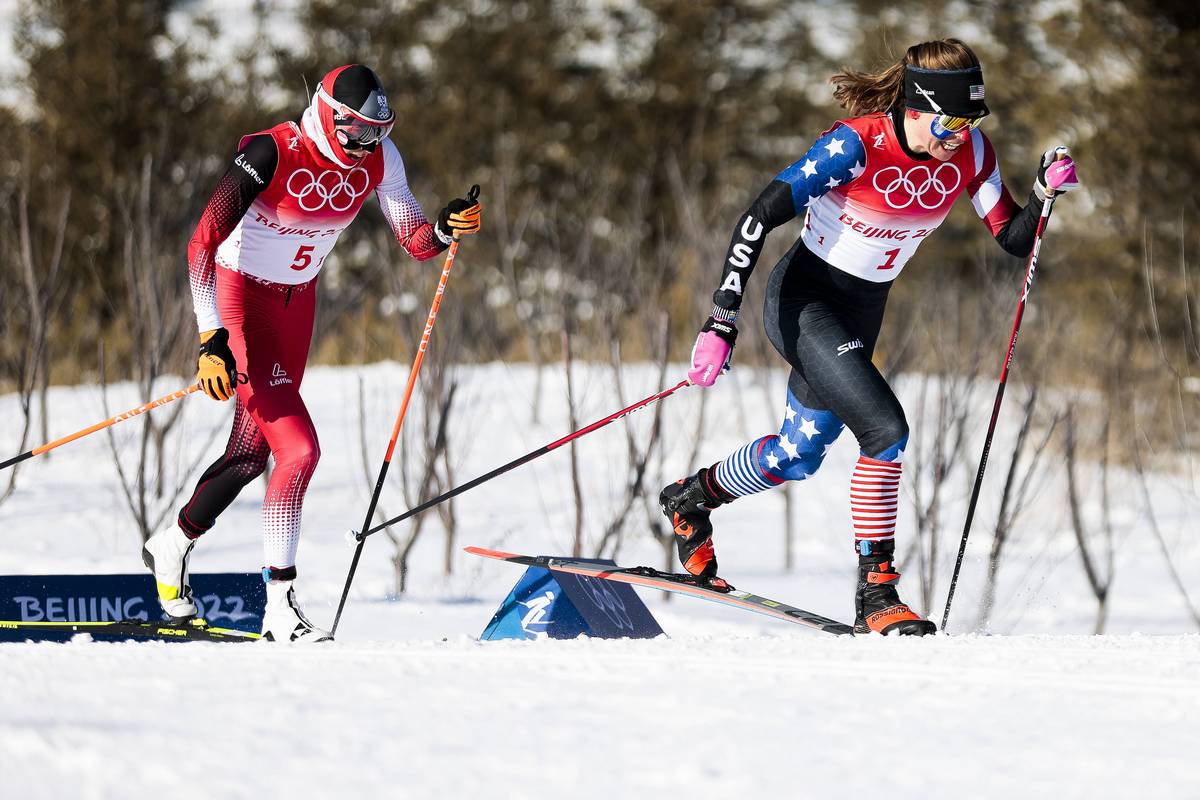
Rosie Brennan scrambles for USA I during the inaugural World Cup 4 x 5 k mixed relay in Falun. (Photo: NordicFocus)
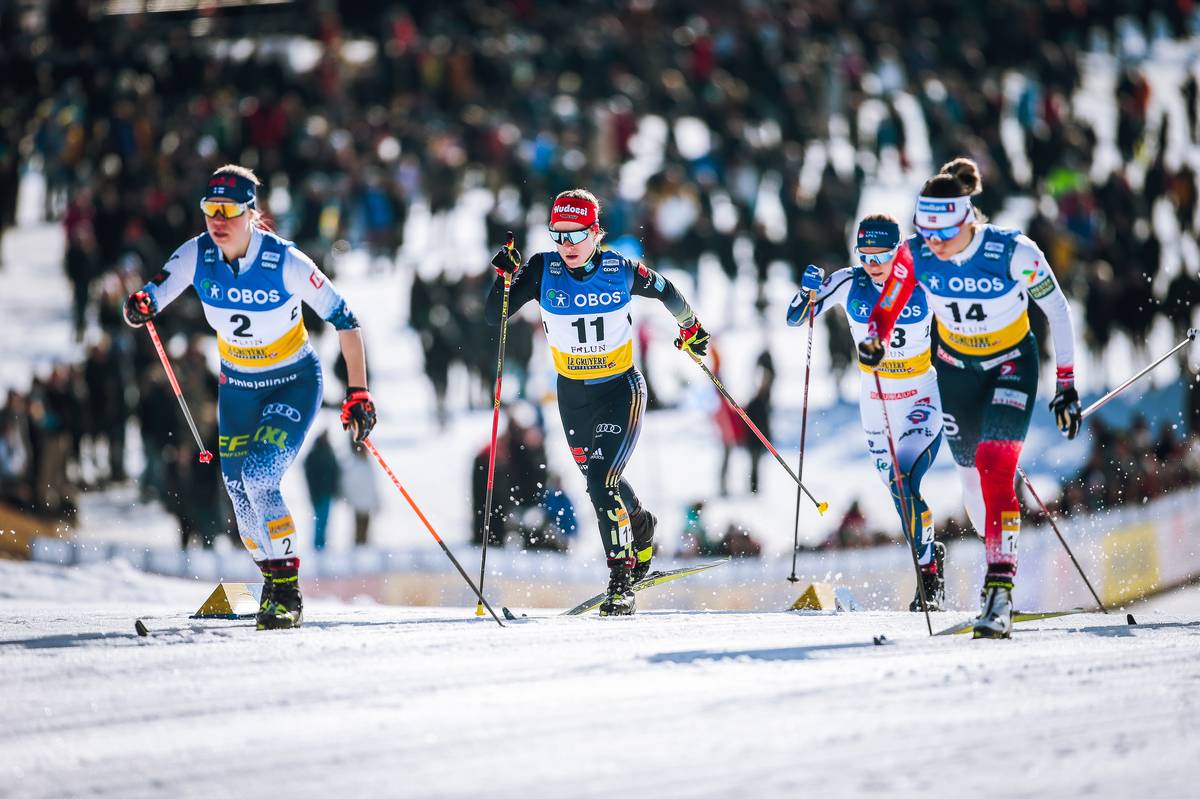
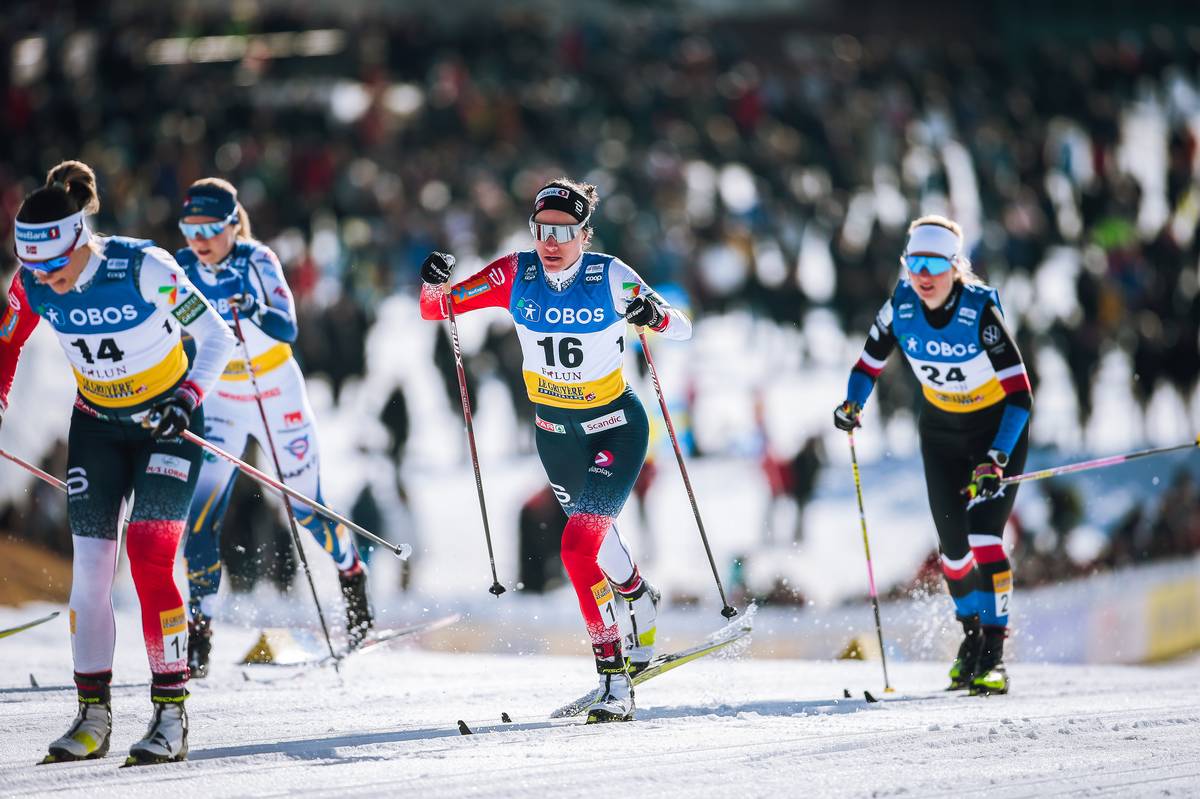
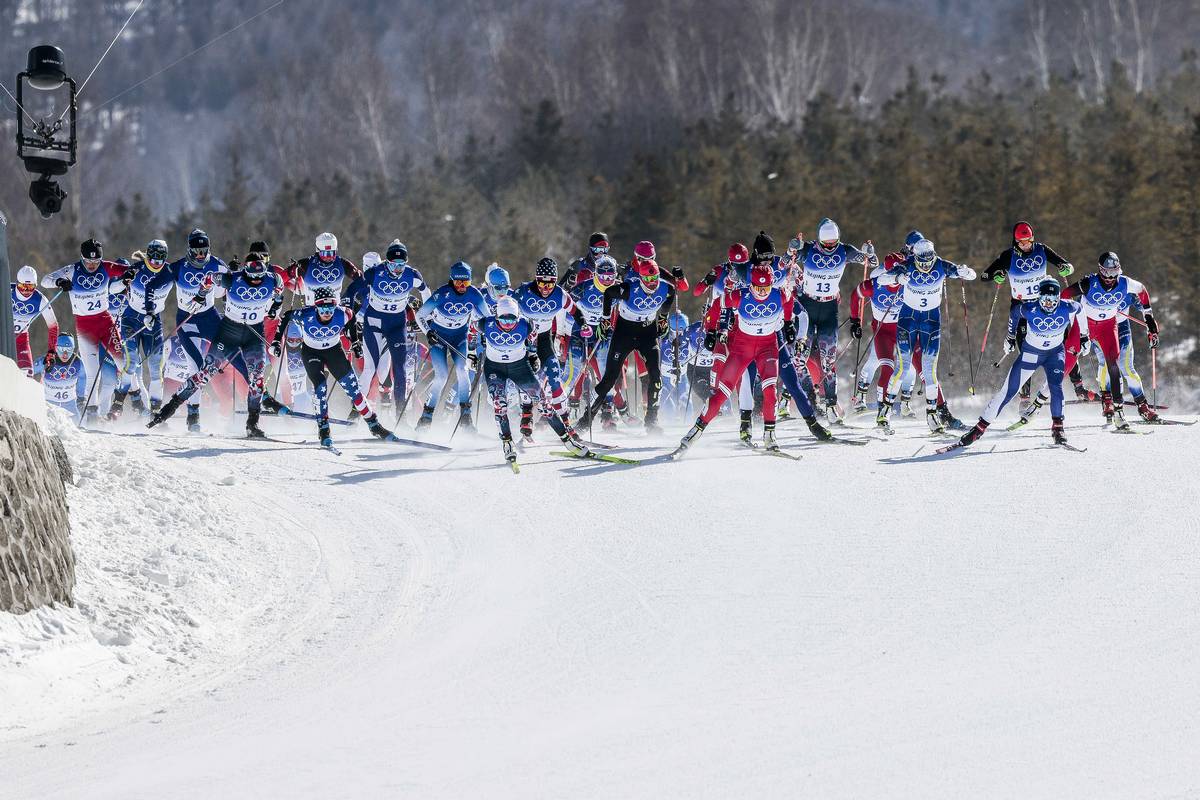
As expected, the pace was high from the start, as the Star Wars theme blared through the stadium loud-speakers. Up for the task at hand, Brennan went toe-to-toe with the other women at the front through two 2.5 k laps. Later describing the event as “fast and furious”, Brennan kept USA I within the lead group, Kern duking it out on USA II alongside through the first lap.
“I think our goal today was to stay out of trouble and stay in the pack, and then let Diggy do her thing that she does best,” Rosie told FIS post-race with a laugh. “And that worked out really well.”
Brennan handed off to Ketterson at the first exchange, in line with Germany I, Norway I, and Sweden I, Finland I just behind.
Though new to the World Cup this season, Team Birkie’s Ketterson has consistently shown his range. Domestically, he won three SuperTour sprints, and stood on the podium in four distance races, one of which was also a win. He chiseled away at the World Cup puzzle, finishing just outside the top-30 during the Tour de Ski, and returning following the Olympic break to place 41st in Lahti’s distance classic race and at the 50 k classic at Holmenkollen. Smashing a 15th place finish in yesterday’s 15 k free, Falun has been a breakthrough weekend.
Though 5 k is not a distance men traditionally race on the World Cup, Ketterson emailed post-race that the event felt familiar and reminiscent of his early days in the sport.
“I am a huge fan of the 5 k race distance as I spent four years in Minnesota high school races doing that distance multiple times a week in the winter. Today brought me back to those days! It was super chaotic pack skiing but I felt really strong the whole time and did my best to keep up with the leaders. Honestly, when Jessie is your anchor, you don’t really have to worry too much about the rest!”
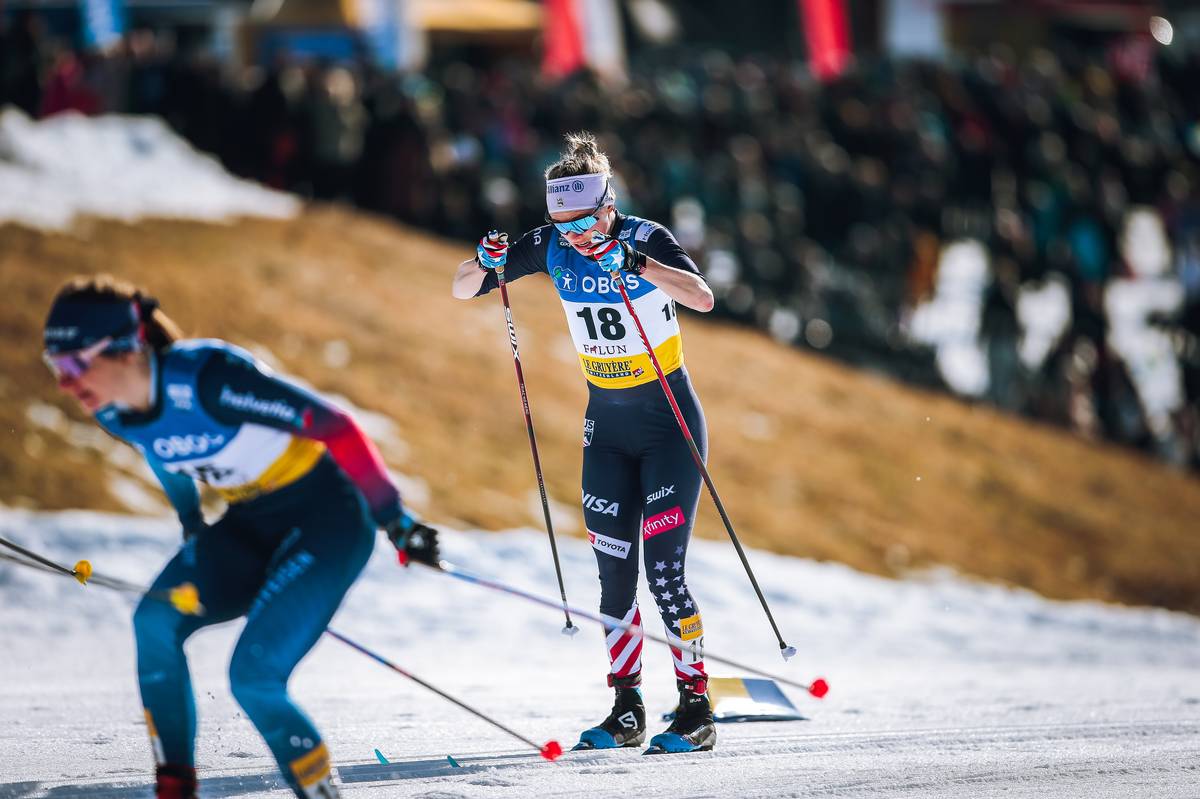
Zak Ketterson tags Scott Patterson during the 4 x 5 k mixed relay in Falun. (Photo: NordicFocus)
On lightning fast tracks with matching skis, Ketterson skied smoothly within the large lead group, keeping USA I within contact of the leaders, while Sjur Røthe tried to crack open pack for Norway II. Tagging Patterson roughly four seconds back, USA I sat in 10th, alongside Canada, at the second exchange. USA II tagged in 14th, +34 seconds back.
Still a large and dense group of front runners, Patterson worked at the back of the lead group to minimize further time losses, keeping his team within reach of the podium. With both Norwegian teams at the front in the second lap, Patterson whittled down the American’s time back, tagging Diggins 2.2 seconds behind the leaders to “do her thing” over two 2.5 k laps. Canada had lost contact with the front group, sitting in 11th (+17.9), while USA II tagged following a gap in 15th (+1:14.5).
“My goal was to hang on with the pack early and get in the groove, then try to match accelerations later,” Patterson wrote after the race. “I knew I wasn’t going to be the one with super accelerations but could sprint the whole way. During the race I was thinking ‘Just hold on’, so Jessie could work her magic relay anchoring skills. There were a few moments where some gaps formed but I barely managed to cling on.”
Scott Patterson races the third leg for USA I in Falun. (Photo: NordicFocus)Scott Patterson makes the final tag to Jessie Diggins during the 4 x 5 k mixed relay in Falun. (Photo: NordicFocus)
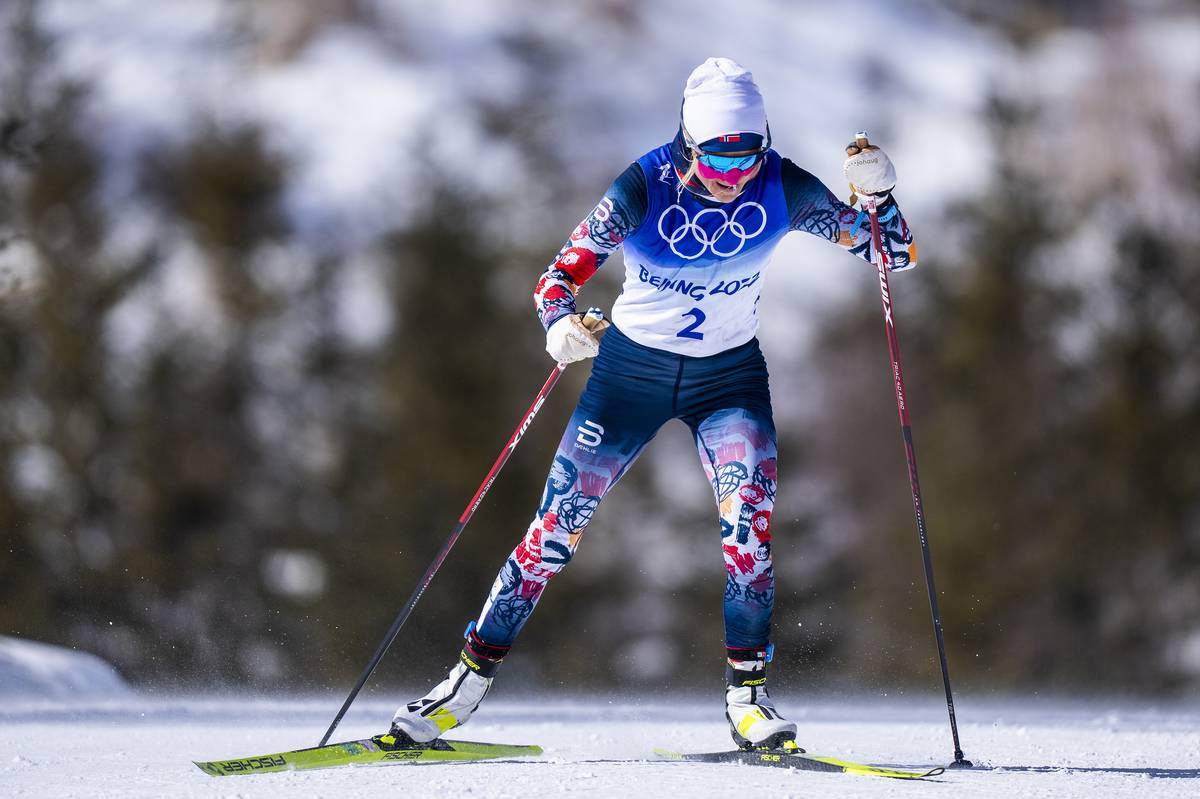
Diggins quickly got to work. Halfway through the first lap, it was Diggins marking Johaug at the front, with Krista Pärmäkoski for Finland I and Victoria Carl for Germany I tucked into their wake. Recall that Carl had anchored the German relay team for an Olympic silver medal in Zhangjiakou just a few weeks ago.
Skis ripping on the downhill, Diggins moved to the front to lap through the stadium 1.4 seconds ahead of Finland I and Norway I, Frida Karlsson for Sweden I challenging Germany’s Carl just behind.
Jessie Diggins brings USA 1 through the stadium in the lead after her first lap. (Photo: NordicFocus)
Diggins worked patiently up the climb, once more tucking behind the rapid fire tempo of Johaug on the uphill, and tucking calmly into the draft of the Norwegian and Finn heading into the descent. Diggins hit the second climb hard as the three women hop-skated up and over. Among the best descenders on the World Cup, Diggins skis were only fueling the fire, allowing her to maintain her lead in the rolling last kilometer and into the stadium which erupted with noise from the packed sidelines.
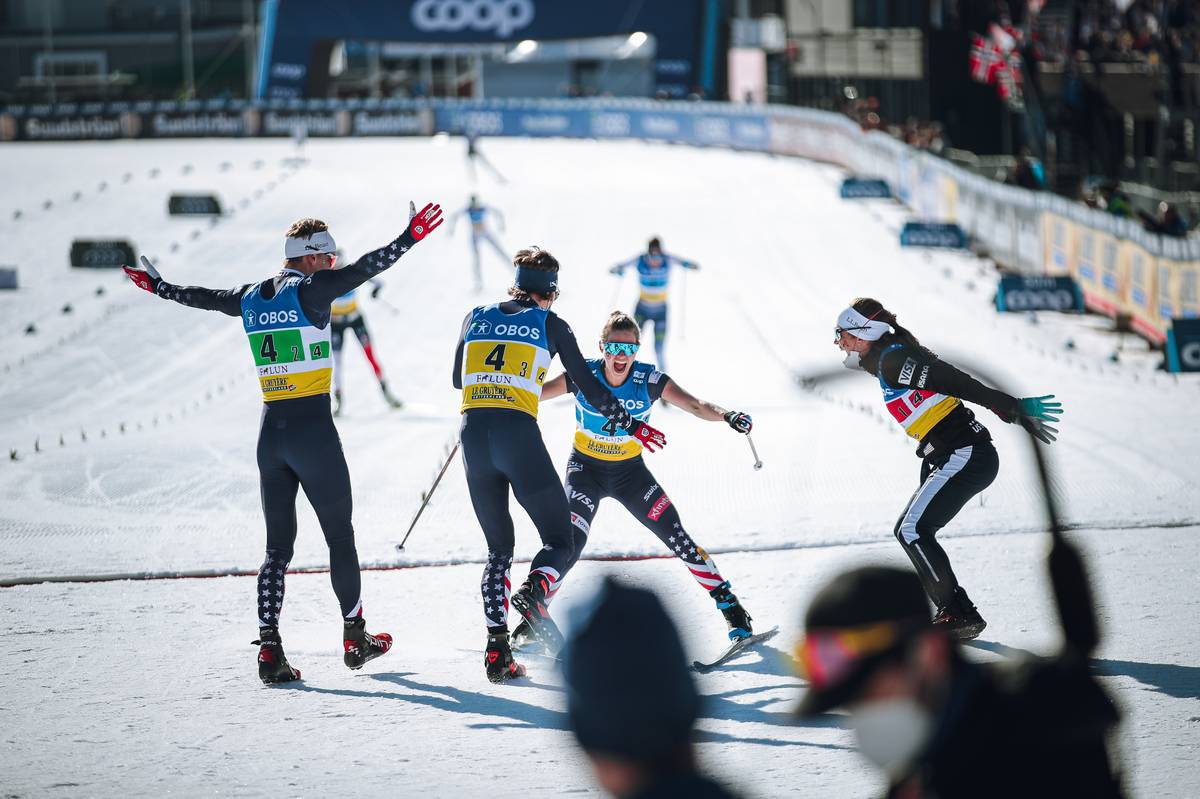
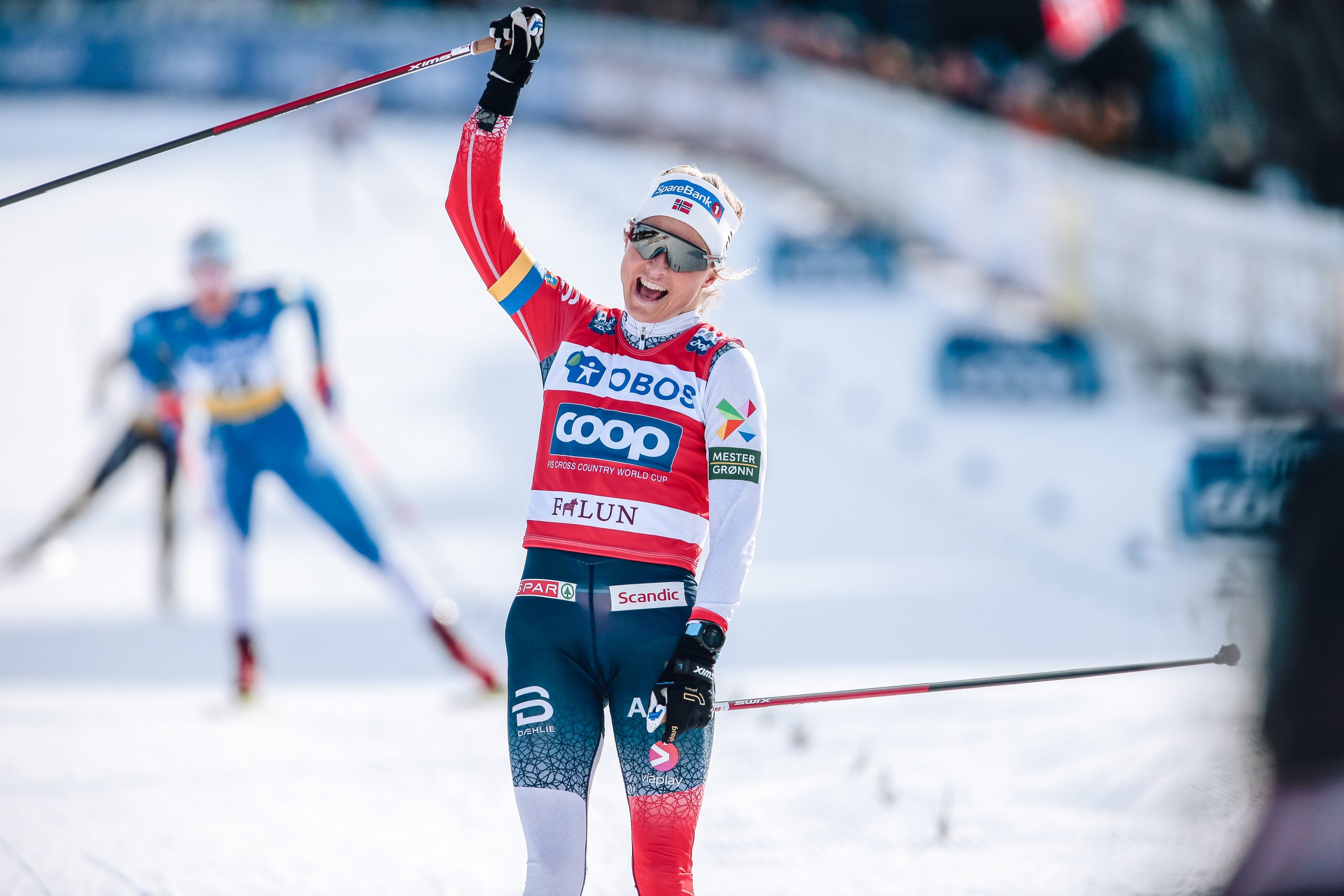
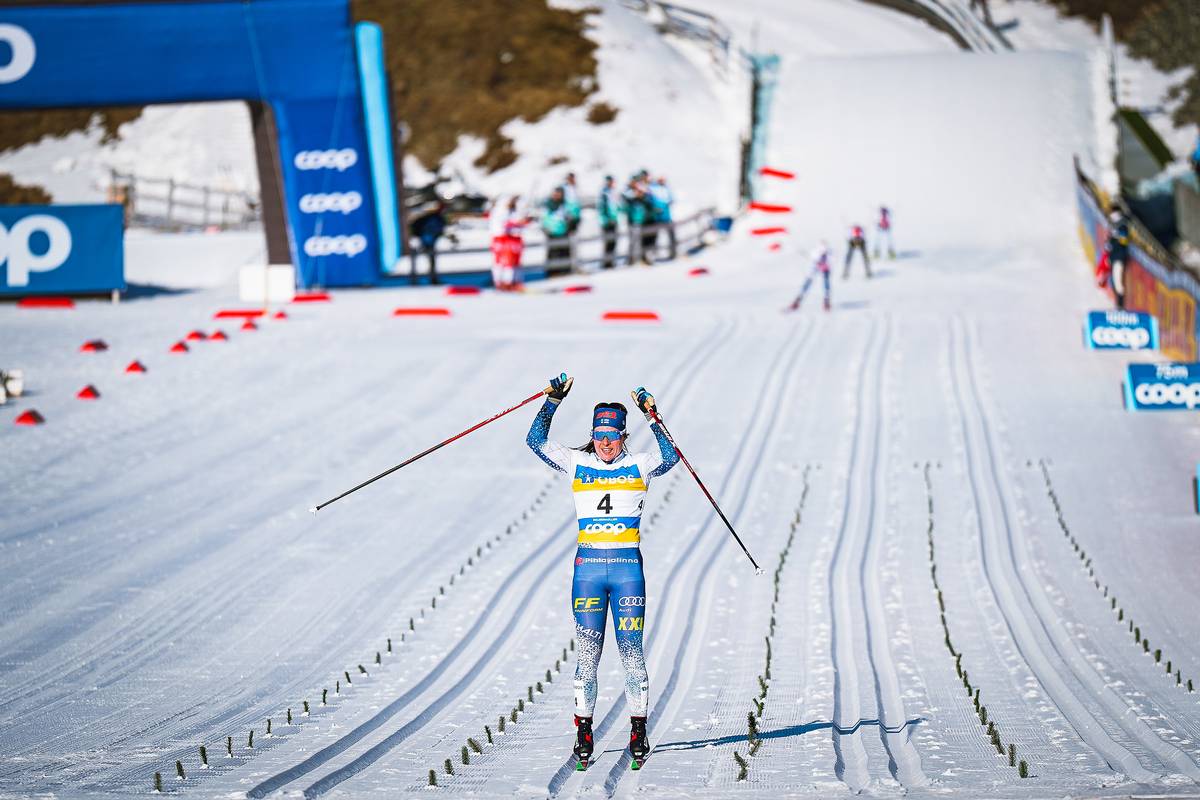
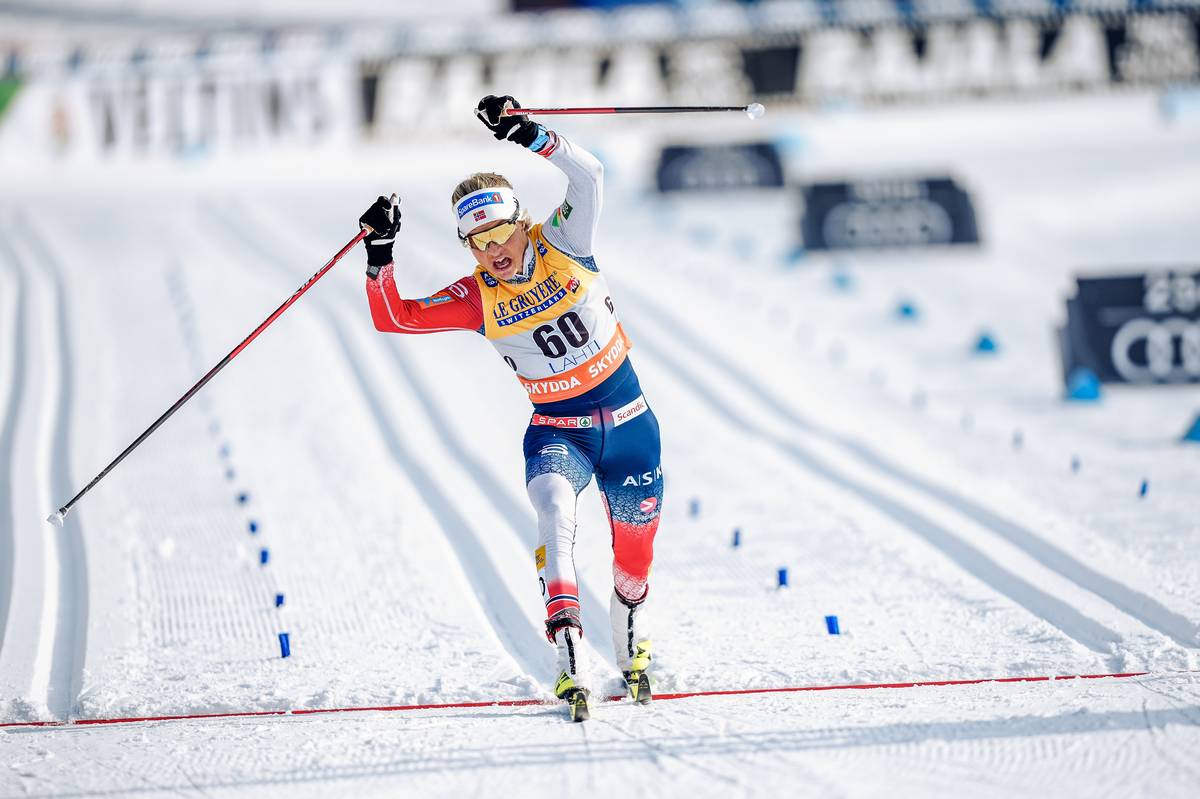
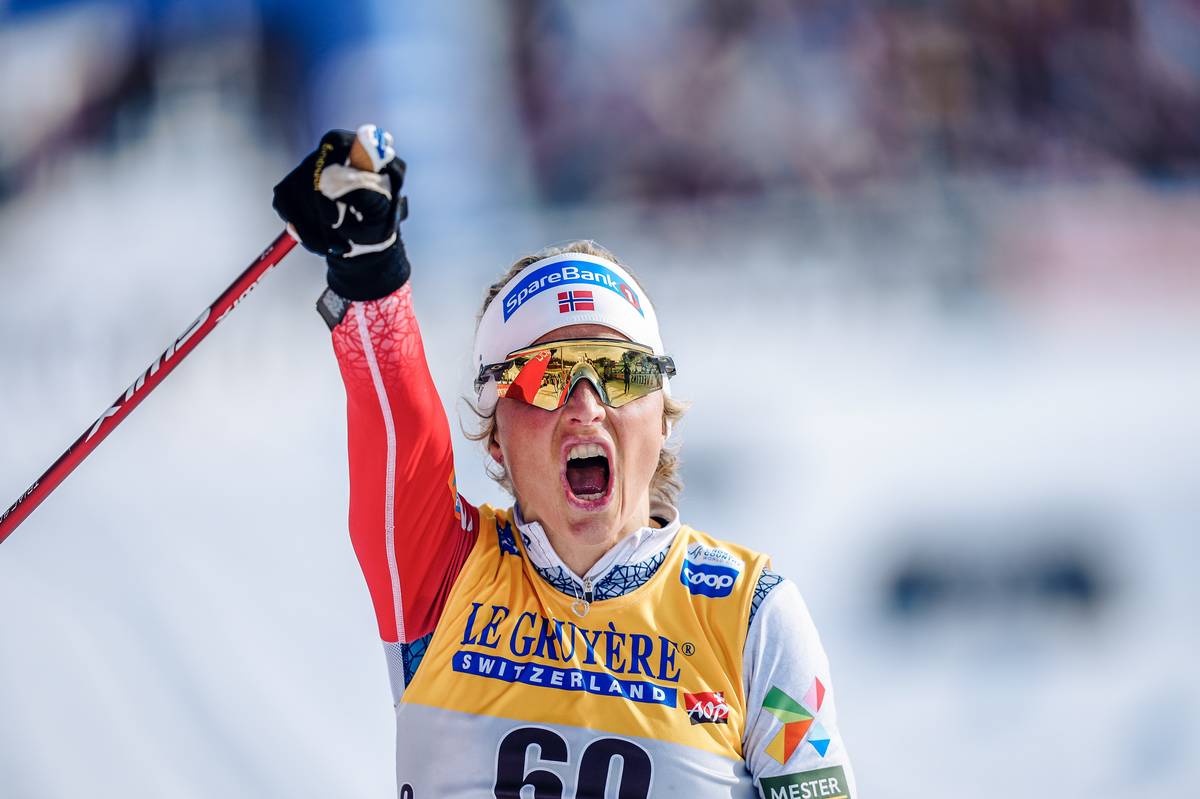
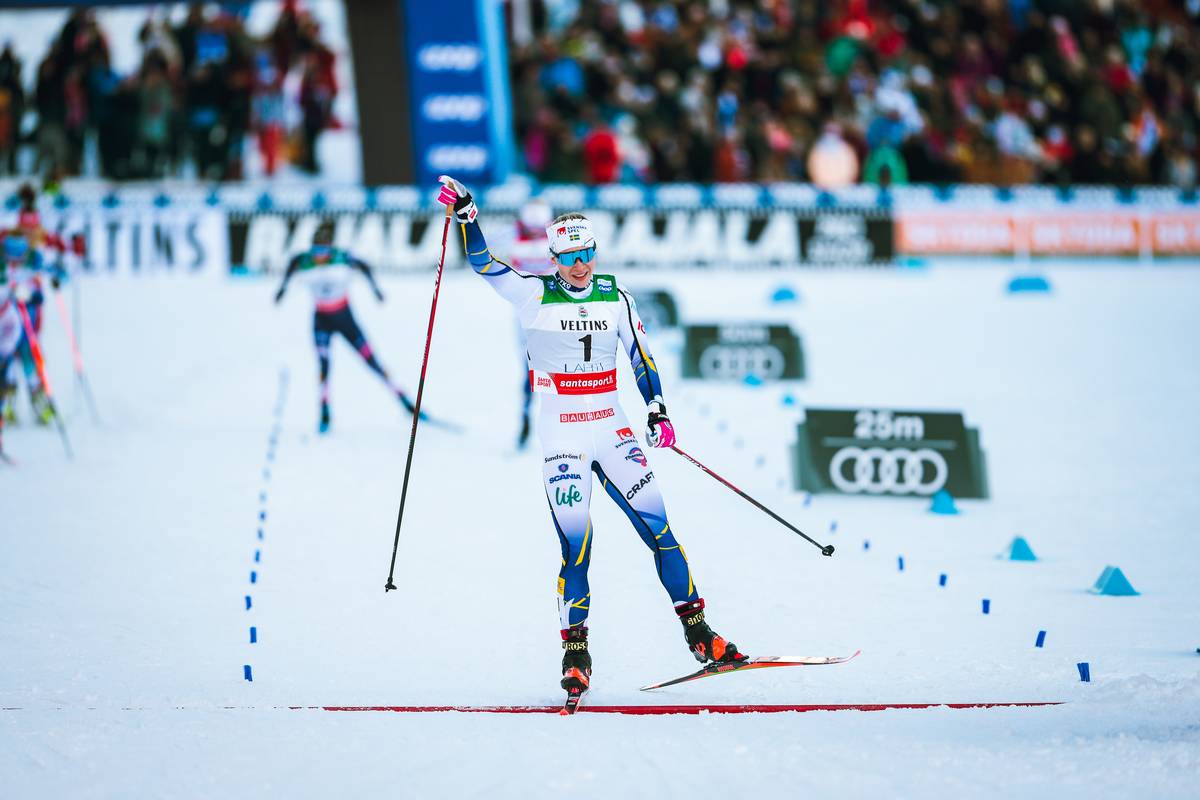
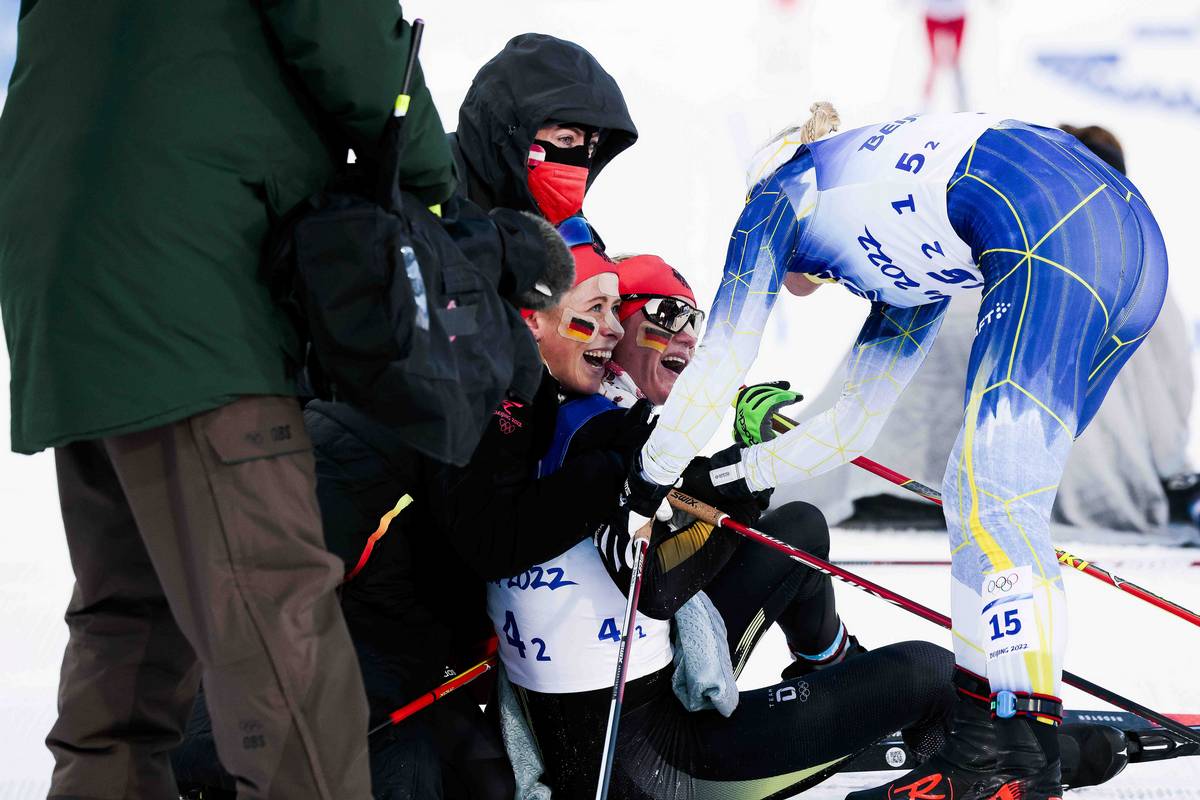
Rounding the final bend with a clear shot to victory, Diggins took a few tuck skate pushes before powering in V2 across the line with a fist pump and loud cheer, and maybe an expletive, before collapsing onto all fours surrounded by her ecstatic teammates.
Nerves run high as the American team waits for Jessie Diggins at the finish of the 4 x 5 k mixed relay in Falun. (Photo: NordicFocus)USA I celebrates victory as Jessie Diggins crosses the finish of the 4 x 5 k mixed relay. (Photo: NordicFocus)
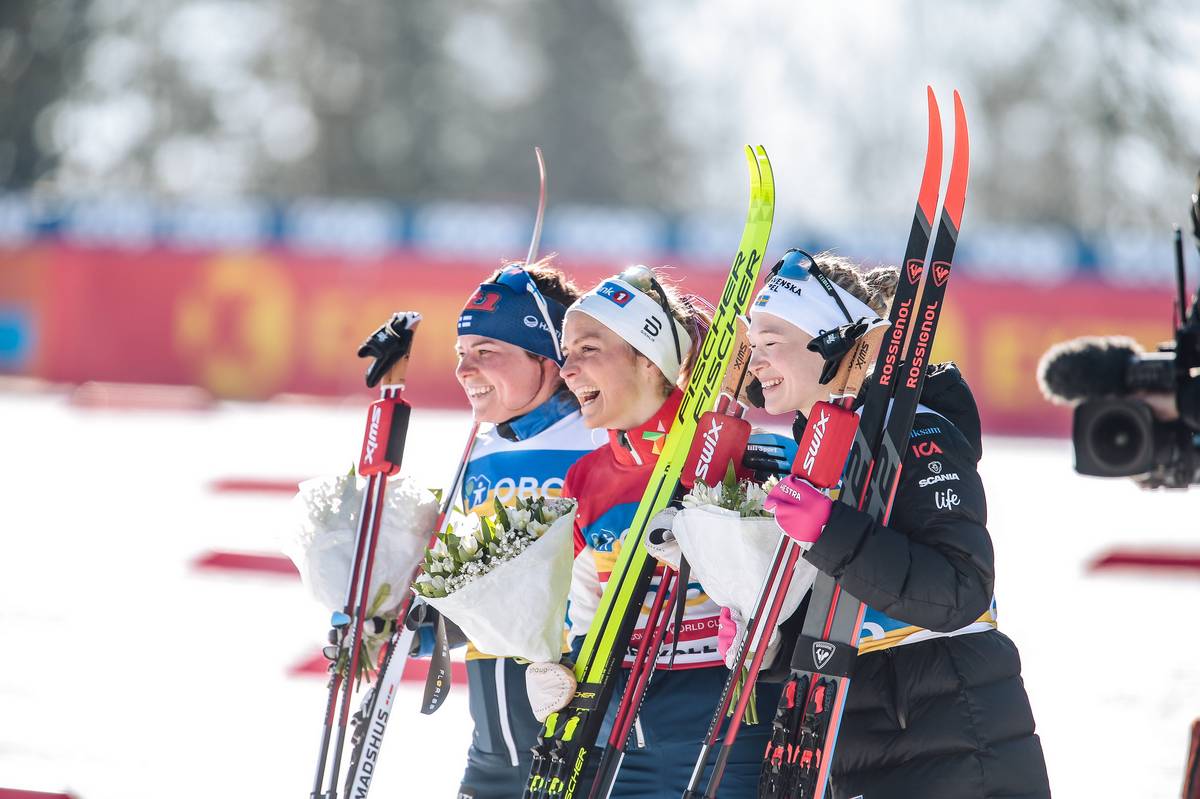
Outsprinting the World Cup distance champion, Pärmäkoski edged out Johaug to bring Finland I to the line in second (+3.8), leaving Norway I just 0.5 seconds behind in third. Having strung out over the last lap, Sweden I took fourth (+9.1), with Germany I fifth following another gap (+16.2).
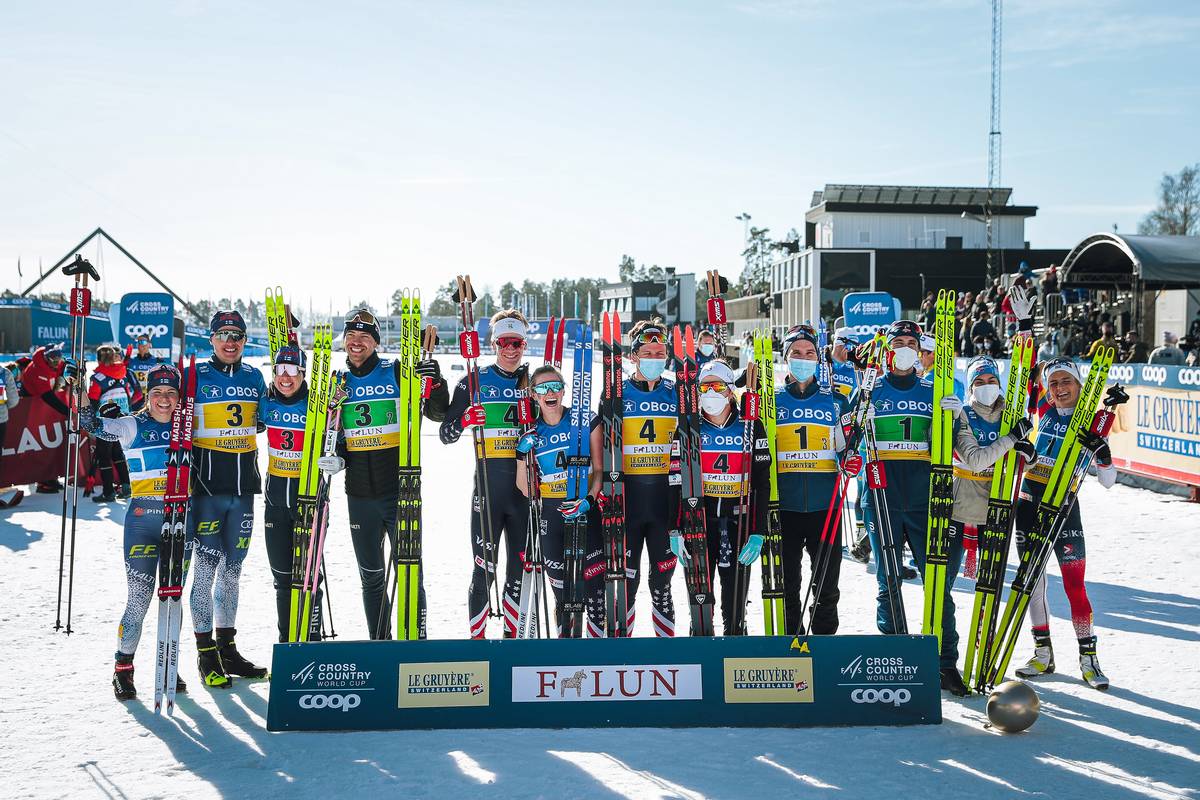
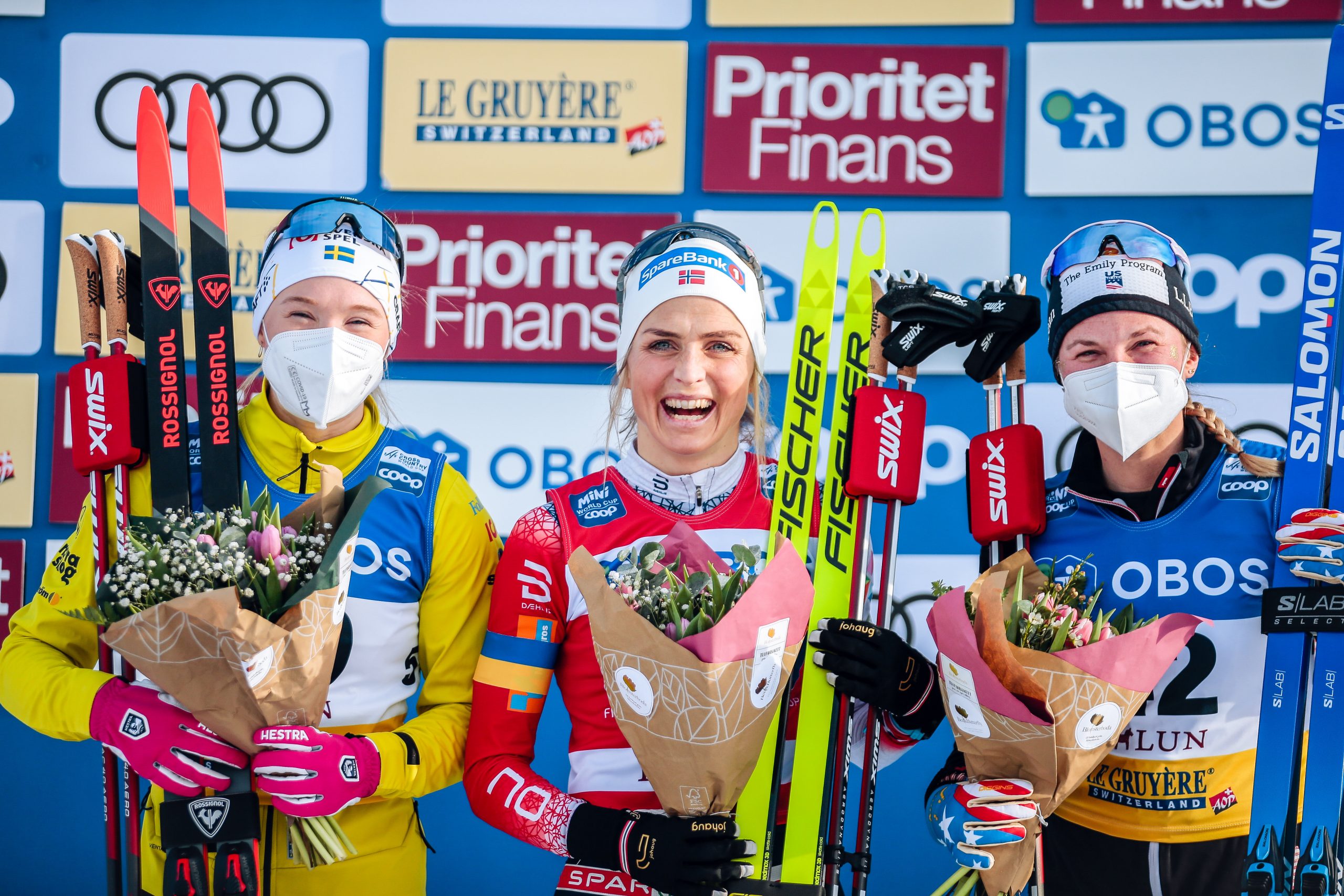
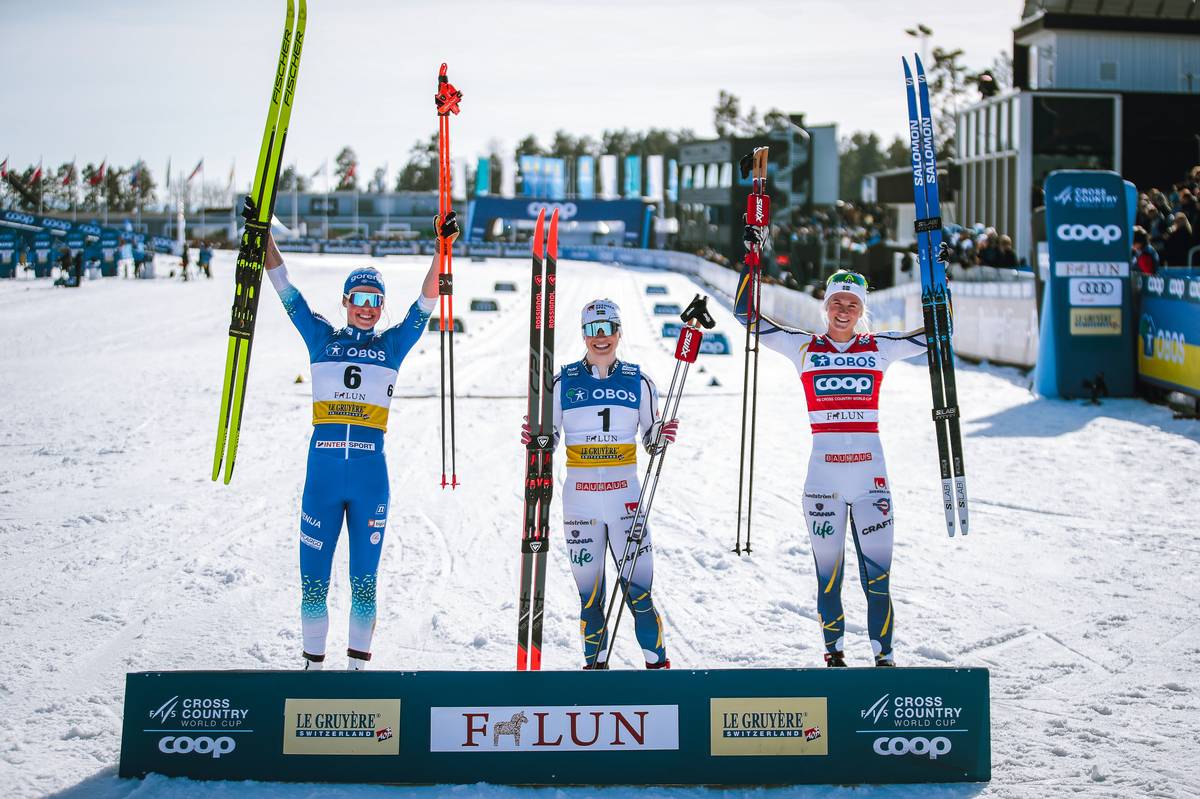
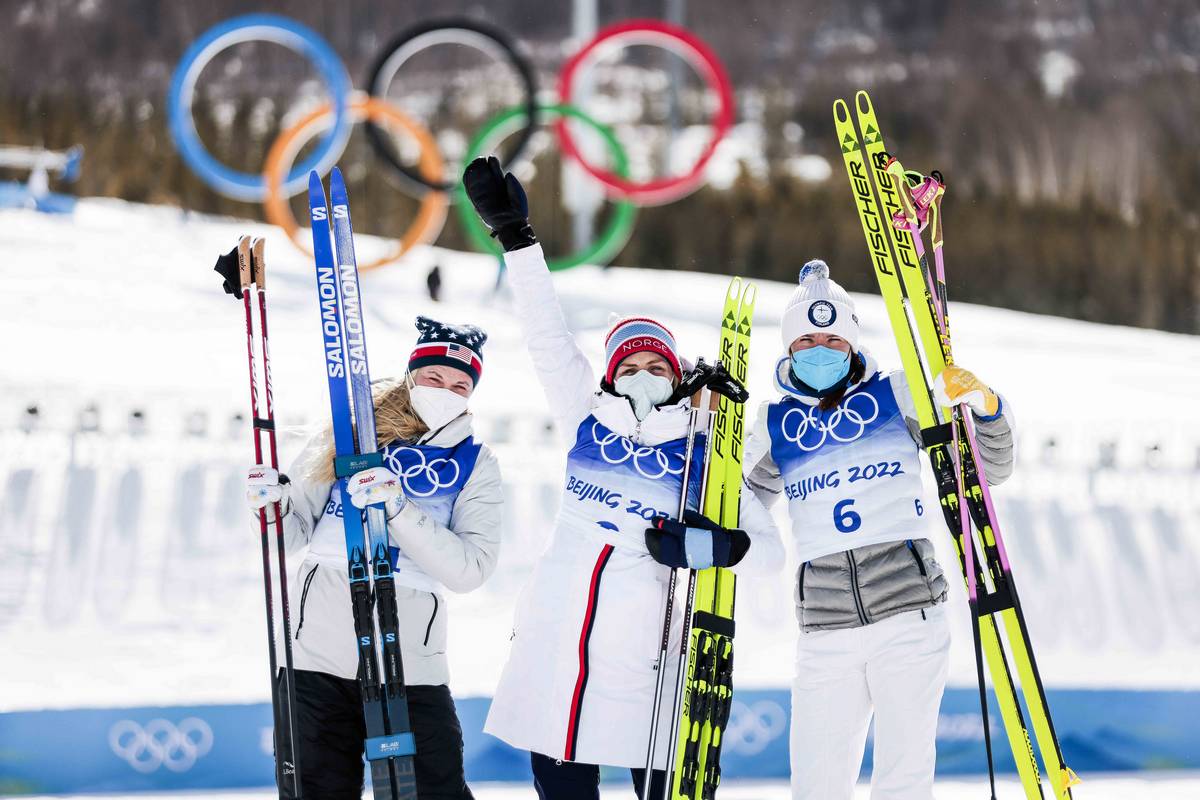
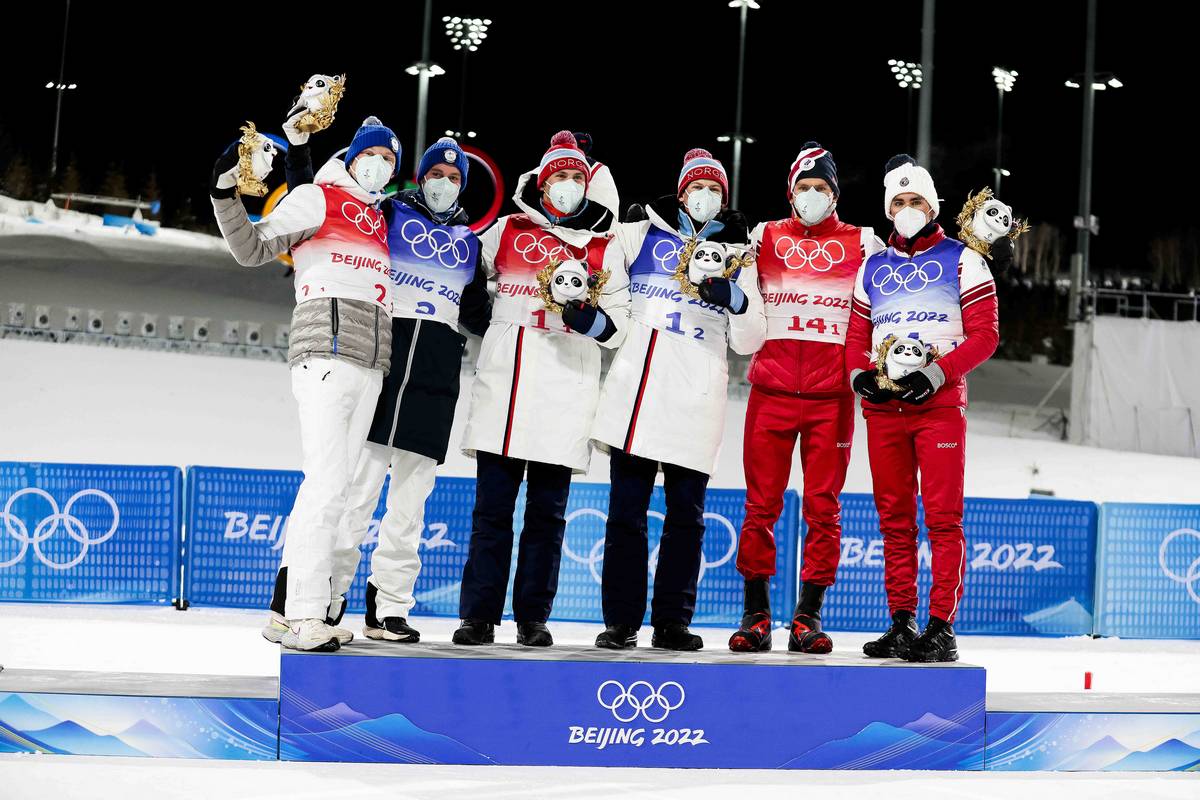
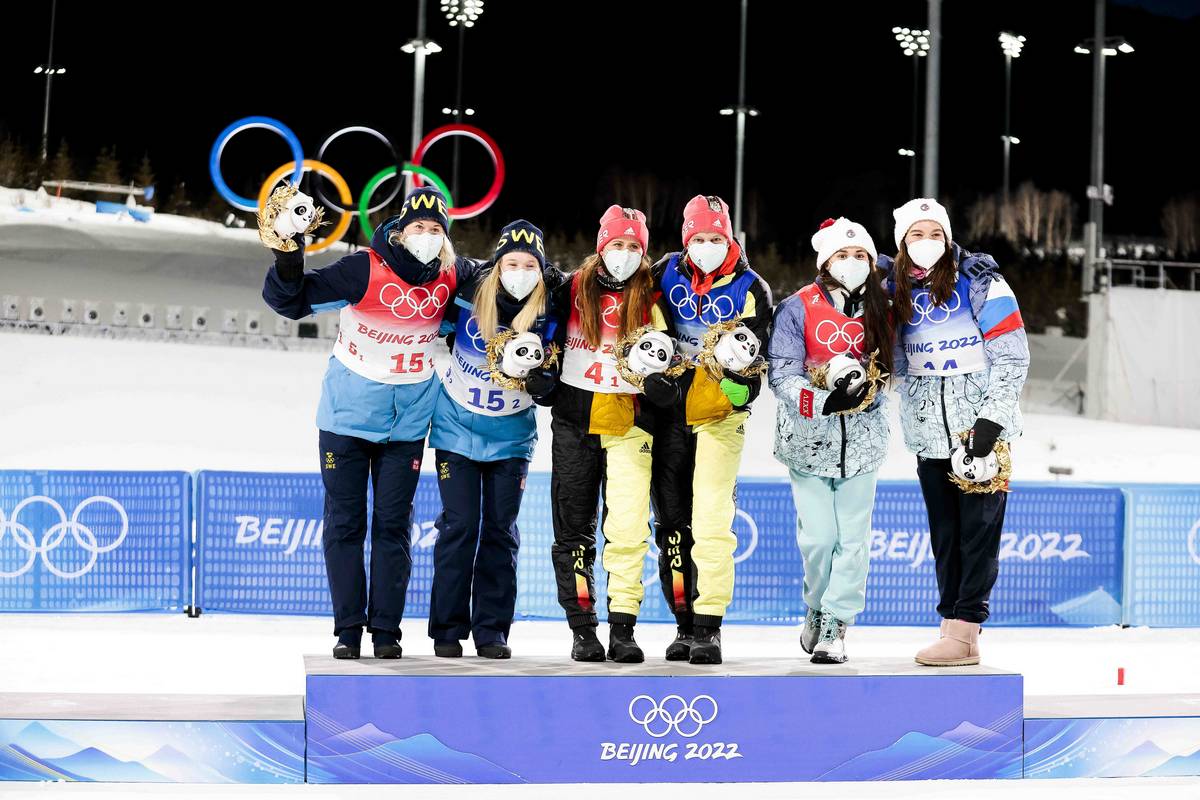
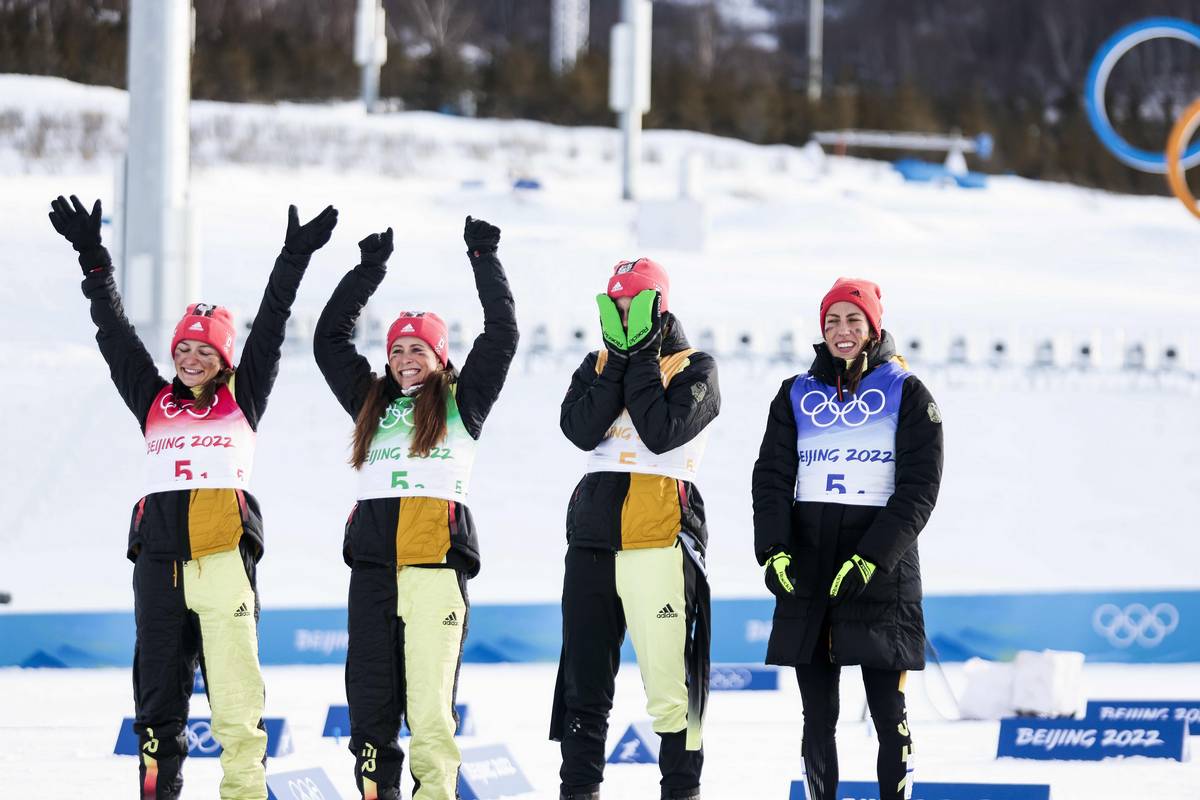
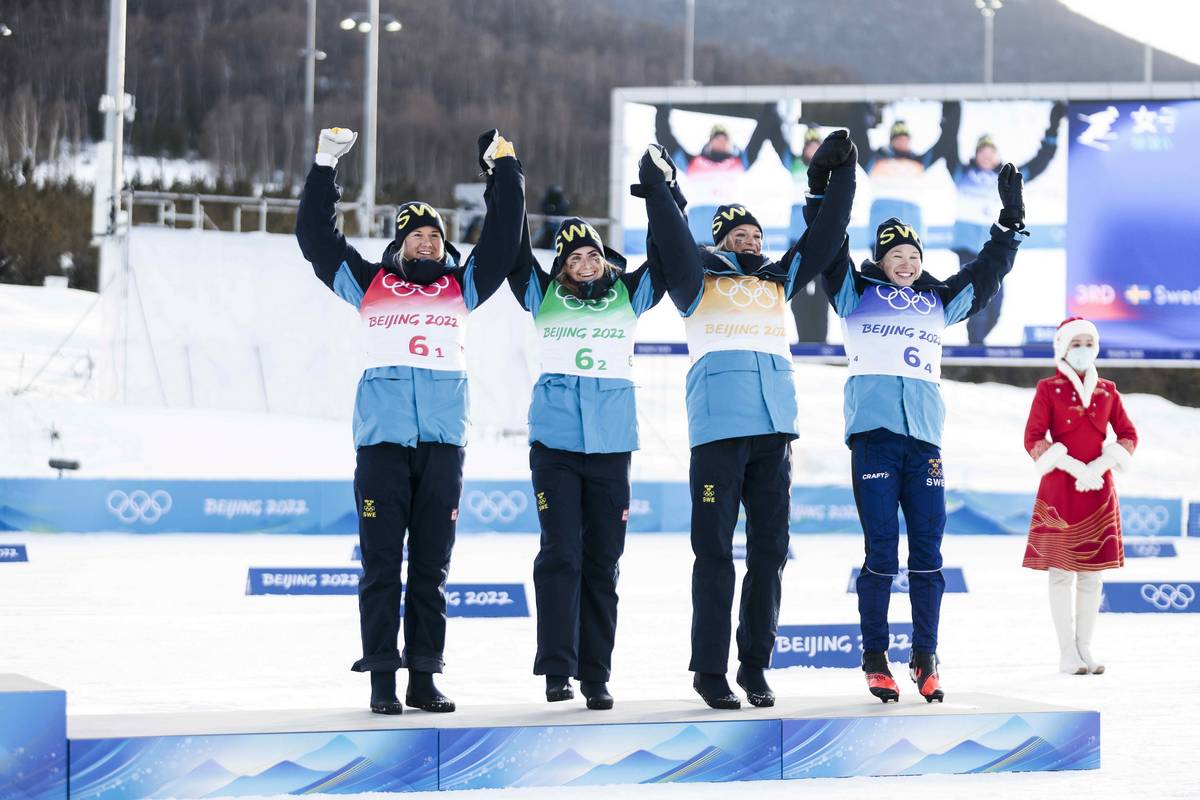
A packed podium for the 4 x 5 k mixed relay in Falun. USA I took the win ahead of Finland I and Norway I. (Photo: NordicFocus)
Describing the experience of winning the mixed relay on the final day of World Cup racing, Diggins told FIS with a laugh, “[It] feels like champagne getting sprayed on you.”
Surrounded by her teammates, she continued, “That was so, so fun. We really pulled together as a team. We live together as a team for four months on the road, so it’s pretty cool to get to end the season racing for each other. I’m so proud of these guys, so I was feeling pretty inspired.”
Jessie Diggins helps USA I to the mixed relay win in Falun. (Photo: NordicFocus)
Later sharing her strategy in a post-race audio clip as the remainder of the team packed their bags to begin travel home tomorrow, Diggins discussed her strategy as anchor, adding how the rockets under her feet allowed the race to unfold somewhat differently than she anticipated.
“I knew that those downhill working corners were one of my strengths, so I knew that if I got to the top of that big sprint climb first, then I could ski all the other downhills how I want and have a good shot at setting up a finishing sprint. As it turned out, we had such great skis that I didn’t need that finishing sprint, but it was so fun to go ski that as hard as I could. Again, I’m just so proud of the team. It was so special and fun to share that with everyone, and I can’t think of a more perfect way to end a really awesome year.”
Full post-race audio clip from Jessie Diggins:
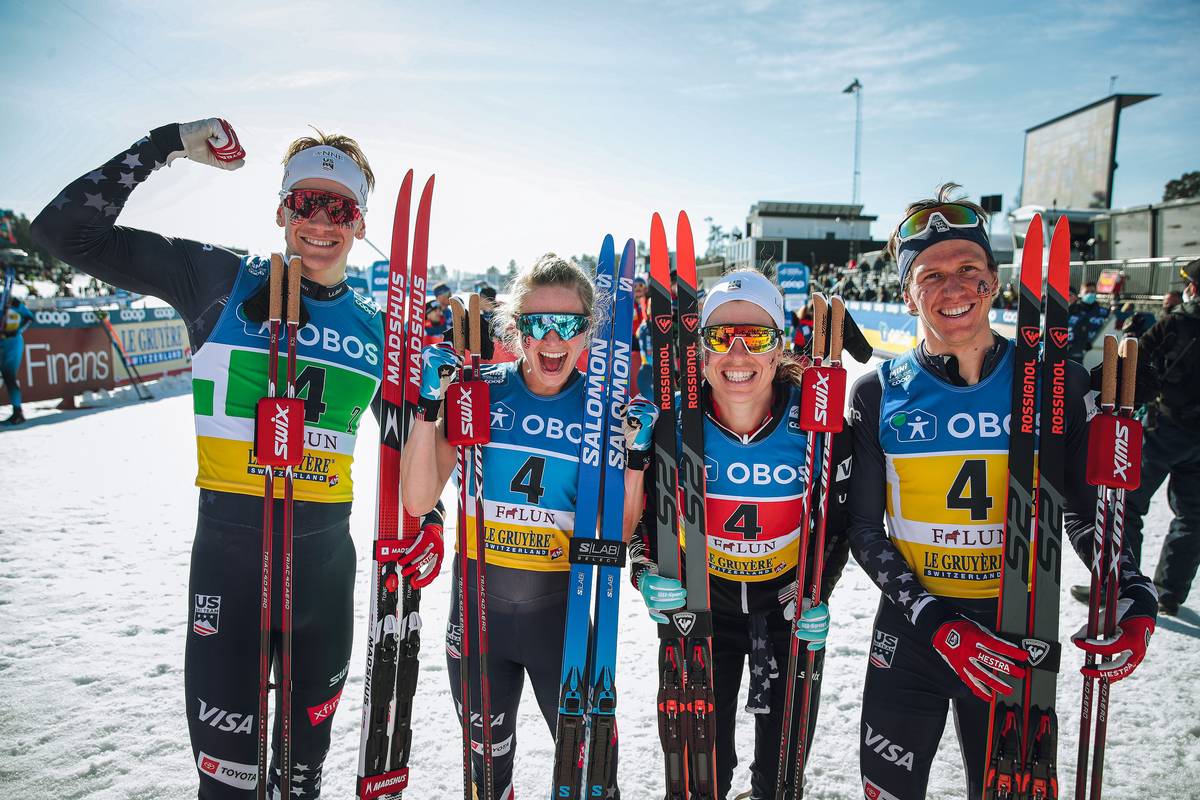
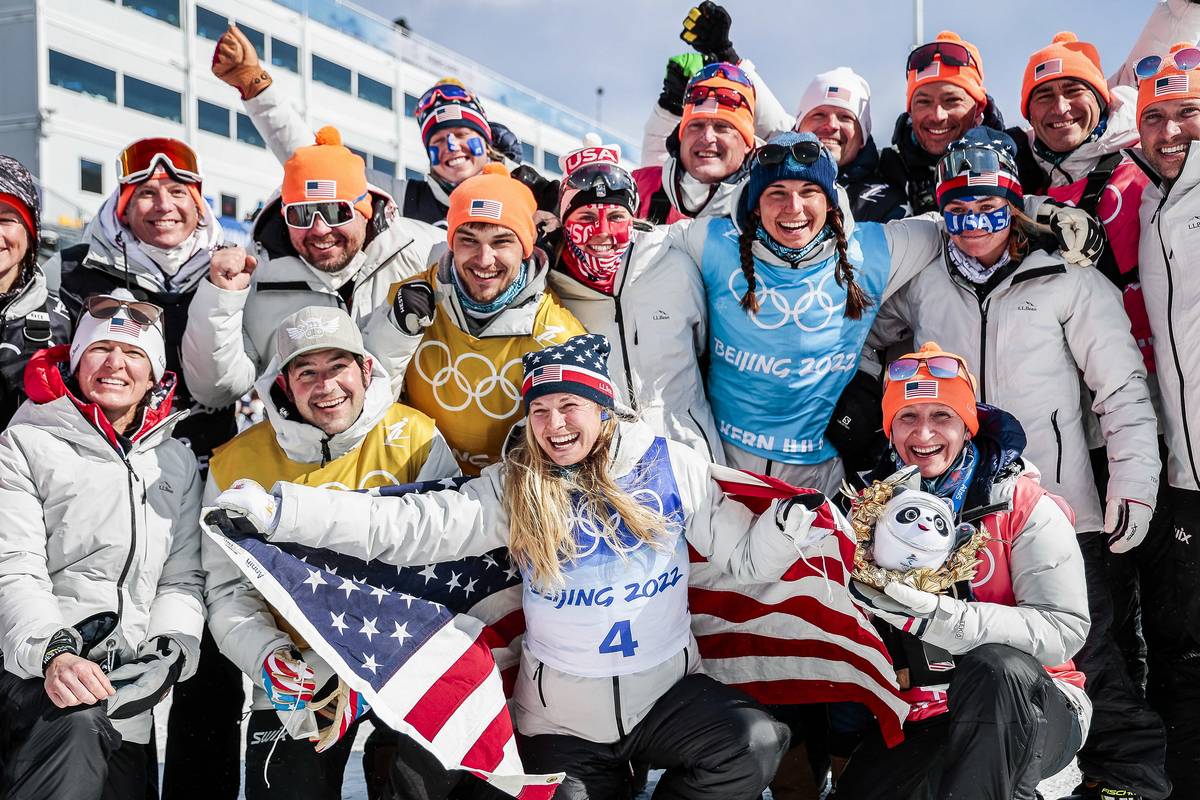
USA I ends the season on top in the 4 x 5 k relay. From left to right, Zak Ketterson, Jessie Diggins, Rosie Brennan, and Scott Patterson. (Photo: NordicFocus)
“What a way to close out the World Cup season!!!!!” Brennan emphasized in an email. “After Scott and Zak had great days yesterday, I felt that we definitely had a chance, but I was not expecting a victory like that! It was fast and tactical racing out there and in the scramble leg, I wanted to stay near the front of the pack and stay out of trouble. I found myself further back in the pack than I wanted on the 2nd lap, but also knew a fall or broken pole would cost us so I tried to be patient, calm and tag off in the pack. Zak, Scott and I had the same strategy and Scott made a great move to get ahead of a split in the pack to tag Jessie in a great place. Jessie skied an insane leg and I feel lucky to have her as a teammate!”
Echoing her sentiments to conclude his post-race email from the road, Patterson added, “It’s really cool to win the last World Cup and especially awesome to be part of the team. The mixed gender event was extra special as the guys were finally able to tap into the relay energy the women have cultivated over many years.”
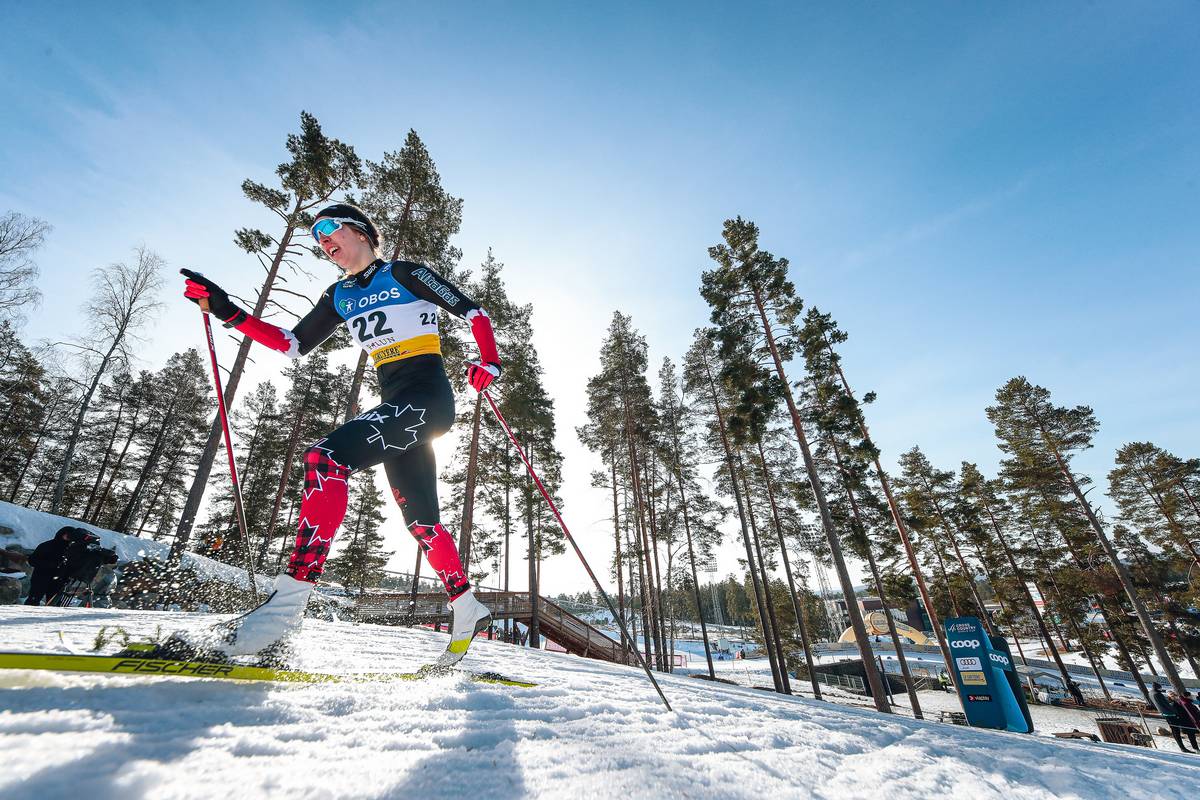
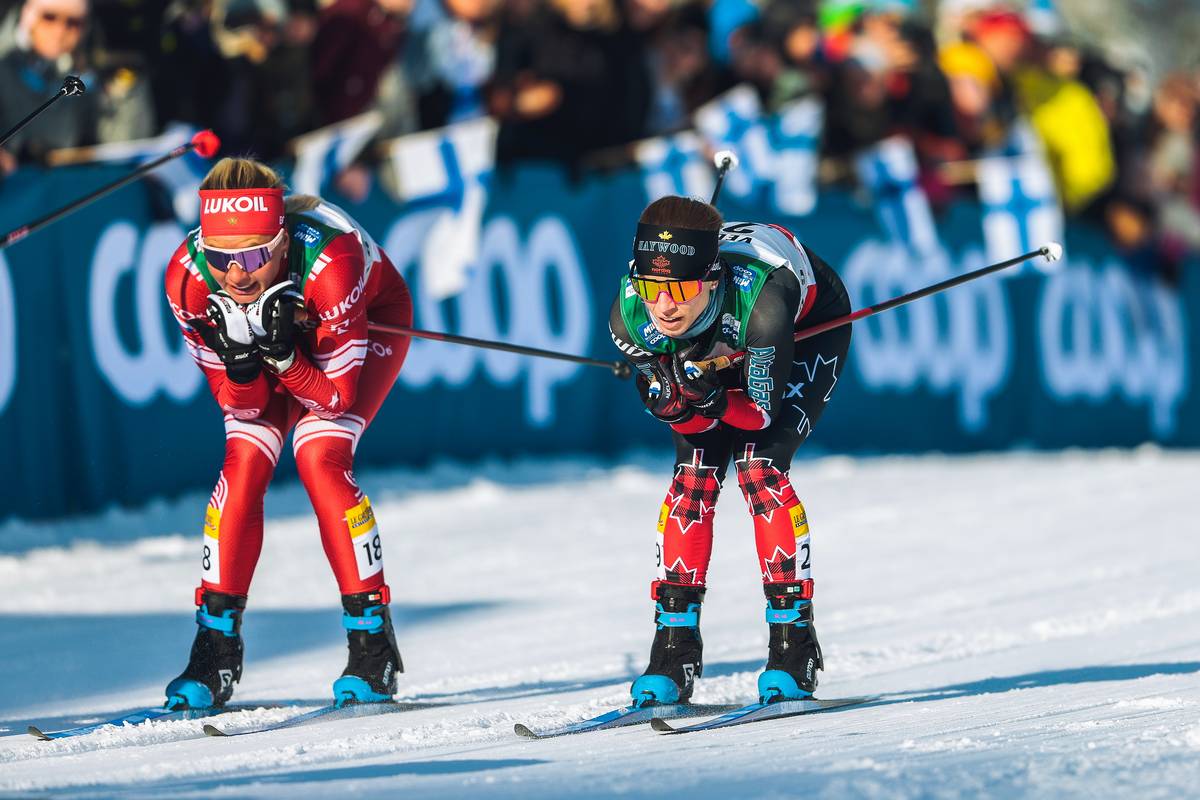
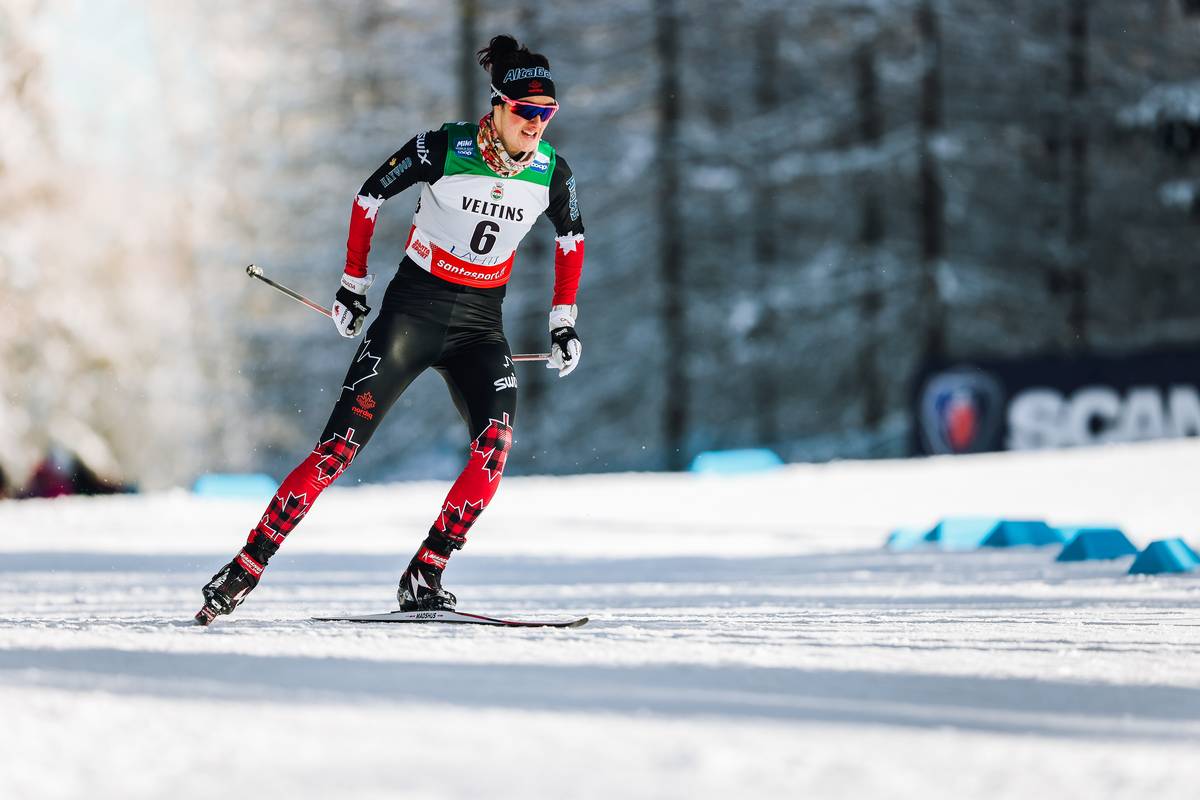
Canada’s anchor Jasmine Drolet receives a tag from Philippe Boucher during Falun’s mixed relay. (Photo: NordicFocus)Adam Martin tags his Craftsbury teammate Caitlin Patterson, who raced the anchor leg for USA II. (Photo: NordicFocus)
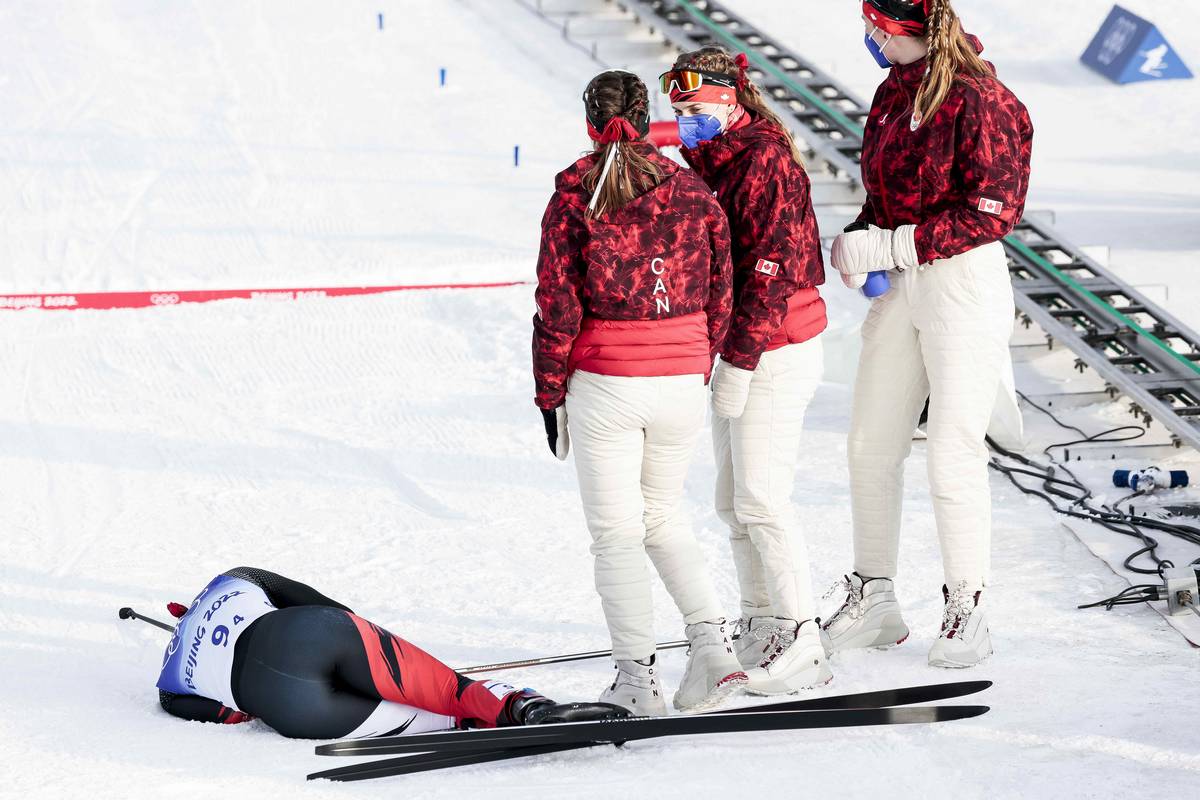
Losing contact over the third and fourth legs, consequently racing alone, Canada ended the day in 12th (+1:45.2), while USA II pushed alongside Finland II through its final lap. Edged out in the final sprint, Katri Lylynpera (FIN) snuck her boot over the line ahead of Caitlin Patterson’s, leaving USA II in 14th (+2:10.9).
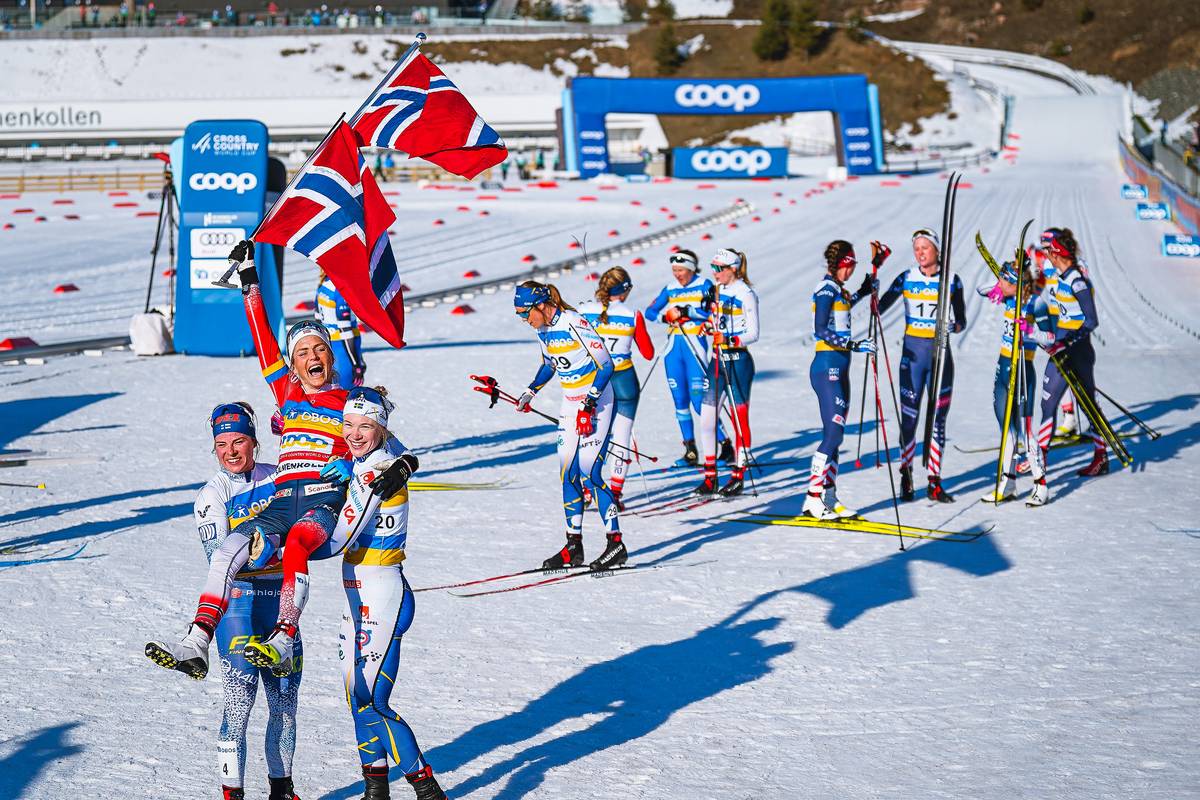
Celebrations fed by cheering crowds, energy was high throughout the stadium. Regardless of finish order, acts of camaraderie and sportsmanship could be seen and heard as cameras meandered through the groups of athletes waiting for their relay teammates. We could hear a Frenchman congratulate Norway’s Tønseth on ending his season with an individual win, Ketterson and Kern anxiously trying to predict what might happen in the American’s final legs, along with a host of supportive cheers as teammates and coaches egged on the racers.
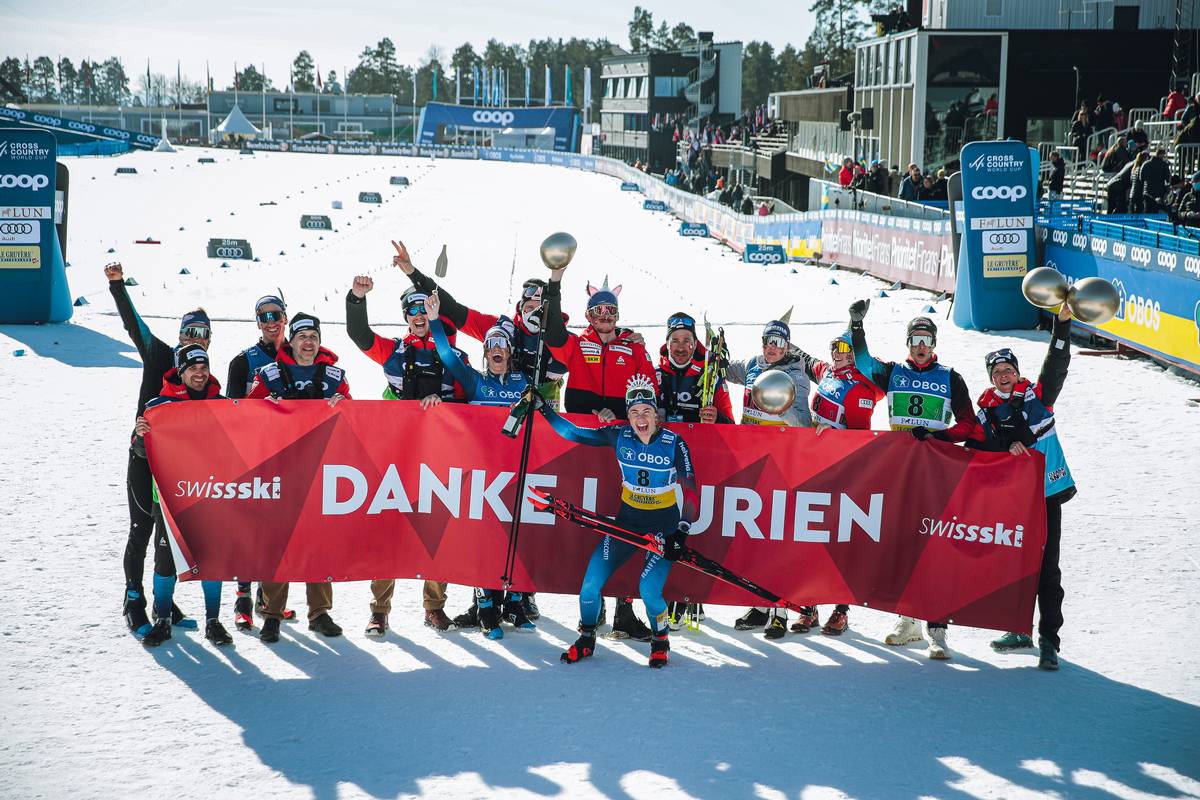
Awaiting the Swiss anchor Laurien Van der Graaff was a princess tiara, teammates in golden unicorn horns, and a large banner that read “Danke Laurien”, in celebration of her retirement. The 34-year-old has long been a presence on the World Cup, collecting a slew of podiums and a World Championship team sprint silver medal along the way.
The Swiss program celebrates the retirement of Laurien Van der Graaff at the finish of the 4 x 5 k mixed relay in Falun. (Photo: NordicFocus)
With revelry and thrill in the air, only the mixed team sprint remained on deck as the 2021/22 World Cup season drew to a close in Falun. The American program did not enter the team sprint competition, and will next compete as a team at the Whistler Olympic Park in British Columbia March 20th – 27th. The event will serve as both the Canadian National Championship and SuperTour Finals.
This World Cup coverage is made possible through the generous support of Marty and Kathy Hall and the A Hall Mark of Excellence Award. To learn more about A Hall Mark of Excellence Award or to learn how you can support FasterSkier’s coverage please contact info@fasterskier.com.
There wasn’t much to be decided, only facts to reaffirmed.
In the last individual race of the World Cup season on Saturday, a 10-kilometer individual start freestyle in Falun, Sweden, the overall World Cup standings of consequence were already decided. Individual season goals for each racer were already moving towards reflection.
Off the course, bare patches of ground seemed to suggest that even the snow was ready to move on from this winter and this ski season. The air was in agreeance; it was 6℃ (44℉) at race start.
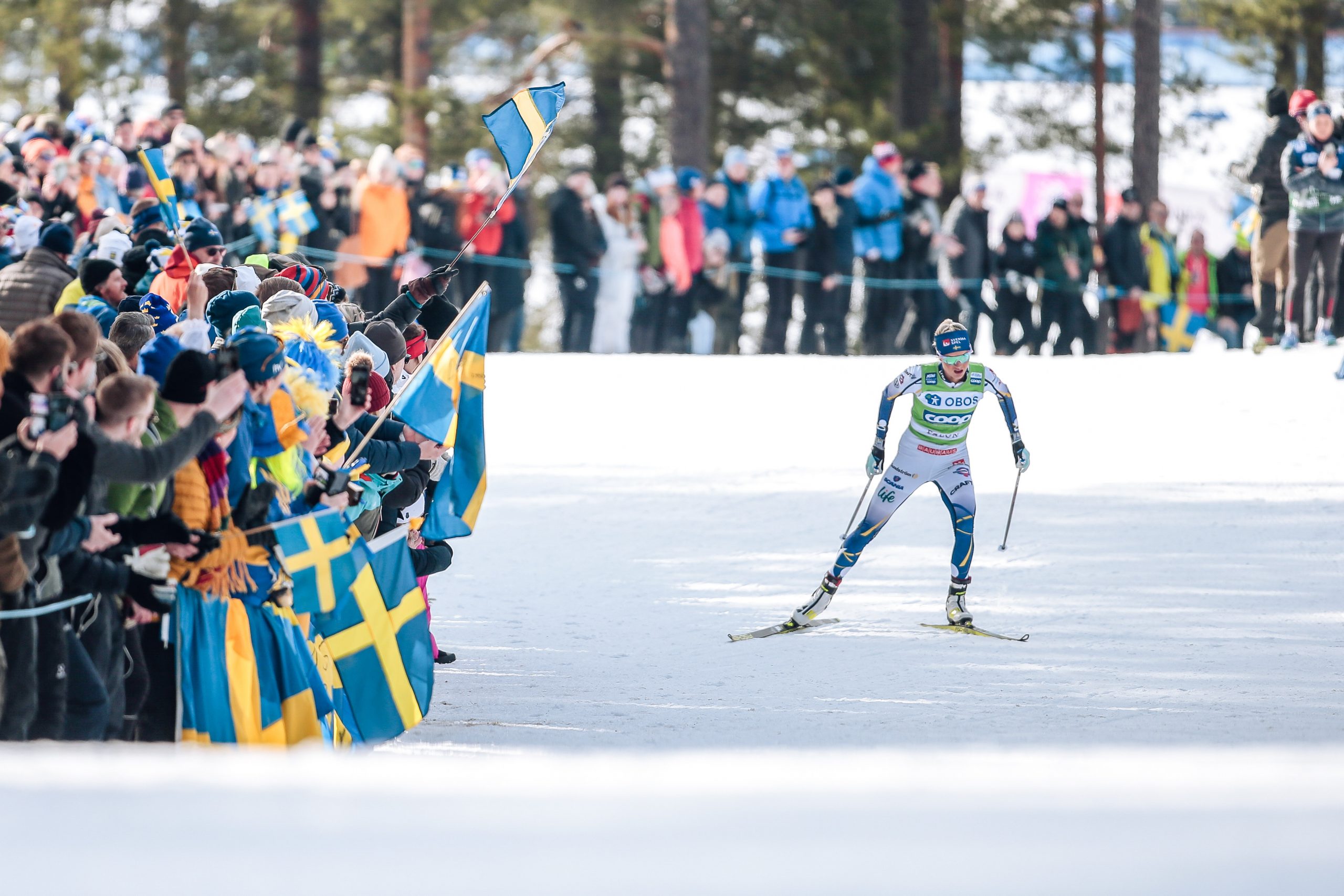
Frida Karlsson (SWE) skis past a vibrant Swedish scene in Falun. Karlsson finished 12th in the 10 k freestyle (+1:07:00), but ends the season as the World Cup Distance runner-up behind Therese Johaug (NOR). (Photo: NordicFocus)
And why wouldn’t they be? For all the hints of a return to some kind of normalcy this World Cup season – fans back at venues, a majority of courses covered with natural snow – the World Cup couldn’t out-ski the anxieties and the full-blown winds of change that the winter of 2021-22 has sent around the world. At its conclusion today, the World Cup overall will be awarded to a skier, Natalia Nepryaeva (RUS), who was barred from competing on account of the Russian government’s invasion of Ukraine. Nepryaeva sits atop a World Cup Overall points list that was shaped, and is shaped by, COVID-19 – which forced multiple cancellations of World Cup events in January, and across the season has seen individuals and teams miss races.
All we could hope for from skiing, across this season and at today’s race, was for some sort of center to hold. That we could watch and see something that we had seen before, and that it would bring light and levity to the challenges of the times.
For that type of drama? Well, while World Cup finals may have moved from Siberia to Sweden, their final destination could have been Shakespeare’s Globe.
Woven and interlocked throughout the 10 k individual start were acts ski fans have come to know by heart over the past few years and over the course of this season. But that didn’t make them any less impactful to watch. We would see valiant efforts from early starters, a women’s field where margins are only ever a few seconds throughout a race, capped off, apropos the start order,by the one question that has animated distance racing on the World Cup for nearly a decade, posed for the last time – what about Therese Johaug?
To get to the answer to that question, we would have to wait. In the meantime, the Falun course played host to narratives that followed the contours of its terrain. The 10 k was raced as 3 laps – one 2.5 k loop that was relatively flat, before two laps of a 3.75 k loop where the terrain was punctuated with a set of climbs that would look to separate the field.
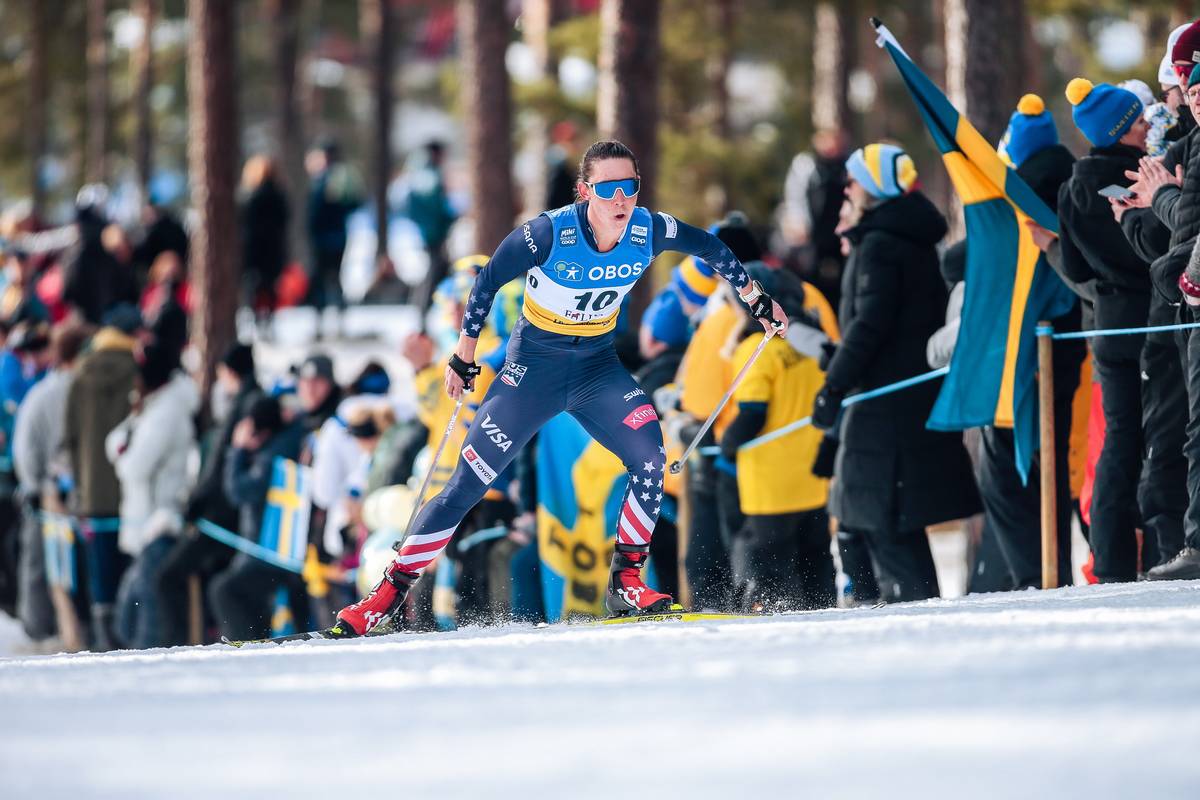
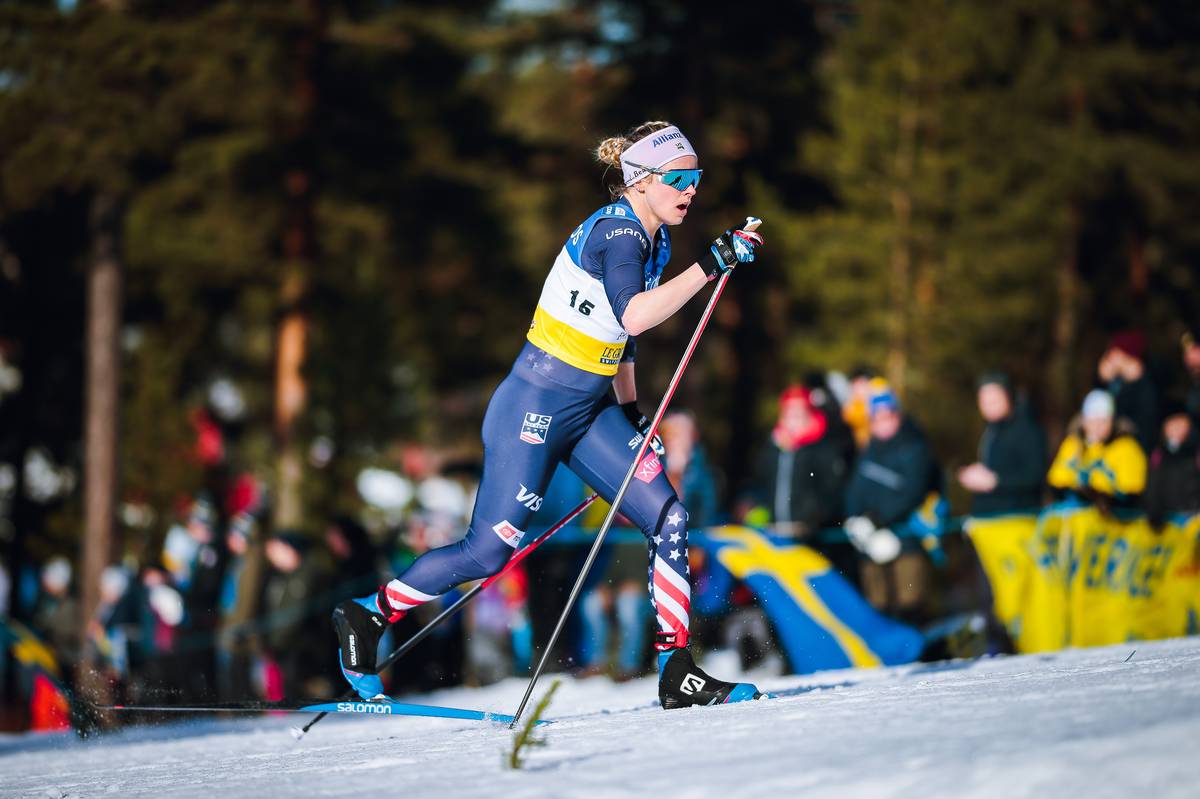
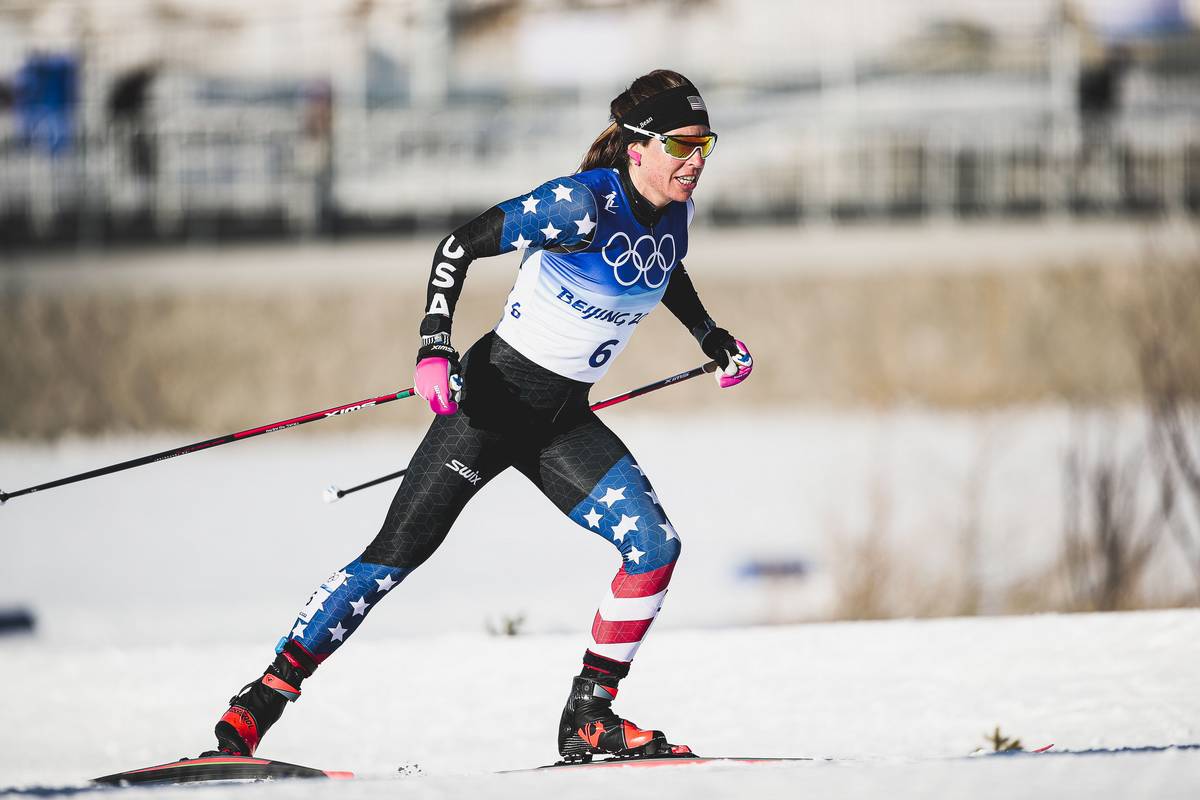
Julia Kern skis to 20th in Falun’s 10 k individual start skate. (Photo: NordicFocus)
The early racer to watch in the field was bib 10, Julia Kern, who came through the 1.5 k checkpoint 3.7 seconds ahead of the field. While the top racers would soon follow, with Frida Karlsson (SWE) eventually topping Kern’s mark as she moved through the course, Kern would prove to be a pace-setter for the earlier starters throughout her 10 k effort. She set the fastest time on course at the finish, but it would fall as seeded athletes followed. Her efforts though, ultimately yielded a 20th place finish (+1:30.3), and the image of Kern crossing the line as a champion (even if it proved temporary) seemed an appropriate conclusion to a season where she had battled to overcome the growing pains of World Cup skiing from last season and prove to be one of those American women that ought to be seen as a force on the start line.
“She raced four rounds yesterday. There was gonna be a limit to the energy, [and yet] she swung really hard today and came up with a big result today. I think a fresh Julia Kern can race with the top ten, and that’s not diminishing her 20th place today. There’s more to give, and that’s exciting” said US Ski Team Head Coach Matt Whitcomb on Kern’s result in an interview with FasterSkier.
Full audio interview with Matt Whitcomb.
Jessie Diggins races to third in Falun’s 10 k skate. (Photo: NordicFocus)
Joining her in the category of American women to be excited about throughout the season has been Rosie Brennan and Jessie Diggins. Brennan started in bib 38 today, with Diggins two minutes later in bib 42. They followed the lead of Frida Karlsson and Krista Pärmäkoski throughout the duration of the course. Karlsson, in bib 23, was the first skier to top Kern’s 1.5 k mark, coming in at 2.8 seconds over the field. Pärmäkoski, in bib 30, came through that checkpoint in 2nd, +1.6 back on Karlsson. When Brennan came through, she was +2.5 seconds off Karlsson and in 5th place, and when Diggins came through she was +0.2 off Karlsson and had put herself in 2nd place. The field, in other words, was tight, and those skiers, Karlsson, Pärmäkoski, Brennan, and Diggins – along with Ebba Andersson (SWE) and Kertu Niskanen (FIN) – would jockey and swap places through the remaining 8.5 k.
Krista Pärmäkoski races the 10 k individual start free in Falun. (Photo: NordicFocus)
At 4.3 k, Pärmäkoski had overtaken Karlsson by 1.2 seconds. Brennan came in +1.7 off of Pärmäkoski. Diggins moments later came in +1.8. Through the halfway point with the group the standings read: Pärmäkoski first, Karlsson second, Brennan third, and Diggins fourth, with less than 2 seconds between them.
By 7.7 k, the gaps had started to grow. Pärmäkoski came through with a 14.6 second advantage over Karlsson, while Brennan was +21.6 off the top and back in fourth place. The, in one of the familiar sights that colored the day, Jessie Diggins had started to somehow, someway, increase her pace. She came through 7.7 k now in second place, just +2.6 seconds off of Pärmäkoski.
Rosie Brennan on course Saturday. Brennan finished 8th in the 10 k freestyle. (Photo: NordicFocus)
At 9.1 k, Pärmäkoski still had first place, but Diggins had cut her deficit to a mere +0.6 seconds. As Pärmäkoski crossed the finish in first place with 21.8 seconds on the field, one started to get the exhilarating feeling that the camera would soon cut to Jessie Diggins doing what Jessie Diggins does best.
There was almost dramatic irony to it – we, the audience, just knew that there would be Diggins, free skating, looking ahead, and somehow increasing her tempo from 100% to beyond that. Then, she did it. Diggins crossed the finish line having not only erased her deficit, but gained a second on Pärmäkoski to finish in first place, 1.9 seconds ahead of the rest of the field.
In remarks to FasterSkier, Diggins said that her race today reflected renewed energy levels after her silver-medal winning 30 k at the Olympics, “Today was wonderful. After [sitting out the Holmenkollen race], I felt like I could go out and race the way I wanted to, having the energy to really attack the course.”
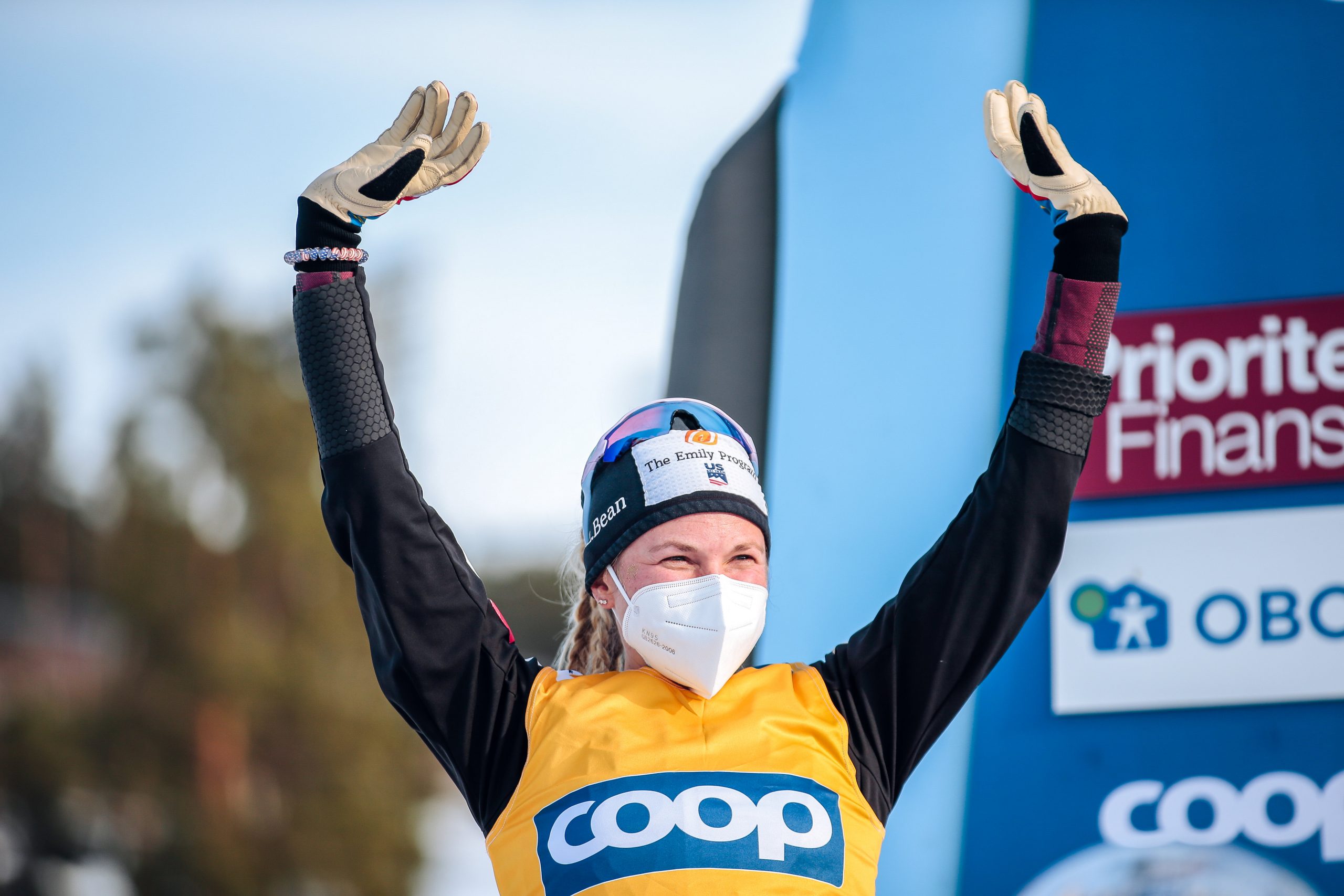
Jessie Diggins sits in the winner’s circle after crossing the line in first place on a sunny day in Falun. Diggins would eventually cede the spot to Jonna Sundling (SWE), before Therese Johaug (NOR) crossed the line in first. Final results: 1st Johaug, 2nd Sundling, 3rd Diggins. (Photo: NordicFocus)
Diggins’ result though, only was a subset of the dramatic irony that prevaded the overarching race. Behind her, wearing the red leader’s bib (56, last starter in the field), fresh off of a win at the Holmenkollen 50 k, and in her individual last professional ski race, was Therese Johaug (NOR). The immensity of her character in the drama of the day was hard to understate. Johaug had already secured the Distance World Cup title for the season – her record-breaking fifth time winning that title (breaking a record jointly held by Justyna Kowalczyk and Dario Cologna). Coming into today, she was looking for her 100th World Cup win. She had been on every World Cup distance podium except one (a 4th place in a 10 k classic two years ago) since 2019.
Posting outstanding results across all distances, Jonna Sundling takes second in Falun’s 10 k skate. (Photo: NordicFocus)
What she might achieve in today’s 10 k was continuously foreshadowed throughout the course by Jonna Sundling, who wore bib 50. The Swede, on her home turf, broke through the jockeying at the top of the field when she came through the 1.5 k checkpoint 8.1 sec ahead of the field. When Johaug came through behind her in 2nd place, +4.0 sec, the little separation the pair had created seemed to be a turning point in the race. Johaug might do it. She could do it. She would probably do it. And then, she was doing it.
“It,” of course, was opening a commanding gap on the best skiers in the world. At 4.3 k, she had a 14.1 second gap on Sundling. At 7.7 k, the gap was 30.6 seconds. At 9.1 k, the gap was 35.4 seconds. Building steadily, Johaug had set the stage for a final, triumphant act.
Jonna Sundling skis past her home crowd in Falun, Sweden. Sundling finished 2nd place, after a dramatic sprint to finish 0.4 seconds ahead of third place Jessie Diggins (USA) at the line. (Photo: NordicFocus)
First though, Jonna Sundling would add another scene. As she crested the hill going into the stadium the background was dotted by her country’s flags. The clock put her agonizingly close to Jessie Diggins. She did what she does better than any other skier at the moment – the Olympic gold medalist in the freestyle sprint unleashed a finish line burst that saw her come in 0.4 seconds ahead of Jessie Diggins in first place. The Swedish crowd let out a roar. It was the best that skiing as a spectator sport has to offer.
And then, it was surpassed by the best that skiing, period, had to offer. Therese Johaug finished in first place in a time of 22:34.4. To sum up her career, all you have to do is remove the last preposition.
Therese Johaug finished in first place.
Therese Johaug (NOR) crosses the finish line, in first place, for the final time in her remarkable career. Johaug won on the day (22:34.4), and also secured the distance World Cup title for the season in Falun. (Photo: NordicFocus)
Joahaug came across her last finish line with a yelp, and then quickly turned to her competitors still mulling in the finish area. In an instance, she had gone from racer to ambassador.
With the Norwegian at the back of the seeded group, this meant the podium would be Johaug on top, Sundling in second (+35.9), and Diggins third (+38.5). Rounding out the top-five, Pärmäkoski took fourth (+38.2), with Norway’s Heidi Weng in fifth (+42.7).
The Falun 10 k freestyle podium. (l-r) 2nd place Jonna Sundling (SWE), 1st place Therese Johaug (NOR), and 3rd place Jessie Diggins (USA). (Photo: NordicFocus)
Johaug leaves a sport that’s transformed since she first raced a World Cup in 2007. For one, it is a sport in which Therese Johaug has raced. Her ability to win races so decisively, and consistently, will cast a long shadow. She finishes her final World Cup Distance title with 177 point advantage over 2nd place Frida Karlsson (SWE), who at the young age of 22 looks poised to chart a course that follows in Johaug’s footsteps. 3rd place in the classification will go to Krista Pärmäkoski (FIN).
It’s also a sport where its leading star is an American, joined by her teammates who are now capable of putting two skiers in the top ten (Diggins 3rd and Brennan 8th), and three in the top thirty (Kern 20th, +1:30.3). The depth of the Americans, in fact, was one of the great takeaways from today’s race. Caitlin Patterson just missed a top thirty finish, coming in 31st (+1:49.5). Rosie Frankowski finished 41st (+2:26.4).
Rosie Frankowski (USA) comes down the final stretch in Falun. Frankowski finished 41st (+2:26.4). (Photo: NordicFocus)
Diggins, in particular, has proved skiing’s muse of fire, her grit and heroics adding to the depth of what ski racing purports to be the ideal for. Just today, she came into the race just one point ahead of Ebba Andersson (SWE) in the World Cup Overall. Between her and Andersson, the first finished today would secure World Cup runners-up. After Diggins podium finish today, adding to the mountain of evidence she’s accrued that belief and push are worth it, she secured that title. The overall champions’ title and crystal globe, meanwhile, will go to Natalia Nepryaeva (RUS).
Diggins said of her runners-up in the World Cup overall standings:
“It was really special to finish 2nd in the overall World Cup. I’m really proud. It represents a lot of hard work and consistently giving it everything I have everytime I race…
“I’m definitely still processing it. For me, this was a season where I came in with very concrete goals about my preparation physically and mentally for the Olympics. That was the big target. I’m really proud of how as a team (coaches and teammates) we handled that, and having World Cup wins and podiums was really just the icing on the cake.”
Full post-race audio clip from Jessie Diggins.
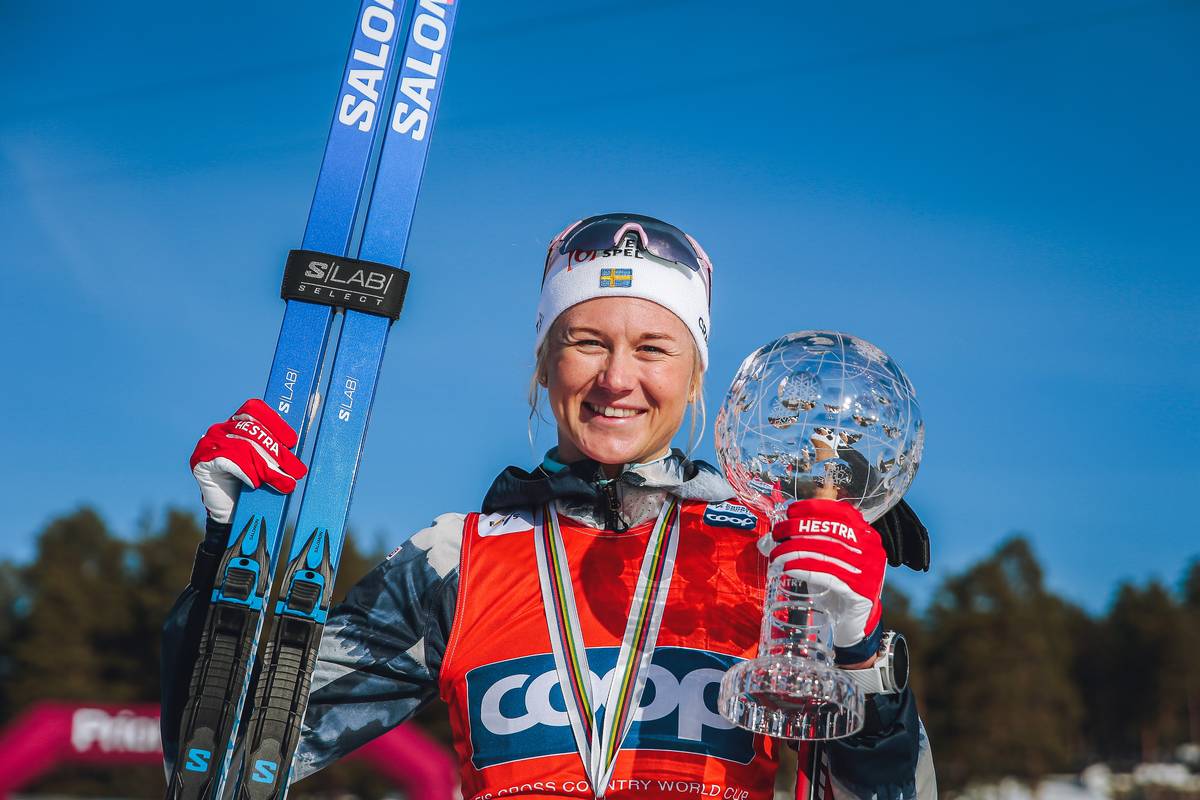
Therese Johaug holding her record 5th World Cup Distance crystal globe after winning in Falun. Johaug announced she is retiring from professional skiing last week in Holmenkollen. (Photo: NordicFocus)
Johaug leaves a sport too, at the end of a weary and winding road of a season. Not only out-skiing the best skiers in the world, but navigating the inextricable circumstances that surround the sport in our times. COVID-19, for one, but also the rapidly shifting planes of geopolitics – and the interplay between nationalism, identity, and narrative – that have always been at the heart of all sports, and in particular (as we’ll be reminded in the team event tomorrow) skiing.
That state of flux in the meanings surrounding the sport of skiing will continue. More so now than ever. As will the stories of athletes that are, in their pursuit of dreams, caught in contested ideas that animate the world way beyond this sport.
But then again, we have seen that all before. And as today showed, when in skiing we see something familiar, it is drive, passion, and joy in their pure human forms, that make us turn our heads and pay attention.
That is, after all, the drama of skiing, and in Falun today, we saw one of its best examples.
The Canadian women also had a string of strong results today. Katharine Stewart-Jones finished 33rd (+1:57.7), Dahria Beatty finished 43rd (+2:36.7), and Jasmine Drolet finished 52nd (+3:08.2).
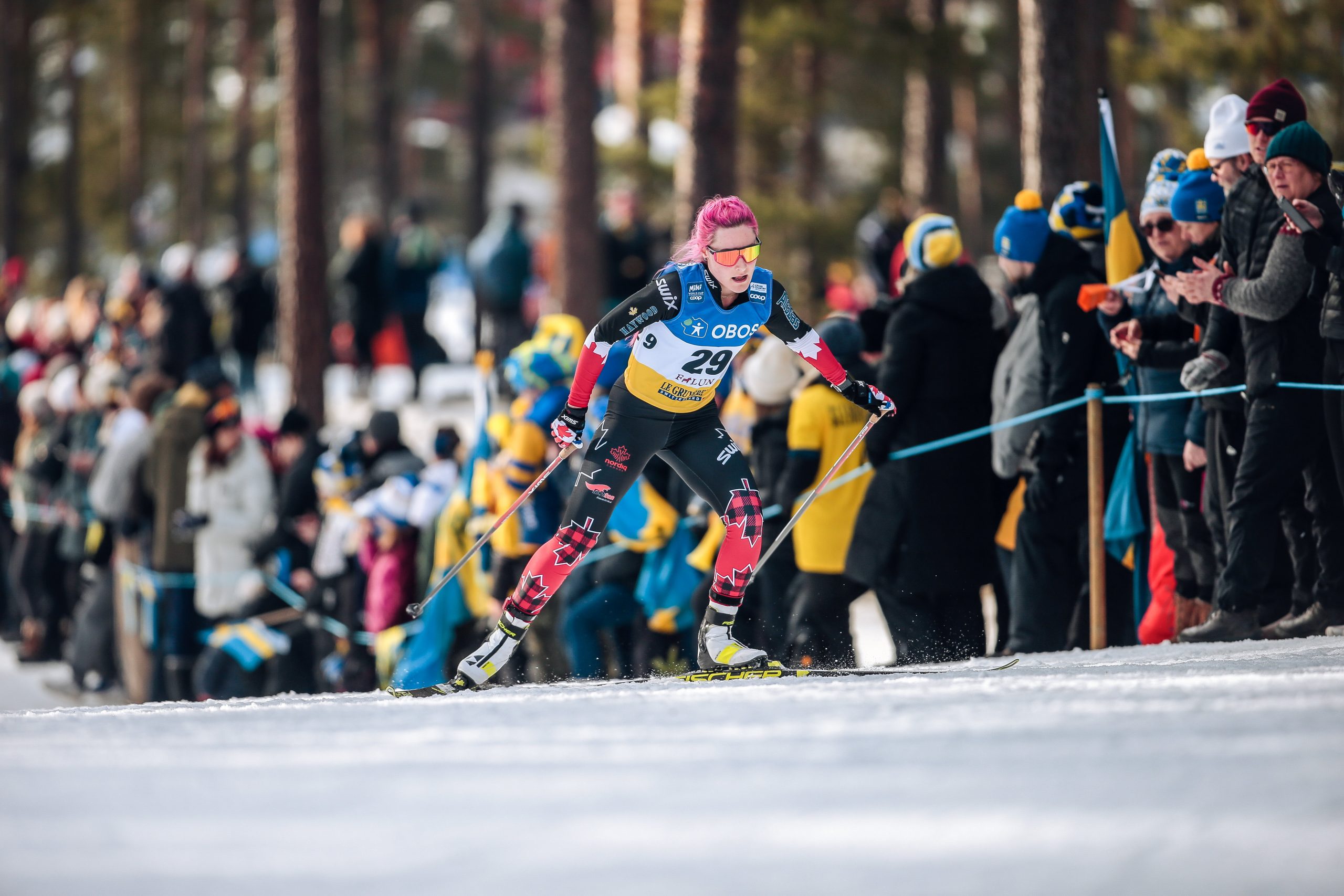
Canada’s Jasmine Drolet sporting Dartmouth’s signature pink-hair look as she raced her way to a 52nd on the World Cup in Falun. (Photo: NordicFocus)
This World Cup coverage is made possible through the generous support of Marty and Kathy Hall and the A Hall Mark of Excellence Award. To learn more about A Hall Mark of Excellence Award or to learn how you can support FasterSkier’s coverage please contact info@fasterskier.com.
Women’s 1.4 k classic sprint podium in Falun, Sweden: Jonna Sundling (SWE) took the win ahead of Anamarija Lampic (SLO) and Maja Dahlqvist (SWE). (Photo: NordicFocus)
We’ve arrived at the final weekend of World Cup racing. After the cancellation of the finals scheduled to take place in Tyumen, Russia and the difficulty of finding a last-minute replacement, these three days of racing in Falun, Sweden will be the culmination of the 2021/22 World Cup season. On a warm sunny day, in full spring conditions, the women executed an exciting classic sprint on the familiar 1.4 k Falun sprint course. With this being the last sprint of the season, it was also a day to cement the places in the running for the overall women’s sprint globe (none of the team events happening Sunday will influence the rankings).
Starting with a bang, Jonna Sundling of Sweden won the qualifier by an astonishing margin of +8.41 seconds, ahead of runner up Jasmi Joensuu of Finland. The American’s put three women into the quarter-finals, led by Rosie Brennan in 7th (+9.61). Julia Kern qualified in 17th position (+12.30), followed by her teammate and roommate, Jessie Diggins in 18th (+12.49).
Jessie Diggins on her way to 18th place in the qualifier. Diggins ultimately ended her day 19th. (Photo: NordicFocus)
These were the only three American women competing today as unfortunately some late-stage positive covid tests barred the rest from competing. Having made it through a winter of international travel, living, and competing during the Omicron surge, Hailey Swirbul and Katherine Ogden announced on Monday that they had both tested positive in Norway. Lauren Jortberg, who had her World Cup debut in Lahti, Finland two weeks earlier, came directly to Falun to prepare for this weekend, only to test positive on Wednesday.
No Canadian women made it into the top thirty, their first finisher was Olivia Bouffard-Nesbitt in 32nd (+17.54). Katherine Stewart-Jones led a string of fellow country-women, finishing 37th (+19.49), followed by Dahria Beatty in 38th (+19.75) and Jasmine Drolet in 39th (+20.08). After competing at World Juniors in Lygna, Norway, Drolet joined the senior women and made her first World Cup appearance in the Holmenkollen 30 k last weekend where she finished 42nd.
Dahria Beatty (CAN) racing to 38th in the classic sprint qualifier on Friday (Photo: NordicFocus)
As crowds of fans gathered, the women’s quarterfinals kicked off at 12:15 local time. In the first heat, a fast pace bought three women tickets to the semi finals, led by Anna Svendsen of Norway. After winning the classic sprint qualifier in Drammen, Norway last week only to fall in the quarter finals, Johanna Hagström (SWE), skiing on a home course, made it safely through in second. Kerttu Niskanen of Finland took third but with a fast enough time to snag a lucky loser position.
Heat two was controlled entirely by Sundling as she skied easy out front, spreading the rest of the field. Behind her came Johanna Matintalo of Finland and Julie Myhre of Norway who made it to the semis as the second lucky loser. Brennan (USA) finished fourth, +3.39 behind Sundling, ending her day in 16th overall.
Rosie Brennan races the quarterfinal after qualifying 7th. (Photo: NordicFocus)
“It was warm and wild out there today,” wrote Brennan after the race. “This course is quite technical and has some challenging downhills which has made it a tough course for me in the past so I was ready to make some progress today. I had a good qualifier and that gave me some confidence for the heats. I had a very stacked heat which can go either way for me. I struggled finding space to move on the uphills which is my strength and that ultimately cost me moving on to the semi-finals by less than a second. In the bigger picture, I do think I made some strong progress on some of my weak spots on this course and I am really excited about that. I am also still feeling good and excited to race which bodes well for the rest of the weekend.”
In heat number three, Anamarija Lampic of Slovenia took on the lead, as Diggins and Moa Lundgren of Sweden chased. Entering the final straight Nadine Fähndrich of Switzerland employed her blistering finish speed to surpass both Diggins and Lundgren, and nearly overtake an unsuspecting Lampic. This left Diggins in fourth place in a heat that was not quick enough to make lucky loser. Diggins ends the sprint season in fourth place in the overall sprint standings with 351 points; having entered the day in third with 339 points, she was bumped off the podium by Sundling.
Jessie Diggins races in heat number three in the 1.4 k classic sprint in Falun. (Photo: NordicFocus)
Heat four saw an easy pace from the gun, with the pack largely staying together. With all six athletes still in touch as they crested the big climb, Kern navigated into third place on the ensuing tight downhill corner. An injection of speed from Maja Dahlqvist (SWE) over the next rise split the pack as Lotta Udnes Weng (NOR) shadowed, followed by Kern still in third. In the long downhill glide-out, Weng overtook the Swede, entering the final corner in first. Right with her were Kern, Dahlqvist and Laura Gimmler of Germany. A close finish saw Kern out double-pole Dahlqvist to take the win, with Weng coming second. However, a disqualification for Weng bumped Dahlqvist into second and thus have her a ticket to the semi-finals.
Jasmi Joensuu (FIN) and Maiken Caspersen Falla (NOR) duke it out in the quarter-final (Photo: NordicFocus)
After a redeeming win in Drammen last week, Maiken Caspersen Falla of Norway charged off the startline for heat five. Joensuu (FIN) and Heidi Weng (NOR) took up the chase and eventually overtook Falla on the long descent back into the stadium. Together the two Norwegians pulled away from the Finn as Joensuu faded slightly. Falla finished first and Weng, with a scream of satisfaction, crossed in second.
Heidi Weng (NOR) racing in quarterfinal heat number five (Photo: NordicFocus)
Echoing her moves from the quarter-final, Sundling (SWE) approached semi-final number one in the same manner, skiing smooth and easy out front. Lampic (SLO) followed with some occasional slips on a mushy course. Those front two continued to pull away, Sundling making it look easy as she found herself well clear of the rest of the competition. Lampic maintained second position and Matintalo (FIN) came in third, though was not quick enough to move onto the final.
In the second semi-final, Falla (NOR) took the lead, again trailed by Weng (NOR). Once again, Kern (USA) moved into third position on the tight middle downhill portion, setting herself up well. A fall from Weng on the next hill took her out of contention as Dahlqvist (SWE) moved into second position, Kern still in third. Switching tracks, Dahlqvist stumbled but managed to stay on her feet as Kern took the lead into the final corner. Kern held onto first position with some strong double poling and behind her Dahlqvist, Falla and Fähndrich all qualified for the final in second through fourth positions respectively.
Julia Kern, closing out fast (Photo: NordicFocus)
Making her first sprint final since a stage race in Lenzerheide, Switzerland in December, Kern was all smiles on the start line as the athletes lined up for their final round. Right away, Sundling and Lampic began to pull away from the rest of the field. Up the A-climb, Sundling broke into a herringbone, clearly moving fast as she increased her lead. Dahlqvist who had been in third was overtaken by Kern who topped the hill in third. Lampic was holding strong in second, though being chased by Kern. Navigating the remaining corners and descents, Sundling cruised easily to the finish with enough of a lead to give a celebratory wave before crossing the line.
No challengers around, Jonna Sundling cruises to victory. (Photo: NordicFocus)
Coincidentally, Sundling won by the same margin over Lampic (+8.41 seconds) as she had on second-place qualifier Joensuu (FIN) earlier this morning. “I don’t know what is behind this result today, but the last weeks I’ve been feeling really good and it’s nice to keep the shape still,” said Sundling after her dominant victory. She added, “I didn’t compete so much in the beginning [of the season] because of injury but my motivation is on top and so is my shape, and it’s just fun to ski right now.”
Behind them, Dahlqvist was finding a second wind in the finish straight and overtook Kern to finish in third. Kern finished fourth, matching her season personal-best from Lenzerheide where she also finished fourth, in a skate sprint.
Anamarija Lampic (SLO) heads towards a silver medal as behind her Maja Dahlqvist (SWE) overtakes Kern (USA). (Photo: NordicFocus)
“[Kern] was really smart through the quarters and semis,” reflected coach Matt Whitcomb, “where she would ski really smooth through the first climb, and position herself really well. And normally what was happening is she was both being smart tactically and feeling very good today and that just led to a break between positions 3 or 4 and allowed her to get away. And her doublenpole punch at the end was as good as I’ve ever seen her today.”
Julia Kern after fending of Nadine Fähndrich (SUI) to finish fourth in the 1.4 k classic sprint. (Photo: NordicFocus)
Regarding the final in which Kern seemed to have a lock on third but lost out in the closing stages Whitcomb said, “We talked about if there was a big mistake she made and we decided she could do the same thing 10 times and maybe land on the podium four or five times. She had some stumbles, had those things not happened, it would have been a little bit closer between her and Maja [Dahlqvist], but I don’t want to discredit Maja, she had all kinds of fire in the finish today.”
He added, “It was cool, Julia’s parents are out here today, she has raced well when her parents are watching. It’s important to point out that she was fourth and not fifth, she fended off a hard-charging Fähndrich and we’re really happy with her performance today.”
Listen to the full interview with U.S. Ski Team Head Coach Matt Whitcomb here.
Julia Kern races through the heats in Falun. (Photo: NordicFocus)
Kern has put together a string of strong performances in the final period of World Cup racing, placing in the top-10 in each of the last three sprints. These results come on the tails of a first Olympic appearance that left her wanting more, after having rebounded early-season from a 2020/21 season she had described as challenging.
“It’s a bit of a bittersweet ending,” Kern said in a call. “We’ve been on the road for so long now that, after the Olympics, especially, I was feeling excited to go home. But now when things are going well and I’m feeling really good, I don’t want to go home and I don’t want the season to end. I’m happy to end on a high note and find my stride after a frustrating Games. It’s just kind of reminded me how important having some sense of normalcy is, and I’ve kind of embraced that more after the Games. I think that’s paid off, plus some hard work, and I’ve had a little extra fire from the frustration after the games. Happy to end the season this way, and [we have] another shot tomorrow, so I’m excited for that race.”
Commenting on how these strong results and better energy feed momentum, Kern discussed a mid-week training session she felt primed her for today’s sprint.
“Now that I’ve been having really good energy in training… I have to give a big shoutout to our staff. On Tuesday this week, I did an interval workout here on the courses. I had Matt, Kate [Barton], and [tech] Chris Hecker out there with me, racing me around the course doing speeds, throwing elbows, pulling tactical moves, practicing the slingshot. Those types of sessions are super valuable for me when I put the energy to put in a good interval session. I learned so much from that session, and it gave me the confidence here today to ski well in the heats and be ready for anything.”
Kern continued with a laugh that her family is her fourth place good luck charm, as they also watched her race to fourth in Lenzerheide, SUI during the Tour de Ski, ending with a comment on the American team as the season draws to a close.
“I think our team has done a really incredible job, working through all the different colleges this season has brought. When things get tough, we bring out humor and come together. I just feel more and more appreciation for the team. My wax tech Eli and I have worked really hard all season together to start linking together some classic performances. We’ve had four classic races in a row now, and pretty much all personal bests, so that’s been a really fun relationship to build and [I appreciate] all the hard work the wax team puts in.”
Full post-race interview with Julia Kern. Apologies for the bad echo — working through the kinks as we work our way along the audio learning curve.
Julia Kern edges out Maja Dahlqvist (SWE) in the classic sprint semifinal in Falun. (Photo: NordicFocus)
Dahlqvist already had the sprint globe on lock, but her third place finish today only reinforced her strength in sprint racing this season as she racked up 638 points throughout the year. She began the season with four straight wins and earned a silver medal in the Olympic skate sprint last month. A fourth place finish in Drammen was the only time this season in which she did not finish on the podium in a sprint event.
“It feels really really, super duper good,” said Dahlqvist about taking home the globe. “I’m super happy with that.”
Sweden’s Maja Dahlqvist is the 2022 World Cup sprint champion. (Photo: NordicFocus)
Last year’s sprint globe winner, Anamaria Lampic (SLO) finished second this year with 506 points. After today’s victory, Sundling (SWE) overtook Diggins (USA) to move into third in the sprint standings with 442 points. Delaying her start to the season after sustaining an injury in an early-season FIS race, Sundling’s first World Cup start was Dresden in mid-December where she finished second in the individual skate sprint. She did not take part in the Tour de Ski, but returned to the World Cup circuit in dominant fashion, after collecting three Olympic medals, one of each color, and taking fourth place in the 30 k.
In the final three weekends of World Cup racing, Sundling landing on the podium in four out of the five races she entered, including a third place finish in the legendary Holmenkollen 30 k classic last weekend.
Anamarija Lampic (SLO) congratulates the days winner, Jonna Sundling (SWE) (Photo: NordicFocus)
Racing continues tomorrow with a 10 k skate interval start for the women. Sunday will feature two new team events, with a mixed relay happening in the morning followed by a mixed team sprint in the afternoon.
Crowds line the storied tracks at Holmenkollen during the women’s 30 k classic. (Photo: NordicFocus)
This World Cup coverage is made possible through the generous support of Marty and Kathy Hall and the A Hall Mark of Excellence Award. To learn more about A Hall Mark of Excellence Award or to learn how you can support FasterSkier’s coverage please contact info@fasterskier.com.
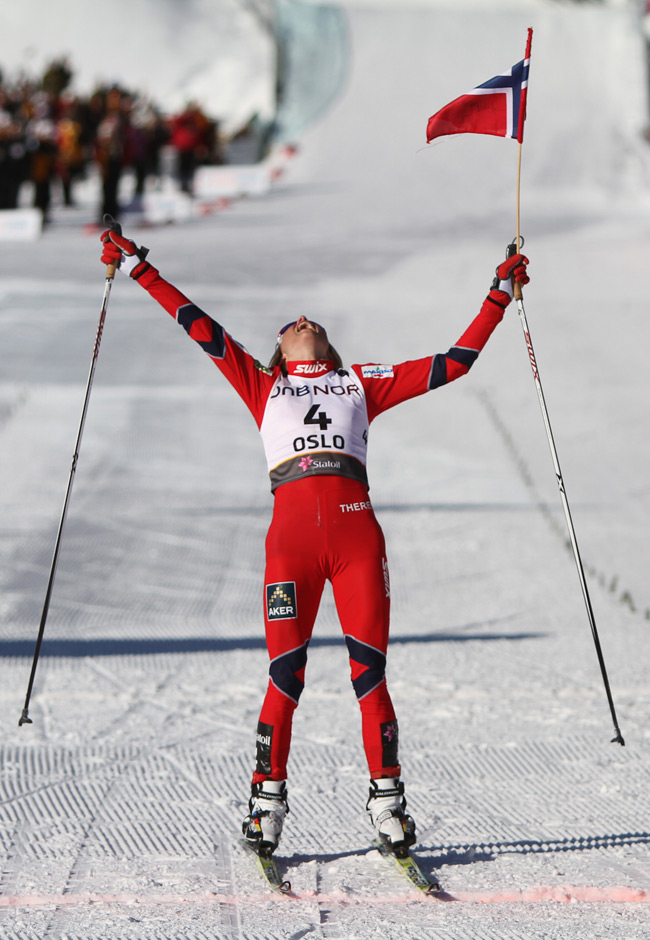
Terese Johaug wins her first individual World Championship gold medal in the 30 k mass start skate in Oslo, NOR. (Photo: FS Archives)
Eleven years ago to the day, racing the 30-kilometer mass start skate, a 22-year-old Therese Johaug won her first individual World Championship gold medal in a breakout performance at Holmenkollen near her home in Oslo, NOR. In doing so, she had broken apart a field of women considered legends of the sport on an equally legendary course known for long grinding climbs that require superior fitness and technique. Johaug won by nearly 45 seconds over one of the greatest cross country skiers of all time, her teammate Marit Bjørgen, and was 1:34 ahead of the Polish champion Justyna Kowalczyk.
“It was hard for me. It’s hard to see her go in front, and the gap [grow] bigger and bigger,” said Bjørgen that day. Then at the peak of her career, Bjørgen had gone four-for-four that week with gold medals in each of the previous World Championship races in Oslo, and the upset was a shock to those following along. “But I’m very happy for Therese. She is a young girl, and a girl for the future—and for Norway.”
Little did cross country ski fans know just how storied the athlete’s career would be.
Therese Johaug races in front of a home crowd during the 30 k classic at Holmenkollen. (Photo: NordicFocus)
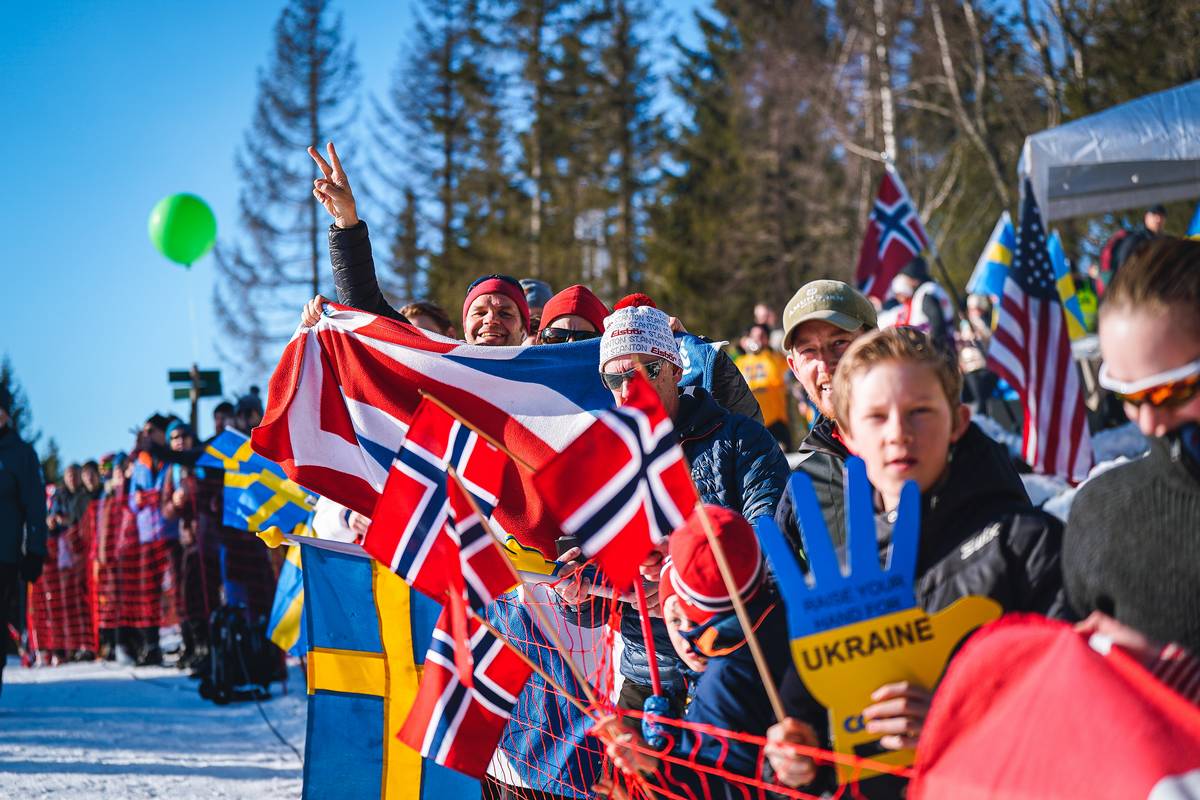
Today, under clear skies that allowed for views of the city skyline and Oslofjord, Norwegian flags flying, and fans returning to the crowded stadium and partying in the woods, she did it again, as one of her final performances after more than a decade as the top female distance skiers of all time.
And what’s more, Johaug won today’s 30 k classic in the same dominant fashion that she did eleven years ago, and has done many time since, stopping the clock at 1:19:22.8.
Though the final results show just 19.4 seconds as her winning margin, this only tells part of the story. By 10 k, Johaug held a margin of over 23 seconds, which she steadily grew over the subsequent laps. At 25 k, she led by nearly a minute and a half.
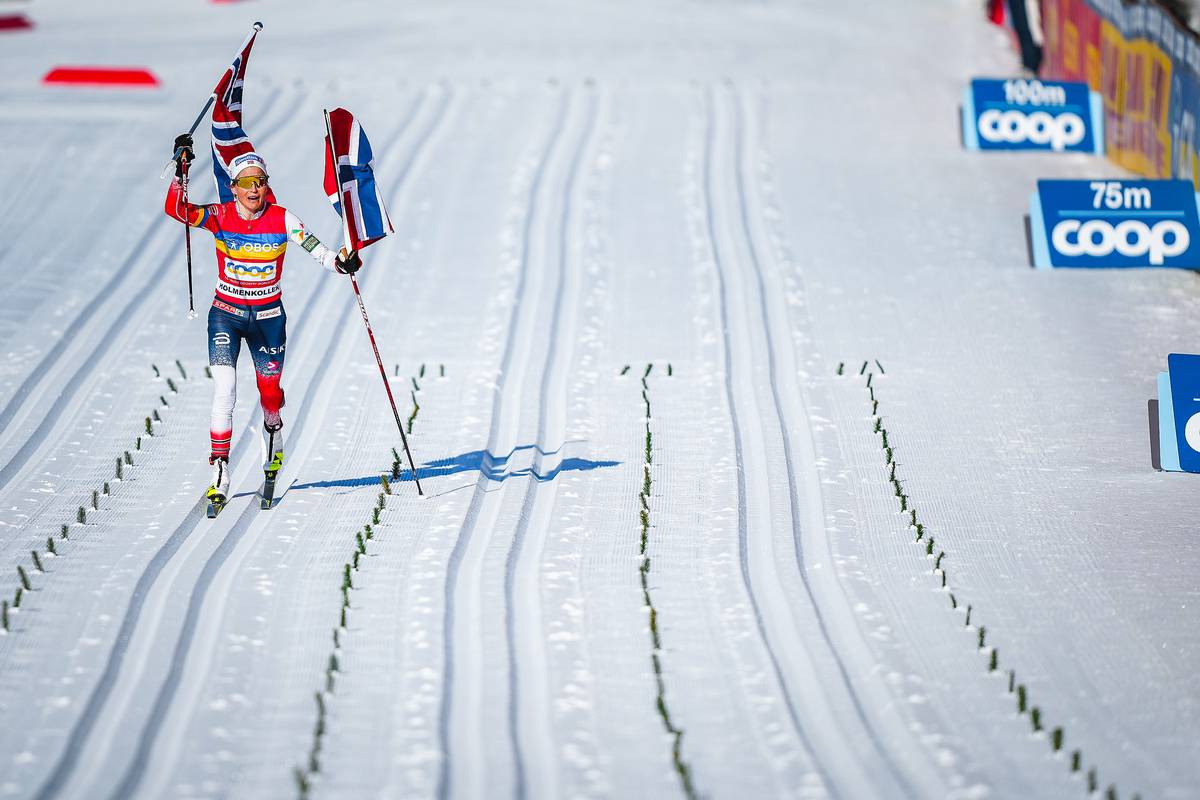
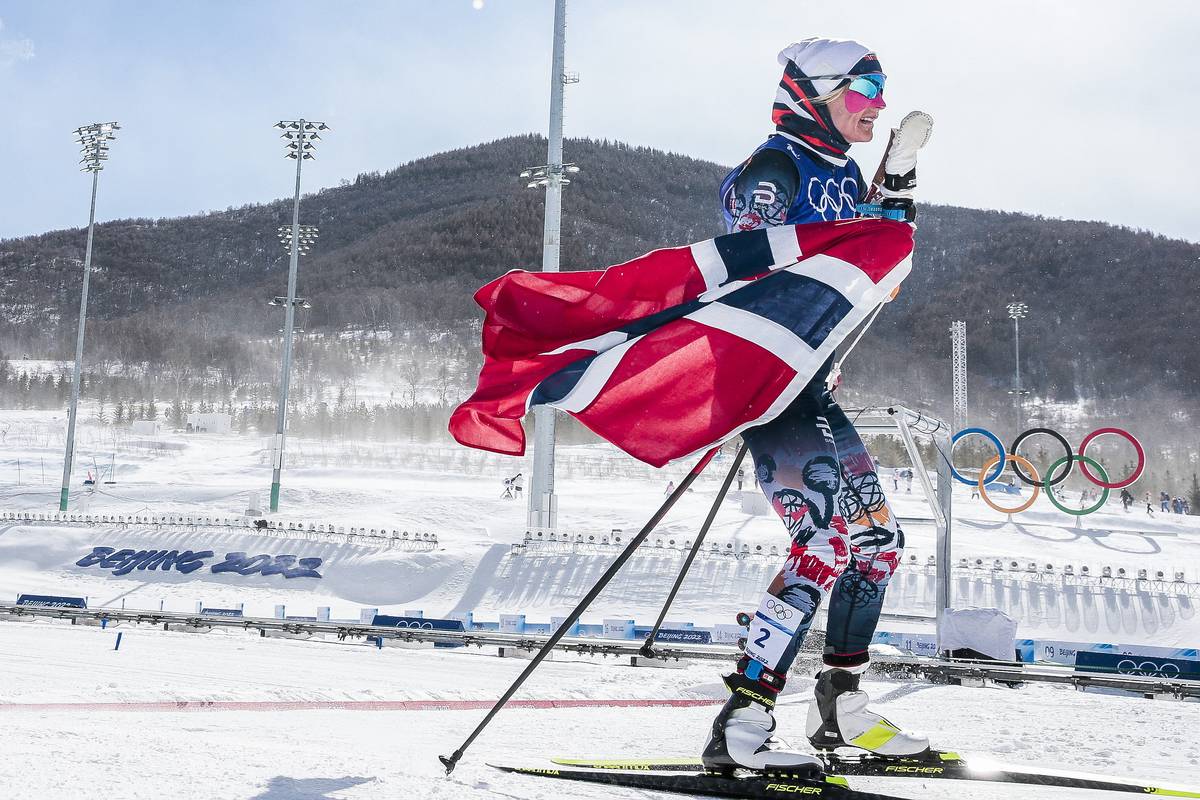
Therese Johaug waves Norwegian flags as she skis the final meters of 30 k classic at Holmenkollen. (Photo: NordicFocus)
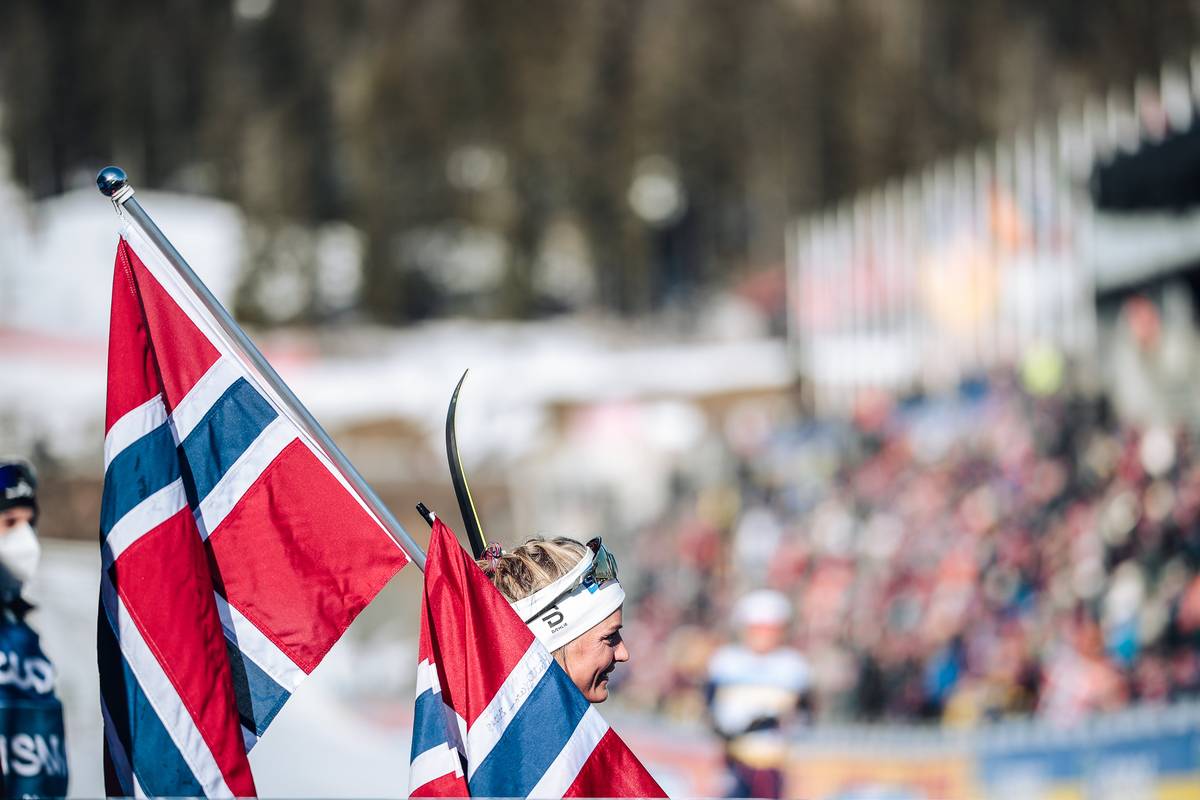
As she entered the stadium, Johaug was greeted by coaches and techs who handed her a flag for each hand, which she carried through the finish, waving, and stopping to take in the erupting cheers from the crowds.
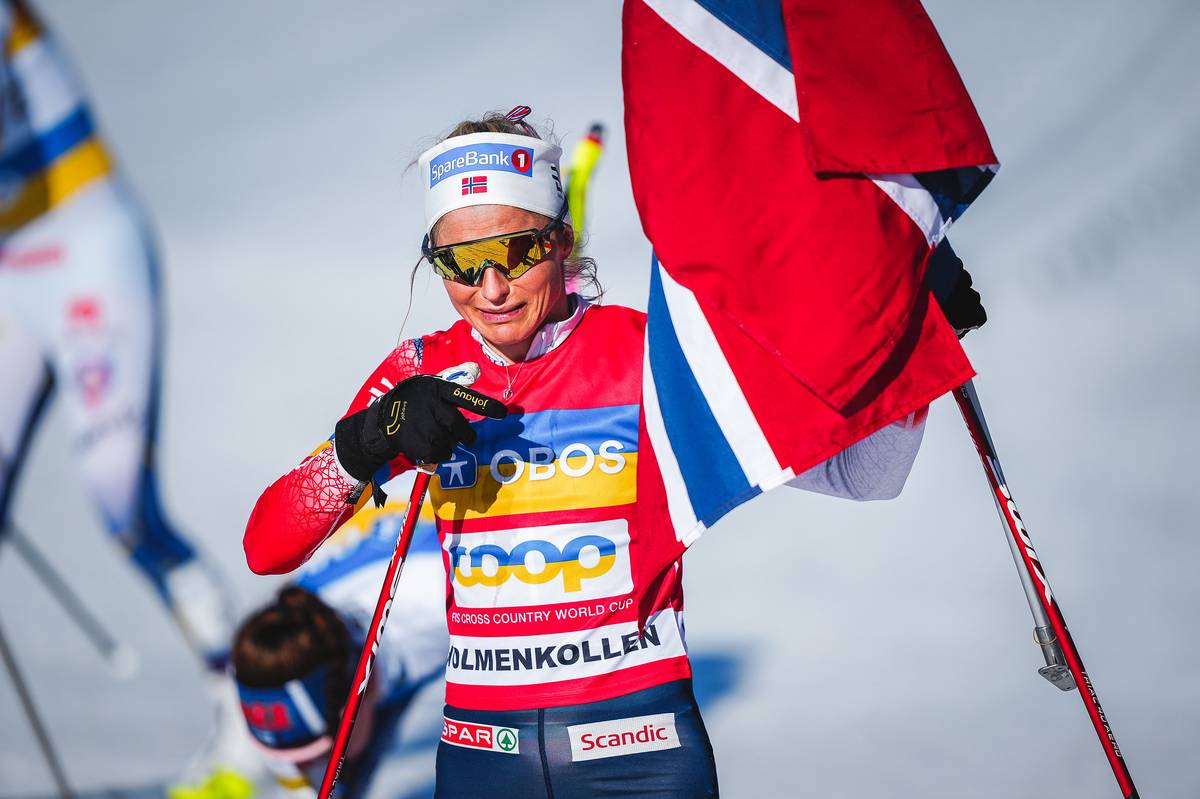
Laughing behind tears as the rest of the field began to trickle across the line, Johaug was hoisted onto shoulders, waving her flags for a loud Norwegian crowd who had supported and applauded her through fifteen years of racing on the World Cup.
“It’s a lot of emotion now,” Johaug said at the finish. “I start here in 2011 with my first individual victory, and today is my last race here. It was sun and blue sky, the same as in 2011, and there were a lot of people around the track cheering for me. I’m so happy now, but also so sad that this is the end of my career.”
Therese Johaug was emotional at the finish of today’s 30 k classic at Holmenkollen, the venue where she won her first individual World Championship gold in the 30 k skate eleven years prior. (Photo: NordicFocus)Norway’s legendary Therese Johaug wins the 30 k mass start classic, exactly 11 years after her first individual World Championship gold medal was won on the same tracks. (Photo: NordicFocus)
While she indicated during the Olympics that she would not compete another four years, it was not until yesterday that she officially announced that this would be her final race at Holmenkollen.
“In many ways, it feels as if the [story] ends when on Saturday, March 5, 2022, I stand on the starting line for another 30 k in Holmenkollen. I really do not want the journey to end, but it is a time for everything,” she wrote to NRK. “In light of this, I look forward to a final fight at home with the flag on my chest, and I am grateful for everything the sport has given me.”
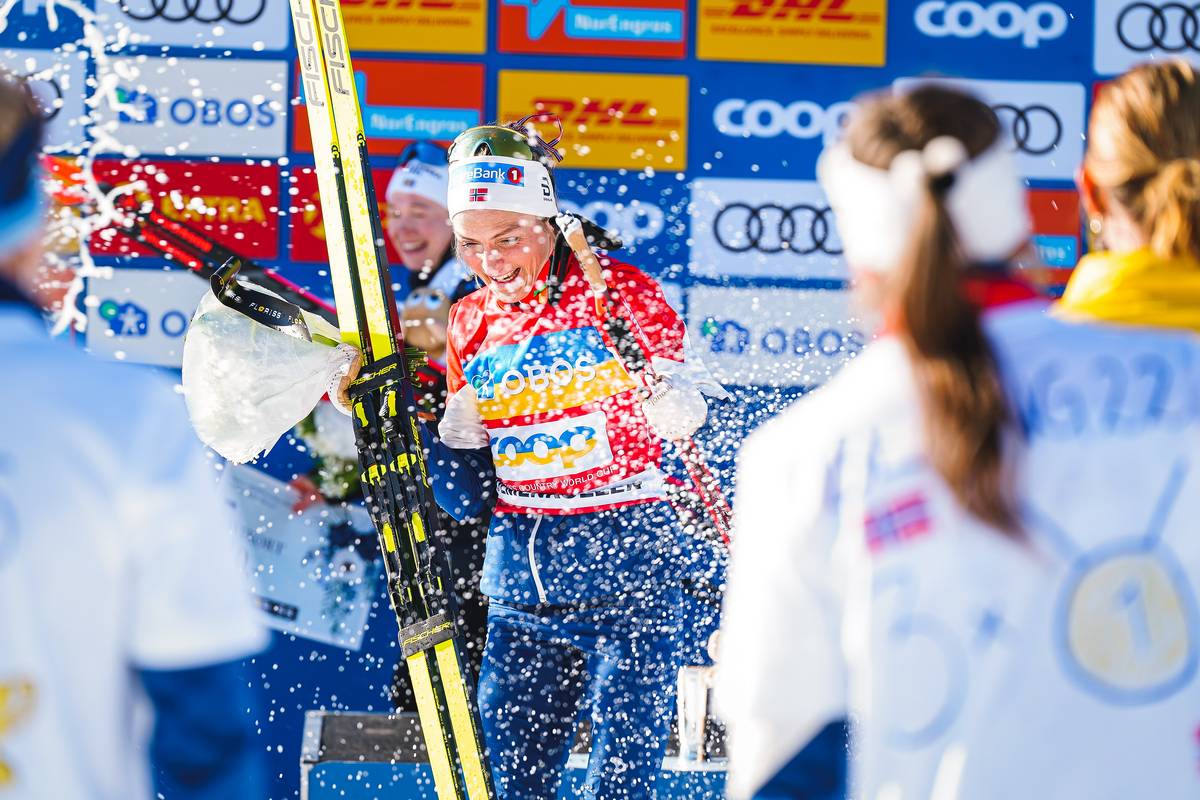
Therese Johaug is showered with champagne after winning the 30 k classic at Holmenkollen following her retirement announcement. (Photo: NordicFocus)Therese Johaug celebrates her final race race at Holmenkollen, winning the 30 k classic exactly eleven years after taking her first individual World Championship gold on these tracks. (Photo: NordicFocus)
As Queen’s “We are the Champions” blared through the stadium, Johaug stepped off the podium only to be soaked by champagne sprayed by a flock of teammates wearing shirts spelling her name, with “takk” – thank you – written with a heart at the end of the row. It was a joyous celebration fitting for the moment, and perhaps also a refreshing distraction from the times at large.
“There are a lot of strong moments, but I am moved when so many people come here and see my last race. I must thank the Norwegian people who stand here today,” Johaug later said to NRK.
While you can certainly expect a more in-depth look at her storied career on FasterSkier, for now, we’ll echo the crowds in congratulating Therese Johaug, and we look forward to following along for the next chapters.
Therese Johaug celebrates her final race race at Holmenkollen, winning the 30 k classic exactly eleven years after taking her first individual World Championship gold on these tracks. (Photo: NordicFocus)Krista Pärmäkoski (FIN) and Jonna Sundling (SWE) lift champion Therese Johaug (NOR) for a podium shot at the finish of the 30 k classic in Oslo. (Photo: NordicFocus)
Behind the celebration, the lineup of women in today’s top-10 was remarkably similar to the Olympic 10 k interval start classic, with a few name swaps, and of course, a few noteworthy athletes missing – namely, Natalia Nepryaeva and Tatiana Sorina of Russia, and Jessie Diggins, who had been fourth, seventh, and eighth, respectively.
The volume of the ringing cowbells swelled as Finland’s Krista Pärmäkoski skied through the stadium on her own for second place, after pulling away from the first chase pack with 5 k to go and maintaining a healthy 10-15 second gap through the finish. Coming back on form after a few rocky seasons, Pärmäkoski had been third in the 10 k classic in Zhangjiakou, behind her teammate Kerttu Niskanen, who was fourth today (+33.8).
Finland’s Krista Pärmäkoski takes second in the 30 k mass start classic at Holmenkollen in Oslo, NOR. (Photo: NordicFocus)The women’s 30 k classic podium at Holmenkollen: Therese Johaug (NOR) took the win ahead of Krista Pärmäkoski (FIN) and Jonna Sundling (SWE). (Photo: NordicFocus)
Between the Finns, Sweden’s Jonna Sundling reaffirmed her talents across all distances, taking the third spot on the podium (+32.3) just two days after being second in Drammen’s classic sprint. Matching her fifth place result in the Olympic 10 k, Germany’s Katharina Hennig followed Niskanen to the line (+34.7) with Therese Stadlober, who was ninth at the Games, crossing after a gap in sixth (+46.7).
Leading the next chase group, and the American team, was Rosie Brennan in seventh (+1:12.3), bringing Norway’s Marte Skaanes and Sweden’s Ebba Andersson to the line just behind her for eighth (+1:13.1) and ninth (+1:13.8), respectively.
Rosie Brennan leads Norway’s Marte Skaanes and Sweden’s Ebba Andersson to the line. (Photo: NordicFocus)
“Today was huge for me,” Brennan wrote in a post-race email. “I have struggled here my entire career, and [though] it’s been a few years since I’ve raced here and I have improved a lot in the last few years, I still felt I lacked a lot of confidence and excitement coming here [today]. It’s also been a really stressful week for a variety of reasons, so I showed up today with an immense amount of anxiety that I needed to get a hold of before the race started.
“I am really proud of giving myself another chance to put together a good race here and to have managed the stress and anxiety well enough to do so. I wasn’t feeling in a place to shoot for the moon so I tried to start a bit a conservative the first 5 k and then reevaluate. I had a great ride with Ebba and really had an enjoyable time skiing out there today. The last lap, we had the chance to pick off a few from the lead pack and so I started to ramp things up to see what was possible. I felt strong on the last climb and felt I had a good shot at the sprint finish so I went on the last little bump before the [last 100 meters]. It felt great to finish strong and to put together a really solid race today.”
Rosie Brennan skis to seventh in the 30 k classic at Holmenkollen. (Photo: NordicFocus)
Following her classic sprint race in Drammen Thursday, Brennan joked post-race that she had lost out on yet-another boot slide. Today, the final sprint was hers. It was perhaps, also worth American fans celebrating that today that she won amongst her chase group, just under two weeks after a brave and gritty performance in the Olympic 30 k skate where she had pulled the chase group for much of the race, wearing herself out to break the wind, only to be dropped in the final 600 meters as Niskanen pulled away for a bronze medal. However, Brennan said she is not connecting any dots between the two.
“This race was nothing like Zhangjakou, really hard to even compare the two. 30 k’s are always an adventure and I am really happy to have put together two strong ones, in each technique.”
Rosie Brennan skis to seventh in the 30 k classic at Holmenkollen. (Photo: NordicFocus)
Commenting on how she is feeling, mentally and physically, with one final race weekend to go, Brennan concluded, “I am really bummed that the [World Cup] Finals were canceled. I haven’t raced a ton this season because of the earlier cancellations and while it has been a very high density block since the Olympics started, I am still feeling strong and wanted to see what I could do. But it will be really fun to end the season with the mixed relay event as that is a new one for us!”
Julia Kern was next for the US in 23rd (+3:37.2), followed by Hailey Swirbul in 26th (+3:57.8), and Caitlin Patterson – six days after taking second at the American Birkie – in 30th (+4:11.5).
Julia Kern skis to 23rd in the 30 k classic at Holmenkollen in Oslo, NOR. (Photo: NordicFocus)Hailey Swirbul skis to 26th in the 30 k classic at Holmenkollen in Oslo, NOR. (Photo: NordicFocus)
In a post-race call, head coach Matt Whitcomb shared that Kern’s result was perhaps especially noteworthy as she has been struggling throughout the season with nausea during distance races, making it difficult for her to keep down fluids taken in prior to the race, let alone receive feeds during. Whitcomb also explained that Diggins sat out today’s race as she was feeling lingering fatigue from the long, and successful, season of racing. He affirmed that she is healthy and will be ready to race for the final World Cup weekend in Falun, beginning next Friday. Listen to the full call with Whitcomb below.
Outside the top-30 for the US, Katharine Ogden was 37th (+5:54.1), followed by Rosie Frankowski, who has consistently landed on SuperTour podiums throughout the season, in 46th (+8:12.2).
Katharine Ogden (left) and Caitlin Patterson (right, bib 32) take to the course at the start of the women’s 30 k classic at Holmenkollen. (Photo: NordicFocus)Canada’s Cendrine Browne (bib 43) leads Katharine Ogden (bib 40) during the 30 k mass start classic at Holmenkollen. (Photo: NordicFocus)
Racing for Canada, Katherine Stewart-Jones led the way in 22nd (+3:25.0), with Cendrine Browne also inside the top-30 in 25th (+3:53.7). After a successful World Junior Championship in Lygna, NOR, Jasmine Drolet finished 42nd today (+6:53.2), with Olivia Bouffard-Nesbitt closing out the Canadian racers in 48th (+10:19.8).
There’s a war going on in Ukraine, and we touch on its impacts on the World Cup. But ski racing is also continuing, so we’re forging on, with respect for and acknowledgment of the tragedy that’s unfolding in Europe. For a few hours at least, on Thursday, the classic Drammen city sprint provided one heck of a distraction, and Devon and Nat are back to break down some performances for the ages by Norway’s Maiken Caspersen Falla, the French men and China’s Wang Qiang.
Diggins takes silver in the women’s 30 k skate. A bout with food poisoning 24 hours before her final Olympic race set the stage for what she later described as “one of the hardest things I’ve ever done.” (Photo: NordicFocus)
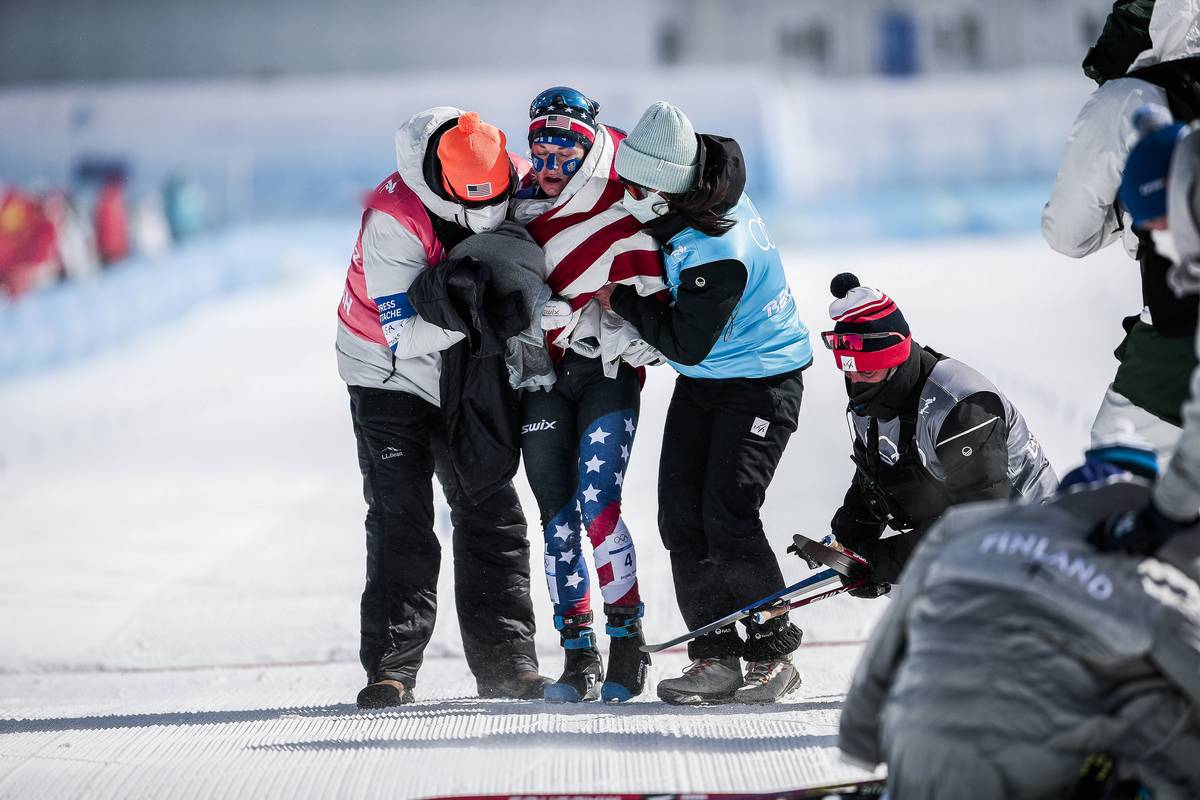
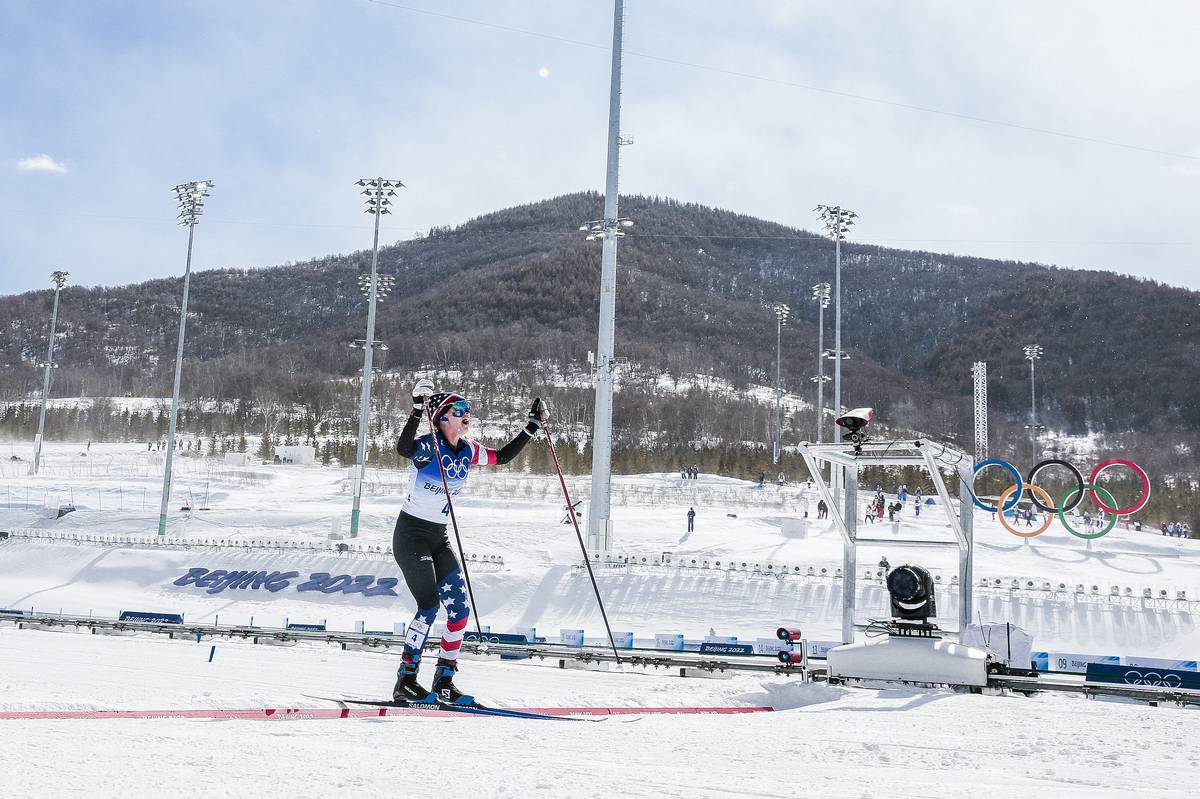
On February 20th, Jessie Diggins made Olympic history yet again, taking second in the 30 k mass start skate to round out the colors of her medal collection. Gold in the freestyle team sprint in 2018, silver in the 30 k skate, and bronze in the individual skate sprint.
Now thirty years old, Diggins is the most successful American cross country skier in Olympic history. She has spent over a decade rising to the top of American and international ski racing, elevating those around her as she reaches for goals that make us lose sight of the fact that the American women’s cross country program was only reinstated with funding in 2006.
There are currently thirty-nine pages of articles tagged with Diggins name on the FasterSkier archives, detailing the many steps forward, and backward, she has taken in her career, transforming her into the athlete, role model, and spokesperson she is today.
Her first tagged appearance was on January 25th, 2010 amid coverage of the Junior World Ski Championships in Hinterzarten, Germany. Both Diggins and Sophie Caldwell (now Hamilton) raced in the quarterfinals of the 1 k freestyle sprint that day, where Diggins crashed and ultimately finished 26th.
“50 meters into her quarterfinal here, Jessie Diggins found herself on the ground, seeing stars,” wrote one of FasterSkier’s young reporters, Nat Herz.
Perhaps it is fitting that 12 years later, following the press conference for Diggins’ Olympic silver medal, it was Herz who caught Diggins as she left, creating the opportunity for this unique interview. The following has been lightly edited for clarity and to account for the extreme wind at the venue, which significantly impaired the audio in a few places.
Jessie Diggins earns an Olympic silver medal in the women’s 30 k mass start skate. (Photo: NordicFocus)
Nat Herz / FasterSkier: How are you feeling?
Jessie Diggins: Honestly, I’m feeling okay now. I haven’t felt that bad at the finish of a race maybe ever. It was a little scary. I couldn’t really walk. But also I’m not surprised, because like 24 hours ago I felt pretty awful too. It’s been a wild, wild last 48 hours.
***
Following the race, Diggins had shared with the media that came down with food poisoning the day before the race, leaving her unsure whether she would be able to line up for the final Olympic event, and if she did, what amount of fight would be left in her body.
Elaborating on what it had been like to cross the line in second place after this experience, Diggins said she felt “disbelief” and that mentally, she had been preparing herself to accept whatever outcome the day would behold. “You’ve had a great time [at these Games] and just do what you can to take care of yourself.”
Diggins continued by explaining the support she received leading into the race that allowed her to keep herself in the positive headspace she needed to perform.
JD: I had a great talk with my sport psychologist, my fiancé, and with my parents. They reminded me that this — the weather, the wind, it’s just like skiing at Giant’s Ridge in Minnesota when I was a kid. You know, I’m just gonna go out there and ski because I love to race and [we’ll] see what happens. My mom reminded me last night, ‘You don’t have to decide right now. Wait. Just see how you feel once you’re actually racing. And then see how you feel in another 5 k and another 5k. You don’t know right now and that’s okay.’ So I went from like, ‘Wow, this is not the race prep I envisioned’, like laying in bed force feeding myself oatmeal and soup from a can. I was really proud of the amount of sport drink I consumed… and I was just like, ‘Okay, we’re just gonna see what happens out there.’ And I just wanted to race because I love to race.
Jessie Diggins fights through food poisoning-induced cramps to win a silver medal in the 30 k skate. (Photo: NordicFocus)
How she would feel while racing became apparent early. Diggins explained that by 12 or 13 k, her body was already beginning to fight against her efforts.
JD: I just kept trying to keep down some sugar and then my left knee started cramping and then my right quads and my left quads and my left hip. I tried to keep telling myself ‘Use your arms, use your arms.’
Grateful for the distraction and encouragement as she endured the pain of racing in that state, she expressed her gratitude from the support she received from the sidelines.
JD: I think we had like all of US Biathlon out there. The whole ski team was out there, all the techs. I mean, Oleg was cheering on the last lap, ‘We’re proud of you!’ And I was like, ‘I’m gonna cry.’ That was the coolest thing. Pretty much every other country also started cheering for me, and so I felt like the whole world was helping me get up those hills when my legs were just spasming and going numb. And I just kept thinking, ‘I’ve got to keep pushing as hard as I can, because at any point — what if my legs give out? I can’t back down. I can’t let up on this pace. I just have to keep going.’
FS: I imagine you were kind of on this seesaw between, ‘I’m in a medal winning position and I could fall over at any time…
JD: I was trying very hard to not think about that, and just think about using my arms, using my head — what I mean by that is like, I’d come over the top and it’s really windy, and I’m like, ‘Okay, I’m just going to doublepole.’ Or, ‘I’m gonna hold this tuck longer.’ Because it was the sustained climbs where I started to really cramp, so I kept thinking like, ‘Okay, I gotta ski as smart as I can, and be really thoughtful about where I use my legs and where I use my arms.’ Which is funny, because normally, I’m a legs skier, so that was a funny flip for me. I tried not to let myself think about a medal, because I had to stay focused on getting through the race, and not let myself think about anything else.
Jessie Diggins pushes through food poisoning to win a silver medal in the 30 k mass start skate. (Photo: NordicFocus)
FS: When you think about the amount of pride you’re gonna feel in finishing that race the way that you did, when you’re ultimately able to look back on that, would you say this would rank up there in your catalog of things you’ve had to suffer through?
JD: I think that might have been the hardest thing I’ve ever done in my life. It might be. Finishing the Tour de Ski this year was also very hard, but that’s why I did it.
I told myself last night, nothing will probably feel harder than being actively sick and finishing that final climb. I’ve prepped for this. My head is tough as it is ever going to get, and I need that right now. And I’m grateful for all those super hard training sessions and all those super hard races where I finished, without being able to feel my legs at all because in the middle of the race [today], when my legs were spasming and I couldn’t really feel them, I was like, ‘This is not new.’ Unfortunately, which is probably medically concerning. But this is not a new thing for me, and so I know I can survive this.
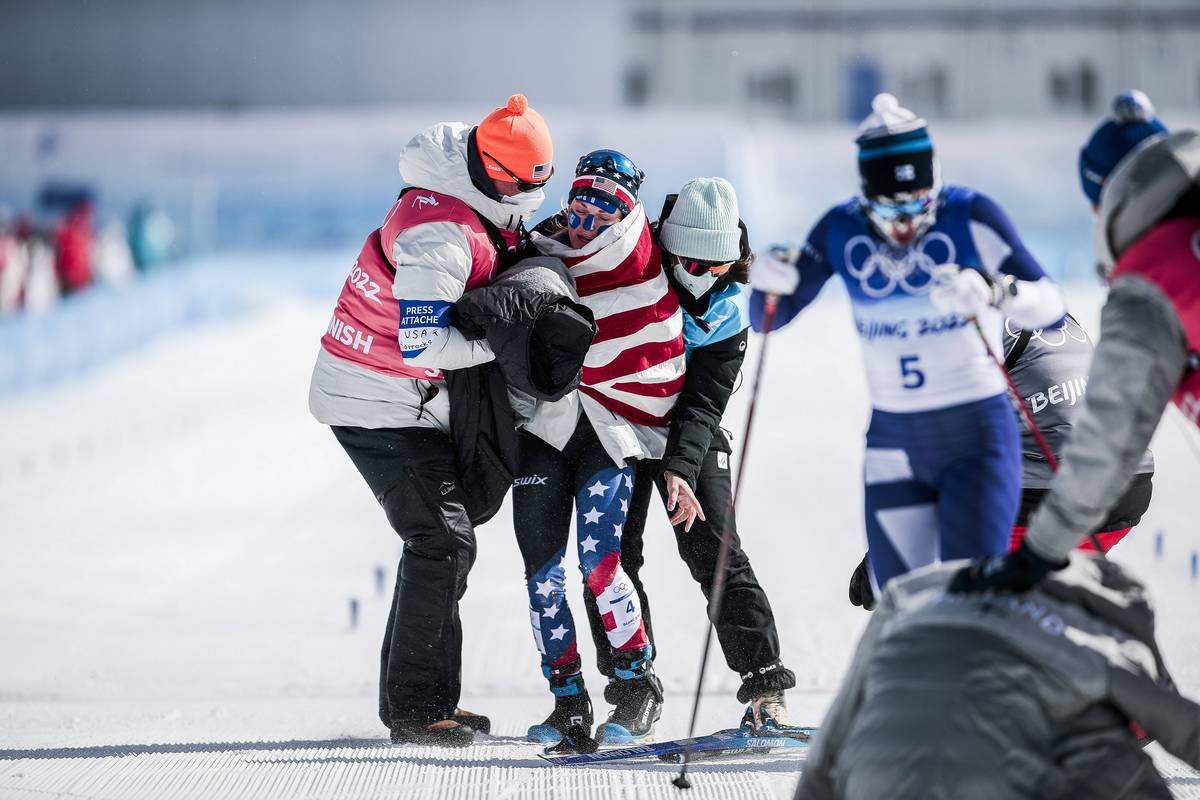
After collapsing at the finish line, Diggins is helped off the course following the Olympic 30 k skate, where she pushed through food poisoning to earn a silver medal. (Photo: NordicFocus)
The other prominent storyline of the day was that Rosie Brennan knocked on the door of an Olympic medal yet again, perhaps helping Kerttu Niskanen of Finland to bronze, only to walk away empty handed herself in sixth place. Brennan had been fourth in the freestyle sprint the week before, and had tagged off to Diggins in third place after her final lap of the classic team sprint where the Americans finished fifth.
It was perhaps not altogether a very different Olympic experience from Diggins’ in PyeongChang in 2018, where she took fifth in two individual races, sixth in another, and seventh in the last. In the 10 k skate, Diggins fifth place meant she was the first woman not to earn a medal, as Marit Bjørgen (NOR) and Krista Pärmäkoski (FIN) had tied for third.
FS: When you think about Rosie’s results today, and here, just overall. Is there anything you would want to say about that, because you’ve sort of similar positions — fourth places, tough spots.
JD: I do know how that feels, and I think it’s so important to remember that nobody gets to say if that was a good race or not but Rosie. Nobody gets to judge. Nobody gets to criticize. She’s the one who gets to define what success looks like. And personally, I’m just so proud of her. I mean, the Olympics is an emotional roller coaster. And she rode it with grace, and as a good teammate, and looked out for other people. She’s just been amazing. And to me, she found success in every definition that matters.
FS: If you were Rosie, would you be proud of your races?
JD: Yeah, I would. Because when I was fourth [in the 10 k skate in PyeongChang], or fifth because of the tie, I was proud. When you give it everything you have in a race, you can and you should be proud. And I think that’s that.
Rosie Brennan works against the lead while leading a chase pack during the 30 k skate, which included eventual bronze medal winner Kerttu Niskanen. (Photo: NordicFocus)
Hailey Swirbul races through the snow-capped pines of Lahti, FIN. (Photo: NordicFocus)
This World Cup coverage is made possible through the generous support of Marty and Kathy Hall and the A Hall Mark of Excellence Award. To learn more about A Hall Mark of Excellence Award or to learn how you can support FasterSkier’s coverage please contact info@fasterskier.com.
An iconic venue, Lahti’s ski jumps rise out of the pine forest from atop the rolling hills, tucked between the many lakes of the region in southern Finland. After two years of empty trails and stadiums, horns blazed, cowbells rang, and voices cheered during the women’s 10-kilometer individual start classic race as fans lined the hills and filled the stadium, memories of pre-pandemic racing flooded back into mind.
What has remained constant through the last two years is the presence of Norway’s Therese Johaug at the top of the results sheet in distance races, particularly classic. Johaug started as the final athlete in the seeded group wearing bib 60, meaning she would have information available to her from the start on how hard she would
A little over halfway through the first of two 5 k laps, it looked like Johaug would run away with yet another World Cup distance race. At the 3.7 time check, Johaug was 11.7 seconds up on Natalia Nepyraeva of Russia who had clocked the fastest prior split, with the Finnish Olympic bronze and silver medalists, Krista Pärmäkoski and Kerttu Niskanen, lurking just behind at 16.2 and 17.5 seconds back. And the Finns were racing on home soil with most of the aforementioned fans waving their country’s flag.
Norway’s Therese Johaug races the 10 k interval start classic in Lahti, FIN. (Photo: NordicFocus)
Sure enough, the margin of Johaug’s lead narrowed. At the lap, she was just under ten seconds ahead of Nepryaeva, who looked to have conserved her energy in the first lap to push the pace in the second. While the Finns became less of a threat to Johaug, the Norwegian’s margin over the Russian’s splits whittled down rapidly.
And ironically, the Russian’s fast second lap might have been partly Johaug’s own doing. As the Norwegian had headed out on course, Nepryaeva was lapping through the stadium, allowing her to match pace as she chased the high-tempo Norwegian through the woods for the second 5 k, perhaps pressuring Johaug to burn a few of her matches a bit earlier than she’d otherwise planned.
Regardless of what was going through each athlete’s mind, Nepryaeva finished her second lap to set the bar at 24:29.6.
Over the first kilometer of Johaug’s second lap, now racing on her own, the time difference between the two women was slashed in half, from 9.8 to 4.8 seconds, and at 8.7 k, it had essentially remained constant at 5.5 seconds. It would come down to the wire.
Looking back at the season, it might be easy to focus on the three Olympic gold medals Johaug won in Zhangjiakou, including in the 10 k classic event. But, she had been beaten in the only other 10 k classic she’s raced on the World Cup this year, which also took place in Finland, during the opening weekend of World Cup racing in Ruka. She might be the favorite, but she’s also beatable.
Natalia Nepryaeva puts together a strong performance in the 10 k classic in Lahti. (Photo: NordicFocus)
As Nepryaeva watched the clock eagerly from the leader’s chair, Johaug kicked, glided, and double poled through the final kilometer. Having over ten minutes prior, she had plenty of time to wait, watch, and be watched by the cameras.
Nepryaeva leaned forward, not taking her eyes off the leaderboard as Johaug made the tight right-hand turn down into the stadium without losing too much momentum, and began to charge as hard as she could toward the line.
With 15 seconds remaining to stay inside Nepryaeva’s mark, Johaug rounded the corner to the finish. With ten seconds to go, she hit the lanes. Nepryaeva watched the seconds tick by hoping Johaug’s time would change to red, while the Norwegian was just trying to keep it in the green.
Therese Johaug (NOR) throws her boot to take the win just 1.2 seconds ahead of Russia’s Natalia Nepryaeva. (Photo: NordicFocus)Therese Johaug (NOR) celebrates her victory in Lahti’s 10 k individual start classic. (Photo: NordicFocus)
Until the actual finish line was crossed, it felt like the result could go either way. But with a final push from her poles and kick with her boot, Therese Johaug sealed the deal, just 1.2 seconds ahead of Natalia Nepryaeva. Johaug let out a victorious roar, just before cameras showed the Russian roll her eyes in exasperation, as if thinking, “Really? Not again.”
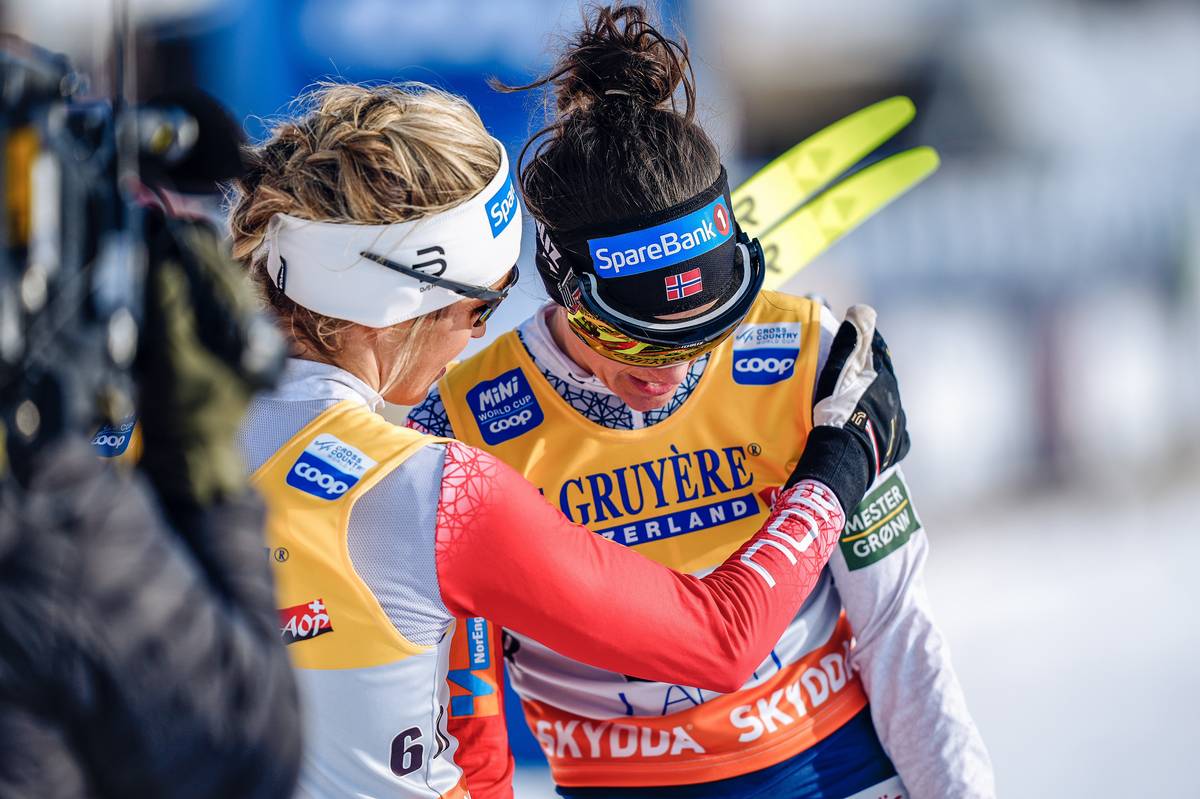
Cameras panning back to Johaug watched her shift away from her own celebration to comfort a very disappointed Heidi Weng, who had started a minute ahead of Johaug in bib 58, but finished 42 seconds behind her teammate in 19th place (+1:42.4). After promising results in the Tour de Ski, Weng had tested positive for COVID just prior to the Olympics, leaving her watching the event from afar. From Weng’s disappointment at the finish, it looked as though she had been looking for more in her return to racing on the World Cup.
Therese Johaug (NOR) comforts her disappointed teammate Heidi Weng at the finish of the 10 k individual start classic in Lahti. (Photo: NordicFocus)
Johaug spoke with FIS after the finish, speaking to what it means to win again today as she nears the end of a successful season, including the three gold medals earned in Zhangjiakou this month.
“It means a lot for me, and I am so happy that I have a second on my side,” Johaug said with a laugh. “After the Olympics, you’re coming home and it’s a little bit hard to motivate again, but when I come to Lahti and go on this beautiful track, I really enjoy it.”
Johaug was also asked whether she felt the benefits of having trained and raced at altitude surrounding the Games, which were held at roughly 5,500 feet above sea level.
“Yeah, I feel that,” Johaug said of the boost. “When you train a lot at altitude and then you go down, you feel like you have more energy in the hills. I think my shape right now is really good, so I’m excited to race at the Holmenkollen next weekend, and in Falun, then the rest of the season.”
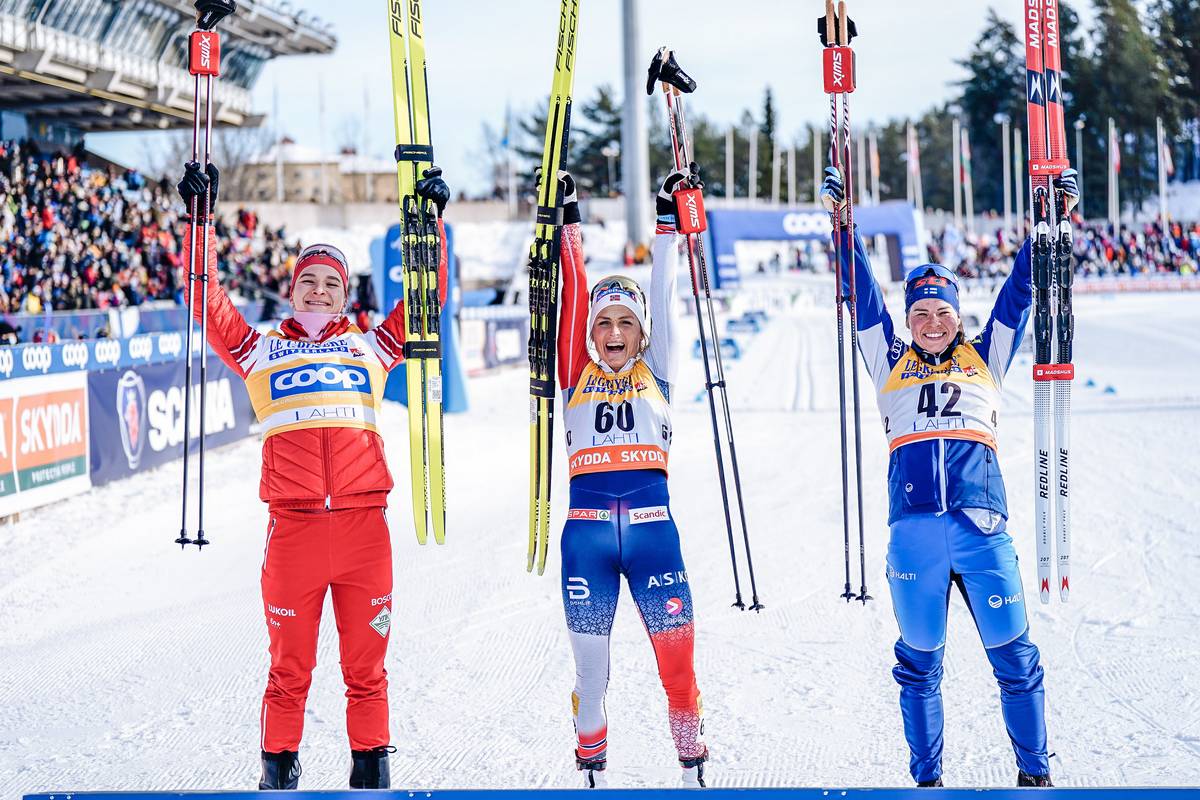
The women’s podium in Lahti: Therese Johaug (NOR) took the win ahead of Natalia Nepryaeva (RUS) and Krista Pärmäkoski (FIN). (Photo: NordicFocus)
Rounding out the women’s podium, Finland’s Pärmäkoski held her margin to 16.7 seconds at the finish for third place, followed after a gap by her teammate Niskanen in fourth (37.7). Sweden’s sprint champion Jonna Sundling was just behind in fifth (+40.7).
Leading the way for the American team, Rosie Brennan posted consistent splits to hover in sixth place through the first lap. Maintaining even tempo and effort, Brennan remained in this position until the last checkpoint, which showed a hard-charging Ebba Andersson of Sweden trade positions to bump Brennan back to 7th.
Rosie Brennan leads the American team during a 10 k individual start classic in Lahti, FIN. (Photo: NordicFocus)
Also posting a split Brennan was not quite able to match in the final kilometer, the American lost nearly eight seconds to Germany’s Katharina Hennig between the final time check at 8.7 k and the finish, leaving Brennan in eighth place overall (+1:02.8) at the finish.
“I am really happy with today.,” Brennan wrote in a post-race email. “I have always struggled post-championships, not so much in my body, but in my mind. It’s really difficult to live on the road and be sharp and push so hard all the time. It often feels like there is never a chance to let down the way someone who goes home every week might experience. I am always trying to figure this out and work towards finding ways to let down and then pull the fight back up for the weekend. It’s all part of the game and it’s a good challenge to try to figure everything out.
“Anyway, today, I felt much more like myself and was able to ski the way I wanted to. Lahti has been a tough venue for me in the past and today I really felt strong in my classic skiing and had some ability to push hard. I was definitely frustrated after yesterday and am really happy I was able to let it go and find myself out there today. We have had really great weather this weekend and a big crowd so that was a huge bonus. It was a joy to not be skiing in an arctic tornado!”
Rosie Brennan crosses the line for 8th place in Lahti’s 10 k interval start classic. (Photo: NordicFocus)Jessie Diggins skis to 20th place in the 10 k classic in Lahti, FIN. (Photo: NordicFocus)
Following a podium near-miss in yesterday’s sprint, Jessie Diggins was next for the U.S., just behind Heidi Weng in 20th (+1:43.4). Julia Kern and Hailey Swirbul also raced into the top-30 for the second day in a row, finishing 28th (+2:03.2) and 29th (+2:10.5), respectively.
Just off Swirbul’s split, Canada’s Katherine Stewart-Jones led her team in 30th place (+2:10.7), with her teammate Dahria Beatty just outside the top-30 in 33rd (+2:19.4). Cendrine Browne raced to 36th (+2:24.5), while Laura Leclair was the final Canadian woman in 58th (+4:29.7).
Canada’s Katherine Stewart-Jones leads her team in 30th during the 10 k individual start classic in Lahti, FIN. (Photo: NordicFocus)
Finishing 30 seconds outside the top-30, Katharine Ogden returned to the World Cup in 43rd (+2:40.8).
Following the races, US Ski Team head coach Matt Whitcomb provided insights into both the women’s and men’s races in Lahti, as well as sharing the news that Östersund, SWE may become the host to the initially cancelled World Cup Finals that had been scheduled for Tyumen, Russia. Whitcomb also speaks to the “Olympic hangover” that can make hard for athletes to perform at their best the weekend following the Games, and gave a shoutout to the athletes racing at World Juniors in nearby Lygna.
World Cup racing continues on Thursday, March 3rd with a classic sprint in Drammen, Norway, just prior to the storied 30/50 k mass start classic races at the Holmenkollen in Oslo.
This World Cup coverage is made possible through the generous support of Marty and Kathy Hall and the A Hall Mark of Excellence Award. To learn more about A Hall Mark of Excellence Award or to learn how you can support FasterSkier’s coverage please contact info@fasterskier.com.
Snapping back after a week away from racing, the World Cup resumed in wintery Lahti, Finland with a 1.6 kilometer freestyle sprint. The American women made their presence immediately known, landing three of five athletes in the top-five in qualification, with four in the top-30.
Rosie Brennan skis to fifth in qualification in Lahti. (Photo: NordicFocus)
On the heels of a bronze medal in the event, Jessie Diggins was second in qualification, +6.71 behind the time of 3:17.37 posted by Sweden’s Olympic champion Jonna Sundling. Julia Kern was next for the U.S. in fourth (+7.59) behind Russia’s Natalia Nepryaeva, with Rosie Brennan just behind in fifth (+8.61). Hailey Swirbul also raced into the heats, skiing to 26th in qualification (+16.56).
Jessie Diggins posts the second fastest time in qualification during the freestyle sprint in Lahti, FIN. (Photo: NordicFocus)
Leading the Canada team Cendrine Browne raced to 29th in qualification (+17.37), advancing to the heats.
Racing in heat five, Diggins moved to the front of the pack inside the first minute of racing, with Kern on her tails heading up the first climb, with Julia sliding back to third in the following descent. Nevertheless, the Americans maintained control of the heat heading up the climb and around the course’s hairpin turn, where cheers could be heard from the sidelines, urging “Alright, Jessie! Alright, Julia! Hard over the top! Hard over the top! Come on, push, push, push!”
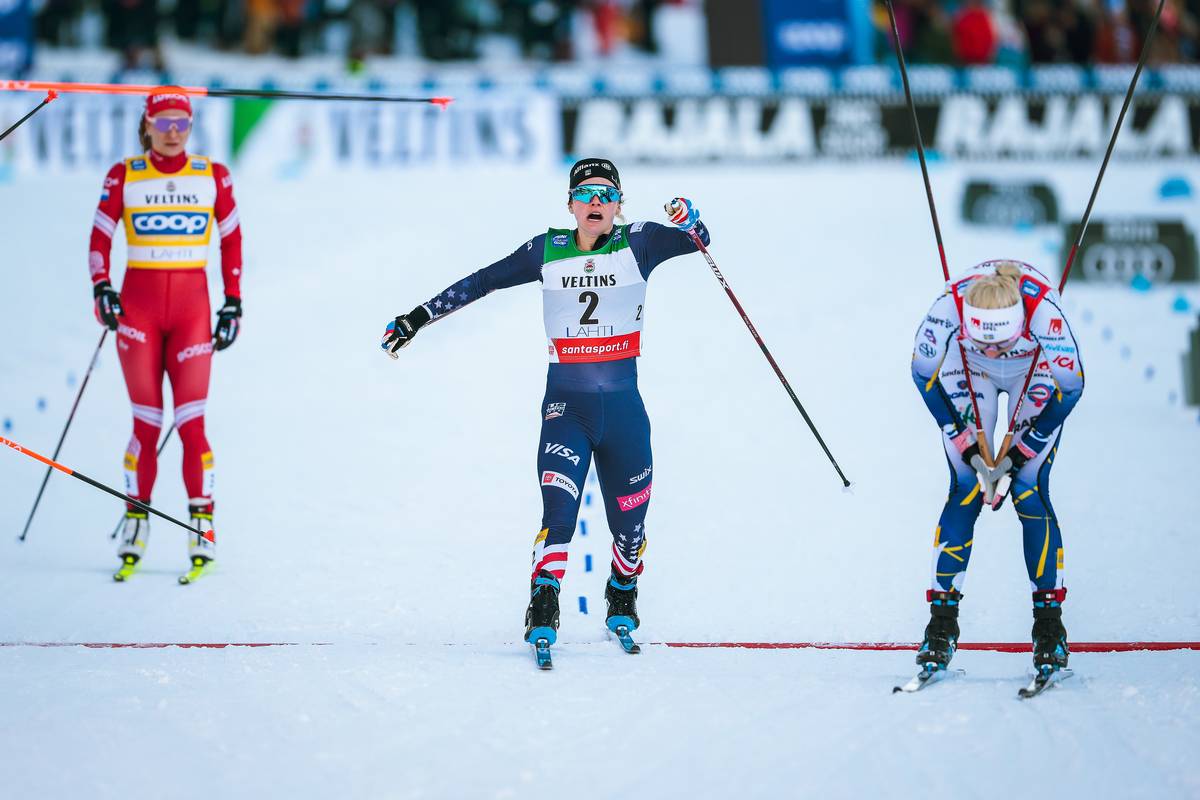
Rounding the final bend to the finish, the Americans were side by side at the front, with Sweden’s Anna Divyk looking for an opportunity to sneak through from their draft. Kern was on the inside of the bend, stepping powerfully to maintain her momentum as the threesome headed into the final 100 meter sprint. Still right alongside her teammate, Kern led the boot throw to win the heat, with Diggins +0.1 back, and the Swede on their tails to cross the line +0.39 seconds back in third. As the fifth heat proved to be the fastest of the quarterfinal, Czech athlete Katerina Janatova also advanced as a lucky loser after finishing in fourth, just over a second behind Divyk.
Julia Kern and Jessie Diggins take to the course during the quarterfinals of Lahti’s freestyle sprint. (Photo: NordicFocus)
In the first semifinal, it was Sundling and Dahlqvist at the front, with teammate Emma Ribom and Nepryaeva jockeying for the third and fourth positions through the first half. The Swedes rounded the hairpin in first through third, but Nepryaeva, Nadine Fähndrich (SUI), and Janatova remained close on their heels. Coming into the finish lanes, it was Sundling in front, with Ribom nipping Dahlqvist at the line by 0.11 seconds. Nepryaeva crossed fourth, 0.6 back from Dahlqvist, leaving the two awaiting the outcome of the next semi to determine their fate heading into the final round.
The Americans raced in the second semi, along with an additional two Swedes, Divyk and Johanna Hagström, plus Slovenia’s Anamarija Lampic and a German, Coletta Rydzek.
Julia Kern tucks into Jessie Diggins draft during the freestyle sprint heats in Lahti, FIN. (Photo: NordicFocus)
Heading up the climb to the hairpin, it was Diggins at the front, with Hagström on her tails and Lampic maintaining contact. The group had thinned, leaving the remaining three women trailing behind on the descent with a gap between each.
In the adrenaline-filled final meters, it looked like Hagström would hold the advantage to the line, but a high tempo Diggins and accelerating Lampic were closing fast. Throwing their boots three abreast, the women crossed the line dead-even for a three-way photo finish.
A slow motion replay of the slide showed that it was Lampic who crossed first, with Diggins .03 seconds behind, and Hagström in third, separated by an additional 0.01 second. With Lampic’s time clocked roughly 0.7 seconds slower than Nepryaeva’s in the first semi, only the top two women advanced, leaving Hagström just off the mark.
Kern crossed fourth in the heat (+1.94) to end her day in eighth overall.
“Today was a lot of fun,” Kern said in a U.S. Ski & Snowboard press release. “The conditions were great, the stadium and course were filled with lively spectators and I was really excited to get back to racing the World Cup! I felt like I had a lot of great energy today, skied well, and enjoyed the awesome atmosphere while racing side-by-side with Jessie in the heats! I was stoked to put down maybe my best World Cup qualifier and see that my body is ready to fire after the Olympics.
“I have only raced two races in the last two months,” Kern continued, “so I have been excited for Period 4 World Cups with lots of racing opportunities. I am someone who loves to race. I had a blast skiing with Jessie in the heats today, we train together all year long, working hard and pushing each other, and also rooming together, so it is fun to ski well together and take charge of the heats. ”
Julia Kern races to eighth place in Lahti’s freestyle sprint. (Photo: NordicFocus)
Sundling looked to leave nothing to chance in the final, gapping the field before the halfway point, with Lampic and Ribom leading the chase group a few seconds back.
Descending from the hairpin, the Swedes were in first through third, with Sundling still well off the front. Diggins had moved up onto Dahlqvist’s tails in fourth, which she held heading around the final bend into the stadium and into the lanes.
Jonna Sundling (SWE) cruises through the final to win the 1.6 kilometer freestyle sprint in Lahti. (Photo: NordicFocus)
While Sundling cruised cross the line for the win in 3:12.86, it was Ribom and Dalqvist fighting for the second and third spots to determine the order of a Swedish podium sweep. It was Ribom in second at the line (+3.28), fending off Dahlqvist in third (+3.67), interrupting her streak of World Cup wins this season.
Diggins held her ground close behind the Swedes in fourth (+3.93), with Lampic closing fast for fifth (+4.01). Nepryaeva closed out the women’s final in the sixth spot (+4.69).
Jessie Diggins throws her boot for fourth in the final round of Lahti’s freestyle sprint. (Photo: NordicFocus)
Following the race, Diggins said she was happy to be feeling like herself again following the brief post-Olympic break. It was just six days ago that Diggins fought through food poisoning induced fatigue, cramping, and delirium to earn a silver medal in the 30 k skate.
“I was incredibly tired after the Olympics,” Diggins said in a post-race audio clip, embedded below. “That 30 k took more out of me than maybe any race in my entire life. So I was just feeling lucky to be out there and racing and able to feel like my body is back.”
In addition to providing insights into how things shook our for her, Diggins commented on the experience of watching newer members of the team earn their first World Cup starts, specifically Lauren Jortberg, Bill Harmeyer, and Logan Diekmann.
“Happy to be part of that rite of passage. That was really, really fun.”
Sweden’s Jonna Sundling hugs Emma Ribom (right) after finishing one-two in the freestyle sprint in Lahti, FIN. (Photo: NordicFocus)
“I feel amazing right now,” Sundling said of her win in a post-race interview with FIS at the finish. “I think I’m in a good place in my career and it feels really good to ski right now. Today, I just tried to trust my skiing and it went really [well], so I’m happy.”
When asked about the Swedish podium sweep, Sundling broke into a wide grin. “I’m so happy, and for Emma, it is her first, so it’s really good.”
A Swedish podium sweep in Lahti, with Jonna Sundling taking the top spot ahead of Emma Ribom and Maja Dahlqvist. (Photo: NordicFocus)Rosie Brennan races in the fourth quarterfinal heat in Lahti, FIN. (Photo: NordicFocus)
After sharing the lead with Slovenia’s Lampic through the second half of the fourth quarterfinal, Brennan rounded the final bend into the finish in second position, moving to Lampic’s right with 50 meters to go. While Lampic maintained a lead by several meters, Germany’s Rydzek crept up alongside Brennan, throwing her boot at the line to edge out the American by 0.04 seconds. As the third heat saw times roughly four seconds faster than the fourth, Brennan was unable to advance as a lucky loser and ended her day in 13th.
Crossing in sixth in heat one of the quarterfinal, which saw Sundling and Nepryaeva go one-two, Swirbul finished 28th today. Swirbul maintained contact with the lead pack through the hairpin turn, where Sundling and Nepryaeva accelerated off the front to thin the pack.
Hailey Swirbul races in the first quarterfinal heat in Lahti. (Photo: NordicFocus)Cendrine Browne (CAN) races in the second heat of the quarterfinals in Lahti, FIN. (Photo: NordicFocus)
Canada’s Browne also ended her day in the quarters after racing in heat two. Browne was +2.19 behind Sweden’s Maja Dahlqvist who comfortably won the heat, with the Canadian in sixth to end her day in
Also racing for the U.S., BSF Pro Team’s Lauren Jortberg raced was pulled up from the SuperTour for her first World Cup appearance. Jortberg is ranked 11th overall in the SuperTour standings and is third on the sprint list behind APU’s Rosie Frankowski and Becca Rorabaugh, both of whom opted to race the American Birkie this weekend.
Lauren Jortberg (BSF Pro) makes her first World Cup appearance in the 1.6 k freestyle sprint qualifier in Lahti, FIN. (Photo: NordicFocus)Olivia Bouffard-Nesbitt (CAN) races the 1.6 k freestyle sprint qualifier in Lahti, FIN. (Photo: NordicFocus)
Outside the top-30 for Canada, Olivia Bouffard-Nesbitt was 33rd today, less than a second away from the heats, with her teammate Dahria Beatty just 0.25 seconds behind her in 34th. Laura Leclair was the final Canadian racer in the women’s field, finishing 54th in qualification (+25.41).
Women’s racing continues tomorrow in Lahti with a 10 k individual start classic.
Drifting snow visible around the athletes feet as they complete four laps of the 7.5 k course (Photo: NordicFocus)
This World Cup coverage is made possible through the generous support of Marty and Kathy Hall and the A Hall Mark of Excellence Award. To learn more about A Hall Mark of Excellence Award or to learn how you can support FasterSkier’s coverage please contact info@fasterskier.com.
The women’s 30 k underway at 11am local time (Photo: NordicFocus)
Sunday morning, battling through ripping winds, the women delivered an impressive and dramatic final cross-country event to close out the 2022 Beijing Winter Olympics. For the first time, skiing further than the men (gender parity coming more quickly than anyone could have guessed) thanks to the men’s kilometer event getting shortened to 28.4 k due to harsh conditions. Though the thermometer did not read particularly low in the Zhangjiakou stadium, roaring winds made racing both considerably colder and considerably more difficult as the women completed four laps of the 7.5 k course, the race happening three hours earlier than originally planned due to the weather.
Jessie Diggins (USA) and Therese Johaug (NOR) congratulate each other after the 30 k (Photo: NordicFocus)
First the highlights, Therese Johaug of Norway secured her third individual gold medal of the Games in dominant fashion, +1:43.3 clear of second place. In a truly gutsy performance, Jessie Diggins earned US women’s cross-country its second individual women’s medal, securing silver, and all four American women finished in the top twenty.
Jessie Diggins celebrates with teammates and staff after finishing second in the 30 k skate (Photo: NordicFocus)
But how did we get there? Within five minutes of starting, Johaug was at the front, pushing the pace. Any thoughts that she might have preferred to stick with pack skiing given the windy conditions were quickly banished. After just 2.9 k, she had successfully broken up the field and pulled away, bringing six athletes with her. Moments later the front group was down to four as Johaug charged ahead, with Diggins, Ebba Andersson of Sweden, and Delphine Claudel of France sticking with her. A chase pack formed, initially composed of Rosie Brennan of the USA, along with Krista Pärmäkoski and Kerttu Niskanen of Finland, the bronze and silver medalists from the 15 k classic.
Ebba Andersson (SWE) was overtaken in the closing stages of the race after skiing in third for more than 20 k (Photo: NordicFocus)
The rest of the first lap saw lots of lead changes among the front four as no one was eager to take on the wind at the front. In each of the more sheltered sections we saw Johaug applying pressure, but the three athletes with her responded to the moves and stayed with her. Behind them, Brennan was working hard to close the gap but not finding luck gaining any ground.
Rosie Brennan leading Kerttu Niskanen (FIN), Jonna Sundling (SWE) and Krista Pärmäkosk (FIN) (Photo: NordicFocus)
With one lap complete, we saw the first withdrawal from the race as skiathlon silver medalist, Natalia Nepryaeva, representing the Russian Olympic Committee (ROC), stopped her race. Petra Novakova of the Czech Republic also pulled out later on.
Up at the front, as the athletes took on the first major climb out of the stadium, Claudel (FRA) started to fade. By the top of the hill, she had lost contact and was off the back on her own. Behind her, the chase pack had strengthened in numbers to ten, led by Brennan (USA) and trailed by her teammate, Sophia Laukli (USA) making her first Olympic appearance.
Sophia Laukli, heavily taped up, skied to 15th in her first Olympic appearance (Photo: NordicFocus)
As Johaug (NOR), Diggins (USA) and Andersson (SWE) crested the initial climbing section and entered a feed zone, Johaug seized an opportunity. Diggins and Andersson swung wide to grab bottles and Johaug rocketed away. Though Diggins worked to chase her down, the move was set and Johaug had taken up her favorite race position- out front on her own.
Therese Johaug (NOR) battling the elements on her own out front (Photo: NordicFocus)
With 10.4 k of racing complete, the first four athletes were spaced out evenly with 16 seconds between each of them. Johaug led, +16 ahead of Diggins, who was trailed by Andersson (+32.8), followed by Claudel (+49).
Behind them, Brennan was having difficulty getting her two Finnish shadows to take on any of the lead work as she battled the wind, still trying to close.
Rosie Brennan, still leading the chase pack (Photo: NordicFocus)
With two laps of racing complete, the time gap continued to grow in Johaug’s favor. The chasers were quickly reeling in Claudel (FRA) and looked to be nearing Andersson (SWE) as well, just +14 seconds behind her. On the A-climb out of the stadium, Claudel was absorbed by the group and the margin to Andersson was down to just ten seconds. Perhaps sensing this, the Swede redoubled her effort and at 17.9 k had widened the margin to +31 seconds.
The front two, each entirely by herself, continued fighting hard, Johaug’s advantage to Diggins and the rest of the field growing steadily. At 21.2 k Johaug was +1:08 ahead of Diggins and +2:07.1 ahead of Andersson. As such, the top three entered and exited the stadium in turn, each one leaving as the next entered, now with one lap to go.
Jessie Diggins skied most of the race on her own (Photo: NordicFocus)
Andersson (SWE) appeared to be well clear of the chasers, +36.1 seconds ahead at 22.5 k. Around this time, Pärmäkoski (FIN) broke a pole and dropped from the chase pack, which was now composed of Brennan (USA), Claudel (FRA), Niskanen (FIN), Jonna Sundling (SWE), Tatiana Sorina (ROC), Teresa Stadlober (AUT) and Mariya Istomina (ROC).
Through 25.4 k, Johaug had a lead of +1:39.8 to Diggins. Andersson was +2:40.2 behind and still 36 seconds up on the chasing group, as the camera caught Johaug lapping a skier, a full 7.5 k ahead.
Heading into the final grinding climb the chasers seemed to have sensed an opportunity. Spindrift almost fully obscured Niskanen and Brennan, being blasted by the wind as they closed in on Andersson, +14 seconds behind at 28.7 k.
Kerttu Niskanen sensing third place is close by in the final stages of the women’s 30 k (photo: NordicFocus)
Over two minutes ahead of them, Johaug entered the stadium and was handed a Norwegian flag to manage in the wind as she headed into the finish. 1:24.54 of racing and she had earned her third gold medal of the games, having won every distance race.
Therese Johaug earns her third victory of the Games with a margin of +1:43 (Photo: NordicFocus)
“I am so proud and I am so happy,” said Johaug, “It is a dream come true that I can stand here for Norway with three gold medals in the same Olympics. I was so, so happy 14 days ago when I got my first [gold medal] and I cannot believe I should have more. It’s fantastic to end my Olympic career with these three gold medals.”
Johaug, who is 33 years old, announced before the 30 k that this would be her last Olympic appearance.
Therese Johaug crosses the finish line taking her third victory of the 2022 Olympic Games (Photo: NordicFocus)
With Johaug winning by the second-largest margin of victory in this event, +1:43.3 later came Diggins, V1’ing across the finish line and collapsing, having spent everything out on the course.
“It’s really emotional,” said Diggins after the race, “That’s one of the hardest things I’ve ever done in my whole life, especially because I had food poisoning 30 hours ago, which is why I thought I was going to die at the finish line… My legs were cramping the whole last 17 k, I don’t know how I made it to the finish. It was amazing.”
Jessie Diggins nears the line after 30 k of tough racing (Photo: NordicFocus)
Diggins now holds three Olympic medals, gold from the team sprint in 2018, silver from today’s effort, and bronze from the skate sprint two weeks ago. With this silver medal Diggins also becomes the first non-European woman to land on the podium in the women’s 30 k event.
Speaking to the food poisoning issue Diggins said, “I woke up yesterday morning and pretty much everything was coming right out of me, so I basically laid in bed all day and made myself eat food. Luckily it wasn’t so bad, but I was feeling pretty bad 24 hours ago. I talked to my parents and my mom said, ‘Don’t decide how you feel right now, just go out there and ski because you love to race.’ And she was right.”
Jessie Diggins celebrates silver before dropping flat (Photo: NordicFocus)
“We had amazing skis,” concluded Diggins, “Our team worked so hard. I just tried to ski smart and then I wanted to ski a gutsy race, so when Therese [Johaug] went, I tried to go with her and I couldn’t stay. So then I thought I would just put my head down and ski my own race.”
“That might have been the best race of my entire life, I’m not going to lie. It was also maybe the hardest race of my whole life. It’s been an emotional roller-coaster, but I am so happy we made it to the end. To have a medal in the sprint and the 30 k are the ultimate bookends for me. I have been trying to be a good all-around athlete my whole life, so this has been really cool.”
Earning her second individual medal of the Games, Jessie Diggins in silver position (Photo: NordicFocus)
With the first two medals decided, the race for bronze was turning into a nail-biter. Having held off the pack and skied by herself for nearly 20 k, Andersson (SWE) was quickly being overtaken. Niskanen was closing fast and bringing the rest of the chase group with her.
As the skiers headed into the final little climb into the stadium, Niskanen blazed past Andersson. Suddenly, what had seemed like a sure bet for bronze had turned to an 8th place for the Swede as Sundling (SWE), Sorina (ROC), Brennan (USA) and Claudel (FRA) all finished in front of her.
Kerttu Niskanen (FIN) fast closing on the finish line to bring home bronze (Photo: NordicFocus)
Niskanen (FIN) earned her second medal of the Games, after finishing just +0.4 behind Johaug in the 10 k classic, with bronze in the 30 k, this time with a much larger margin of +2:33.3. “The last 1500 meters in a 30 k is important,” said Niskanen in the press conference afterwards, “everyone is tired and I only did push hard and believe in my medal all the time.”
The Niskanen family cumulatively won five medals in Beijing, Kerttu’s brother Iivo won gold, silver and bronze over the course of these games.
“We’re both happy,” said Kerttu, referring to herself and her brother, “I am happy that he made an amazing Olympics here. The whole family is waiting for us at home. Everyone is very happy.”
Rosie Brennan working hard, her every move closely followed by Kerttu Niskanen (FIN) (Photo: NordicFocus)
Having taken on much of the lead work for the majority of the race and after her near-medal performance in the skate sprint earlier in the Games, Brennan was once again just outside, finishing in 6th position (+2:38.7).
“[It’s] Frustrating,” said Brennan afterwards, “I literally tried everything I had and nobody wanted to work with me, so I just had to try to do the best I could and unfortunately it wasn’t enough and that’s hard to swallow, but I tried my best.”
Bringing us further inside the experience on course, Brennan continued, “There was a gap that formed [at the beginning] and I just wasn’t in the right place at the right time, and Jessie played that so beautifully, it was amazing. I thought about fighting the wind to bridge it but I had a feeling there would be some places that popped off the back so I was trying to get that group to work with me and keep a steady pace and pick up the people that dropped, but those girls had absolutely zero interest in working with me. I kept yelling at them and being like ‘lets go get them’, and they did nothing. When that happens, there’s not much you can do but ski your own race. I did everything I could. I think the Finns have really fast skis, which was hard for me. I don’t regret trying but I wish it had turned out differently.”
Kerttu Niskanen is happy with her skis and with her bronze medal (Photo: NordicFocus)
When asked about not sharing the lead, Niskanen (FIN) replied, “I have to say that Rosie was really strong today, she push sometimes really hard to uphills and it was good for me because I thought that we had the best skiers in our group to make a strong speed all the time. I thought that we need to ski fast all the time, but many times I was tired and sometimes I thought that Rosie go in front of me but I think I had a little bit faster skis today so it helps me a little bit. I think everyone was really really tired, a long trip, many many races, and I was tired but today’s race was like a tired girls competition.”
Brennan confirmed that her skis were not competitive with those of the Finns, and when asked about seeing those athletes ski past her after she had done so much pulling she said, “It’s definitely a little demoralizing. Especially since I don’t think I had the skis to match that, I wasn’t able to get enough of a gap on the uphill to hold it on the downhill and that’s always a bummer but that’s a part of ski racing too.”
In the end, Brennan reflected, “I feel very confident that I’m in the best shape of my life this past week and I did everything I could to be in a place to win a medal and the rest is just largely out of my control. I can’t control the weather, I can’t control my skis, I did everything I could to prepare for the day so I have to be proud of that.”
Brennan also gave a shout-out to her supporters at home, saying, “I’m overwhelmed with all the support I’ve received, especially given the time [difference] and the number of people that have become nocturnal to cheer me on. It really means so much.”
Jessie Diggins with teammates and staff after winning a historic silver medal (Photo: NordicFocus)
“I’m so happy for Jessie, and I never wanted a podium more for someone like Rosie today.” said USST head coach, Matt Whitcomb, “Nobody deserves it more or less than anybody [else]. You just see Rosie come so close and all this hard work, and she’s at the absolute peak of her career, it’s been a long wonderful career, a challenging career, and you just want to see a medal wrapped around her neck. And so, if there’s something to take away from today, it’s one of the most successful days in US skiing history.”
2022 Olympic 30 k podium: Jessie Diggins, Therese Johaug and Kerttu Niskanen (l-r) (Photo: NordicFocus)
Speaking to Brennan’s work leading the chase pack for much of the race he said, “[Niskanen’s] bronze medal was in large part earned by Rosie, and everybody knows it. And that’s just racing, it’s like a game of poker. Every time Rosie would try to pull aside and let someone else lead they would not. And there’s nothing wrong with that, that’s just tactics, but 10 seconds would open up every time she did so she would stay on the gas. She had no other choice. She did the only thing she could have done.”
Minutes later, the camera showed an American skier who had gone the wrong way, entering the lap instead of the finish. It turned out to be Laukli, who had to double-back and in the process was passed by the Weng twins, Tiril and Lotta, of Norway. In the end, Laukli came across the line 15th, +6:27.2 back.
Sophie Laukli, finished 16th after taking the wrong lane and being passed by two skiers (Photo: NordicFocus)
“I’m bummed for her,” said coach Chris Grover, “that she lost two places because she worked hard for those but she did the right thing, retracing her steps all the way back and that’s one of the lessons that you do once on the big show and then you never do it again. Jessie did it in Sochi.”
He continued, “It’s just an outstanding performance [by all the women] we had great skis. The techs did a great job.”
Laukli was followed just seconds later by her teammate Novie McCabe who completed her Olympics with an Olympic personal-best 18th place (+6:28.5) after an impressive few weeks of race efforts. McCabe was 24th in the 10 k classic, and helped the American women to 6th in the relay last week.
Novie McCabe (USA) followed by Tiril and Lotta Udnes Weng of Norway (Photo: NordicFocus)
The scene at the finish line was reminiscent of the top of the Alpe Cermis after the Tour de Ski, skiers lay sprawled on the snow as staff members rushed to get them into warmer clothes.
Diggins was unable to stand on her own and was escorted out of the finish pen with two helpers on either side.
An exhausted Diggins is covered by a coat and an American flag, having earned silver in the women’s 30 k. (Photo: NordicFocus)
Grover shared, “Jessie had food poisoning 36 hours ago and had a really rough night, she didn’t ski the last few days. You could see out there, her body language, for the last two laps she did not look fresh and for her to hang on like that for those two laps was an unbelievable athletic and mental performance. [Diggins] asked Matt in the feed zone what lap she was on and we had to tell her she was in the third lap, she had one more to go and then when she needed to go to the finish.”
Jessie Diggins is escorted out of the finish area with help (Photo: NordicFocus)
He added, ““I think this might have been the deepest she’s ever dug.”
Leading the way for the Canadians, Cendrine Browne finished in 16th (+6:27.6).
“[This is a] Canadian record in a mass-start at the Olympics and it’s also my personal best,” said Browne, “It’s amazing to leave the Olympics on such a high note. I’m thrilled, I have no words. It was tough conditions out there, really cold, very windy but I think I played it well. In the last lap there was an attack and I was able to stay with the group and pull away to finish 16th.”
Cendrine Browne reached a new personal best with her 16th place finish (Photo: NordicFocus)
In a race with giant time margins, Kathrine Stewart-Jones notched 30th, +7:39.3 behind Johaug. Dahria Beatty was 39th (+11:14.2) and Laura LeClair was 51st (+15:20.5).
Jessica Yeaton, competing for Australia, was 43rd (+12:12.1).
30 k winner Therese Johaug greets last place finisher Dinigeer Yilamujiang of China who finished over 25 minutes behind the Norwegian (Photo: NordicFocus)
World Cup racing resumes next weekend in Lahti, Finland with a skate sprint and 10 k classic for the women.
ZHANGJIAKOU, CHINA — Jessie Diggins’ silver medal, the best-ever individual Olympic finish by an American woman, is what most people will remember from Sunday’s Games-ending cross-country ski race.
Here’s why you should remember Rosie Brennan, too.
Brennan, 33, may lack Diggins’ magazine covers and national endorsement deals. But she performed at ever-so-close to the same level in Beijing, and came heartbreakingly close to the medals.
Rosie Brennan accelerates from the start during the freestyle sprint heats, behind eventual silver medalist Maja Dahlqvist of Sweden. (Photo: NordicFocus)
First, there was Brennan’s fourth place in the Games-opening individual sprint. She and Diggins finished in what was almost a dead heat — but the single second and single place between them was the difference between a bronze and no medal at all.
Then, there was the team sprint, where the two U.S. women were paired. Brennan handed off to Diggins in medal contention after her last of three laps, but Diggins couldn’t hold on.
Finally, on Sunday, the last day of the Games, Brennan found herself on the wrong side of a split in the lead pack. Diggins was on the right side and went on to win silver. Brennan put her head down and dragged an uncooperative chase pack back into medal contention — only to again lose out on bronze by five seconds in the finishing sprint, when she was passed by the women she’d dragged back to the leaders.
Rosie Brennan leads the chase group during the women’s 30-kilometer mass start skate. (Photo: NordicFocus)
“I literally tried everything I had,” Brennan told reporters afterward. “And unfortunately, it wasn’t enough, and that’s hard to swallow. But I’m very proud of my effort.”
Brennan’s efforts in Beijing deserve recognition in their own right. But they’re also important because of the circuitous route she followed to achieve them — and the path she paved for other skiers to follow in her footsteps.
At the start of Brennan’s career, the U.S. Ski Team was pushing athletes, hard, to skip conventional four-year college and commit full-time to skiing for the American program. Diggins, 30, did that.
Brennan went to Dartmouth University and raced on the collegiate circuit.
When she started at school, she was also supported by the U.S. Ski Team. But then, after her sophomore year, she was cut.
Brennan, who had also been injured in a car crash, almost quit the sport. But she ultimately decided to continue racing after college with the Alaska Pacific University club team in Anchorage.
Rosie Brennan races the 30 k mass start skate, the final cross country event of the 2022 Olympic Winter Games. (Photo: NordicFocus)
Even after that, Brennan’s rise to the very top of cross-country skiing came with ups and downs: She got mononucleosis during the 2018 Olympic year, when she finished in third-to-last place in her sole race at the Games — and was cut from the U.S. Ski Team again.
But now it’s clear she belongs. And the U.S. coaches now concede that the cold shoulder they gave to collegiate athletes was the wrong approach. At the Beijing Games, more than half of the American team finished or is enrolled in a traditional college program.
“We were cutting the community in half. We took a hard stance, and it was an error,” Matt Whitcomb, the U.S. team’s head coach, said in an interview after Sunday’s race.
Encouraging athletes to skip college, he added, is “not realistic, because you’re not taking the American culture into consideration.”
“Being social in college, and being a kid a little bit, for a little bit longer, is what we now understand helps us get longer careers,” he said. “You could almost look at Jessie Diggins as an anomaly.”
Whitcomb was one of the many U.S. coaches, team members and fans who watched Sunday’s race with mixed emotions — with joy for Diggins’ medal, but also with some anguish for Brennan’s third close call of the Games.
“She’s at the absolute peak of her career. It’s been a long, wonderful career, a challenging career. And you just want to see a medal wrapped around her neck,” Whitcomb said.
Chris Grover, the director of the U.S. cross-country program, summed it up this way: “It’s really hard when the medals only go three places.” He added: “The achievement for Rosie is spectacular.”
Diggins, for her part, had nothing but good things to say about Brennan.
“I’m just so proud of her. The Olympics is an emotional roller coaster, and she rode it with grace, and as a good teammate, and looked out for other people. She’s just been amazing,” Diggins said Sunday. “To me, she’s found success in every definition that matters.”
Brennan, after her last race, said she expects to be losing sleep for a while over her Olympic near-misses.
Rosie Brennan races the individual freestyle sprint qualifier during the 2022 Olympic Winter Games in Zhangjiakou. (Photo: NordicFocus)
But she also said she’s trying to keep things in perspective: She achieved her goal of racing all six events at the Games with good energy, and she’s proud of the training she did to make that possible.
“I feel very confident that I’m in the best shape of my life this past week, and that I did everything I could to be in a place to win a medal. And the rest is largely out of my control,” she said. “I did everything I could to be prepared for the day, and I really have to be proud of that.”
As Brennan heads back to the European World Cup circuit for more racing next weekend, she also will likely be keeping in mind a message she gently delivered to reporters earlier in the Games, after she and Diggins finished fifth in the team sprint. The takeaway: Keep paying attention.
“One thing that the U.S. is really bad at is only caring about the Olympics. But we’re racing World Cups every weekend,” she said. “It’s been a good experience. And we’ll head straight back to the World Cup and keep fighting for more.”
Wednesday’s Olympic team sprint offered another thrilling set of races at the venue in Zhangjiakou — we’re back to break down an epic performance by the German women, a critic-silencing race from Norway in the men’s event and a U.S. women’s result that left a medal just out of reach.
Thanks to everyone for sending in questions and feedback — we’re trying to keep our heads above water on the homestretch here, but you can be sure Devon will still have plenty to say post-Games. In the meantime, you can get us at devon@fasterskier.com and nat@fasterskier.com.
Katharina Hennig and Victoria Carl win gold for Germany in the classic team sprint. (Photo: NordicFocus)
This World Cup coverage is made possible through the generous support of Marty and Kathy Hall and the A Hall Mark of Excellence Award. To learn more about A Hall Mark of Excellence Award or to learn how you can support FasterSkier’s coverage please contact info@fasterskier.com.
The team sprint: two skiers racing three laps each at roughly 1.5-kilometers a piece with a long climb thrown into the middle of the course and temperatures in the single digits Fahrenheit. It boils a sport that already requires both power and endurance down to its essence.
Riding the high of their silver medal in the women’s 4 x 5 k relay, the duo from Germany, Katharina Hennig and Victoria Carl, won a thrilling sprint finish to decide the medals, collecting gold in a time of 22:09.85. To take the stop spot, the anchor, Carl, out-sprinted the Swedish individual freestyle sprint gold medalist, Jonna Sundling, in the final meters to win by just 0.17 seconds, while the Russian Olympic Committee’s Natalia Nepryaeva crossed just behind in third (+0.71).
Sweden, Germany and Russia share the women’s classic team sprint podium. (Photo: NordicFocus)
After holding strong in medal contention throughout the first five of six laps, the American pair of Rosie Brennan and Jessie Diggins lost contact with the leaders in the final leg, crossing the line fifth (+12.93) behind Finland in fourth (+3.86).
Now, let’s take a step back.
There is, perhaps, no reminder needed that USA won the team sprint in 2018; Kikkan Randall and Jessie Diggins collected the first Olympic medal for the United States in cross country skiing – a gold, no less – since Bill Koch took silver in the 30 k classic in 1976. However, the team sprint in PyeongChang was raced freestyle, whereas today’s team sprint would be held in classic.
“I’m not trying to compare today to four years ago,” said Diggins in the mixed zone after the race. “It’s a different course, different altitude, different technique, like literally nothing is the same and, and that’s okay. I think today, I was going out there and skiing for Rosie and skiing as hard as I could and as best I could… but I’m really proud of this race and proud of giving it our best fight.”
Rosie Brennan helps the Americans finish second in the first team sprint semifinal, automatically advancing to the final. (Photo: NordicFocus)
We have to look back eight years for a classic team sprint at the Olympic Winter Games, to the 2014 Games in Sochi. Norway took the gold that day in dominant fashion ahead of Finland and Sweden, who were stretched behind by roughly ten seconds a piece. Only one of the six women on the podium returned to the Games in 2022, again making the team sprint roster: Finland’s Kerttu Niskanen. The American pairing of Sophie Caldwell (now Hamilton) and Kikkan Randall were sixth in Sochi, +35.06 back on the Norwegian winners.
In the intermediate FIS World Championships, the Americans finished fifth both years, racing Brennan and Sadie Bjornsen (now Maubet) in the freestyle competition in Oberstdorf, Germany in 2021, and pairing Bjornsen with Diggins for the classic team sprint in Seefeld, Austria in 2019. In Oberstdorf, the Americans missed the podium by roughly 2.2 seconds, finishing 2.8 seconds behind the winning team from Sweden. In 2021, they missed the podium by an equivalent margin, this time finishing 5.8 seconds back in the overall standings, again to Sweden. It’s a mark of consistency and depth across techniques for the American women.
Yulia Stupak (ROC), Kerttu Niskanen (FIN), and Katerina Janatova (CZE) lead the way early in the women’s classic team sprint semifinal. (Photo: NordicFocus)
To make the team sprint final, each team must finish in the top-two of semifinal A or B, or be within the next six fastest times from either heat. The U.S. was second to Germany (+4.03) in Semifinal A, while the ROC won the second semi in a close finish with Finland in second (+0.35) and Sweden third (+1.0). Austria and Switzerland also advanced from the first semi, with Sweden, Norway, France, and Poland filling the remaining spots from semifinal B.
With bursts of frozen mist released from their mouths, the athletes took to the course for the final round, with Yulia Stupak (ROC), Maja Dahlqvist (SWE), Kerttu Niskanen (FIN), Tiril Udnes Weng (NOR), and Katharina Hennig (GER) racing with Brennan at the front of the pack.
With a hooded parka draped over her, face tape obscuring her normally glittery cheekbones, and heated socks inside her boots, Diggins waited in the exchange for the tag. She would be facing Natalia Nepryaeva (ROC), Jonna Sundling (SWE), Krista Pärmäkoski (FIN), Maiken Caspersen Falla (NOR), and Victoria Carl (GER) in the even-numbered legs.
Racing comfortably near the front with skis that looked competitive for both kick and glide, Brennan tagged Diggins +1.1 second back on Finland in fourth, well within the lead group. In what would become a pattern for her first two legs, Diggins quickly moved to the front to control the race and ensure a fast pace, perhaps risking accumulating her own fatigue while also taking the sting out of the legs of the individual sprint gold and silver medalists of Sweden, who had also won the World Championship gold in 2021.
Diggins races at the front of the lead pack during the classic team sprint final. (Photo: NordicFocus)
Diggins tagged Brennan virtually even with Sweden and Finland after her first lap, a position Brennan was able to hold through her second leg. Near the bottom of the long, grinding climb to the high point of the course, Norway’s Weng wobbled slightly, placing her pole in front of Dahlqvist’s ski to catch her balance. Weng’s pole snapped, leaving her running up the sidelines of the climb with one pole, detaching her strap to grab another from a coach who stood along the fenceline. This lost Norway several seconds, which they were unable to regain in subsequent legs, leaving the team out of podium contention.
On the odd legs, Niskanen of Finland consistently controlled the race at the front, putting the powerful stride that earned her a silver medal in the 10 k last week on display as she led up the climb in each round. She tagged her teammate Pärmäkoski in the lead at the halfway mark, with Germany, the ROC, and USA within a second back.
Kerttu Niskanen (FIN) sets the pace in the first lap of the women’s classic team sprint final. (Photo: NordicFocus)
Diggins again charged to the front, her hands and legs pumping metronomically as she drove her skis up the climb. Diggins crested the hill in front, with Sundling and Pärmäkoski on her tails heading into the descent. A gap had opened to Germany and the ROC, but these teams had lightning fast glide and were able to regain contact in the descent.
At 6 k, with four of six legs complete, it was Sweden and Finland in the lead at the exchange, with Brennan receiving a tag 2.5 seconds back. Niskanen again set the pace at the front, still looking strong as she pushed the pace up the A-climb, with Dahlqvist matching pace behind. In a critical moment where loss of contact might have meant accepting a podium was not in the cards on the day, Brennan accelerated up the climb, steadily closing the gap to the Swede ahead of her.
Rosie Brennan (USA) awaits her turn during the women’s team sprint. (Photo: NordicFocus)
An aerial shot showed Brennan upping her tempo as she brought the U.S. back in contact with the leaders, bringing Hennig and Stupak along with her. All five women dropped into a tuck as they headed downhill together, rounding the sweeping right-hand bend and sprinting up a final climb before the last exchange. Throwing her hands up the hill in a run, Brennan challenged Sweden’s Dahlqvist on the final uphill, double poling around a left-hand bend into the exchange in third behind Germany and Finland.
In the last lap, Diggins went hunting. With Pärmäkoski and Carl leading the charge up the climb, Diggins would need to work the hill. Striding powerfully, Diggins did everything she could to keep her team in contact with the leaders, but it was not enough on the day. Doublepoling across the false flat before the descent, it was Pärmäkoski leading Carl, Nepryaeva, and Sundling.
The leaders were four abreast coming around the final bend, with Pärmäkoski and Sundling pushed into the outer two lanes, leaving them at a deficit as they headed up the final climb to the stadium.
Cresting the rise, Carl looked to be falling off the pace, while Nepryaeva and Sundling pulled to the front, the Swede leading around the final left-hand corner into the finish.
But Germany wasn’t done yet. Carl moved up along the outside of the bend, challenging Sundling as they headed into the finish lanes. Doublepoling powerfully, Carl began to slowly pull ahead of Sweden, with the ROC dropping back a few meters behind.
Coming to the line to decide the medals, it was Victoria Carl (GER), Natalia Nepryaeva (ROC), and Jonna Sundling (SWE) (l-r). (Photo: NordicFocus)
In a surprise upset of the Swedish favorites, Carl took it to the line, holding off Sundling as she crossed the line in 22:09.85, welcomed by her ecstatically screaming partner Hennig. Sundling was just 0.17 seconds back for silver, with Nepryaeva unopposed for bronze on their tails (+0.71).
Victoria Carl (GER) celebrates gold in the women’s team sprint while Natalia Nepryaeva brings the ROC across the line in third.(Photo: NordicFocus)VIctoria Carl takes gold in the classic team sprint, while partner Katharina Hennig awaits in disbelief. (Photo: NordicFocus)
After falling off the leaders in the final climb, Pärmäkoski brought Finland to the line in fourth (+3.86) with Diggins holding strong after a gap to cross fifth (+12.93).
“It means a lot for us,” Hennig told the media after her race. “Also the silver medal in relay and today the gold medal in team sprint. It means a lot and we are very thankful for the whole team. It’s very important for cross-country in Germany.”
Excitement was high at the finish of the women’s team sprint, as Victoria Carl narrowly took the win for Germany, racing with partner Katharina Hennig. (Photo: NordicFocus)Katharina Hennig hugs her exhausted teammate Victoria Carl at the finish of the women’s classic team sprint. (Photo: NordicFocus)
Though she was the key player in the final lap, Carl was not originally on the start list. She was substituted for Katherine Sauerbrey, who had skied the first leg of the women’s relay on Saturday. German coach Peter Schlickenreider, who celebrated his 52nd birthday today, explained in the mixed zone that Saurbrey had made a “great decision” to let the team know that she was feeling fatigued and as though she may be getting sick.
From there, the calculus became: “Okay, you have a silver medal, you did a good race [in the relay], and we have prepared Victoria Carl, so she’s ready,” Schlickenreider explained. “So then let’s do the safe thing.”
He added that Germany had raced an athlete, Nicole Fessel, in the team sprint during the 2018 Games who was feeling sick, which proved to be a significant mistake as Fessel struggled with her health for the following three months, before ultimately ending her career. The coaches had vowed never to make this error again.
Jonna Sundling (SWE) congratulates Victoria Carl and Katharina Hennig on Germany’s gold medal in the classic team sprint. (Photo: NordicFocus)
On the performance of the German skis, which have allowed the team to excel throughout the Games, Schlickenreider explained that waxing has been a focus for the team over the last quadrennial.
“We worked really hard the last four years to get this good team. And I think that’s the main thing, that everybody’s working together so that the athlete and ski technicians were communicating quite well.”
Jessie Diggins (USA) comes to the line in fifth in the women’s team sprint. (Photo: NordicFocus)
After winning gold in the event, it’s easy to look at a fifth place finish as a disappointment for the American team. But observing the last five seasons, it remains a testament to the consistent strength of the American women’s program, the depth of the field racing at this level, and the fact that ultimately, an Olympic medal is viewed among the highest accomplishments an athlete can achieve purely because it requires the fortuitous coming together of infinitely many pieces to do so.
Both Brennan and Diggins stated with confidence that they were happy with their performances today, highlighting advances made in classic racing throughout the Games.
“I felt really good about my skiing today,” Brennan said. “I think it was one of my better classic races this week, so I’m really happy to put it together by the end of the Olympics. And I did what I could to stay in contact to give Jessie her best shot. And I’m happy with that.”
Rosie Brennan (USA) strides up the A-climb in the women’s team sprint semifinal. (Photo: NordicFocus)
“I’m really proud of how we skied,” Diggins affirmed. “It was so cool seeing Rosie just crushing, and I went as hard as I could. And there’s no doubt in my mind that I could not have possibly tried harder. I finished with zero sugars left and was dizzy and sick. And I’m currently wearing all the clothes of Team USA… I think we had great skis, or at least I definitely had the kick that I needed. I felt like, technically, this was some of my best classic skiing. And yeah, I’m just really proud of giving it our all because that’s all you can do.”
Jessie Diggins anchored the women’s classic team sprint to fifth. (Photo: NordicFocus)
In NBC’s broadcast, team sprint gold medalist turned analyst Kikkan Randall explained that the Americans knew that competitive skis would be a requirement to allow Brennan and Diggins to fight for a medal today.
Both athletes expressed that their skis were up to the task, particularly for A-climb, which is roughly 400 meters in length (a quarter mile) with nearly 100 feet of elevation gain. Ascending this three times each in the final, optimizing kick could be essential.
“I have to have enough kick, or else I really struggle,” Diggins explained. “So I definitely asked for an extra bump. In hindsight, maybe I shouldn’t have but also, that’s on me. And I know that that’s what I need. I need to be able to get up the hill. And that was my biggest priority. And so I think having not enough kick would have made me lose more time.”
Jessie Diggins (USA) marks Victoria Carl (GER) during the women’s team sprint semifinal. (Photo: NordicFocus)
Both athletes confirmed that they would be racing the final event of the 2022 Olympic Winter Games on Sunday, the 30 k mass start freestyle, barring unforeseen changes. With one last opportunity to fight for medals, Brennan encapsulated the Americans’ outlook on the whirlwind of racing and Olympic hype.
“One thing that the US is really bad at is only caring about the Olympics,” Brennan said in the mixed zone. “But we’re racing and World Cups every weekend all winter long and World Championships on the [odd] years, so if you look at the results from all of those races, you know, this is in the ballpark. I wouldn’t say I had the world’s best races [here] and certainly not the world’s worst races. So it’s been a good experience and we will head straight back to the World Cup and keep fighting for more.”
Dahria Beatty (CAN) races in semifinal A during the women’s classic team sprint. (Photo: NordicFocus)
Racing for Canada, Katherine Stewart-Jones and Dahria Beatty took sixth in the first semifinal and did not advance. They ended the day in 12th overall.
This World Cup coverage is made possible through the generous support of Marty and Kathy Hall and the A Hall Mark of Excellence Award. To learn more about A Hall Mark of Excellence Award or to learn how you can support FasterSkier’s coverage please contact info@fasterskier.com.
A relay medal evaded the American women’s 4 x 5-kilometer team for another Olympic quadrennial today, as Hailey Swirbul, Rosie Brennan, Novie McCabe, and Jessie Diggins finished sixth, +1:28.2 behind the winners from the Russian Olympic Committee (ROC). Silver went to the German team, who finished +18.2 back on the ROC, while bronze went to Sweden (+19.7), who took Finland to the line, leaving them 0.5 shy of a medal in fourth.
The relay is seen as a testament to a program’s depth and breadth; with two classic and two skate legs, it’s not enough to have one or two podium-caliber skiers who are specialists in one technique or the other. A team needs to have four strong women who can compete at the top of the field, and the program must have the technical proficiency to maintain contact with the front as the race switches from classic to skate.
A glittery flag tattooed on her cheek, Hailey Swirbul warms up to lead the American 4 x 5 k relay team. (Photo: NordicFocus)
And, those four strong women need to have all the pieces come together on the day. “It’s really hard to have four people have an amazing day on the same day,” Brennan said after today’s race.
The American team has steadily become a medal contender in the event as the level of the program has continually elevated over the last four Olympic cycles.
In 2010, Kikkan Randall was the sole member of the relay team who was reaching the World Cup podium, as she raced alongside Caitlin Compton (now Gregg), Holly Brooks, and Morgan Arritola. The American women finished 11th in Vancouver, nearly +3:40 behind the Norwegian gold medal team, which was anchored by a young Therese Johaug.
Eight years ago in Sochi, a team of Jessie Diggins, Randall, Liz Stephen, and Sadie Bjornsen (now Maubet) pulled the team up to 7th, +2:30 behind the Swedish winners. Four years later in PyeongChang, Sophie Caldwell, Bjornsen, Randall, and Diggins again brought Team USA 70 seconds closer to the podium, finishing fifth, +1:20 behind Norway.
Over the last three World Championships, the Americans finished fourth in 2017, 30 seconds behind the Finnish bronze medal team, and fifth in 2019, one minute behind Russia in third.
At the 2021 World Ski Championships in Oberstdorf, Germany, the Americans were impossibly close to the podium. In a final sprint between anchors Krista Pärmäkoski (FIN) and Diggins, the Finn closed hard in the final kilometer to pull ahead of the Americans, taking bronze by just 0.8 seconds.
While only one of the four relay team members from the 2018 Olympic team remains on the team in 2022, three of the four members from last year’s World Championships made today’s list. That lineup was Swirbul, Bjornsen, Brennan, and Diggins.
Hailey Swirbul heads out to lead the American 4 x 5 k relay during the 2022 Beijing Olympic Winter Games. (Photo: NordicFocus)
Today, Swirbul would again lead the Americans skiing the first classic leg, this time followed by Brennan, who was 13th in the 10 k classic on Thursday. McCabe skated the third leg in her second Olympic appearance, tagging off to Diggins as the anchor.
Keeping with tradition, all four women – along with current NBC analyst Randall calling from a booth in Connecticut – wore knee-length striped “relay socks”, with beglittered cheekbones to feed their enthusiasm for the event. In a program that remains focused on team, even when standing on an individual podium, glitter and socks are merely symbols of the cohesion that has fostered the American’s rise to success.
The ROC’s Yulia Stupak pulls away in the first lap of the women’s 4 x 5 k relay. (Photo: NordicFocus)
As the first two-lap 5 k classic leg took to the course, the ROC’s Yulia Stupak charged off the front, creating a 12 second gap by the end of the first lap while the next eight team remaining tightly spread, with less than three seconds of separation. In the final kilometer of the first leg, the German team dropped the chase pack to tag its second skier just 1.5 seconds behind the ROC. Masako Ishida tagged off in third for Japan, with Finland just behind in fourth, and Sweden a few seconds behind in fifth.
Swirbul tagged off for the Americans in seventh, +24.7 back on the ROC and Germany, and +12.4 seconds on the podium chase pack. The Canadian team, led by Katharine Stewart-Jones, tagged off in 10th (+43.2).
Katharine Stewart-Jones skis the opening leg of the women’s 4 x 5 k relay. (Photo: NordicFocus)
The Germans are often a dark horse in the relay, despite frequenting individual World Cup podiums less often than other countries like Norway, Russia, or Sweden. Germany won a silver medal in the women’s relay in the 2010 Games in Vancouver, followed by a bronze in Sochi. They were roughly 20 seconds behind the Americans in fifth at the 2021 World Championships, and 20 seconds ahead of the Americans in fourth place in 2019.
In this Games, two of the four members of the 2021 World Championships team were again in the lineup, Victoria Carl and Katharina Hennig, both of whom have seen top-10 finishes in the Games so far. Hennig, who would ski the second classic leg, was fifth in the 10 k classic on Thursday, while the third leg skater Carl was 10th in Tuesday’s freestyle sprint. Anchor Sofie Krehl was 8th in qualification and 11th in the final during the freestyle sprint, while classic opener Katharine Sauerbrey was 11th in the 10 k classic and 13th in the 15 k skiathlon. A deceptively stacked lineup.
Meanwhile, Norway’s Tiril Udnes Weng had tangled with a Latvian skier, causing a crash that robbed her momentum. Already at a deficit with two of their eight athletes, including Lillehammer World Cup relay team member Heidi Weng, waylaid due to positive COVID tests just prior to the Games, the team that would otherwise be a podium threat faced yet another setback.
Katharina Hennig (GER) follows Natalia Nepryaeva (ROC) during the second leg of the 4 x 5 k relay. (Photo: NordicFocus)
In the second classic leg, the ROC and Germany remained at the front, trading off in the lead at each checkpoint as they built their lead over third place to come through the exchange with nearly double the gap to third. This time, it was Germany’s Hennig in the lead, with the ROC’s Natalia Nepryaeva four seconds behind. Gold medalist in both distance events so far this Olympiad, Norway’s Therese Johaug brought her team back into podium contention, tagging Helene Marie Fossesholm in third (+22.8), just ahead of Sweden and Finland.
Norway’s Therese Johaug brings her team back into podium contention in the second leg of the 4 x 5 k relay. (Photo: NordicFocus)
The Americans lost an additional 12 seconds over the course of Brennan’s leg, but held their ground in seventh (+36.4). Canada’s Dahria Beatty tagged teammate Cendrine Browne in eighth after a sizable gap (+1:42.7).
Rosie Brennan follows Sweden’s Ebba Andersson during the second leg of the women’s 4 x 5 k relay. (Photo: NordicFocus)
While Germany and the ROC continued the story at the front, Norway and Finland began making up time on the leaders, with Fossesholm and Thursday’s 10 k classic silver medalist Kerttu Niskanen gaining roughly 8 seconds during the first skate leg. Norway was less than 15 seconds back at the final exchange, with Finland an additional three seconds behind. Sweden was in fifth, exactly 35 seconds off the leaders and just over 20 seconds behind Norway, but they were about to prove they were not out of the running.
Novie McCabe skates a strong third leg for Team USA in the 4 x 5 k relay. (Photo: NordicFocus)
McCabe had brought the Americans into sixth (+1:34), in a dead zone with 30 seconds to the next racer on either side. The Canadian women tagged off in 8th, +2:21.2 back on the leaders.
In the final leg, the ROC’s Veronika Stepanova quickly began to reel in Germany’s Krehl.
Establishing herself as a strong closer at just 21 years of age, Stepanova also anchored Russia’s winning relay team in Lillehammer back in December to a thrilling finish, narrowly beating Norway and Sweden in a three-way sprint to the line.
In the lead at the final exchange, Germany’s Victoria Carl tags Sofie Krehl during the Olympic 4 x 5 k relay. (Photo: NordicFocus)Tatiana Sorina tags Veronika Stepanova as the ROC chases down Germany in the final lap of the 4 x 5 k relay. (Photo: NordicFocus)
This time, it did not look as if the ROC was looking for a climactic ending for its spectators. Stepanova had Krehl in her sights at the lap, and was now just 1.5 seconds behind. Stepanova kept the effort high, leaving the German five seconds back a kilometer later.
Then, Krehl began to fade rapidly.
As the ROC soon looked to have the gold medal on lock, the question became whether Germany could hold onto silver. Sweden’s sprint gold medalist Jonna Sundling was showing her stamina against Pärmäkoski, who looked to be repeating the approach that allowed her to take bronze for Finland in the 2021 World Championship where she was facing Diggins.
The pace stayed hot as the Finnish veteran steadily fatigued the legs of the sprint champion, and over the final lap, the pair brought Krehl into contact. Heading into the stadium, Krehl was hanging onto her lead by a thread.
Sofie Krehl hangs on to anchor the German team to silver in the 4 x 5 k relay. (Photo: NordicFocus)
Cameras panned away as the German rounded the final bend into the stadium, returning just as she crossed the line, only ten meters ahead of Sundling and Pärmäkoski, who V2ed side by side through the lanes.
Ultimately, Sundlings sprint prowess gave Sweden the advantage, as she nipped Pärmäkoski by 0.5 seconds at the line for the bronze medal.
Jonna Sundling (SWE) takes bronze by 0.5 seconds ahead of Krista Pärmäkoski (FIN). (Photo: NordicFocus)
It was the ROC for gold in 53:41.0, with Germany in second (+18.2), and Sweden third (+20.7).
“Of course, it is a special day,” Stepanova told the media after the race. “It was really tough because we have a win in the World Cup, and a lot of people know we can win, so they say, ‘You must win, you must win.’ So I am like, ‘OK, we need a good result,’ and I do what I can do.”
Veronika Stepanova anchors the ROC to gold in the women’s 4 x 5 k relay. (Photo: NordicFocus)The Russian Olympic Committee celebrates gold in the women’s 4 x 5 k relay as anchor Veronika Stepanova crosses the line with a solid lead. (Photo: NordicFocus)
While the depth of its women’s team made the ROC a good choice as a podium pick, Stupak made it clear in her post-race comment that the team had also been targeting the event, saying the result was “not a shock.”
“We prepared for this race the whole year,” she explained. “It’s a good result for everybody in our team. We were ready for this medal.”
On the ROC’s approach and early lead, Stupak continued, “We tried to push the limit. We had big motivation and good concentration before the start. It was a hard race but it was a good race for us.”
The 4 x 5 k relay gold medalists of the ROC: Yulia Stupak, Natalia Nepryaeva, Tatiana Sorina, and Veronika Stepanova (l-r). (Photo: NordicFocus)
For the Germans, the tone implied less certainty that a medal would be earned. Rather, it was the culmination of strategic pacing and hard work, leading to what Krehl called a “surprise” ending.
“We are so happy and excited,” Hennig said. “This is a special day for us and we are so thankful that all the hard work pays off now for the whole team and all of cross-country Germany. So we are very, very happy. We had a good plan and our plan worked. And we did our best, and so it was an exciting and amazing day.”
The German team welcomes anchor Sofie Krehl to the finish, earning a silver medal in the 4 x 5 k relay. (Photo: NordicFocus)Caught by the emotion of earning a silver medal for Germany, Sofie Krehl is embraced by her coach at the finish of the 4 x 5 k relay. (Photo: NordicFocus)
Krehl explained that she had skied her first lap defensively, expecting Stepanova to catch her sooner. In the second lap, she described the ROC athlete as “too good”, causing her to let go of gold. Though she was nervous when she began to feel Sweden and Finland closing on her, she was able to hold on for a result she described as “good for the whole team”, including the German coaches and wax technicians.
“It’s a lot of emotion,” Krehl said. “It feels like a dream. Maybe I need some time and then I can recognize what we have done.”
Putting together a gutsy performance, Katherine Sauerbrey, Katharina Hennig, Victoria Carl, and Sofie Krehl (l-r) earn silver for Germany. (Photo: NordicFocus)The Swedist team of Maja Dahlqvist, Ebba Andersson, Frida Karlsson, and Jonna Sundling (l-r) earn silver in the 4 x 5 k relay. (Photo: NordicFocus)
Behind the podium contenders, Norway had lost contact with the Swedes and the Finns over the final lap, fading to fifth (+28.8). Racing alone through her lap, Diggins crossed the line for Team USA a minute later in sixth (+1:28.2).
“Personally, I’m really, really proud of this team,” Diggins said in the mixed zone. “Every single one of these girls went out and skied so hard and skied gutsy races. And we gave it everything we have. And some days that ends up in the results of your life and some days it doesn’t. But either way, all you can control is going out there as hard and as smart as you can. And this team did that.”
Jessie Diggins brings the Americans home in sixth in the women’s 4 x 5 k relay. (Photo: NordicFocus)
Though they did not walk away with Olympic hardware, the energy and enthusiasm were high in the mixed zone, with laughter filling the gaps between the athletes’ comments.
On a team composed of two veteran Olympians, Brennan and Diggins, and two first-timers, Swirbul and McCabe, experience and insight helped unify the group and set the Americans up for their best chance at putting together a strong performance.
Leading the breakdown of the race, Swirbul shared, “It’s always important, I think, to try to ski my own race, even though you’re in the field. I definitely had advice from Rosie last night to make sure to pace it how I would face the race – and Jessie. We’re focusing on time, so the fastest time that we can get around that course [for] each person is the best, no matter what place you come in.”
Rosie Brennan races the second leg of the 4 x 5 k Olympic relay. (Photo: NordicFocus)
Brennan’s performance in the sprint demonstrated her impressive mental strength to overcome setbacks and not count herself – or in this case, her team – out of the running. A bad pole plant directly onto her ski in the sprint quarterfinal could have shaken her confidence, but she rebounded to ultimately finish just over a second off the podium in fourth place.
She approached today with a similar resolve.
“I knew it was full of a lot of the heavy hitters, so I knew I had a tough job ahead of me,” Brennan said. “So I tried to ski smart, but also find something extra to dig a little deeper, but I knew there was going to be some hard fighting at the end. I felt really good about my climbing. And I was a little disappointed with my inability to stick with [the other women] over the top of the hill in the double pole section, but it was all I had out there. So, I have to be happy with that. And I guess I know what I’ll be working on in the future.”
At 21-years-old, McCabe is the youngest member of the relay team.
“It’s so cool to be a part of a team with three legends and I had a lot of fun doing it, even though I was extremely nervous beforehand,” she said with a laugh.
Novie McCabe tags Jessie Diggins for the final leg of the 4 x 5 k relay. (Photo: NordicFocus)
Her mom, Laura McCabe, is a two-time Olympian who skied the third leg of the relay in both 1994 and 1998. However, Novie laughed that she had not talked to her mother in several days and thus had not received any advice heading into the relay. After much deliberation, the team had only been decided the afternoon prior.
“I tried on the first lap to just stay relaxed,” McCabe explained of her plan. “I knew that there was a chance I would blow up and end up losing a lot of time to that group ahead of me. So I was just trying to focus on [pacing] for the first lap, and on the second, I kind of tried to drop the hammer and do what I could to not lose time.”
In her lap, McCabe lost just 11 seconds to Sweden’s distance standout, Frida Karlsson. She had accomplished her goal.
Diggins explained she headed out for the final leg optimistically hoping things would shake out differently than they ultimately did.
“I basically just swung for the fences and thought, ‘Okay, I’m gonna go out as hard as I can. Because if there’s a chance that [the women ahead of me] monkey around and don’t want to lead, then I’ve got to go for it.’ I thought, ‘You know, if I get lucky and they’re messing around in tactics, there’s a chance I can glom on the back.’ Unfortunately, they did not, as much as I had hoped. And I definitely paid for it in the second lap. I could not feel my legs at all.”
Jessie Diggins anchors the Americans to 6th in the 4 x 5 k relay. (Photo: NordicFocus)
After a windy skiathlon and 10 k classic that left tracks blown in with loose snow, the women expressed that conditions today were the best they’ve experienced in racing so far. Though two inches of snow came down overnight, perhaps an unexpected twist in the weather patterns, the Americans each affirmed that their skis were competitive, with Swirbul and Brennan adding the change was especially favorable for their classic legs.
“I actually got to ski in the tracks today, which is so nice,” Brennan said.
On the camaraderie of the team, Brennan shared, “It’s an individual sport, but we also spend close to five months on the road a year together. So it would be pretty boring if you only ever care about yourself. [That’s] not very fun or fulfilling – it doesn’t mean that much. So when we get to actually, truly be out there together, and all of our times count for each other. I think that brings like a new level of meaning and purpose to what we’re doing. And it’s really special to get to share that with your teammates.”
Olivia Bouffard-Nesbitt (CAN) collapses as she’s greeted by her team at the finish of the 4 x 5 k relay. (Photo: NordicFocus)
Closing for Canada, Olivia Bouffard Nesbitt lost one spot to the Italian team in the final leg. The Canadian women ended their day in 9th (+3:39.9).
ZHANGJIAKOU, CHINA — American cross-country ski coaches face a high-stakes dilemma over the next 24 hours as they choose which members of their deep, talented women’s team will race Saturday’s four-person relay at the Beijing Olympics.
The U.S. women have a fair shot at a medal in the event, in which each woman skis a five-kilometer leg. But don’t envy the American coaches, who are still pondering which of six athletes will fill the last two spots on the team alongside stars Jessie Diggins of Vermont and Rosie Brennan of Anchorage.
Rosie Brennan crosses the line in 13th after the 10 k individual start classic. (Photo: NordicFocus)
“We try to instill belief all year long, so that we can roll through some of these punches and athletes have that level of confidence that allows them to flow through some of these setbacks, potentially, of maybe not being selected for a team,” said U.S. Ski Team Head Coach Matt Whitcomb. “But straight up, it’s impossibly hard.”
In an interview next to the cross-country venue’s empty stadium late Thursday, all Whitcomb could say for sure about the team is that Brennan and Diggins will be on it.
Entries are due by late Friday afternoon Beijing time.
“I will say with 100% honesty, we haven’t decided yet,” Whitcomb said. “We have a team of eight women who are incredible racers, and we’ve considered every name, in multiple legs. And we are currently in the process of talking with these athletes about how they’re feeling.”
Novie McCabe races to 24th in the 10 k individual start classic. (Photo: NordicFocus)
The relay is a preoccupation not just for the coaches but also for the athletes on the bubble.
But both Novie McCabe and Hailey Swirbul, the two Americans who raced in Thursday’s individual start Olympic event in addition to Diggins and Brennan, said there’s nothing personal about it.
“It’s for sure a goal of everyone’s,” said McCabe, who finished 24th in her Olympic debut. “There are definitely a lot of girls with a chance to be on it. But I think we all believe in each other a lot.”
The coaches will likely be informed by the results from Thursday’s race, in which Swirbul placed 32nd, along with the two previous women’s events at the Games.
Hailey Swirbul embraces her teammate, Julia Kern, following the opening event of the 2022 Olympics, the 15 k skiathlon. (Photo: NordicFocus)
Two other U.S. women who haven’t yet competed in Beijing, Sophia Laukli and Caitlin Patterson, also skied a race effort on Thursday’s course before the Olympic event. But Whitcomb said it wasn’t intended as a test for the relay.
“Am I curious with how they felt? Yes, definitely. But…I don’t have the times, and they deliberately didn’t want to be compared, and we didn’t want them compared. This is a workout, so they can get faster,” he said. “We’ve talked about running time trials before, and we just don’t feel like it aligns with our team culture.”
This World Cup coverage is made possible through the generous support of Marty and Kathy Hall and the A Hall Mark of Excellence Award. To learn more about A Hall Mark of Excellence Award or to learn how you can support FasterSkier’s coverage please contact info@fasterskier.com.
Thursday morning saw the third women’s cross-country race in the Zhangjiakou stadium. On the docket, a 10-kilometer individual start classic with two laps of a challenging 5 k course. After a reprieve from the wind during the sprint event Tuesday evening, it was blowing once again as the athletes headed to the start.
Zhangjiakou 5 k course. (screenshot from FIS homologation certificate)
Unlike the skiathlon which saw 62 finishers, the start list for the 10 k individual classic featured 98 racers. Most of the later starters represented nations we don’t normally see at World Cup events, such as Greece, Brazil, and Hungry. Many of these skiers fall into the ‘B-standard’ Olympic qualification category; provided they can earn less than 300 FIS points in a competition prior to the games, but have greater than the 100 point threshold of the A-standard, these athletes can race in the 10 k and relay events.
To set the stage for Thursday’s race, we can begin with a brief dive into recent Olympic, World Championship, and World Cup results at this distance. Given that this year’s edition of the individual-start 10 k event was contested in classic technique, the 10 k individual start in PyeongChang was a freestyle race (disciplines alter every two years at championship events). As such, it is harder to draw direct predictions from the podium four years ago to possible success in today’s event. Nevertheless, to remind ourselves, it was Ragnhild Haga of Norway who walked away with the gold in 2018. Charlotte Kalla of Sweden finished second and she was followed by Marit Bjørgen of Norway in third position. Delving deeper into the Olympic records, a look at the results from the 10 k individual classic in Sochi, shows that Justyna Kowalczyk of Poland took gold, with Kalla again the runner-up, and Therese Johaug rounding out the podium with bronze.
Sweden’s Charlotte Kalla racing to silver in the 10 k classic individual start at the 2014 Olympics in Sochi, Russia. (Photo: FS archives)
The most recent championship-level 10 k individual-start classic race was in Seefeld, Austria when the World Championships were held there in 2019. There, the victory went to Therese Johaug who finished 12.2 seconds ahead of Frida Karlsson of Sweden. Johaug’s teammate, Ingvild Flugstad Østberg was third, but has since battled health concerns and been largely absent from international racing.
This season, the two 10 k individual start classic events have been won by Karlsson (in Ruka, FIN +13.7 ahead of Johaug) and Kerttu Niskanen of Finland in Lenzerheide, SUI (during the Tour de Ski in which Johaug did not compete).
Perhaps one of the more open events in terms of podium predictions, the race turned out to be an exciting one with the margins between medal positions coming down to hundredths of seconds. In the end, it was Johaug of Norway who walked away with her second gold medal from these Games, eking out a win ahead of Niskanen (FIN) by just 0.4 seconds.
Therese Johaug (NOR) crosses the finish line and collapses (Photo: NordicFocus)
Rewinding to the start, Russian Olympic Committee athletes Natalia Nepryaeva and Tatiana Sorina clocked the fastest times to begin. Looking at the course profile, the first split at 1.3 k comes at the end of a good deal of climbing. Close behind the ROC athletes were two Finn’s, Niskanen and Krista Pärmäkoski, with Johaug rounding out the top five, a surprising +12.8 seconds behind Nepryaeva.
Move forward to 3.6 k and the top three were within 0.5 seconds of each other, Niskanen and Johaug tied with a split of 10:47.7, Nepryaeva passing through at 0.5 seconds off their mark. With one lap complete, Nepryaeva had started to fade, perhaps paying the price for her early pace. At 5 k it was Johaug with the advantage over Niskanen, but only by +0.6 seconds, and Nepryaeva was now +6.2 behind.
Therese Johaug (NOR) striding her way to a win in the 10 k classic (Photo: NordicFocus)
Through 6.3 k it seemed like Niskanen had made a break, pulling ahead of Johaug by 11 seconds, on a section of course that is mostly climbing, generally a strong point for Johaug. Nepryaeva was still in third +14.7 behind Niskanen and Pärmäkoski (FIN) was holding onto her fourth place position, +17.7 back. In the next 0.5 k, something appears to have happened to the ROC athlete, as Nepryaeva lost 12.1 seconds to Niskanen (+26.8) and was overtaken in by Pärmäkoski who moved into third +18 seconds behind her teammate.
The final course split was at the 8.6 k mark and with Johaug having the earlier bib, we saw her through first. She had gained the minute start deficit she had to Jessie Diggins and moved past the American, employing her signature high tempo up the final A-climb. When Niskanen came through moments later, her body language was visibly more labored than Johaug’s. In spite of this, Niskanen still held the lead, +1.3 seconds ahead of the Norwegian. Pärmäkoski remained in third, +23.6 behind, followed by Nepryaeva who was +31.8 behind.
Natalia Nepryaeva (ROC) slides her foot across the line, 0.1 seconds behind Krista Pärmäkoski of Finland (Photo: NordicFocus)
Entering the stadium, Johaug was skiing outside the windblown tracks. Knowing the margins were tight, she pushed hard, crossing the finish line in a time of 28:06.3. Facing a headwind into the finish, Niskanen chose to keep her skis inside the tracks, battling the final meters as the stopwatch ticked by. Sliding her foot across the line, the timestamp turned to red. She crossed +0.4 seconds behind Johaug.
“It was the two most nervous minutes in my life, waiting for [Niskanen]”, said Johaug in the press conference after the race.
“It was a really tough race out there today and, as Kerttu said, it was really close race,” Johaug continued. “So I feel that it’s also Kerttu’s gold medal because 0.4 second is nothing. I think we both are the the winners today in my head.”
Kerttu Niskanen (FIN) digs deep for precious time in the 10 k classic (Photo: NordicFocus)Teammates Krista Pärmäkoski (FIN) and Kerttu Niskanen (FIN) celebrate their podium finishes. (Photo: NordicFocus)
After earning her first individual gold medal just days ago in the skiathlon, Johaug continues to cement her place in history as she gains another. Her performance gives the Norwegians something to hold onto as the rest of the team struggled to perform at the level fans are accustomed to.
With twins Tiril Udnes and Lotta Udnes Weng finishing 21st and 25th respectively and Mathilde Myhrvold back in 44th position, the remaining women racing on behalf of Norway did not have their strongest showing.
So far, Johaug is the only female Norwegian athlete to earn a medal of any color, while Johannes Høsflot Klæbo earned the only medal on the men’s side, a gold in the 1.5 k freestyle sprint on Tuesday. Three Norwegian athletes, including medal favorites Heidi Weng and Simen Hegstad Krüger, remain detained due to a positive COVID test just prior to travel. Weng recently announced on social media that she will not be making it to China and it is unclear whether Krüger will be cleared in time to compete in events next week.
Lotta Udnes Weng (NOR) finished 25th in the 10 k classic (Photo: NordicFocus)
For Kerttu Niskanen, this silver marks her first individual championship medal. She holds two silver medals from team events, both coming from Sochi in 2014. Niskanen only has three World Cup victories to her name and they all were in 10 k classic events, a specialty of hers.
“My plan before this race was to push hard every time and try to ski within my limits,” Niskanen explained in the press conference. “In the second laps on the long uphill from stadium, on the big uphill, [that] was the best part part for me in these tracks… I tried to push hard also end of the race but the I can say that Therese was much better than me. I did my best and it was really near but, yeah.”
Kerttu Niskanen (FIN) celebrating her first individual Olympic medal (photo: NordicFocus)
The bronze medal was also decided by a razor-thin margin. Pärmäkoski started bib number 38 and was hunted by Nepryaeva in bib 60 who had the advantage of more split information. However, when Nepryaeva crossed the finish line, she was outside by just 0.1 seconds, having finished in a time of 28:37.9 whereas Pärmäkoski came across in 28:37.8. Pärmäkoski has three individual Olympic medals, from a range of events in PyeongChang. She earned bronze in both the skiathlon and 10 k individual freestyle in 2018, as well as silver in the 30 k classic mass start.
Krista Pärmäkoski (FIN) stretching for the lunge that gave her third place (Photo: NordicFocus)
For the American contingent, there was some back and forth playing out between Jessie Diggins and Rosie Brennan throughout the race. Just 48 hours after winning the first individual medal for women’s cross-country skiing, Diggins was back on the start line wearing bib 34, starting one minute ahead of eventual winner, Johaug in bib 36. Brennan started in bib 44.
Jessie Diggins (USA) crests a climb in the 10 k individual start classic (Photo: NordicFocus)
At the 1.3 k mark, the two were 13th and 14th, with Brennan +19.9 behind and Diggins +20.4. At 3.6 k Brennan had moved into 8th, +21.3 behind with Diggins in 10th, +25.1 back. With the climbing complete for the first lap, the 5 k split showed Diggins in 9th, +30.1 behind with Brennan now behind her in 11th, +31.8. Begin the climbing for the second lap and Brennan was again the first American, in 9th place and +45.7 behind while Diggins was in 14th, +52.7.
Rosie Brennan (USA) hits a dynamic stride in the 10 k classic (photo: NordicFocus)
At 8.6 k the two were neck and neck, Diggins in 10th, +1:05.6 and Brennan in 11th, +1:11.6. Over the final 1.4 k Diggins grew her advantage over her teammate to finish in 8th position, +1:08.8 behind winner, Therese Johaug (NOR). Brennan finished her day in 13th place, +1:22.3 behind Johaug.
Jessie Diggins (USA) left it all out on the course in the 10 k classic, per usual. (Photo: NordicFocus)
As she provided comments on today’s performance, Diggins first spoke to savoring the moment of yesterday’s medal ceremony. “It was so special to call my family and call my fiancé, and come back to the apartment and show our staff like our coaches the medal and just enjoy that moment.”
After a “rollercoaster” of eating, drinking, and other recovery-focused actions – Diggins said the Tour de Ski was helpful for knowing how to handle the tight turnaround – she turned her full attention to today’s classic race.
“I was really, really happy today,” Diggins said in the mixed zone. “I was so focused on my process. This is undoubtably my weakest event, but I was just so focused on enjoying it – like, ‘Great! No pressure. This is just my day to go out there and enjoy racing at the Olympics.’ Especially seeing Novie do her first Olympic race – I got to put the glitter on her I give her a hug – it was honestly pretty emotional. But in a good way.”
Though she has steadily closed the gap between her results in skate and classic performances, Diggins has been primarily seen success in freestyle competitions. On today’s race, she maintained that her focus was not on the result, but on giving her all despite classic being her weaker technique.
“It was so cool to work on that process and dial in the kick,” Diggins said. “I was so, so grateful for awesome skis. When I go really hard, I can’t feel my body from the waist down. And when you can’t feel your legs and you’re still kicking up the hill – you have to have great kick… And man, they delivered. I was just so proud of them.Especially in challenging conditions where it’s windblown in the tracks, or you’re trying to keep skis fast and grippy. That’s hard… I think they did a great job.”
Speaking to whether she has made progress in her classic skiing, Diggins continued, “I would like to think so. I’ve been working very very hard on it for a lot of years. I’ve been just so focused on that process on the technique and every single stride I was just thinking so hard about my technique. It really kept me right in the moment and thinking about what I could do so yeah, I’m gonna keep working on it to keep improving it.”
Jessie Diggins skis to 8th in the 10 k classic. (Photo: NordicFocus)
On a course Brennan described as “brutal” she explained that seconds could easily be gained or lost along any stretch, up or downhill. She also acknowledged the challenge of facing the wind in an interval start race where there may be less opportunity to use another skier to block the wind than there is in a mass start. Overall, Brennan executed her goals on the day, despite looking to be higher on the results sheet.
“I was really focused on having powerful classic skiing and I was pretty happy with how I skied,” Brennan said in the mixed zone. “I wish I had a little more, but I did what I could with what I had today.”
Brennan finished one place (just 0.6 seconds) behind Sweden’s Frida Karlsson, who has two wins in the 10 k classic on the World Cup, including a win over Johaug earlier this season. This strong result is on the heels of her Olympic career best finish in the individual skate sprint, which was held under the lights Tuesday evening.
“The turnaround was definitely hard,” Brennan said. “It’s really hard with these late night races to get good sleep afterwards. So I think that was challenging. I did a lot of training this summer to try to like mimic that load. So I’m hoping that I can manage it, but we will take it day by day and see what we can do.”
Rosie Brennan comes to the line in 13th in the 10 k individual start classic. (Photo: NordicFocus)
Making her Olympic debut, Novie McCabe was the first starter for the United States, wearing bib number 5. At the age of 20, McCabe is the youngest member of a young team in Beijing. After earning her first World Cup points in Davos earlier this year, McCabe also notched a top-ten finish during the Alpe Cermis hill climb during the Tour de Ski. In an impressive performance, McCabe skied her way to 24th in a time of 30:34.9.
When she started, the British Eurosport announcers remarked, “I think McCabe is going to be a superstar like Diggins in a few years.”
At 5 k, McCabe was in 38th position, +1:27.9 behind Johaug. At 6.3 k she had moved into 32nd, at 6.8 k she was in 29th and by 8.6 k she had jumped to 24th, which she held through the finish.
“The long last hill was, for sure, so hard,” McCabe said after the race. “I tried to kind of just zone out and get through it. And I knew that it would be tough, especially on the last time up. But it was nice also to have so many people like around me out there and kind of have people to watch ahead of me. That helps a lot.”
Novie Mccabe (USA) skiing strong in her first Olympic race (Photo: NordicFocus)
Hailey Swirbul was the fourth American competitor and wore bib 27. Swirbul raced in the skiathlon earlier this week and finished in 40th. In today’s 10 k classic, she bested that performance and landed herself in 32nd, +2:59.0 behind Johaug. Swirbul was just five seconds outside of the Top-30.
“It was better than my last race,” Swirbul said simply in response to how she felt about her day. “I’m excited. I had a little bit of a reset – had a few days to recover from that first effort and have really focused on kind of resetting my goals, trying to push as hard as I could through that whole race and not give up no matter what. And I was able to do that today.”
With the women’s relay looming, team selection is a buzzing topic amongst ski fans. Swirbul skied a classic leg in the December, 2021 relay in Lillehammer, NOR, and was a member of the 2021 World Championship relay team in Oberstdorf, GER. The American team finished just off the podium in fourth in both races.
Swirbul said that relay team selection was not on her mind during her race today, though she does feel the pressure to perform that is perhaps inescapable at an Olympic level competition.
“That definitely does factor in for all of us here,” she said. “But I think at the end of the day, everyone on our team is confident that we’re going to try to put in the team with the best shot of a relay medal. So there are no hard feelings. There’s nothing personal about that team selection. We all trust that we’re just trying to do the best for our nation and give us a good shot.”
Hailey Swirbul (USA) working her way to a 32nd place finish in the 10 k classic (Photo: NordicFocus)
For the Canadians, Dahria Beatty continued her momentum, building off of strong performances in both the skiathlon and sprint to finish 18th, +1:53.9. This is a personal best for Beatty, following a week of personal bests. She finished 25th in the skiathlon and 25th in the sprint; her best Olympic performance before that was a 37th place in 2018 during the 10 k freestyle at PyeongChang.
Dahria Beatty (CAN) skiing to a personal best result of 18th (Photo: NordicFocus)
Behind Beatty, Kathrine Stewart-Jones finished 36th for team Canada, +3:02.3 behind. Cendrine Brown was 48th (+3:41.6), and Olivia Bouffard-Nesbitt was 61st (+4:54.8).
Stay tuned for in-depth race coverage, coming soon.
The third women’s cross country ski competition of the 2022 Beijing Winter Olympic Games featured a 10-kilometer interval start classic competition.
Starting as the second athlete in the seeded group in bib 36, Therese Johaug (NOR) set a high bar, her tempo quick and her breathing labored as she worked every meter of the course to finish in 28:06.3. The next two seeded bibs, both of Finland, served as her biggest threats for the win; at 6.3 k, Kerttu Niskanen was 11 seconds ahead of Johaug, with Krista Pärmäkoski just under 7 seconds behind.
In the final kilometers, Johaug and Niskanen’s times began to converge, with the leader uncertain through the finish. As Johaug stared at the clock, Niskanen double poled through the finish lanes, using her final energy for a final boot kick as she slid over the line 0.4 seconds behind Niskanen to earn the silver medal. Pärmäkoski held pace for third (+31.5).
Jessie Diggins was the top American skier in 8th (+1:08.8), with Rosie Brennan 13th (+1:22.3).
In her first Olympic appearance, 20-year-old Novie McCabe finished 24th (+2:28.6), with Hailey Swirbul just missing the top-30 in 32nd (+2:59.0).
Racing for Canada, Dahria Beatty had a standout performance to finish 18th (+1:53.9), with Katherine Stewart-Jones finishing as the next Canadian in 36th (+3:02.3). Cendrine Browne was 48th today (+3:41.6), while Olivia Bouffard Nesbitt rounded out the team’s results in 61st (+4:54.8).
ZHANGJIAKOU, CHINA — Rosie Brennan brought two left boots to her cross-country ski race at the Olympics on Tuesday.
Then, she crashed.
Just speed bumps on her way to history.
Brennan’s fourth place in Tuesday’s sprint, in the skating technique, was overshadowed by her teammate Jessie Diggins’ bronze — only the third Olympic cross-country skiing medal in U.S. history, and the first individual medal for women.
Rosie Brennan (USA) on her way to the 2nd fastest time during qualification. (Photo: NordicFocus)
But Brennan’s result is arguably just as big of an achievement. It’s also the best-ever American women’s Olympic result in her sport by someone who isn’t named Diggins or Kikkan Randall.
Brennan, a 33-year-old Utah native and Anchorage resident was cut not once but twice from the U.S. Ski Team. She’s fought through a car crash, other injuries, mononucleosis and nearly walked away from the sport.
And on Tuesday, she was a couple of ski lengths away from an Olympic medal — a result that was simultaneously exhilarating and agonizing.
“Fourth place is hard. You feel really happy and also frustrated at the same time, so I have a lot of mixed emotions about it,” she told reporters after the race. “But I did everything I could today.”
Brennan has long excelled at distance racing, but her world-class talent in sprinting has only emerged in the past few years.
Emma Ribom (SWE), Nadine Fähndrich (SUI), Rosie Brennan (USA) and Maja Dahlqvist (SWE), (l-r) get up to speed at the beginning of the women’s individual sprint final. (Photo: NordicFocus)
Tuesday’s result was not a surprise, however: She’d been a podium contender in sprints on the top-level European World Cup circuit earlier this season.
The grinding sprint course also favored Brennan. It’s at altitude, a setting where she’s produced good results in the past, and the snow was cold and slow — a tough combination some of pure sprinters competing who lack Brennan’s endurance capacity.
But Brennan’s day in Zhangjiakou, a resort town outside Beijing that’s hosting the Olympic cross-country ski events, began inauspiciously, when she arrived with the two left boots.
The U.S. men’s team bailed her out, grabbing the right one for Brennan on their way to the skiing venue.
Then, in her quarterfinal heat — the first of a series of head-to-head knockout races — she tripped as soon as the starter’s gun went off. A closer look at her ski revealed she had poled directly onto it, punching through the top sheet.
A close up of the hole left by a bad pole plant at the start of Rosie Brennan’s freestyle sprint quarterfinal. (Photo: Nat Herz/FasterSkier-ADN)
Immediately, Brennan found herself 10 yards behind her five other competitors, a near-eternity in a race that lasts three minutes. The U.S. Ski Team’s cross-country director, Chris Grover, was watching from the side of the trail.
“I was like, ‘Okay, that was one of our best shots, and her day’s over,’” he said.
Ironically, Brennan said she’d been practicing her sprint starts for the past six weeks with help from her boyfriend Tyler Kornfield, a former national champion sprinter.
“The first thing on my mind was, ‘Tyler’s going to kill me, I just messed that up so badly,’” she said. “But then I had to be like, ‘Well, the start can be his thing, the uphill’s my thing. So let’s go.’”
She did. Brennan picked herself up and went in such fierce pursuit that she’d reeled in the pack on the first hill, then managed to place second in the heat — a performance Grover described as “nothing short of miraculous.”
In her next heat, a semifinal, Brennan was stuck racing against Jonna Sundling and Maja Dahlqvist, the two Swedes who went on to win gold and silver medals. The heat was scorching fast, but Brennan skied well enough to advance.
That put her in the final with Diggins, where Brennan didn’t quite have the speed to match her teammate and the two Swedish women. Grover, the coach, said Brennan was likely paying the price for the two big efforts she’d made in the previous heats.
“She had to really lay it out so much in the quarterfinal. She didn’t have the best semifinal,” he said.
“For her to regroup and still be fourth in the final,” he added, “is really amazing testament to what her fitness is.”
While it was tantalizing to be so close to an Olympic medal, both Grover and Brennan said her result gives her a shot of confidence for upcoming races where she could also contend for hardware: two more distance events, a relay and a team sprint where Brennan and Diggins form a formidable pair.
Jessie Diggins (USA) and Rosie Brennan (USA) find their position in the early moments of the women’s final. (Photo: NordicFocus)
That mental boost is especially welcome, Brennan said, given what she described as a disappointing 14th-place result in Saturday’s Olympic opening event, the skiathlon.
“I feel like I’m back on track now, and this is where I want to be,” she said. “So, I have a lot of hopes for the rest of the week, too.”
And while Brennan may have to grapple with the mixed emotions of an Olympic fourth place, her teammates were free to offer some unrestrained enthusiasm.
“This quote is your reminder to never sleep on Rosie Brennan. Never sleep on Rosie Brennan,” said Luke Jager, one of her teammates at the Alaska Pacific University club who also raced Tuesday. “She persevered and grinded. She had some tough years there, I know. But she made it happen, and it’s really amazing.”
This World Cup coverage is made possible through the generous support of Marty and Kathy Hall and the A Hall Mark of Excellence Award. To learn more about A Hall Mark of Excellence Award or to learn how you can support FasterSkier’s coverage please contact info@fasterskier.com.
The History:
A survey of the last five Olympic cycles shows a clear trend in American women’s sprint results: upward. In the 2002 Games in Salt Lake City, no Americans qualified in the freestyle sprint. Tessa Benoit was the top qualifier in 38th, with an up-and-coming Kikkan Randall next for Team USA in 44th. Randall was then 20 years old.
In the freestyle sprint four years later in Torino, Randall was the only American to qualify for the heats. She was 10th in qualification, then moved to 9th in the final standings. Switching to classic for the 2010 Games in Vancouver, Randall again qualified in 10th to be the only American in the heats, this time racing her way up to eighth.
And then there was Sochi.
The 2014 Games in Sochi were a turning point for the American squad, with all four women qualifying inside the Top-30 in the freestyle sprint. This time, a new name topped the list for qualification: Sophie Caldwell in 9th. Not to be overlooked, USA also had Jessie Diggins 12th, Kikkan Randall 18th, and Ida Sargent 25th.
Racing in her first Olympiad, Caldwell (now Hamilton) entered uncharted territory as she won her quarterfinal to advance into the semis, which she finished in a thrilling boot slide to be 0.1 seconds behind heat winner Ingvild Flugstad Østberg of Norway. Though she crashed in the final, she again moved the needle upward for the Americans by finishing sixth in the final heat.
The remaining American women also finished inside the Top-20, though none made it beyond the quarterfinals. Diggins was 13th, Randall 18th, and Sargent 19th.
The American women’s sprint team prepares for the individual freestyle sprint. (Photo: NordicFocus)
Carrying momentum from these Games through the next Olympic quad, the Americans had three women in the Top-30 for the classic sprint in PyeongChang in 2018, with Sargent just outside in 33rd.
This time it was Diggins in 7th – the top Olympic qualification result of any American woman – with Sadie Bjornsen 9th, and Caldwell 12th.
Despite it being her weaker technique, Diggins raced with confidence, landing in second in both her quarter and semi to advance automatically into the final. Losing touch with the leaders, Diggins repeated Caldwell’s historic result to finish 6th overall.
Perhaps a less apparent victory, Caldwell also raced into the semis, finishing 8th overall after taking third in her semi and missing a lucky loser spot in the final by just 0.18 seconds. Bjornsen was eliminated in her quarter after taking third in her quarter, on the wrong side of the lucky loser mark, but just barely, to end her day in 14th.
Fast forward four years and get excited.
Rosie Brennan (USA) on her way to the 2nd fastest time during qualification. (Photo: NordicFocus)
Sweden’s Jonna Sundling smashed the qualification round of the 1.5-kilometer freestyle sprint, setting the mark at 3:09.03. The next name on the list? Rosie Brennan in second (+5.80), ahead of Nadine Fähndrich (SUI) in third (+6.62), Yulia Stupak (ROC) fourth (+7.98), and… Diggins in fifth (+8.69).
Have you been reading closely? Both Brennan and Diggins both exceeded the previous best result in qualification from any American woman in history.
Also posting a strong qualifier, Julia Kern was 14th in qualification (+11.66), rebounding from Saturday’s skiathlon which left her wanting more. The final American starter, Hannah Halvorsen, finished 43rd (+20.10) in qualification – outside the Top-30, but still above Randall’s result from her first Olympic Games 20 years ago.
Jessie Diggins (USA) skis the 5th fastest time during qualification. (Photo: NordicFocus)
You may be wondering about the spread of times; the top-10 were nearly 11 seconds apart. After a quick descent out of the stadium, the course in Zhangjiakou features a 30-meter climb – nearly 100 vertical feet – followed by a sweeping downhill that leads back toward the stadium. From there, athletes face a 14-meter climb back into the stadium, finishing with a gradual rise to the line. Combined with cold dry snow, these factors can contribute to an above-average spread amongst the top qualifiers.
Here we go: the heats.
Brennan lined up alongside Sweden’s Sundling in the first quarterfinal heat. With nerves running high, a false start brought the six women back into the gate after the first starting beep. On the second go, the women pushed through the wands cleanly, but on one of her first doublepole pushes, Brennan caught the edge of her boot, dropping down to her knees and losing any momentum she had picked up as the field rocketed away from her.
Not willing to let the day end there, Brennan collected herself and focused on the task at hand, regaining contact with the group at the bottom of the climb and grinding her way into second position, looking strong as she crested the top of the hill just behind Sundling and rounded the curve to head into the descent.
After stumbling out of the start, Rosie Brennan (USA) charges back to the front of her quarterfinal heat. (Photo: NordicFocus)
Given the effort required for such a comeback, would there be enough left in the tank for the B-climb or had the matches been burned early? With Sundling holding steady in the lead Brennan was challenged by Slovenian sprint champion Anamarija Lampic as the women pushed up the final climb, but found another gear for a commanding second-place finish, +2.4 behind Sundling, but +0.7 ahead of Lampic, who would advance as a lucky loser.
The second heat featured medal favorite Maja Dahlqvist of Sweden, who qualified in sixth. Norway’s Tiril Udnes Weng set the pace, leading up the A-climb with Dahlqvist alongside, and Russia’s Natalia Nepryaeva on their tails. Powering out of the B-Climb, Dahlqvist held the advantage at the front, while Nepryaeva and Weng slid over the line in a photo finish for second and third. A closer look showed Weng’s boot accelerate as she reached forward, just in time to nip Nepryaeva at the line by 0.03 seconds for the automatic advancement to the semifinal. The second heat was six seconds slower than the first, leaving Nepryaeva out of the running for a lucky loser spot.
A fast third heat saw Nadine Fähndrich of Switzerland and Maiken Caspersen Falla advance automatically, pulling Germany’s Victoria Carl over the line as the second lucky loser.
Dancing and smiling in the start gate, Diggins got out with a clean start, positioned near the front and looking powerful as the women headed into the downhill curve out of the stadium. Around this curve, she was pushed to the outside as she skied defensively to dodge potential snags with the other skiers’ equipment, leaving the curve near the back of the pack.
Jessie Diggins (USA) leads Emma Ribom (SWE) in the early rounds. (Photo: NordicFocus)
Then, Diggins put on a show up the climb. Steadily moving up along the outside, she was perfectly balanced in a crisp V2 while other were in V1, catching the Swedish leader Emma Ribom. Leading over the top, Diggins kept the pace high to take the sting out of other sprinters. Carrying momentum out of the descent and again holding a strong V2 up the B-Climb, Diggins carried her lead through the finish to win by over 2 seconds, with Ribom next. There was no doubt that Diggins was looking good heading into the semi.
In the final quarter, Julia Kern pushed the pace in the first half, positioning herself in the lead as the pack headed out of the climb. She held her position through the downhill and around the hard right turn, carrying momentum into the hill. Perhaps paying for her efforts early on, Kern was dropped on the final climb as Veronika Stepanova (ROC) and Sofie Krehl (GER) broke away before heading into the stadium. Kern kept herself in the fight, staying in contact with Alina Meier (SUI) through the false flat to the finish, but ended up fourth in the heat, +3.5 back from the leader and behind the mark needed for a lucky loser spot in the semis. A gusty and tactical performance in her first Olympic sprint appearance.
Julia Kern (USA) led her quarterfinal early during the individual freestyle sprint. (Photo: NordicFocus)
To regroup: we now have two Americans in the semi, matching the previous best result from 2018.
Lining up in the first heat of the semis, Brennan got out of the start smoothly, tucking into the back of the back to safely descend out of the stadium and carry momentum out of the left-hand bend and into the A-climb.
Following the effective, albeit unforeseen, strategy from her first round, Brennan pushed her way up the A-Climb, moving from sixth place into the lead. The American kept the effort high as she pulled Sundling, Dahlqvist, Fähndrich. Brennan charged the downhill, stepping powerfully around the right hand bend to head into the B-climb at high speed. In the second climb, the two Swedes, Sundling and Dahlqvist, worked their way around Brennan, with Fähndrich also accelerating. No relief until the finish, Brennan did not let up in the undulating terrain that follows the B-climb, rounding the final curve in fourth place just behind Dahlqvist.
After setting a fast pace for the heat, Rosie Brennan finishes fourth in her semifinal to advance as a lucky loser. (Photo: NordicFocus)
Sundling stretched out the spread of the top-four in the final stretch to take the win in 3:11.94, with Fähndrich second, Dahlqvist third, and Brennan fourth, +1.35 behind Sundling. Brennan’s efforts to keep the pace hot contributed to a lightning fast heat, with Sundling’s time nearly four seconds faster than the top finish in the quarterfinal. This left Brennan in good standing for a lucky loser spot in the final, but she would need to hold her breath to see what the second heat would decide.
The second semi was quick out of the gate, with Sweden’s Ribom leading up the start of the A-climb. Diggins was comfortably tucked into the pack, beginning to set her race plan into action as she V2ed steadily up the side of the track, holding her form longer than the others as she moved into the lead. Nearing the high point, Diggins switched to a rapid tempo V1 with Norway’s Falla matching pace to head out of the climb in first and second.
Diggins sat in a low tuck at the front, stepping around the sweeping left-hander and heading into the B-Climb with Ribom and Falla trying to match pace and challenge at the front. Ribom moved ahead near the top of the climb to lead into the final curve. Diggins sat on the Swede’s tails, with Stepanova alongside. A bobble zapped some of Diggins’ momentum and could have been devastating, but the American kept her composure and stayed upright, staying in contact with Ribom as they headed into the finish lanes.
With Ribom in the lead, Diggins powered toward the finish line to secure a second place auto-qualifier spot for the final. She crossed the line +0.4 behind Ribom’s mark of 3:15.22, with Falla and Stepanova crossing in third and fourth a few meters back.
As the second heat times were roughly four seconds slower than the first, Brennan could let out a sigh of relief. The second lucky loser spot was now hers.
And now, we watch history unfold. Two American women in the final, as Brennan and Diggins set a new mark for the stars and stripes.
The final lineup saw Sundling, Dahlqvist, and Ribom racing for Sweden, alongside Diggins and Brennan, with Fähndrich representing Switzerland in red.
Emma Ribom (SWE), Nadine Faehndrich (SUI), Rosie Brennan (USA) and Maja Dahlqvist (SWE), (l-r) get up to speed at the beginning of the women’s individual sprint final. (Photo: NordicFocus)
Taking charge from the start, Sundling skied with authority, smoothly leading her teammates Dahlqvist and Ribom up the A-climb to put Sweden in first through third heading out of the climb. Diggins was fourth as they crested the high point, with Fähndrich on her tails and Brennan just behind.
Utilizing the speed of her skis and her strength in the downhill, Diggins moved up alongside the Swedes in the descent, looking for position heading into the final climb. Maintaining her command of the race, Sundling rocketed off the front to gap the remaining five women who all remained in contention for a medal leaving the climb.
Ribom quickly fell off the pack, leaving Dahlqvist leading a tight group of four over the undulating terrain that led to the final bend before the stadium. Diggins and Brennan looked to be boxed out as they headed around the final curve in third and fourth, respectively, but the Americans were patient versus panicked, which could put them at risk of a fall.
Coming out of the curve, Diggins accelerated around Fähndrich to challenge Dahlqvist for the silver medal. Brennan followed her teammate to surge past the fading Swiss athlete, setting the stage for a three-way sprint for two podium positions.
Sundling had gold on lock, nearly three seconds ahead as she crossed the finish line in 3:09.68.
Jonna Sundling (SWE) with a commanding victory in the individual freestyle sprint comes to the finish with Rosie Brennan (USA) in the background on her way to fourth. (Photo: NordicFocus)
In her wake, Dahlqvist and Diggins were taking it to the line, with the Swede carrying a slight advantage in the final meters. Still, with Brennan close behind and both Fähndrich and Ribom off the back, the Americans were almost guaranteed their first individual medal in history.
Skiing their fastest splits of the day, Dahlqvist held her ground to the silver medal (+2.88), with Diggins on her right, less than a ski length back for bronze (+3.16).
Jessie Diggins crosses the line in third to earn the first individual Olympic medal in women’s cross country ski history. (Photo: NordicFocus)
Just over a second back, Brennan crossed fourth (+4.49), for the second best individual finish in American women’s history. The Americans maintained a gap to Fähndrich in fifth (+7.21) and Ribom sixth (+11.11).
Diggins collapsed to the ground, overcome by the emotion of what she had accomplished. Perhaps a testament to her team-centric approach, she was heard saying, “Good job, Rosie!” between gasps, as she got back to her feet to immediately hug the coaches, support staff, and teammates that lined the edge of the course.
Jessie Diggins hugs her coaches and teammates after finishing third in the individual freestyle sprint in Zhangjiakou. (Photo: NordicFocus)An emotional Jessie Diggins wraps the American flag around her shoulders after taking bronze in the freestyle sprint. (Photo: NordicFocus)
Tearfully wrapping an American flag around her shoulders, Diggins was aglow as she savored the moment before heading back to the finish to stand alongside Sundling and Dalhqvist for the podium shot.
Jonna Sundling (SWE) takes gold in the freestyle sprint, ahead of Maja Dahlqvist (SWE) and Jessie Diggins (USA). (Photo: NordicFocus)
Though she was the one whose name would be highlighted in history books, Diggins focus on the importance of those around her remained at the forefront as she celebrated the many victories of the American team in today’s event.
“It was so cool to be there with Rosie,” Diggins said in the mixed zone. “She’s skiing so amazingly well… and I’m just so grateful. That’s the overwhelming emotion, because it takes so much from such a huge team to make this happen. And we had obviously amazing skis, but also amazing teammates for years and years and years, helping me train, pushing me, supporting me – amazing coaches, amazing volunteer staff. You can’t even imagine how much it took from so many people, and so I’m just so thankful because I feel like this medal belongs to about 1000 different people. And I hope they really feel that and know that.”
Jessie Diggins takes Olympic bronze in the freestyle team sprint. (Photo: NordicFocus)
Of her approach to the course, Diggins gave a simple response, acknowledging that she has a way of blacking out while having great races, “which is really annoying,” she laughed, “because I’d love to be able to remember exactly what I did.”
“I was just so focused on trying to push as hard as I could,” Diggins explained. “Just trying to ski as well as I could and stay balanced. The snow felt a little greasy, so especially in the finishing lane, just trying to put as much power as I could into every single push. And honestly, that’s all I can remember.”
Jessie Diggins (USA) on her way to the USA’s first ever individual women’s medal in the Olympics. (Photo: NordicFocus)
Perhaps the FasterSkier audience needs no reminder that Diggins came into the 2022 Games as a gold medalist, having won the freestyle team sprint with Kikkan Randall in 2018, a day that brought many Americans, including this writer, to tears. Diggins was asked to reflect on the last four years, and the progress she’s made in her career.
“The last four years, I’ve really found my voice,” Diggins said confidently. “I’ve really found a lot of my purpose, and I feel like I’ve grown a lot. But also, I’m exactly the same person in pretty much every other way. I think one of the big things has been dealing with is the pressure and expectations, because there’s been a lot of it, and it hasn’t been easy. So for me, I think it was such a victory just to make it to the final and know that I’m skiing well. I came into this as prepared as I could be, which one of my biggest goals was to come in prepared. The second goal, cross the finish line with nothing left. And the third goal was to just have fun, and keep focusing on the process, because that’s what gets me where I am today. Like win, lose, or draw, it’s just focusing on the process and, and executing those process goals to the very best of my ability, because then I’m always proud of how I finished. I’m just proud of this effort today as I was at the skiathlon, even though they were different outcomes.”
Jessie Diggins was all smiles as she passed through the mixed zone following her bronze medal performance in the women’s individual sprint. (Photo: Nat Herz/FasterSkier-ADN)
Fourth place at the Olympics – fourth in the world on its most prestigious stage – is both a truly incredible feat and perhaps the most challenging final rank to wrap one’s head around. The “wooden medal”, just shy of the Olympic hardware skiers dream about from their youth.
“Fourth place was hard,” Brennan said honestly in the mixed zone. “You feel really happy and also frustrated at the same time. I have a lot of mixed emotions about it. But I did everything I could today, and maybe not everything went perfectly my way. But I have to be happy with that at the end of the day.”
Jessie Diggins (USA) and Rosie Brennan find their position in the early moments of the women’s final. (Photo: NordicFocus)
Asked what she would have said if four years ago, someone told her she would be in this position, Brennan laughed, “I probably wouldn’t have believed it so much.”
She talked through a rough start to the day, sharing that she has always struggled with start gates and had spent the last six weeks practicing to ensure a clean start.
“So, there I was on the ground, I was like, ‘So much for all that practice.’ But I knew my strength was in the climb, so I just had to pull it back [together] and focus on the all the time I had left and see what I could do to try and make it up.”
On her approach through the heats, Brennan played to her strengths, recognizing she could take the lead, work the hills, and not let her heats unfold as a casual first 1200 meters with a tactical final sprint that might leave her in the dust.
“My strength lies more in the endurance aspect of it,” she explained. “I tried to just keep the pace high so that I could count on being a lucky loser – by having a fast heat time. So that was my strategy in the semifinal, and it worked. Once I got to the final, I tried to then be a little more smart about my racing. I tried to be patient and wait until the last climb. I was a little far back, so I kind of got the door closed on me to make it through. So I had to kind of adjust and go for a strong finish sprint, which isn’t always my strength. But I did all I could do.”
With Ben Ogden racing into the semis in the men’s race, it was an historic day for the American program as a whole. Speaking to this landmark day, Brennan concluded with an inspiring message for those who dream of following in their footsteps.
“I think it shows the growing depth in our country. And I hope it shows a lot of people just to have some patience and keep training, keep going for it. You never know where you’ll end up.”
Jonna Sundling (SWE) takes gold in her first Olympic appearance in the women’s freestyle sprint. (Photo: NordicFocus)
Taking a closer look at the winner, Sundling is the 2018 World Champion in the freestyle sprint. Returning from injury, she has built her way into the season. Though Dahlqvist has shined as the undefeated World Cup star for Sweden, Sundling has crept up alongside, taking second to Dahlqvist in the individual sprint in Dresden, and working together to win the team sprint. Sitting out the Tour de Ski, Sundling beat Dahlqvist in their next matchup in a Scandinavian Cup race in Falun, Sweden.
This is Sundling’s first Olympic appearance, though she and Dahlqvist will be a likely pairing in the classic team sprint next Wednesday.
Once the final rounds were complete, Kern’s final placement was determined to be 18th. This marks a significant step forward from her first appearance in the skiathlon, where she finished 53rd.
Julia Kern (USA), who finished in 18th place overall, pushes to the finish during her quarterfinal round. (Photo: NordicFocus)
“It was really tough out there, but a lot of fun to have a challenging course and give it my all,” Kern told FasterSkier in the mixed zone.
Dahria Beatty 28th in qualification (+14.51) to be the only Canadian woman to make the heats. Beatty raced in the first semifinal, where she finished fifth in the heat to finish 25th on the day.
Just 0.7 seconds off the top-30 mark, Cendrine Browne was 35th in qualification (+15.82) with Olivia Bouffard-Nesbitt close behind in 40th (+16.89). Laura Leclair rounded out the Canadian team in 58th (+26.28).
Dahria Beatty (CAN) races in the quarterfinals on her way to 25th place overall. (Photo: NordicFocus)
An Australian dual citizen who is a long-time APU team member, Jessica Yeaton was 52nd (+23.82) in the qualifying round.
Here’s Nat and Devon breaking down (and celebrating) an historic day for the U.S. A bronze medal for Jessie Diggins stands as the highlight – she’s the first American woman to win an individual medal – but there were several other steps taken forward by the men and women wearing stars and stripes.
In particular, Rosie Brennan popped the second fast time in qualification. Overcoming a bad pole plant-induced fall in her quarterfinal, she powered through to take second (to the eventual winner), building momentum each round to finish 4th, just meters behind Diggins .
Ben Ogden races the quarterfinal of the men’s freestyle sprint during the 2022 Beijing Olympic Winter Games. (Photo: NordicFocus)
And you’ve got all four American men – also a record – in the Top-30, and Ben Ogden skiing into the semis to finish one second behind Pellegrino and Klæbo, landing in 12th as the top American men’s sprint finish in history.
So much more. Thanks for listening.
After stumbling out of the start, Rosie Brennan (USA) charges back to the front of her quarterfinal heat. (Photo: NordicFocus)
Kicking off the 2022 Beijing Olympic Games with a look into the women’s skiathlon. Co-host Nat Herz was on site during the race, braving the wind and cold to collect deeper insights into the scene, while Kershaw gives his hot take as a very-well-informed armchair quarterback. Note that Kershaw picked two of the top-three athletes correctly in his pre-Olympic podium picks: unsurprisingly, the favorite, Therese Johaug took gold, while Natalia Nepryaeva (ROC) earned silver instead of the bronze Kersh predicted. (Find full compiled picks and current standings for the Devon Kershaw vs. Alex Harvey Olympic podium predictions showdown here.)
Stay tuned for regular updates and race breakdowns over the course of the Games! Thanks for listening.
Jessie Diggins throws down an impressive performance in the skating half of the women’s 15k skiathlon, the opening event of the 2022 Beijing Winter Olympic Games. (Photo: NordicFocus)

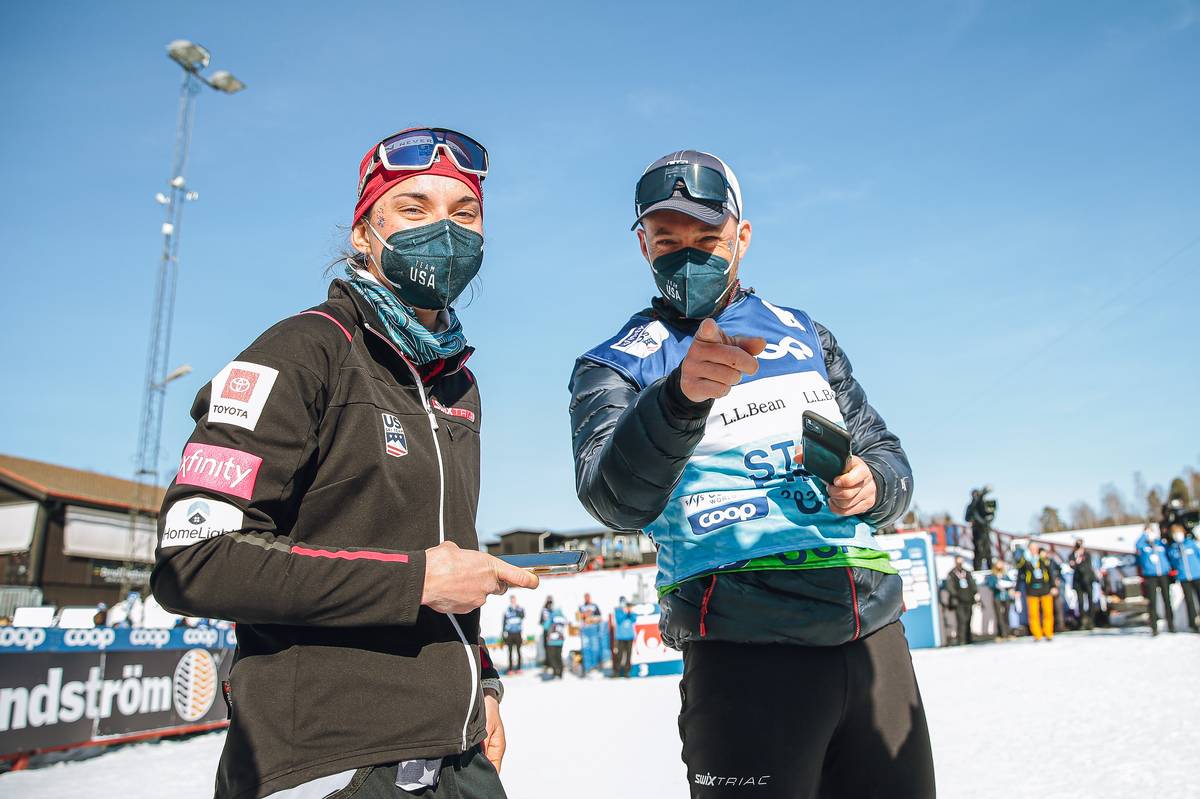
 This World Cup coverage is made possible through the generous support of Marty and Kathy Hall and the A Hall Mark of Excellence Award. To learn more about A Hall Mark of Excellence Award or to learn how you can support FasterSkier’s coverage pleasecontact info@fasterskier.com.