
Tag: Rosie Brennan

  • Rosie Brennan Blue Collar Skier? She’s OK With That: Part I

    Rosie Brennan Blue Collar Skier? She’s OK With That: Part I

    This coverage is made possible through the generous support of Marty and Kathy Hall and A Hall Mark of Excellence Award. Learn more about A Hall Mark of Excellence Award—or about supporting FasterSkier coverage—by contacting info@fasterskier.com

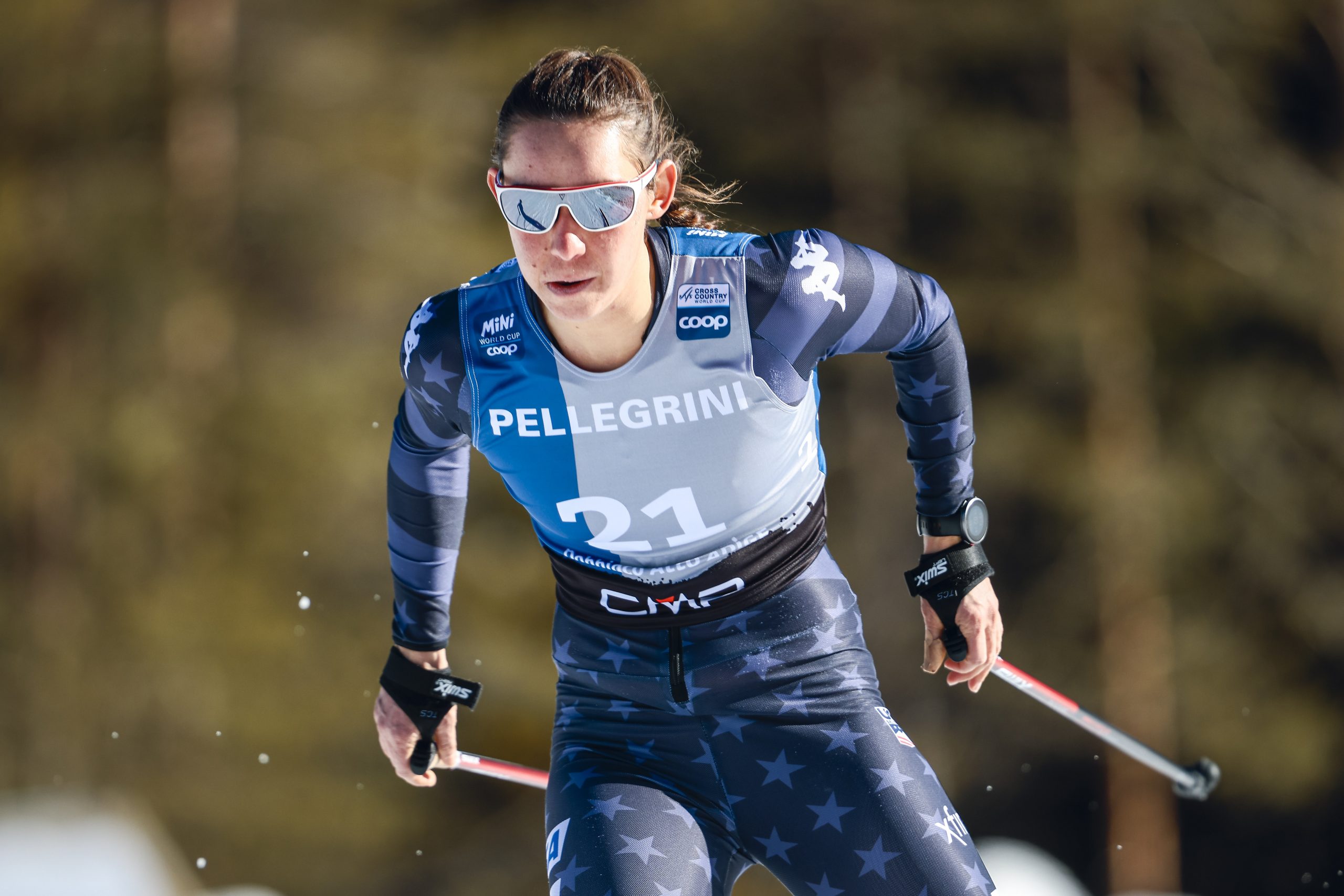
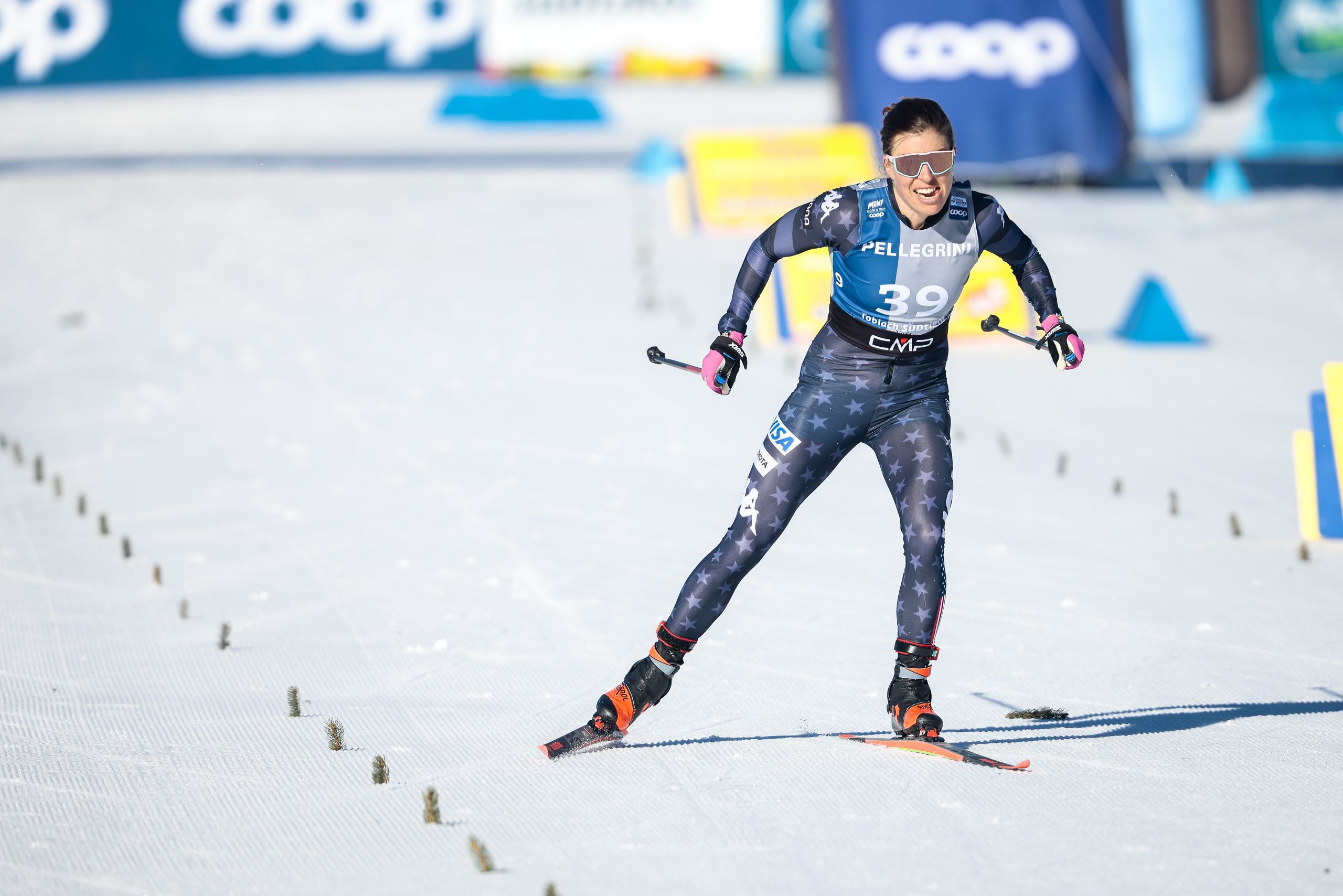
    Rosie Brennan has been a fixture on the Stifel U.S. Ski Team for several years, weathering the ups and downs of professional athletics with grace, aplomb, and stoic professionalism. Her determination and perseverance have created scores of admiring fans, and inspired her reputation as a hard working, blue collar skier. Her standout performances make her a regular resident on the International Ski Federation (FIS) overall points chase leaderboard. The waxing and waning support of the U.S. team is far behind her now, and she is considered a team stalwart.

    At age 34, Rosie Brennan is still passionate about skiing and her pursuit of skiing excellence, though she is admittedly disinterested in social media and doesn’t seek publicity. She was gracious enough to spend an extended amount of time talking to FasterSkier, speaking at length about her career struggles, goals, relationship with the media, and what her future holds. She is remarkably candid in expressing her views and offered insights into what it means to be a professional ski athlete in America. She also discussed the racing she undertook after the World Cup, racing that has received very little attention—until now. Definitely not a self-promoter, her second place and fifth place finishes in two consecutive days of racing after the World Cup season on the Ski Classics tour would have filled endless Instagram pages of other racers: not Rosie. Her decision to continue racing after the end of the World Cup season shows a level of determination that is truly next level.

    This article has been edited for clarity and brevity. It is part one in a multi-part interview with Ms. Brennan.

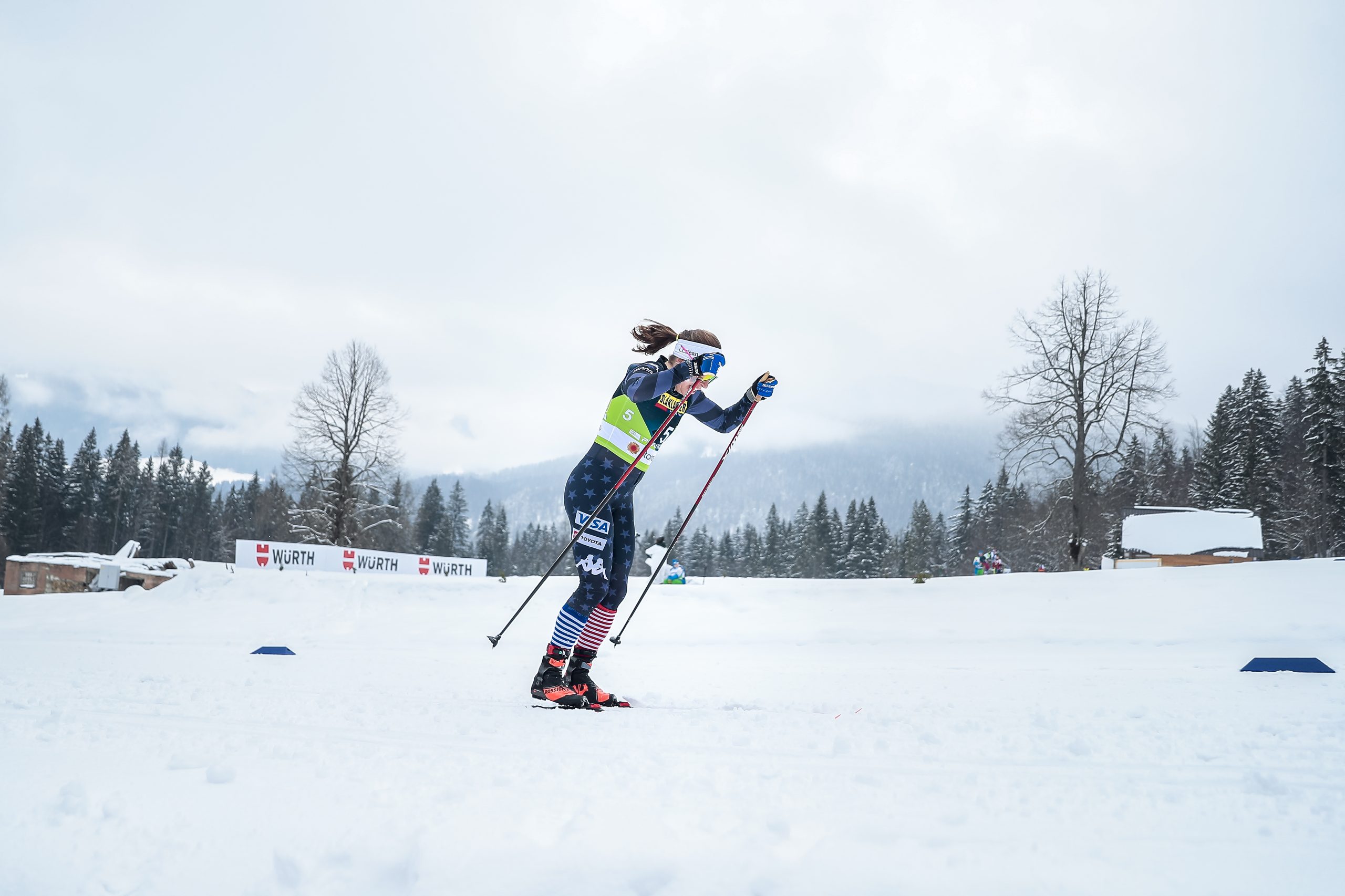
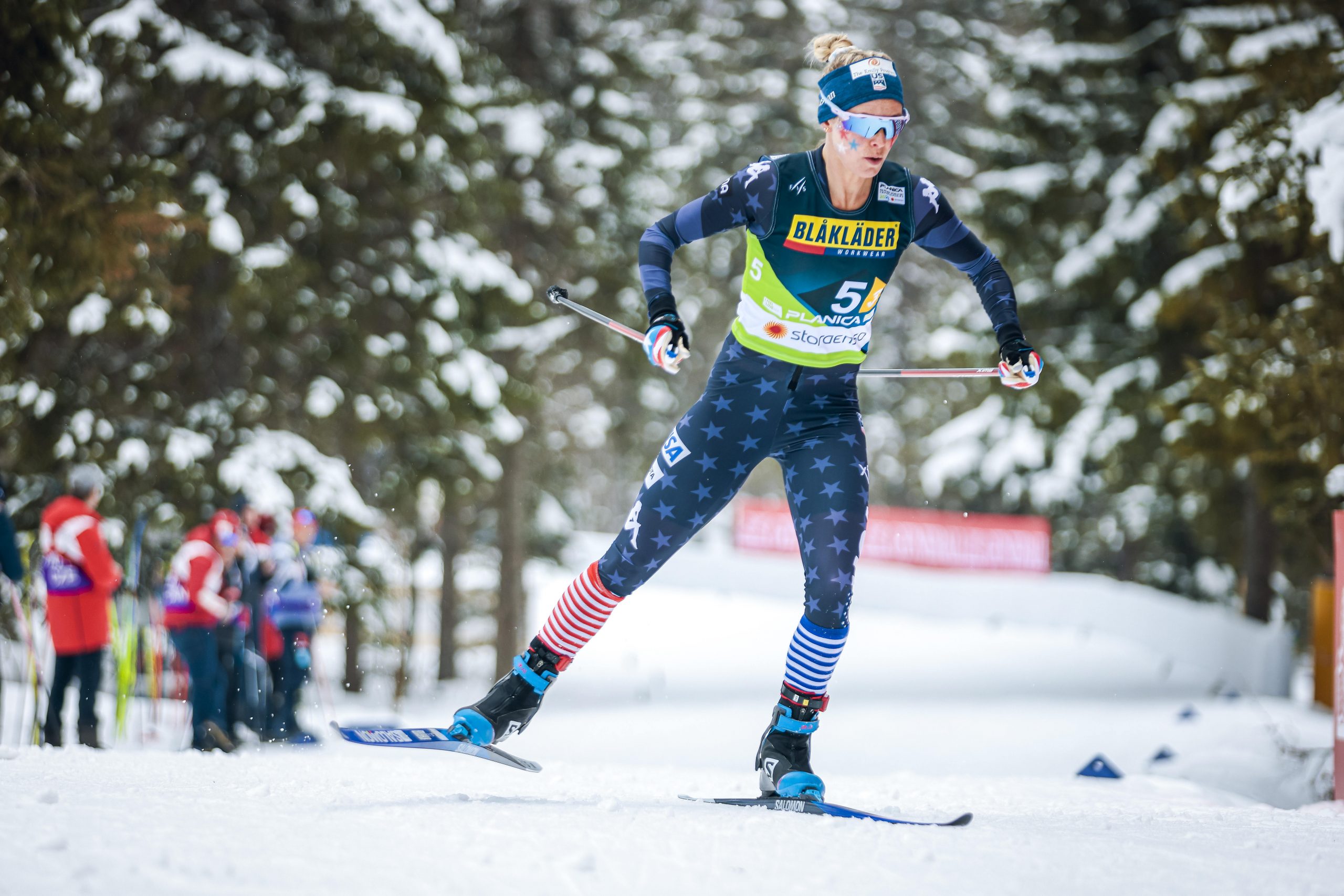
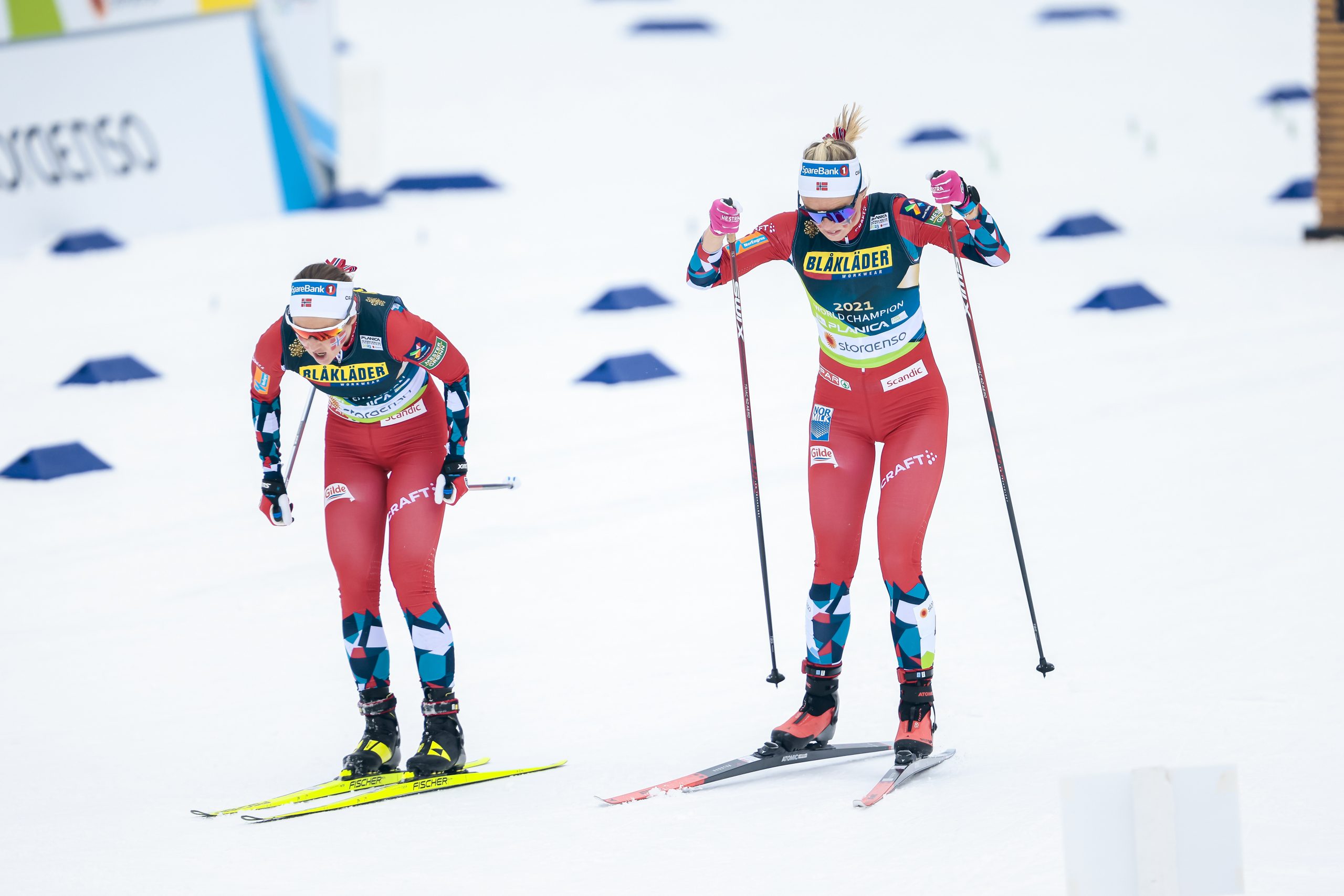
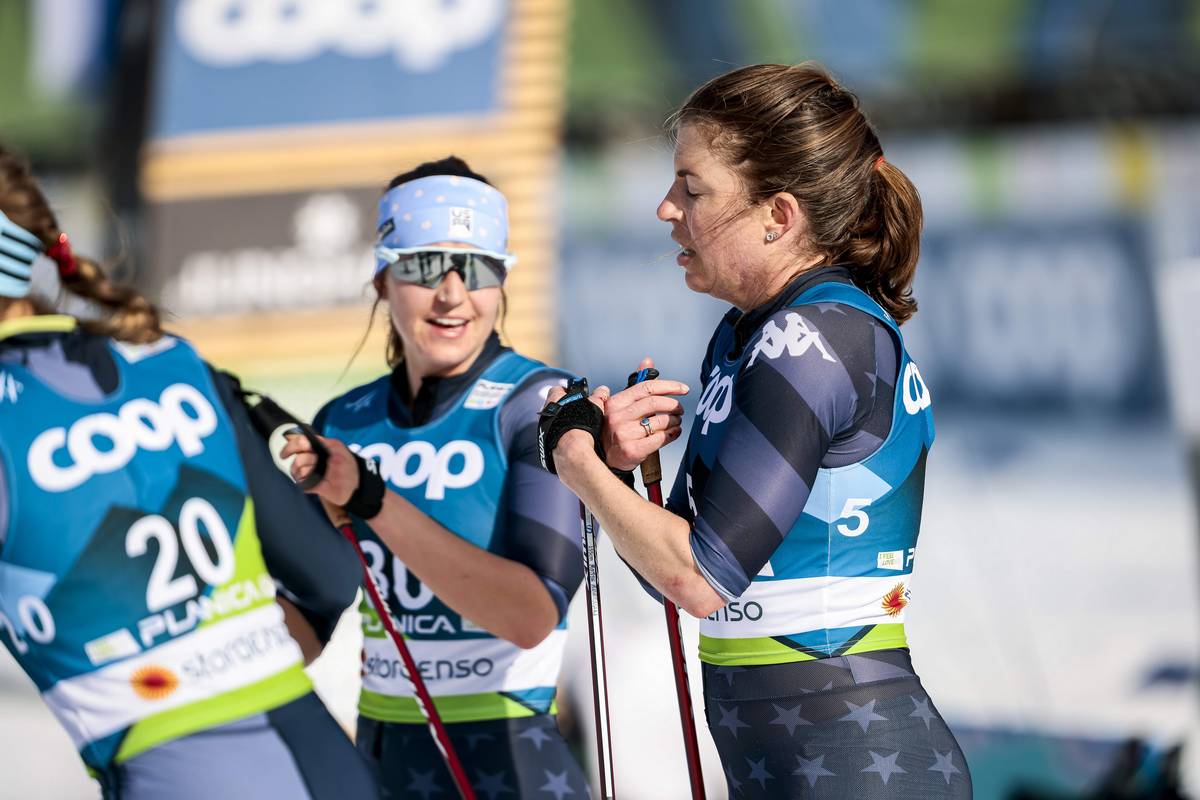
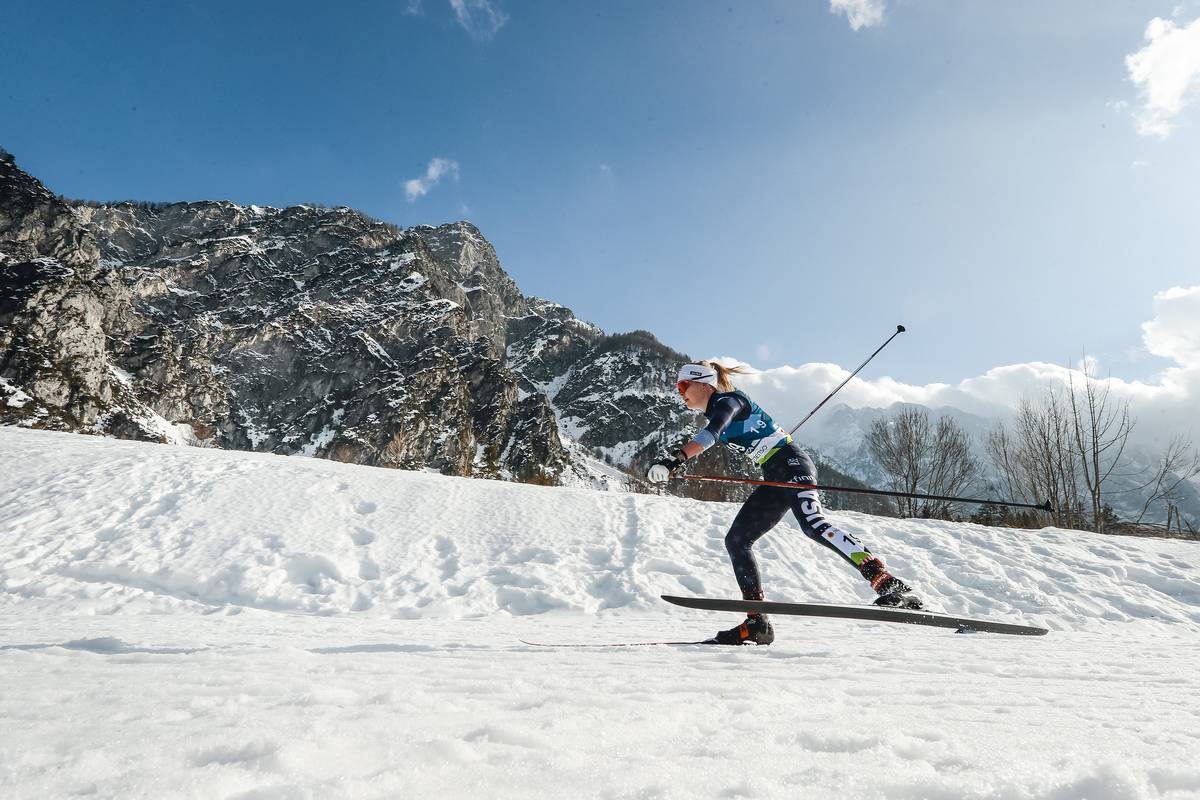
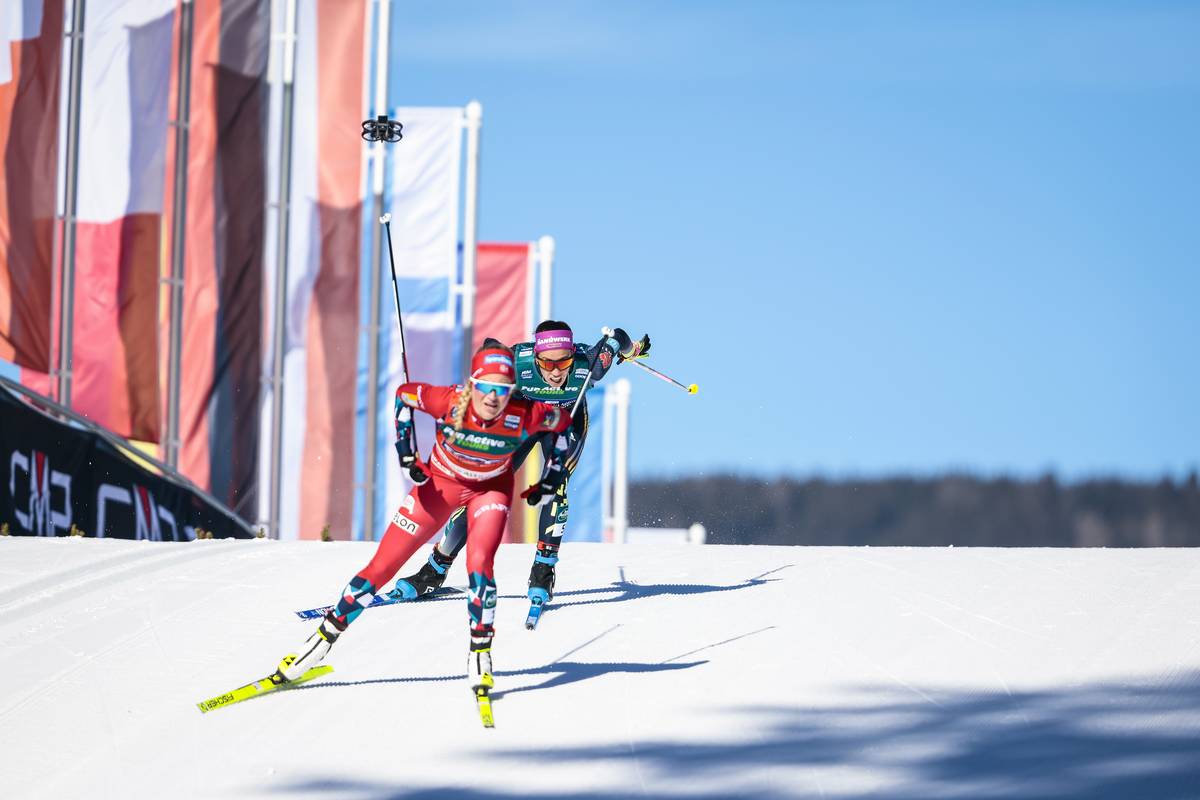
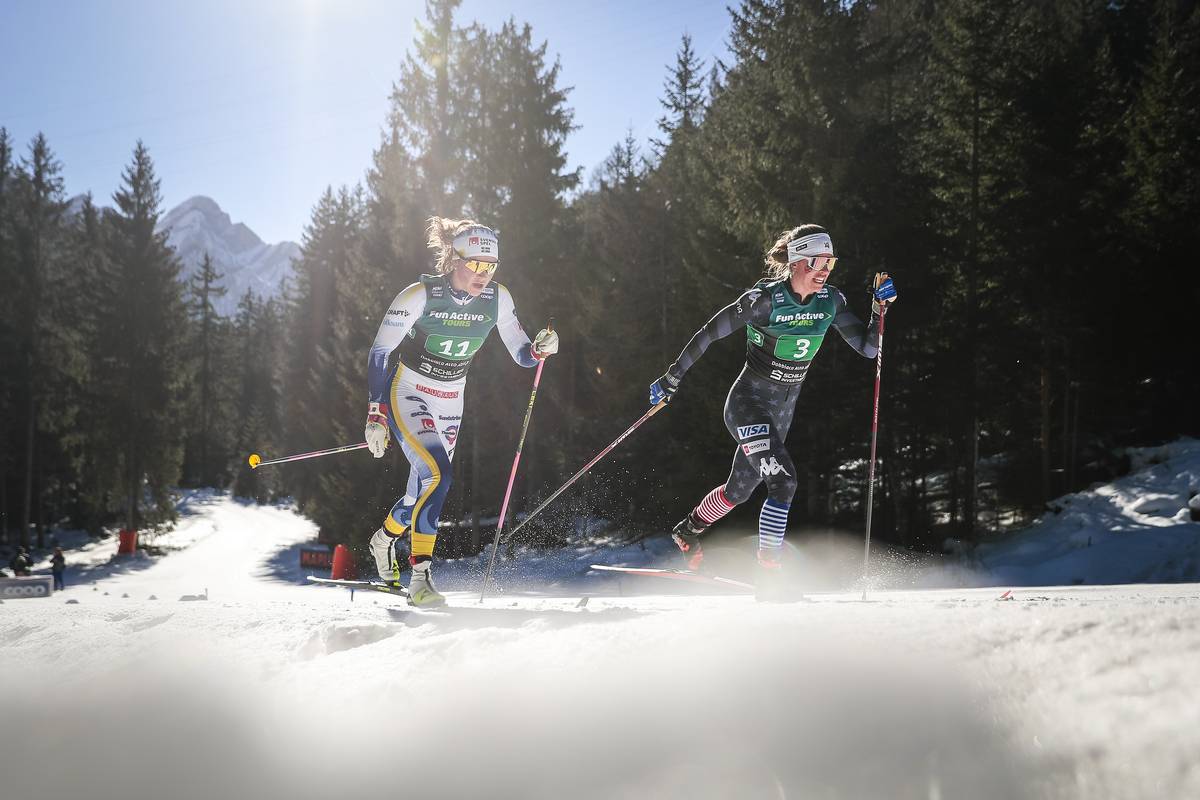
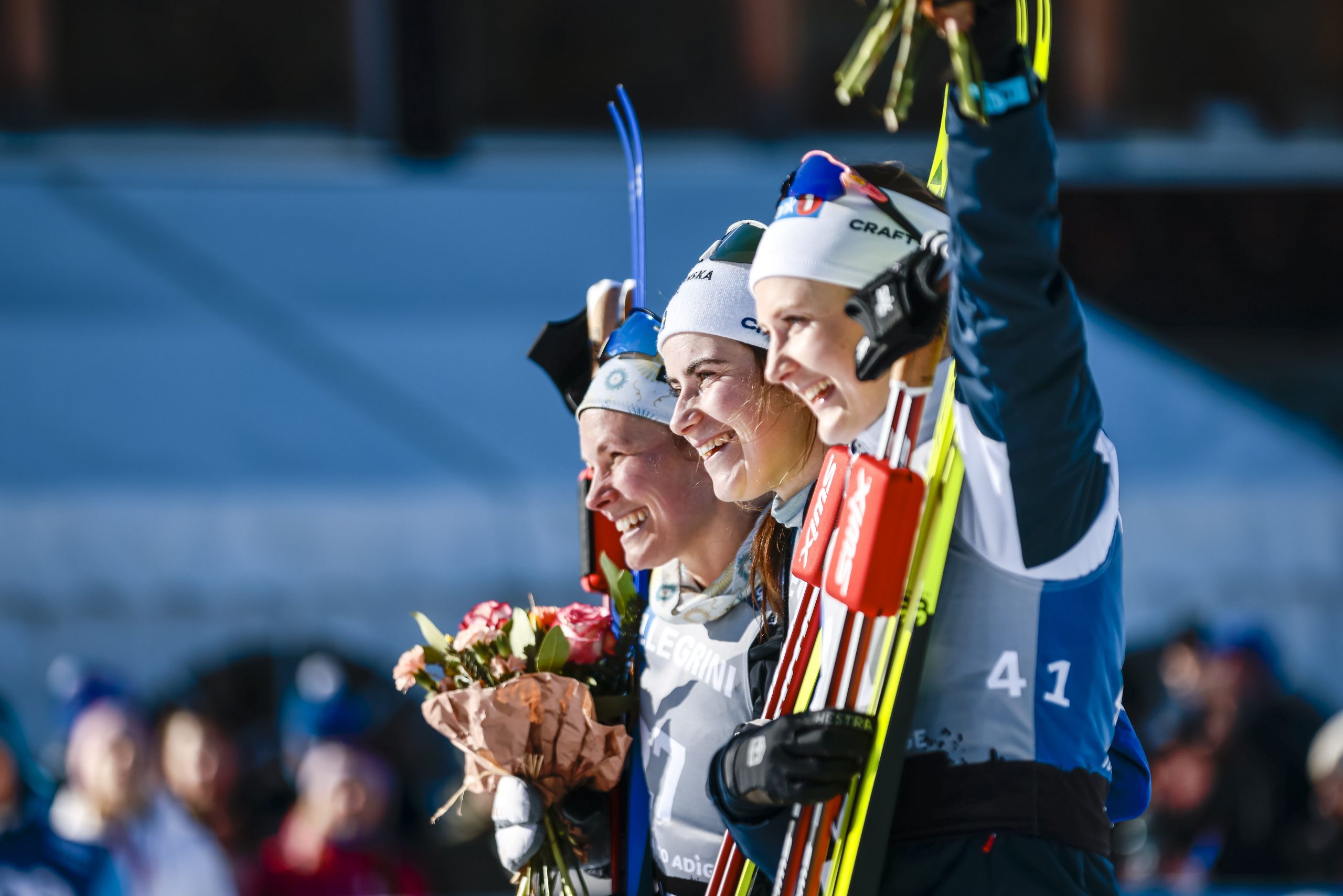
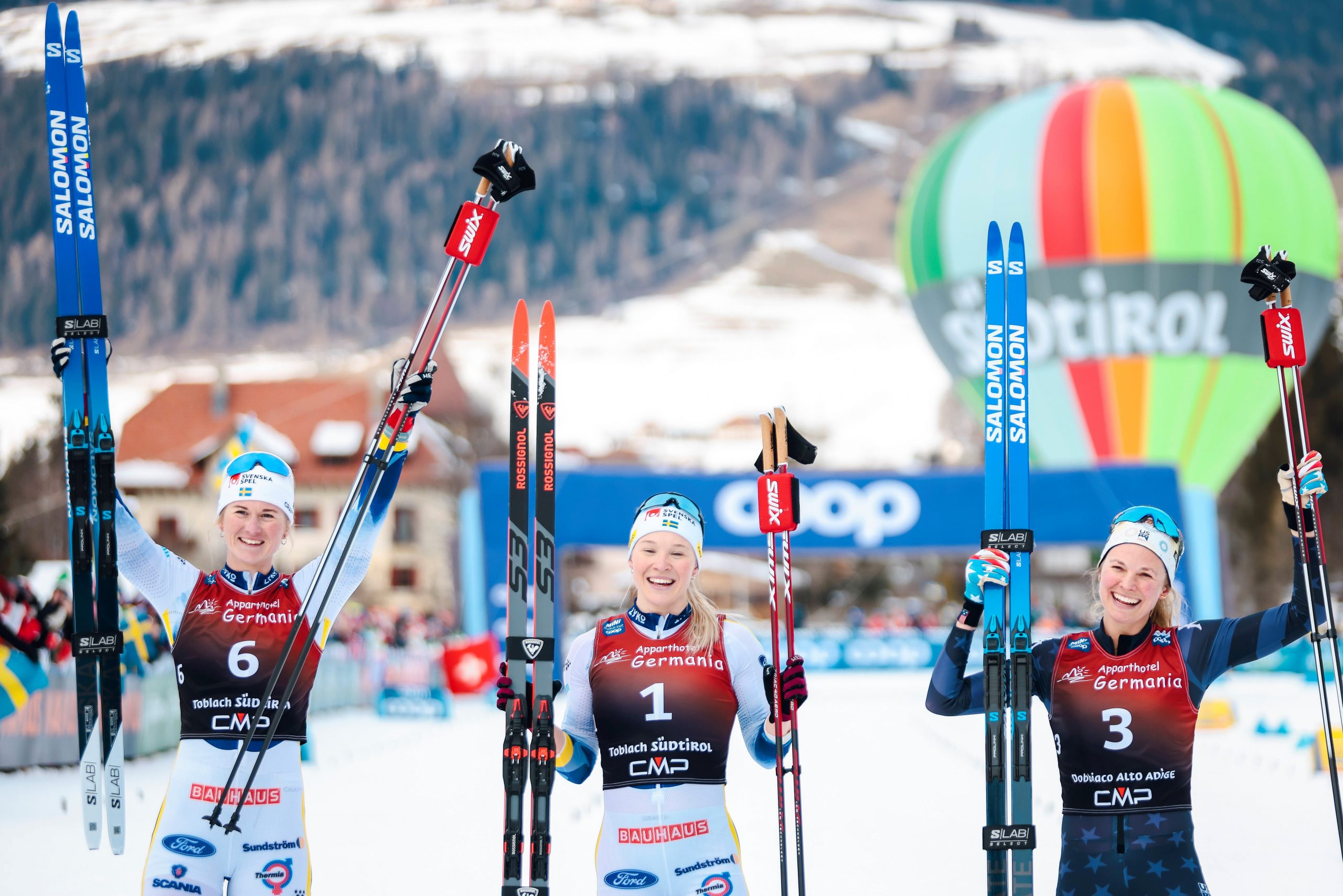
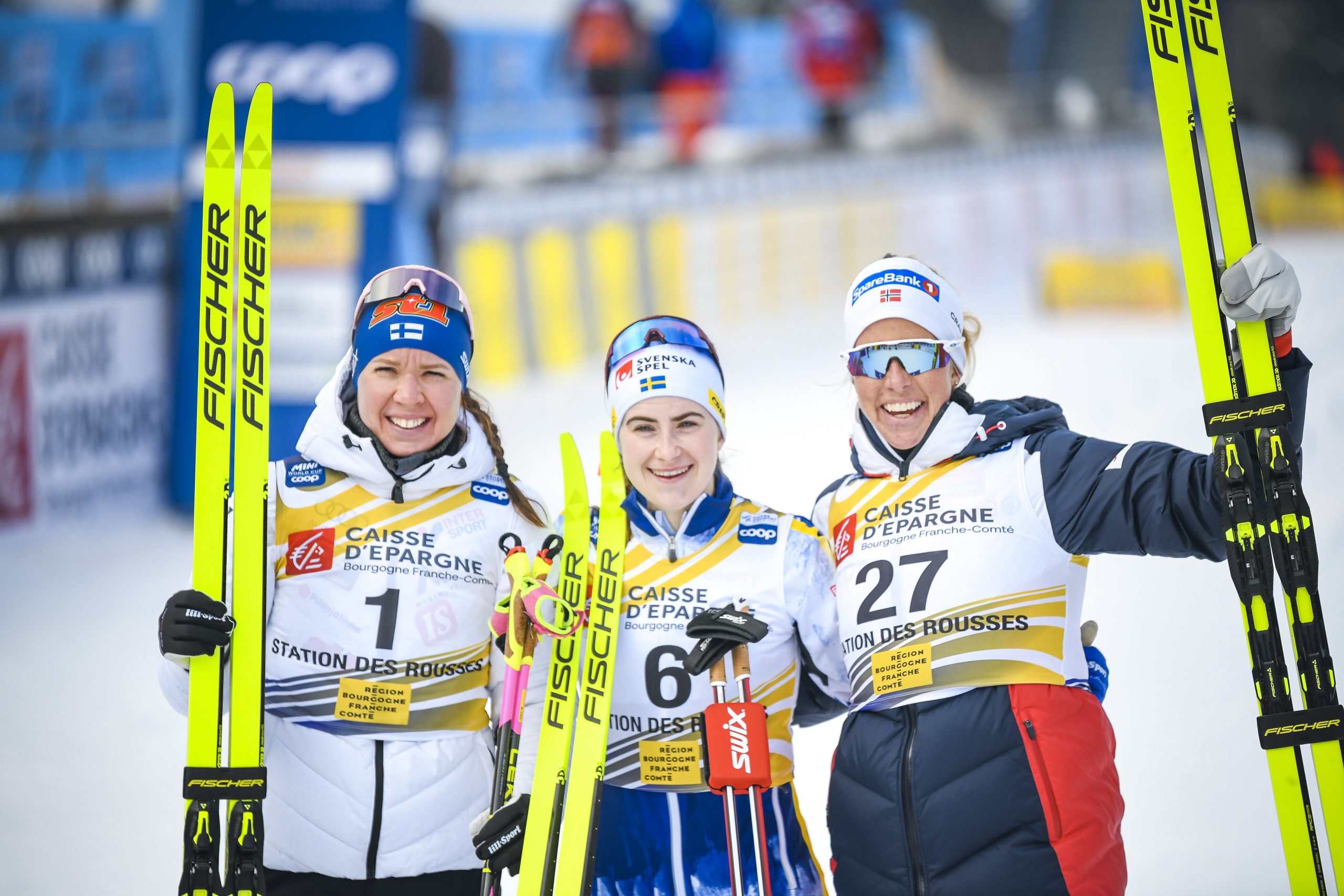
    One of the reasons Brennan chose the two marathons she raced after the World Cup season was that you can’t double pole the entire race. That choice paid off for her as she finished second in the Reistadlopet—Her first of two back-to-back marathons—just missing first place by a few seconds. Pictured (l-r) are Rosie Brennan (USA), Astrid Oeyre Slind (NOR), Emilie Fleten (NOR). (Photo: NordicFocus)

    FasterSkier: Where are you now?

    Rosie Brennan: I’m in Anchorage.

    FasterSkier: And you’ve been there pretty much since you got back from the World Cup season?

    Rosie Brennan: I went to Bend camp and then I’ve been here since.

    FasterSkier: Do you consider Anchorage home now?

    Brennan: Yes.
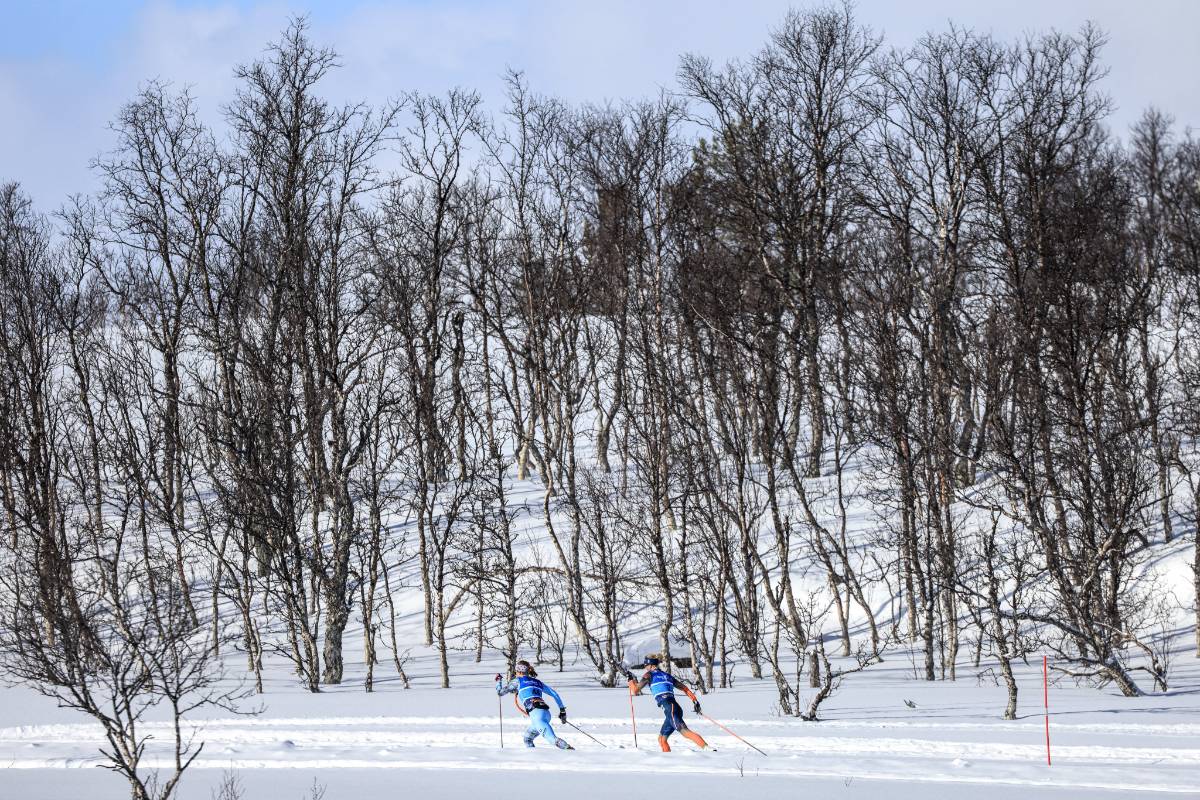
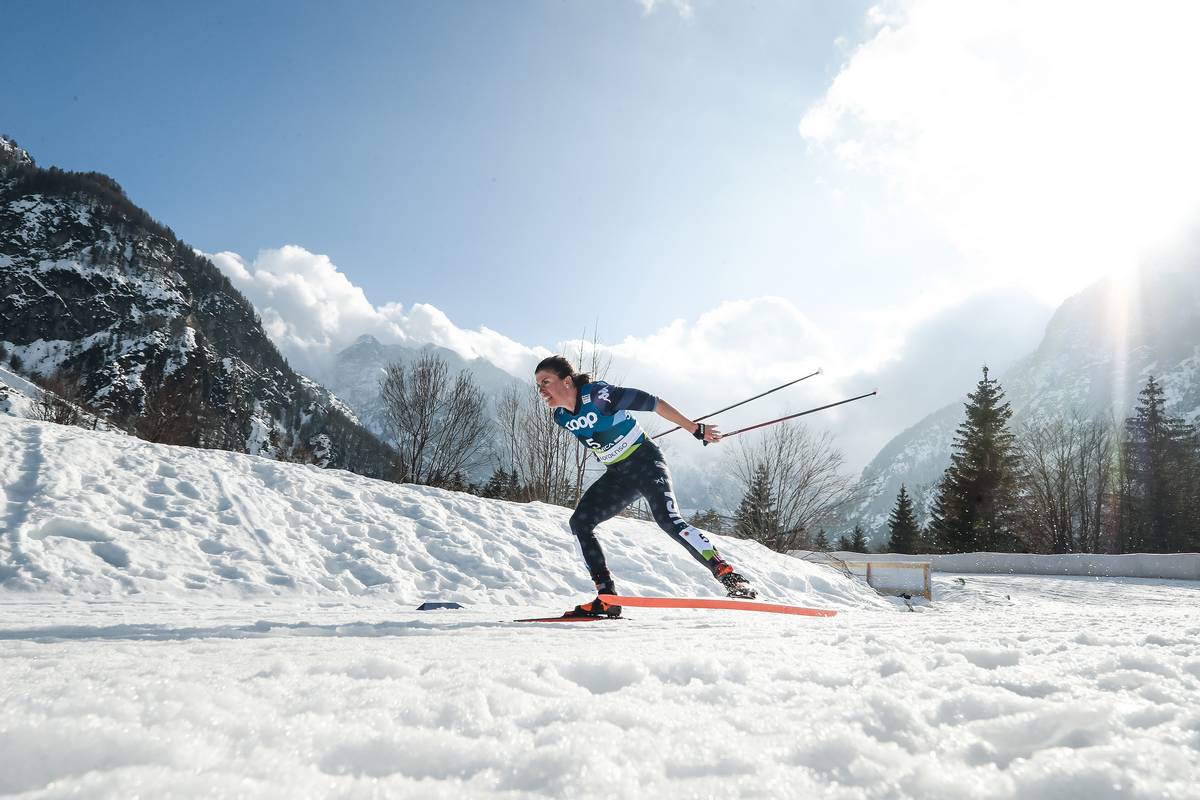
    Rosie Brennan (USA), Astrid Oeyre Slind (NOR), (l-r) battle for first place in the Ski Classics Reistadlopet, Setermoen-Bardufoss (NOR). (Photo: NordicFocus).

    FasterSkier: I want to pick up at the end of the last World Cup season. It didn’t get very much press domestically, but after the World Cup season was over you raced two of the Ski Classics races. You did the Reistadlopet (40 kilometer classic race) and the next day the Summit 2 Senja (68 kilometer classic race) which are back-to-back Saturday and Sunday marathons. You had great finishes, second and fifth place respectively. That had to make you feel quite good coming off of the grueling World Cup season?

    Rosie Brennan: Yeah, I was happy about the races. It was a really cool experience and a lot of fun, so I really enjoyed it.
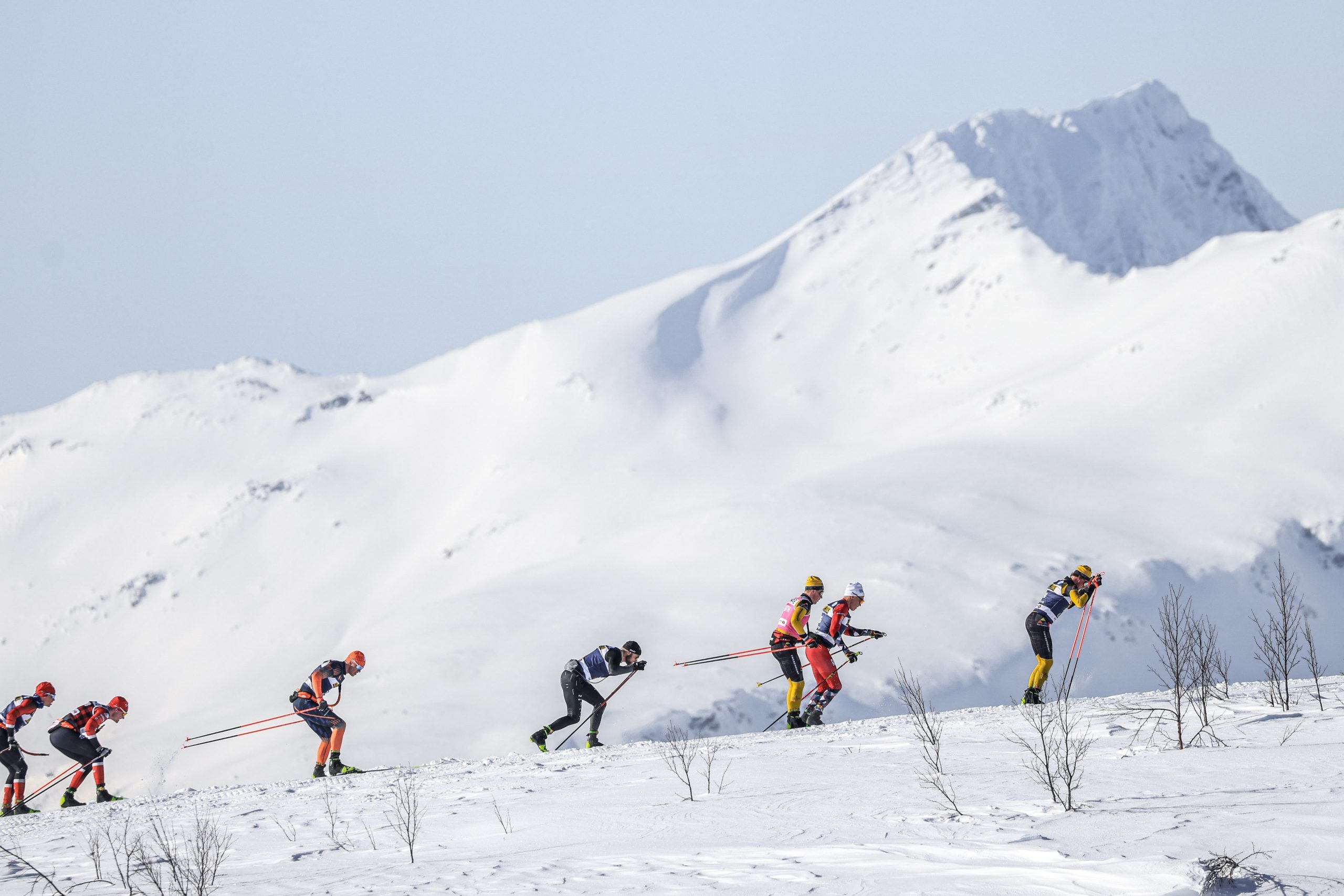
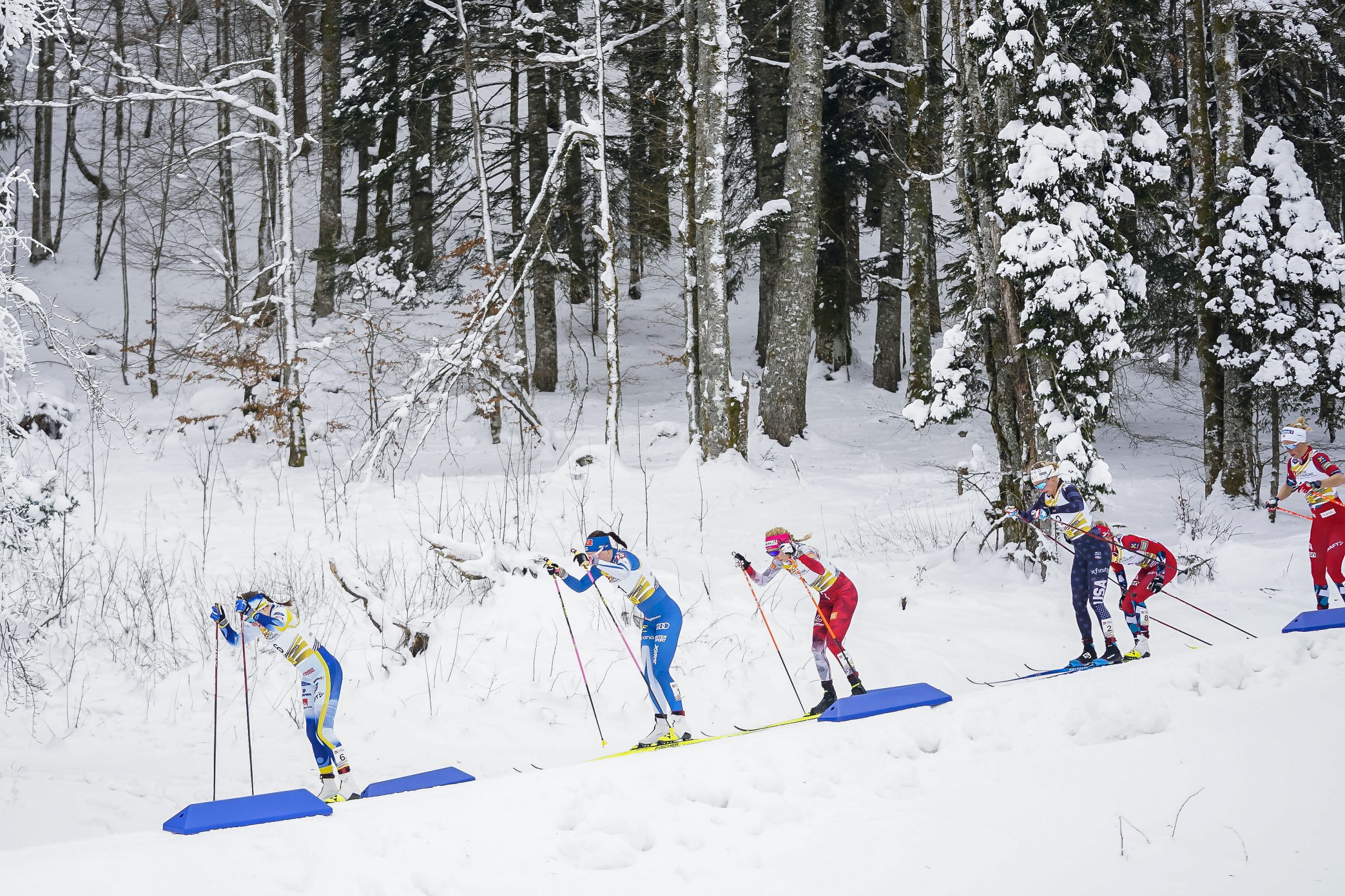
    Four months of grueling World Cup skiing couldn’t hold Rosie Brennan back. One week after the World Cup season ended, she raced back-to-back marathons, including the 68 kilometer Summit 2 Senja in Norway. Here, a group from the men’s pack attack one of the daunting climbs. (Photo: NordicFocus)

    FasterSkier:  What prompted you, after the end of a grueling World Cup season, to do these two races? Was that something you had planned at the beginning of the season, or was it simply, “I’m already here, let’s just do it?”

    Rosie Brennan: That’s a great question. Definitely something that was planned. I would not have done that if you had asked me that last week in Lahti if I wanted to keep racing. I would be like, ” Hell No!” So, that was definitely a premeditated plan. But my boyfriend is Tyler Kornfield, and he was racing. He did the whole Ski Classic season last year. He was on team Robinson Trentino, which is an Italian ski Classics team and technically, I was on the team as well. I was hoping to do a few of the races just to mix things up, and challenge myself in different ways. Then our World Cup season ended up being so insane and so long that those two [Ski Classic races] were the only option. So, I decided to do those, but also I had interest because my wax tech is actually from the town where the Resitadlopet is. He had talked to me quite a lot about it, and I really wanted to go to northern Norway and see what it was about and check it out. And I knew that he would wax my skis for me (laughing). So I had that part covered.

    FasterSkier: I was curious about what level of support you had for those races.

    Rosie Brennan: I was part of team Robinson Trentino, so I had their support there. In terms of Ski Classics teams, they’re pretty small and underfunded compared to the Scandinavian teams, but support is support and it was still very helpful. Because both of those races are actually quite hilly, I used kick wax and so I had my wax tech do the kick on my ski. He knows me and my skis and knows how to kick wax, and he’s from there. So, his local knowledge is quite good. It all just worked out really well. It just made sense to do those races, so it was really cool.

    FasterSkier: Had you made that decision before the World Cup season even started then?

    Rosie Brennan: That decision was made in June last year or something. So I was fully committed.

    FasterSkier: So, you were all in then?

    Rosie Brennan: Yes, which I am glad of. If you tried to make that decision, even in January it probably would have been—no. But when you plan it ahead of time, then you just know, yeah, that’s my departure date from Europe, and you just kind of accept it. Then it’s not that bad. I had a ton of fun.

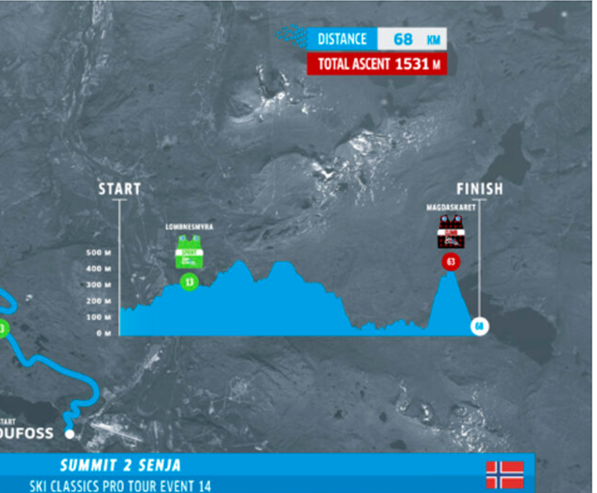
    The course profiles for both the Reistadlopet and the Summit 2 Senja give a skier a lot to think about—and probably not good things!

    FasterSkier: Looking at the profile on the Resiadloppet, it has a crazy hill climb in it which looks every bit as steep as what you see on the hill climb at the Tour de Ski. How did that compare for you?

    Rosie Brennan: It’s not quite as steep, or at least not like consistently quite as steep. There were definitely some steep pitches that you were doing herringbone, not striding. So yeah, it was really challenging, but again that was one of the reasons I picked those races. I don’t double pole half as much as those Ski Classics athletes; there’s no way I stand a prayer in a double pole race.

    I was excited about the climb. That was definitely part of the intention with those races. Actually, I will say the the Summit 2 Senya one was significantly harder because it also had a huge climb and that climb came at 60K.

    FasterSkier: So close to the finish?

    Brennan: Yes. It was about a 5K long climb at 60K and was also very steep—like herringbone level steep—and that was insane.
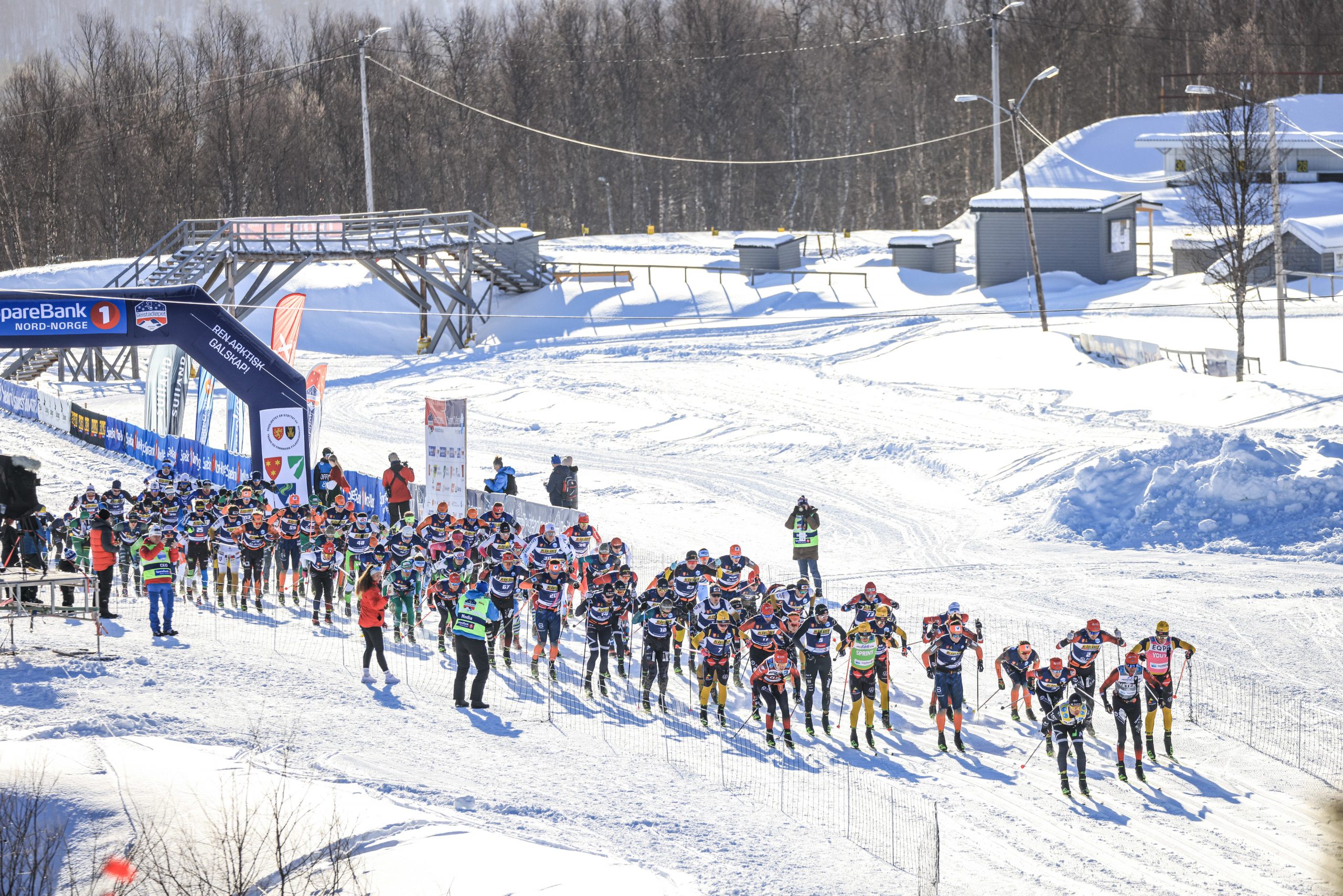
    The Summit 2 Senja Ski Classics race proved a daunting challenge for Brennan after having raced 40 kilometers the day before. As usual, she was up to the challenge. (Photo: NordicFocus)

    FasterSkier: You came off the World Cup tour, you enter the Ski Classics and get a second place on Saturday,  a fifth  place on Sunday, you must have been pretty proud and pumped up about that?

    Rosie Brennan: Well, by the time I finished on Sunday, I was like, where’s the bed (laughing)? I’m not going to make it any further. That was very challenging for me, but I was really proud of myself for doing it….taking that chance on myself. It was a lot of fun. I think one of the coolest parts is that it was one of the last races of the year. It was essentially just like I had already started training for the next season. It was like doing probably 5-6 hours of Level 3- level 4.

    I felt like I gained a lot from doing that and then part of part of my reward was that I stayed with my boyfriend for a week after, and we went back country skiing.

    FasterSkier: It’s just really impressive that you had that much gas left in the tank after the end of the World Cup season to be able to put that kind of effort in. I remember talking to one of the U.S. coaches, the Sunday of the last weekend of racing in Lahti and asked him if people were staying around to take advantage of the fact that you’re already there. The response was emphatically, “No, we’re exhausted. We’re getting on the next plane out of here and we’re going home and we’re going to bed. For a week.”

    Rosie Brennan: Yeah, yeah, yeah, I know. Had Tyler, not been over there I think I would have felt that way too. I finished plenty of other seasons in that same way. But, I had made this commitment and we were doing it together so it didn’t feel that bad. But I’ve been doing the World Cup for a long time, so I kind of  knew how tired I was going to be and what to expect.

    FasterSkier: Having such great finishes in those two races, whenever in the future the conclusion of your World Cup racing may be, is there a future in Ski Classics for you?

    Rosie Brennan: Probably not. I definitely was curious to do some of them to see what that was all about. It is a really cool circuit. But I don’t know if I’m fully captivated by the idea of only double poling. It’s a cool challenge and I understand why people are attracted to that challenge, but I’m not sure it’s the challenge I crave. Maybe I’ll change my mind, but right now it will be fun to participate in a couple of them, but I don’t know if I’m a full on Ski Classics kind of person.

    FasterSkier: Next year they’ve going to have a 100K race, the Janteloppet, to end the season. Any possibilities of doing that?

    Rosie Brennan: I don’t know. I’m definitely intimidated by 100K. I’ll say that much. So, it’s not like my gut reaction is, “Yeah let’s go do that.” But I haven’t really gotten that far yet to detail out what my season is going to look like and how long I’m going to stay over there and that sort of thing. So we’ll see.

    FasterSkier: You were headquartered all last winter in Italy. Was that a new a new thing for you to have a home base camp during the World Cup season?
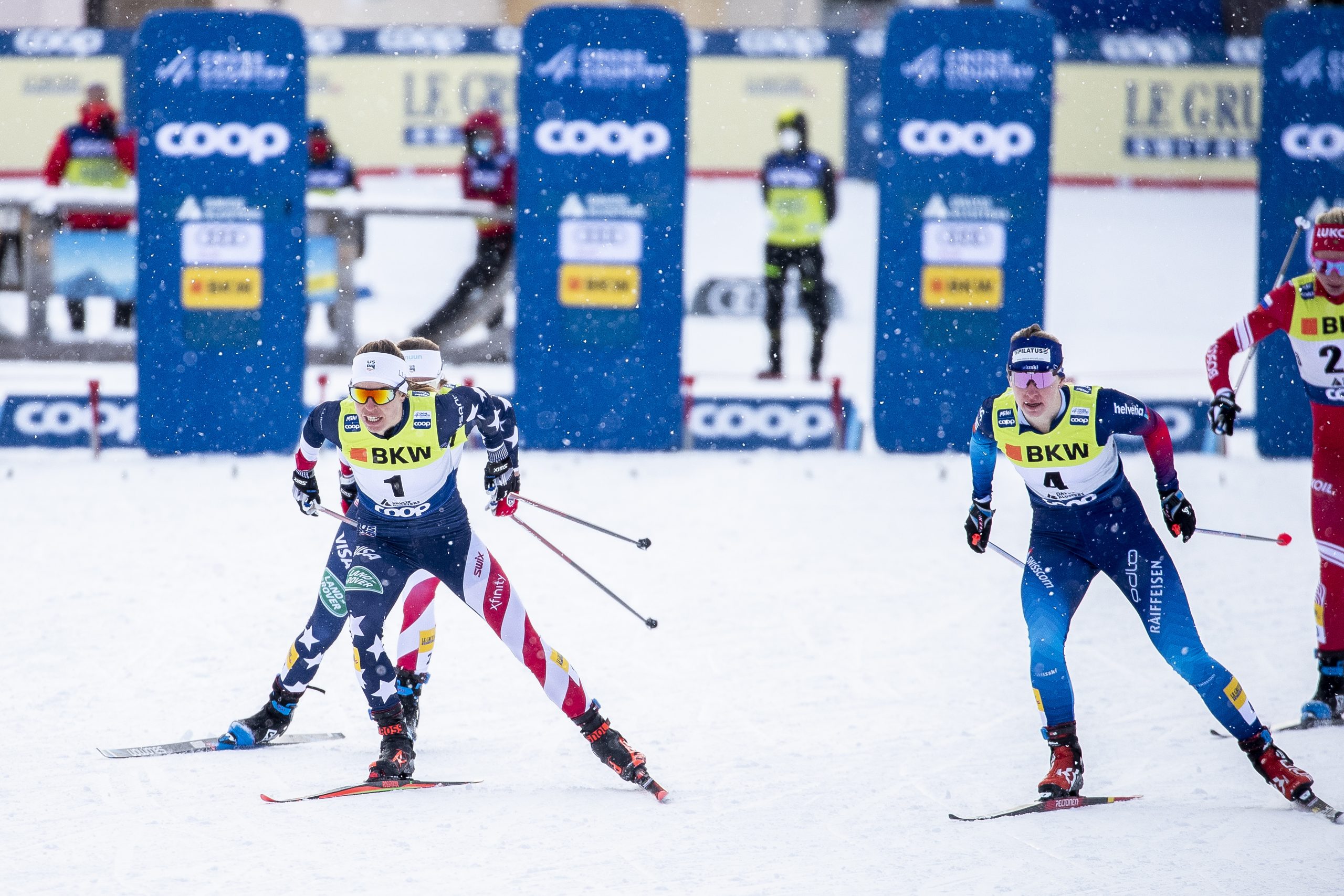
    Brennan raced to the top of the podium in the World Cup sprints in Davos in 2020. (Photo: NordicFocus)

    Rosie Brennan: Yes, it was. It’s something I’ve always dreamed of. Tyler, for most of his career, was bouncing back and forth between a World Cup and Super Tour and that sort of thing. So, it was just never something that we could commit to doing together, just not ever knowing where he was going to be. So, when he retired from that form of racing and decided to go into Ski Classics, it was a perfect opportunity to try it out. So, we did that last year and it was great! That’s probably one of the reasons I was able to stay and race those races [Ski Classics]. It did just take some of that home sickness and stress off of me, a little bit. It just feels more like home when you have your partner for dinner some nights and get to spend some time together. So that was a really special experience. He’s done racing completely now, so, unfortunately, I don’t think we’ll be doing that again. I’m really grateful that we got that year to do that together.
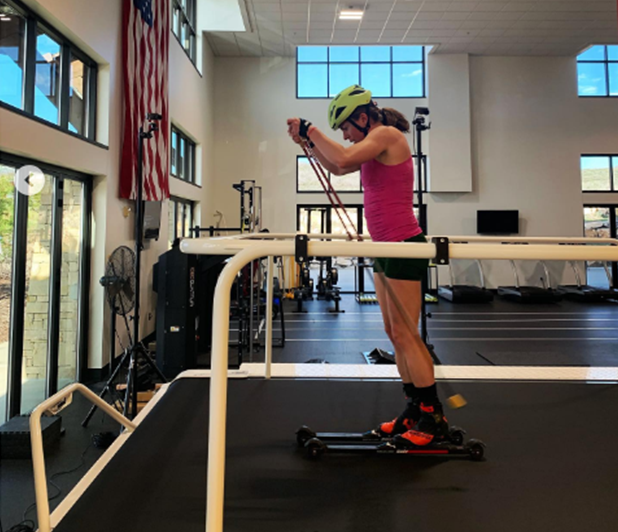
    Part of Brennan’s summer training includes hitting the giant ski treadmill. (Photo: Rosie Brennan)

    FasterSkier: When you talk to the American racers and coaches, they always talk about the disadvantage that the North American teams face by essentially being on the road for four months and not having a home base. It sounds like this really did work to your advantage. Is it something that you’ve brought up to the team coaches that maybe we should consider doing this as a team?

    Rosie Brennan: Yes and no. As a team it’s pretty challenging because everyone’s needs are a little different and things like where do you go, do you go to altitude, do you go to sea level? That also changes quite a bit based on the calendar and where the races are and where the championships are and that sort of thing. I also think a big part of it is, like I said, having my partner there and having my space away from the team.

    There definitely would be some advantages to having some team apartments or something like that, but I’m not sure. It’s still not the same as having your home there. After doing it last year, I probably have some regrets of not trying to do it with Sadie or somebody, that I was very close with while she was my roommate in in Anchorage, so I knew I could live with her. It’s just challenging with people’s personal lives and their partners and that kind of stuff. I think that’s truly what makes it feel a little more like home is having your people with you.

    FasterSkier: And not having a giant camp of disparate personalities?

    Rosie Brennan: Yeah. Yeah, exactly.

    FasterSkier: On the topic of venues, I want to ask you about Davos. You always do really well in Davos and the American team seems to really do well in Davos. Can you put your finger on what is going on with Davos, which makes it so good for you and the rest of the Americans?

    Rosie Brennan: That is a good question. I’m not really sure why. I do think in general we tend to do pretty well at altitude. I think just growing up in the U.S., you just have way more experience racing at altitude and honestly above the FIS limit. Because that’s just where some of our skiing is. For me, that’s especially true because I grew up at high altitude, so that feels very normal. I don’t really even bat an eye at it, but I think even for people that that grew up at sea level in the US, you still [have races at] at high altitude. So we just interface with it [altitude] a lot. More than say, a Norwegian skier does, who probably doesn’t even touch altitude until they get a World Cup start. I definitely think that’s an advantage for the Americans. And I guess our techs must be good at waxing for that kind of snow! We tend to have good skis there. We also tend to be good skaters, and it’s almost always skate there, so I think that probably helps too.

    FasterSkier:  It feels like it’s almost home court advantage for the US team there.

    Rosie Brennan: We have spent a lot of time there too, so that probably doesn’t hurt. We’ve done a lot of training camps there and a lot of people spend the holidays there and that sort of thing. So, it is somewhere we’re pretty familiar with.
    Stay tuned to FasterSkier for Part Two of our Rosie Brennan interview.
  • U.S. Cross-Country National Team Announced

    U.S. Cross-Country National Team Announced

    U.S. Ski and Snowboard has announced the members of the 2023-24 National team, now officially known as the Stifel U.S. Cross Country Ski Team. With a few notable retirements this spring a couple of shakeups were going to occur. The team uses a selection criteria which it has developed to try and balance proven performers with budding talent. It is a somewhat complex set of guidelines.

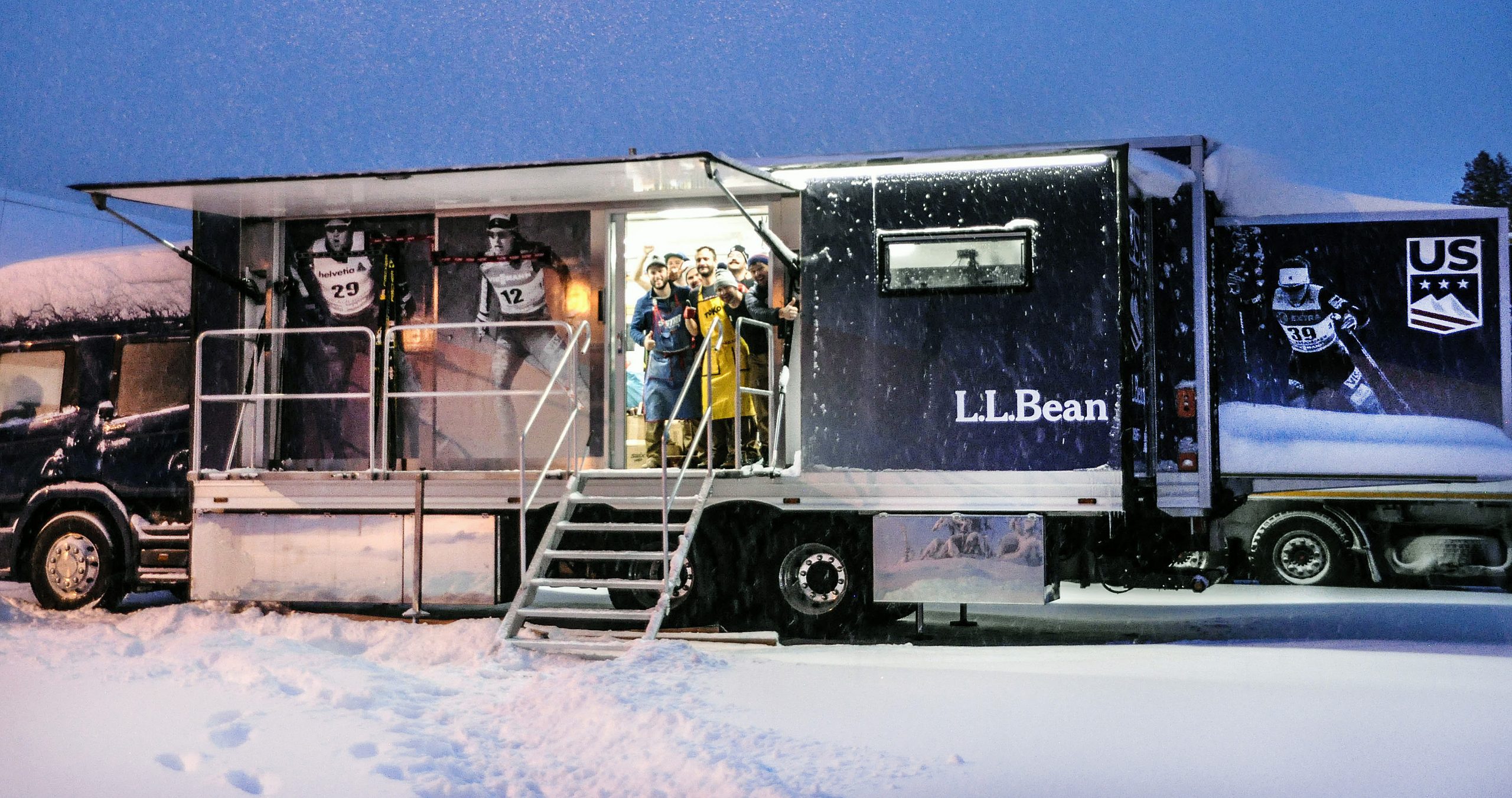
    U.S. Ski Team wax truck during pre-season camp in Rovaniemi, Finland will find some new occupants this year along with some proven fan favorites. (Photo: Matt Whitcomb)

    Women’s Squad

    The women’s A Team members come as no surprise. Veterans Jessie Diggins, and Rosie Brennan will be joined by Julia Kern. Last season Kern solidified her placement on the A squad with consistent sprint results all winter.

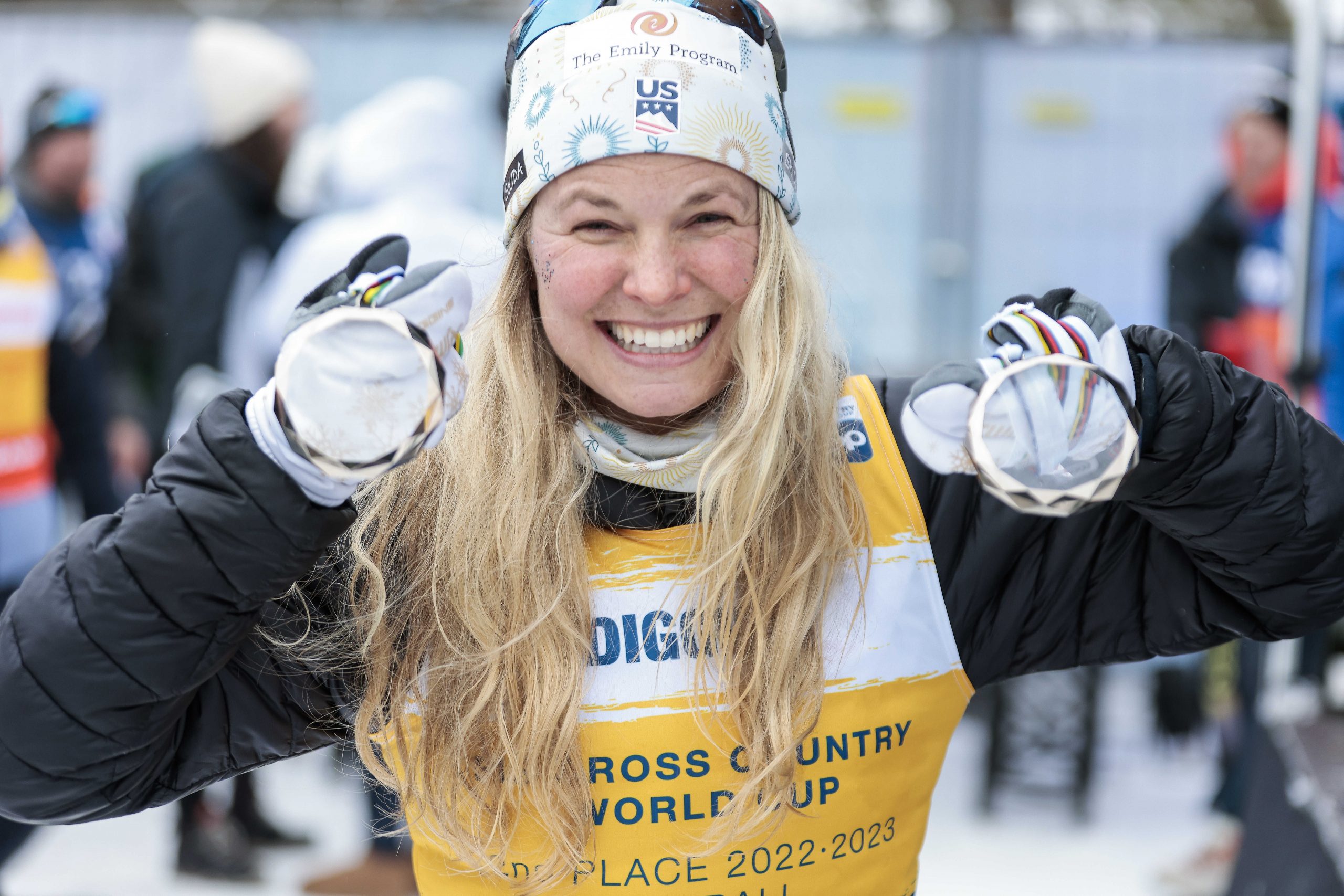
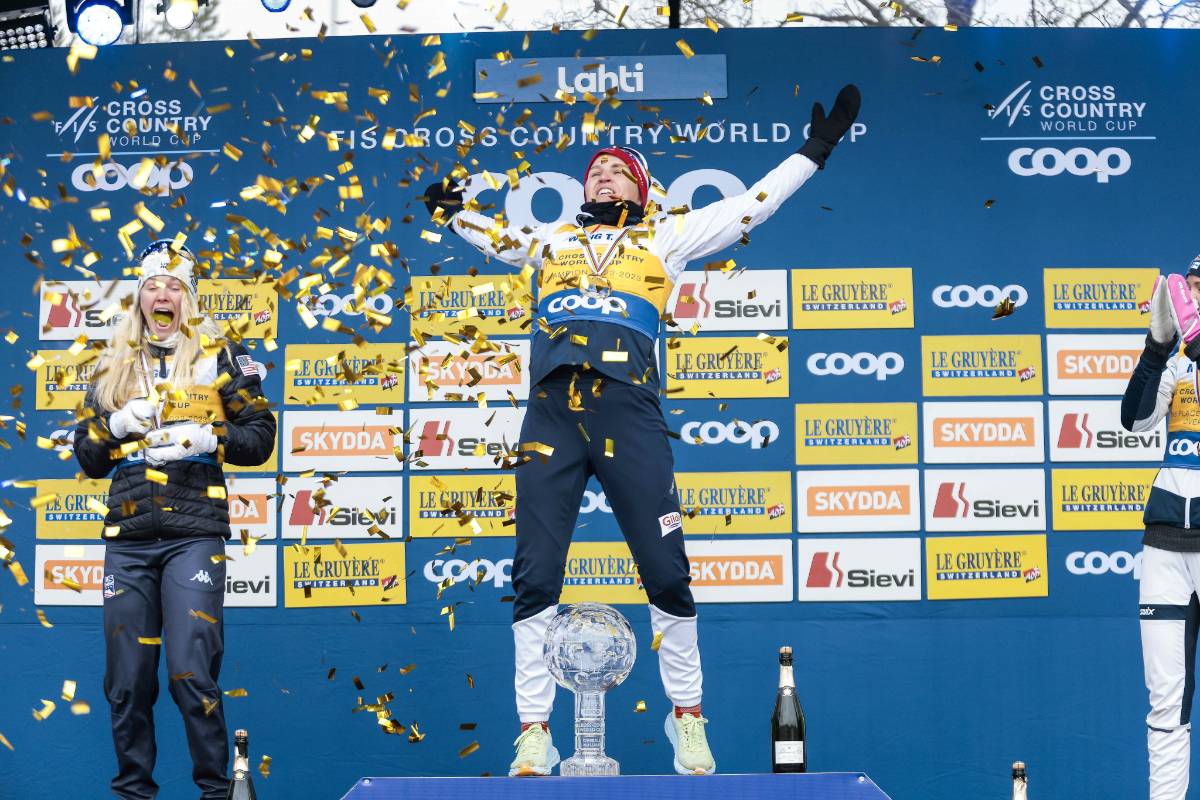
    Jessie Diggins (USA) showing off her new hardware after the end of last season. (Photo: NordicFocus)

    The women’s B team will consist of Sophia Laukli, Novie McCabe, and Sydney Palmer-Leger, who will move up from the development team.

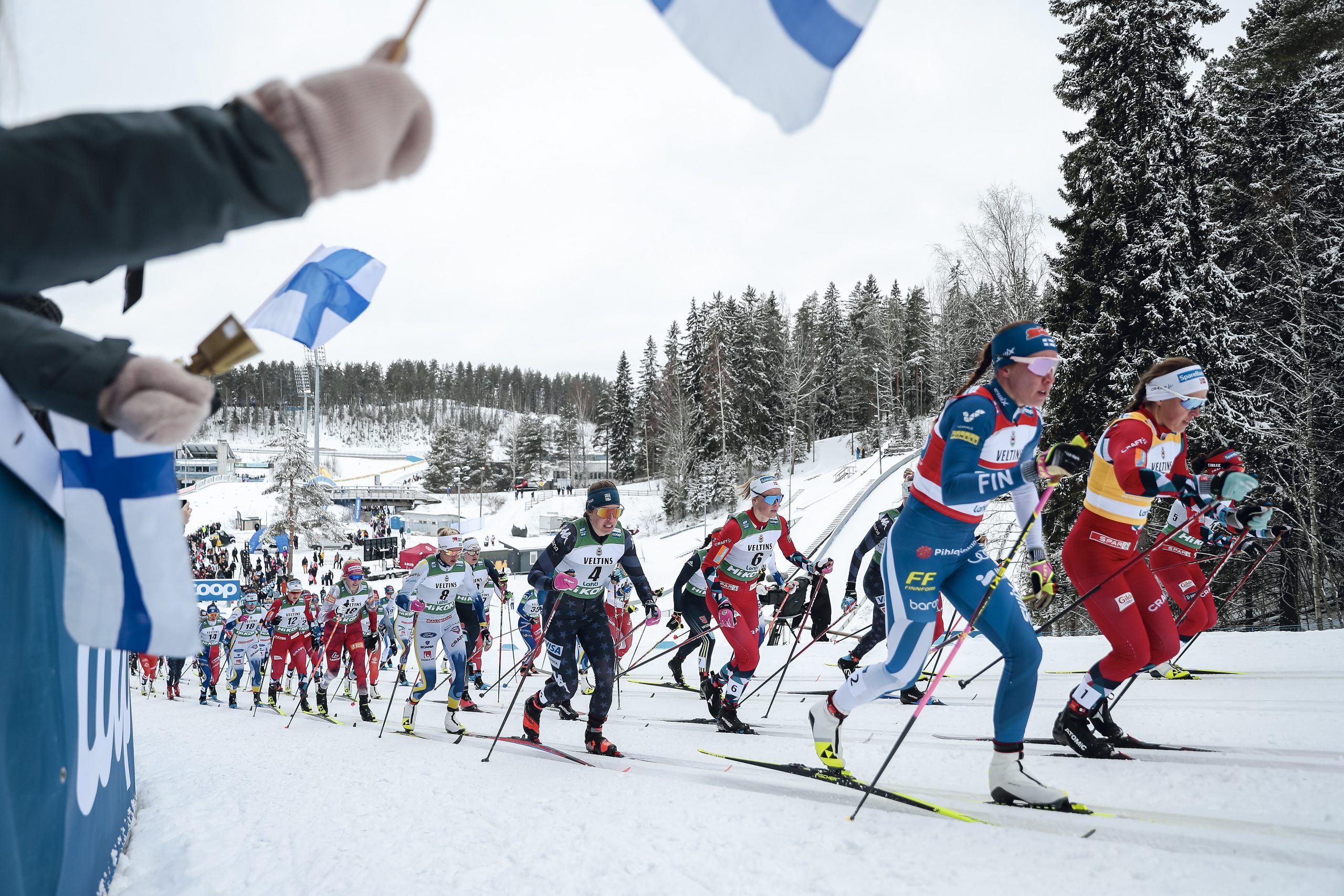
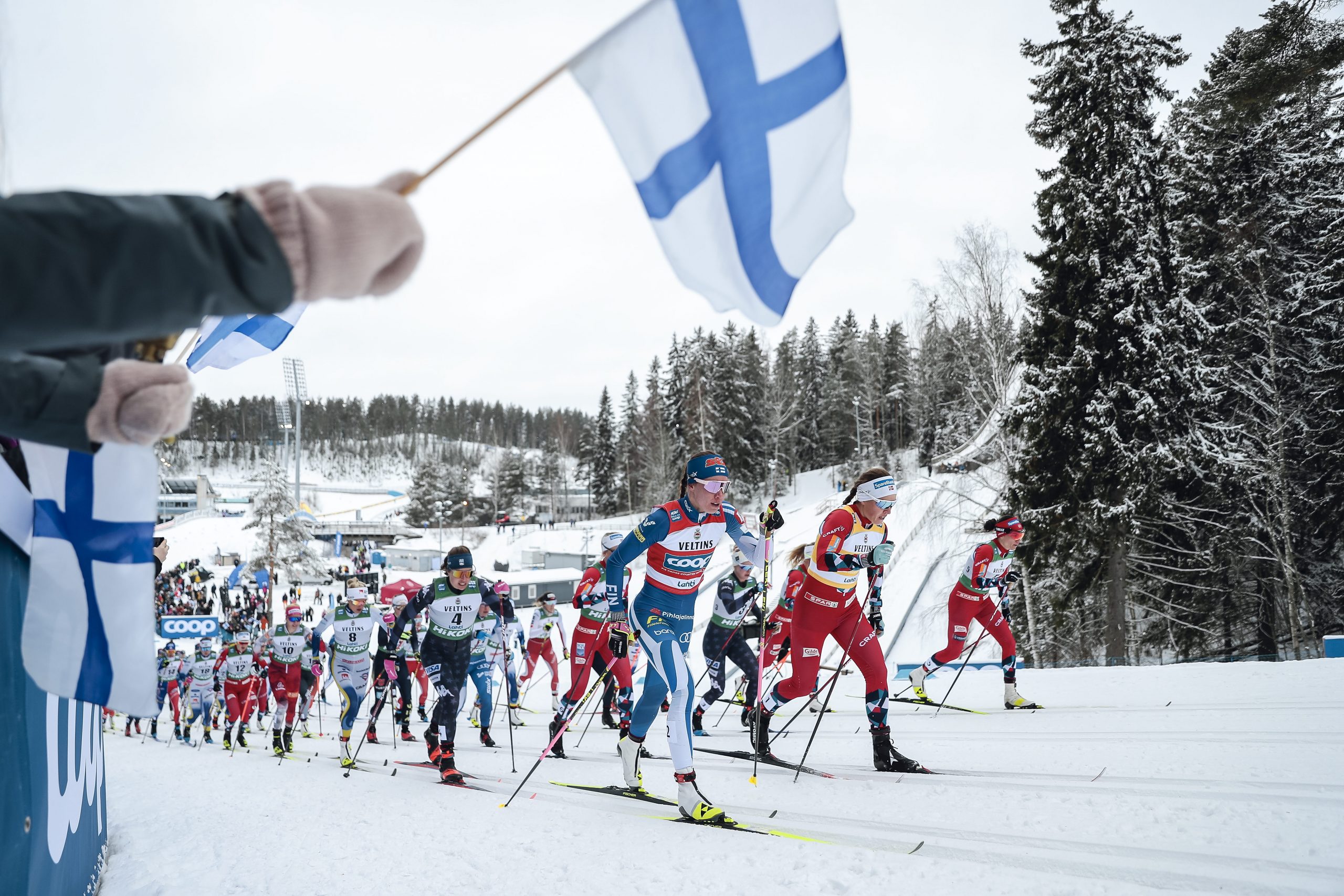
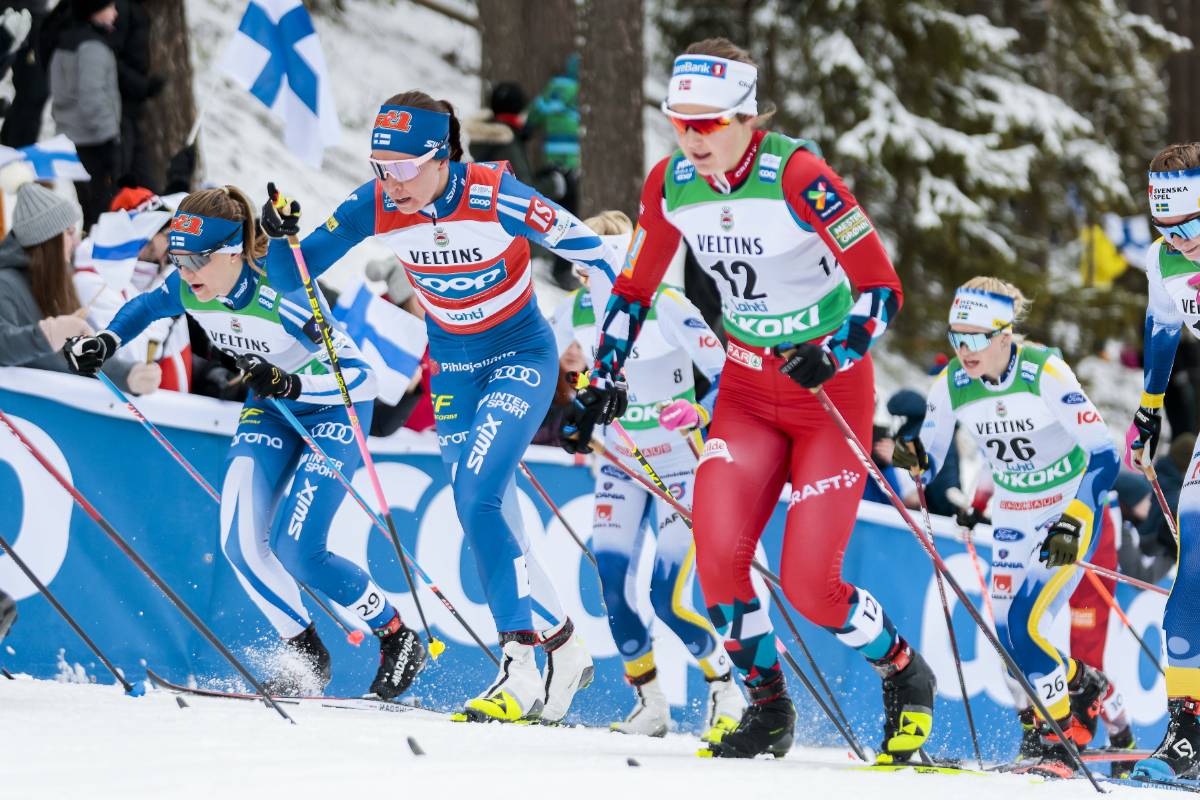
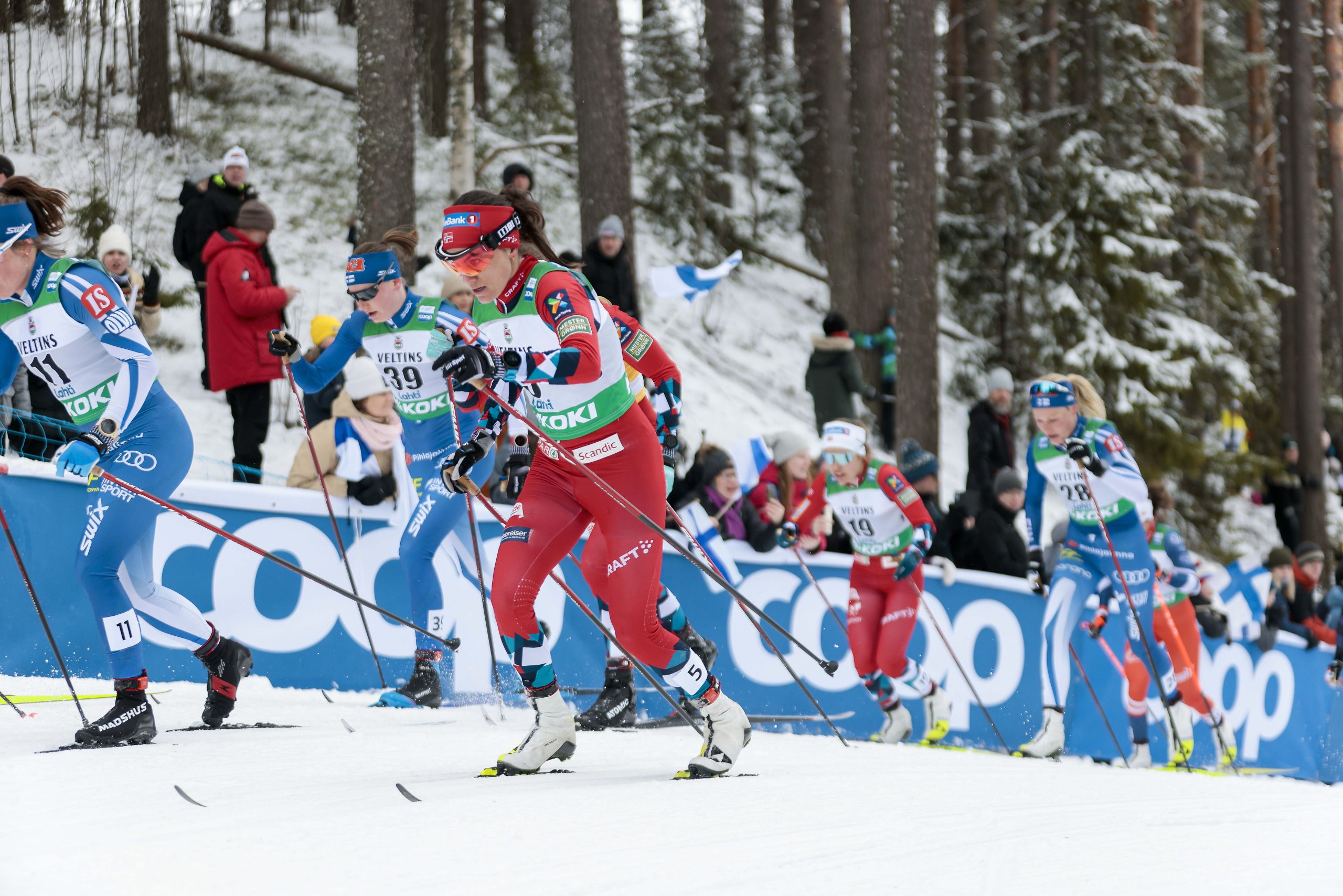
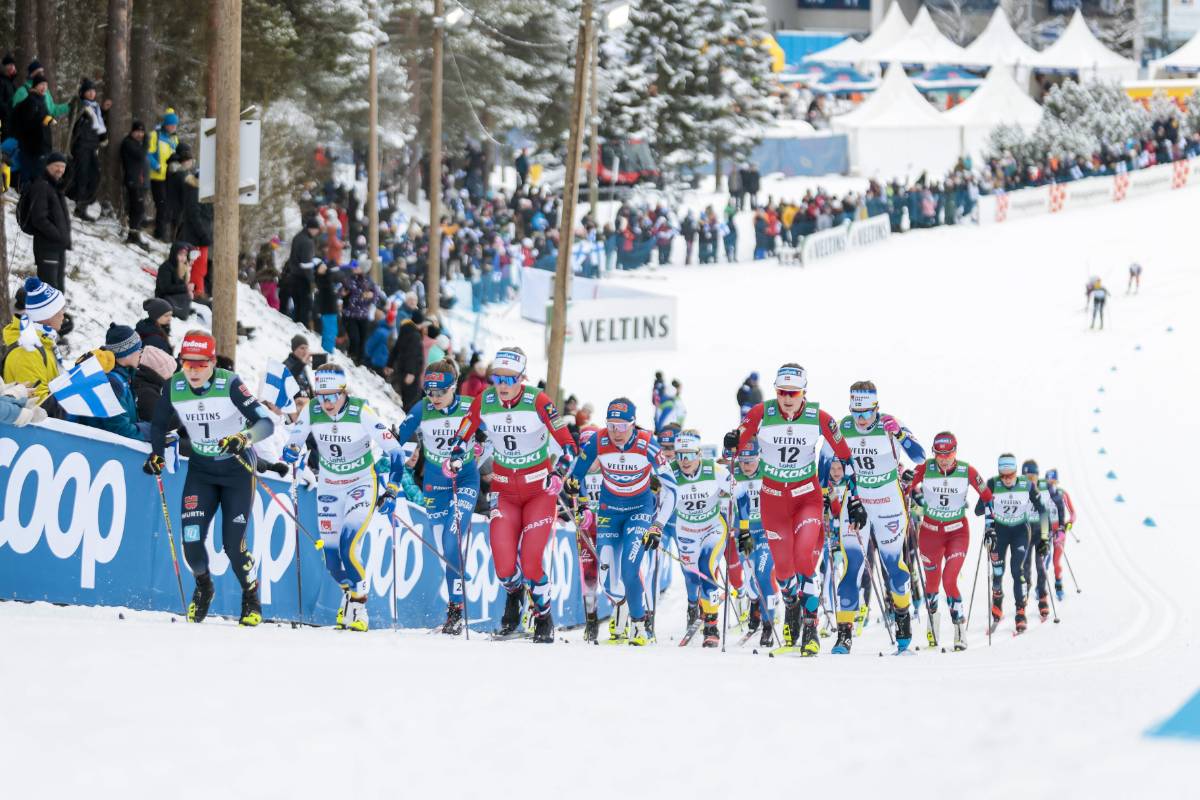
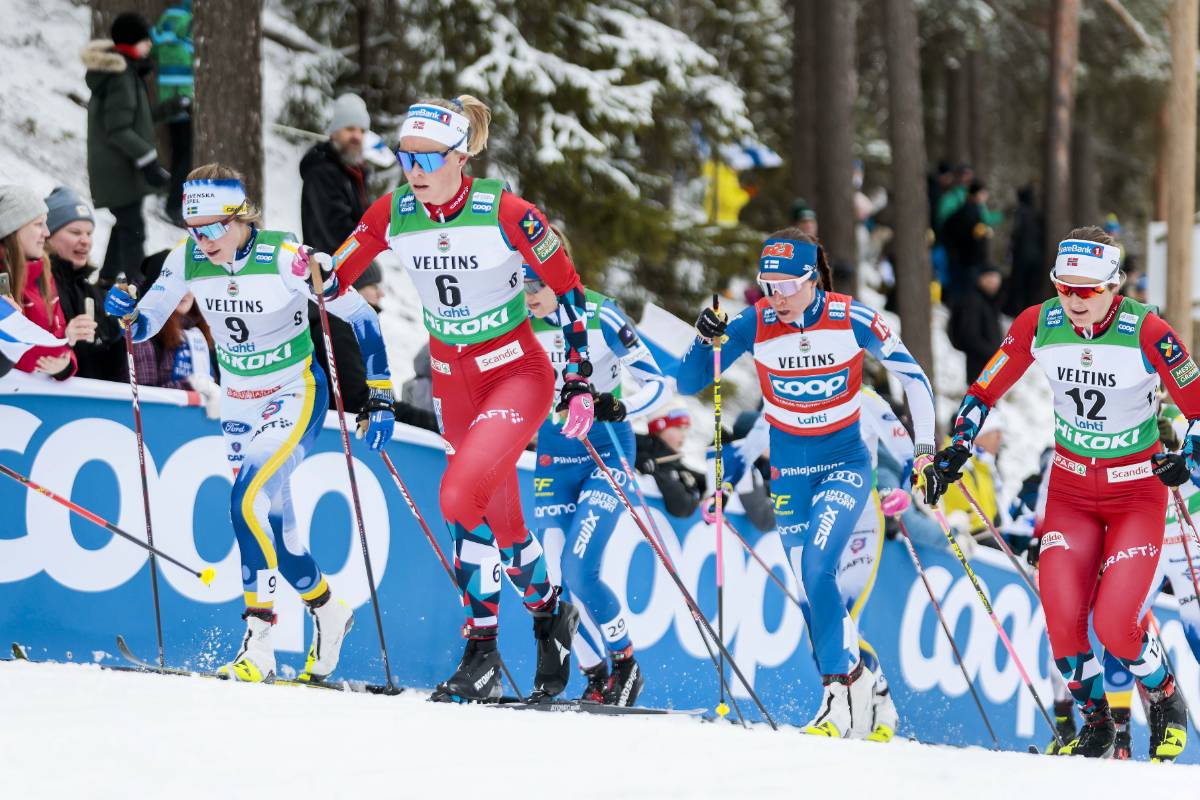
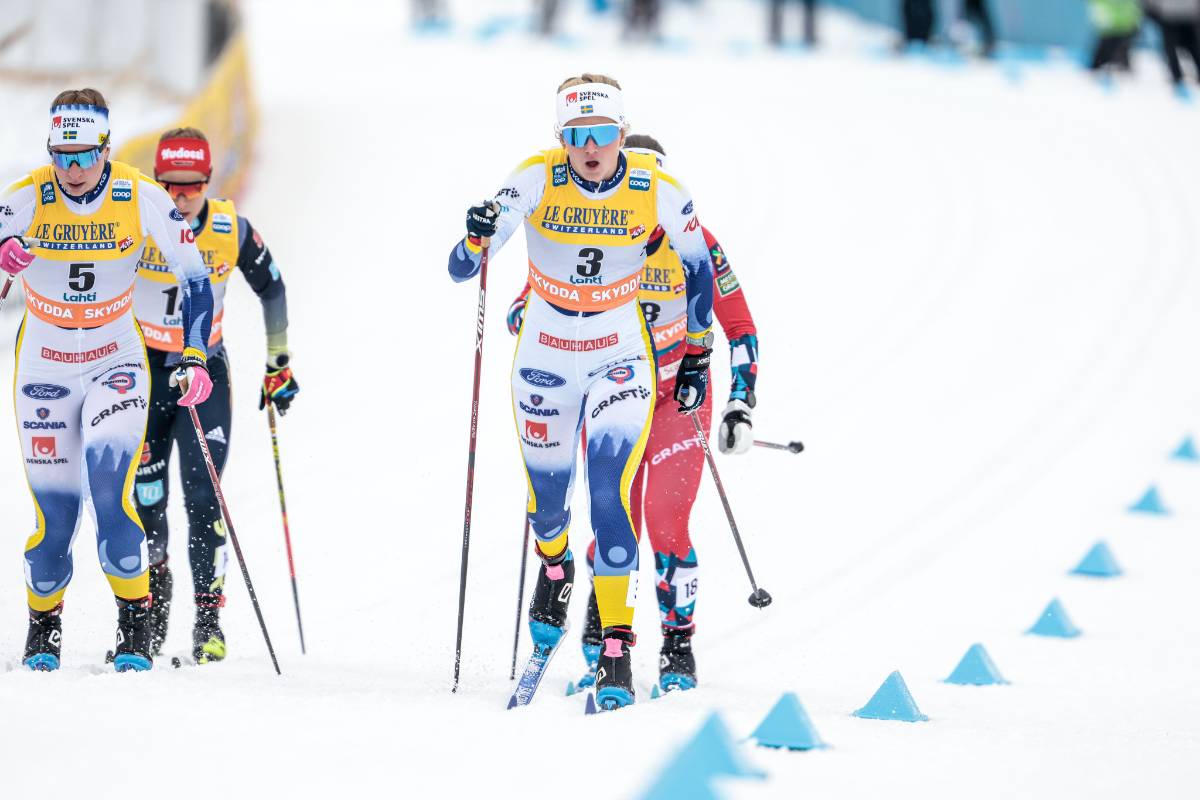
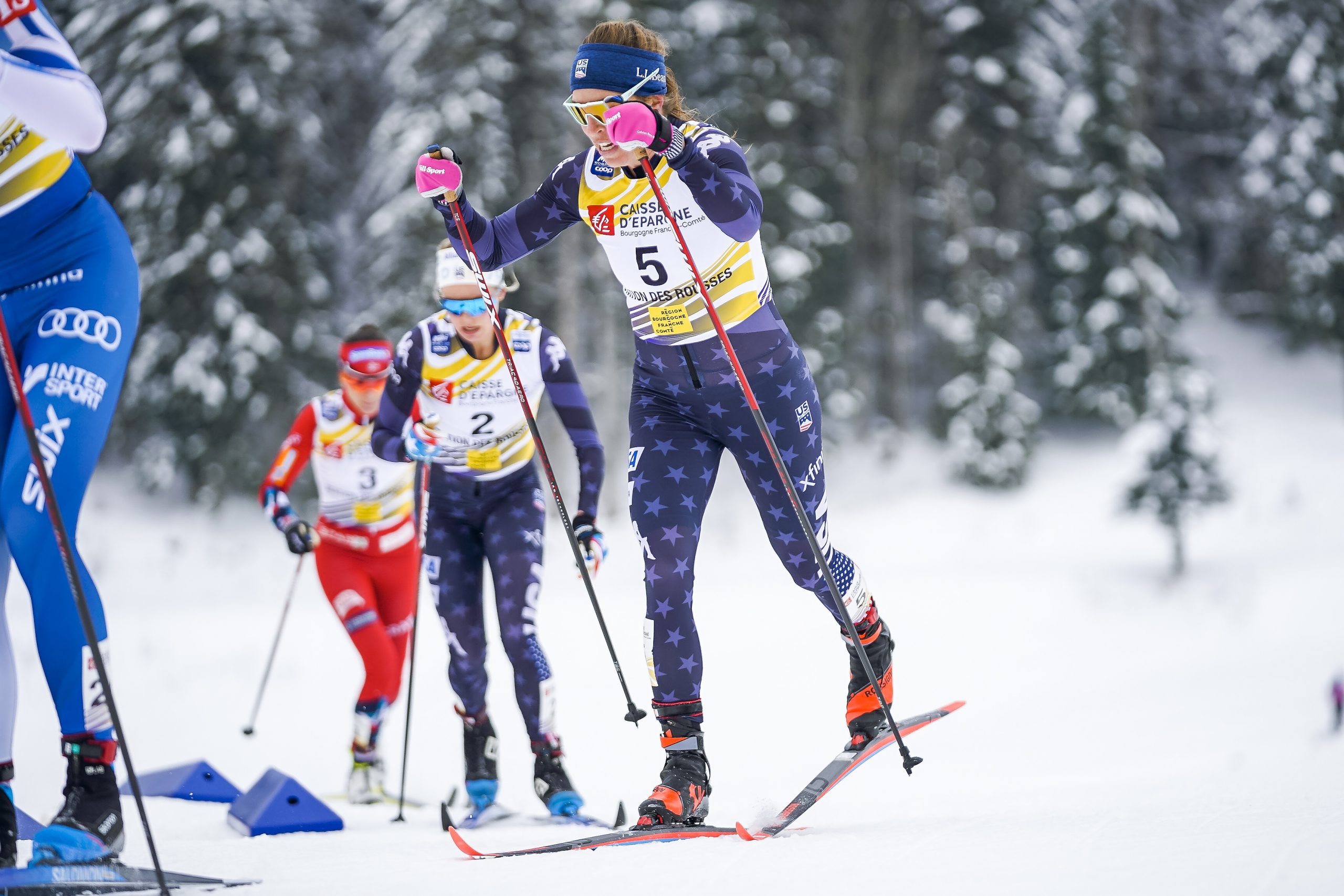
    Rosie Brennan ( Number 4, USA), in the lead pack in Lahti, Finland, will again be part of the core of the U.S. women’s squad. (Photo: NordicFocus)

    The women’s development team will see the return of multi-sport star Sammy Smith, who will be joined by Ava Thurston, and Haley Brewster

    Men’s Squad

    The men’s A team will consist of Ben Ogden, last years winner of the green bib for the best under 23 year older skier, who will be joined by JC Schoonmaker.

    Ben Ogden (USA) celebrates his green bib victory on last year’s World Cup tour and will return on the A team this coming winter. (Photo: NordicFocus)

    The men’s B Team will be comprised of Gus Schumacher, Luke Jager, Scott Patterson, Zak Ketterson, Zanden McMullen, and John Hagenbuch.


    JC Schoonmaker (USA) in the Planica, Slovenia individual sprint. (Photo: NordicFocus)

    The men’s development team will be comprised of Walker Hall, Will Koch, and Michael Earnhart. They will be joined by new development team athletes Brian Bushey, Max Kluck, and Derek Richardson.


  • A Finnish finish: Tying a bow on the 2023 season in Lahti

    A Finnish finish: Tying a bow on the 2023 season in Lahti

    This is the end. Of the 2023 racing season. Devon and Nat go without guests and are here to take you through the last three events of the winter in Lahti, Finland. And we cover a couple of retirement announcements from U.S. skiers.

    We’re taking a little break after this but, we promise: We won’t leave you hanging for the whole off-season. Stay tuned for more regular episodes over the course of the spring and summer, and we’ll be back in a few weeks for a 2023 season recap. Tell us your favorite memories from this year — get at us at devon@fasterskier.com and nat@fasterskier.com.

  • Kalvaa Gets First World Cup Win, Diggins and Brennan Top Five in Overall World Cup

    Kalvaa Gets First World Cup Win, Diggins and Brennan Top Five in Overall World Cup

    This World Cup coverage is made possible through the generous support of Marty and Kathy Hall and A Hall Mark of Excellence Award. To learn more about A Hall Mark of Excellence Award, or to learn how you can support FasterSkier’s coverage, please contact info@fasterskier.com

    Today marked the end: at the completion of today’s women’s 20 kilometer Classic mass start in Lahti, Finland, all unanswered questions would be resolved. There would not be any waiting until next week, any re-group and re-deploy, any revised strategies. It was now, or never for the 2022-2023 season. Hanging in the balance would be the standings in the overall World Cup Crystal Globe chase, and the Distance Crystal Globe.

    Jessie Diggins (USA) ended the day where she began in the hunt for the distance Crystal Globe, finishing second. (Photo: NordicFocus)

    First place for the overall Crystal Globe was pre-determined. Tiril Udnes Weng (NOR) led Jessie Diggins (USA) by 154 points. With a maximum of 130 points going to the winner (assuming the winner takes all of the bonus points), Weng’s lead was mathematically unbeatable. However, overall standings placements were still up for grabs. Diggins led classic skiing standout Kerttu Niskanen (FIN) by 99 points, a sizeable but not insurmountable cushion given Niskanen’s classic abilities. Rosie Brennan (USA) sat in fourth place with a 108 point lead over Nadine Faehndrich (SUI).  If Diggins and Brennan could hold their positions, it would put two Americans in the top five of the overall standings, potentially an historic finish for American skiing.

    Rosie Brenan (USA-bib number 4) was able to maintain her fourth place standing in the overall World Cup position, but dropped to sixth in the distance competition. (Photo: NordicFocus)

    Also at stake was the much closer chase for the distance Crystal Globe. Niskanen led with a 22 point advantage over Diggins, who would definitely be considered the underdog in a head to head classic skiing battle. But today’s race used the mass start format which would give Diggins help in staying with the field. Niskanen has never won an individual race on home soil; at 34 years of age, time is running out. Brennan was in fourth place for this Crystal Globe as well, a mere four points ahead of perennial favorite Heidi Weng (NOR), and only 26 points ahead of Anne Kjersti Kalvaa (NOR). The possibilities were almost too numerous to calculate.

    Kerttu Niskanen (FIN-center), was again thwarted in her attempt to win a World Cup race on home soil. (Photo: NordicFocus)

    At the end of the road of World Cup racing for the season, Anne Kjersti Kalvaa took home the win for Norway. Jonna Sundling (SWE) was second, and Katharina Hennig finished third.

    For the Americans, Jessie Diggins finished 22nd, 1:15 seconds out of the lead. Rosie Brennan was right behind her in 23rd. Other American finishers were Novie McCabe 25th, Hailey Swirbul 26th, Julia Kern 38th, and 17 year old Sammy Smith 48th.
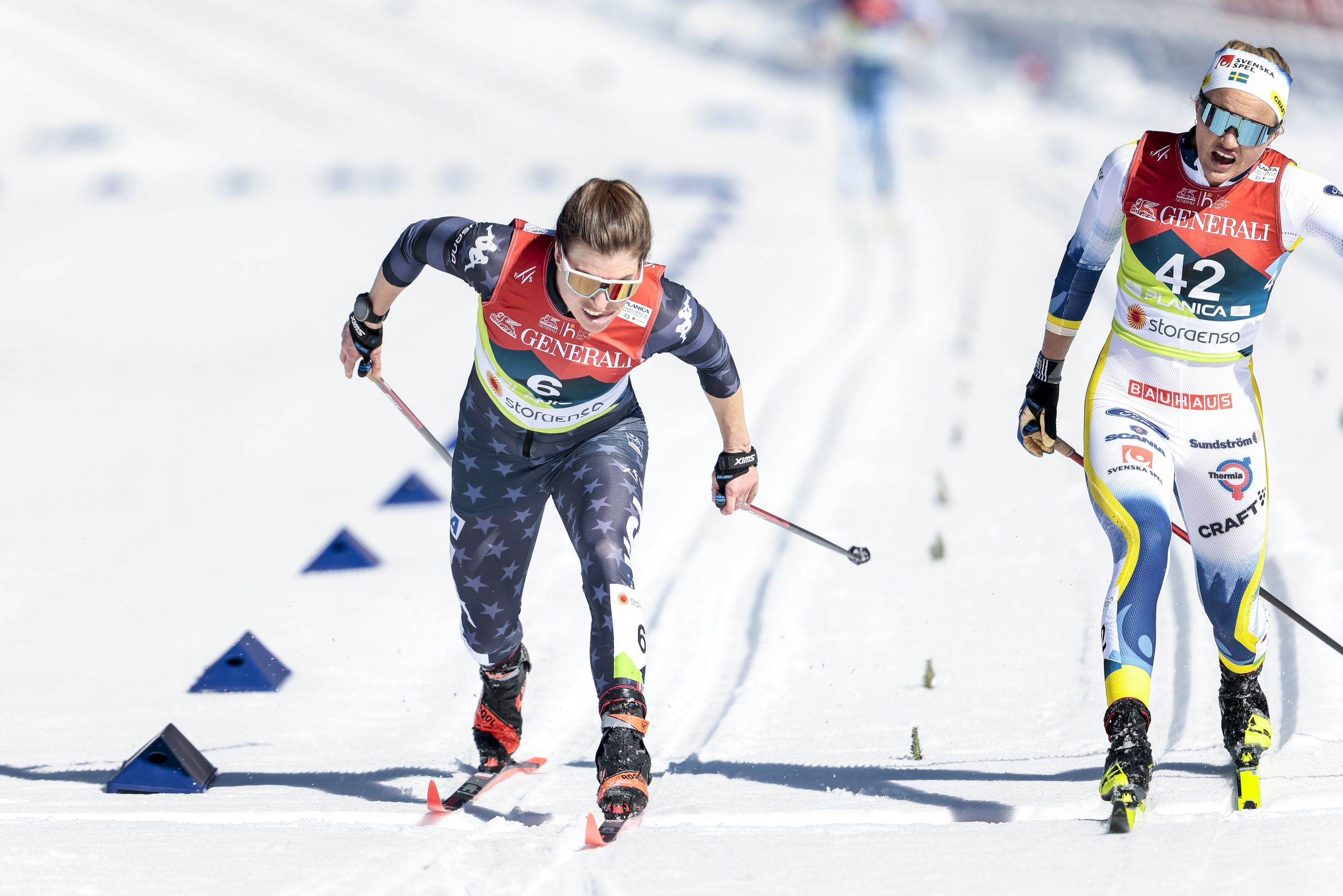
    For the Canadians, Katherine Stewart-Jones was the only finisher taking 37th.  Liliane Gagnon did not finish.
    Kerttu Niskanen (FIN) celebrates capturing the distance Crystal Globe (Photo: NordicFocus)

    The overall world cup Crystal Globe positions remained largely unchanged with Diggins remaining in second and Brennan remaining fourth. It was an unprecedented finish with two Americans in the top five of the overall standings and a landmark achievement which would lift the entire team.

    The hunt for the distance Crystal Globe did not go quite as well. Diggins was able to hold onto her second place position, but lost ground to Niskanen who was the overall winner. But Brennan dropped down to sixth place eclipsed by Kalvaa and Heidi Weng. Still, a remarkably strong finish for the American squad.

    The Women’s 20 Kilometer Mass Start

    Not surprisingly, Niskanen pushed the pace early. For the first couple of kilometers, she was in a group with Kalvaa, Frida Karlsson (SWE) and T. Weng. Five kilometers into the race, there was still a large pack at the front which contained all top contenders. Diggins and Brennan were still in the lead group, but by the 7.5 kilometer mark, where the first bonus points were awarded, the balance changed. Niskanen revealed her strategy of going for the bonus points, and crossed the bonus line first, receiving 15 points and widening her lead for the distance Crystal Globe over Diggins. Heidi Weng crossed the bonus line sixth giving her five bonus points. Brennan crossed the bonus line 13th and Diggins 14th, both just missing bonus points. But the damage was done. Diggins was losing her opportunity to keep pace with Niskanen and Heidi Weng had surged past Brennan in the distance standings.

    Jessie Diggins (USA) couldn’t match Kerttu Niskanen (FIN) in the chase for the distance Crystal Globe. (Photo: NordicFocus)

    The next bonus point line came at the 12.5 kilometer mark. Diggins was still in the hunt a mere seven seconds off the lead as skiers passed the 11 kilometer mark. Brennan was now 14 seconds from the front of the race. As the skiers approached the bonus line, Niskanen again pushed to the front of a pack which contained Ebba Andersson (SWE), Katharina Hennig (GER), Krista Parmakoski (FIN), and Karlsson. Niskanen revisited her strategy from the previous bonus line and received 15 bonus points putting her lead for the Distance Globe out of reach. Heidi Weng took one point to extend her advantage over Brennan. Once again the Americans were shut out for the all important bonus points.
    Heidi Weng (NOR) went bonus point hunting to pass Rosie Brennan (USA) in the Distance Crystal Globe chase. (Photo: NordicFocus)

    While the race for the overall distance standings was being clarified by bonus points, the contest for winning the race was far from over. After 15 kilometers, a group of seven skiers dominated the front with Niskanen, Kalvaa, Andersson, Jonna Sundling (SWE), Hennig, Karlsson and Parmakoski all within seconds of each other. Diggins and Brennan had now fallen off the lead and were 30 and 38 seconds back respectively. Barring a miracle, all hope was lost for Diggins’ chances of taking the distance globe. Heidi Weng was still holding her lead over Brennan as well.

    The lead pack continued with Parmakoski and Heidi Weng struggling to keep pace, as Andersson had moved to the front trying to break up the field. Andersson had picked up a yellow card earlier in the race and would have to be careful not to be disqualified with another violation.

    Jonna Sundling (SWE-bib 26), was able to stay with the pack and use her sprint skills to finish second (Photo: NordicFocus)

    As the finish approached, the pack was still together with Andersson going to the front trying to take away the advantage Sundling would have in a sprint finish and setting up a dazzling drag race to the finish line. But, it was Kalvaa who was able to find the speed at the end with clearly faster skis than the field, surging to the front to hold off Sundling’s late charge and win by less than a second. Hennig finished just behind Sundling in a three way photo finish with Andersson coming in fourth. Niskanen ended up fifth and would have to wait in her pursuit to win at home.

    For Kalvaa it was her first world cup win. After the race she commented about how fast her skis were and admitted that the fatigue of the season had taken its toll.

    Jessie Diggins (USA-left) celebrates her second place finish in the distance world cup competition with the winner, Kerttu Niskanen (FIN). (Photo: NordicFocus)

    It was a tricky day for waxing; clearly the Norwegians had hit the mark. U.S. coach Chris Grover commented on the difficulties of finding the right kick wax. “Some of the athletes today had decent skis,” he said. “Some were too slick, some were slow, it was kind of all over the map. It glazed [the tracks] as the race went on and you had to be kind of lucky.” Team USA knew that the deck was stacked against Diggins’ chances of claiming the distance championship. Grover said that “[Niskanen’s] won the last few Classic races…Jessie and Jason [Cork] approached the day that it would be a very tall order to overtake Kerttu, and unfortunately, Jessies’ skis just weren’t fast enough. We knew it would be a bit of a long shot.”

    Anne Kjersti Kalvaa (NOR-bib 6), used her fast skis to surge past the pack at the end of the race. (Photo: NordicFocus)

    When Diggins and Brennan reached the finish they were over a minute back in 22nd and 23rd respectively. It was a valiant effort, but they just couldn’t keep pace with the leaders.

    It was an exciting way to end the season. But it was also filled with a tinge of disappointment for the Americans. Diggins had come painfully close to capturing the distance Globe, but ultimately finished second to Niskanen, which was still cause for celebration. Brennan dropped to sixth overall in the distance Globe chase.

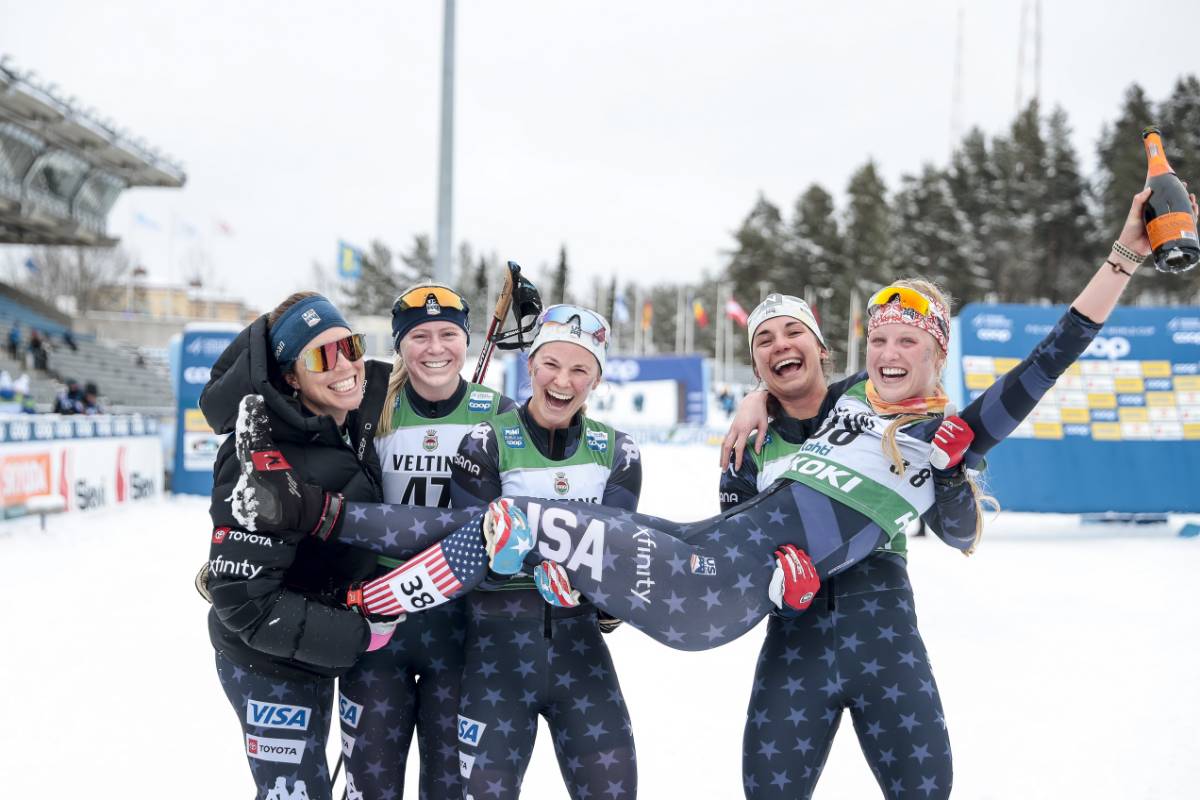
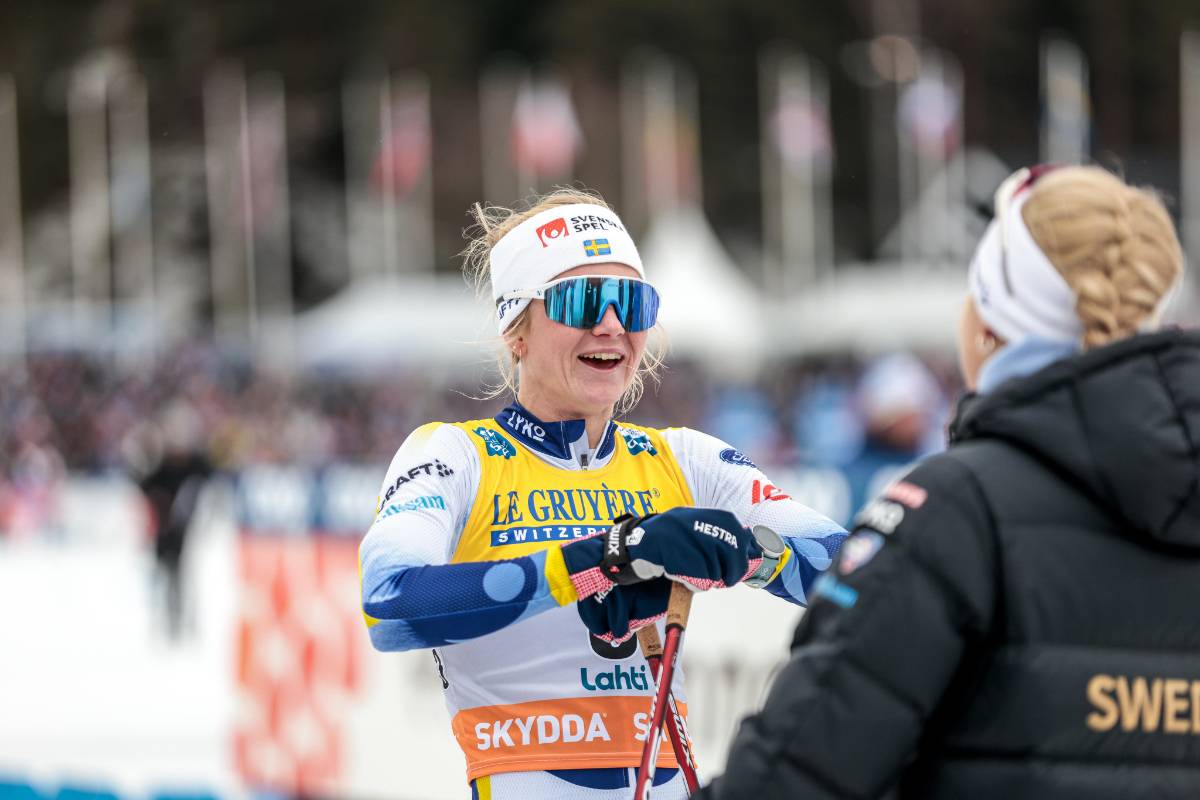
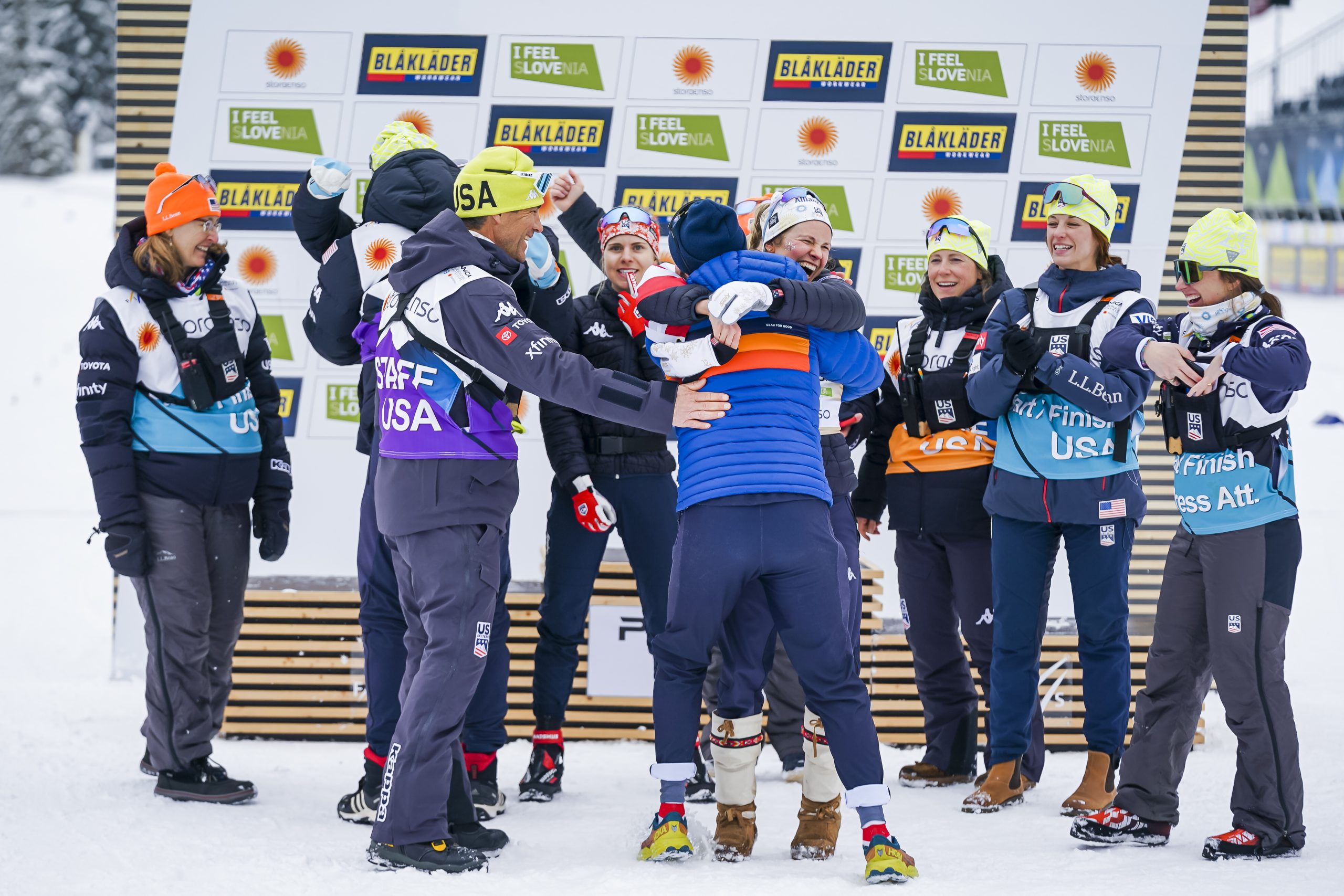
    Team USA: Rosie Brennan, Samantha Smith, Jessie Diggins, Julia Kern, Hailey Swirbul  (l-r) celebrate the end of the season and putting two racers into the top five of the World Cup standings (Photo: NordicFocus)

    Women’s 20 kilometer Mass Start RESULTS

    Women’s Overall World Cup STANDINGS

    Women’s Distance World Cup STANDINGS


  • Moa Ilar’s Sacrifice Saves a Season: Maja Dahlqvist Wins Crystal Globe

    Moa Ilar’s Sacrifice Saves a Season: Maja Dahlqvist Wins Crystal Globe

    This World Cup coverage is made possible through the generous support of Marty and Kathy Hall and A Hall Mark of Excellence Award. To learn more about A Hall Mark of Excellence Award, or to learn how you can support FasterSkier’s coverage, please contact info@fasterskier.com

    After Maja Dahlqvist (SWE) qualified third in Saturday’s classic sprint, the tension rose to a fever pitch. With ten bonus points earned, Dahlqvist had cut the Sprint Crystal Globe gap between herself and Nadine Faehndrich (SUI) in half. After five months of racing, the two sprint rivals were separated by just 12 points. The statisticians sharpened their pencils. 

    In remarks to FIS media before the decisive heats kicked off, Dahlqvist said she “had nothing to lose” in chasing Faehndrich. “Maybe,” she added, “my teammates can help me.”

    In skiing, an individual’s relationship to a greater team is often cited. On the final day of the World Cup Sprint season, though, a self-sacrificing action converted teamwork into literal World Cup points, and a Crystal Globe . . . thanks to the selfless actions of Dahlqvist’s teammate, Moa Ilar (SWE). 

    Moa Ilar (SWE) sacrificed her quarterfinal race to save her teammate Maja Dahlqvist’s (SWE) shot at securing the Sprint Crystal Globe. Dahlqvist seized the chance, winning her second Sprint title with a fourth place finish in Lahti, Finland. (Photo: NordicFocus)

    As Dahlqvist wound through the course in her quarterfinal, she was followed by her teammate, Ilar. The Lahti course offered a long-climb with a one-hundred eighty degree turn on the way up, and a one-hundred eighty degree turn on the way down. Dahlqvist had led all the way through, but the pack was tight with Ilar following the whole way. Ane Appelkvist Stenseth (NOR) had followed too, with Katharina Hennig (GER) fighting back to the front. On the final downhill, Hennig glided and glided until she was right up on Dahlqvist. Then, in an instant, she moved her ski and caught Dahlqvist’s pole. It was a clean break, and with it went Dahlqvist’s prospects for advancing. Continuing gamely—with only one pole— Dahlqvist sprinted as well as she could, but her chances of advancing faded with each single pole plant. That was until on the final stretch, when another skier vying for a bid to the semifinals noticed Dahlqvist’s plight. Moa Ilar looked over, seemed to do a quick calculation of what was at stake for Dahlqvist, and stood up to allow her teammate to finish ahead of her. Selflessness, generosity, nobility: Ilar had sacrificed her own race, and kept Dahlqvist’s season alive.

    Battle for the Crystal Globe

    Dahlqvist would have a chance. But first, Nadine Faehndrich was performing heroics of her own. In a quarterfinal where Tiril Udnes Weng (NOR) and Jessie Diggins (USA) were embroiled in their own pitched battle for the Overall World Cup, the Swiss skier hung on through every pace increase and shot through the pack in a sprint to earn a place in the semifinals.

    The long road that began in Ruka last fall ultimately led to Lahti this spring. The second semifinal featured both Dahlqvist and Faendrich, head-to-head. Dahlqvist finished the heat second ahead of Faehndrich in fourth. Dahlqvist was into the Finals, and Faehndrich was out. A quick set of calculations revealed that Dahlqvist needed to finish no worse than fifth in order to claim the season-long Sprint crown. When Dahlqvist finished the day in fourth place, she knew that her performance would bring smiles, celebrations, and a Crystal Globe.

    Maja Dahlqvist (SWE) overcame a 22 point gap to secure her second Sprint Crystal Globe on Saturday. (Photo: NordicFocus)
    Women’s Classic Sprint

    The conclusion of the World Cup Sprint chase captured the spotlight all day, but the continuing rivalry of Kristine Stavaas Skistad (NOR) and Jonna Sundling (SWE) would be played out at the finish line. In the Final, Sundling produced a burst of speed early on the course’s biggest climb. As the race wound into the stadium, though, Skistad was back in the picture, reeling in the Swedish World Champion. In the finishing straightaway, Skistad shot around the outside, unleashing a finishing double-pole that had brought her victory at the last four World Cup sprints, and did so again today. Skistad first, Sundling second, and Tiril Udnes Weng (NOR) adding to her remarkable season in third. 

    Kristine Stavaas Skistad (NOR) and Jonna Sundling (SWE) continued their streak at the top of the sprint field, with Skistad winning her fifth straight World Cup Sprint. (Photo: NordicFocus)

    In the finishing area, the Swedes all embraced each other as champions. In that final embrace, a season in which the Swedish team had demonstrated their preeminence over the World Cup sprint field found its fitting ending. The one Norwegian among them, Skistad, had secured a conclusion which added emphasis. She will put her skis on the start line of the Ruka sprint course next November having not lost a World Cup sprint in 2023. Jonna Sundling, the only other winner in a sprint this year- the World Championships no less – will be there too. After three consecutive weeks of exciting sprint duels, the duo have established a choreography that all ski fans will look forward to revisiting when the snow falls again.

    Julia Kern (USA) secured her career-best seventh place in the World Cup Sprint standings after Saturday’s race. (Photo: NordicFocus)
    USA Qualifies Three: Julia Kern Finishes Season in Top 10

    The Americans qualified three for heats today, with Jessie Diggins, Julia Kern, and Rosie Brennan all taking the starting line in different quarterfinals.

    Kern took the line in the first quarterfinal, alongside Skistad and Emma Ribom (SWE). Ribom was the heat’s main mover, pushing the pace as the field hit the steep climb. Skistad made her way back to Ribom, while Kern pushed from the back of the pack to put herself firmly in the race. The American faded slightly in the stadium, but managed to maintain her position in third place (a lucky loser spot until Laura Gimmler (GER) and Jasmi Joensuu (FIN) bested her in the next heat).

    “I knew I had more in me after the qualifier. I felt ok in my heats, nothing went wrong, nothing was really amazing, but I gave it what I had, and I’m proud of how I finished strong.” said Kern in post-race comments.

    Rosie Brennan ended up sixth in a hard–charging heat that produced the other lucky loser. While Jessie Diggins, skiing in the fifth quarterfinal alongside Weng and Faehndrich came out in fourth place.

    Diggins saw positive signs on Saturday for what might be ahead tomorrow, saying post-race that, “it’s fun to feel like I’ve had decent energy at the end of the year. When it comes down to the end of the season, what you have is what you have.”

    With the Sprint World Cup concluded, Julia Kern has officially secured her career-best position in the season-long sprint standings. Kern finished seventh, improving upon her eighth place finish in last year’s campaign.

    Jessie Diggins (USA) is all smiles headed into the World Cup season finale tomorrow. Diggins sits second place in the Distance classification, 22 points separating her from Kerttu Niskanen (FIN). (Photo: NordicFocus)
    Distance Classification Finale

    With her podium today, Weng wrapped up the World Cup Overall. The Norwegian sits 154 points ahead of Diggins who holds a firm grasp on second place Overall, 99 points ahead of third place Kertuu Niskanen (FIN). Those skiers will still be the main focal point of tomorrow’s 20 k Classic World Cup finale.

    In the Distance classification, Niskanen holds a 22 point lead over Diggins. Further down the standings, Brennan sits just 4 points ahead of Heidi Weng (NOR) for fourth place in the Distance classification, vying to make it a second time in three seasons that the American duo of Diggins and Brennan have both finished top five.

    Sunday, then, will be another race for the number-crunchers. Context for what that means in terms of excitement? Look no further than Saturday’s race. The gap that Maja Dahlqvist overcame to win the Sprint Crystal Globe; 22 points. Jessie Diggins’ deficit to Kertuu Niskanen heading into tomorrow; 22 points.

    Women’s Classic Sprint RESULTS

    Full World Cup Points STANDINGS

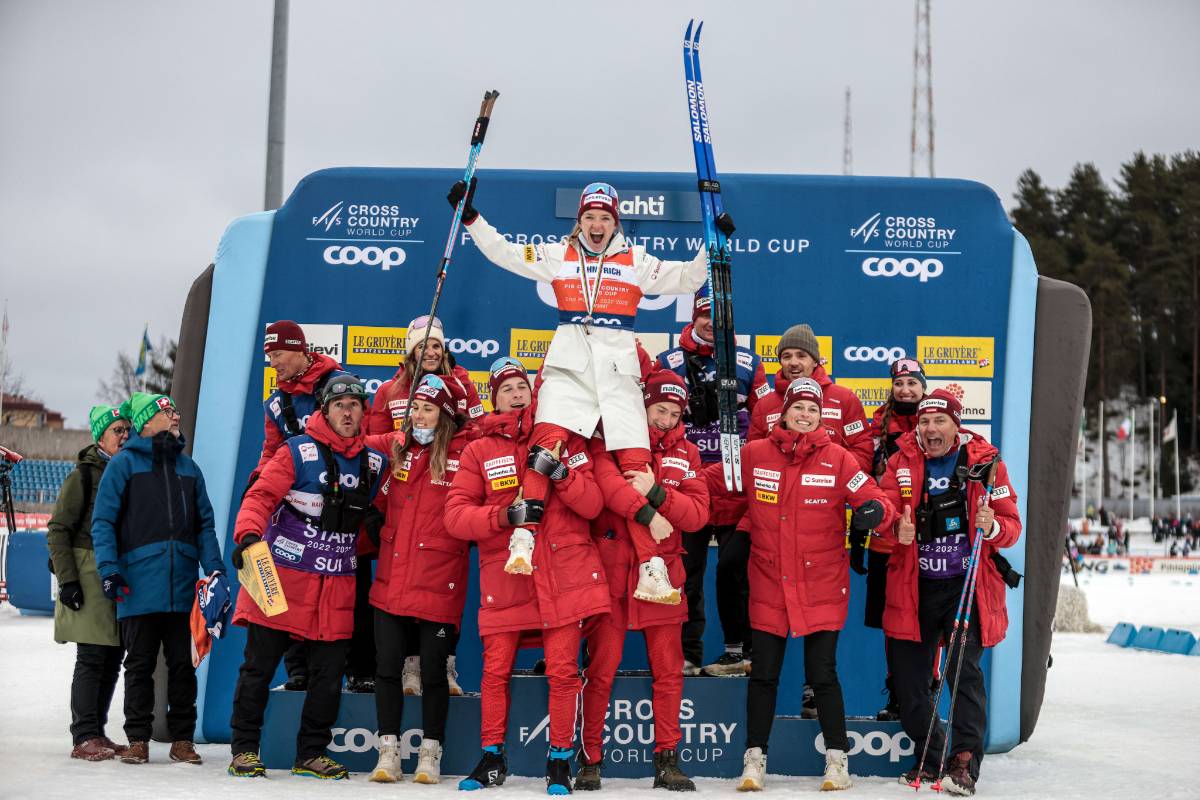
    The Swiss team didn’t let Nadine Faehndrich’s Sprint runner-up go uncelebrated after Saturday’s race in Lahti. (Photo: NordicFocus)
  • Rosie Brennan isn’t a sparkle chipmunk. But “every human” can still relate to her hard-fought career.

    Rosie Brennan isn’t a sparkle chipmunk. But “every human” can still relate to her hard-fought career.

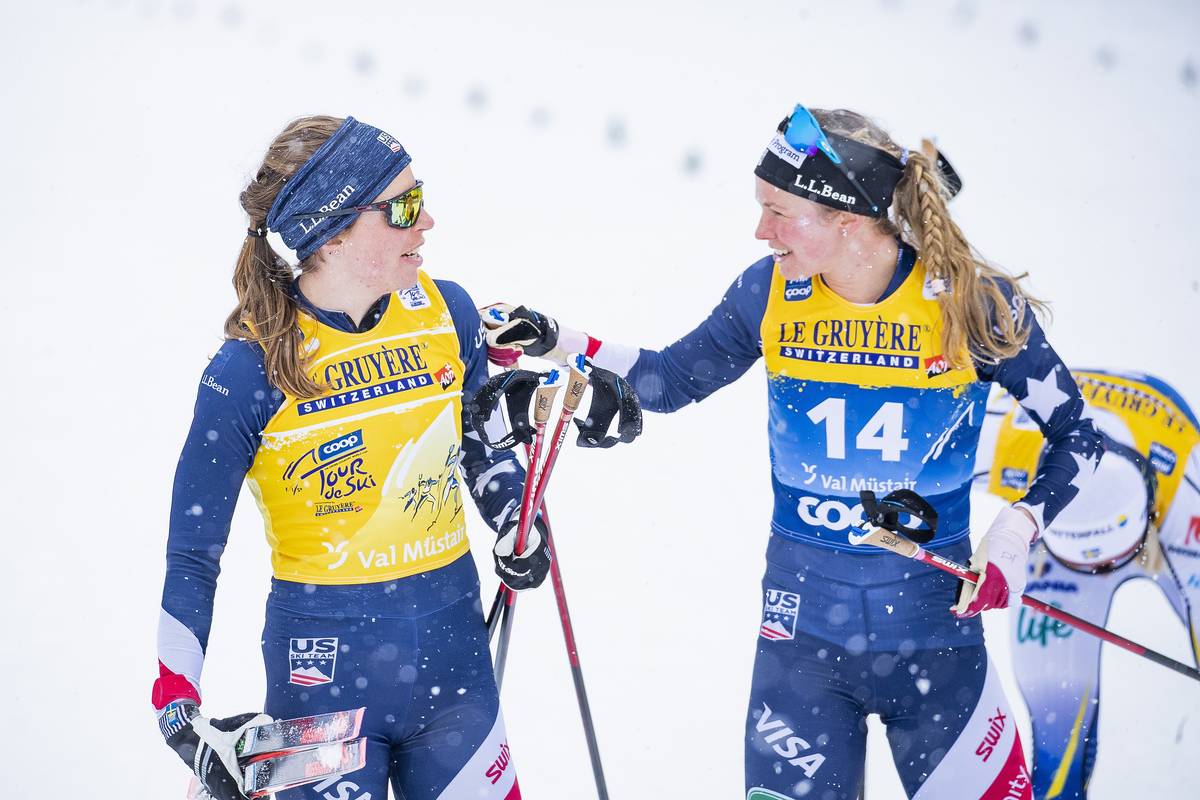
    Rosie Brennan, left, and Jessie Diggins talk after the first stage of the 2021 Tour de Ski, in Switzerland. (NordicFocus)

    PLANICA, SLOVENIA — Anyone who knows Rosie Brennan, and the ups and downs of her professional cross-country ski racing career, can relate to her mother’s experience at the World Championships here.

    Walking among the crowds in U.S.-themed clothing, Wiggy Brennan heard the same thing, over and over, from European fans: “We love Jessie Diggins!” — a reference to Rosie Brennan’s gold-medal winning teammate.

    “And I say, ‘Okay. But what about Rosie?’” Wiggy said.

    That question — what about Rosie? — has never been more relevant than in Planica, where Brennan and Diggins both skied to standout results, in ways that highlighted the profound differences between them.

    Diggins, now 31, is a superstar. She started winning medals a decade ago, and after earning two more here, she now owns nine of them from the Olympics and World Championships. Her bubbly personality and results have earned her national endorsement deals and a huge fan base, and her teammates sometimes call her the “sparkle chipmunk.”

    [Read more: Jessie Diggins won gold. Now, she and all adjacent Americans are basking in European adulation.]

    Brennan, 34, is not a sparkle chipmunk — she’s a self-described introvert. And her success was never assured: She was twice cut from the U.S. Ski Team, and her first international World Cup podium didn’t come until late in her career, just two seasons ago.

    Brennan has also come heartbreakingly close, but has never achieved, the big-time results on Diggins’ resumé. In the past 13 months, Brennan has placed fourth, fifth and sixth in individual events at the Olympics and World Championships — two seconds, five seconds and three-and-a-half seconds from the podium.

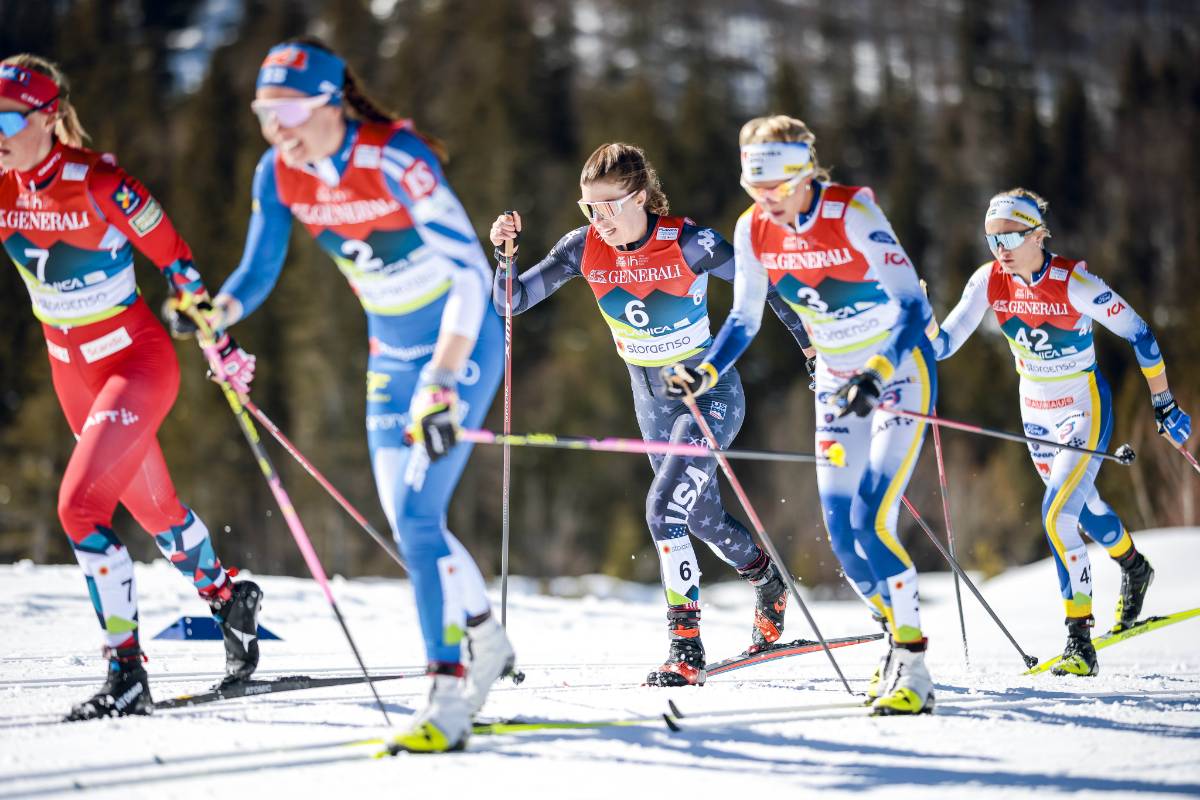
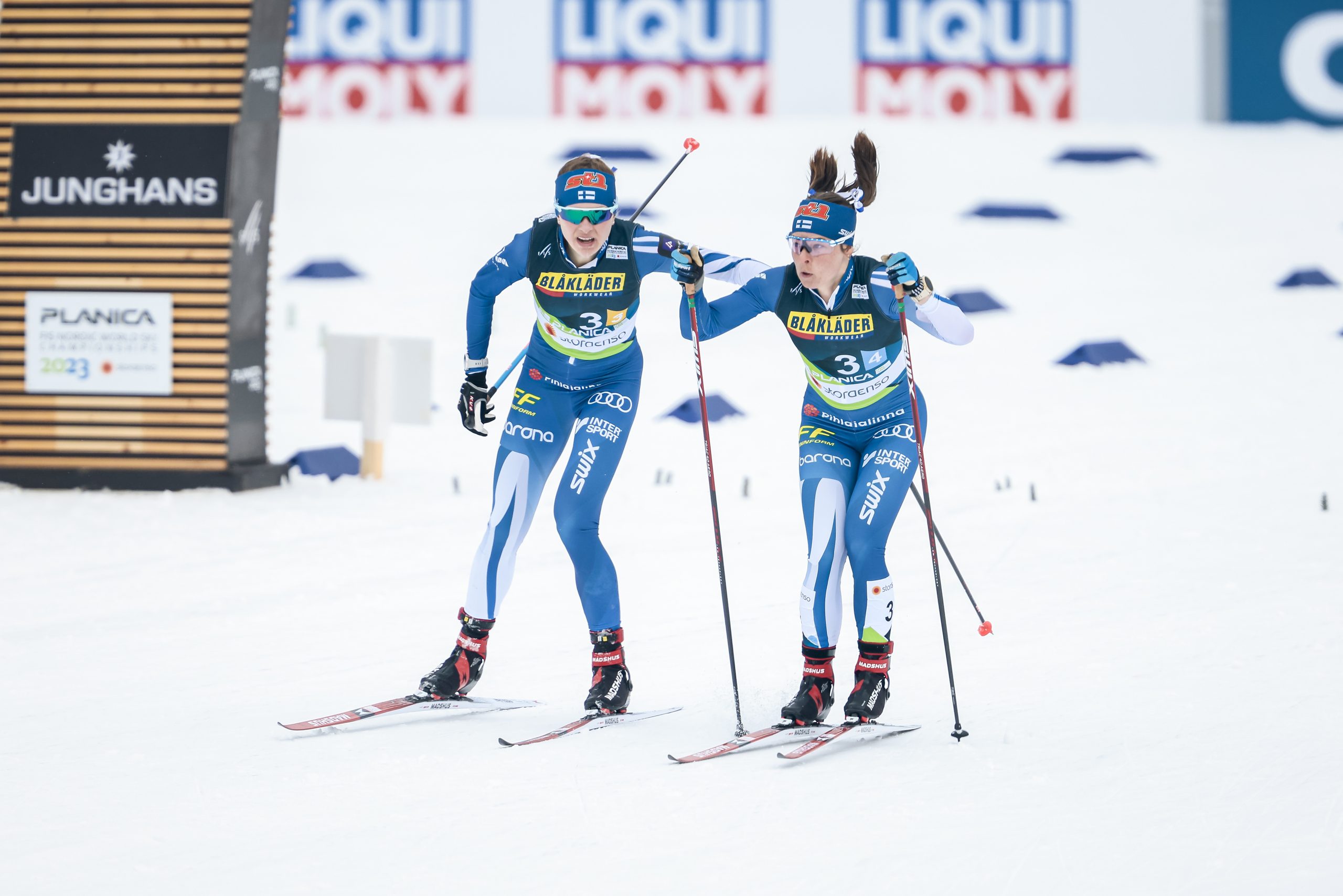
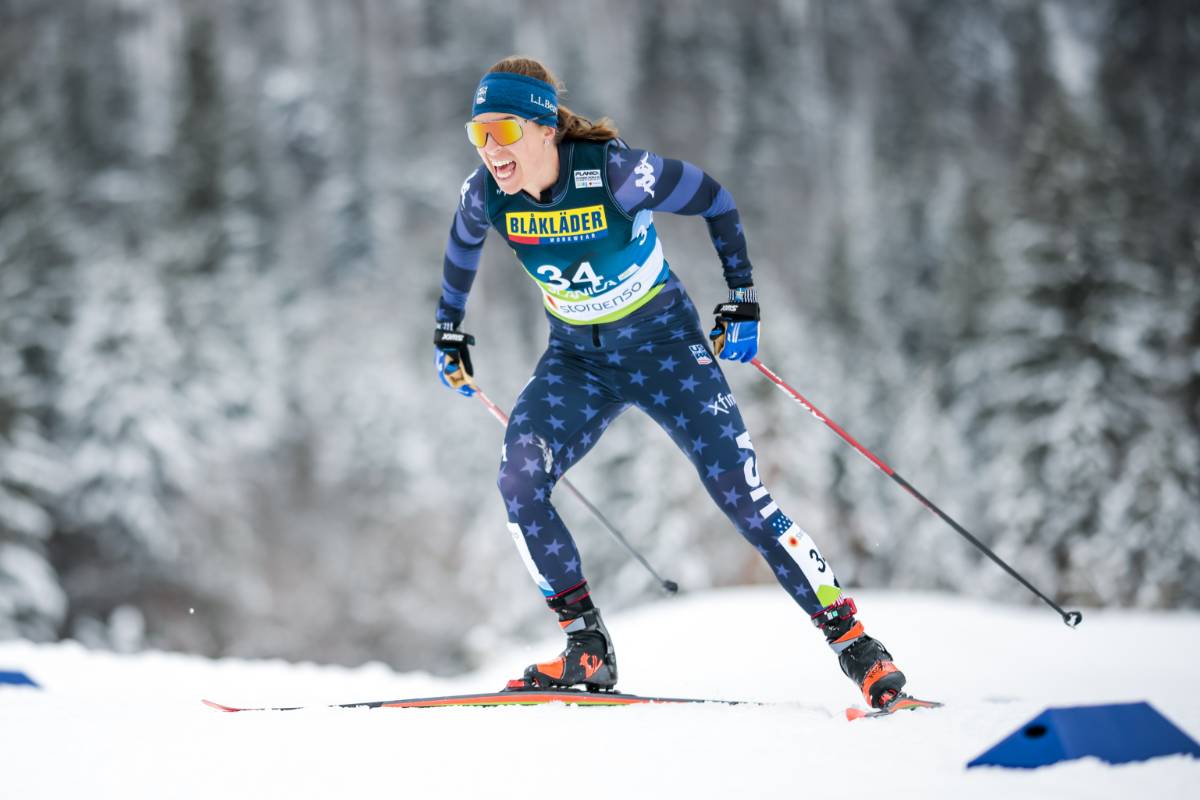
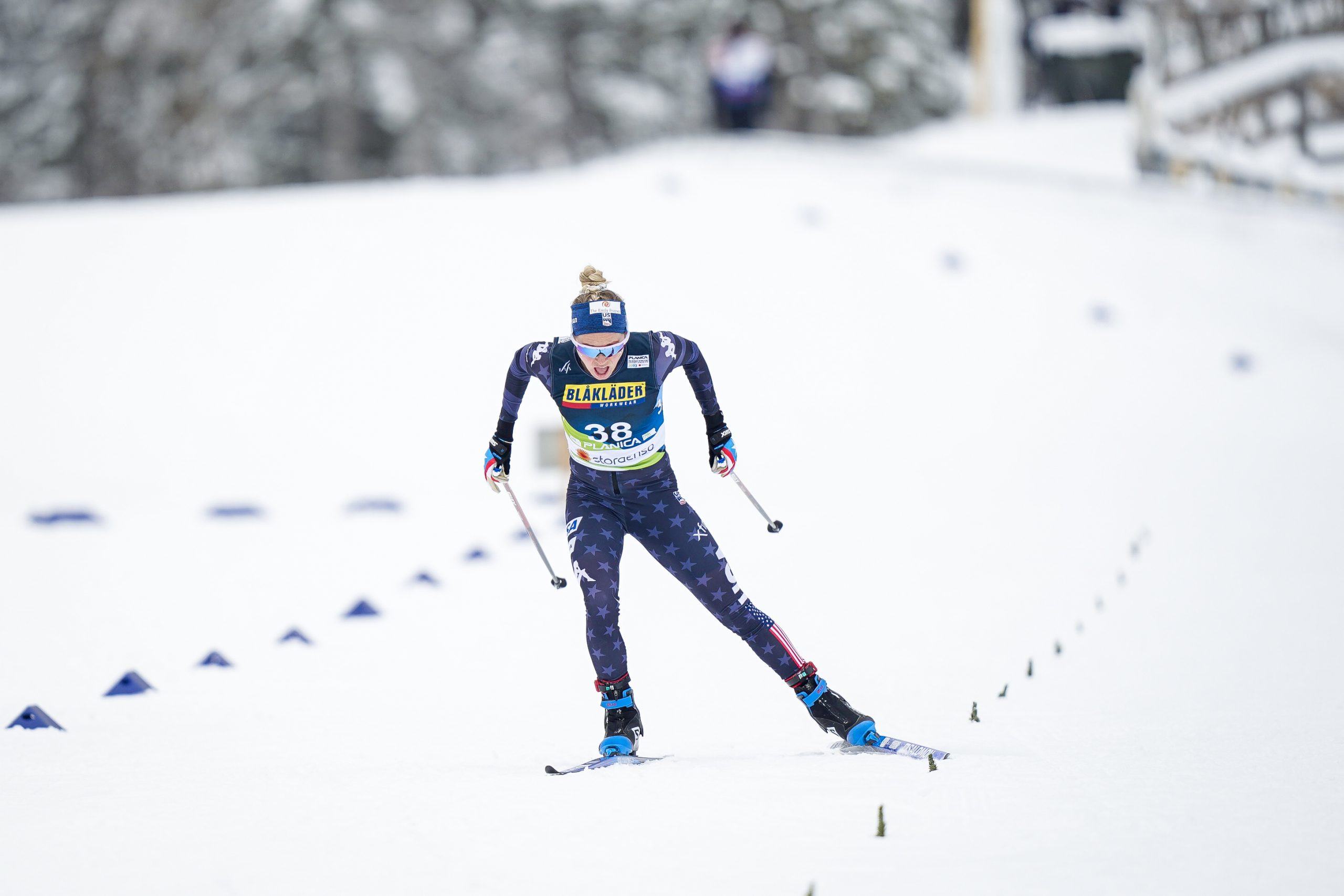
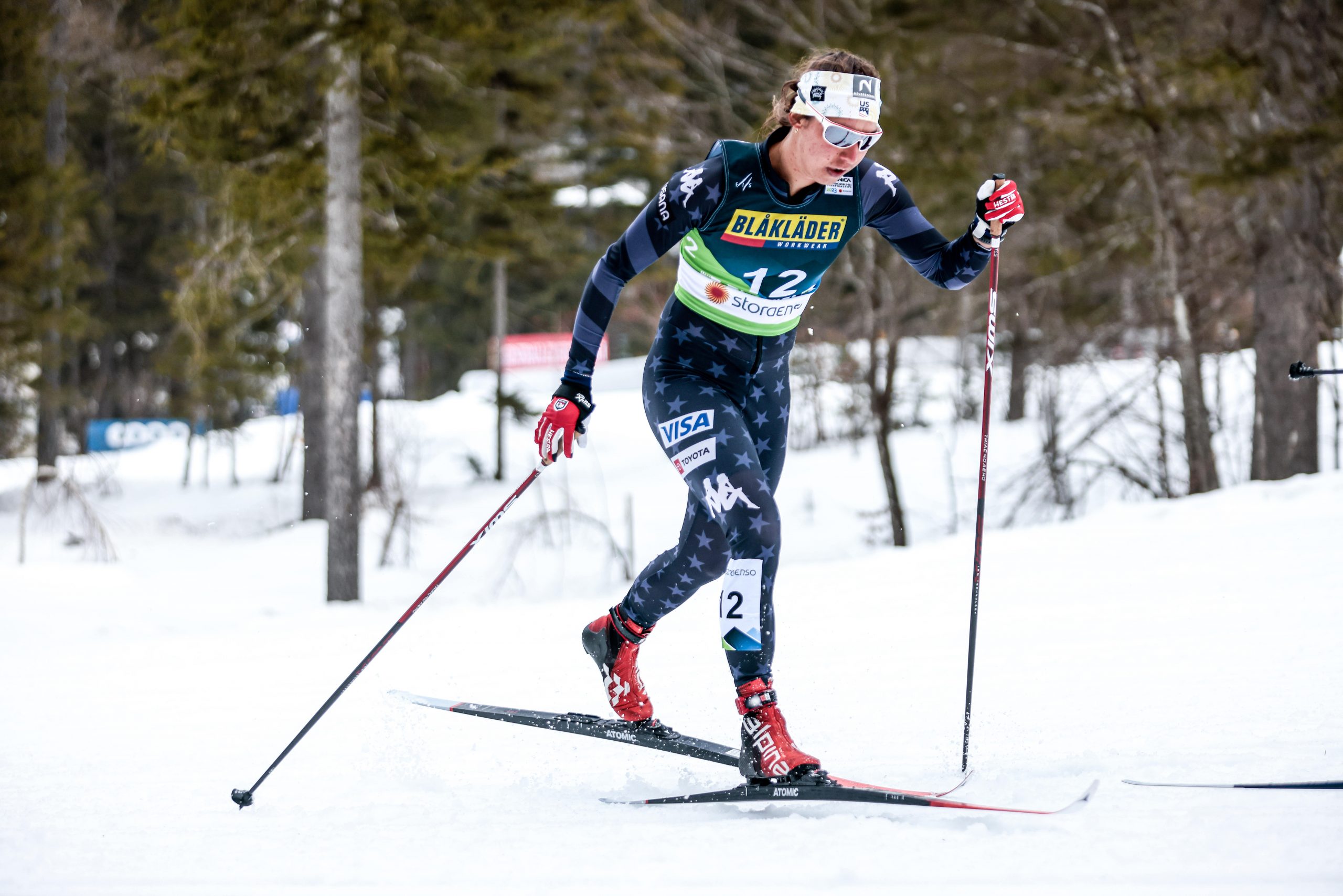
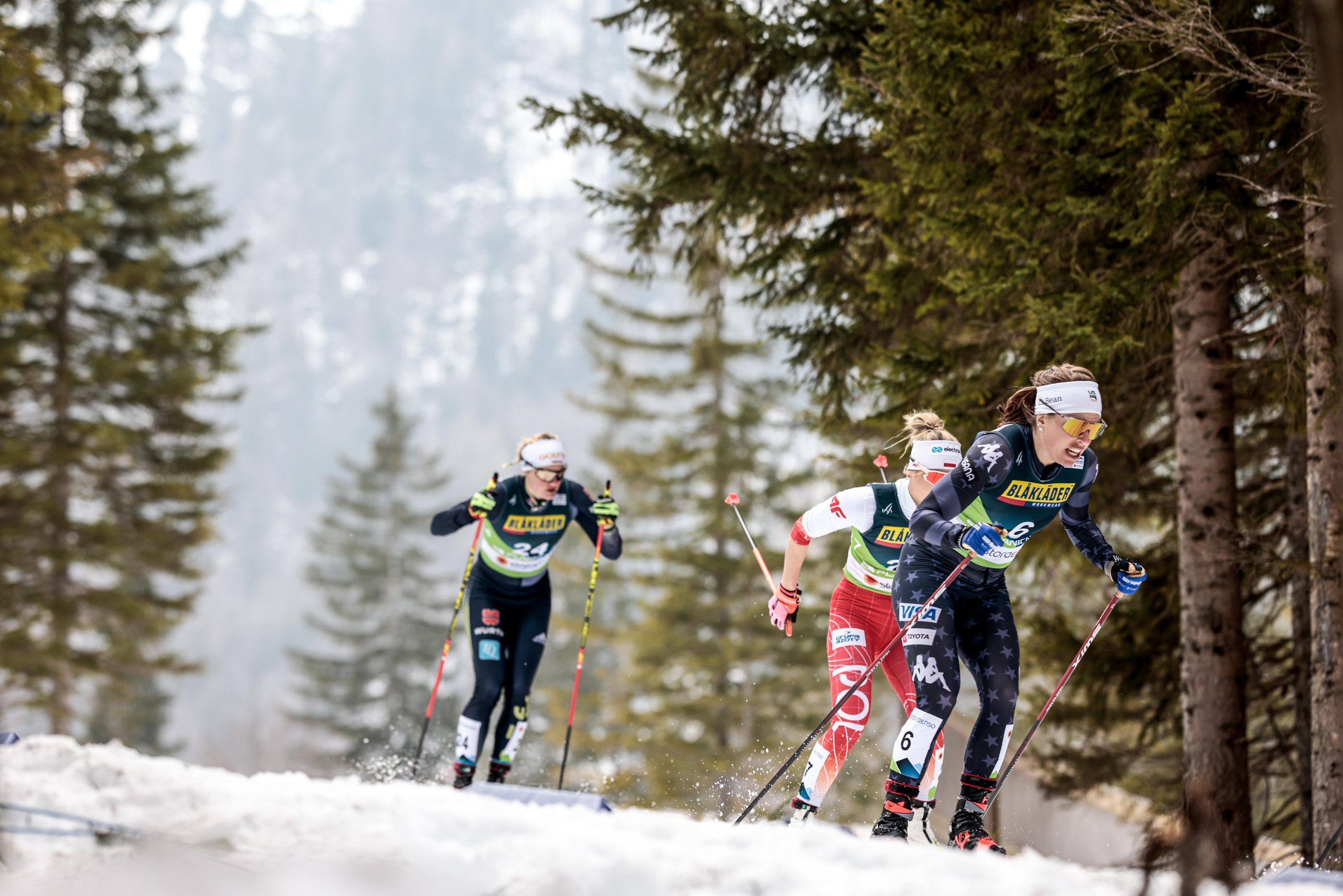
    Rosie Brennan skis in the 30 k classic event Saturday at World Championships. Brennan finished fifth; the woman in red, Norway’s Anne Kjersti Kalvaa, won the silver medal, and Frida Karlsson, to the right of Brennan, won bronze. (NordicFocus)

    In Saturday’s 30-kilometer event in Slovenia, Brennan skied nearly the entire race in a tiny chase pack that was gunning for the silver and bronze. After leading the group for a significant chunk of the race, Brennan faded on the homestretch — leaving her supporters simultaneously thrilled by her proximity to the medals and a little devastated by the result.

    Brennan’s friends and fans have nothing but praise for Diggins. But they also don’t want Brennan to go unnoticed.

    “It’s a story where I’m like, ‘Gosh, I wish this could just catch fire.’ Because every human can relate,’” said Sadie Bjornsen, a close friend and former teammate of Brennan’s. “Ninety-nine percent of the time you’re fourth. That’s just the reality of life. And the way you keep coming back from that is what is really inspiring.”

    Diggins, after winning two medals at World Championships, left Slovenia early to prepare for an upcoming race in Norway this weekend. But in an Instagram post after Saturday’s race, she called Brennan “my hero” and sent an audio message to FasterSkier in which she joined the chorus of people celebrating her.

    Diggins said she wants to make sure that people know about work Brennan does behind the scenes — mentoring young athletes, working with a program that teaches kids to ski in rural Alaska and serving as an athlete representative to the U.S. Ski Team’s parent organization. She also described Brennan’s effort in Saturday’s 30-kilometer race as “one of the most inspiring, gutsy things ever.”

    “It’s up to her to decide how she feels. And we just get to be proud of her and cheer for her,” Diggins said. “That was hero skiing out there, and I think everyone saw that.”

    Brennan, for her part, said that Diggins’ best performances lift her up, too.

    “It is inspiring to me to see her reach those levels,” she said in an interview. “And I hope that we can still learn from each other, and take little pieces that fit into how we do things, and make us both better.”

    The frequent presence of both Diggins and Brennan in the lead pack of top-level races nonetheless invites questions about whether there are tensions between them.

    The two aren’t best friends — ”I think they aren’t two peas in a pod,” said Tyler Kornfield, Brennan’s boyfriend — but coaches, teammates, and others close to them say they’ve developed a working relationship that elevates them both.

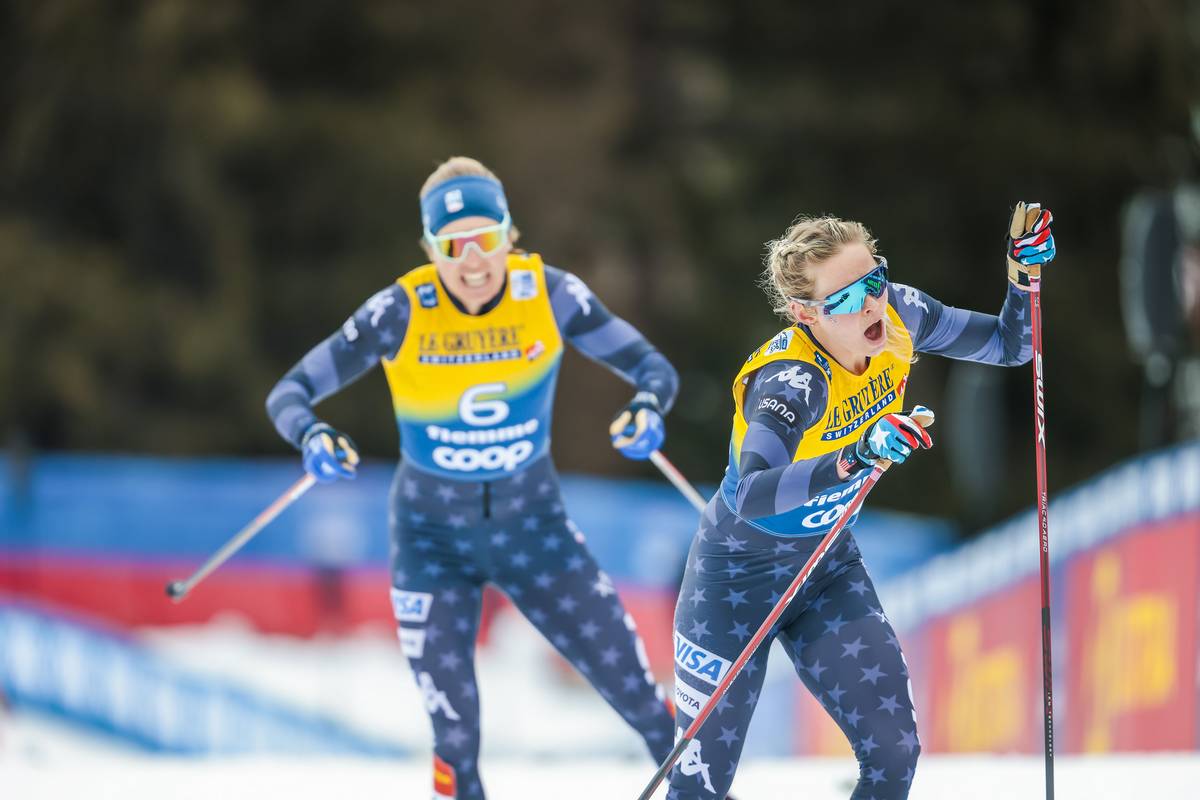
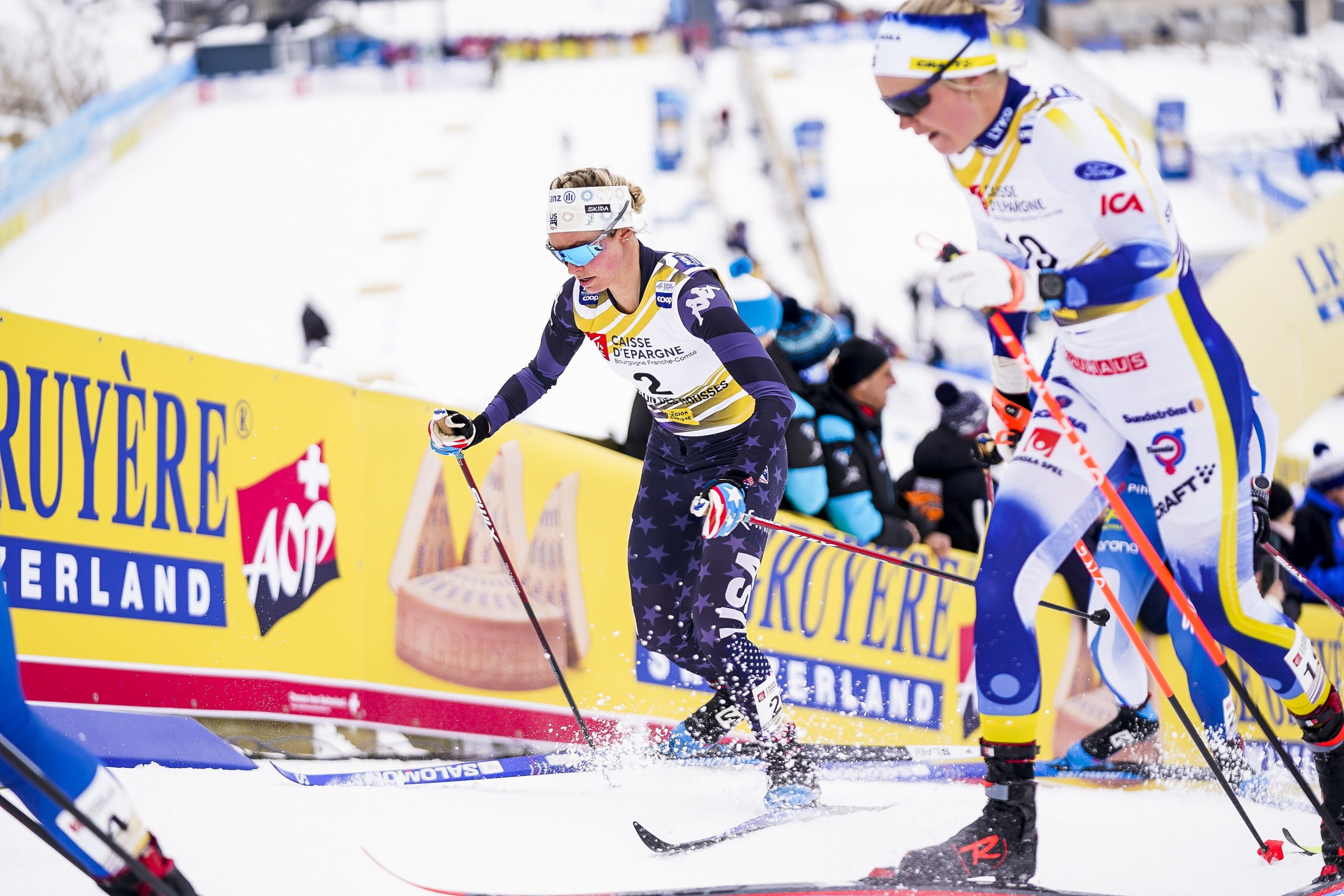
    In January, Jessie Diggins, right, and Rosie Brennan raced up the alpine ski hill that serves as the final stage of the Tour de Ski. (NordicFocus).

    “I’m sure, over the years, they’ve had their heated thoughts. But when I see them together — when I see the entire team together — it’s professional. It works really, really well,” said Kornfield, who’s also a professional skier, in a phone interview. “They come together every day to make the team stronger.”

    One example was after the team sprint at World Championships.

    American coaches chose to start Diggins and another American, Julia Kern, instead of Brennan, who paired with Diggins to place fifth in the same event at the Beijing Olympics.

    After Diggins and Kern won a bronze medal, with Brennan on the bench, Matt Whitcomb, the U.S. Ski Team’s head coach, said he watched Brennan knock on Diggins’ door and congratulate her. Diggins, meanwhile, sent Whitcomb a text aimed at Brennan and her three teammates Saturday, just after their hard-fought finishes: “So proud of you girls for an absolutely gutsy, courageous race out there.”

    “They have an immense amount of respect for each other,” Bjornsen said. “Which I think is really cool. Because they are so different — like, probably the most different you could be and successfully be teammates.”

    Asked about those differences, Brennan said she wishes she had more championship medals, like the ones in Diggins’ trophy case. But Brennan and those around her said she also benefits from having Diggins as a teammate.

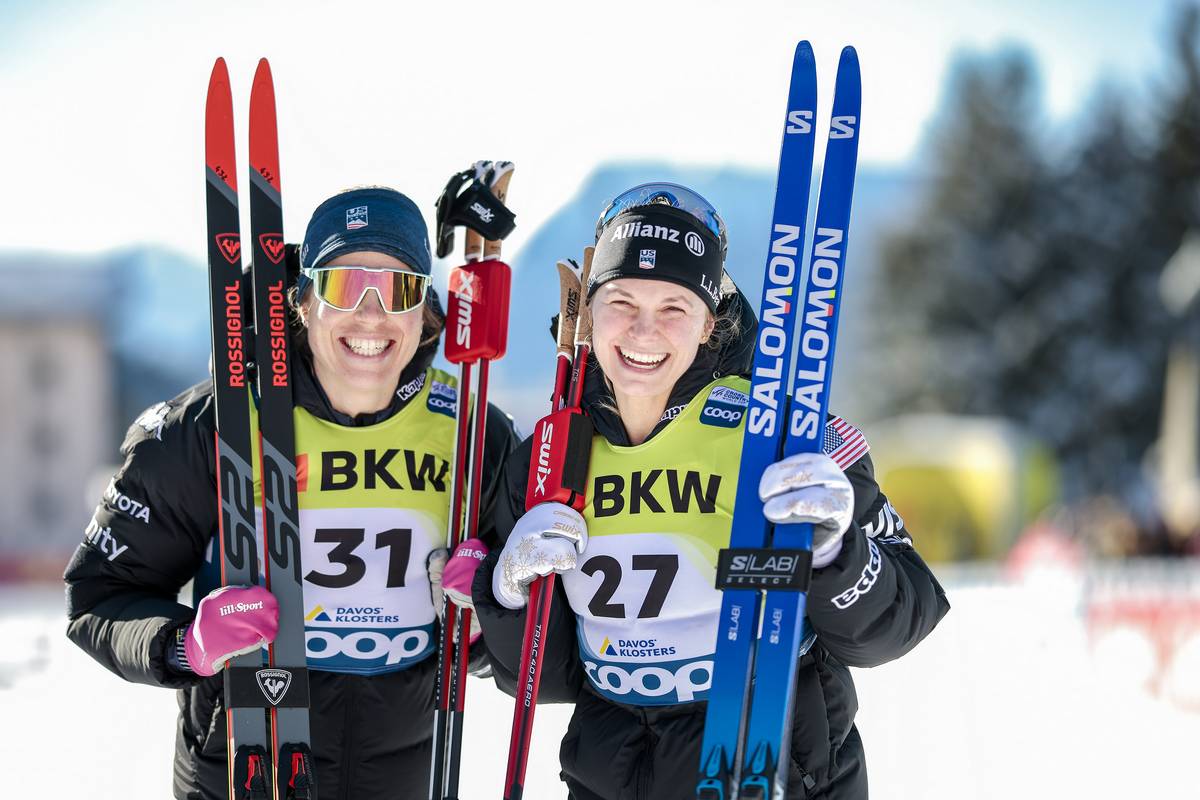
    Rosie Brennan, right, and Jessie Diggins pose for a photo after a race in Switzerland earlier this year. (Nordic Focus)

    “Maybe it’s clichéd to say Jessie is Rosie’s biggest motivator,” Kornfield said. “But anxiety is a powerful tool, and when one of your teammates is working incredibly hard across the country, and you know about it and hear about it every single day, it’s going to make you double down and focus more.”

    Brennan said she hopes the successes that she and Diggins have each achieved, coming from two different backgrounds, makes them models for younger athletes.

    “They can take little bits and pieces of both of us and find themselves,” Brennan said. “We are such opposites, and we’re both still making it work. And I hope, anyway, that that provides two solid examples for all the younger girls on the team of just being different and still having success — even if Jessie’s success is, like, through the moon.”

    Brennan’s teammates confirmed that they look up to her, as well as to Diggins. Julia Kern, 25, said Brennan’s success late in her career was on her mind in the middle of Saturday’s 30-kilometer race — a 90-minute effort in which Kern finished 27th.

    “I was literally thinking about that when I was charging up the hills, and I saw her charging at the front,” Kern said. “I was like, ‘This is training for maybe, hopefully, skiing like Rosie one day.’”

    Julia Kern races in Italy earlier this year. (NordicFocus)

    Bjornsen, Brennan’s friend and old teammate, said she and other ex-racers she knows were crying as they watched Saturday’s race.

    Those near-podium finishes, Bjornsen said, highlight how Brennan is still trying after so many so-closes.

    “It’s such a theme of Rosie’s story: Knock me down, I’ll bend. But I don’t break,” Bjornsen said.

    The value of patience and persistence in cross-country skiing was one of the big take-home messages from the World Championships in Slovenia.

    Beyond Brennan’s performances, there was Norwegian skier Pål Golberg, who endured some excruciating failures and highs and lows over his career before a resurgence this year.

    Goldberg first raced at a World Championships in 2013. But he didn’t win an individual medal until he got two in Slovenia this year — including a stunning gold in Sunday’s 50-kilometer marathon.

    Pål Golberg celebrates Saturday after winning his first-ever gold medal in an individual World Championships race. (NordicFocus)

    “In these endurance sports, often, you need to go through some years. You need to have the patience and the stamina to just push on. And that’s hard,” Eirik Myhr Nossum, one of the Norwegian coaches in Slovenia, said in an interview. “To do this year after year, to have the financial means, to have the motivation to do the work, to travel — of course, that’s hard. And for most, it doesn’t pay off.”

    Brennan’s supporters want to see her keep racing and think she still has room to grow. Whitcomb, the U.S. coach, said he told her immediately after Saturday’s race that he wants to see her at the next world championships, in Norway in 2025, and at the 2026 Olympics.

    “We want that medal for her so badly. Just, validation,” he said.

    Brennan’s coach back in Alaska, Erik Flora, said that her skiing is still changing every year — like her technique and her skills on downhills.

    “Can there be more technical development? I think yes,” Flora said. “Physically, can there be changes? I think so, too.”

    Brennan has changed her training and racing framework in the past few seasons to make the months she spends in Europe each year more sustainable and stable.

    She’s developed a good relationship with her wax technician, Bjørn Heimdal, and is working more closely with her ski sponsor, Rossignol. And Kornfield lived in Europe this winter, racing ski marathons out of a home base in Italy, instead of back in the U.S.

    “The same time zone is huge,” Kornfield said. “It helps a lot.”

    Flora, Brennan’s coach, is still 10 time zones away in Alaska, however. Asked after Saturday’s race if she would be back at the next world championships, Brennan didn’t have an answer.

    “I have no idea. It’s been too much to think about during the season,” she said. “I’m going to take some time in the spring and think about it.”

    But Brennan also acknowledged that coming so close to the podium gives her a little extra motivation to stick around. “God,” she said. “I definitely want a medal.”

  • “A Mix of Everything.” Rosie Brennan Reflects on Hard-Fought Battle for Podium, as Andersson Wins 30 k

    “A Mix of Everything.” Rosie Brennan Reflects on Hard-Fought Battle for Podium, as Andersson Wins 30 k

    This World Cup coverage is made possible through the generous support of Marty and Kathy Hall and A Hall Mark of Excellence Award. To learn more about A Hall Mark of Excellence Award, or to learn how you can support FasterSkier’s coverage, please contact info@fasterskier.com

    On the final day of a World Championships defined by new highs in terms of results for the United States, Rosie Brennan (USA) delivered a performance that reiterated that—for Brennan and her teammates—it has been all the qualities that a results sheet can never capture which have powered the US Ski Team to the milestones of the past two weeks. After heartbreak in last week’s skiathlon, Brennan set out in today’s marathon, a 30 k classic, to be the best that she was capable of becoming. Through surge-after-surge, kick-after-kick, she fought. She was in contention for a medal until the very last. In the story of the race, the fifth place result that Brennan scored was a whisper compared to the shout of the way she had gotten there. Brennan is the American skier whose career has been the definition of perseverance; today, she distilled that quality in a way that was traceable over the course of a single ski race.

    That race also produced significant finishes for other North Americans: Hailey Swirbul (USA) 18th, Julia Kern 27th (USA), Katherine Stewart Jones (CAN) 28th, Lillian Gagnon (CAN) 32nd, Dariah Beatty 32nd,

    Rosie Brennan (USA) skied to fifth place—missing the podium by a single second—in the 30 k classic in Planica. (Photo: NordicFocus)
    30 k Classic Mass Start—Andersson Reaches New Heights for Sweden

    There was plenty to anticipate before today’s marathon: for the first time in a week, sunny skis and warm temps returned to Planica; for the first time in over a decade, the winner of the women’s World Championship 30 k wouldn’t be named Therese or Marit. The retirement of both Therese Johaug (NOR) and Marit Bjoergen (NOR) left open the possibility that any skier could make marathon history today. The skier that accomplished that was Ebba Andersson (SWE), who waited with patience through the first lap, launched an uptick in pace on the long climb out of the stadium 10.75 k into the race, and strided away from the field to win her first World Championship in the 30 k, and the first World Championship for Sweden in the World Championship marathon since Marie-Helene Oestlund won the 20 k in 1987. Andersson’s win marked her third career World Championship, after she won the skiathlon earlier in Planica and was part of Sweden’s gold medal relay team in Seefeld in 2019. It also accented another strong World Championships for the Swedish women, an they began by sweeping the Sprint podium, and ended with an ascendent marathon star.

    Ebba Andersson (SWE) and Frida Karlsson (SWE) completed an all-around excellent World Championships for Sweden.  Andersson won her third World Championship in a dominant 30 k performance. Karlsson kicked late to finish third. (Photo: NordicFocus)

    Perhaps the most tense race of these World Championships, though, was the one that played out behind Andersson for the remaining podium spots. When Andersson strided away, the field stretched and then snapped. A three-strong chase group initially formed, containing Anne Kjersti Kalvaa (NOR), Kerttu Niskanen (FIN), and Brennan.

    “Even though the race looked like it happened slow, [Ebba’s] move happened fast,” said Brennan. “I did think for a while that maybe we might catch back up to her, but before you know it, [the gap] was a minute.” Kalvaa, Niskanen, and Brennan were left to wind their way through the rolling downhills that defined the last kilometer of the course.

    Those downhills marked a reprieve during what was an otherwise brutal climbing course, a 7.5 k loop that the US Ski Team Coach called, “breath-taking, but if you take a step back, one of the hardest courses they will ever race.” After climbing 272 meters (892 feet) in hot, wet, sticky klister conditions, the final downhills would prove crucial in later laps. The importance of having the best skis on the final downhills would soon be made clear.

    Races of this distance offer competitors the opportunity to switch skis mid-race, if desired: a decision that would change the nature of the race. Switching skis allowed the Swedish pair of Karlsson and Linn Svahn to bridge a gap to the first chase group, ultimately allowing them to join the fight for the podium. And, despite an initial stumble as the klister on her skis caught the track for the first time, the exchange would see Anne Kjersti Kalvaa (NOR) moving onto skis that were “insane,” according to Rosie Brennan.

    Brennan, herself, moved onto skis she felt were “not as good as my first pair, [which] was frustrating seeing how good some of those skis were. That, of course, is the gamble of switching.” Brennan noted that the relative ski speed changed her tactics. “I second-guessed my ability to just ski away,” she said. “I thought at that point, my best card to play was to hang in there for the dogfight at the end.”

    Rosie Brennan (USA) skis in the chase group that contested for silver and bronze: Anne Kjersti Kalvaa (NOR), Kerttu Niskanen (FIN), Brennan,  Frida Karlsson (SWE), and Linn Svahn (SWE). Brennan finished fifth. (Photo: NordicFocus)

    The chase group of Brennan, Karlsson, Svahn, Kalvaa, and Niskanen would contest that dogfight. The race settled through the third lap; Andersson’s gap grew in front of Brennan’s group, and the gap to the second chase group behind grew as well.

    Brennan led the group through the stadium as they headed out on the final lap, but as they completed the other rolling section of the course it became clear that the combination of skis—and twenty-three kilometers of racing—would make the last lap a tight, tactical, affair. 

    When the group crossed over from the first half of the course to the second through the Planica stadium, Frida Karlsson skied up to take a pull. Kalvaa and Brennan responded quickest, but both Niskanen and Svahn pulled their way back too as the group skied toward the final climb. Near the high-point leading to the crucial, winding downhills, Kalvaa used the advantage her skis granted her. Karlsson and Brennan sensed the move and responded quickly, marking Kalvaa’s move.

    Kalvaa carried speed through the final transitions, but Karlsson had the strongest close. On the final climb, the Swede pushed the chase group into high gear, with Svahn able to come back from the behind. For a moment, Brennan pushed back to Karlsson’s tails. Into one final hill, though, Karlsson proved to have one more energy than the rest of the field, closing in on Kalvaa in the final 100 meters. Kalvaa held off the late surge to take second place; Karlsson won the bronze. Behind, Brennan and Svahn completed an exhausting 30 k with a boot throw straight out of a sprint race. The lunge at the line went Svahn’s way:  she finished fourth, Brennan fifth.

    Brennan “feeling a mix of everything” as US Team Reflects on Race

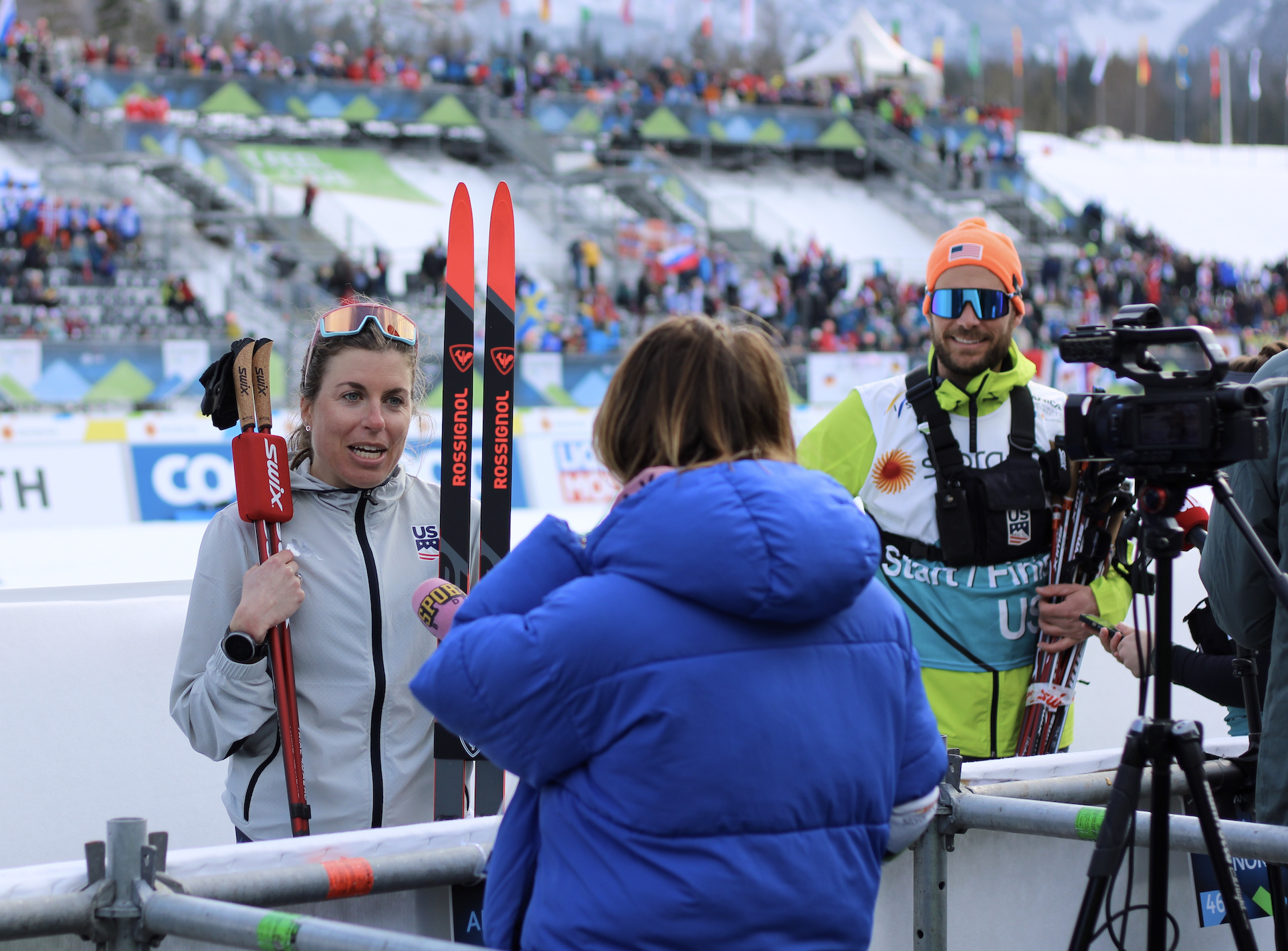
    In a post-race interview with FasterSkier’s Nat Herz, Brennan said, “In any long race, things go up and down. I had moments where I thought, ‘yes, I’m going to do this,’ and others where I thought, ‘oh God, this is not good.’” She then reflected, “I really am feeling a mix of everything. [I’m frustrated] feeling I’m getting good at this fourth, fifth, sixth place situation, [but] also all you can do if you fight with all you have, I did, and I am happy with that.”

    Further behind in the field but putting up strong races were Brennan’s teammates. Hailey Swirbul (USA), who finished 18th. “This was the best 30 k to date for me,” she said. “It was a lot more fun being the hunter instead of the hunted.” Julia Kern (USA) finished 27th, and said to FasterSkier that, “I felt like I put out whatever energy I had left from these Championships out on course.”

    Both Swirbul and Kern said that even during the race, they had an eye towards the racing that was happening at the front with their teammate. “[I was] in awe of how she keeps coming back despite adversities,” said Kern. Swirbul added that “I got to see my teammates out there, which was pretty fun. I cheered for Rosie when we were both on a downhill: She heard me!”

    For both, Brennan’s push served as a real-time reminder of what they were doing in the grander scheme of their racing careers. “Even during the race I was thinking this is good training, maybe I can ski like Rosie,” said Kern. “She has had such a strong career late, and it gives me inspiration that even if I am not in the mix right now.” Kern added that, “Results on the sheet tell one story, but the fact she is in the mix with the world’s best time-and-time again is really impressive.”

    Rosie Brennan (USA) sprints to the last meter alongside Linn Svahn (SWE). Svahn won the sprint and finished 4th, with Brennan taking 5th. Both were a second off the podium. (Photo: NordicFocus)

    US Ski Team Head Coach Matt Whitcomb put Brennan’s accomplishment in perspective. “[Brennan] put herself one second off the podium. You look at that and be proud, and we really are.” Whitcomb added that in Planica, the magnitude of her efforts weren’t lost. “There’s no one at this venue or in this whole crowd right now that people would like to see get a podium more than Rosie.”

    The support wasn’t lost on Brennan, and hasn’t been, she says, through the course of her last couple of seasons:

    “It’s been really cool the past two years how much I hear from people who really resonate with the style in which I race, and that means a lot to me. I’ve never been the most technically beautiful skier, or the smartest, but I certainly try to ski with all my heart and it means a lot when people recognize that. Thank you to everyone who has believed in me, thank you.”

    As for her future plans after this World Championships, Brennan is “doing it all, I am on the death march.” Expect her to start the first 50 k edition of the Holmenkollen marathon for women next week. On longer term plans, Matt Whicomb said that, “I want to see her back at another World Championships; I just told her that. I would love to see her in 2025, 2026, because we want that medal for her so badly.” Brennan said she has “a lot of reflection ahead, [but for now] I am headed back to Toblach and watching Tyler [Kornfield] race the Vasaloppet tomorrow…and thinking that 30 k kind of seems easy compared to the 90 k [of the Vasaloppet].”

    US Team Leaves World Championship with New Accomplishments, Same Sense of Team

    At the end of World Championships, Matt Whitcomb says he hopes that there has been one message imparted to the world by the USA. “I hope that the team support is what the kids back home see, and want to give,” Whitcomb said. “We’ll be waiting here for you.”

    He pointed to two of his athletes who are leaving Planica with historic results, one a World Champion, and one with a race that shone a light through the qualities that make world champions. “What [Rosie Brennan and Jessie Diggins] realized is that if you invest in your teammates, that investment is returned tenfold, because they are fully invested in you,” Whitcomb said. “That’s just a fun way to go through life.”

    As Whitcomb delivered that perspective, he pulled out his phone and read the last text message he had received. It was from Jessie Diggins: “So proud of you girls for an absolutely gutsy race out there, makes me proud to be part of this team.”

    The text was reportedly followed by three BIG heart emojis.

    Full RESULTS

    The US Women walk away from this year’s World Championships with two medals, the first American individual World Championship, and a sense of team that is stronger than ever. (Photo: Nordic Focus)
  • The Devon Kershaw Show: An epic 30k to cap World Champs women’s racing

    The Devon Kershaw Show: An epic 30k to cap World Champs women’s racing

    This race had it all — a solo breakaway, chase packs and a nail-biting performance from America’s Rosie Brennan. Devon and Nat ditch the guests to break down the race themselves. We’ll be back tomorrow with a last World Championships episode.

    Thanks for your support. Reach us at devon@fasterskier.com and nat@fasterskier.com.

  • The Devon Kershaw Show: Guests galore for a women’s World Champs relay recap

    The Devon Kershaw Show: Guests galore for a women’s World Champs relay recap

    We’ve got guests. Former FasterSkier Managing Editor Rachel Perkins and U.S. Olympian and World Cup podium finisher Sophie Caldwell join us to recap an epic women’s relay from World Championships in Planica.

    Nine races down, three to go. You can reach us at devon@fasterskier.com and nat@fasterskier.com.

  • Women’s Relay:  Norway Takes Gold, USA Fifth

    Women’s Relay: Norway Takes Gold, USA Fifth

    This World Cup coverage is made possible through the generous support of Marty and Kathy Hall and A Hall Mark of Excellence Award. To learn more about A Hall Mark of Excellence Award, or to learn how you can support FasterSkier’s coverage, please contact info@fasterskier.com

    With the mounting success of the American women’s cross-country program, the one prize continuing to elude it has been a major championship relay medal. In some ways, it has become an obsession with team USA, an obsession they were looking to check off the list after today; however, the Americans were not the only country focused on the relays. Norway and Sweden are bitter rivals in relay events, and considerable national pride hangs in the balance each time the event is run. Norway has won five of the last six Women’s World Championship relays; even so, Norway would be seeking redemption after missing the podium in the last Olympics. Sweden has finished second to Norway in four of those five World Championship relays; Sweden is understandably tired of looking up on the podium at its Scandinavian neighbor. Germany would also be on a mission to prove that its Olympic silver medal was not a fluke.

    Wearing bib no. 5, Hailey Swirbul (USA), battled in the lead pack at the start of the 4×5 kilometer Relay. (Photo: NordicFocus)

    After the drama on the race had concluded, Norway had redeemed its national pride taking first place. Germany proved that it was for real by virtue of its second place finish. Sweden’s stars couldn’t match Norway’s and Germany’s intensity, and took home the bronze. Team USA simply could not keep pace with the world’s best teams and finished fifth. Team Canada skied to eighth place.

    World Championship Women’s 4 x 5 Kilometer Relays

    Hailey Swirbul took the leadoff leg for USA. One kilometer into the race, the field was still bunched together with Emma Ribom (SWE) setting the pace. At about 2.5 k, Ribom established a gap taking five skiers with her. Swirbul was in the second group; it was clear at times that her skis were slipping. “The team skied on hairy skis for the Classic leg,” said US.. coach, Chris Grover. “Klister was icing, kick wax wasn’t quite enough. Skiing hairies is a real art… if you haven’t had a lot of experience on that it can be a challenge. Hailey did great; she kept it close.”

    Ribom continued to stretch the field, reducing the lead group to Sweden, Norway, Germany, and Finland. At 4.4 k, Weng sprinted into the lead setting a blistering pace that fractured the lead group providing Norway with a tiny lead at the first exchange.

    Rosie Brennan (USA) fought hard through the second Classic leg, but her bad luck continued at these World Championships as she broke a pole during the race. (Photo: NordicFocus)

    To start the second leg, Weng handed off to Astrid Oeyre Slind (NOR), who had less than a second lead over Ebba Andersson (SWE), and Kerttu Niskanen (FIN). Swirbul was 21 seconds off the lead when she handed off to Rosie Brennan. Katharina Hennig (GER) pushed to the front with Slind; they were setting the pace, and doing so at a brisk level. It was then that classic expert, Kerttu Niskanen (FIN), took the lead and pushed the pace, gracefully employing her textbook Classic technique. Meanwhile, Brennan continued to fall back, visibly slipping on the uphills. Drama ensued toward the end of the second lap when Hennig turned up the pace. When Andersson tried to match it, she stepped on her pole, breaking it. This mishap saw her drop to the back of the lead pack and cost her valuable energy and momentum.

    Skiing the second leg, Kerttu Niskanen (FIN) used her beautiful Classic form to give Finland a shot at a medal. (Photo: NordicFocus)

    Though having already fallen out of medal contention, heartbreak struck again for Brennan: she slipped in the same spot where Andersson had slipped, stepped on her own pole as Andersson had done, and suffered the same demoralizing result: a broken pole. Two kilometers later, she had fallen 46 seconds behind the leaders, and the handwriting was on the wall for team USA. After the race, Brennan told FasterSkier that she didn’t have an explanation for what happened. She said that she didn’t feel the pole break affected her much. “I did it right in front of Matt [Whitcomb] and it was an uphill,” Brenan said. “I don’t think it was a deal-breaker for us today.” Jessie Diggins (USA) also expressed that she didn’t think the pole break made much difference in the big picture. “It was a good place to do it [break a pole],” she said.

    Jessie Diggins (USA) skied as hard as she could, but the Americans just couldn’t keep pace with the best teams in the world. (Photo: NordicFocus)

    At the exchange into the third leg, Germany and Finland were locked in a dead heat. Norway and Sweden were a few seconds back in third and fourth, respectively. Jessie Diggins took the exchange 48 seconds behind the lead group and 43 seconds from a podium spot, a seemingly insurmountable gap to close in only five kilometers. In the lead group, Frida Karlsson (SWE) shot to the front; by the two kilometer mark she had nullified the leaders’ advantage and had thrust herself into first. But the push had proved costly, as Ingvild Flugstad Oestberg (NOR) then surged to the front and began to set an even faster pace. Oestberg’s acceleration shattered the lead pack with Finland’s Eveliina Piippo falling off the back. Karlsson began to fade and at 14.4 K dropped to third while Germany’s Pia Fink occupied second place.

    Ingvild Flugstad Oestberg (NOR), hands off to Anne Kjersti Kalvaa (NOR), on the final relay leg. Norway proved too powerful for the rest of the world. (Photo: NordicFocus)

    At the anchor leg exchange, Oestberg handed off in first to Anne Kjersti Kalvaa (NOR) with a 6.2 second advantage over Germany’s Victoria Carl and 14.9 seconds over Sweden’s Maja Dahlqvist. Diggins tagged Julia Kern (USA) almost 50 seconds behind the leader, and 35 seconds from third place. The Americans’ medal hopes were fading fast, and Kern was given the impossible task of needing to gain 35 seconds in five kilometers for a medal.

    Eveliina Piippo (FIN) tags Krista Parmakoski (FIN) who briefly gave Finnish fans hope for a medal, but it was not to be. (Photo: NordicFocus)

    But at the front of the race things were being turned upside down as Krista Parmakoski (FIN) surged past Sweden’s Dahlqvist into third place. Unbelievably, at this point in the race, the star-studded Swedes were sitting off the podium. Norway’s Kalvaa continued to surge and at 19.4 k had stretched her lead to over 20 seconds, with Germany’s Carl comfortably in second. Finland’s Parmakoski was still in third with Sweden’s Dahlqvist sitting in fourth.

    Kalvaa powered to the finish line taking the win for Norway. Carl took second for Germany.  Dahlqvist put in a turn of pace in the last half kilometer to save face for Sweden, taking third. Finland was pushed back to fourth and USA finished fifth; 1:34 off the lead.

    After the race, Swirbul talked to FasterSkier. “ It was an honor to have a spot on the team,” she said, placing some blame on herself for the team’s performance. “I knew I had a chance to give Rosie someone to ski with, and I really wanted to do that for her today and I didn’t make it happen…I blame myself for it.” She continued that she was prepared for the lead teams to break away early.  “I found myself in a position I had hoped to not be in…suddenly you look up and there’s a gap, and it’s really hard to close that back.” Swirbul said that she, “was mentally prepared to really suffer…we know what’s possible…it will happen.”

    Brennan told FasterSkier that, she saw Hailey trying to close the gap and was inspired by that. “I tried to harness some of that and find balance between skiing my own race and taking a chance.” Brennan added that “it’s definitely hard when you have four of the best skiers working together, and you’re alone.”

    Diggins told FasterSkier’s Nat Herz that her plan was to “hope they weren’t [skiing] together in the front…Unfortunately, Ingvild went on a flyer…, if she hadn’t of done that… I think I was starting to make up time.” Diggins offered addtiional perspective on the potential of the American women’s team: “We know we’re there; we just need all the things to fit together and need a little bit of luck.” Diggins commenting on Swirbul’s lead leg said that, “You can’t put a relay on one person’s shoulders…it’s four people skiing it. Just like you can’t take all of the credit yourself, you can’t take all the blame yourself. I’m nothing but proud of how these girls skied.”

    U.S. coach Chris Grover observed that, “the fact that you saw some of the best skiers in the world, like Frida at the edge, and Ebba at the edge tells you about the quality of the athletes that were competing,” said Grover. “We don’t have any podium finishers in Classic with any of our athletes…at the end of the day, we know we generally need to put our strongest skiers in legs two and three because that’s where the other teams are stacking up their big horsepower.” He also added that “the other teams know they can’t let off the gas, that this [Classic leg] is the place to put distance on USA.”

    In a surprise, Grover also informed FasterSkier that Diggins would not race the 30 kilometer Classic race on Saturday. “Jessie is going to start to get ready for Holmenkollen,” he reported.

    At the end of the day, Norway had redeemed itself in the fight for relay supremacy, and Germany proved it belonged at the top of the rankings. Sweden—a heavy pre-race favorite—had to satisfy itself with a third place finish. Team USA—a sentimental favorite with the fans—would have to watch the medal celebration from the sideline. High expectations would not be satisfied with a fifth place finish as the Americans would have to continue to search for the right formula to solve the relay riddle that still eludes them.

    World Championship Women’s 4 x 5 Relays RESULTS

    Redemption for team Norway as they brought home gold for their fans. (Photo: NordicFocus)


  • Diggins is World Champion! Tears of Joy as U.S. Star Takes Gold in Women’s 10 Kilometer Individual Freestyle

    Diggins is World Champion! Tears of Joy as U.S. Star Takes Gold in Women’s 10 Kilometer Individual Freestyle

    This World Cup coverage is made possible through the generous support of Marty and Kathy Hall and A Hall Mark of Excellence Award. To learn more about A Hall Mark of Excellence Award, or to learn how you can support FasterSkier’s coverage, please contact info@fasterskier.com

    Numerous questions have been simmering regarding these World Championships: today’s Women’s 10 Kilometer Freestyle Individual Start brought those questions to a full boil. Could anyone knock the Swedish women from the top of the podium? Could Rosie Brennan bounce back from the gut-wrenching events of her Skiathlon performance? Could Jessie Diggins claim an individual medal in these World Championships, and her first individual World Championship gold?

    Jessie Diggins (USA) was overwhelmed with emotion after all of the pieces finally came together for her to win an individual World Championship. (Photo: NordicFocus)

    Diggins was the one who offered the emphatic answers: once the day’s racing ended, it was Diggins taking the gold for her long-sought individual World Championship. She had distanced herself from all of the Swedes with Frida Karlsson (SWE) finishing second and Ebba Andersson (SWE) finishing third.

    Other finishers for the U.S. were Rosie Brennan in 15th, Sophia Laukli 25th, and Julia Kern 34th. The top Canadian finisher was Katherine Stewart-Jones in 27th. She was followed by Jasmine Lyons in 36th, Liliane Gagnon 38th, and Dahria Beatty 46th.

    World Championship Women’s 10 Kilometer Individual Freestyle

    Having made the strategic decision to sit out the Skiathlon—and with the upcoming 30 Kilometer race being in the Classic technique—conventional wisdom suggested that today’s race would be Diggin’s best shot for an individual gold. For Diggins to realize that achievement, she would need to knock off both Swedish distance stars:  Frida Karlsson and Ebba Andersson. Sweden’s women have taken on an aura of invincibility. Conventional wisdom also suggested that beating out the Swedes was extremely unlikely.

    Collapsing at the finish after a fully committed race effort, Jessie Diggins (USA) proved capable of defying conventional wisdom. She distanced her Swedish rivals—the pre-race favorites—to take the gold medal. (Photo: NordicFocus)

    Diggins wasted no time, attacking the 10 k distance from the start. She was clearly on a mission and skied in her absolute top gear and best form through the entire race. Leading at every time check from the 2.2 Kilometer mark to the finish, it was a bold, confident performance worthy of a World Champion.

    As the race progressed to the 2.2 k mark, it was clear that Diggins was holding nothing in reserve. She had managed to push through all of the other contenders and established a small lead over Karlsson who lurked only 3.7 seconds behind. Brennan was hanging on to third place, tenths of a second behind Karlsson.

    As the race reached the half way point, the splits showed Diggins, Andersson, and Karlsson in a virtual dead heat; all three separated by less than two seconds. It was at this point that conventional wisdom was thrown out the window as Diggins showed that she possessed stamina and depth no one else could match.

    Relentless in her tempo and efficient in her technique, Diggins barreled down the tracks. By the 7.7 Kilometer mark she led Karlsson by five seconds; Andersson had faded to 8.1 seconds back. The pace had taken its toll on Brennan who had slipped back 45 seconds behind the leaders. It had become clear that Diggins had gone out at a pace no one could match. The only question remaining was would she be able to hold that pace for another 2.3 Kilometers?

    Diggins approached the finish still firing on all cylinders, clearly still on mission, and showing determination to leave absolutely nothing to chance and to leave nothing in reserve. Between the 7.7 kilometer mark and the finish she had remarkably put another nine seconds into Karlsson and ended up winning by 14 seconds. Andersson had dropped 19 seconds back.  The finishing time gaps showed the amazing consistency and intensity which Diggins delivered in the second half of the race.

    After the race, tears flowed for Diggins who emphasized the team support and commented that, “this was one of the best races of her life.”  She thanked the ski technicians several times for providing her the tools needed and expressed that she had skied “with joy.”

    For Jessie Diggins (USA), it was all about the team effort propelling her to a gold medal. (Photo: NordicFocus)

    She told FasterSkier’s Nat Herz after the race that she was “really wrung out emotionally, but in a really good way. So many happy tears. It feels like such a victory for the whole team. I was literally having goose bumps seeing what the wax tech plans were.”

    We’re not the biggest team out there, but [the wax technicians] put everything they had into it, so I wanted to put everything I had into it.           Jessie Diggins

    “I had been really nervous for a long time,” Diggins said. “This was my chance to dig deeper than I have ever dug before, more than anything I just wanted to leave it all out there. I was really grateful that all the pieces came together…I had amazing skis.”  Diggins commented on the pressure for today. “I think I’ve come to have a healthier relationship with pressure…I’m not going to pretend it’s not there…its kind of the way in a race you just make friends with pain.”

    Having drawn inspiration from the hard work of the team’s staff, Jessie Diggins (USA) vowed to leave everything out on the course. (Photo: NordicFocus)

    Diggins had a definite plan for today’s course: “The new snow made this a really great course for me, the corners were all very much working—pushing—I just wanted to cross the finish line with nothing left.” Diggins had focused on making smart decisions while tired. “I did a lot of visualizing making decisions…for two weeks I’ve seen myself being tired, being in a fog, and making the right decision.”

    Hard luck continued for Rosie Brennan (USA) at these World Championships: she would finish 15th. (Photo: NordicFocus)

    Even though the day was disappointing for Brennan, she took solace in her teammate’s accomplishment. After the race, Brennan spoke with FasterSkier: “On any day we can fight for a gold, and that’s motivating for everybody…you have to put yourself in the fight.” She was also philosophical about her performance over the last two races. “That’s sport…every weekend of racing has some good and some bad in it. Honestly that’s one of the reasons I love competing. You get such a mix of emotions, it makes you feel very alive. It’s really grounding in an existential way.”

    The entire American team was able to share in Diggins’ success. Julia Kern told FasterSkier’s Nat Herz that, “This is more than just an individual result, it’s a milestone for our whole team. It shows that anyone from any country can make it happen if they work hard and believe.”

    Jessie Diggins (USA) skied flawlessly, maintaing an intense pace and excellent technique the entire way. (Photo: NordicFocus)

    After the race, U.S. coach Jason Cork told FasterSkier that today was redemption of sorts after a disappointing Tour de Ski where he admitted that he had made mistakes with ski preparation. He also elaborated on the decision to skip the Skiathlon. “A lot of people could easily get a medal in the Skiathlon…it seemed like a safer bet to get a medal in the team sprint, and then it sets you up well. It was a tough decision, but it was the right call.” It was another point of redemption after what seemed like endless second guessing on the U.S. team’s choice to pull Diggins from the Skiathlon.

    Head coach Chris Grover told FasterSkier that there was a mix of emotions including “relief.” “There’s so many pieces of the puzzle that have to come together,” he said. “including ski service…athlete fitness…and choosing the right training camp. It’s a relief when you can see an athlete like Jessie ski to her potential”

    “[Today’s race] was our best chance for a medal,” Grover elaborated. “The whole team pushed really hard with every possible extra step.” Grover further emphasized the importance of having inspected the course yesterday. “I think all of the women came away with good confidence about how to ski the course. It looked daunting on paper…but everyone figured it out.”

    U.S. coach Matt Whitcomb also viewed today as a bit of redemption with so much media focus on missed expectations during the Tour de Ski. Whitcomb said he thought it “ridiculous” that other teams were calling for health checks when Diggins missed qualifying in a Tour de Ski event by one second.  So today was definitely vindication for team USA.

    To win a world championship everything must work just right at the right time. Today for Diggins and team USA, the skis, the fitness, the course, the years of training all came together at the right time: the time to make history.

    Frida Karlsson (SWE), Jessie Diggins (USA), Ebba Andersson (SWE), (l-r) celebrate after the finish. (Photo: NordicFocus)

    World Championship Women’s 10 Kilometer Individual Start Freestyle RESULTS 


  • After Olympic near-misses, Planica binding mishap postpones Brennan’s medal quest

    After Olympic near-misses, Planica binding mishap postpones Brennan’s medal quest

    Rosie Brennan does post-race interview with a Scandinavian reporter after her crash in the World Championships Skiathlon Saturday, Feb. 25, 2023. (Photo: Nathaniel Herz/FasterSkier)

    PLANICA, SLOVENIA — From the stadium at this Slovenian ski venue, Wiggy Brennan watched on the jumbotron as her daughter, Rosie Brennan, raced with the lead pack in Saturday’s World Championships skiathlon race.

    Brennan, who trains with Anchorage’s Alaska Pacific University team, was feeling good and gunning for a medal against the best in the world. It’s easy to pick her out, Wiggy said, with her bright orange Rossignol skis.

    Then, someone crashed. “And I’m like, ‘Oh God, that’s Rosie,’” Wiggy said. “And then the tears came out. Because I knew she was really targeting this race.”

    The 15-kilometer skiathlon was a tantalizing medal chance for Brennan, who over and over came oh-so-close to the podium at last year’s Olympics in Beijing — a fourth place, a sixth place, and another fifth and sixth in two team events.

    American fans on Saturday were pulling for her to get some redemption in Planica, and some payoff for sticking with the sport long after others would have retired: Brennan, 34, was cut twice from the U.S. Ski Team, and her first international podium didn’t come until she was 32.

    Instead, after vying for the lead, she watched her rivals slip away as she scootered along the trail on one ski — the binding having ripped out of her other ski in the crash.

    “I felt great. I’m really sad — this is really hard to swallow,” she said in an interview after the race. “It’s some of the best I’ve felt all year, and it’s a hard way to go.”

    Brennan and her mother weren’t the only ones who were disappointed. Hailey Swirbul, another American racing Saturday and one of Brennan’s teammates in Anchorage, flew by as Brennan was picking herself up after the crash.

    “Honestly, I thought about taking my ski off and giving it to Rosie when I saw her without a ski out there, because this is a day for Rosie, for sure,” Swirbul said. “But I was moving too fast.”

    Jason Cork, one of the U.S. coaches, had one of Brennan’s backup skis around the next bend. But by then, the lead pack was already gone.

    Brennan said the idea of dropping out of the race went through her mind.

    “But I think for me, when you show up at a championship, you’re here to represent your country and you always give it your all until the end unless, you know, there’s an emergency or something,” she said. “So, I decided to keep fighting to the finish.”

    Adding insult to injury, a half-dozen Scandinavian TV and radio stations wanted interviews about her mishap when the race was over.

    “I’ve won World Cup races, and I’ve never been asked this many questions,” she said, laughing. “Honestly, that sucks — I think people should be more concerned with the good things and not the bad things. Today is the day we can all forget about.”

    Brennan won’t get her next chance at World Championships until next week.

    The American coaches had to choose two of their three female world-class sprinters to start Sunday’s team event, and they picked sprint phenom Julia Kern over Brennan to pair with Olympic medalist Jessie Diggins. Whitcomb, the coach, said the decision was based on Kern’s and Diggins’ slight edge in experience racing in tight head-to-head heats.

    “It was a tough one,” Whitcomb said.

    Brennan still has medal hopes in other events at World Championships — namely Tuesday’s 10-kilometer skate race. Sitting out Sunday’s race might actually be a well-timed break, Whitcomb added.

    “Luckily, I have more chances,” Brennan said. “So, I can be thankful for that.”

    She also has her mother and aunt supporting her here — the first time in years they’ve been able to travel to watch Brennan compete at a major championships.

    “When I finally came out of the mixed zone” — the area with all the reporters — ”I went straight for them,” Brennan said.

  • Heartbreak for Brennan in Skiathlon, Ebba Andersson Takes Gold

    Heartbreak for Brennan in Skiathlon, Ebba Andersson Takes Gold

    This World Cup coverage is made possible through the generous support of Marty and Kathy Hall and A Hall Mark of Excellence Award. To learn more about A Hall Mark of Excellence Award, or to learn how you can support FasterSkier’s coverage, please contact info@fasterskier.com

    As dominant as Swedish women’s racing has been this season, it’s hard to imagine that a Swedish woman has never won a Skiathlon at the World Championships. The Swedish women were looking to break that streak; given the incredible run they have been on, it seemed that the odds were in their favor.

    But Norway was still lurking, hoping to upset Sweden’s shot at history. The Americans were also waiting in the wings with Rosie Brennan (USA) vying to claim America’s first gold medal in an individual distance event at a World Cup Championship.

    Jessie Diggins (USA) took the day off: as she had said in her pre-World Championships press conference, she did not intend to ski every race. U.S coach Chris Grover informed FasterSkier that she will be skiing the team sprint tomorrow along with Julia Kern. He also shared the news that J.C. Schoonmaker and Ben Ogden would be the men’s team.

    After a warm day of racing, it was Sweden coming out on top again with Ebba Andersson taking the victory. She was followed by teammate Frida Karlsson. In a feel good story, Astrid Oyre Slind (NOR), who was called up to race as a last minute replacement, finished third. Slind is a long-distance specialist, competing on the Ski Classics tour, and in the warm Planica weather she stood out as she cut off her tights and turned them into shorts.

    Rosie Brennan (USA) sharing the story of her struggles with teammate Sydney Palmer-Leger (USA) after the Skiathlon’s completion. Brennan’s broken binding spoiled what had been a promising day for the American. (Photo: NordicFocus)

    The Americans’ day was mixed with success and heartbreak. Rosie Brennan had a soul rattling outing. While she was skiing with the leaders, a binding broke and her ski fell off. She ended up finishing 19th. Newcomer Sydney Palmer-Leger had a breakout day finishing 20th. Haley Swirbul was 26th, followed by Sophia Laukli, 29th.

    For Canada, Katherine Stewart-Jones was the top finisher in 25th. Behind her were Jasmine Lyons 34th and Olivia Bouffard-Nesbitt in 40th.

    Women’s 15 kilometer Skiathlon

    It was a very warm day for the Women’s 15 k Skiathlon, as temperatures bumped up against the 50 degree mark. Most racers shed their hats, some took off their gloves, and in Slind’s case, converted her tights into shorts. According to U.S. coach Chris Grover, course officials decided to salt the course the night before the race.

    While course conditions were the subject of much post-race discussion, Grover said that he thought, “in general, for how warm it was…the course was probably in as good as shape as it could have been.”

    The day began with high hopes for the U.S. With Jessie Diggins resting, Rosie Brennan became the default front runner for team USA.

    At the beginning all looked very good for the Americans. One kilometer into the race, skiing the classic section, Brennan was toward the front with Kerttu Niskanen (FIN) and Krista Parmakoski (FIN) setting the early pace. They were in a group with Frida Karlsson (SWE), Ebba Andersson (SWE) and Delphine Claudel (FRA).

    Throughout the early stages, Brennan looked extremely strong and jockeyed for position with the leaders. Niskanen was still setting the pace using her classic technique prowess to try and establish an advantage before the transition to skating.

    Rosie Brennan (USA) gamely stayed in the race after her binding broke and tried to make up time in the skate portion of the Skiathlon. (Photo: NordicFocus)

    By the 3.8 kilometer mark, Andersson moved to the front of the pack with Slind joining the leaders. Brennan was right in the mix in eighth place, skiing with the leaders, and appeared to be skiing the race she wanted to.

    It was at about the five kilometer mark that the wheels came off for Brennan—literally. As she was going through a corner, her binding broke sending her ski flying. Brennan immediately collected her ski and pushed herself along with one foot as the leaders sped away from her. After the equipment failure, Brennan moved from being in the front of the field to being forty seconds behind the leaders. By the time she reached the ski exchange, she was over a minute behind the lead. It was a deficit which would be impossible to overcome.

    When the leaders reached the ski exchange, Andersson, Karlsson, Slind and Ingvild Oestberg (NOR) were in a virtual dead heat.

    As the skate portion of the race unfolded, Andersson began to assert herself, putting a six second gap on Karlsson with Niskanen and Slind about 20 seconds behind. Anderson continued on a grinding pace which the rest of the group could not match. At 10 kilometers she had put another 10 seconds on Karlsson, but then Andersson fell on a downhill and opened the door for teammate. But Karlsson couldn’t take advantage of the fall as Andersson jumped to her feet quickly and only lost a few seconds. Karlsson was able to stay in touch through the 13 kilometer mark, but couldn’t make any progress reeling Andersson in. At about the 14 kilometer mark, Andersson found another gear which no one else could match, and she extended her lead to almost 20 seconds.

    At the finish, Andersson was comfortably in the lead, finishing 22 seconds ahead of Karlsson. Slind had hung on to finish third about 48 seconds back, making her last second race call up a heartwarming story.

    But, after the race, all the talk was about Brennan and what could have been.

    In the reporters’ mix zone, Brennan—always the consummate professional—took events in stride when she elaborated about her days’ problems. “Everyone was putting on the brakes, and I did too, and I caught some slush and the binding came off the ski. It makes it kind of hard to go when you have only one ski.”  Despite her equipment issues, Brennan sounded energetic and optimistic. She commented that her bad luck seemed to attract a great deal of media attention. With a mix of humor and irony she said while laughing that, “this is the most I’ve ever been stopped in the mix zone, and for one of the worst races…I don’t know what that says about the state of the world. People should be more concerned with the good things, not the bad things. Today is a day we can all forget about.” Brennan hadn’t initially realized that the binding had come off and tried to put the ski back on. After figuring out that her equipment was broken, she found coach Jason Cork for a replacement ski. But the damage was done: the pace at the front didn’t slacken and there was no catching up. Brennan had contemplated stopping, but just for a moment. “When you show up at a Championship, you’re here to represent your country and you always give it your all until the end. I decided to keep fighting until the finish. I felt great up until that point.” Brennan was not injured from the impact.

    U.S. coach Matt Whitcomb was about three minutes away from Brennan when she fell. He said, “Jason [Cork] got her one of her skis…it did have race wax on the glide zones. But the time was lost, and you’re no longer in contact with people skiing your pace.”  He continued that, “we’re grateful that she’s ok…we can move past this. She looked great [before the fall] and was controlling the pace up the hills.”

    Grover told FasterSkier that, “She was skiing really well when this happened.” From the team perspective it hurts, but Grover elaborated that “it is part of sport…everyday there are some favorites that end up with some bad luck.”

    Sydney Palmer-Leger (USA) provided the highlight for team USA. She finished 20th in her first World Championship race and her first Skiathlon. (Photo: NordicFocus)

    Brennan’s disappointment was tempered some by the standout performance of Sydney Palmer-Leger (USA), who finished 20th. Today was Palmer-Leger’s first World Championship race and first Skiathlon competition ever. She told FasterSkier that she was able to avoid the crashes which claimed so many skiers. She said that her background as a bike racer helped her prepare for the Skiathlon. “The transition went pretty well. I’m used to calming myself down.” She continued that “the corners were sketchy…you needed to carry speed through the corners, not slow down. I don’t think snow plowing was the best move.” She added that, “I just turned 21, so getting top 20 at my first World Champs is pretty amazing.”

    Grover added that the team took solace in Palmer-Leger’s performance. “It was definitely the high point of the day,” Grover said. “It was really fun to see that half way through the classic section she was just off the lead group, so she was really holding her own.”

    Sophia Laukli (USA) overcame her own adversity to finish 29th in the Skiathlon. (Photo: NordicFocus)

    Sophia Laukli also had her difficulties, falling twice. Her 29th place performance was all the more remarkable, as she shared with FasterSkier that she broke a pole on the second crash.

    After the dust had settled, broken equipment repaired and collected, the day would be remembered as a continuation of Swedish dominance, a breakout performance by a new American star, and thoughts of what might have been for Rosie Brennan.

    Frida Karlsson (SWE), Ebba Andersson (SWE), (l-r) celebrate Sweden going 1-2 in the women’s Skiathlon in Planica, Slovenia (Photo: NordicFocus)

    World Championships Women’s Skiathlon Results


  • The Devon Kershaw Show: Swedes storm as Brennan gets a tough break

    The Devon Kershaw Show: Swedes storm as Brennan gets a tough break

    Ebba Andersson wins the World Championships skiathlon followed by a strong Frida Karlsson, with a surprise third by a Norwegian with a cinderella story. We break the race down and cover Rosie Brennan’s ski mishap.

    We’ll back back with more after Sunday’s team sprint. Send us your questions at devon@fasterskier.com and nat@fasterskier.com.

  • Sweden Sweeps Podium in Women’s Classic Sprint.  Brennan-Kern in Top Ten

    Sweden Sweeps Podium in Women’s Classic Sprint. Brennan-Kern in Top Ten

    This World Cup coverage is made possible through the generous support of Marty and Kathy Hall and A Hall Mark of Excellence Award. To learn more about A Hall Mark of Excellence Award, or to learn how you can support FasterSkier’s coverage, please contact info@fasterskier.com.

    Today the Classic Sprints marked the beginning of the first full day of competition at the FIS World Championships in Planica, Slovenia. In the women’s field, there was not a prohibitive individual favorite coming into the race. So evenly matched is the women’s field that the last nine Classic World Cup Sprint races have produced nine different winners! While no individual has dominated women’s Sprinting, the Swedish team has amassed a stock of Sprint superstars who have been on a dominant run lately. For the last 3 individual Sprint races coming into the World Championships, the Swedish women have occupied 7 of 9 podium positions. Norway and USA have been the most consistent challengers to the Swedish domination. The U.S. fielded its own quartet of Rosie Brennan, Jessie Diggins, Julia Kern, and Hailey Swirbul to take on the world.

    At the end of the day, the Swedish Sprinting stars rose to the top sweeping the podium with Jonna Sundling taking first, Emma Ribom second, and Maja Dahlqvist third.

    Jonna Sundling (SWE) celebrates after winning the women’s Classic Individual Sprint in Planica, Slovenia. (Photo: NordicFocus)

    For the Americans, Rosie Brennan was seventh—her best Classic Sprint performance ever—followed by Julia Kern in eighth, and Jessie Diggins 21st. Hailey Swirbul finished 33rd just a bit more than half a second away from qualifying. The American women are working without the availability of Novie McCabe and Alayna Sonneyson who, though nominated to the World Championship team, for health and training reasons chose not to attend the World Championships.

    No Canadian women made the heats. Dahria Beatty finished 35th only 1.1 seconds from qualifying. Katherine Weaver was 36th, Olivia Bouffard-Nesbitt 38th, and Liliane Gagnon 47th.

    The Women’s Individual Classic Sprint

    It was a warm day in Planica with temperatures staying above freezing overnight. This prompted officials to unexpectedly salt the course, and wax technicians to put klister on racers skis. U.S. Coach Chris Grover confirmed with FasterSkier that the conditions were a mix of firm and slush which posed challenging conditions for the racers. This resulted in many non-contact falls throughout the day. Grover added, “The course has technical corners with winding sections where the snow is banking and channels are carved, and those are opportunities…to fall.” The tenuous conditions limited access to the course for warmups, and according to U.S. coach Chris Grover, “Staff never skied on the course.” Coach Matt Whitcomb said that, “This condition begs for salting and frankly we are in support of firmer conditions if at all possible, it was not an unwelcome surprise.”

    Rosie Brennan (USA), on her way to a personal best Classic Sprint finish, ending up seventh. (Photo: NordicFocus)

    The first American in the heats was Rosie Brennan in heat number two. Brennan’s heat was stacked with headline talent with Ribom (SWE) and Nadine Faehndrich (SWI) lining up with her. After cresting the first big hill, Brennan’s heat quickly boiled down to a pack of three skiers, with Ribom and Faehndrich out front. Brennan was able to keep on the leader’s tails and maintained contact throughout the race. Coming into the end of the heat, Brennan was still in touch with the leaders—finishing third—and would have to wait and hope for a lucky loser position.

    Julia Kern (USA) joined teammate Rosie Brennan (USA) in the top ten in the Individual Classic Sprint in Planica, Slovenia. (Photo: NordicFocus)

    Julia Kern went off in the fourth heat and would face Linn Svahn (SWE) who has recently returned to the World Cup having recovered from a shoulder injury and has been sprinting extremely well. Kern pushed to the front early and positioned herself extremely well forcing Svahn wide on the course. Kern was able to set the pace up the first steep hill and looked extremely strong. But by the top of the second hill Svahn had worked herself through to the front of the field and established a large gap over Kern. Kern was able to maintain her second place positioned and moved on to the semis finishing second.

    Jessie Diggins (USA) qualified for the heats in the women’s Individual Classic, but was unable to advance out of the quarterfinals. (Photo: NordicFocus)

    In her heat, Diggins settled into the middle of the field at the start and put in a burst going up the first steep hill to put herself near the front. But she faded quickly after that, finishing fifth. Her day ended there. But, Diggins disappointment was Brennan’s benefit; Brennan moved on as a lucky loser and would face her teammate, Kern, in the semis. The star-studded Swedes placed five skiers in the semifinals.

    Sprint Semifinals

    The first semi read like a who’s who in the sprint skiing with Jonna Sundling, Emma Ribom, and Maja Dahlqvist representing Sweden. Kristine Skistad (NOR) Nadine Faehndrich (SWI) and Treza Bernanova (CZE) rounded out the field. The depth of this heat led to a very tactical race with Skistad setting the pace for most of the race. Skistad ground away throughout most of the course until toward the finish when Ribom pushed through Skistad and just beat her at the finish line.

    In the second semifinal Kern and Brennan would face the formidable combination of the Swedish duo of Svahn, Johanna Hagstroem  as well as Laura Gimmler (GER) and Tiril Udnes Weng (NOR). From the start Brennan and Kern drifted toward the back of the field. Then quickly, Brenan asserted herself up the first big hill shooting into the lead and stepping up the tempo for the rest of the field. After the second hill, Brennan had cracked the field and was with Svahn and Weng. At the finish, Brennan skied hard and finished third, but her time did not qualify for a lucky loser position. Kern was unable to meet the pace throughout most of the race and finished fourth.

    After the race, Brennan expressed her satisfaction with the outcome.“it was my best classic sprint ever,” she said. And my best World Championship finish ever.  I love klister skiing!”

    Rosie Brennan (USA) had her best Classic Sprint day ever just in time for the World Championships in Planica, Slovenia. (Photo: NordicFocus)

    Kern said that she “felt pretty good and had hoped for a little bit more, but it’s sprint racing and you never really know what’s going to happen.”

    After the race, both Brennan and Kern described the course to FasterSkier as sloppy klister skiing.

    Sprint Finals

    The final came down to the field which had been anticipated: four Swedes and two Norwegians. Ribom, Svahn, Sundling, and Dahlqvist would take on Weng and Skistad. At the start, Skistad bolted into the lead, determined to break the four Swedes trailing her. Weng then put on a burst of speed to join the leaders, and it looked for a moment like Norway could crack the Swedish wall. But about one-third of the way through the race Sundling edged up to the front and was then neck and neck with Skistad; eventually pushing past her. Then the Norwegian dam couldn’t hold back the Swedish pressure and finally burst with the Swedish wave surging to the front with all four Swedes forming a solid wall in front of the Norwegians and quickly gapping Norway. Just past the halfway point, it was all Sweden with the only question left being which Swede would win. It came down to Sundling and Ribom fighting it out at the finish with Sundling holding off Ribom, and Dahlqvist coming in third.

    After the racing was over U.S. coach Matt Whitcomb described the Swedish women’s performance as, “next level.”

    After many twists and turns, the women’s sprint day ended up much as it had been predicted with team Sweden totally dominating, and the rest of the world left trying to figure out how to match the matchless Swedish women.

    World Championship Women’s Individual Classic Sprint RESULTS

    Sweden Sweeps the World Championship podium with Emma Ribom (SWE), Jonna Sundling (SWE), Maja Dahlqvist (SWE), (l-r) taking the top three spots in the Women’s Classic Sprint. (Photo: NordicFocus)


  • The Devon Kershaw Show: A final tuneup in Toblach

    The Devon Kershaw Show: A final tuneup in Toblach

    World Championships is looming; Devon and Nat return to cover three days of racing — and two podiums from Jessie Diggins — in Toblach, Italy. We’ll finally get to the mailbag episode next week, so send in your questions if you’ve got ’em: devon@fasterskier.com and nat@fasterskier.com.

    Jessie Diggins races in Toblach last weekend. (Photo: NordicFocus)


  • Norway Wins, US Women Battle to Podium as Germany Disqualified in Team Relay

    Norway Wins, US Women Battle to Podium as Germany Disqualified in Team Relay

    This World Cup coverage is made possible through the generous support of Marty and Kathy Hall and A Hall Mark of Excellence Award. To learn more about A Hall Mark of Excellence Award, or to learn how you can support FasterSkier’s coverage, please contact info@fasterskier.com.

    Julia Kern (USA) follows Jonna Sundling (SWE) on the anchor leg of Sunday’s Team Relay in Toblach. Sundling would edge out Kern in a sprint for second place. (Photo: NordicFocus)

    As the World Cup entered its third day of racing in Toblach for a 4 x 7.5 km Team Relay, the tone was one of anticipation: what would happen in the race? Even more so, what was beyond this final day in the Italian Sud Tirol? This was the last race before a two week hiatus in the World Cup schedule, after which the best skiers in the world will gather in Planica, Slovenia for the World Championships.

    Looking forward to those championships, fans and spectators may anticipate the familiar site of another Norwegian relay victory. Today in Toblach, Norway I (Heidi Weng, Anne Kjersti Kalvaa, Ingvild Flugstad Oestberg, Silje Theodorsen) won the 15th of its last 16 World Cup relays, setting the stage for a showdown with Team Sweden at the World Championships in Planica. Sweden I (Emma Ribom, Ebba Andersson, Moa Ilar, Jonna Sundling) was second on the day. USA I (Hailey Swirbul, Rosie Brennan, Jessie Diggins, Julia Kern) would finish the relay as the fourth team across the line, but would later be elevated to third place after the disqualification of the German team (more on the later). USA II finished seventh with the young team of Alayna Sonneysn, Alexandra Lawson, Sarah Goble, and Lauren Jortberg.

    Hailey Swirbul (USA) scrambled for USA I during Sunday’s Team Relay, a position she previously held at the Beijing Olympics. Swirbul’s turn put USA I in a position to push for the podium in Toblach. (Photo: NordicFocus)

    Team relays are the intersection where team tactics meet individual and collective will. The relays staged in Toblach would also hint at choices that national teams were likely to make in weeks to come as they prepare for World Championships. For the United States, Toblach was a chance to try out a new lineup in preparation for making a run at a World Championship medal. The most recent World Cup-level team relay happened at the Beijing Olympics, where the US Women took sixth place. In that race, Swirbul scrambled (first leg), Brennan took second leg, Novie McCabe took third leg, and Diggins anchored. In Toblach, Swirbul and Brennan still skied first and second classic legs for USA I, but Diggins moved to the third (and 1st skate) leg, as Julia Kern—following her strong sprint results this season—took the anchor leg. 

    The most notable team tactics on the field today concerned the Swedish Women’s team, which has been the dominant team at these World Cup races in Toblach, and throughout the season. Sweden fielded two teams in Toblach, but the lineup shuffle within those two was a clear deviation from their strongest possible lineup. Of the team that won a Bronze at the Beijing Olympic Team Relay—Maja Dahlqvist, Ebba Andersson, Frida Karlsson, and Jonna Sundling—Karlsson was absent from the lineup. Dahlqvist would lead Sweden II, while Sundling and Andersson joined Sweden I. Dahlqvist’s Sweden II team also included Linn Svahn, who decided to withdraw from the relay after start lists were made, meaning that Sweden II would start the race, but scratch after the third leg.

    All of that decision-making still led to a familiar sight when the race started: Heidi Weng surging to the front in the first leg. Norway’s Women had won 14 of the last 15 relay events on the World Cup, and Heidi Weng has been in the line-up for the past 11 of those wins. Her first leg in Toblach was an early hint that the winning trend among Norwegian team relays would continue today. A pack formed as Weng was joined by Sweden, Germany, the United States, and Finland. All the main players present in World Cup relays of the past were back to challenge once again.

    Heidi Weng (NOR) resumed her scrambling duties for the Norway I team on Sunday. Weng, in the 1st leg position, has been part of Norway’s last 12 wins in the event after Toblach. (Photo: NordicFocus)

    Weng handed off to Anne Kjersti Kalvaa, who leveraged the advantage into a definitive split in the field. The only woman to follow the Norwegian was Katharina Hennig for Germany, who arrived as an unassuming, yet unsurprising, presence at the front of Team Relay field. Despite Hennig being the only German Women to have individually podiumed in the last three seasons of World Cup racing, the Germans have had a strong contingent of women present near the top 15 places of the World Cup. Germany won silver in the Beijing Olympic Team Relay (Hennig, Victoria Carl, Katerine Sauebrey, and Sofie Krehl) ahead of many of the notable individual names from other nations that populate podiums week-to-week on the World Cup.

    Silje Theodorsen (NOR) pushes ahead of Sofie Krehl (GER) during the anchor leg of Sunday’s Team Relay. Theodorsen would secure Norway’s 15th win in 16 tries at the Women’s Team Relay event. (Photo: NordicFocus)

    As the Norwegians looked to open a gap early in the race, the German’s strongest skier was right there to continue on the move from Gimmler in the first leg. Hennig skied confidently up with Kalvaa, and the pairing would form the lead pack alongside Ebba Andersson for Sweden I, who kept with her recent streak of strong skiing by pushing the lead group into a pack that held through the 3rd leg of the race. Pia Fink held the pace for the Germans through the 3rd leg as Oestberg pushed the pace for Norway, as Sweden I faded. Norway’s anchor, Theodorsen, conducted a masterclass closing leg, taking control a kilometer out from the finish-line and driving all the way through. Germany’s Sofie Krehl couldn’t keep up, and Theodorsen finished in the arms of her teammates. The Norwegians had won their 15th in 16 tries at the World Cup Team Relay.

    Rosie Brennan (USA) and Moa Lundgren (SWE) on the second leg of Sunday’s Team Relay. Brennan began the USA I charge towards the lead pack during her leg, which landed the USA I team in third place in Toblach. (Photo: NordicFocus)
    USA I

    Clad in the striped relay socks of Team USA, Swirbul handed off to Brennan in fourth place. Brennan knew the hard task ahead of her, saying in post-race comments that “Leg 2 is a hard one that tends to be pretty stacked with strong distance skiers,” said Brennan. “So I knew I had my work cut out for me. I wanted to ski my own race in an effort to minimalize time lost, [which] I felt like I did well, but still managed to lose more time than I would have liked…I felt we all had some good battles out there and also know where we need to look to improve.”

    Brennan’s hand-off to Jessie Diggins found the Americans 41 seconds off the lead group, and Diggins went straight into reducing that gap. Diggins didn’t let up, going into the unrelenting turn-over that has become her signature on the World Cup. When she caught Ilar (Sweden I) near the end of her leg, the full scope of Brennan and Diggins combined move had become clear. In a Team Relay, where the field can string out, paces can drop, and energy can falter, the Americans had attacked every meter of the course with jolting energy today.

    Jessie Diggins (USA) during her leg of the Team Relay on Sunday. Diggins’ efforts during the team’s third leg reduced a gap that helped set up Julia Kern (USA) to sprint to third place in Toblach. (Photo: NordicFocus)

    That energy was transferred to their anchor, Kern, whose rival in the race for third was none other than the weekend’s sprint champion, Sundling (Sweden I). As Sofie Krehl led the Germans across the line to claim second, Kern continued to do battle with Sundling. They swept into the stadium, Sundling went out from behind Kern and gained a slight advantage in the run-up. Kern pushed again, but ran out of room. The pair lunged across the line with Sundling .2 seconds ahead of Kern: Sweden I in third, USA I in fourth.

    Julia Kern (USA) during her anchor leg on Sunday. Kern lost a close battle across the line to Jonna Sundling (SWE) for third place. USA I was eventually elevated in the standings after Germany’s disqualification for an illegal substitution. (Photo: NordicFocus)
    German Disqualification

    Across the line would prove a key phrase in the post-race melee. When final results were posted, it was revealed that the race jury disqualified the 2nd place German team for “participating under false pretenses.” The FIS International Competition Rule cited was “ICR 352.2.2.,” a vague piece of international competition law can be translated as “who was on the course was not who was on the start list.” In this case, Krehl had been substituted for Colleta Rydzek after official start lists had been made. The decision to disqualify Germany meant that the USA I was elevated to third place. It was a strange, but auspicious, sign for the Team USA as they look toward making the podium at World Championships in the same event in just a few weeks. In post-race comments, Rosie Brennan said “Germany’s disqualification [was] something I haven’t ever experienced before and was certainly unfortunate. That is not how I want to land on the podium. They all skied really strong legs. It’s unfortunate that the athletes have to take the hit there.”

    The German team awaits a race jury decision after crossing the line in 2nd place on Sunday. The race jury reached a decision to disqualify Germany after a late substitution saw Sofie Krehl anchor the team instead of Coletta Rydzek, who was on the official start list. (Photo: NordicFocus)
    USA II

    Lauren Jortberg smiled into her teammates’ arms in seventh place. With her crossing the finish line, came a symbolic close on the sequence of the World Cup that has served as a broad introduction for the young skiers that made up USA II today. For Jortberg and Sonnesyn, that has meant an introduction to the demands of racing the World Cup calendar with all challenges that commitment brings. For Goble and Lawson, Toblach marks the end of the beginning of their World Cup careers. In comments to FasterSkier, Alex Lawson said, “The biggest thing I took into and out of Toblach is to be confident in myself! [The World Cup] is a different scene, field, and venue but it is still a ski race and something that I have spent years training for.”

    The USA II Team on Sunday, which finished 7th place. (L-R) Alex Lawson, Lauren Jortberg, Alayna Sonnesyn, and Sarah Goble. (Photo: NordicFocus)

    Lawson’s reflections on her first World Cup will serve as wisdom for all the Team USA as they look ahead in the season’s calendar. Next up for the American women is the event that the season has been building towards: World Championships begin in Planica, Slovenia on Tuesday, February 21st with a 5 k Freestyle Individual Start. The Americans are sure to come into Planica the way they left Toblach today, with a persistent drive and energy, fighting for every second.

    Women’s 4 x 7.5 km Team Relay RESULTS

    The Official Women’s Podium featuring USA I in third place. Norway won its 15th of the last 16 Team Relays, while Sweden took second. (Photo: NordicFocus)
  • Toblach 10 k Freestyle: Diggins Silver Leads Three Americans in Top 10, Andersson Wins Third Straight

    Toblach 10 k Freestyle: Diggins Silver Leads Three Americans in Top 10, Andersson Wins Third Straight

    This World Cup coverage is made possible through the generous support of Marty and Kathy Hall and A Hall Mark of Excellence Award. To learn more about A Hall Mark of Excellence Award, or to learn how you can support FasterSkier’s coverage, please contact info@fasterskier.com.

    Jessie Diggins (USA) recovered from a hard. mid-race crash to speed into second place in the World Cup Freestyle 10 k at Toblach, Italy. (Photo: © Modica/NordicFocus)

    A lot can happen out on a World Cup race course: sometimes, the on-screen coverage makes results seem straightforward, but 10 kilometers is a long way to race, and fortunes are known to change between the start line and the finish line. Athletes must contend with racing conditions, with their own level of fitness, with the relative speed of the skis delivered to them by wax technicians, and with the determination of other athletes who may be sharper, more rested, or more resurgent. Things don’t always go as planned.

    The podium in Toblach revealed who made the most of the cards they’d been dealt. Ebba Andersson (SWE) first, Jessie Diggins (USA) second, Ingvild Flugstad Oestberg (NOR) third.

    Americans had even more to celebrate as Diggins was joined in the top 10 by Rosie Brennan in fifth, and Julia Kern in 10th. Continuing to show fine form in her World Cup campaign, Hailey Swirbul raced to a laudable 26th. Other American finishers included Alexandra Lawson 40th, Alayna Sonnesyn 48th, Sarah Goble49th. There were no entrants from Nordiq Canada.

    But much would happen on the way to that podium . . .

    Always an aggressive descender, Diggins would suffer a high speed crash in the middle of the race, whacking her knee hard enough to seek attention from her trainer after the race. She would scramble back to her feet in time to finish the day in second. Diggins described the incident:

    “It was difficult pacing because the sun had baked a couple of the uphills, making them really slushy. Certain sections were really icy, other sections were pretty slushy. My exciting part was that I had a little crash just after the 5 k when I was headed out on my second lap. I was skiing on the very edge of the course where it was iciest and fastest, and the very tip of my ski got stuck in the snow. I hit my left knee (honestly) really hard. I spun around and got back up and kept going as hard as I could. I lost … some seconds for sure, but what I think was really challenging was that my whole knee was numb (but) I was able to keep racing and put it behind me.”

    Tour de Ski champion and overall World Cup contender, Frida Karlsson (SWE), began the day in contention (close behind Diggins at the first check point):  she would fade in the final kilometers, finishing 11th (perhaps there’s more to the story that broadcast cameras failed to capture).

    Julia Kern (USA) showed off her distance-racing skills with a 10th place finish in Toblach. Photo: © Modica/NordicFocus)

    Sprinters pushed forward to swipe a number of coveted top 10 finishing places:  Nadine Faendrich (SUI) 4th, Victora Carl (GER) 7th, Jonna Sundling (SWE) 8th, Julia Kern 10th.

    And—whatever the reason—Norwegian skiers had an off day (finishing 14th, 17th, 19th, 28th, and 29th) . . . except, that is, for Ingvild Flugstad Oestberg who would finish the day on the third step of the podium. Winner of Olympic and World Championship medals—and the 2019 Overall World Cup—Oestberg had experienced a number of interrupted seasons. Her return to the World Cup podium in Toblach was definitely a cause for celebration.

    Ebba Andersson (SWE) reflects after her victory in the Women’s 10 k Freestyle Individual Start in Toblach, Italy. This was her third straight World Cup distance race victory. (Photo: Modica/NordicFocus)
    Women’s 10 k Freestyle

    Bright sun and relatively warm temperatures greeted racers in Toblach. On trails described as firm and fast, the 10 k Freestyle looked to be  a straightforward test of prolonged speed. In this distance, there is little time for pacing or patience. Winners will be those who start fast, and hold that speed through the finish. It’s a high-risk race strategy, but a less bold plan is unlikely to succeed.

    Racing bare headed, her pony tail tucked up for tracing in the warm sunshine, Diggins started 27th (among the earliest of the day’s contenders). With so many of her rivals starting after her, Diggins would not receive much information during her first lap, but would need to rely on the aggressive racing strategy that she so often employs. Early in her career, Diggins was often a contender during the rare staging of five kilometer races. At this point in her career, however, she is certainly a contender for the win at every distance. She raced with that goal in mind today (as she so often does).

    Diggins was fastest of the early starters at the 2.1 k checkpoint, 6.3 seconds ahead of Jonna Sundling (SWE). Later contenders crossing the 2.1 k mark confirmed Diggins fast start, with Karlsson three seconds behind. Starting 37th, Andersson later arrived to supplant Diggins by 3.1 seconds. The chase was on . . .

    Diggins crossed the 6.7 k checkpoint 4.7 seconds ahead of sprinter Nadine Faendrich (SUI). Faehndrich would not normally have been a significant marker among the leaders in a 10 k skate race, but she was in the middle of a remarkable day that would earn her a rare fourth place finish in a distance race. Diggins would rebuild her advantage over Faendrich to eight seconds by the 8.1 k checkpoint. It was later revealed that Diggins crashed hard mid-race, explaining her loss of time during that section of the course.

    Rosie Brennan (USA) spent the Toblach World Cup 10 k freestyle battling for a podium spot. She would finish the day in fifth, only 5.9 seconds from third. (Photo: Modica/NordicFocus)

    Other American skiers were significant players throughout the race. Brennan was in fourth at the 2.1 k checkpoint, and fourth again at 8.1 k. She would race with her typical grit and flare, holding her pace to finish the day in fifth.

    “We had a very spring-like day in Toblach today,” Brennan said. “The skiing was mostly very fast with a few wet sections. I wanted to do my best to hold an even pace and push a bit on every section. I did this to the best of my ability, but ended up on the wrong side of a tight battle for third.”

    “I am happy with my focus today,” Brennan continued. “[I] felt that I was able to push hard the whole time so with that I am satisfied with the result. I hope we see some cooler temps now and can get back to winter. But most importantly, it’s relay day tomorrow!!!!”

    Kern led the race after 21 finishers, only to be supplanted by Faendrich two finishers later. She was one of the notable sprinters to claim a spot in the top 10.

    While Norwegian headliners were floundering, former star Oestberg was returning to the form that saw her claim numerous World Cup, World Championship, and Olympic victories a few years ago. She skied steadily throughout the day, crossing the line to finish 10 seconds behind Diggins.

    Race leader at every checkpoint, Sweden’s Andersson confirmed the form that has led to three straight World Cup distance race victories. She’ll hope to carry that momentum into the FIS Cross Country World Championships beginning in three weeks in Planica, Slovenia.

    Women’s 10 k Freestyle RESULTS

    Jessie Diggins (USA), Ebba Andersson (SWE), Ingvild Flugstad Oestberg (NOR) celebrate on the podium in Toblach, Italy. (Photo:  © Modica/NordicFocus)
  • Diggins Takes Third in Toblach Sprints,  Klaebo’s Dominance Continues

    Diggins Takes Third in Toblach Sprints, Klaebo’s Dominance Continues

    This World Cup coverage is made possible through the generous support of Marty and Kathy Hall and A Hall Mark of Excellence Award. To learn more about A Hall Mark of Excellence Award, or to learn how you can support FasterSkier’s coverage, please contact info@fasterskier.com.


    This weekend, the World Cup travels to Toblach, Italy for three days of racing. First up are the freestyle sprints. This is the last full weekend of racing before the tour takes a two-week break leading into the World Championships. This timing resulted in full fields for both the women and men. The women had 57 entries on the start list—more than they’ve had in weeks—with all the heavy hitters in the women’s sprint world participating. Likewise, the men’s field had a large group of 69 starters, though many of the top American men were still in Canada for the U-23 World Championships.

    Jessie Diggins (USA) fought her way to third place on the tricky Toblach course. (l-r,) Maja Dahlqvist (SWE), Jonna Sundling (SWE), Jessie Diggins (USA). (Photo: NordicFocus)

    Toblach is a tight course with few opportunities for passing. The course has short, steep climbs that would provide most of the limited passing opportunities. Otherwise, smart tactics would rule the day.

    In the women’s race Jonna Sundling (SWE) finished first followed by Maja Dahlqvist (SWE). Jessie Diggins (USA) finished third. Other American finishers were Rosie Brennan, 26th, Julia Kern, 28th, Hailey Swirbul 30th, Lauren Jortberg, 32nd, Sarah Goble, 39th, and Alayna Sonnesyn, 42nd. No Canadian women participated in today’s races.

    In the men’s race Johannes Klaebo (NOR) took first place, followed by Haavard Taugboel (NOR), and Federico Pellegrino (ITA).

    No Canadian men participated today. The top American finisher was Ben Ogden, who finished 17th. He was followed by Logan Diekmann, 27th, Kevin Bolger, 38th, Will Koch, 45th, and Finn O’Connell, 52nd. For Diekmann, it was his first time reaching a World Cup sprint quarterfinal.

    Jessie Diggins in the semifinal heat on her way to another Toblach podium. (Photo: NordicFocus)
    The Women’s Race

    The deep field took its toll on qualifying, but the U.S. team still managed a strong showing for the heats. For the American women, Jessie Diggins, Rosie Brennan, Julia Kern, and Hailey Swirbul qualified. Diggins posted the third fastest qualifying time and was looking to avenge last week’s sprint performance where she missed a turn and skied off the course. Diggins has a great history in Toblach. Three of Diggins World Cup victories have been in Toblach, including her first World Cup victory. In her post race comments Diggins acknowledged the special place that Toblach holds for her. The field was so deep that each quarter final had names who could be considered favorites to win it all. All of the American qualifiers were in separate quarter finals.

    Rosie Brennan (USA) reached the heats, but got tangled up on the Toblach sprint course. (Photo: NordicFocus)

    Rosie Brennan began her quarterfinal in the middle of the field, but was not able to hold the pace and faded toward the finish.  She ended up sixth and did not advance. After the race, Brennan commented on the difficult Toblach course: “The course was fast and had many turns making it very tricky to find space and navigate safely. I struggled to find places to move up after getting tangled in the beginning… I’m glad Jessie could provide a light for us all on a tough day.”

    In Diggins’ quarter final she went out fast and slotted in second place at the start. She passed Johanna Hagstroem (SWE) on the first hill and moved into the lead. She continued to push her advantage which was fortunate as there was a crash behind her. It didn’t matter, as Diggins powerfully gapped the field by a large amount. The gap narrowed by the finish, but Diggins won her heat comfortably. She later said that, ” The qualifier didn’t feel good, but it went well, which is sometimes a nice reminder that how you feel doesn’t always indicate how you will race.”

    The sprint day began with great promise for Julia Kern (USA), who failed to advance out of her quarterfinal after tangling a ski and crashing. (Photo: NordicFocus)

    In Kern’s quarterfinal she was pushed to the outside early and forced toward the back of the pack. She meticulously picked her way through the group and worked herself toward the front on the course’s steep hill moving into second. She aggressively stepped through the corners to maintain her second place standing, and looked very strong. Kern was vying for the lead when coming into the final turn she tangled skis and crashed. It was way too late in the race for a recovery.  It was especially disappointing given how well she had worked through the crowd and how strong she looked.

    Hailey Swirbul (USA) went all in for her quarterfinal, setting the early pace. (Photo: NordicFocus)

    In Swirbul’s quarterfinal she faced the unenviable task of going against Linn Svahn (SWE), Nadine Faehndrich (SUI) and Tiril Udnes Weng (NOR). Given the daunting task, Swirbul threw caution to the wind, and shot to the lead from the start trying to avoid the traffic which had claimed her teammates. It was a high risk, high reward strategy. She led throughout the first half of the race, but as she came over the steepest hill, she was dropped to the back of the pack and was gapped with no chance of catching the group. She ended up sixth in her heat. U.S. Coach Kristen Bourne had praise for Swirbul’s willingness to lead, “She got out front and was trying to execute her plan, she skied super confidently…having the confidence to lead definitely stood out today.”

    That left Diggins as the only American woman to make it to the semifinals. Diggins drew an outside lane and was pushed wide and back at the start. A minute into the race, she was in fifth place. Diggins acknowledged that, “My starting speed has never been that impressive…so I needed to chill and look for my window to move up.” She pushed up the steepest hill on the course and propelled herself into the top four. But the tight Toblach course proved to be a nemesis as she didn’t have enough room to work and was again forced to the back of the pack. As the field sprinted toward the finish, she was able to somehow pick her way into third place and would have to wait and see whether her time would hold up for a lucky loser spot. The second semifinal was slower, and she was ultimately able to move on to the finals as a lucky loser.

    Jessie Diggins celebrates after a third place sprint finish. (Photo: NordicFocus)

    In the finals, Diggins faced an intimidating field of four Swedish sprint standouts and Laura Gimmler (GER). At the start, Diggins went to the rear of the pack with a wall of Swedish skiers in front of her. Sundling took the pace very hot from the beginning. At the top of the first big hill Diggins had moved into fifth, and Sundling had not budged from the lead. Over the top of the second steep hill Diggins had moved into fourth with three Swedes ahead of her. Going into the sprint finish she put the hammer down and was able to gain a podium spot by out-sprinting Swedish sprint star Emma Ribom and finishing third. It was an impressive feat to be able to break up a Swedish quartet in such a talented field. It was an equally impressive piece of tactical skiing on a very challenging course, and showing supreme maneuverability as she worked her way through the field. As Coach Bourne noted, “It’s a pretty challenging [course] and turning left most of the time, it’s difficult to pass. It makes sense to be in the front.” Diggins was able to go against the grain and grab a podium position despite not being in the best spot toward the end of the race. Bourne continued that “She skied that so well, to tactically figure that out and get onto the podium is pretty awesome. It was one of her coolest races for me to watch…seeing her maneuver so well and confidently ”

    Ben Ogden (USA) led the American men finishing 17th. (Photo: NordicFocus)
    The Men’s Race

    In the Men’s Sprint quarterfinals, Johannes Klaebo showed why he is the best sprinter in the world as he was able to pick his way through the field at will, starting in the back and working his way to the lead.  Something no one else had been able to do all day.

    Richard Jouve, last week’s hero on home soil in Les Rousses, France could not advance out of his quarterfinal.

    In Ogden’s quarterfinal he advanced to the front third of the race early. At the first hill he worked to maintain contact with the top three skiers. The lead group coalesced at the finish with Ogden unable to outsprint the field and finished fourth. The time was not fast enough for a lucky loser spot and his day ended in the quarterfinal. Ogden told FasterSkier that, “Everyone in my quarter final qualifier was within a second and a half of each other so it was really tight the entire time. It ended up coming down largely to the last downhill, final corner and finishing stretch. I was just out of the semi’s in 4th but it was a decent effort given that I have been a little tired lately. Now my plan is to rest up and put all eyes on champs in Planica!”

    Logan Diekmann (USA) had a career first sprint quarterfinal appearance. (Photo: NordicFocus)

    For the Americans, Logan Diekmann finished sixth in his quarterfinal and did not advance. Nonetheless, it was a good day for Diekmann as it was the first time he had reached a sprint quarterfinal.

    In the semifinals, Klaebo employed a similar strategy as he had in the quarters, electing not to lead from the start. He was fourth two-thirds of the way through the race and was able to find space to get by his opponents to win the heat. It was a magical sleight of hand that seemed improbable at the moment, and a tactic that, once again, only Klaebo could pull off.

    In the finals, Lucas Chanavat (ITA) and Federico Pellegrino(ITA) hoped they could duplicate Jouve’s feat from last week of using the home soil advantage to defeat Klaebo. Klaebo employed a different strategy in the final than he had in the previous heats, moving relatively early toward the front of the field, but not taking the lead immediately. At the first steep hill he moved into second place and it looked like a script ski fans have seen before. Once again, two or three powerful hops on the last climb and he surged to the lead. At the finish he had a large enough margin to raise his hands in triumph well before reaching the finish line.

    Johannes Hoesflot Klaebo (NOR) dominating on his way to victory in the Toblach sprints. He had a big enough lead to celebrate before the finish line. (Photo: NordicFocus)

    Women’s Freestyle Sprint RESULTS

    Men’s Freestyle Sprint RESULTS


  • Diggins Ninth in Les Rousses 20 k Classic, Brennan and Swirbul Top 20

    Diggins Ninth in Les Rousses 20 k Classic, Brennan and Swirbul Top 20

    Today, the women competed in the final day of World Cup racing in Les Rousses, France with the 20 kilometer mass start. The course consisted of six laps on a 3.3-kilometer loop. The course featured an extremely difficult early climb up the side of the venue’s ski jump which Jessie Diggins (USA) had said was about as steep as Alpe di Cermis in the Tour de Ski. The repeated ascents would test skiers’ ability both aerobically and technically, as they would have to navigate a tricky descent after each uphill effort.

    Jessie Diggins (USA) working her way to a ninth place finish in the World Cup 20 k Classic. (Photo: NordicFocus)

    Finishing first was Ebba Andersson (SWE), followed by Kerttu Niskanen (FIN) and Astrid Oyre Slind (NOR). Jessie Diggins was the top American finishing ninth, 2:20 behind the leaders. Rosie Brennan was 12th, about 12 seconds behind Diggins. Other American finishers were Hailey Swirbul in 19th (3:30 out of first), Alayna Sonnesyn in 35th, Alexandra Lawson 39th, and Michigan native Sarah Goble in 40th. No Nordiq Canada team members were entered in today’s race.

    After having reached yesterday’s sprint finals, Julia Kern (USA) did not start today’s race.  According to U.S. coach, Kristen Bourne, it was a planned rest day for Kern; she was not suffering any ill effects from her injured thumb which had recently required stitches as documented in FasterSkier’s story yesterday.

    Rosie Brennan (USA) giving it everything in Les Rousses, France. She would finish the 20 k Mass Start Classic in 12th place. (Photo:  Thibaut/NordicFocus)
    Le Rousses Women’s 20 k Mass Start

    The undulating course broke up the field early on. The early lead was taken by Teresa Stadlober (AUT) who was seeking to become the first Austrian to win a World Cup cross country event. Those hopes were quickly dashed.

    As the women navigated the steep climb, they were forced to slow to a painful herringbone simply to ascend the hill. The steep climb was followed by a quick descent with a sharp turn which the skiers had to navigate after having their legs blown up by the climb. Brennan described the climb to FasterSkier as “Incredibly steep.” Swirbul commented, “That hill was strange. On the first lap, I saw the skiers in front of me basically walking up it.”

    At the start of the second lap, Niskanen—who excels at classic racing—jumped to the lead. She was followed closely by Andersson, Ingvild Flugstad Oestberg (NOR), and Slind. Stadlober had been gapped by the lead group.

    Ebba Andersson (SWE) and Kerttu Niskanen (FIN) battled for the lead most of the day. (Photo: NordicFocus)

    Americans Diggins and Brennan had established a chase group ten seconds back with Brennan forcing the pace. But Brennan was unable to close the gap on the leaders. “I struggled with my skis today,” she said, “and didn’t have the glide I needed to be as competitive as I had hoped.” But, she was happy with the way she felt,  “My body was in for the fight, and that’s encouraging as well.” The big hill and the weather proved challenging for wax technicians. As Bourne told FasterSkier, “It certainly was not a straight forward kick kind of day for us. There were sunny spots, and a mix of man-made snow and natural snow, so there’s variability throughout the course as well, so it’s not a super straight-forward place to figure out wax.”

    As the third lap began, Niskanen continued to push the pace in a lead group which had been reduced to four skiers. Brennan and Diggins were in the middle of a chase group 15 seconds behind. By the time the skiers began the steep climb for the third time, the struggle navigating the ascent was clearly visible. Swirbul told FasterSkier that “It was comforting to know that everyone felt similarly about that hill, and many people seemed to treat it as a place to relax and save energy rather than push really hard.” Bourne added that “[The hill] was an added challenge trying to figure out how to pace the course. Quite a few of our athletes felt like you just had to make it through that section, then there are plenty of opportunities to push the rest of the course.”

    After the third ascent, Andersson pushed ahead with Niskanen, reducing the lead pack to just the two skiers. Oestberg and Slind teamed up in a chase group of their own to try and regain the connection to the leaders. By the eight kilometer mark, the leaders had established a 13 second gap, with the Brennan/Diggins chase group 43 seconds back.

    Hailey Swirbul (USA) battling Victoria Carl (GER) and Katherine Sauerbrey (GER). Swirbul continues to excel on the World Cup circuit, where she raced to 19th place today in Les Rousses. (Photo: NordicFocus)

    As the leaders reached the half-way point, they had extended their lead to 30 seconds over Slind and Oestberg, who maintained a 40 second lead over the Brennan/Diggins chase group. The race pattern had become clear: Andersson would use her double poling strength to her advantage, Niskanen would then regain ground using her textbook diagonal stride technique.

    At the start of the fourth lap Andersson made a break on Niskanen, when Andersson ignored hydration at an aid station and established a 10 second gap. Once again, Niskanen was able to use her beautiful classic technique to close the gap. It was now a game of cat and mouse between Andersson’s double poling strength and Niskanen’s diagonal stride.

    Ebba Andersson (SWE), Kerttu Niskanen (FIN), Teresa Stadlober (AUT), Jessie Diggins (USA), Silje Theodorsen (NOR), (l-r) early on in the 20-Kilometer Classic. Ultimately, Niskanen and Andersson would break away. (Photo: NordicFocus)

    At 11 kilometers, the race story was boiling down to the two leaders fighting for first, and Slind and Oestberg fighting for third. The second chase group would be unlikely to reach the podium. Lead changes continued to epitomize the Andersson and Niskanen battle as the pair climbed the ski jump hill where Andersson again established an 11 second lead  By the start of the final lap, the only remaining question was would Andersson be able to maintain her lead over Niskanen, and would the two Norwegians in the chase group establish a gap between each other?

    Jessie Diggins (USA), like every racer, had to resort to herringbone to navigate the steep Les Rousses hills. (Photo: NordicFocus)

    As the racers ascended the monster hill for the final time, it was clear that Andersson had established a big enough lead to hold off Niskanen and would be able to comfortably ski into the finish ahead of her rival. Meanwhile, Slind and Oestberg were caught in an intractable struggle to the finish, neither of them giving an inch. Slind and Oestberg fought right to the finish, sprinting into the final stretch. Slind went into a double pole frenzy which her country woman was unable to match. She nipped Oestberg by four seconds.

    As the second chase group came to the finish, Brennan and Diggins had fallen off the pace and it was the sprint standout Emma Ribom (SWE) who used her sprint power to charge across the finish line in fifth.

    Rosie Brennan (USA) pushing her chase group forward. Brennan would finish 12th. (Photo: NordicFocus)

    Diggins would finish ninth, 13 seconds behind Ribom, with Brennan in 12th. Hailey Swirbul was the third American to cross the finish having an excellent day finishing in 19th place. Swirbul appears to have acclimated well to the transition to Europe once her initial illness was behind her. She commented “That was as good of an outcome as I could have hoped for with a hill that crazy!”

    It was an exciting race and a beautiful day to finish racing in France.

    Women’s 20-Kilometer Classic Individual RESULTS:

    Les Rousses, France 20-Kilometer Classic Podium: (l-r) Kerttu Niskanen (FIN), Ebba Andersson (SWE), Astrid Øyre Slind (NOR). (Photo: NordicFocus)