Tag: Rosie Brennan

  • Linn Svahn Resurgent in TDS Stage 1 Sprint Victory

    Linn Svahn Resurgent in TDS Stage 1 Sprint Victory

    This coverage is made possible through the generous support of Marty and Kathy Hall and A Hall Mark of Excellence Award. To learn more about A Hall Mark of Excellence Award, or to learn how you can support FasterSkier’s coverage, please contact info@fasterskier.com.

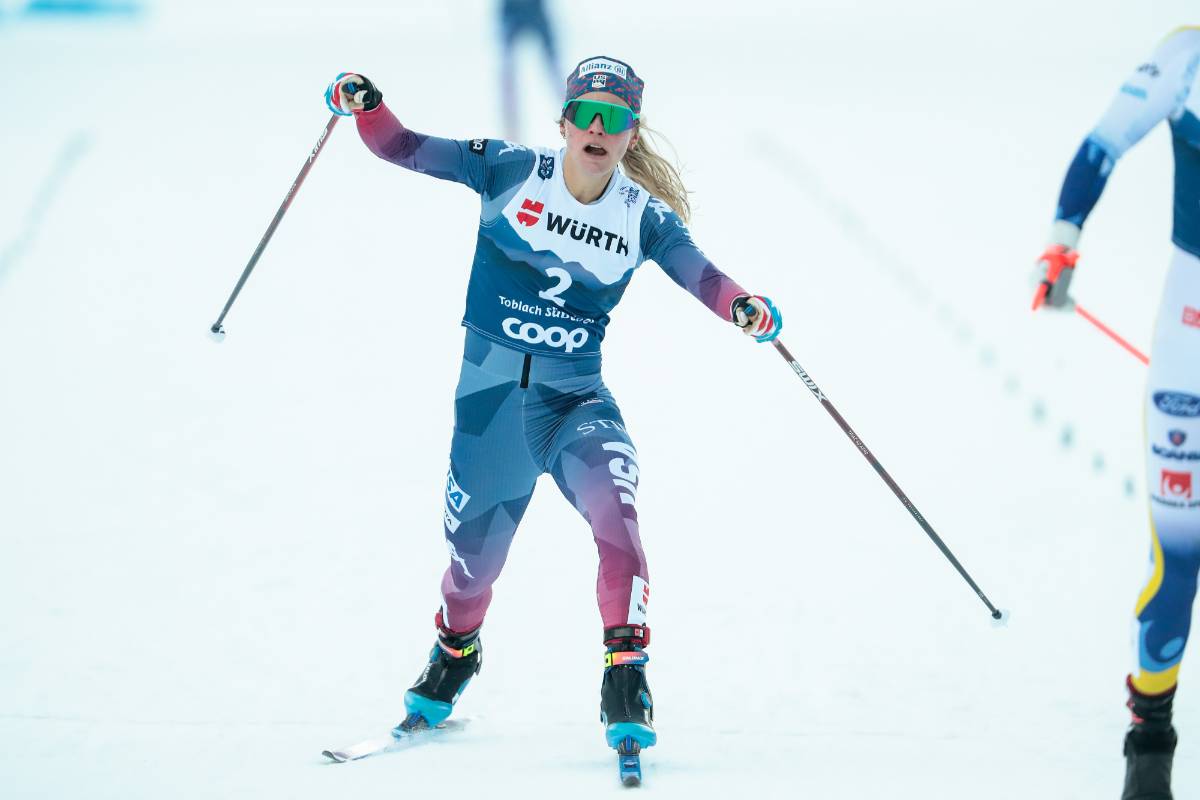
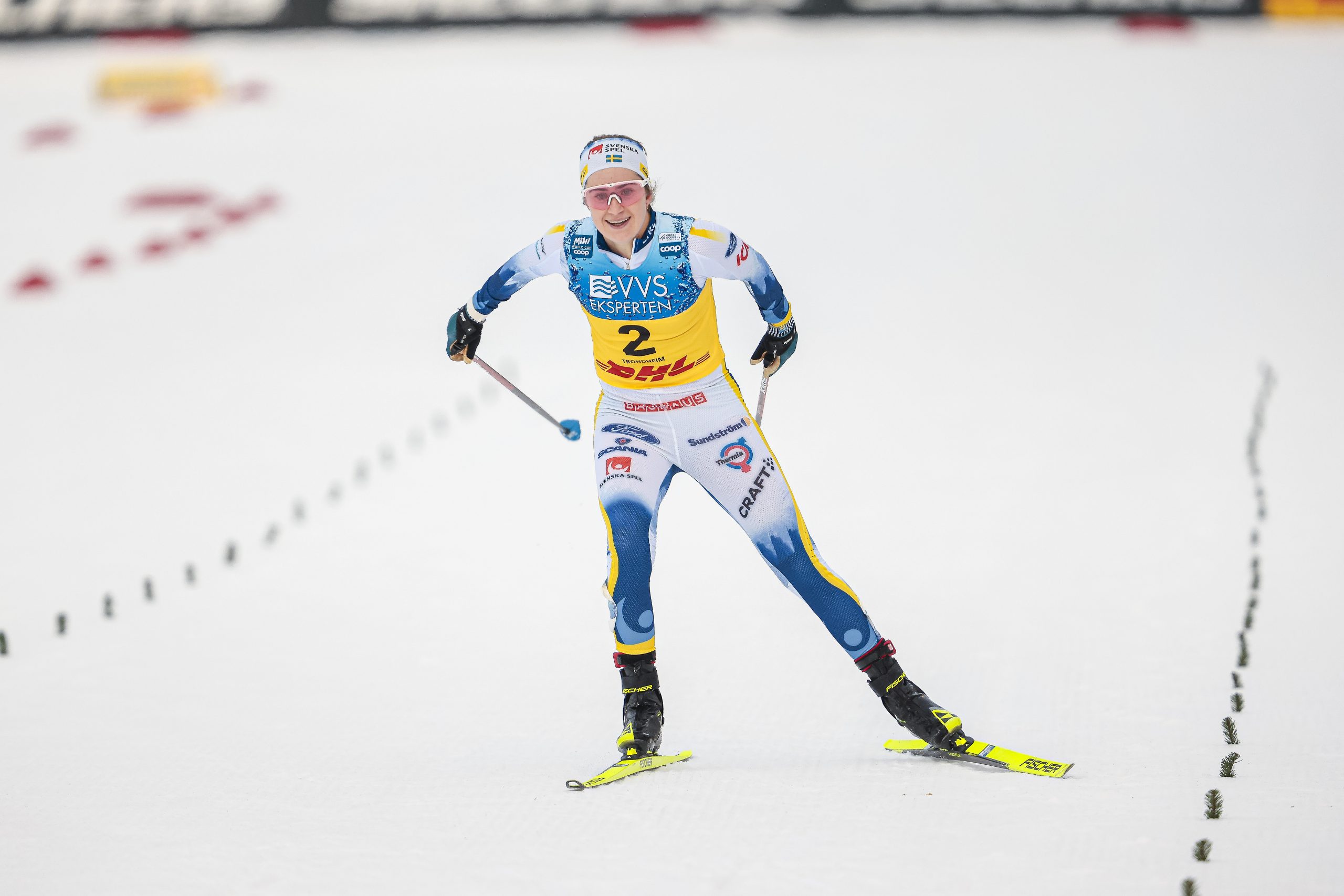
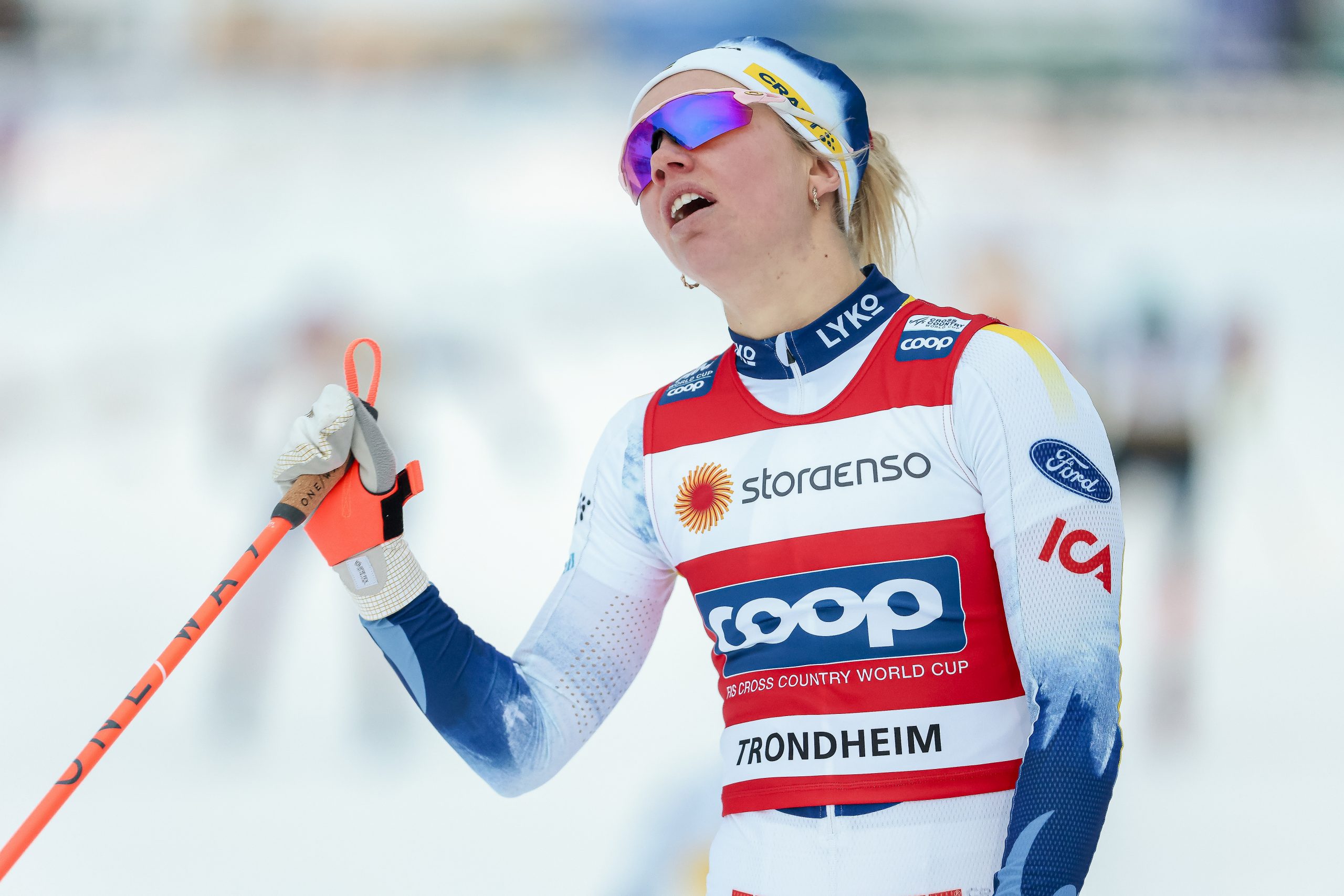
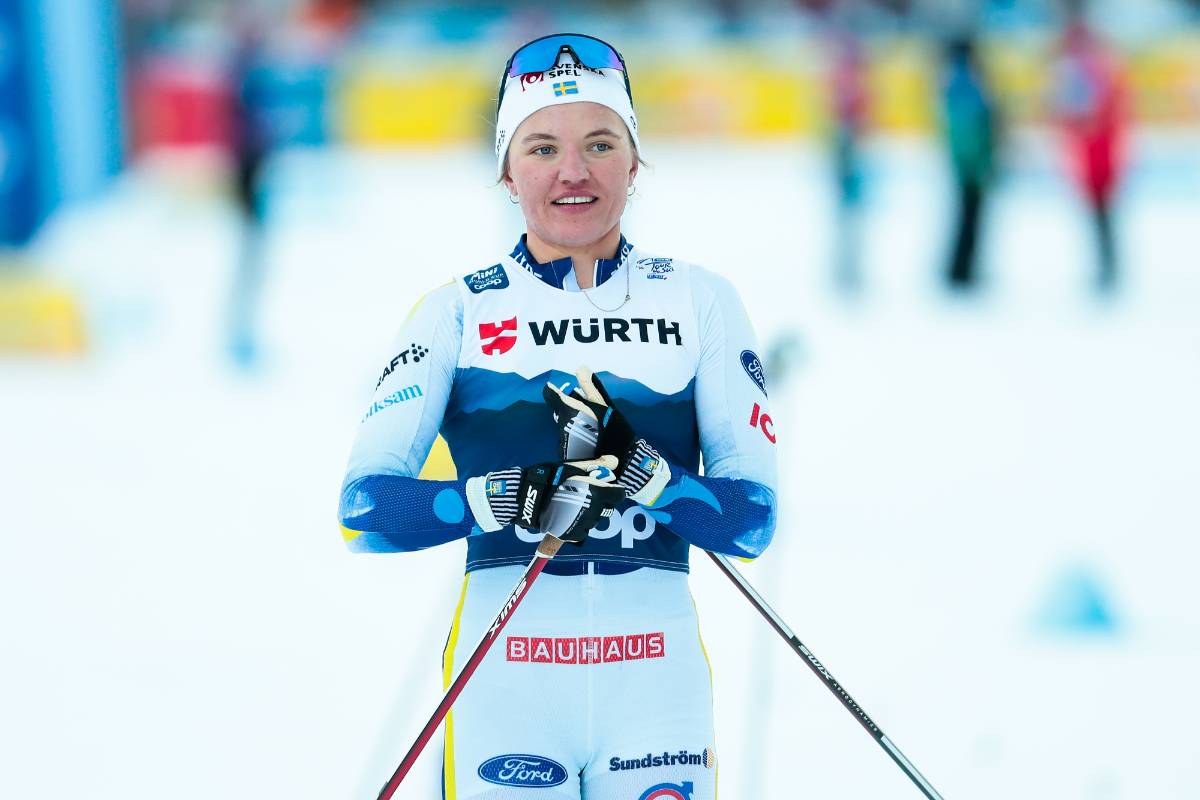
    Linn Svahn (SWE) has been plagued by shoulder injuries, having been forced to wait nearly three years between World Cup victories. With her victory in Tour de Ski Stage 1, she seemed pleased to be making up for lost time. (Photo: Modica/NordicFocus)

    Over eighteen editions, the rhythms of the Tour de Ski have become familiar for the World Cup for both skier and viewer alike. The stark change of scenery from the arctic fields and fjords of Northern Europe in Period I to the mountain valleys of Southern Europe indicates that the stakes have been raised right alongside the topography. Seven stages, contested over nine exhausting days, create an event whose stature grows with each passing year, following paths to victory forged by skiing’s greats.

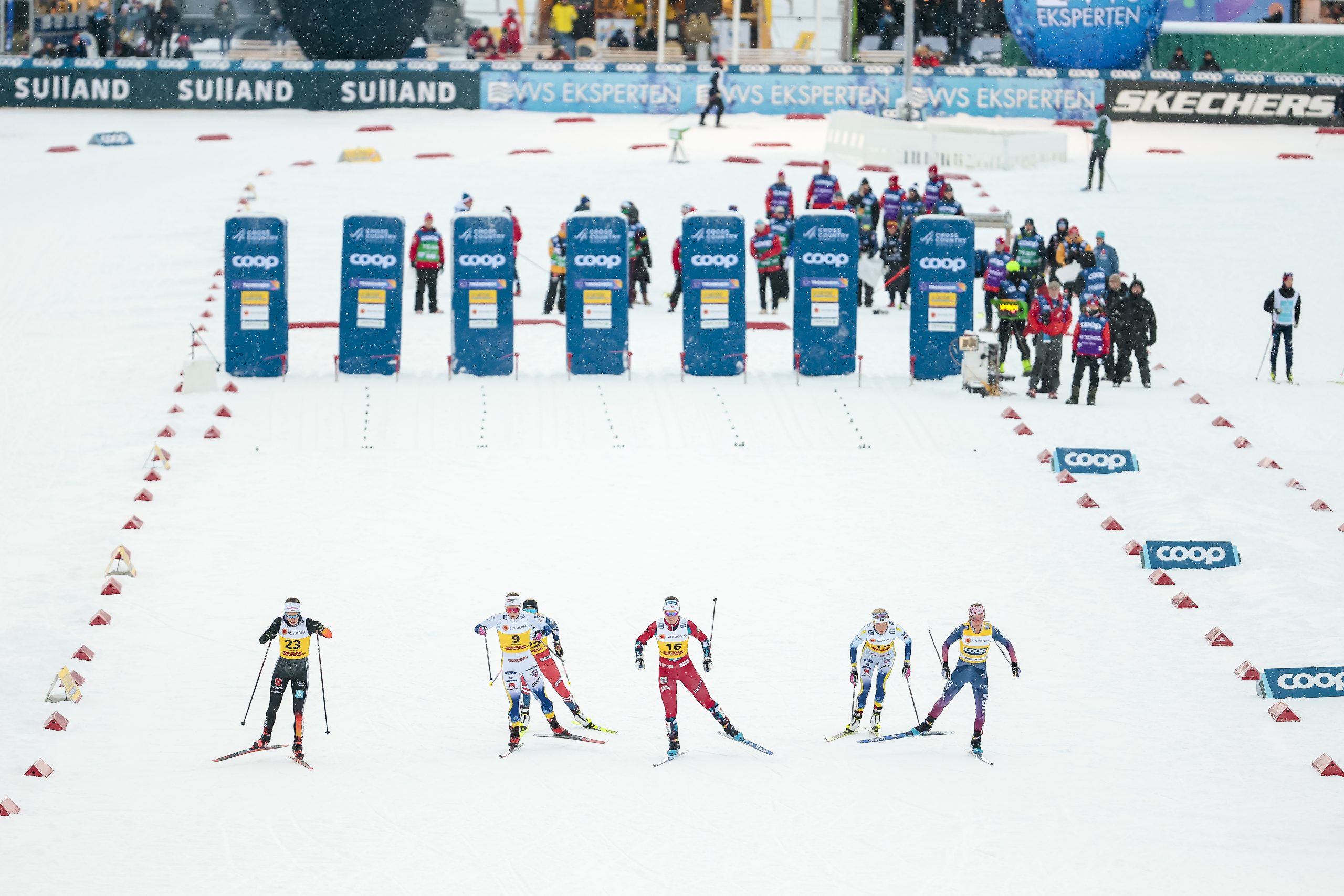
    Toblach played host to this year’s first Tour de Ski skate sprint stage. A fixture since the discipline was first pioneered in the early 2000s, the Toblach Sprint course has played an outsized role in garnering Sprint racing’s reputation as a tactical discipline that highlights not just the outright physical speed of the world’s greatest skiers, but the thoughtfulness with which they race, too. The Toblach course, “is really windy and punchy,” said Rosie Brennan (USA) on the skate sprint she raced today, “which makes it difficult to pass and requires really quick acceleration,” This year, the final stretch that rewarded drafting for many previous years was tempered by a chicane, but one that didn’t temper the overall effect. Sweden’s Linn Svahn mixed cunning and physical prowess throughout the entire day, earning her first individual World Cup win in nearly three years to open this year’s Tour de Ski. She was followed onto the podium by her teammate, Jonna Sundling, and Norwegian sprint specialist, Kristine Stavaas Skistad.  

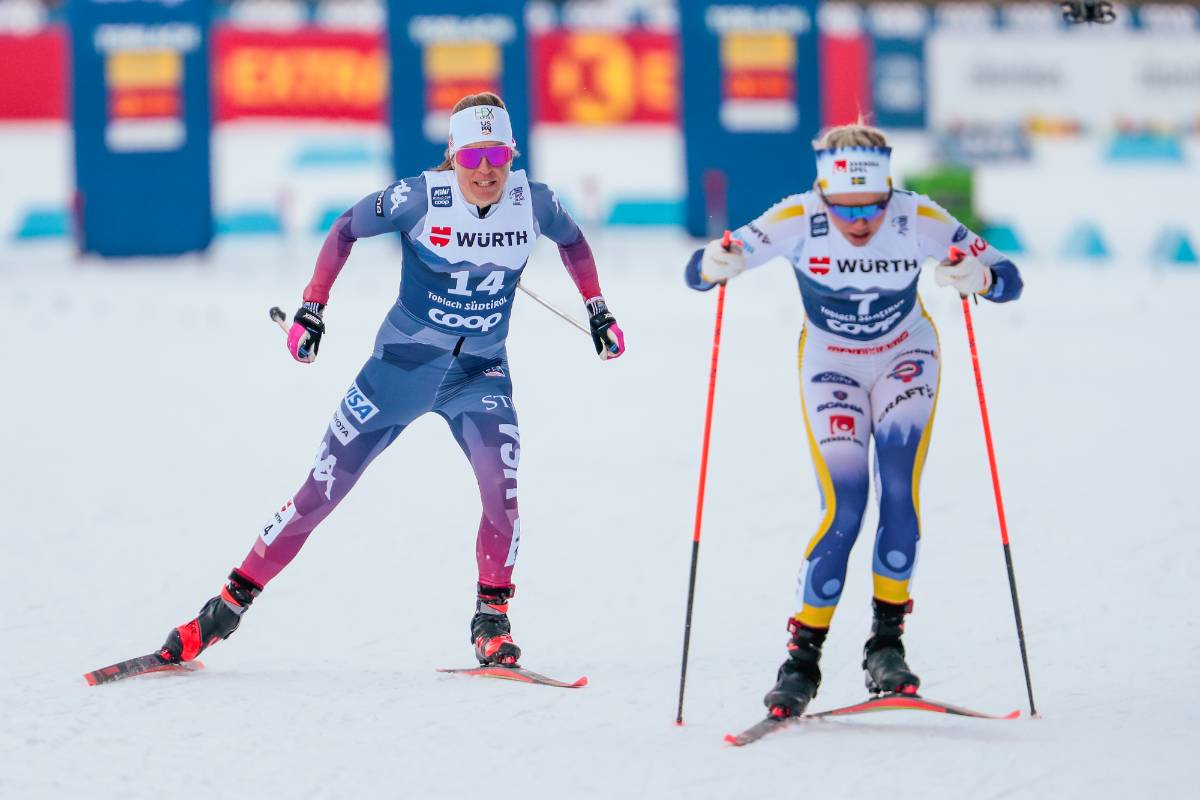
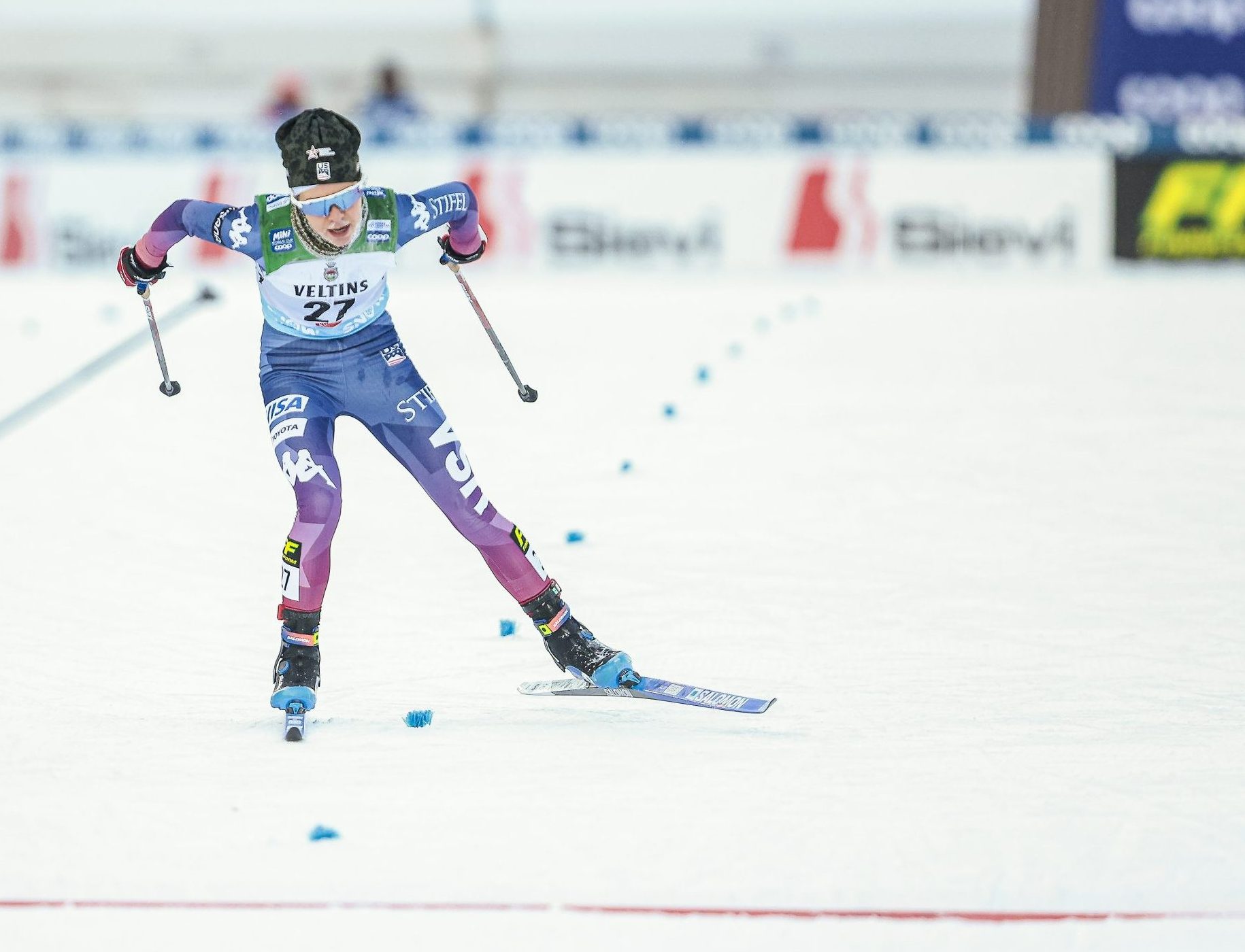
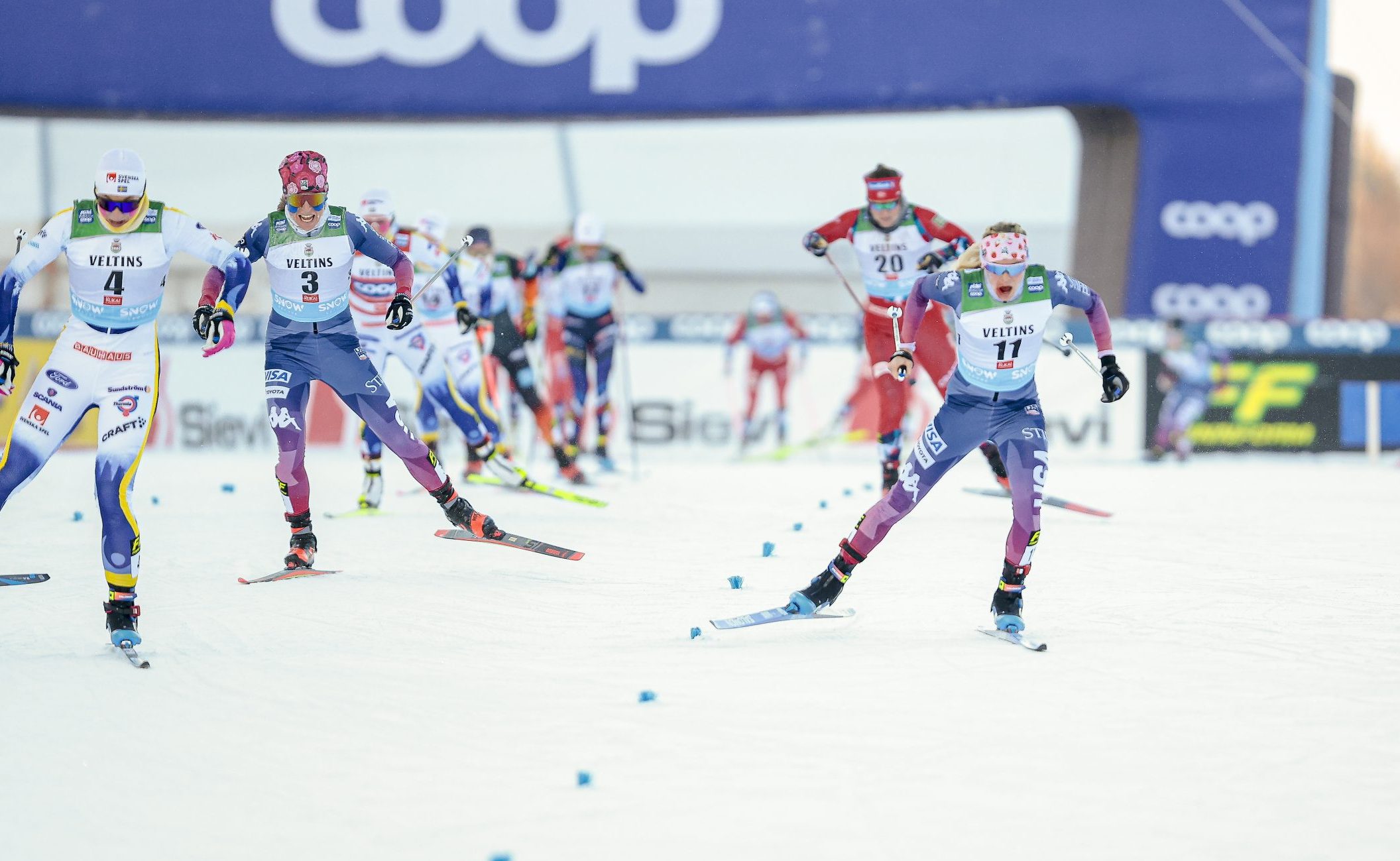
    For the Americans, it was Diggins qualifying second. And with promising early-season results in sprinting, there was an early opportunity to gain some advantage over other rivals in chasing her second Tour de Ski victory. She would be joined in the last quarterfinal of the day by sixth place qualifier Julia Kern (USA), with Rosie Brennan (USA) skiing out of the fourth quarterfinal to round out the three heat qualifiers for the Americans during Stage 1. Ultimately, Diggins would finish ninth, Kern 11th, and Brennan 27th. 

    The only Canadian competitor—Katherine Stewart-Jones—finished qualifying in an uncharacteristic 64th.

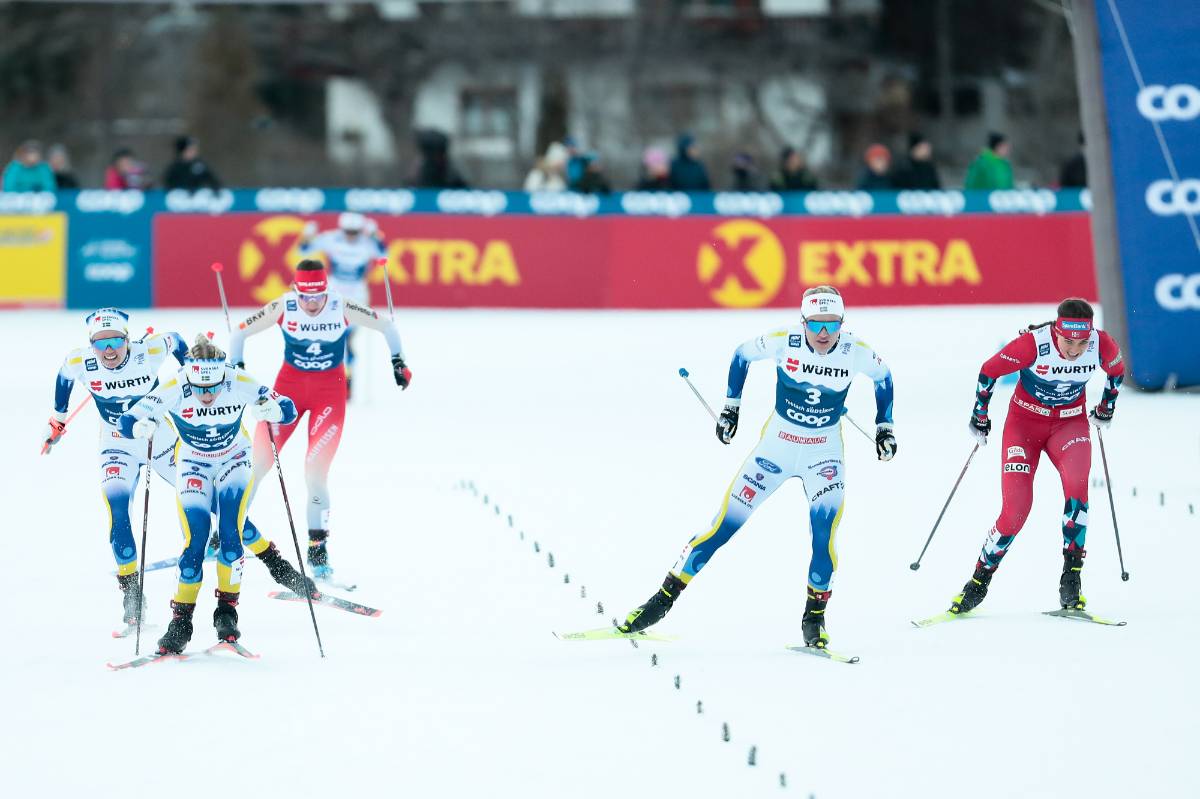
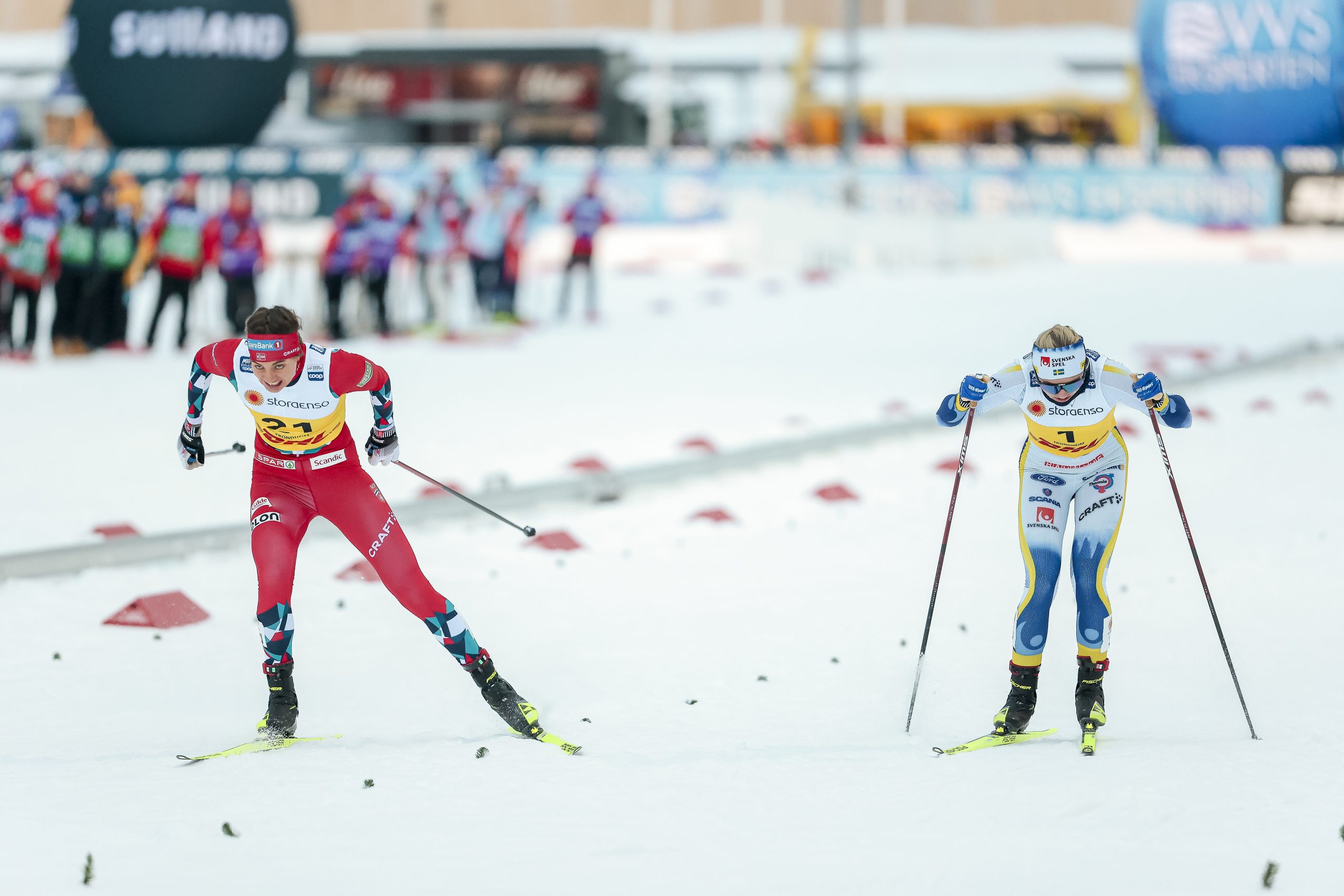
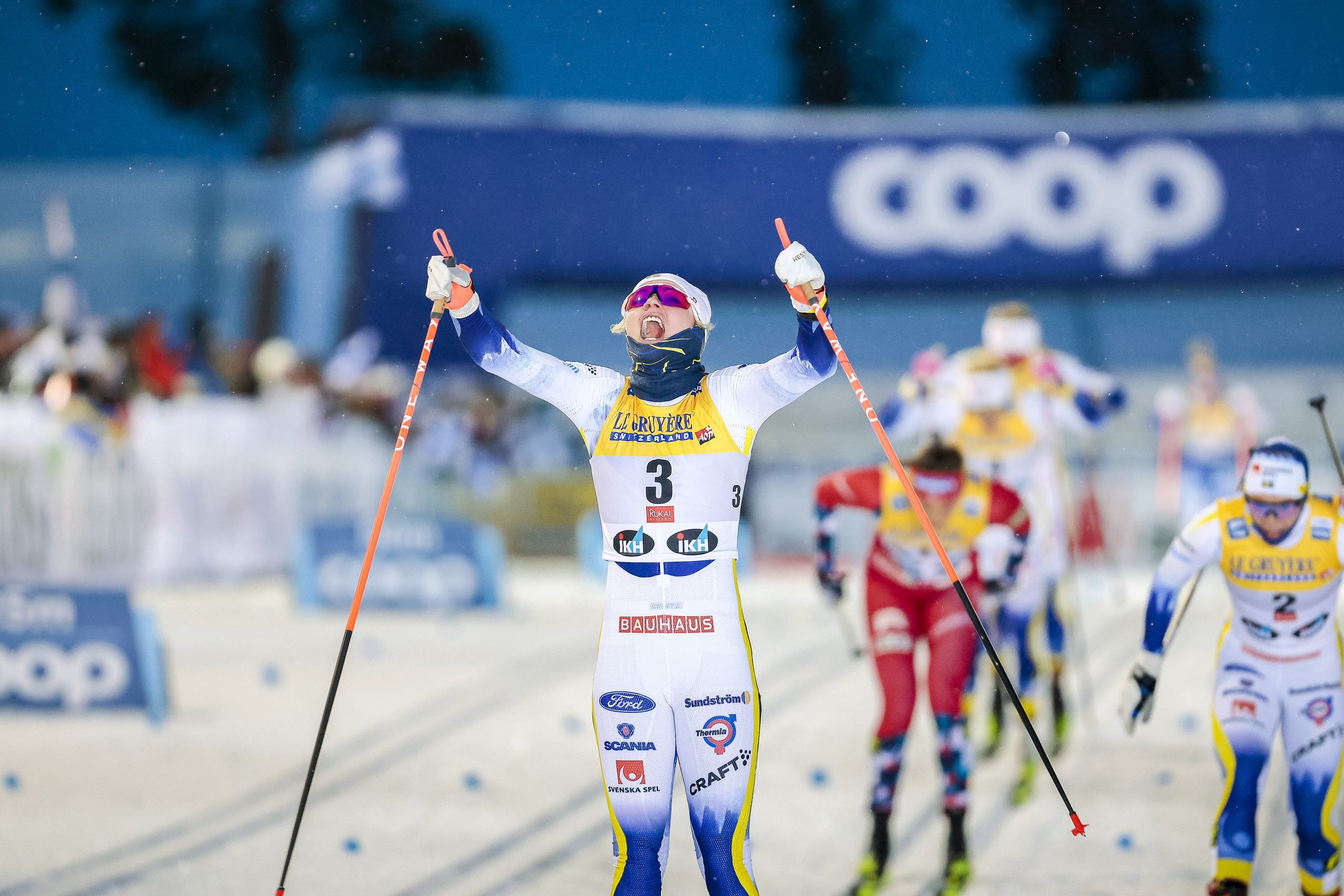
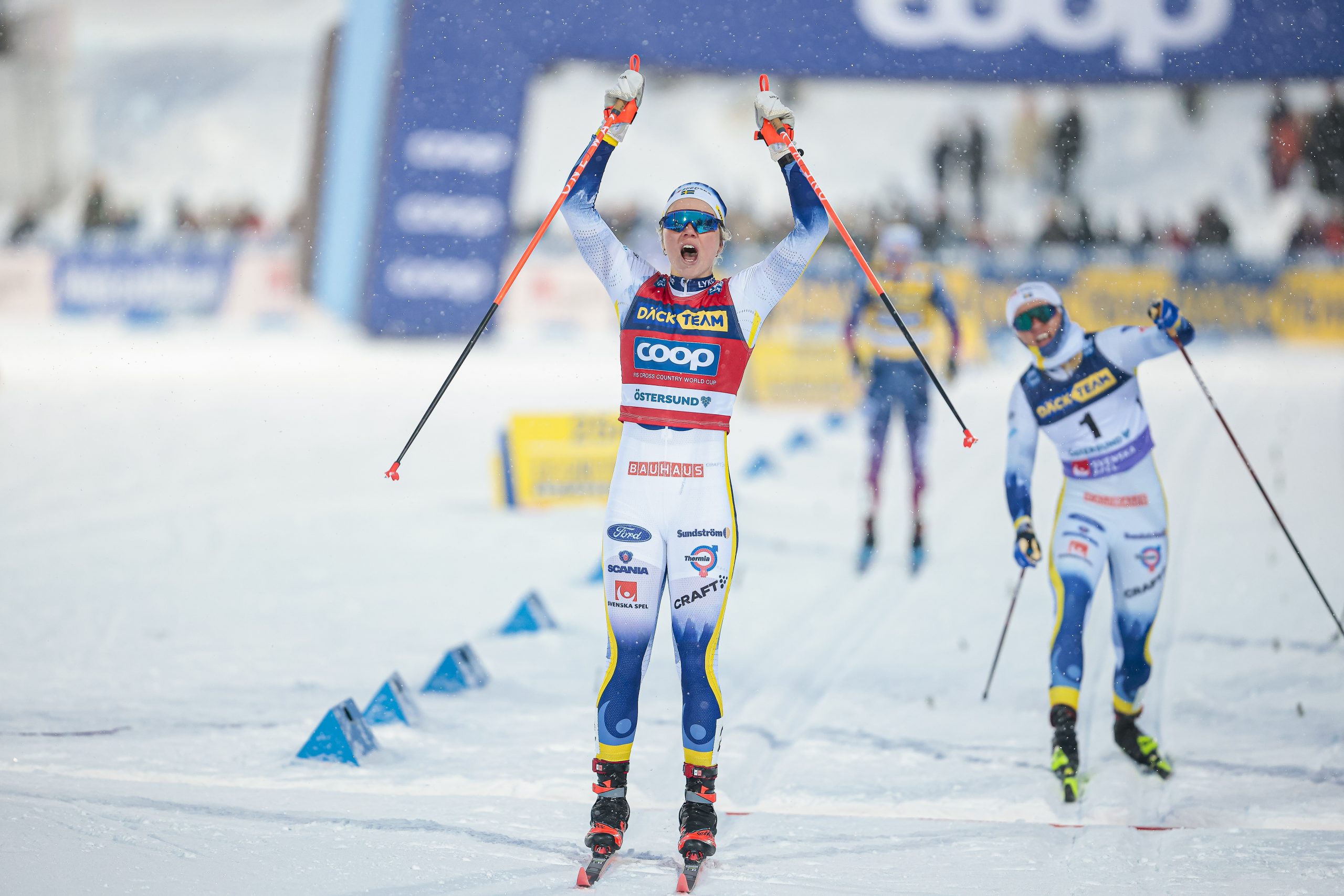
    Linn Svahn (SWE), bib 3, won the final sprint on Tour de Ski Stage 1 to take her first World Cup win in two years Friday. (Photo: NordicFocus)

    Svahn’s win capped an early season, and early career renaissance. At 24 years old, she already has experienced the full depth of skiing’s highs and lows, scoring perennial Sprint wins on the World Cup for two years in both 2019-2020 and 2020-2021, before a shoulder injury led to a long recovery. She won today by outsprinting the entire current crop of top sprint contenders. The win puts Svahn into the yellow bib of the Tour de Ski’s Overall leader going into Sunday’s 10 k Classic Interval Start race. 

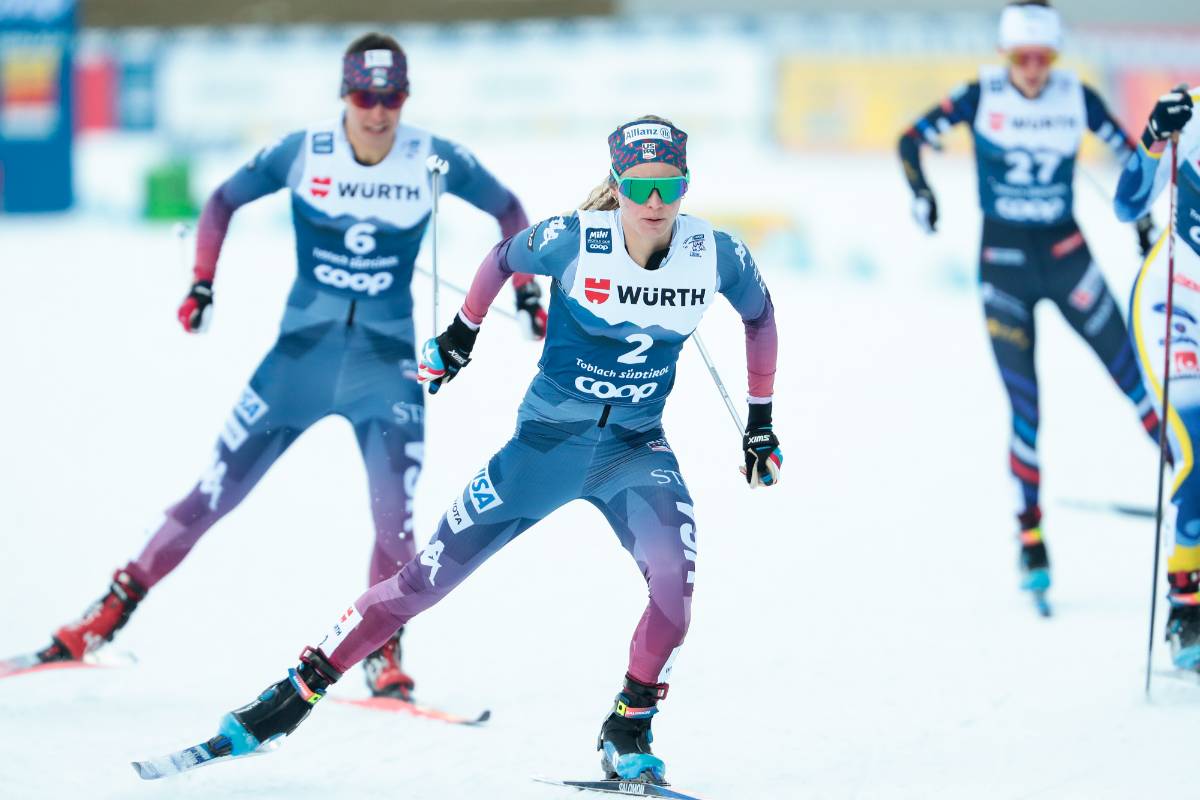
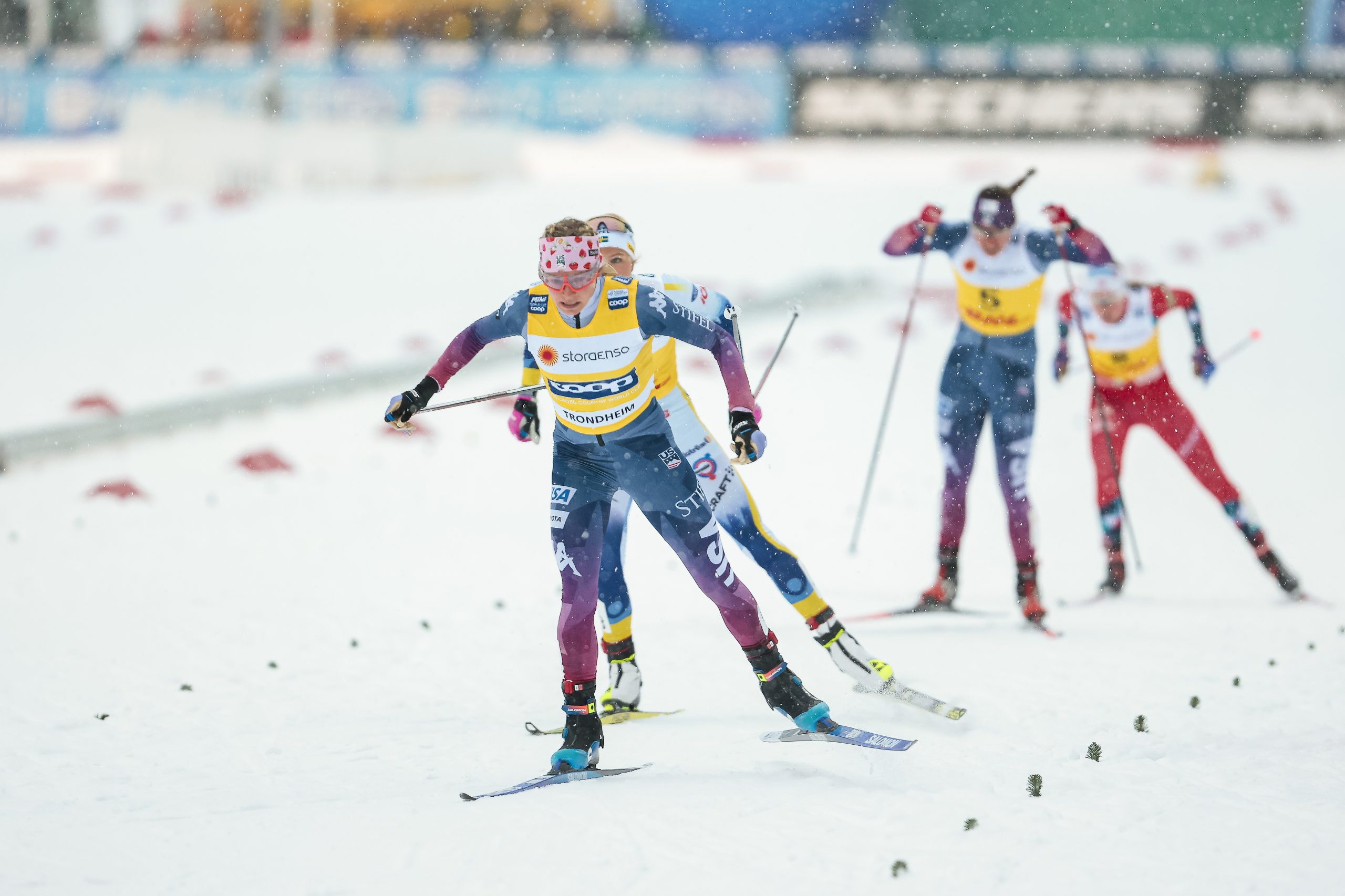
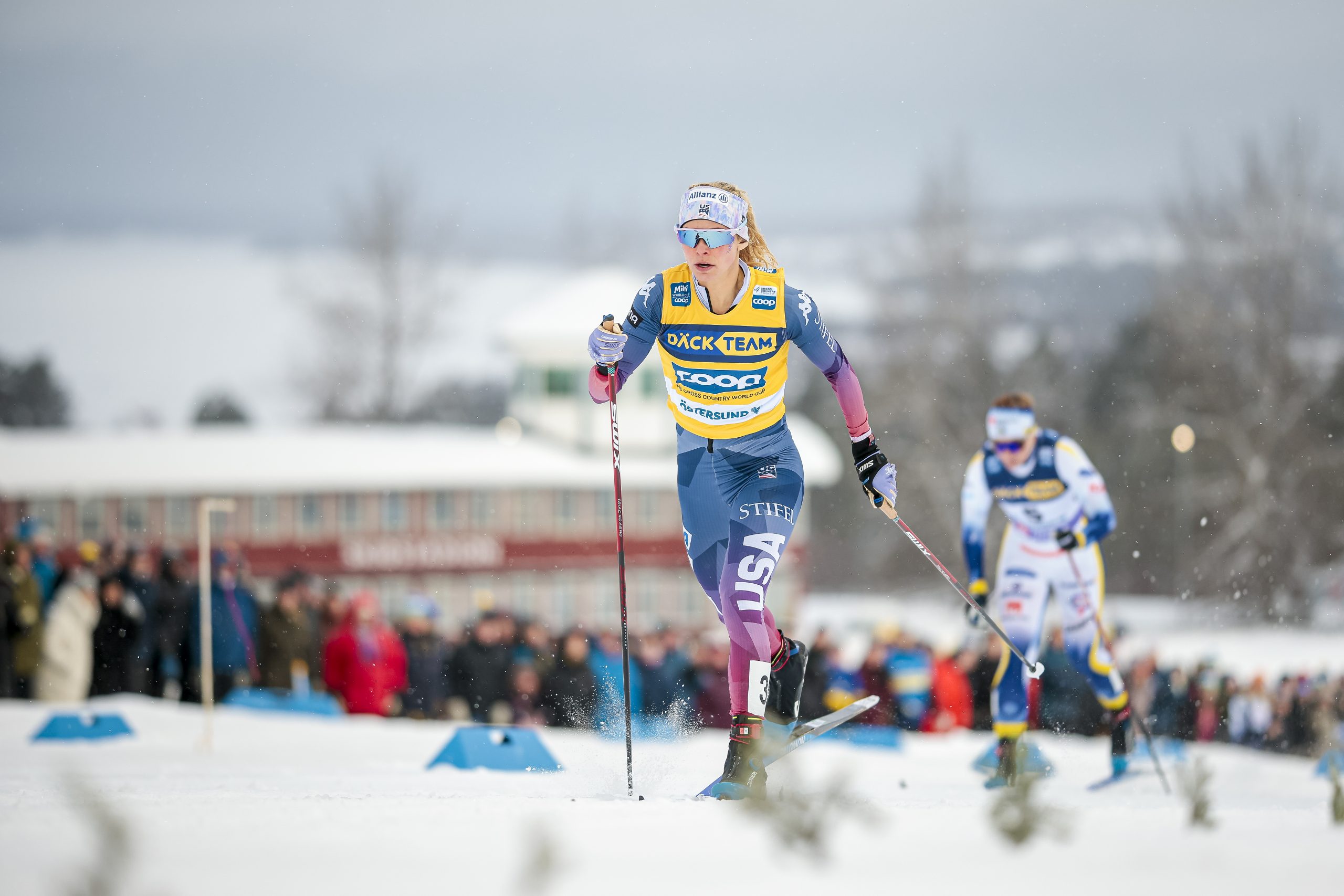
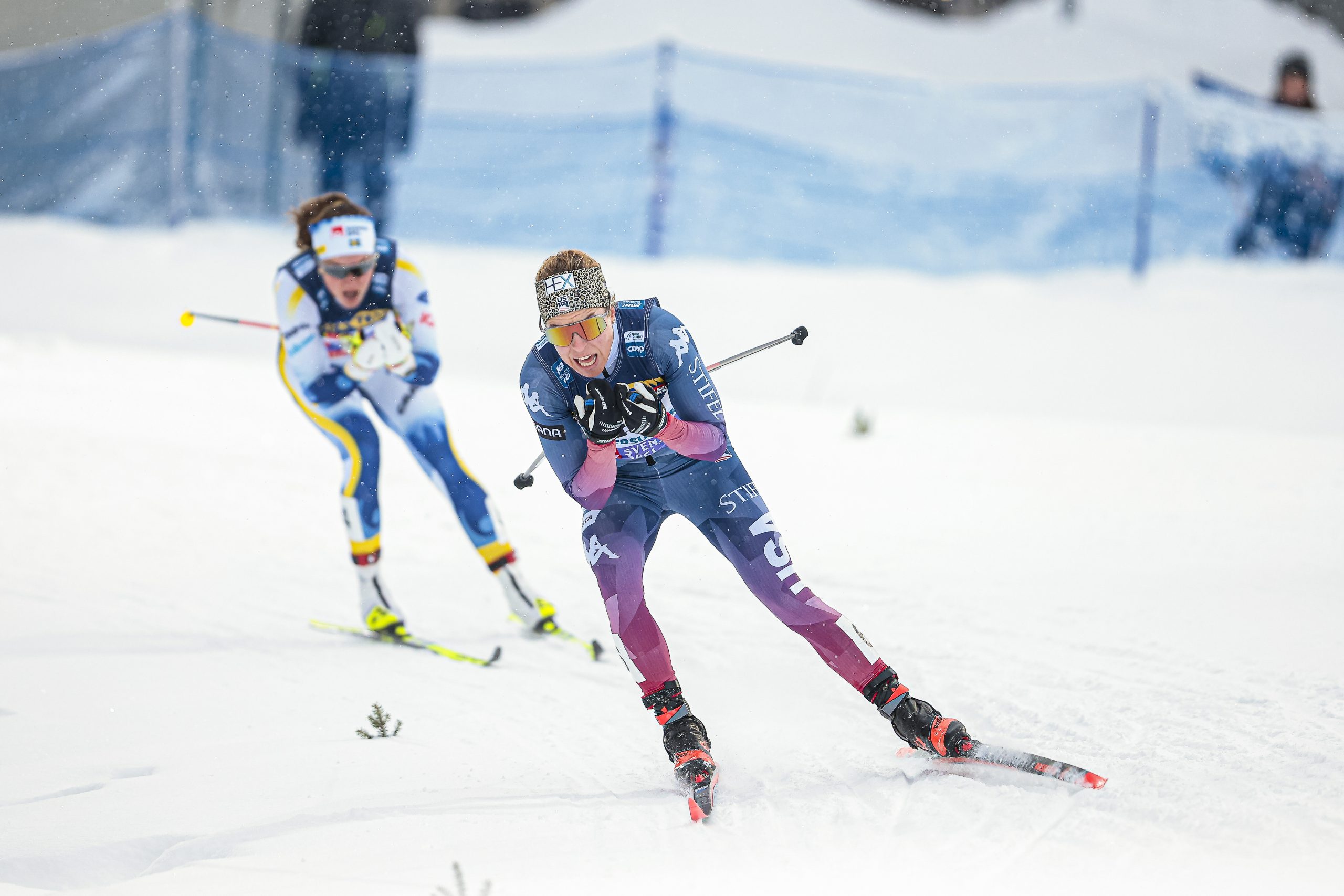
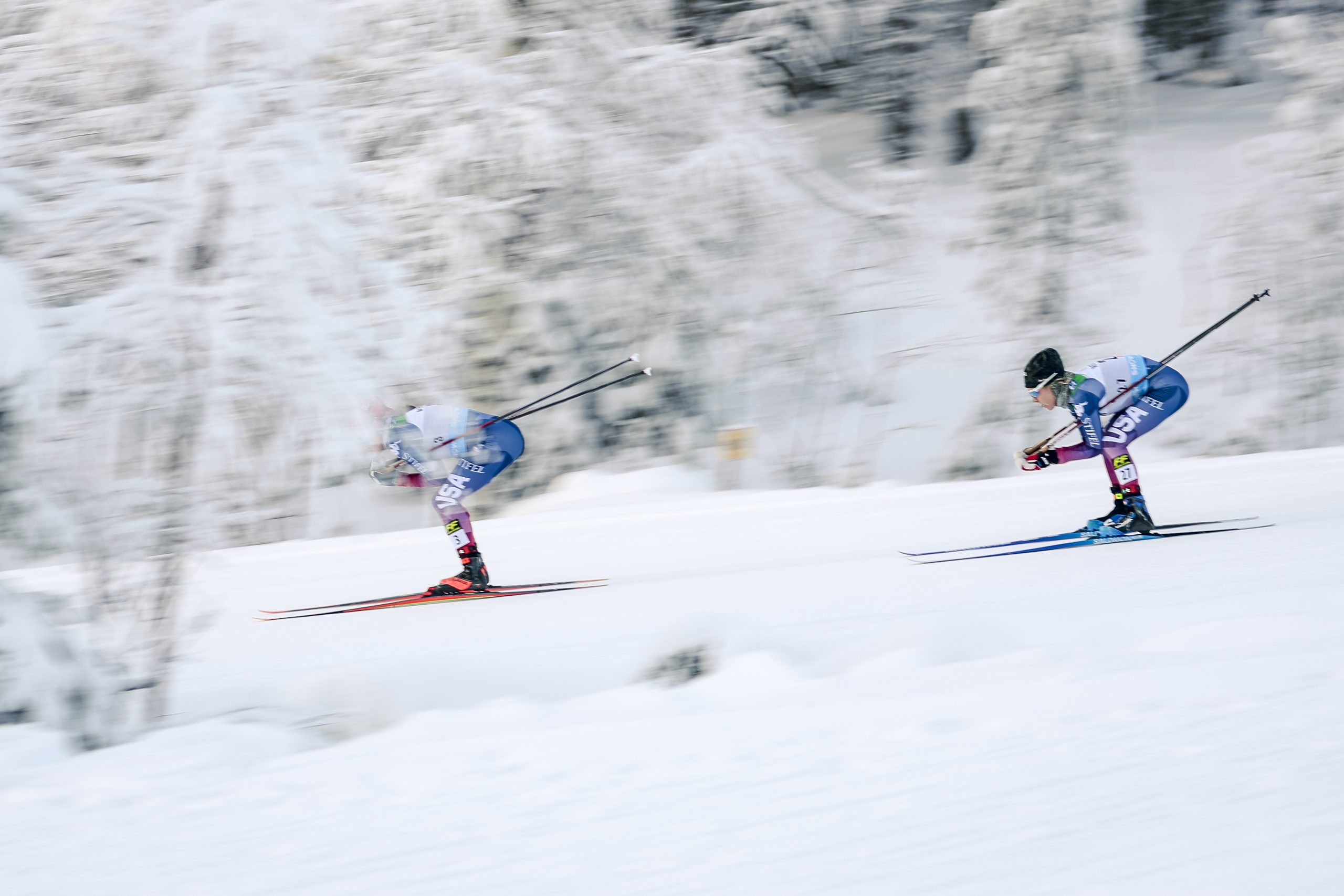
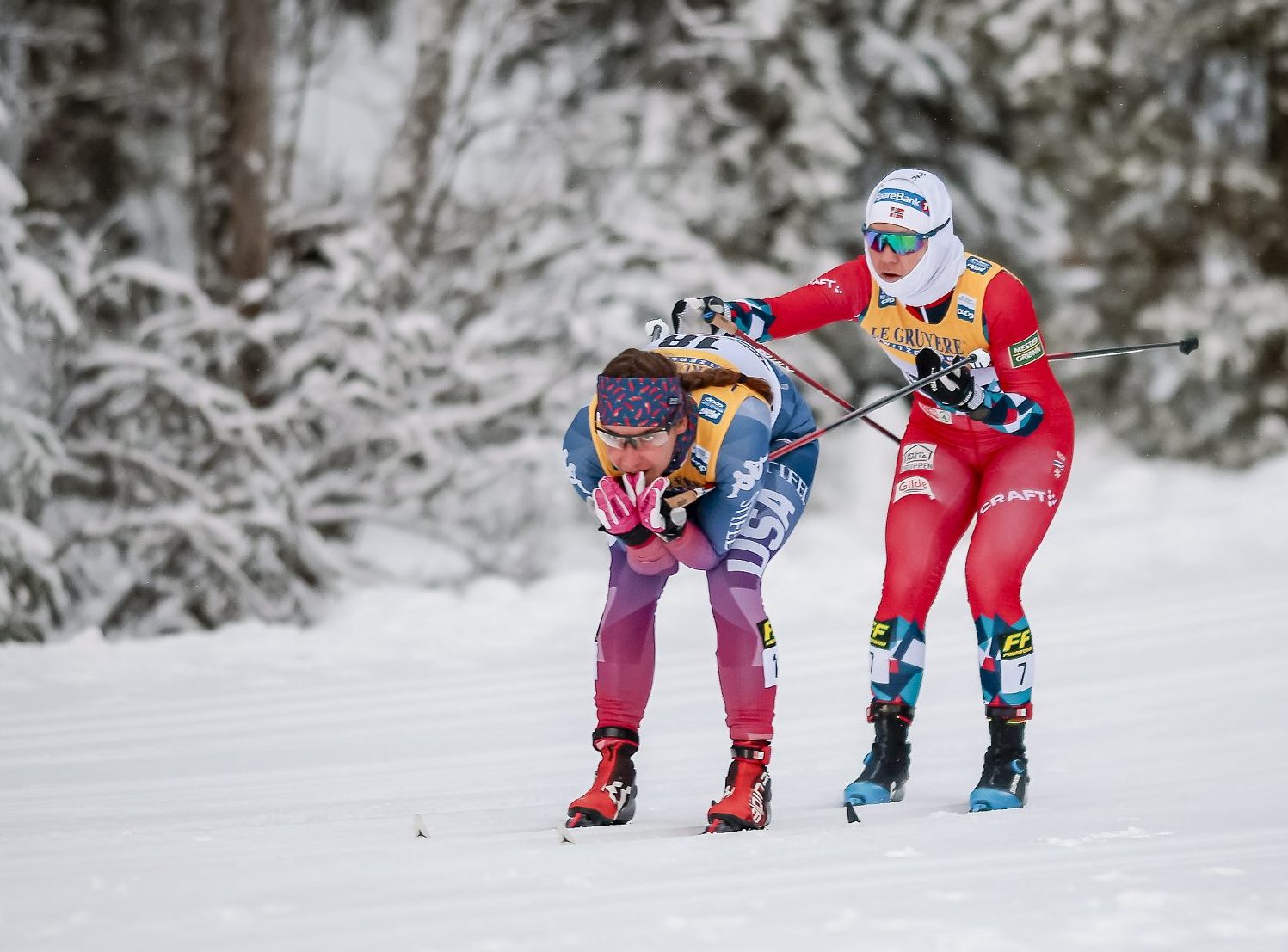
    Jessie Diggins (USA) and Julia Kern (USA) skied in lockstep during their quarterfinal on Friday. Diggins finished the day in 7th Overall in the Tour de Ski standings, setting her up to compete for a second career TDS victory this week. (Photo: NordicFocus)
    Diggins Starts Strong in Tour de Ski Overall Chase

    Diggins came into the 2024 Tour de Ski as the leader of the World Cup’s Overall classification; however, that didn’t come with the usual Yellow bib that the World Cup leader wears. Instead, last year’s Tour de Ski winner Karlsson (SWE) was in Yellow. Both Diggins and Karlsson would advance out of qualifying. 

    Before Diggins would take to the quarterfinal, the Swedish-Norwegian duo of Sundling and Skistad would lead a hard-driving quarterfinal alongside Frida Karlsson that saw the Yellow bib finish in third. The second quarterfinal produced a lucky loser in Estonia’s Patricija Eiduka, so Karlsson would be on the outside looking in for the semi-finals. Karlsson would finish Stage 1 in 14th place.

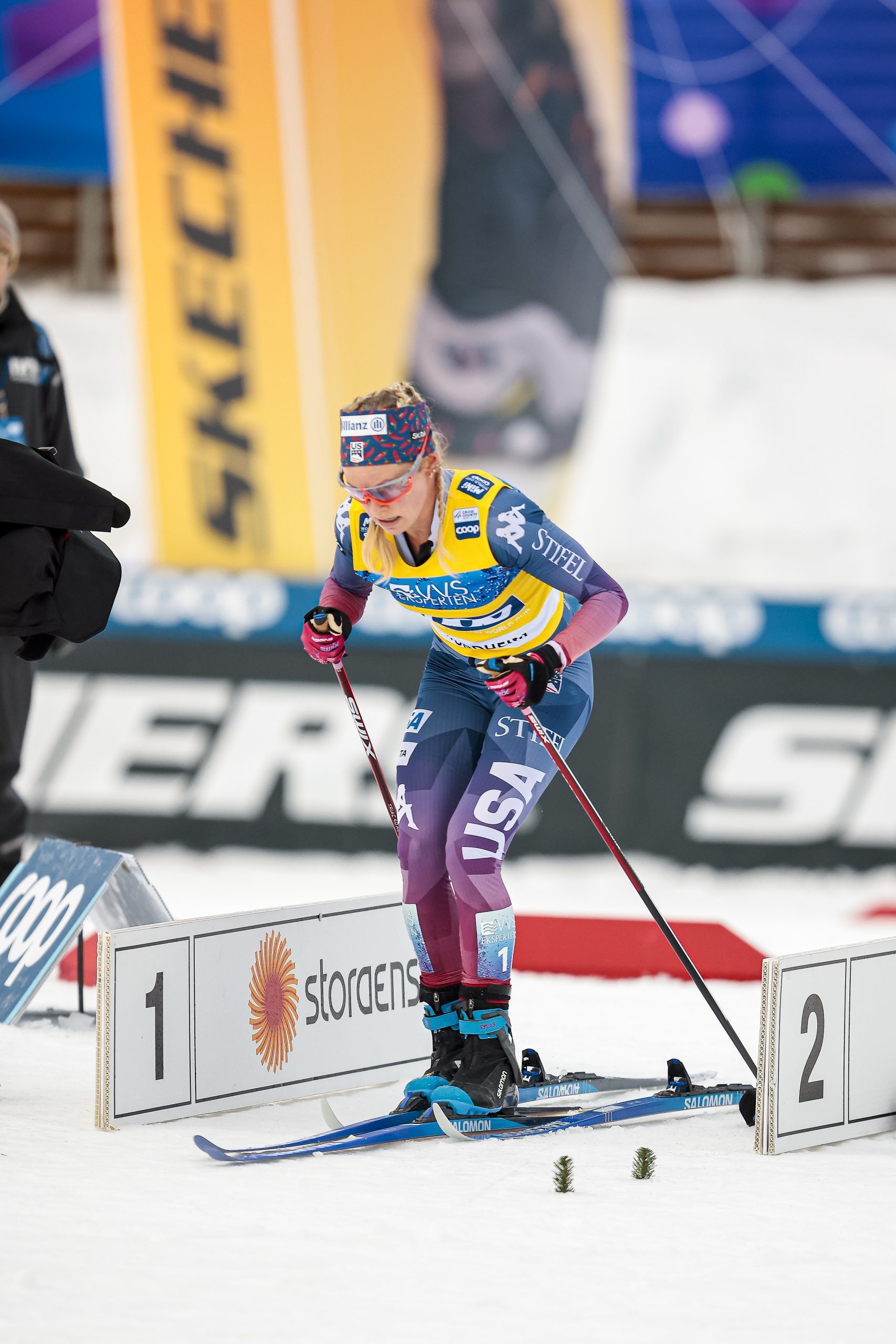
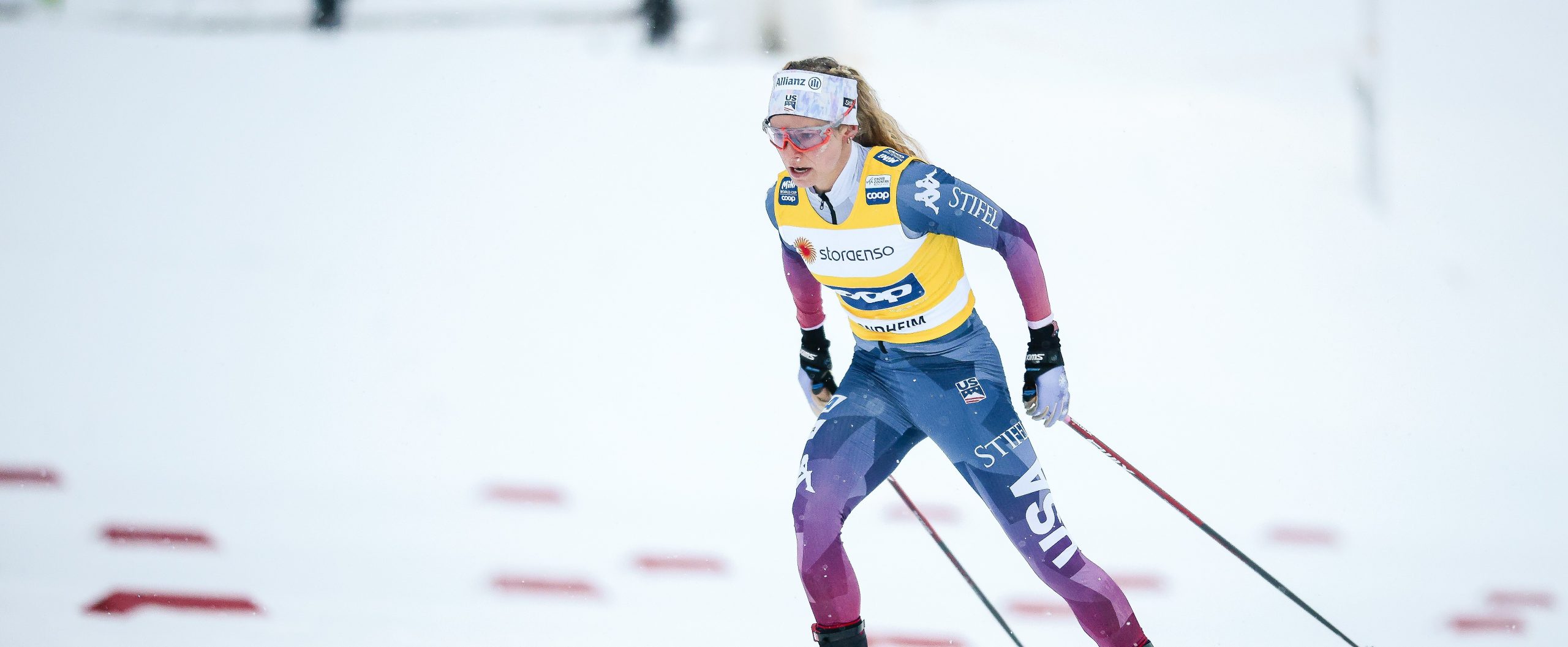
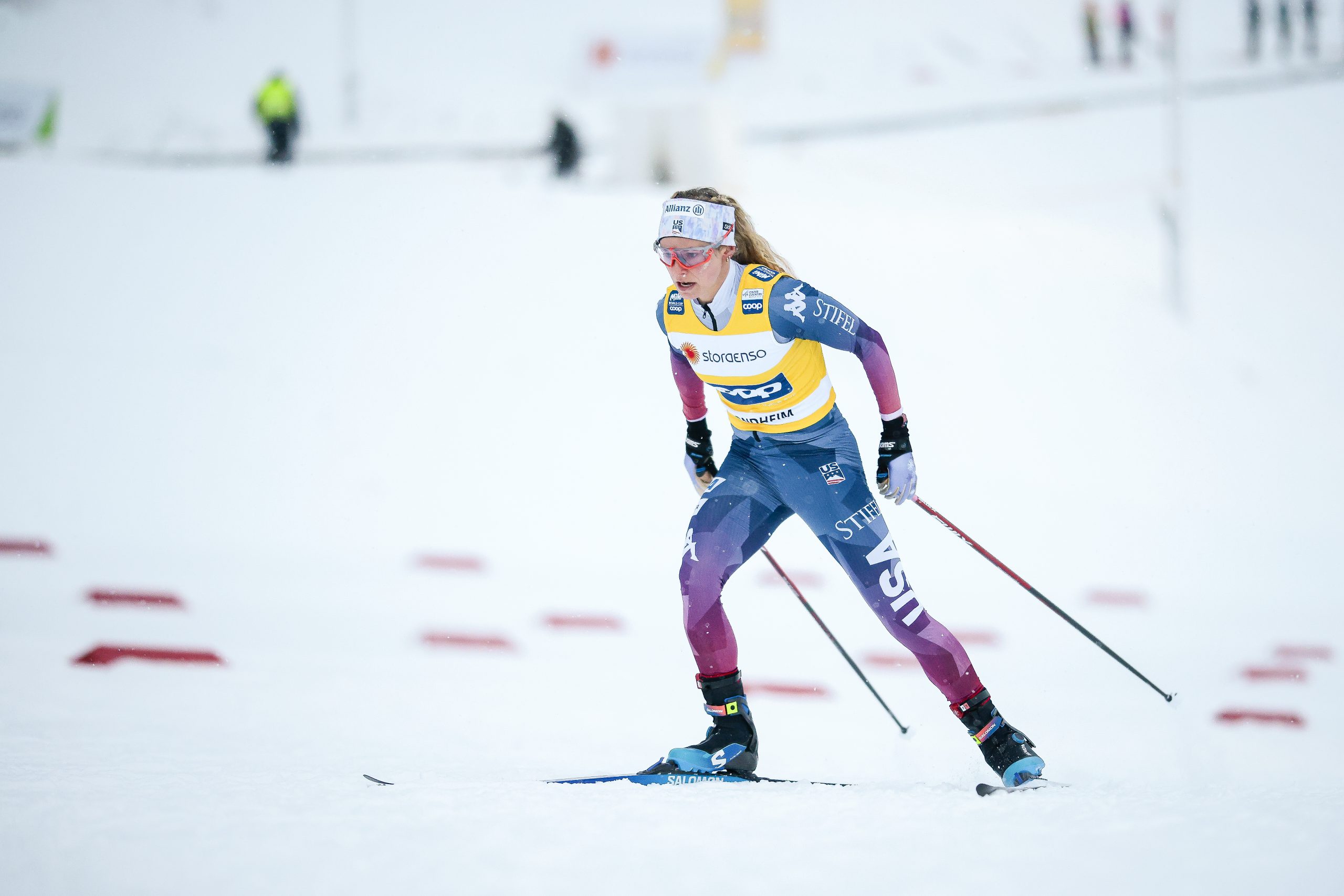
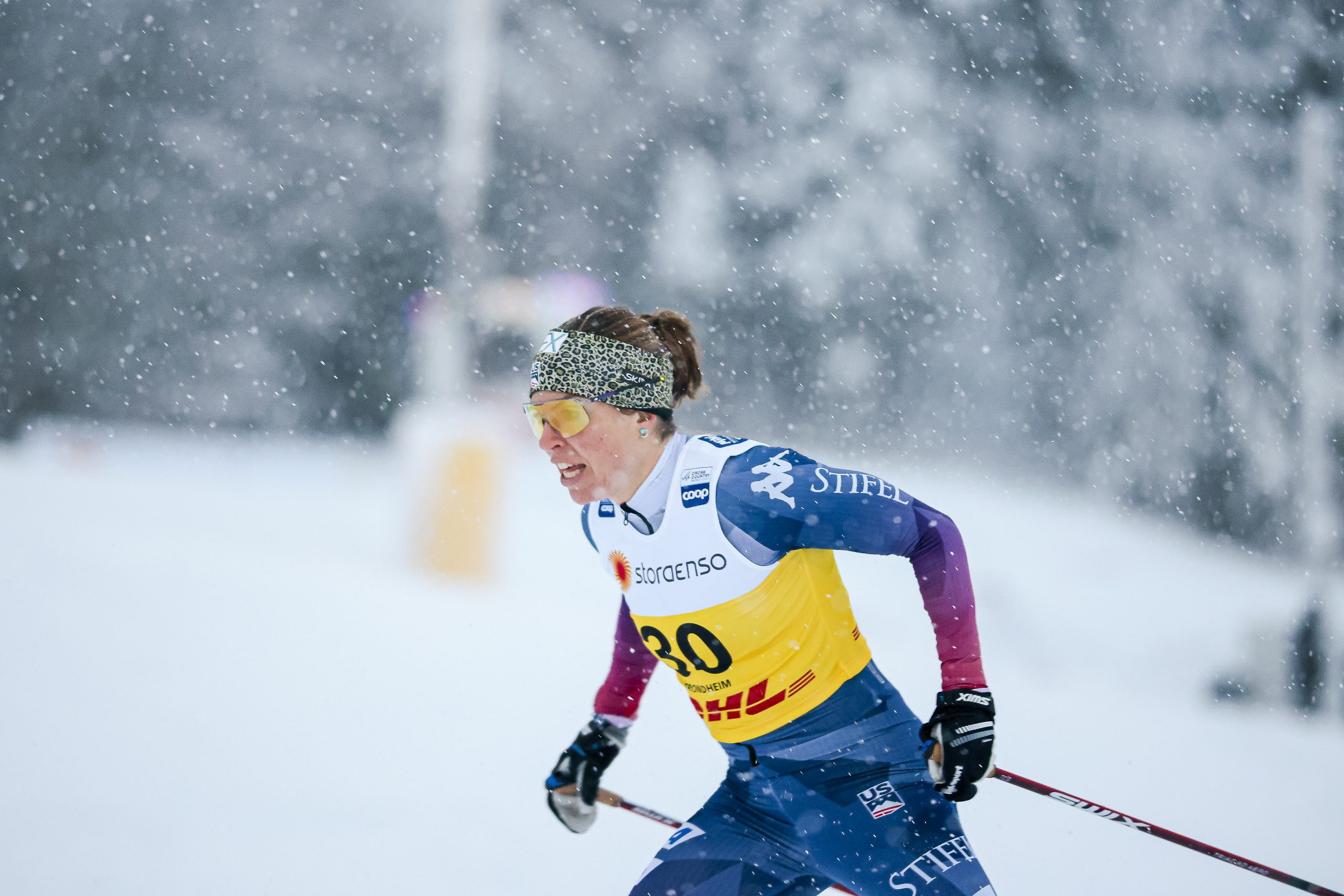
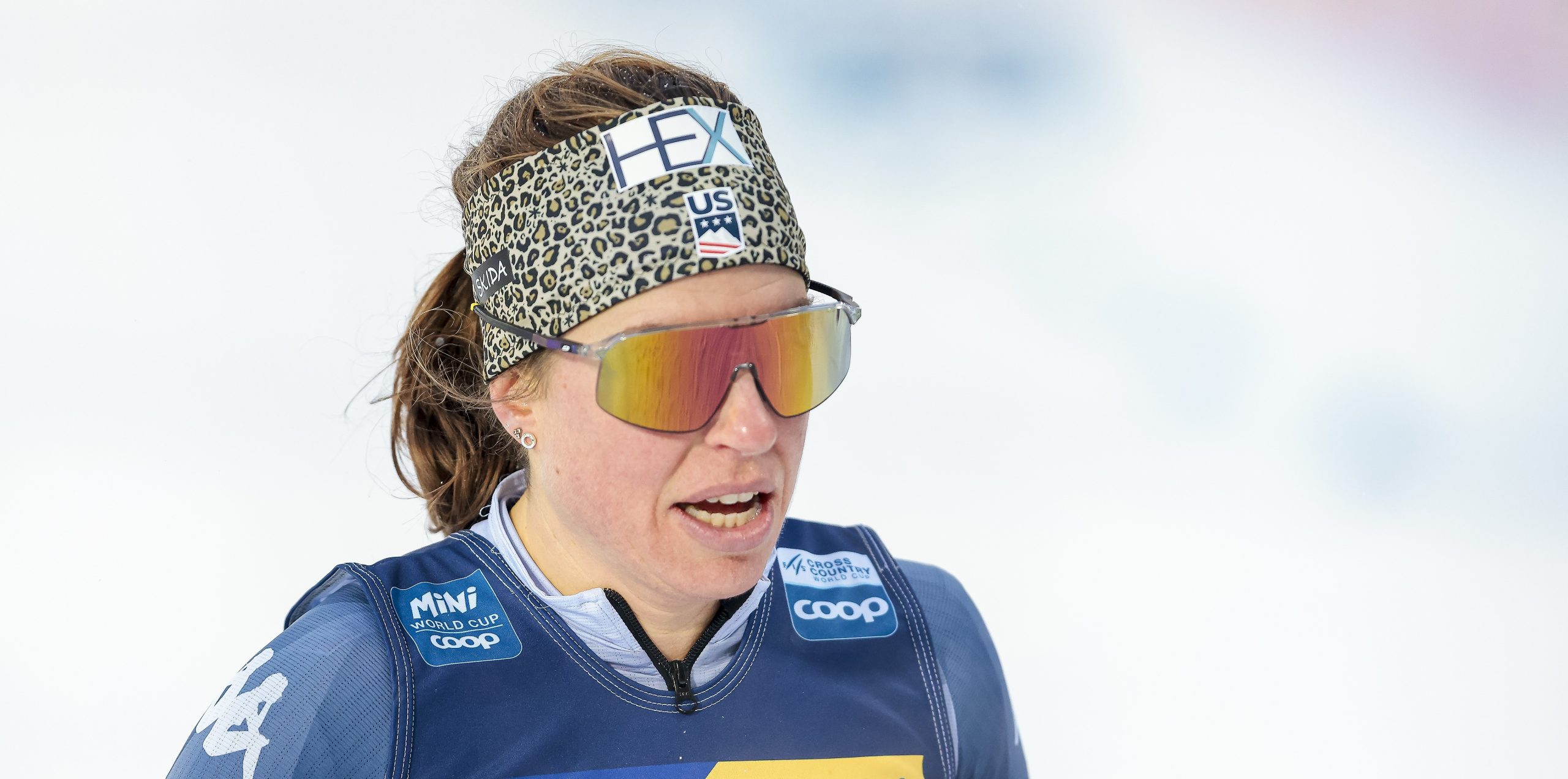
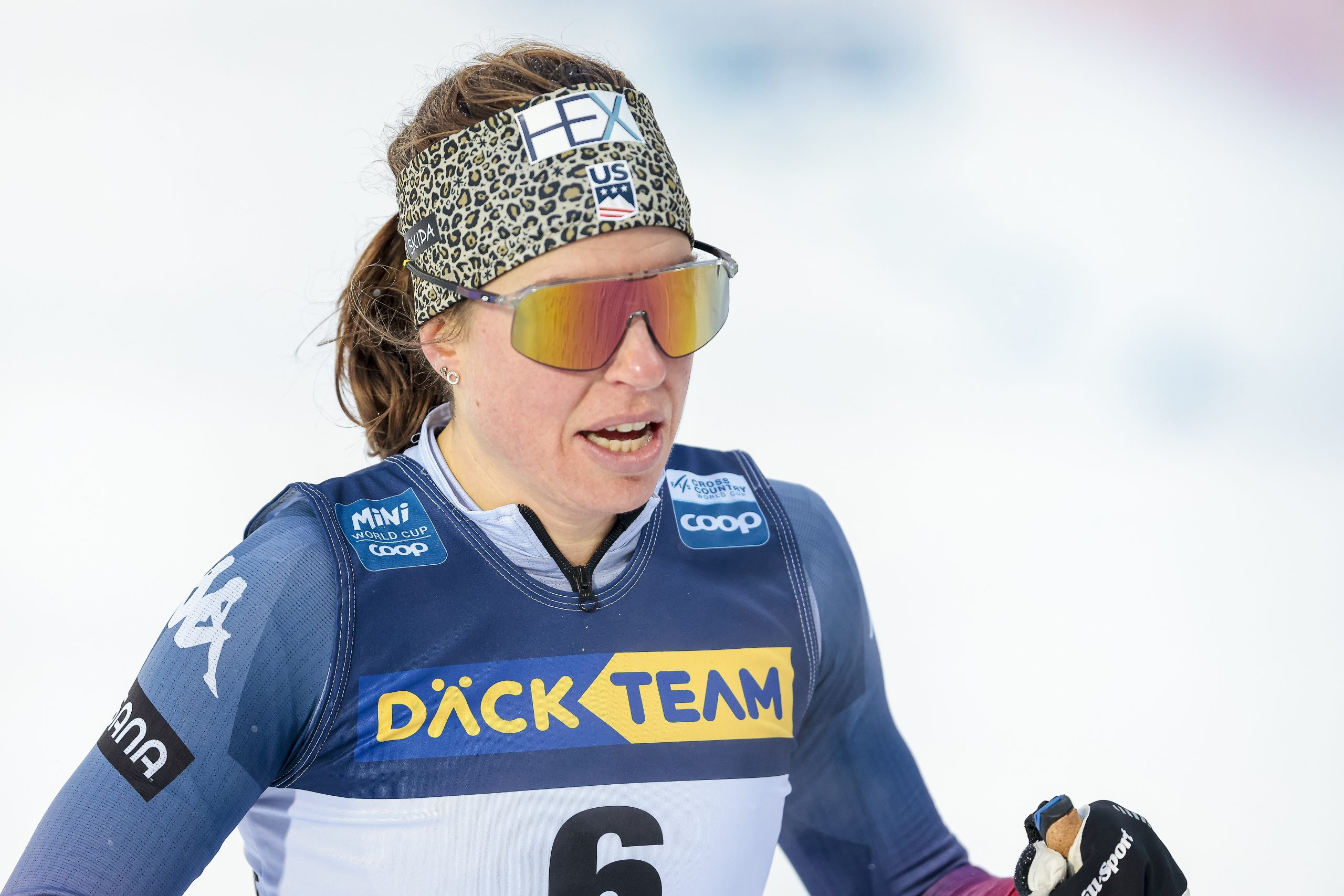
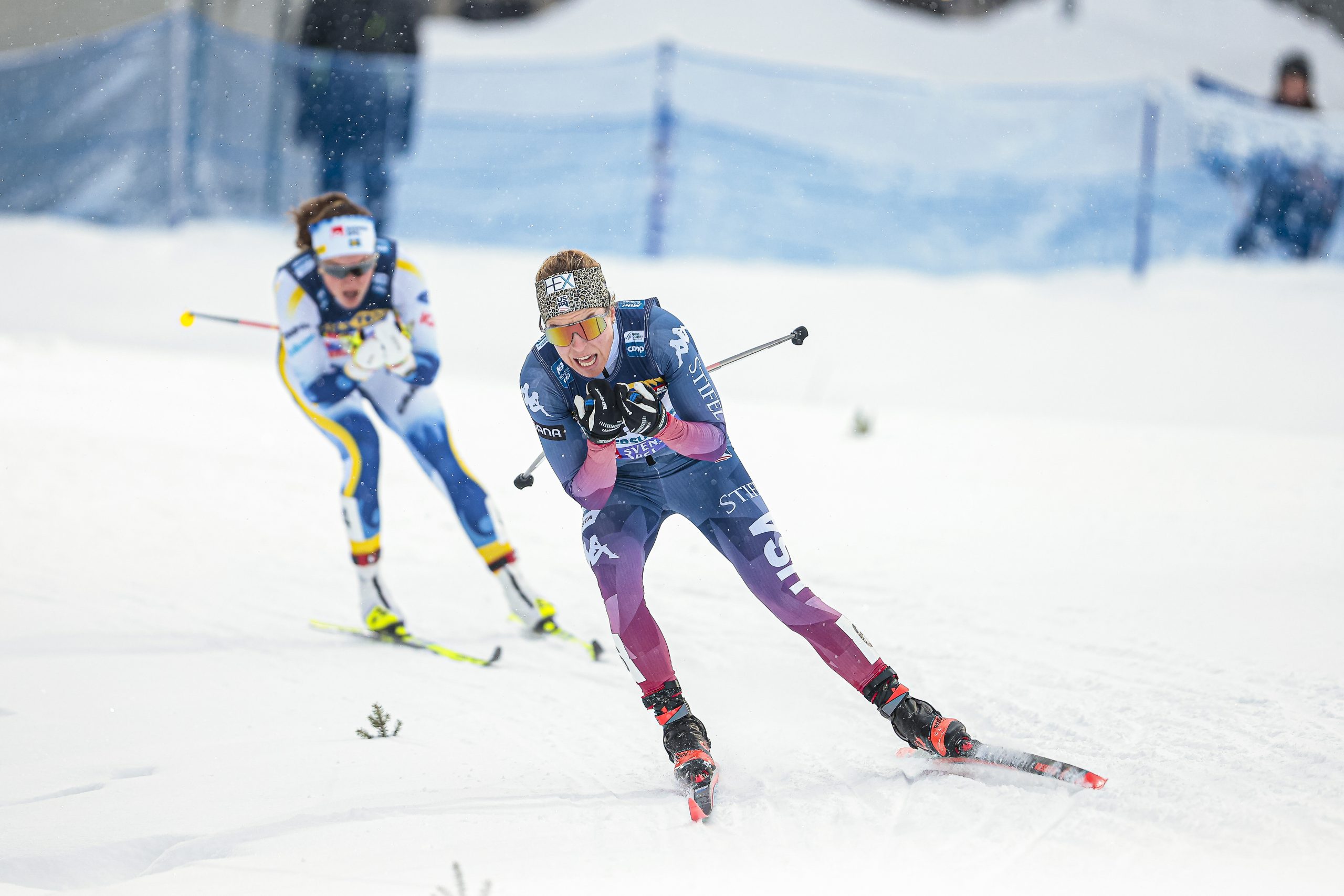
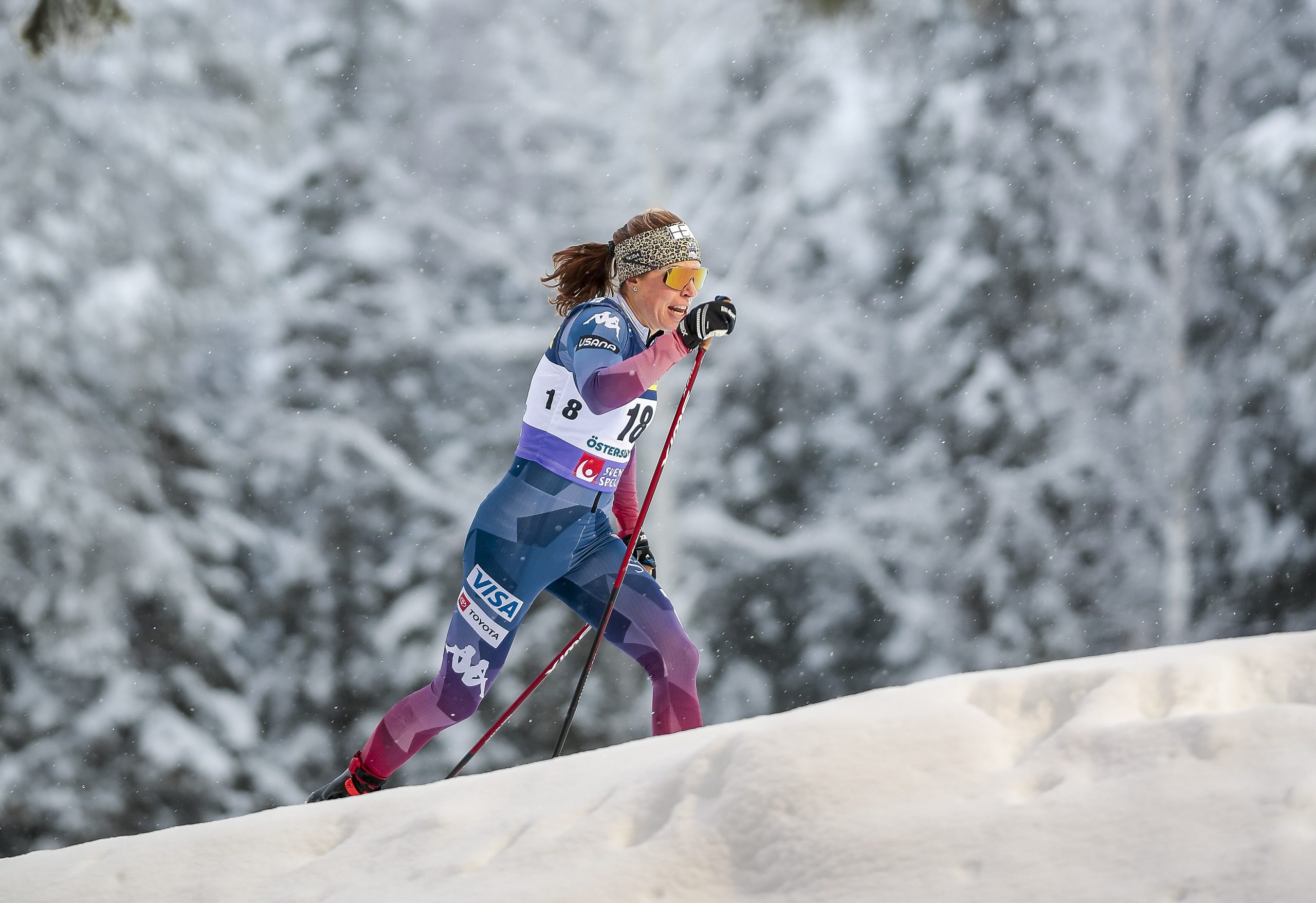
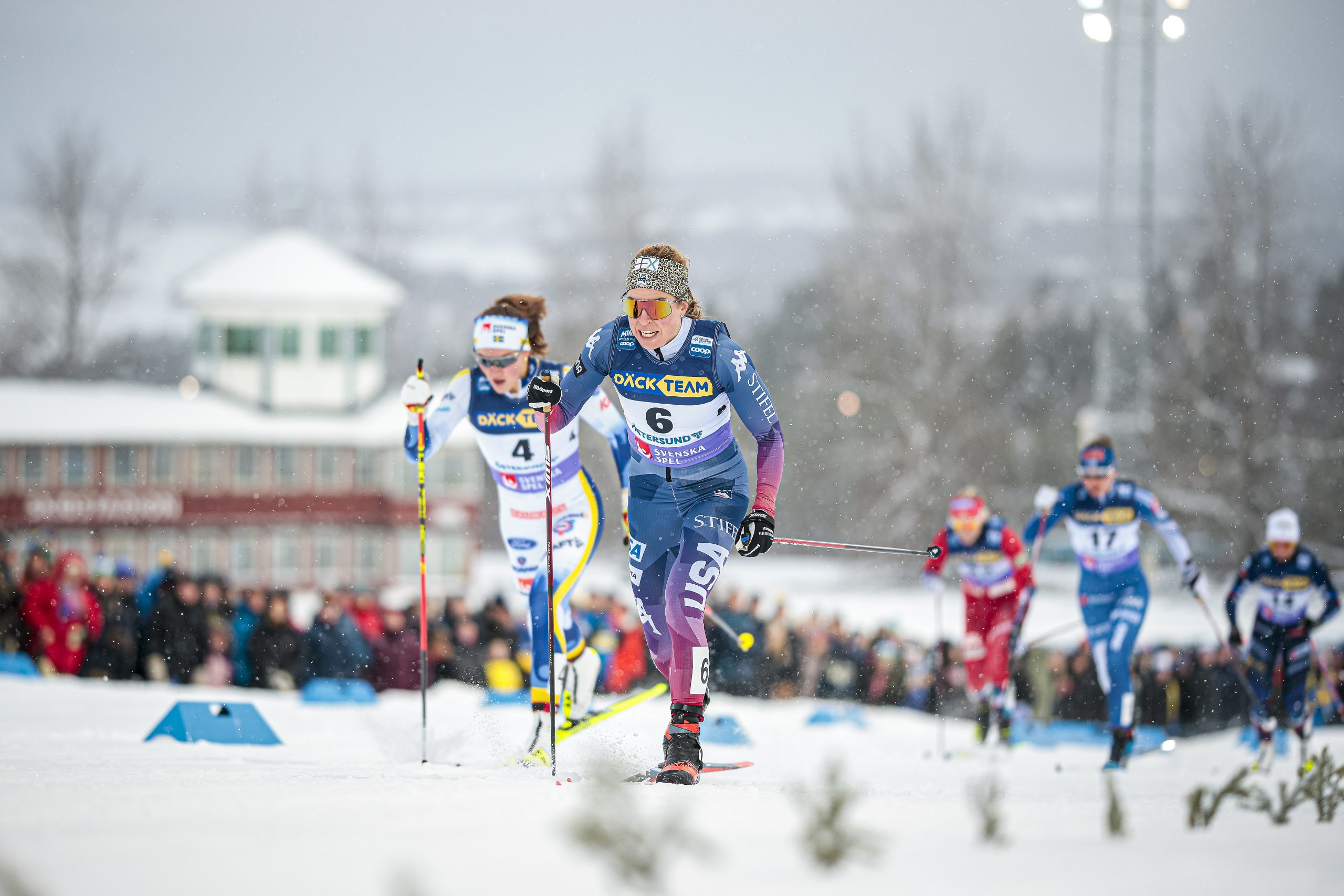
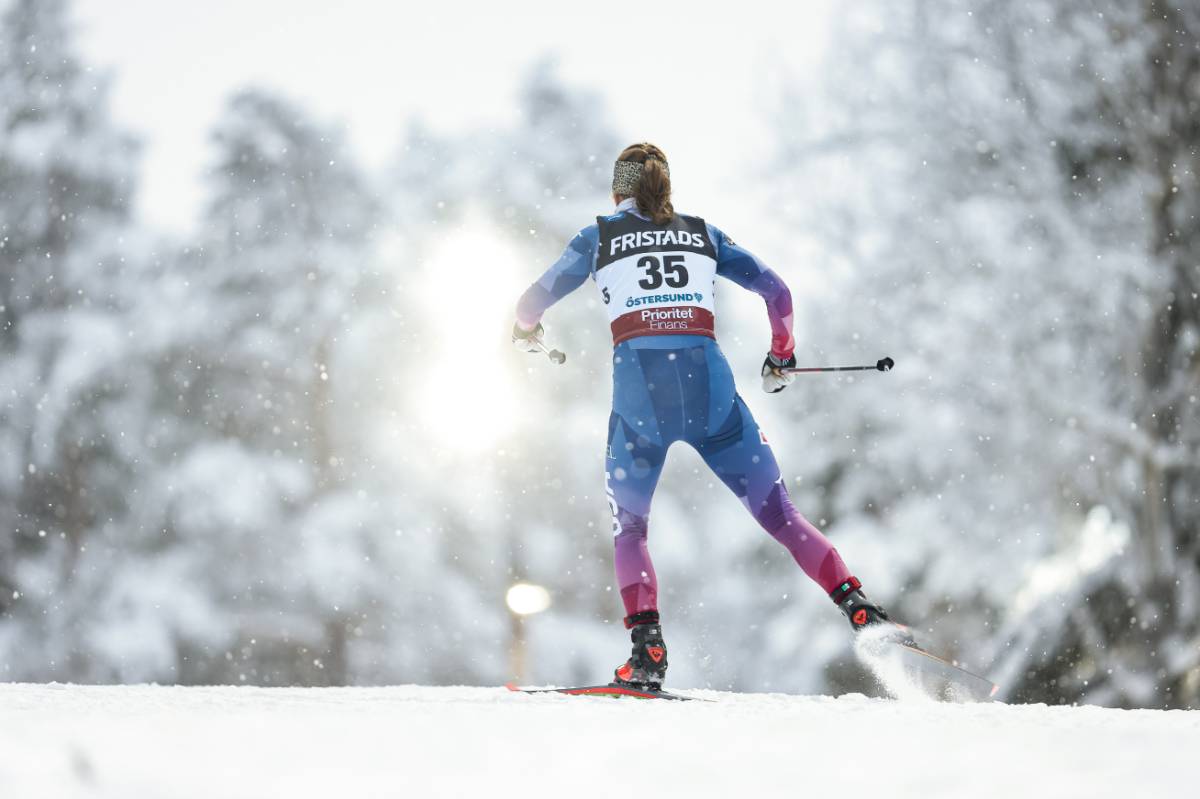
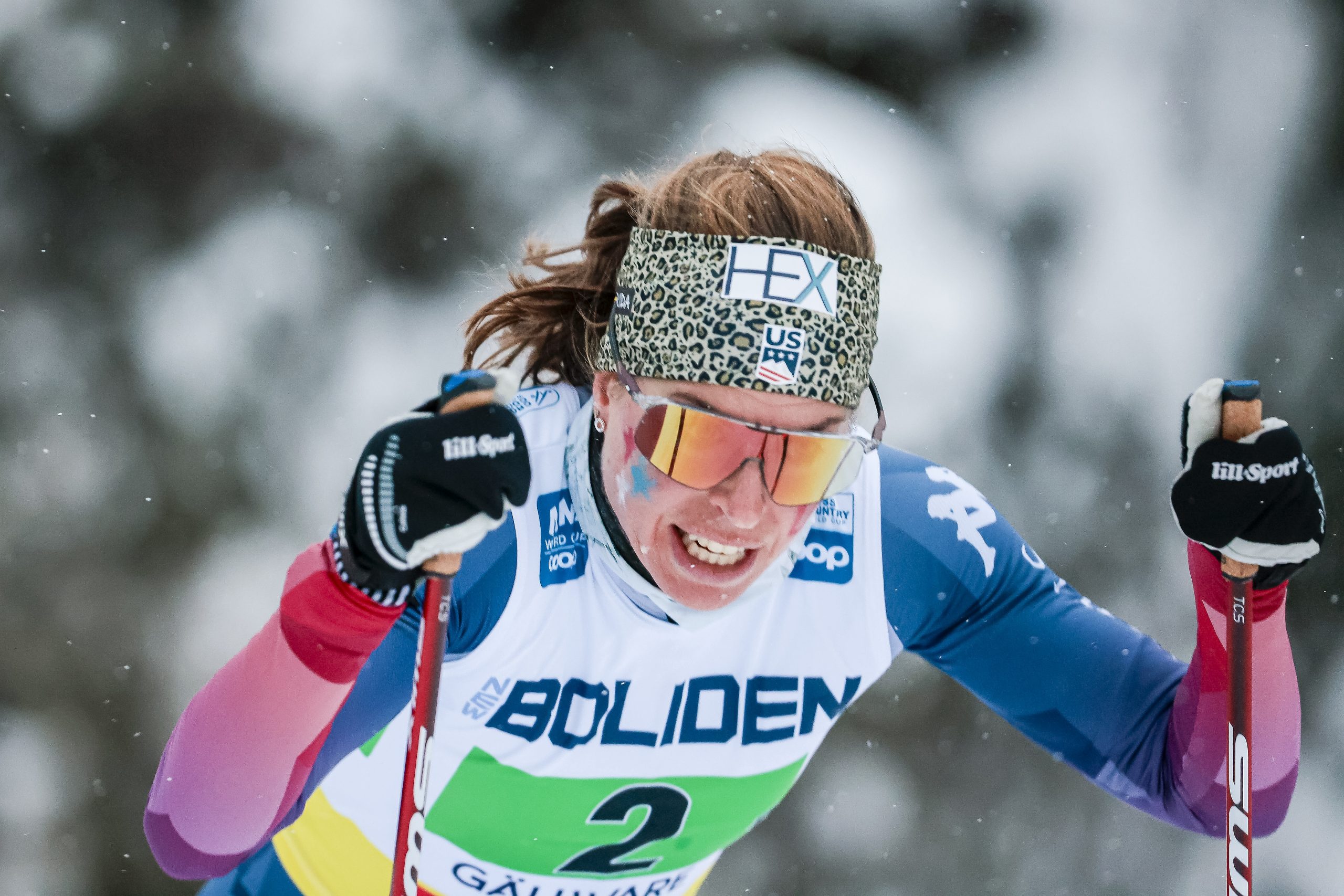
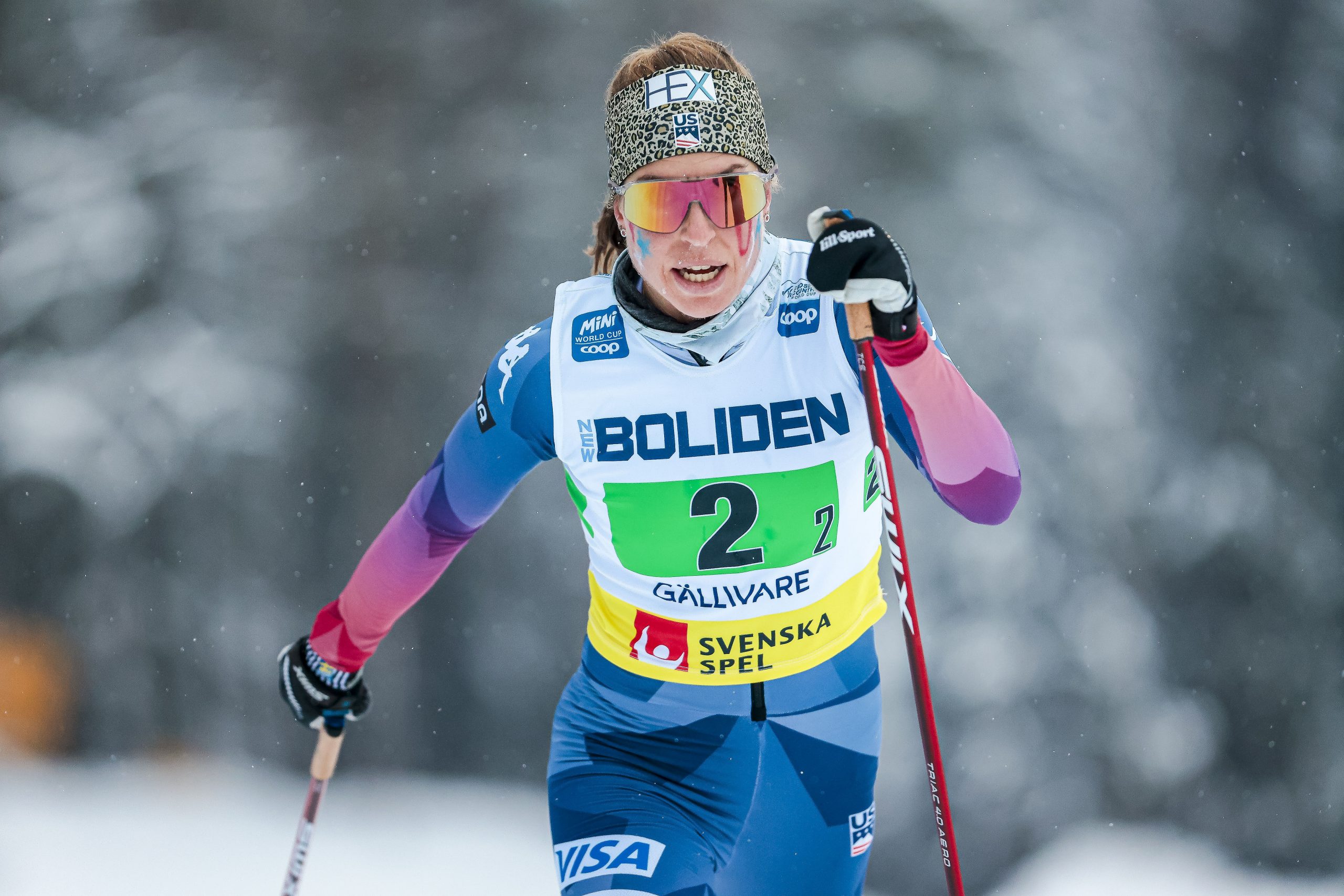
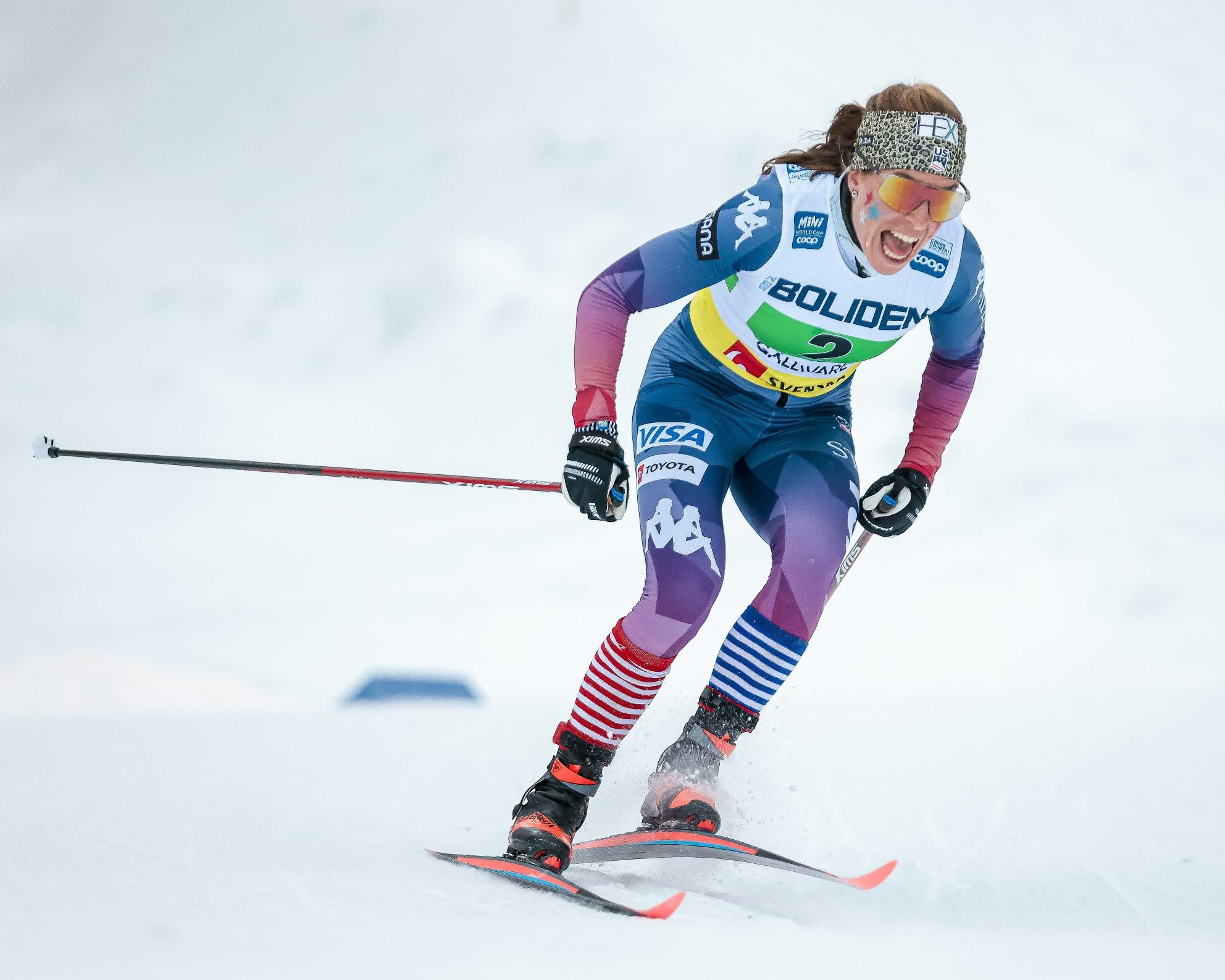
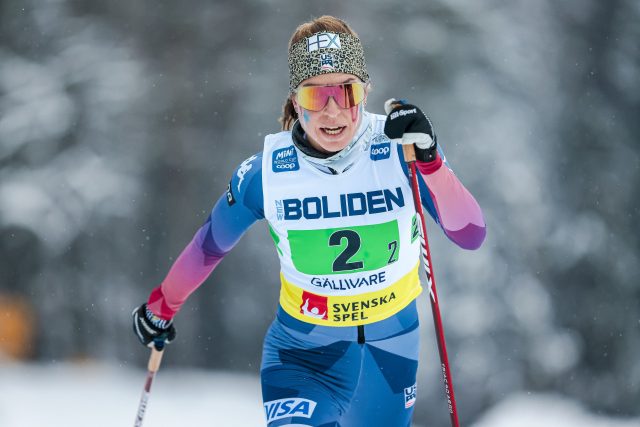
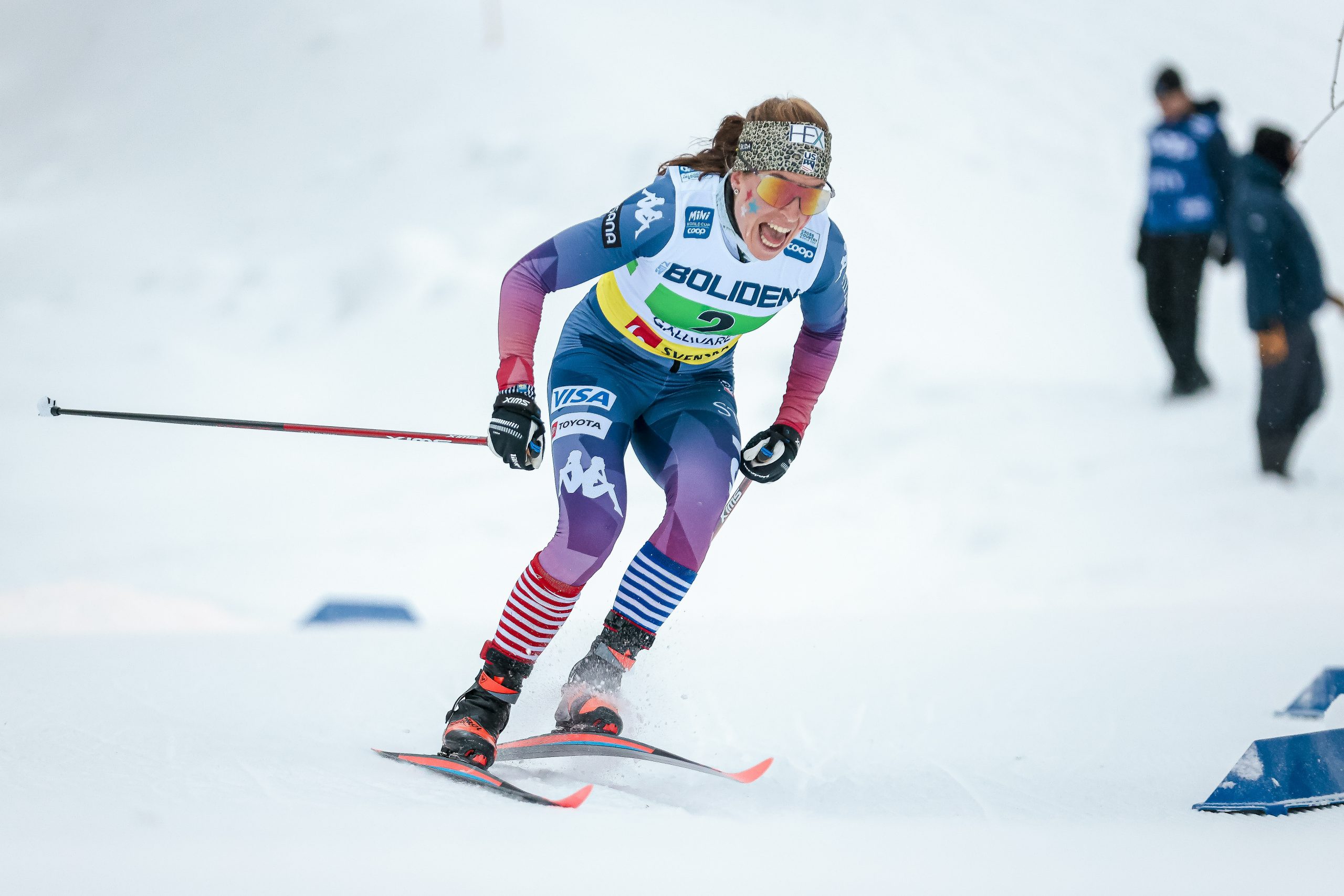
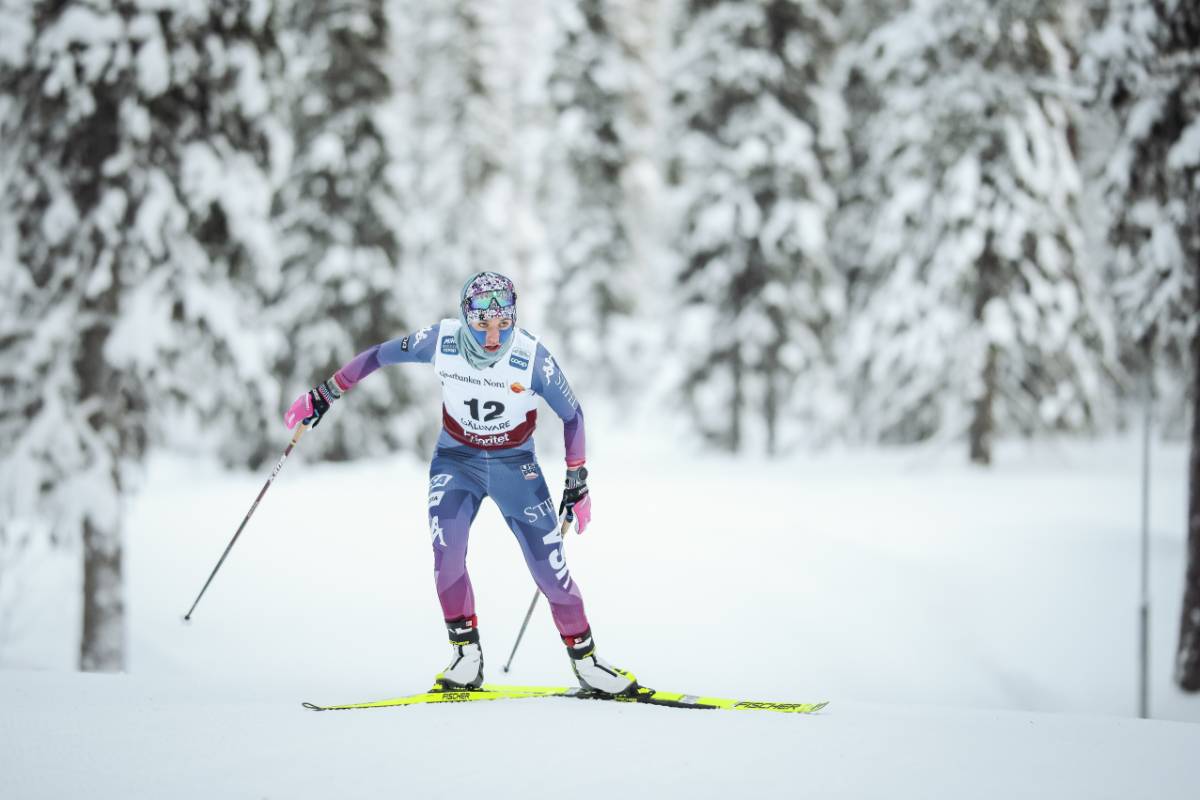
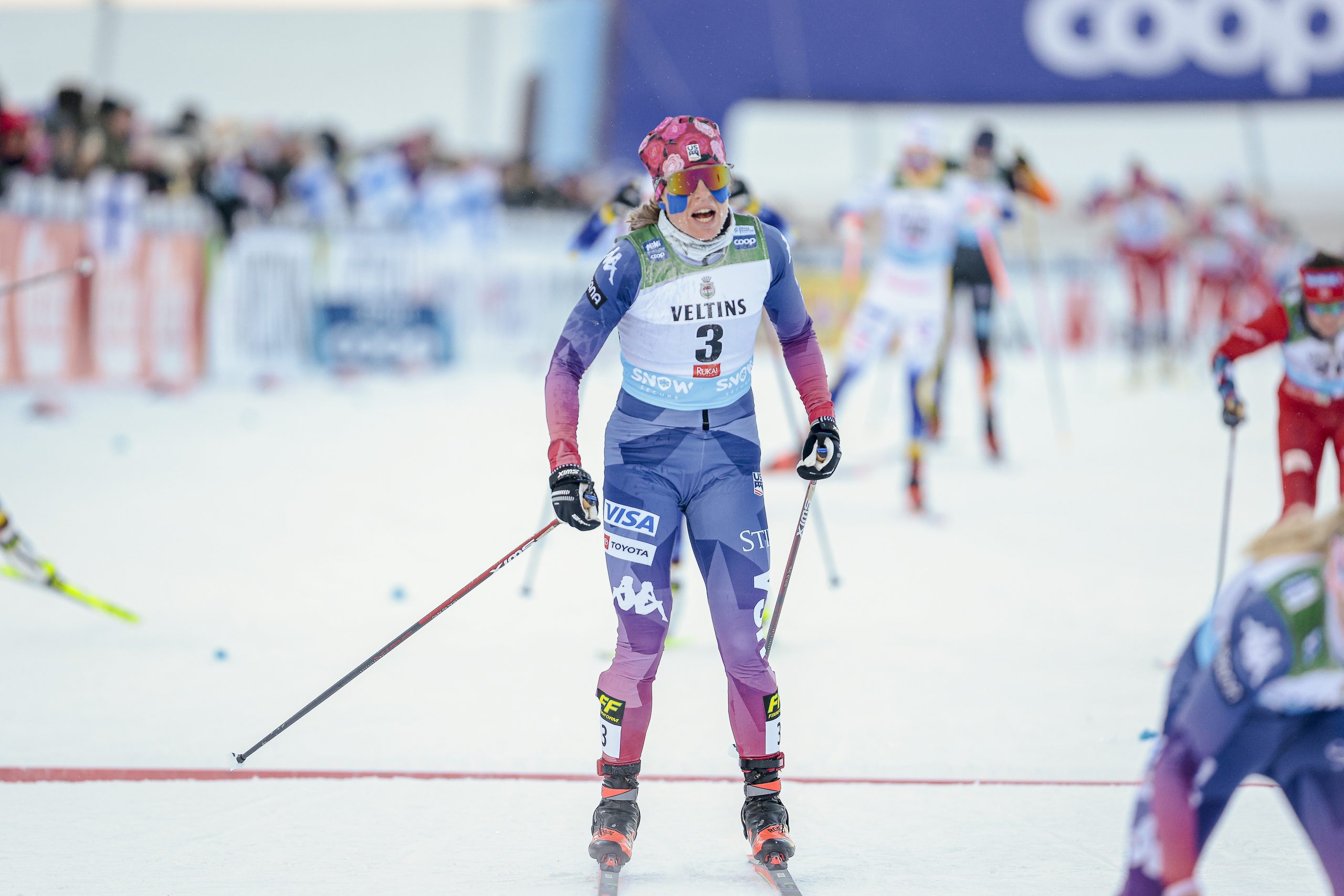
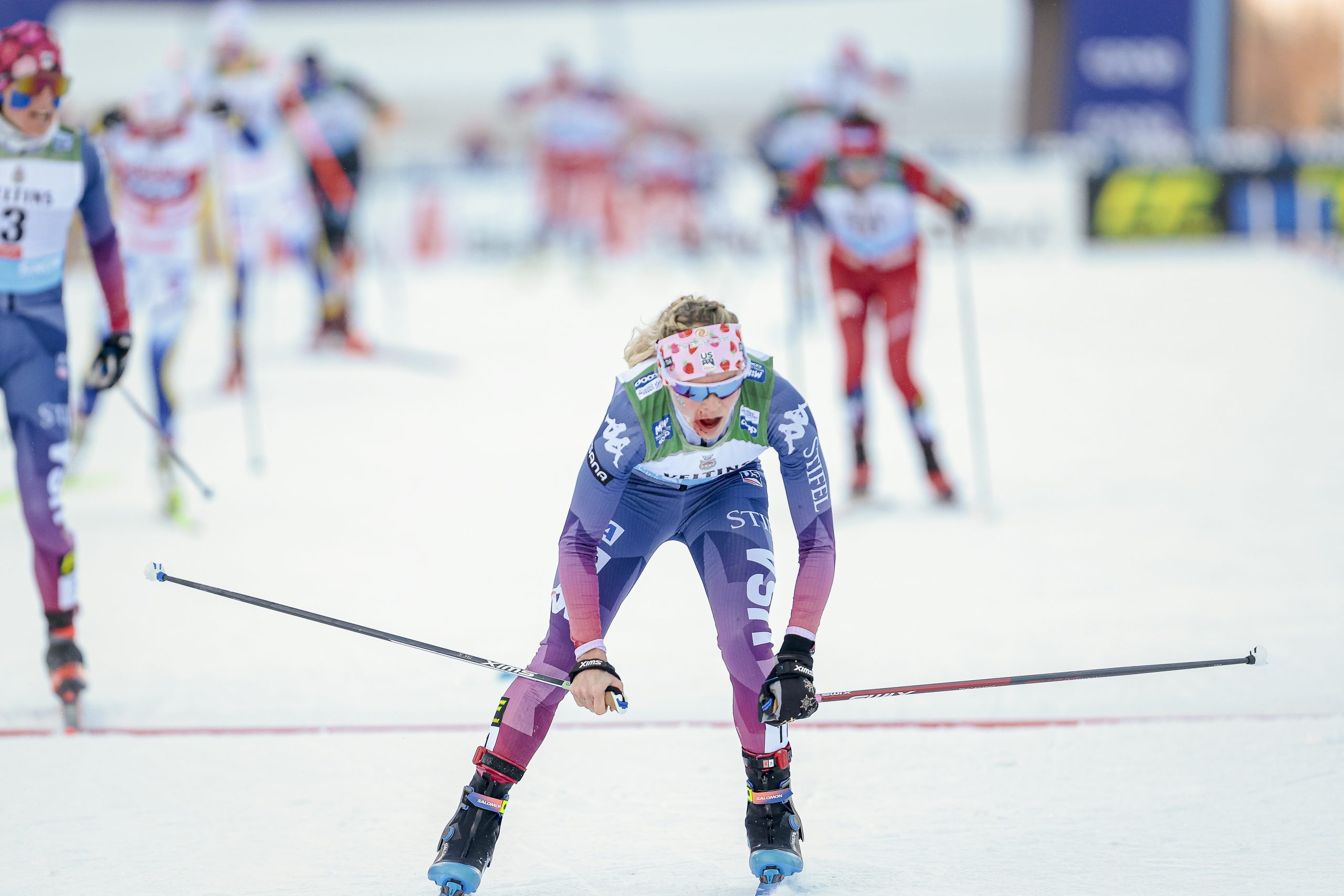
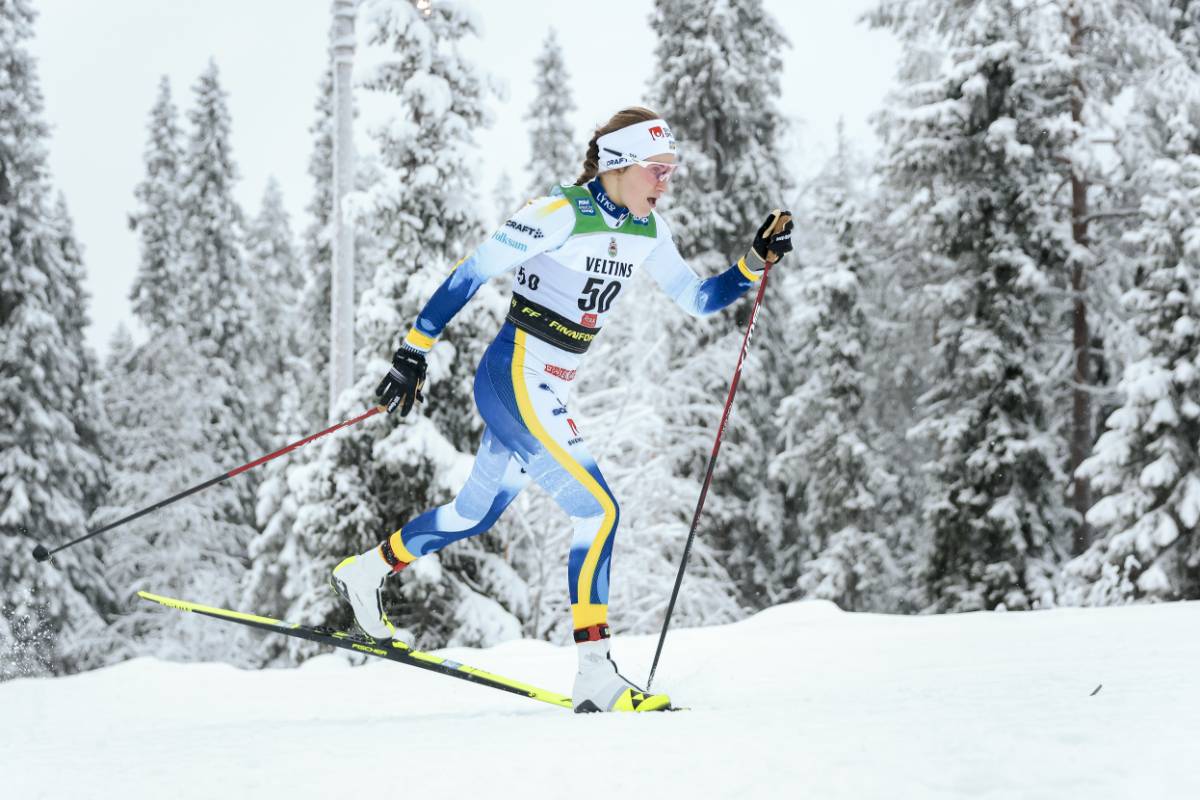
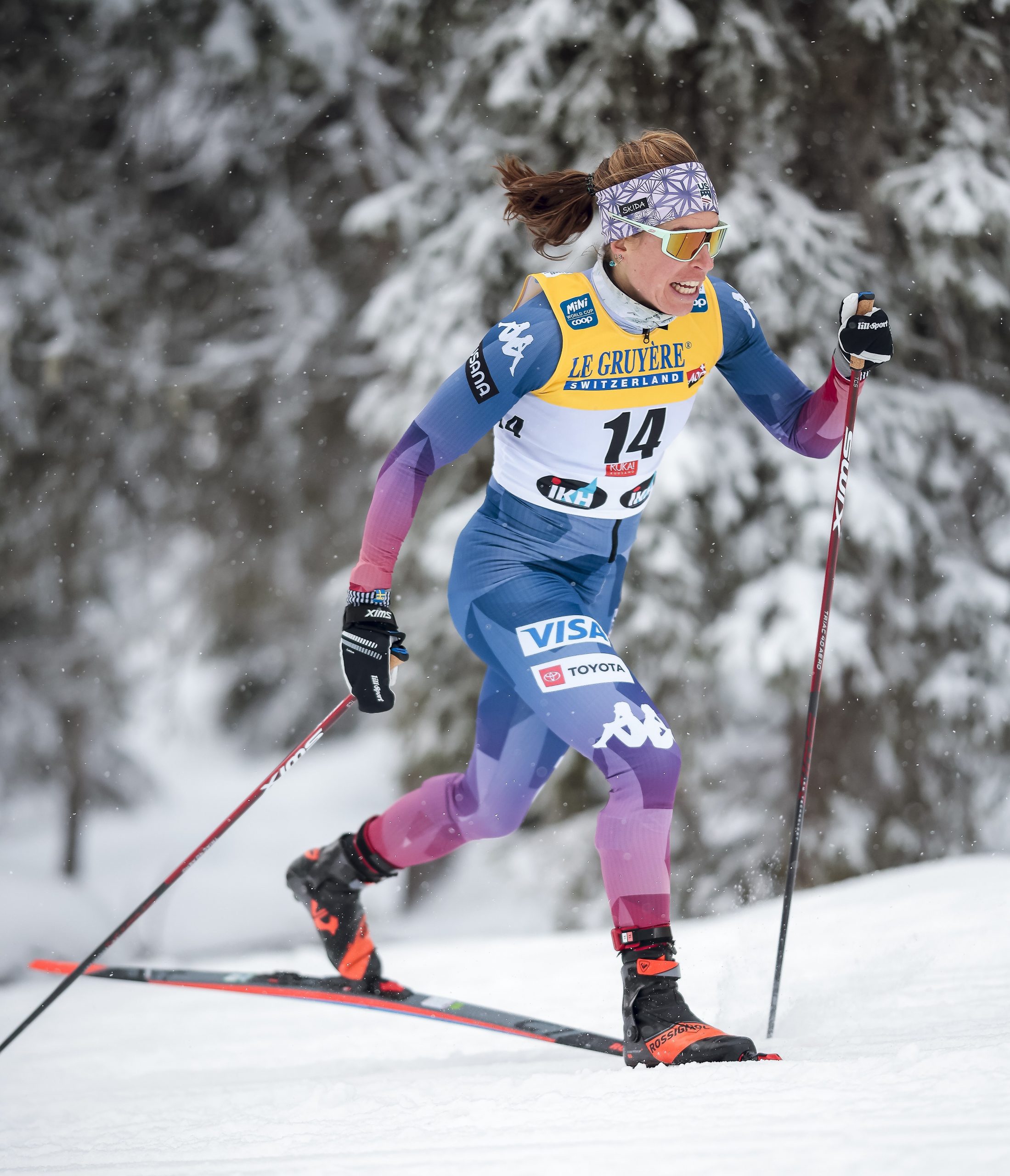
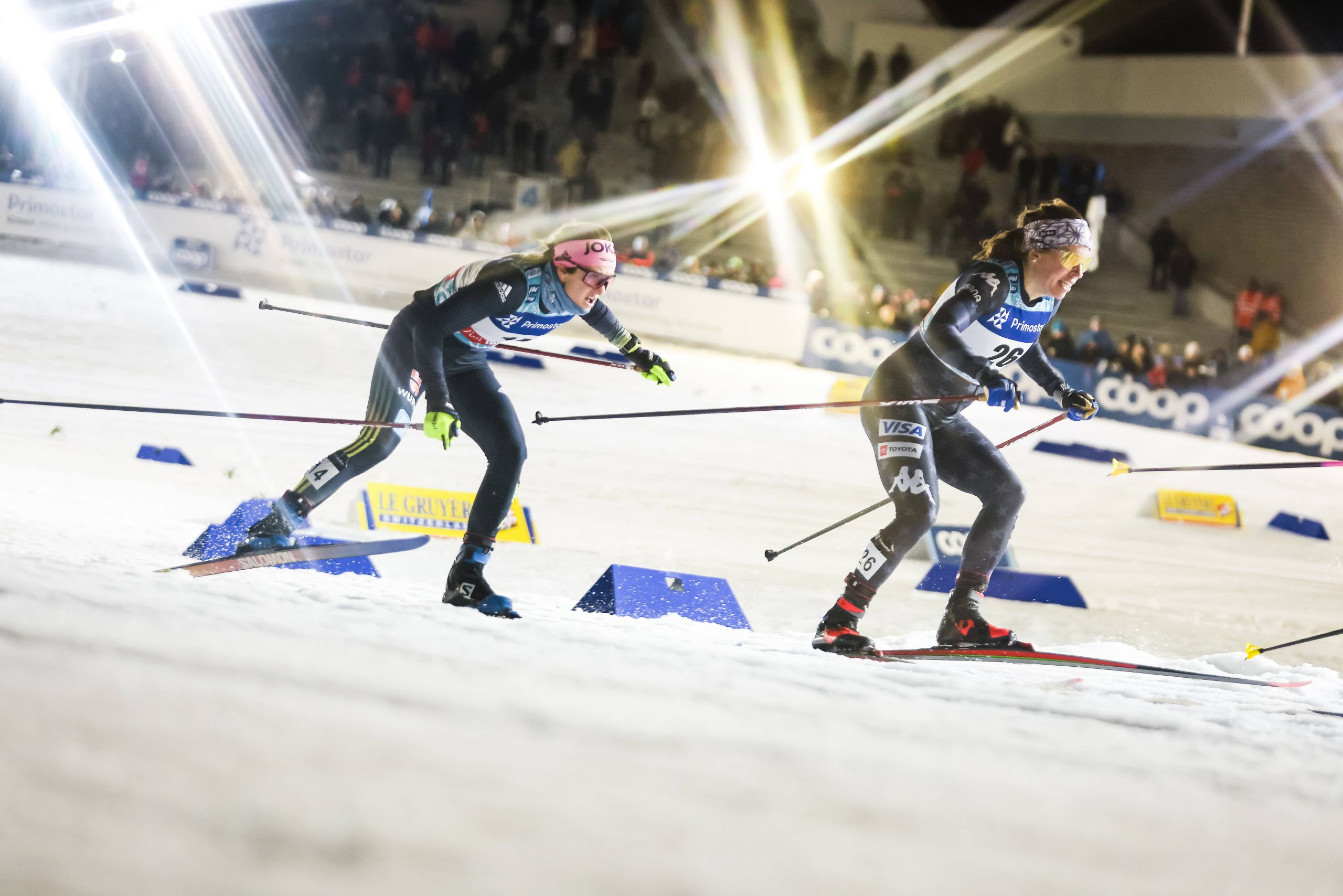
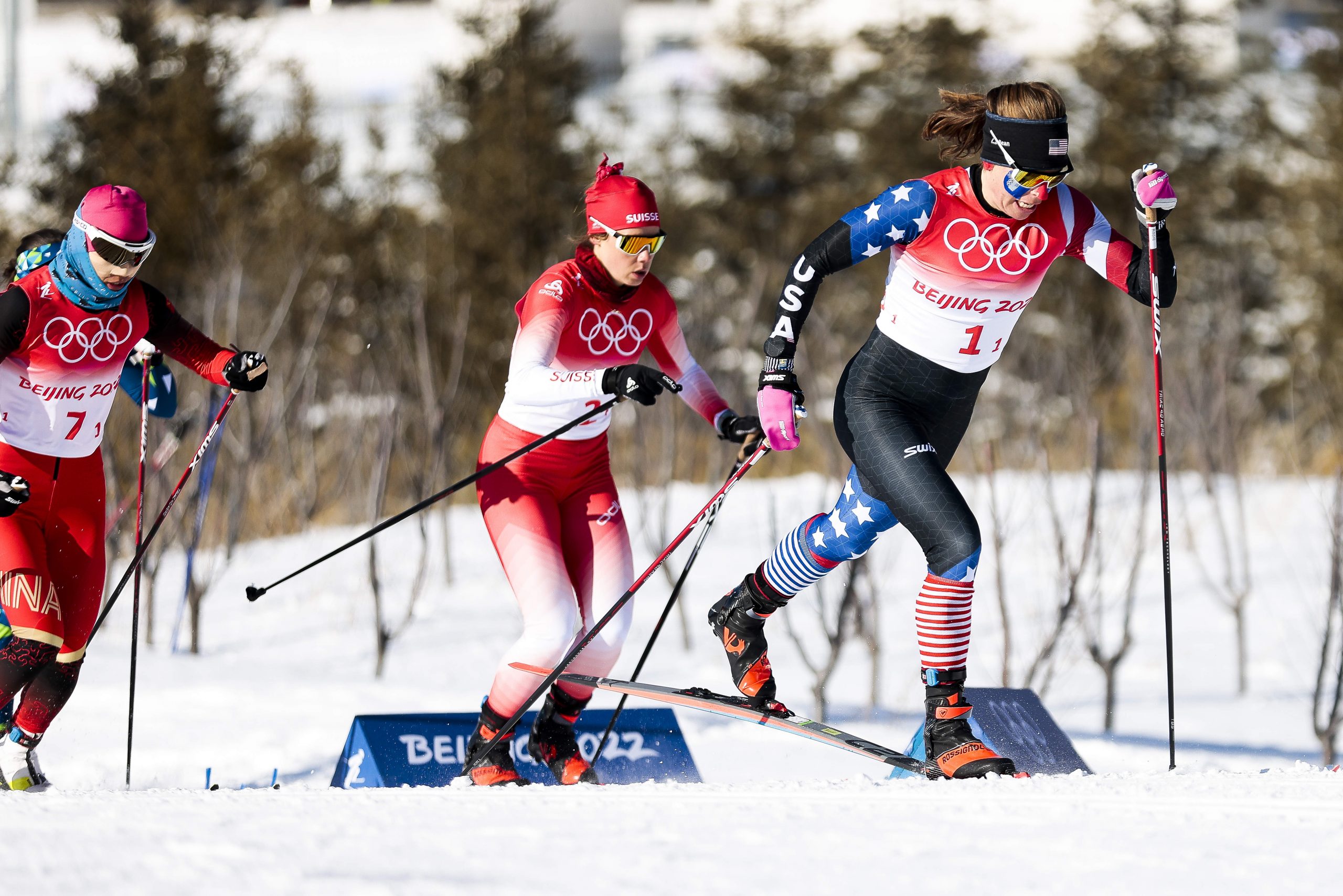
    Rosie Brennan (USA) finished 27th at Stage 1 of this year’s Tour de Ski. She goes into Stage 2 in 26th place Overall, one minute behind the race leader. (Photo: NordicFocus)

    When the fifth quarterfinal featuring Jessie Diggins and Julia Kern started on course, Diggins was in a good spot to gain an early advantage over other Overall contenders. She skied with the intention to take the chance early, driving the pace from the start. Kern remained steady behind Diggins, and the two kept together through pulses and pushes along the course’s undulating terrain. Norway’s Mathilde Myhrvold was the only other skier in the field capable of following the Americans’ driving pace. In the closing moments of the heat, Kern relented ever-so-slightly, and the Norwegian shot up the final stretch to put in a boot throw for the second semifinal spot behind heat winner,  Diggins. Following Diggins’ pace had paid off for Kern; she was into the semifinal as the first lucky loser.

    “The tactic in the quarterfinal was, ‘ok, let’s pick this one’ and hopefully [Julia and I] could scare some people out of picking that heat, which worked,” said Diggins in post-race comments. Kern echoed the sentiment, saying “Jessie and I talked beforehand and we wanted to string it out so it didn’t come down to a sprint in the end.”

    Jessie Diggins (USA) throws her boot across the line during the semifinal of Friday’s Skate Sprint in Toblach, Italy. (Photo: NordicFocus)

    The American pair would advance to the second semifinal together. Diggins led the heat out hard alongside the Swedish pair of Emma Ribom and Johanna Haeggstroem; Kern fell off the back early. Diggins would push over the course’s decisive International Bridge hill coming out of the first lap, but the Swede’s were able to mark her. Off the final corner, Diggins forged a middle path between the Swede’s, but was unable to keep up with their finishing push. Diggins finished the heat in fifth, giving her a ninth place finish, and seventh Overall in the Tour de Ski after Stage 1 (See the section below on how that placings-discrepancy is possible).

    Kern described the semifinal in post race interviews. “[It] was a pretty similar [to the quarterfinal],” she said. “But I was pretty worked from the last heat.”

    “I was not aggressive enough [in my semi-final],” said Diggins. “I just didn’t hold my line well enough, and I wish I could do that one over . . . In general, though, I’m really happy with how I skied. The fitness is right where it needs to be.”

    The other semifinal saw a tactically savvy Svahn waiting patiently, marking Sundling, and ultimately sprinting around her to first. Sundling secured second in a photo finish over Kristine Stavaas Skistad, with last year’s World Cup Sprint runner-up, Nadine Faehndrich (SUI), getting the second lucky loser spot to round out the Finals field. The semifinals importance to the Tour de Ski Overall was that Victoria Carl finished the heat in sixth place, and 12th in Stage 1. That left Jessie Diggins (seventh) furthest up the Tour de Ski standings of the main contenders for this year’s Overall, with a 10 k Classic race to follow tomorrow.

    Tour de Ski Standings After Stage 1

    Svahn will wear the Yellow bib into Tour de Ski Stage 2 with a two second lead over today’s second place finisher, Sundling and a time of 1:55.

    Math matters at the Tour de ski, so it’s worth reviewing Page 43 of your handy FIS World Cup Rule Book.  For Tour de Ski sprint races, times are passed on qualifying results, but time bonuses are calculated off the heat results. Therefore, Stage 1 results do not necessarily equate to Tour de Ski standings after Stage 1. 

    Linn Svahn’s time Overall time comes from her qualifying time (see Qualifying Results here) , 2:55.01, which is first truncated to the nearest second before each successive stage, hence 2:55. Then, she earned a 60 second time bonus for her Sprint heat finish position, 1st place, so 2:55 – 1:00 = 1:55, and 1st place in the Tour de Ski Overall. Stage 1 second place finisher Sundling qualified in first with a time of 2:51, and earned a 54 second time bonus for her place in the Finals, so is two seconds off Svahn with a 1:57.

    For Diggins, her second-best qualifying time of 2:54, plus a time bonus of 28 seconds for her ninth place heat finish equates to 2:26 (+0:31), seventh place in the Tour de Ski Overall. Kern also is in the top ten of the Tour de Ski Overall, moving up from 11th on Stage 1 with bonuses to 10th Overall (+0:39). Rosie Brennan is in 26th (+1:01).

    Note the parentheses there, as it’s how a three-minute sprint race with split second time gaps translates into the Overall dynamic that will now be raced out over the next week. Going into tomorrow’s 10 k classic, Diggins is roughly 30 seconds off the Yellow Bib, while Brennan is roughly one minute off the same mark. Those are some handy marks for viewers to consider as racers approach tomorrow’s first distance-racing challenge: the 10 k Classic Interval Start.

    Stage 1 Tour de Ski RESULTS

    Overall Tour de Ski STANDINGS

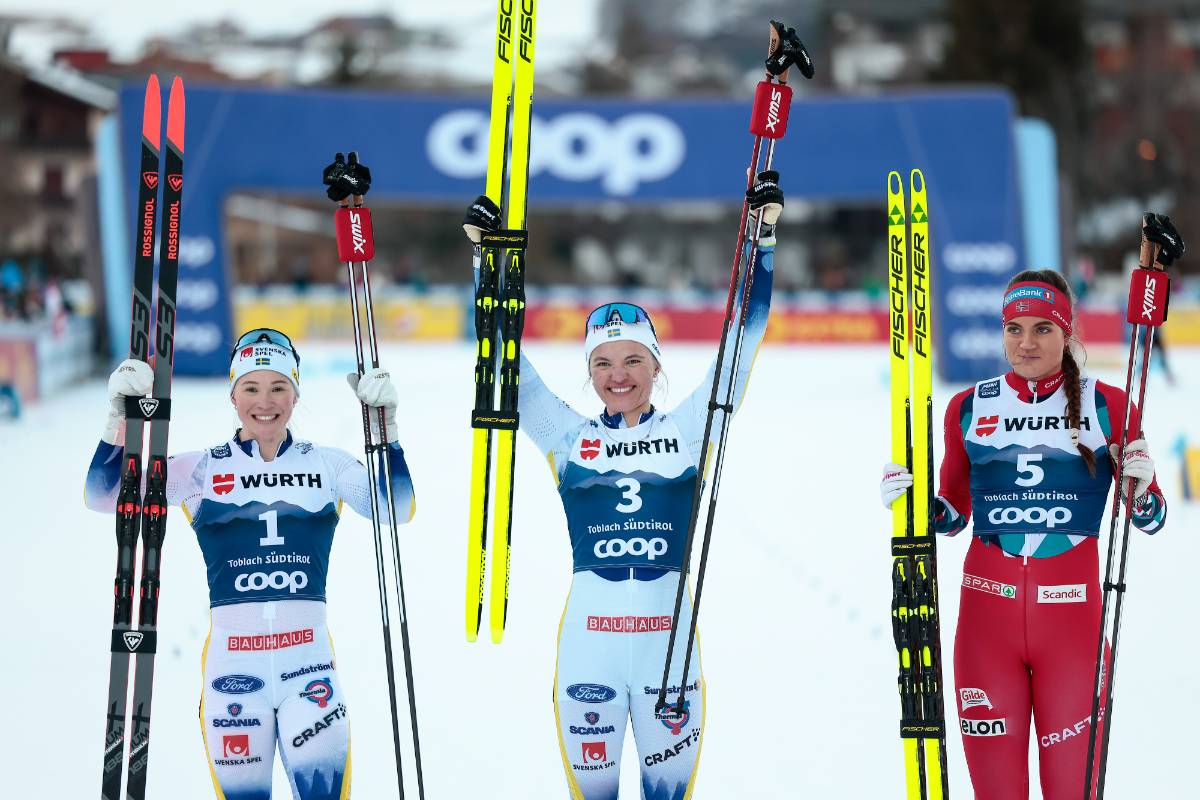
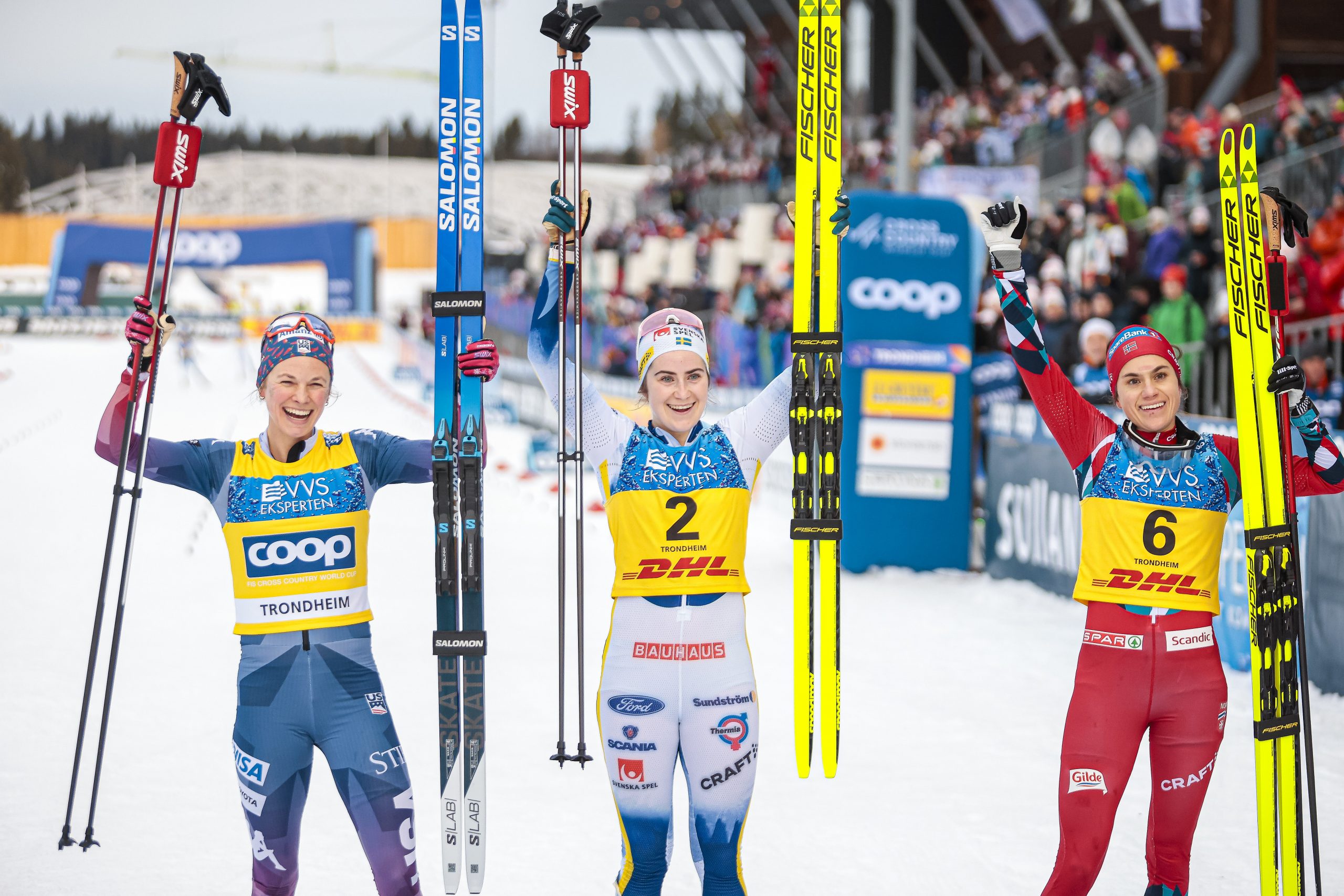
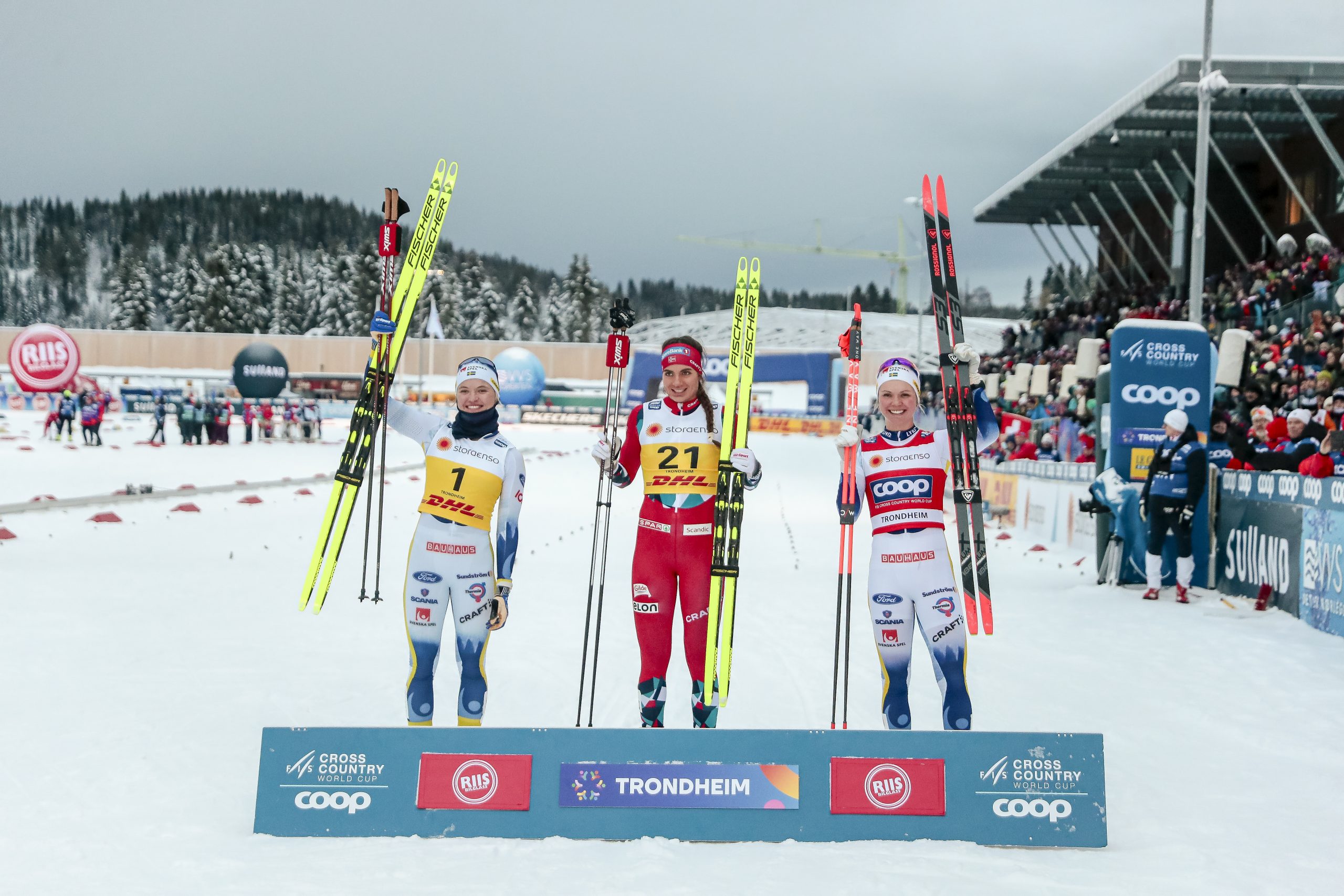
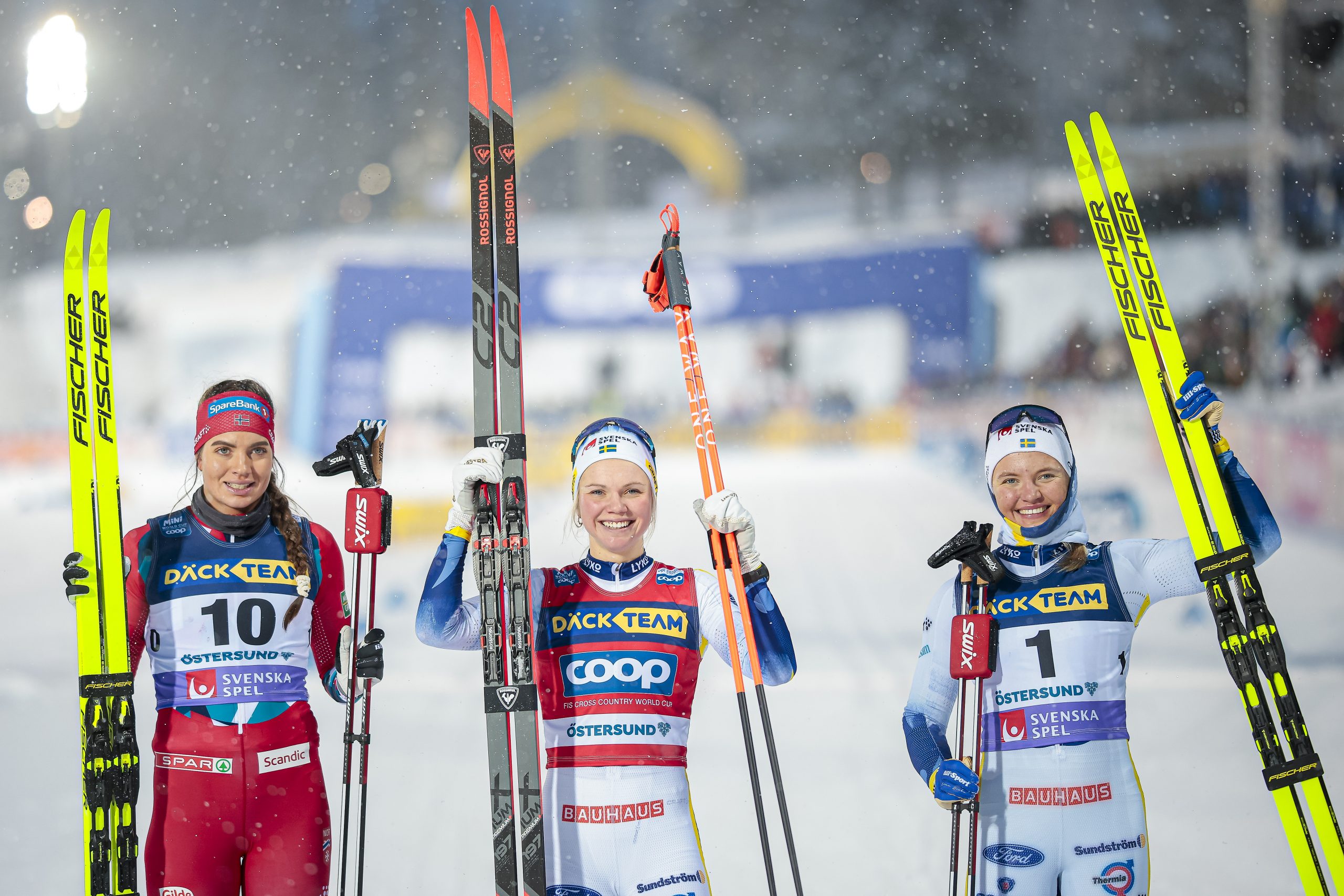
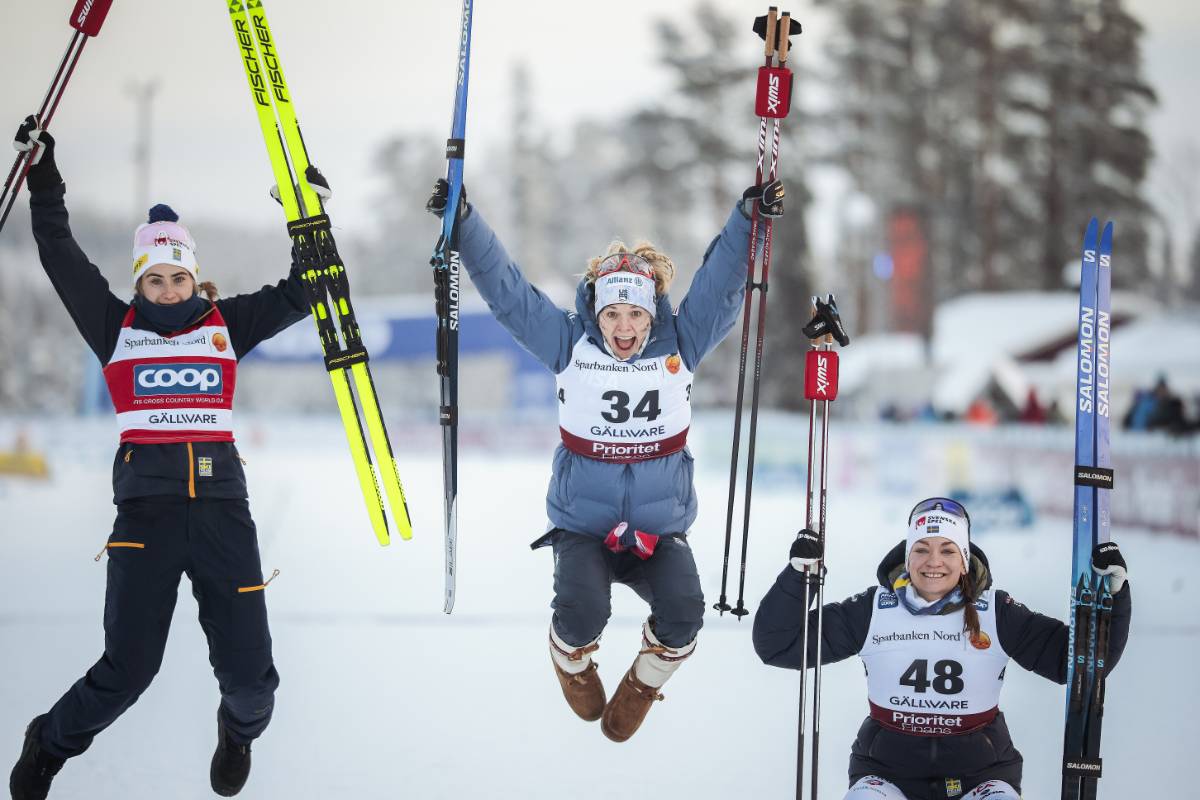
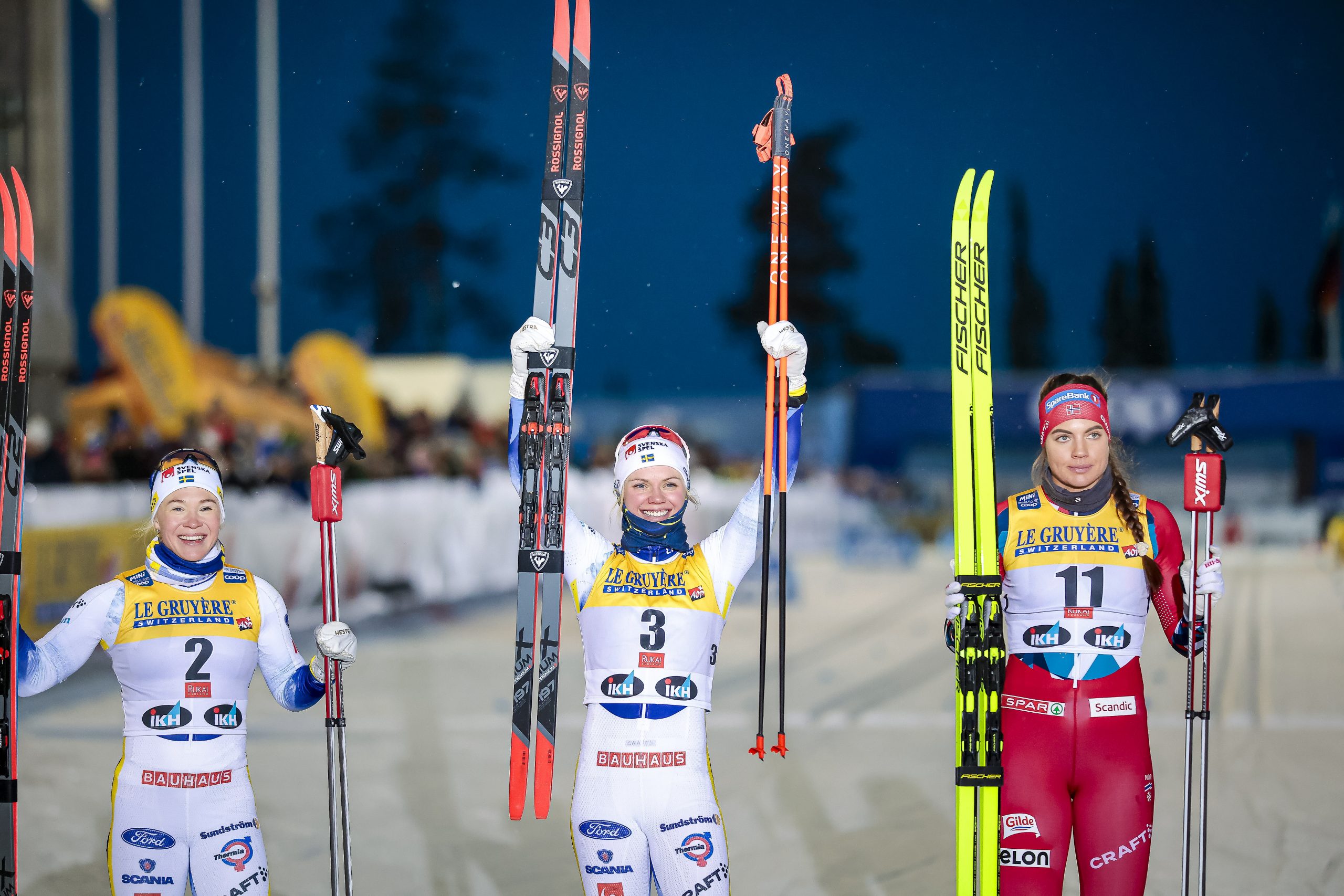
    The podium of Friday’s Freestyle Sprint, Stage 1 of this year’s Tour de Ski in Toblach, Italy. Linn Svahn (SWE) first, Jonna Sundling (SWE) second, Kristine Stavaas Skistad (NOR) third. (Photo: NordicFocus)
  • The Devon Kershaw Show: Recapping a soggy, fluoro-free weekend in Trondheim

    The Devon Kershaw Show: Recapping a soggy, fluoro-free weekend in Trondheim

    Eli Brown, a member of the U.S. Ski Team’s waxing and ski service staff, joins us this week to talk about his job and the new enforcement of the rules banning fluorocarbons on the World Cup circuit. We recap another strong weekend for American athletes, along with all the hijinks that happened in Trondheim, Norway at the test event for next season’s World Championships.

    The World Cup takes a break next weekend before the Tour de Ski, but we may try to squeeze in a mailbag episode. Send us questions if you’ve got ’em. Reach us at nat@fasterskier.com and devon@fasterskier.com.

  • Brennan Second in 10 k Classic. Victoria Carl First for Germany

    Brennan Second in 10 k Classic. Victoria Carl First for Germany

    This coverage is made possible through the generous support of Marty and Kathy Hall and A Hall Mark of Excellence Award. To learn more about A Hall Mark of Excellence Award, or to learn how you can support FasterSkier’s coverage, please contact info@fasterskier.com.
    Today wrapped up three days of racing in Trondheim, Norway, where the 10 k Classic individual start race was contested this morning. The “10 k” race name was a bit of a misnomer, as the actual distance raced was 11 kilometers. The American women have set a blistering pace this season: Rosie Brennan finished second in this event three weeks ago in Ruka. Jessie Diggins’ Classic skiing this year has looked especially crisp. So, hopes were high for the American squad.

    It was another great Classic race day for Rosie Brennan (USA). She finished second. (Photo: NordicFocus)

    Standing in their way were the ever-present Swedish women: Ebba Andersson (SWE) took first in the same race where Brennan had finished second, and Frida Karlsson (SWE) was nipping on Brennan’s heels in that race. But Karlsson was a last minute DNS on Sunday in Trondheim, and was substituted with Johanna Hagstroem. Naturally, whenever there’s a Classic race of some distance, oddsmakers will factor in Kerttu Niskanen (FIN); the Classic expert has won all of her five individual World Cup victories in 10 k Classic Individual Start races!
    Diggins had another excellent Classic performance, finishing fourth. (Photo: NordicFocus)

    In another warm day in Trondheim—temperatures in the mid-30s and Classic tracks glazed—it was Victoria Carl (GER) taking the win and making German history. Brennan repeated her second place Classic performance, and Ebba Andersson (SWE) came in third.

    Jessie Diggins missed the podium by seven seconds, finishing fourth. Other American finishers were Novie McCabe, 25th and Alayna Sonnesyn, 48th. Sophia Laukli missed the weekend of racing due to illness.

    The top Canadian was Katherine Stewart-Jones in a very impressive 18th. The other Canadian finisher was Amelia Wells in 51st.

    Women’s 10 k Classic Interval Start

    Warm conditions meant that it was another klister day for skiers. Under the new fluoro rules, in individual start races competitors need to have their skis turned in 30 minutes before their start time: another change to which skiers and technicians are being forced to adapt. “Later starters don’t have access to the race course for testing with their technicians,” U.S. coach Chris Grover told FasterSkier. “When the race starts they close the course—and with conditions like we have now—that means there’s almost no other skiing available, so the tests that you’ve done are earlier on.” Conditions with the warm weather were variable. Grover described it as “sugary with ice underneath, with glazing tracks.”

    Rosie Brennan (USA) had a relatively low bib number for the seeded athletes which made her one of the early pre-race favorites to go through time checks. Niskanen started shortly behind her. Diggins was in an excellent starting position, getting bib number 56 with only a handful of serious contenders starting behind her. Diggins has said in the past that she doesn’t usually listen to split times during the race but, with today’s lineup, she would be able to hear reports of the progress of most of her competition ahead of her. The crowd gave Diggins an enthusiastic cheer to send her off.

    Early on, Astrid Oeyre Slind (NOR) set the standard with the fastest time at the two kilometer mark. But Carl (GER) quickly supplanted her taking a nine second lead. Carl has been skiing well; she had her first World Cup podium last week and had extra motivation today. No German—East, West, or Unified; male or female—has ever won a World Cup 10 k Classic individual start race. That was about to change . . .

    Brennan was only two skiers behind Carl and would be able to chase her throughout the day. Brennan was third when she went through the two kilometer mark but, as other skiers came through, she dropped to fourth. As the seeded skiers continued to pass the two kilometer mark, Carl’s time continued to hold. When Diggins passed the timing mark, she was in fourth, and after the rest of the pack went through, she had dropped to sixth.

    Carl continued to set the standard as she progressed to the 3.4 kilometer mark. As the top skiers passed through, Carl’s mark was still unmatched. But the question lingered as to whether she had gone out too hard?

    Slind then put in a turn of pace and moved into second only three-tenths of a kilometer later. It was already a pitched battle for second and third but, shockingly, no one was putting a dent into Carl’s lead.

    Carl’s lower start number meant that she would finish ahead of most of the other skiers in contention. When she crossed the finish line, she had a whopping 47 second advantage over the skiers who had already finished. It was a massive margin that seemed untouchable, but most of the top contenders were still on course. Brennan, Diggins, Andersson, and Slind were still lurking.

    Brennan had another great race. But it was Victoria Carl (GER) who made history today. (Photo: NordicFocus)

    One by one, the top-ranked skiers crossed the finish. One by one, they each fell short of Carl. They were gut-wrenching moments for the German as she stared on in disbelief while her time continued to hold. When Brennan came through the finish, she was 19.6 seconds behind Carl, in second place, but several of the top skiers were still on course.

    Niskanen finished after Brennan, but she never really factored into the leaders’ chase today. She was third as she crossed the finish line, but it was clear that her time wouldn’t hold up. She ended up fifth.

    Andersson seemed to have one of the best chances to top Carl. But as she came into the stadium her pace began to lag, and the clock told the story that, for the time being, Carl remained safe. Andersson pushed hard in the last several meters but couldn’t displace Carl. Andersson’s time was good enough for third, 21.6 seconds behind Carl, and only two seconds behind Brennan, who remained in second.

    Now it was Diggins’ turn to see if she could dislodge Carl. At the 8.9 kilometer mark she was in third, 20 seconds off the lead, and at 9.8 k she had drifted to 23 seconds back. It was clear before she entered the stadium that Diggins would not be able to match Carl’s time. Diggins turned in a final burst trying to find the podium but crossed the line fourth. She was seven seconds behind Andersson, and 28 seconds away from Carl.

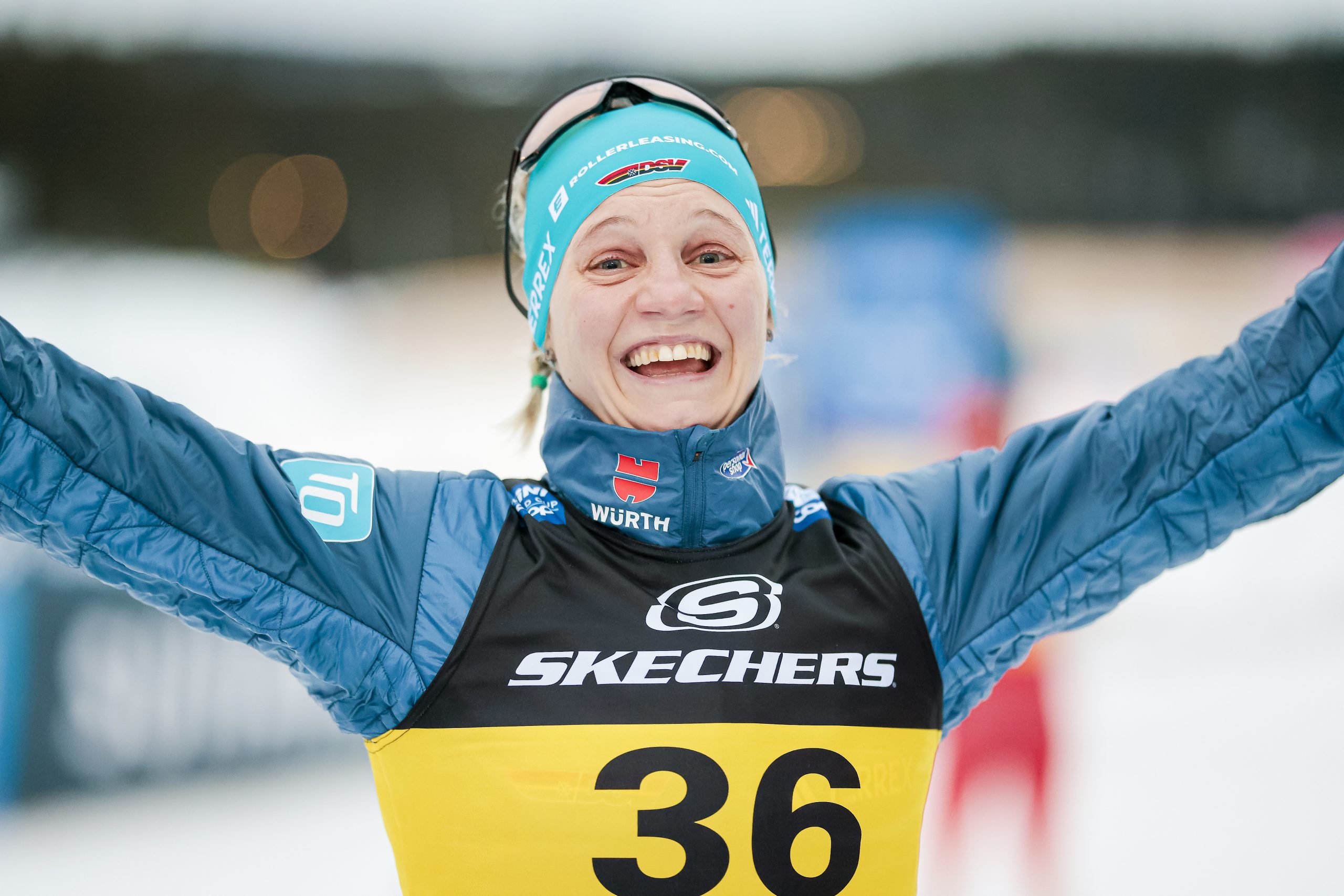
    It was an emotional win for Victoria Carl (GER); a mixture of tears and joy as she took her first victory on the World Cup, and the first for Germany in a 10 k Classic Interval Start race. (Photo: NordicFocus)

    Carl shook her head as she saw finisher after finisher unable to match her time. After Diggins crossed the line, Carl’s victory was secured. She cried in disbelief as she not only found her first World Cup victory but made history for Germany.

    After the race Carl commented that she started a little slowly to save energy. She said her first World Cup victory was unbelievable. “It was crazy!’” she beamed. “The whole team is on fire, we had very good skis.” It was clearly an emotional moment for Carl who finally found victory after 138 World Cup starts.

    Another Classic podium held special meaning for Brennan.  “Getting another Classic podium is great,” She told FasterSkier. “It’s reassuring that my Classic is good, that [the prior podium] wasn’t a fluke. I’m feeling really strong in Classic. I felt like if I pushed like I did yesterday, there would be a good chance at a podium.”

    Even though Brennan got faster as the race went on, it wasn’t a tactic. “I didn’t intentionally increase my pace,” Brennan said. “I tried to start very hard, but I’m just not good at starting hard. Sometimes it takes me a little to get going, and find a relaxed state to get the most out of my skiing.”

    Like Brennan, Diggins turn of speed in the second half of the race was not strategic. She said, “I think certain sections of the course suited me better. The sections where you had to herringbone in sugar were challenging for me; that’s still a technique that I’m really working on. That’s probably my biggest weakness. So I tried to really hammer the sections where I was able to.”

    The tricky conditions were challenging, but the Americans seemed happy with their skis. “The service team absolutely hit it out of the park today,” Grover told FasterSkier. “They figured it out … the kick, the glide, the structure, we had really good skis all day.” Brennan concurred: “My skis were pretty good,” she said. “When I started I had some slips and kind of panicked, but I think that was me just not skiing my best. When I found my groove and my rhythm, I felt great. I love klister skiing”

    For Diggins, today was a new strategy for kick wax. She said, “I’ve been working on having the confidence to not ask for an additional kick wax bump. Yesterday I did, and that might have been part of why my glide was so slow on the Classic side. So today, I was … all right, I’m going to ski with confidence, if this blows up in my face, at least I tried something different. In testing the skis were good and I’m going to assume they are going to stay good, and they did! I was really impressed with our skis”

    American skiers once had to deal with the label of being primarily Skaters; that’s no longer the case. Grover said, “Both [Brennan and Diggins] have made really nice improvements in their Classic technique”. He continued that, “Rosie and Jessie have put in a lot of time on the technique, and it’s paid off already. There have been a lot of comments trickling back to us that both those athletes have made a lot of adjustments … noticing the improvements they’ve both made.”

    Another point of pride for team USA which Grover pointed out, was that the Americans are in third place in the Nations Cup standings. Another huge achievement for the U.S. as they currently hold a lead over Finland, Germany, and France.

    Women’s 10 k Classic Interval Start RESULTS
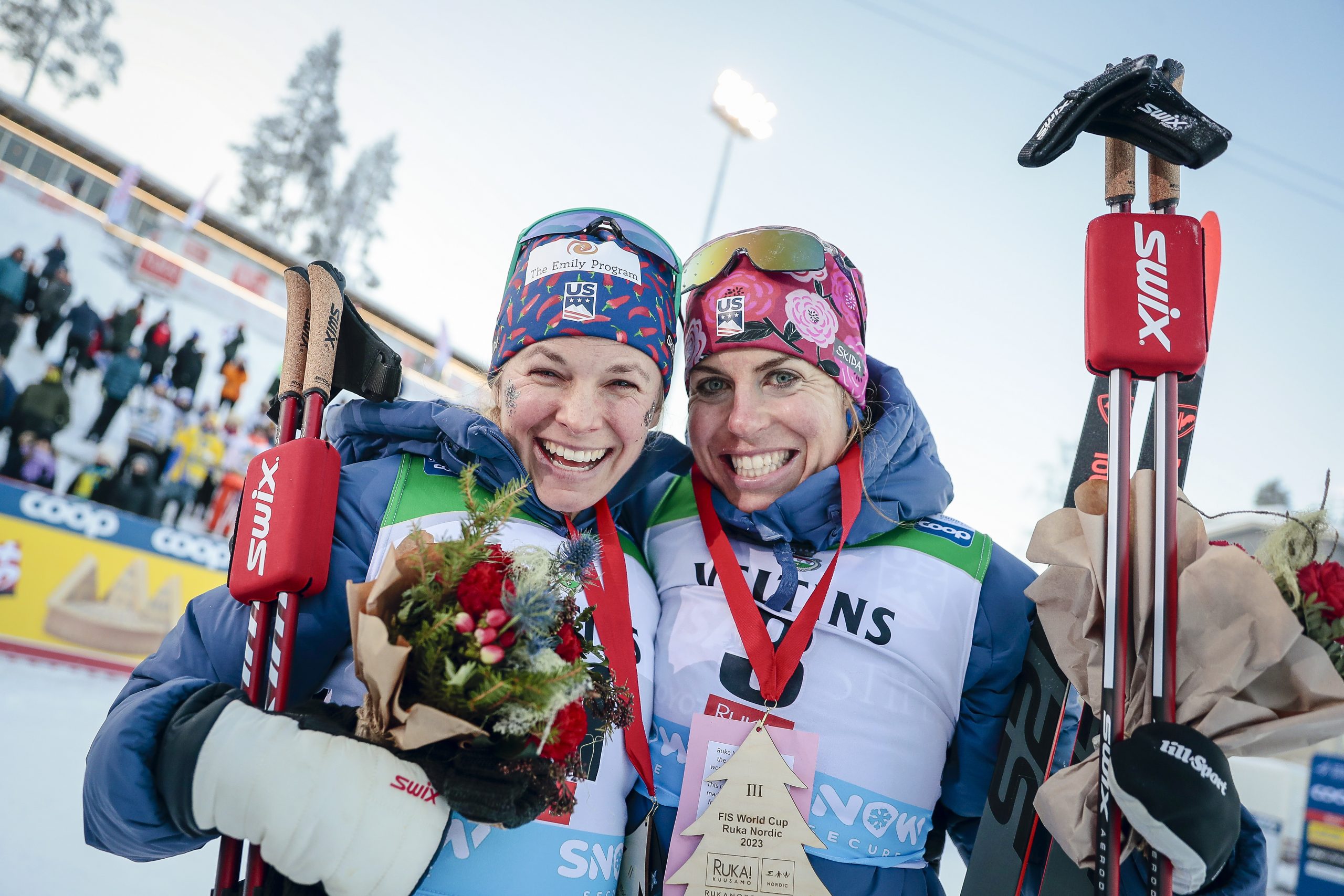
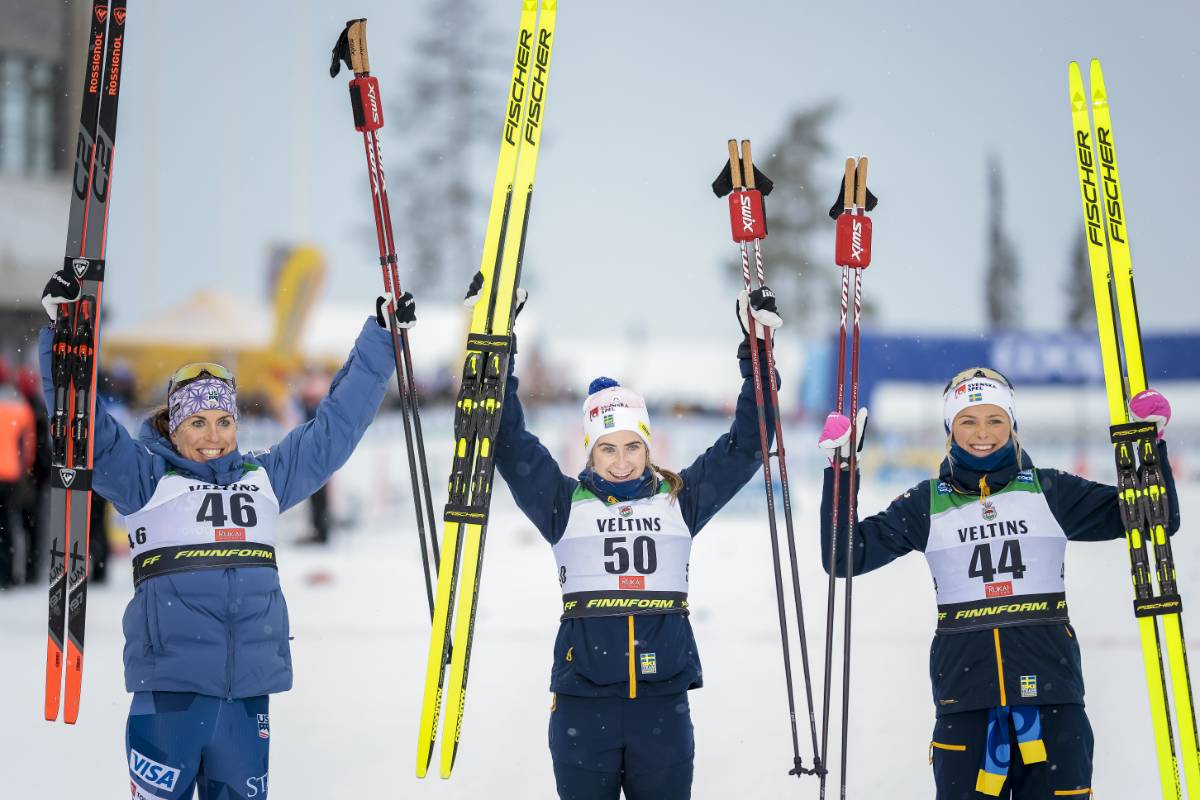
    Rosie Brennan (USA), Victoria Carl (GER), Ebba Andersson (SWE), (l-r) took the podium in the 10 kilometer Classic. Carl was able to make history as the first German to win a 10 kilometer Classic individual start race. (Photo: NordicFocus)
  • Trondheim Skiathlon: Andersson’s Tactics vs. Diggins’s Grit

    Trondheim Skiathlon: Andersson’s Tactics vs. Diggins’s Grit

    This coverage is made possible through the generous support of Marty and Kathy Hall and A Hall Mark of Excellence Award. To learn more about A Hall Mark of Excellence Award, or to learn how you can support FasterSkier’s coverage, please contact info@fasterskier.com.

    Ebba Andersson (SWE) smiles as she approaches the finish line of the the Trondheim World Cup 20 k Skiathlon, her second win of the World Cup season. (Photo:  Modica/NordicFocus)

    One of Norway’s most picturesque cities, Trondheim is also one of Norway’s least-wintry cities. The first three weekends of World Cup racing—Ruka, Gaelivare, and Oestersund—were an Arctic blast. The second day of World Cup competition in coastal Trondheim offered a morning that dawned cloudy and dreary, with rain in the forecast and temepratures hovering in the low 40’s F at race time. A foggy drizzle was suspended in Trondheim’s coastal air; humidity levels approached 100%. This would be a day heavily reliant on the skills and intuitions of each team’s wax technicians. Ski preparation was likely to be crucial, both in the tricky-to-prepare kick wax conditions, AND in the new waxing rules that prevent the use of fluoro waxes that, in the past, would have been heavily relied upon on such a warm day. Glide would be a challenge, kick would be a challenge . . . with World Cup points, prize money, and bragging rights at stake.

    “It was definitely tricky today for the wax technicians,” reasoned Rosie Brennan (USA). “We haven’t had these conditions so far this year; also, it didn’t switch to this condition until literally last night.”

    Ski choices and base prep may have played a role in Brennan’s freestyle leg, as well.  “In classic . . . I had a pair of skis that I knew had worked well last year. [But] in skate we didn’t find the best pair, didn’t make the best decisions . . . I guess we will see these conditions again, so there’s room to learn and grow from that.”

    After her fourth-place finish in Friday’s Sprint, Jessie Diggins (USA) entered Saturday’s 20 k Skiathlon leading the season-long World Cup Overall chase: 34 points ahead of Emma Ribom (SWE). Rosie Brennan entered the day in third place in the World Cup overall standings, 33 points behind Ribom. Sitting first and third in the points standings, Diggins and Brennan lined up front and center for Saturday’s World Cup Skiathlon in Trondheim, Norway.

    Trondheim’s World Cup Skiathlon delivered Ebba Andersson (SWE) her second victory of the season—the seventh World Cup win of her career—in conditions that proved challenging for athletes and ski technicians, alike. Ultimately, Diggins was able to finish second on the day, while Brennan pressed the pace early in the Classic leg before fading to eighth. Other American finishers included Nove McCabe 23rd, and Alayna Sonnesyn in 42nd. Julia Kern was originally slated to race, but it was reported before race time that she would not start. Among Canadians, Katherine Stewart-Jones finished 33rd, and Amelia Wells 46th.

    Women’s 20 k Skiathlon

    Skiathlon is a World Champinship and Olympic event—sometimes contested as a stage of the Tour de Ski—though on the World Cup tour it’s an event that is rarely scheduled more than once a season. Trondheim’s event also represented the first ever World Cup Skiathlon contested at the 20 k distance (usually it’s a 2 x 7.5 k), so this represented a significant opportunity for distance skiers. The Trondheim course offered two different courses—one Classic, one Freestyle—raced over three laps of 3.3 kilometers each.

    Time checks at 3.9 k and 15.9 k offered a race-within-a-race, as World Cup bonus points would be awarded at those intermediate checkpoints. With the race for season-long World Cup being a closely contested affair in the early season, it appeared likely that someone would go out early in pursuit of those points. Andersson and Brennan obliged . . .

    “I definitely knew that my Classic skiing has been going well this year,” said Brennan. “So, when my skis were good I thought I’ll try to keep pace with whoever’s leading . . . I feel like I’m in good shape, and it’s possible for me to ski 20 k with the lead. It’s always great when that also gets you some bonus points, but it’s rare that I start a race thinking that, but if you’re in the position I think it’s a good thing to go for.”

    Andersson pushed to the front of the pack through the first lap, marked by Brennan and Astrid Oeyre slind (NOR). Andersson claimed the 15 points at 3.9 k ahead of Brennan and a group of chasers that formed behind them (led by Austrian, Teresa Stadlober, Olympic bronze medalist in this event). Andersson continued to lead through the end of the second Classic lap, with the chase group having briefly reeled in the breakaway as the field raced through the stadium. Andersson continued to press the issue in the final Classic leg, with only Brennan able to follow closely.

    Unlike Diggins, Andersson didn’t ski the heats and finals in Friday’s Sprint competition. With Diggins having won the last two 10 k Freestyle competitions by 20+ second gaps, Andersson may have been hoping to establish an advantage before the start of the final freestyle leg, and she worked hard to enter the stadium at the end of the 10 k Classic leg with a lead of three seconds over Brennan, and 15 seconds over Diggins.

    “My goal [in the Classic leg] was to stay smooth and smart, and just ski as relaxed as possible, Diggins said. “But then I realized I had awesome kick, but really really slow glide (which could’ve been my fault as a result of asking for more kick). Regardless, it meant that I was getting really dropped on the downhills. So, I started trying some alternative strategies—skating outside the tracks, skating at the far edge (nearly skiing off the track)—and that really helped. And I was proud of myself for getting creative.”

    Diggins went on to describe the interior monologue that played out while she struggled through the Classic leg:

    “[I realized] I’m not going to have the best classic leg, “ she remembered. “But if I can make it to the skate leg without blowing up, then I’m going to charge and really see what I can do.”

    Jessie Diggins (USA) entered the transition zone 15 seconds behind the leader at the half-way point of Trondheim’s 20 k Skiathlon. Then she went to work . . . (Photo: Modica/NordicFocus)
    Freestyle Leg

    There were no apparent issues among the leaders in the transition from Classic to Freestyle, and all contenders exited the stadium in gaps similar to the way they entered. Diggins lost a few seconds in the transition, but she had narrowed her 20 second Classic deficit to 15 seconds before the exchange to Freestyle.

    Diggins went to work—with Heidi Weng (NOR) in tow—quickly whittling down the gap to the group of early leaders, though Andersson had escaped off the front. Once the climbing began on the first Freestyle lap, Diggins pressed to the front of the chase group, her pace detaching Brennan and Victoria Carl (GER) as the group pressed forward in pursuit of Andersson.

    Alone at the front, Andersson continued to ski strongly while Diggins cooperated with the other members of a chase group who seemed content to race for second. When Diggins would go to the front, the gap to Andersson would be reduced. When anyone else led (usually Stadlober) the gap to Andersson would widen. With one 3.3 k Freestyle lap remaining, Andersson enjoyed a gap of nearly 25 seconds.

    Tactically, Diggins found herself somewhat isolated in her attempts to catch Andersson. “When I was leading, I was like ‘We’re gonna chase her down! We can totally catch her!’” she said. “But I wasn’t really getting the help I need in that endeavor.”

    Diggins explained her tactical adjustments in the final lap of the Freestyle leg: “I had a lot of confidence from [yesterday’s] sprint,” she said. “I know if I can get around that top corner first, then I should be able to hold the gap . . . and that ended up happening!”

    Ultimately, Andersson enjoyed a winning margin of just over 15 seconds, similar to what she had built at the end of the Classic leg. Diggins crossed the finish line alone in second, having carved into Andersson’s lead over the final kilometer.

    Weng returned to the podium (for the second time this season) in third, Stadlober fourth, Slind fifth, Carl Sixth.

    Women’s 20 k Skiathlon RESULTS

    Jessie Diggins (USA), Ebba Andersson (SWE), and Heidi Weng (NOR), (l-r) celebrate their podium finishes in the 20 k Skiathlon in Trondheim , Norway. (Photo: Modica/NordicFocus)
  • Skistad Clinches Trondheim Freestyle Sprint—Diggins Fourth

    Skistad Clinches Trondheim Freestyle Sprint—Diggins Fourth

    This coverage is made possible through the generous support of Marty and Kathy Hall and A Hall Mark of Excellence Award. To learn more about A Hall Mark of Excellence Award, or to learn how you can support FasterSkier’s coverage, please contact info@fasterskier.com.

    Jessie Diggins’ (USA) strategy was to lead the field and use a long downhill toward the end of the race to try and gap the field. (Photo: NordicFocus)

    On Friday, the FIS World Cup moved on to Trondheim, Norway for the first Freestyle Sprints of the season. At the start of the day, America sat 1-2 in the World Cup overall rankings with Jessie Diggins in the lead and Rosie Brennan holding a one point advantage over Emma Ribom (SWE) for second. Ribom has won both sprint races held this year—both in the Classic technique— and would be looking to use her Sprint prowess to overtake Brennan. It was still an open question how Ribom would perform in a Freestyle-discipline sprint. Kristine Stavaas Skistad (NOR) would also be in the mix as she has proven herself to be a consistent Sprint contender; she has six Sprint podiums in a row. Still absent from the tour is last year’s overall crystal globe winner Tirul Udnes Weng (NOR).

    After all of the action was over, it was Skistad taking the win in dramatic fashion in front of a loud and jubilant Norwegian crowd. Linn Svahn (SWE) finished second, with Ribom  coming in third.

    Diggins was the top American finisher in fourth place. Julia Kern was the next best American, taking ninth. Other American finishers were Rosie Brennan 18th, Alayna Sonnesyn 39th, and Novie McCabe 43rd. Lauren Jortberg was scheduled to race, but did not start due to illness.

    The top Canadian was Amelia Wells in 51st.

    Julia Kern (USA) (far left), was able to fight her way to the semifinals. (Photo: NordicFocus)
    Women’s Freestyle Sprint

    In the first quarterfinal heat, the second overall qualifier Jasmi Joensuu (FIN) would face the unenviable task of trying to hold off Ribom and Skistad. It proved too great a challenge for Joensuu, as Ribom and Skistad finished first and second. Joensuu finished fourth and would not advance beyond the quartefinal.

    Svahn advanced out of the second quarterfinal in her continued ascent back to the top of the sprint standings after two seasons of injury and disappointment.

    Rosie Brennan (USA) was unable to advance beyond the quarterfinals. She missed a lucky loser spot by only .03 seconds and was not pleased with her performance. (Photo: NordicFocus)

    The third quarterfinal featured Rosie Brennan in a duel against Maja Dahlqvist (SWE), Mathilde Myhrvold (NOR), and Sofie Krehl (GER) who was the fastest qualifier of the group. Brennan went out hard, but quickly found herself forced to the outside of the first turn, but still able to maintain third position. Brennan was able to keep the pace up for the first uphill and moved to the front. She kept the lead into the stadium where Dahlquist passed her. Brennan fought to hold off Myhrvold and Kertuu Niskanen (FIN) but she ended up in a photo-finish with Niskanen and Myhrvold. Once the photo was analyzed, it was shown that Brennan had just missed out, finishing fourth. She would be done for the day. Her time wasn’t fast enough for a lucky loser. She missed advancing by only 0.03 seconds.

    Diggins was in the fourth quarterfinal. She started off fast, a tactic she would repeat throughout the day. Leading up the first hill, she quickly opened a bit of a gap on Ane Appelkvist Stenseth (NOR). Diggins maintained a torrid pace up the course’s biggest uphill. Her strategy was clear; she wanted to go to the front and wear down the pack. She maintained her lead going into the course’s long downhill close to the finish. It was there that Diggins used her un-matched descending abilities to gap the field. She comfortably won the heat ahead of Frida Karlsson (SWE) in second.

    Julia Kern (USA) landed in the fifth quarter final alongside Victoria Carl (GER) who had qualified third. Carl went straight to the front, using the same strategy the crowd had seen Diggins employ. She went out very hard, and quickly established a gap. But Kern was able to stay within striking distance and closed the gap on the first uphill. Carl kept up a brutal pace and had a hefty lead coming into the stadium. Kern put on a very strong finishing burst to finish second and beat out Lotta Udnes Weng (NOR).

    After the quarterfinals were done, there were two Americans moving on: Diggins and Kern.

    Throughout the heats, Jessie Diggins (USA) used the long downhill to separate herself from the pack, a strategy that succeeded in getting her into the finals. (Photo: NordicFocus)
    Sprint Semifinals

    The first semifinal saw the fastest qualifier—Svahn—facing Ribom, Dahlqvist, Nadine Faehndrich (SUI),  Skistad, and Jasmin Kahara (FIN). Kahara fell early in the race and would not be a factor. There wasn’t much separation of the pack throughout the race as they ascended the big climb going toward the finish. It was Svahn who was able to push to the lead along with Ribom. The two Swedes then set the pace at the front on the long downhill leading to the finishing stretch.

    Emma Ribom (SWE) was looking to make it three Sprint victories in a row. She found the podium, but ended up third. (Photo: NordicFocus)

    It was a fight all the way to the finish with a three way photo-finish between Svahn, Ribom and Skistad. After the photo was analyzed, it was Ribom and Svahn first and second. Skistad finished third, only .03 seconds out of first. She would be forced to wait to see if she advanced. Ultimately, Skistad advanced as a lucky loser.

    Both American qualifiers were in the second semifinal along with Carl, Myhrvold, Karlsson, and Lotta Weng. In that race, Diggins quickly went to the front but was not able to create the same separation as she had in the quarterfinal. Kern was quickly pushed back to fifth.

    Diggins continued to push the pace as Karlsson tried to hang with her, staying on Diggins’ ski tails. The rest of the field was able to close the gap as they entered the final downhill; there, Diggins was again able to use her descending skills to string out the field. Diggins pushed to the lead coming into the stadium along with Carl who was right with her. Carl pressed Diggins hard, but the American was able to hold off Carl. They would advance along with Weng.

    Kristine Stavaas Skistad (NOR) powered past Linn Svahn (SWE) to take the victory in Trondhiem. (Photo: NordicFocus)
    The Finals

    The finals featured Diggins along with Ribom, Svahn, Carl, Weng, and Skistad. At the start, Skistad went to the front with Diggins forced out wide to the side, but Diggins quickly went by Skistad and worked her way to the front again.  Her strategy was the same as it had been all day: go out hard and try to wear everyone down. But this time other skiers were able to hang with her. Ribom, Svahn, and Skistad were able to find another gear. In an impressive display of power, they established a gap over the other skiers with Diggins moving down to fourth.

    Coming into the stadium it was Svahn in the lead with Skistad charging hard. At the finish it was another three-way photo finish, this time between Svahn, Skistad, and Ribom. After the review it was Skistad with the win, Svahn finishing second, Ribom taking third. Diggins ended up fourth.

    After the race Diggins was asked if her strategy throughout the day was to go out hard and break up the field. She replied, “yes, in some ways.” She continued that, “I know my fitness is in a very good place, so I knew I could trust that to try and get myself into the final. It definitely is expensive in that you end up a little more tired for the final, but you are more likely to get into the final.” The conditions also played a factor, Diggins said, “I figured it would be very hard to pass; there’s mostly just one skied in track through all that slow new snow. So I figured I needed to be out in front.”

    For her part, Brennan wasn’t pleased with today’s outcome. “I’m not very happy with my race,” she said. “I don’t think it was my best showing by any means. I felt I was skiing well and just really botched the finish. I don’t have any excuse for that. I’m mad at myself for not having good enough fight to the end; sometimes that’s hard to swallow.”

    Today’s conditions presented a new challenge for racers and ski technicians. Today was the first race of the World Cup season in warm moist weather under the new fluoro free policy. Brennan didn’t seem to think it made much difference.  “It was a little warmer today with falling snow,” she said. “I don’t think [wax] was the issue. As we move into the weekend and it turns to rain and very warm temperatures maybe we’ll notice more of a difference.”

    Team USA coach, Chris Grover, thought the warm conditions were handled well. “It wasn’t super warm. There was cold snowpack underneath,” he said. “But it was new waxes and new structures for the [wax techs] in the truck. We’re going to really see it tomorrow when it’s supposed to dump rain.”

    Diggins said she really didn’t notice a difference without fluoros, “but it’s hard to notice a difference unless you have a direct comparison. I honestly haven’t noticed any change. It’s fair; it’s even for everyone.”

    Grover described the unique challenges of preparing skis for today’s conditions. “Yesterday, it was still quite cold, all the sudden this was the first morning of a change,” Grover observed. “So a lot of the testing was reserved for this morning, so there was a flurry of waxing this morning, and for a skate race you only get one pair of skis. One of the hardest things is getting up and getting going that much earlier. It makes for a really tough schedule.”

    This weekend’s World Cup races in Trondheim are a preview of next year’s World Championships. Skiers liked the Sprint course, especially its generous width. (Photo: NordicFocus)

    Today’s venue is the same location as next year’s World Championship. It’s a scouting opportunity for racers. “The three courses that we’re racing [this weekend] are the exact courses we’re going to race at the World Championships,” said Grover. “We’re going to get a great feel for it. Athletes came away from today’s Sprint course saying that it’s a really fair course, because it’s so wide. Today’s new snow did change the tactics a little and made passing on the outside difficult.”

    For Norway, it was a dramatic finish on home soil, and the local crowd was definitely pleased.

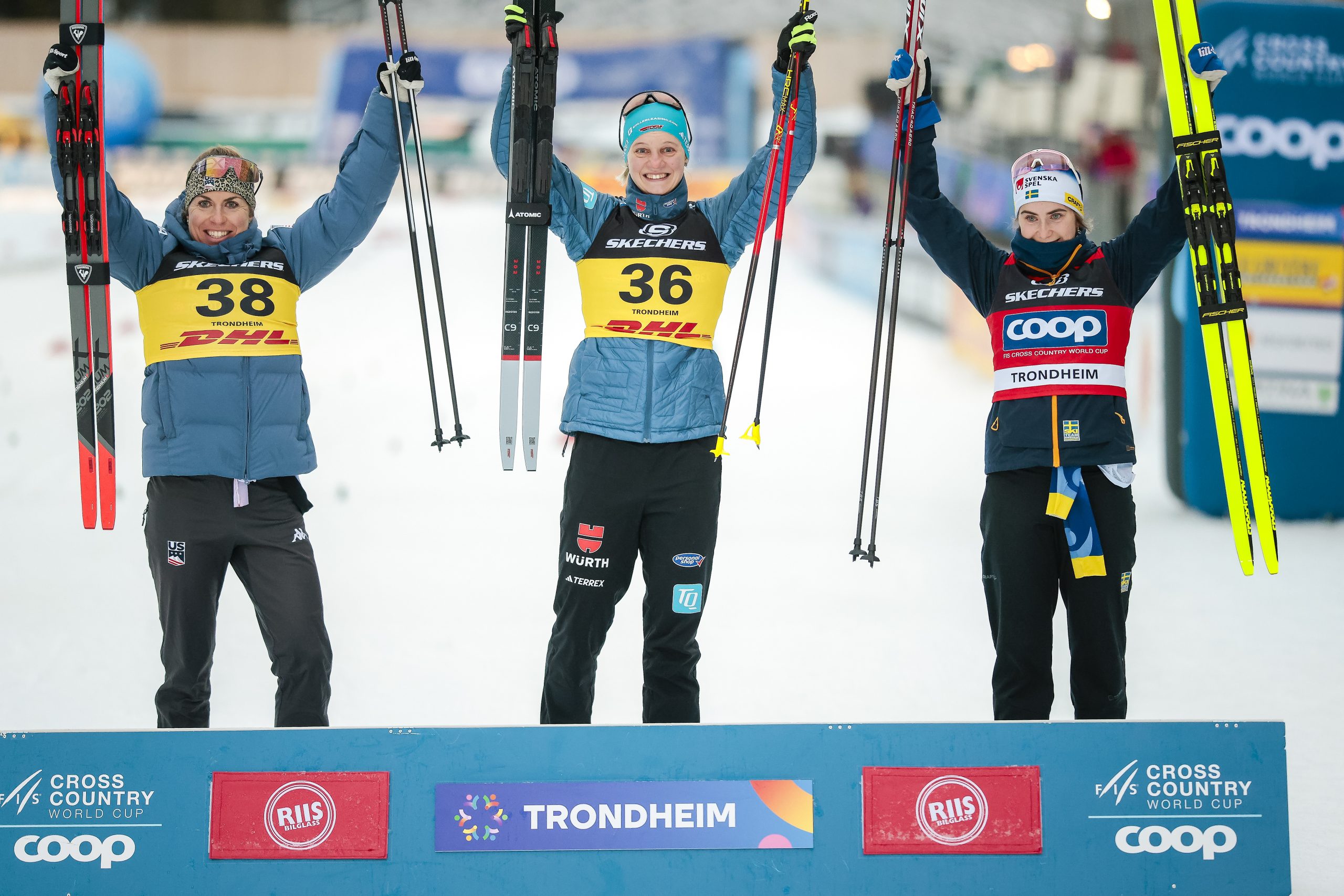
    Linn Svahn (SWE), Kristine Stavaas Skistad (NOR), Emma Ribom (SWE), (l-r) took the podium in the first Freestyle Sprint of the FIS World Cup season. (Photo: NordicFocus)

    Women’s Freestyle Sprint RESULTS

  • The Devon Kershaw Show: Stars are born in Ostersund, with guest Luke Jager

    The Devon Kershaw Show: Stars are born in Ostersund, with guest Luke Jager

    Multiple U.S. podiums. Near-misses. Coaches barging into the classic track. This past weekend was pretty fun. We get up-and-coming Alaska star Luke Jager to join us for a recap and go through it all.

    Reach us with your questions, comments and feedback at devon@fasterskier.com and nat@fasterskier.com. We’ll be back next week after Trondheim.

  • Seeking Justice for Rosie?

    Seeking Justice for Rosie?

    This coverage is made possible through the generous support of Marty and Kathy Hall and A Hall Mark of Excellence Award. To learn more about A Hall Mark of Excellence Award, or to learn how you can support FasterSkier’s coverage, please contact info@fasterskier.com.

    Rosie Brennan (USA) was impeded by a Swedish coach in Saturday’s Classic Sprint race. She doesn’t want to waste energy focusing on it, but there’s a lot of curiosity surrounding the fallout. (Photo: NordicFocus)

    No one wants to be remembered for their worst moment, but the head of the Swedish cross-country ski team, Lars Oberg, will struggle for a long time to live down his regrettable lapse in the final of the Women’s Classic sprint last Saturday in Ostersund, Sweden. In a moment that went by in a flash, Oberg stepped out onto the Sprint course while encouraging his athletes, his position in the lane interfering with Rosie Brennan (USA). This transgression happened 3:15 into the race—just before the straightaway to the sprint finish—while Brennan was in third place and battling for finishing position. She ultimately finished fourth, missing the podium by a little over one second. Those who wish to view the incident can see it on skiandsnowboardlive.com, at hour 1:53:02 of their race coverage.

    While the incident was brief, the outrage was not. Immediately, a Norwegian coach (Eirik Myhr) who was standing next to Oberg lashed out at him for the infringement. Myhr’s anger was palpable.

    Brennan (USA) was having another excellent day last Saturday when Swedish coach, Lars Oberg, interfered with Brennan at a crucial point just prior to the sprint finish. It appeared that Oberg let his excitement get the better of him. (Photo: NordicFocus)
    The Fallout

    The American team has taken the high road in response to the incident. In her post race media statements, Brennan referred to the incident as “a little mishap.” She continued that, “It’s hard to know how much that impacted the race, or not, but that’s not something you ever want to wonder about.”

    In comments directly to FasterSkier Brennan said that, “Its not worth spending too much energy [on] as there is nothing anyone can do to change what’s already happened. I just hope it was a moment for all staff to think about how they support their own athletes while also respecting the competition. I hope it never happens to anyone again.”

    U.S. Head Coach Matt Whitcomb also took a generous view of the infraction. “I talked to  (Oberg) after the race,” Whitcomb said. “He’s a friend of the team and a really wonderful guy. He came straight to us to apologize. Whitcomb continued that Oberg said that he was ‘so sorry, I was just excited’.”

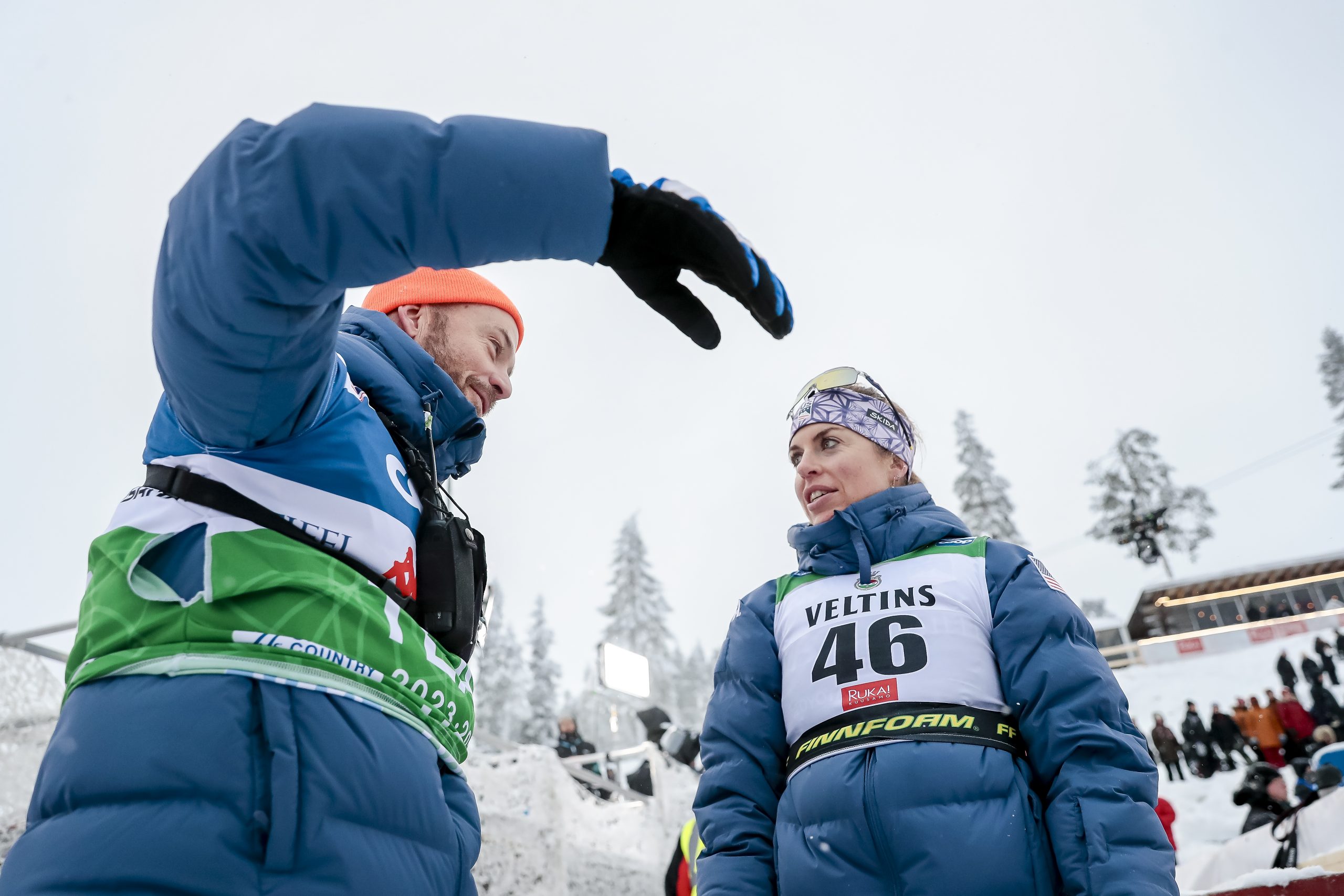
    U.S. Coach, Matt Whitcomb, and Rosie Brennan (USA) have had a lot to celebrate so far this season. They are both taking the high road regarding Saturday’s incident. (Photo: NordicFocus)

    Whitcomb empathized with the Swedish coach. “I get it, we’re all just humans focused on our team, somewhat myopically sometimes,” Whitcomb said.  “It’s easy to imagine that happening to me. It’s probably our worst nightmare as a coach.”

    Whitcomb expressed that he was satisfied with how the incident was handled. “It’s an honest mistake,” Whitcomb continued. “He feels terrible, and I understand it. His apology meant a lot; we heard it and accept it. I feel strongly that … it’s important that we debrief about it and remind coaches that we need to be careful and not impede the race.”

    Whitcomb also said that Oberg asked him to set up a meeting between him and Brennan so that he could apologize in person. Brennan told FasterSkier that she had, in fact, spoken with Oberg on the phone and that he apologized to her. “I appreciate the acknowledgement of the wrongdoing,” she said. “Given that it was so visible on TV, I chose to trust that the jury would apply an appropriate penalty.”

    To his credit, Oberg has taken full responsibility and blame for the incident. “It was incredibly rude of me,” Oberg told European media. “I got too close to the track. It’s really sad but I can’t rewind the tape. I have to take responsibility for it and have apologized. It was a pure accident.”

    The International Ski Federation (FIS) has rules for just about everything, but it doesn’t have a specific rule for what happens when a coach interferes with a skier. (Image: FIS)
    The Penalty

    The International Ski Federation (FIS) stepped in to handle the situation, fining Oberg 500 Swiss Francs, equaling $568 US dollars (the coach’s ski federation generally pays such fines). Oberg was cited under FIS rule 343.9, governing obstruction. He also had his accreditation removed for the next day’s racing; the practical effect of that last sanction is questionable. FIS’ penalty logs describe the incident as, “The coach was running next to the course and was too close and impeded an American athlete.” The dry bureaucratic language belied the raw emotion of the moment.

    Brennan is having a great year. she prefers not to waste energy on something like this incident, a factor completely outside her control . (Photo: NordicFocus)

    It was an interesting choice for FIS to use section 343.9 for sanctions since this rule is generally reserved for athletes, and specifically refers to competitors not obstructing other competitors. FIS had the option to proceed under the General Conditions category by using rule 223.1.1 regarding “unsportsmanlike conduct.” Either way, FIS chose to not throw the book at Oberg, most likely because of the inadvertent nature of the offense. Violators of FIS rules may face a maximum fine of CHF 100, 000 (about $113,600 USD) for violations. So clearly, there was a lot of latitude for FIS authorities to have been far more harsh.

    The FIS Media Coordinator offered a very circumspect response, telling FasterSkier that the decision came from the race jury. “As for now there is no change in how coaches are allowed access during the race,” the coordinator said. “We have coaching zones that they should stay in during the races. And that was used during Sunday’s race without any problems. We hope this will not happen again.”

    Team USA’s diplomatic responses notwithstanding, the implications for Brennan were significant. There is no way to know the full impact of the interference; on the World Cup every inch matters. Also, Brennan is in a pitched battle for the overall standings. At the weekend’s conclusion of racing, she was in second place overall, one point ahead of Emma Ribom (SWE), so the handful of points Brennan potentially missed out on could prove critical down the road.

    There was more at stake than just a good finish for Brennan on Saturday. Every podium finish means exposure for her sponsors, increasing her value to them. It also means extra prize money, and additional points in her race for overall season standings. (Photo: NordicFocus)

    Additionally, there are the financial implications: podiums pay. Sponsors love to see their athletes on the podium; Brennan was potentially deprived of that opportunity. There’s also the increased payout for finishing third instead of fourth; that difference is CHF 700 ($ 797 USD).

    Is a $568 fine appropriate for the violation? FIS fines athletes CHF250 ($284 USD) for delivering skis late to equipment control. So, is a doubling that penalty appropriate when an act of negligence potentially affects a race outcome?

    One thing is for sure, everyone feels bad about it. All parties expressed regret about the misfortune, and no one is out for blood. Oberg will carry this “scarlet letter” with him through the rest of his career, but Rosie will never be able to be given full satisfaction to make her whole.

    Skiing’s justice system endured a painful day, as no solution really seemed to cover all of the aspects surrounding the act. (Photo: WikiCommons)

    Perhaps, a starting point might be this: an appropriate penalty might be a fine which equals the difference in prize money potentially lost, plus additional money as compensation for possible missing Cup points and sponsor attention. And the money should go to Brennan instead of to FIS! While no amount of money will ever be able to turn back the clock to put Brennan onto the podium—if that was what may have happened—it’s the only form of compensation our society has to offer. The coach’s “mea culpa” is nice, but that only goes so far. The larger the penalty, the larger the deterrent to future violations: with there being so much room left in FIS’s penalty toolbox, it seems that more could have been done to seek an appropriate solution.

    Brennan, who puts so much into every race: it’s particularly painful to see her be potentially denied a podium because of one careless act. What’s the appropriate remedy? Reasonable minds will differ. (Photo: NordicFocus)


  • Jessie Diggins’ Second Win of the Season, Three Americans Top Ten

    Jessie Diggins’ Second Win of the Season, Three Americans Top Ten

    This coverage is made possible through the generous support of Marty and Kathy Hall and A Hall Mark of Excellence Award. To learn more about A Hall Mark of Excellence Award, or to learn how you can support FasterSkier’s coverage, please contact info@fasterskier.com.

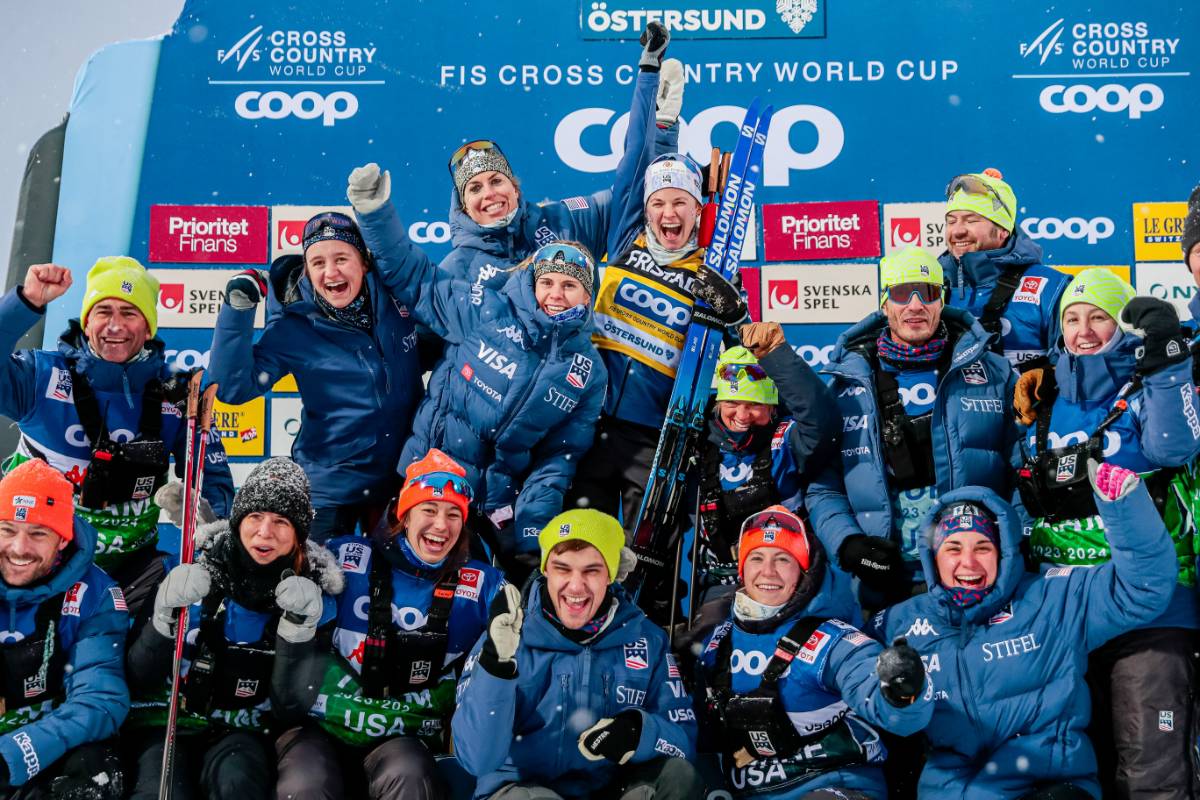
    Team USA celebrates with Jessie Diggins (USA) who took her second win of the season in Sunday’s 10 k Skate in Oestersund, Sweden. (Photo: Nordic Focus)

    At the end of the World Cup’s two-week stint in Sweden, there was one performance that defined the early stages of the 2023-24 World Cup season: At Sunday’s 10 k individual start skate race, Jessie Diggins was seen sharing smiles before the race, setting top time splits throughout it, in first place as she crossed the line, and in jubilation as she stepped to the top step of the podium for the second time in as many weekends.

    “[I] continued focusing on finding the flow in the course and the joy in skiing,” Diggins said post-race. “I even smiled a couple times throughout the race.”

    Where Diggins has gone this season, Rosie Brennan has followed closely, imbuing Team USA’s early season success with stalwart consistency. Rosie Brennan skied to a fifth place finish today, continuing a start to the season where she has finished in the top ten of every race, no matter the discipline, distance, or technique. “[The] consistency has been good, it’s something I’ve struggled with,” Brennan said in post-race comments. She added that the difference for her this season has been that the consistent results have come bounded by the lows and highs of World Cup racing. “Today, I was battling the whole time and I didn’t feel like my best self,” she said, “but on the other hand, I’ve felt like I’m very consistent while struggle to break through and have truly amazing races in the past, and I’ve had those this year too.”

    The two veterans were also joined by Sophia Laukli, who continued her quick progression up the World Cup standings by racing to her first top ten performance of the season, in eighth place. It marked Laukli’s first career top ten in a non-hill climb World Cup event (where Laukli has already podiumed). “Earlier this week, coaches watched Sophia do a big workout,” said U.S. Head Coach Matt Whitcomb. “And there was a remark that she was skiing like a top ten skier. And it turns out, she was.”

    All together, the nation with the most athletes in the top ten on Sunday in Oestersund—the Americans, with three.

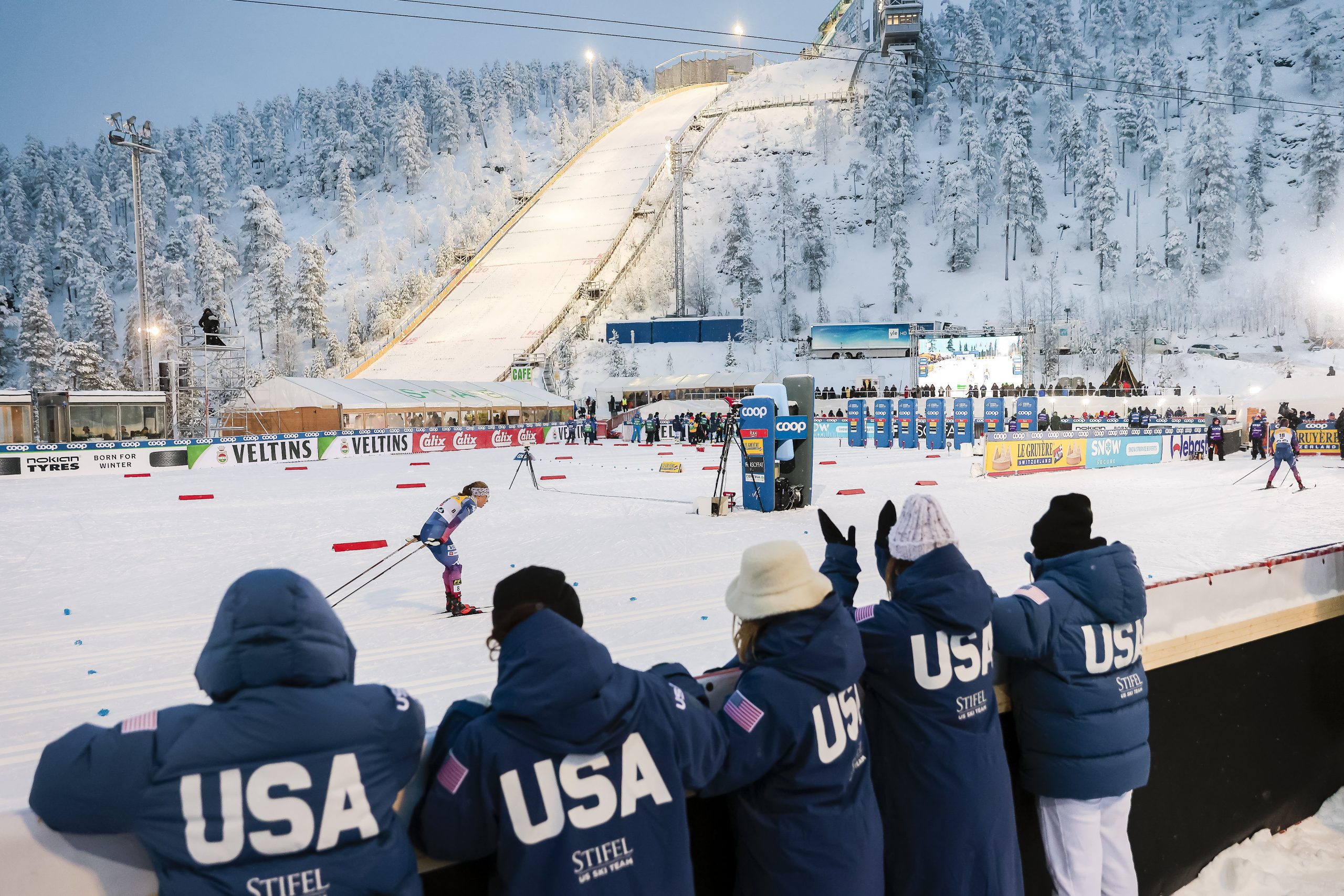
    The results have set a tone: joy, camaraderie, and celebration coursing not just through the American team, but throughout the entirety of the World Cup circuit. Under the lights of Oestersund this weekend, jackets emblazoned “USA” flooded the stadium after nearly every race. In those jackets are wax techs, coaches, and a group of athletes spanning multiple generations of U.S. skiing, all finding success on the World Cup together. There have been firsts for young skiers, consistency for veterans, and a whole lot of podiums.

    Jessie Diggins (USA) on her way to her second win of the season in Sunday’s 10 k skate in Oestersund, Sweden. (Photo: Nordic Focus)

    Energizing it all has been Diggins, overall leader of the World Cup circuit. Diggins smiled and danced before she started the 10 k skate race on Sunday, then led at every time check on her way to what was her 50th career World Cup podium, and 16th win. In post-race comments, she was resolute on celebrating the success of those who stand behind her, saying “Our wax techs have been really incredible,” she said. “I had amazing skis.” She also added that there was a specific source of inspiration for her after watching yesterday’s historic podium finish for teammate JC Schoonmaker in the Men’s classic sprint: “This one was for the boys!”

    Women’s 10 k Skate Individual Start

    The women’s start list on Sunday featured a field that was more evenly spread with contenders than is usual during an individual start. Previous World Cup winner Linn Svahn (SWE) started in bib 2, while last week’s 10 k skate runner-up Ebba Andersson (SWE) started in bib 55, the third last starter on the day. Right in the middle of the start order was Brennan, bib 35, with Diggins starting two minutes behind wearing bib 39.

    The start order made for a race that saw early starters set unusually high marks as they went through the first time checks. Standing out among this pack was bib 21, Laukli, who through the first 5.4 k had the top split in the field. Laukli would only be topped throughout by bib 22 behind her, Frenchwoman Flora Dolci, with the two skiers both setting times on the gradual but unrelenting Oestersund course that would put them in the top ten on the day.

    Sophia Laukli (USA) continued her prodigious climb up the World Cup standings, placing eighth during Sunday’s 10 k Skate. (Photo: Nordic Focus)

    Dolci’s eventual fourth place finish meant that when Rosie Brennan came through the first time check at 2.1 k, her first-place -2.2 second split defined the parameters for where the top of the field would be skiing the rest of the day. Brennan was supplanted by Diggins at the early split, who had an 11 second lead over the field. With Laukli still holding sixth place, the early splits provided an indication of the good day the Americans would have at the 10 k finish.

    The only skiers who would consistently split Diggins and Brennan in the time checks throughout the day were Dolci; Norway’s Heidi Weng, who would take second; and Germany’s Victoria Carl, who would take third. Ebba Andersson (SWE) would also challenge early in the race before fading to ninth place as Sweden’s top finisher. Carl’s performance was the other especially notable performance on the day, as she earned her first World Cup podium after 150 World Cup starts.

    Team USA: “A Great Weekend”
    Rosie Brennan (USA) skied to fifth place on Sunday. The American hasn’t finished outside the top ten at a World Cup race all season. (Photo: Nordic Focus)

    As Team USA heads into the end of Period I in Trondheim, Norway next weekend, skiers are processing what Matt Whitcomb said was, “a great weekend for the team when it comes to feeling that sense of connection between each other.”

    “The consistent results will help with things like the Tour de Ski and the [World Cup] Overall,” said Brennan. “[Those are] are things I enjoy fighting for and am looking forward to.”

    “I’m very surprised with how well this season has started,” said Diggins. “But I will happily accept happy surprises.”

    Diggins noted in post-race comments that she attributes the results she’s had to a focus on process. “The results and podiums are the icing on the cake,” she said. “But what that cake is made of is a week-to-week, race-to-race focus.” Diggins also added that there is a renewed clarity behind the laughs and smiles on the World Cup this season. “I’m here because I love ski racing, so that’s what I’m going to focus on.”

    Jessie Diggins and Rosie Brennan still stand 1st and 2nd, respectively, at the top of the World Cup Overall standings. As the Americans leave Sweden, it’s mainly the Swedish team on their tails, with Emma Ribom in third place one of six Swedes in the top ten of the World Cup Overall. The dynamic of the World Cup field remains steady.

    On Sunday in Oestersund, though, steadiness wasn’t a thought as the whole of the American team—and the American ski community watching from half a world away—allowed revelry to take over. It’s a hard thing to stand atop a World Cup podium, and Jessie Diggins—even after sixteen victories—seems to understand that the best way acknowledge that fact was to let each hug she shared with her teammates and coaches be filled with joy, and joy alone.

    Women’s 10 k Skate RESULTS

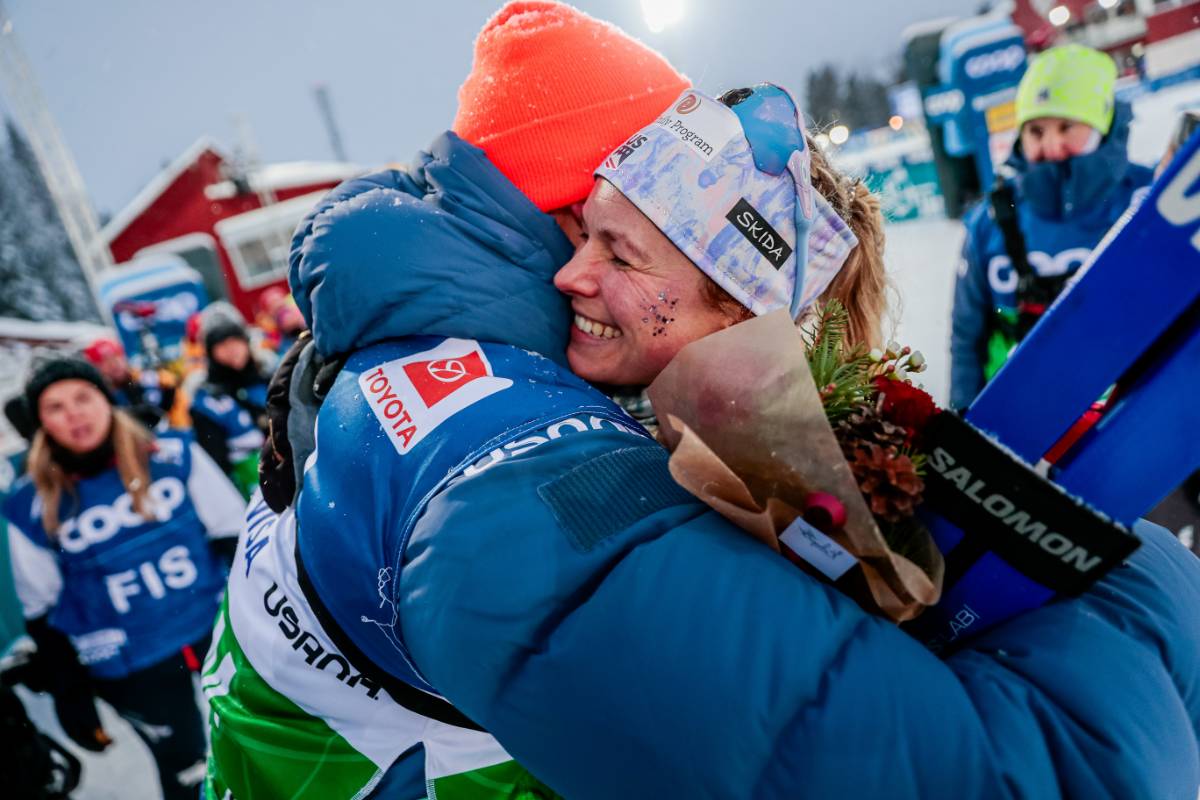
    Jessie Diggins (USA) and Stifel U.S. Ski Team Head Coach Matt Whitcomb share a hug after Diggins’ second World Cup win of the season in Oestersund’s 10 k Skate. (Photo: Nordic Focus)
  • Ribom Dominates Oestersund Classic Sprint, Brennan and Diggins Fourth and Fifth

    Ribom Dominates Oestersund Classic Sprint, Brennan and Diggins Fourth and Fifth

    This coverage is made possible through the generous support of Marty and Kathy Hall and A Hall Mark of Excellence Award. To learn more about A Hall Mark of Excellence Award, or to learn how you can support FasterSkier’s coverage, please contact info@fasterskier.com.

    Emma Ribom (SWE) dominated the FIS World Cup Sprint in Oestersund, her second consecutive Classic Sprint victory of the season. (Photo: Modica/NordicFocus)

    While much of North America continues to wait for skiable snow, Europe and Scandinavia are enjoying prime, early-winter conditions. Oestersund, Sweden had excellent conditions on its World Cup sprint track, though freshly falling snow seemed likely to affect glide in the tracks throughout the day’s racing. Sweden and the USA continue to dominate recent results, and the sprint in Oestersund proved no exception. Emma Ribom (SW) has won both Classic sprints this World Cup season, while Linn Svahn (SWE)—former World Cup Sprint Crystal Globe winner (2020)—seems to be returning to form as she topped all qualifiers on the day.

    Ultimately, Sweden’s Ribom continued her early-season sprint dominance as she skied away from the field to take the win. In second, Kristine Stavaas Skistad (NOR) sprinted past a resurgent Svahn who returned to the podium in third after two seasons struggling with injury.

    Starting the day second in the World Cup overall standings, American Rosie Brennan raced to fourth, ahead of World Cup overall leader, Jessie Diggins (USA), in fifth. Julia Kern qualified 15th, but did not advance beyond the quarterfinals. She would finish the day 17th. Other Americans included Alayna Sonnesyn 43rd, and Lauren Jortberg 47th.

    “I’m generally pretty excited about my race today,” Brennan said. “I’m pretty sure that was my best ever Classic Sprint.”

    Canadian finishers included Katherine Stewart-Jones 34th, and Amelia Wells 46th,

    Women’s Classic Sprint

    Oestersund’s sprint course is a bit longer than most, and freshly fallen snow filling the tracks would slow things down (especially in the early rounds), making this sprint something of an endurance event. The final downhill is often an area where drafting can influence who crosses the line first, but the new snow seemed likely to minimize that effect.

    “This was kind of a distance sprint,” Diggins explained. “It was 3:30, 3:40 for the women. [That’s] a longer sprint which, personally, I like! I think it’s safe to say that [Rosie and I] were pleased with having more time to play around with out there.”

    Svahn (SWE) qualified first, returning to the form that saw her win multiple World Cup sprints in years past. Jessie Diggins qualified 3rd , three seconds behind top qualifier, Svahn. Rosie Brennan qualified 6th , only a fraction behind Diggins. Kern qualified 15th, 8.9 seconds behind the leader. Then the snow began to fall, filling tracks and slowing skis. It was a beautiful winter setting for a beautiful winer sport, but competitors may have preferred something a little less scenic and a little more speedy. Wax technicians scrambled to concoct the best combination of kick and glide, while working under the time constraints of the new FIS rules that force teams to deliver skis for fluoro testing far earlier than in the past (and with no opportunity to alter ski bases—or trade out skis—after inspection concludes). It’s a technological and weather-predicting gamble that saw mixed results—some notable slipping, some extraordinary gliding—among the early heats.

    In Quarterfinal 1, Ribom (the World Cup Sprint leader) drove the pace to finish just ahead of Skistad. Swedish teammates, Svahn and Frida Karlsson, advanced out of Quarterfinal 2.

    Quarterfinal 3 saw Brennan start slowly, but she popped to the front as soon as the course turned uphill. She powered up the slope, hoping her skis would prove fast enough on the subsequent downhill. By the halfway mark, Brennan had pulled clear of the field with only Moa Lundgren (SWE) for company. Brennan cruised to the heat win, only easing up in the final few meters. She was followed across the line by Lundgren.

    “It was snowing during the race, and filling in the tracks a little bit . . . My strength is in climbing; the climbing was at the beginning—and it was a little turny coming back to the stadium—so I thought I would just do my best to stay in the front.”

    Kern seemed clogged near the back of Quarterfinal 4, while the distance skiers—Lotta Udnes Weng (NOR), Kertu Niskanen (FIN) and Ebba Anderson (SWE)—used their long-fitness to push the pace. Kern’s good skis allowed her to move forward in the final meters, but only enough to finish fourth where her time as not fast enough to earn a lucky loser spot.

    Racing in the World Cup leader’s yellow bib, Jessie Diggins (USA) used her endurance and climbing ability to set the pace in early heats, but could not maintain that tactic in the final. (Photo: Modica/NordicFocus)

    Quarterfinal 5 saw Diggins power to a heat victory in the fastest time of the day. The Swedes seemed to have gone light on kick wax: forced to herringbone on the uphills, but hoping to have better glide in the snowy downhill tracks. Diggins apparently realized that strategy; she countered by driving the pace on the uphills, distancing the field early in the course and continuing across the finish line unchallenged. Behind her, Dahlqvist executed a mad-dash double-pole to the finish to pip Finland’s Tiia Olkkonen for second.

    Semifinals

    The Oestersund snow had stopped falling by the beginning of the semifinals, and the tracks had begun to be skied-in: higher speeds on the downhills, more opportunity for drafting on the downhill leading into the finish. Semifinal 1 was stacked: Svahn, Ribom, Brennan, Karlsson, Skistad appeared poised to follow a fast pace; then no one wanted to take the lead. Brennan pressed the pace on the first uphill,  and then the action began. The three Swedes followed Brennan while Skistad dangled unexpectedly off the back. Showing the strength she’s demonstrated in allWorld Cup stops thus far this season, Ribom pulled away for the win, while the fast skis of Skistad allowed he to double pole through top qualifier, Svahn, to grab an automatic entry into the final. Svahn finished third well ahead of Brennan in fourth, and Karlsson in fifth. Svahn and Brennan would would ultimately advance as luck losers.

    Semifinal 2 saw Diggins lining up against Dahlqvist, Lotta Udnes Weng (NOR), Moa Lundgren (SWE), and Niskanen. Dahlqvist dropped off the back on the very first uphill (though she did not seem to be suffering from inadequate kick) while Diggins moved to the front with Lundgren. The gap continued to increase as the field entered the two significant downhills. Diggins’s style is not to let up—even when she has a comfortable lead—and she double-poled powerfully across the line for the semifinal win. Dahlqvist sprinted forward from waaaay back to finish a close third (behind Lundgren), though her finishing time was not fast enough to claim a lucky loser spot in the final.

    Sprint Final

    The snow had begun falling again as three Swedes—Ribom, Svahn, Lundgren—lined up in the final in front of the hometown Oestersund crowd. With them at the line were the two Americans—Brennan and Diggins—and the lone Norwegian, Skistad. Skistad and the Swedes made the pace right from the gun with the Americans trailing, though the pace leveled off quickly allowing Diggins to ease forward on the first uphill. Svahn and Ribom seemed to be slipping a bit on the climb, while Diggins skis appeared solid. Brennan was pinched on a tight corner and was forced to work to regain contact.

    “For me, the strategy was just to get to the final by going hard,” Diggins said. “Making sure that it spaced out and didn’t become a race of rushing or people trying to out-corner other people . . . that’s not one of my strengths. So I just decided to go for it and give myself a little space . . . It was a bold strategy, but I was happy with how it panned out . . . I just kind of ran out of gas in the final!”

    Rosie Brennan (USA) skied confidently at the front for much of the day’s sprint heats in Oestersund. In the final, she may have been inadvertently interfered with by a Swedish coach as she attempted to set up for a notoriously tight turn just before the finish. (Photo: Modica/NordicFocus)

    Once over the climb, the speed of the Swedes’ skis became apparent. While Ribom and Svahn opened a gap, the Americans were forced to work hard to remain in contention. Entering the final righthand turn, Brennan may have been inadvertently interfered with by a Swedish coach; she calmly brushed him aside, managing to push herself forward.

    “I was really bummed to be impeded by the Swedish coach,” Brennan said. “That’s really not the first time that’s happened to me; It’s the first time that it was on camera,” She chuckled. “So it’s nice that other people saw it! It’s impossible to know what impact that had on my race; I was obviously gaining momentum and had picked that line because I felt like I could pass some people. I feel like coaches are the people who should know the best about how a race works: in a sprint, all people are fighting for all positions, and all lanes are likely going to be used. [Coaches] should be looking out for more than just your own nation. When I left, the jury was discussing and figuring out what to do. I have no idea what the result of that was, but I’m sure that I’ll find out at some point.”

    Ahead of the fray, Ribom showed her class as she glided to the win. All Brennan’s hard work and clever maneuvering was undone by the superfast skis of Skistad who glided through Brennan and powered toward the finish where she caught Svahn for second. Sweden first and third, Norway second, USA fourth and fifth.

    Diggins maintains her lead in the World Cup overall race, just one point ahead of Ribom. Brennan remains in the top three as the World Cup returns to Oestersund on Sunday for an Individual Start 10 k Freestyle.

    “I am feeling good, and I’m excited to have some sprint in me. That makes me really happy and optimistic . . . things are good right now!”

    Women’s Classic Sprint RESULTS

    Kristine Stavaas Skistad (NOR), Emma Ribom (SWE), Linn Svahn (SWE), (l-r) – FIS World Cup Individual Sprint in Oestersund , Sweden. (photo:  Modica/NordicFocus)
  • Life on the Podium: Rosie Brennan Has Earned It

    Life on the Podium: Rosie Brennan Has Earned It

    This coverage is made possible through the generous support of Marty and Kathy Hall and A Hall Mark of Excellence Award. To learn more about A Hall Mark of Excellence Award, or to learn how you can support FasterSkier’s coverage, please contact info@fasterskier.com.

    Rosie Brennan (USA) has had a fantastic start to this season. In the 4 x 7.5 k relay she moved the USA into first and handed off with a 19 second lead. (Photo: NordicFocus)

    Fine wines improve with age: so, too, Rosie Brennan. The 35 year old Alaskan has had one of her best starts to a World Cup season, a stark contrast to last year when she suffered from illness and just missed the podium often enough that it looked like it might be a trend. that challenging start notwithstanding, Brennan has dug in and continues to improve in every aspect of the sport. And, after last weekend, she is ranked second overall in the World Cup standings. Improving with age . . .

    So, what accounts for her tremendous success this year? She has always had a reputation for being a consummate professional, but has anything changed to explain her fast start? Rosie was kind enough to give FasterSkier some of her valuable time in between race weekends to share her thoughts.

    This interview has been edited for brevity and clarity.

    Rosie Brennan (USA) doesn’t feel like there’s anything too unusual going on at the start of this season. But for some bad luck, she thinks she could have performed at this level last year. (Photo: NordicFocus)

    FasterSkier: You’ve had a tremendous start to this season. Aside from not being ill, is there anything you did differently in the offseason or during the beginning of the race season that helped you reach this level of success?

    Rosie Brennan: My general plan has been the same for many years now, so no, nothing crazy changed. I had a tough fall last year, getting Covid during October camp and then catching a cold in Lillehammer. Honestly, without that I think I would have been poised for similar results.

    FasterSkier: What’s your view on how you are achieving such great success?

    Rosie Brennan: I really like racing on natural, cold snow, which is often what we find in period one. I think much of my success can be attributed to conditions that suit my strengths more than anything else. It also helps that I am coming from Alaska and so I have been on snow before coming over here. I’ve had podiums in period one since 2020 so I don’t really think the results I’m having are anything crazy, but just the result of a lot of steady years of training and being more consistent in my racing.

    FasterSkier Looking forward to the rest of the season, do you feel you can sustain this level of intensity?

    Rosie Brennan: Of course, I believe that. I never go into the season planning to have my best races the first weekend. I train to compete at the highest level I can for an entire season. In general, I try to carry a bit more volume through period one to help sustain fitness at the end of the year as well. Part of the game is also knowing what your strengths are and making sure you can use them.

    Rossie Brennan’s (USA) Classic technique continues to evolve. Her refinements helped her to find her first Classic race podium. (Photo: NordicFocus)

    FasterSkier: You just had your career first Classic podium (and an incredible Classic leg relay). Do you feel like you’ve made any changes to your Classic technique to account for this success?

    Rosie Brennan: Changes at this point in my career are quite small, but yes, I’m always trying to find and make those small changes that allow me to be more efficient, more powerful, or whatever it is I’m looking for. I do feel that my Classic technique has improved. I also have had a few years of working with my tech, Bjorn, now and we really understand each other. He works very closely with Rossignol and over the last year or so we have completely overhauled my Classic fleet, so I am also skiing on skis that fit me better and are waxed better. All those things together allow me to have the Classic results that I have had lately.

    FasterSkier: In your 7.5 kilometer Classic relay leg was your pace all out for the entire race, or did you have a pacing strategy?

    Rosie Brennan: Relays are hard to make race plans for because you never know where you will be tagged off. I didn’t intend to go out the way I did, but when Jessie tagged me and there was a gap to Sweden, and I felt good, I thought the best chance was to go out hard and try to make the gap big enough that they couldn’t get back on. I definitely was dying the second lap and had moments of regrets, but I did all I could to hold myself together.

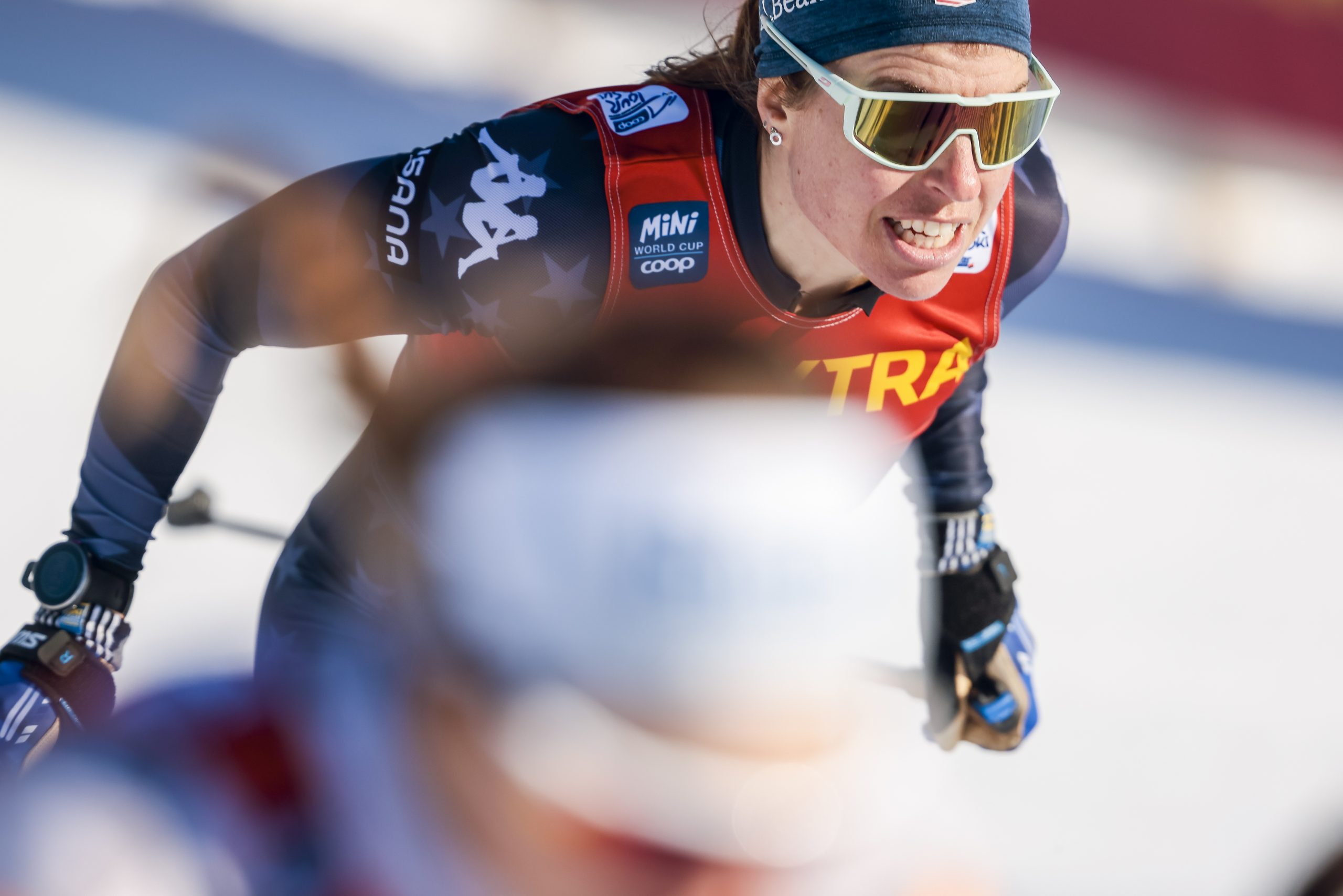
    Rosie Brennan (USA)  showed her trademark grit, staking the Americans to a 19 second lead in the relay. According to Brennan, all she was doing in this relay photo was “just taking big breaths” . . . and maybe “screaming a bit in my head!” (Photo: NordicFocus)

    FasterSkier: In the relay race there’s a great picture of you going down one of the hills where you appear to be screaming. Is that something you do to psyche yourself up, deal with the fast downhillls, or something else altogether?

    Rosie Brennan: I am just breathing in that pic … that’s not an uncommon picture to find of me racing for better or worse, but that’s just me taking big breaths and maybe screaming a bit in my head.

    FasterSkier: From the athlete’s perspective, how do you feel the new fluoro policy implementation is going? Has it meant changing your routine, or any other issues surrounding it you’ve had to address?

    The new fluoro ban has been a landmark policy change, but the biggest change Brennan sees is how it affects warm ups. (Photo: NordicFocus)

    Rosie Brennan: It’s definitely not ideal. Our whole testing schedule moves up 30 minutes, so I now test skis and then try to find somewhere warm to hang out for a bit so I’m not warming up for hours before my race. The actual logistics of picking up your skis and dropping them off have been smooth so far, so it’s really just a matter of getting used to this new schedule.

    FasterSkier: American’s are ranked 1-2 in the overall standings. What does this mean to you personally?

    Rosie Brennan: Jessie took the yellow bib from me in 2020 so, at the very least, it’s not new for us to be fighting for it. It’s very cool though. We both seem to have found ourselves and are enjoying racing right now. It’s always a pleasure to see multiple American flags on all the various standings. It makes me proud of how far we’ve come and that we have both found ways to keep doing this for so long.

    FasterSkier: In our summer interview you mentioned that the European media didn’t give Americans much attention in the mixed zone. Has that changed now that you guys are 1-2?

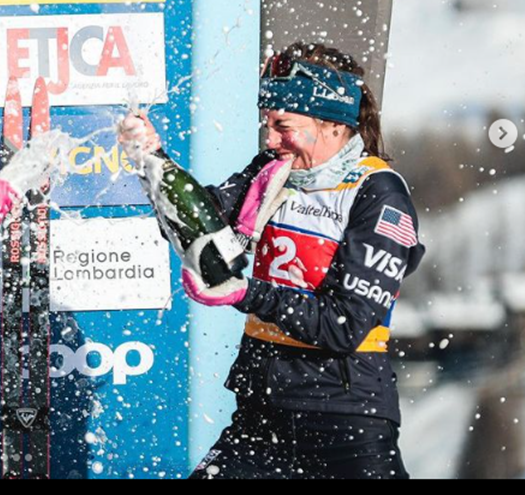
    Rosie Brennan (USA), shares a podium-day moment with U.S. team coach, Matt Whitcomb. (Photo: NordicFocus)

    Rosie Brennan: I had lots of interviews after the podium in Ruka, but not much since then. I guess it’s a bit of ebb and flow as to how much they care about Americans. I do think we’ve turned some heads, and they certainly can’t ignore what we are doing right now.

    FasterSkier: The team must have about 10 pounds of winners’ cheese now. What do you do with all that?

    Rosie Brennan: We snack on it, give it to wax techs, save some for Christmas, gift it to others in our support team.

    FasterSkier thanks Rosie Brennan for taking time from her hectic schedule to answer our questions. And, for even more commentary on the hot start to the 2023 season, tune in to The Devon Kershaw Show to hear the latest podcast featuring an interview with Rosie Brennan.

    There’s no shortage of Gruyere to be found in the U.S. camp these days. (Photo: NordicFocus)
  • The Devon Kershaw Show: She’s second in the world right now. Rosie Brennan joins us.

    The Devon Kershaw Show: She’s second in the world right now. Rosie Brennan joins us.

    American skier Rosie Brennan is second in the World Cup standings right now, after a double podium in the season’s first weekend of racing. She’s a veteran with numerous podiums to her name and top-fives at championship events. Brennan joins us from Sweden to talk about her hot start to the season.

    Check out our past coverage of Brennan’s career here. Reach us at devon@fasterskier.com and nat@fasterskier.com. We’ll be back after this weekend’s races.

    Rosie Brennan’s classic technique continues to evolve. Her refinements helped her find her first classic race podium. Photo: NordicFocus)
  • U.S. Takes Third in Women’s Relay

    U.S. Takes Third in Women’s Relay

    This coverage is made possible through the generous support of Marty and Kathy Hall and A Hall Mark of Excellence Award. To learn more about A Hall Mark of Excellence Award, or to learn how you can support FasterSkier’s coverage, please contact info@fasterskier.com.

    Jessie Diggins (USA) skied leadoff for the USA. Her task was straightforward: break the field. (Photo: NordicFocus)

    On Sunday morning in Gallivare, Sweden the World Cup moved on to the women’s 4 x 7.5 kilometer Relay. Even casual fans of nordic skiing know what that means: stakes will be a little higher, motivation will be somewhat hotter, and emotions will be at 11. Even though today’s race isn’t a World Championship or Olympics, you need go no further than to look at team USA’s lineup shuffling to understand the stakes. Gone is the idea of putting Jessie Diggins on one of the last two legs in the hope that she could overcome any deficit. Today would be different . . .

    As powerful as the U.S. team is, history is not on their side. Norway has won 15 of the last 16 women’s World Cup relays. They haven’t missed the podium since 2007! But gone are Therese Johaug and Marit Bjorgen. Even more relevant for today’s race, Tiril Udnes Weng (NOR), the defending World Cup champion, would also be out, still recovering from illness. Also standing in the way of the Americans would be the powerful Swedish team full of all-stars.

    After all the cards were played, it was a victory for Sweden on home soil. Germany finished second, and USA came in third. Norway’s podium streak came to a crushing end.

    Women’s 4 x 7.5 Relay

    Today represented a shuffling of the deck for Team USA with Diggins leading off, followed by Rosie Brennan. Sophia Laukli would ski the third leg (first freestyle leg), with Julia Kern filling the anchor position. Diggins and Brennan have both been skiing exceptionally well in Classic events this season, so the move made sense; the U.S. team might have been tired of seeing its stars facing large deficits in the second half of relay races. Today’s strategy was a calculated gamble by head coach Matt Whitcomb. He confirmed that part of the thinking was avoiding early deficits. “We have for many years, been missing podiums by developing a little gap in our Classic leg,” Whitcomb said. “When you break contact in a relay, it becomes twice the effort to close that gap. What we really wanted to do was to make it hard on everybody right from the beginning.” The lineup change did just that, surprising the competition. “When I was talking to the Norwegian coach he said ‘we looked at the start list last night and you really surprised us,’” Whitcomb said. “‘It shocked us actually’, and that was the idea.”

    It’s a new approach, but there’s something else new; going into the race, Diggins and Brennan are ranked 1-2 in the overall World Cup standings. So why not have the two skiers who are currently ranked the best in the world lead off? The team’s leaders bought into the new strategy. “It definitely took some discussion,” Whitcomb said. “But [Diggins and Brennan] are so into their team and want to push the team forward so badly that they will ski in any leg to get that done.”

    Jessie Diggins (USA) went straight to the lead to begin the race. By the time she finished her leg, she had strung out the field and went into the exchange even with Heidi Weng (NOR). (Photo: NordicFocus)
    Leg One

    It was perfect conditions for classic skiing with a temperature of 13 degrees Fahrenheit as Diggins took to the start wearing the now-traditional glitter and relay socks.

    Diggins jumped into the lead at 1.3 kilometers, ahead of Norway’s Heidi Weng and Sweden’s Moa Lundgren. It was clear early that Diggins’ strategy was to go as fast as she could as early as she could in trying to beat down the field. “Jessie took it out from the gun, like an actual bullet fired from it, and really surprised people,” Whitcomb said. “People suddenly realized it was going to be full gas for 7.5 k.”

    But dropping Weng and Lundgren would be a tall task. By 2.8 kilometers, Diggins began to string out the top seven contenders with USA, Norway, and Sweden forming a small gap.

    By the time the skiers reached the 5.1 kilometer checkpoint, the cream had risen to the top. But it was also clear that while the rest of the field had been significantly separated, Diggins would not be able to put a significant gap on Weng and Lundgren. Lundgren was yo-yoing off the back of the lead trio, but she was consistently able to close the gap whenever a small space developed. It was a very game performance by the Swede.

    With one kilometer to go in her leg, Diggins put the hammer down and was finally able to establish some space between herself and Lundgren, but there was no dropping the cagey veteran Weng. Weng knew exactly what Diggins’ game was, and she was content to simply shadow the American for most of her leg. As they entered the stadium, Weng jumped into the lead—no longer willing to let the American set the pace—and tagged off to her teammate half a second ahead of Diggins. Sweden came through the exchange in third, ten seconds back. Germany was over 33 seconds behind the leaders.

    After the race, Diggins acknowledged the special place that relays hold. “Skiing the scramble leg I got to get out there and cheer for my teammates, and seeing the fire in their eyes, they were giving it everything they had,” she said. “That made so proud… to see people giving it their all when they’re skiing for each other. I could not be more proud of this team.”

    Rosie Brennan (USA) gave it absolutely everything on the second leg. She showed her trademark grit and staked the Americans to a 19 second lead. (Photo: NordicFocus)
    Leg Two

    Now it was Rosie Brennan’s turn to lead the Americans. Brennan immediately jumped ahead of Margrethe Bergane (NOR), who was a late replacement for Astrid Oyre Slind (NOR). Brennan’s strategy was the same as Diggins’ … go as fast as you could, as early as you could, and split the field.

    Emma Ribom (SWE) showed that she was determined to rejoin the leaders and began digging into the ten second deficit she had been handed. It was a decisive move that kept Sweden in the game.

    Brennan began to put in some remarkable efforts on the uphills and was able to create a gap on the Norwegian. It proved to be a dagger to the heart of Bergane as Ribom was then able to pass her and move Sweden into second place.

    Rosie Brennan (USA) displayed her Classic prowess as the Americans’ plan played out perfectly through the first two legs. (Photo: NordicFocus)

    Brennan continued to motor; her trademark grimace now plastered across her face. At 10.3 kilometers, she had established an 11 second lead over Ribom. At the end of Brennan’s first lap, she had increased the gap to 13.3 seconds, and Bergane began to fade along with Norway’s podium hopes.

    As they came into the final hills, Brennan didn’t let up one bit, ultimately putting a whopping 19 seconds onto the field! It was an inspiring performance. Katerina Hennig (GER) had made her own bit of magic moving Germany into second place, erasing a 23 second deficit from Sweden.

    By the time Rosie Brennan’s (USA) job was done, she had moved the USA into first, and Germany had managed to grab a hold of second place. (Photo: NordicFocus)
    Leg Three

    Now the heart of the matter would begin to play out. Would team USA’s gambit of putting its strongest skiers first payoff? The pressure was on long distance specialist Sophia Laukli to protect the lead she had been handed as she set out on the first skate leg. She started with a 19 second lead over Germany and Sweden. Norway was now 48 seconds off the lead and almost 30 seconds away from a podium spot.

    The USA was hoping that Sophia Laukli’s (USA) long distance skills would keep them in the hunt for a podium. (Photo: NordicFocus)

    Laukli had the unenviable task of facing off against Germany and Sweden who would have the advantage of skiing together while Laukli toiled alone. It was Ebba Andersson (SWE) and Pia Fink (GER) who would work together to try and reel in Laukli.

    At the first time check her lead began to shrink with the two hunters quickly shaving three seconds off the leader. Andersson and Fink continued to work together to cut into Laukli’s lead, and their strategy was paying dividends. It appeared to be only a matter of time before the two chasers would catch her. At 17.8 kilometers Laukli was still leading, but she was bleeding time; her lead had shrunk to only 11 seconds as Andersson began to separate herself from Fink.

    When she entered the stadium on her first lap, Laukli’s lead was down to eight seconds. The Americans would have to hope that Laukli’s long distance motor would now kick in.

    The lead continued to melt away; it was like an ice cube sitting in the sun, the result inevitable. At the 20.1 kilometer mark inevitability met reality and Andersson caught Laukli. Now the dynamic was different—Laukli would would no longer be the hunted; she would try to ski together with Andersson in the hope of holding off the rest of the field. But Andersson would have nothing to do with working together and almost immediately began to gap Laukli. Laukli was clearly digging hard on the uphills, but try as she might, she could not stay on the Swede’s skis.

    Andersson relentlessly pushed the pace with Laukli giving it everything to keep the Swede in sight. When they entered the stadium, Sweden handed off with a 4.6 second lead over team USA.

    Germany was 20 seconds off the lead, and 15 seconds behind the second place Americans. Norway was a shocking 57 seconds off the lead, 37 seconds from a podium, its streak in dire jeopardy.

    Sophia Laukli (USA) pushed extremely hard on the uphills—her strength—in her attempt to hold off hard-charging Sweden. (Photo: NordicFocus)
    Leg Four

    Now it was up to Julia Kern to determine team USA’s fate as she would duel against Moa Ilar (SWE) while having to look over her shoulder and protect against Germany’s Victoria Carl. Ilar has had an excellent season so far, finishing third in yesterday’s 10 k individual start Freestyle and winning the Ruka 20 k Freestyle.

    Julia Kern (USA) was tasked with the unenviable job of trying to hold off Sweden and Germany on the anchor leg. (Photo: NordicFocus)

    Ilar immediately brought her big firepower to bear and expanded the lead she had been handed. At 24.1 kilometers Kern was already 15.6 seconds behind the Swede. Now she would not only have to worry about catching Sweden, but have to contend with Germany’s formidable Carl.

    Ilar continued to extend her lead; at 25.3 kilometers, it had swelled to 22.3 seconds. Kern was caught in no man’s land as she continued to lose time to Ilar, and Carl  was now a mere five seconds behind her. For Kern, the dilemma was whether she should try to stay on her own or work with Carl in trying to catch Ilar.

    At the start of the final lap, that quandary was rendered moot as Carl passed Kern, who was now trying to hang with the German as they both pursued Sweden. But Ilar was simply too strong: at 27.6 kilometers Ilar’s lead was still 21 seconds. The battle was now for second, and Kern’s job was to try and use her sprinting skills to overtake Carl at the finish. Well aware of Kern’s finishing abilities, Carl worked to give herself a cushion going into the finish. With less than a kilometer to go, Ilar was too far ahead to be caught, and Carl had now established a 10 second lead over Kern.

    As they entered the stadium, Ilar’s lead was substantial. She was able to relax as she led Sweden to a sweet victory on home turf. Kern could not close the gap on Carl as Germany finished second and USA was third, fourteen seconds behind Germany, and 27 seconds off the lead. Norway finished fourth, its podium streak broken.

    Julia Kern (USA) was able to keep the USA on the podium, which for a relay day, is always a good day for team USA. (Photo: NordicFocus)

    As Kern was surrounded by her teammates at the finish, it had to be a mix of emotions for the Americans who had led for half the race, and saw that lead fade away. A podium finish is always a good day in the relays, but as they climb the ladder into the World Cup’s elite, one can’t help but feel that there are still higher goals on which Team USA has set its sights. “This team has a lot to prove,” Whitcomb said. “This was the site of their first relay podium and I think they wanted to deliver. Today was the 11th anniversary of our first podium. There’s more to be gained. We can win these races.”

    There’s more to be gained. We can win these races.” U.S. Coach Matt Whitcomb

    Whitcomb also wanted to acknowledge the shoulders that this team is standing on. “Today is a big shoutout to that women’s team in 2012 who got on that podium for the first time,” he said. “We are honored to represent everybody back home following us.”

    Diggins also made a nod to history. “It’s so cool to be back here and have all these memories,” she said. “One of the things I’m most proud of in my career is being part of all the relays that have medaled.”

    Brennan also acknowledge the special place that relays have. “Relay podiums are always special. It’s always fun to have a joint effort out there. Everyone shares the emotion. It’s been a little while since we’ve had a relay podium, so it was really nice to get back on the podium and try something different in our order.”

    Women’s 4 x 7.5 k Relay RESULTS

    It was smiles for team USA as they were able to fight for a podium finish in the 4 x 7.5 k Relay. Julia Kern (USA), Jessie Diggins (USA), Sophia Laukli (USA), Rosie Brennan (USA), (l-r) (Photo: NordicFocus)
  • Diggins Reigns at Gallivare 10 k Freestyle

    Diggins Reigns at Gallivare 10 k Freestyle

    This coverage is made possible through the generous support of Marty and Kathy Hall and A Hall Mark of Excellence Award. To learn more about A Hall Mark of Excellence Award, or to learn how you can support FasterSkier’s coverage, please contact info@fasterskier.com.

    Jessie Diggins (USA) sprints across the line to win her first FIS World Cup of the 2023-2024 season in the 10 k Freestyle in Gallivare, Sweden (Photo: Nordic Focus)

    Gallivare, Sweden marks the outer limit of the World Cup circuit. The latitude: as northern as it gets. The course: as “unrelentingly technical” as it gets. The weather: at 5℉ (-15℃) this morning, about as cold as it gets, too. Eleven years ago, Gallivare was the venue that saw the US Ski Team break in from the fringes of World Cup standings as a 21 year old Jessie Diggins rounded the final stadium corner and sprinted across the finish line with a dramatic ski toss, securing third place in a Team Relay: the first relay podium in modern US Ski Team history. “I had a lot of memories this week,” Diggins said today, “of that race, and digging deeper than I ever had in my life back then.” Eleven years later in Gallivare, there was less doubt. Diggins—now reigning World Champion in the 10 k Skate—skied each technical turn and bump of Gallivare’s 5 k loop faster than anyone else could, winning her first race of the 2023-24 World Cup season. 

    Diggins built a steadily-compounding lead over her nearest challenger, Sweden’s Ebba Andersson, that stretched from two seconds at the 2 k mark to a 23.1 seconds lead at the finish. On a course that featured tightly-wound corners and punchy uphills, Diggins pointed to her ability to take time in the spaces between as key to her success. “[There were] a lot of transitions, I tried to really find the flow in that course,” she said. “There’s a ton of thinking that can be done out there, and you always have to be working and pushing and sending it on the downhills. US Ski Team Head Coach Matt Whitcomb added that, “What makes [Jessie] so devastating on this course is her ability to ski into the hills, over the hills, and through the corners better than most, and better than anyone today.”

    Rosie Brennan (USA) finished sixth in a tightly contested top ten in Gallivare’s 10 k Freestyle. (Photo: Nordic Focus)

    Diggins’ win provided a definitive cap on a day when Americans delivered strong results. Joining Diggins near the top of the standings was Rosie Brennan in sixth place, a performance that moved Diggins and Brennan into first and second, respectively, in the World Cup Overall standings. This marks the first time in World Cup history that Americans have held the top two positions at once. In all, five American women scored top 30 results, underscoring the early season momentum that was evident in Ruka last weekend. Those results included Sophia Laukli one-upping her 14th place from last weekend’s 20 k skate with a 13th today, a strong 18th place finish from Julia Kern, and Novie McCabe 29th, her third top 30 in as many distance starts this season. 

    Jessie Diggins (USA) smiles after taking the win in the 10 k skate in Gallivare, Sweden on Saturday. (Photo: Nordic Focus)

    “I’m really proud of my teammates and everyone behind us,” Diggins said of the American team’s strong all-around performance. “They’re putting their heart and soul into this, and it shows.”

    Sweden’s Moa Ilar rounded out the podium in third place, a notable performance considering the bout of COVID currently sweeping through the Swedish team. The Swedish team’s situation kept the always-competitive Frida Karlsson out of this weekend’s racing; sill, there is the prospect of an exciting early-season 4 x 7.5 k Team Relay tomorrow as the dominant Swedish team meets the surging Americans. 

    Novie McCabe (USA) placed 29th in the Gallivare 10 k Freestyle, her third top 30 finish in as many starts this season. McCabe was one of five American Women in the top 30. (Photo: Nordic Focus)
    “Amazing, Unexpectedly Good Start”

    There were early signs that the American team was going to have a good day in Gallivare: starting in bib 4, Alayna Sonneysn set a top five split among the earliest starters. Sonnesyn skied to an eventual 40th place, but was followed in succession by Novie McCabe, Julia Kern, and Sophia Laukli who all showed top splits within their respective sections of the World Cup field.

    Sophia Laukli’s 13th place solidified a strong start building off her 14th in the 20 k Skate in Ruka last weekend. Laukli said post-race that she, “[has] a bit more ambition when it comes to the World Cup, seeing how the running success from the summer has combined with early results, I’m starting to set some bigger goals in the back of my mind.”

    The early pace-setting for Gallivare’s top finishers would come from Frenchwoman Delphine Claudel, who consistently took the top split at each early check point. Claudel would finish the day in fifth. At every check point of the winding, dipping, climbing Gallivare course, Andersson and Diggins marked one another. Andersson would top Claudel’s split, and then the question of whether Diggins would be able to match or top Andersson’s time would follow in short order. From the first 1.9 k split, Diggins continued to build her margin over Andersson. There was a consistent vector in Diggins’ growing margin of victory, as well. At 5 k, Diggins had a 13.2 second split over Andersson. At the finish, it was 23.1 seconds.

    Jessie Diggins told FIS media that she was enjoying her “amazing, unexpectedly good start.” Those results have been interspersed with some on-the-edge moments, including the dramatic, final-kilometer pole break in last week’s 20 k skate race, and a moment during today’s 10 k skate where Diggins told FasterSkier she “almost flew off one of the corners, because I got pretty aggressive . . . [that’s] when I race best.” Likewise, the technical Gallivare course served to liven up the World Cup circuit. “This was a really fun course for me,” said Diggins. “I had a lot of fun skiing it all week.”

    Women’s 10 k Freestyle RESULTS

    Ebba Andersson (SWE), Jessie Diggins (USA), Moa Ilar (SWE) celebrate podium performances at the FIS World Cup 10 k Freestyle in Gaellivare , Sweden. (Photo: Modica/NordicFocus
  • The Devon Kershaw Show: U.S. rocks Ruka as 2024 season kicks off

    The Devon Kershaw Show: U.S. rocks Ruka as 2024 season kicks off

    Damn. What a weekend for the U.S. Ski Team, with three podiums in three days of racing at the World Cup opener in Finland.

    Erik Bråten, a Norwegian who coaches the Swiss ski team, joins Devon and Nat to recap and share his experiences across a range of international ski cultures. Send us questions, feedback and anti-vax screeds to: devon@fasterskier.com and nat@fasterskier.com — we’ve already got some questions stacking up for a mailbag episode in a few weeks. We’ll be back in a few days after the next World Cup weekend in Sweden.

  • Epic Day in Ruka. Diggins Second, Brennan Third in 20 k Freestyle

    Epic Day in Ruka. Diggins Second, Brennan Third in 20 k Freestyle

    This coverage is made possible through the generous support of Marty and Kathy Hall and A Hall Mark of Excellence Award. Learn more about A Hall Mark of Excellence Award—or about supporting FasterSkier coverage—by contacting info@fasterskier.com

    Jessie Diggins (USA) bloodied and battered at the finish is comforted by teammate, Sophia Laukli (USA). (Photo: NordicFocus)

    It was an epic day of racing in Ruka, Finland where the women closed out their racing with the 20 kilometer mass start freestyle. The American squad was hoping that Jessie Diggins could repeat the magic she displayed in Davos, Switzerland last year where she won the only women’s 20 kilometer freestyle mass start event of the year and went on to finish second in the distance crystal globe competition. Rosie Brennan (USA) finished third that day. Today the question surrounding Brennan was whether she could sustain her energy after her emotional podium finish yesterday. Sweden was hoping its star-studded team could dominate as they did at times last year. Finland was counting on the home field advantage propeling Kerttu Niskanen, last year’s distance cup winner, to the front. But none of the pre-race prognostications could prepare fans for what they were about to witness.

    Jessie Diggins (USA) was attended to at the finish line after a tangle near the end of the race yanked her pole from her hand and left her bloodied and without a glove. (Photo: NordicFocus)

    As the weekend concluded, it was Sweden that came out on top with Moa Ilar narrowly taking a dramatic, pulse-quickening victory over Jessie Diggins who finished second and Rosie Brennan who came in third.

    In addition to Diggins and Brennan, four other Americans achieved impressive results: Sophia Laukli finished 14th, Novie McCabe 21st, Julia Kern 26th, and Alayna Sonnesyn 34th.

    The top Canadian finisher was Katherine Stewart-Jones in 22nd ,while her teammate, Amelia Wells, finished 44th.

    Early concerns about Rosie Brennan (USA) quickly faded as she worked her way through the lead pack to finish third, delivering her second podium finish in as many days. (Photo: NordicFocus)
    High Drama in the 20 Kilometer Mass Start Freestyle

    Ski fans were treated to a thrilling race today with back and forth competition punctuated by a finish with high drama. It was a cold day in Ruka, six degrees Fahrenheit, with many of the racers wearing face tape and most wearing extra head and neck coverings. Skiers navigated eight laps of a 2.5 kilometer course, reaching top speeds over 46 mph (75 kmh) on the loop’s steep downhill.

    For the first five kilometers, the pack maintained a casual pace resulting in a large group at the front. It was at that point when Diggins had enough of the slow pace and pushed to the front to set a faster tempo. It was a move that began to splinter the field. Coach Matt Whitcomb confirmed that the move was “intended to shed a few people off the pack, you don’t want to have 15-20 people in the finishing sprint because in that group there’s someone there that’s likely to out sprint you.”

    The turn of pace presented early concerns about Brennan. At this point she dropped back to 20th, thirteen seconds off the lead, and it looked as though yesterday’s effort may have taken its toll on her.

    Sophia Laukli (USA) joined the Americans having standout days finishing 14th. The long distance races are Laukli’s strength. (Photo: NordicFocus)

    At the ten kilometer mark, a 20-skier lead pack established itself. Near the back of that pack (in 13th) was long-distance standout and trail running champion Sophia Laukli (USA). For Laukli, the longer the distance the better. She had told FasterSkier earlier in the year that she considers anything under five kilometers as too short for her liking.

    At 12 kilometers, Margrethe Bergane (NOR) forced the pace with Diggins and Ebba Andersson (SWE) joining her at the front. Bergane pulled with her a large group of her teammates with the venerable Heidi Weng and long distance specialist Astrid Oyre Slind joining the Norwegian cluster. At this point, Brennan and Laukli were still hanging at the back of the pack while Norway appeared to be making a concerted effort to control the pace.

    At 14 kilometers, Bergane made her move accompanied by Andersson and Frida Karlsson (SWE). They established a gap on the field which Diggins was able to bridge by doing what she does best: using the next downhill to narrow a gap. A large group clung to her, and the pack reconsolidated into a group of 14 with Laukli at the rear. Brennan had worked to erase her early deficit and she was now only five seconds off the lead. Concerns about the effects of yesterday’s racing were shaken off as Brennan  was now firmly in contention.

    Rosie Brennan (USA) and Sophia Laukli (USA) skied near the back of lead pack for the first half of the race until Brennan surged to the front and eventually…to the podium. (Photo: NordicFocus)

    At 17.5 kilometers, Brennan surged toward the front of the lead pack having clearly regained her footing. With 2.5 kilometers to go, the pace slowed a bit; the lead pack reconsolidated again with Brennan and Diggins toward the front and Laukli at the back, but only five seconds from the front.

    It was then that fate intervened, adding a signature moment to the already moment-filled career of Jessie Diggins. Diggins and Brennan were toward the front, but the pack remained tightly clustered when, suddenly, Diggins had a pole yanked from her hand; it appeared that her pole had been stepped on; the force of the tug so strong that it ripped her glove off along with the pole. The reason mattered less; the damage had been done. Without a pole—and gloveless in Ruka’s bitter cold—Diggins dropped to the middle of the pack with very little time left in the race.

    In a sprint to the finish, it was Moa Ilar (SWE), Rosie Brennan (USA), Jessie Diggins (USA), (l-r) who battled until the end. (Photo: NordicFocus)

    The damage pushed Diggins into eighth. Fortunately, the American staff was present at the side of the course where they were immediately able to hand her a replacement—though in that exchange Diggins suffered a blow to the face that left her bleeding. Bare handed, she surged on the final climb and shot back to the front using a furious climbing pace. Throughout the drama, Brennan hung with the race leader, Moa Ilar (SWE),  who had moved up from fourth place. In an incredible three-way fight for the finish, Ilar found another gear and was narrowly in front of Diggins at the top of the final hill. At the crest, all three racers jumped into sprint mode with Ilar having just enough to edge out Diggins by three tenths of a second. Brennan was in the mix the whole time and finished third, a mere 1.4 seconds out of first.

    As usual, Jessie Diggins (USA) gave it everything she had, but couldn’t overcome a deficit caused by a tangle near the end of the race. As a result of the incident, she was left without a glove and using a spare pole. (Photo: NordicFocus).

    But for a cruel twist of fate, who knows how the race might have played out? At the finish, Diggins was bloodied; her bare hand trembling. She was helped out of the finish area by American staff members. The last 1.6 kilometers of the race would become an instant Diggins-classic in a career already defined by gutsy performances. It would also establish Brennan as a force to be reckoned with on any given World Cup race course. It was a day of heroics and pride for team USA as they overcame adversity and fought off the major Nordic powers to claim two-thirds of the podium.

    After the race Diggins said that she was fine. “I’m doing okay, It was a little bit rugged at the finish and I just want to say a huge thank to our team and the FIS (International Ski Federation) team-they took really good care of me.”

    Diggins injury was a minor bloody lip that came from the pole exchange. According to Whitcomb, the quick exchange was the result of coach Kristen Bourne’s prescient actions. “The same thing happened to Jessie between five ten years ago in the exact same spot,” Whitcomb said. “[Diggins] has fairly narrow hands, so when someone steps on the pole, the strap and glove all come off her hands. Thirty seconds before that happened, Kristen Bourne, said ‘I’m going over to this hill because I have a feeling things are about to get crazy.’ Thank goodness she did, because she saved us a podium.” Whitcomb added that there was a second pole exchange several hundred meters later to provide Diggins with a better fitting pole. Diggins was hit in the face by the pole handle as it was being given to her. It was on the first pole exchange that the injury occurred. Whitcomb confirmed that Diggins is “fine.”

    Diggins also confirmed that it was the pole exchange that did the damage. “I got a replacement pole, got a pole smash to the face and apparently got a pretty bloody mouth,” she said. “I’m proud of myself for just never giving up, digging deep. It was so special to share that podium with Rosie, and Sophia had a great race too.” Diggins also had praise for the support staff. “Our techs have been working so, so hard, and I’m very thankful to them…you don’t get podium finishes or good races without the whole team supporting you.”

     “You really can’t ever count out Rosie Brennan. She is as tough as they come.” USA Coach, Matt Whitcomb

    Whitcomb also had high praise for Rosie Brennan. “It certainly looked like she was beginning to dangle and that stretched out string was about to snap,” he said. “[But] you really can’t ever count out Rosie Brennan; she is as tough as they come. If you want to count her out you had better put 15-20 seconds into her. When it came down to see who was the toughest, Jessie and Rosie were among the top three.”

    After the race, Brennan acknowledged that she struggled at times. “Maybe it was from yesterday, maybe it was just not finding my groove…who knows. In the middle of the race I was definitely doubting myself and not feeling great. I just [was] trying to remember that 20 k is long enough to be patient, and this course can also suit those that are patient…So I just tried to keep that in mind. I’m proud of using some experience—and my brain a little bit—to get me around the course the best way possible.”

    Whitcomb also had praise for Laukli’s performance. “She was very excited with today’s race,” Whitcomb said. “With the pace being mellow at the start she was able to move to the front and push the pace.”

    Whitcomb had kudos for the entire team’s performance including coaches, techs, and cooks. “I’d love to give a shout out to all of my staff. We had two P.T.s running the athletes spare poles, and warm ups. We had a press officer handling a pole position, and our chef was even out there literally banging pots and pans to celebrate every time racers skied by. My phone has been blowing up. Thank you to everyone back home, I’m seeing lot of donations come in for our Drive for 25 fund raiser.”

    By the time the flower ceremony began, Diggins was all smiles, showing no obvious effects from her dramatic final kilometer of racing. It was a day that will go down as an epic performance by a gutsy American squad.

    After wounds were tended to, it was all smiles for Jessie Diggins (USA) and Rosie Brennan (USA). (Photo: NordicFocus)

    Women’s 20 k Freestyle Mass Start RESULTS

  • Rosie Brennan Skis to First Career Classic Podium

    Rosie Brennan Skis to First Career Classic Podium

    Rosie Brennan (USA) double-poles across the line on her way to a second place in Saturday’s World Cup 10 k Classic race in Ruka, Finland. The result was Brennan’s first classic World Cup podium of her career. (Photo: NordicFocus)

    The first time Rosie Brennan stepped onto a World Cup podium, she was holding a pair of classic skis. That was in Lillehammer eight years ago, December 2015, when she skied the scramble leg in Team USA’s third place finish. Since then, there has been more team revelry, plenty of skate podiums, some fast-starts, some near misses, but never an individual classic podium. Above all, in the intervening time, there has been perseverance. Stride for stride, season after season, working in muted humility half a world away until the day that her classic skiing would make an entire ski community roar.

    On Saturday—under the Arctic skies in Ruka, Finland Saturday—that day came. A breakthrough and a milestone: Rosie Brennan’s first individual classic World Cup podium. She took second place in the 10 k Classic interval start, just five seconds off winner, Sweden’s Ebba Andersson, and another five seconds ahead of third place, Frida Karlsson (SWE).

    “[It’s been] a lot of hours of training, technique, and getting stronger,” said Brennan in post-race comments to FasterSkier. “I love classic skiing, and it’s been one those things I’ve been striving for because I knew it was possible.” 

    Brennan’s teammate, Jessie Diggins (USA), skied strongly to an 11th place finish. Other American finishers included Novie McCabe in 30th, Sophia Laukli 44th, and Julia Kern 50th. Canadian finishers included Katherine Stewart-Jones 25th, and Amelia Wells 53rd. 

    Rosie Brennan (USA) and Stifel U.S. Ski Team Head Coach, Matt Whitcomb, embrace after Brennan skied to second place in Saturday’s 10 k Classic race. (Photo: NordicFocus)

    Through ten kilometers of punchy hills, fresh, frigid snow, and taut time checks, Brennan persisted. To boil down this career milestone to “Brennan persisted” is purposeful understatement. There’s been budding momentum for Brennan in classic skiing for a couple of seasons, but her biggest progressions up the World Cup rankings have come with heartbreaks that cut the other way. During 2023’s Tour de Ski she finished fourth in a 15 k classic mass start in Val di Fiemme: her best finish ever. But, she lost a ski toss to Kertuu Niskanen (FIN) for the podium. Later that month during the World Championship 30 k, Brennan gritted her way into the final kilometer in medal contention before finishing in fifth place. She remarked at the time that she “[was] feeling a mix of everything. I’m feeling I’m getting good at this fourth, fifth, sixth place situation.”

    At the time, Brennan’s close friend and former teammate Sadie Bjornsen said to FasterSkier’s Nat Herz that, “Ninety-nine percent of the time you’re fourth. That’s just the reality of life. And the way you keep coming back from that is what is really inspiring.” Adding that, “It’s such a theme of Rosie’s story: Knock me down, I’ll bend. But I don’t break.” 

    The race Brennan skied Saturday was extraordinary at first glance. For Brennan though, it was typical: she brought the special characteristics that, after many years of practice, are rising to both the top of people’s minds, and the top of the results sheet. After many seasons’ persistence, her patience is paying off. The first classic podium of Brennan’s career comes at the opening of a new season, and seems to open up a world of possibility for Brennan and her teammates. Stifel U.S. Ski Team Head Coach, Matt Whitcomb, commented to FasterSkier that “it was emotional, perhaps, the most amazing race she’s ever put together.”

    Ebba Andersson (SWE) remained steady on her way to victory in Saturday’s 10 k Classic race. Andersson’s win marked her second consecutive year as Ruka’s 10 k Classic champion. (Photo: NordicFocus)
    Women’s 10 k Classic Interval Start

    Andersson’s own breakthrough at Ruka came a year ago when the Swede won her first classic World Cup race in last year’s 10 k interval start. A year later, she returned to Ruka’s start line having been crowned World Champion (twice), and looking to follow up on her teammate Emma Ribom’s own Ruka repeat in yesterday’s sprint

    By the end of the first lap on Ruka’s three-lap, 3.3 k course, Andersson had opened up a small but steady gap over Frida Karlsson and Rosie Brennan. Her finishing kick on the Ruka stadium climb that featured so significantly in Saturday’s Classic Sprint races confirmed the drive of her efforts through the entire ten kilometers, and earned Andersson a repeat victory as Ruka’s 10 k Classic champion.

    Andersson wore bib 50, which meant her time splits came at the tail-end of the main group of competitors. The field was especially stretched today as Linn Svahn (SWE), wearing bib 5 and on her way to a top ten finish, did much of the early pace-setting. German Katharina Hennig, bib 34, was the first in the field to match her efforts, and from that point on, the field was swapping seconds from checkpoint-to-checkpoint. Close to Hennig in the early-goings was Jessie Diggins, wearing bib 40, who would hold a strong position throughout the course and come home to finish 11th place, the second American on the day. 

    Karlsson, wearing bib 44, would consistently outkick Katerina Hennig’s (GER) efforts into the time-checks, and when Brennan, bib 46, posted split times in and around Karlsson and Hennig, the race’s podium picture began to become clear. Karlsson enjoyed a one second lead over Brennan at the 5 k mark, but Brennan would close gap to the Swede, edging her out for second place.

    The tightly-grouped finishing times of Saturday’s 10 k bode well for a tight pack tomorrow as Ruka’s World Cup opening weekend concludes with a 20 k mass start skate race on Sunday.

    Women’s 10 k Classic Interval Start RESULTS

    Saturday’s 10 k classic podium: 1st) Ebba Andersson (SWE), 2nd) Rosie Brennan (USA), and 3rd Frida Karlsson (SWE). (Photo: NordicFocus)
  • Emma Ribom Repeats in Ruka Sprint

    Emma Ribom Repeats in Ruka Sprint

    This coverage is made possible through the generous support of Marty and Kathy Hall and A Hall Mark of Excellence Award. Learn more about A Hall Mark of Excellence Award—or about supporting FasterSkier coverage—by contacting info@fasterskier.com

    Emma Ribom (SWE) led the strong Swedish contingent in repeating her Ruka World Cup sprint win of a year ago. (Photo: NordicFocus)

    Today, in the near perpetual darkness of Finland’s early winter, the classic sprint competition announced the dawn of the new World Cup season. The new season brings with it a new rule—perhaps the most significant rule change since skating was allowed—the much awaited fluoro ban, and the associated anxiety over testing protocols. Also affecting race outcomes is the continuing Russia ban.

    But the more things change, the more they stay the same in women’s sprinting. Emma Ribom (SWE) repeated last year’s victory taking the classic sprint title in Ruka for the second year in a row. Sweden also continued its domination of women’s sprinting placing four skiers into the finals with Jonna Sundling taking second. Norway only placed one skier into the finals, Kristine Skistad, but it was enough to find the podium as Skistad took third. Skistad picked up where she left off from last season having had a tremendous late season showing having won the last four sprint events last year.

    The American contingent had a good day placing three skiers into the heats. Rosie Brennan, qualified 8th, Julia Kern qualified,18th, and Jessie Diggins qualified 12th. Other Americans who did not qualify were Novie McCabe finishing 43rd, and Lauren Jortberg finishing 45th. Canadians Katherine Stewart-Jones finished 40th, and Amelia Wells finished 46th.

    Julia Kern (USA) looked great in her quarter final, but was unable to advance out of her semifinal. (Photo: NordicFocus)

    All three American qualifiers performed well in their heats and moved into the semis; for a while, it looked like there might be a strong American presence in the finals. But then the Swedish freight train asserted its dominance.

    Kern and Brennan were together in the first semifinal, but couldn’t push through to the top. Kern finished fourth and Brennan finished fifth. Kern nearly advanced to the finals as her time tied her for a lucky loser spot to the hundredth of a second, but due to a complex tie-breaking formula she was unable to advance. Kern finished eighth overall and Brennan ninth.

    Rosie Brennan (USA) also looked strong, finishing second in her quarterfinal heat. But, like the rest of the Americans, she could not advance out of the semifinals. (Photo: NordicFocus)

    Diggins looked great in her quarterfinal, crushing the field in her heat and setting expectations high by putting up the fastest quarterfinal time of the day. She looked strong at the start of her semifinal—leading at the half-way point—but couldn’t sustain the pace and failed to advance out of the semifinal. She would finish seventh overall.

    It was a good day for team USA with the team’s coach, Matt Whitcomb, describing the team’s performance as “better than expected. This exceeded our average Ruka day.” Whitcomb pointed out that on the first day of racing the American team might be at a bit of a disadvantage. “I don’t like to make excuses,” he said. “But the Scandinavians have been racing already for a while longer than we have.”

    The day clearly belonged to Team Sweden despite the shocking debut of last year’s crystal globe sprint winner, Maja Dahlqvist (SWE), who failed to qualify for the heats. When all was said and done, Sweden showed it’s still the team to beat in women’s sprinting, and the Americans continued to be knocking on the podium door.

    The biggest non-story of the day was day one of racing with the fluoro ban. No one was sanctioned for a fluoro infraction and the cold snow rendered the lack of fluoros a non-issue. This outcome was due to the hard work of all teams’ wax technicians. “Today we were really seeking to nail the process with everyone getting their first starts under their belts,” Whitcomb said. “Our stress meters were slightly higher than normal.” Whitcomb was able to provide insight into the new fluoro protocols. “We’re nervous about this [new fluoro rules], but FIS has really done their homework.”

    “Yesterday, our whole team showed up at 3:00 p.m.” Whitcomb continued. “And we did a dry run of the entire process.” Whitcomb also shared that some of the major ski powers have their own fluoro testing machines, which cost about $30,000 a piece, which the U.S. does not have the resources for. He mentioned that the Austrians were generous enough to loan the American’s their machine for two days to test all of their skis.

    Whitcomb described the race day testing protocol: “Skis are tested before and after racing with different tolerances for before and after a race to allow for post race contamination,” he said. “For sprints, skis are tested before qualifications. Skis are then tested after qualification and we can take them back to the truck to re-wax for the heats. For the heats, they’re tested again before the quarterfinals, and after the finals. For a classic race, an athlete can bring two pairs of skis to the start, have them both tested, and then choose which pair to race on. Clean tested skis are held in a green zone which FIS and volunteers control. If a tested ski exits the green zone or the race course, they are out for the day. On classic race days, techs are allowed to modify kick wax, under FIS supervision, while skis are in the green zone.”

    It’s a lot to process, but teams and racers seem to have adjusted well. It’s been a lot of work. Whitcomb said they spent three weeks just cleaning the wax truck, including scrubbing down light bulbs. It certainly isn’t the end of the fluoro story, though. Whitcomb pointed out that skis with deeper structure which have been used for warm conditions can be cleaned, but that fluoros can rise out later and a ski can fail the test. If a ski tests positive, the racer is disqualified for the day. “As I understand it, if any of the skiers’ sets of skis test positive, that skier is not permitted to start.”

    It’s a brave new world for waxing, but for day one, it went off without any glitches.

    Women’s Classic Sprint RESULTS

    Jonna Sundling (SWE), Emma Ribom (SWE), Kristine Stavaas Skistad (NOR), (l-r) take the podium in the season opener in Ruka, Finland. (Photo: NordicFocus)


  • The Future of Roller Ski Festivals—Schutzenski 2023

    The Future of Roller Ski Festivals—Schutzenski 2023

    Schutzenski, 2023, Soldier Hollow, Utah: action on the range in the Men’s Mass Start. (Photo: FasterSkier)

    On a sunny October Saturday, the Path of the Annularity—the shadow of an eclipse—passed directly over Soldier Hollow, Utah. For nearly thirty minutes, the sky was shaded, the air cooled, and the valley got eerily quiet. But the action never stopped: races went on, heart rates remained high, sweat continued to drip, and finish lines were crossed while the solar/lunar show swirled in the heavens above. Something special was happening, that’s for sure . . .

    Now in its third year, the Schutzenski Festival—hosted by Soldier Hollow Nordic Center in Midway, Utah—is offering a blueprint of what rollerski festivals may look like in years to come. In a weekend that included ski events, biathlon events, team selections, and top-tier competition, the potential for development appears limitless. And how ironic that the popular future of biathlon and Nordic skiing may be demonstrated here on an ashpalt-ribbon race course where athletes compete on wheels rather than skis.

    Deedra Irwin delivered a totally dominant performance at Schutzenski, 2023. (Photo: FasterSkier)

    This season’s Schutzenski highlights included astounding performances from USBA standout, Deedra Irwin—winner of both days’ events due to her fast skiing and near-perfect shooting. She shared the spotlight with up-and-coming American men—especially Campbell Wright and Maxime Germain—who showed that American biathlon has a bright future on the international stage.

    Start of the Schutzenski 2023 Men’s Sprint Final, won by Ben Ogden (center). (Photo: FasterSkier)

    Outstanding Nordic performances were also delivered by US Nordic skiers. Rosie Brennan strided to victory in the 10k Classic event ahead of Jessie Diggins. Diggins also finished second behind Julia Kern in Saturday’s Sprint competition. Gus Schumacher narrowly bested Ben Ogden in the 10k, while Ogden recovered to win the Sprints on the following day.

    Biathlon Mass Start field in action at Schutzenski, 2023. (Photo: FasterSkier)
    Racing and Qualifying

    The trails at Soldier Hollow were designed and built for Biathlon and Nordic events staged during the  Salt Lake City Olympic Winter Games of 2002. But the work on these facilities did not stop after the Olympics. Ever since, Soldier Hollow has continued to develop trails and programs as one of the premier Nordic/Biathlon facilities in the world. The world continues to take notice: Olympic and FIS World Cup Champion, Johannes Hoesflot Klaebo (NOR), now makes Soldier Hollow a regular training camp venue in his summer program. Likewise, the Stifel U.S. Cross Country Ski Team hosts a series of camps in Park City and Soldier Hollow, including the National Elite Group (NEG) Camp that coincided with Schutzenski 2023. And U.S. Biathlon (USBA) has fully invested in the facility with a new USBA Headquarters currently under construction in the center of the SoHo trail network. That facility—USBA’s new permanent home—is slated to be completed in time for next spring’s Biathlon World Cup, hosted March 8-10 at Soldier Hollow.

    USBA used these Schutzenski races as the sole qualifying procedure for the European Camp that precedes the IBU World Cup season opener in Kontiolahti, Finland. The top nine qualifiers (based on Schutzenski event results) will travel with the US Team to Finland for a pre-World Cup camp. Individual performances in test events staged during that camp will determine start positions for this first IBU World Cup weekend.

    John Farra—USBA’s Director of Sport Development, and Member of the IBU Development Commission—commented on the scheduling and the process:

    “Obviously, we don’t want to wait until November—the [World Cup] trip leaves in two weeks . . . So, this year, the new move is that the top nine qualifiers go to Finland. Everybody’s together, we have a training camp, we have a time trial. And that selects who gets to go to the first World Cup in Kontiolahti. Hopefully we get the top nine right. That’s our new try, and people are excited about it.”

    Farra also commented on the discrepancies that may exist between rollerskiing and skiing on snow, and explained the USBA’s decision to utilize these races as legitimate qualifying events:

    “Roller skis are different from snow, right? The movement on skis, the technique, the downhill on an icy corner: it’s just different. We’re trying to make a selection that’s fair to everyone, and takes a group of great athletes to snow, and to a venue where we can fairly make final selections. Let’s get everybody over there, everybody’s fair and square, you all get to go to Finland, you all get to be at training camp, and then we’ll all have a time trial ten days before the first race. Then we determine who’s going to be in this race versus that race.

    Women’s Mass Start, Soldier Hollow, Utah. (Photo: FasterSkier)

    “In the end, our sport is about fitness,” Farra said. “It’s about an engine, and having the ability to just bury yourself, physically. So do believe, in the end, that these races are as good a test as we can make them.”

    This new team qualification strategy not only allows contenders to prove themselves on snow, but also speaks of the growing emphasis on roller skiing as a means of predicting an athlete’s on-snow potential. The technique comparisons between roller skiing and on-snow skiing are imperfect—classic kick is certainly a simpler, less subtle movement on roller skis than on snow—with poling, kick, edging, glide, balance becoming motions that are determined more by the equipment and the ski-surface than by the athlete and their particular technical nuances.

    Rosie Brennan showed great speed and fitness in winning Friday’s 10k Classic Individual Start, Schutzenski 2023. (Photo: Fasterskier)
    Wheels or Skis? Asphalt or Snow?

    Over the past twenty years, ski-training has gravitated more and more toward the predominance of roller skiing. Twenty years ago, Nordic training programs still included a great deal of cycling, running, bounding, hiking. While those activities still exist to occasionally flavor the training regimens of elite skiers, those athletes are now (for the most part) year-round skiers: on snow in winter and spring; on wheels in summer and fall. Coaches no longer seem to fear technique glitches and habits that may develop during the roller ski season; it all seems to be worth it for the specific stress and nearly-perfect muscle training that roller skiing offers. The best skiers now seem determined to ski year-round. Access to refrigerated snow tunnels in Europe—or to snowfields in the southern hemisphere—has ultimately proven impractical (and sometimes unhealthy with the social crowdedness of “camp” settings). Rather than traveling the world chasing snow, many ski athletes—especially North Americans—have definitely come to rely almost exclusively on the smoothly paved roads in and around their home bases. And nowhere in North America offers better facilities for that sort of training than Soldier Hollow.

    Rollerskiing is developing into a sport discipline of its own, with ski athletes, rollerski athletes, and skiing fans now enjoying a FIS World Cup in rollerskiing. The record of transitions of high-profile athletes from other “roller sports” into gliding sports offers considerable proof of the abilities of athletes to adapt from one technique to the other. Especially in the United States, roller skating stars have been invading ice speedskating for years. There is no roller skating in the Summer Olympics, so American roller skaters began making the transition to ice. The techniques of the two sports—though appearing nearly identical—are actually quite different down where the rubber meets the road or the blade meets the ice. Coaches and competitors did not predict much success for them. Well, the ice speedskaters were forced to eat their words in the wake of the World Championship and Olympic successes achieved by athletes like Derek Parra, Chad Hedrick, Brittany Bowe, and Erin Jackson. The best roller skating athletes proved to be the best skating athletes, period. Watch for similar developments as the world of rollerskiing (especially at the FIS World Cup level) begins to produce athletes who are eager for the challenges of FIS cross country events.

    Schutzenski Mass Start racing in Soldier Hollow. (Photo: FasterSkier)
    Festivals and Races

    High-profile rollerski festivals—like the internationally promoted Blink Festival in Sandnes, Norway—typically offer both Biathlon and Nordic events. Such festivals have gained enormous popularity among fans in Europe, Russia, and Scandinavia. Some notable American Nordic skiers (including Rosie Brennan, Julia Kern, Jessise Diggins, and Sophia Laukli) have jumped into professional rollerski races—often with podium results—but most of those efforts seemed to be the result of proximity to events during training camps rather than special days circled in red on the competitive calendar. The recent National Team Camp staged at Park City gave team members a chance to compete on rollerskis in proximity to Biathlon events that tested the nation’s very best Biathletes. And at day’s end, all athletes—biathletes and skiers—gathered at the biathlon range for a shoot-out that offered both impressive and comedic results. Yes, Jessie Diggins can shoot!

    John Farra also commented on the potential for expanding festivals like Schutzenski in order to attract elite athletes and international audiences:

    “Some of the top dogs (Europeans) already like to train here,” Farra noted. “[Maja] Dahlqvist (SWE) was here, and Krista Parmakoski (FIN), Klaebo of course. They’re already traveling to Utah to train. I think there’s a window for expanding this event to include an international field.”

    “Luke [Bodensteiner] is the GM [at Soldier Hollow]; he wants to raise the level of this, actually. Luke asked me, ‘Do you think we could get some international athletes here? Make this a North American Blink Festival? If we do that, we can get it on broadcast TV. If you get some of the top dogs here, you can sell that broadcast back to Sweden and Norway.’”

    “Biathlon needs the US and Canada to be successful,” Farra said. “Otherwise, biathlon becomes just a Europe Cup. It’d end up looking like Norway winning al the cross-country races: it’s not fun, it’s not cool, and people don’t want to see it after a while. There’s been a lot of talk about that: how do we get the US biathletes fighting for medals?”

    And how does that sort of biathlon development get accomplished in the United States?

    “The development part of biathlon is about touching and feeling it, about not being scared of it,” said Farra. “It’s not going to fit everybody: it’s a hard sport! Not everyone is going to have the disposition for it. But somebody who’s got a chill personality, within a couple of years, who knows?

    “As a cheerleader and recruiter for biathlon, I stay away from the top tier of skiers,” Farra continued. “Those athletes are devoted to their sport and contending for victories and team spots; I’m not going to interrupt that. But for skiers at a certain developmental level, I feel that I have a certain responsibility—and I think their coaches have a certain responsibility—to introduce the biathlon option. Many of those skiers have the ski speed, right now, to win an IBU Cup event if they can hit all ten targets. There’s just an opportunity for one or two skiers who are open minded, who can get on the range 3-5 days a week; If they make a commitment to biathlon, then USBA will make a commitment to them.

    “I tell prospective athletes, ‘Give us six months, give it a real try,” he says. “If it doesn’t work, no harm no foul.”

    American skiers are beginning to realize that biathlon may be a viable option for those hoping to pursue international competition. (Photo: FasterSkier)

    And having top American skiers showing how much fun it is just to give biathlon a try is a great way to generate attention for our sport. Having Jessie Diggins and Julia Kern mentioning on social media that they’d gotten a chance to learn how to shoot was a big moment for biathlon in the public eye. Even at Schutzenski, Diggins was still pumped for the opportunity. Immediately after finishing her race, she skied over to share a moment with Farra. “I’m excited to shoot a gun!” she beamed, still out of breath from her race-effort. “I’ve never done it though, besides a laser. I definitely need a lesson first!”

    “It’s not about getting Jessie and Julia to become biathletes,” Farra shared. “It’s about Jessie and Julia speaking to thousands of girls who might view biathlon as a little more of a conversation rather than remaining this slightly freaky sideshow.”

    This is how a sport grows; this is how Schutzenski—a gathering of biathletes and skiers in the mountains of Utah—may be defining the future of rollerski festivals.

    USBA European Pre-Season Camp Selections

    WOMEN (nine selections, one alternate)

    Deedra Irwin (Pulaski, WI/National Guard Biathlon)*Pre-qualified for World Cup team

    Kelsey Dickinson (Winthrop, WA/Craftsbury Green Racing Project)*Pre-qualified for World Cup team

    Margie Freed (Apple Valley, MN/Craftsbury Green Racing Project)

    Jackie Garso (Lake Clear, NY/Craftsbury Green Racing Project)

    Cheresa Bouley (Zimmerman, MN/Minnesota Biathlon)

    Grace Castonguay (Jackson, NH/Ethan Allen Biathlon Club)

    Lina Farra (Heber City, UT/NYSEF)

    Michaela Keller-Miller (Plymouth, MN/Craftsbury Green Racing Project)

    Anna French (Plymouth, MN/Team Altius)

    Alternate: Lexie Madigan (Truckee, CA/Team Crosscut)


    MEN (nine selections, one alternate)

    Sean Doherty (Center Conway, NH/National Guard Biathlon)*Pre-qualified for World Cup team

    Campbell Wright (Wanaka, NZL/U.S. Biathlon)*Pre-qualified for World Cup team

    Paul Schommer (Appleton, WI/Team Crosscut)

    Maxime Germain (Chamonix-Mont Blanc, FRA/National Guard Biathlon)

    Vincent Bonacci (Salt Lake City, UT/Team Crosscut)

    Bjorn Westervelt (Stowe, VT/University of Vermont)

    Vaclav Cervenka (Grand Rapids, MN/National Guard Biathlon)

    Jake Brown (Saint Paul, MN/Craftsbury Green Racing Project)

    Luke Brown (Saint Paul, MN/Craftsbury Green Racing Project)

    Alternate: Eli Nielsen (Stehekin, WA/National Guard Biathlon)


    Soldier Hollow, Utah; site of the 2002 Olympic Games, the USSS 2024 Senior National Championships, World Cup Biathlon competitions in spring 2024, and Schutzenski 2023. (Photo: FasterSkier)
  • Rosie Brennan Blue Collar Skier? She’s OK With That: Part III

    Rosie Brennan Blue Collar Skier? She’s OK With That: Part III

    This coverage is made possible through the generous support of Marty and Kathy Hall and A Hall Mark of Excellence Award. Learn more about A Hall Mark of Excellence Award—or about supporting FasterSkier coverage—by contacting info@fasterskier.com

    FasterSkier concludes its interview with Stifel U.S. Ski Team member, Rosie Brennan (Part I, Part II). In Part III, Brennan continues to share her candid thoughts regarding her future, the financial and personal strains of being a professional athlete, and her complicated relationship with social media.

    This interview has been lightly edited for clarity and brevity.

    Brennan is uncertain whether the Beijing Olympics were her last. She has wrestled with the question and doesn’t yet have an answer. Here she is pictured in the team sprint in Beijing. (Photo: NordicFocus)

    FasterSkier: Looking a little further down the road to 2026 in Cortina, you’ll be 39. Have you given any thought to whether you’re going to want to stay with ski racing until then?

    Rosie Brennan: I probably give it too much, honestly. I did deep back and forth within my head so much about that and, to be honest, I don’t have an answer. I’m kind of at the place in my career where, if for one reason or another I had to quit tomorrow I would be very satisfied. I’m very proud of everything I’ve done, and I feel like I’ve had a very fulfilling career … I don’t really have regrets about it. I still love the challenge of racing, and I love putting those challenges in front of myself and seeing what’s possible. This past season, I really enjoyed racing so it’s kind of the fun part now I guess. But I definitely also feel the pressures of other things I want to do in life. I’m always weighing those back and forth. I’m going to race this season and we’ll see what life brings or how my motivation changes or doesn’t change throughout the season.

    Rosie Brennan celebrates with her teammates in Falun, Sweden after winning the mixed relay. (l-r) Scott Patterson, Rosie Brennan, Zak Ketterson, Jessie Diggins. (Photo: NordicFocus)

    FasterSkier: Could you share the challenges of being a full-time professional ski athlete that you don’t think the general public is aware of: the challenges you face that don’t get addressed?

    Rosie Brennan: Financially; that’s probably one that does get addressed to some extent and is more obvious. But there is definitely a hurdle, particularly when you first make the World Cup where it’s very expensive and you’re not really making money yet. Making it through that time period is definitely challenging, and I think where a lot of people turn away, maybe sooner than they should.

    Then, particularly as a US athlete, the challenge of spending that much time in Europe … in a hotel. It’s hard. People are probably like, “Oh, poor you—you have to spend all the time traveling in amazing places!” But it’s a skill, and it takes time to learn it and I think so often we expect someone to just go to the World Cup and immediately be good, because that’s what you see Norwegians do or Swedes do. I think it’s a totally different thing for Americans because it’s not just that you’re learning the skill of racing on the World Cup, but you’re also learning the skill of living in Europe for that amount of time and traveling; and it is definitely a skill set. Giving people some patience to figure that out is often undervalued.

    And being a female, there’s still the cultural pressures of having a family and I think that’s definitely a very strong uphill battle culturally that I face, every day. Especially for a sport where you probably don’t peak until your 30’s. We see that not just from someone who started late like me, but even with the Europeans you see that. I think that’s definitely a challenge that’s under-appreciated on the female side.

    Brennan feels the pressure of combing a racing career and motherhood. She takes inspiration from her former teammate Kikkan Randall. (l-r, Holly Brooks, Rosie Brennan, Kikkan Randall)(Photo: Rosie Brennan)

    FasterSkier: At least now though, you have models for how it’s been done with, Kikkan and Marit Bjorgen both successfully integrating motherhood into a racing career.

    Rosie Brennan: For sure. And that is really cool that there have been so many people to do it. I’m still astounded with what Kikkan did in that sense because for an American, when you do have to spend the whole season in Europe, it’s a whole other thing. You need the finances to move an entire family to Europe and you need the support to do so with humans … to have childcare and all that sort of thing. It’s way different than like a runner doing it, that just leaves a weekend every month to go do a race. Even Marit, she was just leaving for the weekend every couple of weeks. The scope of what we face in that sense is just much larger than people give it credit for.

    FasterSkier: Last winter when you had illness early in the season you expressed the difficulty of having to balance being a professional athlete and getting paid by your race performance versus guarding your health and being able to prolong your season.

    Rosie Brennan: It is really challenging. Everyone goes about it very differently. I’m not a huge fan of social media. I don’t really love being in the spotlight or producing a bunch of material for myself and that sort of thing. So that’s has been a struggle for me. As a result, I relied largely on my racing to make money. It’s been very successful so I can’t really complain that much, but it does put this unique pressure on you. In some ways it makes me feel that I have more control over it because if I do my training well and I prepare well, I believe that I will make money. But on the flip side, life does happen and things happen and if your income is solely dependent on win schedules and prize money, if you do end up sick and you don’t race for a month; that’s a huge hit, versus having some sort of a social media contract that you can do regardless of whether you’re racing or not. I definitely recognize that I’ve largely put that burden on myself. It can also be challenging for certain personalities or certain types of people. So that is a battle.

    With the new points system in the World Cup, it really benefits you to do as much racing as you can. That puts you in this place where you are questioning, “Should I just do this race even though I’m maybe not 100% healthy?” Because I need to get the points, because that equals money at the at the end of the season. So, it is a balancing act, and I  don’t think we’re the only sport to face that. I think that’s a big thing in running too. That’s worth talking about in sports and maybe prioritize health at the same time for athletes.

    Brennan admits her dislike of social media, but does maintain a presence. She acknowledges the pressure to post, but decidedly does not like doing so. (Photo: Rosie Brennan)

    FasterSkier: Do you find yourself under pressure from sponsors to engage more in social media?

    Rosie Brennan: Maybe a little bit. I honestly don’t have sponsors outside of skiing like that. I just have my equipment sponsors basically. I feel more like a cultural pressure of this is how you make money, so you should probably start producing content that other companies want to come in and sponsor you to pay you for your content.

    FasterSkier:  It’s an interesting perspective coming from someone of your generation.

    Rosie Brennan: I don’t think it’s that’s unique. I know there’s some of the young 20-something people on the national team that feel the same way about it, so I don’t even know if it’s really that much of a generational thing. I don’t even think I totally understand how social media works, and I think that’s why I hate it so much. I often feel guilty posting because I think I’m just contributing to the problem, and that’s kind of my worst nightmare. That’s not the type of role model I want to be, and I personally believe it’s just a really bad thing for people in general and for society. I hate how much time I spend on it as it is, and so the last thing I want to do is carve out hours of my day to spend more time doing it and then therefore also asking all my followers to also spend more time on it because I’m producing more content. It’s honestly a moral dilemma for me. But I also know that there are some younger people on the team that feel the same way. It’s definitely a challenge because companies see the value in it, and they want to leverage it to make money and we have to make money too. I guess that’s part of my job.

    FasterSkier: What’s the thing you like least about being on the road for so long, and the thing you like best.

    Rosie Brennan: The thing I like least is just missing my friends and family so much. And the thing I like the most is getting to see so many people and getting to see so many new places.

    FasterSkier: When the time comes that you end professional ski racing, do you see yourself carrying on in skiing in some capacity?

    Rosie Brennan: I have been putting some thought into that. I’ve been involved in sport for so long that I can’t really imagine not being involved on some level. How big of a level? That I don’t know. We’ll have to see, but I definitely would like to be involved in high level sport on some level in my next career. I don’t know if that would specifically be cross-country skiing or another sport. But yes, I would like to stay involved to some extent.

    Brennan is more than a World Cup skier. Back-country, Loppets, Ski Classics: she’ll do them all. (Photo: Rosie Brennan)
  • Rosie Brennan Blue Collar Skier? She’s OK With That: Part II

    Rosie Brennan Blue Collar Skier? She’s OK With That: Part II

    This coverage is made possible through the generous support of Marty and Kathy Hall and A Hall Mark of Excellence Award. Learn more about A Hall Mark of Excellence Award—or about supporting FasterSkier coverage—by contacting info@fasterskier.com

    Stifel U.S. Cross-Country Team member, Rosie Brennan, continues her one-on-one interview with FasterSkier. She picks up from last week’s interview and talks about the stress of close finishes, her relationship with the media, and her reputation as a blue collar athlete.

    Brennan raced to the podium in third place in Davos last winter in the 20k freestyle individual start. It was part of a very strong beginning to the World Cup season for the American. (Photo: NordicFocus)

    This interview has been lightly edited for clarity and brevity.

    FasterSkier: Towards the end of  last ski season, you said that there were a few goals you missed out on. Can you elaborate on that in terms of the goals you hit and the goals that you didn’t?

    Rosie Brennan: I wanted a medal at World Champs, and I fell short of that. I was hoping to be in the top three in the overall, and I was fourth. So those were both near misses, which are always hard because results are largely uncontrollable. You can’t really control who’s in the race and what kind of day they’re having. When you’re kind of … just missing, it’s really hard to evaluate ‘Was that my best effort or did I actually fall short in some places that I think would have made that difference?’ It takes a little time to piece through that. In World Champs, I crashed in the Skiathlon which again is just my bad luck. That’s how ski racing is. So that was unfortunate. But the 30K was probably my best effort (fifth place, 3.6 seconds off the podium). And I’m really proud of that race. So, I’m not sure there’s really much I could change about World Champs. But in terms of the overall (fourth place overall), I was really disappointed in my sprinting this year and I just wasn’t skiing the way I felt I should in sprints. I think that probably could have made the difference between fourth and third [overall], so that’s something that I definitely have taken as a sign I need to improve on for this season. I feel I missed that one a little more than World Champs.

    Brennan finished fourth in the 2023 Tour de Ski (seen here racing at Val di Fiemme, Italy). It was one of several painful near podium misses which she has learned to live with. (Photo: NordicFocus)

    FasterSkier: You mentioned that it’s difficult to process the idea of your numerous near-podium finishes. Psychologically, do you have to direct some energy and attention to overcome just missing the podium, or is it something that you can just brush off and walk away from?

    Rosie Brennan: The first time you’re fourth or fifth , that’s pretty exciting because that’s the best ever. But at this point I feel like it’s become a little bit of a habit for me, for lack of a better word. So that is really difficult; it’s something that has been really challenging over the last couple of seasons for me. The mental piece of … just trying to build the confidence to believe that I can do better on the right day … that it’s not my limit. That’s definitely something that I’ve spent quite a lot of time and energy working on. I’m trying my best to find ways to believe that I still have more in me and can get that medal at some point.

    FasterSkier: Is that addressed with a sports psychologist, or is that actual physical training?

    Rosie Brennan: I think both. I get a lot of confidence through my training and putting in the work. And so that’s part of it, making the work happen and then making it be work that I really believe in or skill sets I want to improve on. Part of it is working with a sports psych and making sure that when those thoughts come in that I know how to deal with them.

    Brennan was fighting for a medal in the World Championships in the skiathlon until her binding broke. A seemingly harmless post-race comment led to a wave of press in Europe, one that follows her, still. (Photo: NordicFocus)

    FasterSkier: Regarding one of those hard luck situations that you had last winter, you made a comment to the press after the skiathlon, when your ski came off,  about how much attention that negative event was getting, and that you wished they would focus more on the positive events. That seemed to really get a lot of traction with the European press. Were you surprised and maybe taken aback by that?

    Rosie Brennan: Yeah, I was. I was surprised by how long that lingered. Even this summer, I’ve had reporters calling me and asking. I didn’t think anything I said was, that crazy, but I guess that’s just what happens when you open your mouth sometimes.

    FasterSkier: So not to reignite that fire, but do you think that the media focuses too much on the negatives?

    Rosie Brennan: Yeah, I think they’re always looking for the drama. I just felt like I was getting baited to say something bad about the organizers or something like that. Which 100% I would not have. There was nothing they did wrong. They did not cause my crash by any means, and I don’t think there was anything unsafe about the race either. It was just one of those tough luck situations. But I feel that’s pretty common. The few times I do get stopped in the mix zone it will be to ask me about why Frida [Karlsson] crashed, and I’m like ‘I don’t know—ask her.’ It’s always like they’re trying to get you to say something bad about somebody else. I guess you just reach a tipping point with it. It’s just not the way I want to live my life. To me, that’s not why people follow sport. It’s for the inspiration more than the drama. I also think what’s hard is that the media, for at least an American, the amount of media we get is so small that it feels like anytime you even get asked something you really have to make the most of it to try to get somewhere. And I just think that’s such a shame. Because it’s not just Americans that are like that. We’re required [all athletes] to walk through the mix zone after the race and 90% of us just walk straight through it and never get stopped by any media outlet. The Swedes, the Finns, and the Norwegians: they get stopped by their media. So you just feel kind of sad for yourself that nobody cares. It’s the Japanese, the Austrians… there are so many other countries that don’t get stopped either. Myself, I am curious about what their stories are, and I don’t know why other people aren’t, and the media outlets aren’t curious what it’s like for a Japanese racer to be on the circuit. That was kind of my point. Why don’t we find these stories and find a way to actually grow the sport, so that we all have more ground to stand on and have more fans and more money and all that kind of good stuff? So, I would like to see more of that in the future.

    Brennan showed her trademark grit in the 30k race in Beijing. Even though she just missed the podium, it brought her loads of fan mail. (Photo: NordicFocus)

    FasterSkier: You’ve had a lot of very close calls, and for lack of a better word, maybe even you could call it hard luck. Perhaps because of that, you’ve developed a reputation as a blue collar, hardworking, grinding athlete. Do you think that’s fair or accurate, and do you accept that? How do you feel about that label?

    Rosie Brennan: Oh, I definitely accept that. I definitely take it well. Of course, I wish it wasn’t because I was always almost there. It’s not really my intention, but I do really appreciate it. Maybe it’s because I’m not as present in the media as some other athletes, but I do think it has led to people kind of appreciating my style of racing. Racing is my kind of form of expression or, if you like, it’s my art. I do think it’s very reflective of my personality and who I am, and so I appreciate that people see that. I hope that it does resonate with people and gives them whatever they want to get out of it. But something positive hopefully. And I hope someday I can turn it into really exciting results too.

    But after the 30K in Beijing [sixth place, 5.5 seconds off the podium] I was, overwhelmed when I got home that spring and I had so many handwritten letters from largely middle-aged women that were writing me to say how much that race had resonated with them and the way I raced. That meant so much to me because I was racing 100% with my heart that day. I think it was really representative of who I am, in my style and my personality. To know that so many people had seen that and it meant that much to them, that was really heartwarming and special to me. It made me feel like, I need to just continue to race in a way that’s true to myself and shows who I am because it can make a difference to people in their lives.

    FasterSkier: You think they were expressing their emotional attachment because of how demonstrably you had committed yourself and were grinding it out through the race? Is that what they were expressing?

    Rosie Brennan: Yeah, exactly. I think they’re largely just inspired by the amount of heart I had put into it … no matter the outcome. I don’t know, there are probably people that have gone through something similar in their lives and had never been recognized for it … that’s the hard part. When you fall short of the medal, you could have an amazing performance, but because you don’t have the medal, no one notices. Maybe that’s more representative, unfortunately, of women in a lot of our society. So, I think it really resonated with a lot of women in particular. That kind of sentiment meant so much to me.

    Brennan secured her place as a team USA stalwart in 2020. Here in Davos in 2020 she won the 10k freestyle. The previous day she won the freestyle sprint. (Photo: NordicFocus)

    FasterSkier: I think part of your reputation as being a hard working athlete is partly due to the fact that your career, reached a new level later in life. You just were really hitting your stride at the World Cup level at an age that was objectively later than many other athletes. Looking back and reflecting on that, is there any particular thing that flipped the switch for you to make you the presence that you are today?

    Rosie Brennan: Well, I don’t really think so. That’s what’s kind of interesting about it. I do think it largely just came from consistently putting in the work. So, there wasn’t something that happened that year that just really changed everything other than COVID. But that changed the world for everybody.

    But it wasn’t really like all of a sudden, I was, oh, I’m ready, I can do this. It was definitely just a very slow process. But I think once you get to a certain level of fitness you kind of start to believe in yourself more. That’s what’s crazy about the World Cup, the difference between 1st and 30th, in terms of percentage performance it’s actually quite small.

    We’re still talking about all the best skiers in the world, so I think to have that huge jump sometimes looks like more than it actually is. It’s just having everything aligned together. But you know I have been building that fitness for many years and building my experience on the World Cup for many years and kind of building my mental strength as well for many years. I think I just finally reached a point where they were all on par on a high enough level that I was able to utilize everything together.

    What people often forget too is that I didn’t start Nordic skiing until I was 14. So, if you look at the number of years of actual ski experience from 14 to … when I won that first World Cup [at age 30], that’s 16 years. Probably if you started skiing quite a lot when you’re like say, six, that puts you successful in your mid-20s, low 20s. So, in terms of the hours of ski experience, I think it probably is actually more on par with what you would see for averages for the World Cup, it’s just I just started so much later, so it just took longer.

    FasterSkier: Can you share some of your goals for this upcoming winter?

    Rosie Brennan: It’s kind of one of those weird years that we have no championships. So, there’s not the obvious thing of like, I want to do well the at the Championships. It kind of leaves a lot of possibilities. But obviously with the World Cups coming both to Canada and to Minneapolis … I’ve kind of put those on my radar wanting to put on a good show for the home crowd. So those are definitely big events on my calendar. Then also the Tour de Ski, which is going to Davos this year which, like you said, is a great venue for me. And then also Toblach which is probably my second favorite venue, next to Davos.

    So, I would really like to have a good Tour and make the most of the non-championship year, and then my focus is in North America—because why not?

    Join FasterSkier for Part III of our interview with Rosie Brennan where she talks about her skiing future, the pressures of being a female athlete, and social media.

    Brennan getting some well-earned time away from ski training with her boyfriend, Tyler Kornfield. (Photo: Rosie Brennan)