This coverage is made possible through the generous support of Marty and Kathy Hall and A Hall Mark of Excellence Award. To learn more about A Hall Mark of Excellence Award, or to learn how you can support FasterSkier’s coverage, please contact info@fasterskier.com.
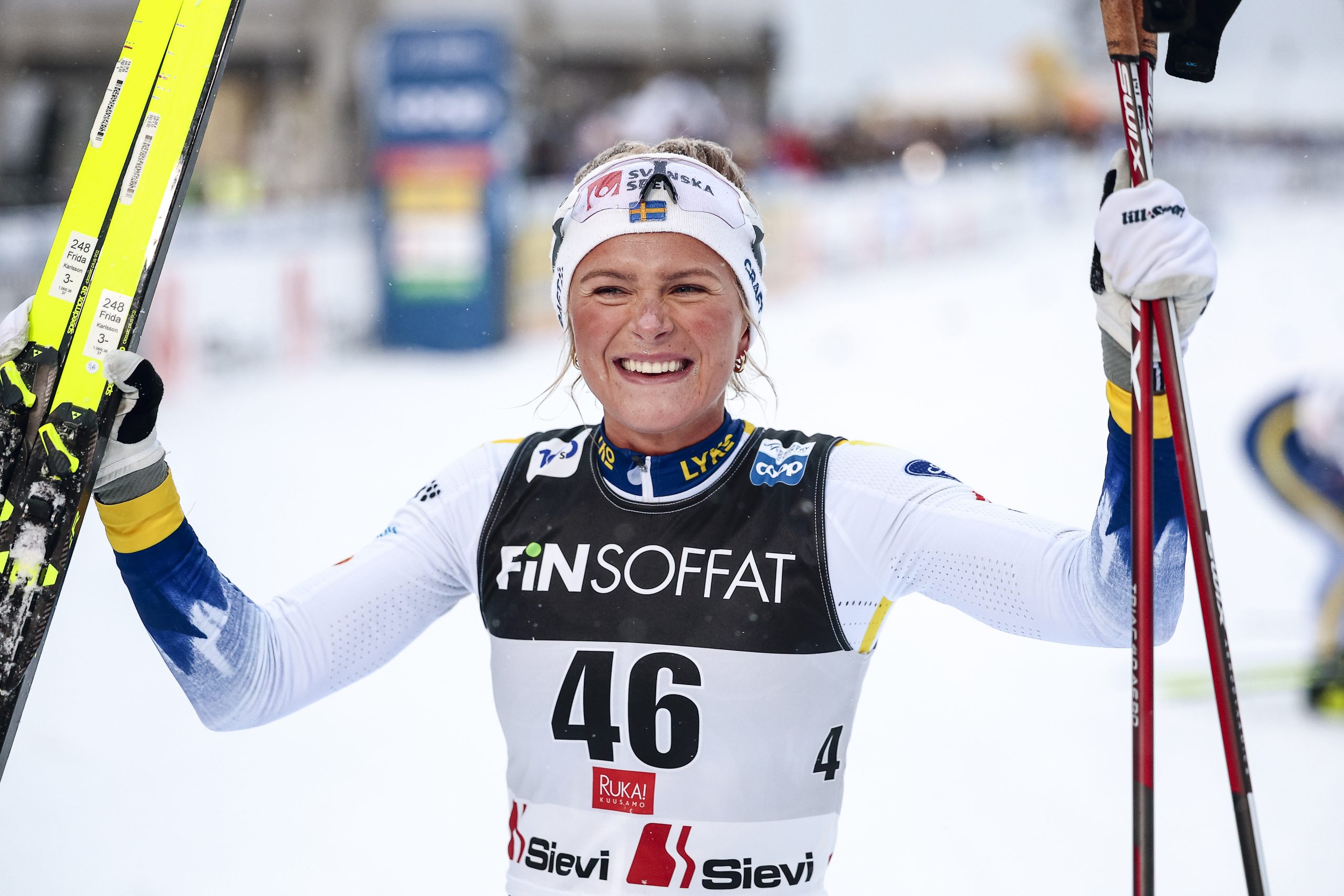
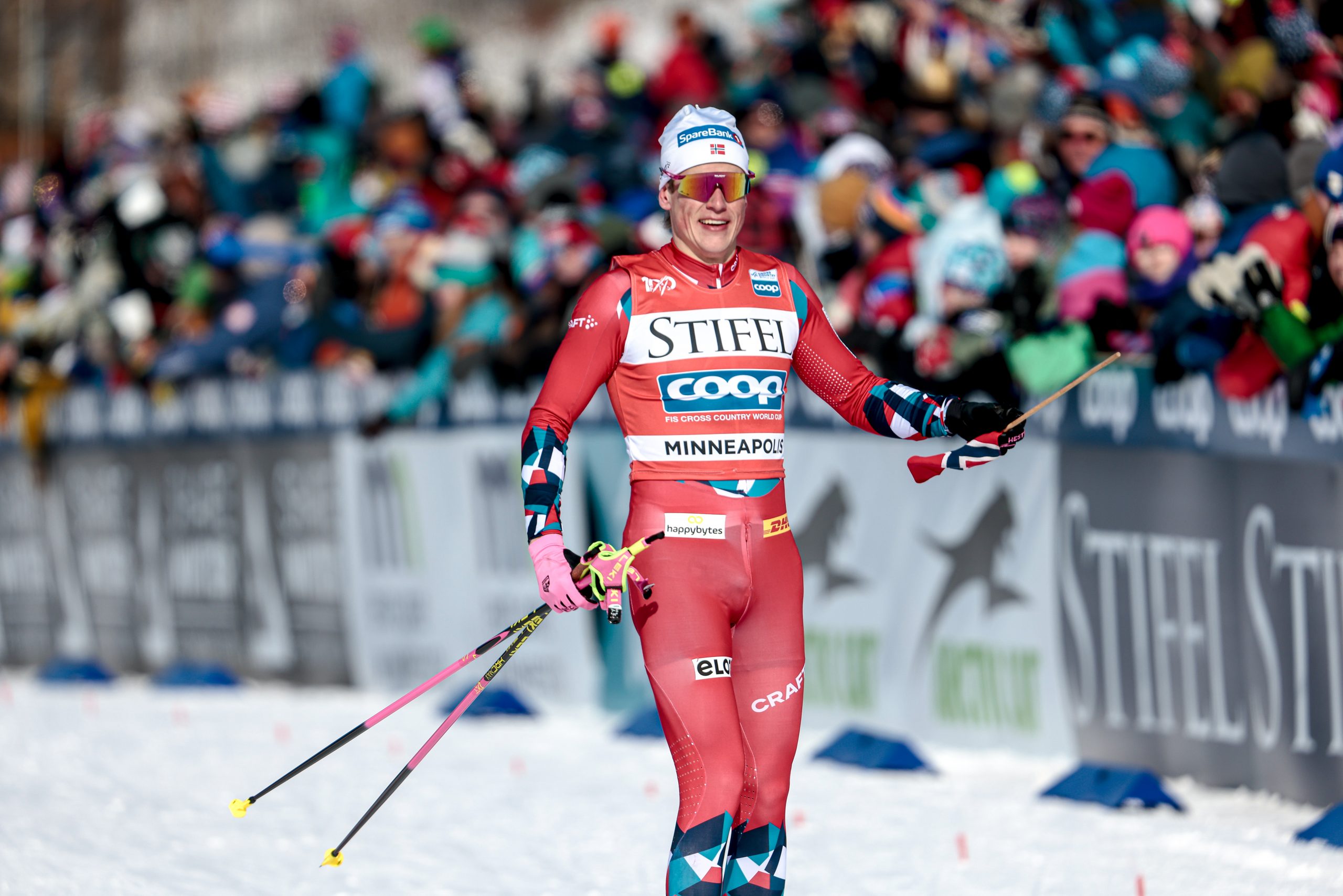
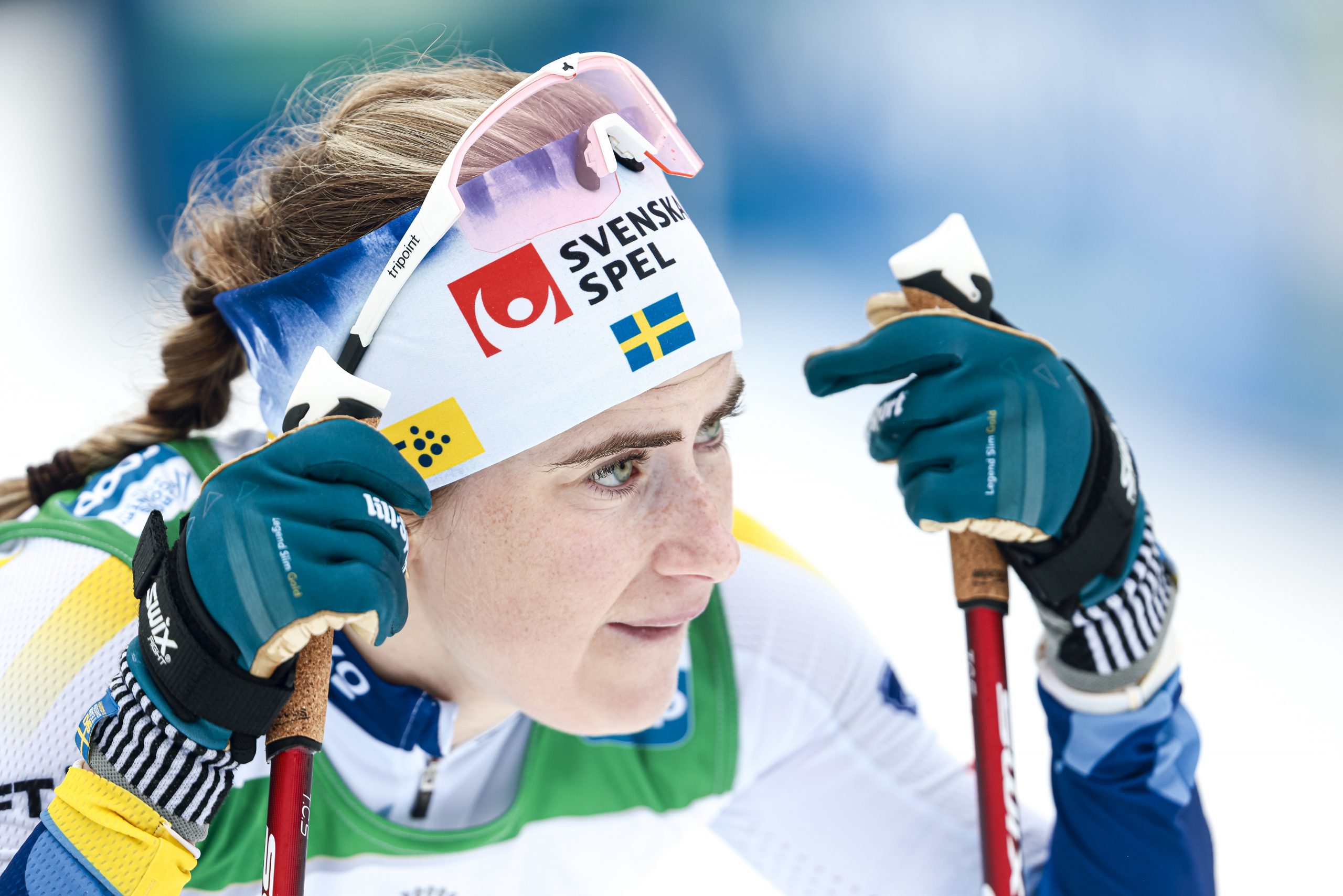
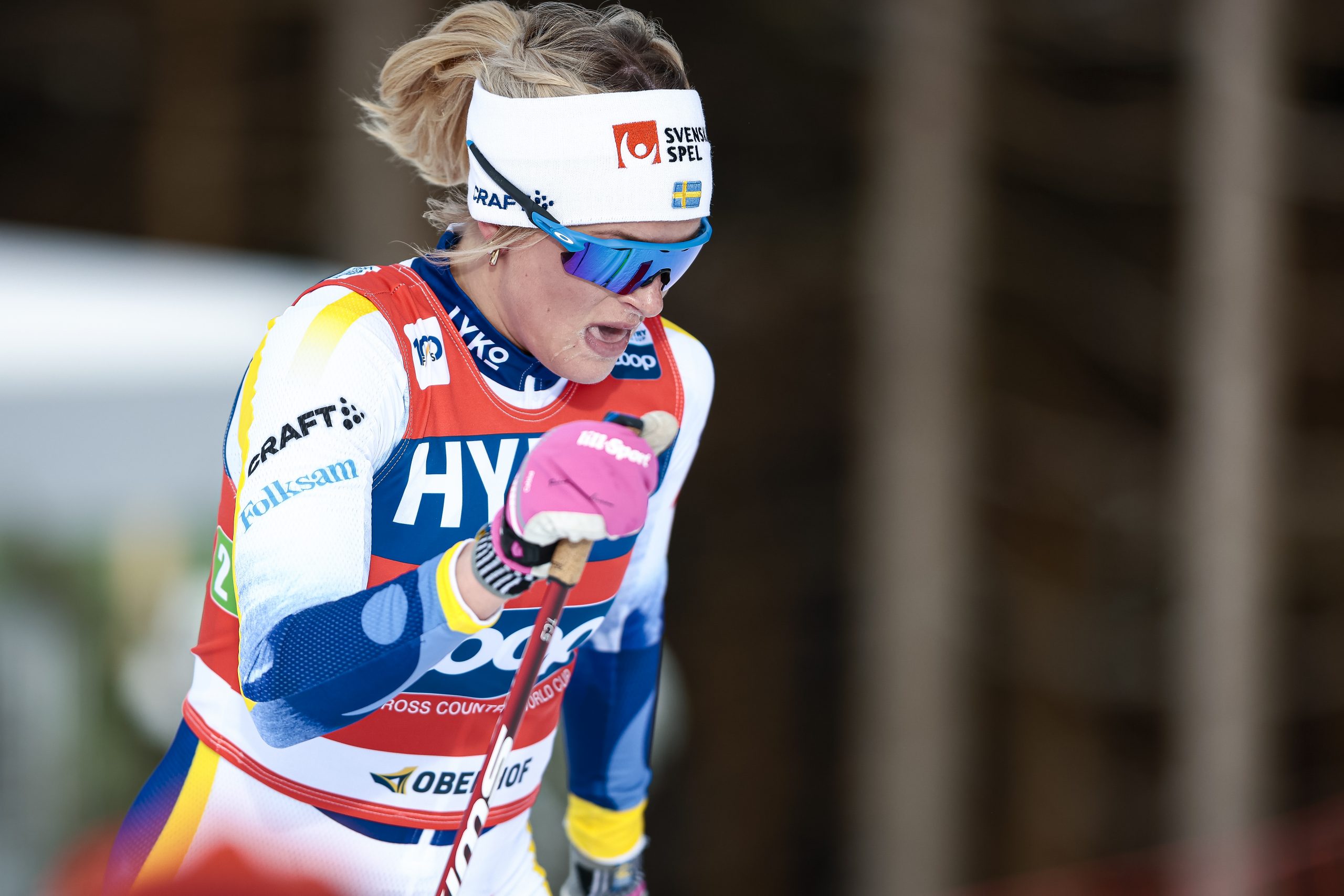
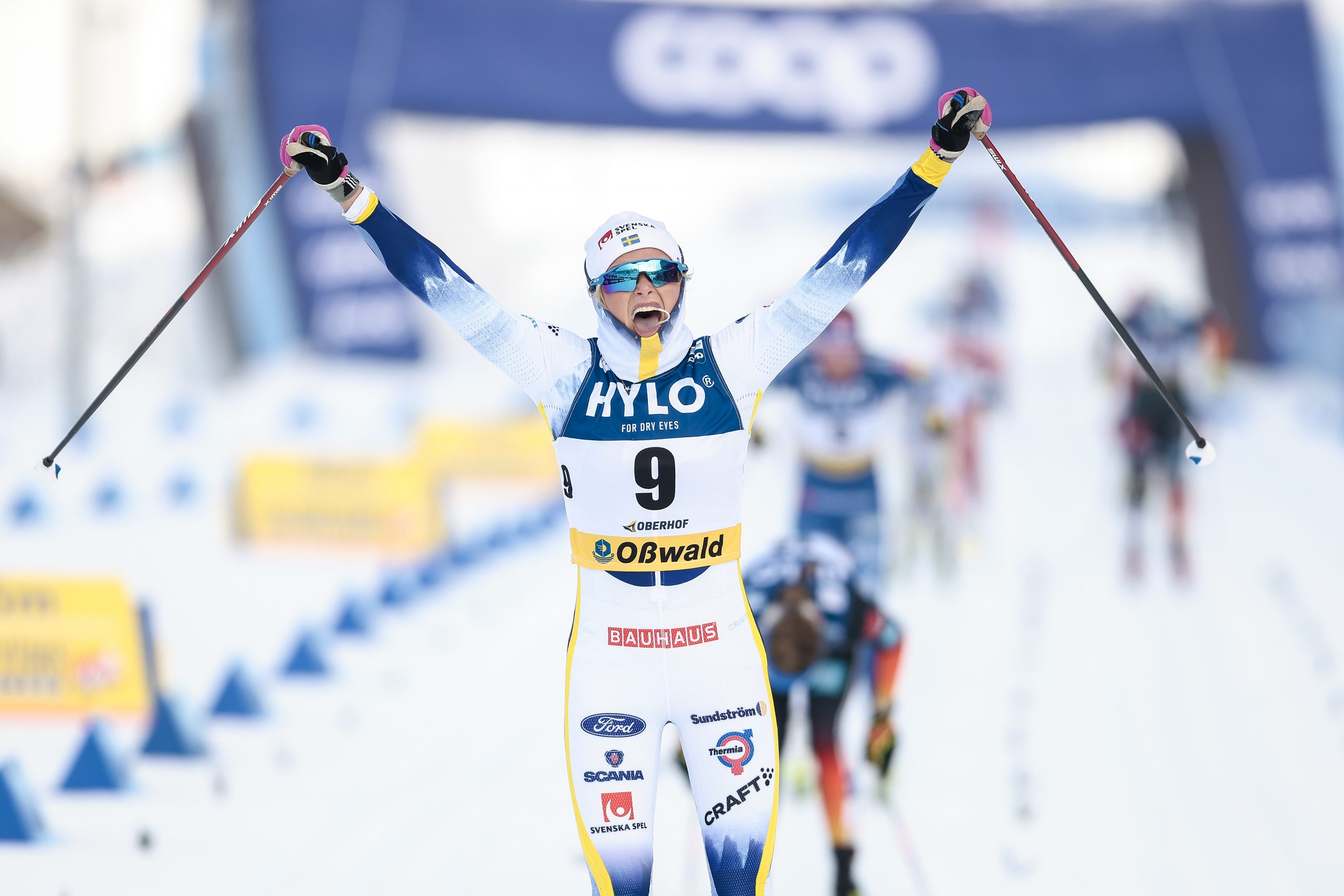
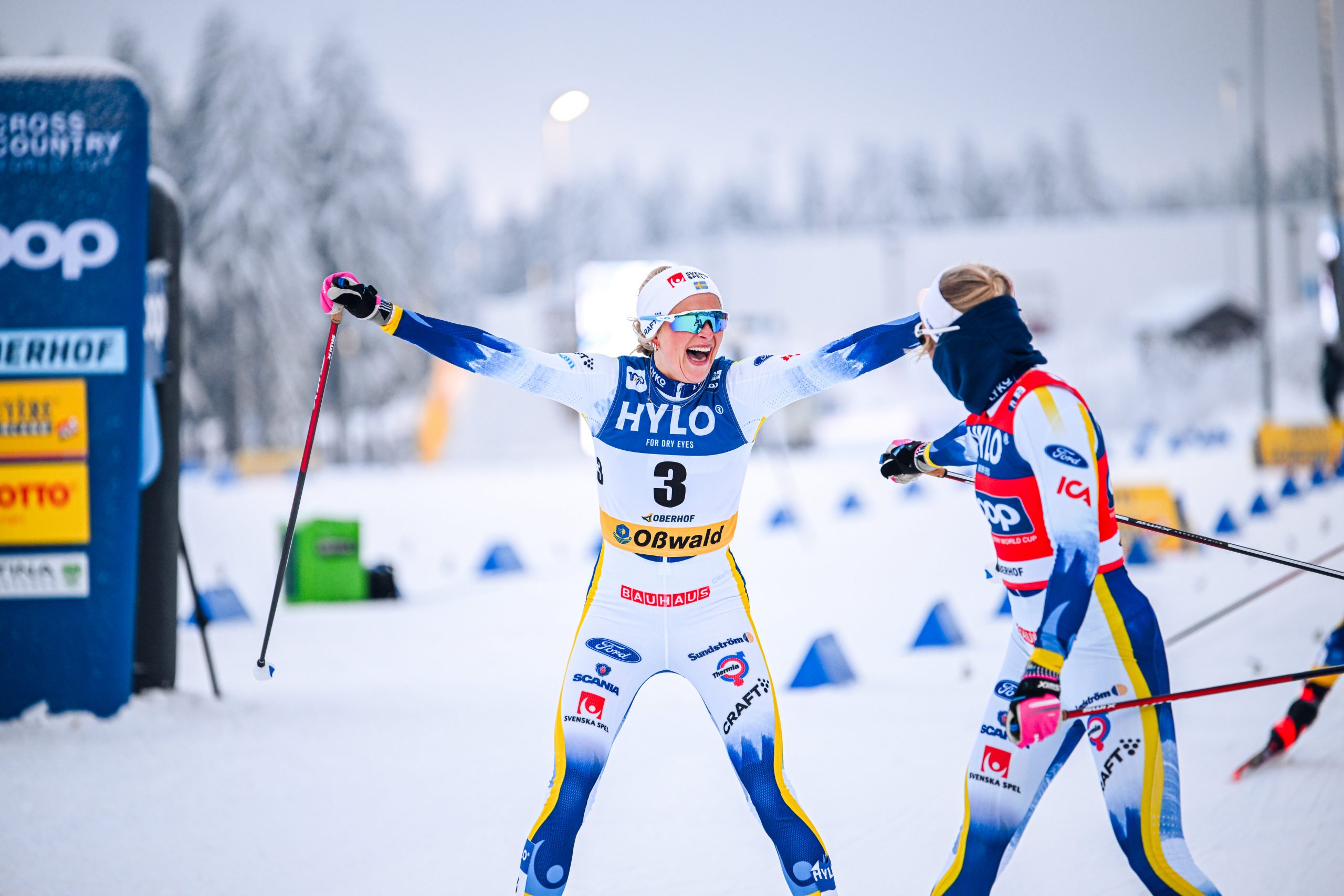
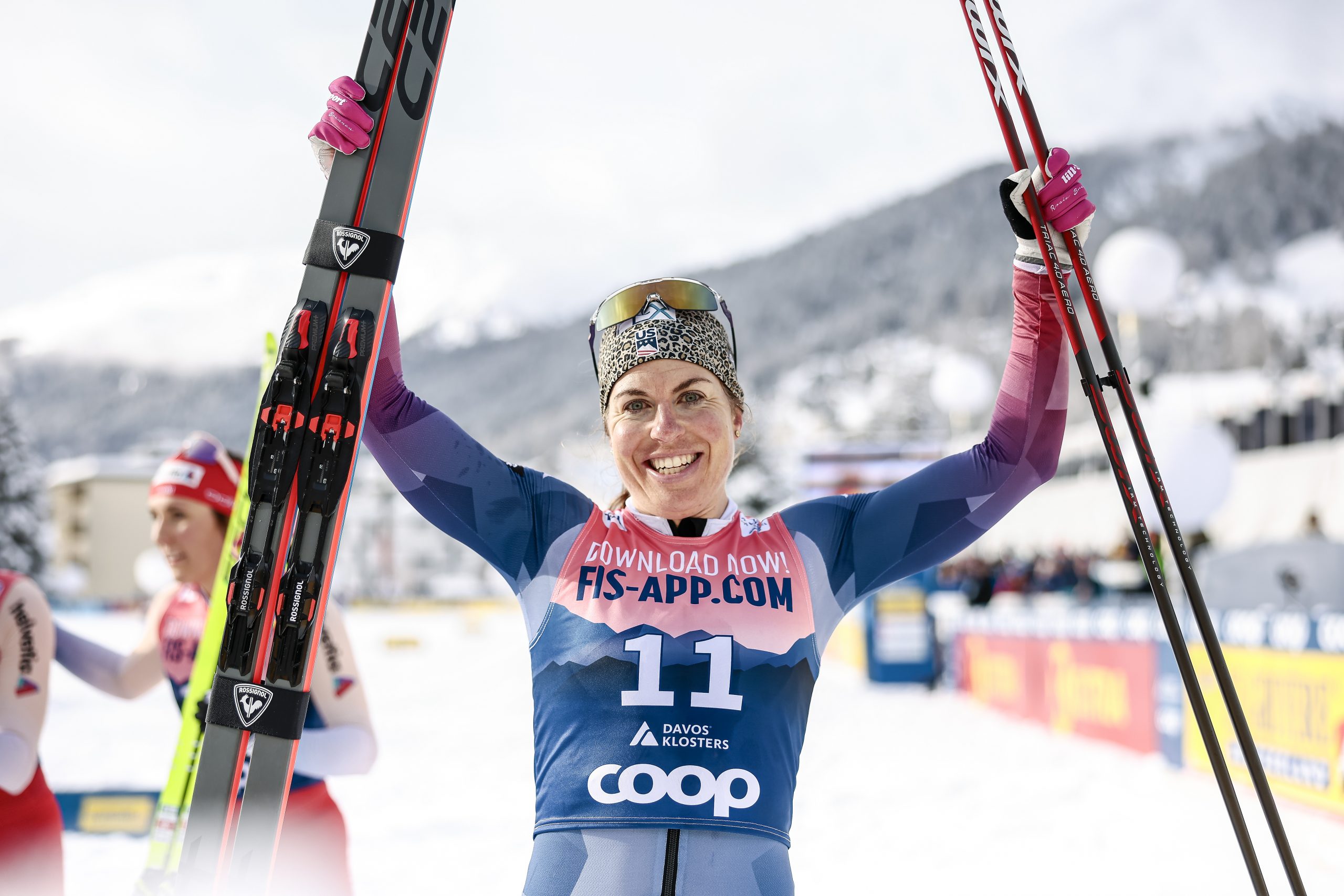
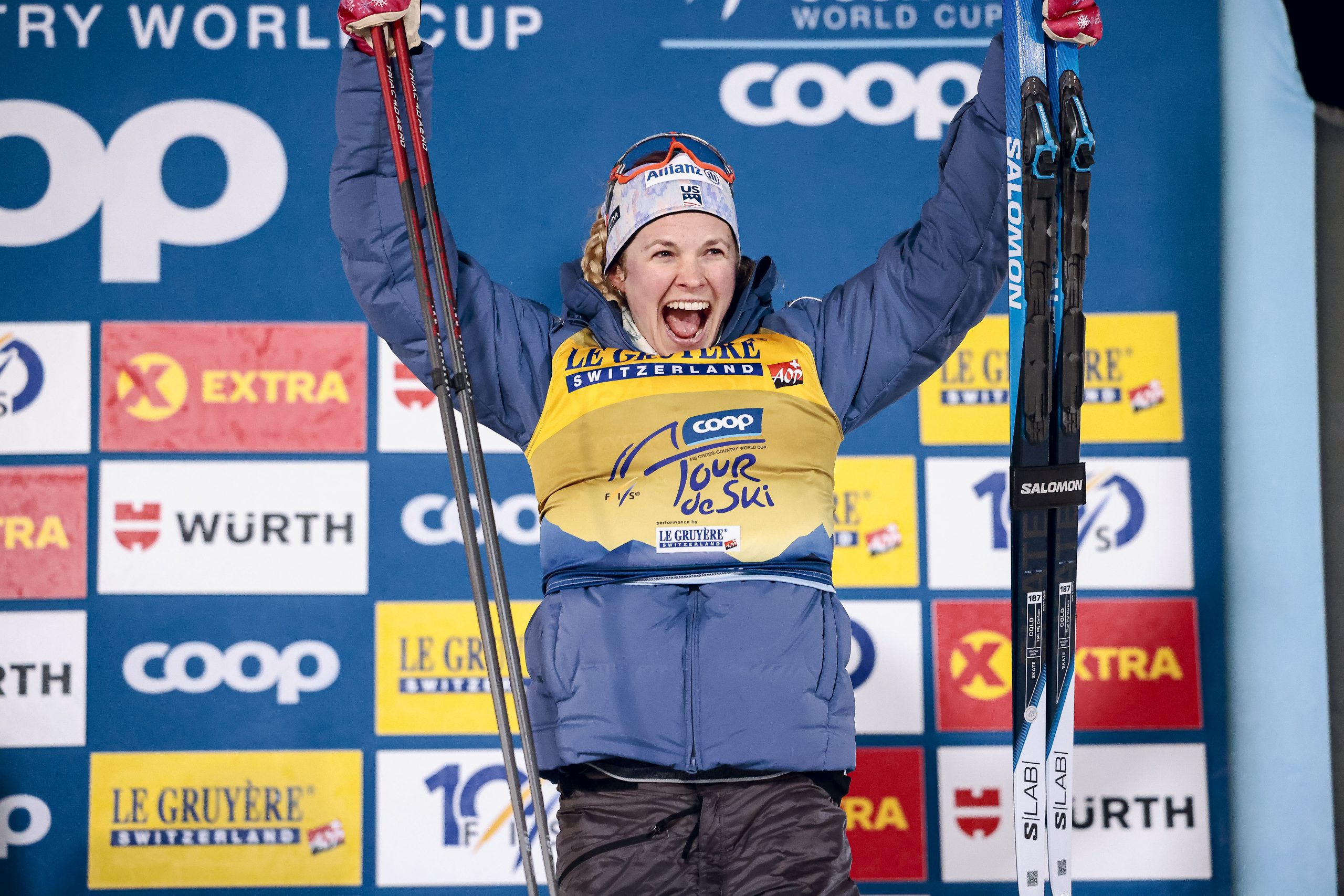
Frida Karlsson (SWE) exults in the finish area after her dominant victory in the Women’s 10 k Classic Interval Start in Ruka, Finland. The World Cup season has begun, and Therese Johaug (NOR) has returned. But all eyes are likely to remain fixed on Karlsson. (Photo: NordicFocus)
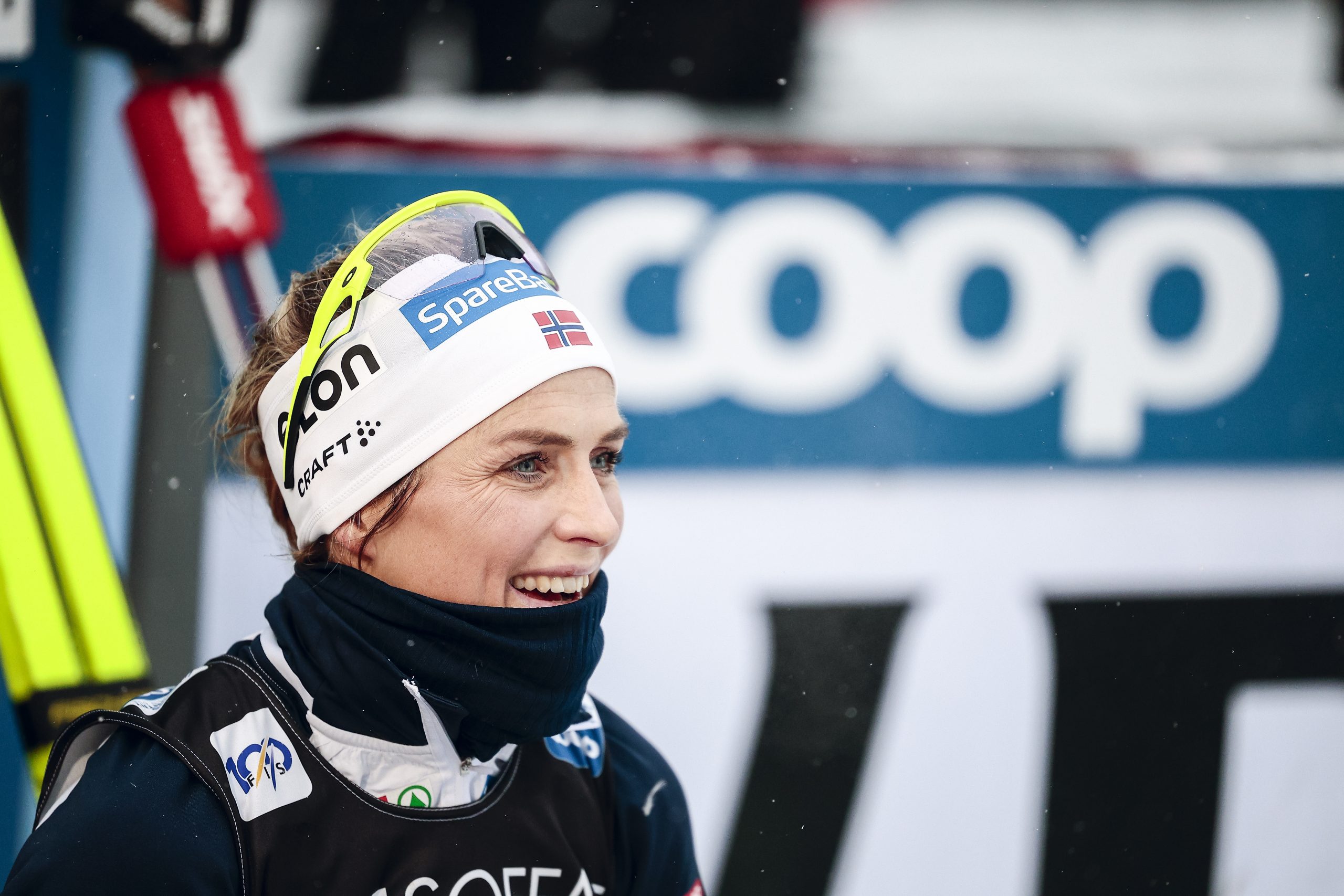
It’s been two full seasons since Therese Johaug last toed a starting line in a FIS World Cup distance event. In that time, the field has been able to convince itself that they were the best in the world. But Johaug has been lingering in the background all along—having a life, having a daughter, writing books, creating fashion empires—just waiting for the chance to come back to international competition. On Friday in Ruka, Finland, her long wait came to an end.
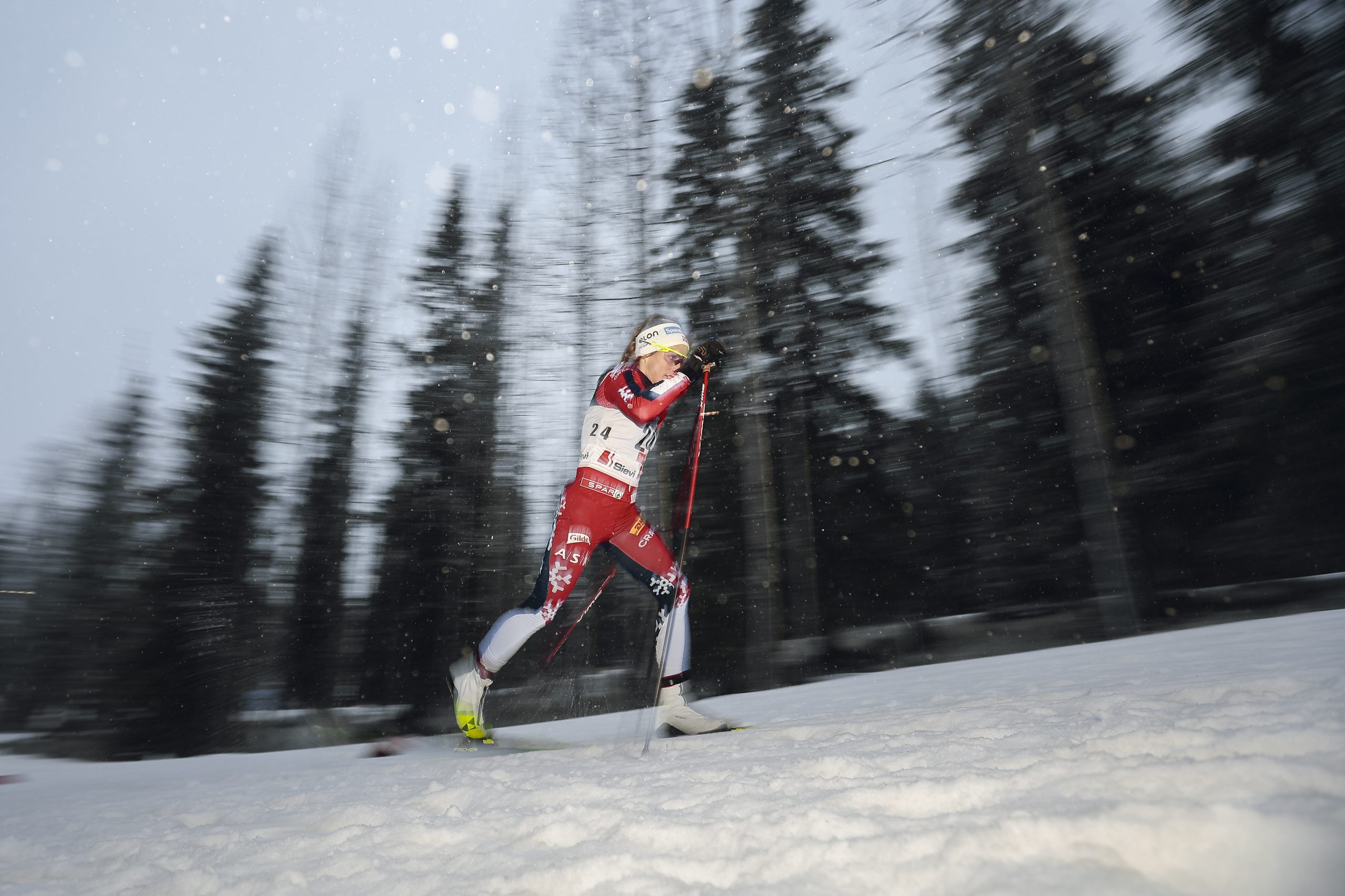
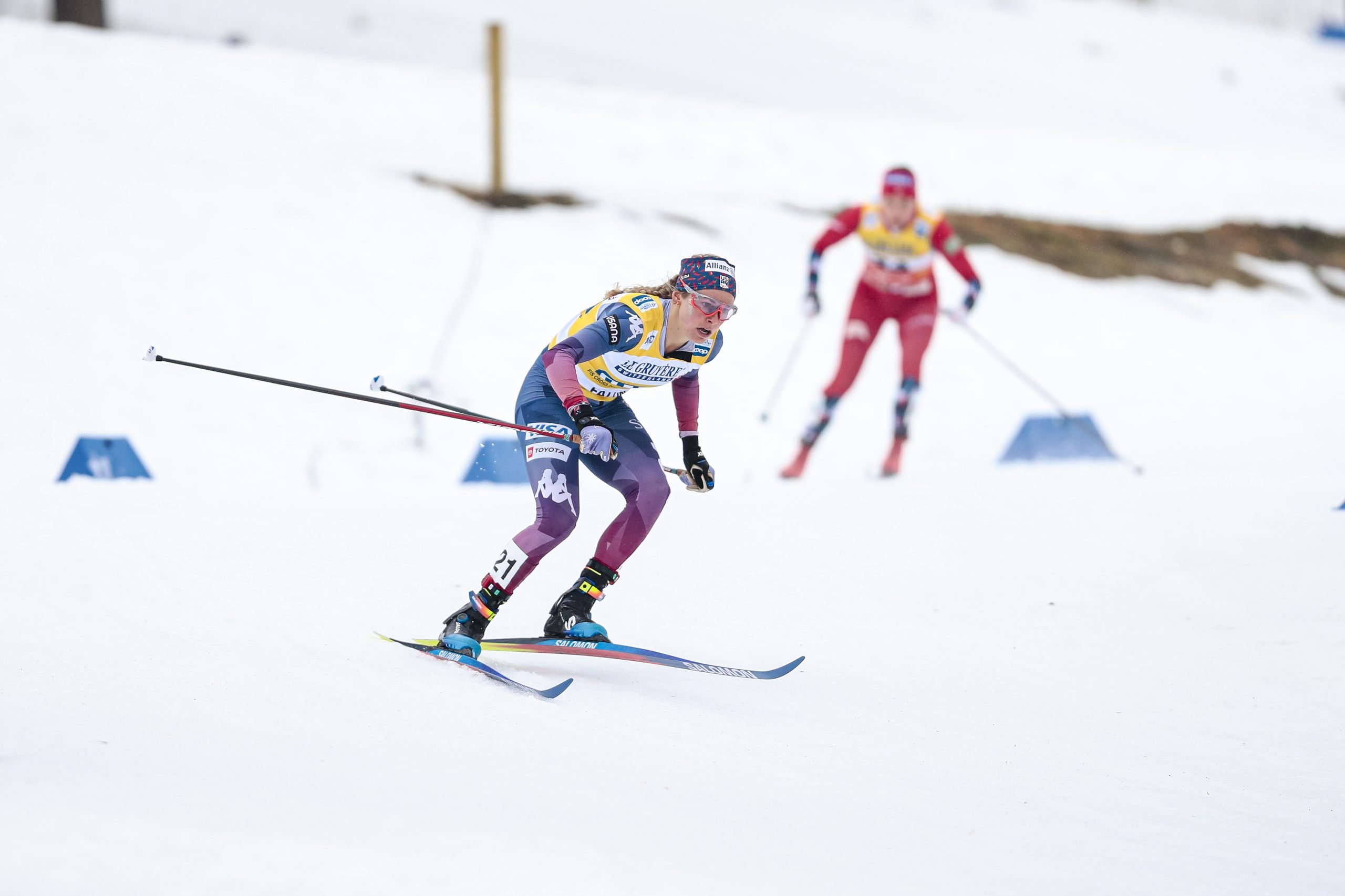
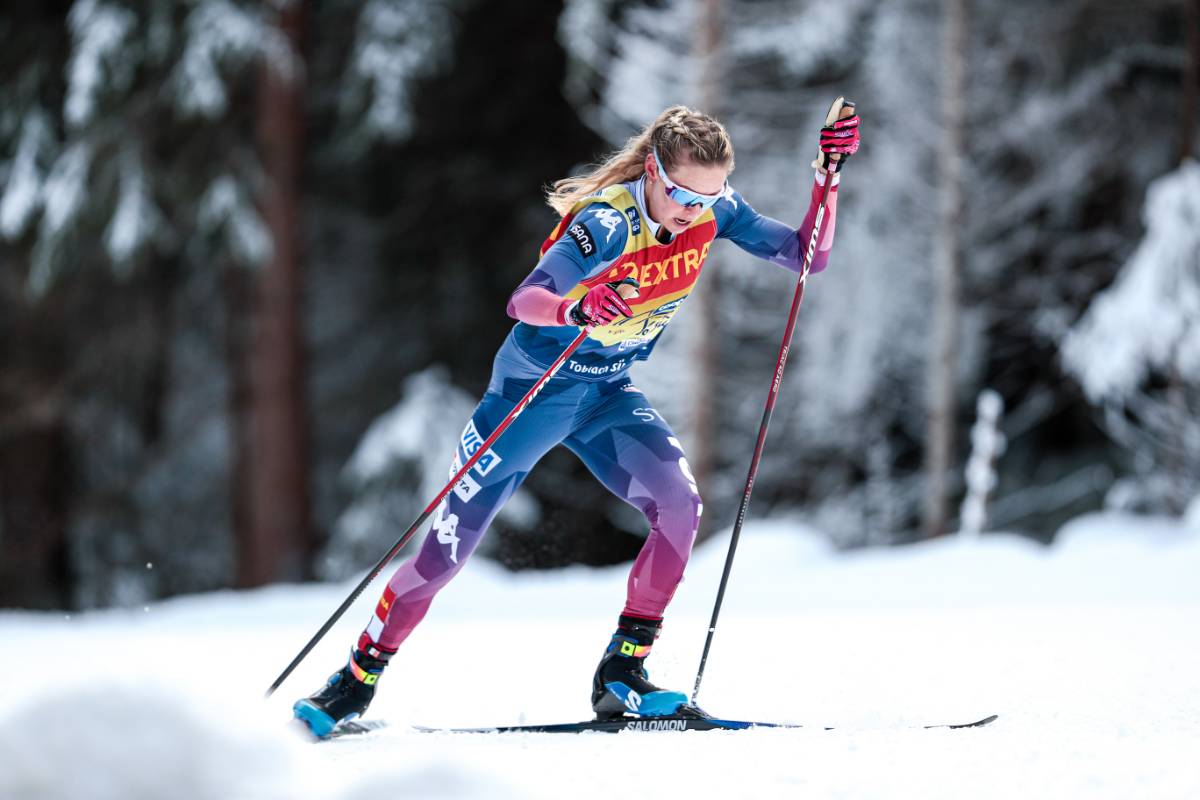
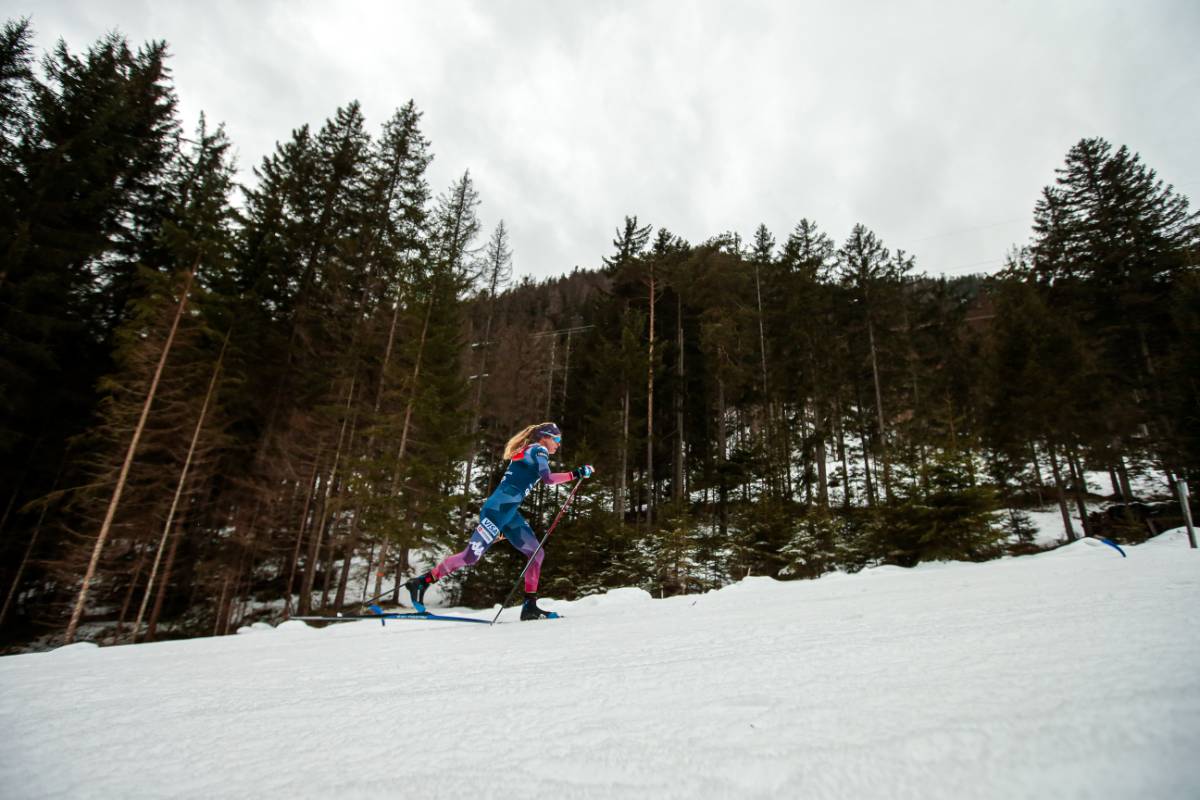
Therese Johaug (NOR) on her way to a brilliant second place finish in the Ruka 10 k Classic. Only Sweden’s Frida Karlsson was faster. (Photo: NordicFocus)
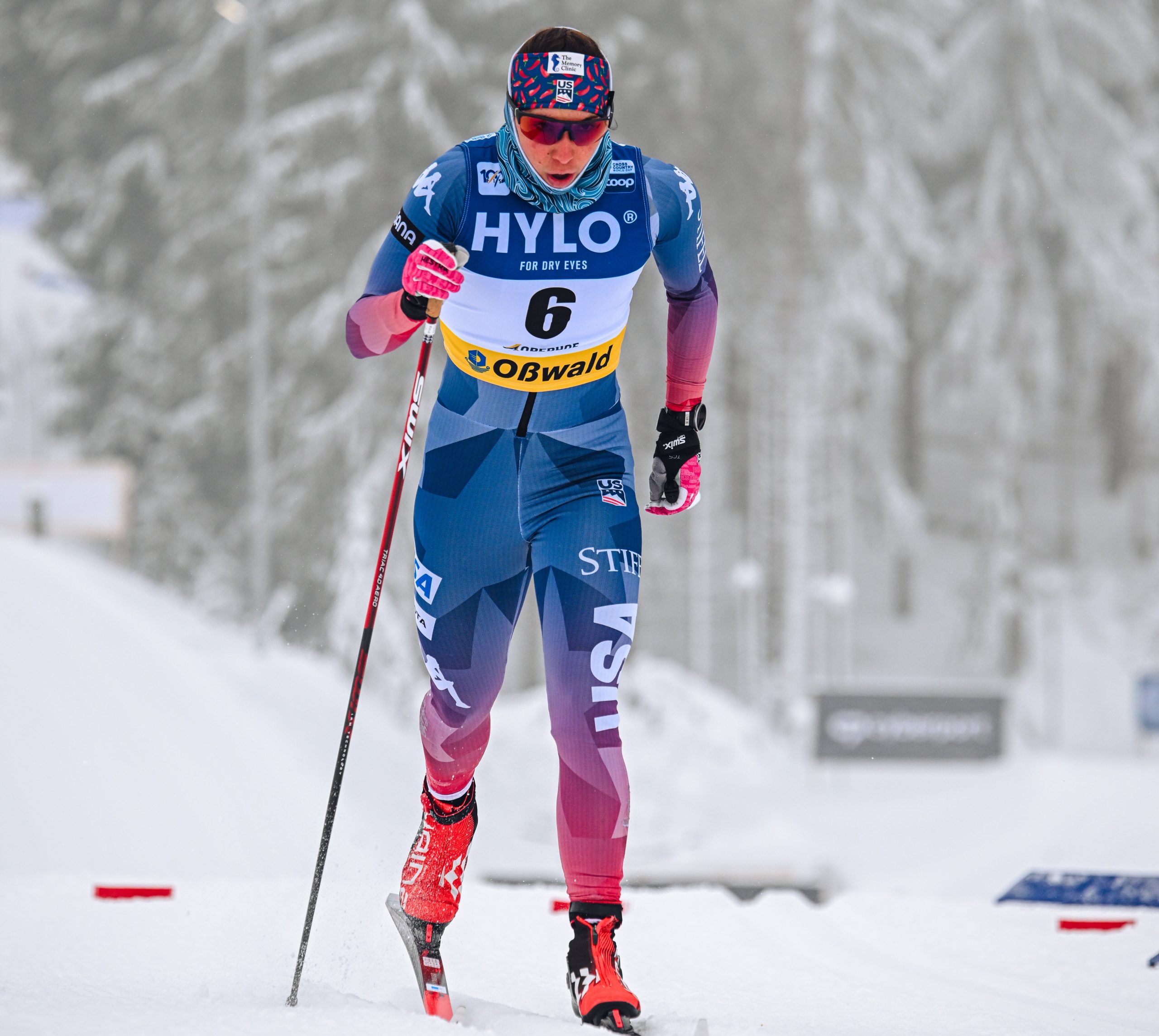
Therese Johaug (NOR) navigating a racecourse in full flight is an awesome sight to behold. Her competitive mode is flat-out intensity, un-stoppable momentum, wind-up-toy tempo. It looks for all the world like her only strategy is “go!” That degree of competitive abandon defined Johaug’s historic career, one in which she earned 82 World Cup wins, six Olympic medals, and 14 World Championships. Toward the end of Johaug’s storied career, a young Swedish challenger arrived on the scene: Frida Karlsson (SWE) showed unique abilities and a penchant for emulating Johaug’s style: high tempo, light touch, fearless pacing. Today in Ruka, Karlsson was the only athlete who could match Johaug; the only athlete who could better her. In the end, Karlsson snatched the fairytale ending from Johaug’s comeback story (at least for the moment), racing to victory by a shockingly large margin.
“Maybe my best race ever,” said Karlsson in postrace interviews. “I felt really good.”
Karlsson had her 2024 season interrupted by illness and injury—and a summer season in which she struggled with foot problems—but evidently her preparation has gone according to plan as she dominated Ruka’s 10 k Classic course like few before her ever have. Perhaps only Johaug . . .
Ten kilometers after her first start in more than two years, the Nordic skiing world was reminded of Johaug’s grit, determination, fitness, and talent. She ultimately crossed the line with a large lead, only to see it evaporate into the Arctic sky with every new split recorded by Karlsson. In the end, Karlsson triumphed over Johaug by more than 45 seconds, with Astrid Oyre Slind (NOR) finishing third, another 7.5 seconds behind.
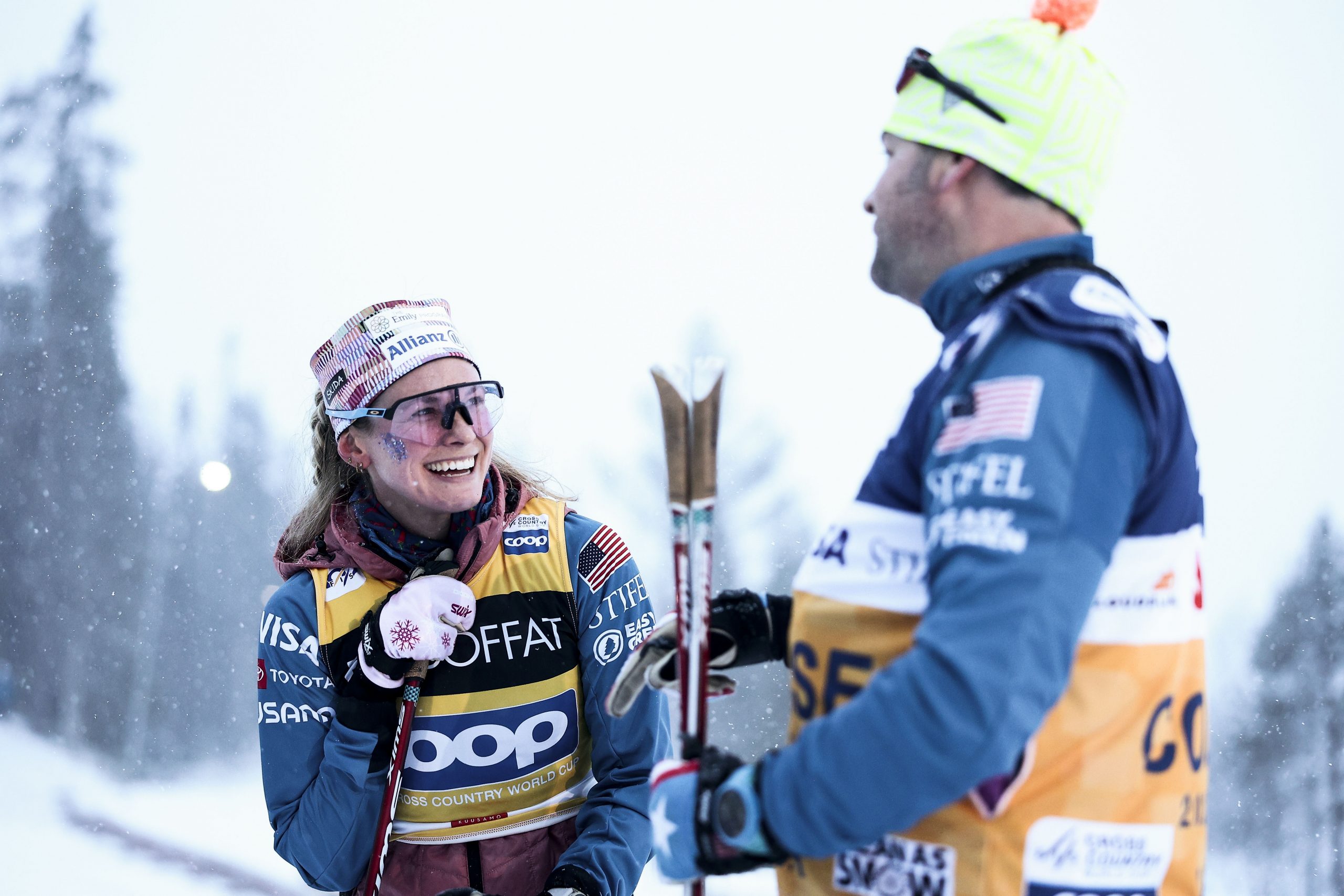
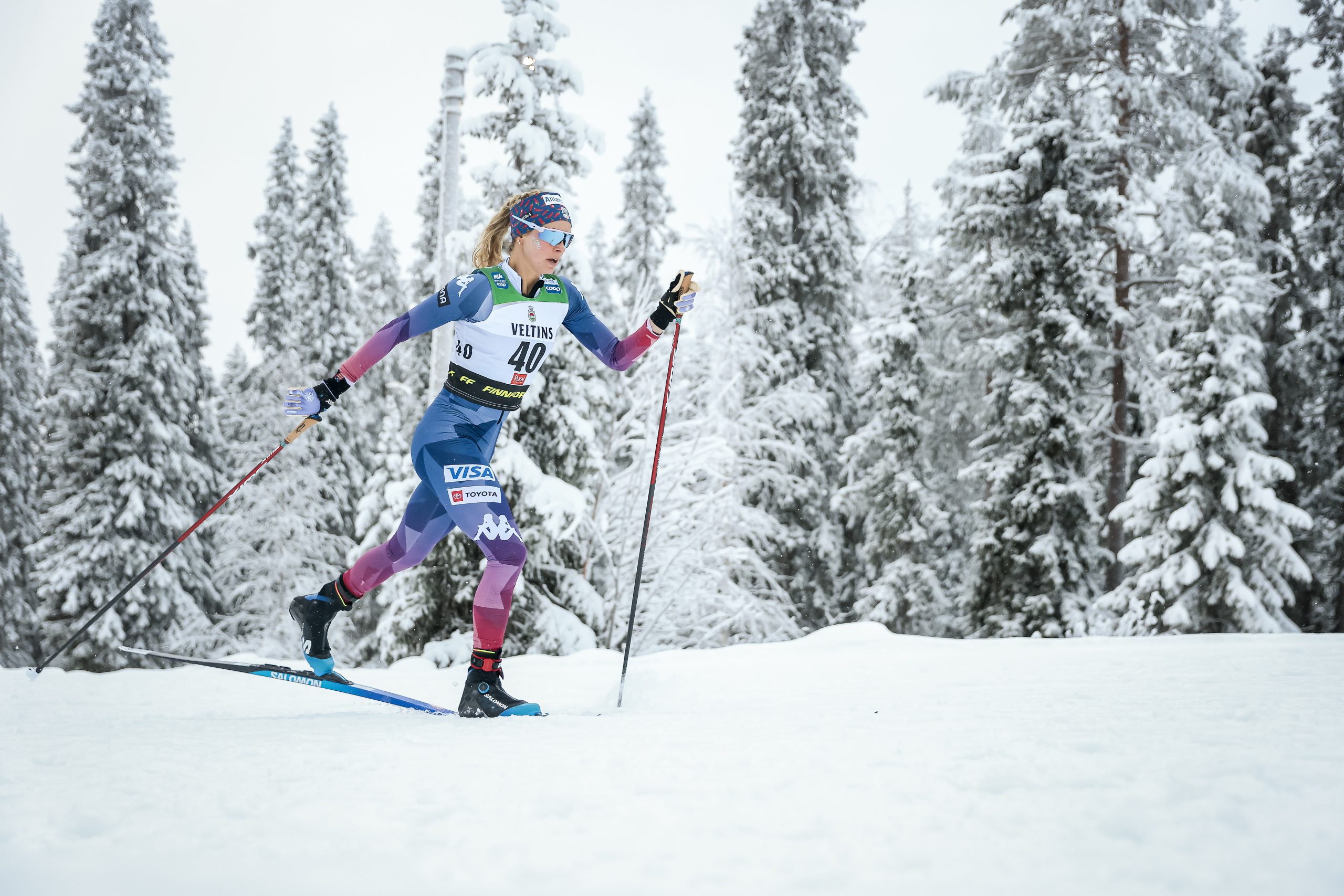
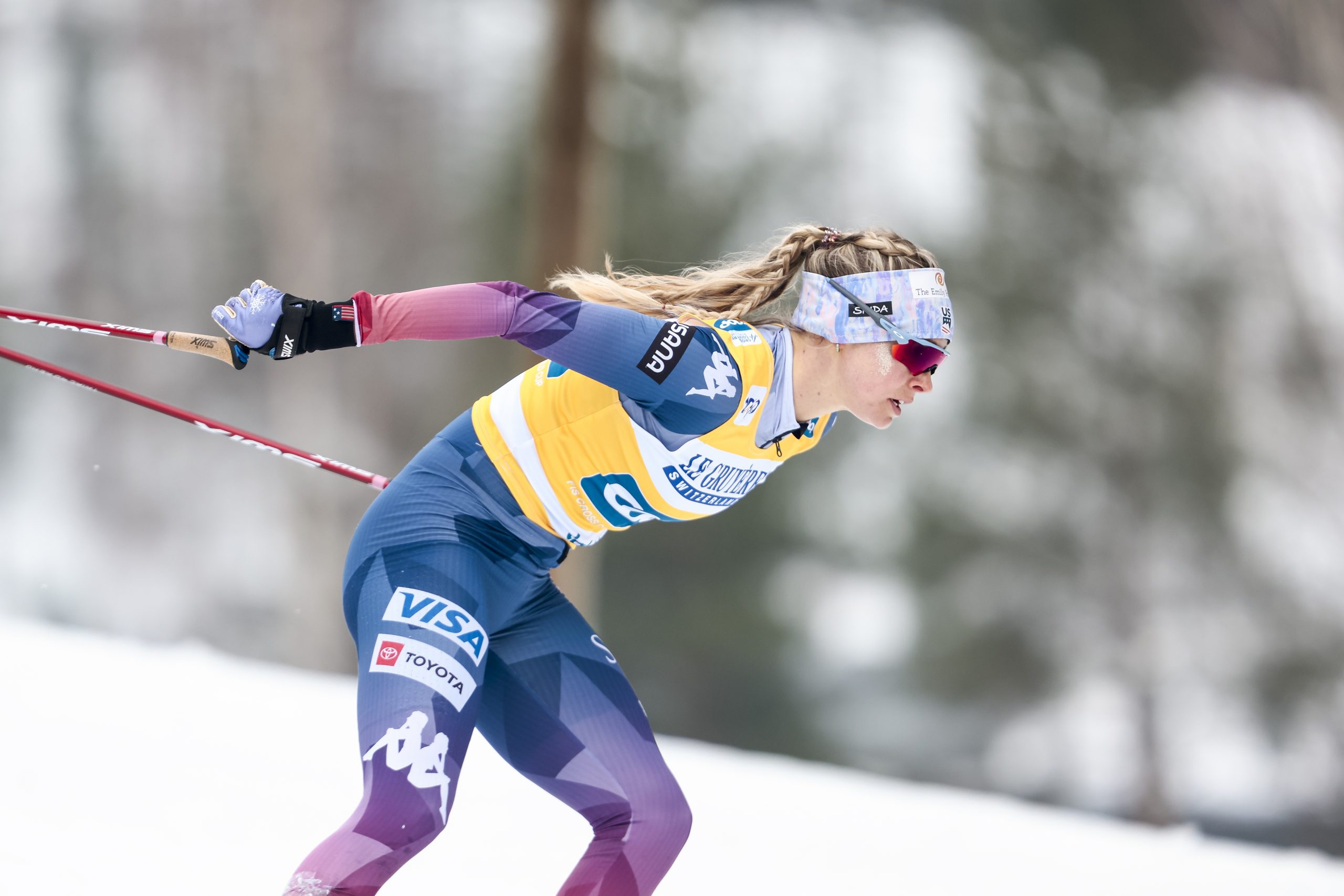
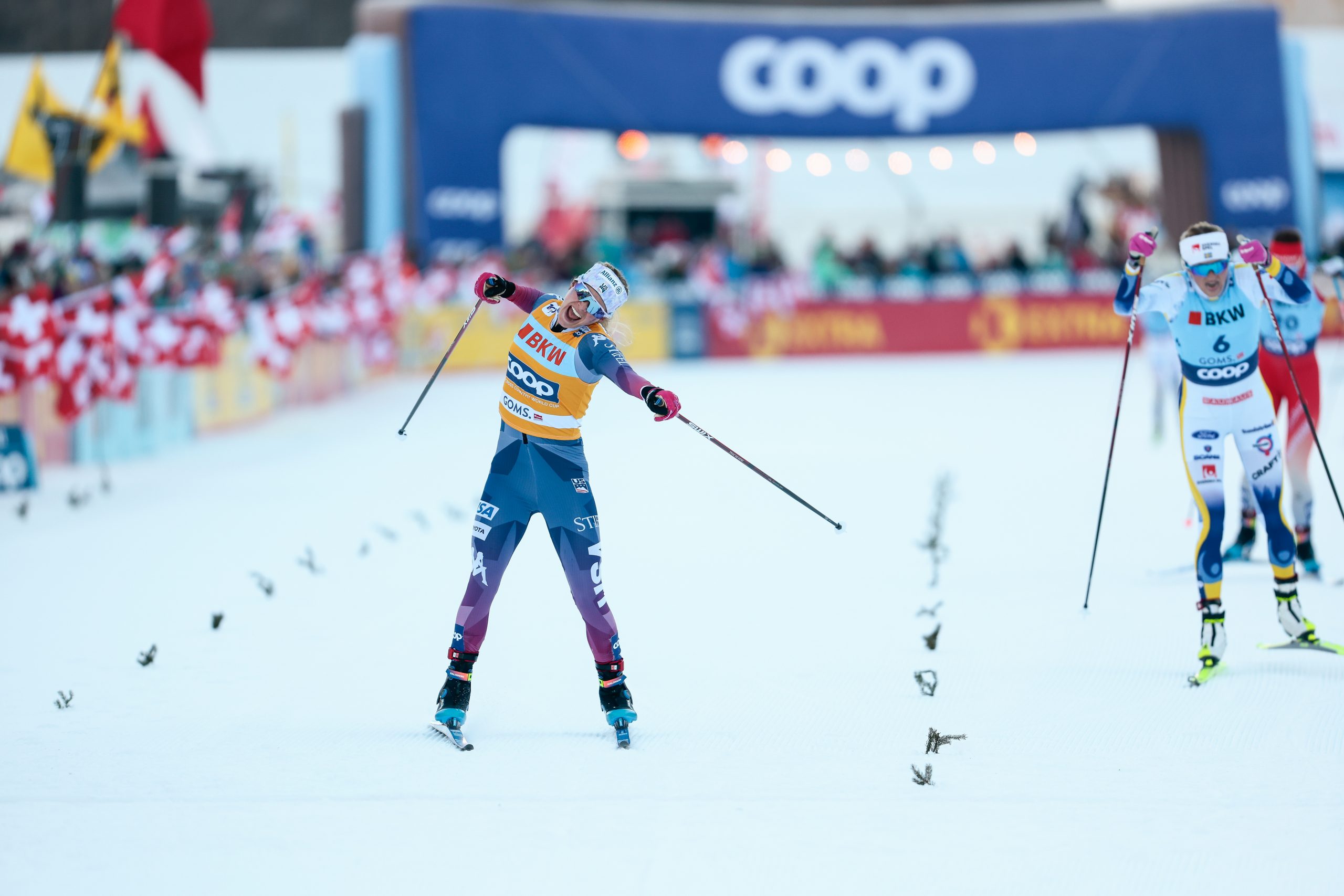
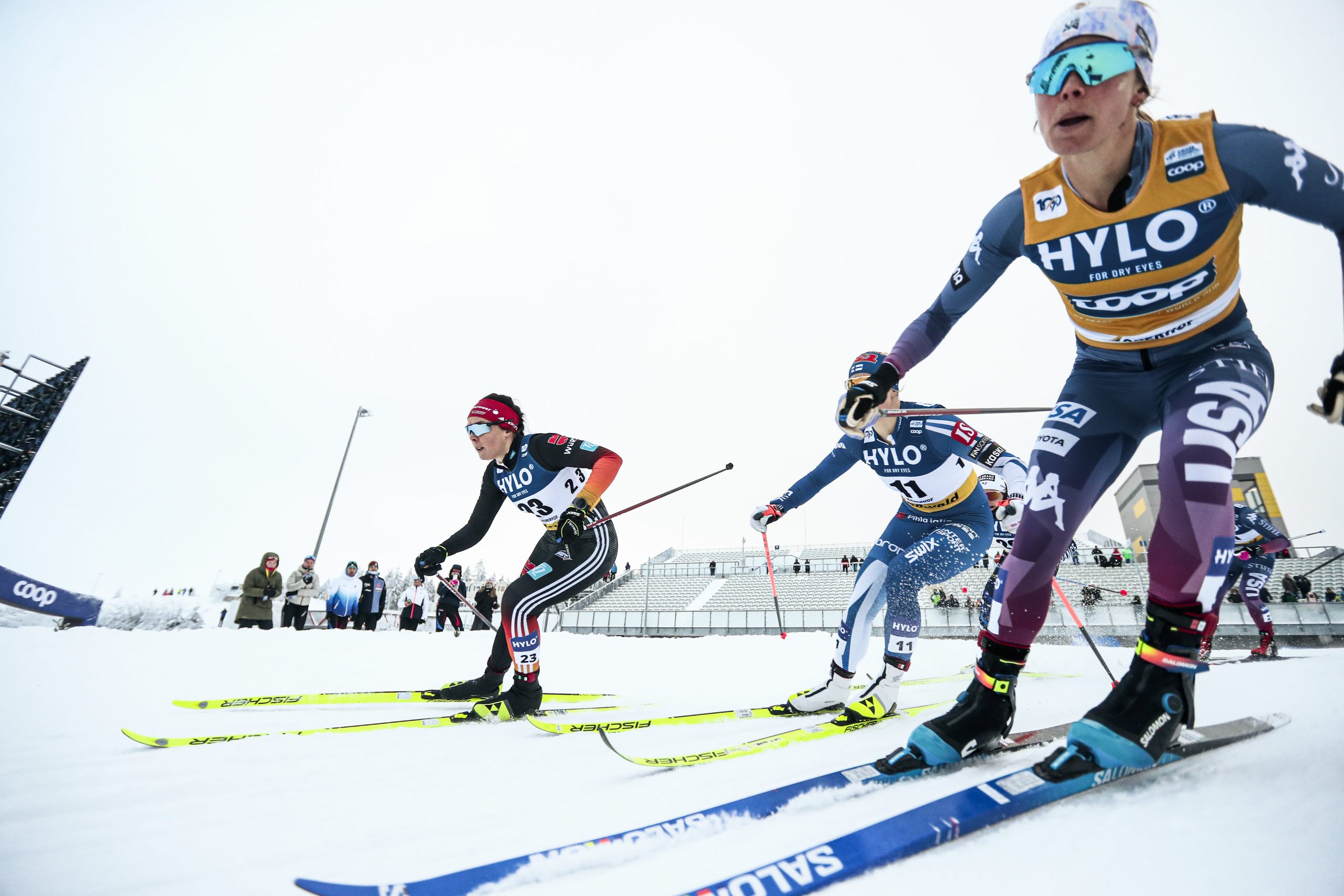
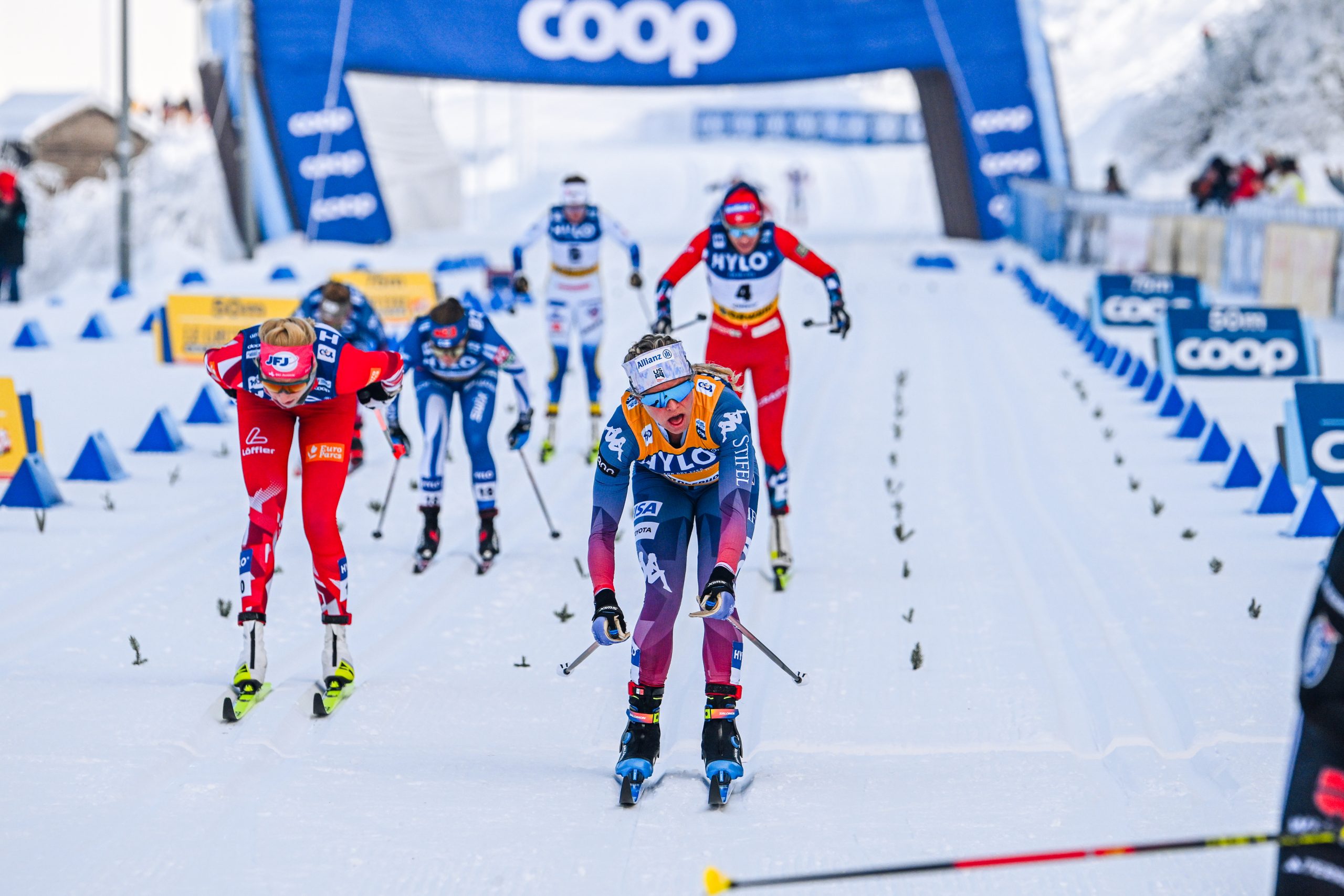
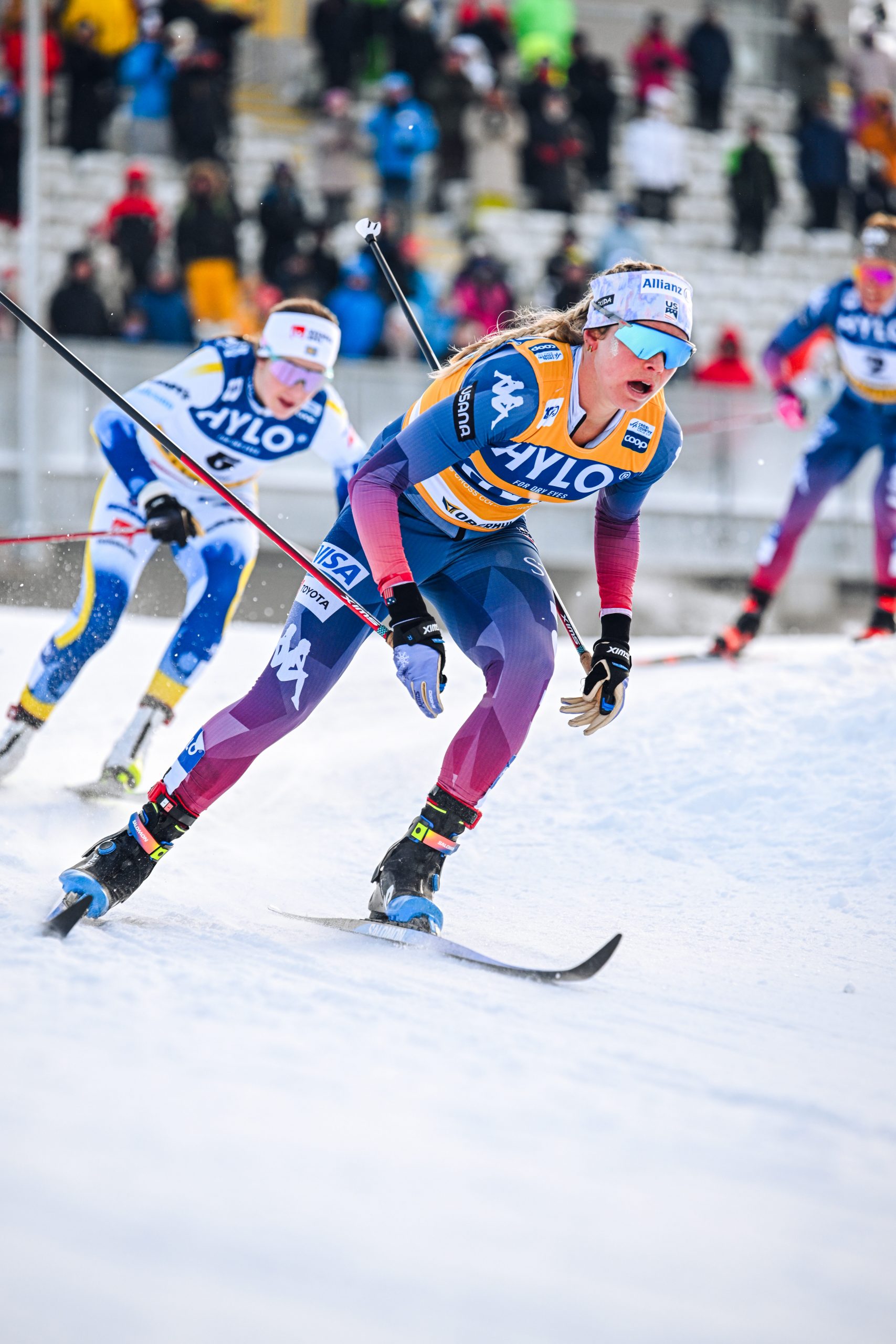
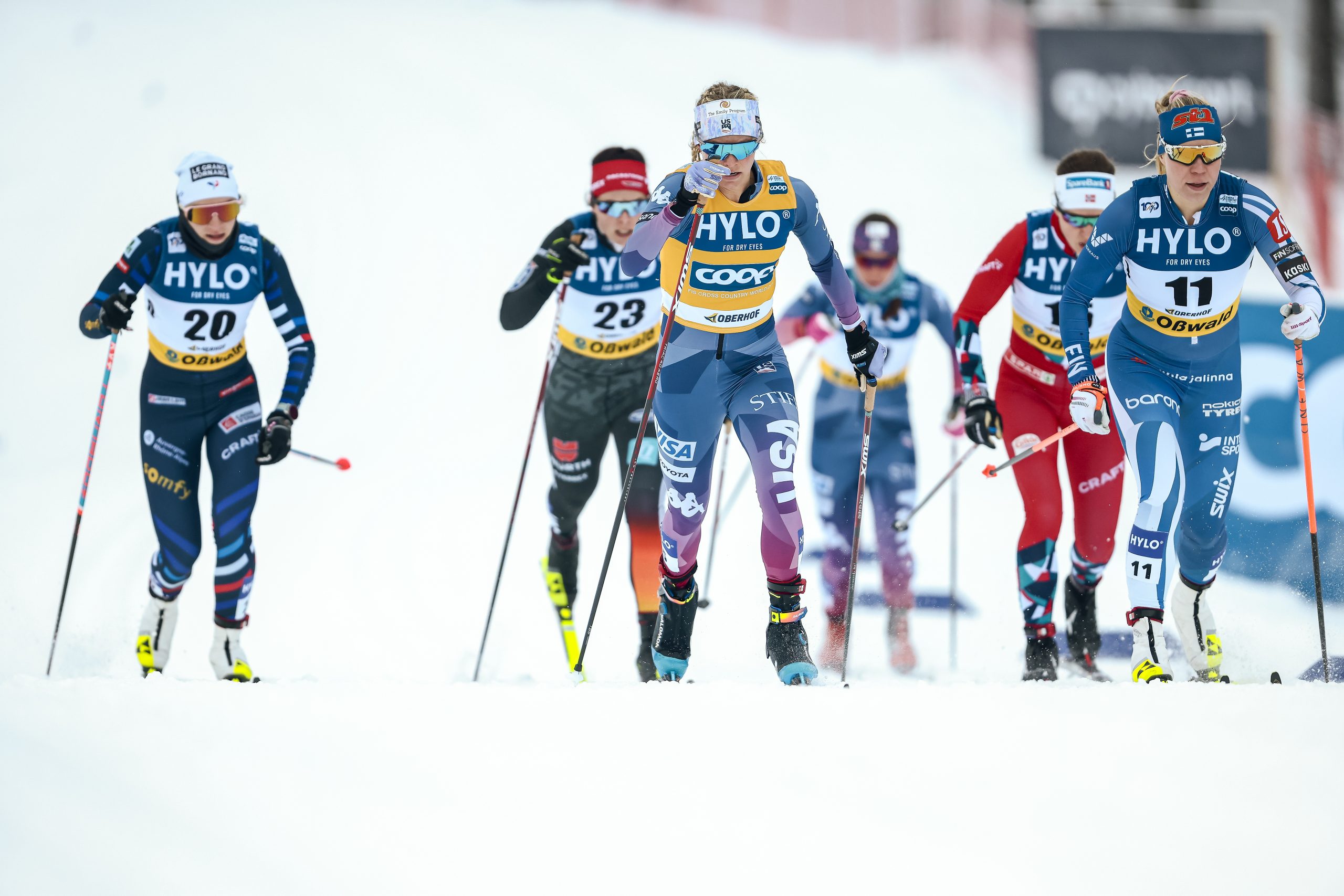
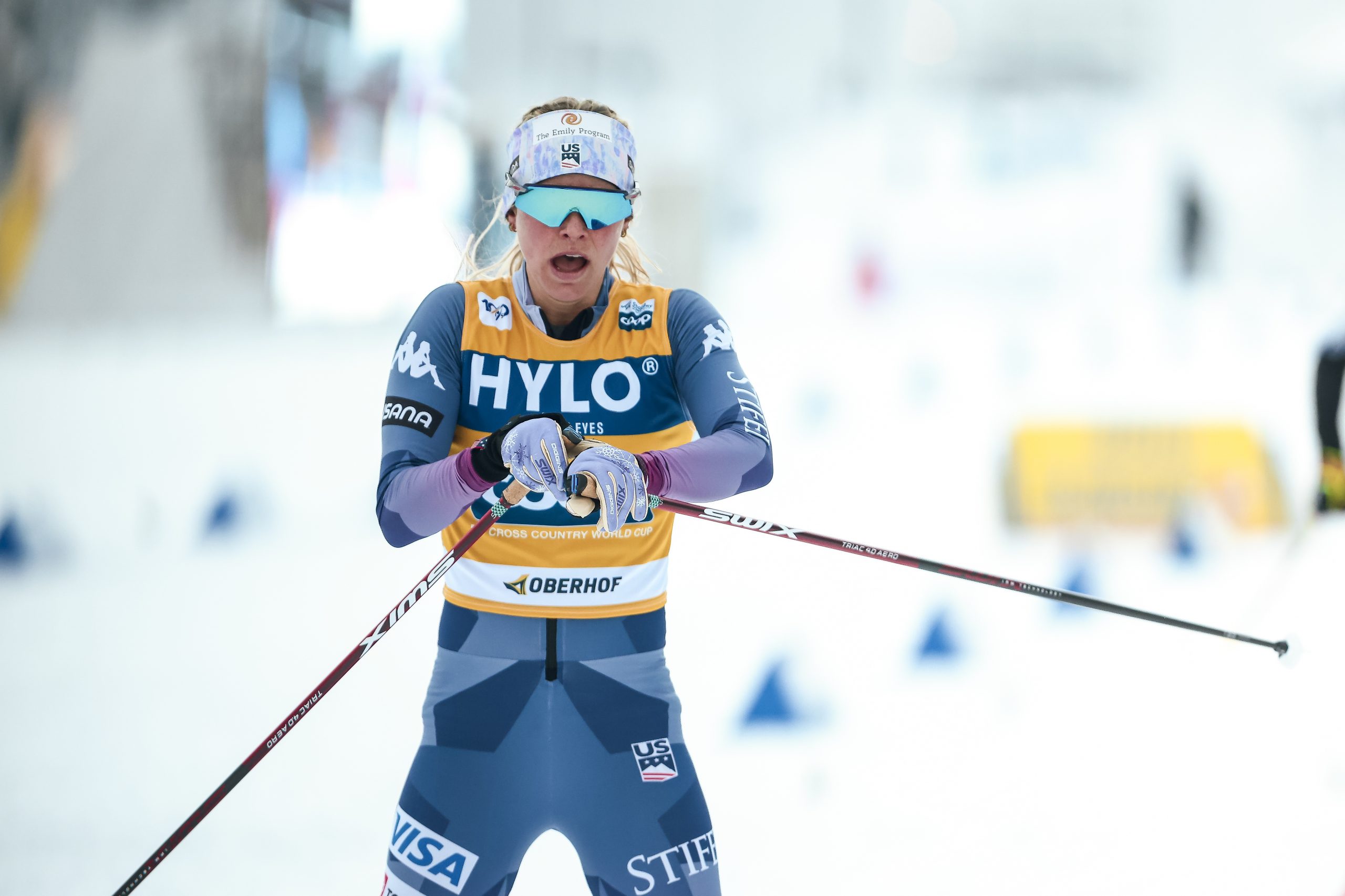
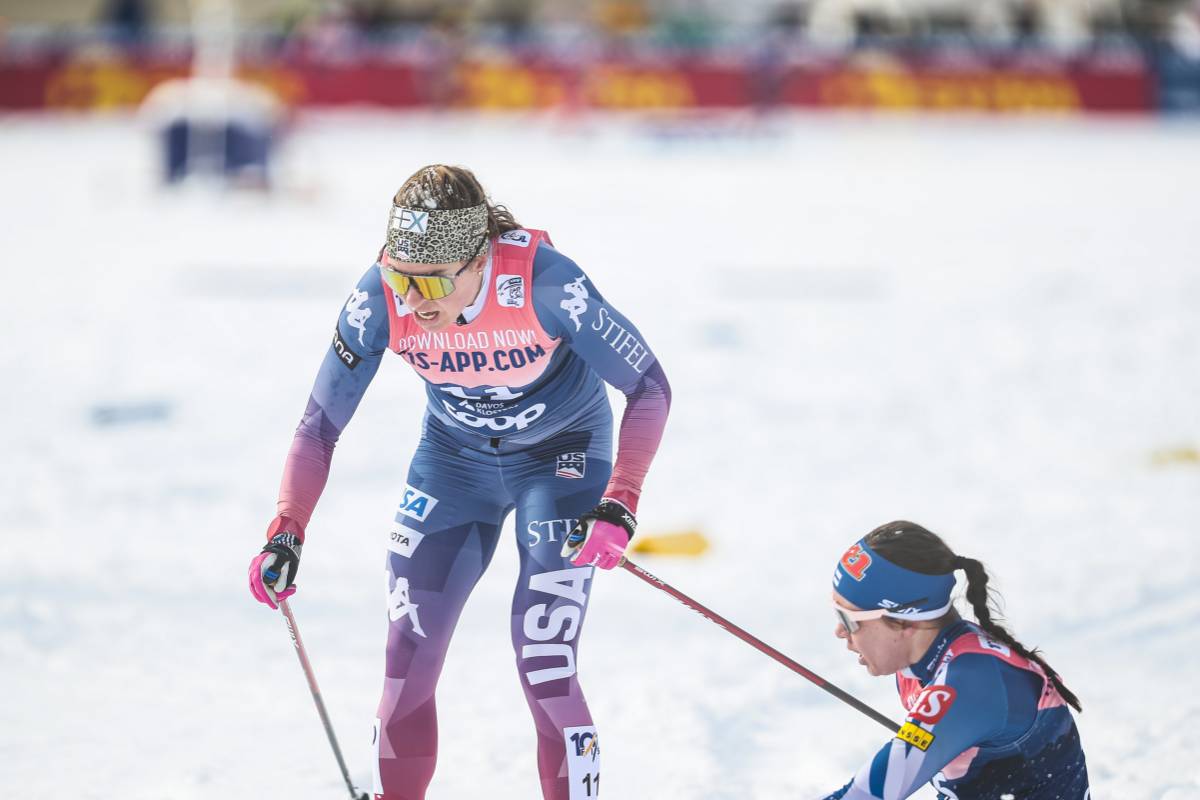
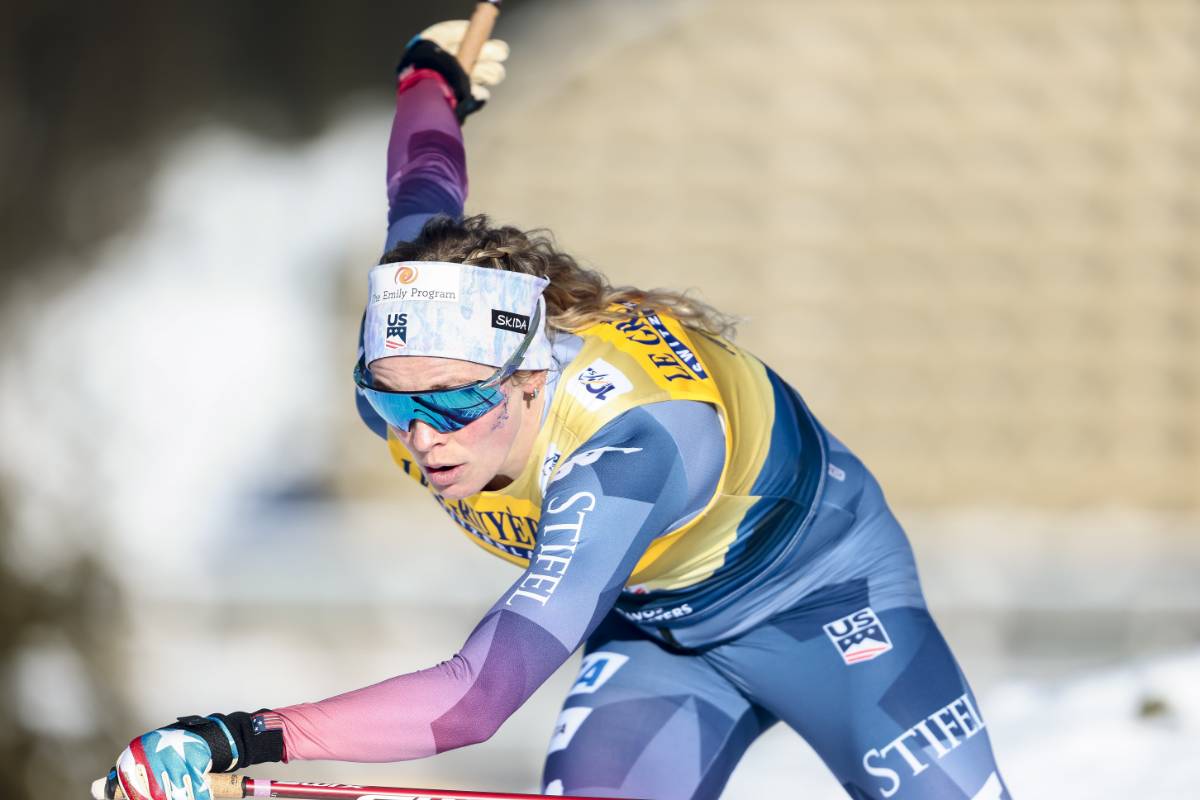
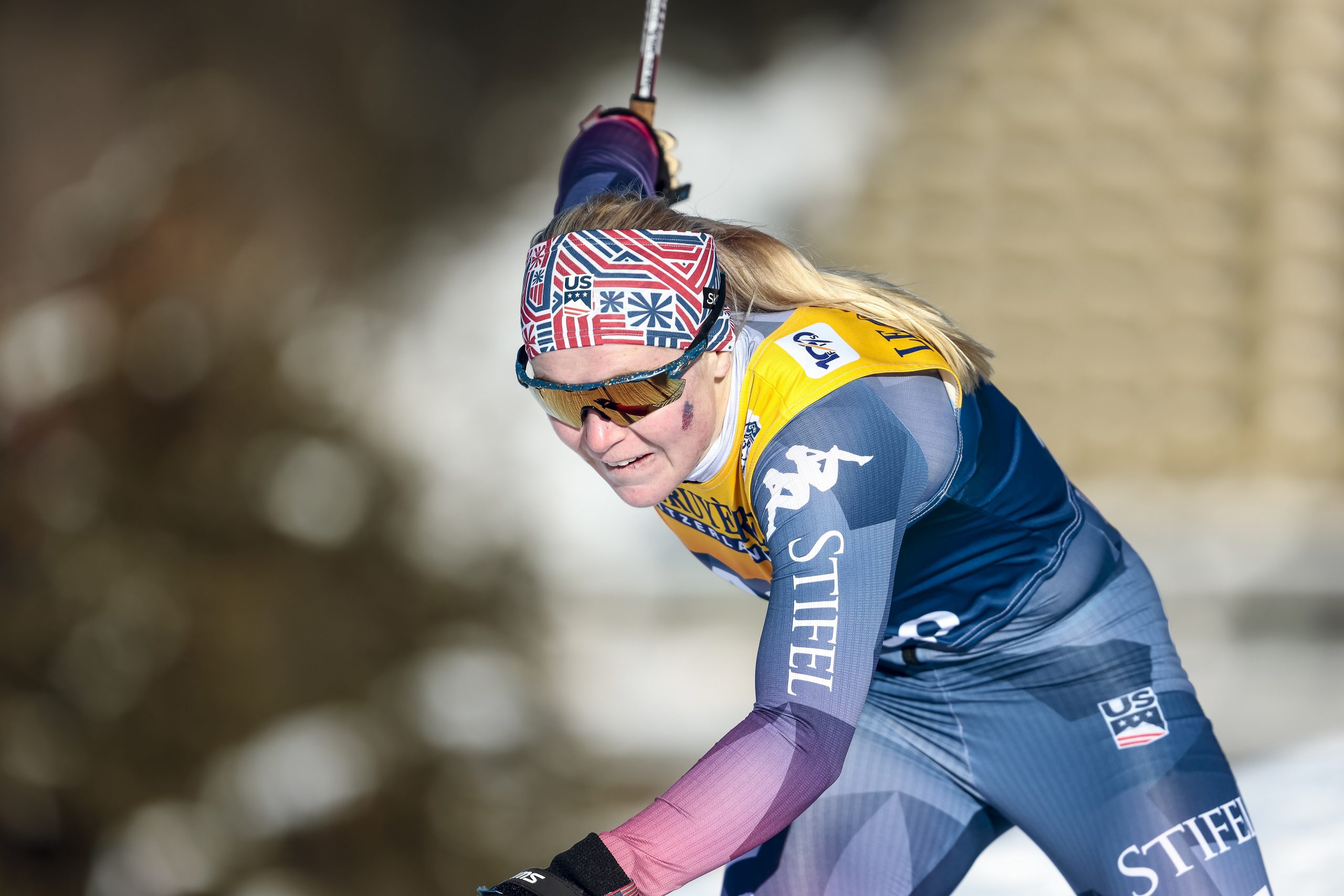
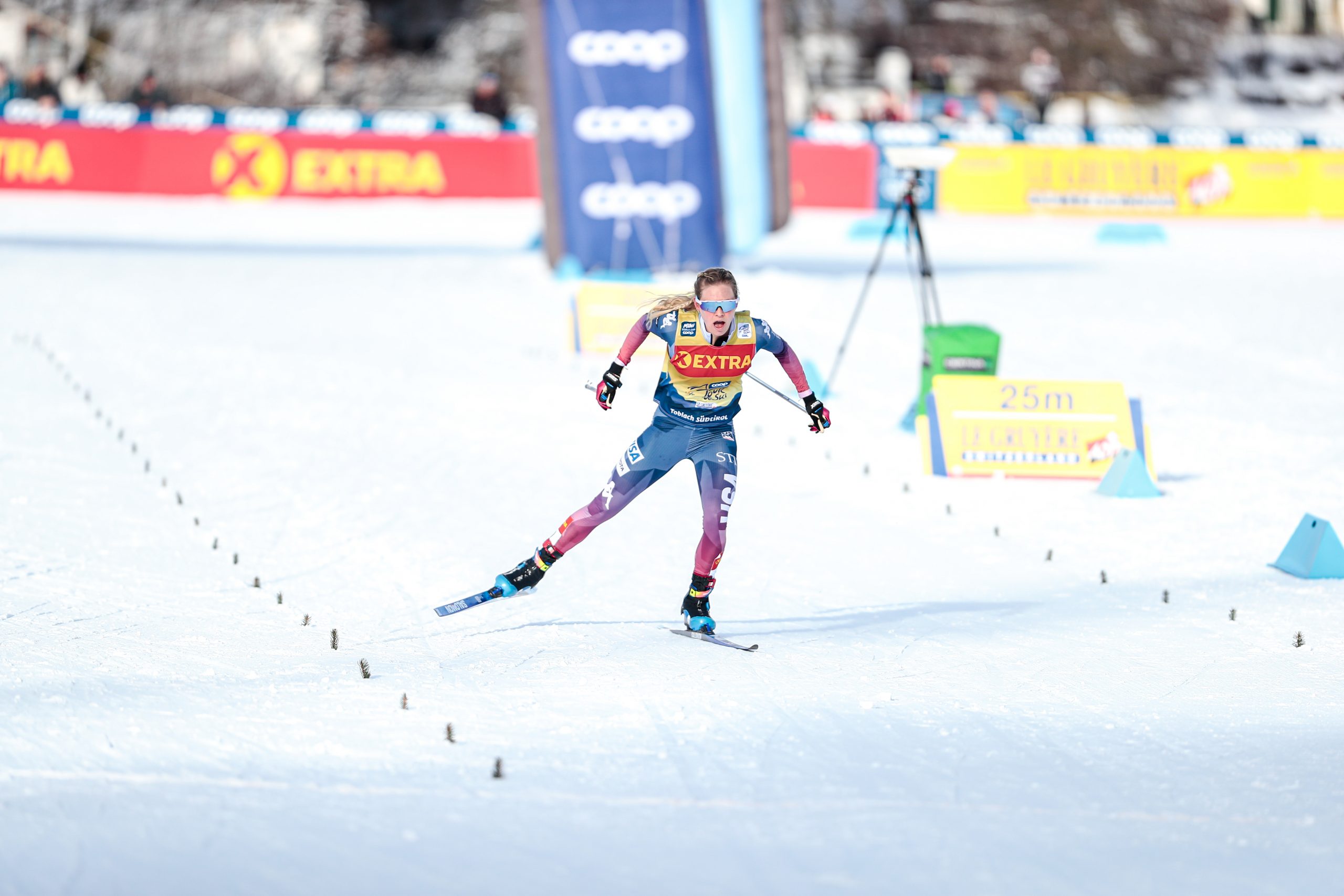
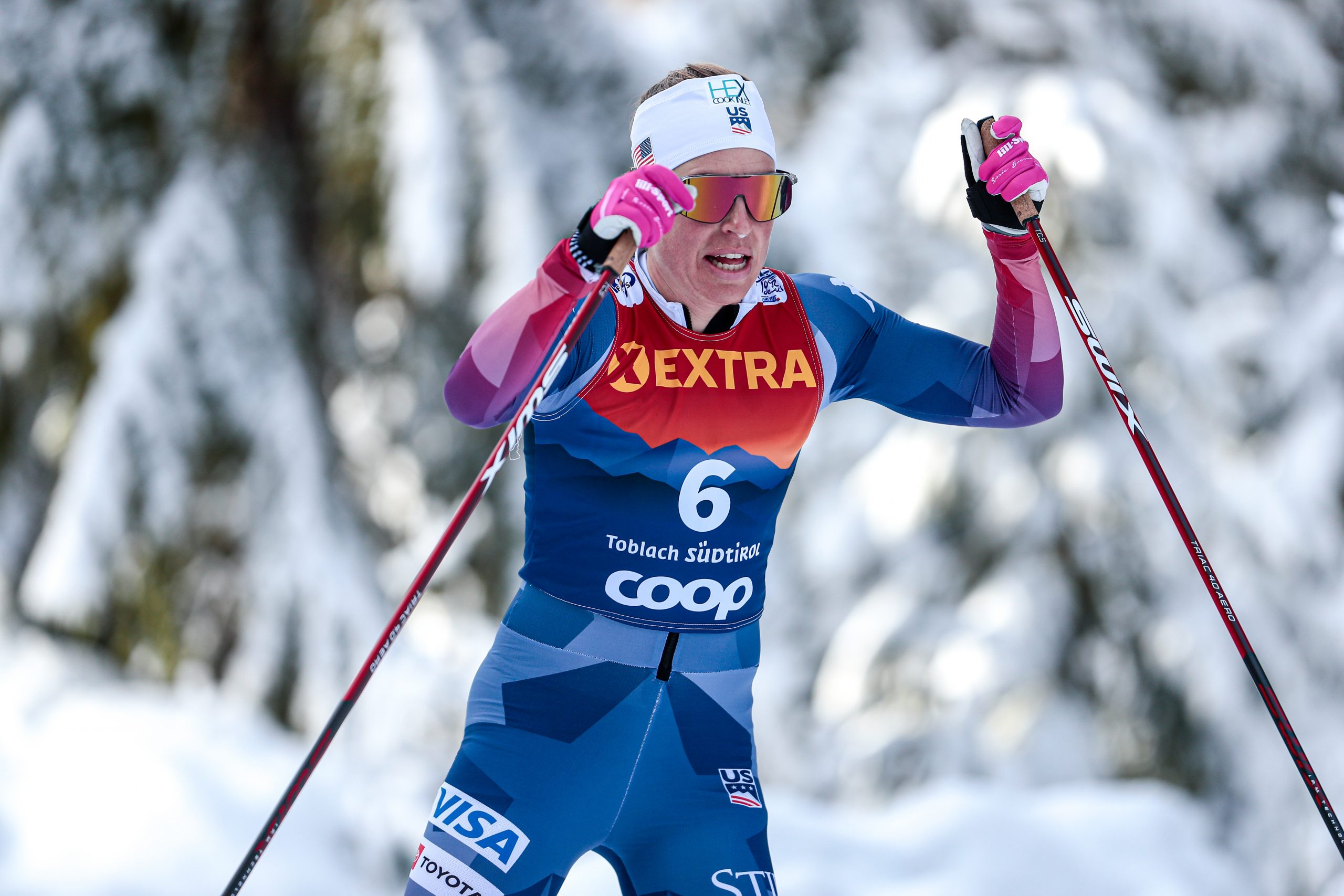
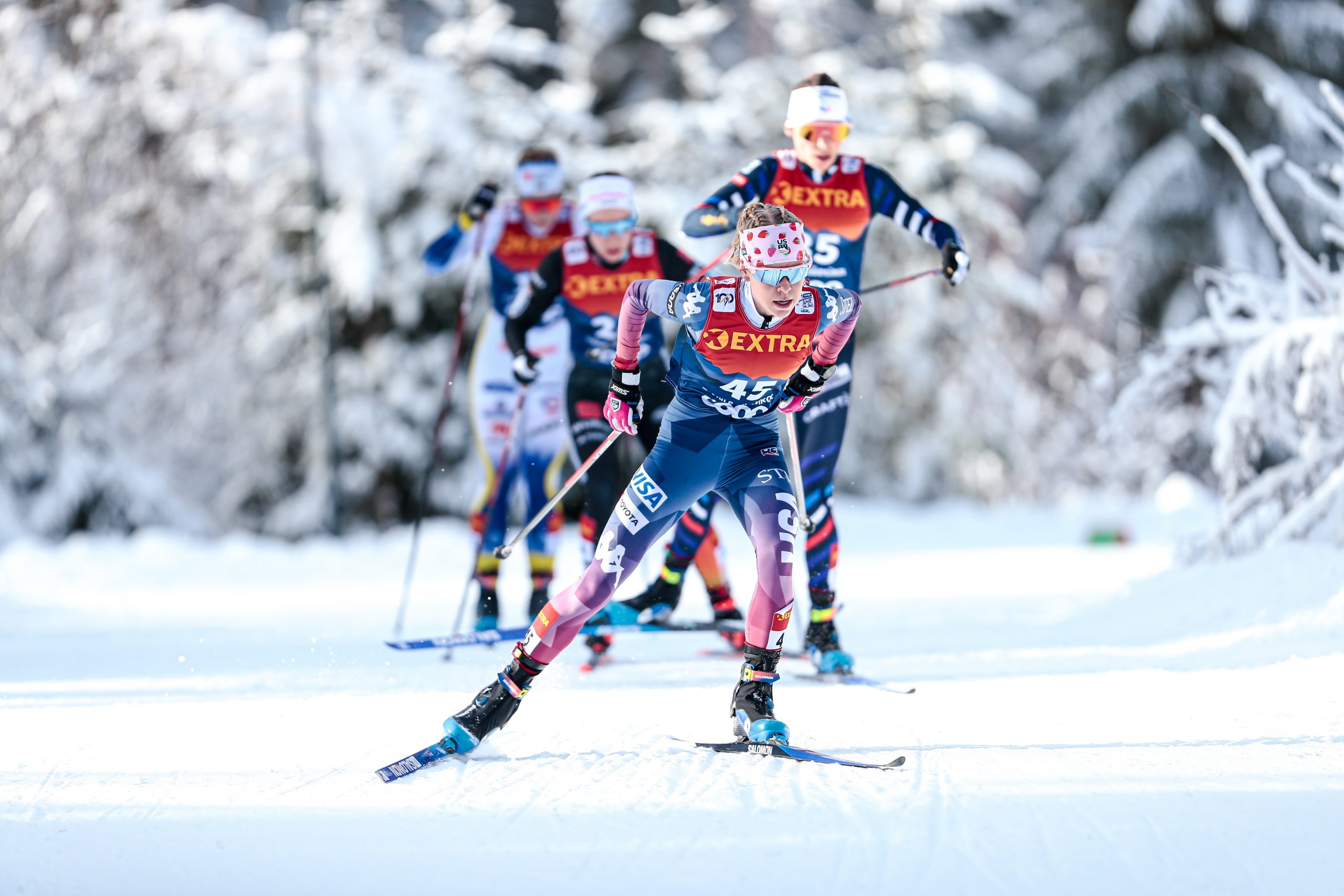
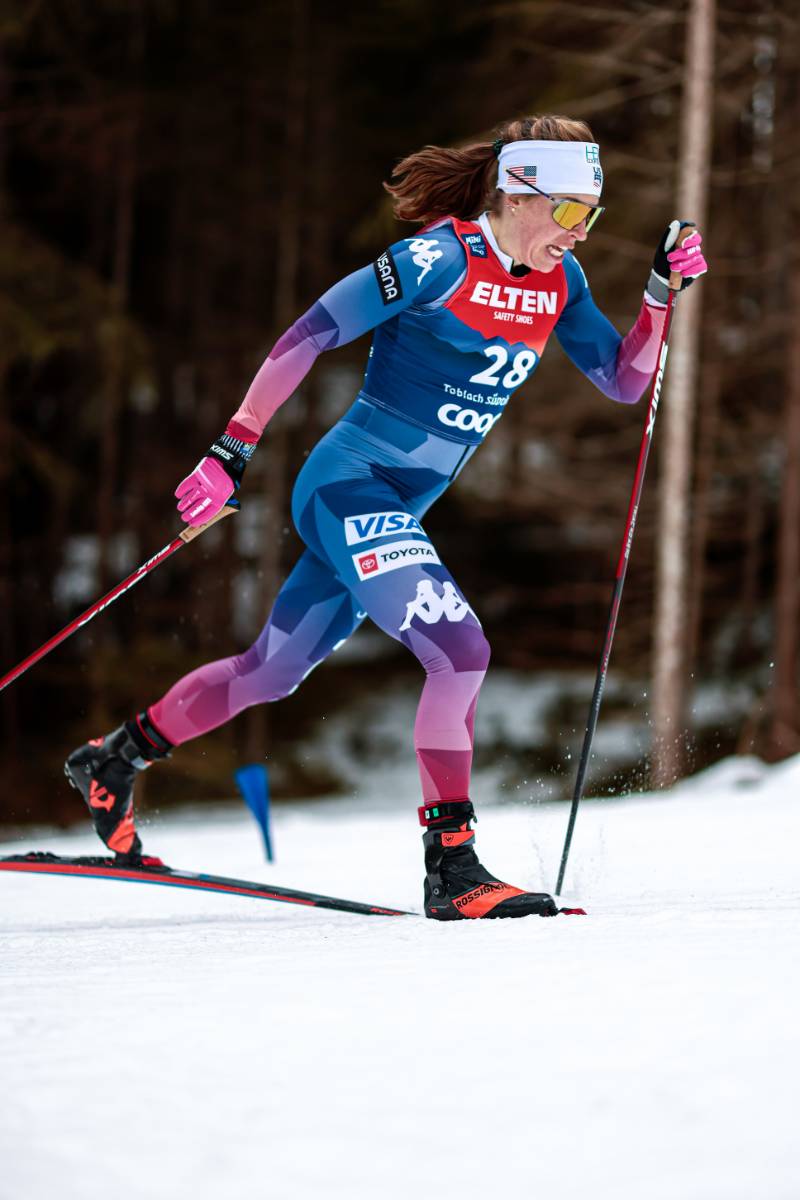
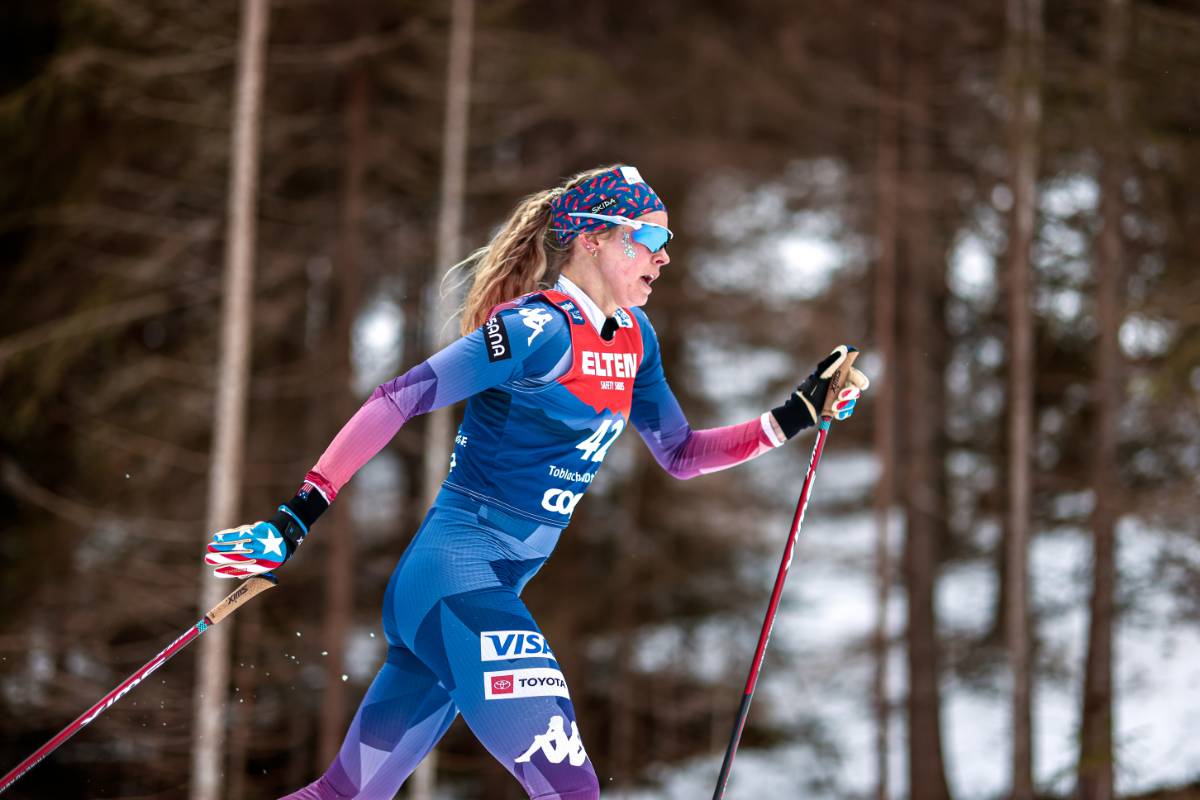
Jessie Diggins (USA) raced to seventh place in Ruka, an improvement over her finish of a year ago when she ultimately claimed the FIS Overall World Cup. (Photo: NordicFocus)
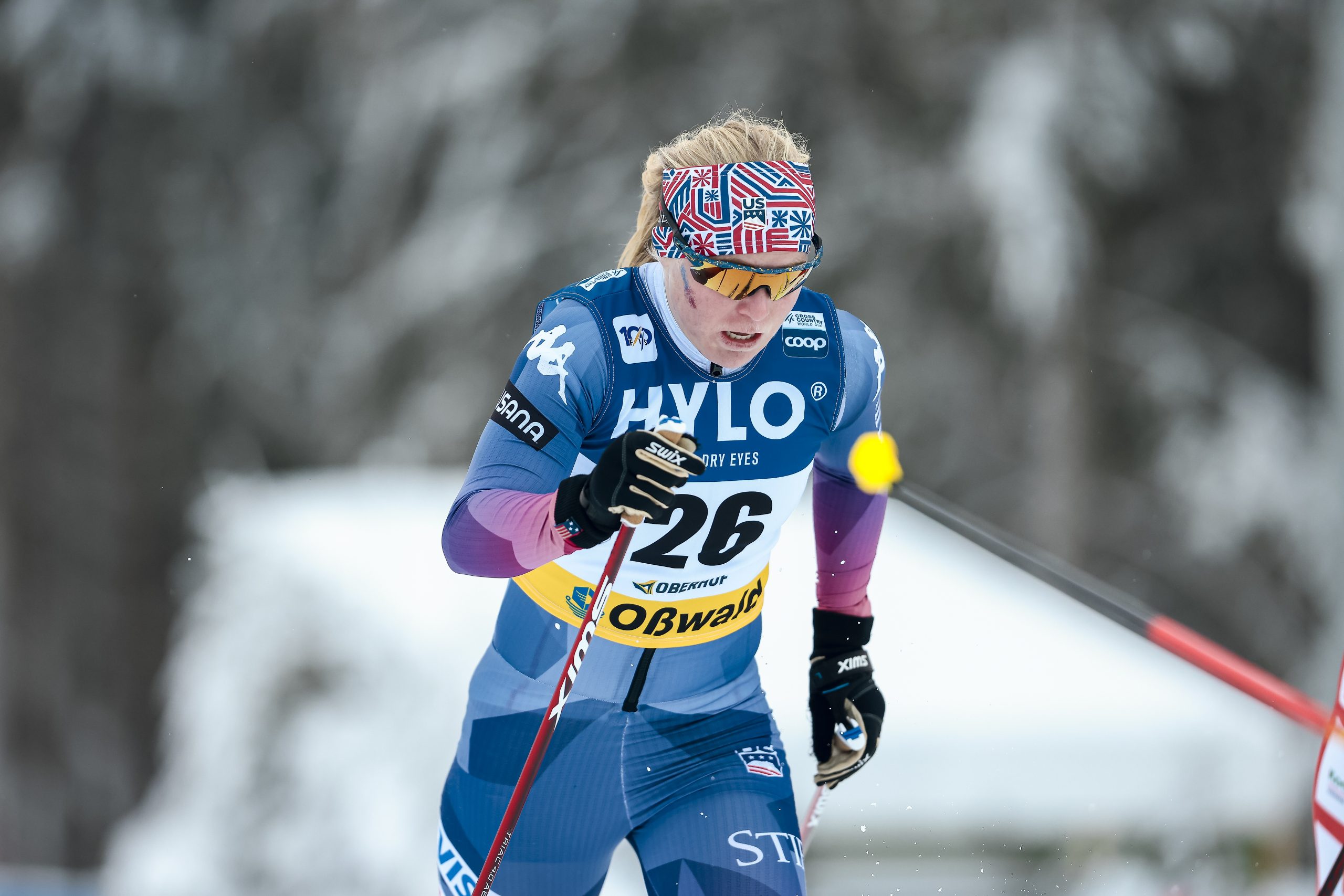
Jessie Diggins (USA) is the reigning World Cup Overall Champion, a distinction that also increases the number of her teammates allowed to enter World Cup races. In Ruka, eight American women raced the 10 k, with two finishing in the top ten. Behind Diggins steady 7th place (an improvement on her Ruka finish of a year ago), American finishers included Rosie Brennan (9th), Sophia Laukli (31st), Alayna Sonnesyn (48th), Julia Kern (49th), Sydney Palmer-Leger (56th), Haley Brewster (57th)
Canadian finishers included Katherine Stewart-Jones (42nd) and Liliane Gagnon (46th)
“Before I look at the results, I look back on the race,” Diggins continued. “How did it go? How did I communicate with my tech about my skis? Did I ask for what I needed? How’d the warmup go? How’d the race go: mentally, tactically, technique-wise, racing-wise? Then I come up with my scoring for myself before I look at the results. Today I was really really proud of all those categories, able to push really hard and stay very technique-focused.”
Women’s 10 k Classic Interval Start
November is the time of year when skiers wish for snow. Regrettably, those snow-wishes aren’t always granted, and November is often a month of roller ski pole tips clacking and slipping on near-frozen asphalt roadways. This year, though, the hills and trails appear different: Snow has arrived. The Central Rockies got totally dumped on this week—cars and trucks skidding and colliding up and down Vail Pass. New England finally got the Thanksgiving nor’easter that ski areas hope for every season. Now if they can just arrange another one for Christmas, then a couple more for President’s Day and Spring Break. Western Canada is blanketed in snow; Silverstar, BC is hosting camps for those programs savvy enough to plan early.
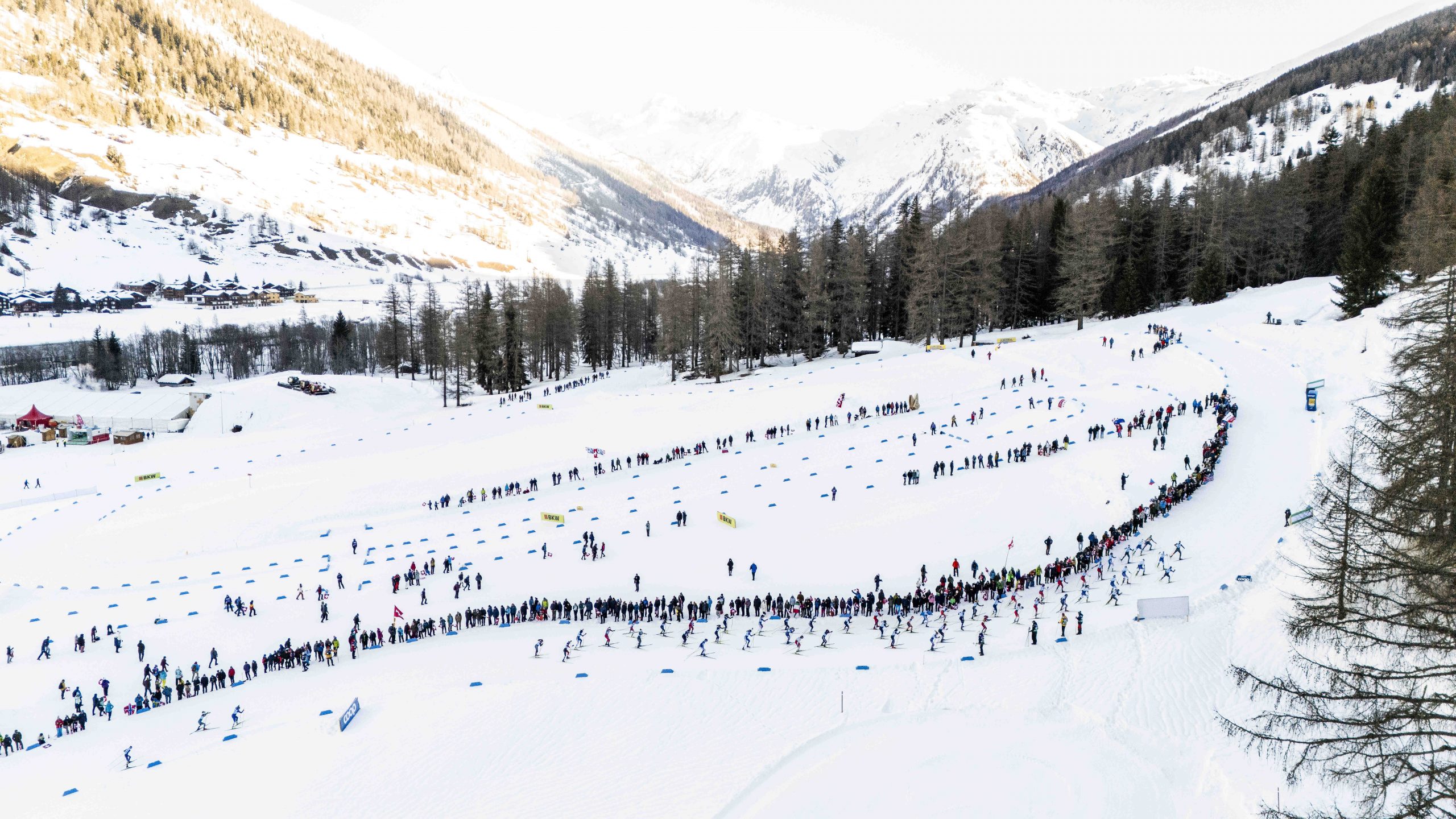
The International Ski Federation (FIS) doesn’t take chances when scheduling season openers. For many seasons, the first World Cup stop has been in Ruka, Finland (25 kilometers north of the Arctic Circle). It may only be November, but skiers are pretty sure to find snow in Ruka.
Skiers are also likely to find challenging conditions on Ruka’s Classic course that is designed to test the best athletes.
“Both up and down, (Ruka) is very technical, said Diggins. “Very steep hills, and you need really dialed-in technique in order to run them. You also have to be able to transition in and out of herringbone really well. I’m still getting there, and I have more that I want to do. It’s exciting to feel like all that hard work is sinking in.”
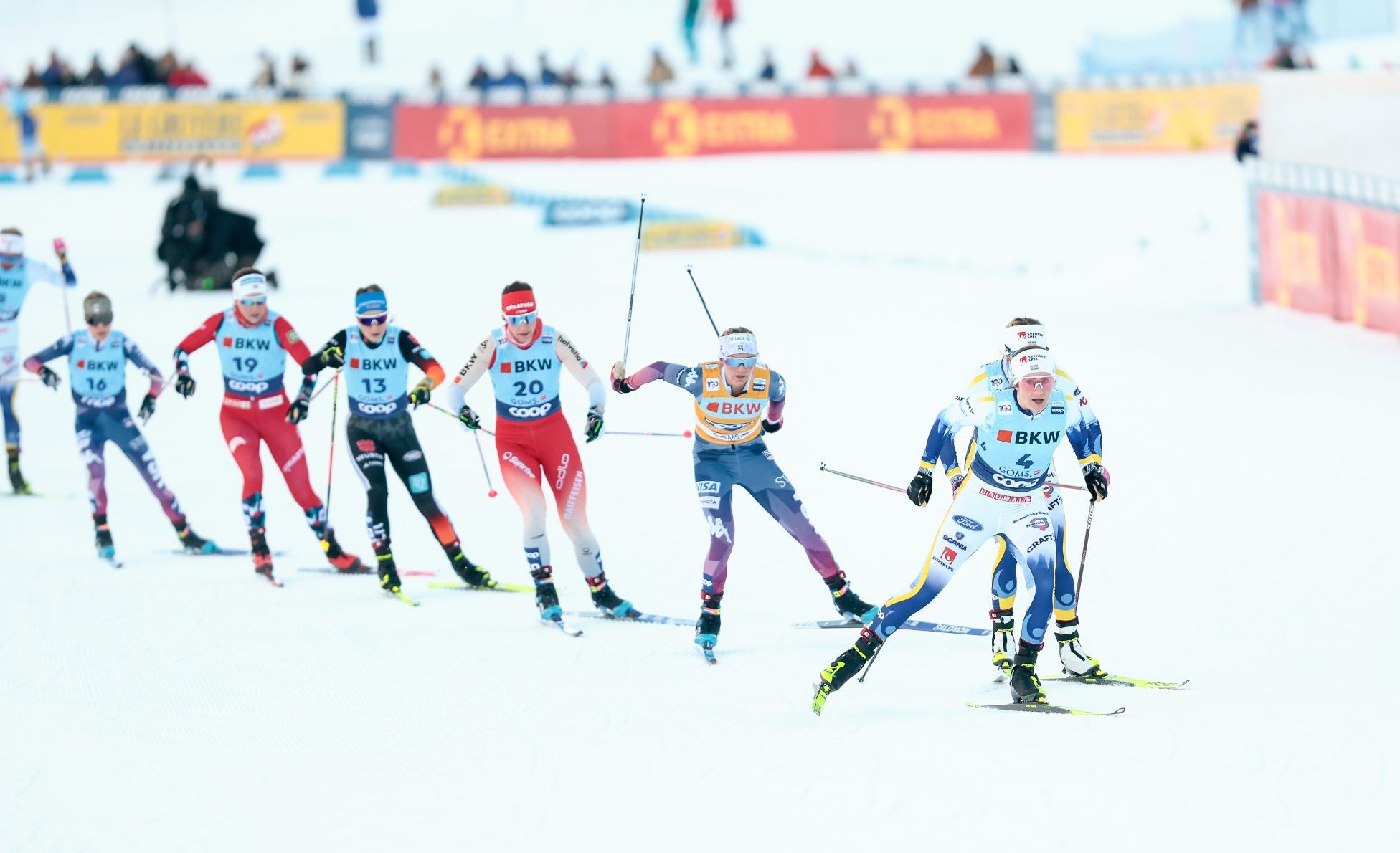
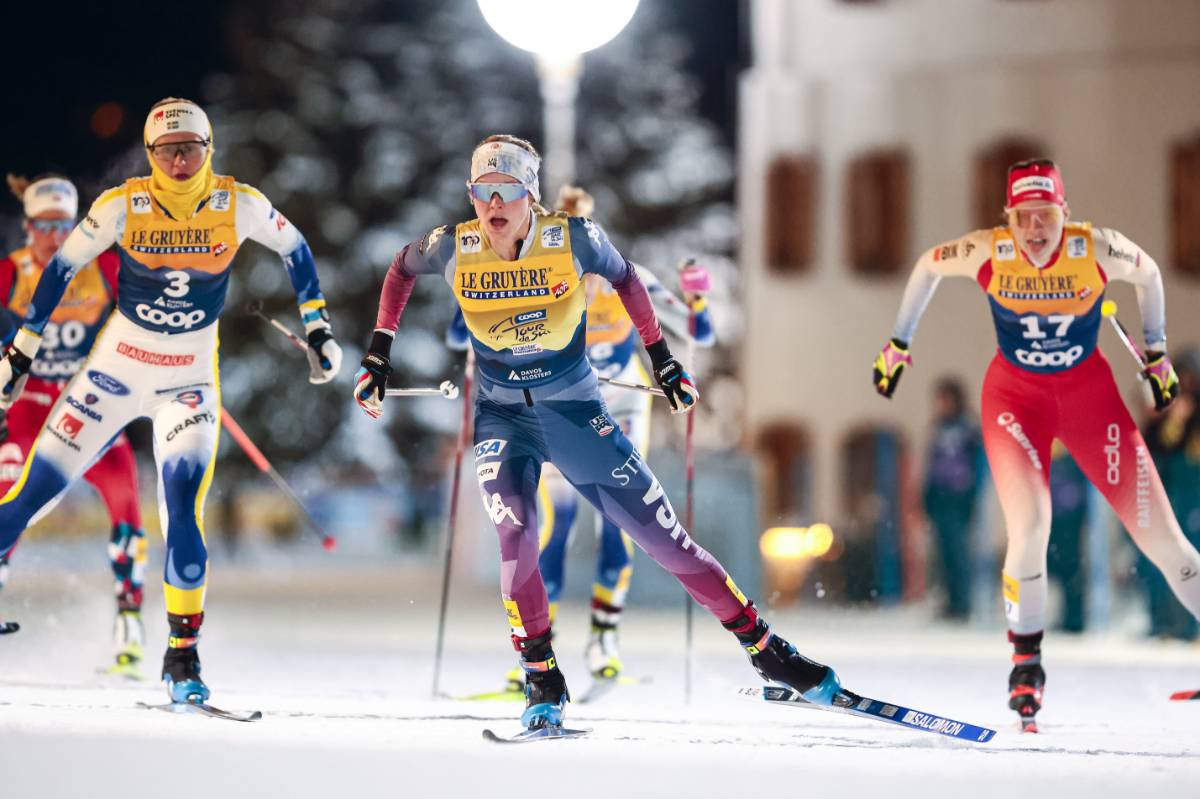
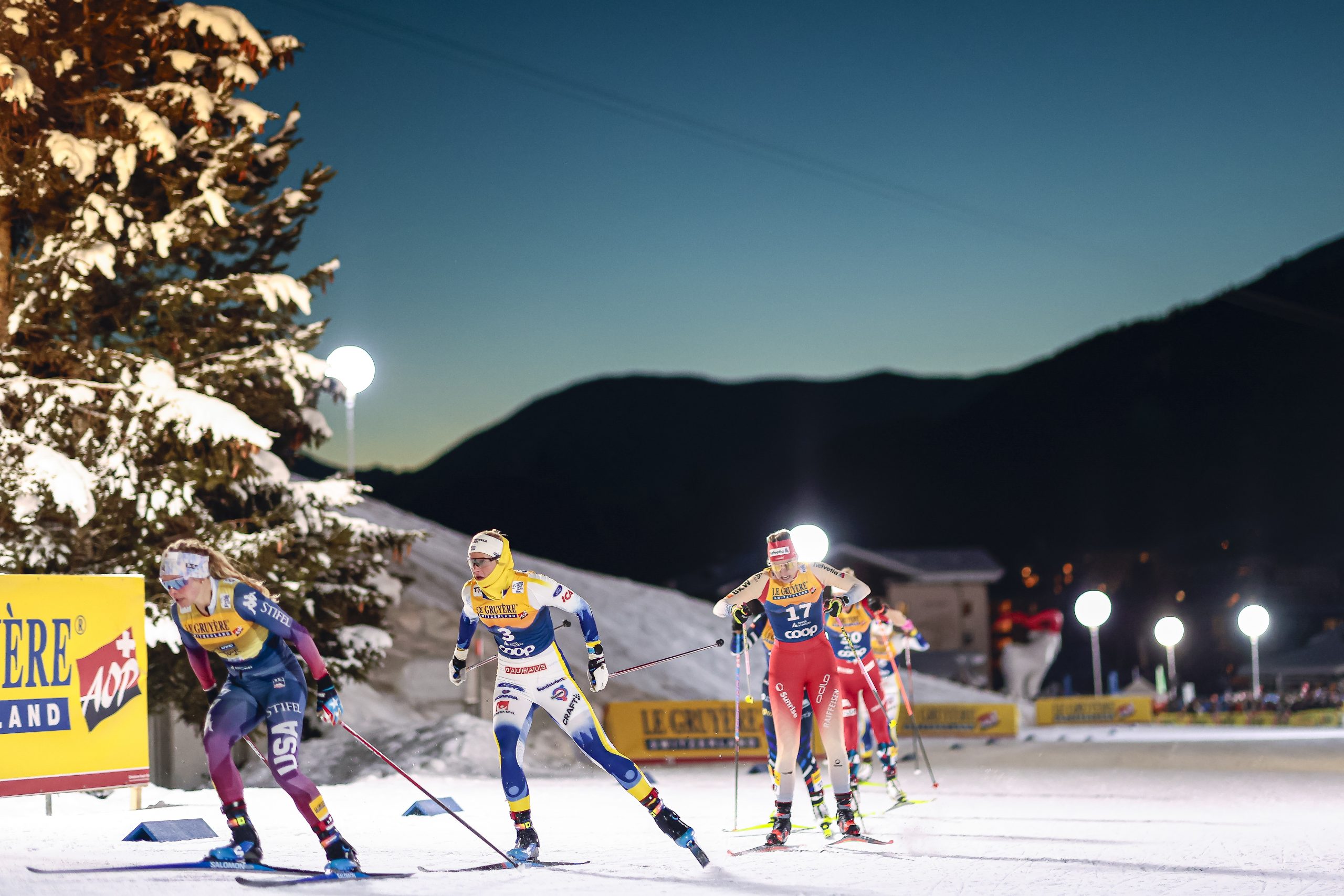
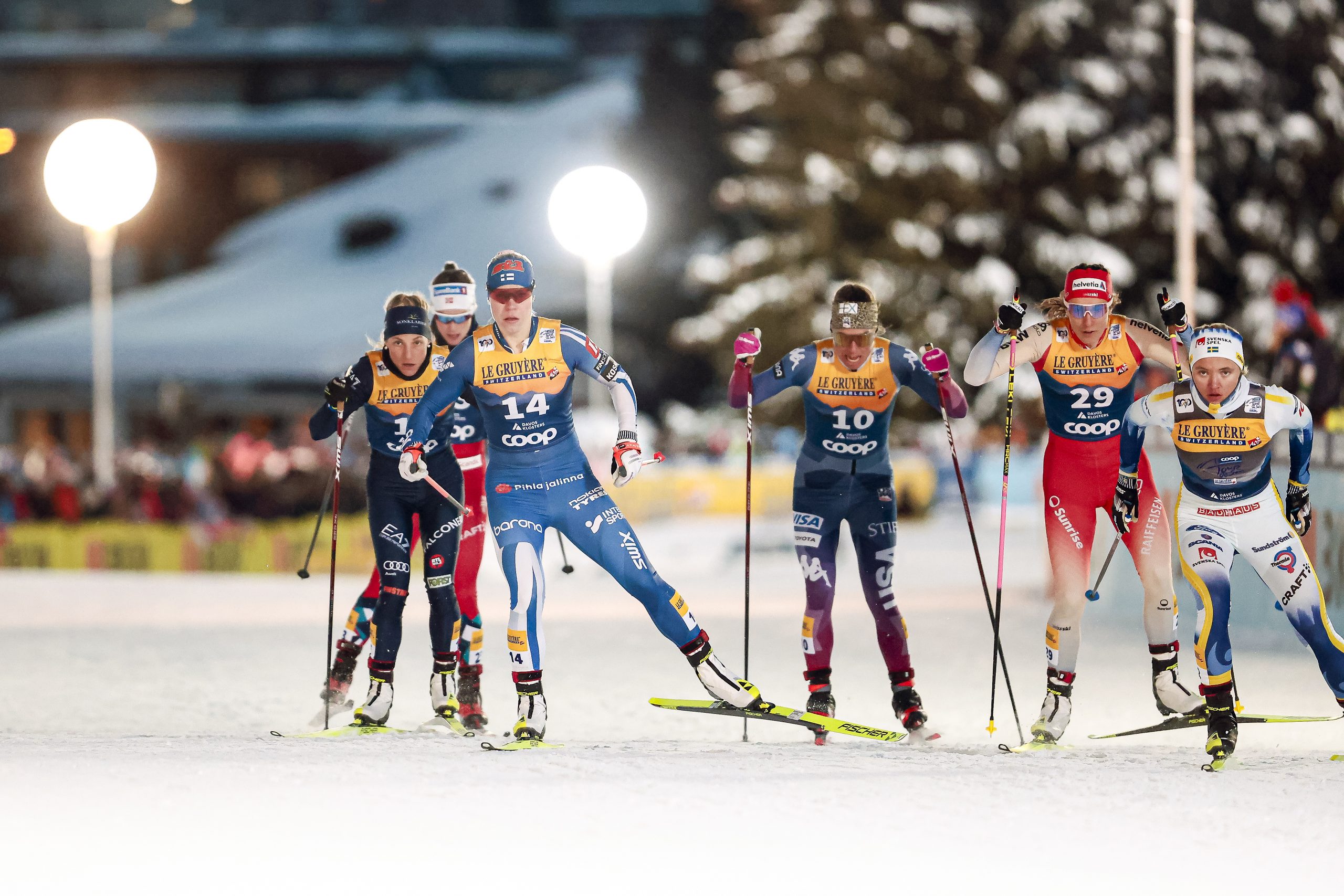
The first World Cup of the season—the Women’s 10 k Classic Interval Start—was raced in fresh snow with temperatures hovering around minus 2 centigrade. Conditions would be slower and more challenging than most athletes might’ve liked for the first test of the season, and many athletes lacked the snap typically seen in World Cup Classic races. The snow dragged at their skis, the hills sapped their energy. In the near-constant twilight of Arctic winter, racers struggled to find the form and rhythm that they’d refined all through the summer training season.
It’s been two full seasons since the skiing world watched Therese Johaug (NOR) race. Ruka’s 10 k Classic was a reminder of her long and excellent career, and of the potential she still possesses with the Trondheim World Championships looming on the Norwegian horizon. (Photo: NordicFocus)
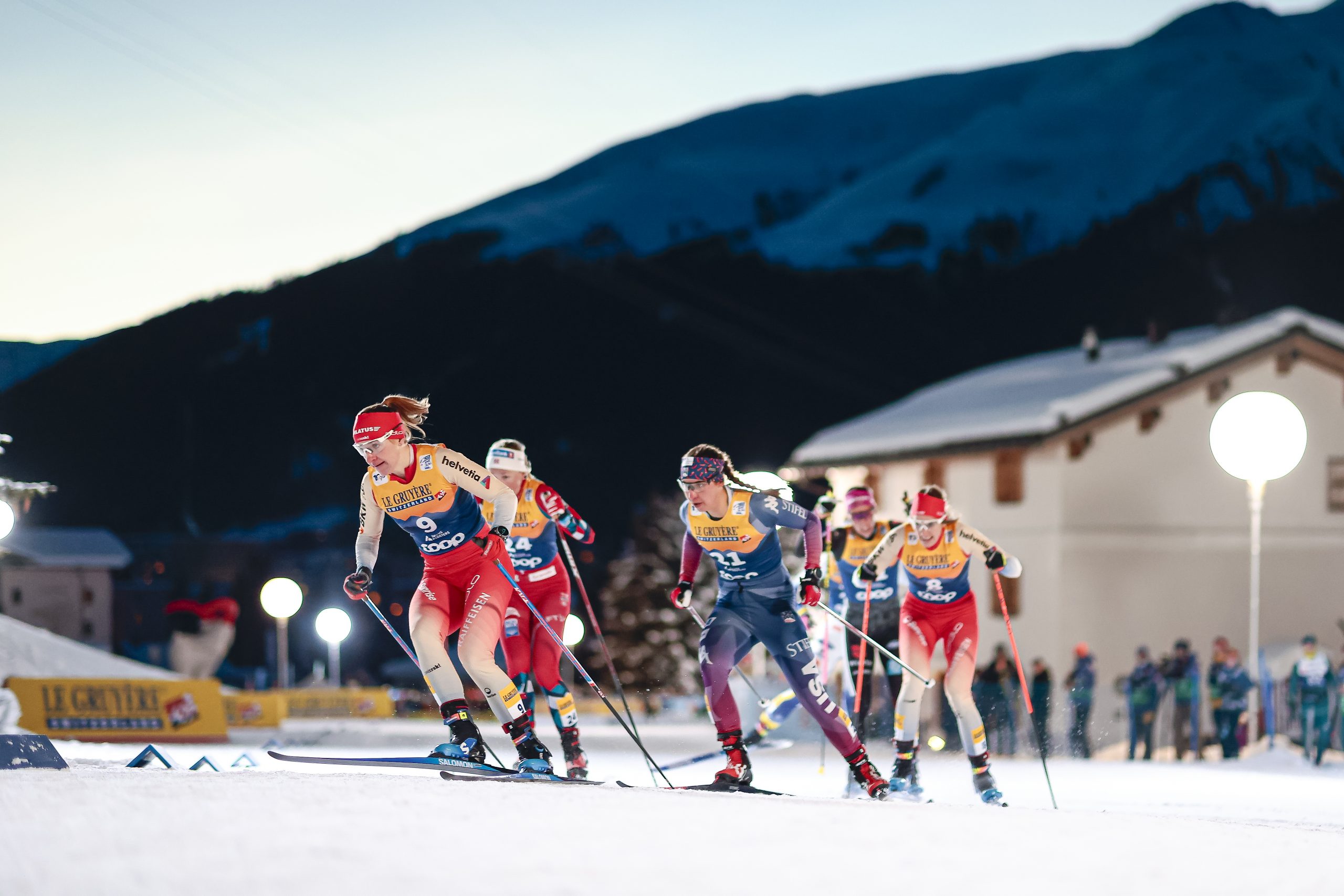
Now 36 years old, Johaug had retired after the 2021-2022 season. The day’s 24th starter in Ruka, Johaug was seeking her 83rd World Cup victory. She departed the stadium in her usual staccato style, attacking a familiar course that has delivered victories for her many times before. Johaug was seen to be exiting the tracks in search of greater kick on the challenging uphills (as were many of her Norwegian teammates). Nevertheless, she established large leads at all her early splits.
Other contenders (Diggins, Slind, Weng, Andersson) would match or better Johaug’s early splits, but ultimately each of her rivals faded . . . except for Karlsson. She stormed on through the Finnish forest, increasing her lead at each juncture. In a field of world class skiers who seemed generally to struggle with the day’s conditions, Karlsson appeared the lightest, most energetic, most efficient on her skis. Rarely out of the tracks, she was able to attack where others needed to measure their efforts.
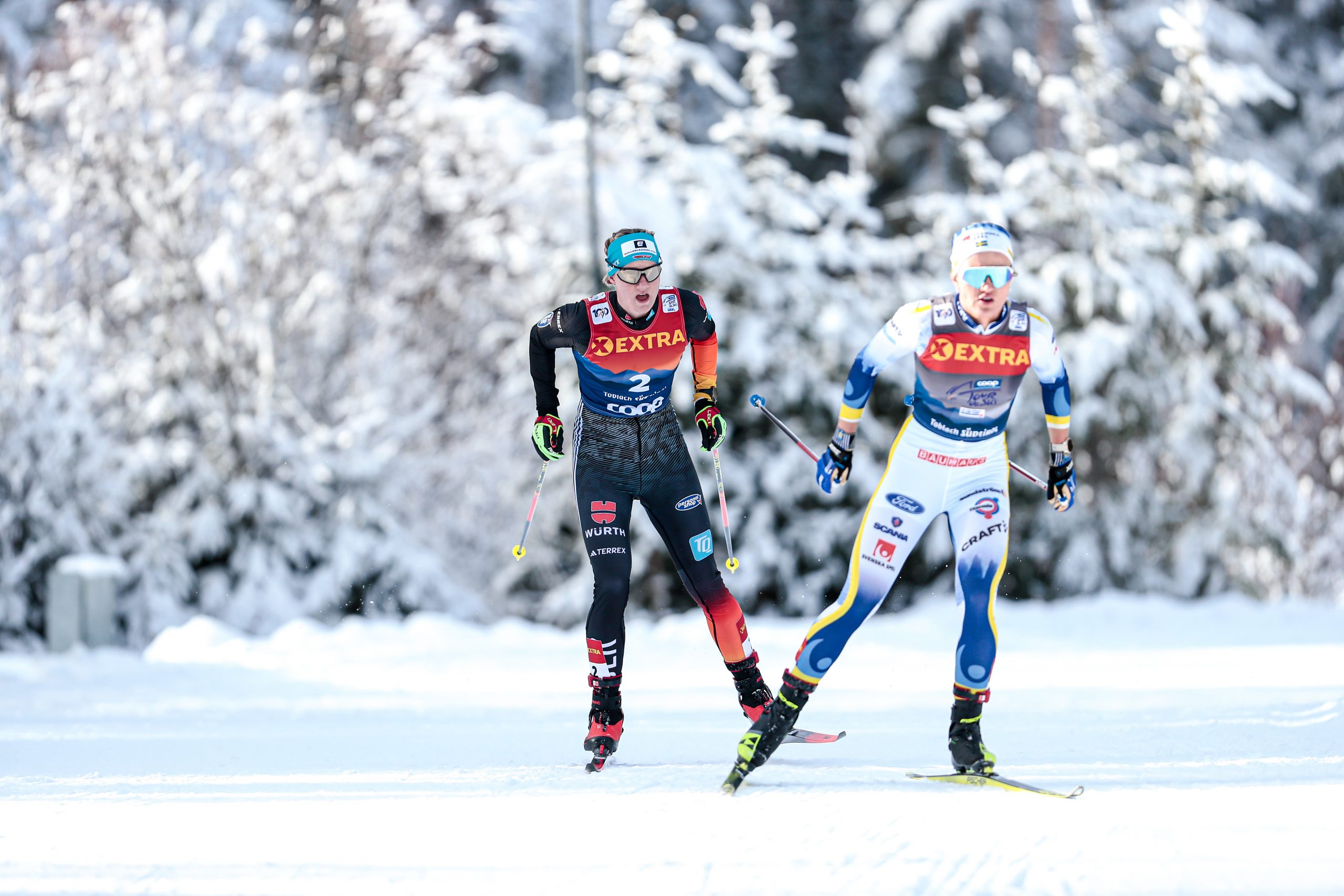
At the midway point, fast times had been turned in by Karlsson, Slind, and Katharina Hennig (GER) who were all positioned ahead of Johaug. Diggins hovered in fifth, just ahead of Heidi Weng (NOR). But only Karlsson and Johaug were able to maintain their technique—and their momentum—all the way to the end. Slind raced bravely as well, recovering her technique near the end to finish a strong third.
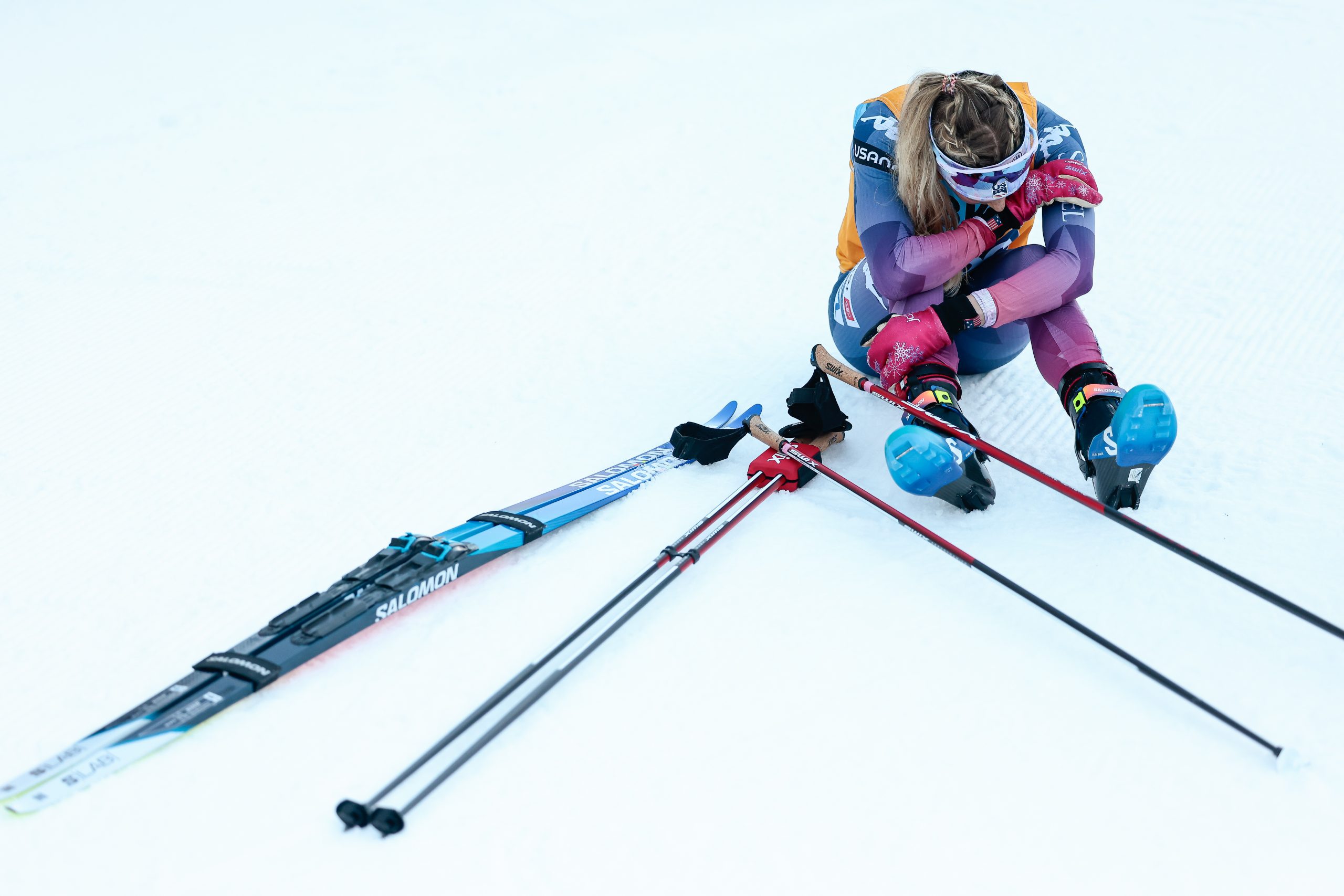
“I think I went out a little hard,” Diggins confessed after the race. “I don’t necessarily regret it; sometimes you gotta go big and see what happens. But I think I was folding a little bit in my technique on that second lap.
So, the 2024-2025 World Cup season is underway. Many weekends and many races lie ahead, and much will transpire before the FIS World Championships in Trondheim. Those races are what Therese Johaug identified as her goal event for the season, a week of racing that Frida Karlsson is likely to have circled on her calendar, as well.
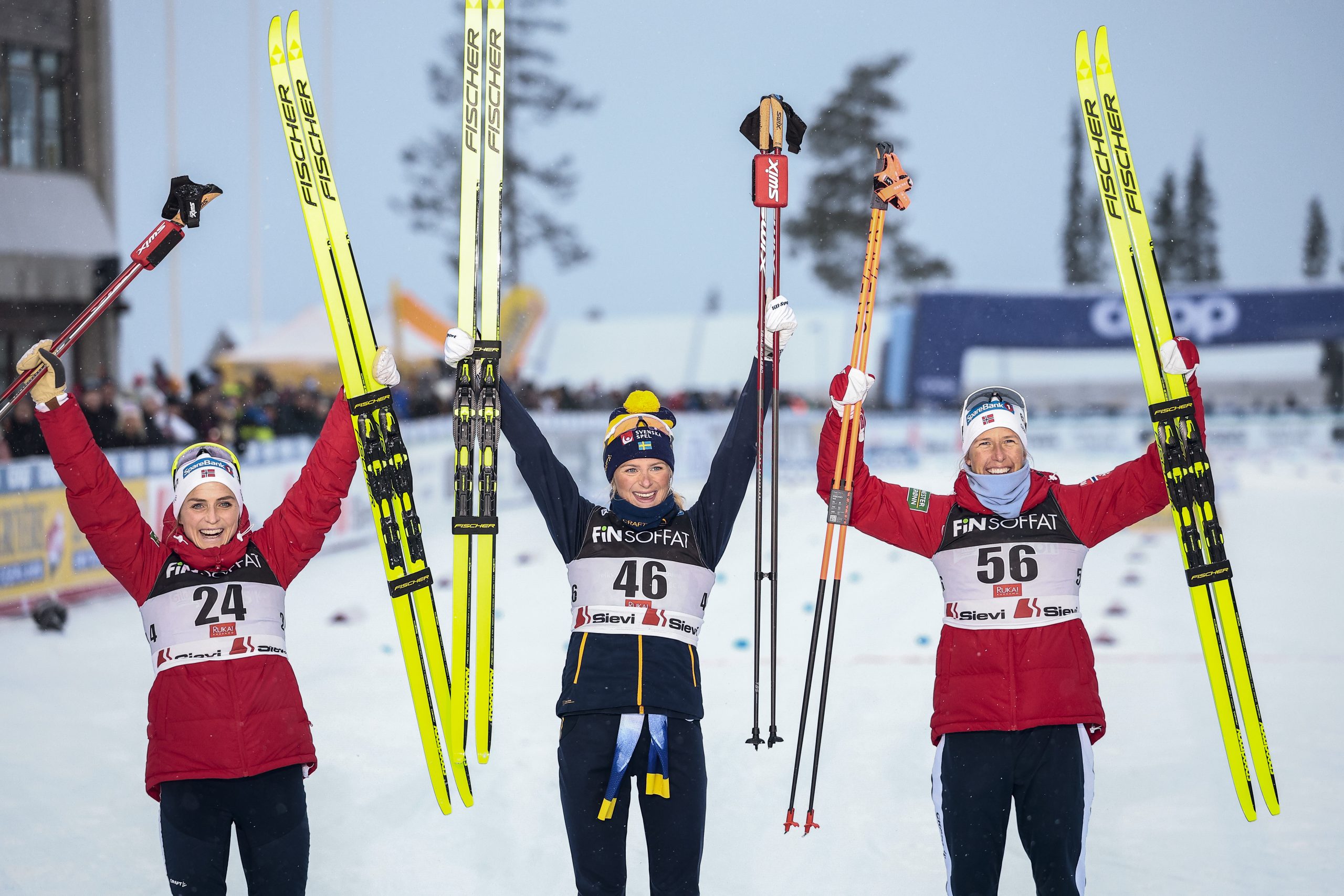
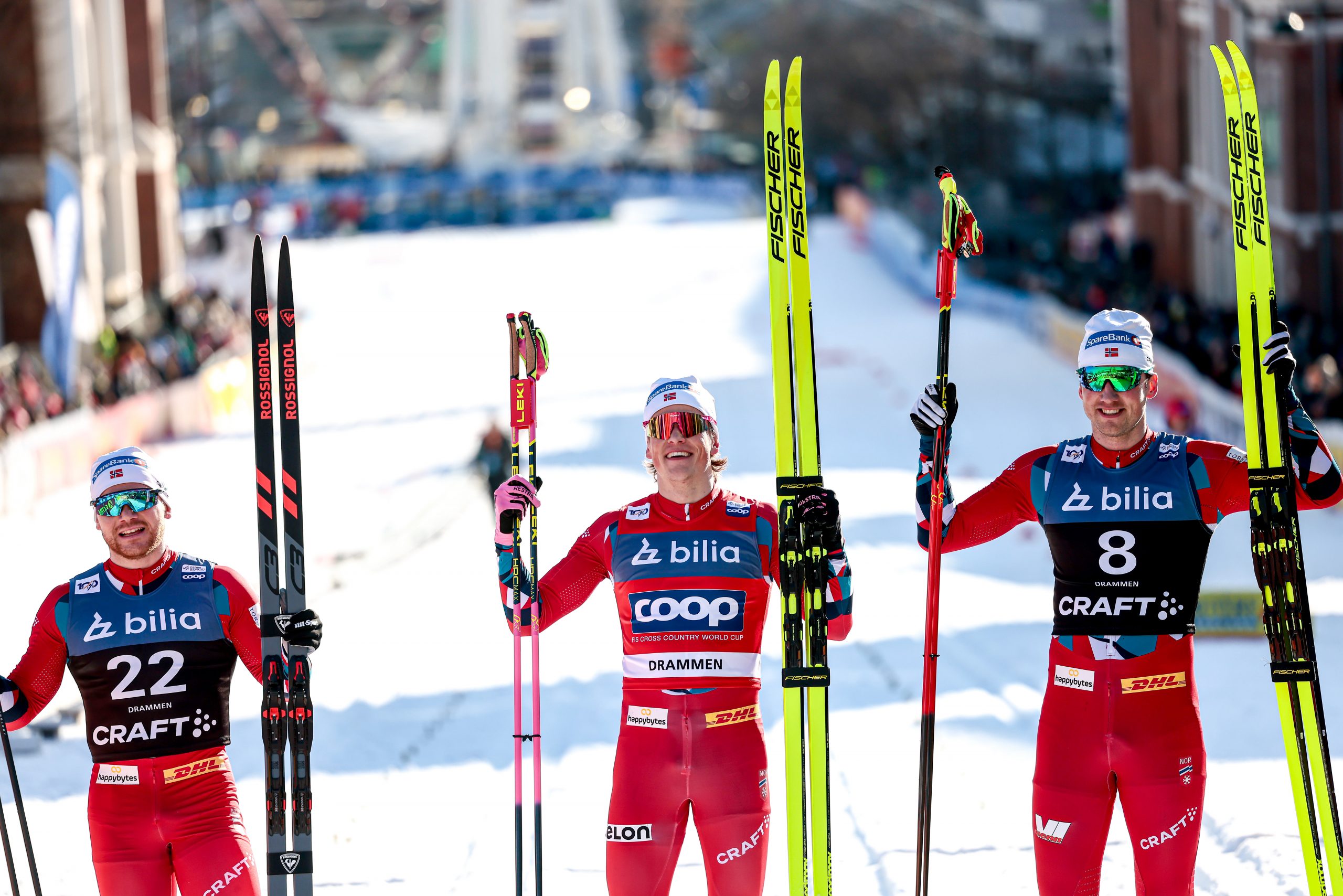
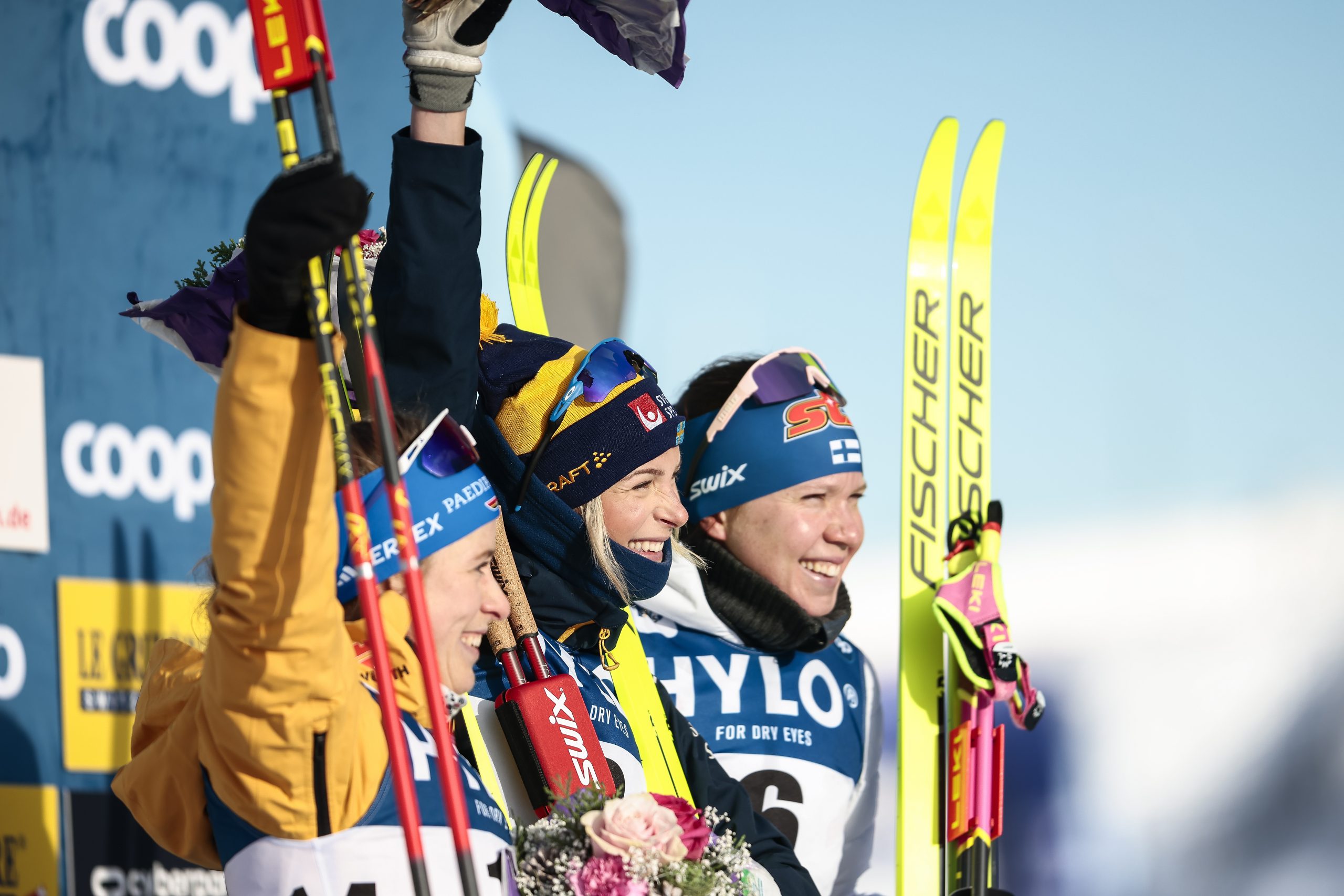
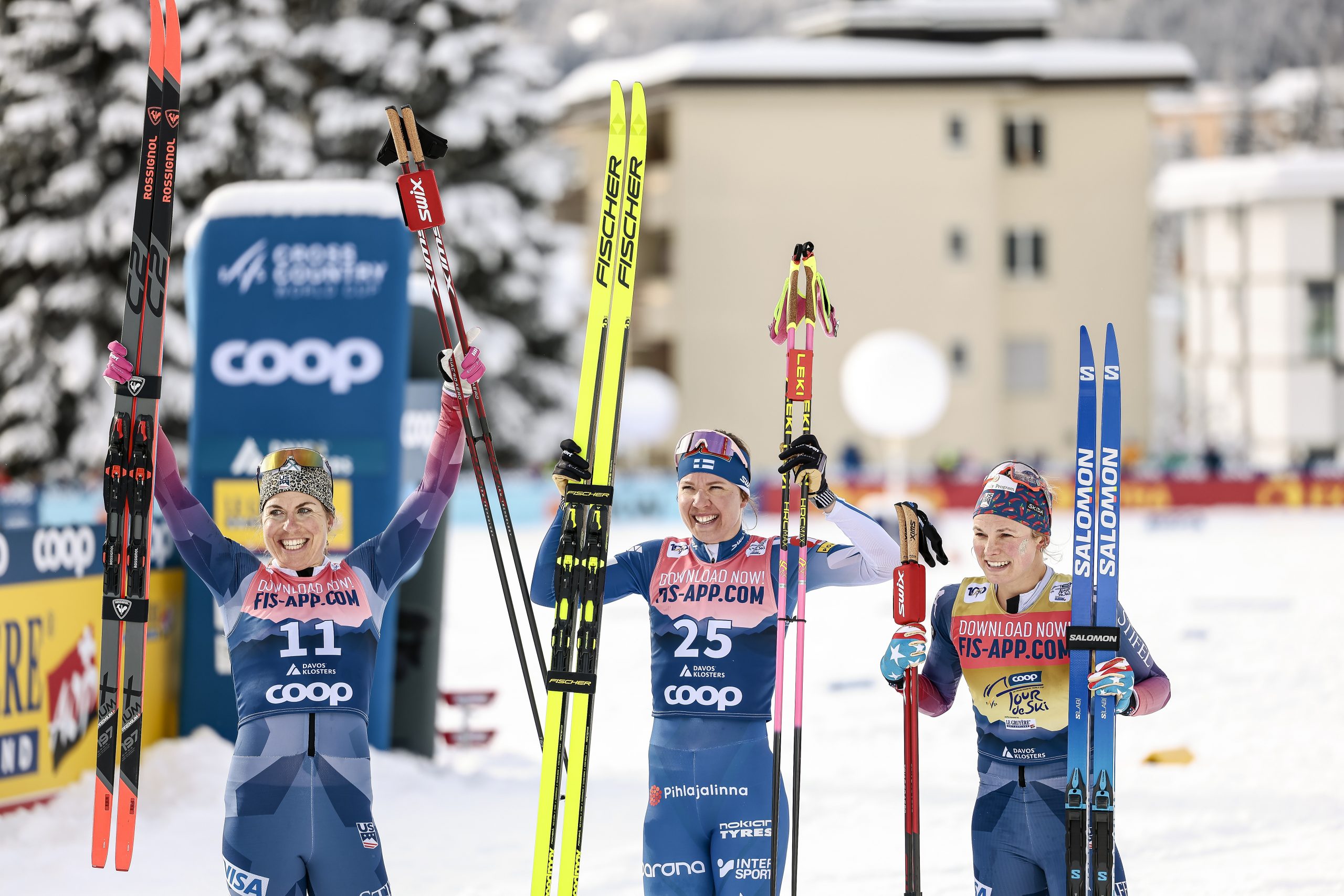
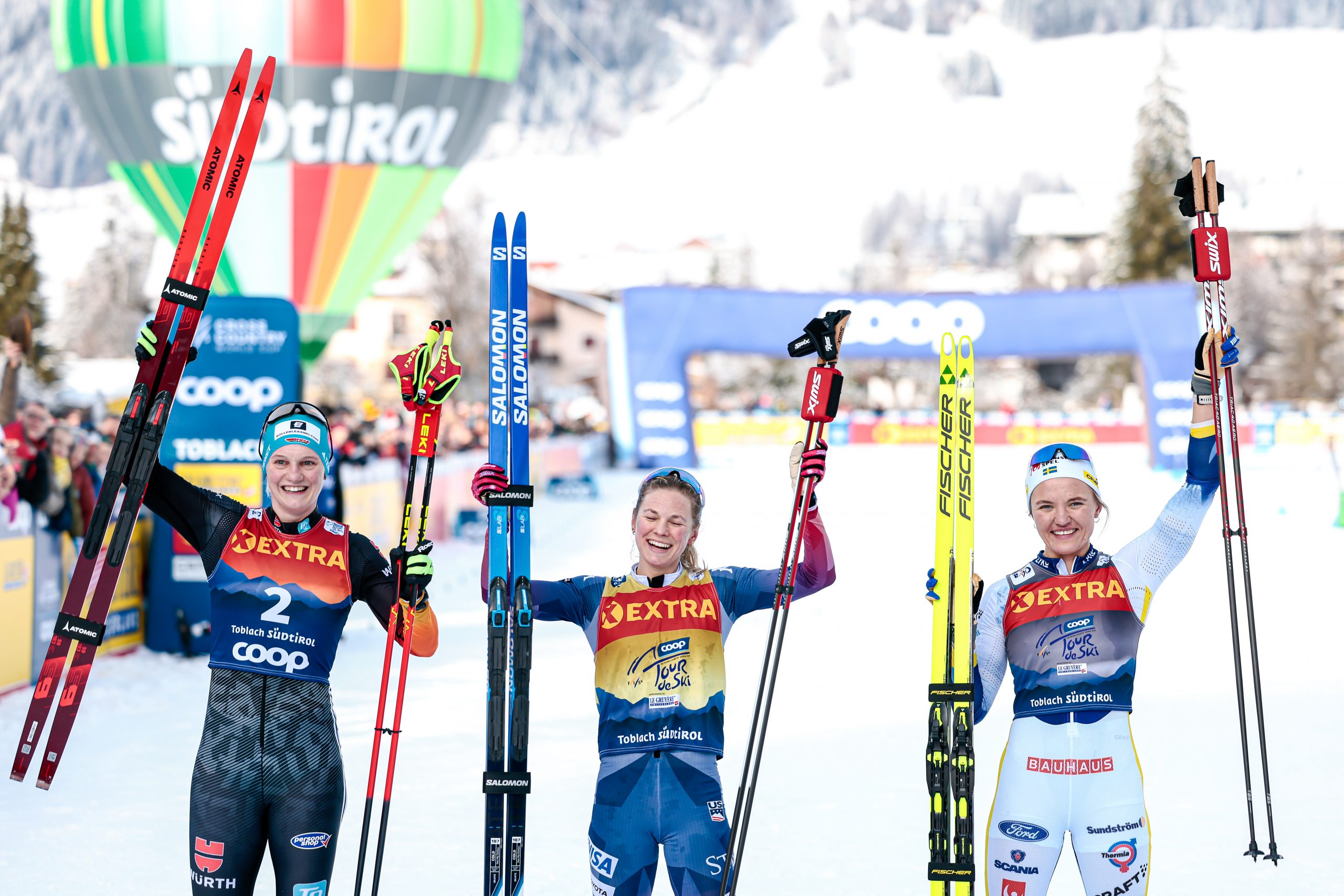
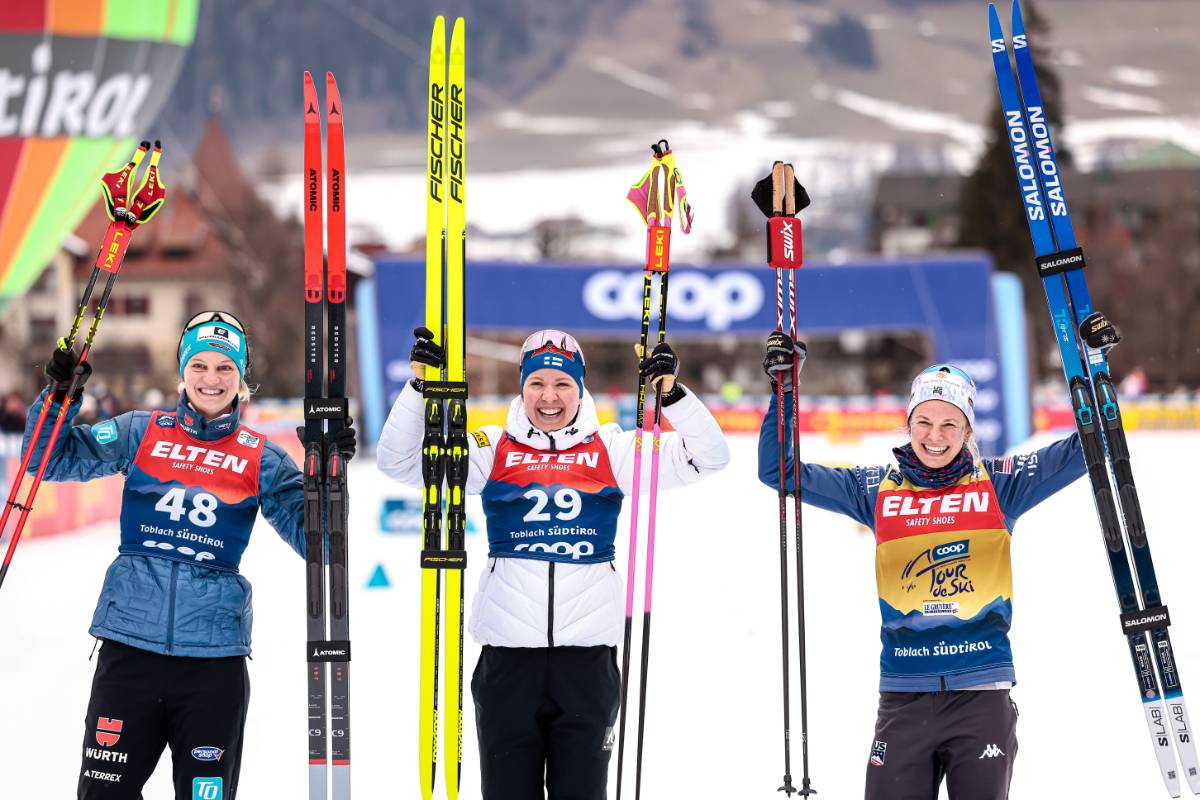
First podium of the World Cup season: Therese Johaug (NOR), Frida Karlsson (SWE), and Astrid Oyre-Slind (NOR) celebrate on the podium in Ruka. (Photo: NordicFocus)
This coverage is made possible through the generous support of Marty and Kathy Hall and A Hall Mark of Excellence Award. Learn more about A Hall Mark of Excellence Award—or about supporting FasterSkier coverage—by contacting info@fasterskier.com.
It’s hard to believe, but the start of the World Cup ski season is upon us. The weekend opener in Ruka, Finland begins November 29th. While many of us will be bemoaning our Thanksgiving excess and recovering from NFL binge watching, the best skiers in the world will assemble in Finland’s northern remote regions— hovering around the Arctic Circle— for the start of the 2024/25 season.
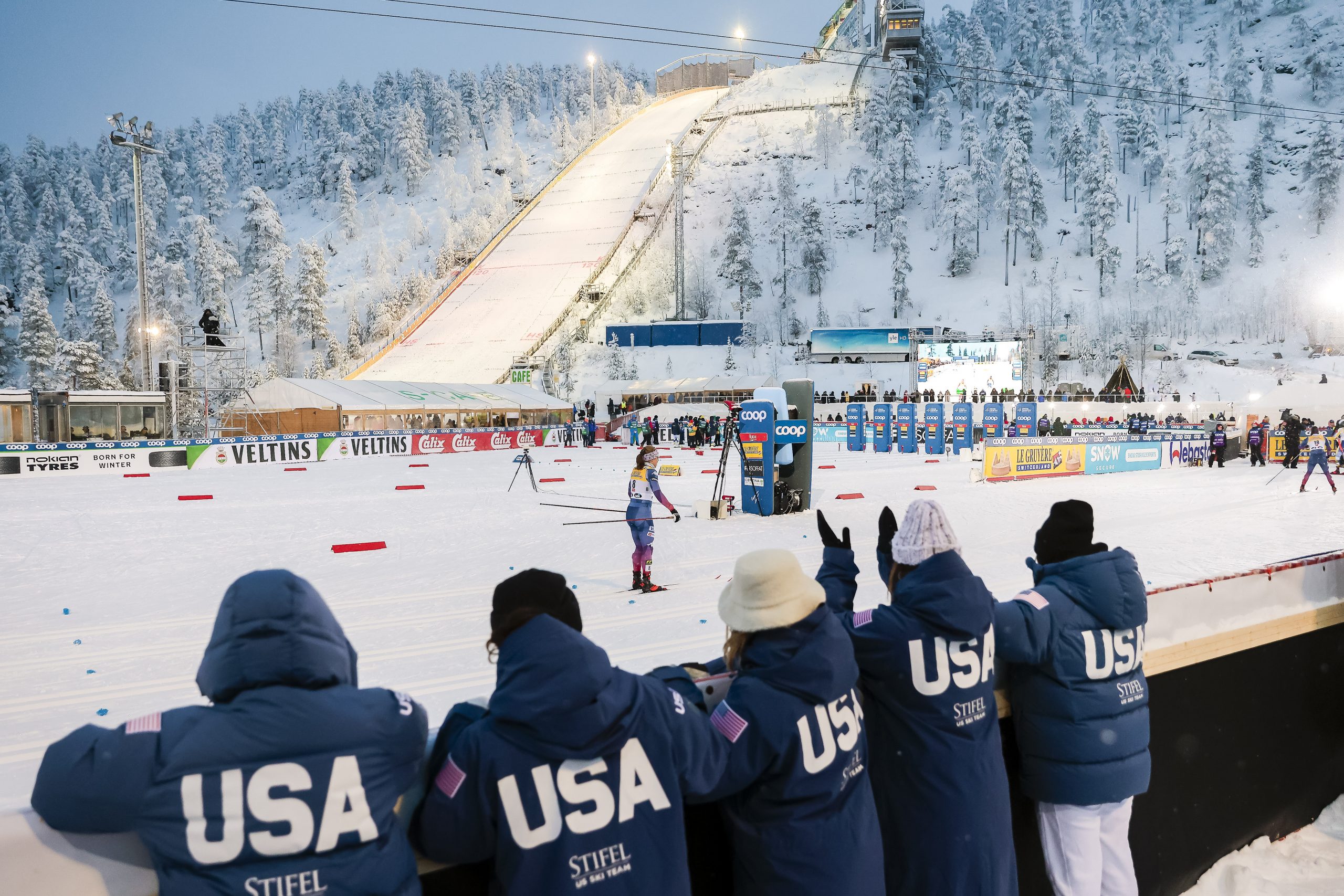
The U.S. team looks on in Ruka in 2023. (Photo: NordicFocus)
All systems are go for the season opener, with FIS (International Ski Federation) reporting that “after the last snow control meeting … the event preparation group confirmed the event is to take place as scheduled.” There’s a lot at stake for the season opener in Ruka, but cross-country fans may forget that there are other Nordic sports using the same snow for the season opener. Nordic combined, ski jumping, freestyle skiing, and cross-country will all share the Ruka venue so getting the green light from FIS is huge for many ski fans and athletes. The forecast for the area calls for warmer temperatures and rain mixed with snow early in the week, but by Friday, temperatures are predicted to drop well below freezing with several inches of snow each day. Jessie Diggins stated in her press conference on Monday that Ruka just experienced a huge snowfall. So it’s likely the races will be held on a mix of natural and artificial snow. If it’s snowing during the races, the weather could play an outsized role with two of the races scheduled being Classic.
Last year, Jessie Diggins (USA) finished 11th in the 10 kilometer Classic in Ruka. (Photo: NordicFocus)
The cross-country race season will kick off with the women’s 10 kilometer Classic interval start on Friday, November 29th at 4:00 a.m. Eastern time. The men’s event will follow at 6:40 a.m. Eastern. You can spare yourself from the dreadful rising time and join us for our same day coverage at FasterSkier.com. As always, our vigilant FasterSkier staff will be watching the races live, so you don’t lose out on your precious beauty sleep, and you can catch up with the results with coverage from us any time.
Dreaming of the Season Ahead
The beginning of the ski season is like the start of any new sport season. In front of the athletes is only a blank slate, and visions of glory of what might be. It’s time to dream big. For Rosie Brennan’s big dream to come true this ski season she told FasterSkier it would mean “a relay medal at the World Championships.” Same dream for Julia Kern. Same for Jessie Diggins. It’s fair to say that the women’s team is focused on one goal.
Ruka will be an early test for Julia Kern (USA) to see if she has successfully worked through injury. (Photo: NordicFocus)
U.S. head coach Matt Whitcomb has a slightly different angle on what a dream come true season would be. For Whitcomb a dream season would be “a million dollar donation to the NNF (National Nordic Foundation), because we finish in the top three as a nation.” It’s a dream that would set up the team for continued success and cement their prestige which has been only building over the decades. It’s a fitting ideal for a coach who must take a long term view of the entire program.
Dealing With Opening Day
While it’s a very long season, it’s nice to get out to a good start, but not imperative. One big thing that Jessie Diggins has learned about opening weekend is to not worry too much about the results. “Unless you lose a glove and end up with a pole in the face (as happened last year), no one is going to remember what happened in Ruka. In the moment it feels bigger than big, but it’s ok to work your way into the season.” Diggins continued that, “you get this back to school vibe and you’re excited to see everyone … I would tell younger Jessie that one data point is not a trend, and it’s not who you are.”
“The first period of racing can vary in importance for the season, depending on the goals and the training build-up,” said Julia Kern. “It is always a confidence boost if the first period goes well; however, it’s not indicative of the rest of the season. Momentum is always a good thing, but sometimes it takes time to build up to speed.” Kern’s gaze is looking beyond the weekend opener. “I am excited for World Champs and going back to some less frequent venues like Cogne, Italy and Tallinn, Estonia. I think the calendar has great flow this year, where there are a lot of exciting stops and formats such as Davos adding a team sprint this year.”
For some, there might be a rush to get opening day jitters over with, but certainly not everyone feels that way. “I want to enjoy it,” said Rosie Brennan. “I’m anxious to get started but I love the early season nerves and the blank slate you start with every year. I think it’s fun to move through all the different parts of the season and embrace all the different emotions each part brings.” Looking down the road a bit, not surprisingly, Brennan is anticipating the World Championships the most. “I’m looking forward to sharing Trondheim (site of the world championships) with my favorite fans, my mom and aunt.”
Whitcomb shares Brennan’s sense of not just wanting to get opening day over with, but to savor it. “Getting our rhythm back always feels good, but we aren’t looking to get through it, so much as to get to it. Ruka is one of my favorite venues, and perhaps is my all-time favorite sprint course. The Skate mass start is always thrilling. The opener is exciting. I’m lucky to work with this staff and these athletes. To be a part of a tribe that gets to perform rather difficult jobs in occasionally stressful environments is such a gift. I feel lucky every day.”
The start of the season also signals the seemingly endless parade across Europe and being away from home for months. Everyone has their own way to cope with the challenge. For some, it’s bringing a little piece of home with them. Brennan has perhaps the most unique and frankly surprising approach. The thing from home she absolutely doesn’t leave without? “Teddy! It may sound crazy to be the oldest one of the team and still traveling with my childhood teddy, but don’t knock it till you try it! Teddy is small and at this point, kinda disgusting, but he represents my whole life, my family, and my support team that’s with me no matter how great or tough life on the road is at that moment. I need that daily reminder and something that gives me that sense of safety and peace that family can bring.” So perhaps a message to all of the aspiring junior skiers out there is don’t give away that childhood stuffed animal just yet!
Whitcomb carries with him an inspirational note from former U.S. coach Pete Vordenberg. (Photo: U.S. Ski Association)
While Brennan favors plush toys for comfort, coach Whitcomb turns to something a little more directly related to skiing. He always takes with him, “a motivational note from Pete Vordenberg (former U.S. Olympian and longtime team coach). He slipped it in my bag in 2009.” That’s a pretty cool motivational keepsake. He continued that, “also, depending on whether it’s in my possession at the time, a wooden heart that Chris Grover (current program director) and I have been furtively stashing in each other’s backpack for a long time.”
Diggins won’t leave home without American gum and toothpaste. “Those are two things that I just really like having from home and I know that’s kind of weird, but I like my things!” She also brings along her own supply of biodegradable glitter. And yes, biodegradable glitter is a thing. Diggins has engaged with Dermatone to launch biodegradable glitter kits, so she can spread the glitter love and be environmentally responsible at the same time.
Besides the items that cheer the psyche and act as a salve for homesickness, there are practical matters like dealing with the lack of sunlight and its proven debilitating effect upon the Circadian rhythm. “I actually find the lack of light rather cozy and exciting,” said Whitcomb. “Personally, I’m not affected by the loss of light, but I know some people travel with special happy lights that are used in various ways. They might stretch under it for 30 minutes a day, for instance. It’s a real thing.”
One thing that won’t fit into Whitcomb’s pocket is the addition of another wax truck for the team. The new truck is, “currently set up and is being waxed in. The grinder is running. Ultimately, the new stone grinder truck is our answer to a fluoro-free waxing world. We are unlikely to be using team grinds in the first year or two, though we will be very dedicated to testing grinds, and developing our system. This is the beginning of a project that will never end but is likely to take several years to really impact the team.” The underlying message is clear. In the arms race for faster ski speed– with fluoros now out of the picture– selecting the best ski grind for the day will be the new weapon of choice.
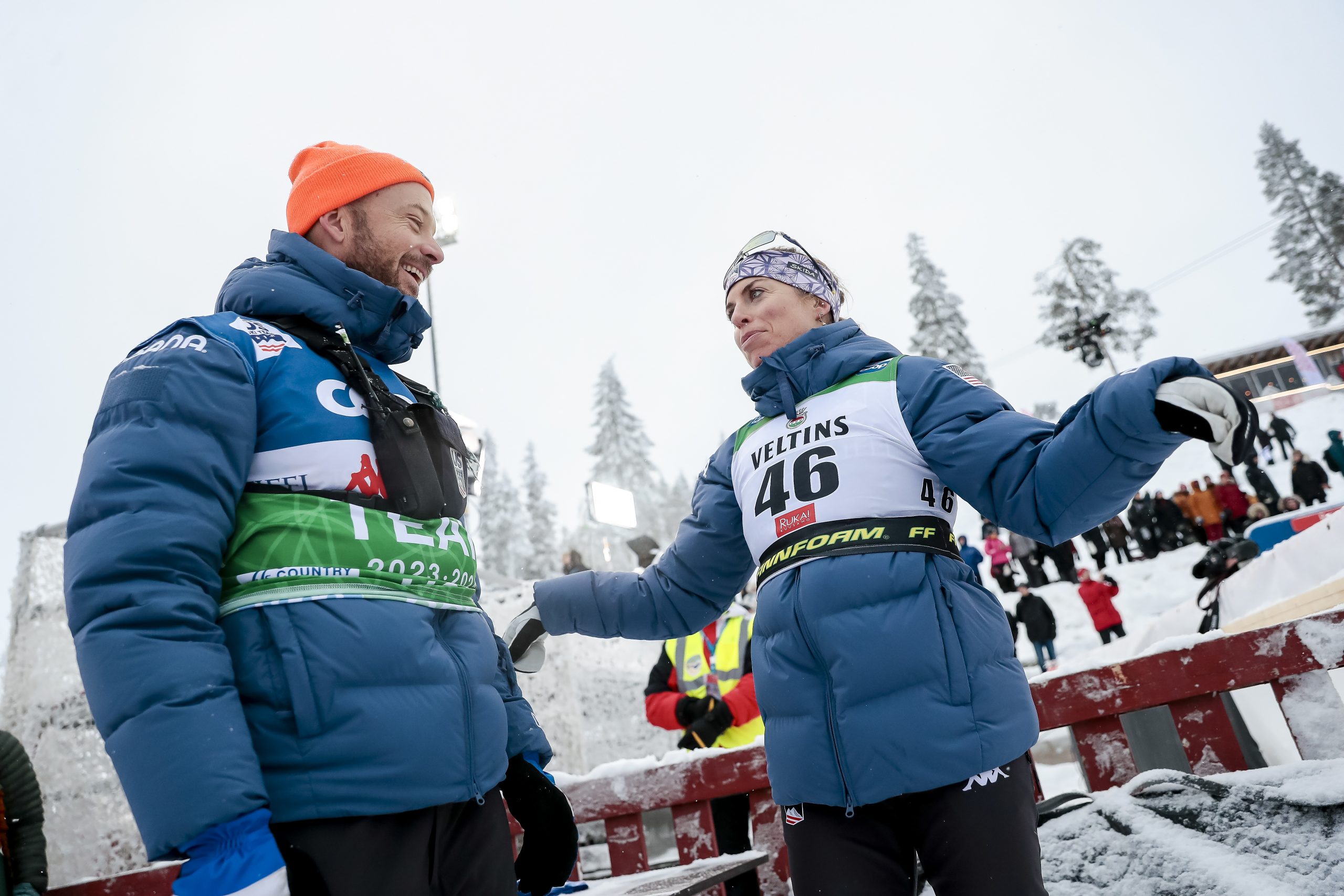
U.S. head coach Mattt Whitcomb and Rosie Brennan (USA) share a moment last year in Ruka. (Photo: NordicFocus)
The U.S. team is now a nice blend of accomplished veterans and up and coming athletes and coaches. The veteran’s perspective helps to guide the team over a long season. Part of that perspective is understanding that there are many possible roads to take to reach the final destination. One of the big lessons learned is, “the acceptance that many training plans can work,” said Whitcomb. “The road of the insecure is to negatively judge that unusual training, and the high road is to support it, and consider its merit. While I believe I have an understanding of what works for the 10 days that lead up to the first World Cup, I’ve seen many different approaches work. One needs belief in their plan. Inter-team judgment hurts this, and support promotes this. If you look at it that way, many ways can work, and it takes the pressure off. It’s pretty simple.”
Opening Weekend Up Close: Friday’s Opener
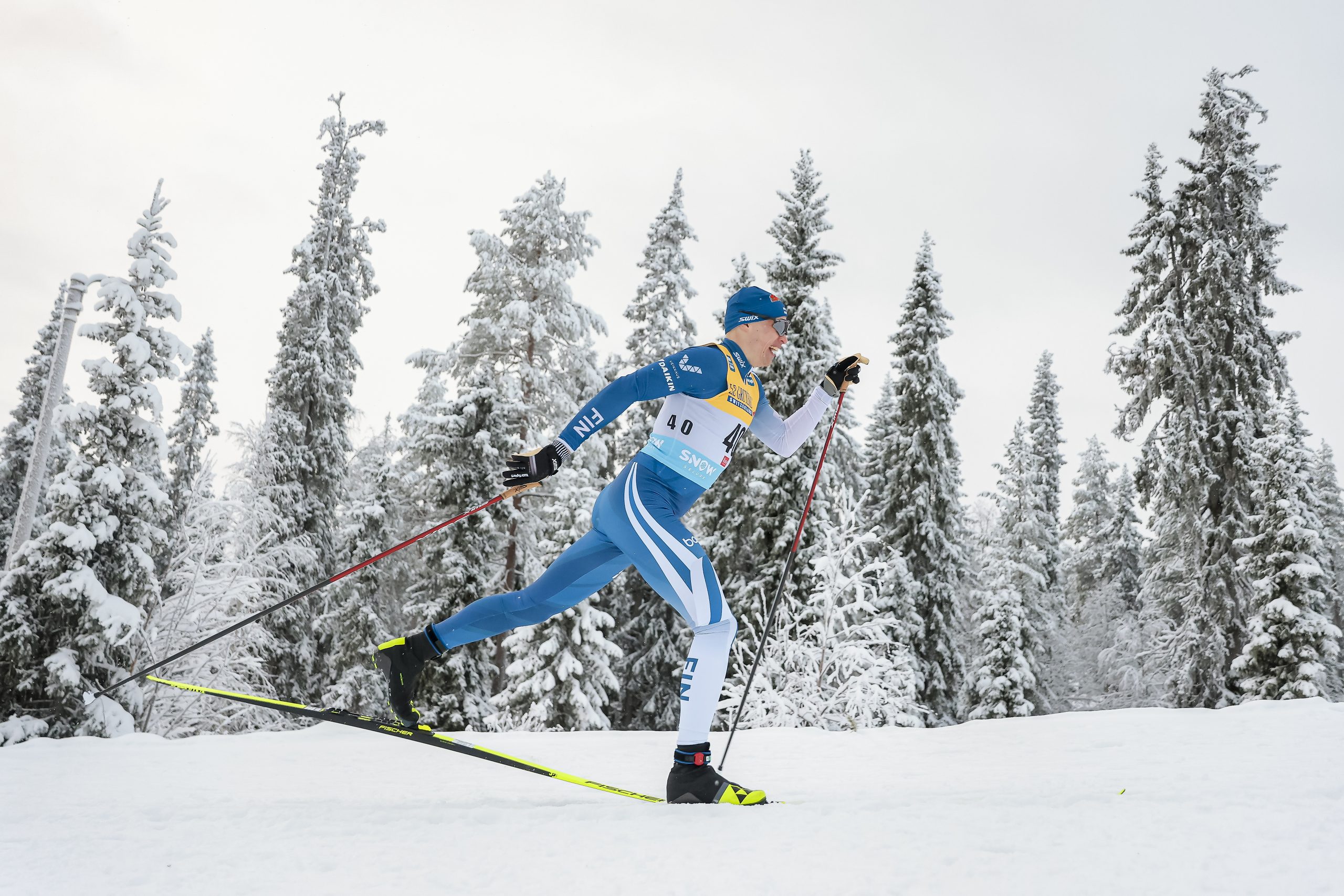
Whenever there’s a Classic race in Finland, Iivo Niskanen (FIN) is certain to be in contention. (Photo: NordicFocus)
Last year, the 10k Classic was on the second day of the Ruka weekend, this year it will be the first race. In last year’s 10k Classic, Norway took two of the podium spots in the men’s race, with hometown favorite Iivo Niskanen (FIN) finishing second by a scant 2.9 seconds. It was a bitter pill for the Finn who was looking to thrill the locals with the top spot in his Classic specialty. There’s no reason to think that the Norwegians won’t dominate the podium again. But if the snow falls during the race, it could make it a wide open contest.
The best American man was Gus Schumacher’s 22nd place finish. Schumacher has been on what feels like a straight upward trajectory since then, so there is a lot of optimism for improving upon that finish. Ben Ogden, Luke Jager, and Zanden McMullen all finished outside of the top 30 in that race. They will be hoping to start the season off with a better opening day showing to get the season’s momentum going early. Ruka will be an early test for Ogden who had to call it quits early last season—and was forced to miss Minneapolis— because of illness.
Another racer to keep an eye on will be Canada’s Antoine (Tony) Cyr. Cyr’s results started ramping up toward the end of last season. On the last weekend of racing, he placed 11th in the 10k Classic in Falun. Last year in Ruka, Cyr finished 27th in the 10k. If he can build off of last year’s Falun momentum with a good start in a Classic race, he could be a North American sleeper to keep an eye on.
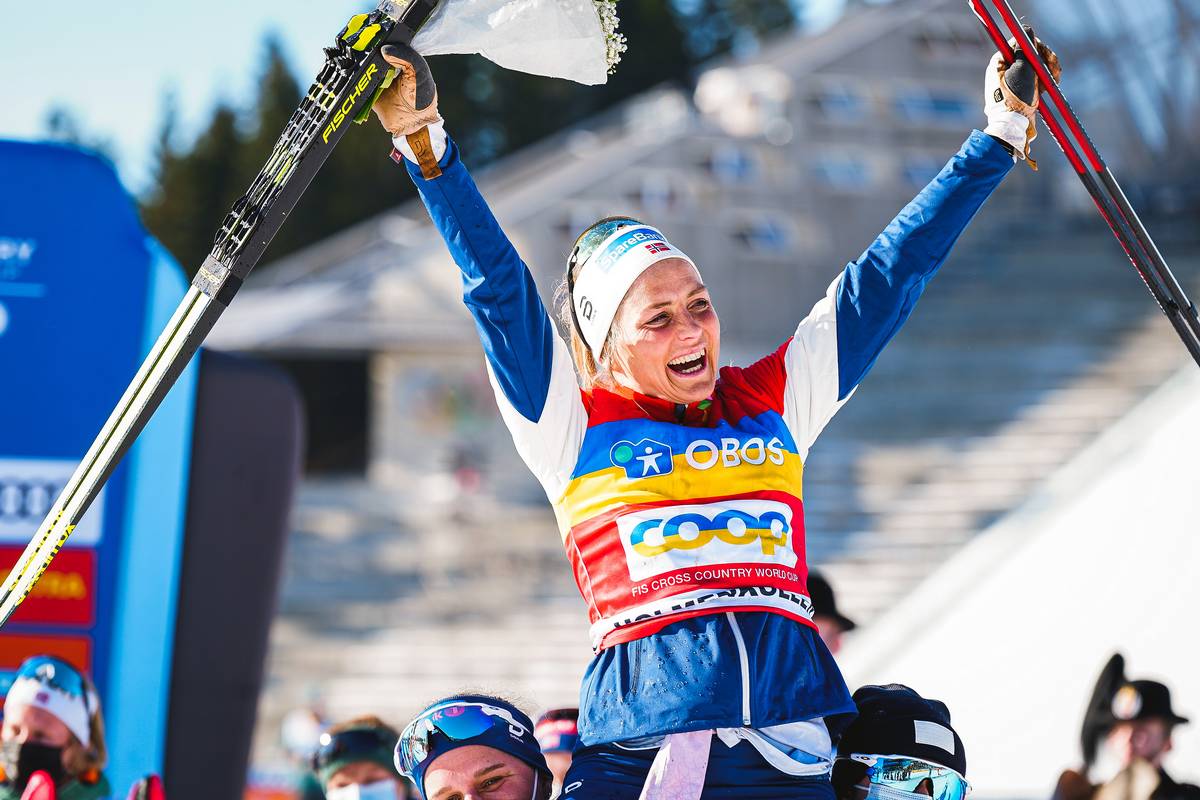
Norway’s Therese Johaug celebrates her final 30 k race at Holmenkollen, before retiring at the end of the 2021/22 season at age 33. (Photo: NordicFocus)
She’s Back
The biggest wildcard in the women’s field will be the return of Therese Johaug (NOR). Johaug retired at the end of the 2022 season, but she has quickly reestablished herself at the top of the game. Her performance in the opening of the Norwegian domestic racing season last weekend certainly grabbed everyone’s attention. For those who thought Johaug’s return would be some kind of skiing social victory lap, think again. Last weekend she won the Women’s 10 kilometer individual start Classic race in Beitostoelen, Norway by beating the venerable Heidi Weng by almost 40 seconds. It bears repeating that her margin of victory was 40 seconds over only 10 kilometers!
Weng got revenge and eked out a victory over Johaug the next day in the 10k individual start Freestyle. Weng managed to hold onto a 0.6 second advantage to take the win. Weng’s victory notwithstanding, it looks like Johaug will be a force to be reckoned with throughout the season. Whether she will be as dominant as she was two years ago, and whether she races throughout the entire season remains to be seen. But no matter what, everyone is on notice to watch out for Therese. Given her performance in the Classic at Beitostoelen how can she not be the favorite going into the first Classic race of the season?
The American women had a great day in last year’s 10k Classic, with Rosie Brennan taking her first individual Classic podium by finishing second, Jessie Diggins finishing 11th, and Novie McCabe 30th. Brenan has told FasterSkier that she really likes the grinding nature of the start of the season races, so expect her to be in contention for a podium again. The unknown factor will be how her Classic legs are feeling. Last weekend, she told FasterSkier that, “I know that I have the ability to succeed right off the bat, but success is never a given, and there are many variables at play.” The pressure of performing on opening day doesn’t bother Brennan, “There are many people that support me in order to have success and I want to deliver. I enjoy that type of pressure, it makes me feel like I‘m doing something for more than just myself and it allows me to better find my limits.”
Jessie Diggins (USA) is feeling very positive about her mental and physical state entering the season. (Photo: NordicFocus)
But all eyes will be on Jessie Diggins, as she begins the defense of her Crystal Globe championship. If she can duplicate the hot start she had to last season, it will only help her in her title defense. “I’m very excited for a new season,” Diggins said in her news conference Monday. “I feel like I’m sitting here as a different stronger version of myself.” Diggins went on to address her mental health status, “I feel like being vulnerable has actually let me connect in a very different way with a lot of people. I feel like I’m coming back in a much stronger place.” Diggins feels that, “I’m in a much more solid place than I’ve ever been in before.”
Sophia Laukli (USA) had a strong opening in Ruka last year in the 20k Freestyle. She’s hoping to improve on her Classic results. (Photo: NordicFocus)
American fans should also keep an eye on Sophia Laukli. Laukli has been working on her Classic technique, and though a 10k race is a little too short to be exactly in her wheelhouse, it could be an interesting barometer for an early glimpse into whether her striding game has improved. Last year she finished 44th in the 10k Classic. Last weekend she took an impressive 7th place in the Norwegian season opener in the 10k Classic beating out many impressive names and finishing only 38 seconds off the podium It’s hard to believe that she won’t see a dramatic improvement from last year’s 44th place.
Opening day will also be an early test for Julia Kern. Kern has been struggling with injury and has had to resort to alternative training methods throughout the summer. Ruka will be an early marker to see if she’s been able to maintain her skiing fitness. “I am both excited and feeling a bit uncertain,” Kern told FasterSkier. “I was in a great place during New Zealand camp. Unfortunately, since that training camp, I have been dealing with back issues that have greatly impacted my normal training routine. However, my energy has been good, and I had a good last week of training at home. This time of year, I think the most important launching point is having good energy going into a long season of racing.”
Saturday’s Sprints
Saturday will be for the Classic Sprinters with the heats beginning at 5:30 a.m. Eastern. For those who just can’t get enough racing and may need to fill time during bouts of insomnia, you can follow the Sprint qualifiers live through the FIS website starting at 3:00 a.m. Eastern—enjoy that!
Last year Norway dominated the men’s Ruka Classic Sprint, but in an unexpected way. The Norwegians advanced seven skiers into the semifinals. But, in a true shocker, Johannes Hoesflot Klaebo (NOR) didn’t make it to the top of the podium. Klaebo was in the midst of recovery from illness. His countryman Erik Valnes (NOR) took the victory. It was no secret that Klaebo had been sick, but seeing other skiers blow by him still felt extremely unsettling and shocking to witness. But there was no reason to remain feeling badly for Klaebo for long, as he went on to dominate the Sprints later in the season like no one else ever has. He won the Sprint in the Norwegian opener last weekend and looks ready to dominate again.
Ben Ogden (USA) had a good Sprint day last year in Ruka. (Photo: NordicFocus)
The top American finisher that day was Ben Ogden, in 11th place. Later in the season Ogden would go on to claim his first World Cup podium in Toblach in the Freestyle Sprint. After Friday’s 10k and Saturday’s Sprint, we should have some solid insight into where Ogden’s conditioning stands.
For the women last year, the first Sprint race of the season was a preview of the rest of the year. It was all of the Swedes against Norway’s Kristine Stavaas Skistad. Emma Ribom (SWE) won the opener, but Skistad later went on a late season tear which saw her winning the last three World Cup Sprints in Klaebo-like dominating fashion. When Skistad is firing on all cylinders she is in a league of her own. But there is a huge question mark facing her this winter. In a still developing story, Skistad is reported to have undergone stomach surgery of an undisclosed nature several weeks ago and is not scheduled to be in Ruka. She is reportedly returning to training, but there isn’t any detail on when she is expected to return to competition. Until Skistad returns to the field, Swedish podium sweeps could be a common sight this winter.
Kristine Stavaas Skistad (NOR) was at times dominating last year. She will miss the opening weekend due to surgery. Her return date is unknown. (Photo: NordicFocus)
For the Americans the test will be to see if Julia Kern can rebound from her aforementioned injury. Diggins and Kern finished 7th and 8th respectively last year. It will also be interesting to keep an eye on Diggins’ early season Sprint performances. Last year, once she had gained control of the Overall points standings, Diggins sprinted very strategically choosing to go out hard in the first round and ensure accumulating points by reaching the second round of heats. It will be intriguing to see if she will adopt a more traditional strategy early in the season and go out more conservatively in the opening rounds.
It will be interesting to see how Jessie Diggins (USA) approaches the Sprints early in the season. (Photo: NordicFocus)
Sunday’s 20 Kilometer Freestyle
Sunday will be the first Distance race of the year, featuring the 20 kilometer Freestyle mass start. The men race first, with coverage starting at 3:30 a.m. Eastern, followed by the women at 5:25 a.m. Eastern.
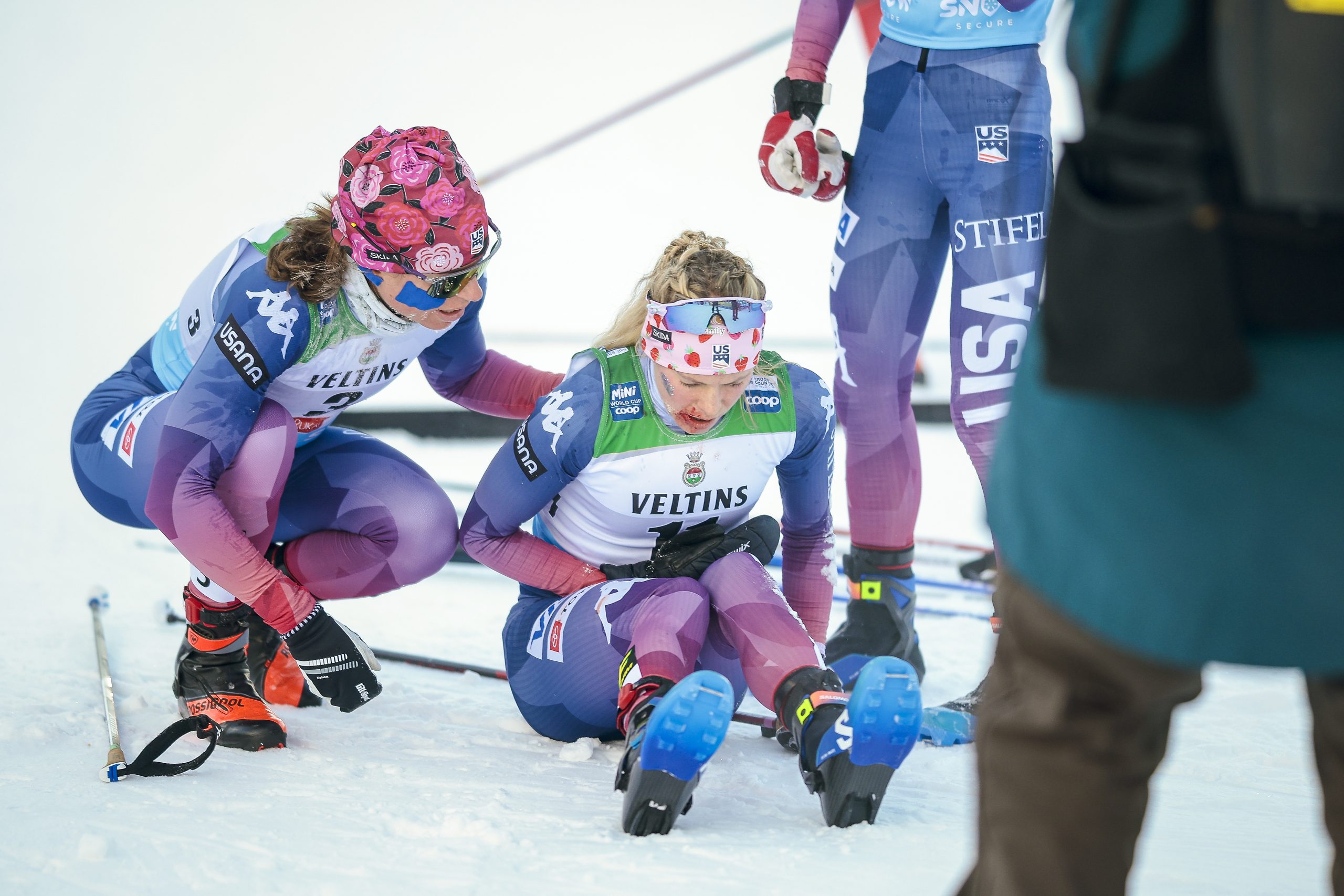
Jessie Diggins (USA) is comforted by her teammate Rosie Brennan (USA) after receiving a pole grip to the lip. (Photo: NordicFocus)
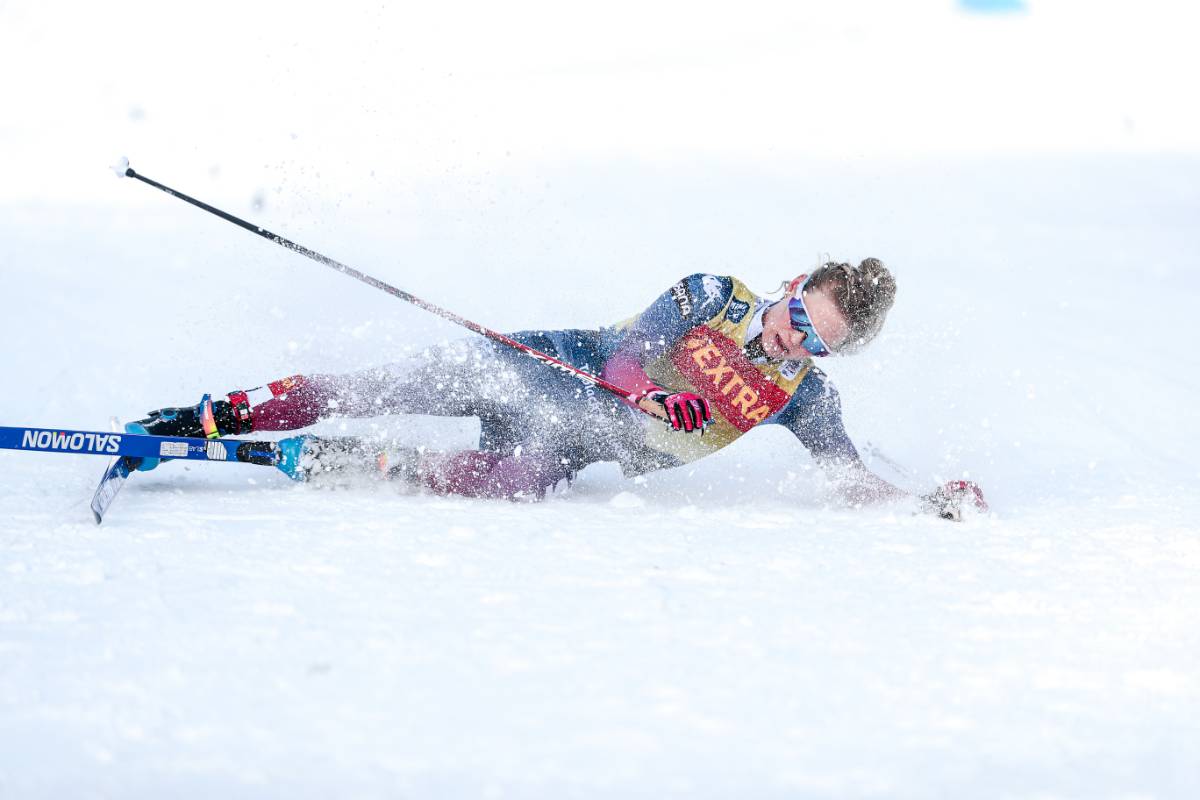
Epic—that was the only word to describe the American women’s performance in this event last year. Sweden’s Moa Ilar won the race, but it didn’t get as much attention as the results of those behind her. It wasn’t just that Diggins and Brennan finished second and third, but Diggins crossed the finish line with a bloody mouth having had her pole yanked off her hand toward the end of the race, and then getting plunked in the lip during the new pole exchange. The finish line picture was one for the ages. It’s hard to imagine that the 20k will be as compelling as last year’s race, but you never know. As Whitcomb said, the 20k Freestyle mass start is “always thrilling.”
Keep an eye on Sophia Laukli during this race. The race features two things she really likes: distance and skating. It will also be a good indicator of whether she was able to fully recover from her running season injuries to start the season in top form. Last year she finished a solid 14th, and a move into the top ten would announce that she’s a real presence in distance racing, and not just at the extremes of Alpe Cermis. Last weekend she finished 11th in the 10k Freestyle in the Norwegian opener, and she looks to be ready to start the season in fine form.
Also keep an eye on Canada’s Katherine Stewart-Jones who finished 22nd in last year’s 20k Freestyle. Jones had a difficult season last year, as her World Cup racing ended after Minneapolis. She’ll be looking to return to her form from two years ago when she had multiple top 20 finishes, including finishing 18th overall in the Tour de Ski.
Gus Schumacher (USA) is hoping to build upon his success from last season. (Photo: NordicFocus)
In the men’s race last year, American Gus Schumacher showed a harbinger of things to come with a 16th place finish. It will be another opportunity for Schumacher to prove that his star is rising. Norway took two podium spots that day with a sweep only being interrupted by the feel good second place showing of Michal Novak (CZE). In addition to dominating the podium, Norway placed six skiers in the top ten, and until proven otherwise, they will be the favorite for every podium position in every men’s race until someone proves that they can pry the podium out from under Norwegian feet.
Moving Hundreds of Skis and Dozens of Team Members Across Europe
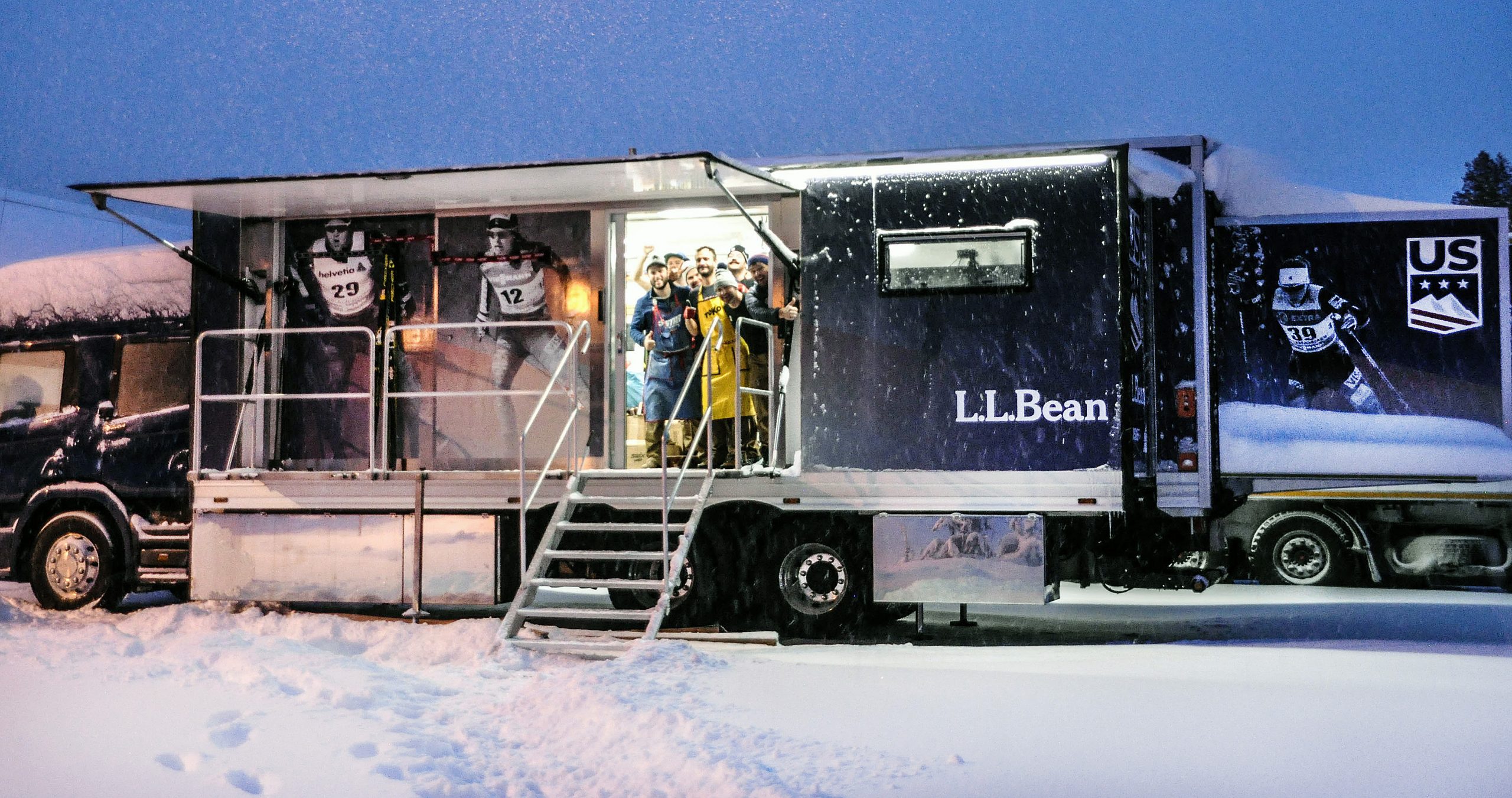
Yolanda, the wax truck, can accommodate 800 pairs of skis. It’s still not enough. (Photo: Matt Whitcomb)
Success at the World Cup level requires much more than just skiing fast. The logistics of moving around Europe with hundreds of skis and dozens of team members can be daunting, and part of it falls onto Whitcomb to coordinate. If you’ve ever flown for a cross-country ski trip you know that handling a bag of skis can be a huge hassle and make or break your ski trip. But for the pros, there’s much more riding on it, and the logistics are just a bit more elegantly managed. “The most successful athletes know by March that they are likely to be on the World Cup in November,” said Whitcomb. “So 90% of their fleet stays in our wax truck, Yolanda (the team’s name for their pet wax truck). Everyone on the team brings at least a small ski bag home in March that covers SuperTour Finals, as well as spring, summer, and fall skiing needs. It’s the athlete’s responsibility to bring that bag back. In September or October, our techs make a visit to the factories in Europe and pick up skis from the summer and fall ski run productions. Lastly, the industry brings a few pairs for the athletes to the first World Cups, and the various ski companies always have additional skis on hand at nearly every venue. We have capacity in Yolanda for something like 700-800 pairs of skis. If you can believe it, this fills up quickly, so we try to only keep the performing skis on hand. If we get new skis, we try to trade the old, poorly performing skis out.” Managing 800 pairs of skis might sound like a nightmare, but it’s just part of the process for preparing for the rest of the season.
Whitcomb explained the way the season long logistics management works. “The World Cup is a system that has a nice flow to it. Most weeks, our team will travel to the next venue on Monday, and then train Tuesday, Wednesday, and Thursday. We race Friday, Saturday, and Sunday, and then repeat the process. Chris Grover, our Program Director, runs the majority of pre-season logistics. That largely includes flights and working with each organizing committee to secure housing and a good meal plan. We place a lot of emphasis on our “Curran Family Nutrition Program” (named after supporters of the team), which involves, among other things, organizing chefs for as many venues and winter training camps as makes sense for our housing. If we have houses or apartments, we often have a chef so we can control the quality of our food. This accounts for about 1/3 of the winter. This has made a massive difference to our health and performance. Zoom in a bit and the logistics change focus to training day and race day performance. We have 22 athletes racing in Period 1, which means we have 22 different training plans. We plug them all into a shared document so athletes can easily find a training group that matches their workout on a given day. Winter life is a little more lonely than summer life, so we emphasize the importance of long, big group meals, team walks at night, or game night. If we don’t vibe as a team, we’ll be beaten by the teams who do. The waxing and grinding trucks are a whole other deal. When the athletes and coaches travel by bus or plane on a Monday, many of the techs will have swiftly departed after the races on Sunday for the next event. The drives are often long. In Period 1 for this season, they first drive the trucks from Tallinn, Estonia, which is where the trucks summer, to Muonio, Finland. That’s 600 miles, plus a several hours ferry across the Gulf of Finland. Then it’s back to Ruka, Finland, which is only five hours. Then they’re off to Lillehammer, Norway which is about 900 miles, and then down to Davos, Switzerland, which is another 1,200 miles. Know, too, that the big truck is limited at 89 kph (55mph).”
It takes a lot to make the giant World Cup wheel go around, and with the 2024/25 season now upon us, fans can now go through their own process of gearing up for another exciting season of racing.
This coverage is made possible through the generous support of Marty and Kathy Hall and A Hall Mark of Excellence Award. To learn more about A Hall Mark of Excellence Award, or to learn how you can support FasterSkier’s coverage, please contact info@fasterskier.com.
In Part I of FasterSkier’s interview with Rosie Brennan, she discussed her illness during the second half of the season, her pride in being an all around skier, and the challenges and emotions of skiing the World Cup in Minneapolis. As our interview continues, Brennan talks about racing in a World Championships year, and her thoughts on the Homenkollen 50-k being eliminated from this year’s calendar. Brennan also opened up about what position she would like to race in on the women’s relay team, and shared her thoughts about racing through the Olympics in 2026, and when she thinks she’ll call it a career. Spoiler alert: Enjoy watching Brennan race while you can.
This interview has been edited for brevity and clarity.
Brennan thinks outsider observers jump to conclusions about results and conditioning. She believes she usually does better in the early season because the races suit her, not because of conditioning factors. Here she celebrates having taken second in the Ruka 10-k Classic early in the season. (Photo: NordicFocus)
FasterSkier: The last two winters you’ve had really phenomenal starts— and now come to find out last winter you got sick halfway through the year, and obviously, that hurt your performance. Is there ever any discussion about trying to find a path throughout the entire season where there aren’t peaks and valleys, where it’s more level performances, or is that something that you just can’t control because of the length and difficulty of the season?
Rosie Brennan: It’s always the goal for sure, especially in a championship year. But I think what is often misleading for people that are following (races) is that I don’t know if it’s always just fitness or the kind of shape that you’re in that causes that (ups and downs in performance). For me, I feel like in period one for example, just the type of snow and the courses that we ski on, are all my strengths. I think I’ve just always done well in period one simply because of that. Often, I don’t actually feel like I’m racing my best in period one. I don’t feel like I’m in my best shape. It’s usually natural snow, and a lot of the courses we ski there are just ones that suit my strength. So, it’s just kind of how the cookie crumbles, I guess. And in the spring, I definitely struggle more on some of those courses and those conditions that’s more like transformed spring snow. It is definitely more challenging for me. Part of it is a physiological thing of how can I maintain my fitness as best as possible. But I think more so, it’s about working on my weaknesses. Obviously, you can’t just find spring snow to ski on and all year round to practice on. But when I have those opportunities, I like using them to try to improve specific technique aspects that I think are needed in that type of snow and working on that in the summer. I don’t think it’s always as simple as it’s just your shape fades or gets better or whatever. The particular pattern of the individual is I think a little more nuanced than that often.
FasterSkier: Is the spring snow thing something that’s an issue because you’re used to skiing so much in the cold, dry Alaska snow?
Rosie Brennan: No, I don’t think that’s true because I’ve never skied in Alaska in the winter. I ski in the fall and the spring there. But I grew up in Utah, and in Utah we get plenty of spring skiing and most of the skiing I’ve done in the past has actually been done in Alaska on the glacier, which is spring like. That was one of the perks of being in Alaska, was to have the glacier and to ski in those types of conditions. I have had plenty of opportunities. I think it’s just my particular physiology and the way I ski, and the way I apply power, and kind of how my power just suits that cold, dry snow better, and I think I am a bit more of a capacity grindy skier. I like grindy type courses, which the slower the snow is, the grindier it gets; so I think it’s just kind of my physiology and how I am.
Brennan has always done well in Davos. It’s in line with her theory about early season courses suiting her. She earned a podium there in the Classic pursuit last January alongside Kerttu Niskanen and Jessie Diggins. (Photo: NordicFocus)
FasterSkier: But you’ve always done pretty well in in Davos too. Right?
Rosie Brennan: Well, yes, but I grew up at altitude. So anytime we race at altitude, I feel I have quite a big advantage and I love skiing at altitude. But Davos is a perfect example. Not only is it at altitude, it’s literally 3-k of grinding uphill—not super steep— and that’s like the dream for me— uphill, but not crazy steep, at altitude. So that course has for sure been magic for me many times.
FasterSkier: When you’re going through the season and it’s getting close to Davos do you kind of count on that for good outcomes? Almost like a football team having been on the road for a long time and coming home for a game. Is that that kind of how you view Davos at this point?
Rosie Brennan: Yes and no. It also comes with pressure, especially if I haven’t had a good result to that point. I’m like, ‘oh, God, I gotta, make something happen here.’ But I just really do enjoy racing there. It’s really fun to me, so I do look forward to it. But I would say I can’t always count on it as being a stellar result though.
FasterSkier: Do you have any specific goals that you’ve put together this summer that you’re looking to apply to this coming race season?
Rosie Brennan: Kind of what I told you what I’ve been working on and just having stronger legs, and my goal is to be in the best shape possible for the Championships. So, part of my goal is to go to Trondheim and … I mean, obviously we raced there last year too, so I already had some idea of the demands of the course … but kind of just, reiterating those (goals) and continuing to work on that stuff.
Brennan took second in the 10-k Classic in Trondheim in 2023. She hopes to have similar success there again during the World Championships.(Photo: NordicFocus)
FasterSkier: When it comes to the World Championships, do you have a particular race date circled that you’re trying to really focus on and say ‘Yeah, that’s my race,’ or is it just every race every day?
Rosie Brennan: I definitely hope I get to race a fair amount at the Championships. I would say the 10-K and the Skiathlon are probably my top picks and then of course the Relays are very important to our team, so I always hope to get to do that. I do hope to race a fair amount at the Championships, but that’s something I quite literally have no control over. So we’ll see when it gets closer, how things are going, and what starts the coaches decide
FasterSkier: You didn’t mention looking forward to the 50K?
Rosie Brennan: (Laughing) I definitely am looking forward to that. I’m optimistic for it. It’s the last race. So I think unless I’m sick or something I’d love to love to go in that race. I think it’s always a nice opportunity just to leave everything out there and see what you have left in the tank. So I do hope to participate in that too.
FasterSkier: That race kind of race falls into the description of what you were talking about earlier, going out there in the long grinds. The snow conditions in Trondheim might not be ideal for what you want, but it’s at least it’s a long, grinding race.
Rosie Brennan: For sure, and the way that course is its very kind of grindy like that. So it could be good. And that’s part of the motivation of making sure I am really strong this season, the specific strength of being able to skate a course like that for 50-K, it definitely takes a lot of specific strength.
FasterSkier: You mentioned in passing the relays, which the team always looks forward to, and puts a lot of emphasis on. For a while it has been a real team focus of getting to the podium in the women’s relay in a World Championship or Olympics. Do you think that at this point it might be a goal that’s so desired by the team that there might be a lot of self-imposed pressure that might not necessarily be productive?
Brennan (far left) doesn’t really feel the pressure too much in racing the relays. Here she is with teammates Sophia Laukli, Jessie Diggins, and Julia Kern (l-r). (Photo: Rosie Brennan)
Rosie Brennan: No, I don’t think so. I think that’s what’s cool about— or I guess cool and challenging about relays— is it takes four people and that’s obviously something that I don’t have control over. Of course, I want to do everything I can to make sure my teammates are in the best shape they can be too, but I ultimately only have control over myself. Then of course, we have more than four people that could possibly be on that team. So, we don’t even know who’s going to make up that team until the time comes. And it’s one of those things that you just have no clue what it’s going to look like so it’s hard to feel pressure over that. Of course, that day or two before, when you find out you’re on the team, that’s when the pressure hits because you’re like, alright, this is our chance and I’ve been picked and that’s such a big honor and you want to do your team well and show the best you can. So maybe the day or two before, you feel the pressure. Maybe it’s different for other people on the team. For me, honestly, the first relay I did at World Championships was probably some of the most nervous I’ve ever been in my whole life. But the one that I maybe felt the most expectation or pressure for was in Oberstdorf; and I think part of that was a team that just had really, really high potential, and had some of my closest friends, so that one was hard because we also came so freaking close and so that one was maybe harder to swallow (the 2021 U.S. team in Oberstdorf consisted of Hailey Swirbul, Sadie Maubet Bjornsen, Rosie Brennan, and Jessie Diggins, finished fourth, less than one second off the podium). But since then, half that team retired and so we’ve kind of been rebuilding, so I don’t really feel the pressure. I see it more as an opportunity and a place where some of these younger girls can step up and really show themselves and who knows what’s possible when they kind of make that jump and find their stride which I’m watching happen every day. So, I think it’s for sure possible this year and definitely coming in the future.
The relay podium was less than a second away for team USA during the 2021 World Championships in Oberstdorf, Germany. To Brennan, it stands out amongst all the relays she has done. (Photo: NordicFocus)
FasterSkier: If you were in charge of setting the rosters for the relay where would you put yourself? What would be your favorite position to be in?
Rosie Brennan: I like legs two and three. I don’t love mass starts and I can’t imagine the pressure of anchoring, and Jessie’s too good at that. But I guess it would depend on that season and which technique I’m vibing more with. I really enjoy leg two, but leg two is also I think the hardest because that’s where every team puts their big capacity skier to blow things open, and Classic legs take longer, so the time differences can be bigger, and a lot of times the Classic courses are actually harder too. So that leg actually does have a fair amount of pressure because staying in contact in that leg is extremely hard. But if my Classic skiing is going well, then I love that position. I think it’s really cool and suits a lot of my strengths well, but I also really enjoy leg three when my Skating’s been good. That’s been a really fun one too. You can really make up some ground on leg three.
FasterSkier: You alluded to this earlier; your Classic skiing has been going so well that as an outsider looking in it’s really impossible to say that you are better Classic or better Skating. Do you consider yourself at this point stronger in one or the other?
Rosie Brennan: I just flip flop. I have my whole career. This last year I was way better in Classic. And I maybe had a few more years that I’ve been better in Classic than Skate I would say. But also, the only World Cups I’ve won have been in Skate. That’s what I like about skiing, if something’s not going well, hopefully something else is. I kind of enjoy just seeing what the year’s going to bring.
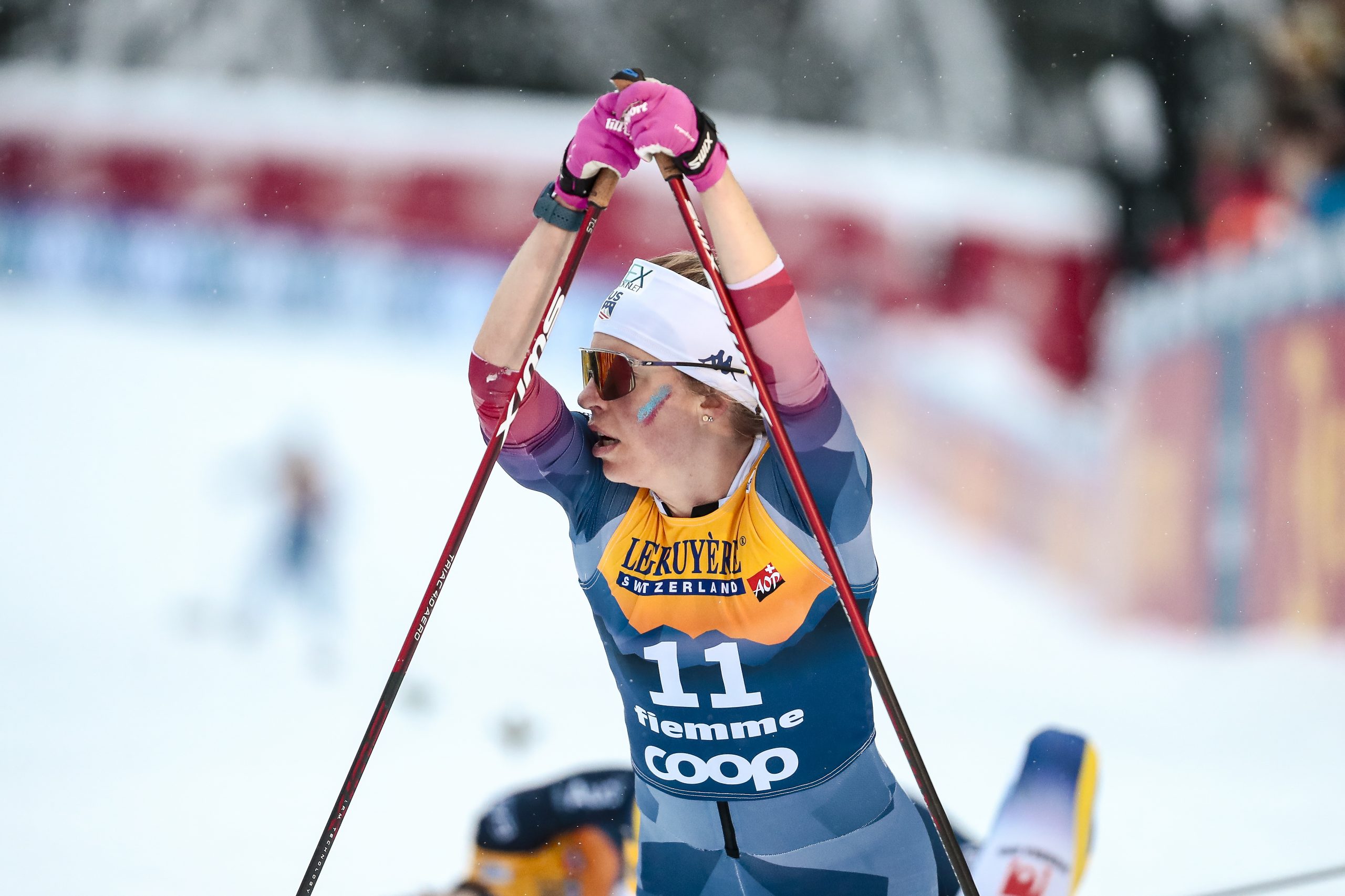
Brenan at the finish of the ski slope climb at Val di Fiemme, Italy in last year’s Tour de Ski. She thinks she started to get sick around this time. (Photo: NordicFocus)
FasterSkier: It’s one of those interesting years again with the World Championships, and the Tour de Ski earlier on the calendar. Last year, there were no World Championships, so it was easier to focus on the Tour de Ski. This year, how do you approach the Tour de Ski? Is it any different than it was last winter, where this winter you can’t afford to blow yourself up because you’ve got the World Championships coming down the road?
Rosie Brennan: No. If you go to the start line, you are on the start line to try to win whatever the race is. At least that’s how I race. And I think that’s how most people race. If I choose to start, I feel I’m as prepared as I can be, and I’m putting my best foot forward. The difference is just in maybe taking a little more caution in terms of the recovery after the Tour and like you said, World Champs is quite late so there is a bit of time to mess up a little bit, not have things go perfectly and be able to correct and still be in good shape for the Championships. I’m planning to do the Tour and I kind of imagine most of the World Cup will as well. I think it’s more in the Olympic years that it gets a bit tricky just because the time— it’s like a month shorter time frame that you’ve got. And this year the Tour has almost no travel in it, so that also makes the load a bit easier. So we’ll see. Last year, for example, maybe if I had had the Championships ahead (of the Tour) I would have pulled out of the Tour because to be honest, I think I got a virus right before the Tour started, and that’s when things went south for me. So, especially having had that experience, I think I’d be faster to pull the plug in a season when there’s a Championship. But I think in terms of the approach it it’s very much the same.
FasterSkier: It seems that some years in World Championship seasons there are certain teams that turn their focus just to that and reconfigure how they race during the rest of the World Cup year and save it all for the World Champs. It sounds like that’s not something that really is in your strategy?
Rosie Brennan: To be honest—maybe I’ll eat my words— but think that used to happen a lot more than it does now. It seems like most teams show up to race most of the season. Maybe there’s a few individual athletes that have different schedules or priorities, but to me it seems like most people are racing everything. I don’t imagine there will be a lot of people skipping the Tour in in favor of their performances at World Champs. Those World Cups after the Tour always get a little weird— part of it I think is people wanting to prepare for the Championships— but part of it is also a lot of those nations have their national championships during that time, which is their qualifier for World Champs, so sometimes nations do have to miss some of those World Cups. I would say that’s when it gets a little more spotty. The last years that I can remember, the Tour has been pretty full on. Maybe some of the Covid years there was bad stuff going on, but that was a whole other thing. Some of those nations weren’t allowed to go because of Covid.
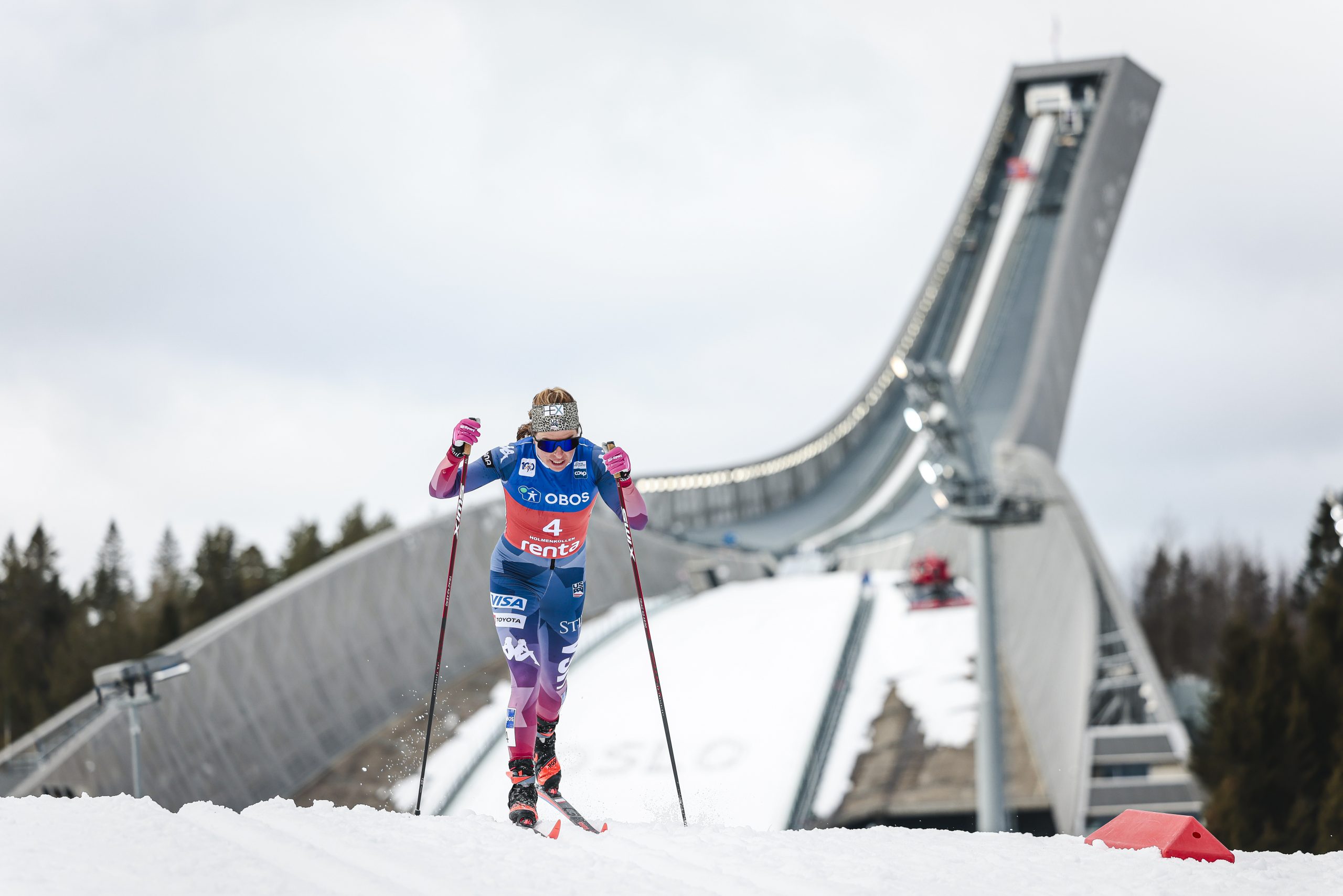
Brennan at last year’s Holmenkollen 50-k in Oslo. She’s not disappointed at all about it being off the calendar. (Photo: NordicFocus)
FasterSkier: One of the unusual things on the calendar— or I guess more appropriately not on the calendar this year— is the Holmenkollen 50-k. I’m wondering if you have any thoughts on that being left off the calendar?
Rosie Brennan: I’m not particularly bothered by it. I was going to be bummed if we didn’t have any 50-ks, because I think it’s important to have one World Cup 50-k every year. But they just moved it to Lahti, which I think is great (March 23, 2025, 50-k Classic). I’m a big fan of variety. I think it makes it more fun for the athletes and hopefully for the fans too. I think it’s kind of boring that we’re only allowed to do 50-k at Holmenkollen every year because there’s a lot of places that can put on great 50-ks. So I’m not bothered by it at all. What annoys me the most is the reason they did it (eliminated the 50-k at Holmenkollen) was because so many athletes didn’t show up to Holmenkollen after the Planica World Championship, it was the next weekend—which fair enough— but then they put two distance races at Holmenkollen (this year) anyway which to me it’s’ not that different(10-k Freestyle and 20-kilometer Classic, March 15th and 16th at Holmenkollen—with the World Championship concluding the week before on March 9th). If you’re someone who’s going to race five or six times at World Championships and then turn around not even a week later race two distance races that’s still a lot of load and a lot to ask someone. I don’t understand why it’s not a Sprint weekend or something else because the Sprinters race the first day at World Champs and then have nothing else for two weeks. So, to me they kind of address the problem, but not actually. But yeah, I don’t really care about it much. I just don’t see why there’s not at least one Sprint if not two (at Holmenkollen), just to balance out the Distance and the Sprint and give the Distance skiers a break and the Sprinters have just had a huge break. I just think it could have been a little more equally spread out that way.
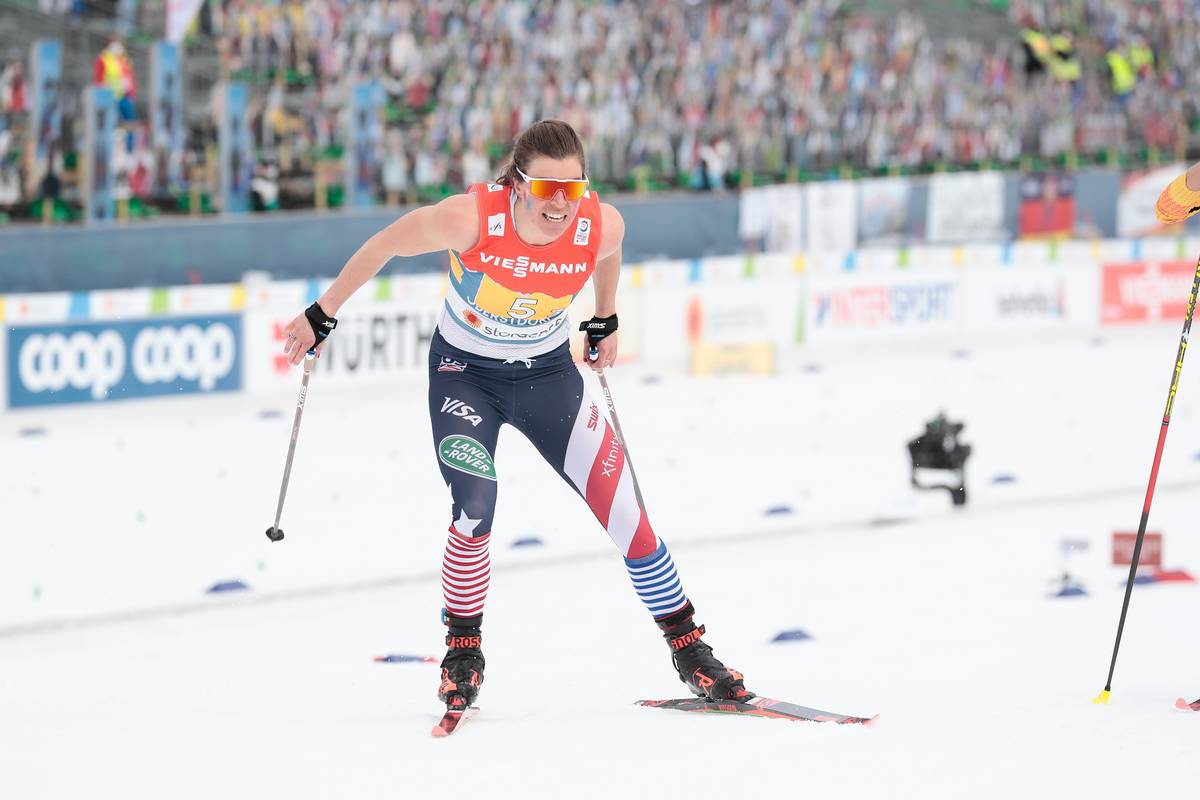
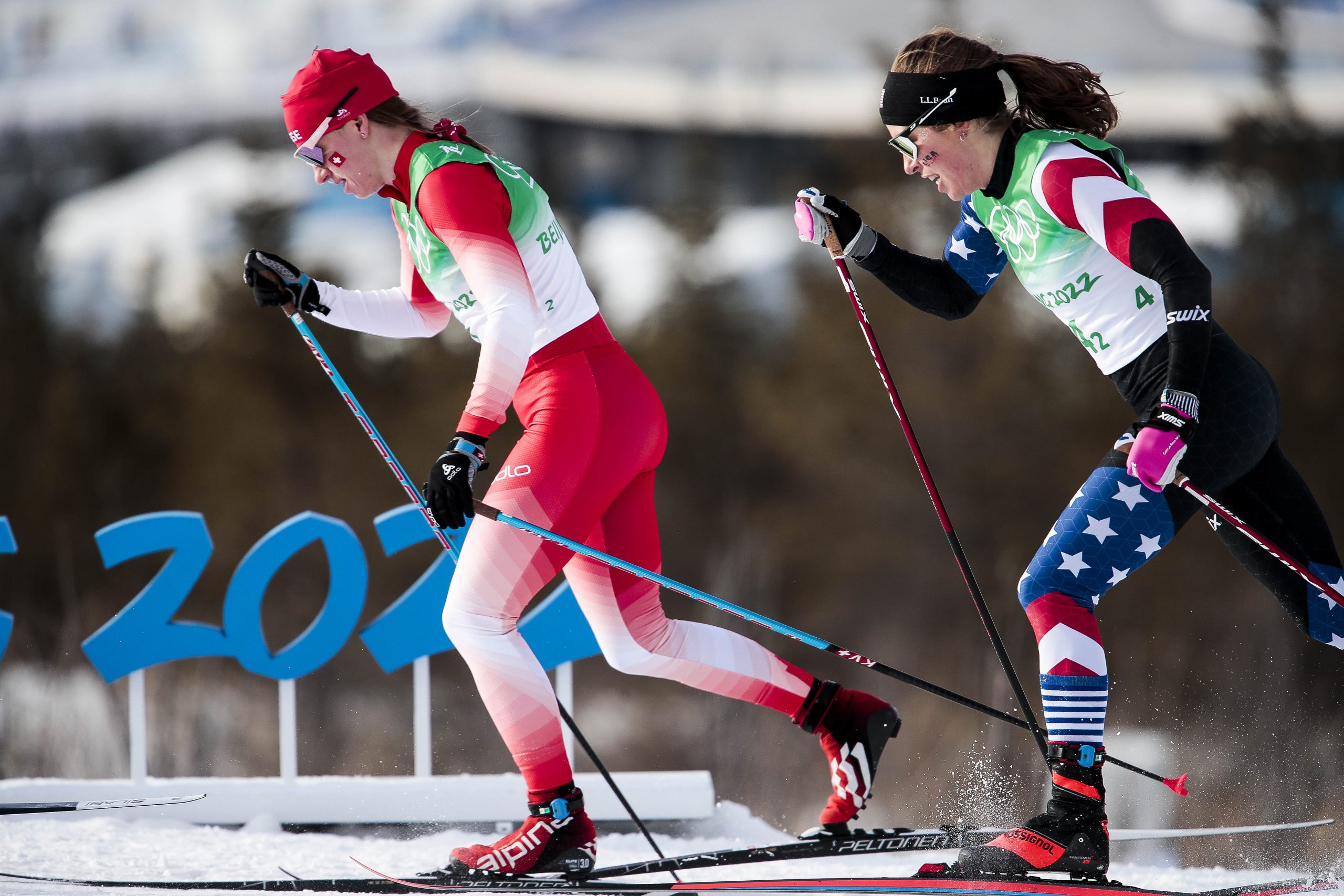
Brennan isn’t viewing skiing the 2026 the Olympics as do or die. She doesn’t think you can force the issue. Here in China during the Olympics with Nadine Faehndrich in the 4x5km relay. (Photo: NordicFocus)
FasterSkier: I want to talk to you about the longer calendar. The Olympics are only two years away. You’re 35. Do you feel pretty comfortable committing to the Olympics as being part of your future ski racing? Or is it too early to say?
Rosie Brennan: It’s probably too early to commit that hard. I would like to ski in the Olympics, but it’s not something that I’m going to die for. If it’s not meant to be, it’s not meant to be. I think I will know that whenever the time is that I have to make that decision moving forward. It’s something I think about for sure. I would like to be there; I don’t want to force something. I’m not going to race my best if I’m forcing myself to do it just to say I did it. So, it has to be something that I’m motivated for, and I feel I can do my best. I definitely would like to. I still have the desire at this point to see what I can do in an Olympics. To perform well at the Olympics, you have to have all the motivation in the world and feel all the confidence that you can be at your best there, and I don’t know if I know that answer right now.
FasterSkier: Is it fair to say then that at this point your kind of just taking it one year at a time?
Rosie Brennan: Yeah. Well, I can promise you I won’t ski past 2026. We got one to two years left.
FasterSkier: That’s quite a definitive statement. Is that just because that’s the end game that you have in your mind?
Brennan says as of now, there’s no racing beyond Lake Placid for her. (Photo: Photo: Olympic Regional Development Authority)
Rosie Brennan: No, I think it’s just that there are other things I want to do in my life, other things I want to accomplish. To be honest, I think a bigger motivator than the Olympics is the World Cup finals in Lake Placid. To me that would be quite a cool way to end my career. So, I’m motivated for that, but we’ll see when push comes to shove next spring where I’m at. You know, I love racing, but it’s hard to have a life when you live in a hotel for seven months of a year. And at some point, that takes its toll on your personal life and well-being. I do have other ambitions in life, there are other things I want to do.
FasterSkier: It’s interesting you mentioned Lake Placid because the organizers acknowledged that several prominent U.S. team members, who will be veterans at that point, might find it an opportune time to have their career finales, and the organizers were quite cognizant of that.
Rosie Brennan: I don’t think I’m the only one that has that in their mind right now. It’s kind of on the same line as there have been so many Swedes that have come out and said that their careers will end following World Champs in 27 (Falun, Sweden will host the Nordic World Championships in 2027). I think it makes for a good story and a nice way to go out. I think it definitely motivates people to have that kind of last home event.
FasterSkier: So maybe you stay for 2026, but definitely nothing beyond that?
Rosie Brennan: Yeah, that’s where I’m at right now anyway, but I’ll always leave room to change my mind (laughing).
Brennan’s blue collar work ethic and self-effacing demeanor will be sorely missed whenever she hangs up her racing skis. (Photo: NordicFocus)
FasterSkier: Understood—nothing’s being signed here. (both laughing). Rosie it’s really been a pleasure and so enjoyable speaking with you. Thank you for taking the time to do this and I’m sure our readers really will appreciate it also. Have a good rest of the summer.
Rosie Brennan: You too.
FasterSkier extends our sincere appreciation to Rosie Brennan for taking time out of her busy schedule to speak with us.
This coverage is made possible through the generous support of Marty and Kathy Hall and A Hall Mark of Excellence Award. To learn more about A Hall Mark of Excellence Award, or to learn how you can support FasterSkier’s coverage, please contact info@fasterskier.com.
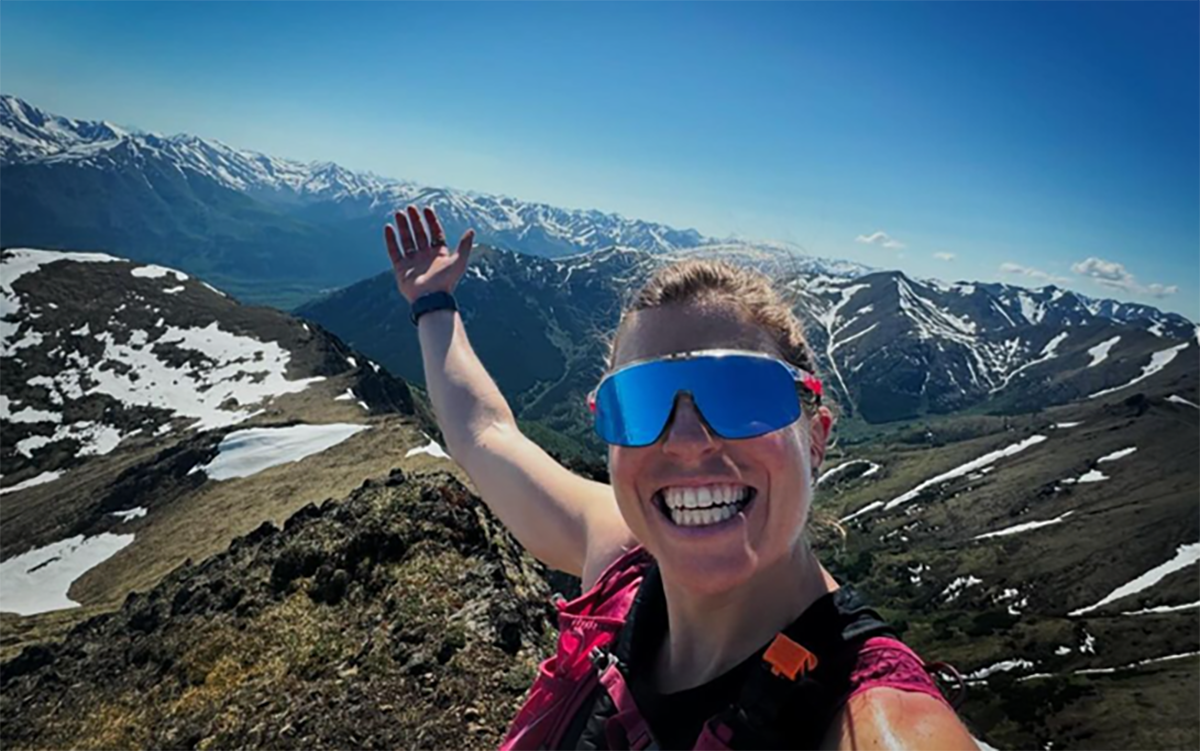
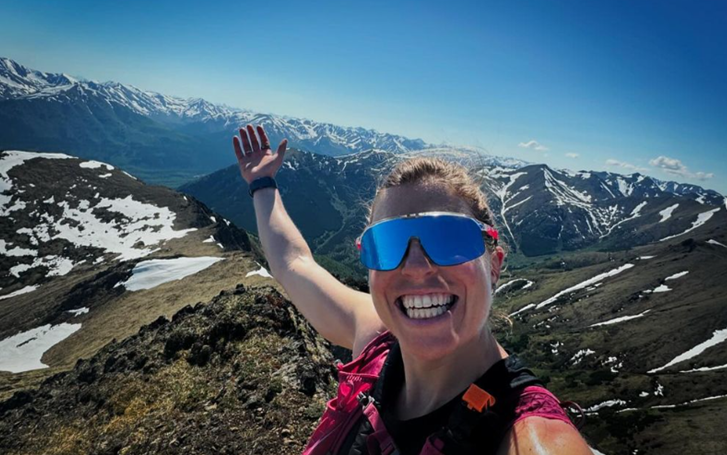
Rosie Brennan had a spring full of backcountry adventures. (Photo: Rosie Brennan)
Rosie Brennan has been a mainstay of the U.S. ski team for years and is routinely one of its top performers. The APU (Alaska Pacific University) skier has earned the status and acclaim of being a hard working blue collar skier, who admittedly likes tough grinding skiing the best. Brennan shies away from social media, so speaking with her usually reveals some new information—as it did in this conversation. Always straightforward and candid, Brennan was gracious enough to speak with FasterSkier about what she’s been doing since the season ended and filled in some previously undisclosed details about dealing with some difficult performances in the second half of last winter’s race season. Brennan also shared her thoughts about the upcoming World Cup season and dropped a bit of a surprise about when she thinks her final World Cup races will be and her thoughts about continuing her career through to the 2026 Olympics.
This interview has been edited for clarity and brevity.
FasterSkier: Where are you now?
Rosie Brennan: I’m in Park City training for a couple of weeks.
FasterSkier: Is that part of a team camp or are you on your own?
Johannes Hoesflot Klaebo (NOR) was training nearby in Soldier Hollow while Brennan was in Park City, and while their paths did cross, the two didn’t train together. (Photo: NordicFocus)
Rosie Brennan: No, I’m on my own. This is where I grew up. I stay with my mom and just do my own training camp. There’s not really anyone training here. There’s a junior team, obviously, but they’re in school now. There’s aren’t really any elite athletes training here, though Johannes (Klaebo) is in Soho (Soldier Hollow; about 45 minutes from Park City).
FasterSkier: Let me go back to the end of the last ski season after the World Cup season ended. What did you do after?
Brennan relishes her time in the backcountry. (Photo: Rosie Brennan)
Rosie Brennan: I stayed in Norway for a bit and did a Backcountry ski trip with my mom. And, then went back to Anchorage and did a whole lot more Backcountry skiing. So. It was the spring filled of mountain skiing.
FasterSkier: Is that a getaway from the rigors of competition and just getting out there and enjoying skiing for what it is?
Rosie Brennan: Exactly. It’s just an easy way to be in the mountains. I grew up here in Park City, so in reality I’ve been Alpine skiing way longer than I’ve been Nordic skiing. I enjoy it a lot and I love when you can just be in the mountains all day with your friends. We had an insane snow year in Alaska this year. So, it was fun to be able to enjoy some of that in the spring. The days are long then, and it tends to be sunny, so it’s the best time of year there, honestly. It’s super fun to be able to come home and still have the good part of winter to enjoy.
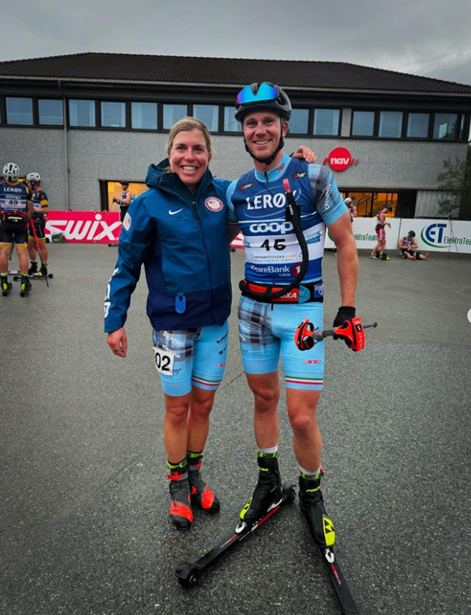
Brennan did some very demanding rollerski racing in Norway as part of her summer training. (Photo: Rosie Brennan)
FasterSkier: I noticed that you had signed up for the Janteloppet (a Norwegian ski festival held in April and hosted by Petter Northug) 100-K which took place in April, but you didn’t end up doing it?
Rosie Brennan: I was planning to do the last two weekends of ski classics, but I had some trouble with a virus for the second half of the season. Sometimes there’s just a good time to stop. You can dig yourself too deep of a hole. So, with my coach and the medical team, we decided that enough was enough, and I needed to make sure that I didn’t have any lasting impacts from this virus.
FasterSkier: That’s really too bad because the winter before you had such a great performance in post World Cup ski classics (fifth in the Summit 2 Senja, and second in the Reistadlopet).
Rosie Brennan: Yeah, I was looking forward to it. It was definitely a bummer, so I’ll take another stab at it this year.
FasterSkier: You were looking forward to the 100-k race?
Rosie Brennan: Well, OK, no (laughing), I was a bit intimidated by that one, but it was just one of those challenges. And I was thinking this is probably the only time I’m ever going to do this in my life. So maybe I should challenge myself. But alas, it was not meant to be so.
FasterSkier: Then you think you’re going to go for it again this coming winter?
Rosie Brennan: I’m definitely going to do a ski classic. The Reistadlopet and the Summit 2 Senja, I plan to do after the World Cup.
FasterSkier: You were back in Norway again just a couple of weeks ago, right?
Rosie Brennan: Yes. I went over there for almost three weeks to train in Trondheim and then do some of the roller ski races.
FasterSkier: You raced the Toppidrettsveka roller ski race. Why did you to want to do that event?
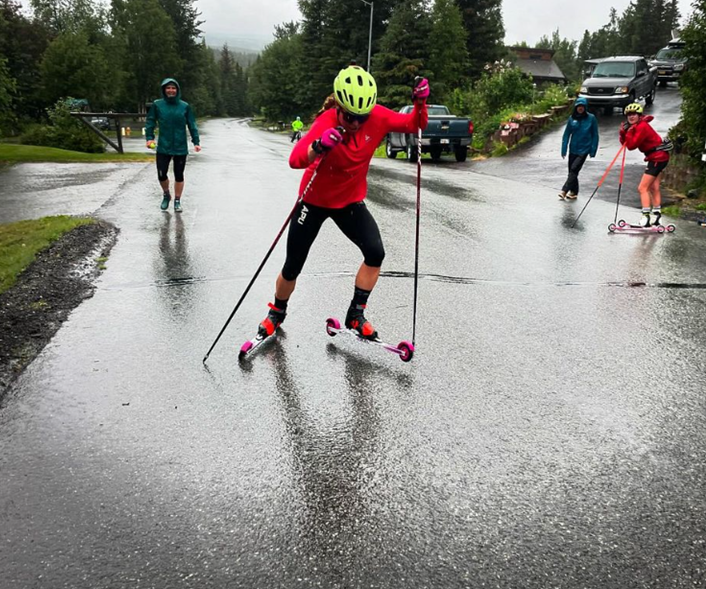
On snow or rollerskis, Brennan just keeps grinding away. (Photo: Rosie Brennan)
Rosie Brennan: Mostly I wanted to go train in Trondheim because— I did that last year, and I actually really enjoyed the training there—it was just a nice way to mix it up and train with some other people. But the rollerski track there is almost identical to the race course. So, then I thought oh well, that makes sense to go back this summer when world champs are there and I can do some key sessions on the rollerski track and just get some more feel for what some of the climbs feel like and what the demands of that course are going to be like. So that was kind of the main goal. And then, the rollerski race was just— put a bib on, challenge yourself a bit, see where you’re at that sort of thing.
FasterSkier: So, the paved roller ski trails are right on the World Cup course?
Rosie Brennan: Yes, it’s almost the same course. Not everything but it’s almost the same as the 5-K.
FasterSkier: Were there a lot of people that were doing the same thing that you were— taking reconnaissance training for World Championship purposes?
Rosie Brennan: Yes, I think so. I think there’s been people in and out of there all summer. Obviously for Europeans it’s pretty easy to get there. I maybe have come from the furthest away, but yes, I think there’s quite a few people training there.
Beautiful Trondheim, Norway is the venue for this year’s World Championships. (Photo: Wiki Commons/Socket0)
FasterSkier: So how did the roller ski racing go for you?
Rosie Brennan: It was OK. The long one was OK. The ones on the track, I wasn’t super psyched with. To be honest, that was my first time doing a roller ski race on a track like that, in a mass start. The only ones I had done previously were the long point to point ones or the little ones we do at Soldier Hollow, which are not quite the same. So, it was kind of a challenge in that sense. It was at the end of my camp there, so I was definitely a bit on the tired side and didn’t have the performances that I had hoped, but nonetheless it was a good challenge.
FasterSkier: How long was the long roller ski race?
Rosie Brennan: 56 K Classic. Ski classics has a roller ski circuit in the summer, and all they do are Classic, and they’re point to point. They’re pretty flat, it’s mostly double polling. I did two of them last year, and I actually think those are great because it’s not something you can really mimic in training, you’re not going to go do a 56-K time trial by yourself unsupported. And so, it’s pretty fun to be able to go that hard for that long with support with your friends in a really cool place. This one is on islands in fjords, so you’re going across all these bridges, it’s beautiful. I really like those just because I think the training value is so high, so, I was stoked to do that one. Most of the other girls— the World Cup girls anyway— only did the ones on the track. I think that probably took a toll on my performance for the weekend, but that’s good, that’s what summer training’s for, challenging yourself and making yourself get a little tired every now and then.
Bend training camp gives Brennan a chance to transition into dryland training. (Photo: Photo: Leann Bentley, U.S. Ski & Snowboard)
FasterSkier: What were the distances of the ones on the track?
Rosie Brennan: 20-k and 12-k.
FasterSkier: You were kind of close to where the Blink Festival happens. Did you consider doing that?
Rosie Brennan: I thought about it, but those were the first days I got there and the whole goal of being there was to ski on the track and Blink is in southern Norway. So, it’s a plane ride— at least one plane ride— and driving a way. Logistically, it just didn’t really make sense. I was more focused on some of my own workouts I had planned on the track.
FasterSkier: Getting back to North America, how did Bend Camp go for you?
Rosie Brennan: It was a bit early. I don’t really love doing training camp the very beginning of May, especially because we still have such great skiing in Anchorage then. So that was a bit tough. But I really enjoy that camp. It’s very low key. It’s just doing lots of distance and Bend is such a nice place to hang out. It’s pretty sweet to ski in the morning and then bike, run, do all the summer things in the afternoon. So, I wanted to go to that one, even if it was a bit early for my taste.
Brennan’s continual improvement in Classic skiing is a great point of pride for her. (Photo: NordicFocus)
FasterSkier: With it being early in the training cycle, what do you want to get out of that camp?
Rosie Brennan: The goal is just to get back into things. It’s a lot of distance training and maybe a little bit of technique work because you’re on snow, but at that point, I hadn’t not been on snow, so that part was not that big of a transition. It’s mostly just getting back into a training rhythm and getting your volumes back up. That is the nice part. It makes the transition to dry land easier because the morning is spent skiing, so you’re not trying to figure out how to train 25 hours in a week only running and roller skiing when you haven’t run and roller skied in seven months. So that’s part of the goal, to get your dry land muscles transitioned, so when you go back you can do full dry land.
FasterSkier: At some point, do you take some time to reflect on the prior race season and do an analysis of what went well, and what you weren’t happy with?
Rosie Brennan: Definitely. That’s a big part of the spring. I don’t have any structured training in the spring. A lot of it was spent just in the mountains back country skiing. Of course I did some Nordic skiing, but it’s not like a plan that’s dictated by my coach, it doesn’t feel like training. It feels like something I want to do so I do get that break. And then whenever I feel like I’ve had my own time to think about things and kind of come down, then I meet with Eric (Flora) and over the course of a couple meetings we go through exactly what you said, what went well, what didn’t go well, and what are my goals moving forward and what’s the plan, how are we going to get there? So, we definitely spend a good chunk of time going through all that.
FasterSkier: Is there anything in particular about last winter that stood out to you, good or bad?
Last winter, Brennan completed one of her career goals, a podium in a Classic race, cementing her performances as an all around skier. (Photo: NordicFocus)
Rosie Brennan: I was thrilled with the progress I made in my Classic skiing. That has been a big push for a number of years and it finally all came together. So that was super. And then I also think one of the biggest accomplishments in my mind was— I pride myself on being an all-around skier and never wanting to pigeonhole myself into just one event— and so one of my goals has been to get a podium in in all four disciplines— Skate, Classic, Sprint, and Distance, and I was able to complete that this year. So that was huge too— and I felt I felt like, OK, I guess that I’m an all arounder! So those were kind of the good things. The bad things were that whatever virus I was dealing with for literally half the season was really challenging and tough because those things are just really hard to get answers to. I’m not even sure I really have answers yet other than hopefully it’s gone. So that made my North American World Cups just really, really challenging. And that was obviously physically challenging, but also extremely mentally challenging because I had everyone I’d ever met at those events. So, it’s always a bummer when you have your worst races when everyone you care about is watching you. That was the low point for sure. I don’t know, it was a low point and a high point, it was also amazing— just the experience. But my personal performance was challenging.
Brennan was stricken with a virus the second half of the season which hampered her performances. (Photo: NordicFocus)
FasterSkier: I spoke with you at some point towards mid-season last year, around Minneapolis, and I don’t recall you mentioning illness. Is that something you were kind of keeping quiet?
Rosie Brennan: Yes, very much so. I didn’t really have answers then and I don’t really have answers now. There was definitely some viral thing that I had that just was providing challenges and those things are just tricky.
FasterSkier: Is that something you just don’t like to talk about during the middle of the season when you’re in the midst of it all?
Rosie Brennan: Well, I really had no idea what was happening until after Minneapolis. And at that point, I just really didn’t even know what I would say to somebody. I came back to Park City after Minneapolis and did a lot more work with the medical team and tried to get a better understanding of what was going on, so I had a little more knowledge after that. But without any answers you don’t want to be like, “oh I have a viral thing” when you actually have no clue what’s going on. And in the moment, it is just really hard. I didn’t know why my performances were so bad and to this day maybe it could have been the virus, but who knows, maybe that’s just the excuse I’m telling myself now; I don’t know. I was just trying to do the best I could because everyone was there watching. And I wanted to just soak up the atmosphere.
FasterSkier: I do recall after one of the races in Minneapolis asking your thoughts about your performance you just shrugged and gave me this kind of, I don’t know, look. It all kind of makes sense now.
Rosie Brennan: I think that was exactly how it was, “I don’t know.”
Dealing with an unknown illness made the second half of the season tough, and was something she preferred to not publicly discuss. Novie McCabe (left) and Brennan coming into the finish in Falun on March 17, 2024. (Photo: NordicFocus)
FasterSkier: Minneapolis obviously was a great event, regardless of how any person or team did. It was great to be there and just enjoy it. But there had to have been an awful lot of pressure on everyone on the American team to perform well, and obviously there were some really impressive performances, but did that pressure come with some downsides to it?
Brennan was brought to tears by the crowd support in Minneapolis, but she struggled due to undisclosed illness. Here she is in the individual Sprint with Johanna Hagstroem (SWE), Maja Dahlqvist (SWE), Rosie Brennan (USA), Anna-Maria Dietze (GER), Caterina Ganz (ITA), Samantha Smith (USA), (l-r) (Photo: NordicFocus)
Rosie Brennan: I think honestly, a lot of us felt more pressure just wanting the event to be perfect. Because it was our one chance to showcase American skiing to the world, but also to all of our families and friends and people that we really care about. And so, I think for a lot of it, it was just this anticipation and pressure of, can we pull off the event that we think we can? It obviously makes the event even more outstanding if we get on the podium. So, I think that was kind of a secondary pressure, and that’s super individual; it depends a bit on who you are. For me I just wanted everyone that came to have an amazing experience, which thankfully they all did. I can’t take credit for any of that, it was just an amazing event put on by those organizers. It was absolutely outstanding. When I showed up the first race day and was warming up and there were already, tens of thousands of people there cheering my name … I was immediately brought to tears because I never thought I would experience something like that in my lifetime. It was so overwhelming and so emotional, and at that point I actually felt like all the pressure lifted. I was just excited and kind of overwhelmed by it. Because it was just like, “wow, this many people have showed up just to cheer for us. I don’t even think these people care if we win or lose.” They’re just so excited that this is a thing and that we’re here, and we’re trying our best to perform of course. But I think for other people there was a lot more pressure for sure.
FasterSkier: When you did that postseason review are there any changes that got made in terms of training or technique work or anything that needed fine tuning?
Rosie Brennan: There’s always something to get better at. There’s always something to be working towards but it’s definitely for me, at this point, fine tuning. My training has not changed in any drastic way for a good while. At this point in my career, I feel like I know myself relatively well, and I have a good idea of training, but I also trust Eric so much and that’s a big part of those meetings, is me telling him the things that I think I could improve on and things that I think I’ll need for the race courses in the future or for the next season. And then I kind of leave the rest of it to him to actually do the day-to-day. I trust him with that and just do the plan. And then obviously I chose to go to Norway and now I’m in Utah, which is not an APU team thing, so we then make some individual plans for me and what I want to do. But I definitely have a lot of faith in him.
FasterSkier: Is there anything specifically that between you and him, you looked at and said, now here’s something we can improve and really get some mileage out of?
Rosie Brennan: I think last year I had a big emphasis the double pole which was good. I think that was helpful, but I think it came at the expense of maybe some leg strength. So I switched back a little bit this year and put a bit more emphasis on leg strength and utilizing that. APU also got a roller ski treadmill this year, so we’ve been experimenting with that with some various technique projects, which has been really cool. It was new, so it was obviously very much experimenting, so we’ll see what comes of it. But so far, I feel like it’s been a really positive way to work on some specific technique things. So far, I have only skated on it. We’ll see how that goes.
Please return to FasterSkier for Part II of our interview with Rosie Brennan when she divulges her future career plans, her thoughts on the World Championships, the U.S. women’s relay team, and the absence of the Holmenkollen 50.
Long distance in Oslo, city sprints in Drammen. The World Cup takes its late-season swing through Norway and Devon and Nat have a full breakdown, with special guest Sam Hendry, a Canadian athlete who’s had some standout results late this season.
We’re sprinting to the finish of the 2024 podcast season. Send your long-shot requests for off-season content to devon@fasterskier.com and nat@fasterskier.com. We’ll be back in a few days.
This coverage is made possible through the generous support of Marty and Kathy Hall and A Hall Mark of Excellence Award. To learn more about A Hall Mark of Excellence Award, or to learn how you can support FasterSkier’s coverage, please contact info@fasterskier.com.
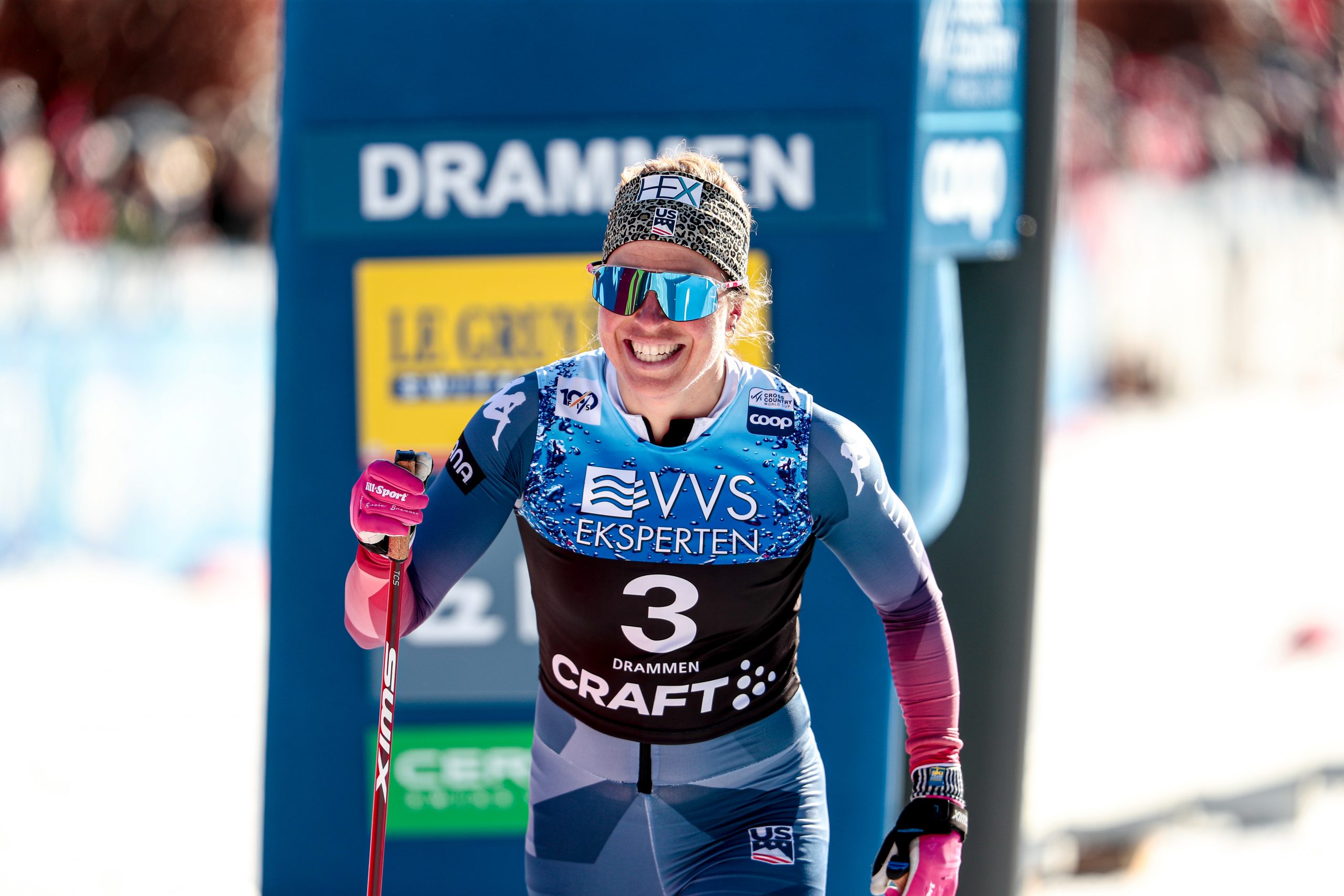
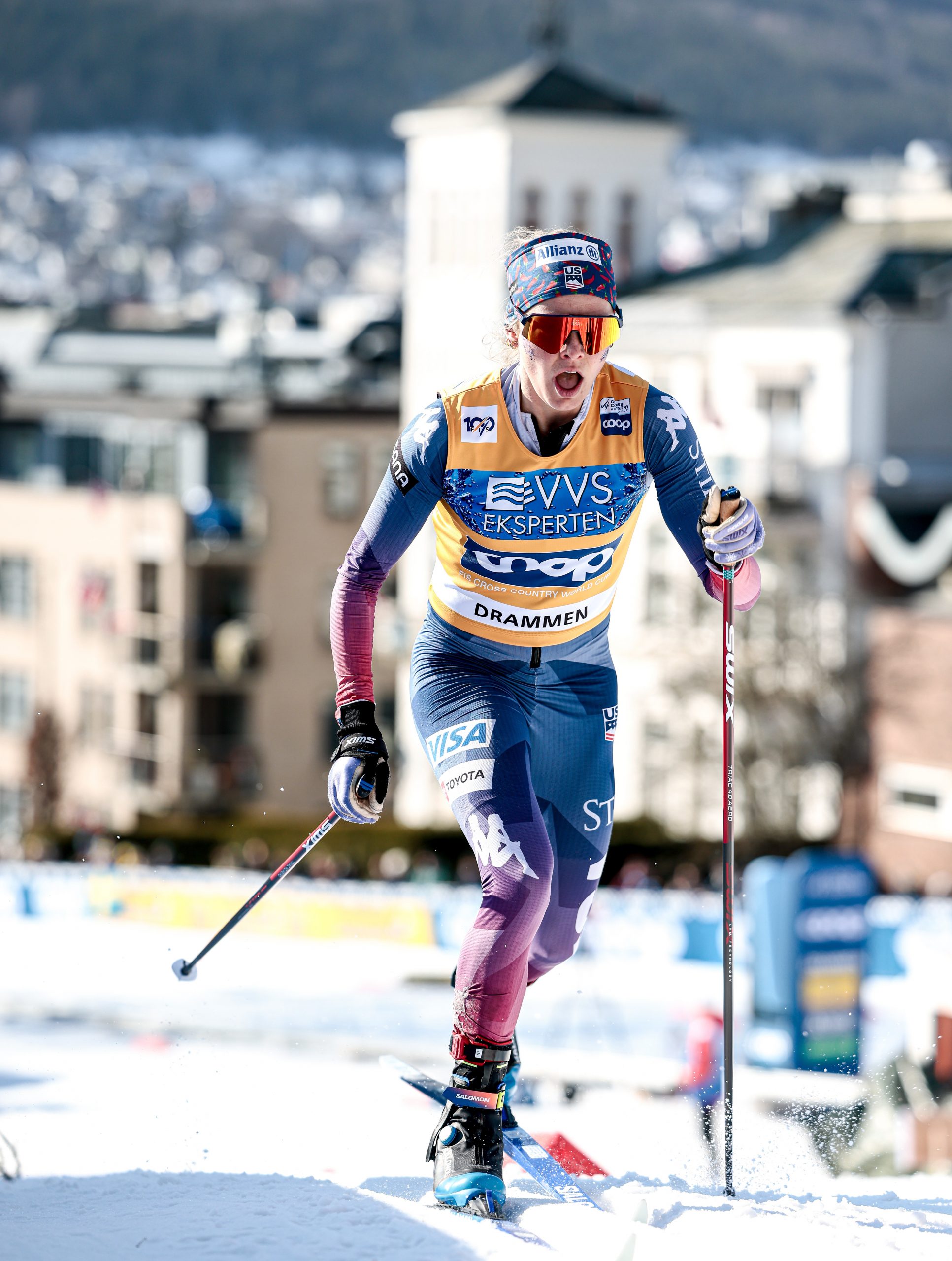
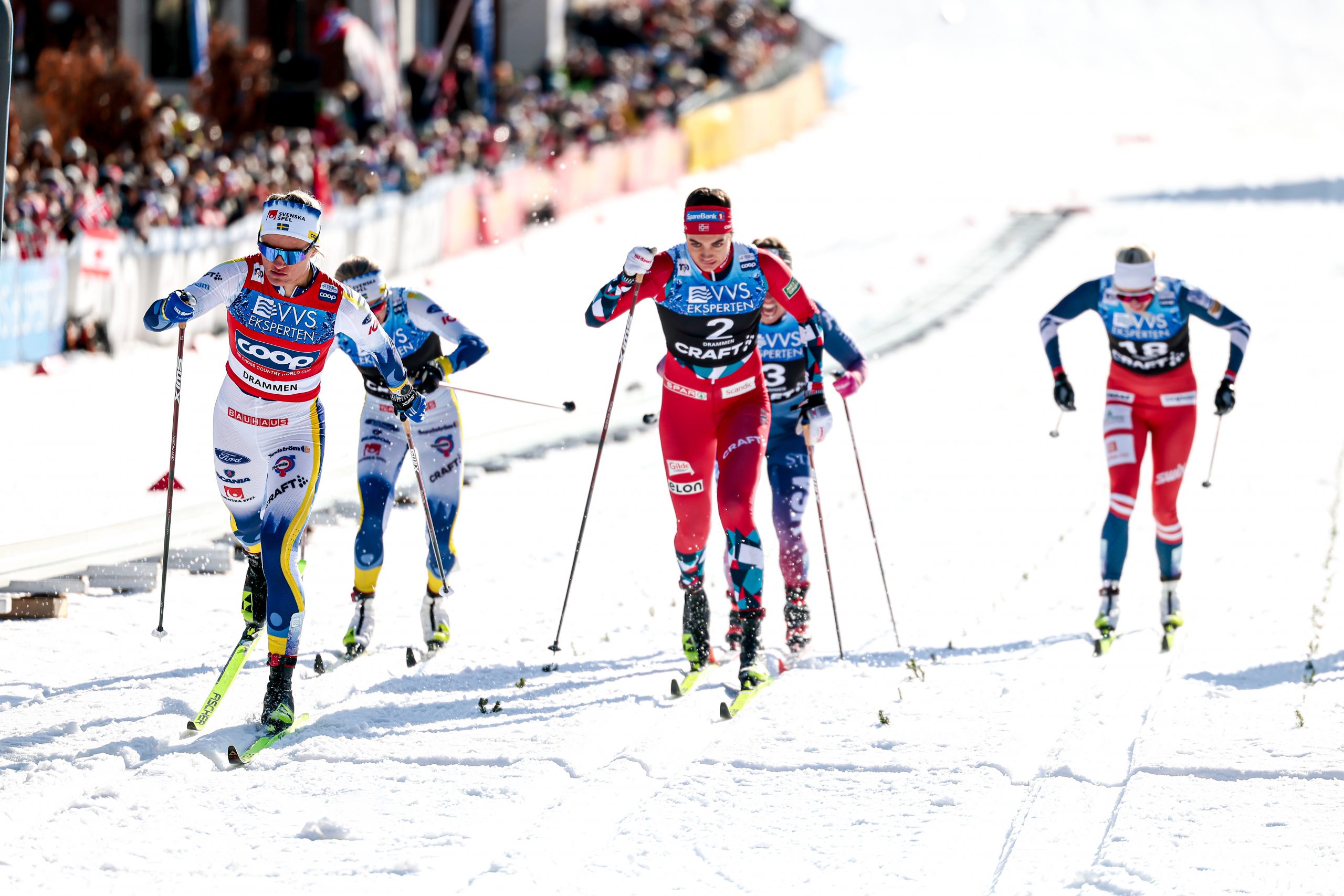
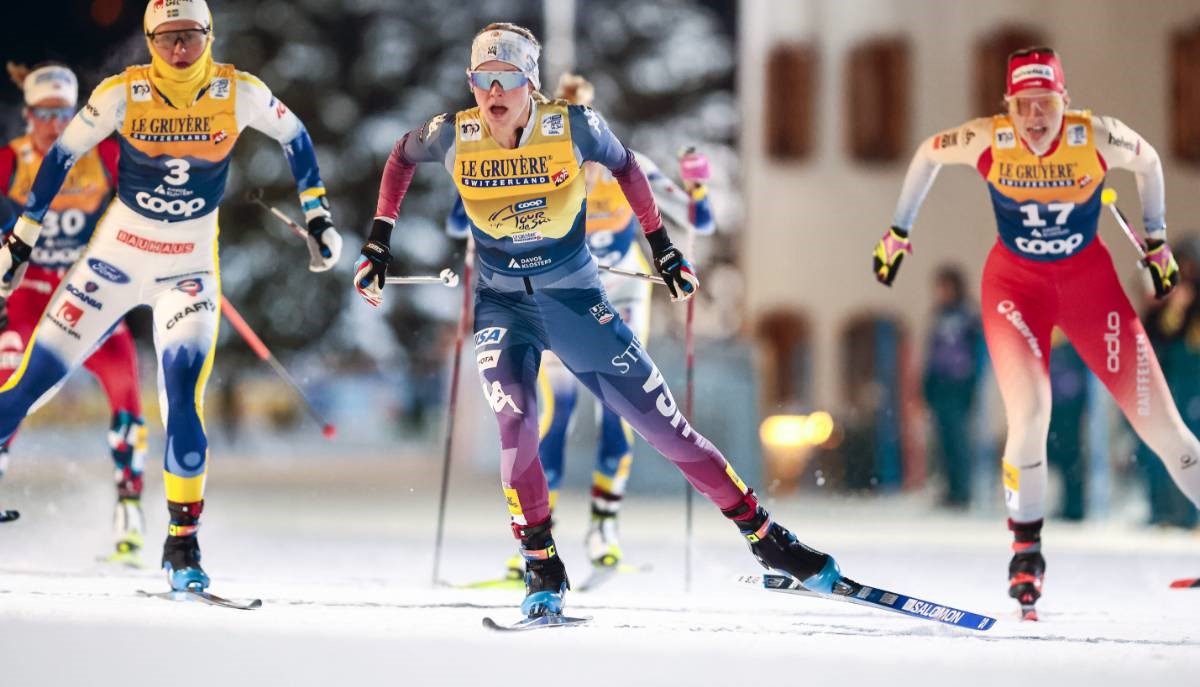
Rosie Brennan (USA) had a great day in Drammen, finishing third. (Photo: NordicFocus)
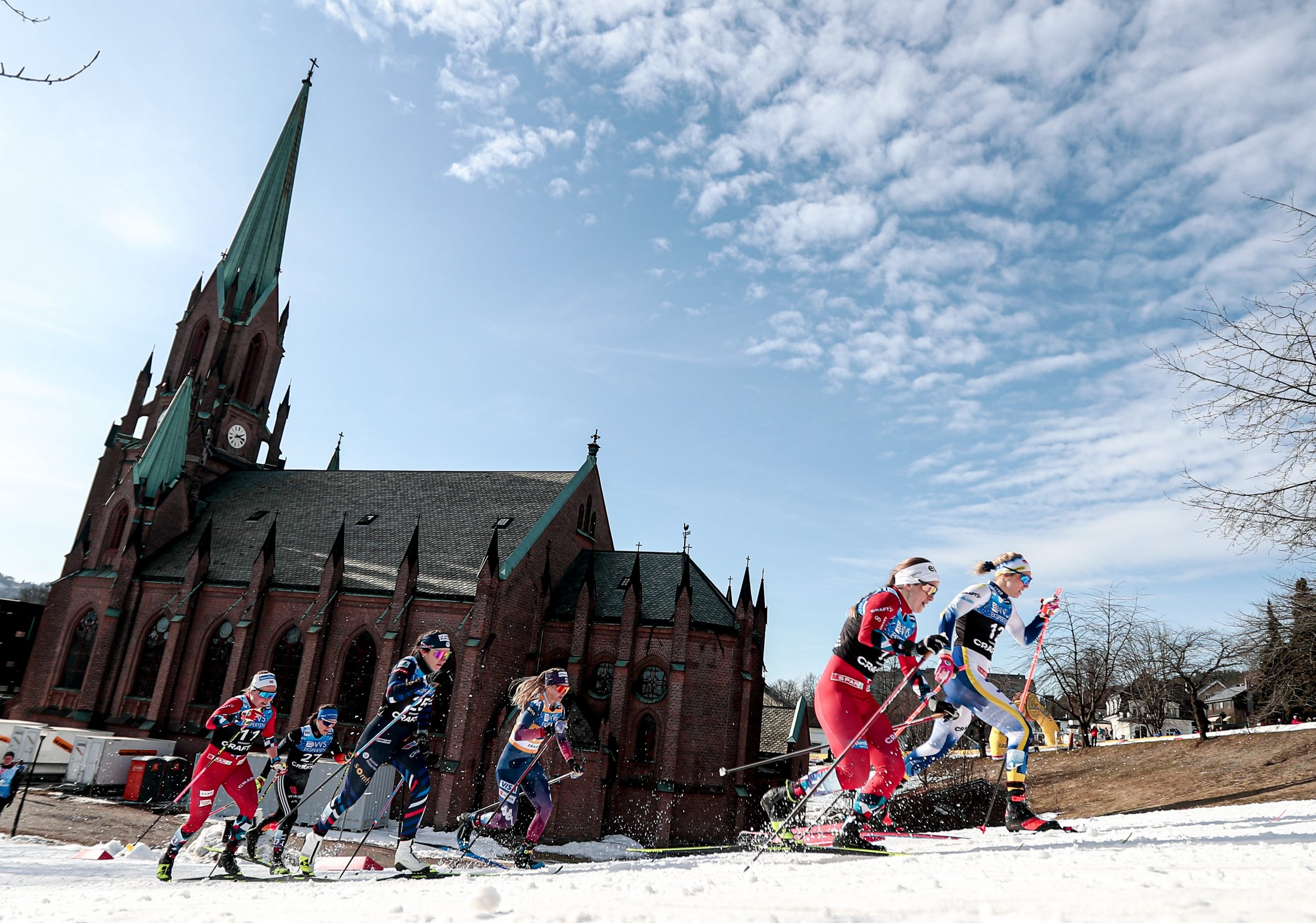
The World Cup moved to its second to last venue today as racers competed in the Drammen, Norway, City Classic Sprints. Over the years, Drammen has taken on an aura all its own as it serves as a transition between the crushing Holmenkollen marathon and the final weekend of the race season. Drammen is unique in many ways. It happens inside the center of a city, it has a course which is considered very tight by World Cup Sprint standards, and it can often determine the winner of the Sprint Crystal Globe. Coming on Holmenkollen’s heels, it can also often have a start list where many of the top racers are absent.
But today, most of the stars were present to shine as a great deal was at stake. Entering today’s race, Jessie Diggins had a 159 point lead in the Overall competition over Linn Svahn (SWE). With a potential of 115 points going to today’s winner, Diggins needed to avoid being shut out of the finals like she was just a little over a week ago in the Lahti Sprints. And, with three races coming up next weekend in Falun—offering a total of 345 points—it was critical for Diggins to continue to keep Svahn at bay.
Jessie Diggins (USA) was able to make the heats, but Linn Svahn (SWE) continued to eat away at Diggins’ Overall lead. (Photo: NordicFocus)
Svahn would not only be trying to gain ground on Diggins but also trying to also secure her Sprint title. Coming into the race she had a 178 point lead in the Sprint competition over Kristine Stavaas Skistad (NOR). A strong showing today could mathematically wrap up the Sprint crown. But also on Svahn’s to do list was to chip away at Diggins’ lead.
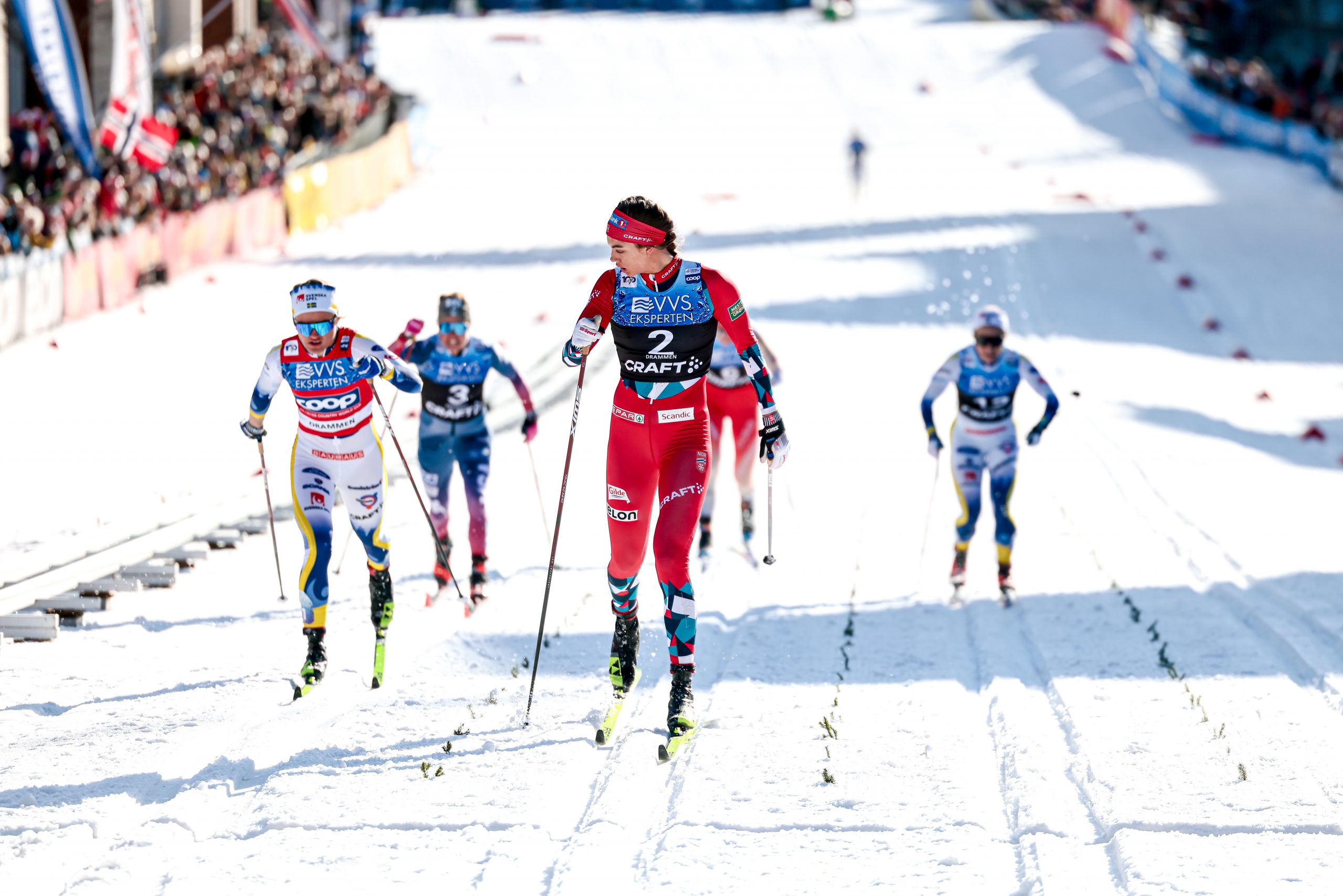
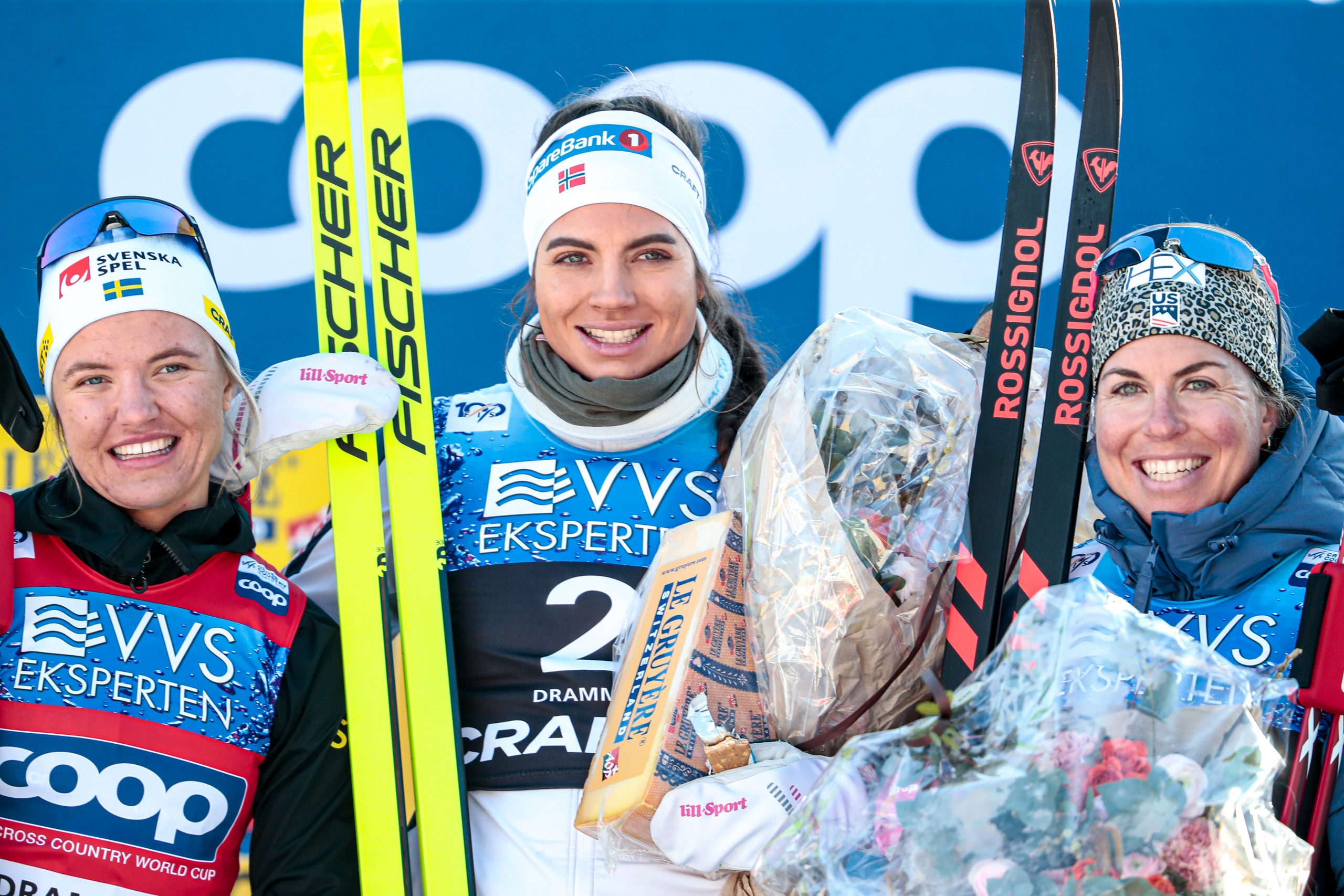
But at the end of the day, the Diggins-Svahn battle was overshadowed by Rosie Brennan’s (USA) performance. Brennan was able to advance out of the quarterfinals—finishing second—move forward from the semifinals as a lucky loser, and ski a strong race in the finals to reach the podium and finish third. Finding triumph toward the season’s end was a sweet moment for Brennan who has been frustrated by her performances the last several weeks.
“[I’m] honestly very surprised,” Brennan commented. “At the end of the season, everyone is on their last ropes, and you never know what the body is going to give you, I’m really happy, it was really nice to have a podium again.”
She acknowledged the stress of racing so soon after Holmenkollen. “I was glad it was today and not yesterday,” Brennan said. “I felt really bad yesterday. I think that extra day helped compared to last year, but you just never know what the body will do. I really enjoy Drammen, I think it’s one of the best World Cups we do.”
But the Diggins-Svahn dance continued to keep everyone’s attention. Svahn finished second today, while Diggins was unable to advance out of the quarterfinals—finishing 16th—after being impeded by Emma Ribom (SWE) in their heat. Svahn’s success and Diggin’s bad luck combined to further tighten the battle for the Overall Championship. Diggins’ lead was reduced to only 102 points. Ribom’s interference led to her disqualification which did provide some consolation for Diggins, moving her up in today’s results, and giving her an extra two points.
“It was tough, my body felt really good,” Diggins said after the race. “Two things happened that were not great…I got trapped on the inside, it was frustrating, we weren’t going fast enough, and I knew it, I couldn’t get out. And I needed some better glide on the downhills. I did everything I could, but I think I need to have a stronger double pole and be more aggressive out of the start.”
Svahn’s second place finish gave her a 176 point lead in the Sprint standings over Kristine Stavaas Skistad (NOR). With only 115 Sprint points left in the season, Svahn’s performance secured her Sprint Crystal Globe.
On the men’s side, Johannes Hoesflot Klaebo (NOR) had a chance to wrap up his sixth Sprint crown. Going into the race he held a 141 point lead over teammate Erik Valnes (NOR). A win today would lock up the crown for Klaebo. After claiming a landmark victory last weekend in Holmenkollen, any other racer might have been questioned about how much fight he would have left in him only two days later. With Klaebo, none of the normal concerns seem to apply. So, as usual—and despite Sunday’s effort—he would be the prohibitive favorite. Klaebo qualified first, and went on to win the Sprints. Going into next weekend, he takes a 190 point lead over Valnes, and has mathematically sewn up the Sprint crown yet again. “I had so much fun, I love this race,” Klaebo said, but he is not optimistic about his chances in the Overall competition. “I think I’m a little too far back, so I’ll be super happy with today’s races.”
North American men had a day to celebrate. While no North American men reached the podium, Antoine Cyr (CAN) finished fourth, and American J.C. Schoonmaker took sixth.
“It feels great to be back in the finals,” Schoonmaker noted. “I would have loved to put up more of a fight in the end, but it’s some pretty fast guys in there and they don’t make it easy.”
It was a thrilling day in Drammen, and with so much riding on today’s race the pressure was high and was only accentuated by the narrow Drammen course where things can quickly go sideways.
Linn Svahn (SWE) and Kristine Stavaas Skistad (NOR), (l-r) would battle for first place all day. (Photo: NordicFocus)
Drammen Women’s Quarterfinals
Svahn served notice early that she was still in the hunt by qualifying first. Rosie Brennan also had a good qualifier, finishing third.
Kern and Brennan were in the first quarterfinal together facing Skistad. In a difficult field, Brennan was able to advance by finishing second. Kern had to wait, having finished third, while her fate as a lucky loser was decided.
Svahn chose the second heat and left little to chance as she went out early to win her heat. She had already achieved part of today’s goal by gaining 13 points on Diggins by qualifying first while Diggins qualified eighth. While Svahn had a lot of math on her mind, Skistad skied in total control, appearing to exert very little energy, to finish second in the heat.
Julie Myhre (NOR), Katharina Hennig (GER), Lena Quintin (FRA), Jessie Diggins (USA), Anna Svendsen (NOR), Emma Ribom (SWE), (l-r) in the quarterfinals. Ribom was disqualified for impeding Diggins. (Photo: NordicFocus)
As has been her strategy all season, Diggins elected to race in one of the last quarterfinals, choosing the fourth heat. Early on, Diggins sat comfortably in third place tucked in behind the two leaders. As the group came around the final turn into the finishing straightaway Diggins had dropped to fourth. She was never able to gain contact with the leaders Emma Ribom (SWE) and Julie Myhre (NOR) who finished first and second. Myhre had an impressive race after falling out of the starting gate and recovered to appear to take second.
For Diggins, her day was over, and she would now have to wait and see how many more points Svahn could eat into her lead. But, after the heat was over Ribom was handed a yellow card and was disqualified from the race for obstructing Diggins. Ribom’s disqualification automatically advanced Diggins in the standings and gained her additional points, while Myhre was moved into first place. But Ribom’s disqualification didn’t allow for Diggins to advance to the next heat. Ribom would sit on the sidelines for the rest of the day, while Diggins had to watch and wonder about what might have been.
Drammen Women’s Semifinals
In the first heat Brennan faced off against Skistad, Svahn, and Frida Karlsson (SWE). Svahn was the first one to break from the field and take the lead, which hadn’t been a winning formula today. Skistad was right on Svahn’s ski tails, and was able to easily slingshot past Svahn, who then returned the favor by rebounding past Skistad. The pair crossed the line 1-2. Brennan finished fourth and would have to wait for a lucky loser position, which she ultimately won along with Karlsson.
Kern was in the second semifinal with Nadine Faehndrich (SUI) and Johanna Hagstroem (SWE). Faehndrich and Hagstroem took the victory with Kern finishing third, but it wasn’t enough for her to advance as a lucky loser.
Kristine Stavaas Skistad (NOR) (center) appeared to dispatch the competition with ease in Drammen. (Photo: NordicFocus)
Drammen Women’s Final
The women’s finals featured Svahn, Faehndrich, Skistad, Hagstroem, Karlsson, and Brennan. Skistad went out to the front early to set the tempo alongside Svahn. As Skistad slowed slightly, Svahn went to the front which tactically was not the best place to be. Svahn realized that, and then significantly slowed the pace. Faehndrich took advantage of the cat and mouse games to go to the front. However, her strategy didn’t work as Svahn and Skistad were able to slingshot past her. As they approached the finish, Skistad found an extra gear and easily pulled away from Svahn. During the back and forth, Brennan was able to fight her way to the front to finish third.
The first men’s quarterfinals featured Klaebo and Zanden McMullen (USA). It was a fast heat as Edvin Anger (SWE) quickly jumped into the lead. But no one could keep pace with Klaebo who effortlessly double poled to the victory. McMullen finished fourth to for the moment, preserve a lucky loser opportunity.
Another American Zak Ketterson was in the second heat. He would have a difficult task as he faced Frenchmen Richard Jouve and Lucas Chanavat. Ketterson gave American fans a thrill as he led for the first half of the race. But he couldn’t maintain the lead and it was Jouve and Sivert Wiig (NOR) who advanced.
Antoine Cyr (CAN) finished fourth in the Drammen Sprints. (Photo: NordicFocus)
The third heat saw two North Americans, Antoine Cyr (CAN), and JC Schoonmaker (USA) taking on Overall leader Harald Oestberg Amundsen (NOR). Amundsen immediately went to the front and established a large gap over the rest of the field. But the dynamics of the Drammen course worked against him as the pack was able to swallow him up. It was Ansgar Evensen (NOR) and Cyr taking the victory. Schoonmaker finished third and was now in the lucky loser position displacing McMullen.
James Clinton Schoonmaker (USA) (right) finished sixth. (Photo: NordicFocus)
Drammen Men’s Semifinals
Klaebo was in the first semifinal alongside Richard Jouve (FRA), Erik Valnes (NOR), Evensen, Amundsen and Wiig. It was Klaebo and Jouve out front early with Klaebo clearly dominating. He once again easily went on to the victory with Jouve finishing second.
Two North Americans—Schoonmaker and Cyr—were in the second semifinal. Haavard Solaas Taugboel (NOR) took the early lead. The race changed quickly when Valerio Grand (SUI) broke a pole and was pushed to the back near the beginning of the race. Even Northug (NOR) and Taugboel finished first and second. Cyr and Schoonmaker finished third and fourth, and both advanced as lucky losers.
For Johannes Hoesflot Klaebo (NOR) things seemed effortless as he glanced back at the competition. (Photo: NordicFocus)
Drammen Men’s Final
The two North Americans in the finals—Schoonmaker and Cyr—would face Klaebo, Northug, Jouve, and Taugboel. Jouve went out to the lead early along with Klaebo, who took an unusual outside line. As Klaebo navigated along the outside, Schoonmaker was pushed to the back.
Johannes Hoesflot Klaebo (NOR) had another day where everything he did seemed to work like magic. (Photo: NordicFocus)
As the skiers came around the final hairpin turn Klaebo was in second, but in a sleight of hand he surged to the front and once again dispatched the competition without anyone seeming to understand exactly how he did it. Cyr went on to finish fourth while Schoonmaker was sixth.
Drammen had lived up to its billing as the lead for the Overall championship between Diggins and Svahn tightened substantially. Sprint titles were determined, and North Americans had an outstanding day.
This coverage is made possible through the generous support of Marty and Kathy Hall and A Hall Mark of Excellence Award. To learn more about A Hall Mark of Excellence Award, or to learn how you can support FasterSkier’s coverage, please contact info@fasterskier.com.
Jessie Diggins (USA) has a clear path to the Overall title. But there are dangers lurking. (Photo: NordicFocus)
With only three weekends of racing and five races left, the 2024 World Cup Season is entering its home-stretch run, and fans of team USA are hoping that Jessie Diggins can hang on to her lead in the race for the Overall standings and capture the Crystal Globe award. Diggins has had a commanding lead since the Tour de Ski ended and has successfully protected that lead by consistently having top finishes and claiming bonus points in Mass Start races.
Also of season long interest has been Rosie Brennan’s efforts to try and reach the podium in the Distance competition.
What Does Diggins Need To Do?
After last weekend, Diggins’ lead in the Overall competition shrank substantially when she failed to qualify for the Sprint finals, and Linn Svahn (NOR)— who is currently sitting behind her in second place— finished fourth, and was second in the qualifying rounds. Svahn earned an additional 12 points for the Sprint qualification, while Diggins earned none. Svahn also gained 63 points on Diggins for her fourth place finish. So, in one quick morning of racing, the Swede cut into Diggins’ lead by 75 points. It goes to show how quickly points can evaporate in the World Cup. Diggins now leads in the Overall standings by 162 points. Remember that number. For those pundits who have been saying for weeks that the race for the Crystal Globe was over, they need to do some math.
Linn Svahn (SWE) made up a lot of ground on Diggins last weekend, and is now within striking distance. (Photo: NordicFocus)
In an interesting asterisk, Diggins was helped in the points race when Frida Karlsson (SWE) was disqualified Sunday for interference. After the disqualification, Karlsson was removed from the finishing list, which moved Diggins up one spot, and earned her an additional two points. In a format in which only the top 30 qualifiers move on to the heats, Diggins was put into the statistically anomalous situation of finishing 30th and not making the quarterfinals.
As a result of the weekend’s points shuffle, Diggins’ once comfortably padded lead while still significant, now looks vulnerable.
Here’s why there’s some reason for anxiety in the American fan base. With five races remaining in the season there are 500 points up for grabs just based on who finishes first in a race. Two of the remaining races are Sprints. First place in a Sprint qualification earns an additional 15 points, which adds 30 more points into the mix.
Then there’s the 500 pound gorilla in the room; the Holmenkollen Classic. This is where things get tricky. To begin with, the motivation to win Holmenkollen is immense, so every skier will be giving it their all. The competition just to get into the top ten will be intense. Then there are the bonus points. Since Holmenkollen is 50-kilometers, that means that there will be six bonus sections up for grabs. That adds up to an additional 90 points being available in bonus points just in that race. So Holmenkollen alone offers potentially 190 points to a skier who can win the race and take all the bonus points.
Throw in the bonus points for the 20-kilometer Mass Start on the last day of racing for the season in Falun, and that adds in another 30 points into the equation.
Add everything up, and there are still 650 points to be fought over. That’s a lot. But figuring out whether Diggins’ lead is safe takes more than simply seeing how many points are left. Barring some catastrophe, Diggins will receive some points in every race. But it doesn’t take too many wild out of the box scenarios to see her lead disappear.
Jessie Diggins (USA) will hope to improve on last week’s 21st place finish in the Lahti Classic race when she heads to Holmenkollen. (Photo: NordicFocus)
Here’s an example. If Svahn finishes fourth in Holmenkollen and takes every bonus section, she would receive 175 points. Assume Diggins stumbles and finishes 21st—like last week’s Individual Start Classic race in Lahti—and doesn’t get any bonus points; she would get 40 points total. That’s a 135 point swing. Now remember that 162 points lead that Diggins was starting with; that would vanish into a scant 27 point lead going into the remaining two weekends of racing, where there will still be 460 points available. To state the obvious, doing well in Holmenkollen is key to winning the Crystal Globe.
Is such an outcome probable, or even possible? Well, Svahn finished fourth in the 30-kilometer Classic Mass Start in the 2023 World Cup, and as mentioned, Diggins finished 21st in last week’s 20-kilometer Individual Start Classic race. So, both racers have had the exact same outcomes as what was just described.
A 50-kilometer Classic race is a long way and almost anything can happen. The math reveals that Diggins, and her fans, can’t afford to take anything for granted. The odds are still in her favor and she has already shown herself to be a shrewd tactician at picking up bonus points in Distance races while not necessarily using energy to contest the podium. She might employ a similar strategy at Holmenkollen.
But Svahn is skiing very well right now and could try and use a similar strategy. All Svahn needs to do is take a big bite out of Diggins’ lead and then let things play out in the last two weekends of racing. With 460 available points over the last two weekends—and two of the races are Sprints, Svahn is the current Sprint leader— if Svahn can reduce Diggins’ lead to the neighborhood of 50 points after Holmenkollen, she would have a legitimate shot at the Championship. And there’s an old saying that, “it is better to be the hunter than the hunted.” Diggins is definitely the hunted.
After the U.S team’s rough outing last weekend with less than optimal skis, the tension will be extra high to make sure that performances on both ends of the equation—ski preparation, and athlete performance—are at their very best.
Rosie Brennan’s (USA) formula to find the podium for third in the Distance competition is simple: gain ground on Ebba Andersson (SWE), and don’t let the followers catch her. (Photo: NordicFocus)
What Does Brennan Need to Do?
Rosie Brennan’s situation is very different, and even more tenuous. After last weekend, she was in fourth, only 46 points behind Ebba Andersson (SWE) for third place in the Distance standings, and 68 points behind Victoria Carl (GER) for second. She is 284 behind Diggins who also holds the lead in the Distance Cup chase. But Brennan is in the unenviable position of being chased by Karlsson, Heidi Weng (NOR), and Kerttu Niskanen (FIN), all of whom are within 14 points of her, and all of whom can “bring it” at any time in a Distance race.
Ebba Andersson (SWE) stands between Rosie Brennan (USA) and third place in the Distance standings. (Photo: NordicFocus)
For Brennan, finishing in the top three in the Distance Competition would be hugely satisfying in a season which saw her competing early on for the Overall Competition, but now has her in fifth place, over 200 points out of third, in the Overall standings. Unlike Diggins, Brennan won’t have to engage in any complex mathematical variables. Her mission is simple; she needs to stay ahead of all of the women who are behind her and beat out Andersson by enough in the three remaining Distance races to grab the 46 points she needs. If she can do that, she’ll end the season on a high note, and come away with a Distance top three. It will go a long way to lessen the disappointment of what has been an admittedly frustrating second half of her season.
The math for the next couple of weeks might be a little confusing, but it’s an equation for racing which promises to be intense, strategic, and compelling down to the final minute.
Rosie Brennan needs to make sure that Frida Karlsson (SWE-above) doesn’t gain any ground on her. (Photo: NordicFocus)
This coverage is made possible through the generous support of Marty and Kathy Hall and A Hall Mark of Excellence Award. To learn more about A Hall Mark of Excellence Award, or to learn how you can support FasterSkier’s coverage, please contact info@fasterskier.com.
Jessie Diggins (USA) in front of the home crowd in Minneapolis. (Photo: Modica/NordicFocus)
MINNEAPOLIS—The suspense and the nerves built all morning at Theodore Wirth Regional Park, where America’s cross-country skiers were set to contest their first World Cup race—the sport’s top competition circuit—in 23 years.
By the time Jessie Diggins took to the course, before thousands of adoring spectators, Joan Griffin, a longtime fan of the Minnesota-grown superstar, couldn’t hold her emotions in any longer.
“I cried,” said Griffin, 58. “My kids skied, and I used to tear up when they would go by. And I kind of felt that same way.”
All 24 Americans who competed in Saturday’s sprint race in Minneapolis had friends, family members and admirers among the crowd; fans turned out from Alaska, Wyoming, Illinois, New York and New England.
But the event was a literal homecoming for Diggins, 32, who grew up in Afton, 25 miles east. And at Wirth Park, she was the undeniable star of the show, taking a victory lap with Saturday’s race winners even though she placed fourth.
Diggins was the only U.S. team member to advance past the first of the three rounds of sprint heats. A wall of noise followed her as she skied past the crowds snaking along the course. And the fans, it turns out, were not the only ones who were moved.
Huge crowds lined the trails to watch Saturday’s World Cup race in Minneapolis. (Nathaniel Herz/FasterSkier)
“I’ve cried seven times today, and all for the best reasons,” Diggins told reporters after the race. “This is the coolest day in my entire racing career.”
That superlative, mind you, comes from an athlete with three Olympic medals and a world championship in her trophy case.
But you didn’t have to look hard Saturday to see why the moment meant so much to her.
Diggins has raced her entire professional career—more than 300 times—without ever having a chance to compete in a World Cup in her home country. In spite of the circuit’s name, it’s contested almost exclusively at venues in Europe.
Martha Wavrin gets some glitter Saturday from a volunteer. (Nathaniel Herz/FasterSkier)
Spectators from the Midwest who have waited years to see Diggins in action roamed Wirth Park wearing customized bibs printed with her face on them. Dozens of sign-toting family members arrived from Boston, Canada and Arizona to cheer her on, according to Minnesota’s Star-Tribune newspaper.
Robby Callahan Schreiber’s daughter convinced him to put glitter in his beard the morning of the World Cup race in Minneapolis on Saturday, February 17, 2024. (Nathaniel Herz/FasterSkier)
Race organizers tasked volunteers with applying glitter—one of Diggins’ trademarks—to the faces of willing fans. One spectator even spread a rainbow of it, meticulously, on his beard.
“My daughter said we’ve all got to glitter up,” said Robby Callahan Schreiber, 42. “We’ve got to match up with the ski team.”
Diggins’ appeal might be most compelling for girls and young women.
“Everything we do is about Jessie,” said Lily Ward, an 18-year-old who ski raced at the same high school as Diggins. “Glitter. We do the snow dances she used to do. We love her. The whole team loves her.”
But the loyalty cuts across many demographics. Drew Ross, 60, arrived at Saturday’s event with a copy of a six-year-old photo of his daughter posing with Diggins, hoping to get it signed.
“I’m not a sports fan, typically. But Jessie’s pretty real,” he said. “I’m inexplicably moved when I watch Jessie, and read about her.”
Drew Ross, 60, holds a photo of himself and his daughter posing with Jessie Diggins after Diggins won a gold medal at the 2018 Olympic Games. Ross said he’s hoping Diggins will sign it for him. (Nathaniel Herz/FasterSkier)
Griffin—the fan who cried when Diggins skied past—said the Minnesotan embodies the traits that people want in a professional athlete: positivity, teamwork and perseverance.
“I watch the races. I follow her on Instagram. I follow her on Facebook. I am a little bit crazy,” Griffin said. “She’s given women opportunities to be strong and athletic, and not be out there with people looking at them for their looks.”
The races in Minneapolis—and last week’s World Cups in Canada—also underscore how Diggins’ star power and influence extend behind the scenes.
Special World Cup rules allow the U.S. additional start spots when the circuit comes to North America. So the country has fielded an extra-large team at the races this month — including a number of World Cup rookies who have looked up to Diggins since they took up the sport.
“I never thought, in my life, I’d be on the same team as her,” said Emma Albrecht, a 22-year-old who went to Diggins’ high school and who raced her first-ever World Cups in Canada this month. Diggins helped Albrecht apply her pre-race glitter, in what she called a “starstruck moment.”
Diggins and other veteran American athletes, like Rosie Brennan, 35, have also helped lead team meetings and share practical advice with the newer athletes competing in Canada and Minneapolis, said Chris Grover, the U.S. cross-country team’s program director.
“They are actually providing all those little nuggets of how to approach the World Cup from a logistical standpoint,” Grover said. Those are things like where to drop backpacks of gear, which tactics to use, key elements of the courses and tips on pre-race workouts, Grover said.
Espen Krogstad, 11, hopes Diggins will autograph his sign on Monday, he said. (Nathaniel Herz/FasterSkier)
There’s also a “real effect,” Grover added, when young athletes get to see superstars like Diggins and Norway’s Johannes Høsflot Klæbo race firsthand. Watching them up close, or having them sign autographs, “makes a difference in the lives of some kids that might go on to be ski racers,” Grover said.
“It’s so hard to make it tangible and objective and put your finger on exactly what the impact is,” Grover said. “But I think it is an impact. And it’s kind of amazing that we’ve had as much success as we’ve had without that.”
This coverage is made possible through the generous support of Marty and Kathy Hall and A Hall Mark of Excellence Award. To learn more about A Hall Mark of Excellence Award, or to learn how you can support FasterSkier’s coverage, please contact info@fasterskier.com.
Meeting for international press is one more obligation when you’re racing on home soil. (Julia Kern, Jessie Diggins, Rosie Brennan, JC Schoonmaker) (l-r). (Photo: Ken Roth/FasterSkier)
MINNEAPOLIS, MINNESOTA—The World Cup in Minneapolis is ramping up today with skiers practicing on the course and the American team holding a press conference. If you’ve never been to a World Cup race before, the vibe is unlike anything else you’ve ever experienced at a ski venue.
U.S. ski team members Julia Kern, Jessie Diggins, Rosie Brennan, and JC Schoonmaker held a press conference for international media today. A common theme of the questions was “What is it like to be skiing on home soil?”
“This is really emotional for me, ” responded Diggins. “So if I start crying, bear with me. Last time I raced in Minnesota, I was 19…it’s so cool to see how many people have rallied for this. It’s incredible to see how many people have pulled out all the stops to make this happen. I could retire happy now.” She quickly added that she has no plans to retire!
Rosie Brennan also had much to say about her satisfaction with racing in front of an American audience. “I’m incredibly proud and grateful be able to show off our country,” she said, “And to have so many friendly faces. We were greeted with hundreds of friendly volunteers at the airport, ever since then it’s been a great time.”
It’s not just another day at the races when you have media coverage like this. (Photo: Ken Roth/FasterSkier)
Among the comments made were how impressed the skiers were with the conditions. With six to seven inches of fresh snow falling Wednesday night and cold temperatures moving in, Minneapolis has been transformed overnight into a winter wonderland. “We’re so happy that we got the snow,” said Diggins.
“Every course is different,” said Brennan. “This one doesn’t have the longest or steepest hills, but that means there’s no rest. I think it’s going to be a great course. The course preparation has been top notch…it will make for some really exciting racing.” Kern also had nothing but praise for conditions. “I’m so amazed with how the Loppet has been able to prepare the courses. The grooming was impeccable today. I spoke with other athletes on other teams; they were blown away by the course conditions.”
The Loppet foundation pulled out all of the stops and in the nick of time, got an assist from mother nature with snow on Wednesday. Skiers are raving about conditions. (Photo: Ken Roth/FasterSkier)
The Stifel U.S Ski Team has unequivocally expressed its anticipation and satisfaction to be racing in North America. It’s also an opportunity for skiers to get fan support that they don’t regularly see in Europe. When asked what having loud fan support would be like, Brennan made her enthusiasm clear. “This is a first for me,” she said. “In the 2018 Olympics in Korea, there weren’t a ton of people there, and Beijing had nobody [due to Covid]. I’ve not done a race where there are this many people cheering for me and know who I am. I’m excited to see what that’s like. We’ve been to Falun World Championships where there are tons of people cheering and they’re loud, but they’re not my people! To have my whole family…to know they are out there, I hear them, and recognize their voices, and sometimes that can be the difference in getting that last little bit out of yourself.”
Having your own cheering section, like Julia Kern does, can only help. The skier fan club bibs have been a hot item. (Photo: Ken Roth/FasterSkier)
Kern was also looking forward to a supportive crowd. “People should expect a really lively excited crowd that is incredibly passionate,” she said. “Can you imagine any other country having to wait this long for its home World Cup and it’s all unleashed in a weekend! I can’t wait to be numb in my ears from all the screaming.”
The only downbeat note is the absence of Ben Ogden, who fell ill in Canmore and will miss the rest of the season. Schoonmaker commented on Ogden’s absence: “Ben is a huge part of this team,” Schoonmaker said. “He brings the mood up. Hearing that his season was ending was pretty devastating. We’ve been talking about it a lot the last couple of days. It sucks, plain and simple. But it’s not like we have one leader that we look to, so when Ben goes down, it’s not like we’re looking for someone to step it up and take his position. We are just a group of ourselves and are good friends.”
It’s a very long way from down under, but even the Aussies made the trip to Minneapolis. (Photo: Ken Roth/FasterSkier)
We’re grinding on with our third episode in four days. Hope you’re still listening. If you don’t get the hat reference, read our coverage.
We’ll be back with another episode after the last race in Canmore. To keep you from podcast withdrawal later in the week, we’ll roll out some interviews we did with a couple of international athletes here. Then we’ll be back again from Minneapolis this weekend.
Speaking of Minneapolis, if you’ll be there in person, we’re hosting a live show where we’ll be taping Sunday’s episode in front of an audience — though we’ll need all 12 listeners to show up for it to really be an actual audience. More details soon — the event is at Utepils Brewery near the venue, with an exact time to be determined, but it will be after the last race of the day.
Questions? Comments? Email us: devon@fasterskier.com and nat@fasterskier.com. Thanks so much for listening.
This coverage is made possible through the generous support of Marty and Kathy Hall and A Hall Mark of Excellence Award. To learn more about A Hall Mark of Excellence Award, or to learn how you can support FasterSkier’s coverage, please contact info@fasterskier.com.
Jessie Diggins (USA) took advantage of the technical nature of the Goms course to remain near the front with pace-makers Ebba Andersson (SWE) and Frida Karlsson (SWE). Digggins victory in the 20 k Freestyle Mass Start was sweet confirmation of her place atop the World Cup Overall standings. (Photo: Modica/NordicFocus)
Jessie Diggins (USA) continues to pursue the season-long World Cup Overall title, having successfully defended her lead in those standings through the recent weekends of sprints and mass start races. And with so many World Cup bonus point sprints incorporated into those mass start events, there is simply no time to surrender the lead. Diggins has appeared willing to take on that challenge, and to be willing to risk losing in order to win; that’s nowhere near as simple as it sounds. Only a few years ago, Diggins would not have been considered a distance-race contender in anything longer than a 5 k Freestyle. But in Goms, Switzerland, Diggins once again showed that she has matured into a skier who can push the pace in races of any distance, control the field on a challenging and technical courses, and sprint like a rocket even when it appears she’s out of gas. Say what you will about Jessie Diggins, but always remember that she is the quintessential fighter. Today in Goms, that fighting spirit was on thrilling display.
After four 5 k laps of Goms’ challenging and technical course, Diggins outsprinted an on-form and determined Frida Karlsson (SWE) to take the win in the World Cup 20 k Mass Start Freestyle. Her American teammates, Sophia Laukli and Rosie Brennan, followed closely in fifth and seventh, respectively. The third place on the podium was captured in tremendous form by a skier better known for her sprinting—Nadine Faendrich—who may have been energized by the cheering of her Swiss countrymen.
Having been securely positioned in the lead pack throughout the day, Lilliane Gagnon (CAN) finished a tremendous ninth. Additional North American finishers included Sammy Smith (USA) 45th, and Olivia Bouffard-Nesbitt (CAN) 54th.
Ebba Andersson (SWE), Frida Karlsson (SWE), Jessie Diggins (USA), and Nadine Faendrich (SUI) (r-l) combined throughout the day to keep the pace high in the 20 k Freestyle Mass Start in Goms, Switzerland. (Photo: Modica/NordicFocus)
20 k Mass Start Freestyle
A week ago in Oberhof, Germany, Diggins won both Bonus Points Sprints on her way to a sixth place finish in the 20 k Classic Mass Start, allowing her to effectively protect her lead in the World Cup Overall standings. The rest of the field—and the other contenders in the chase for the overall—continue to search for chinks in Diggins’ armor. Today’s 20 k Mass Start Freestyle represented another opportunity to continue that search in earnest, though Diggins would prove more than capable of withstanding the combined efforts of her rivals.
From the very beginning of Sunday’s race, Diggins found herself at the front setting the pace with Victoria Carl (GER) and Karlsson.
“I loved all of the winding downhills. That was really fun to ski,” said Diggins. “I’m glad to have kept it together and skied with better tactics today; that was my goal.”
Brennan skied the opening kilometers always in the top ten, while Smith and Laukli attempted to work their way forward from less advantageous starting positions. By 2.5 k, Laukli had succeeded in erasing the deficit, and moving al the way forward to the tails of her teammate, Brennan.
“I had an early crash which put me quickly at the very back of the pack,” said Laukli. “[That] certainly caused some initial stress. Even though it was a long race, I knew it was the type of course and conditions where I really wanted to be in the front early on. I knew I felt very good but it’s definitely challenging to actually maneuver around the whole field. It was pretty daunting to look up and see how many women there were to try and pass. I just pushed really hard the rest of the first lap and tried to ski a bit more aggressive/confident than normal to make up all the spots. It used up some energy for sure, but was worth a little surge to get back up.”
It pays to stay near the front, as the pack broke up after Delphine Claudel (FRA) tangled her ski tips in specators and course markers near the five kilometer mark. Her fall (on a curve at the top of an uphill section) impeded a number of Swedish athletes, and a rupture in the field was created. Led by Diggins, a group of seven managed to slip away, closely pursued by Laukli. Ultimately, Laukli was able to re-connect to this lead pack, along with Kristen Austgulen Fosnaes (NOR) and Katharina Hennig (GER).
Most racers slowed to take on fluids at the feed zone just after the five kilometer mark; the earlier gap began to disappear, though the field remained strung out. Diggins and Laukli remained near the front, while Brennan hovered near the 20th spot where she was forced to deal a bit more with crowding and clogging in the trail and the accordion affects of the field’s maneuvers through curves, descents, and climbs.
“Ideally, I would‘ve been more in the front,” said Brennan. “But that was easier said than done. I had to focus more on being patient and picking smart places to try to move up. Sometimes that’s how the race unfolds.”
Diggins came through to take 15 winner’s bonus points at the 9 k checkpoint, followed closely by Karlsson (12 points), Svahn (10 points) and Andersson (8 points). So, near the halfway point of the race, Diggins had succeeded in protecting her overall World Cup lead. Laukli (4 points) and Brennan (3 points) came through seventh and eighth, respectively.
“[It’s] a 30 point swing if you’re able to take both bonus points: that’s actually quite a lot!” said Diggins. “I do feel a little bit of pressure to strategically go for those. I’m kind of evaluating through the race: how do I feel? What might this cost me? How much do I think I can recover? In this race in particular—we’ve got a big downhill, we’ve got a big flat stadium—this won’t cost me in the end, so then it’s worth going for.”
A split formed soon after the bonus sprint, as 12 contenders pulled away in a group that also contained Laukkli and Brennan. This group swerved and dodged its way through the second feed zone with most competitors opting to take the hand-up of drink mix.
The inclusion of bonus points sprints (at 9 k and 14 k) and feed zones coming in such close proximity disturbed the field, and forced a number of racers to work harder even as the pace slackened. Pace-makers returned to the front: Carl, Karlsson, Diggins, and Svahn. Brennan and Laukli remained firmly in the top ten as Canadian, Lilliane Gagnon, joined the contenders in the lead pack.
The technical nature of the course in Goms was definitely a factor in the way the field accelerated and slowed, bunched and split. And large cheering crowds may have played a role in inspiring the remarkable podium performance of Switzerland’s Nadine Faendrich. (Photo: Modica/NordicFocus)
The technical nature of the course continued to challenge all competitors, as Carl skied off the course—dramatically catching air as she flew through the course markers—on a significant downhill curve. She was able to get back to her feet rapidly and to maneuver back into the course, but the pace-makers quickly left her behind.
Near the front throughout the day was Switzerland’s Faendrich, presumably inspired by the presence of so many Swiss fans, and skiing on a course that she must have known well. Faendrich shadowed the Swedish pace makers (Karlsson and Andersson) as the field approached the final bonus points sprint at 14 kilometers. Points awarded to the leaders: Diggins (15) Karlsson (12), Andersson (10, Faendrich (8), Hennig (6), Laukli (5).
With three Swedes in the lead pack, it wouldn’t have been surprising to see them attacking Diggins with team tactics. But throughout the day the Swedes seemed content to push the pace without launching individual attacks that Diggins would be forced to cover. If they thought they could drop Diggins simply by tightening the screws, they would be mistaken.
As the field began to feel the finish line approaching, the lead group had grown to 14, with Brennan and Carl (who had managed to claw her way back to the lead group) latched on the back. Laukli moved forward into the top five in the company of Diggins, Karlsson, Andersson, and Faendrich. With only 2.5 kilometers remaining, Karlsson launched herself up the A Climb with Diggins in tow. Andersson and Faendrich faltered a bit, and may have blocked the line that the true climbers—Laukli and Claudel—would’ve preferred.
Jessie Diggins (USA) punches the air as she crosses the finish line ahead of Frida Karlsson (SWE). Diggins appeared knackered in the finishing kilometers, but no knowledgable ski fan would ever count her out. (Photo: Modica/NordicFocus)
Karlsson and Diggins continued to battle at the front, while Laukli gave chase ahead of Andersson and Faendrich. With 500 meters remaining, it looked like Karlsson would storm to the finish line in the lead as Diggins continued to appear a bit ragged on the final uphill. But as the lead pair curled through the final turn Diggins turned on the jets, powering past Karlsson down the finishing straightaway, punching the air as she crossed the line for the win.
“My plan was to go as hard as you can, ski smart and tactically, which became hard because towards the end,” said Diggins. “I couldn’t really feel my legs, but just had to stay on my feet!”
Faendrich followed closely to finish third, while Andersson outsprinted Laukli who rounded out the top five. Brennan recovered to outsprint Hennig for seventh. Canada’s Gagnon crossed the line moments later to secure a career-best ninth place finish.
Prince of Quebec Alex Harvey and his protege on the Canadian team, Tony Cyr, check in with us after a three-day weekend of racing in Germany. We went kinda long. Also: We have a first-of-its-kind waxing and service report from U.S. Ski Team technician Eli Brown.
Let us know what you think: We’re at devon@fasterskier.com and nat@fasterskier.com. We’ll be back after another weekend of racing in Switzerland before the World Cup circuit heads to North America.
This coverage is made possible through the generous support of Marty and Kathy Hall and A Hall Mark of Excellence Award. To learn more about A Hall Mark of Excellence Award, or to learn how you can support FasterSkier’s coverage, please contact info@fasterskier.com.
As the women pass the halfway point in World Cup Competition individual events, focus is now clearly on the chase for Crystal Globes. In the Overall standings—after yesterday’s Sprint—Jessie Diggins (USA) retains her lead, but her margin has slipped to 268 points over Linn Svahn (SWE). Rosie Brennan (USA) maintained third place in the Overall, but only by a scant 17 points over Emma Ribom (SWE). Diggins and Brennan are also 1-2 in the Distance category. With today’s 20 kilometer Classic mass start race, it was an opportunity for the leaders to pad their margins, and for the chasers to gain ground.
Jessie Diggins (USA) used her fantastic downhill abilities to catapult to the front of the race whenever she needed to. (Photo: NordicFocus)
Not only would the Americans have to contend with the push from the Swedes to gain ground, but they would also have to deal with 35 year old Kerttu Niskanen (FIN), who is definitely a feature attraction whenever the words “Classic Ski” and “Distance” are used in the same sentence. After all, it was Niskanen’s performance in last year’s 20 kilometer Classic race on the last day of individual competition that allowed her to edge out Diggins for the Distance title. Niskanen has seven individual World Cup wins: they are all in Classic. Joining Niskanen as a pre-race favorite was Frida Karlsson (SWE) who was coming off her best Sprint race ever and is an excellent distance Classic skier. If Karlsson was in the mix at the end, she would be extremely difficult to beat.
With a 37 point margin separating the points earned for first and tenth place in a single race, there was the potential for a lot of shuffling in the standings. Also adding to the stakes is that today’s race had bonus point sprints, at 9.4 and 16 kilometers. The competitor going first through those time checks would gain an additional 15 points. Between bonus points and finishing points, the possible outcomes were almost too many to calculate. Diggins revealed after the race that she planned to use the bonus sections and their placement close to a downhill to her advantage.
Frida Karlsson (SWE) punctuated a great weekend for her by winning the 20 k Classic. (Photo: NordicFocus)
After a tough day of Classic skiing, it was Frida Karlsson (SWE) taking the victory. Katharina Hennig (GER) gave the hometown crowd a thrill by finishing second. Niskanen took third.
Diggins was the top American finishing sixth. She was followed by Rosie Brennan in tenth place. Sophia Laukli was the next best American finishing 28th , and Julia Kern was 33rd. The top Canadian was Liliane Gagnon in 35th. Sonjaa Schmidt was 45th. Katherine Stewart-Jones did not finish.
The 20 kilometer Classic Mass Start
At the start it was Diggins, Ebba Andersson (SWE), and Victoria Carl (GER) taking the lead. Joining the leaders at the front was Karlsson who was clearly feeling good after her career-best Sprint day yesterday.
Early on in each lap, the course had a steep technical section with a couple of difficult turns which the skiers would be forced to navigate six times. This section would prove critical throughout the day.
Rosie Brennan (USA) (far left), was able to go to the lead several times, but couldn’t quite match the podium finishers final pace. (Photo: NordicFocus)
At the end of the first lap, the pace had slowed down from the start. At 3.3 kilometers, Brennan decided to move to the front to pick up the pace. The move did spread out the field a little, and it eventually resulted in an all-Swedish group at the front. It was Andersson, Karlsson, Emma Ribom (SWE), and Svahn now pushing the tempo.
The second time the racers took the technical downhill, Diggins used it to her advantage to catapult herself to the front of the pack. It was a strategy she would employ throughout the day. Heidi Weng (NOR) joined her and also used the downhill to her advantage to make up time. Diggins has made excelling on downhills a hallmark of her career. The second descent was also the first time that the lead pack began to string out. Hennig used this timing to join the leaders at the front. The pack had quickly been reduced to 29 skiers.
At 6.6 kilometers, Margrethe Bergane (NOR) decided to break from the pack and put a gap on the field. She quickly established a four second margin, and it looked like she might try a solo breakaway. With more than half the race to go, it would have been a bold move; however, the field wouldn’t let her go and quickly reeled her in. But Bergane’s efforts did help break up the field and quicken the pace. At nine kilometers, the lead group was now down to 16 women with Diggins having moved to the front.
Jessie Diggins (USA) surged every time bonus points were contested, and finished sixth. (Photo: NordicFocus)
Diggins was pushing hard and appeared to be gunning for the bonus points at 9.4 kilometers. She was indeed first across the bonus line, and immediately after crossing it, throttled back her pace slowing to a walk after crossing the bonus line. But she had just earned an additional 15 points in the standings.
When Diggins slowed, it was Niskanen’s time to announce that she was a real threat and moved to the front with Hennig and Karlsson. Diggins had quickly slid to the back of the pack and had lost contact for a moment. But as the group continued on the lap and went downhill again, Diggins used her descending skills to again regain contact and move back into the middle of the pack. It was hard to tell whether Diggins was testing her ability to conserve energy and use the downhill to regain her place, or whether she was having trouble keeping up with the pace.
The front group of 16 had Diggins at the end of it and Karlsson and the other Swedes at the front. At the start of the fifth lap, Brennan then made a bid and again moved toward the front. Diggins was beginning to be dropped from the lead group and it looked like she was struggling. Diggins was now seven seconds off the lead. But then the large downhill came into play again and, sure enough, Diggins once more used it to slingshot her way back into the pack and go into the lead. It was an amazing and abrupt reversal in the standings.
Jessie Diggins (USA) skied strategically as she took the most bonus points possible. (Photo: NordicFocus)
The storyline was now clearly set. Diggins was primed to moderate her energy output and use the course topography tactically to her advantage. Only moments earlier she had seemed to be struggling and then had somehow popped into the lead with only 4.5 kilometers to go. The second bonus point section was just ahead, and Diggins strategy was now fully revealed. She pushed up a big hill just before the bonus section and again took all 15 of the bonus points. Immediately after capturing the points, she again pulled off the side of the course, slowed down, and went to the middle of the pack. Diggins had just given a master class in race tactics. By being in the lead at the right place she had gained 30 points in the standings before even crossing the finish line. This had been Diggins’ strategy all along. “My ribs have still been healing,” (from her fall in the Tour de Ski) said Diggins. “I knew this double pole finish was not going to be my strength. So going into the race I’m was going to try and ski really smart, conserve where I can, and get to the front for those bonus points, because in the big picture this is probably something that is better for me to focus on.”
I was focused on getting those bonus points and hoping to fight for a really good finish. I knew I needed to play to my strengths out there today.” Jessie Diggins
With three kilometers to go, Karlsson decided to make her decisive move. She went to the front with Niskanen, Andersson and Carl. The four leaders were able to put a gap on the rest of the field. For Diggins the question was had she spent too much energy fighting for the bonus points to put in a big enough effort to catch the leaders?
Sophia Laukli (USA) performed well in her weaker technique by finishing in the top 30 in a Classic race. (Photo: NordicFocus)
With two kilometers left, the lead pack had reconsolidated for a moment with Diggins and Brennan joining it. But Karlsson continued to push the pace, not allowing any of the chasers the slightest respite. Karlson, Hennig and Niskanen made a final push and Karlsson decided to make her break. Karlsson quickly shot away from the field into the stadium with Hennig futilely trying to catch her. Karlsson pulled away to take the victory. Hennig thrilled the German home crowd by finishing second. Niskanen ended up third. Diggins held on and finished only nine seconds behind the leaders in sixth place. Brennan was just behind her only 14 seconds back.
While Diggins didn’t find the podium, she had perhaps accomplished something even better. By amassing 30 bonus points and finishing in the top ten, she was actually able to put distance on Svahn—who finished fifth today—in the Overall standings and expanded her lead to 279 points.
This coverage is made possible through the generous support of Marty and Kathy Hall and A Hall Mark of Excellence Award. To learn more about A Hall Mark of Excellence Award, or to learn how you can support FasterSkier’s coverage, please contact info@fasterskier.com.
Jessie Diggins (USA) made the semifinals in today’s Classic Sprint. She finished ninth to remain in the World Cup Overall lead. (Photo: NordicFocus)
After a week and a half layoff, World Cup racing resumed today with renewed vigor and renewed focus. With the draining experience of the Tour de Ski behind them—and some nice recovery time absorbed—athletes now set their focus on the rest of the season, which for many of the women on team USA means focusing on World Cup Overall standings, or the hunt for other Crystal Globes.
It was a sweep for Sweden with Linn Svahn (SWE) taking the win to increase her lead in the Sprint competition and nibble away at Jessie Diggins’ (USA) lead in the Overall standings. Jonna Sundling (SWE), Linn Svahn (SWE), Frida Karlsson (SWE), (l-r) (Photo: NordicFocus)
At the start of today’s Classic Sprint in Oberhof, Germany, competitors have completed exactly half of the individual events which count toward Overall points. Starting the day, Jessie Diggins (USA) sat on top of the leaderboard in the Overall competition with a healthy lead of more than 300 points over Linn Svahn (SWE). Diggins also led in the Distance competition with a 95 point lead over second place which was occupied by her teammate Rosie Brennan. Brennan was also in third for the Overall competition, only 23 points behind Svahn. So, today was an opportunity for Svahn—who is leading the Sprint competition—to use her proven Sprinting prowess to gain ground on Diggins and establish a cushion on Brennan. But Svahn would face stiff competition from Kristine Stavaas Skistad (NOR), who has a remarkable streak of ten consecutive World Cup Sprint podium finishes, as well as from her teammate Emma Ribom.
When the results were in it was Linn Svahn taking the win to gain valuable points on Diggins. In a surprise, Frida Karlsson (SWE) was second for her first World Cup Sprint podium, with Jonna Sundling (SWE) taking third. Jessie Diggins finished ninth.
Rosie Brennan (USA) got caught in heavy traffic in her Quarterfinal and was unable to advance. (Photo: NordicFocus)
Other American finishers were Rosie Brennan in 21st, Julia Kern 27th, and Samantha Smith 28th. In her first ever World Cup competition, Ely Minnesota native Erin Bianco finished 35th.
The top Canadian finisher was Katherine Weaver in 41st. Sonjaa Schmidt was 48th, Olivia Bouffard-Nesbitt was 49th, and Katherine Stewart-Jones was 51st.
Women’s Classic Sprint Quarterfinals
The first quarterfinal featured Sundling who qualified first, and Skistad, who qualified 16th. The two favorites finished first and second in a race—like many today—that featured a great deal of double poling.
The second heat was packed with power as Svahn faced off against Brennan, and Victoria Carl (GER). At the start, Brennan was quickly forced to the back of a congested pack and had difficulty finding a way through it. As the heat progressed it was Svahn and Karlsson setting the pace. Brennan had managed to push her way into fourth but was some distance behind the two leaders. At the end, it was Svahn and Karlsson taking the top two spots. Brennan finished fifth, and her day would be over. After the race Brennan said that, “I’m not really sure how I’m feeling after the Tour de Ski.” She continued that, “to be honest, I think it takes more time than this to fully recover from the Tour, you kind of hope you’re recovered enough to have some good races. I was happy with my qualifier … heats obviously didn’t go the way I wanted them to … making not the best tactical decisions out there; didn’t play to my strengths the way I should have. But I feel like I’m on the upswing from the Tour.”
Julia Kern (USA) made the quarterfinals, but was unable to advance. (Photo: NordicFocus)
Diggins and Kern were in the third quarterfinal, along with Tiril Udnes Weng (NOR). Today was Weng’s return to the World Cup after having missed the entire season with illness. As has been her Sprint strategy this year, Diggins went to the front, but was matched immediately by Jasmi Joensuu (FIN). The Finn quickly jumped in front of Diggins and set the pace throughout the race. Kern was thrown to the back and was never able to gain ground on the field. Joensuu continued to push the entire way with Diggins marking her. As they entered the stadium, Diggins jumped from behind Joensuu into her own track and put in a hard effort to nip Joensuu at the finish. Kern finished sixth. Due to the glazing Classic track, it was a challenging day for kick, “it was really tricky” commented Diggins. “Even though you knew you were just going to herringbone that last steep hill, there was still that power striding section in the middle, and I felt I needed enough kick to be able to ski well there, so it was a really tricky balance. I’m really proud of our tech team. I feel that I had the skis I needed.”
Teenager Sammy Smith (USA) continues to make her presence felt at the World Cup. She qualified again for the Sprint heats. (Photo: NordicFocus)
The fourth quarterfinal featured America’s 18 year old standout, Samantha Smith. She would go up against Moa Lundgren (SWE), Emma Ribom (SWE) and Katharina Hennig (GER). Ribom went to the front early along with her teammate, Lundgren. The pack remained tight throughout the half-way point with Smith hanging at the back. As the racers entered the steepest climb they transitioned to herringbone, and Smith was unable to match the pace. This opened a window for Tereza Beranova (CZE) who went to the front with Ribom. The pair established a nice cushion and easily double poled through the finish. Smith finished sixth. But for Smith, every day on the World Cup is an opportunity to learn, “I’m definitely feeling more and more comfortable every Sprint” said Smith. “It’s been really exciting getting into heats the last two Sprints, and hopefully I will have more opportunities as the season progresses!”
The fifth quarterfinal had Maja Dahlqvist (SWE) taking the victory and German favorite Laura Gimmler (GER) thrilling the crowd by taking second place.
When the quarterfinals were complete, Diggins ended up being the only American to advance to the semifinals, while five Swedes moved on.
Sprint Semifinals
Diggins landed in the first semifinal along with Sundling, Svahn, Karlsson, Skistad, and Carl. It was a very imposing field, but in a sense a fortunate one for Diggins who could keep an eye on her competition for the Overall Cup. The hometown crowd was clearly in Carl’s corner as they cheered her loudly during introductions. At the start Diggins found herself in the unusual position of being at the back of the pack with Svahn and Sundling going to the front. It appeared to be a strategic response to Diggins’ established tactic of going early to the front. Diggins was trapped behind Skistad as the pack remained tight. Then Diggins decided to jump into the outside lane to try and find some room, but the move did not pay off. She still remained at the back with Sundling, Svahn and Karlsson creating a Swedish wall at the front. As they entered the final stretch, the group stretched out a bit with Svahn taking the win. Karlsson was second. followed by Sundling and Skistad. Diggins finished fifth, two seconds back, and would not advance. Energy wasn’t an issue for Diggins coming off the Tour de Ski. Asked if she felt recovered from the Tour, she said, “yes.” She continued that, “it is always a little nerve wracking, because you don’t know until you race, so it was nice to feel some good race feelings today.” Diggins also acknowledged that the tight pack affected her race, “I definitely need to improve being a little more aggressive and protecting my space.” She added that, “I definitely felt like I had the fitness, and that was a really good thing, and that’s how I would like it to be. I feel like I could improve protecting my space a little more and really need to improve my double pole finishes.”
By reaching the semifinals, Jessie Diggins (USA) was able to keep a comfortable lead in the Overall World Cup standings. (Photo: NordicFocus)
In the second semifinal Ribom faced off against Dahlqvist, Joensuu, Gimmler, Beranova and Anne Kyllonen (FIN). Joensuu took the lead early with Ribom following her. As they entered the herringbone section Ribom and Beranova put in a huge burst to jump to the front. Beranova continued the hard pace to go to the front, but she had gone out too soon. Ribom was able to sprint past her as they entered the stadium. The sparse crowd then erupted as seemingly out of nowhere Gimmler made a late push to finish second thrilling the German fans.
Sprint Final
The finals saw Svahn, Ribom, Karlsson, Gimler, Sundling, and Skistad taking the start line. The real surprise in this group was Karlsson, who has not had a strong Sprint history. Nonetheless, it allowed Sweden to continue their Sprint domination by placing four skiers into the finals.
At the start, Skistad went to the front immediately; a change of tactics for her. But Sundling did not let her stay out front for long as she passed Skistad to take the lead. Surprisingly, it was Karlsson who followed Skistad to the front along with Sundling and Svahn. The three Swedes began to pull away as Skistad’s initial burst had cost her and she was fading quickly. Svahn then took control with Karlsson right behind her. Svahn was able to sprint to the line first, and in the surprise of the day Karlsson was second. Sundling finished third for a Swedish sweep. It was an impressive showing for Karlsson who did something which she has not been able to do throughout her World Cup career; hang with the top Sprinters and capture a Sprint podium.
It was Frida Karlsson’s (SWE) best Sprint day ever as she finished second. (Photo: NordicFocus)
After the Sprints had concluded, Diggins remained atop the Overall standings ahead of Svahn. Brennan was still in third place, now 87 points behind Svahn, and only 17 points ahead of Ribom.
We’re in deep to the Tour de Ski now, after a couple of legitimately rad days of racing in Davos, Switzerland. Mikael Gunnulfsen of Norway joins us to talk about the stunning performance of Henrik Doennestad, and of course we catch you up on the latest successes of Americans Jessie Diggins and Rosie Brennan and, oh yeah, Gus Schumacher.
Get at us at nat@fasterskier.com and devon@fasterskier.com. We’ll be back once the athletes hit the top of the Alpe Cermis.
This coverage is made possible through the generous support of Marty and Kathy Hall and A Hall Mark of Excellence Award. To learn more about A Hall Mark of Excellence Award, or to learn how you can support FasterSkier’s coverage, please contact info@fasterskier.com.
Two Americans in the top three! Jessie Diggins (USA) claimed third behind Rosie Brennan (USA) who sprinted for second in the 20 k Classic Pursuit in Davos, Switzerland. Both Americans overcame early problems to fight for podium finishes. (Photo: NordicFocus)
The Tour de Ski (TDS) continued in Davos, Switzerland, with the 20 kilometer Classic Pursuit. Jessie Diggins (USA) entered the women’s race with a 33 second lead in the overall standings over yesterday’s Sprint winner Linn Svahn (SWE), and a 1:22 lead over Jonna Sundling (SWE).
A 20 kilometer Classic race is a long way; a lot can happen. Just a little too much kick wax, and 33 seconds can vanish in a flash. Svahn has a lengthy resume of top ten distance Classic race finishes, so putting over 30 seconds into Diggins was definitely a possibility. With another Classic race coming on Saturday, Diggins didn’t have much of a margin to work with and would need every bit of the starting cushion she had. A potential wildcard was that Svahn carried a yellow card for a technique violation with her into the race. If she received another violation, her day—and her Tour—could be done.
Entering the race, Rosie Brennan (USA) was in 12th in overall standings, 2:44 behind Diggins. Sophia Laukli was in 20th, and now that she has survived the Sprints, the long distance specialist would have a chance to move up the standings.
The 20 k Classic Pursuit format featured a little different setup: according to TDS rules, the start order was assigned according to the prior stage’s Sprint results instead of the traditional method of using the overall standings. This meant Linn Svahn (SWE) would be the first racer to start. She would be followed by Diggins even though Diggins finished third yesterday. Diggins went second because yesterday’s second place finisher Kristine Stavaas Skistad (NOR)—a sprint specialist—opted to withdraw from the TDS.
To make formatting matters even more confusing, the International Ski Federation (FIS) initially published a start list that included wave starts for the pursuit, something allowed for in TDS rules. But, shortly after issuing the start list, they rescinded it after they realized that it would be a nightmare for television viewers trying to follow along at home.
Another point of confusion was the race length. The race was billed as 20 kilometers and in fact was 22 k.
After officials decided how the race would start, it was left to the skiers on the course to decide their fates in the TDS. It turned out to be a wild day full of ups and downs for everyone. After all of the excitement, it was Kerttu Niskanen (FIN) who edged out Rosie Brennan (USA) for first place in a thrilling finish. Jessie Diggins (USA) overcame an early fall and took third place.
Other Americans also had excellent performances today. Novie McCabe finished 19th, only 27 seconds off the lead (and beating Tour contender, Svahn). Sophia Laukli finished 25th, 41 seconds back. Sammy Smith had another good day finishing 28th. Julia Kern did not start today as she is continuing to recover from health issues and wanted to focus on being rested for the remainder of the World Cup season.
Rosie Brennan (USA) chose the right tactic by going with kick and glide instead of double poling. (Photo: NordicFocus)
20 Kilometer Classic Pursuit
The Davos Pursuit course race consisted of two ten kilometer laps; another unusual format for World Cup racing. But the biggest factor was that it was snowing heavily, with temperatures close to freezing; always a Classic waxing nightmare. Bad decisions—or bad luck—in the waxing process could ruin a racer’s day. Because of this, several of the Swedish women decided to double pole the course and herringbone up the hills through the restricted technique zones. It was a choice Brennan eschewed, “I honestly didn’t consider double poling,” said Brennan. “[I didn’t] consider using anything other than the skis that my tech put in front of me today. I was just focused on making those skis the best skis that I could.”
The unusual starting pursuit format turned out to work to Diggins advantage since at least one skier ahead of her would be breaking the track.
Jessie Diggins (USA) took a hard fall early on and it looked like it could be a catastrophic day for the American. But Diggins fought her way back all the way to the podium. (Photo: NordicFocus)
Early on, Diggins was passed by Maja Dahlqvist (SWE) and Johanna Hagstroem (SWE). Then, only 6:30 into the race, Diggins tripped and fell hard on a flat section of the course. She was only down for a second, but the damage was done. She immediately was separated from the leaders, dropping eight seconds behind them, now working on her own and trying to gather herself after a hard dramatic fall. It was definitely not the start to the day that Diggins wanted. After the race, Diggins acknowledged it was a hard fall. “It hurts, a lot actually”, said Diggins. “I’m glad I have a day to rest, but it will be ok.” When asked about the mechanics of the fall, “I caught my kick wax on the freshly shoveled snow on the first road crossing, which is why I fell,” Diggins observed. ” I was careful to stagger my skis on the crossings after that!”
After the fall, a group of chasers caught Diggins; at least she was no longer skiing alone. This was a huge, fortuitous, piece of good luck for Diggins since the group was closing in quickly on the leaders. The group helped Diggins regain contact with the front of the race without having to expend as much energy as she would have on her own. An additional piece of help came when after the gap was closed, the pace slowed considerably, and pack racing tactics took over for a while.
The race continued to slow into one giant pack. But then Rosie Brennan (USA) shot to the front to push the pace along with Tour contender Victoria Carl (GER). Diggins had been swallowed up by the group and dropped all the way to 17th; ominous signs for the Tour-leading American.
At 5.7 kilometers, long distance expert Astrid Oeyre Slind (NOR) made her presence felt when she went to the front with Linn Svahn. Svahn would repeatedly test the pace knowing that today was her chance to gain time on Diggins. It was clear that Svahn had made a choice to go with little or no kick wax as she was double poling the entire time. At this point, Brennan had dropped back significantly, to 16th, and Diggins was 22nd, The placings sounded bad, but the time gap wasn’t terrible. Diggins was only 11 seconds off the lead.
Meanwhile, Sophia Laukli (USA) was making a big charge. She started 44th, and had now pushed herself up to 20th; at that point, ahead of Diggins.
At 8.6 kilometer Svahn made it back to the lead and was alternating pulling at the front with her teammates. The race had turned into a contest between those double poling and racers who were striding. Skiers lacking kick wax gained an advantage on every downhill, but those racers paid a high price when the groups hit big climbs. As the competitors neared the stadium, those without kick wax had to herringbone up the entire length of big hills, losing large chunks of time.
As the skiers continued on a long climb at 9.5 kilometers, most of the pack severely bogged down as many of the leaders were forced to herringbone. It clogged up the race and closed the pack considerably.
Whenever a Classic race is contested, Niskanen’s name comes up. Not surprisingly, at this point Niskanen joined the leaders. Brennan was out front again and Diggins had tenaciously clawed her way back up to ninth, only 18 seconds off the lead. More importantly, Svahn had fallen back and was now trailing Diggins. It was a dramatic change of events in a short amount of time, and was beginning to show a flaw in the Swede’s plan of not relying on kick wax. When asked about her own waxing situation, “my kick came and went during the race,” Diggins said. “But luckily I had just enough when I needed it to be able to make my way up that big last climb. Hats off to our amazing tech team for giving us such amazing skis in a crazy snowstorm!”
Simultaneously, Brennan made another bid for the lead and went to the front with Niskanen right behind her. Just past the halfway mark, there was one more significant downhill; again, those with better glide went to the front. Diggins continued to gain on the race leaders, and she was only 5.6 seconds off the lead with Svahn right with her. But the most significant thing was that Diggins had seemed to regain her momentum and was no longer in emergency mode. She had remarkably found her rhythm again and looked strong.
At this point Svahn received a verbal warning for a technique violation. It was not a yellow card which would have disqualified her. It was an interesting decision to issue the warning instead of a yellow card. But for this generous officiating decision, Svahn’s day could have ended.
With only 4.3 kilometers to go, Svahn was at the front again. Racers still had one more big climb ahead of them before they would have the finish in sight. At this point Slind went back to the front taking Svahn with her. But, as had happened in prior climbs, the skiers lacking kick struggled. Diggins took the opportunity, striking like lightning and passing Svahn. It was shocking to see Diggins who had encountered so many struggles throughout the day fighting to overtake Svahn who had seemed determined to stay at the front.
Jessie Diggins (USA) made a remarkable comeback from an early fall, not only extending her overall lead in the Tour de Ski, but also taking a podium spot in the 20 k Classic Pursuit. (Photo: NordicFocus)
As the climb continued Brennan took advantage and went to the front. The hill continued to take its toll, and skiers who had gone without kick wax paid a huge penalty as they struggled to double pole or herringbone up the hill. It was a scenario Brennan had anticipated, “that climb at the end, that’s my strength.” she said. “I felt I could use that to my advantage if I had kick wax on, that was my goal, I just wanted to push the climbs and make the double poling skiers hurt and sit in on the downhills and flats, and try to save for the climbs. That last climb is really big so having kick wax really helps there.” It was a cagey smart veteran move which helped to put her onto the podium.
Brennan was now being chased by Niskanen. Remarkably, Diggins was up to fifth. She too, was herringboning up the final steepest section of the last hill, but she was able to make additional gains and moved to fourth. Brennan and Niskanen battled at the front, establishing a little bit of a gap on the field. With two kilometers, left they had a ten second gap on the field when Niskanen went to the front to try and separate herself from Brennan. At the same time Diggins was locked in a battle with Margrethe Bergane (NOR) for the final podium spot. It was hard to believe that not long ago, Diggins was lying flat on the ground, seemingly out of the race and maybe out of the Tour lead.
Rosie Brennan (USA) dueled all the way to the finish with Kerttu Niskanen (FIN), but the Finn had just a bit more to give as they crossed the line. (Photo: NordicFocus)
Niskanen and Brennan entered the stadium entrance together where additional tracks were now available. Brennan stepped onto her own track and briefly passed Niskanen as the two jockeyed for position. Niskanen passed Brennan back as Brennan desperately clung to the Finn’s ski tails. But as they entered the final straightaway Niskanen pulled away slightly. Brennan’s fate was sealed; she didn’t have enough time to close on Niskanen, and finished second. Right behind her, amazingly, was Jessie Diggins. It was a remarkable finish for both Americans.
It was a great day for Brennan, and a redeeming podium finish in what has been a challenging Tour. For Diggins … she had just given a master’s class in race management and Tour strategy.
Second place in the 20 k pursuit: a great day for Rosie Brennan (USA). (Photo: NordicFocus)
Tour de Ski Standings
It was all a bit surreal for Diggins. Early on, her lead in the Tour was evaporating, and it looked like she could lose her first place position. But somehow, she found another level to keep her Tour lead. Diggins had fought back. Svahn—who put in an all or nothing strategy—dropped to seventh place, over a minute behind Diggins. Niskanen took over second place , 44 seconds behind Diggins. Jonna Sundling (SWE) was in third place, 52 seconds back. Victoria Carl, dropped all the way to eighth, 1:39 off the lead, and it looked like her podium chances were gone.
Rosie Brennan helped her cause significantly, moving into tenth place 1:56 behind Diggins, but only 1:04 off a podium spot. With two stages left, Diggins is in control of her own destiny. Next, the Tour de Ski moves to Val Di Fiemme, Italy, for a 15 kilometer Classic mass start, followed by the lung-busting climb up Alpe Cermis.
It was a great day for the American women. Their love affair with Davos continues as they take two podium spots. Rosie Brennan (USA), Kerttu Niskanen (FIN), Jessie Diggins (USA), (l-r) (Photo: NordicFocus)
This coverage is made possible through the generous support of Marty and Kathy Hall and A Hall Mark of Excellence Award. To learn more about A Hall Mark of Excellence Award, or to learn how you can support FasterSkier’s coverage, please contact info@fasterskier.com.
Jessie Diggins (USA) pushed from the front all day. It worked to get her onto the podium and maintain her lead in the 2024 Tour de Ski. (Photo: NordicFocsu)
Davos, Switzerland, is known as a luxury resort and playground for the rich and famous. Less known among most of the world is that it’s also a favorite venue for the Stifel U.S. Cross-Country Ski Team. For reasons hard to quantify, the U.S. squad generally performs well there. Over the last two years, Jessie Diggins (USA) has stood on the podium three times in Davos. In the last three years, Rosie Brennan (USA), has had two outright victories, and four top five finishes. As the Tour de Ski (TDS) moves to Davos and starts with the Freestyle Sprints, Team USA was hoping that its past good fortune in Davos would continue.
Today’s event is the Sprint Freestyle—the second Freestyle Sprint of the 2024 Tour (that includes no Classic sprinting). For reasons known only to the International Ski Federation (FIS), both Sprint events in this year’s TDS are Freestyle; a schedule that’s just fine by the American women. After her dominating performance two days ago in the 20 kilometer Freestyle Pursuit, Diggins is the Tour leader. She sits 47 seconds ahead of Victoria Carl (GER), 48 seconds of Linn Svahn (SWE), and 48 seconds ahead of Jonna Sundling (SWE).
It was an important day for Jessie Diggins (USA) with lots of bonus time up for grabs. One mistake and Diggins could have found herself on the outside looking in. Even under that pressure, she performed flawlessly. (Photo: NordicFocus)
Because of who is chasing Diggins—and considering the nature of Sprint time bonuses in the TDS—today’s race took on outsized proportions. TDS standings are based on total accumulated finishing times. In Sprint races, finishing times are calculated based upon the qualifying round times. But more importantly, those who qualify for the heats get bonus time. The winner gets 60 seconds subtracted from their overall time (comparatively, 26th has four seconds subtracted from their overall time). For Diggins, the combination of format and who the competition is has become especially compelling. While Carl has had strong Sprint showings this year, she is not especially known for Sprinting prowess. On the other hand, Svahn and Sundling are sprinting powerhouses. Svahn began her career dominating Sprints, and Sundling has been a consistent Sprint podium finisher for years. If Diggins couldn’t hang with the two Swedes, she could quickly find herself knocked off the leader’s perch.
Jessie Diggins (USA) went to the front in each heat leaving nothing to chance. (Photo: NordicFocus)
Sundling and Svahn ended up qualifying first and second. However, Diggins qualified fifth, only four seconds behind Sunding, setting up a very impactful round of heats. Rosie Brennan (USA) also qualified for the heats finishing tenth, six seconds behind Sundling. Eighteen year old American Sammy Smith had her best ever World Cup Sprint qualifications, finishing 19th. Julia Kern also qualified, finishing 21st. So, with four Americans reaching the qualifying rounds, Davos’ good luck was continuing for team USA.
Other Americans in the qualifying round were, Novie McCabe 34th, and Sophia Laukli in 50th.
When the day’s racing concluded, it was Svahn taking first, Kristine Stavaas Skistad (NOR) was second, and Diggins finished third. Julia Kern took 11th, Rosie Brennan was 15th, and Sammy Smith ended up 22nd.
As expected, the Tour standings tightened significantly with Svahn gaining ground on Diggins, and Carl taking steps backwards.
Tour de Ski Women’s Freestyle Sprint
The skiers raced under the lights in Davos with a late start of 5:30 p.m. local time. Diggins for one appreciated the late start time. “I was really tired yesterday,” said Diggins. “I’m glad it was a night race.” There were no Americans in the first heat with Sundling having to battle against the formidable Skistad (NOR) and Emma Ribom (SWE). Ribom was able to take first with a photo finish putting Skistad into the semis with a second place finish. Sundling would have to wait to see if she qualified for a lucky loser. It could prove extremely significant for TDS standings.
Rosie Brennan (USA) (middle) raced hard under the lights in Davos, but was unable to advance out of her quarterfinal where she faced Federica Sanfilippo (ITA), Jasmi Joensuu (FIN), Anja Weber (SUI), Linn Svahn (SWE), (l-r) (Photo: NordicFocus)
Brennan and Svahn raced in the second heat. In an interesting turn of events, Federica Sanfilippo (ITA)—a former member of the Italian biathlon team—reached the heats by qualifying 15th. Early on, Brennan was pushed toward the back but fought her way up to join the leaders about half-way through the race. When the race ended, Brennan was in third trying to secure a place for advancement. For the time being, she occupied a lucky loser spot, and importantly, had knocked Sundling out of advancing.
Julia Kern (USA) (middle) was able to rebound from illness and make it into the semifinals. (Photo: NordicFocus)
Julia Kern had her opportunity in the third heat. She would face hometown favorite Nadine Faehndrich (SUI), along with Moa Ilar (SWE), and Anne Kjersti Kalvaa (NOR). Kern and Faehndrich set the pace throughout the race with Faehndrich putting on a tremendous burst in the last 30 seconds to take victory. Kern advanced by taking second. It was a fast heat which ended up moving Brennan out of the lucky loser position.
18 year old teenage phenom, Samantha Smith (USA), made it into the heats. (Photo: NordicFocus)
In heat number four, teenager Sammy Smith had another taste of World Cup heat sprinting. TDS contender Carl was also in the heat. Smith hung on at the back for most of the race, with Carl also at the back. It was Johanna Hagstroem (SWE) and Mathilde Myhrvold (NOR) who took first and second, automatically qualifying into the semifinal. Carl finished third, further disrupting the TDS standings. Smith finished fifth.
As Diggins prepared for her heat, she knew that two of her main competitors would not advance, allowing her to add valuable time to her lead. Diggins would be up against Dahlqvist, Astrid Oeyre Slind (NOR), and Frida Karlsson (SWE). As has been her tactic this year, Diggins went hard from the start and immediately led. She charged up the first steep hill and didn’t let the pace slacken one bit. She was immediately able to put a bit of a gap on the field. Dahlqvist was able to pull up on Diggins halfway through, but Diggins immediately responded, pulling away again. She established an enormous lead over the rest of the field and pushed hard all the way through to make the semifinals. Most importantly, she would automatically put time on Carl and Sundling. Svahn was the only one of her main rivals who advanced to the semis. So, before the semis even started much of Diggins’ to do list for the day had been checked off.
Semifinals
Svahn landed in the first semifinal with Diggins and Kern dueling in the second semi. In that first semi Svahn would go up against Faehndrich, Ribom, and Skistad. Svahn went into the lead right from the start. Halfway through, the entire field was still bunched together with no one getting separation and the pace was slow. Coming into the finish Ribom fell leaving Svahn clear to take the victory. It meant that Svahn would get significant bonus time no matter what happened from this point forward, and put pressure on Diggins to make the finals.
In the second semifinal, Diggins and Kern would face Hagstroem, Dahlqvist, Myhrvold and local favorite Alina Meier (SWI). Diggins went out hard from the start again and shot to the front. She pounded up the first climb not content to let tactics play into the race. Dahlqvist was able to hang with Diggins along with Hagstroem. As they came up the big hill for the final climb, Diggins put a gap on the entire field. Going into the finishing stretch she had a significant lead to put her into the final. Kern finished sixth. For Diggins, it meant that she would fight it out in the final with Svahn, but that no matter what happened at this point, the competition could only have limited gains.
Sprint Finals
In addition to Svahn, Diggins would face off against Dahlqvist, Skistad, Myhrvold, and Hagstroem. It was a deep field, and Diggins’ strategy of going hard from the start could run into obstacles when facing such a formidable grouping. Undeterred, Diggins went hard from the start, taking an inside lane and going to the front. But this time, Skistad immediately challenged her, hung on her tails, and appeared to have very fast skis. Svahn then picked up the challenge and three quarters through jumped to the front. For the first time all day, Diggins was now chasing. Svahn quickly put in a big gap over Diggins as she entered the final stretch. Diggins pushed hard all the way, but was outpaced by Skistad, who finished second with Diggins taking third. It meant that Svahn would gain valuable time on Diggins, but Diggins had done all that she needed to today by making the finals and keeping the competition behind her. And, Davos would continue to be a favorite American venue.
Jessie Diggins (USA) was all smiles after another hard day of racing. She did what she needed to do, maintaining her lead in the Tour. (Photo: NordicFocus)
Tour de Ski Standings
After all the day’s jostling was over, Diggins still maintained her TDS lead, but it had shrunk to only 33 seconds over Svahn, who was now in second place. Diggins was pleased and surprised to still be in the lead, “that’s a huge surprise,” said Diggins after the race. Sundling was 1:22 back, and Ribom 1:27 behind. Carl who had come into the day in second was no relegated to fifth and was 1:31 back. Also of critical importance, key challengers Heidi Weng (NOR), Frida Karlsson (SWE), and Astrid Slind, were all over 1:30 behind.
Tomorrow could prove to be Diggins’ most challenging day yet when the 20 Kilometer Classic Pursuit race is held. Diggins will take her lead into the race while the rest of the field tries to chip into her lead. Long Classic races are unpredictable and Diggins will be hoping that the Davos magic continues.
American star Gus Schumacher joins us from Switzerland to break down the first three stages of the 2024 Tour de Ski. And Devon gives us the goods on Norway’s social event of the year: Therese Johaug’s wedding.
Send us your questions and feedback: devon@fasterskier.com and nat@fasterskier.com. We’ll be back in a couple days.
This coverage is made possible through the generous support of Marty and Kathy Hall and A Hall Mark of Excellence Award. To learn more about A Hall Mark of Excellence Award, or to learn how you can support FasterSkier’s coverage, please contact info@fasterskier.com.
Jessie Diggins (USA) slides through the finishing area after leaving everything out on the course. She turned what could have been a tactical day into a dominating performance. (Photo: NordicFocus)
As the world rings in the New Year, the U.S. Stifel Cross-Country team was hoping that flipping the page on the calendar wouldn’t flip their momentum. The team has been on a roll. On the men’s side, Ben Ogden sat in third overall in the Tour de Ski (TDS) standings going into racing today. On the women’s side, the picture was even brighter: Jessie Diggins (USA) sat atop the TDS standings, seven seconds ahead of Victoria Carl (GER), and 11 seconds ahead of Linn Svahn (SWE). Rosie Brennan (USA) was in sixth, only 24 seconds away from a podium spot.
In Monday’s 20 k Freestyle Pursuit, Diggins would put her first place standing on the line. The Pursuit race is an exciting format: the skier with the overall lead starts first and then each successive skier starts after them, separated by the amount of time they are trailing in the overall standings. For Diggins—who has made a career of chasing down skiers—it meant she would be the one being chased. With Carl and Svahn starting so close to Diggins, it was expected that the competition for the top spot would be fierce throughout the race, and that Carl and Svahn would work together to quickly chase down Diggins.
But for Diggins, today’s race in Toblach turned into another signature moment in her career. She started the race like she was shot out of cannon and never let up for one second. She turned in one of the most dominant performances of her career, and never let the rest of the field get close to her. Tactics and strategy were tossed aside. Early on, Diggins sent a message: if the rest of the field wanted to catch her, they would have to pay a mighty high price to do so.
Jessie Diggins (USA) started only seven seconds ahead of the next competitor, but set a blistering pace. No one could catch her. (Photo: NordicFocus)
Diggins ended up winning by over 46 seconds, extending her lead over Carl. Ultimately, the fastest skier on the day was Astrid Oeyre Slind (NOR), but it was definitely Diggins who dominated the field.
For Rosie Brennan, it was a difficult day. She ended up losing significant time and finished over two minutes behind Diggins. She is now 15th in the Tour. Sophia Laukli had the ninth fastest time of the day, and now stands 21st in the Tour, 3:13 off of the lead. Novie McCabe had the 25th fastest time and is in 27th place, with Julia Kern 44th, and Samantha Smith 47th.
There are no Canadian women left competing in the Tour.
Women’s 20 k Freestyle Pursuit
At the beginning of the race, Svahn quickly closed the gap on Carl. They would ski together to try reeling in Diggins, but Diggins had other ideas. She put her foot to the accelerator right from the start, and in the time it took for Svahn to close on Carl, Diggins had already put six seconds on the pair. The pace of Diggins’ start was ferocious: a mere 1.4 kilometers into the race, she had lengthened her lead to 21 seconds. It was clear that all the potential strategies of group racing were off the table for her; she would go hard from the start and push the entire way. By 4.4 kilometers, Diggins had extended the lead to 28 seconds over the chase group. It was like a heavyweight prize fighter coming out and throwing nothing but haymakers right from the start. It was hard to believe the intensity of Diggins start, and it was a reasonable question to ask whether Svahn and Carl were going to give up on catching Diggins and concentrate on the fight for second, or whether Diggins had gone out too hard?
At every time check Jessie Diggins (USA) increased her lead over the two chasers behind her. (Photo: NordicFocus)
At every time check, the gaps just kept getting larger. In a mere seven tenths of a kilometer, Diggins had put another six seconds on the chasers, and was now up by almost 35 seconds! The longer the race went on, the more Diggins appeared to be skiing in a world of her own. More time checks; more of a gap. At 8.8 kilometers she was over 40 seconds ahead of Svahn and Carl.
Behind Diggins, Svahn and Carl were not giving each other an inch. They continued to ski within a second of each other and were 30 seconds ahead of the chase group behind them.
Rosie Brennan had a tough day. She started the day only 24 seconds off of the podium, and ended up in 15th spot over a minute off the podium. (Photo: NordicFocus)
As Diggins was continuing to surge, Brennan was beginning to slip. She had started 28 seconds behind Carl and was now almost a minute back. Brennan ended up having a tough day. “I did what I believed was the best prep over the break,” said Brennan. “For whatever reason my body isn’t responding the way I hoped. If there’s one thing I’ve learned about the tour is that things can change on a dime so I’m doing my best to move on and keep hope.”
Diggins was relentless in imposing her will on the field; her lead just continued to grow and at 13.2 kilometers it was over 53 seconds. As long as Diggins could keep herself together, the only remaining questions would be whether the second chase group could close on Carl and Svahn to challenge them for the podium, and whether any of the women in the second group could put time into Diggins .
As Diggins continued to punish the field, Carl and Svahn were fighting to keep the remaining chasers behind them. At 14.6 kilometers they had a 24 second lead over the rest of the field. The second chase group of Frida Karlsson (SWE), Heidi Weng (NOR), Emma Ribom (SWE), and Astrid Oyre Slind (NOR), began to turn the screw and increased their pace. They were gaining time on Carl and Svahn and were even starting to put a little time into Diggins.
Carl and Svahn continued to work together, but their lead over the chasers had been reduced to a scant 10 seconds. With only 2.4 kilometers left, it appeared they would be swallowed up by the other chasers, who were now close enough where they could see Carl and Svahn. Meanwhile, the two chasers were giving every ounce of energy to hold off the second chase pack with Karlsson at the lead of that group.
Victoria Carl (GER), Linn Svahn (SWE) skied almost the entire race together until Carl pulled away just before the finish. (Photo: NordicFocus)
With half a kilometer to go, Carl decided that it was time to commit her last reserves into play to avoid being caught up in a sprint finish. She pushed ahead of Svahn to create a gap of six seconds. Simultaneously, the second chase group was putting in a big surge and gaining time on everyone. While she had the race in hand, Diggins was losing a bit of her cushion in the overall TDS standing to some of the women in the chase group.
The chase pack soon had swallowed up Svahn, though Carl’s earlier strategy of separating herself from the pack was now paying dividends.
Diggins charged into the finish, winning by forty-six seconds over Carl, who was able to maintain her separation going into the stadium and crossed the line two seconds ahead of the chase pack. As the remaining pack of skiers charged to the finish, Svahn and Sundling surged to the front in an all-out sprint with Svahn bettering Sundling in a photo finish.
It was a glorious, gutsy day for Diggins, and race fans had been treated to an enthralling spectacle.
“That was so hard.” Diggins commented after the race. “I went out and skied as hard as could. I wanted to ski a brave race; try and go out hard and see what I could hold.” Without being asked, Diggins answered whether she had gone out too hard. “I was blown out the last two laps,” she said. “I couldn’t really feel my legs, but I did hear my family out there cheering and a lot of other families from the U.S., and that kept me going. I just kept looking for every second. I crossed the line with nothing left, and that was the goal.”
Diggins also revealed that she had a bit of drama before the race’s start. While practicing on a fast icy downhill she took a dramatic tumble. “I slid maybe 100 meters,” she said, admitting that she even needed to change out her poles before the start. “I got it out of the way . . . It had me running scared in the race. I guess it got me going.”
Sophia Laukli (USA) delivered the ninth fastest time of the day, improving her position to 21st overall in the 2024 Tour de Ski. (Photo: NordicFocus)
Impact of Tour de Ski Standings
Even with as good a day as Diggins had holding off the field, she actually lost some time to the skiers in the chase group. Slind (NOR), Karlsson (SWE), and Weng (NOR) all ended up with slightly faster race times than Diggins. But Diggins’ TDS lead is still substantial. She now leads Victoria Carl by 47 seconds, and Svahn and Sundling (SWE) by 48 seconds. Slind and Heidi benefited today from skiing in the pack, and while they didn’t cross the finish line first, they are lurking 52 and 53 seconds back. It’s a considerable lead for Diggins, but certainly not insurmountable.
The next stop on the Tour is Davos, Switzerland. The American team has generally performed well there. “I’m excited to go back to Davos,” said Diggins. “That’s a hard Sprint, so it will be day to day.”
It was a thrilling day of racing for fans and for team USA.
Diggins didn’t have the fastest time of the day, but she put a big gap on Carl and Svahn to expand her lead in the 2024 Tour de Ski. (Photo; NordicFocus)
This coverage is made possible through the generous support of Marty and Kathy Hall and A Hall Mark of Excellence Award. To learn more about A Hall Mark of Excellence Award, or to learn how you can support FasterSkier’s coverage, please contact info@fasterskier.com.
The Diggins family celebrates after Jessie Diggins (USA) moved into the Tour de Ski lead with a third place performance in Stage 2’s 10 k Classic. (Photo: NordicFocus)
The Tour de Ski operates on two parallel narrative arcs. Day-to-day, stage-to-stage, it highlights the singularity of great ski performances, while over the course of a week it points to the dynamism that makes great skiers great. On Stage 2 of this year’s Tour, those arcs were one and the same.
No one skis classic technique quite like Kerttu Niskanen (FIN). And no one can close a race like Jessie Diggins (USA). Through the undulating ups and downs of the Toblach course, those two declarative statements were translated to the result sheet with only Victoria Carl (GER) skiing into second place to split Niskanen and Diggins. Niskanen won her sixth career World Cup race, taking a seven second victory over the resurgent Carl. Diggins, meanwhile, closed a five-second gap on teammate Rosie Brennan in the final two kilometers to take her second career individual classic podium. In doing so, Diggins took control in this year’s Tour de Ski.
Brennan would finish fourth, only 15 seconds behind the winner, a performance that moved Brennan from 26th place in the Tour de Ski standings to sixth place.
Other American finishers included Novie McCabe 29th, Sophia Laukli 39th, Sammy Smith 52nd, Julia Kern 59th. Canada’s Katherine Stewart-Jones did not start Stage 2, leaving Canada absent from this year’s Tour de Ski Women’s Overall standings.
Kerttu Niskanen (FIN) skied to her sixth World Cup victory on Saturday, with a win in the 10 k Classic. (Photo: NordicFocus)
Niskanen not only stood atop the field today, but also stood out as the veteran among veterans who competed for the win. The Finnish skier, Now age 35, the Finn expressed her satisfaction in post-race interviews. “I’m really happy . . . I’m back,” she beamed. “The beginning of the season has been difficult for me, so to see it come together was nice.” Niskanen’s six career World Cup wins have all come in the 10 k Classic (including one victory during the peak of Therese Johaug’s (NOR) great career).
Meanwhile, Diggins continues to tread relatively new tracks in her own storied career: This was her second-ever outright distance classic podium (after placing third place on Stage 2 of the 2021 Tour de Ski in Val Mustair). After taking third in Stage 2 of 2021’s Tour de Ski, Diggins went on to wear the Yellow Bib at the top of the Alpe Cermis as the Tour champion. After today, she again wears the Yellow Bib. After that 2021 podium, Diggins spoke to FasterSkier:“My goals for today were to ski smooth and really work the downhills,” she said then. “When I felt good on the last half of the last lap I just decided to push it!” She compared that earlier success in Toblach with her efforts today: “I tried to make sure I was racing the downhills and the flats just as hard as the uphills.” Two years after her first success in Toblach, not only was the result the same, but the way in which Diggins achieved the result was the same, too.
Jessie Diggins (USA) delivered a strong finishing push to take third in Stage 2 of this year’s Tour de Ski. Diggins leads the Overall going into Stage 3. (Photo: NordicFocus)
10 k Classic Individual Start
The dynamics of this Tour de Ski 10 k Classic Individual Start were just slightly different than what the World Cup is used to, as the method for determining the start list turned not towards the Overall World Cup Standings, but to the Tour de Ski standings after a sprint race on Stage 1. With the perennial Distance contenders spread throughout yesterday’s results, they would be spread throughout the field today. Serendipity did set up some structure, though; a pack of top distance racers including Brennan (bib 28) starting back-to-back starting with bib 20, Lotta Udnes Weng (NOR), and stretching to bib 29, Niskanen, and bib 30 Ebba Andersson (SWE). A second, looser pack of top racers started later on based on their strong sprints yesterday, with Diggins in bib 42 and Carl in bib 48.
Rosie Brennan (USA) skied to a fourth place finish in Stage 2 of the Tour de Ski. The 10 k classic result put Brennan in the top ten of the Tour de Ski Overall headed to Stage 3 on Sunday in Toblach, Italy. (Photo: NordicFocus)
The back-to-back pair of Brennan and Niskanen would set the leading times throughout the course. In the first half of the race, they were splitting seconds with Brennan ahead of Niskanen by 1.8 seconds through the 5 k mark, and Niskanen ahead of Brennan by the same margin a kilometer later at the 6.7 k mark. On a course that followed a rolling, punchy set of downhills, Niskanen was able to put in a finishing burst. Brennan crossed the line in first—but for only a few moments before the full extent of Niskanen’s closing speed became evident at the finish line. The Finn crossed the line 15 seconds ahead of Brennan in what would turn out to be the definitive result of the day.
“Today was better than [yesterday’s sprint race],” Brennan said. “I can’t say I felt ‘bad,’ per se. Yesterday, I just felt like I wasn’t skiing tactically that well. This distance course was definitely better than me, and while I wouldn’t say I felt great today, I was happy I made it work.”
Back on course, there were indications that Diggins was having an extraordinarily good day on classic skis. As Niskanen crossed the finish, Diggins was nearing the 5 k half-way mark less than ten seconds off the lead. By 8 k, she was still within 15 seconds of Niskanen’s top time, but five seconds off Brennan in fourth. Like Niskanen, Diggins would make up time with a brilliant final push, shooting to the podium with a five second advantage over Brennan at the finish. Carl would come in moments later to split the slim difference between Niskanen and Diggins. The German finished three seconds ahead of Diggins, and seven seconds off the lead in second place.
Tour de Ski Standings After Stage 2
Stage 2 begins to bring clarity to this year’s race for the Tour de Ski Overall, but any conclusions are still taken with a view towards the races to come, rather than the end of the Tour. After time bonuses, Diggins holds the Yellow Bib by seven seconds over Carl going into Stage 3, a 20 k pursuit race. After a strong ninth place finish, Stage 1 winner Linn Svahn (SWE) remains within striking distance in third place at 11 seconds back.
Diggins noted in post-race comments that she’s feeling more relaxed than in the past with the Yellow Bib, and pointed towards a particular source of comfort as a reason why: “I got a chance to hear my family cheer for me out on course,” she said. “Just having the support of our family over here is a big deal because we realize we don’t get it all that often. It’s a mental break, and a physical break when they’re here over the holidays, and it put me in a great place for the Tour.”
After her podium finish in Stage 2, Jessie Diggins (USA) holds a seven second lead in the Tour de Ski over Victoria Carl (GER) and third place Linn Svahn (SWE) . (Photo: NordicFocus)
Svahn’s resilient performance proved a silver lining on a day that saw struggles from Sweden’s top distance skiers. Andersson, who won this season’s opening 10 k Classic race in Ruka, finished Stage 2 in 13th place, and sits 18th in the Overall at +1:28 back. Last year’s Tour de Ski champion, Frida Karlsson (SWE) finished Stage 2 in 11th place, and is also 11th in the Overall at +1:11 minutes back.
Brennan moved herself into sixth place in the TDS Overall standings with her Stage 2 race, and sits amid a top ten that is still tightly packed. With a 20 k Pursuit next on the schedule, Brennan remains poised to challenge for the Tour de Ski Overall. McCabe sits in 32nd Overall, with Laukli in 45th, Smith in 52nd and Kern in 56th rounding out the American Women in the standings.
In a tightly packed top 10, Rosie Brennan is already looking forward to all that is to come. “[I’m looking forward to] Davos,” she said. “It’s my favorite place to race, and while I haven’t done the course that is prepared, I like to think that ‘all things Davos suit me,’ so I’m optimistic for the races to come after tomorrow.”

 This coverage is made possible through the generous support of Marty and Kathy Hall and A Hall Mark of Excellence Award. To learn more about A Hall Mark of Excellence Award, or to learn how you can support FasterSkier’s coverage, please contact info@fasterskier.com.