This World Cup coverage is made possible through the generous support of Marty and Kathy Hall and A Hall Mark of Excellence Award. To learn more about A Hall Mark of Excellence Award, or to learn how you can support FasterSkier’s coverage, please contact info@fasterskier.com.
The women’s classic sprint was contested today in Les Rousses, France. It was an anniversary of sorts as it marked the 100th time a sprint classic race has been held on the World Cup. Women’s classic sprinting does not have the predictability of the men’s: there is no Klaebo-equivalent who dominates the women’s field. As proof of that point, the last eight women’s classic sprints have been won by eight different individuals.
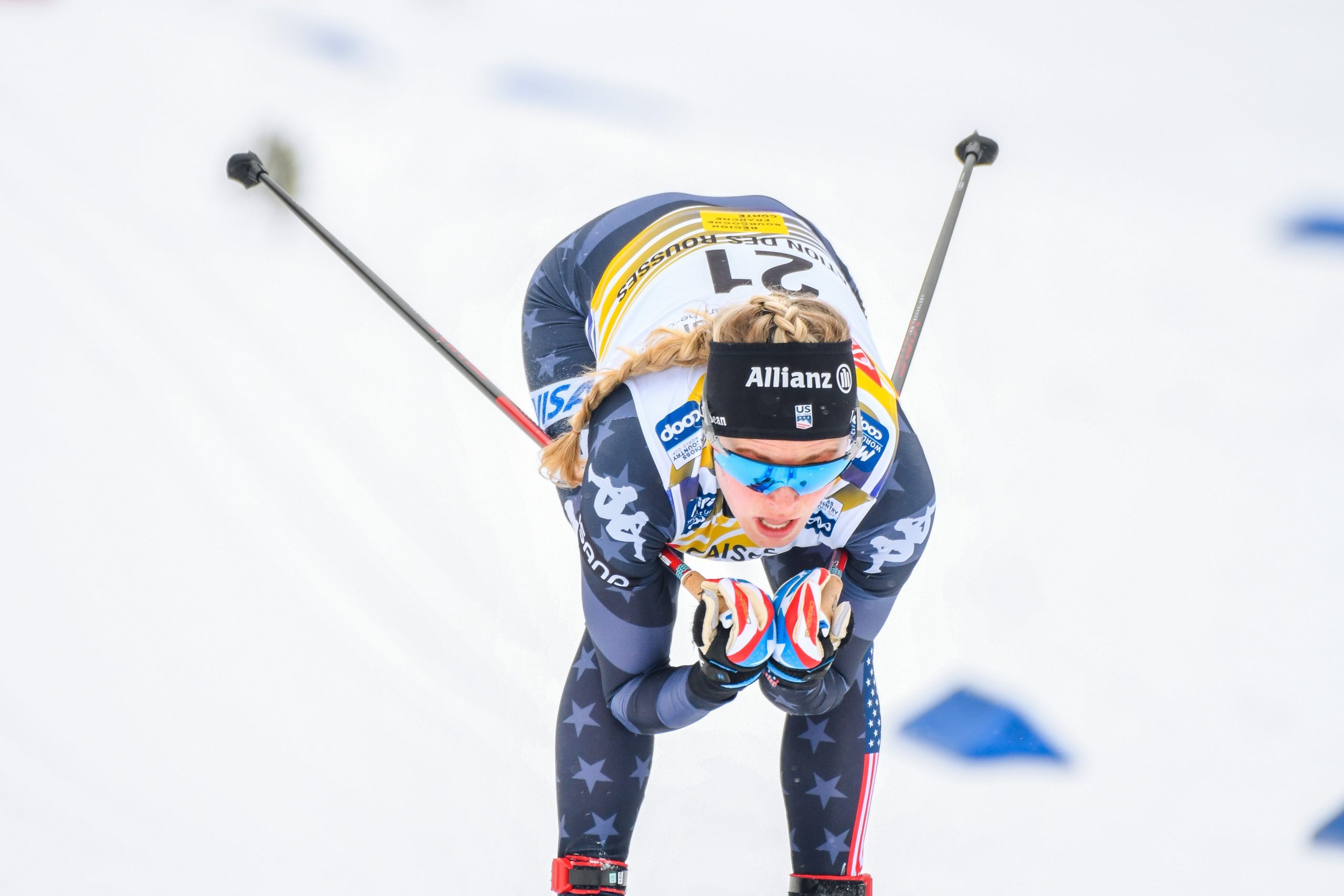
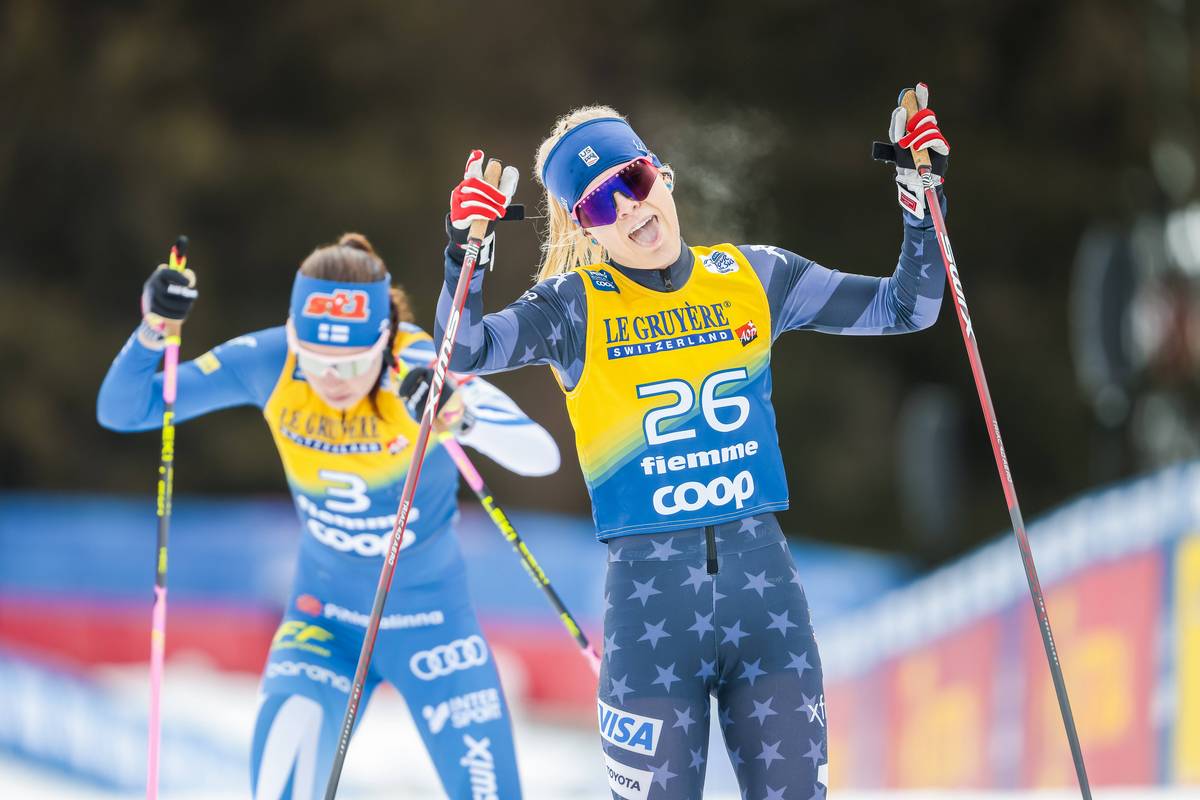
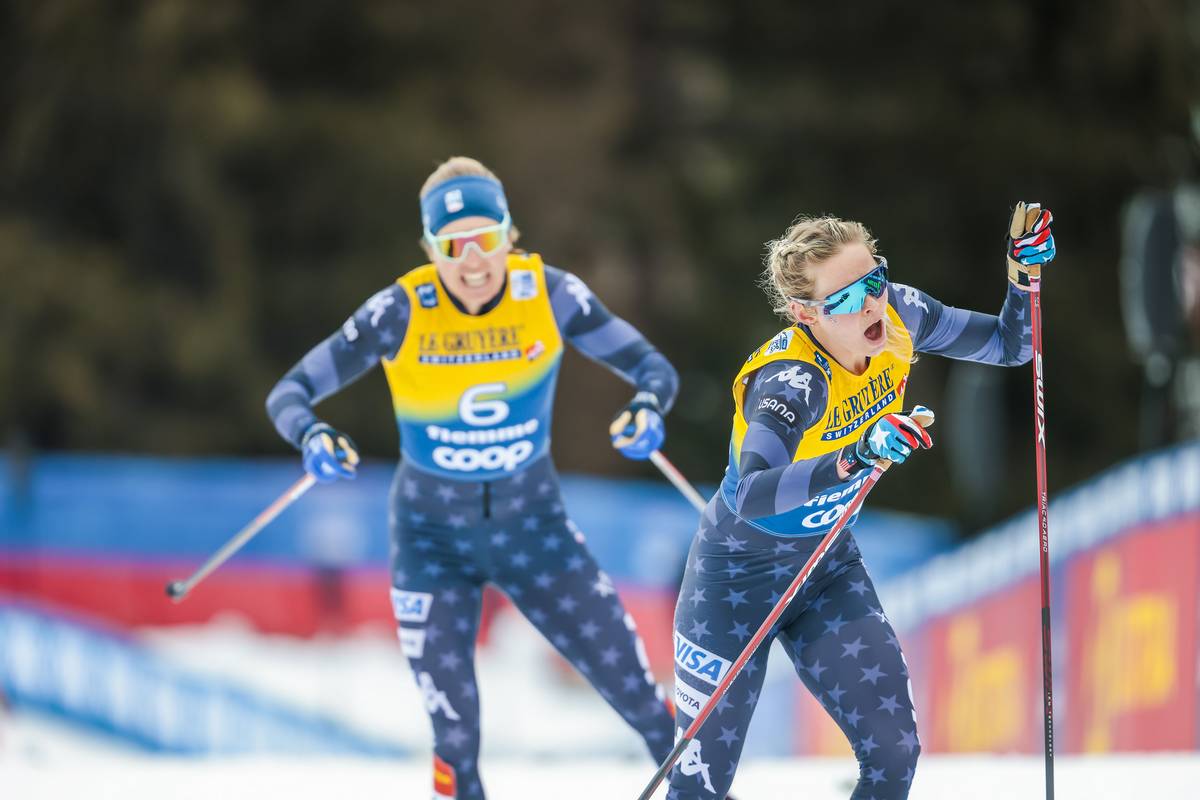
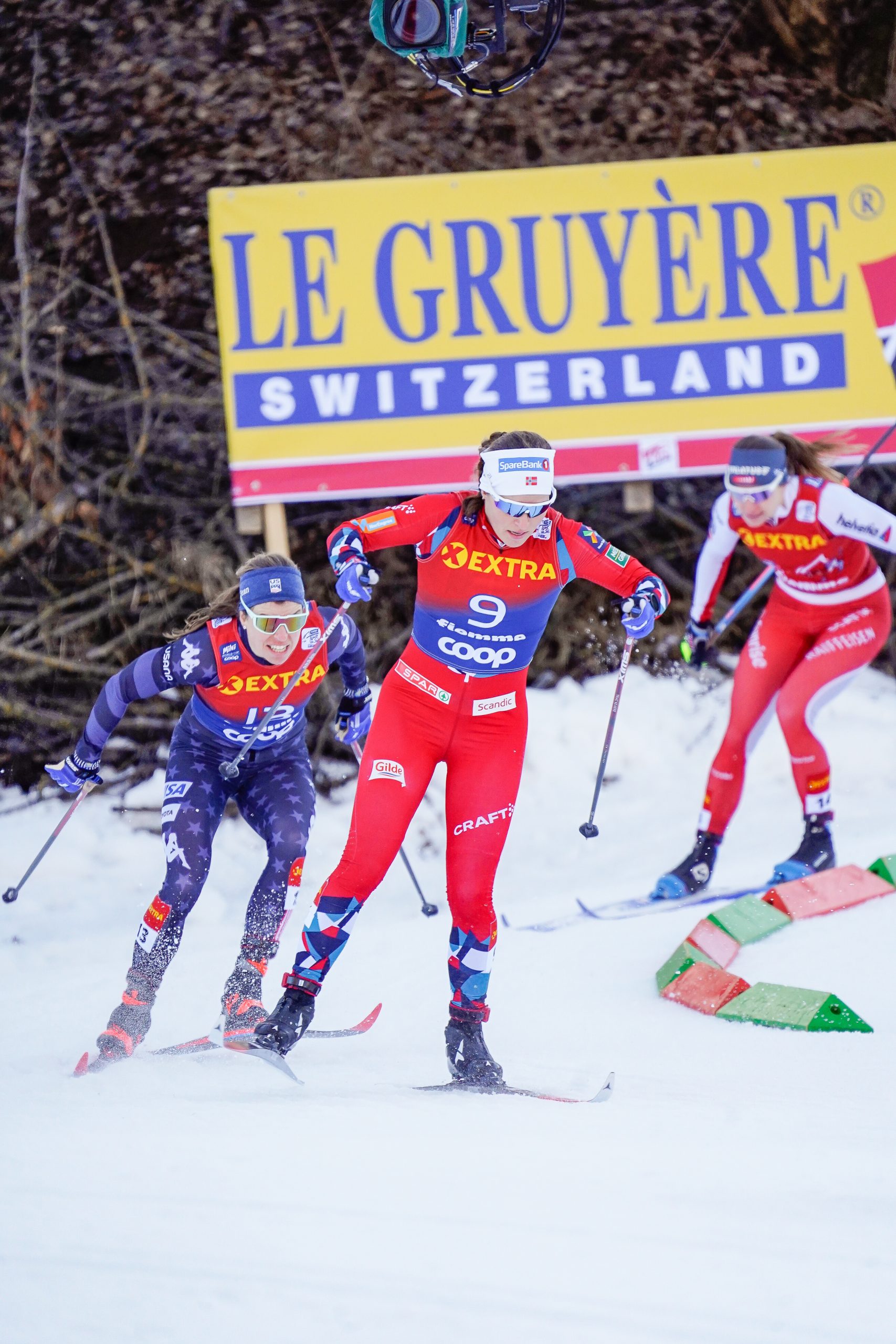
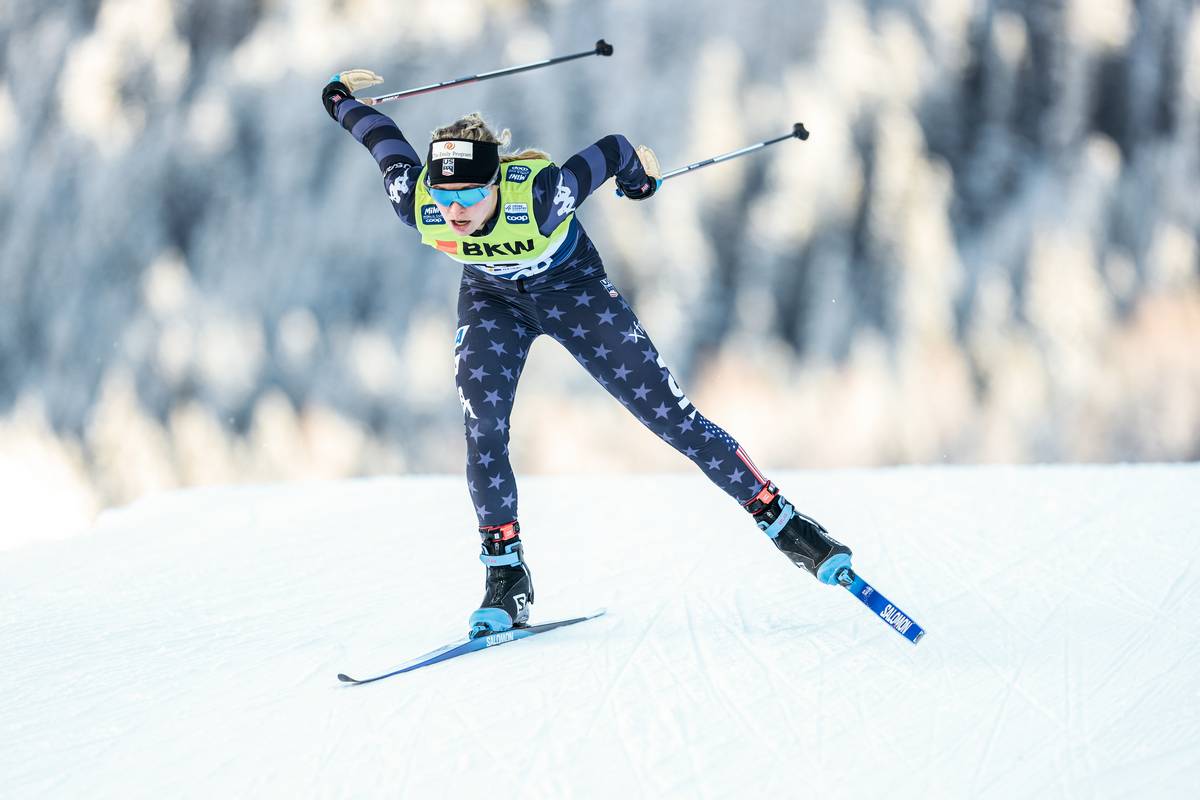
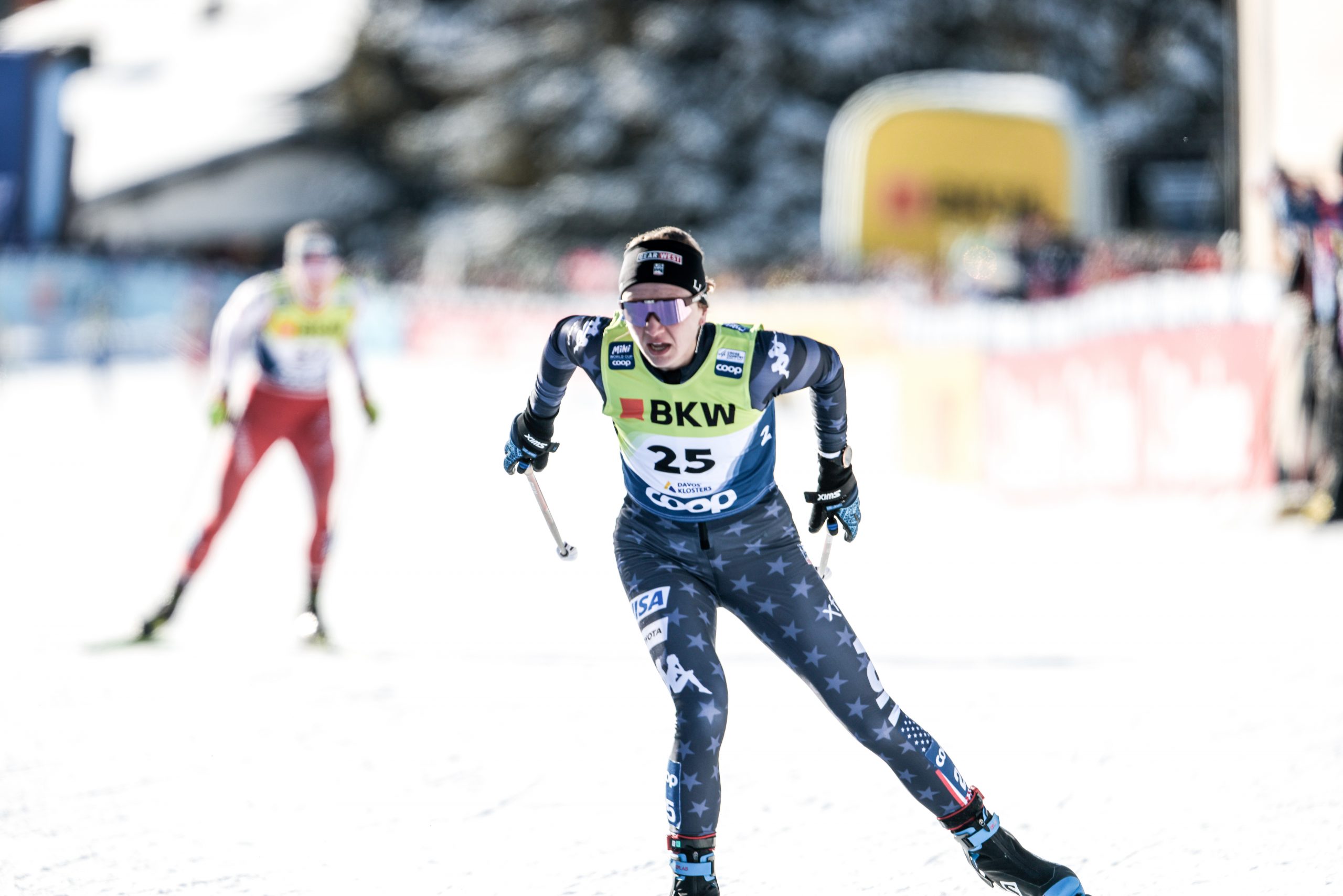
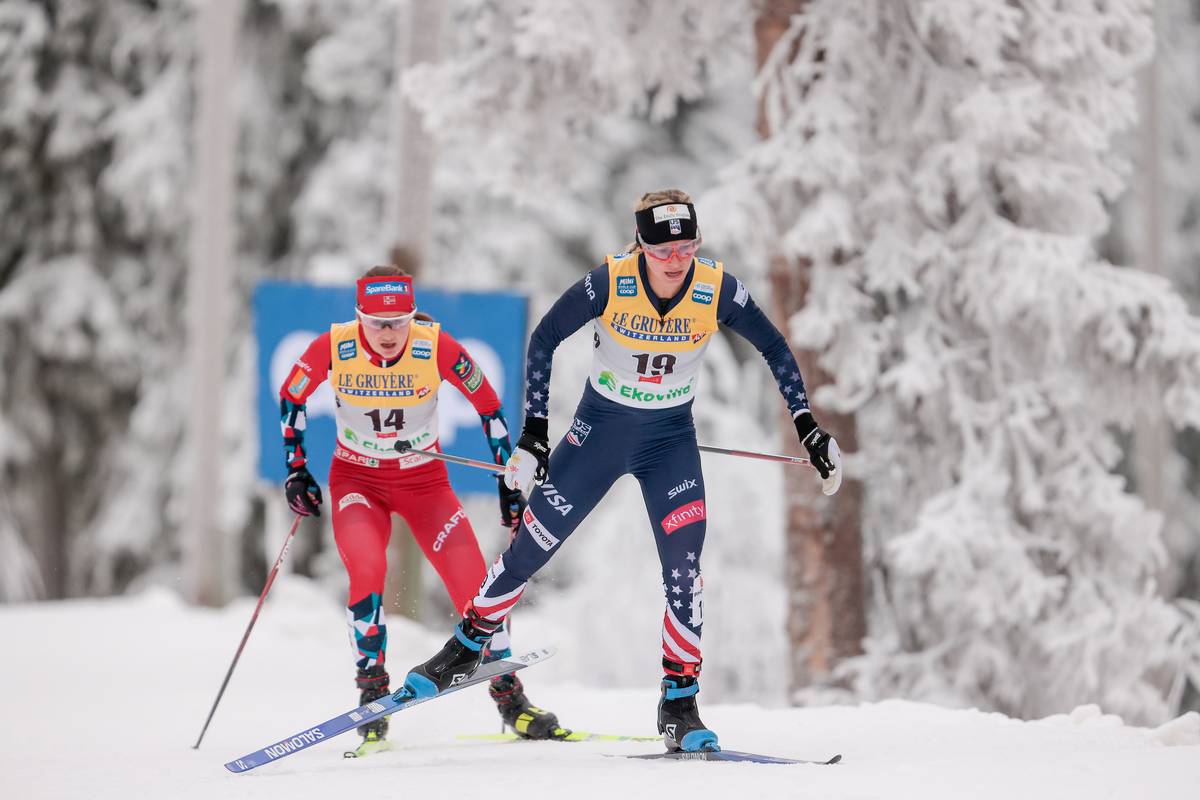
Jessie Diggins (USA) just before tangling her skis and veering off course in the Les Rousses World Cup Sprint qualifier. (Photo: NordicFocus)
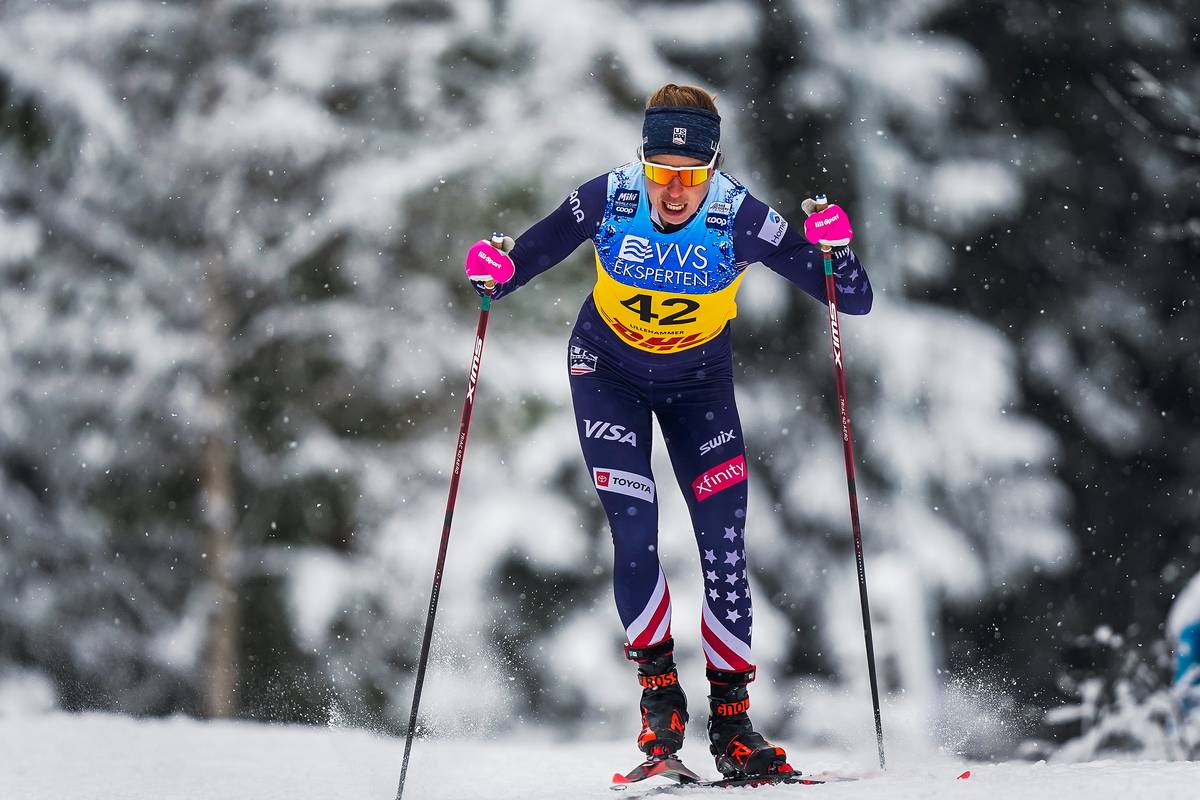
The day for American contender, Jessie Diggins, certainly took a wrong turn, as she veered off course in qualifying and failed to advance to the quarterfinals. After yesterday’s podium, it appeared that Diggins’ struggles were behind her, but today’s performance was surely not what had been hoped for. In the qualifier Diggins said that while navigating a curve she stumbled, caught an edge and actually went off the course. She continued that, “Flying off into the field and doing a little ski-cross powder racing definitely wasn’t part of the sprint plan today.” She emphasized that she was not injured. She managed to keep her balance and finished the qualifier.
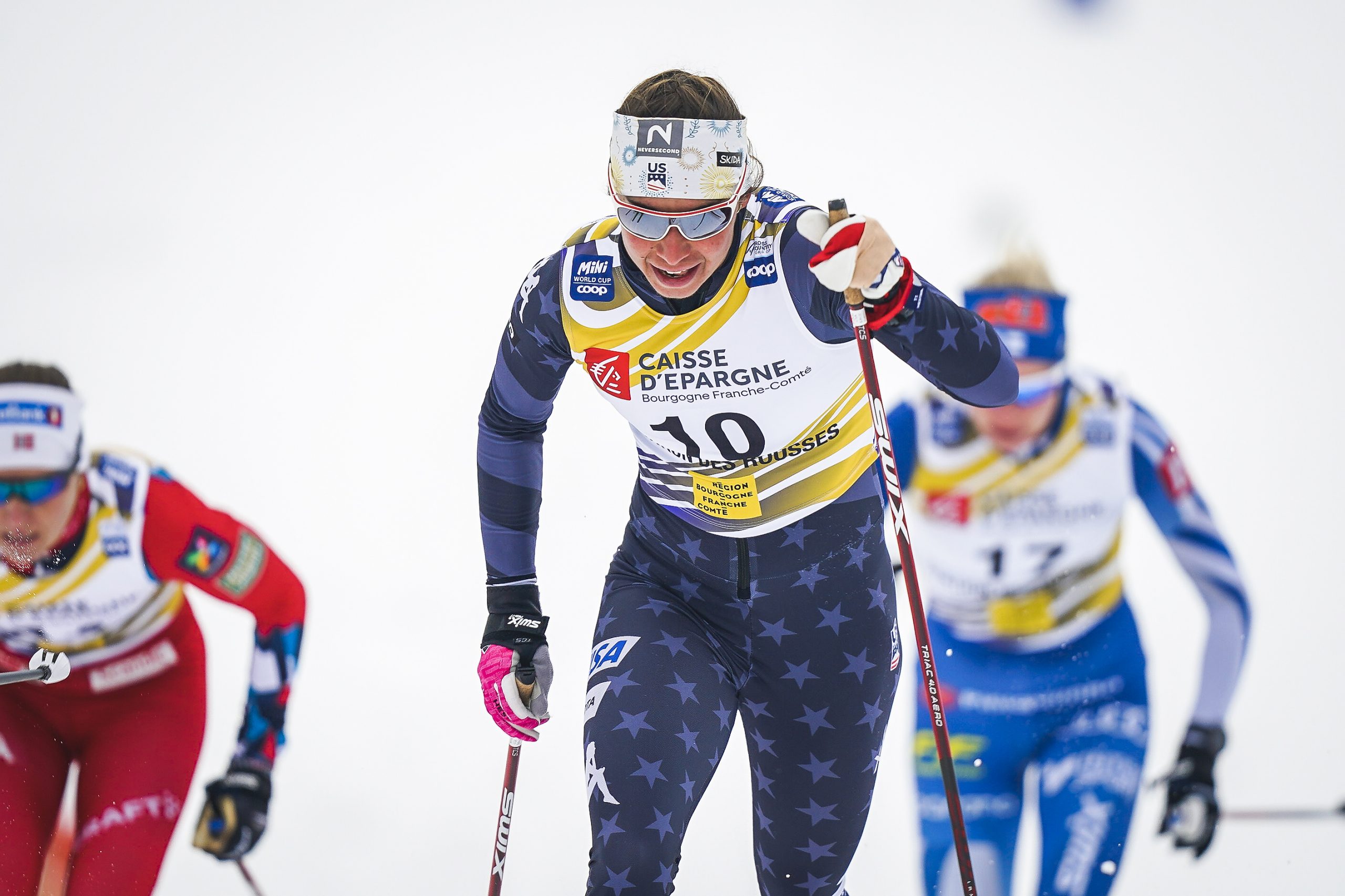
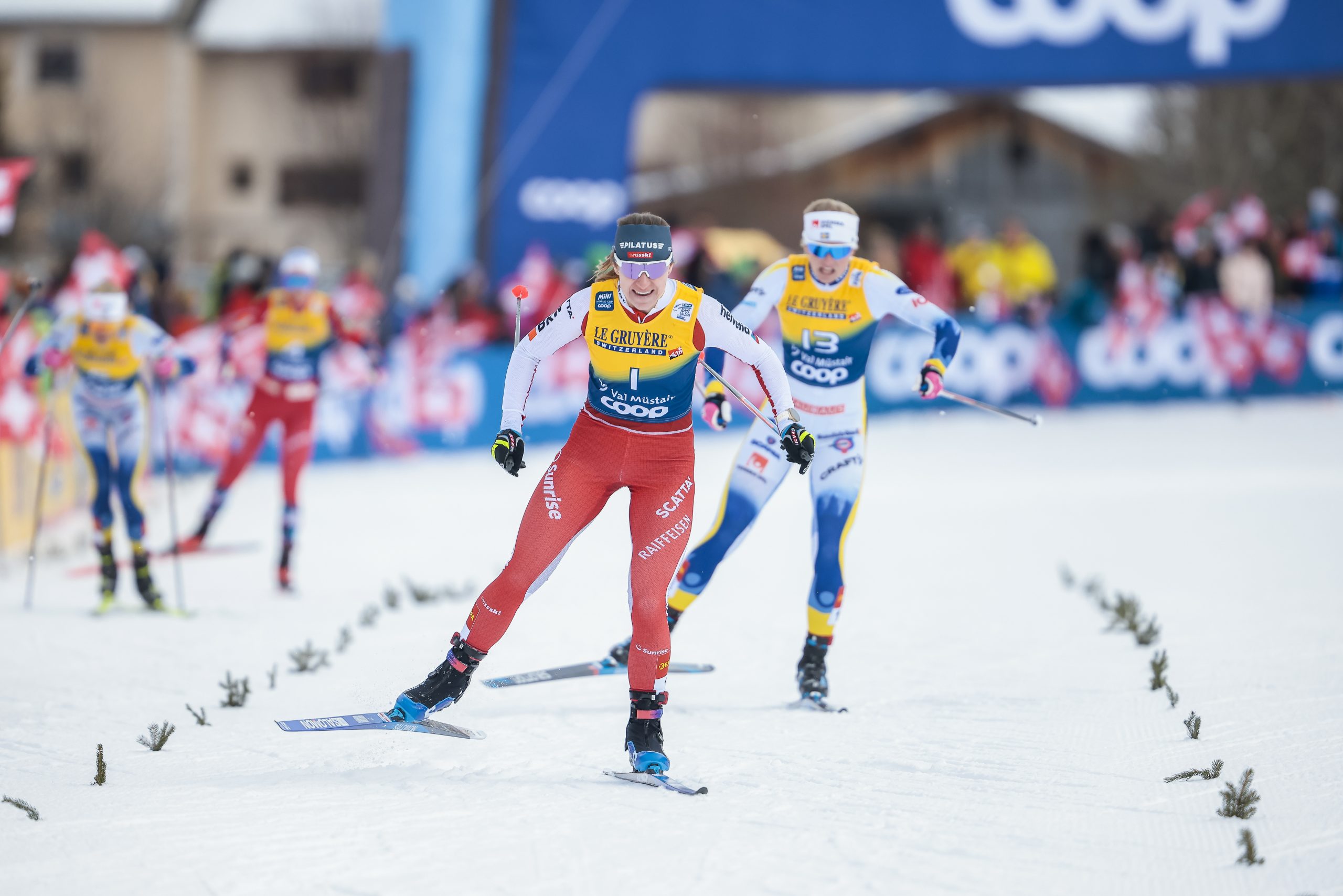
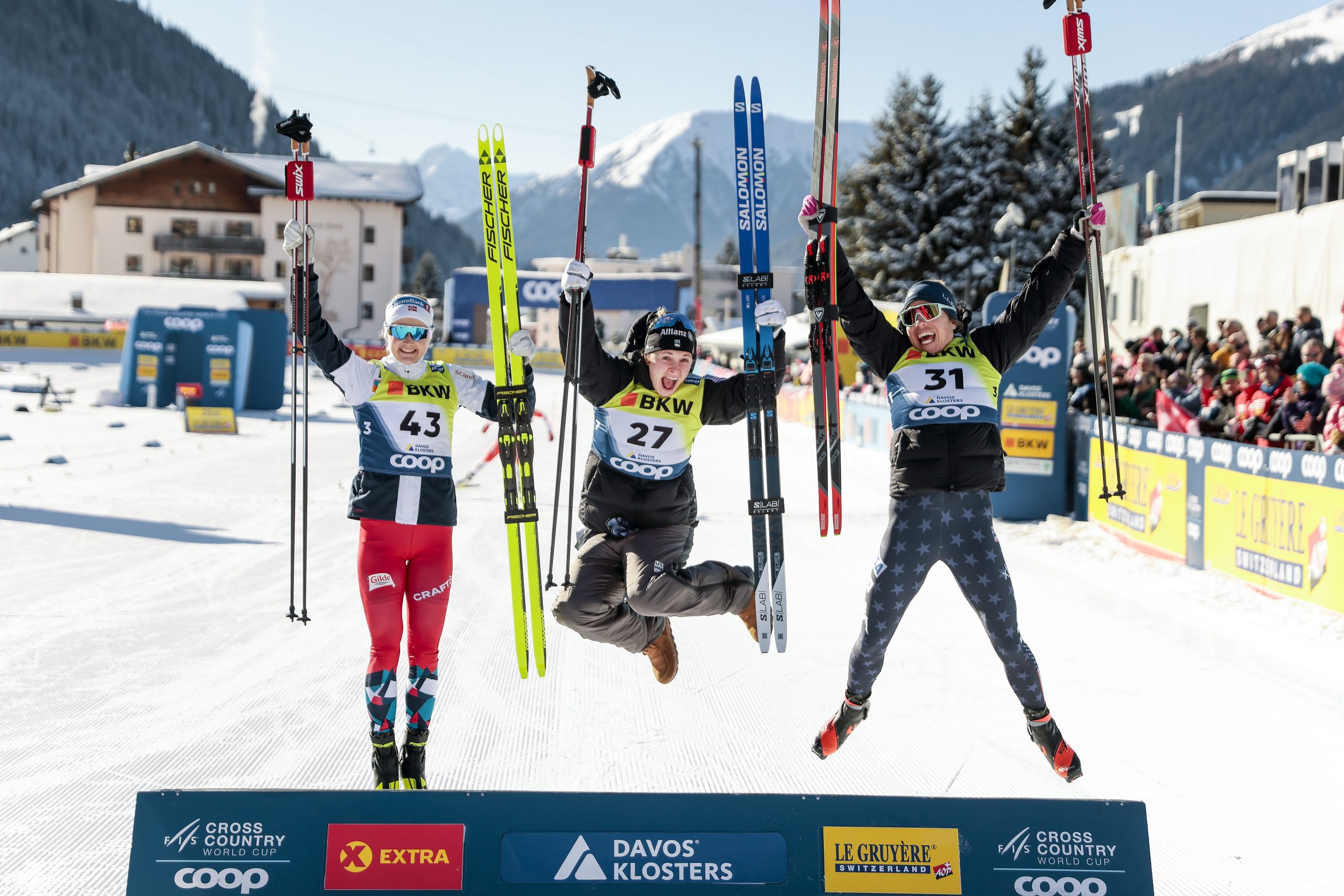
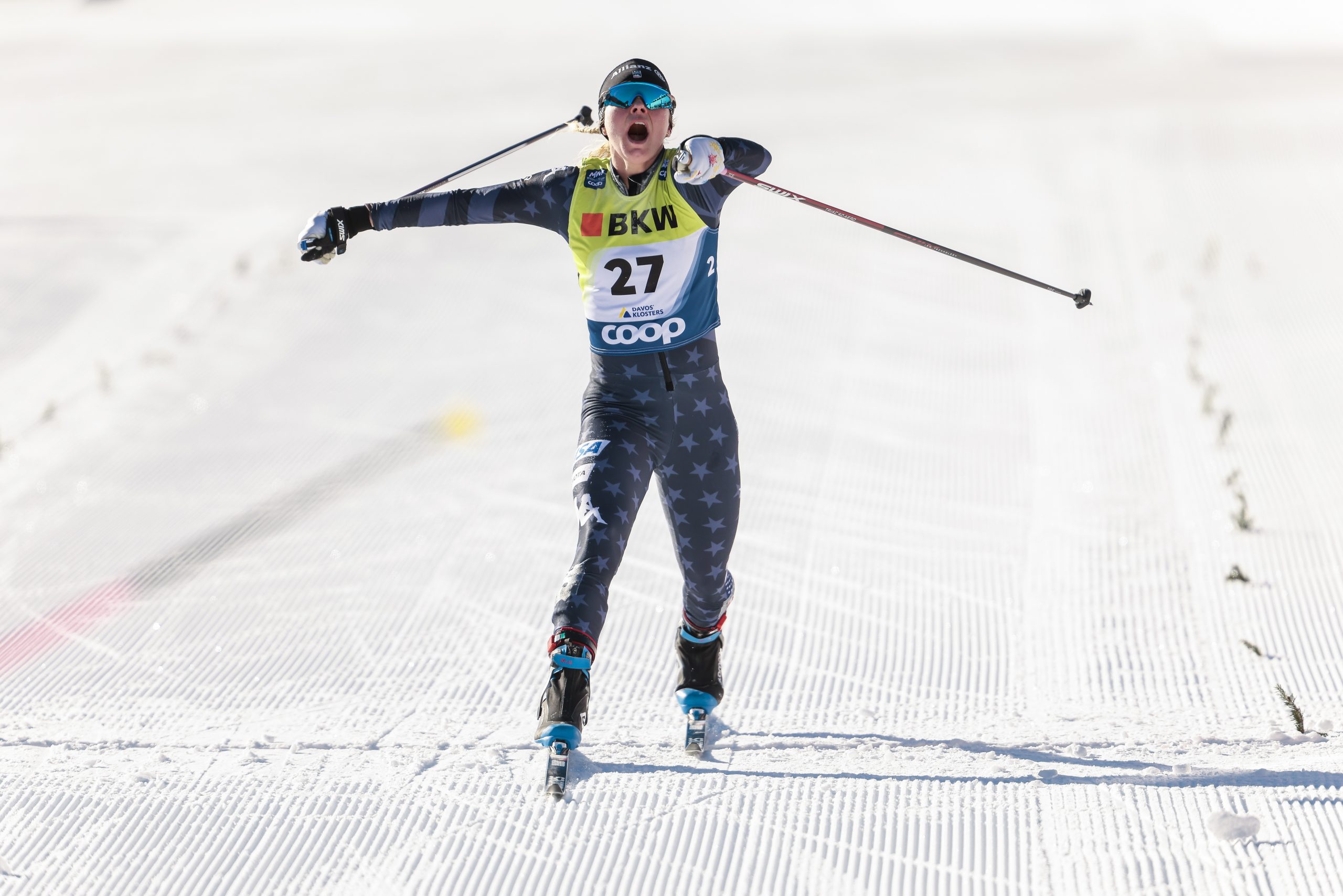
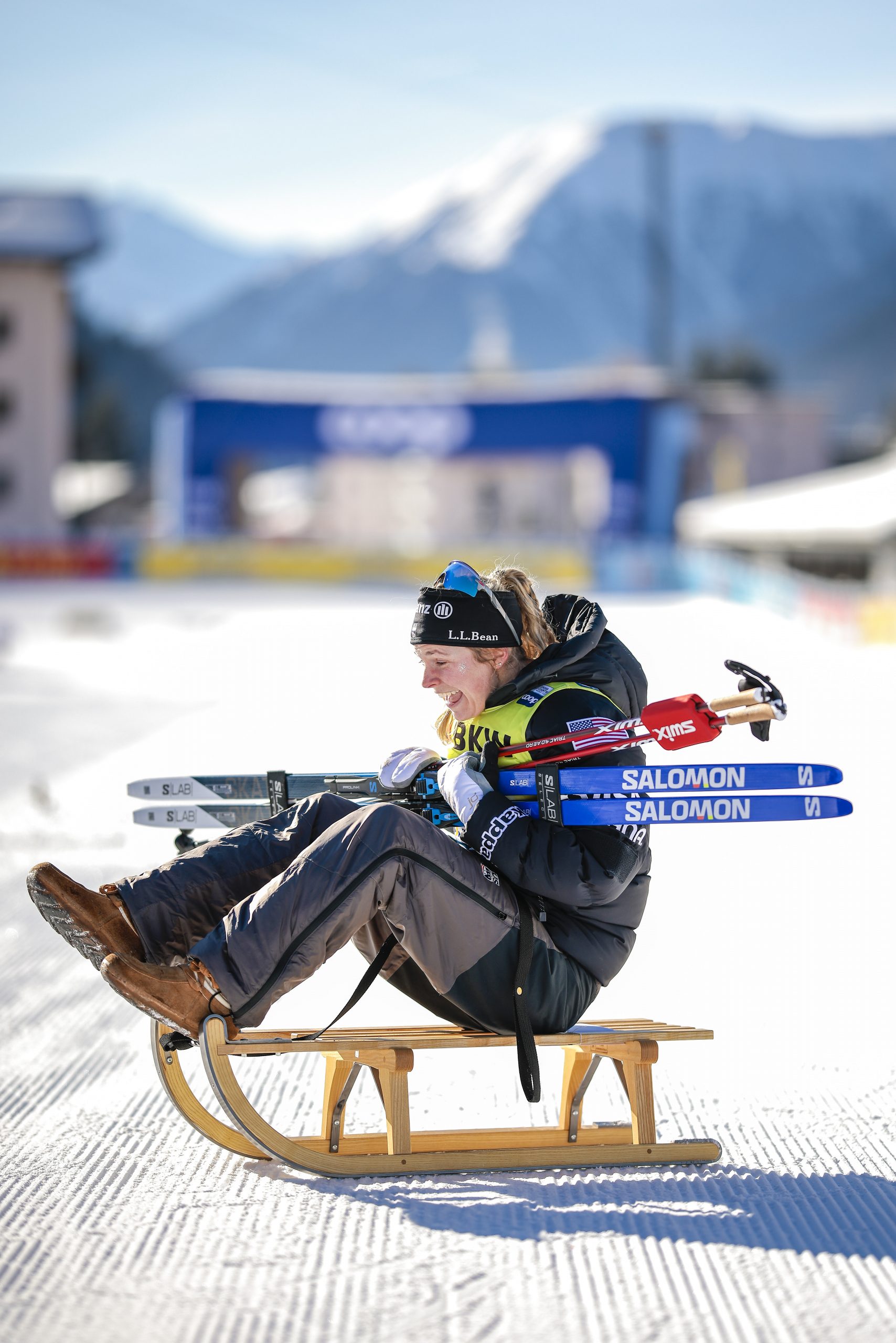
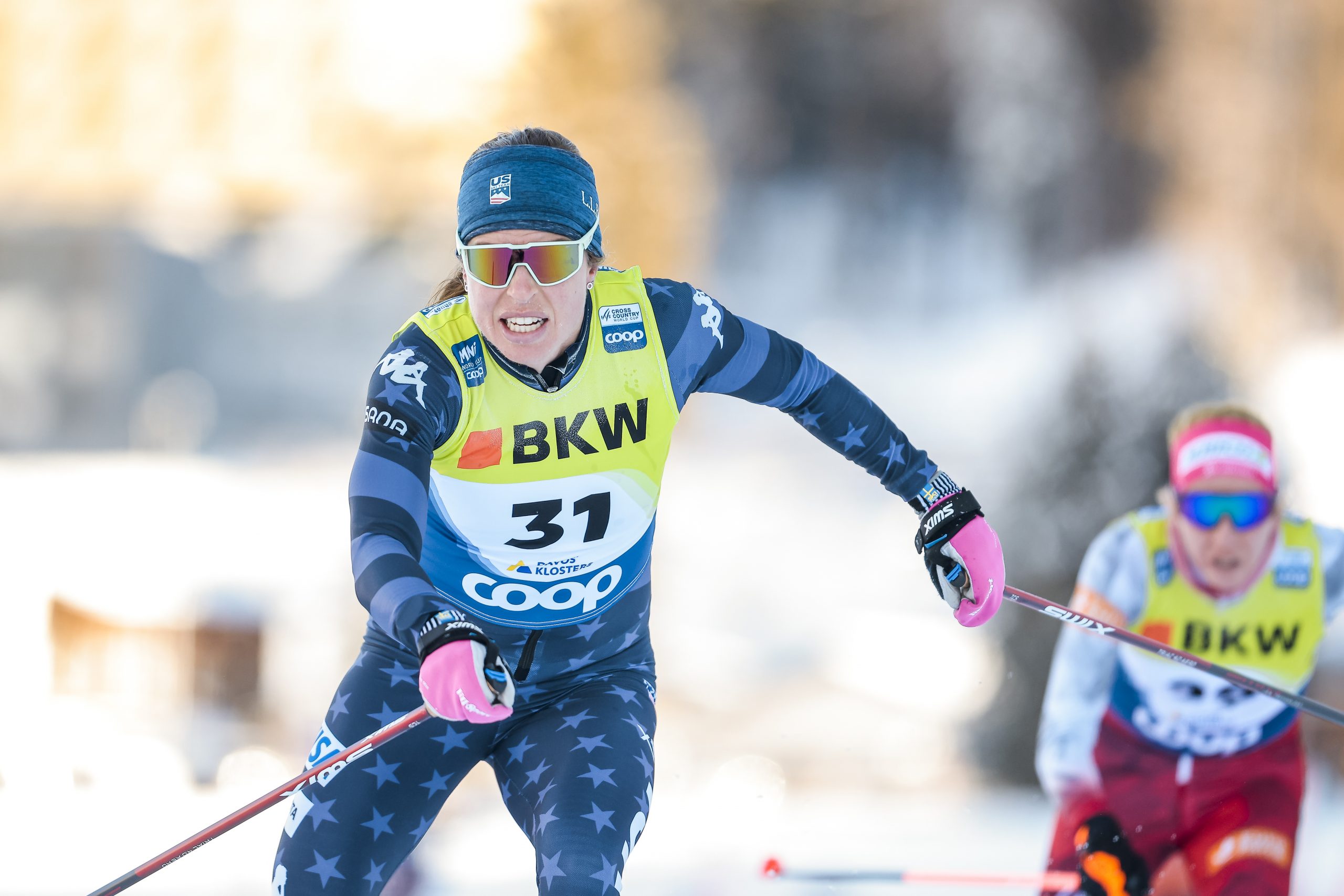
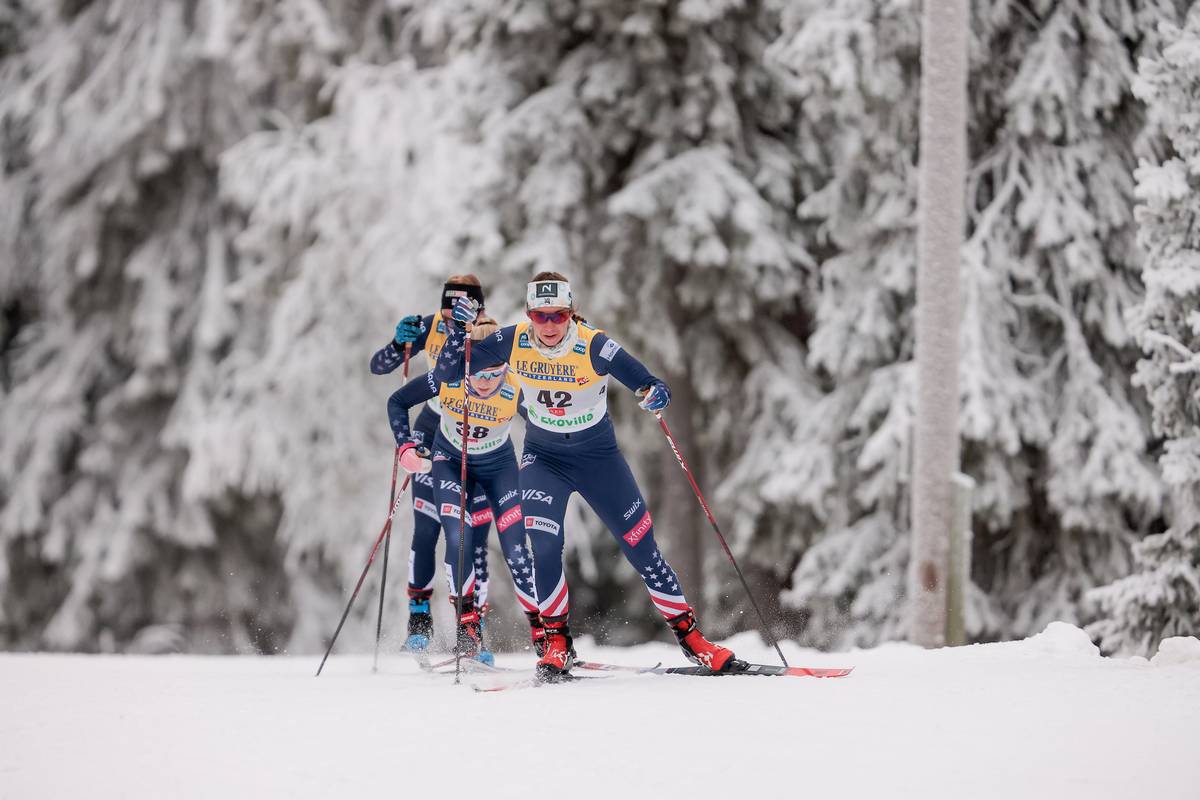
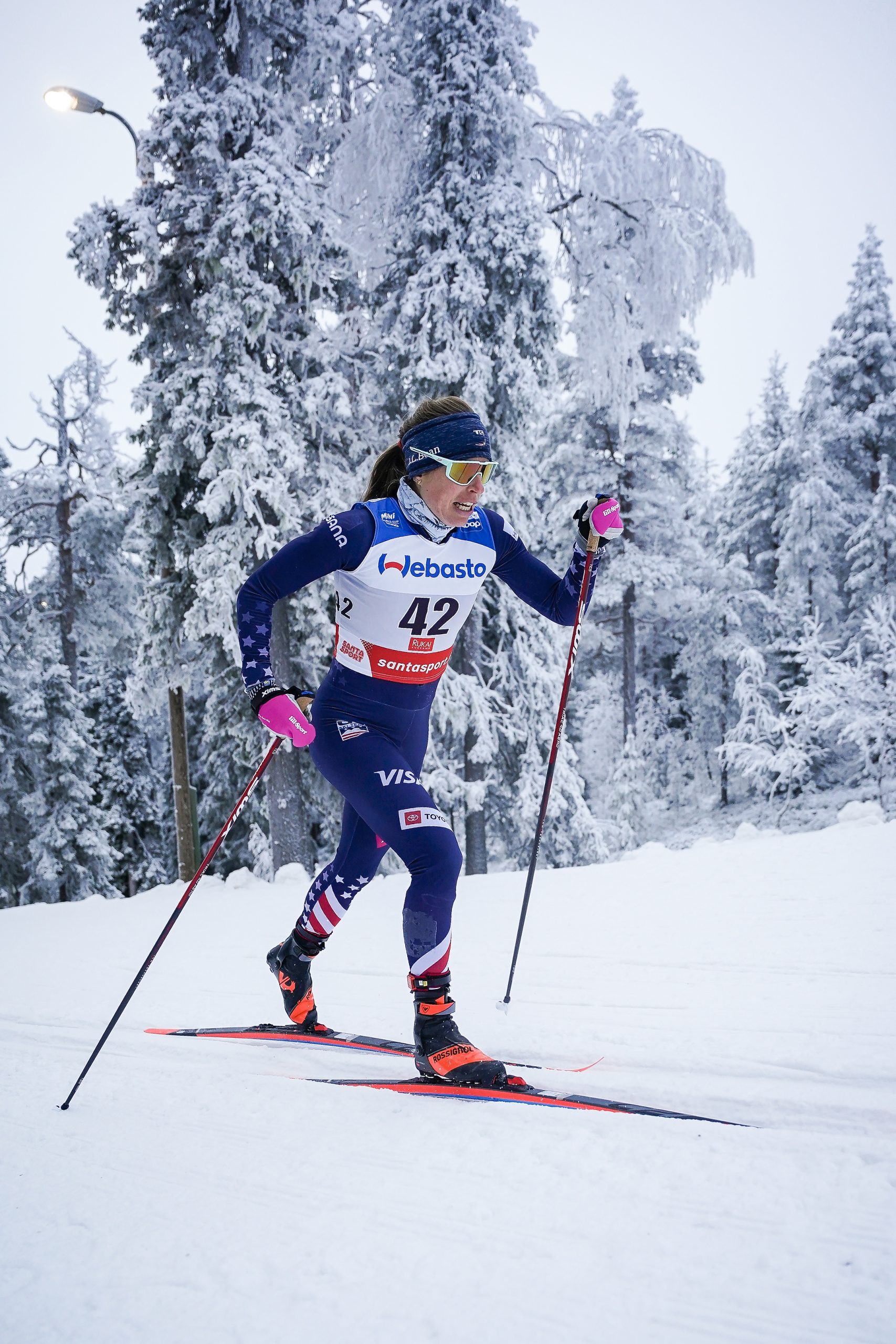
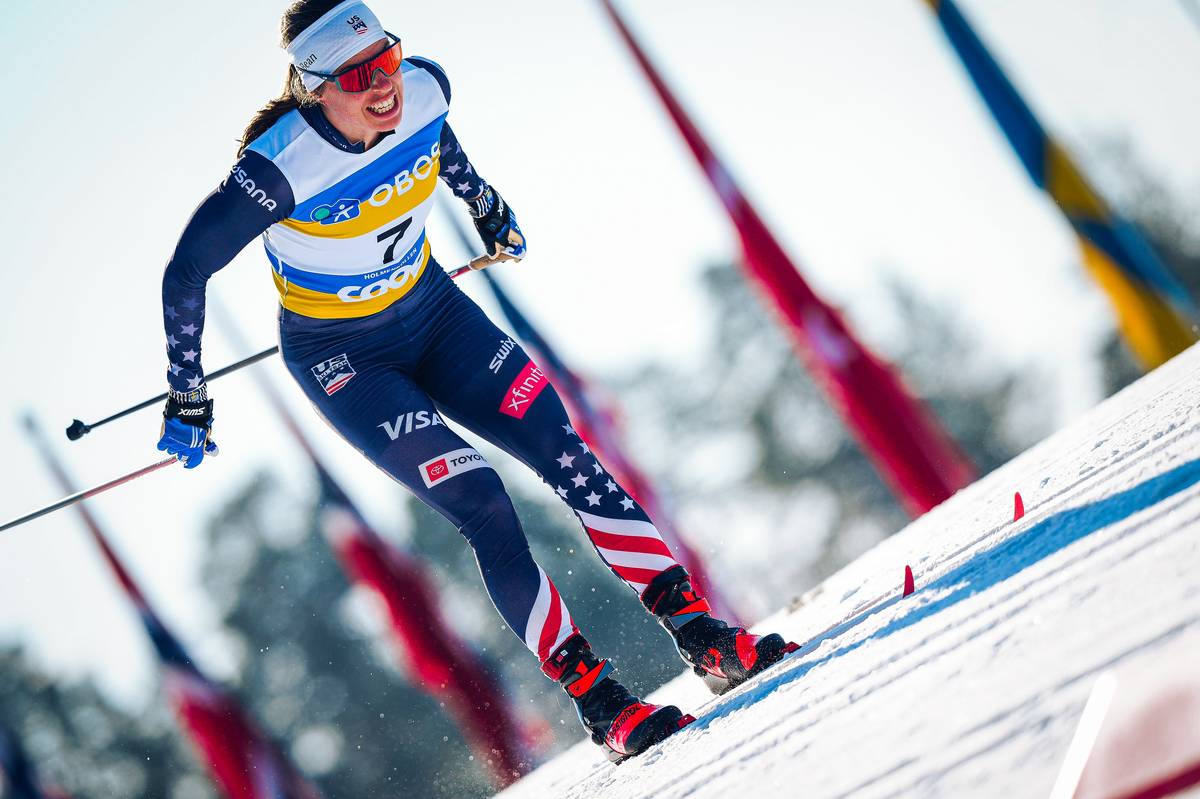
American Julia Kern finished fifth, despite recently needing stitches on her thumb from an accident while cutting cheese. Tape across her gloved hand could be seen throughout the day. She told FasterSkier that she was cutting podium cheese from last weekend when her Swiss Army knife slipped and “Took a chunk out of my thumb. It resulted in having to do a bit of a jury-rigging with my pole strap.” It was a gutsy performance by Kern who even needed help tying her laces. American coach Kristen Bourne shared with FasterSkier that there had been concern about Kern’s thumb in advance of the race, but that everyone was satisfied that she could ski without injuring herself. “She worked with our team doctor and had it taped,” Bourne said. “She wasn’t having any pain…we felt confident that she’d be able to handle it.”
Rosie Brennan (USA) failed to advance out of her heat (finishing the day in 17th). After the race, Brennan commented that “I have such a love/hate relationship with sprinting, and today was a bit of the latter.” She continued that her heat “ended up being a little more than I had today, and I am frustrated by that as I feel I am a better skier than I was able to show today.”
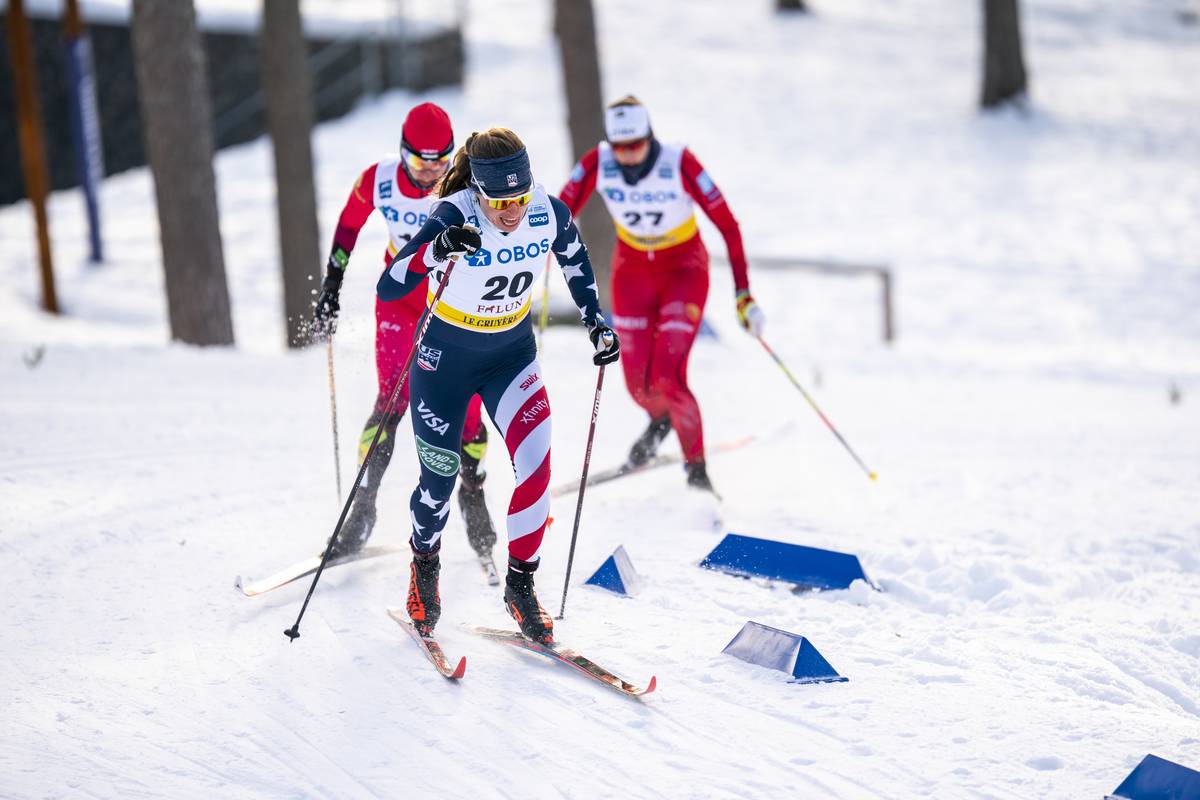
Recently returned from her triple-championship performance at US Nationals, Hailey Swirbul (USA) had an especially strong day, qualifying 18th and advancing to the semifinal. She would finish the day in 12th.
Other American finishers included Sonnesyn 33rd, Lawson 36th, and Jortberg 39th. Nordiq Canada entered no skiers in the Les Rousses sprints.
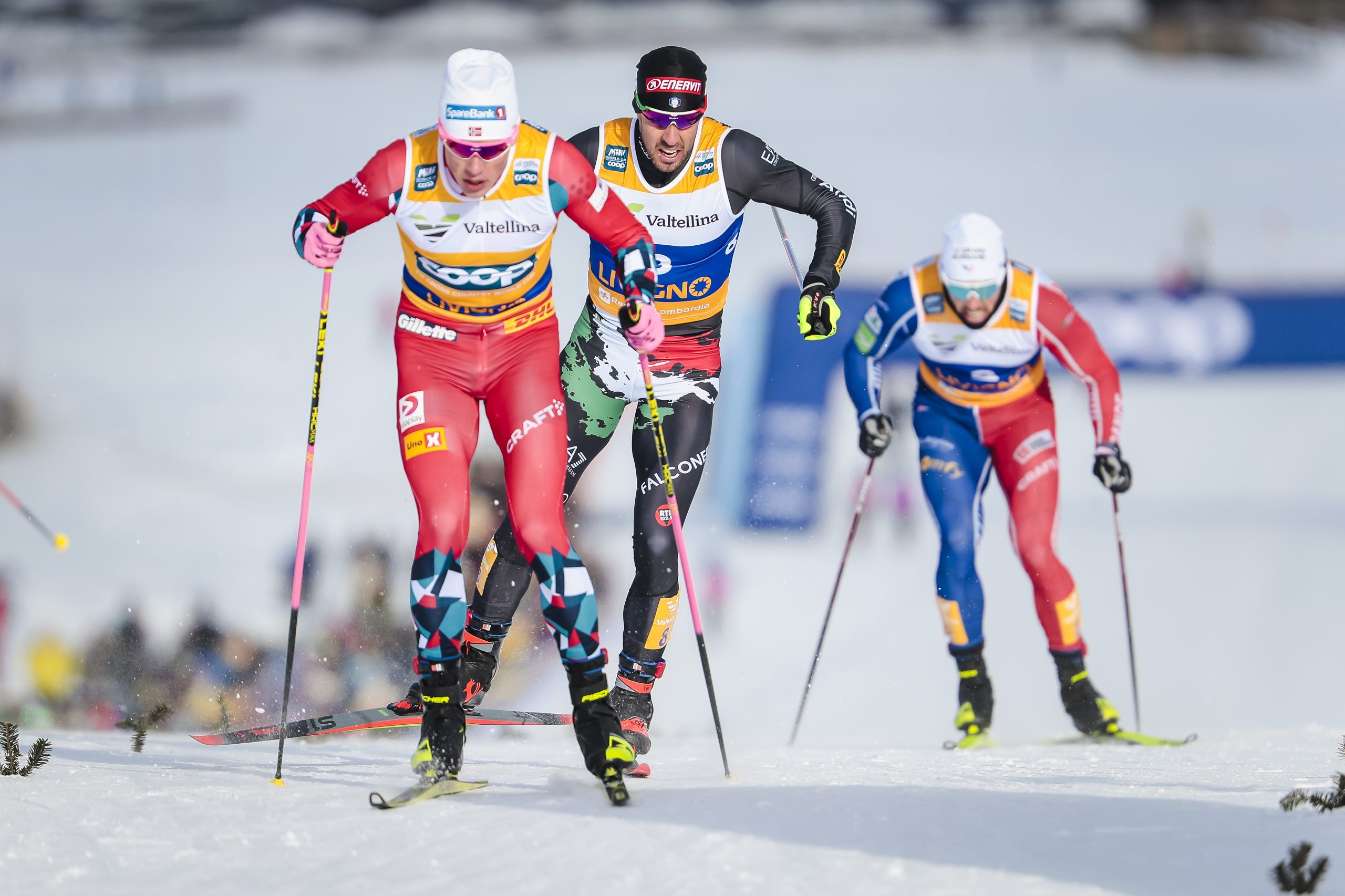
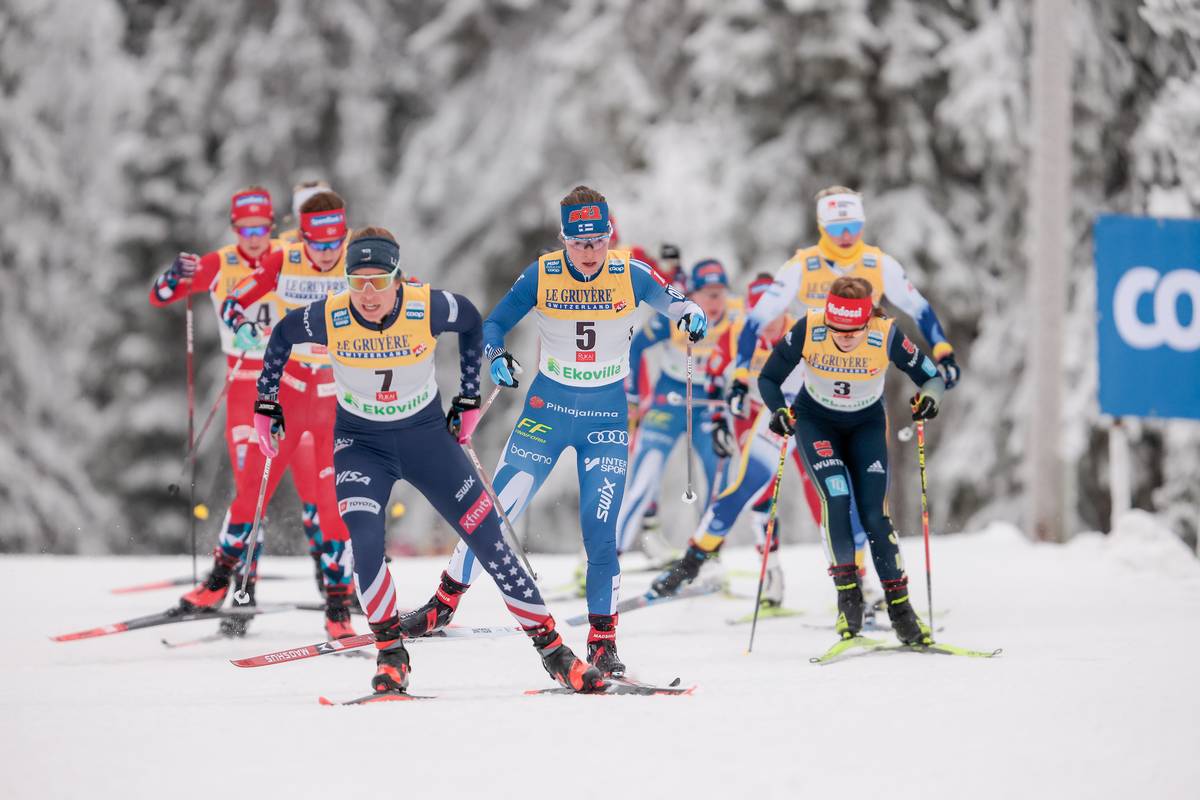
Julia Kern working her way to the finals with her bandaged thumb clearly visible (Photo: NordicFocus)
Women’s Classic Sprint
Coming into the race, there were several themes that emerged:
Would the Swedish women’s sprint team, now mostly healthy, be able to continue to reassert its dominance? Sweden swept the podium last week, in a freestyle sprint, with familiar names re-establishing themselves.
How would the Norwegians fare with Tiril Weng on the sidelines still recovering from illness? At the last classic sprint race, held in Val Di Fiemme, Italy, Norway swept the podium. Tiril Udnes Weng, currently first in the overall World Cup standings, could afford to sit things out since the woman in second place overall, Frida Karlsson (SWE), also was not racing. Joining those on the sidelines was Nadine Faehndrich (SUI) the current World Cup sprint leader.
Then there were the questions surrounding the Americans: could a fully stocked U.S. team find its way onto the podium? With Jessie Diggins finding the podium yesterday and Rosie Brennan fifth, the Americans were poised to pounce. Joining the Diggins-Brennan one-two punch was Julia Kern, who has had an outstanding sprint season, currently fifth in sprint points. Rounding out the American team were Hailey Swirbul, who is recovered from illness and coming off winning every race at the U.S. National Championships, Lauren Jortberg, and Alexandra Lawson.
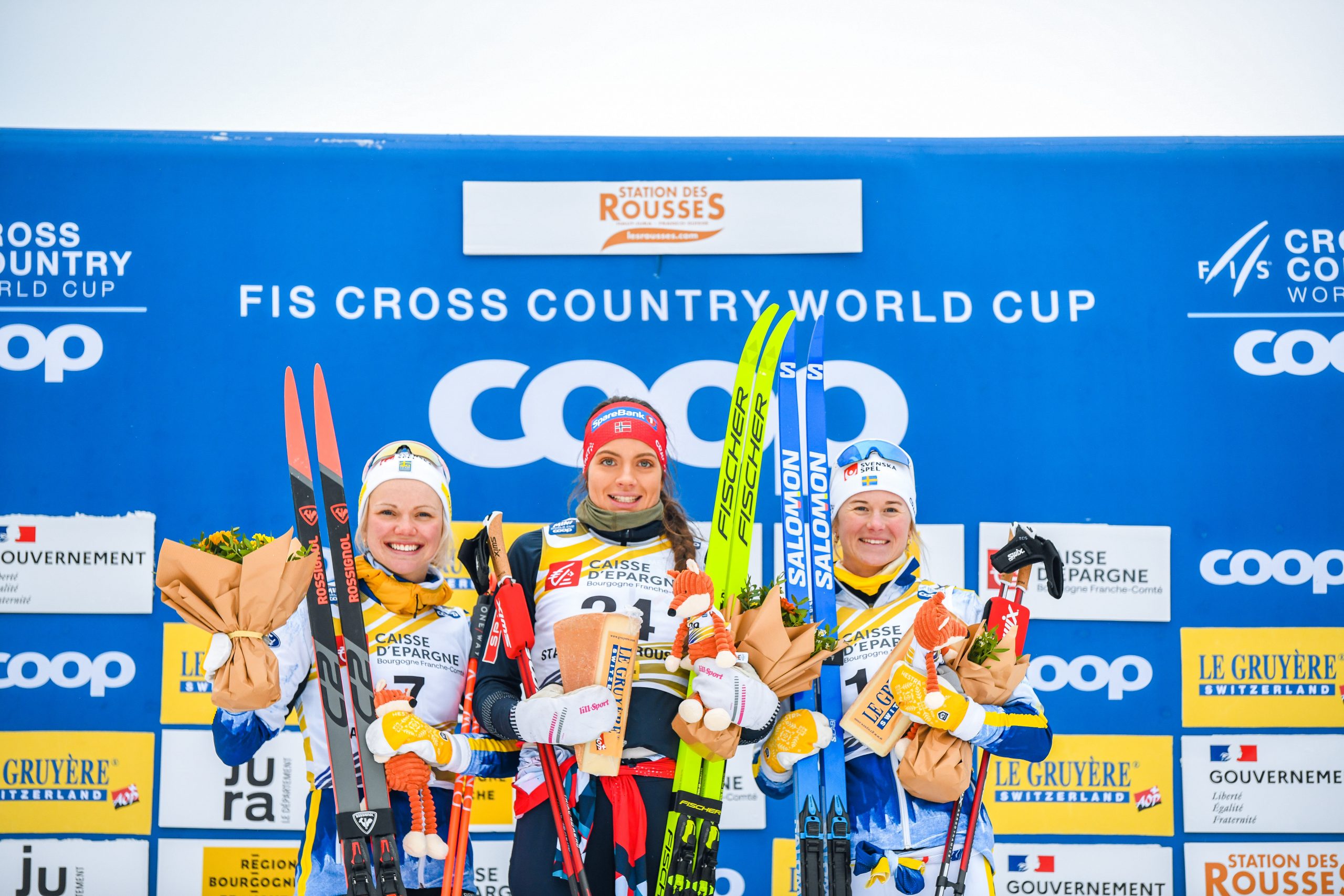
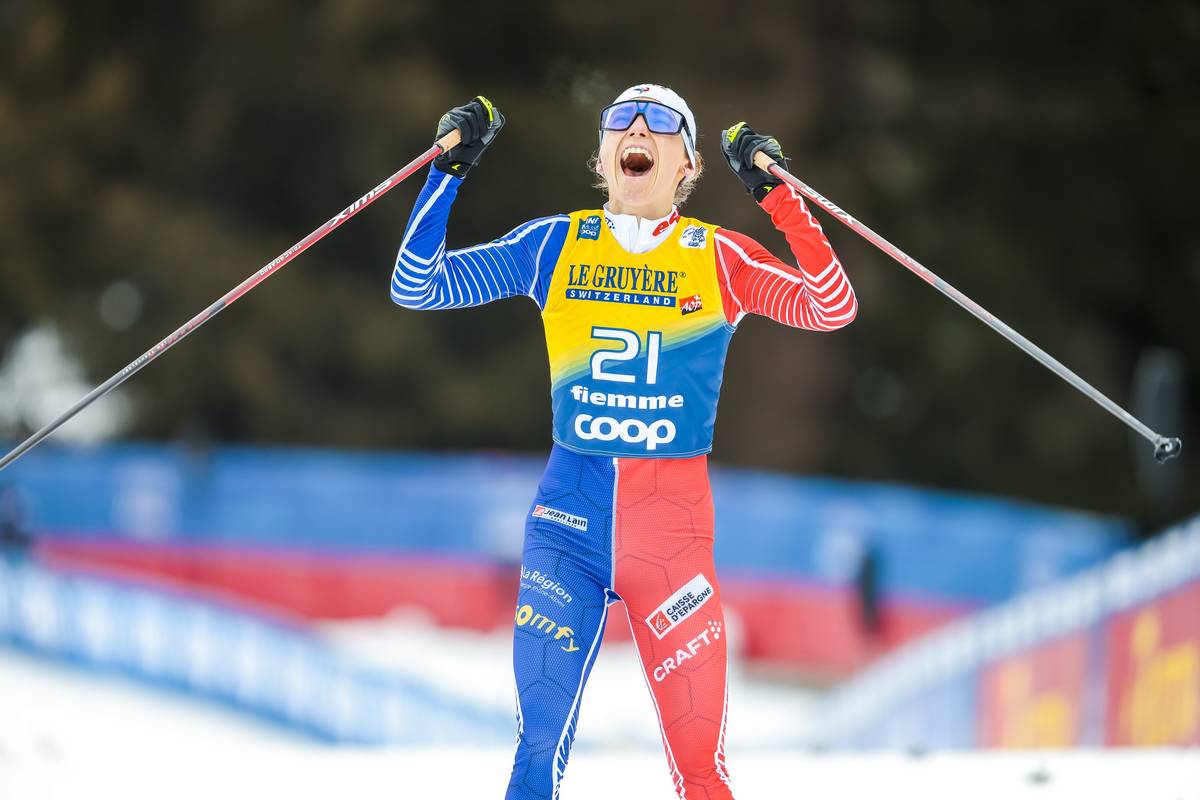
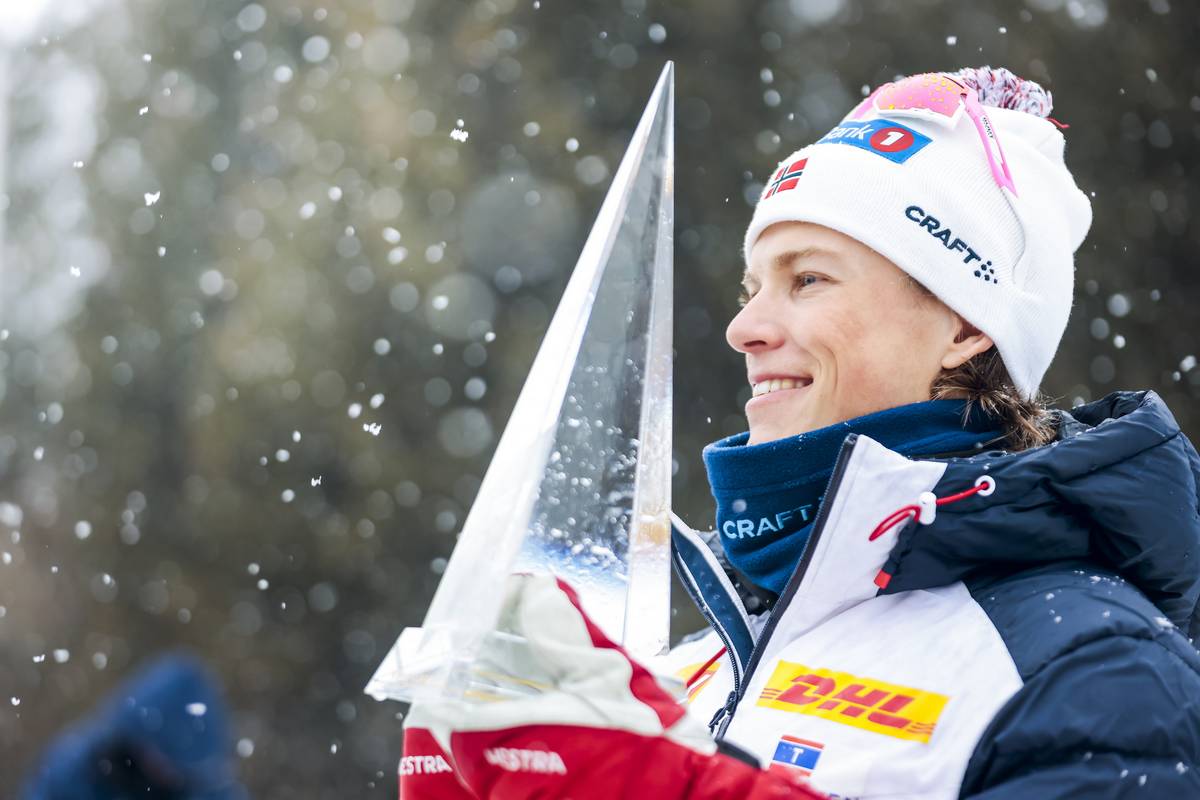
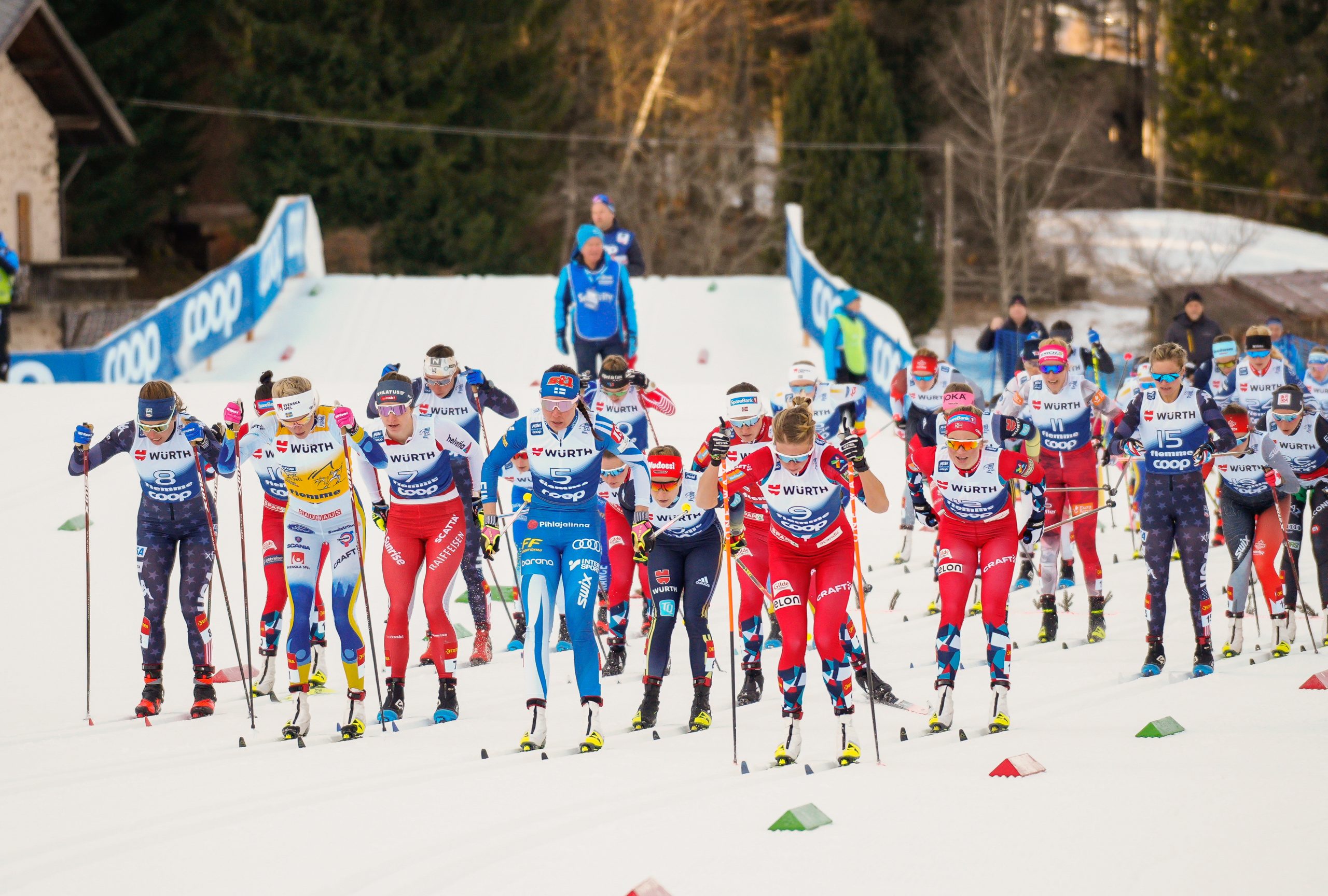
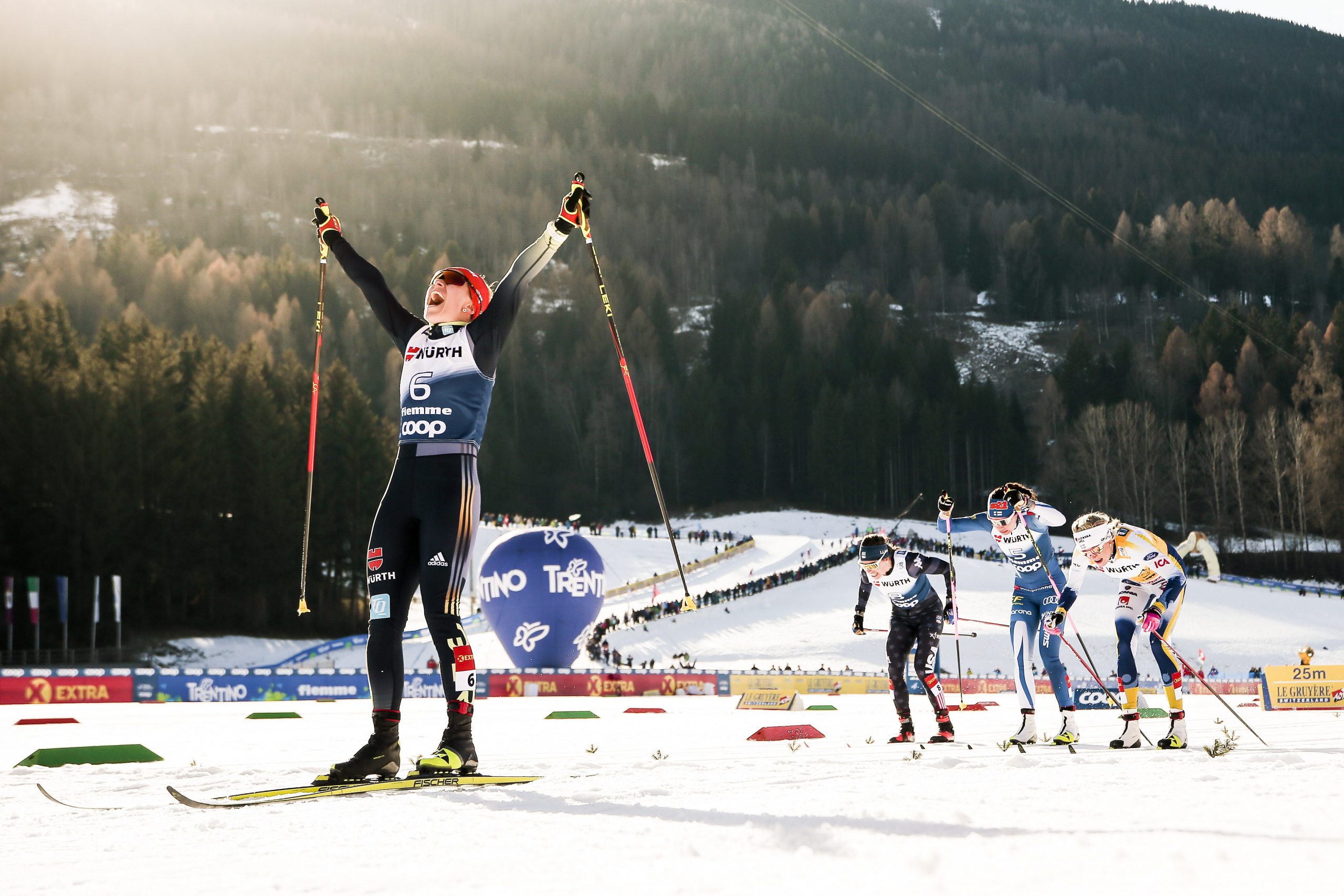
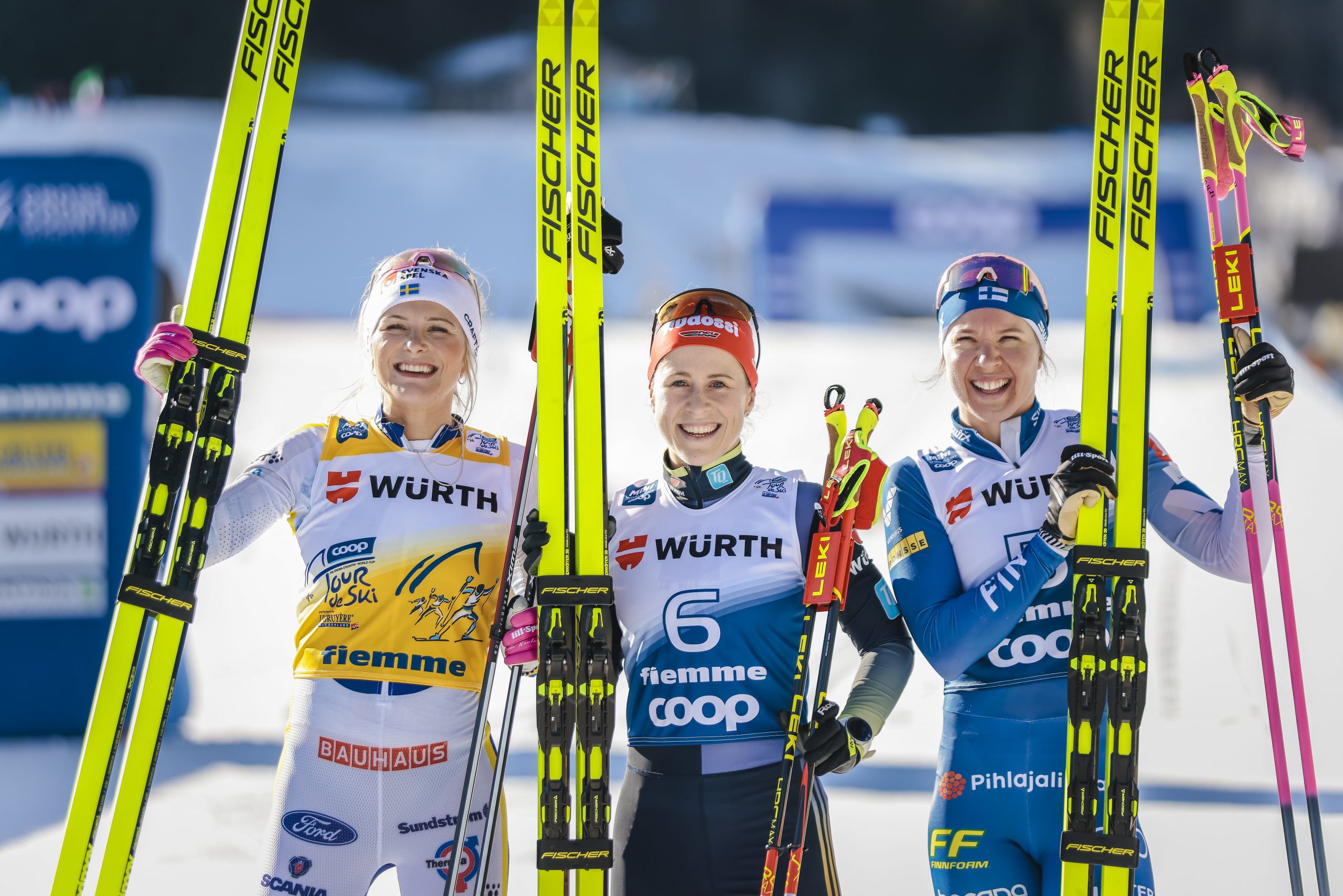
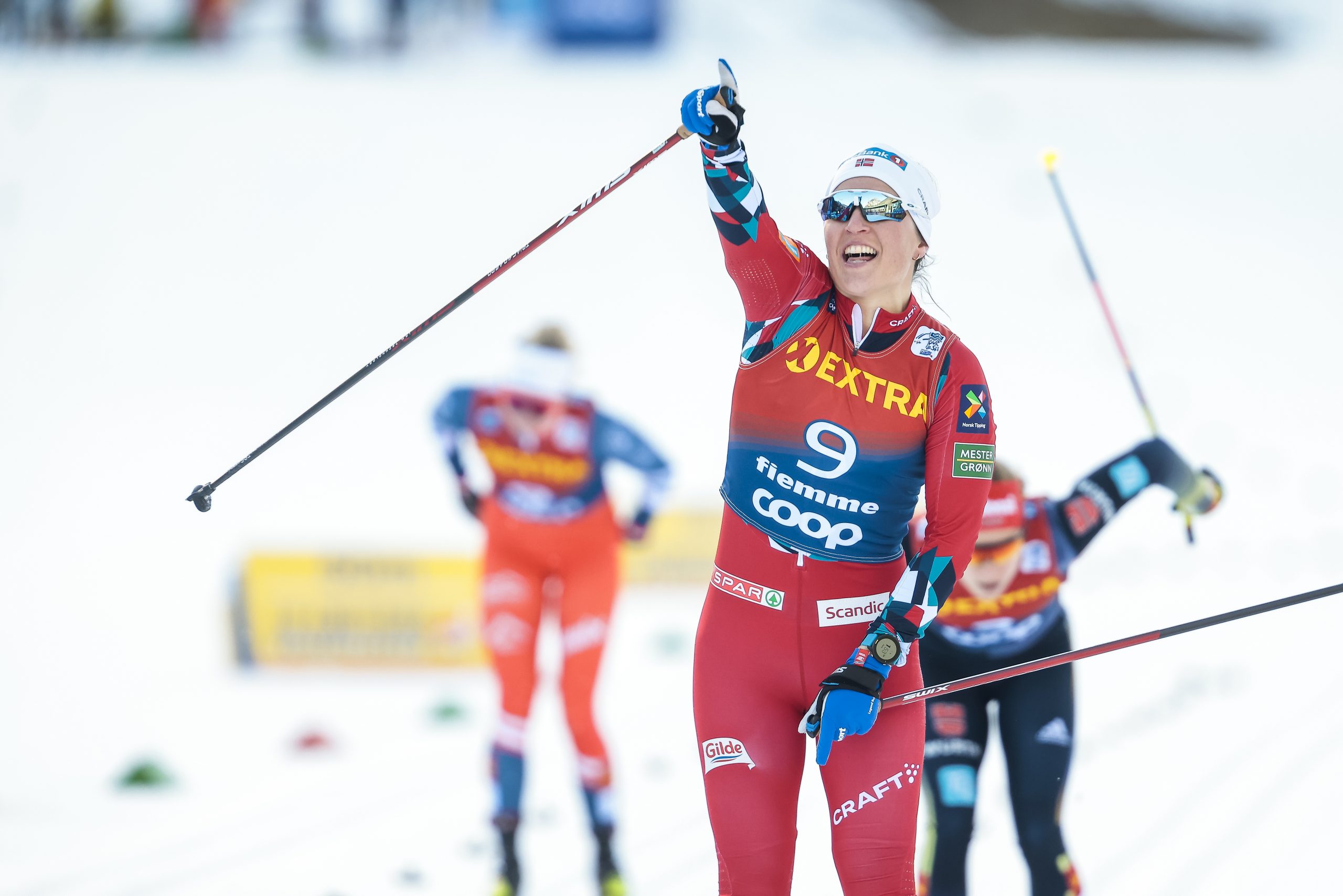
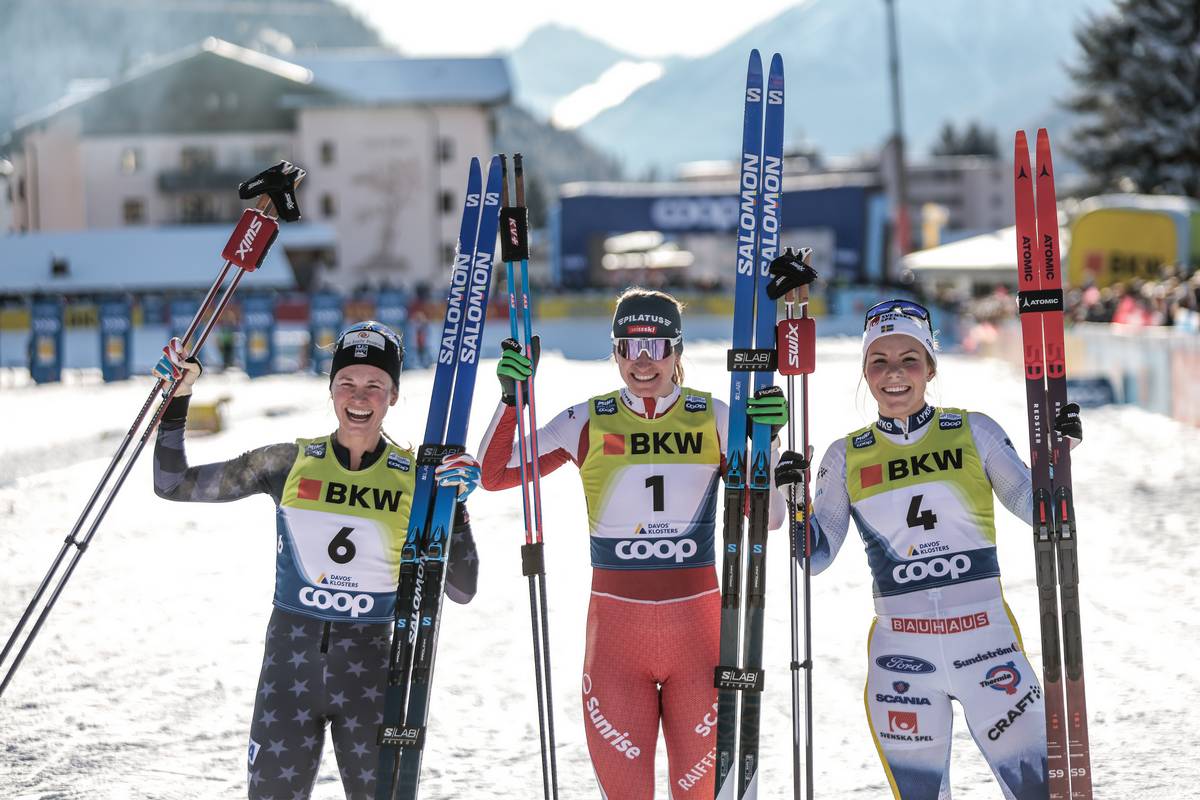
Norway proved it didn’t need its full team to win. Kristine Stavaas Skistad (NOR), who had qualified first, ended up taking the victory, followed by Emma Ribom (SWE) and Maja Dahlqvist (SWE).
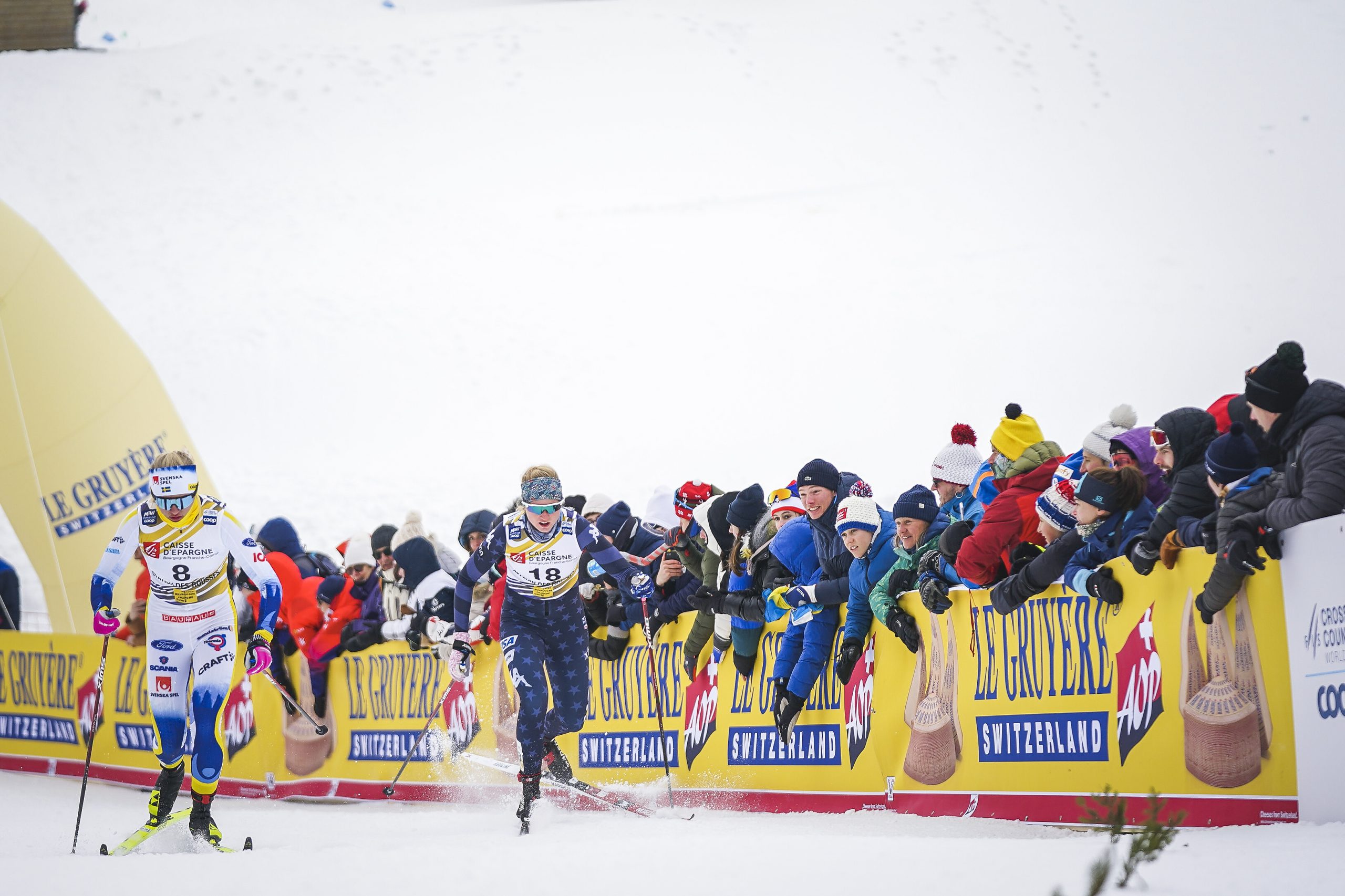
Hailey Swirbul (USA) on her way to her first semifinal appearance. (Photo: NordicFocus)
Swirbul advanced out of her quarterfinal as a lucky looser; the first time she had advanced to a World Cup sprint semifinal. In that semifinal, Swirbul faced the daunting task of going against three of the top Swedes: Ribom, Johanna Hagstroem, and Linn Svahn. Skistad, was also in the same semi. Ultimately, Skistad dominated the heat with Ribom coming in second. Swirbul was unable to advance, ultimately finishing the day in 12th. Swirbul told FasterSkier that the time she spent racing domestically had paid off. “I got to practice sprint heats every weekend on the Super Tour and I think that helped me stay calm and ski true to myself.” She was clearly excited about her performance and the venue. “It was a wild scene to have a combination of trumpets, cowbells, loudspeakers, music, and screaming up the big climb. Crazy!”
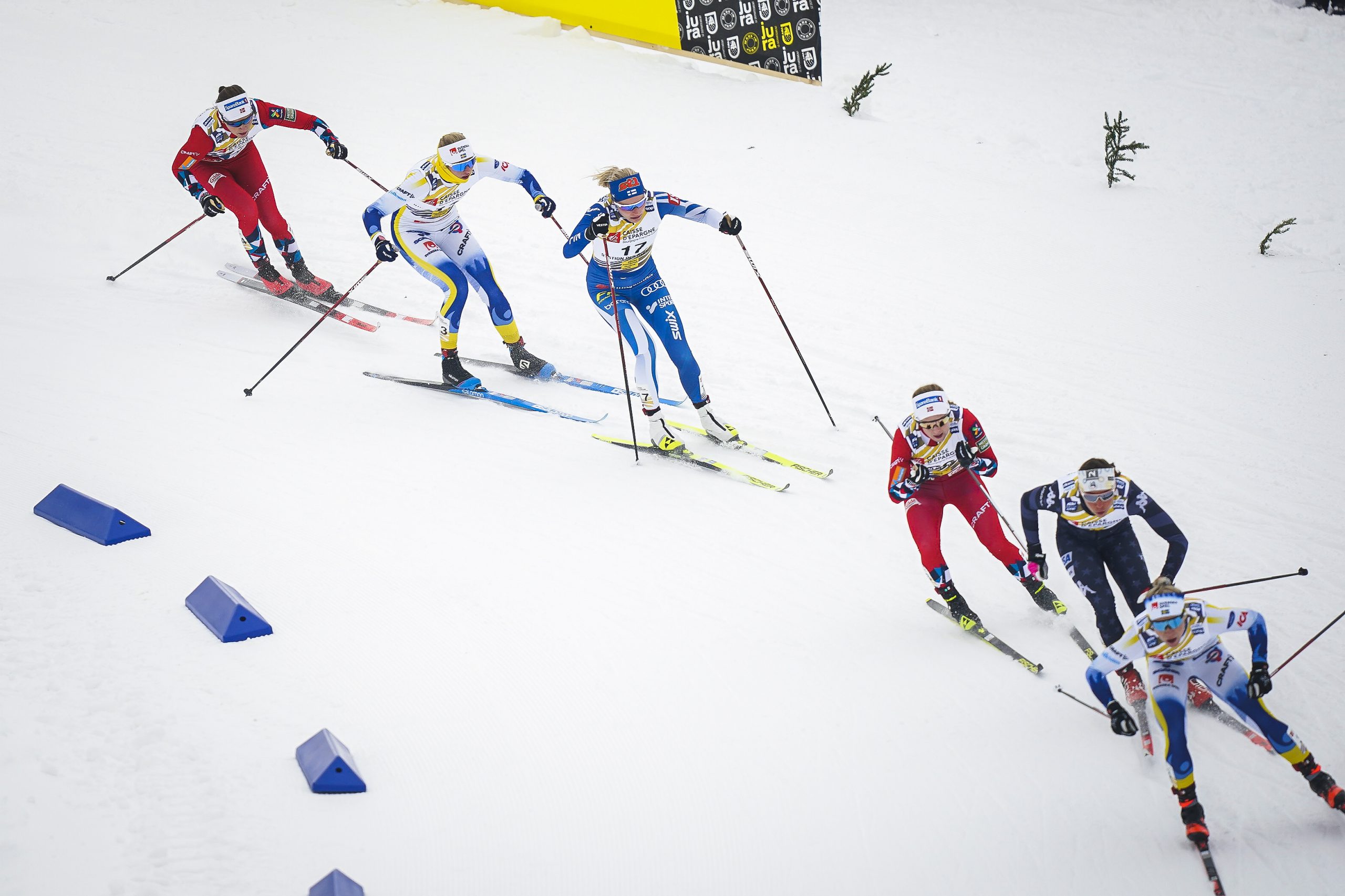
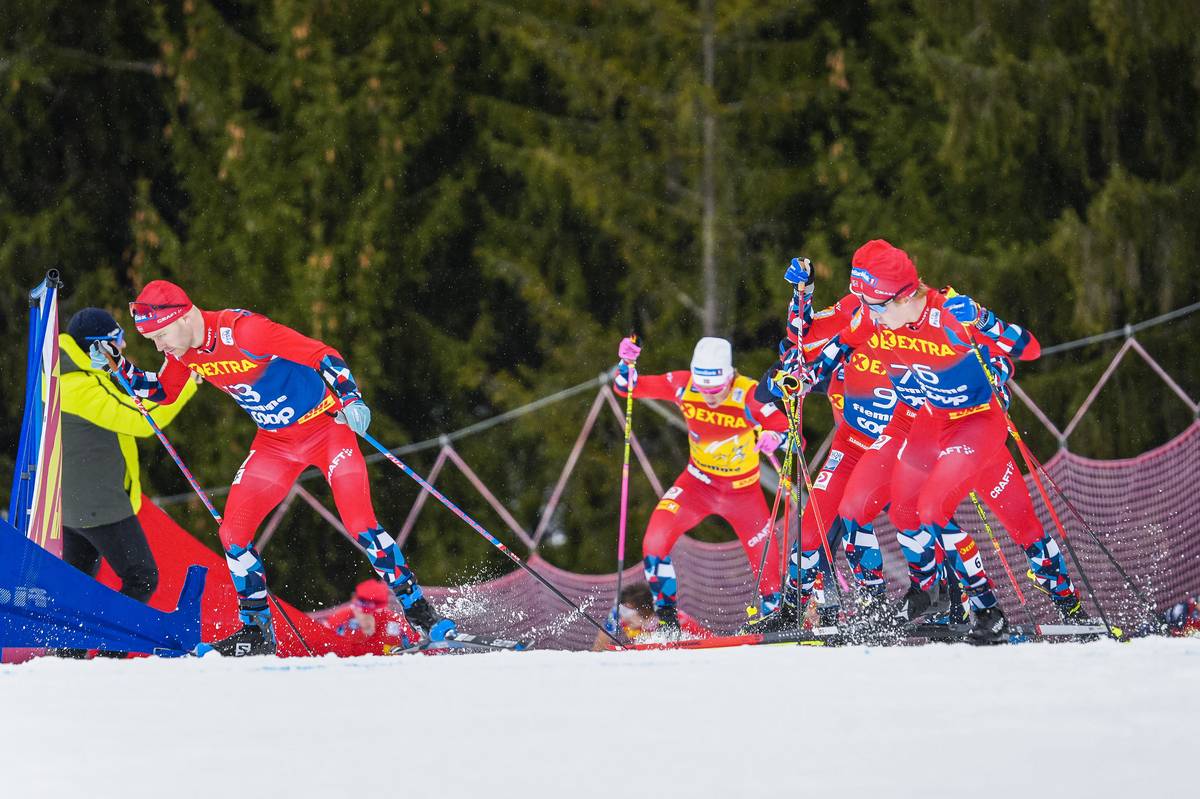
Kern won her quarterfinal, having benefited from a crash that took place behind her midway through her heat. She was in front of the tangle-up that took out much of the field, and she was able to coast to victory. Kern told FasterSkier that she felt great today. “The atmosphere in France was unbelievable,” she said. “So many loud fans, so much cheering…” Kern reported that she had unbelievably fast skis which had been prepared by Eli Brown. Bourne added that the crash helped Kern who would have made it through the quarterfinal regardless, but that, “The crash gave her a little bit of extra breathing space, it definitely played in her favor.”
Kern’s semifinal included an equally talented field. Jonna Sundling (SWE) (qualifying third) took the early lead and Kern gamely hung with her for the first half of the race. Kern skied a tactically brilliant race, drafting where it worked to her advantage and negotiating the tight corners extremely well. She jumped into the lead at the finishing straight and was able to out double-pole the rest of the field to the finish line.
Prior to the heat, Kern had strategized with Bourne that it would best to try to be in the top three and stay on the left side of the course. Bourne said that, “The snow was a little better for the wax we had there, and we didn’t feel that this course made much sense to try and position yourself in the back.” The course narrowed very quickly which also added to the incentive to go out fast. Bourne noted that, “If you didn’t have a hot start, you were going to get cut off right away.”
Julia Kern (USA) (second position) battled through the heats to make the sprint finals (Photo: NordicFocus)
In the final, Kern faced the full force of the Swedish team: Ribom, Dahlqvist, Svahn and Hagstroem. Norway’s Skistad rounded out the field. Skistad shot out to the lead from the start. Half-way through Kern was at the back of a tightly bunched pack which had slowed considerably and was now racing strategically. Kern didn’t have quite the start she wanted and said that “The start really mattered, no position changes really happened after the high-point. I was a little stuck in the back.” She said her energy was good but “I was battling for position more than I had hoped for.” After the slowdown, the group a tightened, and Skistad was then able to put in a quick acceleration and separate herself from the pack. Kern was unable to propel herself past the Swedes and ended up fifth. Still, a very satisfying performance by the American whose sprint prowess continues to grow each week.
It’s been a couple weeks since you last heard from us. The World Cup and the Devon Kershaw Show are back from a hiatus with a recap of the high altitude sprint weekend in Livigno.
Devon and Nat break down the individual and team sprints from the Italian Alps, including some strong American performances. We’re still planning a mailbag episode in the not-too-distant future, so keep those questions coming: devon@fasterskier.com and nat@fasterskier.com. We’ll be back soon.
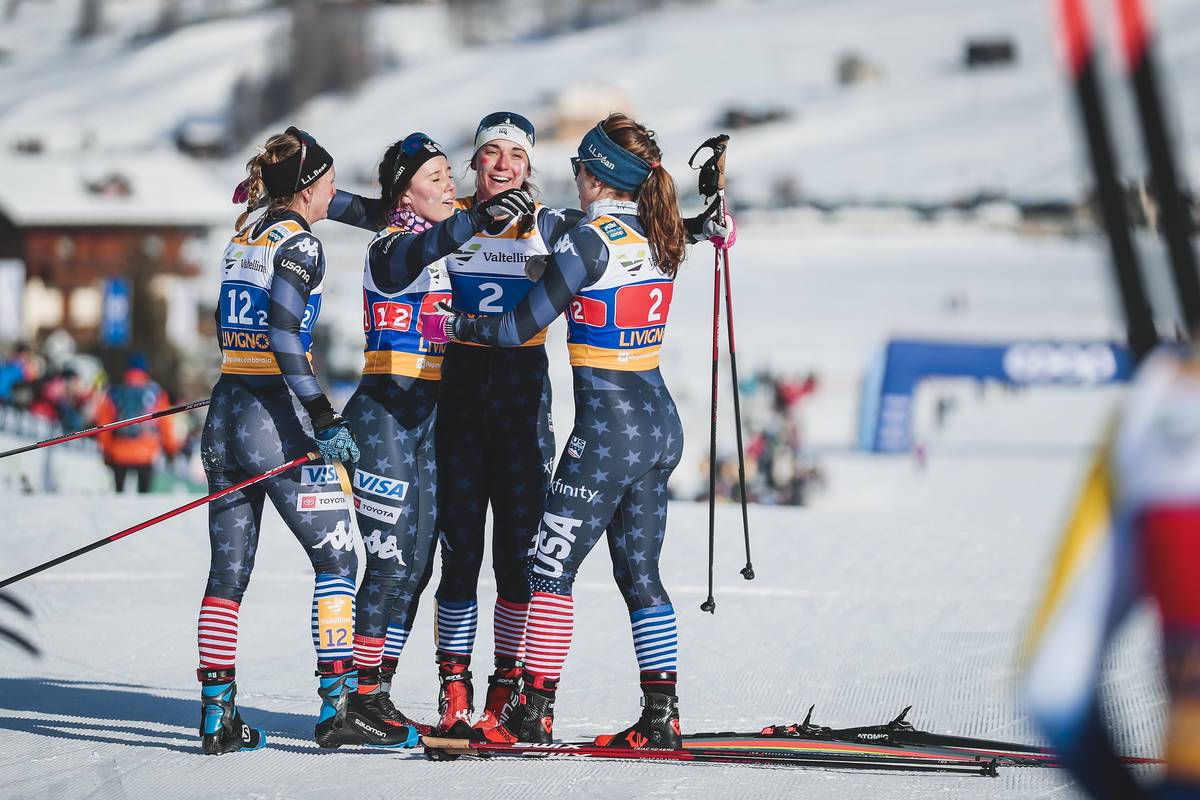
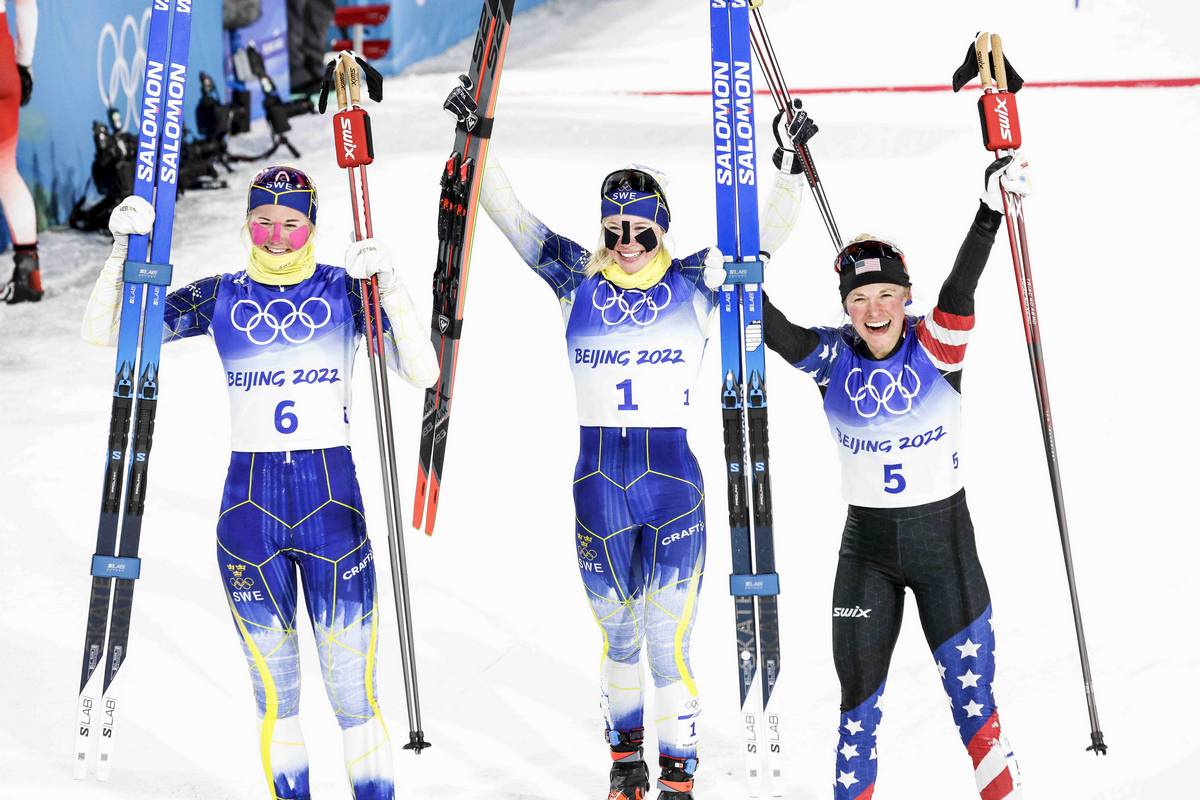
Americans Julia Kern and Rosie Brennan celebrate after a 3rd place finish in Sunday’s team sprint. (Photo: Nordic Focus).
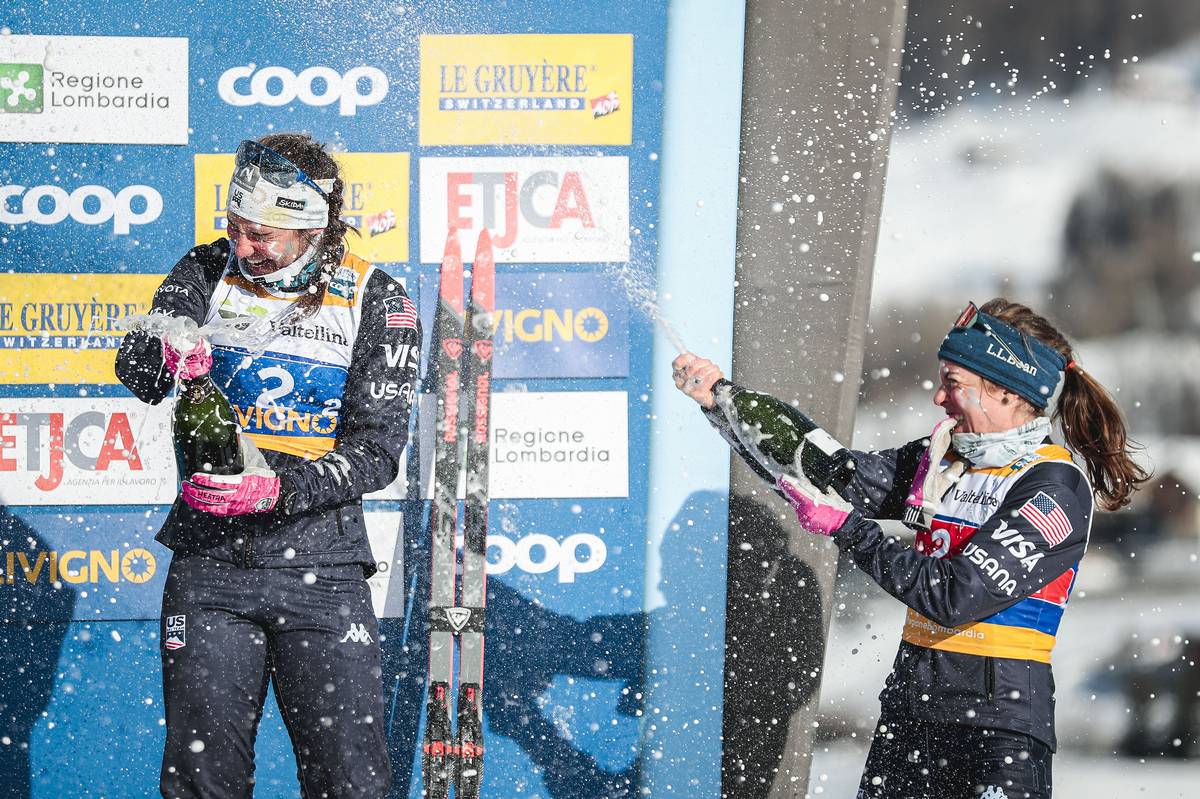
Julia Kern (USA) and Rosie Brennan (USA) celebrate after a third place finish in Sunday’s Team Sprint. (Photo: Nordic Focus)
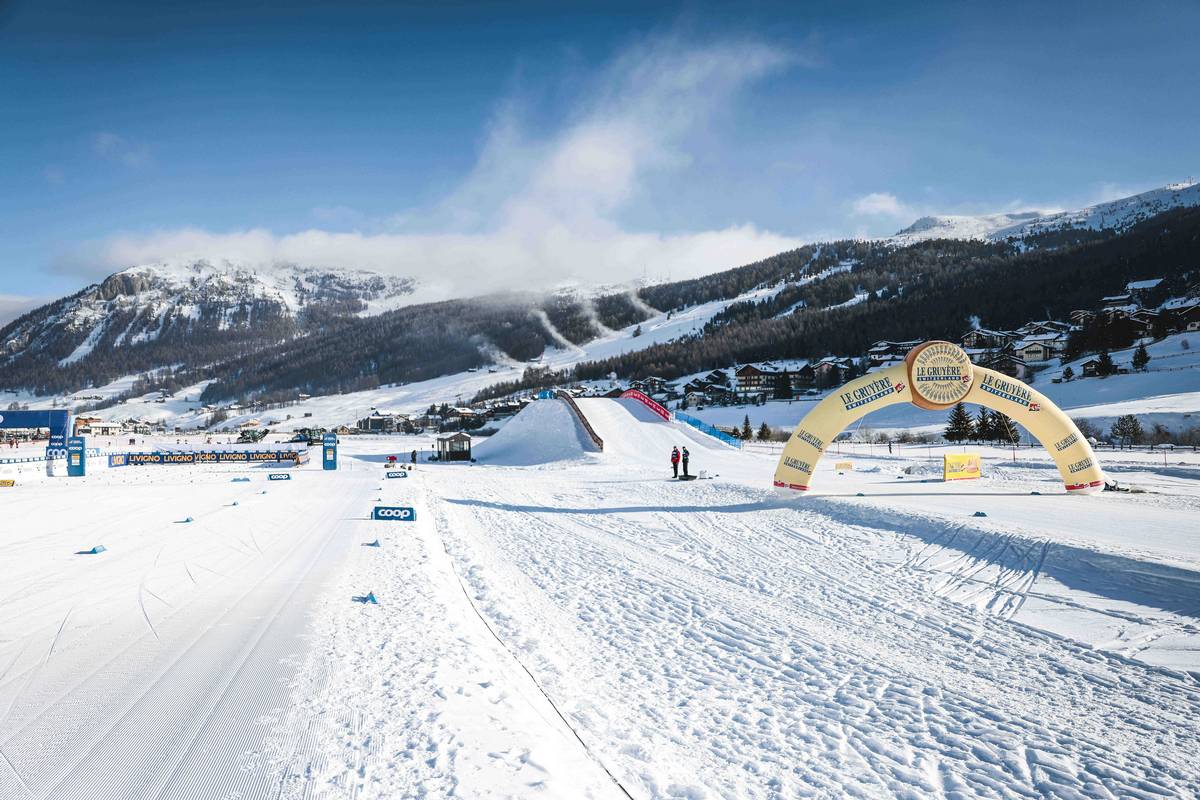
The high alpine valley containing Livigno, Italy is as beautiful and sublime as any place on Earth, seemingly heaven-sent to feature the high drama of the FIS Cross Country World Cup; for the first time, Livigno was hosting World Cup races this weekend.
That idyllic scene made Sunday’s Team Sprint all the stranger, since so many of the usual players and storylines were absent from the World Cup. As FasterSkier reported on yesterday’s Sprint, many factors affected the participation in Livigno: the staging of Norwegian National Championships, athletes taking planned breaks in their racing schedules, untimely illnesses, Livigno’s daunting elevation (Livigno sits at an elevation of 6000ft), and upcoming World Championships in Planica, Slovenia. Johannes Hoesflot Klaebo (NOR) had packed his bags and returned to Norway after his victory in Saturday’s individual Sprints. Jessie Diggins (USA) was taking a break from racing to refine her training. The field of U23 athletes had largely abandoned the World Cup in preparation for U23 World Championships in Whistler starting next week.
What was left in Livigno then? Well, the mountains towered, the sun shone down without a cloud in the sky, the snow was good, and the Italian fans were ready. It was, in other words, still a perfect scene for a ski race, and so those who had stayed on the World Cup—along with a few who were making their first appearances in it—gathered for a Skate Team Sprint in which partners skied three legs apiece on a 1.2 k loop around the valley floor.
The Alpine valley of Livigno, Italy hosted its first World Cup this weekend. (Photo: NordicFocus)
Women’s Race
In a weekend marked by a lull in the World Cup, there was one glaring irony: the front of the women’s field was marked by top skiers trying to re-establish themselves in the World Cup standings. For all their dominance, it has been a difficult year for the Swedish women’s team. A shoulder injury has kept Linn Svahn out for much of the season, and persistent illnesses have struck Jonna Sundling andEmma Ribom early in the World Cup season. In Livigno, the Swedes were looking for an opportunity to return to high-level competition. In selecting their teams, the Swedes split the Beijing Olympic Team Sprint Silver Medal duo of Maja Dahlqvist and Jonna Sundling, and paired both with new partners. Dahlqvist joined up with Linn Svahn to form Sweden II, and Sundling joined with Emma Ribom to form Sweden I.
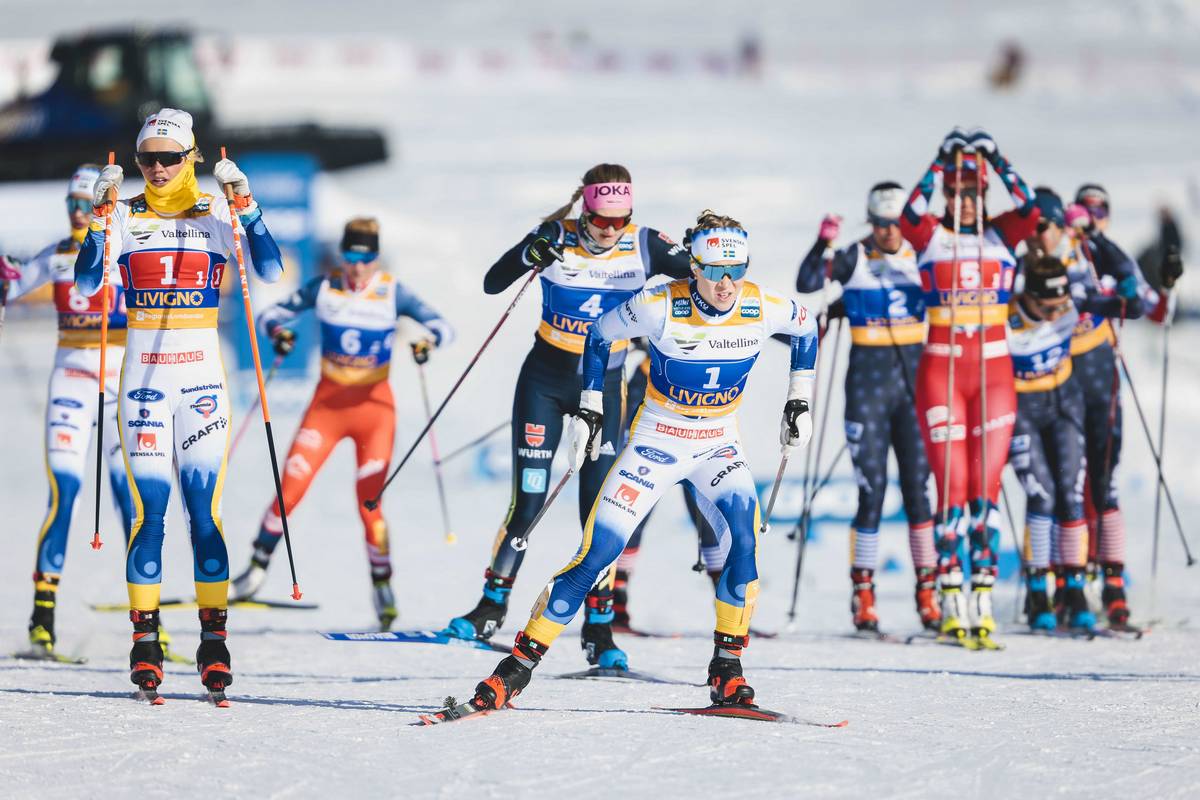
Jonna Sundling (SWE) heads out from the exchange after the tag from Emma Ribom (SWE). (Photo: NordicFocus)
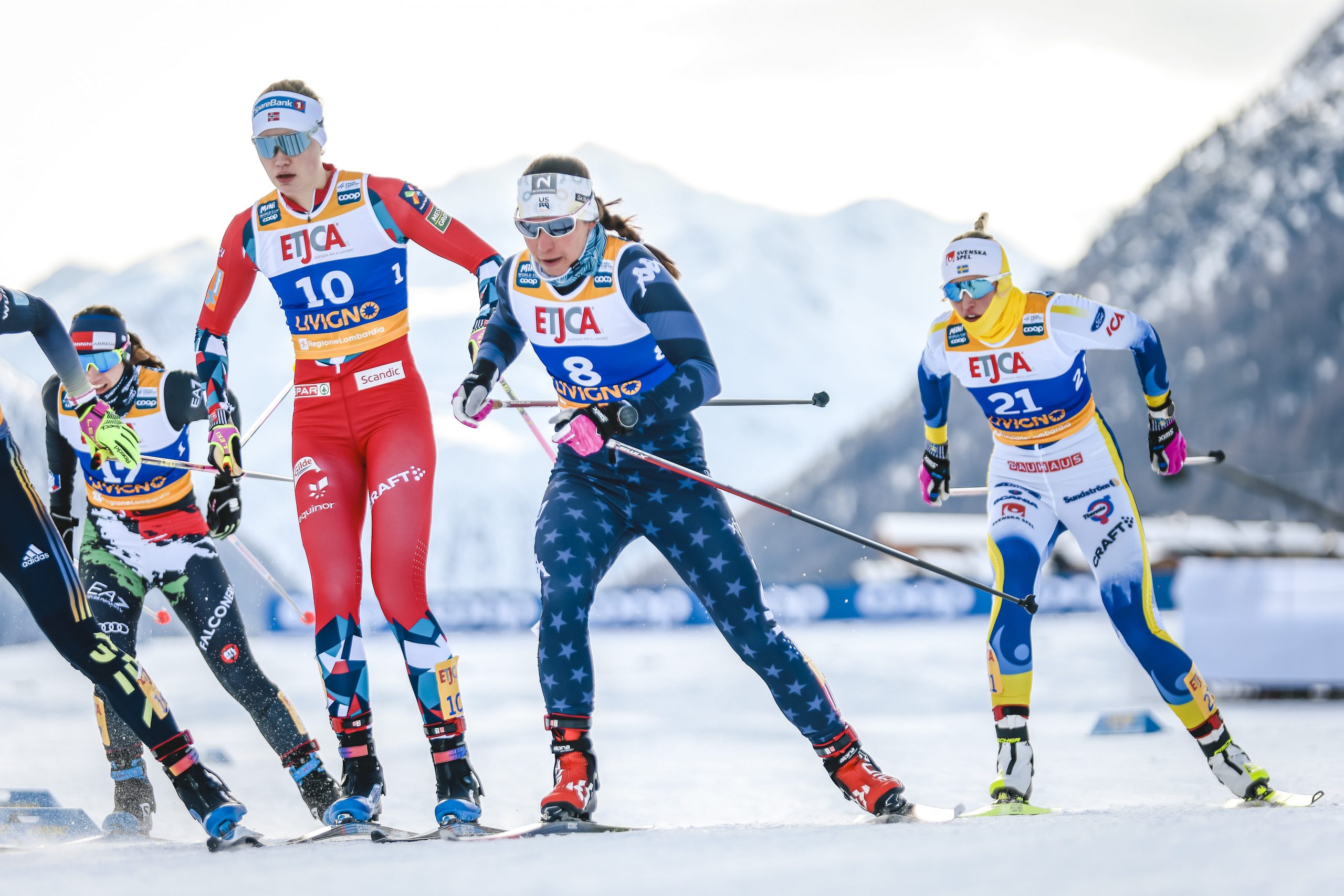
There was little to separate the field on the relatively flat Livigno course; through most of the race, the field remained largely intact. Out of the third exchange (entering the fourth lap) the Swedish pair of Dahlqvist and Sundling started to up the tempo on their persistent V2. Only two teams followed: Germany and the United States. The United States I team was represented in the move by Julia Kern, who paired up with Rosie Brennan to form a strong unit for the US. The USA II team of Lauren Jortberg and Alayna Sonnesyn were also in the final today, but had not quite bridged the gap to the front pack. Germany was represented by the pairing of Sofie Krehl and Laura Gimmler.
The pack of four teams—Sweden I, Sweden II, Germany I, and United States I—held through the fifth lap. The move to win was made by Maja Dahlqvist on the only true feature of the course—a short, steep, pitch where she unleashed a powerful V1 that led her to the win over Sundling who sprinted to second place for Sweden I. Behind the pair of Swedish sprinters, Kern had affected the same high-tempo attack for third, and beat out the German anchor skier, Gimmler.
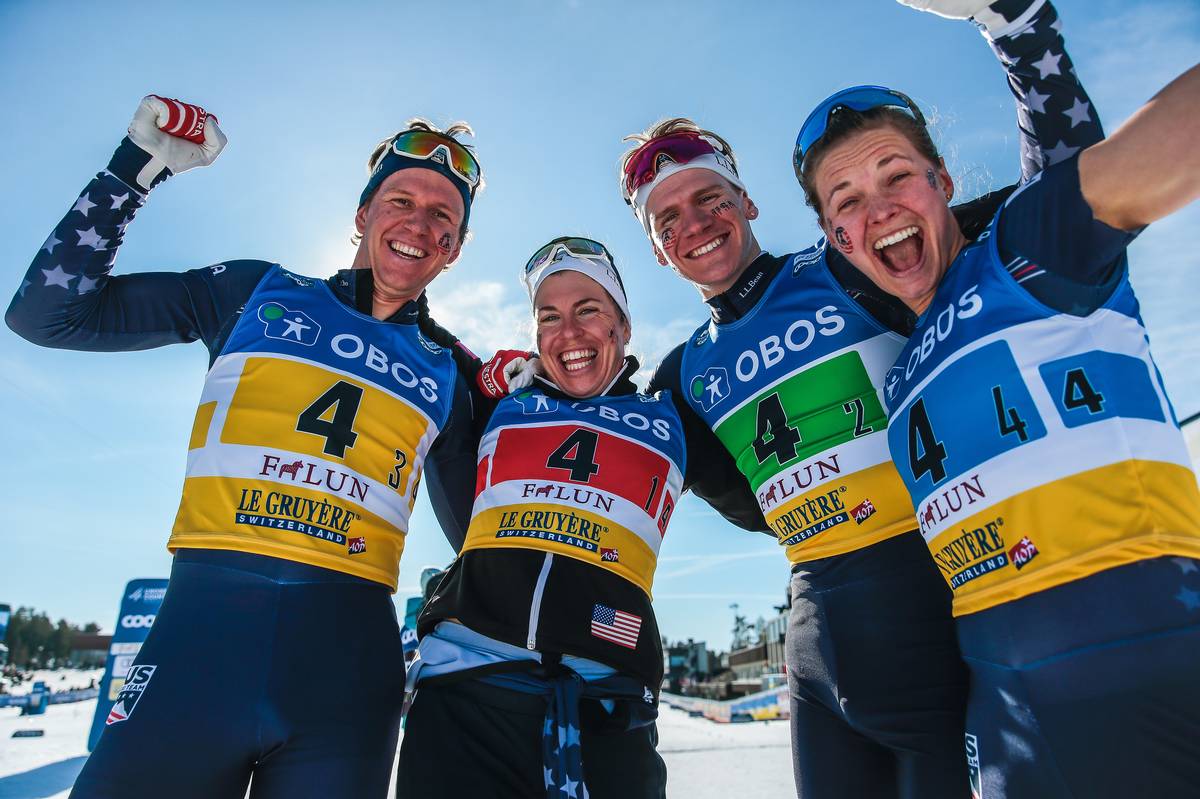
American women celebrate after United States I—Rosie Brennan and Julia Kern—finished third in Sunday’s Team Sprint. (Photo: NordicFocus)
Men’s Race
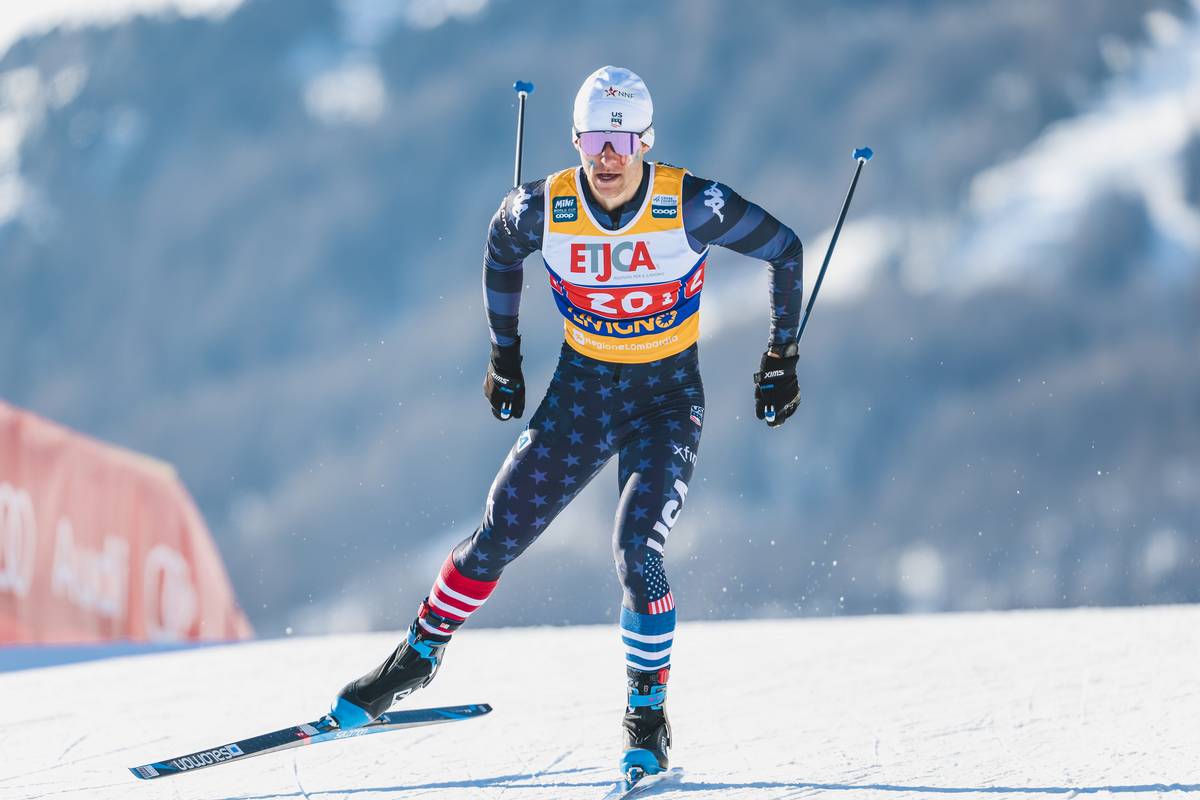
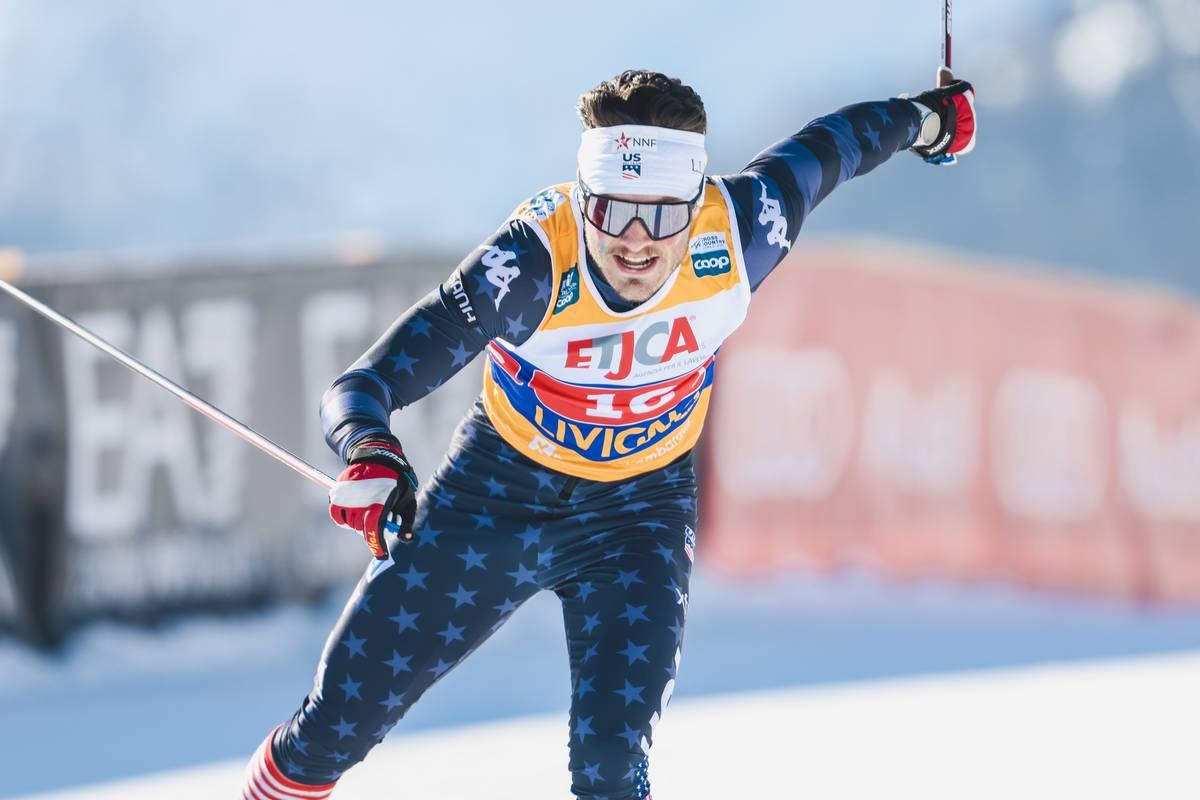
The unusual scenes of this World Cup brought some welcome novelty, especially for American ski fans, in the Men’s race. A pair of American men even younger than the skiers who are now becoming the familiar faces on the US Ski Team made their World Cup debut in the Individual Sprint yesterday, and paired with more experienced teammates in comprising the Team Sprint duos today. That included Adam Witkowski—a native of upstate New York now skiing for Michigan Tech—who paired with Logan Diekmann to form the United States II team. The team rosters also included Will Koch—the Vermonter and University of Colorado Buffalo—skiing with veteran Kevin Bolger on United States I. United States I advanced to the Final.
Adam Witkowski (USA) made his first World Cup starts in Livigno this weekend. Witkowski and Logan Diekmann (USA) combined to form USA II in the Team Sprint. (Photo: NordicFocus)
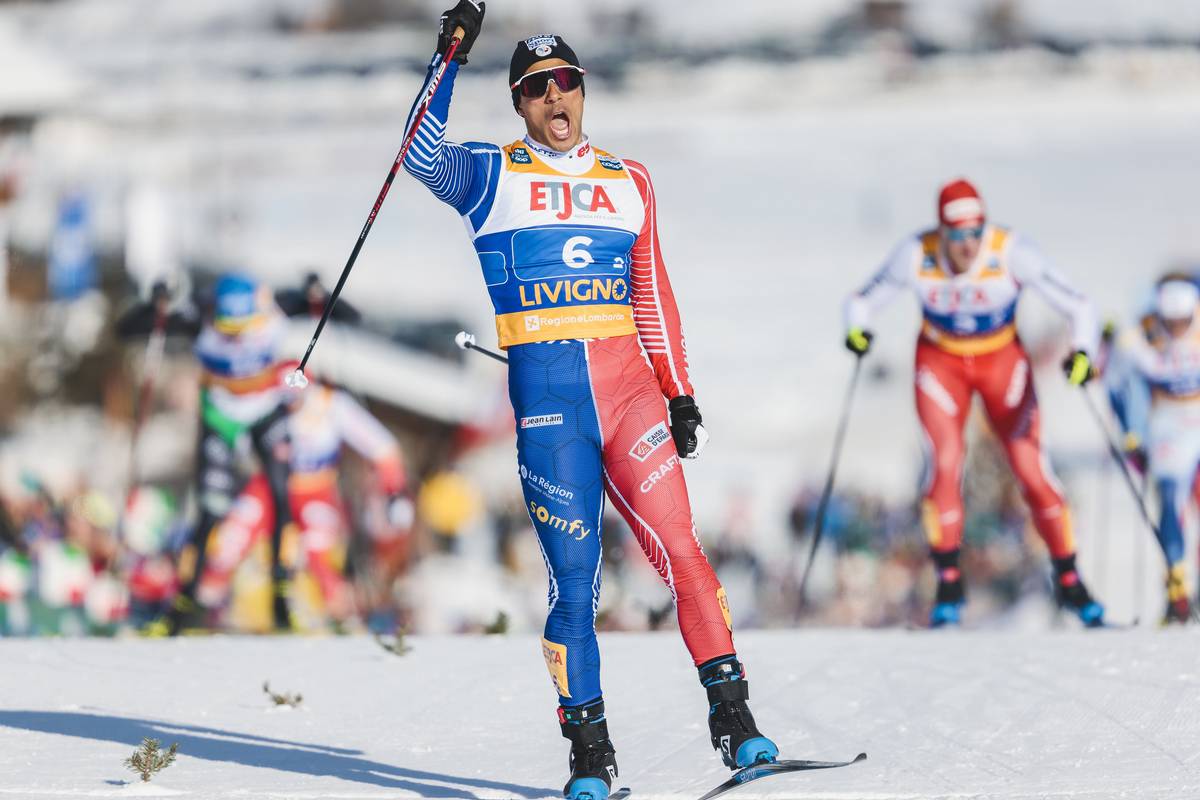
Focus on who might win the Men’s race was firmly turned towards those teams hailing from the surrounding Alps. The Italians, on home soil, fielded the strong team of Francesco De Fabiani and anchor Federico Pellegrino. The French, too, fielded reigning Sprint champion Richard Jouve in the anchor leg, paired with Renaud Jay.
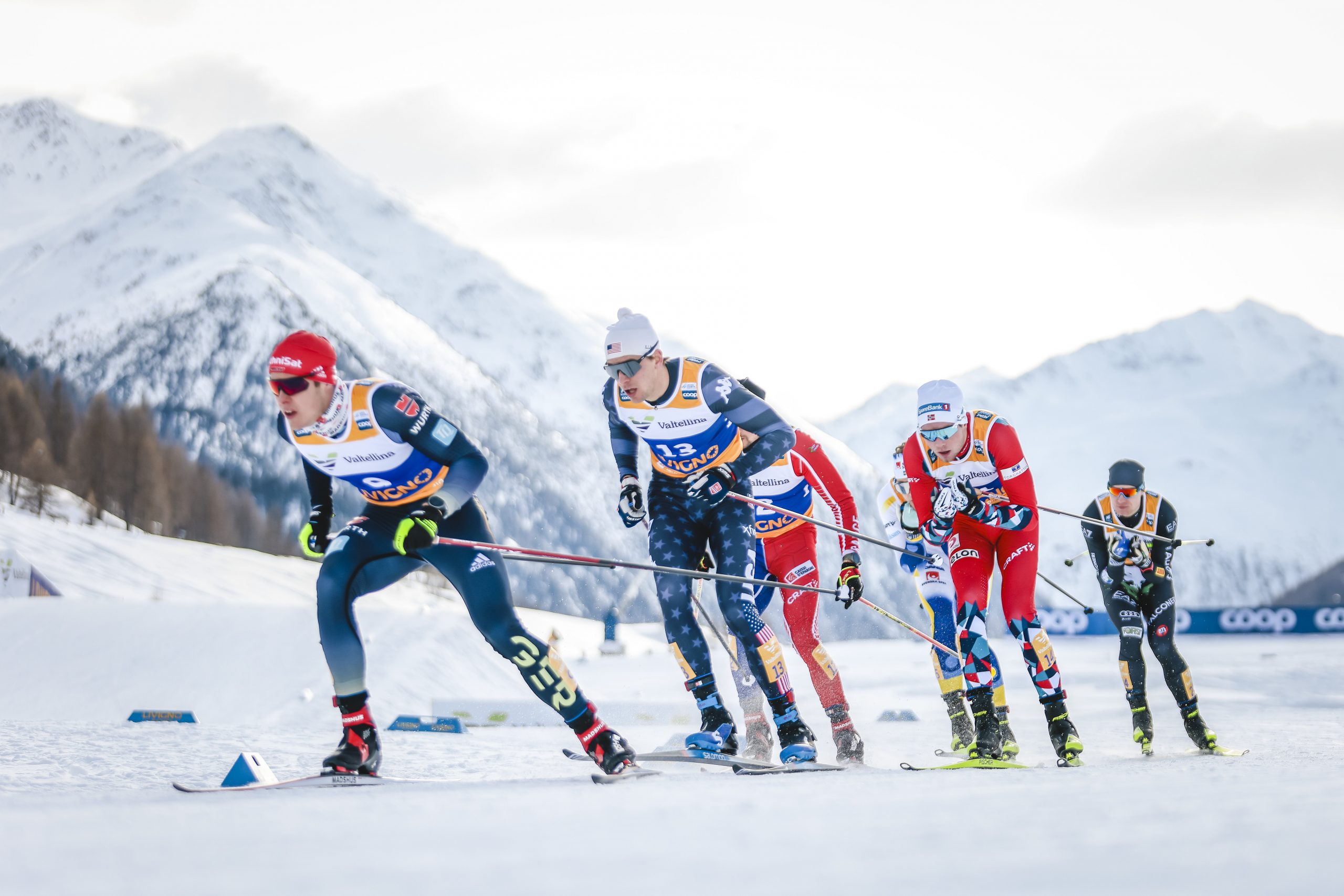
The men’s field remained tightly woven and tense throughout the course of the six lap race. Skiers looked for a track to gain a place, or test out a high-tempo attack. It wasn’t really until the last leg—the anchor’s anchor leg—that Richard Jouve and Federico Pellegrino moved on the only sharp incline on course and made it a sprint. Jouve gained a slight advantage in doing so, and it was enough to seal the win for France, as Pellegrino brought Italy to a second place finish on the day. Behind the battle for first and second, it was Valerio Grond (SUI) who escaped the pack to earn the bronze with his partner, Janik Riebli (Saturday’s Individual Sprint bronze medallist).
Richard Jouve (FRA) brings home the win with teammate Renaud Jay (FRA). The French head towards a race on home soil in Les Rousses next weekend. (Photo: NordicFocus)
The pairing of Koch and Bolger for the United States finished in 12th place on the day, but just 20 seconds off the leaders. The combination of the experienced Bolger alongside the younger Koch underscored the range and depth that the American program has fostered over the past decade. Koch’s first start on the World Cup extends the scope of that accomplishment across time too, as he joins Novie McCabe in being the second generation of his family to have skied on the World Cup for the United States.
Will Koch (USA) teamed with Kevin Bolger (USA) in Sunday’s Team Sprint. (Photo: NordicFocus)
On to Les Rousses
With familiar pieces of the World Cup scattered to the winds during this weekend in Livigno, perhaps the biggest story going forward is just who might be on the start line next weekend when the World Cup travels from Italy to France. The French will finally be able to host a World Cup in Les Rousses after Covid restrictions and insufficient snow coverage forced cancellation two years ago. It’s a reminder that the World Cup is subject to the whims of life, weather, sickness, and all else. There’s never absolute certainty, which only heightens the experience when the sun is shining, the snow is plentiful, and the best athletes in the world converge to ski race for ski racing’s sake.
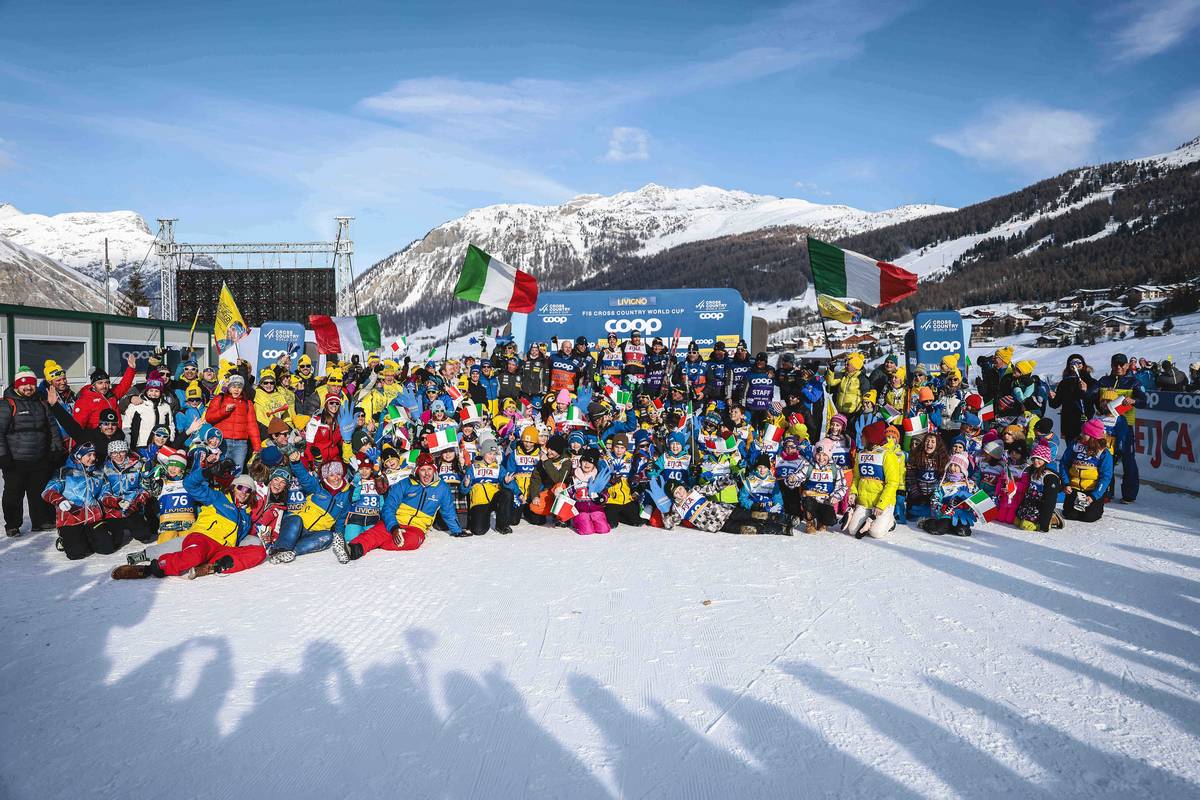
The Italians celebrate a successful World Cup weekend in Livigno, Italy. (Photo: NordicFocus).
This World Cup coverage is made possible through the generous support of Marty and Kathy Hall and A Hall Mark of Excellence Award. To learn more about A Hall Mark of Excellence Award, or to learn how you can support FasterSkier’s coverage, please contact info@fasterskier.com.
After taking a weekend off to recover from the grueling Tour de Ski, the World Cup returned to its traditional format this weekend. Today, in Livigno, Italy, the freestyle sprints were contested. It’s the first time Livigno has hosted a World Cup event. Livigno sits just below 6,000 feet, which would press the FIS (International Ski Federation) rules on altitude.
The pleasant sight of natural snow welcomed racers in Livigno, Italy. (Photo: NordicFocus)
The storyline on the men’s side should have been straight forward: Would Johannes Klaebo (NOR) continue his season, and career long, sprint domination? Over half of Klaebo’s individual World Cup victories have been in sprints, and he is riding a very hot hand having won nine out of ten of the last sprints he’s competed in. The primary threat to Klaebo was likely to come from Lucas Chanavat (FRA) who is currently second in the sprint rankings. Also hoping to topple Klaebo were Richard Jouve (FRA), and Federico Pellegrino (ITA). Pellegrino would have the benefit of being able to draw support from his home country’s fans. Pellegrino beat Klaebo in a shocking outcome in Davos, back in the middle of December. While a strong sprinter, Jouve’s strength is in the classic technique sprint.
Johannes Klaebo (NOR) on the way to another sprint victory. (Photo: NordicFocus)
Klaebo is in a pitched battle with countryman Paal Golberg (NOR) for the overall cup standings. While Golberg doesn’t usually have Klaebo’s sprint prowess, (he is fifth overall in the sprints), he would need a strong performance to keep him in the overall cup hunt.
However, the narrative became scrambled due to a schedule conflict with the Norwegian national championships. This led to Paal Golberg racing Thursday in Gjovik, Norway and then heading over to Italy for the weekend. Other men pulled double duty racing both the Norwegian championships and the World cup, including Erik Valnes and Even Northug. Valnes ended up winning his country’s sprint championship. It remained to be seen what effect the extra racing would have on Golberg and the others. Klaebo did not race in the Norwegian Championships.
The U.S. side of the men’s sprint story was also dominated by who was absent. Going into the race, Ben Ogden was in seventh place in the sprint standings (ninth overall). However, Ogden did not race today. U.S. coach Matt Whitcomb told FasterSkier that the time off was planned for Ogden. Also not racing today to prepare for the world U-23 championships were J.C. Schoonmaker (University of Alasaka-Anchorage), and Gus Schumacher (Alaska Winter Stars)
On the Women’s side, the biggest story again was who wasn’t racing. There were only 38 women who competed in the qualifying round. A morning of racing for the qualifiers was spent eliminating only 8 skiers. This should be a point of concern for FIS. Whitcomb shared the concern about depth of competition. “There’s a lot of stress coming up to altitude, and racing a sprint without being acclimated, and there’s a lot of pressure to race at [Norwegian] nationals. You really have to choose your battles.” The scheduling is far from ideal. Whitcomb noted that he is concerned with the depth, particularly of the women’s field. “One of the big issues is that it doesn’t make a lot of physiological sense when preparing for World Championships to go up to altitude for four days…and then come down.” He noted that it’s a problem that needs fixing.
Many of the top Norwegian women also chose to race the Norwegian championships or skipped Livigno. Tiril Udnes Weng, Heidi Weng, Lotta Udnes Weng, Ragnhild Haga, Helene Fossesholm, and Ingvild Flugstad Oestberg all chose to skip Italy. Frida Karlsson (SWE) also did not race today.
Emma Ribom (SWE) had dominated the sprints early in the season, but a bout with Covid may have prevented her from achieving similar successes lately. It remained to be seen whether she could regain her early season form. Today would also be a return to World Cup racing for Linn Svahn (SWE) who has had an extended absence from the World Cup due to injury.
The start list shuffling left the door wide open for American Julia Kern, who has been having an impressive sprint season. She is currently sixth in the sprint standings. Going into the race, third through sixth overall were only separated by 56 points. Given the sparse starting field, Kern had the opportunity to gain significant ground.
Julia Kern (USA) raced her way into a World Cup sprint final for the first time this season. (Photo: NordicFocus)
Jessie Diggins is fourth in the overall cup standings, only 15 points behind Kerttu Niskanen (FIN) who sits in third. But Diggins joined the long list of women not racing today. It was a strategic decision for Diggins who chose to prioritize rest prior to the World Championships over chasing World Cup points. U.S. coach Matt Whitcomb told FasterSkier that “Jessie’s doing great. She had a great training camp in Seefeld and stayed there with a bunch of athletes…because we knew she needed a break it was going to be either this weekend or Les Rousses, France [next weekend’s World Cup race]. Whitcomb continued that “The focus is now on World Championships, much more than points.”
Also not racing was U.S. National’s champion Hailey Swirbul. Swirbul won every race two weekends ago in Houghton, MI and had expected to race this weekend. However, Whitcomb informed FasterSkier that Swirbul had gotten sick almost immediately after arriving in Europe. “She’ll head straight to Les Rousses as soon as she is feeling good.”
Going into the race, Rosie Brennan was sixth in the overall standings, and she would be trying to help her cause by gaining points in the sprint. Brennan has had her ups and downs in sprints this year. She’s made the finals in Davos but has also had her difficulties. She seems to have put her early season illness behind her, so hopes would be riding high for the Alaskan.
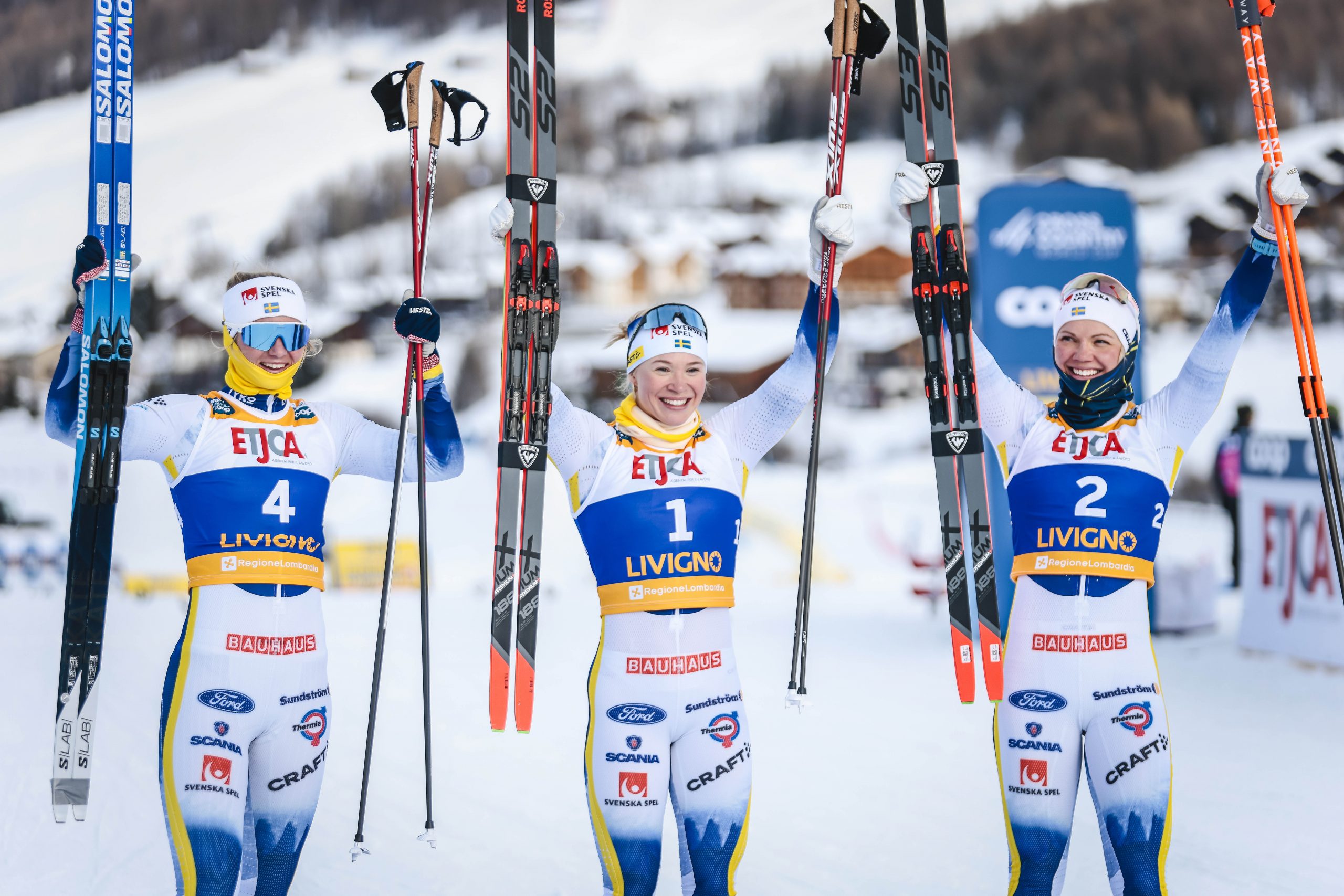
An all Sweden podium in Livigno (l-r : Maja Dahlqvist, Jonna Sundling, Emma Ribom) (Photo: NordicFocus).
The Results
It ended up being team Sweden dominating the Livigno podium. Finishing first was Jonna Sundling (SWE), followed by Maja Dahlqvist (SWE), and Emma Ribom (SWE). The top American women were Julia Kern, who finished sixth, and Rosie Brennan in 11th.
Other American finishers were Alayna Sonnesyn, 24th, and Lauren Jortberg, 29th.
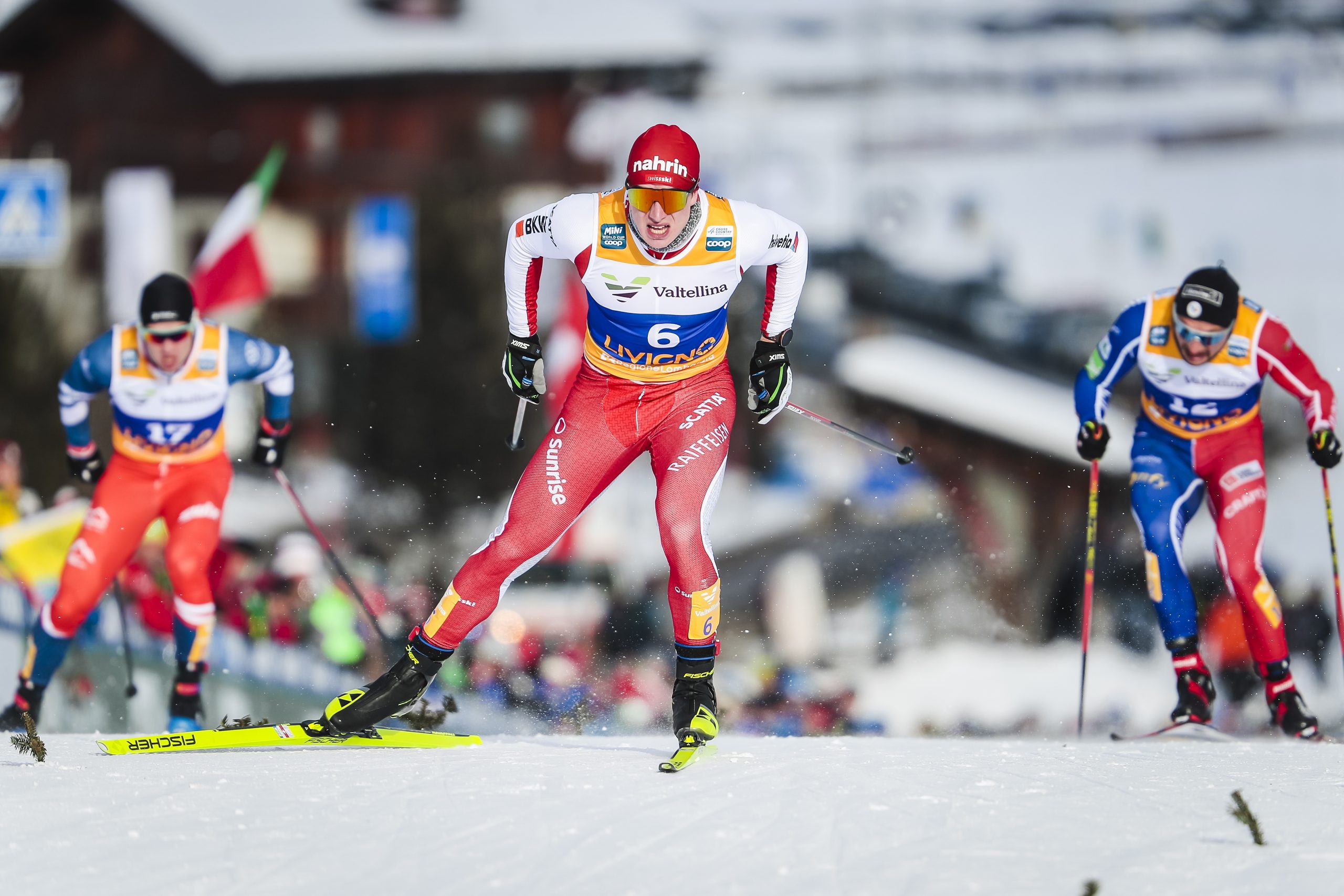
On the Men’s side the Klaebo train continued to chug along as he beat out Richard Jouve in a close finals race. In third place was a surprising Janik Riebli (SUI).
Janik Riebli (SUI) on the way to a podium performance (Photo: NordicFocus)
The top American male was Kevin Bolger, 12th. He was followed by Logan Diekmann, 38th, Will Koch, 41st, and Adam Witkowski 42nd.
The Race
In the women’s heats Brennan went in having qualified in 12th spot. She skied her quarterfinal heat strategically, sitting in fourth most of the way. She ultimately finished third in her heat and would have to wait for a lucky loser spot. She was rewarded for her work and ultimately advanced via the lucky loser route.
Kern skied very controlled in her quarterfinal and pushed herself to the front of the pack taking the lead with about 30 seconds to go and cruised comfortably to finish first.
Julia Kern navigating through the field on the way to the finals in Livigno. (Photo: NordicFocus)
Alayna Sonnesyn was not able to advance out of her heat.
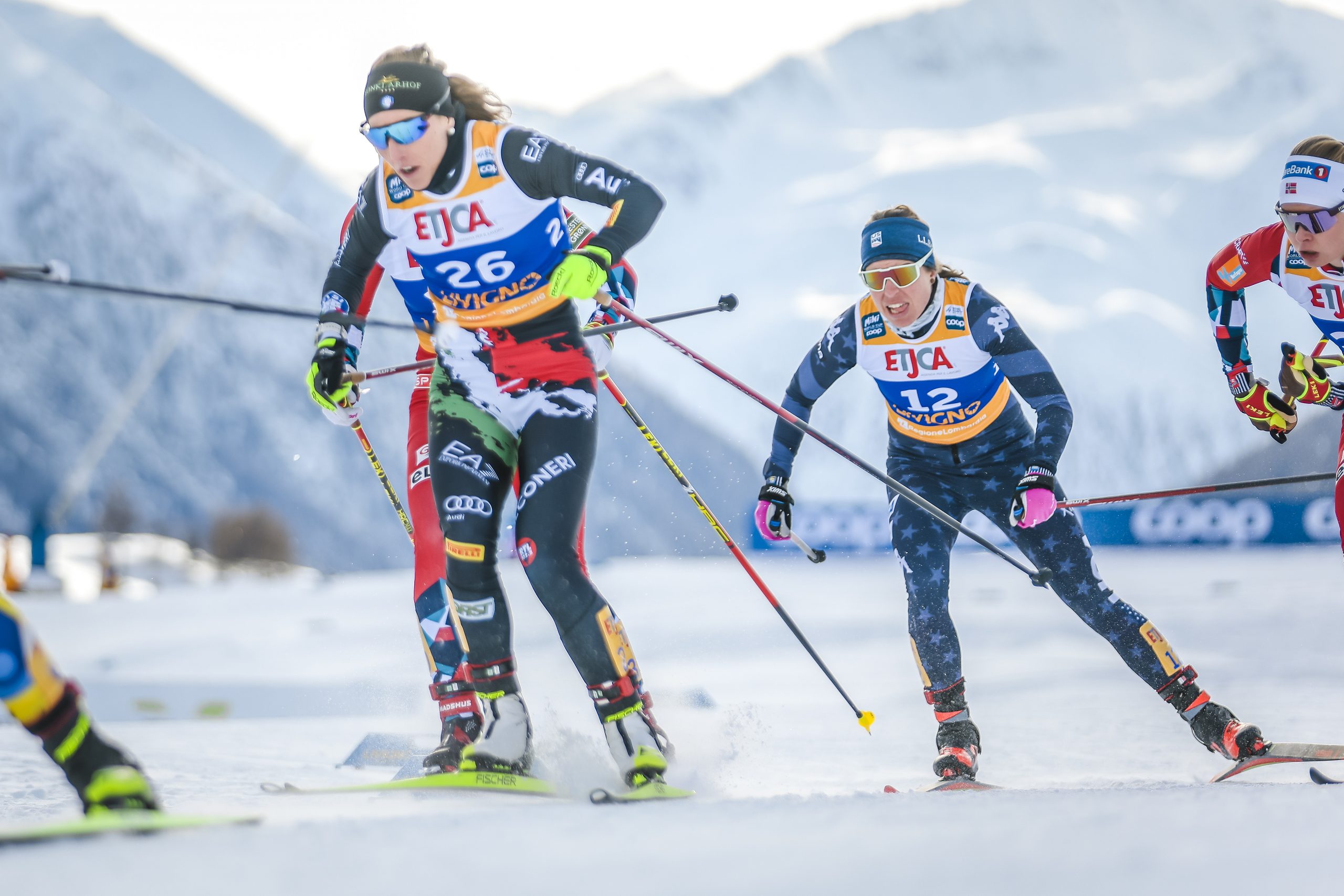
Brennan and Kern both raced in the second semi-final. Brennan pushed immediately from the start setting a fast early pace. However, she was unable to hold the quick tempo and was passed about halfway through the race. Kern took an alternative strategy holding back early and then pushing to the front in the final half. Kern ended up second to advance to the finals. Brennan’s strategy of going out hard did not work for her as she continued to fade through the race and ended up last in her heat.
“I took a chance in my semi to ski a bit more aggressively and unfortunately, I completely ran out of power on the long uphill finish.” Rosie Brennan.
Rosie Brennan (USA) (number 12) gave it everything she had in the heats, but ultimately ran out of steam. (Photo: NordicFocus)
The difference in approach was based upon what the racers experienced in the quarterfinals. Whitcomb said that “Julia felt like she was knocked around a little out of the start…there’s always a risk when you’re playing your cards from fifth or sixth. We wanted her in the semifinal to be in a [higher position], so she had less traffic to deal with.” Regarding Brennan, Whitcomb said that “People drafted by her, and she kind of ran out of energy.”
On the men’s side, Klaebo—who qualified with the fastest time—comfortably won his quarterfinal. Jouve, Chanavat, and Pellegrino also advanced comfortably.
The only American man to qualify for the heats was Kevin Bolger. He skied a very efficient quarterfinal and ended up winning his heat.
In the men’s first semifinal it was Klaebo and Jouve taking first and second. In Bolger’s semifinal he went to the front from the start. With most of the pre-race favorites going in the first heat, it was a good strategy. But just like with Brennan, he faded toward the finish and ended up finishing last in his semifinal.
Kevin Bolger (USA) (number 13) would have an outstanding day in Livigno, finishing 12th. (Photo: NordicFocus)
In the finals, the only American left was Julia Kern. She held back toward the rear of the pack at the start with four Swedes out front. Faehndrich tried to meticulously worked her way through the crowd of Swedes, but was unable to join the front grouping. Kern was never able to find the speed to challenge and ended up sixth. It was still her best sprint result of the year. At the end of the day, It was all Sweden with Sundling, Dahlqvist, and Ribom going 1-2-3.
In the men’s final Klaebo held back at the start sitting in fifth place, and then easily moved himself to the front about a minute into the race. He then asserted himself at the front, content to let others try to find a way around him. At the finish Klaebo turned on the afterburners and was able to just beat out Jouve at the finish line. It was a close finish, but at the end of the day no one had solved the puzzle of how to beat Klaebo in a sprint race. Not bad for a guy who pulled into the venue the night before the race.
An interesting byproduct of the scheduling was the U.S. and Norwegian teams shared wax facilities this weekend. Whitcomb said that, “Because Norway kept so much of its infrastructure in Norway because of the nationals, they needed some help. It was a great opportunity to partner up…we had the Norwegians in our truck today.” It turned out that Klaebo’s skis were waxed in the American truck by Norwegian technicians. Whitcomb emphasized the value of sharing ideas and was excited about the partnership. The teams have a history of helping each other when one needs help. In addition to sharing physical space, the teams shared testing data as well. “We have a great relationship with the Norwegian team…I’m very proud of our small staff’s ability to plug in with the Norwegians and figure out a seamless working machine. It was a great team accomplishment.”
Devon and Nat return to recap the last three stages of this year’s Tour de Ski, including the climb up the Alpe Cermis and some epic American and Canadian performances.
The World Cup circuit is taking a break, so we’ll try to have a mailbag episode in the next week. Email us questions and comments at devon@fasterskier.com and nat@fasterskier.com.
Ben Ogden after falling just short of the finals in the Val di Fiemme sprint. (Photo: Nordic Focus).
Sophia Laukli (USA) crosses the finish line on the top of the Alpe Cermis for 3rd place, her first career World Cup podium. Laukli highlighted a day in which the Americans put three in the top ten. (Photo: NordicFocus)
The Alpe Cermis
When the Grand Tour of skiing—the Tour de Ski—was dreamed up by Vegard Ulvang and Jurg Capol in 2006, one of the first definitive decisions was that it would need a Queen Stage: a stage that sought to distill the essence of ski racing—the brutal beauty of the slog—to its purest state. The Tour de France had its Alp d’Huez, and the Tour de Ski would have the Alpe di Cermis.
Through seventeen editions of the Tour de Ski, the climb of Alpe di Cermis has become nothing less than iconic in Nordic Skiing. This is where Therese Johaug and Marit Bjoergen cemented their legends in tandem, year-after-year, battle-after-battle, racing up the fall line. This is where Johannes Hoesflot Klaebo lost the 2020 Tour to Alexander Bolshunov on the final day. Martin Johnsrud Sundby, Petter Northug, Dario Cologna, Jessie Diggins, Heidi Weng: all have played prominent roles in past hill climbs. In 2015, it’s where Liz Stephen notched a 5th place, and kicked off the breakout World Cup season for the American women, culminating in the team’s first ever distance World Championships medals (That Falun 10 k where Jessie Diggins and Caitlin Gregg were 2nd and 3rd).
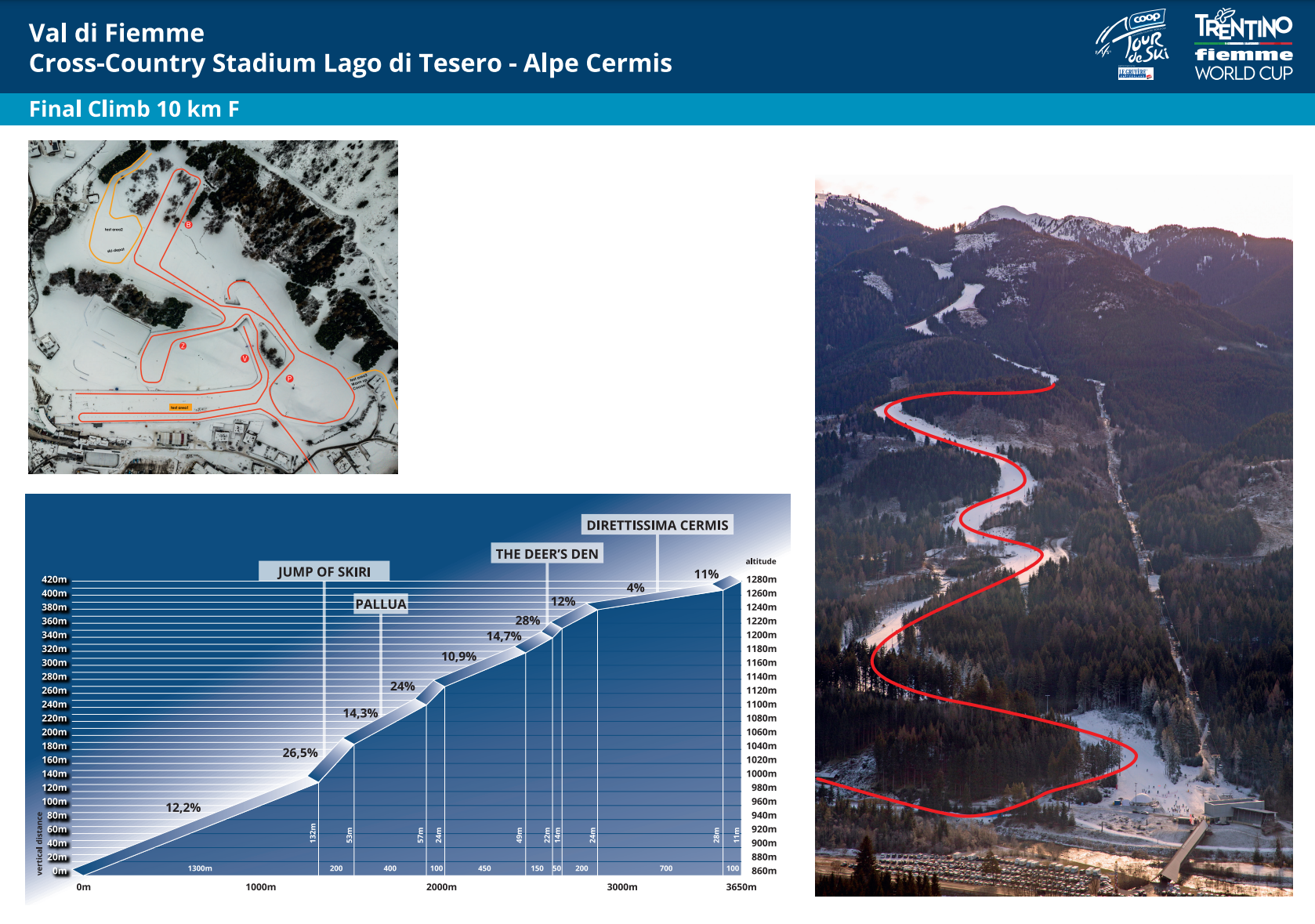
Course Profile for Tour de Ski Stage 7 at the Alpe Cermis. (Photo: Fiemme World Cup)
The Alpe is the culmination; it is also the main event. Things were no different for this year’s Tour de Ski. On the women’s side, Frida Karlsson hoped to arrive at the summit in possession of the Yellow Bib. On the men’s side, Klaebo looked to do the same, but with ghosts of Alpe’s past haunting his each and every stride. Both Karlsson and Klaebo had dominated over the course of the first six stages, but both, remarkably, remained vulnerable. Karlsson (2:31:16.0) held an advantage of 1:12 over second place Tiril Udnes Weng, while Klaebo carried a 1:02 advantage over second place Calle Halfvarsson in the men’s field. Simen Hegstad Krueger—winner on the Alpe in 2021—held fifth place overall at 1:45 back. In a normal ski race, those margins would have all but guaranteed victory for the leaders. But in a race up the Alpe de Cermis—where the final kilometers stretch out time gaps with every meter gained—no lead is ever safe.
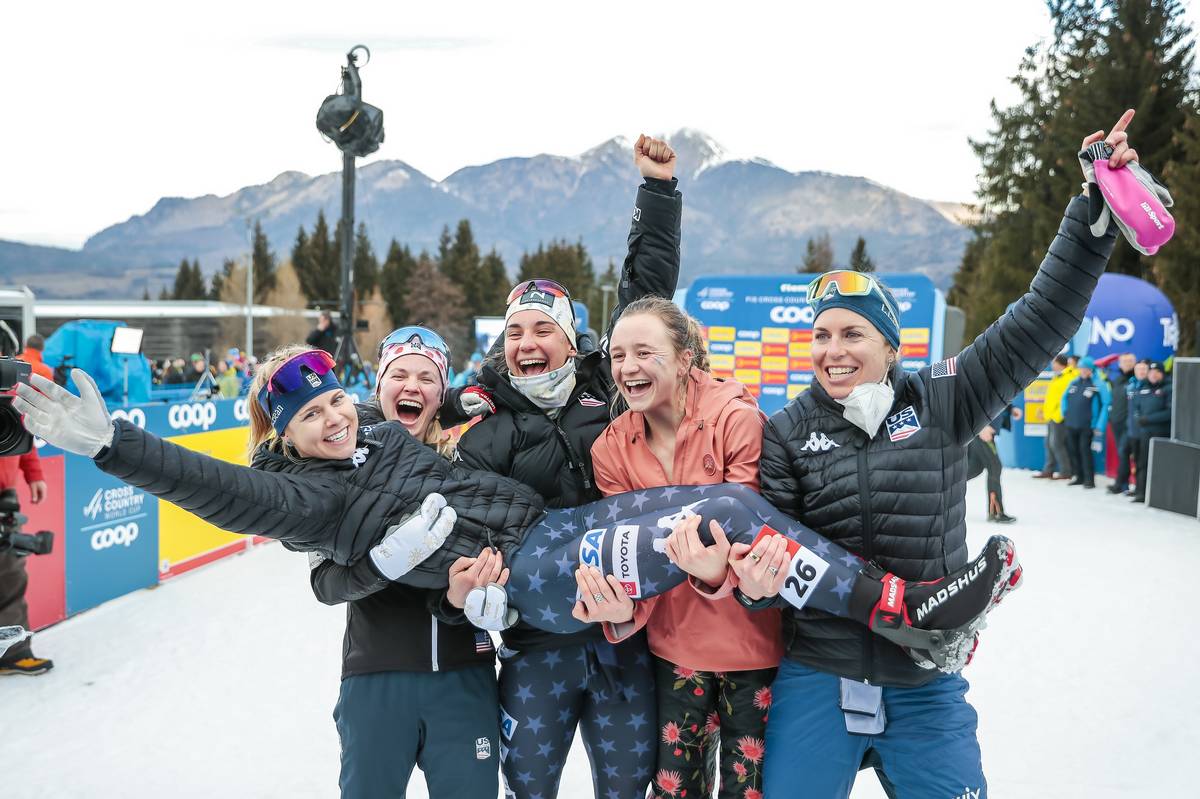
The American woman hold up Sophia Laukli after her 3rd place finish on the day. The Americans had three in the top ten, as Laukli was joined by Jessie Diggins in 5th and Rosie Brennan in 6th place. (Photo: NordicFocus)
Laukli Highlights Women’s Race with First Podium
Sophia Laukli spent the past year seeking out the most challenging propositions in endurance sports, and learning to make them her specialty. Last year on the Alpe, she recorded a 5th place finish alongside teammate Novie McCabe in 7th that marked a definitive breakout. Already then, the goal was set. Return to the Alpe in 2023, and seize it. In the interim, she has run and skied her way to the top of climbs around the world, winning the Lysbotn Opp rollerski climb last July ahead of Heidi Weng and Delphine Claudel, who were 1st and 3rd up the Alpe, respectively, last year. Through highs and lows in this Tour, she was able to keep sight of her “big goals for today” as she put it in post-race comments.
When it comes to the unexpected, however, one can only prepare just so much: “Right before the climb started, I got tripped up and lost all the positions I had made up [by working the flat section],” she said. “I was back to being in the back of the pack going into the climb.”
Her experience on the climb told her two things: “Tactically, it’s very difficult to pass people, and [the Alpe] is a long climb.” Laukli held it together. She found her teammates, Jessie Diggins and Rosie Brennan, climbing in 5th and 6th place through the crux of the Alpe. Laukli held her emotions in check, saying she, “[didn’t go] full-on panic mode, and [it] saved me today.” There was poise. There was patience. And there was also a whole lot of power. It appeared impossible that she could climb back to the podium, and yet Sophia Laukli had taken that word and controlled it: it was impossible how well she was skiing.
That fact became most apparent in the final 200 meters of the race. Having begun the day at the back of the pack, Laukli had raced herself into position to stand on the podium for the first time in her World Cup career. None of that would come easy; she crossed the finish line and folded over in the snow. Five minutes later, she stepped onto the podium in third place. The 22 year old Maine native, and current University of Utah skier, became the first of her new generation of American women to achieve that milestone.
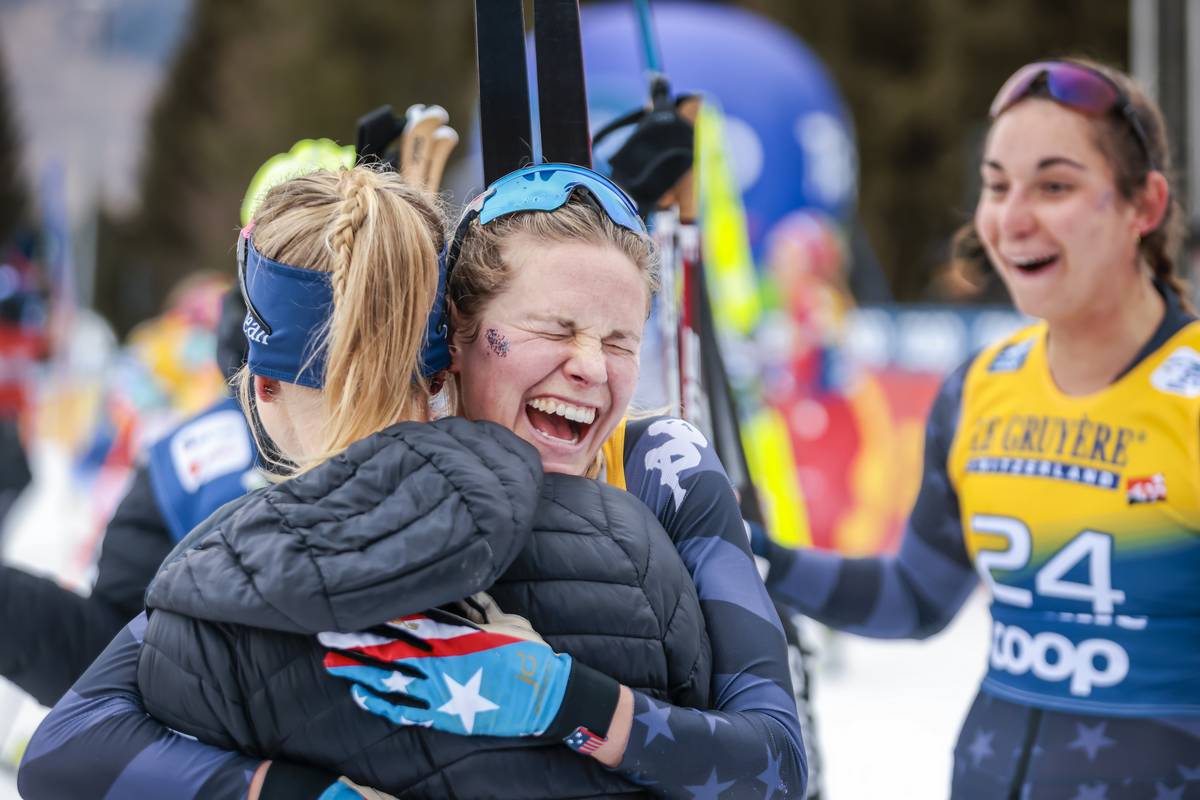
Jessie Diggins (USA) hugs Sophia Laukli (USA) on top of the Alpe di Cermis. (Photo: NordicFocus)
In the end, Laukli’s finish was just 35.7 seconds behind French climbing specialist Delphine Claudel. Claudel entered the steepest sections of the climb behind Frida Karlsson, the overall leader. At a hairpin 1.5 k from the finish, a brief tangle between Karlsson and Heidi Weng allowed Claudel to establish a gap, and Weng was the one who followed. But none were able to surpass Claudel at the finish line where the Frenchwoman claimed her first World Cup victory, and her first win on the Alpe di Cermis.
Delphine Claudel (FRA) crosses the line for the first World Cup win of her career atop the Alpe di Cermis. (Photo: NordicFocus)
For her part, Laukli seemed to search beyond herself to explain her astounding performance. “I lucked out I guess,” she said. “My tired was less than other people’s tired, and so it was enough.” Laukli’s achievements on the day could have overshadowed what other American women accomplished: one of the team’s best days ever, putting three in the top ten. There was the tenacity of Jessie Diggins, pushing to the front of the race early on in the Alpe climb, working “through disappointments but never losing belief” as she would say after the race. Then through the middle part of the climb, Rosie Brennan had joined Diggins, pushing to improve her Overall 5th place standing on the day. It all came together: “[It felt surprisingly] nice and comfortable,” Brennan said. “Usually [on the Alpe], you are alone and work on just keeping a rhythm, but today is was like ‘now I gotta stay with them.’” The American women had come together for the toughest test in ski racing.
Jessie Diggins (USA) and Rosie Brennan (USA) push up the Alpe Cermis together, finishing 5th and 6th on the day. (Photo: NordicFocus)
As Laukli pushed for third, Diggins and Brennan stuck together to finish fifth and sixth on the day. Brennan moved up to fourth Overall, her best Tour de Ski overall finish ever. “[The World Cup] has been a hard start for me this year, and I’m starting to come around. [This Tour de Ski] was a good sign for the future.”
With her race today, Jessie Diggins moved up to 11th Overall in this year’s Tour de Ski. Diggins commented that she is “more proud of how I handled this Tour than any other one. I just didn’t stop believing and kept going. Now it’s time to recover, and keep training.”
Diggins did add that she would undertake some post-race evaluation on how she was recovering: “I’m not 100% sure when my next race will be,” she said.
Karlsson won the 17th edition of the Tour de Ski with a 15th place finish on the Alpe, remaining 33 seconds ahead of Niskanen and Tiril Udnes Weng. The finish culminated a week in which Karlsson continuously bolstered her reputation as the dominant distance skier in the women’s field. Karlsson’s win also marks another milestone for the current generation of Swedish women skiers, delivering the first Overall Tour de Ski win since Charlotte Kalla won in 2008.
Krueger Wins Day, Klaebo Wins Tour in Men’s Race
Johannes Hoesflot Klaebo lifts his 3rd Tour de Ski trophy of his career. (Photo: NordicFocus)
Part of the emerging legend of the Alpe Cermis is that it has been the only arena capable of diminishing the otherwise-unstoppable force of Johannes Hoesflot Klaebo. Klaebo entered the day having won all six of this year’s Tour de Ski previous stages, another of the many accomplishments that only he can claim in the sport of skiing. Even so, there was almost no speculation that Klaebo would make this year’s Tour a clean sweep with a win on the Alpe di Cermis. The Alpe has made appear Klaebo human before; it would most likely do so again.
The lingering question was whether he could avoid a repeat of 2020 when Alexander Boshunov and Sergey Ustigov successfully wrested the yellow bib from Klaebo on the climb. With previous Alpe di Cermis winner, Simen Hegstad Krueger, in fifth place—1:45 behind Klaebo—there was still a possibility that the climb could prove to be Klaebo’s undoing yet again.
That possibility turned into real tension when Krueger initiated a move at the base of the climb, opening a gap in the field. A group of Norwegian men quickly formed, but without Klaebo. Sjur Roethe, Hans Christer Holund, and Didrik Toenseth moved up with Krueger. Klaebo was still within reach, but his lack of push to stay with the field indicated a concession from him; he would let the climbers go and focus on keeping the yellow bib on his back at the finish.
Klaebo, wearing the yellow bib, in behind the lead pack of his countrymen at the base of the Alpe Cermis climb (Photo: NordicFocus)
Krueger set a blistering pace up the steepest sections of the climb, dropping both Toenseth and Roethe (last year’s Alpe winner). Hans Christer Holund was the only one up to the task of marking Krueger, with Krueger doing the bulk of the work as he searched for seconds on Klaebo. Between the 8 k and 9 k mark, Krueger trimmed 47 seconds from his 1:45 gap to Klaebo. The math was evident: it would be hard, but not impossible, for Krueger to win the Tour. The aggressive push from Krueger meant that some of those who had tried to keep with him didn’t just lose touch with the pack when they went, but really fell off. That allowed skiers who had been more conservative through the early section to challenge for the final podium spot, including Frenchman Jules Lapierre and German Friedrich Moch. Klaebo kept to himself through their machinations, and Lapierre soon had established a gap over the other challengers.
In the end, Krueger crossed the finish line only five seconds ahead of Hans Christer Holund to win the Alpe for a second time. The Frenchman Lapierre crossed with the most emphatic celebration on the day: his first World Cup podium. Krueger’s celebration was perhaps a bit subdued: he had looked back to find that Klaebo had put in a remarkable second effort over the final kilometer. The Alpe, it turned out, did manage to expose Klaebo’s humanity, but the struggle also revealed his character. A skier who appears so often to win by virtue of talent and tactics earned a special victory today by racing with his heart.
Simen Hegstad Krueger crossed the finish line in first in his 2nd career win on the Alpe Cermis climb. Krueger moved up to 2nd place in this year’s Tour de Ski. (Photo: NordicFocus)
Part of the Alpe’s legend is in posing a challenges to skiers, but it also appears that the Alpe di Cermis has a sense of justice. Klaebo has clearly been the best skier in this Tour de Ski; with his third Overall victory, he moves a step closer to becoming its most successful skier of all time. That he has not already notched that title speaks to both his youth (we often forget how young Klaebo is), and to the prowess of the skier he chases: Dario Cologna, who during his career earned four Tour de Ski titles.
Scott Patterson finished 14th on the Alpe Cermis, earning the distinction of top American on the day. (Photo: NordicFocus)
Behind the Norwegian battle at the top of the Alpe Cermis, the American men were busy continuing their steady climb toward the top of the World Cup. Scott Patterson was the top finisher for the Americans, finishing 14th in his second climb of the Alpe (he was 38th last year). Patterson said in post-race comments that the result marked a high point for him at this Tour de Ski, and that he is, “looking forward to the focus on the longer races later in the season,” including the 50 k in Holmenkollen.
Ben Ogden was the top American finisher in the Overall Tour de Ski standings, finishing 13th after a 24th place finish in his first climb of Alpe di Cermis.
Ben Ogden, the top-placed American man in this year’s Tour de Ski at 13th Overall. (Photo: NordicFocus)
Conclusion to the 17th Tour de Ski
With that, the 17th edition of the Tour de Ski comes to a close. World Cup Skiing departs the slopes of Alpe di Cermis, leaving more stories etched in the snow on each steep hairpin. It reminds us once again of all that makes ski racing beautiful when the time is right, when the skiers are prepped, and when and all of our eyes watching.
The World Cup takes a collective rest for the next two weeks, before resuming in Livigno, Italy on January 21st. From all of us at FasterSkier, thanks for following along for another edition of the Tour de Ski!
The American men at the top of the Alpe Cermis. (L-R) Gus Schumacher, Ben Ogden, Finn O’Connell, Scott Patterson, and Hunter Wonders. (Photo: Tom Horrocks/USSS)
This World Cup coverage is made possible through the generous support of Marty and Kathy Hall and A Hall Mark of Excellence Award. To learn more about A Hall Mark of Excellence Award, or to learn how you can support Fasterskier’s coverage, please contact info@fasterskier.com.
Today, the leaders of the Tour de Ski went to the front, and the standings were put into stark perspective. This late in a long and challenging stage race, no one wanted to risk the daring move. There was too little to gain, and far too much to lose. With a very difficult (and potentially consequential) stage tomorrow, there was very little incentive to push the pace. The Tour de Ski will whittle down the contenders all by itself; the distances and the schedule and the elevation and the stress will see to that. The selection will just happen naturally . . . and those who benefit will be those who hang on. That was the nature of the racing in Val di Fiemme, Italy today in Stage 6 of the 2023 Tour de Ski.
Katharina Hennig (GER) sprints to victory over Rosie Brennan (USA), Kerttu Niskanen (FIN), Frida Karlsson (SWE), (l-r) in Stage 6 of the Tour de Ski from Val di Fiemme (ITA). Brennan would finish fourth, with Niskanen and Karlsson second and third. (Photo: NordicFocus)
In the end, Katharina Hennig (GER) won the sprint finish, followed by current Tour de Ski leader, Frida Karlsson (SWE) and Kerttu Niskanen (FIN).
American Rosie Brennan finished a sensational fourth in Stage 6, one second behind the winner, and only .2 from the podium. Other American finishers included Diggins in 24th, Laukli 26th, Kern 31st, and Sonnesyn 36th.
Canadian finishers included Katharine Stewart-Jones who remained in contention among the chasers throughout the day, and skied to a very impressive 10th place finish, and Dahria Beatty who finished 37th after a mid-race fall.
“Today was a lot of fun!” said Stewart-Jones. “I have been close to the top 10 a couple of times so it is exciting to have finally cracked it. Being in the ‘mix’ and watching my teammates also have some great performances makes racing even more fun. For the rest of the season, I want to continue hunting down some PBs!”
Krista Parmakoski (FIN) who was third in the overall standings (1:05 behind the leader, Karlsson) withdrew before the race began, citing illness that had developed overnight. Parmakoski described stomach pains rather than Covid symptoms, which allows her to remain hopeful for maintaining her condition and being prepared for the FIS World Championships in a few weeks.
Women’s 15 k Classic Mass Start
It was a warm and sunny day in Val di Fiemme, Italy with air temperatures of 7.7 degrees Celsius, and snow temperatures just below freezing. The grind of the Tour de Ski had taken its toll, and the starting field had been whittled down to just 37 starters.
The Women’s 15 k Classic Mass Start followed six laps of the Val di Fiemme course. The early pace was dictated by a group of contenders—Karlsson, Niskanen, Hennig—though the pace was fairly moderate. Brennan moved to the front just before halfway point, (at 6 k), stringing out the field with her pace making. A lead group forms: Hennig, Niskanen, Karlsson, Tiril Udnes Weng (NOR), and Astrid Oyre Slind (NOR). Teresa Stadlober (AUT) managed to catch on before the significant gap formed.
Chasing them were Delphine Claudel (FRA), Lotta Udnes Weng (NOR), Anne Kyllonen (FIN), Katherine Stewart-Jones (CAN), and Heidi Weng (NOR). Diggins and Laukli settled into a third group as Kern began to be gapped.
Classic mass start racing can be a daunting challenge. What if the skis are too slow? What if the kick is too slippery? And descending on classic skis is a tricky prospect under even the friendliest of conditions. In the deep ruts and soft snow of the Val di Fiemme course, the high speed descent—a 45 kmh sweeping left turn—claimed a few unfortunate victims. Among them were Nadine Faehndrich (SUI) and Dahria Beatty (CAN) whose falls left them near the back of the pack.
Niskanen began pushing the pace in the fifth lap, while Karlsson began to show signs that her kick wax was beginning to fail, skiing out of the tracks early on each uphill, and cutting diagonally across each slope to gain some purchase with her edges. Brennan and Hennig also made the selection, and the lead group was established at four.
Rosie Brennan (USA) and Katharina Hennig (GER), (l-r) testing their limits on the Val di Fiemme downhills. (Phtoo: NordicFocus)
Brennan seems to excel during the toughest racing, and a classic mass start on an overly-warm day in the sixth stage of an exhausting Tour de Ski is particularly tough.
“I decided to go to the front and just ski my own pace for a lap. I don’t know if it really strung things out or not, but then the next lap was the sprint bonus and the speed got turned up really hot there . . . I did have a moment of ‘I don’t know if I’m gonna make it.’”
Niskanen continued to lead, pressing the pace through the final kilometers, knowing she would need to take the sprint out of Karlsson, Brennan, and Hennig. At 34 years of age, Niskanen seems to be experiencing a resurgence that goes well beyond her early-career specialization as a classic skier. Even so, she knew that if she failed to separate herself from her rivals that they would be likely to overtake her in the sprint. Ultimately, the strongest sprinter prevailed in a four-up finish, as Hennig charged across the line ahead of Karlsson and Niskanen. Only a second behind, Brennan was forced to settle for fourth.
Rosie Brennan (USA) raced to fourth in the 15 k Classic Mass start in the Tour de Ski Stage 6 at – FIS world cup cross-country, tour de ski, mass, Val di Fiemme (ITA). (Photo: NordicFocus)
“I felt really good, actually. I’ll be honest; I’ve never had a good race here, so I was sweating bullets about today. I was very nervous,” Brennan said. “I’ve made some really strong improvements in my classic over the last year, and I have a new wax tech that I really enjoy working with, and so I decide I just needed to believe today and see what was possible, and take a chance on myself. I’m really glad I did.”
When asked what she was looking for in tomorrow’s race up Alpe di Cermis, Brennan laughingly replied, “The top!”
After the race, American Jessie Diggins spoke of the many challenges that her team has been experiencing during the Tour de Ski, and the pride she feels at being part of this group: “We’ve had some serious staff shortages due to illness . . . I get choked up thinking about how everyone’s pulled together,” she said. “The Kern parents are out there running skis and doing feeds, Rosie’s boyfriend Tyler is out there testing kick . . . people have just banded together to make it work.”
Diggins finished 24th on the day, and sits 15th overall, 5:23 behind the leader.
Karlsson did all that was required to maintain her overall advantage, and enjoys a considerable lead as the Tour de Ski approaches the final stage on Alpe de Cermis. Her lead in the Tour de Ski is 1:12 to T. Weng, 1:37 to Niskanen, 2:00 to Hennig, and 2:28 to Brennan who sits in fifth place.
This World Cup coverage is made possible through the generous support of Marty and Kathy Hall and A Hall Mark of Excellence Award. To learn more about A Hall Mark of Excellence Award, or to learn how you can support Fasterskier’s coverage, please contact info@fasterskier.com.
Lotta Udnes Weng (NOR) celebrates her victory in the Stage 5 Women’s Sprint at the 2023 Tour de Ski in Val di Fiemme, Italy. She shared the podium with her twin sister, Tiril Undnes Weng (NOR), who finished second. (Photo: NordicFocus)
Stage 5 of the 2023 Tour de Ski was a sprint, but not a “normal” sprint. Typically, sprint races are won by pure sprinters, those who control the pace of heats, and rely on mad dashes in the homestretch to secure victory. Unlike a typical World Cup sprint race, Val di Fiemme’s sprint stage was a race that was bound to affect the overall Tour de Ski standings: any distance skier who could advance to the later heats would be sure to rise in the ranks with just two more stages remaining. A number of significant sprint specialists were absent from the Tour de Ski startlist, and other skiers normally known for distance prowess were vying for sprint advancement. Those skiers would use the tools available to them to make that possible. Predictably, the pacing was fast, and the tactics merciless. This was not a sprint that could be taken: this was a sprint that would be earned.
A number of those all-arounders advanced to the final, including Finland’s Krista Parmakoski who set a brutal pace in both her quarterfinal and semifinal heats. The final podium was pure Norwegian red: Lotta Udnes Weng in first, her twin sister Tiril Udnes Weng second, and Myhrvold third.
Canadians in the final standings included Catherine Stewart-Jones who qualified 28th, but did not advance beyond her quarterfinal (finishing 29th), and Dahria Beatty 34th.
Americans failed to advance to the final, but had fine showings, nonetheless. With a hard-fought 10th place finish, Rosie Brennan showed that her form is returning to the world-challenging status that’s become her norm in recent seasons. Week after week on the World Cup tour, Brennan delivers a level of consistency that rivals that of any American skier from the present, or the past. While this week’s Sprint in Val di Fiemme was not a stand-out result for her, it was an indication that Brennan is once again rounding into form, and preparing herself to contend in races—both sprint and distance—in the remainder of the World Cup season.
“I was very happy to make the semi finals today,” Brennan said. “Sprinting has been such a struggle for me this year, so it felt good to make a small step forward. There isn’t much snow here and it’s warm so the tracks were fast and breaking down, but everything held on just enough and my skis were good. I lacked the punch I needed to make the final, but any step forward is all you can ask for. There is still a lot left in the Tour, so I’m still just trying to focus one day at a time and take things as they come. ”
Behind Brennan’s 10th place finish, American finishers included Julia Kern 14th, Jessie Diggins 21st, Alayna Sonnesyn 38th , and Sophia Laukli 44th
Rosie Brennan (USA), Lotta Udnes Weng (NOR), and Nadine Faehndrich (SUI) in a blistering quarterfinal heat that set the tone for the day in Val di Fiemme, Italy. (Photo” NordicFocus)
Women’s Sprint
Val di Fiemme offers a rolling sprint course with very little time for recovery. An initial uphill is followed by a rolling middle section. Later in the loop, the racers navigate a tight, tactically significant lefthand bend, a narrow spot in the course where speed can be gained, or lost. A wax-revealing downhill needs to be timed to create a slingshot effect over the final small rise.
With a number of Team Sweden’s sprint specialists sitting out the Tour de Ski, the Women’s field would be marked by racing that was likely to affect the overall standings (with a 60 second bonus for the winner). Distance skiers had great motivation to attempt to reach the later heats, meaning that the heats would be fast: no sprinters jockeying for position. It would come as no surprise that sprinters would be a bit tired after four challenging stages of Tour de Ski racing, and race strategy was dictated by the pace of the distance skiers.
The quarterfinals turned into tests of sustained speed. Heat times were incredibly fast, with blistering paces set by Parmakoski, Kerttu Niskanen (FIN), Eva Urevec (SLO), and current Tour de Ski leader Frida Karlsson (SWE). The sprinters appeared surprised by the early pace, with specialists like Dahlqvist and Faendrich finding themselves needing to accelerate late in their quarterfinal heats in order to advance. But those efforts took too much out of both of them, and neither would advance beyond the semifinals.
In her quarterfinal heat, Diggins found herself cut off at the narrow lefthand turn, and was unable to recover her speed by the finish. she would finish fourth in her quarterfinal. Julia Kern avoided that traffic jam in the same heat, but was only able to finish third. Neither would advance to the semifinals.
Semifinals
Semifinal 1 pitted the season’s dominant sprinter (Faehndrich) against four of the main TDS contenders: Parmakoski, Katherina Hennig (GER), L. Weng, and T.Weng. Parmakoski returned to her original strategy, driving the pace at the front and stringing out the semifinal field. Appearing exhausted, Faehndrich dangled off the back early on, and would not be a factor in the outcome of the heat. T. Weng and Hennig both caught Parmakoski in the finishing straight, with Brennan finishing fifth, and Faehndrich sixth.
Semifinal 2 was the days first race that was not run all-out, but stayed tightly grouped for most of the lap, seemingly playing to the advantage of Dahlqvist. Tereza Beranova (CZE) charged forward at the sharp left turn, but did not manage to gap the field. Finishing lanes became totally clogged behind her at the finish with Anna Dyvik (SWE) and Dahlqvist literally having nowhere to go. Mathilde Myhrvold (NOR) found an unobstructed lane, sprinting forward to win the semifinal, followed across the line by Beranova.
Women’s Sprint Final
The women’s final involved Parmakoski, Myhrvold, Beranova, T. Weng, L. Weng, Hennig. Parmakoski had already succeeded in gaining time on Karlsson, who failed to advance beyond the quarterfinal. Her goals accomplished on the day, she seemed content to let the more others set the pace in the final. Hennig, on the other hand, seemed determined to make the other racers work for the win: she drove the pace through the rolling middle of the course, marked comfortably by T. Weng. Beranova lingered at the rear with L. Weng.
Racers crowded through the notoriously tight left-hander. Hennig exited in the lead, but both T. Weng and L. Weng executed the hill slingshot to perfection, passing Hennig in the finishing straight where she also lost the battle with Myhrvold for third.
Norwegians—and Twin sisters—atop the Tour de Ski podium. Lotta Udnes Weng with the win, followed by her twin sister, T. Weng, and Myhrvold in third. In a post-race interview, Lotta Weng commented on her victory: “We planned to let the other girls do the job, and we can just chill behind them.The waxers are doing a great job,” she continued. “That makes it easy for us.”
The overall Tour de Ski standings are tightening. Karlsson continues to lead, though with a smaller the margin over T. Weng, Parmakoski, and L. Weng. Brennan moves into 7th overall with two stages remaining.
Tiril Udnes Weng (NOR), Lotta Udnes Weng (NOR), Mathilde Myhrvold (NOR), (l-r) celebrate a Norwegian sweep of the podium at the 2023 Tour de Ski Women’s Sprint in Val di Fiemme, Italy. (Photo: NordicFocus)
This World Cup coverage is made possible through the generous support of Marty and Kathy Hall and A Hall Mark of Excellence Award. To learn more about A Hall Mark of Excellence Award, or to learn how you can support Fasterskier’s coverage, please contact info@fasterskier.com.
On Sunday, Val Mustair, Switzerland played host to Stage 2 of the 2023 Tour de Ski: a 10 k Classic Pursuit.
The Pursuit isn’t just a distance race. It’s a combined result—an event that is inextricably linked (and combined in value) with the prior day’s sprint. Pursuit racing is a funny event, one that doesn’t sit entirely well with our sense of fairness: an advantage is given to the skier who proved the fastest on the previous day, with additional World Cup points being awarded to the one who crosses the line first. It’s a regular occurrence that the “winner” on the day may not be the fastest finisher on the day (and such was the case on Sunday in Val Mustair). One way or another, the overall standings of the Women’s Tour de Ski were definitely re-shuffled in Sunday’s 10 k Classic Pursuit.
Tiril Udnes Weng (NOR) outsprints Kerttu Niskanen (FIN) in Tour de Ski Stage 2. Weng claimed the overall lead, while Niskanen posted the fastest time of the day. (Photo: NordicFocus)
In any pursuit event, there’s far more to the race-story than simply counting a skier’s finishing place. The most accurate way to judge a skier’s success may be to assess whether they moved up or down within the field (relative to their own starting place), and whether they gained or lost time to the leaders (regardless of their finishing place). In Stage 2 of the Tour de Ski, there were a number of exceptional performances: The fastest skier on the day was Kerttu Niskanen (FIN) who moved from 12th to 2nd, making up nearly 44 seconds. Second fastest skier on the day was Katherina Hennig (GER) moving from 26th to 6th, making up 22 seconds. And third fastest was Anne Kjersti Kalvaa (NOR) moving from 6th to 4th, and making up 19 seconds. Behind them, Frida Karlsson (SWE) moved from 5th to 3rd, making up 18 seconds. The day’s Pursuit winner, Tiril Udnes Weng (NOR), moved from 4th to 1st, making up 17 seconds. Heidi Weng (NOR) leaped from 51st to 8th, making up nearly 12 seconds. Rosie Brennan (USA) moved from 14th to 7th, making up 11 seconds. Astrid Oeyre Slind (NOR) moved from 35th to 10th, making up 6 seconds.
After Stage 2, Overall TDS leaders are as follows:
T. Weng
Niskanen
Karlsson
In addition to Brennan (whose finishing time was 7th fastest on the day), American finishers included Jessie Diggins (moving from 39th to 30th, but losing nearly a minute to the leaders), Julia Kern (started 10th, and skied well to finish 12th), Sophia Laukli (jumping from 67th to 50th), and Alayna Sonnesyn (falling from 37th to 53rd).
Canadian finishers all improved their standings: Katherine Stewart-Jones (rising from 46th to 25th), Dahria Beatty (skiing from 54th to 45th), and Liliane Gagnon (rising from 64th to 60th).
Women’s 10 k Pursuit
Stage 1 Sprint winner, Nadine Faehndrich (SUI), began the day with a 17 second advantage over the field, one she was able to maintain through the first of four 2.5 kilometer laps. Soon after passing through the stadium, however, she was joined by the group that had formed behind her, led by Karlsson and containing T. Weng, L. Weng, and Kalvaa. By the five kilometer mark, the lead group had been reduced to Karlsson and the three Norwegians, with a hard-charging Niskanen whittling away at their lead with each passing kilometer.
Rosie Brennan (USA) and Krista Parmakoski (FIN) racing the Tour de Ski 10 k pursuit in Val Mustair, Switzerland. (Photo: NordicFocus)
Rosie Brennan moved steadily up in the field throughout day. Before the race, Brennan had spoken of her expectations—and hopes—for the Pursuit: “I hope I can make up some time in the distance races moving forward,” she said. “Tomorrow will certainly be a bit of a wild day with a short course and fast conditions so we’ll see what happens out there.” Her optimism was rewarded, as her finishing time proved seventh fastest on the day.
Diggins started the Pursuit in 39th position, 1:11 behind the leader. She began making up places right away, but was never able to make considerable gains on the deficit to the leaders.
“I did feel like I went out a little bit aggressively, kind of going for broke,” Diggins said. “Honestly, I was really proud of how I skied. I kept fighting the whole time. Bigger picture: there’s a lot of things that need to come together in order for it to be a stellar result; those things didn’t come together today or yesterday. That’s okay, and we’re working on it. I have faith that it’s just going to keep getting better and better.”
Julia Kern (USA) skied strongly and consistently, claiming 12th in the 10 k Classic Pursuit in Val Mustair. (Photo: NordicFocus)
Julia Kern raced bravely throughout the day, and may have benefitted from the pace of skiers around her. Early in the race she was in contact with Brennan. Later, she kept pace with the Germans—Laura Gimmler and the resurgent Hennig—just as Heidi Weng also began making a move through the field. Kern described her race in a post-event interview: “I’ve had a few weeks off from distance racing so I wasn’t sure how it would go,” she said. “[Today] was really hard, and really good. It was a game of send it, die, and come back to life.”
With one lap to go, Niskanen had joined the leaders, pulling L. Weng back into contact to create a lead group of five. Karlsson continued to lead through the stadium at the beginning of the final lap, but with 1.5 k to go it was Niskanen who moved forward to push the pace. Only Niskanen was able to stay in the tracks on the final uphill, and she pressed the issue in hopes of shedding the stronger sprinters around her. In the end, though, it was T. Weng who sprinted down the homestretch to take the win, followed by Niskanen, Karlsson, and Kalvaa (the first four finishers all finished within two seconds of each other). Niskanen was by far the fastest on the day, a masterful performance that has pulled her into a virtual tie atop the Tour de Ski standings with T. Weng and Karlsson.
There will be a day off for the racers on Monday, before the Tour de Ski moves to Oberstdorf, Germany.
Kerttu Niskanen (FIN), Tiril Udnes Weng (NOR), Frida Karlsson (SWE), (l-r) – FIS world cup cross-country, tour de ski, pursuit, Val Mustair (SUI). (Photo: NordicFocus)
A rivalry renewed: Johannes Hoesflot Klaebo (NOR) and Federico Pellegrino ((ITA) at the finish line of the 2023 Tour de Ski Stage 1 Sprint in Val Mustair, Switzerland. Klaebo would finish first, with Pellegrino second. (Photo: NordicFocus)
The FIS World Cup tour returned from a two-week holiday break, reconvening in Val Mustair, Switzerland for Stage 1 of the 17th Tour de Ski. A daunting mid-season challenge, the Tour de Ski (TDS) consists of seven stages contested over nine exhausting days, concluding next Sunday atop the Alpe di Cermis in Val di Fiemme, Italy.
At the start of this year’s tour, all eyes were on Johannes Hoesflot Klaebo (NOR), who finds himself in a prolonged battle for FIS World Cup points with Norwegian countryman, Paal Golberg. The Overall Crystal Globe competition is likely to be decided by their performances in the Tour de Ski, and today’s Freestyle Sprint stage may have been a taste of coming attractions. Showing speed and tactics that his rivals could not match, Klaebo coasted to the win in Val Mustair, followed by Federico Pellegrino (ITA) and Sindre Bjoernstad Skar (NOR).
Americans experienced results both good and bad: Ben Ogden qualified a remarkable 4th, but would suffer a broken pole at the very start of his quarterfinal and finish the day in 13th. JC Schoonmaker was the 21st qualifier, but would finish 6th in his quarterfinal and settle for 26th on the day. American results in qualifying also included Gus Schumaker 50th, Zak Ketterson 59th, Finn O’Connell 67th, Kevin Bolger 74th, Hunter Wonders, 80th, Scott Patterson, 94th.
Ogden offered an in-depth description of that broken pole, and the psychological process of re-grouping during a sprint race: “Today when I broke that early pole all I was thinking was how to catch up. I knew that my strength was in the flatter V2 before the steep climb, so I really just pinned it immediately after getting a new pole and surprised myself with how quickly I could get back to where I wanted to be amongst the other guys. My brain then went pretty quickly to damage control as I tried to evaluate how much energy I had used there. I was lucky to be feeling strong today and it didn’t really affect me too much. I think I was a little flustered and not exactly where I needed to be in the last minute or so, so that cost me a spot in the semi final, but I know that this could have happened regardless of the pole incident. It can be nice for the head to blame it on the pole, but overall it was just another learning experience out there and hopefully next time I can be in a better position and get through.”
Canadian Graham Ritchie qualified 14th, ultimately finishing the day in 21st, ahead of countrymen Antoine Cyr 32nd, Russell Kennedy 33rd, Olivier Léveillé 55th, Sam Hendry 85th, and Remi Drolet 91st.
Nadine Faehndrich (SUI) celebrates her Stage 1 win in Tour de Ski, 2023. (Photo: NordicFocus)
In the Women’s field, the Stage 1 Sprint seemed most likely to be won by a sprint specialist while TDS contenders vied for finishing positions that would place them near the head of the field in Sunday’s 10 k Pursuit. The day played out much that way (though with a few surprising developments) as World Cup Sprint Leader, Nadine Faehndrich (SUI), took the win, followed by Maja Dahlqvist (SWE), and Lotta Udnes Weng (NOR).
Julia Kern (USA) raced to 6th in sprint qualifying, but saw her day ended by a fall in the semifinal. She would finish the day in 11th. (Photo: NordicFocus)
Julia Kern (qualifying 6th) and Rosie Brennan (qualifying 14th) would’ve had high hopes for the day, but Kern tumbled in a rutted corner to finish sixth in her semifinal (finishing 11th on the day), while Brennan faded in her quarterfinal and failed to advance, ending the day in 14th. Other American qualifying places included Alayna Sonnesyn 38th, and Sophia Laukli 69th.
Among Canadians in qualifying, Katherine Stewart-Jones finished 48th, followed by Dahria Beatty 56th, and Lillian Gagnon 66th.
Naturally, the surprising story in qualifying was the performance of Jessie Diggins, whose qualifying time was only fast enough for 40th place (failing to qualify for the quarterfinal heats). Via her Facebook account, Diggins later commented on her own performance, saying, “Sometimes your body feels great and your brain is ready and it just doesn’t work out—and that’s ok. The only things that’s not ok is to give up.” That’s quintessential Diggins. She will enter Stage 2 in a position well behind her main rivals, but with racing abilities like those Diggins has so often shown, her chances to contend for the overall TDS crown are likely to improve with each passing kilometer.
TDS Women’s Freestyle Sprint
Sprint Quarterfinals are sometimes treated as a bit of an afterthought in typical race reporting, but in Val Mustair, much of the action that’s likely to affect the week’s results occurred in the quarterfinals. Sweden’s Frida Karlsson—a serious contender for the TDS crown—advanced out of a fast quarterfinal in which she drove the pace. That speed in Karlsson’s heat—and a high-quality field in the second quarterfinal—forced Kern to employ a different strategy than she might normally undertake, leading out the first lap ahead of L. Weng and Dahlqvist. The strategy seemed to be working, as Kern distanced Dahlqvist on the uphill. Even so, Dahlqvist showed her class by attacking over the top, and scorching the downhill to win the heat. Kern held on for second, narrowly ahead of L. Weng in third (who would claim a lucky loser spot).
Brennan dangled off the back of the pack at the start of quarterfinal 5, but worked her way back through the field at the end of lap one. Looking for space to pass, she took a very wide line up the hill, advancing two places into third, a position she was unable to improve before the finish. Her finishing time was not fast enough to claim a lucky loser spot. Brennan would end the day in 11th.
Nadine Faehndrich (SUI) speeding to victory in the 2023 Tour de Ski Stage 1 Freestyle Sprint. (Photo: NordicFocus)
Throughout the heats, Faehndrich continued dancing up the hill, showing a top speed that none of the others possessed. L. Weng and Karlsson claimed lucky loser spots in their semifinal, which could prove to be truly significant in the week long tour standings.
The sprint final included Karlsson, Maja Dahlquist (SWE), L. Weng, T. Weng, Faehndrich, and World Cup distance leader Anne Kjersti Kalvaa (NOR). Having already shown that she is the fastest skier on the Val Mustair course, Faehndrich went straight to the lead, immediately gapping the field on the first hill. She navigated the subsequent downhill poorly, allowing the field to reel her in as they passed through the stadium at the end of lap 1. But the second time up the hill was a replay of the first, with Faehndrich’s higher tempo allowing her to gap the field and stay away through the finish. Dahlqvist surged in the finishing straight to push L. Weng down into third.
With the Women’s Stage 1 Sprint concluded, the TDS overall contenders are now identifiable: T. Weng, L. Weng, Kalvaa, and Karlsson . . . with Americans Diggins and Brennan poised to strike. Faehndrich has now won consecutive World Cup sprint events in her home country and in front of Swiss fans. “At the moment, it’s like a dream,” she said.
Klaebo (NOR, in third position) sets up the turn wide, carrying more speed and avoiding ruts that troubled other racers. (Photo: NordicFocus)
TDS Men’s Freestyle Sprint
The Val Mustair sprint venue consists of a two lap course with a significant mid-lap uphill, followed by a challenging, S-turn downhill that empties into the finishing straightaway. It was those S-turns that would prove significant in the day’s strategy, and in the mastery Klaebo displayed in his course management. His choice to set up the turns far wider than his rivals (carrying far more speed and avoiding ruts that worried so many racers) was key to his cruising to ultimate victory.
Klaebo may be the world’s premier sprinter; nonetheless, he found himself overtaken in the finishing stretch two weekends ago by his longtime rival, Federico Pellegrino (ITA) who appears to be drawing much positive energy from the recent birth of his first child. Always one who seems to ski and race with joy, Pellegrino is riding a wave of optimism and success that saw him challenging Klaebo in the Stage 1 Sprint at Val Mustair. The stage was set for an excellent Sprint competition.
As in the women’s sprints, the Men’s quarterfinals offered insight into the way the day would go, and demonstrated the ease and confidence with which Klaebo seemingly races. Boxed out on the uphill where he would usually make his move (and caught behind a stumbling Chanavat who stepped on his own pole, but managed to recover), Klaebo bided his time, then incorporated an entirely different line on the curving final downhill. He set up the turn so wide that it looked as if he was exiting the race course . . . only to re-set on the second half of the S, rocketing past all other racers. He entered the finishing straight with a commanding lead that he would hold easily through the finish.
The day’s second quarterfinal also proved significant, as Ogden—the fourth qualifier—suffered a broken pole in just the first few meters of racing. Coaches were on hand to deliver a quick replacement, but Ogden would spend a great deal of energy clawing his way back to the field before the first climb. Continuing to improve with each passing week, Ogden’s form may be at a career high point, but the effort of chasing no doubt depleted his finishing sprint, and Ogden would fail to advance out of his quarterfinal, finishing the day in 13th.
Reached for comment after his day of racing, Ogden offered a new American perspective on his expectations—and occasional frustrations—in World Cup racing. “There are minutes and hours after these races where all you can think about is what could have been,” he said. “But then when you take a step back it’s easy to put things into perspective and remember that it wasn’t more than two years ago when skiing in a world cup heat was a reach-goal of mine. So, the bottom line is at the moment, yes, immensely frustrating but in the big picture, I am happy with where I’m at as an athlete, and I’m stoked for every opportunity over here. ”
Klaebo’s semifinal included Chanavat, Renaud Jay (FRA), Sindre Bjoernstad Skar (NOR), and Pellegrino. Despite that gathering of stars, Klaebo advanced easily, employing his wide-turn strategy and coasting to the finish line. Pellegrino came second, with Chanavat and Skar advancing as lucky losers. A sprint final showdown between Klaebo and Golberg was not to materialize, as Golberg appeared a bit fatigued—or even a bit disinterested—in his semifinal, allowing Michal Novak (CZE) and Richard Jouve (FRA) to advance.
Sprint dominance on display: Klaebo (NOR) speeds to the win in Val Mustair. (Photo: NordicFocus)
The problem to solve in every World Cup sprint final remains the same: what to do about Klaebo? He has tremendous speed, he’s tactically brilliant, and he’s supremely confident. Perhaps the only strategy is to try to run him off his feet. Good luck with that . . .
The men’s sprint final involved Klaebo, Jouve, Pellegrino, Skar, Novak, and Chanavat. From the gun, the tall Frenchman went straight to the front, perhaps determined to make the pace so fast that a long day of sprinting would finally tire Klaebo. Chanavat led to the hill, where Klaebo’s wider line allowed him to float to the front in the company of Pellegrino who drove his speed over the top of the rise and into the lead. Again, Klaebo chose the widest line through the corners, maintaining speed and gliding through to the front. The second time up the hill he simply turned on the after-burners, and the race was all but over. His sinuous downhill line carried him to the finishing straight which he was able to ease across with no worry of being caught. Pellegrino collected second, ahead of Skar.
Commenting in a post-race interview on the elevation of Val Mustair, Klaebo remarked, “Sprinting here at 1600 meters is really tough . . . I’m pretty glad I made the decision to stay in Davos for Christmas.”
Klaebo leads the Tour de Ski after Stage 1, ahead of his main rival, Golberg, who earned 10th place on the day. Stage 2 may reveal which of them was able to preserve their energy in the interest of a week-long battle that’s just getting started.
Racing at the Tour de Ski continues on Sunday in Val Mustair with Men’s and Women’s 10 k Classic Pursuits.
This World Cup coverage is made possible through the generous support of Marty and Kathy Hall and A Hall Mark of Excellence Award. To learn more about A Hall Mark of Excellence Award, or to learn how you can support FasterSkier’s coverage, please contact info@fasterskier.com.
An American celebration in Davos as Jessie Diggins and Rosie Brennan take first and third: l-r Ingvild Oestberg (NOR), Jessie Diggins (USA), Rosie Brennan (USA) (Photo NordicFocus)
Today the World Cup returned to Davos, Switzerland where the women competed in the 20 k Individual Start Freestyle. As has been the case for the last several weeks, much of the critical pre-race story was about who wouldn’t be present. Absent from the field was Swedish long-distance heavy hitter Frida Karlsson and teammate Ebba Andersson. Missing from the Norwegian squad was Heidi Weng.
The U.S. hoped that Jessie Diggins could find her way back to the podium after yesterday’s second place sprint finish. Diggins has the most wins of any active woman athlete in individual distance freestyle, having won 10. She is also the most recent woman to have won consecutive individual World Cup distance events in the freestyle when she did so in January, 2021. After yesterday’s sprint performance, Diggins moved into second place in the overall World Cup standings, behind Tiril Udnes Weng (NOR).
Taking first place was Jessie Diggins (USA), in second was Ingvild Flugstad Oestberg (NOR), and in third Rosie Brennan (USA). Other American finishers were Sophia Laukli (17th), Alayna Sonnesyn (26th), and Lauren Jortberg (39th). Novie McCabe was scheduled to race but did not start due to illness.
It was another standout day for the Canadians with Katherine Stewart-Jones finishing 11th, Olivia Bouffard-Nesbitt 30th, Dahria Beatty 32nd, and Liliane Gagnon 40th.
Jessie Diggins (USA) showing the hardware that comes with first place. (Photo: NordicFocus)
In a pre-race interview Diggins said that she thought Davos was a fun course and really challenging. “It’s sneaky hard,” she said, reiterating her love for individual start skate races. “Just give me a trail in woods by myself and my skis and my brain . . . and I’m just excited to see how hard I can go.”
The skiers had another beautiful Davos day with full bright sun.
Rosie Brennan with the decisive lunge at the finish. It was enough to get her third place by half a second. (Photo: NordicFocus)
20 K Individual Freestyle
Diggins went out hard at the start. At the 2.2-kilometer time-check she had the fastest time by a slim margin over Claudel Delphine (FRA). Brennan started at a controlled tempo and was fifth after the first time check.
Diggins kept the hammer down for the first seven kilometers, leading at every time check. But her lead was very small, ahead of Oestberg by only seven seconds. By the time the 7.2-kilometer mark was reached, Oestberg—who had a later start position than Diggins—had clawed her way into first, leading Diggins by just over a second. The see-saw between the two would continue for the rest of the day with Oestberg hanging onto a small lead for much of the race.
Tactically, it appeared that Oestberg might have an advantage being the last of the top three skiers to start, so she would be fed the others’ times along the way. But Diggins has told Fasterskier in the past that she’s not always interested in hearing split times; she just skis as hard as she can. She also values having warmups conclude close to her starting time.
U.S. coach Chris Grover confirmed with Fasterskier that, “[Diggins] likes to take an earlier draw in start position because she likes to not have the track closed for so long for warmup. She really doesn’t even think of splits out there. Jessie knew exactly how she wanted to ski that course and that was to not go quite as hard on all of the ups . . . you have to work all the transitions, all the corners, all of the downs. The last 1.8 K are down . . . she had that strategy in mind for how she was going to ski it and she went out and skied it exactly the way she wanted to.”
Jessie Diggins (USA) found another gear in the final 1.8 k to finish first. (Photo: NordicFocus)
Grover continued that it was a different approach for Brennan. He said, “She’s prioritizing climbing on the uphills. Two opposite strategies and they both worked out pretty well for them.”
Twenty kilometers is still a relatively new distance for the women, so proper pacing would be critical. Grover indicated that the change to 20 k hasn’t been much of an issue. “It seems like it hasn’t been that hard of a transition,” Grover said. “They looked like they were at a high pace the whole time, the same kind of strategies they employed on this course in 10-K. We did a little bit of feeding, which we wouldn’t have done in a 10-kilometer event. Otherwise, it wasn’t so different.”
“I really wanted to pace it like red-line pacing…go as hard as I could right before I felt like I was going to blow up, and then hold it there.” Jessie Diggins
Diggins continued: “My strengths are the second half of the lap with all of these working sections, trying to find the extra seconds here and there,” she said. “We had some really awesome skis, and awesome energy from the fans.”
Regarding pacing for today’s race, Brennan told Fasterskier that: “I have never done a 20k interval start which was probably true for the whole field today. That made it really tricky to know the pace or really what to expect. I love the course here and love skiing at altitude so I had some confidence that I could find a steady pace and hold it.”
Jessie Diggins (USA) enjoying her first place hardware in Davos. The full-sized sled goes to the winner. (Photo: NordicFocus).
With only five kilometers to go, the race for first was almost a dead heat. Oestberg had a scant three second lead over Diggins. Meanwhile, the fight for third was boiling down to Brennan and Tiril Udnes Weng (NOR). At the 15 kilometer mark, Weng held a one second lead over Brennan. Both those racers were over 13 seconds off first place.
As the race wound down, the momentum for first place seemed to favor Oestberg as she continuously displaced Diggins from the lead with each time check she passed. But her lead was small enough that Diggins remained in the hunt for first place.
With two kilometers to go the competition had boiled down to two distinct races: Oestberg and Diggins battling for first, and Brennan and T. Weng battling for second. The tension continued to mount as Oestberg approached the final time-check at 18.2-kilometers. Oestberg had moved past Diggins at every time split since the 7.2-kilometer mark, and that trend continued at the last time check with Oestberg going into first place, but by only 2.9 seconds. Brennan and T. Weng were even closer with less than two seconds separating them with Brennan holding the lead.
With the race close—but momentum still in Oestberg’s favor—one couldn’t help but have the feeling that things would go Oestberg’s way.
Rosie Brennan (USA) showing the grit needed to earn a spot on the podium. (Photo: NordicFocus)
But as ski fans have seen so many times over the years, Diggins always has that little extra bit to put forth at the finish. Over the last 1.8-kilometers, Diggins reached for her well-known extra gear and ended up skiing the final stretch in 3:33.7. Oestberg skied the same stretch in 3:42.1. The 7.4 second advantage over the final 1.8-kilometers was enough to give Diggins the win by 5.5 seconds, dropping Oestberg to second.
“I knew it was tight, I knew it was exciting. I was just trying to ski my own race and ski as smart, as powerful, and as smooth as I could. My mental mantra was find the glide. Individual starts are my favorite way to race, it’s just you and your head out there.” Jessie Diggins
Diggins commented that she was so focused over the final downhill that she didn’t blink and her contact lens froze which added to the normal post finish line stress. “My eyes were ok, they just needed some time to warm up . . . no lasting damage; it was just quite painful and a little bit scary.”
T. Weng was nibbling away at Brennan’s lead by tenths of a second. Weng skied the final 2.8-kilometers faster than Brennan, but Brennan had established a three second lead at the 17.2 mark. It would be just enough to hold off T. Weng who finished half a second behind Brennan. Brennan told Fasterskier that, ” I had really good skis today and did all I could to push the downhill on the last lap which just barely snuck me on the podium.” Brennan said of the day’s events that, “Today was a great day for USA!!! I was pleased to turn around a disappointing day yesterday into a podium today. It was a tight race the whole way and I am thrilled to have just nipped the podium spot. It was great to share the podium with Diggs and is a great way to close out period 1 racing. Now it’s all eyes on the Tour!”
A 20 kilometer race had turned into a game of inches with Diggins and Brennan skiing perfectly to claim the podium. It was a glorious day in what turned out to be a fantastic weekend for team U.S.A. After the dust had settled from the day’s racing, Diggins would find herself firmly in second place in the overall World Cup points standings. Tiril Udnes Weng holds first place with 872 points. Diggins is in second with 738, and Krista Parmakoski (FIN) is in third with 625.
The World Cup takes a weekend off and picks up December 31st in Val Mustair, Switzerland for the start of the Tour de Ski with the freestyle sprints leading off.
This World Cup coverage is made possible through the generous support of Marty and Kathy Hall and A Hall Mark of Excellence Award. To learn more about A Hall Mark of Excellence Award, or to learn how you can support Fasterskier’s coverage, please contact info@fasterskier.com.
Today marked the return of the World Cup to the alpine valley of Davos, Switzerland. Davos, normally a luxury festooned playground for rock stars, politicians, royalty, and assorted billionaires would have a decidedly more blue-collar feel today as hard working skiers would grind around the freestyle rolling sprint course of 1.5-kilometers. At 5,120 feet above sea level, Davos is about 800 feet below the maximum elevation allowed by the International Ski Federation (FIS). So altitude would have to be accounted for. This morning was the women’s opportunity to test their mettle in the high-altitude luxe setting.
Jessie Diggins (USA) with another sparkling day—and another podium finish—in Davos. Diggins would finish the day in second place(Photo: Nordic Focus)
It’s not too early to start looking at the overall World cup standings, and coming into today’s sprints, Tiril Udnes Weng (NOR) was in first with 690 points. Frida Karlsson (SWE) was second with 588 points, and American Jessie Diggins was in third, totaling 538 points. Karlsson would be sidelined this weekend, so it would be a golden opportunity for Diggins to challenge for second place overall.
Health issues would once again be a major theme for today’s sprint. The Swedes dominated the sprints early in the season, but as Period 1 comes to a close, the Swedish squad has been decimated by illness. Swedish standout Maja Dahlqvist—a pre-race favorite and sprint winner at Davos last year—would sit out the weekend due to a cold. The Swedish sprint squad would also be depleted due the continued absence of Emma Ribom, who had won the first two sprints of the year and has now tested positive for Covid. Joining her on the Covid list of Swedish stars would be regular contenders Anna Dyvik and Ebba Andersson. So dire was Team Sweden’s situation that they advanced only two skiers into the qualifying round, one of whom, Jenny Solin, was in only her fifth World Cup race. But the Swedes still had an ace going into the start of the day with Johanna Hagstroem carrying the team’s hopes.
Regarding illness concerns, U.S. coach Chris Grover told Fasterskier that, “It is literally a constant battle now.” He emphasized the logistical challenge with skiers feeling ill or being exposed and needing to isolate from teammates. “We’re basically talking about it at every team meeting.”
Nadine Faendrich (SUI) remained consistent and dominant throughout the day, displaying unmatched speed and strength every time up the significant hill on Davos’ Sprint course. (Photo: Nordic Focus)
The hometown crowd would pin its hopes on Nadine Faehndrich, the Swiss skier who posted the fastest qualifying time and has been sprinting well of late. Going into the race, she was ranked fourth in sprint points and won the World Cup classic sprint last week in Beitostolen, Norway.
Racers had a beautiful day with bright sun and temperatures in the upper twenties. It was the best that Davos has to offer and a much needed respite from last week’s brutal cold in Beitostolen. Even so, the qualifying field was small, due to a mix of illness and fatigue, consisting of only 39 skiers. With the Americans’ entering five racers, the odds going into the race appeared favorable. Ultimately, four Americans advanced to the quarterfinals: Rosie Brennan qualified fifth, Jessie Diggins sixth, Julia Kern ninth, and Alayna Sonnesyn 25th. Lauren Jortberg narrowly missed qualifying, finishing 34th.
Among Canadians, Dahria Beatty qualified 24th, Olivia Bouffard-Nesbitt 30th , and Liliane Gagnon 32nd. It was the first time in the heats this year for Yukon native Beatty, and the first time ever for Quebec native Bouffard-Nesbitt.
Davos Women’s Sprint
In a tight race it was Faehndrich first, Diggins second, and Hagstroem third. For the Americans who qualified for the heats, Julia Kern finished 10th, Rosie Brennan was 13th, and Alayna Sonnesyn was 24th. For Canadians in the heats, it was Beatty 23rd and Bouffard-Nesbitt 25th.
Nadine Faehndrich (SUI) celebrates her second World Cup sprint win in as many weeks. (Photo: Nordic Focus)
Diggins and Brennan ended up in the same quarterfinal heat. It wasn’t necessarily a premeditated strategy. According to Grover, “When Diggins chose the first heat no one else was in it. When Rosie chose, she went in it next which was a smart strategy.” But this meant that the Americans would have to finish 1-2, or have a fast race for both to qualify. It turned out to be an unlucky turn.
Diggins easily qualified coming in second. Brennan finished third and would have to wait to see if she qualified as a lucky loser. She would not make the cut and finished 13th on the day, no doubt a disappointing outing after her excellent qualifying time. Brennan was squeezed out of advancing by Slovenian sprint specialist Eva Urevc, who performed exceptionally well. Grover commented that it was kind of surprising that Urevc was in the heat as well. “She skied great all day and was surprisingly strong.” In her comments after the race, Brennan said, “I did not have the day I was hoping for today. I am really struggling to find my power and speed in sprinting, which has been frustrating for me.” Addressing any lingering health concerns she continued that, “My fall and early season has been marred by illness, and I think that has made it difficult for me to find all my gears. I am doing my best to find patience as there are still many races left in the season, but patience is not my strength so it’s providing me with quite the challenge . . . I am healthy now, and my base fitness still feels good, so I am looking forward to tomorrow.”
Rosie Brennan (USA) giving it her all in Davos. (Photo: NordicFocus)
Julia Kern qualified into the second quarterfinal and finished third in her heat as well. She, too, would wait for a lucky loser spot, and ultimately did move forward as a lucky loser.
Alayna Sonnnesyn was in the third quarterfinal. She finished fifth and her racing ended there, but it was a triumphant day for Sonnesyn since it was her first time qualifying into the heats.
Alayna Sonnesyn (USA) reaching the sprint heats for the first time. (Photo: NordicFocus)
In semifinals Kern found herself skiing in the first semifinal along with her teammate, Diggins. Diggins and Kern started in the back of the pack, but Diggins quickly moved toward the front. Kern stayed in the back and did not seem to have the speed to make a move on the leaders. It was a very tactical race and heading toward the final stretch it was Diggins in third and Kern holding on in fifth. Kern barely missed out on advancing, while Diggins would proceed to the final.
After the race Kern acknowledged her fatigue: “My body felt a bit tired today with the combination of altitude and all of the racing at the end of a long block.” She added, “I was hoping to have a little more pep, but I fought super hard. It was scrappy out there, I was throwing elbows and pushing some arms in the quarterfinals to keep my position. We were all screaming for Jessie in the finals.”
It is a sign of the growth and maturity of the U.S. program that there could be a note of disappointment with “only” one skier in the finals.
The hometown hopes were kept intact when Faehndrich demolished the field in her semifinal, winning by a large margin.
The Finals
In the finals, Diggins slotted into the middle of the pack and then pushed herself into second. At the top of the first hill, T. Weng made an early push to the front while Diggins remained third. Faehndrich powered herself into contention in the middle of the race. Diggins continued to push but could not keep the pace with Faehndrich. It was a four-way fight at the finish with Faehndrich having a slight lead. Ultimately, it was Faehndrich who would come out on top.
Coming into the finish line, it looked like Diggins would have to settle for fourth, but she made a perfect final lunge to finish second. The depleted Swedish team was still able to find its way onto the podium with Hagstroem finishing third.
After the race, Diggins commented that she was channeling the energy from the fans who were extremely enthusiastic. “This course can really take a lot out of you, so I was trying to be smart and conserve where I could,” she said.
“In the finals my strategy was to tuck in behind either Tiril or Nadine, and I just sort of ended up skiing the inside line. I was like, well, I can’t stay behind all these girls . . . that won’t put me into a good place, so I kind of went for the Hail Mary . . . this is either going to work, or I’m probably going to go down . . . it ended up working. I just took a really sharp inside line and it got me my own lane. All that practicing we did down under in Australia really paid off with the lunge.” Jessie Diggins
Said Grover of the finish, Jessie had a fantastic last corner. “From my vantage point, with five meters to go I would have guessed she was going to finish fourth. Jessie spends a lot of time on finish speed and lunging, and it really paid off today.”
T. Weng, who had led for much of the race, ended up on fourth by 1/100th of a second.
The World Cup Sprint podium in Davos, Switzerland: l-r: Jessie Diggins (USA), Nadine Faehndrich (SUI), and Johanna Hagstroem (SWE) (Photo: Nordic Focus)
This World Cup coverage is made possible through the generous support of Marty and Kathy Hall and A Hall Mark of Excellence Award. To learn more about A Hall Mark of Excellence Award or to learn how you can support FasterSkier’s coverage please contactinfo@fasterskier.com.
Jessie Diggins (USA) charges to the line for the narrow victory. (Photo: NordicFocus)
Today, the World Cup moved to one of the most picturesque locations in Nordic skiing—Lillehammer, Norway—where the women contested the 10-kilometer freestyle individual start event. The trees in the forests surrounding the race venue were covered with snow as racers were greeted by a beautiful morning in Lillehammer. It would be a home field advantage for the large Norwegian team, though the skier who drove herself to the finish line first was American, Jessie Diggins, who bested second place finisher, Katharina Hennig (GER) by 3.8 seconds. Heidi Weng (NOR) finished third.
Other American finishers were Julia Kern (25th), Sophia Laukli (29th), Alayna Sonnnesyn (34th), Lauren Jortberg (48th). Top Canadian was Katherine Stewart-Jones (26th).
Women’s 10 k Skate
Friday’s race consisted of three laps of a 3.3-kilometer course. Each lap employed several climbs which would help separate the field. Temperatures were comfortable, in the low 20s. Diggins started in an excellent strategic spot, beginning third from last; therefore, she would be able to know the split times of her competitors’ most of whom would be skiing in front of her. Diggins’ starting position—combined with her proficiency in the 10-kilometer skate—set the stage for high hopes for the American team.
Rosie Brennan (USA) last week in Ruka, Finland. (Photo: NordicFocus)
But as head coach Matt Whitcomb told Faster skier, Diggins late start spot wasn’t all an advantage. “The downside is that you don’t get to warm up on the course as long, so she is limited by about 20-25 minutes less than what she’s accustomed to.”
Illness in the Camp
Unfortunately, the American field was thinned when Rosie Brennan and Novie McCabe could not start. Whitcomb informed Fasterskier that a cold has been slowly creeping through the U.S. camp, one or two people per week.
The illness led to an opening for Lauren Jortberg who skis for SMS T2, who had originally been selected as a discretionary pick. But, due to the illnesses, she was able to race today.
As it turns out, according to Whitcomb, Diggins had also been affected by the same bug last week in Ruka, and was only getting her legs under her now. She bounced back quickly, in the way that she can.
When contacted by FasterSkier, Brennan expressed her profound disappointment about not racing: “I caught a cold on Thursday and made the difficult decision to not race today. As with many Olympic sports, we don’t have salaries so without sponsors, my income is solely made up of prize money and result bonuses from equipment sponsors. As such, missing a race you consider your biggest strength hits extra hard. I am heartbroken with the bad timing of this illness and hope it passes quickly. There were many stand out performances from our team today which I am doing my best to use to lift my spirits and confidence moving forward.”
The Race
Many of the pre-race favorites began in the middle of the start order, including Frida Karlsson (SWE), Heidi Weng (NOR), and Ebba Andersson (SWE), all of whom began within a few spots of each other.
Karlsson was the first of the pre-race favorites to reach the initial time check at 1.6-kilometers. She established the early standard, leading by 3.9 seconds. But at this point, none of the other main competitors had reached the first-time check. When Weng reached it, she was over nine seconds behind Karlsson. Seconds later, though, the lead changed as Andersson posted a 2.2 second advantage.
Katharina Hennig (GER) was excited with her second place finish. (Photo: NordicFocus)
By the time Diggins reached the 1.6-kilometer mark, most of her main competition was already halfway through the race. She came through the first time check in fourth, only 2.4 seconds out of the lead. Diggins looked strong and crisp as she powered through the initial timing mark. At this point, Andersson was still the skier to catch.
By the 5.6-kilometer mark, Karlsson had slowed significantly and was 13 seconds out of the lead, with her main rivals yet to reach that point of the race. Hennig crossed the time check, powering into the lead, while her teammate Victoria Carl (GER) stood in second. But Diggins had yet to reach the half-way point.
As the race went on, Karlsson continued to fade; by the 8.2-kilometer mark it was clear that she was not in her best form and would not be on the podium as she was over 16 seconds back.
Diggins again became the focus as she approached the 5.6-kilometer mark. When she crossed the timing point, she had narrowly taken the lead over Hennig by a scant 1.6 seconds. Diggins looked fantastic as she rounded the corner past the timing mark and tucked down the following hill.
Karlsson had tired near the finish, and sat 21.8 seconds behind the leader, Hennig, but many of the primary contenders were still out on course. Then, Heidi Weng finished and eclipsed Karlsson’s time putting Weng into second for the moment. Andersson finished one-tenth of a second behind Weng and was sitting third, but Diggins was still on course.
Things could not have been closer when Diggins crossed the 8.2-kilometer mark. As she used her V-2 to ferociously ski to the split, she fell to one second behind Hennig. With only 1.8-kilometers to go could Diggins surge past the German who had completed a very fast final split? The question was answered quickly when only seven-tenths of a kilometer later, Diggins had put 2.2 seconds into Hennig.
Hennig was sitting in the leader’s chair as Diggins began to approach the stadium. Diggins clearly had excellent form as she put the hammer down with the finish line in sight. She put her V-2 form into overdrive as Hennig nervously jumped out of the chair to see the finish. Diggins lunged across the line screaming as she knew that the race was hers. Diggins lay in the snow as Hennig approached to congratulate her. Diggins had won by 3.8 seconds, a display of grit and determination made all the more impressive by her having outpaced the Norwegians on their home turf.
Jessie Diggins (USA) hauling in the the winner’s hardware. (Photo Credit: NordicFocus)
Diggins’ and Whitcomb Post-Race Comments
After the race Diggins commented on how fantastic her skis were and how an American contingent from Stratton had given her encouragement standing along one of the hills. “There was a lot of extra love and energy out there. I just love skate races.” Diggins continued that she realized how close the race was at the end and “I was pretending like I was anchoring the relay, cause I felt like I needed a little extra oomph.” Diggins continued that she normally doesn’t like to hear timing splits, but started to listen to the splits after she realized the cheering from the sidelines meant she was having a great race.
Whitcomb added that it was a tricky day for skis. “There’s a lot of gliding at slow speeds. There’s a little bit of new snow mixed in with man made, which can provide a little bit of a gliding hazard. Our servicemen and women knocked it out of the park today.”
Whitcomb also noted that under the new protocols for course access, where there are two bibs reserved for women, that the U.S. is currently the only nation filling both bibs on the test track, “which has been a nice advantage for us.”
Diggins responded to Fasterskier that “It was such a cool atmosphere. Thanks to the wax team who worked really hard. My skis were so awesome and gave me a lot of confidence and I felt like I was flying on those downhills.” Diggins continued that ” I went into the race with the plan to ski smooth and pace evenly, really working the transitions and corners. I wanted to maximize every little half of second that I could.” Diggins again expressed her appreciation for the many Americans who had traveled to the race. “I felt in Ruka that my body wasn’t in a great place yet, but today when I asked my body to go deep in the pain cave, it responded accordingly . . . Happy to have had a good day out there!”
This World Cup coverage is made possible through the generous support of Marty and Kathy Hall and A Hall Mark of Excellence Award. To learn more about A Hall Mark of Excellence Award or to learn how you can support FasterSkier’s coverage please contact info@fasterskier.com.
Women’s 20K Pursuit.
Today, Ruka, Finland was home to the inaugural running of the women’s 20K pursuit. The format is now a 20-kilometer skate race with interval starts based upon skiers’ finishing times taken from yesterday’s classic race. The weather has stayed consistent over the weekend. Temperature at the start was 21 (-6.0 Celsius). The humidity has been high all weekend, this morning it was 93 percent.
Frida Karlsson (SWE) celebrates the victory as she nears the finish of the 20k pursuit in Ruka (FIN). (Photo: NordicFocus)
The course was different from yesterday’s 10-kilometer race. Skiers raced six laps on a 3.33-kilometer course.
Ebba Andersson (Sweden) started first with a six second advantage over Frida Karlsson (Sweden) and 13 seconds over Katharina Henning (Germany).
American Rosie Brennan started 29 seconds back. Her teammate Jessie Diggins started at plus 1:18. Diggins usually performs well in this format but had a long way to come back to reach the podium. However, the new longer format could work to her advantage. The other Americans, Novie McCabe, Sophia Laukli, Alayna Sonnesyn, and Julia Kern, all began over two minutes after the starting gun.
Prior to the race Rosie Brennan expressed her excitement on the 20-kilometer format. “I’ve never done 20k on the world cup, but it is a distance I’ve done in the U.S. before, it’s super tight at the top ten and it will be fun and exciting.”
The Results.
First: Frida Karlsson (Sweden)
Second: Ebba Andersson (Sweden)
Third: Tiril Weng (Norway)
Fourth: Heidi Weng (Norway)
Fifth: Silje Theodorsen (Norway)
Sixth: Rosie Brennan (U.S.A)
Seventh: Maja Dahlqvist (Sweden)
Eighth: Anne Kalvaa (Norway)
Ninth: Krista Parmakoski (Finland)
Tenth: Jessie Diggins (U.S.A.)
Other American finishers: Novie McCabe, 25th, Alayna Sonnesyn 33rd, Sophia Lauklia 34th, and Julia Kern 35th
Jessie Diggins (USA) leads Ingvild Flugstad Oestberg (NOR) during the 20k pursuit. (Photo: NordicFocus)
The Race.
One minute before the race, competitors were part of one of the stranger sights at a World Cup start. The entire field of athletes were holding their hands over their ears trying to block the incredibly shrill piercing noise of the pre-race alarm going off. It was much like the frequency of a smoke detector. The athletes were visibly bothered, but the race began without a hitch.
Within the first two minutes, Karlsson had closed the initial gap on Andersson. The unanswered question arose: was this intentional team tactics to try and work as a group or was it simply two skiers racing?
At the 1.1-kilometer mark, Brennan had reduced her deficit by three seconds, and was only six seconds out of third place. Diggins had already shaved six seconds from her deficit moving into 19th place.
Pacing for the new 20-kilometer distance was going to be a challenge. It remained to be seen how racers would manage the new event. Brennan hooked up with a seven-person chase pack at about 2.5-kilometers. It included Maja Dahlquist, Heidi Weng, Tiril Weng, and Anne Kalvaa. Kalvaa had put in a strong performance yesterday, barely missing out on a podium.
By the 3.3 mark, the leading Swedes had slightly extended their advantage over the chase group. Brennan was 27.6 seconds back. But the lingering question of whether the leading Swedes were working together had been answered: they were.
Rosie Brennan (USA) leads the chase pack during the 20k pursuit. (Photo: NordicFocus)
At the 3.3-kilometer mark Diggins was 1:03.8 behind the two leaders and was now skiing in a group. She had trimmed 15 seconds from her original deficit. But the lead Swedes continued to press their advantage, increasing the gap on the next chase group by another couple of seconds at the 4.4-kilometer time check.
Going into the 6.6-kilometer mark, the lead Swedes continued to swap spots, while the chase group had now increased to ten racers. Brennan—perhaps realizing that the pace was not good enough to catch the leaders—moved to the front of the pack, but the group was still bleeding time to the lead Swedes, now 38.3 seconds behind.
Meanwhile, the second chase group—which contained Diggins—was working hard. Diggins was now only 57.2 seconds behind with over 13-kilometers to go. But, closing the gap to the next chase group would be a monumental task.
At 7.7-kilometers Brennan was clearly trying to push the pace and began to try and pull away from the rest of the chase group.
By the halfway point, the lead Swedes had extended their lead over the chase group to 49 seconds. It appeared that much of the chase group had given up the hunt and were jockeying for third place. Their pace had slowed enough to allow Diggins to join the group. At this point the chase group had swelled to twelve athletes with Diggins tucked in the middle.
Meanwhile, the front running Swedes calmly exchanged the lead, skiing in tandem, in almost perfect rhythm which each other.
At the start of the fifth lap, if any doubt had remained, it was clear that the chase group was now competing for third place. The chasers were about 50 seconds behind the leading Swedes.
27.11.2022, Ruka, Finland (FIN): Frida Karlsson (SWE),- FIS world cup cross-country, pursuit, Ruka (FIN). www.nordicfocus.com.
It was at this point that Norway tried to assert itself as a wave of red suits went to the front of the chase group. But Diggins would have none of it, and at 14.3 kilometers she had broken through the Norwegian wall and pushed herself to the front of the pack and was now in third place overall, having started the day in 19th.
With 3.5-kilometers to go, race tactics took over as the skiers in the chase group began to position themselves for what would surely be a sprint finish. The chase group was now over a minute back from the leaders, but it didn’t really matter as the top two spots had been conceded.
At the front of the race, Karlsson put in a gigantic turn of speed to establish a small gap over Andersson. It was the first time since the start that there had been any space between the two Swedes. Karlsson then shot up the next big climb putting several more seconds on her compatriot.
27.11.2022, Ruka, Finland (FIN): Rosie Brennan (USA) – FIS world cup cross-country, pursuit, Ruka (FIN). (Photo: NordicFocus).
At about the same time, the chase group pushed the pace and began racing for third.
With 2.4 to go Karlsson had amazingly gapped Andersson by over 18 seconds; a remarkable push to the lead in the short span of only 1.1-kilometers.
By the time the chase group reached 2.4-kilometers to go, the Norwegians created a gap on much of the group; fracturing it. Kalvaa went to the front trying to earn the podium spot which had barely eluded her yesterday.
Diggins gamely held onto the surging Norwegians. She then jumped to the front of the group with about 1.5- kilometers to go trying to break the Norwegian red suits. Having committed so much energy into making up her original deficit would she have enough left to gain a podium spot?
Julia Kern (USA) on her way to 35th place. (Photo: NordicFocus)
While the rest of the field was still fighting, Karlsson calmly skied across the finish line having broken away from Andersson, never looking back. Karlsson had put in such an impressive burst of speed that she ended up finishing 33 seconds ahead of Andersson.
Coming into the stadium the large chase group mounted a frenetic charge toward the finish with Diggins remarkably out front. But it was too much to ask, even for Diggins, as she faded slightly going up the final hill and the Norwegian skiers swallowed her up. Diggins eventually slowed up the final hill, as she stumbled slightly, but American hopes were kept alive as Brennan asserted herself and moved into third position in the chasse group. Coming into the finishing straight it was T. Weng, H. Weng, and Brennan.
Brennan gave it everything and tried to outsprint the Norwegians, but she fell just short as T. Weng, H. Weng and Silje Theodorsen beat her out at the finish. Brennan, having started seventh, ended up finishing sixth, in a photo finish with Theodorsen, missing the podium by just under one second!
Having started 19th, Jessie Diggins ended up in tenth, but, Diggins final placing didn’t reflect just how close she had come to making the podium as she lost several spots going into the finish. She ended up missing the podium by just eight seconds. A remarkable comeback.
Overall, the inaugural women’s 20-kilometer did not disappoint.
27.11.2022, Ruka, Finland (FIN):Jessie Diggins (USA) – FIS world cup cross-country, pursuit, Ruka (FIN). www.nordicfocus.com. .
After the race Karlsson said that she went hard from the start to maintain the gap and had planned to not push the pace until the final lap.
U.S. coach Matt Whitcomb was pleased with the day. “We are satisfied with our opening World Cup weekend. We had some very good results, but not as many big fireworks compared to what we are capable of. This is the fourth year of a team strategy of not doing a longer training camp prior to the first weekend of racing. The idea is that we shorten the amount of time on the road between day one, and World Championships. It’s a strategy to win races in February. Next season, we’ll consider a longer pre-camp, as it’s a non-championship year, and a good opportunity to test our strategies and try new things.”
This World Cup coverage is made possible through the generous support of Marty and Kathy Hall and A Hall Mark of Excellence Award. To learn more about A Hall Mark of Excellence Award or to learn how you can support FasterSkier’s coverage please contact info@fasterskier.com.
Ebba Andersson (SWE) on her way to victory in the women’s 10k classic in Ruka, Finland. (Photo: NordicFocus)
Women’s 10K Interval Start:
Today began a new chapter in World Cup racing as women and men competed at the same distances on the same course for the first time ever. This also marked the first distance competition since the retirement of Therese Johaug. With that competitive force no longer dominating the races, it would be left to the field to decide who would lead it into the future.
The Results:
The race was won by Ebba Andersson of Sweden, followed by Frida Karlsson of Sweden, and Katharina Henning of Germany. The top American was Rosie Brennan finishing in seventh place, 29 seconds out of first. Jessie Diggins was the second American, finishing 21st, 1:18:0 out of first place. Rounding out the field for the Americans were Novie McCabe in 39th, 2:03.4 back. Sophia Laukli in 45th, 2:26.2 back, Alayna Sonnesyn in 49th 2:38.4 back, Julia Kern 51st, 2:49.7. The top Canadian was Katherine Stewart-Jones, followed by Dahria Beatty and Olivia Bouffard-Nesbitt.
Ebba Andersson (SWE) earned the win in the season’s first distance World Cup, the 10km classic individual start at Ruka, Finland. (Photo: NordicFocus)
The Race:
The women’s individual race in Ruka, Finland was held this morning in cold, overcast conditions. The athletes competed on a five-kilometer course with a mix of natural and artificial snow with temperatures around 17 degrees Fahrenheit (-8.0 Centigrade) at the start. Humidity was 93%. Conditions were favorable as skiers used a mixture of klister and hard wax for kick.
First out for the American’s was Alayna Sonnesyn starting in the 18th spot, followed by Novie McCabe in 22nd, Sophia Laukli in 23rd, Julia Kern in 25th, Jessie Diggins in 38th, and Rosie Brennan in 42nd.
Racing to an impressive seventh place finish, Rosie Brennan (USA) was the top American finisher. FIS world cup cross-country, 10km, Ruka, Finland. (Photo: NordicFocus)
Karlsson Jumps out to the Lead:
The steep hills of Ruka proved challenging as many skiers stepped out of the tracks to take advantage of loose snow going up hills. Most were resorting to herringbone on the second lap. Karlsson asserted herself early, taking a lead at the 3.1kilometer interval by ten seconds over Andersson by 6.5 seconds. Even so, by the 6.1 kilometer mark, Ebba Andersson took a 2.7 second lead over Karlsson. Henning was in third place, 9.5 seconds back. At this point, Rosie Brennan was 21.9 seconds back in sixth place.
Frida Karlsson (SWE) on her way to 2nd place. (Photo: NordicFocus)
Andersson Takes a Slim Lead:
By the 8.1 K mark Andersson’s lead had been reduced to the narrowest of margins, leading Karlsson by just 0.6 seconds. Henning had dropped back to fourth place, 8.5 seconds back. Brennan was in fifth place, just behind Heidi Weng who had a very fast second half.
Karlsson crossed the finish line and had to wait to see how Andersson would fare. Karlsson had looked very strong as she finished, but would it be enough to hold off the surging Andersson? As it turned out, Karlsson’s time in the winner’s chair was short-lived as Andersson ferociously attacked the last hill to make time on Karlsson. Anderson had an incredible final two kilometers and ended up beating her teammate by 5.7 seconds to give Sweden first and second place.
The surprise of the day was Anne Kjersti Kalva of Norway. Kalva missed the Olympics with Covid, but on this day she battled back to a fourth place finish, falling just two tenths of a second short of a podium finish.
Frida Karlsson (SWE) – second place, Ebba Andersson (SWE) – first place and Katharina Hennig (GER) – third place share the women’s podium of the 10k classic in Ruka, Finland. (Photo: NordicFocus)
Julia Kern prepares for her Olympic debut on the tracks in Zhangjiakou, CNH. (Photo: NordicFocus)
FasterSkier recently shared a press release on behalf of the US Nordic Olympic Women (US NOW) announcing Julia Kern as the 2022 recipient of the fourth annual Gold Rush Award. The release included comments from 2021 winner Jessie Diggins on the qualities that she, along with the other past winners, recognized made Kern deserving of this year’s award, but it became clear that there was a gap in FasterSkier’s coverage on the history of US NOW and the evolution of the award.
To learn more, FasterSkier connected with the spark that launched Gold Rush Award into existence: recent U.S. Ski & Snowboard hall of fame inductee and early groundbreaker for American women’s skiing, Alison Owen-Bradley. It was Owen-Bradley who planted the seeds to bring together the generations of women who have represented United States in cross-country skiing at an Olympic Games, bringing US NOW into fruition.
According to Owen-Bradley, US NOW filled a gaping hole in connection among the women who helped set the foundation for what is now one of the most successful women’s ski programs in the world. Though each of the 53 women Olympians had played a role in propelling the next generation forward, opportunity for connection between the generations had been lacking. With individual efforts, a network amongst these women slowly began to connect sooner, but when the World Cup swung through Quebec City in March 2019, it provided an ideal opportunity to reunite as a collective.
“We ended up having quite a few Olympic women there,” recalled Owen-Bradley in a call. “And it was fun because we wore our vintage clothing to the race, so we had all kinds of different eras of Olympic clothes. It was so congruent because we were really cheering on the latest, greatest women racing but we were also together with our teammates from the past, and it kind of just kind of grew from there.”
An intergenerational collective of Olympic women reunite at the 2019 World Cup Finals in Quebec City. (Photo: Peggy Shinn)
Having been teammates long before the era of Facebook – in fact, some well before the internet – it had been hard for these women to feel connected and maintain ties after careers ended. Owen-Bradley said that before the reunion, she didn’t have contact information for many of these women, and consequently didn’t feel the relationships had been sufficiently developed among the various generations.
With some word-smithing to nail a catchy acronym, the energy and camaraderie established at this reunion evolved into US NOW. But there’s much more to the name than meets the eye.
“US NOW – being retired from ski racing, who are we now? What have we learned? There’s so much gold in that for mining, in a metaphoric way. All these women, what have they learned? What have they gone on to do? How was it good and bad in their lives to devote their time to this? I don’t think we’ve even come close to exploring that and getting the nuggets [of wisdom] out of what women went through and and got from those experiences. But also, how hard was that? And was it worth it? And what would have made it more worth it? And then to just go forward in a way that uses that wisdom.”
And so, the organization was built by Olympic women and for future generations of Olympic women.
The first Women’s cross-country Olympic Team. The 1972 Games were held in Sapporo, Japan. Bottom row—Gloria Chadwick, pseudo Chaperone, Margie Mahoney, Alison Owen Top Row—Marty Hall, Trina Hosmer, Barbara Britch, Martha Rockwell. (Photo: courtesy Alison Owen-Bradley)
When the coach of the first women’s Olympic team, Marty Hall, was inducted into the U.S. Ski & Snowboard Hall of Fame in the spring of 2018, he invited Owen-Bradley to attend the ceremony, having been one of his original athletes. While traveling through Norway to race at World Masters, a print inspired by the Birkebeiner story caught her eye; instead of the image she was familiar with, which depicted two warriors valiantly carrying Prince Haakon to safety on their trek through the mountains, it was an image of Prince Haakon’s mother, Queen Inga. She too had made the arduous journey on skis to save her son, and yet, Owen-Bradley had never seen her included in the story’s artwork.
Finding it symbolic of the emergence of women’s cross-country skiing in the US over the last 50 years, Owen-Bradley purchased the print, and decided it would be a fitting gift to honor Hall at the ceremony. “He had been the first Olympic coach for women and had kind of gotten us on the map.”
However, the piece of artwork was large. She laughed as she recalled giving it to him, but also telling him it did not need to take up a wall in his home.
“We decided that it would be a traveling picture, and we would pick someone every year to give it to, and so out of that came this idea [for the award].”
In 2019, following the World Cup, the Inga Award was presented to its first recipient: Rosie Brennan. Having rebounded from a season impaired by the effects of the mononucleosis virus, Brennan was selected based on the “courage, fortitude, grit, determination and raw talent [it took] to achieve an extremely high level of success on the international ski racing circuit [that] season.”
Over the next year, however, Owen-Bradley began to dwell on why the image of a Norwegian woman should be the symbol for the efforts of the women in the American cross-country program. She began looking for inspiration closer to home, eventually finding an equally strong, noteworthy, and under-recognized alternative.
“I changed it to the Gold Rush award because in the High Sierras during the Gold Rush era, women were nordic racing. Not on the same levels that we do it [now], but they had cross country races that that women raced in… So I thought, ‘Oh, what a cool thing — the Gold Rush.’”
She also noted the ties between racing for gold medals at the Olympics, which Kikkan Randall and Jessie Diggins achieved in 2018. Working with artist Andy Rogers, a new image was created, superimposing the image of a woman on skis in the High Sierra on the bust and profile of a determined and modern-looking woman in a race headband and sport sunglasses. In 2019, this image was presented to co-recipients Sadie Maubet Bjornsen and Sophie Caldwell Hamilton.
Gold Rush Award: (Artist Andy Rogers)
While each of the women mentioned to this point have unquestionably racked up an impressive resume of results, the award is not meant to recognize what happens on the race course directly. Rather, Owen-Bradley explained a recipient is selected for the award by “exemplifying and showing the grit and the grace that it takes to be successful.” It’s what happened behind the scenes to get the result, not the result itself.
“An example would be Sophie whose mother died [in 2019] and she still went on with such grace and was so successful through all of that. And Sadie because of all the injuries she worked through and kept going… So, to me, it’s been about the grit and the grace of what it takes to be a woman nordic ski racer at that level.”
Approaching the 50-year mark of her own Olympic debut and now focusing more of her time and energy on her small farm in Idaho rather than the cross-country ski world, Owen-Bradley explained that this year, she felt less directly connected to the potential recipients for the Gold Rush award. She decided the decision should be made collectively amongst the four previous winners, to which she would add a fifth vote. After some discussion, the group voted unanimously for Julia Kern.
Jessie Diggins and Julia Kern celebrate a second-place team sprint finish in Dresden, GER in December, 2021. (Photo: NordicFocus)
A member of the U.S. Ski Team since 2017, Kern’s progression on the international level has been steady, but non-linear. Alongside leaps forward, she’s faced her fair share of injuries and setbacks. Both the 2020/2021 season and her first Olympic appearances in 2022 left her wanting more, but interjecting these lows during the 2021/22 race season were a slew of career highlights. Her top results include two individual fourth-place sprint finishes on the World Cup, a team sprint podium in Dresden, a handful of other World Cup top tens, and finishing the year winning three out of four events at the joint U.S SuperTour Finals / Canadian National Championships in Whistler, BC.
And in February 2023, she’s heading into a World Championship which will take place at the venue where she earned her first World Cup podium in December 2019: Planica, Slovenia.
Sophie Caldwell Hamilton / Julia Kern
Julia Kern / USST Coaches
Smiles and hugs all-around to celebrate Julia Kern’s first World Cup podium in Planica, Slovenia in December 2019. Kern finished third in the freestyle sprint, with Sophie Caldwell Hamilton just behind in fourth. (Photos: NordicFocus)
According to the past award recipients on the selection committee, it was the juxtaposition of these celebrations and challenges over the last few seasons that highlighted Kern’s candidacy for the award this spring.
“To me, what is special about this award, is first that it was voted on by this very incredible group of women who all share tenacity and drive to get through challenges and be better on the other side and second, that it awards just that and not results,” explained Brennan in an email. “Julia exemplifies this in her ability to be a strong teammate, no matter what the circumstances are. She holds her head high and goes out of her way to never bring people down when things are tough, aren’t going her way, or she’s faced with a challenge. When something doesn’t work out for her, she immediately jumps gears and does literally whatever she can to help her teammates have success.
“On top of that, she doesn’t lose faith in herself, she continues to fight, look for opportunity and carry an optimistic outlook towards her future. She has shown this many times after coming off a slump, injury, or some other challenge to find herself notching career bests. I think these things aren’t mutually exclusive and that we all have a lot to learn from Julia’s ability to be an exceptional teammate and in turn have that give her energy to continue chasing her own goals.”
Smooth and powerful, Julia Kern races through the heats during a classic sprint in Falun, SWE in March 2022. (Photo: NordicFocus)
Commenting on her nomination, Kern attributed her own success to the efforts of the women who came before her, including those who would present her with the award.
“I am incredibly honored to be given the Gold Rush Award by such an incredible group of women. US NOW is a group of women who have paved the way for U.S. skiing, many of whom have been personal role models and mentors to me in skiing and in life. I would not have had the opportunities, experience and knowledge without their hard work and passion for giving back to the younger generations. The past few years have been challenging for a variety of factors, and it was rewarding to come back stronger with my best season yet.”
As the list of award winners grows and US NOW builds momentum, Owen-Bradley hopes the award can be expanded to include a monetary prize in addition to the print and tribute. Acknowledging the increase in representation for women across various aspects of skiing, such as coaching and waxing, she would love to see new awards developed to recognize these important examples also.
When Owen-Bradley began skiing as a child in the 1960’s, her only option was to join the boys program; Title IX did not pass until June 1972, at which point she was 19 and had already raced at a World Championship. As she reflected on the amount of opportunity for women in cross-country skiing now, and what the creation of US NOW and the Gold Rush Award means to Owen-Bradley personally, she expressed feelings of joy and optimism.
“For me to go from not having a place, to having these strong women’s teams – it’s just so fun.”
Alison Owen-Bradley, a pioneer of elite level women’s cross-country skiing in the U.S. (courtesy photo)
Rosie Brennan races to fifth in the freestyle sprint during a December, 2021 World Cup in Lillehammer, NOR. (Photo: NordicFocus)
On April 13th, Rosie Brennan wrote in an Instagram post, “The world is constantly changing and I’m trying to move with it.” The post announced the launch of an online auction for a limited edition NFT, in partnership with the organizations Parity Now and VereNFT. The NFT, titled “Perseverance Trail”, was designed by artist Kerri Schiff and features a mountainous ski trail with a variety of images of Brennan racing in her Team USA suit.
If you just read that introduction and thought, “Wait – what does any of that mean?”, you’re not alone. It’s a very new realm and can very quickly make you feel as though you’ve been transported into the Matrix.
For starters, NFT stands for “non-fungible token”. An NFT is a unique and non-interchangeable digital asset, typically a piece of digital art or music, that is stored on a blockchain and can be sold or traded via an online marketplace. A blockchain is more or less a virtual ledger for transactions in that marketplace, made across a secure network. To learn more, you’re better off heading to Forbes, or reading this helpful and entertaining article on The Verge.
When it comes to Brennan’s Perseverance Trail NFT specifically, the highest bidder on the auction is purchasing a unique piece of digital art, along with the exclusivity of that token.
“For our physical reality,” Brennan explained in a call, “you’re purchasing that [digital] image and you are then the only one who then owns that. So I can’t reproduce it or sell it, or make it a poster. It is just that singular item.”
For those who bid at different levels, regardless of whether they eventually own the NFT, Brennan has offered a tiered list of rewards: $100 gets you a signed athlete card, $500 for a signed World Cup bib, $1000 for a 30 minute Zoom session, and $2000 for a three-month personalized training plan.
(Photo: Instagram @rosiewbrennan)
It’s an altogether different and very new avenue that an athlete might incorporate to support a career, and Brennan admitted to still being in the learning process. That said, she explained some of the factors that were intriguing about the proposition.
“Maybe the more interesting part about NFTs is that, because there is only one of them and it’s tracked, it has a digital footprint. So, if somebody buys it, I get some of the proceeds from [the sale] and the artist gets some and then Parity Now gets some. But every time it’s resold after that, I continue to get some of the proceeds. So that’s kind of different from a physical piece of art. When an artist sells a piece of art, that’s the only time they gain profit from it. If that [buyer] then resells it, the artist doesn’t get any benefit from that.”
Another unique aspect is that the value of the NFT may increase with time. “As we see in art, most artists don’t become famous until they’re dead.” Brennan laughed as she expressed that thankfully, athletes don’t need to wait quite as long, however, it remains unknown what they will accomplish during their career until it is finished, or what they may achieve in other spaces afterward.
Ultimately, the NFT marketplace remains a nascent and still-developing platform for investment and trade, and it’s unclear how profitable this type of auction could be in the long term. Nevertheless, Brennan applauded Parity Now for offering women these non-traditional opportunities.
“It’s obviously very [new]… and so who knows what that really means, but I’m impressed that this organization is kind of pushing the boundaries in these areas and looking at different ways to create, not only like money for athletes, but just also awareness and marketing and hype.”
Rosie Brennan skis to 7th during the 30k classic at Holmenkollen in March, 2022. (Photo: NordicFocus)
Taking a step back to how this came about, we’ll rewind to the 2018 Olympics in PyeongChang, when Brennan found herself frequently riding the bus to and from the athlete village with American bobsledder Lauren Gibbs, who she described as “super outgoing and very friendly” and seemed to, coincidentally, be on a very similar schedule to the cross country ski team. After earning an Olympic silver medal in 2018 and a World Championship gold in 2020, Gibbs retired and became a spokesperson for Parity Now, an organization which advocates for equal pay, media representation, and opportunities for professional women athletes. Parity’s community of athletes includes more than 165 Olympians and Paralympians across more than 40 sports, all working together to “[propel] professional women athletes forward.”
When initially approached about the NFT opportunity, Brennan put the idea on hold. However, after seeing other women athletes on the marketplace and learning more about the process, she decided to give it a go.
From there, Brennan worked through a lengthy questionnaire to identify the aspects of her career and self that were most meaningful, to guide the artist in creating the design. Brennan also provided a wide variety of images of herself skiing to ensure the sport would be well-represented. She was then allowed to provide feedback throughout the process, until landing on a finalized piece of digital art
“It was cool to see an artistic interpretation of the values that I felt [were] meaningful in my ski career,” she said.
Rosie Brennan races to third in the 10 k skate in Lillehammer, NOR in December, 2021. (Photo: NordicFocus)
With athletes from all sports competing in the NFT marketplace, Brennan said she “really wanted to highlight what makes cross-country, in my opinion, different from other sports. And for me, one of those things is the fact that we’re doing all the events and all the techniques.”
In the image, both skate and classic techniques are featured, along with a couple of fast tucks, in and out of the tracks. Brennan also wanted to feature the variation in terrain, in contrast to a more controlled environment like a running track, along with the natural beauty and challenge of a cross-country ski trail.
“I wanted that natural environment highlighted, which is the part I really like about mine — I think [the artist] did a great job making some really cool-looking mountains… And then to me, [Perseverance Trail] is such a great metaphor for life. Particularly my own [journey] in cross-country skiing that has just been so up and down, and maybe required a little more perseverance than others. And just using that analogy – that no two trails are the same. I don’t think anyone’s path in sports is the same either.
“And then, this fine balance of being present in the moment on a trail, but also having that adaptability and flexibility to deal with what the trail brings on any given day. Changing elements, changing snow, changing weather, and skis – all these [variables] that cross-country requires, and that are such an important aspect of life, really.”
As for working with Parity Now more broadly, Brennan does aspire to partner with the group beyond this NFT project. She explained that she has already benefited from some of the webinars Parity offers to women athletes to equip them with the variety of business skills they might need to successfully support their career and ensure they’re well set up for life after sport. Brennan also explained that Parity can help connect athletes with other companies for work in social media and advertising campaigns, which she’d like to participate in down the road.
“It’s just neat to see different groups trying to tackle women’s equality from different angles,” she concluded. “And I think this business angle is actually a very important one. Lauren’s a real go-getter, and so I’m sure that there’s more good things to come from it.”
Parity Now cites research that estimates that, of the $66 billion global sports sponsorship market, only 0.4% goes to women. “You read that right,” Parity Now said. “For every dollar spent on sports sponsorship, women receive just half a cent.”
Rosie Brennan skis onto the podium with a third place finish in the 10 k skate in Lillehammer, NOR. (Photo: NordicFocus)
As fans of cross-country skiing in the US, it might be easy to lose sight of this pervasive inequality faced by women in sport. We see Jessie Diggins’ face on magazine covers before the Olympics, equal opportunity for prize money on the World Cup, and a whole team of women ready to pop a Top-10 or podium on any given weekend. In fact, the results achieved by American women over the last decade-and-a-half have made it easy to forget that the U.S. Ski Team had dropped funding for the women’s program prior to 2006 — though we now have two books, World Class and Trail to Gold, to remind us of this journey.
Speaking to her experience in becoming one of the top women in the US program, Brennan said, “I feel very lucky to be an American woman skier. I think we have had a lot of really great opportunities. To be honest, I think in the last decade or so we’ve honestly overshadowed the boys and, if anything, they usually get the raw end of the deal. So that’s maybe been a unique perspective that we’ve had as women cross-country skiers, and something I definitely try not to take for granted. And it is interesting traveling on the World Cup, you do notice cultural differences and how countries treat men and women differently. And not all is good and not all as bad, it’s definitely different.
“From an international perspective, like on the World Cup, navigating that is challenging — figuring out what actually is equality and what that means to different people and different cultures, and how we implement that into the bigger scope of the world is definitely challenging.”
Brennan added that she felt Americans are “a little more progressive on that end”, which makes her proud to represent the U.S. Ski Team. She did point out that there is one very obvious source of inequality present at most levels of the sport: how far men and women race.
“That’s maybe the most glaring aspect in which men and women are not equal [in cross country skiing]. I’m definitely a proponent for equal distance and it sounds like, honestly, everyone’s moving in that direction. I actually think that change is coming faster than we all anticipated.”
Rosie Brennan races a January, 2021 World Cup classic sprint in Falun, SWE. (Photo: NordicFocus)
Brennan serves as an elected athlete representative on the U.S. Ski & Snowboard cross-country sport committee and shared that equal distance will be a “big topic” at the upcoming annual congress. She also indicated that this is the case at the International Ski Federation level. “It’ll be interesting to see how that unfolds in the next month or so. But I definitely think it’s coming.”
Circling back to the NFT and what all of this means in the broader context of her career, Brennan concluded with both uncertainty and optimism.
“I don’t know if it will become such a big thing that people are wanting to gamble on a young athlete in hopes that they make it big and their NFT becomes worth millions or something,” she said with a laugh. “I don’t know if that’s what the future holds or not. But I definitely think it’s a cool way to bring awareness and promote women’s sports and take part in an interesting project.”
Alexa Turzian, right, races for the University of Colorado Boulder in a 15km skate RMISA race in 2009. (Photo: Mike Turzian)
The following article was first published on FasterSkier in June 2009. It is reprinted now in advance of the upcoming announcement of athlete nominations for the 2022/2023 U.S. Ski Team, a subject of perennial interest for American ski fans. Based on the published objective criteria for team naming and athletes’ current world ranking, it appears that multiple athletes who are current or recent NCAA skiers will be named to next year’s national team.
Like many archival stories shared over the past few months, this article is simultaneously both dated and timeless. On the one hand, it discusses then-current college athletes Matt Gelso and Alexa Turzian, both of whom graduated from college in the early 2010s and have been retired from pro skiing for years; this was a long time ago. On the other hand, the article was written by an obscure FasterSkier reporter named Nat Herz, and the third collegiate athlete it discusses is one Rosie Brennan. Brennan said that she “felt that the USST had not given her enough time to fulfill her potential” as a college athlete, Herz wrote in 2009.
Well over a decade later, Herz was of course interviewing Brennan in Zhangjiakou at the 2022 Winter Olympics, Brennan’s second Games as an athlete and Herz’s third as a reporter. As famed nordic ski analyst William Faulkner once wrote, “The past is never dead. It’s not even past.”
At the Beijing Games, Herz wrote an article on Brennan’s career path entitled, “Rosie Brennan won’t take home medals from Beijing. She still helped change U.S. cross-country skiing.”
As Herz noted in the recent Brennan article, surveying some of this history, “At the start of Brennan’s career, the U.S. Ski Team was pushing athletes, hard, to skip conventional four-year college and commit full-time to skiing for the American program. [Jessie] Diggins, 30, did that. Brennan went to Dartmouth University and raced on the collegiate circuit When she started at school, she was also supported by the U.S. Ski Team. But then, after her sophomore year, she was cut.”
Contrasting this with the present day, Herz wrote, “the U.S. coaches now concede that the cold shoulder they gave to collegiate athletes was the wrong approach. At the Beijing Games, more than half of the American team finished or is enrolled in a traditional college program.” (This does not include athletes skiing for and taking classes at Alaska Pacific University; APU does not have an NCAA-affiliated ski team.)
Herz quoted 2022 Matt Whitcomb on these dynamics: “Being social in college, and being a kid a little bit, for a little bit longer, is what we now understand helps us get longer careers. You could almost look at Jessie Diggins as an anomaly.”
The simple takeaway, after reading these two articles against each other, is roughly, “The U.S. Ski Team opinion has changed; college is now recognized as having an important place in longterm athlete development; NCAA skiing is now a good avenue for many U.S. skiers.”
Matt Gelso races to the 2010 NCAA title in the 10 k classic in Steamboat Springs, CO. (photo: Curtis C. Snyder)
There’s correlation and then there’s causation, and while this article is not making bold claims about either, this newer line of thinking does prompt reflection on the ski-career trajectories of past NCAA champions. Keep in mind, the American development system, the staffing, coach education, and training philosophies of NCAA programs, and the ability of NCAA athletes to race both collegiate and international race circuits, etc., have all evolved over the last decade, along with the thinking of the U.S. Ski Team. There are also a myriad of reasons why an athlete may step away from sport before achieving top results. There’s no control group, and a lot of confounding variables in considering this (very small) data set.
That said, here’s a quick look back at American athletes who won an individual NCAA championship in the first two decades of this century: Chris Cook, Glenn Randall, Matt Gelso, Sam Tarling, Reid Pletcher, Miles Havlick, Paddy Caldwell, and Ian Torchia, for the men; Lindsey Williams, Lindsey Weier, Amy Glen, Joanne Firesteel Reid, Anika Miller, and Katharine Ogden, for the women.
To paint in broad strokes, you could reasonably conclude that, historically speaking, winning NCAAs as a young American skier has generally not been associated with longterm World Cup–level success, with Cook, Reid (biathlon), and Katharine Ogden being exceptions that disprove the rule.
But if you shift your focus from 2000–2019 to 2020–2022 and consider American NCAA champions over just the last three years – Ben Ogden (x3), Sydney Palmer-Leger (x2), Sophia Laukli, and Novie McCabe, all of whom save Palmer-Leger raced in Beijing and already have multiple World Cup top-30s – you may conclude that this is another area that is now changing. NCAA skiing could have a very different status in this country another 13 years from now.
Rossie Brennan races for Dartmouth on the EISA circuit, Feb. 2009. (Photo: Ruff Patterson)
Performance, not college, was reason for USST cuts
Nat Herz, June 24, 2009
In the middle of May, the U.S. Ski Team (USST) dropped seven of the 18 skiers that were on the team. Three of those seven skiers are currently attending college: Matt Gelso and Alexa Turzian at Colorado University (CU), and Rosie Brennan at Dartmouth.
Following those skiers’ dismissals, the USST released a new set of recommendations that called for elite high school skiers to take time off to train before starting college. That announcement spawned abundant discussion on this web site and within the cross-country community, centered on the role of college programs in the development of the nation’s best skiers. Over the last few weeks, FasterSkier spoke with the dismissed collegiate skiers, as well as the staff of the USST, about how these decisions were made, and about collegiate skiing in general.
According to USST staff, these three skiers — and the other four that were dismissed from the team—were not dropped because they were attending college, per se. Instead, they were dropped due to a simple lack of improvement, and a lack of integration into an international-caliber development pipeline.
According to the athletes, the sacrifices they make to participate in a college skiing program are more than offset by the other benefits that their schools have to offer: financial support, opportunities for intellectual development, and—with a social life—a distraction and respite from the rigors of a full-time program. And, some still argue, it can provide a platform for international success.
Rosie Brennan (DAR) races the Lake Placid SuperTour, 2011.
Toward International Success
According to USST Head Coach Pete Vordenberg, for the nation’s best high school skiers, the college route just hasn’t worked as it is currently structured.
In an e-mail to FasterSkier, Vordenberg wrote that most young American skiers start out behind their international counterparts in terms of fitness. In order to catch up, these athletes need the highest possible level of training and racing—at “the closest level to the best that we can design and carry out,” he wrote.
The closest level to the best, Vordenberg continued, means year-round training on an individually-designed plan; closely monitored and coached training and recovery; and racing as much as possible at the highest level.
Turzian and Brennan were dropped from the USST this year, while Stephen, Mannix, and Arritola were retained
Potentially, Vordenberg wrote, college programs could provide this level of training and development necessary for international success, but that recently, this has not been the case.
“Can a college program provide [the type of support] described above? I don’t see why not,” he wrote. “Can college programs bring skiers toward international success? Again, why not? Have the skiers we have had on the USST and on NCAA teams progressed at the same rate as our non-college athletes? No. And this is where the discussions started.”
“We have had college skiers on the USST for many years, and over the past three years there was a concerted effort to build stronger partnerships with college teams by being sure to work with college skiers and post-collegiate skiers who showed promise and commitment,” Vordenberg wrote. However, he continued, “the way this partnership was working has not been good enough for the athletes.”
Gelso was dropped from the USST, while Hoffman was retained
However, Vordenberg added, the three college skiers were not cut specifically because they were in school.
“This was not college driven,” he wrote. “This was performance and pathway driven…We cut athletes whose results were not showing that they were on track to international success.”
College’s Draw
According to the three collegiate skiers dropped from the USST, there were other considerations in their decisions to attend school aside from support for skiing. First, there’s economics. According to Gelso, CU offers him a scholarship, as well as financial support for training and racing.
“On top of…paying for all the trips and training, if you’re on a scholarship you have tuition and books, which is huge,” he said. Referring to his decision to attend and remain in college, he said that he thought he was “a little too economic, but I was thinking, ‘this huge package of benefits and funding—I don’t want to let that go.”
Then, there’s the academic stimulation that academics provide, which Gelso and Turzian said helps them to function better as skiers.
“I kind of need that second thing—I go crazy with just training and I get overloaded with it,” Turzian said. “I think maybe later in life, right before the [2014] Olympics, definitely I’m going to put my full focus into skiing, but really, [college] keeps a good balance. When I was skiing my best in my senior year of high school, I was still playing soccer and taking AP classes.”
Alexa Turzian (CU) racing at West Yellowstone, Nov. 2011.
Finally, Gelso said, college provides a social scene.
“I know what training camp is like—it’s mind numbing,” he said. “I think time is better spent going training in the morning, going to class, training in the afternoon, hanging out with some friends later—I think school provides a good balance.”
The collegiate skiers interviewed by FasterSkier acknowledged that attending college resulted in moderate limitations on their training and racing, but they also said that they did not feel they were sacrificing their potential for international success.
Gelso said that while college skiers can only feasibly train about 600 hours a year, simply opting to attend school did not necessarily limit your potential.
“I think racing at NCAAs and getting the experience at college—I don’t think that limits your ability to ski fast,” he said. “I think some of the college races have better FIS points than a lot of the SuperTours. They’re competitive races, and they’re every weekend.”
Brennan said that having experienced college, she would still have made the same decision to go to school rather than ski full-time.
“The opportunities in terms of training that I have at Dartmouth are much better than I could have gotten anywhere else,” she said. “I have a great coach, and great teammates.”
Brennan with Dartmouth teammates (from left, Rosie Brennan, Ida Sargent, and Sophie Caldwell), March 2010.
Brennan added that she probably would be able to do more hours if she were training full-time, but that she had still been able to increase her training load every year that she’d been at Dartmouth. She also said that she felt that the USST had not given her enough time to fulfill her potential.
“It was my understanding…that Alexa [Turzian] and I were guinea pigs at that point, to see if we could make this work,” she said. “To really make that a good test project we would need to complete college, so I felt kind of short-handed in that regard…Freshman year of college is a little iffy; I’m only a sophomore, so I felt like I didn’t have enough time to see if it was going to work.”
With regard to Brennan and Turzian’s situation, Vordenberg wrote that the USST has a policy to not discuss team issues publicly, but he did write that “the general guideline for being on the team is two years minimum.”
“We try to look closely at the athletes all the way along the way and make changes and adjustments,” he continued. “But at some point, even with injury, we have to say ‘look, something isn’t working here.’ And if something isn’t working, we have to make a change.”
Kevin Cutts, shown here in a 2014 file photo.
According to Kevin Cutts, who attends Northern Michigan University, colleges can train skiers at an internationally competitive level—it just depends on the commitment of the coaches and the skiers.
One of the problems, he said, is that “half the coaches at these programs don’t know what the hell they’re doing.”
Cutts said that he knew of a number of programs where coaches did little more than drive vans, or import European skiers who already have been training and racing at a high level and require little actual coaching. At NMU, he said, both of his coaches have masters’ degrees in exercise physiology, and their system has produced four skiers in the past few years that have been on the USST.
“College skiers just need to get more education about training,” he said. “They need to realize how hard they actually have to train, and define for themselves whether they’re going to commit to this.”
College, Cutts said, is the closest thing the United States will ever have to a club system.
“Our culture isn’t going to support the actual regional club system like they have in Europe, because our focus is on major, mass media sports like football and basketball,” he said. The problem right now, he said, is “a lack of communication between the college programs and the USST. If they decided they wanted to work together more, you’d see a lot more progress.”
Other Paths
One thing that the dropped athletes said they had realized was that the USST was not the only path to international success.
“My ultimate goal is just to make the Olympics,” Turzian said, “and I now realize that it’s not a part of the USST.”
Brennan said that while she also thought there were other pathways to success, “sometimes, you’re fighting a political battle as well, if you’re not on the [USST].”
According to Farra, the Nordic program director for USSA, qualification for the Olympics and World Championships is based on objective criteria, and “anybody can make that.”
However, for those who are not members of the USST, coming up with the funding to train and race can be difficult.
Catilin Compton sprinting at US Nationals in 2008 in Houghton, Michigan.
Caitlin Compton, who attended NMU and was passed over by the USST, has managed to ski full-time for the last four years, but said that she sometimes struggles supporting her training and racing.
“The door is wide open—they say that and they mean that,” she said, referring to qualification for international competition. “The one thing that does become tricky is that without the national team title…you do miss the opportunities sometimes.”
Compton said that while she was able to attend the recent USST camp in Bend, she had missed out on other training camps, trips to New Zealand, and funding.
“You get these opportunities, but you only get one shot, or you get a very small window,” she said. “If you want to be on the international circuit on an ongoing basis, you have to nail those big races.”
Farra said that for the USST and USSA, with their limited resources, “it’s about looking at our imperative: our job is to medal at the Olympics in 2014.”
“How we’re going to do that with limited money is by investing in people we believe are going to be the ones that are going to get it done with us,” he said. “If we had more money, we’d widen the scope.”
The comments on the original version of this article (June 2009): scroll to the bottom, click on the WordPress icon () to load the comments, and read down. Featuring thoughtful perspectives from Marty Hall, Chad Salmela, Ben Husaby, Morgan Arritola, Eric Strabel, Adam St. Pierre, and several other recognizable names in American skiing.
Though the FasterSkier team would select other highlights from the 2022 Beijing Olympic Games, one of the most read articles we produced featured the responses of members of the ski community to a story published on February 8th by the New York Times, which included the following quote:
“In a sport that has so many women with massive shoulders and thighs, Diggins looks like a sprite in her racing suit, and it’s not clear exactly where she gets her power. But the power is there, as she flies up hills, and comes off climactic turns with a burst. On the downhills, she tucks low and cuts through the air.”
The women’s Olympic 1.5-kilometer freestyle podium: Sweden’s Jonna Sundling took gold ahead of teammate Maja Dahlqvist and American Jessie Diggins. (Photo: NordicFocus)
Following the initial backlash sparked by the quote has prompted a number of insightful conversations – and questions – on how athletes, men and women, are portrayed by the media, whether there is room for descriptions or comparisons of athletes’ bodies to narrate a scene for a reader, and how the landscape of sports media has shifted with time.
For this discussion, FasterSkier brought together a panel that spans both the athlete and media perspective on the issue.
Perhaps needing the least introduction for this audience, the first voice you’ll hear belongs to Rosie Brennan. In addition to her role as one of the top American cross country skiers for more than a decade, Brennan is also an advocate for the organization Voice in Sport which provides mentorship for developing female athletes across all sports. And she was a member of the women’s Olympic skate sprint final in Zhangjiakou, taking fourth place just behind Diggins, the race which sparked the discussion in the first place.
Putting together another highlight weekend in Davos, Rosie Brennan skis to 4th in the 10k individual start skate. (Photo: NordicFocus)
The second belongs to professional trail and ultra runner Corrine Malcolm, whose first go at professional endurance sport was in biathlon, from which she retired in 2014 after experiencing overtraining syndrome, likely coupled by relative energy deficiency in sport (RED-S). Alongside her athletic career, Malcolm has become a coach for other endurance athletes, while also becoming an advocate for women in sport, and has also engaged with this topic from the media side of the coin while calling some of the top ultra running events worldwide, including the Western States Endurance Run in California and the Ultra Trail du Mont Blanc (UTMB) which begins and ends in Chamonix, France. She’s also the co-host of an engaging podcast called Trail Society, which dissects challenging topics in the trail and ultra-running space.
Biathlete turned professional trail and ultra runner Corrine Malcolm discusses body comments in the media on the Nordic Nation podcast. (Courtesy photo)
We’ve also got Brian Metzler, an award-winning veteran journalist and author in the endurance space who currently writes for a number of publications including Outside, Competitor, Women’s Running, Triathlete, and Trail Runner magazines. Writing with perspective from his own athletic career, Metzler is Colorado Running Hall of Fame inductee (2015) who adventures on foot, ski, and sometimes alongside a burro, throughout the high country of Colorado.
Long-time sports journalist and author Brian Metzler joins FasterSkier’s panel to discuss body comments in the media. (Photo: brianmetzler.com)
Lastly, you’ll hear a cameo from our own Nat Herz, on lunch break from his “real job” as a full-time reporter for the Anchorage Daily News. Having written for FasterSkier from 2009 through 2015 before making a return this year as our 2022 Olympic Correspondent and co-host of the Devon Kershaw Show, Herz shares insights from his time covering cross country skiing paired with those from behind a very different desk.
Some of the talking points discussed include:
Initial responses to the NY Times story
A writer’s responsibility to be informed on the sport being covered, in addition to the physical and/or mental health challenges that may be pervasive in that setting
Differences between American and European media, and shifts in focus, norms, or trends in sports media
Differences, or lack thereof, of covering athletes of different genders
Please note that the Craftsbury Green Racing Project Ski and Biathlon teams and U23 summer programs are currently accepting applications for the upcoming training year, which will close on April 10th. Click here for more information.
Jessie Diggins (USA) and Rosie Brennan find their position in the early moments of the women’s freestyle sprint final. (Photo: NordicFocus)
It was full sun and full gas in Falun, Sweden, for one last hurrah of World Cup racing. The three-day weekend brought us new formats, American podium performances (plural!) and any number of other highlights. Thanks for listening over the course of the World Cup tour — we’ll be back periodically during the off-season with interviews and updates.
USA I takes the win in Falun’s 4 x 5 k mixed relay. From left to right, Scott Patterson, Rosie Brennan, Zak Ketterson, and Jessie Diggins. (Photo: NordicFocus)

 generous support of Marty and Kathy Hall and A Hall Mark of Excellence Award. To learn more about A Hall Mark of Excellence Award, or to learn how you can support FasterSkier’s coverage, please contact info@fasterskier.com.