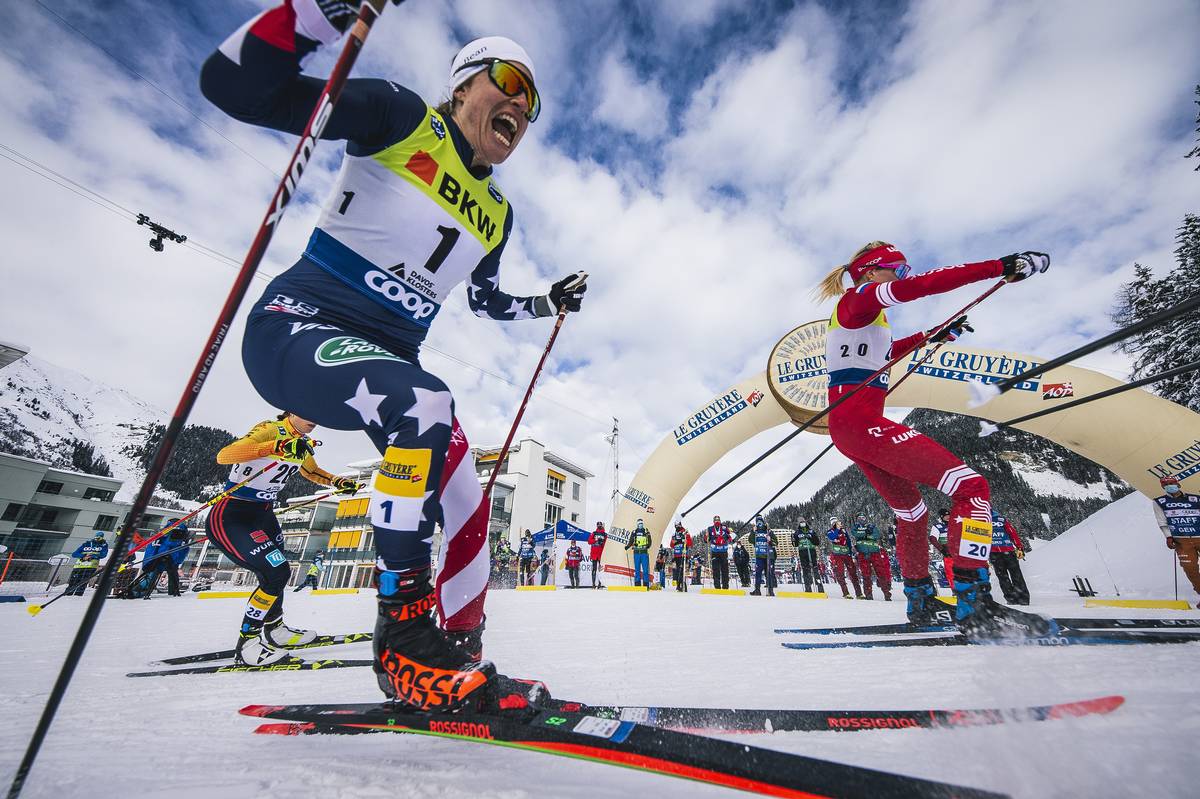
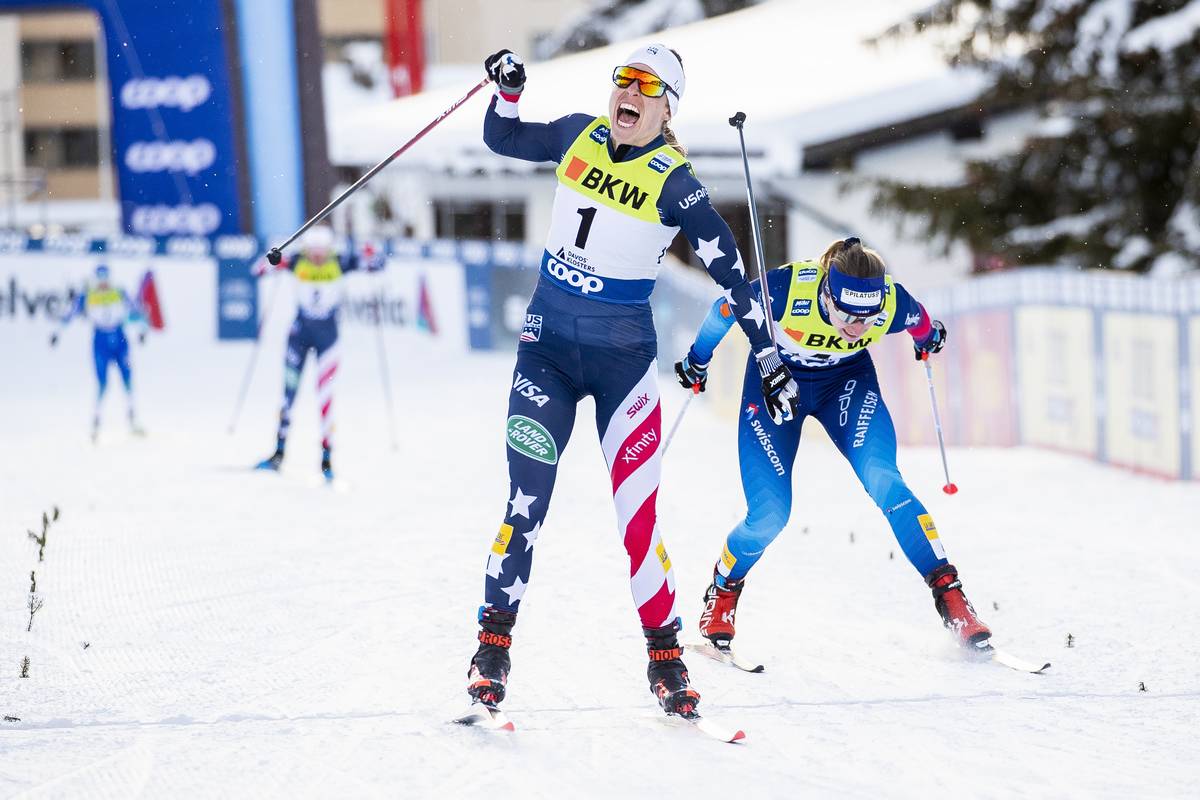
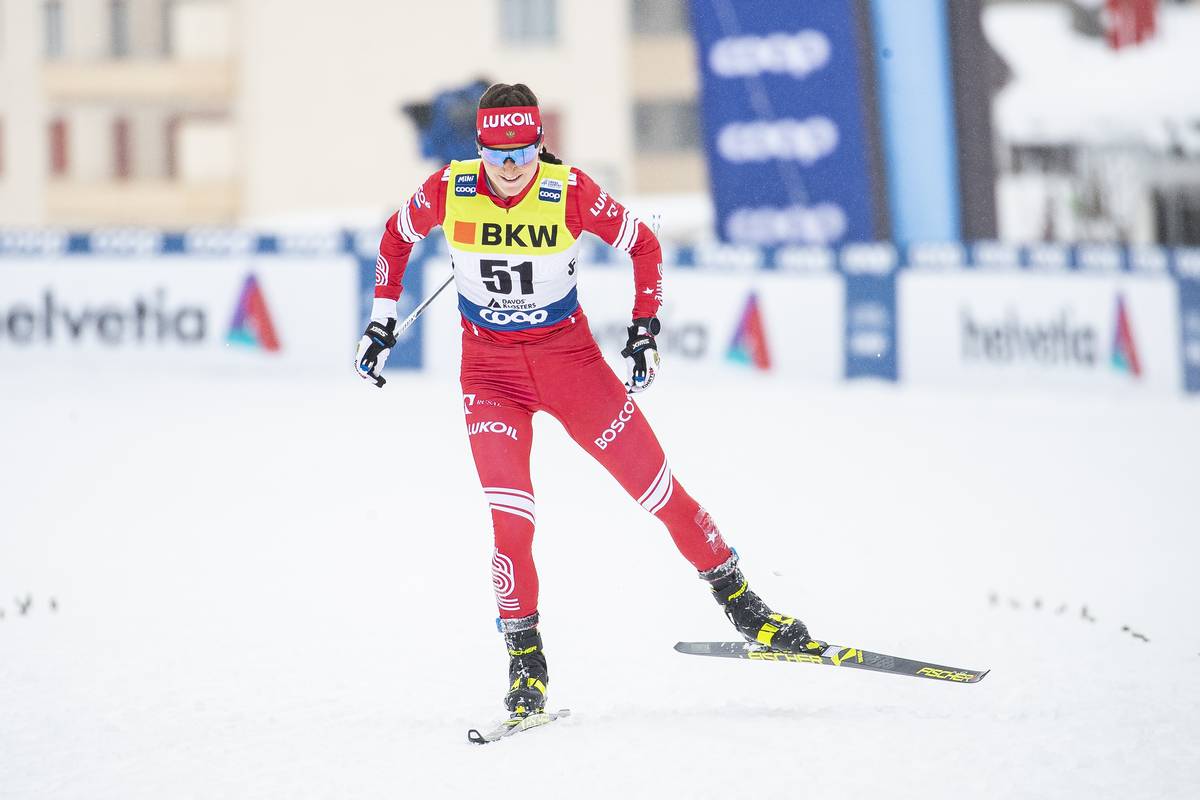
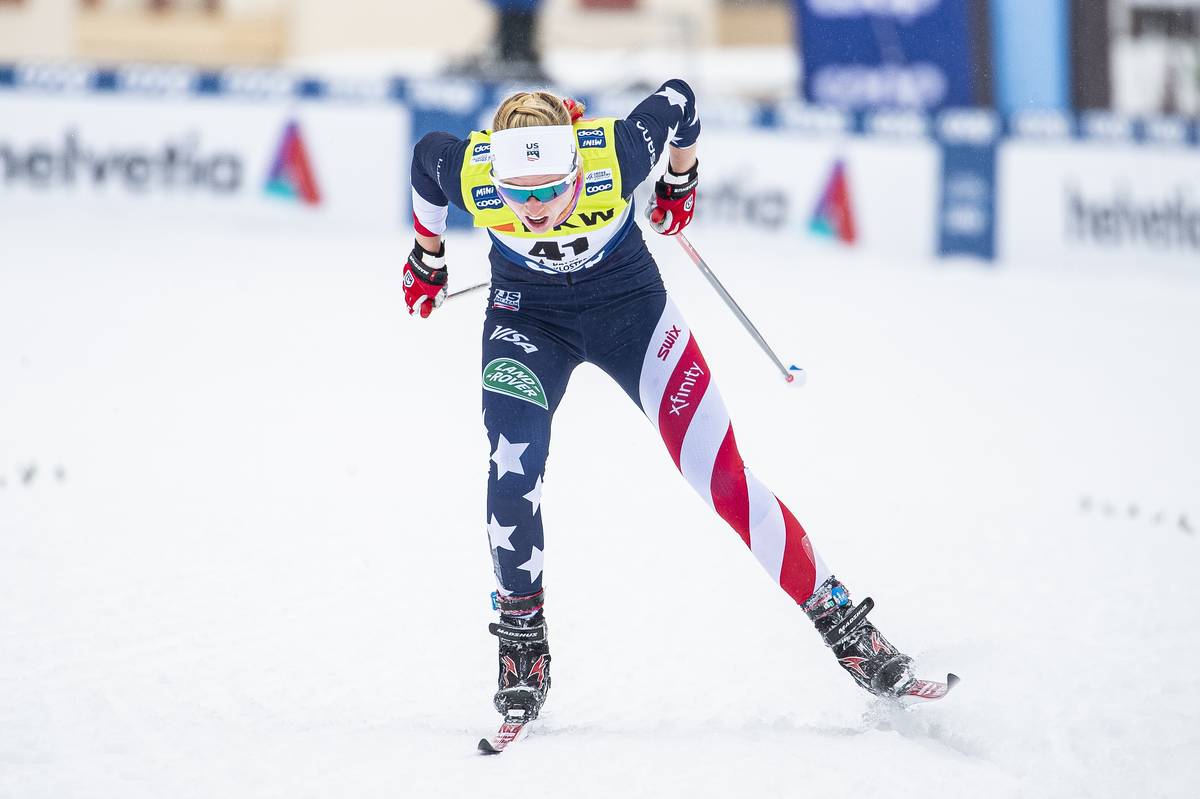
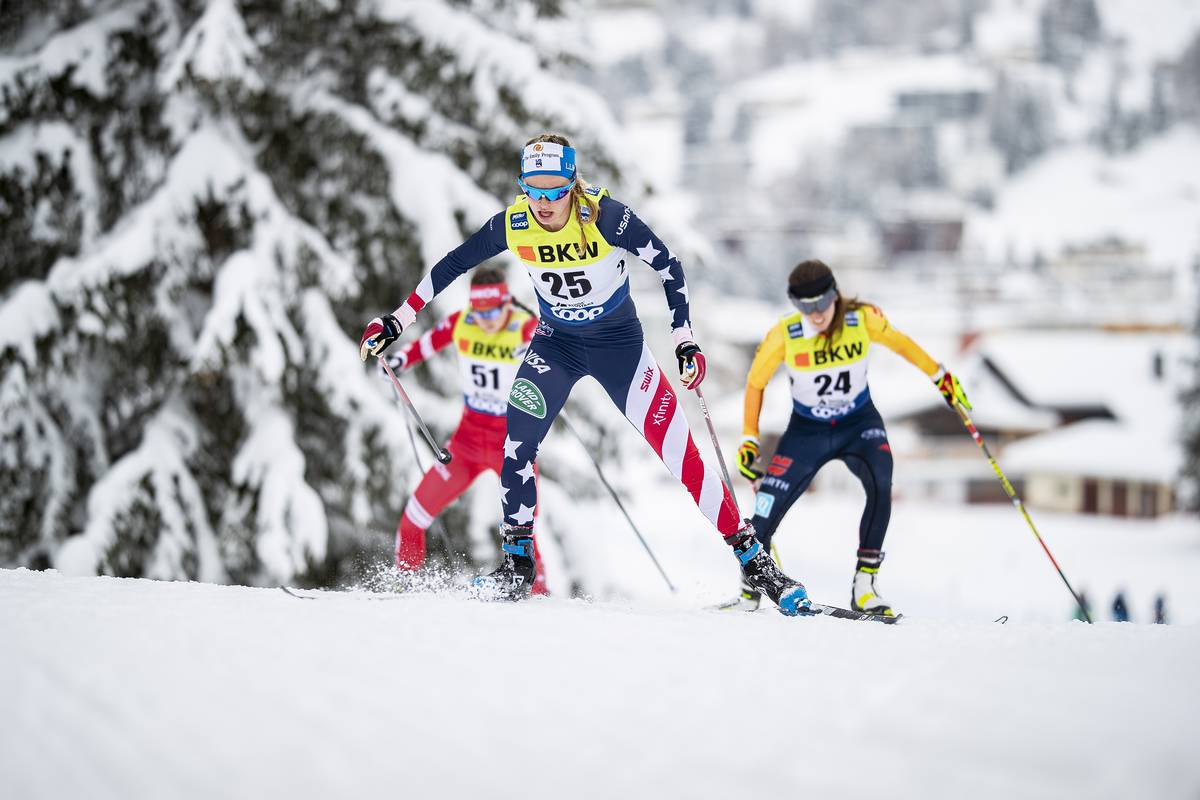
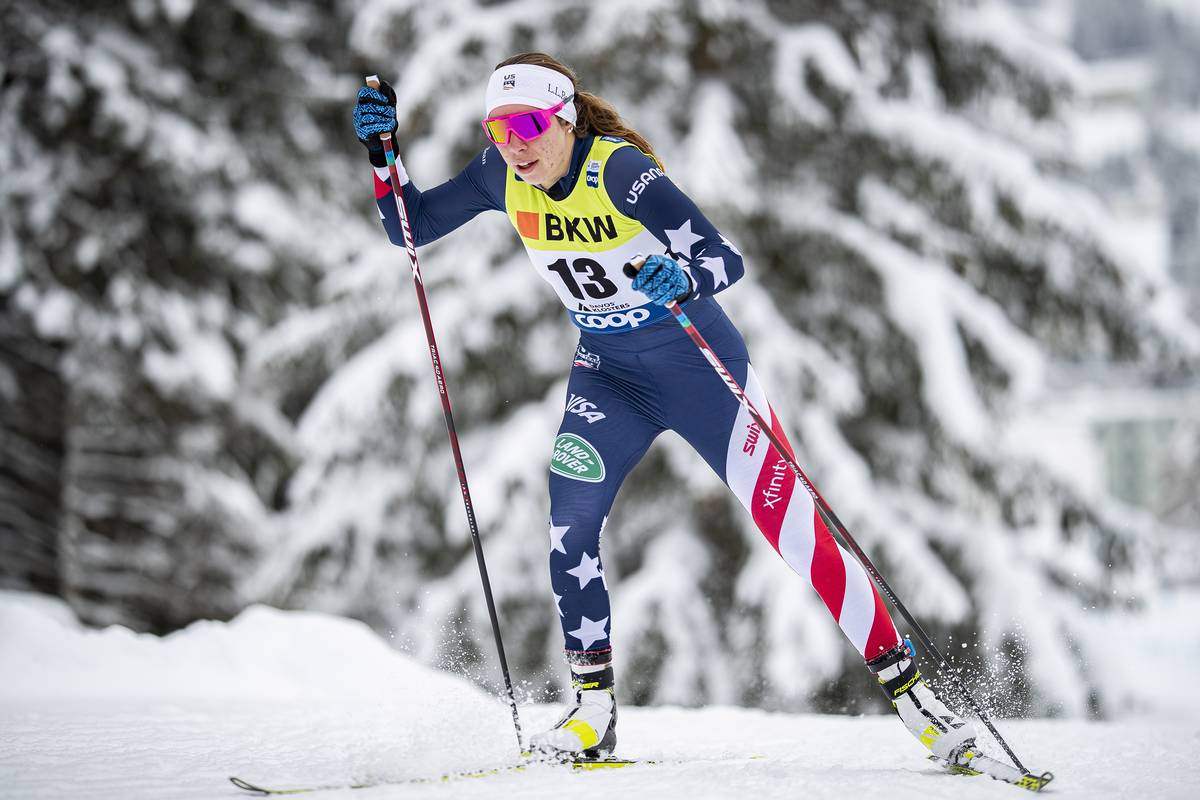
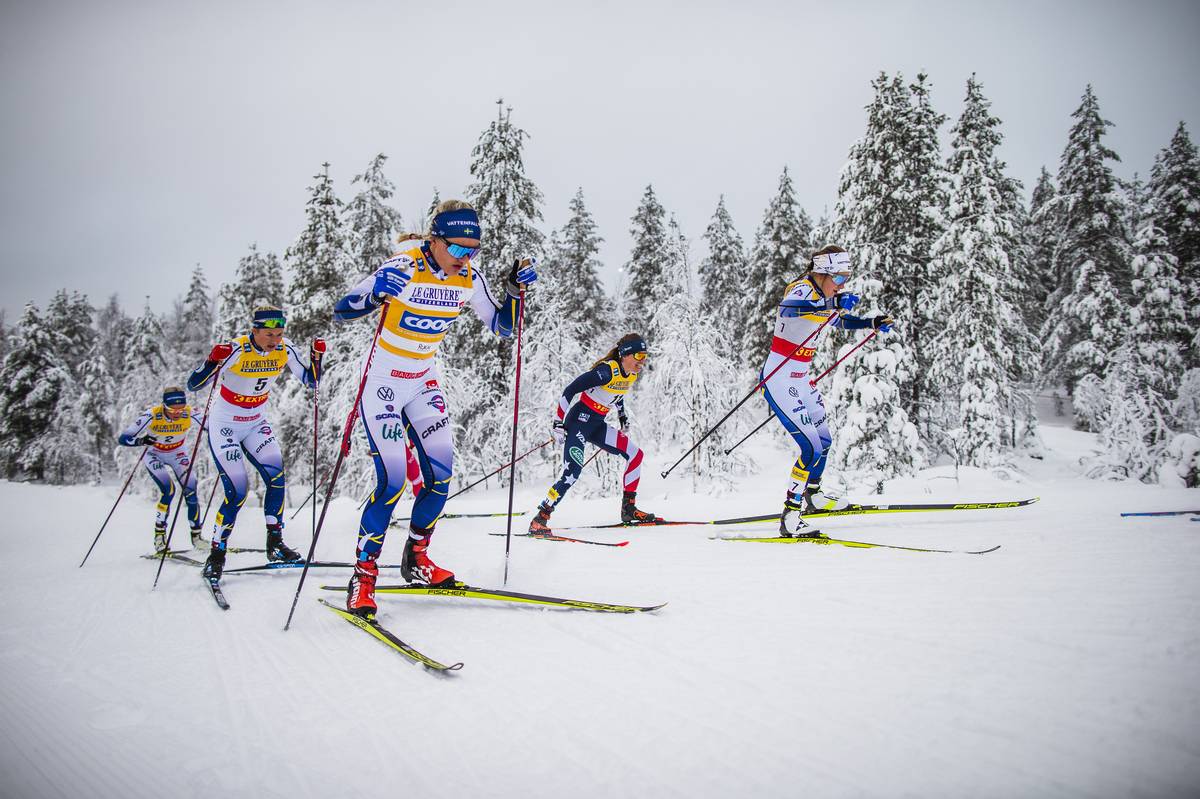
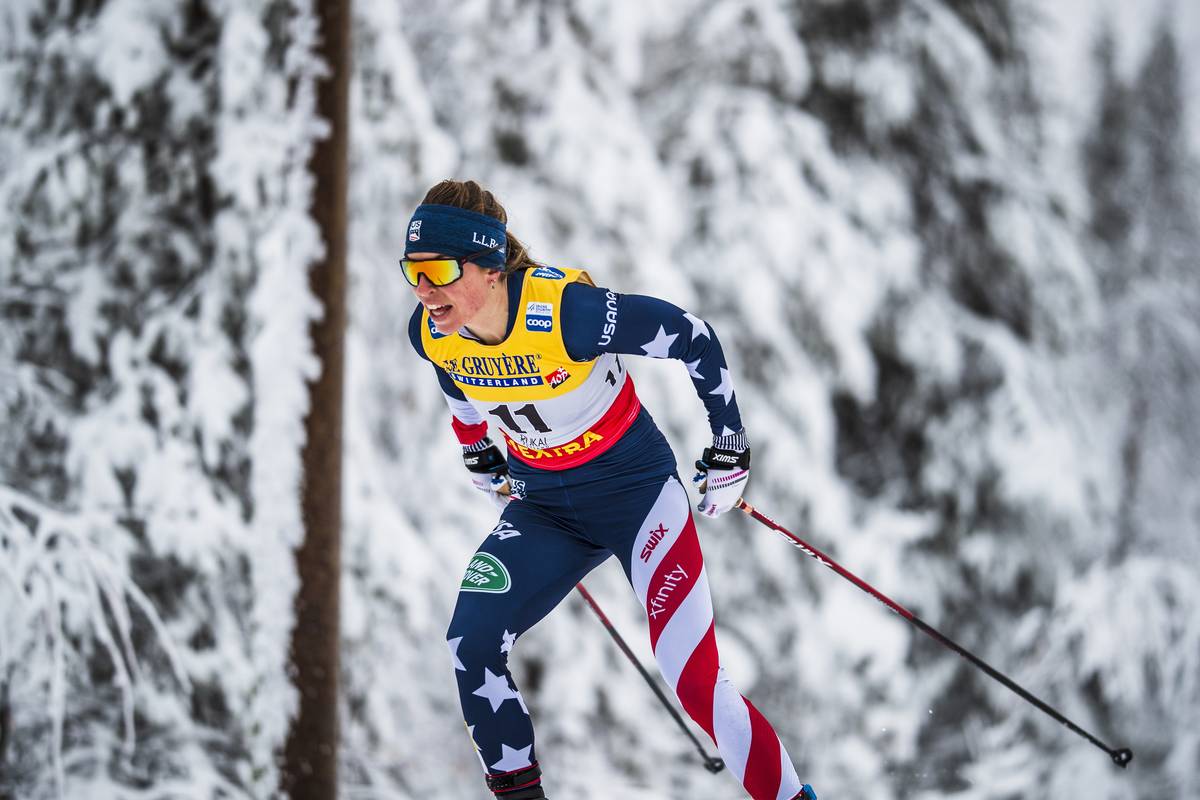
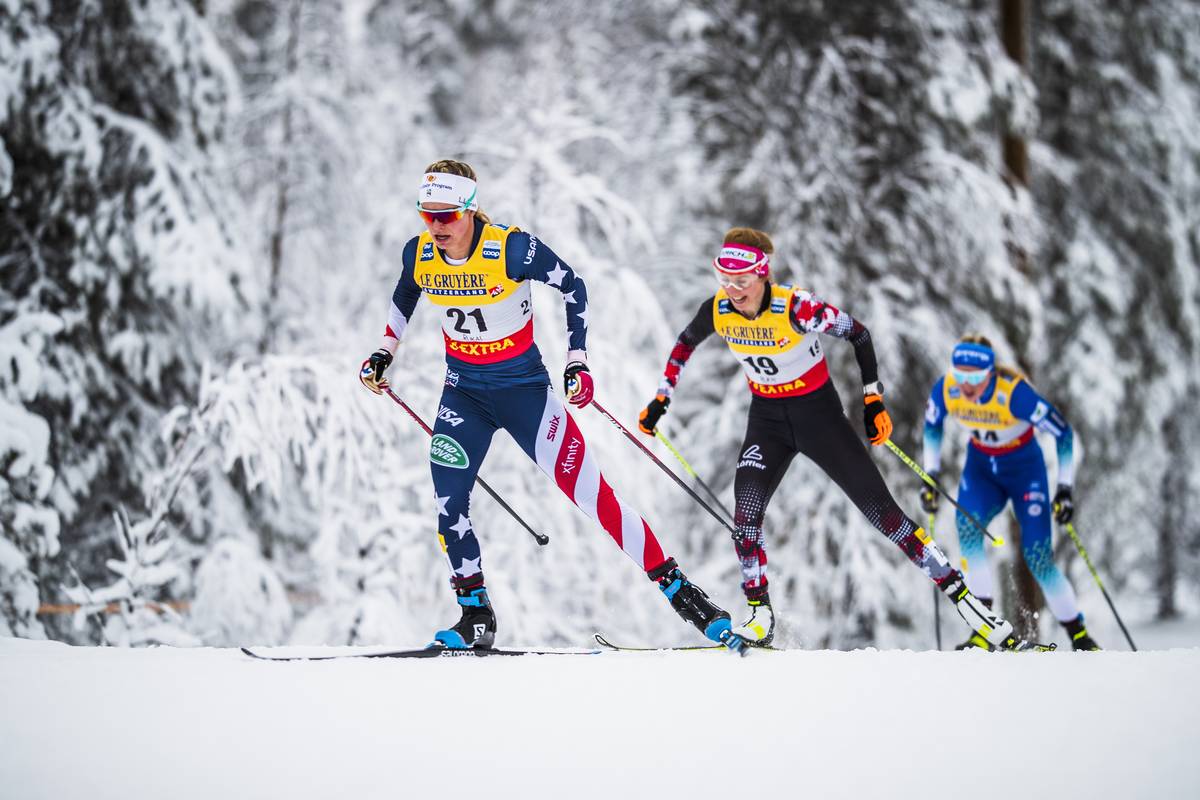
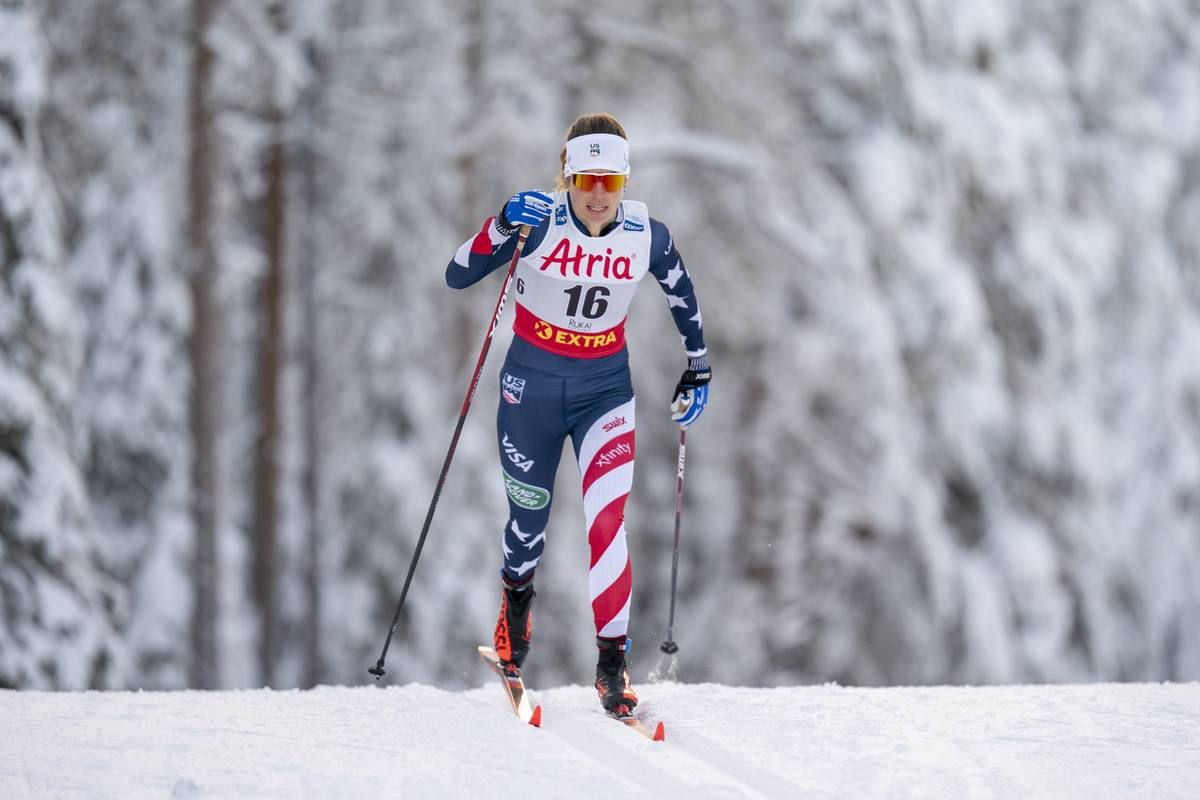
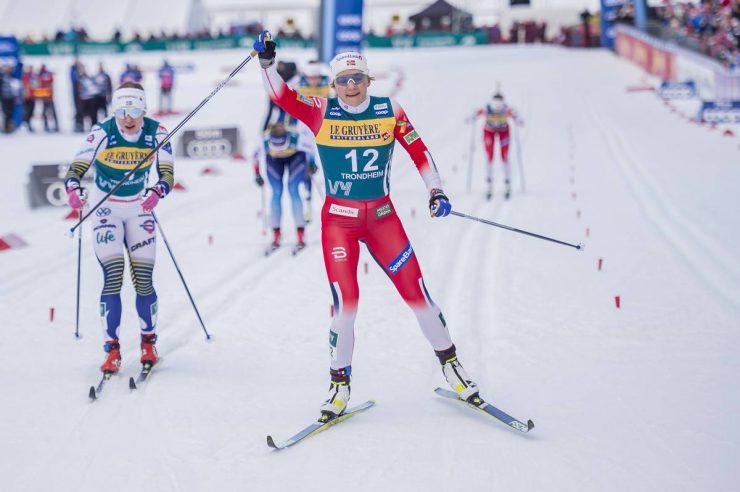
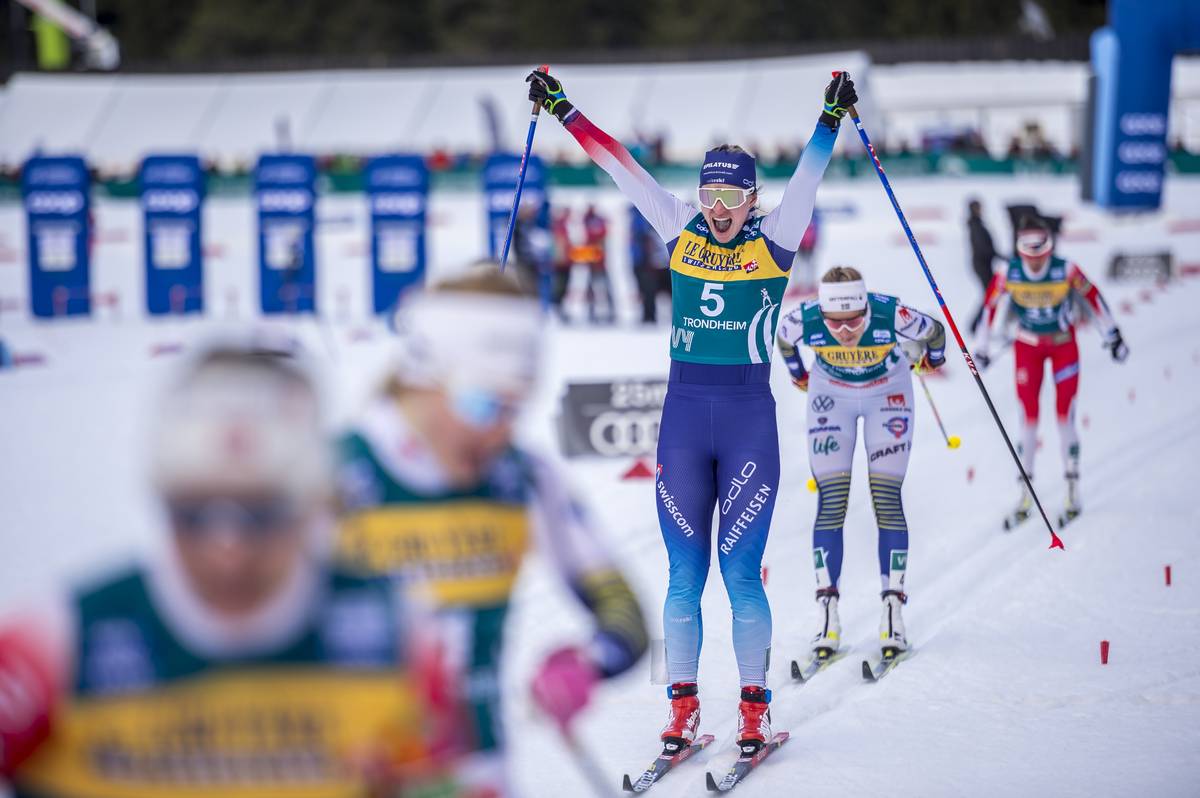
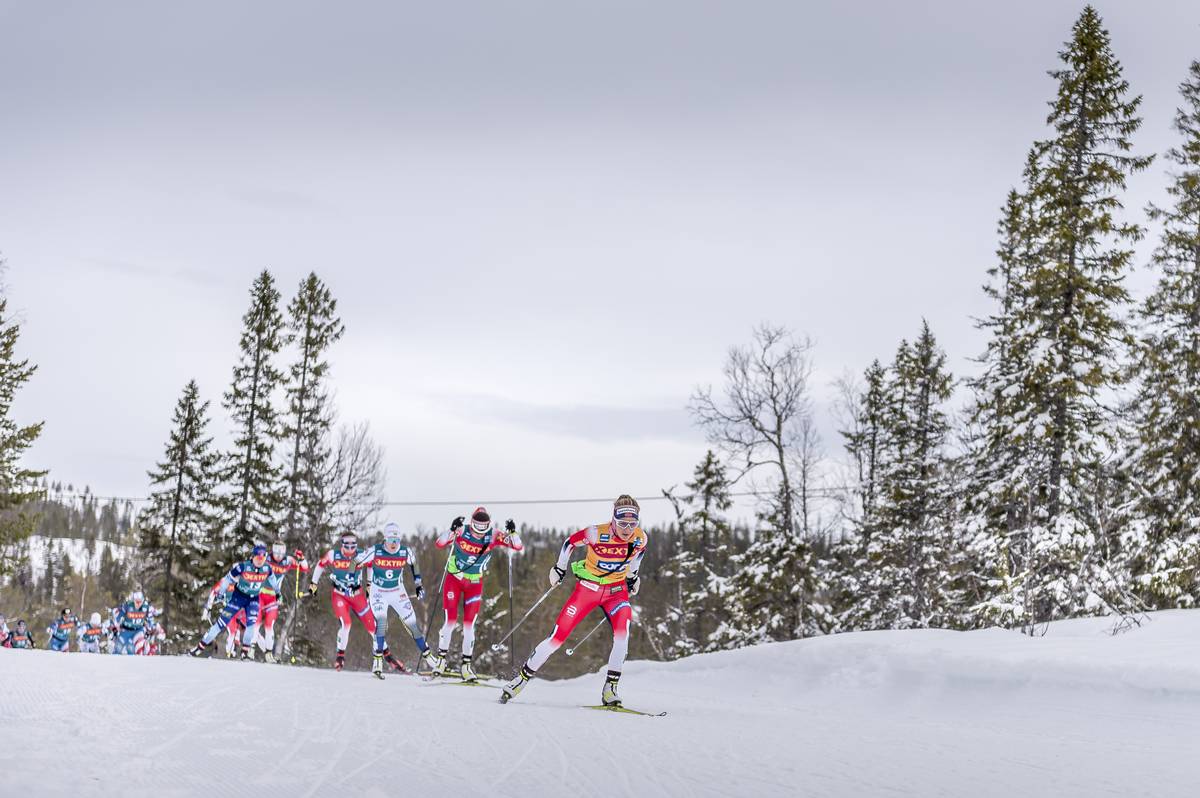
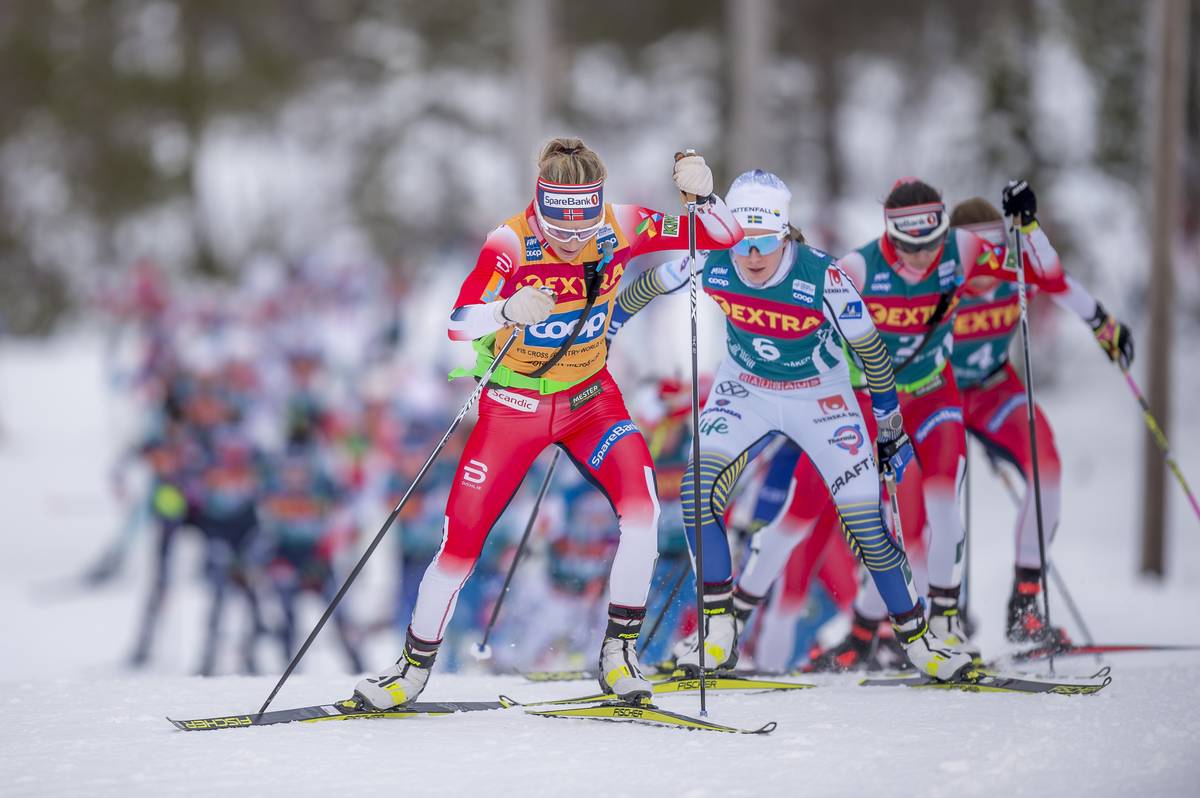
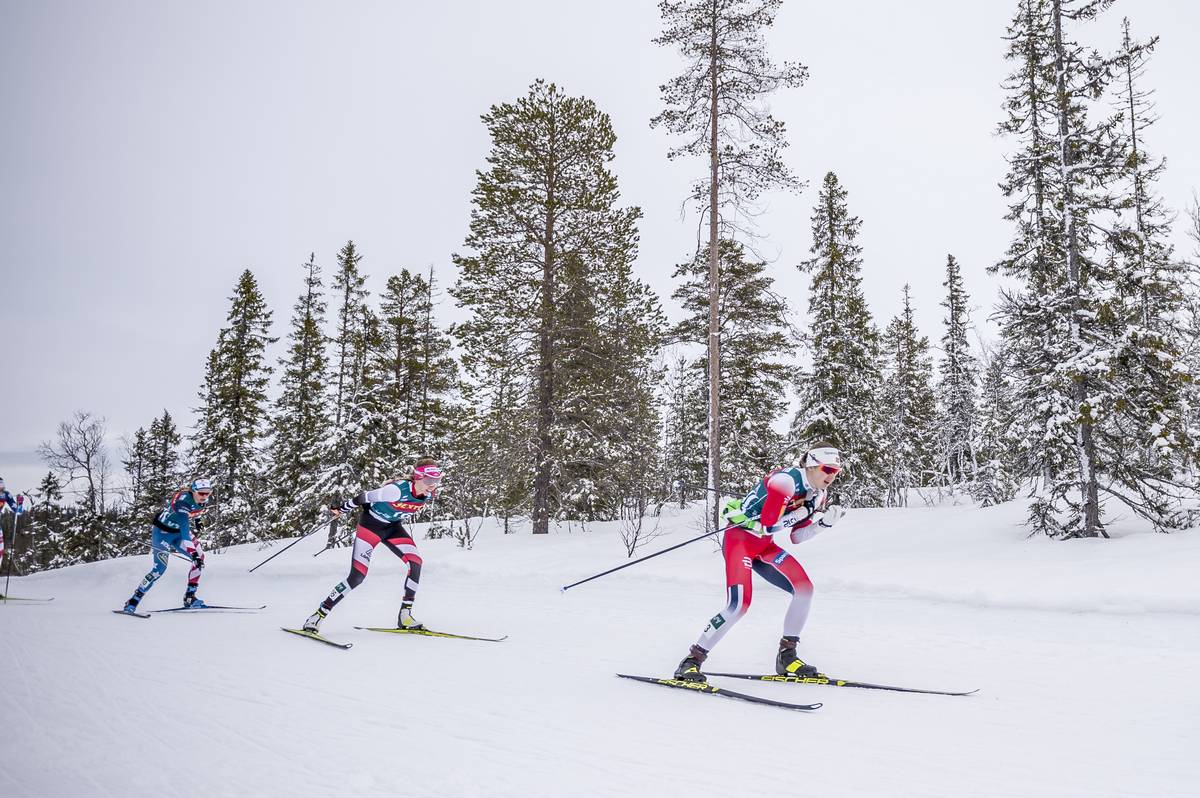
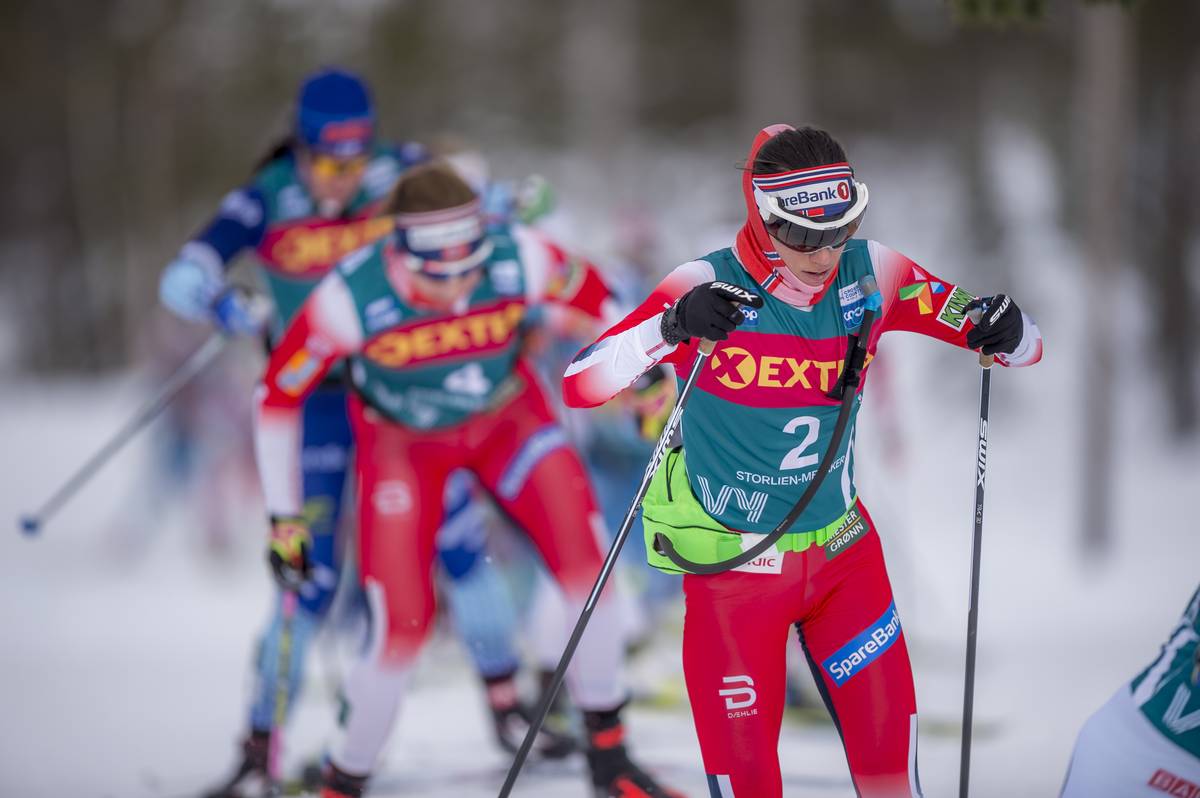
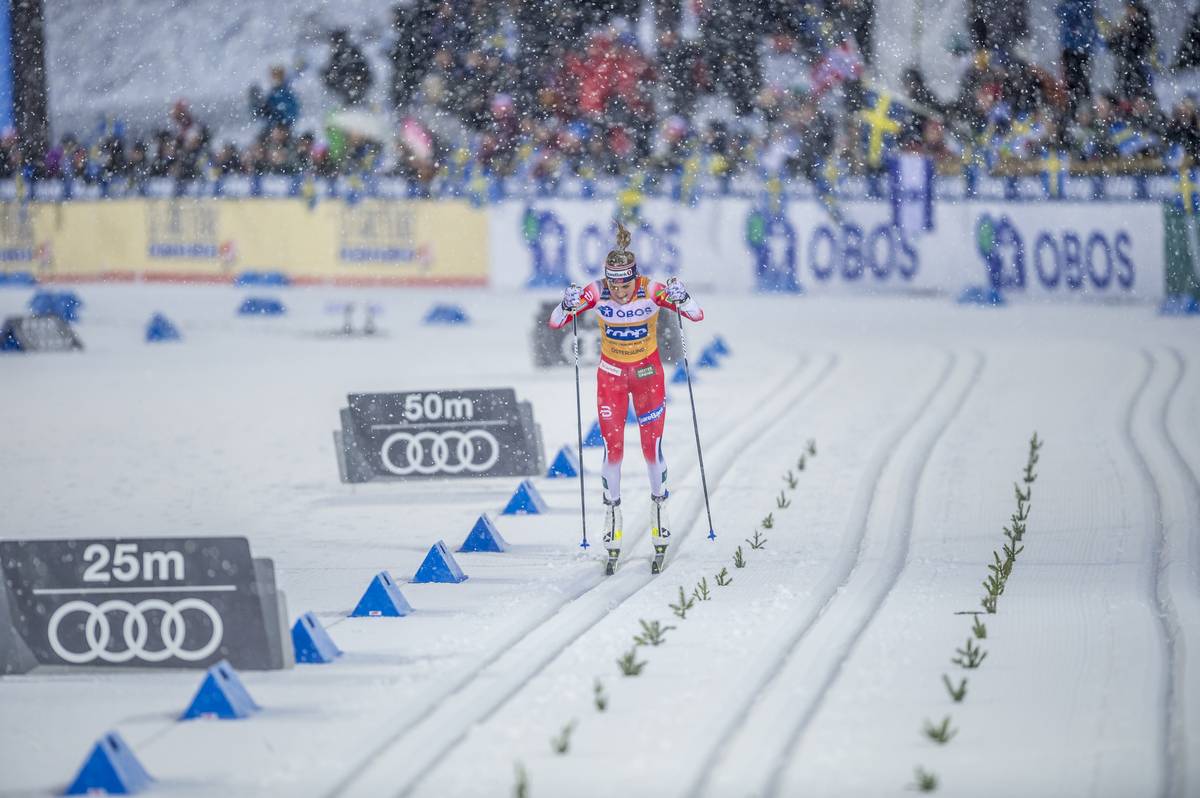
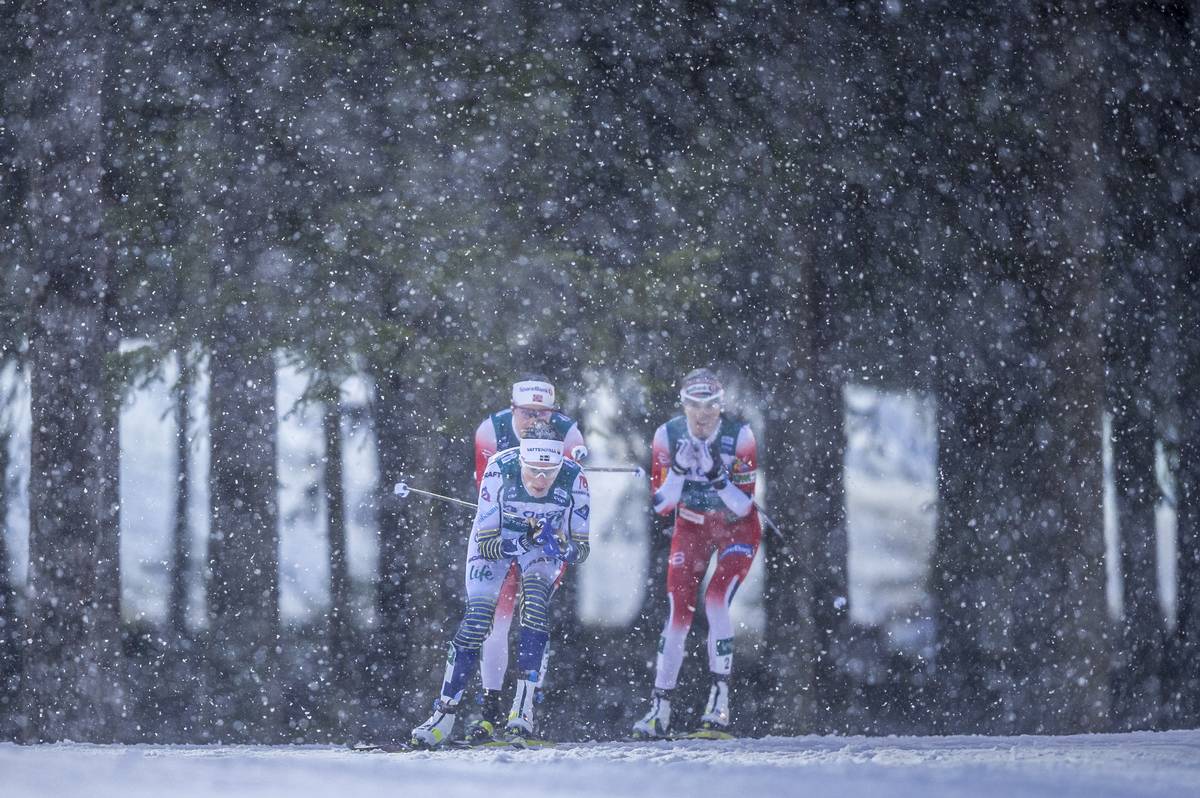
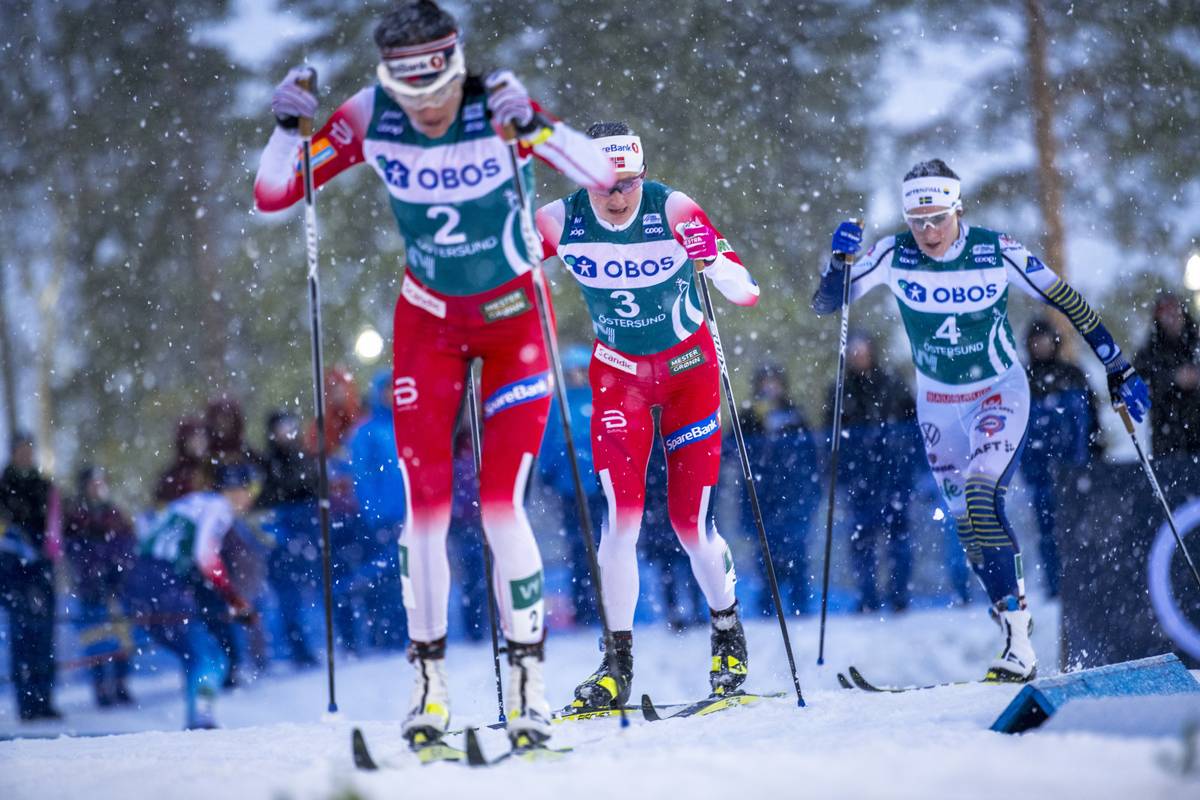
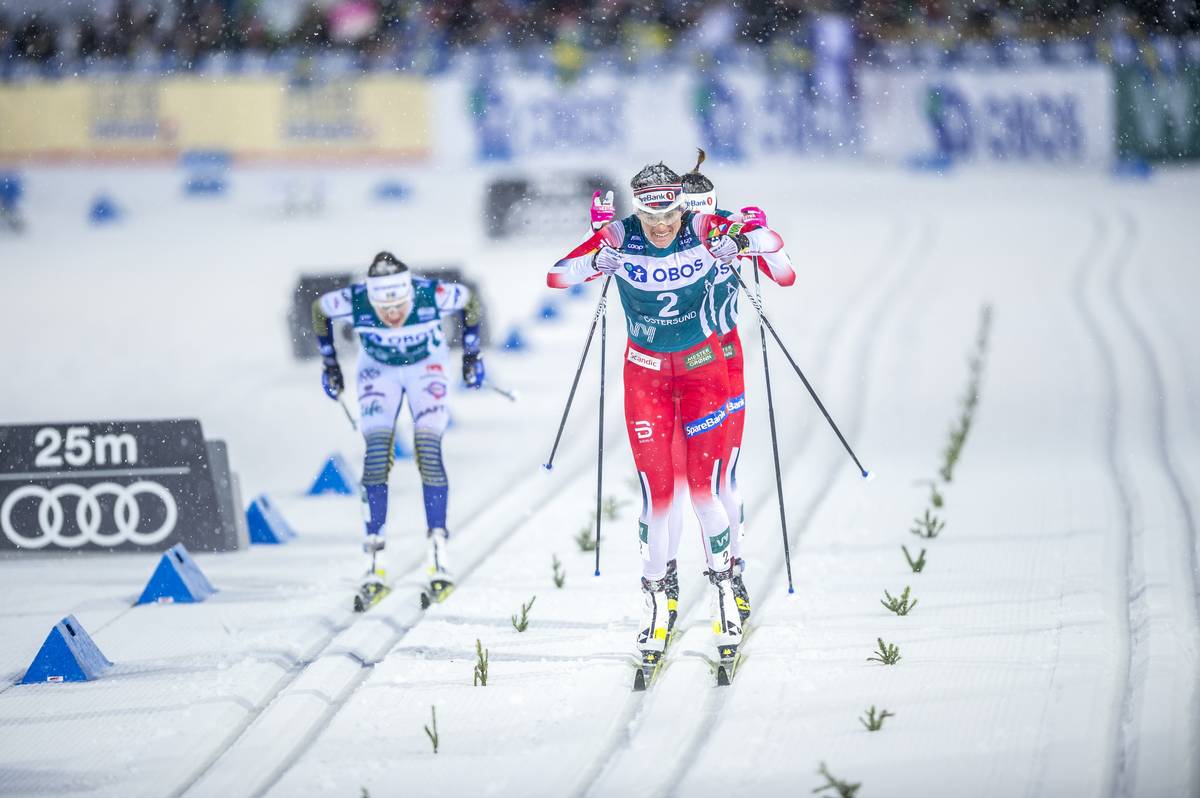
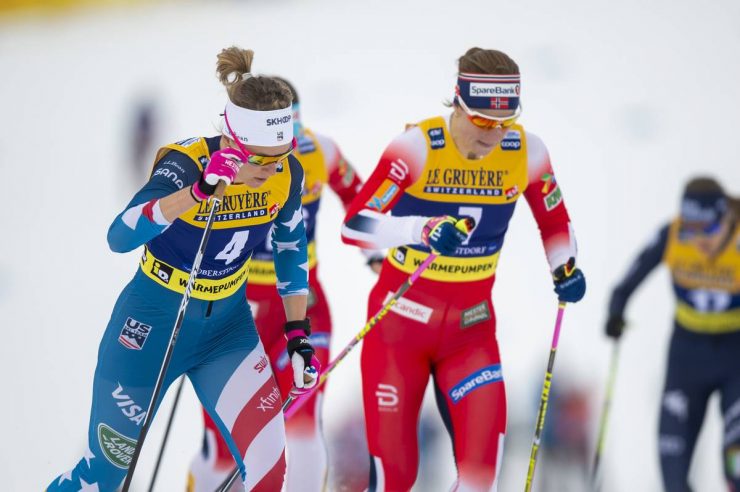
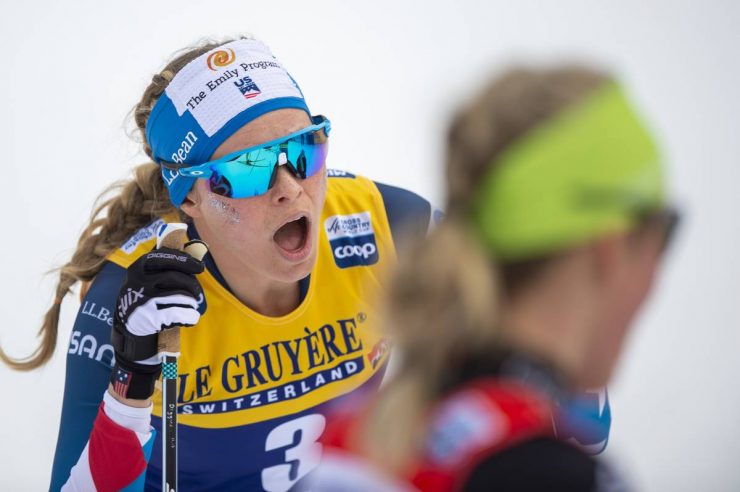
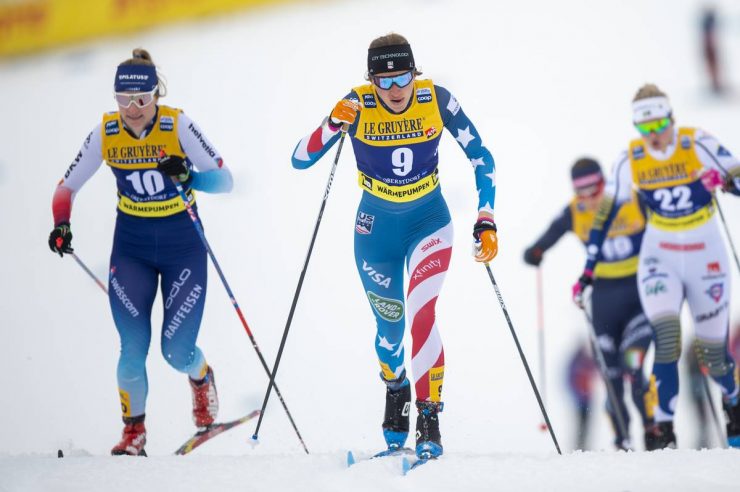
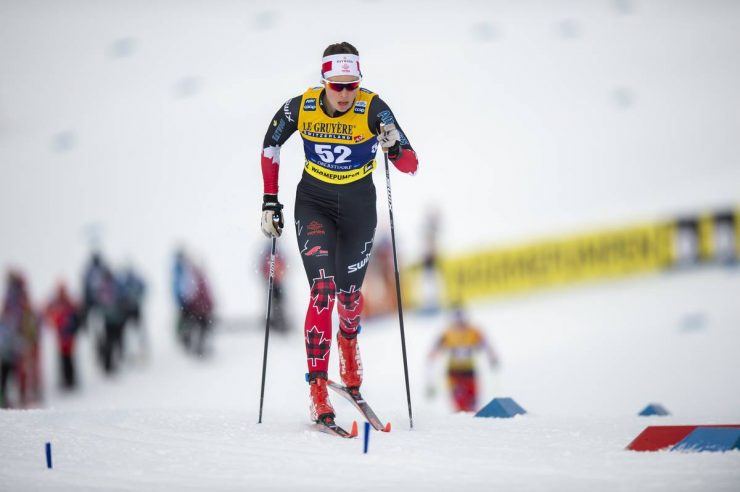
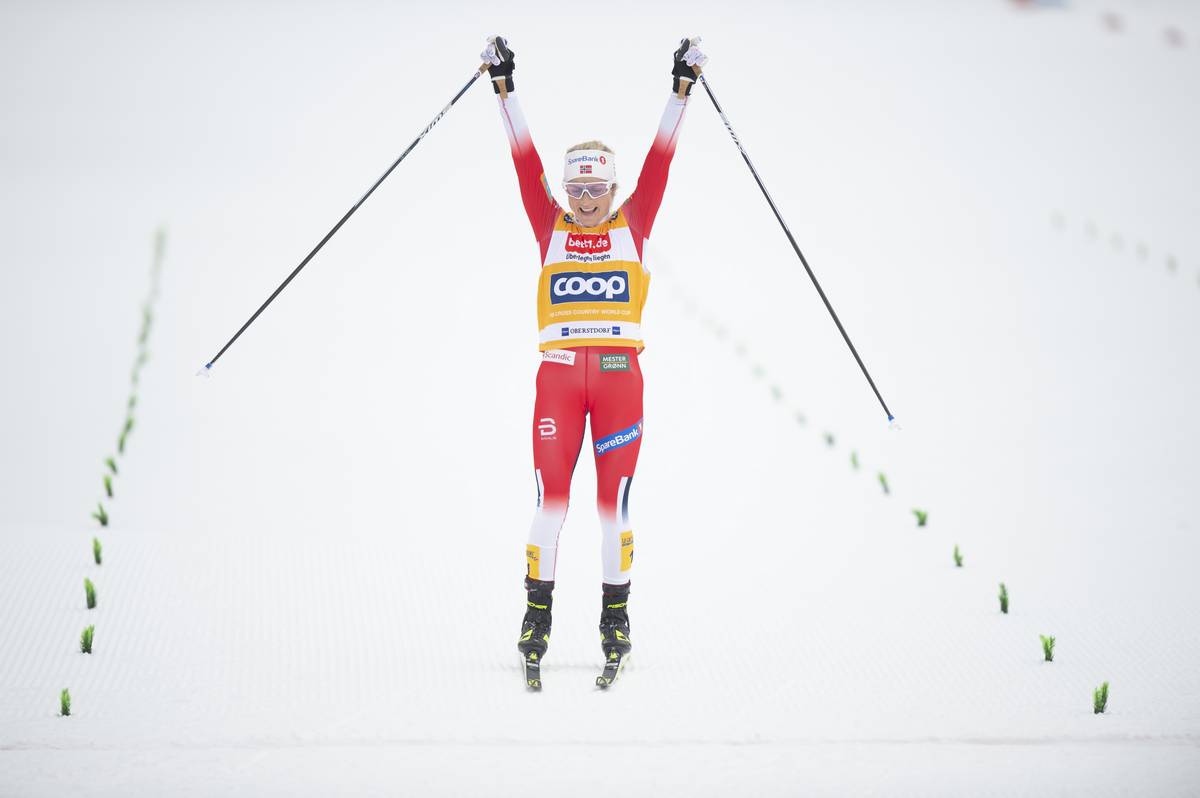
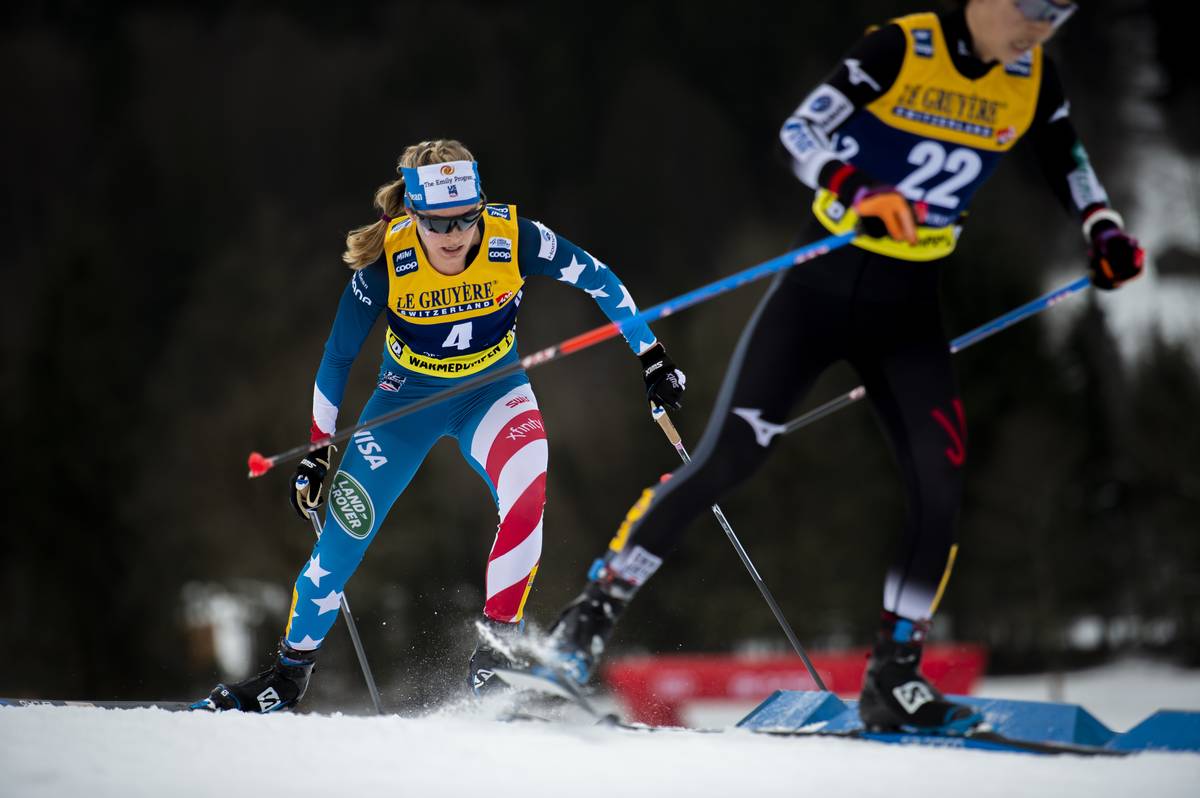
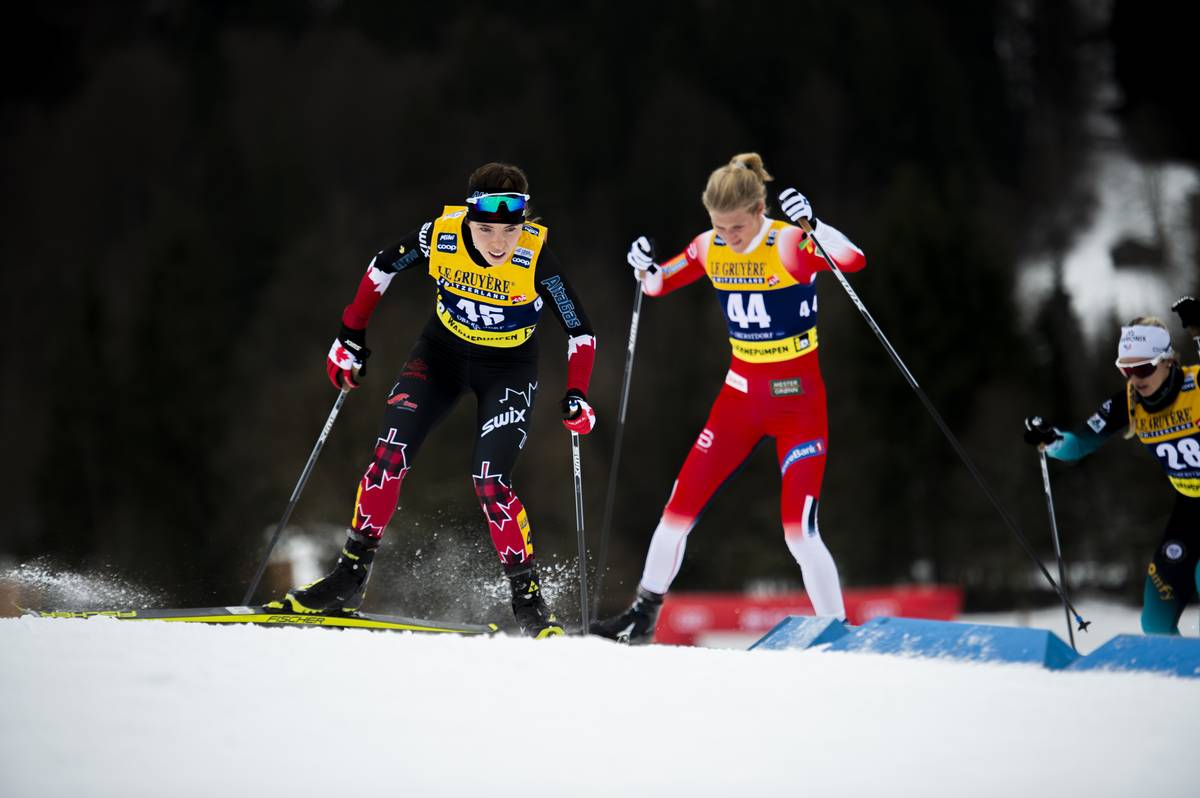
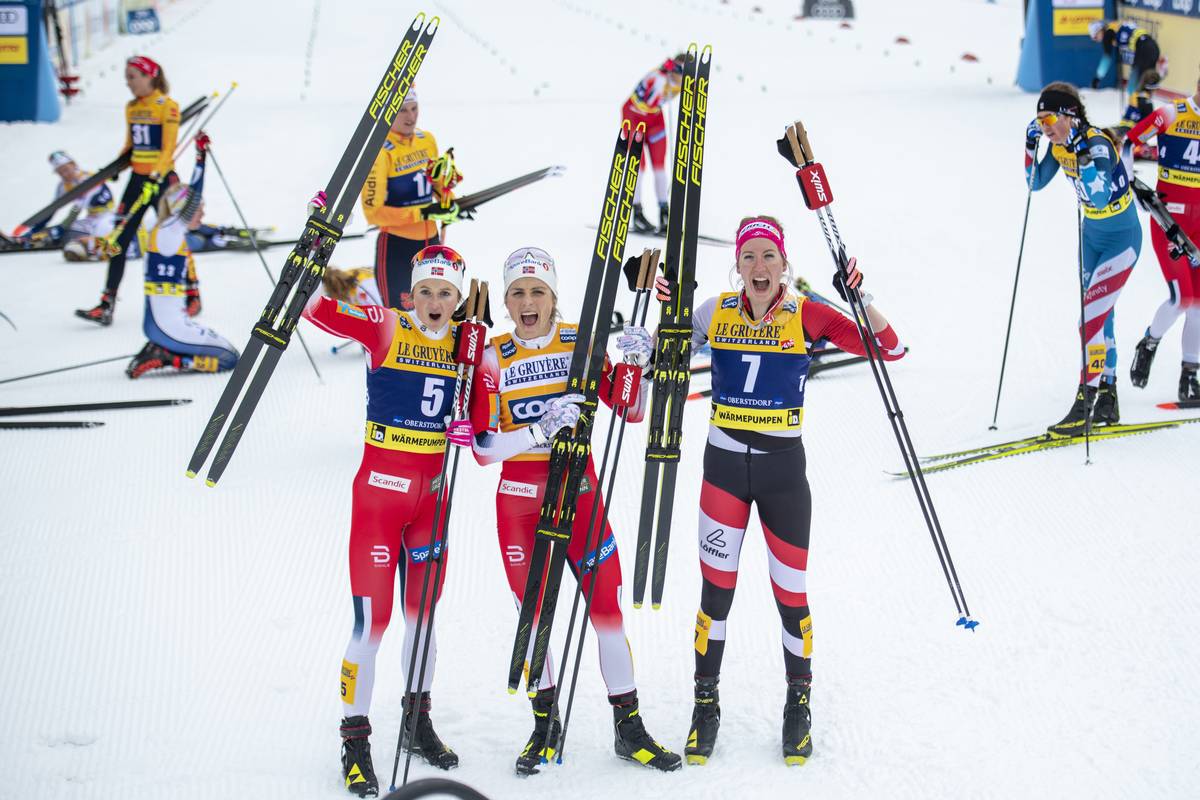
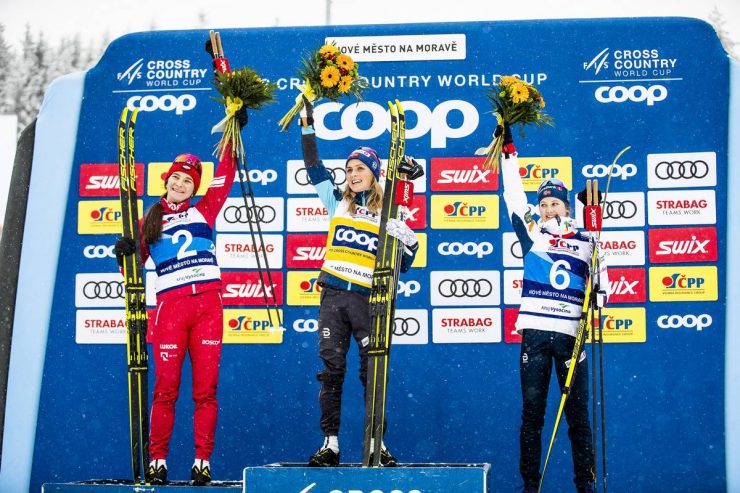
Davos is many things and brings to mind fine high-mountain living, deep mountain valleys, and an old-school vibe stop on the World Cup. The weekend began with a zippy skate sprint that at least for the moment brought a familiar feel to sprinting when Italy’s Federico Pellegrino took the win. However, on the women’s side, a persistent and tenacious athlete, Rosie Brennan, took her first career World Cup win. She can sprint. But had we placed a wager on a first win coming in sprint or distance, we would have gone for distance eight out of time times.
Yet on Saturday, there was Brennan, streaming ahead on the final straight with enough composure and a time gap to celebrate across the finish line. Pure joy. And fun to watch. The following day, in cross-country skiing’s race of truth, Brennan smashed ahead on the decidedly old-school Davos 5 k loop and won the race with half a minute to spare. A clean-sweep-weekend for Brennan earns her the overall lead in the World Cup after five races and the honor of wearing the yellow bib.
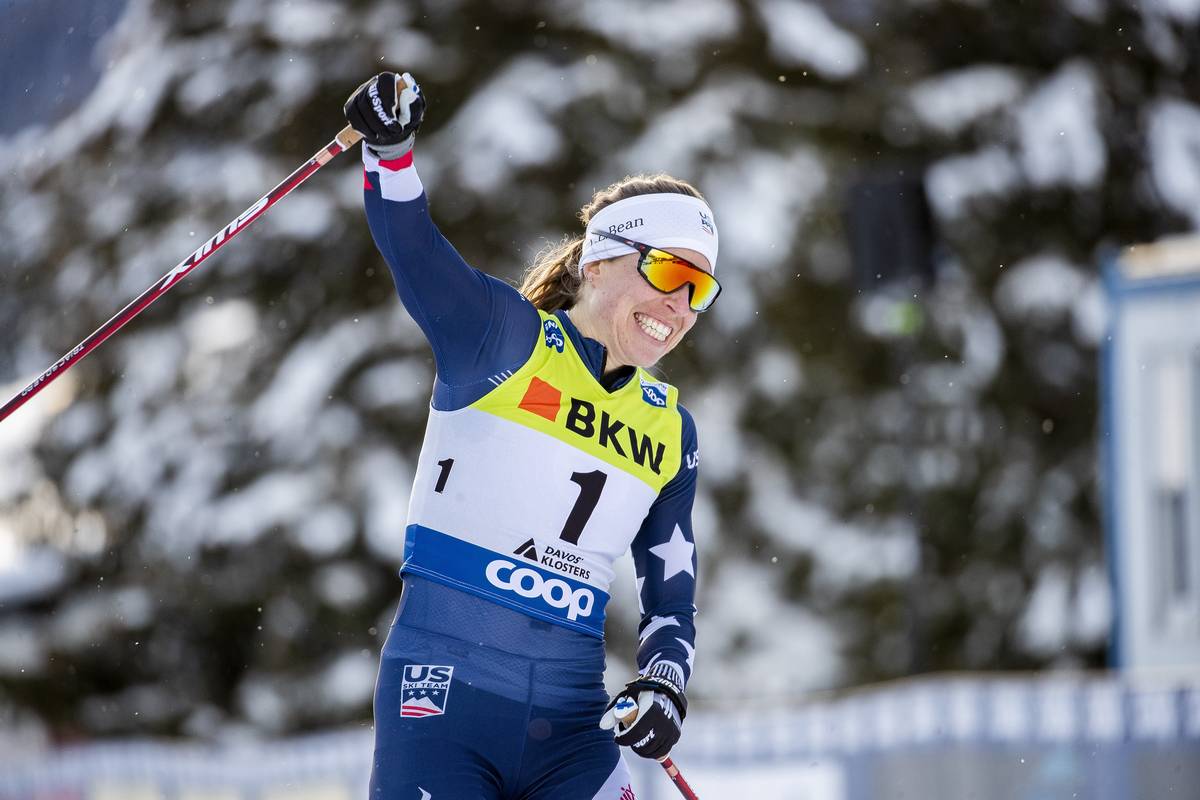
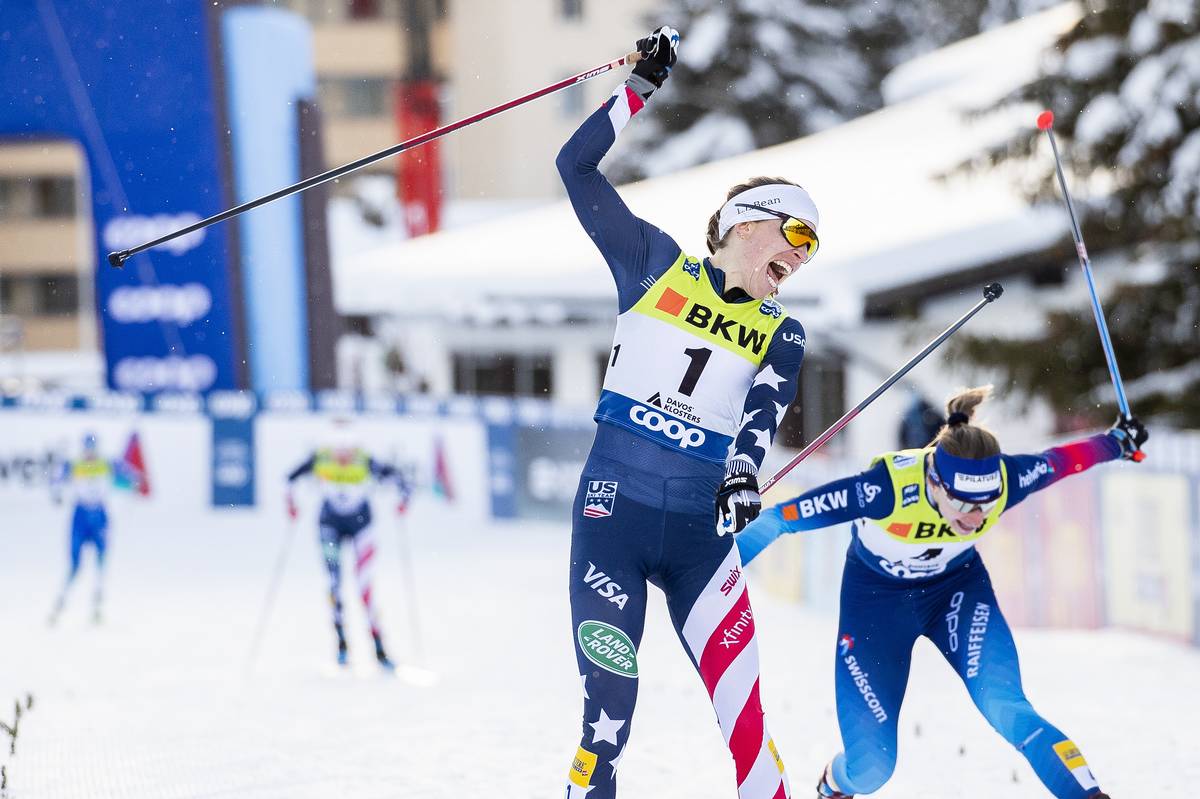
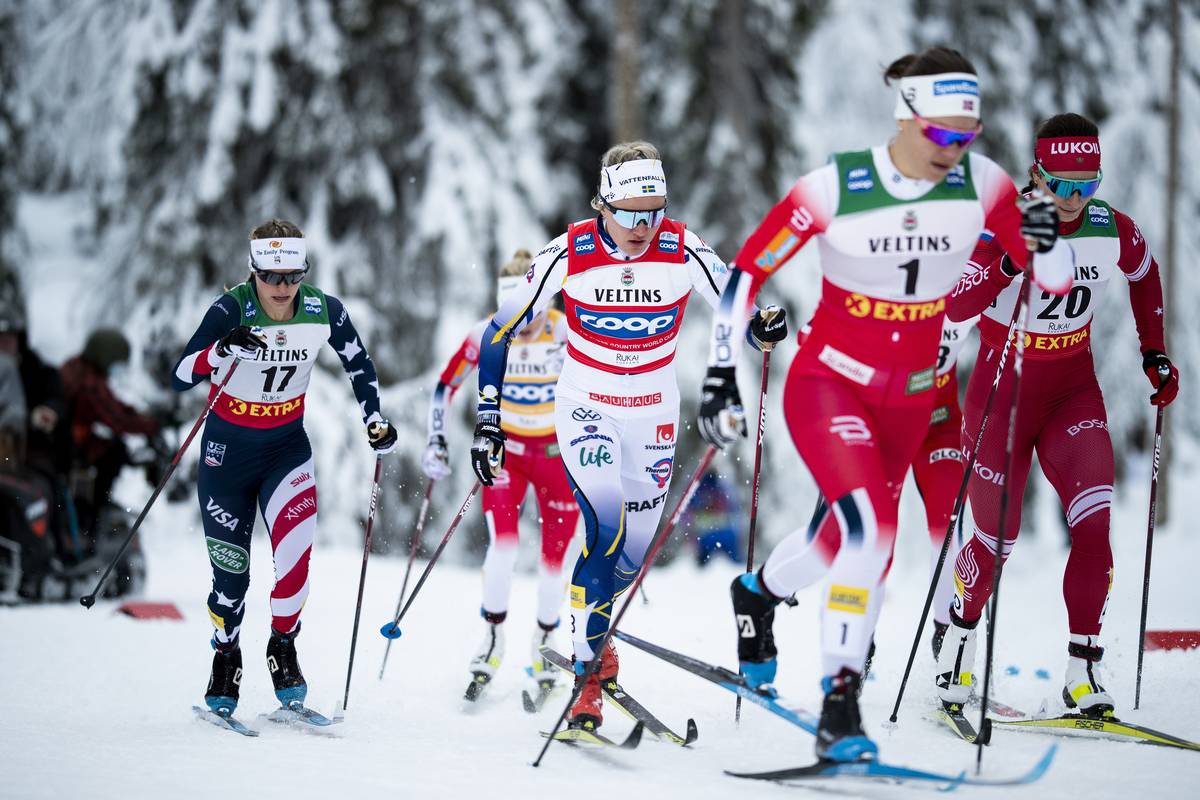
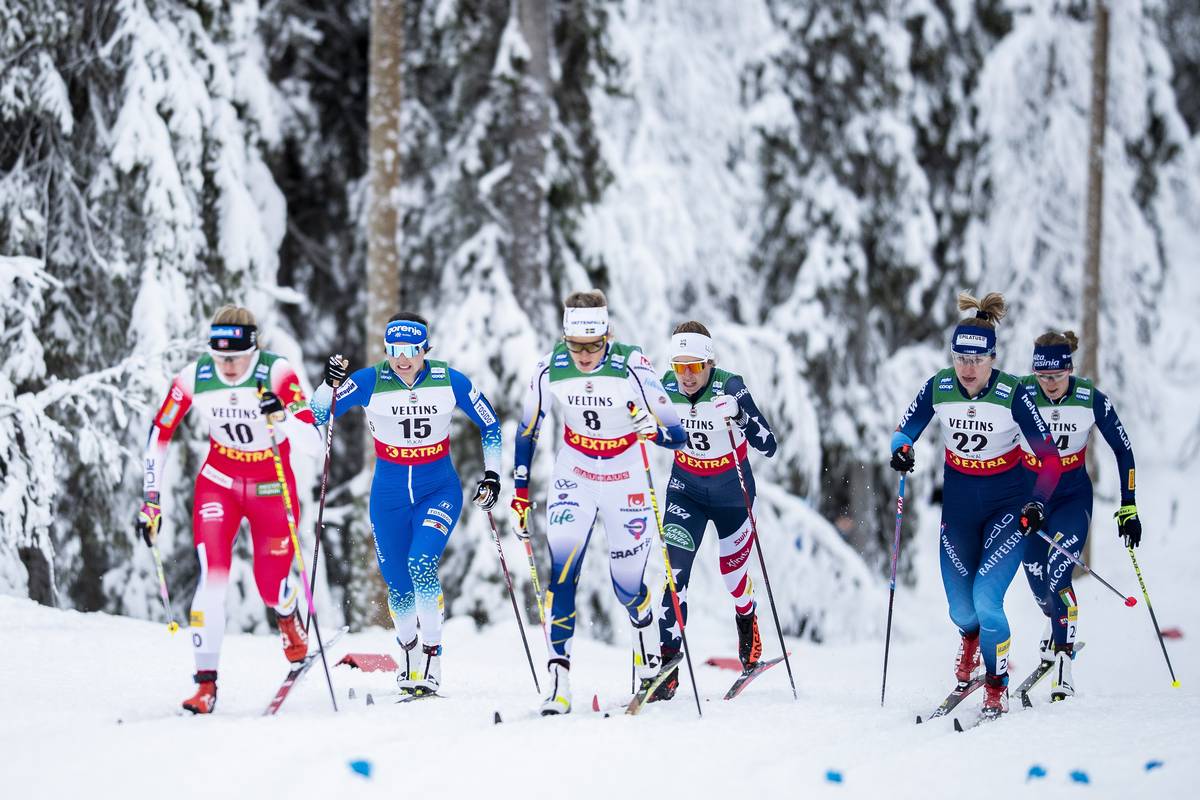
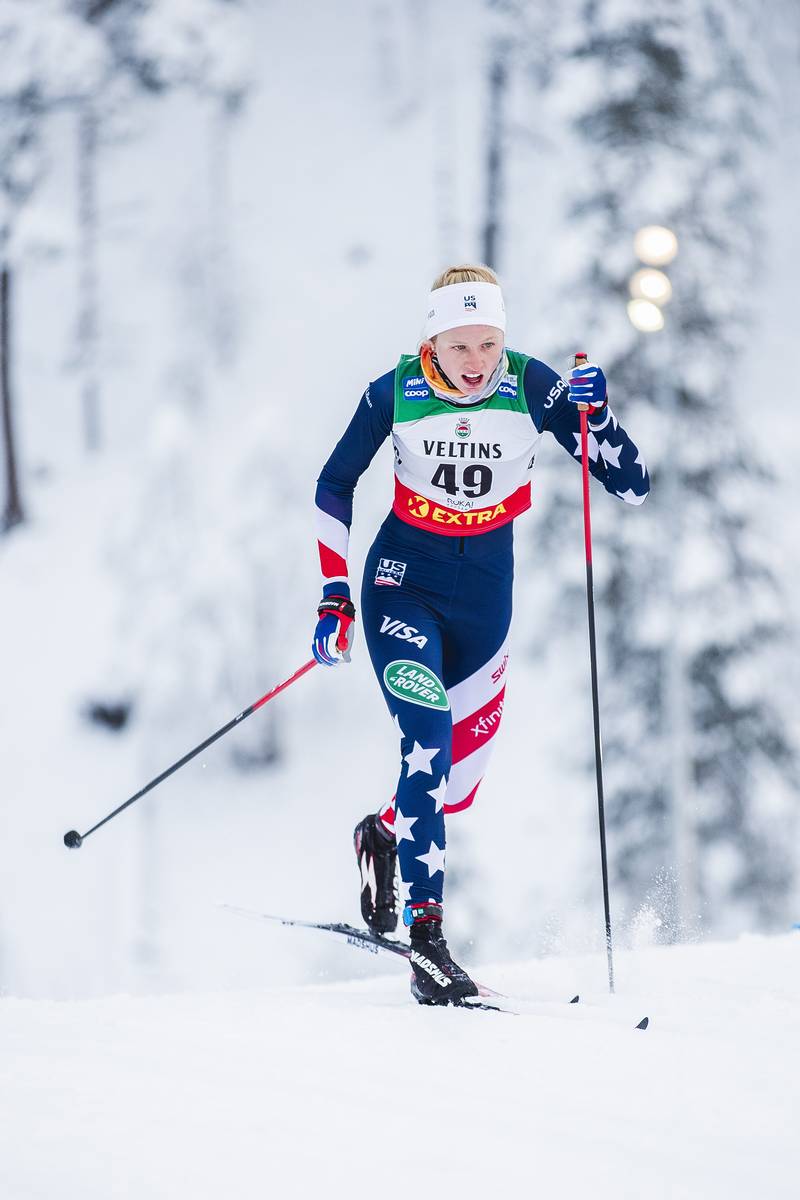
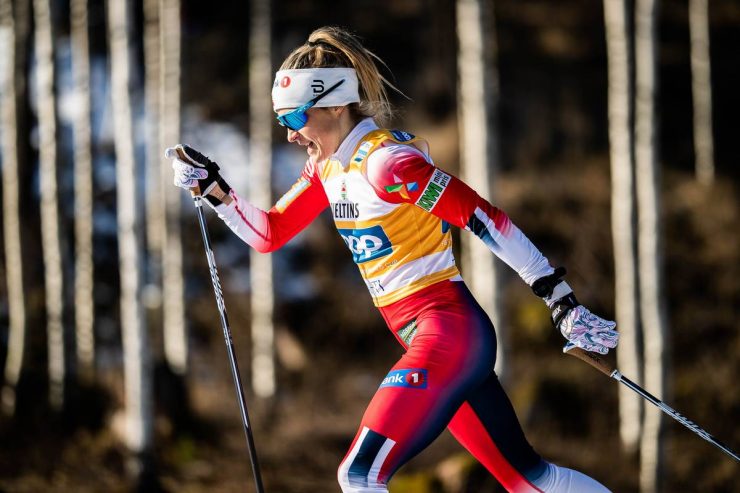
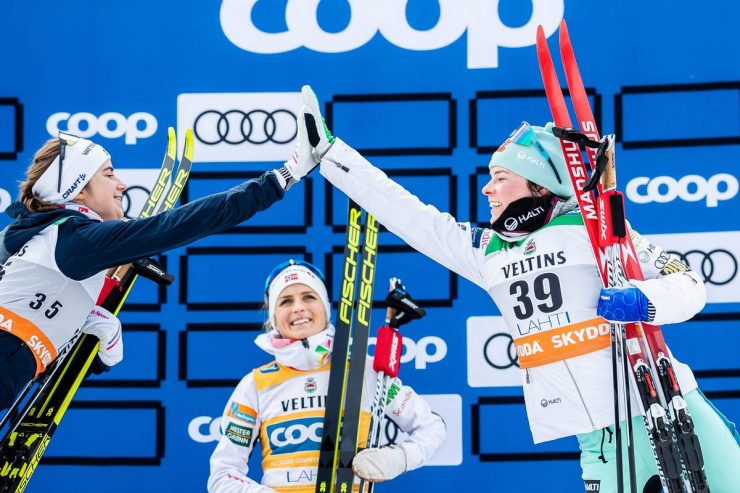
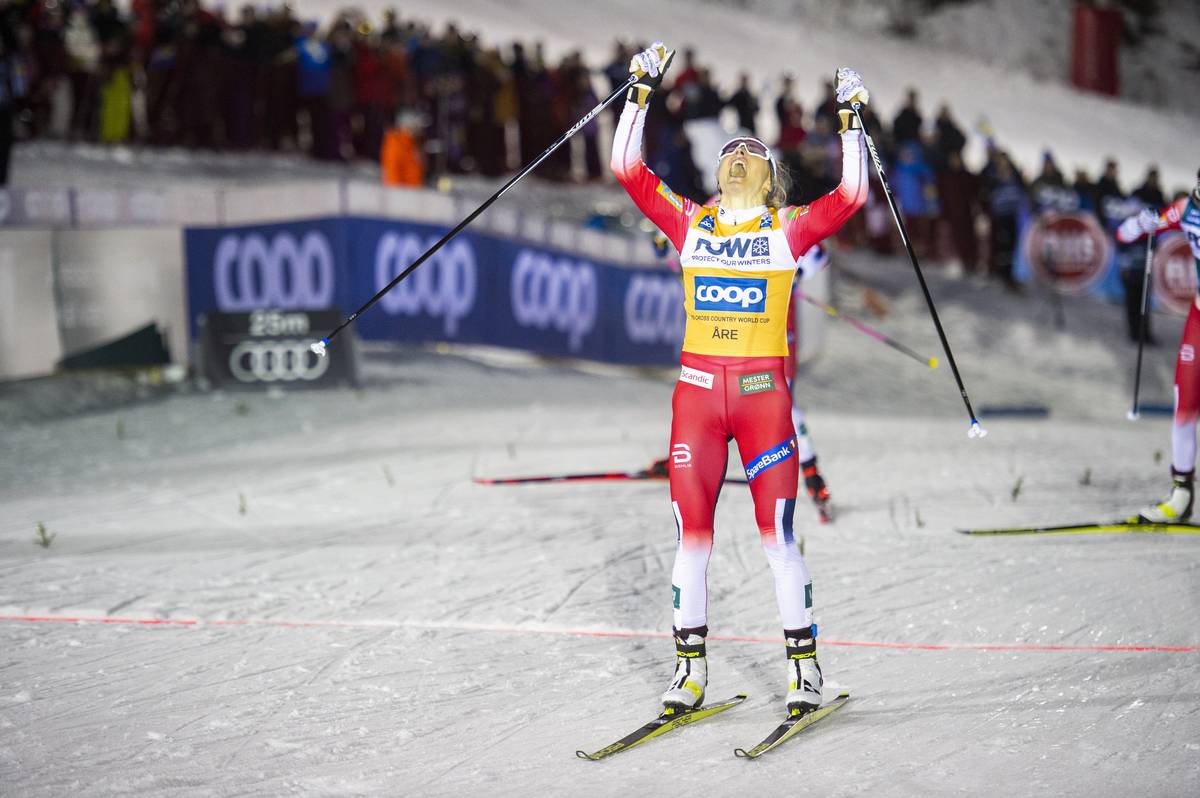
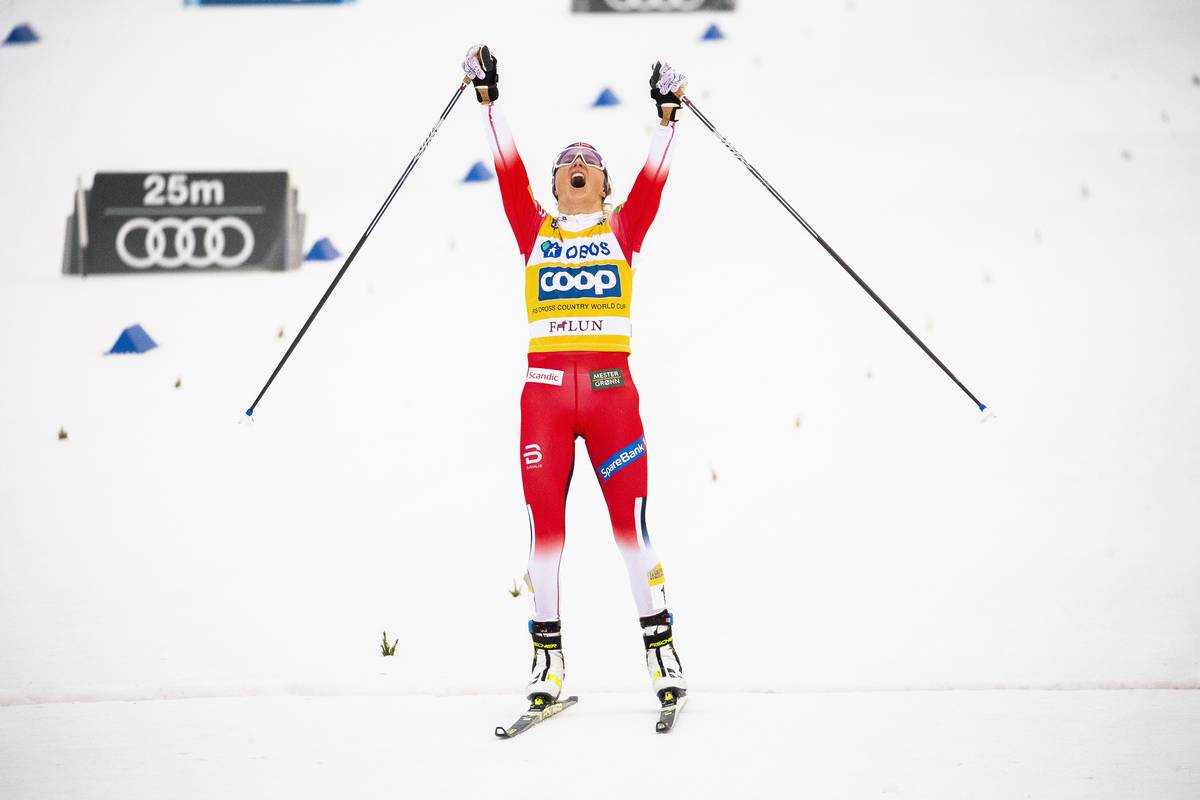
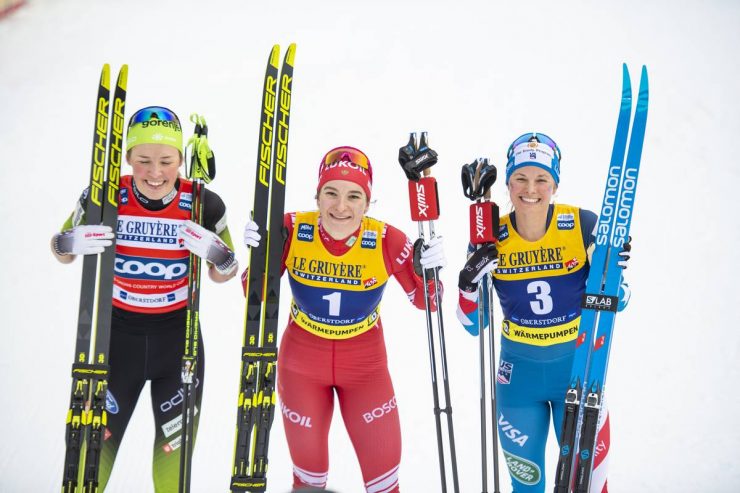
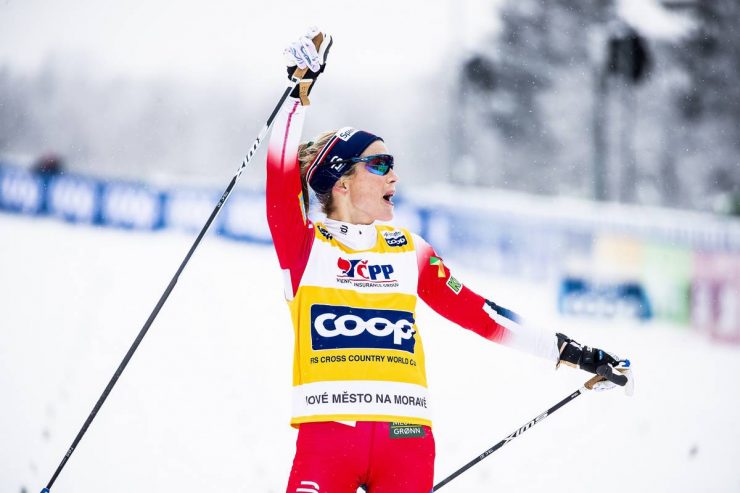
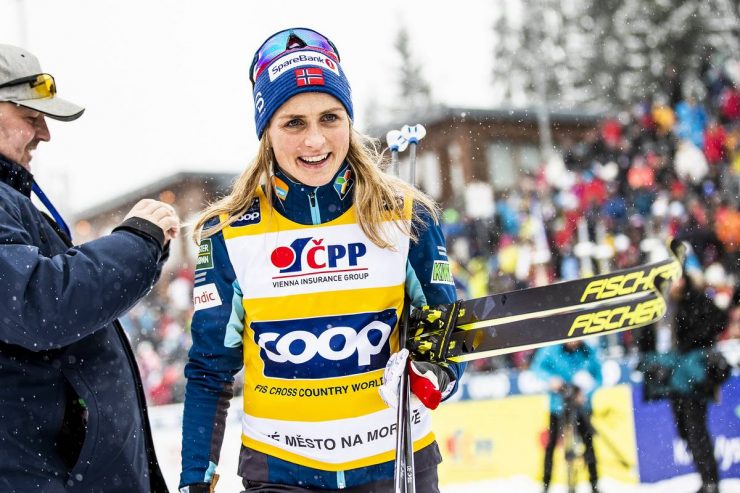
Rosie Brennan celebrates her victory and first World Cup podium after the freestyle sprint in Davos, Switzerland. Photo: NordicFocus
Sure we talk most things that transpired in Davos: some misses for the U.S. men, a solid performance by Scott Patterson in the 15 k skate, a slew of American men stoutly qualifying in the sprint, (think JC Schoonmaker and Kevin Bolger), and Hailey Swirbul’s most excellent third place in the women’s 10 k.
The race series moves on to Dresden, Germany next week, where the city is under strict lockdown orders due to Covid-19. It’s definitely onward for the World Cup, we hope it’s upward.
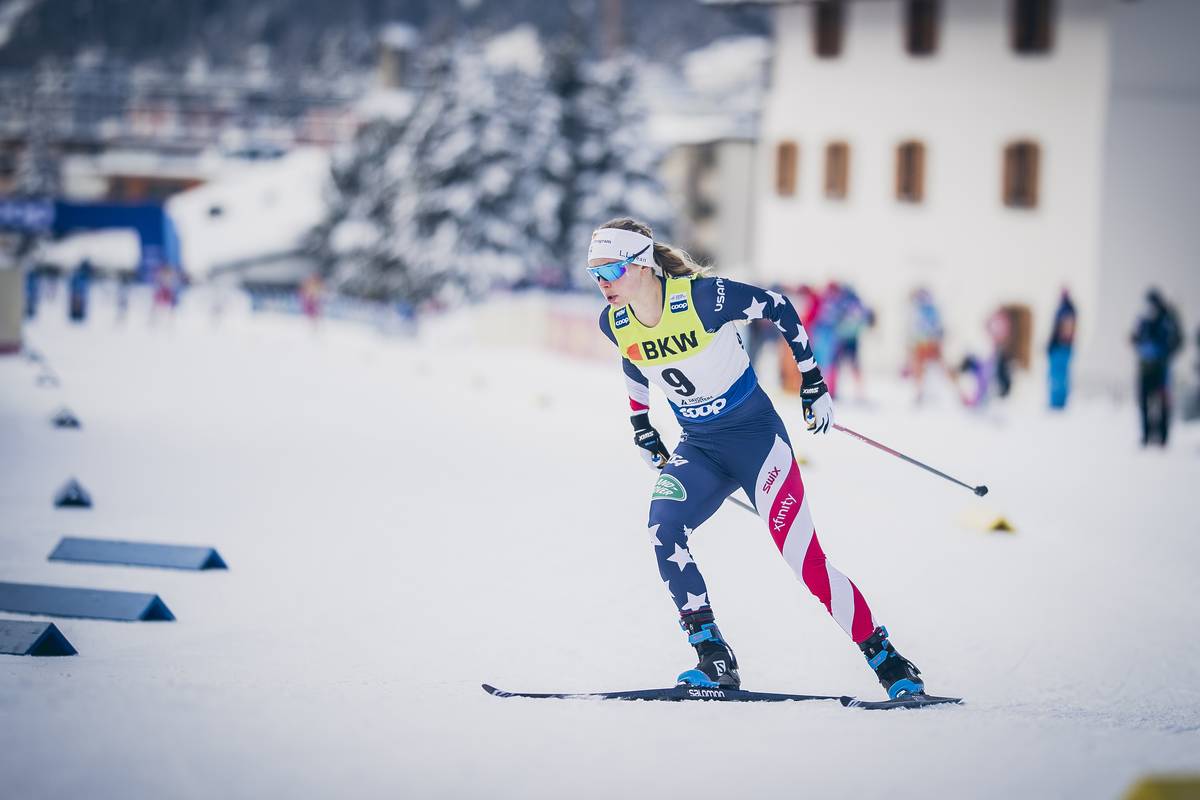
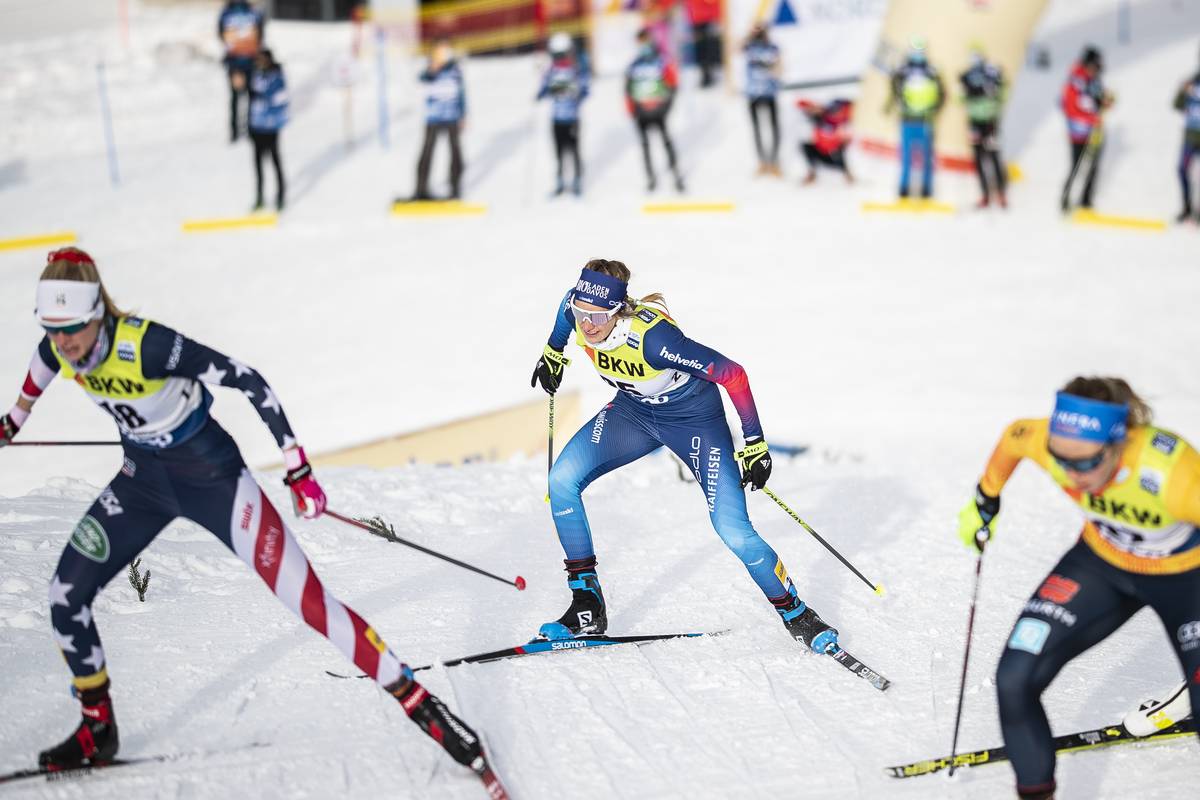
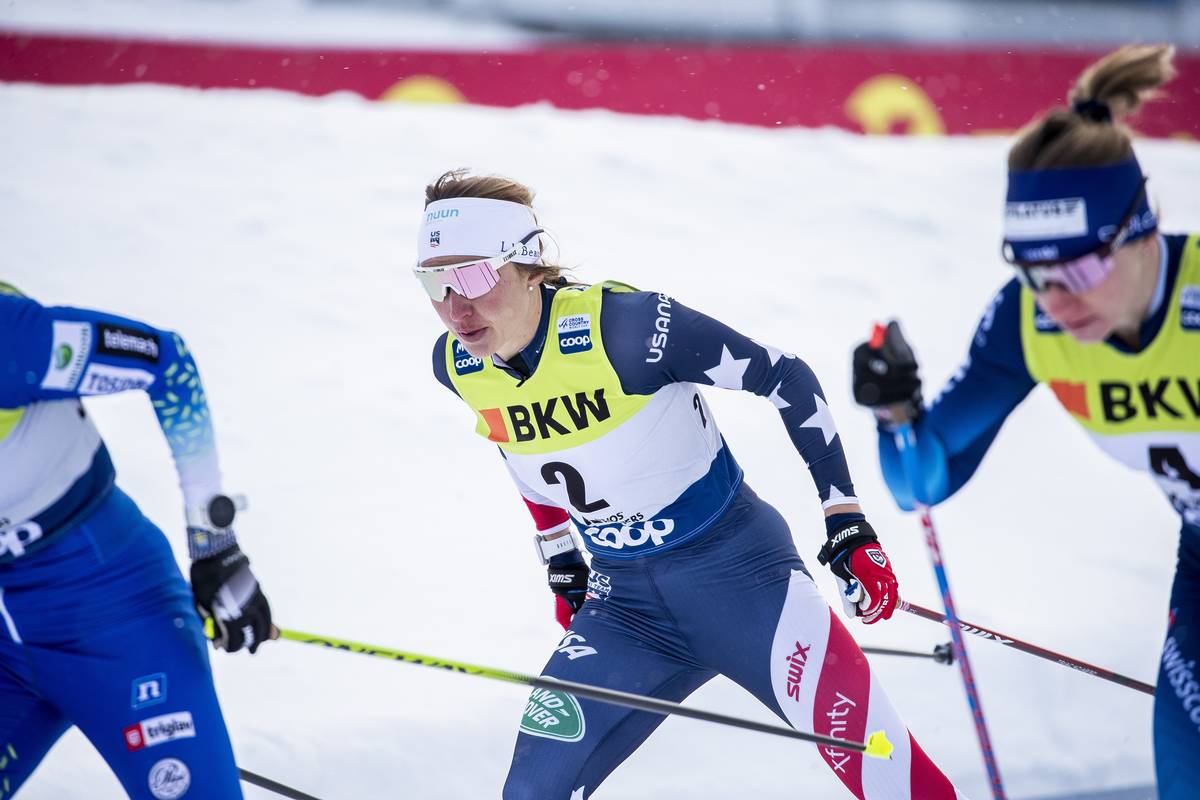
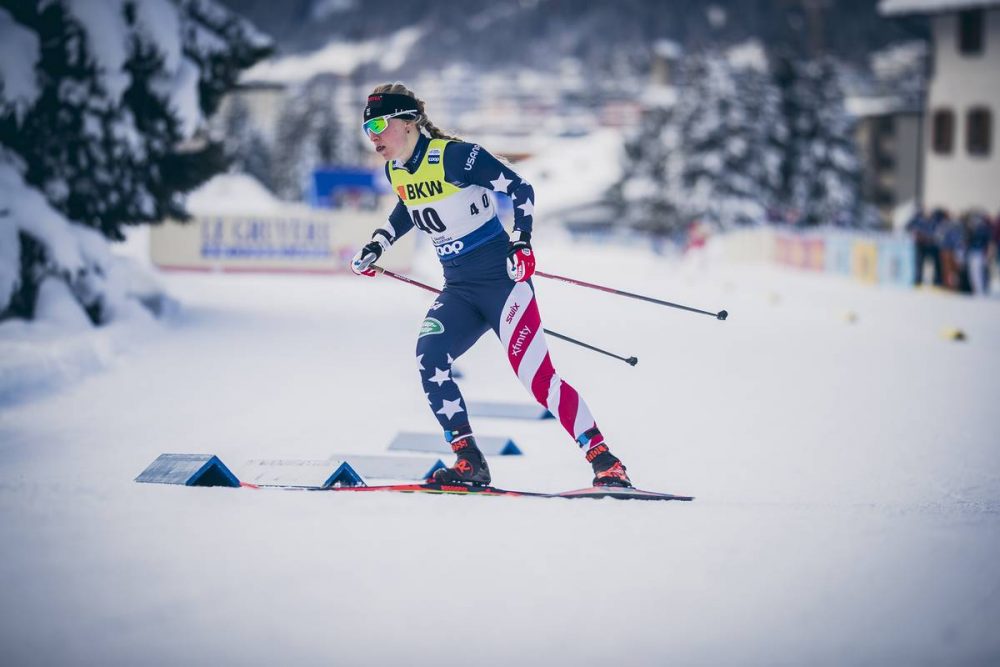
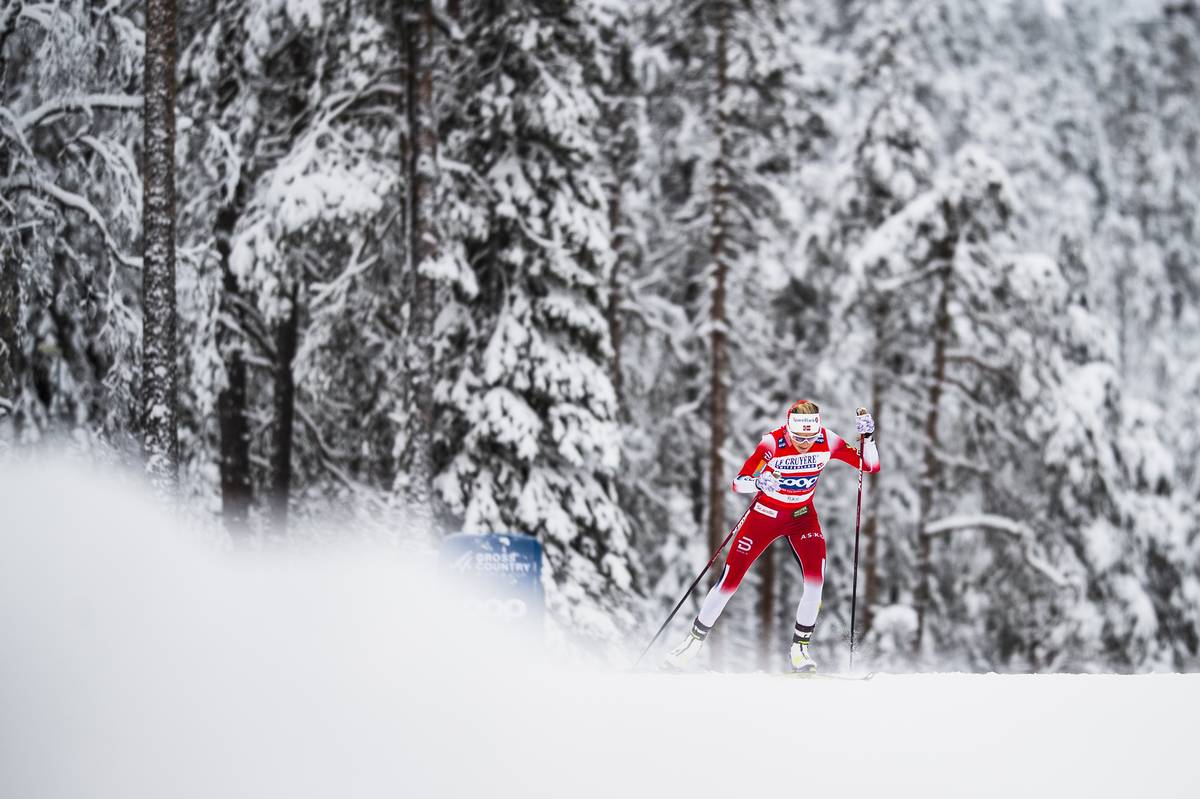
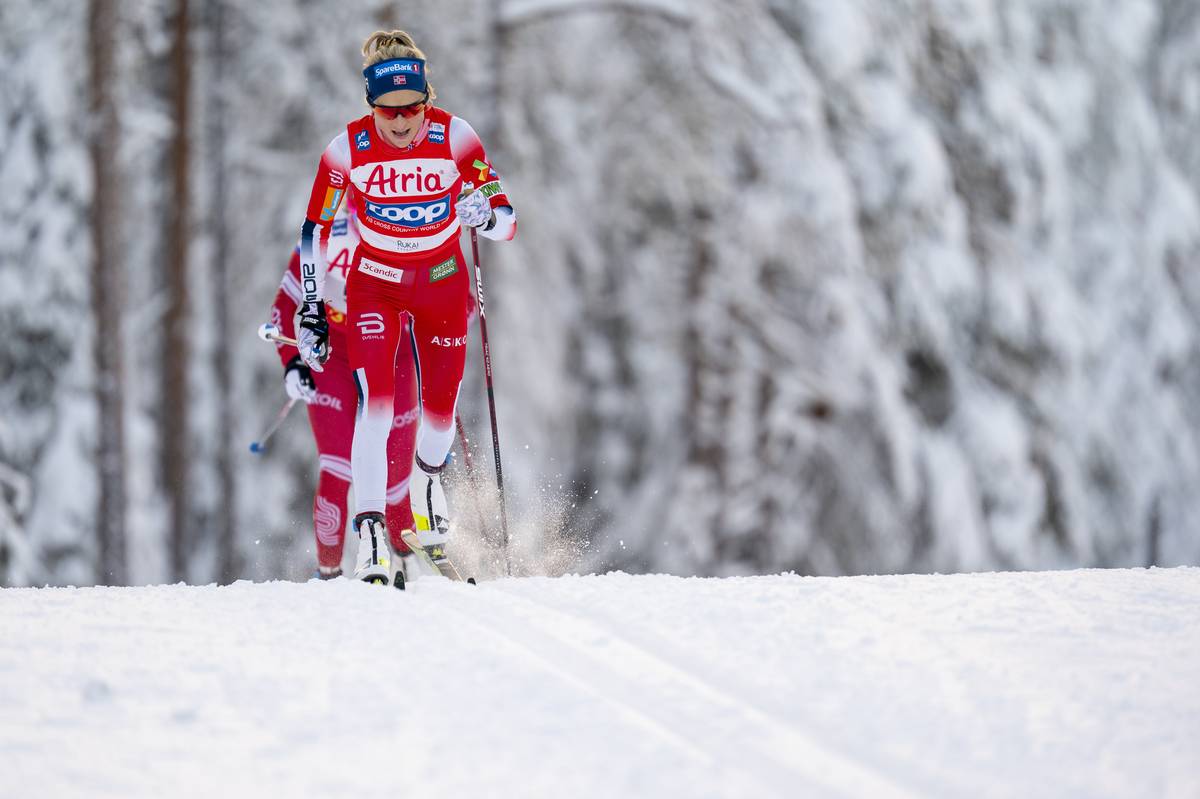
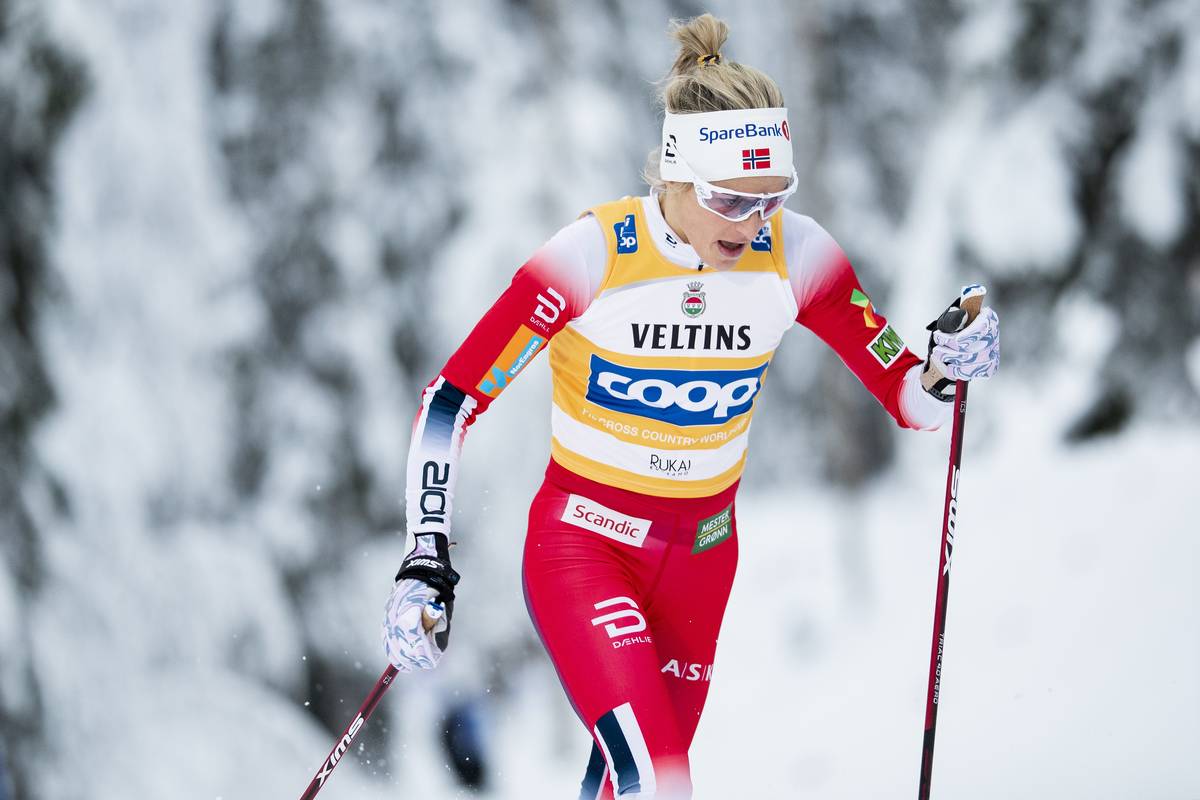
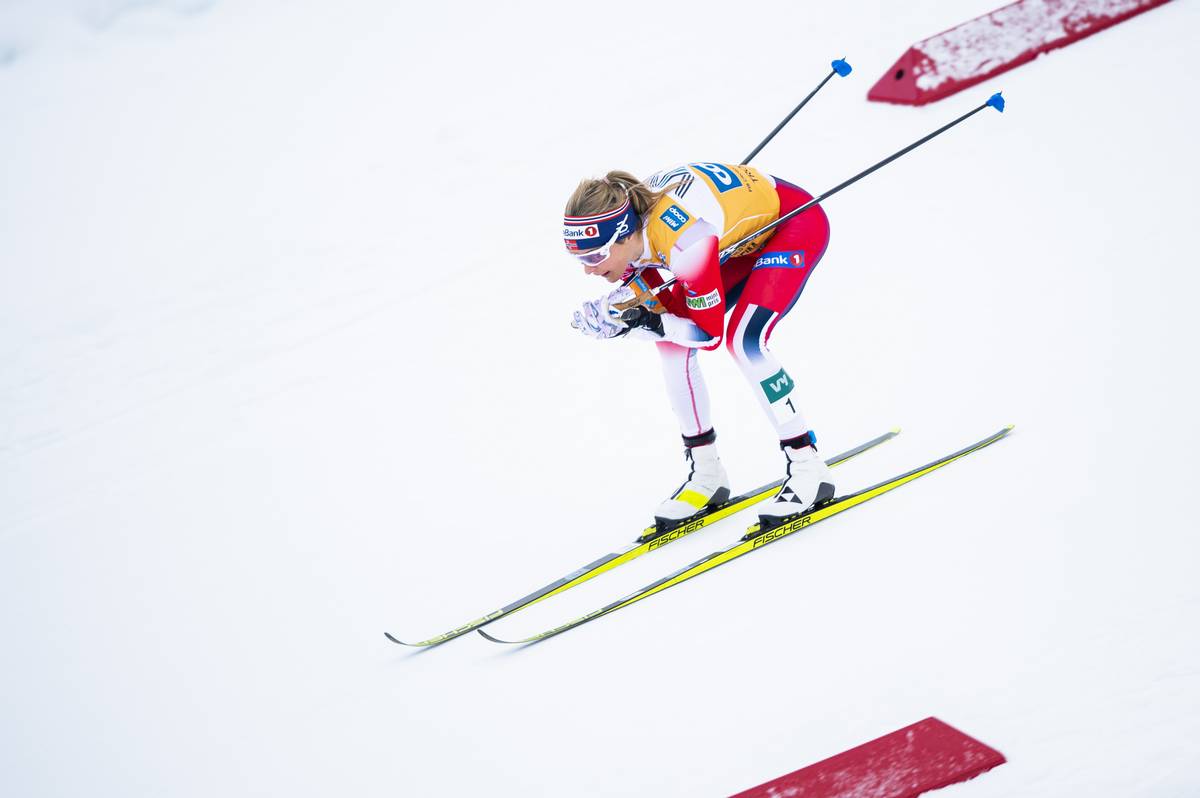
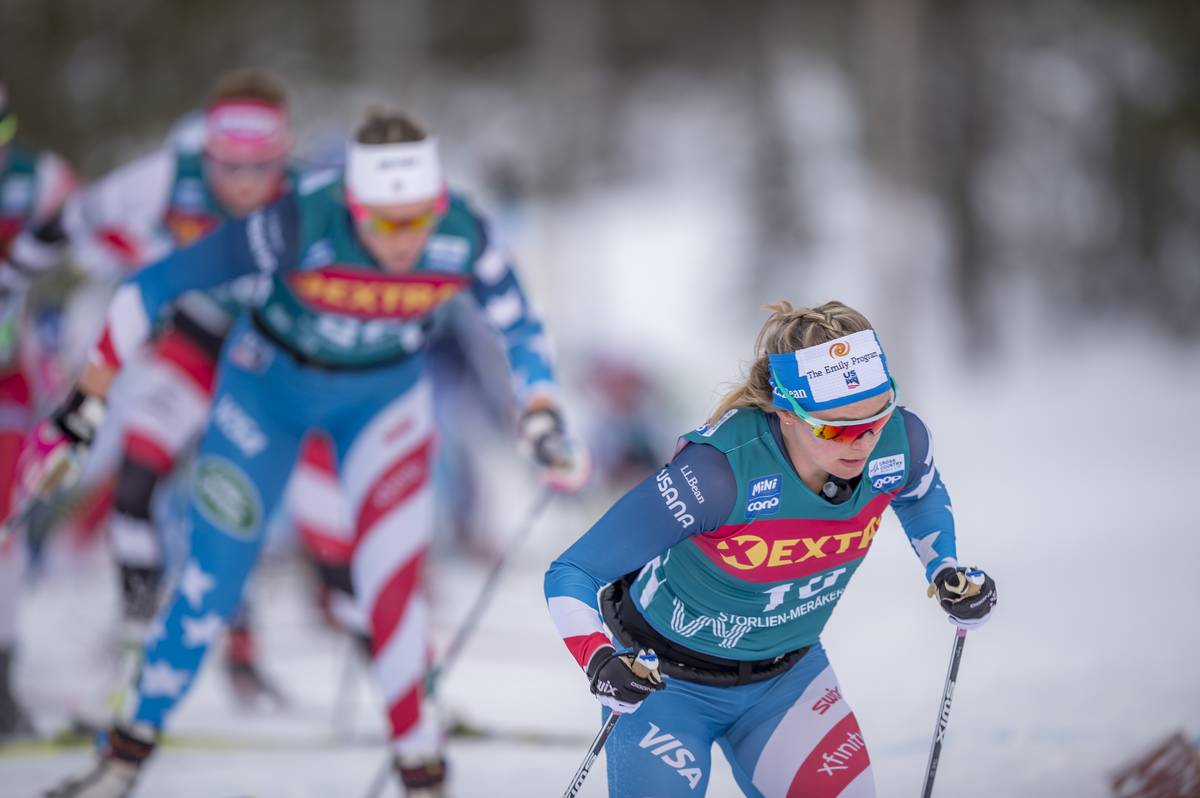
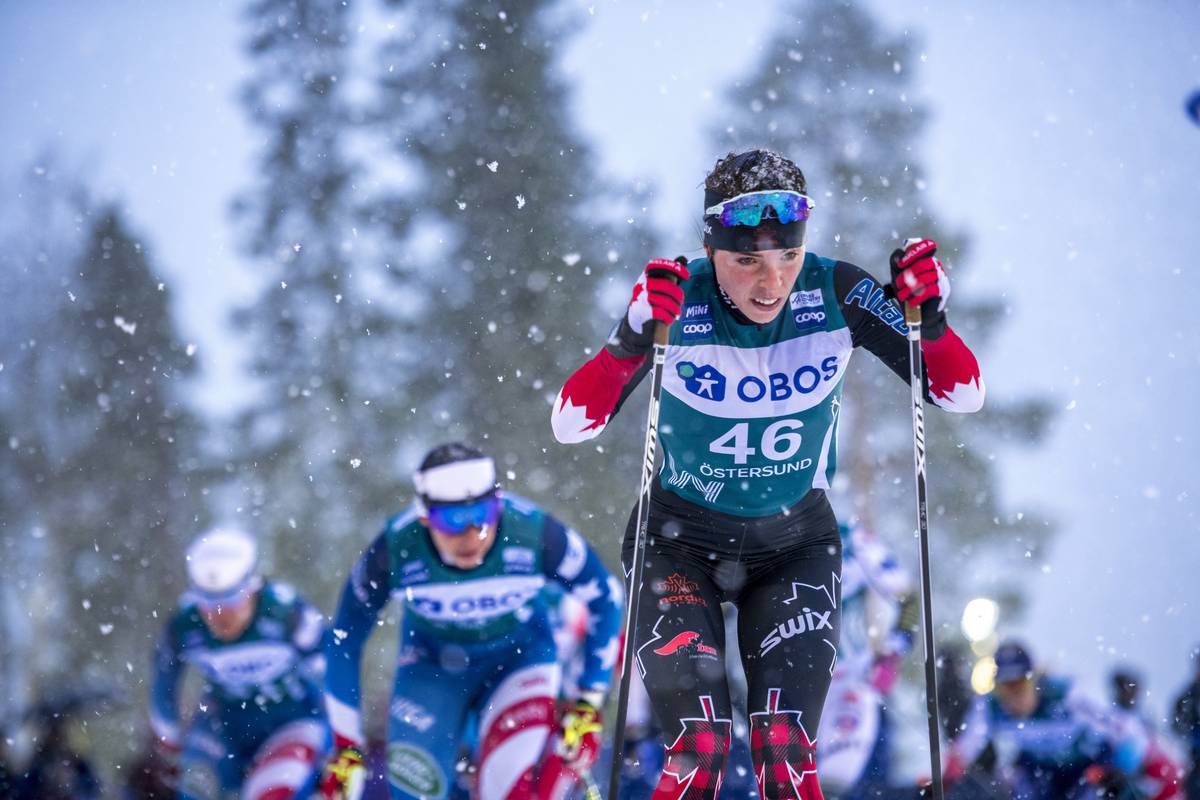
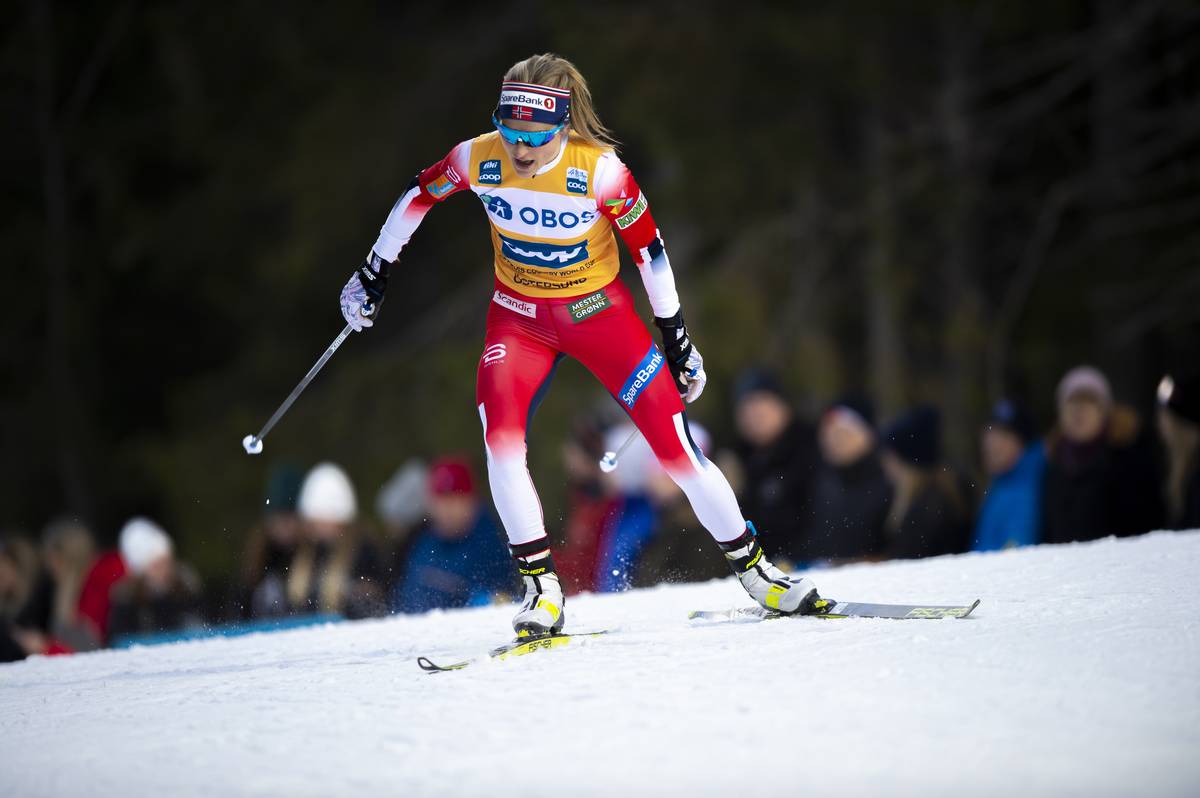
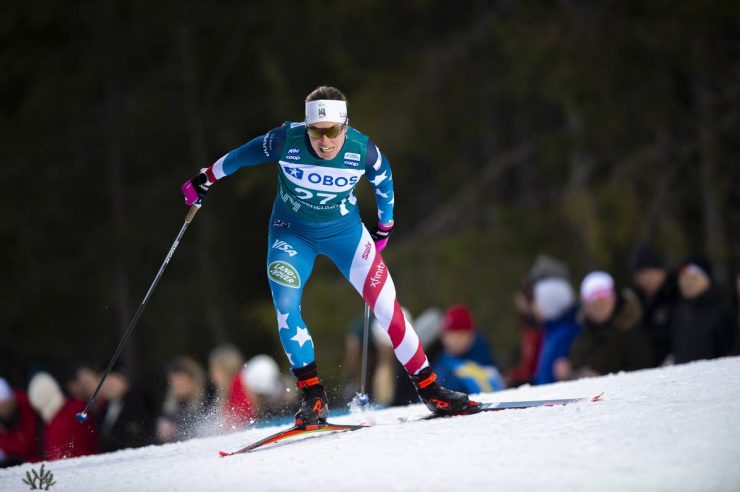
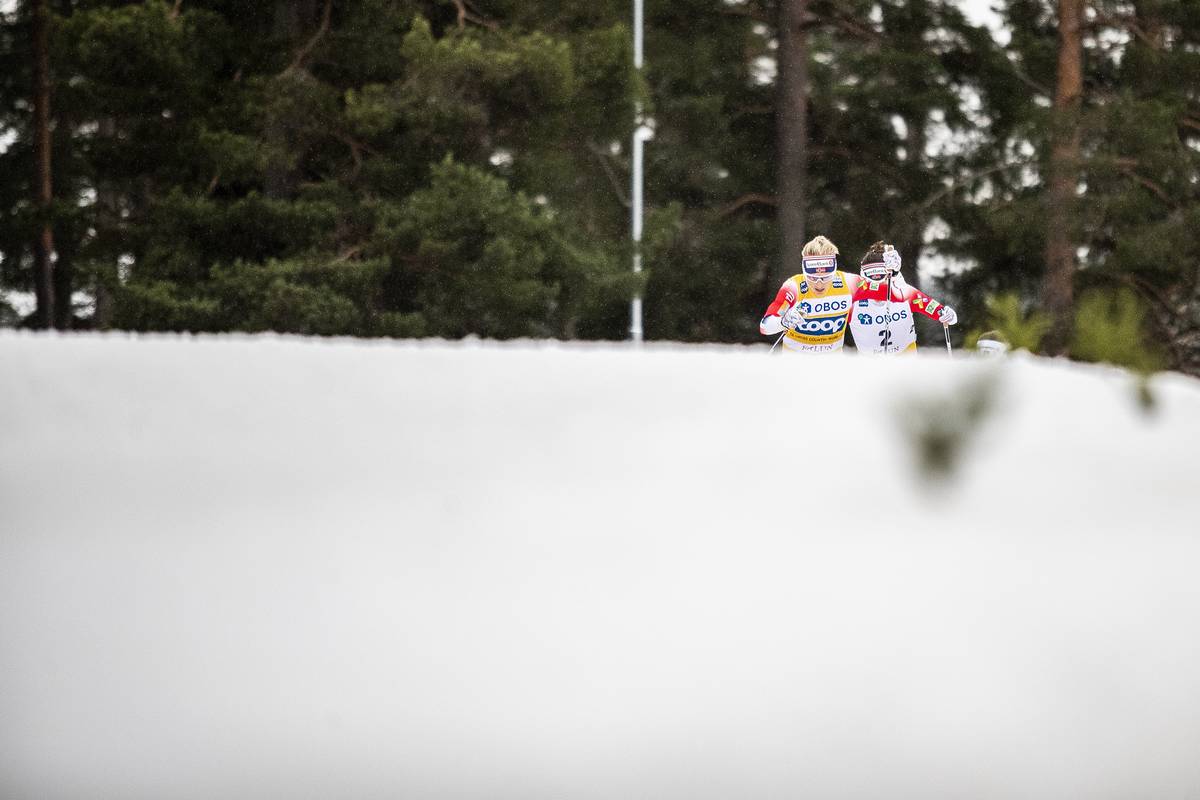
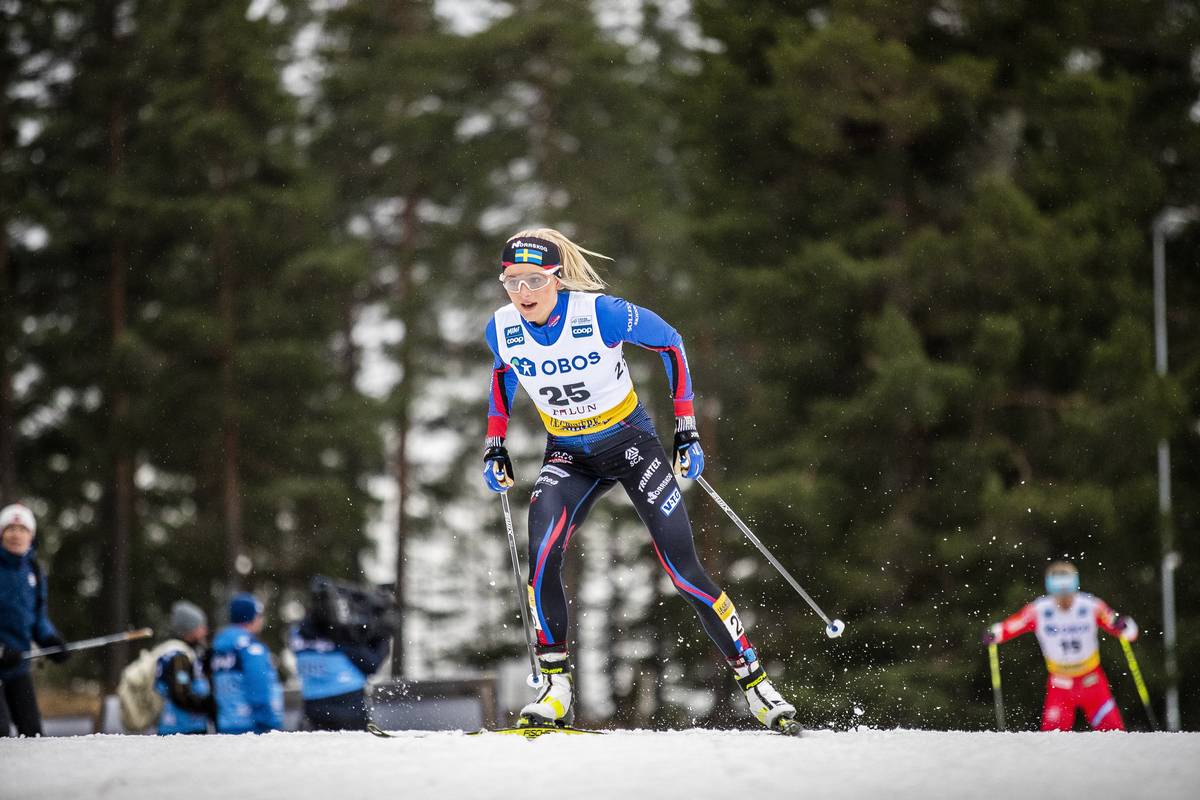
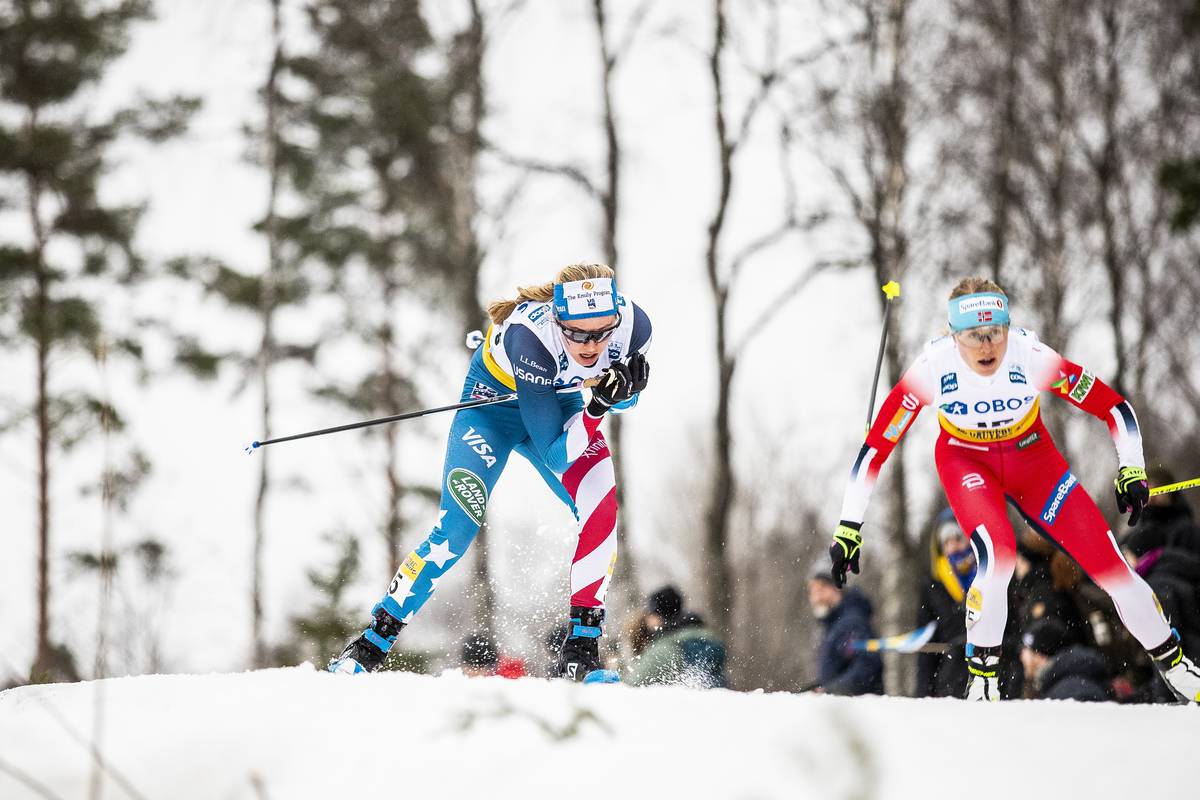
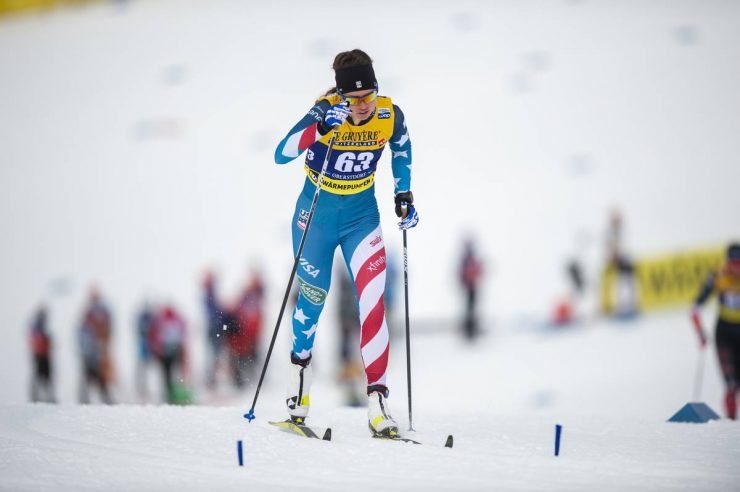
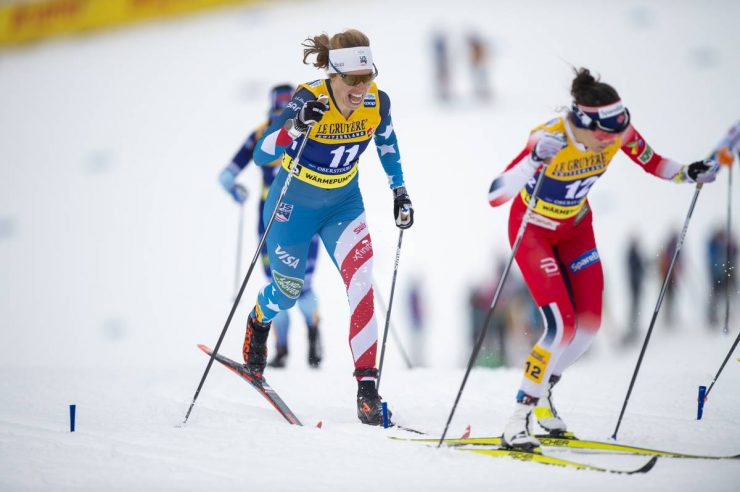
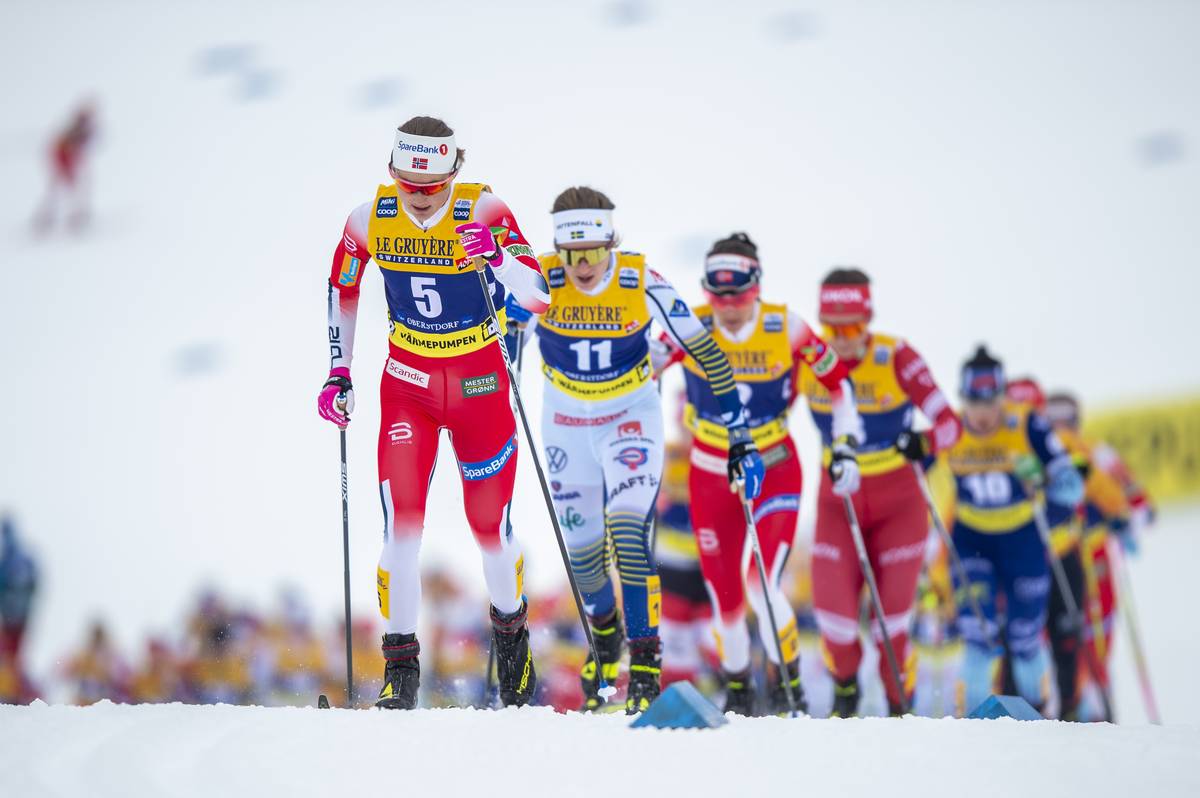
Impressing this season: Rosie Brennan racing in the Davos 10 k skate concludes her Davos weekend with back-to-back wins. (Photo: NoridcFocus)
This World Cup coverage is made possible through the generous support of Marty and Kathy Hall and their A Hall Mark of Excellence Award. To learn more about A Hall Mark of Excellence Award or to learn how you can support FasterSkier’s coverage please contact info@fasterskier.com.
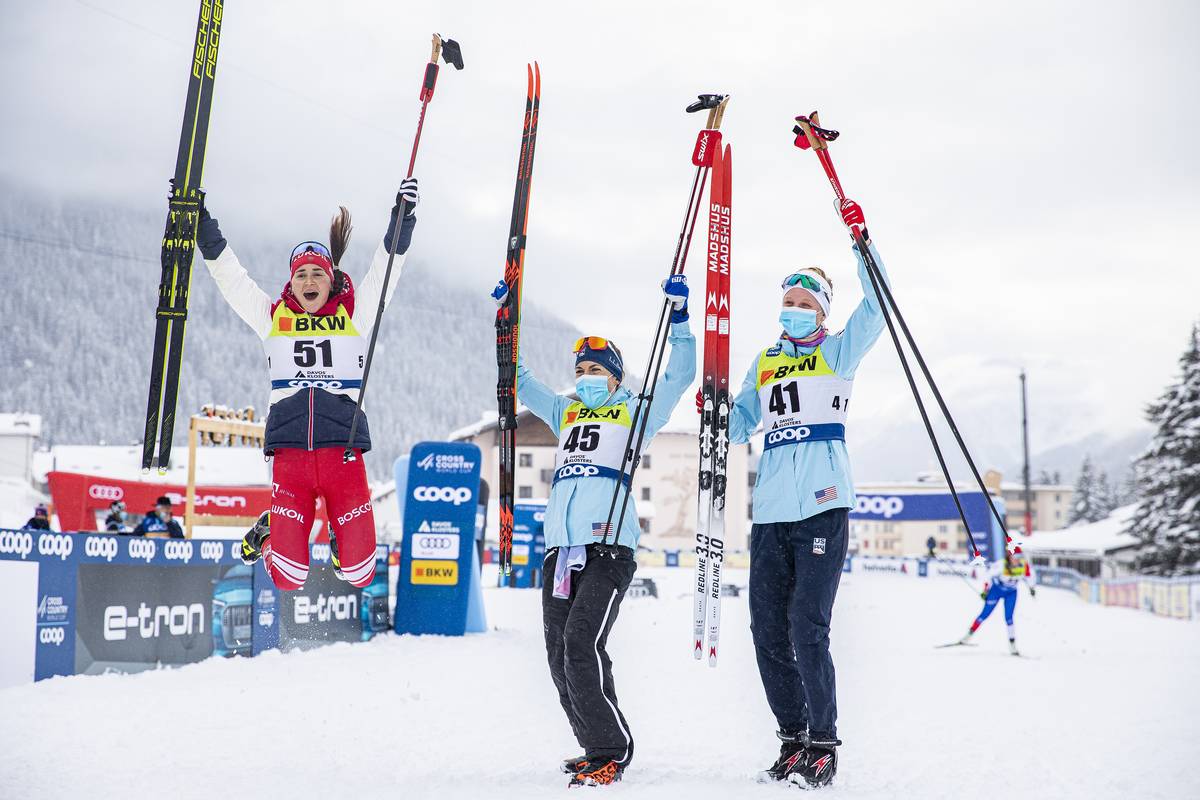
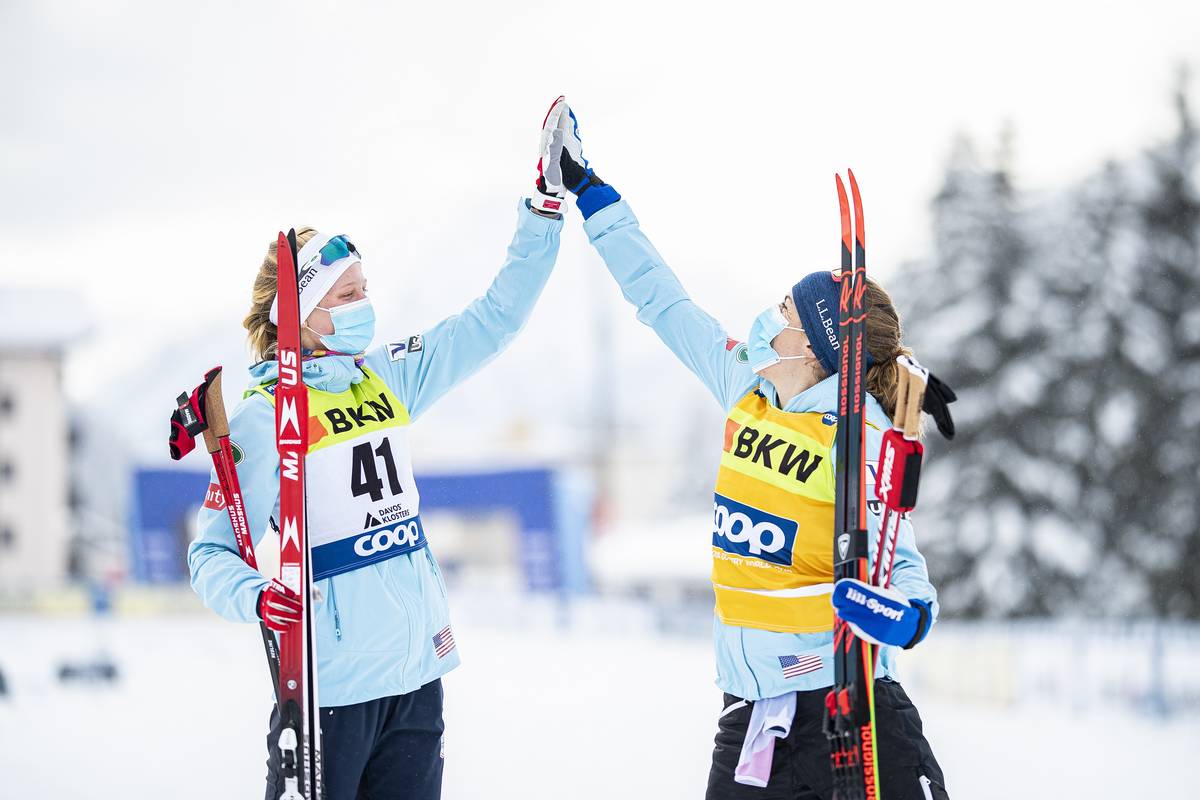
New snow and cloudy skies did nothing to hinder the fire of Rosie Brennan as she sped around the 10-kilometer course in a time of 24:49.8, securing her second-ever World Cup win after a victory in the sprint yesterday. Close behind her was Hailey Swirbul, no stranger to altitude, the Aspen, Co., native landed her first World Cup podium with a third-place finish. Rounding out the podium in second place was Yulia Stupak of Russia, formerly Yulia Belorukova.
Brennan, who started in bib 45, set the benchmark early on, gapping every skier in the field by 9.9 seconds at 2.2 k. By 7.2 k she had built a massive cushion of 24.6 seconds over eventual second place skier Stupak (RUS). Brennan closed out to win her second career World Cup in as many days by 34 seconds. “It was great, I love skiing in new snow,” said Brennan in a post-race interview with FIS, “I still am just so excited from yesterday, I really just tried to go out there and ski smooth and strong”.
With today’s victory, Brennan also takes the leader’s bib in the Overall World Cup Standings ahead of Tatiana Sorina of Russia while also leading in the Sprint and Distance standings. “That is quite honestly something I”m not sure I’ve ever dreamed of,” Brennan wrote in an email, “Obviously, we have only had a few races, but it’s something I’m proud of nonetheless and while I’m not sure I expect to keep them the whole season, I hope to do them proud while I have them and put up as good a fight as I can!”
Post-race interview with RosieBrennan.
Back from a year off to start a family, Yulia Stupak of Russia claims second overall in the Davos 10 k skate. (Photo: NordicFocus)
After missing the 2019/20 race season to pursue motherhood, Yulia Stupak (RUS) landed her fourth World Cup podium and first-ever distance podium with a second-place finish today.
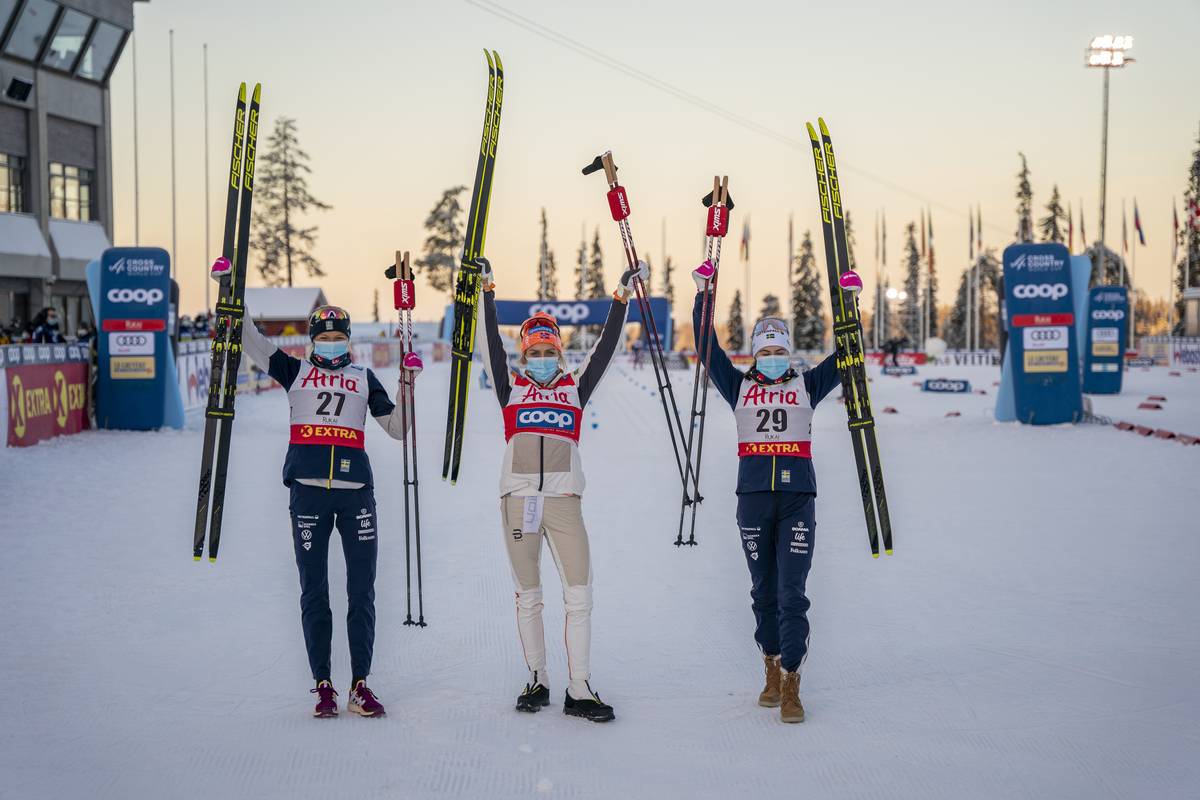
Hailey Swirbul at the line for third place in the Davos 10 k skate. (Photo: NordicFocus)
Post-race interview with Hailey Swirbul.
Swirbul began just four places ahead of Brennan in bib 41, with a conservative start she was 8th through the first 2.2 k. By 5 k Swirbul had overtaken five skiers and was neck-and-neck with Theresa Stadlober of Austria who eventually finished 5th. At 7.2 k Swirbul was down 2.4 seconds to Stadlober but blazed through the final 2.8 k to finish with a time of 25:30.3, 6.3 seconds ahead of the Austrian and 40.5 seconds behind her teammate Brennan.
Jessie Diggins, racing to seventh overall in the Davos 10 k skate. (Photo: NordicFocus)
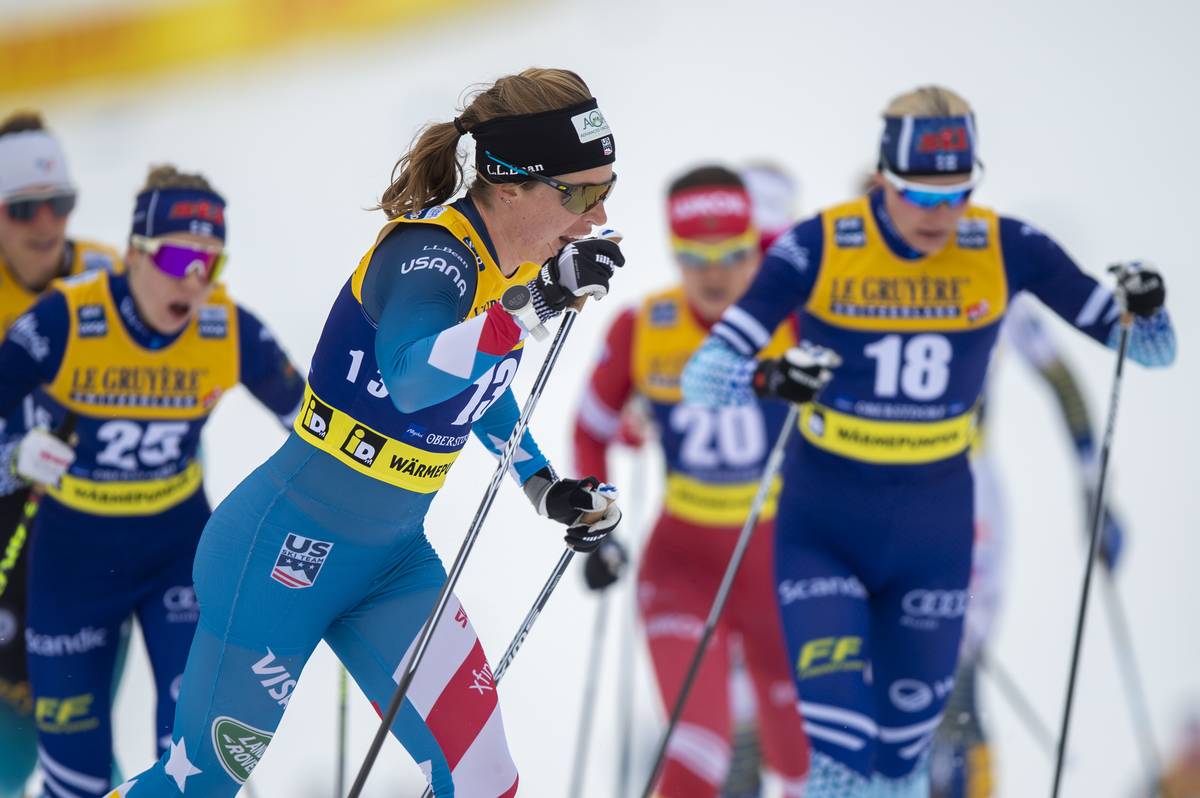
With two on the podium, the U.S. women rounded out the day with five finishes in the top 30. Jessie Diggins, who finished 3rd in Davos in this event last year, found herself in the top-ten with a 7th place finish. Katharine Ogden placed 22nd, scoring her first points of the season, followed by Caitlin Patterson in 30th.
For Ogden, this was her fourth top-30 World Cup result, with her best coming last season with a 21st in Val di Fiemme’s 10 k skate during the Tour de Skis.
Post-race interview with U.S. Head Coach Matt Whitcomb where he discusses the women’s race.
Katharine Ogden raced to 22nd in the Davos 10 k skate. (Photo: NordicFocus)
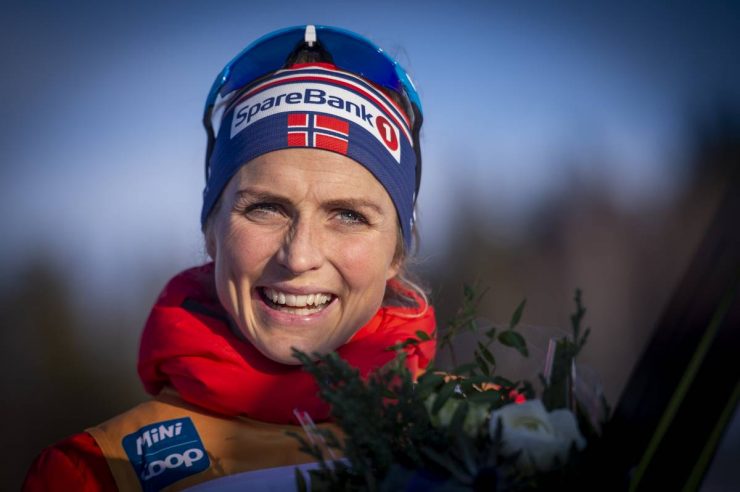
Rosie Brennan was all smiles after her first World Cup victory and podium in Davos, Switzerland. Photo: NordicFocus
This World Cup coverage is made possible through the generous support of Marty and Kathy Hall and their A Hall Mark of Excellence Award. To learn more about A Hall Mark of Excellence Award or to learn how you can support FasterSkier’s coverage please contact info@fasterskier.com.
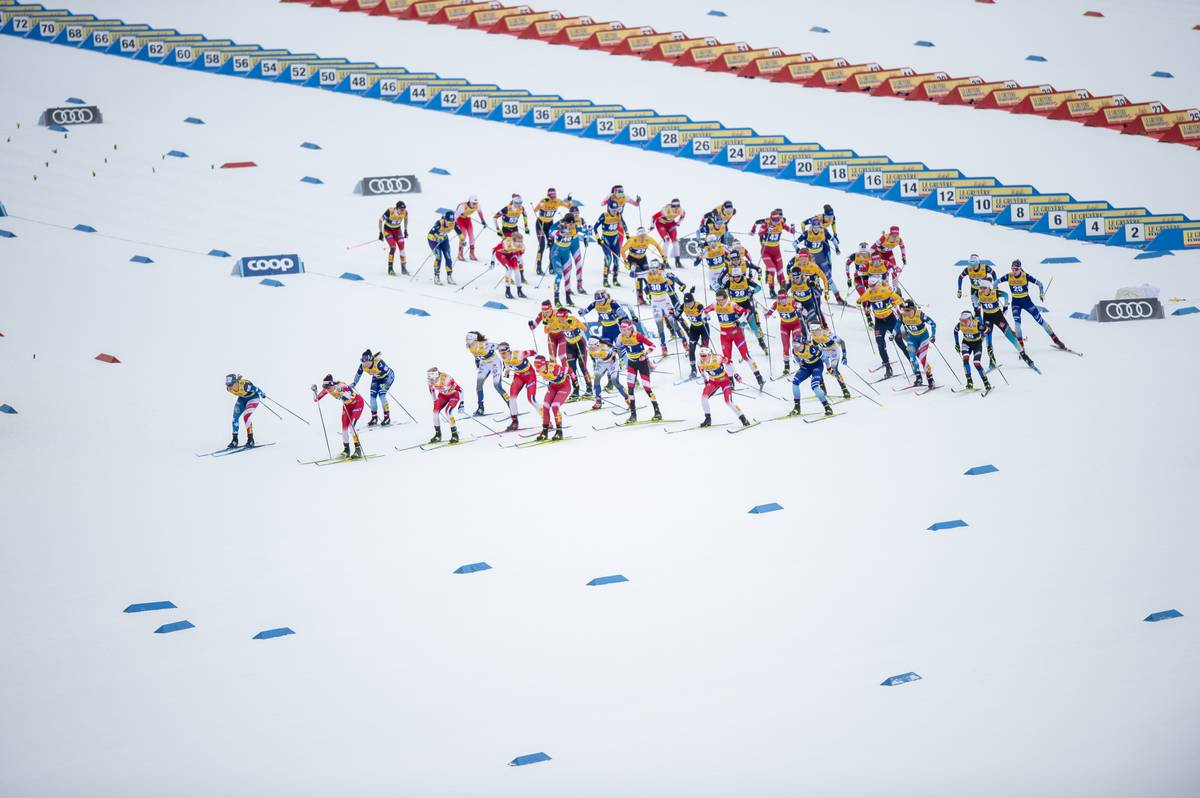
With a thick, fresh coat of fluffy white snow that fell over the last week, Davos, Switzerland looked regal as ever despite the smaller field and lack of spectators for today’s 1.5-kilometer freestyle sprint. FIS described conditions as hard-packed, elevating what Sophie Caldwell Hamilton, who landed on the podium in Davosthe last two years, called in a pre-race interview with FIS as a “technical and tactical” two lap course. Pumping music and cheering coaches, though perhaps a muted version of the norm, made the stadium feel significantly more full than the no-spectator reality.
With the Scandinavian teams out of the running as they withdrew from the December rounds of the World Cup due to Covid-19 concerns, it would be easy to focus on who did not in Davos. Let’s instead focus on who did.
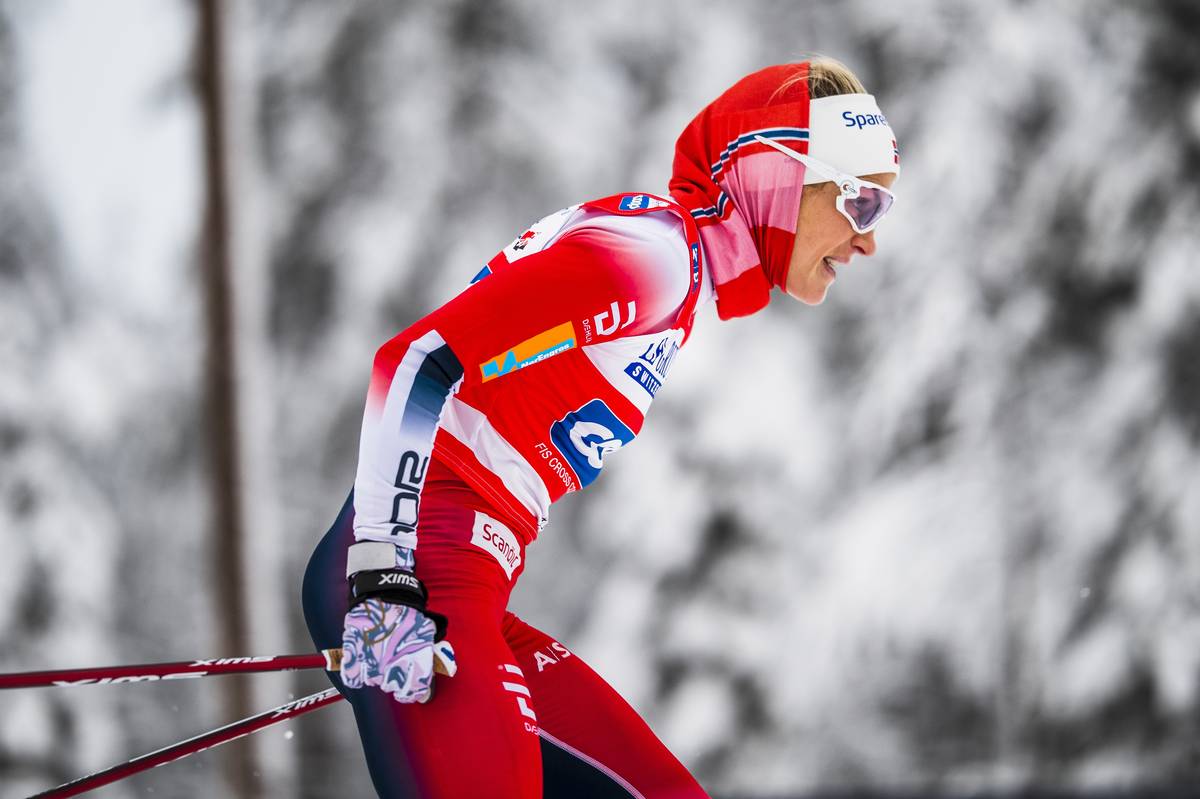
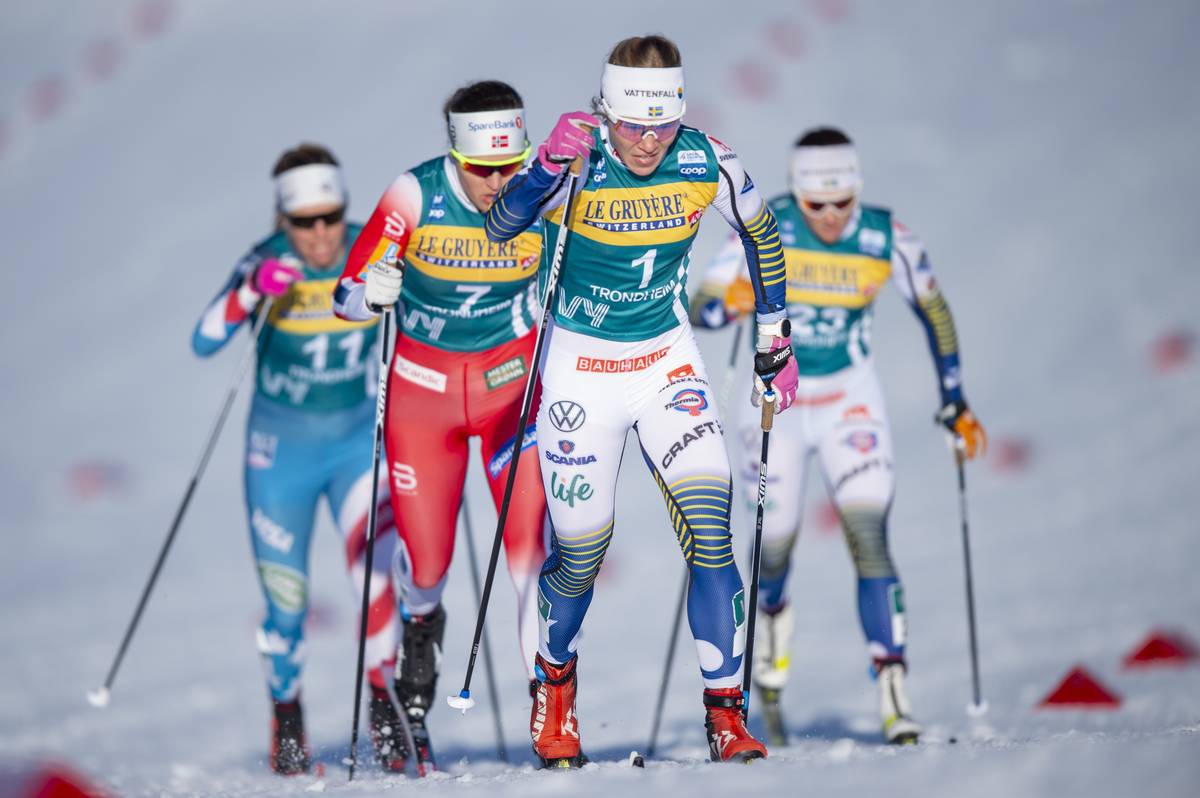
Rosie Brennan during the skate sprint qualification in Davos, Switzerland. Brennan won the qualifier – a career-best for the American. (Photo: Nordic Focus)
On a roll this season, Rosie Brennan won the qualifier by 1.75 seconds in a time of 2:40.03. Rounding out the Americans in the finals, Caldwell Hamilton took second, Diggins fifth, Julia Kern 10th, and Hailey Swirbul 18th.
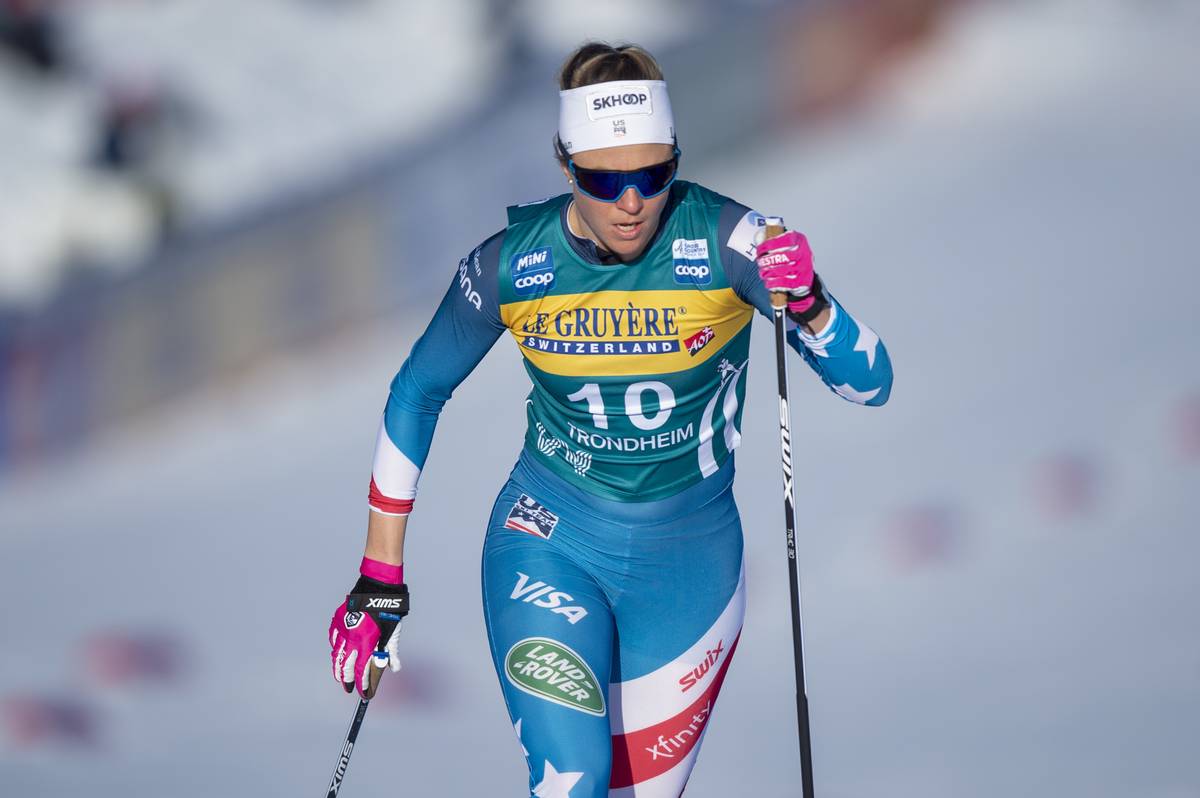
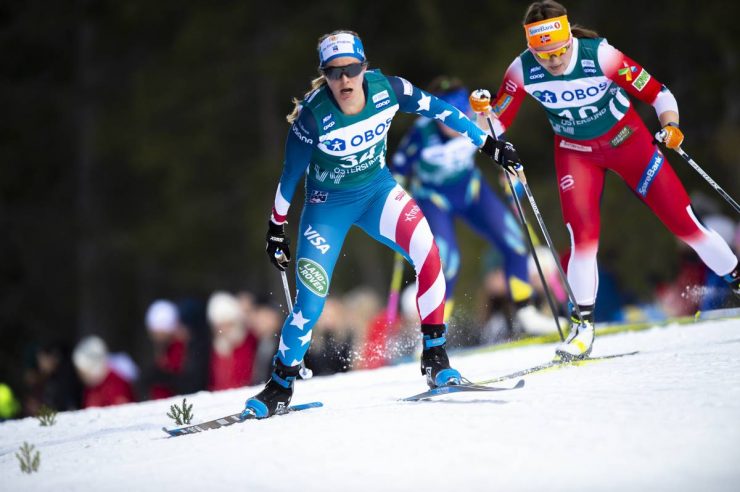
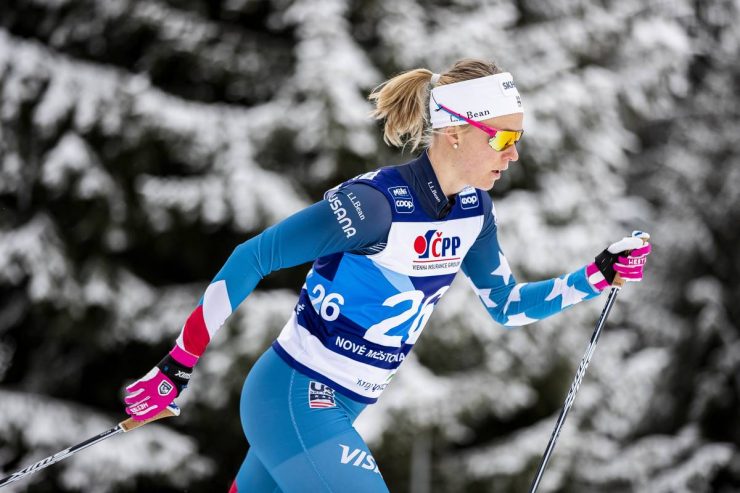
Jessie Diggins racing to 5th in the Davos sprint qualifier. (Photo: Nordic Focus)
In the quarterfinals, Caldwell Hamilton faced off with Switzerland’s Nadine Fähndrich in what would be the fastest heat. The pack stayed together in the first lap, but the two peeled off to finish comfortably off the front, Fähndrich in the lead.
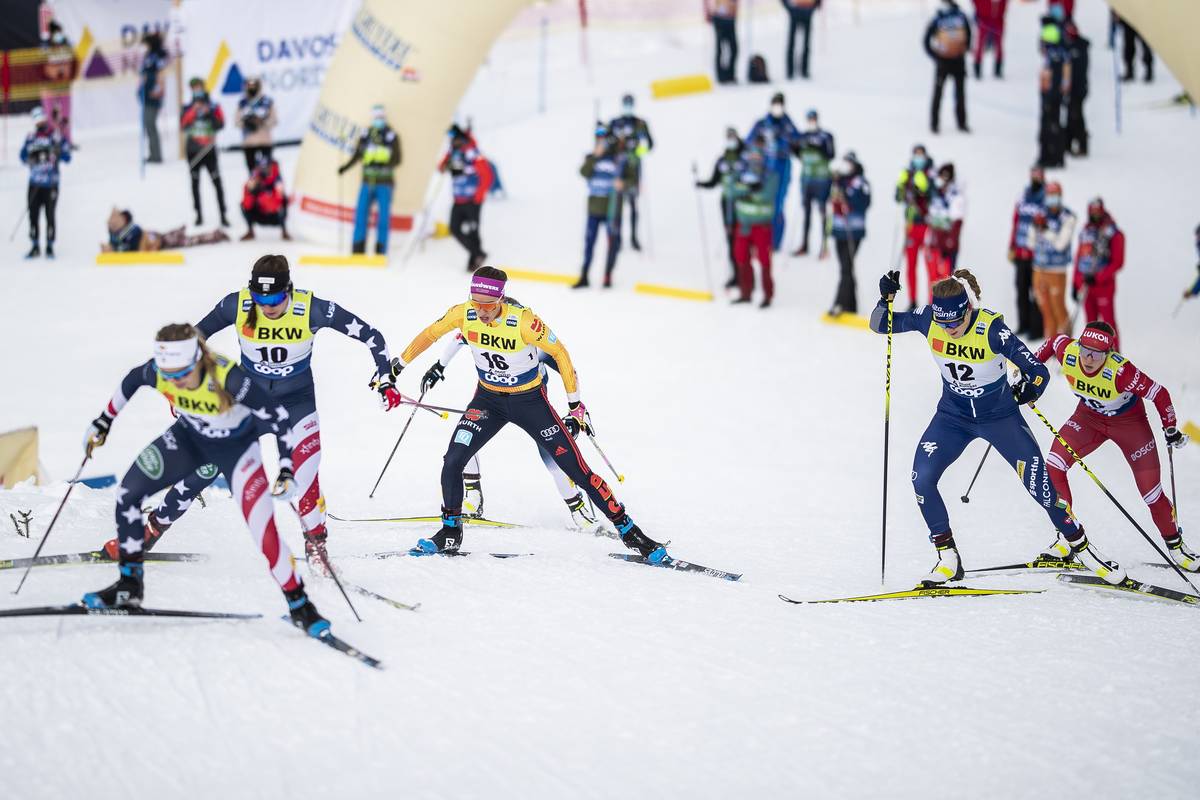
The next heats were much closer. Brennan finished second in a pack of four behind Slovenia’s sprint star Anamarija Lampic in heat two, and after taking the lead in the second lap, Kern won the third heat.
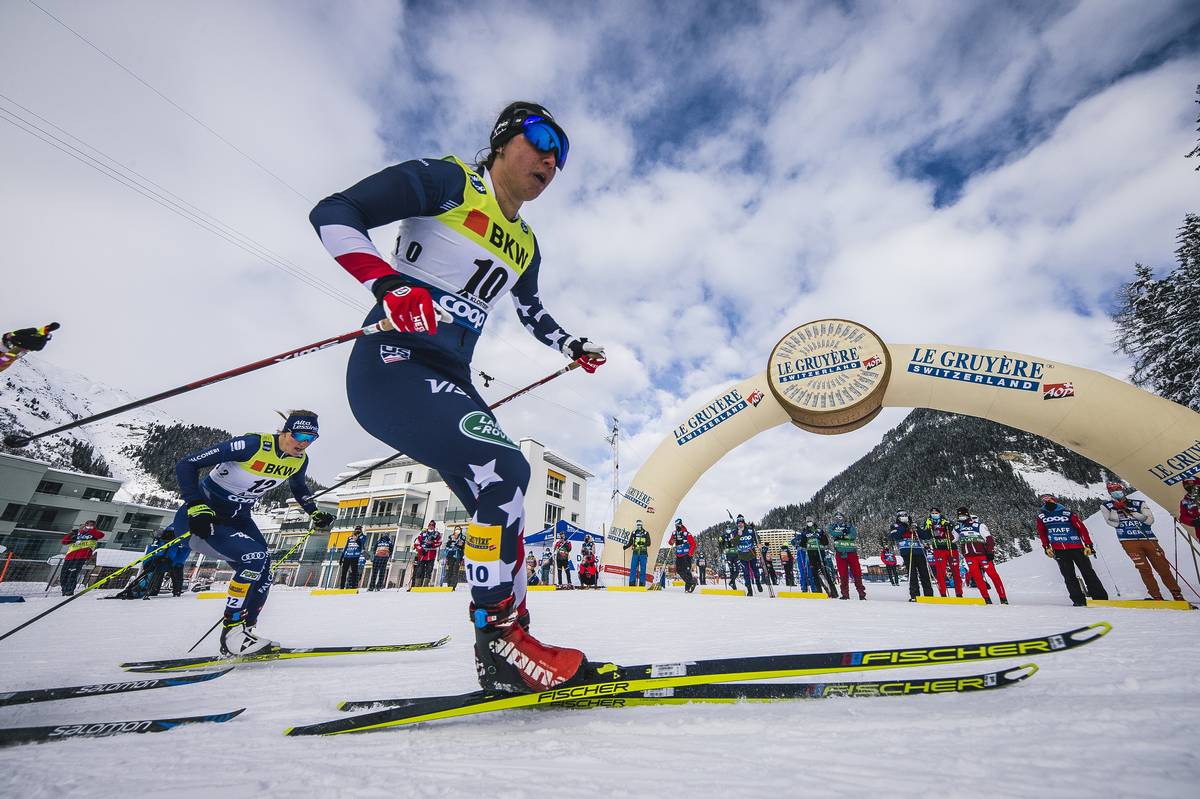
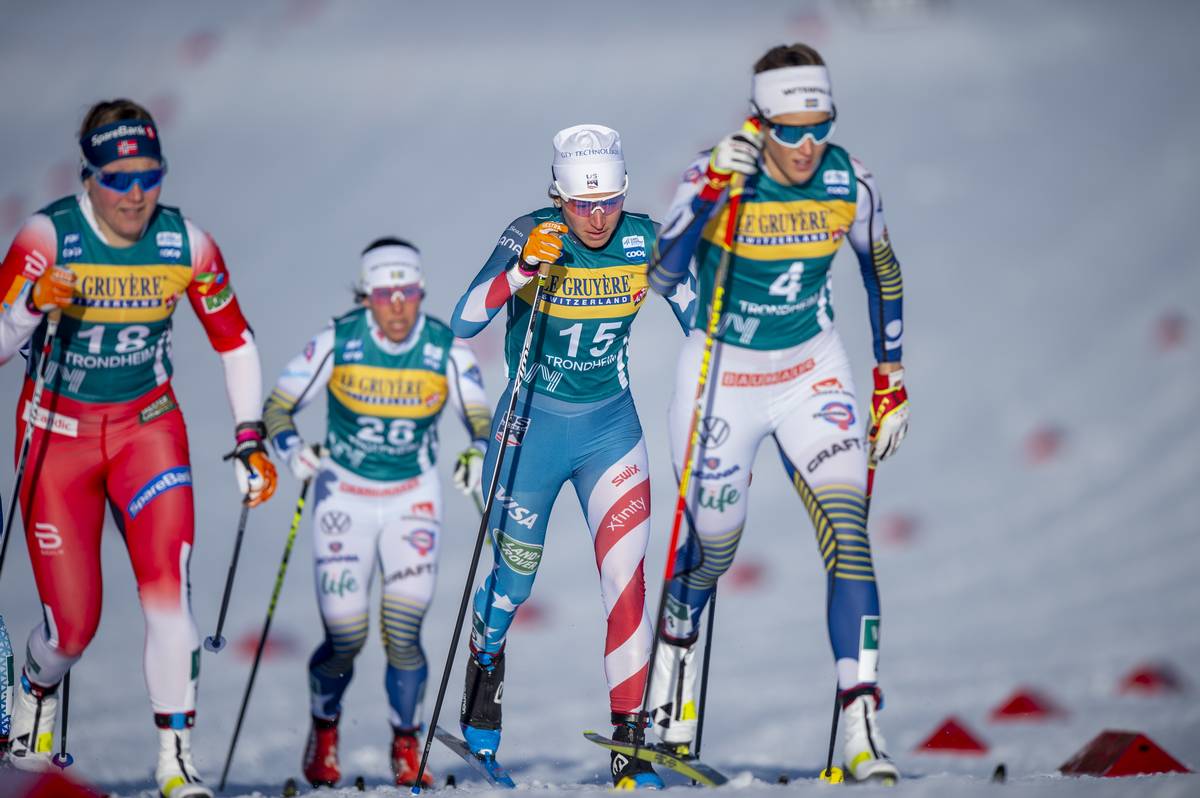
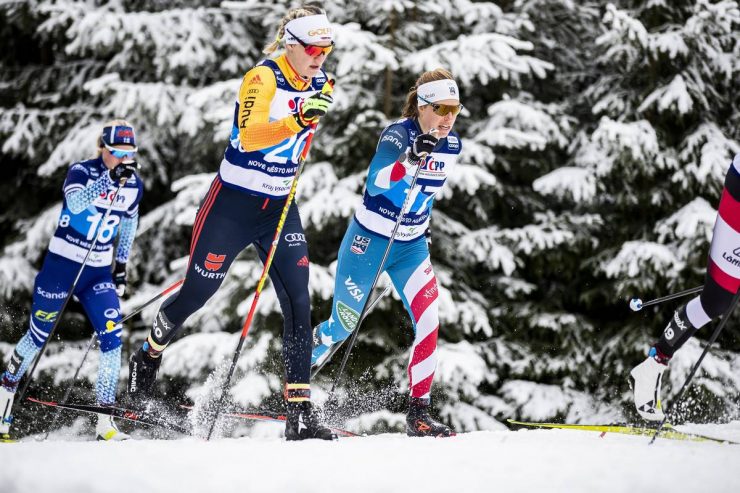
Jessie Diggins (left) leads Julia Kern (bib 10) at the front of the group during the quarterfinal of the 1.5 k sprint in Davos, Switzerland. (Photo: NordicFocus)
Dropping into a tuck on the last descent and on Kern’s tails in the fast and furious final turn into the stadium, Diggins was in a tough position. Rather than putting herself in position for the sprint to the finish, she maneuvered to avoid tangling skis with Kern and lost some of her momentum. Despite powering down the straightaway and throwing her boot, she took third in the heat and was not fast enough to earn a lucky loser spot.
Round the bend, Julia Kern in the lead heading into the final straight during the quarterfinal of the 1.5 k skate sprint in Davos, Switzerland. (Photo: NordicFocus)
Swirbul was also eliminated in the quarters after taking fourth in her heat.
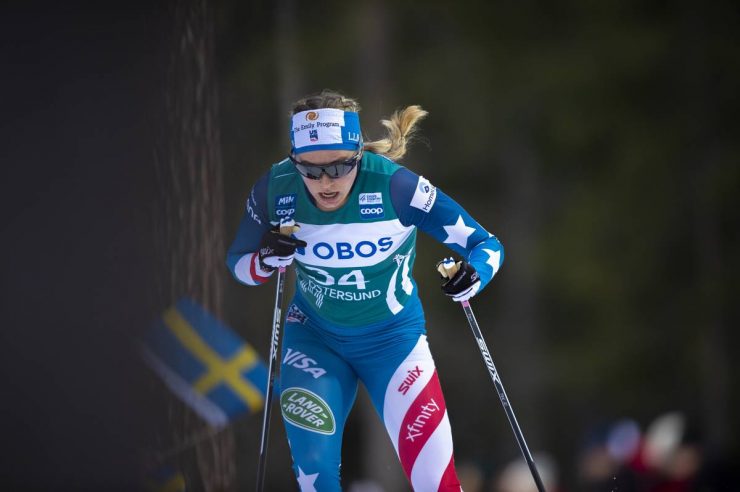
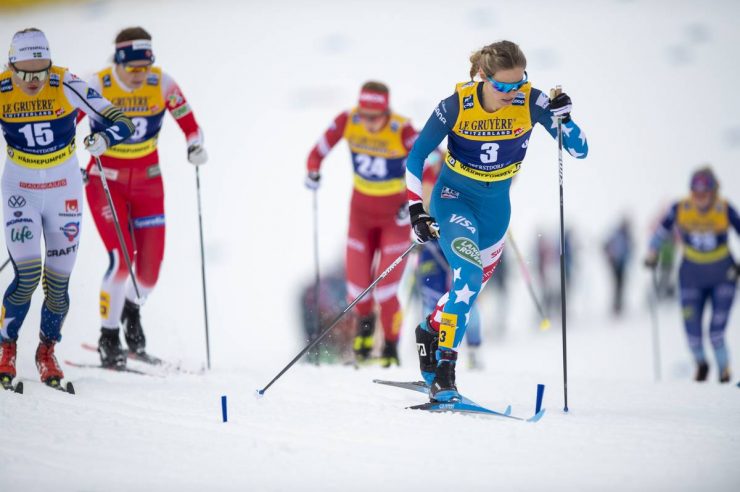
Hailey Swirbul climbs amidst the pack during the quarterfinal of the 1.5 k skate sprint in Davos, Switzerland. (Photo: NordicFocus)
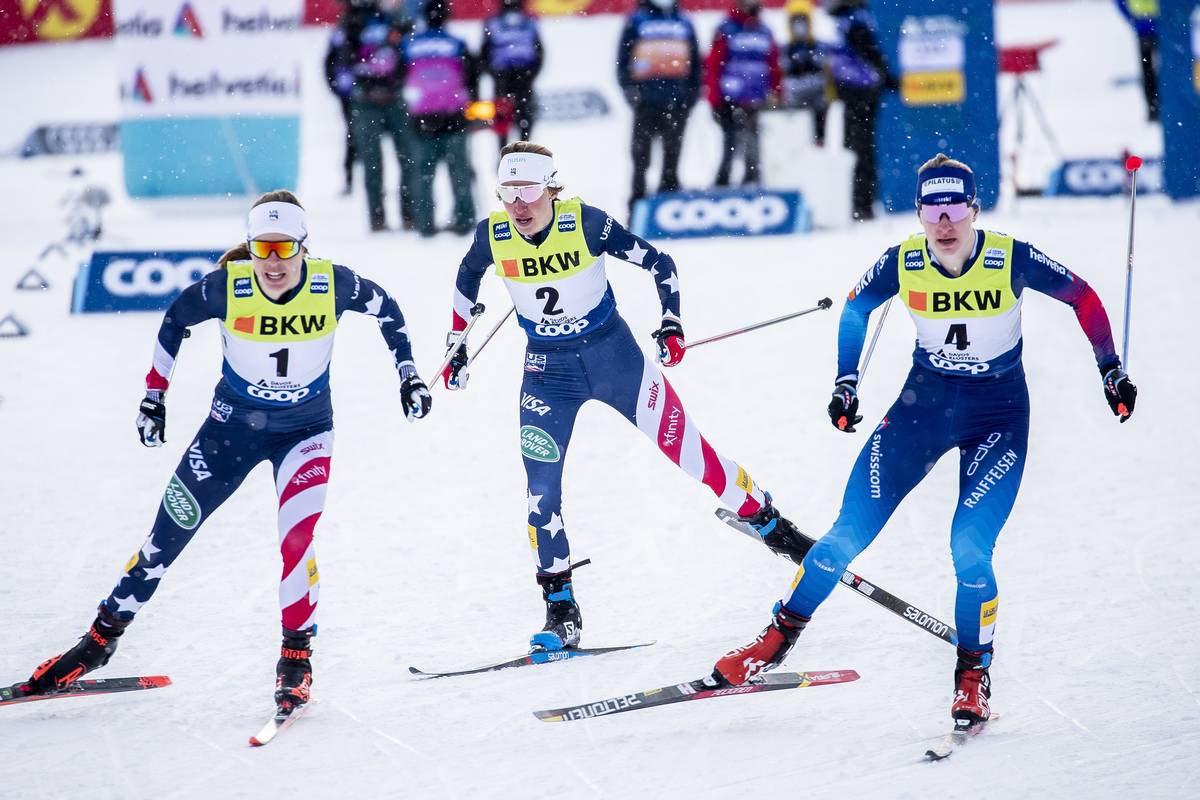
In the semis, the three remaining American women lined up together in a stacked first heat with Lampic and Fähndrich. Brennan and Caldwell Hamilton held strong in the middle of the group while the Swiss and the Slovene set the pace. The foursome stayed tight, jockeying for positions in the second lap.
It was anyone’s game in the final straight, but Fähndrich held the others off on home turf to win the heat with Lampic and Brennan in a photo finish for second and third, respectively, behind her and Caldwell half a ski length further back in fourth. Both were able to secure lucky loser positions to advance into the final. Kern was eliminated after finishing 6th in the heat.
To the line, Rosie Brennan (L) leads Switzerland’s Nadine Fähndrich and teammate Sophie Caldwell Hamilton in the final sprint during the semifinal of the rounds in Davos, Switzerland. (Photo: NordicFocus)
Eva Urevc of Slovenia and Natalia Nepryaeva of Russia advanced from the second heat of the semifinals.
Fähndrich and Lampic again took the pace out hot in the final round, but Brennan kept herself in the mix. Challenging Fähndrich, she powered into the lead on the final climb, cresting the hill in front and dropping into a tuck on the downhill. Brennan held her lead out of the final turn and into the straightaway, but Lampic, Fähndrich and Nepryaeva were close on her tails.
Adrenaline pumping and poles lashing, Brennan held her lead by a narrow margin, pumping her fist in the air as she crossed the finish line in 2:37.36, breaking into a wide grin as she gasped for air.
Rosie Brennan celebrates her victory and first World Cup podium after the freestyle sprint in Davos, Switzerland. (Photo: NordicFocus)Rosie Brennan celebrates her victory and first World Cup podium after the freestyle sprint in Davos, Switzerland. (Photo: NordicFocus)
“It’s wild,” Brennan told FIS after the race. “I’ve never considered myself a sprinter, so to find myself on the podium is something I couldn’t even dream of.”
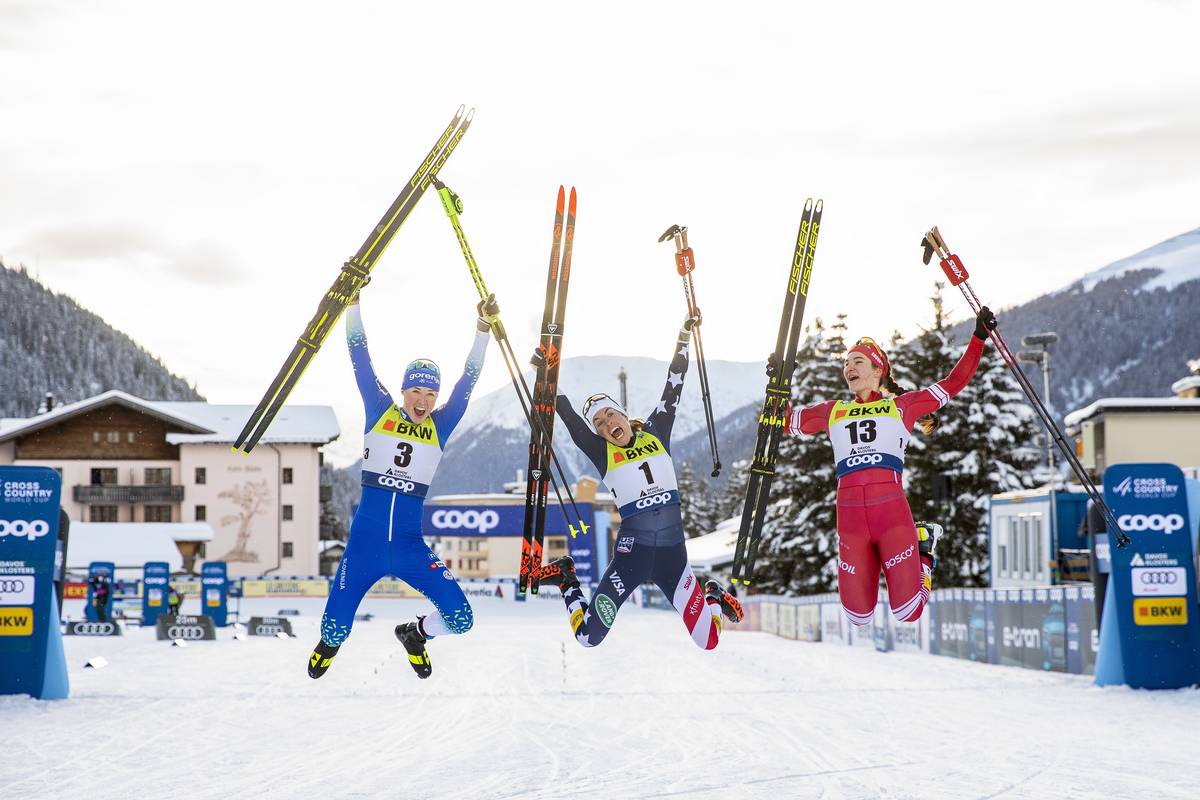
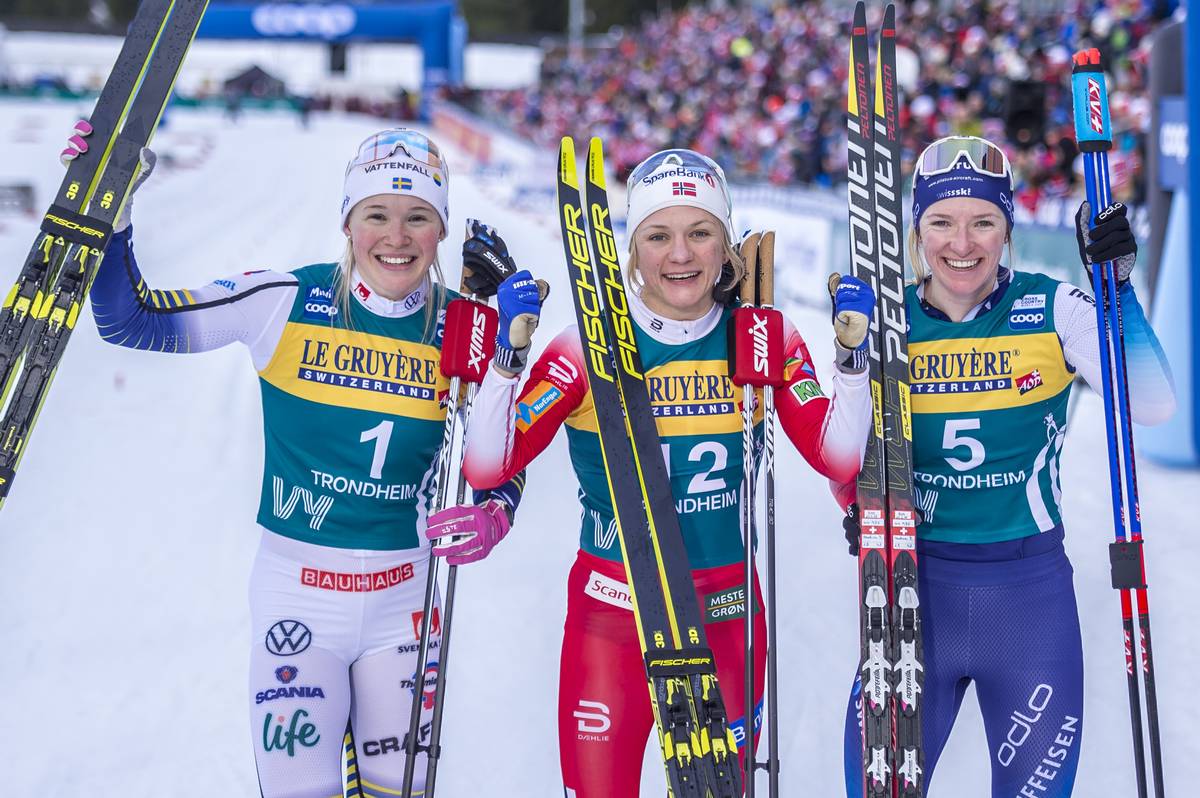
Lampic finished on her tails in second (+0.28), with Nepryaeva and Fähndrich in a photo finish for the final podium spot. They finished third (+0.49) and fourth respectively (+0.53).
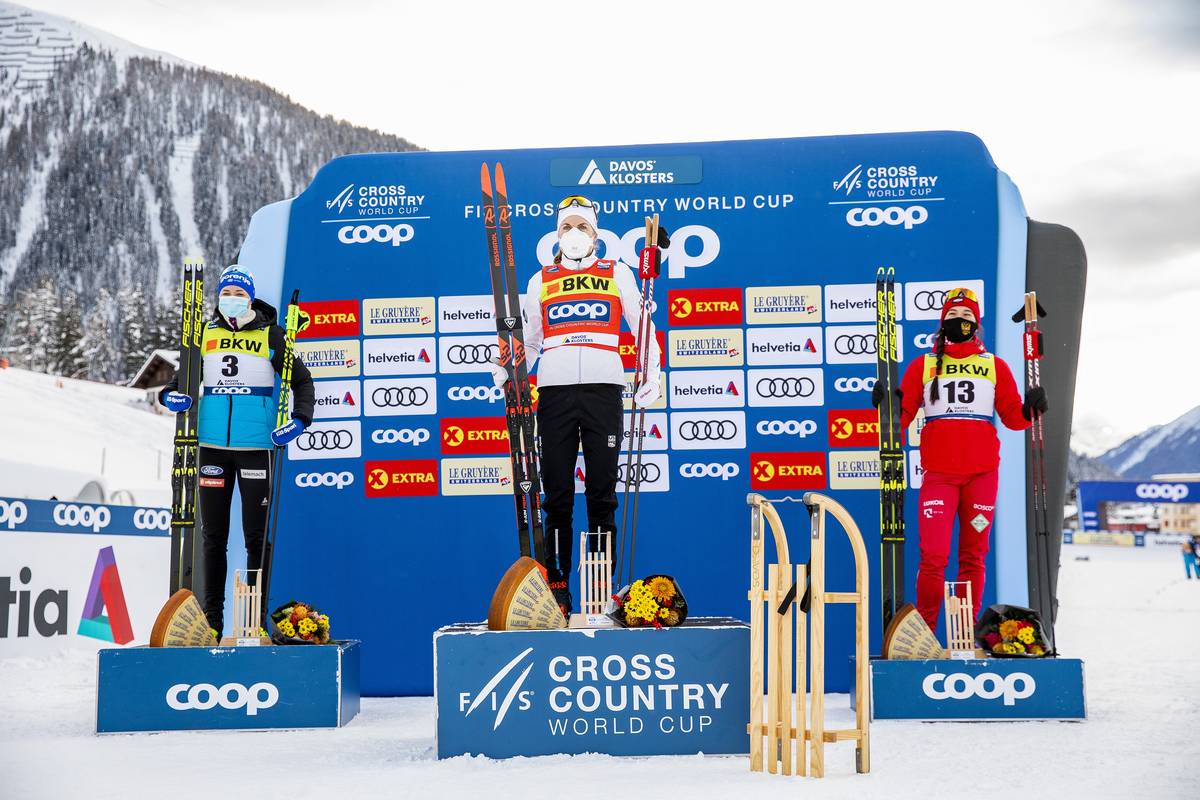
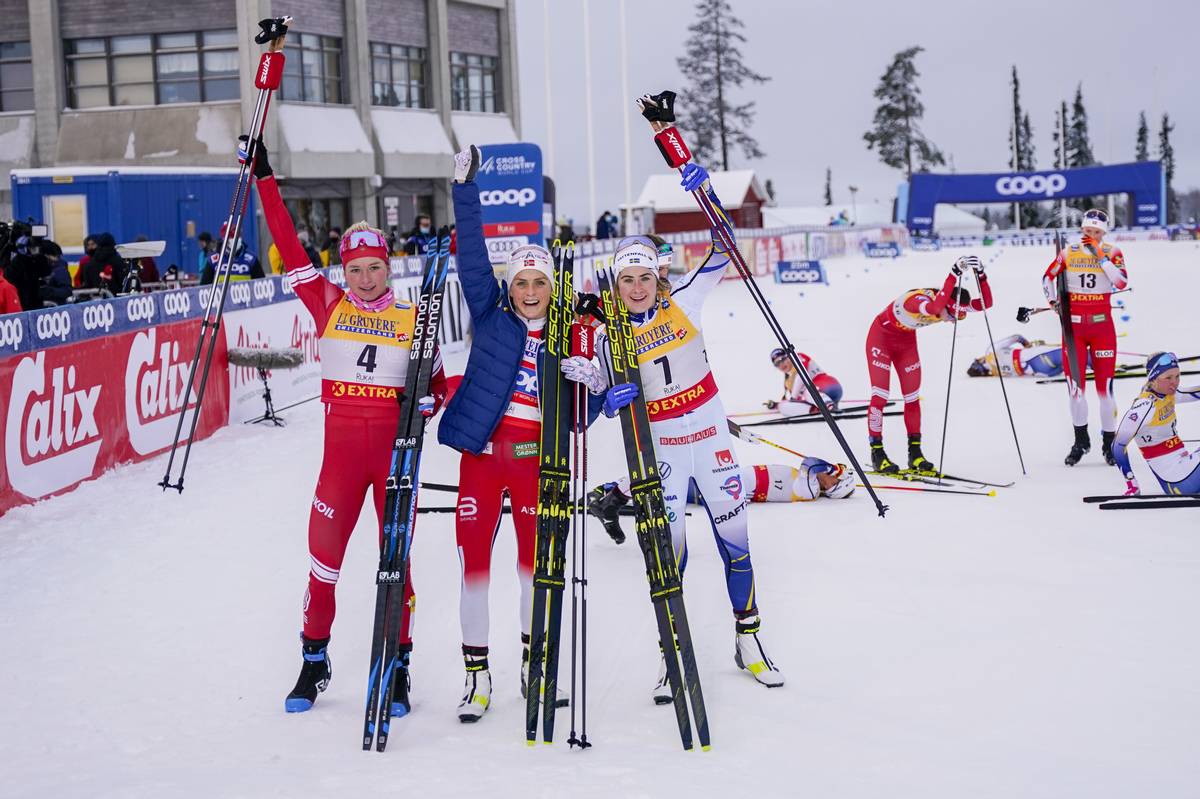
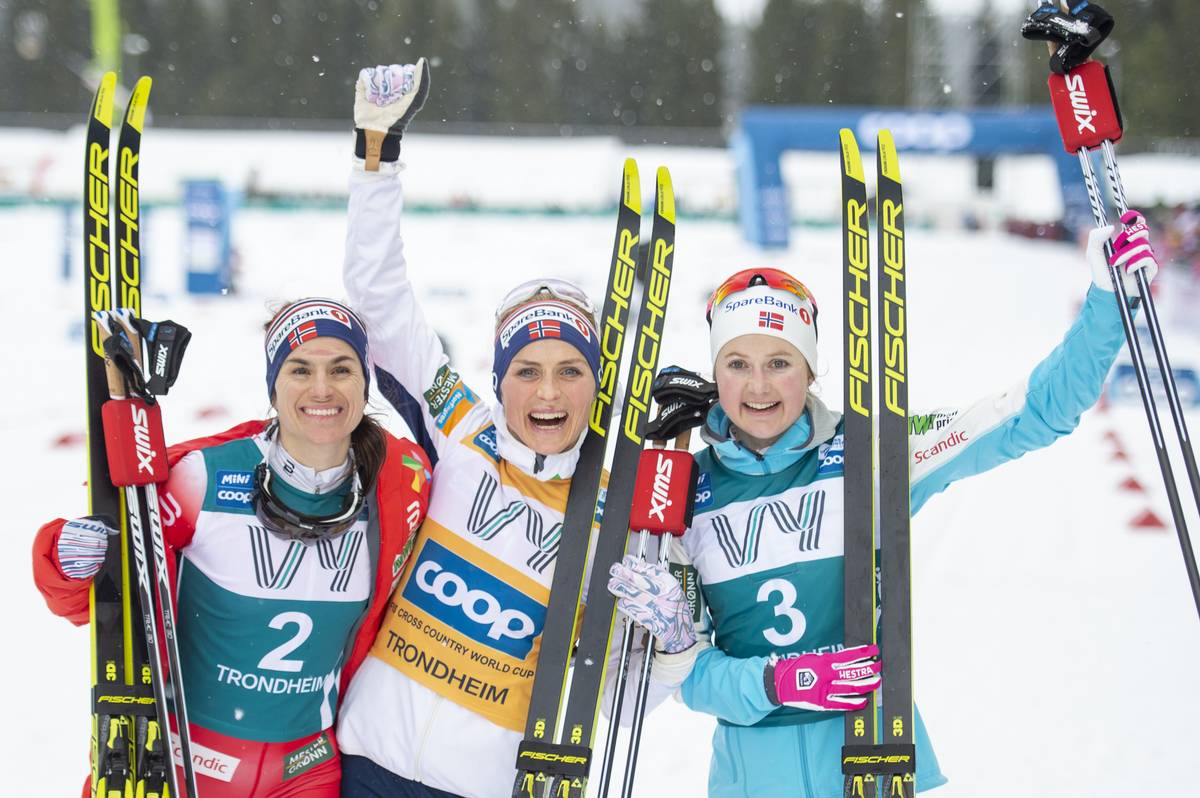
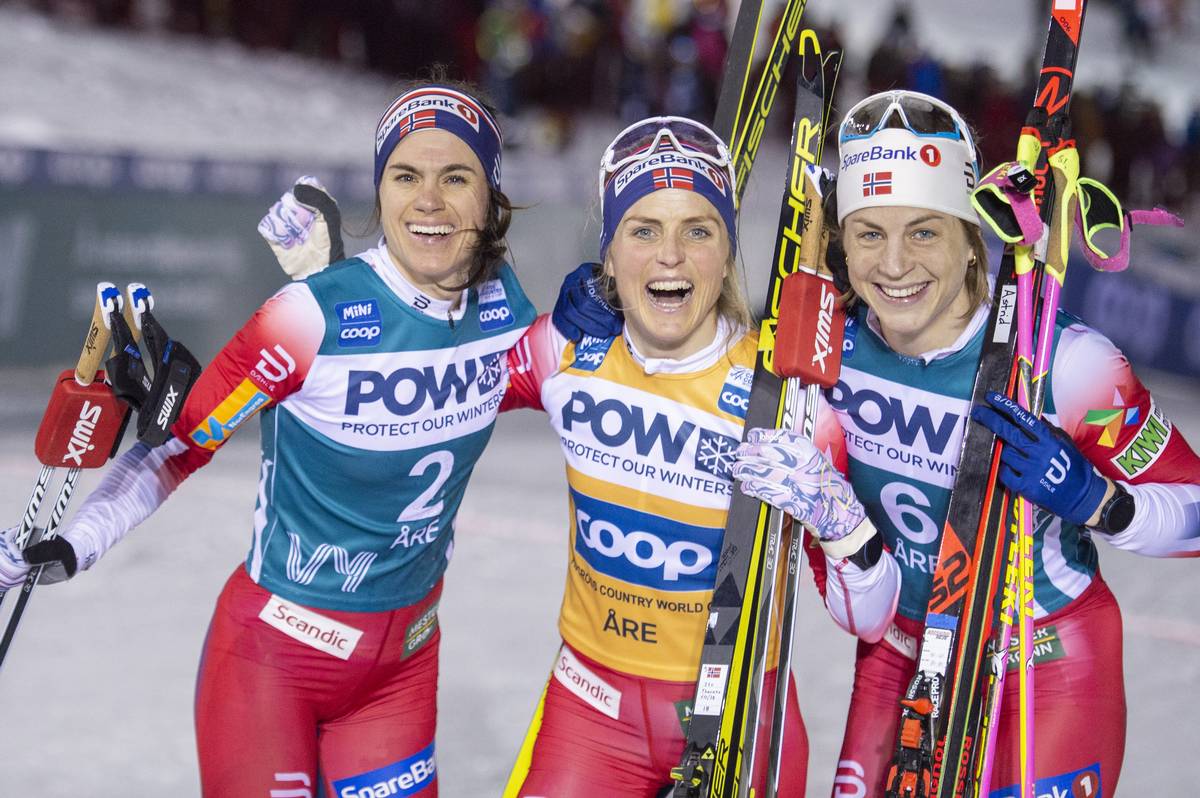
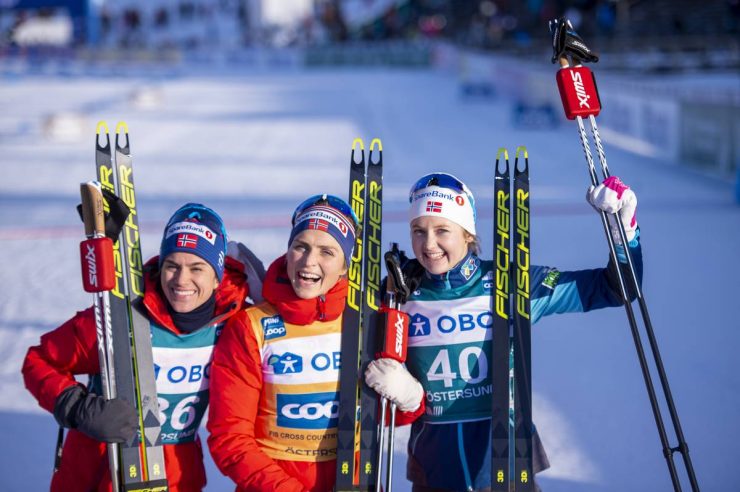
The women’s podium at the 1.5 kilometer skate sprint in Davos, Switzerland. (Left to right) Anamarija Lampic (SLO) 2nd, Rosie Brennan (USA) 1st, Natalia Nepryaeva (RUS) 3rd. (Photo: NordicFocus)
After losing contact with the lead group, Caldwell Hamilton finished fifth (+6.83), with Urevc behind in sixth (+15.58).
FasterSkier spoke with Brennan while she awaited a blood draw at antidoping. Still euphoric, Brennan recounted her day and a result that she called “pretty unbelievable” and hadn’t fully set in. In fact, she thought there may have even been a mistake in the timing when she saw her name at the top of the qualifying list. Brennan also discusses training separately with clubs throughout the season, then coming together as a full American squad in Europe.
Post-race interview with Rosie Brennan.
Exhale. Sophie Caldwell in the mix during the heats of the 1.5 k skate sprint in Davos, Switzerland. (Photo: Nordic Focus)
In a post-race interview, Caldwell Hamilton discussed her own strategy to keep herself out of risk of becoming tangled up with other skiers while staying in contention throughout the heats. She also shared how significant today’s results are for the team as a whole, regardless of the presence of the Scandinavian teams.
Post-race interview with Sophie Caldwell Hamilton.
Hannah Halvorsen, qualifying in 38th, in her first World Cup since suffering devastating injuries when she was hit by an automobile in 2019. (Photo: Nordic Focus)
Returning to the World Cup just over a year after being struck by a car and sustaining severe injuries, Hannah Halvorsen placed 38th in today’s qualifier. Halvorsen provided an optimistic comment on how she feels after her first race.
“It was such a thrill to be able to get back on the race course,” wrote Halvorsen in an email. “I was both nervous and excited going into today’s race because I wanted to put down my best race. Everything went really well today so I am quite happy. Thanks to the coaches and wax techs, I had great skis and support. This feels like a great starting point, and I hope to improve off of this as the season continues. It is such an opportunity and honor to be here. The US team performed incredibly well today, and I couldn’t be more proud to be a part of this team.”
Post-race interview with U.S. Head Coach Matt Whitcomb.
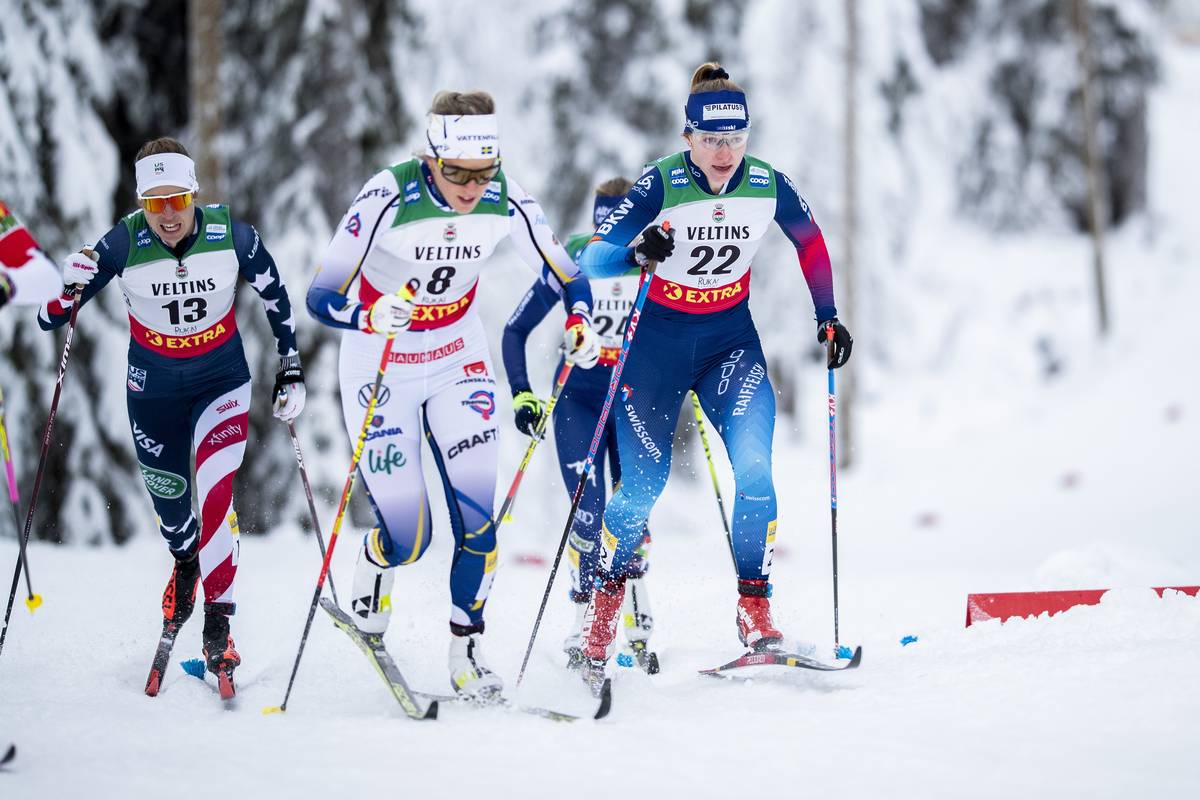
This past weekend, Rosie Brennan, bib 13, placed fifth overall in the Ruka, Finland World Cup mini-tour. (Photo: NordicFocus)
This article originally appeared in the Anchorage Daily News and is republished with permission.
Anchorage resident Rosie Brennan is a World Cup cross-country skier who trains with the Alaska Pacific University nordic team and is a member of the U.S. Ski Team. She’s an athlete representative for US Ski and Snowboard and is currently racing in Europe. She was one of the top racers at last week’s season-opening competitions in Finland.
We asked her about recent decisions by Norway, Sweden and Finland to skip December’s World Cup races due to COVID-19 risks. Those nations cited discomfort with a lack of social distancing and the failure of plans to create a “bubble” for the three-day race series in Finland.
Here is Brennan’s response, including her concern that the FIS — the governing body of ski racing — failed to create a competition schedule that considers the health of athletes.
It’s always a bummer to not have a full field in a World Cup, however, I think everyone needs to do what’s best for them right now so I am understanding of the decision.
I am, however, disappointed that those countries and some of their athletes that have the loudest voices didn’t express these concerns back in May when FIS holds their congress and works out the details for the season.
I do not feel that FIS made a schedule that has the teams’ health at the forefront and I don’t feel that they have taken strong leadership in their protocols. I think that if everyone had raised these concerns over the summer, we could have made a schedule that took more precautions and that made everyone feel better about the situation, but now we are in a situation in which everyone is having to make last-minute decisions about what they are comfortable with.
The situation is frustrating because the big nations like Norway have much less to lose from sitting out an event. Their athletes can still race televised races in Norway and fulfill sponsor obligations, get paid, etc. The smaller nations are dependent on the World Cup to make money so the pressure is so much higher. For the future of the sport, I think it’s important that all the nations work together to understand everyone’s differing situations and come up with schedules, plans, and rules that work for everyone.
It’s been difficult to navigate because FIS does not have overarching rules regarding COVID. It’s largely dependent on each local organizing committee, so the rules are changing every week. Luckily, US Ski and Snowboard has put an immense amount of effort into educating us and developing protocols for our team so we are following those while we try to navigate the changing rules in every location.
It’s clear that every team has different protocols, some being more strict than others, so there was definitely a range of behaviors in Ruka. It was an easy venue to stay safe, however, because we were staying in apartments next to the trail. We didn’t need to take any transport and meals were delivered so we didn’t need to go into any public places. This made me feel quite safe as I had more control over who I was around.
This is obviously not the case everywhere so it will be a dynamic situation as we move along. There were definitely some things I think they could have done better, like creating more space in the start/finish area to allow more distance and more one-way flow of people in and out of that area, but that was our first event so I hope FIS will take those recommendations forward to the future venues and we can continue to improve.
I made the decision to come (to Europe) for a number of reasons. It’s the only way I make money so I felt financial pressure, I love racing and it’s what makes me feel fulfilled. I was craving the challenge of the World Cup circuit, and my boyfriend received World Cup starts that he has worked really hard for so we felt that going together would be our best option.
Those reason’s tipped the scale to coming at the last minute, but I have no idea if it was the right decision or not, or if we should be having World Cups or not. I don’t believe anyone knows the answer as we are all experiencing this pandemic for the first time and still don’t have a full grasp of what is safe and what isn’t.
At this point, I made the big journey to get over here so I am going to stay and continue to race as long as it feels safe enough. There is obviously no such thing as zero risk so it’s all a balancing act and weighing the risks versus rewards daily.
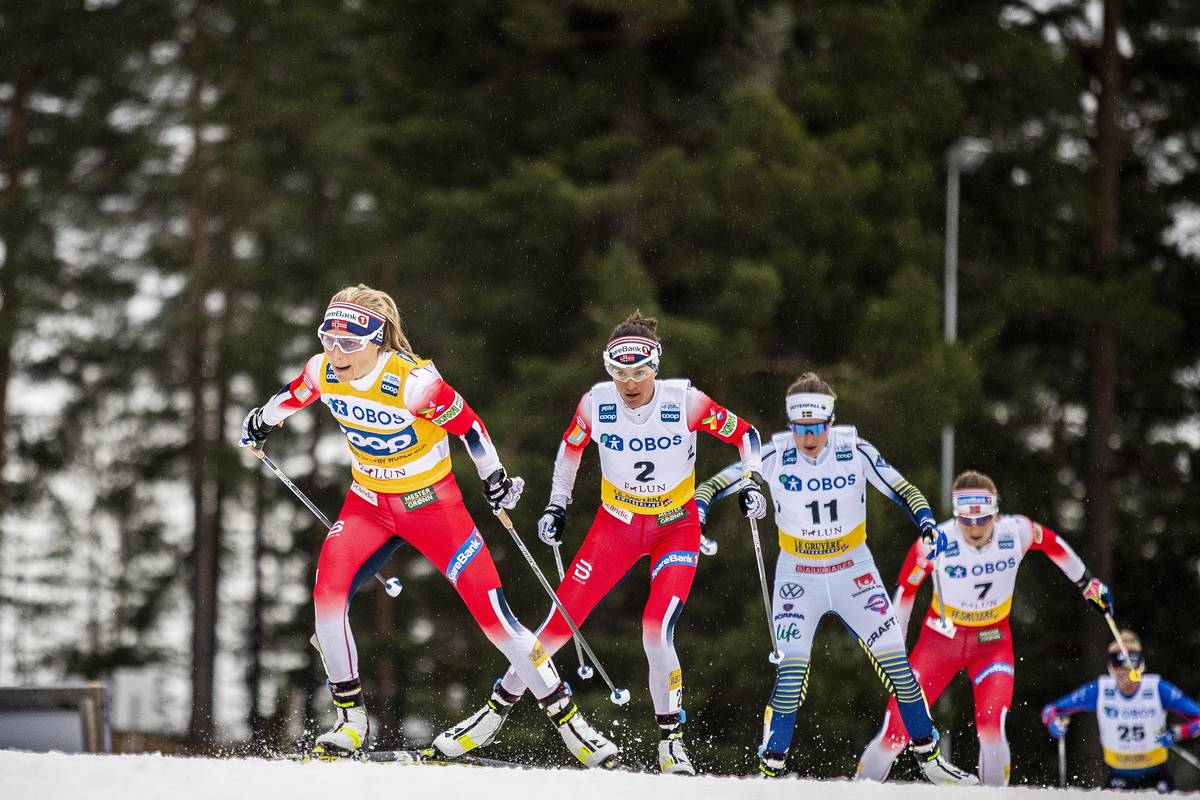
Norway’s Therese Johaug off the front during Sunday’s 10k skate pursuit in Ruka. (Photo: NordicFocus)
This World Cup coverage is made possible through the generous support of Marty and Kathy Hall and their A Hall Mark of Excellence Award. To learn more about A Hall Mark of Excellence Award or to learn how you can support FasterSkier’s coverage please contact info@fasterskier.com.
For those new to the pursuit format, racers begin a set “time back” from the first starter, who in this case is the overall leader after two races. A skier’s time back is an aggregate of their times from Friday’s sprint race and Saturday’s 10 k classic.
So there’s the primer for those coming to the cross-country World Cup for the first time.
***
Some narratives fail to develop despite our fruitful imaginations. Therese Johaug of Norway scurried from the start on Sunday’s 10-kilometer freestyle pursuit with a 16-second cushion over Sweden’s Frida Karlsson and Russian Natalia Nepryaeva. The time margins roughly held for 2.5 k, as the 64 other starters behind Johaug coalesced into efficient working groups or found themselves solo skiing.
Add 2.5 k more to the elapsed distance, and Johaug had virtually sealed up the win at 5 k. By then she doubled the time gap to roughly 32 seconds to a group of chasers including mostly Swedes. They included Ebba Andersson, Tatiana Sorina of Russia, Karlsson, Maja Dahlqvist, Linn Svahn, and Nepryaeva. Noticeable and noted, was a dearth of Norwegian skiers.
Norway’s Therese Johaug on her way to winning Sunday’s 10 k skate pursuit in Ruka, Finland. (Photo: NordicFocus)
Doing as she does, Johaug simply padded the time cushion as she cruised to a 47-second win to take the Ruka Triple weekend. Last season’s overall World Cup winner, Johaug, added to Norway’s tally of overall wins in the Ruka mini-tour. Of the past 10 additions, Norway has won nine, Sweden one. Although with the small sample size of a single weekend of World Cup racing, Sweden appears primed to alter that metric in the future.
Rounding out the podium was Sorina in second (+47.0), and Andersson in third (+48.6). Karlsson placed fourth (+50.8), while Rosie Brennan of the U.S. Ski team knocked a homerun of a race to end her Ruka campaign in fifth (+52.5). For Sorina, this weekend was a return to the World Cup after taking last season off to start a family. It was a career-best result for the Russian. According to FIS, her best World Cup result before the Ruka series was 15th place in a 2017 classic sprint. Sorina’s best result for a distance event on the World Cup was 38th in Ruka’s 2018 10 k classic.
The women’s 10 k skate pursuit podium: Tatiana Sorina (RUS) second, Therese Johaug (NOR) first, and Ebba Andersson (SWE) third, (l-r). (Photo: NordicFocus)
Let’s drill down on Brennan’s day. Her fifth place on Sunday marks a career World Cup best. According to the FIS database, Brennan first emerged in the top-10 back in Davos, Switzerland’s 10 k skate in 2018 with sixth place. She matched that placing again in Ruka last season in the 10 k classic.
On Sunday, Brennan started in bib 11, 42 seconds behind Johaug, but within a comfortable distance of several skiers she could work up to and pass as she leapfrogged into position to make a strike at her first World Cup podium. In the firm conditions, Brennan made gains. Passing through the halfway mark at 5 k, she was solo-skiing aiming to lock onto a group of six skiers seven seconds ahead.
Rosie Brennan on a career-best day in Ruka. (Photo: NordicFocus)
The group ahead, which included all those listed above, absent Joahug, wasn’t exactly highly organized in their chasing. Yet Brennan lost vital time in the ensuing kilometer and was 9 seconds back at 6.1 k. With Brennan’s drive and an efficient paceline not coalescing, Brennan was able to gap up to the chasers by 7.5 k.
Brennan podium hunting amongst a school of Swedes. (Photo: NordicFocus)
With 2.5 k remaining, the chess match ensued. On a screaming downhill, amidst the tight pack racing as the race closed out, several skiers took a tumble, including Dahlqvist, Svahn, and Nepryaeva. According to Brennan, she was able to slalom around those fallen skiers and keep upright without scrubbing too much speed.
“There was a gap to Ebba, Frida, and [Tatiana] at that point, and I knew those other girls behind me were closing hot … I was going for all I could to try and not get caught,” said Brennan.
Brennan fell back slightly in the closing moments as Sorina, Andersson, and Karlsson gained precious meters. In her battle for positioning, Brennan held off Helen Marie Fossesholm of Norway, as she crossed the line in fifth. Brennan raced the third-fastest time of the day, only 10.5 seconds off of Johaug’s first-place time of 25:06.2.
Post-race interview with Rosie Brennan
Making the effort count: Rosie Brennan placed 5th overall in Ruka, Finland’s 10 k skate pursuit. (Photo: NordicFocus)
Brennan’s U.S. teammate, Jessie Diggins, began in bib 21, 1:20 minutes back. With a slew of skiers ahead to potentially pick-off, Diggins charged. By the finish, she had gained several spots to earn 15th place overall and post the fifth-fastest time of the day (+24.2).
Over the past few years, Diggins has been the U.S. skier to mark. As noted in several earlier stories, the Ruka weekend has been kind to Diggins, but not podium-friendly. However, it usually serves up a dose of race-effort stimulus to prime her motor for other objectives.
Since 2015, on the occasion when Ruka has presented a three-race series, she’s placed 37th, 12th, 5th, and this weekend’s 15th. On the off years, when it’s a two-race series in Ruka, her 2020 performances are reflective of her historic build-into-the-season template.
Post-race interview with Jessie Diggins
Jessie Diggins of the U.S. racing during Sunday’s 10 k skate pursuit. (Photo: NordicFocus)
Hailey Swirbul of the U.S. finished in 32nd (+3:20.1) with the 28th fastest time of day. Caitlin Patterson placed 46th (+4:06.1) with the 27th fastest time, Julia Kern was 50th (+4:53.2), Katharine Ogden 53rd (+5:36.5), and Sophie Caldwell Hamilton 57th (+5:52.7).
Hailey Swirbul raced to 32nd in Sunday’s 10 k skate pursuit in Ruka. (Photo: NordicFocus)
World Cup racing takes a break until Dec. 12 in Davos, Switzerland. Next weekend’s racing in Lillehammer, Norway was previously postponed due to the pandemic.
High octane effort from Therese Johaug (NOR) during the 2020 Ruka 10 k classic. (Photo: NordicFocus)
This World Cup coverage is made possible through the generous support of Marty and Kathy Hall and their A Hall Mark of Excellence Award. To learn more about A Hall Mark of Excellence Award or to learn how you can support FasterSkier’s coverage please contact info@fasterskier.com.
Just a few more rotations of the earth and we’ll be in December – trending towards solid wintertime. The World Cup, as it has for 19 years, swung up to Ruka, Finland just a Reindeer’s nose from the Arctic Circle. The day dawned lazily in Ruka on Saturday at 9:40 AM to reveal clear skies, snowy trees, and noisy snow underfoot. As much as this is the status quo on the race calendar, the second day of racing for the women on Saturday, a 10-kilometer interval start classic, was status quo for Norway’s Therese Johaug.
All clear ahead this morning in Ruka, Finland. (Photo: NordicFocus)
Johaug won in 25:01.4 minutes with a rather comfortable time gap of 21.8 seconds over second-place Frida Karlsson (21) of Sweden. In summarizing Johaug coming into the season, let’s simply say she remains peerless when the kilometers skew anywhere beyond sprint distance. In Friday’s 1.4 k classic sprint, she placed 30th, making the heats, which, for this decidedly non-sprinter, is something to note.
Johaug picked up on Saturday with her metronomic striding and began picking skiers off as the day’s 30th starter. Let’s call this her warm-up – Johaug was fourth at 1.2 k, 5.5 seconds behind the hot-starting Karlsson. She inched closer to 1.8 seconds at 3.1k, again jusy off the fastest time split of Karlsson. Then, mid-race at 5 k, the places flip-flopped for good, and Johaug took control. Roughly a kilometer later, Johaug was up 5.9 seconds on Karlsson.
Goodbye. Another win and another well-padded win, concerning time, for the thirty-two-year-old Johaug.
“It was really hard, I forget how hard it really is,” Joahug told FIS after the race. She said this masked-up in the mixed zone. But let’s safely assume under that mask was a no-nonsense smile from the no-nonsense winner.
Therese Johaug of Norway locking in for Ruka 10 k classic win. (Photo: NordicFocus)
Ebba Andersson, also of Sweden, placed third overall on Saturday, 26 seconds back.
Ruka 10 k classic podium: Frida Karlsson (SWE) in second, Therese Johaug (NOR) first, and Ebba Andersson (SWE) third (l-r). (Photo: Nordic Focus)
Frida Karlsson racing to second overall in the 2020 Ruka 10 k classic. (Photo: NordicFocus)
For the U.S., Rosie Brennan has come to Ruka in form. A career-best 17th in the sprint yesterday was followed up with an eighth-place on Saturday. Brennan has two World Cup sixth places to her name, one of which came last year in Ruka’s 10 k classic. So when the shape is good, Ruka’s classic course can be kind to Brennan.
“We had about as nice of a day as you can ask for in Ruka at the end of November,” Brennan emailed to several outlets. “The course is on the wrong side of the mountain to get the sunlight, but the sky was clear and I could tell there was sun somewhere! I tried to start comfortably and work my way into the race today. This strategy worked quite well and I was able to pick things up a bit the second time around. I felt like I was skiing strong, but still feel like I have one more gear to find racing. I am happy with the result, but it certainly makes you eager when I only needed 2 seconds to move up two places! The times were tight so tomorrow should be a good battle for the overall. I’m looking forward to putting my skating to the test!”
Crushing. Rosie Brennan on her way to eighth overall in the 2020 Ruka 10 k classic. (Photo:NordicFocus)
Matt Whitcomb, U.S. Ski Team Head Coach reflected Brennen’s positive energy. “It was fun to have our first top-10 of the season, there were high fives and Rosie had a big smile, or at least it appeared that way under her mask,” said Whitcomb after the race. “I think she is positioned well to have a huge day tomorrow.”
Post-race interview with Matt Whitcomb
As a three-race series, which includes results and bonus times from Friday’s sprint, Brennan sits 11th overall, 42 seconds behind first-place Joahug. It’s 12 seconds to seventh overall Andersson and another four to Friday’s sprint winner Linn Svahn.
Why bring up Svahn? The Swede placed 11th on Saturday, a career-best World Cup distance race result outside a “winner of the day” eighth place last season in Trondheim’s 15 k classic pursuit. Maybe it’s too early to state outright, she is only 20, but with her sprint prowess, she may become another overall World Cup threat from Sweden. (We’ll wait and let Devon Kershaw rave about the riches of Sweden’s women’s program on Sunday though.)
Jessie Diggins racing to 22nd in Ruka’s 10 k classic. (Photo: NordicFocus)
Back to the U.S. Jessie Diggins finished in 22nd overall, 1:23.5 back, Hailey Swirbul was 40th (+2:05.0) on Saturday after posting her best World Cup sprint result yesterday when she finished 18th overall.
Post-race interview with Hailey Swirbul
Hailey Swirbul racing to 40th on the day after posting a career-best sprint result on Friday. (Photo: NordicFocus)
Also for the U.S., Cailtin Patterson 50th (+2:28.1), Katharine Ogden 56th (+2:56.1), Sophie Caldwell Hamilton 58th (+3:09.6), and Julia Kern 62nd (+3:19.0).
Heidi Weng, one of Norway’s foremost distance skiers, did not start.
Racing concludes in Ruka tomorrow with the 10 k freestyle pursuit.
This World Cup coverage is made possible through the generous support of Marty and Kathy Hall and their A Hall Mark of Excellence Award. To learn more about A Hall Mark of Excellence Award or to learn how you can support FasterSkier’s coverage please contact info@fasterskier.com.
All Sweden: Maja Dahlqvist, Linn Svahn, and Jonna Sundling (l-r) cross the line.
It’s a win to open the World Cup season in Ruka, Finland for twenty-year-old Linn Svahn of Sweden. Svahn’s victory in the 1.4-kilometer classic sprint on Friday capped a clean streak of first place spots streaming from the quarterfinals through the semis and onto the podium’s top step. Last season, Svahn burst onto the World Cup scene and won the overall sprint World Cup becoming the youngest-ever winner of an individual crystal globe. She matched those high expectations today.
Svahn, however, was not the lone Swede in the finals as she raced amongst three other teammates including Maja Dahlqvist, Jonna Sundling, and Emma Ribom.
Dahlqvist and Sundling finished in second and third, respectively, to make it an all Swedish podium. Norway’s Lotta Udnes Weng placed fourth, and Ane Appelkvist Stenseth, also from Norway, fifth. Ribom placed sixth.
Ane Appelkvist Stenseth (NOR), Natalia Nepryaeva (RUS), Jessie Diggins (USA), and Linn Svahn (SWE), during the first quarterfinal of the 2020 Ruka classic sprint. (Photo: NordicFocus)
Stenseth was the day’s top qualifier, completing the 1.4 k course in 2:55.94, a full 4.10 seconds ahead of the second-place qualifier Dahlqvist. The Americans placed three skiers in the heats, Rosie Brennan, Hailey Swirbul, and Jessie Diggins.
Brennan notched a career-best sprint qualifier, placing 13th. The Anchorage-based skier was eliminated in the quarterfinals to place 17th overall.
“It felt pretty surreal to be racing today,” Brennan emailed. “I honestly didn’t know when I would again after the season was called short last year. It was very exciting to find myself on a start line again! Before and after the race things look a little different and there are a few more things I have to be on top of, but the racing itself is still the same. It was great to be out there pushing myself again. Knowing that I want to be ready to take advantage of every opportunity I get to race this year, I tried hard to be ready to go when the time came. I am very happy with my feelings in the sprint today. I had fantastic skis and felt strong. I am disappointed that I wasn’t able to maneuver around people better in my heat, but have to be satisfied with the feelings and hope I can continue to work on sprint tactics. I am really looking forward to some distance races now!”
Eva Urevc (SLO), Anna Dyvik (SWE), Rosie Brennan (USA), Nadine Faehndrich (SUI), Lucia Scardoni (ITA), (l-r) during the third quarterfinal of the 2020 Ruka classic sprint. (Photo: NordicFocus)
Swirbul, in her first season as a U.S. Ski A-Team member, placed fourth in the second heat to end her day ranked 18th overall. Also based in Anchorage, Swirbul qualified in 16th and finished 18th overall for a career-best sprint result. Before Friday’s sprint, Swirbul’s top World Cup result was a 21st in last year’s 10 k skate in Davos, Switzerland.
Hailey Swirbul (USA) gets her 2020-21 World Cup season started with an 18th place in Ruka, Finland. Photo: NordicFocus
Diggins was eliminated in the first heat after placing fifth, 4.57 seconds behind Svahn. She finished 24th overall. The 2018 Olympic gold medalist has often placed in the mid-20s in Ruka’s classic sprint. She has noted to FasterSkier in the past that the first weekend of World Cup racing allows her to find her racing legs before the season begins in earnest with the Tour de Ski.
Jessie Diggins (USA), Therese Johaug (NOR), (l-r) during the first quarterfinal of the classic sprint in Ruka. (Photo: NordicFocus)
Also for the U.S., Sophie Caldwell Hamilton was 33rd, Julia Kern 40th, Katharine Ogden 66th, and Caitlin Patterson 71st.
Racing continues tomorrow in Ruka with a 10 k classic for the women.
Post-race interview with U.S. Ski Team Head Coach Matt Whitcomb.
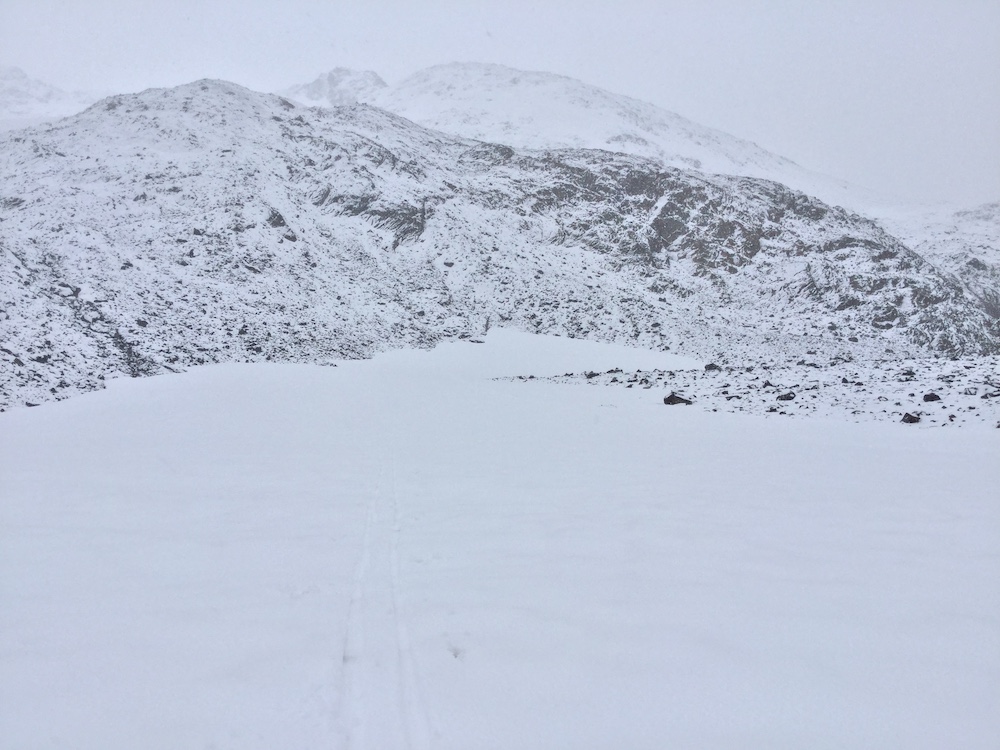
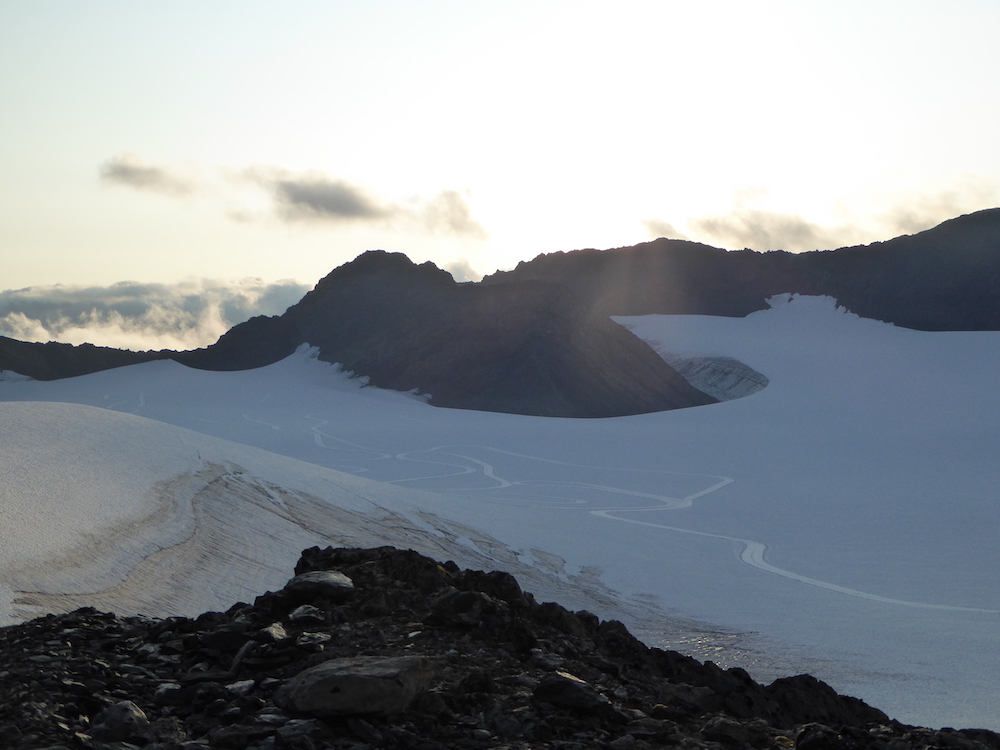
DIY Dachstein: September tracks on a snowfield in the Chugach mountains, Sept. 27, 2020. (photo: Gavin Kentch)
The koan that skiers are made in the summer has been around for longer than this website. The related truism, that summer snow time is necessary to effectively compete as a high-level skier come winter, also has a venerable history.
For example, here’s Luke Bodensteiner, writing in Endless Winter about why he had journeyed to a place where “the weather sucks all year long” to ski on the Sognefjellet snowfields in August 1993: “We all come to this spot simply to be able to ski a race faster than everyone else.” Or Billy Demong, discussing summer training on Eagle Glacier nearly 20 years ago: “In the late 90s and early 2000s, we were all working super hard, but we hadn’t quite broken through. I was on Eagle Glacier in 2002 because as a team we were committed to be the best.” Or Andy Newell, who first skied on Eagle the same year: “As the overall level on the World Cup continues to rise, summer training camps have become even more important. To be competitive at the very top level, you simply must get on snow at least once a summer.”
Bottom line, as Reese Hanneman wrote in an essay for a Boulder Nordic Sport catalog a few years ago, “All the best skiers in the world are on snow in the summer. Do you really want to try to be the best skier who wasn’t on snow?”
All well and good, but what happens when a global pandemic interrupts access to estival snow, for many athletes for the first time in a decade? More rollerskiing, of course, is the predictable and relatively simple answer. But bigger picture, it’s also a chance to introduce a new stimulus to long-established training patterns, and to replace travel and camps with increased consistency training out of a home base. Judging from conversations with three veteran athletes and two longtime coaches, high-level American skiers seem to be cautiously optimistic about how well this summer’s training will prepare them for the 2020/2021 World Cup season that starts in Ruka late next month.
(Disclaimer: It should go without saying that the global health toll of the coronavirus pandemic, and resultant inequality, are bigger problems than the inability of professional athletes to train on snow in the summer in the manner to which they are accustomed. Because this is a ski news website, the rest of this article focuses on the latter, but that is not intended to deny the existence and importance of the former.)
Background: In a normal year…
Here’s another saying you may have heard recently: These are uncertain times. In a normal summer, the Alaskan skiers would be on snow through at least mid-May, then all national-team skiers would meet in Bend for a two-week on-snow camp in the second half of May. Skiers with Alaska Pacific University Nordic Training Center, or APU, would then spend one week a month in each of June, July, and August skiing on Eagle Glacier, a short helicopter flight above Girdwood, Alaska.
Some national-team skiers – typically heavy on Stratton Mountain School and Craftsbury athletes, less so APU – would then spend two to three weeks in New Zealand in late August and early September, nearly all of it on snow at the Snow Farm. Groomed skiing returns to Independence Mine, about 75 minutes outside of Anchorage, in mid-October (probably), and to Frozen Thunder, in Canmore, about a week later (quite reliably). Arriving in Europe a few weeks ahead of the season’s first World Cup races typically affords athletes more on-snow time before first putting on a bib.
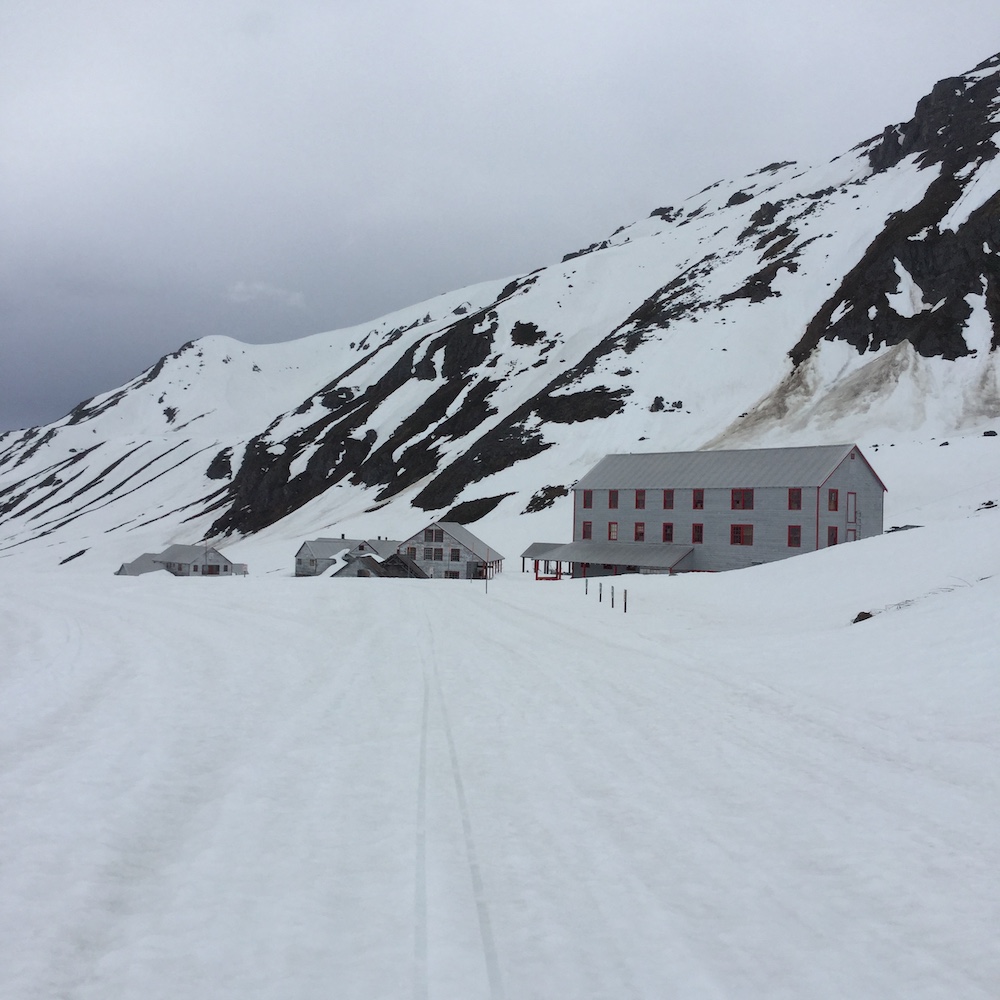
Summer skiing at Independence Mine, above Palmer, Alaska, May 30, 2020. (photo: Gavin Kentch)
This year, Independence Mine was skiable through the end of May, but everything else has been off the table. No Bend Camp; no Eagle Glacier; certainly no international travel to New Zealand, let alone to Canada for Frozen Thunder or Forêt Montmorency. It’s hard to survey the entire country, but this reporter’s cumulative four-plus hours of skiing since June 1, on snowfields in southcentral Alaska, may be among the highest on-snow summer nordic training loads in the nation, depending on how much time APU athlete Ari Endestad put in during a late-June (!) crust skiing trip in the Alaska Range. Until snow starts to accumulate at Independence Mine – the Mat-Su Ski Club’s historical first date of grooming there has recently been a tantalizingly close October 15 – American skiers’ collective summer snow drought looks likely to continue.
What all this means
So is this a problem when it comes to on-snow performance in the upcoming race season? Not really, according to multiple athletes and coaches.
“You can accomplish 95 percent of your technique goals, perhaps,” on rollerskis, U.S. Cross Country Team Program Director Chris Grover said in a late-May interview with Cross Country Skier magazine (22:54 mark of podcast), speaking at a time when summer training options were still unknown. “And so we’re in a good place; even if we never touch snow this summer, we’ll be ready to race when we get to next winter.”
“We’ve had many instances over the years with athletes who have missed on-snow opportunities in the preparation period, and gone on to have breakthrough winters,” echoed USST Head Coach Matt Whitcomb in a recent email to FasterSkier. “The dryland training is the cake, and the snow is the frosting. Americans will be frosting our cakes this fall when the snow flies, and this should lead to top performances during key mid-season international championships. I’m not one who attaches irreplaceable value to prep period on-snow training.”
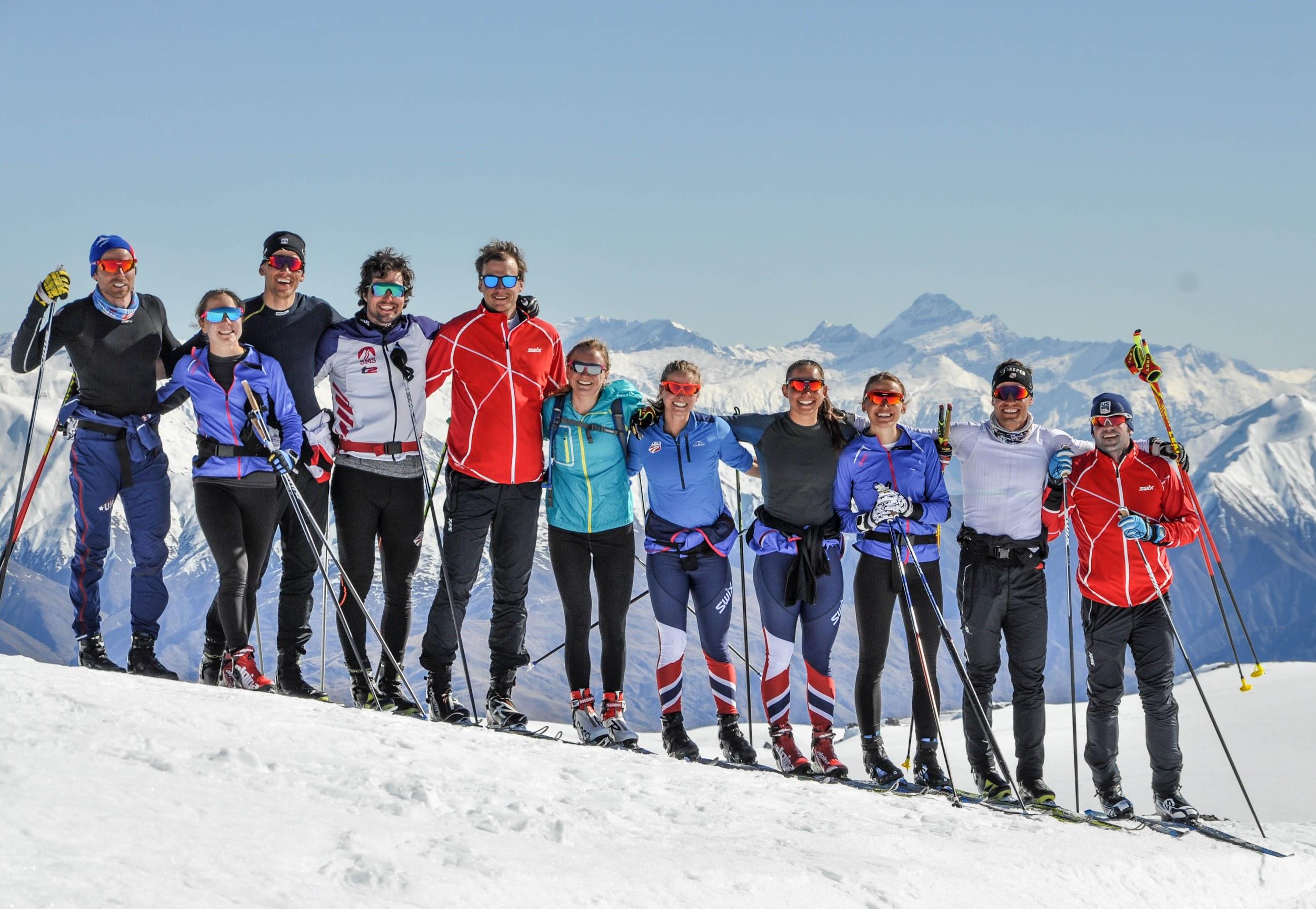
2018 U.S. Ski Team camp at the Snow Farm in New Zealand. (Photo: Matt Whitcomb)
“The assessment period, that’s still ahead of us; that’s the race season,” echoed longtime APU Head Coach Erik Flora in a recent phone interview. “But … at least the athletes I work with, they’re in a good position right now heading into the winter.”
“Of course, we will have to see when the races hit,” APU and USST athlete Rosie Brennan wrote to FasterSkier, “but I feel very optimistic that the summer has had a positive impact on my training.”
“I’m hoping that some other training strategies – workouts that I normally won’t do because of the glacier, and a different strength routine – will have actually given me an advantage,” emailed APU skier Becca Rorabaugh to FasterSkier. “This is a good year to try new things and shake it up!”
(Against all this enthusiasm, Whitcomb did provide a more nuanced look at some potential disadvantages, while acknowledging a former athlete’s gentle chiding about his perennial optimism: “Since Holly Brooks once asked me to not always be so positive,” Whitcomb added, “I will start by saying that Norway will have an advantage in the early season. Many of them have found some snow. But Norwegians are often competing for start spots and racing very fast in period one, which allows us a window to catch up when their performance flattens. It all balances out. Beyond that, this is a global pandemic, and every team has been affected. Americans don’t have to do things better than we ever have, but just as good as we can. That will be good enough for this season. I’m confident in our preparation, and believe we’ll deliver great results to our fans.”)
What’s happened instead
“There is naturally more roller skiing” this summer than in prior years, Whitcomb noted, “since during an on-snow camp we will do little to no roller skiing. The sessions on roller skis versus on snow are similar.”
This is sensible enough. But everyone contacted for this article also discussed the broader implications of this year’s changes, be it for the overall training stimulus, travel schedule, training schedule, or all of the above.
Pepa Miloucheva skates behind CGRP biathlete Casey Smith while at a training camp at La Forêt Montmorency in Quebec in early November 2015. (Photo: Caitlin Patterson)
Here’s Rorabaugh, for example, who as a longtime APU athlete has logged three glacier camps each year from 2007 through 2019, making for an impressive 39 cumulative weeks of summer glacier time. (Flora says that athletes typically log 20–30 hours of ski time in a week at Eagle Glacier. Taking the midpoint of this range, 25 hours, yields a healthy 975 total hours of summer snow time over the past 13 years.)
“2020 has been structured similarly to a normal summer of training,” Rorabaugh wrote. “The only difference is that where we would usually have a high volume week on-snow, we have done one in town. My overall training volume may have decreased slightly, since it’s hard to get quite as carried away with dryland training, but it’s also been more consistent week-to-week. We might be doing slightly more running than in the past, but the balance between rollerskiing and running is very similar. My joints and feet are actually the healthiest they’ve been in years though, probably because I’m not able to pound them into the ground with the expectation of a low-impact glacier camp for reprieve. Staying in town is forcing me to be a more responsible athlete, and I think my body appreciates it. Actually the biggest challenge for me this summer has been adapting to at-home strength training. Not having access to a weight room has definitely tested my creativity and self-motivation.”
Or here’s Scott Patterson, like Brennan also an APU and national team athlete, in an email to FasterSkier: “The big changes to my training have mostly been the consistency of time in Alaska and a few alterations for indoor training. We haven’t had any USST camps or APU glacier camps so there have been a lot of weeks just plugging away in Anchorage. It was nice that the snow held on fairly late so it’s only recently that the desire to get sliding on snow has really caught up to me. Not having camps definitely changes things and has its downsides, but I am also really appreciating having fewer obligations and travel days through the summer.”
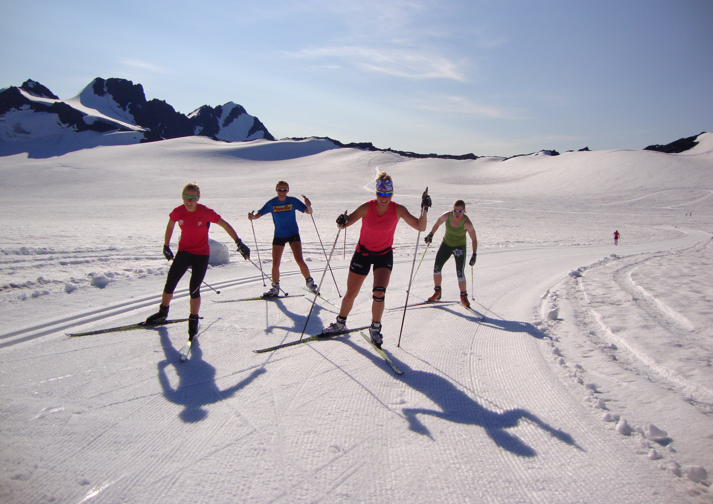
Ida Sargent, Sophie Caldwell, Sadie Bjornsen, and Rosie Brennan enjoying freshly groomed snow on Eagle Glacier in summer 2011. Photo courtesy of Sophie Caldwell.
And here’s Brennan, another veteran athlete with a long history of summer snow time: “It’s definitely been a bit of an experiment this year, but I have really chosen to look at the potential benefits. For one, as an older athlete it gets harder to introduce new stresses that create the adaptation needed to keep improving. This summer has certainly provided me a different set of stressors that I have had to adapt to. Travel also takes away training days and always comes with some sort of a need to adjust to the new training environment, so without travel, my training has been just so consistent.”
What about technique work?
As Grover said, “You can accomplish 95 percent of your technique goals” on rollerskis.
Others were a little less sanguine. As Patterson noted, “Those weeks of glacier time in the middle of the summer are a great opportunity to preserve the on snow feel even when in town rollerskiing. It’s easy to forget that skis don’t kick like ratchets, pole plants are much softer than pavement, and asphalt never turns to deep slush. I usually try to use the glacier weeks as high volume periods with fairly intense focus on the technical aspects of actually skiing. In town, it has definitely taken some adapting to not have the focus week or the on snow technique.”
And Rorabaugh, a Fairbanks native, sounded similar themes. (Relevant: Even in an era of climate change, Fairbanks, Alaska, reliably provides hard-wax skiing for at least four and probably five months a year, from early November through late March. Fairbanks skiers once started a spring marathon on the Chena River, in downtown Fairbanks, at temperatures of –12° F. On March 25.)
Audrey Kentch, 5, skiing in wet-snow conditions in Alaska, June 2020. (photo: Gavin Kentch)
As Rorabaugh wrote, “Summer on-snow training is a good time to work on technique and try new things, and to adapt to dramatically new ways of skiing. It’s also a vital opportunity to practice skiing in slushy conditions – something that an Alaskan skier might be unprepared for. At my first JNs in Lake Placid I remember being utterly shocked that people skied on sloppy trails, and having no idea how to do it! Thankfully I’ve had a lot of practice on Eagle Glacier since then.”
Looking ahead to the start of the season, Rorabaugh noted, “I don’t think I’ll change my approach when I get on-snow this fall because it’s a different time of year. Early season snow is a good time to transfer dryland fitness to skiing, but it’s not as much of a technical laboratory. It’s more about technical honing than totally revamping.”
No matter what the summer looks like, the first few times back on snow are necessarily different than rollerskis, and can potentially require some degree of transition. As Whitcomb observed, “It takes a few days for everyone; the skate skis feel long and awkward, and the greater hip area muscles get sore from slipping on classic skis. Our first few on-snow workouts in Finland each season call for short, easy training, and after that we’re good to go. I also think it is harder for juniors than for seniors, but neither case is a big deal.”
A more nuanced aspect of this issue involves the optimal application of summer snow time for working on ski technique. Flora is a firm believer in his seriatim method, which involves one week on snow at roughly one-month intervals from June through August.
The June camp is “usually the introduction of new ideas,” Flora told FasterSkier. “And the nice part about being on snow is that it’s real-time, real snow. So it applies 100 percent; you’re not adjusting for a rollerski kick, or, you know, road-style terrain; you’re on snow, and it’s World Cup-style terrain. And so, usually, June, we use to introduce ideas, and then July is kind of, refine and play with those, and then usually by August, you can see those changes kind of setting in. And so that’s a pattern that we’ve used for over a decade. And it’s an effective pattern.”
World Cup terrain: The groomed ski trails on Eagle Glacier gleam in this view from the training center on a late-July evening in summer 2019. (photo: Gavin Kentch)
When attempting to translate this pattern to an exclusively dryland paradigm, Flora explained, he found himself emphasizing more of a “steady amount of technique work in the summer” this year.
Has it worked? With the significant caveat that the race season has yet to begin, Flora is cautiously optimistic: “As far as which one is more effective? Hard to say; I think they both work. One thing right now seems to be we have a number of athletes that have made jumps this summer, you know, similar to in years past. But again, we’ll see as the on-snow time comes.”
Flora is similarly confident about an athlete’s ability to ski well in early-season races this year, even if they have transitioned from rollerski kick to hard-wax skiing at Independence Mine, only to be thrust into, say, a messy artificial snow, above-freezing, klister slopfest race in World Cup Period One. Flora expresses his hope that APU’s “style of coaching and education” has let the athletes “create an adaptable kind of platform to work from. And so when … they show up and it’s icy or soupy, or whichever it may be, that they’re ready just to jump on their skis and adjust.”
Finally, Flora also cites his athletes’ accumulative lifetime on-snow experience: “The athletes that I’ve worked with for a while, I’m confident that they’re ready to kind of jump into any kind of conditions, that those athletes also have thousands and thousands of kilometers behind them, of glacier soup, and spring-like conditions. … I think for my main group [of athletes], everyone is comfortable kind of moving forward. I don’t know that one summer has a huge impact into that. … I guess I’ll know more about that in a few months.”
Towards a philosophical understanding of summer snow
Flora’s observation about lifetime glacial kilometers skied raises a final point: What, perhaps in a more fundamental sense, does summer skiing mean? The final paragraphs of this piece on FasterSkier attempt to limn an answer, and Chelsea Little’s lovely, lyrical essay on summer skiing at Italy’s Passo dello Stelvio does much the same. But what do coaches and athletes have to say about it?
For Flora, summer skiing is, as discussed, an opportunity to install and ingrain technique changes relatively early, “so by the time they’re in the racing season it’s an automation or a natural movement, as opposed to trying to race and then also think about new movements.”
But it’s also a chance to, well, ski a whole lot. This may seem obvious, if not downright unremarkable for professional skiers who ski all winter long, but for Flora it stands in contrast to, perhaps counterintuitively, the relatively reduced amount of actual skiing that occurs during the World Cup season, which brings with it travel days and recovery days and multiple venues with limited snow on small loops.
https://www.instagram.com/p/CC2PpdbpXKD/
As Flora notes, “What’s really interesting about those numbers is that if you go up to a glacier camp, and you ski, say you ski 20, 25, 30 hours that week. And you take that across roughly 15 k an hour, or you can even just look at the pure hours. Most of the athletes in the wintertime are training anywhere from, you know, 30 to probably upwards of 60 hours a month, at most, during the race season. And so the amount of time you get at a camp – if you’re having 30 hours in a week of training up there, take two camps and you have over a month of skiing already. And so the time up there is different than the race season too, because a lot of times when you’re traveling and racing, you’re skiing once a day, jogging in the afternoon, where on Eagle, you’re skiing twice a day. And so that time has a huge impact on kind of turning the body into a ski body.”
All athletes and coaches also noted that summer skiing is some sort of change – a new physical stimulus, to be sure, but also just a change. Whitcomb spoke of the danger of “monotony,” and of the need to avoid not just an outright overuse injury, but also the “physical plateau” that can result from consistent use of one training mode. Brennan unconsciously mirrored Whitcomb almost verbatim, writing, “As for an overall approach, I have tried to remain very consistent all summer so no one activity gets into a level in which I’m risking overuse.” And Flora, similarly, said that he began the summer by telling his team, “the opportunity ahead of us is just the change in stimulus.”
It’s hard to discuss these changes, in this year, without trafficking in tropes, but here are a few more to end things: Every disruption is a chance for improvement. It’s not a challenge, it’s an opportunity. The only thing constant is change.
In all seriousness, though, in a sport where the increased sharing of information has led to high-level training looking relatively homogenous around the world, the unparalleled summer of 2020 provides a chance to see what winter results look like when traditional summer training is disrupted. As Flora said, he’s confident now, but we’ll all know more soon.
U.S. Ski & Snowboard has announced the Davis U.S. Cross Country Ski Team nominations for the 2020-21 season. Nominations include those active athletes who qualified based on published selection criteria in the prior season.
“The 2021 U.S. Cross Country Team has more depth than any team in modern American cross country ski racing history,” said Davis U.S. Cross Country Team Program Director Chris Grover. “From our seasoned veterans who will be focused on bringing home hardware from the 2021 FIS World Championships in Oberstdorf, Germany, to the members of the Development Team, who can nearly all boast having at least one World Junior Championships medal, this team offers so many ways to win. Athletes in this group have systematically broken down every barrier in cross country performance that traditionally blocked American athletes, including World Junior gold, to World Championships gold, to Olympic gold.”
The 2020-21 team is highlighted by an experienced group of World Cup, World Championship and Olympic Winter Games athletes, including Olympic gold medalist, Jessie Diggins and 2020 FIS Junior World Championship double-gold medalist Gus Schumacher.
The 2020-21 team also includes the largest D Team squad ever nominated with 11 athletes, including members of the gold-medal winning 2019 and 2020 FIS Junior World Ski Championships men’s relay team: Luke Jager, Ben Ogden, and Johnny Hagenbuch. The D Team also includes all four members of the silver-medal winning FIS Junior World Ski Championships women’s relay team: Kendall Kramer, Sydney Palmer-Leger, Novie McCabe and Sophia Laukli.
“The strength of the 20- 2021 U.S. Cross Country Team speaks to the commitment and professionalism of the community that has helped these athletes achieve excellence,” Chris said. “Our coaches’ education system, the stability and quality of our development preparation projects, and the dedication and knowledge of our club and school coaching partners has been instrumental in helping these athletes succeed internationally.
“The big steps forward over the last two decades have happened via community collaboration and pulling in the same direction,” he continued. “Together, we’ve created a truly American solution that meets the needs of our culture and our geography.”
Athletes nominated to the team are scheduled to open the season in with their first training camp in Park City, Utah (pending COVID-19 considerations).
Each athlete accepting the nomination to U.S. Ski Team receives world-class program support, along with access to the U.S. Ski and Snowboard Center of Excellence, as well as athletic benefits including an elite coaching, sport science, sports medicine, and high performance staff, and education opportunities.
An official Davis U.S. Cross Country Ski Team announcement will be made in the fall.
A ribbon of snow and a winter that never arrived in Lahti, Finland. (Photo: NordicFocus)
In a typical season, you might expect late February in Lahti, Finland to look wintery. 61 degrees North latitude, ample snow on the ground and clinging to the trees, maybe even a reindeer? In fact, in a plug for the venue showed a woman skiing through a snow-laden town and arriving at the base of the towering ski jumps.
But it was not so today. Women time-trialed through the woods for two laps on a 5-kilometer ribbon of man made snow. Aerial shots of the venue told the story that winter had never arrived — green trees, bare ground, and an unfrozen lake.
“It’s sad that they have no natural snow, we’re not used to it,” Theresa Stadlober of Austria told FIS before her race. “But the conditions on the track are really good, so the organizers did a really good job and I think it will be a fair race today.”
Despite a low snow year (read: no snow year), the 5 k track in Lahti was as challenging as ever. (Photo: Screenshot FIS Broadcast)
Though some athletes, like Jessie Diggins and Sadie Maubet Bjornsen, chose to sit out the weekend of distance races following the wrap of the FIS Ski Tour 2020 across Scandinavia, the field remained relatively stout.
In fact, without Diggins, the top-10 for today’s stage looked alarmingly similar to the top-10 overall in the Tour.
Norway’s Therese Johaug, who won both the Scandinavian Ski Tour and the Tour de Ski, posted the fastest time on icy tracks in Lahti, finishing in 23:53.3. Her victory here was not a given. Her margins stayed tight at each checkpoint and a slowed down clip of her climbing a short punchy hill with a few k to go showed her slipping.
Therese Johaug notches another distance win at the 10-kilometer interval start classic in Lahti, Finland. (Photo: NordicFocus)
“It was really tough today,” Johaug told FIS at the finish. “It’s a hard course here, and I like that a lot, but I had to fight with myself today. Mentally, after the Ski Tour, I have been a little bit tired, but the shape is still really good so I’m really happy to stand on top of the podium again today. It was really close to Ebba, but I have the second on my side.”
With three distance races to go, Johaug has the overall winner’s Crystal globe on lock. She leads the standings with 1311 points, over 400 ahead of the next competitor — a margin that is insurmountable given the remaining point opportunities. She leads the overall standings by an even greater margin of 721 points.
Her teammate, Heidi Weng, sits comfortably in second place in both standings. Natalia Nepryaeva of Russia is third for the overall and Ingvild Flugstad Østberg of Norway is third in distance.
Ebba Andersson slides across the finish in second at the 10-kilometer interval start classic in Lahti, Finland. (Photo: NordicFocus)
Johaug’s primary challenger today was Sweden’s Ebba Andersson, who started six bibs behind and kept herself within four seconds of the Norwegian throughout the majority race, finishing 3.4 seconds back for second place. Andersson was fourth in the Ski Tour and sits in the same position in the distance standings.
Finishing third in Lahti was Krista Pärmäkoski (+11.8). Though the Finnish veteran has a list of podium finishes and Olympic medals to her name, she has not cracked the top-3 in an individual event since January, 2019 when she took third at the final stage of the Tour de Ski (she has had top-3 results for time of day).
Krista Pärmäkoski kicks her way to a season best performance and podium in her home country. (Photo: NordicFocus)
Pärmäkoski looked like a metronome, covering the tracks with a smooth and steady kick-glide rhythm. Her only falter was untimely. Rounding a sharp downhill curve just before the finish, she found herself on the far edge of the turn where the chunky edge of the of track abutted the bare ground of the hillside.
The Finn fell to the ground, losing momentum that could have put her higher on the podium. Nonetheless, as she pushed the final meters across the line, the volume in the stadium surged, blue and white flags waving wildly, putting a smile as her face as she caught her breath.
Finishing amidst a roaring crowd in her home country, Krista Pärmäkoski takes third in Lahti. (Photo: NordicFocus)
Celebrating a podium in her home country, Krista Pärmäkoski takes third in Lahti. (Photo: NordicFocus)
Sweden’s Frida Karlsson and Østberg rounded out the top-5 in fourth (+21.9) and fifth (+25.0), respectively.
The top American of the day was Rosie Brennan in 19th (+1:28.9).
Charging to 19th, Rosie Brennan is the top American finisher in Lahti, Finland. (Photo: NordicFocus)
“There is not a flake of natural snow around Lahti, so it’s amazing that they were able to put together a full 5 k course that was all hard packed man made snow,” wrote Brennan in an email. “I felt pretty good for somewhere around 4 k’s and then fatigue hit hard. I did my best to keep moving well but unfortunately, I did lose quite a few positions… I think I am definitely feeling some tour fatigue but more so just season long fatigue as I’ve haven’t been home since mid November. I happy with how I skied all considering and certainly am optimistic that with some rest I can have a strong finish. I am headed to Park City now to rest and prepare for Canmore.”
Outside the to-30, Caitlin Patterson was 36th (+2:33.7) and Becca Rorabaugh (APU) 39th (+2:57.3).
Becca Rorabaugh on course during the 10-kilometer individual start classic in Lahti, Finland. (Photo: NordicFocus)
Becca Rorabaugh skis to 39th in her first European World Cup start in Lahti, Finland. (Photo: NordicFocus)
Today was Rorabaugh’s first European World Cup start. Though the 30-year-old was first raced a World Cup in February of 2010, her only other experiences at that level have been in Quebec and Canmore during Canadian Ski Tours or World Cup finals.
“I really enjoyed the World Cup level downhills and the perfectly firm tracks out there,” wrote Rorabaugh in an email. “Our wax guys nailed it for me so I was able to ski with a few different people, but it was a tougher course than what I’m used to in the US. This was definitely a step up in steepness of pitch and amount of climbing, and I’d love to have more domestic opportunities to work on this kind of thing. The crowds were awesome and it was cool to see all the national pride with Finnish skiers on both podiums. I’m very thankful to have had the opportunity to come over and race against such a strong field in such great conditions. I’m also excited to have more World Cup starts coming up!”
Ebba Andersson (SWE) and Krista Pärmäkoski (FIN) exchange a high five as they join Therese Johaug (NOR) on the podium in Lahti, Finland. (Photo: NordicFocus)
Therese Johaug, untouchable during Stage 6 of the Ski Tour 2020. (Photo: NordicFocus)
We’ll start with the weather: think all over the place. A moving target for meteorologist with moisture spitting from the skies, and air masses swirling this way and that making the trees sway like a mamba line along the course. A wax tech’s nightmare scenario? Yes. It certainly trended in that direction.
By all measures, this was Therese Johaug’s, Norway’s latest version of a cross-country skiing record-breaker, stage and tour. Of six stages total, she won five outright, with the lone exception, Saturday’s Stage 5 classic sprint in Trondheim.
Stage 6 featured a 15 k classic pursuit. Call it a pursuit, however, on the race’s sharp end, this was a runaway. Although the field was, in theory, pursuing Johaug, she simply put more time into her challengers on Sunday. She began 2:33 ahead of Norwegians Heidi Weng in second, while Ingvild Flugstad Østberg set off another second back.
Johaug expanded her lead at the finish, by over a minute, to Weng and Østberg. Johaug won the pursuit in 41:13.8. Weng placed second (+3:40.8) with a slight gap over Østberg, who toed the line 0.7 seconds further back. Sweden’s Ebba Andersson, the day’s fourth starter at 4:48, lost time to0, finishing 5:54.3 back to end the Ski Tour in fourth overall.
“I felt really good today and the waxers had done a really good job the whole Ski Tour and today as well I have the perfect skis,” Johaug told FIS after the race. “When the skis are good and the shape is good I can just go out there and enjoy all the people that come here and cheering us.”
Heidi Weng (bib 2) and Ingvild Flugstad Østberg pacing along during Stage 6. (Photo: NordicFocus)
Norway’s Heidi Weng and Ingvild Flugstad Østberg (bib 3) pursing Johaug during Stage 6 of the Ski Tour 2020. (Photo: NordicFocus)
As far as time of day, Johaug took that prize as well. However, Norway’s Astrid Uhrenholdt Jacobsen placed fifth overall and had the second-fastest race time, 44.8 seconds off Johaug’s winning mark. Krista Pärmäkoski of Finland notched the third-fastest time of day (+1:04.4).
Jessie Diggins of the U.S. was the top placed North American in sixth (+8:40.1). (She skied the 17th fastest time of day.)
“Today, like yesterday, was a crazy day in terms of weather and waxing. It kept snowing on and off, the sun coming out and then the wind picking up as more snow came down! I was pretty much skiing an individual start race as I was alone the entire time, but I was really proud of my pacing and efforts as I held my placing without anyone to work with. There was a really tricky time in the middle of the race when the skis weren’t kicking very well (for much of the field, I think) but I was able to refocus and reset and keep pushing as hard as I could.
“As for the overall tour, I’m really happy with my efforts and how I hit my goals for every race. One of my big goals was to see each day as an entirely separate opportunity and to not put pressure on myself for the overall tour, since there are so many factors that I can’t control that play into that placing. But by hitting my own process goals for each race and staying consistent I was able to have a tour that I’m proud of.
“I’m really proud of our tech team and coaches for their tireless efforts day in and day out through this tour. It’s been exhausting but they’re the hardest working guys out there!”
Jessie Diggins racing to sixth overall in the Ski Tour 2020. (Photo: NordicFocus)
Post Stage 6, a spent Jessie Diggins. (Photo: NordicFocus)
Sadie Maubet Bjornsen ended her tour in 10th (+9:43.8). With the big time gaps, the second wave of skiers (the mass start) began with Pärmäkoski in bib 13, starting at 8:08 back. Maubet Bjornsen (bib 12), began 16 seconds ahead and was the initial target of the wave starters. Maubet Bjornsen held off a charging Pärmäkoski for over 5 k.
“Wow, I made it!! That was one heck of a tough tour! Things were looking mighty rough to begin with, but I knew I had to just keep fighting and believing!,” Maubet Bjornsen emailed.
“But among some challenging times, there were some glimmering hopes in there. Tours are my favorite types of racing, because you have to be so resilient and such a fighter. Day after day, you have to put your fatigue and emotions aside, and just stay so positive.
“The tummy troubles at the beginning of the tour were particularly tough! It was scary to start a tour so depleted, but I was thankful we had our nutritionist, Susie Parker Simmons around to help me stay on my feet! From there it was just a matter or fighting for every second from there on.
“Today was a totally wild scene! Conditions were constantly changing, and it was hard to find the perfect skis! I knew the name of the game was to just keep fighting, because everyone would be struggling at some point out there. I managed to find something to work, and went through some highs and lows out there in the 15k which brought me to 10th overall in the tour! I’m super happy and satisfied with that, given the little fatigue hole I had to crawl out of this past month. Thank you to our team for helping make a tricky classic day at the finish of the tour possible to fight with the others.
“I’m looking forward to taking a rest now, and finding the energy to finish the end of the season strong, for the third tour of the season.
“Thanks to the Ski Tour 2020 for bringing some different types of racing. While it wasn’t always the best type of races for my strengths, it was so refreshing to visit some new locations with some different types of events! These are some of my favorite memories this season!
“And of course, hugest thanks to the staff. We couldn’t race day after day like this without them!!! They are the heroes.”
Sadie Maubet Bjornsen (bib 12) racing to 10th overall in the Ski Tour 2020. (Photo: NordicFocus)
Rosie Brennan, starting in bib 10, 7:27 behind the first starter Johaug, placed 12th (+9:53.3).
“Today was a very challenging day,” Brennan wrote in an email. “Due to the massive time gaps in the overall, the wave started at bib 13 so I had a big pack starting not too far behind. The conditions were very challenging with snow, sun, rain and everything in between and some very icy tracks. I did my best to stay in front of the wave but just didn’t have the skis or the energy to make it happen today. I am very disappointed in myself. After having a great tour, it was hard to end on this note, but I am doing my best to look at all the positives from the tour as a whole and make a nice little work list to improve on the things that were so tough today.”
Rosie Brennan (stars and stripes) during Stage 6 of the Ski Tour 2020. (Photo: NordicFocus)
Also for the U.S., Julia Kern placed 30th (+14:51.4), Caitlin Patterson 36th (+16:38.4), Katharine Ogden 42nd (+20:26.6), Rosie Frankowski 43rd (+20:36.7), Sophie Caldwell 44th (+21:41.2), and Alayna Sonnesyn 48th (+24:34.6).
Canada’s Katherine Stewart-Jones placed in the points for the tour overall, by finishing 29th in the pursuit (+14:46.3). Cendrine Browne was 33rd (+15:47.5), and Emily Nishikawa 35th (+16:08.4).
Katherine Stewart-Jones during Stage 5 of the Ski Tour 2020. (Photo: NordicFocus)
This stage concludes the Ski Tour. Racing continues in Lahti, Finland next Saturday.
The day began in Trondheim with a centimeter of snow, which then transitioned to big blue skies for the thousands of fans attending the fifth stage of the Ski Tour 2020, a 1.5 k classic sprint. The Norwegians can throw a cross-country race party. The scene, despite the different setting, was reminiscent of the festive cowbell and camp-out sideshow of Holmenkollen’s Frognerseteren. It’s not quite the Yankee stadium of cross-country skiing, but a sign that in the hot-beds of the sport, fans arrive in droves.
The sprint course was more traditional, meaning this was no simple VO2 max test of an effort — that went down on Stage 3, in Åre, Sweden as athletes ascended an uber steep alpine ski hill to close out that event. Trondheim’s classic sprint was bolstered by two punchy climbs on a three-terrace course, long and fast glide outs, and two speedy corners which swung skiers through a 180-degree direction change to keep it spicy.
Sweden’s Jonna Sundling laid down the fastest qualifying time in 3:22.75, shadowed by her teammate, Linn Svahn, 0.24 seconds back. Maybe, not surprisingly, Therese Johaug was the third-fastest qualifier, 0.83 seconds back. Johaug won her first career sprint on Stage 3 of the Ski Tour.
Jonna Sundling of Sweden in bib 1, during her quarterfinal of the Stage 5 classic sprint in Trondheim, Norway. (Photo: NordicFocus)
The U.S. packed five skiers into the heats. Sadie Maubet Bjornsen qualified in 10th (+6.20). Rosie Brennan in 11th (+6.34), Sophie Caldwell 15th (+7.32), Jessie Diggins 20th (+8.58), and Julia Kern 24th (+9.54). Yet the story on the U.S. women’s side ended earlier than their highwater mark norm, which is most often, representation in the six skier final. In no uncertain terms, this is the golden age of U.S. women’s cross-country skiing. A stars and stripes void marked the semis and final. No U.S. skiers advance beyond the quarterfinals.
In the third quarterfinal, Kern and Brennan lost contact with Sundling and Tiril Udnes Weng who came in 1-2, respectively. Kern was fourth in the heat (+3.7), Brennan fifth (+7.71).
Maubet Bjornsen and Diggins fell off the pace as well in the fourth heat, placing fourth and fifth respectively. Both were over four seconds off Norway’s Anna Svendsen’s pace of 3:19.34 who won that quarterfinal.
Sadie Maubet Bjornsen during the Stage 5 classic sprint in Trondheim, Norway. (Photo: NordicFocus)
“It was an extremely tricky weather day with a combo of rain/snow/sun, and everything in between,” Maubet Bjornsen emailed.
“I was excited to put together a solid qualifier, but felt like a few adjustments would allow things to be even better for the heats. My body felt sharp and powerful, so I knew the key for me was to be quick out of the start, and do my favorite thing… ski from the front. I was quick out of the start, but struggled to hold the speed up the first climb. Since climbing is generally my strength, it’s unclear whether it was skis, body, or both that held me back. But, that’s how ski racing is. You can’t overthink anything too much, you just keep believing, and chasing away!
“It is the tour of crazies for me, so I’m going to let it go, and look on to “the chase” tomorrow. With the tour ending with a 15k classic, I am sitting just outside top 10 overall, and really hoping to climb my way within that tomorrow. Let’s see if I can channel all amounts of frustration towards some constructive racing in the final day!”
The last U.S. athlete eliminated was Caldwell. She placed third in the fifth quarterfinal, 1.53 seconds back on Norway’s Heidi Weng in first. Caldwell placed 14th in the final standings, Maubet Bjornsen 16th, Kern 20th, Brennan 21st, and Diggins 23rd.
Sophie Caldwell (bib 15) during her quarterfinal in Trondheim: Stage 5 of the Is Tour 2020. (Photo: NordicFocus)
Post-race interview with U.S. World Cup Coach Matt Whitcomb
Wintry weather moved in during the men’s quarterfinals. The blue-bird scene morphed quickly into an intermittent snowglobe. With the swift winds swirling around the stadium, the snow squalls eventually moved on as the semifinals progressed.
The 12 skier field in the two women’s semis consisted of six Norwegians, four Swedes, and two Swiss skiers in Laurien van der Graff in the first semi, and Nadine Fähndrich in semi two. Fähndrich kept Swiss hopes alive by advancing to the finals after winning her semi.
The first semifinal featured Norway’s Maiken Caspersen Falla and Sweden’s Sundling. These two athletes were the skiers to watch. For Falla, by her own high standards, this has been an offseason, as the young Swedish sprint team has pushed her aside for precious top-of-the-podium real estate. Falla won the opening World Cup sprint in Ruka, Finland, otherwise, it’s been a first-place void for the former Crystal Globe sprint winner.
In bib 12, Maiken Caspersen Falla strides it during her quarterfinal in Trondheim. (Photo: NordicFocus)
In Falla’s semi, she and Sudling took first and second, respectively, with Astrid Uhrenholdt Jacobsen and Linn Svahn of Sweden in close contact, only a few tenths of a second back. In the final, Falla was locked in. Although at moments Sundling was side by side with Falla, the Norwegian dictated the decisive move off the front. Over the second climb, at roughly 2:25 into the race, Falla powered over the hill and into the glide out transition with only Sundling able to match two meters back.
Falla took the win in 3:15.55 with Sundling in second (+0.48). Fähndrich was third (+2.88), Anna Dyvik of Sweden fourth (+3.71), Svendsen fifth (+5.26), and Heidi Weng sixth (+6.64).
Maiken Caspersen Falla on her way to her second sprint win of the 2019-2020 World Cup season. (Photo: NordciFocus)
Sealing it: Maiken Caspersen Fall in Trondheim. (Photo: NordicFocus)
“This feels always like the [World Championships] so crowded and so many people screaming my name at the start and after the finish,” Falla told FIS after the race. “It’s an amazing atmosphere and I’m so happy to be here. There has been some hard distance races for me now. The 30 k and also 10 k was really hard so I’m really happy that I stayed in the tour, didn’t go home and got this opportunity to win here and race in this amazing atmosphere.”
This was Falla’s 21st individual sprint win. She sits second overall in total World Cup sprint wins. Marit Bjørgen of Norway still reigns with 40 World Cup sprint victories. For Fähndrich, this was her second career individual podium. Prior to her third place on Saturday, the Swiss skier posted up a second place in Cogne, Italy’s 2019 10 k classic for her first World Cup podium.
Hands up: Nadine Fähndrich earns a third place for the Swiss in Trondheim. (Photo: NordicFocus)
Katharine Ogden in 37th was the top-U.S. skier outside the top-30. Alayna Sonnesyn placed 42nd, Caitlin Patterson 48th, and Rosie Frankowski 51st.
For Canada, Emily Nishikawa finished in 34th, Katherine Stewart-Jones 35th (+14.19), Cendrine Browne 40th,
The Ski Tour overall looks certain for Johaug who placed ninth in Saturday’s sprint. She leads with a total time of 2:19:28. Weng remains in second (+2:33), and Ingvild Flugstad Østberg third (+2:34). Østberg finished 22nd in Stage 5. This Norwegian trio is the likely overall podium, as Sweden’s Ebba Andersson is fourth at 4:48 back. Racing concludes for the Ski Tour on Sunday with Stage 6, a 15 k classic pursuit for the women.
Norway’s Therese Johaug (yellow bib) the Ski Tour’s overall leader was the third overall qualifier. (Photo: NordicFocus)
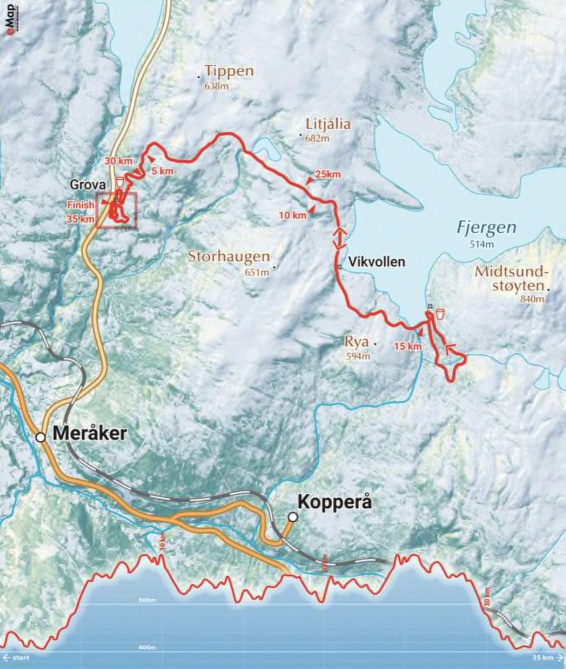
Nature has a lovely way of being, well, natural. In other words; marginally unpredictable, sometimes downright uncomfortable, and finicky. Prior to the Ski Tour 2020’s Stage 4 weather forecast and on-the-ground big-wind gust reality, the stage had been scheduled to pulse 38-kilometers from Storlein, Sweden to Meråker, Norway in a point to point event. Cool, right? An international border crossing during a race, with a single sanctioned coaching/feed zone for athletes around the 25 k mark. A think-out-of-the-box format with a nod to the old-school days of Norwegian countryside racing.
Nature interfered. Or at least the predicted inclement weather scheduled to pummel the rolling mountains featured in the point to point race was enough to scare off race organizers.
An updated map and course profile for Stage 4 of the Ski Tour 2020.
The stage was rerouted the stage. Stage 4’s freestyle mass start streamed from the start/finish area in Meråker, to the original coaching feed zone at approximately 15 k, where athletes skied a several k loop, and then routed onto the main course back to the Meråker ski stadium. In total, the new route was 34 k, with approximately 30 k consisting of an out-and-back. Organizers maintained a single feedzone policy. (Thus, you’ll see several athletets with hydration belts. Most notably, the Norwegians.)
Prior to her breakaway on Stage 4, Norway’s Therese Johaug began to stretch the cord to the pack. (Photo: NordicFocus)
Although mother-nature dictated the course reroute, Norway’s Therese Johaug dictated the intro and closing chapters of Stage 4.
This was no surprise, as she has dominated World Cup distance events with a few second-place efforts here and there, to prove maybe she is human after all. Analyzing her results, it’s clear she is a record-setter. And another record of sorts fell today as Johaug won in 1:26:32.8 hours. It was Johaug’s eighth individual distance World Cup victory in a row. A streak that outdoes her run of seven consecutive wins, which the Norwegian has strung together on two occasions — once between January- March of 2016, and again between March-December 2019.
Johaug on her 34 k journey. It’s early, the pack is still in contact. (Photo: NordicFocus)
The day was not a singular Johaug show. Her teammate Ingvild Flugstad Østberg kept the racing on the front-end honest for the overall win.
Earlier in the race, it did appear like a Johaug runaway. At 14 k, she had gapped the second place Østberg by 28.0 seconds. Chasing in a line through the time check along with Østberg were Norway’s Heidi Weng, and Sweden’s Ebba Andersson. American Jessie Diggins led a group, 1:24 back, including Austria’s Teresa Stadlober, and Krista Pärmäkoski.
Another 30 seconds back, an organized chase pack including Charlotte Kalla, Rosie Brennan, Sadie Maubet Bjornsen, and Astrid Uhrenholdt Jacobsen churned along.
Jessie Diggins (left), Teresa Stadlober (center), and Ingvild Flugstad Østberg (right), on the Stage 4 course. (Photo: NordicFocus)
Through 20 k, those gaps remained relatively firm. However, out on course, the winds were evident with swaying treetops. A solo effort can take its toll with no draft to exploit. No matter how you look at it, either Johaug slowed or Østberg sped up, the time between the two skiers diminished between 20 k and 30 k. At the 31 time check, Johaug’s lead had shrunk to 7.9 seconds over Østberg, who had snapped away from a hard to shake Weng early in the race. Weng paced through the 31 k mark in third (+51.0), Andersson in fourth (+1:37.3), and Diggins in fifth (+3:01.2).
Have no doubt, despite Joahug’s singular dominance, this was a hunted Johaug. Her effort in the closing Ks never waned, as Østberg proved a worthy foil. As much as Østberg wanted to will the 30-40 meter span to Johaug away, Joahug was able to keep four seconds between herself and the fearless Østberg at the finish. Weng came through solo in third overall (+1:21.6), with Andersson in fourth (+2:00.5).
Norway’s Heidi Weng placed third on the Stage 4 34 k skate mass start race. Note the nifty hydration belt (Photo: NordicFocus)
Jacobsen pipped the next chase group, taking fifth (+3:06.5), with Tiril Udnes Weng of Norway in sixth (+3:10.3), and Diggins in seventh (+3:13.9).
Jessie Diggins during Stage 4 of the Ski Tour 2020. She placed seventh overall. (Photo: NordicFocus)
Post-race interview with Jessie Diggins
Also for the U.S, Brennan ended her day in 10th (+3:41.9).
“It’s been an adventurous couple days here in the ski tour,” emailed Brennan. “A lot new things, a lot of surprises, and a lot of last minute changes. Our point to point race was changed due to high winds but we still managed to to an out and back in the same trail starting and finishing in Meråker. It was really windy still making it challenging to ski alone out there. Knowing that I did all I could to stay in my group. There were a few kilometers that I was dangling and unsure if I could hang, but I was fortunately able to find another gear climbing and work my way back up to my group. , unfortunately,y missed the first break on the way back but was able to pick off some people all the way to the finish. I am really happy with the race as 30km has been a struggle for me in the past. I am still feeling strong in the tour and am going to do all I can to hold on to a top 10 in the closing stages.”
Rosie Brennan, pack skiing to 10th overall on Stage 4. (Photo: NordicFocus)
Maubet Bjornen clocked in one place after Brennan in 11th (+3:44.8).
“It was a thrilling day of ski racing today, with lots of course changes, weather delays, a long2-hour bus trip to the start, and a total ‘unknown’ in front of us with this long race,” wrote Maubet Bjornsen.
“I have finally felt my body feeling better, and I just kept my mind excited to take on whatever was coming.
“It was windy as heck, which made the course super tough, but still beautiful. I didn’t look around a ton, because I was so focused, but in the few chances we went down a hill, and I got a glimpse, I just felt so lucky to be part of this fun experience. It is so different than any race I have ever done, and the total ‘unknown’ put the cherry on top.
“I’m so excited to find my strength again, and put together a race that is more representative of where I am at. 11th in a long distance skate race is huge for me!”
Maubet Bjornsen: Stage 4, Ski Tour 2020. (Photo: NordicFocus)
Also for the U.S., Julia Kern placed 19th (+6:04.5), Rosie Frankowski 29th (+6:12.2), Caitlin Patterson 41st (+8:20.3), Katharine Ogden 42nd (+8:49.8), Alayna Sonnesyn 48th (+10:23.3), Sophie Caldwell 56th (+12:27.3). Hailey Swirbul did not start.
For Canada, Cendrine Browne scored in the points in 25th overall (+6:07.9). Katherine Stewart-Jones skied to 31st (+6:16.1), and Emly Nishikawa 39th (+7:52.9).
In the Ski Tour overall, Johaug looks unstoppable – she has won all four stages thus far. Her elapsed time, which factors in a 60-second time bonus for her sprint stage win on Tuesday, and three 15 second intermediate time bonuses on the course Thursday, is 2:16.33. Østberg sits in second (+2:06), Weng third (+2:39). Diggins was the best-positioned American in sixth (+6:02).
Racers have a rest day Friday, with racing starting up in Trondheim for Stage 5’s 1.5 k classic sprint.
When Therese Johaug wins a sprint qualifier by 4.5 seconds and Sophie Caldwell qualifies in 23rd, you know it is not your average course. Held at the Swedish national alpine ski area in Åre, today’s event seemed to blend the infamous climb up the Alpe Cermis in the final stage of the Tour de Ski with skier cross on perhaps the shortest but toughest sprint on the World Cup.
A gradual uphill start led skiers to a fast downhill into a swooping banked turn to the left. The course then ascends a pitch as steep as 28% up the base of the alpine hill, climbing nearly 60 meters within the final 200 meters of the course. Athletes would then need to walk back down to the start area.
The Åre sprint hill climb in profile. (Photo: Screenshot FIS Broadcast)
Though less than 700 meters in total length, nearly half the usual distance, the course took the women roughly two and a half minutes, on par with a usual sprint time.
The event drew a roaring crowd, with fans lining the course, their yells and gaps echoing as athlete’s skied by. After the race, Matt Whitcomb recognized the event organizers for putting together a unique stage and drawing so many energetic spectators.
Post-race comments from Matt Whitcomb.
With Johaug at the top of the qualification list were Heidi Weng (NOR), Greta Laurent (ITA), Linn Svahn (SWE), and Laura Mononen (FIN), the most diversity in nations among the top five in the tour so far. This result also added mystery and excitement as it could be anyone’s game. Weng is a top distance skier, Laurent and Svahn are most recognized for their sprint performances, and Mononen normally hovers on the border of the top-30 FIS point scorers list, a relative unknown.
Rosie Brennan climbs to the top American result in qualification during the Stage 3 “sprint”. (Photo: NordicFocus)
Rosie Brennan was the top American qualifier in 14th, followed by Jessie Diggins in 17th, Julia Kern in 18th, Sadie Maubet Bjornsen in 21st, and Caldwell in 23rd.
Racing in the second wave of the quarterfinal, Diggins and Brennan took the pace out hot, trying to create a gap over the two top qualifiers, Johaug and Weng. Diggins led the way over the gradual climb and into the downhill, fearlessly flying into the banked turn with high speed. Riding up the berm to the outer lip of the curve, Diggins stayed in control, though only just.
Brennan and Diggins were still in the lead beginning the hill climb, but the two high-tempo Norwegians were gaining quickly. Weng and Johaug overtook the Americans midway up the climb, but Diggins did not let them get away. Maintaining contact, she crossed the line within 1.5 seconds of the Norwegians and advanced as lucky loser, her early effort to push the pace making it the fastest of the five heats.
Diggins attacks the hill climb during the Stage 4 sprint in Åre, Sweden. (Photo: NordicFocus)
Brennan fell back to fifth in the heat and did not advance. She ended her day in 22nd.
Maubet Bjornsen and Kern raced in the fourth heat, finishing fourth and sixth, respectively. Maubet Bjornsen’s final rank was 20th.
At the start of the last quarterfinal round, Caldwell skied off the front, navigating the banked turn with ease and picking up momentum as she approached the base of the hill in V2. Caldwell stayed near the front through the climb, her technique smooth and controlled. As the course curved and leveled to the finish, it was Mononen and Caldwell at the front. They crossed the line together, immediately folding with hands on their knees in anguish.
If this is what the finish of the quarters looks like, what will happen as the deep burn of cumulative fatigue starts to sink in?
In the semis, Diggins faced off again with Johaug and Weng. Rather than flying off the front, Diggins sat in the middle of the pack over the first climb, hooking 180 degrees left and dropping into a tuck heading into the banked downhill.
Johaug was last into this turn and last to the base of the climb, but she was far from out of the race. Jump skating up the left side of the course, Johaug rocketed from the back of the pack to the lead, edging out Weng to win the round.
Diggins fell off the pack at the base of the climb and finished last in the heat, and 11th for the day.
Relaxed, smooth, collected, per usual, Caldwell rounded the banked turn in second and was in the mix at the base of the climb. Then it was over.
At the front, Svahn, Astrid Urenholdt Jacobsen (NOR), Laurent, and Mononen stepped powerfully up the climb. In the final meters, Svahn was at the front with Laurent close on her tails looking like a lock for second, until a last second surge by Jacobsen snuck her just ahead of the Italian at the line. As the heat was slower than the first, only Svahn and Jacobsen advanced.
After falling off the pack, Caldwell took last in the heat and ended the day in 12th.
Breaking down the lineup in the final, you’ve got two pure distance skiers with a history of outstanding results in the TdS hill climb, Johaug and Weng, alongside their teammate, Jacobsen, an all-arounder skewed toward distance. These three women paired with three sprinters, Svahn, Jonna Sundling (SWE), and Nadine Faehndrich (CHE). A World Cup cocktail.
The Swedes took the lead at the start of the final, shooting around the banked curve and into the climb. Johaug, again, the last to the base of the hill.
As the grade increased, Weng and Jacobsen accelerated up the right side of the course, while Johaug repeated her uphill attack as she weaved through the other women to the front. The Norwegians skied three abreast as they passed under the Audi e-tron arch toward the steepest pitch, shortly before the finish.
Therese Johaug leads Heidi Weng and Astrid Urenholdt Jacobsen through the final meters of the sprint hill climb. (Photo: NordicFocus)
Increasing her tempo and beginning to jump skate, Johaug rounded the final bend in the lead with the win locked up. Her teammates, Weng then Jacobsen, crossing behind her in second and third, respectively.
As the other wobbly-legged women collapsed, writhing in agony with faces turned toward the snow, Johaug raised her arms in celebration, her lungs still functional enough to let out a loud yell. She looked as though she had just completed a particularly successful interval session, a much different appearance than the others.
Therese Johaug takes Stage 3 of the FIS Ski Tour 2020. (Photo: NordicFocus)
“It was a crazy race,” smiled Johaug as she spoke with FIS at the finish. “But, as you know, I love uphills, and today as well was my day. Of course, you cannot call it a sprint race, but for me, it means a lot to stand atop the podium and I worked really hard for that, so I’m really happy.”
The third straight all-Norwegian women’s podium of the FIS Ski Tour 2020. (Photo: NordicFocus)
Commenting on the event in a post-race email, Caldwell wrote:
“Today was a very different kind of sprint. I wasn’t sure what to expect, but when we checked out the course yesterday, I was pretty shocked that we were literally going up an alpine hill! I had never done anything like this because and I know I have the potential to flood, so I wanted to make sure I did some pacing for my qualifier. It didn’t end up being a ripping fast qualifier, but it was good enough and I was honestly psyched to qualify on a course like this that doesn’t exactly play to my strengths.
“In my quarter I tried to get out fast and ski the technical corner how I wanted to and then I just focused on finding the faster snow and leaving a little left for the end. I was really happy with how my quarter went and on a course like this, making the semi final is a really good day for me. I also left everything I had in my legs on the course, so unfortunately in my semi final, even though I didn’t feel like I was breathing very hard, my legs weren’t exactly moving. So that was pretty different from a normal sprint where I usually feel like I can keep pretty good legs and energy through the final. Now it’s time for some recovery before the next stage!”
Head down and grinding, Sophie Caldwell skis to 12th place in Åre. (Photo: NordicFocus)
Outside the heats, Alayna Sonnesyn skied to 42nd (+17.24) in the qualifier, followed closely by Hailey Swirbul in 43rd (+17.31). Caitlin Patterson finished 46th (+19.76), Rosie Frankowski 56th (+23.55), and Katherine Ogden 59th (+27.58).
Racing for Canada, Katherine-Stewart Jones was the top qualifier in 34th (+15.56), followed by Cendrine Brown in 45th (+18.88), and Emily Nishikawa in 49th (+20.04).
In a post-race call, Whitcomb provided further insight into the women’s day, expressing that the his athletes were “quite positive” about the result, but impressed by the difference in feelings between qualification and the quarterfinal.
Whitcomb also explains that because of impending weather, the planned 38-kilometer point to point race across the Sweden-Norway from Storlein to Meråker may not be possible. The backup plan is a 15 k race for both men and women on an approximately 3 k loop in Meråker.
Therese Johaug (yellow bib) with enough time at the finish to gather skis and watch 2nd, 3rd, and 4th come across the line. (NordicFocus)
The early evening show, under the lights of Östersund, Sweden’s ski stadium, Stage 2 of the Ski Tour 2020 – a 10-kilometer classic pursuit – got underway as the plentiful moisture falling from the sky transitioned from steady rain to big snowflakes.
This was a 10 k race with three discrete tales. First, the story with the least tension.
That would be Norway’s Therese Johuag’s 10 k effort. Which, despite the pursuit format, was a solo time trial affair. She set herself up for that narrative by winning Stage 1’s 10 k individual skate by 45.6 seconds. No skier on the World Cup could fathom closing that gap to a generational distance skier.
Johaug won in 27:29.0 minutes. Her effort gained her even more time in the Ski Tour overall as teammates Heidi Weng placed second (+57.4), and Ingvild Flugstad Østberg third (+57.8). Sweden’s Ebba Andersson lost out on third in the closing meters, as she placed fourth (+58.6).
Therese Johaug for a clean no-one-in-site win. (NordicFocus)
This was Joahug’s 13th World Cup distance win of the season and according to FIS, this brings her closer to a hallowed record. Marit Bjørgen, a legend from Norway holds the World Cup distance win record with 62 victories. Sunday’s win brings Johaug’s total to 59.
Let’s be frank: with a 45.6 second lead on the second starter Weng, 47.3 seconds on Østberg in bib 3, and 53.1 ticks ahead of Andersson in bib 4, this was as much a sure thing as sunrise and sunset.
Ebba Andersson leads Heidi Weng and Ingvild Flugstad Østberg during the Stage 2 10 k classic pursuit. (Photo: NordicFocus)
Behind Johaug, the tactic for the three closest chasers — Weng, Østberg, and Andersson was clear: cede no ground to the All-Star list of skiers starting roughly 20 seconds further back. For much of the race, the threesome kept a tidy buffer of 30 seconds on those in fifth to 16th place. At times Andersson took pulls up front, motivated by chants of “Ebba” from the home-nation fans. Østberg and Weng too remained motivated to secure a potential podium as they burned their matches prudently but with enough gusto to keep the masses at bay.
Taking her turn pacing the premier chase group, Heidi Weng (bib 2), followed by Ingvild Flugstad Østberg and Ebba Andersson. (Photo: NordicFocus)
Heidi Weng (bib) taking second in Stage 2 of the Ski Tour 2020. (Photo: NordicFocus)
Weng led the charge into the final straight. Østberg slotted in behind Weng using her as a double-poling pace machine. Weng and Østberg gained a precious few meters on Andersson to take second and third, respectively.
Johaug leads the Ski Tour 2020 after two stages with a total time of 49:18. Weng is second at 0:57, and Østberg is third overall with the same time back. Andersson sits one second further back in fourth overall.
The race behind the top-four had a different vibe. It was less about fending off a potential chase, and more about how a large group of skiers would coalesce, who would lead, and who would sit back and take advantage of the more skied in tracks.
Jessie Diggins skiing to 11th overall during the Ski Tour 2020 Stage 2 10 k classic pursuit. (Photo: NordicFocus)
American Jessie Diggins, in bib 8, pulled the group through the 3.3 k mark 1:25.2 behind Johaug. In contact with Diggins, and coming through in this order were Astrid Uhrenholdt Jacobsen, Ragnhild Haga, Rosie Brennan, Krista Pärmäkoski, Frida Karlsson, and Natalia Nepryaeva. The group from fifth to Austria’s Therese Stadlober in 16th place was separated by 11 seconds.
Brennan took her turn up front though the 4.9 k mark, as did Karlsson later in the race. By the finish, the collective group did not gain time on those ahead, they ceded a few more seconds to the top four. But we would be remiss to make note of Brennan’s determination. You could see it in yesterday’s 10 k skate, and it was evident today; she’s got moxie and now the confidence to take pulls, as she did with Karlsson today, and try to break the pack. In a post-race interview (audio posted below), Brennan noted she had in fact been keen on making a move during the pursuit.
Grit: Rosie Brennan during Stage 2 of the Ski Tour 2020. (Photo: NordicFocus)
Post-race interview with Rosie Brennan
Slovenia’s Anamarija Lampic ended up fifth overall (+1:38.7), as the first finisher of the third group out on course. Brennan ended her day in 10th (+1:43.3), and Diggins in 11th (+1:43.6).
“It was a pretty crazy day out there!” Diggins wrote. “I was actually super stoked about the rain while warming up because klister skiing in the rain is such amazing kick and really fun getting up all the hills on. The snow right before the start made it a really strange race because the one track became exponentially faster as it got skied in, which led to massive packs (for a girls race, anyway) forming. Huge thanks to the tech team because my skis stayed competitive and were kicking well even in the rapidly changing conditions!
“I’m excited for the rest of the tour – the next two races are formats we’ve never done before, so I’m ready to go give it my very best shot!”
Sadie Maubet Bjornsen, who began in bib 22, 1:51.4 behind the first starter Johaug, placed 19th (+2:12.5).
“After recovering from a mild tummy bug or a form of food poisoning that visited the night before the start of this tour, I am feeling thankful and hopeful after the second stage of the tour today,” Maubet Bjornsen emailed. “With a snow/rain downpour, I was feeling right at home strapping classic skis on my feet and heading out in the misery. I have spent plenty of days in this exact condition during summer training up on Eagle Glacier, so I was trying to channel every bit of internal strength I could find. The fact that I was able to work my way up to 19th today, and had encouraging feelings in a somewhat depleted version of myself is something I will take and run with!
“I am excited to have a day to recover and fill up my tank, and take on this tour in the same way I did the last. An imperfect start will just fuel me with the extra fight for the days to come!
“Thanks to the tech team for putting wonderful skis together given the absolute craziness coming out of the sky!”
In speaking to U.S. World Cup Head Coach Matt Whitcomb after the race, he explained that skiers in the back of the field were able to take advantage of the considerably faster skied in tracks. Again, heavy wet snow fell during the race.
Post-race interview with Matt Whitcomb
U.S. skier Hailey Swirbul in bib 36 moved into the points on Sunday to place 24th (+2:20.2). Her trajectory in the standings aligned with her 13th fastest time of day. Along those lines, Julia Kern of the U.S. Ski Team skied from 50th to finish 36th (+2:43.8). Her on course time was the sixth-fastest of the day.
Also for the U.S., Caitlin Patterson was 41st (+2:54.1), Sophie Caldwell 51st (+3:07.0), Alayna Sonnesyn 54th (+3:55.7), Katharine Ogden 55th (+4:03.8), and Rosie Frankowski 62nd (+4:59.7).
For Canada, Katherine Stewart-Jones placed 32nd (+2:37.5) and skied the ninth fastest time of day. Cendrine Browne was 39th (+2:45.9), and Emily Nishikawa 44th (+2:59.8).
Katherine Stewart-Jones (CAN) during Stage 2 of the Ski Tour 2020. (Photo: NordicFocus)
As far as the overall standings and how times are calculated, time of day is used to determine a skier’s time for Stage 2.
An all-Norwegian podium in Östersund, Sweden. Therese Johaug won the day ahead of Heidi Weng and Ingvold Flugstad Østberg. (Photo: NordicFocus)
Here we go again. A new Scandinavian Ski Tour takes the spot of a World Championship or Olympic Games during this off-cycle year. Six stages working east from Östersund, Sweden to Trondheim, Norway, beginning with today’s 10-kilometer individual start freestyle event.
Under clear skies, light fading and shadows lengthening as the sunset looms just a few hours away, the women time trialed through the tall conifers to set the tone of the overall tour standings. Crowds arrived in droves to line the course and fill the stadium, a cacophony of cheers creating the soundtrack to the stage.
Today’s format suits the Tour favorite, Therese Johaug, who has expressed that mass start events do not suit her as well. This season, Johaug won the Tour de Ski and has taken the top spot in each of the last ten individual start distance skate events.
Her story today essentially wrote itself. In Devon Kershaw’s words: “Gun to tape annihilate.”
Therese Johaug (NOR) dominates the first stage of the FIS Ski Tour 2020. (Photo: NordicFocus)
Johaug hammered out of the start gate and did not slow down until she crossed the line, her grimacing face making clear the unmatchable power and tempo she was forcing herself to maintain. Stopping the clock at 21:49.7 and raising her arms briefly in the air before collapsing over her poles, Johaug sealed the deal on best in show.
Her time gap on her competitors increased in an almost alarmingly linear fashion throughout the stage. 12.8 seconds at 2.6 k increased to 20 at the halfway mark, growing to 45.6 seconds at the finish.
Victorious in Östersund, Therese Johaug has a strong start to the FIS Ski Tour 2020. (Photo: NordicFocus)
“Oh yes, I could never get a better start than this,” a glowing Johaug told FIS at the finish. “I feel that it was my best skating distance in my career, so I am really happy with the skis and with the shape. It was an amazing race today… It’s good to start the Tour and I’m looking forward to the next races.”
Here’s what else went down.
Racing in bib 27 amongst the first wave of 30 skiers, Rosie Brennan set the bar high for the seeded group of top-ranked skiers who followed in bibs 32 – 60, posting some of the fastest time through each checkpoint. Although she faded into the results as the seeded group came through, it was still a noteworthy performance, placing her 9th for the day (+1:25.7) and second American.
Rosie Brennan sets the bar, racing to 9th in the first stage of the FIS Ski Tour 2020. (Photo: NordicFocus)
Of other skiers in her group, Brennan was only challenged by Norway’s Ragnhild Haga and Sweden’s Frida Karlsson, who was recently cleared to return to World Cup competition. Karlsson sat out the majority of the season after failing to meet team health standards for body composition and bone density.
Karlsson took the pace out hot, clearly gunning for the win, or at least for the bonus points available at the 2.6k checkpoint. She had the second fastest overall time there, then she attacked the steady climb with high tempo. But she was unable to hold the effort, fading back into the ranks as the race went on. She ended her day in 19th (+1:46.0).
After a fast start, Frida Karlsson falls to 19th in the 10 k skate. (Photo: NordicFocus)
Among the first starters of the seeded group in bib 36, Heidi Weng (NOR) went hunting. From 4.2 k onward, she knocked down the previous best time, setting a new and short-lived time to beat, as Johaug chased from two bibs behind. Weng, the 2017 and 2018 Tour de Ski winner who is currently ranked third in the overall World Cup standings hung on to take the second podium spot.
Next over the line was Ingvild Flugstad Østberg in third (+47.3), who hovered a few seconds behind Weng at each checkpoint. The trio sealed the deal on an all-Norwegian podium.
Ebba Andersson of Sweden interrupted the string of Norwegians in fourth (+53.1), followed by Haga (+1:04.3) and Astrid Urenholdt Jacobsen (+1:05.0).
Leading the Tour for North America, Jessie Diggins skied to 8th (+1:18.1). Diggins currently sits 5th in both the distance and overall World Cup standings.
Jessie Diggins skates to 8th in the first stage of the FIS Ski Tour 2020. (Photo: NordicFocus)
In a post-race call, Diggins described the track in Östersund as a “thinking course”, full of swooping turns that kept athletes focused and on their toes. Diggins explained that she has been experiencing an abnormal amount of fatigue over the last few weeks, but felt some encouraging sensations in today’s event and has a plan in place to optimize her recovery between stages so she can keep going hard.
She also shares insight about some of Tour’s sustainability initiatives to decrease the environmental impact of such an event, and weighs in on the energy generated from a large American team.
Post-race interview with Jessie Diggins.
Jessie Diggins leads the way for Team USA after the first stage of the FIS Ski Tour 2020. (Photo: NordicFocus)
Just behind Diggins, Brennan was the next American. It was the APU/USST athlete’s third top-10 result of the season. Her last two were also earned in stage events; she was 9th in the 10 k skate during the third stage of the Tour de Ski in Toblach, Italy and 6th in the 10 k classic in Ruka. She also skied the 7th fastest time of day up the Alpe Cermis in the final TdS stage.
“It was a good opening day of the Ski Tour 2020 for me,” Brennan wrote in an email to several news outlets. “After a frustrating weekend last week, I was ready to try to turn things around. The course here is hard and has lots of climbing so I felt it suited my strengths. It was fast conditions but there was also little rest so it was a tricky pacing game. I didn’t perfectly pace it and lost a little in the closing kilometers but I had much improved race feelings so I am very satisfied and hope I can continue this way throughout the tour.”
Sophie Caldwell on course in Östersund, Sweden. (Photo: NordicFocus)
Back on the World Cup, Rosie Frankowski races the first stage of the FIS Ski Tour 2020. (Photo: NordicFocus)
Sadie Maubet Bjornen was the next American in 22nd (+1:51.4), followed by her APU teammate Hailey Swirbul in 36th (+2:09.3). Caitlin Patterson was next for the U.S. in 40th (+2:19.1), Alayna Sonnesyn 43rd (+2:27.3), Julia Kern 50th (+2:38.0), Sophie Caldwell 51st (+2:39.3), Katherine Ogden 53rd (+2:48.0), and Rosie Frankowski 56th (+2:50.0).
In a post-race call, Matt Whitcomb sheds light on how the team is approaching the Tour in comparison to the Tour de Ski or a ski tour at the end of the season. Whitcomb explains that a major focus leading into the week was recovery and mental preparation.
“We didn’t focus to much on performance — that’s never a great way to go. We work on the process and getting people psyched by giving them the confidence to know that they’re recovered. Whether or not they’re sharp on the first day or two, they should be sharp by the end. Whether that ends up happening or not, we’ll see. But believing in it is the key.”
Whitcomb explains further how he gages how tired or recovered his athletes are and provides further insight into the women’s performance. Lastly, Whitcomb comments on Swirbul’s noteworthy rise in the ranks this year, attributing it to her fun but focused mental approach and the effect of the strong APU women’s training group.
Post-race interview with Matt Whitcomb.
On the Canadian side, Emily Nishikawa was the top finisher just outside the FIS points in 32nd (+2:05.0). She started one bib ahead of Sweden’s Charlotte Kalla, who she marked and followed to the finish once caught.
Emily Nishikawa leads the Canadian team in 32nd in Östersund, Sweden. (Photo: NordicFocus)
Next up was Cendrine Browne in 35th (+2:09.0), followed by Katherine Stewart-Jones in 46th (+2:29.8).
The tour is young. Racing continues tomorrow with a 10 k pursuit start classic on the tracks in Östersund.
Early race agitators: Norway’s Therese Johaug and Heidi Weng. (Photo: NordicFocus)
As always, it was a reset: a new day at the start of a World Cup race. On Sunday, the ribbon of snow in Falun, Sweden offered an opportunity for a sixty-six women field to race head to head in a 10 k mass start freestyle race.
With a course that some noted was softened in difficulty by eliminating the infamous Moderbakken climb — which has become a feared incline on the World Cup circuit — the racing was expected to be a close contact affair. The women raced four laps of a roughly 2.5 k circuit featuring punchy hills and terrain requiring athletes to work with little opportunity to recover.
Coming into the race, Norway’s Therese Johaug had been synonymous with the words distance race and victory. She has been unstoppable. She has won 11 of the last 13 individual distance events on the World Cup. According to FIS, in a string of 24 distance races, Johaug has placed first or second in 23 of them: the only outlier a 4th place in the 10 k mass start classic in Val di Fiemme, Italy during the fifth stage of the 2019-2020 Tour de Ski.
Again, it has been a year in which Johaug has been dominant in the win column, but not necessarily in her margin of victory. In year’s past, seeing Johaug way off the front, a minute plus ahead of the field was not uncommon. This season, the gaps have been more humane.
From the start on Sunday, Johaug was out front and the skier to match. Through the first lap, it was Johaug, Heidi Weng of Norway, Ebba Andersson of Sweden, Astrid Uhrenholdt Jacobsen of Norway, and Sweden’s reassimilating Frida Karlsson who had been off the World Cup this season since the opening weekend in Ruka, Finland for failing to meet team body-metric requirements, who looked poised to keep pace.
Early on, Weng took pulls and Andersson contributed to a pace that would snap any imaginable cord to those wishing to gap up. At 3.6 k Johaug, Weng, and Andersson pushed discernibly ahead, as Jacobsen and Karlsson fell off to a bit more than six seconds back. Jessie Diggins, starting in bib 5 for the U.S., came through the 3.6 k check in eighth, at 17.2 seconds behind, as the Norwegians and Swedes kept the tempo hot.
Frida Karlsson back on the World Cup for Sweden. (Photo: NordicFocus)
Although a mass start, the race at the sharp end whittled away at the masses. Three off the front was for real. Morderbakken or not, there would be no catching them: the three leaders had 18.8 seconds on Karlsson in fourth and 19.4 seconds on Jacobsen in fifth by 6.7 k.
Weng hung on until the closing 1.5 k when she too began to wither as Johaug began to write the conclusion to this 10 k script. The overall World Cup distance leader, Johaug, won in 25:04.1. And as she crossed the line, arms raised to the sky, Johaug displayed a stoke often reserved for bigger championship stages. Andersson, who missed the first part of the season with an injury, placed second (+6.5). For Andersson, her second place matched her season best result during the fourth stage of the Tour de Ski, a 10 k mass start classic. Weng hung on for third (+23.8).
Johaug stoke: the 10 k mass start win in Falun. (Photo: NordicFocus)
After Sunday’s race, Johaug has a commanding lead in the distance standings with 1011 points. Weng sits in second with 665 points.
“It was tough conditions and of course with a mass start in Skating it’s not my favorite but I think the tracks were so slow and it was better than I had expected it,” Johaug told FIS after the race.
Diggins was the top American in 14th, 57 seconds back. At moments Diggins appeared poised to link up with Jacobsen and Karlsson in the early stages, but oftentimes she found herself working alone. In the windy conditions, the effort became too taxing.
“It wasn’t my best day out there but I was proud how I just kept fighting even as a large pack was moving in to catch me up, I did everything I could in the moment,” Diggins said after the race.
She comes off a training camp at mid-altitude in Seefeld, Austria and a mystery kink in her neck that appeared the morning of Saturday’s classic sprint in Falun. (In the audio posted below, Diggins discussed how she has been handling the pressure of expectations after realizing the dream of an Olympic gold medal.)
Diggins driving during the 10 k mass start skate in Falun. (Photo: NordicFocus)
Post-race interview with Jessie Diggins
U.S. skiers Sadie Maubet Bjornsen placed 21st (+1:28.2), and Rosie Brennan 23rd (+1:31.1).
“I had a challenging day today,” Brennan emailed. “Nothing went particularly wrong but I just wasn’t moving as fast as I thought I should be. It was very tough conditions with no natural snow and warm temperatures and falling rain. It was a short 2.5km loop that didn’t provide much rest but also not too many climbs. While this type of race has never been my forte, I did expect a little bit more of myself. I will take the week to hopefully find a little more speed and be ready for the Ski Tour 2020.”
Also for the U.S., Hailey Swribul placed 35th (+1:56.2), Sophie Caldwell 38th (+2:11.3), Alayna Sonnesyn 49th (+2:38.8), and Julia Kern 57th (+3:20.1).
Post-race interview with World Cup Coach Matt Whitcomb
Canada’s Cendrine Browne scored in the points with a season best 29th place (+1:40.1). Katherine Stewart-Jones skied to 37th (+1:59.9), Dahria Beatty 40th (+2:14.1), and Emily Nishikawa 46th (+2:35.5).
Canada’s Cendrine Browne racing into the points in Falun. (Photo: NordicFocus)
Racing continues next Saturday with a skate sprint in Åre, Sweden — the start of the Ski Tour 2020.
The 10 k mass start podium from Falun: Ebba Andersson (SWE) second, Therese Johaug (NOR) first, and Heidi Weng (NOR) third, (l-r). (Photo: NordicFocus)
The speedy women of Oberstdorf. Natalia Nepryaeva (RUS) won the classic sprint ahead of Anamarija Lampic (SLO) and Jessie Diggins. (Photo: NordicFocus)
Onward and upward. Day two in Oberstdorf, Germany featured a 1.5-kilometer classic sprint with three sharp toothlike climbs. Seemingly riding the edge of their capability inside the tracks, athletes pumped their way up each pitch before wrapping around a bend and descending an equal grade back toward the stadium.
Wolf jaw or race course? The Obesrtdorf sprint loop in profile. (Photo: Screenshot FIS Broadcast)
After what Matt Whitcomb called an “off day”, the Americans demonstrated their ability to rebound. To not let the sensations or disappointment from one day percolate into subsequent races. Onto the next.
This was clearly demonstrated in the qualifying round: three, four, nine, eleven. Diggins was the fastest of the crew finishing 2.24 seconds behind top qualifier Natalia Nepyaeva of Russia, who stopped the clock at 3:38:08. Diggins was 0.8 seconds behind Anamarija Lampic of Slovenia, who won both sprint events, skate and classic, during the Tour de Ski, and took second the weekend after the Tour in the freestyle sprint in Dresden. Lampic also popped the second fastest qualifying time of the day.
Sadie Maubet Bjornsen nearly matched Diggins time in fourth (+2.35), followed by Sophie Caldwell in ninth (+5.38), and Rosie Brennan in eleventh (+5.90). The only other country to put three athletes in the top ten was Norway, a testament to the strength of the American women on a day where our expectations meet reality.
Striding it out in Oberstdorf, Caitlin Patterson skis to 61st in the qualifier. (Photo: NordicFocus)
Also starting for the U.S., Caitlin Patterson took 61st (+24.18), and Alayna Sonnesyn finished 66th (+26.7).
In the quarterfinals, Maubet Bjornsen wore the lowest bib number in the first heat, which is curious as this is often the choice of the top two qualifiers (see Diggins comments on heat selection below). Maubet Bjornsen took second in a tight finish with Lotta Udnes Weng and Astrid Uhrenholdt Jacobsen of Norway, moving with Weng into the first wave of semis.
Caldwell won the third heat of the semis in a photo finish with Ane Appelkvist Stenseth of Norway. Brennan was eliminated after finishing fourth in the fourth heat to finish 16th for the day, a top result in the event.
“Sprint is always such a bitter sweet event for me,” Brennan emailed. “While today was the best classic sprint of my career, I still felt that I made some mistakes and didn’t ski as well as I felt. The course here is long and has some good striding which I was really excited about. I know there are probably some sprinters that aren’t excited about the length but I felt the course did a good job of including all kinds of skiing and really rewarding good skiers. I am really happy with my feelings and for sure have a little list of things to work on moving forward.”
Diggins charged full gas through the fifth heat of the quarters for the win, beating out Sweden’s Linn Svahn who advanced alongside her.
Jessie Diggins leads Sweden’s Linn Svahn during the quarterfinal in Oberstdorf. (Photo: NordicFocus)
In the first semi, Caldwell and Maubet Bjornsen took it out with the leaders, matching Nepryaeva’s long powerful bound up the climbs and the speedy out-of-the-track tempo of Anna Svendsen of Norway. Coming into the final downhill, Svendsen, Nepryaeva and Caldwell pulled ahead, creating a small gap to the remaining women. Caldwell held her tuck longer than the other women, collecting herself for a spicy double pole sprint to the finish. Sliding across the line at the heels of Nepryaeva, Caldwell stayed ahead of the Norwegian to take second in the heat. Maubet Bjornsen finished fifth between Nadine Faehndrich of Switzerland and her opponent from the quarters, Weng.
“It was one heck of a thrill out there today on the courses for next year’s World Championships,” wrote Maubet Bjornsen in an email to several outlets. “This is certainly one of the hardest sprint courses I have sprinted on, but I really enjoyed it! My legs felt a lot stronger than last weekend, but still not quite recovered enough to put together the race I was dreaming of today. Finishing 9th is still and achievement, but I know I am capable of more when I have my full strength.
“My tactic today was to race at the front of the group, even if it required a bit more energy, because then I knew I wasn’t going to get stuck behind anything. I always feel most confident skiing that way. In the final climb of the semi’s, I think I paid the price a bit.”
Sadie Maubet Bjornsen matches Astrid Uhrenholdt Jacobsen (NOR) up the climb in Oberstdorf. (Photo: NordicFocus)
Striding hot out of the gate, Diggins also held a position at the front, matching Lampic, who dictated the pace, up the climbs and tucking into her draft on the descents. On the last and longest climb, Diggins was overtaken by Svahn and Heidi Weng of Norway and she was unable to regain her position on the subsequent downhill. Though her tempo was faster than her opponents in the final double pole sprint, she finished fourth. As her time would have won the previous heat, Diggins and Svahn advanced with Lampic and Weng as the lucky losers.
Again taking the reins from the start-beep, Lampic surged to the front of the group and stayed there, though she could not drop the strong group of women in her wake. Up the final climb, Nepyaeva matched Lampic stride for stride, her long powerful pushes keeping her alongside the Slovenian’s green and black suit.
Like a slingshot, Nepryaeva sped around Lampic as they rounded the final curve into the straightaway. The duo duked it out double poling in perfect synchrony, but Lampic recovered no ground on the Russian. Nepraeva stopped the clock at 3:27:08, the fastest split of the day.
Down to the final meters, Natalia Nepraeva (RUS) and Anamarija Lampic (SLO) sprint to the line with two Americans on their heels. (Photo: NordicFocus)
Winning by centimeters, Natalia Nepryaeva (RUS) celebrates her accomplishment. (Photo: NordicFocus)
Racing for the last podium position, Diggins and Caldwell flew into the final straight in neighboring tracks, with Svahn not far behind. Firing on all cylinders, Diggins pulled ahead of Caldwell to take third by just over a second (+2.44). After being left behind by the Americans, Svahn finished fifth (+5.16), followed long after by Stenseth (+30.20). The Norwegian had fallen off the pace midway through the round, ceding her chances to contend with the pack.
Jessie Diggins takes third in Oberstdorf, with Sophie Caldwell just behind. (Photo: NordicFocus)
Two up, one down. Anamarija Lampic (SLO), Natalia Nepyaeva (RUS), and Jessie Diggins celebrate their top results in Oberstdorf. (Photo: NordicFocus)
Due to poor WiFi connection, athletes chose to send comments via email. Reflecting on her performance, Diggins expressed that she “loved” the long sprint course.
“You had time to try out different tactics and that last hill saw some moves, for sure. We had awesome skis today so I was able to use a little bit of a slingshot to get into good position in the finishing lanes, and I just worked to stay smooth and calm in the first half, while looking for openings to get into better position.”
Diggins explained that heat selection is variable, and did not feel today’s variance from a usual bracket was explained by the length of the course. Her choice to race in the fifth quarter and second semi were based simply on her perception of the opportunity to advance.
“I chose the latter heat because it was wide open, and seemed to be a good path forward out of the quarters. But you never know how it’s going to go, and I was happy to secure lucky loser time in the fast semifinal!”
Gasping for air after an effort Diggins can be proud of in Oberstdorf. (Photo: NordicFocus)
After finishing 22nd in the skiathlon, some might question from the comfort of their couches whether Diggins is on the same form that we have seen in previous years. As was discussed with Matt Whitcomb, “success breeds expectation.” We expect to see Diggins at the top of the results sheet day in and day out, and that pressure can creep into an athletes self-expectation as well. When asked how she handles this, Diggins explained that she does not dwell on what is on the paper or posted in the comments.
“That’s a great question about handling expectations and pressure…and my plan for that has always been to set really concrete process-oriented goals, work as hard as I can to meet them, and then regardless of the result on paper I can decide if it was a “good” day for myself or not based on my effort, focus, technical progress and strategy.”
In her post-race remarks, Caldwell offered an insightful perspective that took into account her strengths as a sprint specialist versus an all-arounder like Diggins or Maubet Bjornsen.
“This sprint was definitely one of our longest ones, and for sure the longest one of the year. I think it’s really exciting to have varying sprint courses throughout the year and this is about as far from the Dresden course as you can get. I used to think short and flat suited me best, but now I don’t really know what I like, especially for classic, but I try to be excited for any kind of sprint so I don’t count myself out before it begins. That said, I do think that there are already a lot more distance races than sprints, so when it gets much over 3 minutes, it’s starting to favor distance skiers more, which is fine to do sometimes, it’s just too bad when there are already so few sprints if too many of them start getting really long. But I personally really enjoyed the course and the race today. I don’t think it’s too much different for recovery for me whether the course is 3 mins or 3:30, but I think for the men it is probably harder because if they’re in the second half of the bracket, they have a lot less recovery. I usually just try to move around until I’ve flushed my legs out and then relax for a little bit and then start moving around again before my next heat!
“Today was a really awesome day for our team. I was psyched to make my first classic final in years, and I think only my third ever. I’ve now had three 4th places in the last four races, which is a little bittersweet, but it’s important to remind myself that 4th is still a really strong result, especially in a tough classic sprint. It was great to ski with Sadie in my semi and I know she’s bouncing back from giving her all in the tour, but is getting stronger each day and a good result today is a huge step in the right direction. And Jessie was on fire all day and it was awesome to see her get another classic podium. So really fun to have such a strong day for our women and even though it was a tough day for the guys, I know they will be fighting back in Falun!”
Sophie Caldwell skis to 4th place in Oberstdorf. (Photo: NordicFocus)
Between the city sprints in Dresden and today’s event in Oberstdorf, Caldwell headed to Austria for an altitude camp. She explains the role this plays in balancing training and recharging, and how the sprinters use an altitude stint to build fitness without losing their top end speed.
“Simi and I just took a little break in Seefeld during the distance weekend in Nove Mesto and it’s was really nice both physically and mentally. The schedule this year is very demanding, with almost no weekend off, so we felt it was important to find in a couple times to work in a break, remove ourselves from the World Cup, and take some time for ourselves. I was really tired right after Dresden and didn’t realize it until I allowed myself to take a break, so it was nice to have a few days of true recovery and then I felt I was able to train really well for 9 or 10 days before coming here. Seefeld is at mild altitude, but I think it’s only at 3,700 ft, so as long as I keep my easy skis easy, I don’t feel too many effects of altitude and don’t worry about not being sharp when coming down a little in elevation.”
Maya Macisaac-Jones posted the top qualifying time for Canada in 35th. (Photo: NordicFocus)
Racing for Canada, Maya Macisaac-Jones posted the top qualifying time in 35th (+14.28), followed by Dahria Beatty (+15.79), Katherine Stewart-Jones in 50th (+18.58), and Katherine Weaver 65 (+26.08).
The start of the 56 skier deep field in the women;’s 115 k skiathlon in Oberstdorf, Germany. (Photo: NordicFocus)
Here at FasterSkier, we do not play the odds. Some contributors we know play Noah Hoffman’s Fantasy League – but we steer clear of rolling the dice on cross-country skiing. But the women’s skiathlon events on the World Cup may not be the biggest payouts since in recent history they have been a lock.
Oberstdorf in Oberstdorf, Germany — the site of next year’s Nordic Ski World Championships — required no crystal ball of an imagination to determine the top-spot for the women who raced a 7.5 k / 7.5 k skiathlon on a championship-caliber course.
Coming into the race, Norway’s Therese Johaug had won a total of seven World Cup skiathlon’s, including a win in the format this season in Lillehammer. With a win today she could match the record of eight skiathlon World Cup wins held by her former teammate, the now retired Marit Bjørgen.
This is about the most unspoiling of a spoiler alert: Johaug won today’s skiathlon in 40:05.2 to tie Bjørgen on the skiathlon win list. But her day was more tenuous than we would have imagined. Her gap on second place at the finish, Norway’s Ingvild Flugstad Østberg, was for Johaug somewhat meager, 15.5 seconds. Austria’s Therese Stadlober placed third (+15.6). According to FIS, this was Stadlober’s third career World Cup podium. Her two other podiums came in the 2018 Tour de Ski, one of which was a time of day podium up the Alpe Cermis.
Today, for Johaug, her race day concluded with arms raised in the air win.
A familiar pose for the World Cup distance leader: Therese Johaug winning the 15 k skiathlon in Oberstdorf, Germany. (Photo: NordicFocus)
She was able to slowly stretch away from a group of chasers during the 7.5 k classic leg. She inched ahead from the main chase group near 2.5 k as she charged up the course’s main climb, the Burgstall hill. The field was spread out, but not shattered. Joahaug came over the top and into a long glide out with a 100-meter lead.
At 3.8 k, Joahug had a 5.3-second buffer on Østberg in second, with eight other skiers within 15 seconds. Roughly two kilometers later, she added another three-second cushion. By the exchange to skate skis at 7.5 k, Johaug’s lead was 14.1 seconds to Østberg. But in close contact with Østberg were Finland’s Kerttu Niskanen and Krista Pärmäkoski, Norway’s Heidi Weng, Sweden’s Ebba Andersson, Stadlober, German Katharina Hennig, and Russia’s Natalia Nepryaeva who was 18.9 seconds back.
Churn as she may in her free-radical producing high octane tempo, Johaug essentially put no more time on the core chasers during the skate portion. For a time, up through 13.7 k, Johaug had a 20.1-second margin on the next closet skier, which winnowed by five seconds at the finish. This was not a Johaug walk-away as we have seen in the past. Østberg and Andersson took the primary responsibility of keeping the void to Johaug in check.
Therese Johaug charging during the 15 k skiathlon – Obertsdorf, Germany. (Photo: NordicFocus)
Johaug with a gap: 15 k skiathlon in Oberstdorf, Germany. (Photo: NordicFocus)
Østberg, Stadlober, and Andersson were able to sprint to the finish for their 2-3-4 order. (They came through +15.5, +15.6, +15.7, respectively.)
“It was a tough race out there,” Johaug told FIS after the race. “Especially the classic when I have a gap of five seconds, I know that I have to push myself all the way because if they attack me it will be a group. And it will be hard to go into skating and get a new gap again. I tried to focus on myself and work in my head all the way, but I am really happy with the first place today.”
Johaug has won 11 of 12 World Cup distance races this season and leads those standings with 896 points. Weng is in second with 595 points.
Ingvild Flugstad Østberg (bib 5) lading the chase during the classic portions of the Oberstdorf, Germany 15 k skiathlon. (Photo: FasterSkier)
It was not the day hoped for by the top American women. That reality became evident early in the classic portion of the race. By 3.8 k, Jessie Diggins had ceded 23.3 seconds, and Rosie Brennan 27.4. The time-bleeding trend never fully stabilized. Brennan was 18th through the exchange (+55.3), Diggins 24th (+1:04.1).
Brennan placed 17th overall (+1:46.6), while Diggins was 22nd (+1:55.0).
Rosie Brennan of the U.S., during the classic portion of the 15 k Oberstdorf, Germany skiathlon. (Photo: NordicFocus)
“Skiathlons are always a little unpredictable when we do so few in a year,” Brennan sent in a group email. “We were able to race on one of the new courses they have made for World Championships but due to lack of snow, we could only use one 3.75km course. The course is significantly hillier than the old course and skied quite well. However, doing a skiathlon on one course that’s split half classic half skate always causes some problems with not much room to pass. I felt very good today but struggled a lot moving through the field. I was frustrated with that but very happy about my feelings and skiing so I feel good that I am in a good place and have more good races to come.”
World Cup Coach Matt Whitcomb explained in a post-race interview that Diggins was feeling slightly off today with her sensations.
Jessie Diggins on the skate leg of the 15 k Oberstdorf, Germany Skiathlon. (Photo: NordicFocus)
Post-race interview with U.S. World Cup Coach Matt Whitcomb discussing the women’s race
Post-race interview with U.S. World Cup Coach Matt Whitcomb discussing the race course
Also for the U.S., Cailtin Patterson returned to the World Cup after contesting U.S. Nationals in early January to place 34th (+3:16.5). Patterson moved up in the skate portion to 34th, after transitioning to skate in 42nd. Alayna Sonnesyn raced to 51st (+5:45.1).
For Canada, Katherine Stewart-Jones just missed the points in 31st (+2:40.2). Dahria Beatty placed 47th (+4:54.0).
“It was a fun race, I knew that I would need to make up positions in the classic part of the race without using too much energy… but I also knew the pace would start out fast,” Stewart-Jones emailed. “I was able to move up little by little throughout the race. I felt better on the skate portion but wasn’t quite able to close the gap to top 30. I am for sure a bit disappointed to be so close but it is also motivating to know that I can ski like that on a day where I don’t feel at my best! As for the team, I am really excited about our progress. Dahria has been consistently in the top 30 in World Cup sprints this year which is really exciting and her and Emily were really close to top 30 in Davos. The best is definitely yet to come with most of the team focusing on the Scando tour and World Cup finals!”
Katherine Stewart-Jones of Canada (bib 45) skiing to 31st in the Oberstdorf, Germany 15 k skiathlon. (Photo: NordicFocus)
And with those concerned with the baggy bibs last week in Nové Město – it was a return to the form-fitting bibs we’ve come to know on the World Cup.
Racing continues tomorrow in Oberstdorf with a classic sprint.
The classic pursuit podium Nové Město: Therese Johaug (NOR) took the win ahead of Natalia Nepyaeva (RUS) and Ingvild Flugstad Østberg (NOR). (Photo: NordicFocus)
Yesterday’s snow coated Nové Město, Czech Republic, clinging to the tall pines and masking the unsettling contrast of the man made ribbon of snow. Though wintry precipitation continued to fall, cheering crowds filled the stadium, ringing bells and sounding horns as racers passed through.
Picking up where they left off after the skate stage, athletes set out onto the arduous tracks for a 10-kilometer classic pursuit. Steep climbs, sharp curves, and gentler though rippling terrain in between.
Start to finish, Norway’s champion Therese Johaug put on a show. Looking unstoppable, she glided and kicked with rapid tempo, in a race that was hers to lose. Perhaps it was over before it began, as the champion started the race with a lead of 33 seconds over the next skier, Russia’s Natalia Nepryaeva.
But Johaug was not about to wait for her chasers to catch her and leave it to a final sprint. She simply hammered every meter, widening her gap over the field at each checkpoint. By the halfway mark, she was 55.4 seconds ahead, which grew to over a minute by the time she double poled powerfully down the final stretch to stop the clock at 26:49.7.
The champion in Nové Město: Therese Johaug. (Photo: NordicFocus)
FIS interviewers described it as a “perfect weekend” for Johaug while asking for post-race comments in the mixed zone.
“I’m really happy now,” she said in response. “My shape is really good at the moment, I didn’t know that before we started here in Nové Město. But I think all the competitions in the Tour de Ski and some quiet days at home, I think it’s perfect for me here to come here and race and have this shape.”
Johaug was asked about her “full gas” energy expenditure in a race she so clearly had on lock. She explained that she can’t be complacent in races, as she needs the intensity to maintain her fitness through the season.
“I had my focus on myself today and I want to have a good competition and also a good training sensation, if you understand what I mean. I did not have so many hard sensations after the Tour de Ski, so it’s good to do it here. Of course, I have perfect skis today so the waxers have done a really good job and the tracks here in Nové Město was really good for me, so I’m really happy.”
Therese Johaug (NOR) heads for the top spot on the podium in Nové Město. (Photo: NordicFocus)
In the densely packed chase group, Norway’s Heidi Weng started seven seconds behind Nepryaeva, followed by Jessie Diggins, teammates Ranghild Haga and Ingvild Flugstad Østberg of Norway, and Krista Pärmäkoski of Finland.
By 5 k, Weng and Østberg had charged ahead to close the gap to Nepryaeva, and the trio continued together through the second lap. The Norwegian’s took turns leading the charge, while the Russian waited in the draft, matching their attempts to leave her behind. Rolling and poling to the finish, Nepryaeva emerged at the front, leading the Norwegians into the stadium.
Cruising down the final stretch, Nepryeava had a gap of several meters on her chasers, who were side by side double-poling furiously in off-set timing. She held her position to remain in second place in the pursuit (+1:04.8).
Natalia Nepryaeva (RUS) slides for second, with Heidi Weng and Ingvild Flugstad Østberg of Norway close on her tails. (Photo: NordicFocus)
Down to a photo finish, Heidi Weng and Ingvild Flugstad Østberg of Norway sprint for third place, meters behind Natalia Nepryaeva (RUS). (Photo: NordicFocus)
Sprinting down the straightaway, Weng and Østberg looked almost as though they were pumping an old fashioned railcar. Putting in their final strokes, they threw their boots for a photo finish. It was deemed that Østberg had her teammate by millimeters, though the duo were given the same time, +1:06.0 on Johaug.
The next group to the line included Pärmäkoski and Sweden’s Ebba Andersson, who spent much of the race in a pack with Diggins, Haga, Finland’s Kerttu Niskanen, and Czech athlete Katerina Razymova. In the second half, Pärmäkoski and Andersson were able to pull ahead from the other women, sprinting to the line in another photo finish to take 5th and 6th, respectively.
With a final push, Krista Pärmäkoski (FIN) and Ebba Andersson (SWE) head to a photo finish. (Photo: NordicFocus)
Though fading, Diggins held her position with the remaining women through 7.5 k. She began to fall off the pace, but was fortunate to have a significant gap to the next chaser. Trailing by five seconds in the last kilometer, Diggins brought it home for 10th (+2:12.0).
“I was excited to be starting in a group of really great classic skiers, and I was proud of how hard I pushed the entire race,” Diggins emailed. “It was a really tricky wax day with a wide range of skis, but it was a great step in the right direction for me in terms of classic striding. I focused on staying in the draft to keep up as much as possible on the flat sections and was 100% focused on my technique on the striding parts, because the tracks were breaking down and getting good kick felt different on different parts of the course.”
Jessie Diggins pushes to the line in 10th in the 10-kilometer classic pursuit in Nové Město. (Photo: NordicFocus)
Still smiling after a challenging day in Nové Město. (Photo: NordicFocus)
The next American, Rosie Brennan, advanced from her 17th place start position into 13th (+2:35.1). She skied the 12th fastest time on course of the day.
“Today was a much better day for me,” Brennan wrote. “I had much better energy and really enjoyed skiing today. I had a really solid group that I started with and we stuck together throughout the race picking people off in front of us. The snow held up a little better today so it wasn’t quite as tricky as yesterday and I was thankful for that! I feel good that my energy is coming around after the tour and things are headed in a good direction.”
Tucked in with a group, Rosie Brennan skis the 12th fastest time of day in Nové Město. (Photo: NordicFocus)
Sadie Maubet Bjornsen also advanced, moving into 20th (+3:03.5) from 26th and posting the 15th fastest time of day.
“It was a redeeming day of ski racing after a really tough day yesterday,” wrote Maubet Bjornsen. “Recovering from the tour is a challenge of its own. Balancing the excitement of the experience with the fatigue is never easy. I managed to catch a cold post tour, and thought I had done a good enough job of resting, but I think I got a hair excited, which left me feeling flatter than I would have hoped yesterday. That combined with challenging conditions made for a perfect storm of imperfection yesterday.
“An ice tub, a night of sleep, and as much mental positivity as possible left me in a better place today! I would have loved to have been skiing with one of the front groups today, because I felt I had the strength to hang on, but instead, I worked my way through some girls, and tried my best to catch the group working together in front of me. It was a hefty mission on my own, but I feel really good about that way my body came around.
“My plan is to take a bit more rest, and then just participate in the sprint race next weekend in Obertsdorf, Germany. When I love racing as much as I do, it can be easy to just keep charging on, and forget to plan ahead. There is another tour event coming in hot, so I will take this opportunity to make sure I am fully recovered, and stronger than ever coming into the next period of racing.”
Sadie Maubet Bjornsen strides through the ranks in Nové Město. (Photo: NordicFocus)
Julia Kern fell back two spots into 32nd (+4:10.4), Caitlin Patterson slid into 44th (+4:58.1), and Alayna Sonnesyn into 51st (+6:13.2).
In a post-race call, Grover provided insight into how the athletes perceived their races and the opportunities each had to ski in group. In particular, this tactic supported Brennan and Bjornsen as they chipped away at the women ahead of them. (Please excuse the echo.)
Post-race interview with Chris Grover on the womens’ performance.
Alayna Sonnesyn strides it out in her second round of World Cup starts in Nové Město. (Photo: NordicFocus)
Reflecting on overall takeaways from the weekend, Grover acknowledged that the first set of distance races after the Tour de Ski can reflect the cumulative toll of the event. Some athletes may need additional recovery to regain form.
Post-race interview with Chris Grover regarding takeaways from Nové Město.
Racing continues next week in Oberstdorf, Germany with a 7.5 k/7.5 k skiathlon and classic sprint.