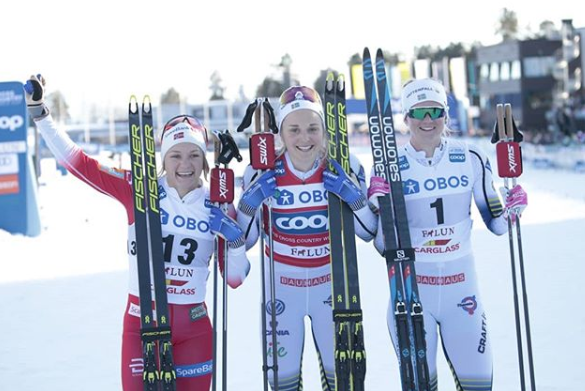
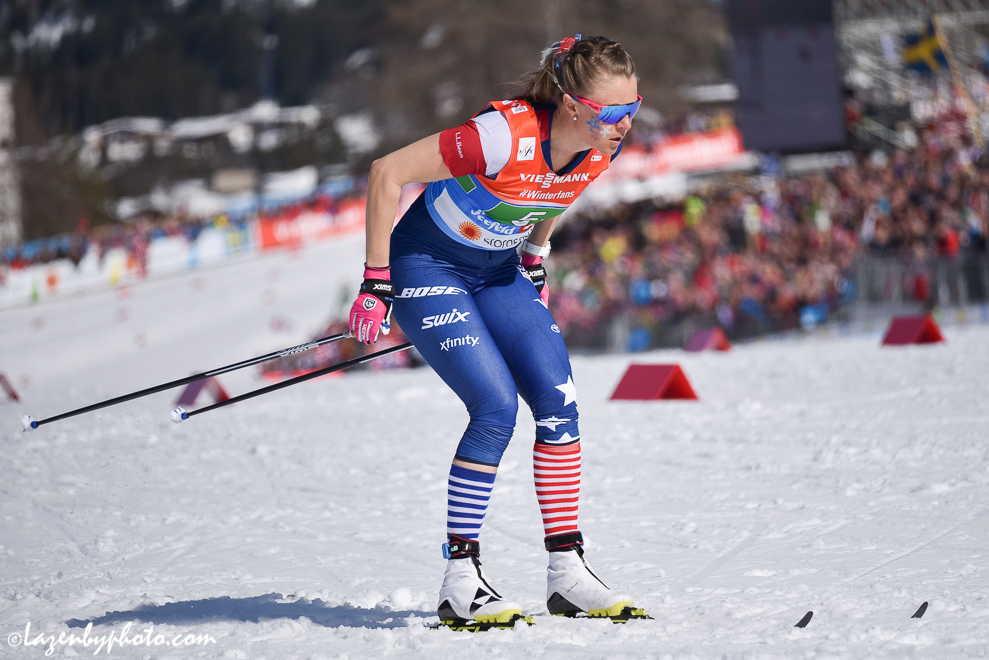
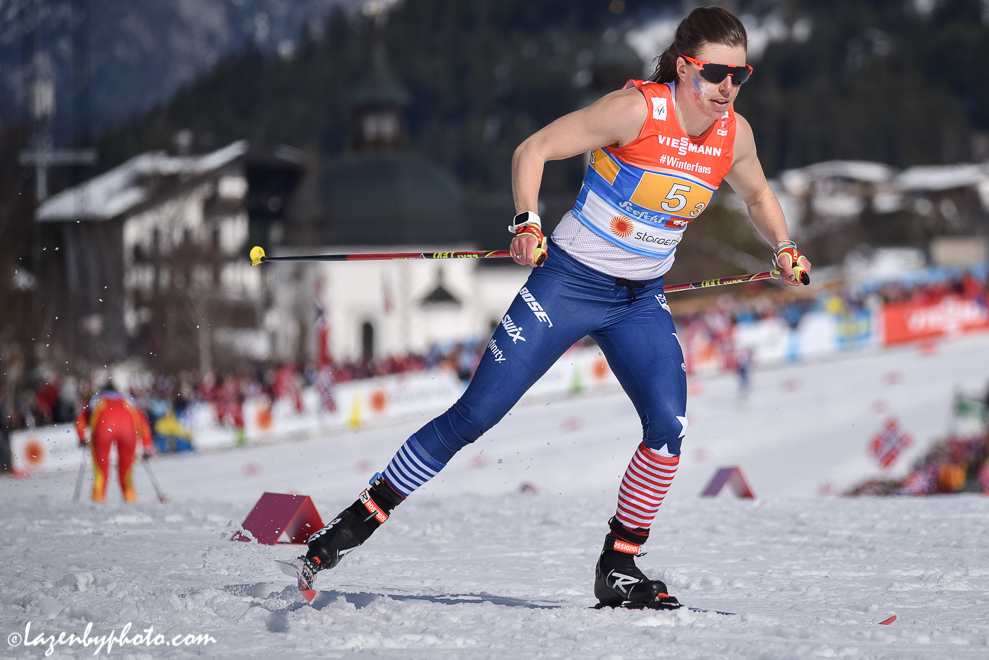
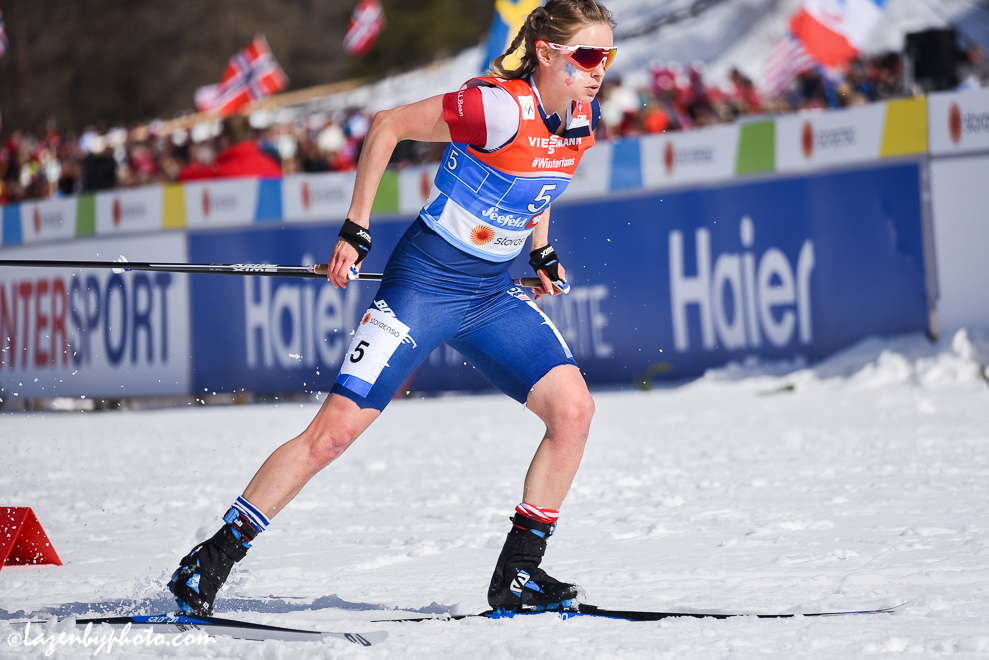
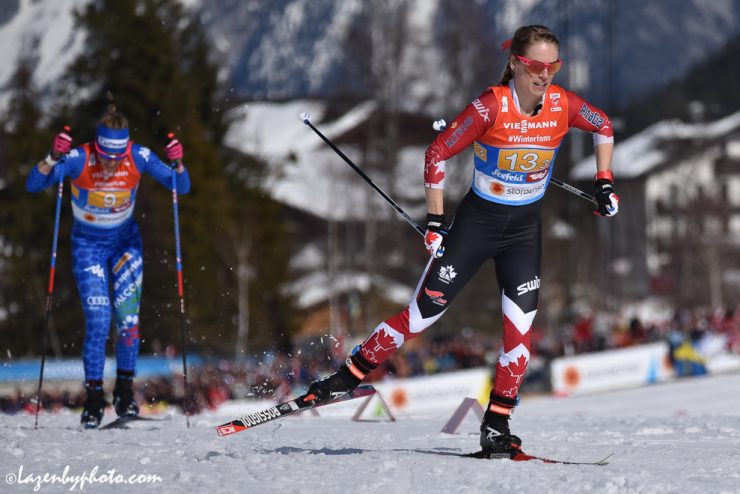
US Ski & Snowboard SuperTour Finals Presque Isles, Maine 30k/50k Mass Start Freestyle
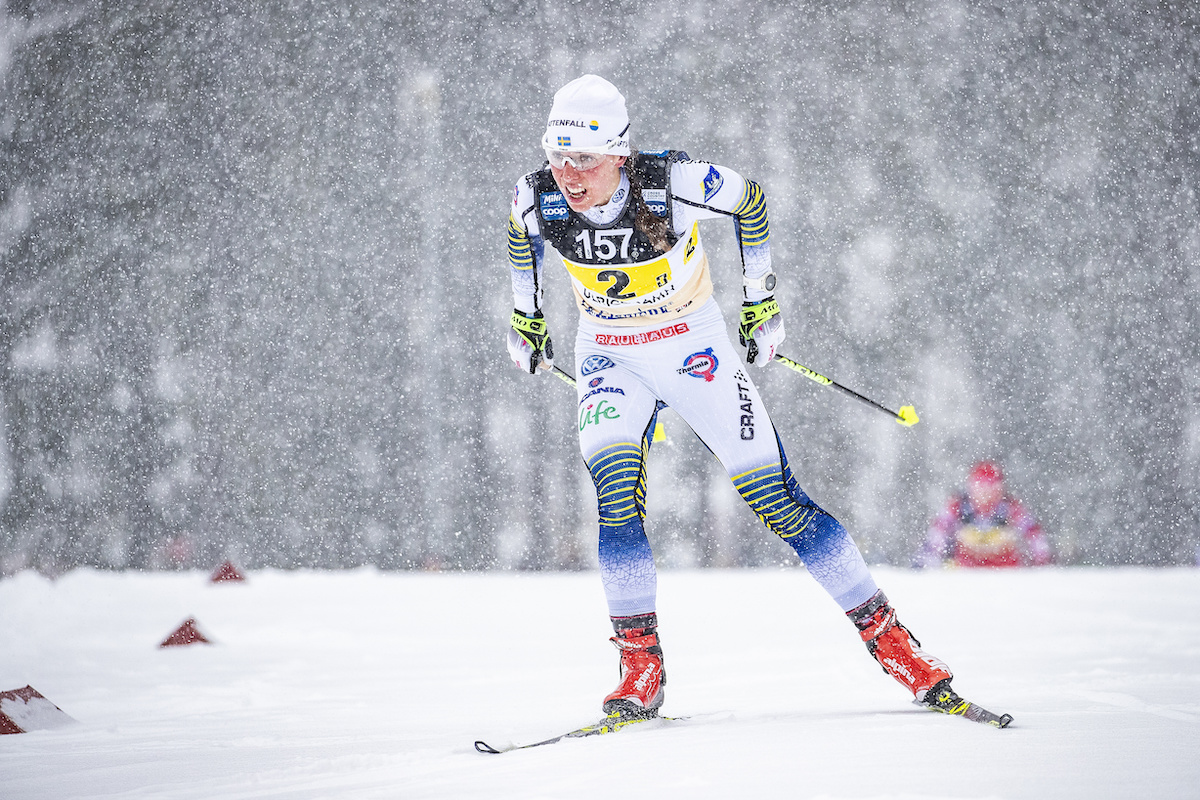
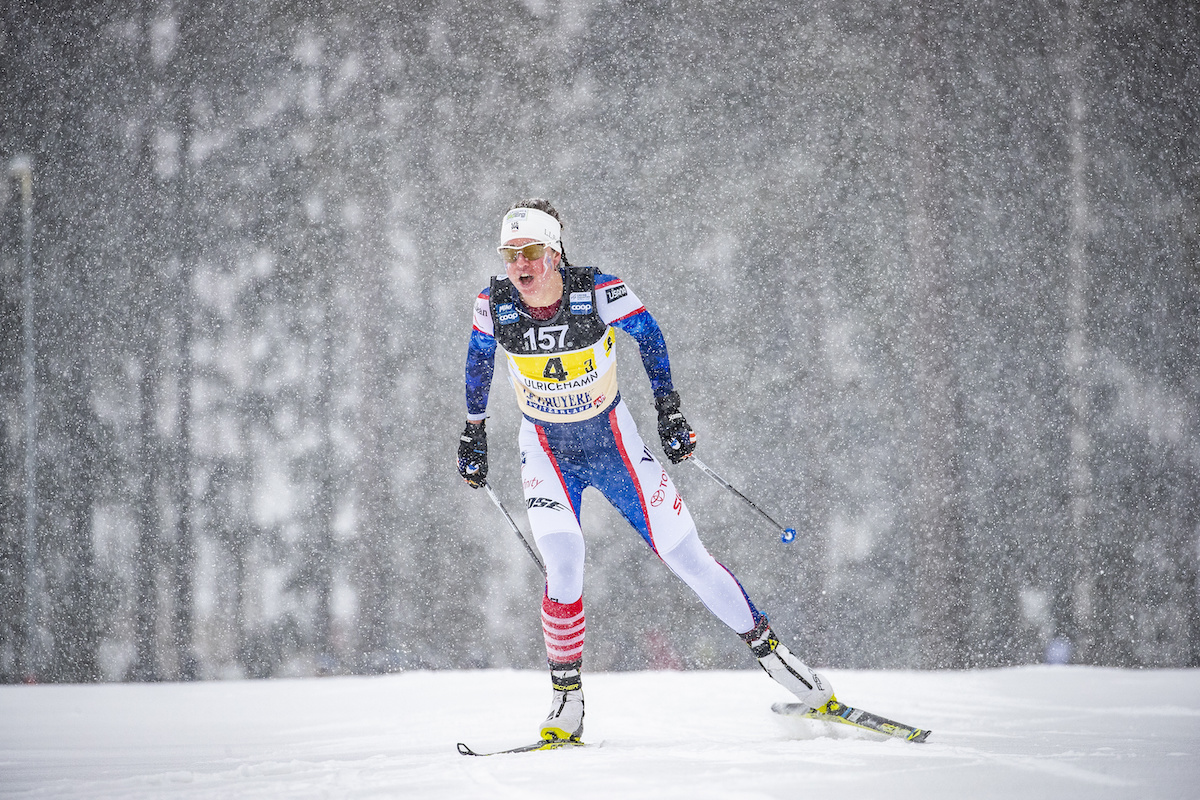
Tuesday marked the last day of SuperTour Finals and with it, the women raced a 30-kilometer mass start freestyle. Sadie Bjornsen (APU/USST) won in 1:21:29.4. Bjornsen was the pacesetter for much of the day. By the 10 k checkpoint, the potential podium challengers had been winnowed down to Bjornsen, Rosie Brennan (APU), Julia Kern (SMS T2/USST), Jessica Yeaton (APU), Katherine Stewart-Jones (NTDC Thunder Bay), Sophie Caldwell (SMS T2/USST), and Caitlin Patterson (CGRP). Rosie Frankowski (APU), who had been skiing with the front group, dropped off the pace to come through nearly 12 seconds back.
Bjornsen and Brennan turned the effort up, further breaking apart the select pack. At 25 k, The two APU skiers had gapped Kern by 13.2 seconds and Yeaton, now in fourth, by 20.9 seconds.
Bjornsen’s win came 33.9 seconds ahead of Brennan in second place. Kern placed third in a time of 1:22:42.2 to round out the podium.
Of note, Bjornsen’s final 5k split marked her fastest of the race. Her 5 k splits from start to finish are as follows: 13:20.4, 13:43.7, 13:54.1, 13:41.2, 13:42.6, and 13:07.1.
According to the International Ski Federation (FIS) Bjornsen earned her fifth non-sprint national title with her 30 k win. At SuperTour finals, the 30 and 50 k are considered national championship events. She won her first national championship in 2011 in Rumford, Maine’s 10 k classic. Bjornsen’s last distance national championship win came in 2014 when she won the 30 k mass start classic in Anchorage, Alaska. She also swept all three individual races this wee at SuperTour finals.
It became a two skier race in the men’s 50 k mass start skate with 10 k remaining. David Norris (APU) and Erik Bjornsen (USST/APU) pulled through the 40 k mark with a 32.7 second lead on Simi Hamilton (USST/SMS T2) in third. At this point, Scott Patterson (USST/APU) came through in fourth, 49.6 seconds behind, and full-time biathlete Jake Brown (CGRP) in fifth (+1:07.3). 1xbet Casa de apuestas
Bjornsen and Norris went unchallenged to the finish with Bjornsen making the winning move to put 9.5 seconds on Norris by the finish. Bjornsen won in 2:13:23.5, with Norris in second, and Hamilton third in a time of 2:14:45.7.
According to FIS, this was Erik Bjornsen’s fifth national championship in a distance event. In 2013 he won a 15 k skate, 2014 a 15 k classic, and the 50 k classic mass start in 2016 and 2018 respectively.
Super Tour Finals continued in the north woods of Presque Isle, ME with the first of the men’s and women’s distance events. Icy conditions caused a delay in racing and left fast classic tracks at the Nordic Heritage Center. The races can be streamed live or replayed on the U.S. Ski Team Facebook page.
The start of the men’s 15-kilometer mass start classic race during the Super Tour Finals in Presque Isle, ME (Photo: U.S. Ski & Snowboard – Reese Brown)
Men’s 15-kilometer Mass Start Classic
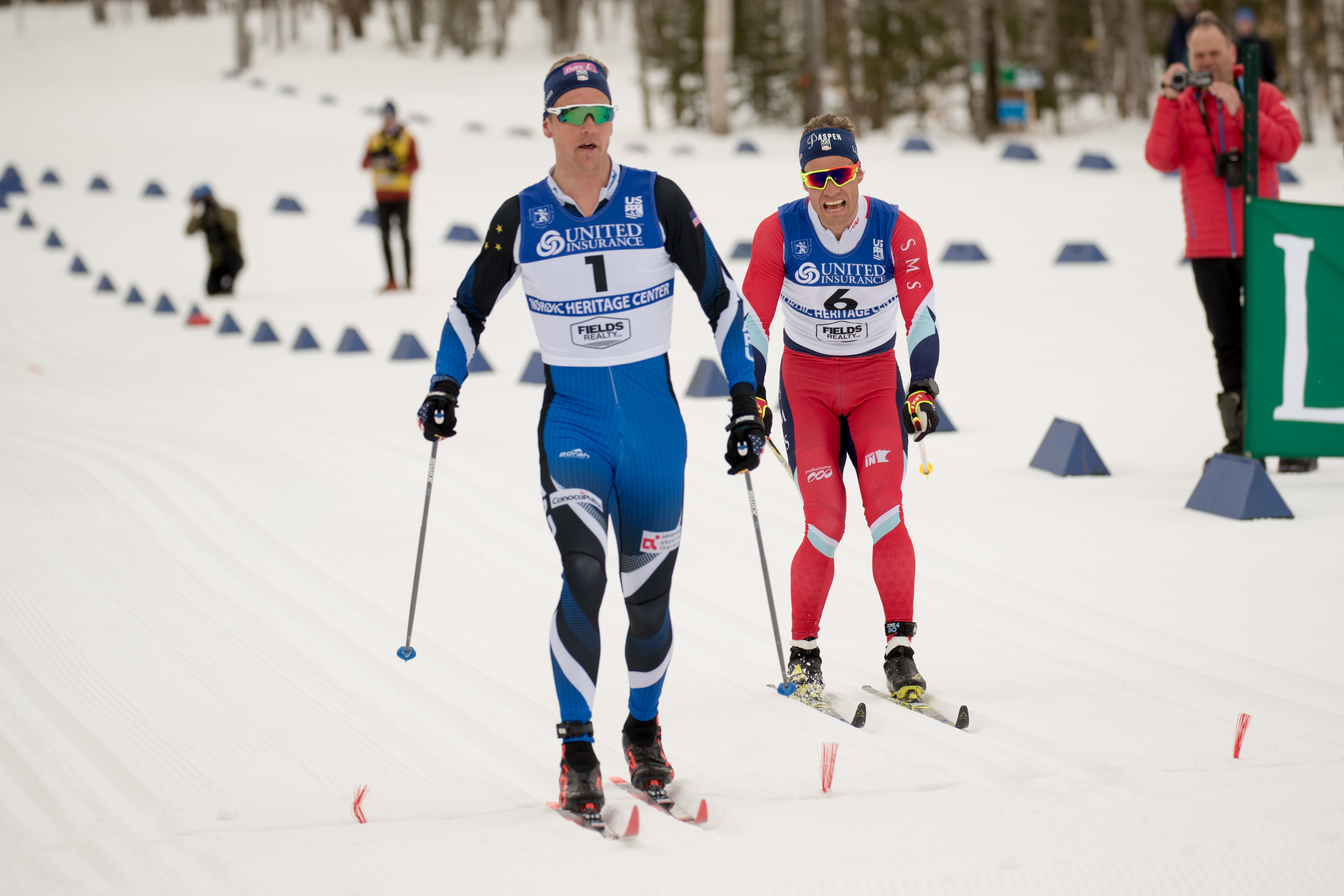
Erik Bjornsen (USST/APU) outs prints Simi Hamilton (USST/SMST2) at the finish of the 15-kilometer mass start classic during the Super Tour Finals in Presque Isle, ME (Photo: U.S. Ski & Snowboard – Reese Brown)
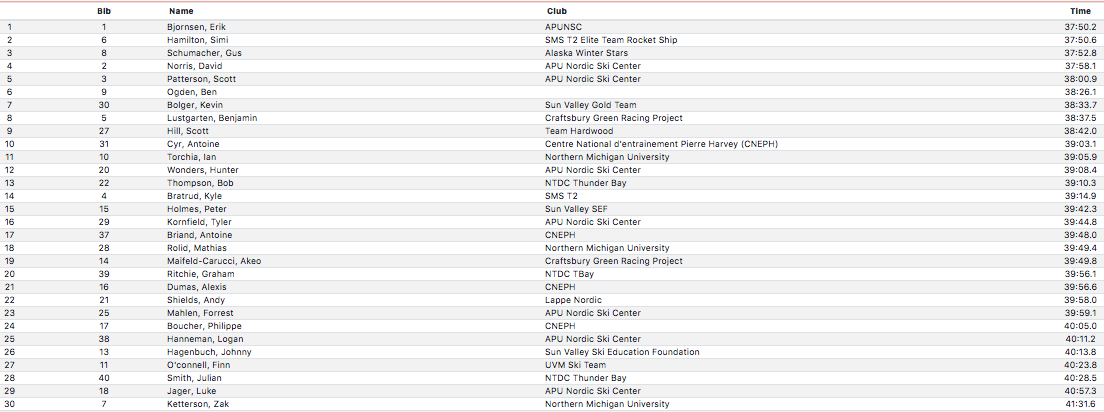
In the men’s 15-kilometer race, a pack of six men led by Simi Hamilton (USST/SMS T2) gradually pulled away from the field over the first 10 k. Tucked in behind him were Erik Bjornsen (USST/APU), Gus Schumacher (USST – D/AWS), Scott Patterson (USST/APU), David Norris (APU), and Ben Ogden (USST – D/UVM). As the group approached the end of their last 3.75 k lap, Hamilton and Bjornsen broke away with Schumacher close on their tails. In a final double pole sprint, Bjornsen edged out Hamilton, stopping the clock at 37:50.2. Hamilton crossed the line 0.4 seconds behind, followed by Schumacher in third (+2.6).
As a U-20 athlete, Schumacher’s podium finish is particularly noteworthy. Another strong U-20 result was had by USST D-Team athlete Ben Ogden (UVM) who took 6th.
The men’s podium for the 15-kilometer mass start classic during the Super Tour Finals in Presque Isle, ME. Erik Bjornsen (USST/APU; center) took the win ahead of Simi Hamilton (USST/SMST2; left) and Gus Schumacher (USST-D/APU; left). (Photo: U.S. Ski & Snowboard – Reese Brown)
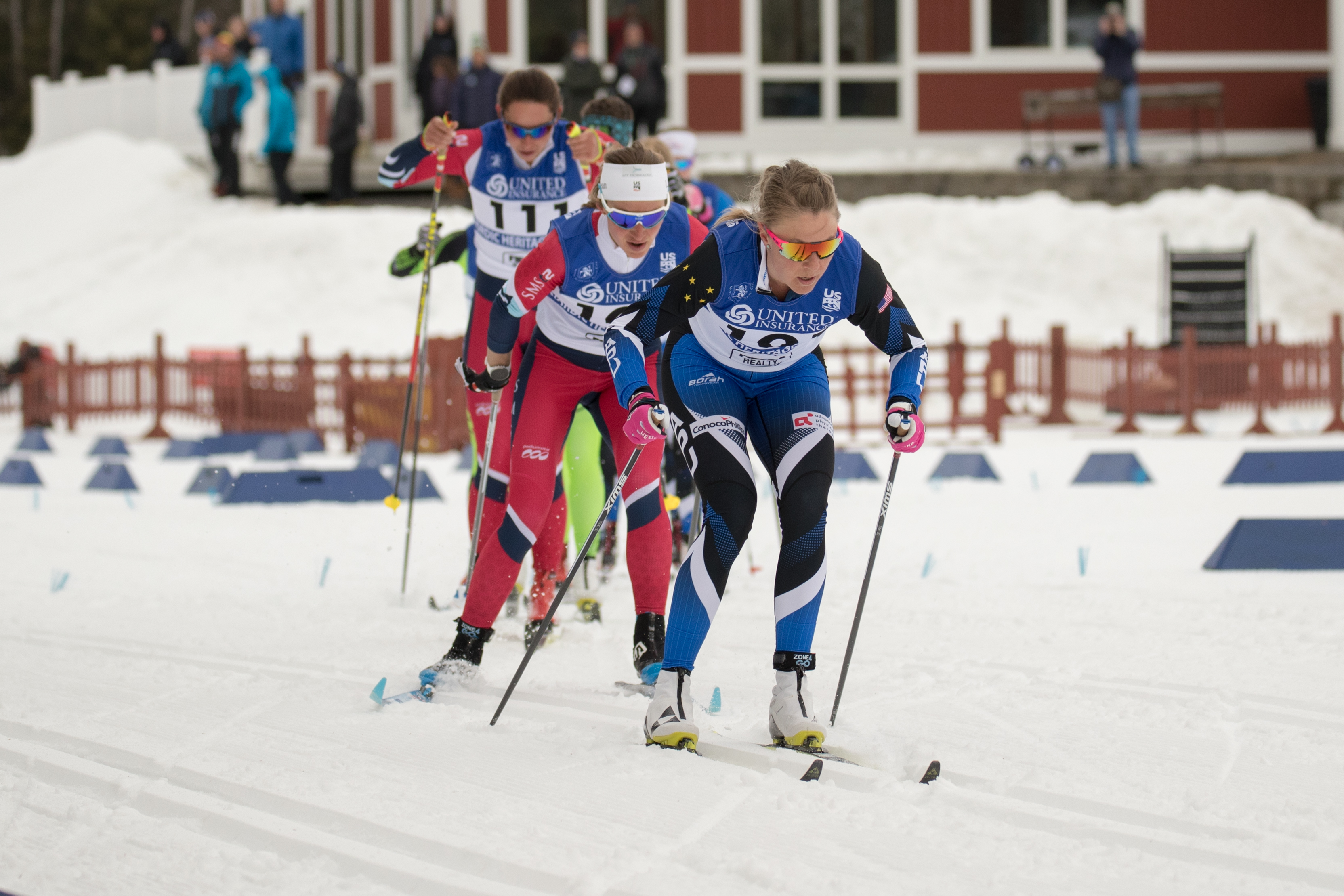
The start of the women’s 15-kilometer mass start classic race during the Super Tour Finals in Presque Isle, ME (Photo: U.S. Ski & Snowboard – Reese Brown)
The women’s 10 k event spread out much more quickly, as Sadie Bjornsen (USST/APU) charged to the front stringing out the women behind her. Skiing alone for the second half of the race, Bjornsen took the win handily with a time of 29:00.5. This is Bjornsen’s second consecutive win as she also won Friday’s 1.4 k freestyle sprint. Chasing her teammate, Rosie Brennan (APU) crossed the line in second (+19.4), followed by Dahria Beatty of Canada (CNST) in third (+31.3). Hailey Swirbul (USST – D/APU) crossed the line just after Beatty as the third American (+41.5).
Sadie Bjornsen leads the way during the women’s 10-kilometer mass start classic during the Super Tour Finals in Presque Isle, ME. (Photo: U.S. Ski & Snowboard – Reese Brown)
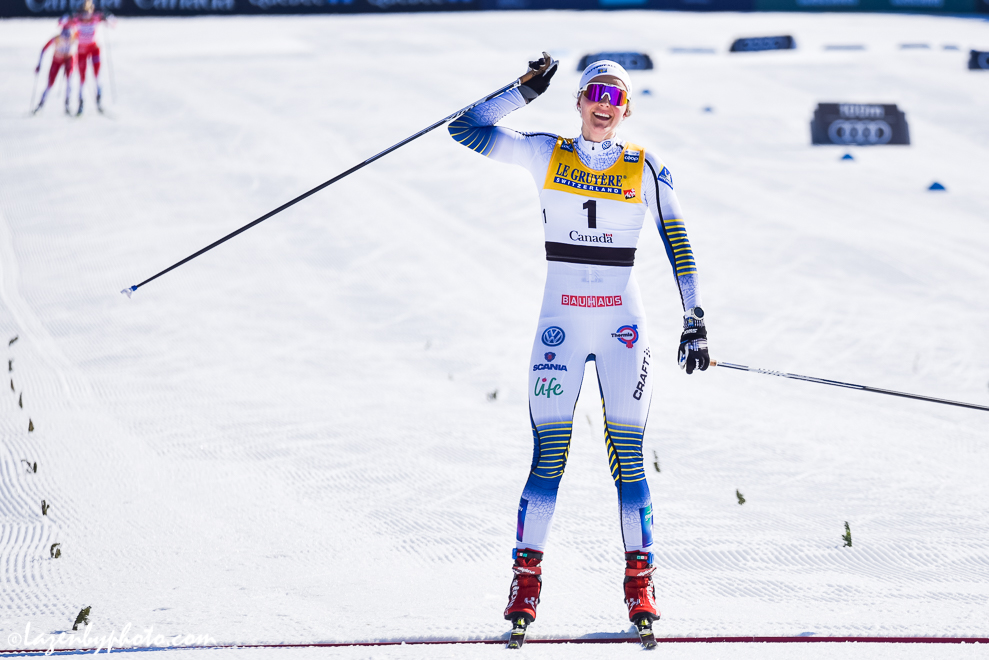
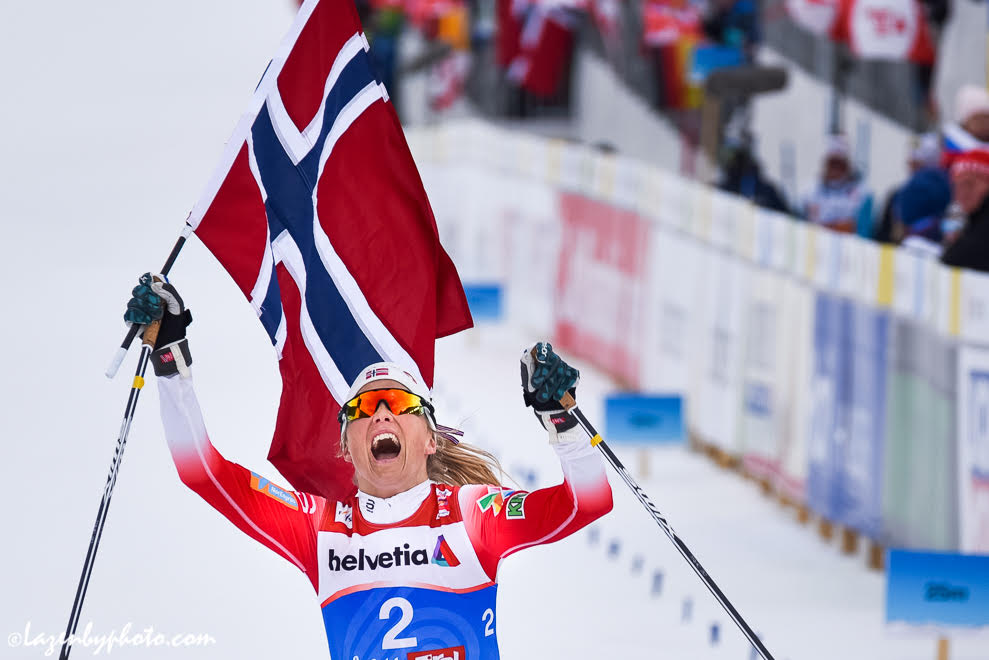
Stina Nilsson of Sweden taking the overall win in Québec City. Here she is crossing the line first in the 10 k skate pursuit. (Photo: John Lazenby/lazenbyphoto.com)
It was beginning to seem as though it could not be done, and then it happened. Norway’s Therese Johaug did not stand atop the podium after the 10-kilometer classic first stage of the women’s pursuit in Québec City. Sprint champion Stina Nilsson did. Not only that, but the bonus seconds garnered from Nilsson’s win in Friday’s skate sprint allowed her to enter the course for the final leg of the week’s three-race series with a margin that seemed as though it might be insurmountable over her nearest competitors. She started the 10-k freestyle pursuit 33 seconds ahead of Norway’s Ingvild Flugstad Østberg who took eighth in the sprint and third in the 10 k classic, and 49 seconds ahead of Johaug, who took 25th in the sprint and after a double pole battle that she could not win, finished only 0.2 seconds behind Nilsson.
When it was her turn, Johaug charged onto the course like a hungry cheetah in pursuit of a Swedish gazelle on the city’s Plains of Abraham. She was simply attacking the course with the unmatched tempo and fire that earned her a perfect record in regular season distance races. On a relatively flat course and hard packed fast conditions, she could not delay her chase; she needed to begin making up time as soon as she pushed through the start gate. At the front, Nilsson skied smoothly, remaining calm and collected despite knowing she was a target for the two skiers in red who were slowly reeling her in.
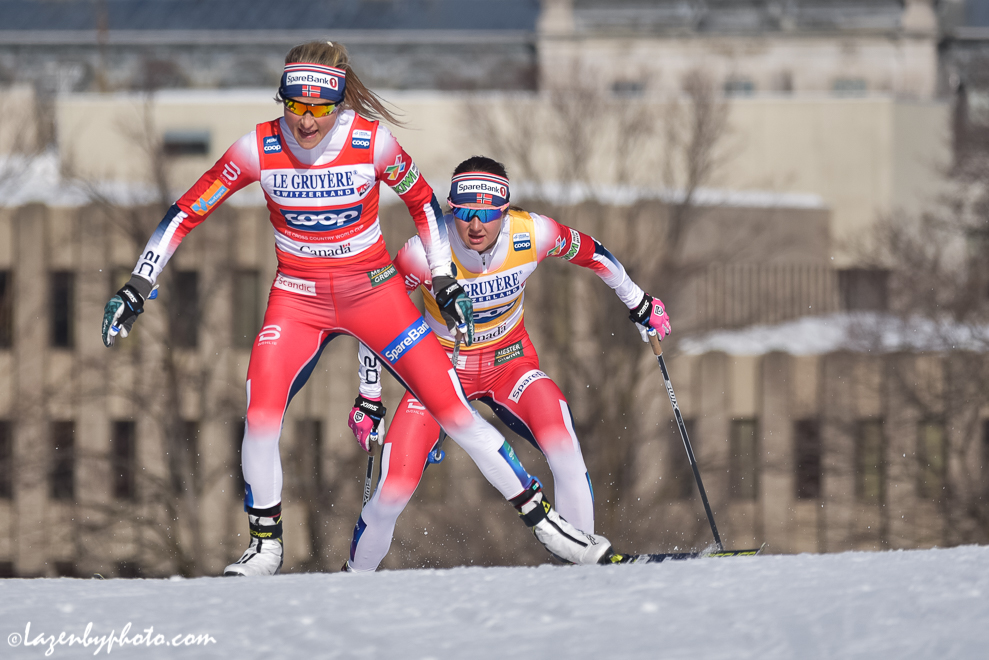
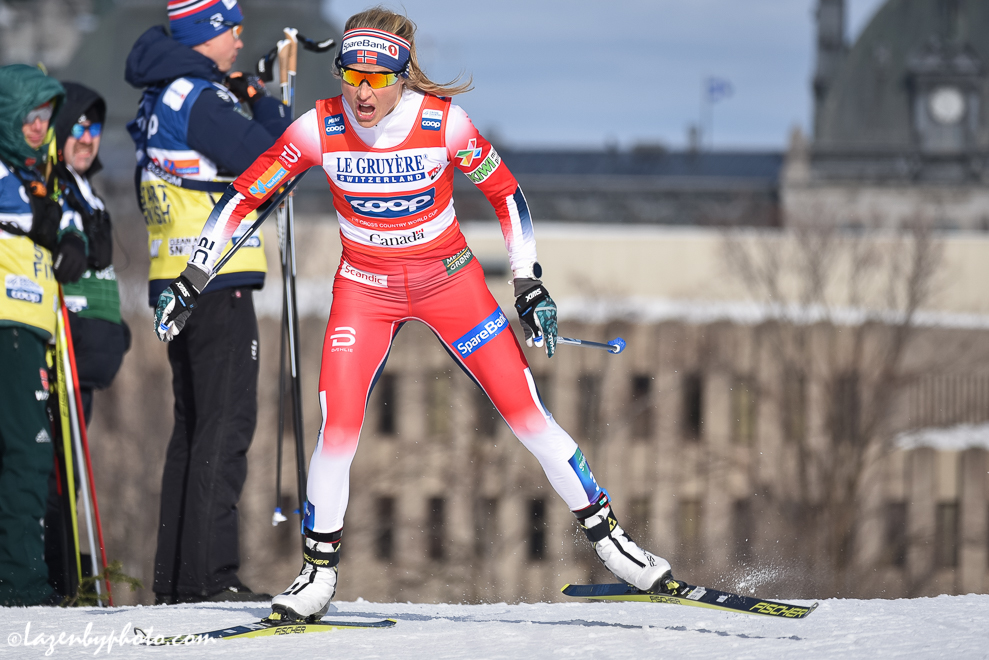
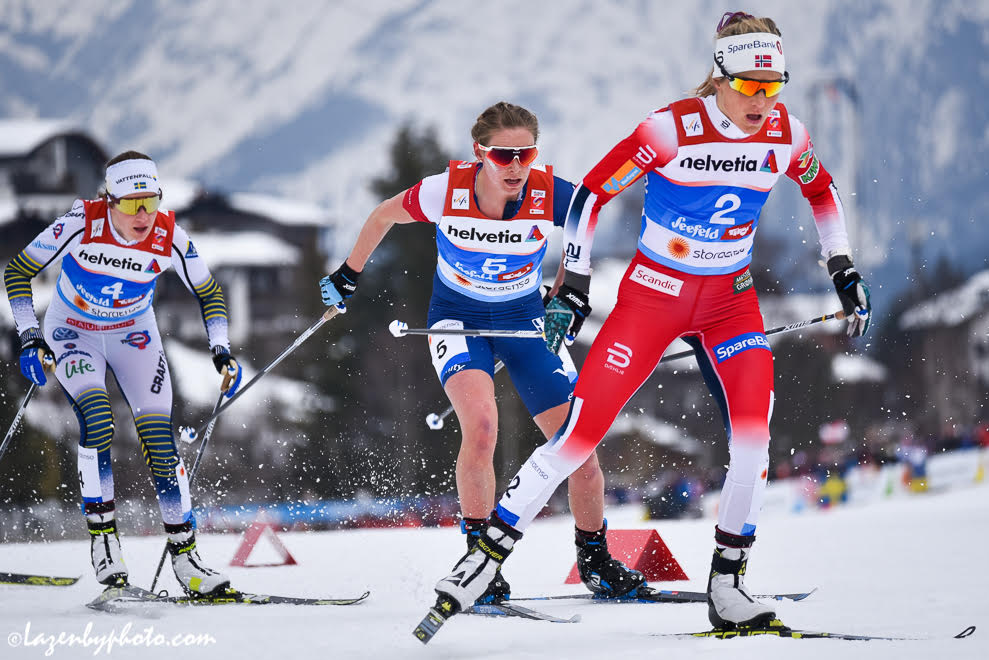
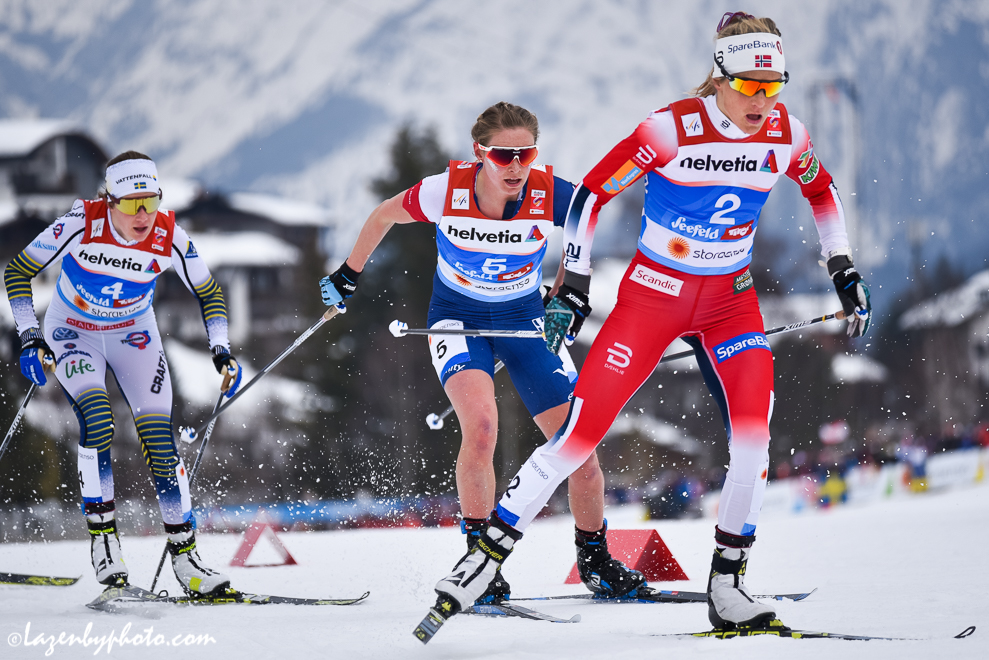
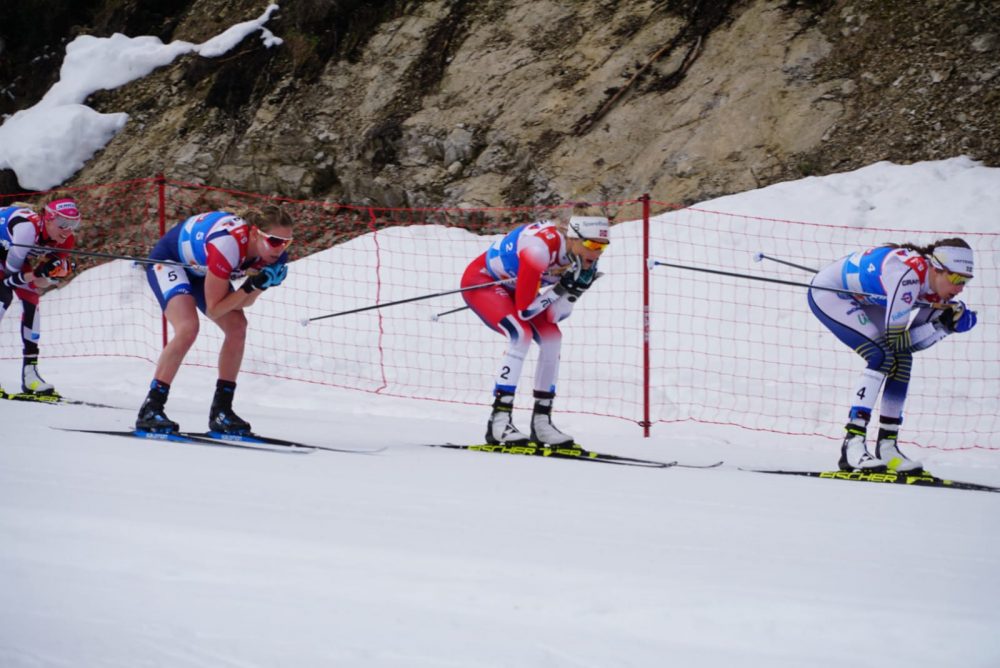
Norway’s Therese Johaug (front) and Ingvild Flugstad Østberg on the chase during the Québec City 10 k skate pursuit. (Photo: John Lazenby/lazenbyphoto.com)
By the 2.4 k checkpoint, Johaug had made up nearly 13 seconds of her deficit. By 5 k, she caught Østberg and remained tucked into her draft as the two continued to gain time on Nilsson. But as the finish line neared, it became clear that the Swede was not going to roll over for the Norwegians. In the final three kilometers, Østberg and Johaug could no longer make up significant ground and remained about 20 seconds behind Nilsson’s graceful and powerful V2.
With less than 1k to go, Nilsson crested the hill by the stone Martello gun tower and headed for the stadium. The Norwegians were lurking not far behind as she rounded the corner past the cannon and no pole skated down the hill before climbing over the final roller. But they were quickly running out of real estate in their chase.
When she arrived at the stadium, she looked back and smiled. The gazelle was safe. She stood up and gave a wave, then continued to ski with purpose and joy to the hairpin turn before the final 100 meters where she savored her hard earned sweep of the World Cup Final tour. Nilsson looked both relieved and proud as she crossed the line, stopping the clock at 23:55.1. Never laying off the gas, Johaug slid through the finish 12.9 seconds behind, followed by Østberg in third (+15.1).
Stina Nilsson of Sweden solo and in front during the Québec City 10 k skate pursuit. (Photo: John Lazenby/lazenbyphoto.com)
“It was really good,” Nilsson told the International Ski Federation (FIS) after the race. “I expected them to catch me quite fast, but when they didn’t I felt like, ‘okay, then I just keep going on with this speed’. It was really nice to be able to enjoy the last 100 meters because it is not so often that I can do that. So, it was really nice.”
The Swede has been well suited for the track in Québec, and though she was skiing alone, Nilsson never felt that way, as cheering spectators lined the majority of the course.
“I really like the course here, as I said yesterday,” she told FasterSkier in the mixed zone. “And the crowd was almost everywhere, so I was never alone even though I never had any [competitors] ahead of me.”
Her clean sweep of the tour was not the first time she has seen success in Canada. She also won the freestyle sprint there in both 2016 and 2017.
“Before this weekend, I had two victories here, and now I have five, so I really like Québec,” she laughed.
With Russia’s Natalia Nepryaeva far behind in 12th (+1:53.0), Østberg also breathed a sigh of relief as she officially became the overall winner of the World Cup season. She led by only a small margin entering the tour, and as Nepryaeva experienced first hand after a crash and broken pole in the classic stage, anything can happen in the finals. Her younger self might have been in disbelief of this title, as she could not imagine herself at the level of her teammates who became champions before her.
“It’s hard to describe actually,” she told FIS about her emotions after the race. “I think I never could have dreamt about fighting for this jersey for some years ago, I saw Marit and Therese fighting for it and I was like, ‘Oh my god, they have the yellow jersey.’ And this year, I managed to fight for it, and the last races I’ve been tough both physically and mentally, and fight between me and Nepryaeve. Today, when I managed to finish on the podium in the tour and can say that I’m the winner of the overall world cup, it’s an unbelievable feeling.”
Norway’s Therese Johaug during the Québec City 10 k skate pursuit. (Photo: John Lazenby/lazenbyphoto.com)
Though she did not catch Nilsson, Johaug skied the fastest time of the day, adding to her heavy purse of FIS points. Her second place finish Saturday did not make a dent in the lead she had over the rest of the women in the distance standings; she was essentially in possession of the distance globe before the final tour started. Even without competing in the Tour de Ski, Johaug’s string of nine victories, coupled with her results this weekend amassed 956 points, 139 more than Østberg who took second. She also finished the season ranked third in the overall despite only entering one sprint event on Friday.
“I’m so happy,” she told FasterSkier. “I cannot believe that I am been so good shape the whole time and coming back after two years out and have these results that I have. So I’m really happy.”
The American women were unable to crack the top 10 in the overall tour standings, but four of them were able to place within the top-30 in the Winner of the Day results. Sadie Bjornsen was the overall top ranked skier finishing 11th (+1:45.4) with the 13th fastest time on the course.
Sadie Bjornsen of the U.S. Ski Team coming into place 11th during the Québec City 10 k skate pursuit. (Photo: John Lazenby/lazenbyphoto.com)
With her usual spark and never-give-up positive attitude, Jessie Diggins moved ahead nine places to finish 14th overall (+1:53.6).
“That was a really fun way to end the season,” Diggins told FasterSkier in the mixed zone. “Skating is always so fun because you can go as hard as you want to go, and it was really fun to be able to have the tools I needed to be able to use what energy my body had. So that was just very satisfying. I got to go so hard and dig deep, and it was just really fun to ski up and ski the way I know I can ski. So yeah, it’s just always fun to end your season on a good race.”
And it was a good race. Diggins powered through the course to ski the 4th fastest time of the day behind Johaug, Krista Pärmäkoski of Finland, and Ebba Andersson of Sweden.
“I was just going after time of day,” she explained. “I wasn’t really worried about where I place in the overall, I just wanted to put together the best race that I could.”
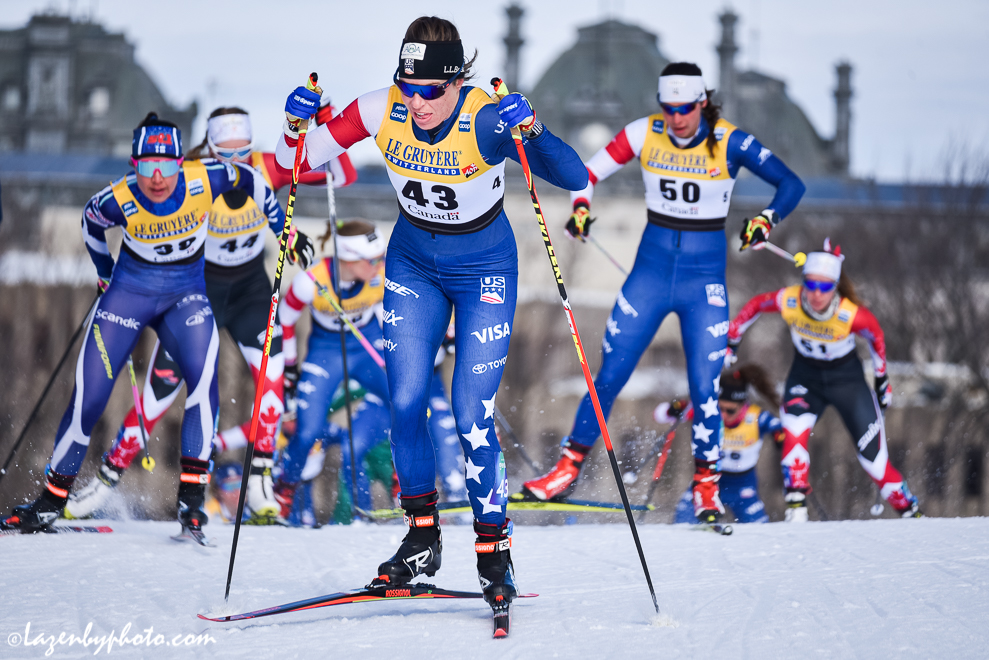
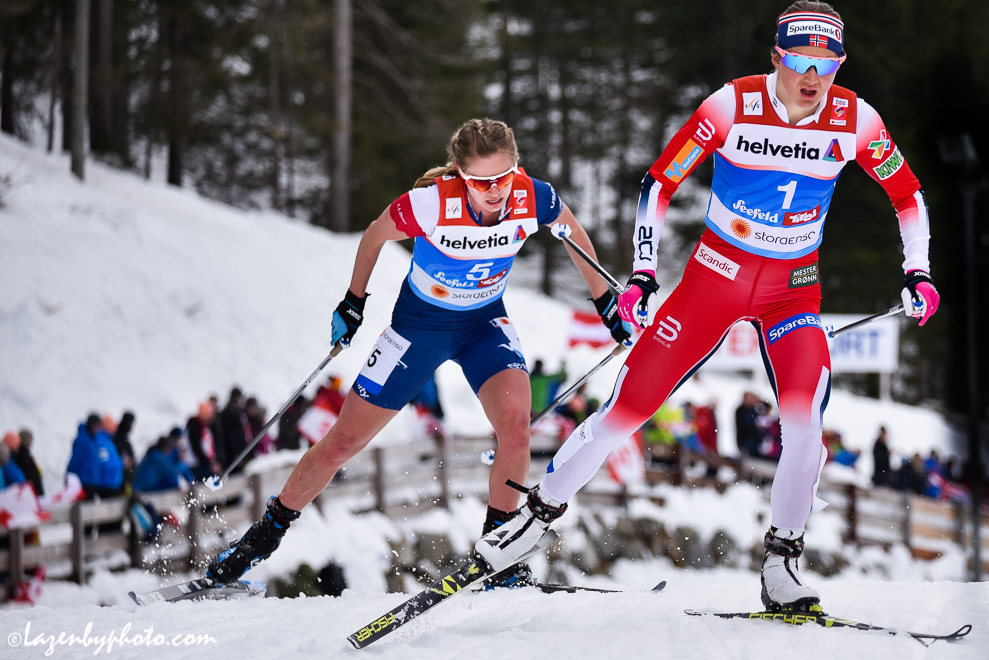
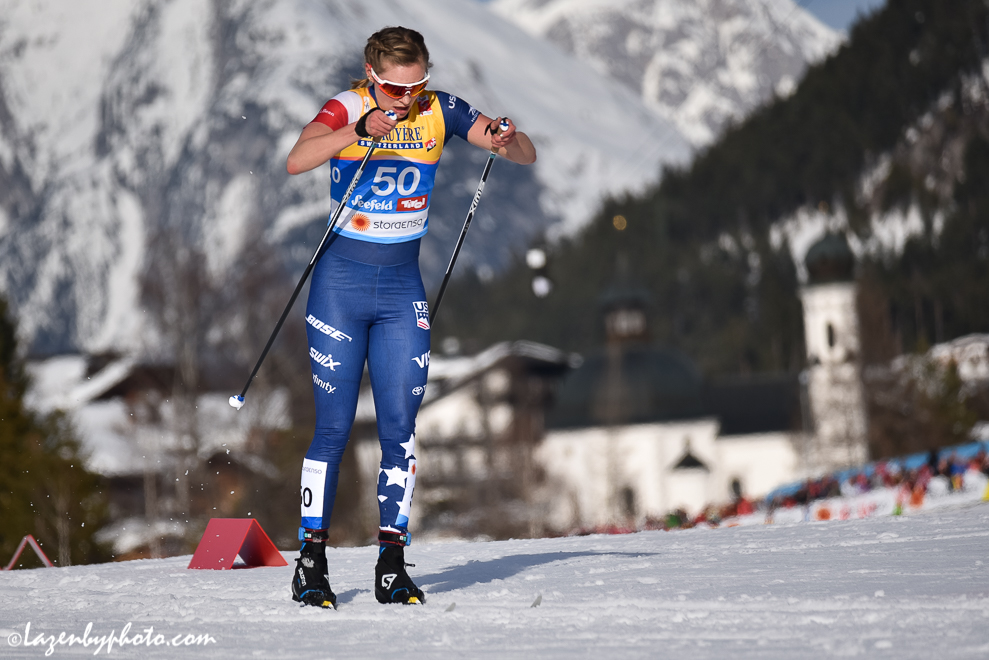
Rosie Brennan (bib 43) and Julia Kern (bib 50) during the Québec City 10 k skate pursuit. (Photo: John Lazenby/lazenbyphoto.com)
Rosie Brennan moved from 43rd to 39th by skiing the 28th fastest time of day (+4:41.8), and Julia Kern moved ahead seven spots to finish 43rd with the 30th fastest time (+5:23.7).
While Brennan had hoped for more from this weekend, she is proud of her race today.
“This is way better than yesterday,” she told FasterSkier. “It still wasn’t like… I had hoped to be fighting a little higher in the overall tour, but it was good to at least feel strong today and have some fight in there, so yeah, it was good.”
Brennan added insight into the tour format and race conditions during the final series in Quebec.
“It was a little bit wild,” she admitted. “We had a lot of gnarly conditions, so it’s been kind of a game of survival, which is in some ways fun but also hard because there’s so many things out of your control. So it’s maybe hard to get your storybook ending of the year. But it’s fun to be somewhere where we have so many fans. So that helps make up for all the crazy conditions we’ve had.”
Austria’s Terese Stadlober (bib 29) leading the U.S. Ski Team’s Sophie Caldwell (bib 31) during the Québec City 10 k skate pursuit. (Photo: John Lazenby/lazenbyphoto.com)
Also for the U.S., Sophie Caldwell finished 36th (+4:05.1), Hailey Swirbul 41st (+5:06.2), Caitlin Patterson 46th (+6:11.4), Katherine Ogden 47th (+6:13.9), Ida Sargent 48th (+6:21.9), Kendall Kramer 51st (+6:31.4), Kaitlynn Miller 52nd (+6:44.7), Hannah Halvorsen 58th (+8:24.3), Becca Rorabaugh 59th (+8:44.1), and Alayna Sonnesyn 68th (+11:02.3).
Kendall Kramer from Fairbanks, Alaska during the women’s 10 k skate pursuit on Sunday. (Photo: John Lazenby/lazenbyphoto.com)
Today’s race will be the last of Sargent’s career. The bio of the 31-year-old Craftsbury Green Racing Project member includes a long list of top 30 finishes from as far back as 2012. She competed in two Olympics, Sochi and PyeongChang, and stood on the podium three times during her career. As her hometown of Barton, VT is only three hours from Québec City, she was able to ski her final race with plenty of family and friends cheering her on. FasterSkier did not hear from Sargent after her finish, but after skiing together for seven years as USST A-Team members, Diggins shared her thoughts on Sargent’s retirement.
“She’s had an incredible career,” said Diggins, “but beyond that she’s just a really caring teammate and she’s always down for a laugh. It’s hard to have somebody who, you know… we joined the team at the same time, so we’ve been on the team together the entire time. It’s hard to see someone retire, but I know that she’s going to do amazing things in her next career and I’m just so happy for her that she got this beautiful wonderful day in front of so many home fans to have her last race. What a special experience. And it was fun to spray her with champagne,” she laughed.
Ida Sargent (bib 46) retired from World Cup racing after Sunday’s race. (Photo:John Lazenby/lazenbyphoto.com)
Since the finals were held in Canada, the U.S. was given the opportunity to enter more athletes in the races. This gave several younger athletes, including 16-year-old Kramer of Fairbanks, AK, the opportunity to experience their first World Cup race.
“It’s just amazing,” she shared regarding her experience. “This is probably the most spectators that have called out my name like ever before. It was just super amazing. This is one of the first times I’ve been hearing anything from the crowd,” she continued. “Usually I’m just in my zone racing, but now I can hear what everyone is saying and it’s all just really really fun.”
After her first season on the USST D-Team, Swirbul is walking away with a slew of positive results, including a 10th place finish in the 15 k classic at the U23 World Ski Championships in Lahti.
The Basalt, CO native said cheerfully that she is “ready for some rest and recovery and to train hard all summer and fall and do it again next year.”
Hailey Swirbul of the USST D-Team, during Sunday’s race. (Photo: John Lazenby/lazenbyphoto.com)
Emily Nishikawa was Canada’s top finisher. She began as the 37th skier and placed 31st (+3:53.9).
“I had a blast racing today,” Nishikawa told FasterSkier. “I felt really strong and I’m really happy with the way I skied today.”
The next two fastest were Katherine Stewart-Jones who finished 44th (+5:27.2) followed by Dahria Beatty in 45th (+5:47.7).
– Peggy Shin, Gerry Furseth and Kelsey Dickinson contributed
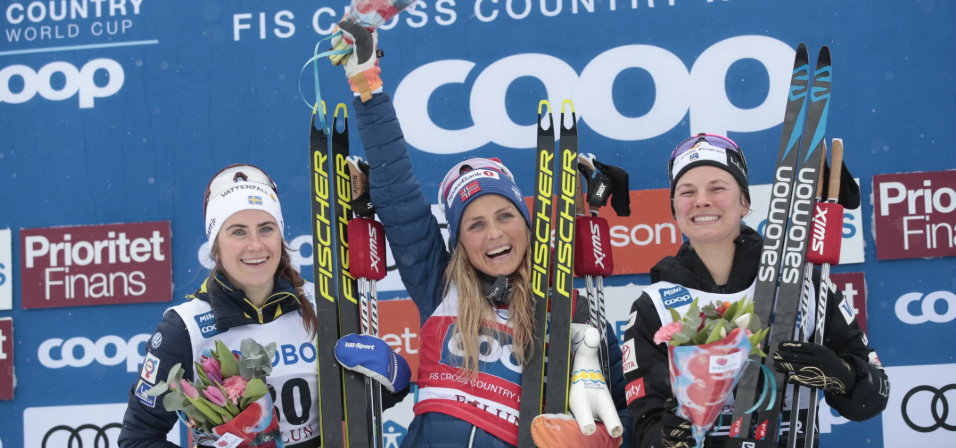
The podium from the 10 k skate in Falun, Sweden. From left to right, Sweden’s Ebba Andersson in third, Norway’s Therese Johaug in second, and the U.S. Ski Team’s Jessie Diggins in third. (Photo: fis-ski.com screenshot)
FIS World Cup Falun, Sweden 10k/15k Inidividual Freestyle
The sun rises. The sun sets. And Norway’s Therese Johaug won the 10-kilometer individual start freestyle in Falun, Sweden. In 25:23.9 minutes, Johaug made her winning statement. Sweden’s Ebba Andersson placed second (+18.75), with the U.S. Ski Team’s (USST) Jessie Diggins in third (+30.3).
Fourth place went to Ingvild Flugstad Østberg of Norway who finished 30.8 seconds back.
Sadie Bjornsen (USST) raced to 12th (+1:05.7), Julia Kern (USST) 25th (+1:53.9), Rosie Brennan (APU) 27th, Kaitlynn Miller (CGRP) 34th (+2:21.5), and Rosie Frankowski (APU) 35th (+2:26.1).
The men’s 15 k skate was won by Russia’s Alexander Bolshunov in 33:18.6 minutes. Martin Johnsrud Sundby of Norway was second (+8.9) and Didrik Tønseth third (+17.7).
The top North American finisher was Canada’s Alex Harvey in 11th (1:10.9). Jack Carlyle finished in 66th (+5:55.5).
For the U.S., David Norris (APU) placed 16th (+1:15.3), Kevin Bolger (USST)45th (+2:41.9), and Scott Patterson (USST)54th (+3:39.8), Kyle Bratrud (SMST2) did not start.
IBU World Championships Östersund, Sweden 12.5 k Mass Start
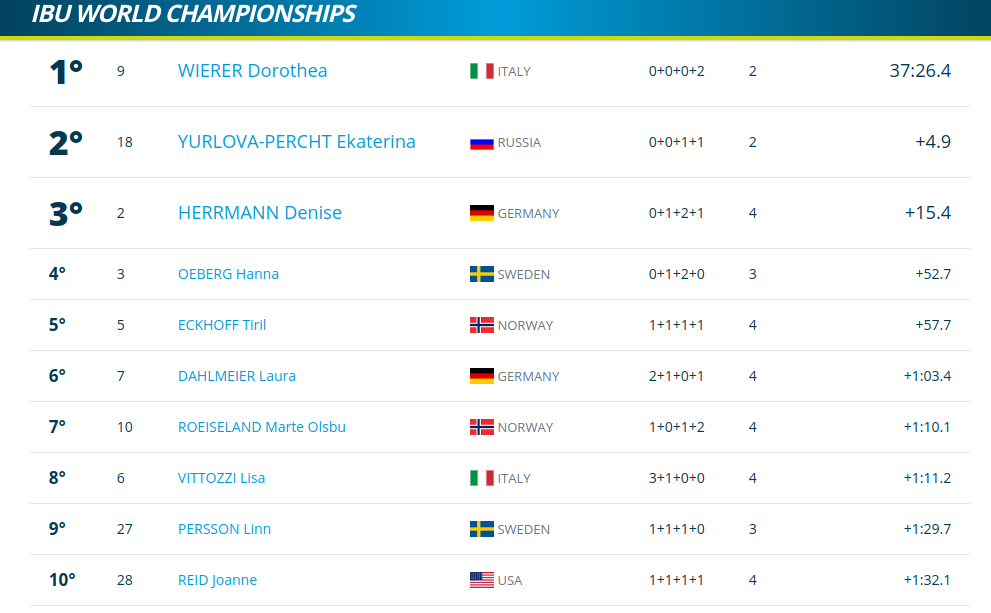
Here’s the top-10 results from today’s 12.5 k mass start in Östersund, Sweden. The eyes need only read 10 skiers down for U.S. biathlete Joanne Reid’s name. There it is: 10th place for a career best individual result at a championship event.
Her teammate Clare Egan placed 26th (+3:01.4, 0+0+3+2).
Women’s podium from the Falun, Sweden 1.4 k skate sprint. From left to right, Maiken Caspersen Falla of Norway in second, Stina Nilsson of Sweden in first, and Maja Dahlqvist of sweden in third. (Photo: @fiscrosscountry Instagram screenshot)
FIS World Cup Falun, Sweden 1.4 k Freestyle Sprint
On a day when sugary snow course picked off skiers trying to advance during Falun, Sweden’s 1.4-kilometer freestyle sprint, Stina Nilsson, yes of Sweden, took the win. She won the final in 3:07.72 over Norway’s Maiken Caspersen Falla in second (+0.67). The day’s top qualifier, Maja Dahlqvist, placed third (+2.14).
The Americans entered in the race were some of the key players who tumbled on course. Jessie Diggins (USST) qualified in 21st and was leading the second quarter final when she fell on a sugared downhill to place 28th overall. Both Sadie Bjornsen (USST), ranked fourth after qualification, and Sophie Caldwell advanced to the semis.
Caldwell took a belly slide on the the course’s funky downhill to place sixth in her semi and finish 11th overall. In the second semi, Bjornsen was eliminated after placing fifth. She finished 10th overall.
In the men’s 1.4 k skate sprint, Norway’s Johannes Høsflot Klæbo continued his winning ways with another sprint victory. He won the final in 2:52.38, 0.1 seconds over teammate Emil Iversen. Another Norwegian, Sindre Bjørnestad Skar, placed third (+0.28).
U.S. skier Simi Hamilton (USST), who qualified in 16th, bowed out in the quarterfinals after placing fifth in his heat. Hamilton was 22nd overall. Kevin Bolger (USST) advanced to the heats where he was eliminated to end up 27th overall.
Also for the U.S., Logan Hanneman (APU) placed 39th, and Ben Saxton (SMS T2) was 60th.
Alex Harvey of Canada ended his race in 31st. He was the only Canadian entered.
Norway’s Therese Johaug with the Holmenkollen 30 k classic win and no challengers in site. (Photo: ARD screenshot)
FIS World Cup Oslo, Norway Holmenkollen 30 k Classic
Beautiful sunshine. Norwegian crowds. And fine views of Oslo fjord from atop the Holmenkollen venue for the women’s 30-kilometer mass start classic. All things typical on a good weather March day in Oslo.
Norway’s Therese Johuag took this fine day and turned the screws on the 47 starters on Sunday to once again ski away from the field. By the second points bonus at 8k, Johaug was already 23.6 seconds up on the field. She won the race in 1:18:54.5 hours. According to the International Ski Federation (FIS), this was Johaug’s third 30 k win at Holmenkollen and her second classical victory. She won the 30 k skate in 2013. Her first Oslo 30 k classic win came in 2016.
Russia’s Natalia Nepryaeva placed second 1:45.9 minutes back. Ebba Andersson of Sweden skied to third (+149.9).
Rosie Brennan (APU) was the top U.S. skier in 33rd (+ 7:57.0). Rosie Frankowski (APU) placed 34th (+9:40.2), and Kaitlynn Miller (CGRP) 42nd (+13:43.7).
Jessica Yeaton (APU/Australian National Team) raced to 30th (+7:29.4).
IBU World Championships Östersund, Sweden 10 k/12.5k Pursuit
On Saturday’s 10 k pursuit at the IBU World Champs in Östersund, Sweden the German women took first and third. Denise Herrmann won in 31:45.9 minutes with two penalties in her third shooting stage. Tiril Eckhoff of Norwayplaced second, 31.4 seconds back while also skiing two penalties in her third shooting stage. Germany’s Laura Dahlmeier was a close third (0+0+1+0, +31.6).
Clare Egan of the U.S. was 12th (2+0+0+3, +2:44.3), Susan Dunklee raced to 24th (2+0+0+1, +3:27.6), and Joanne Reid 32nd (3+2+1+0, +4:24.2).
For Canada, Sarah Beaudry finished 42nd (2+1+1+0, +5:23.5), while Rosanna Crawford, Emma Lunder, and Megan Bankes were lapped.
In Östersund on Sunday, the men raced the 12.5 k pursuit. Ukraine’s Dmytro Pidruchnyi, who placed fourth in yesterday’s sprint, came away with the win in 31:54.1. Remarkably, it was Pidruchnyi’s first race win either on the IBU World Cup or at the championship level. The 27 year old missed two targets for the day.
Johannes Thingnes Bø of Norway, the biathlete who has dominated the men’s side this season, placed second (+8.3). Bø’s ski speed was such that he took silver despite missing five targets he won the Silver medal. Taking third (+17.7) was France’s Quentin Fillon Maillet. He missed three targets in earning bronze.
For the U.S., Sean Doherty raced to 20th (+1:54.3) while missing two targets. Leif Nordgren placed 44th (0+0+3+1, +4:02.7), and Jake Brown 53rd (1+1+4+1, +6:00.8).
Canada’s Scott Gow began in bib 50, and skied up to finish 43rd (2+0+0+2, +3:51.4).
Soggy snow could not stop the V-1 perfection of Therese Johaug as she soloed to win the women’s 30 k skate at the 2019 World Championships. (Photo: John Lazenby/lazenbyphoto.com)
From start to finish on Saturday, Norway’s Therese Johaug commanded the front without missing a beat.
By the 5 k mark, the top seven skiers, which included Norwegians Ingvild Flugstad Østberg and Astrid Uhrenholdt Jacobsen, Austrian Teresa Stadlober, Sweden’s Ebba Andersson and Frida Karlsson and American Jessie Diggins, as well as Johaug, had a close to 30 second gap on the field’s remaining 41 starters.
But for anyone familiar with Johaug, it isn’t enough to just be in the front.
In another kilometer and a half, the Norwegian had separated herself completely from the pack. Anyone looking to challenge her for the gold medal win had a 15 second gap to close. By the 8.6 k mark, that deficit had grown to 30 seconds.
Andersson and Karlsson led the group charging for second place, which almost a third of the way through the race, was a battle between Diggins, the two Swedes, Stadlober, Østberg and Switzerland’s Nathalie von Siebenthal.
Diggins began to pull at the front of that chase group at the 9 k mark, maintaining her press for the next 5 k. Johaug, however, continued to hold them off.
Jessie Diggins (bib 5) chasing Norway’s Ingvild Flugstad Østberg in the women’s 30 k skate at Seefeld, Austria’s 2019 World Championships. Diggins placed fourth, Østberg second . (Photo: John Lazenby/lazenbyphoto.com)
“I felt really good today,”Johaug said during an interview with the International Ski Federation (FIS) after Saturday’s 30 kilometer mass start. “I wanted to go fast from the beginning. When I get a gap I think I have to try. Then I just went as fast as I could all the way.”
When Johaug exchanged skis at the 18.75 k mark, she had entered all too familiar race territory as the solo frontrunner. Forty-three seconds after Johaug’s ski switch, Diggins had also swapped boards and was once again, leading the chase group.
The American medal favorite for Saturday’s race, Diggins was also looking to best her previous highest ranked World Championships 30 k result, which prior to Saturday was a 5th place in the Lahti World Champs 30 k skate.
By the top of the next major course climb, Diggins faced a challenge from behind. Karlsson swept past her, appearing to have an untapped energy reserve with still close to 10 k to go.
At the 22.5 k mark, Østberg passed Diggins and the American slipped into fourth place with more than two thirds of the race complete. Though Diggins was visibly working, she could not bridge the gap back up to second and third place.
Having maintained her blistering pace in the front, Johaug crossed first in a time of 1 1:14:26.2 hours for the gold medal. Østberg finished 36.8 later for second place, while Karlsson crossed 7.2 seconds behind Østberg to snag third place (+44.0).
With the 30 k capping this season’s World Champs women’s events, Johaug will depart Seefeld with three gold medals–the 30-year-old Norwegian also won the 10 k classic race earlier in the week, as well as last Saturday’s skiathlon.
“I am really happy for the goldtoday,” Johaug told FIS. “I came here to Seefeld hoping for one gold medal and now I have three.”
Johaug now has a grand total of 10 World Championships gold medals, seven of those being individual accomplishments. The second place finish is Østberg’s fifth podium at the Seefeld World Champs alone. Prior to Seefeld, she had one World Champs medal to her name, a gold from the 2015 Team Sprint in Falun.
The 19-year-old-Karlsson will close out her first World Champs with three medals: Saturday’s 30 k bronze, as well as a silver from the 10 k classic and a gold from the women’s 4 x 5 k relay.
Finishing 20 seconds off the podium was Diggins in fourth (+1:05.9).
Therese Johuag of Norway leads Jessie Diggins (U.S.) and Ebba Andersson (SWE) during the 30 k skate at the 2019 World Championships. (Photo: John Lazenby/lazenbyphoto.com)
“I tried everything I could and I had the best skis in the world,” Diggins said. “It’s funny, I think if the race had been 2 k longer I might not have made it because my legs were cramping up…I did everything I could I held nothing back and that’s a good feeling.”
“I tried to go with [Karlsson]” Diggins said of her third lap when the Swede made her move around the American. “But that’s when my legs started cramping up and I still had 5 k to go. … I was just at my limit, fighting the whole way,” Diggins said.
Following Diggins, U.S. skier Sadie Bjornsen finished the day in 15th (+4:42.9). Bjornsen explained that due to the hot pace from the start, she lost contact with the lead group earlier on in the race.
“I definitely spent some kilometers out there struggling and wanting to drop out and I guess questioning where I’m at,” Bjornsen said of the beginning of her race.
Mid-way through the 30 k, Russian skier Anastasia Sedova joined Bjornsen and as the two skied together, Bjornsen began to feel better. Though her finish was not as strong as she would have liked, the ups and downs of the race offered Bjornsen a bit of insight.
“It was definitely one of those races that had some good moments and some bad moments and I think in a way it was really good for me because it kind of made me assess where I’m at right now,” Bjornsen said. “I think that my body is in a really good place. I think that keeping your brain in a really good place as an athlete is really difficult and maybe something that I struggled with this week.”
For Bjornsen, this World Champs has had its challenges, not so much with her skiing, but as she explained, with her skis and confidence.
“I definitely feel really good skiing out there so I know that my muscles are ready, I just need to make sure that I get my mind there,” Bjornsen said. “It’s just so hard because you can’t control what you have on your feet a lot of the times. And I think I just have to get to a place that that doesn’t affect me. That I keep my belief through it. So I’m looking forward to challenging myself for the last block of the season with that.”
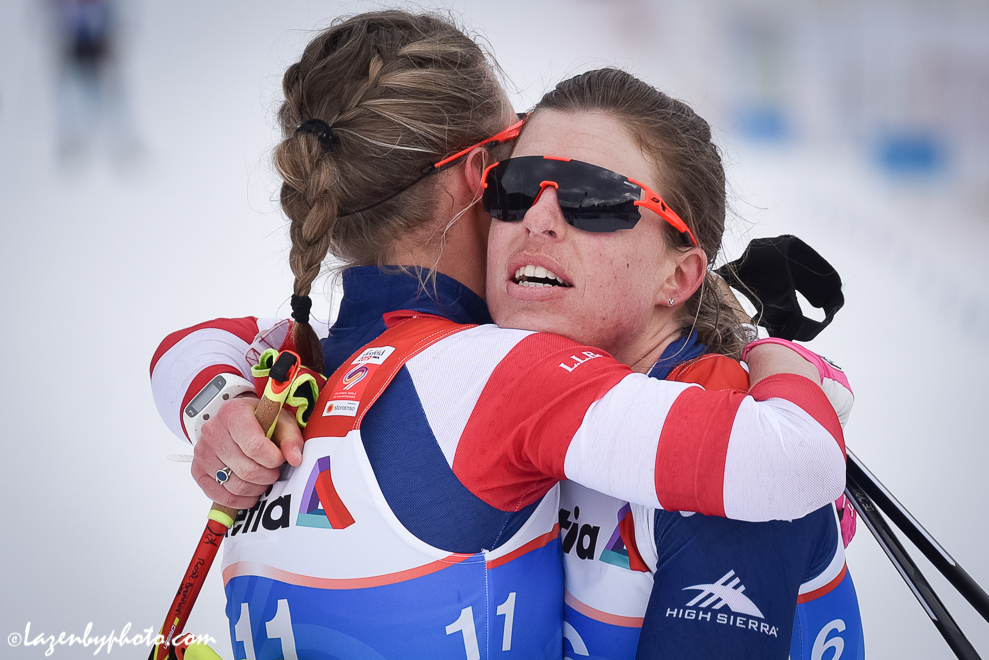
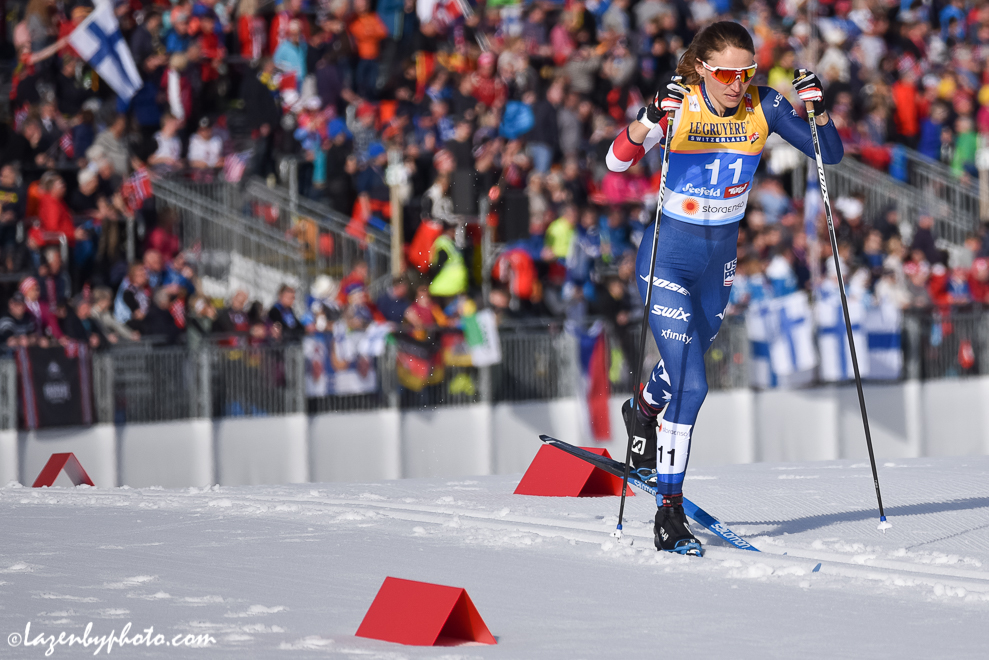
Rosie Brennan and Sadie Bjornsen (bib 11) congratulate one another after the women’s 30 k skate at the 2019 World Championship’s (Photo: John Lazenby/lazenbyphoto.com)
“At this level you have to have your skis at a level that can compete,” she added. “If you’re going to fight for a medal or even Top 10, Top 20 and there were some races this week that that was not the case.”
Following Bjornsen, American Rosie Brennan placed 16th (+5:21.0). After battling mono last season and not being renamed to the U.S. Ski Team, Brennan remained positive of where she’s taken her skiing this year leading up to and during World Championships in Seefeld.
“I never really know what I am going to feel in a month or so,” Brennan said. “I feel so proud of myself for having navigated last year or last summer basically and come out stronger. I hope that that is a clear message that is sent to everybody. I hope that inspires juniors to not be afraid of when something bad comes along or when they have a hiccup or they miss out on the pipeline that is the perfect pipeline or whatever it is.
“It motivates me to keep going and I want to be that example,” Brennan continued. “I want to be that person that doesn’t give up because something bad has been put in front of them. It also taught me that maybe I do know myself best.”
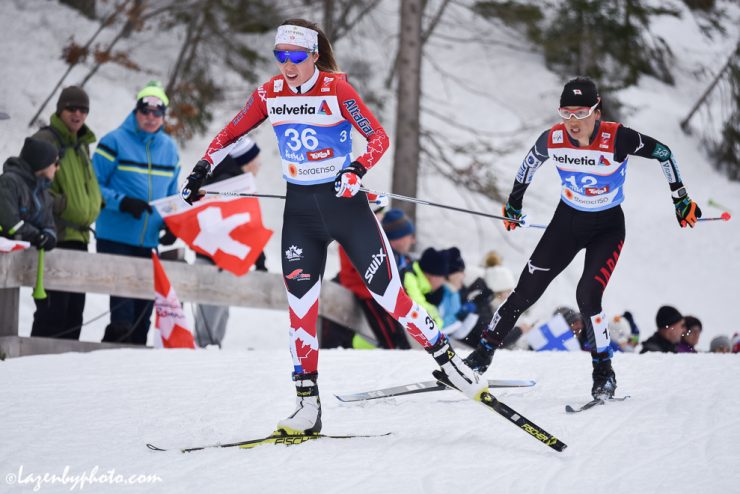
Rosie Brennan (bib 16) and Caitlin Patterson (bib 24) both of the U.S., charging in the women’s 30 k skate at the 2019 World Championships. Brennan placed 16th overall, Paterson 34th. (Photo: John Lazenby/lazenbyphoto.com)
“The way I look at it, it makes me really proud of what I have accomplished doing it in a clean way,” Brennan said. “I just look at those guys and think they have just ruined their lives. And they have no future in skiing now and that is not why I do this. That is not a place I want to ever be in.
“As shocking as it is, it makes me really proud of who I am,” Brennan added. “I try focusing on that aspect of that and not wonder what else is going on in the field. Those guys are a pretty good example, here they were doing some really bad things and they weren’t winning races. I don’t know that you have to do that to win and I choose not to believe that otherwise there is no sense in going out and fighting. I believe you can do it cleanly and I am going to try my hardest to do that.”
Racing for Canada, Katherine Stewart-Jonescrossed in 28th (+8:17.9) for her best career individual World Champs result.
Placing just outside the Top 30 was American Caitlin Patterson in 34th (+8:49.4). Canadians Emily Nishikawa placed 39th (+10.11.5), Dahria Beatty 41st (+11:34.5), and Cendrine Browne46th (+14.50.0).
Therese Johaug of Norway takes the win in the 30 k skate at the 2019 World Championships. (Photo: John Lazenby/lazenbyphoto.com)
The women’s podium from the 2019 World Championship’s 30 k skate. From left to right, Norway’s Ingvild Flugstad Østbergin second, teammate Therese Johaug in first, and Sweden’s Frida Karlsson placed third. (Photo: John Lazenby/lazenbyphoto.com)
Jessie Diggins at the finish of the women’s 30 k skate at World Championships. (Photo: John Lazenby/lazenbyphoto.com)
Jessie Diggins of the U.S. receives a feed women’s 30 k skate at the 2019 World Championships. Diggins placed fourth overall. (Photo: John Lazenby/lazenbyphoto.com)
Rosie Brennan during the the women’s 30 k skate at World Championships. (Photo: John Lazenby/lazenbyphoto.com)
Sadie Bjornsen the women’s 30 k skate at World Championships. (Photo: John Lazenby/lazenbyphoto.com)
Canada’s Katherine Stewart-Jones skiing to a 28th overall in the 30 k skate at the 2019 World Championships. (Photo: John Lazenby/lazenbyphoto.com)
Emily Nishikawa of Canada skiing to 39th overall in the 30 k skate at the 2019 World Championships. (Photo: John Lazenby/lanzenbyphoto.com)
Saturday closed out the racing for the women with the 30-kilometer freestyle at the 2019 World Championships in Seefeld, Austria.
Norway’s Therese Johaug, already the winner of the skiathlon and 10 k classic at these championships, secured her third gold in a time of 1:14:26.2 hours. Her teammate Ingvild Flugstad Østberg placed second (+36.8). Sweden’s nineteen-year-old Frida Karlsson took third (+44.0).
Jessie Diggins for the U.S. was 21 seconds from the podium after skiing to fourth (+1:05.9). Also for the U.S., Sadie Bjornsen was 15th (+4:42.9), Rosie Brennan (16th (+5:21.0), and Caitlin Patterson 33rd (+8:49.4).
Sweden’s Ebba Andersson leads Norway’s Therese Johaug, Jessie Diggins (U.S.) during the 30 k freestyle at the 2019 World Championships. (Photo: lumiexperiences.com)
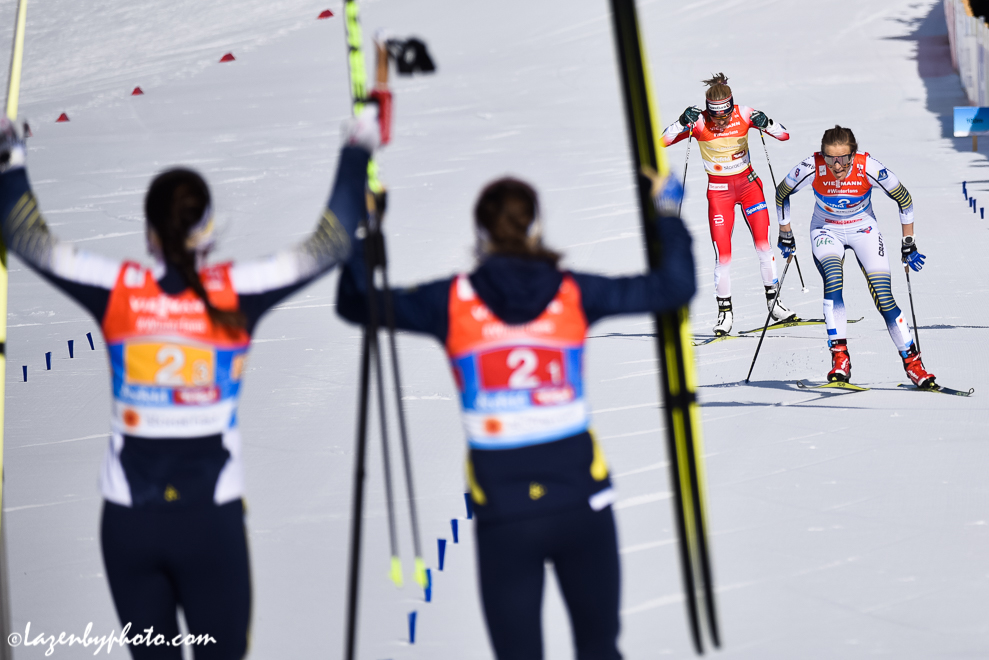
Holding off Norway’s Therese Johaug is Sweden’s Stina Nilsson during the 2019 World Championship 4 x 5 k relay in Seefeld, Austria. (Photo: John Lazenby/lazenbyphoto.com)
The beautiful chess match on snow came down to the wire in Thursday’s 4 x 5-kilometer relay at the Seefeld, Austria World Championships. The chaser was Norway’s Therese Johaug, hustling to close an 18.8-second gap to Sweden’s Stina Nilsson. Known as a sprinter who comes to distance events with aerobic chops, Nilsson, who won bronze in the 2018 Olympic 30 k classic mass start, couldn’t be rattled as Johaug lurked ever closer as the 5 k leg ticked down to the final straight.
For the closing kilometer, it was Johaug, the consummate endurance animal, against Nilsson, the consummate sprint closer, as they played check mate skiing for the win.
Let’s take a step back to when the sharp end of the race began to form in earnest. Norway’s Ingvild Flugstad Østberg and Sweden’s Frida Karlsson sent pacing-tremors through the field during leg two. Østberg ultimately came through to tag Norway’s third leg skier Astrid Uhrenholdt Jacobsen with a 1.4 second lead on Sweden’s third skier Charlotte Kalla. Russia and Germany trailed by more than ten seconds.
Sweden’s Charlotte Kalla is clutch. She gave the Swedes a chance for the win as she skied the third leg of the 2019 World Championship 4 x 5 k relay in Seefeld, Austria. (Photo: John Lazenby/lazenbyphoto.com)
With the freestyle legs in play and 10 k of skiing to go, Sweden was able to lean on a reliable closer in Kalla. She skied big and bold, sitting on the tails of Jacobsen for much of her race. In this 4 x 5 k hunt, Sweden tried to bag the big-game of Norway with a little less than 1.5 k to go in Kalla’s leg – at the 39:20 minute mark Kalla sent it.
Up the course’s most notable climb, Kalla’s formidable V1 put 15 then 20 meters between herself and Jacobsen. In the last four World Championship 4 x 5 k relays, Sweden has played runner-up. As if fueled by that burden, Kalla handed Nilsson the gift of those previously mentioned and oh so precious 18.8 seconds as Sweden’s anchor leg sped away to find her own defining 5 k moment.
Norway came into the race with an untested line-up. In the early season World Cup 4 x 5 k relay in Beitostølen, Norway Johaug skied Norway’s second classic leg. Back then she did not irreparably smash the race apart. She added enough spicy tempo to give Norway a lead of 9.8 seconds as she tagged off. And Ingvild Flugstad Østberg skied the anchor when Norway won by 37.3 seconds.
We do not often consider Norway as the chasers in a women’s relay. So often they are off the front. On Thursday, as Johaug’s double-time turnover inched her incrementally closer to Nilsson, the race was wrought with tension. Nilsson skied in control, with a slower cadence than Johaug but generating a near equal amount of power with each cycle.
Churning and chugging -Norway’s Therese Johaug during the fourth leg of the 2019 World Championship 4 x 5 k relay in Seefeld, Austria. (Photo: John Lazenby/lazenbyphoto.com)
There was no doubt Johaug was at or near her limit. Nilsson too was pushing, but she appeared willing to eventually be caught by Johaug as the racecourse real estate dwindled.
The Johaug-Nilsson link-up came at 52:40 minutes, near the apex of the last lap’s decisive climb. A meter separated a wind breaking Johaug from a drafting Nilsson as they descended. Nilsson skis gave her the lead as they glided and free skated into the final bump before the finish. Johaug pushed again. She could not surge as a red-suited Norway paced side by side with a white-suited Sweden.
Nilsson took the lead over the top. Now it was Johaug in the draft as they schussed into the straight. But with Nilsson’s big lever V2 engaged, Johaug’s sprint couldn’t deliver. She drifted off the back as Nilsson played her winning hand to win for Sweden in 55:21.0 minutes.
For Ebba Andersson, Frida Karlsson, Charlotte Kalla, Stina Nilsson and all of Sweden the wait for a World Championship 4 x 5 k relay was over.
Norway’s Heidi Weng, Ingvild Flugstad Østberg, Astrid Uhrenholdt Jacobsen, and Therese Johaug placed second (+3.1).
Russia came on strong in their fourth leg to take third (+2:03.8) over a once close Germany in fourth (+2:46.3).
“It is a dream coming true because we have been working hard all summer and fall and it has been a great effort from the whole team,” Kalla told FIS after the race.
“The conditions were tough out there,” Nilsson said. “It was a real struggle to push hard. And I was so hunted by Theresa [Johaug] so that was a bit stressing but I am so happy the girls gave me a big advantage because I needed it today to be first on the finish line.”
Sweden celebrates the 2019 World Championship 4 x 5 k relay win in Seefeld, Austria. (Photo: John Lazenby/lazenbyphoto.com)
A New Look for the U.S.
The U.S. finished in fifth with a line-up of Julia Kern, Sadie Bjornsen, Rosie Brennan, and Jessie Diggins. Relay socks and glitter adorned the foursome as they navigated a warmed-up slushy course in Seefeld.
For U.S. Ski Team Head Coach Chris Grover, along with his longtime coaching partners Matt Whitcomb and Jason Cork, determining the U.S. relay roster is no plug and play task. As witnessed in the Sweden vs. Norway race, parsing out the strengths and weaknesses of every athlete comes with a cost-benefit analysis worthy of hiring a PhD. in probability theory.
“It was a difficult task in terms of figuring out how to put together this relay team a couple of days ago after we had seen the women’s 10 k,” Grover said in a phone call. At that point, we knew we wanted to have Sadie and Rosie Brennan and Jessie going to the race. I had a really robust discussion around Julia and Caitlin and even potentially Rosie Frankowski in a skate leg. She had a great skate portion of her skiathlon the other day but also had a short illness after that. In trying to figure out the right way to put together the team, Julia has been feeling so good this week and skiing so well that we tried to do something a little bit different.”
In doing something different, Grover stated that the landscape within which the U.S. operates has changed. With Norway a known quantity and still a force, other nations like Sweden and Russia have built consistently strong 4 x 5 k relay teams. Concurrent with the rise of other nations is the continual development and support for U.S. athletes to determine a podium combination.
“We have had moments where all the women have skied great classic legs but we just need a little bit more flexibility, we need another woman or two in there that can be top ten or top fifteen on the World Cup on a given day to just fill out that roster,” Grover explained. “With relays, I think ideally you need, we have talked about it before, you need six athletes so that when you come to a championship you can pick the four that are in the best shape and you can use their technical strengths in the right places. I think at the same time, the other thing we have really seen is some of these other nations have raised their game in the meantime. … You have Sweden that is having an outstanding year with their women’s program. Across distance and sprint everyone has really taken a step forward within the Swedish team. They just don’t have weak legs anymore. There used to be a time when once in a while maybe we could really threaten Sweden but they are so strong across the board. And Russia too.”
Julia Kern of the U.S. (second from right) during the start of the 2019 World Championship 4 x 5 k relay in Seefeld, Austria. (Photo: John Lazenby/lazenbyphoto.com)
For Kern, who has raced numerous relays at the Junior National and World Juniors level, this was her biggest relay scene yet.
“I was excited about going into today relays, they are my favorite day,” Kern said in a call. “I love 5 ks and I love mass starts. I have scrambled a lot in relays in the past and at JNs and World Juniors, I was really psyched to be in that position because usually, it is a good place for me to start and I have had some of my best races in relays as well. So I was really psyched to be on this team with these older girls and I was feeling good.”
At 3.5 k Kern maintained pace with the 17 team field. She passed through the time check 3.2 seconds behind. At that point, Kern said she began to feel the combo of heat, wet tracks, and a championship level pace.
“I felt like I was doing a lot of work there from 2.5 to 3.5 k and everything was feeling awesome and then I just kind of blew up a little bit,” said Kern. “I never experienced something like that before or that extreme but I really sent it and gave it my all. I just went for it because that is what you have to do in relays.”
The twenty-one-year-old Kern noted she had been balancing the teeter-totter of effort between full-send mode and just under the red line.
“The pace was fast, but I felt in control and I don’t know if it was the heat or what happened,” Kern added. “But it was a reminder that in relays it is hard because you have to ride that balance between sending it and risking it and trying to go with the leaders and also race your own race. In a mass start event that is really hard. I think my takeaways were to remember to ski your own race but also I think you don’t want to walk away at the end of the day wishing you could have gone harder. All you ask is that you went for it.”
Kern tagged to Bjornsen for the second classic leg in 11th (+44.2).
Sadie Bjornsen of the U.S. during the second leg of the 2019 World Championship 4 x 5 k relay in Seefeld, Austria. (Photo: John Lazenby/lazenbyphoto.com)
Bjornsen strode off with a gap of 20 seconds on 12th place Kazakhstan and seven seconds behind 10th place Czech Republic. With no team to ski behind, Bjornsen forged ahead in slow snow and towards a divided field.
“Out of the start I tried to get that first group and then I as soon as got to the hills I started attacking,” said Bjornsen in a call. “But it was remarkably hard to close gaps out there when there are groups working together. When you are working alone there is no rest. It is 5 k of full work.”
In the second half of her leg, Bjornsen’s pulse of effort paid dividends. She bridged up to and passed the Czechs, Japan, Canada, and France to leapfrog into sixth place.
“When I finally caught that group in front of me I tried to not to sit behind them in the draft which felt very comfortable,” Bjornsen said. “I reminded myself that every second counts. I have got to keep powering past.”
Rosie Brennan of the U.S. during the third leg of the 2019 World Championship 4 x 5 k relay in Seefeld, Austria. (Photo: John Lazenby/lazenbyphoto.com)
She tagged Brennan in sixth, 34 seconds down on fourth-place Finland. Brennan has proved an integral part of the U.S. World Cup presence this season. Her presence on the relay team in Seefeld comes as no surprise. Although earlier prognostications would have predicted her as a classic leg selection.
“I have never done a skate leg in a relay at this level so I was excited to try something new and I’ve had such an improvement in skating this year so I was kind of excited to put that to use,” Brennan stated over the phone.
Ahead of Brennan was Riitta-Liisa Roponen of Finland, thirty-five seconds out. Close behind was a three team cluster all within fifteen seconds.
“I didn’t want to give them a free ride so I tried to start off really hard to open up that gap enough that they didn’t get any ideas,” Brennan said of her quick start. “Then I could see Finland in front, and it was so deceiving because the snow was so slow that you could see the person in front of you for quite a ways. … I just kept my eyes on Finland and kept trying to ski strong, and ski to my strengths and just try to make that gap as small as possible”
Brennan’s push created some sixth place breathing room for the U.S. She closed down on the Finns. Roponen tagged Evelina Piippo with a diminished buffer of 13.3 seconds as Diggins was tagged.
By 17.5 k, a no-fan of hot weather skiing Diggins had passed Piippo and placed the U.S. in fifth by 10.5 seconds. With the Diggins anchor leg and a rookie scrambler in Kern, the U.S. placed fifth overall (+3:06.0).
Custom race suit for Jessie Diggins of the U.S. She anchored the fifth place U.S. team during the 2019 World Championship 4 x 5 k relay in Seefeld, Austria. (Photo: John Lazenby/lazenbyphoto.com)
As the U.S. women’s 4 x 5 k roster evolves they will continue to find themselves in a hyper-competitive field with three teams in a Norway, Sweden, and Russia as a winning threat. If cross-country skiing were a salary cap sport, those three nations would have incurred a massive luxury tax.
But you cannot buy moxy when it comes to the bury-yourself athlete.
Bjornsen noticed a trait today about Kern which can also be attributed to the day’s collective U.S. effort.
“I was proud of [Julia Kern] today,” Bjornsen said. “As I told her after my race, I think guts is something that you cannot necessarily train into somebody. And when I see someone explode in a race like that the first thing that comes to my mind is that girl has got guts.”
The work-from-the-back fifth place was a collective gutsy affair for the U.S.
Canada’s Katherine Stewart-Jones, Emily Nishikawa, Cendrine Browne, and Dahria Beatty were 12th on the day (+5:02.7).
Swedish fans are delivered the win in Thursday’s 2019 World Championships 4 x 5 k relay in Seefeld, Austria. (Photo: John Lazenby/lazenbyphoto.com)
Canada’s Emily Nishikawa skiing the second leg of the women’s 4 x 5 k relay at the 2019 World Championships in Seefeld, Austria. (Photo: John Lazenby/lazenbyphoto.com)
Rosie Brennan testing skis at the 2019 World Championships in Seefeld, Austria. (Photo: John Lazenby/lazenbyphoto.com)
Jessie Diggins of the U.S. greeted by her teammates after racing the fourth leg in the 2019 World Championships 4 x 5 k relay in Seefeld, Austria. (Photo: John Lazenby/lazenbyphoto.com)
Canada’s Cendrine Browne skis the third leg of the 2019 World Championships 4 x 5 k relay in Seefeld, Austria. (Photo: John Lazenby/lazenbyphoto.com)
(From left to right) Ebba Andersson, Frida Karlsson, Charlotte Kalla, and Stina Nilsson of Sweden. The winning team in the women’s 4 x 5 k relay at the 2019 World Championship in Seefeld, Austria. (Photo: John Lazenby/lazenbyphoto.com)
Norway’s Ingvild Flugstad Østberg leads the relay train during the second leg of the 4 x 5 k relay at the 2019 World Championships in Seefeld, Austria. (Photo: John Lazenby/lazenbyphoto.com)
Spent fuel: Norway’s Therese Johaug cooling off after her her team’s second place in the 2019 World Championship 4 x 5 k relay in Seefeld, Austria. (Photo: John Lazenby/lazenbyphoto.com)
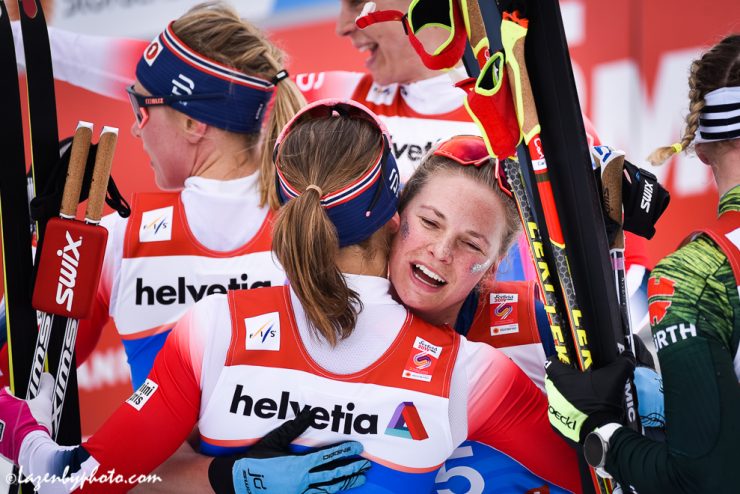
(Front row l-r) Ebba Andersson and Charlotte Kalla (back row l-r) and Frida Karlsson and Stina Nilsson winners of the 2019 World Championship 4 x 5 k relay in Seefeld, Austria. (Photo: John Lazenby/lazenbyphoto.com)
FIS Nordic World Ski Championships Seefeld, Austria Women’s 4 x 5 k Relay
The race pack held together until the 3.5-kilometer mark of the scramble leg during the women’s World Championship 4 x 5 k relay in Seefeld, Austria. A bit over three seconds separated the top-six teams through the time check.
By the time the third leg began, Sweden and Norway had surged and defined the race as a two team competition for first. That fate began to change as Sweden’s third skier, Charlotte Kalla, surged to a 18.8 second lead over Norway as she tagged to the team’s anchor, Stina Nilsson.
With Norway’s anchor Therese Johaug, it appeared inevitable she would catch Nilsson. The high-turnover Johaug, mouth agape, churned up the hills and did eventually secure the Swede’s draft. But Nilsson’s long-gliding effort in the finish straight gave Sweden the edge and the win.
Spent fuel: Norway’s Therese Johaug cooling off after her team’s second place in the 2019 World Championship 4 x 5 k relay in Seefeld, Austria. (Photo: John Lazenby/lazenbyphoto.com)
Ebba Andersson, Frida Karlsson, Kalla, and Nilsson of Sweden won in 55:21.0 minutes. Norway’s Heidi Weng, Ingvild Flugstad Østberg, Astrid Uhrenholdt Jacobsen, and Johaug placed second (+3.1).
Russia’s Yulia Belorukova, Anastasia Sedova, Anna Nechaevskaya, and Natalia Nepryaeva skied to third (+2:03.8).
The U.S. foursome of Julia Kern, Sadie Bjornsen, Rosie Brennan, and Jessie Diggins placed fifth (+3:06.0). Canada’s Katherine Stewart-Jones, Emily Nishikawa, Cendrine Browne, and Dahria Beatty were 12th on the day (+5:02.7).
Never a slow moment: Therese Johaug of Norway on her way to winning the women’s 10 k classic at the 2019 World Championships in Seefeld, Austria. (Photo: John Lazenby/lazenbypohoto.com)
The race is the spectacle that determines the outcome. And when Norway’s Therese Johaug highlights the start list, her winning outcome seems pre-determined as soon as she skates or strides from the start. On Tuesday in the World Championship interval start 10-kilometer classic, Johaug won gold. In a race where splits are given, Johaug may have only been flummoxed by the close margin between her first place and the resolute chaser in nineteen-year-old Frida Karlsson of Sweden.
The 5 k time check revealed how the race was shaking out for potential contenders. Three skiers remained within 30 seconds of Johaug: Karlsson 7.3 seconds back, Norway’s Ingvild Flugstad Østberg 18.3 seconds behind, and Astrid Uhrenholdt Jacobsen 27.5 ticks back respectively.
Despite each of the three skiers ceding time to a metronome-like Johaug over the remaining 5 k, her performance made her appear less like an automaton than in races past. Certainly, Johaug clinically executed the stride and glide and double pole. But for a brief moment, Johaug subtly teased Karlsson into thinking she had a chance for the win.
At 6.7 k, Karlsson’s time back shrunk to 4.8 seconds.
Then again this is Johaug. A champion who struggled through a positive doping test in Oct. 2016 and a subsequent 18-month competition ban to arrive this season as a lock for any distance event win. Ceding precious time to a young Swede with 3.3 k’s remaining on Tuesday was a performance blip not a defining moment.
Karlsson started in bib 28, Johaug in bib 60. Karlsson’s time in the leader’s chair was tenuous as she awaited 32 bibs to ski through the finish and determine her first or second place podium fate.
Young and ready to challenge, Sweden’s Frida Karlsson challenging for the top spot during the 10 k classic at the 2019 World Championships in Seefeld, Austria. (Photo: John Lazenby/lazenbypohoto.com)
It was a win in 27:02.1 minutes. Whatever glimmer of hope Karlsson felt was diminished as Johaug’s winning margin bumped to 12.2 seconds when she stopped the clock. Norway’s Ingvild Flugstad Østberg was third (+35.6) while Finland’s Krista Pärmäkoski placed fourth (+37.0).
“I am really happy now,” Johaug told an International Ski Federation (FIS) reporter following the race. “This distance was my goal before the season started. I really want to win this and today I did it. It was really tough out there. I fought with myself all the time, and I feel a bit tired. … I am really fighting today. … The temperature was really hot and the tracks were really wet. I had to work with myself all the time.”
At thirty-years-old, in her return to World Cup competitive standards after serving her doping penalty, Johaug remains the distance athlete to beat. Hers is the end of the spectrum where top-end fitness is realized after winning her ninth world champ title on Tuesday. And according to FIS, the 10 k classic is a race suited for the 30 and older set. The last four winners of the 10 k individual start classic at world championships were older than 30 years old. This dates back to 2001 when Norway’s Bente Skari won that discipline at 28.
On the other end of the age and performance spectrum when it comes to realizing potential is Karlsson. At 19, she is a three-time World Junior Championship winner. In Lahti, Finland last month, Karlsson won the 15 k mass start classic and the 5 k skate. She competed in her first World Cup on Feb. 17, when she placed seventh in Cogne, Italy’s 10 k classic.
When considering Karlsson’s rise over run success curve, her’s has been steep. In little time, she has emerged as Sweden’s most viable championship podium shot in Seefeld’s distance events. That is a considerable feat knowing that Charlotte Kalla, Sweden’s beloved nordic sport hero, had sights on more championship hardware. (Kalla placed 9th overall.)
The women’s 10 k classic podium at the 2019 World Championships: Frida Karlsson (l) in second, Therese Johaug (center) of Norway in first, and Ingvild Flugstad Østberg of Norway third. (Photo: John Lazenby/lazenbypohoto.com)
The U.S. entered Sophie Caldwell, Jessie Diggins, Sadie Bjornsen, and Rosie Brennan. All finished in the top-30. But in a program where medals are the realistic objective, the sense was they were looking for more.
Bjornsen was the best placed of the tightly grouped Americans in the final standings. Bjornsen placed 23rd (+1:41.0), Brennan 24th (+1:45.1), Diggins 25th (+1:51.9), and Caldwell 29th (+2:09.5).
“It’s definitely a bizarre and strange day,” Bjornsen said in a post-race phone call. “The only thing I can tell you is that I felt like I had one of the better performances I’ve had this year, I just feel like I fought every single moment. It was the most positive, most fighting I’ve done in my head, just attacking every single part of the course, and I guess that’s why it’s a little bizarre that the result is one of the worst in the year. Not worst, but definitely not in the place that I think I am capable of, and where I would have seen myself today.”
Bjornsen’s early splits during her first lap were encouraging – she was informed that her efforts were keeping her in the top-ten hunt.
“That was definitely really encouraging when you hear a split like that, you’re willing to dig even deeper,” she added. “I feel like that was what I was doing today, attacking every single portion of the course like I was fighting for a medal. Which I guess is funny now, to look at the result and see what happened.”
The U.S. Ski Team’s Sadie Bjornsen during the women’s 10 k classic at the 2019 World Championships in Seefeld, Austria. (Photo: John Lazenby/lazenbypohoto.com)
The race began at 3 PM Seefeld time in warm temperatures that morphed the tracks into wet saturated snow where they were exposed to direct sun. Race time temps soared to near 50 degrees Fahrenheit and created a course with intermittent sections of slush, re-freeze, and powdery snow. It was an in the tracks then out the tracks affair depending on sun exposure.
“It’s no secret that I don’t handle heat super-well,” Diggins said in a call. “For me, that was my great challenge today. When I finished, my face was bright red and my skin was radiating heat. … That was something that I definitely struggled with, and I thought I had taken the right steps to stay cool, by not racing in gloves or a headband or sleeves. By stuffing snow down my shirt right before the start, but clearly, it wasn’t quite enough.”
Diggins said her race pace was further stymied by a “mini-implosion” as she began her second lap.
“I think overall, all you can focus on is doing the best you can with what you have, and I did that today,” said Diggins. “As evidenced by wanting to puke and tasting blood and feeling like I was going to pass out, I know that I pushed myself really, really hard. And that’s a good feeling, to know that you did the best you could.”
In warm conditions, U.S. skier Jessie Diggins during the women’s 10 k classic at the 2019 World Championships in Seefeld, Austria. (Photo: John Lazenby/lazenbypohoto.com)
Across the line, an overheated Diggins was attended to by U.S. Ski Team staff to assure she was cooled down properly. On a day when her level of fitness was burdened by what she called her “proclivity to heat exhaustion”, Diggins focused on the professionalism of those dedicated to her race day efforts.
“We have such an awesome staff here, and an awesome, caring, team,” said Diggins. “Right at the finish, I had multiple people pouring water over my head and stuffing snow down my shirt and taking my skis for me. I just feel very loved and taken care of, and I think it’s so cool that we have such an awesome staff, that is just happy to be working hard and helping us in every way they can. I really appreciate that.”
Brennan comes off a skiathlon where she placed 10th overall — her best individual result at a World Championships. Like her U.S. peers, Brennan played the game of balancing speed and kick on a course with variable snow conditions and lengthy sections of double pole terrain.
Rosie Brennan during the women’s 10 k classic at the 2019 World Championships in Seefeld, Austria. (Photo: John Lazenby/lazenbypohoto.com)
“I looked at the course and thought about my strengths and took into account those and think where I could make up the most times and need faster skis or more kick for those sections,” Brennan said in a call. “Today there was quite a bit of double pole. I thought that was my best card to play. So I tried to go with as fast a skis as I could and still make it up the hills. Whether that worked or not I don’t know, it is hard to say. That was my thought going into the race.”
Brennan remains optimistic about earning starts in the championship’s two remaining women’s races, the 4 x 5 k relay and 30 k skate.
The women have an off day tomorrow with the relay scheduled for Thursday.
U.S. skier Sophie Caldwell during the women’s 10 k classic at the 2019 World Championships in Seefeld, Austria. (Photo: John Lazenby/lazenbypohoto.com)
Norway’s Therese Johaug winning the women’s 10 k classic at the 2019 World Championships in Seefeld, Austria. (Photo: John Lazenby/lazenbypohoto.com)
FIS Nordic World Ski Championships Seefeld, Austria Women’s Individual 10 k Classic
In her first World Championships since 2015, on Tuesday Norway’s Therese Johaug sped to her second distance gold in Seefeld. Johaug stopped the clock in 27:02.1 to claim the win in the 10-kilometer individual start classic.
Sweden’s Frida Karlsson was perhaps the biggest podium surprise of the day. At nineteen-years-old, Karlsson (a three-time winner at World Juniors) placed second, 12.2 seconds back. Norway’s Ingvild Flugstad Østberg was third (+35.6).
Sadie Bjornsen for the U.S. raced to 23rd (+1:41.0), Rosie Brennan 24th (+1:45.1), and Jessie Diggins 25th (+1:51.9). Sophie Caldwell placed 29th (+2:09.5).
Canada’s Emily Nishikawa was 36th (+2:36.1), Dahria Beatty 49th (+3:39.3), Katherine Stewart-Jones 51st (+3:45.0), and Maya MacIsaac-Jones 66th (+5:35.9).
Therese Johaug of Norway taking the women’s World Championship 15 k skiathlon win in Seefeld, Austria. (Photo:John Lazenby/lazenbyphoto.com)
An emotional Therese Johaug of Norway stood atop the podium after the 15-kilometer skiathlon in Seefeld, Austria. While the race seemed to be decided during the second of two classic laps where Johaug began to pull away, the title has taken much longer to achieve. This moment was one she has been hoping for since she last earned the title during the 2015 world championships in Falun, Sweden. Johaug was unable to compete in the 2017 championships in Lahti or the 2018 Olympics in PyeongChang as she was serving an 18 month suspension after using a medicated lip balm containing the banned steroid clostebol.
“It’s been a big dream for me to come here to Seefeld for a long time now,” Johaug told the International Ski Federation (FIS) as she held back tears. “I’m looking forward for these championships for two years. The last time I was in the World Championships was in Falun, it’s four years ago now. I’m training so much and working so much for this. All the team around me have helping me everytime, so I’m really happy. The waxer team they were awesome today, I had so good skis, I could just fly out there.”
This victory was not unexpected; the well-decorated Norwegian has won each of the eight distance race that she has entered this season by a large margin and has over 50 world cup victories to her name. She adds this gold medal to a collection of three others in the skiathlon, a gold in 2015, silver in 2013, and bronze in 2011, and is now tied with her former teammate, Marit Bjørgen, for the most world championship medals in the event.
The day’s winner, Therese Johaug of Norway, at the start of her second classic lap during the women’s World Championship 15 k skiathlon in Seefeld, Austria. (Photo: John Lazenby/lazenbyphoto.com)
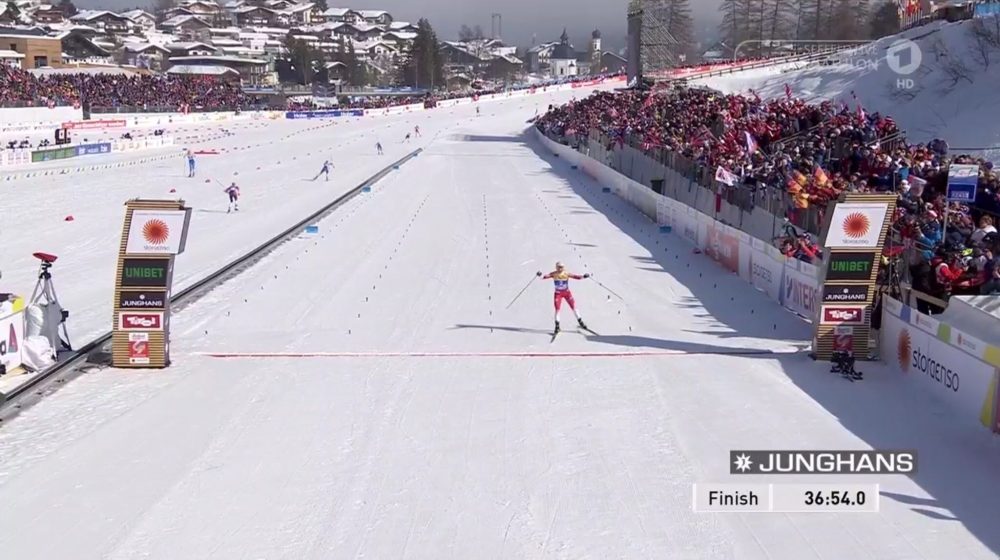
Johaug commanded the race from the gun, her powerful and flawless technique driving her ahead at a pace no other skier could match. At the exchange, she switched into her skate skis calmly and confidently, exiting the zone smoothly in just seconds. At this point, Johaug had nearly 30 seconds on the women chasing her, and 7.5 k later when she stopped the clock at 36:54.5, she was nearly a minute ahead.
Behind her also wearing red lycra was a battle for silver and bronze as a group containing Ingvild Flugstad Østberg and Astrid Uhrenholdt Jacobsen of Norway, and Natalia Nepryaeva of Russia chased the leader. When Johaug took the race out fast, the threesome went with her in the first kilometers of the race, separating themselves from the larger chase pack behind. When Johaug began to pull away, the three women stayed together, exchanging the lead frequently as they covered ground.
Therese Johaug of Norway during the skate leg of the women’s World Championship 15 k skiathlon in Seefeld, Austria. (Photo:John Lazenby/lazenbyphoto.com)
It was not until a final climb brought the trio to a hairpin turn before descending into the stadium for the final sprint that Østberg moved to the front and began to make her run for second place. She crested the hill with a small gap ahead of Nepryeava, with Jacobsen not far behind. Østberg flew into the stadium in a no pole skate, switching to V2 as she clinched her position in second place (+57.6). She crossed the line and into the awaiting arms of her teammate, Johaug, where she collapsed and began to let out shrieks of joy and relief. Her silver is her first individual world championship medal.
Nepryeava crossed the line in third (+58.7), Jacobsen fourth (1:02.0).
Rosie Brennan of the U.S. placed 10th in the women’s World Championship 15 k skiathlon in Seefeld, Austria. (Photo:John Lazenby/lazenbyphoto.com)
Three of the four American competitors landed in the top 30 with Rosie Brennan in 10th (+2:01.8), Julia Kern 19th (+2:55.5), and Rosie Frankowski 24th (+3:00.6). Caitlin Patterson finished just outside in 34th (+3:54.5).
With added variables and little experience in the event, it can be difficult for athletes to set expectations in a skiathlon. Today’s outstanding results came as a bit of a surprise to the American women who went in optimistic, but without positive experiences to look back on.
“Skiathlons are tricky because we just don’t do that many so you never really know what’s going to happen or how you’re going to feel, especially once you switch skis,” Brennan told FasterSkier in a call. “Last year the skiathlon at the Olympics was literally the worst race of my life, so it’s been a while since I’ve had a good one, so I was a little nervous.”
Julia Kern in bib 35 during the classic leg of the women’s World Championship 15 k skiathlon win in Seefeld, Austria. Kern placed 19th overall. (Photo:John Lazenby/lazenbyphoto.com)
It was the second skiathlon Kern had completed; she was not happy with her result in the first and in the most recent one she entered at U23’s, she had to drop out due to illness. Her top-20 finish exceeded her expectations today.
“I had no idea what to expect, but I was really excited,” said Kern in a call. “My goal was top-40 and on a good day maybe a top-30, but I didn’t really know what to expect and my goal for today really was just to ski hard and see what I could do.”
Brennan found herself amidst a larger chase pack behind the threesome of Østberg, Nepryeava and Jacobsen. This group worked together through the 7.5 k classic half, then began to spread after the exchange.
“My goal was just to stay in the pack and be as relaxed as possible and see what else was left once we switched [to skating],” Brennan shared. “I’m really happy with how I skied tactically, I think it was one of the better races I’ve done tactically, that’s not usually my forte.
“The only regret I have is that I kind of forgot that in skiathlons, once you switch skis, that first k or so it’s super important to find the right group, but it’s also the most nerve-wracking k because you never know how your legs are going to feel once you switch skis,” she continued. “And I actually felt pretty good, so I wish I had pushed that first k in the skate a little harder to be in the front end of that chase group instead of the back end because I kind of wasn’t paying attention when that pack broke up. And the skate leg was a lot faster and flatter, so it was a little challenging to ski away from people, so the group you got in in that first few k really determined where you would be in the end.”
After the split mentioned, a group containing 2018 Olympic gold medalist Charlotte Kalla and Frida Karlsson of Sweden, Heidi Weng of Norway, Krista Pärmäkoski of Finland, and Anastasia Sedova of Russia pulled ahead of the remainder of the pack. These women finished fifth through ninth.
“I found myself in still a good group, and so I realized pretty quickly that it was going to be hard to ski away,” Brennan explained. “But I didn’t really want to sprint with four people, so I tried to make a move on the far hill and I think it dropped one girl, but it wasn’t really what I hoped for. So then I decided that then I would settle and have faith in my sprint finish. And I had really great skis, so I was able to draft well off the sprint downhill into the stadium and kind of play a good tactic into the finish and bust a move on that last little climb. So I was really psyched with how that worked out and how I skied that section.”
Brennan’s result is her second top 10 finish of the season, her first coming in the 10k freestyle race in Davos. The APU skier also raced in the World Championships in both 2015 and 2017, but today was her best result in an individual race. This progress is especially rewarding after a season hampered by illness. Brennan was diagnosed with mono at the end of the 2018 race season after a slew of less than satisfying results.
“I’ve been really psyched. After last year, I didn’t know if I would ever be able to ski fast again or even if I was going to keep skiing,” Brennan reflected. “So it was kind of an interesting summer, but I was able to have a really good training group at home and just focus in on what I needed to do, and that was really successful. I started feeling better and better as the summer went on and started getting more and more confidence and hopes for what the season to come would bring.
“And knowing that I was not on the national team and had to earn all my start spots, I wanted to come into Period 1 ready to race,” she continued. “I was really happy with that [plan], I did that really well and each weekend got better in period 1, so that was super successful. Then, because I had done that, I felt like I needed to take a break and do another training block to be ready for the championships since they were so late [in the season]. So I took some time and did quite a bit of training. I think that made me a little flat in the first two world cups when I came back, so I was a little nervous that my form had left me, but I was feeling good and my training had gone well, so I guess I had a hint of optimism. But I’m glad to feel like my form did come back and I’m racing at the level that I was in Period 1, so I think my plan worked really well. I’ve been really excited with all of that.”
Kern started the race with a slightly different plan than Brennan. The beginning of the race played out differently than she anticipated, but she quickly adjusted her tactics.
“I had a feeling it was going to start out pretty hot since I figured that Johaug would push the pace early, so things would string out,” explained Kern. “My plan was to start out fast and settle in, but I ended up – it was hard to pass people in the start, so I kind of just stayed relax the first climb, then in the second lap began to push the pace a bit. Once I got through the transition, I saw it as a new race, just skating.”
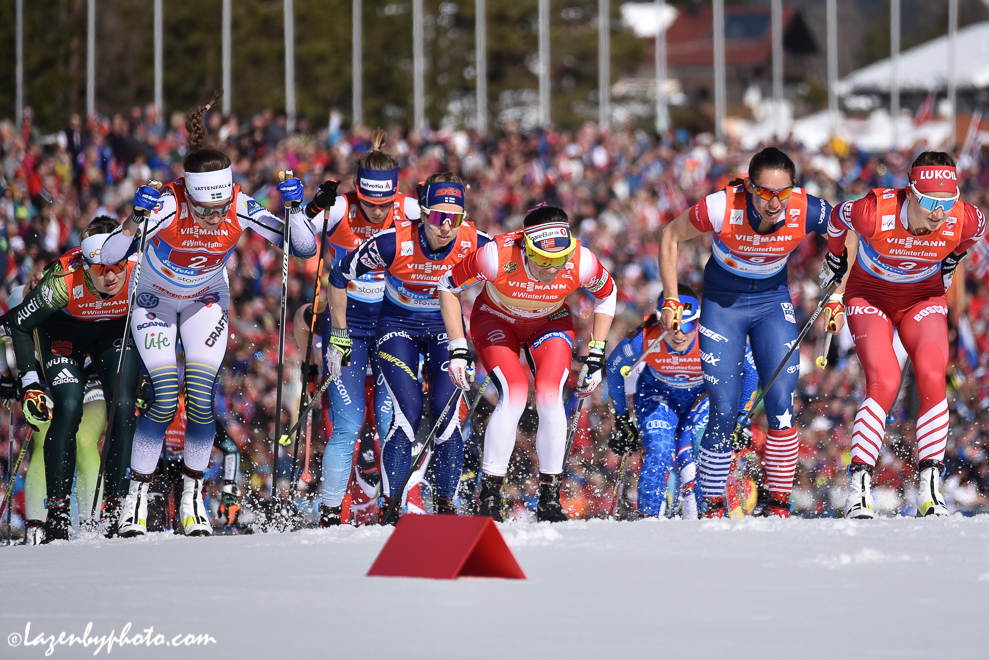
The start of the women’s World Championship 15 k skiathlon win in Seefeld, Austria. (Photo:John Lazenby/lazenbyphoto.com)
While her start was not as fast as she expected, she took advantage of her confidence and speed on downhills to move ahead in the second half.
“I had the absolute fastest skis out there – they were insanely fast, the techs did an amazing job,” she said gratefully. “So even on the uphills if I would get dropped a little, I skied the downhills super well. A lot of people were skiing the downhills scared and my skis were so fast that I would catch and pass people every downhill. So it was this sort of cat and mouse game where on the uphills I would try to hang on and keep it as close as possible, then on the downhills just shoot by people. So it was really fun skiing knowing I had insanely good skis and that the techs had given us the best skis out there, so I could just focus on hanging on as long as I could on every climb.”
It was Frankowski’s first start in a World Championships. Earlier in the season, Frankowski won a pair of 10k’s while racing domestically on the Super Tour, one in classic and one in skate, and took second at the 20k skate at US Nationals.
“It was fun out there today,” wrote Frankowski in an email. “I felt much better in the skate portion of the skiathlon, but would have preferred a but slower conditions – there were some scary downhills. A big thank you to the techs for some good skis and the weather gods for bringing out the sun again for the race.”
Canada’s Katherine Stewart-Jones skied to 39th (+4:19.8), Cendrine Browne 40th (+4:25.2), and Maya Macisaac-Jones 54th (+8:53.4).
Racing continues tomorrow with a classic team sprint.
Between 3.75-kilometers and 4.85 k on Saturday, Norway’s Therese Johaug began to pull away in earnest during the women’s World Championship 15 k skiathlon — by then she had built a near 15 second lead.
The time back to the Norwegian would only grow. Johaug powered into the classic to skate transition zone in control with a lead padded by 26.2 seconds. At the finish, Johaug crossed the line with no other skiers in sight and a winning time of 36:54.5 minutes. It was Johaug’s fourth World Championship medal in the skiathlon.
Ingvild Flugstad Østberg, also of Norway, placed second (+57.6), with Russia’s Natalia Nepryaeva third (+58.7).
Rosie Brennan of the U.S. was the top North American in tenth (+2:01.8). Also for the U.S., Julia Kern placed 19th (+2:55.5), Rosie Frankowski 24th (+3:00.6), and Caitlin Patterson 34th (+3:54.5).
Canada’s Katherine Stewart-Jones skied to 39th (+4:19.8), Cendrine Browne 40th (+4:25.2), and Maya Macisaac-Jones 54th (+8:53.4).
The men’s 30 k skiathlon featured no off the front winner like Johaug. As the pace setting screws tightened well into the men’s race, with Russia’s Alexander Bolshunov often taking charge, the pack was winnowed to five skiers at the 26 k mark. Along with Bolshunov, France’s Clement Parisse, Norway’s Sjur Røthe and Martin Johnsrud Sundby, and Iivo Niskanen of Finland were the skiers vying for the win.
By the final half-k, only Sundby, Bolshunov, and Røthe remained up front. Down the final straight Røthe possessed the strongest reserves as he won in a time of 1:10:21.3 hours. Bolshunov placed second (+0.1), and Sundby third (+0.7).
Canada’s Alex Harvey paced himself to sixth overall (+58.9). Evan Palmer-Charrette placed 45th (+6:12.4), and Scott James Hill 56th (+9:58.8).
For the U.S., Scott Patterson raced to 32nd (+4:40.6), David Norris 38th (+4:54.4), Kyle Bratrud 49th (+6:19.6), and Adam Martin 54th (+7:47.4).
The plotline thickened on Saturday in the elite men’s freestyle 50 k at the American Birkebeiner when Akeo Maifeld-Carucci (CGRP), Brian Gregg (Team Gregg), and Matt Liebsch separated themselves from the field. The three skiers fended off any chasers and charged onto main street three across in their final effort towards the finish line.
Maifeld-Carucci took the win in 2:12:35 hours, with Gregg second (+0.93), and Liebsch third (+8.50).
Alayna Sonnesyn (SMS T2)won the overall women’s 50 k skate in 2:34:01. By the time Sonnesyn passed the time check on Lake Hayward, she had gapped Anja Gruber (Salomon) in second by 29.60 seconds. Gruber took second overall finishing 54.60 seconds back from the winning time. Third place went to Katie Feldman (SVSEF Gold Team) crossing 1:08.63 minutes back.
FasterSkier will be posting race reports on the 2019 American Birkebeiner later today.
(Friday) FIS Nordic World Ski Championships Seefeld, Austria Individual Gundersen 10 k
U.S. athlete Taylor Fletcher on his way to placing 35th overall during Friday’s individual Gundersen 10 k at the Seefeld, Austria World Championships. (Photo: John Lazenby/lazenbyphoto.com)
On Friday in Seefeld, the first nordic combined event, an individual Gundersen 10 k was won by Germany’s Eric Frenzel. The German was the best ranked jumper and won the ski in a time of 24:43 minutes. Jan Schmid of Norway, the day’s third ranked racer after the jump, placed second (+4.3). Austria’s Franz-Josef Rehrl placed third overall (+8.7).
Americans Taylor Fletcher skied to 35th (+4:05.5), Ben Loomis 44th (+5:29.7), Jasper Good 47th (+6:25.1), and Grant Andrews 48th (+6:52.8).
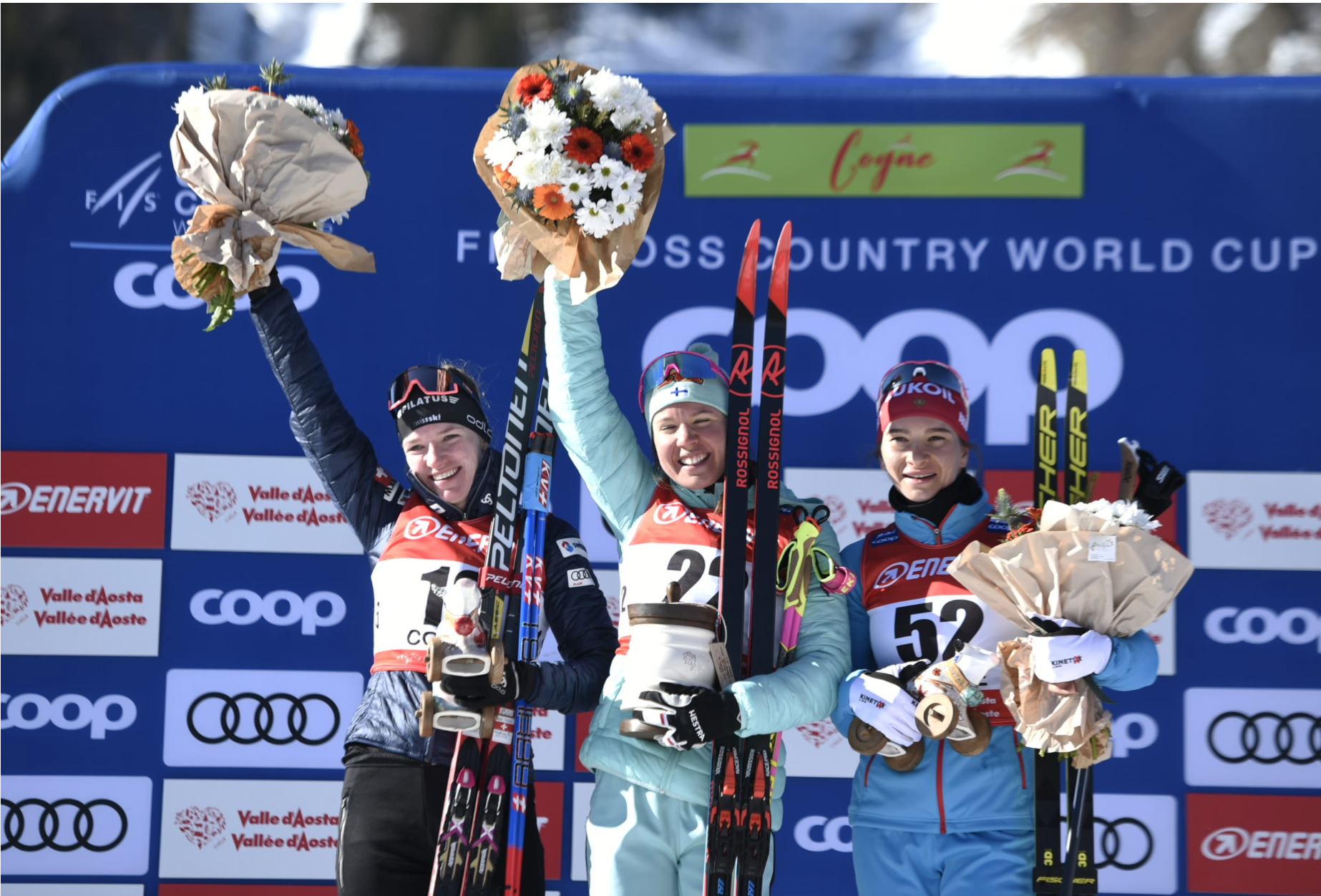
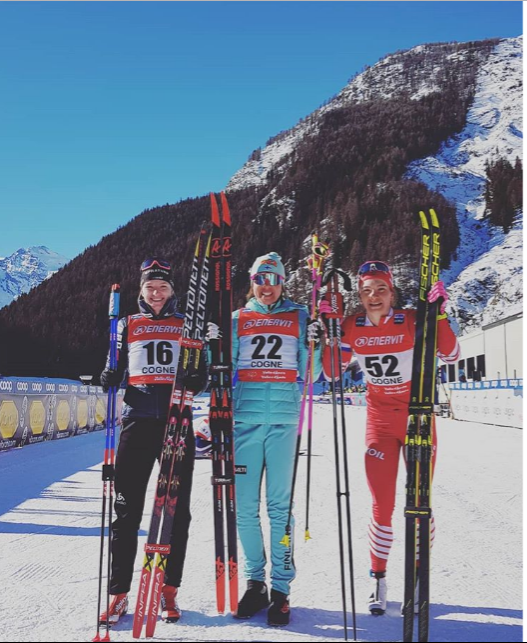
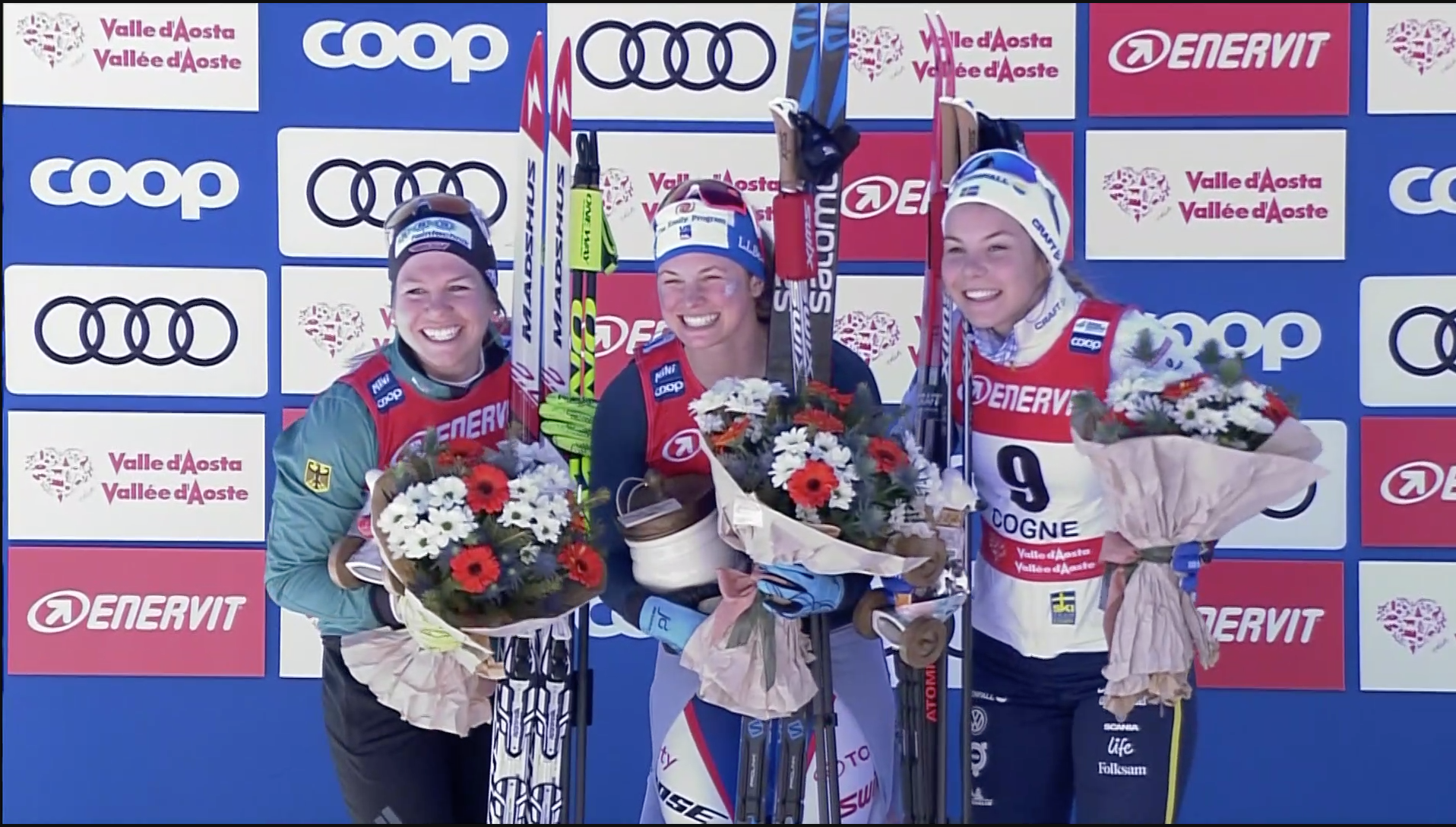
From left to right, Nadine Fähndrich (SUI), Kerttu Niskanen (FIN) and Natalia Nepryaeva (RUS) on the podium for the women’s 10 k classic race in Cogne, Italy. (Photo: Screenshot FIS/NordicFocus)
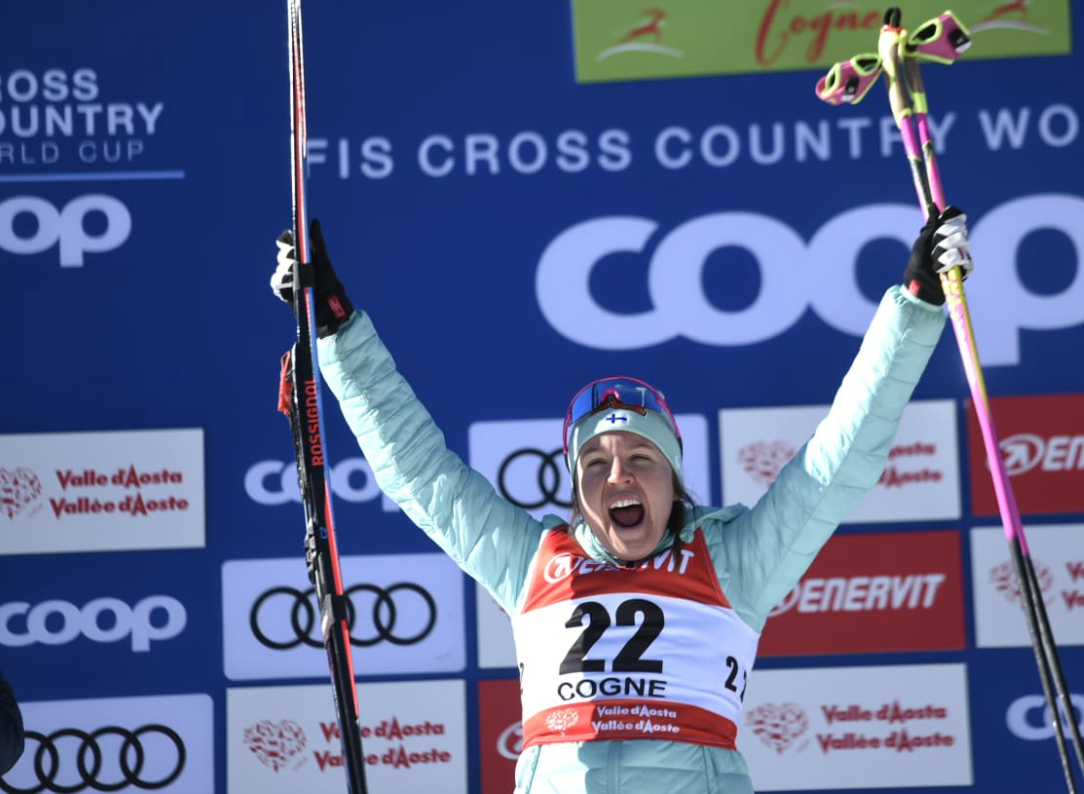
World Cup racers in the Cogne, Italy 10-kilometer classic individual start enjoyed blues skies and sunshine on Sunday, the temperate weather seeming to have carried over from Saturday’s sprint. Winning the women’s race was Finland’s Kerttu Niskanen in a time of 27:24.8. The victory is Niskanen’s second individual World Cup win–her first came five years ago in the Lenzerheide, Switzerland 10 k classic.
With Sunday’s 10 k the final World Cup regular season race before World Championships, which is set to kick-off next Wednesday, Feb. 20 in Seefeld, Austria, Niskanen explained in a post-race interview with the International Ski Federation (FIS) that she feels ready for the upcoming World Champs competitions.
“Some weeks ago, I felt like Seefeld was too far away. I was so tired at the beginning of the season and I had to totally rest,” Niskanen told FIS. “It was not an easy time, watching the TV when others skiers were racing. So, now I feel good and I’m happy to travel to Seefeld.”
Finland’s Kerttu Niskanen is all smiles after her win in Cogne, Italy (Photo: Screenshot FIS/NordicFocus)
Starting in bib 22, Niskanen was chasing down the times of Switzerland’s Nadine Fähndrich, who started in bib 16, and Sweden’s Frida Karlsson who started in bib 20. By the time Karlsson came through the halfway point, she was up on Fähndrich, who came through four bibs earlier, by 3.1 seconds. Niskanen, who came through two bibs after Karlsson, was down on the Swede by 3.9 seconds.
By the 8 k mark, however, Karlsson’s pace had fallen back and Fähndrich’s time led hers by by 10.6 seconds. Niskanen had also gained steam. At 8 k, she was down on Fähndrich by a mere 0.8 seconds. In the next 2 k, Niskanen managed to outpace the Swiss skier, besting Fähndrich by 3 seconds for the win. According to the FIS database, Sunday’s second place finish is Fähndrich’s first individual Top 3 on the World Cup circuit–although she posted the fastest time in Saturday’s sprint qualifier.
Following Fähndrich, Russia’s skier, Natalia Nepryaeva, finished third today, 12.6 seconds behind Niskanen. Nepryaeva, who started in bib 52, was 13.2 seconds down on the race leader, Karlsson at the halfway point. By 8 k, she had the third fastest time and maintained that position until the finish. Including Sunday’s result, Nepryaeva has landed on the podium seven times this season, four of those in the 10 k classic discipline.
Russian skier, Natalia Nepryaeva skiing to a third place finish on Sunday. (Photo: Screenshot FIS/NordicFocus)
The top North American finisher on Sunday was Rosie Brennan who placed 21st (+1:19.6) Brennan has had 11 individual finishes in the World Cup Top 30 this season, her strongest result being 11th in the Lillehammer 10 k freestyle back in December. In bib 26, Brennan was skiing outside of the Top 30 by 1.5 seconds at the 2 k mark, though by the halfway point, she was ranked with the 17th fastest split. With 2 k to go, she was 10 seconds away from being in the Top 15.
“The course was very unique with lots of twists, turns, and transitions which isn’t always a strength of mine so I think I didn’t ski those sections as well as I would have liked,” Brennan wrote to FasterSkier in an email. “I love racing at altitude so I wanted to push the pace early on to see what was possible. I think I did that well but struggled with my skis a bit and struggled to keep pace on the transitions.” In today’s reality, getting a so-called "casino bonus" – is quite easy. Licensed platforms themselves will offer nice gifts as a thank you for your play! To find out more about the best bonuses on modern online gambling platforms, the service https://ranking-kasyn-online.net/bonusy-kasynowe/ will help. Thanks to it, you can not only look at the current casino bonuses on the market, but also understand which online gambling platforms offer the best conditions for you!
Finishing 13.4 seconds outside of scoring World Cup points in 33rd (+1:44.6) was Canada’s Katherine Stewart-Jones.
“Yesterday’s sprint was rough, my legs felt heavy and body felt tired so I was surprised with how much better I felt today” Stewart Jones wrote in an email on Sunday. She competed in Saturday’s sprint and finished 51st.
“My skis were awesome so that definitely gave me a boost of confidence,” Stewart-Jones continued. “I am feeling fit and healthy so I am super excited for World Champs. I am mostly looking forward to the 10 km classic and the relay.
“Distance classic races are my strongest event but the relay is always the most fun, there is something special about being able to race for the teammates you train with all season,” she added. “We have a really strong women’s team this year and we are all looking at improving our result from World Champs 2 years ago.”
The next North Americans to finish were Caitlin Patterson, Rosie Frankowski and Julia Kern skiing for the U.S., with Patterson placing 36th (+1:49.6), Frankowski 37th (+1:55.2) and Kern 39th (+1:59.2). Canada’s Cendrine Browne placed 48th (+2:49.0), while the U.S.’s Ida Sargent finished just behind her in 49th (+3:12.3). Canadian Emily Nishikawa started Sunday’s 10 k race but dropped out after the 8.2 k mark.
“I was really excited for today’s race, the course had long gradual climbs and was well suited for power striding which I like to do,” Kern wrote in an email to FasterSkier. “I was feeling pretty good in the warm up, but felt a little tired in the race and also I was the first starter so I didn’t have anyone to chase. I ski best when I am chasing people or skiing with people, but I still tried to push hard. I didn’t have the race I hoped for, but it was really nice to get another race effort in before world champs and it is leaving me hungry for more!”
Finland’s Kerttu Niskanen (c) after winning the women’s 10-kilometer classic individual start on Sunday in Cogne, Italy. Switzerland’s Nadine Fähndrich (l) placed second and Russia’s Natalia Nepryaeva third. (Photo: FIS Instagram screenshot)
FIS Cross Country World Cup 10 k/15 k Classic Individual Start Cogne, Italy
World Cup athletes returned to the Cogne race venue on Sunday for a men’s and women’s classic interval start race. In the women’s 10 k, Finland’s Kerttu Niskanen, won in a time of 27:24.8. Finishing just 3 seconds behind her for second place was Swiss skier, Nadine Fähndrich. Russia’s Natalia Nepryaeva claimed third, 12.6 seconds behind the winner.
Racing for the U.S., Rosie Brennan led the way in 21st (+1:19.6) followed by Caitlin Patterson in 36th (+1:49.6), Rosie Frankowski in 37th (+1:55.2), and Julia Kern in 39th (+1:59.2).
Finishing just 13.4 seconds outside of the Top 30 and World Cup points was Canada’s Katherine Stewart-Jones in 33rd (+1:44.6).
Cendrine Browne, also racing for Canada, placed 48th (+2:49.0), while the U.S.’s Ida Sargent finished just behind her in 49th (+3:12.3). Canadian Emily Nishikawa started Sunday’s 10 k race but dropped out after the 8.2 k mark.
Russia’s Alexander Bolshunov (c) after winning the men’s 15-kilometer classic individual start on Sunday in Cogne, Italy. Finand’s Iivo Niskanen (l) placed second and Russia’s Alexander Bessmertnykh in third. (Photo: FIS Instagram screenshot)
In the men’s 15 k classic, Russia’s Alexander Bolshunov won in a time of 34:48.4. Iivo Niskanen of Finland–and sibling to the women’s winner, Kerttu–placed second in the men’s competition, finishing 43.7 seconds behind Bolshunov. Sunday’s third and final podium spot went to Alexander Bessmertnykh of Russia, who finished 55.9 seconds back from his teammate and the overall winner.
Alex Harvey of Canada finished 10th (+1:40.7) and American Erik Bjornsen 16th (+1:54.8), 14.1 seconds outside of the Top 10.
Also skiing for the U.S. and scoring World Cup points was Kyle Bratrud in 26th (+2:21.1).
American David Norris finished 9.3 seconds outside of the Top 30 and World Cup points in 33rd (+2:52.2). Two more U.S. skiers competed on Sunday, with Scott Patterson finishing in 43rd (+3:36.8) and Adam Martin in 50th (+3:56.3).
Canadians Evan Palmer-Charrette and Scott James Hill placed 56th (+4:17.0) and 58th (+4:20.6), respectively.
Single Mixed relay winners, Lukas Hofer and Dorothea Wierer of Italy. (Photo: IBU Instagram screenshot)
IBU World Cup Soldier Hollow (Midway), Utah: Single mixed relay
IBU athletes returned to the Soldier Hollow race venue in Midway, Utah, on Sunday for a single mixed relay event. The Italian pairing of Lukas Hofer and Dorothea Wierer claimed the victory in a time of 35:27.9. In the first leg, Hofer missed two shots (0+1 0+1) clocking in at 7:41.2. Wierer completed the next leg in a time of 16:06.0 after one miss. In the third leg, Hofer again missed two shots and tagged off to Wierer at 24:02.6. In her final leg, Wierer once again missed one shot (0+1 0+0). https://newswire.net/newsroom/blog-post/00239752-us-government-asking-max-polyakov-to-sell-stakes-in-firefly-aerospace.html
Finishing 22.9 seconds back from the winners was Austria’s pairing of Lisa Theresa Hauser and Simon Eder in second place, with a team total of two penalties (0+0 0+2).
Third place went to the French team of Antonin Guigonnat and Julia Simon, who finished 50.2 seconds back from the winners with a team total of nine missed shots (0+3 1+5).
Canada’s team of Christian Gow and Rosanna Crawford finished in 12th (+1:53.6) with 12 misses (0+5 0+7). Racing for the U.S., Sean Doherty and Susan Dunklee were 14th (+2:03.1) after skiing a total of 15 penalties (0+6 2+7).
left to right Sandra Ringwald (GER), Jessie Diggins (USA), and Johanna Hagström (SWE). (Photo:Screenshot)
Until the very end of Saturday’s 1.6-kilometer freestyle sprint race in Cogne, Italy, American Jessie Diggins had those watching on the edge of their seats. She advanced as the lucky loser in her quarterfinal and then once again in her semi final, before winning the final in a lunge to the line.
“Man I am glad they do lucky losers here!” Diggins told the International Ski Federation after winning Saturday’s sprint. “It’s so fun to be in Italy, I love it here, your pasta is the best! Thank you guys for cheering so loud, this was a lot of fun!”
Diggins started the day by qualifying in seventh, 5.18 seconds off of the fastest qualifying time of 3:37.06 posted by Switzerland’s Nadine Fähndrich. She was then slotted into the first quarterfinal along with Germany’s Sandra Ringwald, Norwegians Ane Appelkvist Stenseth and Anna Svendsen, Russia’s Natalia Nepryaeva, and Diggin’s U.S. Ski Team teammate, Ida Sargent. Diggins crossed her quarterfinal in fourth, behind Ringwald in first, Nepryaeva in second and Appelkvist Stenseth in third. The fast times in Quarterfinal 1 produced two lucky losers: Appelkvist Stenseth and Diggins. She had secured a spot in the semis.
Matched up against U.S. teammate, Sadie Bjornsen in Semi final 1, Diggins crossed third behind Ringwald in second and Bjornsen first. The fast times, however, once again worked in favor of Diggins and she advanced to the finals as a lucky loser.
During the final, it appeared Germany’s Sandra Ringwald was on her way to the win. She made her move in the course’s major climb, gapping the field by a little more than a meter. Chasing her down were Diggins, Appelkvist Stenseth and Sweden’s Johanna Hagström. By the last hiccup of a hill before the finishing stretch, however, Diggins was closing in. With 100-meters to go she trailed the German, but by less than half a meter. The two lunged for the line, with Diggins bringing in the win. This is the first individual World Cup sprint victory for Diggins, and her first win of the 2018/2019 ski season.
“Honestly, there have been lots of ups and downs this year,” Diggins told FIS after her win. “I’ve been sick a lot, there has been a lot of doubt, and sometime losing my self-confidence. So it’s good to remember you don’t know what’s going to happen until the last 100-meters of any race, and you just have to believe in yourself and keep pushing the whole way.”
Finishing in second place overall, 0.11 seconds behind Diggins was Ringwald. After qualifying in fourth, the German skied smooth and strong, winning her quarterfinal and crossing second in her semi final. Her second place finish in the final is her first individual World Cup podium–in 2017 she earned a second place with Team Germany in the 4 x 5 k relay in Ulricehamn and in 2016, she and Hanna Kolb, who retired this spring, partnered up to take third in the Planica Team Sprint.
Sandra Ringwald (4) leading the pack, but Diggins (7) is close behind. (Photo: NBC Screenshot)
Following Ringwald, Sweden’s Johanna Hagström, crossed third on Saturday, 0.86 seconds back from Diggins. After qualifying ninth, Hagström crossed her quarterfinal in second. She went on to snag a lucky loser spot from her semi final to advance to the final. This is also her first individual World Cup podium finish.
Racer’s enjoyed blue skies and warm temperatures in Cogne on Saturday. When prompted about the course conditions Diggins told FasterSkier during a phone conversation that “It was incredibly hot, everyone was making fun of me because I was rubbing handfuls of snow over my neck and my arms, I was so hot, it was ridiculous out there, it felt like skiing in April, so sunny and gorgeous.”
These warm temperatures made for changing snow conditions, but according to Diggins, the USST wax technicians had no problem keeping up.
“Halfway through rounds we switched skis and switched structure, and they kept keeping up as the course was breaking down in the sun, and that was really impressive,” Diggins said. “With a long gliding downhill, you needed the speed today. My Salomon boards were smoking today, and I really needed that in the finishing stretch.”
“I’m just really grateful to them for all the hard work that they are always doing, you don’t see it on the TV, but you know there is a huge team of people there, just working so hard, and definitely skiing way more the we are,” Diggins added.
The next American finisher was Bjornsen who ended the day in fifth, 2.32 seconds behind her teammate Diggins. With World Championships taking place in Seefeld, Austria next week, a few U.S. skiers chose to sit out last weekend’s World Cup races in Lahti, Finland and partake instead in a training camp in Davos, Switzerland. Due to that camp, Bjornsen indicated during a phone conversation with FasterSkier that she “didn’t really know what to expect today.”
Sadie Bjornsen (USA) lunging for the win in her quarterfinal, against Johanna Hagestrøm (SWE) and Yulia Belorukova (RUS). (Photo: NBC Screenshot).
“I’m definitely starting to feel a bit better than I have for a while, so I was encouraged by that,” Bjornsen said. “I was pleasantly surprised to find quite good feelings today, so that’s really nice right before World Champs.”
Prior to Saturday, Bjornsen explained that her race strategy was to lead as little as possible during the heats. However, that changed, she said, after she saw her teammates Diggins and Sophie Caldwell ski their quarterfinals. also talked
“It looked so stressful to me to try to make moves, so I ditched my plan and decided I was going to go back to my leading plan and I’m really happy I did,” Bjornsen said.
“In the semifinal, I tried a new tactic to try to stay in the front, but maybe not the front-front because we had a stacked semifinal and that also worked quite well, and I saw that I had some extra power in that final uphill so when I finished my semi I was like ‘oh man, I can win today, I feel amazing!’” she said.
By the final, however, Bjornsen’s energy reserves were burning low.
“Going into the finals, I could feel right away a little bit of a power outage, but when I went over the top of the climb, I was like ‘the race is not over until it’s over so I’m going to keep fighting because I know I can be strong until the last uphill,’” she said.
In the final uphill Norway’s Appelkvist Stenseth maneuvered in front of Bjornsen, breaking her momentum.
“Getting stopped like that and having to go again, I didn’t have that final gear to do that,” Bjornsen said.
Following the two women in the final, the U.S. had four more top 30 results, with Julia Kern placing just outside the top ten in 11th, Sophie Caldwell 17th, Ida Sargent 24th and Rosie Brennan 27th.
Racing in Quarterfinal 4, Kern was up against Germany’s Laura Gimmler, Sweden’s Linn Sömskar and Moa Lundgren Russia’s Tatiana Aleshina and Slovenia’s Alenka Cebasek. In the first climb, Kern charged to the front and kept the front charging pace through skied into second place during her quarterfinal. In the second semi final, Kern crossed sixth to place 11th overall.
“I was in the fourth quarterfinal so I was able to watch the heats before me on the jumbotron and get advice from my teammates who raced in the earlier heats. We noticed that people were getting boxed in so my tactic was to ski as close to the front as possible. I ended up leading my quarterfinal, similar to what Sadie’s tactic ended up being in her quarterfinal.”
Prior to Saturday’s finish, Kern’s career best World Cup result came in the Dresden city sprint this year where she finished 19th.
Julia Kern (22) taking the lead before the first climb during her quarterfinal. (Photo: NBC Screenshot).
Caldwell crossed fourth in her quarterfinals and did not advance to the semis. Brennan and Sargent also did not advance past the quarterfinals.
“I love racing in Italy!” Brennan wrote in an email to FasterSkier. “It’s beautiful here and the courses are quite different from many other World Cup courses so it’s been a great change of pace.”
Brennan was one U.S. athlete who chose to sit out last weekend’s World Cup races in order to complete the Davos training camp.
“I had a great training camp in Davos and am feeling much better so I was optimistic for today’s race.” Brennan said. “The qualifier went well and I’m always excited to get a shot at the heats. I did a really poor job of skiing to my strengths in my heat and struggled a bit with my skis so I am disappointed in how things went there. I am excited to see where my distance shape is tomorrow!”
Also skiing for the U.S., Kelsey Phinney finished in 33rd, 1.03 seconds outside of qualification.
Four Canadian women raced on Saturday, with Dahria Beatty leading the way in 38th. The next Canadian finisher after Beatty was Cendrine Browne in 48th, followed by Maya Macisaac-Jones 49th and Katherine Stewart-Jones 51st.
American Jessie Diggins (center) after winning the women’s 1.6-kilometer freestyle sprint in Cogne, Italy. Germany’s Sandra Ringwald (l) placed second and Sweden’s Johanna Hagström in third.
FIS Cross Country World Cup 1.6-kilometer freestyle sprint Cogne, Italy
Amidst sunshine and sporting rolled up sleeves on Saturday in Cogne Italy, American Jessie Diggins took the women’s 1.6-kilometer freestyle sprint win in nail-biter fashion. After making it into the semifinals and the final as one of the day’s lucky losers, Diggins outlunged Germany’s Sandra Ringwald by 0.11 seconds, claiming the victory in a time of 3:32.73.
The 27 year old Afton, Minnesota native now has six individual World Cup sprint podiums, Saturday marking her first individual World Cup sprint victory (not to be forgotten is the gold medal Diggins and Kikkan Randall won in the team sprint during last year’s Pyeongchang Olympic Winter Games).
Following Diggins, Ringwald placed second (+0.11), Sweden’s Johanna Hagström third (+0.86), and Norway’s Ane Appelkvist Stenseth was fourth (+1.31). American Sadie Bjornsen also advanced all the way to the final on Saturday where she placed fifth, 2.23 seconds back from Diggins’ winning time. The sixth finalist on Saturday was Eva Urevc of Slovenia, who crossed 2.32 seconds back from Diggins.
In her strongest individual World Cup sprint result yet, Julia Kern of the U.S. raced to an 11th place. Prior to Saturday, Kern’s best individual World Cup finish in a sprint was 19th, which she earned at this year’s freestyle sprint in Dresden, Germany.
Three more U.S. woman finished in the top 30, with Sophie Caldwell placing in 17th followed by Ida Sargent in 24th and Rosie Brennan in 27th.
American Kelsey Phinney finished 1.03 seconds outside of qualification, ending the day in 33rd overall.
Four Canadian women raced on Saturday, with Dahria Beatty leading the way in 38th. The next Canadian finisher after Beatty was Cendrine Browne in 48th, followed by Maya Macisaac-Jones 49th and Katherine Stewart-Jones 51st.
Italy’s Federico Pellegrino (c) after winning the men’s 1.6-kilometer freestyle sprint on Saturday in Cogne, Italy. His teammate, Francesco de Fabiani (l) placed second and France’s Lucas Chanavat third. (Photo: FIS Instragram screenshot)
On the men’s side, Italians Federico Pellegrino and Francesco de Fabiani put on a show for the home crowd, with Pellegrino taking the win in a time of 3:09.07 and his teammate de Fabiani earning second (+0.48) by 0.03 seconds after a photo finish with France’s Lucas Chanavat, who placed third (+0.51).
After narrowly avoiding a crash in his semifinal, American Simi Hamilton advanced to the final, ending the day just off the podium in fourth (+3.91). Following Hamilton was Norway’s Sondre Turvoll Fossli in fifth (+4.03) and Sweden’s Marcus Grate in sixth (+27.90).
Racing for Canada, Russell Kennedy was the next top North American finisher in 11th. Following Kennedy was American Andy Newell in 23rd and the U.S.’s Logan Hanneman in 27th. Kevin Bolger qualified for the fourth quarterfinal, but did not start and ended the day in 30th.
Erik Bjornsen of the U.S. Ski Team placed 39th while Canada’s Alex Harvey ended the day in 48th and Evan Palmer-Charrette 59th.
Germany’s Denise Herrmann winning the women’s IBU 10 k pursuit on Saturday at the SoHo venue in Midway, Utah. (Photo: IBU Instagram screenshot)
IBU World Cup Soldier Hollow (Midway), Utah: 10/12.5 k pursuit
International Biathlon Union (IBU) competition has returned to the famed Soilder Hollow (SoHo) race course venue in Midway, Utah for the first time in 17 years–the last time IBU/World Cup level competitions were held there was back in 2002, when Salt Lake City played host to the Winter Olympic Games.
The IBU’s third day of competition in SoHo brought on a 10-kilometer pursuit for the women. Germany’s Denise Herrmann won the event in a time of 28:03.4 after skiing two penalties (0+0+1+1). Franziska Hildebrand, also of Germany, claimed second, finishing 4.2 seconds behind Herrmann with one missed shot (0+0+0+1).
Racing for Finland, Kaisa Mäkäräinen placed third, 16.5 seconds back from the winner with three misses (2+0+1+0).
Susan Dunklee was the top North American woman, finishing in 26th (+2:34.5) with one miss (0+0+0+1). Just 0.4 seconds back from Dunklee in 27th (+2:34.9), was U.S. skier, Clare Egan with three missed shots (0+0+2+1).
Rosanna Crawford of Canada placed 34th (+2:48.2) after skiing three penalties (0+1+0+2) and U.S. skier Joanne Reid finished 40th (+4:11.9) after skiing two penalties (0+1+1+0). Canada’s Sarah Beaudry placed 44th (+4:33.2) after two missed shots (0+0+1+1) and Emma Lunder, also racing for Canada, placed 51st (+5:41.3) after skiing six penalties (2+2+2+0).
Quentin Fillon Maillet (c) after winning the men’s IBU World Cup 12.5-k pursuit at the SoHo venue in Midway, Utah. Norway’s Vetle Sjåstad Christiansen (l) placed second and Simon Desthieux, also of France, placed third. (Photo: IBU Instagram)
In the men’s 12.5-kilometer pursuit, France’s Quentin Fillon Maillet claimed the win in a time of 30:55.8 after shooting 100 percent. Norway’s Vetle Sjåstad Christiansen, who earned his first IBU World Cup win on Friday, placed second in Saturday’s pursuit, finishing 25.9 seconds behind Fillon Maillet and missing just one shot (0+1+0+0).
Simon Desthieux, also of France, placed third on Saturday, finishing 47.3 seconds back from the winner after skiing three penalties (0+1+1+1).
Racing for Canada, Christian Gow placed 8th (+2:21.2) after shooting clean. American Sean Doherty finishing two places behind Gow in 10th (+2:22.8) with three misses (0+3+0+0). Canadian Scott Gow, Christian’s brother, placed 25th (+3:58.5) after skiing four penalties (1+1+2+0).
Also racing for Canada, Aidan Millar finished in 39th (+5:25.1) with five missed shots (2+0+1+2).
Minneapolis SuperTour 20 k/15 k mass start classic
The SuperTour returned to racing on Saturday in Minneapolis, Minnesota with a 15/20 k classic mass start. The men’s 20-kilometer event was won by Northern Michigan University (NMU) skier, Zak Ketterson in a time of 54:08.0. Ben Lustgarten skiing for the Craftsbury Green Racing Project (CGRP) placed second, 0.9 seconds behind Ketterson. Norwegian Mathias Rolid, also skiing for NMU, placed third, 15.8 seconds behind the race winner.
In the women’s 15 k event, Kaitlynn Miller of the CGRP won in a time of 50:17.1. Skiing for the Stratton Mountain School T2 team was Alayna Sonnesyn in second place (+25.1). Liz Guiney (CGRP) claiming third (+30.6).
The women’s 4 x 5 k relay winners from Ulricehamn, Sweden’s World Cup. From left to right, Norway’s Astrid Uhrenholdt Jacobsen, Therese Johaug, Heidi Weng, and Ingvild Flugstad Østberg (Photo: Fischer/Nordic Focus)
“We have a strong team, many girls are going fast. We do this together so we are really happy,” Therese Johaug told the International Ski Federation (FIS) after Sunday’s 4 x 5-kilometer relay in Ulricehamn, Sweden. With wind, snow, and crowds lining the course the 4 x 5 k women’s relay appeared to simply be an illustration of Norway’s astounding plug-and-play depth. Sunday marked Norway’s 11th 4 x 5 k consecutive relay win dating back to 2011.
When Johaug makes a move expect gaps to form. Norway’s Therese Johaug, making her move during the women’s 4 x 5 k relay in Ulricehamn, Sweden. (Photo: Fischer/Nordic Focus)
Whether the race is tight, or a runaway, Norway’s benchmark is the win. In 57:06.3 minutes, the winning time on Sunday, Norway I illustrated that over four legs of skiing, they remain peerless.
At the first tag after 5 k, Weng came in among a cluster of nine teams all within 8.1 seconds. Russia I was first, Norway I second (+0.5). The gift that is Johaug took over for Norway I on the second classic leg. Nothing earth-shattering, but Johaug kept the pace high enough to tag Jacobsen for a 9.3 second lead on chasers Russia I. A bit more than 15 seconds back were Sweden I and Finland I.
Sweden’s Charlotte Kalla during the women’s 4 x 5 k relay in Ulricehamn, Sweden. (Photo: Fischer/Nordic Focus)
With Kalla taking over for Sweden I on the initial skate leg, empowered by the frenzied crowds, one could envision a Kalla-catch where she powers and glides into contact with Norway I. That simply did not happen.
Kalla’s magic was subdued on Sunday. Jacobsen added more time to Norway I’s lead. As Jacobsen tagged Østberg skiing the anchor leg for Norway I, Jonna Sundling waited 21.4 seconds for Kalla to come through.
Five k later, Østberg came through for the win and a comfortable 37.4-second gap on second place Sweden I.
Sweden I’s team consisted of Evelina Settlin, Ebba Andersson, Charlotte Kalla, and Jonna Sundlin. In third was Finland with Laura Mononen, Krista Pärmäkoski, Riitta-Liisa Roponen, and Evelina Piippo. Finland was 41.2 seconds behind Norway I’s winning time.
For the U.S., Sadie Bjornsen, Rosie Brennan, Caitlin Patterson, and Jessie Diggins finished in sixth (+1:26.6). The order of the U.S. lineup was a carbon-copy of December’s 4 x 5 k team in Beitostølen. Back then, the foursome placed fifth, 48 seconds back, in what was a tighter race for second and third place. In that race, the U.S. was 10.7 seconds from the podium’s second step.
Sunday in Ulricehamn, Bjornsen kept the U.S. in contact, tagging Brennan in fourth, 4.5 seconds behind. Brennan lost some ground, losing contact with chasers Finland, Sweden I, and Russia I. She tagged Patterson in fifth place, 44.9 seconds behind Norway I in the lead.
In bib 4- the U.S Ski Team’s Sadie Bjornsen is locked on during the women’s 4 x 5 k relay in Ulricehamn, Sweden.( Photo: Fischer/Nordic Focus)
“I knew that it was going to be challenging to break the race up,” Bjornsen emailed to several outlets. “That said, I was going to do my best to do so. On the two climbs, I moved to the front, and tried to push the pace. On the flat section following the second climb, I was doing my best to push the double pole, but the draft seemed to keep the race as one. As we rounded a corner into the stadium, suddenly six people passed, and I was stuck back in the pack. With little room to move, I felt like a tiger in a cage as I was trying to make my way back to the front in the final 1.3k loop. Unfortunately, I got stuck behind Germany and Norway team 2 when those front two girls made a small break, so I wasn’t able to respond as I would have liked. With two tracks, and v-boards on both sides of those tracks, it is way too easy to get stuck at the wrong place at the wrong time.”
Patterson found herself in that place of fending off skiers from behind and attempting to gap up to those in front. She tagged Diggins at 15 k in seventh, with a 1:20.3 deficit.
Diggins kept firing as she skied the anchor leg. Even if a podium spot was out of reach, the immediate task of catching Russia II was her carrot. At the 15 k mark, when Diggins took the team on her own 5 k journey, Russia II has already tagged off roughly 18 seconds ahead of the Americans. By 17.2 k, Diggins had Russia II almost in contact, and by a kilometer later, she had passed Russia II to gain sixth place.
The U.S. was able to put nearly 20 seconds on Russia II, who placed seventh overall, by the finish.
“I’m so proud of my teammates for going out there and fighting as hard as they can!” Diggins emailed to FasterSkier. “I had fun hunting down Russia and practicing my tactics, all-out race effort, and pacing and I’m really looking forward to the World Champs relays! I’ve been feeling great this weekend and finally absorbing the fitness boost from doing the tour de ski, so I’m happy with where I’m at as we ramp up preparations for the Seefeld.”
The relays are a moment to assess a team’s collective standing on the World Cup — to find areas to improve upon during the podium quest.
“Rosie [Brennan], I think she’s wishing she pushed a little bit harder at some points in her race; I haven’t had time to talk to Caitlin [Patterson] or Jessie [Diggins] after the race but I think we had a little bit of what we had at Beitostølen, which was two really strong legs and then two decent legs, medium legs, but we just don’t have quite the four extraordinary legs to put together right now to stay in the mix as long as we need,” U.S. Ski Team Head Coach Chris Grover explained in a post-race phone call.
Caitlin Patterson for the U.S. during the women’s 4 x 5 k relay in Ulricehamn, Sweden. (Photo: Fischer/Nordic Focus)
The nature of powerhouses like Norway in the women’s field is that reality reveals itself with large sample size datasets. Eleven wins in a row are, within the world of World Cup skiing, statistically significant. Even more, all four members of Sunday’s relay team for Norway I placed in the top-8 in Saturday’s 10 k skate. In the quest for relay podiums, none of this is lost on Grover, who remains optimistic and grounded in the U.S. quest to remain podium viable in the 4x 5 k relay.
Asked if Norway’s power comes into the calculus when planning for relay day, the longtime coach kept the tangible goal of catching second and third place as the benchmark.
“We’re always trying to put together a team that might be third, on the right day if everything could come together,” Grover added. “We’re trying to compete for a medal spot, but we don’t feel like we have the team to win that race, and I think other nations are probably looking at it in a similar way.”
The World Cup takes a break from racing and will commence again in Lahti, Finland on Feb. 9.