Category: XCFeeds

A collection of live feeds from cross-country ski blogs around the web.
  • Career Retrospective: Tore Ruud Hofstad

    Another helpful commenter reminded me that Norwegian Tore Ruud Hofstad also retired this past July.  My results for Hofstad stretch back to World Junior races in 1998 up to his retirement in 2010.  I think one of the reasons I may have overlooked him is that he didn’t really race much last season.  In fact, I can’t seem to find any individual races for him from the 2009-2010 season.

    He won two individual medals at World Championships in 2003 (Silver) and 2005 (Bronze) and was frequently a member of the Norwegian men’s relay team, so he racked up some more medals there, mostly gold.

    He also had a handful of World Cup podiums: four, by my count.  He raced almost exclusively distance events, so we won’t bother looking at sprint results:

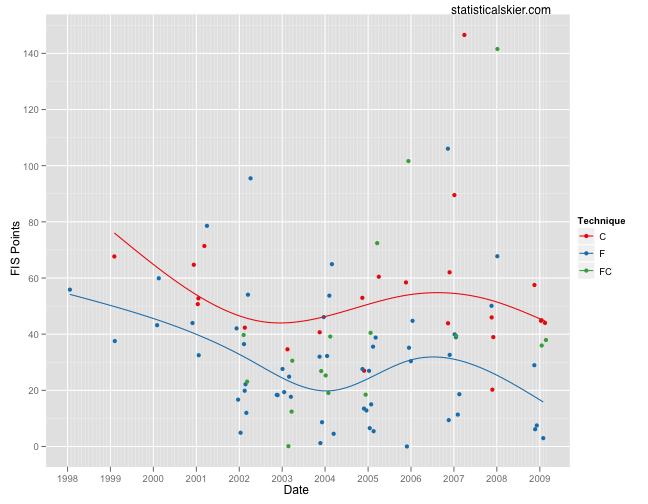
    Hofstad was pretty durned quick between 2002 and 2005.  Things got rough in 2005-2006.  He won an early World Cup, but then struggled for the rest of the season.  After that season he got fewer World Cup starts, but managed to put together three good ones in his last full season of racing.

    Hofstad was a skate specialist, to be sure:

    I think that’s one of the most lopsided technique specializations we’ve seen from retiring skiers so far.  This is a great example of why I find the current pursuit format so frustrating.  I’m kind of an old fashioned guy, so I really like classic skiing.  It irks me that skiers who so clearly struggle in classic races can be so much more successful in a race that is supposed to require them to be good at both techniques.  Grrrr.  Switch it up, make them skate first every now and then!

    Related posts:

    1. <Career Retrospective: Rene Sommerfeldt
    2. <Career Retrospective: Sara Renner
    3. <Career Retrospective: Virpi Kuitunen


  • In a matter of seconds…

    object width=”320″ height=”266″ class=”BLOG_video_class” id=”BLOG_video-44671ac746c0f448″ classid=”clsid:D27CDB6E-AE6D-11cf-96B8-444553540000″ codebase=”http://download.macromedia.com/pub/shockwave/cabs/flash/swflash.cab#version=6,0,40,0″param name=”movie” value=”http://www.youtube.com/get_player”param name=”bgcolor” value=”#FFFFFF”param name=”allowfullscreen” value=”true”param name=”flashvars” value=”flvurl=http%3A%2F%2Fv21.nonxt4.googlevideo.com%2Fvideoplayback%3Fid%3D44671ac746c0f448%26itag%3D5%26app%3Dblogger%26ip%3D0.0.0.0%26ipbits%3D0%26expire%3D1291185636%26sparams%3Did%252Citag%252Cip%252Cipbits%252Cexpire%26signature%3D3E74198F1188944D114ACA65743E107FEAE23F3.7D0BC5249ECE64B3B532BFFEAADC3B14B9CC64F9%26key%3Dck1amp;iurl=http%3A%2F%2Fvideo.google.com%2FThumbnailServer2%3Fapp%3Dblogger%26contentid%3D44671ac746c0f448%26offsetms%3D5000%26itag%3Dw160%26sigh%3DElf-BR9K0VFqzxcGYBf4x9pTaLIamp;autoplay=0amp;ps=blogger”embed src=”http://www.youtube.com/get_player”width=”320″ height=”266″ bgcolor=”#FFFFFF”flashvars=”flvurl=http%3A%2F%2Fv21.nonxt4.googlevideo.com%2Fvideoplayback%3Fid%3D44671ac746c0f448%26itag%3D5%26app%3Dblogger%26ip%3D0.0.0.0%26ipbits%3D0%26expire%3D1291185636%26sparams%3Did%252Citag%252Cip%252Cipbits%252Cexpire%26signature%3D3E74198F1188944D114ACA65743E107FEAE23F3.7D0BC5249ECE64B3B532BFFEAADC3B14B9CC64F9%26key%3Dck1iurl=http%3A%2F%2Fvideo.google.com%2FThumbnailServer2%3Fapp%3Dblogger%26contentid%3D44671ac746c0f448%26offsetms%3D5000%26itag%3Dw160%26sigh%3DElf-BR9K0VFqzxcGYBf4x9pTaLIautoplay=0ps=blogger”allowFullScreen=”true” //objectobject width=”320″ height=”266″ class=”BLOG_video_class” id=”BLOG_video-7d76ed3d00a7e881″ classid=”clsid:D27CDB6E-AE6D-11cf-96B8-444553540000″ codebase=”http://download.macromedia.com/pub/shockwave/cabs/flash/swflash.cab#version=6,0,40,0″param name=”movie” value=”http://www.youtube.com/get_player”param name=”bgcolor” value=”#FFFFFF”param name=”allowfullscreen” value=”true”param name=”flashvars” value=”flvurl=http%3A%2F%2Fv2.nonxt4.googlevideo.com%2Fvideoplayback%3Fid%3D7d76ed3d00a7e881%26itag%3D5%26app%3Dblogger%26ip%3D0.0.0.0%26ipbits%3D0%26expire%3D1291185636%26sparams%3Did%252Citag%252Cip%252Cipbits%252Cexpire%26signature%3D1C6323771A1B89F75DC8D0FE5974D658A438CEF7.3330C3680AD48A3FAD5D152644E9826DF9055DEB%26key%3Dck1amp;iurl=http%3A%2F%2Fvideo.google.com%2FThumbnailServer2%3Fapp%3Dblogger%26contentid%3D7d76ed3d00a7e881%26offsetms%3D5000%26itag%3Dw160%26sigh%3DToLtgCiCDa3giOIdAcSEoF2iMAYamp;autoplay=0amp;ps=blogger”embed src=”http://www.youtube.com/get_player”width=”320″ height=”266″ bgcolor=”#FFFFFF”flashvars=”flvurl=http%3A%2F%2Fv2.nonxt4.googlevideo.com%2Fvideoplayback%3Fid%3D7d76ed3d00a7e881%26itag%3D5%26app%3Dblogger%26ip%3D0.0.0.0%26ipbits%3D0%26expire%3D1291185636%26sparams%3Did%252Citag%252Cip%252Cipbits%252Cexpire%26signature%3D1C6323771A1B89F75DC8D0FE5974D658A438CEF7.3330C3680AD48A3FAD5D152644E9826DF9055DEB%26key%3Dck1iurl=http%3A%2F%2Fvideo.google.com%2FThumbnailServer2%3Fapp%3Dblogger%26contentid%3D7d76ed3d00a7e881%26offsetms%3D5000%26itag%3Dw160%26sigh%3DToLtgCiCDa3giOIdAcSEoF2iMAYautoplay=0ps=blogger”allowFullScreen=”true” //objectdiv class=”blogger-post-footer”img width=’1′ height=’1′ src=’https://blogger.googleusercontent.com/tracker/1362992899157556571-3049582737539098425?l=comeskiwithme.blogspot.com’ alt=” //div

  • Training in Keene

    divbr //diva onblur=”try {parent.deselectBloggerImageGracefully();} catch(e) {}” href=”http://1.bp.blogspot.com/_k1DHbqzFvCE/THgEGK8SKlI/AAAAAAAABBA/y-LLnFp3xDs/s1600/IMG_1405.JPG”img style=”display:block; margin:0px auto 10px; text-align:center;cursor:pointer; cursor:hand;width: 300px; height: 400px;” src=”http://1.bp.blogspot.com/_k1DHbqzFvCE/THgEGK8SKlI/AAAAAAAABBA/y-LLnFp3xDs/s400/IMG_1405.JPG” border=”0″ alt=”” id=”BLOGGER_PHOTO_ID_5510158648150731346″ //adivLevel 4 skate intervals on Hurricane Rd. (East Hill) in Keene were the high point of this week’s training before a few relaxed days of hiking. /divdivbr //divdiva onblur=”try {parent.deselectBloggerImageGracefully();} catch(e) {}” href=”http://1.bp.blogspot.com/_k1DHbqzFvCE/THgEGK8SKlI/AAAAAAAABBA/y-LLnFp3xDs/s1600/IMG_1405.JPG”/abr /a onblur=”try {parent.deselectBloggerImageGracefully();} catch(e) {}” href=”http://1.bp.blogspot.com/_k1DHbqzFvCE/THgEFgrQuGI/AAAAAAAABA4/TpJmHkQHdpM/s1600/IMG_1408.JPG”img style=”display:block; margin:0px auto 10px; text-align:center;cursor:pointer; cursor:hand;width: 300px; height: 400px;” src=”http://1.bp.blogspot.com/_k1DHbqzFvCE/THgEFgrQuGI/AAAAAAAABA4/TpJmHkQHdpM/s400/IMG_1408.JPG” border=”0″ alt=”” id=”BLOGGER_PHOTO_ID_5510158636805044322″ //aIf it was warm enough this would have been the post-ski swimming hole. But, Fall is in the air here and the mornings are cool and the leaves – one by one it seems – are starting to change./divdivbr //divdiva onblur=”try {parent.deselectBloggerImageGracefully();} catch(e) {}” href=”http://2.bp.blogspot.com/_k1DHbqzFvCE/THgEFNTjcuI/AAAAAAAABAw/WAX4NpvXT20/s1600/IMG_1414.JPG”img style=”display:block; margin:0px auto 10px; text-align:center;cursor:pointer; cursor:hand;width: 400px; height: 300px;” src=”http://2.bp.blogspot.com/_k1DHbqzFvCE/THgEFNTjcuI/AAAAAAAABAw/WAX4NpvXT20/s400/IMG_1414.JPG” border=”0″ alt=”” id=”BLOGGER_PHOTO_ID_5510158631605334754″ //a/divdiv class=”blogger-post-footer”img width=’1′ height=’1′ src=’https://blogger.googleusercontent.com/tracker/1362992899157556571-6817076613628826921?l=comeskiwithme.blogspot.com’ alt=” //div

  • Recovering with the Polar OwnOptimizer

    In ideal circumstances, we train long quality hours and recover well in accordance with those hours. Since April things have been going about that well – my hours each week have been consisently high and very good quality and most weeks all I’ve needed is a recovery workout or at most an off 1/2 day to bounce back and be ready for the next session. But at some point these smooth sailing situations are bound to be thrown off course by a squall of fatigue. This past Monday, after a solid week of speed, strength and moderate intensity, I was supposed to take a full day off to prepare for our next training block. Paying only lipservice to that notion, I spent the better part of 8 hours felling trees and bucking up firewood to sell. It was hot, laborious work and I got totally spanked. And then I knew I’d made a mistake.br /div/divbr /divTuesday was an interval day with strength in the evening; before the morning’s session I felt good and thought I’d dodged a bullet with my over-exertion the day prior. But after the intervals I knew it wasn’t so; my legs were heavy and I felt pretty spent. I left Torin to finish the evening’s strength workout on his own after completely only one circuit; my body wasn’t performing. /divdiv/divbr /divTimes like this are inevitable for a pro athlete. You’re pushing the limits of your body’s endurance and ability to recover quickly on a daily basis; overreaching such as I did on Monday throws a wrench into this process and demands a halt to the machine. Bring in the OwnOptimizer test. We’ve been using this software on upper-end Polar heart rate monitors for the last few years and have been astounded at its accuracy. It uses the combination of resting heart rates and heart rate “variability” to determine your level of fatigue or recovery. When training is going well and I’m recovering, the test will register a “1” (Recovered) or a “2” (Normal). But this morning, I get this: /divdiv /divimg id=”BLOGGER_PHOTO_ID_5510130572659980802″ style=”DISPLAY: block; MARGIN: 0px auto 10px; WIDTH: 320px; CURSOR: hand; HEIGHT: 239px; TEXT-ALIGN: center” alt=”” src=”http://3.bp.blogspot.com/_Mg2hQbkHkNs/THfqj9lq-gI/AAAAAAAAAeo/mymwKZodtJ8/s320/P8270112.JPG” border=”0″ / div/divNot truly bad, but certainly an indication that my body is working hard to rebuild after the stresses put upon it. Time for rest, eggs, bacon and a brisk walk. Tomorrow’s the Cutthroat Classic 11.5mile Trail Race on Washington Pass, and I want to be recovered for it.div class=”blogger-post-footer”img width=’1′ height=’1′ src=’https://blogger.googleusercontent.com/tracker/2910103639238326543-5872113644662786190?l=methowolympicdevelopment.blogspot.com’ alt=” //div

  • In Search of Mojo

    mo·jo
    n. pl. mo·jos or mo·joes
    1. A magic charm or spell.
    2. An amulet, often a small flannel bag containing one or more magic items, worn by adherents of hoodoo or voodoo.
    3. Personal magnetism; charm.
    (from thefreedictionary.com)

    An August afternoon at the Craftsbury range.

    An August afternoon at the Craftsbury range.

    While running down Bolton mountain a couple of weeks ago, I got into a discussion with one of my biathlon teammates about our philosophies of training.  Cross country ski racers (including biathletes) train an incredible amount throughout the year.  We go for long rollerskis, bikes, runs and hikes to build our endurance.  We do a variety of drills, such as no pole skiing, to work on technique.  We do blocks of hard intervals where we ski with a high heart rate to increase our speed.  A couple of times a week, we lift, do circuits and work on core exercises to increase our strength.  All of these components help us to become faster racers.  But there is still a piece missing.
    My teammate told me about a cyclist coach she knows who has a motto “You’ve gotta have your mojo.”  Racing at your highest potential requires the cooperation of your body, your mind, and your spirit, and having a little luck thrown in certainly doesn’t hurt.  You need a good training plan to get there.  But you also need the magic.
    I’m constantly in search of mojo.  My number one goal as a biathlete is to have fun.  When the challenges I tackle during training and racing are enjoyable and motivating, I know I’m on the right track.   My favorite training involves adventures, such as long hikes or exploring new trails on a mountain bike.  I like being in places with rugged, wild terrain where I can physically engage the landscape during workouts.  In my experience, I race best when I am happy.  Coincidence?  I think not.
    What’s your mojo?

    Some snapshots of summer:

    Craftsbury Nordic Ski Club bounds up Elinor's field

    Craftsbury Nordic Ski Club bounds up Elinor's field

    Googie watches proceedings at the top of the bounding hill

    Googie watches proceedings at the top of the bounding hill

    Hannah, Lauren and I spent a Saturday afternoon learning hunter safety. The instructors lent us some stylish safety glasses for shooting practice.

    Hannah, Lauren and I spent a Saturday afternoon learning hunter safety. The instructors lent us some stylish safety glasses for shooting practice.

    Pat and Ethan tinkering with rollerskis in the front yard

    Pat and Ethan tinkering with rollerskis in the front yard

  • Night Sprints

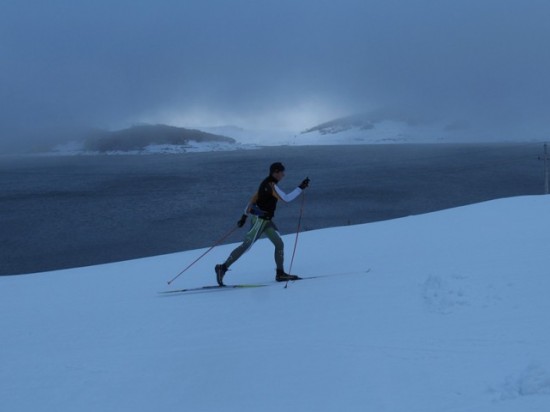
    Winter Carnival weekend here in Falls Creek with big festivities for the Kangaroo Hoppet.  Last night included opening ceremonies with fireworks, parade including an over-snow fire truck, and Night Sprints.  Similar to the Elite Sprints down Main Street in Hayward, this sprint featured a steep downhill start with some fast corners and short climbs on a short 300m course.  Knockout rounds including quarters, semis, and final were exciting with some hard crashes and lots of spectators.  The men’s final featured and All-Olympic cast, including Australians Ben Sim, Alex Almoukov (biathlete), and Swiss sprinter Valerio Lecardi.  I came in second behind Valerio in a last-second lunge to the line.  Afterwards, it felt good to ski to the top of the Alpine run and rip some tele turns in the fresh falling powder.

    The snow looks to be finally letting up, just in time for the Hoppet tomorrow.  I’m heading out the door to do a little course inspection (haven’t even skied the entire course yet!), then go through the pre-race prep, getting skis dialed, big pasta dinner, and packing up for an early race start tomorrow morning.  Saturday’s race should be done by the time Americans are heading to bed on Friday night!

  • Let it snow!

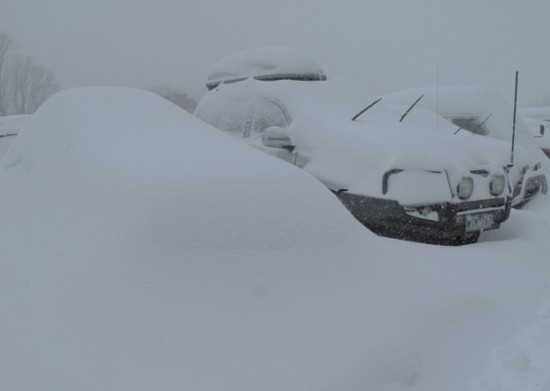
    In the middle of Australia’s storm of the decade at the moment.  In addition to the constant snow last week, it’s snowed over 2 feet in the past 24 hours.  Groomers are running almost constantly, keeping the track firm and fast.  I drove down the mountain with some of the Australian’s yesterday in hopes of doing some running on the famous Mt Beauty single track and seeing some kangaroos.  The trails were awesome, even though it was pouring rain and 40 degrees.  The ‘roos must’ve been inside staying dry, because I didn’t see any.

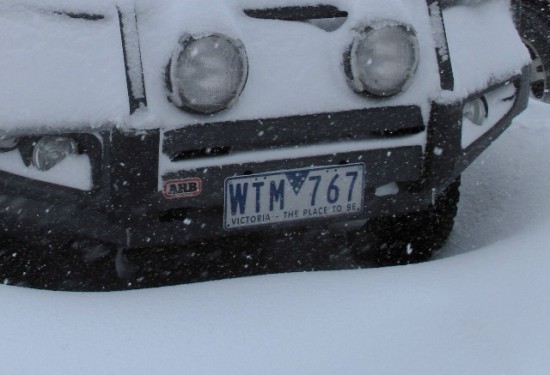
    It took us half an hour to dig out Callum’s truck before the trip (I want to get my hands on a Toyota Hilux).  This picture was taken before the big snow storm!  As the license plate says, Victoria is “The Place to Be.”

    Kangaroo Hoppet Night Sprints under the lights on the alpine hill – tonight!  Stay tuned. . .

  • On THE Field? No way! YATZEE!!!!

    Wally, Chelsea Marshall (Olympic downhill skier), me and Matt on the field at Fenway. Yes, I took some dirt home. It was sweet.

    Let me just say, fairly high stoke level at this point.
  • Olympians “Give Back” at SMS Camps

    We were honored to have 3 Olympians work with us at the Stratton Mountain School summer camps last week. All three offered different, but healthy perspectives on our sport and it is great seeing them give back to their sport. Thank you Justin, Sue and Andy for helping at the camps!br /a onblur=”try {parent.deselectBloggerImageGracefully();} catch(e) {}” href=”http://3.bp.blogspot.com/_H2SCM3lmKm8/THWHc80Q2sI/AAAAAAAAEOM/yfEcOKMpwzk/s1600/IMG_7557.JPG”img style=”display:block; margin:0px auto 10px; text-align:center;cursor:pointer; cursor:hand;width: 400px; height: 300px;” src=”http://3.bp.blogspot.com/_H2SCM3lmKm8/THWHc80Q2sI/AAAAAAAAEOM/yfEcOKMpwzk/s400/IMG_7557.JPG” border=”0″ alt=””id=”BLOGGER_PHOTO_ID_5509458650589092546″ //aJustin Freeman gives some pointers during a classic workout. Justin started skiing early, but he was a late grower and he never was quite fast enough to make the JO team. He ran and skied through High school and developed a strong training base. He made great strides at Bates College and later qualified for the USST and the 2006 Olympic Team. Justin helped at the Jr camp and talked to us about his skiing experiences and how he now manages to have a family, be a teacher and still ski fast.br /a onblur=”try {parent.deselectBloggerImageGracefully();} catch(e) {}” href=”http://1.bp.blogspot.com/_H2SCM3lmKm8/THWF9iqbLvI/AAAAAAAAEOE/qjjDcEbeZao/s1600/IMG_6653.JPG”img style=”display:block; margin:0px auto 10px; text-align:center;cursor:pointer; cursor:hand;width: 400px; height: 300px;” src=”http://1.bp.blogspot.com/_H2SCM3lmKm8/THWF9iqbLvI/AAAAAAAAEOE/qjjDcEbeZao/s400/IMG_6653.JPG” border=”0″ alt=””id=”BLOGGER_PHOTO_ID_5509457011480932082″ //aSue Long Wemyss leads a group during the morning run. Sue went to Stratton Mountain School as an alpine skier. She was tough as nails and earned the nickname “muscles”. Sue switched to XC skiing when she started at Middlebury College and her athletic background and unrelenting determination helped her make the USST and go to the Olympics. Sue helped at the BKL camp and offered some great insights into the joy of competition.br /a onblur=”try {parent.deselectBloggerImageGracefully();} catch(e) {}” href=”http://4.bp.blogspot.com/_H2SCM3lmKm8/THV4uPsoUOI/AAAAAAAAEN8/PpH4NnibpUM/s1600/IMG_8085.JPG”img style=”display:block; margin:0px auto 10px; text-align:center;cursor:pointer; cursor:hand;width: 400px; height: 300px;” src=”http://4.bp.blogspot.com/_H2SCM3lmKm8/THV4uPsoUOI/AAAAAAAAEN8/PpH4NnibpUM/s400/IMG_8085.JPG” border=”0″ alt=””id=”BLOGGER_PHOTO_ID_5509442455040708834″ //aAndy Newell chats it up with the boys before they start some more specific strength. Andy came to SMS as an 8th grader and quickly showed that he was fast. He placed in the top 10 at World Jr. Championships 3 years in a row and was named to the USST straight out of High School. He has been competing on the World Cup circuit for the last 6 years and has made steady progress towards his goal of being the best in the World.br /Andy helped at both camps and everyone got a chance to ski with him and hear stories about his racing experiences. When he is in the East, Andy is a regular at our SMS workouts and he is an ispiration to everyone.div class=”blogger-post-footer”img width=’1′ height=’1′ src=’https://blogger.googleusercontent.com/tracker/4680416899705879324-125794640749586540?l=smsxc.blogspot.com’ alt=” //div

  • Rivalries

    I’ve talked about the amusing notion of victims and nemeses before.  Let’s look at some extreme cases.  Remember that a victim is someone you beat by a small margin (rather arbitrarily chosen by me to be less than or equal to ten seconds).  A nemesis is just the reverse: someone who beats you by such a small margin.

    If this happened a lot between two particular skiers, one could perhaps suggest some sort of rivalry is taking place. <1 So how often could this happen between two skiers?

    Well, quite a lot, it turns out.  Looking at every single race in my database, Pietro Piller Cottrer has beaten Vincent Vittoz by a margin of no more than 10 seconds a whopping 26 times.  Conversely, Vittoz has returned the favor 21 times.  On the women’s side, we’ve got an intra-Italian feud with Gabriella Paruzzi edging Sabina Valbusa a total of 21 times, while Valbusa edged out Paruzzi 14 times.

    Limiting ourselves to more recent territory, the 2009-2010 season, we get the rather one sided rivalry of Northug vs. Teichmann, where Northug defeated Teichmann by no more than 10 seconds seven times in just one season.  And Teichmann?  Not once.  Poor guy.  There isn’t a similarly stand-out example for the women.  Instead, we’ve got two matchups where the score is 5-0.  We’ve got Arianna Follis getting the better of Aino-Kaisa Saarinen 5 times to nothing, and also Marianna Longa tormenting Karine Philippot by the same score.

    What about the apparently oft hyped Northug/Hellner rivalry?  Well, in close races (and all seasons) it doesn’t appear to be much of a contest.  We’ve got 12 victories for Northug by less than 10 seconds and only 2 for Hellner.  Someone needs to work on their sprinting.

    The equivalent rivalry for the women is clearly Marit vs. Justyna.  This actually lives up to its hype somewhat, with 8 narrow victories for Marit and 7 for Justyna.


    Your Ad Here

    1. And let’s be honest.  Even if there isn’t one, it’s fun to drum them up. <↩

    Related posts:

    1. <Victims & Nemeses
    2. <Victims & Nemeses: Marit and Justyna Edition
    3. <Gadflies & Punching Bags


  • Choo-choo

    Two hour distance ski this morning with Aussies, Swiss, Americans, and a handful of other internationals.  Couldn’t see from the back of the train to the front it was so long (and the snow was coming down so fast).  Heading off the mountain for the first time in a week this ahvo for a run on the local single-track.  Hoping to see some kangaroos and get some pics. . .

  • Just like old times

    For the first few years that I lived in Alaska, Scott was my go-to guy for outdoor fun. He was a serious ski racer at that time, but whenever I could distract him from rollerskiing, we’d go do long skis and runs in the mountains.  But in 2005, Scott decided he’d rather be an academic […]

  • Upside Down Under

    Winter greetings from snowy Falls Creek, Australia—home of the Kangaroo Hoppet Worldloppet Ski Marathon. Less than a week into my first trip to the Southern Hemisphere, I am beginning to settle into life Down Under at Australia’s highest ski resort.

    To say that things in Australia are “backwards” may be a little harsh; perhaps “upside-down” might be a better description. Why, for example, is the resort town atop the mountain where I am staying called Falls Creek, while the village in the valley below is called Mount Beauty? I knew that water drains counter-clockwise Down Under, but I had no idea that light switches get flipped down to turn on. Always. My favorite example though, is that Australia gets snow in the middle of our summer—and that’s the real reason why I am here.

    Australian National Team Skier Ewan Watson

    My adventure started a month ago with an invitation from Australian National Team coach, Finn Marsland, to join the Aussie Team for their National Championships and help improve the FIS points at the races. I get the impression that he was looking for skiers with better points than me, but fortunately for me, I was one of the few international athletes to take him up on the invitation! Other internationals here for the races include Olympic Gold Medal biathlete Anastasia Kuznetsova, Swiss National Team skier Valerio Leccardi, and the entire Korean Junior National Team.

    En Route to Falls Creek

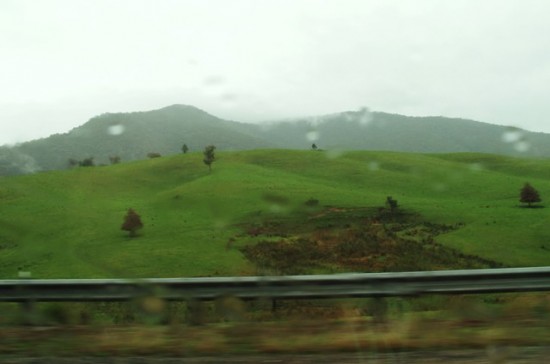
    Travel to Australia was much easier than expected. During the 15 hour flight, I caught up on all the latest new releases, including a disappointing Avatar. Upon arrival, the bus ride from Mt Beauty up to Falls Creek was spectacular. The bus climbed on the left side of the road through an exotic forest of gum trees—second tallest trees in the world, only to the California Redwoods. Beyond the gum tree forest, the view extended to the Kiewa Valley, one of Australia’s famous wine regions.

    The surroundings were so surreal, I almost expected to see blue people to come flying out of the clouds. Instead, we were the ones who drove into the clouds and into a big snowstorm. It’s been a week since I arrived and the snow is still falling. The only time the sun peaked through the clouds was during the Australian National Championship last Sunday, August 22.

    Australian Nationals 15km Skate

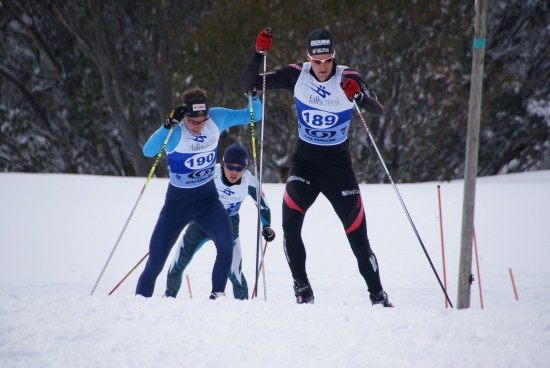
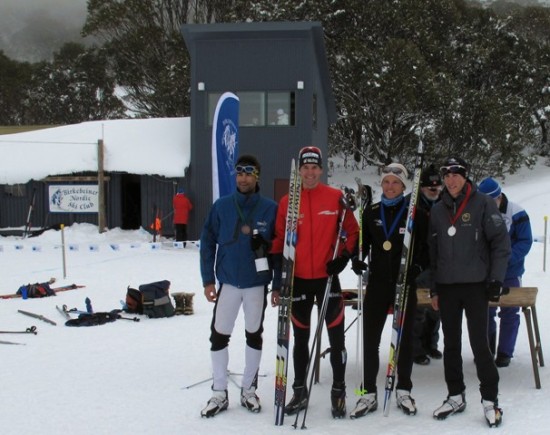
    The course for the 15km Skate National Championship was challenging—reminiscent of Soldier Hollow in Utah. The trails included plenty of climbing, open views with few trees, and more altitude than I was expecting. Fortunately, I used Toko Jetstream to prep some fast skis, helping to compensate for my lack of off-season fitness. Australian Olympian Ben Sim caught me from 30 seconds back and we worked together for much of the race before I made a few seconds back close to the finish. In the end, I came in second at the championships, giving Salomon skis a 1-2 podium.

    Podium at the Birkebeiner Ski Club

    Be careful what you wish for. I came to Australia looking for snow. It’s fallen everyday so far and the forecast is for more snow this week—40cm in the next two days! That should make great conditions for the Hoppet this Saturday, August 28. Stay tuned!

  • Getting Strong with the Methow Olympic Development Program

  • A Look At Skier Speeds

    I was following Andrew Gardner’s twitter feed a while back during the USSA spring meetings, and he mentioned a comment by James Southam that American courses are far easier than those in Europe. <1

    That got me thinking about whether there was any way I could look at this question using, you know, data.  The short answer is that I can’t.  At least not very well.  But the data I looked at are interesting in their own right, and serve as a good example for the sorts of ambiguities and mysteries that can pop up when you’re analyzing data.

    My basic idea was to look at skier speeds (in sec/km) and compare these speeds between some domestic races and some international races.  I didn’t have particularly high hopes for anything meaningful to fall out.  There’s just way too much variability in skier speed due to weather, snow conditions, inaccurate course length measurement, etc.

    What follows is the “cleanest” look at this kind of data I could manage, at least as a first attempt.  The first problem to overcome is data subdivision.  I can’t mix techniques or race distances, for obvious reasons.  That means I’m limited to a single race format at a time.  I settled on 10/15km interval start races, mainly because they were the format I had the most examples from among World Cup and domestic races.

    Still, I don’t have a ton of domestic races in my database (just those from FIS, essentially).  Setting a cutoff of the 2004-2005 season gave me around 20 women/men 10/15km interval start races in the US that weren’t World Cup or Olympic races.  Then you have to split them by technique, leaving only ten in each category or so.

    The other complicating issue here is the natural variability in skier speed, within a single race.  That’s probably going to swamp any differences between domestic and international races, so I just grabbed the top ten times from each race.

    That means I’ve got the top ten times from a bunch of international and domestic 10/15km interval start races, which I can then convert into average speeds by just dividing by 10 or 15.

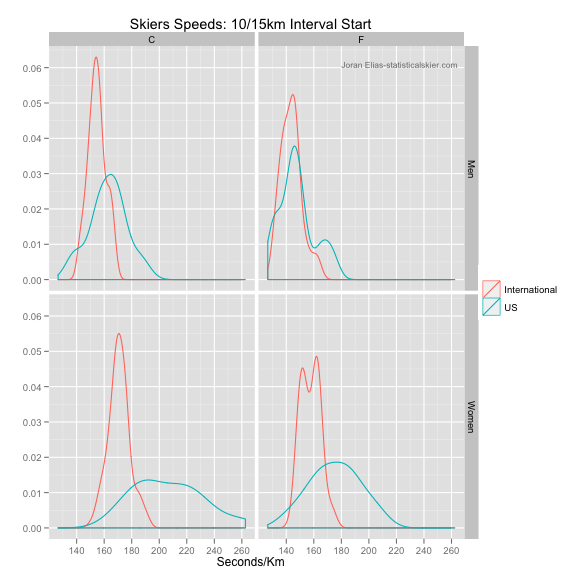
    What I expected to see was that the distribution of top ten speeds in domestic races lags behind the top ten speeds in international races.  No brainer, right?  In the off chance that the speeds are comparable, that might (maybe, possibly, kinda) be taken as evidence that US courses are on the easy side.

    Instead, what I saw was this:
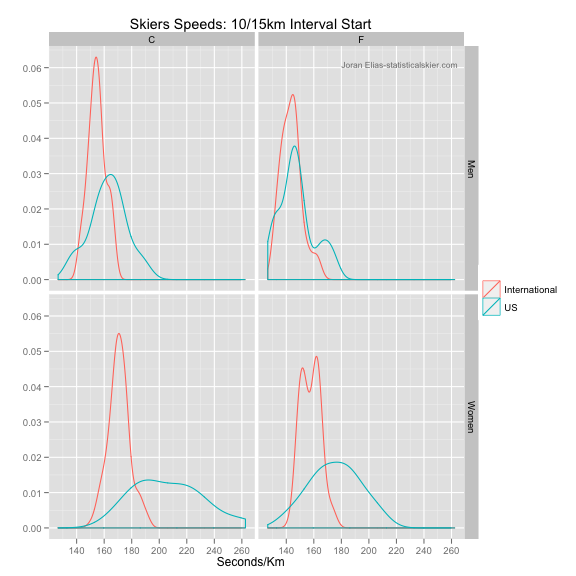
    Huh.  The women are behaving pretty much as I expected.  Men’s domestic classic races are slower, too, but less than I thought.  Then you have the men’s domestic skate races, which match up fairly well.

    Now, if we were stupid (which we’re not, right?) we might jump to the conclusion that the top men in domestic skate races are actually skiing at the same speeds as the top World Cup skiers.  Until they actually go to Europe, of course.  And then suddenly they slow down.  Or the courses, and just the skate courses, for only the men, are very easy in the US.

    Yeah, that doesn’t make much sense to me either.

    The domestic race distributions here aren’t based on very many races; only about 10 in each panel.  About half are SuperTours, a handful of western collegiate races and a handful of US Nationals.  If there were a small number of outlying races in this group of 10, we’d see it in the distributions.  But we don’t.  So either the data are “right”, or somehow nearly all ten of these men’s skate races were unusually fast.

    I asked around with some skier friends of mine, and it turns out that many of the domestic men’s skate races here were in fact unusual.  Many were held in low snow conditions on alternate courses that were unusually easy.  There might be a 15km mass start race in there that’s been misclassified by FIS.<2

    At this point, I was feeling pretty good.  Anomaly explained.

    But then I started thinking.  Why weren’t the corresponding women’s courses also unusual enough to make the women’s skate races look fast too?  Why is it only the men’s skate races?

    Currently, I don’t have a great explanation for this, except the catch-all “Not enough data.”  Which is fair enough; I’m stretching the data pretty thin here.  Still, it’s weird.  And bothering me.  So here’s the list of races:

    Date Gender Technique Length Start Type Category 1 Category 2
    2006-01-07 Men C 15 Interval NC
    2006-11-25 Men C 15 Interval UST
    2007-01-28 Men C 15 Interval UST
    2008-01-03 Men C 15 Interval NC
    2008-11-28 Men C 15 Interval UST
    2009-02-08 Men C 15 Interval UST
    2009-12-06 Men C 15 Interval UST
    2010-01-17 Men C 15 Interval UST
    2004-12-17 Men F 15 Interval NAC
    2006-12-16 Men F 15 Interval UST
    2007-01-04 Men F 15 Interval NC
    2007-01-14 Men F 15 Interval FIS College
    2007-01-20 Men F 15 Interval UST
    2007-12-09 Men F 15 Interval UST
    2008-02-02 Men F 15 Interval FIS College
    2009-02-01 Men F 15 Interval UST
    2009-11-27 Men F 15 Interval UST
    2010-01-04 Men F 15 Interval NC
    2004-12-29 Women C 10 Interval NAC
    2005-01-29 Women C 10 Interval NAC
    2005-11-26 Women C 10 Interval NAC
    2006-01-07 Women C 10 Interval NC
    2006-01-22 Women C 10 Interval NAC
    2006-11-25 Women C 10 Interval UST
    2007-01-28 Women C 10 Interval UST
    2008-01-03 Women C 10 Interval NC
    2008-02-01 Women C 10 Interval FIS College
    2008-11-28 Women C 10 Interval UST
    2009-01-24 Women C 10 Interval UST
    2009-02-08 Women C 10 Interval UST
    2009-12-06 Women C 10 Interval UST
    2010-01-17 Women C 10 Interval UST
    2004-12-17 Women F 10 Interval NAC
    2005-01-22 Women F 10 Interval NAC
    2006-01-21 Women F 10 Interval NAC
    2006-12-16 Women F 10 Interval UST
    2007-01-04 Women F 10 Interval NC
    2007-01-14 Women F 10 Interval FIS College
    2007-01-20 Women F 10 Interval UST
    2007-12-09 Women F 10 Interval UST
    2008-02-02 Women F 10 Interval FIS College
    2008-11-29 Women F 10 Interval UST
    2009-01-25 Women F 10 Interval UST
    2009-02-01 Women F 10 Interval UST
    2009-11-27 Women F 10 Interval UST
    2010-01-04 Women F 10 Interval NC
    2010-02-06 Women F 10 Interval FIS College
    2010-02-07 Women F 10 Interval FIS College

    I suspect there’s at least one or two classification errors in this list of races.  Anyone have any better explanations?

    1. I’m paraphrasing here; it was something to that effect. <↩
    2. I still need to check this. <↩

    Related posts:

    1. <How Well Prepared Are World Cup Rookies? (Part 1a: Distance)
    2. <Gadflies & Punching Bags
    3. <Most Improved: Women’s Distance


  • Welcome to the A-Frame of Pain

    While there might be a monstrosity of a strength facility dubbed the Taj Marolt in Park City, the Methow Olympic Development Program takes you behind the scenes to its own gym, known around these parts as the A-Frame of Pain. What it lacks in cubby holes and foam pits it makes up for in plates, homerigged machines and ingenuity. Check it out.br /br /object height=”385″ width=”480″param name=”movie” value=”http://www.youtube.com/v/gQaZtubDjnY?fs=1amp;hl=en_US”param name=”allowFullScreen” value=”true”param name=”allowscriptaccess” value=”always”embed src=”http://www.youtube.com/v/gQaZtubDjnY?fs=1amp;hl=en_US” type=”application/x-shockwave-flash” allowscriptaccess=”always” allowfullscreen=”true” width=”480″ height=”385″/embed/objectdiv class=”blogger-post-footer”img width=’1′ height=’1′ src=’https://blogger.googleusercontent.com/tracker/2910103639238326543-121676922277484062?l=methowolympicdevelopment.blogspot.com’ alt=” //div

  • We’re back!

    I’ve been away, paddling in Quetico Park in Ontario, Canada, but now I’m back in town. Quetico Park is a huge protected wilderness area of lakes, rivers, bogs and pine forests in the central part of the continent, just north and adjacent to the Boundary Waters (northern MN).a onblur=”try {parent.deselectBloggerImageGracefully();} catch(e) {}” href=”http://1.bp.blogspot.com/_T8lplfcx_Ro/THLkkSkLWNI/AAAAAAAAAiA/NlhuD1jZJsk/s1600/Mark-Quetico.JPG”img style=”display: block; margin: 0px auto 10px; text-align: center; cursor: pointer; width: 400px; height: 302px;” src=”http://1.bp.blogspot.com/_T8lplfcx_Ro/THLkkSkLWNI/AAAAAAAAAiA/NlhuD1jZJsk/s400/Mark-Quetico.JPG” alt=”” id=”BLOGGER_PHOTO_ID_5508716606337538258″ border=”0″ //aWe (Mark amp; Margaret) spent 9 days paddling a big loop of about 165 miles, with 42 portages. The portages are trails that connect adjacent bodies of water, and on these portage routes the canoe and equipment are carried; on our trip the portages varied from about a mile to as short as the width of a beaver dam.br /br /Much of the trip was spent paddling the historic routes of the Voyageurs, the fur traders who transported goods across the continent on water routes. The canoe routes and portage trails in the Quetico wilderness have been used for literally thousands of years by the original inhabitants of the north woods, and appear almost unchanged today. br /br /Mosquitoes were an issue, thus long sleeves, hats, and long pants.

  • D2R2 – One of the hardes century rides around

    Sometimes you hear about a special hike, cook bike route, or just plain cool event and you think to yourself, “I have to do that”. The Biathlon Team heard about D2R2 through some local riders and we thought that this was one of those “I have to do that” events! Started as a fundraiser for a local Land Trust company called the Franklin Land Trust, the D2R2 has grown year after year, even after riders take a beating for no less than 8 hours as they cover the tough roads and climbs.

    There are three rides, a 180km, 100km, and 50km. The 180km along boasts, 16,000ft of total climbing, over 70% on dirt roads, a few climbs nearly 2 miles long, with a few reaching between 25-27% grade. Last year one old fella was asked before Ambrosia Rd. (.6 miles and 27% up loose gravel) if anyone had made it up. He replied back, “I haven’t seen anyone make it up this road since I was a boy”! Patten Hill was another 25% grade road, this time on pavement for half a mile before it continued up for another 1.5 miles on loose gravel that was supposedly a road.

    But the ride was more than just a “gut check” training ride. This route and region proved to be some of New England’s finest. The entire way we rode along beautiful streams and rivers, up and over passes with some really awesome views, and around some farms that made you want to quit your day job just to go and work on them. The local volumteers were engaging and really excited to have us all there. This may need to become an annual tradition!

    Who did it?
    180km – Gary, Seth, Tracy, Mark Rossignol, Matt Michaud and Taylor
    100km – Grace, Katrina, Andrea, and Corrine


    This ice cream truck was strategically placed!


    A field of sunflowers at one of the rest stops

  • D2R2 – One of the hardes century rides around

    Sometimes you hear about a special hike, cook bike route, or just plain cool event and you think to yourself, “I have to do that”. The Biathlon Team heard about D2R2 through some local riders and we thought that this was one of those “I have to do that” events! Started as a fundraiser for a local Land Trust company called the Franklin Land Trust, the D2R2 has grown year after year, even after riders take a beating for no less than 8 hours as they cover the tough roads and climbs.

    There are three rides, a 180km, 100km, and 50km. The 180km along boasts, 16,000ft of total climbing, over 70% on dirt roads, a few climbs nearly 2 miles long, with a few reaching between 25-27% grade. Last year one old fella was asked before Ambrosia Rd. (.6 miles and 27% up loose gravel) if anyone had made it up. He replied back, “I haven’t seen anyone make it up this road since I was a boy”! Patten Hill was another 25% grade road, this time on pavement for half a mile before it continued up for another 1.5 miles on loose gravel that was supposedly a road.

    But the ride was more than just a “gut check” training ride. This route and region proved to be some of New England’s finest. The entire way we rode along beautiful streams and rivers, up and over passes with some really awesome views, and around some farms that made you want to quit your day job just to go and work on them. The local volumteers were engaging and really excited to have us all there. This may need to become an annual tradition!

    Who did it?
    180km – Gary, Seth, Tracy, Mark Rossignol, Matt Michaud and Taylor
    100km – Grace, Katrina, Andrea, and Corrine


    This ice cream truck was strategically placed!


    A field of sunflowers at one of the rest stops