Category: Camps

Reports from local, regional, national and international camps used to prepare for Nordic ski racing.
  • Junior Camps: Norway Style

    Junior Camps: Norway Style

    Ragnhild Bolstad of Hedmark Skikrets based in east central Norway has organized training camps for the top regional juniors in east central Norway for more than a decade. When putting together camp training schedules for junior skiers, Bolstad has some key ingredients in mind: The social aspect is huge. The athletes want some feedback on where they are and where they can improve. Strength is important and roller skiing is often over-emphasized.

    Ragnhild Bolstad (left) skiwalking with a group of junior girls near Rena in Hedmark. (Photo: Inge Scheve)

    Building an environment

    First and foremost, a lot of the skiers train alone or with a limited group of other skiers and coaches. Bolstad tries to compose a training camp schedule that exposes the skiers to other coaches, technique sessions and workouts that are fun to do in a big group, such as relays and group challenges.

    “The number one objective of these camps is to get together with others on the same ambition level, compete and compare themselves to others,” Bolstad says. Additionally, they want to get some pointers, learn something new to take home and get a break from their regular training routine.

    “It’s always useful for the skiers to get feedback on how they ski, whether its roller skiing or on snow,” Bolstad says. During a camp, skiers often do more than in a regular week, both in terms of intensity and volume, so variety is a big component, she says. “My philosophy is that they can easily do a lot of easy distance and volume on their own, but that they enjoy doing intensity with other, and that they push themselves more when they do intervals and mock races at in a camp setting,” Bolstad says. “I usually recommend that they come to the camp well rested and take care to do a very easy week following a camp.”

    Add more strength

    One area where Bolstad thinks there is room for improvement is strength.

    “A lot of the time it seems like strength is just a few minutes of abs and core at the end of a workout, but I think we can do more here. Strength is becoming increasingly important in cross-country skiing, so it should be a natural component of a camp too. Some coaches believe you need a sophisticated gym to do a structured strength workout, but you can do a lot just with the elements you find outside,” she says, mentioning rock ledges for benches, rocks for cones, grassy areas instead of foam mats, and tree branches for hang-ups and pull-ups, as well as simple things like elastic bands that are easy to roll up and bring on a workout. “I think most juniors do some sort of strength at least 2 or 3 times per week at home.”

    Bolstad also thinks including strength into roller ski workouts provides better use of the time on roller skis than just logging miles and hours on the pavement.

    Juniors working on specific strength at Rena in Hedmark. (Photo: Inge Scheve)

    Roller skiing is over-emphasized

    Bolstad believes a lot of skiers overestimate the importance of roller skiing.

    “Certainly, you need some and most skiers should do two roller ski workouts per week in the meat of the dryland season, but I don’t think there is much value in more than 3 or max 4 roller ski sessions per week,” she says, explaining that while specific to skiing, there are other aspects of training that needs attention during the dryland season.

    “Roller skiing is a great alternative to other endurance training, and is definitely useful in keeping the ski muscles sharp, staying up on technique and getting a load off your legs, but there is nothing that beats running in developing capacity,” Bolstad says. She swears by running, skiwalking and bounding with poles as some of the most efficient, versatile and enjoyable forms of dryland training.

    “I firmly believe in running with poles, bring them everywhere, and run in a lot of different terrain, such as wetlands and gnarly trails to improve both strength and balance. Use your poles everywhere,” says Bolstad, adding that part of what makes skiing so great is the nature experience. Roller skiing confines athletes to the pavement, while running opens up much more terrain.

    Favor mountain biking

    Bolstad also believes cycling has a place in a well-rounded varied dryland program. However, she recommends mountain biking and trail riding over road biking.

    “When riding trails, you ride in and out of the saddle, you have to balance your bike through turns and over obstacles and you really have to engage your core, which develops balance and core strength to a much greater degree than riding on roads.”

    Issues and training principles

    Finally, Bolstad also makes sure every junior camp has some sort of theoretical content. She usually sets up at least one lecture on a relevant topic, ranging from training principles and fundamentals, doping and eating disorders.

    This last year, she invited officials from Anti-Doping Norway to talk about diet and dietary supplements in the context of doping.

    “Ambitious athletes are willing to stick to a strict and sometimes almost extreme diet, and for some the step to supplements is not that far. What is doping? And what are the gray areas?” Bolstad also notes that once skiers reach the junior level, they can be tested for doping at sanctioned events, so she felt that it would be useful for them to know what the procedure is like.

    This spring, Bolstad organized a lecture from the new initiative Sunn Jenteidrett (“Healthy Girl Sports”), which was launched as a joint project from the Norwegian Ski Association, Norwegian Biathlon Association, Norwegian Track and Field Association, and Norwegian Orienteering Association. The project is also backed by the Olympic Development Center (Olympiatoppen), the Norwegian Athletic Association (NIF) and the national lottery (Norsk Tipping). The project focuses on female athletes age 13-22 and emphasizes on building supportive training environments, increasing awareness of eating disorders and information on how to find resources. The project also teaches young athletes – both girls and boys – how to plan meals before, during and after workouts and competitions, as well as how to eat right and what to eat, since many junior skiers move away from home to attend ski academies during their high school years. Young athletes who attend ski academies often live in apartments near their schools and have to cook for themselves during the week. For a lot of juniors, this is their first experience with living alone.

    “A lot of people think eating disorders only affect girls, but the truth is that a lot of boys also have trouble getting the right balance in their diets, maybe for different reasons. Also, eating disorders are something that affects everyone in the sport, from coaches to teammates and everyone in the support system. It’s important to talk about it, and to let the athletes know that there are resources out there, how to help and how to get help.”

    So bottom line, the most important aspects with junior camps include building an environment among regional athletes where they can learn from each other, test their limits and get feedback on their technique and progress.

    The junior racer on camps: Socially rewarding and bloody serious

    Maja Solbakken, 17, from Engerdal on the Swedish border is one of Norway’s promising young skiers. She’s attended a number of ski camps since she was 13 or 14 years old, and raves about the value of the experience. For her, the most important take-aways from the camps are the friendships that she has formed with skiers from different parts of the country, and the intensity and focus that only happens in a camp environment.

    “It’s so nice to hang out with other kids who have ambitions in skiing. It’s a really social experience, and every time I go, I get really motivated to keep training hard,” Solbakken says, explaining that training with celebrity coaches and other skiers you usually only see during the race season, she really wants to show off her best game.

    “You push a lot of limits when you’re at the camps. I’ve done uphill intervals to the point of throwing up. There are coaches there from the junior national teams or regional teams, and you just really want to show what you’ve got,” Solbakken says.

    Solbakken doesn’t think the national team coaches base their team selection on the junior camps, but she certainly thinks that skiers who look like they work hard and have the right attitude can get on their radars during the camps.

    “The national team coaches are at all the big races in the winter, so if you’ve made a good impression in the summer, there’s a chance that they’ll remember that. I think they observe a lot during the camps,” Solbakken says.

    Feedback and pushing limits

    Solbakken enjoys going to the camps to get feedback on her technique and progress from coaches that she doesn’t work with on a regular basis. Also, she says it’s inspiring to be coached by some of the top World Cup racers. National team skiers often serve as assistant coaches on the summer ski camps that attract junior skiers from all over the country.

    “We had Astrid Uhrenholdt Jacobsen as our strength and plyometrics coach last summer. She was really nice, but she required full attention to the task while training and didn’t take any crap. So we got some really intense, focused and efficient workouts there. That was really motivating,” Solbakken recalls.

    Solbakken says that the summer camps are the highlights of her summer training program.

    “The camps really mean a lot to me as an athlete and as a person,” Solbakken says, adding that she hopes to come back as a coach some day. “Only the top skiers in the country are invited to coach at the national summer ski camps. It would be a big honor to be asked one day.”

    Maja Solbakken (Photo: Inge Scheve)
  • Running Up Hills: Eastern REG Camp

    Running Up Hills: Eastern REG Camp

    High-caliber junior athletes flocked to Craftsbury Outdoor Center in Vermont on June 25 for the five-day Regional Elite Group (REG) camp.  The week provided attending skiers with a chance to train with and learn from some of the country’s best coaches.

    Eastern REG athletes out for a rollerski (Photo: NENSA)

    This year saw some changes to the general REG plan, including more time trials and the requirement that athletes wear numbered bibs for all workouts, fostering a greater spirit of competition and professionalism.  “I think the camps really took a turn for the better,” Matt Whitcomb, US Ski Team Development Coach, told FasterSkier in an interview.  “I’m really encouraged.  The coaches and clubs are educating these athletes, and they hit the ground running,”

    The camp featured two time trials, including the always-painful uphill running time trial, a fantastic  measurement of vo2max and pure fitness.  “It’s a hell of a mental training test as well,” Whitcomb acknowledged.

    A number of senior athletes jumped in for many of the workouts, including the running time trial, in which Ida Sargent took home the win for women while teammates Tim Reynolds and Dylan McGuffin tied for the men’s trophy.

    Athletes work on their double-pole. (Photo: NENSA)

    A highlight of the week was the OD rollerski on rolling country roads and smooth pavement.  “It was one of the better workouts in my opinion,” Whitcomb reported.  “There was very little chitter-chatter, very little waste of time.”

    The overall feeling was one of improvement and success, both coming into the camp and leaving.  Coaches were pleased by the level of professionalism the athletes brought to the week and saw a group that was technically proficient, good on their rollerskis, and prepared to work hard.

    Video by David Loney:

    2010 Camp Roster:
    Rachel Hall, SMS
    Elizabeth Anderson, Ford Sayre
    Skyler Davis, SMS
    Briger Tyler, SMS
    Gage Fichter, SMS
    Isabel Caldwell, SMS
    David Sinclair, GMVS
    Welley Ramsey, MWSC
    Ben Lustgarten
    Hans Halvorsen, GMVS
    Chris Stock, CSU
    Austin Caldwell, SMS
    Magnus Bigelow, SMS
    Patrick Caldwell, Ford Sayre
    Charlie Bencze, Mid A
    Austin Cobb, SMS
    Reed Likly, Mid A
    Mitch Prevot, Burke
    Heather Mooney, SMS
    Heidi Halvorsen, GMVS
    Megan Killigrew, Dartmouth
    Keely Levins, Middlebury
    Hannah Smith, CSU
    Elizabeth Izzo, NYSEF
    Green Racing Project Athletes:
    Chelsea Little
    Ollie Buress
    Dylan McGuffin
    Lauren Jacobs
    Matt Briggs
    Hannah Dreissigacker
    Ida Sargent
    Pat Obrien
    Coaches: Matt Whitcomb, USST; Janice Sibilia, NENSA; Cami Thompson, Dartmouth; Jason Hettenbaugh, Rochester Nordic; Eileen Carey, MWSC; Pepa Milocheva, Craftsbury/GRP, Nick Brown, and David Loney

  • Through Time Trials and Tug-of-War: Central REG Camp

    Through Time Trials and Tug-of-War: Central REG Camp

    Friday marked the end of the Central Regional Elite Group (REG) training camp at the Cresthill Resort in Hayward, Wisconsin.  Top athletes from throughout the Central region arrived on Saturday, July 3 for a week of tough competition, quality training, and phenomenal coaching.

    Athletes compete in a high-stakes game of tug-of-war (Photo: CXC Skiing)

    One of the great values of the REG camps is the educational component, as athletes attended lectures presented by the coaches almost every night.  The star-studded coaching staff included Bryan Fish (US Ski Team (USST) Continental Cup Coach), Matt Whitcomb (USST Development Coach), Gus Kaeding (CXC Elite Development Coach), Igor Badamshin (CXC Junior Development Coach), Justin Easter (CXC Director of Sports Education), and Yuriy Gusev (CXC Athletic Director).

    Athletes celebrated the country’s independence with a vo2max test on their first full day of camp, followed by a 3000 meter running time trail, medals strength testing, and an obstacle course throughout the rest of the week.

    Training concluded with the “OO” 5k skate time trail beginning at the Sawmill Saloon in downtown Hayward and ending at the halfway point of the American Birkebeiner trail, the top of the infamous “OO” hill.

    Jessie Diggins fights her way up the "OO" time trial. (Photo: CXC Skiing)

    Members of the Central Cross-Country Association (CXC) Elite Team, taking part in their own nearby training camp last week, joined in on both time trails, making for some highly competitive races.

    “It was obvious that the REGers took aim at taking down some of the elite team.  Watching the REG skiers hang everything on the line to stay with some of America’s fastest skiers was awesome,” coach Gus Kaeding told FasterSkier in an email.

    The camp was, as always, an overall success as all athletes learned from the coaches, from themselves, and from each other in order to improve and become faster skiers.

  • Western REG Features 18 Hours, Agony Time Trial, and Andy Newell

    Western REG Features 18 Hours, Agony Time Trial, and Andy Newell

    Midsummer is upon us, and that means it is time for the annual Regional Elite Group (REG) camps.

    The annual Western REG camp recently concluded in Park City, where 30 athletes took advantage of excellent training opportunities to log 18 hours for the week.  The schedule also included Medals Testing (a set of exercises including pushups, pullups and situps, performed in a controlled environment) the famous Agony Hill Time Trial, as well as talks from the likes of US sprinter Andy Newell.

    USST Coach Pete Vordenberg viewed the camp as a success, continuing a positive trend since the REG camps were launched in 2002.  Vordenberg told FasterSkier that he has seen good improvement in the level of athletes attending the camps – in both in technique and fitness.

    As the name implies, REG camps include the top young skiers from a geographic region and are an integral part of US Ski Team (USST) talent identification.

    The top athletes from each REG camp will be invited to attend the National Elite Group (NEG) camp this fall in Lake Placid.  The NEG camp is run by top national club coaches alongside the final USST dryland camp of the year.

    Athletes wear numbered bibs during the camp, and coaches rank athletes based on various criteria throughout the week, all in an effort to pick out the most talented skiers.

    Finding the right position for V1. (Photo: Pete Vordenberg, NCCSEF)

    Agony Time Trial

    Russell Kennedy claimed victory in the Agony time trial, posting a time of 15:55 while edging Will WIcherski by one second and Erik Fagerstrom by two.  Kennedy’s winning time was 55 secdons slower than Scott Patterson’s mark at the National Training Group camp of several weeks ago.

    Annie Pokorny led the women, besting Jessica Jortberg by four seconds with a time of 19:34.

    Vordenberg sees time trials like the Agony hill climb as an important part of measuring fitness and progress, and encourages athletes to create tests that they can perform at regular intervals during the training season.  If improvements are not evident, athletes need to make adjustments to their training.

    “I really like the uphill running test or double pole test,” Vordenberg said in an interview.  “It is something the kids can do on their own, and is not really any different form what we (the USST) would be doing.”

    Newell Speaks

    Vordenberg picked the talk by Newell as one of the high points of the week.  One of the top sprinters in the world, Newell presented detailed information on preparing for sprints, but Vordenberg saw the greatest value in Newell’s general approach.

    “People see Andy, and he is a cool kid with a skateboard.  They don’t usually see how dialed in he is.”

    Vordenberg pointed to Newell’s professionalism and commitment as demonstrated by his preparation.  Some athletes might find it a bit of a turn-off, but, said Vordenberg, for those who are motivated, it is an inspiration.

    Classic Skiing (Photo: Pete Vordenberg, NCCSEF)

    Not Just for Athletes

    The REG camps are not solely about the athletes – though that is the focus.  The camps also provide an opportunity for top regional coaches to work together and with USST staff.

    “Beyond the benefits for the athletes right then and there, the REGs have been successful getting coaches working on the same stuff, and focused on international level success,” said Vordenberg.

    He was pleased with how the coaches worked together and the consistency of message.  Coaches were on the same page, using similar language, and extensive pre-workout discussion was not needed.

    “This year I was really happy with the other coaches, how we work together – how organized it has become, and how focused the workouts have become.  There are good fun times, but within the workouts people are extremely focused.”

    And while it can be more difficult to measure the benefits of the REG camps on coaching, in part because the same people often attend, and are clearly highly motivated, Vordenberg has been encouraged to see a steady stream of new faces.

    More Work Ahead

    Ultimately, while the Western REG camp was highly successful and the overall level has been on a steady trend upward, there is still much to do.

    Said Vordenberg, “I am encouraged by the improvements, but I think in terms of general fitness we have some progress to be made. There is another level that these athletes need to reach – they just need to get to a higher fitness level.”

    And that is one of the reasons for time trials and testing.  Vordenberg notes that overall fitness can be easily measured with such tests, and the Agony time trial this summer reveals the steps that must still be taken to compete at the international level.

    The Eastern REG camp also wrapped up last week, and the Midwest version is currently underway.

    More photos, comments from Pete Vordenberg and top-5 results of the strength test can all be found on the NCCSEF website.

    Western REG Agony Time Trial Results

    Russell Kennedy 15:55
    Will Wicherski 15:56
    Erik Fagerstrom 15:57
    Rogan Brown 16:24
    Conor Wallace 16:39
    Max Christman 16:39
    Austin Meng 16:39
    Mike Vigers 16:44
    Akeo Maifeld-Carucci 16:57
    Tanner Weigand 17:35
    Sean Woods 17:37
    Ben Westesen 17:41
    Johnny Springer 17:42
    Henry Austin 17:51
    Danny Sundali 17:54
    Casey Smith 19:18
    Jack Steele 19:35
    Alex Hamilton 19:54
    Annie Pokorny 19:34
    Jessica Jortberg 19:38
    AliciaRose Pastore 20:33
    Elena Breed 21:17
    Stella Holt 21:21
    Katie Gill 21:25
    Mikaela Frias 21:47
    Anne Miller 22:37
    Haley Piske 22:50
    Emily Williams 23:09
    Kara Baldwin 24:12
    Emma Donohoe 24:51
  • NTG Camp Fires Up Developing Athletes

    NTG Camp Fires Up Developing Athletes

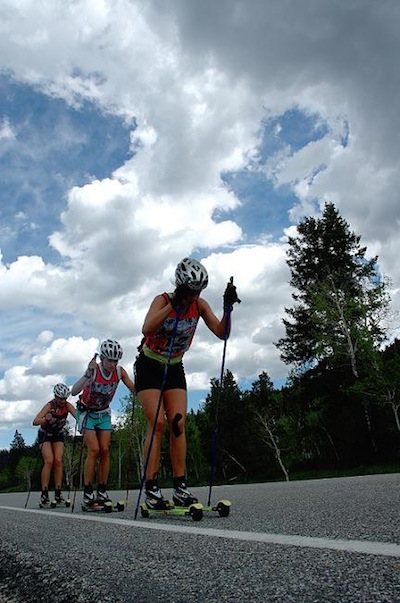
    Sadie Bjornsen (l) rollerskiing with Sophie Caldwell (middle) and Kate Dolan (r)

    Sadie Bjornsen, a new member of Alaska Pacific University’s ski team, gave this firsthand account towards the end of the recently-completed National Training Group camp in Utah. This post originally appeared on her blog, sadiebjornsen.blogspot.com/

    For the past nine days, I have been training and hanging out in Park City, Utah, for the National Training Group camp. Earlier this spring, 25 promising top U-23 and junior athletes were named to this group, which is a new addition to the U.S. Ski Team’s “pipeline.” Six girls and nine boys traveled up, down, or across the country to join the group for ten days of training with U.S. Ski Team (USST) staff. It has been tons of fun, but super hard work.

    Many of these athletes I have never gotten a chance to train with during the summer–I just meet them head-to-head on the race trails–so it has been fun to work alongside them. The coaching has been great as well. We have gotten lots of feedback on technique, training, and just simply our goals in the sport.

    More rollerskiing

    It has been great to train along with Andy Newell and Liz Stephen–it just raises the bar a bit during training. And not only have I been training with top nordie athletes, but also other big shots as well. Yesterday, I was walking backwards on the treadmill (an activity that seems to have no stress on my knee), while watching Ted Ligety speed squat what looked like three times his body weight. I also got to see Lindsey Vonn, an incredible alpine skier, bust out various weight training exercises. It’s funny how you make out these ski heroes to be supernatural people, but then you train alongside or with them and they are normal humans. It sure has a way of firing you up!

    The camp has remained very focused for the entire time. Most days we have hit the pavement or the trails at 8:30 and trained for a couple hours, returned home for some down time, then headed out again for an afternoon workout. After dinner, we return to the “Center of Excellence” [the USST’s training center] for a meeting focused on various aspects of being a ski racer. These meetings have included talks from top athletes like Andy Newell, USST nutritionists, video review, and discussions on topics like relaxation and visualization, World Cup video, and the development pipeline.

    We have hit almost all angles of training. The camp started out with an uphill running time trial, and then was followed four days later with a sprint race simulation. I have been struggling with knee issues, so I had to replace all the running workouts with swimming. I used to be a swim racer during my younger years, but the long break has made me realize how much hard work it is–it’s a great way to increase your upper body strength, for sure! The rest of the workouts have been distance, speed, strength or interval work. This morning, I finally felt the fatigue catching up to me when we did a level three interval workout, 3x14mins, around a loop in town. One more strength workout, a distance workout the following morning, and then I head home to Washington for a few days.

    The weather has greatly improved over the course of the camp. The first few days were rainy and cold, so we have gotten overly excited about the sun coming

    Ouch.

    out these past couple of days. Yesterday, on our afternoon off, we decided to lie by the pool for no more than an hour and came home a little more sunburnt than expected. Turns out you get burned even when its cold out. I am trying to soak up every last bit of sun and heat before I move up to Alaska next week.

  • CXC Update – June Camp

    CXC Update – June Camp

    Thursday marked the final day of the first training camp of the summer for the Central Cross-Country Ski Association (CXC). Based out of Marine on St. Croix, Minnesota, the camp consisted of 10 days of training at various locations ranging across the St. Croix Valley. With previous head coach Bryan Fish around for the first week before moving on to his new position with the US Ski Team (USST), the camp also functioned as a sort of transitional period between coaching staffs. “I sat back and observed a fair amount the first few days to get a read on people — figure out who was who and where they needed help” said CXC’s new head coach, Jason Cork in an email to FasterSkier. “Having Fish the first week was really helpful for Gus [Kaeding, new Elite Development coach] and I — after he headed out to Park City, we got handed the reins a little.” This was the first time the entire 2011 team was together, although the marathon team was unfortunately not present. Much of this first camp consisted of figuring out goals and plans for the coming year. Workouts followed a fairly basic schedule, including some Level 3 intervals, strength sessions, technique drills, and a track workout. Athletes also did a VOmax test at Wild River Fitness in Osceola, Wisconsin. A primary focus of these ten days was to get a good idea of goals and fitness level at this point in the year, so tests were particularly emphasized. On top of VOmax testing, the team did a lactate test to get an idea of where they should be during distance and intensity training. A special highlight of the trip, according to Cork, was an afternoon of playing (a.k.a. training) with a local youth program.

    Garrott Kuzzy with members of the Rochester Junior Nordic Skiers. Photo: CXC

    Many of the athletes were also working together for the first time over these past ten days. Commenting on team dynamics in this early stage, Cork said “It looks like it’s going to be a really good mix of people this year. It’s a fairly small team, but we’ve got everything from people who graduated high school last weekend [Jessie Diggins] to people who’ve been to World Championships and the Vancouver Olympics [Garrott Kuzzy and Caitlin Compton]. Everyone seems to work together really well and get along, which is always nice to see when you’re planning on traveling so often during the season.” Diggins, a St. Croix Valley native, added, “everybody contributes something different to the team. There’s a really wide range of people.”

    Members of the team out on an OD rollerski. Photo: Brian Gregg

    Coaches are currently working on individualized training plans for team members to follow. Now that the June camp is over, athletes will return home for a few weeks of individual training before reconvening for another camp in Hayward, Wisconsin on July 5.

  • USSA Names NTG Participants

    With just several days before the first-ever National Training Group camp in Park City, USSA has released a list of participants, including many of the top young skiers in the country.

    Dartmouth's Rosie Brennan, Ida Sargent, and Sophie Caldwell lead an Eastern Collegiate race this year. All three will be at the NTG camp.

    The group is led by Ida Sargent, currently attending Dartmouth College and a member of the Craftsbury Green Racing Project. With a strong season, Sargent established herself as arguably the second-best female sprinter in the US behind only Kikkan Randall. She placed an impressive 4th in the U23 Championship sprint in Hinterzarten, Germany, and was the runner-up to Randall in the classic sprint at the SuperTour finals.

    She is joined by newly minted Alaska Pacific University (APU) skier Sadie Bjornsen, who also performed well internationally, racing at World Juniors and in a number of European Continental Cup events.

    Former US Ski Team (USST) members, Rosie Brennan and Alexa Turzian will also be in attendance.

    On the mens side, the charismatic Tad Elliott heads an impressive group that also includes another former USST athlete Matt Gelso, and Alaskan up-and-comers David Norris and Reese Hanneman.

    19 of the 25 participants are either currently enrolled in college, graduated this spring, or will be starting their freshman year in the fall.  One other skier graduated a year ago.  Dartmouth College is impressively represented with seven athletes attending the camp.  The University of Colorado is sending four past or current skiers.

    United States World Cup sprint star Andy Newell will attend a some of the camp workouts, and will also participate in the sprint time trial.

    A full report on the upcoming camp can be read here.

    2010-11 Cross Country National Training Group
    Ida Sargent, Craftsbury Green Team, Dartmouth College
    Sadie Bjornsen, Methow Olympic Development Team / APU
    Rosie Brennan, NSF / Dartmouth College
    Alexa Turzian, SVSEF / CU
    Becca Rorabaugh, APU
    Caitlin Patterson, Alaska Winter Stars / UVM
    Sophie Caldwell, SMS / Dartmouth College
    Joanne Reid, Auburn Ski Club / CU
    Kate Dolan, BSF / DU
    Annie Hart, Minneapolis Ski Club / Dartmouth College
    Jessie Diggins, CXC
    Isabel Caldwell, SMS / Dartmouth
    Tad Elliot, Durango Nordic / CXC
    Matt Gelso, Auburn Ski Club / CU
    Sylvan Ellefson, Ski and Snowboard Club Vail
    Reid Pletcher, SVSEF, CU
    Pat Johnson, Alaska Winter Stars, Middlebury College
    Reese Hannemann, FAST / APU
    David Norris, FAST / UAF
    Scott Patterson, Alaska Winter Stars / UVM
    Sam Tarling, BMA / Dartmouth College
    Andrew Dougherty, Alaska Winter Stars / DU
    Eric Packer, Alaska Winter Stars / Dartmouth College
    Tyler Kornfield, Alaska Winter Stars / UAF
    Erik Bjornsen, Methow Olympic Development Team

    Read the USSA press release here.

  • NTG Training Camp Preview: New camp targets juniors and coaches

    NTG Training Camp Preview: New camp targets juniors and coaches

    Training with peers and coaching support is what its all about.

    Tomorrow fifteen of the top junior nordic athletes from around the country will amass in Park City for an intensive ten days of physical and educational training with the U.S. Ski Team.

    25 athletes were named to this National Training Group (NTG) by the USST based on racing results from last season’s Junior National, U.S. National, U23 and World Junior Championships.

    The goal of the camp, say USST Coaches Chris Grover and Matt Whitcomb, is to not only expose these young athletes to the latest education from USST coaches and athletes, but to bring them together so they can learn from each other.

    “Most of [the NTG athletes] are never together at the same time in the same place for training opportunities,” explains Grover.

    The objective of the camp is just to create another opportunity for the athletes, says Whitcomb, “it’s certainly not a tryout for anything.”

    Whitcomb adds, “They can come knock heads with the best juniors and U23 athletes in the country, train with some different coaches in Park City and work at the Center of Excellence, and then go back home motivated – maybe a little beat up – and a bit more educated, hopefully, and able to interject a little energy into their clubs.”

    This camp will be the first of its kind, a trial run of another piece of the “Athlete Development Pipeline” which the USST would like to see fully connected and operational.  Grover outlines the USST vision for this pipeline in a mission statement he wrote as the new head coach for the USST.  Already taking place along the pipeline are camps for Regional Elite Groups (REG) and National Elite Groups (NEG: top selected athletes from the REG).  The NTG will be different in that it will be comprised of younger, junior age athletes, along with their coaches.

    As Grover explains it, these NTG athletes are at a critical stage of their development and at this camp they will be able to see where they stack up compared to their peers.   In this way they can pinpoint weaknesses and then learn what it takes to close the gaps in their training.  Not only will they be able to compare themselves to other top juniors in the nation, but also to the nation’s top athletes: National Team members Andy Newell and Liz Stephen, who will be training in Park City at this time, will meet with the group for certain workouts and also for several educational sessions. Newell will be present not only to talk about sprint training and racing, but also to compete in a rollerski sprint race at Soldier Hollow.  Grover says that having Newell and Stephens train with the athletes “is going to be a very illustrative tool” for gauging these junior’s development.

    The USST wanted the camp to be run early in the summer so that the athletes could identify their weaknesses and then, as Grover explained, “start out the season thinking about how to tackle these issues.”

    Another element of the NTG camp – an athlete’s club or team coach – is a key piece of the pipeline that the USST hopes to promote.  Each athlete’s coach is invited to come to the camp: as long as the coaches and their athletes can make their own way to Park City they will have housing and ground transportation provided for the duration of the camp.  Whitcomb says the addition of club coaches creates one of the better educational opportunities in the country. The USST coaches will get together with the club coaches in the evening to draw out the specifics of the next day’s workouts, and this will be an opportunity to also discuss their individual philosophies and opinions.  Whitcomb says it is not a one-way stream of education from the USST, and that he personally gains a huge amount of knowledge by talking and working with different coaches who bring a wide variety of experiences to the table.

    Chris Grover coaches an athlete to the top of the hill (teamtoday photo)

    Grover points out that by attending as a third party, coaches can not only view the individual strengths and weaknesses of their individual athletes, but can hopefully take back new ideas and training tools for their whole team.   Unfortunately, Grover explained,  for this particular camp there will only be a small number of outside coaches attending since many were already committed to their team or club schedules.  The USST hopes the success of this camp will garner the interest of more coaches for future camps and that these NTG camps will become as much of an education for coaches and their clubs as for the individual athletes.

    All four USST coaches will be present at the NTG camp: Whitcomb and Grover will be joined by Pete Vordenberg and Brian Fish.  Whitcomb and Vordenberg will be present the entire camp, while Grover and Fish will each be present at subsequent halves.

    Training will only be one aspect of the camp, but it will be intensive.  An uphill running time trial and rollerski skate sprint race will be just two hard workouts in a number of intensity, speed, and specific strength sessions.  There will often be two training sessions a day, and this will be followed by evening educational sessions. One of the educational sessions will be a discussion on sprint racing and training by Andy Newell, several will be given by USST staff such as physiologist Randy Hill, and several will be given by the USST coaches.

    Grover thinks the camp will be a success if the athletes are able to “go home to their communities afterward charged up with some ideas about some things that will really help them improve their skiing.”

    After all, enthusiasm and knowledge spreads.  Especially if there is a pipeline – whose gaps are being filled via new programs such as the NTG –  which will help the US ski community work together toward success.

    Coming soon: USST press release with list of NTG athletes. Check back for the link.

  • Canadians in America: Canada, U.S. Hold First Camp in Bend, Oregon

    George Grey (r) and Ivan Babikov (l) are two of the Canadians training in Bend, Oregon.

    With American Justin Wadsworth now at the helm of the Canadian National Team, it should come as little surprise that the first camp of the year for the Canadians is being held in Bend, Oregon, in conjunction with the USST. “I wanted my first camp with the team to be really dialed in, in a place I really felt comfortable with,” said Wadsworth on Wednesday “I just wanted a really good quality camp with good dryland training opportunities, and somewhere new for the team.”

    The entire Canadian National Team is present, with the notable exception of Alex Harvey, who is currently in school.

    While the two countries have different workout plans for most days, the locations are always similar.

    For the Canadians, the morning training location is always the same, Mt. Bachelor. The workouts vary from 3 hour distance skis, zone 3 (level 3) intensity sessions, and sprints. Often the Canadians and Americans find time to ski at least a least a few kilometers together, regardless of whether they have the same work out scheduled or not.

    In the past, there had not been a lot of coordination of workouts between the two national teams, and while Wadsworth says he and Chris Grover are “not going to force the issue,” the two countries will benefit from working together, “especially our sprinters.”

    The sprinters ended up training with each other a large amount. They worked on starts; both teams brought their own start gates, and engaged in head-to-head sprints. “Our sprinters have really had some good opportunities to go against each other,” Wadsworth said.

    In the afternoons, the training sessions are often dry land. Earlier this week, the two national teams did an afternoon roller ski intensity workout. Despite having a great time challenging each other, they had their drink belts and shirts stolen.

    Ski conditions up at Mt. Bachelor have been different from the usual firm and icy tracks this time of year. The very few clear days have resulted in mushy and soft trails. Wadsworth said that despite the unusual poor conditions, “Mt. Bachelor has been doing a really excellent job preparing the track for everything we needed for every workout.”

    The two countries have done two sprint sessions, double pole intensity, and intervals together. Wadsworth described the team as “excited for each workout.”

    However, it has not been all skiing and hard training. The two teams have managed to find time for some quality rest and recovery time, as well as few fun workouts.

    Sunday afternoon the Canadians had a run to Smith Rock, an internationally renowned climbing location. Golfing, slacklining and a Band of Horses concert were all included in the past few days, and the two teams also faced off in a soccer match on Monday afternoon before heading separate ways for a strength workout.

    The Canadian National Team remains in Bend, Oregon until today (June 3rd) when the training camp ends.

  • Catching up with Clubs – Spring Training

    Catching up with Clubs – Spring Training

    It’s no secret that fast skiers are made over the summer.  Hundreds of hours of training include running, bike rides, lifts, and rollerskis, all necessary for any racer hoping to be competitive in the coming winter.  But coming off of the racing season, the general feeling is that in springtime it’s best to relax and have fun while starting to build a solid base of strength and endurance.  We checked in with various clubs across the country to hear about their plans to kick off summer training during the month of May.

    Fasterskier: What is your basic theory on training in May and what are you looking to accomplish?
    APU: In May we have two goals: bridge ski-specific fitness to the training year and activate dryland training modes (running, strength, etc). This year we have a lot of snow, so we have been skiing 3-4 days every week. Most of the sessions are distance-based. We are now 4 weeks into some dryland, so most of the athletes are ready to bump up the running. Our favorite foot workouts this time of year include longer uphill efforts that provide low impact and a great place to work the heart.  Last weekend we climbed a mountain of ~4000 ft gain in 1.5 miles.
    Bend Endurance Academy: We find that living in Bend gives us an opportunity to utilize the month of May in perhaps a different slant than most of the Nordic world.  While May might mean dusting the cobwebs off the rollers in some parts of the country or perhaps crawling out of “mud season” in others, we in Bend are taking a long awaited break.  We finished our season with a solid month of crust cruising in April.  We will be waxing the boards again soon- gearing up for a few weeks of skiing in June!  We consider ourselves lucky.
    Take time to be away from the regimen of skiing for a brief period.  It makes you appreciate how great our sport is.
    CXC: Elite and juniors kicked off the year with their first camp in Minocqua, WI May 7-11.  The main objective for May camp was to conduct athlete assessments to set baseline general fitness levels of the athlete.
    We commonly test VO2, general strength and conduct a 3,000 meter running time trial.  Another important aspect of our May camps is to sit down and conduct individual meetings with the athletes to set goals and outline a yearly training plan.
    We tweaked our personal meetings this year by having the athletes draft a self assessment in advance.  The team filled out a self assessment that outlined strengths and weaknesses.  This led directly into planning out the general training themes for each individual athlete.
    GMVS: We use May as a building period while trying to make training as fun as possible and using all of the resources the Valley has to offer. Last week we hiked and skied Steins (a bump run on Sugarbush), road biked, ran, had two strength sessions and did a low intensity roller ski.  Road biking is really fun here with lots of “gap rides,” each with over a thousand feet of vertical. With easy pace rides on this terrain you build a lot of leg strength and fitness.
    SMS: We look at the spring as a time to start building base endurance and general strength.  The goal is to prepare for more specific training in the summer.

    Fasterskier: What are your athletes doing for endurance and intensity training at this time of year?
    APU: For distance, most sessions are 1-2 hours. We will build up to longer workouts as the season goes. For intensity it depends on the individual;  Kikkan has been doing some L3 to start building aerobic motor and a couple of non-specific races to keep in touch with racing.
    Bend Endurance Academy: Whatever they want.
    CXC: We got out on the rollerskis again and did work on technique primarily in the double pole.  The double pole is the foundation of skiing – both skating and classic, so it’s a good place to start tweaking technique.  We didn’t go beyond that.  Simply getting the team out on rollerskis and logging some mileage was the primary goal.
    Athletes enjoy competition, so our athletes recently competed in either a road running race or a mountain bike race.  We did this instead of sending the elite athletes out onto the track for a 3,000 meter time trial.  These “fun” competitions were a good balance of motivation and getting in some needed intensity to maintain and build upon their basic fitness.  There is nothing like sending a competitive athlete out into a “fun” competition to get their motivation back in gear.  It was also great to have other local ski racers like Chris Cook and Adam Swank participating.
    Caitlin won the half marathon and all the men jumped into a single track mountain bike race.  Previous nighttime snows transformed dry pavement to slick roads and made a technical mountain bike course even more technical.
    GMVS: Endurance revolves around easy runs and long bike rides. Our longest run so far has been 90 minutes on our “teeter totter” loop, which includes nearly a thousand feet of elevation gain (meaning ski walking). On the road bikes we have progressed up to a double-gap (Lincoln and Appalachian) three-hour ride for the oldest. We also get to train a little bit with the alpine program as a handful of them are strong bikers, and that always adds a nice social component to working hard.
    On foot we have done easy intensity—focusing on moving lightly—and letting the body adapt to the impact of running. We will run a 3000m the last week of May. We did our first ski walking intervals yesterday, which were actually a little more on the recovery side of things, focusing on using the arms and reintroducing ski-specific muscles. We do ski-specific drills, starting with coordination work that focuses on easy and open movement at least once a week. Even though these sessions are short, they create muscle memory while providing a nice place for the athletes to visualize skiing.
    We have done two sets of threshold intervals on the bikes and will participate in three bike races this month. Vermont is pretty cool for road biking—it seems like there are three local races every week from now till the end of summer—so that gets the team out in the community for some fun competition and allows us to see folks we wouldn’t normally see.
    SMS: We have a little bit of a biking focus and the team does a 100 mile bike in late May.  Most of our training is pretty easy, but we usually do one intensity workout per week.

    Fasterskier: What are the athletes doing for strength at this point (weight room, specific, splitting your firewood)?
    APU: I wish it was all splitting firewood and carrying rocks. For strength in May, we spend 2 days in the weight room per week.
    Bend Endurance Academy: Creativity is rewarded.

    Dakota mixes studies and strength.

    CXC: Reflecting back on our first four years as an elite program, we found that in the May and June camps four years ago, general strength was an area of focus.  Presently, general strength does not appear to be a glaring weakness for our returning athletes, so we did not run the general strength assessment at the May camp this year.  We worked with Dr. Jim Mullen at Premier Wellness in place of the strength assessment.  Dr. Mullen tested the athletes for range of motion as well as symmetry.  We felt this was more important for our senior athletes.
    GMVS: Our strength training plan has now moved from “beach muscles” (which is our fun name for general strength) to a Medals Test Prep period. We will run the tried and true USSA Medals Test (with modifications we’ve made through the years) at the end of the month. We will be focusing a lot on leg power this year, as that is important for sprinting and for the shorter distances juniors are racing. We are also using our two Ski Ergs in every strength session to prep for the summer of roller skiing.
    SMS: We are doing a general strength routine twice a week, which includes some arms, legs, and core, and takes about 45 minutes.  The goal is to build general strength now and get after specific strength in the summer.

    Fasterskier: What is your overall goal in having your athletes do this type of strength work?
    APU: I believe the main role of strength is to enable more specific training through balanced bodies and aiding in recovery.

    A natural strength workout from Bend

    Bend Endurance Academy: Hanging out in trees is fun, right?
    CXC: The objective of the range-of-motion tests were to see if there were any areas that the individual athlete needed to specifically address for both performance enhancement as well as injury prevention.
    GMVS: Our May strength program is aimed at developing some general strength and addressing imbalances that could lead to overuse injuries during the demanding dryland season. With good reason, there is a lot of thought regarding Compartment Syndrome (CS) right now in the US. Imbalances and weakness in the major muscle groups can lead to overuse of smaller stabilizing muscles and completely derail all the hard work we do through the year. We have been using some exercises I used to recover from two knee surgeries to address this specifically. Core, lateral hip strength, and single leg exercises all help to increase stabilization.  In regards to CS, this type of strengthening is beneficial in unloading the lower compartments, utilizing more major muscle groups for stability.
    We also incorporate agility into our strength routine to help with speed, quickness, and balance that we don’t get in ski-specific training. As Nordic skiing is an “in-line” sport, unless you’re ripping down a sketchy hill or jumping, your body is not put into challenging positions. We spend hundreds of hours every year moving in this two-plane motion, so we need to address overall athleticism in order to be our best. Look at Northug at the Red Bull Challenge or Newell doing back flips—the best skiers have amazing proprioception!!
    SMS: It’s good to have a solid platform to build off of.

    Fasterskier: If you had to pick your favorite workout to do during the month of May, what would it be and why?
    APU: Crust skiing in the Chugach mountains.  The terrain is perfect for refining skate technique. It is easy to hold high speed and cruise for hours at a time.  So far in May we’ve gotten in about 8 hours each week of skiing!
    Plus May means we are getting ready for the glacier!!!!
    Bend Endurance Academy: It would have to be going to the beach.
    GMVS: Riding the bikes on the gaps is really fun. You can get as much as you want…and sometimes more.
    Also, our ski on May 5th on Sugarbush. Skiing corn with budding maple trees alongside is a neat experience. We also hike the lift lines and have change collecting contests.
    SMS: Group bike rides on well-paved, undulating back roads are a fun way to build some basic endurance and leg strength.

  • Update from Bend: Relay Time Trial

    There was no rest for the weary on day 7 at the USST camp in Bend, Oregon.  The scheduled event for the morning was a team time trial consisting of two person teams, each person racing two, 5 kilometer legs.

    “It was a fairly open-ended workout, and it was really fun,” said U.S. Ski Team coach Matt Whitcomb, who noted that because some athletes were feeling “a little beat up from the camp”, they opted to only do one of the legs instead of both.

    “The goal of the event was to do something a little less serious than we have in the past, and to do something a little more team-oriented.”

    Eleven men and four women competed in the time trial, a mix of National Team, Development team, and guest athletes from teams such as Craftsbury Green and Sun Valley.

    Although the Canadian National Team is in Bend as well, they opted out of the time trial format.

    “They wanted to do intervals,” explained USST Head Coach Chris Grover.  “They felt like they weren’t quite as far, maybe, as we were into the training season – they weren’t ready for a time trial.”

    Unfortunately the snow conditions changed for the worse yesterday, and the athletes experienced some heavy, wet snow on the track.  Until now the weather in Bend has been cool, with a mix of rain and snow.  “The weather hasn’t been great,” admitted Whitcomb, “but the skiing has been fast and firm.. . and then all of a sudden we’re in deep slop on the course.”

    Simi Hamilton training in Bend earlier this week (photo: Matt Whitcomb)

    Simi Hamilton didn’t seem to mind the slow conditions, however, even commenting, “It was a really good opportunity to be able to go hard the whole time.. . . stuff you don’t really ski in too often, but nonetheless it’s really good to be able to know how to ski in those conditions.”

    Whitcomb listed Hamilton as one of several athletes who felt especially sharp yesterday, along with Andy Newell and  Liz Stephen.   Whitcomb said Stephen’s energy was “refreshing to see,” since she has recently come back from a winter of overtraining and then a recent injury.

    Hamilton didn’t want to read too much into the time trial.

    “I think for May – no matter how you feel –  it isn’t really reflective much of anything, but it’s nice to at least be feeling healthy and my legs were feeling pretty good.”

    Hamilton also liked the workout in that, having to ski hard for a lap and rest during your partner’s round before jumping back in for a second hard lap, it made for good practice in recovering between events.

    “It was an interesting format.  I think it’s really good to do that occasionally – it kind of teaches your body how to deal with a pretty large amount of lactate all of a sudden.”

    The athletes had their lactate taken after their second and final lap, and Hamilton said there were a number of athletes who had lactates above 10 mmol/L, “a good number,” he noted,  “especially after an event that is longer than 10 minutes –  it’s good to be able to work that hard for that long.”

    With just two days left of camp, Hamilton says the opportunity to ski with his peers and push each other through workouts has made for a successful camp.

    “It’s been a good eight days here so far and I think we’ve all made a lot of gains – we’ve had a lot of really valuable time on snow and done a lot of cool stuff.”

    Meanwhile, Kris Freeman was testing a new type of continuous glucose monitor by performing a 30 km duathlon time trial by himself, pausing every 5 km so that Grover could collect data.

    Grover was cautiously excited about the results of Freeman’s time trial.  “It was quite good. He had  really stable glucose levels during the whole race and really good energy the whole time.”

    Grover explained that they would have to perform numerous other trials on the device in similar events this spring and summer before they were confident in its ability to correspond well with what Freeman would see from a normal glucose monitor.

    (There will be no results posted for this time trial, due to the informal nature of the event.)

  • The 2010 Bend Camp

    BEND—Come join the best skiers in North America for a 40-year tradition of late spring skiing at Mt. Bachelor.  This year, Bend Camp will have two blocks of camps: June 8-13 with clubs and teams from Idaho and Colorado and the second block is for athletes with school ending later in June and will run from June 18-22.   Camps are available for juniors age 12-18 years, youth age 8-11 years and masters.  Campers will learn from the best athletes in Bend with daily on-snow sessions. The coaching staff includes three-time Olympian and World Cup medalist Torin Koos, two-time Olympian and five-time National Champion Lars Flora, 2010 Swedish Team member Kristina Strandberg, three-time Olympian Dan Simoneau and former U.S. Olympic Committee sport physiologist and long-time ski coach Tim Gibbons.

    PRICE: Juniors (age 12-18 years) – $250 and Masters – $300 and includes:

    •       Daily coaching and instruction

    •       Five on-snow training sessions (2 Classic and 3 Skating)

    •       Five dryland training sessions (bounding, roller skiing, circuit training and strength training)

    •       Video technique analysis

    •       Whitewater raft trip

    •       Camp t-shirt

    •       BBQ and fun awards

    PRICE: Youth (age 8-11 years) – $100, (June 18-22, morning ski only)

    The camp will be a mix of on-snow training, dryland training and a fun, social atmosphere. Junior athletes will have an opportunity to learn from the coaching staff both on and off the snow.  Bend camps have been a fixture of skiing in the west for many years.

    “Bend Camp is just about as good as it gets,” says Torin Koos. “Back in the day I vividly remember skipping the last days of the school year and completing my education on the ski trails of Mt. Bachelor. I’m sure the attendees will learn lots, and have a hell of a good time doing it. After camp, get ready for a few of your conversations to start out, ‘There was this one time at Bend Camp…”

    Lars Flora adds “Growing up in Oregon, Bend Camp was a key moment in my development.  It provided great on snow training in an exciting and fun environment.  Back then a few US Olympians were around training at Mt. B and Dennis Oliphant was showing us the “Sun Country Tours Beaver Slide into the Deschutes.”

    Download the pdf version of the Bend Camp Poster.

    For more information visit mbsef.org/programs/crosscountry or call 541-388-0002

  • The Thomas Training Center On-Snow Summer Training Camp

    The Thomas Training Center On-Snow Summer Training Camp

    The Thomas Training Center on Eagle Glacier is proud to offer additional glacier camps this summer on July 18-24 and August 8-18.   The camps will be open to individuals, as well as for club team use.

    The Thomas Training Center (TTC) is one of North America’s premier summer on-snow training facilities.   It is located 45 minutes south of Anchorage just outside of the small resort town of Girdwood, Alaska on Eagle Glacier.

    The TTC facility is capable of comfortably housing 20 people in bunkrooms and is equipped with a fully functional kitchen and bathrooms with running water and showers.  In addition, there is a drying room for boots and clothes, as well as a separate facility for ski waxing and storage.  There is also a TV for recovery time and technique video analysis.

    The most important benefit that the TTC has to offer is the ability to ski a lot.  The Pisten Bully groomed tracks start 100 meters from the door, which gives athletes the ability to train twice a day.  The trails are groomed nightly, and additional classic tracks can be added in the afternoon if needed.  In addition, the glacier is located at an ideal training altitude of 5500ft (1675m) to allow for a good balance between altitude and intensity training.  The terrain used for training is varied to allow for good interval, distance and recovery training. The snow conditions are often similar to warm klister skiing you might find while racing abroad.  Because of this, glacier camps are a great time to get skis dialed in, as well as to refine soft track skiing.

    The best way to train for skiing is to ski!  Take advantage of the world-class training opportunities at the Thomas Training Center on Eagle Glacier in Alaska.  Since space is limited and these camps fill quickly, be sure to reserve your spot right away!  To do so or to get more information please contact Casey Fagerquist by email at: caseyfagerquist@gmail.com

    Colin Rogers and Nicole DeYoung.

  • Master’s On-Snow Summer Training Camp

    Master’s On-Snow Summer Training Camp

    Thomas Training Center

    APU Nordic Ski Center will be hosting a Master’s Training Camp this summer from July 25-31.   The goal of the camp is to help master’s improve technique, endurance, and strength while maintaining contact with ski-specific muscles.  In addition, it helps support elite development as a fundraiser for the APU Elite Team.  The camp will include four days of training on snow on the Eagle Glacier at APU’s Thomas Training Center, as well as three days of dryland training and technique work in Girdwood, Alaska with coaching by APU Elite Team coaches.

    The Thomas Training Center offers world-class summer skiing on Eagle Glacier.  Opportunities include:

    • Access to 7.5km of Pisten Bully groomed classic and skate tracks 100 meters from the door.
    • Trails located at the ideal training altitude of 5,500 feet.
    • Skiing multiple times each day on varied terrain.
    • Coaching, technique work, and video analysis by APU Elite Team coaches.
    • Accommodations at the Thomas Training Center, a spacious facility equipped with: running water, electricity, bathrooms and showers, a sauna, full kitchen, weights, a waxing facility, a television for technique video analysis and entertainment, as well as spectacular views.

    Eagle Glacier is located outside of Girdwood, Alaska, a small ski resort 45 minutes south of Anchorage by car.  The primary access to the facility is by way of a ten-minute helicopter ride from Girdwood.

    In addition to the on-snow portion of the camp, the first three days will be spent dryland training in Girdwood.  Participants can expect to rollerski, run, and bound on the trails around the resort.  The focus of these workouts will be on technique and strength while using some of the same training venues as the APU Elite Team.  Accommodations while in Girdwood will be the Alyeska Prince Hotel.

    Come experience Alaska, ski on snow during the summer, and make gains toward your 2010-2011 season goals.  Space is limited to 15 participants, so reserve your spot soon! For more information please contact Casey Fagerquist by email at: caseyfagerquist@gmail.com

    APU's Kikkan Randall training on Eagle Glacier.
    Great grooming mid summer on the Eagle Glacier.
    The Pisten Bully.
    Enough said.
  • Inaugural National J2 Talent Camp Scheduled for Summer 2010

    The inaugural National J2 Talent Camp will be conducted this July 31- August 8, 2010 on the campus of Michigan Technological University in Houghton Michigan. The camp will provide a great opportunity for many of the top young cross country skiers in the US to train together, learn from USST staff and top club coaches.

    The camp will be the first step along the US development pipeline for promising young skiers. The location of the camp will rotate around the US to other great training venues, with the camp to be run in the same time slot each summer – the first week of August. Selections were made using a best two of three individual results from Junior Nationals. In addition, each division may petition for the addition of up to 1 boy and 1 girl to camp.

    The National Cross Country Ski Education Foundation has generously committed $5000 in grant support to help underwrite camp expenses so that the cost to the participants is kept as reasonable as possible.

    Dave Knoop, NCCSEF President comments; “ This is exactly the kind of partnership we are trying to support. We recognize the commitment and efforts from the USSA and individual coaches who are all coming to together to provide yet another great development opportunity for young talented skiers. The NCCSEF is working hard to become a key funding organization for creative and long term projects like this camp as well as other National projects such as the Scandinavian Series and World Jr/U23 Champs”

    The deadline for applying is May 21, 2010.  The cost of the camp is $435, and does not include airfare.

    You can download the registration form and invitation letter here (MS Word Documents):

    USSA National J2 Talent Camp Invitation 2010

    National J2 Camp Registration Form 2010

    For more information, please contact Camp Director Rick Kapala at:

    208 720-7981 or via email xcolaf@mindspring.com.

    Staff:

    Rick Kapala, Head Coach Sun Valley Ski Education Foundation

    Rick has been the Head Coach in Sun Valley since 1987. During that time he’s worked with numerous top US skiers and has coached internationally at World Junior/U23 Championships and World Champs and has been coaching at the National level for over 25 years.

    Alison Deines, Head Coach Jackson Hole Ski Team

    After a successful racing career that included NCAA Championships as a member of the University of Colorado program, Ali’s coaching experience includes Winterpark CO, The Sun Valley SEF and currently at the successful Jackson program. She has served as team leader for the Scandinavian Series and also as staff for World Junior Championships.

    Janice Sibilia, Competitive Program Director , New England Nordic Ski Association

    Under Janice’s leadership, NENSA has continued to develop as the leading junior ski racing divisional program in the US. Janice, a former national level cycling competitor in her youth brings a strong background in training and fitness to her role as a coach.

    Josh Smullin, Nordic Coach, Steamboat Springs Winter Sports Club

    Josh has now been with the SSWSC for two years and in that time the program has continued to grow into one of the top

    Junior cross country ski programs in the US. Another former CU Buff, Josh brings a high level of energy and commitment to skiing

    Camp Venue:

    The camp will be based from the campus of Michigan Technological University. Located in Houghton, Michigan. MTU was chosen as the inaugural site because of the excellent dryland training opportuntites, state of the art gym and athletic facilities, convenient and affordable dorm lodging and meals and central location.

    Training Plan:

    The goals of the camp are two fold. Provide camp participants with an excellent week of dryland training with other top US Juniors that serves to help motivate participants in their efforts in sk racing. Addtionally, we will be using the camp to provide participants with up to date information on nutrition and health management, current international ski technique and training planning and execution.

    Eligible J2’s are listed below.

    First Name Last Name Age Affiliation Division Best 2/3
    1 Corey Stock 15 Cambridge Sports Union NE 200
    2 Heather Mooney 15 Stratton Mtn School NE 180
    3 Marion Woods 14 Alaska Winter Stars AK 120
    4 Sloan Storey 15 Sun Valley SEF IM 120
    5 Maggie Williams 14 Sun Valley SEF IM 100
    6 Anika Miller 14 Payette Lakes Ski Team IM 96
    7 Madalyn Pfeifer 15 Proctor Academy NE 90
    8 Celia Haering 15 APUNSC AK 90
    9 Hannah Miller 15 Craftsbury NSC NE 74
    10 Kelsey Phinney 15 Boulder Nordic RM 60
    11 Tristin Lowe 15 Team Soldier Hollow IM 58
    12 Stephanie Kirk 15 Alaska Nordic Racing AK 50
    13 Mary O `Connell 15 Steamboart Springs WSC RM 49
    14 Rachel Hampton 15 Durango Nordic RM 48
    15 Heidi Halvorsen 14 Green Mtn Valley School NE 42
    16 Emily Hannah 15 Steamboart Springs WSC RM 37
    17 Maranda Stopol 15 Sun Valley SEF IM 32
    18 Katrin Larusson 14 Auburn Ski Club FW 31
    19 Lucy Newman 15 Steamboart Springs WSC RM 27
    20 Nicole Bathe 14 CXC JDP MW 27
    1 Cole Morgan 15 Bridger SF IM 200
    2 Patrick Caldwell 15 Ford Sayre NE 145
    3 John (Jack) Hegman 15 Mansfield Nordic NE 130
    4 Eli Hoenig 15 Cambridge Sports Union NE 90
    5 Aren Burkemo 15 Team Soldier Hollow IM 90
    6 Matthew Nichols 15 Knicker Nordic MW 89
    7 Eric Slater 15 Minneapolis Ski Club MW 89
    8 Marc Jackson 14 Team Soldier Hollow IM 82
    9 Haakon Siguslid 14 Durango Nordic RM 70
    10 Gino Pastore 15 Durango Nordic RM 64
    11 Austin Hess 15 Alaska Winter Stars AK 62
    12 Christian Shaney 15 S&SC Vail RM 62
    13 John Glen 15 Alaska Winter Stars AK 56
    14 Max Scrimgeour 15 Steamboart Springs WSC RM 54
    15 Zachary Lindahl 15 Sun Valley SEF IM 50
    16 Bridger Dunnagan 15 Bridger SF IM 48
    17 Jackson HILL 15 Summit Nordic RM 41
    18 Hamish McEwen 14 Cambridge Sports Union NE 40
    19 Kyle Hanson 15 Lathrop HS AK 38
    20 Adam Martin 15 Knicker Nordic MW 29

  • The Sky is Blue, the Weather is Great, and the Snow is Fast

    The Sky is Blue, the Weather is Great, and the Snow is Fast

    Sovereign Lake Nordic Camps

    While snow is being helicoptered in to Cypress for the Olympics, just five hours north-east of Vancouver skiers at Sovereign Lake are skiing in ideal conditions.

    The Olympic teams that were using Sovereign to prepare for the Olympics have now moved on and Sovereign Lake is setting up for it’s Masters Camp taking place on Feb 13th and 14th.

    “We offer advanced instruction in our camps at Sovereign as we have our own Olympian at Sovereign Lake, Darren Derochie, who is now our head coach,” said Scott Lemon, manager of Sovereign Lake Nordic Centre.

    “The sky is blue, the weather is great, and the snow is fast.”

    Those interested in registering for the camps or skiing at Sovereign Lake can visit the website at www.sovereignlake.com.

    Sovereign Lake is located 22km from Vernon, B.C. Canada.

  • Yellowstone Ski Festival Is On

    Yellowstone Ski Festival Is On

    It’s happening in West Yellowstone

    It is less than a week until the Yellowstone Ski Festival, and this will be the best year yet!  The Rendezvous Ski Trails are currently set with both classic and skate lanes and we are skiing in town! There is snow in the forecast for tonight and again this weekend.  Cold overnight temperatures and professional grooming are keeping the trails in great shape for the 2009 Yellowstone Ski Festival.

    2010 is a Winter Olympic year and the West Yellowstone USSA SuperTour races will help determine who is going to Vancouver .  Ski alongside Taz Mannix, Garrott Kuzzy, Noah Hoffmann, Morgan Smyth, Lindsay Williams, Caitlin Compton, James Southham, Leif Zimmerman, and Bryan Cook, just to name a few of the top names in XC Ski racing that will be at the Yellowstone Ski Festival.  In West Yellowstone next week you will also find competitive racers from Canada, Iran, Venezuela, and South Africa as they try to earn enough points to make their national teams.

    There is still time to make your plans and head towards Snow Heaven. Shuttle service is available from the Bozeman airport.  Pack your gear and leave the driving to the professionals.

    You will find a variety of lodging choices at http://www.yellowstonedestination.com.  The Holiday Inn, Yellowstone Ski Festival Headquarters, currently has accomodations and packages available for next week.  Give them a call at 800-646-7365 for room and dining options.  Many families make the Yellowstone Ski Festival their Thanksgiving tradition.  If this is your rookie year, the Oregon Shortline Restaurant, located at the Holiday Inn and under new management, and Sydney’s Mountain Bistro will be offering a delicious, traditional turkey feast for the holiday.  Relax apres-ski at the Iron Horse Saloon in the heart of the evening indoor Expo area. The Iron Horse Saloon will feature pint specials all week long from the Grand Teton Brewing Company and offers four big screen TVs for anyone looking for the game.

    The Nordic clinics have a spot open for you.  Consider a five-day or a three-day class and really get your glide on!  Sunday marks the early deadline for race ragistration.  SuperTour and Biathlon race registrations received after November 22 will be subject to a late fee and registration for these events closes on Tuesday, November 24 at 5pm.  The entry for the Juniors race has been extended until Friday, November 27 at 5pm.

    Make the 2009 Yellowstone Ski Festival your ski vacation and enjoy the array of activities we have lined up.  Demo new gear on the trails during the day, challenge your time at the races, chat with the experts in the evening, take in a ski film, improve your waxing skills, learn from Steve Gaskill, enjoy dessert, win at the WYSEF raffle, and let the kids learn by doing at the Grizzly & Wolf Discovery Center.  All of the details for next week’s events can be found at www.yellowstoneskifestival.com/schedule/

    For more information about the Yellowstone Ski Festival visit our website at www.yellowstoneskifestival.com.  This site is being updated daily, so check back often. Further questions can be addressed to Sara Hoovler at 406-599-4465 or info@yellowstoneskifestival.com We are looking forward to seeing you at next week’s Yellowstone Ski Festival.

    West Yellowstone 11/14/09
    West Yellowstone 11/14/09
    West Yellowstone 11/14/09
    West Yellowstone 11/14/09
  • It’s Snowing in West Yellowstone

    It’s Snowing in West Yellowstone

    The Snow Gods are Happy!

    The white Valium started to fall around 11am on Thursday and continues to accumulate.  We are waiting with fingers crossed to see how much we get.  The forecast for West Yellowstone looks great.  We are expecting this storm to continue into the night, another one to hit over the weekend, and cold temperatures next week to keep it all.  At this point, we feel confident that the show will go on!

    With the 2009 Yellowstone Ski Festival within sight, we are putting on the polishing details to provide you with the best experience possible. This is the year to be here! It is not too late to register for a clinic. Consider a three or five day Nordic clinic to really start your ski season off right. Take in an early season race. We are offering six different races at this year’s ski festival. Online registration is available now. Sign up before Sunday, November 22 to avoid late fees. Check out our schedule of events. Enjoy an array of waxing clinics, movies, yoga & Pilates classes, and presentations. Our schedule is being updated constantly, so check back often. The Indoor Expo is packed with all things Nordic. Visit with those in the know from Rossignol, Salomon, Fischer, Toko, Atomic, Fast Wax, Madshus, Swix, Solda, the U.S. Ski Team, National Guard Biathlon, Sun Valley Nordic Ski Club, Cirrus Aircraft, Lone Mountain Ranch, Nordic Ski Source, Concept 2, Boulder Nordic Sports, FinnHook, Cross Country Skier, Ski Trax, Willie Neal Environmental Fund, Master Skier, and the West Yellowstone Ski Education Foundation. Fill in your wish list at the On-Snow Demo, the largest of its kind. That’s right, your ski pass allows you full access to demo gear on the trails. Be sure to schedule some time so you can sample the latest and greatest from Atomic, Fast Wax, Fischer, Madshus, Rossignol, Salomon, and Swix.

    Great lodging options are still offered at www.yellowstonedestination.com.

    Don’t forget that shuttle service is available from the Bozeman airport. Pack your gear and leave the driving to the professionals.

    For more information about all the events at the Yellowstone Ski Festival visit our website at www.yellowstoneskifestival.com. This site is being updated daily, so check back often. Further questions can be addressed to Sara Hoovler at 406-599-4465 or info@yellowstoneskifestival.com

    See you soon on the snow in West Yellowstone!

    Tom Barr, everyone’s favorite pass checker, on the South Plateau last weekend BEFORE the storm.  Tom enjoyed his first ski of the season in West Yellowstone and so will you!  Photo: Tom Barr
    Tom Barr, everyone’s favorite pass checker, on the South Plateau last weekend BEFORE the storm. Tom enjoyed his first ski of the season in West Yellowstone and so will you! Photo: Tom Barr

  • Silver Star has 50 Kms of Trails Open – Tiller Groomed and Track Set

    Amazing Early Season Skiing!

    The groomers have been very busy packing down the incredible snowfall received last week.

    Silver Star is now grooming with the large snow-cat using the tiller and track setter; which means awesome skiing.

    There are great early season deals on accommodation and West Jet just announced a seat sale. If you have been thinking of taking the xc camps at Silver Star this is the year to do it.

    The number one goal of the xc camps is for everyone to have fun on their cross country skis!

    The xc camps are for all levels of ability. If you want to skate only, classic only or do both we have highly qualified coaches from around North America ready to take your skiing to the next level.

    SKI, EAT, SLEEP!

    Silver Star has 50 kms tiller groomed and track set!

    You have to see it to believe it! Visit Silver Star’swebsite to see the latest video with photo’s of the trails taken November 5, 2009.

    Register online for the Silver Star Cross Country Ski Camps running from November 28-December 6, 2009!

    There are Olympic hopefuls on the trails right now from Canada, USA, New Zealand and even Peru!

    Silver Star Logo

  • 2009 Oregon Fall Camp Ready To Go

    The ninth annual edition of the Oregon Fall XC Ski Camp is enjoying steady advance registration and is ready to go for 2009 featuring an expanded schedule stretching from Friday, December 4 until Sunday, December 13.

    As with the past eight seasons, the Oregon Fall Camp features on-snow morning sessions at the Mt Bachelor Nordic Center — a short, all-weather drive away from beautiful Bend, Oregon. Selected afternoon and evening programs such as training plan workshops, XC ski strength demos, wax clinics, and social events will be added as the 2009 schedule is finalized in early November. Also returning in 2009 is the option to include full ski-specific physiology testing at the Central Oregon Community College Physiology Lab (a very popular camp add-on suitable for all abilities and interests).

    The focus of each Fall Camp session is on a progression of skill development developed specifically for high beginner thru advanced adult skiers. Both classic and freestyle technique sessions are available with video analysis offered as often as snow/weather conditions allow. Past campers have raved about the innovative and fun-filled approach of the Oregon Fall Camp with specific attention to individual needs.

    Camp Director/Founder J.D. Downing says that the new expanded schedule should only improve what has proved to be one of the most popular camps for master XC skiers found anywhere. “The new schedule allows folks to select from two consecutive weekend options plus any number of weekday combinations in between. Campers can choose any number of days to attend and skiers within easy driving distance can even arrange a non-consecutive schedule if they wish. We are going to set the schedule as of November 6 based on enrollment to that point. So, literally, our early-bird campers will actively determine how exactly the schedule shapes up!”

    Downing adds that it is possible that certain dates will completely fill by November 6 based on coach availability. Lab testing slots are also very limited. Thus, early camp registration is strongly encouraged.

    Staff for 2009 will once again include Camp Director J.D. Downing (National Director of the American XC Skiers U.S. masters association as well as Coach/Director of the XC Oregon elite race team) joined by members of the XC Oregon team plus talented guest coaches from the Central Oregon ski community.

    Mt Bachelor offers spectacularly reliable early December ski conditions with 30-56km of trails open at an modest elevation of 6,300ft groomed daily (trail fee required). For skiers and families that need more than XC trails, Mt Bachelor offers great riding on the alpine side with plentiful back-country options available towards the amazing Three Sisters Wilderness.

    Most campers stay in Bend which is reached by daily flights (Bend/Redmond airport, RDM) from six major western hubs. By car, Bend is 7-9 hours from the Sacramento/Bay Area, 5-7 hours from Seattle, 5-6 hours from Boise, and 10-12 hours from the SLC region. Bend is a major regional tourist destination with an array of local attractions including shopping, dining, nightly entertainment, museums, brewery pubs, and incredible outdoor recreation options in any season. As a bonus the next two years, the National Cyclocross Championships will also be held in the heart of Bend (December 10-13 in 2009).

    Full information and registration materials for the 2009 Oregon Fall Camp can be found on www.xcoregon.org. Updates will follow weekly until the camp starts.