Category: Camps

Reports from local, regional, national and international camps used to prepare for Nordic ski racing.
  • Home in Southern Vermont, Newell Hardly Relaxing

    Home in Southern Vermont, Newell Hardly Relaxing

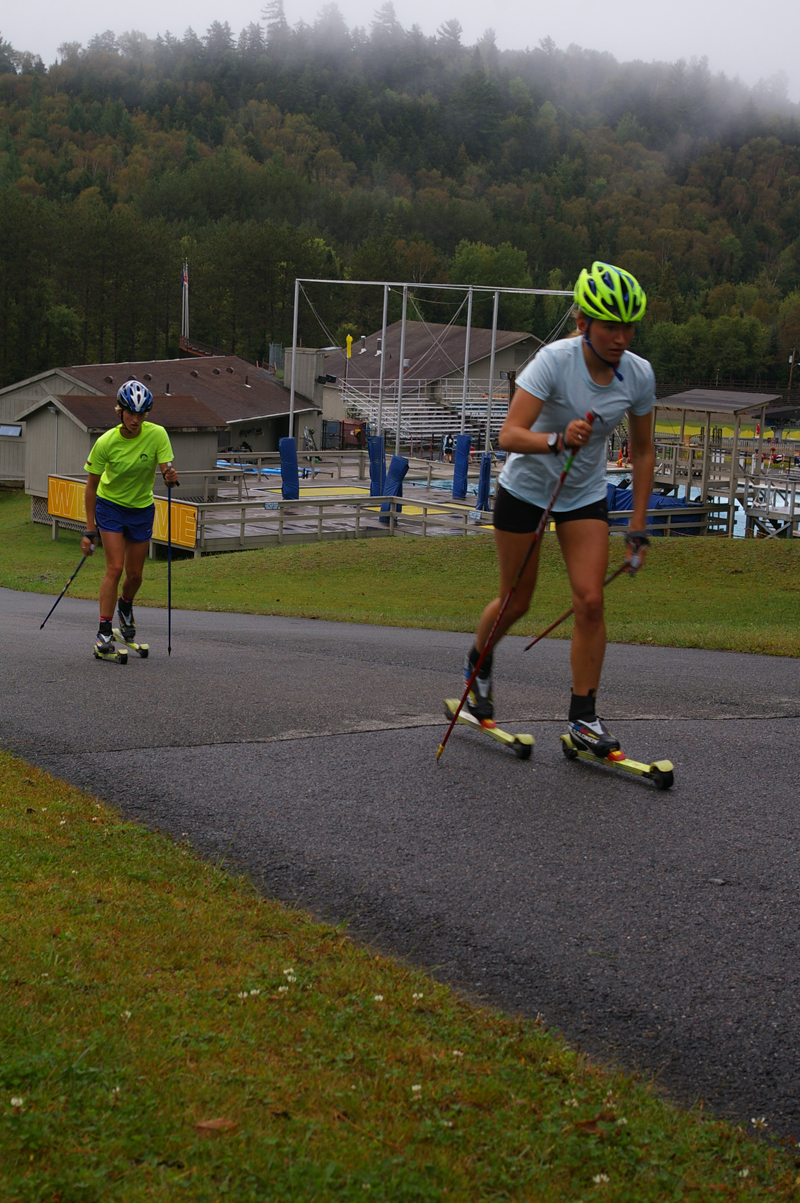
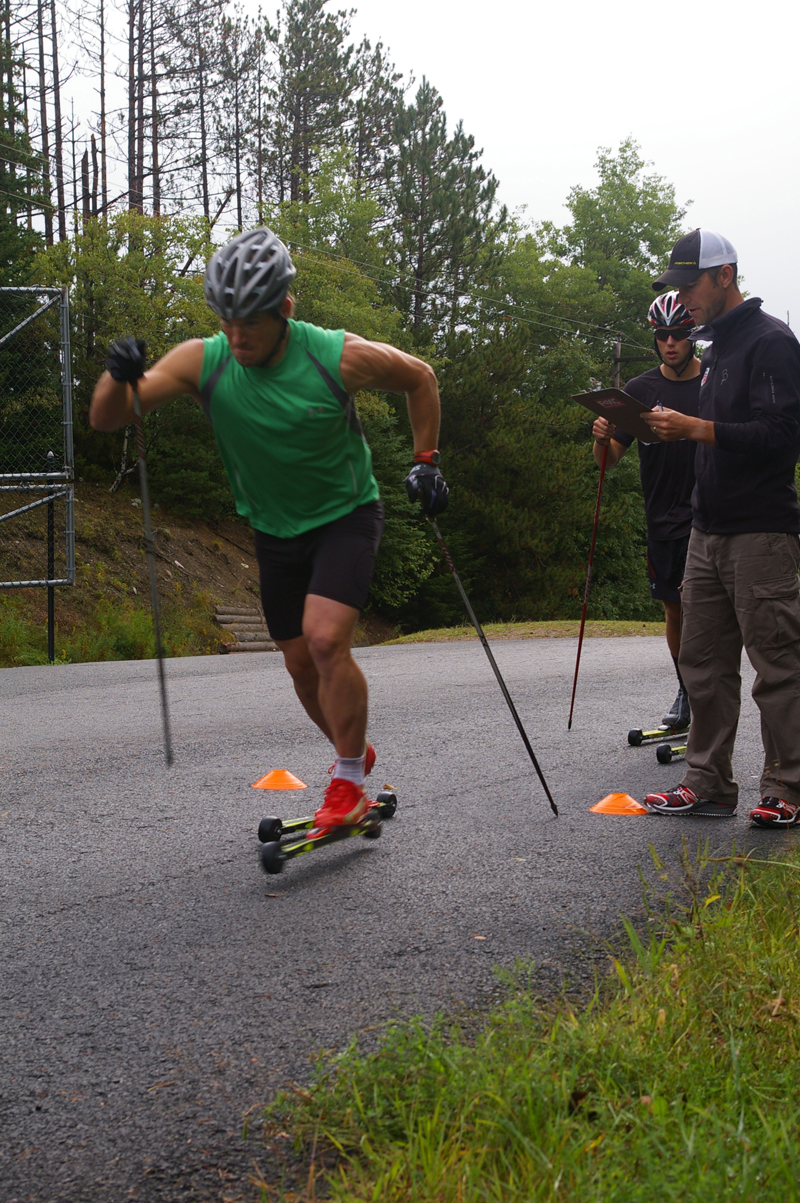
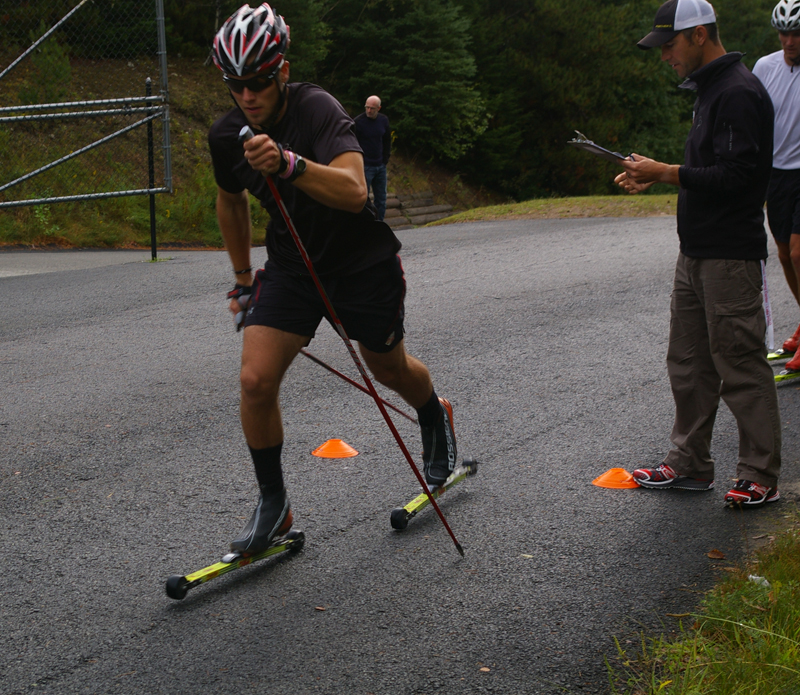
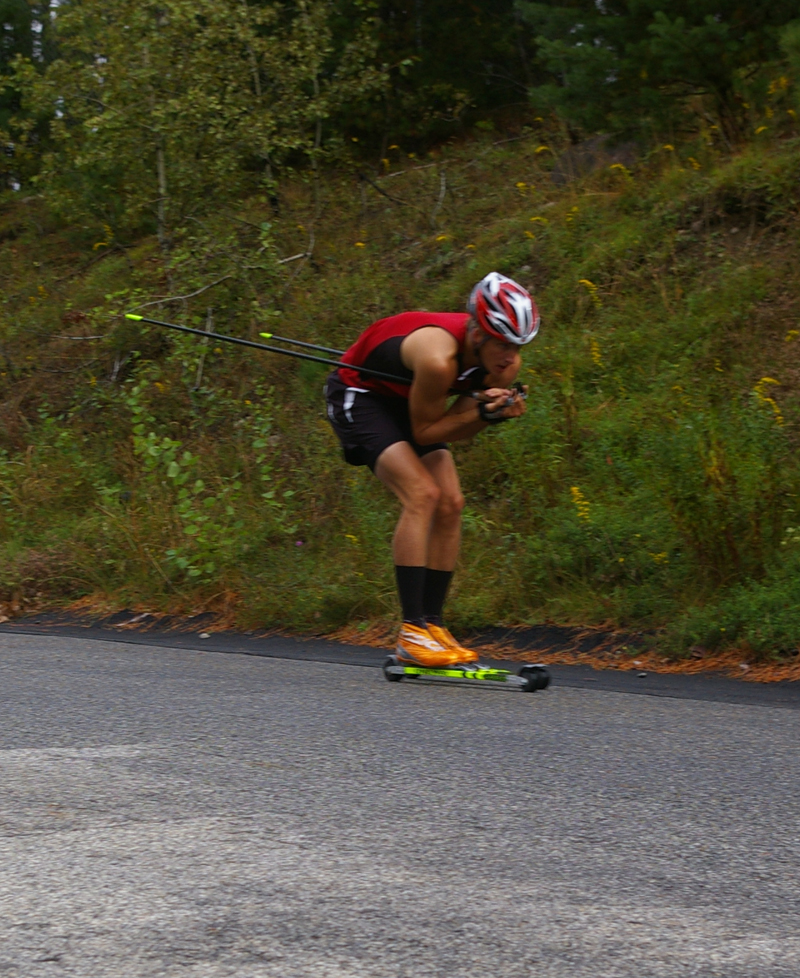
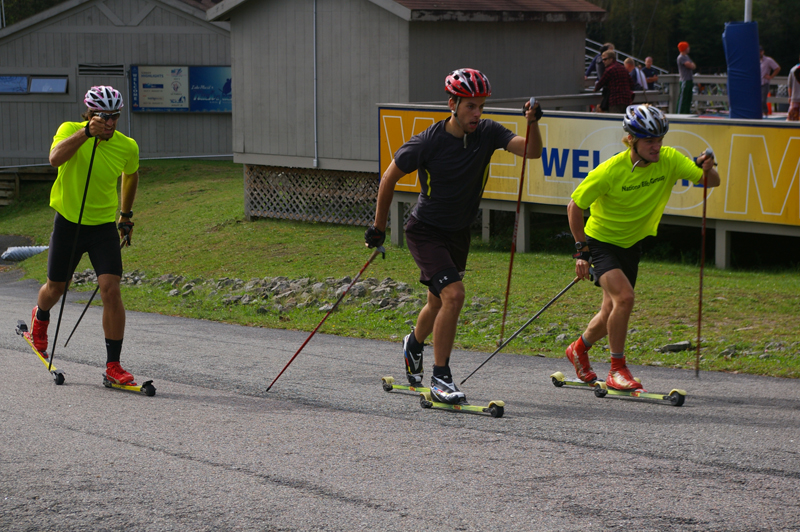
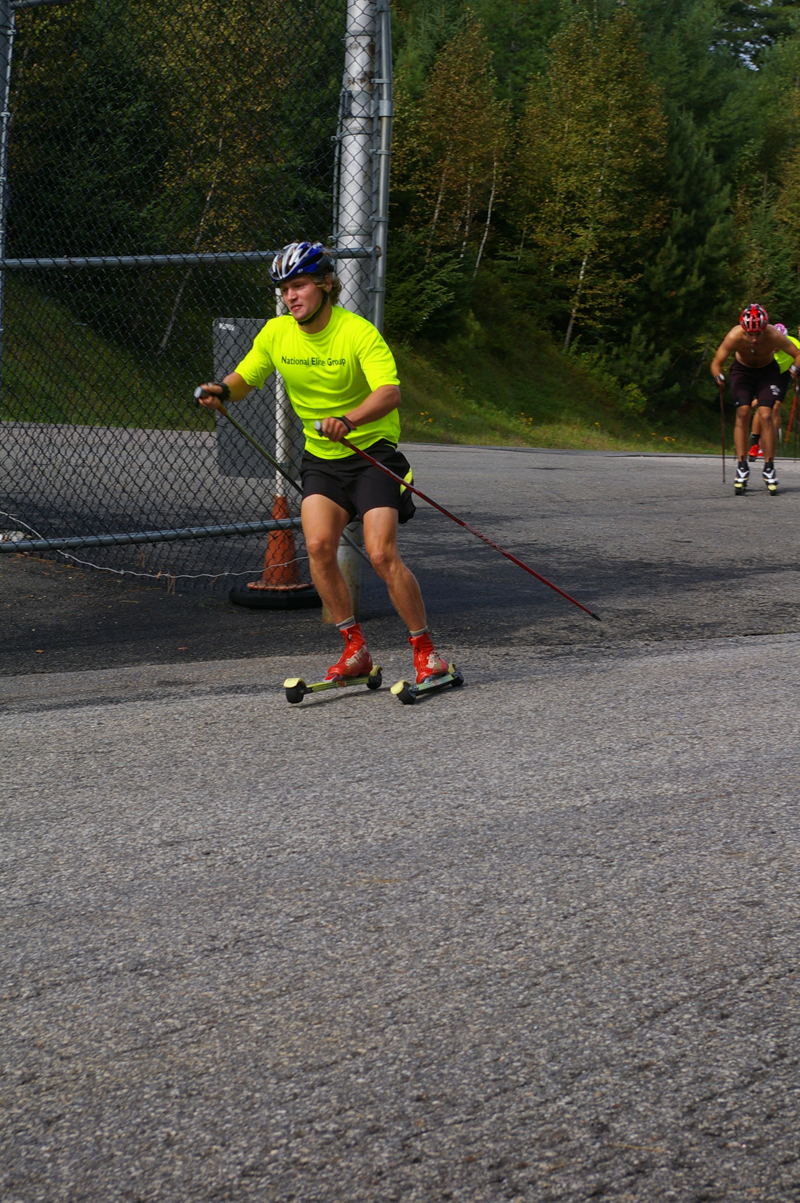
    Andy Newell (r) and Stratton Mountain School teammate Eric Packer (l) during an over-distance rollerski on June 24 in Cambridge, N.Y. Newell led his teammates on a tour of some rural roads near his house in Shaftsbury, Vt.

    SHAFTSBURY, Vt. – Andy Newell had been home in southern Vermont for just about a week – and he hadn’t had a ton of free time between pre-dawn photo shoots with Karhu and Craft two hours away in Hanover, N.H., and training.

    The U.S. Ski Team veteran went to his high-school reunion in Stratton, Vt., watched Ziggy Marley in concert and soaked up the sights of the town’s Wanderlust Festival. Yet for a guy that lives in an assortment of European hotels at least five months of the year, the pace of Shaftsbury seemed just right for the 27-year-old World Cup skier.

    Andy Newell (r) leads his SMS teammate Eric Packer (l) and Mike Sinnott (Sun Valley Gold Team) during an OD rollerski in upstate New York on June 24.

    After a four-hour rollerski in nearby upstate New York, Newell and his Stratton Mountain School (SMS) teammates returned to his house to a lunch spread of tuna salad, deli meat, bread, fruit, nuts and homemade cookie bars set out by his father, David.

    Around the same time, his mother, Carol, walked in after completing the Vermont Sun Triathlon that morning. Three seconds short of placing third in her age group, she was a little disappointed, but greeted her guests with interest and enthusiasm. Her husband checked in with everybody, then resumed his yard work.

    FasterSkier caught up with Newell on June 24, about a week after he started training with the new SMS elite squad, known as the T2 Team.

    After working with the U.S. Ski Team (USST) in the spring – first at a May training camp in Bend, Ore., and then in Park City, Utah, for altitude training and testing, Newell said he’d be in Vermont for most of July. There, he’d work with his five Stratton teammates (Skyler Davis, Eric Packer, Jessie Diggins, Sophie Caldwell and Erika Flowers) and new coach, Gus Kaeding, before heading to Austria at the end of the month for a USST on-snow camp.

    FasterSkier: What have you been up to since you’ve been home?

    Andy Newell: [I] made it back just in time for the Stratton high-school reunion and then started into probably one of the bigger weeks of the year, training 26-27 hours this week [June 17-23], so a lot of volume, which was tough with the heat. We had a few days in the 90s, but we were able to get it done and train basically every day with the Stratton team.

    Newell at his home in Shaftsbury, Vt.

    It was fun to jump in with a big week and start training every single day with Gus and Eric [Packer] and have Mikey [Sinnott of Sun Valley] here for a lot of the workouts. It was cool to have everybody together for the first big week of training.

    FS: Considering you previously trained at Stratton when you were home with program director Sverre Caldwell, how does this new team change things?

    AN: It’s not a ton different. Stratton’s always had a big training group and Sverre meets with us at least three days a week during the summer. Now that we have Gus around and now that we have Soph and Erika and Packer and Skyler, instead of just meeting three days a week with Stratton, we’re meeting basically every single day. It’s a real team atmosphere.

    I’m at home now and I drive up 35 minutes or 40 minutes to Stratton, and I do that almost every day. On a day like today, we trained down near my house, which was cool, but there’s so many good training opportunities whether it’s down here or up at Stratton. Instead of doing some of that traveling by myself, now I meet up with the guys and we’ll train together.

    FS: You’ve been racing internationally at the highest level for several years. How do you use less-experienced teammates as effective training partners?

    AN: Just having anybody there is a benefit really. I know that I have a lot to learn from anybody, too. Just because I have more racing experience than somebody else doesn’t necessarily mean that I don’t learn from them on a daily basis.

    Eric and Mikey and Skyler … push me really well during a speed workout. Just to have those guys right next to me instead of doing sprints by myself is really helpful.

    FS: What’s it like to see the team come to life?

    AN: It’s awesome to see it become a reality. We have Diggins on the team and Soph and Erika, myself, Packer and Skyler, so not only did we get the team going but I think we have one of the strongest clubs maybe in the entire country now … as far as how well we can compete both in the U.S. and internationally. I think we did a great job of recruiting skiers and so now our goal is to kind of infiltrate the community and let everyone in southern Vermont know that this team is around. We want to be southern Vermont’s team.

    We just want to spread out everywhere so that people all around southern Vermont know that we’re the elite-racing team in the area. We can get a lot of support from them because even though we have some of the best skiers in the country here right now, we still have a ways to go as far as fundraising goes. We need to raise a lot of money basically, between now and the winter, and to keep the program going summer after summer and year after year. The more we can kind of reach out to the people in the area, the better.

    [Note: Last week, the T2 Foundation signed on as Stratton’s title sponsor, making it officially the SMS T2 Team.]

    Newell during a World Cup classic-sprint qualifier on March 14 in Stockholm. Newell posted the 16th fastest time and went on to place seventh in the final.

    FS: How’s training going personally? Have you made any changes?

    AN: I’ll change a few things. I trained a lot last year as far as hours and trained a lot on the distance side of things, basically training [as a] pure distance skier and not focusing on the sprinting at all. That’s what I wanted to try last year and I’ll train pretty similar to last year, but I’ll do a little more sprint-specific stuff and slightly more intensity. Last year was such a big volume year. … I’ll be training similar hours, but maybe slightly more intensity and I think that will kind of sharpen me up for the season.

    FS: How did you think last season went?

    AN: I was in great shape last year during the summer, like racing in New Zealand. I had some great races in New Zealand against Bird [Kris Freeman] and the other Canadian guys. (Newell won the skate sprint and was second in the 15 k classic mass start.)

    I was building, building, building and I pushed the volume a little too much in October. Instead of dropping the hours and doing more intensity to kind of sharpen yourself up for the season, I just pushed it too hard so I was flat for the first half of the season. So we’ll learn from that and this year hopefully I’ll push the volume, too, but when it comes to October, November, like when we start to get into the race season, I’ll cut that stuff back and train more like sprint-specific and race-specific.

    FS: And Kaeding as your new personal coach is collaborating with USST head coach Chris Grover?

    AN: Myself and Grover and Gus kind of come up with the monthly outline and the yearly outline. We decide what we want to get done this year and what we want to get done this month and even down to this week. And then Gus knows what we want to accomplish each week, and we’ll piece together the training days to best fit the Stratton schedule. Gus has a lot to offer as far as working on technique and it’s good to have him there for interval sessions and stuff.

    FS: At this point in your career, why did you want to shake things up?

    AN: We’re looking at this Stratton program as a long-term type of thing so I think Gus will be around for a while and the Stratton team hopefully will be around for a while. I think we’re going to start to transition to having Gus be more of a full-time coach because we know he’ll be in this area a lot of the time, and it will be easy for me to work with him.

    FS: So in late July you’re off to Austria?

    AN: I’m here ’til Austria camp, which starts in basically end of July-beginning of August, and we’ll do 2 ½ weeks in Europe training on the [Dachstein] glacier and training in the [Oberhof ski] tunnel [in Germany], and then we’ll be back home through Lake Placid camp [in mid September].

    FS: And Packer is going to the glacier with you and the rest of the U.S. men’s team?

    AN: Yep.

    FS: You guys will be inseparable by the end of the summer.

    AN: Pretty much.

    ***

  • From East to West, REG Camps a Success

    From East to West, REG Camps a Success

    Dozens of junior skiers raced up Agony Hill on June 25 in Salt Lake City as part of the Western REG Camp. (Photo by Dan Simoneau/MBSEF Nordic)

    The Western Regional Elite Group (REG) Camp kicked off in earnest at 6 a.m. Monday, June 25, with a trail-run time trial up Agony Hill. On the training schedule, instructions read: “Bring your ‘A’ game.”

    Dozens of teenage athletes tackled the 1,200-foot, 0.9-mile climb in Salt Lake City, tucked behind the University of Utah and often used as a measuring stick for pain tolerance. By the afternoon, the group was back in Park City – the home base of the weeklong camp – for core and strength exercises with U.S. Ski Team assistant coach Jason Cork.

    Throughout the seven-day camp, 36 athletes from five divisions (Rocky Mountain, Intermountain, High Plains, Pacific Northwest and Far West) worked with 10 coaches for a total of 20 training hours. They hiked, ran, rollerskied, lifted, played volleyball and went to a waterslide park.

    A junior racer at the Eastern REG Camp in Craftsbury charges up Elmore Hill in Elmore, Vt., on June 27. (Photo by Liz Kantack/SMS Nordic)

    Meanwhile 2,300 miles east in Craftsbury, Vt., the New England Nordic Ski Association (NENSA) hosted a the Eastern REG Camp, with a total of 33 skiers (19 J1s and OJs in the elite group and 14 in the J2 camp).

    They also raced uphill, ran and rollerskied last week. They worked on strength and agility, hill bounding and intervals, and attended presentations at night.

    Several U.S. Ski Team (USST) members from around the country made it to the camps as well. Out West, elite juniors chased Simi Hamilton, Noah Hoffman and Tad Elliott up Big Cottonwood Canyon during an over-distance classic rollerski. Miles Havlick, an NCAA champion and Ski Racing Magazine’s two-time Collegiate Skier of the Year, also joined them on the 3 ½-hour trek to the top of Guardsman Pass.

    In Craftsbury, national-team skiers Andy Newell, Ida Sargent and Skyler Davis participated, along with elite skiers from the Craftsbury Green Racing Program and Stratton Mountain School.

    FasterSkier caught up with Western REG director Mike Elliott and Eastern REG coordinator Janice Sibilia via email for details on last week’s camps.


    Western REG

    Where: Park City, Utah (Canyons Ski Resort townhomes)

    Coaches making their way to the top of Agony Hill in Salt Lake City on June 25 for the Western REG Camp time trial. (Photo by Dan Simoneau)

    When: June 24-July 1

    Weather: Hot (most workouts started at 7 a.m., with the exception of Agony Hill, so they were able to complete each)

    Workouts: Four intense training sessions (including rollerski time trials at Soldier Hollow, Canadian strength tests at the USSA Center of Excellence); two over-distance rollerskis

    Extras: Several presentations, including Tad Elliott’s talk about goals

    Highlights: “The USST was a tremendous amount of help,” Elliott wrote. “We had Jason Cork at every training session.  We had USST members Simi Hamilton, Tad Elliott, and Noah Hoffman joining us on the over distance days and a time trial day. Miles Havlick with the University of Utah and a NCAA winner last year skied with us on Big Cottonwood Canyon.

    “We had a couple of days of Strength with Alex and Michael in the Center of Excellence that they were awesome.  Great information and some light hearted teasing.  Alex strongly recommends NO spandex on Dudes in the Strength Training at the COE.”

    Western REG campers during a 3 1/2-hour classic rollerski up Big Cottonwood Canyon to the top of Guardsman Pass near Park City, Utah. U.S. Ski Team members Simi Hamilton, Tad Elliott and Noah Hoffman joined the juniors for the workout. (Photo by Dan Simoneau)

    Additional comments: Elliott was impressed by the amount of “highly motivated and very talented skiers,” which consistently showed up early with all of their equipment before workouts. They didn’t have to wait on stragglers, and some days the vans departed ahead of schedule.

    “All of the skiers showed up in fairly good condition and had been training for a couple of months before the REG,” Elliot wrote. “When the skiers introduced themselves we learned … that one is going to Harvard, two to Dartmouth, one to Middlebury, one to Colorado University, three are taking a Post Graduate year to train specifically for cross-country skiing.

    Juniors learn the meaning of “rest and recovery” at the weeklong Western REG Camp in Park City, Utah. (Photo by Dan Simoneau)

    The J2s did extremely well throughout the week, he continued. Two local juniors from the Wasatch Nordic Ski Club and Park City Nordic joined them at Agony Hill and for the two over-distance days.

    “The classic roller ski up Big Cottonwood canyon to the top of Guardsmen Pass was the last training session and it was long and steep.  Camp attendees got to observe what year round training is like at the next level by being able to roller ski with Simi Hamilton, Tad Elliott, Noah Hoffman, and Miles Havlick. Even with all the training, the skiers reported that they were having fun.”


    Eastern REG

    Where: Craftsbury, Vt. (Craftsbury Outdoor Center at Hosmer Point)

    When: June 24-July 1

    Weather: Rainy at first, then hot (especially during the final workout, Saturday’s rollerski-run combo)

    Skyler Davis (l) setting the pace during an interval double-pole session at the Eastern REG Camp June 24-July 1 in Craftsbury, Vt. (Photo by Liz Kantack)

    Workouts: 11 in seven days, six of which were intensity or speed.

    Three testing phases (rollerski agility, strength and Elmore Uphill run (on which Nils Koons set a course record), to determine which skiers would be invite to the National Elite Group camp in September in Lake Placid, N.Y.)

    There were also two interval sessions consisting of DP intervals and hill bounding, recovery runs, rollerski sessions and one over-distance combo run/rollerski.

    Extras: Presentations by Sargent, Newell, U.S. Ski Team assistant coach Bryan Fish and Burke Mountain Academy coach Kate Barton on the J1 Scando/U18 trip last winter.

    Highlights: “The camp went very well,” Sibilia wrote. “It was hard, but gave the athletes lots of head-to-head time. They also had the opportunity to jump in with Olympian Andy Newell, and [other] USST members … Ida Sargent, and Skyler Davis. Most members of the CGRP and newly formed Stratton Elite team also joined us. For the uphill run we had the [Green Mountain Valley School] join in the fun! There was also an Olympic Day celebration that some of the REG athletes took part in, and a competitive game of mini golf!”

    Craftsbury’s own Hannah Dreissigacker, who was recently named to the US Biathlon team, racing up Elmore Hill in Vermont at the Eastern REG Camp last week. (Photo by Liz Kantack)

    Additional comments: “Everyone came to camp prepared, and absorbed the training well,” Sibilia continued. “The clubs are doing a really good job of keeping the training focused and the motivation up. Regional coaches came in to help run the camp, as did the folks from Craftsbury and Hosmer Point. The energy level was high!”

    On the NENSA website, Sibilia wrote that the athletes had been mindful throughout the week with details concerning nutrition, hydration and recovery.

    “They are getting more dialed in to this every time this camp is run,” she wrote. “I witnessed campers taking advantage of the rainer first days by settling into the cabins with their feet propped up for recovery. Without access to internet and cell phones, rest came easier!”

    Eastern REG Camp juniors during the rollerski portion of a combo over-distance workout near Craftsbury, Vt., on June 30. (Photo by Liz Kantack)

    Can’t get enough of these photos? Neither could we. See more on the MBSEF (for Western REG) and SMS (Eastern REG) Facebook pages.

  • Canadian National Team Wraps Up Maui Training Camp

    Canadian National Team Wraps Up Maui Training Camp

    Justin Wadsworth, head coach of the Canadian National Ski Team, made a deal with his athletes two years ago: if they collectively produced four or more World Cup podiums, he would bring them to Hawaii for a summer training camp. The team surpassed that benchmark and delivered six podiums in 2010-2011 in addition to World Championships gold.

    Off to Maui they went in June 2011 for Canada’s first camp on the islands. Wadsworth raised the bar accordingly to ten podiums in 2011-2012 for the team to earn its way back, and again his athletes outdid the standard. Every one of Canada’s World Cup skiers stood on the podium last winter for a total of 15 medals.

    As a result, Devon Kershaw, Alex Harvey, Lenny Valjas and Ivan Babikov camped (literally) in Maui again for just over two weeks this June. On Thursday, they packed up and boarded a plane back to Canmore, Alberta, to resume training on the Haig Glacier.

    The goal of the camp, like last summer, was to pack in quality volume training at high altitude, with a focus on sustained steep uphill technique. On the heels of such a successful season, Wadsworth’s goal was also to maintain motivation and momentum.

    “For us it’s about working really hard and having a lot of fun along the way,” he wrote in an email. “We need to keep the stoke high for the athletes, which means making things interesting, challenging and fun.”

    In Maui, interesting and challenging amounted to 20-25 hours of training per week and around 60,000 feet in elevation gain over the course of 14 days. “Fun,” inevitably, involved taking advantage of Maui’s legendary surf.

    It’s only July, but season-long strategy is prominent in Wadsworth’s mind. With World Championships and two Canadian World Cups on the horizon, he said their focus is definitely a little different than last winter. Competing well in Canada and Val di Fiemme will be important, but so will the Tour de Ski and planning out the season wisely around races where Wadsworth expects his team to reach the podium.

    “We as a team need to be really smart in our race choices, and how we plan the year. You can’t just go into the season and try to do it all and win every time,” Wadsworth said.

    The elevation of the Maui camp, while good preparation for any season, was also undertaken with an eye on the 2014 Olympics fewer than two years away.

    “It’s a bit tough with World Championships low this year, but … we are working on the altitude side of things leading to Sochi,” Wadsworth wrote.

    At the conclusion of the camp, he thought everyone had been skiing well and looked fit —“So I look forward to more of the same like last year.”

    There is a long offseason yet to go before the World Cup begins again in November, but Wadsworth said his team is building up to match, if not surpass, its past results. He may need to come up with new motivating camp destinations for future summers.

    “It’s great to be at a point where everyone on our World Cup team has stood on a World Cup podium, and when I say that it means Devon, Alex, Ivan, Lenny, Chandra, Peri and Dasha — everyone knows what it takes, and as a team we support each other to keep being there,” Wadsworth said.


  • Norwegian NoCo Team Likes Taste of Park City

    Norwegian NoCo Team Likes Taste of Park City

    Norwegian nordic combined A-teamer Mikko Kokslien (l) and Bryan Fletcher of the U.S. Ski Team riding together near Park City, Utah. The Norwegian national team spent nearly three weeks in the area for altitude training during a joint camp with the Americans. (Photo courtesy of Mikko Kokslien)

    In their first collective visit to Park City, Utah, several members of the Norwegian nordic combined team couldn’t get over the place.

    There was never a cloud in the sky, and even unseasonably cold days weren’t that bad. People were nice, the motorists were considerate, and the training possibilities were endless.

    Following a three-week camp with the U.S. nordic combined squad last month, Norwegian A-team member Mikko Kokslien wasn’t the only one considering buying a condo there.

    Norwegians Magnus Krog (l) and Håvard Klemensten followed by U.S. Ski Team member Bryan Fletcher (far right) and some others during a group rollerski with the U.S. nordic combined team in Park City, Utah. The joint dryland camp took place June 6-26. (Photo courtesy of Dave Jarrett)

    His teammate, Håvard Klemetsen, who was last in Park City about 11 years ago, was sure he’d be back as well.

    “We are not use to so open and friendly people, especially when we where out training,” Klemetsen, 33, wrote in an email after their camp from June 6-26. “In our culture people don’t say hello when they meet strangers – I like the open and enthusiastic people in Park City.”

    Reflecting on the trip from home in Lillehammer, Kokslien, 27, wrote that the altitude camp was the best of his career. He was last in Park City in 2006 during the World Cup ‘B’ competitions, but didn’t exactly get a feel for the area.

    “Now we had good time and really enjoyed staying in Park City,” Kokslien wrote. “Maybe I’ll move there some day.”

    History in the Making

    By the time the five Norwegian athletes, including Magnus Krog, Gudmund Storlien and Jørgen Graabak, and their head coach, Kristian Hammer, left a week ago, U.S. head coach Dave Jarrett knew they had a good time. In the first joint camp between the teams, his skiers enjoyed having them around as well.

    In a phone interview, Jarrett said their ties with Norway have historically been strong. He could personally trace it back to the summer of 1992 when he hosted Norwegians Baard Jørgen Elden and Fred Børre Lundberg for a few weeks in Steamboat Springs, Colo. Lundberg went on to win world titles and Olympic gold medals, and Elden later coached Jarrett on the U.S. Ski Team. Today, Jarrett said they remain close friends.

    While Norwegian no-co skiers had trained in the U.S. in the decades since, they had not made an official team trip until this year. Head coach Kristian Hammer scheduled the American altitude camp last winter, taking Jarrett up on his longstanding offer.

    U.S./Norwegian NoCo Camp:

    Who: U.S. and Norwegian nordic combined teams.

    What: Three-week joint dryland camp in Park City, Utah. Involved jumping, rollerski intervals, OD run-rolls, road biking, golfing and more.

    Roll call: Every member of the U.S. team attended at least part of the camp, including Johnny Spillane and Todd Lodwick.

    Norway’s A-team was there,  minus Magnus Moan (coming off Achilles surgery in May) and Jan Schmid (busy with final exams)

    “I’ve always extended the invitation for years for them to come to Park City, but it was only until now that Kristian really pulled the trigger on it,” Jarrett said.

    With plans in place, Hammer asked for some help with logistics, and Jarrett gladly jumped in to help with accommodations and ground transportation. The team, which included two coaches and a PT for part of the trip, stayed in condos overlooking Park City’s golf course. Kokslien played several rounds with U.S. Ski Team member Taylor Fletcher.

    “He got me the first day, but the next day I might’ve played my best round ever,” Fletcher wrote in an email.

    Aside from meeting up for barbecues and dinner, athletes from both teams spent most of their time training together – first on the jumping hill and later on rollerskis and road rides.

    Fletcher, 22, wrote that he learned a lot from the Norwegians during the jumping portion of camp. His older brother, Bryan, said it was nice to show them around for a change.

    “It’s not an every-day opportunity that another team gets to come to the U.S. and train,” Bryan said on the phone. “Hopefully they’ll have a good report to send home to other athletes so that next year and the year after that, more people will want to come here instead of being solely based in Europe.”

    Role Reversal

    The Americans are typically the ones playing tourist, traveling to Norway in late August for training camps and racing in Lillehammer’s annual uphill sprint race in early September. This year, the U.S. team heads to France on July 8, where they will spend a week chasing cyclists in the Tour de France before competing in first races of the FIS Grand Prix in Sochi, Russia. There they’ll also get a chance to preview the 2014 Olympic venue.

    U.S. nordic combined teammates Johnny Spillane (l), Billy Demong (c) and Bryan Fletcher working out in Park City during their training camp in June. (Photo courtesy of Dave Jarrett)

    They’ll return to Park City for nationals in August, but Jarrett said he was trying to get his to central Europe in September/October for additional camps with the Norwegians. Next year, he said there was a good chance Team Norway would be back in Park City.

    They were pumped about coming back next year,” Jarrett said. “Kristian and I talked about [them] coming back in October possibly next year. That’s a good time for training here, it’s still sunny whereas other places it’s starting to get rainy and snowy.”

    In the past, Norwegians sometimes avoided altitude training, believing it did little to boost performance, Jarrett said. While they spent the first few days following a rigid protocol to acclimate to Park City’s 7,000-foot elevation, Jarrett said they joined his team for most workouts thereafter.

    “You didn’t hear the typical, ‘Oh it’s so hard, I feel this bad,’ things like that,” Jarrett said. “They were all into it and we had great weather and they were pretty psyched about doing it again.”

    Jarrett was excited to have them there for a change.

    “It was awesome for us to have three weeks with those guys, not just cross-country wise but almost more importantly on the jumping hill,” he added. “We usually have to pay to go to Europe to do that so this was almost no cost to us to have them here.”

    Kokslien snapped a photo while in awe of the U.S. nordic-combined jumping facility in Park City.

    Kokslien wrote that while the main purpose of the camp was altitude training, it was just as important for them to learn from the Americans, especially Olympic gold medalist Billy Demong.

    “In the summer we don’t often get to see how the other teams are training, so its also nice in a way we can learn and see how they are working in the US,” he wrote. “I have always looked up to and learned a lot from Bill. To be with him and the rest of the American team, gives me and our team a good motivation for the winter. The American team has a really good work ethic, and I think many can learn from them.”

    Demong explained in an email that such relationships have existed for years and didn’t end at competitions. In a World Cup race last season, Demong teamed up with Kokslien to pass several people for his best result of the year – third. Kokslien was second.

    It helped that Demong and his teammates spoke some Norwegian.

    “When it comes to training, we can have sessions with the Norwegian team and it becomes almost like one big team,” Demong wrote. “We do long easy skis without egos and time trials and interval sessions constructively pushing each other to go faster and learn from one another. Also the contact on the jumping hill is always very important as they are some of the best.”

    — Audrey Mangan contributed reporting.

  • Skiing, Rafting and a Sleepover: Fire and Ice Camp Recap

    Skiing, Rafting and a Sleepover: Fire and Ice Camp Recap

    The Fire and Ice Camp crew last week at Mt. Bachelor in Bend, Ore. (MBSEF photo)

    After a massive wave of spring skiers left Bend, Ore., last month, the groomers at Mt. Bachelor hardly packed it in. The U.S. and Canadian national teams and several elite squads were gone, but nearly the same amount of skiers – 150 – were expected to flock to the snow-covered trails in June.

    The Mt. Bachelor Nordic Center and its club, the Mt. Bachelor Sports Education Foundation (MBSEF), planned accordingly. On June 16, the MBSEF greeted about 55 juniors to its five-day Fire and Ice camp, an annual tradition that’s followed national-team visits for years.

    Lars Flora shows off his balancing skills at the Fire and Ice Camp from June 16-20 in Bend, Ore. Flora was the camp’s head coach. (MBSEF photo)

    Lars Flora, a two-time Olympian and Alaska Pacific University (APU) skier, made the trip down from Anchorage for his third-straight year to serve as head coach. He worked with MBSEF Nordic Program Director Dan Simoneau, who coordinates the camp, to attract six competitive skiers to Fire and Ice as coaches.

    After all the 9- to 18-year-olds said their goodbyes last Wednesday along with coaches Matt Liebsch, Torin Koos, Tyler Kornfield, Sylvan Ellefson, Ollie Burruss and Zoe Roy, Flora talked about the experience on the phone from Eugene, Ore., while watching the Olympic track and field trials on Saturday.

    FasterSkier: How long has the Fire and Ice junior camp existed?

    Lars Flora: Four years, I believe. It’s been going on for, off and on, forever. Now with two periods of skiing and Mt. Bachelor way more behind it, they are really getting interest from skiers. There were 300 skiers between the two periods of skiing this year, so that was really good. When the national teams were there, they were at 150, and around another 150 in the second period in June. The town’s really excited about it. It’s awesome.

    FS: What’s the goal of the camp?

    LF: Dan [Simoneau] and I came up with the idea to bring more top athletes to help coach and train while they’re in Bend. This was the third year we did it. This year we had a really good group of coaches. Sylvan volunteered his time because he was out there training and Matt Liebsch and Torin and Tyler Kornfield were asked early on. It was really cool that Sylvan just stepped up and wanted to help out.

    FS: Where do the participants come from?

    Trail running/bounding at the Fire and Ice junior camp last week in Bend, Ore. (MBSEF photo)

    LF:  Most of the skiers were from PNSA [Pacific Northwest Ski Association], so Washington and Oregon. There were around 55 [junior] skiers who did the camp and they range from 9 years old up to 18. It’s a pretty big range of ages.

    FS: How did they respond to having so many talented coaches?

    LF: Sometimes I wonder if they always realized what kind of lineup of coaches they have. You know how it is, you’re always skiing and then you just hang out with your friends and you kind of forget who these skiers are. But it’s the time we spend with athletes; we spend from 8 a.m. to 4 p.m. every day with them. We do a lot of fun stuff like rafting and paddleboarding and running and playing games, playing soccer and whatnot. I think it’s just a lot of good time to observe the top athletes and watch them and the inspiration to be around the best athletes in the U.S.

    Like Matt and Sylvan and Torin, from an athlete’s standpoint, they’re great around kids; all three of them are amazing. [A University of Alaska Fairbanks skier,] Tyler’s just getting into that stuff. He’s young, he’s only 21, so it was really good for him to be there. It’s good for athletes to learn how to coach and put on clinics.

    FS: How was the coaching and group size structured?

    LF: It was a free-for-all (laughs). Nah, it was small groups. Sometimes we would split the group into two: the young ones, everyone under 13 and then everybody above 13. Other times we would take 10 to 15 skiers out at a time [with] one coach. It varied throughout the camp.

    FS: They were on snow for all five days?

    LF: Five days on snow and five days of dryland activity.

    FS: How were the snow conditions and weather overall?

    LF: It was really good. The first half it was a little dirtier than usual and then it snowed one night midway through and cleaned it all up. Driving over the pass [Saturday], it was snowing pretty hard. …

    I would say [it was around] 50 to 60 [degrees] when we were skiing and then in town it was 70 to 80.

    The first day after the camp ended it started raining so we lucked out with 10 days of sun. I say 10 days because the first five days the coaches were there training and then the second five days was the Fire and Ice camp.

    FS: What were some of the most popular camp activities?

    Part of the Fire and Ice Camp included whitewater rafting on the Deschutes River. (MBSEF photo)

    LF: They loved to play Sharks and Minnows on skis. Sylvan actually said he might want to put that into his training plan next year. He had a good time playing Sharks and Minnows with the kids. The older ones respond to intervals with the coaches. We’ll pop into intervals with the 17- and 18-year-olds and I think that’s one of the best activities with 18-year-olds.

    Everybody loves the raft trips. We had eight boats going down the Deschutes [River] and jumped in the water; a lot of water fights. I was with the 10- to 12-year-olds so that was fun to go down the Big Eddy with a bunch of young kids.

    FS: And paddleboarding?

    LF: Paddleboarding and rafting is with Sun Country Tours, [which] is owned by Dennis Oliphant who’s the president of MBSEF and used to be the nordic coach when I was younger. We paddleboard right down by Old Mill on the Deschutes.

    FS: You mentioned the first camp sleepover this year. How did that go?

    Site of the Fire and Ice camp sleepover, the Mt. Bachelor Nordic Center on Saturday after camp ended Wednesday, June 20. (MBSEF photo)

    LF: Dan had this whole idea that he was going to do the first-ever sleepover at the nordic center and all the other coaches were like, ‘You’ve got to be kidding me.’ It ended up [being] great. We had a barbeque up there [on Tuesday night]. All the kids brought sleeping bags and pads, about ten of them slept out on the deck. It was a nice crisp night up there, and just kids everywhere camped out. They had a dance party.

    It was pretty mellow actually, I was surprised. We had all of them to bed by 12 [a.m.] and woke up around 7 o’clock and had breakfast. We did a night ski around 10 p.m. and it was just rock-hard, perfect skiing so that was fun.

    FS: How tired were you by the end of camp on Wednesday?

    LF: I was pretty tired. It wasn’t so bad. It’s so much different now that I’m not training so coaching, you have way more energy. We used to do this camp while we trained, so we’d get out in the morning, and that’s what Matt and Tyler [were] doing, and Matt coached the whole time. Tyler coached two days, Torin coached two days, and Sylvan coached one day. Zoe coached one day.

    FS: What draws you to these types of programs?

    LF: I just think it’s really good for everyone. It’s a really good for development to get the top athletes in front of the younger skiers more, and Bend camp is the perfect place to have that happen.

    FS: What do you think the impact is for the skiers and coaches?

    LF: Some of the athletes were saying they’re going to spend a month out there next spring skiing and stuff. Sylvan was really excited about that and Tyler was just blown away. It was Tyler’s first time down to Bend so it was fun to bring him down there and show him a new place. He’s spent a lot of time in Alaska training in Fairbanks and Anchorage and he’s kind of at that point in his career where he needs a bit more. For him to go down to Bend and just see the resources that are in Oregon for skiing is a pretty good time. He was telling all his friends about it and sending them emails.

    FS: Thanks. Are you spending the rest of the day at Hayward Field?

    LF: Yeah, definitely. Rooting on the hometown boy from Bend. Ashton Eaton is leading the decathlon right now. (Note: Eaton not only qualified for the London Games this summer, but also broke the world record on Saturday.)

  • Elite Team Preview: Craftsbury Green Racing Project

    Elite Team Preview: Craftsbury Green Racing Project

    Craftsbury Green Racing Project skiers hard at work during a rollerski speed session near Craftsbury, Vt. (CGRP photo)

    Note: This is the fifth preview in a quick-and-dirty series on U.S. elite teams. We asked coaches to send their 2012/2013 rosters and tell us what’s new for the coming season. We will be publishing additional reports over the next few weeks. Teams are presented in no particular order.

    Team: Craftsbury Green Racing Project (GRP)

    Coaches: Pepa Miloucheva (head coach, 15th season), Jeremy Nellis (junior coach)

    Senior roster: Ida Sargent (U.S. Ski Team), Susan Dunklee (US Biathlon), Hannah Dreissigacker (US Biathlon), Clare Egan, Maria Stuber, Amy Glen, Caitlin Patterson;

    Bryan Cook, Dylan McGuffin, Patrick O’Brien, Tim Reynolds, Alex Howe, Nils Koons, Gordon Vermeer

    Who’s new: Glen (2012 University of Vermont NCAA champion, Anchorage native), Patterson (also from UVM and Anchorage), Howe (another recent UVM grad; New Hampshire native), Vermeer (Dartmouth grad from Minneapolis) and Koons (former GRP training partner, New Zealand native)

    More on the new athletes

    Who’s missing: None.

    Top results last season: In her first year on the U.S. Ski Team, Sargent notched 12th at the Moscow World Cup sprint. Also a national-team rookie, Dunklee (US Biathlon A-team) posted a best-ever finish by an American woman at the World Biathlon Championships in Ruhpolding, Germany, placing fifth in the 15 k individual race and missing the podium by just seven seconds.

    Ida Sargent (CGRP/USST) during the 1.8 k hill climb at the SuperTour Finals in late March at Jay Peak in Jay, Vt. Sargent finished sixth overall in the STF pursuit.

    Dreissigacker recently earned a spot on the US Biathlon B-team after cracking the top 20 at the IBU Cup in Canmore, Alberta, where she placed 16th in a sprint. She competed in a hefty number of cross-country races last season and was ninth at U.S. nationals in the classic sprint, but will be focusing on biathlon this year, according to a GRP press release.

    Also at the 2012 U.S. Cross-Country Championships in Rumford, Maine, Stuber (a training partner) placed 10th in the 10 k skate and Egan followed in 11th.

    On the men’s side, Reynolds wrapped up the season with a bronze medal in the 50 k at U.S. Distance Nationals in Craftsbury, Vt. McGuffin won a SuperTour in St. Paul, Minn., and O’Brien was second overall in the Tour de Twin Cities multi-stage event. O’Brien also tallied three top-10’s at U.S. nationals – in both sprints and the 30 k classic – and was eighth in the 50 k at distance nationals.

    Another Craftsbury training partner, Cook finished fifth at U.S. nationals in the 15 k skate and was ninth in the 30 k in Rumford. Koons won the 2012 Craftsbury Marathon, was third in the Boulder Mountain Tour and posted four SuperTour top-10’s last season. This spring, he became a full-time team member.

    GRP athletes circuit training on the new outdoor gym at the Craftsbury Outdoor Center in Craftsbury, Vt. (GRP photo)

    Coach’s comment: With five new athletes, the GRP roster has grown to a whopping 14, and coach Pepa Miloucheva has been impressed with their training.

    “The new athletes did fit right into the training program and into the center’s projects,” she wrote in an email. “It is a great group of very similar-in-speed athletes, but also with different strengths and needs, [which] allows them to really improve by training with each other. For me as their coach, [that’s] a great challenge to have!”

    The team is currently seeking one or two wax techs/assistant coaches for the upcoming season. As for their summer schedule, Craftsbury is hosting the NENSA Eastern Regional Elite Group (REG) Camp and Stratton Mountain School Elite Team this week. In September, the GRP will join the U.S. Ski Team dryland camp in Lake Placid, N.Y., for two weeks of training and time trials.

    ***

    Other previews: Bend Endurance Academy | CXCMaine Winter Sports Center | XC Oregon

  • Elite Team Preview: Central Cross Country

    Elite Team Preview: Central Cross Country

    CXC teammates Jennie Bender and Nichole Bathe pose in front of Telemark Resort during a workout on Friday in Cable, Wis. While Bathe is new to the senior team, Bender is a seasoned veteran with multiple SuperTour wins and podiums at U.S. and Canadian nationals last season. (CXC photo)

    Note: This is the fourth preview in a quick-and-dirty series on U.S. elite teams. We asked coaches to send their 2012/2013 rosters and tell us what’s new for the coming season. We will be publishing additional reports over the next few weeks. Teams are presented in no particular order.

    Team: Central Cross Country, known as CXC Team

    Coaches: Igor Badamshin (head coach), Andy Keller (assistant)

    Karl Nygren, Doug DeBold and Eric Wolcott of the CXC Team during a workout at Telemark Resort on Friday in Cable, Wis. (CXC photo)

    Roster: Karl Nygren, Brian Gregg, Doug Debold, Adam Martin, Eric Wolcott;

    Jennie Bender, Caitlin Gregg, Nichole Bathe

    Who’s new: Debold returns to the squad after placing third in classic sprint qualifier at 2012 U.S. nationals in Rumford, Maine, where he finished eighth overall. Bathe, 17, is moving up from CXC’s development ranks after being one of the leading Americans on the J1 Scando trip last season, placing eighth in a sprint in Estonia. Another 17-year-old former junior racer for CXC, Martin posted a 12th-place sprint finish on the J1 Scando trip.

    Who’s missing: “We have several athletes that are not back on the team,” CXC Executive Director Yuriy Gusev wrote in an email. Among them are Jessie Diggins, who was recently promoted to the U.S. Ski Team’s A-team and decided to join the new Stratton Mountain School (SMS) Elite Team. Santi and Carolyn Ocariz rollerskied across the country and moved west to join XC Oregon, and Canadian Sara Hewitt also left CXC.

    Former head coach Jason Cork also parted ways to accept the U.S. Ski Team men’s coach position. That followed the departure of CXC’s assistant coach Gus Kaeding, who is heading up the new SMS Elite Team.

    Gusev wrote that CXC has been transitioning this spring, making Badamshin head coach after three years with the junior development team. Anticipating the departure of certain athletes, CXC made sure to support juniors like Bathe and Martin last year similar to how they worked with Diggins over the last two years.

    Gusev added that they decreased the roster size to provide more athlete support, especially at international competitions.

    “The most notable [skier] we’ll miss this year is Jessie Diggins,” Gusev wrote. “Athletes have to do what is the best for them and we 100% support their decision. We had similar situations in the past with Matt Liebsch and Tad Elliott. It’s about athletes and we need to support what is the best for their performance. We are proud that we played important role in getting those athletes where they are right now.”

    Top results last season: 

    According to Gusev, CXC tallied:

    Bender working out during a CXC training camp on Friday at Telemark Resort in Cable, Wis. (CXC photo)

    • 80 top-three finishes in World Cup, US SuperTour and major marathon races

    • 31 wins in US SuperTour and major marathon races

    • 10 top-30 results in World Cup Races (by Jessie Diggins)

    • 5 top-10 ranked skiers ranked in U.S.

    • 5 skiers in the top-three of each gender in SuperTour final standings

    • 4 national championship titles

    • 3 skiers in the top three in the women’s freestyle sprint at US Nationals

    • 2 top-10 World Cup results (Diggins)

    • A silver medal in World Cup team sprint (Diggins with Alaska Pacific University’s Kikkan Randall)

    Coach’s comment: After two summer training camps at Telemark Resort in Cable, Wis., Gusev complimented the team’s working atmosphere.

    “There are few changes with training and workouts compared to the past, but the athletes are responding well to them and eager to try different ideas,” he wrote.

    ***
    Other previews: Bend Endurance Academy | Maine Winter Sports CenterXC Oregon

  • Freeman, Hoffman and Hamilton All Chat from Sognefjell

    Freeman, Hoffman and Hamilton All Chat from Sognefjell

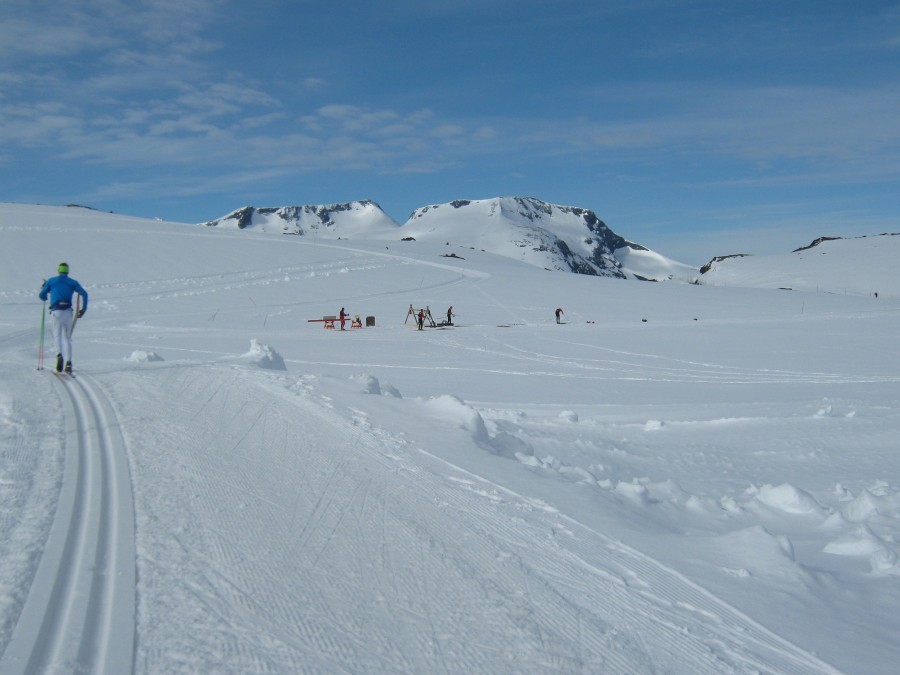
    View from the Sognefjell snowfields in Norway, where U.S. Ski Team members Noah Hoffman and Kris Freeman spent six days training with the Norwegian national team from June 3-8. (Photo courtesy of Noah Hoffman)

    Two weeks ago, Kris Freeman and Noah Hoffman weren’t exactly sure what they were in for before flying to Norway, but they were excited. The two had been invited to a Norwegian national team training camp, and without much else besides their bare necessities, they headed to the snowfields of Sognefjell.

    On June 3, the two U.S. Ski Team (USST) members jumped into action with the Norwegian men’s squad, kicking things off Sunday afternoon with at 2 ½-hour skate. The next day, Freeman and Hoffman spent five hours on snow, and the day after that, completed a two-hour skate with 20 kilometers at Level 3. They capped Tuesday afternoon with a two-hour classic ski, and ended up logging nearly 23 hours that week.

    Kris Freeman classic skiing during a Norwegian national team camp in Sognefjell, Norway. (Photo by Noah Hoffman)

    While both appreciated the volume training and generosity of the Norwegian team, which included Freeman and Hoffman in all their sessions, they were ready for an off day by the end of camp. Given that opportunity last Saturday, they ventured on what Freeman called a “crust cruise.” Two hours and one gigantic climb later, Freeman and Hoffman had gone much farther than they bargained for, but were glad they did so.

    “It was the most scenic ski I have been on in years,” Freeman wrote in a blog post. “And we only got lost once.”

    FasterSkier recently spoke with Freeman, Hoffman and Simi Hamilton, all of which were staying at Sognefjell’s remote mountain lodge. A recent addition to the USST A-team, Hamilton arrived Monday with Burke Mountain Academy as a guest coach on their two-week Scandinavian junior trip. He was helping his girlfriend, Kate Barton, who was leading the camp in place of the academy’s head coach, Pete Phillips.

    On Wednesday, Freeman and Hoffman left Sognefjel,with Freeman heading home and Hoffman continuing on in Lillehammer, Norway. Hamilton said he’d be in Norway until June 22.

    FasterSkier: Simi, how do you get involved with this trip?

    Simi Hamilton: They just needed someone else to tag along to help out with driving [including a two-hour trip to Sognefjord, Norway] and a couple of things with coaching. So I got a free trip over here and get to train and get to hang out with a bunch of immature-but-fun 15 year olds. It’s a good thing.

    FS: Have you been to Sognefjell before?

    SH: I’ve been here a couple times before, but it’s been probably about eight years since I was here last. I haven’t been here in a while, but it’s great. It’s a cool spot and it’s really nice living right on the trails. I got out [to ski on Tuesday] afternoon. I was later informed that this is the worst [snow] that they’ve had in a couple weeks, but I find it’s still pretty good. They have a ton of snow up here, which is really nice.

    Freeman pausing on the Sognefjell snowfield. (Courtesy photo)

    FS: Kris, what have the conditions been like for the past week and a half?

    Kris Freeman: When we first got here, we had probably three days where it was snowing and raining and pretty cold, and then the last five days I’ve been in shorts and a T-shirt.

    The snow has been phenomenal for this time of year. They’ve taken really good care of it; they’ve salted once or twice a day a day. The day where Hoff and I [toured] the mountain, it was pretty ideal crust training so I’ve got no complaints. Scenic and pristine.

    FS: How was training with the Norwegians?

    KF: I have a history of working with [Norwegian men’s coach] Trond [Nystad] when he was the coach of the U.S. Ski Team, and he was very helpful. Noah and I weren’t able to travel over here with a form bench or an iron or any of those things, and [Nystad] helped with those, which was very nice, gave us his training schedule. We were invited to every session. They took video of us, gave us technical advice. They treated us like members of the team, which was very, very generous.

    The athletes are friendly. Everything’s pretty professional out there. Not a lot of conversation while skiing, but they’re generally welcoming.

    FS: How’s your Norwegian fluency?

    KF: Absolutely non-existent.

    SH: I think that goes for all three of us. It’s hard because everyone speaks English well, so it seems like you never need to speak Norwegian. I think all of us could probably agree that it would be great if we could speak Norwegian, but there really isn’t a use.

    KF: I can’t even pronounce half the guys on their team, their names, properly.

    Norwegian Sjur Røthe during his national team's training camp in Sognefjell, Norway. (Photo courtesy of Noah Hoffman)

    FS: How big was the group?

    KF: There wasn’t like a line of guys going around. For the most part on the distance days, people kind of did their own thing. I skied mostly with Eldar Rønning, Martin Sundby and Sjur Røthe (laughs as he says final name). That’s not how you pronounce it, but I’m going to say ‘Sur Roth’ because I’m American.

    FS: Noah, how’s the training been?

    NH: It’s been awesome. I really felt like it was good to ski with and train with the Norwegians. I learned a lot in terms of some things those guys do differently than me, some great technical advice from their coaches and being able to ski behind those guys. We had two really productive threshold sessions. I just felt like it was a huge opportunity. I feel like it was a little overwhelming; maybe I need to go home and evaluate what I think is going to be super beneficial to carry forward and what I think maybe we do a little better in the U.S.

    FS: What’s one big difference between the way Americans and Norwegians train?

    NH: The big thing for me is that they train harder at camps than they do at home. They train hard at home, but they take some time to recover after camps. How we approach camps in the U.S. is we’ve always kind of done a sustainable [effort], so it’s just part of your training and more or less similar to what you’re doing at home. So that was a different concept.

    It was a really big load for me doing their schedule. It was two five-hour days, two threshold sessions, so it was a total of like 22 hours-ish in five and a half days so it was a lot. That was kind of something that stood out.

    Noah Hoffman at the top of a long and unplanned climb during a crust ski on June 9 in Sognefjell, Norway. (Photo courtesy of Kris Freeman)

    FS: How are you feeling?

    NH: I’m starting to get a little tired. Zach Caldwell is here now, who Kris and I both work with in a coaching capacity and on skis, so I’ve kind of switched gears a little bit towards technique and basically backed off the load significantly. That’s been kind of a nice change of pace at the end of camp here.

    KF: I’ve kept the volume and I’ve basically kept the Norwegian schedule going for the whole time here. I still feel good, but I’ve had enough skiing here and I’m ready to go home. I’ll be home for four or five days and then I have my first Maine Winter Sports camp. (Note: Freeman took the train to Lillehammer on Wednesday and flew out of Oslo on Thursday morning. Hoffman was headed to Lillehammer to work with Caldwell before flying home on Saturday.)

    FS: Noah, is there still a possibility that you’ll get some pointers from Thomas Alsgaard (Norway’s five-time Olympic gold medalist)?

    NH: He’s been up here [in Sognefjell] a little bit. I have been able to ski behind him a little bit, I know Kris has done that as well and that’s been great. I have not actually talked to him at all (laughs), but just skiing behind him has been a great opportunity. I’m going to stay a extra couple nights in Lillehammer and visit the Madshus factory and continue to work on Zach on technique, switching to dryland rollerskiing.

    FS: Before I forget, how are the accommodations in Sognefjell?

    KF: Rustic. … It’s fun, it’s quaint. They’ve only got four toilets for the whole men’s wing and three showers. I’ve never been into communal men’s showers.

     (Note: Freeman estimated there were 25 men staying at the lodge at a given time. The women stayed in a separate wing with their own facilities, which were apparently nicer than the men’s, he said.)

    The food’s been good and the skiing’s been good, and that’s the important thing.

    ***

    Related story: Freeman, Hoffman Invited to Norwegian Training Camp

  • National Teams’ Presence in Bend a Boon for Local Junior Teams

    National Teams’ Presence in Bend a Boon for Local Junior Teams

    MBSEF juniors jumped in behind Ida Sargent (USST/Craftsbury) as she led the women's relay race at Mount Bachelor on Wednesday.

    BEND, Ore. – The U.S. and Canadian national teams are here in Bend to get on snow, and they seem to be loving it.

    But what about skiers who are already located in the Oregon Cascades? On several days, local high school athletes have also made the drive up to Mount Bachelor to ski and soak in the atmosphere at North America’s own version of the Dachstein glacier.

    Unlike senior World Cup athletes, most juniors are still doing spring sports, and they haven’t started doing ski-specific intervals yet. But regardless of the difference in their yearly training plan, locals are making sure they show up.

    “They’re not in ski season, and actually the biggest problem is the kids are all in school,” Mount Bachelor Sports Education Foundation (MBSEF) Head Coach Dan Simoneau said on Wednesday. “They’re all juniors, so they all skipped school today.”

    Many local athletes participated in the Pole Pedal Paddle, and some had the chance to see U.S. Ski Team (USST) athletes there. That’s where North Eugene High School coach Tom Opsal ran into USST coaches.

    “I met the coaches – Chris Grover, Matt Whitcomb, and a guy who introduced himself as a PT for the team – while setting up boats for the paddle section of the PPP,” Opsal said. “I asked what time they started skiing in the morning and if it would be okay for our kids to observe. I told the guys how little on snow experience we have, and a bit about the kids, and they all said, ‘Sure come ski with us.’ ”

    Eugene is far enough west of the mountains that it doesn’t receive snow, meaning that Opsal’s athletes only get to ski at weekend camps and races; they are typically fit runners who do their best to quickly improve on technique. None, for instance, have been to Junior Nationals. But that didn’t limit the goodwill from national team coaches, according to Opsal, who grew up skiing in Canada.

    “The next morning as we were getting ready to head out on the snow I saw Justin Wadsworth and again repeated my spiel about the kids,” he said. “Without exception the coaches’ reactions were very, very inclusionary. Even I was surprised how accommodating they were.”

    Kikkan Randall with North Eugene High School skiers (l-r) Claire Pettit, Rheanna Williams, Helen Cutting, and Pearl Cutting at Fast and Female in Bend. Photo: Nancy Unruh.

    Later in the day, the team lined the side of the hill as three USST coaches worked with Jessie Diggins and Ida Sargent on classic technique. Opsal pointed things out to his racers, including Toby Woods, a graduating senior who is done with his competitive ski career but will be playing baseball in college.

    “At one point, Matt Whitcomb came over to us and started talking to the kids and even asked Toby about playing ball for Cornell,” Opsal said. “That a national team coach would take that much interest in a kid from Eugene who is never going to be a next-level skier speaks very highly of Matt in my mind, and in Toby’s.”

    MBSEF, Eugene, and other high school teams spent several days skiing around Mount Bachelor, watching and following the national team and senior club athletes. While Simoneau, a 1984 and 1988 Olympian, said that a big goal was for his athletes to be able to observe the older skiers’ technique and mirror it to improve their own, it was also just a fun way to get motivated for another season of training.

    “They’re up here jumping in behind skiers,” he said. “I told them to pick up the athletes halfway up the hill because they’ll be a little tired so they can stay with them. What a kick for a J1 to be following Kris Freeman!”

    Opsal agreed, saying that his athletes were “shy at first” but then jumped in behind some of the U.S. women and chased them “to the best of their abilities.”

    The high school racers picked up plenty of knowledge besides technique improvements, too. For Simoneau’s year-round training group, skiing around with World Cup athletes gave them a way of checking what aspects of skiing they needed to work on the most, which were sometimes different that what they had thought.

    “I think it’s huge,” Simoneau said of the opportunity. “They follow them over the hill, they start down, and then they get dropped on the downhill. They’re learning something. What an opportunity – they had a great time. It was amazing.”

    For Opsal’s group, just observing how the athletes approach training provided reinforcement for several things that he has been unsuccessfully trying to drill into the athletes.

    “We spent a bit of time just looking at how every one of the skiers brought water and snacks to training,” Opsal said sheepishly. “And a big thanks to all the male skiers who skied with their shirts off, so I could point out over and over again that skiers use heart rate monitors. It’s simple stuff, but not one of my kids brought those things.”

    Both Simoneau’s and Opsal’s skiers participated in the Fast and Female event on Sunday afternoon, and Simoneau said that he hoped the experience would get more girls from the Bend area involved in skiing.

    “The biggest problem this year is that we had our kids event [the mini Pole Pedal Paddle] that day too, so we had 1500 kids doing that,” he said. “We have to get the calendar right next year.”

    Fast and Female included a parallel session for parents and coaches featuring presentations on nutrition, physiology, development, and endurance training for young female athletes. For Simoneau, who spent 15 years away from the sport before returning to help out when MBSEF needed a coach, the presentations were a good brush-up.

    For the Eugene athletes, the benefit of having the national teams around was mostly motivational.

    “There were so many awesome encounters that weekend,” Opsal said. “I got a text that night from [a parent] on the drive home that the kids were still buzzing at 10 p.m. It was not the usual climb into the back of the car and fall asleep trip. … The biggest gain for me is the increased potential for motivated kids next year. Now when they recruit other kids [to the team] they will have stories of Olympians and World Champions to add to their tales.”

  • Canadian Biathlon Team Enjoys Its First Taste of Bend – With Photo Gallery

    Canadian Biathlon Team Enjoys Its First Taste of Bend – With Photo Gallery

    Russell Currier leads a group of U.S. and Canadian biathletes down a hill.

    BEND, Oregon – Biathlon Canada Head Coach Matthias Ahrens, a native of Germany, had never been to Bend until this month. But now that he’s seen what the town has to offer, he anticipates being back.

    “It’s perfect,” he told FasterSkier as his athletes did an interval workout on Wednesday. “It’s so nice that now we have winter conditions – every day it has been perfect conditions for skiing, plus you can go down and mountain bike or run. It’s a nice town, so it’s ideal.”

    The Canadians, who are based out of Canmore, don’t suffer from a lack of on-snow training in the spring; Canmore held their snow through early May, and then the team moved on to the Engadine Lodge near Mount Shark, where they were able to do crust skiing for several more weeks. The “B” team is currently at Sunshine Village, doing a similar camp to the one the “A” team is holding in Bend.

    But Bend, Ahrens said, has several advantages.

    “We have opportunity to ski [at home], but this type of terrain at a medium altitude of 1900 meters is really good,” he said, pointing out that Sunshine’s 2400 feet of elevation creates a bit more stress on athletes’ bodies. If the federation had a bigger budget, he’d bring the “B” team to Bend, too; as it is, only four athletes – JP Le Guellec, Nathan Smith, Scott Perras, and Megan Imrie – made the trip.

    The other big advantage? As Ahrens was talking, Smith and Perras were grinding through a workout with U.S. biathletes Lowell Bailey, Tim Burke, and Russell Currier.

    “It ended up being the first workout together today,” Ahrens laughed. “We arranged twice to meet up for mountain biking, but things went wrong and it didn’t end up happening. The boys and girls have skied together for easy skis, though.”

    It’s also the first Bend camp for the U.S. team (U.S. coach Jonne Kahkonen discussed Bend in an earlier interview), and Ahrens appreciated the chance to see and ski with the other biathletes, as well as the U.S. and Canadian national ski tams.

    “Yesterday we were saying among us coaches that even if we don’t do a workout together, and even you must have the same feeling when you’re standing here at this intersection, the interactions going on between both biathlon teams and both cross country teams, it’s just a good vibe,” he said. “Usually we only get this in Europe, say in Ramsau on the glacier.”

    The biathletes had originally planned to join the skiers in a relay workout on Wednesday, but one downside to the large number of national team and club athletes present was that planning a coordinated session got complicated. The biathlon teams eventually backed out and planned their own workout.

    “Until they decided exactly what they were going to do – you know, there’s so many coaches here, it’s difficult to coordinate,” Ahrens explained. “So Per [Nilsson, the U.S. head coach] and I got together yesterday, and they hadn’t made up their mind yet, so Per and I said, ‘let’s plan for this,’ and that was the main reason.”

    Ahrens has a small “A” team, especially since Brendan Green, one of the top men, is recovering from back surgery and unable to train. That leaves the other athletes with one fewer skier to compete against in workouts, which is a blow to the program.

    As a result, he was perhaps even more appreciative of having Bailey, Burke, and Currier to push his men.

    “It’s neat to have some other training partners and just to gauge yourself,” Ahrens said. “I mean, right now it is not important at all because we’re in the beginning of the new training season, but it’s just to see how others take certain terrain tactically, and how they pace themselves, and it’s always good to ski in a bunch.”

    After comparing notes with Nilsson, Ahrens saw that the benefits of the camp were huge and hoped he’d be back next year.

    “We like it a lot,” he said. “It’s the first time for us, and the same for Per and Jonne. This could be an annual event.”

  • U.S. Ski Team Lines Up Summer Training From Alaska to Ramsau

    U.S. Ski Team Lines Up Summer Training From Alaska to Ramsau

    Randall and Stephen training with the Mora Ski Club last summer. They'll be back to Sweden this August, this time with the rest of the USST women. Courtesy photo.

    In the months following its first camp of the year in Bend, Ore., the U.S. Ski Team (USST) has several new training destinations planned along with its old standbys: the men and women will split up and head to Alaska, Sweden, Austria and Germany over the course of the summer. And for the first time since its first trip to New Zealand 10 years ago, the Snow Farm is completely off the schedule.

    The women’s summer begins in familiar territory: the “North American Women’s Training Alliance” will coalesce once again for a June camp in Anchorage, Alaska. The Americans, Canadians and an unnamed European guest will take advantage of Eagle Glacier for quality time on American snow.

    August brings a new training opportunity for most of the women: they’ll jet off to Scandinavia where they have a joint camp planned with the Swedish women. Kikkan Randall and Liz Stephen both did a tour of Sweden last summer with their host Anna Haag, but with the rest of their teammates along for the ride this time, what began as a friendship between Haag and the Americans has turned into a full-scale, two-week training period in Salem and Torsby for each team’s full roster.

    A collaborative camp on this level between the U.S. and a European national team is unprecedented, at least in USST head coach Chris Grover’s memory. The idea was discussed in January in the midst of the Tour de Ski, when Swedish women’s coach Rickard Grip cited Randall’s skate technique and the value of exposure to a non-Scandinavian approach to skiing among the benefits to training with the Americans.

    The results the U.S. women posted on the World Cup this winter played no small role, either.

    “I think because of the women’s team making a big step forward and having World Cup contenders, that becomes more attractive to a team like the Swedes than perhaps it was before,” said Grover.

    “I’m psyched it’s coming to fruition.”

    Dachstein glacier. Photo: Erik Nilsson.

    While the American women are in Sweden, the men will be in central Europe — first to Ramsau, Austria, home of the Dachstein glacier, and then on to Oberhof, Germany to use the indoor ski hall.

    The traditional New Zealand trip, which has been a staple of the USST’s summer training in some capacity since 2002, is off the schedule this year. The Southern Hemisphere is simply too far and too expensive for it to make sense any more.

    “It was tough to pull away from because it’s such fantastic conditions, great living, and such a solid camp,” said Grover.

    Besides airfare more than doubling in recent years, Grover added that the lengthy travel and 16-hour time zone adjustment (from EDT) made the Snow Farm a less practical option. Europe is a cheaper flight and only six hours ahead of the eastern U.S.

    “We talked for a while about going to Europe, and we felt it was time to do something different,” said Grover. “And it would be a little easier on our budget as well.”

    Dachstein is a mecca for nordic skiers year-round, and in the summer is frequented by European clubs and national teams. Grover wasn’t sure who else would be in Ramsau in August, but knew the Norwegian men would be in Oberhof for the tail end of the USST’s camp there.

    “We may look for opportunities to schedule workouts with the Norwegians if it’s possible, but we have nothing planned at this time,” he said.

  • After Skiing Across America, Ocarizes Take Next Step

    After Skiing Across America, Ocarizes Take Next Step

    Carolyn and Santi Ocariz complete their two-month rollerski across the U.S., called Ski Across America, by rolling into the Pacific Ocean on Friday, May 11. (Courtesy photo/SkiAcrossAmerica.com)

    When Carolyn and Santi Ocariz clicked into their rollerskis slightly more than two months ago, neither really knew what they were in for.

    The Wisconsin couple heard plenty of stories about the places they’d travel through. They took to heart the warnings about crazy drivers, snakes and treacherous temperatures while crossing America’s heartland. It might not be hot when they left, but it could get brutal, and the elements could change 180 degrees by the time they reached Utah.

    Husband and wife, Santi and Carolyn Ocariz celebrate the end of their Ski Across America journey, in which they spent two months and five days rollerskiing from Charleston, S.C., to San Francisco to raise money for Food for the Poor. (Courtesy photo/SkiAcrossAmerica.com)

    Carolyn, 23, and Santi, 25, prepared as best they could. As they ticked off the states and thousands of miles, the two couldn’t have been more surprised.

    Drivers frequently slowed down beside them and asked what they were doing. Rather than threaten to run them off the road, they were genuinely interested.

    “It was unbelievable,” Santi said on the phone from San Francisco, where they finished their journey last Friday. “I think we were better accepted on the roads in the south than we were back in Wisconsin.”

    The hospitality they encountered throughout their trip, Ski Across America, had been overwhelming, he said. Once people heard they were rollerskiing more than 3,000 miles across the U.S. to raise money for a charity called Food for the Poor, many strangers opened their homes to them.

    In all, the Ocarizes raised an estimated $17,000 to $18,000 dollars to help feed children in impoverished nations. They visited at least 400 churches along the way to deliver packets with their message, which they asked pastors to read to their congregation for donations. With their trip’s website still up and running, Santi hoped more money would continue to roll in.

    The newlyweds from the Midwest had come a long way since early March when they first started their journey at the Atlantic coast in Charleston, S.C. In two months and five days, they raised some $12,000, crossed more than a dozen states and visited friends and relatives along the way.

    Spending about seven hours a day on the road – sometimes longer – the two often chewed off more than a 100 miles at a time. While traveling through Yosemite National Park on the last leg of their trip, a park ranger informed them 10 miles in that they couldn’t rollerski through it.

    They popped out of their rollerskis and ran. After logging a total of six hours on foot, most of which was downhill and would have been much more pleasant on wheels, the Ocarizes arrived on the other side of the park the next day.

    “The legs took a beating,” Santi said. “When we’re in shape for running, it wouldn’t be any big deal, but when you’ve been rollerskiing for the past two months, not really running, it was kind of a shock to the system.”

    He said they were lucky to have even been able to use the road; it opened the day before. Avoiding the 750,000-acre park altogether would have added an estimated three days of rollerskiing.

    They camped overnight in Yosemite and woke up the next morning to find chocolate missing out of Santi’s backpack along with his cellphone. Apparently, a raccoon dug both out and dragged the latter to an obscure place at the campsite. Someone later found his phone and planned to mail it to him.

    “It actually ran off with my phone,” Santi said with a laugh. “It couldn’t have been anything else.”

    Before Yosemite, the Ocarizes encountered a similar “blessing” at Lake Powell in southern Utah. When they arrived at the second largest manmade reservoir in the U.S. nearly 200 miles long, they learned the ferry across opened for the season that day.

    “Otherwise we would have had to go who knows how far around,” Santi said.

    After climbing to around 10,500 feet on rollerskis, Carolyn and Santi Ocariz realized a mountain pass to Cedar City in southern Utah was closed. They had to backtrack to Duckville, Utah, then farther back the next day. (Courtesy photo/SkiAcrossAmerica.com)

    They would always remember the good fortune they encountered on routes like those, he said. At the same time, they’d probably never forget when they skied more than 30 miles out of the way to the top of a closed mountain pass.

    To get to southern Utah’s Cedar City, Carolyn and Santi picked a road that looked pretty doable: 60-65 miles of not-so-tough terrain. On the way, they realized they misinterpreted the map.

    “It turned into like a ten-hour skiing day,” Santi said. “The whole afternoon we were climbing, and as we climbed, it got colder and rain turned to sleet and snow and the wind was blowing in our face.”

    Alternating between rollerskiing and driving their Subaru, the two arrived at the top of the pass nearly 10,500 feet above sea level. There, they saw a gate across the road indicating the pass was closed.

    “That was a demoralizing moment,” Santi said, jovially.

    It was already getting dark and they had to backtrack to the next town. There, a landslide had closed an alternate route. They called it a night and drove farther back to an open road the next day.

    Looking back, Santi recalled some of the most beautiful places they rolled through: Yosemite, Taos in New Mexico, the redwood trees and mountains near the California coast, and even the south despite its 88-degree days with 90 percent humidity.

    “Sometimes the outlook of the south is, oh, it’s dangerous and weird people, but it was completely the opposite,” he said. “You won’t find any nicer places or communities, I don’t think, than down there.”

    He and Carolyn bathed in mountain streams, at truck stops and campgrounds, but at the end of their trip — about 3,500 miles total — they soaked up the Pacific. With Santi’s cousin Alec biking alongside them for the last 30 miles while their friend Judy Krueger drove the car, Santi and Carolyn arrived at the West Coast and rollerskied right into the ocean.

    Santi and Carolyn Ocariz complete their two-month Ski Across America by rollerskiing into the Pacific Ocean near San Francisco on Friday, May 11. (Courtesy photo/SkiAcrossAmerica.com)

    “It was pretty awesome,” Santi said. “We had both been looking forward to completing the trip but at the same time it was like, what now? The last two months had been just all rollerskiing and suddenly it came to an end.”

    They had memories to hold onto, friends like Rebecca Dussault and her husband Sharbel to thank for joining them for a day and a night.

    They met a man running across the country for the American Heart Association (willpoweredrun.org) and even watched Tad Elliott mountain bike race. The spoke at churches on weekends and had plenty of people to inform that they finished.

    Finishing up some computer stuff at his relative’s home in San Francisco, Santi said they were preparing for the next step. A member of the Central Cross Country (CXC) Elite Team for the last two years, he decided months ago to join XC Oregon in Bend.

    Also a former CXC member, Carolyn would move there to train with the team as well. She was flying home to Wisconsin on Wednesday to spend time with family and gather their belongings before driving west once more. In June, the two will celebrate their one year anniversary.

    Santi said Bend was a destination that had been on their minds for years. He spent several summers training there while in college at the University of Wisconsin-Green Bay. Both born in the Midwest, he and Carolyn viewed their cross-country trip as the best way to get there.

    “Bend is amazing. It’s a training mecca,” Santi said. “I think they still have ten feet of base snow so they’re gonna have snow until who knows when in July. So we’re going to be ditching our rollerskis and getting back on snow for a while.”

    More appealing was the amount of people they could train with, which included elite runners as well as skiers.

    “There’s just a very good crowd of fit and enthusiastic people,” Santi said. “Even though the team is smaller we have many more people to train with than Hayward.”

    Part of the reason they finished their anticipated three-month trip earlier than expected was so that Santi could get to Bend sooner and Carolyn could spend more time at home. She would be meet him in Bend in a few weeks, he said.

    On Saturday, Santi planned on racing the Pole Pedal Paddle in Bend with his brother Javier. After that, he’ll jump into training with old friends at the U.S./Canadian ski team camp there.

    “I feel great, honestly; I have a ton of energy,” he said. “The body adapts. It gets stronger and I definitely feel very strong right now.”

    For some, two months of nonstop rollerskiing might be draining. In his case, so many easy-distance days in a row gave him the rest he needed.

    “In a way this trip was training, but I guess we didn’t consider it training,” Santi said. “We were just kind of doing it for the fundraising aspect of it.”

    For more details on the trip, visit SkiAcrossAmerica.com and check out this FasterSkier interview from before they left.

  • Ski and Tea Women Jump Into Spring, Offer Training Tips

    Ski and Tea Women Jump Into Spring, Offer Training Tips

    The Ski and Tea women's group gets ready to head out from 00 trailhead in Seeley, Wis., on Feb. 22 for a pre-Birkie clinic.

    That last ski of the season might not have set well this year.

    You weren’t exactly ready. Some places enjoyed sufficient snow dumpings this winter, but on the whole, it just wasn’t enough. It ended too soon.

    Certain parts of the country aren’t quite in summer mode yet. Snow has been known to make April appearances, and some ski towns recently saw a late-season blast of the white stuff.

    But in Hayward, Wis., home of the American Birkebeiner and center of Midwest nordic skiing, temperatures were forecast to hit the 60s this week. That’s spring, and essentially, the end of the ski season.

    Tell that to the women with Ski and Tea, a nearly 300-person club that gets females together year round to practice cross-country. While it’s dryland training in the summer, they typically meet weekly every month except March (that’s post-Birkie time following the ski marathon in late February. Many spent their Fridays off helping a local charity, Weekend Meals for Kids).

    Ski and Tea in the Summer:

    April theme: Reboot, Rebuild, Renew

    Example workout:Long, slow distance of running or walking with 15-20 second pickups every 2 minutes followed by stretching.

    Post-workout:Tea at Mooselips Java Joint in Seeley.

    Outlook: “Our weekly workouts for the coming dry-land months will be progressive,” according to Cook. “(They) will include hill workouts with poles, strength, agility, and balance, personal time trials, and interval training. We have several workout sites throughout the year which include the Birkie Trail Northend, 00 Warming Hut, Mosquito Brook and the Fish Hatchery.  We will also use the Camba Mukwa Single Track.  We ask all our members to buy Birkie Trail passes and we support the Birkie Trail Maintenance at the Ski and Tea 27K Classic Friends of the Trail Marker.”

    For more information, email Linda Cook at lpcook@chibardun.net.

    The program, which includes clinics led by Central Cross Country (CXC) members, started four years ago with about 12 women. Founders Linda Cook and Juli Lynch knew several former skiers that wanted to get back into the sport and arranged a recreational get-together. They saw two more women at the trailhead and invited them along as well.

    This past winter, a two-hour “Ski and Tea with the Pros” clinic attracted more than 30 women three days before the 39th American Birkebeiner. Cook, who placed second in her 70-79 age group in the 23-kilometer Kortelopet, said two international skiers attended the seminar, which was broken up into classic and freestyle technique lessons with four elite coaches.

    Two of the group’s original supporters, Audrey Weber and Maria Stuber, offered expertise as former CXC members. Both born in the Midwest, Weber skis for Go! Training, and Stuber joined the Craftsbury Green Racing Project in Vermont. She returned to Wisconsin for the Birkie and “Ski and Tea” event, bringing Craftsbury teammate Hannah Dreissigacker with her. CXC’s Carolyn Ocariz also helped fill in for teammate Caitlin Gregg, who was sick, and proceeds from the clinic went toward their training expenses.

    The four leaders gave broad tips while answering specific questions, focusing on one technical aspect at a time. Participants could chose to skate or classic and watch themselves on video if they wanted. Post-workout goodies, such as hot cocoa, cookies and tea, wrapped up the afternoon social at the 00 Warming Hut in Seeley, Wis.

    Today, Cook said Ski and Tea has about 60 active members with 290 newsletter members living as far as India and Alaska. After moving to the area 16 years ago, she felt there was a need for the group considering the number of interested women.

    Ski and Tea co-founder Linda Cook (c) with two of the group's youngest members, Keely and Kiera Jackson.

    Looking around the jam-packed cabin with skiers of all ages, some in their early teens, Cook talked about how Ski and Tea had grown. In 2009, it became part of CXC and its insurance coverage. Participants have to sign a waver, and for $40 dollars, get a year’s worth of instruction and ski companionship.

    “Someone described it as the modern-day quilting bee,” Cook said with a laugh. “Sweat is the best kind of therapy.”

    Outside the 00 trailhead halfway on the Birkie trail, nearly 40 women stood in ski boots swinging their arms and hopping from one leg to the other during the elite coaches’ warmup. Then, they skied off into the woods for a few pointers, which were worth internalizing and practicing for the season ahead.

    I took some notes, and this is what I came back with:

    Ocariz on skate technique:

    Carolyn Ocariz (l), formerly of CXC, demonstrates skate technique during a Ski and Tea clinic in Seeley, Wis., on Feb. 22.

    –       Focus on the glide and holding it a little longer

    –       Butt forward

    –       Poles shoulder-width apart, not too narrow (think of standing like a boxy football player with broad shoulders)

    Dreissigacker on classic technique:

    –       Double pole as long as possible

    –       Switch to striding when timing feels off, “when you feel like you’re bogging down” but “double poling is definitely faster.”

    Hannah Dreissigacker (Craftsbury Green Racing Project) talks to some Ski and Tea members during a pre-Birkie clinic on Feb. 22 in Seeley, Wis.

    Weber on classic skiing/hills:

    –       Double pole on the uphills should involve lots of crunching

    –       Think “high and quick” on the double pole as the hill gets steeper

    –       When descending in the track, lean into the curve with both feet equally weighted

    –       Rest poles parallel on hip creases, hold grips in front of face to keep poles from sticking straight up

    –       “Don’t abort the track because that’s when bad things happen” 

    Audrey Weber (Go! Training/Atomic) demonstrates the downhill tuck during a Ski and Tea clinic on Feb. 22 in Seeley, Wis.
  • First Half of XC Oregon Masters Camp “Practically Perfect”; Space Still Available

    First Half of XC Oregon Masters Camp “Practically Perfect”; Space Still Available

    While much of the northern hemisphere has been struggling with little to no snow thus far in the 2011/12 winter season, the 2011 Oregon Fall Camp held at Mt Bachelor & Bend, Oregon has thus far been a practically perfect exception.
    Beginning last Thursday (December 1), the first five day block of the two-part Camp enjoyed the best of all snow/weather worlds.  A nearly three foot base and over 25km of groomed trails took care of the snow side. For weather, every Camp day thus far has featured brilliant sunshine, highs into the 30s, and rapidly decreasing winds.
    According to Camp Founder and XC Oregon Coach J.D. Downing, this unlikely December snow/weather cocktail has produced one of the best Oregon Fall Camps on record.
    “I’ve done this camp for over a decade now and thus far this is got to be up there for practically perfect weather and snow,” says Downing. “We’ve got classic skiers still on kick wax with just some binder underneath. For skating it’s fast, but you still get good purchase. The short days have kept a certain amount of powder out there that is still getting tilled in. No obstacles whatsoever on the trails. It’s really easy for both the campers and coaches to just focus on productive clinic sessions. Based on everything I’m seeing and hearing — it’s very likely we have as good or better skiing here than anywhere else in the world right now.”
    Featuring a program designed specifically for master skiers, since 2001 the Oregon Fall Camp has been a staple of the early season North American camp scene attracting up to 100 skiers per year from throughout the U.S.
    The Oregon Fall Camp continues December 7-11 with a limited amount of space still available for interested individuals. Visit www.xcoregon.org for complete information and daily updates.
  • USST Rookies Elliott and Sargent Hardly Newcomers

    USST Rookies Elliott and Sargent Hardly Newcomers

    Tad Elliott
    Tad Elliott rollerskiing at the U.S. Ski Team's dryland training camp in Lake Placid, N.Y., in September. Nominated to the USST B-team in April, the former mountain bike pro made skiing his focus.

    LAKE PLACID, N.Y. — Tad Elliott isn’t a big runner. Reflecting on his training from inside the Lake Placid Olympic Training Center, he was quick to admit that.

    So when fellow U.S. Ski Team rookie Ida Sargent took him on a long run in Park City, Utah, and the two ended up lost, he wasn’t thrilled.

    Elliott, the fun-loving, laid-back jokester, not happy?

    “I was cranky,” he said of what turned out to be a 3-1/2 hour trek. “We had no idea where we were.”

    Also a first-year member of the USST B-team, Sargent smiled as he told the story. Seated across from Elliott, she quietly said it was her fault.

    “It was a joint effort,” Elliott said with a laugh.

    Ida Sargent
    Ida Sargent, 23, at the Olympic Training Center in Lake Placid on Sept. 15, 2011.

    Despite their personality differences — with Sargent as a more-reserved Dartmouth biology major and Elliott as an outgoing mountain biker — the two formed a bond while traveling with the national team last year. Both competed at the 2011 World Championships and U23 World Championships, with Elliott helping the U.S. men’s 4×10 k relay place 14th at worlds. At the U23 championships, he notched 19th in the 15 k freestyle and Sargent placed 23rd in the classic sprint.

    In April, shortly after the season ended, the two were named to the USST, and invited to the Park City rookie camp in June. There, the 23-year-olds — Elliott from Durango, Colo., and Sargent from Barton, Vt. — were the oldest of the bunch.

    Elliott said their sudden seniority was strange at first, but once they began training with A-team members like Kris Freeman and Andy Newell, he felt at ease.

    “I remember being a junior at these camps and being scared to talk to Kris,” Elliot said at the Lake Placid USST camp in September. “Now, I’m one of the older guys at camp joking with Kris and getting coffee with him. It’s kind of neat to always have that be your goal and now that you’ve achieved your goal, it’s fun to enjoy it.”

    “It’s not like anyone’s a big scary person,” said Sargent, who roomed with USST veteran Liz Stephen in Lake Placid.

    “I still have that hero worship a little bit,” Elliott said, adding that he tries to keep that on the lowdown.

    Changing Gears

    Some could have similar respect for Elliott, formerly a professional mountain-bike racer on the U23 national team who traded his wheels for skis.

    That was after Elliott said he “semi-retired” from nordic skiing after graduating high school in 2007. A year later, Salomon recruited him to its factory team, and he was back in the cross-country ski scene.

    Tad Elliott
    Elliott at the Lake Placid Olympic Training Center on Sept. 15, 2011.

    This spring, he gave the USST his word that he would fully commit to ski racing. Rather than bike for 70 percent of his training, he made sure it only occupied 30-40 percent of his offseason regimen. Running, rollerskiing and weight lifting took up the rest.

    “It’s been a really big change for me,” Elliot said, noting that he didn’t fly his bike to Lake Placid because it cost about $200 to do so.

    He and a friend attempted to rent bikes during their 1 ½-week stay. Without much luck, they decided to save their energy.

    “I’m definitely more tired now than I’ve ever been,” he said. “And I think that’s just from training.”

    Usually at this time of year, it was the travel associated with mountain biking that wore Elliott down. Several months into his ski-specific plan, he described his state as a “good tired.”

    More hours in the gym were certainly a factor, he said. While he hated being inside (“It’s so boring,” he said. “I’d rather be outside blasting my mountain bike around”), Elliott understood the importance of his strength plan.

    “Hopefully it will make (me) strong and feeling good into the season,” he said. “The biggest goal for me is to be still getting better, still want to be racing more and learning how to be at that (level). That’s where these older skiers on the team can help you.”

    Elliott could also look to elite athletes like his father, Mike Elliott, a three-time Olympian in nordic skiing, and his fraternal twin, Evan, a professional downhill mountain bike racer. Upon being nominated to the USST, Elliott said his entire family supported his decision to switch to nordic.

    “My dad was amped,” he said. “My brother was pumped. … My mom’s just happy with whatever. … Whatever my goals are, they’ve supported.”

    As for his upcoming season, which starts in early November with the USST in Norway, Elliott expected it to parallel mountain biking with similar training and World Cup events.

    Because of U.S. Ski and Snowboard Association (USSA) budget cuts this year, there weren’t additional financial incentives to join the national ski team; Elliott and Sargent said they received a little more last season. But they understood the economic situation and said the USST, their coaches and their clubs (including Team Homegrown for Elliott, and the Craftsbury Green Racing Project and NENSA for Sargent) were doing all they could to support them. The opportunities were invaluable, they said, and being on the team attracts sponsors.

    “I’m happy with my decision to be on the U.S. Ski Team … (and) be part of these guys,” Elliott said. “It’s been awesome so far working with them.”

    More of the Same

    Ida Sargent
    Sargent at the start of a sprint time trial at the USST dryland camp in Lake Placid, N.Y., in September. She was consistently the top female in four rounds of the 1.3-k sprint.

    Sargent, who has one quarter left at Dartmouth College, plans to go back in the spring. The former captain of the university’s ski team, she said it was bittersweet missing the college-racing scene last winter. However, it was worth it to race in Europe, especially at Worlds, she said.

    Like Elliott, her initiation into the national team officially began with the one-week rookie camp this summer. There, the six newcomers learned what the USSA had to offer and how to conduct themselves as full-time athletes.

    As the summer progressed, Sargent’s training didn’t change much. It had worked well under the guidance of Pepa Miloucheva, who coached Sargent from her youngest years skiing in Craftsbury, Vt. Sargent had older siblings Eben and Elsa to look up to, as both went on to ski at Dartmouth. Her interest in the sport led Sargent to Burke Mountain Academy, where she spent the last three years of high school.

    The academy’s head coach at the time, Matt Whitcomb, helped her improve, and she continued to work with Miloucheva as a member of the Craftsbury Green Racing Project in college. Conveniently for Sargent, Whitcomb became the USST women’s coach.

    In the end, Sargent mostly consulted with Miloucheva for workouts and frequently spoke with Whitcomb. She figured the new arrangement would make communication even easier.

    To her, the best thing about being on the national team — aside from racing abroad — was the opportunity to train with talented skiers.

    “We’re all just out there working hard as a big group,” Sargent said, specifically pointing out the benefit of camps, which typically include top-tier regional skiers and the National Elite Group. “I really don’t think it’s that different from the juniors that are with us. We train the same.”

    “You probably get a cooler jacket with a patch on it,” Elliott joked.

  • NDC Thunder Bay, Len Valjas Highlight Massive Southern Ontario Training Camp

    NDC Thunder Bay, Len Valjas Highlight Massive Southern Ontario Training Camp

    The entire camp in a stretching session (Photo: Graham Longford)

    Over 115 athletes, 30 coaches, the full National Development Center Thunder Bay (NDC T-Bay) roster, and Canadian National Ski Team (CNST) World Cup team member Len Valjas. Does this sound like any ski camp you’ve been to this year? Unless you’re in Norway, chances are it sounds more like a skiing fantasy rather than reality.

    Yet Ontario’s Team Hardwood, a club just outside of Orillia, Ontario, attracted the massive numbers in a training camp at the end of August.

    According to Mark Doble, head coach of Team Hardwood, the club based at Hardwood Ski & Bike and the camp organizer, the total came to 149: 31 coaches, 15 mentor athletes, and 103 junior athletes.

    Last year he and Team Hardwood hosted a similar camp. It featured some major star power: American star Kikkan Randall as well as Canadian National Ski Team member Perianne Jones attended, creating a focus for female skiers. Also, then up-and-comers Len Valjas and Graeme Killick were present with Eric de Nys, CNST Development Team coach.

    As a result, the turnout was good, as there were over 60 registrants present to take advantage of the high quality athletes and coaches.

    But Doble was floored by the response this year. “I was shocked,” he said in an interview with FasterSkier.

    He did make a few changes to the camp that he hoped would draw in a few more skiers.

    “Going in, we were planning on having great coaches, as well as older athletes to look up to – a couple of different perspectives.”

    Doble also attributes the rapid rise in camp participation to simple word-of-mouth.

    “The success of last year’s camp, and that we have good rollerskiing got around,” he said.

    For Doble, the biggest goal of the camp was to make sure each workout was done at the best possible quality.

    “We tried to do everything we could to encourage that,” he said, “We spent a lot of time developing the actual workouts as well as looking at the camp in its entirety to make sure it fit well together.”

    The camp had a wide variety of activities, covering all aspects of training: a strength and agility session, several long Zone-1 workouts with technique stations, a Level-4 intensity set, a sprint tactics session led by Len Valjas (CNST) and Harry Seaton (NDC T-Bay), and finally, a cross-country race on the last day. The evenings were jam-packed as well, featuring presentations by the NDC athletes, NDC Head Coach Eric Bailey, and Valjas.

    Team Hardwood Coach Mark Doble (foreground) goes over a few last minute details before the mens' start. (Photo: Graham Longford)

    With a camp this size, there are always going to be challenges. In particular, Doble felt that the strength and weights components were important to cover, but difficult with a large group.

    “We couldn’t just go lift weights in a gym,” he said, “So we had to find another way to make that portion accessible.”

    Instead, he opted to engage a local strength training expert, Brock Tadashore, who did a series of body weight and functional strength exercises with the group, and then had a short question and answer session dealing with some of the most common injuries skiers experience.

    Rollerskiing also posed a unique challenge. While Hardwood Ski & Bike is a well-equipped facility, it is a major mountain biking destination in the summer, and as such, has no paved rollerski trails as are found at some large ski centers in North America.

    Instead, Doble had to find a stretch of road that was close enough to avoid having to drive massive amounts of athletes, yet with a light enough traffic load that it would be safe.

    He opted for a 15 k stretch of mostly deserted country road, one which the local club uses regularly. He managed to find a spot with enough terrain variety for quality intervals, and distance as well.

    “The primary goal was to get in a quality workout, but safely,” said Doble.

    “The section of road we used has very little traffic, and Hardwood has a good rapport with the locals, who understand and are familiar with people rollerskiing.”

    Doble was also clear that when the registrations came pouring in, several volunteers stepped up to help him out.

    “Without them [the volunteers] it would be impossible for this to go,” he said.

    While Doble had some challenges with organising the large group, he wasn’t the only coach present.

    Around 20 coaches from various clubs around the provinces helped Doble corral athletes, and assisted with camp activities.

    Doble had a well-qualified collection of coaches to draw upon. Eric Bailey, head coach of the National Development Center Thunder Bay (NDC T-Bay,) his assistant coach Timo Puiras, Cross Country Canada (CCC) Eastern Coaching Coordinator Lisa Patterson and Ontario Ski Team coach Pavlina Sudrich.

    In addition to a junior training camp, some 15 mostly senior athletes including the entire NDC Thunder Bay participated as ‘athlete mentors’, where they lead smaller groups of junior athletes, and gave the younger skiers a chance to observe and ask questions of athletes at the next level of development.

    The idea of using older athletes as mentors for juniors is not a new one, but Doble had the advantage of having a large number of skiers, as well as some athletes familiar with the area and the system.

    “It’s kind of cool actually doing the workouts with the other athletes, instead of just talking to them and then going to do our own training,” Erin Tribe said.

    Part of the group rollerskis up a hill close to Hardwood Ski & Bike (Photo: Graham Longford)

    Tribe, a third-year veteran of NDC T-Bay and former Team Hardwood athlete herself was enthusiastic about the camp.

    “This is the biggest camp I’ve ever been to!” Tribe said. “I just try to set a good example, and a lot of them are enthusiastic if you’re able to point something out.

    “Especially if you’re able to say ‘You’re working on something I’m still working on,’ it’s great for them to hear.”

    For Tribe, who has been an athlete in Ontario her whole career, she has seen the evolution of the camp experience personally.

    “I think one of the biggest things is the number of coaches,” she said.

    “When we’re out there in our small groups of 10 or 20, now there are five coaches around to help out and give tips. As much as were developing athletes at these camps, we’re developing coaches.”

    While Tribe gets a kick out of seeing athletes develop, she personally feels the camps add value to her training season.

    “I just get really excited all over again,” she said. “I know that I love the sport, and I love training … here there’s so much energy that it’s almost easy to do an 18 hour week followed by an 18 hour week. It makes things easier with all these people around.”

    And for Tribe, getting to train with more girls is a bonus, as NDC T-Bay has just three.

    “Any age, any level, I’m down,” she said.

    “It’s really awesome to see these numbers,” said Jordan Cascagnette, also a former Team Hardwood athlete who has spent the last two years at the Alberta World Cup Academy before joining NDC T-Bay this season.

    “It’s been crazy; when I was here as a member of Team Hardwood I did this camp every year, and there were always 20 or maybe 30 athletes at most.”

    As for the mentorship experience, Cascagnette thought it was a positive. “It’s cool to be on the other side of the fence,” he said.

    “I remember being at these camps when the guys from Thunder Bay would come and train, and I was always a timid guy, so I would just hang back and watch.”

    “I think having that role model is great – last year in Canmore when I got the chance to ski with Devon (Kershaw) it was great. Being able to train with someone who is at the level you want to beat is really helpful.”

    For the NDC athletes, the timing was good – they were just finishing up a tough block of training in Southern Ontario during the week of the camp, and were able to still get in some quality training.

    While the camp was primarily for young athletes, coaches also had a chance for professional development. The club coaches engaged in a coaching development seminar, organized by Pavlina Sudrich.

    Sudrich and Doble set up the schedule so that during athlete rest and nap times in the afternoon, the coaches were able to get a little classroom and discussion time.

    Featuring seminars on overtraining, yearly training plan construction, and functional movement screening, coaches were able to get a little education. As well, Sudrich organized a mentor-mentee system among coaches at the camp, giving those with less experience a chance to learn.

    In terms of the overall success of the camp, Doble viewed the explosion of numbers as a positive development for skiing in the region, and across Canada as a whole.

    “I think the trend we’re seeing in Ontario isn’t exclusive to Ontario,” he said, “The quality seems to be getting better and better every year.”

    And Doble is already thinking about plans for next year – he hopes another large camp will be hosted in the province again.

    “It’s important for our club, and it’s the highlight of the year,” said Doble. “It’s good for clubs to host other clubs.”

    Len Valjas (L) and Harry Seaton (R) of NDC T-Bay talk about sprint tactics (Photo: Graham Longford)
  • A Relaxed Kuzzy Shifts Training Gears, Gives Back

    Note: This is the second profile in a new series about working out with high-performance athletes. While Alex Matthews was in Middlebury to observe and report, she focused on the kids who trained with U.S. Olympian Garrott Kuzzy at a summer camp. 

    Garrott Kuzzy
    2010 U.S. Olympic nordic skier Garrott Kuzzy, center, summons young skiers to get by him in a game of Sharks and Minnows at a summer youth nordic camp at Middlebury College in Middlebury, Vt., on Aug. 17.

    MIDDLEBURY, Vt. — Leaning on the back of his Volkswagen station wagon, Garrott Kuzzy smiled as his training partners arrived at the Middlebury College parking lot.

    All seven poured out of two vehicles. With wet hair from swimming, some buzzed about the matinee Smurf movie they had just seen.

    Almost 20 years their elder, Kuzzy laughed. The 28-year-old former U.S. Ski Team member and CXC racer had left work less than an hour earlier to meet them. Like the 9- to 12-year-olds, he was excited for the next activity of the day.

    With the help of Middlebury assistant nordic ski coach Patty Ross, the kids put on their rollerski gear and followed Kuzzy down to the soccer fields.

    “Garrott, do you like being called ‘Parrot?’ ” one boy asked as they walked in ski boots through the grass.

    “I’ve never been called ‘Parrot’ before,” Kuzzy replied. “You’re really original.”

    On the final day of Kuzzy and Ross’ “Summer FUN Nordic Camp,” Kuzzy began the 1 ½-hour session with a jogging warm up. As the young Bill Koch skiers flailed their arms and swung their legs, so did Kuzzy.

    Garrott Kuzzy
    Kuzzy describes a rollerski course to young skiers at a summer nordic youth camp on Aug. 17 at Middlebury College. Nick Wilkerson (l) and Tom Hussey (c) listen.

    According to Michael Hussey, a father and Rikert Ski Touring Center director, the five-day camp evolved from a mistake. He missed the deadline for registering his two children for the Stratton Mountain School nordic camp, he said.

    He knew his 11-year-old son’s would be disappointed and had to find an alternative. Olympians Kuzzy and Ross – both local – seemed like a perfect fit. He asked them to host a small camp, and they happily agreed.

    “Stuff that’s fun for college kids is also fun for little kids,” said Ross, one of five American female nordic skiers in the 1984 Sarajevo Olympics.

    With previous youth camp experience in 25 years at Middlebury, Ross helped organize activities for the campers, including a day hike, strength training and a rollerski field trip to Jericho, Vt.

    Kuzzy, who competed in the 2010 Winter Games, met up with the group after work. As the head of leader operations at Vermont Bicycling and Walking Vacations (VBT), he could leave his desk at 3:30 p.m., drive 20 minutes to Middlebury and work out with the kids.

    “I have a ton of energy after sitting at the computer,” Kuzzy said in an interview after the camp. “So I can get out and play with the kids or run or whatever.”

    Garrott Kuzzy
    Kuzzy, back center, races young skiers up a short hill on Aug. 17 at Middlebury College.

    At the Middlebury camp in August, Kuzzy led the little rollerskiers through grass to a hill where they repeatedly mimicked skiing on snow. The children noted going uphill on grass was similar, but descending the short yet steep hill on rollers was tricky. The repeats turned into races, and Kuzzy both officiated and participated.

    “I had a lot of fun when I was that age doing this stuff,” Kuzzy said of the camp, which included a cone-laden obstacle course and other games.

    “At this point in my ski career, I’d rather work out and be able to help these guys out at the same time,” he said. “It wouldn’t be very productive for me to just go do a 10-mile run in the woods by myself anymore.”

    Hussey was grateful to have Kuzzy and Ross coach his children and their friends.

    “It’s a great opportunity to ski with a couple Olympians (with) such a small group at this age,” he said.

    After a final round of Sharks and Minnows on rollerskis, the kids weren’t ready to call it quits.

    “Do we have to stop skiing?” one child pleaded.

    “We can keep skiing in the fall,” Kuzzy said.

    Later, between signing autographs and bidding the campers goodbye, Kuzzy and Ross chatted with Hussey about the possibility of another camp. They decided to plan on it.

    A new direction

    Upon graduating Middlebury in 2006, Kuzzy left Vermont to return to his home state of Wisconsin. There, he joined the Central Cross Country Ski Association’s CXC Elite Team in Hayward and began his life as a professional skier.

    The training served the Minneapolis native well; he made the 2009/2010 national team and helped the men’s 4-by-10 kilometer relay team to a 13th place finish at the Vancouver Olympics. Individually, he was 47th in the classic sprint.

    Without the support of the USST last season, Kuzzy won three U.S. SuperTour races and was second in two others. At nationals in January, he finished seventh in the classic sprintand ninth in the 30 k freestyle.

    By the end of the 2011 racing season, Kuzzy was ready for change. He felt his results had stagnated and he needed new motivation, he told FasterSkier in June. A full-time job offer with VBT prompted him to move, and Kuzzy left CXC after five years.

    He reiterated his deep gratitude for the team’s support and maintained close ties with head coach Jason Cork. Kuzzy’s sponsors stuck with him as well.

    Garrott Kuzzy
    Kuzzy rollerskied with a small group at a summer nordic youth camp at Middlebury College in mid-August.

    “I’m not completely retired, but there were a lot of things I missed out on when I was ski racing,” Kuzzy said. “It’s just a time for me to get out and do a lot more stuff, like I can’t wait to get out and go tele skiing this winter.”

    Upon arriving in Vermont before starting work on April 1, Kuzzy followed his ambitions and did some alpine. That month, he backcountry skied every weekend, often with friends and roommates Jake Whitcomb and Matt Trueheart.

    Aside from Whitcomb, who was also his college roommate, and Trueheart, a Dartmouth grad and assistant ski coach at Middlebury high school, Kuzzy lived with two others in New Haven. Cam MacKuglar, the Frost Mountain Nordic coach, and Muchadei Zvoma, an assistant rugby coach at Middlebury College, helped share the rent and the cost of food, as Kuzzy often made homemade bread in the morning. By the evening, it was usually gone.

    “I’m probably eating less now, which is good because I actually have to pay for my food now,” said the 6-foot-5 Kuzzy who figured he lost five pounds this summer.

    He estimated he weighed 190 pounds, but wasn’t sure since he hadn’t stepped on a scale in while. He wasn’t sure where his heart-rate monitor strap was and guessed he last lifted weights in May.

    But if the kids did pull-ups in practice or at clinics, he joined them, Kuzzy said. That spontaneity dictated his training this summer, and he loved it.

    Although Olympic and World Cup goals remained on his mind, he was currently focused on doing what he enjoyed: being outside, playing tennis, hiking, biking and most recently, riding his Ducati motorcycle.

    “I’m trying to do more stuff that will improve my skills at this point as opposed to endurance,” Kuzzy said. “I’ve realized that endurance, if you’re not keeping it up all the time, it sort of goes downhill in a hurry. But with skills, you get good at something specific.”

    That could be anything from tennis to ski technique, he said. A few weeks ago, he spent an entire Sunday at a motorcycle skills class and more recently went golfing.

    Sidebar:  Garrott Kuzzy’s ideal workout

    Sunny skies? “Everything. I’d hike. I’d go play tennis. I’d go ride my bike. I’d probably ride my motorcycle up to wherever I went hiking, maybe go for a little dip in the river.”

    Rain? “During the recent hurricane, I spent an afternoon playing tennis indoors at Middlebury. After a close couple sets, we drove down to East Middlebury for a rainy trail run in the mountains to check out the gushing waters that eventually washed away the roads…That type of adventure is my new preferred workout, letting the weather and other factors dictate the day’s activities rather than a strict training plan.”

    “There’s all sorts of ways to get in trouble here in Vermont,” he laughed.

    With various hunting seasons in the fall, he looked forward to searching for grouse on old dirt roads. Of course, he would also ski to prepare for perhaps a dozen races, including those in the Eastern Cup circuit, he said.

    The day before many of his former teammates endured the annual Climb to the Castle challenge at the USST camp in Lake Placid, N.Y., Kuzzy drove over to meet them. He hoped on his motorcycle after work to join their afternoon run, ate an early dinner with the team and was home by about 9 p.m., he said.

    “It was awesome,” Kuzzy said. “That’s why I did it.”

    A week earlier, he rode 100 miles in the Kelly Brush Century Ride. In May, he ran the final leg of a mixed gender relay at the Burlington Marathon. His team placed third.

    Giving back

    Aside from desiring a new job and different activities, Kuzzy moved to Vermont to work directly with young skiers. CXC planted the seed when Kuzzy joined the team in 2006, hosting some 25 clinics each year. All the community interaction made him realize he wanted others to get excited about skiing.

    “I’ve learned so much over the years,” Kuzzy said. “Being able to have that connection between the U.S. Ski team and these kids, that’s the pipeline right there.”

    Upon moving to Vermont, he started helping the Mansfield Nordic Team and hoped to foster relationships with other New England ski clubs while maintaining those in the Midwest.

    Garrott Kuzzy
    Kuzzy smiles after autographing a poster for 12-year-old Nick Wilkerson (l).

    He planned to join the Mansfield team for a Thanksgiving camp in Craftsbury, Vt. With the area’s new snowmaking capabilities, he said it would offer an alternative to the West Yellowstone camp, especially for someone like him with a tight schedule.

    “I only get a couple days off a year now,” he said.

    While initially concerned about transitioning to a desk job, Kuzzy said it was ideal.

    “Granted, being able to get out at 3:30 is really nice,” he said. “Just being about to get done with work and look outside and be like, ‘Oh, it’s a beautiful day. I’m going to ride my bike,’ or ‘It’s really rainy. I’m going to go for a run.’ It’s based on weather or your friends and whatever they’re doing.”

    And when the kids need someone to ski with, Kuzzy’s more available than many top-tier skiers.

    Twelve-year-old Nick Wilkerson, whose mother heads the Middlebury cross country team, knew Kuzzy on a first-name basis. In a way, that made him more inspiring.

    “Garrott was on my mom’s team for one or two years,” Nick said. “It makes me think, ‘Oh, I hope I can do what he does.’ ”

  • USST Wraps Up in Lake Placid

    lactate, heart rate testing
    USST coaches Chris Grover and Bryan Fish, center, assist Kris Freeman (l), Noah Hoffman and Tad Elliott (r) with lactate-threshold and heart-rate tests after a sprint time trial on Sept. 8, 2011.

    LAKE PLACID, N.Y. – In theory, moving up the annual U.S. Ski Team camp in Lake Placid from October to mid-September made sense.

    It allowed space for a final dryland camp in Park City, Utah, where the USST athletes could train at higher elevations and follow up on tests taken earlier in the year.

    Also, September usually brings better weather than October in Lake Placid.

    In nearly 10 years of training in upstate New York, the USST had endured rain, wind and chilly conditions at least a few times. Head coach Chris Grover recalled one occasion when the camp’s final rollerski race, the Climb to the Castle, was modified because of ice-covered roads near the top of Whiteface Mountain.

    The race’s host, the New York Educational Ski Foundation, changed the hill climb’s date to coordinate with the USST and New England Nordic Ski Association camp this year. That could have remedied the weather problem, but plans often hit snags, and as Grover recently discovered in Lake Placid, they end up altered.

    Upon arriving to the Olympic Training Center, where the USST and several elite juniors planned to stay for a week and a half, Grover learned that most of the High Peaks trails were closed.

    Tropical Storm Irene was to blame, and as the rain continued, it looked as if trail running was off the training schedule. A week later, Grover found an open trail, and his athletes ran several hours in the woods while surveying the damage.

    “There were some places where they had to reroute the trail,” Grover said. “There was also a mudslide/landslide out there. It was pretty wild to see.”

    Except for one closed road, the rollerskiing routes were generally the same as those used in years past, he said.

    “It hasn’t been disruptive,” Grover said of the limited road and trail closures.

    Among the 12 athletes on the USST A-, B- and D-teams, eight traveled to Lake Placid. Kikkan Randall had gone to southern Ontario to relax with family before heading back to Alaska. Grover said she had an extremely productive summer that included a personal best 5 k road race in 17 minutes, 9 seconds.

    The three other A-team athletes – Kris Freeman, Andy Newell and Liz Stephen – made it to Lake Placid. Newell suffered an early setback, which was either food poisoning or a 24-hour stomach illness, Grover said. He was back in action a day later and won Monday’s prologue time trial by 27 seconds.

    The prologue’s second-place male and Newell’s roommate pre-sickness, Simi Hamilton, posted a solid performance with a knee injury. Grover believed Hamilton suffered a knee contusion when he ran into a bedpost one night before camp.  The B-team member spent the first couple of days rehabbing at the Olympic Training Center and modified workouts in the days that followed. Grover expected him to race in Saturday’s Climb to the Castle.

    Of the original eight that came to Lake Placid, the only one that was out for the five-mile climb was Skyler Davis. Named to the development team this year, Davis left camp early to recover from a lingering illness in his home state of Vermont. While his diagnosis was unclear – Grover said it might be a viral or bacterial infection – Davis had been sick since training in New Zealand with the U.S. men’s team last month.

    According to USST development coach Pete Vordenberg, Davis will not be going to Park City, either.

    “Skyler is focused on getting well and building up his training again rather than doing a lot of hard training,” Vordenberg wrote in an email, “which is what we’ll be doing more of in Utah at that time.”

    Newell and Ida Sargent, who was in Lake Placid, will also stay on the east coast while their teammates train in Park City. Grover said their outstanding performances at low altitude this summer led their coaches to believe they should stay home.

    “They are having such good improvement right now here at sea level that it made sense to travel them less and prepare for the season in that way,” he said.

    In addition to Sargent, Noah Hoffman and Tad Elliott represented the U.S. B-Team in Lake Placid. Both made the trip from Colorado.

    Of the remaining three that were missing, Sadie and Erik Bjornsen (of the B- and D-teams, respectively) were excused because of their involvement with the Alaska Pacific University team.

    “Typically the APU guys don’t come to this camp because it’s flying a long ways to a dryland camp,” Grover said. “So this just doesn’t really make good logistical sense to them because they come from Alaska.”

    Also an APU skier, Randall fell into that category. Jessie Diggins, a 19-year-old B-teamer, did not make it out to Lake Placid because of a busy schedule the Central Cross Country ski team, Grover said. She planned to make three of four USST camps.

    “She’s just new on the team and younger,” Grover said. “With a young athlete we must be careful not to overdo it, if possible.”

    In all, Grover said he was pleased with the turnout and was excited about the upcoming camp out West.

    “It would be one thing if (the missing athletes) were getting on snow, but it’s not that situation,” he said. “So we’ll see all those guys coming up here in a couple weeks in Park City.”

  • USST Training Camp Video and Photos

    USST Training Camp Video and Photos

    Several members of the U.S. Ski Team and National Training Group came out for Day 2 of the Lake Placid USST dryland training camp on Thursday, competing in a classic rollerski sprint.

    Over the two-hour time trial, six women and nine men raced four times — the women on a 1.3-k loop and the men over 1.5 k. Everyone advanced to the finals, and the idea was to go hard.


    Here is a recap in photos (select each for larger image). Stay tuned for more on the camp.

    Women's TT start Lake Placid camp
    Six women line up for the quarterfinal of the classic sprint time trial at the 2011 Lake Placid USST training camp. Ida Sargent (front in red) and Liz Stephen (in yellow) listen to USST head coach Chris Grover.
    USST camp
    The second group of men in the sprint time trial await their start. From left, Chase Marston (Middlebury), Doug Debold (Middlebury), David Sinclair (Dartmouth) and Sam Tarling (Dartmouth).


    USST camp, Chris Grover
    USST head coach Chris Grover watches the first group of men race by. At front, Sylvan Ellefson (in white), Noah Hoffman, Tad Elliott and Kris Freeman.


  • USSA National J2 Talent Camp Scheduled for August

    The 2nd annual National J2 Talent Camp will be conducted August 1- August 8, 2011 in Sun Valley, ID. The camp will provide a great opportunity for many of the top young cross country skiers in the U.S. to train together, and learn from USST staff and top club coaches.

    The camp is the first step along the U.S. development pipeline for promising young skiers. Each year the location of the camp will rotate around the U.S. to other great training venues, with the same time slot each summer – the first week of August. Selections of the top 20 boys and top 20 girls were made using a best two of three individual results from Junior Nationals. (For the sprint race, the qualifying round results were compared with final heat results and the best of these two was used in the calculation). In addition to the selections, each division may petition for the addition of up to 1 boy and 1 girl to attend the camp.

    Camp invite roster is listed below. Invitations and registration application will be sent to selected athletes shortly. The deadline for registering is May 20, 2011.  The cost for this eight day camp is $550, and does not include airfare. Camp details  (travel, accommodations, coaching staff, etc) will be forthcoming shortly. For more information, please contact Camp director Rick Kapala at: 208 720-7981 or via email xcolaf@mindspring.com.

    This year’s site at Sun valley offers a spectacular setting for athletes with great roller skiing, hiking, training facilities, lodging and other fun adventures nearby!

    Camp Training Plan:

    The goals of the camp are twofold. Provide camp participants with an excellent week of dryland training with other top US Juniors that serves to help motivate participants in their efforts in sk racing. Additionally, the camp will provide participants with up to date information on nutrition and health management, current international ski technique and training planning and execution.

    Eligible J2’s

    First name Last name Division Affiliation Best 2/3
    GIRLS
    1 Marion Woods AK AWS 200
    2 Brooke Mooney NE Stratton 160
    3 Heidi Halvorsen NE Green Mtn Valley School 140
    4 Anika Miller IM Payettle Lakes Sports 140
    5 Maggie Williams IM Sun Valley Ski Education Foundation 95
    6 Cate Brams NE Cambridge Sports Union (CSU) 85
    7 Halie Lange NE Brattleboro Nordic 85
    8 Nichole Bathe MW 81
    9 Hannah Benson NE Mt Washingon Nordic 74
    10 Sarrissa Lammers AK Alaska Nordic Racing 71
    11 Katrin Larusson FW Sugar Bowl Academy 61
    12 Madison Keeffe RM Steamboat Springs Winter Sports Clu 56
    13 Alayna Sonnesyn MW Minneapolis Ski Club 52
    14 Taryn Hunt-Smith AK APUNSC 45
    15 Elizabeth Gill IM Bridger Ski Foundation 42
    16 Zoe Snow NE Cambridge Sports Union (CSU) 40
    17 Dori McNeill RM Steamboat Springs Winter Sports Clu 38
    18 Hannah Hardenbergh RM Ski & Snowboard Club Vail 38
    19 Laurel Fiddler FW Mammoth Mountain Ski Mountain 38
    20 Sophie Mcdonald IM Park City Nordic Ski club 37
    BOYS
    1 Hamish Mcwen NE Cambridge Sports Union (CSU) 200
    2 Tyler Foulkes NE Stratton Mountain School 180
    3 Haakon Sigurslid RM Durango Nordic Ski Club 140
    4 Thomas O’Harra AK APUNSC 116
    5 Marc Jackson IM Team Soldier Hollow 100
    6 Callan Deline RM Ski & Snowboard Club Vail 85
    7 Eric Backstrum AK AWS 76
    8 Harris Drinberger MW Go Training 69
    9 Ben Hegman NE Mount Mansfield Union High 69
    10 Ian Boucher RM Crested Butte Nordic Team 69
    11 Karsten Hokanson IM The Utah Nordic Alliance 68
    12 Cully Brown RM Durango Nordic Ski Club 66
    13 Sam Merrens NE Ford Sayre 58
    14 Sam Miller IM Bridger Ski Foundation 57
    15 Gavin Hess MA Rochester Nordic Racing 52
    16 Nick Proell MW Go Training 52
    17 Erich Hoefler AK FAST 44
    18 Blake Murray GL Superiorland SC 43
    19 Riis Wilbrecht IM Jackson Hole Ski & Snowboard Club 38
    20 Evan Weinman RM Steamboat Springs Winter Sports Clu 33