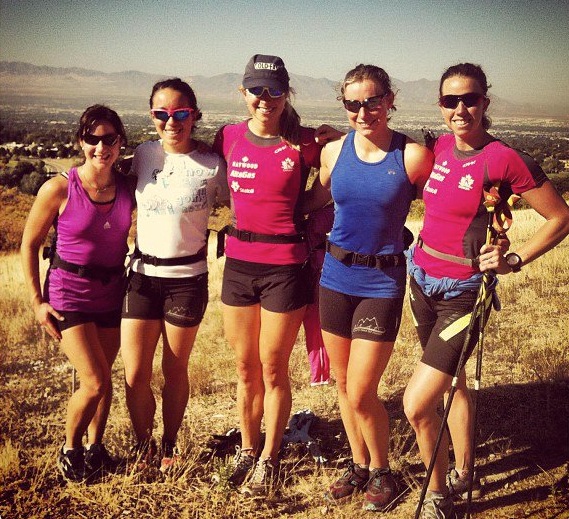
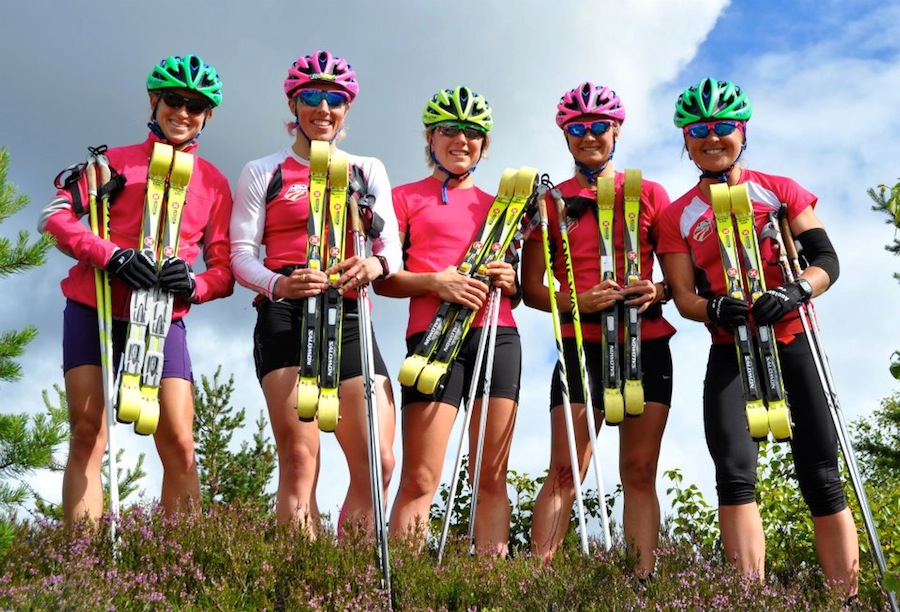
The Canadian women’s training group stops for a photo during a workout Oct. 1 near Park City, Utah. From left to right: Amanda Ammar, Emily Nishikawa, Chandra Crawford, Alysson Marshall and Perianne Jones. (Photo courtesy of Amanda Ammar)
After nearly two weeks of dryland training in Park City, Utah, the Canadian women’s cross-country team will pack up and head to St. George on Saturday. Saint what?
One of the fastest growing cities in the U.S., St. George is tucked in the southwest corner of the state about 300 miles (483 kilometers) from Park City. It requires about a five-hour drive south, and the group is going to the 75,000-population metropolis to train through Wednesday.
According to women’s coach Eric de Nys, this will be the first time the team has added the destination to its annual Park City camp. In an email, he wrote that they sought St. George for its lower elevation (2,860 feet or 872 meters) compared to Park City (6,900 feet or 2,103 meters) and Soldier Hollow in Midway, Utah (5,463 feet or 1,665 meters).
“St. George is something that I decided we would add on only for the ladies,” de Nys wrote. “It should be fun, hard work and our last dose of summer temps until the spring. We have some fun things planned for down there for team building, too.”
***
FasterSkier:All are the women’s World Cup team members (Perianne Jones, Chandra Crawford and Dasha Gaiazova) there, along with development-team skiers Alysson Marshall and Emily Nishikawa, and Amanda Ammar (independent)?
Eric de Nys: Yes, everyone is here. Dasha is following a plan in conjunction with our men and has joined us for two intensity sessions [as of Wednesday]. The group has been a great compliment to each other and have been working very hard.
FS: Who’s writing Gaiazova’s plan, and what is she doing differently?
EDN: [Men’s assistant coach] Louis [Bouchard] is writing Dasha’s plan and it was felt that the men’s regimen would give her what she needs at this point in her development. She is doing less than the men but starts the various workouts with them and goes about her plan at her pace etc.
FS:What’s been the objective for your women in PC?
EDN: The objective for the women’s team has been a continued building of team environment with our women’s group in conjunction with some exposure to altitude training and then finishing off the camp with some intense efforts at a lower altitude in St. George. Essentially, we are starting to gear up for the racing season.
FS:How’s the training going?
EDN: The ladies are doing very well and are in a very different place than they were at this time last year. … [They] are far fitter and are moving faster in workouts. … I know this is true based upon a few tests we have done at home.
FS:Who has made noticeable improvements this season and in what areas?
EDN: I would say that all the ladies have made significant strides forward this training season and I am excited to see them race.
FS:Have you had any time trials or joint workouts with the Americans?
EDN: We haven’t had any time trials yet and we may have Liz and Jessie join us [Thursday] for an intensity session. All of our hard work has been interval based so far and we plan to have a TT in St. George.
FS:Are your athletes doing any testing? Are you able to use USSA’s Center of Excellence [COE]?
EDN: I guess you could say that every day is somewhat of a test : ) but no, we haven’t had any formal testing to speak of down here. The COE is not available for our use and even if it were, it sounds like it is a busy place these days with many of the US athletes lined up for their annual fall pilgrimage of testing.
FS:When you get back north to Canmore, what will be the focus at Frozen Thunder?
EDN: Specific intensity on snow and race preparation!
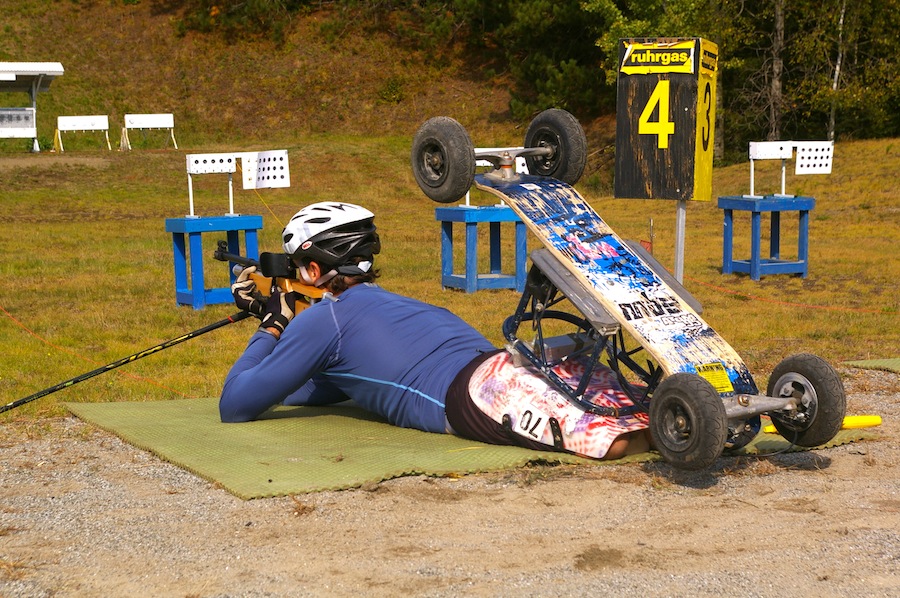
U.S. Paralympics Nordic National Team member Andy Soule, an Army veteran, shoots at the Mt. Van Hoevenberg biathlon range during time-trial intervals on sit-ski mountain boards on Sept. 21. The national team held a dryland camp in Lake Placid, N.Y., from Sept. 18-28.
LAKE PLACID, N.Y. — As they hammered out loops at the Mt. Van Hoevenberg biathlon center, several athletes on sit-ski mountain boards put their heads down. Everything they were doing — five or so laps lasting a few minutes each on pavement and grassy trails — required upper-body strength. At the end of each interval, they reentered the stadium for shooting practice, where the adaptive skiers rolled onto their stomachs and aimed at their targets. Then they had to get back up again and start over.
Of the 14 athletes at the U.S. Paralympics Nordic dryland camp in Lake Placid from Sept. 18-28, two were visually impaired, according to high-performance director John Farra. He prescribed bounding intervals for them.
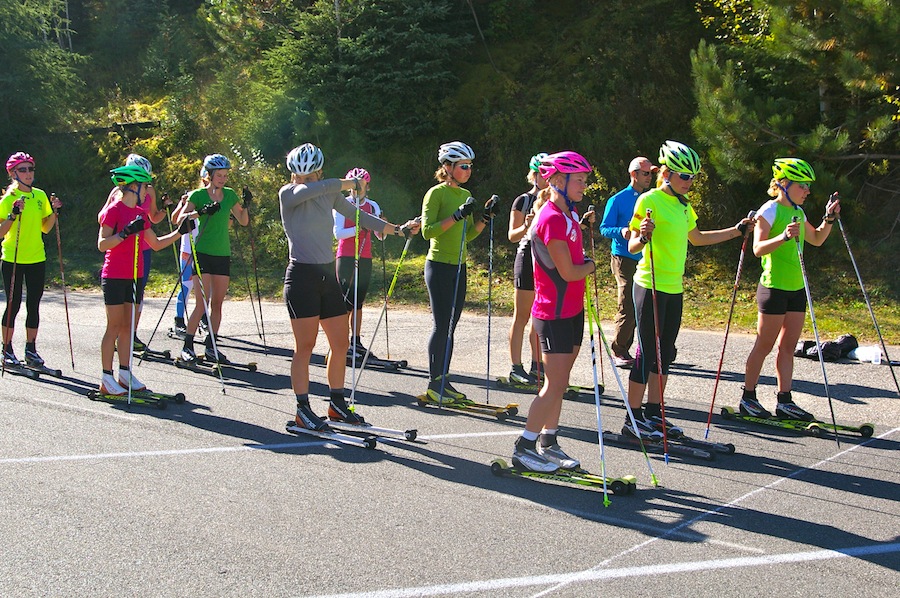
Several national-team members, including Jeremy Wagner (l), Sean Halstead (second from left) and Erik Frazier (r), at the start of a sit-ski time trial at the U.S. Paralympics Nordic dryland camp Sept. 21 at Mt. Van Hoevenberg. (Photo: www.facebook.com/USParalympicsNordic)
Nine coaches also attended the 10-day camp, which Farra said was one of the most-selective to date.
“An interesting challenge for us now is that we’ve been pretty successful at bringing new people to the sport, so our numbers are going up while our numbers at the OTC [Olympic Training Center] aren’t,” he said during the time-trial session Sept. 21.
“I guess it’s a good problem for us, that now our high-performance camps are by invitation-only,” Farra added. “Last year was kind of like, ‘Hey anybody shows up,’ [which was] great because there weren’t that many people doing it, but I would say we’ve brought in another 15 to 20 people to the sport and I’ve only got 15 beds at the OTC.”
Nine members between the U.S. National and Development teams were given priority, and most came to at least part of the camp. Beyond that, Farra said they invited three to five newcomers that they felt deserved the opportunity. Several came from the East, he said, but in a few weeks from Oct. 15-25, they’ll have more western skiers at another dryland camp in Midway, Utah.
“It’s exciting; it’s definitely working,” Farra said. “We had, what, five adapive [skiers] two years ago at nationals? Last year we had 18, and I expect closer to 30 this year at [U.S. Adaptive Nordic National Championships at Soldier Hollow,] Utah. That’s the right direction that we need to go.”
Lt. Dan Cnossen of the U.S. Paralympics Nordic National Team doing loaded chin-ups during a strength session at the Lake Placid Olympic Training Center. (Photo: www.facebook.com/USParalympicsNordic)
As for what the athletes were up to over the last two weeks, New England Nordic Ski Association (NENSA) Adaptive Program Director Eileen Carey wrote on the program’s blog that the athletes had been “dialing in shooting positions, roller-skiing and sit skiing on mountain boards, testing in the weight room and on the SkiErg and learning the physiology and nutrition of training.”
On Sept. 21 during interval training, Farra said that was a good opportunity for his top athletes to combine a hard effort with shooting experience.
“It’s a high-performance [camp]. They need to be preparing themselves for competitions,” he said. “That’s why there are time trials. That’s why they’re working hard with each other. With the [athletes] we don’t see as much, it’s really about giving them coaching advice, training and hopefully they get hooked and keep coming back.”
The women get ready for the quarterfinals at the U.S. Ski Team Elite Camp classic rollerski sprints on Sept. 20 at the Olympic Jumping Complex in Lake Placid, N.Y. Up front, from left to right: Jessie Diggins, Sophie Caldwell and Ida Sargent.
LAKE PLACID, N.Y. — Exactly a week ago, 40 elite skiers threw down some solid efforts at a U.S. Ski Team (USST) classic rollerski time trial, with the fastest men and women moving on to their respective quarterfinals, semifinals and finals.
Sophie Caldwell and Andy Newell of the Stratton Mountain School T2 Team topped the women’s and men’s fields in the sprint workout. For more about the races, click here. Otherwise, enjoy the video below capturing the action at the Olympic Jumping Complex, from the qualifiers through the heats.
LAKE PLACID, N.Y. — As seven US Biathlon Team members repeated loops around the stadium during trail-running intervals at Mt. Van Hoevenberg on Friday, each had their own things going on, their own focus.
US Biathlon Women’s Coach Jonne Kähkönen (left) speaks with Susan Dunklee (USBA A-team/CGRP) before Friday’s workout at Mt. Van Hoevenberg in Lake Placid, N.Y.
A-Team athlete Susan Dunklee, a Craftsbury Green Racing Project skier who tied the best U.S. women’s result of fifth at Biathlon World Championships last year, warmed up and cooled down on her mountain bike to remedy tendonitis in her knee. But for the first time in about a year, she completed the running-intensity workout on foot. After, she was happy she did so.
On the men’s side of the range, Tim Burke, Lowell Bailey and Leif Nordgren all ran together. Ages 30 and older, Burke and Bailey stood as two of the most competitive men on the A-team, and at 23, Nordgren was the youngest. Asked about the season, their specific objectives differed. Ultimately, however, most fed off the energy captured by the men’s and women’s teams last season in an effort to do better in 2012-2013.
FasterSkier snagged interviews with Bailey, Nordgren, Dunklee and Corrine Malcolm, a 22-year-old B-team member, to see how training was going.
***
Susan Dunklee:
“I’ve had knee issues for the past year or so and I’ve been working through that and getting it fixed, but it’s been kind of a chronic thing so mostly I’ve been biking instead of running this past year. This is the first time I’ve done any sort of running intensity in over a year so that was kind of exciting. It was OK, nothing too bad. It’s like a little tendonitis while I’m running, something like that. … I love training because we do so much different stuff, rollerskiing, biking and hiking, canoeing sometimes, rowing.”
FasterSkier: What are some of your goals for this season?
“I try to not too goal-focused, just try to work on the process of things and put it all to work and just see where it lands me. I believe I can be up there and I’m going to go into it expecting to be up there. I don’t know, I guess that way I won’t be surprised if I have good results, but yeah, just take it as it comes.”
How do your breakout results from last year affect you?
“It puts me on the radar and there’s a little more expectation and stuff, but I’m really excited. I really like chasing down people who are faster and trying to keep up with the big dogs. [Belarusian biathlete Darya] Domracheva is such a good skier and I really want to get in behind her and see if I can figure out what she’s doing. There’s a bunch of people out there who are pretty good. It’s a long-term sort of sport so it’s just a year, really.”
Corrine Malcolm:
Have you been trail running a lot?
US Biathlon teammates Corrine Malcolm (l) Hannah Dreissigacker (c) and Annelies Cook during an interval/shooting workout Sept. 21 at Mt. Van Hoevenberg in Lake Placid, N.Y.
“I went and did the race [US Mountain Running Championships] that Morgan [Arritola] won at Loon Mountain [in New Hampshire]. I was in the elite women’s field of like 25 of us, which was insane because they all have serious running credentials and I just thought it was fun. [She placed 20th.] And then I went and did the 25 k at Jay Peak at the trail running festival there [Sept. 2. and was the second female]. I’ve been doing a lot of running, but that just kind of makes me happy.
“I started as a runner. I didn’t start skiing until late in high school so for me, running’s always been my go-to. And I hurt my shoulder really badly last year so I did a lot of running this past 12 months or so. I think having run so much, it’s kind of allowed me to have the coaches be OK with me jumping into a couple running races, that I wasn’t going to get hurt, that it was something I was capable of doing and adding to training in a good way.”
How are you feeling now?
“I think we’re in a really good spot. We did a blood draw before our trials racing in Jericho [Vt.] and for my normal levels, I’m really anemic so I’ve been on iron pills now for five weeks or something, just trying to get those levels back. There was a while there through August that was really hard just because I didn’t feel good, but starting to feel more normal. Compared to these women, I’m the youngest of the group and the least experienced of the group and I just get thrown into stuff all the time. I think it’s good for us at this point in the season to look at how the training makes me feel, maybe I can’t do everything that they do or the same that they do.
“It’s great because I have a good training group when everyone’s around. A lot of them skied collegiately … so they have a really good background so for me to ski with them and train with them is good.”
How’s your shoulder injury?
“It’s actually been interesting. I don’t ski aggressively enough with my upper body or my core so we’ve been trying to do more of that and, like, immediately started to get really sore and tired where I got hurt last year. I think as long as we get on snow in the next six weeks I’ll be fine, but it’s kind of trying to manage the shoulder between now and then so I don’t really bust it up again. Hopefully, fingers crossed.
What are your goals for this season?
“Part of me is scared that I’m just getting set up for the same thing as last year, which is really irrational. It’s easy to forget that last year went like it did because I was hurt and because I was really sick. It’s easy to forget why things went so poorly and remember that things went poorly, but I think ideally, I feel well enough and I do well enough that I get over to Europe sooner than later. I would like to race the IBU Cup. If I could go over and do all the IBU Cup races I would be totally fine with that.
“I don’t think that really think that I should or need to go to the World Cup right now. I don’t need to go and get my butt kicked every weekend, I’d rather just go to Europe and race really high-level races since this is my third year. I have a little time left to kind of play catch up and I think that having a chance to go over and do those development-level races would be awesome. So hopefully some IBU Cup racing and hopefully European Championships if we send a group over there, but who knows at this point.”
Lowell Bailey:
Where are you at with training?
US Biathlon A-teamers Lowell Bailey (l) and Leif Nordgren running around the trails during an interval workout Sept. 21 at Mt. Van Hoevenberg in Lake Placid, N.Y.
“At this point, it’s all about the best means to be as prepared as you can by the time we start the World Cup. That means a lot of ski-specific stuff right now. We’ve done in the spring typically a little bit less specific training, more running and biking and stuff like that, but now it’s pretty much all rollerskiiing except for a few recovery workouts.”
How has your training plan changed from last year?
“We retained all the core, fundamental aspects of our training plan that we’ve had really for the last six or seven years training under [U.S. head coach] Per Nilsson’s plan. But every year we try to learn from the World Cup, from the international field, we’re always looking at what other teams are doing, especially the top guys. We kind of try to steal the best parts of every program and use it to our benefit.”
After two career-best IBU World Cup results of fifth last season, what are you aiming toward this winter?
“My goals after Vancouver have really centered around the quality of what I’m doing and trying not to emphasize specific results. That being said, you always have to have goals so my goals are to maintain and hopefully improve my ski speed from last year and then to have shooting percentages close to 90 percent on the World Cup average. … Honestly it seems like the season just ended, and it seems like we’re just staring again. It’s crazy.”
Leif Nordgren:
“I’ve been focusing a lot on longer Level 3 for pretty much the whole summer. Now as we get closer to the season I definitely try to push, have a little more Level 4, shorter faster intensity, to just kind of slowly work my way into the race season and we’ll be here for a couple weeks and we head out to Utah for most of October to get some high-altitude training in before the season.
What are some of your goals?
“I’m definitely the younger guy, I’ve only been on the World Cup for a couple years so for sure, I think one of my biggest focuses is the relay, to be a strong fourth guy for the relay. As far as individual results go, I just try to have a good race and show that I train hard and that I can keep up with these guys sometimes. I’m not strong enough to be there the whole season yet so I kind of have to pick my races here and there, but yeah, for sure the relay is one of the biggest things I focus on.”
USBA skiers Corrine Malcolm (l), Annelies Cook (c) and Hannah Dreissigacker work on shooting during running intervals Friday at Mt. Van Hoevenberg in Lake Placid, N.Y.
LAKE PLACID, N.Y. — While the U.S. Nordic Ski Team trained on the mountainous, cross-country side of the Mt. Van Hoevenberg ski center on Friday, seven U.S. Biathlon skiers and their coaches went to work on the opposite side of the road at the biathlon range.
According to USBA coach Jonne Kähkönen, the trail-running interval session he prescribed was more biathlon-specific. Athletes ran six 5-minute intervals at Level 2 and 3, with the first couple at a lower intensity and the last few at a higher speed. Each time, they looped back to the stadium where they practiced shooting in the wind. On Saturday, Kähkönen said his skiers would do a harder interval workout on rollerskis at the Olympic Jumping Complex (where they mostly train at another biathlon range).
“Tomorrow’s the intervals; today is just a teaser,” he said.
More quotes from Jonne Kähkönen:
On last two weeks of training in Lake Placid (since returning from overseas trip with the A-team in Ruhpolding and Oberhof, Germany):
“The first week, obviously, was really easy. Almost like an off-week, a vacation week we called it, because we had a pretty intense camp over in Europe for three weeks. We wanted to give them a little break, and also the experience from last year was that a lot of the athletes caught a little cold or something so we wanted to avoid that an it seemed like it was working fairly well this year.
“Everybody’s bouncing back and recovering from the camp. Overall the summer has been good. No major injuries; there’s always a little bit of this and that, but that’s part of the training.”
On training goals:
“At this point, we’re for sure headed towards more normal-biathlon training so there’s a little bit less of general training sessions, like running or biking, and it’s more towards specific training, which also means that the intensity is a little bit higher, at least on the main workouts. Basically the hard work is done, all the hours are done, and now it’s more about the quality.”
On working out with U.S. Nordic team earlier in the week (during skate-threshold intensity rollerski Sept. 18):
“It was raining heavily, but luckily it was still like summer rain so not as cold as it could’ve been. But that was good. It was a big group, a lot of athletes out there. I think it’s a good push; I always say that we don’t have that many biathletes and just skiers in general in North America, so definitely it’s a good thing to put all the top athletes to do a couple workouts together.”
The Lake Placid USST Elite Camp concluded Friday with morning ski running/bounding natural intervals at Mt. Van Hoevenberg (shown above) and a distance double-pole session in the afternoon.
LAKE PLACID, N.Y. – Friday morning’s U.S. Ski Team workout at the Mt. Van Hoevenberg nordic trails wasn’t designed to be too hard. According to men’s coach Jason Cork, the idea was to run with poles and ski bound for 45 minutes at Level 3 – a sort of tempo pace.
Once a couple dozen athletes between the U.S. Ski Team (USST) and National Elite Group (NEG) got going around the designated loop, most realized what they were in for. Two weeks of dryland training at the USST Elite Camp in Lake Placid had taken its toll on their bodies, and on the last day of camp, they had to tackle Russian Hill – three to four times.
Cork said he’d noticed the group’s fatigue levels increase throughout the last few days, especially during warmups.
“You can see people are getting a little sloppy; you can tell they’re getting pretty fatigued,” he said. “But that’s kind of the whole point of having a training camp, you get the best guys together and have them kind of push each other a little bit and have an easy week afterward.”
Friday afternoon, several athletes took part in the camp’s final workout – a 1-½ hour double pole – which USST head coach Chris Grover said was more of a recovery.
According to Grover, the morning session was considered threshold-intensity, natural intervals. He went on to explain in an email how those intervals work.
“The terrain dictated when the athletes were working harder (uphills) and going easier (downhills and flats),” Grover wrote. “They were probably above threshold at the tops of the hills and well below threshold at the bottoms of downhills. A workout of this duration (45 min.) probably has about 25 minutes of real threshold work-time. But it closely mimics the demands of ski racing, which is important at this time of year.”
Ryan Scott (Team HomeGrown/SSCV) leading the pack up Russian Hill at Mt. Van Hoevenberg during Friday’s threshold workout at the USST Elite Camp in Lake Placid, N.Y.
The loop was marked by two big climbs, one of which was Russian Hill. It took the front group, with Ryan Scott (Team HomeGrown) leading about seven men and Liz Stephen (USST), about 11 minutes to complete. Others rounded the loop in about 15 minutes, and kept the effort going for 45 minutes or more.
Asked what was next for many of his athletes, Grover said off days.
“Some athletes will take just one day off after the camp, others will take two, and some will focus on active recovery for a few days,” he wrote. “It just depends on how each individual handled the load of the camp.”
Looking back, Grover was satisfied with how things went throughout the last two weeks, with workouts ranging from intensity bounding intervals up Whiteface Mountain to the Climb to the Castle Rollerski Race up its access road. On Thursday, 40 skiers competed in a classic rollerski sprint time trial at the Olympic Jumping Complex.
“I was impressed by the improvements of many of the athletes at the camp, USST athletes and club athletes alike,” Grover wrote. “Some of the most biggest gains in my mind include Liz’s overall fitness, Ida’s technique improvements in both skate and classic, Skyler’s performance in the sprint, and Ryan Scott’s performance in just about every workout. We had close to 50 of the country’s best athletes at the camp, across a spectrum of age groups, and it was really cool to see how hard everyone was working and how professional these athletes really are.”
Next on the USST agenda is a final dryland camp in Park City, Utah, where the team will be from Oct. 8-18. Then, they’ll immediately fly north for an on-snow camp Oct. 18-27 at Frozen Thunder, where snow has been stockpiled in Canmore, Alberta.
“The entire team will be in Park City and most of Team in Canmore, the exception being the Alaskans who will head home to find snow,” Grover wrote. “The main goal of the camp is exposure to altitude living (and an increase in Hb [hemoglobin] mass) prior to departing for Europe. Another goal is lab testing to follow up with tests completed on each athlete in the spring and summer; i.e. determining what sort of progress was made by athletes this summer and fall and what needs still must be met. The goal of the Canmore period is to get on snow and to work on technique before heading to the World Cup, and to tune up for racing with some on-snow time trials.”
Sophie Caldwell (r) leads Ida Sargent (second from r), Caitlin Patterson (second from left), Jessie Diggins (behind Patterson) and Anne Hart (l) at the start of the big downhill in the first semifinal of the women’s 1.4 k classic rollerski sprint on Thursday. The time trial was the first of this year’s USST Elite Camp in Lake Placid, N.Y. and took place at the Olympic Jumping Complex.
LAKE PLACID, N.Y. – Flinging around a sharp corner about a ski length behind one another, Sophie Caldwell (Stratton Mountain School T2 Team), Ida Sargent (Craftsbury Green Racing Project), Caitlin Patterson (CGRP) and Jessie Diggins (SMS) each lowered into a tuck and prepared for a long, steep descent.
Diggins called out to the others just ahead of her in the classic rollerski sprint at Lake Placid’s Olympic Jumping Complex.
“That’s it,” the U.S. Ski Team (USST) member said. “Nice.”
Conversations like that, in the first of two women’s semifinals at the USST Elite Camp on Thursday, didn’t take place every heat. But they generally differentiated the women’s and men’s races.
According to Caldwell, who eventually won the women’s 1.4-kilometer final, nothing was too cutthroat about the sprint rounds. Caldwell finished first in the quarterfinal, semifinal and A-final, beating USST member Sargent in the latter by 1.4 seconds. Diggins finished third in the A-final, about four seconds back.
“We try to be nice,” Caldwell said. “We even talk to each other and let each other know how much space we have. I don’t know what the boys do.”
She laughed. Anyone who watched the men’s heats on Thursday knew exactly what they did.
Simi Hamilton (left) leads Skyler Davis (second from l) and Andy Newell (front right) into the long downhill during the quarterfinals of the men’s 1.5 k rollerski classic sprint on Thursday at the USST Elite Camp in Lake Placid, N.Y. Newell went on to win the A-final, Davis was second, and Hamilton was third.
In the first of four men’s quarterfinals, USST members Simi Hamilton, Andy Newell and Skyler Davis all battled for position on the same corner at the top of the long hill. Each had to pass through two narrowly spaced cones to make the turn.
All three of them did so and managed to stay on their feet, while Ryan Scott (Team HomeGrown), Tim Reynolds (CGRP) and Sylvan Ellefson (HomeGrown) worked hard behind to close the gap. Davis said he felt someone push his poles, which made him go uncomfortably faster on the ripping downhill.
In the end, they all made it to the finish. Newell ultimately won the men’s 1.5 k final, about two seconds ahead of SMS teammate Davis in second, and Hamilton (Sun Valley Ski Education Foundation) in third (+4.42).
“This course is pretty wild because there’s so much tucking,” Newell said after the race. “To have six people going around that course is pretty crazy. Skyler and I are used to banging heads with each other because we do it every day, but it was fun to have Simi and Ryan Scott and some of those other guys in there, fun to go really fast on the downhill and try to pass each other on some of the corners. Nobody crashed hard I think, so it was a good day.”
Davis, who was second behind Newell in the qualifier and every heat that followed, said his performance was a “confidence booster” after being sick at the Lake Placid camp last year and having to call it a day after the prelims.
“Coming in [to this workout], I was pretty tired. This camp’s been hard,” Davis said. “Once I started warming up I felt great.”
A competitive field of 26 men made for fast heats. On the same course last year, USST A-teamer Kris Freeman won the classic sprint in 3:30. Newell posted 3:22.38 in Thursday’s A-final and threw down a 3:18.91 in the qualifier.
In the women’s qualifier, which consisted of 14 skiers, Diggins was fastest in 3:42.20 – the same time Sargent clocked to win last year’s time trial. On Thursday, Caldwell qualified second 0.15 seconds back, and Sargent was close behind in third (+0.24).
Those kinds of measurements are what matter most this time of year, according to USST head coach Chris Grover.
“It’s too early to really hang your hat on any sort of results here,” Grover said. “It’s just kind of a road mark. I think for a lot of the athletes, we want them to take a look at what kind of lactates are they able to create, what kind of heart rates are they able to have. That gives us an indication of how much of their aerobic system they’re able to access, how much of their anaerobic system they’re able to access, those kind of feedback markers plus how they sustain the rounds.”
If they fade progressively after the prelims, something’s got to give. Grover said race scenarios give skiers an opportunity to assess where they’re at, and how to move forward.
“Like, ‘OK, I’m handling training well during this period,’ or, ‘I’m starting to get a little fatigued, I’ve really got to concentrate on rest for a few days, or for a week after this camp,’ ” Grover said. “So it’s not so much the placings that are critical; there’s a lot of different rollerskis out there, there’s a lot of different ski speeds. It’s more the individual feedback in terms of heart rate, lactate, times, technique.”
Sophie Caldwell (1st woman): “I felt good today. In the qualifier there were a few things that I felt like I didn’t do quite right. I took the corner on the bottom wrong, so I worked on those in the heats and it was good to be able to follow some people and see what they did, like Jessie was really good at going fast over the top of this hill and taking the corner down there.
“I didn’t really know what to expect. I wanted to be right up there with Jessie and Ida. … This summer we basically just did all Level 3, not many Level 4 workouts, and then we do some speed workouts. I think now we’re starting to do more Level 4, time trial, race pace stuff, but it feels good so far so it’s good to know you can still get fit just doing Level 3. … We all have different skis and everything, but I’m just happy to come out here and feel good and be in the mix with everyone.”
Ida Sargent (2nd): “It’s a rollerski time trial in September and everyone is on different skis,” she wrote in an email. “I wasn’t concerned with results, instead focusing on gettiing a hard workout and practicing some technique goals in a max effort. It was a really fun skiing with everyone and it felt good to feel the lungs burning with cold air this morning!”
Jessie Diggins (3rd): “During such a good intensity camp, my goal with this workout was to get in some good hard efforts, and really work on my qualifier,” she wrote in an email. “Classic sprinting is definitely my weakest area and epecially qualifying, and so I’ve been really focusing on, well, FOCUS during the qualifier.
“I definitely was feeling the fatigue in my body, but that was to be expected during this camp after a 4.5 hour training day yesterday [Wednesday], so I wasn’t super worried about it. However, it still doesn’t feel good to not be moving lactate out as fast as I want!”
Andy Newell (1st man): “I definitely feel so much better than I have in the past racing here. I’ve been doing a lot more hard stuff, a lot more speed, so it’s good. I actually feel like a sprinter again, which last year at this time and for most of the winter, I didn’t really feel like a sprinter so it feels really good to get that kind of power back.
“I’m usually not such a good classic rollerski sprinter, for whatever reason, my technique doesn’t translate that well over onto rollerskis, but it feels good to double pole well and I like courses that have lots of striding like this. … Last year, I was sick for this race or I’m [usually] really tired for Lake Placid camp because I’m coming in training too much volume. I tried to cut back [the week before] so I was able to really come into this camp and get the most out of each interval session and time trial. That was the goal of the camp and I think that worked out well. I’ve been feeling good all camp and hopefully will be able to absorb some of this hard training better than in the past.”
Skyler Davis (2nd man): “We had a sprint time trial about two and a half to three weeks ago in Maine. It was pretty similar to this except it was all double pole so I got to go head to head with [Newell] on that. This was the same type of thing, we were battling the whole time, especially coming up the hill. All those guys were pushing pretty hard … so all of our heats were pretty fast. It was really good training.”
Simi Hamilton (3rd man): “I felt pretty good today, considering that I’ve done pretty much no max efforts yet this year,” he wrote in an email. “I actually felt better today than I have in years past during the camp, so I am taking that as a good sign that my training is going in the right direction, especially in terms of overall fitness and improved endurance throughout heats. I ran into some slight equipment problems [blown-out rear wheel] today, so that was kind of a bummer, but other than that I am pretty happy with how the day turned out.
“My main goal today was to ski consistent efforts in the qualifier and each heat … And I think I did that, especially since my equipment problems required me to switch to a slightly slower pair of skis for the semis and finals.”
Chris Grover: “We’re toward the end of the camp now so people are starting to accumulate some fatigue. We’re actually doing threshold bounding intervals tomorrow [Friday], so I expect that just about everyone will need a few easy days following the camp and that’s normal.
“We like to push the athletes when they’re together and they have a chance to go head to head. At the same time, it looked like good movement out of a lot of the athletes. I really like this course because it has such a wide, steep finish hill, really a chance for athletes to demonstrate how their holding up through the rounds, if they’re able to carry good momentum up that hill and over the top and into the finish. I think it’s also great to have a big hill and then a long finish straight, especially like we have for the men on this course, because it replicates a lot of the courses that we encounter in the winter time.”
About 25 elite nordic skiers did maximal-intensity, ski-bounding intervals up Whiteface Mountain on Tuesday as part of the U.S. Ski Team Elite Camp in Lake Placid, N.Y.
WILMINGTON, N.Y. — The view from partially up Whiteface Mountain on Wednesday morning was about as picturesque as they get. From the trail, one could see that the leaves had started to turn shades of red and yellow — just in time for the U.S. Ski Team’s fall training camp in Lake Placid, N.Y.
Way down below, a few small dots proceeded up the dirt access road: first to warm up, then to get after it. US Ski Team Head Coach Chris Grover organized the maximal-intensity, ski-bounding interval workout for about 25 athletes, and said it was probably the toughest many had done this training season.
“Typically what we’re doing in the fall is switching gears from kind of our base anaerobic phase in training, where we’re concentrating more on is distance and technique acquisition, and now starting to work a little bit more poignantly with developing the athletes’ VO2 max,” Grover said. “You probably heard comments from athletes who said this was the first session of quite hard bounding that they’ve done this season. A lot of these guys have done quite a bit of threshold-type bounding, but they haven’t done short, hard bounding like that. It’s intended to develop their maximal aerobic capacity.
“So that’s what we’re going for,” he added. “It’s the beginning of September, kicking it into a little bit more intensity mode. Obviously during the camp, we have some more hard workouts coming up, including the Climb to the Castle [on Saturday], the sprint rollerski time trial, as well as some threshold sessions. Just trying to start into a little bit more hard training.”
“We saw some great performances [today] out of individual athletes, both national-team athletes and club athletes, but it’s definitely early in the season and we won’t get the real measuring stick until we get to Muonio [Finland], get to Gällivare [Sweden] in the fall and see how these guys stack up.
“This is the point of the year where I think everyone around the world is looking around going, ‘Oh yeah, these guys have made great progress through the summer,’ but it’s easy to forget that probably everybody in the world has made good progress through the summer. It’s kind of hard to take away from this particular workout except for particular technique changes, perhaps, that someone’s made, that they’re maintaining their form through the bounding sessions, for example. And if they’re mature enough to learn to really pace it well so that they’re still there at the end.”
How did each athlete decide whether to do five or seven intervals?
“Each of these guys is pretty much talking with their individual coach about what they should be doing right now and kind of what their training history has been over the summer, how old they are, and particularly what they’ve done over the last couple of weeks. Some athletes have come in with a good rest week, for example, and they’re ready to do the full-prescribed seven [intervals]. Others are coming off a little bigger training block, for example, and they’ve got to kind of work their way into camp a little slower.”
Andy Newell:
“I felt good. I always try to pace this workout well. It’s one of the harder ones we do at the camp, I think, as far as how much it takes out of your body. It kills my legs usually. But these are the kind of workouts that really you make lot of gains in building VO2 max. We haven’t done a ton of them so far this year, so for me I try to build into them so I can make the last few intervals hard. But it’s a long camp so we try not to blow ourselves out too much.”
How did you like doing the intervals with about 15 others, including some up-and-comers pushing to lead the pack?
“I like that. Some people don’t like training with a big group, but I think it’s sweet. I think the more people you have out, the better for an interval session. It’s funny, some of the young guns come to the front and go really hard on one, and they’re dead two intervals later. I was that same guy probably five or six years ago back when I was coming to these camps, too. So it’s cool to see these younger guys go out and hammer in front.”
Jessie Diggins:
“At the start of the workout I wasn’t feeling that great. It wasn’t the worst workout, definitely not the worst, but I wasn’t feeling the very best. It took me a while to warm into it and on the last three it started feeling really good, which is nice. I’m still trying to experiment with when beforehand I should take my inhaler. … I’m getting closer and closer to make it kick in when I want it.
“When you do these intervals, it’s super, super important to not dig yourself into a huge hole, but once in a while it’s really good to figure out exactly where your limits are and know what it feels like right before you hit the wall, and I found that 30 seconds before I was done today so that was really nice.”
Tad Elliott:
How was your summer?
“I’ve had a great summer out in Park City, [Utah]. I’ve been there pretty much all summer and then, just to Europe and back really quick [for a USST men’s camp in Austria and Germany]. It’s really nice to have my old coach Jason Cork back [as] the U.S. Ski Team men’s coach. He trains with me every day and we hang out, so training’s been going really well and it’s fun to have him around, too. Things are going awesome.”
What kind of training changes have you made?
“Ski training. I’ve been ski training a lot more, haven’t been mountain biking as much and a lot more strength, too, this year with our coach Michael [Naperalsky] at the COE. A lot more bounding, a lot more running, and yeah, less biking.”
What are some of the bigger mountain bike races you’ve done this year?
“I did nationals and that went all right. I was still solid when I came on the last lap, but nowhere near as well as I did last year. I think it’s all this muscle I’ve gained in my upper body, can’t carve as fast. I was 14th this year, sixth last year [in my first two years in the elite field].”
What was it like watching mountain biking at the Olympics?
“Man, the Olympics was awesome. Todd [Wells] is one of my good friends back in Durango. My dog, Gus, and his dog, Winston, have little man crushes on each other so we always go on play dates together with Todd, and I play golf with him. It was really fun to see him get a 10th place in his final Olympics [the best U.S. men’s result in Olympic history]. That was really cool. And then I’m good friends with Georgia [Gould], got to talk to her at nationals; she came home with some hardware [as the second U.S. mountain biker to ever win Olympic bronze] so that was sweet.”
Ida Sargent:
How was your summer?
It’s been great. I was in Craftsbury [Vermont] for basically the whole summer, except for our camp in Sweden, so it’s been good to be home and in one place for a while.
What have you been working on, and what did you learn from your first season on the World Cup?
“More hard training and keeping some consistency with the gains that I made last year and a lot of technique stuff, too. … It was tough to race the full season on the World Cup. I was pretty tired at the end of the year after having been on the road and traveling and racing the World Cup every weekend, so that was a great experience. This year I’m looking forward to building on that and returning to some of the same venues and having a little more familiarity with the whole scene, just ready to improve my results with that extra experience.”
What would you say your strengths are?
“I think sprinting is my strength, so this year I’m going to try to focus a little bit more on [that], but I would love to be a really good distance skier, too, so I don’t consider myself a sprinter. I want to be in the points in the distance races as well. It’s great to do training camps with Jessie, and Liz will be here later this week, and these other girls, too, to kind of improve my distance skills, too.”
How was your joint camp with the Swedish women’s national team in Sweden?
“It was good. We trained a ton. It was a lot of hard work, a lot of hours, but it was cool to see that they weren’t doing anything different than us, and we could hang with those guys and train with them. It was just a good confidence builder that our team’s really on the right track and building momentum also.”
Canadian World Cup team member Alex Harvey crashes and burns during a head-to-head sprint with one of his teammates at the Snow Farm near Wanaka, New Zealand, where the team recently spent two weeks training. (Photo from XC Canada video: www.youtube.com/watch?v=8roNOx3M0dk)
Just over two weeks ago, the Canadian men’s cross-country ski team made the long journey to New Zealand in search of some low-altitude, on-snow volume training. According to head coach Justin Wadsworth, they planned to work on intensity and climbing steep hills.
That was the plan, and after checking in with Wadsworth before the team left for home on Wednesday, he wrote in an email that all went well. In fact, he described the camp as excellent.
“Overall we are ahead in every aspect from where we were last year,” Wadsworth wrote. “So I’m very pleased.”
Lenny Valjas (l) and Alex Harvey while being filmed at the Snow Farm in New Zealand. (From: www.youtube.com/watch?v=8roNOx3M0dk)
While the four World Cup teammates — Devon Kershaw, Alex Harvey, Ivan Babikov and Lenny Valjas — put in some long days at the Snow Farm near Wanaka, they also had some fun. The team posted a YouTube video called, “Snow Farm – New Zealand – August 2012” to sum up their time there, which was mostly a laughing matter.
In one scene, the four men stand stand on a treeless trail high above the landscape while taking a break during training. Valjas looks to his left.
“Pop questions for our teammate Ivan Babikov,” he says.
“Hey Babs, what’s your spirit animal?” Kershaw chimes in.
Babikov laughs. “Unicorn?”
Devon Kershaw (l) interviews Ivan Babikov in an XC Canada video at the Snow Farm in New Zealand. (From: www.youtube.com/watch?v=8roNOx3M0dk)
The camera pans to Harvey: “Hey Babs, can you explain why we see the moon and the sun at the same time?”
Babikov pauses. “We’re way down deep south. That’s why.”
They all laughed, and then it was probably back to training. At least that’s what the videos shows. But between jumping out to scare Kershaw at surprising moments and doing penguin-like belly slides on skis, the Canadian men did have a productive camp. Wadsworth pointed out the quality of a couple speed sessions and hefty amount of technique work.
“Maybe one of the best days was a crust cruise up to the top of the Pisa Range [the plateau where the Snow Farm is located] on a bluebird day,” he wrote.
Snow conditions were good despite a thin snow year, he added. The team has also never skied in New Zealand this late in the season (they typically travel there about two weeks earlier in August for the Winter Games NZ races with other international skiers).
“Really the only hitch was 2 of the 4 guys got a 24 hour flu,” Wadsworth wrote about Harvey and Babikov’s illness about halfway through the camp. “This happened on the morning of the classic time trial we had planned, so we had to move things around a bit, Alex and Ivan bounced back quickly and even though they were rooming with Devon and Lenny the flu didn’t spread.”
Asked how he was feeling, Harvey responded in an email from the airport that he was doing well.
“I’m coming out of the camp not really tired,” he wrote. “It’s hard to know what [the sickness] was exactly. … It was quick but pretty intense. Probably something we caught down in town, in Wanaka. I was able to ski twice the next day so I didn’t loose any training really. I just ended up skipping a rest day later in the camp.”
View from the Snow Farm near Wanaka, New Zealand, in late August. (From: youtube.com/watch?v=8roNOx3M0dk)
Harvey added that having the camp a bit later gave them more time to enjoy summer back in Canada. Once they arrived in New Zealand, he said the conditions were still good, just a bit more spring-like.
“But there was never a day were we couldn’t ski because of the weather, which is pretty good for the Snow Farm,” he wrote. “We usually get one or two days were we can’t ski up there so we were lucky this time.”
Just like other team training camps, Harvey focused on completing hard-intensity workouts with his teammates.
“The training camps are the only time I do Level 4 intensity in the summer so it’s good to be with the boys to do that,” he wrote. “We also worked a lot on technique, classic, skating, uphills, flats. Trying to improve a bit on all aspects. I feel like I was able to put a lot of hours on snow, maintain the strength training while doing 4 solid hard intensity sessions and training kind of at altitude.”
(Harvey trains at sea level near Quebec City and could feel the difference at the Snow Farm’s elevation at 1,500 meters.)
“I’m coming out of the camp fitter and faster that’s for sure,” he added. “I feel like the camp didn’t take too much out of me so I should ba able to get two more solid weeks of training before our next camp in Park City, Utah (from Sept. 23-Oct. 4).”
As for highlights, Harvey picked out three:
“1. The weather allowed us to ski everyday if we wanted to.
Members of the National Training Group during a threshold workout at Soldier Hollow last week. Photo: Matt Whitcomb/U.S. Ski Team.
Members of the U.S. Ski Team’s National Training Group (NTG) spent last week in Park City, Utah, for a training camp centered on group training and exposure to the resources at the Center of Excellence. Athletes joined interval sessions with the national team on the rollerski track at Soldier Hollow and underwent a series of physiological tests for assessment and feedback on their development.
The camp was a new addition over last year’s schedule; the result of a decision by USST coaches to further focus on development.
“Back in the spring we sat down and decided that we’d put in another camp into our development pipeline specifically for this NTG and have them come out to Park City with the intent to get them into the COE,” said Bryan Fish, USST development coach.
Quality training was the camp’s primary goal, but with the COE nearby athletes were also able to work with the USST’s staff of physiology, strength and nutrition experts.
“The feedback we got was very positive; the athletes felt like they got a lot of education out of being here,” Fish said. “We could send them home with test results and feedback, which we provided to their club coaches, on areas where they’re strong, areas where they can improve.”
Emily Hannah, Marion Woods and Mary O’Connell. Photo: Matt Whitcomb/U.S. Ski Team.
Over the course of the week, Fish said the workouts and test results he saw were encouraging.
“What I’m seeing in the REGs and the J2 camp is that our athletes are indeed getting more fit and more prepared, tactically and technically. We’re seeing that in the physiology results that come in house,” Fish said. “For us, from the national team coaching staff, what we saw was hugely positive. It’s a testament to the clubs and these athletes that we’re training more; training better.”
One such workout to provide positive feedback were threshold skate intervals at Soldier Hollow, which the NTG athletes completed alongside resident national team athletes across multiple disciplines — cross country, nordic combined and biathlon were all represented in the same workout.
“Our general premise, from my perspective, is to get our best athletes together on occasion to train and compete,” Fish said. “They don’t have to train together 24/7 but getting together and going head-to-head they all learn and they all improve.”
With most of the U.S. nordic combined team, biathlete Jeremy Teela and several U.S. cross-country athletes on the course with the NTG skiers at the same time, the threshold workout got “kinda frisky,” said nordic combined skier Billy Demong.
“With all these cross country skiers and our guys, we went a little harder than we planned.”
Too fast or no, Fish thought the collaboration was a valuable experience.
“There’s a part of the training that’s intensity-based and another that’s tactical,” he said. “There’s a balance, and I feel you have to let a little bit of that go and train like you’d race. It was a prime opportunity to get in good tactical training on the Soldier Hollow courses, and for the most part they did a good job.”
Billy Demong leading the pack through the flats during threshold. Photo: Bryan Fish/U.S. Ski Team.
Stratton Mountain School (SMS) T2 teammates Erika Flowers (l), Jessie Diggins (c) and Sophie Caldwell doing some planks in the SMS weight room on July 12. It was Diggins’ first training session with the team since moving from the Midwest.
Since its inception earlier this year, the Stratton Mountain School T2 Team has grown to a six-skier strong elite club based in the resort town of Stratton, Vt.
Stratton Mountain School (SMS) graduates Andy Newell and Skyler Davis were originally part of the program. This year, the two U.S. Ski Team (USST) members are joined by three Dartmouth graduates — Eric Packer, Sophie Caldwell and Erika Flowers — and USST member Jessie Diggins, formerly of Central Cross Country (CXC). Head coach Gus Kaeding also came from CXC, where he was an assistant, but grew up in Vermont and went to Stratton with Newell.
FasterSkier met the group twice this summer, first in late June with Newell, Packer, Caldwell, Flowers, and Mikey Sinnott of Sun Valley for a distance rollerski and again in July during Diggins’ first training session with the team. The following videos capture the action. Stay tuned for a full story on the T2 Team.
The Snow Farm, as seen in July 2010, where the Canadian men’s team will be the lone North-American contingent training for nearly three weeks starting Aug. 22 near Wanaka, New Zealand. According to Canadian head coach Justin Wadsworth, U.S. Ski Team members Kris Freeman and Noah Hoffman will also be there.
Scattered throughout Canada on Sunday, four World Cup team members and their coaching and support staff started their long journey to the land down under – that is, New Zealand.
Alex Harvey ate handmade chocolates and sipped a steamed drink while waiting for his 16-hour flight out of Québec International Airport, then got upgraded to business class, according to Twitter.
Meanwhile, his teammate Devon Kershaw tweeted that he was in coach on another flight, but didn’t mind.
“It’s awesome in the back,” Kershaw wrote. “Middle of the middle for 15 hours #decent?”
As head coach Justin Wadsworth stepped off the plane in Denver and awaited his departure for Los Angeles, he took the time to chat with FasterSkier on the phone. The entire Canadian men’s team – Harvey, Kershaw, Lenny Valjas and Ivan Babikov – will arrive in Queenstown, New Zealand, on Tuesday afternoon. They’ll start training Wednesday and spend about two and a half weeks on snow at the Snow Farm near Wanaka.
***
FasterSkier: Last year, you timed the trip with the New Zealand Winter Games so your skiers could race at the Snow Farm. Why did you schedule it later this year?
Justin Wadsworth: We have a lot of camps. In the summer, it works out to be almost two weeks out of every month the athletes are in camps. I thought this summer it might be nice to give everyone a six-week period with no camps. That’s basically what we did to try to create more of a stay-at-home and get back into a groove where everybody lives. Our last camp was up on the Haig Glacier, you know, as part of our Hawaii camp. [Note: The men’s team was in Hawaii from mid June to July 4, then skied on the Haig Glacier near Canmore, Alberta, from July 5-9].
It has been a nice break for everybody, including myself, and then it just worked out well. We usually have a two-week break before the Park City altitude camp in September [where both the Canadian men’s and women’s teams will train together in Utah from Sept. 23-Oct. 4].
FS: What are some training goals while in New Zealand?
JW: This is kind of a volume camp. We have other periods where we focus a little bit more on intensity. This one is volume-based and obviously on snow. It’s worked very well in the past few years [at creating a base for really good ski technique and working on climbing. We’ve been rollerskiing a lot and glacier skiing where there’s not a lot of opportunity for super-steep uphill training]. It’s just terrain that’s good to be on for working the steep uphill.
FS: Why else is it important to travel there for snow?
The men’s 15 k classic mass start podium from 2009 in New Zealand: Canadian winner Devon Kershaw (c) and teammate Ivan Babikov (l) and American runner-up Kris Freeman (r).
JW: We have opportunities to ski in Canada and right behind Canmore on the glacier, but New Zealand provides us with straight-out-the-door, fairly low altitude, and just really, really good winter snow conditions to train from. I, personally, and I think the athletes really feel like this camp provides them something that a lot of their summer skiing doesn’t.
I know other North Americans are sort of straying away from going there, but … I think it is a super-high value for us to be down there, and it’s worth the trip even though it’s a long trip down there. It’s a really good place to get some quality training in.
[Note: For the first time in 10 years, the U.S. Ski Team will not be training in New Zealand this summer. Head coach Chris Grover cited the steep rise in airfare, lengthy travel and 16-hour time-difference adjustment as reasons for skipping the trip. Instead, the U.S. men recently skied in Austria and Germany, and the women just wrapped up two weeks of training in Sweden.]
FS: Which international skiers will still be at the Snow Farm?
JW: Right now, the Russians are down there and Justyna Kowalczyk and one other male sprinter from Poland [Maciej Kreczmer], and then Kris Freeman and Noah Hoffman [of the U.S. Ski Team] will be down there a little bit later. There’ll be a few other folks there.
FS: Do you plan to coordinate workouts with Freeman and Hoffman?
JW: Hoff gave me an email a couple days ago and asked me what our plan was down there. He said he’d like to at least hook up for some workouts. We’ll probably do a time trial down there so it might be nice to get those guys into that one and probably some intensity with them also. I mean, we’re happy to work with those guys and I’m sure they’ll ski a lot together in the distance workouts. The majority of the sessions down there are distance training.
FS: It seems like the North American women have been pushing particularly hard to train together. How would you describe the relationship between the Canadian and U.S. men?
JW: It’s a little bit different between men and women. I think the social aspect on the women’s side is so much more important, and I think that’s a big difference. It’s not that we don’t want to train with Hoff or Bird, it’s just guys in general do a little bit more on their own. We’re not going to force it, but definitely there will be some company on the long workouts that they’ll be welcome [to join at the Snow Farm]. It will be nice to have those guys there.
FS: Which of your staff members are going?
JW: Myself and [wax tech] Joel Jaques, [team physiotherapist] Shayne Hutchins, and then [men’s assistant coach] Louie Bouchard … so we have a pretty good staff-to-athlete ratio on this one.
FS: Will the training sessions be mostly structured similarly or individually?
JW: Occasionally, we’ll have different workouts, but [at] almost all the camps, guys do all the workouts together. We can vary the length of them and stuff individually, but they do all pretty much the same plan for the camp so it works out really nicely and I think it’s beneficial for all the guys.
You kind of see that now, Lenny’s coming up and I think Ivan’s doing really well right now. He’s focusing on some things for him on the side leading into this period, so I really feel good where he is and where Devon is,and I know Alex is doing well. Everyone’s doing great. They all train together and hopefully push each other a bit when we need to push.
[Note: Kershaw and Babikov have been training together throughout the summer in Canmore. In a recent blog post, Kershaw wrote: “After the momentum we gained during the Maui camp – Ivan and I have been working super well together under the watchful eye of Justin. It’s a different set up with the men and women training separately this year which is a big change, but things with the men’s team seem to be going splendid.”
FS: How are the team dynamics in general?
JW: We separated the men and the women this year and I think that’s been working well. We’re going to get everybody together in Park City. We’ll be doing slightly different things, but we’re going to be sharing some meals and stuff together.
The reports on [women’s national-team members] Chandra [Crawford], Dasha [Gaiazova] and Peri [Jones] have been really good, and the vibe on the guys’ team is always good. I’m feeling really good about how things are, and it’ll be good to get the team together in Park City because we’re going to be spending a lot of time together starting in November. It’s good to make sure we’re all on the same page.
FS: And that camp’s timed slightly before the USST training camp in Park City (from Oct. 8-18)?
JW: It just didn’t work out timing wise because we want to be back up in Canada for Frozen Thunder starting on [October] 15th. We wanted our men and women to be at the Park City camp together. The U.S. women will be in Canmore so that’s kind of the shared time when our ladies can train with their ladies during that period. It’s important to get the team together in Park City just to make sure we don’t lose contact with that.
Whitefish, Montana. (Photo courtesy of Flickr Creative Commons Content, Mark Shaiken)
Welcome the land of fried chicken. That’s what Alberta World Cup Academy and Canadian development team skier Kevin Sandau saw on his drive down to Whitefish, Mont., when he tweeted a photo of a license plate: Montana. Treasure State. FRDCHKN.
A photo of a Montana license plate belonging to someone who apparently likes fried chicken, tweeted by Kevin Sandau of the Alberta World Cup Academy/Canadian Senior Development Team on Thursday.
The entire World Cup Academy (AWCA), with 23 athletes between the men’s and women’s squads, most likely had a better reason for driving six hours directly south to Whitefish, Montana, nearly 500 kilometers from Canmore, Alberta. On Thursday, the Canadian Women’s World Cup Team arrived as well for a joint training camp with the Academy.
According to Canadian women’s coach Eric de Nys, the two Canmore-based teams coordinated a 10-day dryland camp for the first time in Whitefish. National team member Chandra Crawford will be participating in a few days after spending more than two weeks in Sweden, where she trained with the U.S. and Swedish national women’s teams in Sälen and Torsby. She’s taking a little breather in Canada first.
In an email, de Nys wrote that Perianne Jones would also be in Whitefish. The third woman on the World Cup team, Dasha Gaiazova wasn’t going to make it to Montana, but she’ll be at the next team camp in Park City, Utah.
“For a few different reasons we felt it would be best for her training to stay in Quebec,” de Nys wrote. “We will miss having her at the camp but that’s the way things go some times.”
Here are his responses to a few other questions:
FasterSkier:How much will you be coordinating workouts with the AWCA?
Eric de Nys: This is a joint camp and for the most part all workouts will be the same (of course, some athletes may execute more or less reps of intensity etc) except that a few of the junior athletes may drop a workout here and there. Boys have a different plan than the ladies also.
FS:What are some objectives for the camp?
EDN: The main objectives are to build on intensity while focusing things towards women’s team cohesion.
FS:What might a typical training day involve?
EDN: We are on a lake here so I am sure there will be a fair bit of cooling off in the lake after our workouts. [Friday’s] plan is for 5×5′ skate roll intensity with an easy recovery workout in the afternoon.
FS:What’s the draw of Whitefish?
EDN: The draw to Whitefish was its relative closeness to Canmore while being somewhere new. The elevation, albeit, not sea level is also significantly lower for us than Canmore which will aid in recovery and higher rolling speeds.
Note: The elevation of Whitefish is 923 meters (3,028 feet) while Canmore’s is around 1,480 m (4,856 feet).
Five of the U.S. women’s nordic team members pose with their rollerskis in Salen, Sweden. From left to right: Liz Stephen, Kikkan Randall, Ida Sargent, Jessie Diggins and Holly Brooks. (Matt Whitcomb/USSA photo)
Just over a week ago, five U.S. Ski Team women and one Canadian packed their bags in various parts of the world and set off to meet in Sweden. Usually faced with the task of preparing for months of overseas travel, some might have scratched their heads.
What do you bring for just two weeks?
Swedish national team member Anna Haag (l) and American Kikkan Randall at a rollerski session in Salen, Sweden. (Matt Whitcomb/USSA photo)
Americans Kikkan Randall and Liz Stephen had already been in Europe for nearly a month, first competing in the Blink rollerski festival in Norway in July and later meeting their good friend, Anna Haag, at her home in Orsa, Sweden.
There, the two U.S. Ski Team (USST) veterans previously trained with Haag and the rest of the Swedish women’s ski team last summer. Things went so well that Haag invited Randall, Stephen and their North American counterparts back.
Of the newcomers – Holly Brooks, Jessie Diggins, Ida Sargent and Canadian Chandra Crawford – most found themselves in awe of the situation. Here they were, at their first joint camp with Sweden for 10 days of dryland and on-snow training in Sälen and Torsby, Sweden, respectively.
Halfway through, Brooks wrote in an email that they were still grasping the length of the trip.
“We keep talking about how it’s funny that we traveled thousands of miles for a short, two week trip,” she wrote. “Many of us are used to flying to Europe and staying in Europe.
“I think coming over for a short summer trip is a great experience,” Brooks added. “For me specifically, it reinforces that I can adapt to the travel & ten-hour time change. The more I do it, the better I get at it. I think it will help guide my travel plans for the upcoming winter.”
A mixture of Swedes and North American national-team members during a distance rollerski on Day 1 of the Swedish/U.S. joint training camp in Salen, Sweden. (Matt Whitcomb/USSA photo)
The accommodations aren’t too shabby, either. Most are staying at mountainside cottages during their dryland portion in Sälen – home of the 90-kilometer Vasaloppet. They wrap up training there on Friday with four or five 10-minute classic intervals, then drive down to the Torsby ski tunnel for four days on snow.
“In a lot of ways the climate and terrain reminds me of Alaska,” wrote Brooks, who lives in Anchorage. “It’s fairly mild – sometimes raining, sometimes sunny, often a mix. It’s really mild and never too hot to train. They have the same kind of flowers including Fireweed, which is a signature in the summertime in Alaska.”
In a blog post, Stephen wrote that Orsa was her favorite place on earth, especially while staying with the Haag family.
“Ok, maybe being home in Vermont with my own family is pretty high up there too, but this is about as good as it gets,” she added.
Up in Sälen, Stephen wrote in an email that training was going really well and she enjoyed participating in the dryland part of camp this year after experiencing Torsby last summer.
“Everyone is making new friends, learning from one another, pushing one another and relaxing well together when the session is over,” she wrote. “We are training hard, but it is not too different than we do when we are home, which is good to see. To be a great nordic skier you have to train a lot, rest really well, eat a ton, and know how to hurt a lot.”
Brooks described what it’s like to share two workouts and three meals per day with the Swedish women’s team. They talk about everything from racing plans, altitude training, music videos and significant others, she wrote.
Participants in the Swedish/U.S. women’s training camp, including U.S. Ski Team member Ida Sargent (in pink), trail running near Salen, Sweden. (Chandra Crawford photo)
“It’s great to see that these girls aren’t doing anything ‘special’ or secret … [and] de-mystify the Scandinavian ski tradition,” Brooks added. “They are regular girls, just like us. We’re all fit, and we’re all motivated. I’m excited to have more international friends on the World Cup for the upcoming season!”
The all-around fitness has been a driving factor at the camp. On Thursday, Crawford tweeted about trail running with the group: “Anytime I run in the general vicinity of [Stephen], [Randall], [Brooks], [Haag] and the gang, it’s a zone 3 frolic!”
In an email, she wrote they’ve been training hard and soaking up the “novel elements,” which add to the fun.
“For example, [Thursday] we did the run all off the trails,” Crawford wrote. “Crazy stuff! We would cross trails occasionally but stuck to the sometimes knee-deep bogs and moss.”
One day, they did intensity in a race format; the fastest in each heat moved up, the slowest moved down and the middle two stayed put. Crawford explained that made for great action between four heats and created the thrill of racing.
“The local ski club came out and cheered,” she wrote. “We are all enjoying making new friends.”
On Day 2 of the USSA National J2 Talent Camp in Craftsbury, Vt., several top 14- and 15-year-old racers participated in strength tests on Sunday. The National Nordic Foundation posted results, which can be found by clicking the links below.
Living in the mountains and training closer to sea level is still probably the most effective way to execute “Live High, Train Low,” rather than using artificial altitude, for instance by living in a tent.
“We have recently hypothesized that the optimal approach to altitude training would be to acclimatize to altitude, but train as close to sea level as possible thereby maximizing running speed and maintaining aerobic fitness,” Drs. Jim Stray-Gundersen and Benjamin Levine wrote in a landmark 1992 paper in the International Journal of Sports Medicine.
The pair, who then worked at the University of Texas, were trying to answer the question of whether altitude training was truly beneficial. That same year, for example, they published a paper showing that an equivalent training schedule by groups of elite runners at altitude and at sea level had very similar effects; training at altitude didn’t seem to confer any significant benefit.
“Let’s say you go to Mount Everest,” Stray-Gundersen told FasterSkier in an interview this week. “Your red cell mass will increase, no ands, ifs, or buts about it. It’s really high. But it’s also so high that you can’t train properly for any kind of sport where you need to function at sea level. So one of the questions is, what is that right altitude where you can maintain sea-level conditioning, but high enough so that most of your athletes are going to end up getting a robust increase in red cell mass?”
Stray-Gundersen says in “hypoxic” conditions (when less oxygen than usual is reaching muscle tissues, such as when an athlete is breathing thin, high-altitude air), the human body adapts by producing more of the hormone erythropoietin, which controls the production of oxygen-carrying red blood cells. Training at altitude theoretically confers a benefit because when an athlete returns to sea level, oxygen levels are back to normal, but the blood still has that increased ability to transport it.
What Levine and Stray-Gundersen discovered in that seminal study – which has been cited in peer-reviewed journals almost 150 different times – was an elegant, if not always practical, solution to the problem of how to get an athlete’s blood to carry more oxygen without the potential compromises that come with high-altitude training: live at altitude, but train closer to sea level. There is no one perfect altitude. You need two.
“We had four weeks of living at 8,000 feet and coming down to 4,000 feet,” Stray-Gundersen said of that initial study. “And that was compared to sea level athletes, and then a group of athletes that lived at 8,000 feet and also trained around 8,000 feet. And it’s clear that we had a robust increase in red cell production with living high. But it was only the high-low group that showed performance enhancements, and that’s because they were able to get training in and around the 4,000 foot range.”
The researchers called their technique “Live High, Train Low” (LHTL), and it has been supported in many other studies – and gained enough recognition to fuel the sale of do-it-yourself altitude tents to athletes looking to gain a physiological edge.
“If you get an increase in red cell mass, then you will enjoy an increase in performance,” Stray-Gundersen said. “That’s how blood doping works, and we just developed a method to be able to do that by living up in the mountains.”
Not everyone agrees. While many studies support their conclusions, many don’t – including two papers by a joint Swiss and Danish research group this spring.
Don’t Forget the Placebo
The two papers, which were headed by Drs. Christoph Siebenmann and Carsten Lundby of the University of Zurich and by Dr. Nikolai Nordsborg of the University of Copenhagen, were both based off of a study using elite cyclists to assess LHTL at a training center in the Jura mountains of France.
Unlike the vast majority of researchers who had investigated LHTL, this team used a double-blind design, which is the gold standard for scientific research. It had been difficult to use a double-blind design in studies using natural altitude: athletes knew whether they were living in the mountains or at sea level, and so did researchers.
In the new study, the scientists used artificial rather than natural altitude. By having all of their 16 test subjects sleep in rooms at a training center and then adjusting the oxygen content of each room, they were able to conceal from the athletes whether they were in a “control” room, at the natural altitude of 1,135 meters (about 3700 feet), or in an “altitude” room which simulated 3,000 meters (almost 10,000 feet). Only the lead researcher knew which athletes were assigned where; even the on-the-ground staff did not know, eliminating bias at another level.
The cyclists lived in the treatments for four weeks, during which time they were told to train normally, outside, at the natural 1,135 meters of elevation. They were required to stay in their rooms at least 16 hours per day, or more if they chose.
What Lundy and his colleagues found was that the athletes living the LHTL lifestyle did not increase their red blood cell mass or the erythropoietin levels in their urine, and that group did not see greater improvement in the tests and time trials they performed on stationary bikes and trainers than their control group counterparts.
“I was surprised and frustrated,” Lundby told several news outlets.
But even if the Danes didn’t get the result they were expecting, they have taken their data and run with it.
“Scientifically speaking, altitude training has no effect,” Nordsborg told ScienceNordic, a website covering scientific advances in Nordic countries. “Neither the ability to cycle far or the ability to sprint is improved on average.”
Lundby’s group did see changes in the athletes: for instance, the entire group of 16 averaged a one percent increase in VO2Max, which was marginally significant statistically (the result had a six percent chance of occurring randomly; five percent is the standard cutoff when assessing significance). They also saw a five percent improvement in time trial performance, although this result was not statistically significant.
Based on these improvements, and the fact that the two groups did not differ from one another, the scientists concluded that the placebo effect was at work.
“The study shows that the individual cyclist’s motivation has an incredibly large effect on his performance,” Norsborg told ScienceNordic. “If he expects to perform better because he has slept in air with low oxygen levels, he will perform better – on average 1-2 percent.”
Their assertion was that because all of the subjects believed that the could be in the LHTL treatment, they were more motivated and trained better, or that they had psychologically tricked themselves into believing that they were receiving some benefit.
It’s About Individuals
Stray-Gundersen, who now works with the U.S. Ski Team, isn’t so sure – and frankly, the supposed improvements that the Danes are championing as the placebo effect aren’t so large or significant that they seem to make a big splash.
Instead, Stray-Gundersen asserts, Lundby and his colleagues failed to find a significant effect of LHTL for the same reason that many groups before had failed: it’s hard to do it right.
“I think that maybe the best thing to say about Christian’s study is that they weren’t living in a situation that was sufficient to stimulate erythropoesis,” he said. “However [their treatments] worked, it really wasn’t enough to get an increase in performance or red cell mass. And frankly, if they didn’t get an increase in red cell mass, then we’re not surprised that they didn’t get an increase in performance – so in some ways, their data are consistent with [our] idea.”
He offered several reasons why the study may have found no effect. First of all, it used a small group of athletes – just ten cyclists in the LHTL group and six in the placebo group. Response to altitude is highly individual, and with such a small sample size, it could have been easy to miss an effect.
“Some people, if they go to 2,000 meters and spend four weeks there, they get the increase in red cell mass,” Stray-Gundersen said. “Not all that many people respond there. Other people might have to go to 2,500 meters, or others to 3,000 meters for four weeks… it could have happened that among the subjects that they recruited they didn’t get many who happened to respond to the combination of natural and artificial altitude that they provided.”
This was supported by the papers themselves, which charted the changes in different metrics for individual athletes. With red blood cell mass, for example, six of the LHTL athletes showed an increase after four weeks, while four did not; two of the placebo athletes did, while four did not.
Siebenmann and his colleagues mentioned this in their paper.
“[There is] considerable interindividual variation in the response to LHTL, which is supported further by other studies reporting that the increase in serum EPO during prolonged exposure to high altitude is variable by a factor greater than 40,” the scientists wrote. “It thus appears that in LHTL studies, the presence of an effect on [red blood cell mass] crucially depends on the random composition of the subject groups. This may… explain the lack of an increase in [red blood cell mass] in the present study.”
One thing that everyone agrees on is that more work should be done, with larger groups of athletes – and that the implications of the study include a warning that altitude training works differently for different athletes.
“While some earlier studies indicate that LHTL may stimulate erythropoiesis in some athletes, our results demonstrate that this response is not certain in all subjects, which is probably explained by different individual responses to hypoxia,” Siebenmann and his group wrote.
And there was evidence that the treatment was beginning to work: at the end of four weeks, the LHTL group had a significantly higher reticulocyte count than the control group. Reticulocytes are immature red blood cells that don’t have a nucleus. So although the LHTL athletes didn’t actually have more red blood cells, they were beginning to develop them.
How High, For How Long?
So: there’s no magic number for the amount of elevation needed to produce those red blood cells. And the issue is complicated by research groups using different protocols, particularly with the advent of artificial altitude chambers, where subjects in different studies spend various amounts of time living in the hypoxic conditions.
Even though he said that most people respond with increased erythropoietin production at 3,000 meters, Stray-Gundersen pointed out that his studies have been at natural altitude, where the athletes are living high for 20 or 22 hours per day, rather than at artificial altitude where they spend less time in the hypoxic environment. He didn’t believe that there was any intrinsic difference between the two types of hypoxia, but did suggest that it may be more difficult to find an effect with a smaller proportion of the day spent at altitude.
“Any time you’re using the artificial altitude, you’re in it for less than the 24 hours out of the day,” Stray-Gundersen said. “And the body reacts very quickly. When you go out into sea level again, the body turns off whatever systems it had turned on by being in hypoxia. So what happens is that I think it takes longer, it takes higher, and it maybe takes a longer proportion of the day being in these artificial environments.”
And then there’s the issue of the length of a high-low training camp. Four weeks was the duration of both Levine and Stray-Gundersen’s original study, and of the Danish-Swiss study. But that number came about mostly by chance, Stray-Gundersen said.
“The reason we picked four weeks in the first place is because that was about as long as we thought someone could stay at an altitude camp,” he explained. “If you look at elite athletes, if you send them somewhere for three weeks or more, they end up complaining and they want to go home and all that stuff. Very often the most you can get someone’s attention is for two weeks.”
Two weeks, however, is not enough. An Australian research group has particularly focused on testing LHTL over shorter periods, from ten days to three weeks.
“We conclude that in elite female road cyclists, 12 nights of exposure to normobaric hypoxia (2650 m) is not sufficient to either stimulate reticulocyte production or increase haemoglobin mass,” Dr. Michael Ashenden and his colleagues wrote in a 1999 paper in the European Journal of Applied Physiology. In that same issue, they reported that male athletes spending 23 nights at 3,000 meters did not show an increase in red blood cell mass.
Initially, Stray-Gundersen and Levine weren’t sure if four weeks would be enough. If they hadn’t found significant results, they would have increased their study’s duration to six weeks. But with the wealth of studies showing that shorter periods of LHTL don’t produce results, four weeks seems to be close to ideal.
“You put that all together and you think that four weeks at 2,500 meters for at least 20 out of 24 hours, that’s probably the kind of hypoxic dose that you need to stimulate red cell mass,” Stray-Gundersen said. “There have been a lot of people trying to figure out what the minimal dose is to get away with. Well, that’s sort of the wrong question.”
Overall, the scientist didn’t seem concerned about the press garnered by the Danes’ denial of his method.
“I don’t think that you can say that just because their study didn’t show anything, that you can automatically throw out everything else, or that it obviously doesn’t work and it’s just a placebo effect,” he said. “The literature is full of studies that haven’t shown the kind of responses that we have, and it’s usually because they haven’t been high enough or for long enough. And then there are other studies that have replicated our results when they do live high enough and long enough.”
DIY Altitude Is Tough
One takeaway message from the Lundby’s study: it’s hard to nail down exactly the best way to do LHTL, and doing it right can be difficult.
“Spend the money on other, less complicated training camps,” Lundy suggested to the British newspaper Globe and Mail.
As Stray-Gundersen explained, the use of artificial altitude doesn’t make LHTL any easier. That might serve as a warning to athletes and teams who have invested in altitude tents to try to reap the benefits of the training technique.
“If [a tent] can be used correctly, then it can be effective,” he said. “But I would say that ninety percent of the time, they aren’t used in the right way. Most of the time when athletes buy these things, they don’t get the results that they’re after, for a whole slew of reasons.”
First, he said, many athletes fail to check to see whether the tents are actually maintaining the oxygen levels and saturation they are looking for. Then, they often don’t check their hemoglobin mass before and after they use the tent, so they can’t be certain that they are getting a benefit.
But perhaps more than that, Stray-Gundersen said, it takes a lot of willpower to spend sufficient amounts of time in an altitude tent – both in terms of hours per day, and the long four weeks his group has shown are required to get any sort of physiological benefit.
“A typical experience is that somebody gets a tent, they’re sleeping in it overnight, or even from 7 p.m. to 7 a.m., so they have 12 hours in it – but then they want to, I don’t know, take a trip to visit their parents over a weekend,” Stray-Gundersen said. “And then all of a sudden they’re out of that environment for 48 hours, and that kind of stops the whole process and they go back to the beginning.”
And then there’s psychological stress.
“Even if some of [athletes] are getting better, it’s really hard to spend the majority of your life for a period of time in a big plastic bag,” he laughed, before turning serious. “So there’s a psychological stress or cost to using these things, and to some extent that effect of that stress on your training and performance may be enough to negate whatever benefit you have from an increase in hemoglobin mass.”
For athletes looking to do LHTL on their own, Stray-Gundersen had the same warnings that he did for his fellow researchers. Using natural altitude – living in the mountains – is probably a more sure-fire way to gain red blood cells. And if you use artificial altitude? Be careful.
“In most athletes hands, they don’t have sufficient help or advice, and I think they mostly end up being ineffective,” Stray-Gundersen concluded.
Alaska Pacific University elite/senior team skiers Reese Hanneman (l) and Erik Bjornsen (c) train with David Norris of Alaska Winter Stars on Eagle Glacier near Anchorage, Alaska, on Wednesday. (APU photo)
This is the last of several previews in a quick-and-dirty series on U.S. elite teams. We asked coaches to send their 2012/2013 rosters and tell us what’s new for the coming season. Teams were presented in no particular order.
Team name: Alaska Pacific University (APU) Nordic Ski Center
Coach: Erik Flora (head coach/director)
Kikkan Randall at World Cup Finals in Falun, Sweden, where she was 15th in in the 10 k freestyle pursuit March 18. The 2011/2012 World Cup sprint champion, U.S. Ski Team veteran and APU skier, Randall proved she is one of the best skiers in the world.
Roster: Kikkan Randall (U.S. Ski Team A-team), Holly Brooks (USST B-team), Sadie Bjornsen (USST B-team), Becca Rorabaugh, Rosie Brennan, Kate Fitzgerald, Erika Klaar, Sarah Cresap, Sarah Falconer, Greta Anderson, Celia Haering, Kinsey Loan, Lauren Fritz;
Erik Bjornsen (U.S. Ski Team D-team), Reese Hanneman, Mark Iverson, Brent Knight, Forrest Mahlen, Jack Novak, Peter Kling, Dylan Watts, Erin Phillips
What’s new: According to Flora, not much.
“Our roster is remaining pretty stable from last year,” he said in a phone conversation about the elite team. “We’ve been working with a pretty big team in the last few year, and as we approach the Olympics, [we’ve been] letting the team settle and become a little bit smaller, that way we can focus on our group a little bit more.”
Yet they still have a whopping 22 athletes. Flora said the team has been trying to figure out a good team size over the last few years and is now settling in.
“For next year, we have the same group, there’s no new additions,” he added.
Top results last season: The reigning World Cup sprint champion, the 29-year-old Randall had an abundance of tip-top results, including two World Cup skate sprint victories and a team-sprint silver with APU and USST teammate Sadie Bjornsen – all in December. Randall was second in another team sprint with Jessie Diggins (USST/Stratton Mountain School) in January.
In March, Randall became the first American to win the World Cup overall sprint title – and its coveted Crystal Globe – in 30 years, and did so despite breaking a binding in the deciding race in Drammen, Norway. The sprinter returned to the states at the end of the month and notched a final win in a much longer race – the 30 k skate mass start – for her third-straight title at U.S. Distance Nationals.
Holly Brooks on Alpe Cermis, the final climb of the Tour de Ski, on Jan. 8. She completed the nine-stage event despite breaking her wrist in Stage 6.
After getting her starts as an APU coach, Brooks, 30, made the U.S. Ski Team in April after spending all of last season on the World Cup circuit on her own dime. In February, she rallied with a stomach bug to help the women’s team place a historic fifth in the World Cup relay in Nove Mesto, Czech Republic. Brooks tallied two individual top 20’s last year on the World Cup, and despite breaking her wrist in the sixth stage of the Tour de Ski (a skate sprint), she finished 30th and completed the Tour.
Returning to the national team this year, 22-year-old Sadie Bjornsen spent her rookie season abroad with the USST, and in December, won silver with Randall in the team sprint in Düsseldorf, Germany. Toward the end of the season at a classic sprint in Drammen, she qualified for the heats in 16th to earn her first World Cup sprint points and finished with a career best of 27th.
Bjornsen’s brother Erik, who recently turned 21 and returns to the USST D-team, started last season with two podiums at the SuperTour opener in West Yellowstone, Mont., placing second in the 15 k classic and third in the 10 k classic. Like his sister, sickness kept him from racing at U.S. nationals in Rumford, Maine, but he made it to the SuperTour Finals in March and took third overall.
Reese Hanneman training on Eagle Glacier on Wednesday. (APU photo)
Other top results: Hanneman (second in SuperTour Finals classic sprint); Iverson (12th U.S. nationals classic sprint, sixth in Minneapolis SuperTour 10 k classic); Knight (seventh in 15 k skate at U.S. nationals, won SuperTour 20 k skate pursuit in St. Paul, Minn.); Kling (28th in Alpen Cup classic sprint);
Fitzgerald (third in U.S. nationals classic sprint, second at West Yellowstone SuperTour 5 k classic); Brennan (second in SuperTour Finals 10 k classic, fifth in Alpen Cup 15 k classic, several SuperTour runner-up finishes); Rorabaugh (fourth in SuperTour Finals 3 k skate prologue/fifth in 10 k classic; two Alpen Cup top 10’s: seventh in 15 k classic/ninth in 10 k skate pursuit);
Coach’s comment: The Anchoraged-based team is currently training on snow at nearby Eagle Glacier, where team member Becca Rorabaugh tweeted about a big day of skiing on Monday: “60k of good skiing, 4.5 hours of training, 10 hours of sleeping, 3 hours of eating, all in one great day. I love glacier life!”
A few weeks ago, Flora noted how well the team was doing.
“We have a better level of fitness than we had a year ago,” he said after his athletes rollerskied from sea level to the mountains, climbing a couple thousand feet during the two-hour workout. “Last year I was happy with where we were, so to see it take another step is a good sign.
“Everyone has a little bit different goals for the upcoming year,” he added. “The World Championships definitely is a big goal for our elite team, especially the older athletes, but also you have the domestic World Cups next year in Canada, that’s also another goal, and overall World Cup placing and World Cup performance. We are making special preparations for Val di Fiemme [World Championships] in our training. … Val di Fiemme is pretty unique in that’s it’s a very challenging venue and lots of climbing. This morning’s workout definitely pointed toward those kind of goals.”
As for the benefit of having Eagle Glacier in their backyard, where the team has spent several weeklong training sessions, including the North American Women’s Training Alliance Camp and the APU men’s camp that preceded it, Flora said it had a “special effect.”
“The building’s located up on a rock and it’s 100 meters from the ski trails so it’s a very good place to work both on fitness and technique, but also work within a team,” he said. “It’s a great opportunity to have the skiers together and be able to meet with them a lot and work on different skills and kind of see where everyone’s at. For June, many of the skiers had their kind of PR or peak training hours. Kikkan and Holly reached their highest training hours in a week on snow, and the same for a couple of the boys. It’s always fun to watch … I’m a happy coach, things are going well.”
Editor’s Note: Lauren Fritz was accidentally left off the 2013 roster. The list above has been corrected.
U.S. Nordic Combined team members Bryan Fletcher (l) and Taylor Fletcher (second from left) at Stage 11 of the Tour de France, just 1 kilometer from the top of the Col de la Madeleine with their cycling trip’s VIP members Walter McCormack (c), Jon Schafer (third from right), Eric Oberg, and Jed Hinkley (r). (USST photo)
Just over two weeks ago, the U.S. Nordic Combined Ski Team set foot in France and immediately hopped on their road bikes. From there, they embarked on a weeklong cycling camp and watched two stages of the Tour de France along the way.
In all, they rode more than 600 kilometers and tallied some 14,500 meters of climbing, including a team time trial up L’Alpe d’ Huez. The team’s youngest A-team member, 22-year-old Taylor Fletcher clocked the fastest time up the nearly 15-kilometer ascent, which gains about 3,600-feet of elevation on an overload of switchbacks.
FasterSkier spoke with Fletcher on the phone Tuesday after he arrived in Park City, Utah, earlier that morning. Fletcher and his U.S. Ski Team (USST) teammates recently returned to the U.S. after ending their trip in Sochi, Russia, where they competed in the first competitions of the FIS Summer Grand Prix.
Before that, the U.S. squad visited Oberstdorf, Germany, where the A-team spent a day and a half reminding their legs how to jump after so many hours on the bikes.
(Note: Check back for another FasterSkier story on the U.S. team’s experience in Sochi, including what its members thought of the venue and they’re feeling at this point in the summer. Below is a video about the team and the Tour made by Fletcher’s older brother, Bryan.)
***
FasterSkier:How many times have you personally seen the Tour de France in person?
Taylor Fletcher: That’s my second time going over there and checking it out. We saw two stages this trip and two last trip. They’re really fun to go to, but watching them on TV is almost better because you can see the whole race, not just the 10 seconds they come by. The first year what was really cool is we were able to go watch the stage and ride down, go to the car, drive back to the hotel and watch the finish. That’s definitely the way to do it.
FS:Did you something similar this year?
TF: We did it one of the days. Actually what we did, which was really cool, we biked to watch the stage, watched them come by and they still had about 18 kilometers to go and so then we biked down, went to a bar with a bunch of people, ordered pizza and watched the last climb. So that worked out pretty good.
FS:What’s it like being at the Tour?
TF: It’s nuts. I would compare it to any of the biggest events in the U.S. or even the Olympics. There’s people lining every climb, pretty much the whole way up, and some are hammered from 2 o’clock, from pretty much 11 o’clock until they are sober enough to un-park their campers and drive down. Then you have people who are riding from their houses and climbing up, so you have pretty much anybody that you can imagine up there, and it’s just a great atmosphere. Everyone loves it and they’re all cheering for everybody. It’s just a great time.
FS:Did watching them make you ride faster?
TF: Definitely. The whole purpose is to go over there and bike and enjoy ourselves and have fun with what we’re doing. We’re going to watch people that are the best in the world at doing it, so we try to be like them, which is fun. It’s not very successful for us because we’re still, like, beginners compared to them. It’s crazy. There’s hundreds of people in the roads so it’s almost more like the interstates become bike paths and you can bike anywhere.
FS: How did the team time trial go up L’Alpe d’ Huez?
TF: Going back like a month ago … we did a race up Sundance Resort [in Utah] and they have a really nice road there. I think it’s like eight miles of really nice road and it winds through the trees. [U.S. Ski Team sport science trainer Alex Moore] based everybody off a relative threshold, so everybody spun around on a stationary bike and figured out what their threshold was, and he set everybody up. [One] freeskier, she started 32 minutes ahead of Tad Elliott and Noah [Hoffman] and I. Based on your threshold you were either closer or some guys were like five minutes ahead of us, some were like 15. The idea of that was to get everybody to come to the finish line at once, so it was almost like a mass sprint. It wasn’t as close, [though].
Billy [Demong] wanted to try to do the same thing with the Alpe d’ Huez time trial, but he didn’t have the same data that the sport science guys have. He started a minute and a half ahead of me, and he beat me to the top by 30 seconds, but I raced it a minute faster than him. It was kind of like he won, but I had the fastest time. I was 47:30 and he was 48:30.
I don’t remember who started first, but they started, like, 25 minutes ahead of me. I was the last person to go. It’s funny, every time you start the race, you’re like, ‘There’s no way I’m going to catch this person, 25 minutes is way too much on a 50-minute climb,’ and then sure enough at the top, you’re going past them, like ‘Holy crap, I can’t believe I just made up 25 minutes on that first hill.’ It’s pretty interesting and it’s kind of fun because you never know who’s going to win.
FS:How hard is it?
TF: It was hard. The first 2 [kilometers] average like 11 percent, but the first 2 k’s are steep and it starts to level out. I think the average gradient for the whole thing is 8.1 percent.
FS:How are you feeling about your fitness considering how you did there and also in Sochi on Sunday, with a career-best Grand Prix result of 10th?
TF: I feel like I’m at a good level. I’ve been biking really strong all spring up until now, and I haven’t really spent much time on rollerskis. I definitely don’t feel like I’ve overtrained, I don’t feel like I’ve undertrained, I just feel like I’m right at that perfect level and the more time I’m going to spend on rollerskis, the better I’ll get. Leading up to nationals next week, I think I’m at a really good level and I’m excited about it.
FS:What exactly did you do in Oberstdorf (the site of the next set of Grand Prix races in late August)?
TF: We basically went there to have a couple jump sessions and we had one interval session at the rollerski course there, which is a really nice course, just to get our normal cross-country legs underneath us … after biking for a week.
We’ve jumped there pretty much every year. We had a World Cup there last year, and usually every summer we go there for a couple sessions because it’s a really nice facility.
FS:How was Sochi?
Looking down from the 2014 Winter Olympic jumping complex near Krasnaya Polyana, about a 1-1/2 hour drive from Sochi, Russia. (Photo courtesy of Taylor Fletcher)
TF: It’s unbelievable, just the area is absolutely beautiful. Everyone said it kind of reminded them of East Coast, Vermont. The mountains are 3,000 meters high. It’s nuts; there are big mountains and it’s a true ski town. If they were to cut more trails, they could have resorts up and down the valley.
It’s kind of crazy that whole entire area is under construction and just big buildings are going up everywhere. They’re building a giant rail system from the airport all the way up to the Olympic venues, all the skiing venues and stuff. That’s going to be amazing when it’s all finished. Right now it reminds me of, like, SimCity, just thousands of guys running around. They don’t even wear hard hats or shirts, all they have is their tools and they’re just working day and night.
We’re going back there this winter for World Cup, so it’ll be pretty interesting to see how much more they’ve gotten done by the time we’re there. I would think they should have everything done by the Olympics, and once it’s done it’s going to be a really impressive town.
FS:Why were you disqualified for your suit on Saturday?
TF: I have an undersuit, like a one-piece undersuit that is head to toe, and I like it because it’s tight and it [fits] underneath the jumpsuit so it doesn’t catch. I had cut some holes in there, which were legal last year, but they changed the rules and you’re not allowed to have them anywhere. So I had to go get tested and [the official] felt that I had some holes, and now they’re being really strict with rules to enforce them for the winter so they had to disqualify me, so that was a bummer.
I found it out after I jumped on Saturday. If I found it out before, I could have just cut it off and skied, but I didn’t know that. It’s just my suit that goes underneath my jumpsuit … it’s just really more comfort than performance.
FS:How did you feel about Sunday’s performance (when you were 16th on the large hill, eighth in the race and 10th overall)?
TF: I was extremely happy because definitely some of the best jumpers were there that usually jump top five, and I was jumping pretty well in comparison to them. I had a pretty good race; I had one little spill. I slipped on some water and fell down.
There was a section you could hand water to the racers. [The first day when I was disqualified,] I gave Bill a feed of sports drink and everyone else just wanted me to pour it on them. I was just giving them bottles of water and dumping it on them. Bill got disqualified the second day [because of his suit] so he did the same thing. He threw it and it hit my back wheel and I just instantly slipped out. It was like I was running on ice and fell down, and I got back up and I kind of spazzed to get back where I was and I definitely think that cost me a lot of energy so I’ve got to work on that for sure. … Other than that I think it was a good showing. Everyone was happy.
FS:What was it like seeing teammate Todd Lodwick at the top of the podium on Sunday after he took second on Saturday?
TF: It’s good to see Todd doing well after taking a year off last year, and it’s good to see everyone else doing well. Everyone wants to take the first spot. Only one person can do that. It is what it is, you can’t change it, you can only wish to do better.
To have three or four in the top 10 is even better [Lodwick was first, Johnny Spillane placed seventh and Fletcher finished 10th on Sunday]. It shows the depth of the team and what we’re doing for summer training seems to be worthwhile and it just increases the motivation of the rest of the team to get to that level and continue to improve so they can have their chance up there as well.
Like a lot of national teams, the U.S. biathlon squad has training camps at different facilities around the country throughout the year. And after a stint at the Camp Ethan Allen Training Site in Jericho, Vermont, this week, they needed to get home.
Unlike most national teams, they solved the logistical challenge by biking there – all the way to the Olympic Training Center in Lake Placid, New York.
Susan Dunklee training in Bend earlier this summer.
“It’s funny because it sounds kind of long, but I don’t think it’s even 100 miles,” laughed A-teamer Susan Dunklee. “I feel pretty badass after I do it, but then I think what the Ironman participants are going to be doing this weekend and it doesn’t seem that impressive.”
The team covered a large part of that distance on back roads. Their one major geographical obstacle was Lake Champlain, a 490-square mile behemoth that runs 125 miles along the Vermont-New York Border. Rather than take a ferry – a nice opportunity for a snack break – they rode south to a bridge, and after leaving Jericho at 8 in the morning, arrived home around 3:30. Dunklee said she didn’t bonk until about a mile and a half from the Training Center, and headed straight for the food to recover.
After a week of hard training in Jericho, Dunklee appreciated something different.
“Mixing it up is exciting,” she said in a phone call from Lake Placid. “We did it last year, and I think people liked it a lot – it was tough, but it was good, so we decided to do it again this year.”
Plus, it fit with her training plan.
“I wouldn’t say it would [have been] a wasted day because it’s only two hours to get there, so we easily could have done a workout or two,” Dunklee explained. “But it’s that time of year when we’re trying to put in a ton of volume, and it’s a really fun way to put in a good day of volume.”
Volume hadn’t actually been the focus of the Jericho camp; the team had done a few time trials, while volume is still two weeks away on the schedule. One of the main things that exhausted them was actually the humid, muggy heat wave that has hit New England just like the rest of the country.
“It cooled off a lot today compared to what it was before,” Dunklee said. “The heat was definitely getting to us doing combos and such on the range this past week, and living in the barracks where there’s no air conditioning [note: Camp Ethan Allen is an Army National Guard site that also houses the Mountain Warfare School].
“But today felt pretty nice,” she continued. “It was still warm, but on a bike you get a lot more breeze.”
The beginning of the camp also featured a guest appearance by German World Champion and Olympic gold medalist Andrea Henkel, who was at the end of a long stay in the States; she had also joined in some sessions in Lake Placid earlier. In Jericho, she was mostly training on her own, doing a series of intensity trials to make up for missing her own national team’s testing block. But the U.S. athletes still appreciated having her.
Henkel crossing the line for gold as the anchor leg of the German relay at 2012 World Championships. She’s been in the U.S. visiting Tim Burke. Photo: NordicFocus/USBA.
“It was great to see her on the range, and we did a few shooting drills and stuff when she was around,” Dunklee said. “She shoots really fast. It’s nice to have her there to remind us what we have to strive for.”
It’s not the first time Henkel has joined in; as the long-time girlfriend of U.S. athlete Tim Burke, she has visited before. But Dunklee, who just completed her first season on the World Cup, says that this time around, she’s getting more out of the superstar’s presence.
“I think having been on the World Cup, now I feel a lot more confident about being able to– I guess I just don’t feel as intimidated by her as I used to,” said Dunklee. “So that allows me to look at her a little more objectively, at what she does. I see a lot to learn.”
Torin Koos of the Bridger Ski Foundation elite team races to a fifth-place finish in the 30 k classic mass start at the 2012 U.S. nationals in Rumford, Maine. (Photo: Flying Point Road / flyingpointroad.com)
Note: This one of several previews in a quick-and-dirty series on U.S. elite teams. We asked coaches to send their 2012/2013 rosters and tell us what’s new for the coming season. We will be publishing additional reports over the next few weeks. Teams are presented in no particular order.
Team: Bridger Ski Foundation (BSF) Nordic Elite Team
Coaches: Dragan Danevski (program director/head coach), Tim Baucom (assistant coach/service tech), Andrew Morehouse (service tech)
Leif Zimmermann (BSF) during a NorAm classic-sprint qualifier at the Sovereign Lake Nordic Centre near Silver Star, British Columbia. (Jesse Winter Photography/ jessewinterphotography.com)
Who’s new: Kesselheim (A native of Bozeman, Mont., and former BSF junior who will be redshirting his sophomore year at Montana State University in an effort to make the 2013 World Junior Championships)
Who’s missing: None
Top results last season: A three-time Olympian, Koos landed on the SuperTour podium early last winter, placing second in both the classic and skate sprints in West Yellowstone, Mont. At U.S. nationals in January, he defended his sprint title in the skate race and was fifth in the 30 k classic mass start. Koos then flew to Norway to live and train for three months with the Strindheim Idrettslag ski club in Trondheim. This year, he’s focused on making the World Cup races in Canada and World Championships in Italy.
Zimmermann started last season with a SuperTour victory in the 15 k freestyle at West Yellowstone and landed several other top-10 results early on in the domestic circuit. The 2006 Olympian and four-time national champ was fifth at two NorAms (15 k classic and 15 k skate) last year, and won the Owl Creek Chase 21 k skate race in Aspen, Colo., and Winter Teva Mountain Games 10 k skate in Vail, Colo.
Kesselheim returns to Bridger after his freshman year at MSU, where he consistently placed in the top 15 at Rocky Mountain Intercollegiate Ski Association (RMISA) races. He qualified for NCAA Championships as MSU’s fourth man, was a three-time All-American and placed third at 2012 Junior Nationals in the OJ relay.
Coach’s comment: The elite team may be in various parts of the country and world – Koos is in Salt Lake City working toward his Master’s degree and Zimmermann recently spent two weeks in Peru leading a running trip up the Inca Trail – but they unite when needed. Koos joined the group in June during a 10-day on-snow camp in Bend, Ore., and he’ll return to Bozeman for several training blocks, according to coach Tim Baucom.
Torin Koos working out at a Bridger Ski Foundation training camp in Bend, Ore., in June. (BSF photo)
In an email, Baucom pointed out that Koos was recovering from shoulder surgery this time last year, unable to rollerski with poles and work on his upper body until the end of the summer.
“Right now he is well ahead of where he was last year, and we expect him to not only contend all major sprint events, but the distance events as well,” Baucom wrote. “Leif has been a major presence on the SuperTour for many years and if he stays healthy we expect to see him contending for the SuperTour distance title.”
The main focus for both Koos, who turns 32 next week, and Zimmerman, 28, will be the Canadian World Cups and 2013 World Championships, he added.
“For Sawyer, gaining experience at the national level is crucial for his development,” Baucom wrote. “He will still be a junior, and World Junior Championships are definitely a major goal.”
In late July, BSF heads north for a dryland camp in Canmore, Alberta.