Category: Camps

Reports from local, regional, national and international camps used to prepare for Nordic ski racing.
  • ‘With Experience Comes Stronger Performance:’ Watching Junior Progress at REGs

    ‘With Experience Comes Stronger Performance:’ Watching Junior Progress at REGs

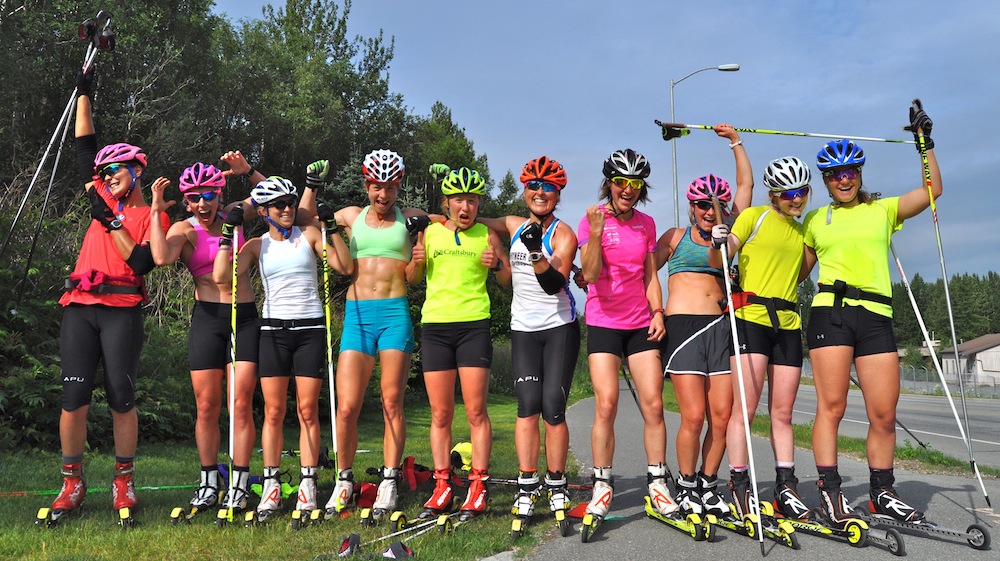
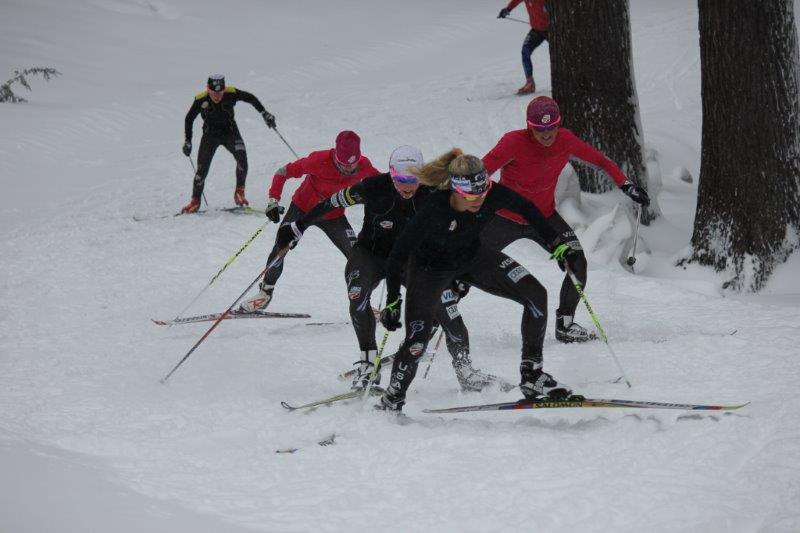
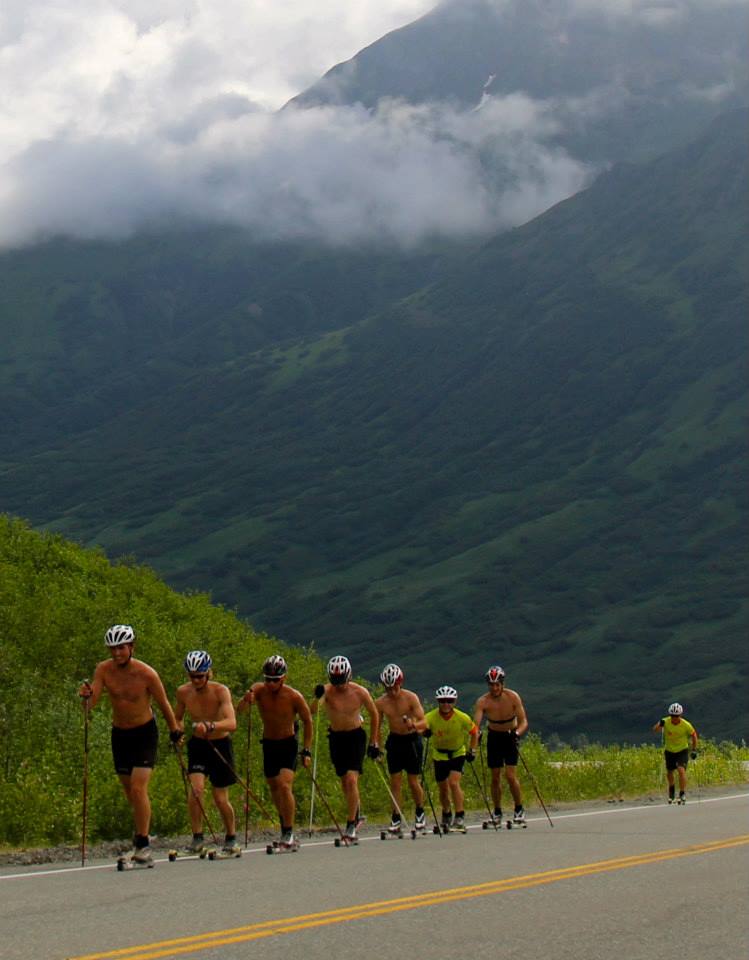
    Athletes in training at the Alaskan Regional Elite Group camp, which wrapped up last week in Anchorage. Photo: Bryan Fish.
    Athletes in training at the Alaskan Regional Elite Group camp, which wrapped up last week in Anchorage. (Photo: Bryan Fish)

    There is an agility test that junior skiers take every summer when they attend a Regional Elite Camp in the East, West, Central or Alaska regions. The test was first implemented three springs ago when coaches across the country saw a need to develop technique and agility in young skiers. They added an obstacle course that summer to the other strength and general fitness tests already on the camp schedule; if athletes could quickly and successfully move around cones on rollerskis, it would eventually translate to better racing down the road in the way of tactical competency in mass starts and more skilled navigation through a tightly grouped field.

    The last of four REG camps held throughout the U.S. wrapped up last week, in Alaska, and the agility test that once challenged junior skiers now has to be made more difficult in order to push the ability levels of the skiers who show up. A backwards skiing section was added this year to a course that also includes tight corners on pavement and an off-road segment.

    “I remember the first year, [the agility test] was pretty eye-opening,” said U.S. Ski Team development coach Bryan Fish said on the phone this week from Park City, Utah. “Now the athletes are getting used to it.”

    The need for a tougher agility test at REGs is part of a larger upward trend being seen in junior skiing nationwide. As a specific example, Fish says he has noticed improvement in close-quarters skiing over the past few years amongst the juniors he observes in competition at World Junior and U23 Championships.

    “When I go to junior worlds and see a mass start or sprinting, our athletes are moving through the field better tactically and technically,” he said. “Yeah, we’re seeing increase in performance.”
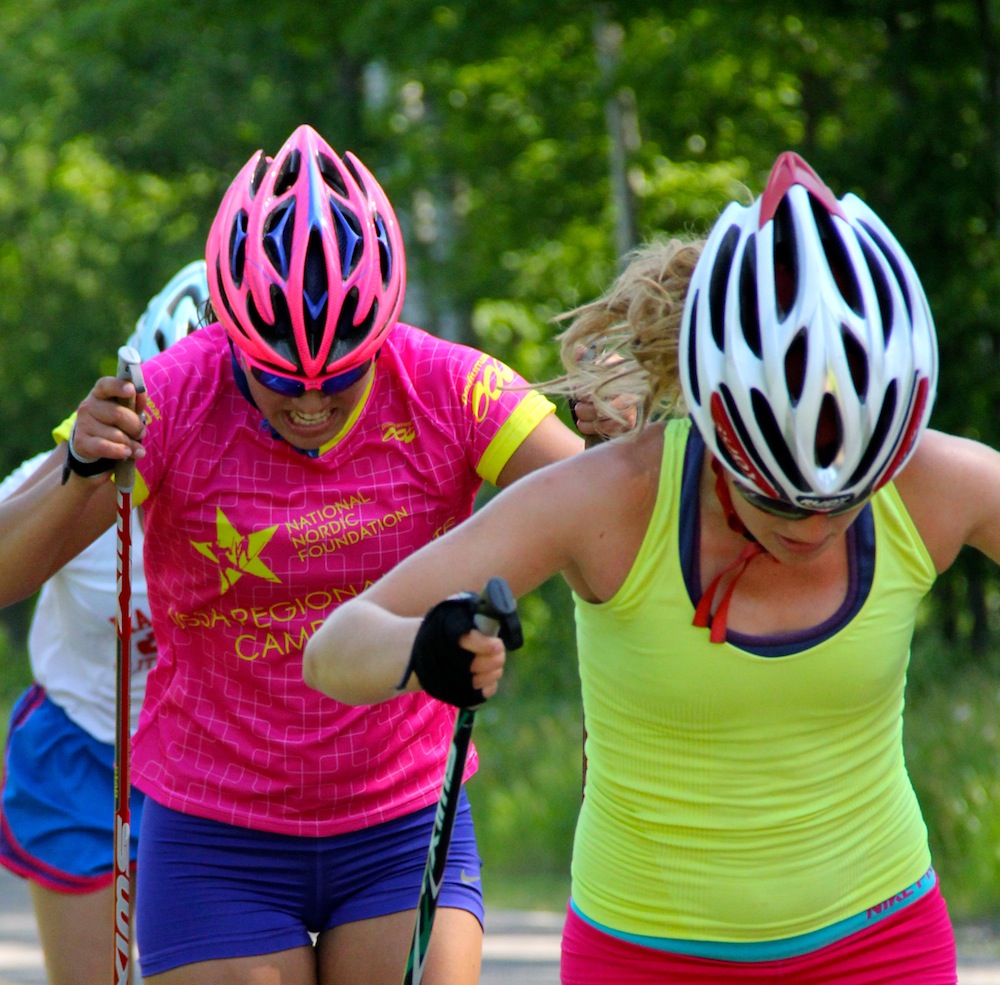
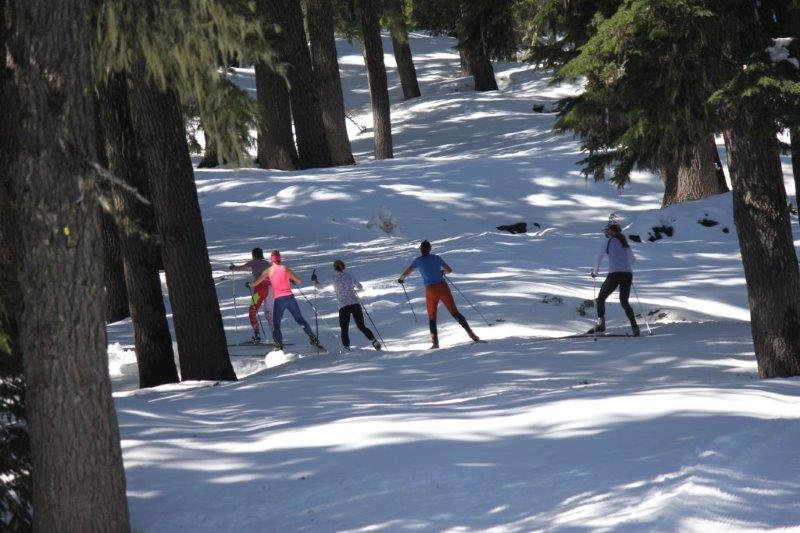
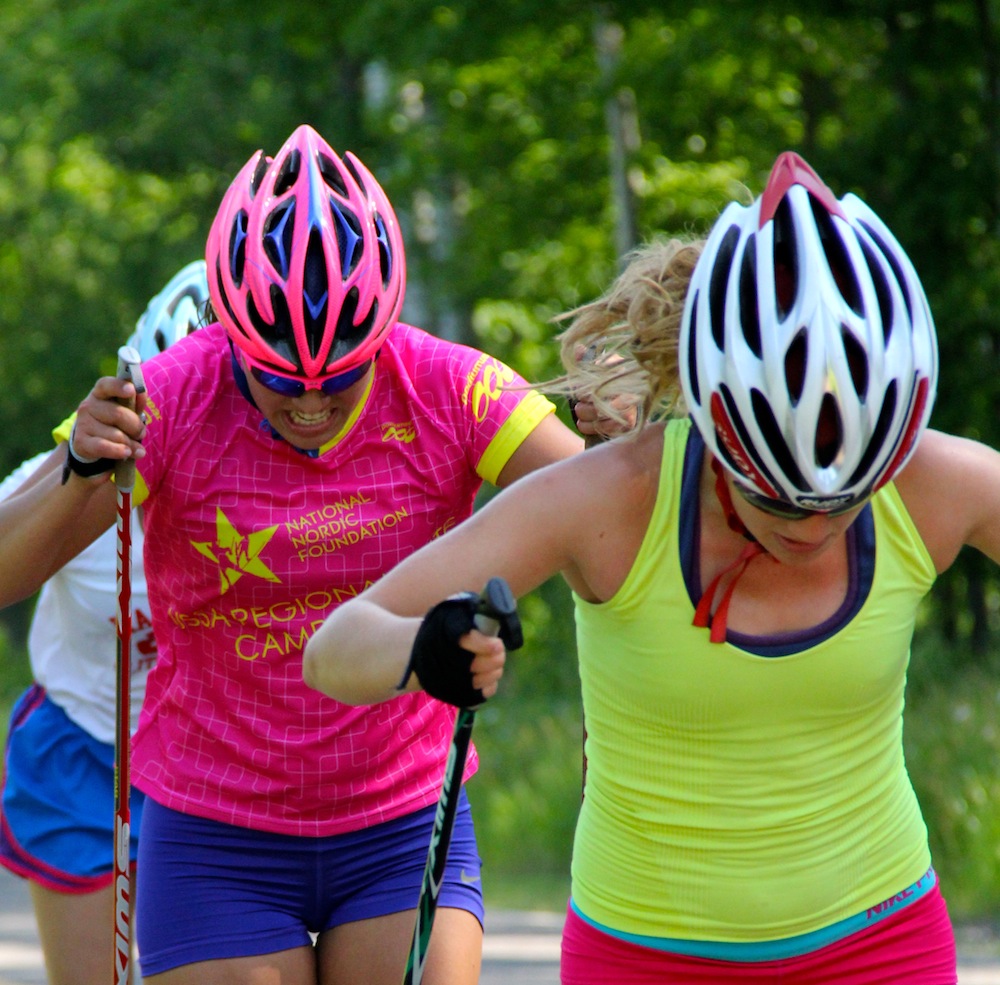
    Junior girls double-poling at a recent REG. Photo: Bryan Fish.
    Junior girls double-poling at a recent REG. (Photo: Bryan Fish)

    Fish recently returned from Anchorage, Alaska, where the last of the four REG camps concluded last week. REG camps are a cooperative development effort between regional and club coaches and the U.S. Ski and Snowboard Association — the camps run by the regions and supported by USSA — and their end goal is to help make the U18 and U20 skiers who attend into better athletes. Athletes are invited to work with area coaches in group workouts, testing and some seminars based on their Junior National results and national ranking.

    “Our goal is to get athletes together more frequently and learning from one another,” Fish said. “That’s how they get better. That’s why we do international competition: they get pushed and hopefully rise to the occasion. Through experience both in camps and competition, that’s how we’re seeing our progress.”

    Fish attended three out of the four camps this summer, and fellow USST coaches Jason Cork and Matt Whitcomb took part in the fourth. At each location Fish says he and his colleagues saw clear athlete progress across several categories, which he takes as measurements of successful camps.

    In addition to requiring a harder agility test, athletes generally scored higher in the REG general strength test. Most of the juniors who qualify for an international trip last winter have attended an REG or one of the other steps in USSA’s development pipeline, which includes the National U16 Camp, REGs, the National Elite Group and the National Training Group. And at those higher steps, more athletes are being engaged: where participation was once around 50% for the NEG and NTG projects, it has risen to around 70%.

    Fish also estimates that more area coaches have volunteered at camps each year, contributing to more collaboration between clubs and a better learning experience for the coaches who then return home to work with own teams.

    “Every year we get more coaches partaking in these camps, and that’s something we’ve been pushing for — not just athlete participation, but also us as coaches,” Fish said. “Getting together and sharing ideas and working together.

    “Clubs, coaches and regions are critical in working with our athletes on a daily basis and that is where a great deal of the work is done.”

    What’s driving such progress? In part, Fish thinks it’s the camps themselves. Four years ago, on top of adding an agility test to REGs, coaches created the National U16 Camp (formerly known as the National J2 Camp) as another way to improve junior athlete development nationwide. It was the brainchild of Rick Kapala, Janice Sibilia, Ali (Dienes) Sehnert and Josh Smullin, who have since directed the camp each year.

    Fish believes the addition of another step to the national development pipeline has been a critical part of growing junior success in the U.S. Every one of the juniors who qualified for the U18 trip to Norwegian Junior Nationals last winter, for example, had been through the J2 camp. On that trip, the U.S. girls turned heads with a silver medal in the relay.

    “This’ll be the fourth year of the U16 camp…and I remember rolling into where the first one was, in Houghton, and questioning whether that age group was appropriate to have a national camp,” Fish said. “And when I walked away I had no question it was a very good step.”

    No small amount of credit goes to the National Nordic Foundation, the non-profit that raises hundreds of thousands of dollars every year to help defray the costs of travel to camps and international competition for nordic athletes from the junior level through the World Cup team.

    “NNF is instrumental in financial support and their involvement in development projects has allowed the growth and support of many of these projects,” Fish said.
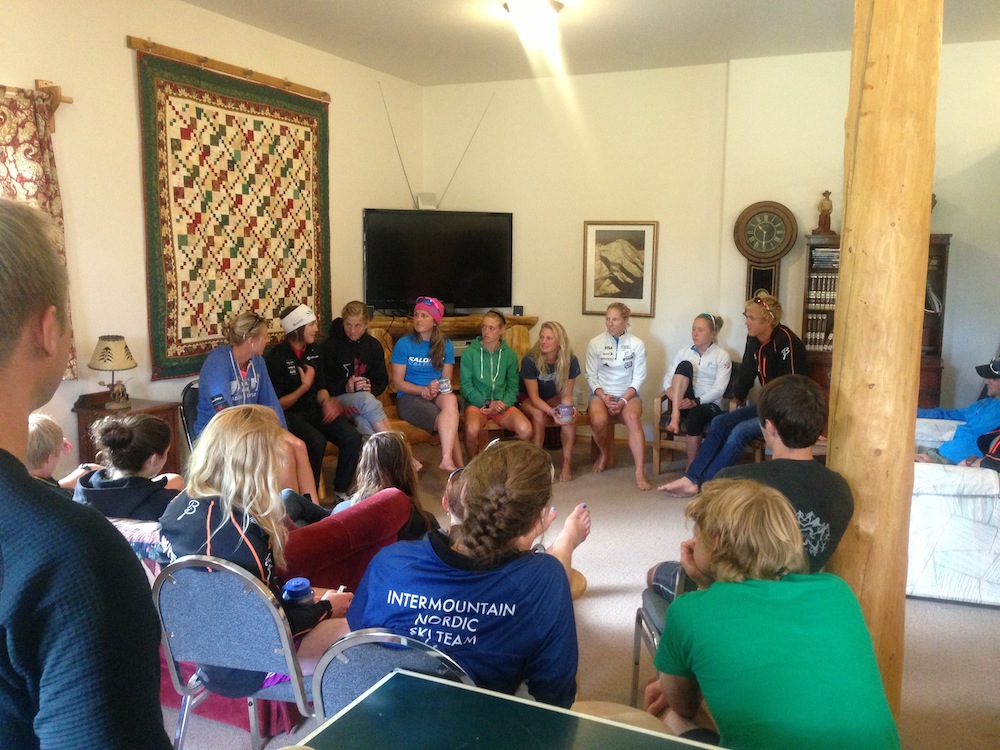
    U.S. Ski Team athletes give a talk to junior skiers at the Alaskan REG. Photo: Eric Strabel.
    U.S. Ski Team athletes give a talk to junior skiers at the Alaskan REG. (Photo: Eric Strabel)

    He also thinks the presence of stronger role models for young American skiers have directly and indirectly influenced stronger junior skiing. The U.S. has been steadily improving on the World Cup for several years now, and this winter a World Championship gold medal became a feasible end goal for aspiring American skiers, courtesy of Kikkan Randall and Jessie Diggins.

    “With the path that’s being put forth by our camp and competition structure, our goal, along with what our U.S. Ski Team athletes are doing, is providing this clear path that these athletes can actually see from an American standpoint, from an American example,” Fish said. “Here are the steps and those are the athletes that are actually doing it on an international stage. It’s very powerful to have that as an actual example instead of just being theoretical — something that is very tangible, that these juniors can truly see happening.”

    In a direct way, USST athletes were a resource to juniors at REGs. At the East, West and Alaska camps, local national team members took part in group workouts and gave presentations outside of training, and Jessie Diggins made a video for the Central REG. In Stratton, Vt., Andy Newell, Sophie Caldwell, Diggins and Simi Hamilton joined the juniors. In Park City, Noah Hoffman and Liz Stephen joined the Western REG. In Alaska, most of the U.S. women’s team, plus Erik Bjornsen and international guests Astrid Jacobsen and Bettina Gruber, gave talks to the juniors gathered in Anchorage.

    The development pipeline is designed to challenge juniors incrementally and allow them to thrive at each step of the way, with World Cup, World Championship and Olympic success held as the goal at the end of the ladder. After a few years of regional and club coaches tinkering with the intermediate rungs, Fish thinks most of the right elements are finally there for effective development nationwide.

    “Just last year, [we started] this brand new Norwegian Junior National partnership, where we had Norwegians at our Junior Nationals and we sent some to theirs,” Fish said. “I feel we’re finally to a point where we have the pieces in place, and then it’s just continuing to be innovative and look at the quality of these steps.”

    The next step, Fish says, is to further develop a national competition calendar that fosters stepwise athlete development. The SuperTour calendar, as it happens, is being revamped this summer.

    “They’re looking at the SuperTour calendar and looking at these steps, but I feel there’s more we can do there,” Fish said. “But it’s just this whole building process, and I think we’ve been doing a better job of putting in these tangible steps.

    “Providing those steps and additional opportunities is one of those pieces…that has provided these athletes with the opportunity to get together with higher frequency,” he continued. “Athletes learn from one other and motivate one another, and create a strong team culture, but it also gives us coaches another opportunity to work together and share ideas. But the bottom line is we’re trying to provide experience [to] our athletes. With more experience comes stronger performance.”

  • Far West June Lake Camp Recap: Peak-Bagging, Rope Swinging, Watermelon, and More

    Far West June Lake Camp Recap: Peak-Bagging, Rope Swinging, Watermelon, and More

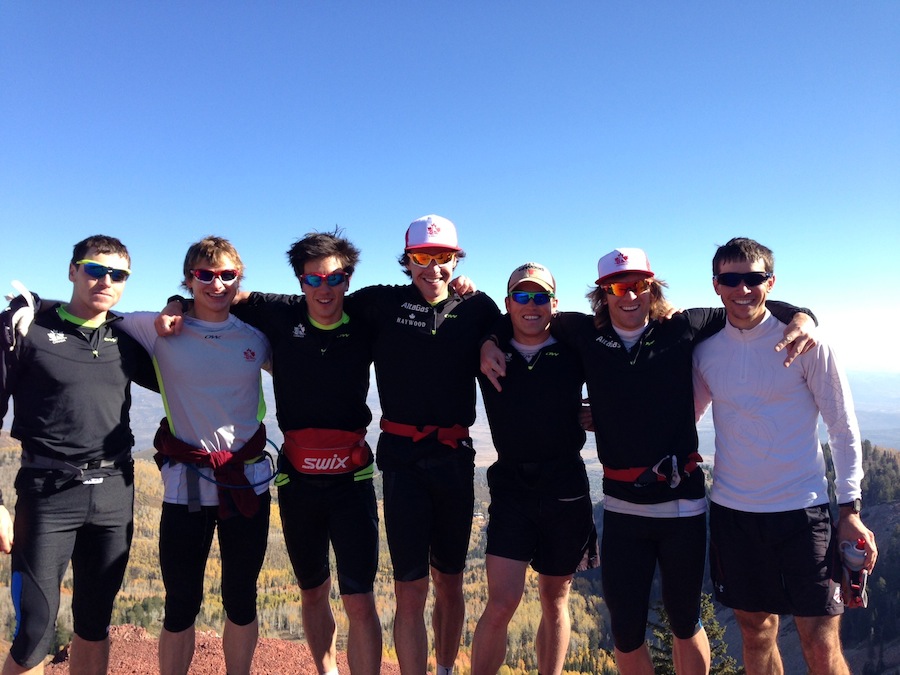
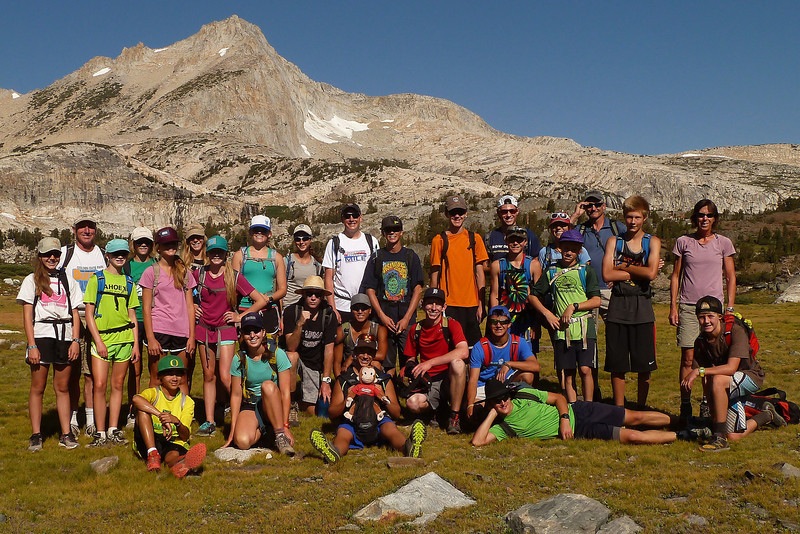
    posing before splitting up into two groups to climb North Peak (in the background). Plus our added "alumni" to make the hike extra special. The 2013 Far West Nordic June Lake Camp, led by Nancy Fiddler, Mark Nadell, and Marie French with a stellar support crew of Mike Mcelravey and Steve Twomey. Athletes included Carson Bold, Laurel Fiddler, Connor Kusumoto, Phillip Oxford, Cameron Small, Cody Atwood, Piper Joubert, Quinn Lehmkuhl, Jane Nall, JC Schoonmaker, Camille Syben, Lindsay Twomey, Cameron Valois, Ryland Belisle, Savannah Blide, Markus Brun, Peter Carroll, Tyler Ferrera, Chloe Gorman, Bri Parker, and Sam Zabell (and, of course, Curious George). Plus a special appearance on our hiking day from Far West alumni Alex Kopytko, Branden Deeter, and Grayson Forsberg. Activities included hiking, ski walking, classic and skate rollerskiing, climbing North Peak, LOTS of beach and rope swing time at the lakes, and many other shenanigans, of course. They came back tired, guaranteed. (If you notice certain faces more than others, it's because they wouldn't get out of the way of the camera. #skihams.) (Photo: Mark Nadell/macbethgraphics.com)
    The Far West Nordic junior team posing before splitting up into two groups to climb North Peak (in the background), plus added “alumni” to make the hike extra special. The 2013 Far West Nordic June Lake Camp was led by Nancy Fiddler (back right), Mark Nadell and Marie French with the support of Mike Mcelravey and Steve Twomey. Athletes included Carson Bold, Laurel Fiddler, Connor Kusumoto, Phillip Oxford, Cameron Small, Cody Atwood, Piper Joubert, Quinn Lehmkuhl, Jane Nall, JC Schoonmaker, Camille Syben, Lindsay Twomey, Cameron Valois, Ryland Belisle, Savannah Blide, Markus Brun, Peter Carroll, Tyler Ferrera, Chloe Gorman, Bri Parker, and Sam Zabell (and, of course, Curious George). Far West alumni include Alex Kopytko, Branden Deeter and Grayson Forsberg. (Photo: Mark Nadell/macbethgraphics.com)

    JUNE LAKE, Calif. – Far West Nordic juniors from Truckee, North Tahoe, Sugar Bowl Academy and Mammoth programs took part in a four-day camp in the Eastern Sierra July 18-21. Camping in June Lake in the Mono Basin National Forest, participants experienced lots of sunshine and warm temperatures while putting in some high-quality training.

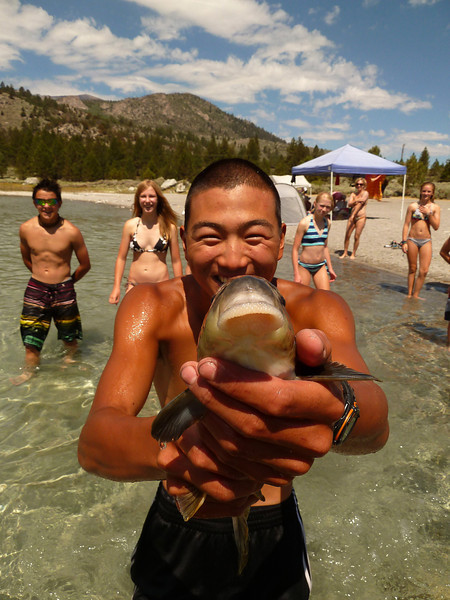
    Peter Carroll demonstrates a true catch and release during the 2013 Far West Nordic June Lake Camp in California. (Photo: Mark Nadell/macbethgraphics.com)
    Far West junior Peter Carroll demonstrates a true catch and release during the 2013 Far West Nordic June Lake Camp in California. (Photo: Mark Nadell/macbethgraphics.com)

    Campers from the north and south merged at the county park on the north shore of scenic Mono Lake on Thursday afternoon for some foot agility, skate plyos, and circuits to kick off the camp. Friday was a double-workout day with a focus on classic skiing. It was all about bounding, moose hoofing and ski walking intensity in the morning, followed by rejuvenation in the cool water of June Lake. Hot is the best single word to describe the afternoon rollerski workout, but the 21 athletes focused on some specific strength drills to complete the day.

    The highlight of the camp is the traditional peak-bagging event on Saturday. Two groups attacked North Peak in Yosemite National Park with 100-percent success rate. One group circumnavigated the peak as well as summiting. Lots of glacial-lake swimming, watermelon on the summit, and a trip to Mono Cone kept the group cool.

    By Sunday morning, there were signs of wear and tear on the campers’ faces, but everyone fired up for one more workout; a skate rollerski with a focus on technique and some distance. Back in camp, it was time to pack up and say goodbyes to old and new friends. Camp coaches Mark Nadell, Marie French and Nancy Fiddler were still standing at the end, and pleased with the effort and enthusiasm of the group.

    For more photos, check out Mark Nadell’s June Lake Camp 2013 gallery.

  • The Band is Back Together: Women’s Training Camp Begins in Alaska

    The Band is Back Together: Women’s Training Camp Begins in Alaska

    The group after a well-executed workout. (L to R) Kate Fitzgerald, Kikkan Randall, Liz Stephen, Astrid Jacobsen (NOR), Ida Sargent, Holly Brooks, Bettina Gruber (SUI), Jessie Diggins, Emily Hannah, Anika Miller. (Photo: Matt Whitcomb)
    The North American Women’s Training Alliance converged again this week in Anchorage for their third annual camp, this time with a few more foreigners than usual. (L to R) Kate Fitzgerald, Kikkan Randall, Liz Stephen, Astrid Jacobsen (NOR), Ida Sargent, Holly Brooks, Bettina Gruber (SUI), Jessie Diggins, Emily Hannah, Anika Miller. (Photo: Matt Whitcomb)

    The joint women’s training camp between the U.S. Ski Team and Alaska Pacific University began this week in Anchorage, Alaska, bringing many of the nation’s top female skiers together for the first time in a month along with a few special foreign guests. According to USST women’s coach Matt Whitcomb, training has been going well so far.

    “It’s nice to have the band back together up here for the third annual NAWTA camp,” he said on Tuesday. “We had a killer session [on Tuesday] with some Level 3 pace development intervals, and we’re gearing up for a great couple of weeks here.”

    The pack of Americans once again includes Canada’s Chandra Crawford, whose participation in the camp since its iteration in 2011 inspired the name North American Women’s Training Alliance, or NAWTA. But the group might have to change its name soon if it keeps attracting so many European athletes; this year decorated Norwegian skier Astrid Jacobsen and top Swiss national team member Bettina Gruber joined its ranks to experience the group’s training environment.

    “We’re in really good company this week,” Whitcomb said. “Just the day in, day out training situation resulting from such a high caliber group is where we get most of our benefit from.”

    The group training is precisely what brought Jacobsen says brought her to Alaska.

    “For me it is exotic to travel here to see Alaska,” Jacobsen told FIS in a recent interview. “Most importantly though it was the opportunity to go and train with Kikkan [Randall]. For me she is the best skate sprinter we have. I felt that we could challenge each other. We each have different qualities.

    “Also, if you look at how the American women’s team has developed in the last couple of years it is a really interesting team with a good spirit. I was curious to come here and see how they work as a group.”

    In return, the Americans hope to benefit from the new perspective a foreign athlete brings to the table.

    “I got this descriptor from Rikard Grip, the Swedish head coach: he talked about the Americans adding just the right spice to training, so I’ve taken the word spice and have really appreciated the spice that it does add, having Bettina and Astrid and Chandra,” Whitcomb said. “It’s just a nice simulation for everybody, including the guest athlete. We’re going to be watching these girls and their strengths closely, and we hope they can pull something out of this camp and have a better shot at a medal in Sochi, as well.”

    If it surprises anyone that the U.S. national team has opened up its training to foreigners, particularly before an Olympic year, Whitcomb says this is simply part of how they operate.

    “One of the philosophies of the team is we’re very open,” he said. “We share any secrets we might have, and in doing that we end up learning much more. So it’s an open environment and the more we can share the more we can learn.”

    The first week of the camp is being spent dryland training in Anchorage during a higher-intensity block, and next week athletes and coaches fly up to Eagle Glacier for more volume-specific training on snow.

    Thus far, Whitcomb has been happy to see his athletes looking strong in workouts and staying healthy while managing mild injuries.

    “We have a couple mild injuries being nursed along but nothing major this season,” he said. “I think everybody has their little tendonitis issues, little things here and there, and as a team we’ve gotten things much better under control this season. Through working with a physical therapist and setting up better injury management system than we’ve had in the past.

    “The key is just smart, varied training,” Whitcomb continued. “When you do varied training it allows the body to recover in sneaky ways, so we’re doing a lot of that to be preemptive. They’re doing a much better job as athletes, we’re doing a better job paying attention and being strict when needed as coaches, but everybody’s doing great and hitting the ground running here.”

    When the group moves to the glacier this weekend they’ll spend about six days on snow for between 23 and 30 hours of volume on skis. The team has both individual and group-specific goals for the entire camp; as athletes work on personal technique or equipment-based goals, the team aims to continue operating better together as they live and train together on Eagle Glacier.

    “It’s just a great opportunity to get out there and get on skis,” Whitcomb said. “Learning to kick a ski on sloppy snow — mornings are firm and fast for skating, focusing on something similar to our workout [from this week]… Whether you’re socializing on a long easy ski or going head to head in a speed workout, we really run everything as a group at this camp.”

  • Wednesday Workout: NAWTA’s Pace Development Threshold Intervals

    Wednesday Workout: NAWTA’s Pace Development Threshold Intervals

    Astrid Jacobsen (NOR), Liz Stephen, Bettina Gruber (SUI), Jessie Diggins, Holly Brooks and Ida Sargent during their threshold workout in Anchorage, Alaska, on Tuesday. (Photo: Matt Whitcomb)
    Astrid Jacobsen (NOR), Liz Stephen, Bettina Gruber (SUI), Jessie Diggins, Holly Brooks and Ida Sargent during threshold intervals in Anchorage, Alaska, on Tuesday. (Photo: Matt Whitcomb)

    The third-annual North American Women’s Training Alliance (NAWTA) camp began this week in Anchorage, Alaska, and on Tuesday morning they completed a threshold workout that ended with a lot of high-fives in the van and left U.S. Ski Team women’s coach Matt Whitcomb pretty happy.

    “Today’s threshold workout was the best threshold workout I’ve seen out of this group of women since I’ve been working with the team,” he said on the phone, as the group began their afternoon strength session.

    Kikkan Randall, Jessie Diggins, Liz Stephen & Co., are joined at this camp by Alaska Pacific University skiers, National Training Group athletes, and decorated Norwegian Astrid Jacobsen, Switzerland’s Bettina Gruber and Canada’s Chandra Crawford. The workout is one that Whitcomb and APU head coach Erik Flora have repeated over the last few years in order to work specifically on high-speed skiing in the middle of a threshold session.

    The keys to accomplishing this goal are two-fold: the choice of terrain, and the presence of a group to ski with. It was his team’s skilled pack skiing that Whitcomb thinks set Tuesday’s session apart from the rest, but the rolling hills are a critical ingredient to the goal of the entire workout.

    The group after a well-executed workout. (L to R) Kate Fitzgerald, Kikkan Randall, Liz Stephen, Astrid Jacobsen (NOR), Ida Sargent, Holly Brooks, Bettina Gruber (SUI), Jessie Diggins, Emily Hannah, Anika Miller. (Photo: Matt Whitcomb)
    The group after a well-executed workout. (L to R) Kate Fitzgerald, Kikkan Randall, Liz Stephen, Astrid Jacobsen (NOR), Ida Sargent, Holly Brooks, Bettina Gruber (SUI), Jessie Diggins, Emily Hannah, Anika Miller. (Photo: Matt Whitcomb)

    “It’s not so much emphasizing going harder, it just emphasizes patterning your muscles, neurally, to fire faster,” Whitcomb explains. “I think a lot of times, certainly my tendency as been to prescribe intervals that are a bit too slow. We might be nailing the percentage of your max heart rate and the proper lactate right on the money, but the pace is just too slow — you’re going uphill, uphill, uphill, and a lot of times when we find hard terrain we go hit intervals there.”

    To encourage speed variation while staying within threshold, the workout should be done on a stretch of pavement that includes gradual uphills, flats and gradual downhills, which “systematically [builds] some pace development intervals into your session,” Whitcomb says.

    “It doesn’t need to be incredibly hard — today was roughly threshold and above during bursts of speed — but it was about the terrain that helped push the pace for us.”

    The Workout:

    • 20-30 minute warm up*
    • 4-6 x 7-10 minute L3 intervals (3 minutes rest) on fast terrain that incorporates gradual uphills, flats and gradual downhills. Most interval sessions use hard and grinding terrain, great for building capacity but not so great for higher pace development. The key to this workout is in the choice of terrain.
    • 20-30 minute cool down*

    *Do a warm up and cool down that allows you to focus on the intervals. “Sometimes a mistake can be made where people are going after volume in addition to high intensity on interval days,” Whitcomb says.

    Don’t do try to multi-task for this workout. “Warm up only the minimum that your body requires,” he continued. “You want to make sure your muscles are ready to go, and build into the intervals if you have to — you don’t want to pull any muscles or get injured — but a 45 minute warm up is too long, as is a 45 minute cool down. Keep them concise and focus more on the on-time.”

    Frequency:

    Every two to three weeks in the summer, with increasing frequency to every 10 days as fall approaches. “A workout like this is in addition to L4 intervals, time trials, speeds, ODs,” Whitcomb said. “It’s just another small component, another ingredient to throw in the bag and mix it up.”

    Variations:

    • Shorter recovery time as the season goes on, or longer recovery when at altitude — “just to make sure the on-time is what’s being emphasized,” Whitcomb says.
    • Pre-determined sprint preems that accomplishes a similar break from straight threshold, forcing athletes to go from threshold, into race pace, then back into threshold when they cross certain preem markers in the interval.

    On Tuesday, the women did this session on a stretch of bike path in Anchorage’s Kincaid Park. They chose a section of rolling terrain that was about 7-10 minutes long going either way. The group started their first interval in one direction, which took about nine minutes, took their three-minute recovery, and then skied back the other way to the start, which took about seven minutes.

    From a coaching perspective, this workout shows Whitcomb things that don’t surface in regular threshold intervals.

    “I think when we started doing this it taught us that the speed didn’t really change as much as we thought it would when the terrain asked for higher speed,” he said. “You try and go faster and your muscles simply didn’t want to move faster. It wasn’t a matter of being at your max heart rate, people were well within threshold, but they just didn’t want to fire those muscles faster. But the body fortunately adapts pretty quickly to a group session like this and you see pretty notable progress in your speed in just a few weeks.”

    Whitcomb’s footage from Tuesday’s session.


    So what made Whitcomb call Tuesday’s workout, in particular, the best threshold session he’s ever seen from his team?

    In addition to their raw speed — “they were really flying” — Whitcomb noticed they skied better together within the pack than they have before.

    “Everyone spent some time leading, some time sandwiched cycling in the spin wash in the middle of the pack, and it was really unlike this group perhaps in the past — you know, you establish a pecking order and somebody’s out there hammering off the front all day, maybe somebody switches out if they get tired, somebody is flying off the back all day because they’re struggling,” he said.

    “And today instead it was much more this series of incessant attacks at the front where you’d recover a little bit, spend some time in threshold in the pack, and then you’d work your way to the front and use your good feelings and your recovered state to push the pack and pull everybody along at a faster rate. It looked more like watching a cycling race today, to be honest, and that’s kind of a new thing particularly in girls skiing, I think. The mass starts [sometimes] just getting strung out from 100 m into the race, and I think we’re moving in the direction of more pack skiing. And as we can improve our skills within the pack were going to be better suited for those days when the women’s pack does stay together.”

  • Another Scandinavian Trip in the Books: A Burke Tale

    Another Scandinavian Trip in the Books: A Burke Tale

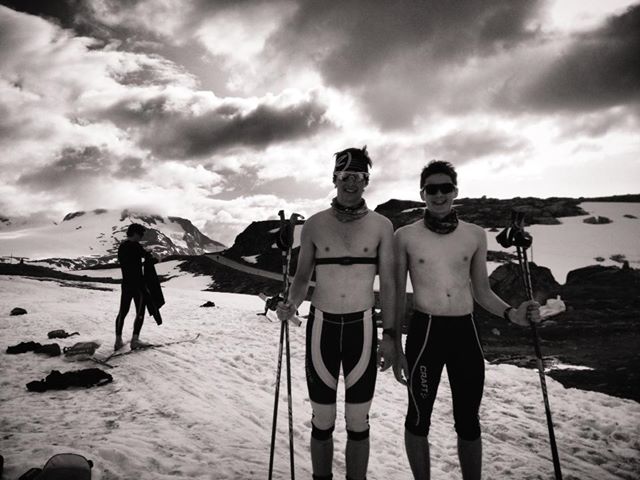
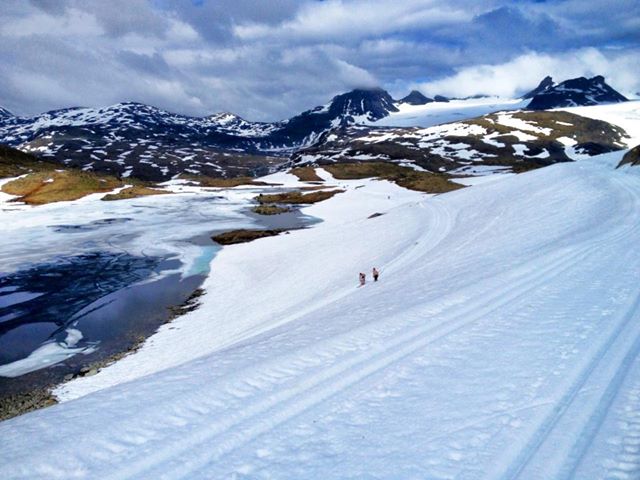
    Warren Taylor (l) and Charlie Greenberg skiing at Sognefjell glacier in Norway during Burke Mountain Academy's recent annual Scandinavian training camp. (All photos courtesy of Kate Barton and Koby Gordon)
    Warren Taylor (l) and Charlie Greenberg skiing at Sognefjell glacier in Norway during Burke Mountain Academy’s recent Scandinavian trip from June 11-July 1. (All photos courtesy of Kate Barton and Koby Gordon)

    By Warren Taylor | Burke Mountain Academy

    Editor’s Note: The following is a firsthand account from 17-year-old Warren Taylor, an incoming senior at Burke Mountain Academy in East Burke, Vt., who recently returned from his third trip to the academy’s annual Scandinavian nordic-training camp.

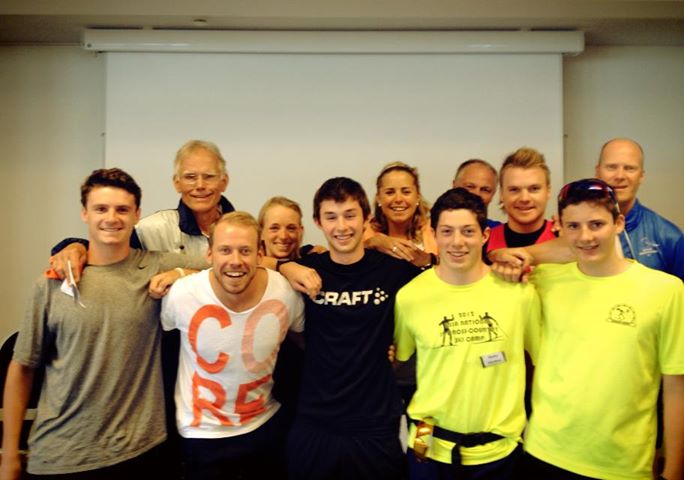
    I first went to Sweden and Norway two years ago with Pete Phillips, Matt Johnson and a big group of skiers, and the next year with Kate Barton and Simi Hamilton. This year, with Kate, my coach at Burke, we were there for just under three weeks, arriving on June 11th and flying out July 1st. I have done camps with Burke for around four years now, but this past year was my first as a student there.

    ***

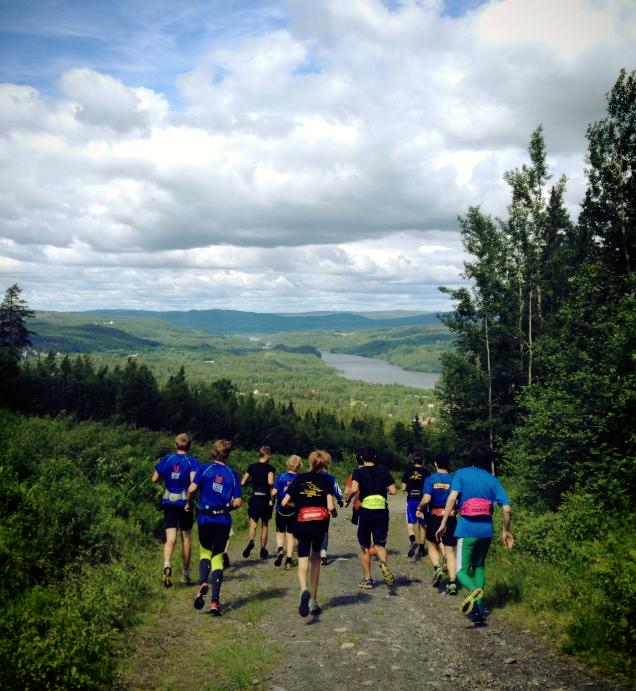
    Burke nordic skiers running down to the start of the Hallsta Test in Sweden. (All photos courtesy of Kate Barton and Koby Gordon)
    Burke skiers running down to the start of the Hallsta Test in Sweden during its annual Scandinavian training camp.


    I’m not much of a city boy, but I did my best to guide us out of Stockholm. The multitude of unmarked one-way streets almost sealed our defeat. After finding the E4 highway, we headed north to Sollefteå. Tim Regan, Koby Gordon, Charlie Greenberg, Kate Barton, and I had all made it to Sweden.

    Arriving in Sollefteå, we were a little disappointed that the go-kart track so heavily advertised looked like it had been abandoned years before. We instead took an early night before starting a five-day camp with the Sollefteå Skidgymnasium. This training camp took place at a five-star hotel right next to a seven-kilometer rollerski track overlooking the town. Next to the hotel was a pair of old wooden ski jumps built far off the ground and swaying in the wind above the trees.

    We started the camp with short running intervals and a strength session where Robin Bryntesson, a former Swedish national team skier, impressed us all with his uncanny ability to walk around on his hands and balance on just one. After a few days of rollerskiing, an orienteering race and a brutal race down the river in the least hydrodynamic boat imaginable (pretty much a square dock), we did the famed Hallsta Test.

    The two-kilometer uphill-running test went from the town straight up and past the hotel, almost to the very top of the mountain. We were told the record was 7:50, and even Swedish World Champion Johan Olsson was never able to break it. This was one of the tougher tests I’ve done, but I felt surprisingly good, getting a time of 10:09, just beat out by the younger coaches and a Swede named Jacob who was also my roommate during the camp.

    Us, Emil, Liz, Anna, and coaches - Bengt, Tony, Robin, and Per-Ola
    Us with Emil, Liz, Anna, and coaches Bengt, Tony, Robin, and Per-Ola.

    Later in the week we saw U.S. national team skier Liz Stephen, who came up with Sweden’s Anna Haag and Emil Jönsson to do a 30 k skate time trial on the rollerski track. When we had a chance to talk with them, Emil jokingly told us that he had been putting in around 200 hours of training per month, but he had just gotten his ticket to Sochi, so now he wouldn’t have to train at all.

    After a three-hour run through marshes, a few technique sessions with the Swedish coaches, and a nice afternoon in town playing some volleyball and basketball, the camp ended. We headed right to a town in northern Sweden called Östersund for a night of camping and a short roller ski before we went up to Bruksvallarna, a small town in northwestern Sweden that borders Norway.

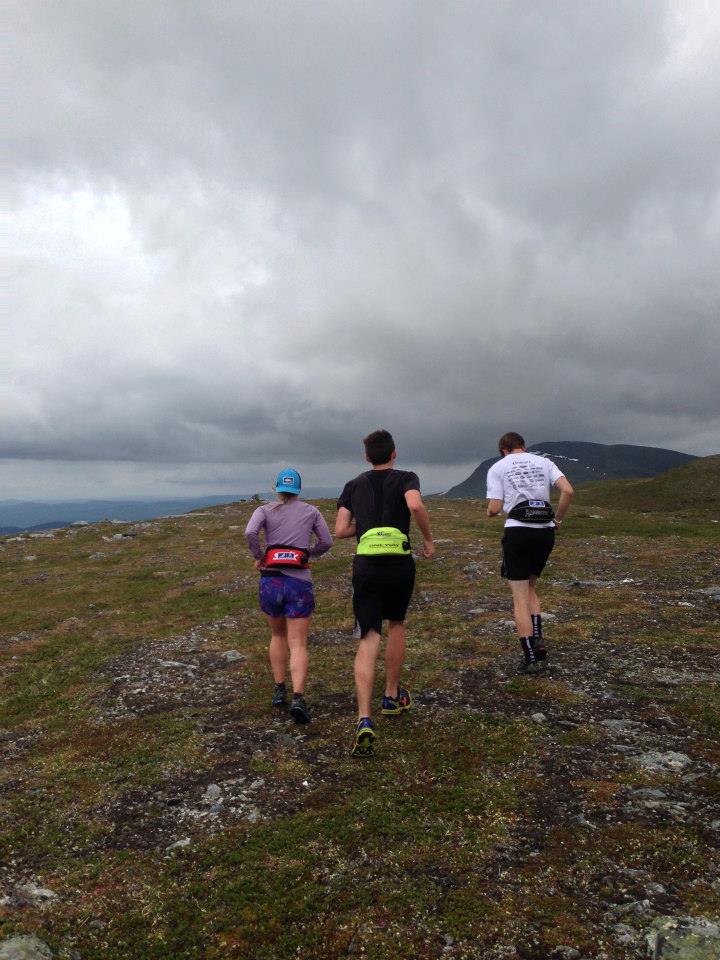
    Burke Mountain Academy skiers during a 4 1/2-hour run near Bruksvallarna, Sweden. (All photos courtesy of Kate Barton and Koby Gordon)
    Burke Mountain Academy skiers during a 4 1/2-hour run near Bruksvallarna, Sweden.

    We tried to find something to do on Midsummer, a national holiday for the longest day of the year at Östersund, but the guy at a tourist center directed us to a church up in the hills where he said there would be festivities. Unfortunately, the only thing going on was a Swedish sermon that felt quite uncomfortable to us as foreigners who didn’t speak the language. We had all heard about some crazy parties during this holiday, but the town was empty and we went to bed wondering where on earth the Swedish population had gone.

    Bruksvallarna was a ghost town as well, and we searched in vain for its “downtown.” We eventually found that there was no downtown, just a little grocery store across from our cabin that did not open at all the first day, forcing us to drive half an hour to the next town over.

    The next day we went out for an epic 4 1/2-hour run in the mountains up the road from our little cabin. We waded through knee-deep marshes and climbed through brambles and bushes out to a lake that we saw in the horizon from the first peak we climbed.

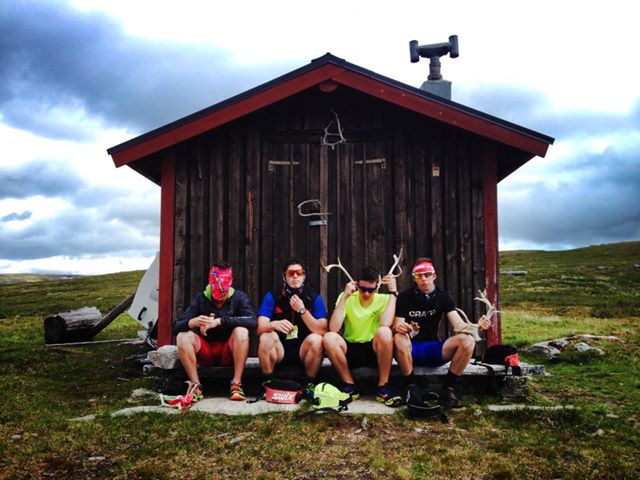
    On the way back, we stopped by a small red building that we picked out in the distance. A little goat path ran along the patches of snow to this house, and we could see people hiking along it. It turned out to be a fully functional and a surprisingly nice waffle house at the top of a mountain.

    Little cabin by the lake we ran to (with antlers we found along the way). (All photos courtesy of Kate Barton and Koby Gordon)
    Little cabin by the lake we ran to (with antlers we found along the way).

    I can honestly say I’ve never had a tastier waffle, probably because I ate it after four hours of running and hiking.

    Unfortunately, we were only in Bruksvallarna for a day and a half, but we were all excited to drive west to the snow in Norway at Sognefjell. Although it poured during our first ski, I stopped noticing it after a while, just glad to be back on snow. However, afterwards I did notice how unbelievably wet all my clothes were.

    We spent two nights camping near the longest fjord in Norway with a glacial waterfall running next to the campground. We then moved to a hotel I would argue is one of the best hotels on the planet. An all you can eat buffet, skiing all day, a drying room for all our clothes, and famous skiers at every corner. What more do you need?

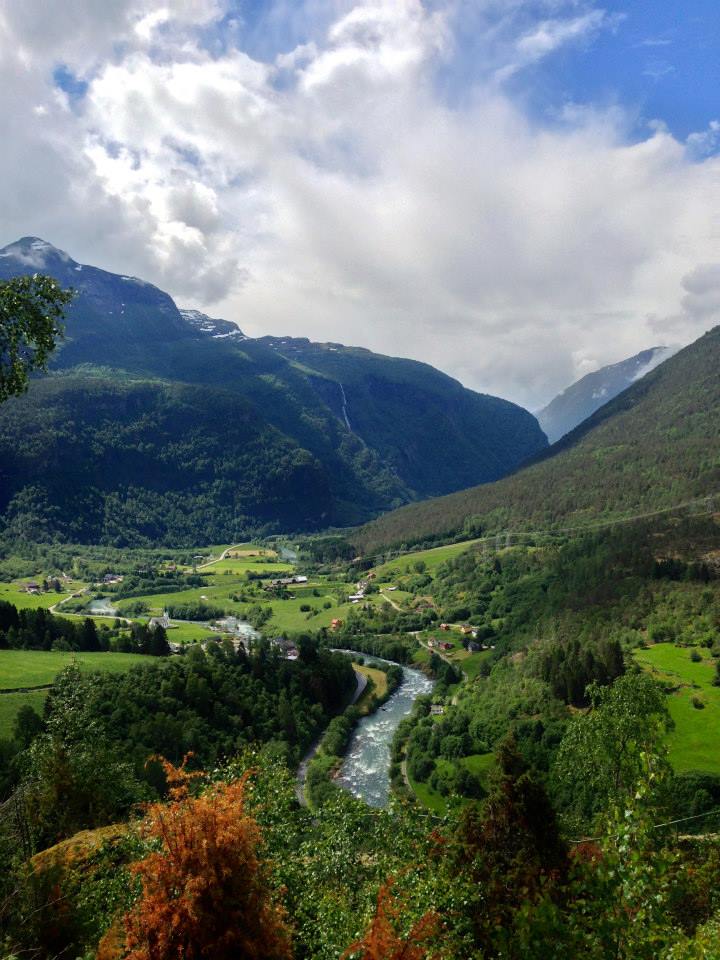
    Our drive down to the fjord. (All photos courtesy of Kate Barton and Koby Gordon)
    Our drive down to the fjord

    We had three glory days at the glacier before heading back to the U.S. All we did was pile hours, sleep, and eat too much brown cheese. We encountered plenty of sun, making all but one of the skis radiant and rainless. Although the trails were deteriorating quickly as the snow melted, workers did a fantastic job of rerouting the trails so we were able to keep skiing on a 7 k loop.

    After those three days, we began our odyssey back to the U.S. Following a seven-hour drive to Oslo, we camped on a soccer field by the highway. One more six-hour drive to Stockholm and we were halfway home.

    We walked around the city for an afternoon and saw a sweet Red Bull competition. People were trying desperately to fly cardboard planes as far as they could off a ramp into the water flowing through Stockholm. Unfortunately, we did have some trouble finding our way back to the van.

    I’ll miss the sunny days by the fjord, the scenic mountain runs in Bruksvallarna, the people I met, and, of course, the brown cheese at Sognefjell.

    All the training and technique gains made during this trip will push me forward as I continue to ski. Hopefully I’ll be back next year to experience it all again.

     Sognefjell Glacier Skiing!  (All photos courtesy of Kate Barton and Koby Gordon)
    Sognefjell Glacier Skiing!
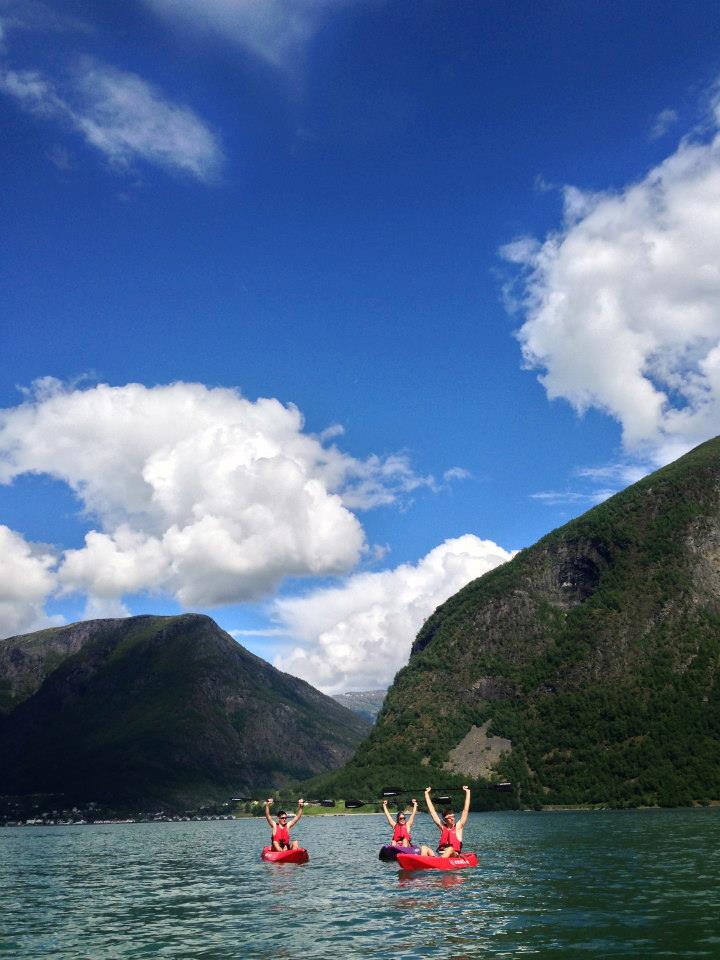
    Sunny kayak in the fjord  (All photos courtesy of Kate Barton and Koby Gordon)
    Sunny kayak in the fjord
  • Before Olympics, U.S. and Canadian National Teams Train at Both New and Familiar Venues

    Before Olympics, U.S. and Canadian National Teams Train at Both New and Familiar Venues

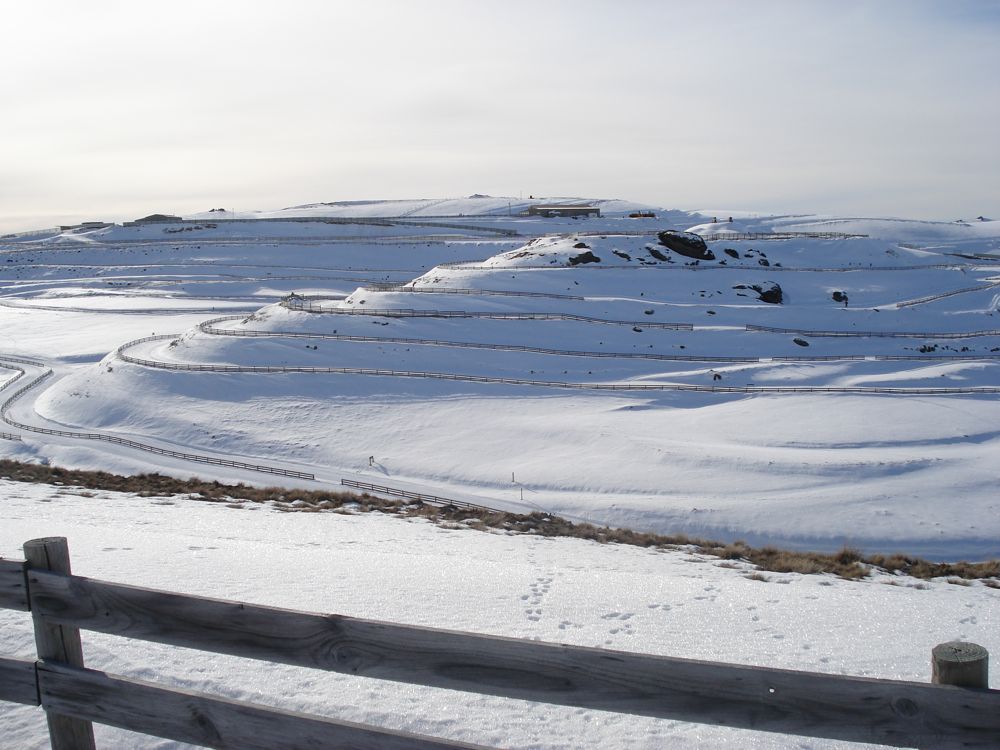
    The Snow Farm in New Zealand. The Canadian National Ski Team and U.S. men will return there this August for a two week on-snow training camp.
    The Snow Farm in New Zealand. The Canadian National Ski Team and U.S. men will return there this August for a two week on-snow training camp.

    As U.S. and Canadian national team members continue to log hours this June on snow, asphalt and trails, they have several more training camps on tap for the remainder of the season to look forward to. The first World Cup in Kuusamo, Finland, isn’t until the end of November, but when you start to break down the North American training schedules by camp and month, the offseason suddenly looks much shorter.

    The two nations have a history of holding joint camps in the offseason; last month in Bend, Ore., the teams often skied together on rollerskis and on snow at Mt. Bachelor. The teams separated after Bend; the U.S. Ski Team migrated to Park City, Utah, for an altitude camp and series of treadmill tests. Liz Stephen traveled to Norway and Sweden to train with national team members there, and the Canadians split for their respective homes, which for Perianne Jones, Ivan Babikov and Devon Kershaw meant Canmore, Alberta.

    For their next training blocks, the U.S. Ski Team and Canadian National Ski Team diverge. The Canadian men and women will be back in Bend in late June for a two-week dryland camp, while the Americans have a month-long block of home-based training to follow Park City.

    “By design, we have a really open summer,” said USST head coach Chris Grover. “The idea was to really allow each athlete to build some momentum in their home club environment and home training environment, and to really make some progress with their day-to-day training over the summer. So everyone’s got quality at-home time in the summer, some on-snow opportunity.”

    When the training season transitions to fall, U.S. athletes will be together more often than not. “[It is] a little more of an intensive camp schedule once we get into the fall, as the volume drops and we’re typically doing more intensity,” Grover said.

    In between now and October, the U.S. men and women each have a separate two-week training camp on the schedule. The women will once again be in Alaska starting in mid-July for a half dryland, half on-snow camp in Anchorage and on Eagle Glacier. In 2012, the women’s Alaska camp included Finnish guest athlete Aino-Kaisa Saarinen, and Grover indicated another guest invitation was currently being finalized.

    The U.S. men have a longer break built into their camp schedule, but will travel all the way to the New Zealand’s Snow Farm to return to snow for group training in mid-August. After trying something new with a men’s camp in Ramsau, Austria, and Oberhof, Germany, last year, Grover is returning his team to familiar ground before the Olympics. He says they found the quality of skiing on Dachstein glacier to be inconsistent and the Oberhof ski hall wasn’t suited for long sessions.

    “Dachstein in the morning is good, but in the afternoon it’s typically not very good, depending on the weather,” Grover said. “In the ski hall there’s only so much skiing you really want to do on a daily basis inside there.

    At the Snow Farm, he says, the snow is more consistent and offers higher quality skiing for longer training sessions. With the Canadian men scheduled to be there at the same time, the location also offers more opportunity for group workouts.

    New Zealand also provides the potential for some early head-to-head competition. The New Zealand Winter Games take place there in August and include three FIS races at the Snow Farm. The U.S. will miss the first two races, a 15 k mass start classic and a 10 k individual freestyle, while they fly down, but Grover thinks there is a possibility the U.S. men will jump into the freestyle sprint on August 15 for their second day on snow. Whether they compete or not, he expects the camp to be a quality one.

    “New Zealand has been a go-to for us since 2002 and we’ve really come away from it so many times going, ‘That was a really great camp,’ ” Grover said. “We took a look around and tried something different last year, but I think because it’s an Olympic year, we know we can get a ton of great skiing down there and we know we can come away from the camp having had a fantastic camp. It made sense to go back down.”

    When fall intensity ramps up the USST will return once again to Lake Placid, N.Y., followed by a return to Park City for another altitude block and a final pre-season camp in Canmore on the stockpiled snow of Frozen Thunder.

    “We had a great camp up there last year and I think one of the reasons the team hit the ground running so well in the fall World Cup was because we had that extra eight days of on snow time that we haven’t had in previous years for some of the athletes,” Grover said of Canmore.

    After New Zealand, the CNST’s October camp takes them to a new venue: Truckee, Calif., instead of Park City. Women’s coach Eric de Nys explained in an email that they wanted a new location for their October camp.

    “We wanted a fresh place to do the training this year and we feel we can achieve our objectives for this camp better in Truckee,” he wrote.

    — Alex Matthews contributed reporting.

  • Jones Keeps Pace with the Guys, Readies for Olympic Season

    Jones Keeps Pace with the Guys, Readies for Olympic Season

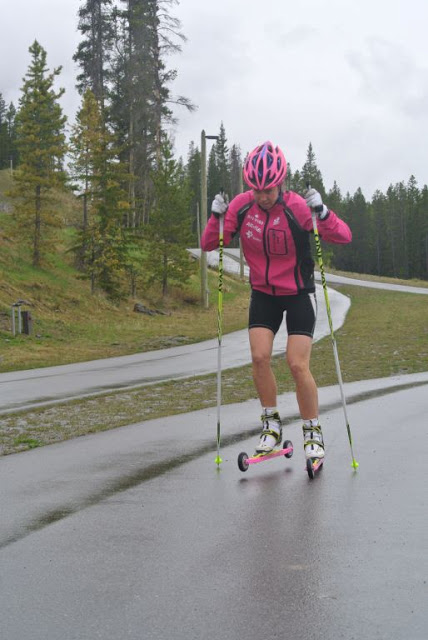
    Perianne Jones tests a pair of F1 Sprint Skate rollerskis, a Fast-and-Female release from CCC supplier Peter Rozmovits at Canada Winter Sports, in late May in Canmore, Alberta. "Not even the rain could dampen my spirits with these boards on my feet!" Jones wrote on her blog. "Is there such a thing as too much pink?... probably." (Photo: periannejones.blogspot.com)
    Perianne Jones tests a pair of F1 Sprint Skate rollerskis, a Fast-and-Female release from CCC supplier Peter Rozmovits at Canada Winter Sports, in late May in Canmore, Alberta.
    “Not even the rain could dampen my spirits with these boards on my feet!” Jones wrote on her blog. “Is there such a thing as too much pink?… probably.” (Photo: periannejones.blogspot.com)

    Perianne Jones has no problem jumping into workouts with the guys. And keeping up with teammates like Lenny Valjas, Ivan Babikov and Devon Kershaw? Piece of cake.

    If you caught a glimpse of the Canadian World Cup Team during its recent on-snow camp in Bend, Ore., chances are you saw Jones kicking it with men from the national team.

    “The boys are great,” she said Sunday on the phone from Canmore, Alberta. “I have a small fleet of rollerskis now so I can just pick and chose the right speed and hop in behind them.”

    With Chandra Crawford training independently this summer and Dasha Gaiazova working with Louis Bouchard in Quebec and B2ten in Montreal, that leaves Jones, 28, as the lone remaining female in Canmore. From May 19-29, she was the only women’s World Cup Team member in Bend as well.

    Lucky for her, the U.S. Ski Team was there, too. Jones said she consciously coordinated two or three workouts with the American women, but mostly met up with them by default. When she wasn’t skiing with them or other Canadian women, Jones was on a fast pair of rollerskis behind Valjas, Kershaw and Babikov, or training with her coach, Eric de Nys, or her husband, Joel Jaques, a national-team wax technician.

    “I don’t think I’ve done a single workout by myself yet this year,” Jones said. “I am not lonely.”

    ***

    FasterSkier: How was Bend?

    Perianne Jones: It was an awesome camp. There was a little bit less snow than there was in the past, but skiing was still perfect every day. Good spring skiing, just what we needed.


    FS: How did you recharge in April before the start of the season?

    PJ: Joel and I went to Hawaii and chilled out for a while … around 16 days. It was awesome. … We ran into Ida [Sargent]. She was there with her sister. At the end of the season, everyone was talking about what they were going to do in the spring and she said she was going to Kauai and we were going, too. We knew that our trips would overlap a couple days, but it just so happened that we were out on a hiking trail and we ran into her, so that’s funny.

    We stopped in San Francisco for a night because Joel really wanted to visit Alcatraz. Then we came back to Canmore and were here for a couple weeks before we went to Bend, which was nice because we hadn’t really spent that much time in Canmore since, I don’t know when, before the ski season.


    FS: How are you feeling now after your first training camp?

    Perianne Jones of the Canadian World Cup Team leads a group of skiers at Mt. Bachelor in Bend, Ore., during a training camp May 19-29. (Photo: Dan Simoneau)
    Perianne Jones of the Canadian World Cup Team leads a group of skiers at Mt. Bachelor in Bend, Ore., during a training camp May 19-29. (Photo: Dan Simoneau)

    PJ: I came out of the Bend camp as healthy and the least tired than I have in the past. Sometimes it’s a big shocker to get things going with skiing and that many hours in Bend. Last year, I came out of that camp and got sick so this year I feel pretty good and I’m able to still train here in Canmore and do normal stuff. I’m feeling good about things.


    FS: Did you do anything differently in Bend, besides train with the guys more often?

    PJ: I think the camp structure was pretty much identical to what we did last year. I did a little bit less super-hard intervals and my intervals were a little more controlled, Zone-3 kind of thing. I took a good rest and then kind of gradually built into things before Bend so I had some training under my belt before I got there. It wasn’t too much of a shock. It was still a shock (laughs).


    FS: How are you feeling about your training situation this year, especially without Chandra?

    PJ: Chandra’s done what’s best for her and I totally support that. The most important thing to me and to her is that she races fast in the winter so whatever way she gets there that’s the most ideal for everyone.

    Dasha’s going to do most of the training camps with us so we’ll be in New Zealand together and her and I will be in our fall camp together, so that’s a good six weeks of training right there that we’ll do together. She’ll be in Canmore a little bit and I will probably go out to Montreal for a little bit in the fall, and I’ll combine that with a trip to Ottawa. Dasha and I are going to be working together better than ever which is pretty exciting, and Louis [Bouchard] is totally onboard with that. Louis and Eric have been planning things and making sure there are opportunities for her and I because I think that was something that we all missed last year, more opportunities to get together until we were on snow.

    We are three of the best women in the country so the most effective way for us to train is together sometimes. In terms of training partners around here, there’s no shortage of people to train with in Canmore and I’m sure Chandra and I will meet up and do some intensity workouts at some point.

    Eric and Joel are awesome training partners and they’re committed to doing intensity workouts with me. I’m well taken care of. I’m not worried at all. I have really awesome people supporting me and committed to coming out and training with me.


    FS: What’s changed with your overall training approach this year?

    PJ: Getting back into things was pretty relaxed, but the actual training, now that it’s going, I will do a little bit different. I’m going to focus more on some Zone-3 type threshold workouts for the first few months. Last year we kind of dove right in and did some hard stuff. I’m just gonna build into more than I have in the past. Other than that, I mean, pretty similar. Last year, we did a few intensity blocks. I’m still gonna do more intensity, not [more] than last year, but more than years previous. It may not be all in blocks; it might be every few days, not every day for a week.


    FS: Why change it?

    PJ: I definitely had some fatigue going in [to the season last year]. There were a number of things that weren’t ideal. In Park City, I got a weird kind of skin infection. We thought it was something on my skin, but it actually took a lot out of me; my body was fighting an infection. I should’ve backed off a little bit then and I didn’t so I went into the season a little more tired than I should have and kind of paid for it all the way through. All in all, it turned out OK all things considered.


    FS: Last season was your best yet, but you’ve said you were disappointed with World Championships. How does that motivate you moving forward?

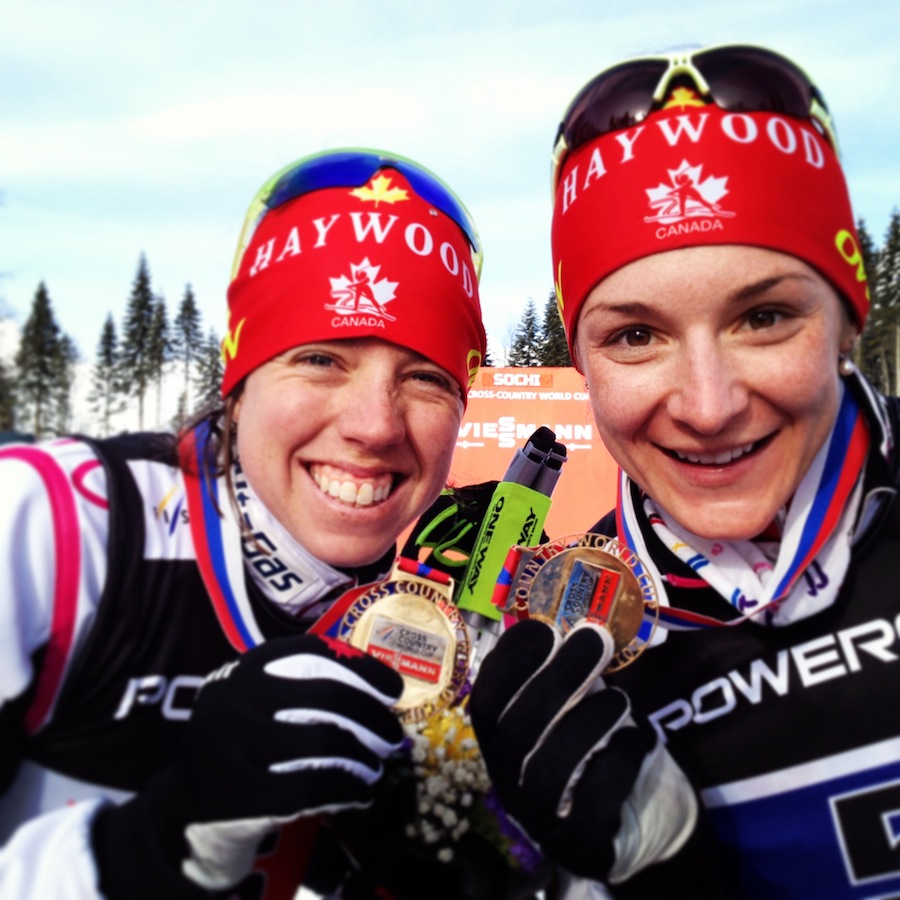
    Canadians Perianne Jones and Dasha Gaiazova celebrate their first bronze of the season, and together, in the Sochi World Cup classic team sprint. (Photo: Chandra Crawford)
    Perianne Jones (l) and Dasha Gaiazova celebrate their first bronze  together in the Sochi World Cup classic team sprint last season. (Photo: Chandra Crawford)

    PJ: It was a good year but there was more potential than I kind of showed and things could’ve been better. That’s kind of the way it goes with skiing. No one’s ever satisfied; we always want more. But I’m definitely doing things differently and we’ve looked at what I’ve done and changing things to optimize it and make sure we don’t make the same mistakes twice.

    There are always just so many variables so we have to look at everything, like what happened in the fall, the infection and the training we did. We just poured over everything and not make any drastic changes, but the little ones that we think will help.


    FS: How excited are you for the Sochi Olympics, especially the team sprint after taking bronze there with Dasha in the pre-Olympic World Cup?

    PJ: It’s definitely something we think about given what happened last year. We all know there are three women and any two of us could be on that team, but it’s a goal for us as a whole, all of us are definitely thinking about it and we’ll support whoever ends up on the start line that day.


    FS: What’s your plan after this season?

    PJ: I haven’t quite decided. It’ll probably be my last Olympics. I don’t know if it’ll be my last year skiing. I’m not sure I’ll make it to 2018, that’s a long ways away (laughs).


    FS: What’s next?

    PJ: I’m heading back down to Bend around the 25th of June for a few weeks. The boys are doing a camp there so I’ll go down with them, and then in August we’re going to New Zealand for a few weeks. Our fall camp right now is up in the air, it will happen somewhere we just haven’t really nailed down the spot. It might be Hawaii; it might be somewhere else because the boys need to do some altitude stuff. Wherever it [is], Dasha and I will be there.

  • Photo Gallery: Spring Skiing in Bend

    Photo Gallery: Spring Skiing in Bend

    The U.S. and Canadian national teams currently in Bend, Ore., for their spring camps had an unstructured training session at Mt. Bachelor this weekend. Mt. Bachelor Ski Education Foundation nordic director and three-time Olympian Dan Simoneau snapped photos of junior skiers and World Cup athletes alike ski laps around the trails.

    “One of the cool parts of these generation of racers is how much they want to pull kids along,” Simoneau said.

  • In Bend, U.S. Ski Team Reunites to Begin the Road to Sochi

    In Bend, U.S. Ski Team Reunites to Begin the Road to Sochi

    Jessie Diggins, Holly Brooks, Kikkan Randall skiing at Mt. Bachelor on Wednesday during an interval workout. (Photo: Dan Simoneau)
    Jessie Diggins, Holly Brooks, Kikkan Randall and Liz Stephen skiing at Mt. Bachelor on Wednesday during an interval workout. (Photo: Dan Simoneau)

    After six weeks apart, most of the U.S. Ski Team reunited again this week for their annual May training camp in Bend, Ore. Through sunny skies and falling snow, the group put vacation time in the past and set to work at Mt. Bachelor to get ready for the 2013-2014 season. So far that’s included on-snow speed workouts, over distance and intervals, along with mountain biking ride and lots of team meals.

    “The team atmosphere is great,” said Holly Brooks, the USST’s newest A-team member. “There are lots of hugs, lots of great meals together and workouts, stories about the spring…it’s really easy to get back into the natural swing of things.”

    There is also a quietly building anticipation for the most-hyped part of the upcoming season, the 2014 Olympics in Sochi, Russia. It snowed in Bend on Wednesday for the team’s first group interval workout, and athletes saw the soft conditions as practice for the snow they might see in Sochi.

    “It sucks, none of us want to be in cold weather this time of year, but for training it’s pretty good,” said Andy Newell. “Conditions were pretty soft today, but realistically those are the conditions we may see in Sochi and so many other place on the World Cup. So we don’t like it, but it’s good practice.”

    Andy Newell, David Norris and Erik Bjornsen scramble during intervals. (Photo: Dan Simoneau.)
    Andy Newell, David Norris and Erik Bjornsen during intervals on Wednesday. “Bjornsen and I did a few intervals together, which was great. I don’t get to do intervals with him very often,” Newell said. (Photo: Dan Simoneau)

    Bjornsen and I did a few intervals togheter, don’t’ get to do intervals with him very often.

    “We got to [Mt. Bachelor] and we said, ‘It’s championship day,’” added Brooks. “That’s Matt [Whitcomb]’s favorite thing to say when it’s adverse conditions.”

    The first cross-country race of the Games, the 15/30 k skiathlon, go off on February 8, and a measured excitement for the opening ceremonies is already building in Bend. The team’s training program at the camp is similar to what it’s been in the past — on-snow sessions mixed with less structured workouts on biking and running trails — and only part of their recent goal-setting sessions have focused on Sochi. But there is no denying that Olympic hype has started in the media and within the team, adding an extra element of focus to their first camp.

    “For an Olympic year, it’s definitely a big motivator,” Newell said, a 2006 and 2010 Olympian. “You want to make every interval session count; you want to make sure each one is at it’s best. We train like that every year, but it seems more magnified in an Olympic year because you have that thought in the back of your mind. It only comes around once every four years. It raises the intensity level of all the training camps.”

    Even with the Olympics looming, however, May is still just the beginning of the off-season. Athletes are being smart as they reenter a full training schedule, Brooks says, resting when they think they need to so they’ll be ready to go come February.

    “One thing that’s different is people are extremely proactive about their health and injuries,” she said. The Alaskan skipped SuperTour Finals, for example, to make sure she was fully recovered to begin training for the Olympic year.

    “I think our whole team has gotten smarter in that regard,” Brooks continued. “People are being really patient with their bodies and…making sure they’ll be in good health come February.”

    The media hype that surrounds the Games has already begun, adding another level excitement to the training season. Newell and women’s team leader Kikkan Randall flew to Los Angeles, Calif., last month for a photo shoot with NBC, where Newell said his interviews with the Olympic broadcaster indicated more interest in cross-country than he’s experienced in the past. The whole team will have another media summit in Park City, Utah, in October, and NPR is scheduled to do a piece on the team during the Bend camp.

    As a result, the team’s reunion in Bend has been an opportunity to define what motivates them as a group as they enter a brighter spotlight and a year filled with big expectations. The increased media attention makes the upcoming season feel a little different, Brooks says, but the team’s drive to work hard comes from the same place it always has.

    “We had a great team meeting last night and went over some goals that weren’t necessarily performance goals but process goals,” she said. “How to treat each other, what we want to do outside of ski racing as a group and stuff like that. And it was just really cool to see how united everyone is and how motivated everyone is and how we’re really ready to approach the Olympic year as a team.

    “There’s not secret to it; it’s not like we do anything different,” Brooks continued. “At this point, we got here by doing something right, and hopefully we continue that good energy and take that with us to Sochi.”

    One of the bigger goals for the team will be to replicate their pre-World Championships momentum from last season.

    “I think a big goal for me this year and for everyone is: you don’t want to go into Sochi hoping you’re going to do well,” Newell said. “I’m looking to have a successful beginning to the World Cup season…For me a big goal is to be on the podium before going to Sochi. I think that can take the pressure off. Last year the more success we had, the momentum carried to the Championships. So that’ll be the same goal this next year — to roll with momentum into Sochi. Then it’s just like another weekend of racing, and that’s a fun position to be in.”

  • Photo Gallery: Bend Camp L3 Intervals

    Photo Gallery: Bend Camp L3 Intervals

    The U.S. Ski Team’s annual May training camp began in earnest this week in Bend, Ore. A few inches of fresh snow greeted skiers at Mt. Bachelor on Wednesday morning, just in time for the group’s first interval session: a set of 6 x 4-6 minute L3 freestyle intervals with intermediate sprints.

    “We’ll put a little sprint halfway through the interaval, and that’s to mimic mass start racing and preems and time bonues on the World Cup,” said U.S. sprint veteran Andy Newell. “We try to do it pretty controlled today, but skied in a pretty good group.”

    The USST is joined at Mt. Bachelor this week by the National Training Group, the Canadian National Ski Team, the U.S. Biathlon team and U.S. Paralympic athletes. With so many high-caliber skiers training on the same six- to seven-kilometer loop, Newell says the workouts interesting.

    “I think tomorrow we have a three-hour one on the schedule,” he said. “We have the Canadians here, the U.S. biathles are here, so there’s so many people out we can catch up with Tim [Burke] and Lowell [Bailey] an ski a lap with them. It’s pretty fun skiing with that many people around.”

    Though the workout was the first group interval session all spring for many skiers, Newell noted the pace was pretty controlled.

    “We’re pretty used to training with one another so it’s not that competitive,” he said. “Maybe the preems we definitely try to race each other, to try to ge across the preem line, but as experienced skiers we know that there’s not a whole lot of stock in being in great shape in May.”


    Special thanks to Dan Simoneau for his photos.

  • Wednesday Workout: An OD with the U.S. Biathlon Team

    Wednesday Workout: An OD with the U.S. Biathlon Team

    A member of the U.S. biathlon team working out in Bend, Ore., May 2012.
    Coach Jonne Kahkonen takes video of Tim Burke during a workout at last spring’s Bend camp.

    Welcome to Wednesday Workout, the newest workout series on FasterSkier. During the offseason, we’ll feature components of summer training programs from top individuals and teams throughout the U.S. and Canada at the junior, college and elite club levels. If you ever have a workout suggestion or training question, send them in to info[at]fasterskier.com.

    ***

    As athletes ease back into training this spring, they will gradually introduce each component of their training plan back onto the table: distance. Strength. Threshold intervals. Hard intervals.

    What about overdistance? “OD”s are long, base-building affairs, and it can be hard to know where to start after a month or more of relaxing. Can you jump straight into a two-hour run? A three-hour rollerski?

    The U.S. biathlon team is luckier than most, as coaches Per Nilsson and Jonne Kahkonen say that all of their athletes are returning to camps this May at about the same level of fitness; that removes some of the guesswork. Today in Bend, Oregon, they’ll be tackling a classic OD on snow, probably in the range of three to four hours, depending on the athlete. In the thick of the training season, cross-training workouts on the bike could last up to five, but there’s no need for that now.

    That said, this is the first volume block for the team. The coaches estimated that in nine days, divided into two four-day training blocks with a rest day in the middle, the biathletes would hit between 35 and 40 hours total.

    “Bend is the place to be if we are talking big hours in the beginning of the season,” Kahkonen said. “It’s perfect here to get on snow and have the opportunity in the afternoon workouts to go out for either mountain biking or running.”

    As the athletes build their endurance base and prepare for other types of workouts, Nilsson and Kahkonen discussed how to execute today’s workout well – both if you’re lucky enough to be on snow, or if you’re stuck doing dryland.

    The Workout: “The main goal for sure for all this type of workouts is to have as much continuous work as possible and not too many stops,” Kahkonen said. “In our training system we have Wednesday as the day when we have a long session in the morning and then a halfday off. Here the standard is 3-4 hours.”

    As always, there’s a balance between skiing continuously and getting something useful out of the workout besides just the hours. The team tries to have some OD sessions that focus on technique as well.

    “It’s important to work on the key elements in the ski technique: postition, weightshift, rhythm, and balance, even if you are going pretty slow,” Kahkonen said. “This is not easy to do from the focus side, but you can see that the athletes that have that in the mind are most of the time also the athletes that have the best technique. We either work with the video or sometimes try to follow an athlete.”

    (“It gets harder every year,” he smiled.)

    As for the pace, it can’t be too fast or too slow. How to control it?

    “By heart rate or feel,” the coaches said. “If you can talk the whole time then the pace is too slow!”

    Some teams throw in sprints or mini speeds along the way to break things up; Nilsson and Kahkonen eschew that, saying they’d save it for other workouts. For them, an OD is a continuous workout, and the next most important thing to focus on is technique.

    As such, they have their athletes ski mostly solo, especially in skate OD’s, where there is a more technical focus.

    “For the specific workouts it’s better to go more alone,” the pair explained. “If you ski side by side and talk, it’s not so productive for the ski technique. In other activities it’s fun and they can run, hike, or bike together in the group.”

    Finally, the team knows how lucky they are to be on snow right now. It’s a recent development; last year was the first time the biathlon squad made the trip to Bend, and before that they started their seasons in Lake Placid with dryland.

    For athletes in similar positions, Kahkonen had a few suggestions about how to ease the body into dryland OD’s.

    “If you are on other places, I think cross-training is good in the beginning,” he said. “You can combine two different activities so you don’t overdo it, especially the impact from the pavement.”

  • Canadians Choose Sweden for Skiing, Coffee; Australian Picks Canmore

    Canadians Choose Sweden for Skiing, Coffee; Australian Picks Canmore

    Canadian World Cup team member Chandra Crawford (r) leads her national-team training group during a workout on Frozen Thunder at the Canmore Nordic Centre a few weeks ago in Canmore, Alberta. (Cross Country Canada photo/CCCski.com)

    This week, World Cup cross-country skiers across North America are checking their lists, checking them twice, loading up on supplies and then cutting their luggage in half to prepare for a long season over in Europe.

    The Canadian national team is headed over to Sweden next Wednesday on Nov. 7, about 2 ½ weeks before the World Cup opens in Gällivare, Sweden. Meanwhile, several U.S. Ski Team members are flying to Finland within the next week or so.

    For the past two seasons, the Canadian World Cup Team has chosen to spend its final prep period in Östersund in central Sweden on the country’s fifth largest lake. Two of the team’s wax techs – Micke Book and Peter Thor – live there, and apparently, the athletes love it.

    “We’ve been other places in the past and it seems like they like the atmosphere and the vibe in Östersund,” women’s coach Eric de Nys said on the phone Tuesday. “There’s a good coffee shop that’s always a big hit when you’re trying to adjust to the jet lag and whatnot for the first week anyways.”

    Head coach Justin Wadsworth explained in an email they stay on the course at Camp Södergren, which is a group of cabins owned by Anders Södergren and Thomas Alsgaard.

    “It’s a lot more south then Muonio [Finland], [Gällivare], Kiruna,” he wrote. “So it’s warmer, lighter and close to some great early season races in Bruksvallarna.”

    On Nov. 16-18, the Canadians will compete in FIS races in Bruksvallarna, Sweden, about 200 kilometers southwest of Östersund. De Nys said they’ll pick them individually, with some athletes taking part in the 5/10 k classic, others in the 10/15 k skate, and some in the skate sprint. A few might do them all.

    “We’ll just see where everyone’s at when we actually get over there, what kind of form they’re in and do some fine-tuning for the race season,” de Nys said.

    Just over three weeks out from start of the World Cup, de Nys said the team’s in good shape following some quality time on snow at Frozen Thunder in Canmore, Alberta. Next Wednesday, the entire team will leave Canada with the exception of Ivan Babikov and Dasha Gaiazova, who will travel to Sweden a week later.

    “Ivan has a family; he can’t spend as much time away as the others can,” de Nys said. “Dasha just got into Canmore [Monday] night. She’s been in Quebec area training so she just wants to have a little bit more time to prepare before going overseas.”

    An Australian Addition

    Also in Canmore, two-time Australian Olympian Esther Bottomley has been spending her preseason at Frozen Thunder. According to de Nys, the 29-year-old World Cup skier is staying with Amanda Ammar, who skis for the Canmore Nordic Centre and trains regularly with the women’s World Cup team. He was happy to invite Bottomley to join them.

    “We’ve always had a pretty good standing agreement with Australia/New Zealand just to say, you know, come up here when it fits,” he said. “She’s joined us here for a few workouts and kind of considered her part of the team.”

    Bottomley will remain in town for the Canmore NorAm Dec. 1-2, travel to Quebec City for the World Cup sprints the following week, and fly back for the Canmore World Cup Dec. 13-16.

    “She has a plan coming from her Australian coach so sometimes she’s [like], ‘I’m joining you guys today,’ or ‘Nope, I’m gonna do this today,’ ” de Nys said. “It works out great as another female to have around and it makes the group a little bigger. That’s always good.”

  • U.S. NoCo Takes Captain America to Europe; Jarrett Speaks in Tokyo

    U.S. NoCo Takes Captain America to Europe; Jarrett Speaks in Tokyo

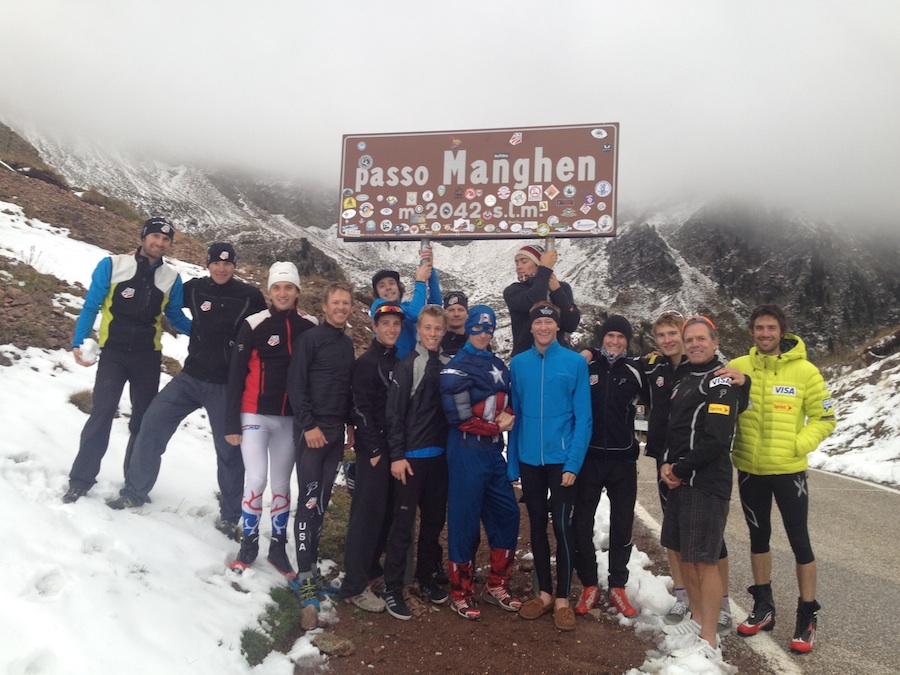
    The U.S. Nordic Combined Ski Team and NTG after doing intervals up Passo di Manghen in Trentino, Italy, during a training camp Oct. 15-25. Captain America (a.k.a. Taylor Fletcher) even made an appearance. (Photo courtesy of Martin Bayer)

    The U.S. Nordic Combined Ski Team strives for a lot of things – medals, depth, continued improvement – but flying under the radar isn’t one of them. Anyone who followed the team and one if its racers, Taylor Fletcher, for the past 10 days in Europe could tell you that.

    The younger of two brothers on the team, Taylor, 22, ran around in a full-body Captain America costume throughout the trip from Oct. 15-25, which included stops in Val di Fiemme, Italy, and Oberstdorf, Germany. The reason? He lost a bet with A-teamer Billy Demong for lowest cumulative time in World Cup competitions last season. But when you look at the video of Taylor rollerskiing and trying to catch a football in the bulky suit, it looks like he’s having fun.

    That’s the entire U.S. Nordic Combined squad in a nutshell. With 10 men between the A and B teams this season – up three from last year with the addition of Adam Loomis, Erik Lynch and Michael Ward – they’re close-knit and comical. However, with the start of the 2012/2013 season about four weeks away, they also know how to get down to business.

    The entire team (excluding Lynch who was home recovering a broken wrist) and its National Training Group (NTG) traveled to Europe nearly two weeks ago for a camp largely focused on jumping. With the financial support of the National Nordic Foundation and a budget initiative from the U.S. Ski and Snowboard Association/U.S. Ski Team, 13 skiers attended the team’s second overseas camp of the season. A-team member Bryan Fletcher, 26, felt the large group made a difference.

    “The 4 young guys [Tyler Smith, Alec Gantic, Spencer Knickerbocker and Ben Berend] are full of energy and it’s awesome for us to have an opportunity to share our training with them,” he wrote in an email. “They are definitely the future of US NC so it’s important to provide them with the best possible training as early as we can.”

    In a blog post before flying back to the U.S. on Thursday, Loomis explained they ended camp with a two-man team event on Oberstdorf’s big hill and 1.5-kilometer sprint course. Teammates tagged off between laps to race 7.5 k apiece.

    “Billy and Nick [Hendrickson] cleaned up,” Loomis wrote. “But it was a good fight for the next few spots (the middle guys always seem to have the strongest teams — and they didn’t exactly have great races in Predazzo).”

    The ski jumps at Val di Fiemme, Italy, the site of the 2013 World Championships from Feb. 20-March 3. (Photo: Nick Hendrickson/haveskiswilltravel.tumblr.com)

    The team did several interval sessions and a few time trials in Italy, according to U.S. Continental Cup and development coach Greg Poirer.

    It was quite a sight to see more than a dozen “Team USA” guys flying around parts of the Marcialonga marathon course on rollerskis, he added. They wanted to train at the site of the 2013 FIS Nordic Ski World Championships for that reason.

    “One of our philosophies is to become as familiar as possible with the facilities/venues where we have major events (i.e. Vancouver, Oslo, Val di Fiemme and, of course Sochi),” Poirer wrote in an email. “In addition to scheduled World Cups or so called ‘test events’ at these venues, we try to spend quality training time, as well, to enhance our preparation for these major competitions.”

    U.S. head coach Dave Jarrett said they chose Oberstdorf because its jump has an iced inrun in October. His staff hoped that would provide adequate preparation before the team could jump on snow at home in Park City, Utah, within the next month. The World Cup season starts Nov. 24-25 in Lillehammer, Norway.

    Before they go full steam ahead, Poirer explained U.S. Nordic Combined has some distinct goals: namely three medals at World Championships.

    “It’s the same goal we set for Vancouver, Oslo and Sochi,” he wrote. “Three medals sets the bar very high but as the team proved in Vancouver [at the 2010 Olympics] … doable!”

    He credited their success at the last Winter Olympics – with Demong winning gold, Johnny Spillane taking two individual silvers, and the team placing second in the relay – partially to being familiar with Whistler Olympic Park.

    “We are using resources to duplicate, to the best of our ability, the familiarity of Vancouver here in Val di Fiemme as well as Sochi,” he wrote. “So far, Sochi has been a little difficult to organize training outside of test events.”

    That’s why they focused on Italy. Back in Park City, Jarrett prepared to fly to a different part of the world: Tokyo. On Sunday, he spoke at an altitude training conference at the Japanese Institute of Sport Science (JISS). U.S. Olympic Committee senior physiologist Randy Wilber nominated him to do so, and Jarrett said it was an honor to join the ranks of international presenters. In the past, renowned people, such as Michael Phelps’ coach Bob Bowman and U.S. cycling coach Dean Golich, spoke at similar conferences.

    “They were looking for a coach from the U.S. that uses altitude training and has experience in it,” said Jarrett, who has presented at a couple of Wilber’s altitude conferences in the U.S. as well.

    In a phone conversation, Jarrett explained he’s been interested in the effects of altitude for a long time, especially living around 7,000 feet above sea level in Park City. What he shared was mostly based around that.

    “I don’t want to give away too many secrets, but it’s also not a big secret, either: We use altitude training because live at altitude anyway,” he said. “We are almost doing it a little backwards than what most other nations are because they’re usually going up to altitude to acclimatize and go back to sea level to race. We’re always at altitude so we have to reverse-engineer it: how do we live all the time at altitude and be ready to race at sea level?”

    In his first time in Tokyo for more than a night, he wrote in an email that the JISS was “a pretty amazing place.” Jarrett was back in Park City on Monday and trained with juniors Wednesday at Soldier Hollow, where snow was spotted that morning. Early Thursday, he reached out to the Norwegian nordic combined team, which is finishing up a monthlong training period in Park City, via Twitter: “Skiing this morn?”

    2012/2013 U.S. Nordic Combined Ski Team

    A-team

    Billy Demong (Vermontville, N.Y)

    Bryan Fletcher (Steamboat Springs, Colo.)

    Todd Lodwick (Steamboat Springs)

    Johnny Spillane (Steamboat Springs)

    Taylor Fletcher (Steamboat Springs)

    B-team

    Brett Denney (Steamboat Springs)

    Nick Hendrickson (Park City)

    Adam Loomis (Eau Claire, Wis.)

    Erik Lynch (Steamboat Springs)

    Michael Ward (Aspen, Colo.)

    Coaches

    Head Coach: Dave Jarrett

    World Cup Jumping Coach: Chris Gilbertson

    Continental Cup/Development Coach: Greg Poirer

  • Nishikawa Edges Ellefson, Stephen Runs Solo to Win Spray Drag

    Nishikawa Edges Ellefson, Stephen Runs Solo to Win Spray Drag

    U.S. Ski Team member Liz Stephen extending her lead to win the second annual Spray Drag running race on Saturday in Canmore, Alberta. (USSA Nordic courtesy photo)

    Thirty-six men in the Spray Drag running race didn’t end up chasing Devon Kershaw up Spray Lakes Road in Canmore, Alberta, on Saturday, but they had one heck of a battle from the start.

    According to American Sylvan Ellefson (Ski & Snowboard Club Vail/Team HomeGrown), the pace was fast for a bunch of nordic skiers early on.

    “Any road runner could have pulled away, but it was a quick pace,” he wrote in an email. “It continued on the road with a couple of us switching off in the lead.”

    From the Canmore Nordic Centre, racers (including 26 women and seven junior boys) ascended a snow- and dirt-covered road to the Spray dam. In an email, race organizer and Alberta World Cup Academy coach Stefan Kuhn wrote that some fresh snow made for an interesting race, and it was “definitely colder at the top than last year.”

    Start of the Spray Drag men’s race on Saturday in Canmore, Alberta. The second-annual road run up Spray Lakes Road was a fundraiser for the Alberta World Cup Academy. Graham Nishikawa (5835) won it, followed by Sylvan Ellefson (5805) in second and Michael Somppi (5818) in third. (AWCA courtesy photo)

    The men raced 7.5 kilometers with nearly 400 meters (1,312 feet) of elevation gain, and the women and juniors did 5 k.

    About six men took off at the beginning of the dirt road, including Ellefson and AWCA/Senior Development Team skiers Graham Nishikawa, Michael Somppi, Kevin Sandau, Graeme Killick, and Jesse Cockney. Nishikawa and Ellefson opened up a gap around the halfway point, and Nishikawa – who holds the course record in 29:23 – tested his competitor with about 1 k to go.

    “Nish moved ahead of me put a little speed in to see how I’d react maybe (at least that’s what it felt like, not sure if he actually did … ha),” Ellefson wrote. “And then with about 200m to go he kicked and I couldn’t hold on.”

    Nishikawa, who was third last year to Canadian World Cup Team members Kershaw and Ivan Babikov, won the second annual race – an AWCA fundraiser – in 30 minutes and 28.1 seconds. Kershaw won it last year in 29:44. According to Kuhn, the Canadian national team didn’t compete this year because the race didn’t fit in with their schedule in Canmore.

    “It is a very tough course,” Nishikawa wrote in an email. “I am happy to see my shape is good after the Park City camp.”

    Sylvan Ellefson (SSCV/Team HomeGrown) working to catch Graham Nishikawa (AWCA/CNST) in the final stretch of Saturday’s 7.5 k Spray Drag road race in Canmore, Alberta. (SMS courtesy photo)

    The runner-up, Ellefson finished 14.1 seconds back. Somppi was third (+24.1) and Killick placed fourth (+27.3), respectively. After leading early with Nishikawa and Ellefson, Sandau was fifth (+1:05.5).

    The women’s race turned out to be a spectacle with U.S. Ski Team member Liz Stephen crushing the competition and course record. She won by more than three minutes in 23:01.2, besting the record (25:41 by Madeleine Williams) and last year’s winning time (25:53 by Brittany Webster) by nearly three minutes. Last year, Perianne Jones was second, and Rhonda Jewett finished third.

    After Stephen, Canadian Zoe Roy, who skied for the University of Utah and now trains with Rocky Mountain Racers, placed second (+3:02.0). Heidi Widmer (AWCA) was third (+3:27.3).

    “We where excited to see Heidi run a [personal best],” Kuhn wrote. “Race winner Liz definitely showed us a new level for this event for the ladies’ time.”

    Complete results

  • Canada’s Frozen Thunder Offers Goods to All

    Canada’s Frozen Thunder Offers Goods to All

    Alberta World Cup Academy skiers Brent McMurtry and Phil Widmer skating on the 1.8 k manmade course at Frozen Thunder on its opening day, Oct. 13. (Devon Kershaw courtesy photo/devonkershaw.com)

    Before the sun rises in Canmore, Alberta, those near the ski trails can probably hear the sounds of striding and skating along hard-packed snow this time of year. That’s likely accompanied by voices, chit-chatting as skiers compete 1.8-kilometer loops around the Canmore Nordic Centre before trail passes go on sale at 9 a.m.

    They’re not exactly renegades, night owls or extreme enthusiasts. For the most part, these individuals belong to clubs – some of which are American – and they’re just sharing a slice of the popular pie that is Frozen Thunder.

    According to Canmore Nordic Centre manager Michael Roycroft, about 150 skiers per day for the next few weeks are expected to use to the 5-meter wide manmade course, which officially opened for the fourth straight year on Oct. 13 and is expected to stay open through the winter. That daily estimate probably didn’t account for groups like F.A.S.T. Performance Training from Hayward, Wis., which were among those skiing before or after business hours.

    Juniors from F.A.S.T. Performance Training out of Hayward, Wis., on snow for the first time this season on Oct. 13 at the Canmore Nordic Centre. From left to right: Ryan Davis, Zach Goldberg and Ben Saxton. (F.A.S.T. courtesy photo: facebook.com/pages/FAST-Performance-Training/222929117723592)

    F.A.S.T. head coach Bill Pierce guessed there were as many as two hundred skiers at the centre Wednesday afternoon, and not all were on snow.

    “It’s amazing how busy the training centre was with athletes in the afternoon,” he wrote on Facebook. “Cross country skiers both on snow and rollers, runners, mountain bikers, and biathletes in every age range were training.”

    With more than a week and a half remaining of their two-week Canmore camp, Pierce wrote his five athletes recently transitioned higher intensity, like many of the skiers there. They started with an easy 1 ½-hour ski on snow, followed by speed work on rollerskis in the afternoon. Earlier in the week, the Alberta World Cup Academy invited them to a strength session at the national-team headquarters.

    “Canmore is living up to its reputation as the perfect place to train for endurance sport,” Pierce wrote in an email. “The camp is a great mix of dryland and snow!”

    He added that it was unusual to be in a wax room when it’s 50 degrees Fahrenheit (10 degrees Celsius) with green grass outside. Regardless, the snow was holding up despite the warmer temperatures earlier in the week.

    Pierce recalled the feeling of getting on Frozen Thunder for the first time.

    Frozen Thunder two years ago on Oct 17, 2010. (Canmore Nordic Centre courtesy photo)

    “The first 500m of snow felt awkward and unstable but after 5 min., the feel of slippery glide gets under control and the grace of being on snow takes over,” he wrote. “It was just an awesome feeling and even at 50F the snow was faster than rollers.”

    According to Pierce, the weather had been a mix of sun and clouds that initially shrunk the snow base. Fortunately for the groomers and snowmakers there, daytime highs below freezing were expected through the weekend.

    “We’re just glad to have the snow opportunities mixed in with the dryland,” Pierce wrote. “One learns in today’s training and racing environment that any day on snow is better than not. It’s a great camp in a great town!”

    Who’s there: 

    CANADA

    1. Nordic World Cup

    2. Biathlon

    3. Para-Nordic

    4. Biathlon development

    5. Alberta World Cup Academy

    6. Thunder Bay NDC

    7. Canmore Nordic Ski Club

    8. Rocky Mountain Racers

    9. Blackjack Ski Club

    USA

    1. U.S. Nordic Ski Team

    2. CXC

    3. Craftsbury GRP

    4. Bridger Ski Foundation

    5. Stratton Mountain School T2

    6. F.A.S.T.

    (Note: This is not a complete list, but is based on those who registered with CCC high-performance director Tom Holland and other sources.)

    He called the scene “almost an elite WY [West Yellowstone],” with more than a dozen teams flocking to the first substantial, skiable surface in North America.

    In all, there were at least nine Canadian teams, six of which were national-team affiliated, and six squads from the U.S., including its national ski team.

    Against a rainy backdrop on Friday, Cross Country Canada officially announced its 2012/2013 World Cup, Biathlon and Para-Nordic teams at Frozen Thunder (FT), a project launched in 2009 to provide preseason training opportunities to their high-performance athletes. Since then, FT has expanded from spreading a snow pile (preserved through the summer under sawdust) into a 400-meter track to one that’s nearly two kilometers and growing.

    American Matt Liebsch, who’s been training in Canmore while staying with Canadians Ian Murray and national-team biathlete Brendan Green, said the potential is certainly there for more skiing and the snowmakers have their guns ready along a 5 k loop. Back in 2010, Canmore proved it could blow about 30 kilometers worth of snow when it hosted the World Cup.

    “It was very low snowfall and they still had 30 k of trails open,” Liebsch said on the phone Friday. “There’s not anything quite like this in the states.”

    The Minnesota skier with Borton Volvo XC United said he scheduled a six-day trip to Frozen Thunder to get the maximize his time before the season starts in nearly a month. In late August, he took a group of skiers to the Haig glacier, about 45 minutes outside Canmore, for a week of high-altitude, on-snow training.

    “That was a little awkward, you know, long skiing and stuff, but since I’ve been here I’ve put the skates on and that felt really good,” Liebsch said. “I was doing quality sessions my second and third day here.”

    Since then, he’s been working out with friends like former teammate Tad Elliott (U.S. Ski Team/Team HomeGrown) and Sylvan Ellefson (Team HomeGrown). The U.S. Ski Team (USST) arrived on Thursday, and Liebsch said he skied with those two on Friday morning. Yesterday, he and Ellefson went on a 1 ½-hour mountain bike.

    In terms of getting on snow, scheduling isn’t too complicated. While it was previously first-come, first-served, Roycroft wrote that this year, the nordic centre reserved time for high-performance athletes from any country (either national team, provincial or the development equivalent) to use the trails from 9 a.m. to noon. The public can ski any time outside of that. Regarding total use, he said it’s up 25 percent.

    Phil Widmer (AWCA) on snow at Frozen Thunder on Oct. 13 in Canmore, Alberta. (Devon Kershaw courtesy photo)

    While the Canadian World Cup skiers have been in Canmore for more than a week, their U.S. counterparts recently settled in for their 1 ½-week camp. According to Canadian head coach Justin Wadsworth, they hadn’t coordinated workouts, but that didn’t mean they weren’t going to.

    “This part of the season is crucial to be flexible and not force workouts just because they’re on the plan,” Wadsworth wrote in an email.

    One thing’s for sure: there’s going to be a timed-and-bibbed sprint showdown Oct. 26.

    According to a Cross Country Canada press release, Frozen Thunder’s first major sprint race – the WinSport Frozen Thunder Classic – will include more than 100 competitors from the U.S. and Canada. Qualifying will begin at 9 a.m. with the head-to-head heats starting at 10 a.m.

    “The sprint race is another important element in Frozen Thunder’s delivery of what Canada’s athletes have asked for, and need, in their pursuit of international excellence,” Roycroft said in the release.

    “Through the financial backing of the Government of Canada’s commitment to the Own the Podium program, along with WinSport Canada, this multi-year effort complements the more than $30 million these organizations, along with the Government of Alberta, have invested into the facilities and resources at the Canmore Nordic Centre over the last two Olympic cycles to help our Nordic athletes reach their goals.”

    As Wadsworth put it: “It’s just a really competitive field for sprinting so it should be a fun race to see.”

    Cross Country Canada announcing its World Cup and Para-Nordic Ski Teams on Friday at Frozen Thunder in Canmore, Alberta. (CCC photo/twitter.com/cccski)
    A look at the 1.8 k course at Frozen Thunder in Canmore, Alberta, earlier this week. (Matt Liebsch courtesy photo/mattliebsch.com)
  • Testing, One Two Three

    Testing, One Two Three

    lactate, heart rate testing
    USST coaches administering lactate tests during a sprint workout in Lake Placid, N.Y., in September 2011. At the team’s recent training camp in Park City, Utah, athletes underwent physiological testing in a more controlled environment in the lab at the Center of Excellence.

    The U.S. Ski Team’s cross-country athletes finished their final round of pre-season testing last week in Park City, Utah. Athlete blogs currently abound with documentation of skiers pushing themselves to the point of falling off the treadmill in order to collect data on how much they’ve each progressed since their last test. The importance an athlete attaches to his or her test results varies by individual, but in the lab and in training they can help measure fitness and individual year-to-year progress.

    For an endurance sport in which performances are measured against a clock, nordic skiing gives its participants relatively few opportunities to measure absolute progress. You can run a personal record on the track know that you’ve never had a better race in your life, but on skis the only improvement marker athletes have to go by is whether they beat people they’ve never beaten before. Skiers of all ages frequently express frustration with the fact that the most concrete feedback available as to whether their training is working depends both on how they ski but also on how everyone else skis on any given day.

    Perhaps this is why nordic enthusiasts are so fascinated with physiological testing data of others. Even though they are no substitute for actual results, people still keep track of things like VO2 max records. There’s a reason they don’t hand out medals for setting one, however. Test results say as much about your next race as Peyton Manning’s season passing yards says about whether the Broncos will win on Sunday. They indicate part of how good an athlete you are, but can’t predict the outcome of an actual contest.

    This fact, combined with the finicky nature of collecting accurate data in the lab, causes some athletes to place more importance on test results than others. Andy Newell, for example, just completed some of the best treadmill tests of his career last week. The USST has a policy of not disclosing exact data, but speaking qualitatively the American sprinter said his results were highly encouraging.

    “I use this data as a sign that the training year has gone to plan and that I’ve done a good job of absorbing the hard training I’ve done in the last few weeks,” Newell said. “It’s always encouraging to have good tests because it confirms that we are getting fitter and stronger and definitely gets me stoked to get the skis on and start racing.”

    In his second testing season with the USST, Erik Bjornsen also turned in improved test results.

    “My goal this year was to improve my motor and to improve my skating technique. I feel I accomplished both,” Bjornsen wrote in an email. “My goal for the next couple months is to improve power and strength.”

    Others athletes and teams don’t set a great deal of store by test results; Canadian National Ski Team head coach Justin Wadsworth doesn’t have any of his men undergo treadmill testing because he thinks he can gauge progress well enough with intervals and time trials.

    “Testing, for me, you really need to garner something out of it and to make it worthwhile,” he said last week. “I think a lot of people test just for the sake of testing and I think for our women, we have been trying some new training methods with them and we do want to see what changes are happening, but with the guys [the training] is pretty stable.”

    For different reasons, Noah Hoffman took only hemoglobin mass and body composition tests last week and opted out of treadmill and strength testing in Park City. He, too, doesn’t think the data tells him anything he doesn’t already know, but his current training priorities also lie elsewhere at the moment.

    “I have chosen not to test because I have never seen results from a testing session that have helped me become a better skier,” Hoffman wrote in an email. “Testing for me, right now, belongs in the same category as altitude manipulation, diet, stretching, specific psychology work, and strength training. They are all important but they do not come close to representing the bulk of my limitations as a ski racer.”

    Those limitations, he says, lie mainly in technique, and that’s where Hoffman has decided to spend his most of his time and energy at the moment.

    “Technique and energy add up to minutes in a 15 kilometer race. All of the other factors add up to seconds. I hope to reach a point in my career where every factor combines to mean the difference between gold and silver in the Olympics, but right now I’m focusing on the areas that represent the biggest available gains,” he said.

    A few other USST athletes didn’t undergo testing for circumstantial reasons last week, such as illness and injury. For those who did participate in testing at the Center of Excellence, data was collected from five major testing categories:

    1. Body composition and functional movement. This included body fat composition, mobility and flexibility tests. From results, athletes can measure where they are putting muscle mass on and can identify where they might be prone to injury. Body fat tests are helpful to Newell, for one, because “it can be easy to get too thin during some of the hard months of training,” he said. “I try to keep a little bit more body fat during the summer and fall because I think it helps me absorb the training better and helps be build more power. So by using tests like this I can make sure my body is holding up to the training.”
    2. Strength testing to measure overall power. The team uses force plates to determine whether athletes are building strength and are able to use it quickly in dynamic movements like squat jumps. “We are measuring very small differences but a lot of these tests are good at making sure we are converting out gym workouts into explosive power that can be used on the snow and especially in sprinting,” Newell said.
    3. Double-pole treadmill test. Athletes measure how long they can hang onto the treadmill and the percentage of their max they can ski at while only double-poling. “If an athlete is only double-poling at 60-70 % of their max it’s a good sign that they need to work on double-poling,” Newell said. “Really good double-polers…can hammer along at a very high heart rate,” at around 90-97 % of their VO2 max. The treadmill is set to a constant speed of about 10 mph for this test, and the grade is increased each minute until the athlete falls of the back. “For me this test takes 14 to 15 minutes so it’s a really hard effort,” Newell said. “I usually get very close to my VO2 max while double-poling and the other day put up a lactic acid reading of 15.4 mmol/L.”
    4. The VO2 max test. There are many ways to do this one (running, cycling or skiing), and the USST measures it with classic striding. While gathering data on aerobic capacity, the USST also collects lactate profile, heart rate and lung capacity data. As in the double-pole test, the treadmill is set to a constant speed while the grade increases every minute.
    5. Total hemoglobin mass. During an altitude training block like the national team just underwent in Park City, athletes take a hemoglobin test at the beginning, middle and end of the camp to track the change in total hemoglobin mass, which will change as the athlete adjusts to the thinner air.

    Apart from providing feedback on training progress, the USST staff use the results of their athletes’ hemoglobin mass and VO2 max tests to determine when athletes should start living at altitude prior to major high-elevation races like World Championships (Val di Fiemme is just under 4,000 feet) and the Olympics (Sochi’s cross-country and biathlon complex will be around 5,000 feet).

    “If we’re looking to enter a championship with the most powerful blood you can arrive with, we need to know how long it takes an athlete to acclimate appropriately, how high they need to be,” said USST women’s coach Matt Whitcomb.

    The national team has several locations in Europe of varying altitudes that it uses for pre-competition acclimation. “As we head into World Championships, we have some athletes who will live in Davos, Switzerland, to get a little bump before heading to [Val di Fiemme]. Others who don’t respond well to living at altitude will spend time lower in Ramsau, Austria, or Predazzo, Italy, beforehand to have a post-Sochi [World Cup] speed camp instead,” Whitcomb said.

    Similarly, altitude acclimation data will help inform preparation for the main event, the 2014 Sochi Olympics. Newell has learned that his body has the same response to living at 5,000 feet as it does to living at 7,000 feet, and this information will help determine where he’ll live leading up to the Games.

    The Americans finished the Park City segment of their camp this week; athletes are headed to Canmore on Thursday for a final on-snow segment. The ultimate test of fitness is still the time-trial, and the USST has distance and sprint races scheduled for Frozen Thunder next week.

  • Elliott Schedules Trip to Wisconsin for “Train Like a Birkie Champion” Camp

    U.S. Ski Team member Tad Elliott celebrates winning the 2012 American Birkebeiner 50 k skate race in Hayward, Wis. (Photo: Darlene Prois/American Birkebeiner)

    When the head of F.A.S.T. Performance Training in Hayward, Wis., Bill Pierce heard Tad Elliott pulled off a cross-Atlantic trip to win the American Birkebeiner last February, he knew he had to have him back in town.

    Matt Liebsch, one of the Midwest’s nordic heroes and 2009 Birkie champion, thought the same.

    In July, F.A.S.T. held its first “Train Like a Birkie Champion” citizens training camp of the year after Liebsch, an XC United skier, reached out to Pierce about coordinating clinics. Pierce was all for it, and Liebsch suggested adding Elliott, a U.S. Ski Team  (USST) member and former Central Cross Country (CXC) skier, to coach at future camps. Pierce immediately sought him out for the second one Oct. 26-28.

    Matt Liebsch, 2009 American Birkebeiner 50 k skate race champion (ABSF photo)

    “I talked to Tad about two months ago and I said, ‘I’ve got one open weekend,’ ” Pierce said on the phone Wednesday. “He said, ‘That’s the same one I’ve got.’ ”

    Empathizing with Elliott’s busy USST schedule, one in which Pierce figures “hardly gives [its athletes] time to sit down,” he was impressed with Elliott’s enthusiasm.

    “The cool thing about this kid is, against the advice of his coaches and his dad, he flew home [from the World Cup] … and did the race and flew back to Europe,” Pierce said of Elliott, who won the Birkie’s 50-kilometer skate with the second-fastest time in race history.

    Elliot will pull off a similar yet smaller-scale feat when he leaves the upcoming USST camp Canmore, Alberta, one day early to coach at the “Train Like a Birkie Champion” weekend clinic Oct. 26-28 in northern Wisconsin. According to Pierce, Elliott will fly out of Canada early Friday, Oct. 26, and will arrive in Minneapolis by noon. There, Liebsch will drive him to Seeley, just north of Hayward, to lead a dryland skills-and-technique session that evening. After three days of instructing, he’ll fly home Sunday night to Park City, Utah.

    “I love going back to the Midwest and seeing the huge enthusiasm they have there for nordic skiing,” Elliott wrote in an email. “I will get to do the Birkie clinic with one of my close friends Matt Liebsch [and hopefully see] his wife Mary-Beth and their two young kids Grant and Samantha. I got to stay with them for two weeks last year and they took incredible care of me. Looking forward to seeing Bill Pierce. Sounds like this clinic is really well organized looking forward to going to it.”

    “He’s doing this because he likes the Birkie,” Pierce said. “The kid’s got so much positive energy.”

    Pierce likes to tell his juniors about Elliott and his USST teammate Noah Hoffman and their results at the 2006 Junior Olympics. Seven years ago, they finished around 28th and 30th place, he said. Now look where they are.

    “It’s kind of cool to see where these kids come from and a progression,” Pierce said. “They made a choice to pursue a passion, and that’s what the focus is for.”


    More on the “Train Like a Birkie Champion” Camp Series:

    October 26-28, 2012; Hayward, WI – “Train Like a Birkie Champion

    “Live & Ski Like a Champion”


    Purpose: This camp designed for the Master/Citizen athlete that wishes to improve and progress their skiing while fitting the demands of lifestyle, family, and work into their schedule. Sessions will be held on technique, flexibility, strength, and ski skills along with discussions on the body and the affect of aging.

    Abilities: This camp is designed and open to all abilities of skiers. You do not have to roller ski to attend this camp. We are showing you what it takes to progress to your goals of skiing no matter where you are with your abilities as a Nordic skier. So, whether you are an elite wave athlete or an aspiring athlete wishing to compete in your first Birkie, this camp will train, inspire, and motivate you to your best Birkie! Don’t pass on a great opportunity to train with and meet Birkie Champions.

    Guest coaches include 2012 Skate Champion Tad Elliot and 2009 Skate Champion Matt Liebsch.

    Participation limited to 30 athletes.


    CAMP SCHEDULE 


    Friday, October 26, 2012:


    3-5pm: Check in at Lenroot Lodge and Sawmill Saloon

    5-6:15pm: Intro to the fundamental movements of Nordic skiing with Bill Pierce. Dryland skills and technique

    6:45-8:30pm: Fish fry dinner at Moose Lips with discussions with Dr. Brent Carlson.

    8:30-10pm:  Discussions and demos on skis and waxing at Moose Lips.

    Saturday, October 27, 2012:


    7:30am: Morning run and swing out

    8-9:00am: Breakfast on your own

    9:00-10:15am: Flexibility and stretching session with Jay Tapper.

    10:30am-Noon: Basic skate technique session with video with Bill, Matt, and Tad.

    Noon-2:00pm: Lunch at the Sawmill Saloon, video review.

    2-5:00pm: Skate roller ski session with specific strength drills and skills with Bill, Matt, and Tad.

    6-7:30pm: Dinner at the Rivers Eatery in Cable

    8-9:30pm: Chat with the Champions, dessert and coffee at Rivers Eatery with Matt and Tad.

    Sunday, October 28, 2012:


    7-8:00am: Breakfast on your own

    8-10:00am: Classic or skate technique session with specific strength and video with Bill, Matt, and Tad.

    10:30-Noon: Video review technique discussions

    Noon: Check out and camp departure


    To register: http://www.fastperformancetraining.com/clinicscampsretreats/

  • Goodbye Park City, Hello Frozen Thunder: Canadians Fine Tune Training

    Goodbye Park City, Hello Frozen Thunder: Canadians Fine Tune Training

    The Canadian men’s national ski team during a training camp in Park City. From left to right: Mike Somppi, Kevin Sandau, Graham Nishikawa, Alex Harvey, Brent McMurtry, and Devon Kershaw with U.S. Ski Team member Noah Hoffman. (Graham Nishikawa courtesy photo)

    It’s safe to say the Canadian cross-country teams enjoyed their stay in Park City, Utah. Between their tweets and Instagrams of bluebird days and college football games, it’s not hard to see why.

    While the Canadian women headed south on Saturday for a few days of training in St. George, Utah, the men’s World Cup team and senior-development skiers remained at a higher altitude at Park City during their second week of camp. On Tuesday, the men flew back to Canmore, Alberta, where they would likely get on snow at Frozen Thunder by the end of the week.

    In all, six women and 10 men participated in the Canadian National Ski Team’s final dryland camp of the season. Women’s World Cup team members Perianne Jones, Chandra Crawford and Dasha Gaiazova trained with development and Alberta World Cup Academy (AWCA) athletes Alysson Marshall and Emily Nishikawa, and Amanda Ammar (independent). The men’s World Cup team (Devon Kershaw, Alex Harvey, Ivan Babikov and Lenny Valjas) did every workout with the development/AWCA skiers: Graham Nishikawa, Kevin Sandau, Jess Cockney, Graeme Killick, Michael Somppi, and Brent McMurtry.

    The Canadian men during a dryland camp in Park City, Utah. From l to r: development-team members Kevin Sandau and Mike Somppi, and World Cup athletes Devon Kershaw and Alex Harvey. (Graham Nishikawa photo)

    “The camp overall has been amazing,” Nishikawa wrote in an email. “The weather has great – bluebird everyday and not too hot. The camp was super smooth … and the energy was always high.”

    One of his highlights was going to see the University of Utah football host the University of Southern California Trojans last week.

    “It was the first college football experience for all of us and it did not disappoint,” Nishikawa wrote. “People get into it. Go Utes.” (The Utes lost 38-28.)

    On Sunday, the men’s team celebrated Canadian Thanksgiving with dinner at the hotel. The next day, they ascended 1,600 meters (5,250 feet) on a four-hour rollerski up Mirror Lake Highway east of Park City, reaching 3,300 meters (11,000 feet) above sea level.

    Head coach Justin Wadsworth wasn’t able to make it to the workout; he had to fly to Calgary on Sunday after his father-in-law fell and went to the hospital. He was stable and recovering, Wadsworth said Monday, after taking his kids to see their grandfather in the hospital before heading back to the airport.

    “I’m taking the kids to Oregon just for a little seven-day break,” he explained.

    While his two youngsters meowed “London Bridge” in the backseat, Wadsworth reflected on the Park City camp.

    “We’ve done this camp now three years in a row and this one was great,” he said.

    ***

    FasterSkier: What were some of the highlights of training around Park City?

    Justin Wadsworth: We did some new routes for some long workouts and revisited probably one of the most challenging workouts, which is the back way from Soldier Hollow up to Deer Valley [in Park City]. They used it in the Tour of Utah cycling race, and I think a few of the pro cyclists who have ridden extensively on the circuits in Europe said it was the toughest climb they’ve ever done. We did it on rollerskis last year and then they repaved it this year so it was a bit better. It’s an amazing workout. The climb [up Guardsman Pass] is from about 1,600 meters and then they go out to about 2,800 meters … and we did it skating this year just to keep the emphasis on steep uphill skating.

    I think that’s still, as a team, an area where we need to keep improving. Steep uphills are where everybody in the world have a hard time so I think it’s just good to be really efficient at climbing.

    The Canadian men’s team rollerskiing near Park City, Utah. (Stefan Kuhn courtesy photo)

    FS: What were some of the objectives for this camp?

    JW: It was a volume camp. Just being at altitude was the main goal, and getting through a lot of the workouts and not coming out of this camp too tired. [We wanted] a lot of the athletes to go easy on the longer workouts and be fresh coming out of this camp so we can really train well the next three weeks before we go to Europe.

    FS: Were there many joint sessions with other teams?

    JW: There were a couple intensity workouts where we were joined by a bunch of our biathletes and I think [one or two of the American women]. We had a group of 13-14 women for some of the interval sessions.

    FS: What about with the men? Was U.S. Ski Team member Noah Hoffman the only one that hopped in some workouts?

    JW: Yeah. We would’ve enjoyed having the other guys around, but he was the one that was in town and ready to train at altitude.

    FS: How was your men’s training group with the AWCA and development-team skiers?

    JW: That worked out really well. We try to get our development-team guys exposure to our World Cup team as much as we can, and I think as a development group they’re in a pretty good place. They’re strong and fit. It’s really good when you have athletes like Devon, Alex, Ivan and Lenny that are proven world’s-best on any day. It’s always good to have your development-team guys have a marker like that, like, ‘OK, if you’re going to get Devon in this interval workout, you can probably bet he’s top-five in the world that day for his fitness,’ so it’s really good to see how they compared and stacked up against the World Cup team guys.

    FS: How is everyone health-wise?

    JW: Everyone’s doing really well. Ivan had a little bit of an ankle problem. It’s quite strange it wasn’t an acute injury so he had a couple days where he couldn’t classic ski. But besides that, I would say everyone was doing extremely well. I’m pretty happy where the team is and the same on the women’s side. The women looked great, and I really saw a remarkable change in actually all three of the World Cup women. I think they’re doing great.

    FS: Was that your first time really observing or working with the women this season?

    JW: [After] we split the [men’s and women’s] teams this year, we’ve been at a lot of different camps so it’s been hard to see them. I’ve been at a few workouts where it’s just been Peri and stuff, but to see the women all together and especially with Dasha in that group as well. … It’s good to see that everything’s been going really well with that program and [women’s coach] Eric [de Nys] is doing a really good job.

    FS: How and when do you use V02max or similar tests to measure progress?

    JW: For the women’s team, they’ve been testing periodically through the summer and we’ve continued with them just like we did last year as well. We’ve been trying some different strategies with the women, so we do want to monitor what changes are happening to their physiology, so that’s been going on and I believe they have one more set of testing before they go to Europe.

    With they guys, we haven’t been doing any testing at all. We haven’t really changed our training philosophy that much, and I’m pretty confident through other ways, intervals that we measure and whatnot, that everything’s going well. Testing, for me, you really need to garner something out of it and to make it worthwhile. I think a lot of people test just for the sake of testing and I think for our women, we have been trying some new training methods with them and we do want to see what changes are happening, but with the guys it’s pretty stable.

    At the workouts I’ve been to [with the women], you can see the changes. When you can actually notice the changes it’s pretty exciting, but it’s good to back it up with numbers just to make sure we’re seeing what we want to see with them.

    The Canadian men’s team during peak season in early October near Park City. (Stefan Kuhn photo)

    FS: Park City marked the first joint camp between your men’s and women’s teams this year. What did you do together and how did that go?

    JW: We had a bunch of dinners together, which was really good, and interval sessions, we kind of crossed paths; we did the women first one day and the men second just because the groups were so big.

    It’s always amazing, this team, they interact super well and they’re all really close. It’s fun to get everybody together again and it was a good check up. We all had a team meeting with our sports psychologist, too, during the camp and just made sure everyone has the same goals in mind as far as working as a team professionally.

    I think having that team meeting and having the team together for a few meals was really important and it showed everybody that we all are on the same page. It’s really important to have that team dynamic. It’s easy when you’re tired and stuff to get a little lazy with making sure you’re being a good teammate and being respectful, so it’s always good for coaches and athletes to be reminded of that.

    FS: What’s the plan for training in Canmore at Frozen Thunder?

    JW: They roll out Frozen Thunder on [October] 13th I believe. We’ll be on snow pretty quickly and … just skiing quite a bit. With Frozen Thunder, you don’t want to go too nuts on it because it is only a couple k’s [about two] so you can kind of get burned out on it, but the goal is definitely to just do some of the easy shorter, distance workouts on there and then do a lot of the intensity workouts there and then we’ll still rollerski a lot. You don’t want to crank out a three-hour workout at Frozen Thunder, it’s just too repetitive.

    FS: And you’ll see the U.S. Ski Team there again, too?

    JW: The U.S. will be joining us so that will be fun. We’re having a classic sprint race on Friday the 26th of October so that’ll be a full-blown, timed, bibbed event so it should be quite competitive. In North America, we have ten of the world’s best sprinters roughly, so it’s pretty exciting to get everybody together – our guys and Simi and Newell and Kikkan and Chandra – it’s just a really competitive field for sprinting so it should be a fun race to see.

  • Randall Keeps Head Up, Hammer Down While Healing Stress Fracture

    Randall Keeps Head Up, Hammer Down While Healing Stress Fracture

    Kikkan Randall getting some help from two Ski & Snowboard Club Vail juniors to hold the hefty Crystal Globe, which she won as the World Cup sprint champion last season. (Courtesy photo)

    When Kikkan Randall talks about being injured, her tone matches the description of any other day: the sun is shining; life is good.

    For more than two months, the 29-year-old U.S. Ski Team (USST) veteran has been healing a stress reaction in her right foot by wearing a walking boot outside of training. An MRI five weeks ago revealed she needed to dial back her workout efforts to 50 percent and stay away from certain activities, such as skiing and running.

    As if that wasn’t hard enough for a nordic skier, let alone the defending World Cup sprint champion, Randall discovered last Wednesday that she wasn’t completely in the clear. Follow-up imaging with Dr. Tom Clanton at The Steadman Clinic in Vail, Colo., revealed that her stress reaction – a weakening of the bone in her foot – had become a stress fracture. The good news was it was already healing.

    One day before the start of the final USST dryland camp in Park City, Utah, Randall spoke on the phone Monday about her injury and plan of attack for the season ahead. She had just finished a 2 ½-hour mountain bike ride in Park City with her husband, Jeff Ellis, and said she was enjoying spending some extra time with him.

    Meanwhile she aimed to stay patient with about six and a half weeks to go until the World Cup opener Nov. 24 in Gällivare, Sweden. Last week, doctors estimated it would be eight or nine weeks before she could resume race-pace intensity.

    “That puts me right about when the race season is supposed to start,” Randall said. “I’m hoping I’ll be in at least a good enough place to be able to compete in those races. I don’t know what kind of shape I’m going to be in because I won’t be able to do full-on intervals for a while still, maybe four or five weeks from now, so I’m going to have to change my goals a little bit.”

    ***

    FasterSkier: What kind of goals do you have at this point?

    Kikkan Randall: Those first races will have to be to build back up and get in shape, and hopefully be in a good place by Tour de Ski. … Tour de Ski was one of the big goals and I think that’s still a good possibility to go there and perform well. It’ll be fun to see the World Cup races in Sochi (Jan. 1-3) and maybe have some good performances there, but really probably the biggest goal of the season is focused around World Championships and using the second half of the season to test things out and figure out what works well. That’ll give me something to work on next year.

    FS: What are you specifically aiming for at World Championships (Feb. 20-March 3 in Val di Fiemme, Italy)?

    KR: I’d like to make the final in the classic sprint. I’d like to have our team fight for a medal in the team sprint. I think we can put together a relay, the 4-by-5 k in the top six. This will be the first championships where I’m almost more excited about the team goals than my own. I mean, I obviously want to race well myself, but I’m excited about what we can do as a team. That’ll give me some extra motivation in rehabbing this foot injury, too, knowing that I really want to be there and competing with the team in February.

    FS: How did you react to discovering your stress fracture last week?

    KR: I think overall it was a positive visit. They did see some new bone growth in the area where the fracture is so they felt that was a good sign, and I can gradually start building back into training, but it’s going to be a pretty gradual process. With skiing, it’s quite challenging because we have so many things to reintroduce – skating, classic, running, strength training – so it’s still going to take me many weeks to build back in, but at least we saw some progress.

    That helps knowing just by reducing my training and taking the impact off my foot that it was able to heal, so that makes me feel good going forward. If I behave myself and gradually reintroduce things, then I’ll be in a good place by the time we race. It’s still hard because five weeks of it was an easy target to focus on, and it would’ve been nice to put my five weeks in and jump back in to be being totally normal, but I know that if I continue to be a little bit patient, the season is long. Even if I’m not racing quite as well as I want to the first period, the biggest races are still in the second half of the season. So I’m just kind of focusing on that and focusing on what I can do and using this as a time to work on some of my weakness, and hopefully we’ll all be laughing about this in a few months.

    FS: Who are some of your biggest supporters?

    KR: Everybody, really, has been incredibly supportive. It was [U.S. women’s coach] Matt Whitcomb that kind of finally sat down with me at the end of the Swedish camp and said, ‘You know, look, this is obviously an issue that’s not going away; as hard as it is to slow down, let’s deal with it now so that you’re good to go by the season.’ So I credit him a lot with getting me to finally do something about it. When I came back to Anchorage, [Alaska Pacific University coach] Erik [Flora] was really supportive, and Jeff and my parents, and then my teammates keep checking in on me and pumping me up and stuff. I’m really lucky to have so many good supportive people around.

    FS: How’s your Achilles injury in your left foot?

    KR: That’s actually gotten a lot better. That’s the one thing I could work on over the last five weeks because all the PT I was doing was primarily to heal that up. It’s feeling really good, and I think slowly reintroducing running and skiing back in is going to be really good for that injury to make sure it’s totally healed, too.

    FS: What’s your training plan moving forward?

    KR: I got the clearance to return to normal volume so that’ll be good, and then I can start adding in a little classic striding to begin with. While I’m down here in Park City, I’m going to take advantage of the AlterG [anti-gravity] treadmill they have here to start reintroducing running and combine that with pool running to help build the running back in. If that all goes well, in maybe three weeks I can start adding in a little bit of skating and then a little bit of classic intensity. If all that goes well, I can start doing a little skate intensity and a little running intensity.

    FS: You anticipated not being able to do the USST testing at the Center of Excellence (COE) this week. Will you be able to join the team for any workouts?

    KR: I’ll be able to join them a few sessions this week because classic skiing, I can, for sure, double pole and I can add in a little striding. I’ll be at the strength center at the same time, but then a few of the workouts will be on my own.

    FS: Do you still have to wear the walking boot?

    KR: I put two solid months into the walking boot and luckily they said I can actually stop wearing it unless I feel like my foot needs a rest. I did wear it [Sunday] at Fast and Female because I knew that once I got around everyone jumping and playing and dancing, I’d want to do it too, and they said absolutely no jumping until probably after the Tour de Ski so, I put the boot on so I wouldn’t be tempted. 

    FS: How was the Fast and Female event in Park City?

    KR: We had a blast as usual. Those events are almost four hours long and there’s a lot of energy going around so you definitely feel a little worn out by the end of the day, but it’s totally worth it. The girls, you can just tell, they’re having so much fun. They’re like sponges soaking up every word the ambassadors say so you can tell we’re making a big difference.

    We had, I think, 75 girls age nine to 19 and then about 30 ambassadors. Between the parents and everybody, we had probably 120 people there, which I think is a pretty significant size.

    FS: We’ve seen photos of you and the kids holding your Crystal Globe. Do you bring that everywhere?

    KR: With the [U.S.] Ski Team, this is kind of the last interface before the season starts so they asked me to bring it down so we could do some photos and things. I pulled it out when we went over to the Ski Club Vail and it worked out to have it at Fast and Female [Sunday]. It’s not the easiest thing to just haul around, but it is really fun to share with everybody. … I’d say it’s about 20 pounds probably in the box that it comes in. It’s kind of an awkward size; you have to hold it off your hip a little bit.

    It is definitely covered in fingerprints right now because when I was at home [in Anchorage, Alaska] I was doing a bunch of visits to elementary schools, and I was letting the kids all rub the Globe on their way out of the gym and then everybody got to touch it [Sunday]. It’s going to need a good Windex cleaning in a little bit.

    FS: When will you leave Park City (with the rest of APU, which isn’t going to the USST camp in Canmore, Alberta)?

    KR: Next Thursday I’m headed back to Alaska and hopefully we’ll be able to get on snow pretty soon after.

    FS: What else have you been up to since arriving in Utah?

    KR: We went to a friend’s wedding this weekend [in Sundance]. (Former APU/U.S. World Cup team member Katie Ronsse married Justin Libby).

    It was a great time. Sundance is beautiful and it was really fun because I haven’t seen Katie in a while. She’s going to PT school in Salt Lake now. It was a great wedding, good time, and it was so nice of them to plan it conveniently around the training camp.

  • USST Athletes Descend on Park City, Join Several Others

    USST Athletes Descend on Park City, Join Several Others

    The Canadian women’s nordic training group on Thursday, including biathletes Rosanna Crawford (second from left) and Zina Kocher (third from right), American Jessie Diggins (second from right), and Germany’s Monique Siegel (front right). (CCC photo)

    The U.S. Nordic Ski Team’s final dryland camp of the season starts in earnest on Monday, but many of its athletes are already getting after it in Park City, Utah.

    Liz Stephen, Noah Hoffman and Tad Elliott generally live in the high-altitude training mecca when they’re not traveling, and Jessie Diggins arrived almost a week ago. According to U.S. Ski Team (USST) head coach Chris Grover, the Alaska Pacific University (APU) athletes rolled into town on Wednesday. He outlined an “early arrival” routine for skiers like them, with some bounding and intensity, a distance rollerski, roll/run combo and testing at the Center of Excellence beforehand.

    U.S. Nordic Ski Team member Tad Elliott (tucked behind leader Bill Demong) works out with the U.S. Nordic Combined Team earlier this week at Soldier Hollow in Midway, Utah. (Dave Jarrett photo)

    Between that and the presence of U.S. Nordic Combined and Canadian men’s and women’s teams, they’ll probably stay busy.

    By Monday, the entire USST will unite in Park City, at which time they’ll delve into the main course: a weeklong training camp that runs Oct. 9-16.

    Grover wrote in an email that the primary goal is exposure to altitude living (at nearly 7,000 feet above sea level) and increase in hemoglobin (Hb) mass. The idea is to boost the athletes’ oxygen capacity before they start racing in Europe in late November.

    Another reason the USST is returning to Park City is follow up on labs tests taken in earlier this spring and summer. Grover wrote they’ll determine where athletes have made progress and where they need more work. Testing takes place during the first two days of camp in both the morning and afternoon.

    After that, there will be some distance rollerski sessions, bounding and skate intensity and lower-elevation training (in Soldier Hollow or Salt Lake City) mixed in with recovery workouts. On Oct. 17, the USST coaches will drive north to Canmore, Alberta, while most of their skiers fly to meet them at Frozen Thunder (Canmore Nordic Centre’s 2-kilometer loop of stockpiled manmade snow).

    “The goal of the Canmore period is to get on snow and to work on technique before heading to the World Cup, and to tune up for racing with some on-snow time trials,” Grover wrote. “The entire team will be in Park City and most of team in Canmore, the exception being the Alaskans who will head home to find snow.”

    Other notes:

    — German skier Monique Siegel has been training with the Canadian women and Diggins and Stephen in Park City. According to U.S. women’s coach Matt Whitcomb, they joined the Canadians for an interval session on Thursday.

    “We haven’t lined up very well for too many workouts as we are just beginning our altitude acclimation period with Jessie and Liz, and the Canadians are in full training camp swing,” he wrote in an email.

    Siegel will continue training with the Americans through Sunday when she heads back to Germany, Whitcomb wrote.

    Just as it did in July, the U.S. Nordic Combined Team is hosting Norway in Park City. The Norwegian Nordic Combined Team will be in the area for about a month, U.S. head coach Dave Jarrett explained. Meanwhile, his guys will travel to Europe for a jumping camp from Oct. 15-25.

    “It is very busy in PC,” Jarrett wrote. During his team’s time trial Wednesday morning at Soldier Hollow, the Canadian men’s and women’s biathlon squads were also there, along with the Canadian women’s nordic team.

    “We are here, US XC men and women will be here, Canadian XC men and women, Canadian BT [biathlon] men and women, Norway NC, and US Para [Paralympics] team will be here as well,” he wrote. “Would be fun to get one session together but probably not feasible.”

    — The Canadian men’s cross-country team leaves Park City on Tuesday after more than two weeks of dryland training. The women’s team departs Saturday for St. George, Utah, about a five-hour drive south, where they’ll train through Thursday.