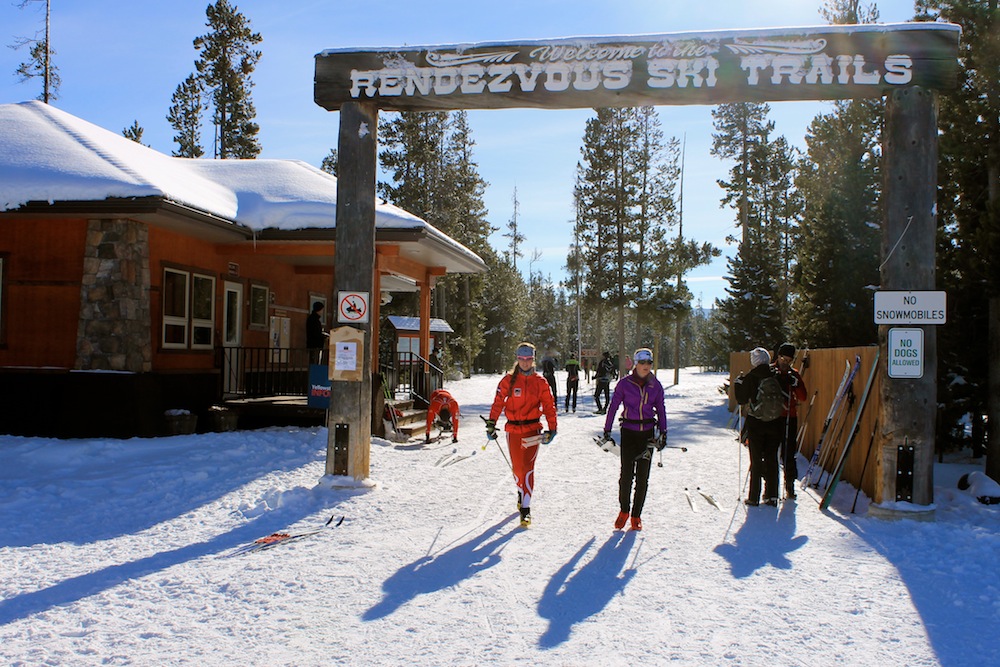
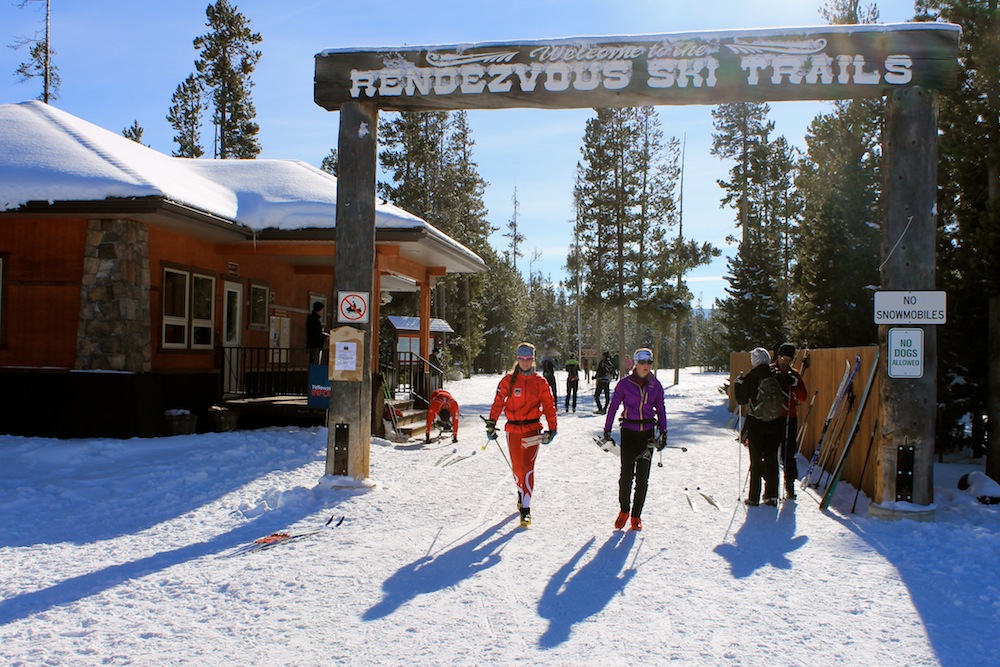
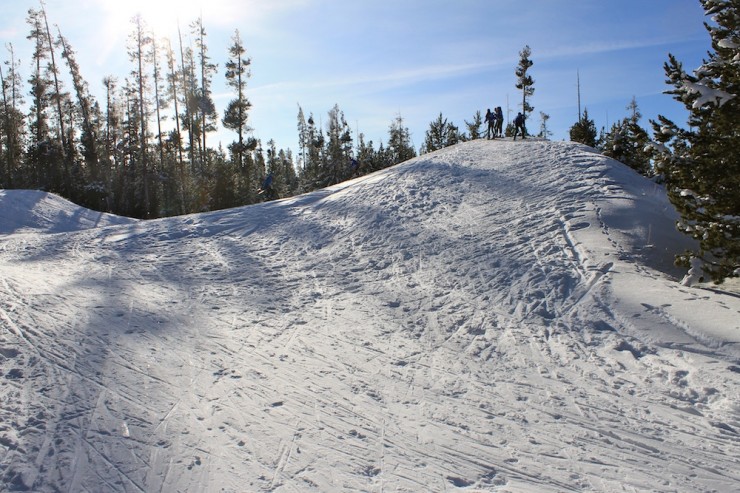
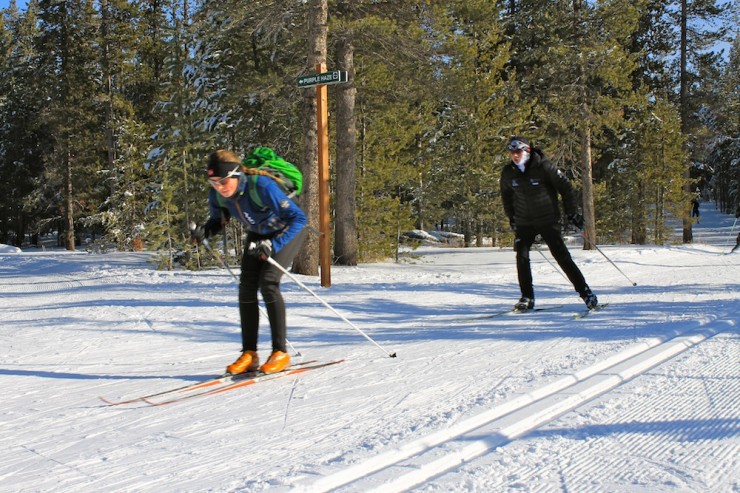
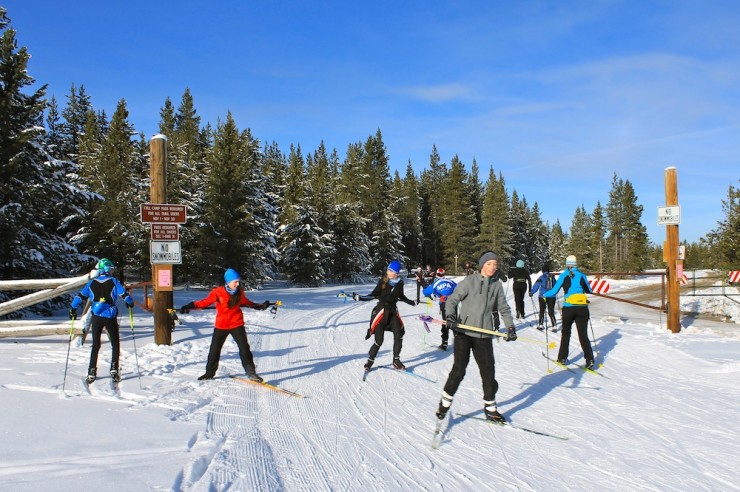
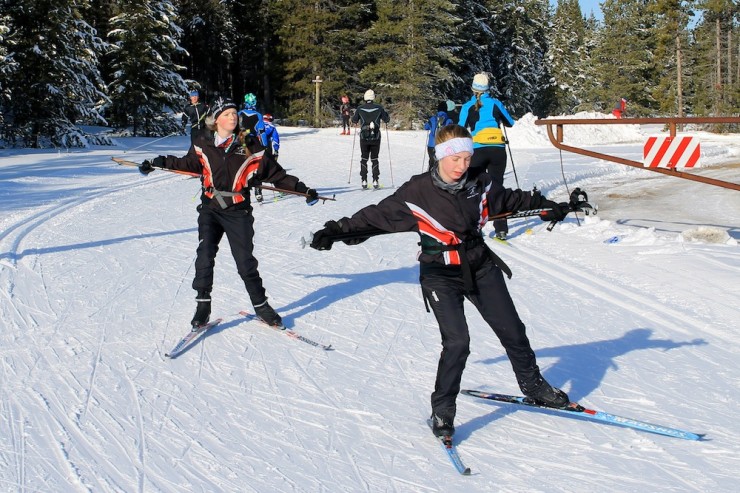
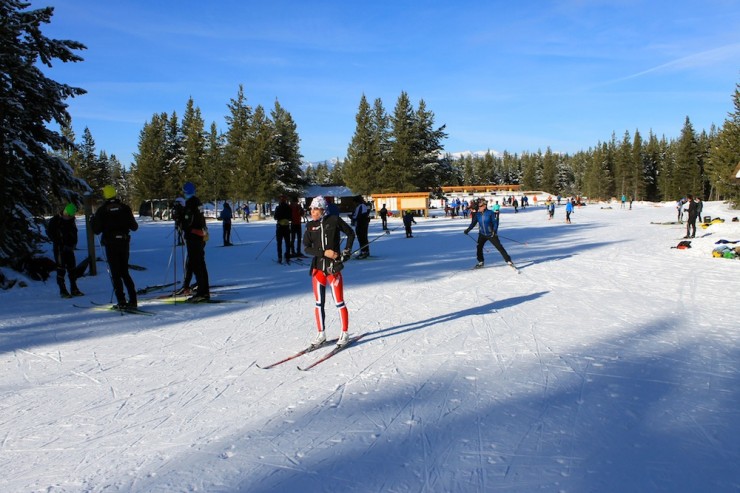
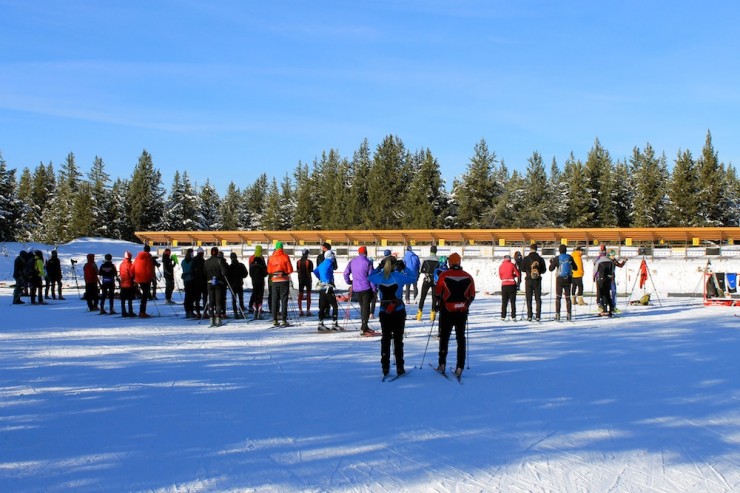
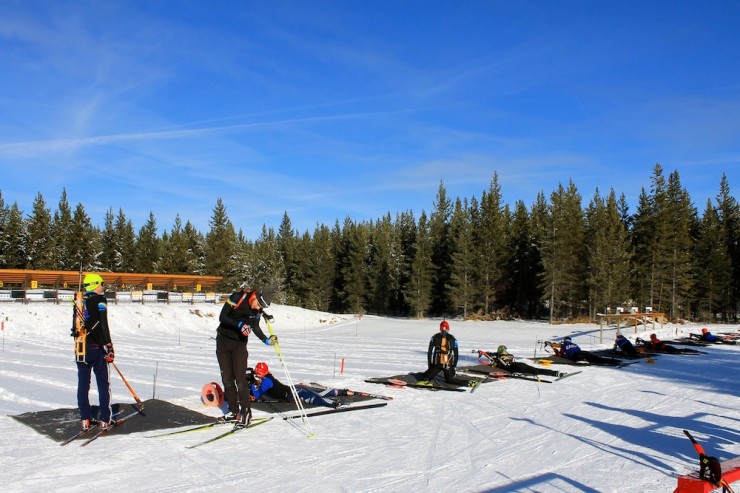
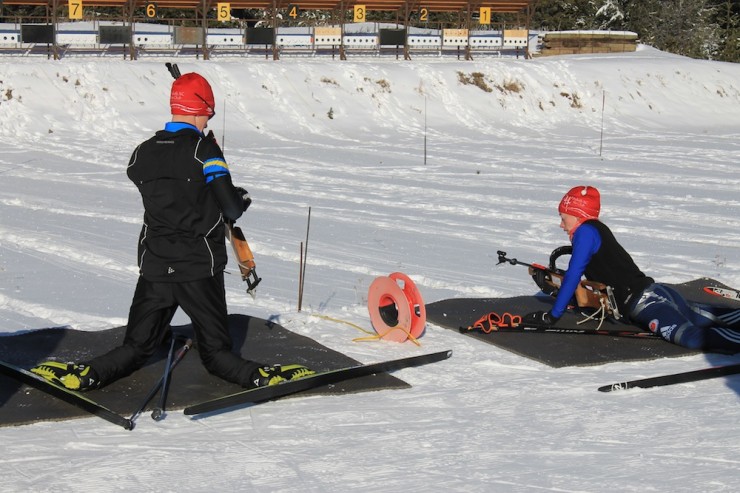
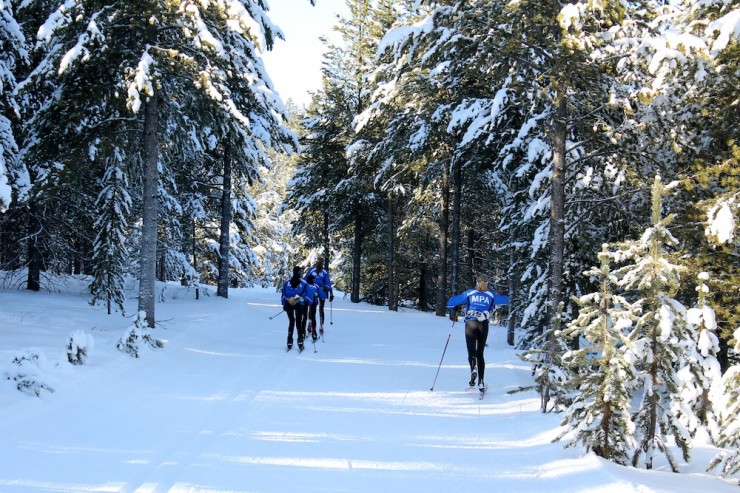
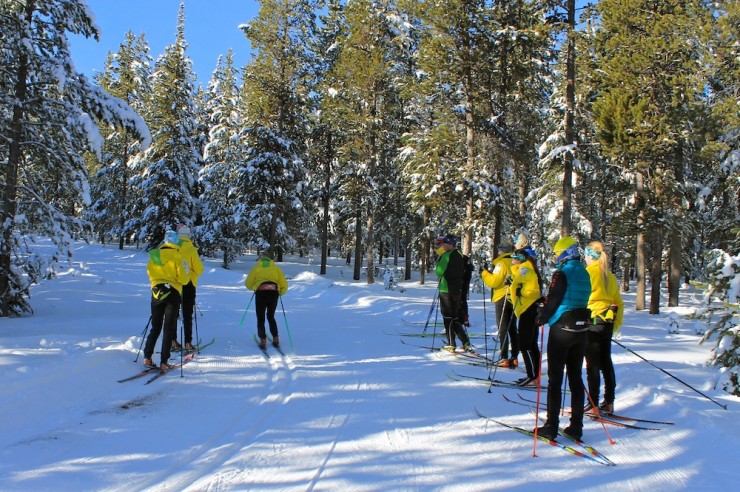
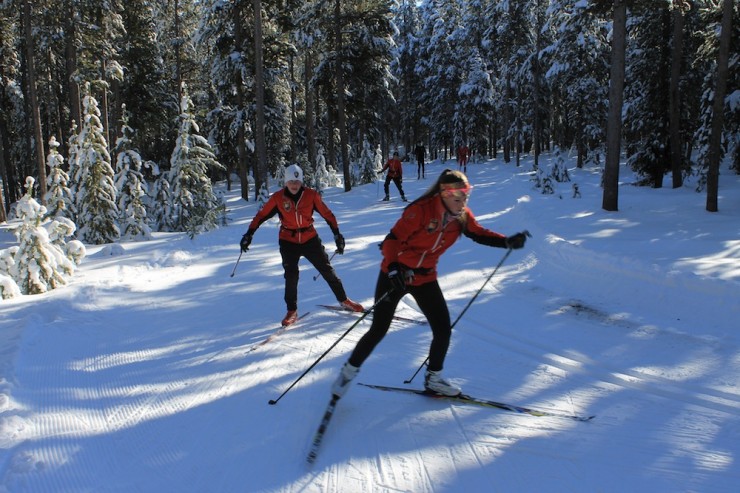
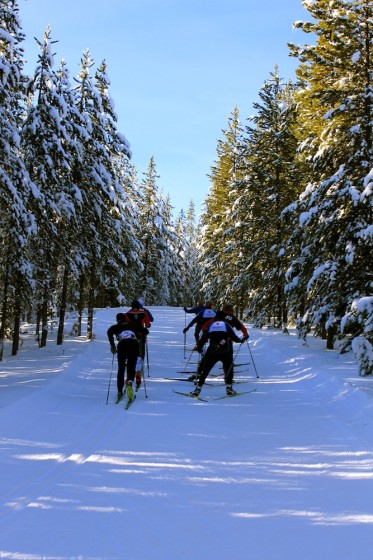
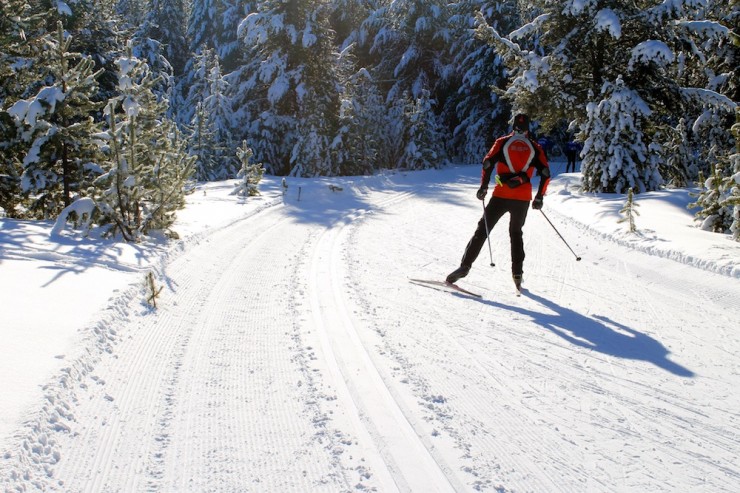
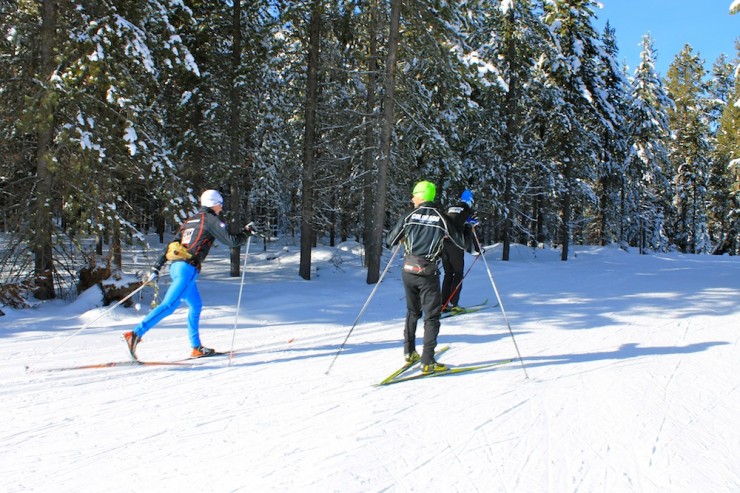
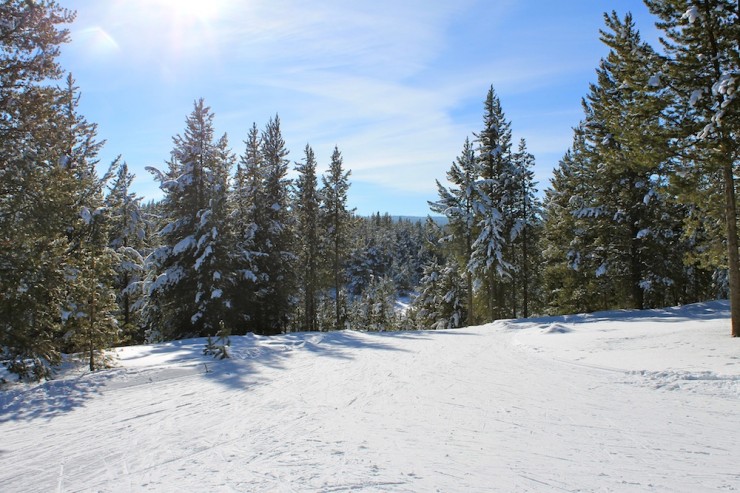
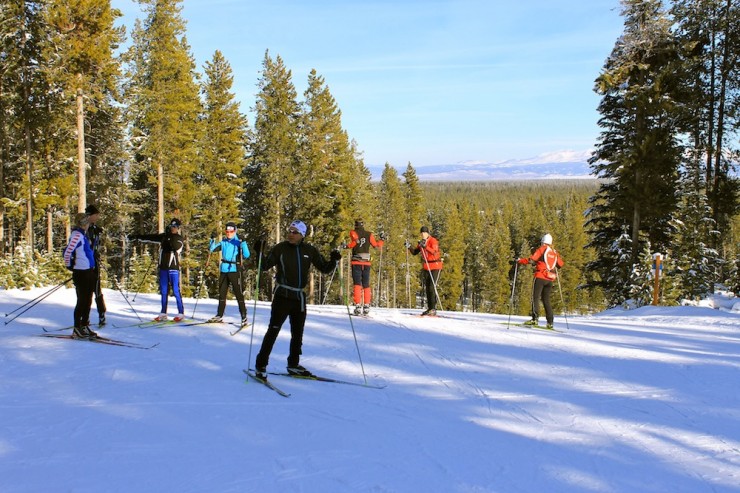
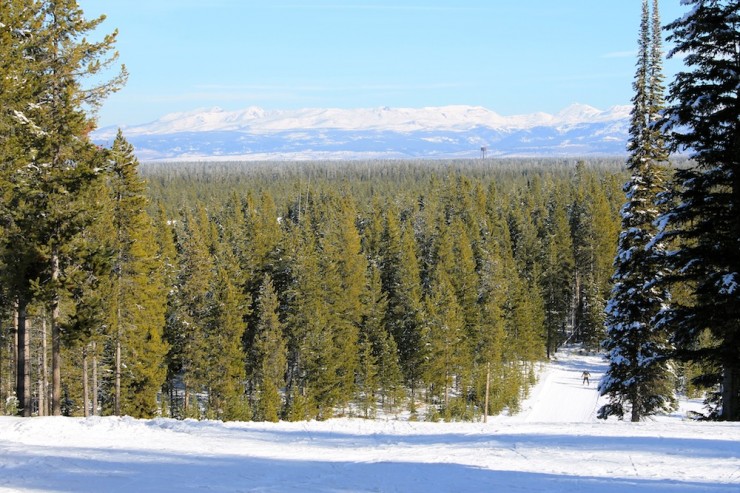
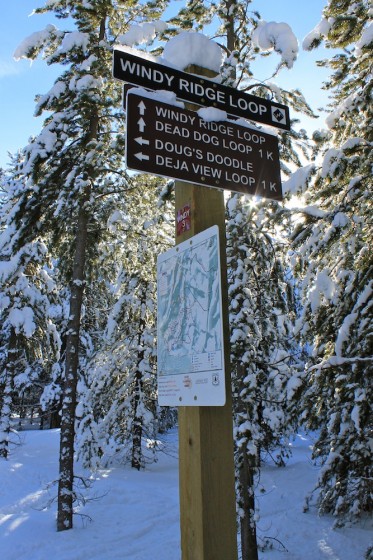
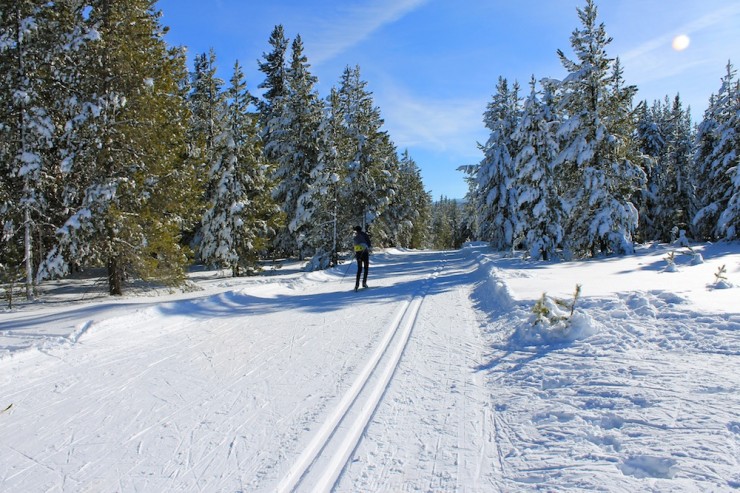
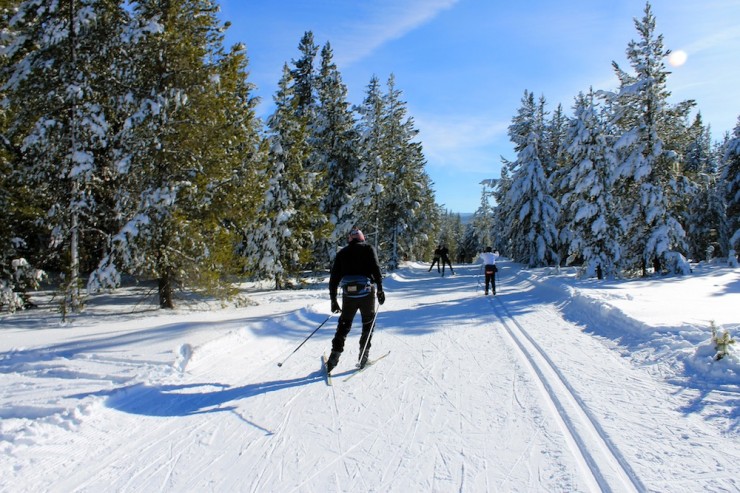
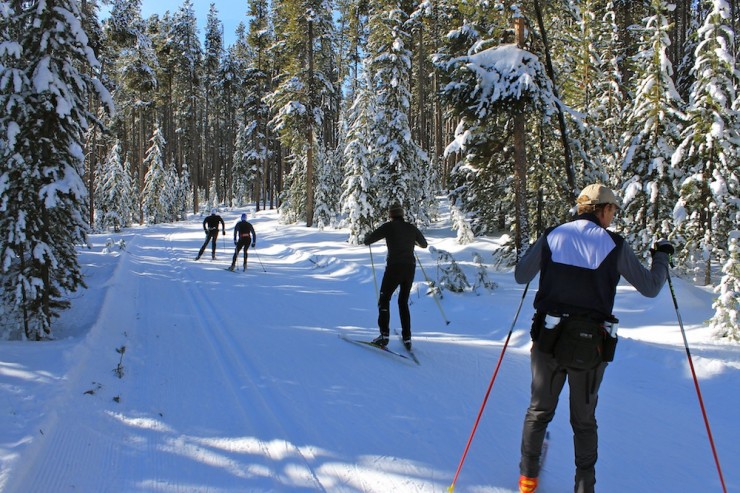
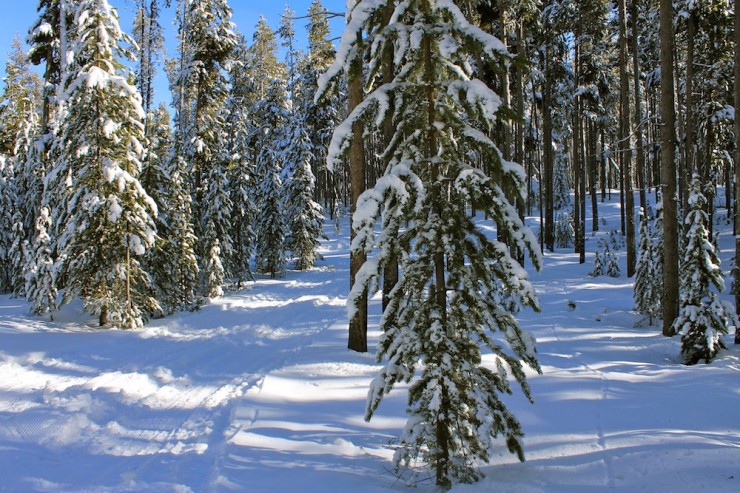
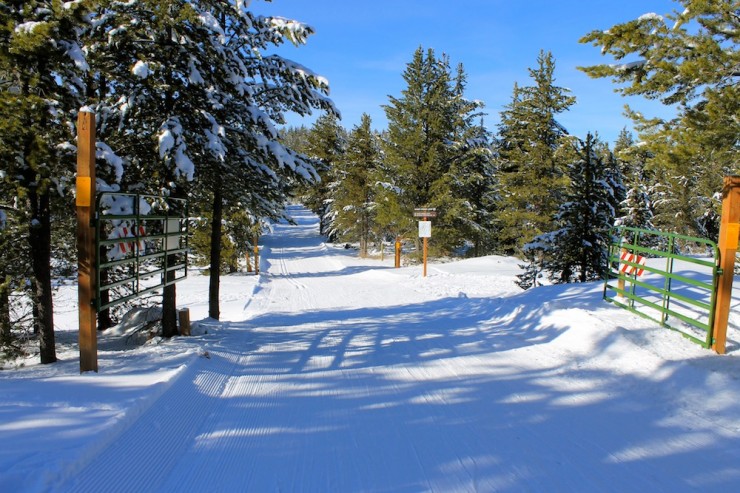
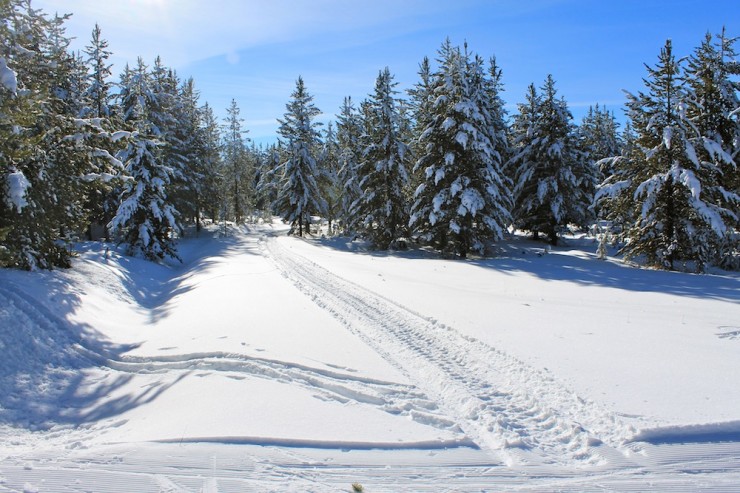
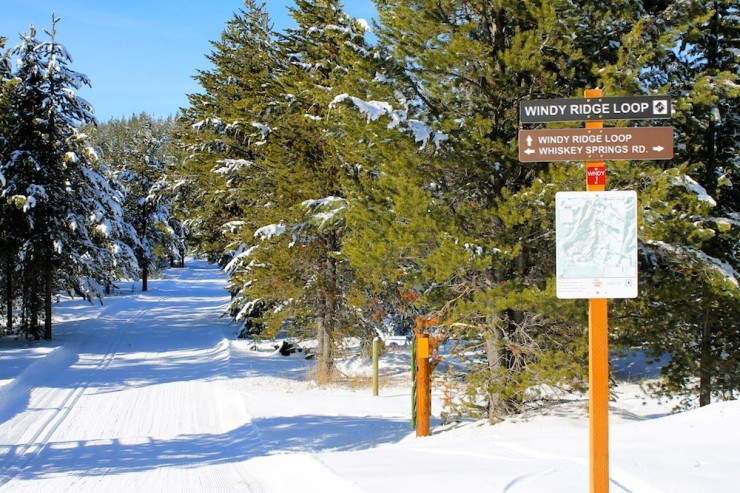
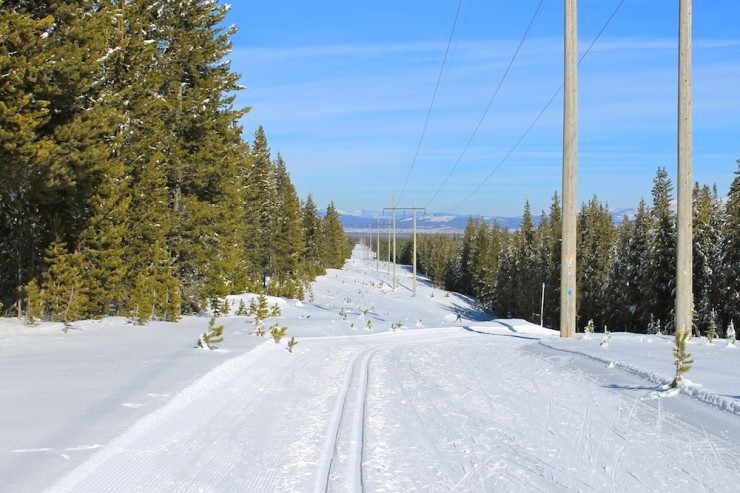
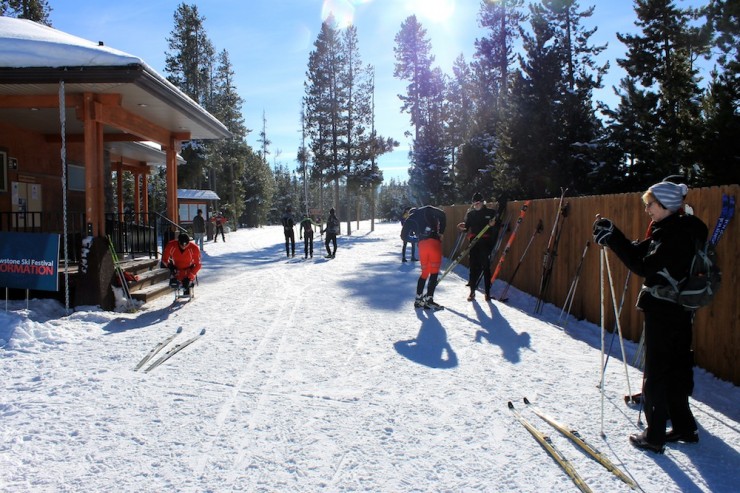
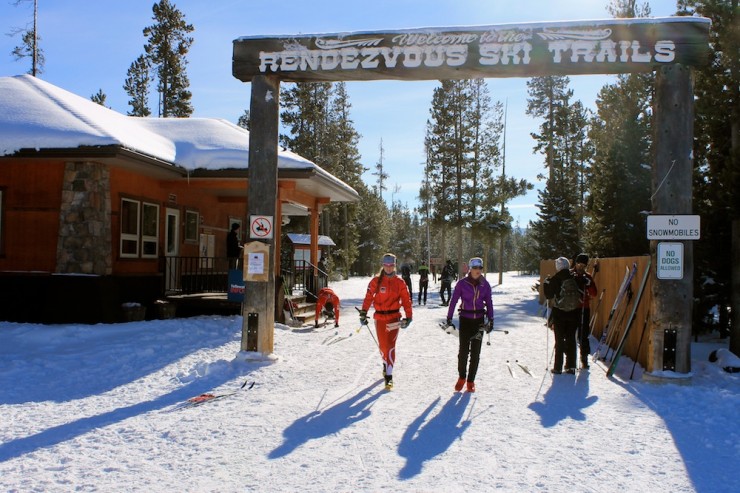
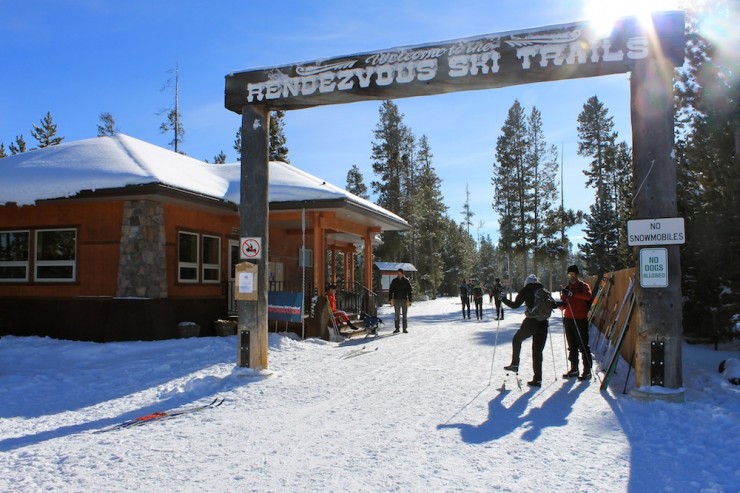
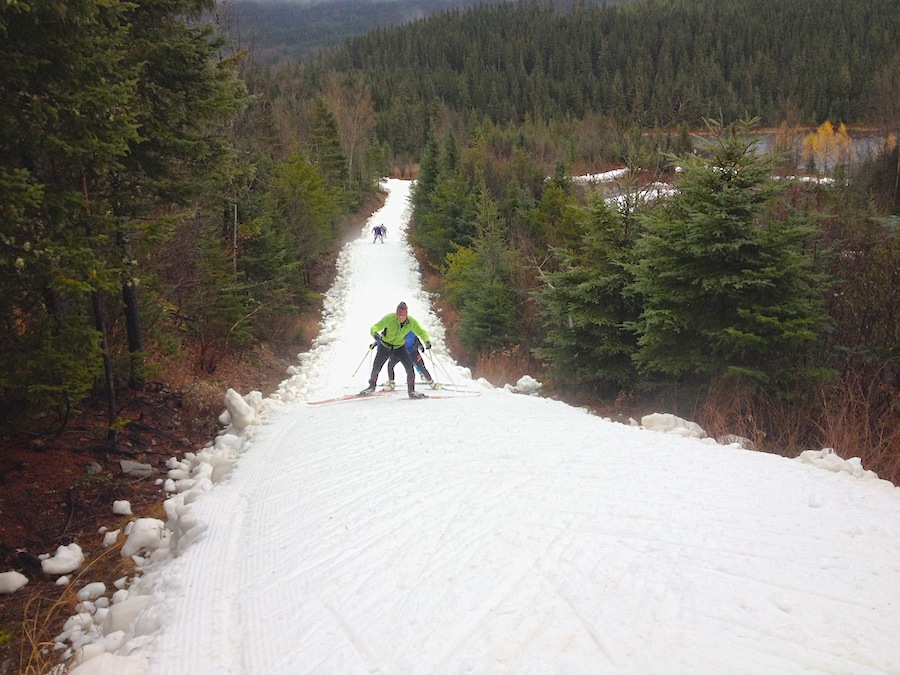
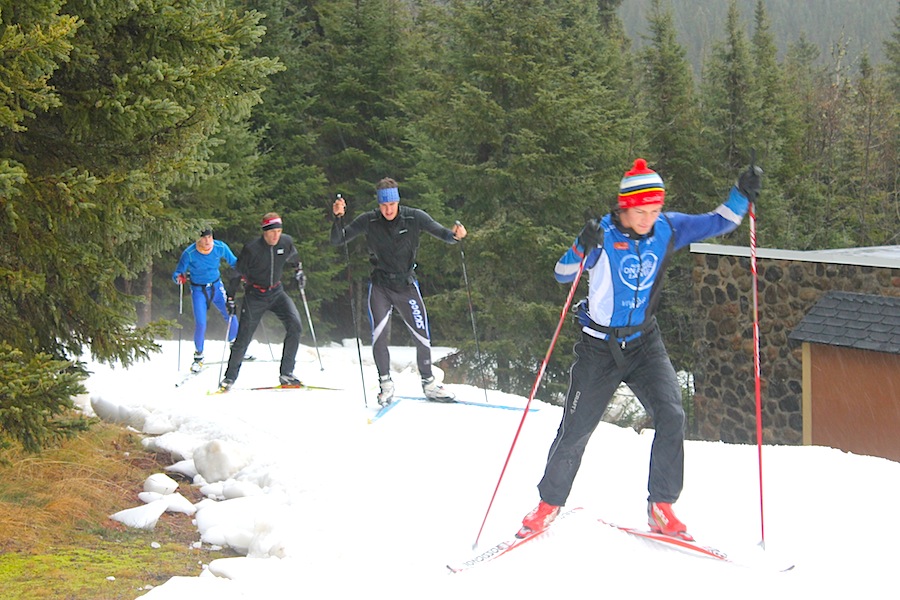
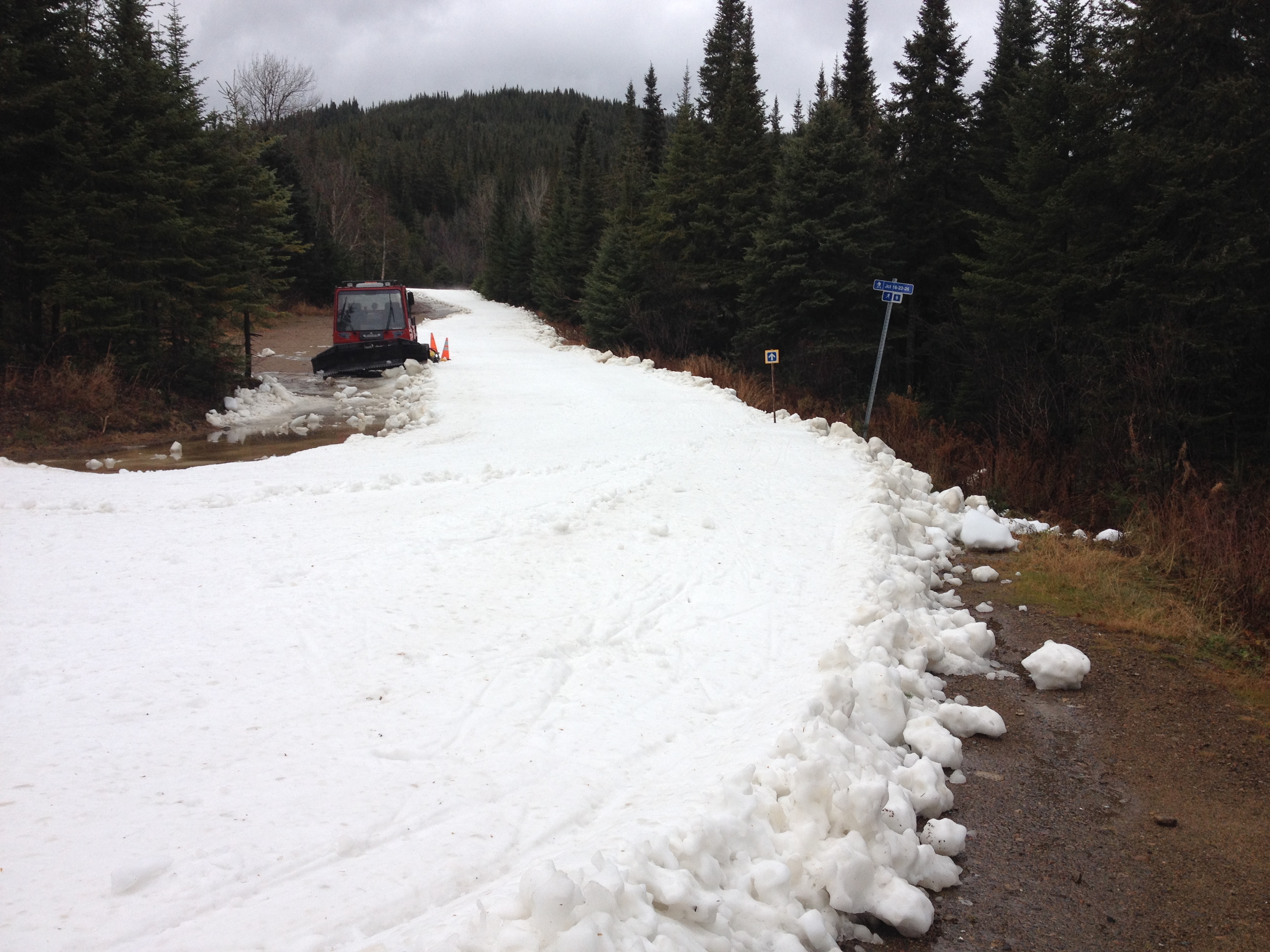
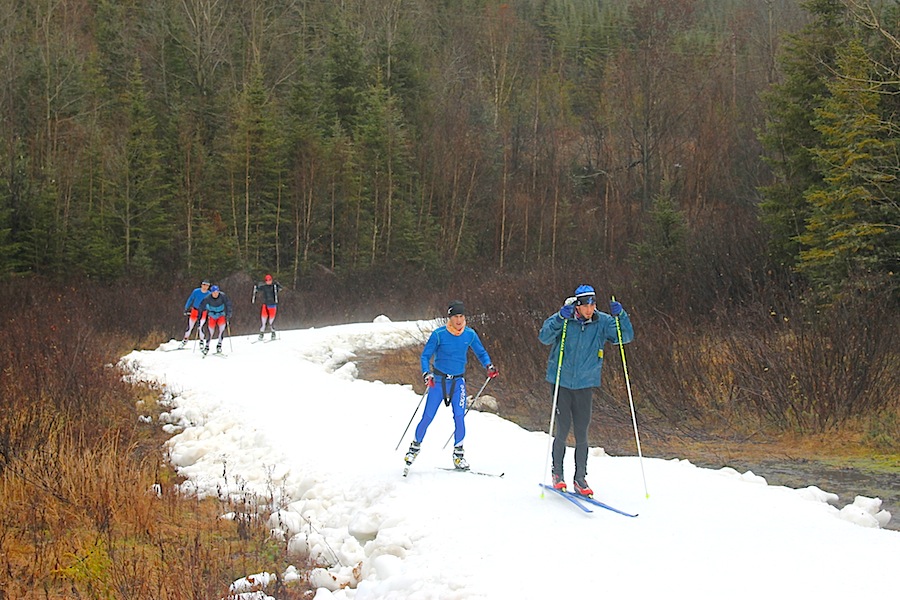
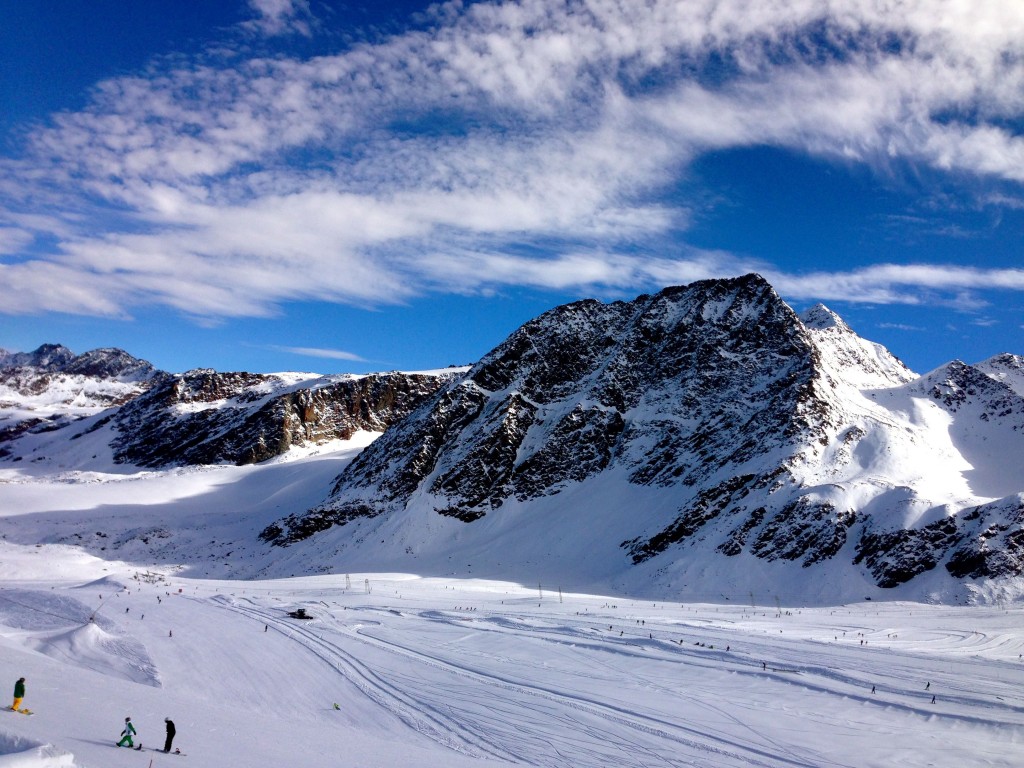
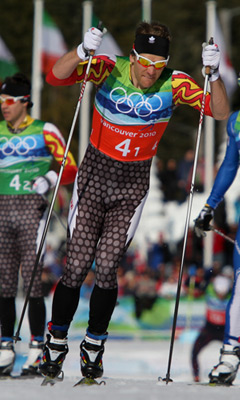
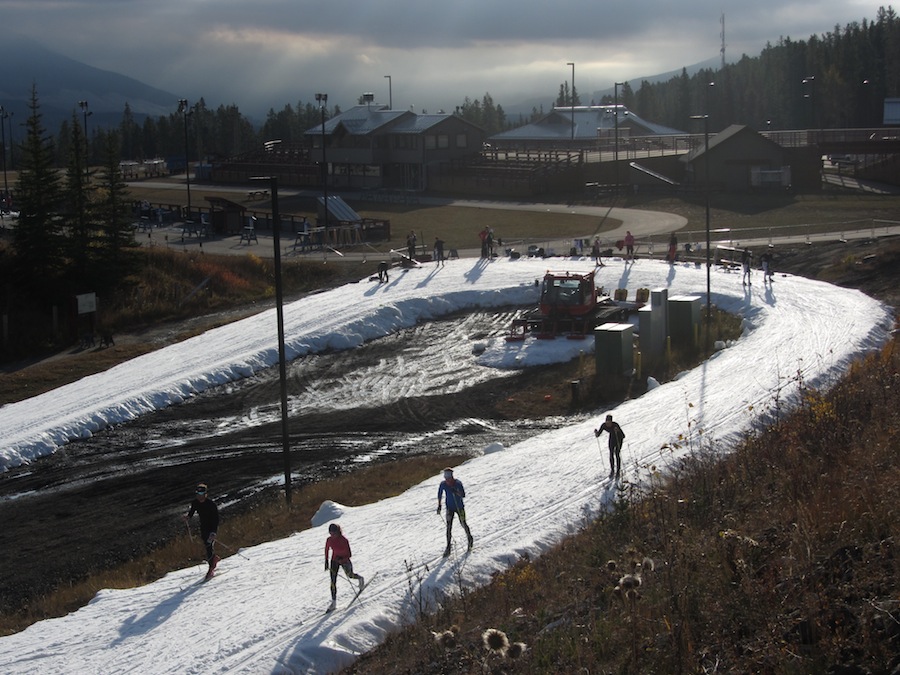
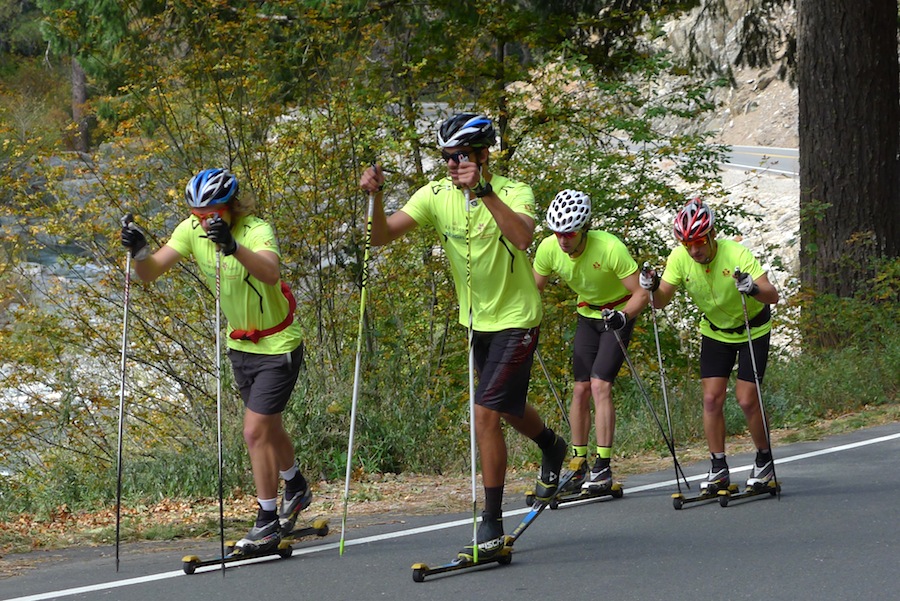
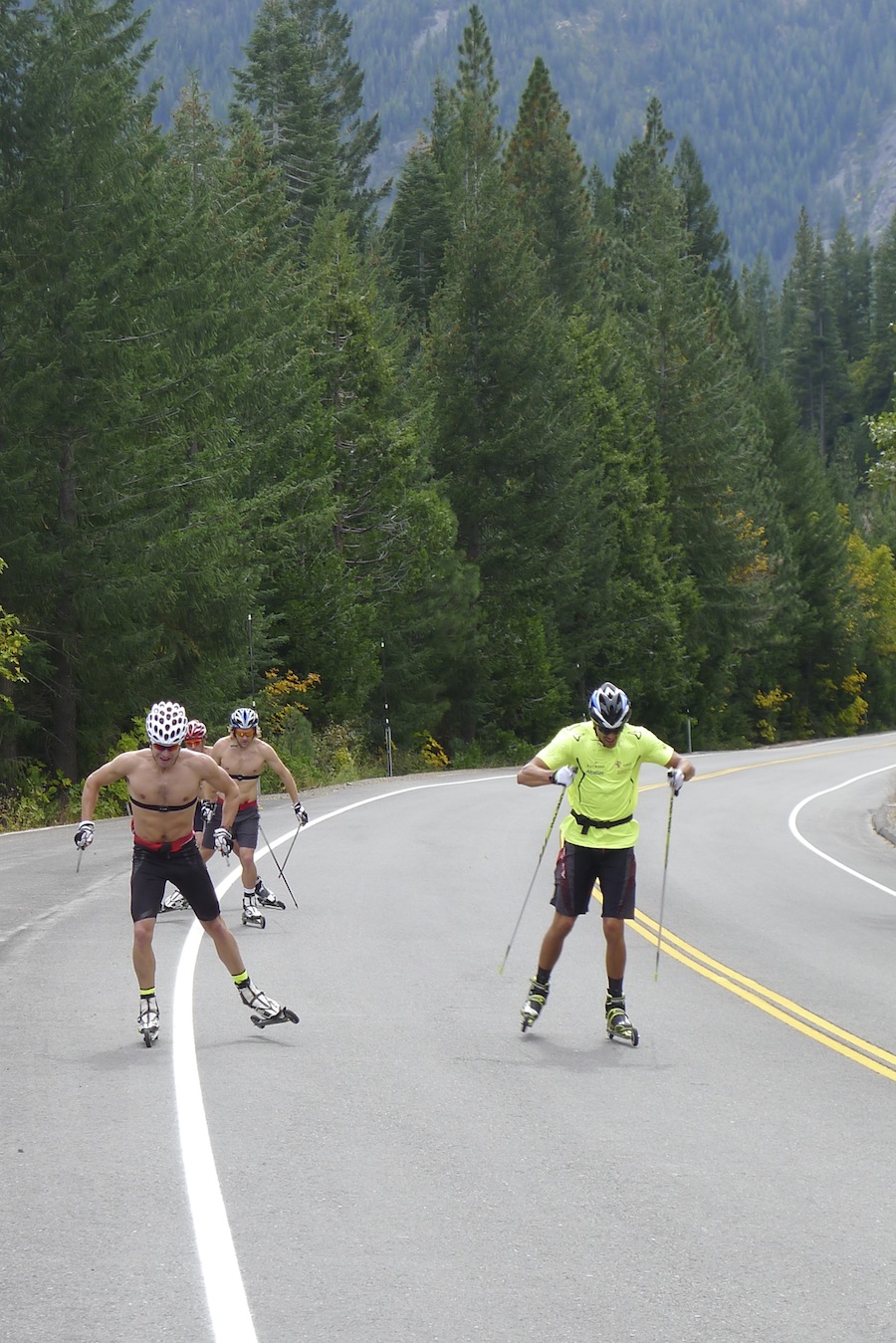
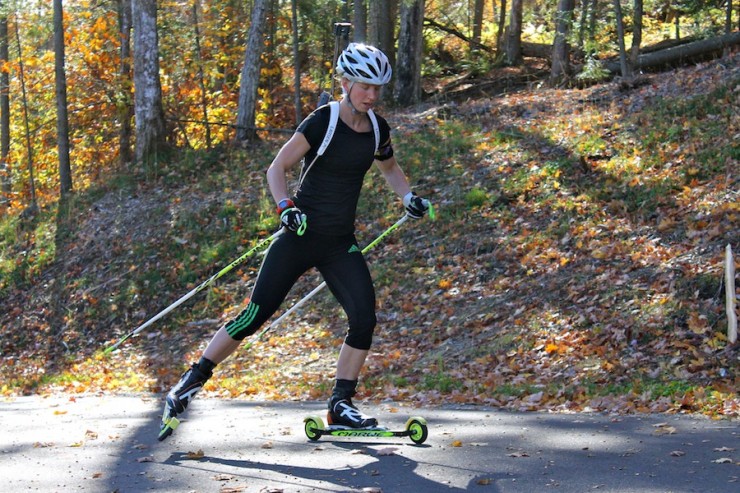
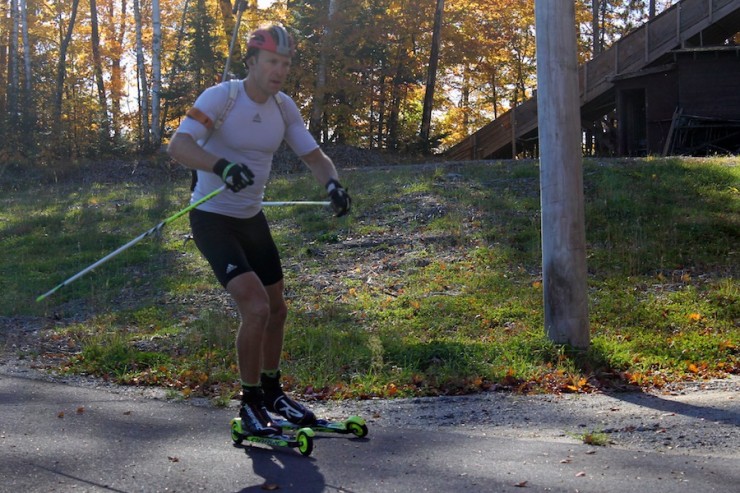
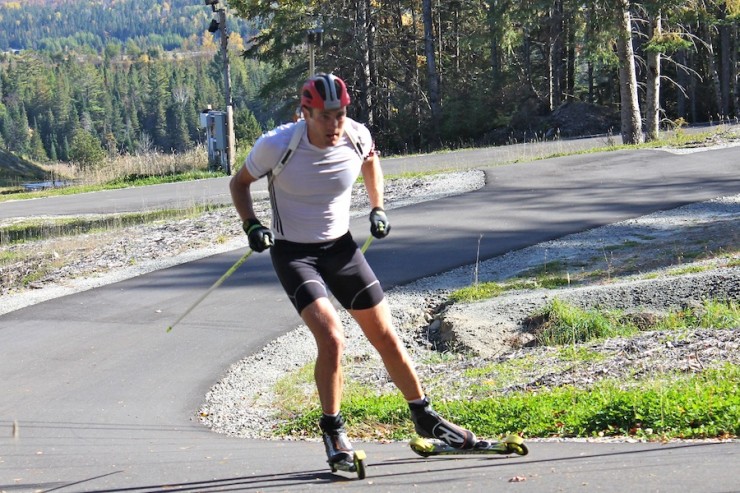
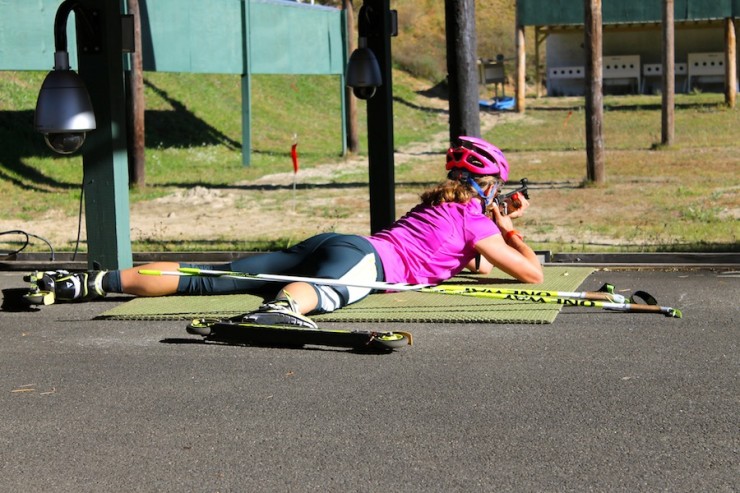
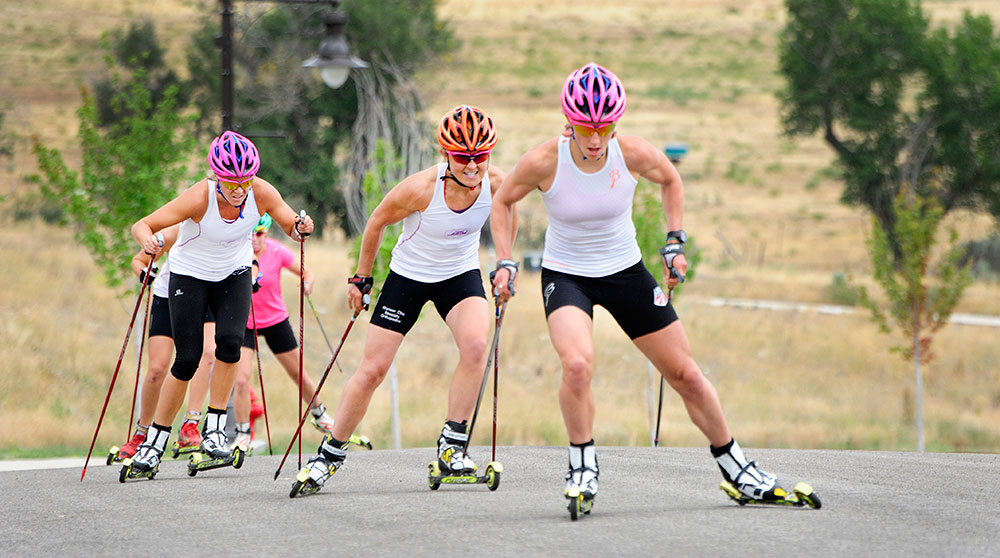
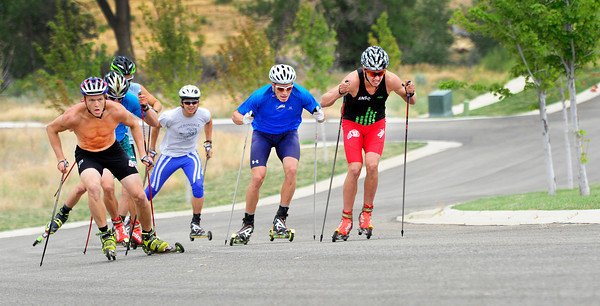
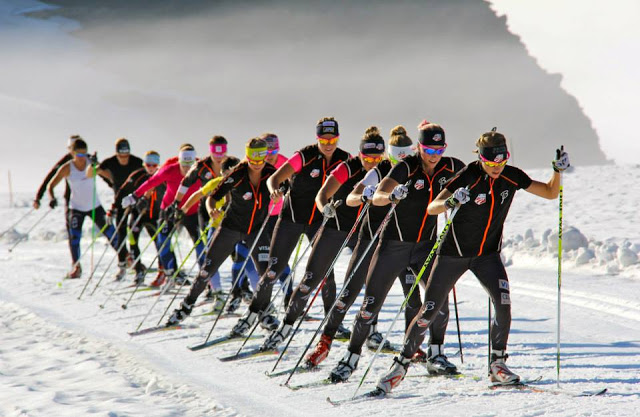
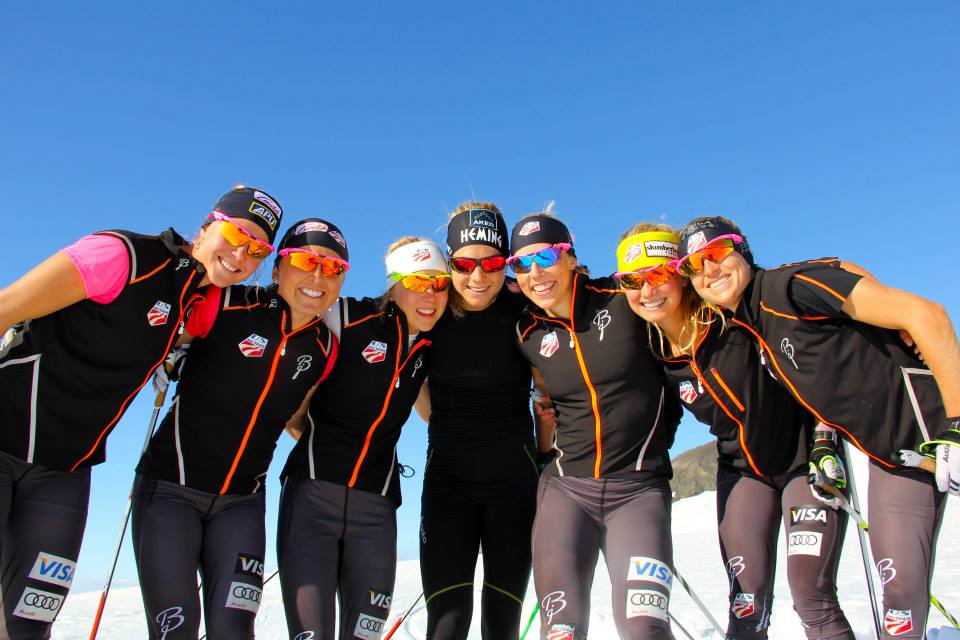
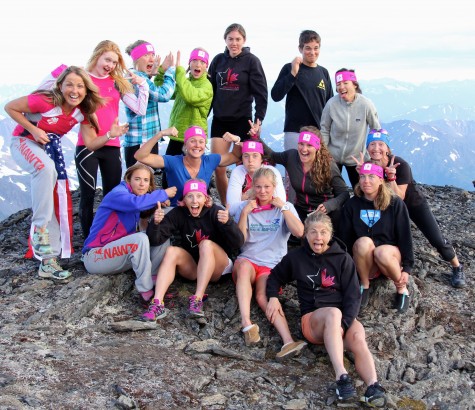
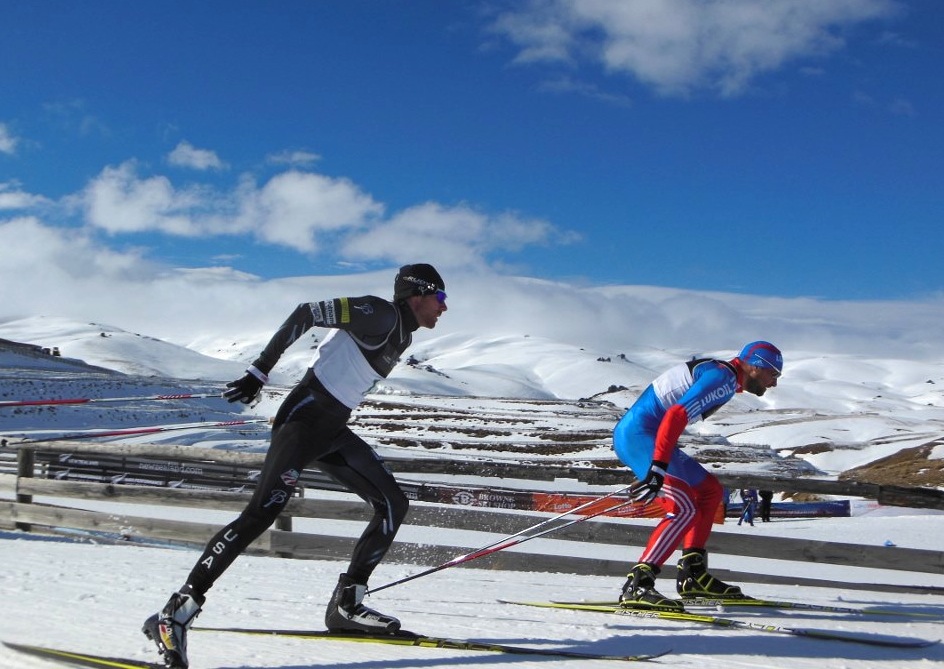
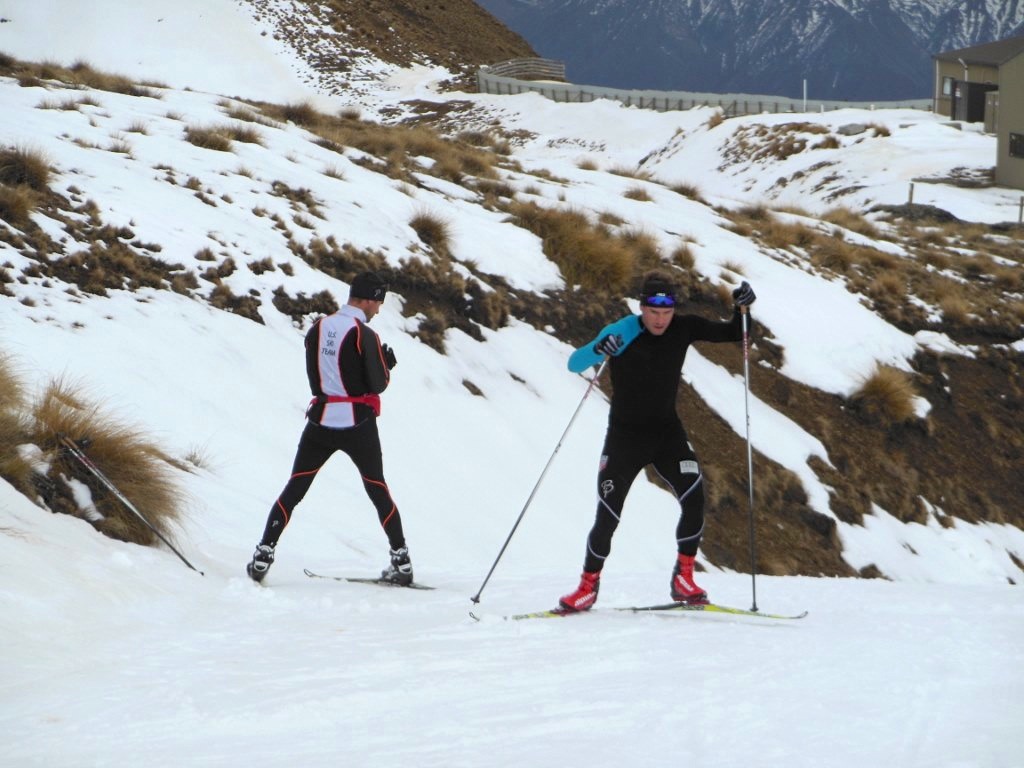
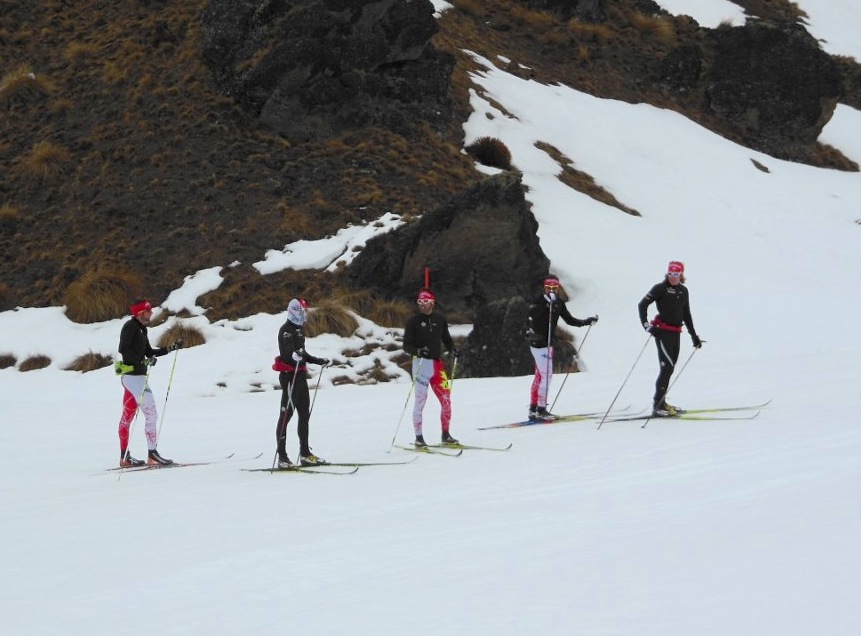
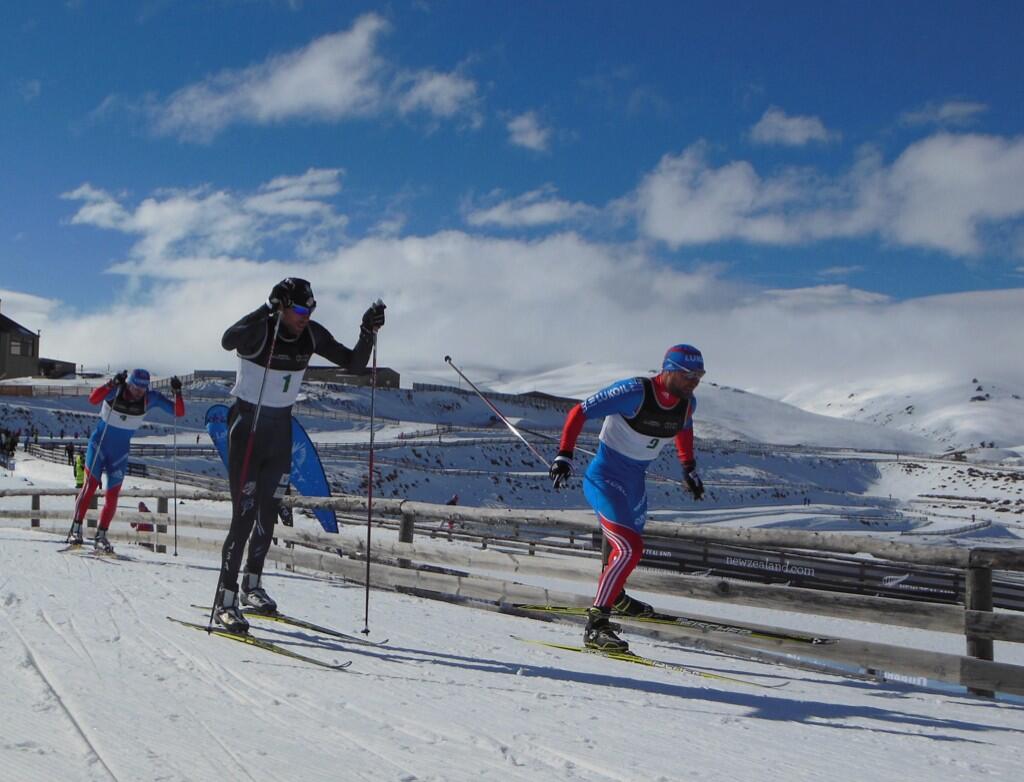
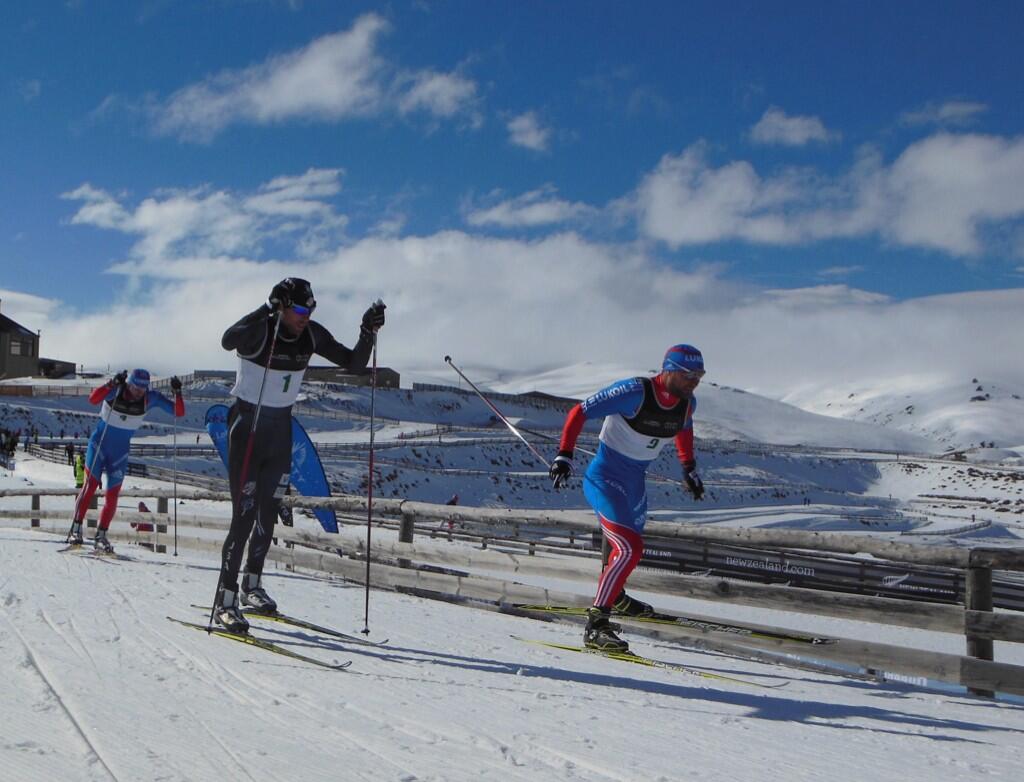
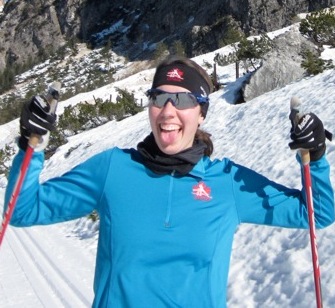
Hundreds of skiers took to the Rendezvous Ski Trails on Tuesday in West Yellowstone, Mont. With complete coverage and all the trails open, it’s a good start to the season — but the snow’s a little different.
WEST YELLOWSTONE, Mont. — The low-snow November woes of 2012 and 2008 are a distant memory for those in West Yellowstone as hundred of cross-country skiers frolicked along the Rendezvous Ski Trails on Tuesday. Several elite teams from across the U.S. have been in town for more than a week, skiing on more than 35 kilometers of trails at nearly 7,000 feet above sea level.
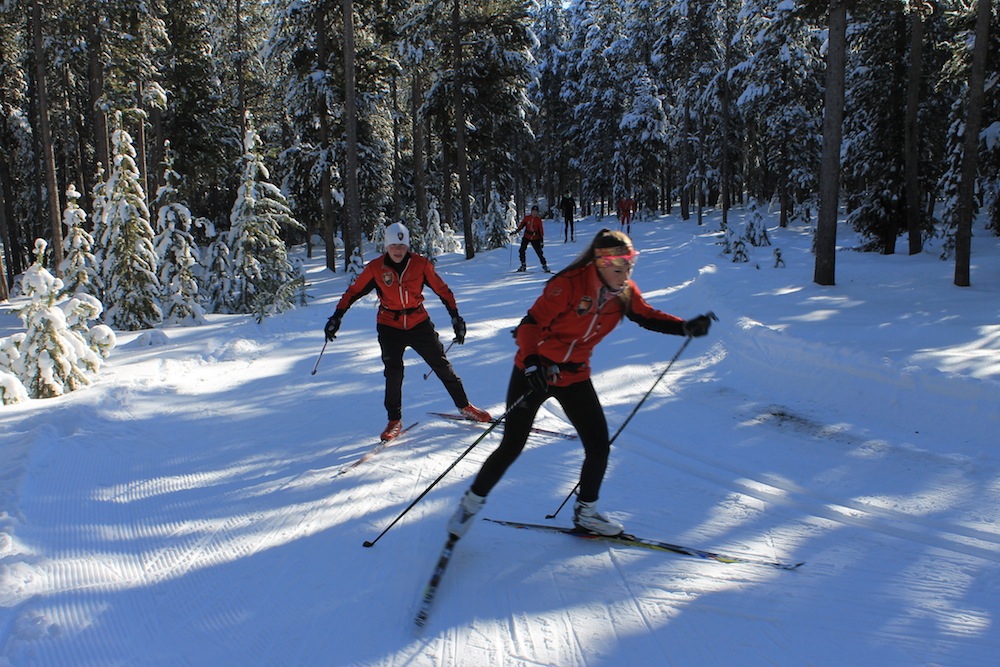
Bridger Ski Foundation juniors on the Deja View trail on Tuesday in West Yellowstone, Mont.
On his ninth day there, Bill Pierce, head coach of the Central Cross Country (CXC) Team, said the conditions are the best they’ve been in 30 years.
Other teams, like Alaska Pacific University (APU), arrived on Saturday after spending a few days north in Bozeman, Mont., and Stratton Mountain School (SMS) skiers have been in West for about a week leading up to the first SuperTour races of the season on Friday and Saturday.
Overseeing the trail-pass distribution for the weeklong Yellowstone Ski Festival, Brian Wilson said the trails have been busy. He estimated 400 to 500 skiers were on the trails Tuesday — coming and going, before and after lunch.
While West might not have as much snow as past Novembers, Wilson said it’s definitely been one of the most consistent snow years to date. A U.S. Forest Service member said there was 3 1/2 feet of snow on Black Bear Cutoff, a snowmobile trail on the South Plateau, south of the nordic trails.
Rendezvous’ chief groomer Doug Edgerton said an unusual mix of high-humidity, plus-temperature storms have made the snow especially skiable. The most recent storm took place just over a week ago with temperatures as warm as 15 degrees Celsius (59 Fahrenheit) high up on Windy Ridge. During the storm temperatures dropped significantly, around -10 degrees Celsius (14 Fahrenheit), which resulted in ice crystals — “a lot like manmade snow,” Edgerton said.
From Nov. 17-19, about 8 to 9 inches accumulated in town and 15 inches at higher parts of the trail system. West has seen about three snowstorms this fall, according to Edgerton: “The first [in early November] was too warm and the ground wasn’t frozen. The second one, the ground was starting to get there and then it got really cold, minus 12 to 14 Fahrenheit.”
About 6 inches accumulated from that second storm and temperatures remained cold, as low as -22 Fahrenheit, Edgerton said. In the last week, the town has received about 5 more inches for a 10-inch base.
“This morning it was very close to zero and that’s about as warm as its been,” he explained. “One of the great things about this place, it gets cold at night and that’s what keeps the snow.”
West has seen more snow in past years — with ski camps up on the Plateau in September — but that was a long time ago, according to Edgerton, who’s been grooming since the ’70s and keeping records since the ’80s. This year’s wetter and generally warmer temperatures are what’s different.
“It’s definitely a little odd for here,” he said. “Historically we’re cold and dry.”
But no one’s complaining. Every trail in the 35+ k system was groomed as of Tuesday, after Windy Ridge Loop opened on Monday. Edgarton drove his PistenBully up to open it earlier, but the locks to the trail’s gates were encased in ice. The Forest Service set out the next day on snowmobile and used a propane torch and shovel to melt the ice and free the gates.
Having that 6.5 k loop open is a major plus, and not always a given.
“Windy is dicy; the ground is not very smooth,” Edgerton said. Usually, he needs two feet of good snow to groom the ridge — or 15 to 16 inches of very high-density snow, like the last storm brought.
“Getting Windy [open] during camp is like a 25-percent chance,” he added.
If you’re a skier in West Yellowstone, consider yourself lucky.
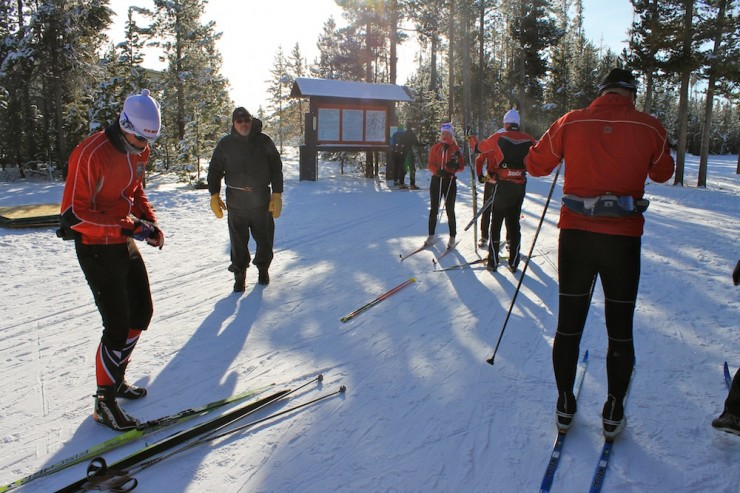
The Rendezvous trailhead master and Yellowstone Historic Center employee, Thor Godar (second from l), greets several skiers Tuesday morning with temperatures in the low teens. It was in the mid-30s by early afternoon.
Hundreds of skiers took to the Rendezvous Ski Trails on Tuesday in West Yellowstone, Mont.
Hundreds of skiers took to the Rendezvous Ski Trails on Tuesday in West Yellowstone, Mont.
Hundreds of skiers took to the Rendezvous Ski Trails on Tuesday in West Yellowstone, Mont.
Hundreds of skiers took to the Rendezvous Ski Trails on Tuesday in West Yellowstone, Mont.
Hundreds of skiers took to the Rendezvous Ski Trails on Tuesday in West Yellowstone, Mont.
Hundreds of skiers took to the Rendezvous Ski Trails on Tuesday in West Yellowstone, Mont.
Hundreds of skiers took to the Rendezvous Ski Trails on Tuesday in West Yellowstone, Mont.
Hundreds of skiers took to the Rendezvous Ski Trails on Tuesday in West Yellowstone, Mont.
Hundreds of skiers took to the Rendezvous Ski Trails on Tuesday in West Yellowstone, Mont.
Hundreds of skiers took to the Rendezvous Ski Trails on Tuesday in West Yellowstone, Mont.
Hundreds of skiers took to the Rendezvous Ski Trails on Tuesday in West Yellowstone, Mont.
Hundreds of skiers took to the Rendezvous Ski Trails on Tuesday in West Yellowstone, Mont.
Hundreds of skiers took to the Rendezvous Ski Trails on Tuesday in West Yellowstone, Mont.
Hundreds of skiers took to the Rendezvous Ski Trails on Tuesday in West Yellowstone, Mont.
Hundreds of skiers took to the Rendezvous Ski Trails on Tuesday in West Yellowstone, Mont.
Hundreds of skiers took to the Rendezvous Ski Trails on Tuesday in West Yellowstone, Mont.
Hundreds of skiers took to the Rendezvous Ski Trails on Tuesday in West Yellowstone, Mont.
Hundreds of skiers took to the Rendezvous Ski Trails on Tuesday in West Yellowstone, Mont.
Hundreds of skiers took to the Rendezvous Ski Trails on Tuesday in West Yellowstone, Mont.
Hundreds of skiers took to the Rendezvous Ski Trails on Tuesday in West Yellowstone, Mont.
Hundreds of skiers took to the Rendezvous Ski Trails on Tuesday in West Yellowstone, Mont.
Hundreds of skiers took to the Rendezvous Ski Trails on Tuesday in West Yellowstone, Mont.
Hundreds of skiers took to the Rendezvous Ski Trails on Tuesday in West Yellowstone, Mont.
Hundreds of skiers took to the Rendezvous Ski Trails on Tuesday in West Yellowstone, Mont.
Hundreds of skiers took to the Rendezvous Ski Trails on Tuesday in West Yellowstone, Mont.
Hundreds of skiers took to the Rendezvous Ski Trails on Tuesday in West Yellowstone, Mont.
Hundreds of skiers took to the Rendezvous Ski Trails on Tuesday in West Yellowstone, Mont.
Hundreds of skiers took to the Rendezvous Ski Trails on Tuesday in West Yellowstone, Mont.
Hundreds of skiers took to the Rendezvous Ski Trails on Tuesday in West Yellowstone, Mont.
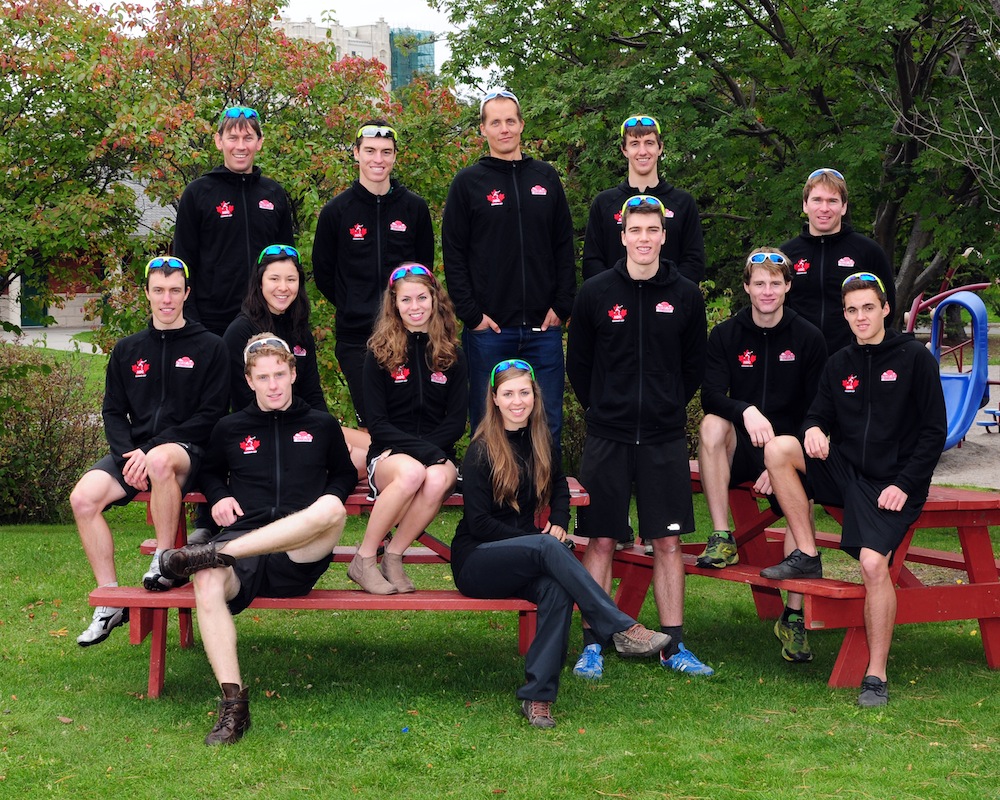
The 2013/2014 NDC Thunder Bay squad. Front Row (left to right): Andy Shields, Jack Carlyle, Jenn Jackson, Alannah MacLean, Erin Tribe, Nick Monette, Bob Thompson, Evan Palmer-Charrette. Back Row (l-r) executive director Eric Bailey, Scott Hill, head coach Timo Puiras, Ben Wilkinson-Zan, and assistant coach Victor Wiltmann. (Photo: NDC Thunder Bay)
Note: This is the third of four previews providing an inside look at Canada’s national training centres this season. We asked coaches to tell us what’s new, whom to look out for and the outlook on the winter ahead. Teams are presented in no particular order.
Team: National Development Centre Thunder Bay (NDC)
Coaches: Timo Puiras (head coach), Victor Wiltmann (assistant coach)
Other staff: Eric Bailey (executive director), Camille Cheskey (wax technician), Paul Hemsworth (strength and conditioning coach)
Seniors: Andy Shields, Jack Carlyle, Nick Monette, Bob Thompson, Erin Tribe, Alannah Maclean; Juniors: Scott Hill, Evan Palmer-Charrette, Ben Wilkinson-Zan, Jenn Jackson
Who’s new: Jackson (from Team Hardwood in Ontario) and Wilkinson-Zan (from Nakkertok in Ontario).
Who’s missing: Andrea Lee (studying in New Mexico); Dudley Coulter (now an athlete development coordinator for Cross Country B.C. in Vernon); Jimmy Gunka (at Lakehead University in Thunder Bay, Ont.); Jordan Cascagnette (at Nipissing University in North Bay, Ont.); Julian Freitag (studying at a university in southern Ontario).
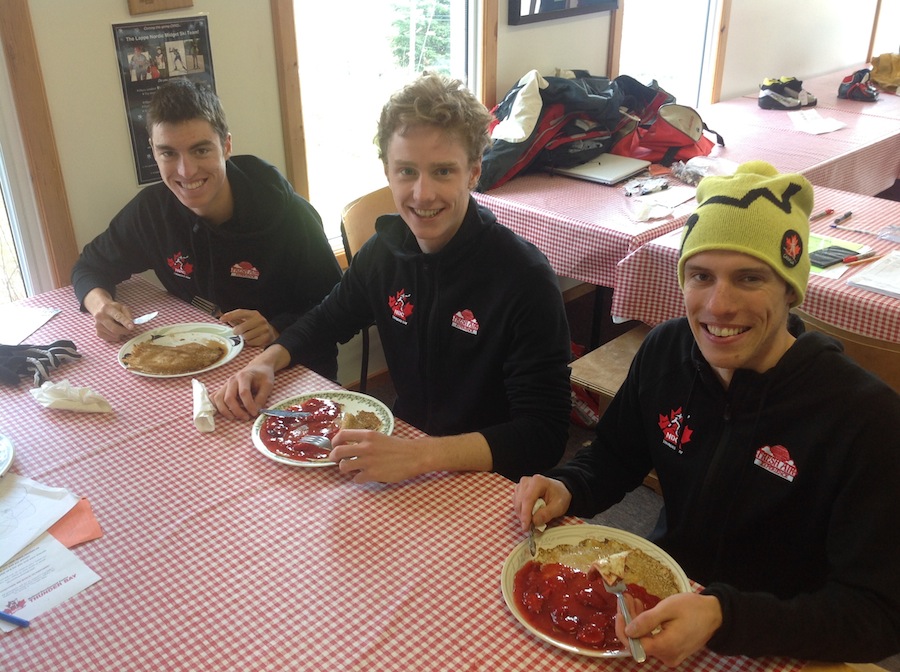
NDC Thunder Bay skiers Jack Carlyle, Scott Hill and Andy Shields (not in order) enjoy the fruits of their efforts after become three of seven men to break the 1:20 time-trial threshold on Oct. 18. (Photo: Timo Puiras)
Top results last season: Last December, Shields and Tribe both qualified for the Quebec and Canmore World Cups, with Shields notching 41st in the Quebec skate sprint and Tribe placing just outside the individual top 50 in Quebec in 57th.
In January, Shields, Hill and former NDC skier Lee all made it to Liberec, Czech Republic, for the Junior and U23 World Championships. Back home, Hill, Carlyle, and MacLean each reached the NorAm podium as juniors.
Coach’s comments:
Of six seniors, five are still in the U23 bracket (excluding 24-year-old Tribe), and the team has a new head coach in Timo Puiras.
“It is a great group of athletes to work with,” Puiras wrote in an email last month. “Everyone is motivated and improving.
In late July, the team traveled to Austria for three weeks of on-snow training on the Dachstein glacier. “Half of our athletes had never been to Europe before so this was not only a great training camp but also a great learning experience,” Puiras explained. “All of our athletes have their main racing goal involve making it to Europe this winter.”
They spent the bulk of their training season in and around Thunder Bay, with smaller groups of athletes attending Ontario provincial camps. Before heading to Canmore, Alberta, for two weeks of skiing earlier this month, three NDC skiers (Shields, Carlyle and Scott) completed a time trial in record time and joined four others to slip under the Pancake Run’s 1:20-mark since 1979.
Recent in-team testing has also indicated all-around improvement, and Puiras is excited about what his athletes could accomplish this season.
“We want to qualify as many athletes as possible for World Junior/U23 Championships,” Puiras wrote. “As a program we’ve started working more closely with a Strength and Conditioning coach and I’d like this relationship to continue to grow here in Thunder Bay.”
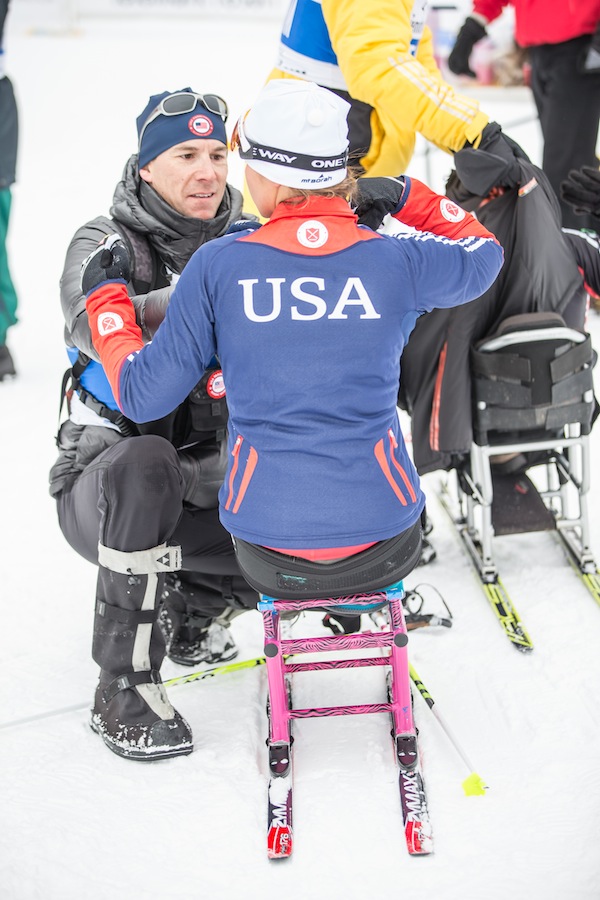
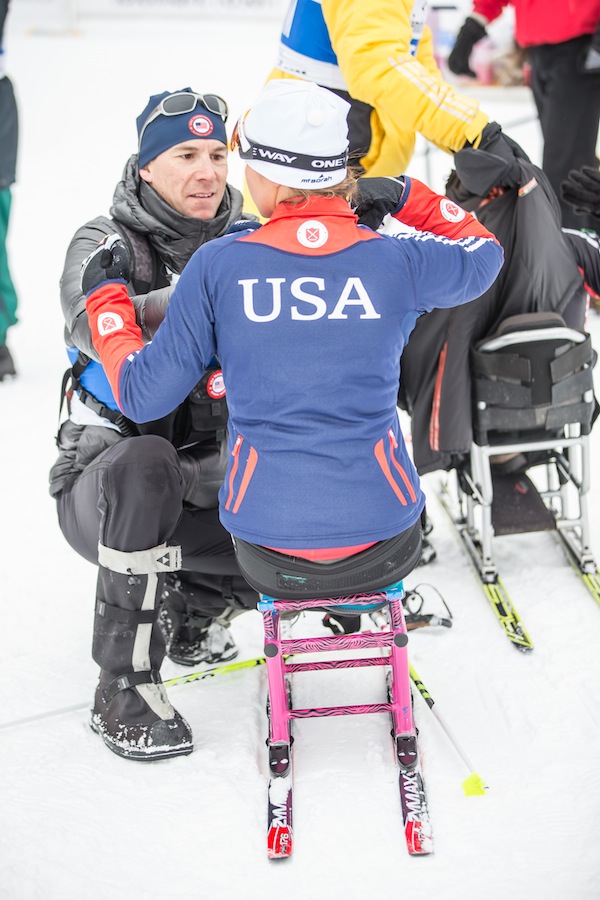
John Farra, high-performance director of the U.S. Paralympics Nordic Program, helps one of his athletes at last year’s IPC World Cup in Cable, Wis. (Photo: U.S. Paralympics/James Netz)
At the 2010 Winter Paralympic Games in Vancouver, B.C., the U.S. finished fifth in the overall medal count. A dominant performance by the U.S. alpine team resulted 11 medals, three of them gold.
Meanwhile, the U.S. Olympic nordic team, including biathlon, consisted of just six athletes and a handful of coaches and support staff. Albeit small, the team was not without success. Andy Soule, an Afghanistan war veteran and double above-the-knee amputee, made history by becoming the first American to medal in biathlon in either Paralympic or Olympic competition.
At the 2014 Paralympics in Sochi, Russia, nordic skiing and biathlon will account more that half of the available medals. To improve overall team results, the U.S. Olympic Committee realized that the U.S. needed more focus on these sports.
In 2011, John Farra, an Olympic cross-country skier and then-U.S. Ski and Snowboard Association (USSA) nordic director, was the man selected as the first high-performance director of the U.S. Paralympics Nordic Program. Today, he leads a team of coaches and staff responsible for building a world-class program.
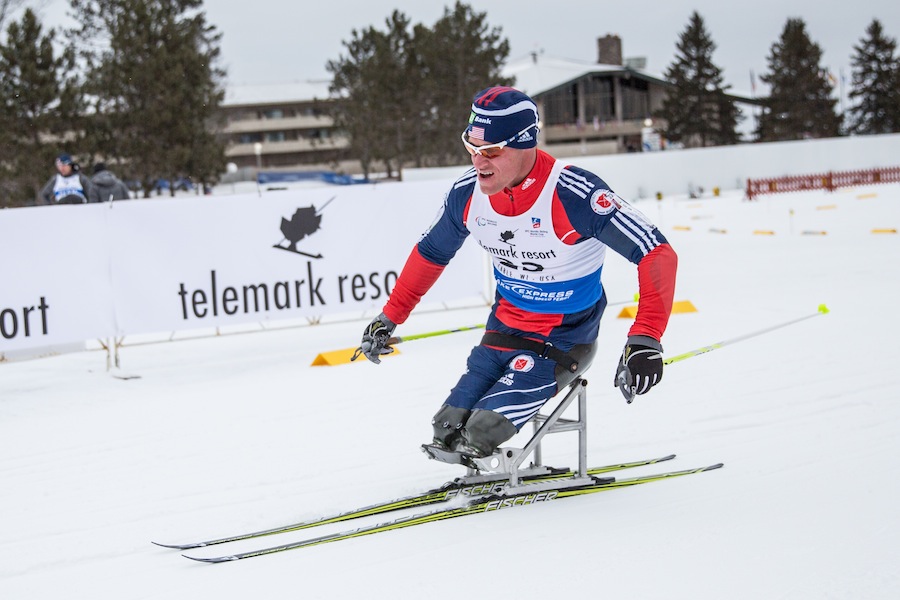
U.S. Paralympics national-team member Dan Cnossen at the 2013 IPC World Cup in Cable, Wis. (Photo: U.S Paralympics/James Netz)
In a recent phone interview, Farra cited growth in the sport as evidence that the U.S. is on its way to that goal. At the Sochi Paralympics in March, Farra will field a team of 19 athletes, four coaches and 13 support staff. The Russians will max out at the allotted team size of 30 athletes, a goal that Farra has set for his team size for 2018 Winter Games in Pyeongchang, South Korea.
Assessing the team’s prospects for Sochi, Farra said, “On the men’s side, we have three guys who, on any given day, can be somewhere in the top six in the world.”
In a test event in Sochi last March, Dan Cnossen, Soule and Sean Halsted finished fourth, fifth and sixth, respectively. One of the newest and most promising men on the national team, Farra described Cnossen as “a really tough guy who trains unbelievably professionally and really puts everything towards it.”
“While we are not expected to win any medals, when we are that close we are spending a lot of time and effort to find that extra half percent or 1 percent,” Farra said. “That gets them into the top three to steal a medal from the Russians or the Ukrainians.”
On the women’s side, Farra saw potential when he spoke with Tatyana McFadden a year and a half ago. A world-class wheelchair racer with nine gold medals between several Paralympics and World Championships, McFadden expressed interest in competitive nordic skiing. On Nov. 3, the 24-year-old University of Illinois student completed an unprecedented marathon “Grand Slam,” winning the Boston, Chicago, London, and New York road marathons in a single year.
A multiple ESPY Award (ESPN) nominee, McFadden’s celebrity status is steadily rising, and she was twice featured on the NBC Nightly News for her New York City win. Her sponsor, British Petroleum featured her in its TV promotional spots, and in other positive news, NBC announced it will provide a landmark 100 hours of television coverage for the Winter Paralympics.
“Next year when the Games are on you’ll be seeing national TV spots featuring Tatyana McFadden sit skiing and Olympian Kikkan Randall skiing,” Farra said.
Adding to McFadden’s media appeal is her storyline of returning to Russia to where she was born with spina bifida, a birth defect in which bones fails to form properly around the spinal cord. Abandoned in a Russian orphanage, she was adopted by Deborah McFadden and brought to the U.S. at age 6. Since 2012, Tatyana has actively advocated against a Russian law that prevents Americans from adopting Russian children.
“We hope she continues to have a good experience [with skiing] and that will drive some interest to our sport,” Farra said. “She has more fans than we’ll ever have, but our job is to not let it become a distraction and to prepare her with the technical skills to get around the course. She’s a good gal and it’s really fun to have her on the team.”
On McFadden’s chances for a medal in Sochi, Farra said, “Who knows? She is super strong and unbelievably fit. She has the most important part of nordic skiing down which is the fitness, and that’s impossible to fake. Technical skills will be an issue for her because her racing wheelchair doesn’t slide around corners and have the potential of going off the course and crashing into trees. It would be a huge challenge for anyone to go from newbie to Paralympic athlete in such a short period of time.”
McFadden first demonstrated her potential by winning the sprint race at last year’s U.S. Adaptive Cross Country Championships at Soldier Hollow last year in a borrowed and somewhat ill-fitting sit ski. After, Farra contacted a Japanese company that makes sit skis designed to accommodate McFadden’s more forward-leaning position in wheelchair racing.
“As soon as she slipped in there, and I mean slipped in there because it’s a tight fit, she got this big smile on her face,” he said. “We’ll see how it works out because her first race in it will be at the IPC [International Paralympic Committee] World Cup races in Canmore in December.”
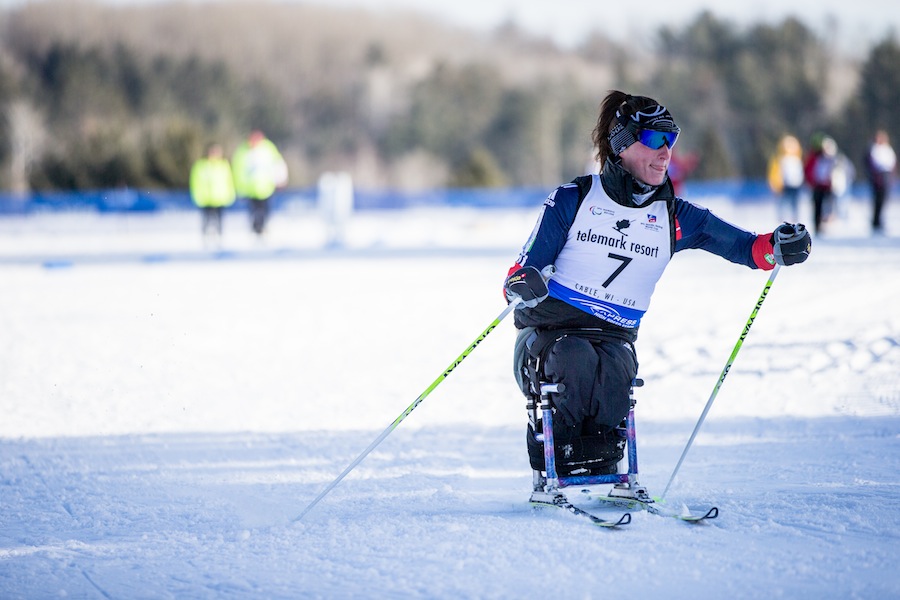
Wheelchair-racing superstar Tatyana McFadden at her first IPC World Cup races in Cable, Wis., last season. (Photo: U.S. Paralympics/James Netz)
In addition to finalizing the team at World Cup and National Championship races this season, Farra’s strategy is to use these races to get his staff ready for Sochi.
“We plan to bring a large team and the entire Sochi staff to Canmore [in December] because we’ve had a huge transition from being a country that shows up with only a few athletes,” he said of the early season World Cups. “We need to make sure we protect the chances of our top athletes to steal a medal and give the appropriate level of service to those developing athletes who are experiencing their first Paralympics. We’re looking forward to getting all those things dialed in.”
Nationals are held alongside the able-bodied U.S. Cross Country Championships at Soldier Hollow in January, followed by World Cup races in Oberstdorf, Germany.
In October, national-team coach James Upham accompanied four sit-skiers – Cnossen, Soule, Halsted, and Oksana Masters – at a U.S. Paralympics Nordic camp in Oberhof, Germany. It was the team’s first training camp in the ski tunnel there.
According to Farra, they’ll take six or seven athletes to Oberstdorf for the World Cup races from January 16-19.
“We’re going to bring a small elite group … who we feel need to be there to dial in their chances of winning medals in Sochi,” Farra said. “After Germany the team will hole up in Winter Park Colorado which will be good in terms of an altitude strategy. After that, we’ll head to Italy a week before the games and stay at a beautiful five-star resort on the top of a mountain with ski in ski out and a biathlon range, to relax a bit and get used to the time change before flying to Sochi.
“And that’s it,” he added. “We’ll be there and then we’ll be back here in March after we win a bunch of medals. Then we’ll come home and hang them up and enjoy them!”
***
About the Author:
FasterSkier’s Para-Nordic contributor, Mark Vosburgh lives in Missoula, Mont., where he works as a Wildfire Scientist for the US Forest Service. In addition to being a chemical engineer, Mark is a cross -country and backcountry skier, bluegrass musician, and biker. He’s also a freelance writer for numerous publications, including 48 Degrees North and MakeitMissoula.com.
Led by Camille Pepin, Laval University Rouge et Or skiers ascend a hill at La Foret Montmorency an hour drive north of Quebec City.
LA CÔTE-DE-BEAUPRÉ, Quebec – Pouring rain and 15 degrees Celsius may not sound good for a nordic skier, but since the opening of a 1.3-kilometre loop at the Montmorency Forest, better known as La Forêt Montmorency about an hour drive north of Quebec City, Nov. 1 was a happy day for skiers.
With manmade snow for the last decade, Laval University’s La Forêt in the Laurentides Wildlife Reservehas been well known for early season skiing by those living in eastern Canada and the U.S.. This year, however, university caretakers stepped up their game and stored a huge amount of snow last winter to be able to start this season on the date they wanted.
Several Skibec Nordique skiers, led by Jérémie Bonneau, get some on-snow time at La Foret Montmorency north of Quebec City on Nov. 1.
In Alberta, Canmore has Frozen Thunder. Now, Quebec finally has its own track, dubbed the “Boreal Glide.”
“Last December, we stocked 6,000 metres of snow and saved it under a thick coat of sawdust,” La Forêt’s outdoor activities coordinator Laurent St-Jacques explained last Friday. “Monday, we started to build the track and today [Nov. 1] we are opened, three weeks earlier than normal.”
As soon as the temperature drops, they will use snowmakers and expand the track, tapping into the rest of their snow-pile reserve as needed.
“If things go smoothly, we have four options of trails that will be connecting to the existing track and we planned to offer two-plus kilometres by the end of the month” St-Jacques said.
With expertise in snowmaking and preservation, and support by the cross-country community, it made the decision to expand the season easier. Forêt Montmorency is also favored by a microclimate that accounts for early snowfalls, which usually amounts to six meters of snow each winter.
“For us, it is mission accomplished,” St-Jacques said. “We have a few things to improve in the future, but overall it’s a great success. Now we can say we are open from Halloween ’til Easter!”
The Track
Upon firsthand inspection, the 1.3 k track, slightly longer than last year’s course, was challenging with a couple of hills, quick turns and good elevation some 900 metres above sea level.
La Forêt Montmorency’s 1.3-kilometre track, which Laval University caretakers extended by about 100 metres from last year and opened a few weeks earlier than usual on Nov. 1.
For November in Quebec, the conditions were good, mostly springlike – slushy and soft — but base was firm and the coverage was good. In some places, the snow was a bit dirty and the track had some bumps, but overall organizers did a great job preparing the track for athletes.
Approximately 30 skiers had made the trip to La Forêt for the opening morning, including the Laval University’s Rouge et Or team, Skibec Nordique as well as some biathletes, masters and recreational skiers. Although it was raining heavily, skiers kept coming as the day progressed, most staying on site in Laval’s dormitories and cabins, thus waving the $14.50 daily trail fee.
“I think they did a great job,” Rouge et Or rookie Camille Pepin said on Nov. 1. “We are lucky that they put the track together early because otherwise we didn’t when we would have been able to ski.”
“It’s super, a first in Eastern North America,” said Félix Bérubé-Larochelle of Quebec’s biathlon team. “It’s really fun that the track is opened on November 1st. I plan to come often in the upcoming weeks, that will be a good preparation for the races.”
The staff was proud of the track and made the opening day a happening one with music, hot chocolate and chicken broth for the skiers in a little shack alongside the track.
The next few weeks will be busy at Forêt Montmorency with teams coming from all over Quebec, Ontario, and New England for their annual trip to enjoy some quality time and training on snow.
Félix Bérubé-Larochelle of Quebec’s biathlon team leads skiers along the 1.3 k manmade loop at La Foret Montmorency north of Quebec City on Nov. 1.
***
(En français)
LA CÔTE-DE-BEAUPRÉ, Quebec – Pluie torrentielle et 15 degrés Celsius un 1er novembre, ce n’est jamais une bonne nouvelle pour un skieur de fond, sauf cette année à la Forêt Montmorency. Située à 1heure au nord de Québec dans la réserve faunique des Laurentides, la Forêt ouvrait sa boucle de ski de fond de 1,3km, de quoi rendre les skieurs plus qu’heureux malgré la météo difficile!
Reconnue depuis les dix dernières années pour sa production de neige artificielle, La Forêt était déjà l’endroit pour commencer tôt sa saison sur neige dans l’Est du Canada et des États-Unis. Cette année, ils sont allés plus loin en emmagasinant une énorme quantité de neige de la saison dernière sous une grosse couche de copeaux de bois de façon à être capable de débuter la saison à la date souhaitée et ne plus être dépendant d’une météo incertaine.
Depuis quelques années, Canmore en Alberta a son Frozen Thunder et maintenant Québec peut se vanter d’avoir sa propre boucle surnommée la Glisse Boréale.
“En décembre dernier, nous avons accumulé 6000 mètres de neige et nous l’avons entreposée en dessous d’une épaisse couche de copeaux. Nous avons commencé lundi à construire la piste et vendredi [1er novembre], nous étions prêts pour l’ouverture, environ trois semaines plus tôt qu’à l’habitude”, a expliqué sourire aux lèvres, Laurent St-Jacques, coordonnateur des activités récréotourisques à la Forêt Montmorency.
Dès que les températures baissent sous le point de congélation, les canons à neige s’activent. Ainsi, ils n’ont pas utilisé toute la neige en réserve de l’an passé pour s’assurer d’avoir de la neige sous la main et ainsi garder la piste en bonne condition et la plus blanche possible. “Nous avons quatre options pour agrandir le circuit principal existant. Logiquement, si tout va bien, à la fin du mois, nous devrions avoir plus de 2km à offrir”, a laissé entendre St-Jacques.
Avec leur expertise et le support de la communauté de ski de fond, c’était
une décision naturelle d’offrir cette opportunité de skier sur neige aussi tôt en saison. De plus, la Forêt Montmorency gérée par le département de foresterie de l’Université Laval peut compter sur un microclimat favorable avec des chutes de neige tôt en saison et un total d’environ 6 mètres de neige chaque hiver.
“Pour nous, c’est vraiment mission accomplie, bien sûr nous avons quelques petites choses à améliorer pour le futur, mais en général c’est un beau succès. Maintenant, nous pouvons dire que nous sommes ouverts de l’Halloween à Pâques!”, a dit St-Jacques.
La Boucle
La boucle, d’une longueur de 1,3km, comporte plusieurs montées et descentes, de même que quelques virages serrés et une dénivellation intéressante. Pour une première expérience du genre, les conditions de neige étaient bonnes, compte tenu de la température, les conditions ressemblaient à celles du printemps, néanmoins la base était solide et épaisse. À quelques endroits, la neige était un peu sale et la piste avait quelques bosses, mais en général, ils ont fait un excellent travail pour préparer la piste aux athlètes.
Dès l’ouverture, une trentaine de skieurs avaient fait le voyage à la Forêt incluant le Rouge et Or de l’Université Laval, Skibec Nordique de même que quelques biathlètes, maîtres et même un skieur récréatif. Malgré la pluie forte, les skieurs continuaient d’arriver plus la journée avançait.
“Je pense qu’ils ont fait une belle job, c’est vraiment beau. Une chance qu’ils ont fait ça, car on aurait peut-être pas skié avant un bout”, a commenté Camille Pepin, recrue du Rouge et Or.
“C’est super, c’est une première dans l’est de l’Amérique du Nord, c’est vraiment le fun que ça ouvre le 1er novembre. Je prévois venir souvent dans les prochaines semaines, ça va être une bonne préparation pour les courses”, a dit Félix Bérubé-Larochelle, membre de l’Équipe du Québec de biathlon.
Les employés de la Forêt Montmorency étaient fiers de leur boucle et avaient décidé de faire les choses en grand avec musique, chocolat chaud, bouillon de poulet offerts aux skieurs dans un petit chalet situé au milieu de la boucle.
Les prochaines semaines s’annoncent occupées à la Forêt avec des équipes venant du Québec, de l’Ontario et de la Nouvelle-Angleterre pour leur traditionnel camp sur neige de début de saison afin de profiter des conditions avantageuses et d’accumuler des heures de qualité sur neige avant le début des compétitions.
La piste est ouverte au public tous les jours et il en coûte 14,50$ par personne/jour pour skier et il y a aussi possibilité de réserver pour dormir sur place en appelant directement à la Forêt Montmorency.
***
About Stéphanie Drolet:
A former competitive cyclist and cross-country skier on Canada’s National Junior Team, StéphanieDrolet is a Canadian contributor at FasterSkier. She was a forerunner at the 2010 Vancouver Olympics and competed at the 2008 World Junior Championships. A journalism student at Laval University in Quebec, Stéphanie still skis and rides for fun and to stay in shape. Don’t be surprised to find a few of her articles in French!
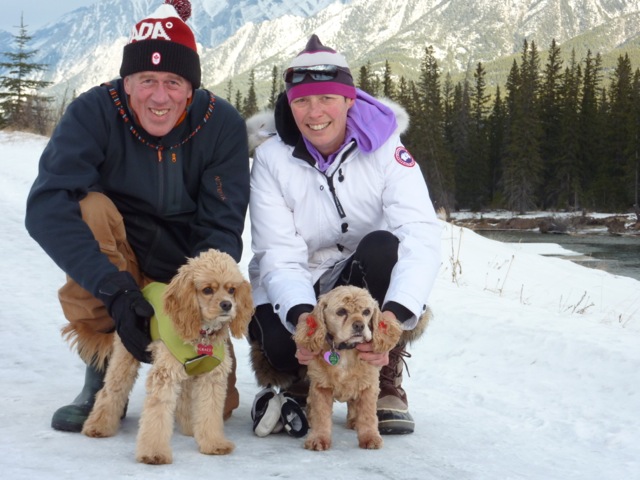
Dave Wood, Alison and their two Cocker Spaniels (Courtesy photo)
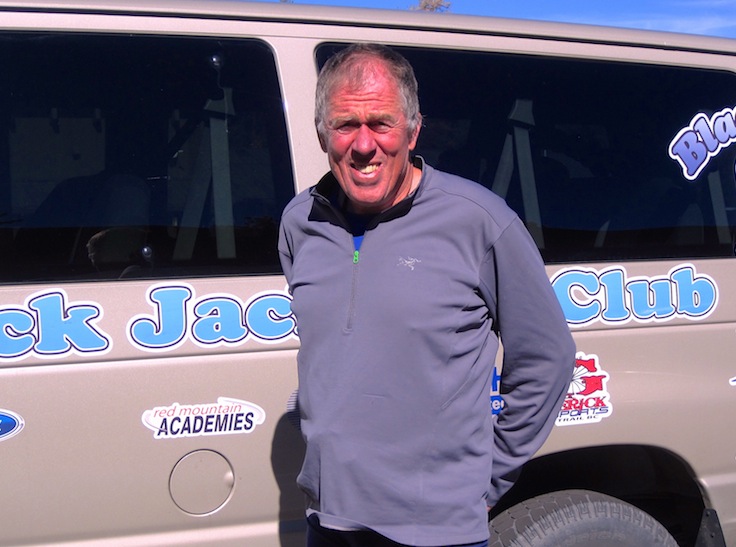
Several weeks ago, I received an email from Dave Wood, a longtime head coach of the Canadian National Ski Team. He had just arrived in my hometown of Mammoth Lakes, Calif., with a small group of athletes from Black Jack Ski Club in Rossland, B.C. We planned a rendezvous to catch up and to chat about the local training hot spots.
It had been a few years since Wood had been in Mammoth with skiers. Back around 2003 or 2004, during his tenure as Canada’s national-team head coach, he had discovered this high-altitude training location through an online search and some U.S. distance running links. A reconnaissance to the area gave him all the information he needed: a “live high and train high or low” scenario with great fall weather and miles of trails and open roads.
Dave Wood during a recent altitude dryland camp in Mammoth Lakes, Calif.
For several subsequent falls, Wood and his national team left their home base in Canmore, Alberta, for three weeks of high-altitude sunshine in the Eastern Sierra. Now, Wood was back, this time with a few dedicated athletes from Black Jack, of which he had been the head coach since 2010.
The Black Jack camp format was similar to the national-team camps he ran in Mammoth years before. Condominium living at just over 8,000 feet gave athletes rollerskiing options right out the door, with single-track running trails not too far away. Proximity to the town of Mammoth Lakes offered a fitness club, grocery store, and some rest day “in-town” opportunities were just a short bike ride away.
As Wood explained over coffee, the beauty of coming to Mammoth was the convenience of being able to stay in town and drive 40 minutes down to 4,000 feet for intensity training. He raved about the “exceptional rollerskiing,” where on one lonely road leading to Nevada, his athletes saw only a handful of cars during an over-distance rollerski workout.
I had hoped to join Wood and his Black Jack skiers for several workouts, but managed just one: a long run in Lower Rock Creek. Wood had to leave town for a couple of days, so he enlisted me to take the athletes to a nearby trailhead for their run over Duck Pass. Several inches of snow overnight jammed up that idea, so I drove down the hill with the guys and Chisa Obayashi, a Japanese skier who has been training under Wood’s supervision the past few months. I had in mind beginning the run out of the snow zone at the Paradise trailhead, just north of Bishop, Calif.
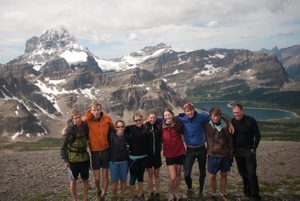
The Black Jack Ski Club, with head coach Dave Wood, while hiking Mount Assiniboine on the Great Divide on the British Columbia/Alberta border in August 2011. (Photo: Dave Wood)
Tagging along on the run through towering Jeffrey pines and golden aspens, I was able to learn a little bit about the Black Jack athletes. David Palmer and Colin Ferrie, accomplished junior skiers, are heading into their first year as seniors. They, along with teammate Julien Locke, who missed the trip due to an injury, are among the best in their age group in Canada. They have had solid training all summer including a trip to get on snow at the Haig Glacier. Following their Mammoth camp, they will be heading to Canmore for some time on Frozen Thunder.
An adopted Black Jack skier, Obayashi made the trip down to Mammoth with the men’s team and was also planning to join them after in Canmore, where she would get some snow kilometers before going to Finland for the start of the racing season. Obayashi connected with Wood through her manager in Japan and had only positive things to say about her training experience in North America, she told me as we ran on the Lower Rock Creek trail.
The kind of individualized coaching she was receiving from Wood was hard to come by in Japan. She had no regular training group in Japan, so the opportunity to train with Black Jack was setting her up well for her quest to make the Japanese Olympic Team.
Chief, Cook and Bottle Washer
A few days later, I met up with Wood again for lunch. He pulled up in the team van on time, but appeared a bit flustered. Dressed in running clothes, he explained that he had dropped off his group over in June Lake to do a three-hour, point-to-point run. He then drove to the termination of the run, parked and began to run the trail in to meet the athletes. They ended up missing a key turn and added nearly an hour to their run. Wood shook his head, muttering something about knuckleheads, but it was hard for Wood to disguise his pride in his skiers.
The soft-spoken 58-year-old Wood is unflappable, handling his role as “chief, cook and bottle washer” for Black Jack in his customary professional manner. He uses the same thorough and systematic system to train his club skiers as he did to build a solid Canadian team. Wood uses the Mammoth camp as an altitude block is based on science, experience and much thought. There is even a short recovery phase when the athletes pack up and go down to 4,000 feet to sleep.
Dave Wood at the 2010 Olympics in Callaghan Valley, British Columbia. (Courtesy photo)
Four years after resigning from his position at Cross Country Canada following the 2010 Olympics, Wood seems to have landed on his feet. As he explained it, after 18 years with CCC, holding positions as head wax technician, head coach and team leader, it was time to move on. He described his transition without a trace of rancor. In fact, the move to Rossland seemed like the most natural thing in the world.
After eight years of commuting from Canmore to Rossland to see his girlfriend (about a 6 ½-hour drive in good weather), Wood saw his exit from CCC as the perfect opportunity to move in with Alison, an operating-room nurse at a local hospital. At the same time, Black Jack was looking for a head coach, so Wood felt the timing was perfect.
Black Jack is a well-established nordic club with over 700 members. It offers programs for 4 year olds to masters, with a small, but active racing program. Ski Academy opportunities are available for Black Jack skiers, as well as for the local alpine program, Red Mountain Racers.
With about 3,500 residents, Rossland is nestled in the Monashee Mountains of the West Kootenay region at an elevation of 3,410 feet. Winter sports are a big deal there, which usually has skiing from early November through late April. Red Mountain Resort boasts an average 300 inches of snowfall per year and the Black Jack trail system features 40 kilometers of groomed track, a lighted loop, a kids terrain park, and a biathlon range. An extensive mountain-bike park offers single track riding and running during the summer, making Rossland an ideal home for a nordic skier.
Wood’s approach to ski racing is simple. He believes the bottom line is using the training to become faster.
“You can’t improve by just going to Europe to race,” he said. “You have to figure out a way to cut 45 seconds over 15 kilometers before going.”
He likes to keep travel to a minimum during the training phase in order to accomplish goals. There are so many training and racing opportunities out there for skiers, but it’s easy to lose sight of what you are really after, which can boil down to those 45 seconds.
Thoughts from a Former Coach
While Wood has been busy with Black Jack the past several years, he’s kept an eye on what is happening at the national level in Canada. Coaching the nation’s top skiers through CCC gave him perspective on his job as a club coach, which notably has different viewpoints and team structure than the nation’s four training centres. There is a lot of training, racing and experience necessary to bridge the gap from club to national-team skier and even more to move into the international realm.
Wood’s approach to ski racing is simple. He believes the bottom line is using the training to become faster.
On the state of skiing in Canada, Wood has definite concerns. He recognizes the success of the women’s team in recent years, with medal performances by Beckie Scott, Sara Renner and Chandra Crawford, and a men’s team highlighted by Devon Kershaw’s overall second place in the 2012 World Cup, and Kershaw and Alex Harvey’s sprint championship title at the 2011 World Championships. The problem CCC faces is a lack of depth in its program, he said.
Wood sees the potential for Canadian success at Sochi in the sprint and team sprint. On the Canada’s stated goal of winning two medals, Wood said, “You have to ski the race before you win the medal.”
While Harvey is a proven racer, Kershaw has to have a better year than last year for any of this to happen, he said. Wood sees lack of depth on the women’s side as a liability, as well as problems with the Olympic qualification system. It’s difficult to compete against teams like Russia, Norway and Sweden that have large pools of athletes racing at a high level. Those countries can play with putting athletes with fresh legs out in every race.
One of the underlying problems he sees within the Canadian system is that all of the funding is at the World Cup level. He estimates that what was CCC’s $180,000 dollar budget in 1999 is probably now close to a $2-million dollar budget. Development is left up to the four training centres. While these centres are nationally funded, Wood said there’s a lack of a coaching system, resulting in inexperienced coaches.
In his opinion, the biggest hurdle for athletes taking part in the training centres is the cost. At a given training centre, he estimated $12,000 Canadian dollars covers a year of coaching and four weekends of racing, but by the time the racing season is over, participants doll out $20,000 to $30,000 annually. Sponsorships are difficult to come by and jobs are low-paying in the training centre locales. Wood isn’t sure enough athletes are going through the system to build the kind of depth CCC needs to become an international power.
Adding to the situation is the lack of skier development opportunity through the Canadian universities, he said. Lots of junior athletes are dropping out of the sport at 18 years old to get an education.
Wood is confident that what he is providing at Black Jack is an affordable, high-quality program for juniors and seniors to help make the jump to the international level. A lot of money is spent on Integrated Sports Teams at the national training centres, he said. Besides the expense of these doctors, trainers, massage therapists, etc., is the cost of waxing and equipment.
“Cut down on this nonsense, and it would be affordable,” Wood said.
Wood keeps expenses down for his athletes by, once again, keeping things simple. He keeps his wax box stocked with a minimum of wax brands, and while not denying that wax technology is a major element of ski racing, he said it helps to remember what the race really comes down to.
“Cut down on this nonsense, and it would be affordable.”
After the Mammoth camp, Wood and the Black Jack skiers planned to head back to Rossland for a short break. Wood had a few days of downtime with Alison and their two Cocker Spaniels, then was due in Canmore for an on-snow camp at Frozen Thunder.
The schedule in November is dedicated to snow camps in Vernon and Rossland, with racing kicking off at December NorAms in the same locations. Things ramp up in January for the Black Jack skiers, with a NorAm in Canmore, the qualifier for Olympics, U23, and Junior World competitions. The remainder of the season sees the team criss-crossing Canada attending Eastern and Western Canadian Championships, and Canadian Championships in Newfoundland in March. The season concludes with March BC provincial events.
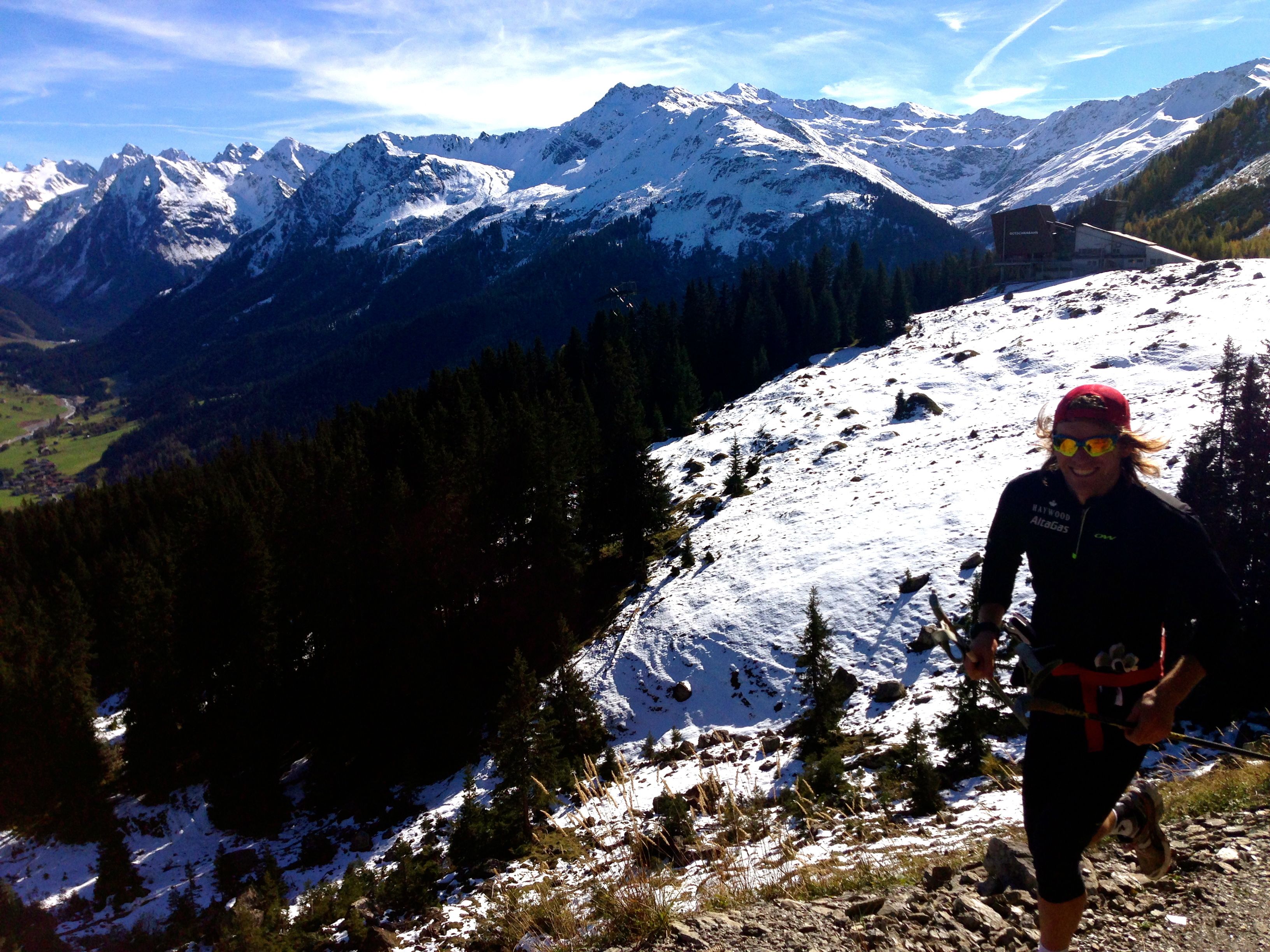
Devon Kershaw after an interval workout in Klosters, Switzerland, before his training camp with the Norwegian national team in Val Senales, Italy. (Photo: Kristin Størmer Steira/www.kristinsteira.no)
With his ninth consecutive World Cup season in the bag, Devon Kershaw, 30, could finally put his feet up this spring and think about 2012/2013 – not that he necessarily wanted to.
It wasn’t easy reliving that fateful stumble down a flight of stairs in Bruksvallarna, Sweden, in which the Canadian national-team skier tore a ligament in his foot a weekend before the season started. Unable to run for several months, he taped the afflicted area around his ankle and pushed through every ski race – refusing to publically acknowledge it or use it as an excuse.
Kershaw pushing through the pain in his left for during the World Cup sprint qualifier last December in Canmore, Alberta. He was 50th and failed to advance.
Things perked up about midseason (he placed eighth in two World Cup sprints in February and narrowly missed the World Championships team-sprint podium with teammate Alex Harvey in March), but ultimately, Kershaw finished farther back than he had hoped: 27th in the overall World Cup, compared to second in the world the year before. He ranked 42nd in distance events, his worst showing since 2007, but was better in sprints: 22nd, down from seventh in 2011/2012.
All too aware of his results, Kershaw needed answers and had a good idea where to find them.
“I’m a pretty big journaler,” he said on the phone from Davos, Switzerland, where he was getting acclimated earlier this month before a high-altitude camp in Val Senales, Italy. “But I haven’t taken much time going back to read what I write.”
Thumbing through his entries, Kershaw took a particularly close look at his thoughts on World Championships in Val di Fiemme, Italy. He considered the team sprint the best race of his season, but the rest of his performances there “a disaster.”
“That was a big slap in the face,” he said. “When I got back in Canada in the spring, I met with [head coach] Justin [Wadsworth] a lot, went back to my journals, met with the sports psychologist. … I realized how poor of place I was in for many, many months and how my decision-making was horrible. I was like, ‘Wow.’ ”
His musings weren’t limited to sports, but also included personal reflections.
“I wasn’t in a good place mentally,” he said. “I wasn’t sleeping great. With some of the things going on in my life, I shouldn’t have been racing as well as I was … There’s a lot that wasn’t going that well, but at the time I was just trying to stay so positive because you want to make the most of every day.”
By nature, Kershaw is an optimist. He’s been dating Kristin Størmer Steira, one of Norway’s best distance skiers, for more than a year and said she’s had a tremendous impact on him.
“I’ve been known to exaggerate a bit and make mountains out of molehills, and Kristin’s super, super grounded and a calming influence on me,” he said “As a person she’s got great, great perspective so it’s awesome to be around her.”
Glancing at his schedule this year, Kershaw felts a pang of the in-season blues. He had been doing this for a long time, often the same training camp after another, and now he had a girlfriend who lived thousands of miles away in Norway.
Steira, 32, visited him in Canmore, Alberta, in late July and trained with the Canadian women’s team through early August. Then, the couple parted ways, knowing they’d see each other in November. That didn’t sit well with Kershaw.
“I’m old; I’m 30 and that’s a bit too long,” he said. “It’s not the best way to be in a great frame of mind heading into the racing season when you’re missing someone that you really care about.”
The view from the Norwegian national team’s annual fall camp in Val Senales, Italy, earlier this month. (Photo: Kristin Størmer Steira/www.kristinsteira.no)
Steira suggested he come to the Norwegian-national team camp in Val Senales in late October, then spend the rest of November with her in Norway. Reasoning he might as well ask, Kershaw contacted his former national-team coach, Steinar Mundal, who left Canada to coach the Norwegians in 2007. Mundal was open to it, Kershaw asked Wadsworth if he was, too.
A former U.S. Ski Team member who crossed borders and married Canadian Olympic gold medalist Beckie Scott, Wadsworth understood. He and Kershaw turned to Norwegian head coach Trond Nystad, who coached the U.S. team until 2006, to work out the specifics.
“I made sure for Trond to ask the boys if it’s OK if I’m there because, I don’t know, I don’t want to piss anyone off,” Kershaw said.
On his first full day in Val Senales – his first time on the glacier that soars more than 3,200 meters (10,000 feet) into the atmosphere – Kershaw tweeted, “First impressions … ? I don’t miiiiiiiiiinnnnnnddddd it. #feelsgoodtobeskiing.”
“I’ve been in the game for a long time so its nice to have something to look forward to, seeing Kristin was the main thing, and training in a different environment in the fall is something to look forward, too,” Kershaw explained on the phone.
From Oct. 20 to Nov. 6, he expected to see the Swedish national team there, along with the Swiss, and more than 50 Norwegians between the distance, sprint and U23 teams. More familiar with Norway’s sprinters than its distance skiers, Kershaw said he was invited to a couple workouts and would primarily train with the distance team.
“That’s [the] thing about being a little older, I’m not in high school and trying to bring my lunch tray to a table and say, ‘Hey, can I sit here?” Kershaw joked.
“I’m really not that concerned. I’m not there to rock any boats or do anything; I’m there do to my thing.”
For the last five or six days, Wadsworth planned to join Kershaw in Val Senales to make sure he stuck to his training regimen. The two received the Norwegians’ camp outline a couple months ago and planned accordingly to make sure it jived with Kershaw’s plan.
The dryland scene in Val Senales, Italy, earlier this month. (Photo: Kristin Størmer Steira/www.kristinsteira.no)
“It’ll be hard, but nothing groundbreaking,” Kershaw said. “The plan looks pretty similar to what I do back in Canada: skiing in the mornings … then, in the afternoons doing some runs or rollerskis.”
But most importantly, he’d be getting that skiing feeling back every day. That’s what Kershaw said he needs before his first races in late November at the World Cup opener in Kuusamo, Finland. He’ll stay with Steira at her home in Oslo, Norway, until then.
“I’m here ’til late March so it’s a long haul,” Kershaw said. “Packing up from Canada, it’s tough, [but] I’ve been doing this for a long time and I’ve spent five months in Europe before; what’s the difference with a couple extra weeks? My girlfriend is Norwegian and that’s important. A happy skier is a skier that usually races fast.”
As for how he’s feeling now, almost a year after he tripped in a pair of loosely tied sneakers and tore a ligament around his ankle, Kershaw said he’s in a much better place – physically and mentally. Last February, he said his foot wasn’t the sole reason for the sub-par start to his season.
“There were a lot of other factors, too,” Kershaw said.
Now, he feels more settled.
“My life’s a lot calmer,” he said. “I’ve taken care of a lot of things that were in flux the last couple years. You want to win every year and you want to win every season so when you have a little bit of a disappointing season, it’s not great, but we learned a lot and we’re a lot better at calculating what we can and can’t do. I tried to do a lot with not a lot of energy and it bit me in the ass.”
Devon Kershaw en route to a historic fourth-place finish with teammate Alex Harvey in the team sprint at the 2010 Olympics.
Leading up to Kershaw’s third Olympics – the 2014 Winter Games in Sochi, Russia – he’s excited and not entertaining retirement.
“I’ll continue to race through 2015,” he said. “This isn’t going to be a season where it’s like, ‘Oh, it’s over.’ Moving forward, as long as I’m really enjoying what I’m doing and can wake up every day with a passion and excitement to do what I’m doing, that’s kind of what’s driven me through my career, then I’ll continue racing.”
Almost four years ago in Vancouver, B.C., Kershaw and Harvey placed fourth in the team sprint for the best Olympic finish by Canadian men. A year later, they won the same event at World Championships.
“I actually don’t feel much pressure,” Kershaw said of Sochi. “No one can put more pressure on myself than myself. Last year I piled on pressure on myself, and what did that get me? Nothing. Hopefully I’ve learned lessons.”
This time around, he said he’s better prepared and more realistic. “I hope to have some great races, but I’ll also have some miserably awful races, too. I’ll have some OK races, and that’s how most seasons look for most people.”
That’s where his “dorky” journals help him in pointing out trends, Kershaw said.
“It’s ski racing and I’m trying my best,” he explained.
That said, he wants an Olympic medal – and if he can’t capture one, he’ll be happy if any of his teammates do.
“No Canadian man has ever stepped on the podium and that sucks,” he said. “We’re better than that and the times is now. If it’s me, awesome. If it’s Alex, that’s just as good. … We really, really want to bring and Olympic medal back for Canada and I don’t care [which nordic events] it comes from.”
“Is this my last Olympics? I don’t know, we’ll have to see,” Kershaw added. “Predominately, I look at [last] season as horrendous, and if the season’s like that again, there’s a lot of other things I’d like to get done. … [But] our team is just so fun to be around. I love those guys like brothers.”
The start area of the 2.2-kilometer loop at Frozen Thunder at the Canmore Nordic Centre, with the Bow Valley in the background in Canmore, Alberta.
By Katie Bono
CANMORE, Alberta — The days are getting shorter and shorter in Canmore, and if you’re an elite Nordic skier in North America, you know what that means. It’s Frozen Thunder time!
Skiers from across the U.S. and Canada recently converged upon Canmore to ski the seasonal anomaly that is Frozen Thunder: a 2.2-kilometer loop of real snow skiing, harvested from last winter and saved over the brief Canadian summer under a thick coat of sawdust.
According to a Cross Country Canada press release, Frozen Thunder’s first incarnation was in 2009 as a 400-metre loop of snow. However, if you know anything about the Canmore Nordic Centre, you know that settling for an ‘adequate’ trail experience is not in their nature. Accordingly, the loop has been expanding ever since. This year’s loop is the longest yet, and even includes a bridge crossing.
Conditions on the loop thus far have been surprisingly good. Despite temperatures in the mid-teens (Celsius, around 50 degrees Fahrenheit) since opening day on Oct. 19, the trail has stayed thick, white and fairly firm, and skiers who were on the loop last year say that this year’s loop is substantially better than last year’s version.
The list of skiers already getting their training on at Frozen Thunder is long: All of the Canmore-based Canadian teams are here, and many of the farther afield Canadian and U.S. teams are, as well. The Wisconsin-based Central Cross Country (CXC) was in town for the first four days of skiing and has since departed, while members of the U.S. Ski Team, Stratton Mountain School T2 Team, XC Oregon, Maine Winter Sports Center, and the Methow Olympic Development, among others, will be in town for a while longer.
Skiers were out in full force on Wednesday and there was almost a palpable stoke in the air. Many looked to be gearing up for tomorrow’s classic sprint race while others were simply getting a solid interval session in. Tomorrow’s race will be hosted by Winsport, and many of the top U.S. and Canadian skiers are expected to participate as their preliminary warmup for the season. Qualification starts at 9 a.m. Mountain time, and only the top 16 in each gender will move on to heats.
The start area and biathlon access at the Canmore Nordic Centre’s Frozen Thunder.
Skiers stride and glide along Frozen Thunder on Wednesday.
The hill on the left is new this year.
The biathlon-access area at Frozen Thunder
A Biathlon Alberta skier hammering out some speeds
Chandra Crawford (r) skis alongside Sophie Caldwell of the U.S. Ski Team at Frozen Thunder in Canmore, Alberta, in October.
Stratton Mountain School T2 teammates Jessie Diggins (USST) and Erika Flowers discuss sprint tactics the day before the classic sprint at Frozen Thunder.
A skier strides up one of the hills at Frozen Thunder.
You know your manmade loop is good when it includes a bridge.
Ski trails and rollerski trails side by side at Frozen Thunder.
The finishing stretch of the Canmore’s World Cup course
Bone-dry, mountain-bike trails parallel a snowy loop at Frozen Thunder
The approximately 2-kilometer manmade loop at Frozen Thunder officially opened Oct. 19 in Canmore, Alberta. (Photo: Pavlina Sudrich)
It wasn’t that long ago that the Canadian World Cup Team was on snow, but in the last month since its Aug. 11-29 camp in New Zealand, the national team has been hitting the dryland pretty hard.
About a week ago, its six skiers were finishing up camp in Truckee, Calif., and nearby Nevada City. One of two women on the team, Perianne Jones explained in an email that they had a great camp for the first few weeks of October. “We did lots of climbing, that’s for sure,” she wrote. “Flat roads were hard to come by.”
Jones and Dasha Gaiazova left a few days earlier than the guys – Gaiazova for a sponsor appearance and benefit in Colorado, and Jones to get on snow at home in Canmore, Alberta. Proudly termed Frozen Thunder, Canmore’s approximately 2-kilometer loop made from snow stockpiled since last winter, opened in earnest on Oct. 19.
Canadian National Team Head Coach Justin Wadsworth works on offset with development skier Jenn Jackson at Frozen Thunder in Canmore, Alberta. (Photo: Pavlina Sudrich)
Two days later, Monday marked the start of a weeklong Cross Country Canada women’s camp with Jones and the national junior and senior development teams.
“We are back on snow!” Jones exclaimed. “[Monday] was our first ski together, kind of a ‘get back into it’ workout.”
When getting back onto real skis and snow (as opposed to rollerskis and pavement), whether it’s your first time in a several weeks or months (or years!), it’s important not to go too headstrong into it.
Jones said her first workout on Frozen Thunder wasn’t anything too crazy, just skating around casually and working on technique between two stations. National-team coaches manned each – with head coach Justin Wadsworth focused on offset (V1), and women’s coach Eric de Nys watching their glide and positioning on the one-skate (V2).
“It was mostly about balance, and getting used to the feeling of being back on snow,” Jones explained. “For the girls from the East it was also an adaptation to the altitude.”
So if you’re about to go skiing for the first time – even if it’s not quite 1,500 meters (nearly 5,000 feet) above sea level – consider a technique workout like the following. You might not have national-team coaches to critique you, but you’ll probably notice areas that need some work.
The workout: Get Back Into It (snow skiing)
Warmup: 30 minutes easy Zone 1
Stations workout: Rotate through two stations on a loop (even 2 kilometers will do) for an hour and a half. If skating, consider offset and one-skate stations that hone in on the following:
Offset (V1): Knee drive and weight over the ski
One-skate (V2): Glide and getting the hands high
At the stations, bump up the intensity to Zone 2 or so, “just to make sure the movements [are] good,” Jones explained.
Cool-down: 15 minutes easy Zone 1
As for her first workout back on snow, Jones wrote it didn’t feel too foreign.
“We are lucky to have stayed in touch with the snow through the summer,” she wrote. “It’s always nice on the joints to get off the pavement at this time of year though!”
On Thursday night, Jones will host a Skiers 4 Schoolbox fundraiser at the Bill Warren Training Centre to support her trip to Nicaragua, where she and several other skiers hope to build a school in April.
“Education is a basic human right that many kids don’t have access to,” the fundraiser’s Facebook page states. “We want to do what we can to help!”
Among those joining Jones and her husband Joel Jaques are Phil Widmer, Emily Nishikawa, Zoe Roy, Olivia Bouffard Nesbitt, Mark Arendz, and Ruth Tamas from Jones’ hometown in Almonte, Ontario.
“We are still looking for a few more bodies to help us build our school!,” Jones wrote.
The 2013/2014 Pierre-Harvey National Training Centre team. (Courtesy photo)
Note: This is the second of four previews providing an inside look at Canada’s national training centres and their respective senior teams this season. We asked coaches to tell us what’s new, whom to look out for, and the outlook on the winter ahead. Teams are presented in no particular order.
Team: Centre National d’Entraînement Pierre-Harvey (CNEPH), a.k.a. Pierre-Harvey National Training Centre
Coaches: Louis Bouchard (head coach), Francois Pepin (assistant coach), Charles Castonguay (assistant coach), Lee Churchill (assistant coach/wax tech), Sacha Bergeron (World Cup wax tech, Andre Renart (wax tech)
Senior roster: Alex Harvey (World Cup Team), Raphaël Couturier, Simon Lapointe, Alexis Turgeon;
Who’s new: The entire women’s team, minus Gaiazova, moved up from CNEPH’s junior ranks to the big leagues, including Browne, Comeau and Vézina. Formerly with Rocky Mountain Racers in Canmore, Alberta, MacIssac-Jones made the Quebec training centre this season.
Who’s missing: According to head coach Louis Bouchard, three of the team’s senior men (Frédéric Touchette, Aidan Lennie, Steffan Lloyd) went back to school. World Cup skier Lenny Valjas moved to Canmore to train with the national team.
Touchette joined the Laval University ski program, Lennie is coaching for Skibec in Mont-Sainte Anne and Llyod is in Ottawa.
Top results last season: The Canadians were out for medals at World Championships in Val di Fiemme, Italy, and Alex Harvey (the son of Pierre Harvey, whom CNEPH is named after) delivered with a bronze in the classic sprint. Earlier in the season in Val di Fiemme, Valjas and Harvey, now 25, placed second and third, respectively in the Tour de Ski 15-kilometer classic mass start.
Gaiazova, 29, tallied bronze in the February pre-Olympic team sprint with teammate Perianne Jones in Sochi, Russia. In January, she placed fourth in a World Cup classic sprint in Liberec, Czech Republic.
Also in Liberec, Browne, who turned 20 last month, notched 15th in the 5 k skate race at Junior World Championships. In turn, she earned a spot on Canada’s senior development team.
Couturier, 20, also made the national senior team this year, after placing 17th in the 20 k skiathlon at Junior Worlds.
Coach’s comments:
Bouchard is a pretty busy guy between heading CNEPH in Quebec City/Mont-Sainte Anne and working with the World Cup team as an assistant men’s coach. This season, he explained in an email that he’ll be in Europe with the World Cup team all winter starting Nov. 10, when he flies with Harvey to Davos, Switzerland. As a result, Pepin, Castonguay and Churchill will be more responsible for the NorAm team.
When it comes to training camps, CNEPH goes big. This year, the staff brought its team to Montreal for testing in June and France in July to learn about altitude training and coping with jet lag. Earlier this month, they wrapped up another altitude camp in Canmore. Browne and Couturier were invited to the national-team training camps in Bend, Oregon, in June and New Zealand for on-snow training in late August.
In terms of goals, Bouchard laid them out pretty clearly: one Olympic podium, one top 20 at Junior Worlds, and one top 20 at U23 World Championships.
One good starting point: most everyone on the young team has already made it to Junior Worlds.
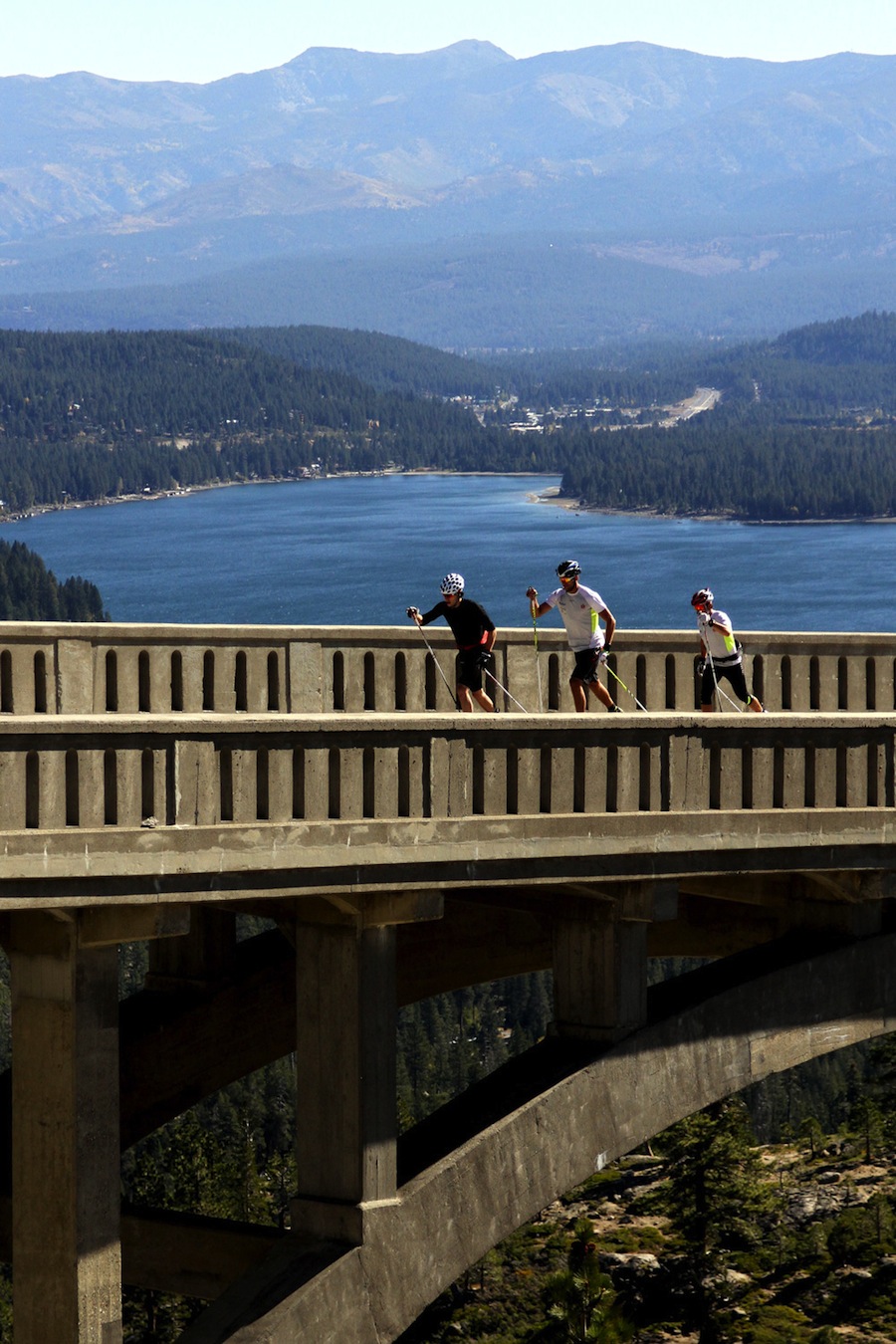
On Oct. 4, the Canadian World Cup Men’s Team rollerskis across the Rainbow Bridge toward Donner Pass near Truckee, Calif. (Photo: Mark Nadell/MacBeth Graphics)
“The leaves crunch beneath my now worn running shoes as I negotiate the soft, pine needle infested single track above the Nor-Cal town of Truckee, CA. After days upon days of warm weather, blue skies and summer-like vibes, the jackets and long tights were thrown on – a rude reminder that even in California it’s approaching mid-October. As I weave between some seriously large pines and over the endless ridges, it feels as though I am literally running into winter.” – Devon Kershaw, on his blog
There’s no place like California. That’s what Canadian World Cup Team Head Coach Justin Wadsworth thought when he scouted the Truckee area in July. He stayed with a former teammate from the U.S. Ski Team, Marcus Nash, and spent two days exploring northern California and all the high-elevation ski town had to offer.
What he found was seemingly endless roads covering technical terrain at elevations around 1,775 meters (more than 5,800 feet). About a 45-minute drive away, one could find themselves more than 1,000 meters lower in Nevada City (at 2,477 feet), which Wadsworth deemed perfect for harder efforts. Weather was good there in autumn: warm, sunny and dependable. And who on his team wouldn’t want to go to California for a change?
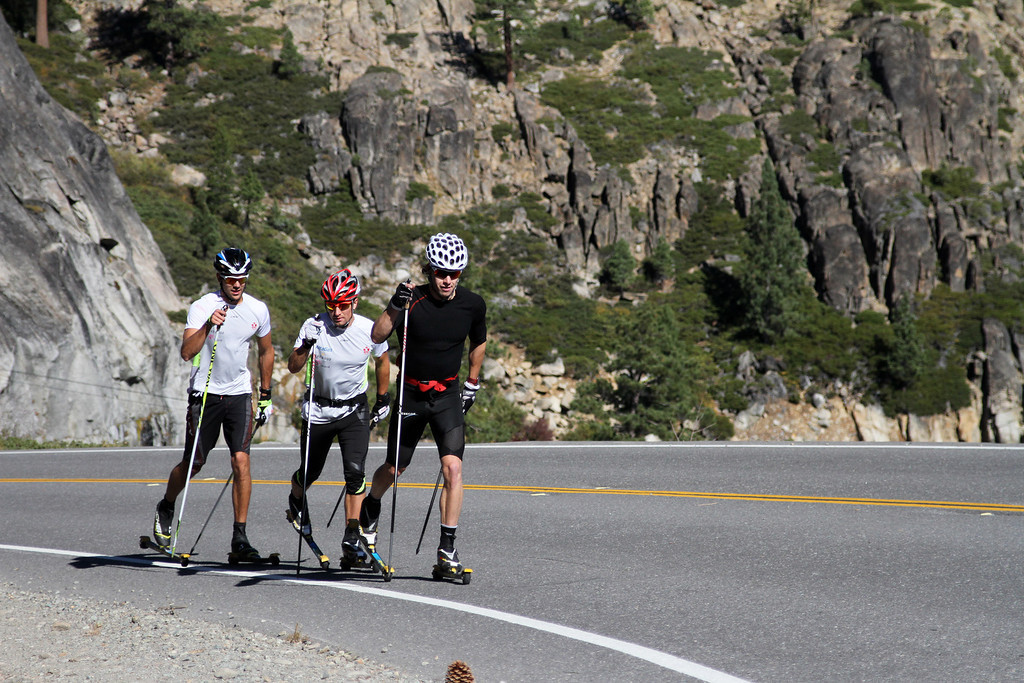
Alex Harvey leads Canadian World Cup teamamtes Ivan Babikov (c) and Lenny Valjas (l) during a rollerski on Old Highway 40 on Oct. 4 near Truckee, Calif. (Photo: Mark Nadell/MacBeth Graphics)
“It’s been a really great camp; there’s been sunny, blue skies every day,” Wadsworth said on the phone from Truckee on Tuesday. “Everyone can train in shorts and a T-shirt or no shirt.”
Not that Park City, Utah, where the team normally takes its final dryland camp of the season, is a bad place to be – especially for altitude training at 2,000-plus meters (6,500 feet). But after somewhat of a hold-and-cold season last year, in which some of his skiers reached career bests and others finished a little disappointed, Wadsworth decided it was time for change.
Off to Truckee they went. Starting Oct. 1, the entire men’s and women’s World Cup team spent nearly three and a half weeks in California, wrapping up Thursday before heading home to Canmore, Alberta, for the opening of Frozen Thunder on Saturday.
The men’s team – Devon Kershaw, Alex Harvey, Ivan Babikov, and Lenny Valjas – opted for RV dwelling, like their training camps in Hawaii. The women – Perianne Jones and Dasha Gaiazova – weren’t as into that, so they split their time between a Truckee hotel and a house the team rented in Nevada City, Wadsworth said.
Between the mountain town and low-lying Nevada City, the Canadians divided their efforts accordingly, with sustained easy training in Truckee and more intensity at lower elevations.
Wadsworth said the area offers some of the best roads and steepest hills he’s ever seen, quiet and ideal for training. He had been looking for rollerski terrain where he could push his men to work on their offset, or V1, for long stretches.
“We’re so fit these days you have to get a really big hill to get these guys working continuously,” he said.
California in autumn has been what I remembered it to be. Blue skies and sunny weather, vistas with apparent and looming granite monoliths, stellar soft single track running trails and long, winding (and climbing!), quiet roads. I remember all that from my years training in the fall both in the Mammoth Lakes and Truckee areas in the past. – Kershaw
Among the skiers he works with directly on the men’s team, Wadsworth said Kershaw, Harvey and Babikov are in the best shape he had ever seen. Valjas was still recovering from his knee surgery in July. According to his blog, Valjas had done “almost no cardio” before the California camp, but Wadsworth said he was jumping into most workouts.
The Canadian World Cup Men’s Team during a four-hour rollerski from 1,000 to 7000 feet. From left to right: Devon Kershaw, Lenny Valjas, Alex Harvey, and Ivan Babikov. (Photo: Justin Wadsworth)
“I was pretty happy he hopped right in and could hang with the guys really well,” Wadsworth said. “We have to make sure we’re not overdoing it with his knee.”
Women’s coach Eric de Nys worked with the women separately on more sprint-specific training. Jones and Gaiazova left earlier to get on snow in Canmore, and Kershaw flew to Europe on Monday to train with the Norwegian men’s team on the glacier in Val Senales, Italy. Wadsworth will meet him over there later this month and said this was the first time the national team invited one of his athletes to such a significant training camp. It was a no-brainer for a couple reasons.
“Devon came to me and needed a bit of a change,” Wadsworth said.
The 30-year-old world champion had been touring North American training camps for his entire career, even before he started racing internationally in 2005. He was also dating Kristin Størmer Steira, who came to Canmore in July, but he hadn’t seen her since, Wadsworth explained.
“I’ll be there for six days to make sure things are handled well,” Wadsworth said.
The Canadian World Cup Men’s Team hard at work near Truckee, Calif., during their final dryland camp from Oct. 1-17. (Photo: Justin Wadsworth)
Mostly, he doesn’t want to blow all the work the team’s put into proper recovery this season. In retrospect, his athletes were a little too eager last summer and they paid the price during the race season, he said.
“I think things got a little out of hand last year with the intensity,” Wadsworth said. “People being too fired up and doing intensity a bit too hard than what we should.”
This spring, summer and fall, the Canadians have been more carefully monitoring each workout, placing some responsibility on the athletes. Heart-rate profiles could tell them a lot about where each individual was at with training, and they also tested a bit more this year.
“After each period, we tested to double and triple check where the athletes were,” Wadsworth said. “That’s something we brought back more … [but] I get more from the actual workouts outside seeing their fitness. The tests give us more indicators of small nuances and changes in physiology. We want to see improvements obviously, but the testing looks at other things that would be red flags or other areas, if they’re missing, we want to see there.”
Looking at his team’s training progress, Wadsworth said his athletes were right on track.
“Everybody’s a little bit different, but as a whole I’m really pleased with where we are,” he said. “The main thing is people have been really consistent and doing what they need to do. There hasn’t been a lot of showy stuff; we’re just really, really trying to hit the markers in every training session.”
Once they get on snow and start gearing up for the start of the World Cup late next month, they’ll have to be more diligent at keeping that in check, he added. The team will skip its typical warmup FIS races in Sweden and jump right in the World Cup opener in Finland.
“We’re basically using Kuusamo [Nov. 29-Dec. 1] as the first racing that we’ll be doing,” Wadsworth said. “That’s on purpose to build through the season and not having too much hard intensity and save it for later on.”
Jones and Gaiazova won’t go to Europe until mid-December for the third World Cup in Davos, Switzerland. Wadsworth said the entire goal of the season is a continual slope and gradual build up toward the Tour de Ski and, ultimately, the Olympics in Sochi, Russia.
“When we get over there, we’ll be fit and ready,” he said.
In Canmore, the women will have nearly two months at home on manmade snow at Frozen Thunder (Gaiazova will arrive there later this month after training in Montreal and Quebec). Harvey will stay in Quebec with coach Louis Bouchard and the Pierre-Harvey Training Centre.
On Oct. 24, the rest of the Canadian World Cup Team will host a classic sprint race with the U.S. Ski Team and other elite skiers in town. From what he’s heard, Wadsworth said temperatures have been ideal for making snow, and he hoped they’ll be able to add a “few more meters” to the course.
Nordic skiers, including U.S. Ski Team member Simi Hamilton (r), work on high-speed corning on a newly repaved course at Soldier Hollow in Midway, Utah, during the U.S. Ski Team’s two week training camp Oct. 7-18. (Photo: Tom Kelly/U.S. Ski Team)
If you’re looking for a city with the most elite U.S. skiers per capita, Park City, Utah, has to be it right now.
According to U.S. Ski Team (USST) head coach Chris Grover and women’s coach Matt Whitcomb, 50 athletes have been in town living and training at elevations around 8,200 feet for the last week – some longer than that. The entire national team is there, as well as U.S. Biathlon, and soon, the Paralympic Nordic squad as well.
All of the top nordic clubs in the U.S. are there, too, mixing it up with some of the best seniors and National Training Group (NTG) skiers in the country.
On the phone, Grover explained that managing 50 athletes at a training camp isn’t easy, especially when you want productive and non-chaotic sessions. So the USST coaches laid out specific workouts for the entire group, including a skate sprint, threshold intervals and classic over-distance, and staggered athletes by gender or ability to make the sessions competitive.
U.S. Ski Team Women’s Coach Matt Whitcomb gives some pointers to Jessie Diggins (Stratton Mountain School T2/USST) during rollerski training last week at Soldier Hollow in Midway, Utah. (Photo: Tom Kelly/USST)
Certain morning workouts were limited to the national team, NTG and senior invites, with roughly 10 male and six female seniors previously selected based on their results last season, Whitcomb explained in an email. The coaches also split up strength sessions at the U.S. Ski and Snowboard Association’s Center of Excellence (COE) and gyms around town.
“Ideally we would invite everyone for every session, but it comes down to an issue of safety and workout quality when the group gets too large,” Whitcomb wrote. “For the days that we limit our training group size we will assist the club coaches and athletes to find a productive venue to get that group together. There is no shortage of training opportunities in Park City.”
That’s why they’re all there.
“It’s interesting,” Grover said. “We’re at the end of an Olympic cycle here. There’s a reason that this camp is bigger than it has been in the past and that is because a lot of these athletes are trying to make the Games.”
Each year, the USST invites seniors on the cusp of the national team to all its camps, as well at NTG skiers, he explained. For many clubs, Park City is a practical place to be in the fall for altitude training before they can get on snow.
But Grover guessed that next year when the four-year Olympic cycle restarts, the flock might not be so large. Either way, there’s quality training at all levels now, he said.
“It is cool to see from a developmental perspective, to see some of the younger athletes … already making big steps,” Grover said. “That’s one of the more exciting things we’ve taken away from both this camp and the Lake Placid camp [last month]; we have some real talent in our pipeline.”
Looking at his team, Grover said there was even more to be excited about. This time last year, several of his athletes couldn’t test due to injuries, including Kikkan Randall (foot), Sadie Bjornsen (back) and Holly Brooks (rib). Early last week during two days of physiological testing at the COE, Grover said basically everyone recorded personal bests.
“We overall have a really healthy team if you compare where we were last year,” Grover said. “We’re healthier and more fit across the board. I’m also excited for many athletes who aren’t part of the national team. Many athletes in the community have raised their fitness as well. There’s been huge technical and fitness improvements in elite [U.S. skiing].”
Out on course, whether practicing rollerski agility drills in a closed parking lot or zooming around the newly repaved course at Soldier Hollow, Grover said he’s seen significant progress on the national team as well.
“We’ve certainly had a good summer; when we get on snow at the end of this week we’ll be renewing our technical emphasis,” he said. “I’m super excited to see, it seems like its been a great season of training, but we really seem to be having a lot of breakthroughs.”
Andy Newell during rollerski-agility training last week in Park City, Utah. (Photo: Tom Kelly/USST)
In the last week, the U.S. Ski Team has been ramping up the focus of certain workouts for its final dryland camp of the season.
“We did one pretty fun agility training on skate rollerskis in Park City last week,” Grover said. “That’s something we’re trying to do more and more at our camps, get people a little more used to their rollerskis … in ways they’re not quite used to moving.”
On Thursday, the team did a skate-speed session with stations that worked on specifics like cornering, uphill transitions, and double-pole starts to mimic the World Cup.
The next day, they did a long “threshold-to-threshold-plus” skating workout, Grover said.
“In a lot of these workouts, we’re trying to make them a little Sochi-specific,” he said of the 2014 Olympic venue. “Soldier Hollow is an ideal course because you’re only a little higher [in elevation] then the venue.”
And if the barometric pressure is just right on a given day in Sochi, Russia, the athletes could feel like they’re back at Soldier Hollow.
(Soldier Hollow lies between 5,000 and 5,800 feet above sea level, Sochi’s Krasnaya Polyana snow-sports venues are just above 4,500 feet.)
Besides the altitude, the USST has also been practicing on similar courses to that of Sochi. According to Grover, most of the Olympic courses — sprint and distance — end with a huge climb and fast drop down the other side. Athletes then have to maneuver a hard 180-degree lefthand turn, drop down a little further and ski the circumference of the stadium with “a big sweeping right” into the finishing lanes.
So the USST has been repeating that sequence and getting as comfortable as possible with it on rollerskis, which don’t quite replicate the demands of skiing on snow, but help with muscle memory.
“There’s lots of twists and turns and ups and downs so were definitely practicing our transitions, our cornering, [and] our cornering in groups,” Grover said. “That keeps the training fun.”
On Tuesday, the USST will host a skate time trial at Soldier Hollow open to all skiers with no elimination to give everyone a chance at the rounds. Coaches tried to make the course times similar to Sochi’s sprint course, but Grover said they were having a difficult time incorporating a big enough hill into the men’s race.
For the rest of the week, the USST will wrap up with two distance workouts – easy distance on Wednesday and a long-distance run on Thursday — before heading to Canmore, Alberta, for the official opening of Frozen Thunder on Saturday.
According to Whitcomb, they’ll up the intensity on snow at a lower elevation around 5,000 feet.
“The Alaskans [APU skiers Randall, Brooks, Sadie Bjornsen and Eric Bjornsen will] travel back home to hopefully get on snow at Hatcher’s Pass or Fairbanks, and will also crank up their intensity,” he added.
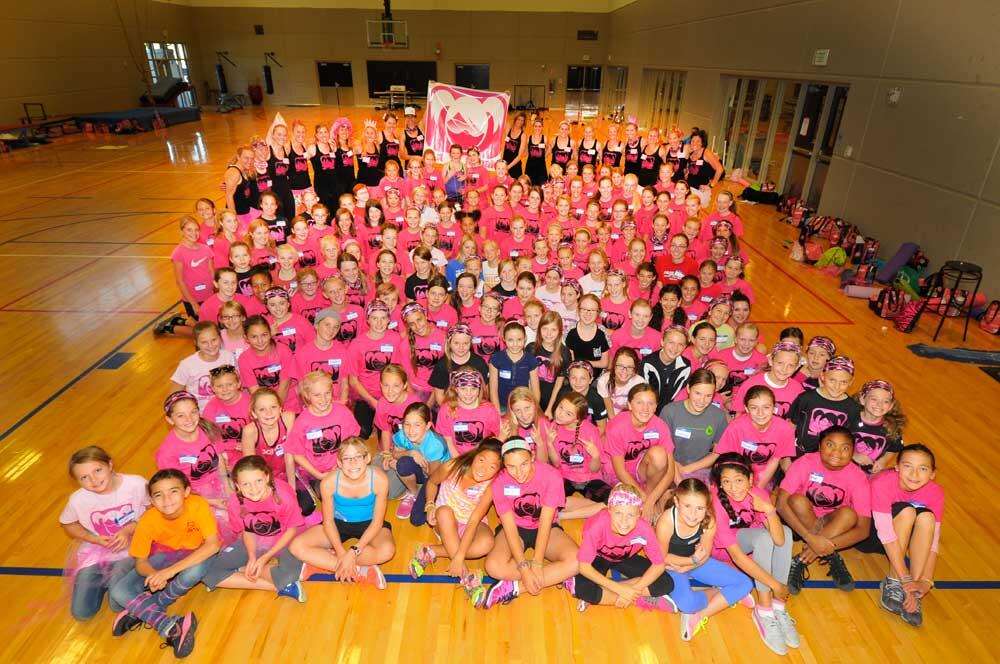
A huge group of happy campers at Fast and Female’s Champ Camp at the USSA Center of Excellence on Oct. 6 in Park City, Utah. (Photo: Tom Kelly/USSA Nordic)
In 2005, Fast and Female sprung to life as the brainchild of Chandra Crawford and the Canadian women’s cross-country ski team. The idea: get more girls skiing and help them build confidence in the process. The slogan: Empowerment through sport.
Within two years, Fast and Female events – which included days filled with skiing, yoga and “good eats,” according to the organization’s website – had become so big the nonprofit established a board of directors and continued to expand its reach through regional leaders across Canada. With the help of the U.S. women’s nordic team, movement trickled down into the states and is now a household brand among North American female skiers ages 9-19.
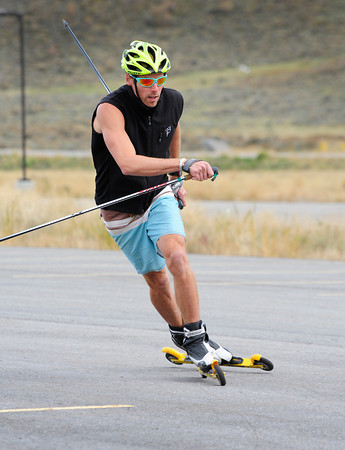
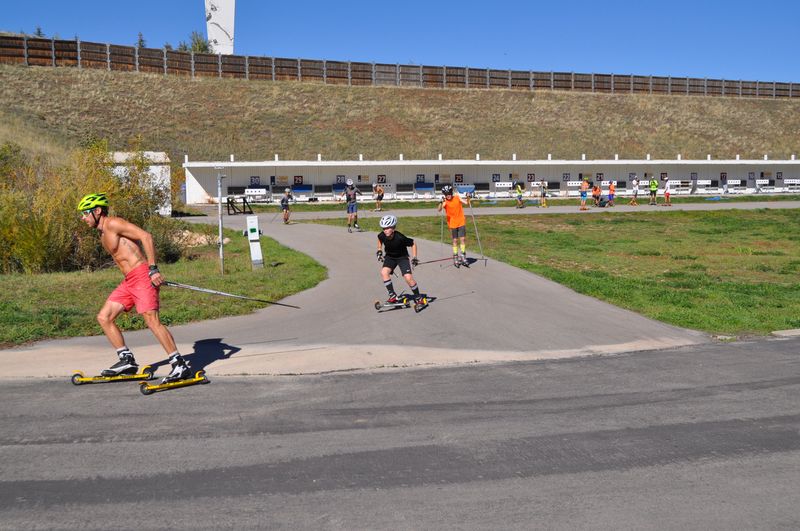
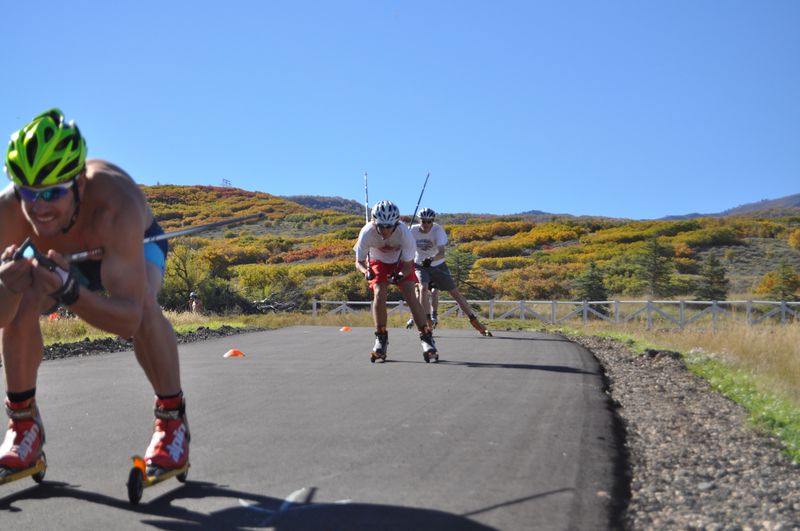
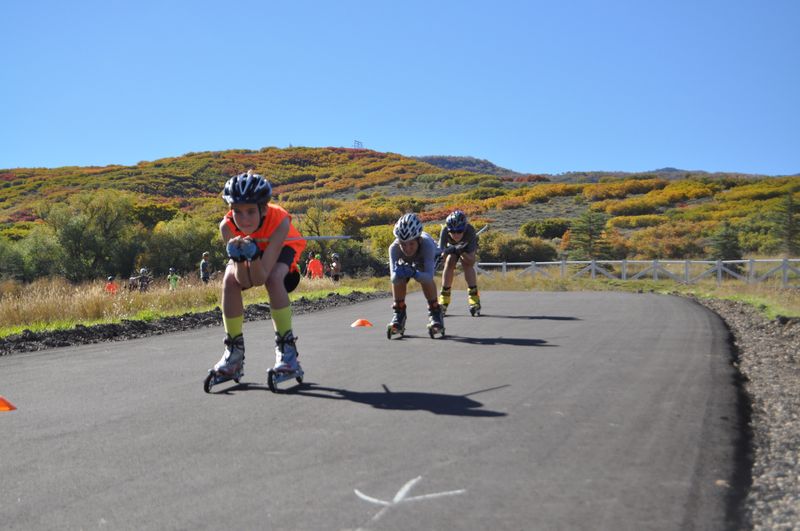
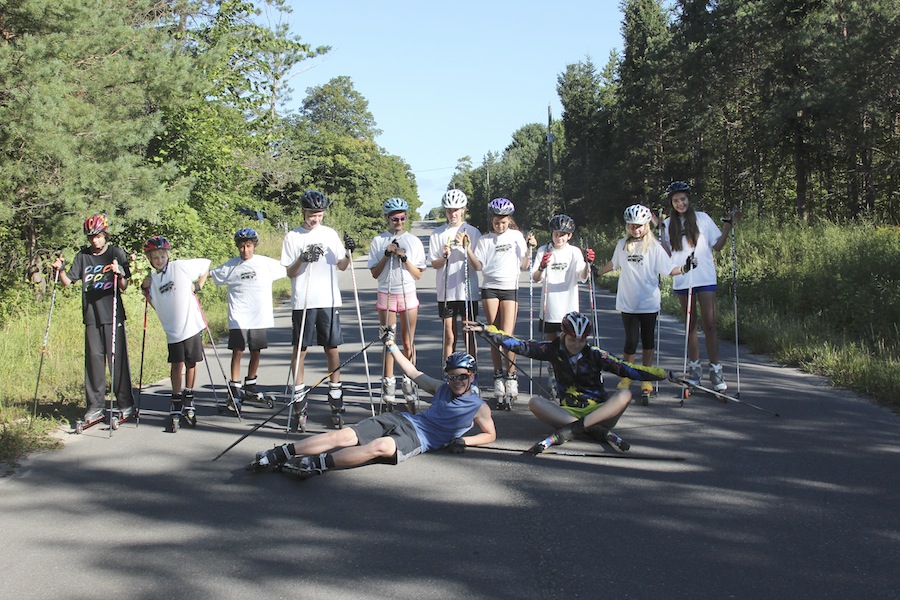
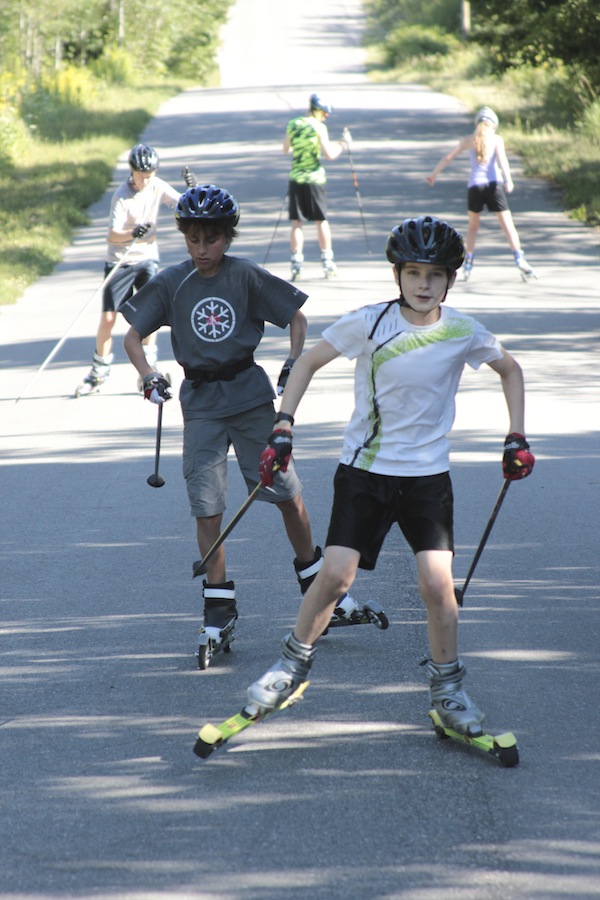
Andy Newell (l) shows junior boys how to ski fast and safe during the first Speed Camp on Oct. 6 at Soldier Hollow in Midway, Utah. (Photo: Jason Cork/USST)
That got the men’s U.S. Ski Team (USST), specifically Andy Newell and Simi Hamilton, thinking: how can we replicate Fast and Female’s success and provide a similar service for young males?
In an email, Newell explained the light bulb came on while training in New Zealand; they’d call it Speed Camp. His goal was to create a new type of clinic that would be exciting for junior boys and help the USST elevate the sport.
“Speed Camp is different than other traditional clinics because it’s specifically designed teach the kids how to move fast and improve their overall athleticism, which will translate over to skiing more comfortably at high speeds,” Newell wrote.
Most importantly, pushing those limits of speed was fun so the kids would likely find it more enjoyable than most practices, explained Newell, one of the world’s top-ranked sprinters.
With the help of the USST and assistant coach Jason Cork, Newell and Hamilton picked a time and place for their inaugural Speed Camp. On Sunday, the same day Fast and Female attracted some local 140 girls to Park City, Utah, the USST hosted its first Speed Camp at Soldier Hollow in nearby Midway with about 15 boys and five instructors (Newell, Hamilton, Cork, Skyler Davis, and Nick Hendrickson) participating.
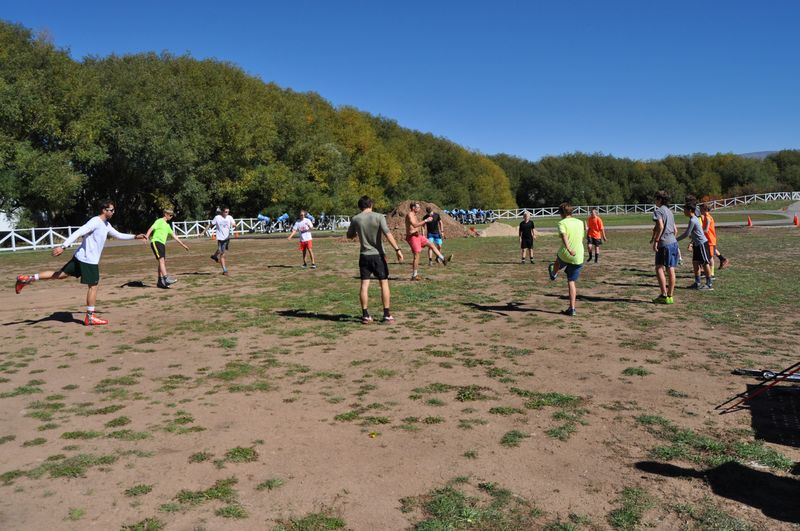
USST members lead the warmup at Speed Camp on Sunday in Midway, Utah. (Photo: Jason Cork/USST)
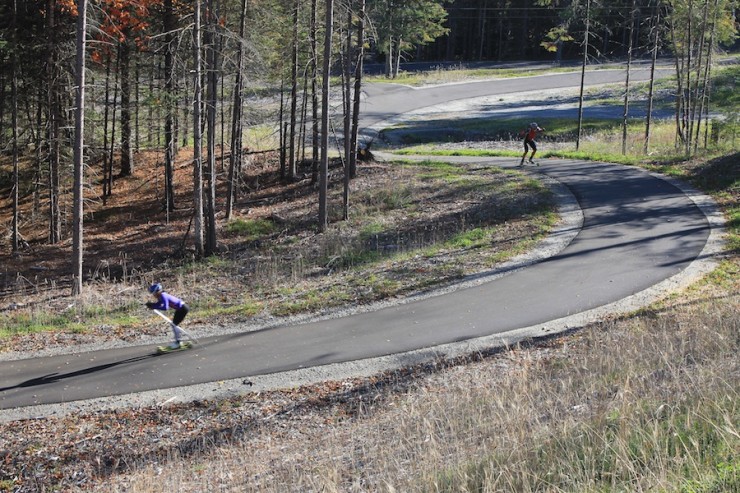
Newell explained the camp was as “great success” thanks to local coaches that helped spread the word and allowed them to use the paved rollerski track at Soldier Hollow.
“The goal of Speed Camp is definitely to focus on quality and make sure we have one on one interaction with each young skier,” he wrote. “It was a good instructor-to-athletes ratio so that we could really focus on our goals of going fast.”
While the girls attended seminars Sunday from 1-5 p.m., exploring fitness stations, dancing or doing yoga, and making their own tutus, what exactly did the boys do? For a couple hours, World Cup skiers Newell and Hamilton led a dynamic warmup then some fun on rollerskis, with an emphasis on safety, and finished up with a Question and Answer session.
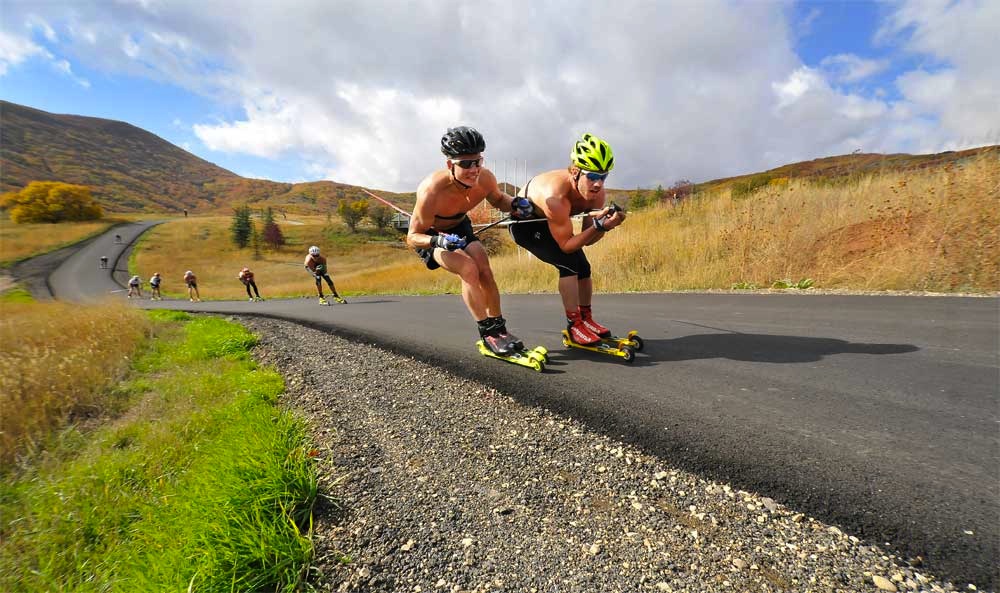
The junior boys practiced high-speed skating and learned techniques for fast cornering, sprint finishes, transition skiing, tucking, drafting, and slingshotting past others, “all types of fun racing techniques they might not be able to learn at their typical ski practice,” Newell explained.
Simi Hamilton (l) leads junior boys in a tuck at the inaugural U.S. Ski Team Speed Camp at Soldier Hollow. (Photo: Jason Cork/USST)
“Distance racing, sprinting, all types of XC skiing require athletes to push high speeds at one point or another and sometimes the best way to learn some if these techniques is from the World Cup skiers themselves,” he wrote.
In an email, Hamilton wrote they couldn’t have asked for better weather or a more enthused group.
“It’s always fun to do things like this with some of your teammates, and I felt like we all contributed a diverse array of technical knowledge,” Hamilton wrote. “I was very impressed to see how much the boys improved throughout each of the drills, and it looked like they were having a great time … especially during some of the friendly head-to-head races we had set up.”
Many might wonder when and where the next Speed Camp will be. With the World Cup season kicking off next month, there won’t be anymore this year with Newell and Hamilton, but they’re focused on continuing it.
The idea is to complement Fast and Female, Hamilton explained. “Give the boys an opportunity to do something fun and valuable!” He hopes they’ll be able to watch it evolve into a program of similar caliber.
“We really admire how that program has grown and we’ve seen firsthand how the hard work from the women on our team and other female athletes throughout North America has been able to shape the lives of young people in great communities,” Hamilton wrote. “I think we were all pretty psyched about how [Speed Camp] turned out and are super amped to continue this momentum for another Speed Camp next year and further into the future.”
Some fast, all-male fun on rollerskis at the U.S. Ski Team Speed Camp in Soldier Hollow on Sunday. (Photo: Jason Cork/USST)
LAKE PLACID, N.Y. — Nothing says the beginning of October like a grueling combo workout for the U.S. Biathlon squad. As if five to six repeats around their 3-kilometer rollerski loop wasn’t enough, they started Thursday with an all-out race to the top of the course.
According to women’s coach Jonne Kähkönen, the prelude was something new this year after several of his athletes said they wanted a faster first lap in races. The answer: get the blood pumping and heart racing faster before you start.
That meant starting at the bottom of the Olympic Jumping Complex — way down in the lower parking lot — and racing one another to the top (mass-start style). Four men (Tim Burke, Lowell Bailey, Leif Nordgren, and Russell Currier) and three women (Susan Dunklee, Hannah Dreissigacker and Annelies Cook) all started at once, along with special guest Andrea Henkel, a German biathlete and Olympic gold medalist (and Burke’s girlfriend). Henkel, 35, did the initial workout with the group, but without a rifle for this trip, opted to double pole around the rest of the morning.
With a 10-minute rest beforehand, the combo workout (5 or 6 x 8-minute laps around the relatively new course, with prone and standing shooting in between) involved two to four lactate readings per athlete. It marked the end of a tough three-week training block, and Kähkönen said this workout is done once every intense training period. Next week, athletes can enjoy some rest before flying to Utah for the last set of rollerski races in Soldier Hollow Oct. 22-24.
Andrea Henkel (l) and Russell Currier
Russell Currier
Andrea Henkel
Lake Placid Olympic Jumping Complex
Annelies Cook
Lowell Bailey
Tim Burke training in Lake Placid, where FasterSkier chatted with him this fall.
Susan Dunklee
Hannah Dreissigacker
Hannah Dreissigacker leaving the range during combos in Lake Placid
Lowell Bailey
Leif Nordgren
Russell Currier
Hannah Dreissigacker (r), Andrea Henkel
Leif Nordgren
Russell Currier
Lowell Bailey
Dunklee in Lake Placid.
Andrea Henkel
Hannah Dreissigacker
Lowell Bailey
Tim Burke
Lowell Bailey
Tim Burke
Russell Currier
Annelies Cook
Susan Dunklee
Coach Jonne Kähkönen (l) assists Leif Nordgren with his final lactate test on Oct. 3.
Jessie Diggins keeps on strength training despite a foot injury she suffered while trail running Sept. 14 in Lake Placid, N.Y. Fewer than two weeks later, she no longer needed the boot and was pain free while recovering the muscle strain between her third and fourth metatarsals. (Photo: jessiediggins.com)
Jessie Diggins couldn’t recall exactly what happened two weeks ago when she was trail running in Lake Placid, N.Y. Maybe she hit uneven ground, misstepped and rolled her ankle, she couldn’t remember.
But for the record, the 22-year-old U.S. Ski Team (USST) and Stratton Mountain School T2 Team member reiterated that she didn’t fall. Not this time.
Regardless, the pain in her right foot was unsurmountable. Diggins had to cut her workout short on the second-to-last day of the USST’s dryland training camp – the day before the culminating Climb to the Castle – and limp back to the car. Fears of a stress fracture swirled in her head.
Within two hours, Diggins was at the hospital in Lake Placid. Doctors sent her in for an X-ray of her foot, and two hours later, a specialist examined the initial findings – which didn’t show much. The good news: no broken bones as far as the X-ray detected.
“It was amazing how fast they responded,” Diggins said in a phone interview on Sunday.
“Our team has kind of a history of dealing with injuries so it was like, woah, let’s just really be super careful,” she added. “They knew it wasn’t a break, but until we got the MRI, we weren’t sure exactly what was going on.”
Diggins took the cautious route and hobbled around on crutches for the next few days, wearing a boot on her right foot until she could get an MRI in Park City, Utah, her next stop on the training circuit.
The night of her hospital visit, Diggins reunited with her teammates in the dining area at the Lake Placid Olympic Training Center.
“I came in on crutches and everyone was like, ‘Oh, what did you do?’ ” she said. “And I was like, ‘I didn’t do that much. Don’t worry, it’s fine.’ I think the worst part was not knowing and worrying that I’d have to take serious time off training.”
Fortunately for Diggins, who explained she typically pushes through pain and sometimes even injuries – like the bone spurs on her heels early last season – this foot mishap was not something that was going to derail five months of dedicated training.
In Park City, the MRI revealed that she had strained the muscle between her third and fourth metatarsals, two of five long bones in her foot. USST physical therapist Adam Perrault advised that she prepare for a six- to eight-week recovery. She laughed and told him she could do it in four.
Last week, Diggins met with a foot specialist in Park City, where she’ll be through the upcoming USST camp from Oct. 7-28 (then she and the team fly up to Canmore, Alberta, for on-snow training). The doctor told her that other than this injury, she has “perfectly good feet.”
“Anyone who runs has pretty strong bones; it seemed to be just an out-of-the-blue thing,” Diggins said. “I don’t know that much about sprains or how they happen, but before then I felt absolutely no pain. I actually had no warning. … I think somehow, before I felt the pain, I stepped on a root and kind of torqued my foot. I don’t remember doing it, but it certainly could’ve happened.”
Jessie Diggins (Stratton Mountain School T2/U.S. Ski Team) with some bloody knees after tripping on an OD trail run in the Adirondacks near Lake Placid, N.Y., in early September. USST women’s coach Matt Whitcomb (l) inspects the damage. (Photo: Erika Flowers/jessiediggins.com)
Earlier in the Lake Placid camp, Diggins had a bloody mishap when she tripped and fell on another trail run in the Adirondacks.
“In my self-defense, we found this natural waterslide,” she explained.
Diggins slid headfirst into a pool of water and lost one of her contacts. With blurred vision for the return run back, it was only a matter of time before crashed and burned, she reasoned. Fortunately, the scrapes on both knees weren’t too debilitating.
“Hopefully I got all my accidents out of the way at that camp,” she said.
Out of the boot for a while now, Diggins was recently cleared for classic skiing and has been pain free for nearly a week. She never missed a day of training – one if you count the Climb to the Castle – when she did a light session on the spin bike instead.
“The only thing I hate more than the Climb to the Castle is not doing it,” she said of the grueling rollerski race up Whiteface Mountain’s toll road.
This year, her roommate and training partner in Park City, Liz Stephen won the race for the third-straight time and set a new course record in the process.
Over the last two weeks, Diggins has spent plenty of time indoors on the bike, but hasn’t missed much on the skating side of training and could double pole as well. Since the motion of pushing off her toes was most troublesome, she stayed away from bounding and running outdoors, instead taking her striding to the Ultra-G treadmill, which allowed her to run with 70 percent of her body weight.
“You basically wear these shorts that you zip into the bubble over the treadmill, and the bubble inflates and lifts you up so that you can run at much less than your real body weight,” she explained on her blog. “You can be cruising along at a 6 minute mile pace and barely break a sweat! It’s pretty fun. Especially when Gilmore Girls comes on the TV.”
On Sunday morning, Diggins went out for a 3 x 20-minute Level 3 rollerski skate workout. The week before, she and Stephen endured two days of blizzard-like conditions and did speeds in a hail storm. The snow quickly melted.
Jessie Diggins running with 60 percent of her body weight on the Ultra-G treadmill at the Center of Excellence (COE) in Park City, Utah. (Photo: jessiediggins.com)
Regardless of the weather, Diggins was glad to be back outside for most of her workouts. She anticipated bounding would have to wait until November, but in the meantime she’ll do classic intervals, and plyos in the pool and on a TumblTrak trampoline at the U.S. Ski and Snowboard Association’s Center of Excellence (COE).
“I don’t feel derailed at all by it,” Diggins said. “If anything, it gave me a little more motivation. Generally classic striding isn’t something I love so much, but now I’m excited to get out and do it.”
Above all else, the setback has taught one of the USST’s most promising skiers to roll with the punches and rely on the work she’s put in.
“The time trials have showed really positive results,” she said. “We found a number of technique things that we’ve improved on and worked on. Every year, I just gain a little more confidence.
“I’m training hard and I can’t possibly train any harder than I am now,” she added. “Looking back at the summer, I don’t think I could’ve done any more than I did. I’m feeling really happy with that.”
According to Diggins, her last significant injury came at the beginning of last season when she pushed through the pain of bone spurs on both heels. Doing so caused angst and major discomfort at the December World Cup races in Kuusamo, Finland, where she placed 12th in the 5-kilometer skate race and 24th in the overall mini tour, and Quebec, where she and Kikkan Randall won the freestyle team sprint.
Her sponsor, Salomon, cut holes in her boots to ease the pain.
“It was one of those things where it was this annoying thing on my heels, but then you can work through it and then you’re really in trouble,” Diggins recalled. “Suddently right before the race you’re in tears.”
In Quebec City, she and her coaches determined she needed backless shoes for relief between races. Diggins ventured around town to find some and bought a pair of pink Crocs. So there she was, running around the course and through slush in pink sandals.
“I had very cold feet,” she said.
Now that the bumps on her heels are no longer an issue (despite the small remaining lumps), Diggins said she’s more apt to recognize problematic pain.
“Obviously there’s never a good time to get injured, but that said, if you had to strain your foot sometime, this is like the perfect time,” she said. “I’m at the COE with all these people here to help and I’m getting as much help as I possibly can. That’s a good feeling so I’m right on track.”
APU and U.S. Ski Team members Kikkan Randall (l) leads Holly Brooks (c) and Sadie Bjornsen (third from r) up a hill during rollerski intervals earlier this month near Park City, Utah. (Photo: Tom Kelly/USSA)
In preparation for three premier events being held at high-altitude venues this winter, the Alaska Pacific University (APU) Elite Team spent two weeks this month training 7,000 feet above sea level in and around Park City, Utah. With nearly a dozen athletes, the team slept another 1,000 feet higher at Deer Valley Resort.
Whether their focus for the season is on U.S. Nationals at Soldier Hollow in Midway, Utah, Junior and U23 World Championships in Val di Fiemme, Italy, or the Olympics in Sochi, Russia, the athletes that attended the camp are hoping the exposure to thin air will give them an edge their sea-level base in Anchorage can’t provide.
The APU men’s team during an over-distance run on the Wasatch Crest Trail earlier this month near Park City, Utah. (Photo: Holly Brooks)
“Hopefully we’ll go home and feel pretty good, just with the increase in oxygen,” APU and U.S. Ski Team (USST) member Holly Brooks said in a phone interview on Aug. 24, the final day of camp. “Hopefully we’ll have some good interval sessions in the next two weeks while we still have the boost from altitude.”
The higher the altitude, the less oxygen molecules in the air, which working muscles require to function at their best. In order to compensate, the body produces extra red blood cells to deliver oxygen to the muscles. When the athlete returns to lower elevation, the extra red blood cells will remain in their system for 10 to 20 additional days, providing a natural, legal boost in performance.
“Whether it’s the altitude or not, I think everyone here has gotten two weeks of incredible training,” Brooks said. “It’s hard to say from a physiological standpoint, but I think it’s been a really productive camp either way.”
The camp marked a shift in the athletes’ training cycles from the base-volume period to intensity leading up to the season-opening races. They will continue adding faster intervals and time trials back in Anchorage before returning to Park City for three more weeks in October. The non-Alaskan USST members will be at an intensity camp in Lake Placid, N.Y., for the first two weeks of September.
Erik Bjornsen (APU/USST) leads the men’s group during sprint training at APU’s altitude camp. (Photo: Tom Kelly/USSA)
“Now it’s the time to kind of get fast,” Brooks quipped. “This camp was kind of the first time that we’ve seen a big dose of Level 4.”
Though the next trip to Park City will be an official USST camp, several club teams including APU will take over the roads and trails, including the freshly laid pavement on the Soldier Hollow race courses.
APU skiers are able to train at a moderate altitude (about 5,000 feet) on Eagle Glacier in Alaska, but Brooks said this is significantly more time at altitude than her typical annual training plan prescribes. Glacier camps typically last about a week, as food and other supplies have to be flown in by helicopter.
The altitude at World Cup venues tops out at around 4,500 feet, Brooks said, which is Sochi’s elevation. With the stakes raised this year, athletes are hoping to be acclimated to the change in environment well in advance of the events they have invested so many training hours in.
Brooks likes the Americans’ chances racing at altitude. When the national team arrives in Park City, the skiers stop in at the U.S. Ski Association’s Center of Excellence, where they undergo hemoglobin-mass tests, which is compared to a second measurement later in the camp to analyze their body’s response to the change in altitude. Brooks said she and her USST teammates typically test very well.
“Generally, I really like altitude,” Brooks said. “Hopefully Sochi will be good and we’ll be prepared for it.”
Liz Stephen (USST) leads a train of skiers during a morning skating session in July on Alaska’s Eagle Glacier. (Photo: Matt Whitcomb/Sadie Bjornsen’s blog)
In advance of his club’s facility playing host to the third annual North American Women’s Training Alliance (NAWTA) camp last month, Alaska Pacific University (APU) Nordic Director Erik Flora broke down film of last year’s World Cup races in Sochi, Russia.
His focus wasn’t on the skiing, even though several of the athletes planning to attend the camp on Eagle Glacier were featured in the video. He was studying every undulation of the race courses, with a goal to replicate the Olympic venue.
The altitude and topography of the widely separated parts of the world is similar enough to make the project worthwhile. Referencing course profiles and maps, Flora and APU wax techs Mike Matteson and Don Haering logged 16 to 20 hours daily constructing and maintaining the trail system.
U.S. Ski Team members (L-R) Sadie Bjornsen, Holly Brooks, Ida Sargent, Kikkan Randall, Jessie Diggins and Liz Stephen with NAWTA camp guest Astrid Jacobsen of Norway. (Photo: Matt Whitcomb/Sadie Bjornsen’s blog)
The women’s U.S. Ski Team (USST) joined the APU elite women, a few National Training Group skiers and international guests Astrid Jacobsen, of Norway, and Switzerland’s Bettina Gruber for a week of dryland training, followed by a week of living and skiing on the remote glacier.
According to U.S. women’s coach Matt Whitcomb, the skiers woke to blazing fast skating conditions every morning, which softened in the sun to create wildly variable classic tracks in the afternoon.
“It’s rare and productive when you can train on that range of conditions in a single session,” Whitcomb wrote in an email. “Striding in tricky classic conditions is something our women’s team can improve on, so these sessions are really important.”
As much as they learned from the snow, which transformed in similar patterns to what they remembered of the Sochi race-day conditions, the women might have learned more from one another.
“With eight World Cup racers at a camp, it’s rare that the same person leads every day,” Whitcomb wrote. “Everyone had a session where they could put their best strength to work, and of course a session when they got absolutely trounced.”
Jacobsen is regarded as one of the best technical classic skiers in the world. She was the 2007 World Champion in the classic sprint and placed third in the 3-kilometer classic prologue in the third stage of last year’s Tour de Ski.
U.S. star Kikkan Randall earned the same respect for her skating ability, which she has ridden to the last two World Cup sprint titles.
At the end of the competition season, Randall extended an invitation to Jacobsen, not really expecting her to accept as athletes don’t typically do anything too out-of-the-norm in an Olympic year.
Flying in star athletes from traditionally dominant skiing nations brings the untouchable down to eye level, Whitcomb said. U.S. skiers are seeing that they have all the same tools, and maybe even some advantages. In a phone interviews, Randall said that Jacobsen seemed to admire the positive team dynamic of the U.S. women.
“Before, we felt that we had to know the course and know the snow and everything had to be perfect [to be successful],” Randall said. “I think what our good results have shown over the last few years is that if we’re in shape, I think we can encounter everything.”
The primary difference Randall sees in the training philosophies of the Norwegian and American national teams is the value U.S. coaches place on time in the weight room. Randall said her team puts more of an emphasis on Olympic-style lifts, which develop explosiveness and functional strength, than some other nations.
The 2013 NAWTA camp near Anchorage, Alaska, including APU and U.S. Ski Team members Holly Brooks (l) and Kikkan Randall (at bottom, second from l). (Photo: Matt Whitcomb)
Training logs aside, Randall said one of the most valuable things she gained from spending a couple of weeks with Jacobsen and Gruber was two more friends to keep in touch with during five long winter months of travel.
The NAWTA name originated in 2011 when Canadian World Cup skiers Chandra Crawford and Perianne Jones joined the annual USST glacier camp. Last year, Finnish sprinter Aino-Kaisa Saarinen was the team’s international guest.
This year’s camp schedule listed two skiing sessions daily, with skating first every day except the one they started with classic intervals. Everyone shared chore duties, including meal prep, dishes and cleanup. They also had to prep their own skis for each workout.
On the fourth day on the glacier, the coaches spiced up the workout with a sprint relay, covered by several media outlets that flew in for the day to see Flora’s creation and get some perspective on how this camp will help the women prepare for Sochi.
Even with a twin of the Olympic venue in her back yard, an experienced Randall knows familiarity with the courses alone will not decide the podium in February.
“I guess what I’ve learned over my previous three Olympic experiences is if you prepare well and you show up at the Olympics rested, healthy and in good shape, then you’re really ready to conquer anything,” Randall said.
Andy Newell of the U.S. Ski Team leads Russia’s Alexey Petukhov during the men’s A-final of the New Zealand Winter Games freestyle sprint last Thursday. (Photo: Noah Hoffman/noahhoffman.com)
In his nine-plus years on the U.S. Ski Team, Andy Newell figures he has logged more skiing hours at the Snow Farm on the South Island of New Zealand than any other place in the world.
An annual training camp destination since 2002, the U.S. men’s team touched down there last week and will stay for the rest of the month.
Simi Hamilton skis away from U.S. Ski Team head coach Chris Grover after breaking down some video footage of his technique. (Photo: Noah Hoffman/noahhoffman.com)
Head coach Chris Grover will let Newell, Simi Hamilton and Noah Hoffman take full advantage of the August snow and complete some of their biggest training volume weeks of the year. But it won’t be all slow and easy.
“The ease of the living/training situation here makes it quite easy to train a lot,” Grover wrote in an email. “We will also run several interval and speed sessions, with at least one interval session being Sochi-specific for the sprinters.”
The camp coincides with New Zealand’s Winter Games, which served as a fitness gauge for some World Cup skiers last Thursday. Newell beat a small-but-quality field in a skate sprint, while reminding his skiing muscles what all that rollerskiing, running and biking this summer has been for.
“It’s August, so we never want to be racing too fast in the middle of the summer,” Newell wrote. “But at the same time we want to see positive feedback and improvement in how the training is being absorbed.”
Hoffman continues to rebuild up his upper-body strength after undergoing shoulder surgery this spring. He did a 2 ½-hour double-pole workout on Friday.
Hamilton sprained his left ankle a couple of weeks ago during a run with the Stratton Mountain School T2 Team and did not race on Thursday as skating irritates his ankle more than classic. He partially tore all of the ligaments in the same ankle during a terrain-park accident in high school and has had occasional problems with it since. Hamilton wrote in an email that while in New Zealand, he has been working with Canadian team physical therapist Shane Hutchins on re-aligning the ankle and getting it to function normally again. The U.S. did not send a physical therapist to the camp.
Newell said the extensive trail system is white, but dirt and grass isn’t far beneath his ski bases. He said conditions range day-to-day from awesome to not great, depending on how windy it is and how cold the nights are.
“I like training here, because you can get the real winter-type conditions that are hard to find in glacier skiing,” Newell wrote, referring to one of the few other places to find skiable snow during the North American summer.
Hoffman expressed his dissatisfaction with the grooming on his blog.
“The (Snow Farm) staff has chosen not to groom on multiple occasions,” Hoffman wrote. “The decision not to groom has made training difficult and less productive. We, the athletes training here, don’t understand the excuses, because we have skied all over the world in more adverse conditions than they are experiencing here at the Snow Farm.”
A short drive down off the mountains brings athletes to the town of Wanaka, with its green grass and lakes, where they run and do strength.
Following the New Zealand camp, the U.S. men will stop in at home and re-pack their bags before heading to Lake Placid, N.Y, for the next USST camp about a week later (Sept. 3-16).
Canadian national team members during a training session on one of the first days of their training camp at the Snow Farm in Wanaka, New Zealand. (Photo: Noah Hoffman/noahhoffman.com)
Canada’s entire World Cup team is also in New Zealand, with the exception of Lenny Valjas, who is rehabbing his knee after having it scoped last month. He explained in his blog that he has been racing on a bad knee for nearly five years, but this summer it was getting progressively worse so he finally had it taken care of.
“[Valjas’] recovery is going really well, but we felt it was better to get him 100-percent before returning to a full training camp,” Canada head coach Justin Wadsworth wrote in an e-mail. “There is no doubt in my mind he’ll be ready this winter. He went into the scope in the best shape of his life and has done a super job of continuing to train while doing the rehab on his knee.”
Four younger skiers from the Pierre Harvey National Training Centre in Quebec tagged along to train alongside Devon Kershaw, Alex Harvey, Ivan Babikov, Dasha Gaiazova and Perianne Jones.
Wadsworth and Grover shared their camp plans with each other and the teams will combine for several workouts.
“The focus down here is just good solid training with an emphasis on technique,” Wadsworth wrote. “It also allows our athletes to take a break from roller skiing and running, so they head into the final part of the summer/fall refreshed and ready to get the work done before the snow flies. We’re not doing anything specific for preparation for Sochi except some work in steep terrain, which we don’t normally get on roller skis.”
The Canadians have an altitude camp in Truckee, Calif., in early October, before getting on some more preseason snow in Canmore, Alberta.
“Overall, the team is doing well and it’s fantastic to have more women than men down here,” Wadsworth wrote. “The group here is super motivated and is a nice mix of veterans and younger athletes.”
Andy Newell (l) and Russia’s Alexey Petukhov go head-to-head in the men’s A-final on Thursday in the Winter Games NZ freestyle sprint in Wanaka, New Zealand. Newell won the race, Petukhov was second and Canada’s Devon Kershaw placed third. (Photo: Noah Hoffman)
The U.S. Ski Team men’s squad touched down in New Zealand on Tuesday afternoon. Imagine racing in the land down under, a 16-hour time difference from Andy Newell and Simi Hamilton’s base in Vermont and 18 hours from Colorado, where Noah Hoffman primarily trains, two days later.
Newell and Hoffman did just that (Hamilton ran into major baggage woes on his way over), and Newell came out on top of a relatively stacked, if not small, field on the opening day of Winter Games NZ.
The Winter Games NZ men’s 1.6 k sprint podium, with winner Andy Newell (c), runner-up Alexey Petukhov (l), and Devon Kershaw in third. (Photo: Snow Farm/Facebook)
The ninth-ranked competitor, Newell not only crushed the qualifier of the 1.6-kilometer freestyle sprint at the Snow Farm in Wanaka, but he went on to win his quarterfinal, semifinal and eventually the final over Russia’s Alexey Petukhov and Canadian Devon Kershaw. Top seed Nikita Kruikov of Russia ended up fifth after teammate Anton Gafarov in fourth.
After spending most of his summer with the Stratton Mountain School T2 Team, Newell clocked a time of 2:52.96 over what he considered a fast course, which was “fairly hard packed,” he wrote in an email. “The course was really fun with a super fast rolling downhill and lots of turns. … Neither of the two climbs on course were too steep.”
Petukhov was the second-fastest qualifier nearly four seconds later in 2:56.54 and Kershaw qualified third in 3:00.10. Their positions ultimately held steady, with Petukhov placing second and Kershaw third in the final.
“I felt a lot better than I thought I was going to racing,” Newell explained of his first time on snow in a couple months. “The travel is tough to get down here but adjusting to the time change is actually pretty easy. A lot easier than Europe. So racing two days off the place isn’t that big of a deal.”
Still, he didn’t feel exactly the same as he would on a World Cup morning.
“I wasn’t too eager to race in the morning having only had one day on snow but as a warmed up I started feeling pretty good,” Newell wrote. “The sun came out so I had plenty of energy in Qualification. Obviously all the Russian guys here are fast sprinters so I didn’t have any goal for the race other than to make the final.
“It’s August so we just use these races as training opportunities and use them to gauge how our bodies are responding to the summer training and also identify things that we need to work on technically,” he added. “Especially with sprinting it’s helpful to jump in races like this so you can stay sharp when it comes to heat tactics and race-like accelerations.”
Newell specifically tried to work on fast accelerations, over the tops of hills and during the final stretches of each heat.
“I think it worked out well and I was happy with the result,” he wrote. “I was stoked with how the body felt pushing hard. We spend all summer long running, biking, rollerskiing, just training a ton and its good to remind yourself of why you’re putting in all the hard work. It’s good to remind yourself that you’re a ski racer and this is what you’re trying to get faster at.”
Primarily a distance skier, Hoffman finished ninth ahead of a Russian and six Korean skiers.
The Winter Games NZ women’s 1.6 k skate sprint podium, with winner Justyna Kowalczyk (c), runner-up Dasha Gaiazova (l), and Anastasia Kuzmina in third. (Photo: Snow Farm/Facebook)
In the women’s skate sprint, Poland’s Justyna Kowalczyk was the fastest qualifier in 3:27.25, more than 5 seconds ahead of Olympic gold medalist biathlete Anastasiya Kuzmina of Slovakia. Canadian Perianne Jones qualified third in 3:36.42.
Kowalczyk went on to win her semifinal and top Canada’s Dasha Gaiazova in the final for the overall victory, telling race organizers, “It was a good race on a very good track. I am very happy and racing here at Snow Farm and the Winter Games is very important for me for Sochi,” she said.
Gaiazova was second, but could not be reached for comment, and Kuzmina placed third. Jones finished fourth in the A-final, topping Japan’s Michiko Kashiwabara and Chisa Obayashi, who were first and second, respectively, in the B-final. New Zealand’s lone entrant and first Olympic biathlete, Sarah Murphy, ended up seventh of eight women. Murphy is trying to qualify for her second-straight Olympics after “a lot of back luck last year,” including illness and a broken rifle, she told the Otago Daily Times.
“These Winter Games are really very important for me and my bid for the Olympics,” she said.
Although Thursday marked the start of the Games, it was essentially the only day of true-blue racing for the Americans at the Snow Farm. “We are hopefully going to do a distance time trial with the Canadians later in the camp but that will be the only other racing,” Newell explained.
The 2013 Team Hardwood Midget Camp crew. “A HUGE thanks to CCC for the amazing t-shirts they sent us!” (Courtesy photo)
Note: The following is a report on the recent Team Hardwood Midget Camp in southern Ontario written by volunteer Heather F. Wilson and submitted by Team Hardwood’s board of directors. Have a training-camp recap of your own? Send yours with high-quality photos to alex@fasterskier.com.
Our Athletes Are Made In The Summer
A Volunteer’s Report on the Team Hardwood Midget Camp | By Heather F. Wilson
BARRIE, Ontario — Somewhere behind the athlete you have become are those hours as a little kid when you picked up a pair of skis, fell in love with the sport, and never once looked back. As a camp, our main goal for the past weekend was to get as many young kids as possible to fall in love with cross country skiing. With a total of 8 midget-aged athletes, 4 volunteers from Team Hardwood’s senior racing team and our Head Coach Ron Howden, I think we did just that.
The two days started off with all the midgets meeting on Friday at Hardwood Ski and Bike. Everyone was enthusiastic and ready to get going. Half the campers had been on roller-skis before, and the other half had not. They were all super excited to get out on the roads to try the skis out.
What we found worked for us was to divide the athletes up so that the Juniors who had never been on rollerskis each got to do 1 on 1 work with the volunteer helpers, while Ron was able to take the more experienced athletes out to work on specific ski technique.
Athletes in action at the 2013 Team Hardwood Midget Camp
It seemed that after 90 min of rollerskiing the kids were even more excited and energetic than before. Nobody could stop talking about how much fun it had been to rollerski and from a volunteer perspective, this was really great to hear. It let me know that they were all enjoying cross country skiing so far.
The great thing about midget-aged athletes is that their energy never seems to go down. So even after 90 minutes of rollerskiing, they were still wired up and ready to go. We continued our day of training with a few running games including manhunt, capture the flag, cops and robbers, and a few others. This was great because it didn’t give the kids any chance to sit down and rest.
As all the athletes were staying together, we were able to have dinner as a group and swap stories of what had happened earlier while rollerskiing. A few of the athletes who had never even been cross country skiing before, let alone roller-skiing, could not contain their excitement at how much they had improved within the 90minutes. All everyone could talk about was how much they looked forward to trying it again. I think I speak for myself, the other volunteers, and Ron when I say it’s great to see young athletes so enthusiastic about rollerskiing and cross country skiing in general.
After dinner it was on to the next workout of the camp. While we were eating, Ron set up a 4-station ski specific circuit. We had a core station, a double polling station, a polling station to work on diagonal stride arms, and finally a balance station because everyone knows how important balance is in cross country skiing. This station was particularly fun for the kids because we had set up a rope going from one tree to another about a foot off the ground and the kids had to balance on it while trying to push their partner off. I think this was a favourite for all of them because they really seemed to enjoy it. I don’t think any of the athletes were expecting to be doing anything like this but they all picked it up perfectly. We rotated the kids through these stations numerous times.
Now, everyone knows training is important, but having fun is equally important. So there was no better way to finish off the workout than with a good campfire, smores and a movie before heading to bed. It was a perfect way to wind down from all the excitement of the day and just take a of couple hours to chill. Well, almost chill…. we may have delayed bedtime to try a little mattress surfing down the stairs. But really, I think missing 20 minutes of sleep is totally worth it if you’re going to replace it with mattress surfing.
Team Hardwood Midget Camp 2013
For the Juniors, Saturday morning couldn’t come soon enough. They started off the morning extremely energetic at 8am ready to go for a run. We took everyone for a short and slow run and then did a bit of stretching with them before breakfast.
The original plan for Saturday morning was to do some ski striding work, but after Friday’s successful rollerski everyone was begging Ron to let them ski instead. Saturday’s ski was similar to Friday’s where each volunteer worked one-on-one with an athlete for about 90minutes while Ron worked with the skiers who were comfortable on their skis.
For younger skiers, it’s important to have them training and exercising without their even realizing it. I am pretty sure this is what Ron had in mind when he took all of us over to “Tree Top Trekking” at Horseshoe Valley for the last 3 hours of camp. It is a super fun way to spend an afternoon, everyone loves it, and it gets their strength and balance working as they hang on to the ropes and try to cross the thin wires between trees.
I had a blast helping at this camp and I know my fellow teammates did as well. The kids learned so much and they all came away from the camp with smiles on their faces, which is the most important part. I can’t wait to see everyone in the fall and at the next midget camp. Hopefully, the next time they will all bring their friends and it can be even bigger and better!
About Team Hardwood:
With its base at Hardwood Ski and Bike north of Toronto, Team Hardwood is one of Ontario’s most successful developmental cross country ski racing clubs. Its athletes regularly progress to Canada’s national development centres and university teams. It includes current NST member Lenny Valjas and several top Junior skiers on its roster for the 2013-2014 season.
Scenes from the 2012 “Train Like A Birkie Champion” camp: featured skiers Tad Elliott (black and yellow) and Matt Liebsch (fourth from left) lead fundamental movements and balance work. (Photo: F.A.S.T./Facebook)
Bill Pierce gets it. If you’re a citizen or master athlete in the Midwest, chances are you’re not training year-round for the Birkie – or at least you have other races and diversions to keep you entertained through the summer.
And if one of those interests is mountain biking, you might be signed up for the Chequamegon Fat Tire Festival from Sept. 13-15 in Cable and Hayward, Wis.
Perfect, thought Pierce, the outgoing director of F.A.S.T. Performance Training who recently took over as head coach of the Central Cross Country (CXC) elite team. Let’s give those athletes a dryland camp with a mountain-bike twist. And let’s get Tad Elliott back to northern Wisconsin.
Both elements were relatively easy to pin down, Pierce explained on the phone earlier this week. At the end of last year’s “Train Like A Birkie Champion” camp, Elliott, a former U.S. Ski Team (USST) member who’s still pursuing professional skiing while mixing up training with his other love – mountain biking (he was on the U23 national team) – vowed to make the trek from Durango, Colo., back to Seeley, Wis. Then Pierce suggested adding a mountain-bike option to the three-day camp.
“I suggested it and he jumped on it,” Pierce said. “It was done for a marketing reason. The citizen-master athlete does not train for skiing from May ’til March. They’re doing multiple things, and I think one of their main goals is to enjoy an exercise program that’s two or three sports.”
Pro skiers Tad Elliott (second from left) and Matt Liebsch (second from right) with Rivers Eatery owners Mick and Beth for the Saturday-night dinner at last year’s “Train Like A Birkie Champion” camp. (Photo: F.A.S.T./Facebook)
From Sept. 6-8, F.A.S.T. will sponsor its third consecutive “Train Like A Birkie Champion” camp, which Pierce timed strategically before the Fat Tire Festival that attracts some 2,500 riders annually. Last October, the citizen/masters’ camp that featured Birkie champs Elliott and Matt Liebsch had 15 or 16 participants, Pierce said. This year, he’s hoping for as many as 30.
“We’re kind of taking advantage of fall training,” he said. “For almost all masters and citizens, [it] doesn’t get thought about until Sept. 1.”
While Liebsch won’t be at this camp (the Minnesota native and Gear West race services director held his own earlier this summer), Boulder Nordic Sport race service director and former USST member David Chamberlain will, according the schedule.
Elliott will lead a mountain-bike skills and training session on the afternoon of Sept. 7, and about $1,500 dollars of the money raised through registration and a silent auction will go to him.
Another $2,000 to $4,000 dollars generated by the camp will go to the Birkie Skier Development Grant Program, which has doled out more than $200,000 dollars over the years to nordic programs across the U.S. Last year, the American Birkebeiner Ski Foundation (ABSF) awarded 10 grants to programs in Wisconsin and Minnesota totaling $11,000 dollars. Pierce hopes his fundraiser will supplement the ABSF’s yearly donation.
“They’ve given funds all over the country,” Pierce said. “The revenue is entry fees, $20, 40 or $50,000 in their budget; [they] give it as a line item. We’re trying to help them.”
“Train Like A Birkie Champion (On a Mt. Bike!)” Camp Schedule
Friday, September 6, 2013
8-9:00am: Check in at Lenroot Lodge, Seeley, WI
9-10:30am: Intro to the fundamental movements of Nordic skiing. Dry land drills and skills.
10:30-Noon: Double pole and V2 fundamentals on roller skis.
Noon-2:00pm: Lunch at the Sawmill and video review after.
2-5:00pm: V1 skate technique work with video.
5-6:15pm: Strength instruction and session.
6:45-8:30pm: Fish fry at the Sawmill and discussions with Dr. TBD.
8:30-10:00pm: Discussions and demos on ski selection and waxing by David Chamberlain from Boulder Nordic Sport.
Saturday, September 7, 2013
7:30am: Morning run or bike for 20 min. with exercises.
8-9:00am: Breakfast on your own.
9-10:15am: Stretching with Dr. Jim Mullens
10:30-Noon: Basic classic technique session and video with Bill, David, and Tad.
Noon-2:00pm: Lunch at the Sawmill with video review after.
2:00-4:30pm: An additional skate/classic roller ski workout session(specific strength) or an afternoon training and skills session with Tad on the mountain bikes.
4:30-5:30pm: How to deal with repairs in a race: flats, broken chains or spokes, etc…
6-7:30pm: Pizza dinner at the Rivers Eatery in Cable.
7:30-Done: Chat with a Champion, dessert and coffee during discussions with Tad about his pursuit of a US Olympic Team position.
Sunday, September 8, 2013
7-8:00am: Breakfast on your own.
8-10:30am: Classic or skate technique and video with Bill, David, and Tad.
10:30-Noon: Video review from the morning session.
Noon: Camp departure.
Camp Fee: The fee for this camp is $224.00. It includes 2.5 days of coaching and sport instruction, two lunches, two dinners, and some swag. The camp is limited to the first 30 registrations. All proceeds from this camp go to supporting Tad Elliot and also a gift to the Birkie Skier Development Fund.