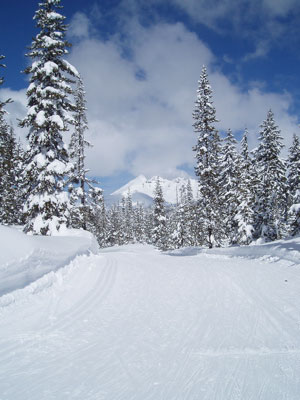
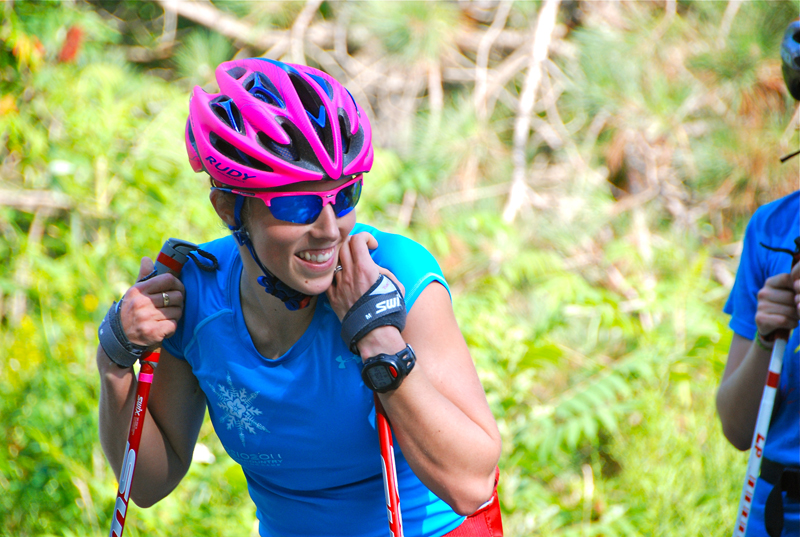
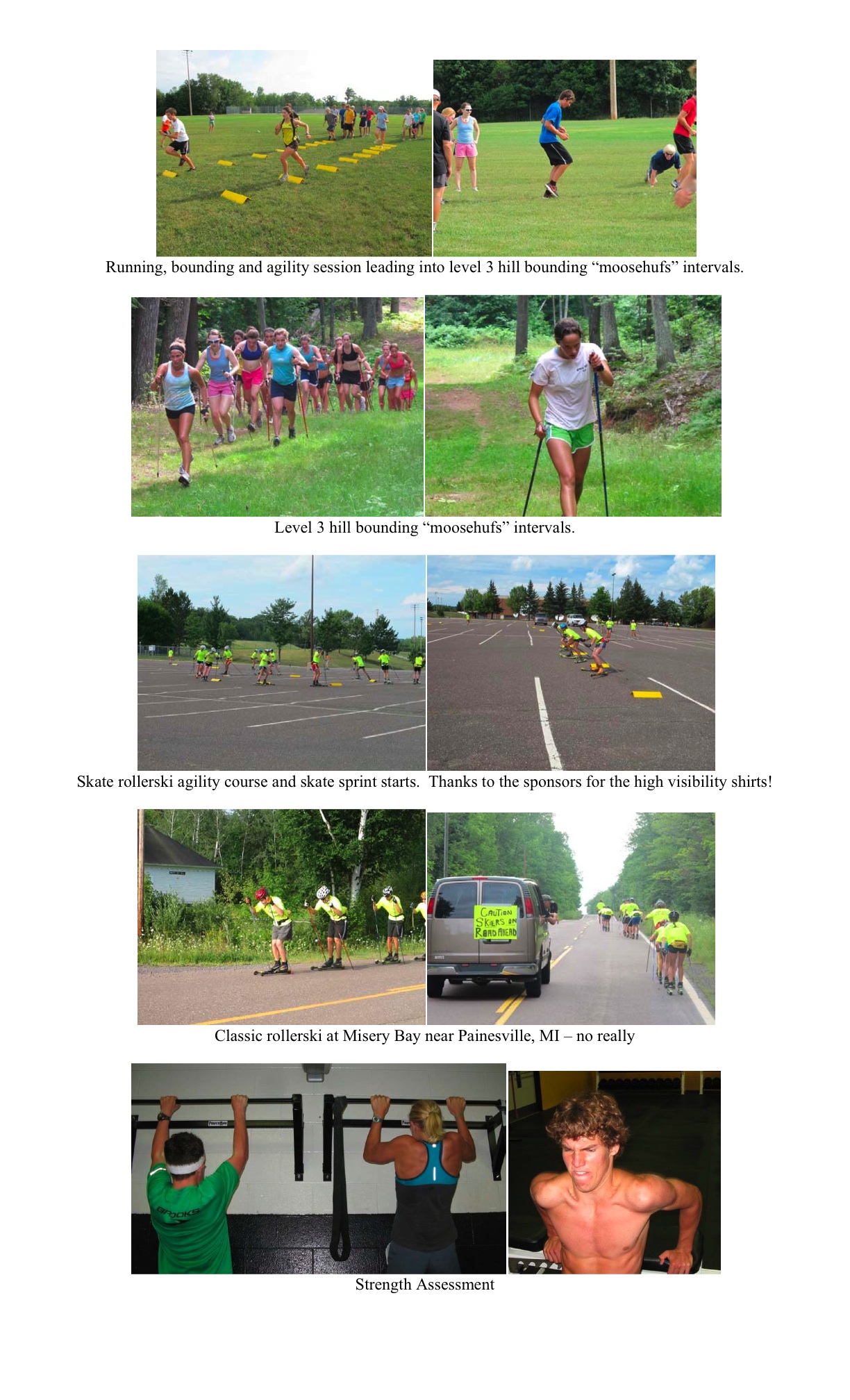
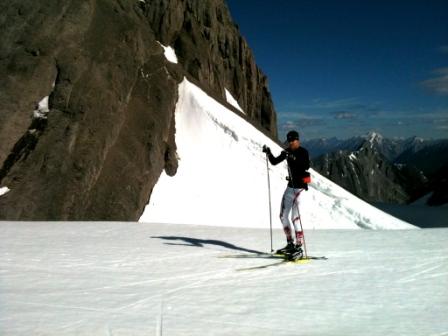
You Call This "Spring" Skiing? – Here In Oregon, Yes We Do! Photo: XC Oregon.
Registration is open to the general public for the 2011 Oregon Spring Camp taking place May 26-30, 2011 (Memorial Day weekend) at Bend/Mt Bachelor, Oregon.
Designed primarily as a master/citizen XC ski camp, junior skiers with a chaperone adult camper are also welcome. Due to carefully limited enrollment numbers, this camp is recommended only for skiers at intermediate and above skill levels.
Featuring on-snow morning sessions and a variety of optional events including dryland clinics, an evening training plan workshop, and ski specific physiology lab testing — the Oregon Spring Camp is one of the most unique ski educational events in the world.
Coaching for the camp will be led by J.D. Downing, Coach of the XC Oregon elite team and National Director of the American XC Skiers masters association. Downing will be assisted by a variety of local athletes and coaches.
With over 12 feet of snow base still reported at the 6300 foot elevation and spring Nordic Center operations continuing through June 20 this year, prospects for continued excellent spring skiing at Mt Bachelor for at least the next five weeks look promising to say the least.
Since 2001, Oregon Fall and Spring Camps have gained an international reputation as some of the best ski technique and fitness events in the world. Campers of all ability levels (including numerous National and World Masters champions) annually rave about their progress and information gained at Oregon Camps.
Highlighted by a fun and inclusive atmosphere as well as small group sizes, the goal of every Oregon Fall and Spring Camp is to give every participant the best possible experience to help further their enjoyment of the world’s greatest sport.
As with the traditional Oregon Fall Camp held every December, this year’s Spring Camp event will also offer the ability for campers to name the exact number and sequence of days they’d like to attend.
Complete information and registration materials for the Oregon Spring Camp can be found at www.xcoregon.org website.
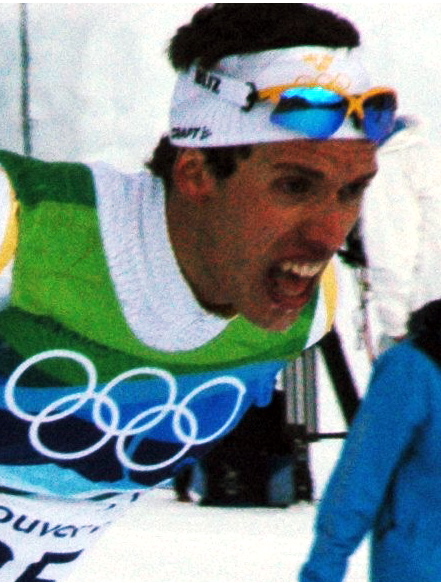
Charlotte Kalla wins the 10K skate at the 2010 Olympics. (Photo: Inge Scheve)
RAMSAU, Austria – “I’ve already gotten proof that it works, some real ‘ah-ha’ experiences that tell me there good things are happening,” said the 23-year-old Swedish cross-country star.
Ask her competitors who is the best skate skier on the circuit, and many of them will tell you it’s Charlotte Kalla. Few can beat her in the steep uphill sections when she gets low and cranks out her best V2 technique.
The Norwegian queen of cross-country skiing, Marit Bjoergen, has studied Kalla’s technique, and is trying to pick up details from the Swede that could give her an edge, especially at higher speeds.
But what Kalla already does as one of the best in the world, she can still improve upon. Kalla has polished her technique for the upcoming season.
“Do you really expect me to reveal all my secrets?” Kalla said with a laugh when Sportbladet asked her about her new technique during a recent training camp in Ramsau, Austria.
“Dare to go low”
Kalla got off the couch to try to explain the difference between the new and the old technique to the reporter. She stands with her feet hip-width apart and bends her knees.
“It’s all about daring to go low to increase the ankle/knee flexion. When I increase that ankle flexion, I get so much more stable, improve balance and I can ride the ski all the way. In comparison, when I am standing taller, I have less stability,” Kalla said and continued:
“Then, I have tinkered a little with how to find the right pressure depending on where on my foot I keep my weight. I’ve tried a few different things, and I decided that keeping the weight on the front of the foot is the most efficient.”
Keeping her weight on the forward part of the foot generates the most power in the kick, Kalla said. “It also improves my balance. I can ride the ski better without getting unstable,” added the 23-year-old, who earned an Olympic gold medal in the 10 k skate last winter.
How much does it matter?
“I get more out of every stride. It has worked very well on roller skis. And it has given me some real exciting experiences, like ‘oh s***, something is happening here!’ Then, I’ve tried it in time trials and interval workouts with other skiers. I try to ski bigger and glide a little more each stride,” said Kalla.
The next week, the Swedish national team is doing a training camp in Kiruna (northern Sweden). That will allow Kalla to polish her new technique on snow at higher speeds than what she’s been able to do at the glacier in Ramsau.
Natural at skating
Kalla can barely contain her excitement to try her new skills on the World Cup circuit, which gets underway in Gällivare later this month.
That she was a natural at skating is something she has known since she was a little girl.
“It’s actually a little strange that I knew that, even early on. My whole junior career, skating just felt more natural than anything else. I never had a coach who taught us how to skate in my home club, so we rarely did that at practice. It was just a harmonic feel from the start,” Kalla said.
From Aftonbladet.se/Sportbladet, October 31, 2010. Translation by Inge Scheve
Justyna Kowalczyk is extreme. She pulls off 200 training camp days per year, and it’s said that her life is focused entirely around skiing.
Her most recent camp is taking place outside the Belarus capital of Minsk.
“The morning starts with a half-hour warm-up; then we do the first workout, which lasts about three hours,” Kowalkczyk told coach Alexander Wierietielny and www.fiscrosscountry.com.
“This training camp in Belarus is the fifth for our team this season. It is the toughest one, since we’ve increased the volume,” coach Wieritielny added.
Wieritielny is not concerned that his Olympic champion and double world champion will run into overtraining issues. “Not at all. For our camp next month, we’ll get on snow, and Justyna thrives there,” he said.
Loves hard training Kowalczyk loves pushing it hard, she loves the training camp lifestyle and she is now working on becoming even better than last season. “I have to work hard on my legs and poles, even on downhill terrain, but I love this kind of training,” Kowalczyk said to the Polish web site se.pl. “No matter how you slice it, it’s better to increase the volume this time of the year. I am running faster now, and at a lower heart rate.”
At the 30 k classic race at the 2010 Olympics in Whistler, Kowalczyk beat Norwegian ski queen Marit Bjoergen on the final stretch to the finish and won her Olympic gold medal at long last. This season, Kowalczyk is defending the gold in the women’s pursuit and the 30 k mass start from the World Championships in Liberec 2009. She also took home the bronze medal in the women’s 10 k classic there.
Kowalczyk is certainly someone that both Charlotte Kalla (SWE) and Bjoergen (NOR) will have to keep an eye on at the Worlds in Oslo this winter. Additionally, the Polish racer will try to defend her overall title from the Tour de Ski last winter.
From Langd.se, September 29, 2010 By Kjell-Erik Kristiansen, translation by Inge Scheve.
Marcus Hellner was 4th in the 15K freestyle event at the 2010 Olympics. Photo: Inge Scheve
SWEDEN – “I would not do what Petter does. I’ve never felt bothered by kids are asking for autographs,” Marcus Hellner told Norwegian newspaper VG, when they talked to the Swede in Ramsau, Austria.
While Hellner understands that Northug wants to be shielded from the crowds in order to stay focused in his pursuit of five gold medals at the World Championships on home turf, that’s not the right approach for him. Hellner loves the limelight and would rather err on the side of overdoing it a little.
“I don’t know how Petter thinks, but I feel that you’ve got to find a balance between focus on the competition and the relationship with the fans,” Hellner explained.
Similar but different
Both Hellner and Northug won two gold medals each at the 2010 Olympics in Vancouver, but at the last World Championships, in Liberec (CZE) 2009, Northug won three gold medals while Hellner earned none.
“The interest in cross-country skiing is much bigger in Norway than in Sweden. I understand that there is a huge pressure on Petter. Even though we both won two gold medals at the Olympics, he won the overall World Cup and had more strong performances throughout the season. He has improved the level of international cross-country skiing,” Hellner said.
All about Oslo 2011
During the Swedish team camp in Austria, the skiers are working hard to prepare for the upcoming World Championship season. A typical day starts with a ski workout on the glacier, followed by a dryland workout in the afternoon.
“I’m really excited about the World Championships in Holmenkollen, but it’s hard to predict at which event I have the best chances to medal,” said Hellner, who won the pursuit and the relay at the 2010 Olympics.
Moving on
Petter Northug at the 2010 Olympics. Photo: Inge Scheve
In the pursuit, Northug was skiing with the lead group until Hellner accidentally skied over his pole and broke it, destroying Northug’s shot at a medal. According to Hellner, the two of them have talked it over and put the incident behind them.
“I never intentionally stepped on his pole. It was an accident. Those things happen in a mass start when people jockey for positions,” Hellner told VG. The relationship between the two racers further improved during their Las Vegas poker tournament trip this summer.
“I really like Petter. He is sympathetic and he is an amazing athlete. He is really different one-on-one than he comes across in the media, but he seems to have decided on certain image when he talks to the media,” he said.
More than just sprints
Hellner admits that he often thinks about Northug’s fierce finish surges during his workouts.
“But there are several ways to win a cross-country ski race. A sprint finish is not the only option. I am focusing on determining the outcome well ahead of a sprint to the finish,” Hellner said.
From Langd.se, September 23, 2010 By Kjell Erik Kristiansen, translation by Inge Scheve, FasterSkier
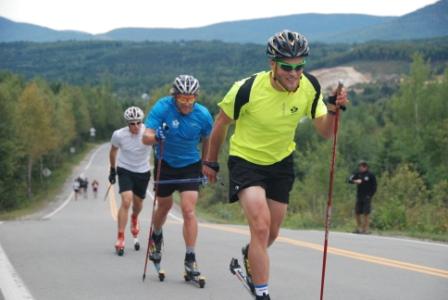
Stefan Kuhn (r), Phil Widmer (c), Lenny Valjas (l) starting a classic sprint
No one could ever accuse the Canadian National Ski Team of a lack of variety in their training locations–this summer alone, the team has held camps in Bend, Oregon, the Snow Farm in New Zealand, and the Haig Glacier. The current camp, however, has the team training in Mount Saint Anne, Quebec, home of Canadian National Ski Team (CNST) member Alex Harvey.
According to Justin Wadsworth, the CNST’s head coach, the focus of this particular camp is on rollerski intensity at sea level. In an interview with FasterSkier earlier this week, Wadsworth explained that his athletes spend a large amount of time at altitude–the camps at New Zealand and the Haig Glacier were both up high, and the team lives at altitude in Canmore as well. “I just wanted to make sure this year that at one time we had a certain focus on intensity at sea level and faster motions,” said Wadsworth. “We race the majority of the World Cups at sea level, and World Champs this year are at sea level.”
Of the four intensity sessions during the ten-day camp, three are on rollerskis, and just one is ski bounding, due to an emphasis on increasing the speed of ski-specific motions. In addition, the sprint team has been doing several speed sessions.
Devon Kershaw hammers during an interval set
Other than the training benefits of the lower altitude, Wadsworth selected Mount Sainte Anne as a location for the camp because of the proximity of the Pierre Harvey National Training Center (CNEPH), one of the strongest development centers in the country. CNEPH is based in nearby Quebec City, and Wadsworth said that his strong relationship with Louis Bouchard, CNEPH’s head coach combined with the strength of the training center program deserved the support of the national team.
Wadsworth walked FasterSkier through two workouts, which were separated for the distance and sprint athletes.
The sprinters (Chandra Crawford, Dasha Gaiazova, Phil Widmer, Stefan Kuhn and Lenny Valjas) were tackling 8×30 seconds, with a 1:30 rest. The group did three sets, over different types of terrain: the first on a flat, the second with a transition between double pole and striding, and the third on a steep hill, with a focus on transitions. In between each set, the sprinters would take a seven to 10 minute break, to ensure sufficient recovery. While 24 sprints may seem like a large number, “we’re looking for as many as they can do at high speed, without the quality deteriorating,” Wadsworth explained.
For the sprinters, Wadsworth emphasized that the speed continued to rise over the entire workout. “If you just did one or two or three 30-second intervals, it wouldn’t be a big deal,” he said, “But with a minute-and-a-half recovery, any lactate you make, you’re not really clearing,” he said. “You’re building up through the session, and by the last couple of intervals in each set, the fatigue is starting to come on a little bit.”
Meanwhile, the distance group, containing Olympians Devon Kershaw and Brent McMurtry as well as new CNST member Graeme Killick among others, were doing a longer interval set. With the exception of Ivan Babikov, who was continuing to recover from illness, the athletes had 4×7 minutes with five minutes of recovery, which Wadsworth described as “zone three, zone three-plus” in terms of effort level. At the end of the workout, the entire group did some speed work as well, doing 4×30 seconds at close to full speed.
While the primary goal was to crank out intensity sessions, the team is taking advantage of a few local amenities. The entire group headed into Quebec City to catch an international-level bike race for a diversion, and the World Cup Team headed up to Alex Harvey’s house for some quality home-cooked dinner.
Chandra Crawford battling Dasha Gaiazova during a sprint workout
Up next for the team is a three-week camp in Park City, which will feature two time trials, as well as some collaboration with the U.S. Ski Team. In addition to Kikkan Randall, Wadsworth confirmed that James Southam and Noah Hoffman have been in contact with the Canadian coaching staff, and will jump in on a few workouts.
Randall in particular will be a welcome addition, both in terms of helping out the Canadian sprint women in their workouts, and her attitude in general. “It’s good for the whole ladies program,” said Wadsworth, “Kikkan is a really positive and professional person.”
With regards to the rapidly approaching World Cup season, Wadsworth assured FasterSkier that the CNST is headed overseas on November 7th, and that the entire Canadian World Cup Team (Harvey, Babikov, Kershaw, George Grey, Crawford, and Gaiazova) would race the pre-Christmas World Cups, as well as potentially a few others.
New this year is that all team members must now qualify to race the Tour de Ski–Canada will not be preselecting athletes for that event this year. While Wadsworth was reluctant to explain the entire criteria before Cross Country Canada (CCC) releases it this week, he said that some “good top-20 results” would indicate that most of the World Cup team was ready for the Tour.
Justin Wadsworth (l) giving instructions to athletes during a sprint workout, including CNEPH's Lenny Valjas (r)
This summer, Andrew Nesbitt, a rising senior at Gould Academy traveled to New Zealand on a trip organized by Alexei Sotskov. Five junior skiers from around New England made the journey. Andrew sent regular email updates to family and friends in the US, providing a first-hand account through the eyes of a junior skier. Perfect conditions, hanging with the US and Canadian National Teams and an epic storm were just some of the highlights.
Thursday, July 29
We arrived hear yesterday about 12:30 PM and went skiing on Extra Blue. What a change from the hot weather that we have been having in New England. The high temperature here yesterday was 31 degrees at the Snow Farm lodge which is at about 5,000 feet.
The scenery here is like nothing else I have seen before – every time you turn around there is something beautiful. The lodge looks out over mountain ranges. All you can see are mountains covered in snow. The grooming is also great, matching Jackson as the best I have ever skied. The snow is very light and dry. I guess Extra Blue is all they have used this season, maybe a little violet too.
Snow covered mountains
The Japanese Team arrived today, and the Canadian and American teams are here, including Andy Newell, Kikkan Randall, Kris Freeman, Simi Hamilton, Morgan Arattola, and Liz Stephen and the coaches Matt Whitcomb and Chris Grover. We live on the same floor as them. The Canadian team was on the same plane as us from LA – that group includes Chandra Crawford, Alex Harvey, Ivan Babikov, Devon Kershaw and a few others, mostly men.
Friday, July 30
This morning we went for an extremely windy and foggy pre-breakfast run for about half an hour, came back, and went upstairs to breakfast. At breakfast while Justin and I were waiting for Kikkan to be done with the toaster Matt Whitcomb (USST head coach) introduced himself to us. Seems like he is a really nice guy. Right now the Canadian men are eating breakfast literally right in front of us! All of them!!
Alexei had us doing classic drills yesterday while we were watching the US team blow by us in their time trail. I also found out yesterday that members here can bring their dogs skiing. First skate session today, and a run down in town this afternoon.
Sunday, August 1
This morning we woke up to winds sustained at about 100 kilometers per hour and sleet, which changed to snow by breakfast and then rain by about 11. The locals say this was the worst they have seen all winter, something like this does not compare to anything we have in New England. Justin made it 6 minutes on the morning run I made it about 4 minutes. I think Shelby said she made it 2, the weather really blows here.
Instead of going for a ski this morning we played 10,000, (a dice game) with a good part of the US team – Kikkan, Liz, Noah and Simi. Shelby won and I was second. We beat the US Ski Team.
After beating the US Ski Team we went into Wanaka to use a fitness center and sauna. We got there as the Canadians were leaving.
We went shopping. I bought some stuff and drove back to the ski center where the wind is still blowing about 50 km per hour.
Monday, August 2
Today is our first off day, Alexei is taking us into Queenstown. We are not just living next to the US Ski Team, we are hanging out with them too. Amazingly they want to know about us!
Liz, Simi and Chris Grover are the most outgoing. Matt Whitcomb, Jack, Maddy and I had a long talk about compartment syndrome, which Freeman has had twice because he does not stretch. Corey Stock also recently had sugary for it. Whitcomb also predicted that at the Sochi Olympics Chandra and Kikkan will be on the podium.
Bluebird…
Carl, the groomer here went to Gould Academy class of 1978. He does a great job. The Americans are pretty excited about the grooming right now. The Canadians seem to be pretty excited about Monopoly, It is hilarious they get so competitive with each other. Liz, Kikkan and Chandra at one point were sharing money and Babikov said “girls should not be allowed to play Monopoly.” I think he was upset that Chandra was winning.
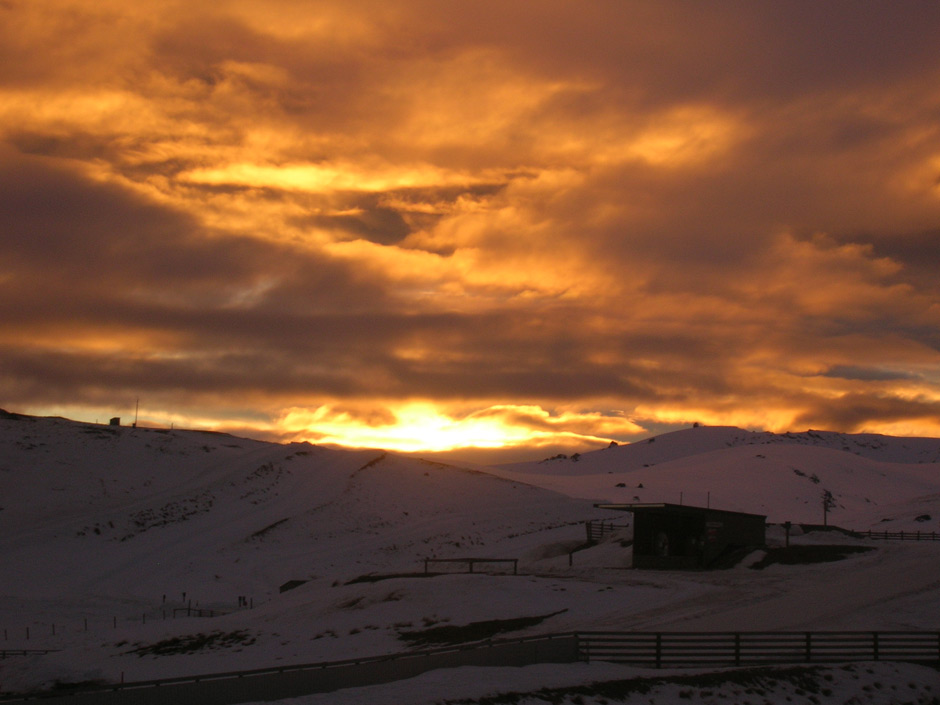
The clouds cleared by the end of the day yesterday and we got an awesome sunset. I think in a few minutes we are about to get a great sunrise.
Wow.
Tuesday, August 3
We went in to Queenstown on our off day yesterday after watching the US and Canadian ski teams do some sprints, which was really sweet.
Queenstown is about a 50 minute drive for us. We had lots of fun, bought cool stuff and took great pictures. This morning we classic skied with some light intervals – 7×3 at L3, our first interval session of the trip. We used some Rode Blue klister binder with Rossa and Violet on top of that. 2 hour ski this afternoon.
We have had some great sunsets and sunrises here. Pretty cool stuff. I just heard Carl, the groomer say he groomed for 19 hours after the storm. All I can say is he did a great job. It is pretty warm here but the snow on the trail is still firm and fast which is a lot of fun to ski on.
Ocean
Wednesday, August 4
Last night we played spoons. It is a card game if you don’t know. I sat next to Alex Harvey on my right and Ivan Babikov on my left. After spoons we went to play Monopoly. I have never seen anyone get more competitive in that game than Devon Kershaw. All the Canadians are pretty competitive about Monopoly but Devon more than any other.
Friday, August 6
The FIS weekend has started today with a 15km classic for men and a 10km for women. Along with the North Americans that have been here for awhile there are athletes from Russia, Korea, Japan, Venezuela and of course Australia and New Zealand.
Devon Kershaw won, his luck in Monopoly does not translate to skiing, Kris Freeman was 2nd and Ivan Babikov was third.
Justin said he started too fast, I don’t what happened in my race – whether I was dehydrated or did not do well with altitude or nervous or what, but it was not a good race for me. The basket on my pole popped off during the race and Justin Wadsworth (Canadian head coach) gave me a pole out on the trail. My wax was prefect, fast going down and great kick going up. As far as I feel about the race, first of all it is August, I did not get lapped, I did not finish last and it is still August.
Our girls felt pretty good about their races. Maddy skied with Sarah Murphy for a while. Sarah is the host nation’s only biathlete and skied at the last Olympics. I was pretty impressed.
Morgan Arritola and Liz Stephen skied together the whole race, Liz ended up winning by .4 of a second. A Japanese athlete was third.
Sprint tomorrow and 10km free on Sunday. The Americans and the Canadians will not be participating, YES! The Canadians are still playing Monopoly.
Sunday, August 8
I had one of the best days of racing possible and one of the strangest nights. It was the freestyle sprint. It worked like an Eastern Cup – you have a qualifying race and then heats. I was flying in the qualifying. I felt light, relaxed and great and I was last to qualify for the heats.
I found out who else was in my heat – me, Pavel Sotskov, Ivan Babikov and the first qualifier…..Andy Newell.
So I stepped up to the line and thought “holy shit.” I just wanted to ski relaxed and enjoy this moment. It is not often that Liz Setphen gives you tips on which lane to pick. I think it was about the time of my heat that it started snowing really hard – about 11 o’clock. Simi Hamilton won with Newell in second and Alex Harvey in third.
Maddy was the highlight of our day. She was 2nd in the B final, 6th overall. Chandra won, Liz was second and Esther Bottomley of Australia was third. Kikkan did not race because she felt sick. “Something hit me” she said, and Alexei wanted to know who. The women’s race ended at about 12:30 and at about 1 the wind started to blow.
About 3:30 Alexei sent us down to the Snow Park, which is the freestyle ski and snowboard facility about 3km down the road from where we are. Alexei said we were going to hang out with some local kids and there would be a hot tub there. The wind is sustained at 70km per hour and it is still snowing really hard. Ben Koons was in charge of us. He skis for Dartmouth and the New Zealand National Team in Vancouver. We played spoons again – the kiwis are not nearly as competitive as the Canadians and we did go in the hot tub, but by the time we got out it was dark. The wind was now blowing 90km an hour and it was still snowing hard.
This nice couple who owned the condo that the local kids were staying at were trying to drive us back, but they could not see 2 meters in front of them. So we went back to the lodge and ate diner, and were told that some one who worked at the Farm was coming to get us.
We called and found out that it was not going to happen. We were set up in a ski dorm in the same building as the restaurant that we ate in. We had some place to stay! We woke up this morning and it was still snowing – not as hard and the wind was not blowing. We made it back to the Farm in time for breakfast.
We got stuck in a blizzard 3km from where we wanted to be because Alexei told us there was going to be a hot tub. WTF? I think the 10km skate is being held at 12 local time but I am not sure what Carl is doing with the grooming.
Storm
Monday, August 9
Yesterday was another good race despite the snow conditions – so new and soft. It was a freestyle race and it was just hard to get a solid kick off on the snow. There was this one long and steep hill on the course that was in awful shape and it just plain hurt. Again I felt relaxed, but because of all the new snow Carl was only able to get a 2km loop together, so we did it 5 times, which in a way was good because every time you come through the stadium I would hear Liz and Matt Whitcomb cheering for ME!
I ended up 3 seconds behind Justin. I was more happy with the fact the Matt congratulated me after the race. I kept trying to think if that really just happened. One of the US ski team coaches raced yesterday. It was fun to see him having a good time. Maddy and Molly also raced well. Shelby was not happy with her race but Alexei changed her mood pretty quickly.
We went to Anna Hogg’s house for dinner. Anna went to Kimble Union with Molly her freshman year. It was a great meal – pasta, garlic bread and an awesome trifle.
Today we are going to the ocean, but snow looks prefect. However the US Ski team leaves today which is too bad because they have been so much fun to watch and hang out with.
Wednesday, August 11
This is my final update from New Zealand.
We just had our last ski here at the Snow Farm. The snow is beautiful, dry, and the skiing is really great, but it is supposed to rain again on Thursday. We have all had an amazing time.
I have been on snow for 10 months this year, If we get on snow in September that would be 11, Jeremy is trying hard. I missed skiing in May by 2 days and during a school Tuckerman’s trip I had other things to do.
I think the coolest part was hanging out with the national team and realizing that they too are real people, and racing a sprint against Andy Newell – that was pretty cool too. I think I am ready to come home. Tomorrow is also Shelby’s birthday.
Mom, pick me up at exit 11 for the VA hospital off I89 in White River Junction. There is a McDonalds, and Jack says that is the best place to meet. I’ll call you when we get close.
Kikkan Randall at the Ontario High Performance Camp in Barrie, Ontario
Since the Olympics, Kikkan Randall has had anything but a relaxed spring and summer. Her activities have included the International Ski Federation (FIS) Congress in Turkey, a visit to Norway to spend time training with Marit Bjoergen, and a three week training camp in New Zealand.
Randall’s latest stop has finally brought her a little closer to home. While the Ontario High Performance Camp in Barrie, Ontario, was still far from Alaska, at least she was on the right continent. Randall had the unique opportunity to make a visit to Hardwood Hills Ski Club in Barrie, Ontario, in August to check out some of Canada’s most promising developing athletes at the Ontario High Performance Camp.
In addition to having some of Canada’s best junior athletes present, the camp was billed as part of Cross Country Canada’s (CCC) newest development initiative aimed at keeping young females in the sport, dubbed the Female Talent Squad (FTS). For Randall, the draw of getting to work with an enthusiastic group of female athletes was a big one.
“We need to keep more females in the sport at the elite junior and senior levels,” said Randall in a recent interview with FasterSkier, “so I am happy to do whatever I can to inspire and encourage girls to go for it.”
Kikkan Randall works with Norah Bonsteel of Team Hardwood. Photo, Graham Longford
Randall was connected to the event through her husband, Jeff Ellis, a native of nearby Orangeville, Ontario, as well as through Kateri Mills, the Ontario Provincial Team Coach.
Mills recognized that the couple might be making a trip home at some point during the summer, and it turned out that the camp coincided with the end of Randall’s trip to New Zealand–allowing her to squeeze it into her busy schedule. The price was right too: The Canadians paid for both Randall’s and Ellis’ airfare to and from the camp.
In addition to being a native of Southern Ontario, Ellis is also an international competitive cross country skier (he raced the 15 k free at the Canmore World Cup last February), and a former internationally competitive hurdler (he ran the 400-meter hurdles at the 1999 IAAF World Championships). Ellis also chipped in at the camp, with a presentation offering guidance on how athletes can market themselves.
The Talent Squad
CCC developed the FTS this spring in response to research that showed an inordinate number of girls dropping out of the sport. The young women named to the group were chosen based on their performances at the Canadian National Championships in Whitehorse, Yukon, this past March.
In order to build the talent squad, CCC used the aggregate ranking at Nationals, and it took into account athletes’ two best distance races, as well as consideration for those who were particularly strong sprinters. The result was a selection of 30 of Canada’s top female junior skiers.
Once selected to the team, an athlete is then matched with a mentor, who is then able to share their skiing experience, ranging from dietary concerns to educational opportunities, to how to financially support one’s career. The mentors contain a selection of prominent Canadian female athletes, both past and present. The list includes recently retired Olympic and World Championship medalist Sara Renner, retired Olympian Milaine Theriault, current Olympians and national team members Chandra Crawford and Dasha Gaiazova, as well as up-and-coming talents like Kate Brennan of the Alberta World Cup Academy.
Randall demonstrating technique
While not technically a FTS mentor, working closely with CCC and the Canadian National Ski Team (CNST) is nothing new for Randall. She described her relationship with the CNST as “great,” and she has even roomed with Perianne Jones, the CNST member, Olympian, and FTS mentor who also attended the camp.
“I’ve spent quite a bit of time training, racing and hanging out with the Canadians,” Randall said. “Perhaps because I’m married to one, I feel like an adopted member of the team.”
This past spring at the United States Ski and Snowboard Association meetings in Park City, Utah, a special group convened to discuss challenges facing women in cross-country skiing, but as of yet, American female skiers have not been targeted as directly as Canadian women, first with Chandra Crawford’s Fast and Female, and now the FTS.
“I definitely think that it’s very productive to have female-oriented parts of camps, or opportunities in addition to what’s already happening,” said Randall “I think there is still some value to being at the camps with the boys too, but making environments where the girls can feel open and have direct access to female role models is important for keeping females in the sport.”
“This concept of female-oriented camps, both for development and for elite athletes too, is something that I am personally interested in exploring, and [I] will be looking for opportunities to bring to the U.S. as well,” Randall said.
For a full list of athletes and mentors in the Female Talent Squad program, click here.
Video of the Female Talent Squad camp, and Kikkan Randall in action during the CCC Strength Test, couresty of Graham Longford.
A participant in the New York Ski Educational Foundation's August Grasshopper camp prepares for lift-off.
How do you get dozens of youngsters to try out a sport like ski jumping?
For the staff of the New York Ski Educational Foundation (NYSEF), that’s not just an idle question to ponder. It’s crucial for the club to attract large numbers of kids to try out the sport if they want to turn out athletes with hopes of ever competing at an elite level.
From the outside, ski jumping seems like it should be difficult to break into, with its intimidation factor and high cost scaring off wary parents. But a visit to a NYSEF “Grasshopper” camp for juniors at the Lake Placid Jumping Complex in mid-August showed just how the club had overcome those hurdles—making the sport accessible, and attractive, to local children.
Make it Accessible
According to NYSEF Ski Jumping Head Coach Casey Colby, the club tries to attract local kids to the sport by reducing costs for interested parents.
A Grasshopper camp participant readies himself at the top of the K-18 with the help of coach Matt Cook.
“It’s hard to get kids to do this sport, because it’s not something you do recreationally, with your buddies,” Colby said. “It’s like the drug-dealer style of recruitment. You’ve gotta go out and let ’em do it for free.”
Colby cited a program that NYSEF ran last winter, Learn to Fly Wednesdays, in which local kids could take a crack at jumping in exchange for $5. They weren’t big moneymakers, but Colby credited the sessions with creating greater interest in the Grasshopper camps throughout the summer. Twenty-six kids were enrolled in the mid-August session, as opposed to a mere seven last summer.
At $150 for three days, including lunch, the Grasshopper camps don’t break the bank, either. Equipment would be a formidable expense for parents—if they had to buy it. But the kids in the NYSEF programs don’t have to bring their own: The club owns an entire fleet of skis, and spare suits hang from a rack in the lodge.
The low cost doesn’t mean that kids will sign up automatically, though—their parents must also be convinced of the safety of the sport before they’re willing to let their children strap on skis.
Colby said that he has enlisted the parents of some of Lake Placid’s best jumpers to help sell the sport, including the mother of 2010 Olympian Peter Frenette.
“Her job last winter, as she saw it, was to make sure the parents were involved,” Colby said. “I think parents—their view of ski jumping is ABC’s Wide World of Sports, agony of defeat…The first time they go to practice and they see a couple of kids fall, they’re kind of freaked out, because it looks horrendous. But 99.9 percent of the time, they get back up, they grab their stuff, and they go back up the hill.”
Scaling Down the Fear Factor
Ski jumping doesn’t sound like a summer sport, but during the off-season the snow and ice that covers Lake Placid’s hills in winter is replaced by a porcelain and plastic facsimile—the former substance is used for the tracks on the in-run, and the latter is laid out in shingles the landing hill.
Regardless of the surface, for anyone who has seen ski jumping on TV—or worse, in person—it’s difficult to imagine how anyone could ever be convinced to launch themselves from those towering, Olympic-sized hills.
But the only time the kids in the Grasshopper camp go near the top of Lake Placid’s Olympic jumps is for lunch, which occurs in the observation platform of the 120-meter hill.
The rest of the time, participants hone technique and confidence on the K-18 jump, which is tucked out of the way on the complex’s hillside, between some
The in-run of Lake Placid's K-18 jump.
buildings and a stand of trees.
Unless you’re already familiar with the sport, describing Lake Placid’s smallest jump as “the K-18” doesn’t say much. The number refers to the distance from the take-off, in meters, at which the landing hill begins to flatten out—generally the farthest that the young athletes traveled on their jumps.
During the August camp, few flew farther than 15 meters, and the kids were never more than a few feet off the ground.
While the K-18 is far smaller than Lake Placid’s Olympic jumps (which are K-90 and K-120), the kids still build their way up to it.
During the winter Learn to Fly lessons, they start with ski play and balance drills before progressing to actual jumping. In the summer, many of the children warm up simply by gliding down the landing hill, without jumping at all.
“We’ve learned to take down the intimidation factors—the big skis, the gnarly crashes that kids see,” said Dave McCahill, one of the NYSEF junior coaches behind the winter jumping sessions and the Grasshopper camps.
According to McCahill, the younger kids seem to pick up the sport more quickly. But regardless of age, the initial jumps are still scary. Pre-teen A.J. King described his first time as “a little freaky”—although it didn’t take long for him to get over it.
“I was kind of scared. But then I did it and I felt great,” he said. King, a New Hampshire native, learned to jump with the Andover Outing Club, and he also competes in nordic combined.
Billy Demong, another Lake Placid native who won gold in nordic combined at the 2010 Olympics, recalled being the most reluctant of all of his friends when he started in the sport. But that feeling, he said, eventually dissipated.
“Fear kind of fueled me to keep showing up. And then you kind of hit that requisite point where you finally get some air under your skis and…go down the hill a little ways, and it makes it worthwhile,” he said. “That’s where you go from being afraid of the sport to, ‘[I] can’t wait to get back to the top of the hill.’”
Incremental Increases
The progression from the K-18 up to Olympic hills is incremental: once the kids master the K-18, they move up to Lake Placid’s K-40, where they build confidence and gain experience. There’s nothing between the K-40 and the K-90 at the complex, but athletes will practice on other hills throughout the country between K-60 and K-70 before making that jump.
At the August camp, there were kids all along the continuum—some who were still working up the courage to try the jump for the first time, and others who would jockey for position at the top of the hill.
While the camps are informal—they’re about having fun—there’s still a lot of thought going into the coaching. McCahill has the kids practicing take-off
Camp participants taking in the action at a "Soaring Saturday" competition
technique during morning stretching, and he gives them feedback on their jumps throughout the day. There’s even a brief video review session after lunch.
“We’re trying to stress a good understanding of technique and form at an early level,” McCahill said. “We’re trying to keep the kids informed about what they’re doing, and why it’s working.”
It’s not as serious as the rigorous analysis you might find at the college level, but Colby says it still works.
“These kids are actually learning, and they don’t have a clue,” he said. “Half the time they just come off every single jump and ask, ‘How far’d I go? How far’d I go?’ They really don’t know that they’re getting better.”
Make the Path Clear
As much as anywhere else in the country, the path to jumping greatness is laid out clearly for the aspiring juniors at the Grasshopper camp.
Aside from the obvious progression in the size of the hills, from K-18 to K-120, camp participants can see elite athletes in action on a weekly basis, which provides them with ample inspiration.
Each weekend during the summer, the complex hosts Soaring Saturdays, a low-key competition in which elite jumpers like Frenette, a Lake Placid native,
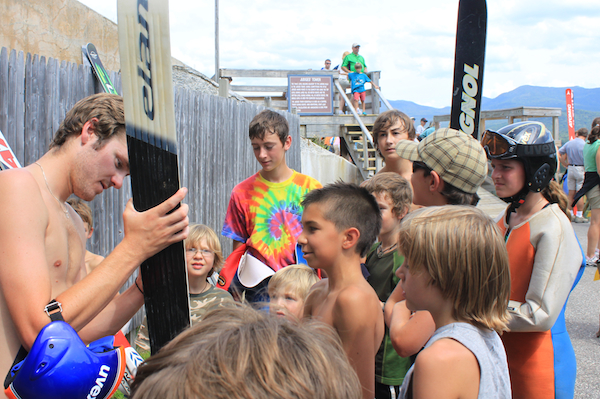
Kids gather to get their equipment autographed.
vie for a prize purse of a few hundred dollars.
Given the sport’s eye-catching nature, it’s easy for the events to draw crowds of the town’s ubiquitous tourists. An announcer hypes up the athletes, and even officiates a few minor league baseball-style t-shirt giveaways.
The festive atmosphere is like a drug for the camp participants, who spend an hour after lunch at the Grasshopper camp taking in the competition. They stand next to the take-off and watch in awe as their idols fly past, picking out the best jumpers by name. Later, they swarm Frenette and others for autographs.
The attention and status afforded to the elite jumpers makes the sport that much more appealing to the youngsters, some of whom even see ski jumping as a path to fame and fortune, misguided as that may be. (The American jumpers gained notoriety at the 2010 Olympics for the odd jobs each had taken on to support their competition schedule; Frenette was an ice cream scooper.)
Asked what he liked about the sport, King spent just as much time talking about stardom as he did about the jumping itself.
“Everybody’s cheering you on, [you] get in the newspaper, on the news, go really far, and stuff. Win money, and have fun,” he said.
Hilde Losgård Landheim, one of the 20 athletes in Team Morgendagens Helter.
NORWAY – The Norwegian elite development project “Morgendagens Helter” (Ed. Tomorrow’s Heroes) brings 20 handpicked junior talents from all six of the ski disciplines organized under the Norwegian Ski Association (NSF) into one team.
The athletes are assigned individual mentors on the national team level, receive an annual stipend of NOK 50,000 (roughly $8,500) that is split 50/50 between the athlete and his or her home club, and are invited to several team project training camps. The money directed to the athletes’ local clubs is earmarked for talent development, recruitment, expanding local resources and coaches’ education.
The goal is to encourage sharing of know-how and experience – both from the pros to the next generation, as well as between the different disciplines.
“In order to succeed, it’s crucial to have the ability to learn not only from those who have made it to the top in you sport, but also to learn from those who have succeeded in other fields,” explains Kjetil Undhjem of Statoil, the NSF’s main sponsor for the project. He also feels that the athletes contribute value to his organization, and that the project is a win-win situation for all involved parties.
Unique
The project, a 5-year initiative backed by Statoil, is unique in that it combines talented skiers, mentors and coaches from all the FIS ski disciplines into one program. Athletes were handpicked by the association based on personal profiles, general attitude, posted results, motivation, stated ambitions and geographic considerations. Each of the NSF discipline directors picked their athletes, a task that was not easy.
“There were a lot of good candidates, and there are talents who might feel that they should have been included on the team. However, they will have a new chance already next year,” says Bård A. Amundsen, the NSF’s secretary general. He points out that the team members have a unique opportunity to contribute to recruitment and development in their own clubs or ski academies, by sharing the project resources locally.
During the camps, which are organized in various parts of the country, the athletes are introduced not only to different workouts and training methods in the ski disciplines but also to the training philosophies and methods of the other sports. During the August camp in Trondheim, for example, the athletes did a track workout led by cross-country skier and project mentor Therese Johaug, suffered through a grueling plyometrics session on the jumping hill stairs with telemark racer and mentor Eirik Rykhus, as well as several general workouts.
The skiers also made a field trip to one of Norway’s biggest and most successful professional soccer clubs, Rosenborg, where they participated in a workout with the soccer coaches and were treated to a Champions League game afterward. And finally, the skiers were challenged to create computer-guided ski robots made from Legos at the Norwegian University of Science and Engineering (NTNU) – a task they handled with excellence once they discovered there were prizes for the teams that finished first.
Solid ambassadors
In addition to the individual mentors, the project also has two major ambassadors: Bente Skari (cross-country), and Kjetil Andre Aamodt (alpine), both former Olympians and world champions. Mentors include Johaug and Eldar Rønning (cross-country), Nina Løseth and Lars Elton Myhre (alpine), Rykhus (telemark) and Anders Jacobsen (jumping).
The athletes have already completed two dryland camps, and the third will take place close to the start of the ski season.
The team consists of three telemark skiers, four ski jumpers, three cross-country skiers, three alpine freestyle skiers, three alpine skiers and three nordic combined skiers.
Well received
“It’s so nice to have a mentor who has already made it to the World Cup and knows what it takes to get to the top. My mentor, Therese Johaug, is a skier I knew a little bit from before, and that makes it easier to pick up the phone and call her,” says Hilde Losgård Landheim, one of three cross-country skiers in the project. “We’ve talked a few times now, and she gives me a lot of good advice on training. That’s really useful.”
Hilde Losgård Landheim
Landheim particularly enjoys training with athletes from other ski disciplines during the team camps. So often, she says, cross-country skiers get stuck in a pattern.
“I think it’s really healthy for us to see how other athletes train, and get some ideas for basic fitness and strength. I think in those areas, it’s really beneficial to try exercises you’ve never done before and don’t handle so well. I like being challenged and new things definitely do that,” Landheim says, explaining that she finds the project concept motivating.
“It’s nice that the ski association and Statoil are spending this kind of money on us young skiers. It makes me want to train hard. I really enjoy meeting athletes from other sports, and it’s really motivating,” she says, adding that she had no idea NSF would pick her for the project.
“I was really surprised when I got the call last winter. I am honored and excited to be a part of this project,” she says, admitting that she didn’t know a lot about it before she accepted.
Landheim also finds that the project schedule works well with her existing training program from her local club (Tynset IF) and the regional division (Hedmark Skikrets).
“The project team camps are generally fairly short and held in central locations, which makes it both convenient and easy to fit into my other training program. I’m excited about the next camp already,” Landheim says. “And I really liked the pro soccer game in Trondheim.”
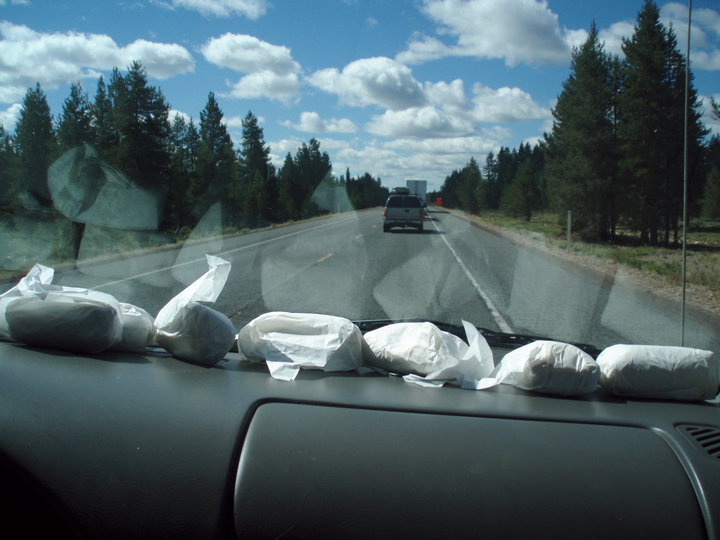
Lunch en route to Nor Cal Nordic Camp included dash-warmed Taco Stand burritos.
Kara Doescher and Ben Grasseschi provide overviews of the PNSA/Far West Nor Cal Nordic Camp near Mt. Lassen. Kara is a high school skier from Corvallis and Ben coaches for the Auburn Ski Club.
Nor Cal Nordic Camp, by Kara Doescher
As a high school skier the Nor Cal Nordic Camp was my first XC ski training camp. It was a wonderful experience, I really learned a lot, and I met some great new people. High school skiers should not be intimidated by the idea of training with divisional teams . The level of training was definitely manageable, and the skills I learned will surely help me improve my future skiing.
We started off our workouts on Wednesday with a run-hike up a small butte in the Lassen National Forest near the camp. It was nice to get some exercise after the long drive from Bend to the Silver Lake campground. The next morning we had a skate roller ski time trail. The more experienced boys and girls did a 10k while the rest of us finished after 5k. My high school team only practices November through February, so for me this was an “off the couch effort.” After the time trial we had an afternoon with strength and a PNSA vs. Far West soccer game. The next day we went on a long classic roller ski that really helped me work on my double pole technique. That evening we worked on ski walking/bounding methods. The next day we started out early to hike to the peak of Mount Lassen. One group made their own trail and had a long adventure to reach the peak. The rest of the campers started at the trail head and did some rock climbing after the hike. This was my first time rock climbing and I thought it was really fun. The final morning we ended our training with one last hard bounding workout.
Coming from the Willamette Valley my team only gets to practice on snow less than once a week. The rest of the time we do dry land workouts similar to those we did at camp. This means I can use the skills I learned at camp during my regular ski season training.
Each day wasn’t completely filled with training. We had plenty of down time to enjoy swimming, sailing and kayaking, fishing, and relaxing around Silver Lake.
We had delicious meals thanks to our great cook. Breakfast included everything from oatmeal and melon to chocolate muffins, lunch was usually sandwiches and granola bars on the go, and dinners ranged from burritos to grilled pork to pesto chicken pasta.
The wonderful coaches included Ben Husaby and Brenna Warburton from Bend Endurance Academy, TJ Owen from Wenatchee Valley Nordic, Jeff Schloss from Sugar Bowl Academy and Ben Grasseschi from the Auburn Ski Club. Each of them had some unique perspectives and advice, which gave me a lot to think about. They were great at trying to help me improve my relatively novice skiing abilities. They encouraged the campers to not only work on skiing techniques, but also enjoy other outdoor adventures in a beautiful outdoor setting.
I would really urge other high school skiers participate in a XC ski camp. It’s really fun and a great learning experience I’ll put to use when skiing in the future.
Mt. Lassen Camp, by Ben Grasseschi
Ever tried to swim 1/2 mile across a chilly lake after doing 30x30scd uphill bounding intervals? Ever tried to swim that 1/2 mile with a greased watermelon that you passed hand over hand for a 1/2 mile prior. Ever eaten fresh killed chipmunk? Ever built a custom bike frame? Ever played in a World Cup soccer game? Ever Classic roller-skied, double pole only, for 2.5hr, on a hot day? Ever swam in Lake Almanor? Ever hiked to the top of Mt Lassen; the youngest volcano in North America? Ever climbed into the ‘bellybutton’? Ever Skate roller-skied a 10km Uphill Time Trial that was 4/10ths of a mile longer than you thought it should have been? Ever sailed a sunfish sailboat? Ever sailed a catamaran? Ever hiked to the top of North Caribou Peak? Do you even know where it is? Ever chopped wood and carried water?
Yep; all this, and more, well; except maybe the catamaran sailing, happened at the Far West Mt Lassen Camp Aug 11-15, 2010.
11 campers from FW joined 19 campers from PNSA, and 5 coaches, for an adventure packed, volume challenging, and intense 5 days on the east flank of Mt Lassen; just three hours north of Truckee.
We camped at Silver Lake where we shared an old Forest Service cabin, campfires, swimming holes, watermelon salad, cribbage, bananagrams, roasted chipmunk, camaraderie, chicken pesto, old skool pump well water, campsite 4 and 6, chopping wood, pretzels, red vines, bumpy and dusty dirt roads, summit vistas, training ideas, stacking wood, swedish fish, hill bounding poles, Lady Gaga 578 times, flip flops, jokes, fishing, and tall tales (likely one and the same).
Did we do any workouts? Yes. A first day easy run/hike that was supposed to be an hour turned into 2hrs. A 5km and 10km uphill Skate rollerski Time Trial that was longer than everyone thought tho it was less than 10km. A swim in Lake Almanor and lunch cooled everyone off. A World Cup soccer match between Far West/East/Midwest and Pacific Northwest. PNSA scored the tying goal in stoppage time (damn the referee!) and the game ended 2-2. Anyone up for a 1.5hr to 2.5hr Classic rollerski? Double Pole only? OK then, let’s “git er dun”! How about some ski walking technique? Ok, let’s do some bounding too? Oh, to bound one must go hard! Is this supposed to be an interval workout? No, but it was when you can’t back down. Do another one for good measure. How about climbing to the top of Mt Lassen? At 10,457 feet it stands alone between the northern Sierras and Mt Shasta- which we could see from the top. Why not make it as difficult and far of a hike as possible? One group did that while the other summitted quickly and then went climbing. And why not top off the week’s training with another intensity session; this time a bunch of (15-30) 30scd on, 30scd off, hillbound/moosehoofs, with poles, uphill. Ahh.., that’ll git ‘er dun fer shure! But wait, why not grease up a watermelon and run it down to the lake and then swim across it to see who really is tougher. Far West is of course! All that agility training we have been doing paid off!
If all this sounds like fun to you, get motivated now; we will do it again next year.
TRONDHEIM, NORWAY – Håvard Solås Taugbøl and the other skiers on “Team Morgendagens Helter” (Ed: “Team Tomorrow’s Heroes”) are certainly learning from the best.
This week the team had a training camp in Trondheim, and the takeaways include experiences, tips and a radio controlled airplane.
Before Christmas last year, the Norwegian Ski Association initiated a 5-year talent development project backed by some of the association’s major sponsors. “Team Morgendagens Helter,” a talent development group consisting of hand-picked individuals from six of the ski disciplines, is a key element in this project.
“At the camps, we meet athletes from other sports and learn from them. We also get pointers from our individual mentors, including Eldar Rønning and Therese Johaug. They simply tell us what they’re up to, and then we can take that home and adapt it to our own training programs. And they also just do a lot of really crazy, funny things,” says Taugbøl, one of the young cross-country talents on the team.
The Lillehammer native was picked for the project as a representative for cross-country, along with Vilde Haugan Burkhall, Hilde Landheim and Sindre Bjørnestad Skar. Earlier this week, they joined the other team members and mentors in Trondheim.
Winner
Last season, Taugbøl won his age class in the Norwegian national cup by a healthy margin. During the camp in Trondheim, he was able to show that he knows more than just how to ski fast.
“We were challenged to enter something called the Robot Ski Challenge at NTNU (Ed. Norwegian University of Science and Engineering). The point was to program computers to enable some robots to maneuver various obstacles on skis,” he explains. “I and this telemark racer Niklas Windmarken won the challenge,” Taugbøl says with a grain of humility.
Just for fun
The award for the engineering challenge was that each received their radio controlled airplane. Taugbøl doubts the prize will give him any advantages on snow, though.
“I’m pretty sure I won’t ski any faster even though I did pretty well in the code writing department,” he says. “But it was fun and creative, at the same time as we had to be very detail-oriented and focused to make the code work,” Taugbøl adds.
Plyometrics
However, as an athlete with eyes on the podium, the workouts are the most important elements.
“We did a really hard stair workout with Eldar Rønning on Monday. That was a really good workout, so maybe I’ll try to incorporate some of that on my own,” Taugbøl says.
Motivated
– How long will it take before you’re as good as Eldar Rønning?
“That’s a tough question,” Taugbøl says and thinks about it. “But I’m planning to train a lot, train hard and train smart for a long time. Then time will show whether it will take two years or ten years. But I hope I can match his level some day,” Taugbøl says.
Healthy
After spending most of the spring and early summer battling whooping cough, the ambitious junior racer is now just smiles and joy.
“I finally got rid of the whooping cough and can train full steam ahead. It feels good to be able to go level 5,” he says. “Now I’m focusing on building a good foundation so I can race fast this winter,” Taugbøl concludes. Be warned.
From Langrenn.com, August 18, 2010. By Ivar Haugen, translation by Inge Scheve
Attendance may have been small at last weekend’s camp, but the coaching was of gold-medal caliber. Seven master skiers, all women, braved the heat Friday through Sunday, learning from and training with Olympian Nina Gavrilyuk at Lakewoods Resort in Cable, Wisconsin.
Skiing for the Soviet Union (until 1991) and Russia, Gavrilyuk won four Olympic gold medals and one bronze over the course of a long and highly decorated competitive career. She also earned 11 World Championship medals and 37 World Cup podiums.
The group began each morning with a session of stretching, strength, and yoga before breakfast. The remainder of the day was occupied by two training sessions, mostly on rollerskis.
Some technique advice from a real pro. (Photo: CXC)
The focus of each workout was on technique and drills as the women took advantage of the excellent coach-to-athlete ratio to improve their skiing. “These women practice a lot by themselves, they’re in good shape,” said Gavrilyuk in an interview with FasterSkier. “The main point was to give them basic drills, the kind of simple stuff they can focus on with their technique.”
In addition to the opportunity to work with a woman with as much elite skiing experience as anyone in the world, the camp afforded a chance to train with a group of motivated, hard-working women. It’s important to provide all-female camps and workouts, Gavrilyuk believes, because some women feel more comfortable in talking to each other and learning from each other.
“It gives them more of a chance to see other women that also train and to grow their own technique. It really gives them a push,” said the coach.
AURE, NORWAY – Cross country skier Petter Northug (NOR) leaves Aure and the rest of the events at Toppidrettsveka. Northug completed two of four events.
Toppidrettsveka started out as an elite Norwegian week of competitions, camps and challenges that evolved into an international week of camps and competitions in the northwest part of Norway. The past two years it has featured World Cup roller ski events, and this summer acted as test events for the rollerski World Championships next year.
The reason for leaving is that Northig doesn’t want to take any chances with his training program in the important World Championship season, on home turf this time.
After talking to national team coach Morten Aa Djupvik, Northug concluded that two events at Toppidrettsveka was enough this time. “I think Petter has had enough hard workouts for a few days, and doesn’t want to risk anything. That’s why he skips the last two events this weekend. He will start preparing for the national team camp in Seiser Alm/Livigno at the end of August/early September,” says Djupvik.
Northug will do VO2max testing at the Olympic development center in Oslo (Toppidrettssenteret) as well as some presentations for the National Ski Association (Skiforbundet) the coming week.
Where do you start when you have one day to teach all that is cross-country skiing? The Central Cross-Country Ski Association (CXC) gave it a shot, hosting a youth camp for children ages 8 through 11 at Lakewoods Resort in Cable, Wisconsin on Monday, July 26.
Coach Gus Kaeding works on striding uphill (Photo: CXC)
The day’s schedule was a busy one, as the campers bounced from one exercise to another, including ski-specific warm-ups, bounding, light strength, plyometric strength, swimming, Ski Erg races, laser rifle biathlon, and capture the flag.
“The goal was to inspire kids and show them that cross-country skiing is more than simply walking in the woods with Mom and Dad in the winter,” said Garrott Kuzzy, a CXC team member and 2010 Olympian who helped with coaching at the camp. The most valuable part of the camp is “teaching kids that cross-country skiing is a fun sport that a lot of other kids are interested in and that can be taken to the highest levels of competition,”
The fierce competition continues (Photo: CXC)
Keeping the campers going all day long was no challenge. With two Ski Ergs set up next to each other, poling as hard as possible for 30 seconds instantly turned into a grueling competition. “Each time they stepped up, they tried to go faster than their previous record. We literally had to unplug the machines to get them to stop when it was time for lunch,” reported Kuzzy.
The USSA suggests that serious skiers commit to summer training around the age of 15, or at the J2 level, so the kids attending the CXC camp were a few years too young to be hammering out intervals on a weekly basis. At this age, what’s most important is encouraging enthusiasm and a love for the sport.
“If they rush into the basement, pull out their ski equipment, and hammer around the yard during the first snowfall of the year,” Kuzzy reflected, “that’s what I’d like to see them take away from this camp.”
3-time Olympian and U.S. National Ski Team member Kikkan Randall.
Barrie, ON – Team Hardwood, one of Ontario’s most successful cross country ski racing clubs, is host a gathering of winter Olympians, National Ski Team members, and 50 of the top junior cross country ski racers in the province at the annual Ontario High Performance dryland training camp, being held at Hardwood Ski and Bike, Barrie, ON, from August 12-15th, 2010. The objective of the “Hitting Your Stride” camp is to show and teach promising young athletes what it takes to compete and succeed at the international level.
Featured guest athletes and speakers include Vancouver 2010 winter Olympian and Canadian National Ski Team member, Perianne Jones, and 3-time Olympian and World Cup and World Championship medalist, Kikkan Randall, a member of the U.S. Ski Team. Other National Team athletes and coaches in attendance include Len Valjas (2010 National Sprint Champion), Graeme Killick (2010 National 10km & 15km Champion) and Eric de Nys (NST Coach). Also participating in the camp are members of Cross Country Canada’s new “Female Talent Squad,” a select group of promising female athletes from across Canada, who will participate in a series of sessions organized by Lisa Patterson (Cross Country Canada) and Kateri Mills (Ontario Team Coach).
U.S. Ski Team member Kikkan Randall (L) and Canadian National Ski Team member Perianne Jones (R).
Participating athletes are spending the next three days engaged in a variety of dryland training activities, including rollerskiing, ski-striding and strength training. They are also participating in a number of technique and performance monitoring activities, such as video analysis and fitness testing. Our first day featured a Zone 1 classic roller-ski session with double-poling technique work, and a ski-striding intensity workout. The roller-ski session also featured video analysis using DartFish technology. Day 2 began with a Zone 1 skate roller-ski with a block of sprints in the middle. The junior athletes got a real kick out of going head-to-head with the National Team athletes. After some rest and recovery the athletes performed the Canadian National Team Strength test and did a strength circuit workout.
Ontario Ski Team member Alana Thomas (L) and U.S. Ski Team member Kikkan Randall (R)
A highlight of the camp will be a Friday night banquet dinner featuring a slide presentation and talk by Kikkan Randall, who will talk about her experiences competing for the U.S. at the 2010 Winter Olympics in Vancouver. The “Hitting Your Stride” camp also features a variety of coaching seminars, as well as athlete education sessions focusing on topics such as nutrition and self-promotion.
The “Hitting Your Stride” camp is being financially supported by Cross Country Canada, Cross Country Ontario and the Canadian Sport Centre (Ontario).
Team Hardwood and National Ski Team member Len Valjas (2nd from R) and other elite skiers doing dryland training at Hardwood Ski and Bike.
Getting a little bit tired of your rollerskis? Feeling bogged down by heat? Yearning for snow? The St. Scholastica team has found the answer we’ve all been waiting for. The only problem is the airfare to Sweden.
Lead by coach Chad Salmela, members of the College of St. Scholastica Nordic team, based out of Duluth, Minnesota, headed out to Scandinavia on July 28th, and will spend two weeks training at a ski tunnel in Torsby, Sweden, and its surrounding area.
Skiing in the tunnel. (Photo: Chad Salmela)
The Fortum Ski Tunnel, completed about three years ago, provides athletes with a 1.3km loop following the natural terrain, filled with preserved snow and groomed daily. “The skiing is remarkably good, as is the terrain, considering it’s a tunnel,” Salmela reported in a recent e-mail to FasterSkier.
Because of the expense of the trip, only five athletes, all men, were able to make the journey. Salmela says that the team will try to fundraise the next time around, three years from now, so that more of the team can share the experience. (NCAA rules allow a training trip out of season once every three years).
“This trip was designed to be a cultural awakening to the sport these kids are training for, while delivering a top-level training environment,” said Salmela. He said the idea for the trip came after a visit to Finland last summer in which he was blown away by the country’s training infrastructure.
“I also reflected on my times traveling as an athlete and seeing the world, particularly other countries who take nordic skiing seriously, and I wanted my athletes to have the opportunity to see and feel it as I did,” he said.
Some dryland training (Photo: Chad Salmela)
This is the first trip to Scandinavia for all five athletes, and the group has made tourist expeditions to Oslo, Norway, to see the Holmenkollen ski jump, as well as a trek through the city of Karlstad, Sweden. But sight-seeing has taken a backseat to training, as the team puts in its highest ten days of volume while all other responsibilities are on hold.
“These guys are trying to be as good at ski racing as they can be, with the resources available to them,” said Salmela. “The trip has been successful in achieving all of our goals.”
Members of the St. Scholastica team in Oslo. (Photo: Chad Salmela)
Launched for the first time this summer, 40 of the best J2 boys and girls in the U.S. were invited to take part in a the USSA National J2 Talent Camp. The following is a written report with photos from U.S. Ski Team coach Bryan Fish. Original camp announcement can be found at: http://www.ussa.org/magnoliaPublic/ussa/en/news/crosscountry/J2-camp.htm
Implementing something new can bring with it plenty of enthusiasm, but also some anxiety. The thought of a National J2 Camp makes a great deal of sense on paper, with athletes at this age (14-15 years old) being in their developmental phase which allows them to adapt into top cross country skiers more rapidly. That being said – there can be a reluctance to want to add the extra travel required to bring athletes from all over the country for a single camp. But any reluctance I might have had was erased at this camp after just three short days here at Michigan Tech University in Houghton, MI where the camp is being held.
The attentiveness and focus of these athletes as well as the professionalism of the planning and programming has been impressive. The opportunity to get top athletes and coaches together from throughout the country is inspiring and educational for all.
Each day includes two training sessions with an educational session each night. Every other day also includes an afternoon video analysis. Most of the sessions are ski specific with a great deal of coaching by a highly educated crew of coaches.
Thanks to the sponsors of this camp which have made this possible. NCCSEF (National Cross Country Ski Education Foundation www.nccsef.org) provided $5k in funding for this camp which greatly helped offset the costs for the attendees. Camp sponsors also include Chums, Beyond Coastal, V2, Toko, NENSA and USSA.
Camp staff:
Rick Kapala – Sun Valley Ski Education Foundation, Head Coach/Director
Alison Deines – Jackson Hole Ski Team, Head Coach/Director
Janice Sibilia – New England Nordic Ski Association, Competitive Director
Josh Smullin – Steamboat Springs Winter Sports Club, Coach
Bryan Fish – U.S. Ski Team, Continental Cup Coach
Coaching Interns:
Daniel Lewis – U. of Wyoming, Laramie / JHSC
Chase Marston – Middlebury / SMS / SVSEF
Katie Christoffel – U. of Maine, Presque Isle / NYSEF
Christina Mischica – Michigan Tech University
Invited J2 Girls:
Corey Stock, 15, Cambridge Sports Union, NE
Heather Mooney, 15, Stratton Mtn School, NE
Marion Woods, 14, Alaska Winter Stars, AK
Sloan Storey, 15, Sun Valley Ski Educational Foundation, IM
Maggie Williams, 14, Sun valley Ski Education Foundation, IM
Anika Miller, 14, Payette Lakes Ski Team, IM
Madalyn Pfeifer, 15, Proctor Academy, NE
Celia Haering, 15, APUNSC, AK
Hannah Miller, 15, Craftsbury NSC, NE
Kelsey Phinney, 15, Boulder Nordic, RM
Tristin Lowe, 15, Team Soldier Hollow, IM
Stephanie Kirk, 15, Alaska Nordic Racing, AK
Mary O’Connell, 15, Steamboat Springs WSC, RM
Rachel Hampton, 15, Durango Nordic, RM
Heidi Halvorsen, 14, Green Mtn Valley School, NE
Emily Hannah, 15, Steamboat Springs WSC, RM
Maranada Stopol, 15, Sun Valley SEF, IM
Katrin Larusson, 14, Auburn Ski Club, FW
Lucy Newman, 15, Steamboat Springs WSC, RM
Nicole Bathe, 14, CXC Jr Development Program, MW
Mackenzie Hitchcock, 15, Berkshire Nordic Ski Club, MA
Invited J2 Boys:
Cole Morgan, 15, Bridger SF, IM
Patrick Caldwell, 15, Ford Sayre, NE
John Hegman, 15, Mansfield Nordic, NE
Eli Hoenig, 15, Cambridge Sports Union, NE
Aren Burkemo, 15, Team Soldier Hollow, IM
Matthew Nichols, 15, Knicker Nordic, MW
Eric Slater, 15, Minneapolis Ski Club, MW
Marc Jackson, 14, Team Soldier Hollow, IM
Haakon Sigurslid, 14, Durango Nordic, RM
Gino Pastore, 15, Durango Nordic, RM
Austin Hess, 15, Alaska Winter Stars, AK
Christian Shanley, 15, Ski Club Vail, RM
John Glen, 15, Alaska Winter Stars, AK
Max Scrimgeour, 15, Steamboart Springs WSC, RM
Zachary Lindahl, 15, Sun Valley SEF, IM
Bridger Dunnagan, 15, Bridger SF, IM
Jackson Hill, 15, Summit Nordic, RM
Hamish McEwen, 14, Cambridge Sports Union, NE
Kyle Hanson, 15, Lathrop HS, AK
Adam Martin, 15, Knicker Nordic, MW
This summer’s Alaska Regional Elite Group (REG) camp, held in Anchorage, proved to be a challenging and valuable week of training for all involved. Just like the Eastern, Central, and Western REG camps held earlier, the Alaska camp included a variety of distance, strength, technique, and intensity workouts as well as two time trials.
The Alaskan REG crew. (Photo: Pete Leonard)
“I think the main objective and goal of the week was to give the REG athletes an opportunity to bang heads with each other and some of the top senior level athletes in the region,” said coach Pete Leonard in an email to FasterSkier.
Video taken of nearly every rollerski session was reviewed every evening, affording athletes a chance to perfect their technique with top coaches including the US Ski Team’s Chris Grover.
Striding it up the hill. (Photo: Pete Leonard)
Thursday morning heralded an event not seen at any of the other REG camps: a sprint time trial on skate rollerskis, followed by speed work. On Friday morning, athletes competed in a classic rollerski time trial where they were joined by several elite athletes including Olympian and Alaska native Kikkan Randall.
“I think having senior athletes at the time trial is good because it allows the junior to know where they stack up in the grander scheme of things,” Leonard remarked. “Nothing worse for an athlete than getting complacent.”
Randall was around earlier in the week as well, as she worked with the women on double-pole technique during Thursday’s easy distance rollerski. “I don’t think I’ve ever seen a group of 15 junior females all as attentive and ready to soak up every detail,” said Leonard of the technique session.
Kikkan Randall discusses double-pole technique with the girls. (Photo: Pete Leonard)
The camp ended with a mixed OD on Saturday morning, the toughest part of the week for many participants. The last and hottest workout of the week began with a steep and slippery uphill run and continued with a long classic rollerski which included the grueling classic time trial climb.
Many of the athletes also jumped in to the Cuddy Roller Ski Race on Sunday morning. An optional workout that was not officially part of the camp, the 2x3x700 meter relay sprint was a fun conclusion to a demanding week.
MERÅKER, NORWAY – According to the national team head coach Morten Aa Djupvik, there are no better, more efficient methods to increase overall capacity than running. Accordingly, the national team is changing the mix, increasing the amount of running, at the expense of roller skiing.
The Norwegian national team started the new program with a bounding workout in Petter Northug’s home turf Meråkerfjellet on Monday. On a scale from 1 to 10 where 10 is utter exhaustion, Northug admitted that the initial foot workout was hard.
“I’d say eight or nine on a scale from 1 to 10,” Northug said to Norwegian TV station TV2 after the workout.
Northug and his teammates had just completed the workout that is characterized by the coaching panel as one of the toughest in the book, commonly known as hill bounding intervals or “moosehuf’ing.” Translation: six 6-minute intervals up steep suctiony dirt roads in the hills behind Northug’s hometown Meråker.
“This is insanely hard, and it’s key to stay within your target heart rate zone,” says As Djupvik while reviewing his athletes’ heart rates from the morning running workout.
More running
During the Meråker training camp this week, the seven members of the men’s national team are accompanied by six guys and seven women from the U23 national team. Northug and his teammates will have to get used to their running shoes this fall leading up to the 2010-11 season with World Championship in Oslo. The national team coaches have evaluated the situation, and made some adjustments.
“We’re increasing the amount of running substantially from last year, at the expense of roller skiing. We believe nothing beats running when it comes to increasing the capacity, and we think these changes will lift us another level this season,” Aa Djupvik says.
While the snow and the season opener racers are still months away, Northug appears to be on track. ”I feel good, but the key is to stay injury free and train smart. I’m very confident of my training program, and the only adjustment I’ve made this season is more running,” Northug says.
“Petter is better at bounding this season than he was in June. Aside from that, things are as usual, he’s improving slowly but surely,” Aa Djupvik concludes after the Monday workout.
Northug expects more Norwegians on the podium
While the goal for the workout wasn’t necessarily to be the first to the top, the two rookies on the team, Kristian Tettli Rennemo and Petter Eliassen, impressed everyone up the steep dirt roads. The margins on the international circuit were miniscule last season, and everything counts.
“This year we’ve had great energy at the training camps, so now we have to make sure we carry everyone with us into the ski season. Who knows, we might just have five or six racers among the top in the World Cup,” Northug predicts.
Just another beautiful day at the office… Photo, Graeme Killick
During the month of June, the Canadian National Ski Team (CNST) tackled the usual Haig glacier ‘Yo-Yo’ Camp. Featuring 23 days of skiing, intervals, distance workouts and traveling from high to low altitudes and back again, the ‘Yo-Yo’ camp has been a fixture on the CNST schedule for the last couple of years.
The training camp has always been a difficult one, due to its length and its strenuous workouts. The 2010 edition featured four cycles of three days on the Haig glacier followed by three days at the lower altitude of Canmore, Alberta. The big volume days could be four or five hours, depending on the level of the athlete.
The skiing conditions in June were excellent. “I’ve never seen the Haig with so much snow,” said first-year CNST member Graeme Killick in a recent e-mail to FasterSkier. “Conditions were prime, with good grooming and even some awesome crust skiing.
There was actually too much snow. Traditionally, the athletes run up to the glacier, while their equipment is flown in via helicopter. However, with deeper snow depths, a lengthy snowshoe was required, and for the second high-altitude cycle, the location was moved to Jasper, Alberta, a short drive from Canmore, but also at altitude.
While on the glacier or at altitude, the schedule was for two high-volume days, with an easier day in between. On returning to Canmore, the Canadians had a rest day, followed by 7×7 minute intervals to force the extra blood volume through the athletes’ bodies.
Graeme Killick skiing on the Haig glacier, Photo: Graeme Killick
For Killick, the toughest workout came on the last day of the first cycle on the Haig glacier. “The weather was just so spazzy, snowing on-and-off during the ski, and then turning into a cold rain on our snowshoe/run out,” he said. “By the time we got to the cars and finally had everyone organized, Devon [Kershaw, CNST member] and I were seriously ready to book tickets to Maui and finish the rest of the ‘yo-yo’ on Haleakala [a volcano on the Hawaiian island].”
In such a lengthy camp, exhaustion, fatigue and a lack of motivation can often drag down athletes. However, for the Canadians, the cure was the board game Monopoly. “I don’t remember a day where we wouldn’t have two or three games in an afternoon,” Killick said. The games, he added, were “all-out”–a “serious addiction.”