
Every May, after storage wax has cooled and spandex has been washed for the first time since November, coaches, officials, and athletes from around the country descend upon Park City for four days to discuss scheduling for the following year and implementing new race rules and formats. This is the USSA Congress.
FasterSkier caught up with John Farra, USSA Nordic Director, to get a run down of the most import developments to come out of these meetings. Farra sits on a committee with about a dozen other veterans of the sport that vote on matters presented to them by subcommittees, which in turn are made up of coaches and athletes who work out the details of each issue in the days leading up to the final vote.
“It’s a great process,” said Farra. “It’s exhausting, but for people to take the time away from their families to get together in May and talk skiing for four days is really impressive. If we’ve all been organized throughout the season, keeping notes all year long, the spring meetings are really effective.”
Here’s what came out of the congress this year:
New Guidelines for the SuperTour Finals
The season-ending SuperTour Finals are now more clearly defined, and will continue to include the 30/50K US Championships, a sprint, a mass start 10/15K, and a pursuit start Hill Climb, with the goal of having a prologue when possible.
“As a director, it was really good to get that kind of clarity, so that when I’m looking for a venue and organizer, I can give those parameters,” Farra said.
“People really liked having the distance championship associated with the finals,” he continued.
The mini-tour format for the SuperTour Finals has evolved since 2010 in Maine, where the series included a mass start distance race, a sprint, and a hill climb. Sun Valley added a prologue this year, and though the 30/50K Championships were at the same venue a few days before, they weren’t officially part of the mini-tour.
SuperTour Finals to head East

“The SuperTour Finals have become a significant event for the US skiing pipeline, but the size of the event and the prize money also makes it quite expensive. No one was really scrambling to host the event next year,” Farra said of the largest elite US ski event outside of the National Championships.
At this point it appears that the multi-day event will be at either the Craftsbury Outdoor Center in Vermont or the Nordic Heritage Ski Center in Presque Isle, ME—right down the road from 2010 venues Fort Kent and Madawaska. A final decision will be made some time in July.
The proximity of both eastern venues to the Canadian Nationals venue in Quebec would present a favorable opportunity for the US athletes.
“Having the event in northern Maine or northern Vermont would make it easier for the top US athletes to compete at Canadian Nationals the week before, which are only a few hours away in Mont-Ste-Anne, and vice versa, having the Canadians come here. Both events would benefit from the heightened level of competition and predictably lower race points.”
Ski exchanges to be allowed in the 30/50K Championships
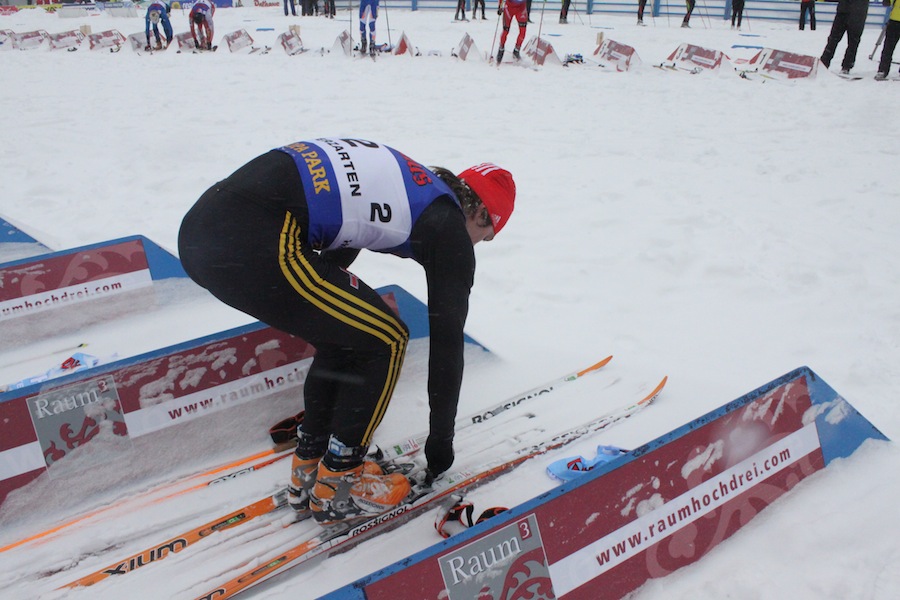
For the first time, ski changes will be allowed in a domestic Championship event. Racers will be allowed to swap out their skis for a new pair during the race. In events as long as 30 and 50K, the difference fresh wax makes in the middle of the race can be huge, especially if conditions are variable.

“The thinking behind this decision was that it’s been a rule now on the World Cup for a few years, and some of our athletes have struggled with their first racing experience with a ski exchange being at World Championships or the Olympics. “
This change will allow athletes to become familiar with the system before experiencing it in Europe.
One exchange will be permitted in the 30K and two in the 50K. While this rule doesn’t exactly follow FIS regulations—in which skiers are allowed to switch skis whenever they pass through the exchange area for up to three times in a 30K and four times in a 50K—it will nevertheless be a useful opportunity to try out a new format.
The new rule will require more space in the stadium for the exchange area, but Farra doesn’t expect the rule to be too limiting on which venues will be able to host the SuperTour Finals in the future. However, says Farra, “If a particular stadium is not suited to providing enough space for ski exchange boxes for each athlete, then we can choose to go without the ski exchange.”
Junior Nationals race format changes

Two significant developments came out of discussions in the junior subcommittee, both of which have been in the works for over a year and are aimed at getting juniors more prepared for performing in the tight racing environments that are seen at Scando Cup, World Juniors, and beyond.
First, the J1 boys’ distance race is being shortened from a 15K to a 10K. “This came from discussions about creating developmentally appropriate events for our kids and keeping them skiing faster, and not just longer,” Farra explains. “We had J2 boys going from a 5K at the age of 15 to a 15K at the age of 16, one year later. This was a bit of a dramatic shift and not necessary for most of the field. The concept seemed to be: lets shorten the race and get them going faster.”
The second major decision applies to the team relay, with the option for appropriate venues to shorten the final race of the week from a 3x3K relay to a sprint relay of about 1.5K. “A year ago, this committee approved to shorten the 3x5K relay to a 3x3K which was tested successfully in Minneapolis in March of 2011. This idea for a sprint relay follows this same logic to keep the teams closer together and in traffic longer. ”
Soldier Hollow, the 2012 host for Junior Nationals, lends itself to a sprint relay, with plenty of space for a wider exchange zone. Farra says they’ve expressed interest in testing it out. “This event will be predictably tight and crazy, but that works well to accomplish the goal of getting our young athletes comfortable moving amongst a crowd.”
For a more complete list of the USSA Congress highlights, click here.


Leave a Reply
You must be logged in to post a comment.