
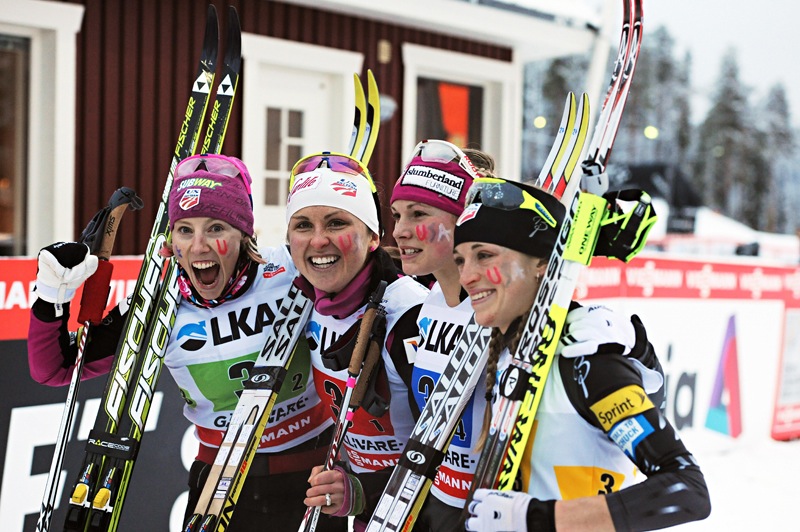
The 2013 World Championships begin on February 20th in Val di Fiemme, Italy, and if you think this has been an exciting season so far, think again. Against the dramatic backdrop of the Dolomites, the season will reach its high point in every way possible in a few short weeks. Stakes. Emotion. Nerves. Expectation. The title World Champion has a ring of absolute finality to it, and here in 2013 Americans seem to have a greater chance at taking one home than it’s had in recent memory.
Before we get ahead of ourselves, the U.S. Ski Team has yet to select the lineup of athletes it will send to Italy in the first place. Luckily the wait is almost over — on Monday, the window of time for VdF hopefuls to turn in worthy performances ended. USST head coach Chris Grover told FasterSkier he hopes to finish running the numbers on the National Ranking List in time to announce the team by the end of the week.
The suspense! Friday is three whole days from now and nobody wants to wait that long, so just for fun let’s take a look at the criteria and figure out who the shoe-ins, likelies and long-shots are.
Here are the selection criteria, paraphrased from USSA:
- Up to four (4) U.S. athletes may start in each event and up to eight (8) athletes per gender will be named to the team.
- Athletes who rank in the top 60 in the World Cup overall will be named to the team
- Athletes who rank in the top 50 in the World Cup sprint or distance standings will be named to the team.
- If items 2 and 3 result in a team larger than eight athletes, ties will be broken firstly by whomever has the most World Cup points in distance or sprint, secondly by lowest current FIS points.
- If additional athletes are selected to the team (‘additional’ being those who don’t have a full resume of World Cup starts), the USST will go down the National Ranking List from the last twelve months to do it. (The list is developed from competitors’ best four USSA-scored races, sprint or distance, from within the selection period.)
- Discretion is allowed.
Right. That all sounds very mathematical and complex, but at the very least we can figure out who has definitely made it based on the top 60/top 50 thresholds. The lists below show where every American athlete with World Cup points ranks on the relevant lists as of January 14. Asterisks (*) denote athletes who meet the criteria.
Overall:
Women
3. Kikkan Randall *
21. Liz Stephen *
33. Holly Brooks *
37. Jessie Diggins *
39. Ida Sargent *
70. Sophie Caldwell
78. Sadie Bjornsen
93. Becca Rorabaugh
Men
29. Andy Newell *
45. Noah Hoffman *
60. Kris Freeman *
124. Simi Hamilton
125. Skyler Davis
133. Tad Elliott
Sprint:
Women:
1. Kikkan Randall *
21. Ida Sargent *
36. Sophie Caldwell *
46. Jessie Diggins *
51. Holly Brooks
52. Sadie Bjornsen
62. Becca Rorabaugh
64. Liz Stephen
Men:
4. Andy Newell *
72. Simi Hamilton
73. Skyler Davis
Distance:
Women:
5. Kikkan Randall *
18. Liz Stephen *
24. Holly Brooks *
41. Jessie Diggins *
49. Ida Sargent *
67. Sadie Bjornsen
Men:
30. Noah Hoffman *
43. Kris Freeman *
73. Andy Newell
86. Tad Elliott
According to Grover, who has the final say in team naming, objective qualifiers will always take precedence over discretionary picks. Based purely on those first two objective criteria, then, the U.S. World Championships team should begin like this:
Women: Kikkan Randall, Liz Stephen, Holly Brooks, Jessie Diggins, Ida Sargent, Sophie Caldwell
Men: Andy Newell, Noah Hoffman, Kris Freeman
Pretty straightforward. The secondary factors that go into qualifying start to confuse the process. There are as many as two more spots on the women’s squad and five more on the men’s to bring the athlete count up to eight, but Grover has already said he won’t simply bring as many athletes as he can. The team will consist of six to eight athletes per gender, and athletes beyond the automatic qualifiers need to prove they can be competitive in order to go.
“Our goal is not simply to fill start spots,” Grover wrote in an email in December. “Yes, we get four start spots per race per sex, with the exception of the Team Sprint, where we get two starters per sex. Rather, our goal is to be successful. We have our sights set on a medal in VdF. This Championships will not be an experiential or development project for us, and the Team that is named will reflect that fact.”
Given the differences in depth of field between the men and women in the U.S. at the moment, that means different things between the two genders. On the women’s side you don’t necessarily have to look outside the U.S. Ski Team to fill the roster, if it will even exceed six people. As the top American performer last weekend in Liberec, Czech Republic, and the winner of a sprint and distance race at U.S. Nationals, Sadie Bjornsen is the most obvious first addition. Becca Rorabaugh is the only other American that exists on the World Cup ranking lists but was outperformed at Soldier Hollow by several women, including title-winners Rosie Brennan and Jennie Bender. This is presumably where tie-breakers, the National Ranking List and discretion will come into play, but again, we don’t know if the team will even consist of the maximum eight people.
The men’s team clearly needs more than three people on it. Simi Hamilton is a guaranteed addition; you need two people for a team sprint and he’s next on the sprint list after Newell. This brings the tally of obvious men’s choices to four. You also need four distance guys for the relay, and Elliott is the fourth man on the World Cup distance list.
Men’s results from U.S. Nationals upset a bunch of things, however. Torin Koos and Erik Bjornsen, among others, both beat Elliott in the 30 k. Koos also makes a strong sprint candidate, as would Dakota Blackhorse-von Jess, but U.S. Nationals is not the only race being used to fill those additional spots. The criteria say that the USST will use a year’s worth of domestic results to pick additional team members, but the discretionary clause also allows for giving more weight to recent improvement in results.
It should be mentioned that the lack of absolute clarity is kind of unavoidable. The U.S. has more athletes than ever who stand a good chance of doing well, and in line with its stated goals the national team wants to focus its resources on ensuring that someone like Kikkan Randall has the support she needs to podium before it considers maxing out the team quota. For the domestic skiers hoping to take one of those maybe-additional spots, however, it makes for an uncertain qualifying process. After he won the freestyle sprint at Soldier Hollow we asked Blackhorse-von Jess whether he knew what it took to get named to the team and this is what he said:
“When I was at the World Cup (in Quebec) I asked what do I need to do, because the objective criteria don’t apply to very many of us and after that it’s sort of up in the air. And it makes sense, but it’s hard to figure out how do I do it. The short answer is win. Win the qualifying, win the races was sort of what I was shooting for.”
In the end, winning is all anyone was shooting for. With the selection period now over, everyone just has to sit tight and wait for the nominations to come out.


Leave a Reply
You must be logged in to post a comment.